Archive for the ‘Uncategorized’ Category

Ferrari 330 TRI/LM Spyder…

Posted: January 6, 2026 in Uncategorized
(MotorSport)

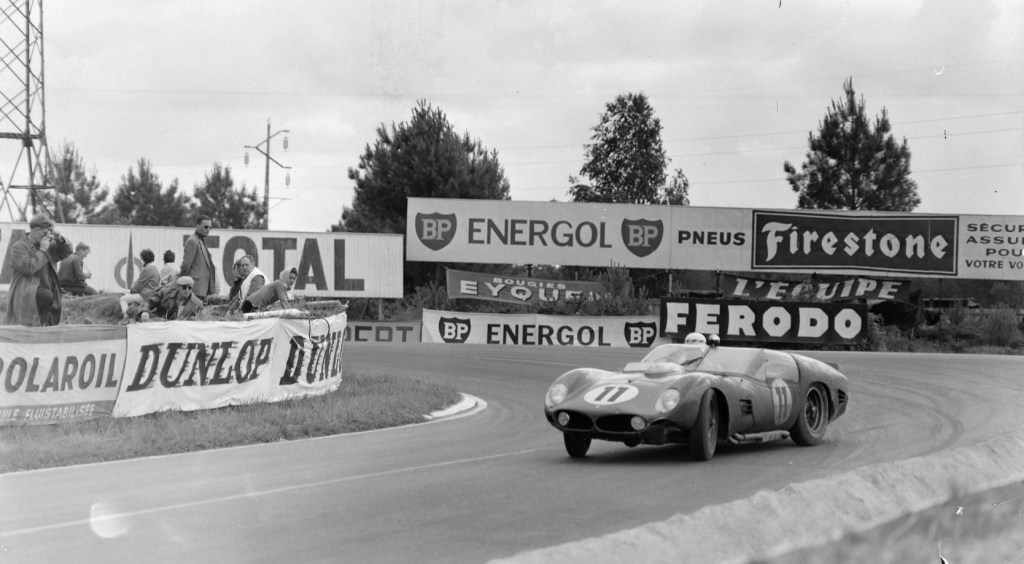
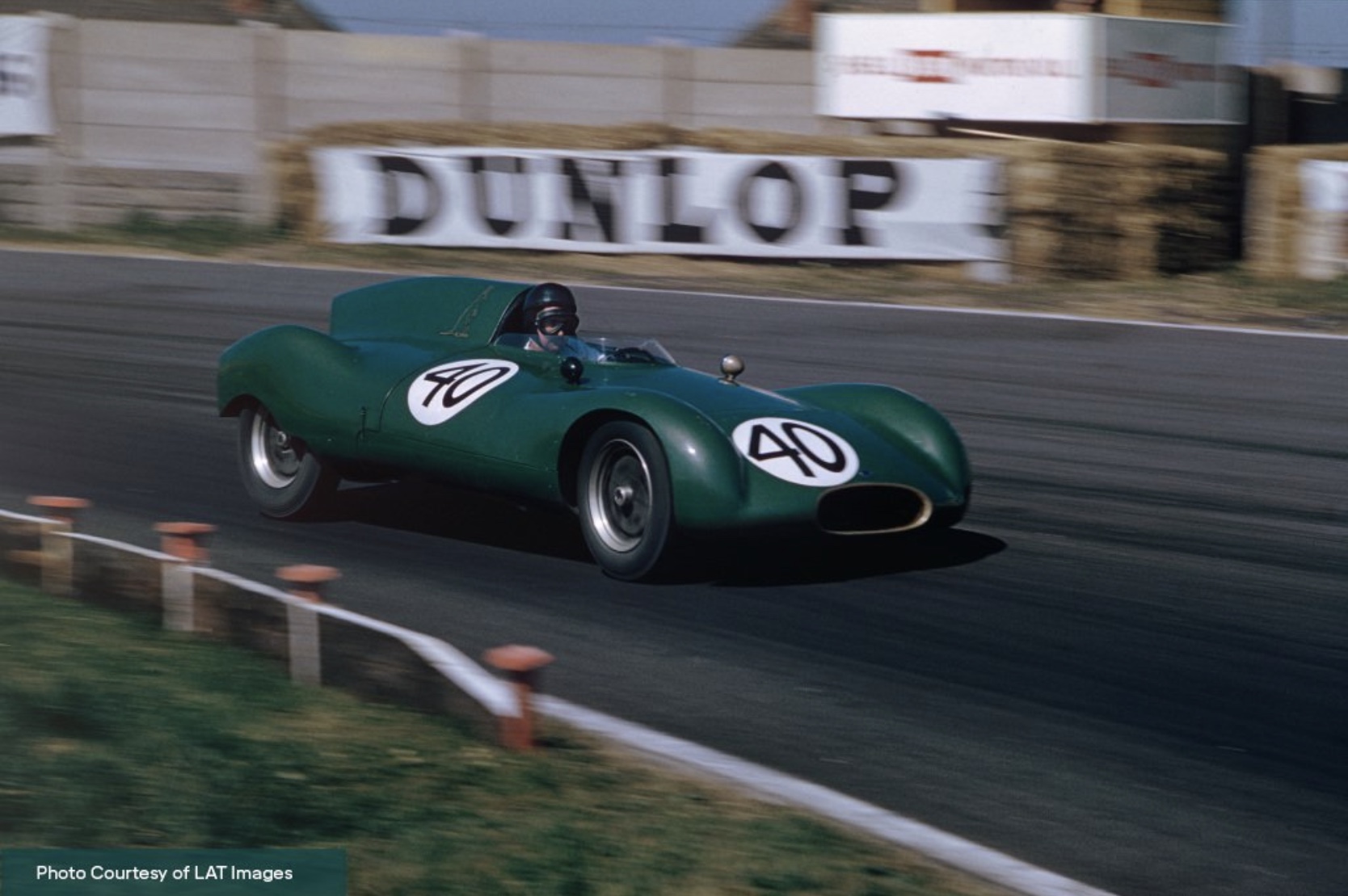
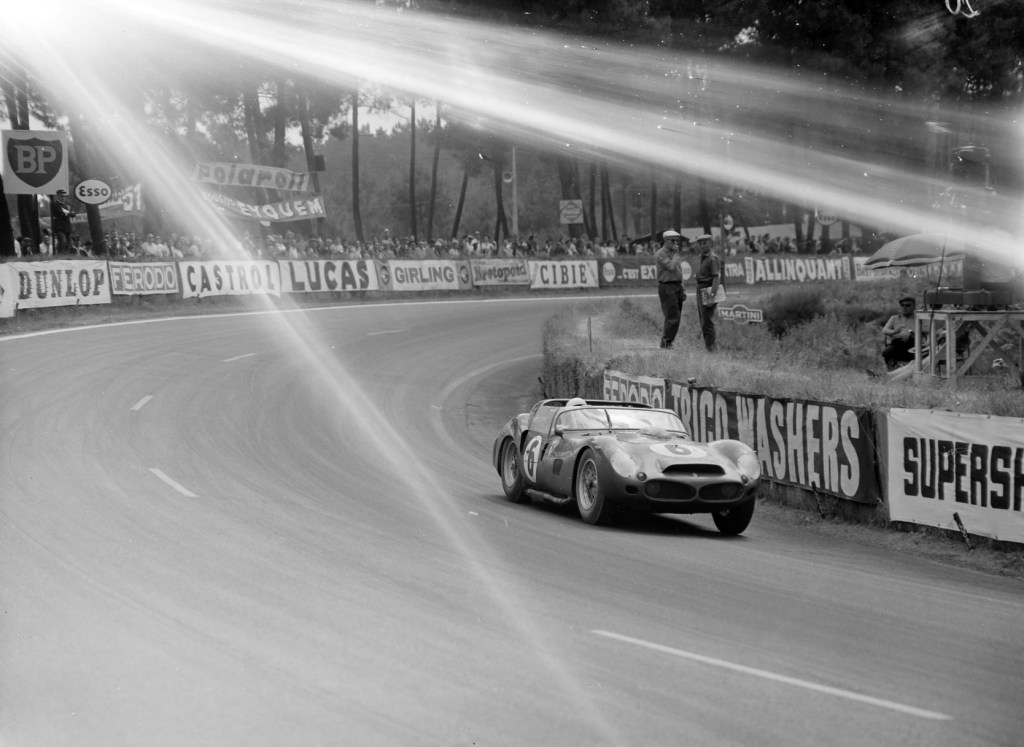
The victorious Olivier Gendebien/Phil Hill 4-litre Ferrari 330 TRI/LM V12 chassis # 0808 blasts through The Esses on the way to victory at Le Mans over the June 23-24, 1962 weekend.

Ferrari finished 1-2-3 in a dominant display, the one-off car of the Belgian/American duo completed 331 laps with Pierre Noblet’s Ferrari 250GTO five laps in arrears, the driving duties shared with Jean Guichet. In third was the Leon Dernier/Jean Blaton Equipe National Belge entered 250 GTO on 314 laps.

In fourth and fifth place – best of the rest – were two of the new Jaguar E-Type Lightweights, Briggs Cunningham and Roy Salvadori in an open drophead, and Peter Lumsden and Peter Sargent aboard the latter’s coupe.
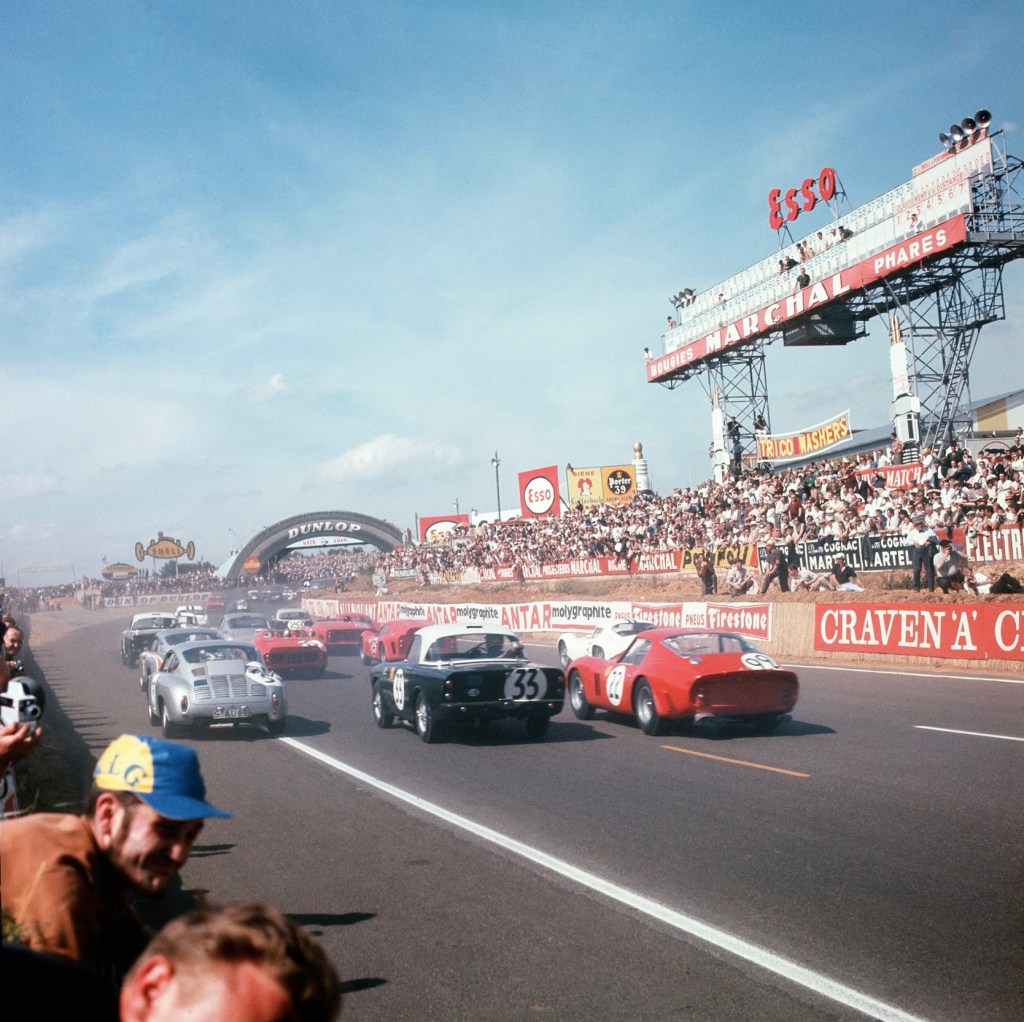
Superb weather to start the race. Paddy Hopkirk in the Sunbeam Alpine he shared with Peter Jopp (DNF) with Leon Dernier in the third placed Ferrari 250 GTO alongside (MotorSport)
(MotorSport)

When the CSI/ACO created a new outright ‘experimental’ class for cars of no more than 4-litres (GT cars had the same capacity limit) Ferrari built one final variant of the long running and so successful Testa Ross sportscars and ‘threw its keys’ to their most experienced endurance pairing, the Gendebien/Hill duo having won at La Sarthe in 1958 Ferrari TR/58, and 1961 Ferrari 250 TRI/61. Gendebien also won in 1960, sharing his Ferrari 250 TR59/60.

Olivier Gendebien practising the mid-engined Ferrari 268 SP during the Targa weekend in May 1962. The car didn’t start after Phil Hill ran off the road (MotorSport)

The Maranello mob had been focusing their energies on new fangled mid-engined Dino V6 and V8 sportscars (above), but rightly figured they may be able to squeeze one more win out of old hardware. In so doing Ferrari 330 TRI/LM 0808 became the last front-engined car to win the 24 hour classic outright.

(MotorSport)

The 1962 Le Mans winner started life as 250 TRI/60 chassis, #0780TR, a Fantuzzi Spyder that was badly damaged by Cliff Allison at the Targa Florio in March 1960. He had a front tyre blowout in practice. Back at Maranello it was rebuilt from bits donated by the wrecked 250 TR59/60 #0772TR then raced at Le Mans. Willy Mairesse and Richie Ginther drove the car but retired with a broken driveshaft on the Sunday morning.

#0780 was then returned to the factory and fitted with a TRI61-style high rear body incorporating a Kamm tail, the front was unchanged. In this form it was used as an aerodynamic test-bed by Carlo Chiti and Giotto Bizzarini to develop the ’61 TRI body.
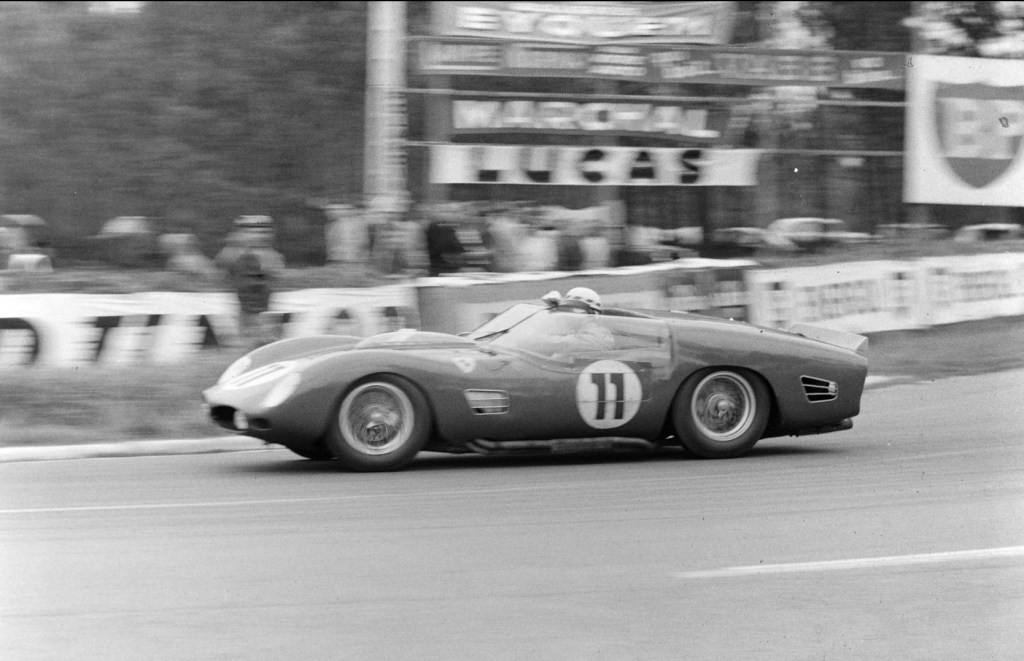
The Mairesse/Parkes Ferrari 250 TRI/61 chassis #0780 on the way to second place at Le Mans in 1961. This swoopy, sensational car was torn down and donated much of its parts except engine, chassis, body, etc to create 330 TRI/LM #0808 (MotorSport)

The car was raced extensively in 1961, placing second at Sebring (Giancarlo Baghetti, Ginther, Taffy von Trips) and at Targa where it was crashed. This time the car was fitted with a new TRI/61 nose before finishing second at the Nurburgring 1000Km driven by the Rodriguez brothers, Ricardo and Pedro. A late pitstop to replace a broken front wheel lost the chance for the NART entered car to win. Mairesse and Mike Parkes raced it at Le Mans, finishing second behind the winning sister, works Gendebien/Hill Testa Rossa. The chassis finally bagged an overdue win when Lorenzo Bandini and Georgio Scarlatti won the Pescara 4 Hours late in the year.

Gendebien 1962 (MotorSport)
#0808 Le Mans 1962 (MotorSport)

Convinced that one of their big front-engined TRs could still do the trick, #0780 was torn down and rebuilt around a new chassis – #0808 – and Tipo 163 Colombo 4-litre SOHC, two-valve V12. The dry-sumped, 60 degree, 3967cc (77×71 mm) engine had modified cylinder heads incorporating bigger valves, fed by six twin-choke Weber 42DCN carbs, it gave about 390bhp @ 7500rpm, about 50bhp more than the 250TR unit. The five speed gearbox was modified to take the extra power and torque.

The new chassis, a more sophisticated mix of traditional ladder frame, and multi-tube spaceframe was 63mm longer than the 250’s, in part this was to accommodate the slightly longer engine and to improve overall balance. Suspension design was a carryover from the 250; upper and lower wishbones, coil springs and Koni dampers both front and rear. Steering was by way of worm and sector.
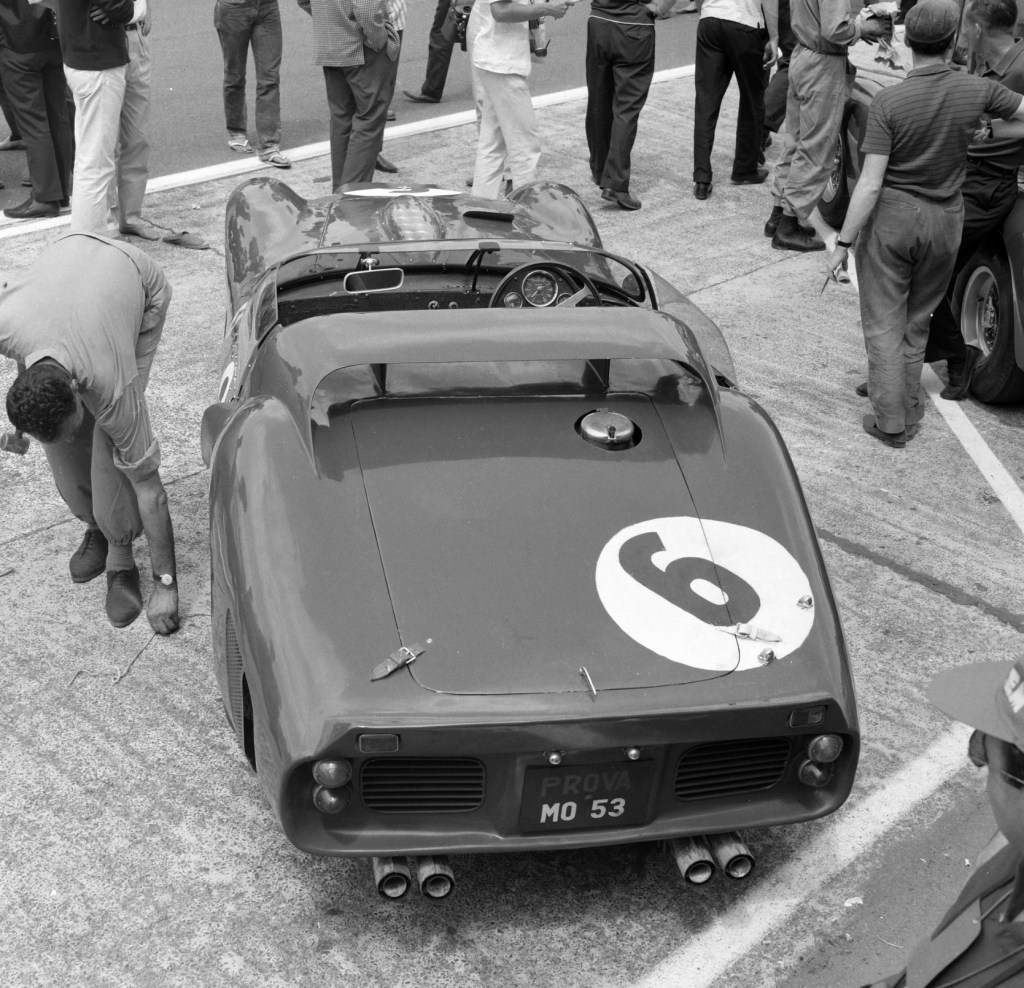
Nice shot showing the the rear aero/roll bar of #0808 in 1962, whereas the shot below is of the cockpit 12 months hence at Le Mans, with the aero structure removed by NART (MotorSport)
(MotorSport)

Wheels/tyres were Borrani wire/Dunlop-6×16 inch and 7x16inch front/rear, brakes were Dunlop disc front and rear, front/rear tracks 1225mm, the wheelbase 2400mm – same as the short-block – and weight quotes very from 685Kg to 820Kg!

To cap it all off, Carozzeria Fantuzzi built a new body, developed with the aid of Ferrari’s small wind tunnel installed in 1960, to Pininfarina’s design incorporating an aerodynamic roll hoop which served to aid the flow of turbulent air caused by the cockpit/windscreen and therefore improve high speed stability.

#0808 first appeared at the Le Mans test in April driven by the defending winners, Gendebien and Hill. It recorded fastest time of the day despite damp conditions and being fitted with only three Webers, so wasn’t raced, but was rather developed further at the factory and one test at Monza before dominating Le Mans.
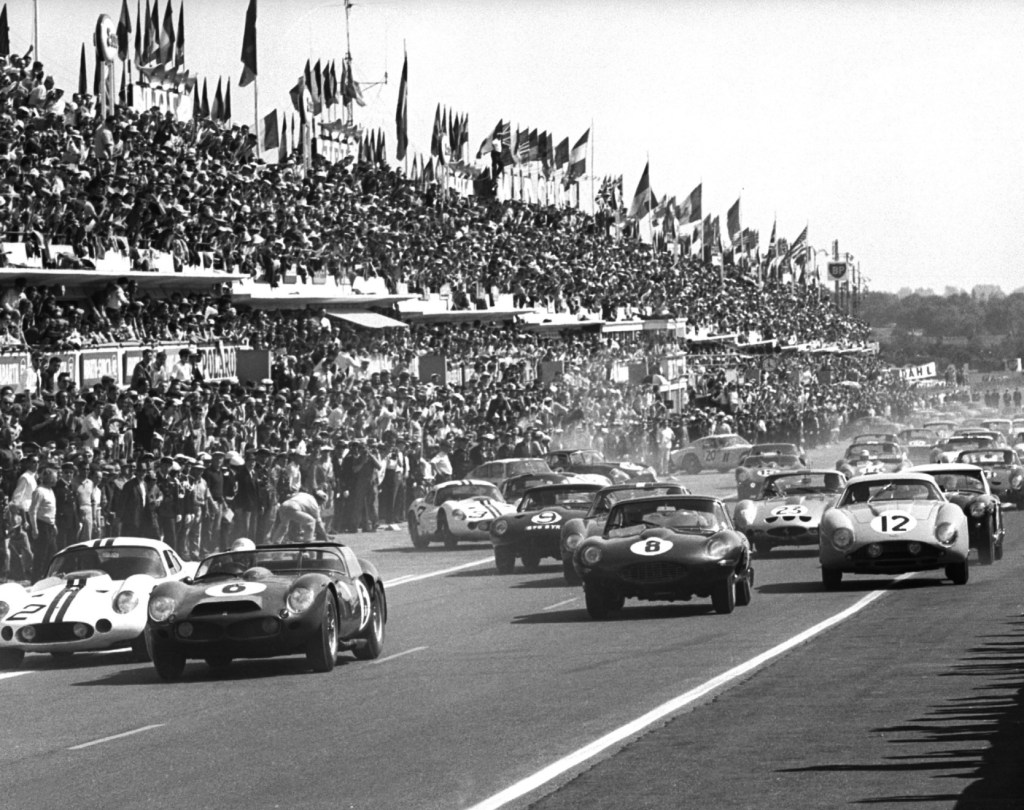
The off, Le Mans 1962. (MotorSport)
(MotorSport)

It wasn’t a cakewalk though. Hill broke Mike Hawthorn’s lap record in practice but both drivers experienced a slipping clutch all weekend. This had to be managed by precise ‘changes and using a taller gear than optimal, neither driver expected it to last the race.

The major potential opposition comprised a mix of other Ferraris, two Maserati Tipo 151s entered by Briggs Cunningham and the works Aston Martin DP212. After the Rodriguez brothers’ works-Dino 246SP retired at 4.30am on Sunday morning, the 330 inherited a four lap lead, they extended to five laps before the end.

(MotorSport)
(MotorSport)

Don Rodriguez acquired the car after the race, with Pedro driving the NART prepared car – now devoid of roll hoop which Chinetti didn’t consider aerodynamic – win to a Bridghampton GP win and second place in the Canadian GP in late ’62. After Ricardo Rodriguez was killed in the Mexican GP, Master Gregory raced #0808 to fourth in the Nassau Trophy.

Into 1963, Pedro and Graham Hill raced the car to third at Sebring behind two new, mid-engined 3-litre V12 250Ps. At one stage the 330 led by three laps until mechanical, electrical and exhaust manifold problems intervened.
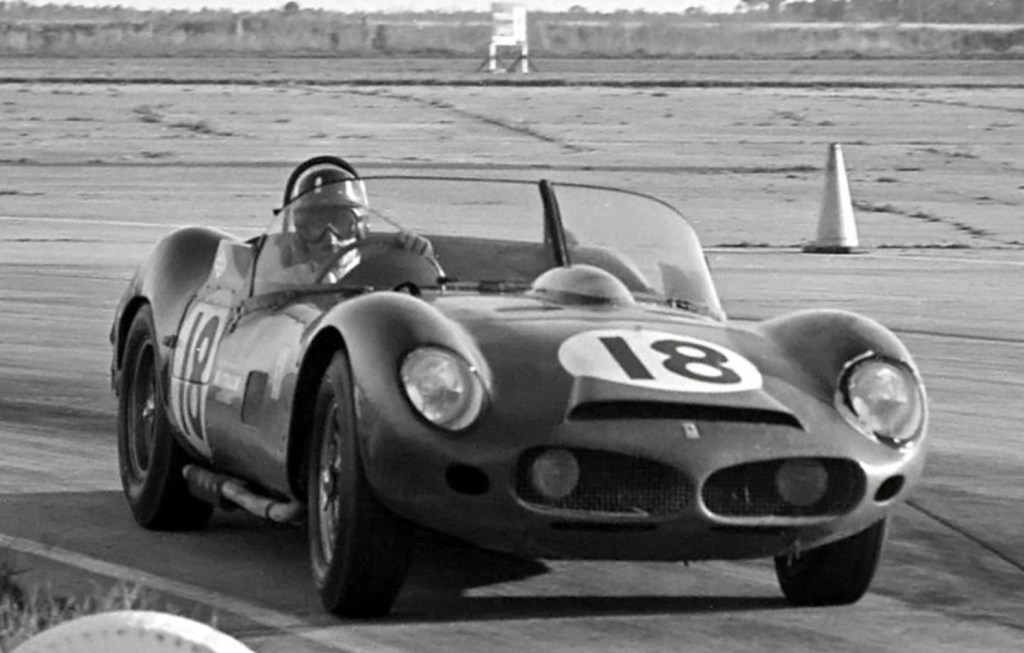
Graham Hill, #0808 at Sebring in 1963 (L Galanos)
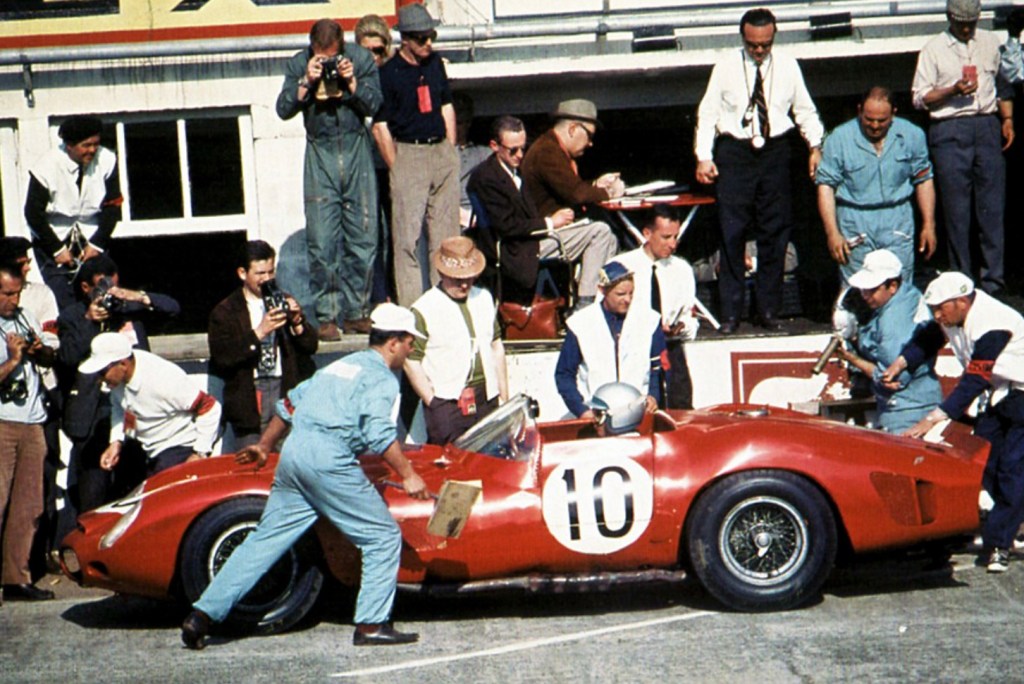
Pedro during a pitstop at Le Mans in 1963 (unattributed)
Penske, Le Mans 1963 NART 330 TRI/LM (MotorSport)

NART entered the car at Le Mans to defend its title, Pedro and Roger Penske started from pole, then trailed the works 250Ps until a rod failed during the ninth hour. Lubricant on tyres can be a lethal mix, Penske lost the car and took Jo Bonnier’s Porsche 718/8 GTR out in the ensuing prang which left Penske uninjured but #0808 severely damaged, and never to be raced again.

Returned to the factory for repair, the car was fitted with a Fantuzzi coupe body (below) and returned to the US where it was purchased by Hisashi Okada who used it as roadie from 1965 to 1974. Pierre Bardinon used it similarly until commissioning Fantuzzi to return it back to ’62 specs in 1974-75. It continues its life as global investable commodity

Scrappy, crappy shot of #0808 in Fantuzzi coupe guise circa 1963 (Wikipedia)
Le Mans 1963 (MotorSport)

Etcetera…

(MotorSport)

The Mairesse/Parkes 250 TRI/61 #0780 – the 330 ‘donor car’ – with a touch of the opposites at Le Mans in 1961.

(MotorSport)

“The clutch Mauro, the clutch…”. “Treat it like your girlfriend Pheel…very, very gently.” Or words to that general effect.

(more…)

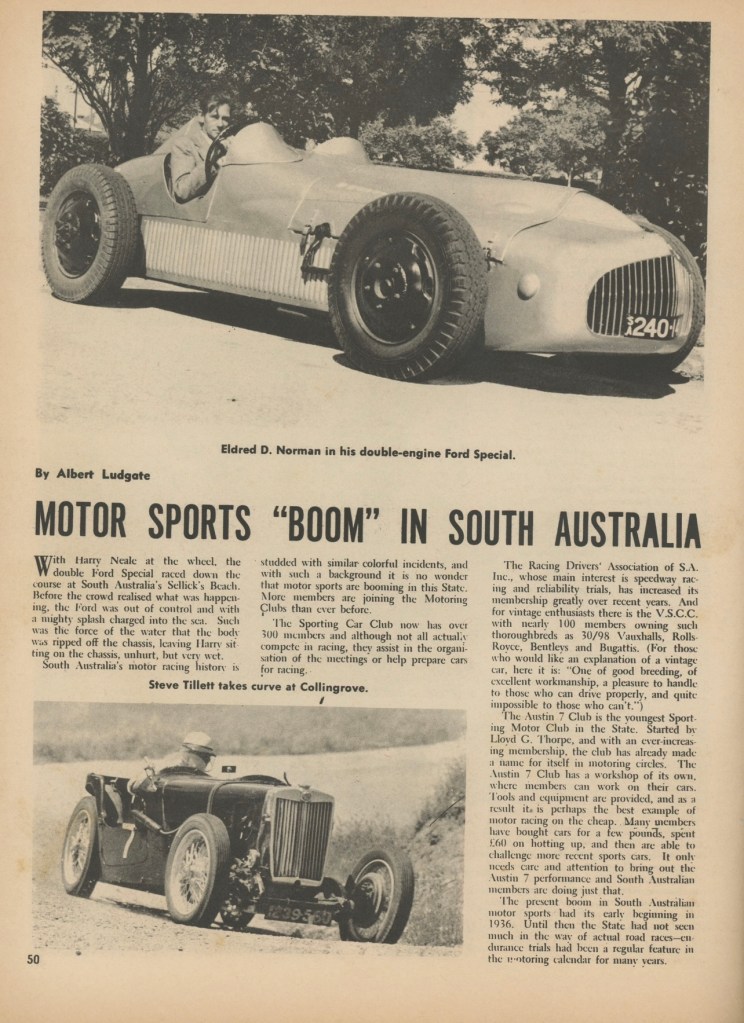
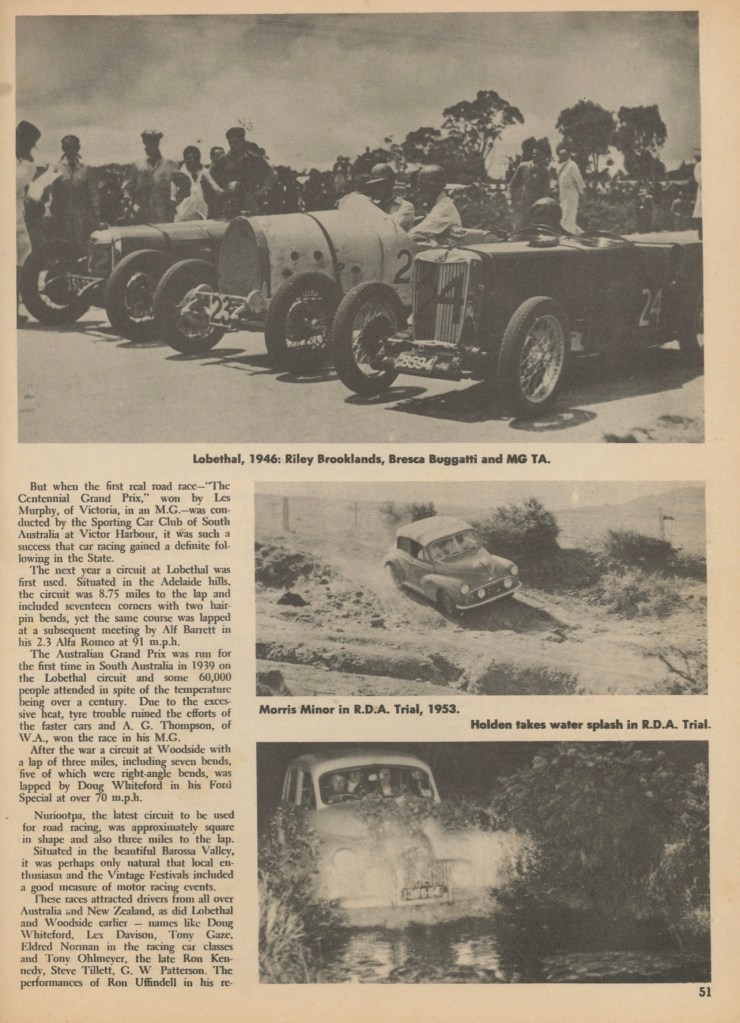
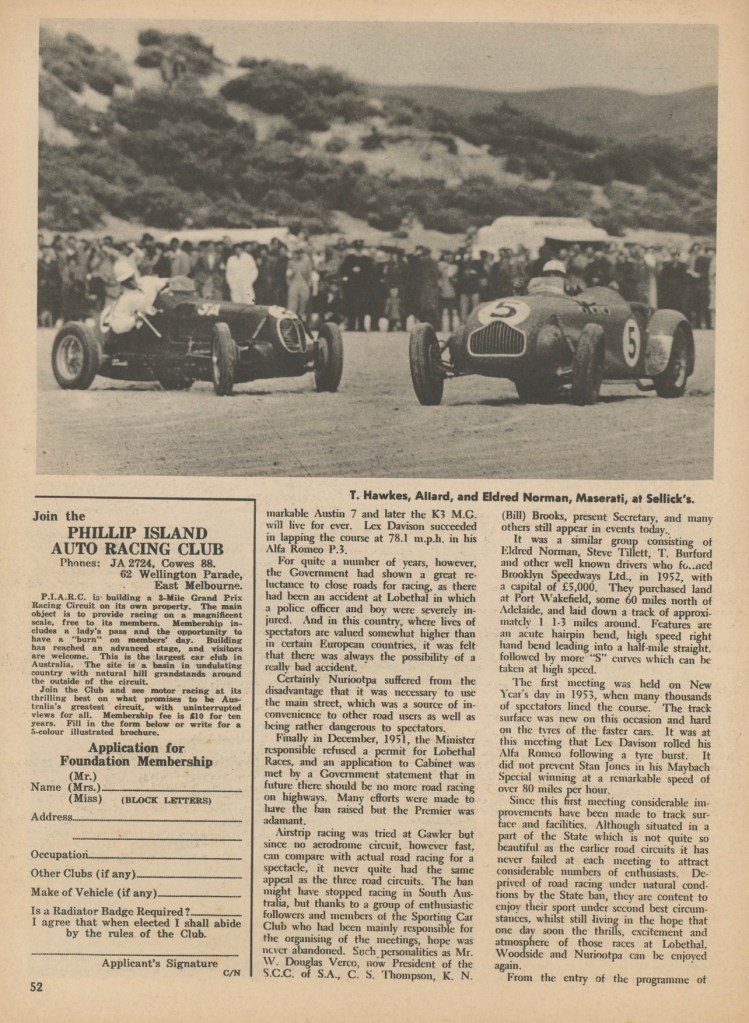
Tony Johns sent me this wonderful article about the motorsport state of play in South Australia in 1954, many thanks.

Cars appears to be a magazine from The Argus stable, a Melbourne daily newspaper published from June 1846 to January 1957. Cars publisher was Larry S Cleland, anybody know of Lazza? The Sydney advertising rep was JM Sturrock of King Street, Jock Sturrock of yachting fame I wonder?

The article was written by Albert Ludgate, Chief Engineer of Lea-Francis cars from 1946. He emigrated to Australia together his family and a 1926 Lea-Francis K-Type in 1953, more of Albert later.

Etcetera…

Australian Grand Prix historians will note that at the time of publication – September 1954 – the 1937 Australian Grand Prix hadn’t been invented. That is, the fuckwit(s) who decided that the December 26, 1936 South Australian Centennial Grand Prix should be the 1937 AGP, rather than the 1936 AGP hadn’t done his/their Fake Nooooz thing.

The South Australian Government’s banning of racing on roads, quite possibly brewing for some time as Albert wrote, was probably precipitated by two deaths in bizarre circumstances during a motorcycle race at Woodside in 1949.

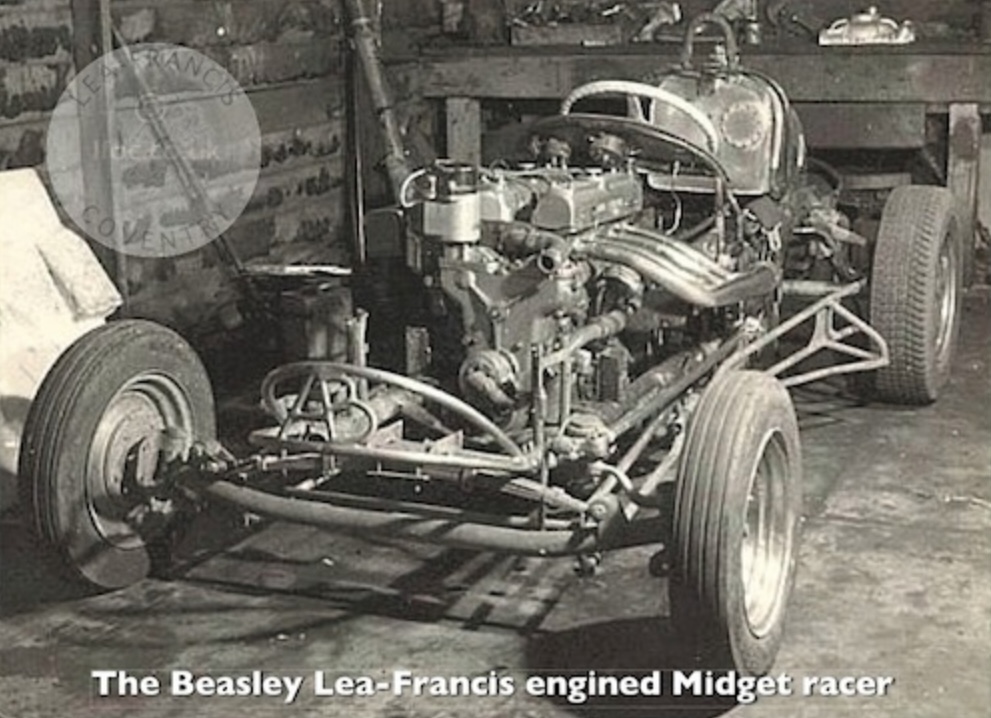
Albert Ludgate in the glasses, and Ken Rose tickling one of their Lea-Francis 1.5-litre midget engines in the US in 1948-49 (LFOC)

Albert Ludgate…

Ludgate’s early history I am yet to discover, but he was Chief Engineer of Lea-Francis from 1946.

By February 1953 he was in Adelaide helping prepare one of his twin-high-cam ‘Leaf’ midget racing engines which had been fitted to Victorian ace, Alf Beasley’s speedcar for an international (SA Solo Championship) meeting at Rowley Park, Adelaide on Friday February 13, 1953.

These 1496cc, four-Amal or twin SU fed, dry-sump, gear-driven cam midget engines were aimed primarily at the large American market.

Bob Shimp won some heats in his Lea-Francis engined car at the Carpinteria Thunderbowl in South California on July 18, 1949, ‘then led the semi-main until the Lea-Francis engine in his midget failed’, wrote Kevin Triplett on his triplettracehistory.blogspot.com.

‘The 91-cubic inch Lea-Francis engine, purpose built in England for midget auto-racing featured dry-sump oiling, gear-driven double camshafts, four SU carburettors (sic), with a high compression ratio to run on alcohol. Record setting British driver, Dudley Froy, Lea-Francis designer Ken Rose and chief engineer Albert Ludgate made trips to the USA in 1948 and 1949 to show and sell samples of the engine.’

‘Besides Shimp, several US midget racers (including Woody Brown in Northern California) used the four cylinder “Leaf” engine but it never became popular (less than a dozen were built) given that its 120 horsepower could not match the power of the Offenhauser four-cylinder engine and it sometimes put connecting rods through the sides of the aluminium block.’

Contemporary Australian newspaper reports say that brothers Alf and Stud Beasley had a car each powered by a float of three of these trick Lea-Francis engines, and had some success with them. It makes one wonder where those engines are now…

Alf Beasley aboard his Lea Francis powered midget at Tracey’s Speedway, Melbourne

Into 1954 Ludgate was the technical representative of Simmonds Accessories and the publicity officer of the (speedway) Racing Drivers Association, while JA Lawton & Sons also retained Albert, not to forget his writing abilities.

Ludgate and his Racing Drivers Association made quite a splash in October ’54 with their ‘Speed and Sports Motor Show’. More than 150 racing, veteran and speedway cars and bikes were amongst the exhibits in the Centennial Hall at Wayville. It was the first time in South Australia’s history that such a show had been run.

Three-quarter-midgets – TQ cars were on the march – were front and centre with Ludgate’s Simmons Nut-Ridge Special one of five TQs on display. In addition he showed a 150cc half-scale midget racer built for his six-year-old son.

Ludgate was a strong advocate of TQs and was a member a three man Racing Drivers Association specifications committee tasked with developing specifications for the class…and in due course he would make some cars.

By December 1954 Ludgate was living in Reade Park, later he bought a house in Colonel Light Gardens. He was well on the way to embedding himself within the local motorsport and automotive industries, having addressed members of the Aeronautical and Automotive Engineers about American car racing and engine development in the Kerr Grant Lecture Theatre at Adelaide University.

Capricornia 1, John Plowman’s car circa 1956 (bollyblog.blogspot.com)
Capricornia 3, later the Repco Ricardian, at Port Wakefield during the March 1959 meeting. With Buchanan couture, a great looking car (v8vantage.com)

In his small Colonel Light Gardens garage, Ludgate Automotive Developments built sportscars, TQ midgets and go-karts using the Capricornia and Ricardian brandnames.

The Capricornia sportscars – the name was taken from the Tropic of Capricorn region – used a multi tubular chassis with two main side-members, a wheelbase of 91 inches and used standard or modified Holden parts, including front and rear suspension, and weighed about 715kg depending upon specifications.

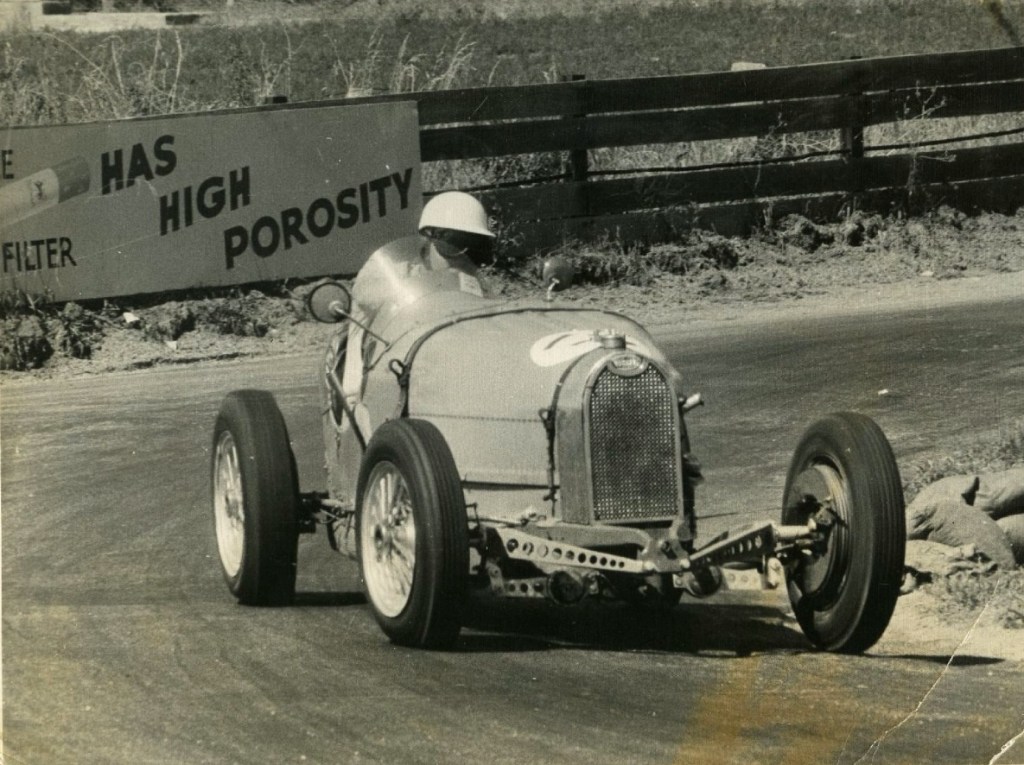
The first of the series, John Plowman’s car was commenced in 1955 and completed just in time for for the 1956 Easter meeting at Port Wakefield ten months later. Fitted with an English RGS/Shattock fibreglass body, and with experienced racer/engineer, John Cummins at the wheel the car performed well. A long job list proved racing improves the breed!

Capricornia 3, Collingrove circa-1958 (S Jones)

John Bruggerman’s very successful Capricornia 3 racing car had a Holden (later Repco-Holden) grey-six fitted and used a shortened Buchanan (NH Buchanan Motor Co) body.

Ludgate’s pioneering TQs – a poor-mans introduction to speedway racing – used Austin 7 chassis, suitably bent 7 axles, and a variety of 500cc motorcycle engine driving through a gutted Austin 7 gearbox using a dog-clutch for stop and go.

In the mid-1950s John Cummin’s met Ludgate in Adelaide in his capacity as a Perkins Diesel rep. Ludgate helped ‘with a lot of input’ in the early development of the Holden grey-six cylinder engine used in his Bugatti Holden. Cummins blazed the trail in Victoria with Holden engine development, his car is said to be the second Holden-powered racing car in the state, ‘Lou Molina’s, Silvio Massola built MM Holden Special being the first’.

‘The engine gave about 65 or 75 horsepower at 3500rpm’, Cummins recalled, ‘and it wasn’t worth two-bob at 4500! We fiddled with the needles in the triple 1 3/4″ SU carries and got 116 horsepower at 4500. Almost double the original Holden power output.’

John Cummins’ Bugatti T37A Holden at Bathurst in 1961. Note the Bellamy independent front suspension so characteristic of #37332 (unattributed)
(B White)

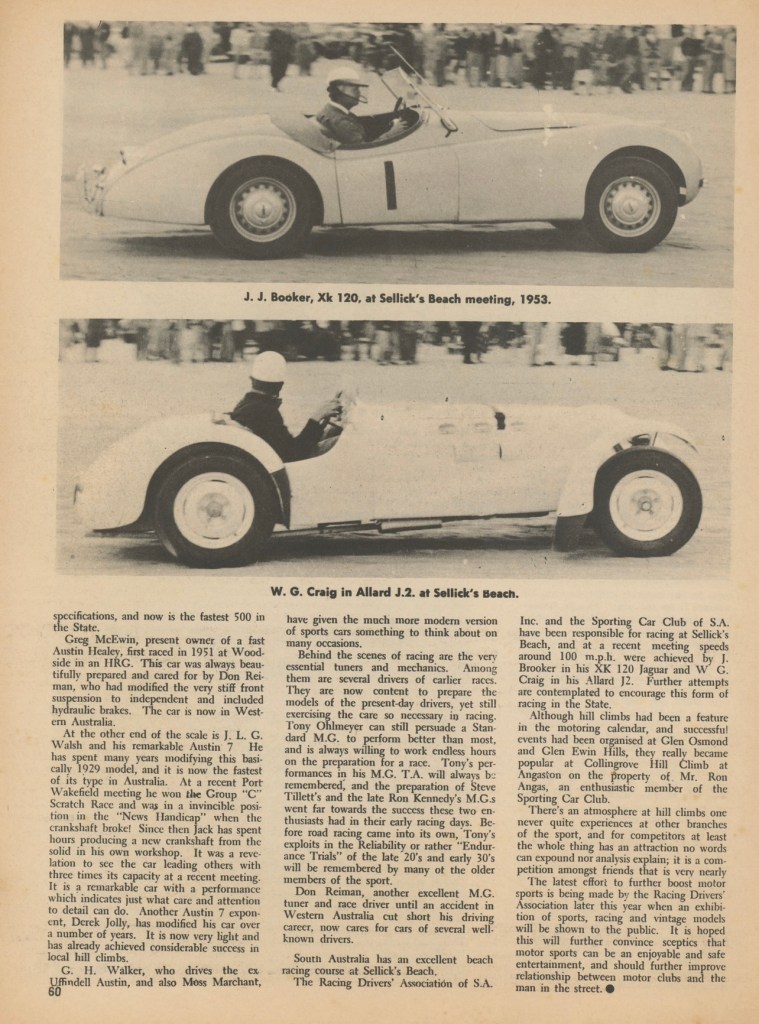
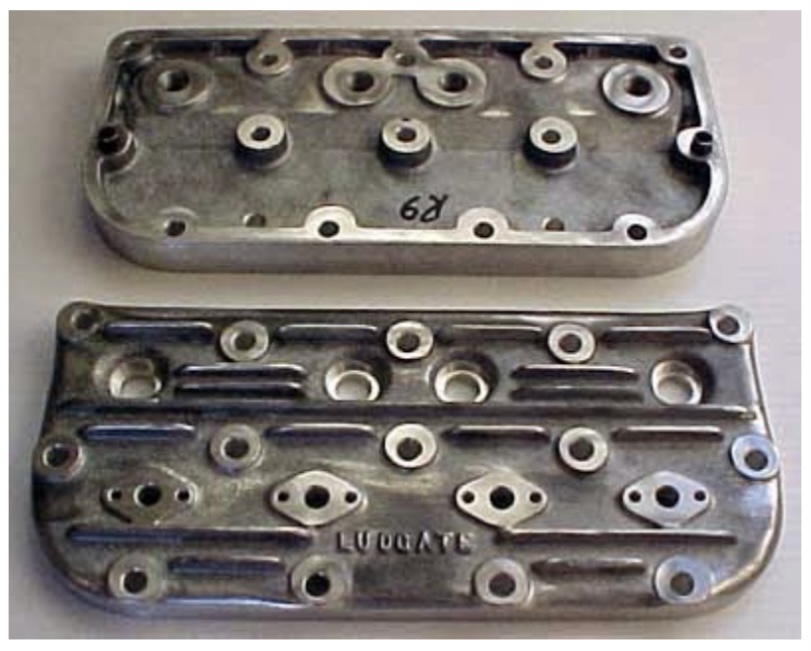
Ludgate also made Austin 7 cylinder heads for the Seven racing fraternity – think of Seven racing as the Formula Vee of the day – in the 1950s and early 1960s. The design featured sandwich construction with combustion chamber shape late-7. Enthusiasts often modified the shape to their own requirements. Ludgate built over 30 of the heads with many more built from his patterns after his death. They were used by many A7 racers in the day including Elfin’s Garrie Cooper during his formative years.

Amusingly, later, the street in which he lived was renamed Ludgate Circus which is surely indicative of the goings on at that address in the wee-small-hours and the fond regard in which Albert was held by his neighbours!

Ludgate retained his Lea-Francis for many years, using it daily to drop his son off at school and displaying it at the VSCC annual rally at Victor Harbor in 1961, by then he was described as a ‘well-known motoring personality’.

Late in his life the Australian Society of Automotive Engineers established and annually bestow the Albert Ludgate Award.

This summary of information about Albert Ludgate is the result of a days Troving and Googling, if anybody can add to the story please contact me: mark@bisset.com.au

Credits…

Cars via Tony Johns’ archive, Trove and other online research, News Adelaide, Victor Harbour Times, bollyblog.blogspot.com, v8vantage.com, triplettracehistory.blogspot.com, Lea-Francis Owners Club website, Paul Jaray on auto puzzles.com, Ron Burchett, Bruce White, Sports Cars and Specials September 1956, Tony Parkinson Collection, Steve Jones

Tailpiece…

(T Parkinson Collection)

Bill Pile or John Newmarch in the Ricardian Repco chasing Jim Goldfinch’s Austin Healey 100S at Port Wakefield circa 1959.

Finito…

(MotorSport)

Geoff Lees, Ralt RH6 Honda V6 during practice of the Spa European F2 Championship round on August 9, 1981. He won the race from Thierry Boutsen, March 812 BMW and Eje Elgh, Maurer MM81 BMW.

Lees won the championship with wins in three of the 12 rounds at Pau, Spa and Donington, he was second at Mugello, Misano and Mantorp Park, together with a few other points he amassed a total haul of 51 from Boutsen on 37, and Elgh 35.

RH6 Honda at Spa 1981. All of the early series Ralt ground-effects cars had good-ole outboard spring/shocks in their first iterations, rockers would soon follow (MotorSport)
Thackwell on the way to victory on Silverstone’s wide open spaces, round one of the Euro Championship on March 29. Ralt RH6/81 (A Fosh)

The season could have been quite different had Lees teammate, Mike Thackwell, who seemed destined for the very top, not had an horrific accident at Thruxton. He had started the season with a bang, winning the opening round at Silverstone from Ricardo Paletti, and was then third at Hockenheim – on both occasions in front of Lees – before it all turned to custard at Thruxton on the April 20 weekend.

“I was so cocky I had it coming. I won the first race, then went to Thruxton, it was my home circuit, I knew it like the back of my hand. Ron Tauranac had me on hard tyres and dampers to test. I saw Geoff Lees in the distance, during practice, and thought, ‘He’s an old boy I’ll catch him, no problem’and I went over the bump and the car bottomed out and I crashed.” he told journalist James Mills in 2020.

He was badly knocked about with a broken leg, injured heel and concussion.

Yoshio Nakamura, Honda, Thackwell, unknown, another Honda engineer and Lees, Pau paddock June 8, 1981 (MotorSport)
RA261E in search of a chassis at Pau. These Honda V6s were paragons of reliability (MotorSport)
Thackwell exits a turn at Pau in June (MotorSport)

The show always goes on of course. Boutsen won at the Nurburgring and Elgh at Vallelunga, before Corrado Fabi won at Mugello in another works March 812 BMW on May 24. Lees was fifth – fifth – and second at Mugello with Thackwell a mighty plucky fifth on his return race. Hobbling around the paddock, he walked with the aid of supports for much of the rest of the season.

Lees won at Pau with Thackwell sixth, then the pair had a shocker of a weekend at Enna-Pergusa in late July when Mike was disqualified for passing under a yellow flag, and Geoff had problems with his Bridgestones. Lees won at Spa while Mike had an accident on lap four, Lees carried the momentum at Donington in mid-August where Thackwell was fifth.

Michele Alboreto took a popular victory for Minardi BMW at home – Misano – from Lees and Thackwell on September 6, with Stefan Johannson taking the final round at Mantorp Park in a year-old Toleman TG280 Hart from Lees with Thackwell a distant 15th.

Donington Park start. Lees on the left, Manfred Winkelhock, Maurer MM81 BMW in the middle and the similarly mounted Ele Elgh on the right (MotorSport)

Thackwell during the season ending J.A.F. Japanese GP on the November 1, 1981 weekend. Satoru Nakajima, soon on his way to F1 with Lotus, won aboard a March 812 Honda from Boutsen and Johannson. Geoff Lees was fourth and Mike tenth.

Thackwell badly needed a win that weekend but was still suffering the after-effects of his accident and was on-the-nose with Team Managers as a result. He would come back with a bang, with Ralt too, but ultimately walked away from racing despite stunning god-given-gifts, a story for another time.

Honda RA261E in one of the RH6s at Mantorp Park, Sweden in September 1981 (MotorSport)

Honda RA260E V6…

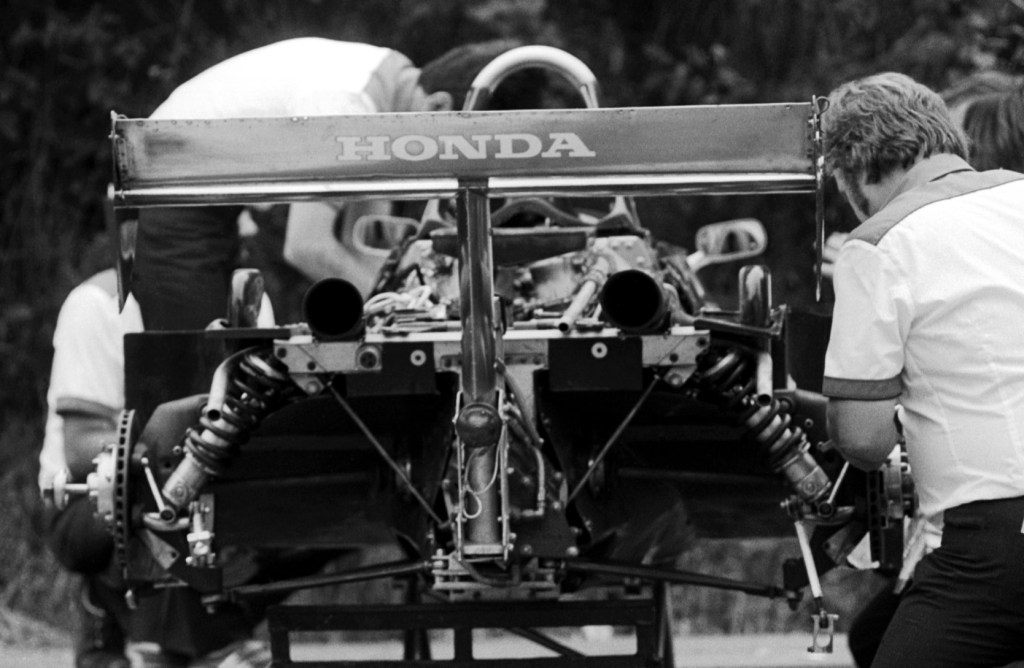
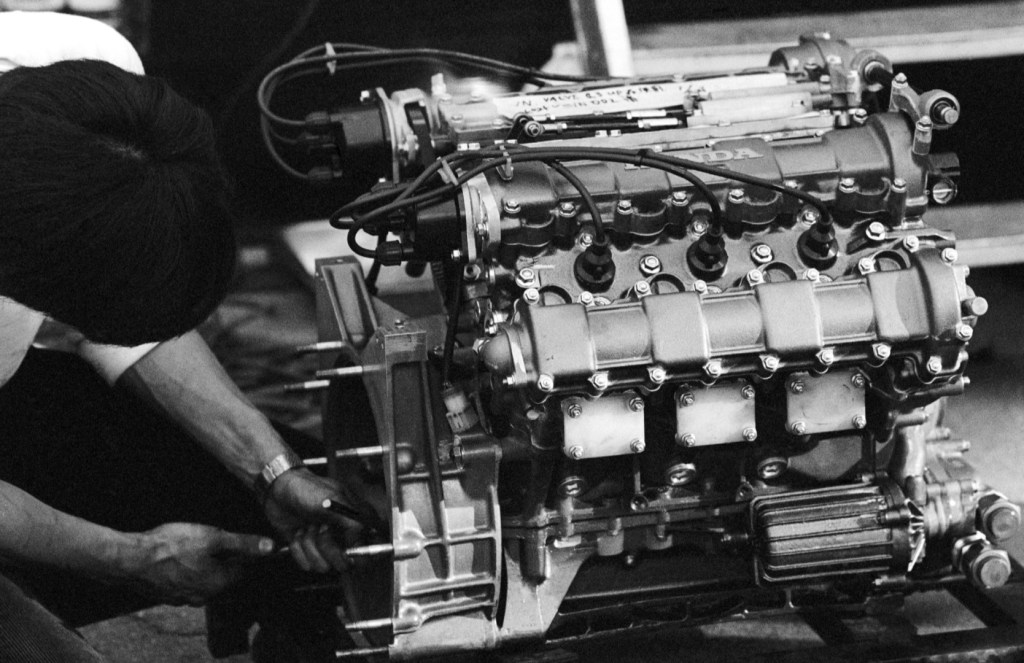
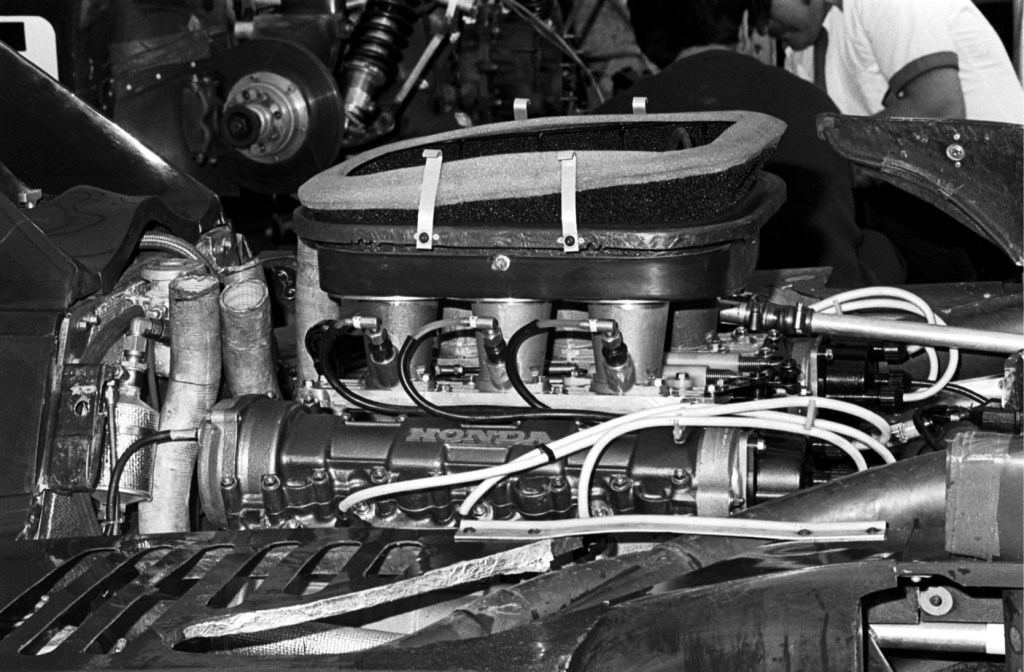
Nobuhiko Kawamoto’s 80-degree, cast iron block, aluminium otherwise, DOHC, four-valve 1993cc – 90mm x 52.3mm – V6 produced about 310bhp @ 10500rpm.

The RA260E first raced in the back of a Ralt RH6/80 driven by Nigel Mansell in the June 8, 1980 Silverstone round of the Euro F2 Championship (below). He was 11th in the race won by Derek Warwick’s Toleman TG280 Hart.

(MotorSport)

In a developmental season doing half the rounds, the car’s best result was Mansell’s second place in an RT2 Honda behind Two Fabi’s works-March 802 BMW at Hockenheim. American Formula Atlantic ace, Tom Gloy, raced an RH6 at Enna and Misano.

Over that winter development changes included adopting Bosch instead of Lucas fuel injection, and alterations to combustion chamber shape. The 1981 variant of the motor was dubbed RA261E.

(M Strudwick)

Geoff Lees…

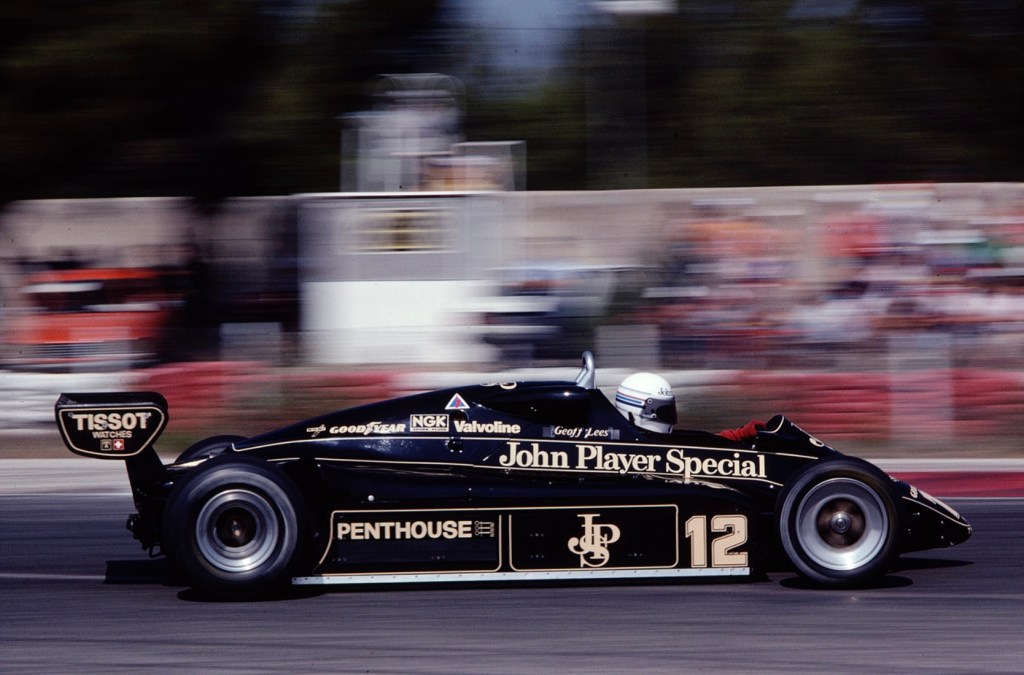
Geoff Lees blasting down Surfers Paradise main straight during the 1979 Rothmans International Series, Wolf WR3 Ford Cosworth DFV.

Geoff came out together with David Kennedy as a three F1 car Theodore Racing lineup – Wolfs WR3 and WR4 and Ensign N177 – to mix it with the F5000s, as much as the rock-hard Goodyears they were forced to run would allow anyway.

I’d followed them both since their FF days, which overlapped. Both became occasional F1 drivers too, not quite getting a foothold at the top level but vastly competent elite level professionals all the same. Kennedy won at Surfers (WR4) but the F5000s prevailed, Larry Perkins was the series victor in a works-Elfin MR8-C Chev, despite not winning a round. Alf Costanzo was second in Alan Hamilton’s Lola T430 Chev, winning two rounds.

Racing for Ralt in 1980 was a ‘step back from F1 to win in F2 and re-enter F1 manoeuvre’ but Honda spent another year developing their F1 engine so Geoff never got the good gig he wanted. With strong relationships in Japan he had a highly paid career there in F2, winning the 1983 title, and in sportscars, inclusive of annual forays at Le Mans.

1982 French GP, Ricard. Lotus 91 Ford, Lees 12th (LAT)

Credits…

MotorSport Images, Anthony Fosh, LAT Photographic

Finito…

(SMH)

Tony Gaze in a reflective moment celebrating what was perhaps his final motor racing career victory, at Albert Park on March 11, 1956.

He had just won the 48 lap, 150 mile Moomba Tourist Trophy in his HWM Jaguar from Bib Stillwell’s Jag D-Type and Ron Phillips’ Austin Healey 100S in a huge 37 car field. Over the following days he sold both this car ‘VPA9’ and the ex-Alberto Ascari Ferrari 500/625 #005 he had been racing in single seater events around the world for two years or so.

I came upon this photograph while looking for something else, the usual thing, then I Google away and within 15 minutes or so you have a few interesting – hopefully – shots. I’ve had a couple of cracks at Tony, here on single-seaters; https://primotipo.com/2019/12/13/tony-gaze-hwm-alta-new-zealand-1954/ and here, mainly sportscars; https://primotipo.com/2020/03/28/gaze-hwm-jaguar-vpa9-ryal-bush-new-zealand/ but there is always room for more.

(MotorSport)

Tony Gaze’s HWM Alta in the Silverstone pits during the 1952 British Grand Prix weekend, he retired with head gasket problems after completing 19 laps (Q26 of 32). The race was won by Alberto Ascari in Ferrari 500 #005, the car referred to in the previous paragraph, from Piero Taruffi’s similar machine, and Mike Hawthorn’s Cooper T20 Bristol in third.

Light Car Club of Australia former-members will pick that bonnet-badge, same badge as on the obscured gent’s blazer in the opening shot. The tyres are Dunlops…

(MotorSport)

Gaze aboard Graham Whitehead’s Aston Martin DB3 (DB3/10) during the Tourist Trophy, World Sportscar Championship round at Dundrod on September 5, 1953. They were an excellent fourth and first of the privateers while up front were two new Aston DB3S’ crewed by Peter Collins/Pat Griffith and Reg Parnell/Eric Thompson, then the works-Jaguar C-Type of Stirling Moss/Peter Walker in third.

(D Coelho)

Tony Gaze own DB3, chassis DB3/9 was only two races old when the car lost its life, and Tony nearly his too. He was forced to swerve around Pietro Palmieri’s Ferrari 250MM in the Portuguese Grand Prix at Boavista on June 21, 1953. The Aston hit a tree, broke in half and burst into flames with Gaze semi-conscious in the middle of the road ten metres from the remains of his car. Wow, she really is daffy-ducked!

With his insurance monies in hand, after a second-hand DB3 could not be sourced, Gaze was unable to buy an Aston Martin DB3S, or a Jag D-Type on acceptable terms, so he acquired HWM Jaguar VPA9 instead.

(MotorSport)

Gaze, Ferrari 500/625 on the way to victory in the 1820 Settlers Trophy, a handicap race held at Queenshaven, South Africa on March 26, 1955. Held on a 3.8-mile track laid out on the disused Palmietfontein aerodrome south of Johannesburg, a crowd of about 60,000 people watched the action.

Peter Whitehead and Gaze were the star international attractions in a two race tour in the same pair of identical Ferraris that excited New Zealanders at Ardmore during the NZ GP on January 8 where the Whitehead/Gaze train were second and third behind the victorious Prince Bira’s Maserati 250F.

Their first event in South Africa was the 7th Van Riebeeck Trophy, a handicap held on the new 1.75-mile Eerste River airfield circuit in the Western Cape, on March 12. Whitehead was 11th and Gaze 13th so the handicapper must have belted them hard! Chris Andrews won the race in a Studebaker Special.

(MotorSport)

The Dickie Stoop/Tony Gaze Frazer Nash Sebring Bristol 2-litre at Le Mans in 1956, DNF accident after completing 100 laps at about 10am on Sunday morning. The pair weren’t as successful as other Nash’s in recent years, in that context the ad below makes interesting reading.

Ain’t she sweet, and fast. Frazer Nash Sebring Bristol in the Le Mans pits in 1956 (MotorSport)
(K Brown Collection)

Off to New Zealand now for the last bunch of shots. Above is the grid for the Lady Wigram Trophy at the RNZAF base of the same name on 1956

Almost obscured on the far left is Reg Parnell in Aston Martin’s forgotten GP car, DP155, Gaze #3 and Whitehead #2 aboard their Ferrari 500/625s with the all enveloping bodied #4 Connaught B-Type Jaguar of later famous artist, Leslie Marr. On row two is Ron Frost’s Cooper Mk9 Norton alongside Ron Roycroft’s Bugatti Jaguar, row three comprises Pat Hoare’s Maserati 4CLT, David McKay’s Aston Martin DB3S and the R Archibald Jaguar XK120. Whitehead won the 71 lap, 150-mile race from Gaze, Marr and Parnell.

Contemporary driver shots from a magazine report about the 1956 NZ GP won by Stirling Moss in a Maserati 250F. And yes it is Reg Parnell, not his nephew, Roy, who was an Aston Martin test driver, and FAO Gaze was an Aussie. Let’s not get picky, it’s the shots that matter (G Woods Collection)
(G Woods Collection)

A favourite shot this one, Gaze in his HWM Jag on the Ryal Bush road circuit during the 1956 NZ Internationals. Tony placed second to Peter Whitehead in the Southland Road Race Formula Libre feature that February 11 weekend in their Ferrari 500/625s.

The sportscar event was a handicap, David McKinney wrote that “the three 1.5-litre Singers outfoxed the handicapper and filled all the first (three) places at the end of the 43 miles.” CR Bath won from Kelvin Kerr and Dave Edmiston. “Although unplaced on handicap, Whitehead (Cooper T38 Jaguar) made fastest time on scratch from Gaze, the HWM slowed by rear-axle trouble, and Tom Sulman (Aston Martin DB3S) who had been off into the scrub and damaged his exhaust…”

(G Woods Collection)
HWM Jag in the Ryal Bush paddock (S Quertier)
Gaze again in VPA9 in NZ, Ardmore or Wigram folks? (unattributed)

Etcetera…

(B Sternberg Archive)

There is a Tony Gaze connection here, it’s HWM Alta 2-litre s/c #GP107, his mount on his 1954 Kiwi tour. It’s shown after a fresh coat of red paint in Auckland in late 1957. By this stage the machine was probably owned by Tom Clark in a long period of continuous NZ owners/ownership which is related in the first of the articles linked above.

(B Sternberg Archive)

Credits…

Sydney Morning Herald, MotorSport Images, Graham Woods Collection, Duarte Coelho, Kelvin Brown Collection, B Sternberg Archive, Stewart Quertier, David McKinney race report via Roger Clark

Finito…

(MotorSport)

Yes, yes, yes, I know I’ve done these Dinos before many times. But I rather like the two photographs of the great Lancastrian, Brian Redman, racing Dino 166 #0008 in the XXXI ADAC Eifelrennen Euro F2 round at the Nurburgring in 1968.

That 21 April day was his Ferrari debut, Motoring News reported the sight of the great-Brit three-wheeling the car around the South Circuit’s turns as quite startling.

Redman finished a fine fourth despite a stop after his goggles were smashed, cutting one eye. Chief Engineer Mauro Forghieri was so impressed he telephoned Enzo Ferrari and recommended Ferrari contract him, an offer he turned down then. Later, Redman was a valued member of the Scuderia’s sportscar squad.

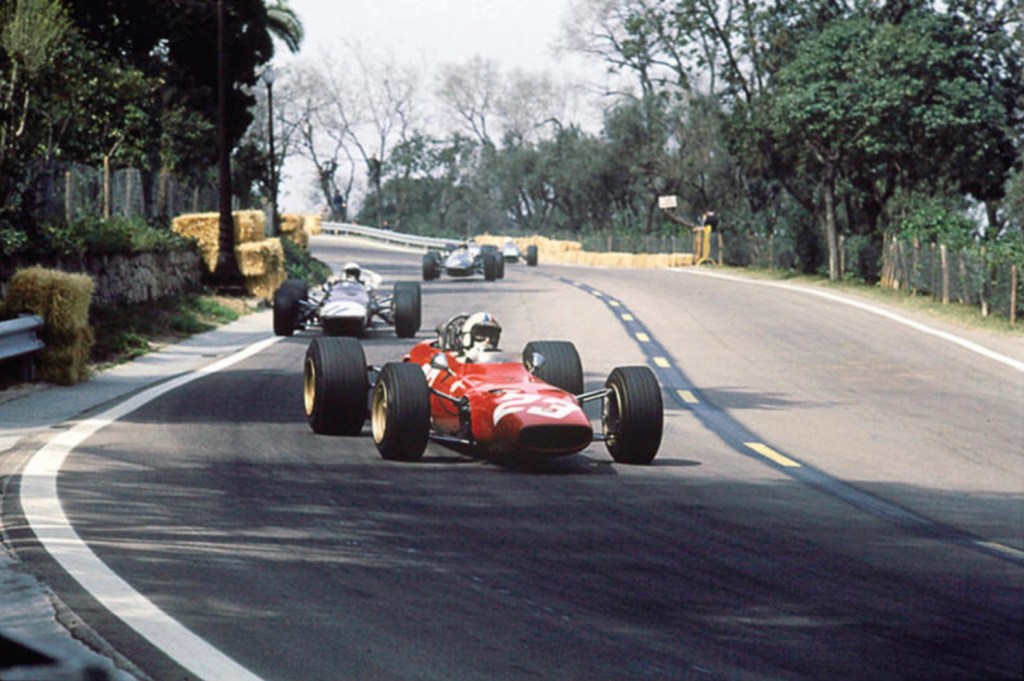
0008 was a new car for 1968. Chris Amon raced it at Montjuïc Parc, Barcelona on its March 31 debut, finishing third behind the Ford FVA engined Matra MS7s of Jackie Stewart and Henri Pescarolo.

Amon amid the trees and high speed swoops of marvellous Montjuïc Parc, behind is the #11 Lola T100 Ford of…Brian Redman, DNF engine (unattributed)

Amon raced it at Hockenheim in mid-June (eighth) before it was damaged in a multiple-car accident in the Monza Lotteria GP in June driven by Tino Brambilla.

Chris raced the repaired car at the Tulln-Langenlebarn airfield circuit in mid-July (classified twelfth) before Brambilla was third in a heat at Zandvoort, and bagged fastest lap. At Sicily in late August he was again third in the Mediterranean GP at Enna, this time behind F2 King Jochen Rindt’s Winkelmann Brabham BT23C Ford and Piers Courage’ similar Frank Williams entry.

Brian Redman three-wheeling on the Nurburgring in 1968 (MotorSport)

The little F2 1.6-litre Ferrari V6, even in four-valve spec, never had the legs of a decent Ford FVA four. Funnily enough, the 2.4-litre Tasman spec V6 gave very little away to the Ford Cosworth DFW, the 2.5-litre variant of Cosworth’s 3-litre DFV V8, GP racing’s most successful engine.

0008 was then prepared for the 1969 Tasman Cup, as part of a successful two car assault on the championship together with Derek Bell in #0010. As I’ve written before, Chris won the championship in fine style with 2.4-litre engines fitted – four wins of the eight rounds including the NZ GP – before selling the car to Graeme Lawrence who repeated the dose in 1970.

Graeme Lawrence on the hop during the 1970 Lady Wigram Trophy, DNF overheating #0008. (G Lawrence Collection)

Credits…

MotorSport, F2 Index, Graeme Lawrence Collection, oldracingcars.com

Tailpiece…

(MotorSport)

Chris Amon and Jochen Rindt, Ferrari 246T and Lotus 49 Ford, on the front row at Pukekohe, start of the New Zealand Grand Prix, first round of the 1969 Tasman Cup on January 4.

Amon won from Rindt and Piers Courage in Frank William’s Cosworth DFW powered Brabham BT24. All three were stars of the series, Chris won four races, Jochen two and Piers one.

Finito…

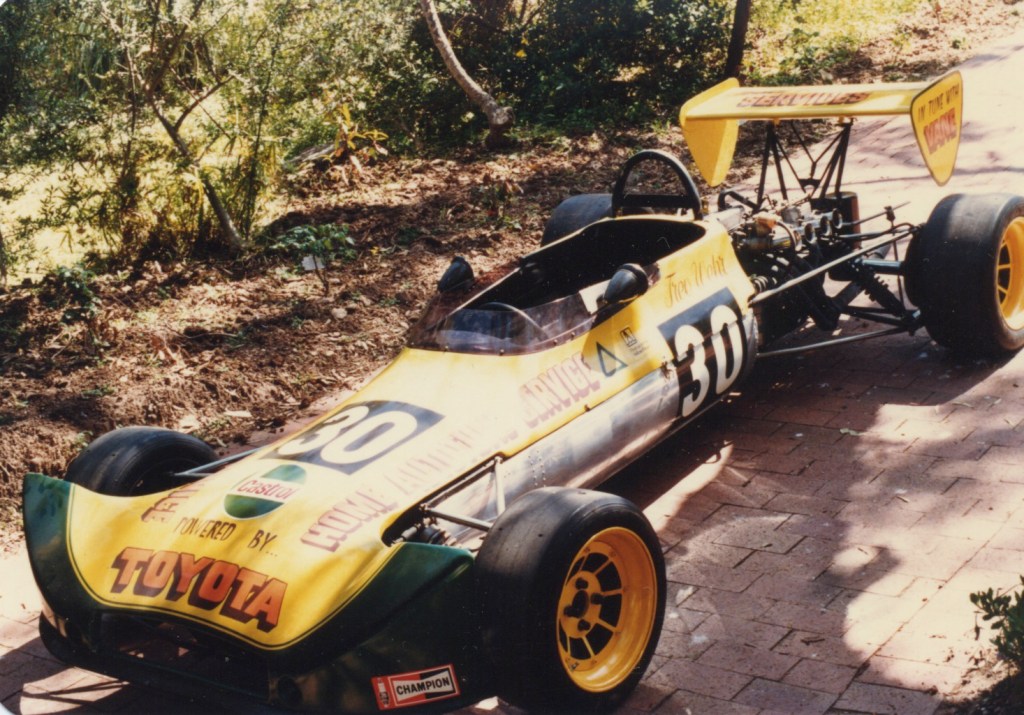
Glyn Scott supervises Leo Geoghegan who is about to have a guest steer of Glyn’s P3 at Oran Park in 1968 (Bowin Cars)

When Bowin founder, John Joyce returned to Australia after a four year stint working for Lotus Components, he built this Bowin – P3-101-68 for Glyn Scott.

Scott raced the 1.6-litre Ford FVA engined car from July 1968 until May 1970, he then ran an Elfin 600 until his untimely, sad death. See here for a story on Glyn; https://primotipo.com/2020/07/24/glyn-scott/

This article is intended to be read in conjunction with my feature about Joyce’s early Bowin years including construction of three P3s published in this fortnight’s Auto Action #1810, published May 6-19, 2021. Click here to buy it; https://autoaction.com.au/issues/auto-action-1810

Editor Bruce Williams will pickle my testicles if I cut-his-lunch. This piece uses extra material relating to Bowin #1 we couldn’t fit in the more general 2,000 word AA piece. Much of the information was provided by Adelaide’s Ian Peters who has owned this marvellous car since 1983.

Merv Waggott engines were very successful in 1969. Glyn Scott had seen first-hand just how potent and reliable they were chasing Max Stewart’s 1.6-litre powered Mildren Waggott, so he ordered a 2-litre TC-4V for his new Elfin 600.

He and Norm Mellor removed the ex-Piers Courage Ford FVA #7044 and FT200 Hewland transaxle from the Bowin and installed them in Glyn’s Lotus 23B. The extra 30bhp or so over and above that of the Lotus-Ford twin-cam fitted to the 23B gave that old beast a useful performance kicker.

P3-101-68 was sold as a roller to Edward Scauster of Annerley, Queensland a fortnight before Glyn’s death – and from him to Wayne Newton in Sydney’s Pennant Hills that October 1970.

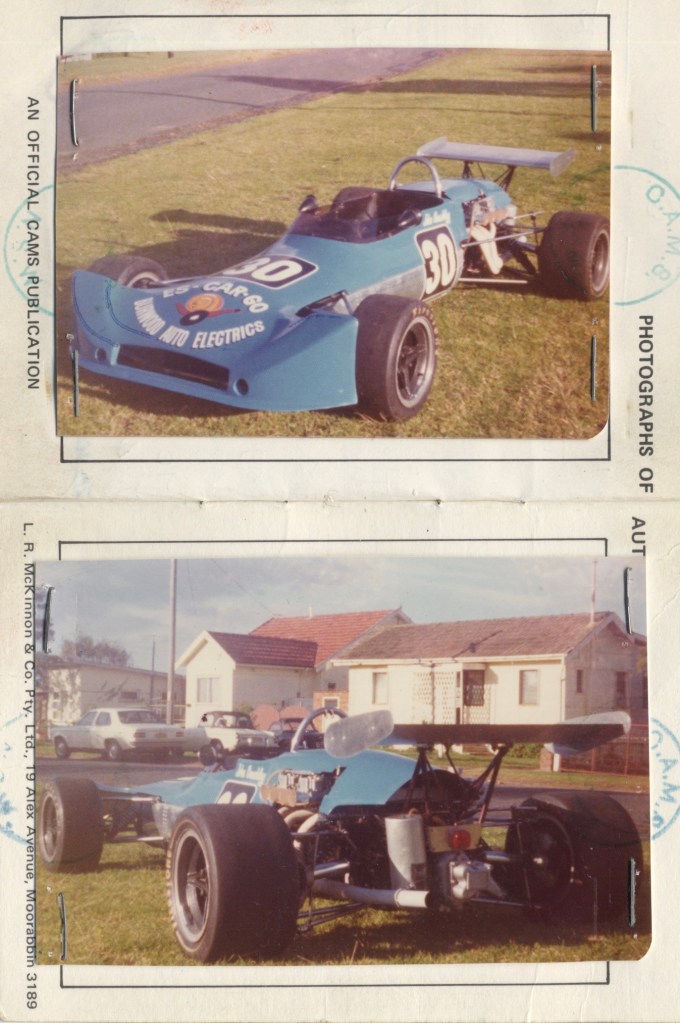
Rebuilt as an ANF3 car, he raced it for three years before selling to Taren Points John Crouchley, he raced it for a further two years before moving it on to Burwood Auto Electrics – still in Sydney.

They only hung onto it for a couple of months before P3 became a South Australian in October 1975 – it has resided there ever since. D Manfield of Brooklyn Park raced it for a couple of years, then Home Autotune Services in Prospect from March 1978.

When Ian Peters acquired it the car was fitted with one of Brian Sampson’s Motor Improvements prepared Toyota Corolla F3 engines – one of the top-gun choices during the 1.3-litre F3 days.

P3-101-68 in Burwood Auto Electrics ANF guise (I Peters)
P3-101-68 in Adelaide as purchased by Peters at auction in 1983 (I Peters)

The car wasn’t butchered too much along the way albeit the bodywork was modernised and a rear wing added in the quest for speed.

The nose looks a bit Cheetah Mk6 but is not, the rear wing in its final yellow livery is Birrana 274.

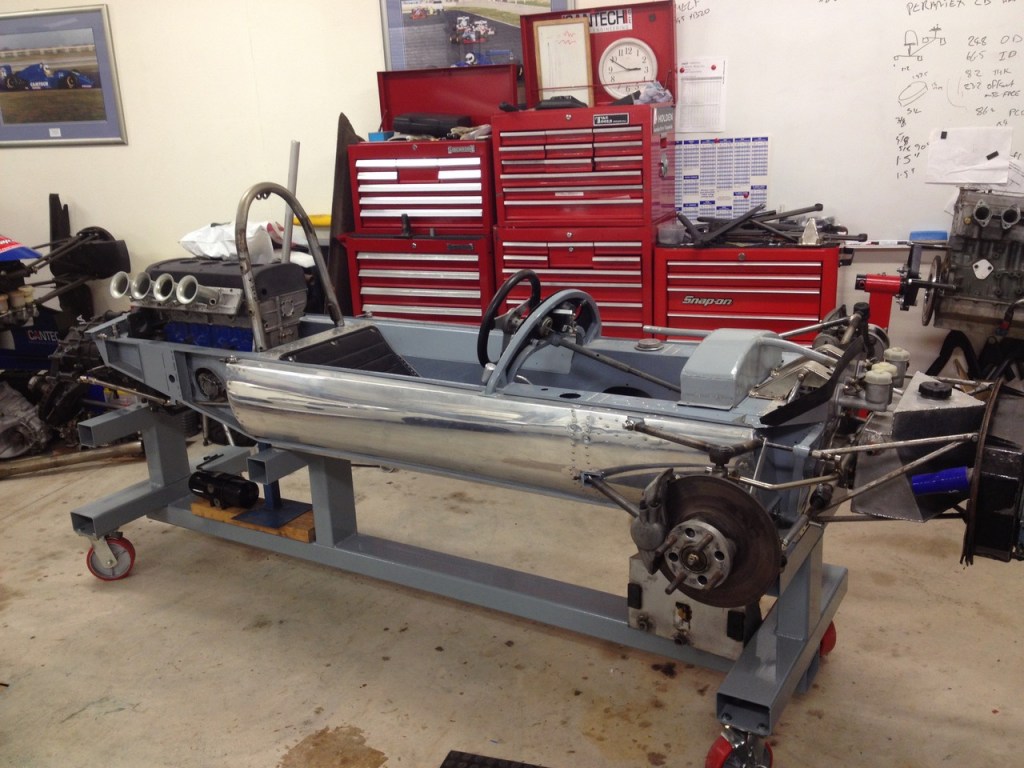
By then the distinctive four-spoke Bowin mag-alloys were gone but “the quality of the car shone through just looking at the beautifully made aluminium tub” recalls Peters after first spotting it amongst the road cars in Kearns Auctions, Prospect, showrooms.

“There was no interest, it needed a lot of work, I bought it well. I didn’t have much money at the time so it was a great project where I could add some value and learn along the way. I’d been club racing a Lotus Elan and a Seven and wanted to get into a racing car.”

“I pulled it down and worked out what I had. The plan was to restore it as an historic Group O car. CAMS were a bit more accommodating then, I was allowed to build it with a Lotus-Ford twin-cam even though P3-101-68 hadn’t raced as such, but Ian Fergusson’s P3 had.”

“It had a four-speed VW box, the wrong wheels and body. The driveshafts with donuts had been replaced by whoofing-big Hooke-type joints. The suspension was original but brutalised, the rear cast uprights were good – the oil tanks were gone and tough to recreate.”

“I got in touch with John Joyce at Bowins, he was delighted the first Bowin was being made-good. I soon had drawings on the way and a body being made by GS Motor Bodies in Brookvale, who had made them in the day. Magnesium technologies cast some new wheels”

“After Glyn’s death, the Lotus 23B, still with Ford FVA fitted, was sold to Alan Ling and Bruce Gowans in Tasmania for Bruce to drive. They later fitted a Waggott engine, in that deal the FVA was traded to Paul England Engineering in Melbourne. My research ended when I discovered the engine had been fitted in a speedboat which sank, the engine was not recovered!”

“The FT200 gearbox was sold at the same time as the engine – it ended up in one of Peter Turnham’s Turnham sporties in Tasmania.”

“I wanted to fit an FVA but they were hugely expensive, so I gradually began buying bits from about 2007, whenever I saw them advertised or had a lead. I sold the MI Corolla motor and bought the Lotus twin-cam from Bob Holden in Sydney. He claimed it was one of his ex-Bathurst engines and had also been fitted in Peter Hopwood’s race-Elan. The head had Waggott stamped on it, so at some stage Merv ministered to it – it was a good engine. I initially fitted Webers and then mechanical fuel-injection later on.”

“The FT200 box was expensive, there was no easy way out there! By early 1984 I had the car ready to test, first racing it at the Sporting Car Club of South Australia’s Historic meeting at Mallala that Easter.”

P3-101-68 as it is now in Peters’ Adelaide workshop with dummy FVA fitted (I Peters)

“The more I got to know the car and Joyce the more absorbed in all things Bowin I became. Ashley Joyce and I put together the (excellent) Bowin Cars website. Included in the detailed specs of each car section, I added ‘ex-Piers Courage Ford FVA #7044’ in the list. You can imagine my surprise when Perth’s Graham Brown contacted me to say he had the motor! After about twelve months of negotiations I bought the engine.”

“I last raced the P3 in an historic support race during the 1989 Adelaide AGP carnival. I hit the wall when a front upright broke doing enough damage to get Chas Talbot in Melbourne to rebuild the tub.”

“By then I’d decided to progress to an ex-Alan Jones Ralt RT4 Ford BDA Formula Pacific car and then a Reynard 91D Holden Formula Holden. That ex-Birrana Racing machine won me two CAMS Silver Stars in 2003 and 2004. I put it to one side forever ago, but have it for sale at the moment.”

“After that is off my plate I’ll complete the rebuild of the P3 to FVA engined spec. It’s currently fitted with a dummy FVA, but all of the hard work is done so it shouldn’t be too long before it’s all done.”

There was only a tiny number of resident 1.6-litre F2 cars which raced in Australia in period. The only one which was victorious in a Gold Star round was P3-101-68, Glyn triumphed at Sandown in September 1968 on a day the 2.5s fell foul of technical dramas.

This car is a magnificent machine, we Bowin-nutters look forward to its return to the circuits soon.

Look carefully, a Bowin racing car is listed! (I Peters)

Credits...

Many thanks to Ian Peters, Bowin Cars

Tailpiece…

Ian Peters, Reynard 91D #028 Holden circa 2002, circuit unknown (I Peters)

Finito…

(Brabham Family)

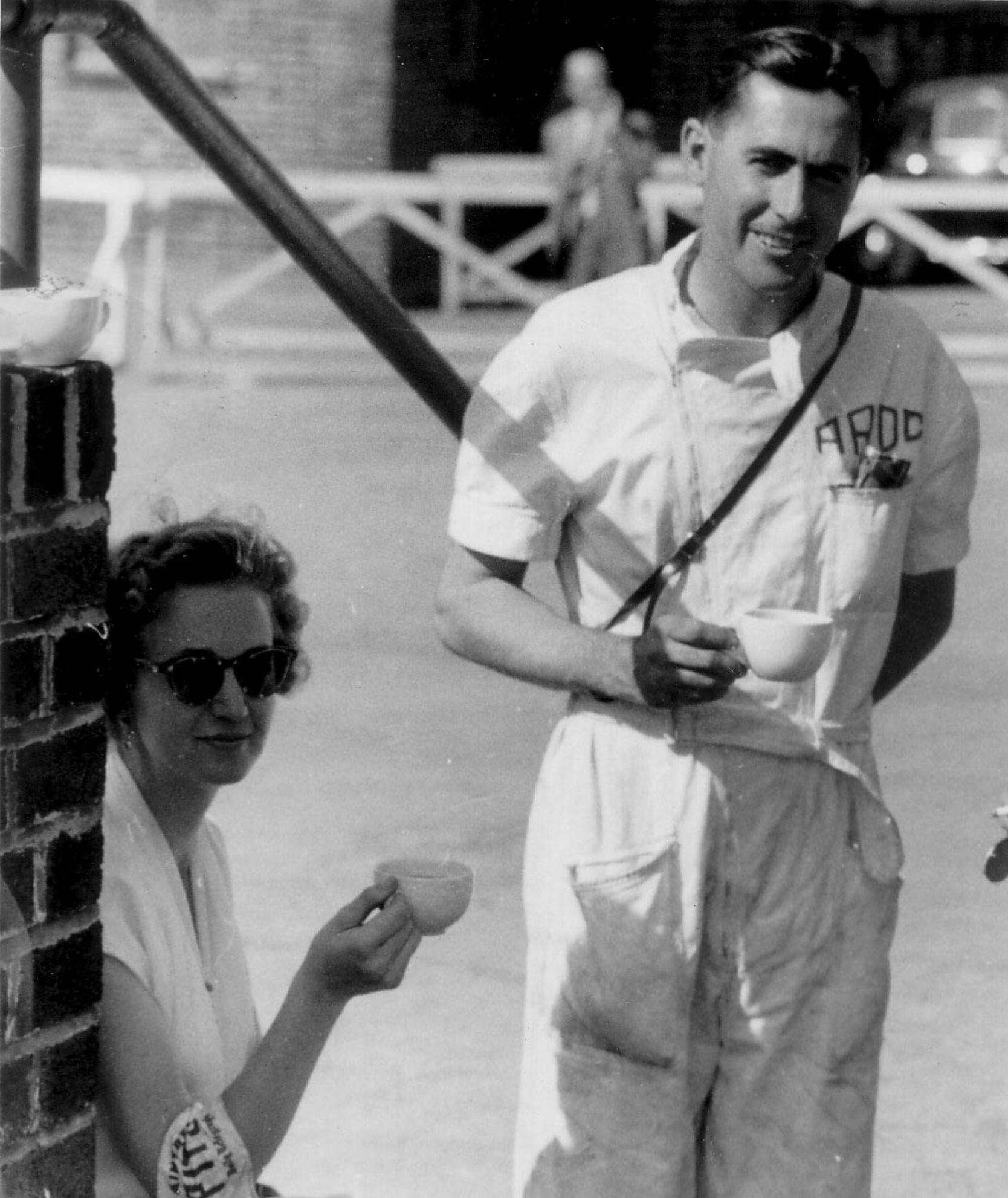
Jack and Betty Brabham chillin’ between sessions at Aintree during the July, 1955 British Grand Prix weekend.

Brabham is a very youthful 29, love the Australian Racing Drivers Club badge on his once lily-white overalls-how casual does it look?

It was Jack’s championship debut in a car he built himself, a Cooper T40 Bristol. He qualified 25th and retired after 30 laps with engine trouble. The race was famously won by Stirling Moss’ Mercedes Benz W196.


(Cummins Archive)

The car was shipped to Australia for what was to become Jack’s annual summer tour. He scored a lucky AGP win at Port Wakefield, South Australia when front runners Reg Hunt, Maserati A6GCM 2.5 and Stan Jones in Maybach 3, on the front row above, had mechanical dramas. Jack is on the second row alongside Doug Whiteford’s Talbot Lago T26C

The car stayed in Australia, see articles here; https://primotipo.com/2015/07/16/60th-anniversary-of-jacks-first-f1-gp-today-british-gp-16-july-1955-cooper-t40-bristol-by-stephen-dalton/ and here; https://primotipo.com/2017/07/04/max-stephens-cooper-t40-bristol/

(unattributed)

Brabham blasting through the flat, grim, saltbush Port Wakefield terrain, 100km north-west of Adelaide. Click here for an article on the race; https://primotipo.com/2017/07/28/battle-of-the-melbourne-motor-dealers/

Credits…

Brabham Family Collection, LAT, News Ltd, Cummins Archive

Tailpiece…

(News Ltd)

To the victor the spoils, and a bit of attention from the chief.

Finito…

(K Buckley)

Don Holland’s Cooper S from Robbie Francevic’s monstering Ford Fairlane at Bay Park, Mount Maunganui, New Zealand in April 1968.

Imagine looking at that ‘block of flats’ baring down on you at some speed in ‘yer mirrors!?

Were these things ‘sports-racing closed’, or perhaps ‘sports-sedans’ by then. The Kiwis will have called theirs something else of course- what? In any event, these highly-modified tourers have always been my favourite taxi-variants.

Alan Boyle picks up the story, ‘Don Holland came other with two other Mini-racers, light-weight and extremely quick cars – John Leffler and Lynn Brown, three nice guys, I’ve visited them in Sydney since.

Relaxing in the Pukekohe paddock after the racing, ‘John Leffler, Don Holland Lynn Brown. Margaret and Violet Mini.’ I wonder if this visit was during the Tasman rounds, it would be  interesting to know the results? How did Violet go in her car? See this piece on the Francevic Ford; https://themotorhood.com/themotorhood/2017/11/24/special-feature-robbie-francevics-fairlane

More questions than answers this time…

(A Boyle)

Credits…

Ken Buckley photo via Milan Fistonic, Alan Boyle

Finito…

(B Thomas)

Glyn Scott, Jaguar E-Type during the 1966 Surfers Paradise 12 Hours. The Queenslander shared the car with Shepparton’s finest, Bryan Thomson.

I popped this photo up on my primo FB page a couple of weeks ago and Bryan Thomson responded via our mutual friend, Stephen Dalton. ‘Yes Mark, this was my current road car in 1966. The first E-Type in Shepparton, purchased second-hand with 70,000 miles on the clock.’

‘We dropped the sump, fitted new big end and main bearing shells in preparation for the race and drove it up to Surfers. We won the production sportscar class and drove home again. And the nay-sayers claim that Jags aren’t reliable?!’

Inside the Roxburgh/Whiteford/Colwell Datsun Fairlady (B Thomas)


Thommo in the mid-sixties, doesn’t he look like a spring-chookin’? Circa 31 years old (S Dalton)

‘While we won the class there were some dramas. At about two-thirds distance Glyn was approaching the fast right-hander under Dunlop Bridge and on turn-in the steering came up (on the adjustment only), but Glyn thought the wheel had come off!! The E ran wide off the circuit and through a table-drain, damaging the outside rear wheel.’

‘We pitted, fitted the spare and pressed on. This meant we had no spare in case of further drama. I scurried up to the control tower and broadcast a request for a “loan-spare” if there was one among the spectator cars. Ten minutes later there were two on the way!!’ Motor-‘sport’ of the day.’ Thommo.

(Jag Magazine)

Credits…

Brier Thomas, Jaguar Magazine, Bryan Thomson, Stephen Dalton Collection

Tailpiece…

(Jag Magazine)

The Jag about to be swallowed by the third placed Bartlett/Chivas Mildren Racing Alfa Romeo TZ2.

Jackie Stewart and Andy Buchanan won in the Scuderia Veloce Ferrari 250LM. See here for a piece on the 1966 Surfers Speedweek; https://primotipo.com/2015/02/13/jackie-stewart-at-surfers-paradise-speed-week-1966-brabham-bt11a-climax-and-ferrari-250lm/

Finito…


image

1981 Williams FW07D Ford (P D’Alessio)

I’d forgotten about the speed of Patrick Head’s Williams 6-wheelers and what a serious attempt they were to address the teams position in 1981/82. And the rule changes to ban them such was their apparent speed…

Williams couldaa-wouldaa-shouldaa won World Titles in 1979 and 1981 to go with the ‘Jones Boys’ win in 1980.

In ’79 the ground-effect FW07 arrived late and took a while to find the reliability to go with its speed apparent from the start. In 1981 team orders and more ‘cooperation’ between Jones and Reutemann would have secured a title for one of them instead of ‘none’ of them.

The two ‘numero-unos’ caper seldom works does it? I am a Buddhist in some ways but I still love the way ole AJ totally crushed Lole at Vegas in that last round ’81 championship showdown. Sheer force of will and balls. Attributes the ebullient, combative Balwyn Boy had in spades.

By late 1981 the turbo teams were finding reliability to go with their speed. Renault only missed out on the ’81 title because of unreliability, Ferrari were new to the turbo game but the engine was great even if the chassis was not. Brabham had formed a partnership with BMW. The best of the Cosworth runners was the McLaren MP4, which, with the very first carbon-fibre chassis was putting to the road all the venerable DFV had to offer. Maranello unsurprisingly knocked back William’s request for a customer Ferrari V6 turbo.

What to do was the question the Didcot hierachy faced as the FW07 series of cars were at the end of their development cycle?

image

Alan Jones, Wlliams FW07D Ford, referred to as FW07E also, Donington Park, November 1981 (Sutton)

To make things worse, Alan Jones made a very late call to quit GP racing and become a farmer. He bought a property at Glenburn, in the Kinglake/Yea area of Victoria forcing the Williams team to shop around on the second-hand driver market. The population difference of 250 people in Glenburn and greater London’s many millions is a change in domicile of some scale! Frank and Patrick eventually signed Keke Rosberg to partner Carlos Reutemann. It turned out to be rather a good choice.

Patrick Head set upon two design paths in parallel; the FW07 replacement ‘FW08’ and a six-wheeler project. By mixing the two projects, Head accounted for the six-wheeled concept in the FW08 design. The FW08’s wheelbase was kept short to accommodate the addition of four-wheel-rear-drive, its short wheelbase is partially the explanation of FW08’s stubby looks.

What follows is a truncated version of a great 8W: Forix article on six-wheelers, click on the link at the end of this article for an excellent summary of six-wheelers starting with the 1948 Pat Clancy Special and finishing with the 1982 Williams FW08D. In addition I have drawn on the recollections of the Williams six-wheeler designer, Frank Dernie in a MotorSport article.

The Williams six-wheel configuration would be four smaller driven wheels at the back in a direct effort to improve straightline speed by getting rid of the big aerodynamically inefficient rear tyres and improve traction out of corners due to the increased rubber contact. A bonus was to allow the free flow of air along the sidepods all the way to the rear axle of the car.

‘As ground effects were permitted within the wheelbase of the car, Head cunningly interpreted this rule as being from front axle to the most rearward axle! In Head’s mind, these would be ground effects perfection. The leading rear axle was placed four inches ahead of its original place, with the driveshafts angled to cope. The most rearward axle was driven by an additional final drive added on the back of the transmission. Hewland provided assistance on the gearbox, using vital experience gained from Roy Lane’s March 2-4-0 hillclimber’ which you will recall was also two wheels up front and four down the back.

Jones briefly tested the car at Donington Park in November 1981 shortly after winning at Las Vegas, but still decided against continuing his GP career. Its said the weather was so cold in Leicestershire that day that Jones had to pour hot water on his Jaguar door locks to get into his car. It’s not that the concept of the six-wheeler was poor, simply that AJ needed a break.

He returned to Australia to race Formula Pacific and Sportscars but was back to Grand Prix racing soon enough, his decision to opt for the bucolic pleasures of country life in Australia was premature.

‘In November 1981, at a cool but sunny Paul Ricard Keke Rosberg climbed aboard the six-wheeled FW07 hack, which for reference purposes we shall call the FW07E, as its reported name (‘FW07D’) later became the designation for the regular 1982 FW07.

Reports in Autosprint magazine led everyone to believe that Keke’s times at Ricard were unusually fast indeed, although many warned not to read too much into winter testing times. However, Alain Prost’s lap record of 1.04.5 had been set on October 26, just two weeks before Keke and his FW07D/E lowered it to 1.04.3 on November 7.

Jonathan Palmer also tested the car at Croix-en-Ternois in the North of France to see what its performance would be like on a tight and twisty track, and matched the times set by the regular FW07C.

Eventually though, the FW07D/E wasn’t used in racing as the team found a major obstacle to its ‘perfect’ ground effects – the lower wishbones of the rear suspension.

So Head decided on incorporating this dilemma into the design of the FW08, which as stated above was predesigned to accommodate six wheels. The FW08 solution used fixed-length driveshafts that would be used as lateral lower location members as well, thus freeing the underwing tunnels from any obstruction’.

image

Williams FW08 Ford 1982: Aluminium honeycomb monocoque chassis, wishbone and rocker pullrod suspension at front and wisbones and rockers at rear, coil spring dampers, Ford Cosworth 3 litre DFV V8- about 490 bhp @ 10750 rpm in ’82 spec, Hewland FGA400 5 speed box (P D’Alessio)

1982 Season…

‘Buoyed by the performance of the latest FW07 regular development, the FW07D, the team started the season with this car, ‘Lole’ immediately taking second after the super-license affair at Kyalami, with Rosberg fifth.

While the politics continued unabated in Brazil, Williams were confronted by Reutemann’s shock retirement from racing but lifted by Rosberg’s strong second place at Long Beach, yet still behind Niki Lauda in McLaren’s miracle chassis.

The Imola boycott allowed the team to prepare two FW08s for Zolder where there was more drama in store for the Grand Prix community. With the Renaults faltering yet again, Keke grabbed another second place, this time following home John Watson in the other MP4/1’.

‘In the following races Rosberg and new team mate Derek Daly continued to be beaten by the McLaren and the Brabham BT49D, while the turbo-engined Brabham won its first race.

image

Williams Team FW08’s in the Detroit paddock June 1982 Derek Daly 5th behind his car. Rosberg was 4th, the race won by the carbon-fibre McLaren MP4 Ford of John Watson (unattributed)

In France, turbos finished one-two-three-four.

Obviously unaware of the final Championship result, the Williams team then pressed on with its six-wheeler project and during the summer of 1982 a new car surfaced.

This time an adapted FW08-01 codenamed FW08D, hit the Donington Park track. Its four wheel drive times were stunning. In fact, they were so good that the FIA issued their 1983 regulations including a clause that outlawed six-wheelers and four-wheel drive’.

Frank Dernie spoke of his FW08 six-wheeler design in MotorSport.

‘The biggest problem with traditional ground-effect cars is that the downforce is generated a very long  way forward so you need a draggy rear wing to balance it. The big plus with the six-wheeler was that its side-pods ran comfortably inside the narrow rear tyres, right to the back.’

‘I managed a sufficiently rearward centre of pressure, without too much loss of the underbody, to do away with wings; the car had a slotted-flap type underbody, part of it around the exhaust, part of it in the normal place. I couldn’t have done that with a four-wheeled car. When skirts have to stop ahead of the rear tyres, you’re knackered’.

‘The lift to drag ratio of FW08 was 8.2, and the FW08B six-wheeler was not much more…But the final quarter scale model of the six-wheeler that would have gone into production had a lift to drag of 13 point something’. With neither front nor rear wing, any necessary trimming was to be supplied by a Gurney type flap at the bodywork’s rear’.

image

Keke Rosberg aboard FW08D in 1982 (LAT)

Keke Rosberg, Jacques Laffitte, Jonathon Palmer and Tony Trimmer all tested FW08B as late as October 1982.

‘It was quite progressive’ said Palmer. ‘It was great fun to throw around, to get a bit sideways, because instead of one wheel losing grip, and, therefore losing 50% of your grip, if one wheel lost grip you still had three others giving you some grip’. The car showed promise on all types of track from the high speed sweeps of Silverstone to the twists of Croix en-Ternois.

Dernie again ‘Patrick was sure that the only limitation would be, with four driven wheels pointing straight ahead, masses of power understeer. But after only a few laps of ‘Croix, Laffitte admitted he had forgotten it was a six-wheeler’.

image

Jolly Jacques aboard FW08D at Crois en-Ternois in 1982 (unattributed)

‘If you get the weight distribution right for the tyres and make sure the aero is consistent, there is no reason why it wouldn’t feel like any normal racing car. To get the ultimate from it, though, tyres  specific to the rear would have been required. At that time however, we were just running six fronts’.

In a busy time for Williams GP Engineering Dernie was actively assessing active suspension, Rosberg was stringing together a consistent run in one of F1 nuttiest seasons, FW was courting Honda as an engine provider and as a result the six-wheeler slipped down the priority list.

‘We didn’t expect it to be banned. Though we thought that maybe it would be after everyone saw how quick it was’.

‘We didn’t have sufficient time or money to bring it to fruition. We only had one Hewland gearbox, for example. Its casing was completely different because the suspension mounts were different. The gear linkage was unique too. We would have to have made lots of new bits before racing it, and inevitably it was going to be a heavier than a normal car’.

image

Sibling similarity between four and six wheelers clear in this Monaco 1982 shot of Rosberg’s FW08, DNF collision. Ricardo Patrese won in a Brabham BT49 Ford (unattributed)

Williams’ efforts had come to nought. And with Keke suddenly picking up one useful placing after the other – outpacing the unreliable McLarens in the process – and taking his debut win at Dijon, the Didcot team stopped having reasons for arguing too strongly with the FIA. And they had their negotiations with Honda going on anyway.

8W:Forix ‘Joining them – as Lotus had done, as McLaren would ultimately do – instead of beating them became the new motto for the new Formula 1 era. It had no place for six-wheelers, just as it refused four-wheel driven turbine cars. Many years later, at the 1995 Festival of Speed, the Williams FW08D turned out one more time in the hands of Jonathan Palmer. On the hill at Goodwood it showed why it was outlawed before it got the chance to show it was a winner. The doctor comfortably set an FTD that was only narrowly beaten by Nick Heidfeld four years later, in a pukka 1998 McLaren’.

‘Today the answer to the question is simple again. ‘What does a racing car look like?’ It’s got four wheels and a steering wheel, with the engine in the back driving the rear wheels. Apparently, the 21st century is no time for playing around in another ballpark. Or it must be in The Thunderbirds.’

The last sentence says everything that is wrong about modern F1 of course- the sameness of the cars as a consequence of rules which are way too prescriptive.

image

FW08D, Paul Ricard 1982- four driven wheels. This shot shows just how long and far back those ground effect tunnels extend! (unattributed)

Bibliography…

http://www.forix.com/8w/sixwheelers.html

MotorSport March 2017

 Photo Credits…

Paulo D’Alessio, Sutton, Pinterest, LAT, F1 Fanatic

Etcetera: Williams FW08D Ford Goodwood 2012…

image

Top rear, rear! suspension shot- beautiful magnesium upright, lower wishbone, top rocker, G/E tunnel, fixed skirt, wonderful (F1 Fanatic)

Tailpiece: Williams FW08B Ford 1982- F1’s last six-wheeler, last 4WD…