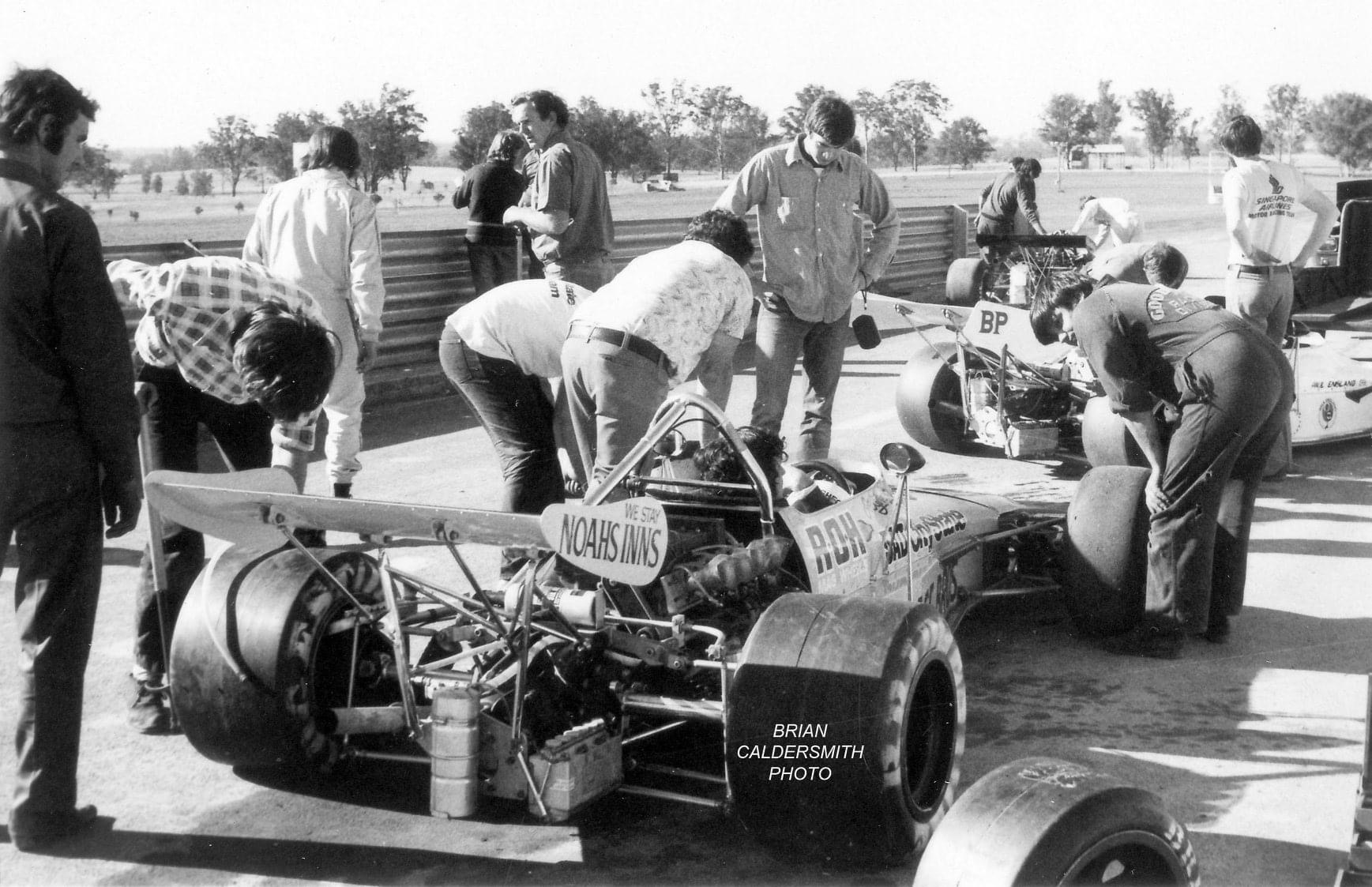
It’s the Thursday or Friday before the second round of the Australian Formula 2 Championship at Oran Park, New South Wales on August 5 1973.
The Birrana Cars onslaught is underway, Malcolm Ramsay and Tony Alcock’s 272 impressed all in 1972 including Leo Geoghegan who drove the car late in the year and was happily seduced back into single-seaters with a works Birrana 273 Ford-Hart 416-B 1.6 for 1973.
Leo mopped up that year winning six of the seven Australian Formula 2 Championship rounds despite opposition from Tony Stewart and Enno Buesselmann in 273s, Bob Skelton’s Bowin P6 and Ray Winter in the old darlin’- the ex-Gardner/Bartlett Mildren Yellow Submarine. Of these Skelton was quick everywhere and led Leo at Amaroo and Symmons, missed the last two rounds and ultimately could not convert the potential of the variable-rate suspension Bowin.
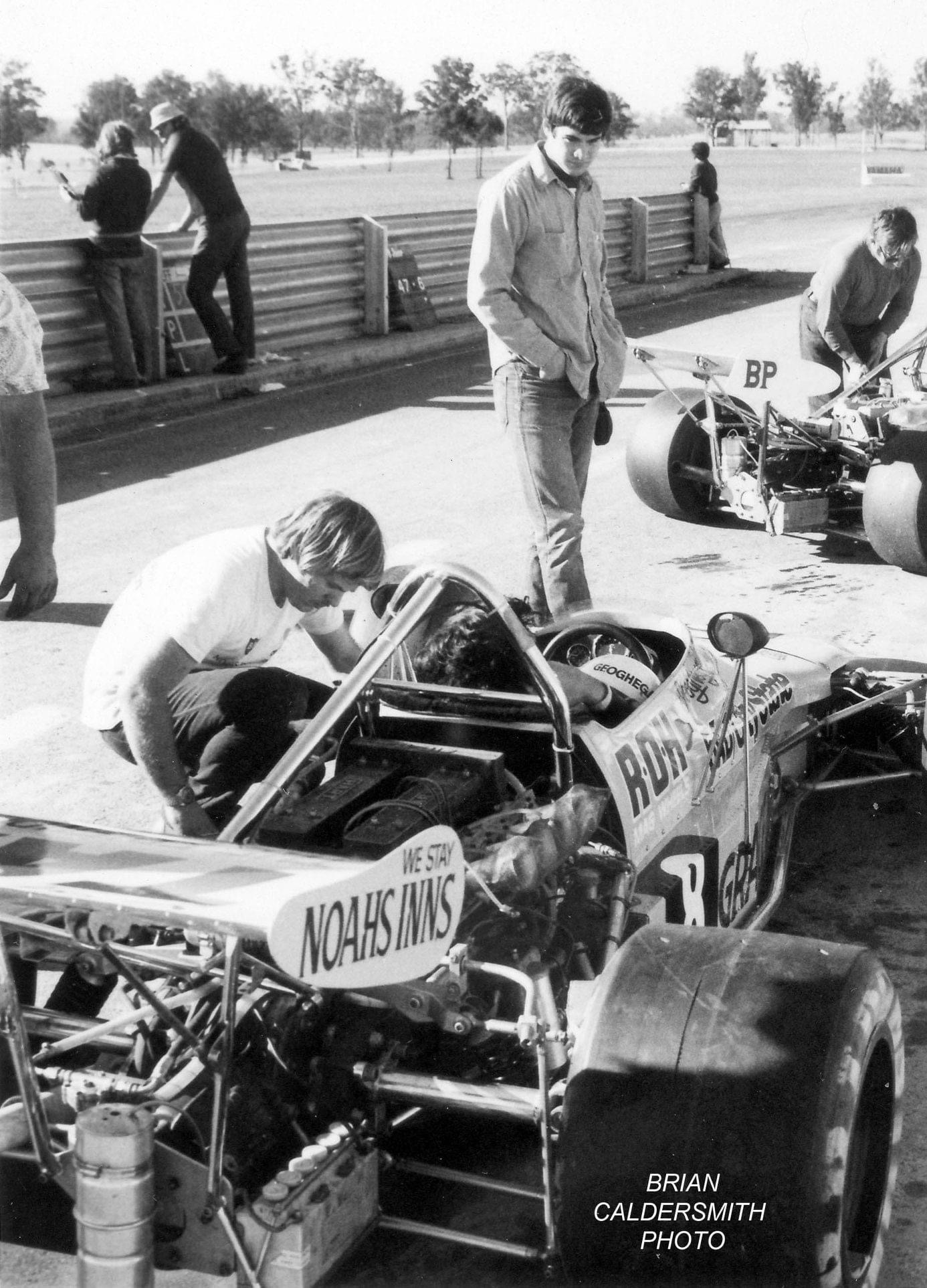
But all of that is in the future, the flurry of activity centres on Leo’s car and a back to back test between Goodyear and Bridgestone tyres- who is the the Goodyear tech looking closely at the right front- i am being assertive with my identification of people but in some cases ‘i think’ should be used- just letting you know rather than write it ten times.
Check-shirt man is Bruce Cary, the driver at left is Ray Winter, to his right in the short sleeved shirt is Bruce Richardson- the car in front of Leo’s is Tony Stewarts, the guy in the Singapore Airlines T-shirt is Malcolm Ramsay and the car at the end of the pitlane is one of the black Bowin P6s- either Skelton’s or Bruce Allison- Bob liked the car more than Bruce!
Goodyears in the first shot, Bridgies here.
All of the Birranas are superb racing cars- FF, ANF3, ANF2, F Pac and the mid-engined Speedway machine, Adelaide strikes again! Those who have driven both cars either say the 273 was a better car than the tidied up in the body and bracketry 274, or its equal- Bob Muir gave Leo ‘absolute buggery’ in the 274 bodied 273 owned by Bob and Marj Brown in 1974 didn’t he?
Note the mounts on the nose to accept another small wing- in search of more front bite.
Business end with Varley battery and oil catch tank- forward of them is a Hewland FT200 five speed transaxle and the Brian Hart Ltd, Harlow, Essex built ‘416-B’ Lotus-Ford DOHC, two valve, Lucas injected four cylinder motor.
This engine was aimed at the large American Formula B market, where all of the British tuners fought a pitched battle and in much smaller numbers Australian F2.
The ‘ducks guts’ variant was alloy blocked, the late Peter Nightingale, who looked after Leo’s and Geoff Brabham’s Harts amongst others quoted 200bhp @ 8500rpm and 130lb/ft of torque @ 7500rpm for the 1973 iron block variant and a ‘minimum’ of 200bhp @ 8500rpm and 125lb/ft of torque @ 8500rpm for the 1974 alloy block.
Line ball call but the alloy block was lighter and in the very best of hands every liddl’ bit counts.
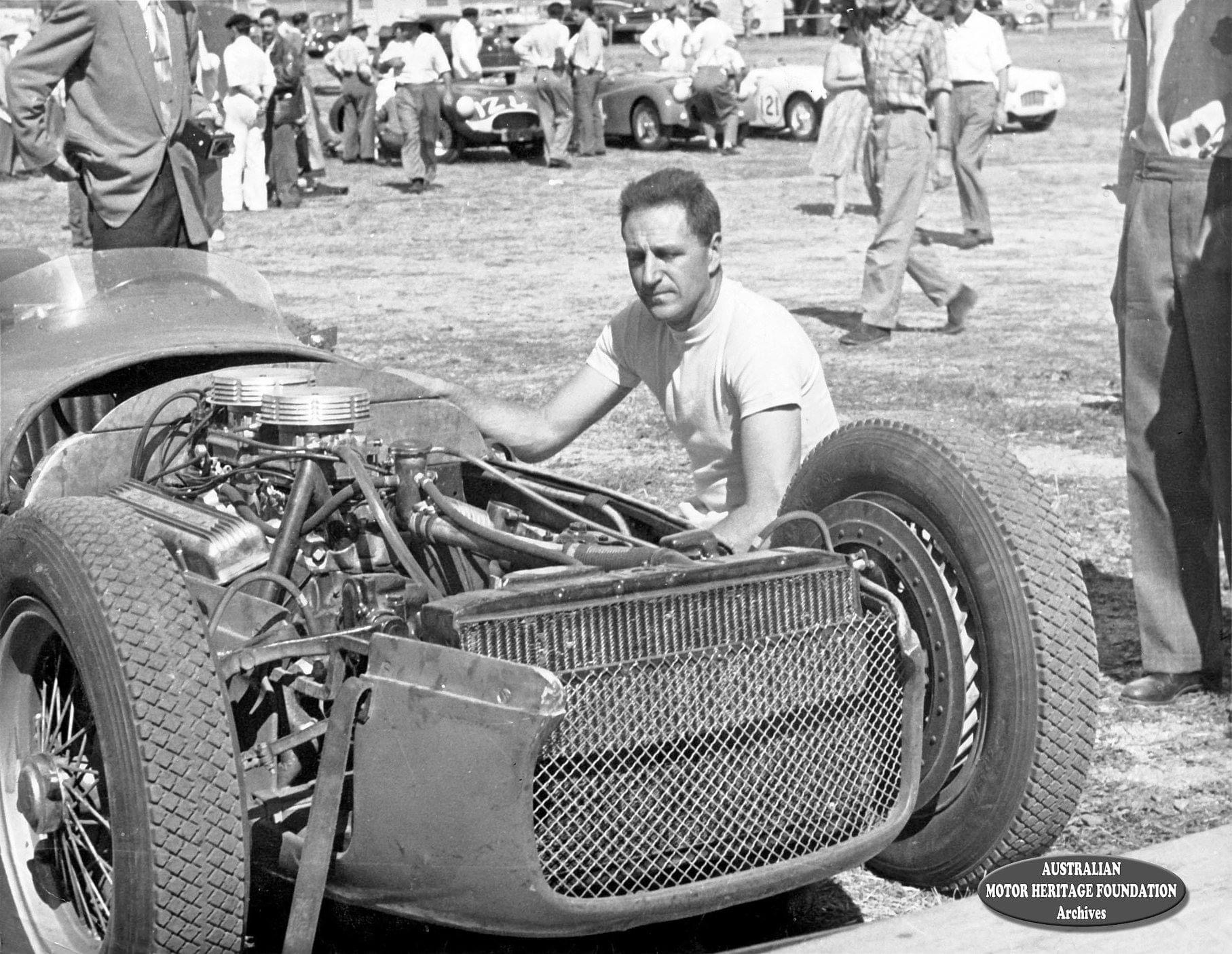
No idea who blondie is but the vertically challenged fella looking at the engine in front is ex-Repco immensely talented engineer and multiple Australian hillclimb champion Paul England looking at Tony Stewart’s Jack Godbehear built engine.
Oh yes, come raceday Leo won from Peter Brock’s 273 and Bob Skelton, i am intrigued to know what tyres the works 273 raced…
Credits…
Brian Caldersmith, Peter Nightingale on The Nostalgia Forum
Tailpiece…
Leo is ready to boogie- fuel check and off. Bearded Ramsay, tall isn’t he, wandering past.
I’ve often wondered what Tony Alcock could have achieved in his second European stint, as most of you know he was in that plane, on that day, and in those circumstances with Graham Hill in 1975.
Glyn Scott, Elfin 600B Waggott from Garrie Cooper, Elfin 600D Repco, Warwick Farm 11 July 1970 (L Hemer)
Sunday 26 July 2020 marks fifty years since the tragic death at Lakeside of one of Queensland’s favourite racing sons- Glyn Scott at the wheel of his new Elfin 600B Waggott TC-4V.
I attended the 1973 Glyn Scott Memorial Trophy at Surfers Paradise and learned a bit of racing history from the program that day then last year I was lucky enough to meet Glyn’s son Gary who had a stellar racing career himself in Europe and Australia, and got a chance to understand a little more about Glyn during the pub evening. It was amusing actually, he couldn’t believe anyone would be interested in his open-wheeler exploits rather than his considerable taxi credentials.
Glyn Scott was not just a competitor of international standard but also active in the administration of the sport as State President of CAMS, State Delegate to the National Council and President of the Queensland Racing Drivers Club- very much an experienced set of hands and senior citizen of the sport on and off the track.
Glyn at Lakeside during the ATT weekend in 1965, he raced the Ann Thompson owned Lotus 15 (R Bell)
John Ellacott ‘This was the first outing of the Lotus 20 in December 1961…which probably accounts for the car being green rather than the blue it was later…Taken from Homestead Corner’ (J Ellacott)
A couple of youngsters at Catalina Park in 1962- Glyn ahead of Leo Geoghegan in Lotus 20 Ford FJs (J Ellacott)
His first racing steps were aboard an Ariel powered home made open-wheeler he ran at Leyburn and Lowood as well as the hills, he was soon racing the Repco-Holden Special, a replica of Tom Hawkes Cooper T23 Holden with which he had so much success on the eastern seaboard over the following years.
Another big step of progression was the acquisition of Alec Mildren’s Cooper T43 Climax in 1958- ‘the first big-league machine to be domiciled in Queensland’ wrote Des White. With this car he worked his way into the ranks of Australia’s top drivers supported by a team of three- Norm Meller, Col Clarey and Jim Bertram.
Cars which followed included Lotus 18 and Lotus 20 FJs, Lotus 27 Ford twin-cam ANF 1 1/2 and Lotus 23B Ford.
Glyn in the Scott Special aka Repco Holden during its first test run at Lowood, circa August/September 1957 (I McDonald Collection)
Longford Trophy 1960. Glyn in his Cooper T43 Climax 1.7 with Jon Leighton’s T45 2 litre behind, sixth and fifth in the race won by Brabham’s Cooper T51- red car to the right is Ern Tadgell, Lotus 12 Climax FPF 1.5 aka Sabakat (J Barnes)
Scott during practice at Warwick Farm during 1969, Lotus 23B Ford (L Hemer)
Along the way he married Coral and had three children Gary, Susan and Anthony and ran his business Glyn Scott Motors.
He aided and abetted John Joyce’s creation of Bowin Cars upon his return from a stint as an engineer at Lotus by becoming John’s first customer- that car, the Bowin P3 Ford FVA F2 was a machine driven with great skill by Glyn inclusive of a memorable Gold Star round win at Sandown in September 1968 on a day the 2.5 litre Tasman machines wilted.
He also took the P3 to Japan for the JAF Japanese Grand Prix that year finishing fourth behind Leo Geoghegan’s Lotus 39 Repco 2.5.
Glyn drove others cars, a great drive was his co-drive of Alan Hamilton’s Porsche 906 in the 1967 Surfers Paradise. Photographer Peter Maslen wrote ‘One of the finest drives i ever saw. When Alan Hamilton dropped the Porsche into the ditch around the back of the circuit, he was encouraged to recover it-Glyn took over and they came third. This picture now holds pride of place on my study wall.’ It is a marvellous shot- he has managed to capture the determined set of Scott’s jaw (P Maslen)
Glyn and Leo Geoghegan were the very best of friends, Leo was on hand for the early tests of the P3 and here Scotty is attending to his needs before the off at Oran Park on 22 September 1968 (Bowin Cars)
Lakeside paddock October 1968- the blue Scott Bowin P3 Ford FVA and Lotus 23B Ford twin-cam with Alan Hamilton’s Porsche 911 S/T (G Ruckert)
As 1970 approached he spoke of retirement but the lure of competition and a new Elfin 600 was too much, Glyn ordered a 2 litre Waggott engine for the Elfin and fitted the FVA into the Lotus 23B after selling the Bowin.
After taking delivery of the Elfin he raced it at Oran Park, Warwick Farm and the Lakeside Gold Star round in June where he was third behind Max Stewart and John Harvey, proving the pace of his new car which was by then was reasonably well sorted.
Glyn took the starters flag, as he had so many times before, for the 15 lap racing car feature, during the Australian Touring Car Championship meeting, on 26 July and ran second to close mate Ivan Tighe’s 600 twin-cam for four laps, and as the black-flag came out for Glyn, who had lost his goggles, ‘the two duelling open-wheelers swept into the straight.
‘Scott skipped to the left to go past under (2 litre) power; the Elfin had two wheels off, right opposite the tower, the car was back on again, then off, then jumped four feet sideways over the bitumen shoulder to lock together with Tighe’s Elfin.’
At that point, travelling at some 130 mph, the drivers were in the hands of physics and the gods- Glyn’s car stopped instantly under the single-rail Armco whilst Ivan’s hurtled over it into a six foot K-wire fence, receiving severe cuts and fractures in one hand.
The entire incident took only a fraction of a second, and right there ended the 20 year racing career of Queensland’s most respected driver’ Des White’s Racing Car News report ended.
Glyn in a spot of bother with his new Elfin in the Warwick Farm Esses during the 11/12 July meeting (M Pearce)
Last laps, great mates in a great tustle- Ivan Tighe and Glyn Scott, Lakeside 26 July 1970 (D Simpson)
To end this tribute to a driver who still comes up so often in conversation amongst enthusiasts- heartfelt words written by then CAMS Secretary-General Donald K Thomson who had worked closely with Scott and knew him well.
’An obituary is not a biography, designed to paint the definitive picture of a man, with his faults evaluated equally with his virtues.
The convention of such tributes often tends to invest those who have gone with a sort of aura of unalloyed goodness, which is at odds with all human experience; and hence obituaries sometimes must be read for what they omit as much as for what they include.
It is not so with Glyn Scott. He was that best of human beings, a gentle and considerate man. He was not the greatest racing driver in the world, or the wisest and most far-seeing administrator of his sport. He was more- he was patient, sincere, thorough, friendly and loyal. Without guile or arrogance, he was frank and open, available to all for help and advice, and both an ornament and a truly devoted servant to the sport, at great personal cost of time and effort.
There are, and will be, greater stars; but they gleam, many of them, like meteors. Glyn’s light will lend a continuing radiance for far longer. His memory is the best obituary; everything else is just words.’
(M Bisset Collection)
Etcetera…
(I McDonald Collection)
Tom Hawkes’ ex-Brabham Cooper T23 was garaged at Glyn Scott Motors Atlantic Oil Servo between the 1957 Lowood June and August meetings, in the intervening period Glyn, Norm Mellor and Bill Purcell, assisted by Les Gould and Harvey Robinson created a copy of the T23’s chassis and body.
The mechanicals including Repco Hi-power headed Holden ‘Grey Six’ and four speed Jaguar gearbox were donated by Glyns existing Holden Special which had started life as a taxi.
The shot above shows the car’s first run at Lowood, ‘It was originally entered as the “Scott Special”, i have the original bonnet badge. I guess somebody must have ribbed Glyny that he was a Nazi supporter, hence SS was put aside!’ quipped car restorer (in 1979) and custodian Ian McDonald. Nick McDonald races this car today as beautifully as father Ian did for so many years.
(D Willis)
Great, rare colour shot by Dick Willis of Glyn’s second racing car, the Repco Holden Special at Lowood in 1957, and below another shot from the McDonald Collection of Glyn’s third racer, the Scott Special aka Repco Holden upon its test debut at Lowood in August/September 1957.
(I McDonald Collection)
Glyn, Repco Holden, Mount Panorama circa 1957-1958 (I McDonald Collection)
(P Houston)
Peter Houston’s trailer shot shows the essential elements of the Bowin P3 #’P3-101-68′.
The Ford FVA 1.6 litre F2 engine was Piers Courage spare during the Etonian’s very successful assault on the 1968 Tasman Cup, Niel Allen bought the car at the end of the summer and Glyn the motor. The gearbox is the Hewland FT200, standard F2 and F Atlantic issue for a couple of decades, whilst the rear suspension is period typical- single top links, inverted lower wishbones, coil spring/damper units, two radius rods each side, the uprights were magnesium alloy and brakes Girling.
The Scott Lotus 23B Ford whistles down the hill from the Water Tower to The Viaduct at Longford- second in the Monday sportscar scratch in 1968.
Longford is 2,220 km trip including an overnight ferry from Port Melbourne to Devonport, Tasmania so the Brisbane-ite did not lack commitment to his sport! not to forget the drive home at the end of the weekend.
ANF 1.5 Catalina Park scrap between the Lotus-Ford twin-cam powered Mike Champion Brabham BT2, Glyn Scott Lotus 27 and Max Stewart Rennmax BN1- Stewart won the six round ANF 1.5 championship that year on his ascent to the very top of Australian motor racing.
Glyn was second on 18 points then Garrie Cooper third one point adrift of Glyn with Mike Champion fifth. Max scored 26 points- each of these fellas won a round each with David Sternberg and Phil West also race winners in an open six round, five state series.
(I Peters Collection)
The Bowin P3 is a beautiful racing car, it is a few years since i have seen custodian Ian Peters run it, the shot above shows it in its racing heyday at Symmons Plains in March 1969.
Glyn contested the first Gold Star round of the year and finished fourth behind Bartlett, Geoghegan and Allen.
(autopics.com)
The ever smiling Scotty- he loved what he did.
It’s a Lotus 23B, late in the piece- fitted with the FVA which came from the Bowin P3 making the old dear a very quick little car.
Etcetera…
(S Dalton Collection)
Glyn, or should I say Glen’s, as the Australian Motor Sport refers to him, Ariel Spl- number 20 closest to camera at Lowood in October 1950.
(T Sullivan Collection)
(oldracephotos.com)
Duelling Lotus Elan 26R’s at Surfers Paradise in 1969-1970.
John Fraser from Glyn aboard Ann Thompson’s car, above, in 1969 and below- John is still with us and active on social media so hopefully he will see the shots and assist us with timing.
By the time i saw him in 1973, still running with Shell support, he was racing a very quick Lotus 47.
(B Williamson Collection)
(T Sullivan Collection)
Credits…
Many thanks to Peter Houston for suggesting this piece
Lynton Hemer for selecting photographs from his archive and Ian McDonald from his, the McDonald’s have long been custodians of the marvellous Repco Holden Spl
Des White’s ‘Racing Car News’ race report and tribute to Glyn published in the September 1970 issue
‘Historic Racing Cars in Australia’ John Blanden
Dick Simpson, John Ellacott, Graham Ruckert, autopics.com, Ray Bell, Peter Maslen, oldracephotos.com, Mark Pearce, J Barnes, Ian Peters Collection, Bowin Cars, Stephen Dalton Collection, Bowin Cars, John Barnes, Terry Sullivan Collection, Bob Williamson Collection, Dick Willis
Tailpiece…
Glyn in the 600B Waggott, chassis # ‘7016’ during the 7 June 1970 Gold Star round, he was third on home turf behind Max Stewart, Mildren Waggott and John Harvey’s new Rennmax built Jane Repco V8.
Ern Seeliger jumps aboard the magnificent Maybach 4 Chev at Fishermans Bend in March 1958…
One of the Covid 19 phenomena, the only good one I might add, is the incredible number of enthusiasts who have been using time released from normal outdoor activities to doing stuff inside including finding and sorting old racing images, Melbourne enthusiast, John Comber is one such fella.
In addition to the shots he also wrote a piece about his work experience as a fifteen year old in Seeliger’s workshop at 52 Baker Street, Richmond, Melbourne way back in 1958- Seeliger didn’t frighten him off either, he commenced his career as a panel beater shortly thereafter.
A big blow up of the one remaining Maybach six cylinder engine at Gnoo Blas littered the bitumen with expensive metallic debris in early 1956 and resulted in Stan Jones decision to acquire a Maserati 250F, the Maybach was handed over to Seeliger, long time friend and preparer of some of his cars to further develop and race, although Stan did have the occasional drive too.
Maybach 3 was styled along the lines of the Mercedes Benz W196, its chassis was built up from two 4 inch diameter steel tubes, the cars front suspension was by upper wishbones and a lower transverse leaf spring and radius rods, drum brakes were by PBR and the gearbox a four-speed manual.
Seeliger’s evolution of Maybach 3 to 4 essentially involved the insertion of a Chev Corvette 283 cid V8 into the space once occupied by the German 3.8 litre SOHC injected six, changes to accomodate it and better put its power to the road.
Maybach 3 in the Gnoo Blas, Orange paddock on the fateful early 1956 when its beautiful, fuel injected SOHC six lunched itself bigtime for the last time-who is at the wheel? (B Caldersmith)
John Comber’s time in the Seeliger shop coincided with some of these modifications, lets look at his work experience now.
‘…My second job was also with a neighbour, Mr Seeliger, who had a small automotive engineering business in Richmond…The arrangements were for me and my friend Trevor to be at the Seeliger’s house at 7.30 am Monday morning, do a days work and see how we liked it.’
‘On the Monday, with a packed lunch and wearing our best “old clothes” we arrived at 7.30 just as Mr Seeliger was starting the engine of his utility. “Jump in boys” he said and we took off straight away, heading for Richmond (from Blackburn).’
‘I still remember quite clearly his opening comments, “Well i have the right job for you two bastards today, you can clean some car parts with kero, “That’ll keep you busy”.
‘The thought of cleaning the car parts with kerosene didn’t faze me but the language had caused me something of a jolt. To me this was school-yard language and i wasn’t used to adults swearing, certainly not from my parents or relatives, or family friends.’
‘Well the rest of the day turned out fine, Trevor and i set-to with a can of kerosene cleaning mechanical parts and some body parts as well. This was quite an easy job and allowed us to look around and take in the surroundings. Mr Seeliger’s workshop was converted from some old run-down stables with cobblestones between the sheds and an overhead loft used for storage. The yard was quite large with grass growing between some old cars and car trailers adding to the overall run-down appearance of the place.’
‘This must have been too much for Trevor as he didn’t come any more but i was there each day for the next fortnight, working amongst the cars was perfect for me…’
The core of Mr Seeliger’s business was tuning and maintaining racing cars, he was a qualified aircraft engineer and understood high performance engines and was also a racing driver himself. One of the racing cars he worked on had a V8 engine and was a potential race-winner. I learned later that this car was known as the “Maybach” and had a long history of success. He had spent several days working on the rear of the car making some modifications. Finally with it all finished i can still visualise him standing on the back of the car, making it bounce up and down and saying “That’ll keep me ahead of those bloody Ferraris.”
‘There were only three on staff, Mr Seeliger, a mechanic and Roy, the apprentice. Although Roy was only a year or two older than me he was quite friendly and helpful. To quote an old mechanic’s saying “he knew his way around a toolbox”, sometimes i helped with jobs on customer cars- simple jobs…’
‘Working conditions can best be described as matching the already mentioned surroundings: primitive might sum it up. There was no lunch-room, morning tea break was around the car being worked on and discussing the progress of the job while sipping tea or coffee. Lunch break was a little better though with a couple of old car seats to sit on…There was no heating of any sort, the area between the main sheds being open to the elements. The toilet was basic and the only tap available for hand washing was also used for filling radiators and washing cars etc.’
‘Despite these poor working conditions, which by twenty-first century standards would be deemed illegal, i thoroughly enjoyed myself working with cars and receiving five pounds each week. Now i was even more eager to finish school and begin an apprenticeship as a panel beater’, John Comber concluded in a wonderful personal account of what it was like ‘in the day’.
Tom Hawkes’ Cooper T23 Holden-Repco and Ron Phillips’ Cooper T38 Jaguar (J Comber)
Seeliger, above, with his mount at Bathurst during the 1958 Australian Grand Prix weekend- and a successful meeting too, second behind Lex Davison’s Ferrari 500/625 3 litre.
(J Comber)
In fact the modifications to the car John alluded to included the design and construction of a de Dion rear axle to better put the greater power and torque of the bigger, heavier cast-iron V8 to the road. The previous quarter-elliptic springs were replaced with a transverse leaf, the rear track widened by an inch, the chassis lengthened a bit and at the front an anti-roll bar was fitted which incorporated brake torque rods. A larger 30 gallon tank was made to feed the thirsty Chevy.
American hot-up parts were quickly produced for this engine (in large numbers continuously for about seventy years so far!) the first of the ‘small-blocks’- the modifications to the motor used in Maybach involved fitment of two 4-barrel Carter carbs, porting and polishing the heads, bigger valves, stronger springs, lightened flywheel, oilways modified for greater flow and dry-sumping- 274bhp @ 3500rpm and 300lb/ft at 3500rpm was the result. Seeliger designed and made the clutch and a bell-housing to adapt the American engine to German Maybach ‘box whilst the diff was the same unit used in ‘3’ but with shorter axles and stronger cv’s bolted and mated to the new de Dion.
Ern made the cars debut in this form at Fishermans Bend in March 1958, John Comber’s first shot at this articles outset and some others below were taken on that very weekend.
His bid for victory came to an end with stripped tyres, John recalls ‘We watched the races from a large furniture van…after a few laps of the main race the rear tyres showed white strips around their perimeter and those on the van became quite worried the tyres might blow- fortunately Seeliger saw the problem and retired from the race….Back in the van there were many commiserations and i distinctly remember asking him “Would he be suing Dunlop because the tyres let him down”? He laughingly said “Oh no, they were just some old tyres anyway”- and indeed if you look closely at the first photograph the rears are well worn.
Importantly, the car was quick right out of the box though, Seeliger was a mighty fine design and development engineer.
Stan Jones was stiff not to win the 1958 AGP at Bathurst aboard his 250F- as was Ted Gray unlucky to dip out in Tornado 2 Chev, but Seeliger finished second in Maybach 4 with Lex Davison, always a lucky AGP competitor, the winner.
Be in no doubt my friends Maybach 4 Chev in Jone’s hands was a front row car had he felt so inclined in 1958 but he was busy winning the Gold Star aboard the 250F in any event. John believes he took the second #69 shot about two years later at a Fishermans Bend Sprint Meeting- it would be great to hear from anyone who can date it.
Into 1959 Maybach 4 was still competitive in Ern’s hands, and Stan took a win in the ‘South Australian Trophy’ Gold Star event at Port Wakefield in late March and third place in the Lowood Trophy race in Queensland but his performances that year were not enough to win him the Gold Star again despite his Longford 250F AGP win at the season’s outset.
The reign of the ‘Red Cars’ was quickly coming to an end In Australia but lets never forget the dark blue Tornado 2 shown in the Albert Park paddock below in late 1958, and the silver/blue Maybach 4- both Chev V8 powered locally designed and engineered devices very much as quick as the more sophisticated, twin-cam, exotic, expensive factory cars from Italy’s north.
Tornado with the Derek Jolly Lotus 15 Climax in profile behind, Albert Park 1958 (J Comber)
(J Comber)
In fact that is a beautiful segue to Comber’s second 1958 Albert Park, Melbourne Grand Prix shot above of Stirling Moss’ Rob Walker entered Cooper T45 Climax being pushed through the paddock by Tim Wall.
Just look at the relative size and packaging of Tornado 2 Chev, together with Maybach 4, Stan Jones Maserati 250F and Lex Davison’s Ferrari 500/625 the fastest cars in Australia in 1958 and the tiny, light, nimble 2 litre Cooper.
At the season’s outset, before the Fishermans Bend meeting in March when Seeliger debuted Maybach 4, Stirling Moss won the first World Championship Formula 1 race taken by a mid-engined car by receiving the chequered flag in the Argentinian Grand Prix in a Walker T45- i am not sure if he used the same chassis to defeat Jack Brabham in another T45 that Melbourne summer afternoon- sadly the last use of Albert Park as a race venue until the modern era.
That day in Argentina reset the paradigm for Grand Prix and Sports-Racer design, the last World Championships for front engined cars were won in 1958- Vanwall took the constructors title and Mike Hawthorn the drivers award in a Ferrari Dino 246.
It was the same, in a fashion in Australia, the last front-engined Gold Star win was Jones 1958 award aboard his Maserati 250F, the first mid-engined one went to Len Lukey who raced the same Cooper T45 Brabham ran at Albert Park in late 1958 to Gold Star victory in 1959.
No wonder Comber’s camera was drawn to the little Cooper at Albert Park.
Derek Jolly’s Lotus 15 Climax has been well covered, here the car is at rest with Norman Hamilton’s Porsche 550 Spyder alongside- Ern Tadgell raced the car that weekend.
Before the end of a weekend the Lotus’ good health was ruined comprehensively- a rear suspension failure pitched the car into the trees late in the Melbourne GP race and resulted in some acrimonious discussions between Colin Chapman and Jolly about the quality of its build- a Le Mans drive and new chassis was the net result- see here for a feature article on the Derek’s Deccas and Lotuses; https://primotipo.com/2017/11/09/dereks-deccas-and-lotus-15s/
The Sydneysider had a great carnival winning the Touring Car Scratch Race on both weekends with the eternal Bob Holden, and Clem Smith Holdens second and third on both occasions- Holden raced an FE and Smith a ‘Humpy’.
(J Comber)
Doug Whiteford was as close to a professional driver Australia had at the time, albeit his St Kilda and Hawthorn garages and dealerships were an inextricable part of his business mix- above is his Dodge Custom Royal and Rice Trailer contained within is his famous, long raced and much lusted over Maserati 300S- Fisherman’s Bend February or March 1958.
Len Lukey made his name in Ford Customlines before adding single seaters to the mix and winning a Gold Star aboard a Cooper T45 Climax in 1959.
He famously towed his Cooper Bristol to a Caversham Gold Star round with a Customline and then contested the Touring Car races with said tow-car, note the tow-bar in this ‘Fishos shot.
Another two Fishermans Bend tourer contestants are this #69 Hillman raced by Harry Firth and Esquire Motors entered Wolseley driven by 1936 Australian Grand Prix winner, Les Murphy, towards the end of a very long racing career- 22/23 February 1958 weekend. The shot below is Bob Holden’s FE Holden.
(J Comber)
Otto Stone and crewman push the great engineer, and very handy steerers MG K3 through the paddock- I think it is fair to say that Stan Jones Maserati 250F fortunes changed for the better when Otto took over the preparation of chassis ‘2520’.
(J Comber)
Other Photographs…
(J Comber)
Two of the cars featured above in period in more recent times- the late eighties during an Eastern Beach, Ritchie Boulevard, Geelong Sprint meeting.
These days Maybach 4 I think is owned by Peter Briggs’ York Motor Museum in West Australia and Tornado 2 Chev by Frank Moore in Queensland- both are such significant cars it would be great to see them out and about more often.
(J Comber)
(J Comber)
A series of three photographs at Sandown to finish off- the first is again Tornado 2 Chev, this time during the 1978 ‘Fangio Meeting’ with, if memory serves, one of its ‘in period’ drivers John McDonald at the wheel, perhaps someone with a program to hand can check that.
John has framed his shot brilliantly by avoiding modern advertising hoardings, this is the run along Pit Straight, close to Peters/Torana Corner.
Stan Jones is one of my all-time faves so i’ve saved the best till last!
And what a cracker of a shot it is, a beautiful pan of Jones’ Maserati 250F on the run away from Dandy Road towards The Causeway with the tree and blurred background giving the place a feel of a time five or so years before it actually opened.
(J Comber)
John believes this is probably the ‘St Vincents’ Historic Meeting’ in November 1963. By this stage Stan’s financial fortunes are not what they were, the Maser is for sale so my guess is that this is probably his last drive of a car which was perhaps kinder to him than any other- Maybach 1 made his reputation but the Maserati ‘brought home the bacon’.
It would have been with a heavy heart he backed off the throttle alongside the grandstand to lose speed and pulled into pit lane and the dusty paddock to switch off the peachy, punchy straight-six for one last time.
The crop of the same shot below reveals Stan’s usual race attire inclusive of five year old helmet and T-Shirt- just magic, I can hear the bellowing six and snickety-snick changes executed with expert familiarity…
(J Comber)
Photos/References…
John Comber’s words and pictures, as he quipped ‘Not bad for a 15 year old equipped with a Box-Brownie!’- who can argue with that, a mighty fine, evocative job indeed.
David Zeunert Collection, Australian Motor Heritage Foundation Archives, Brian Caldersmith Collection
Stephen Dalton for vehicle identification and additional research
Tailpiece: Ern Seeliger, Stan Jones and Superior Motors salesman Doug Roberts aboard Jones’ HRG, Baker Street, Richmond, 1950…
(D Zeunert Collection)
David Zeunert observes ‘Stan’s second hand car emporium “Superior Motors” in Victoria Street was only five minutes away from Ern’s garage, very handy for both guys who used one another’s wits on many race projects.’
Stephen Dalton chips in, ‘The photo would have been taken in the first week of October 1950, just before or after the October 1950 Bathurst meeting that Stan Jones ran as car number 34. Mr Medley has Stan spinning in his Bathurst tome for that chapter- by the following weekend the car was carrying #7 at Woodside, South Australia.’
The photographer, Mr McGrath, has composed and executed a brilliant oh-so-wide format shot of the battle for outright honours between Alec Mildren’s leading Cooper T51 Maserati and his pursuer, Lex Davison in his new but old-school, glorious front-engined Aston Martin DBR4/250 3 litre during the 1960 Australian Grand Prix.
The shot really has drama doesn’t it?
The action is framed by the crowd in both the foreground and background, half of them are sun-smart- love the ‘coolie-hats’ (am I allowed to say that these days?) but my favourite headgear is the ‘Cockie’ to the left in the worn Akubra. Checkout the two ‘thrill-seekers’ atop the Castrol sign filming the action- hopefully there was no involuntary swan-dive before the end of the race. Marvellous shot despite the flat as a tack ex-airfield terrain McGrath had to work with.
The other shots herald the death of Lotus 12 Lycoming ‘351’ aka ’Sabakat’ in a preliminary event after the fearless Ern Tadgell lost control of one of the biggest piles of merde ever allowed through a scrutiny bay in this country.
The inspecting fellas must have misplaced their guide dogs that day even if I try to apply the standards of the day which were far less risk averse than in the litigious lilly-white politically correct world in which we live today.
(L McGrath Collection)
(AAA)
Crop duster pilot/entrepreneur Tadgell had wedding tackle of porn-star proportions to drive the Lycoming aero-engined monster he created from the delicate little flower imported from England, but in the end the laws of physics got the better of him- either a rear hub broke or the car ran wide on a corner, it then rolled, throwing Ern clear whereupon the whole lot burned to death in a conflagration Guy Fawkes would have been happy with. Tadgell, thankfully and luckily, lived to fight another day in an exciting life lived to the absolute full.
(AAA)
(L McGrath Collection)
‘Far-canal, what are we going to do with it now!?’ seems to be the issue at hand.
Digger at right awaits instructions, which are just about to be provided by the ‘fog-horn’ wielding Queensland Racing Drivers Club official in blazer and tie (must have been hot in that). The lean fella at left in the white overalls appears to be a crew-member, he is holding a cast iron brake rotor which has survived as has the steel spaceframe chassis, or parts of it anyway.
You can see the rear of the chassis frame- it is upside down with the rear facing us. There are a couple of driveshafts and remains of wheels, a fuel tank at right, a coil spring and the remains of some of the torn fibreglass bodywork. The Lycoming 7.86 litre six cylinder engine was constructed mainly of light alloy, so it, and the Cheshunt made cast components melted in what was a decent old bonfire.
Whilst the wreck was deemed beyond economic repair back then many a modern ‘rebuild’ has started with far less than this, a nose badge or vinyl decal will do. As you will see from the Sabakat story attached Graham Howard would have been delighted to have had these discarded, very well heat-tempered chassis parts when he chased the remains of this car in the early seventies before building the faithful replica we all know and love today; https://primotipo.com/2019/08/22/just-add-lightness/
(L McGrath Collection)
(AAA)
Mildren and Davison race to the line- in the end the 2.5 litre Maserati four triumphed over the brawny 3 litre Aston Martin six in that final sprint, a well deserved win for Alec, this time Davo’s famous AGP luck did not not quite hold by half cars length, with the epitome of a sportsman gallant and generous in defeat. Click here for a full report of the race towards the end of this feature on Mildren’s Cooper; https://primotipo.com/2018/06/08/mildrens-unfair-advantage/
It burned and burned, famously, the start of the AGP was delayed so much that Alec Mildren was able to repair his Cooper’s broken driveshaft in time to take the start- and subsequently win the race.
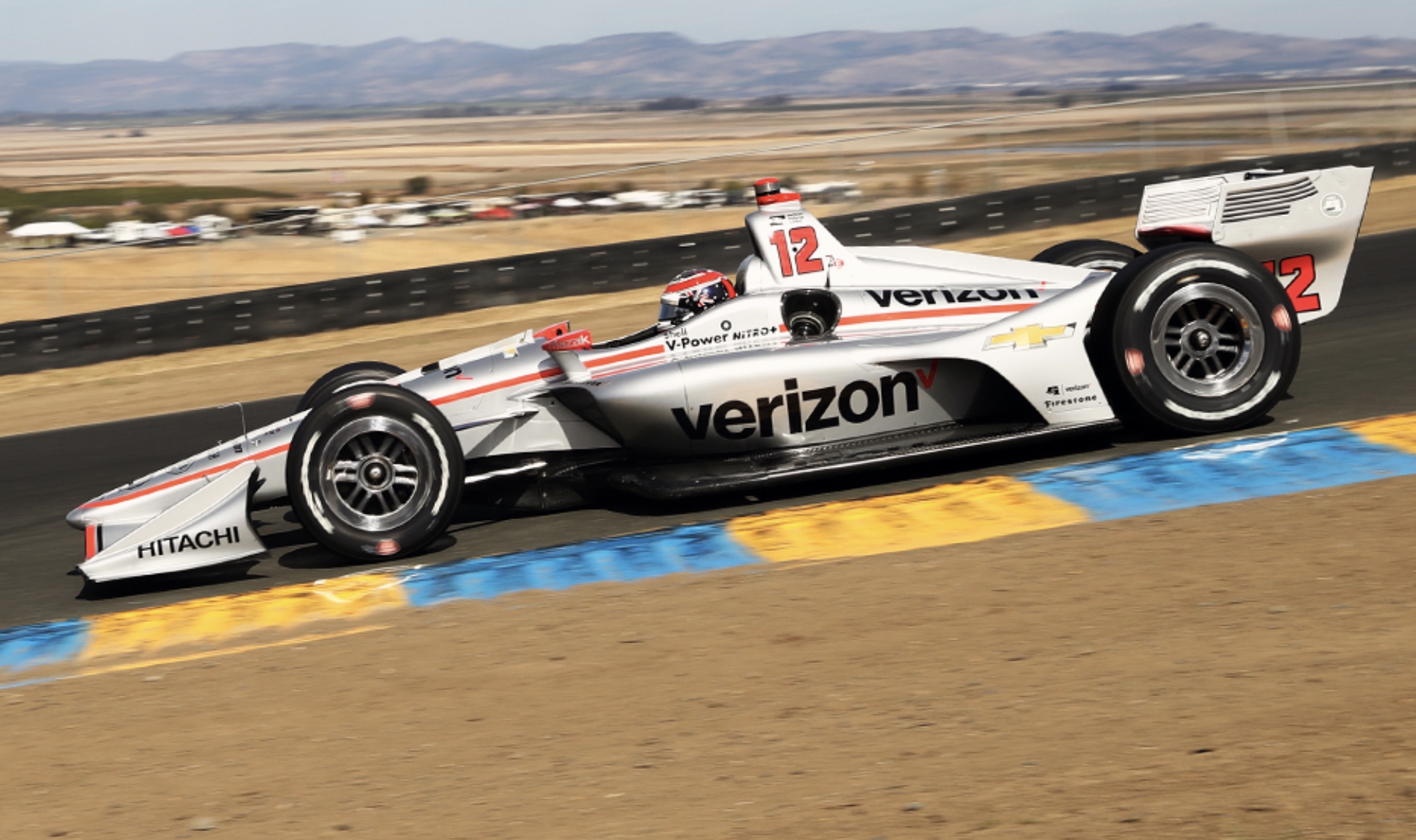
Will Power in the Team Penske Dallara Chev Indycar during a Sonoma test day in September 2018…
That season Indycar continued with the Dallara DW12 chassis used since 2015 but had ‘all new universal bodywork, inspired by CART’s 1990s and 2000s bodywork’- this new chassis configuration was dubbed the ‘IR18’ and is with us until at least 2022.
The usual homogenised and pasteurised process of boring mandated single-seater uniformity extended to standard F1-style LCD steering wheel display and Cosworth CCW Mk2 steering. You can have any type of engine you like as long as it is a 2.2 litre twin-turbo V6- at least the sanctioning body allows a choice of Chev or Honda units which give between 550 and 750bhp @ 12000rpm depending upon boost.
Hasn’t Mr Power carved a great career in the US- ya gotta hand it to him?
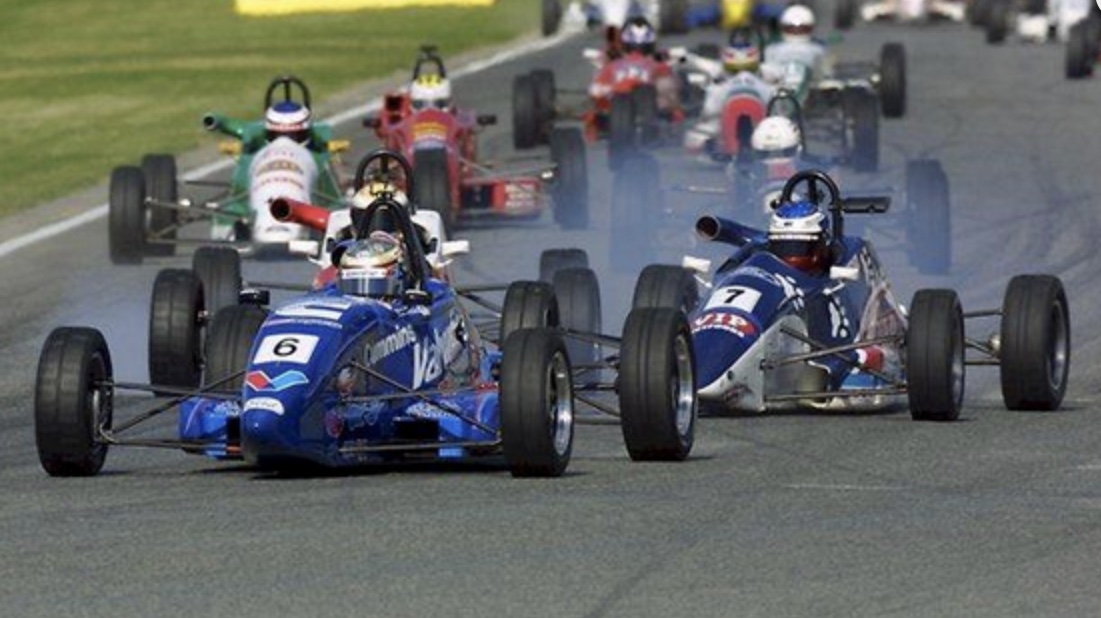
It seems like only yesterday i was admiring his Spectrum 07 Formula Ford in the Phillip Island paddock in 2000- he was second in the Oz FF Championship behind Will Davison in 2001, his third season in Formula Ford- this pair had careers which seemed in lockstep for a while, both tested a Minardi Cosworth F1 car in late 2004 after similar, under-funded cracks at the British F3 Championship.
The two Wills- Davison from Power during the 2001 Australian FF Championship, at Mallala (?) Van Diemen RF01 from Stealth Van Diemen RF95. Davison won the title from Power with Jamie Whincup a distant third (unattributed)
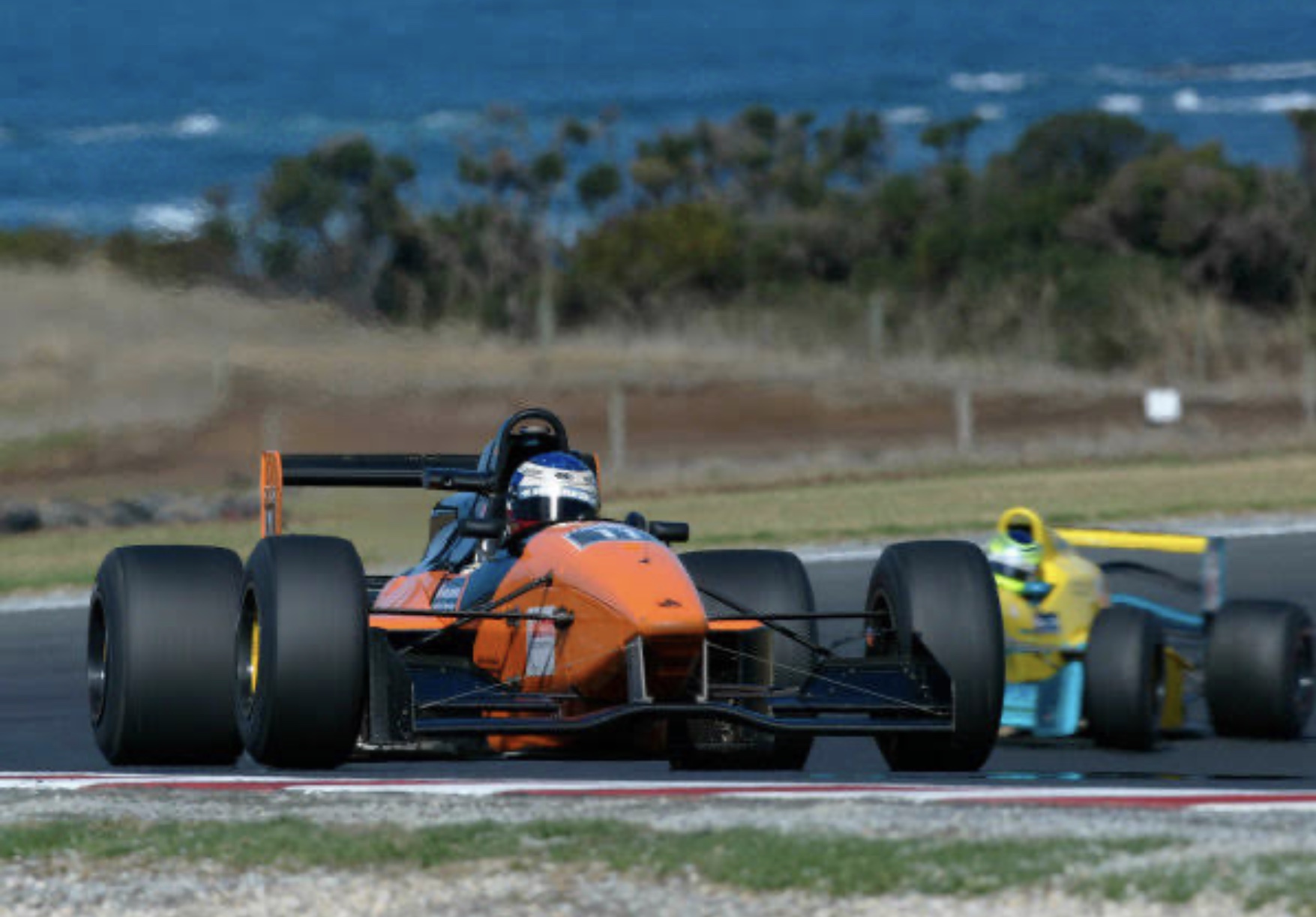
Will at Phillip Island in April 2002, two wins aboard his Reynard 94D Holden in the Gold Star opening round- Formula Holden (unattributed)
His route to F3 was via Formula Holden in 2002- he won the title racing for Graham Watson’s seasoned Ralt Australia outfit, his weapon though was a Reynard 94D- he won seven of the twelve races, the Gold Star Australian Drivers Championship run over six rounds.
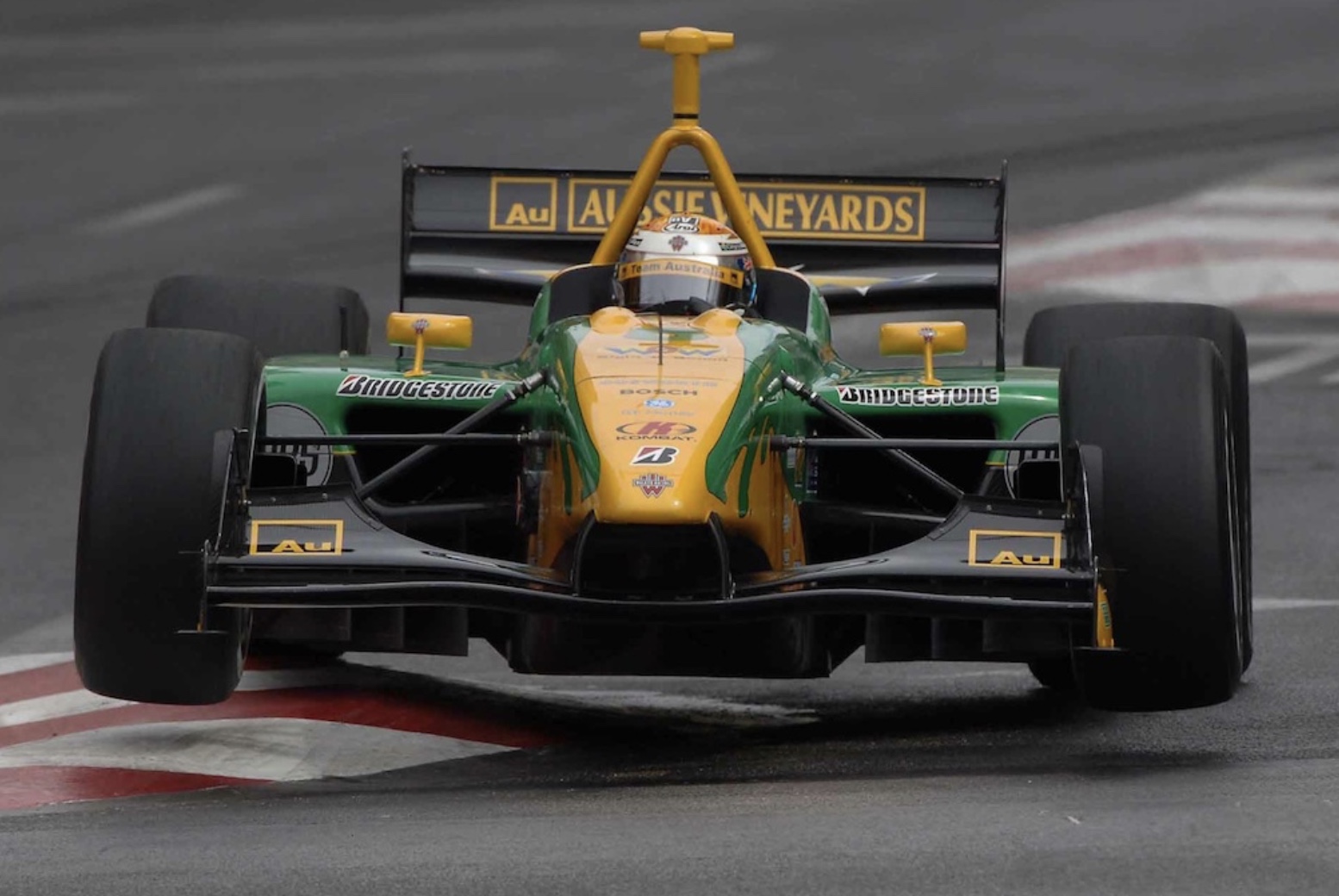
In 2005 he ran in the Formula Renault 3.5 Series finishing seventh despite not completing the season- he decamped to Indycars, impressing Derrick Walker’s Team Australia Racing in his debut at the Surfers 300 despite being bowled out of the event by teammate Alex Tagliani.
In 2007 he took his breakthrough Indycar victory at Las Vegas- his best results since then have been a championship win in 2014- taking three wins from eighteen rounds aboard a Dallara DW12 Chev and second placings in 2010- Dallara IR05 Honda and 2011, 2012 and 2016, all achieved in Dallara DW12 Chevs run by Team Penske.
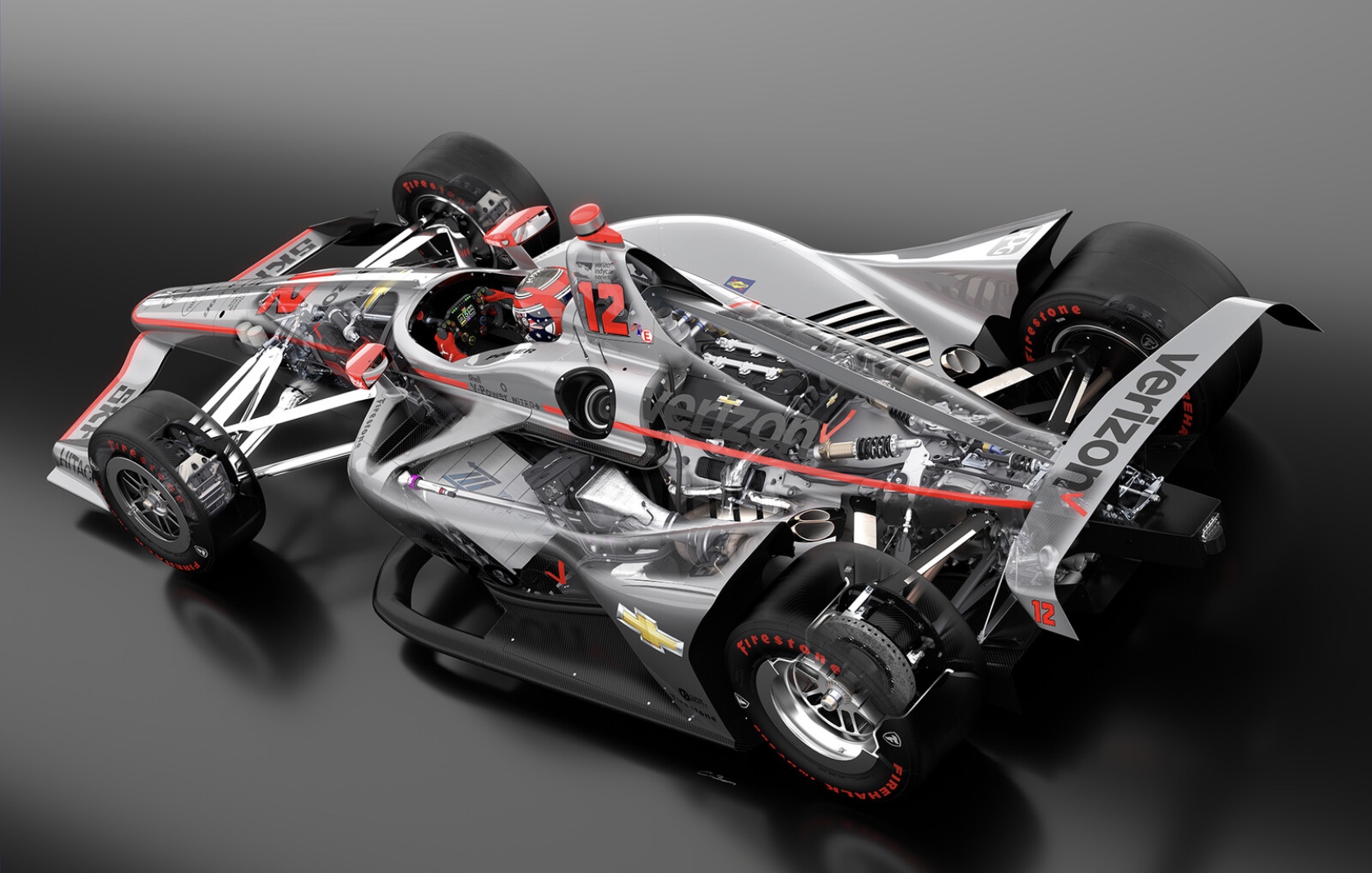
Lets not forget the Toowoomba natives 2018 Indy 500 win- see Chris Beatty’s superb cutaway of Power’s Team Penske Dallara DW12 Chev.
Carbon fibre chassis, double wishbone pushrod suspension with third spring and rollbar front and rear. Xtrac 1011 six-speed transaxle using sequential paddle shift, Brembo carbon brakes- weight between 1590 and 1630 pounds depending upon the type of circuit.
Etcetera…
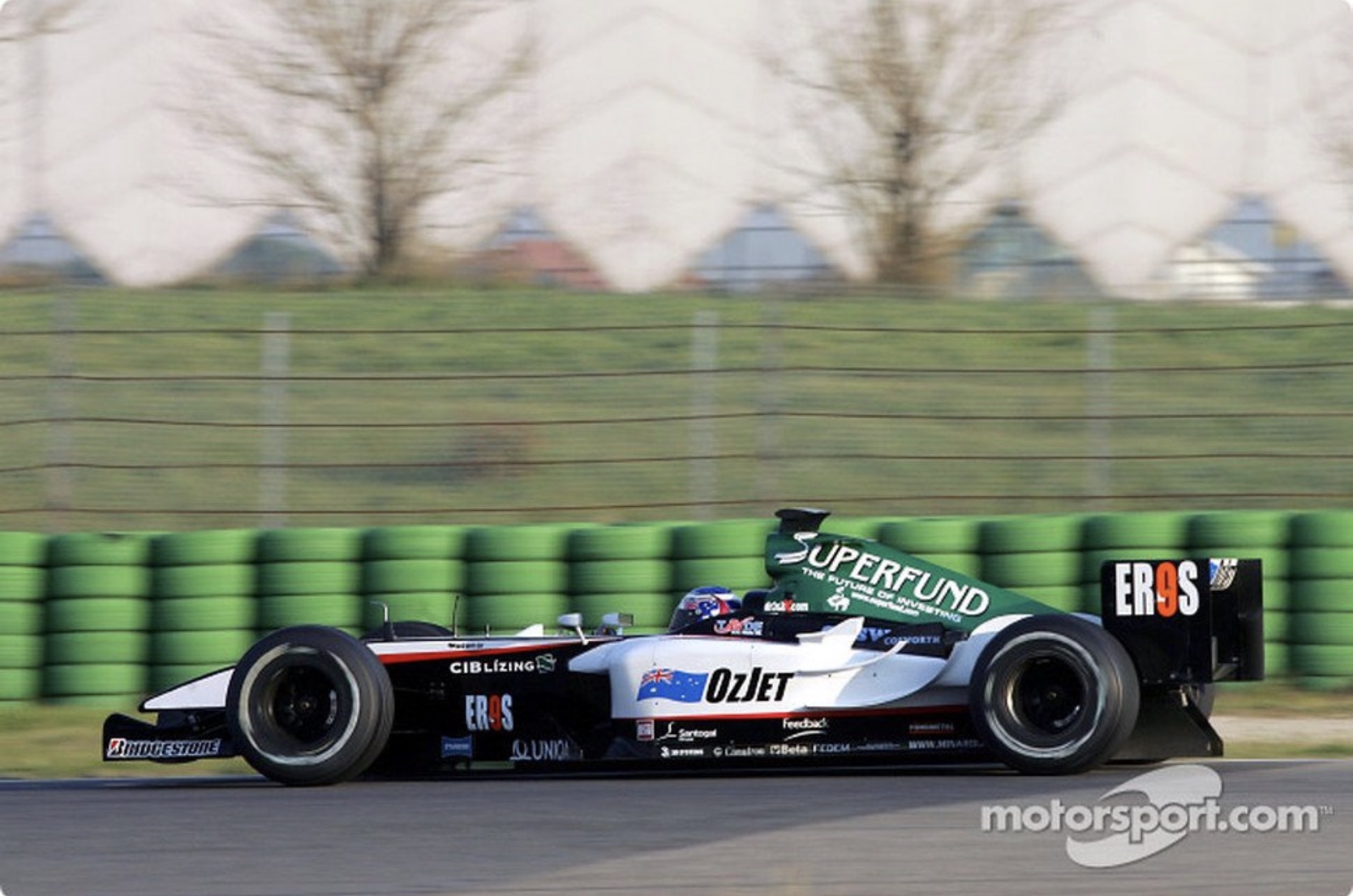
Minardi’s Paul Stoddart included the two Wills- Power (above) and Davison in an eleven driver ‘shootout’ at Misano in November 2004 in his quest to find drivers for 2005.
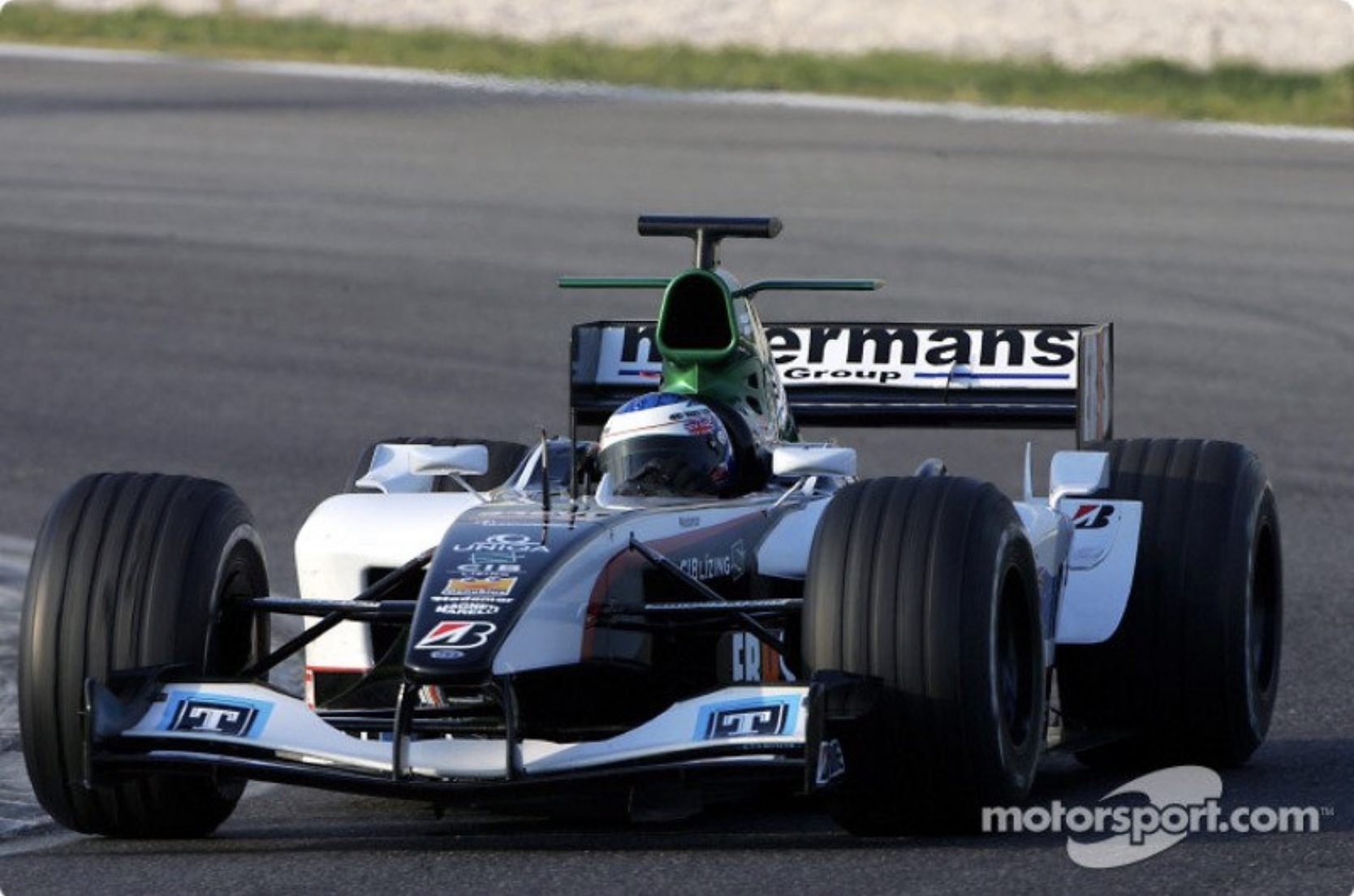
The car used was a Minardi PS04B Cosworth 3 litre V10.
Stoddart had plenty on his mind at the time as Ford’s sale of Jaguar F1 and Cosworth- his engine supplier meant he didn’t have certainly of motive power for his cars going forward.
In the end Cosworth continued with the team- his two drivers for 2005 were Patrick Friesacher and Robert Doornbos by the way…
(renaultsport.com)
In 2005 Power ran in the Renault 3.5 Series with Carlin Motorsport.
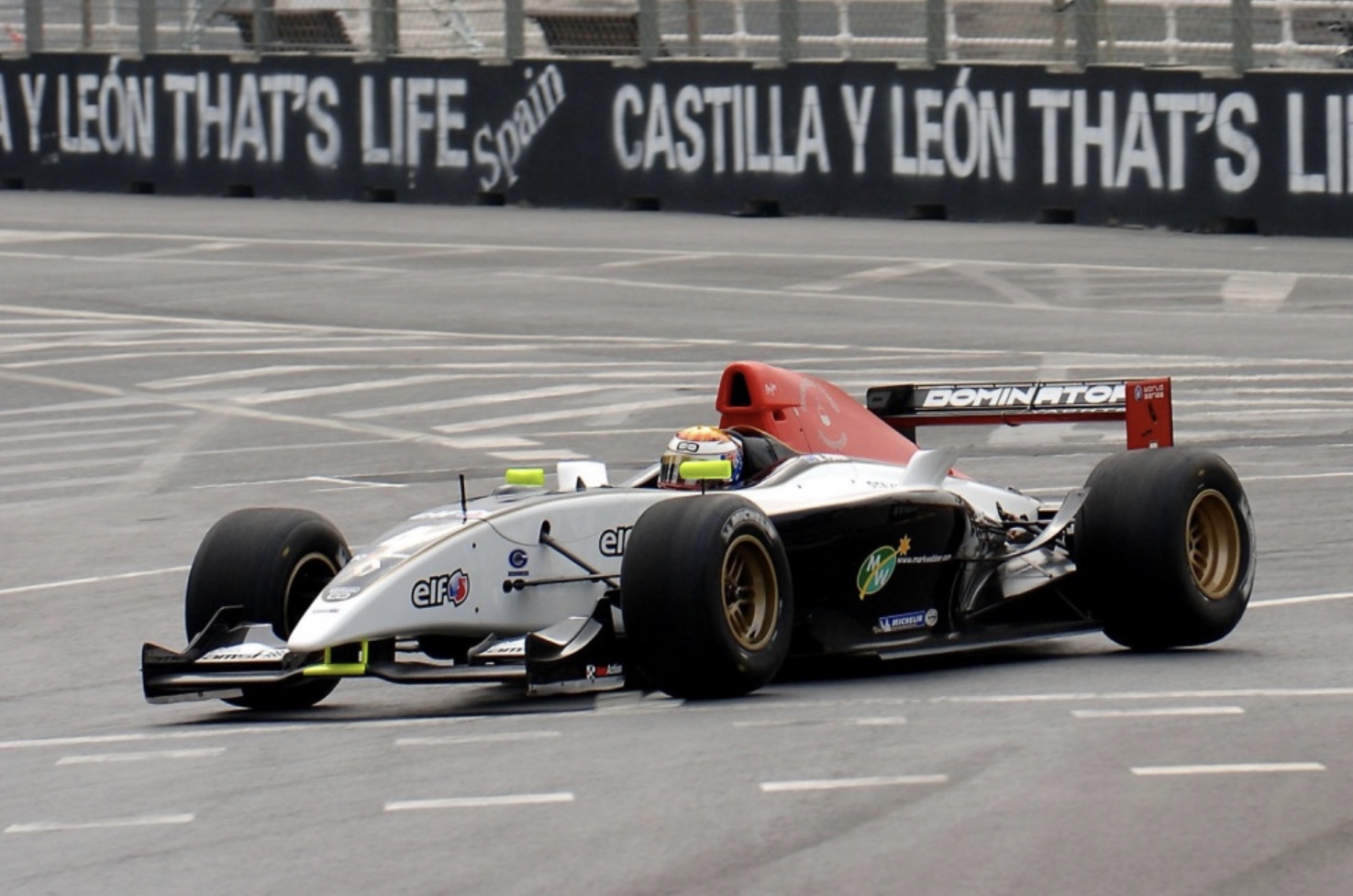
He contested seven of the nine rounds taking wins on the Le Mans Bugatti circuit and at Bilbao (above) using the mandated Dallara T05 Renault 3.5 litre V6 chassis/engine- seriously quick circa 480 bhp motorcars.
Renault 3.5 Series, Dallara T05 Valencia, Spain June 2005
(speedcafe.com)
Surfers Paradise 300 in October 2008.
Pole position for Will in the KV Racing Dallara IR5 Honda was a great start to the weekend- he led from pole for 17 laps before boofing the thing at the Chicane, fellow Aussie Ryan Briscoe then took the lead and the win in a Penske Racing Dallara IR5 Honda after dicing with Scott Dixon throughout.
It was a tragedy when Australia lost this event, a story in itself and in large part due to the American single-seater split between the Champ Car World Series and the IRL Indycar Series- remember that shit-fight?
Then the Queensland Government did a deal with A1 GP after failing to reach agreement with the IRL mob, they went bust…now the Taxis have the event buttoned down and the old ‘Indy’ circuit can no longer be used given the light-rail which runs along the Coast.
At it’s best this event and weekend was magic- better than the AGP…
‘As ugly as a hatful of arseholes’ is one of those crass Australian expressions which conveys rather precisely unfortunate aesthetics.
It does seem apposite in this particular instance however.
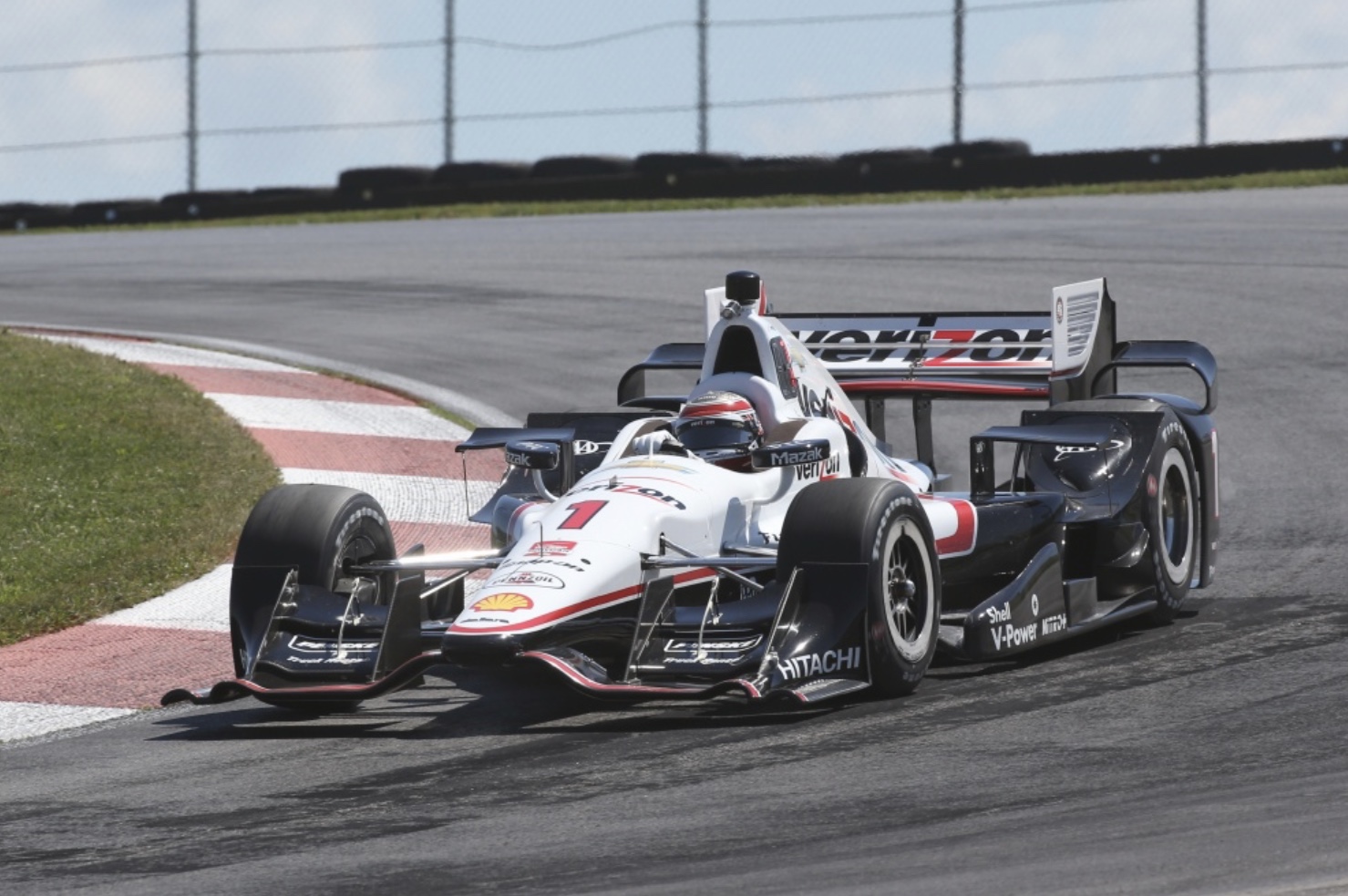
This masterpiece of aerodyanamic simplicity and elegance is Will’s 2015 spec Penske Dallara DW12 Chev, circuit unknown. Rule changes that year meant that the aerokits were specific to Chev and Honda applications…hmmmm. And yes, equally fugly, a toss of the coin really.
Photo Credits…
Getty Images, Chris Beatty, renaultsport.com, Sutton Images, speedcafe.com, indycar.com, motorsport.com
Tailpiece…
Indycar rookie of the year in 2006, Will Power takes his Team Australia Lola B03/00 Ford Cosworth XFE 2.65 V8 through the Surfers Paradise Chicanes during qualifying for the Indy 300 in October 2006.
He started from pole and was knocked out of the lead on lap 29 after an over optimistic passing move by Sebastian Bourdais- Nelson Phillipe won the race, his only Indycar victory.
Ken Richardson in Rex Taylor’s Talbot-Lago T26C, rounds a corner on the Southport road course- Queensland’s Gold Coast, 6 November 1955…
The event was the 114 mile Queensland Road Racing Championship, sometimes referred to as the 1955 Queensland Grand Prix, the second and final occasion on which the challenging layout was used for car racing- there is a bit about the 5.7 mile track in this piece on the 1954 Australian Grand Prix here; https://primotipo.com/2018/03/01/1954-australian-grand-prix-southport-qld/
Amongst the favourites for victory were Lex Davison, aboard the same HWM Jaguar in which he won the AGP twelve months before and Jack Brabham in the Cooper T40 Bristol in which he took a fortunate victory at the 1955 AGP at Port Wakefield, South Australia several weeks before, on 10 October.
Other contenders were Richardson, who was third at Southport in his Ford V8 Special the year before, this time he raced the dual AGP winning Talbot-Lago acquired by Rex Taylor from Doug Whiteford in mid-1954. Queensland youngster, Steve Ames aka Count Stephen Ouvaroff was aboard the ex-Lex Davison Alfa Romeo P3 he purchased not long before- a total of eleven cars took the start.
Davison burst into the lead from Brabham, Richardson and Ames at the drop of the flag, Jack outbraked Lex on lap 2, no doubt the nimble, light Cooper did this relatively easily but he kept his advantage for only a lap before mechanical trouble intervened.
He retired a car which became somewhat notorious for its unreliability with bent valves after the machine popped out of gear on one of the rough circuit’s many bumps causing a big enough over-rev to end Jack’s run.
Into the first corner Davison’s HWM Jag leads Brabham’s Cooper T40 Bristol, Ken Richardson’s Talbot-Lago T26C and Ames in the Alfa P3- narrowness of the road clear (Wheels)Twenty year old Steve Ames, in the demanding Alfa Romeo Tipo B/P3 on the challenging Southport road circuit (Cummins Archive)Brabham, Cooper T40 Bristol (Cummins Archive)
Davo’s machine then burst an oil line, shortly thereafter he arrived at the pits splattered in BP lubricant, for the balance of the event Ames and Richardson fought a close race but in the end the pre-war Alfa Romeo prevailed over its younger equally aristocratic European competitor at an average speed of 80 mph. Rex Taylor was third in his Jaguar XK120 and Barry Griffiths Triumph TR2 fourth, other finishers were the Stan Mossetter MG TC and Noel Barnes MG Spl s/c.
Jack did the fastest lap at 3 minutes 53 seconds, an average of 88 mph this was a smidge outside the record set by Dick Cobden’s Ferrari 125 V12 s/c in 1954.
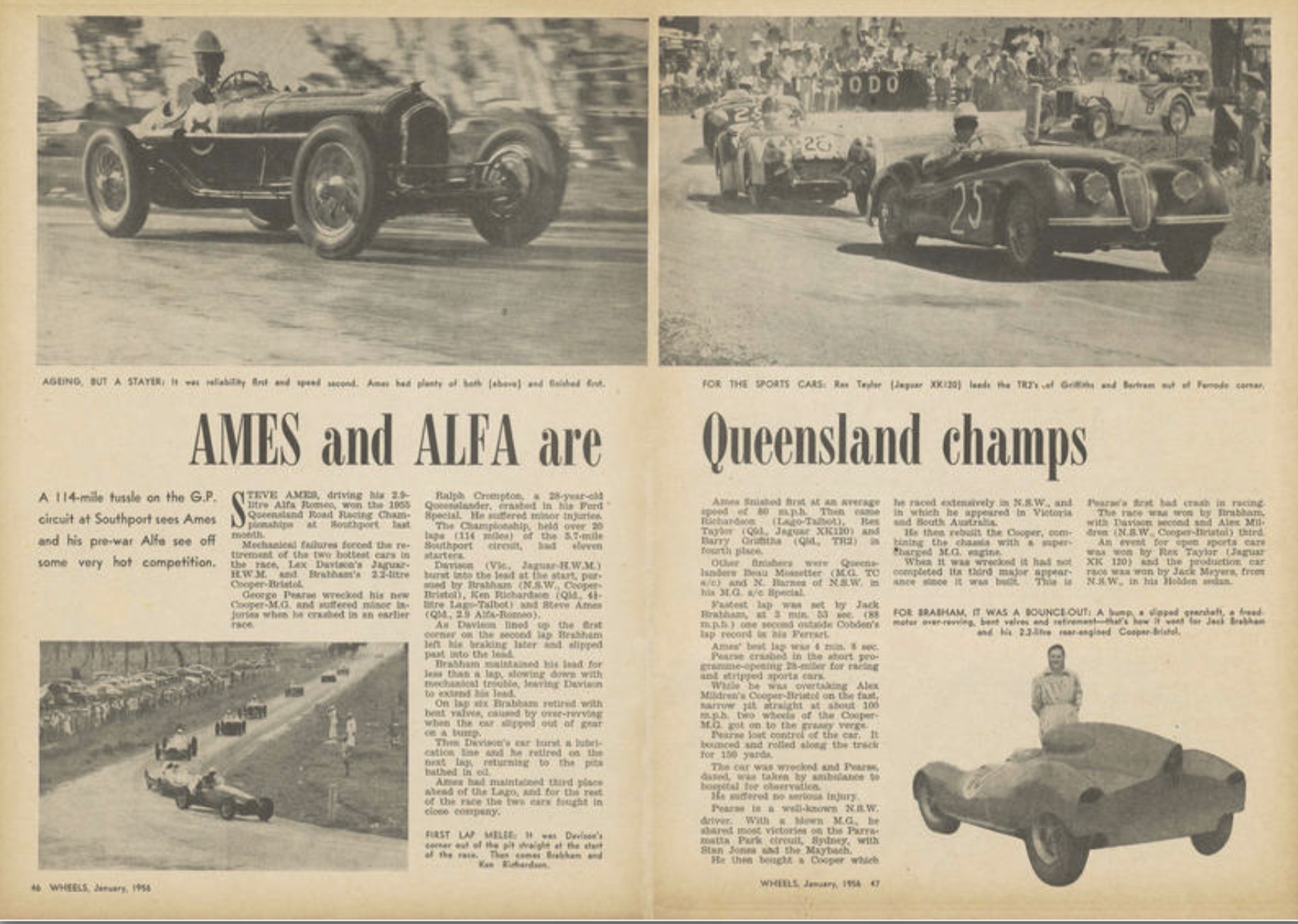
The ‘Wheels’ magazine report of the meeting mentions George Pearse crashing his Cooper-MG in a 25 mile race for racing cars and stripped sportscars whilst passing Alec Mildren’s Cooper Bristol on the narrow pit straight at over 100mph, he put two wheels onto the grass. Brabham won that encounter from Davison and Mildren. Rex Taylor’s Jag XK120 won the sportscar race and Jack Myers Holden the production car race.
(Cummins Archive)
Stunning shot of Rex Taylor’s Jaguar XK120 ahead of Barry Griffiths Triumph TR2 on the dangerous swoops of Southport. The typical perils of road racing tracks of the day are readily apparent.
Cessation of Southport as a race venue left Lowood, Leyburn, Strathpine and Middle Ridge, Toowoomba as Queensland’s racetracks until Lakeside became the states ‘home of motor racing’ circa 1962.
The Cars…
(Cummins Archive)
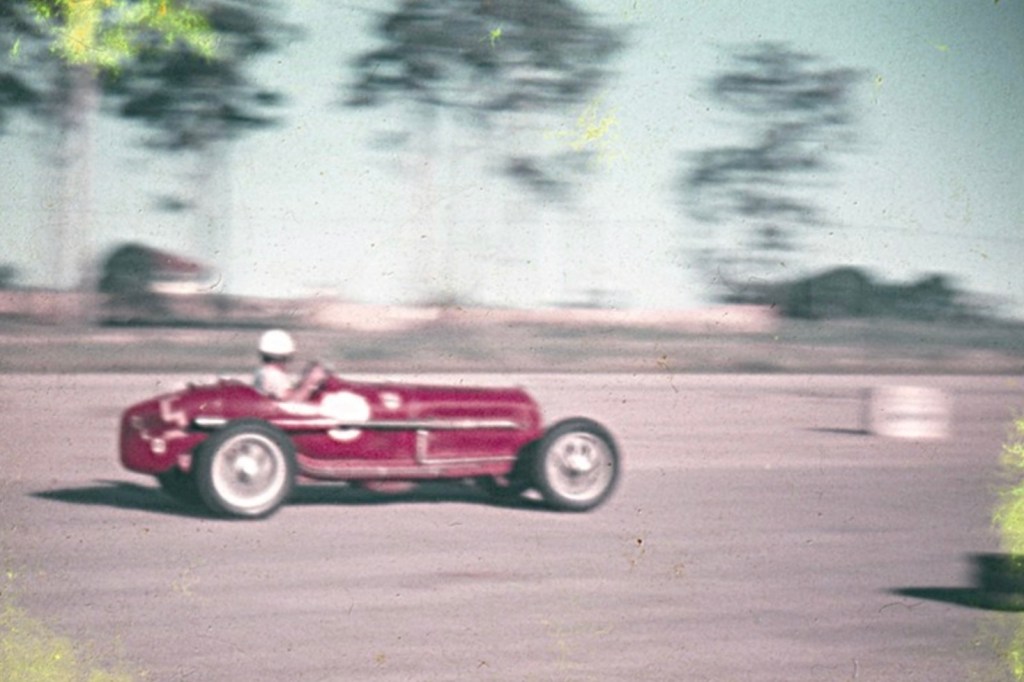
Steve Ames Alfa Romeo Tipo B/P3- the ex-Scuderia Ferrari/Davison chassis ‘50003’ in the Southport paddock.
I wonder if this was the last in period ‘big win’ for this 2.9 litre supercharged straight-eight- it was a state title after all? The car still looks beautifully prepared in the manner of previous fettlers, AF Hollins’ Allan Ashton and team, I wonder who looked after it in Queensland?
The shot below is of Davo in the same car on Mount Panorama during Easter 1951- down Conrod at a fair old clip between the trees, posts barbed wire and cattle on a rather narrow strip of bumpy bitumen.
(Cummins Archive)(Wheels)
Rex Taylor, Jaguar XK120 from the Barry Griffiths and Bertram Triumph TR2s and the Stan Mossetter (I think) MG TC – a battle during the championship race above, and a superb portrait hunched over the wheel below- Paul Cummins advises the chassis number as #660226.
(Cummins Archive)(Cummins Archive)
Brabham’s central seat, all enveloping Cooper T40 Bristol GP car was largely self built at Surbiton before Jack made his championship Grand Prix debut in it at Aintree in mid-July, DNF after 30 laps, Moss won the British Grand Prix that day in a W196 Mercedes. On 10 October Brabham won at Port Wakefield, an awfully good reason for Queenslanders to get a good look at ‘our boy’ in a current Grand Prix car.
Superb shot of Barry Griffith’s Triumph TR2 on the limit and looking very racey sans windscreen but with cream tonneau.
(Cummins Archive)
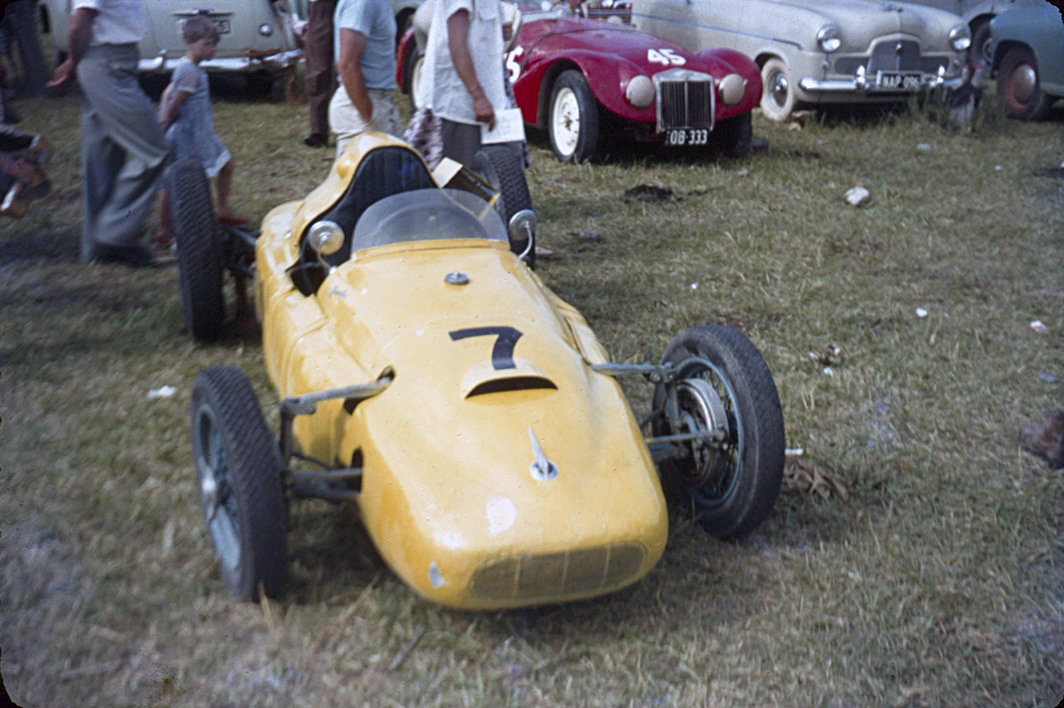
The Wylie Javelin doesn’t get a mention in the race report I have so perhaps the little minx misbehaved that weekend and did not start the race? Paul Cummins tells me the amazing little bolide was raced by Arthur Griffiths with ‘wire mesh on the grille, probably to keep the cane toads out’ not that they were in plague proportions back then but one can’t be too careful. Rob Bailey points out the red #45 Harry Firth built MG Holden, now owned and almost restored by Ian Tate.
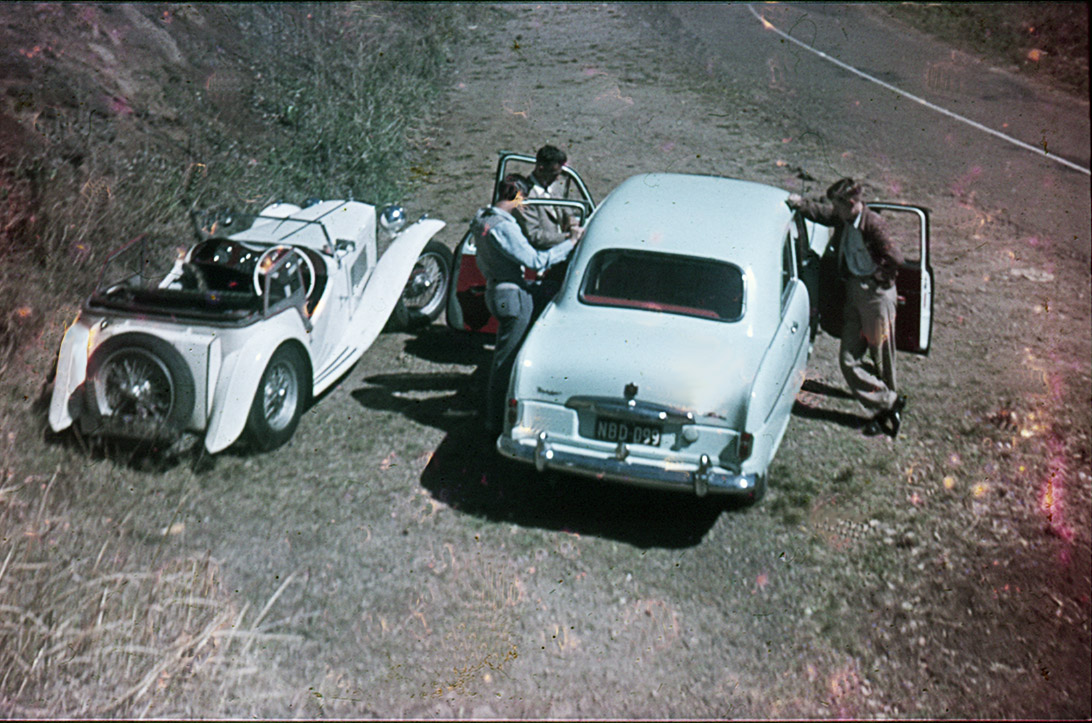
Not so much a Southport shot as an atmosphere one.
Paul suspects the owner of the MG TC may be the photographer of much of the material in this piece, ‘the N Rego of the Zephyr dates it as registered in 1955’- can anybody help with identification of the drivers?
Count Stephen Ouvaroff circa 1960 (unattributed)
Steve Ames/Count Stephen Peter Ouvaroff…
Fair-dinkum blue-bloods are fairly thin on the ground in Australia but Count Stephen Peter Ouvaroff was the real McCoy, he was of aristocratic Russian background.
His parents were Count Igor Ouvaroff and Aubretia Phyllis Ames, Stephen was born on 3 September 1935, his sister, Marina Violet was born in Sussex in 1931. Stephen died in England on 13 November 2017 having lived most of his adult life there.
MotorSport lists Stephen’s birthplace as Russia and nationality as Australian.
The pieces of the puzzle, i am keen to hear from those with some facts rather than ‘i reckons’, seem to be that Ouvaroff, his sister and and his mother moved to New Zealand when Stephen was about 10 years of age, which puts it at the end of the war, then later they moved on to Australia.
Count Igor died in Sussex on 25 July 1939, a reasonable assumption is that the boy grew up in the UK- his mother was English, an open question is whether Igor and Aubretia met in the UK or Russia- i have my money on the UK, as you all know, generally those ‘high born’, were not top of the pops with the crew running that vast country after the Russian Revolution.
So my theory is that Igor decamped to England in order to hang onto his head and met Aubretia, who had no shortage of Earls and a Marquess in her family tree at a lovely society ball- he was born in Russia in 1901, she in Paddington in 1909, in 1930 she was a vibrant 21 and he a dashing 29- a match made in heaven.
The family of three settled in Brisbane, Stephen’s motor racing career started with the ex-Ken Richardson Ford V8 Special, then the P3- perhaps simultaneously racing the Alfa Romeo and an Austin Healey 100S.
The use of the nom de guerre ‘Steve Ames’ was doubtless to avoid the ‘wanker’ tag which would have been applied to the young racer in Tall-Poppy Syndrome Australia.
Despite its age, the Grand Prix Alfa was a fast, formidable bit of kit the youngster seems to have driven very well although he sold it without too many recorded events to Rex Taylor. Whilst some reports have it he moved to the UK in 1956, Ouvaroff raced the Healey 100S in a hillclimb at Burleigh Heads on the Gold Coast, that December.
The 100S, chassis ‘3701’, was the first imported into Australia arriving in August 1955 and had been through the hands of David Shmith and Stan Mossetter before Ames bought it in late 1956. John Blanden describes Stephen as a Toowoomba hotelier so perhaps his mother had acquired a pub along the way.
This shot of the P3 is at Strathpine, Queensland and dated circa September 1957- the pilot could be Ouvaroff, Rex Taylor or perhaps Keith Blicaski- if anyone can date the event and identify the driver that would be great (Cummins Archive)
It seems reasonable to presume Ouvaroff moved to the UK in 1957, Blanden does not date the sale of the Healey to its next owner, i can find no recorded events in the UK that year. In 1958 he acquired and raced an F2 Cooper T43 Climax, his best result was fourth in the 1958 Vanwall Trophy at Snetterton on 27 July behind Ian Burgess, Bruce McLaren and Henry Taylor.
Other events contested that season included the International Trophy at Silverstone where he finished well back in the 1760cc FPF engined T43. He was a DNQ in the F2 Crystal Palace Trophy, the chassis number of the T43, by then of course fitted with a 1.5 litre FPF, was cited as ‘F2-9-57’. Tenth place followed at Brands Hatch on June 8.
Much better was fifth in the Anerly Trophy at Crystal Palace on 5 July whilst noting the best bit of kit to have that season was a Cooper T45. Off the back of the fourth place at Snetterton a DNQ at Brands on 4 August was disappointing.
During that year he also tested the new Lotus 11 Climax chassis ‘538′ acquired by Charlie Whatmore for George Jamieson at Brands Hatch before its shipment to Australia and much local success here.
1959 seems to have been relatively quiet in terms of race outings, but he ran the Willment Climax 1.5 FWB sportscar to a win at the BARC Goodwood meeting on 6 June impressing Bill Boddy who wrote in his MotorSport report that ‘The fifth race was actually uneventful, Count Ouvaroff’s Willment-Climax leading unchallenged, but very fast for all of that, from Union Jack to chequered flag, as well it might, being the sole 1 1/2-litre amongst a field of 1100s in this five lap Scratch Race and with twin-cam engine at that. The Count won at 84.28 mph and set fastest lap, at 86.22mph.’
The mainstay of Stephen’s 1960 program was Formula Junior where the strategy seemed to be to step back in class from F2 to FJ and in this red-hot class attempt to do well enough to give his career some momentum- sound thinking indeed.
Amongst his best results was third place at the ADAC-Eifelrennen at the Nurburgring and the Solitude Grand Prix outside Stuttgart.
The Nurburgring was wet on that 10 July weekend, quite a challenge for a relative novice on this most daunting of circuits. There he finished behind Dennis Taylor’s Lola Mk2 BMC and John Love’s Lola Mk2 Fiat in a thirty-two car grid, the event held over 20 laps, 155 km – total race duration one hour twenty-two minutes! It amazes me that the highly tuned modified production engines, which more generally raced over ‘Brands 10 lappers’ lasted that long!
Two weeks later his little ‘Inter Auto Course’ equipe travelled to Stuttgart to contest the Tenth Internationales Solituderennen-Formel Junior- the Grosser Preis der Solitude on 24 July.
Another long race, 12 laps, 138 km of the very fast, dangerous, swooping, tree lined road course yielded the young racer second place behind Jim Clark’s works 18 and ahead of Trevor Taylor and Peter Arundell in the other two Team Lotus entries, Gerhard Mietter, Kurt Ahrens and many others in a huge 35 car grid.
Both these German races were significant international meetings, to finish so well up the field in a privately entered car on two long road circuits new to him showed he was no slouch- read about the perils of Solitude here; https://primotipo.com/2018/05/10/surtees-in-solitude/
Solitude FJ GP grid July 1960. Keith Ballisat Cooper T52 BMC, #1 Jim Clark, Lotus 18 Ford and #9 Juan-Manuel-Bordeu, Lola Mk2 Ford, #2 Trevor Taylor, Lotus 18 Ford and car #3 Peter Arundell similarly mounted (unattributed)JM Fangio keeps a paternal eye on Steve’s #18 Lotus 18 Ford at the start of the rather soggy 1960 Eifelrennen FJ. #2 is the second placed Lola Mk2 Fiat (Getty)
Closer to home he was second in the Anerly Trophy in June behind Trevor Taylor’s works 18 Cosworth, in August he had a DNF at Aintree with gearbox problems- there is then quite a gap to Oulton Park in late September where he was way back in nineteenth.
Mixing things up a bit, Steve entered the 18 April Lavant Cup at Goodwood in an F2 Cooper T51 Climax qualifying eleventh of nineteen cars but DNS.
There were 63 Formula Junior meetings in England and 75 in Europe in 1960- a driver needed to be in the car a lot to run with the best, a works seat being optimal of course, i think we can deduce that Count Stephen had talent- he finished two seconds behind Jim Clark at Solitude after 56 minutes of racing in a privately entered car, but it was not to be fulfilled without decent support or a much better seat.
Into 1961 Ouvaroff raced one of the Tom Hawkes and Adrian Gundlach built Ausper T3 Ford FJs.
Dick Willis notes that ‘he was a real “presseronner” in the Ausper. Although he did have some success, the works Lotuses were dominant with topline drivers on their team and the very latest engine tweaks…’
The Competition Cars Australia ‘works drivers’ season seems to have been split into two, whilst noting that half the results tables for the British FJ Championship have disappeared from the F2 Index site- which is a bummer. The first half of the season was devoted to European events, the second was spent closer to home in the UK.
The team entered Monaco but Steve failed to qualify his Ausper T3 Ford, missing the cut by six cars- Peter Arundell’s Lotus 20 Ford won from the Tyrrell Racing duo of John Love and Tony Maggs in Cooper T56 BMCs. Off to Rouen for the GP de Rouen on 4 June he finished well back with mechanical dramas, just in front of him was Denny Hulme in the New Zealand Grand Prix Racing Team Cooper T56 BMC- the Kiwi’s first European season.
He was out of the money again at Reims a month later and at Solitude, Stuttgart on 23 July where he had done so well the year before.
Back in England things were tough too- at Aintree on 7 August he was twenty-fifth where Peter Procter won in year old Lotus 18 Ford, at Goodwood a fortnight later the run of poor showings continued with a DNF due to overheating.
That BARC Formula Junior Championship meeting did have an Australian flavour though, Gavin Youl in the MRD Ford was on pole for the first heat in a great run for the Brabham marque and Jon Leighton’s Lotus 20 Ford was on pole for the second heat. Alan Rees Lotus 20 Ford won from Youl and Dennis Taylor, Lola Mk3 Ford.
Eighth in the September Trophy at Crystal Place was at least a finish on 2 September, and fourth at Oulton Park in the International Gold Cup meeting was more like 1960 form- Tony Maggs was up front that weekend in the Tyrrell Cooper T56 BMC proving, as they did many times that season that a Lotus Cosworth was not essential for FJ success in 1961.
On 30 September he was fifth in the Vanwall Trophy at Snetterton amongst a strong field in number and depth, Mike Parkes was up front in a Gemini Mk3A Ford. Off to Silverstone on 1 October where the strong run home at the seasons end yielded another fourth place, this time in the BARC FJ race one place behind Frank Gardner’s Jim Russell Lotus 20, the winner was Bill Moss in another Gemini Mk3A Ford.
It was a shame to end the season, and seemingly his race career, with a DNF at Snetterton on 8 October.
In a film obscurity Stephen crashed the Lister Jaguar chassis ‘BHL126’ on the set of MGM’s 1961 ‘The Green Helmet’, the car, registered ‘WTM446’ of course lived to fight another day.
Outside the cockpit Stephen married Aprille E Brighton in a society wedding at Brompton Oratory during December 1961 and settled in Drumhouse River Lane, Petersham, Surrey.
Ouvaroff established and operated the American Carriage Company in London for over 35 years, latterly with two of his sons, it specialised in the importation and sale of RHD converted American Cars. Paul Newby advises the business imported a dozen Holden Suburbans and Commodore Wagons from Suttons in Sydney via French domiciled ex-racer, uber-wealthy Arnold Glass at the turn of the century.
He remained proud and supportive of his Russian ancestry being involved in the annual Russian Summer Ball which was held to raise funds for a Russian charity and The London Cossack Association. Upon his death in 2017 he left his wife and six children.
For sure there is an interesting life to chronicle here in full- with six Ouvaroffs from his marriage there is no shortage of folks to find and interview in relation thereto- a project for another time!
Some of you Queenslanders must recall ‘Steve Ames’? I’d love to hear from you and similarly anybody in the UK familiar with Count Stephen Ouvaroff’s racing and business career.
Steve Ouvaroff, Lotus 18 Ford FJ, Silverstone 1960 (BRDC)
Etcetera…
‘Wheels’ January 1956
Photo and other Credits…
Many thanks to Paul Cummins and the Cummins Archive- sensational photographs, colour is so rare in Australia in this period. Paul hijacked my weekend I got so lost in the Count Stephen Ouvaroff research adventure!
Wheels magazine January 1956 via the Stephen Dalton Collection, British Racing Drivers Club, ‘The Ausper Story’ Dick Willis, F2 Index, David McKinney on The Nostalgia Forum, MotorSport July 1959, ‘Historic Racing Cars in Australia’ John Blanden, Paul Newby, Les Hughes
Tailpiece…
(Cummins Archive)
Let’s finish where we started, with Lago-Talbot T26C ‘110007’ the first of Doug Whiteford’s two such cars- the machine he used to win the 1952 and 1953 AGPs at Mount Panorama and Albert Park but not before the great Louis Chiron won the 1949 French Grand Prix in it at Reims.
Whiteford sold the car to Rex Taylor in 1954- here at Southport of course driven by Ken Richardson, the car then passed to Owen Bailey in late 1956 and then to Barry Collerson in late 1958. He raced it very skilfully in its dotage into 1961 before moving into more nimble mid-engined single-seaters and then spent a year or so racing F3 cars in Europe in the mid-sixties. Graham Thompson bought the Lago as club car in 1963 from Arnold Glass/Capitol Motors, the car passed through another owner or two before leaving Australia to be scooped up as an historic racer for the growing UK scene in the late sixties.
Bib Stillwell poses for the camera during the 1961 New Zealand Grand Prix meeting at the Ardmore Aerodrome, South Auckland. Bewdy’, nice cockpit shot of Stillwell’s Aston Martin DBR4/250 i thought- but upon closer inspection the negative is wrongly marked, it is not 1961 but actually two years before- 1959 or three, 1958 or perhaps even four, 1957 and Bib is aboard his Maserati 250F. Evidence includes the different screen, see the Aston’s below, fuel filler located in different spots and the Maserati cloth badge on Stillwell’s polo-shirt, you can just see a glimpse of that under Bib’s left wrist/glove.
In 1959 Bib finished sixth behind the three Cooper T45s of Moss, Brabham and McLaren and the 250Fs of Carroll Shelby/Harry Schell and Ross Jensen.
This time it is the Ardmore paddock in 1961 with Bib’s Aston Martin DBR4/250 ‘3’ taking centre stage.
To the left is the nose of the Glass Cooper Maserati, the #12 Maserati 250F is Stan Jones’ Maserati 250F raced by David McKay that weekend- DNF exhaust after completing 45 laps. The Cooper T51 in the right-rear corner of the shot is Jo Bonnier’s, the gearbox of which, repaired after practice, soiled itself again in the race after completing only half of the first lap. As to the Cooper T43(?) to the right, i shall take your advice. See this piece on the Aston Martin DBR4/250; https://primotipo.com/2020/05/08/aston-martin-dbr4-250/
Bib, sharing, almost alternating the mid and front engined collection of cars in his Kew, Melbourne workshop raced one of his Coopers the year before- 1960.
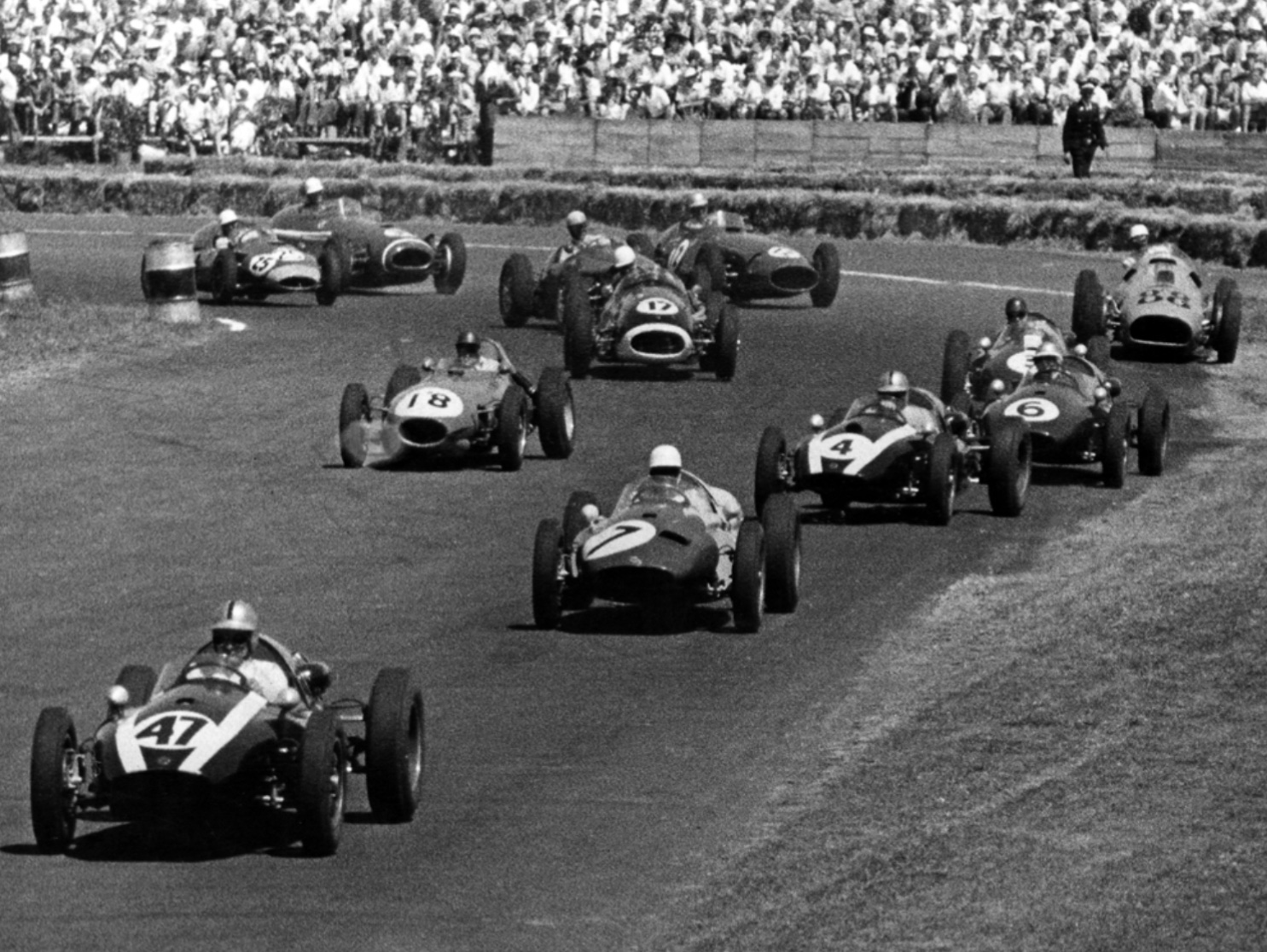
Check him out below running in fourth place just after the start behind the McLaren Cooper T45, Moss and Brabham Cooper T51s- Bib in #6 is similarly mounted as is the partially obscured car of Ian Burgess behind the Victorian.
#18 out left is David Piper’s Lotus 16 Climax, #17 is Johnny Mansel’s Maserati 250F, followed by the similar cars of Arnold Glass and obscured Ross Jensen #88 the Ron Roycroft Ferrari 375 V12- Stan Jones Cooper T51 is nipping inside the unmistakable nose of the Ted Gray driven wonderful Tornado 2 Chev. What a shame Lou Abrahams and Ted Gray didn’t take Tornado to New Zealand in 1958 and 1959, by 1960 it was well and truly all over red-rover for the big, front-engined beasties.
Brabham won from McLaren, Stillwell and Stan Jones aboard another T51.
Love this shot above, this time 1961 of one of the Rob Walker mechanics- is it Mal Simpson?, giving the lovely Rob Walker Lotus 18 Climax a bit of a whirl on one of Ardmore’s access roads.
I never bought the ‘biscuit box’ descriptor of the 18’s appearance, i’ve always thought they were sexy little things, far nicer than the Cooper T53, the only thing between Lotus world dominance in 1960 was the pox ridden Lotus sequential gearbox…without doubt they were the fastest tool of the year but far from the most reliable, an attribute Messrs Cooper, Maddocks and Brabham worked very hard to build into their new ‘Lowline’.
The NZ GP was won by Brabham from McLaren both aboard Cooper T53s from Graham Hill’s BRM P48.
Credits…
National Library of New Zealand, ‘TRS’- The Roaring Season, Euan Sarginson, Stillwell Motor Company, sergent.com
Tailpiece…
(E Sarginson)
First corner Ardmore Airfield 1961 shot by Euan Sarginson.
Ron Flockhart, Cooper T51 from #7 Moss, Lotus 18, Bruce McLaren’s Cooper T53 with Brabham right behind Bruce in another T53, then Innes Ireland #1 and John Surtees #2 aboard works Lotus 18s- all of these cars Coventry Climax FPF powered.
#20 is the Denny Hulme Cooper T51 Climax from Graham Hill, BRM P48, then finally the two Australians, Bib Stillwell’s Aston Martin DBR4 and Arnold Glass’ Cooper T45 Maserati.
Sixty-five thousand Kiwis basked in marvellous summer sun and saw Brabham win from McLaren Hill, Flockhart, Hulme and Clark- it was Jack’s third win at Ardmore.
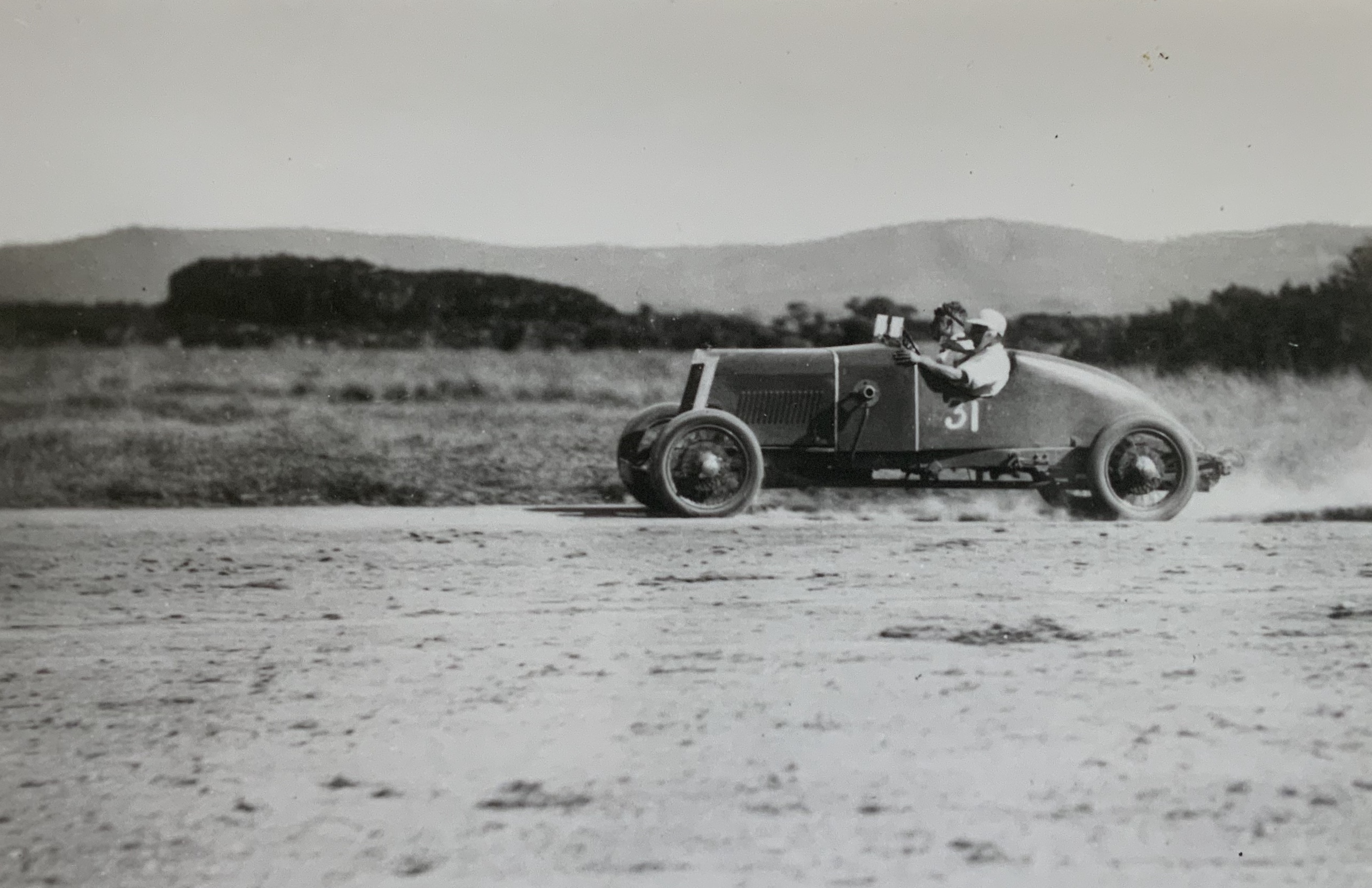
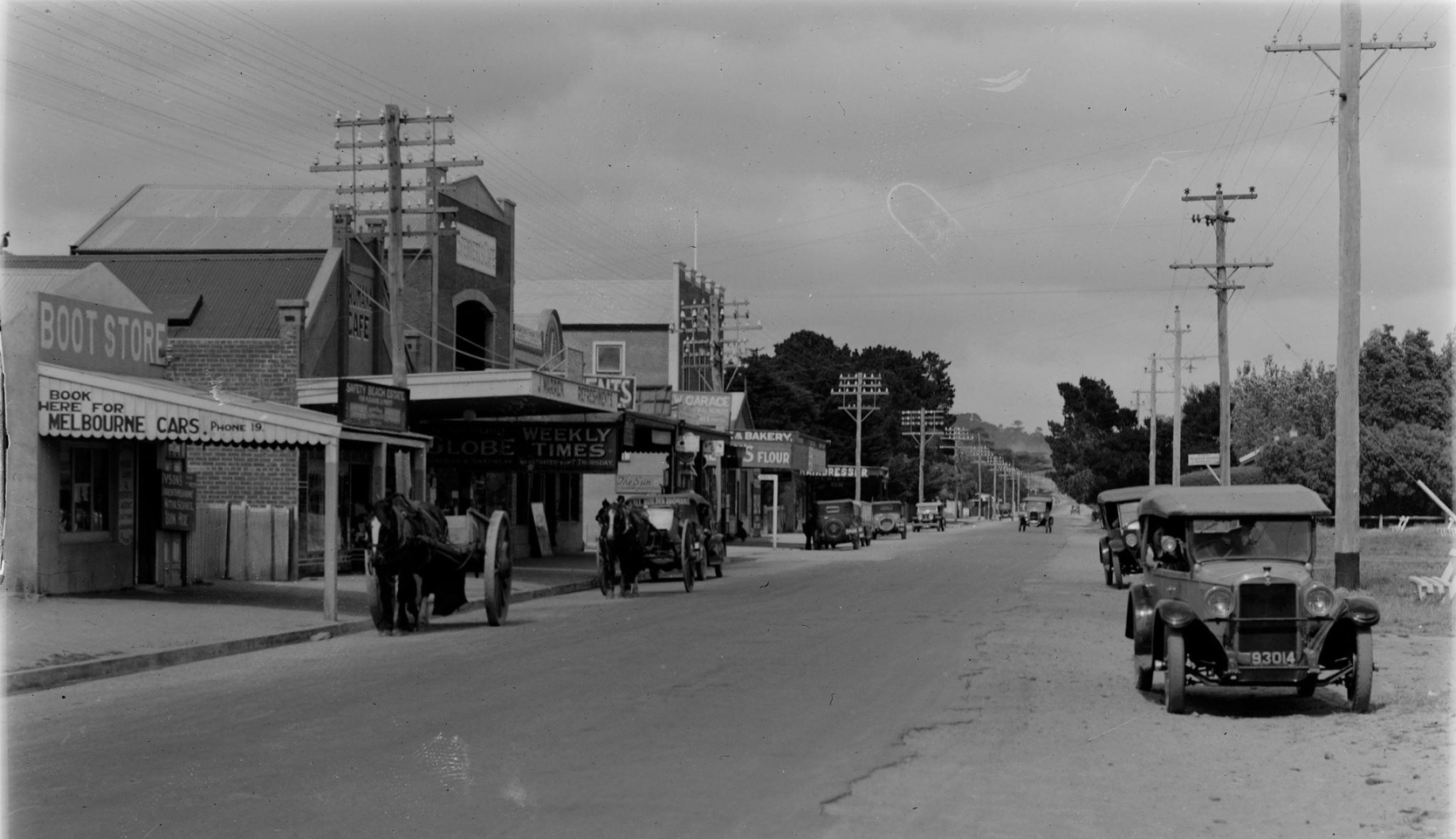
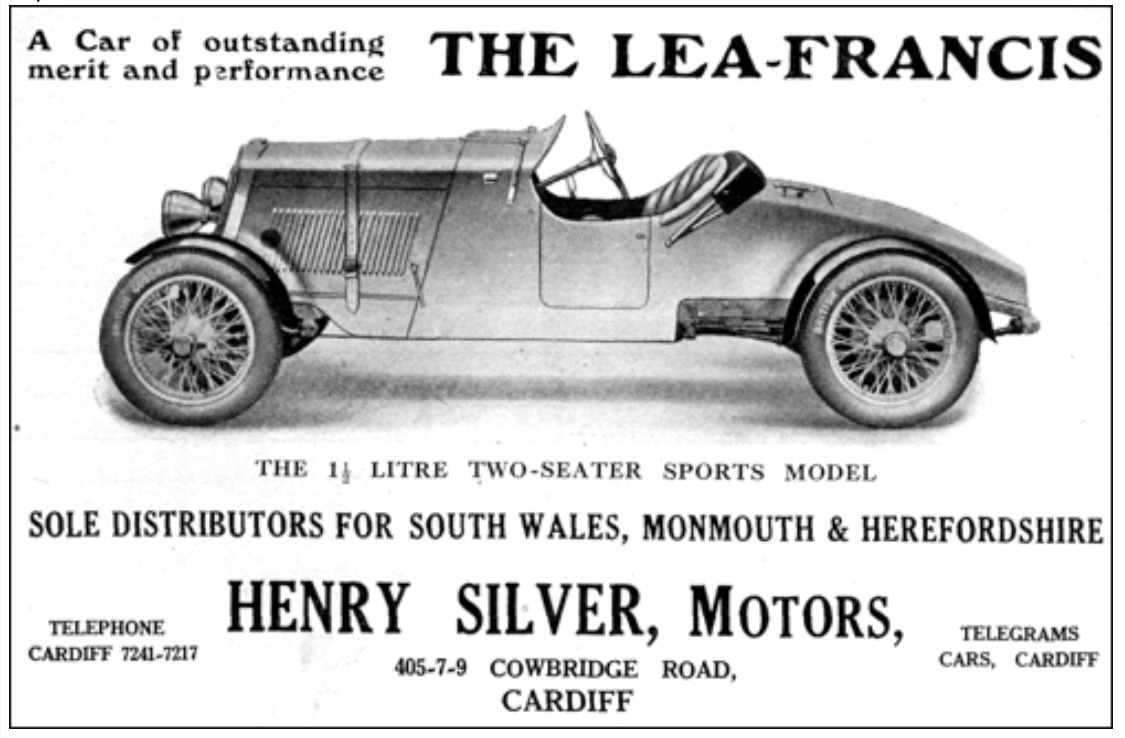
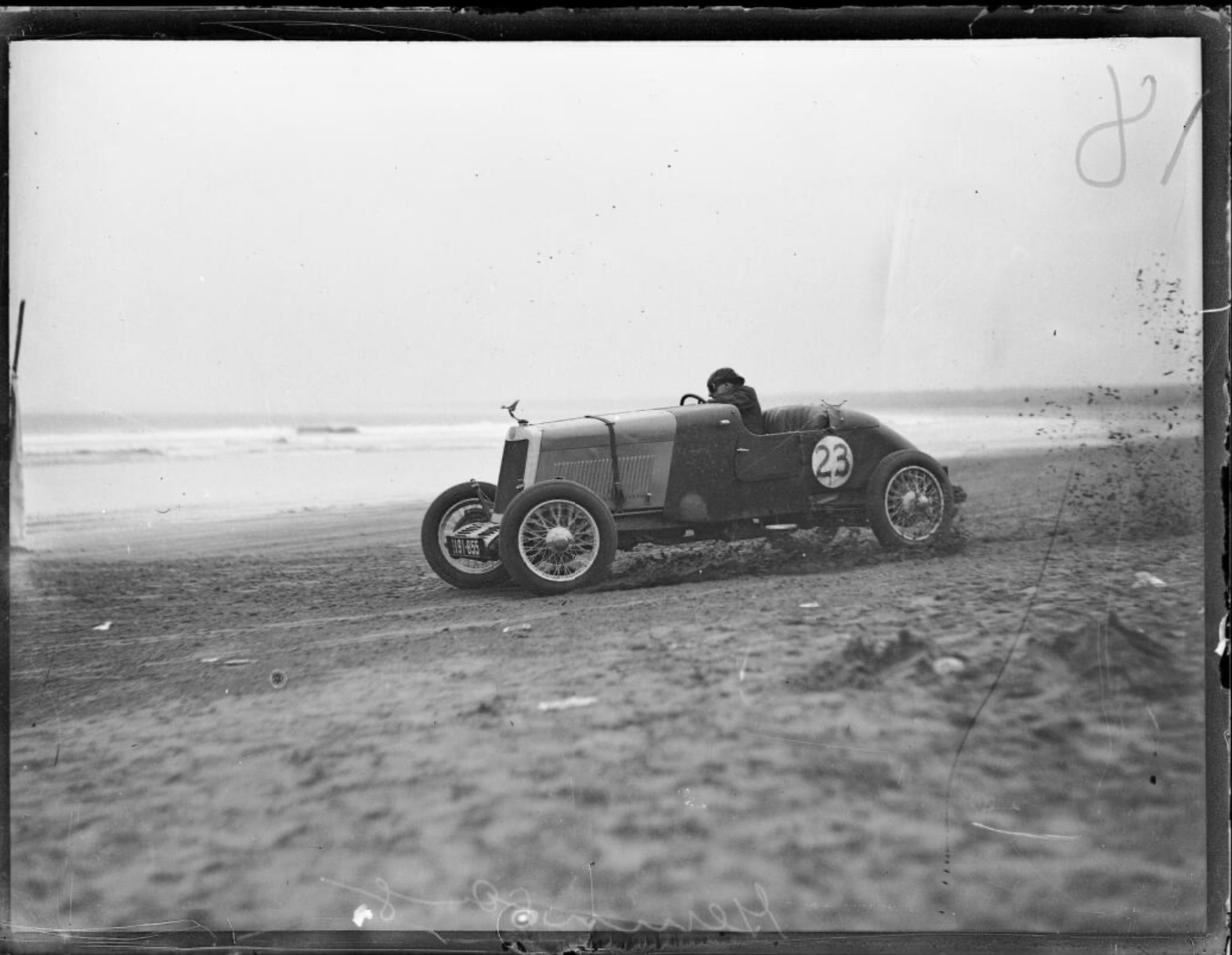
A C ‘Mick’ Carlton and passenger aboard his Lea-Francis Hyper 1.5 s/c, chassis number #14041 during the sprint meeting at Safety Beach, Dromana on Melbourne’s Mornington Peninsula, Saturday 7 December 1929…
It’s amusing to think that a century ago motorsport took place on land upon which at least two of our Victorian readers have weekenders. Let’s deal with the events at Safety Beach first and come back to Mick and Lea-Francis further on.
The Royal Automobile Club of Victoria first ran ‘a long series of motor car contests’ at Safety Beach the year before, Saturday 2 December 1928 on a two mile rectangular, sandy gravel course on the ‘Safety Beach Estate between Mount Martha and Dromana’. Cursory research indicates the venue was used from 1928 to 1932.
About 1,000 spectators attended that day making the long journey by car or steamer from Melbourne to Dromana. No doubt the nascent sport was shown to best effect as the chosen course, held on private property – motor racing on public roads was illegal in most states including Victoria – was placed in a natural ampitheatre of hills including Arthurs Seat and Mount Martha towards which the photograph below was taken.
(Rose)
A familiar view to Victorians from Arthurs Seat across Port Phillip Bay and down towards Dromana and it’s pier – the area to the right before the land starts to rise at Mount Martha is Safety Beach. The settlement in the distance is Mornington – its apex is Snapper Point.
The course was 2 miles 173 yards in length, a nice lap with ‘tests for acceleration over a short run’ and ‘for speed around the full circuit’, more than fifty cars entered.
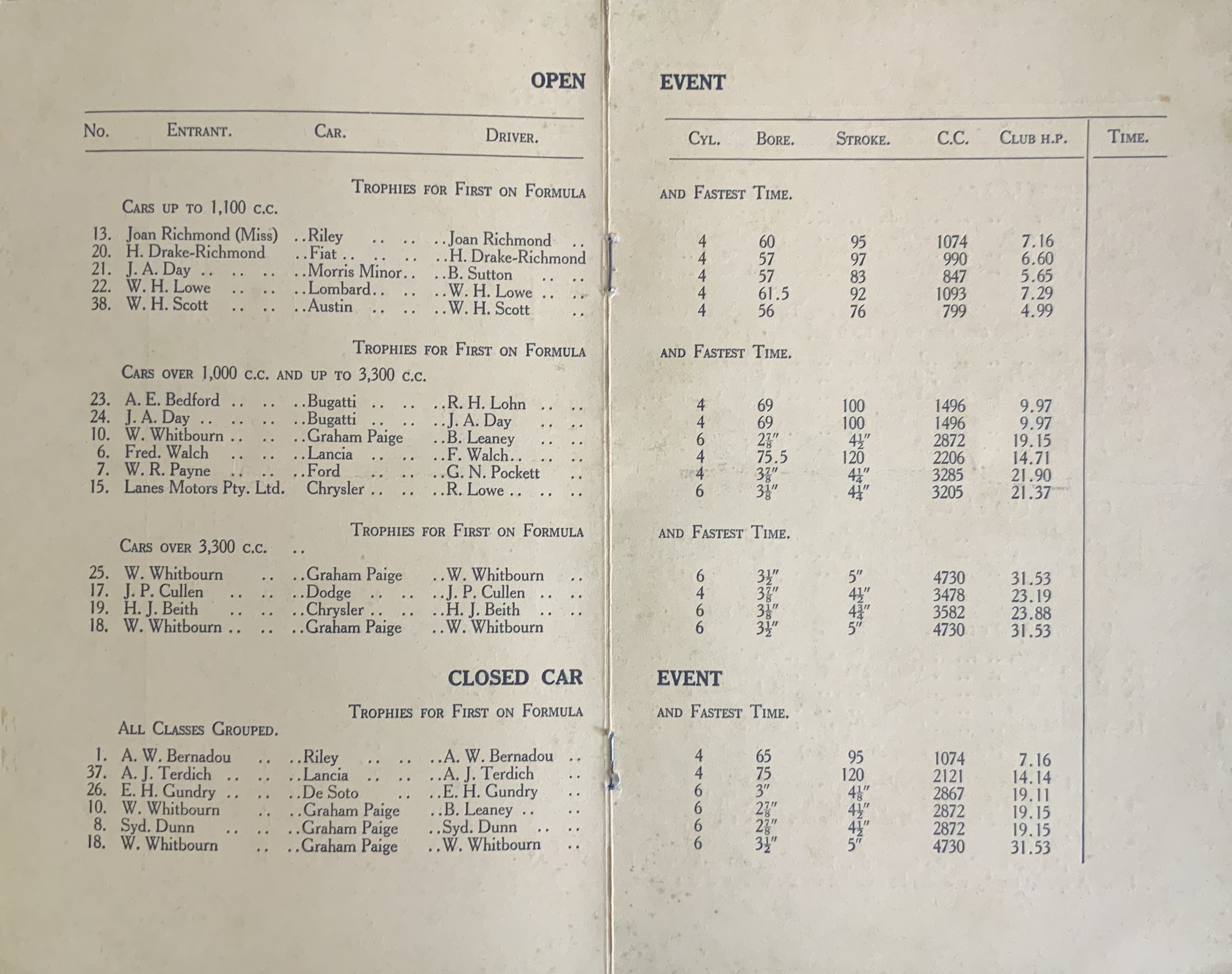
Prominent competitors included Joan Richmond, Riley, and Arthur Terdich in the Bugatti T40 in which he was so quick in the 1928 100 Miles Road Race (The Australian Grand Prix) at Phillip Island in March. Other Phillip Island racers entered included WA Terdich – variously called Bill or Ab – Senechal, Harold Drake-Richmond in the Maurice Shmith owned Fiat 509 and Jack Day’s Bugatti T37 which had been very fast in the latter stages of that first road race in Australia.
Other cars of interest/racers of later prominence included AW Bernadou, Riley, Maurice Shmith in a Bugatti, Herb Beith aboard a Chrysler and Arthur Terdich’s Lancia Lambda, perhaps running his road car in addition his Bugatti.
Ground level’ish view looking from near ‘Anthony’s Nose’, the Point between Dromana and McRae towards the Dromana Pier with a Steamer in attendance, and on towards Safety Beach beyond. The Nepean Highway, then Arthur’s Seat Road, is that ‘quiet little track’ in the foreground (Rose)Harry Cooper’s 4.8-litre Ballot 5/8 LC. Safety Beach, 2 December 1928 (E Adamson photo published in ‘The Argus’ 4 December 1928 via Terry McGrath)
The final event of the day was a five lapper, about 10.5 miles, between the fastest car of the day, Harold Cooper’s 4.8-litre straight-eight 1919 Ballot 5/8 LC ‘Indycar’, which covered the course at an average speed of 59.96 mph, ‘a remarkable performance, in view of the fact that the course was practically a rectangle with four almost right angle turns’, and an aircraft piloted by Keith Farmer.
‘Cooper sped the 10.5 miles, up till the last lap the plane gave the appearance of not been fully extended, but in the run home it speeded up and won. The contest created considerable excitement among the spectators’ The Argus writer concluded.
Other snippets about the meeting were that the serious boys were down the weekend before to test further improvements made in the final week by ‘gravelling and oiling the course’ – shades of Phillip Island final preparations between 1928 and 1935.
That ‘Speedboat racing will be another feature of the programme’ suggests the road was parallel with and very close to the Safety Beach foreshore. The ‘Dromana Progress Association’ looked after the ‘special catering arrangements’ but I doubt ice-cold ‘frothies’ were on the menu.
Noted future Aussie International Joan Richmond made the dailies the following year, 1929, when she overturned her Riley 9 during practice, ‘the car was smashed, but the driver, whilst concussed, and passenger escaped serious injury. Miss Richmond is known as a capable and daring driver.’
Joan Richmond and Mollie Shaw with the Riley 9 Brooklands (the ‘Young Riley’ in Joan-speak) during the 1931 AGP weekend at Phillip Island, fifth outright and second in the 1500cc class. ‘We had to part our hair in the middle to get our helmets on’ Joan quipped. The car was a Riley 9 chassis with ‘a light fabric body made by Mr Thomas of the Elite Motor Body Works’ (unattributed)
Despite the onset of the Great Depression, 3,000 spectators attended Safety Beach again in 1929, the crowd was perhaps bouyed by the two successful Australian Grands Prix held not too far away at the Island in March 1928 and 1929.
Whilst Hope Bartlett’s 2-litre Grand Prix Sunbeam was not entered at Safety Beach, a long way from his Nowra base, there was no shortage of ‘French blue’ exotic racing machines including Alan Cooper’s big, booming Ballot driven so well by brother Harry, as well as the Terdich, Junker, Jenkins, Bedford and Day Bugattis plus Clarrie May’s Austin 7 s/c and Harry Beith’s very quick Chrysler.
By any measure it was a strong entry of cars for the rapidly growing number of racing enthusiasts. The meeting was also a gala social occasion, by the end of the hot summers day the lovely, long cream dresses of the ladies took on the light brownish hue of the dust created by the cars which was readily picked up by the strong onshore breeze. Once may well have been enough for many of the ladies!
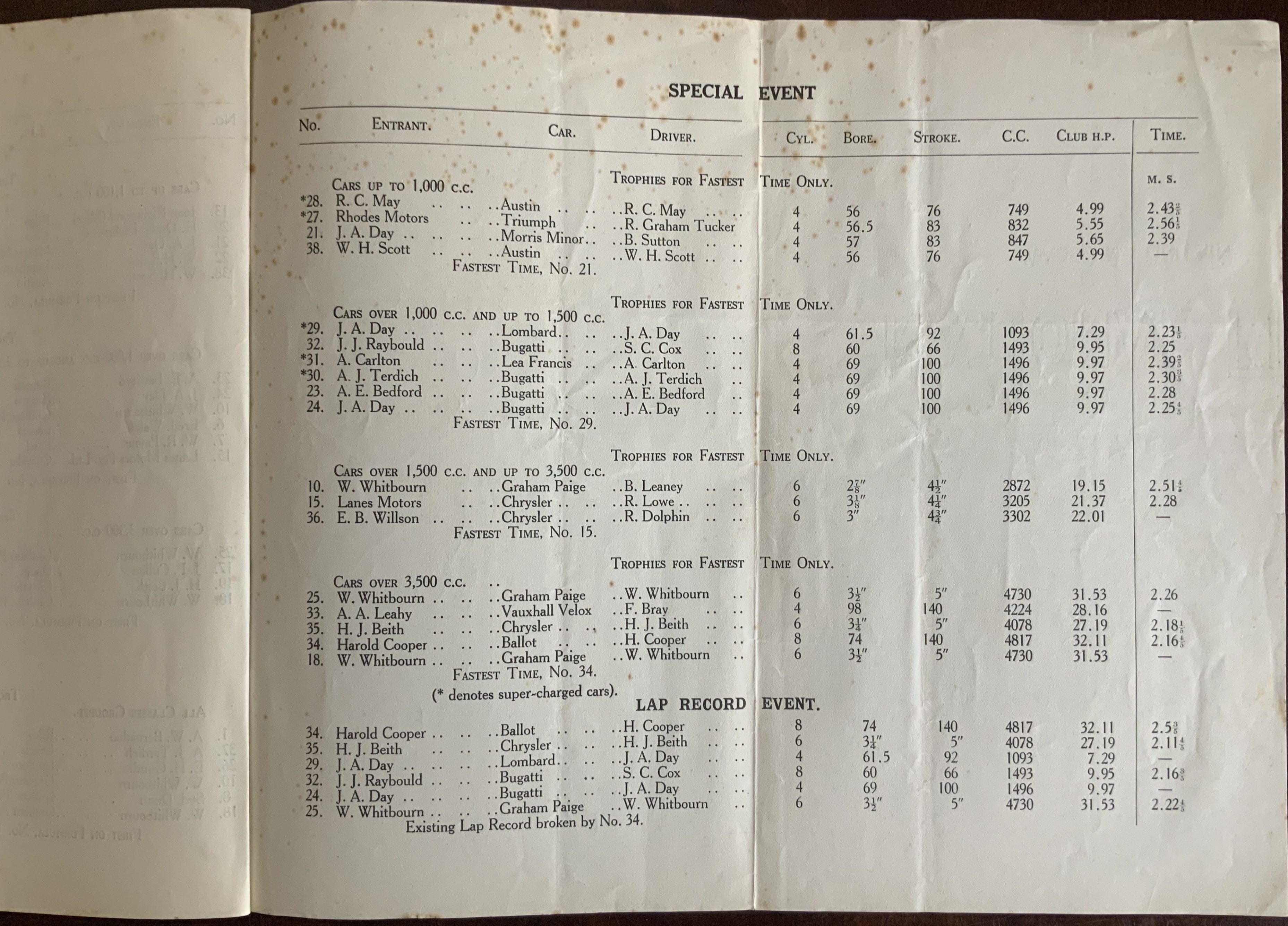
The ‘feature event’ late in the day was a lap record contest for the six cars which made the fastest time of the day, who then ran off to attempt to lower the existing lap record of 2: 6.5 seconds.
The Herald’s advance coverage of the race speculated that the final six drivers/cars may include Cooper, Jack Day’s Lombard s/c (not entered), Arthur Terdich’s Bugatti T37A and Harry Beith’s Chrysler Special.
Cooper, in a repeat of his pace the year before won again aboard the ex-Louis Wagner 1919 Indianapolis Ballot doing a time of 2 minutes 5 3/5 seconds, then came Beith’s Chrysler and Sydney Cox’ Bugatti. Contrary to some reports it appears this event was not a massed start but rather one machine at a time with each getting a ‘flying start of 20 chains’.
The Melbourne Herald put the day in context, ‘In view of the existing ban (which seems to have applied everywhere in Victoria other than the Peoples Republic of Phillip Island, where, bless ’em, the local shire/council basically said up-yours to Spring Street – the Victorian State Government), and the police suppression of events held on public roads, special interest attaches to the speed contest for motorcars…’
In other words a good clean, problem free event would advance the cause of the sport.
By that stage, as noted above, there had been two Grands Prix on Phillip Island’s 6.5 mile rectangular gravel course, at the time its certainty as a venue was far from guaranteed given the absolute constitutional power of the Victoria Government’s sovereignty over and above that the said Peoples Republic of Phillip Island.
I love the local shire’s up-yours-cocko attitude to State law but the Light Car Club and the Shire of Woolamai (aka the PR of P Island) would have been in a pickle, to say the least, had a vexatious litigant had a crack at ’em in the event something went horribly wrong- an errant car killing some punters in the crowd or some such.
Discussions with racers/restorers/historians/authors Tony Johns and Bob King reveal quite a large, and still growing number of Mornington Peninsula venues being identified including the Balcombe Army Camp between Mornington and Mount Eliza and Safety Beach as sprint venues. Frankston, the Moondah Estate in Grices Road (now Kunyung Road) Mount Eliza, Arthur’s Seat, Cape Schanck and Dromana all held hillclimbs.
Who can add to this list?
Dromana Hotel on what is now the Nepean Highway, grand accomodation for the competitors (Rose)
The bountiful land, streams and blue waters of the bay were the home and playground of Australia’s indigenous people for sixty-thousand years before we whiteys rocked up, it didn’t take too long for entrepeneurship, money and steam power to open up the bay.
Steamer services extending to Frankston, Mornington, Dromana, Sorrento, Queenscliff and other places in addition to railway lines to Frankston, Mornington and Geelong opened the new colony in the 1880s.
In days of yore before car ownership became commonplace post-war (WW2) people stayed in hotels and guest houses on their holidays in country and coastal locales such as those listed above. This is the reason we have still large numbers of grand, if often run-down hotels and guest houses in places like Mornington, Sorrento, Queenscliff, Lorne, Port Fairy, Daylesford, Healesville, Mount Beauty and other places, to stick with Victorian examples.
Many such properties were torched in ‘Jewish Stocktakes’ (as my dad in the politically correct (sic) fashion of the day described) in the fifties and sixties as burgeoning car ownership extended the reach of the average citizens holiday horizons beyond many of the towns listed. Many establishments in these places were no longer viable so a surruptitious phone call to ‘Louie da Torch’ and a brown paper bag full of pound notes was not uncommon with insurance assessors not having the forensic services to hand as a defence to the obvious the way they do now. My great-grandfather’s guest house, ‘Montpellier’ in Healesville went up in smoke thanks to Louie’s intervention a decade or so after the family sold it.
Nepean Highway at Dromana looking west towards McRae/Portsea- makes and model folks (unattributed)
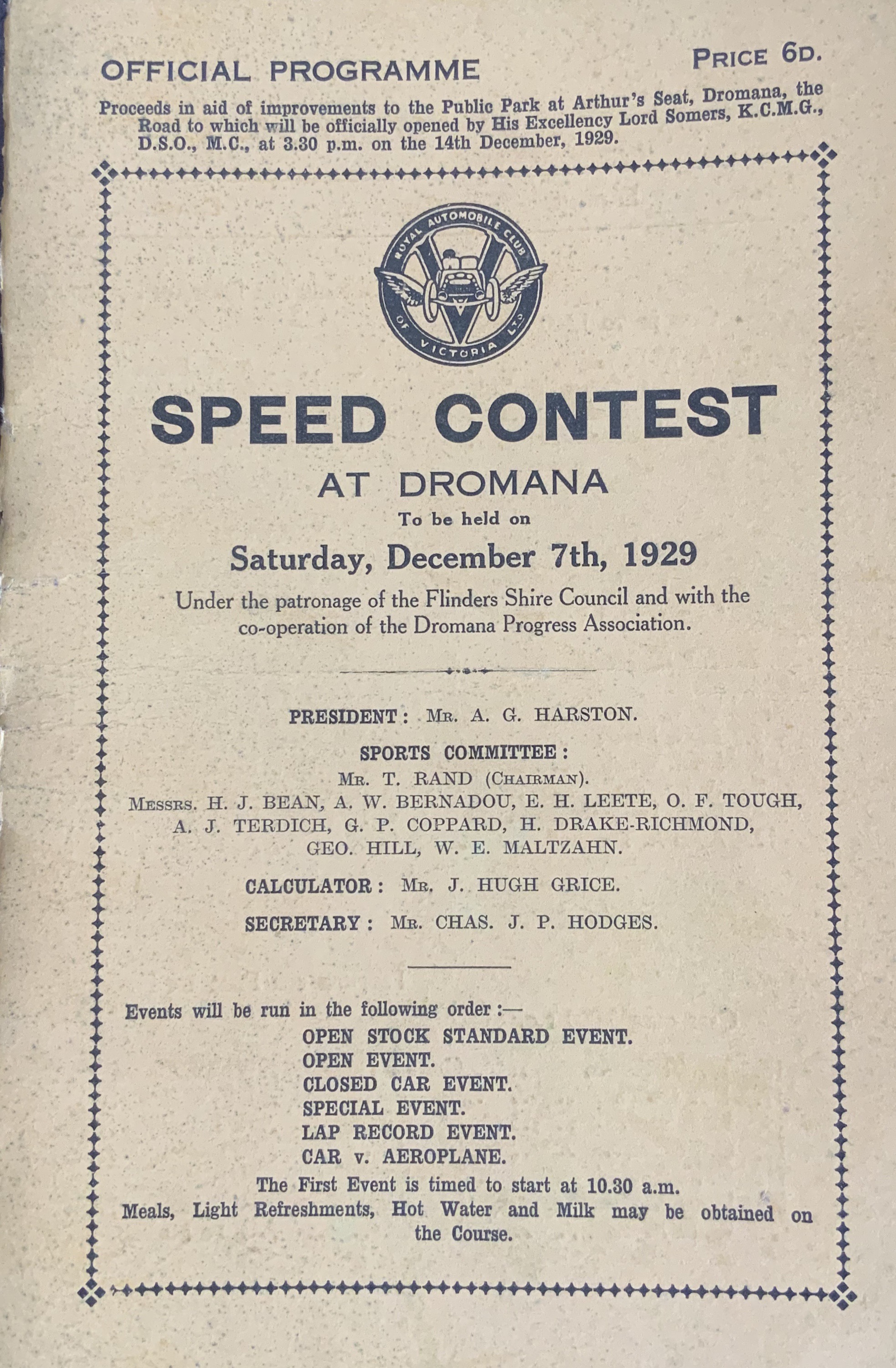
The Herald’s December 1929 event coverage very kindly summarises the Supp Regs which are interesting, the deft hand of officialdom was as prevalent then as now – not quite as bad as now perhaps!
There were five classes- stock standard (aka Group E ‘Series Production’!), open, closed car, special and lap record.
The stock standard event was open to any financial member of the club (RACV) whether connected with the trade or not, but sports model cars were ineligible. ‘A stock standard car is one regularly supplied to the public in the usual way of the trade and fitted with standard type body, hoods and guards. The windscreen can be removed and the carburettor and magneto timing adjustments altered.’
‘In the open event, sports models are eligible, but super-sports models, special cars and supercharged cars are ineligible…cars must run in complete touring condition with proper body guards, hood, lamps, efficient silencer and carry a spare wheel, or spare rim with tyre attached.’
‘Women will not be permitted to drive in the event unless they are the bona-fide owner of the entered car.’ In a an interesting twist of logic ‘For the closed car event sports models are prohibited, but women are allowed to drive’ – which i guess means if ‘the wife’ drives the family machine down to the shops to Domain Road they can have a crack at the race.
‘The special event is open to any financial member, and cars can compete fitted with superchargers and stripped of guards, screens, hoods, batteries and spares. Lady drivers are ineligible’. Given the differentiation between ‘women’ and ‘ladies’ i wonder if ‘women’ could compete in the special event that ‘ladies’ were specifically excluded from. Hmmm, one for the lawyers.
Whilst the Victorian Light Car Club limited its Australian Grand Prix to cars of a maximum of 2-litres supercharged or otherwise, this event was divided into 850cc, 1100cc, 2200cc, 3300cc and over 3300cc classes, hence the great variety of cars.
Etcetera…
(B King Collection)
It’s funny how stuff sometimes happens.
I was over at Bob King’s place raiding his photo archive to do the 1928 Australian Grand Prix magnum-opus a few weeks ago. At the end of that exercise we were talking gobshite and going through some other stuff- Herald-Sun shots Bob rescued from the ‘to be chucked out’ pile.
The Mick Carlton Lea Francis shot, marked ‘Safety Beach 1928’ caught my eye – ‘WTF is that Bob? I’ll have that one please!?’ ‘Safety Beach, well bugger me!’, in the words of the great George Pell, I thought.
So off I go – Trove away and learn some new stuff, happy days and draft most of this piece. Then I went back to Bob’s for another Covid 19 friendly play-date last week and lo and behold, in amongst a relatively small number of old ‘programmes’, was the program for the meeting- and the results sheet! Sometimes, ya just get lucky.
(B King Collection)(B King Collection)(B King Collection)(B King Collection)(B King Collection)(B King Collection)(B King Collection)
Peoples Republic of Phillip Island Postscript…
I really have been enjoying my ‘Peoples Republic of Phillip Island’ jokes, even if it they were becoming a bit thin.
A quick glance of John Blanden’s ‘A History of Australian Grand Prix 1928-1939’ 1929 race chapter reveals that constitutional matters were finally in hand and that succession of the smallish island in Westernport from the Commonwealth of Australia was finally rendered unnecessary- the battalion of Lee Enfield 303 toting sheep famers could be stood down.
‘At the (1929 AGP results prize-giving) presentation smoke-night at the RACV Hall in June , Arthur Terdich was presented with first prize, a cutlery cabinet. In addition Wally Robertson received a clock, Noel Langton a silver cup, Reg Brearley a knife chest, Harry Jenkins a pair of binoculars, Jack McCutcheon a manicure set and John Bernadou the RACV trophy.’
Of all the class place-getters only poor old Cyril Dickason and Bill Lowe didn’t get gifts- what a bummer, mind you, given the offerings perhaps they considered themselves the fortunate ones!
To matters more germane.
‘Mr Daly of Phillip Island Council, speaking on behalf of the residents, announced that after negotiations with Brigadier-General Blamey, the Country Roads Board and the Public Works Department, a Bill was to be passed through State Parliament to enable racing to be held on twelve days a year.’
‘Until this time the events had technically been held illegally. However, the authorities had acknowledged the benefits to the island and so the bill had been drafted’ Blanden wrote.
All of the two-bit constitutional lawyers amongst you will advise your clients that a bill does not become law until it passes the two houses of the Victorian State (Tammany Hall) Parliament and gains royal assent – that is the State Governor signs the bill over a gin and tonic or three.
Lets assume though, that the process above was all hunky-dory by 24 March 1930 which makes the 1930 AGP the first held at Phillip Island which was held legally. I Luvvit given all of the ‘Pillars of The Establishment’ involved…
A.C. ‘Mick’ or ‘Mike’ Carlton…
I started this article with a shot of Carlton’s Lea-Francis Hyper, remember?
He was a Melbourne Herald ‘muttering rotter’ in the words of the great Australian motoring writer Romsey Quints aka Bill Tuckey (motoring writer). John Blanden records Mick as a journalist with RVA Automobile & General News Service, whatever the case he was a motoring writer.
Carlton used the car from at least 1929 to 1931 extensively in trials, hillclimbs, reliability events, speed events such as Safety Beach and an Australian Grand Prix. He rode with Harry Jenkins to fourth place in a Bugatti T30 at Phillip Island in the 1929 AGP and then jumped to the other side of a car in 1930 – aboard the Lea-Francis. In its pre-event publicity The Herald wrote that Carlton ‘had in this car one of most formidable British entries, in its new very low built form it should prove extremely fast, while it’s strength and comfort should both prove helpful in the long race’ of 200 miles.
Come raceday the little car failed to finish after Mick left the road at ‘Young and Jacksons’ corner on lap 2 where he ploughed through a hedge and damaged a wheel which he replaced with the spare. He restarted but withdrew as the rear axle was damaged in the off, the race was won by Bill Thompson’s Bugatti T37A.
These little Cozette supercharged 1496cc, pushrod OHV Meadows four cylinder powered two-seater ‘Leafs’ would have been a really cost effective ‘all round’ machine for Australian motorsport at the time. The car below is chassis #14099, this Hyper was owned and raced by Mrs JAS Jones and other drivers on her behalf in New South Wales. Ian Goldingham advises ‘the story of the Australian Hypers is steadily gaining momentum…with at least six, maybe seven Lea-Francis S Type Hypers’ delivered to Australia ‘in period’.
Beach racing of another kind. Mr RG Potts in the JAS Jones owned Hyper on Gerringong’s Seven Mile Beach, NSW on 10 May 1930 (Fairfax)Vida Jones in her Hyper, date and place unknown (A Patterson)None of them look happy, a bitter Melbourne winters night during, or perhaps at the start of a trial, Mick Carlton is the guy with the peaked cap looking sideways third from the right. The Lea-Francis was fitted for this event with its touring body (I Goldingham Collection)Shot as above uncropped – both Hyper and Lancia Lambda are Carlton’s cars. The ‘Metropolitan Ice & Fresh Food Co Pty. Ltd’ was located in North Melbourne and had a ‘storage capacity of 60,000 mutton carcasses’, handy to know – the location is outside their front door it seems. The spot has the feel of an event starting point about it with competitors very well rugged up. Checkout the guy second from left at the back – he looks like a crook from central casting – one of Squizzy Taylor’s gang maybe! (I Goldingham Collection)
After publication Kiwi Lea-Francis owner/restorer/historian/enthusiast Ian Goldingham made contact and provided additional photographs and this information from Max Gregory’s ‘Lea-Francis in Australia’.
‘In Victoria both A Charlton and R Whiting used their Hypers competitively, former Bugatti conductor, Mick Carlton being the most notable.’
‘He was a thoroughly dedicated competitor who left nothing to chance in his preparations and had bought the car in chassis form, for which he obtained two bodies, a tourer and a racing monoposto, which were alternated as use dictated.’
‘Mr Phil Smith recalled how he and some Robinsons mechanics served as Carlton’s pit crew for the 1930 Grand Prix at Phillip Island. Unfortunately Mick lost time with an unscheduled pitstop and was attempting to make up ground when raised dust from a spin-out at Young and Jackson’s caused him to take to the ti-tree scrub, bending his axles.’
‘Mr Smith also remembered Carlton entering a fuel economy test sponsored by Commonwealth Oil Refineries (now BP) and his preparations went as far as removing the supercharger and some piston rings and replacing wheel bearing grease with oil. A great deal of fine tuning was done as the car was driven round and round the Albert Park Lake and all to good effect as the car was a clear winner.’
‘A more appropriate victor for the Hyper which came to mind was the climb at Wheelers Hill in 1931. Mr Smith retains a vivid memory of Carlton cresting the hill at a speed of 83 mph from a standing start. Bob Chamberlain also has a keen memory of that day when the existing record was broken three times, as not only did the Hyper make fastest time of the day but the Chamberlain Special, first time out with Norton barrels on the Indian crankcase, and a Bugatti also beat the old record. Mick Carlton late the motoring news for the Herald newspaper in Melbourne’ Max Gregory concluded.
Mick Carlton ‘in the cockpit of his locally bodied car of which we know very little’ wrote Ian Goldingham (I Goldingham Collection)
Utterly Irrelevant and Pointless…
(B Gaica)
Lea Francis of a different sort.
Have I flagrantly glorified the fabulous female form in publishing this beautiful photograph? Yep, guilty as charged, but only in the name of art of course.
The Sydney Dance Company performed Louis Falco’s ‘Black and Blue’, a fabulously vibrant work to the music of Harry Nilsson in 1994. I’m getting there, the connection is coming my friends.
The stars of that show were Alfred Taahi…and…da dum – Lea Francis! And I have to say that ‘Leaf’ looked even better in the flesh, every single cell. Just like the Lea-Francis Hyper…
Reminds me, Nilsson Schmilsson was such a good album, ‘wannit?
Credits and references…
Bob King Collection, The Herald 12 May 1924, The Daily Telegraph Sydney, 14 November 1925, JJ Maher in the Sporting Globe 27 April 1927, Melbourne The Argus 3 December 1928, The Herald 13 November 1929, Rose Postcards, Dromana Historical Society, ‘Skilful Skidder’ aritcle by Harry Miller in the 2 December 1928 Sporting Globe, Sporting Globe Melbourne 29 December 1928, Smiths Weekly 23 August 1947, Fairfax Corporation, Branco Gaica, Terry McGrath Motoring Archives, Ian Goldingham Collection including an excerpt from Max Gregory’s ‘Lea-Francis in Australia’, Adrian Patterson
Tailpiece…
(unattributed)
I’m not so sure the pipes would ‘slay the babes’ these days but it is a fun Dromana shot all the same, and yes, there are still heaps of bathing boxes today all gayly painted in vivid colours.
Talbot-Lago T26C with a swag of teenage fans surrounding it in Queensland we think …
There was a bit of unresolved mystery about this shot when it was first posted by Mark Tumby on Bob Williamson’s Facebook page a month ago.
The discussion centred around whether it was Ralph Snodgrass in Whiteford’s second arriving in Australia but early chassis- ‘110002’ at Lowood but only if it was before 6 June 1957 when Snodgrass rolled it at Mount Druitt and then popped it under his house for twenty years, as Rob Bailey pointed out. Rob then mused as to whether it was his father, Owen Bailey in Whiteford’s first Lago, chassis ‘110007’ at Lowood, ‘that would make sense as he was running a family business in Noosa at the time’.
Interesting but still foggy at this point.
(M Tumby)
I circulated the first photograph to ‘wise owls’ Stephen Dalton, Bob King and Tony Johns yesterday- the boys quickly identified the car as the 1952 and 1953 AGP winner ‘110007’ by comparative analysis of windscreen and body slots around the grille.
As to the who and when questions, Stephen observed ‘Finding Queensland programs and entry lists is very hard for this era and it tends to be one ex-Bomber runway looking the same as the other. Here though, the trees tend to tell me not Lowood. I’m tending to think Strathpine which had a thin row of trees on each side.’
‘I’m not committing to stone, but i think its the Ken Richardson era, after Rex Taylor, so mid-55’ish. Then you get the problem of some Leyburn meetings in this timeframe too. Ken won a race at the 4 June 1955 Strathpine meeting, the August 1955 issue of ‘Modern Motor’ has a photo but no clear number…’
Stephen suggested a peek on Trove- which i have just done in brief, there are lots of entries for Taylor, tougher pickings for Richardson in the Talbot-Lago at least- plenty of mentions in his Cooper.
At this stage Rob Bailey did a bit more research- see his responses today, including a careful forage through the two volume Talbot-Lago books which reveals that it is Ken Richardson during a Leyburn sprint meeting in 1955.
Dalton, ‘Now that i’ve looked a little harder in my Leyburn file there was an event in July 1955 too, it was very briefly reported in ‘Wheels’ October 1955.’
’Richardson must have been a decent steerer. He was third behind Davison and Pitt’s nimble Coopers with the Lago at the September 1955 Australian Hillclimb Championship on narrow and tight Prince Henry Drive…’
As to all the young blokes in the shots- maybe a local boarding school outing on a Friday or weekend?
I don’t have ‘an article’ on the ‘Talbot-Lago T26C’ but key that into the primotipo search engine and four or five pieces with plenty of photos will pop up.
Credits…
Mark Tumby, Rob Bailey, Stephen Dalton, Bob King, Tony Johns
James Courtney’s Dallara F302 Toyota-Toms races to a good win in the first leg of the Fiftieth Macau Grand Prix on 16 November 2003…
He also led the second leg, and set the weekend’s fastest lap until a puncture eliminated him on the races eleventh lap, Nicholas Lapierre won, and having finished second in the contest’s earlier race won the GP overall- the field included later F1 drivers/test pilots Nico Rosberg, Lewis Hamilton, Nelson Piquet Jnr, Robert Kubica and Ryan Briscoe, a total of thirty contestants in all.
One of the British F3 Championships top runners in 2001 and 2002, James was rebuilding his career after a massive, very high speed shunt at Monza aboard an F1 Jaguar R3 Cosworth came close to ending his life.
That year he was mixing an F3 campaign in Jaguar’s team with Grand Prix car test duties- his F3 season started with a bang- he won the first round of the British F3 Championship.
Courtney, Jaguar R3 Cosworth at Silverstone in 2002 as is the shot below. Malcolm Oastler designed car was launched on 4 January that year
Race drivers for Jaguar in 2002 were Eddie Irvine and Pedro de la Rosa, the cars designated R3/R3B were powered by Cosworth CR-3 and CR-4 3 litre 72 degree V10s.
The team were testing at Monza on July 2- the circuit at which James made his F1 test debut the year before when he suffered a rear suspension failure at 10.14 am- he was on the brakes at 330 kmh when a wishbone pulled away from its gearbox mounting, pitching him into the barriers at 306 kmh- the machine hit the fence so hard that it bounced away from the wall at 70 kmh- the impact was estimated to have a force of 67G, an incredible impact for the body to absorb.
Unconscious, his first sight was Michael Schumacher who was testing his Ferrari at the same time- James freaked out when he found he could not move the right side of his body and was bleeding from his eyes.
He later said ‘It took me a year to recover, i couldn’t walk without getting a migraine- which anything would set off.’ He also said that he could not see for weeks after the accident, and that he decided at that point never to be scared of having a crash again, stating ‘Its over if you are scared. Its all or nothing’ in an amazing exercise of mind over matter.
He did test again the following year but his F1 chance was gone.
The young Australian, born in Penrith between Sydney and the Blue Mountains on 29 June 1980 was amongst the brightest of young kids with the most prodigious of raw ability amongst his generation and the steepest of career trajectories.
In Karting he won locally before finishing second in the 1994 Australian National Kart Championship, at 15 he moved to Italy to pursue a racing career winning the World Junior Karting Championship and CIK International Championship in 1995 and was World Formula A champion in 1997.
Into 1999 he shifted from Italy to England to race cars becoming a member of the works Duckhams Van Diemen Team finishing fifth in the British FF Championship, in fourth was fellow Aussie Marcos Ambrose, the title won by Nicholas Kiesa’s Mygale. In addition he was second in the Formula Ford Festival- he went all the way in 2000 winning the championship aboard a works Van Diemen.
A veritable youth or kid- date and Kart spec welcome? (Aaron Noonan/an1images.com)
Courtney’s skills and Allan Gow’s management bagged him a place in the Jaguar Junior Team for 2001 contesting the British F3 Championship driving a Dallara 301 Mugen-Honda.
Whilst he won at the Silverstone season opener it was consistency which placed him fourth in the title chase won by Taka Sato from Anthony Davidson and Derek Hayes. In a year of dominance Sato won twelve of the twenty-six races- all three of the drivers raced Dallara 301 Mugen Hondas.
British F3 Championhip, last round- Silverstone, 29 September 2001, Dallara F301 Mugen-Honda. A pair of fourths that weekend, Taka Sato the winner of the race and championship (P Spinner-Getty)
Into 2002 Courtney again raced for Carlin Motorsport racing a Dallara 302 Mugen-Honda as did title winner Robbie Kerr- Courtney won four races whilst Kerr won nine and finished ahead of Courtney and Heikki Kovalainen.
The gruelling championship which has produced so many talented drivers down the decades comprised two races at each of thirteen venues, a format which tests prospective future F1 stars thoroughly.
Courtney circa 2002 (Getty)
2003 ended up being a rebuild year noting the physical aspects the Monza accident inflicted upon the young charger.
James chose to do the Japanese F3 Championship racing a Dallara F302 with punchy Toms Toyota 3S-GE engine- Mugen-Honda and various Toyota tuners engines were the most common in Japan with Three Bond Racing using Nissan SR20VE motors.
In another year of dominance James won thirteen races in the ten circuit tour finishing in front of Paolo Montin and Tatsuya Kataoka.
If there were any doubts about the loss of Courtney’s raw pace in ‘that shunt’ it was well and truly dispelled when all of the stars of the year met at Macau for the F3 ‘Grand Final.’
Macao GP 2003 Dallara F302 Toyota, #32 is Hiroki Yoshimoto
None of the 2002 F3 brigade got F1 seats in 2003- James Courtney, Nico Rosberg, Lewis Hamilton, Nelson Piquet Jnr, Robert Kubica and Ryan Briscoe- all would get their chance of course and two of them did, and still do rather well!
Toyota continued to support his career in 2004 and 2005, he contested the All Japan Grand Touring Car Championship for sixth and second places respectively aboard Toyota Team TOM’s Supras.
His first appearance ‘back home’ in quite a while was with the Holden Racing Team in 2005 he contested the endurance races partnered by Jim Richards who was perfectly placed to assist the Supercar ‘newbee’ with the nuances of these powerful, heavy, demanding cars.
Courtney aboard the Toyota-Toms Supra during the All Star 200 at Fontana in December 2004, he shared the car with Tatsuya Kataoka (L Miller-LAT)
Courtney at the 2010 Sydney 500- James won the title whilst Jonathon Webb and Lee Holdsworth took the round race wins. Ford FG V8 Supercar- 5 litre pushrod V8 circa 465Kw @ 7,000rpm, 6 speed manual sequential gearbox, 1355Kg (Getty)
Courtney raced for the Stone Brothers Ford operation from 2006 to 2008 taking his first round win at Queensland Raceway in 2008- he won the title aboard a Dick Johnson Racing Ford FG Falcon in 2010 taking five wins and finishing ahead of 2009 champ Jamie Whincup.
In recent Covid 19 times he has been in the news with a shift of team- probably the last spin of the Supercar Roulette Wheel for the soon to be forty year old.
Still, this article isn’t about V8 Supercars- i think its great that a young fella from out west has forged a career of his passion for the better part of thirty and a bit years- his lifestyle on the Gold Coast would be splendid but man what couldaa been but for that testing accident, at that speed, at that circuit- i always thought at the time he really was the goods and looked a good bet to go all the way towards the top of the pyramid…
Etcetera…
(unattributed)
James Courtney back to his roots at Queensland Raceway in 2015 aboard one of the Karts he had commenced to manufacture and market that year.
Photo Credits…
Aaron Noonan and an1images.com, Getty Images, P Spinner-LAT, Crash, L Miller-LAT, motorsport.com,
Tailpiece…
The broken rear wing element of the R3 with Courtney aboard earlier in the year is almost a portent of rear end of the car things to come soon after- Silverstone 2002.