Archive for the ‘Who,What,Where & When…?’ Category

(N Tait Collection)

Frank Matich listens intently to the basso-profundo engine note of his Repco Brabham 4.8-litre, quad-cam RB760 V8 at Calder Park in early 1969…

Nigel Tait – the current custodian of the Matich SR4 Repco – and I did an epic piece about this 1969 Australian Sportscar Championship winning car years ago, so best not to rabbit on again, see here; https://primotipo.com/2016/07/15/matich-sr4-repco-by-nigel-tait-and-mark-bisset/

What caught my eye are the cool-dude Simpson Firestone works-driver fireproofs and his even more schmick Heuer Autavia watch. I defer to you horologists on such matters, but I think that’s what it is. And yes, to head off the state-the-obvious among you, the watchband is different.

(unattributed)

Credits…

Nigel Tait Collection

Tailpiece…

FM tips the SR4 into Peters corner at Sandown in 1969, points awarded for ID’ing the driver of the Lotus 23 or whatever it is.

By the time this ad appeared in late 1969 or 1970, Matich had switched his affections away from this sportscar to a McLaren M10A Chev single-seater, with the Repco-Holden F5000 5-litre V8 in its early stages of development. See here; https://primotipo.com/2015/09/11/frank-matich-matich-f5000-cars-etcetera/

Finito…

(B King Collection)

This is the first in an ongoing series of pieces based on my (vulgar) first response to a photograph that makes no sense to me. Regular readers will appreciate that an inferior intellect like mine elicits such responses often.

When I first saw the photos – the first one above and the second last – I thought no way were they in Australia, both had a USA feel to me, wrong on both counts.

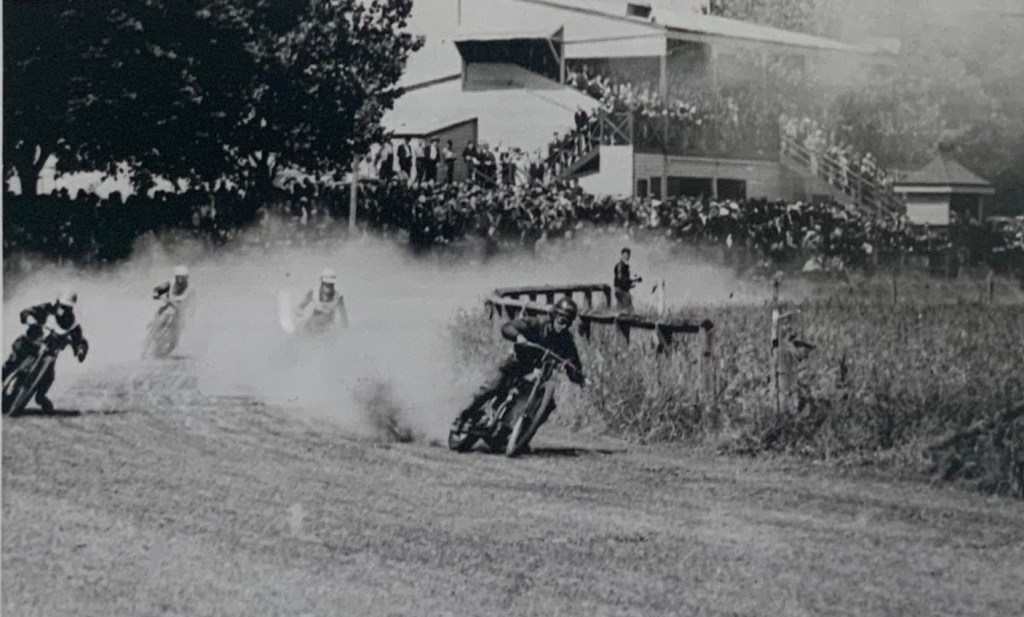
The first is from me’ mate Bob King’s Collection and was taken at the Warragul Showgrounds pre-War. The last was shot at Drouin, just up the road, that both photographs were taken in two small West Gippsland townships close together 100km to Melbourne’s east is coincidental.

King’s caption for the ‘bike race photograph reads “Darby – in front – was killed in this race.” Sadly that is the case. A bit of judicious Troving confirms that the small Warragul community ran grass-track meetings on their local showgrounds from the mid-1920’s until 1941, with a final meeting, perhaps, in 1953. Ploughing through the results of meetings in the 1930s revealed that Leslie Edwin Darby is our man.

The Auto Cycle Union of Victoria sanctioned events were usually run over the Easter long-weekend on a track “6 1/2 furlongs” (1308 metres) long, timed after the speedway and trotting (nags) seasons had ended, these ran from November-April. As the photo shows, the crowds were huge, 6000-8000 people, not bad for community of less than 500 at the time.

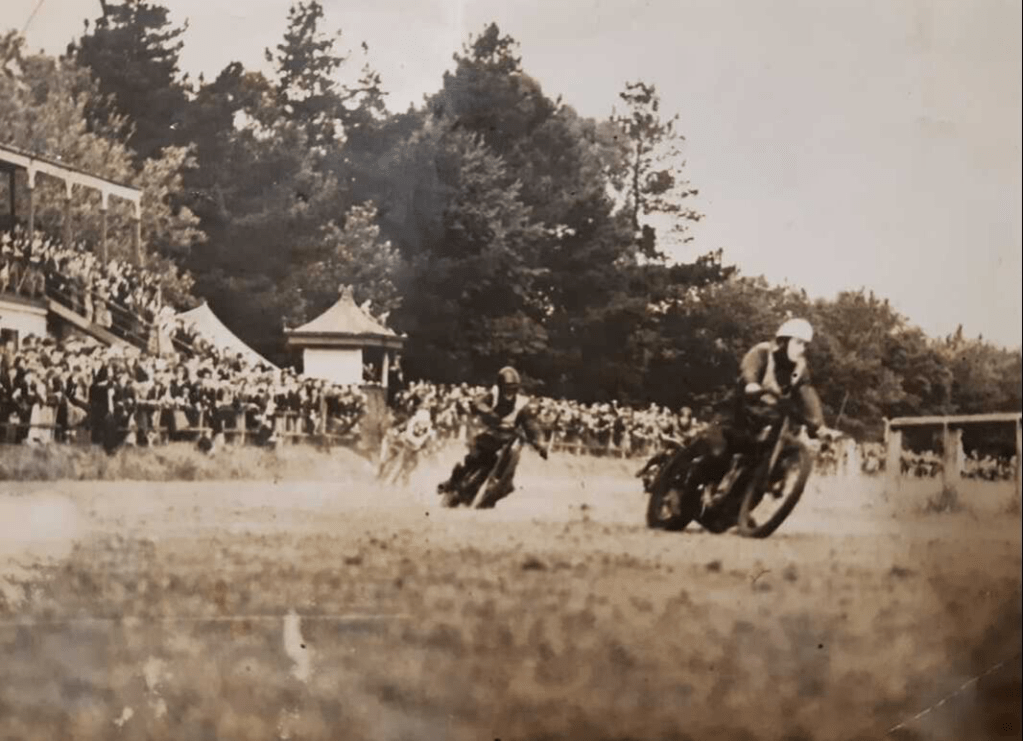
Warragul Showgrounds really looks a nice place, it’s still there too. I often go the long way to Phillip Island via Drouin-Poowong-Loch-San Remo, a fabulous driving road devoid of The Fuzz, so time to do a Warragul detour next time. No details of the above (SRRH)
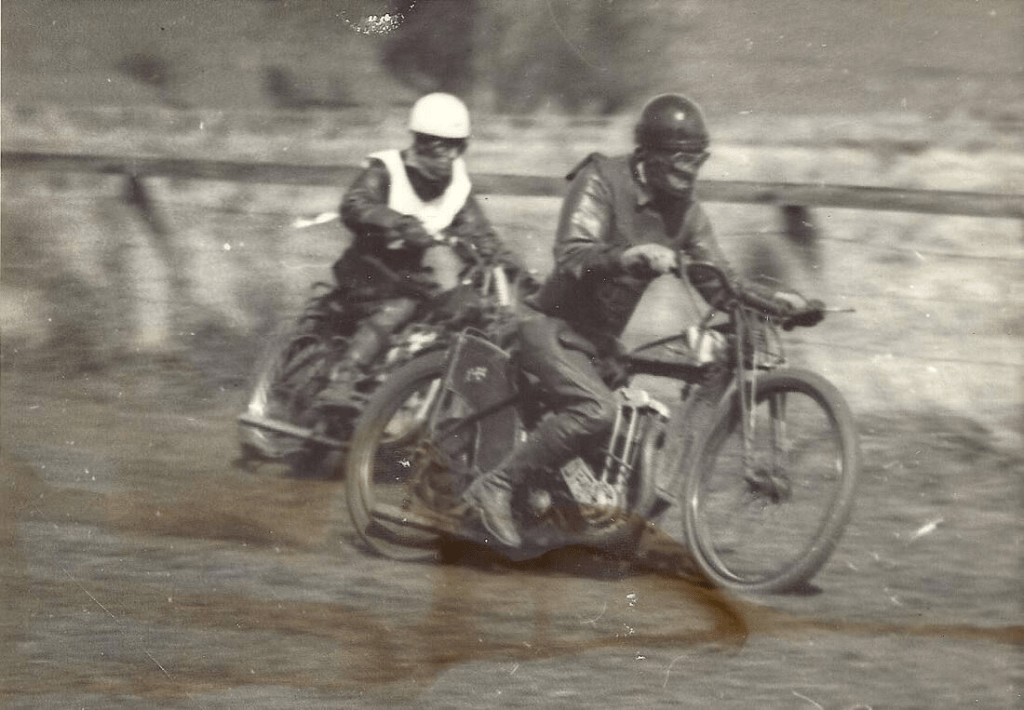
Two riders at Warragul, no details (SRRH)

Darby was a star of the sport, holding over 30 Australian and Victorian grass track championship wins and over 150 placings. He had won four Victorian and Australian championships at Warragul in the 350 and 500cc classes. He also competed with success in road racing, holding the 250cc lap record at Phillip Island, in 1937 he set FTD at Rob Roy hillclimb, besting all the cars present.

Showing his adaptability, Darby also contested sidecar events, winning the Victorian Sidecar Championship in 1934, and placing third in the famous Victorian Tourist Trophy at Phillip Island held over 75 miles that same year.

Les had a lucky escape at Warragul in April 1936 when he crashed at high speed, somersaulting over a perimeter fence when his ‘bike struck it. Unharmed, other than by cuts and abrasions, he jumped aboard another machine and won the Australian All Powers Three Mile Championship. Warragul claimed three lives, its variety of ever present dangers were demonstrated by Bud Morrison who was thrown from his bike into an adjoining creek and nearly drowned before ambulance officers intervened, during the same 1936 meeting.

Poor Darby’s luck ran out in tragic circumstances on Boxing Day 1940. Shortly after passing the finish line at the end of the the final of the Gippsland Solo Scratch – in which he was battling Edward Smith for the win – Smith, narrowly the victor, lost control of his machine just after the line and fell. Darby swerved in avoidance and hit the fence at over 70mph before cannoning into the crowd. He was declared dead at West Gippsland Hospital shortly afterwards, aged 32. Two spectators were seriously injured but survived.

Les Darby is buried at Kew Cemetery, close to where I grew up, I shall make a pilgrimage to pay my respects soon.

(The Gazette – Warragul & Drouin)

Thankfully the Drouin shot is happier but no less impactful.

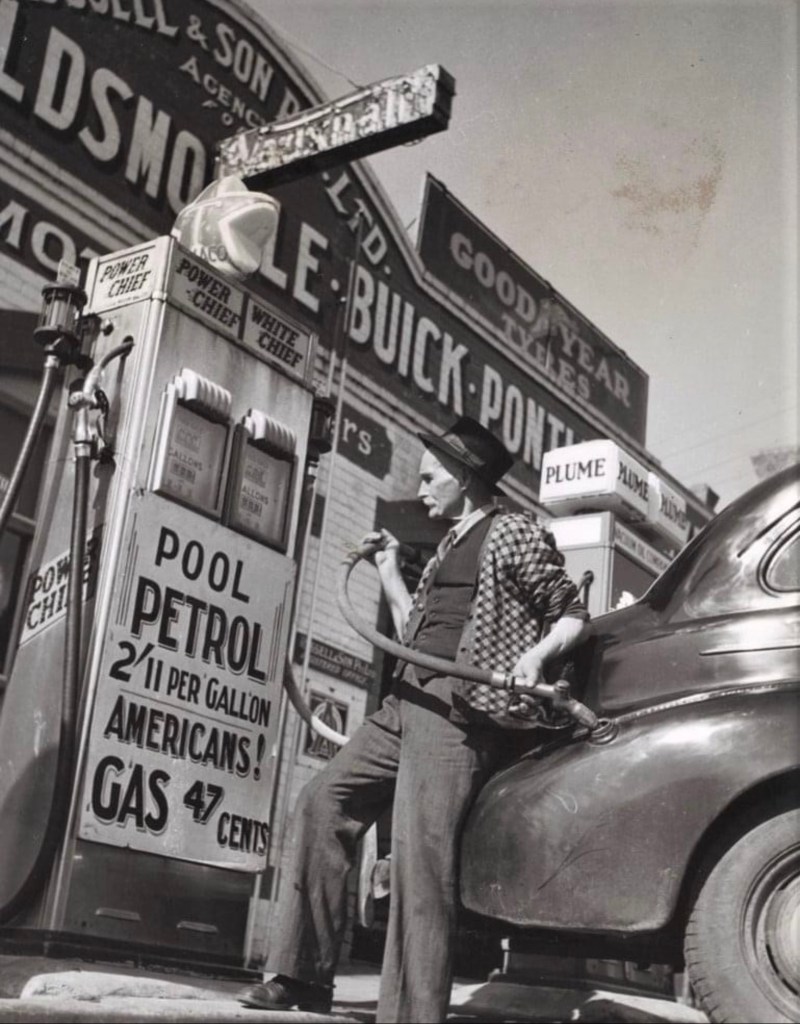
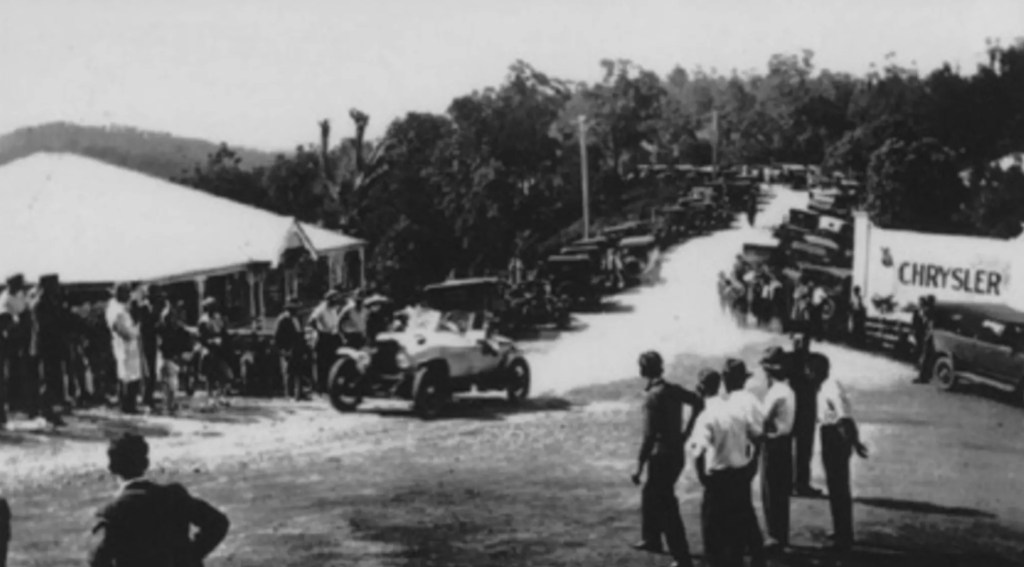
William Russell is putting the four-gallon monthly ration of petrol into a customers car at Drouin in 1944. The sign is for the benefit of United States servicemen using the Princes Highway, a main Melbourne-Sydney artery.

The photo is one of a series of Drouin shots taken by government photographer Jim Fitzgerald (Australian Dept of Information) to document the impact of the war on ordinary people, they were used here and in the US.

William Russel & Son Pty. Ltd. the biggest servo in Drouin had two sites employing 16 people and appears a good business with franchises for Oldsmobile, Buick and Pontiac. Aged 80, William was still on-the-tools…

Born in Brechin, Scotland in 1865, a year later he emigrated to Australia with his parents and older brother, a voyage which took 95 days. William was apprenticed as a blacksmith, wheelwright and coach builder, acquiring the Monroe and Morse, Drouin business in 1890. As horsepower evolved from hooves to wheels the business evolved into a garage, car showroom and servo. William died on May 11 1950 and was such a highly respected member of the local community the hearse taking him on his final journey was followed by over 100 cars.

Credits…

Bob King Collection, Trove – various newspapers, The Gazette-Warragul and Drouin, motorsportmemorial.org, Speedway and Road Race History – SRRH

(B King Collection)

Tailpiece…

After I posted this article I sent it straight to Bob King who provided the shot, or more specifically I scanned it during one of our many illicit, keep-ya-sanity, Covid 19 trysts at his place in the winter of 2020. We Victorians were locked up tighter than a nun’s chastity belt by our beloved Dictator Dan (State Premier Dan Andrews) for most of that year, and a good chunk of 2021, bless the Chinese Alchemists and their magic potions.

His response was “All good stuff, I now recall the name of the patient who gave me the Darby photo, John Soutar, I believe. I think he raced against Darby, my last contact with him was 30 years ago, I just googled Soutars Garage, which is still in Warragul, may be worth a visit.”

There ya go, that explains the WTF photo above.

King’s caption for it is “John Soutar”. The scan was in Bob’s album above the one of Darby in action. I’m sure he made the connection two years ago when we were scanning away, this time the geriatric at fault is me not him…Still, we got there in the end, albeit I think Mr Soutar was a young fan rather than a competitor.

Finito…

image

Poster for the 1934 German Grand Prix at the Nurburgring…

It’s famously the race in which Auto Union took their first GP win. Hans Stuck triumphed in the 4.4-litre V16 AU Type A from Luigi Fagioli, Mercedes W25A and Louis Chiron in a Scuderia Ferrari Alfa Romeo Tipo B/P3.

image

(SSPL)

Grid before the off. #6 is the Rudy Caracciola MB W25A, #20 Goffredo Zehender Maserati 8CM, #1 Hans Stuck AU Type A. Alongside him is the Ulrich Maag Alfa Monza, #9 Luigi Fagioli MB W25A and beside him Laszlo Hartmann’s Bugatti T51, the AU on the row behind Fagioli is August Mombergers, #3 is the Ernst-Gunther Burgaller AU Type A, Hans Ruesch in the middle, Maserati 8CM, and #15 is the Luigi Soffietti Alfa Monza.

fag paddock

(SSPL)

All the fun of the fair. The Nurburgring paddock with only Louis Chiron’s Scuderia Ferrari Alfa Tipo B/P3 in the Eifel Mountains breeze

image

(Imagno)

Pitstop for Stuck’s winning Auto Union Type A, vents and ducts all over, note the torsion bar IFS, swing-axle at rear.

The race was important to the German teams, keen to avenge their defeat at the French Grand Prix, Montlhery on 1 July, where Louis Chiron won in a reliable Alfa Tipo B. The Silver Cars dominated at the Nurburgring where the Alfas and Maseratis were also-rans.

The race was also important for Caracciola’s return to form after his Monaco accident the previous year, and subsequent death of his wife in a skiing accident. His form was confirmed with a forceful drive which ended in retirement. Quick at Montlhery on 1 July – Rudy’s comeback drive after 14 months out of the seat – he showed he was on-it at the Nurburgring.

image

(Imagno)

Rudy Caracciola and Alfred Neubauer before the off, Caratch was back with a vengeance despite needing help getting in and out of the car. Once ensconced he was mighty fast

image

(SSPL)

#22 Battilana Alfa Monza, #20 Zehender Maserati 8CM, #6 Caracciola MB W25A, #12 Maag Alfa Monza, #1 Stuck AU Type A, #11 Hartmann Bugatti T51, #9 Fagioli MB W25A then the Momberger and Burgaller AU Type A’s.

fag

(SSPL)

Fagioli’s Benz W25A, #2 Momberger’s AU and #15 Soffietti’s Alfa before the off. Fagioli was drafted into the team in the event Caracciola was not up to snuff after his convalescence. Luigi knew he had a fight on his hands within the team as Rudy was quick from his Montlhery return.

Stuck’s Auto Union lead early from Caratch’s Mercedes W25A and raced hard, breaking the lap record several times ahead of Fagioli Mercedes, Chiron Alfa P3, Moll Alfa P3 and Nuvolari Maserati 8CM. Rudy snuck past Stuck at the Karussell on lap 13 but the Benz’ eight-cylinder engine failed and he soon retired. Stuck regained the lead, the order was as above except that Momberger replaced Moll in the gaggle.

image

The supercharged 3.4-litre straight-eight of Caracciola’s Mercedes W25A being fettled, plug change perhaps, before the off (SSPL)

image

Stuck on the left getting plenty of attention in the pits, Caracciola on the right (SSPL)

With four laps to go Stuck was concerned about his engine water temperature and signalled as such to his team, who waved him on, only to be told after the race that the team had changed the gauges. What he was reading was oil not water temperature!

Stuck and Auto Union took a great win, Auto Union’s first GP victory from Fagioli, Mercedes Chiron’s Alfa and Nuvolari in a Maserati 8CM but Caracciola was the star of the show and back with a vengeance!

image

(Imagno)

Hans Stuck is a very happy chappy, after 4 hours and 38 minutes of hard work he won the race. Plenty of uniforms around in these shots even in 1934.

Credits…

Kolumbus.f1, Imagno, Science and Society Picture Library, Tony Turner

Etcetera…

(T Turner)

After this article was first posted, my friend Tony Turner sent me these two marvellous photographs and this note.

“Back in 2016 I went for a holiday in Germany. It was only when I went for a stroll around our temporary base in Remagen that I realised that I was in the birthplace of Caratch – the street sign was a definite clue, the sculpture in a little park nearby definite confirmation. I suspect it features the later W125 rather than the 1934 W25. It seems his grandfather (?) founded a big hotel there, which was taken over by successive generations, so the name’s still quite well respected in the town.”

(T Turner)

Tailpiece…

image

(SSPL)

Momberger and Burgaller shared this Auto Union Type A, DNF after completing 20 laps. Auguste Momberger is alongside the cockpit.

Finito…

image

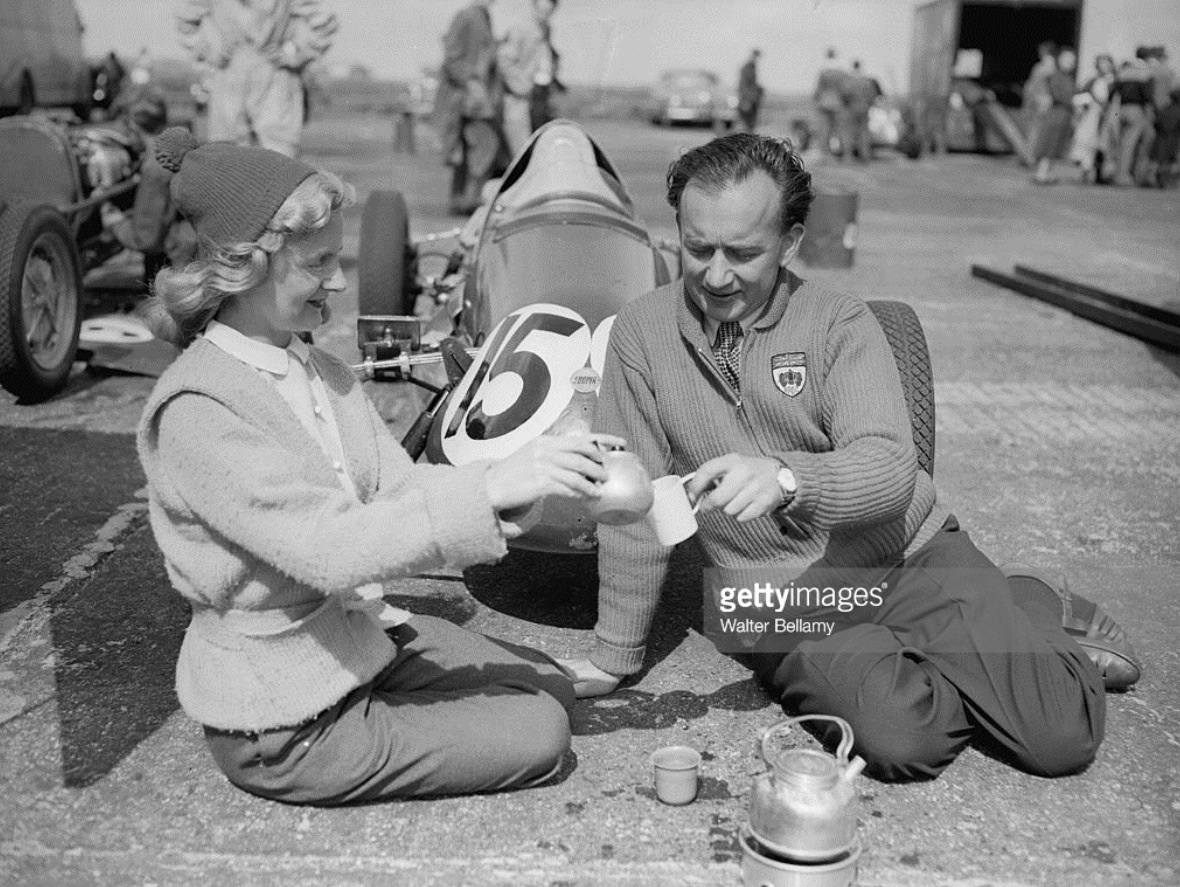
F3/500cc ace Eric Brandon gets some sustenenace with some assistance from his wife Sheila before no doubt scoring another win on 18 July 1953…

Click here for an interesting article on this very talented driver; http://500race.org/people/eric-brandon/

image (GP Library)

Coopers galore! Alan Brown, Eric Brandon, Juan Fangio and Mike Hawthorn in F2 Cooper T20 Bristols before the Lavant Cup, Easter Monday 14 April 1952. This race was one of a series of performances which vaulted Hawthorn into a GP Ferrari seat in 1953.

Hawthorn won the six-lapper from Brown and Brandon and set the fastest lap.

Equally impressive was Hawthorn’s second place behind Froilan Gonzalez’ Ferrari 375 in the Formula Libre Richmond Trophy. Duncan Hamilton placed third in a Talbot Lago T26C.

And Fangio? I have one report that says the great man raced John Cooper’s Cooper T20 to a misfiring sixth place but he doesn’t appear at all in the results for the Lavanat Cup and Richmond Trophy I have. John Cooper offer the ride after Alfa Romeo failed to appear. Happy to take your advice on this one.

Credit…

Walter Bellamy, GP Library

Finito…

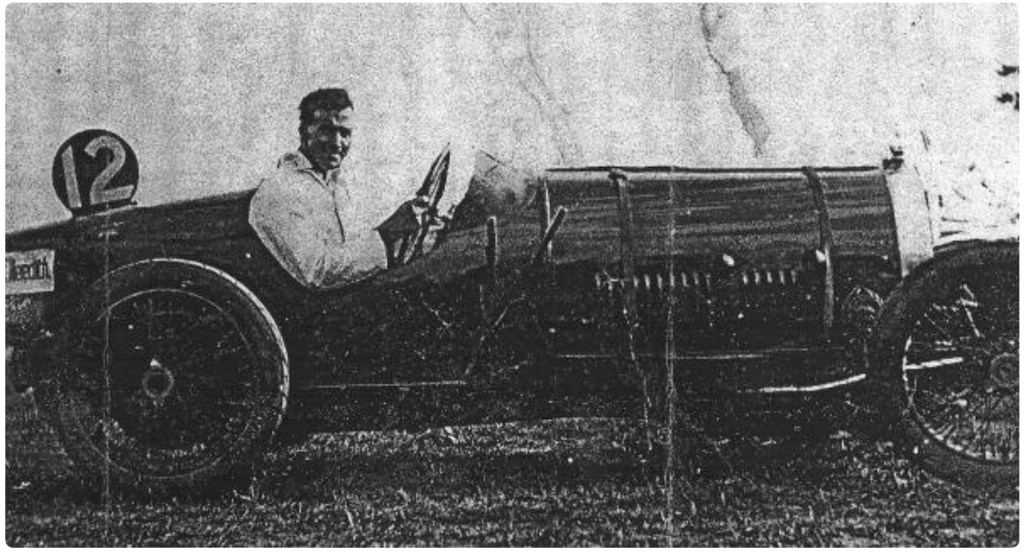
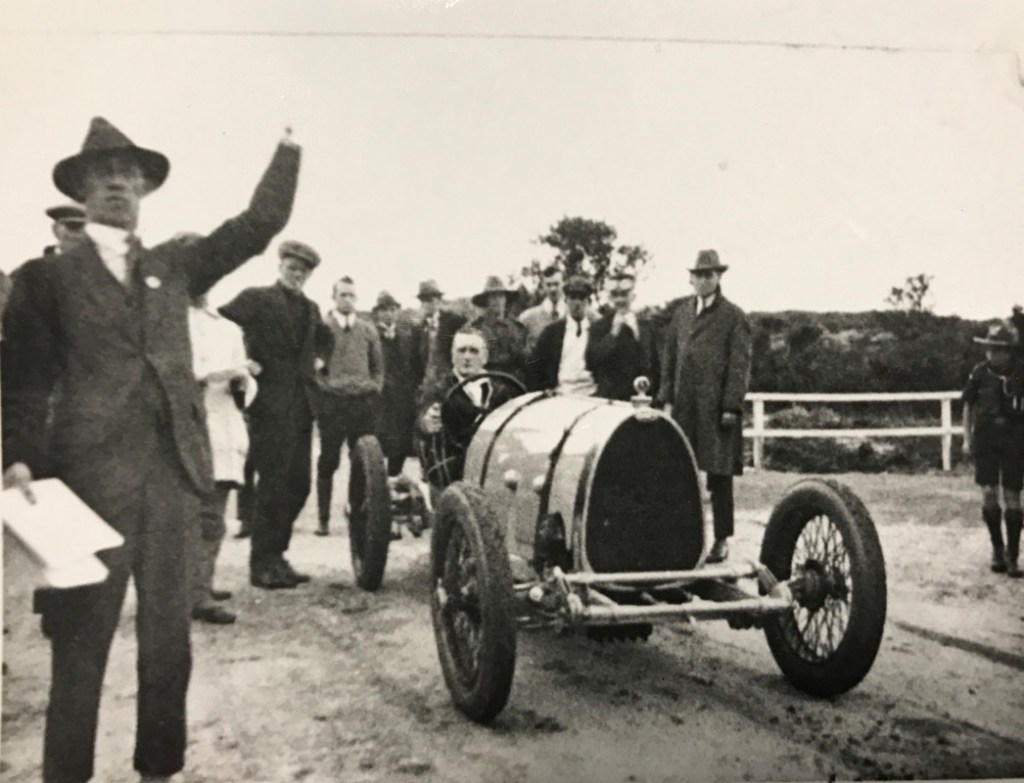
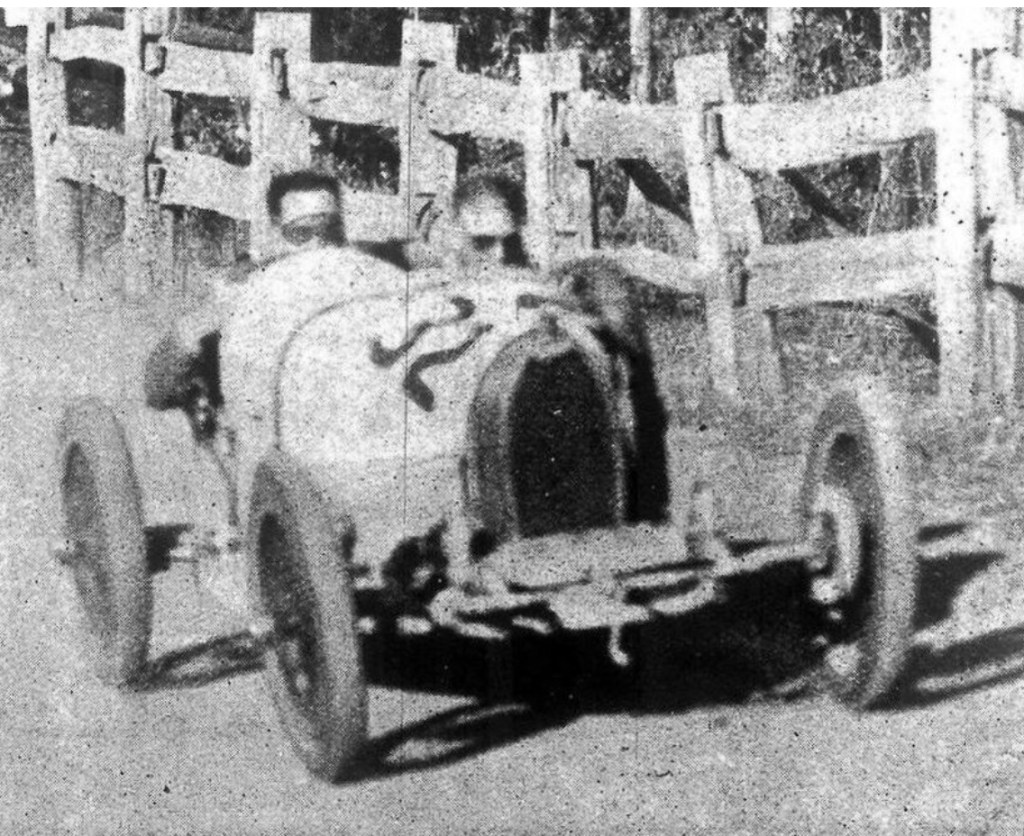
Competitor (who and what?) in the 1918 Coot-tha Classic (Brisbane Times)

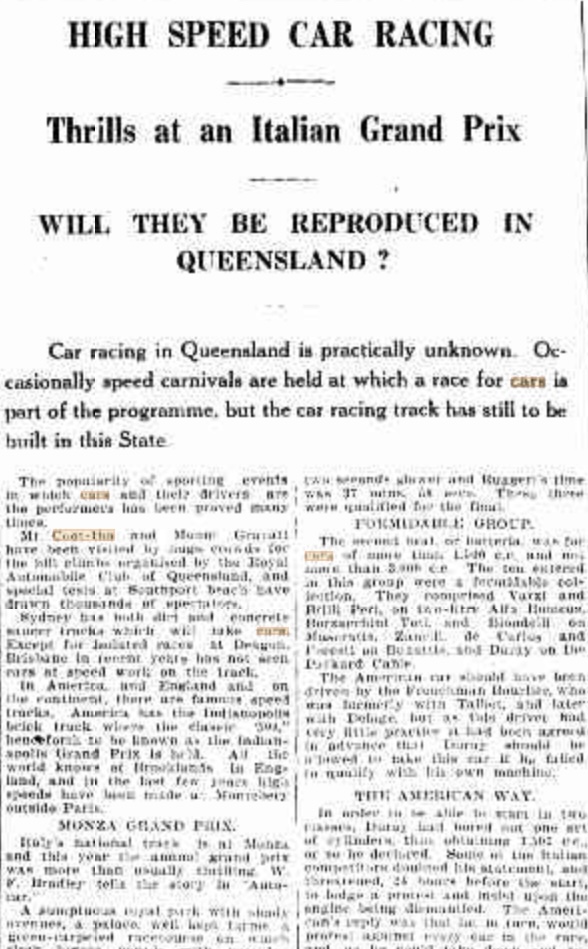
“Car racing in Queensland is practically unknown. Occasionally speed carnivals are held at which a race for cars is part of the programme, but the car racing track has still to be built in this state,” said the motoring reporter of Brisbane’s The Telegraph on November 5, 1929.

“The popularity of sporting events at which cars and their drivers are the performers has been proved many times.”

“Mount Coot-tha and Mount Gravatt (8 km and 10 km from Brisbane’s CBD) have been visited by huge crowds for the hillclimbs organised by the Royal Automobile Club of Queensland, and special tests on Southport Beach (on the Gold Coast) have drawn thousands of spectators.”

Henry Horstman and Maldwyn Davies – Queensland Bugatti importer – on the way to FTD in the RACQ hillclimb at Mount Coot-tha on April 1, 1928, Bugatti T37. His time of 1 min 20 sec was eight seconds clear of the rest of the field (speedwayandroadracehistory.com)
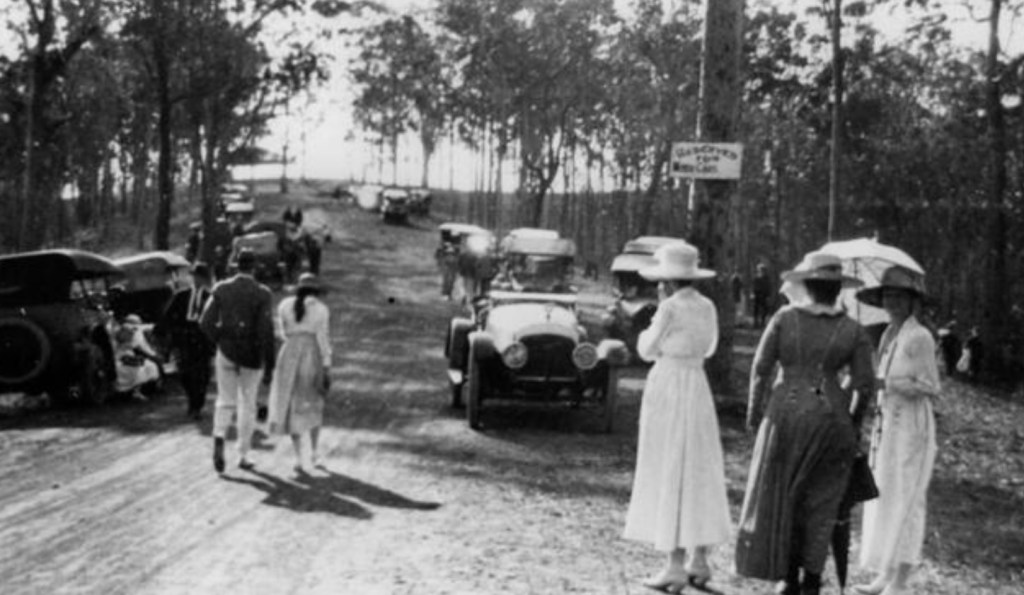
Folks take in the Mount Coot-the sun, circa 1920 (alamy)

“Sydney has dirt and concrete saucer tracks which will take cars. Except for isolated races (for cars) at Deagon (Speedway 20km north of) Brisbane in recent years has not seen cars at speed work on the track.”

“In America, and England, and on the continent, there are famous speed tracks. America has the Indianapolis brick track where the classic ‘500’, henceforth to be known as the Indianapolis Grand Prix is held. All the world knows of Brooklands. In England, and in the past few years high speeds have been made at Montlhery, outside Paris.”

(The Telegraph, Brisbane, November 5, 1929)
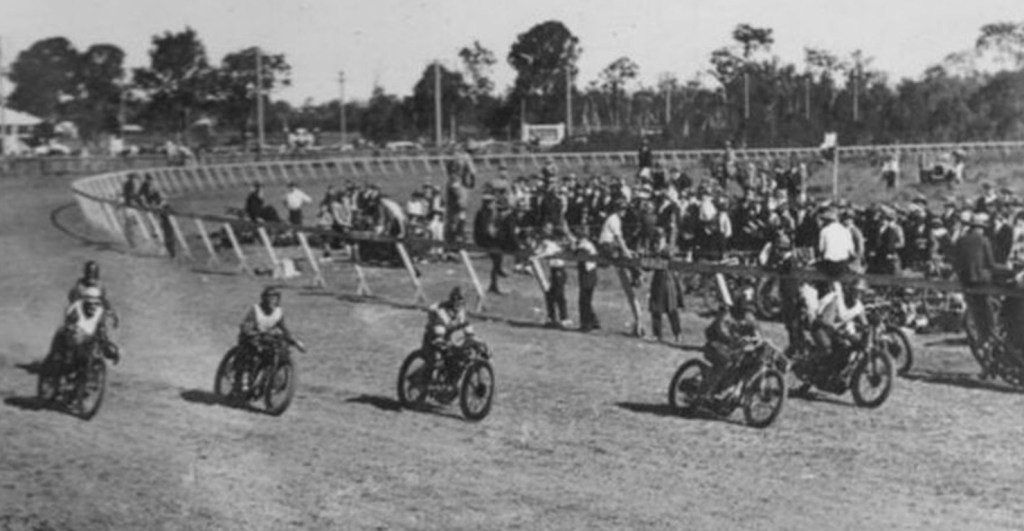
Motorcycle racing at Deagon in 1926 (T Webb Collection)

Some context of motor racing progress elsewhere in Australia is that the Aspendale Park Speedway opened in outer Melbourne in 1906, the Olympia Motor Speedway at Maroubra, Sydney in 1925. The first Australian Grand Prix was held at the Goulburn Racecourse (Neddies), 200 km south of Sydney in 1927, and the first AGP on a road-course at Phillip Island in 1928. Viz; 1928 100 Miles Road Race, Phillip Island… | primotipo…

Geoff Meredith aboard the Bugatti T30 in which he won the speedway style 1927 AGP at the Goulburn Racecourse (Goulburn Post)

Given the relative population of Queensland to Victoria and New South Wales, the banana-benders (Queenslanders) weren’t lagging behind too much. What is interesting is the popular press ‘pushing’ for creation of a local venue. It wasn’t until 1949 that an AGP was held in the Sunshine State, at Leyburn, a former Royal Australian Air Force base. See Aspendale here; Werrangourt Archive 11: DFP ‘The Greyhound of France’ by Bob King… | primotipo… and Leyburn here; 1949 Australian Grand Prix, Leyburn… | primotipo…

(ABC via M Hubbard)

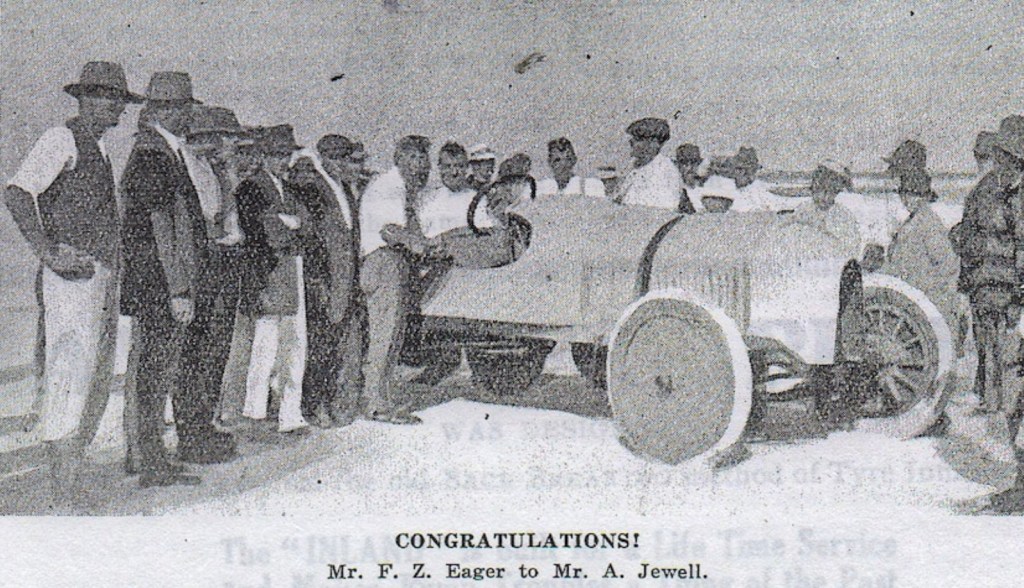
Alec Jewell aboard the Willys Overland which won “Australia’s first land speed record” in a competition with a Studebaker Six driven by Fred Eager on the Surfers Paradise sand, Christmas Day, December 25, 1916.

The cars had a number of runs, Jewell’s best was a time of 21.4 seconds between the measured marks, 84.5mph as adjudged by Automobile Club of Queensland officialdom.

Etcetera…

Deagon was established as a horse-racing venue in the early 1880s. It was first used for motorised events with ‘The Great Motor Cycle Carnival’ in November 1921. The card that day included 3 and 20 mile races for solos and a 5-miler for sidecars. 24 meetings were held from 1921-1931 including 14 state, and six Australian/Australasian Championships. Cars were never the mainstay of racing at Deagon, but were occasional guests on the bike’s-card.

Credits…

Brisbane Times, The Telegraph, Brisbane, November 5, 1929, Old Bike July 2015, Alamy, Goulburn Post, speedwayand roadracehistory.com, Tony Webb Collection, ABC via Murray Hubbard, Bob King

Tailpiece…

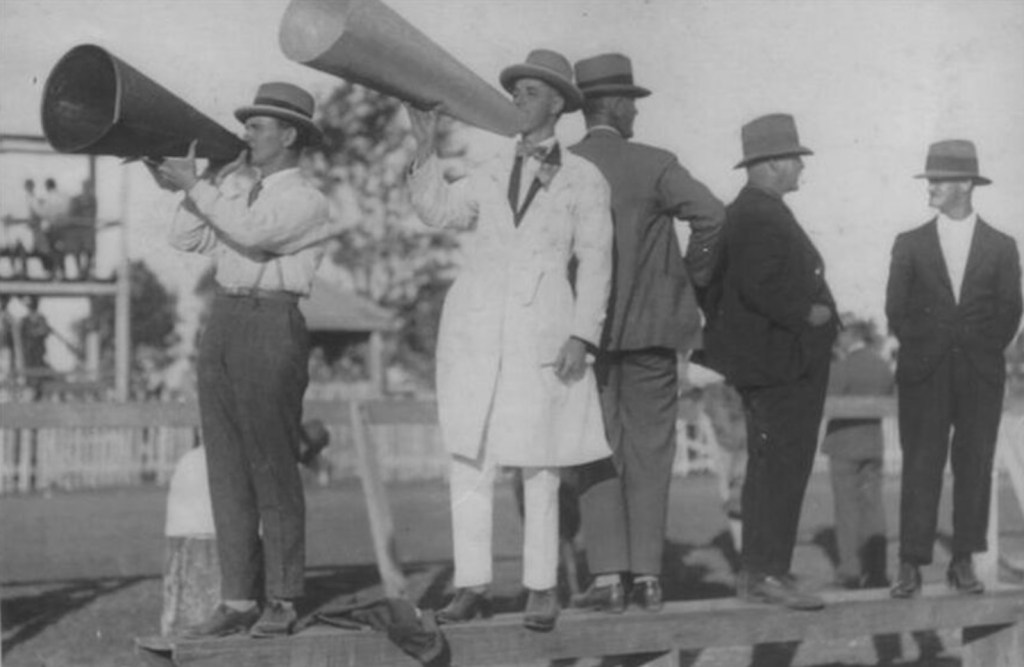
(T Webb Collection)

Deagon Speedway commentators doing it the hard way in the mid-1920s. I wonder if hats will ever make a comeback?

Finito…

(A Wootton Family Collection)

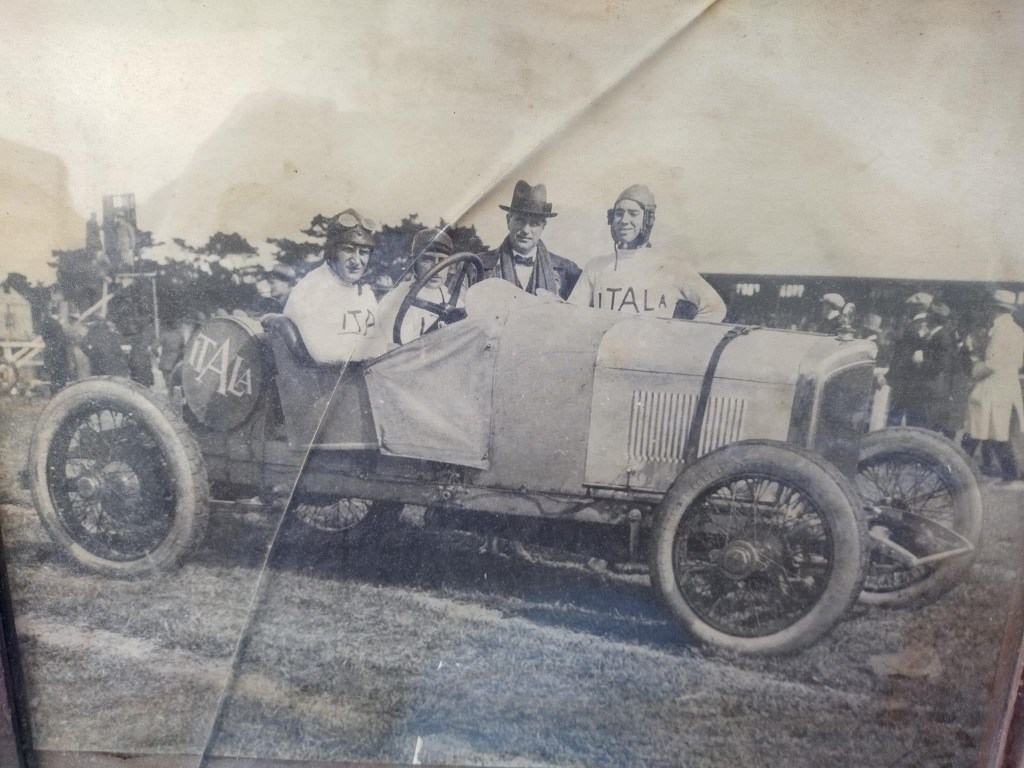
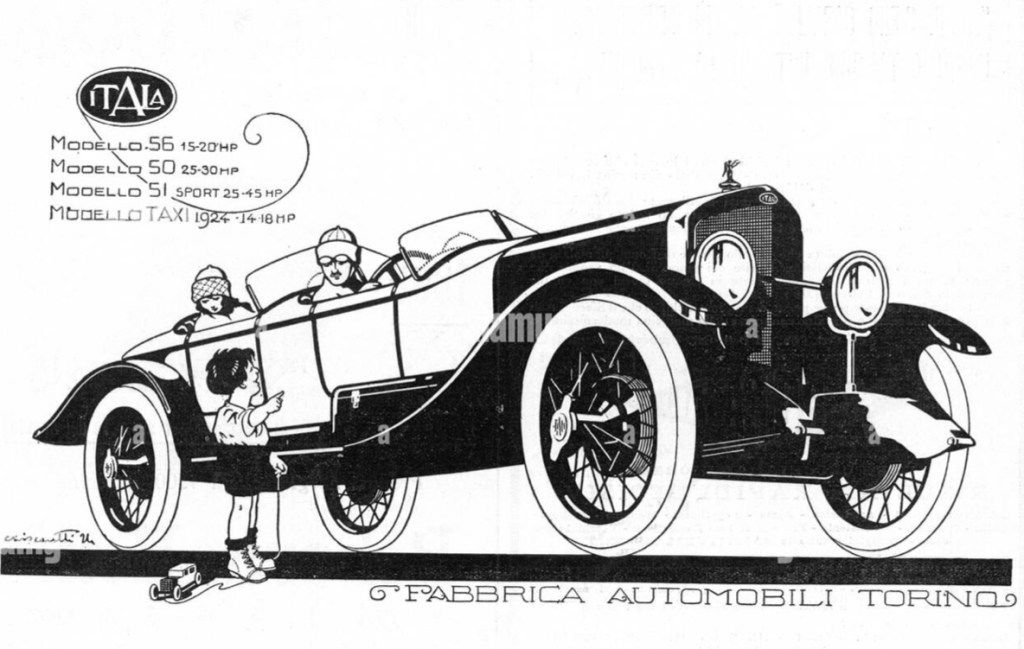
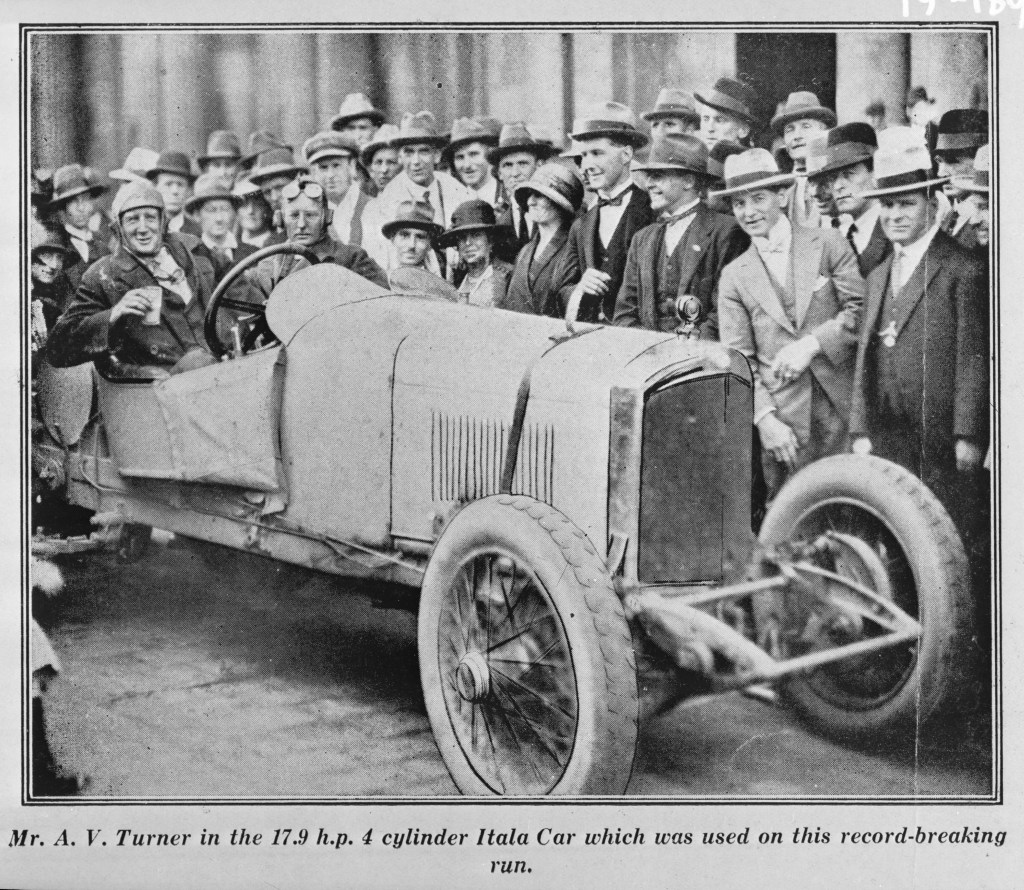
Albert Valentine ‘Archie’ or ‘Bert’ Turner and A ‘Ossie’ O’Connor, Itala, before the start of their record breaking circa-560 miles Sydney-Melbourne run on Sunday February 24, 1924. Corner of Macquarie and Bridge Streets.

Regarded in-the-day as one of Australia’s best drivers, Turner and O’Connor left the Sydney GPO at 5.15am and arrived at the Melbourne equivalent at 5.49pm. The 12 hours 34 minutes journey equated to an average of 47mph, and knocked 25 minutes off the existing record held by Norman ‘Wizard’ Smith’s Essex.

It was the third occasion within 15-months Turner had taken the record, in tit-for-tat fashion with his competitors, on the two previous runs in 1923 he drove a Delage C02.

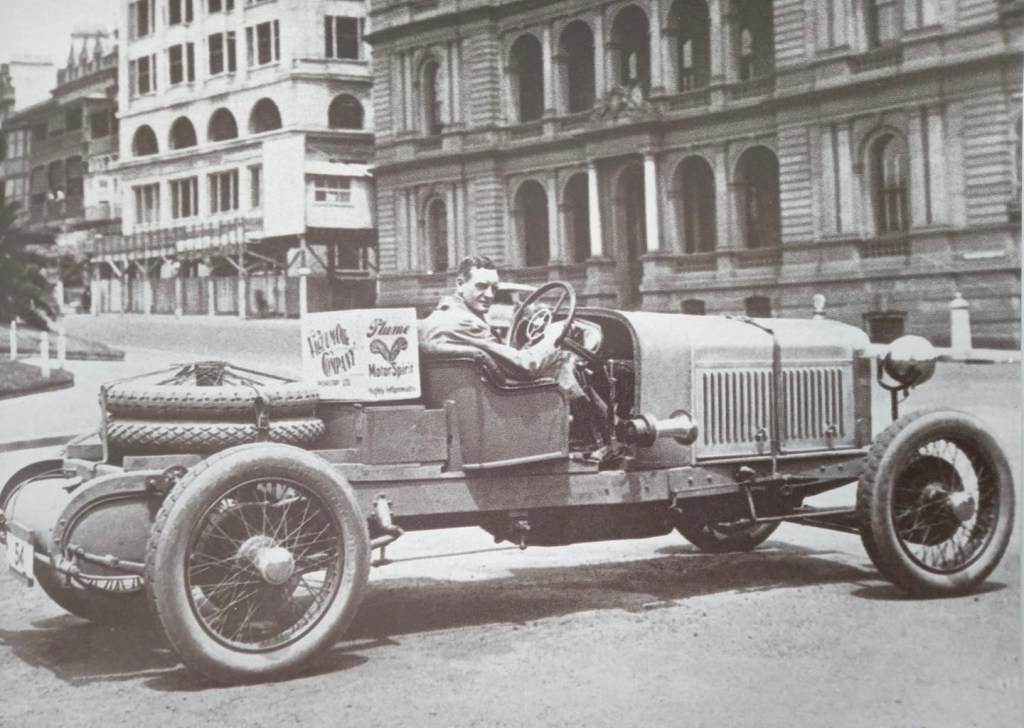
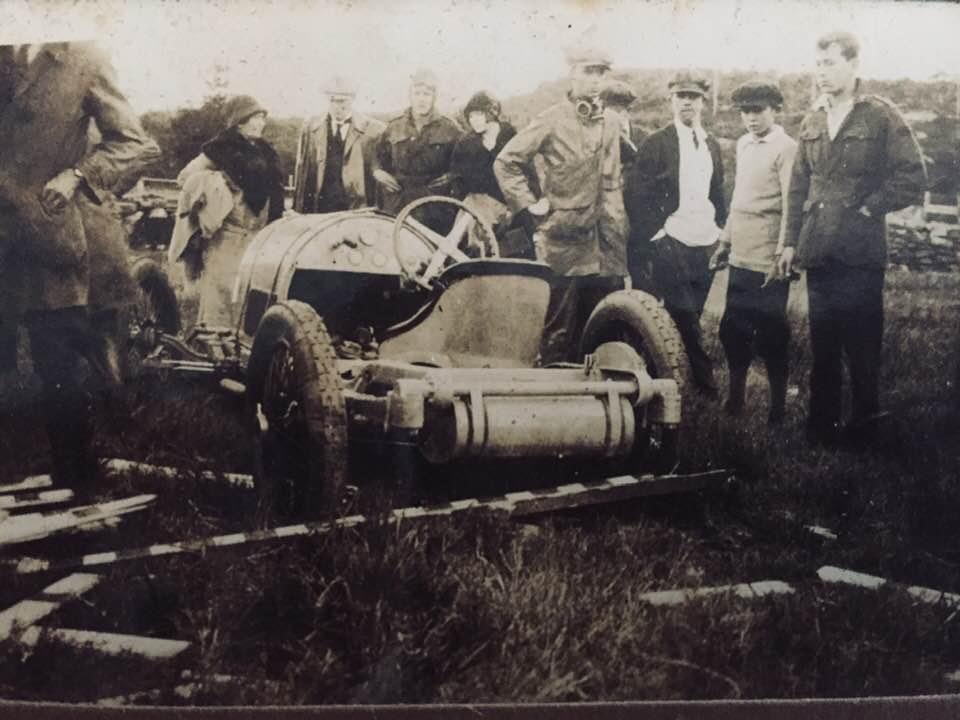
Turner aboard a Delage CO2 4.5-litre OHV six cylinder, before breaking the Sydney-Melbourne record in February 1923 – 16 hours 47 min. Chassis number folks, does it currently exist? Was he flogging Delages at the time or were the drives paid ones? The sponsor is Plume Motor Spirit! (C Blundell Collection)
James Flood and his wife alongside AV Turner’s “record setting Itala”, here (where??) with Albert Vernon at the wheel in 1921. I note the car – if it is the same Itala – is now fitted with four-wheel brakes, rather than the two in the opening shot. Not so sure about the year quoted (James Flood via C Nicholes)
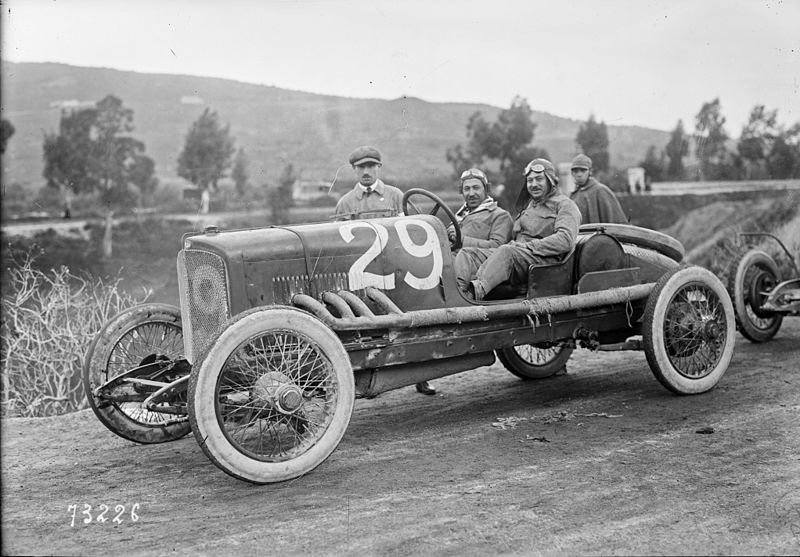
The Luigi Lopez works Itala Tipo 51S before the start of the 1922 Targa Florio. Five of these 2.8-litre four cylinder racers were entered, the best placed was Antonio Moriondo’s 12th placed machine, albeit he was second in the 2-3 litre class. Lopez was 25th and last, the winner was Giulio Masetti’s 1914 Mercedes 4.5-litre 18/100 GP car. I’m not suggesting Turner’s car was an ex-works machine, but rather including it for the sake of completeness and begging the question as to what, exactly, AVT’s car was… (Bibliotheque nationale de France)

The Turner Itala is variously described in contemporary newspaper reports as a 17.9hp or 15hp Floria (sic), it’s perhaps a 2.8-litre, four cylinder 55bhp @ 3200rpm engined Type 51 Sport with a Targa Florio style body, built by James Flood in Melbourne. Details of the car from a marque expert appreciated, inclusive of present whereabouts.

Turner was then the New South Wales agent for Itala and Bugatti operating from large premises in Castlereagh Street. He promoted both marques via competition, a medium at which he rather shone.

The Sydney Sunday Times reported that “The average speed of 47mph, fast as it sounds (the main road, between Sydney and Melbourne then was little more than an unmade goat-track), included all stops for supplies and refreshments, the running time average was about 50mph.”

“During the journey the exhaust pipe broke, blowing stupefying exhaust gases into the faces of driver and passenger. Mr O’Connor was rendered well-nigh unconscious by the fumes and arrived in Melbourne much the worse for the experience.”

“Mr Turner’s throat was so sore from the same cause, that he could hardly speak audibly. At one stage of the trip he was compelled to drive for several hundred miles on the hand throttle alone.”

“Speeds in excess of his latest accomplishment are unlikely, in view of the present state of the roads, which he states precludes the reasonable possibility of a higher average being maintained. Mr Turner has many successes to his name, but his latest ranks among the highest,” the Sunday Times concluded in the wonderful narrative style of the day.

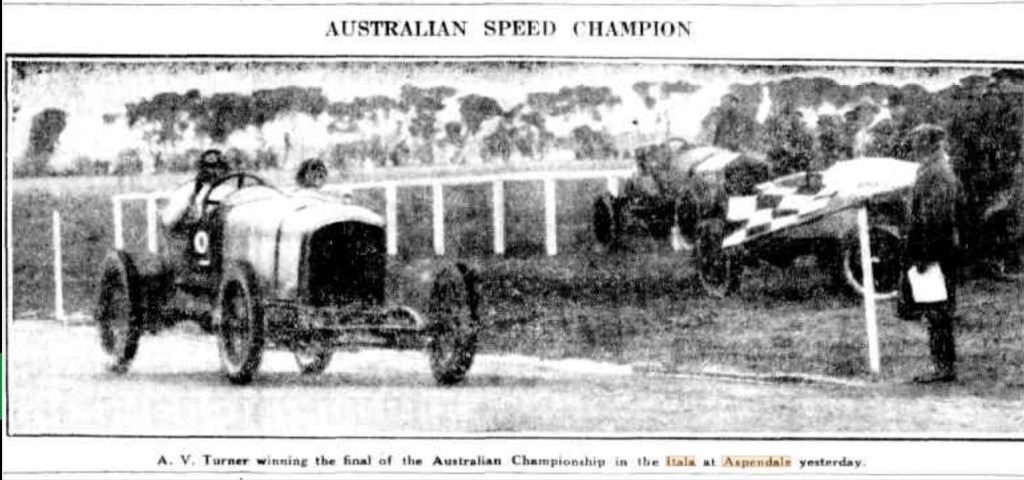
AV Turner at Aspendale, Melbourne, a banked dirt track, on the way to winning the “blue riband 25-miles Australian Championship” from Carlo Massola’s Diatto on April 21, over the Easter 1924 long weekend (hyperracer.com)
(SLV)
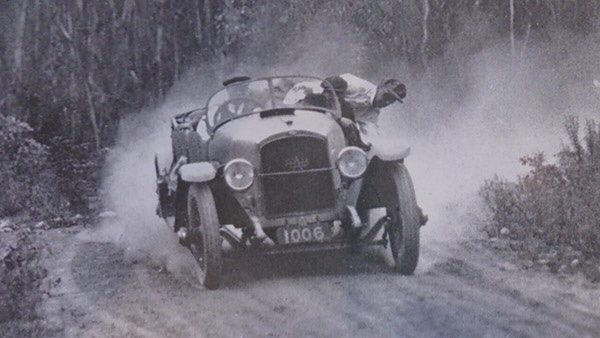
Turner and somewhat energetic crew – perhaps that fella has had enough? – during their victorious 1921 Alpine Trial run. Itala Tipo 51 tourer powered by a 2.8-litre, two side-valve 50bhp @ 3000rpm four cylinder engine. Four speed ‘box (melbournecircle.net)

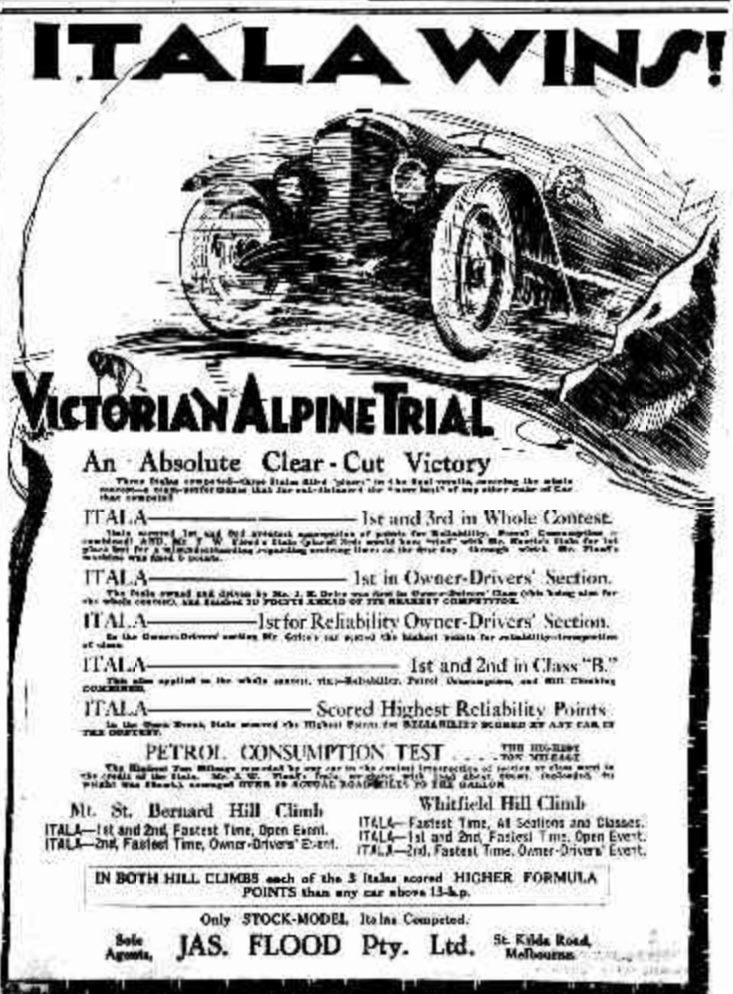
Turner had plenty of success on Italas in all kinds of events, including a win in the first RACV 1000 Miles Alpine Trial/Victorian Reliability Contest – aka The Alpine Rally – in 1921. This caused much consternation among the Victorian blue-blazer-clad RACV mob as he was the only New South Wales driver in the tough event contested over the difficult Alpine terrain of north-eastern Victoria. He was second in 1922 aboard the same Itala Co Australia owned car (entered by a Mr A Hoette), his arch-rival Wizard Smith triumphed that year on an Essex.

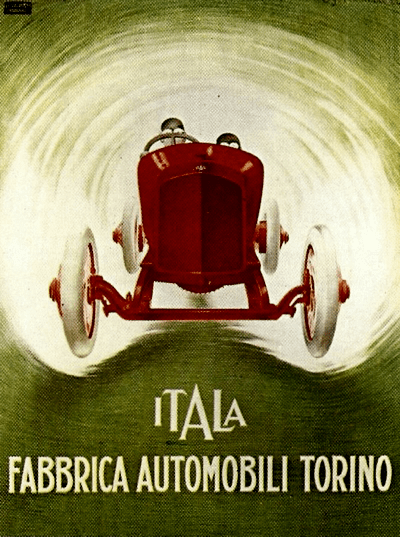
By 1924, Itala (Itala Fabbrica Automobili), founded by Matteo Ceirano and five partners at Via Guastalla, Turin in 1903, was in receivership. Ex-Fiat general manager Giulio Cappa was appointed by the Italian Government’s Istituto per la Ricostruzione Industriale. This entity took control of insolvent Italian businesses deemed too-large-to-fail from 1933 to 2000, Alfa Romeo is a case in point. After his rein, an interesting story in itself, the company was bought by truck maker Officine Metallurgiche di Tortona (OM) in 1929, and the remains sold to Fiat in 1935.

Poor Turner died from injuries sustained contesting an inconsequential hill-climb in North Curl Curl, quite close to his Darley Road, Manly, home. He interrupted a tennis game to run his (later 1927 Australian Grand Prix winning) Bugatti Type 30 #4087 on May 15, 1926 and died in Manly Cottage Hospital later that day. I’ve a feature article 95% complete on that car and its in period-piloti, Messrs Turner, Geoff Meredith and Jack Clements, I really must finish it.

Turner was quite a driver…

(The Argus, Melbourne, December 1921)
Turner winning the ‘Australian Championship’ at Aspendale, Easter 1924 (The Herald, Melbourne)

Credits…

Angela Wootton Family Collection, Colin Blundell Collection, Bibliotheque nationale de France, melbournecircle.net, Sydney Sunday Times March 2 1924, James Flood Book of Early Motoring via the Chris Nicholes Collection, various newspapers via Trove, John Medley, Ray Bell, manlylocalstudies.blogspot.com, Pedr Davis Collection via the Murdoch Family Collection-Neill Murdoch, Colin Wade, State Library of Victoria

AVT ready for the off, Bugatti T30 #4087, North Curl Curl, May 15, 1926 (P Davis Collection via N Murdoch)

Etcetera…

The hillclimb in which Turner died – above, immediately prior to the fatal run – was a circa 700 yard straight run up (now) Harbord Road from about the corner of Abbott Road, North Curl Curl. The finish line was on or about the corner of Harbord Road and Brighton Street, North Manly, with Turner’s crash site on that corner or “the vicinity of ” 151 Harbord Road, Freshwater. It was on this corner, or this property, on, or just after the finish line, where AVT came to grief as below.

(C Wade Collection)

Tailpiece…

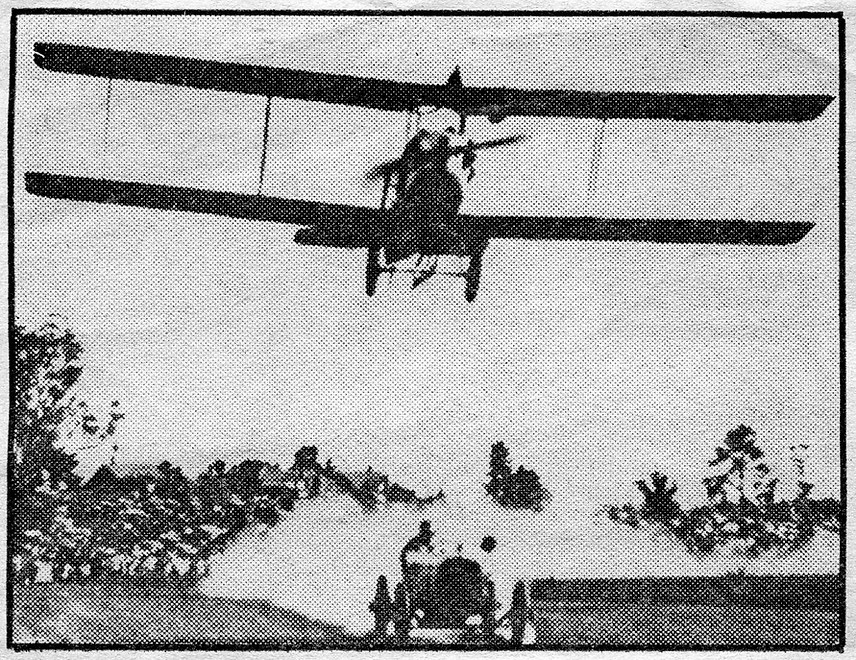
Turner’s Itala racing a Farman bi-plane, probably piloted by Major Harry Shaw – a prominent racer himself – at Aspendale circa 1921, it was a dead-heat apparently. Exact date appreciated.

Finito…
(racerviews.com)

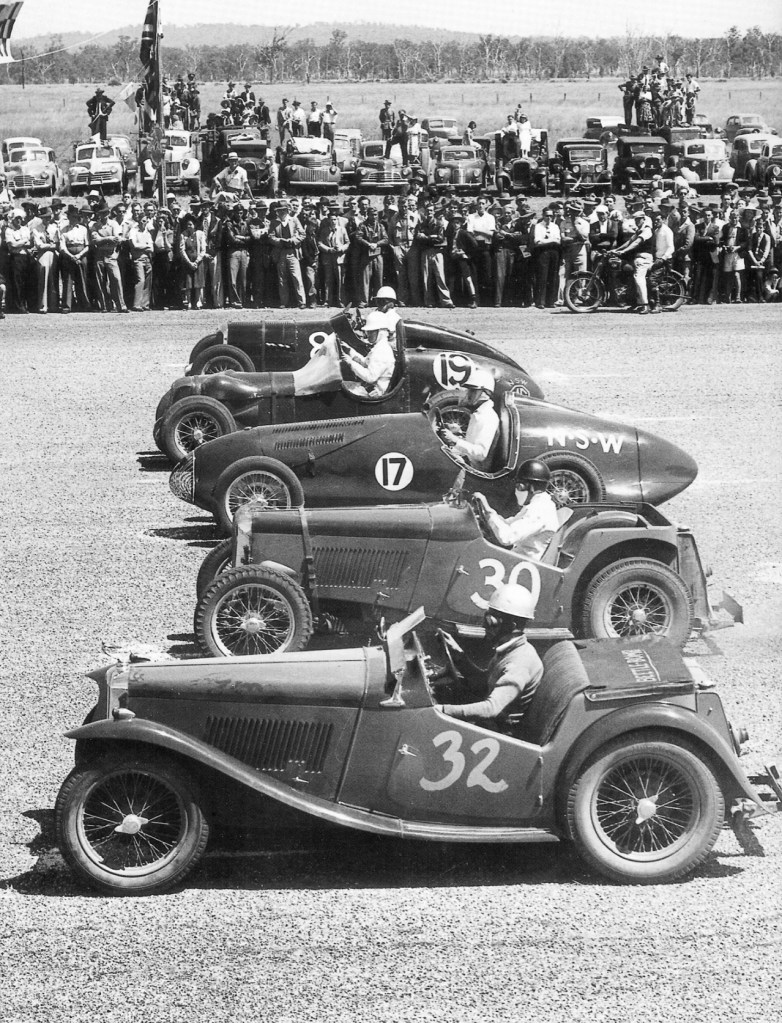
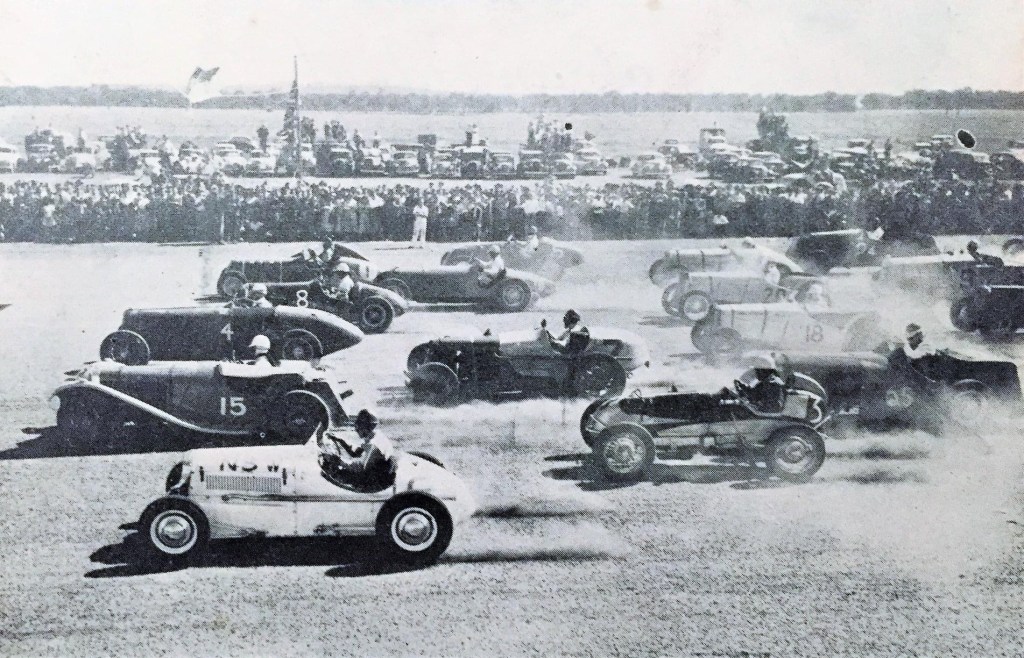
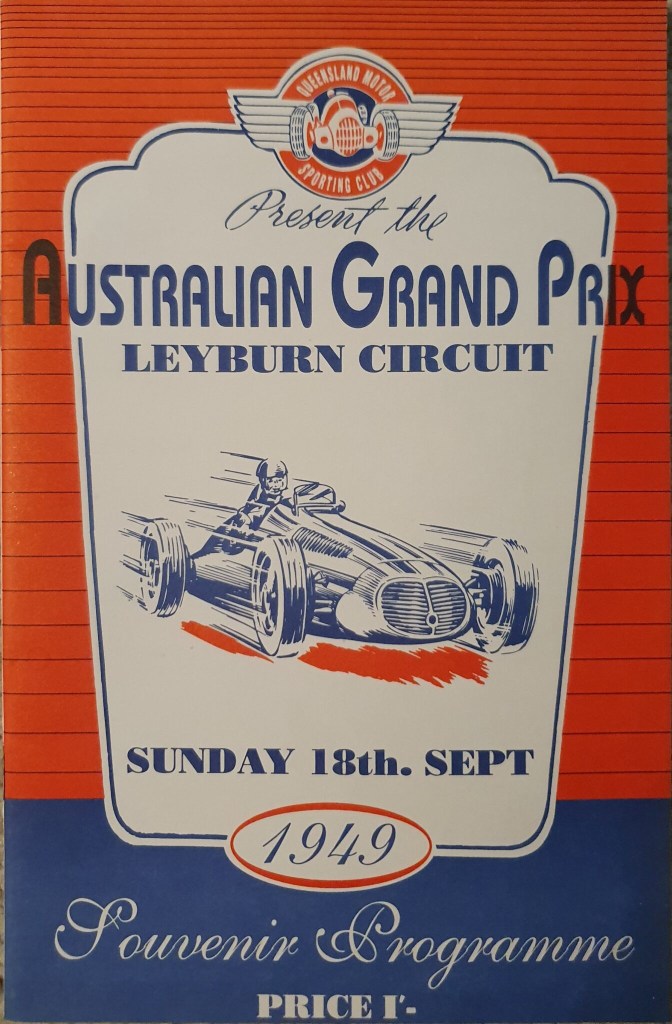
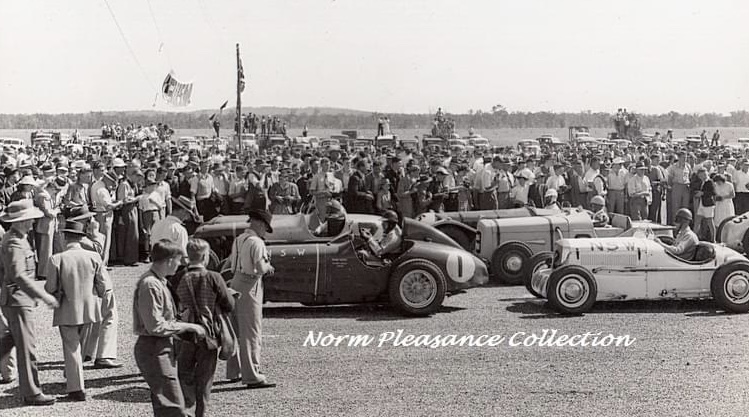
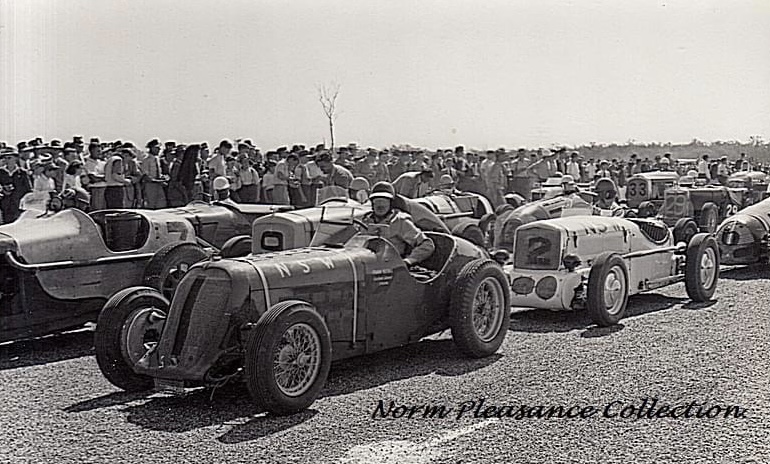
One row of the 28 starters of the 35 lap, 150 mile, 1949 Australian Grand Prix – or more likely the supporting F2 race – at Leyburn, Queensland, await the drop of the flag on September 18.

The first two cars are MG TCs, Col Robinson’s #32, and J Hillhouse in #30. #17 is the more focused TC Spl of Dick Cobden, then Peter Critchley’s fourth placed ex-Alf Najar MG TB Spl, and on the far side, Arthur Rizzo’s Riley Spl, who finished third on the RAAF airfield track

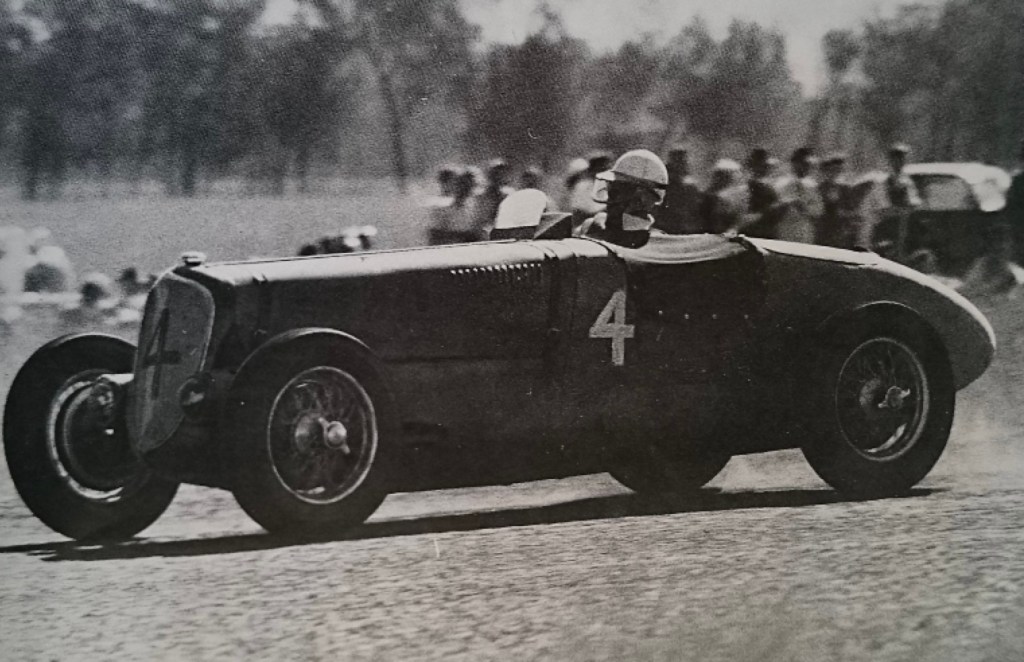
A race day crowd estimated at 30,000 people saw John Crouch’s Delahaye 135S win from Ray Gordon’s TC Spl.

The front row, away from the start is Alan Larsen, Cadillac Special ‘SoCal’, #15 Keith Thallon, Jaguar SS100, #4 the winning Crouch Delahaye 135S, #8 Arthur Rizzo’s third place Riley Special, and on the far side, Frank Kleinig, Hudson Special. The next row includes #3 Arthur Bowes’ Hudson Spl, #2 Dick Bland, George Reed Special, #25 Doug McDonald, Bugatti Dodge and #18 Garry Coglan, MG TC Spl.

(Wiki unattributed)

John Snow imported the 1936 3.6-litre, six-cylinder Delahaye (chassis # 47190) from France to Australia in time for the 1939 AGP at Lobethal, with the talented Crouch finally realising its potential.

(Wiki unattributed)

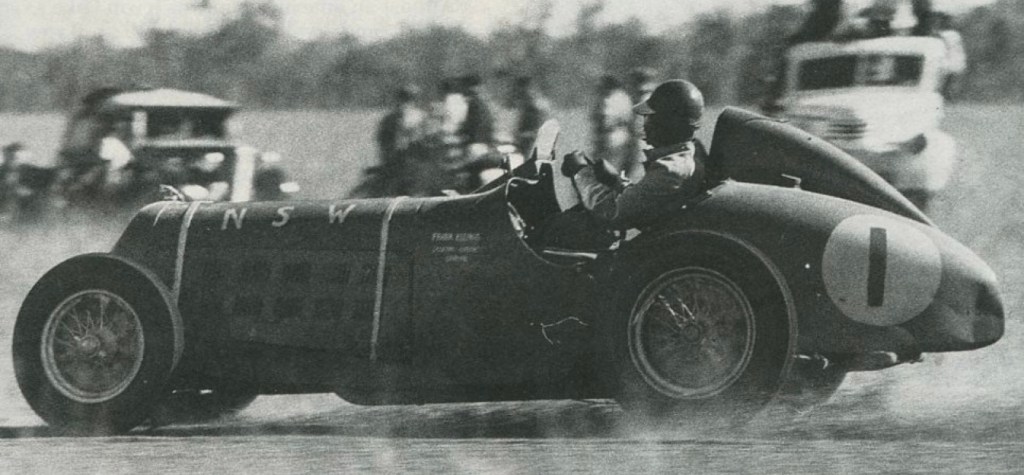
For so long the fire-and-brimstone Frank Kleinig had been an AGP favourite. 1949 was really his last chance to do well as the quality of our fields improved and his oh-so-fast Kleinig Hudson Spl slipped down the grids. Its development potential by then having pretty-much peaked.

Kleinig led Crouch for seven laps – they shared the fastest lap of the race 2’52 seconds/90mph – but then had the first of three pitstops which led to his retirement after completing only 21 laps.

Dick Cobden’s shapely, quick, Gordon Stewart built, Bob Baker bodied, 1946 MG TC (#3306) ‘Red Cigar’ single-seater (below) was out early after only six laps with undisclosed dramas.

(Wiki-unattributed)

Thanks to Terry Sullivan for pointing out this interesting article about the machinations and difficulties associated with the staging of this race; The AGP When Any Airfield Would Do – The Race Torque

John Crouch deals with the rigours of the day in typical Australian fashion.

Frank Kleinig on the hop, see more for this ever evolving, famous Oz racing car; https://primotipo.com/2019/12/06/frank-kleinig-kleinig-hudson-special/

Etcetera…

Kleinig in his faithful Hudson Special, behind is Alan Larsen, Cadillac Spl and alongside him, car #9 is Keith Saunders’ Cadillac Spl
(Brisbane Telegraph)

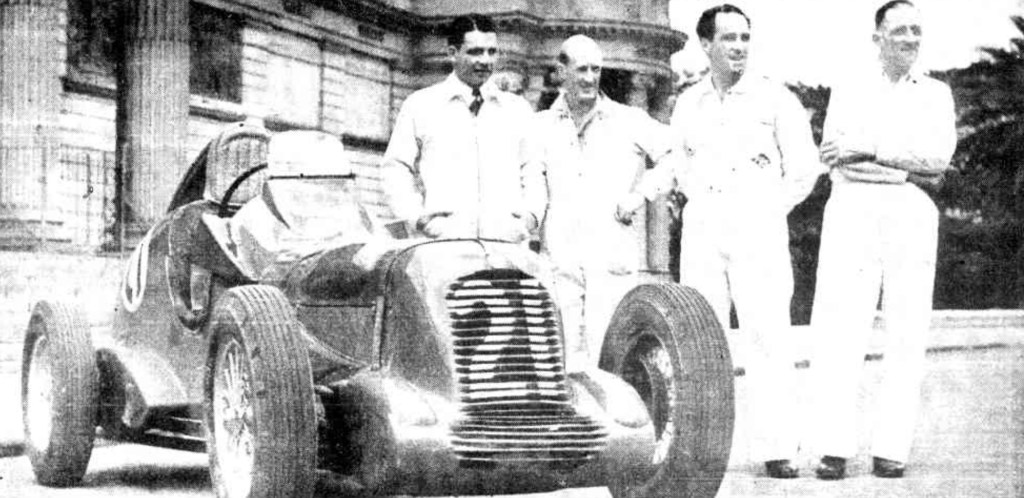
The Brisbane Telegraph caption of this pre-AGP promo piece reads, “Teamwork counts and here are seen NSW motorists, Alf Najar (left) who will be relief driver of Peter Critchley’s (ex-Najar 1946 NSW Grand Prix winning) MG TB Spl (second from right) the winner of the 1948 NSW Grand Prix (at Bathurst), Arthur Rizzo, and their mechanics.”

Kleinig again, #2 Dick Bland in the George Reed Ford V8 Special, #7 Alan Larsen, Cadillac Spl and the rest – #29 Brydon’s MG TC Spl and #33 at the very back is the Ford V8 Spl raced by Jack Wright.

Credits…

Wikipedia, racerviews.com, Rob Bartholomaeus, Stephen Dalton, Dick Willis, Brisbane Telegraph, Norm Pleasance Collection-Warwick Daily News via Daniel Kleinig

Tailpiece…

(D Willis)

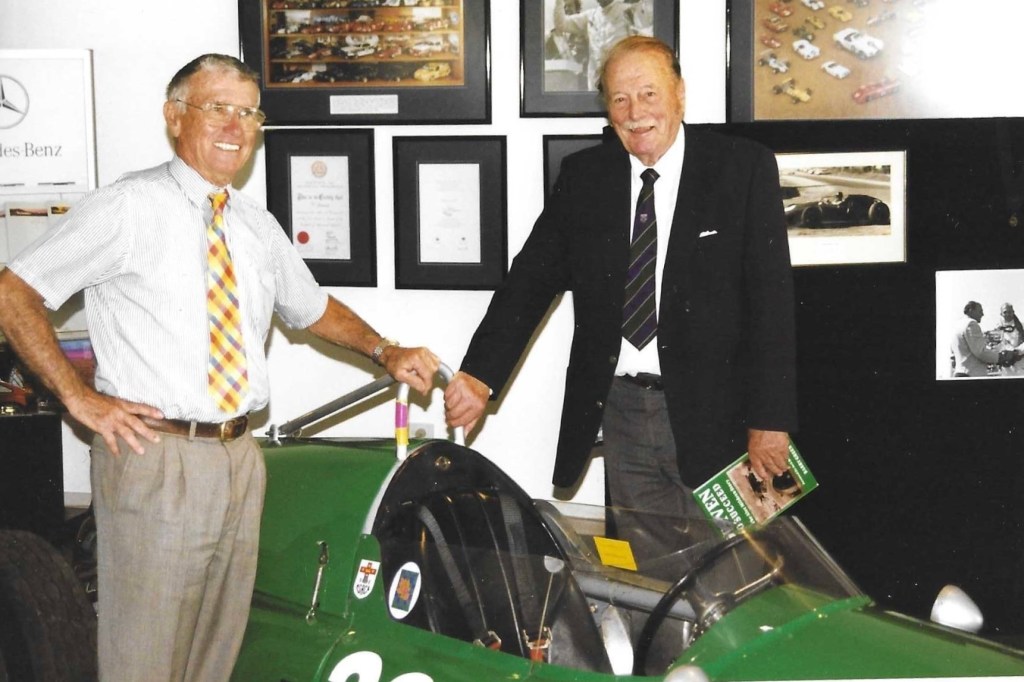
Racers both: Charlie Smith and John Crouch at the launch of Alec Mildren’s biography at Frank Gardner’s Norwell, Gold Coast facility on April 18, 1999.

Finito…

harves red

(autopics.com.au-R Austin)

John Harvey’s 2.5-litre Repco V8 powered Brabham BT11A shrieks it’s way around Warwick Farm on 18 February 1968…

Looks a treat doesn’t it? Nose up out of Leger Corner onto Pit Straight, it was first meeting for the car with its Repco engine.

By 1968 IC-4-64 was an old-girl, albeit a very successful one. It was raced by Graham Hill in the 1965 Tasman Series for David McKay’s Scuderia Veloce, winning the 1965 NZ GP at Pukekohe on its race debut.

hill Hill won the ’65 NZGP at Pukekohe on 9 January 1965 from Frank Gardner’s similar BT11A and Jim Palmer’s earlier model BT7A, all 2.5 Coventry Climax FPF powered (sergent.com)

It then passed into the capable hands of Spencer Martin, initially driving for McKay, and then Bob Jane for whom Spencer won two Gold Stars in 1966 and 1967. Click here for an article on Martin and his exploits in this car; https://primotipo.com/2015/04/30/spencer-martin-australian-gold-star-champion-19667/

The 2.5-litre Coventry Climax FPF four cylinder engine was struggling against the V8’s by then, so Bob bought a 740 Series Repco 2.5-litre V8 to plonk in the back of the BT11A.

John Harvey, Martin’s successor at Bob Jane Racing, contested the Australian rounds of the 1968 Tasman Series so powered. Jim Clark’s works Lotus 49 Ford DFW won the Tasman that year, it was the final championship he won before his untimely death at Hockenheim that April.

harves engine 740 Series Repco 2.5 Tasman V8 engine. 700 Series Repco block and 40 Series ‘between the Vee’ heads’, the ’67 World Championship winning SOHC, two-valve engine in 2.5-litre Tasman spec as against its 3-litre F1 capacity.  Repco claimed 275bhp @ 8,500rpm for the 2.5, and 330bhp @ 8,400 rpm for the 3-litre variant. Lucas injection trumpets, Bosch distributor and plenty of chrome and cadminium plating in shot (P Houston)
image Harvey in the BT11A Repco at Longford, 1968. The attention Bob Jane placed on the presentation of his cars is clear. Note the seatbelt, six-point? (oldracephotos.com-H Ellis)

Harves’ did three Australian rounds, only finishing the wet, final Longford event. By the start of the Gold Star series he slipped into Jane’s new Brabham BT23E which had been Jack’s 1968 Tasman mount.

Harvey raced the final round of the 1967 Gold Star Series in IC-4-64 after Martin announced his retirement. He was already well familiar with Repco power, the 740 Series Repco had been shoe-horned into his Ron Phillips owned BT14 F2 Brabham.

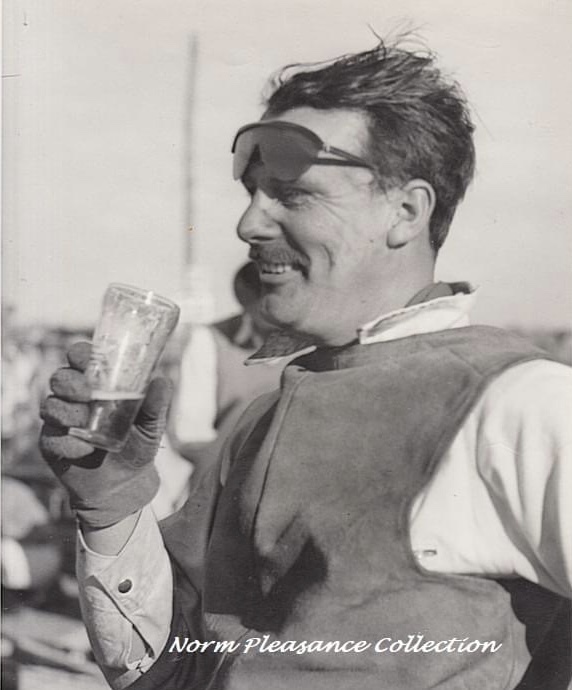
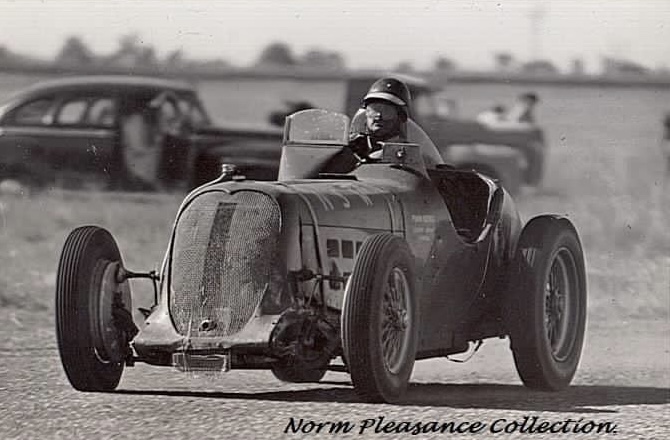
Third place at Sandown was his only finish in the car. John commented in a Facebook exchange about this car “…On handling, Peter Molloy and I were still developing the chassis setup, however in the Diamond Trophy race in 1967 (pictured below) at Oran Park I set a new outright record on the last lap”, so they were improving the car.

The engine and Hewland ‘box was removed from the BT14 which Jane acquired, and popped into the BT11A which it was figured would better cope with the power than the BT14 F2 frame and related hardware.

IC-4-64 is still alive and well, as part of the Bob Jane Estate, in FPF engined form.

harves wf pitlane Harvey in the WF pitlane, Tasman meeting ’68. The BT11A has a vestigial spoiler and a few ducts the it didn’t have when CC FPF powered. Jewels of things these ‘Intercontinental’ Brabhams, very successful ones at that (B Williamson)
harves wf from inside At the Warwick Farm Tasman meeting again (J Stanley)
harvey repco Competitor view of the BT11A and its luvverly Repco RB 740 2.5-litre 275 bhp V8 (P Houston)

Credits…

autopics.com.au-Richard Austin, John Stanley, Peter Houston, sergent.com, Bob Williamson, oldracephotos.com-Dick Simpson, Harold Ellis and Harrisson, oldracingcars.com, Stephen Dalton Collection

harvey repco (P Houston)

Brabham BT14 FL-1-65 Repco, Angus & Coote Diamond Trophy, 27 September 1967…

The shot of Harvey in the Ron Phillips owned Brabham referred to above, on the way to victory in the Diamond Trophy at Oran Park.

John made his name in speedway and transitioned into road racing in an Austin/Morris Cooper S, and then into open-wheelers in this ex-Bib Stillwell car. The Brabham received progressively bigger Lotus-Ford twin-cams, with Harvey going quicker and quicker, before the machine copped its Repco V8 Birthday between the 1967 Tasman and Gold Star Series. Rennmax’ Bob Britton performed the surgery to pop the Repco into the BT14 frame, creating a BT14 jig in the process.

It wasn’t that successful in Repco form; DNF/DNS at Lakeside, Surfers, Mallala and Symmons Plains, third place in the Sandown Gold Star round in September was the car’s best, behind Leo Geoghegan’s Lotus 39 Repco and Spencer Martin aboard BT11A IC-4-64.

Harvey during the Diamond Trophy meeting at Oran Park (oldracephotos.com-Dick Simpson)

Harvey’s Bob Jane drive commenced aboard IC-4-64 in the final Gold Star round, the Hordern Trophy, at Warwick Farm in December 1967.

So…Harvey in 12 or 14 months drove quite a few different Brabham/engine combinations! BT 14 Ford, BT14 Repco, BT11A Climax, BT11A Repco, and then BT23E Repco for the ’68 Gold Star Series. Mind you he missed the ’68 Gold Star.

The ‘noice new Brabham crashed after a rear suspension upright failed in practice for the opening Bathurst round. Harvey’s big accident and subsequent recovery kept him away from racing for the rest of the year.

Harvey aboard the Jane Racing Brabham BT23E Repco 830, during the Symmons Plains Gold Star round in March 1970, at the end of its competitive life. He won the race from Leo Geoghegan’s Lotus 39 Repco and Kevin Bartlett’s Mildren Waggott (oldracephotos.com-Harrisson)

Tailpiece…

(S Dalton Collection)

The July 1965 Oran Park meeting program shows Harvey’s Austin Cooper S ahead of George Garth’s Ford Cortina GT during the OP May 1965 meeting.

Finito…
bruce

(R Schlegelmilch)

Bruce, Tyler Alexander and and Alastair Caldwell…a new set of Goodyears for McLaren’s M7A. He put them to good use, qualifying sixth on the fast swoops of Rouen…

I’m drawn to the papaya McLarens thanks to their visual splendour and absolute respect for Bruce the man, engineer, test driver, racer and motivator of men.

He was the full-enchilada with the lot as a package, as well rounded a racer as it’s possible to be.

Here Chris Amon is tootling past him in the pitlane, his fellow Kiwi no doubt hoping the Firestone shod Ferrari 312 will cope with the fast swoops of Rouen better than Bruce’ M7A, a mighty fine design which carried the Ford Cosworth DFV.

I’ve posted a piece on this race before so don’t want to dwell on the awful fiery accident which cost Jo Schlesser’s life early in the event. Jacky Ickx took his first GP win in a Ferrari 312 from John Surtees’ Honda RA301 and Jackie Stewart’s Matra MS10 Ford.

The shot below is Graham Hill’s Lotus 49B Ford in grid slot nine surrounded by other fellas. The flash of blue to his left is Jean Pierre-Beltoise’ V12 powered Matra MS11 (ninth), Surtees Honda, with the blue flash down his white helmet and Chris Amon’s Ferrari, see its distinctive, white, between the Vee exhausts.

1968 was the last time an F1 GP was held at the wonderful 6.542Km road course near Orival and Rouen. The track was used for European F2 Championship races until 1978 and French national events after that, economic forces resulted in its 1994 closure.

hill lotus 49

French GP, Rouen 1968 (Schlegelmilch)

Credit…

Rainer Schlegelmilch

Finito…
917 brands rodrig

There are drives which are spoken of in reverential terms down the decades, Pedro Rodriguez’ victory in the Brands Hatch 1000km in 1970 is one of those…
Here #10, the John Wyer entry is set to pounce on #11 Vic Elford out of Druids in another factory (Porsche Salzburg) Porsche 917K, the Brit was of course no slouch on slippery surfaces himself. He was European Rally Champion aboard a Porsche 911 in 1967 and Monte winner similarly mounted in 1968 before going circuit racing.

Acknowledged wet weather ace Jackie Ickx raced a factory Ferrari 512S in a Brands Hatch field full of F1 drivers who in those days also contested the sportscar endurance classics. But Pedro was in a class of his own on that sodden Kent afternoon finishing five laps ahead of the second placed 917K of Elford and Denny Hulme, and eight laps ahead of another 917K driven by soon to be 1970 Le Mans winners Hans Hermann and Richard Attwood, both in similar equipment to Pedro…

Photo Credit…Bruce Thomas

Finito…