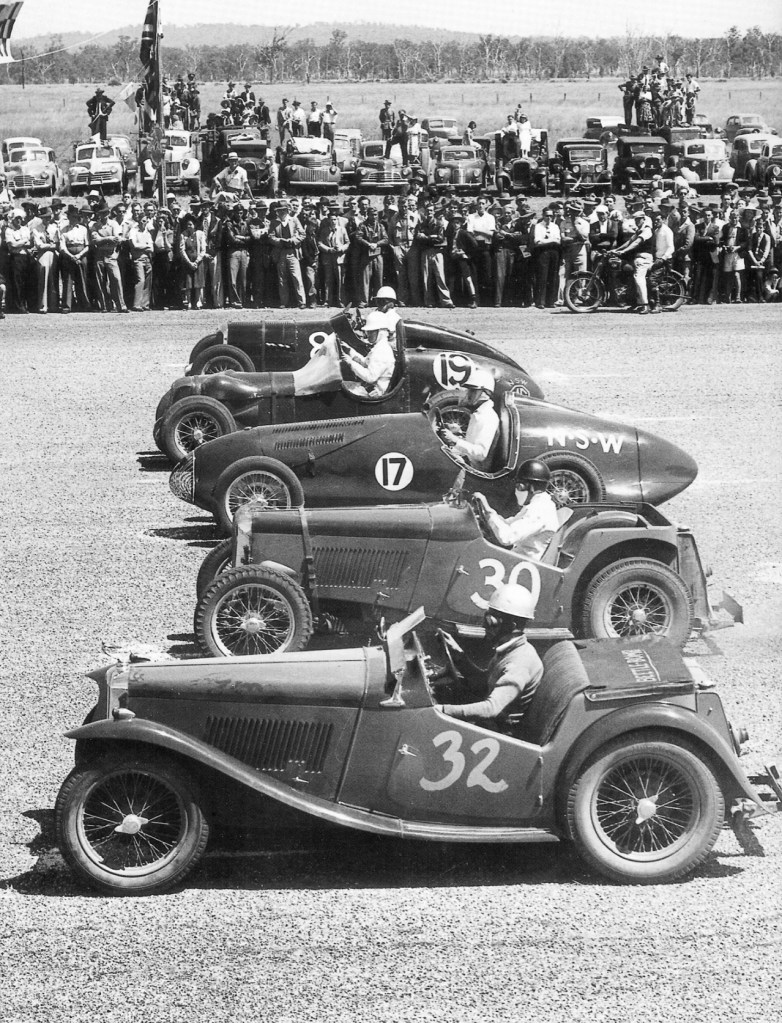
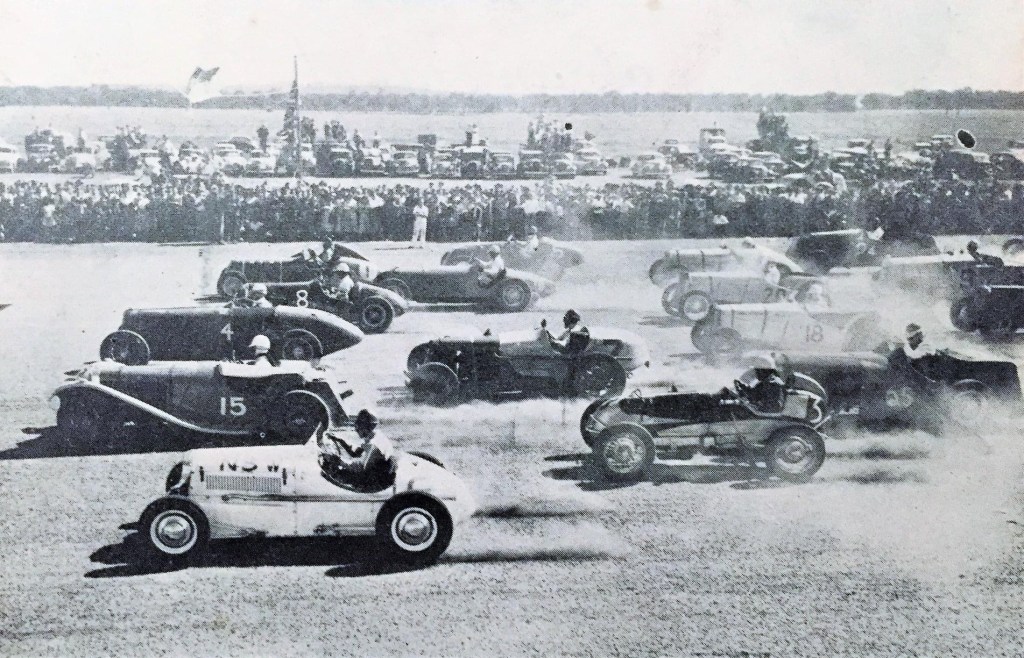
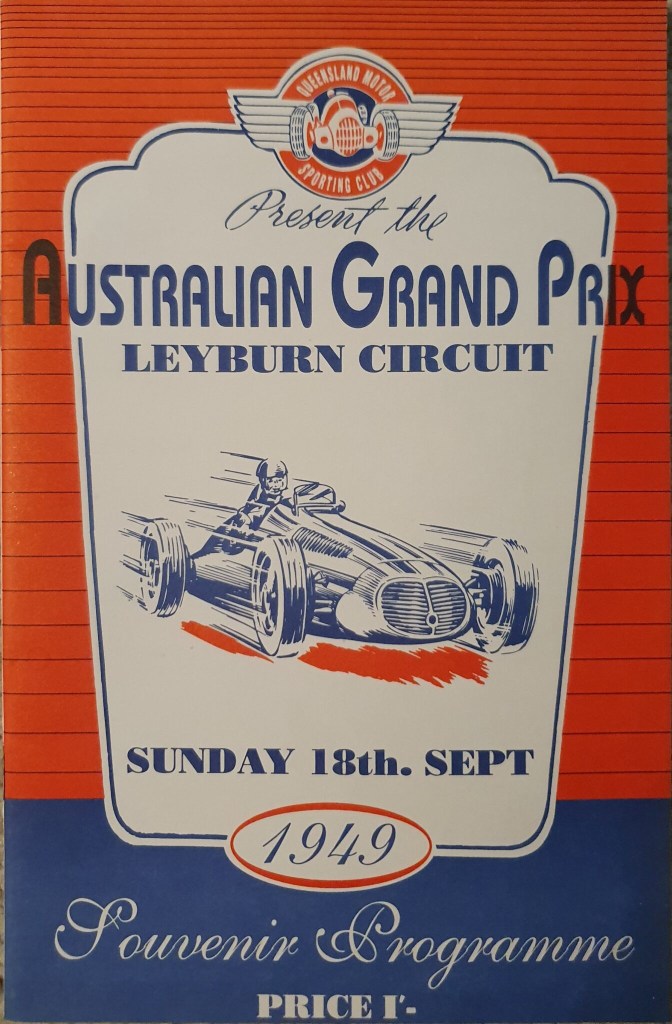
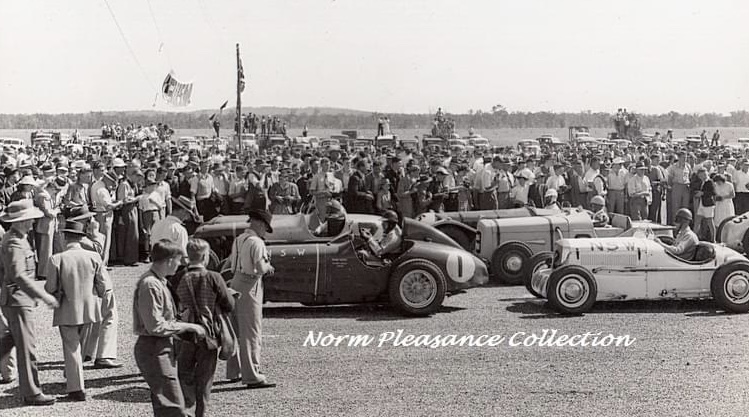
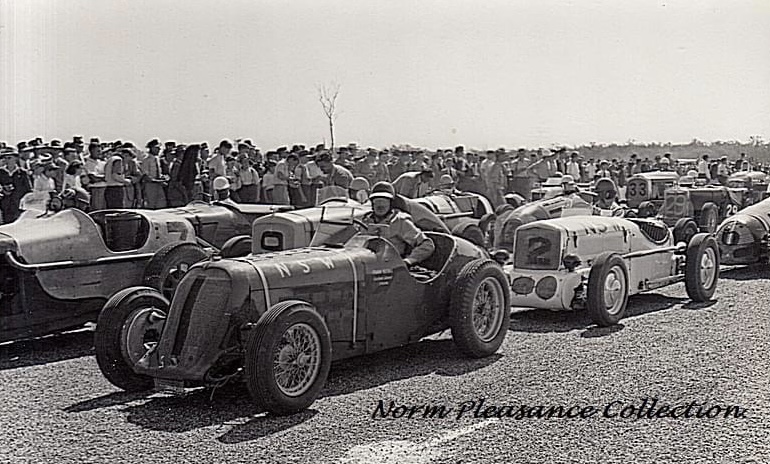
One row of the 28 starters of the 35 lap, 150 mile, 1949 Australian Grand Prix – or more likely the supporting F2 race – at Leyburn, Queensland, await the drop of the flag on September 18.
The first two cars are MG TCs, Col Robinson’s #32, and J Hillhouse in #30. #17 is the more focused TC Spl of Dick Cobden, then Peter Critchley’s fourth placed ex-Alf Najar MG TB Spl, and on the far side, Arthur Rizzo’s Riley Spl, who finished third on the RAAF airfield track
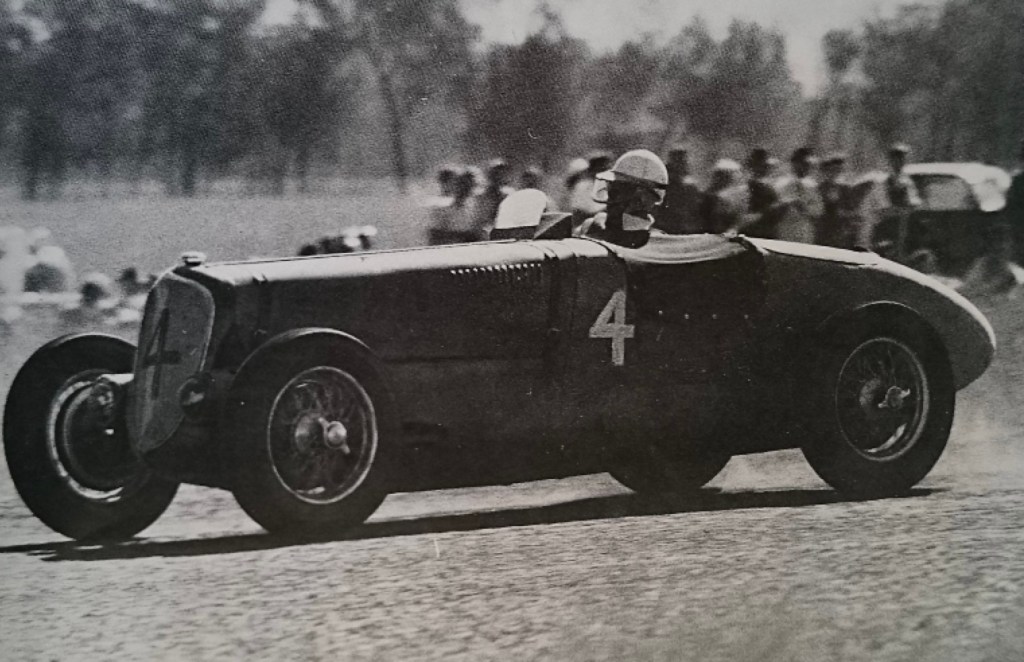
A race day crowd estimated at 30,000 people saw John Crouch’s Delahaye 135S win from Ray Gordon’s TC Spl.
The front row, away from the start is Alan Larsen, Cadillac Special ‘SoCal’, #15 Keith Thallon, Jaguar SS100, #4 the winning Crouch Delahaye 135S, #8 Arthur Rizzo’s third place Riley Special, and on the far side, Frank Kleinig, Hudson Special. The next row includes #3 Arthur Bowes’ Hudson Spl, #2 Dick Bland, George Reed Special, #25 Doug McDonald, Bugatti Dodge and #18 Garry Coglan, MG TC Spl.
(Wiki unattributed)
John Snow imported the 1936 3.6-litre, six-cylinder Delahaye (chassis # 47190) from France to Australia in time for the 1939 AGP at Lobethal, with the talented Crouch finally realising its potential.
(Wiki unattributed)
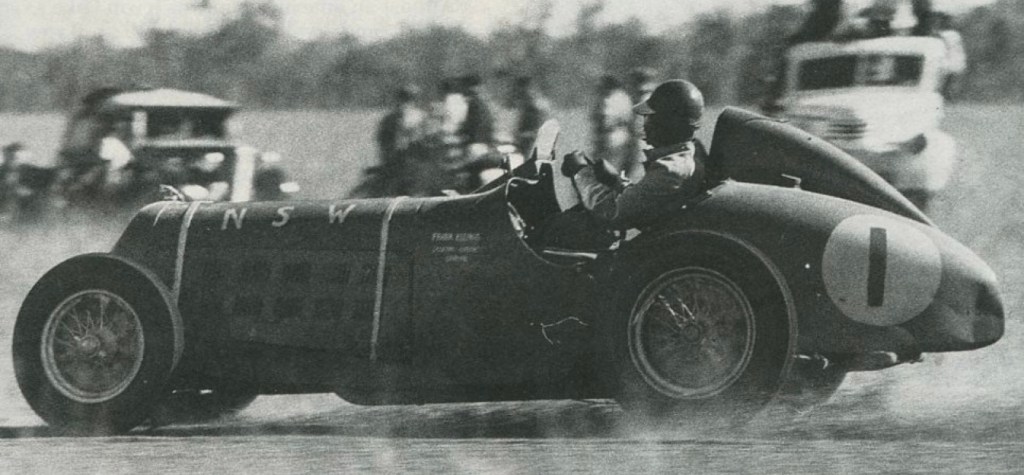
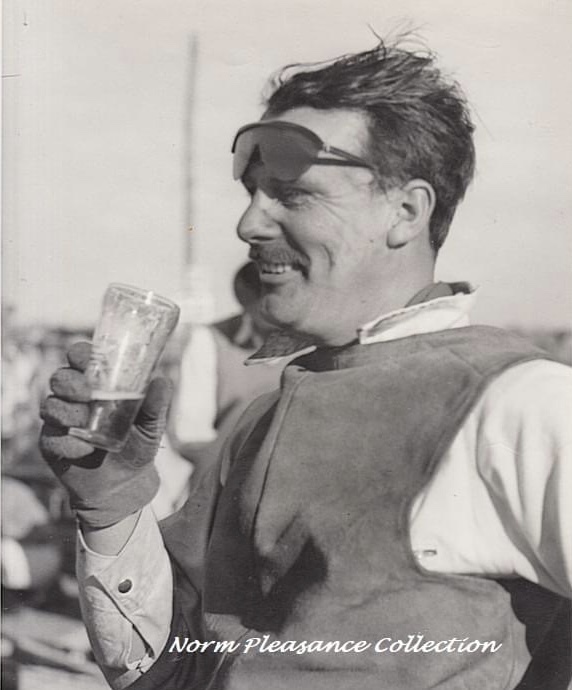
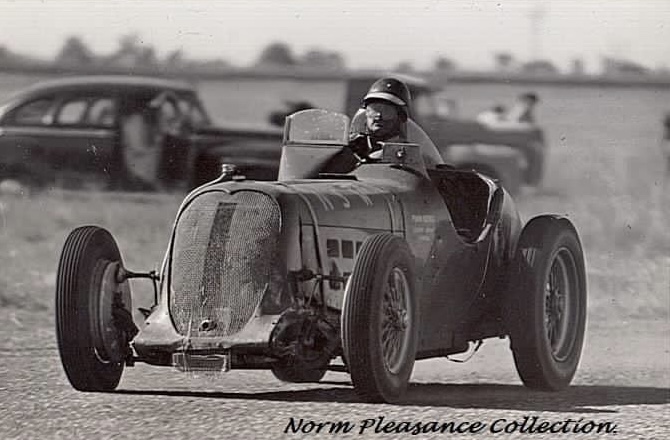
For so long the fire-and-brimstone Frank Kleinig had been an AGP favourite. 1949 was really his last chance to do well as the quality of our fields improved and his oh-so-fast Kleinig Hudson Spl slipped down the grids. Its development potential by then having pretty-much peaked.
Kleinig led Crouch for seven laps – they shared the fastest lap of the race 2’52 seconds/90mph – but then had the first of three pitstops which led to his retirement after completing only 21 laps.
Dick Cobden’s shapely, quick, Gordon Stewart built, Bob Baker bodied, 1946 MG TC (#3306) ‘Red Cigar’ single-seater (below) was out early after only six laps with undisclosed dramas.
Kleinig in his faithful Hudson Special, behind is Alan Larsen, Cadillac Spl and alongside him, car #9 is Keith Saunders’ Cadillac Spl(Brisbane Telegraph)
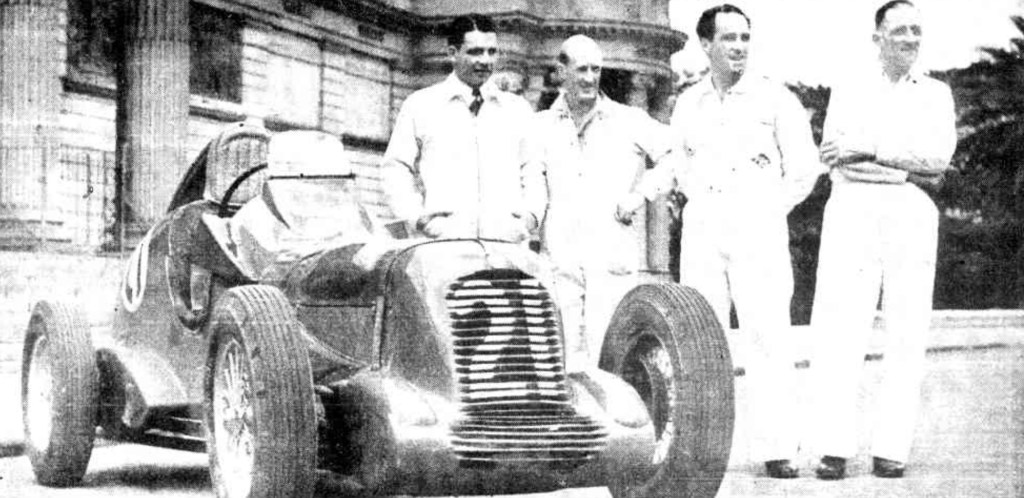
The Brisbane Telegraph caption of this pre-AGP promo piece reads, “Teamwork counts and here are seen NSW motorists, Alf Najar (left) who will be relief driver of Peter Critchley’s (ex-Najar 1946 NSW Grand Prix winning) MG TB Spl (second from right) the winner of the 1948 NSW Grand Prix (at Bathurst), Arthur Rizzo, and their mechanics.”
Kleinig again, #2 Dick Bland in the George Reed Ford V8 Special, #7 Alan Larsen, Cadillac Spl and the rest – #29 Brydon’s MG TC Spl and #33 at the very back is the Ford V8 Spl raced by Jack Wright.
Credits…
Wikipedia, racerviews.com, Rob Bartholomaeus, Stephen Dalton, Dick Willis, Brisbane Telegraph, Norm Pleasance Collection-Warwick Daily News via Daniel Kleinig
Tailpiece…
(D Willis)
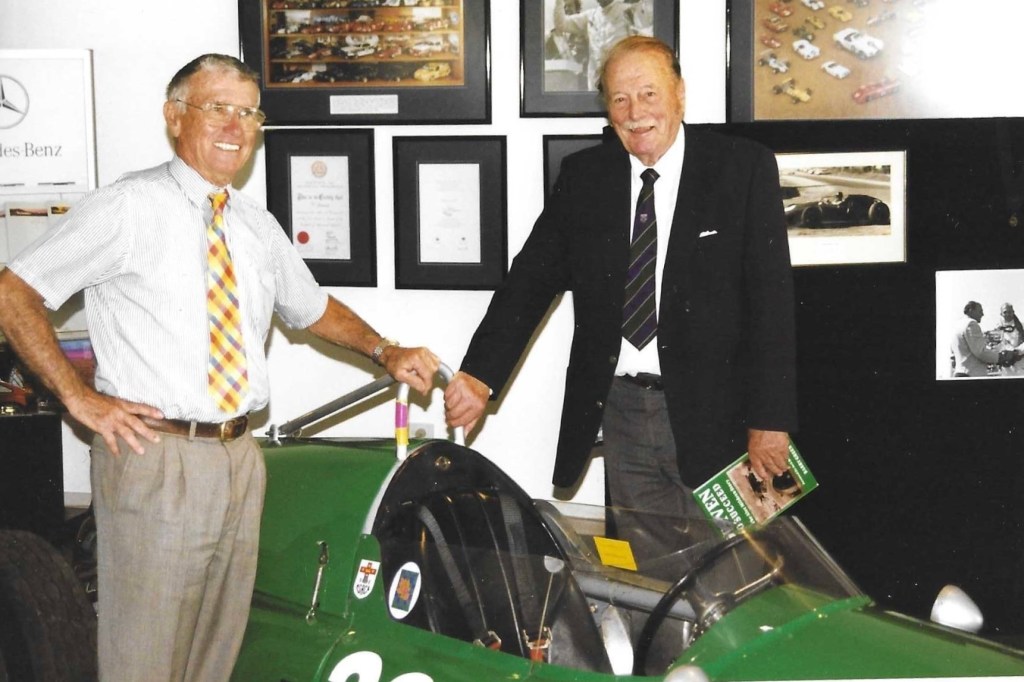
Racers both: Charlie Smith and John Crouch at the launch of Alec Mildren’s biography at Frank Gardner’s Norwell, Gold Coast facility on April 18, 1999.
John Harvey’s 2.5-litre Repco V8 powered Brabham BT11A shrieks it’s way around Warwick Farm on 18 February 1968…
Looks a treat doesn’t it? Nose up out of Leger Corner onto Pit Straight, it was first meeting for the car with its Repco engine.
By 1968 IC-4-64 was an old-girl, albeit a very successful one. It was raced by Graham Hill in the 1965 Tasman Series for David McKay’s Scuderia Veloce, winning the 1965 NZ GP at Pukekohe on its race debut.
Hill won the ’65 NZGP at Pukekohe on 9 January 1965 from Frank Gardner’s similar BT11A and Jim Palmer’s earlier model BT7A, all 2.5 Coventry Climax FPF powered (sergent.com)
The 2.5-litre Coventry Climax FPF four cylinder engine was struggling against the V8’s by then, so Bob bought a 740 Series Repco 2.5-litre V8 to plonk in the back of the BT11A.
John Harvey, Martin’s successor at Bob Jane Racing, contested the Australian rounds of the 1968 Tasman Series so powered. Jim Clark’s works Lotus 49 Ford DFW won the Tasman that year, it was the final championship he won before his untimely death at Hockenheim that April.
740 Series Repco 2.5 Tasman V8 engine. 700 Series Repco block and 40 Series ‘between the Vee’ heads’, the ’67 World Championship winning SOHC, two-valve engine in 2.5-litre Tasman spec as against its 3-litre F1 capacity. Repco claimed 275bhp @ 8,500rpm for the 2.5, and 330bhp @ 8,400 rpm for the 3-litre variant. Lucas injection trumpets, Bosch distributor and plenty of chrome and cadminium plating in shot (P Houston) Harvey in the BT11A Repco at Longford, 1968. The attention Bob Jane placed on the presentation of his cars is clear. Note the seatbelt, six-point? (oldracephotos.com-H Ellis)
Harves’ did three Australian rounds, only finishing the wet, final Longford event. By the start of the Gold Star series he slipped into Jane’s new Brabham BT23E which had been Jack’s 1968 Tasman mount.
Harvey raced the final round of the 1967 Gold Star Series in IC-4-64 after Martin announced his retirement. He was already well familiar with Repco power, the 740 Series Repco had been shoe-horned into his Ron Phillips owned BT14 F2 Brabham.
Third place at Sandown was his only finish in the car. John commented in a Facebook exchange about this car “…On handling, Peter Molloy and I were still developing the chassis setup, however in the Diamond Trophy race in 1967 (pictured below) at Oran Park I set a new outright record on the last lap”, so they were improving the car.
The engine and Hewland ‘box was removed from the BT14 which Jane acquired, and popped into the BT11A which it was figured would better cope with the power than the BT14 F2 frame and related hardware.
IC-4-64 is still alive and well, as part of the Bob Jane Estate, in FPF engined form.
Harvey in the WF pitlane, Tasman meeting ’68. The BT11A has a vestigial spoiler and a few ducts the it didn’t have when CC FPF powered. Jewels of things these ‘Intercontinental’ Brabhams, very successful ones at that (B Williamson) At the Warwick Farm Tasman meeting again (J Stanley) Competitor view of the BT11A and its luvverly Repco RB 740 2.5-litre 275 bhp V8 (P Houston)
Credits…
autopics.com.au-Richard Austin, John Stanley, Peter Houston, sergent.com, Bob Williamson, oldracephotos.com-Dick Simpson, Harold Ellis and Harrisson, oldracingcars.com, Stephen Dalton Collection
The shot of Harvey in the Ron Phillips owned Brabham referred to above, on the way to victory in the Diamond Trophy at Oran Park.
John made his name in speedway and transitioned into road racing in an Austin/Morris Cooper S, and then into open-wheelers in this ex-Bib Stillwell car. The Brabham received progressively bigger Lotus-Ford twin-cams, with Harvey going quicker and quicker, before the machine copped its Repco V8 Birthday between the 1967 Tasman and Gold Star Series. Rennmax’ Bob Britton performed the surgery to pop the Repco into the BT14 frame, creating a BT14 jig in the process.
It wasn’t that successful in Repco form; DNF/DNS at Lakeside, Surfers, Mallala and Symmons Plains, third place in the Sandown Gold Star round in September was the car’s best, behind Leo Geoghegan’s Lotus 39 Repco and Spencer Martin aboard BT11A IC-4-64.
Harvey during the Diamond Trophy meeting at Oran Park (oldracephotos.com-Dick Simpson)
Harvey’s Bob Jane drive commenced aboard IC-4-64 in the final Gold Star round, the Hordern Trophy, at Warwick Farm in December 1967.
So…Harvey in 12 or 14 months drove quite a few different Brabham/engine combinations! BT 14 Ford, BT14 Repco, BT11A Climax, BT11A Repco, and then BT23E Repco for the ’68 Gold Star Series. Mind you he missed the ’68 Gold Star.
The ‘noice new Brabham crashed after a rear suspension upright failed in practice for the opening Bathurst round. Harvey’s big accident and subsequent recovery kept him away from racing for the rest of the year.
Harvey aboard the Jane Racing Brabham BT23E Repco 830, during the Symmons Plains Gold Star round in March 1970, at the end of its competitive life. He won the race from Leo Geoghegan’s Lotus 39 Repco and Kevin Bartlett’s Mildren Waggott (oldracephotos.com-Harrisson)
Tailpiece…
(S Dalton Collection)
The July 1965 Oran Park meeting program shows Harvey’s Austin Cooper S ahead of George Garth’s Ford Cortina GT during the OP May 1965 meeting.
Bruce, Tyler Alexander and and Alastair Caldwell…a new set of Goodyears for McLaren’s M7A. He put them to good use, qualifying sixth on the fast swoops of Rouen…
I’m drawn to the papaya McLarens thanks to their visual splendour and absolute respect for Bruce the man, engineer, test driver, racer and motivator of men.
He was the full-enchilada with the lot as a package, as well rounded a racer as it’s possible to be.
Here Chris Amon is tootling past him in the pitlane, his fellow Kiwi no doubt hoping the Firestone shod Ferrari 312 will cope with the fast swoops of Rouen better than Bruce’ M7A, a mighty fine design which carried the Ford Cosworth DFV.
I’ve posted a piece on this race before so don’t want to dwell on the awful fiery accident which cost Jo Schlesser’s life early in the event. Jacky Ickx took his first GP win in a Ferrari 312 from John Surtees’ Honda RA301 and Jackie Stewart’s Matra MS10 Ford.
The shot below is Graham Hill’s Lotus 49B Ford in grid slot nine surrounded by other fellas. The flash of blue to his left is Jean Pierre-Beltoise’ V12 powered Matra MS11 (ninth), Surtees Honda, with the blue flash down his white helmet and Chris Amon’s Ferrari, see its distinctive, white, between the Vee exhausts.
1968 was the last time an F1 GP was held at the wonderful 6.542Km road course near Orival and Rouen. The track was used for European F2 Championship races until 1978 and French national events after that, economic forces resulted in its 1994 closure.
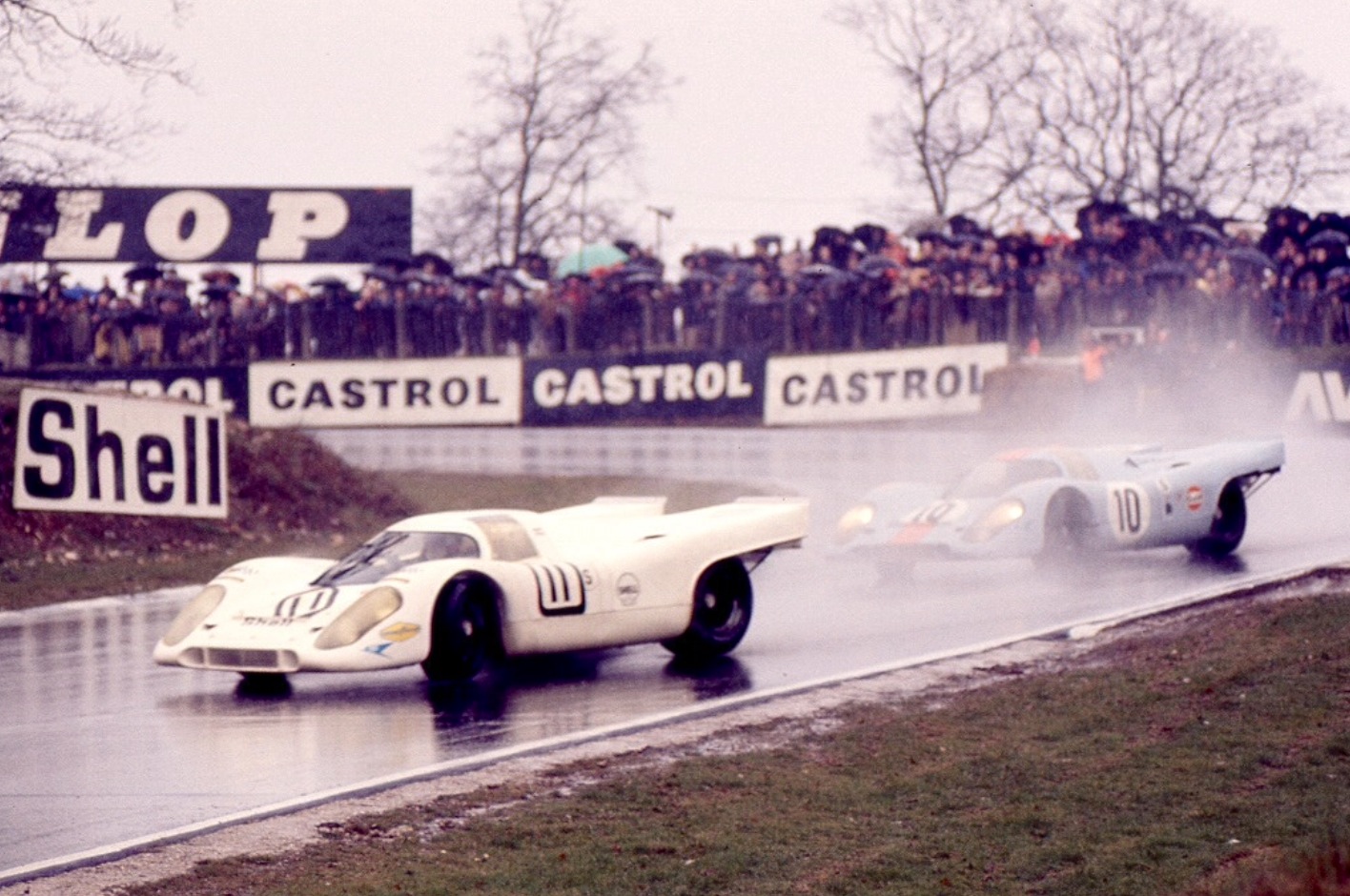
There are drives which are spoken of in reverential terms down the decades, Pedro Rodriguez’ victory in the Brands Hatch 1000km in 1970 is one of those…
Here #10, the John Wyer entry is set to pounce on #11 Vic Elford out of Druids in another factory (Porsche Salzburg) Porsche 917K, the Brit was of course no slouch on slippery surfaces himself. He was European Rally Champion aboard a Porsche 911 in 1967 and Monte winner similarly mounted in 1968 before going circuit racing.
Acknowledged wet weather ace Jackie Ickx raced a factory Ferrari 512S in a Brands Hatch field full of F1 drivers who in those days also contested the sportscar endurance classics. But Pedro was in a class of his own on that sodden Kent afternoon finishing five laps ahead of the second placed 917K of Elford and Denny Hulme, and eight laps ahead of another 917K driven by soon to be 1970 Le Mans winners Hans Hermann and Richard Attwood, both in similar equipment to Pedro…
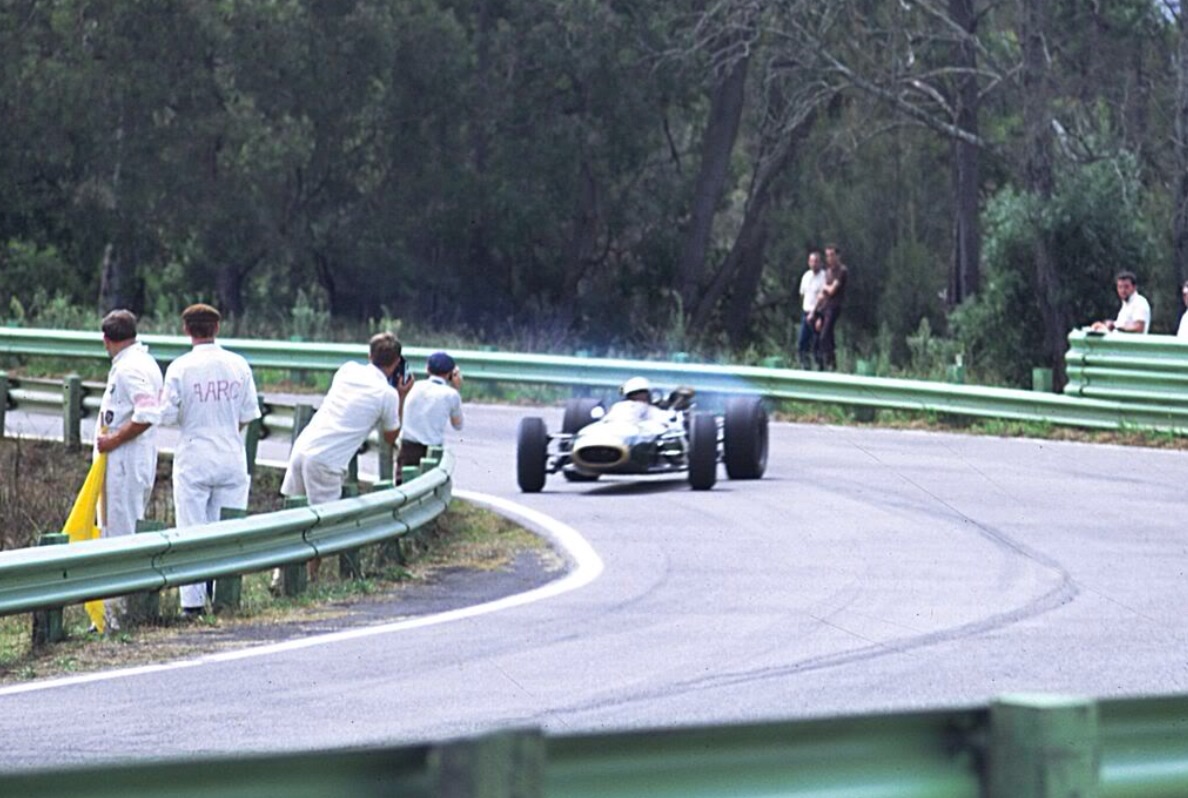
Denny Hulme delights the flaggies and ‘snappers and fries a set of Goodyears on entry to Warwick Farm’s Esses during the February 1967 Tasman round…
John Ellacott’s evocative shot at the ‘Farm catches Hulme in his Brabham BT22 Repco during practice, well cocked-up before the apex. He didn’t finish the Australian Grand Prix, his radiator hose came loose on Sunday, the race was won by Jackie Stewart’s BRM P261 from Jim Clark’s Lotus 33 Climax.
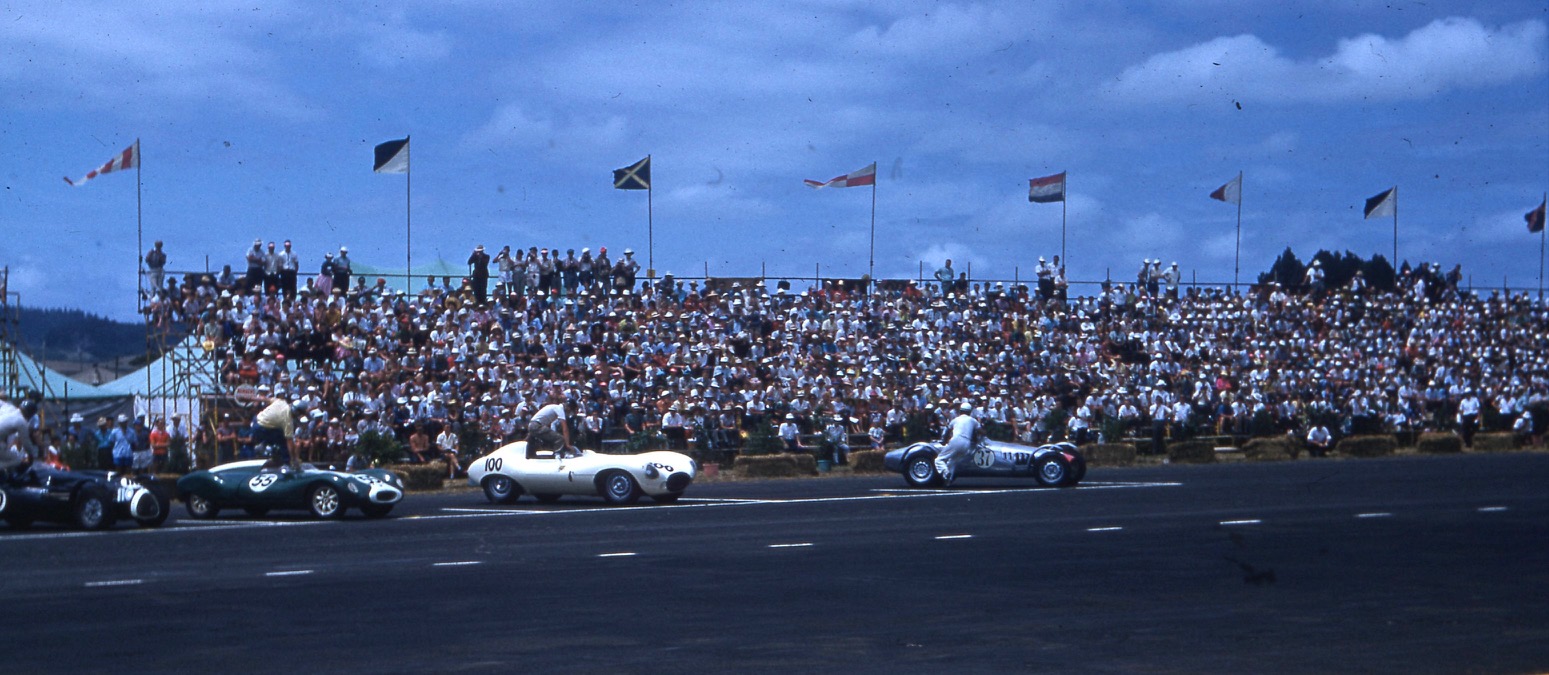
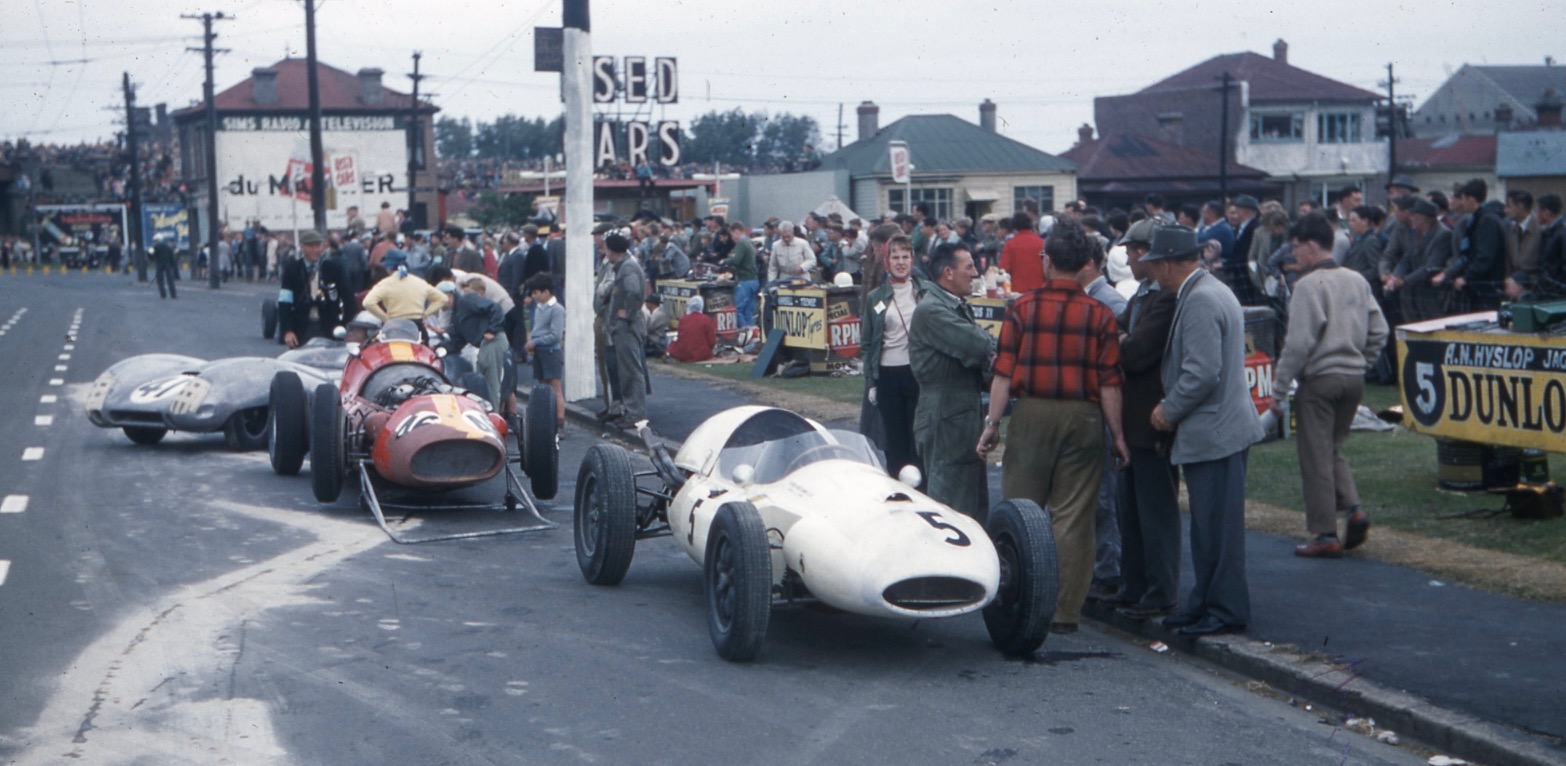
1961 Ardmore Sports Car Trophy race – Le Mans start (B Hanna)
“The Le Mans start of the Sports Car Trophy Race (above) at Ardmore, 7 January 1961 (the VIII New Zealand Grand Prix meeting) seen from the pit lane. Angus Hyslop is aboard his Jaguar #100 and Doug Lawrence in the Cooper Bobtail #55 seem to be a couple of steps ahead of Malcolm Gill in the 5.2-litre four cylinder Lycoming Special #37. But Gill ran out the winner, with Hyslop second.”
The late Bill Hanna was Hyslop’s team manager/mechanic during 1961 when Angus was awarded the NZ Driver To Europe Scholarship. In between his fettling and organisational responsibilities Bill shot these marvellous colour transparencies in New Zealand and in Europe. Thanks to the efforts of Alec Hagues – Bill’s son-in-law – we can now tell the tale and share these never-before-seen Hanna family photographs.
This is the first of three articles written by Alec I’ll upload over the next month. A million thanks to him and his family for choosing primotipo to share these words and pictures publicly. They are magic timepieces from motorsport and lifestyles-of-the-day perspectives. I’ve fiddled with the photo captions in a few cases to flesh-out car model/specs, any errors are mine. Enjoy! Over to Alec…
“Meanwhile, having collected a 1958-built Cooper T45-Climax 1964cc from Syd Jensen in Kairanga at the end of 1960, Angus ran both the Cooper and his Jaguar D-Type XKD534 in the 1961 New Zealand Championship meetings.”
(B Hanna)
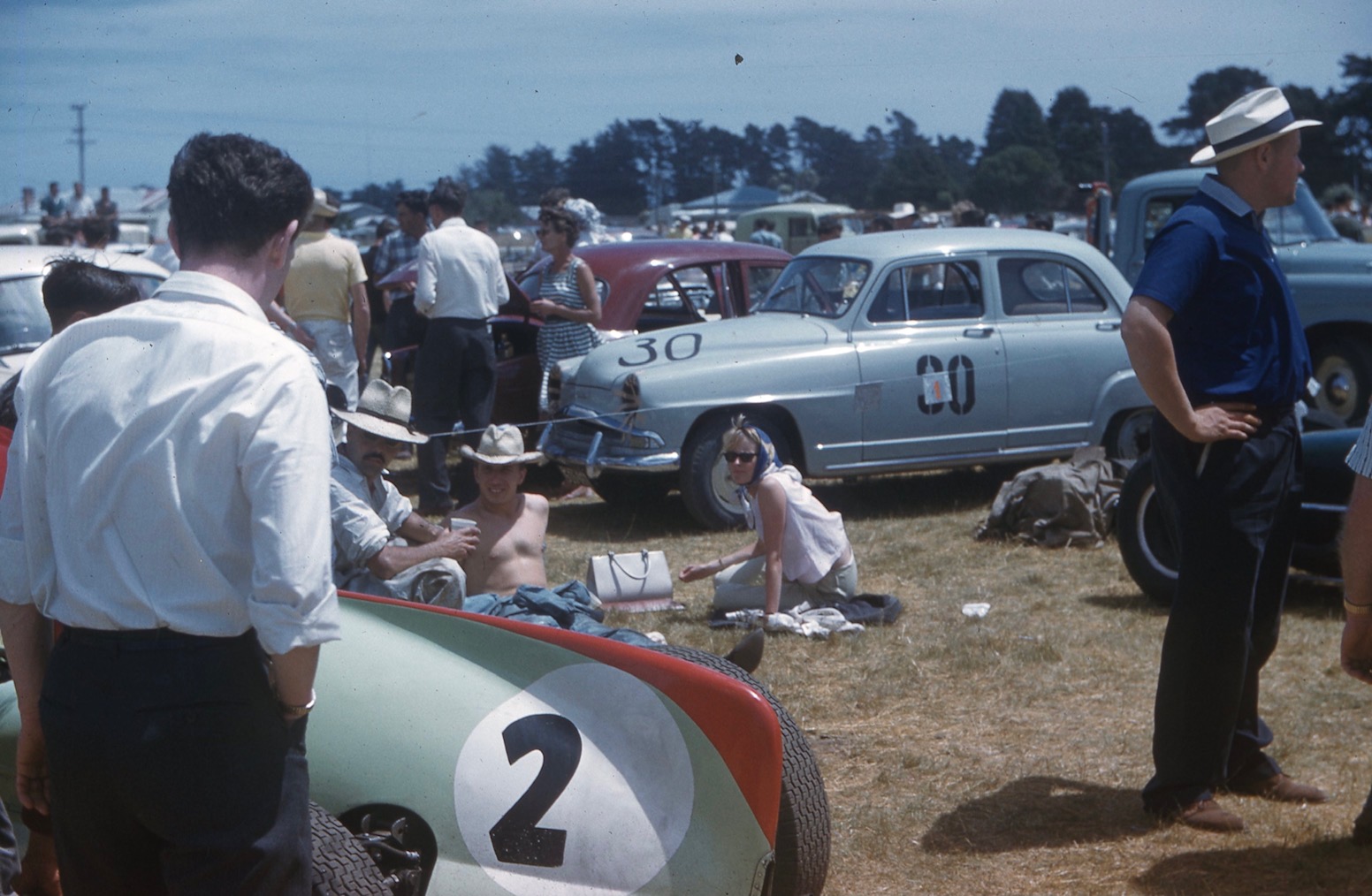
“The grandstand in the background identifies this as Levin, most likely on 14 January 1961, the Cooper and two Jaguars belonging to the Hyslop team are pictured above.
The 2nd Levin International that day was won by Jo Bonnier – and his distinctive 2.5-litre Cooper T51 Climax #2 creeps into the corner of this shot below, probably taken from the same spot as that above, but in the opposite direction to the first.”
(B Hanna)
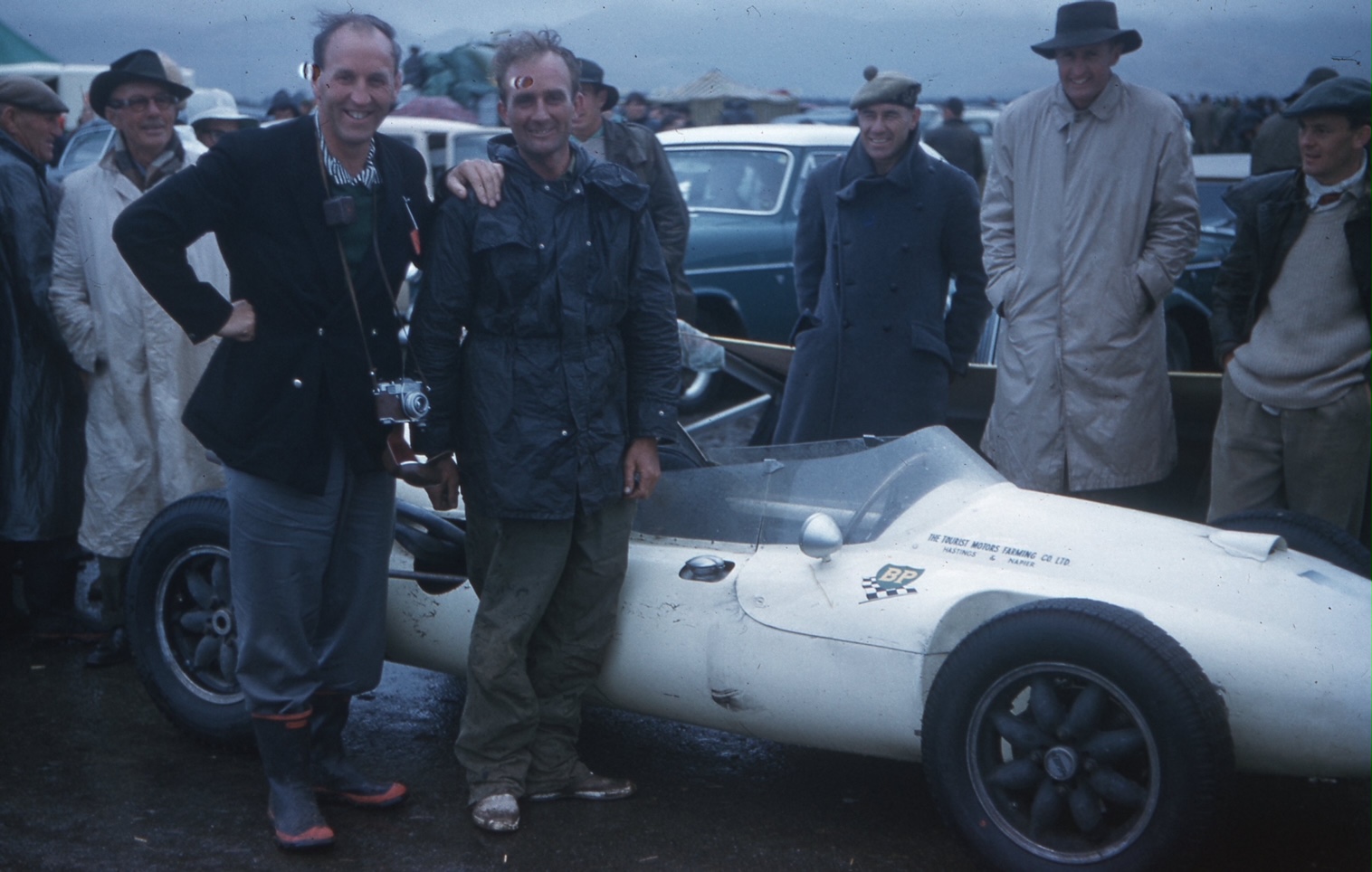
“Conditions at Wigram on 21 January 1961 were less than ideal for photography, but given Angus’s famous performance in the Lady Wigram Trophy (third place to Jack Brabham and Stirling Moss and first Kiwi home) and the appearance of the Cooper’s former owner, Syd Jensen, Bill can’t let the day go unrecorded! Angus and Syd (left) are shown below with the speedy Cooper T45 on a frosty, soggy Kiwi summer day.”
Syd Jensen and Angus Hyslop (B Hanna)Angus’s Cooper T45-Climax on Andersons Bay Road, Dunedin (B Hanna)
“Andersons Bay Road, Dunedin, the Festival Road Race on 28 January 1961. The Bob Smith or Frank Shuter Ferrari 555/625 (help folks) #46 and Arthur Moffatt’s Lotus 15 Climax #41 are behind Angus’ Cooper in the roadside pits.
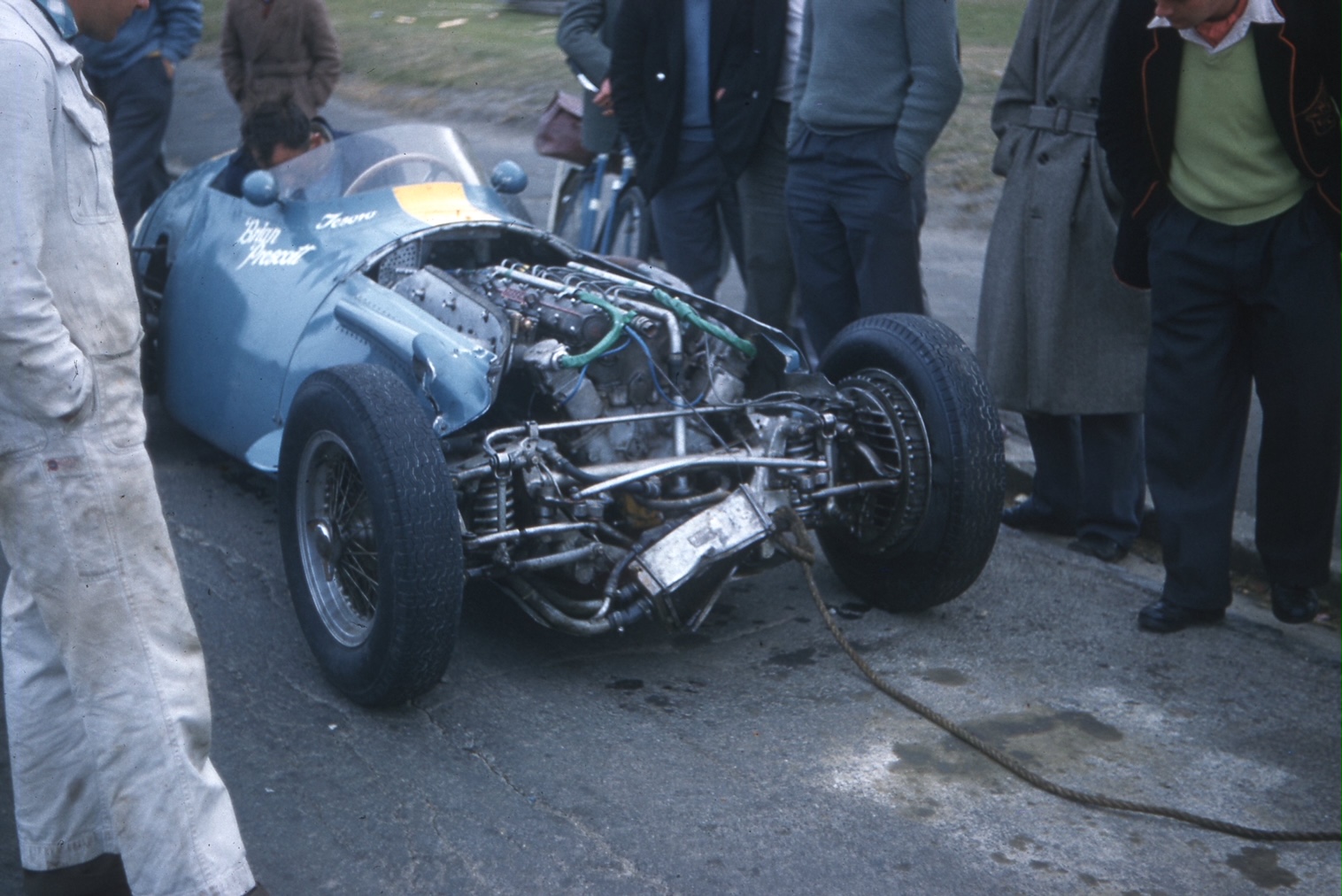
Brian Prescott’s race ended against a brick wall on lap 29; this is his (formerly shark-nosed) Piccolo Maserati 250F #29 shown below.
The introduction to the NZ National Film Unit’s ‘New Zealand Grand Prix’ short film was shot in Dunedin that day, with the Sports Car and Feature races both covered – in the film we see Denny Hulme cross the line in first place in the latter event. New Zealand Grand Prix | Short Film | NZ On Screen
Accident damage to Brian Prescott’s Maserati 250F (B Hanna)#19 Pat Hoare, #20 Denny Hulme, #3 Jo Bonnier, #1 Angus Hyslop, #33 Len Gilbert (B Hanna)
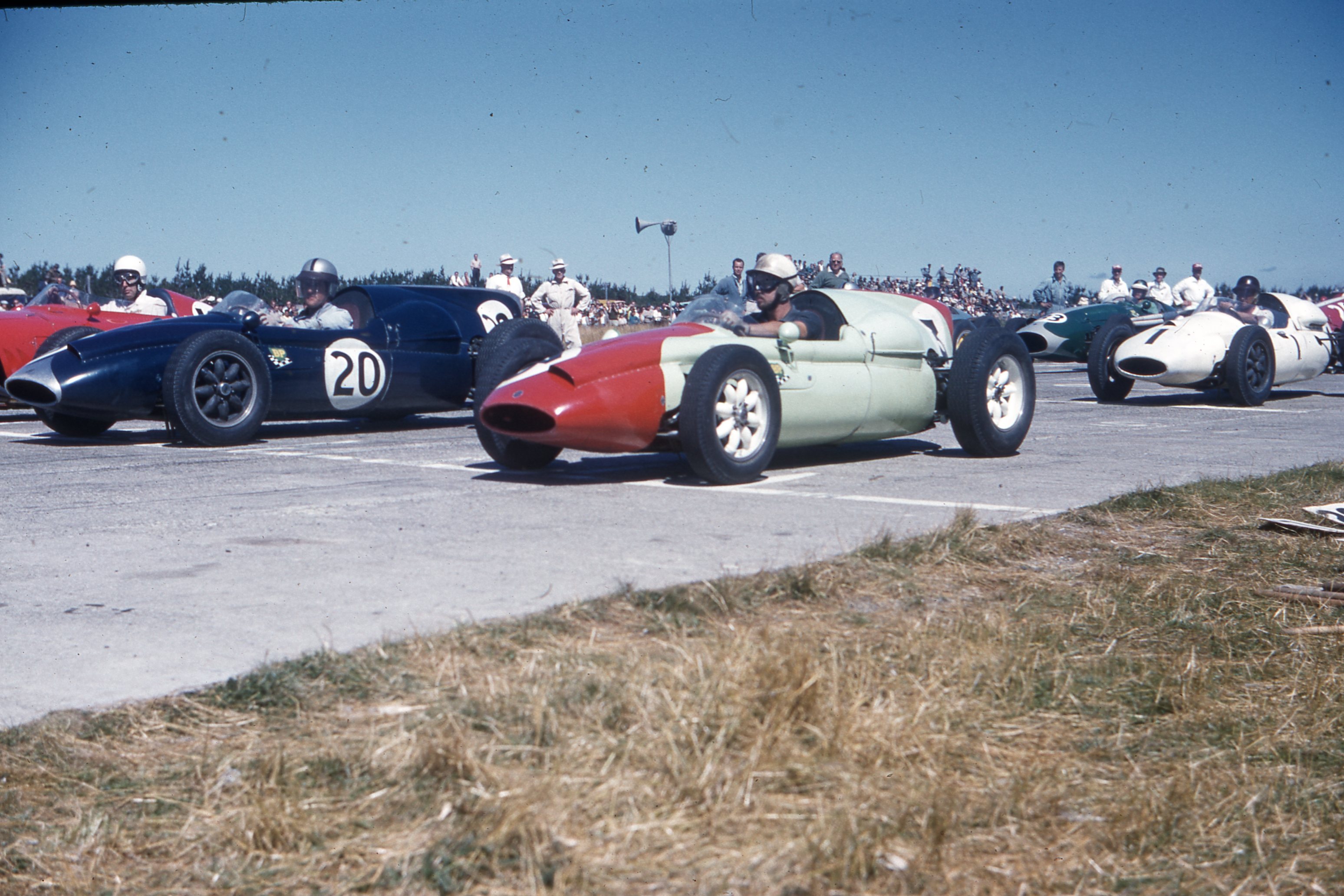
“The front row at Teretonga, 4 February 1961: Pat Hoare, Ferrari 246/256 3-litre V12 #19, Denny Hulme, Cooper T51 Climax 2.5 #20 and winner, Jo Bonnier’s Cooper T51 Climax 2.5 #3. Just behind them are Angus #1 and Len Gilbert, Maserati 250F #33. Other colour pictures of this race have been seen online, but this shot is simply too good to leave out.
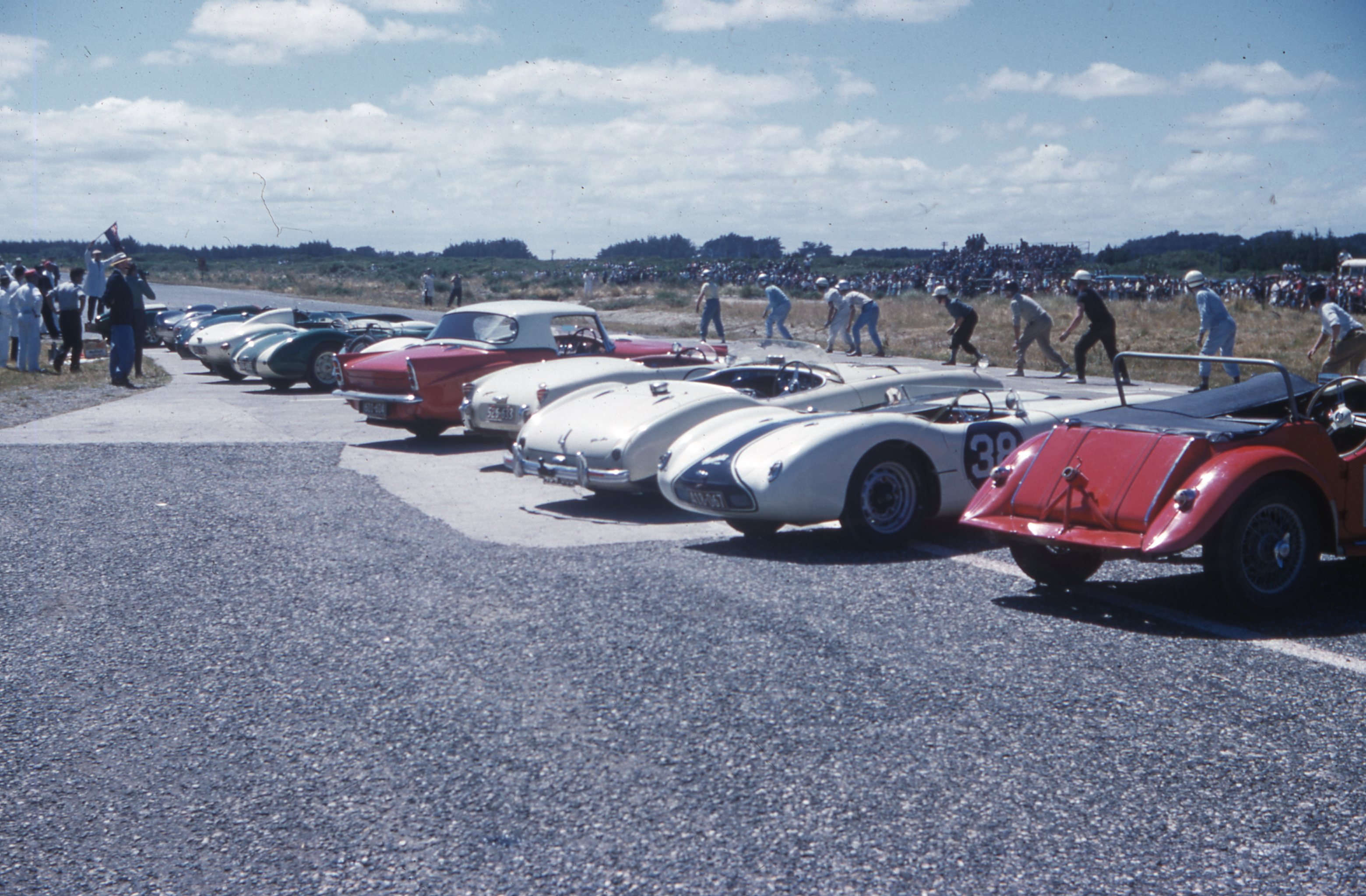
The sports car race on the same day below with Ivy Stephenson’s Buckler Le Mans #38 prominent, but the ubiquitous Lycoming, Doug Lawrence’s Cooper Bobtail, Ross Jensen’s Daimler Dart, F P Harris’s MG TF and David Young’s Jaguar C-Type are in there with Angus’s Jaguar too.”
(B Hanna)
“Waimate on 11 February 1961 was another meeting held in the wet… and it seems that Bill didn’t feel like getting his camera out. Pat Hoare won the third Waimate 50 in his Ferrari V12, Denny Hulme already had the Gold Star in the bag so didn’t participate.”
Fay, Bruce Webster’s Cooper-Porsche, the Hyslop Cooper-Climax and Jaguar D-Type, Ahuriri 18 February 1961 (B Hanna)
“Back home now to South Pond paddock at Ahuriri for the Napier Road Races of 18 February 1961.
In the Hastings team corner, above, we see Bruce Webster’s Cooper-Porsche and again Angus’s Cooper and Jaguar. That’s Bill’s wife Fay, a familiar face at motor racing events at this time. Note the somewhat crude last-minute number changes to #111 and #151 – Angus obviously wasn’t keen to be #46 as suggested by the day’s programme. Pat Hoare entered too late to be in the programme, but ended up winning the feature race in his awesome ex-works F1 Ferrari Dino 246 powered by a 3-litre V12.
This is surely later the same day below… but what happened?
Angus sold XKD534 to Simon Taylor after the next meeting at Ohakea on 25 February 1961 and ended the New Zealand season with third place in the Gold Star and second in the Sports Car Championship to Malcolm Gill. Angus and Bill pack the Cooper up for the long voyage to Europe…and it is never seen in New Zealand again.”
(B Hanna)
To be continued, trust me, if it’s possible, the photographs get even better…
Credits…
Photographs, the late Bill Hanna, words Alec Hagues
Note ‘bi-hi’ wings mounted to the rear uprights, and front top suspension inner mounting point. Hewland FT200 gearbox (P Strauss Collection)
“A photograph is everything!” Doug Nye told a group of us several months ago when we were arguing the toss about some knotty identification problem...
My Repco Brabham Engines buddy, Rodway Wolfe and I wrote the ‘definitive article’ on Jack’s Brabham BT31 Repco, his 1969 Tasman mount years ago. You’d think that would be easy enough given it only raced twice in-period, see here for the masterpiece; Brabham BT31 Repco: Jacks ’69 Tasman Car…by Rodway Wolfe | primotipo…
We thought the car was assembled and run for the first time in Australia a couple of days after Rodway helped Jack unpack the wooden MRD box in which BT31-1 was shipped to Port Melbourne, and put it together at RBE’s Melbourne factory between February 12-14, 1969.
But no!
Photographs from Peter Strauss’ collection, custodian of BT31 for 15 years or so, clearly show that the car was tested (by Jack) at Goodwood in late 1968 before being pulled apart, packed into the wooden box then shipped far-far away for Jack and Rodway to open at Maidstone on February 12, 1969.
(S Dalton Collection)
This short UK BT31 chapter was covered by Autosport in their January 3, 1969 issue, found by my friend, ace researcher/writer Stephen Dalton.
“The Brabham BT31, MRD’s (Motor Racing Developments – Brabham) new Tasman car, is based on the BT28 F3 design but with 1.75 ins more wheelbase, larger brake discs and calipers, a different engine bay to accommodate the four-cam (actually SOHC, two-valve) 85mm x 55mm Repco RB830 V8 engine, and twin side fuel tanks. The RB830 develops 290bhp at 9000rpm and uses twin Mallory distributors.”
“The engine top bay tubes detach to facilitate engine removal, and side radiator outlets are included. Wheels are 13-ins diameter with 9-ins front rims and 14-ins rears. The car has been tested at Goodwood, and a full kit of suspension, chassis, gearbox and body components has been sent to Australia to be built up locally for Jack Brabham to drive at the Warwick Farm and Sandown rounds of the Tasman Series.”
Over the years Peter told various people his car had run in the UK. Those-in-the-know, including yours truly, thought Strauss had his-hand-on-it (a colloquial Australian expression suggestive of the telling of a porky-pie).
“When I bought the car off the previous American owner a lot of photographs came with it including those two. I was told the pit-shots may have been Snetterton, it will be interesting to find out where they are.” A learned group of British historians confirm the circuit as Goodwood.
I’ve got to know Peter quite well during Covid, it’s funny how many new-Covid-buddies I have. We dealt with the business of the day recently, then he showed me his BT31 photo album, he flicked through the first few pages, then paused on one particular spread…
“Fuck me dead!” I said, rather loudly. It’s another vulgar colloquial expression, of surprise actually. I might add that I wasn’t issuing an invitation to poor Peter.
I couldn’t believe my eyes, but instantly knew what I was looking at! What was it that nice Mr Nye said about photographs as a source of fact rather than the written word?…
(P Strauss Collection)
Postscript…
Peter has three Brabhams, BT31, a BT11A Climax 2.5 FPF and an FJ BT6 Ford Cosworth 1100, lucky bugger. Along the way he met Messrs Brabham and Tauranac, individually and collectively quite a few times.
Brabham is on-the-record – a number of times in conversations with different individuals and groups of people – as saying that had they (MRD, BRO and Repco Brabham Engines) stuck with another simple SOHC, 3-litre V8 in 1968 rather than raced the under-developed, four-cam, 32-valve 3-litre 860 V8 powered BT26 they could have won another world title. That is three-on-the-trot, 1967-1968, rather than two in 1966-1967.
I don’t doubt that Jack said it but the notion doesn’t stack up. Ford Cosworth V8 engined Lotus, McLaren and Matras won every round of the 1968 World Championship with the exception of the French GP which went to Ickx’ Ferrari 312 V12.
In fact the Brabham Racing Organisation did race a simple SOHC BT24 740 (BT24-3) on several occasions in early ’68 while awaiting BT26 to come on stream. At Kyalami it was Q5 and DNF engine for Brabham, in Spain Q9 and DNF oil pressure for Rindt, Monaco Q5 and DNF accident for Rindt. At Zandvoort Dan Gurney returned to the Brabham fold for just that meeting. Dan popped the car 12th on the grid but DNF with throttle problems. For the sake of completeness, Jochen used it at Brands during British GP practice before Kurt Ahrens raced it at the Nurburgring to 12th place under the Caltex Racing Team banner.
So, to Jack’s point, the Brabham Racing Organisation raced a simple SOHC car in 1968 on five occasions, the best the circa 330bhp machine could do among seven or eight 400bhp Ford Cosworth V8 engined cars was a couple of fifths on the grid…
(P Strauss)
Strauss picks up that vein, relating a conversation he had with Ron Tauranac “At Eastern Creek about 2014. While Ron Tauranac (above) was trying to figure out how to make BT31 run cooler, he mentioned that he had built a few cars (sic!) but recalls that they (MRD) were building a car for the ’68 (F1) season, smaller than usual to save weight and make it more slippery. He found out that fuel cells were going to be mandatory which meant that the BT31 would not comply as the tanks were wrapped around chassis members and could not fit bladders.”
A 3-litre 830 engined BT31 is an interesting theory/coulda been but RBE mechanics/engineers have long said that no 3-litre 830 V8 was ever built by RBE in-period, they were all Tasman 2.5s. Some 3-litres (and larger) were built in the modern era by Don Halpin and perhaps others.
Further, the F1 bag-tank rules RT alluded to were mandated from the start of 1970, not 1968 or 1969. This FIA requirement effectively forced Tauranac to part with the spaceframes he had hitherto used to such good effect in F1. His 1970 monocoque BT33 was rather a good thing too, whilst noting his 1968-69 BT25 Indycar used an aluminium monocoque too.
Credits…
Peter Strauss, Autosport, Stephen Dalton
Tailpiece…
(P Strauss Collection)
Brabham at Bathurst during the Easter 1969 Gold Star round, won convincingly by Jack who practiced with various wing combinations and permutations but raced BT31 as above.
One of the various what-ifs about this car is whether, suitably updated, he could have won the 1970 Tasman Series with it? This ignores the fact that his Repco deal was over and Betty probably would have shot him if he had raced that summer rather than chilled with the kids at the beach…
It was quick enough to win the ’70 Tasman Cup mind you.
Peter Stubberfield applying all of the energy to his Bugatti T35B Monoposto for which he was famous, “its probably at Prescott, perhaps Pardon Hairpin,” reckons Bob King.
The good doctor’s (King’s) study continues to be an Aladdin’s Cave of automotive treasures, this time the British Racing Drivers Club 1948-1949 yearbook.
Stubberfield hailed from Cliveden View Cottage, Cookham, Berkshire just over the hill from my old mate Chris Stops, I am a regular visitor from the colonies to his ‘Bourne End Hilton’, god’s own country it is too.
Stubberfield at Prescott (cookham)
Chassis #4840 was ex-George Easton and Faye Taylour. In modified monoposto form, with twin rear-wheels and fairly standard engine specification, the combination was prodigiously fast in the British hills in the 1930s and early post-war years.
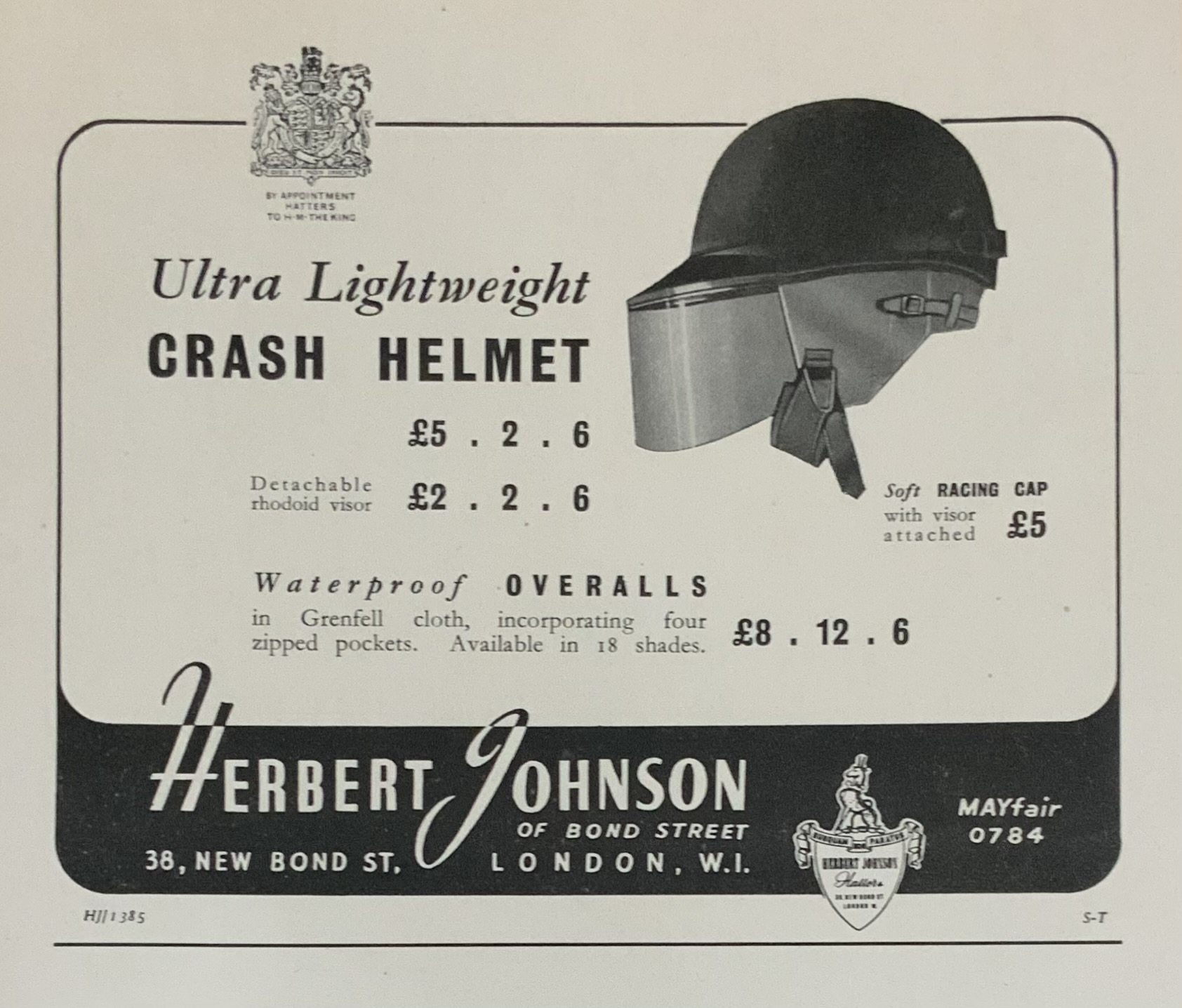
Apart from information in period documents such as this one, I find the ads fascinating in style or substance. The two below are those of Wade Superchargers and Herbert Johnson, Bond Street purveyors of headgear to the gentry.
Its funny what you find!
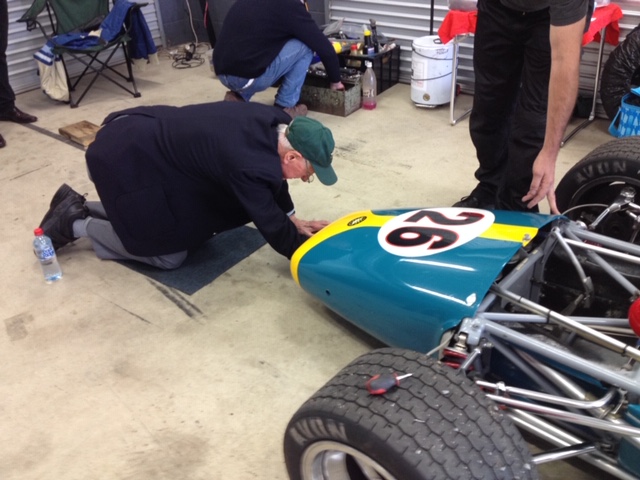
I was Googling away to find information on our friend Peter Stubberfield, and what should be for sale but Peter’s old helmet! Not one made by Herbert Johnson mind you, but rather by S Lewis & Co of Carburton Street, London.
It’s a shellac composition shell with fixed peak, moleskin-lined leather side and neck protection – note the Bugatti enamel badge affixed to the front. Also in the shot are Stubberfield’s lightweight racing goggles, a photo of him in the T35B and another with his ‘equally famous pet mascot’ together with two early post-war Prescott programs.
(Bonhams)
Credits…
BRDC Motor Racing Annual 1948-1949 – Bob King Collection, Bonhams
Bob Atkin and the SV Ferrari 250LM in 1968, love those works Ferrari overalls (B Atkin)
Australian enthusiasts of a certain age will recall Bob Atkin as David McKay’s partner in Scuderia Veloce, the Sydney based race team and prestige car dealership established by McKay as he evolved from racing driver to entrant/entrepreneur/motor trader, in addition to racing/automotive journalism off to the side.
SVs soon became the team to watch, and Atkin had a front row seat. He took his camera with him to race meetings recording the activities of the team, and other competitors in living colour.
In recent times, his son, Greg Atkin has been uploading his dad’s photographs onto Bob Williamson’s Old Australian Motor Racing Photographs Facebook page. I’ll periodically upload ‘Bob Atkin Collection’ pieces rather than lose these amazing colour time capsules in the bowels of FB, many thanks to Greg for sharing them.
(B Atkin)
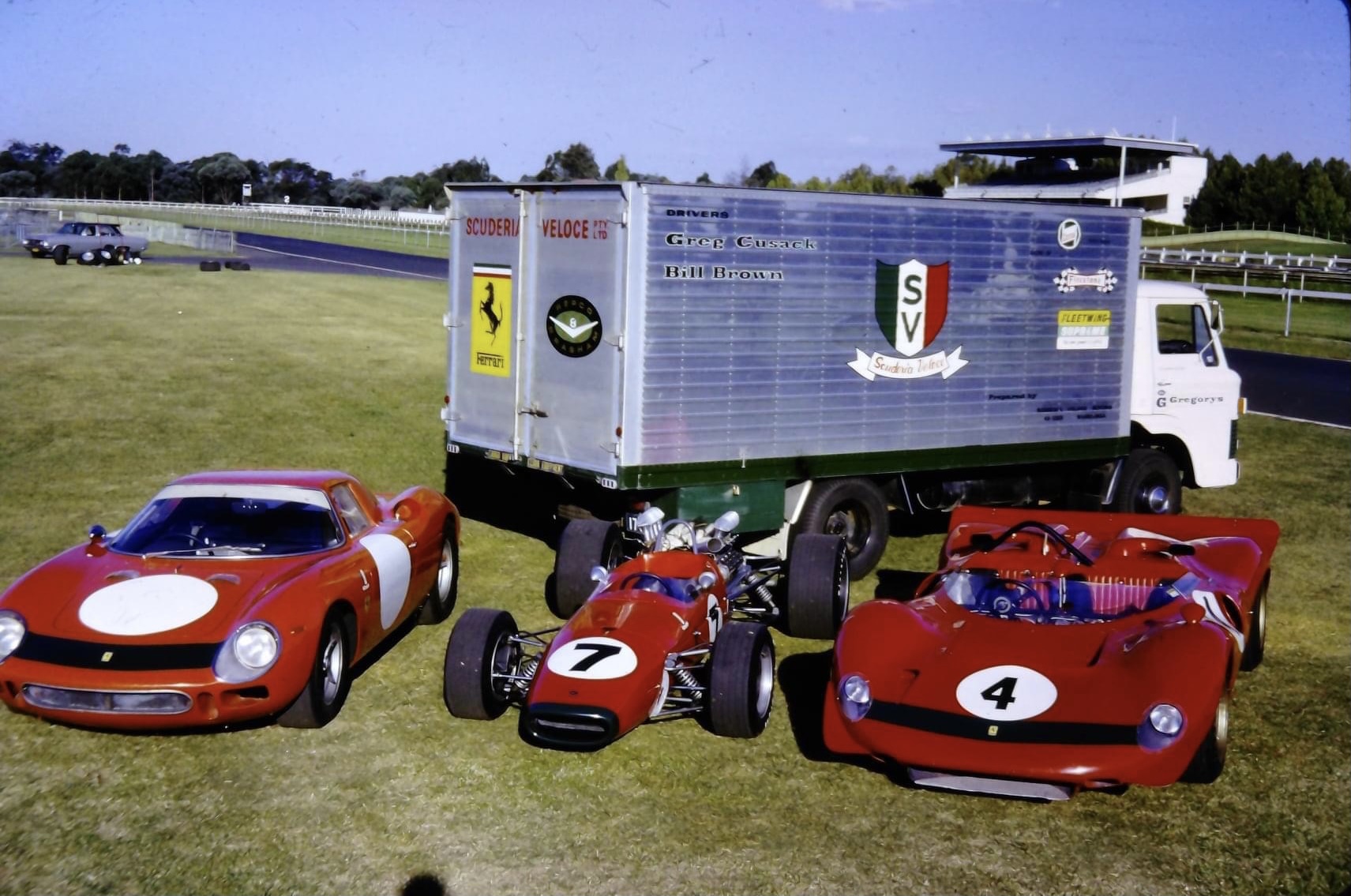
This 1968 photograph at Warwick Farm says everything about the fizz SVs created amongst Australian enthusiasts.
The line up is the Ferrari 250LM bought new by McKay first raced for him by Spencer Martin during some of the 1965 Australian Tasman Cup rounds, the ex-Jack Brabham ’67 Tasman mount – Brabham BT23A Repco, and ex-works Ferrari 350 Can Am machine raced throughout 1967 as a P4 enduro coupe before being converted – along with another of its siblings – for Can-Am use in the latter months of 1967 driven by Chris Amon and Jonathon Williams.
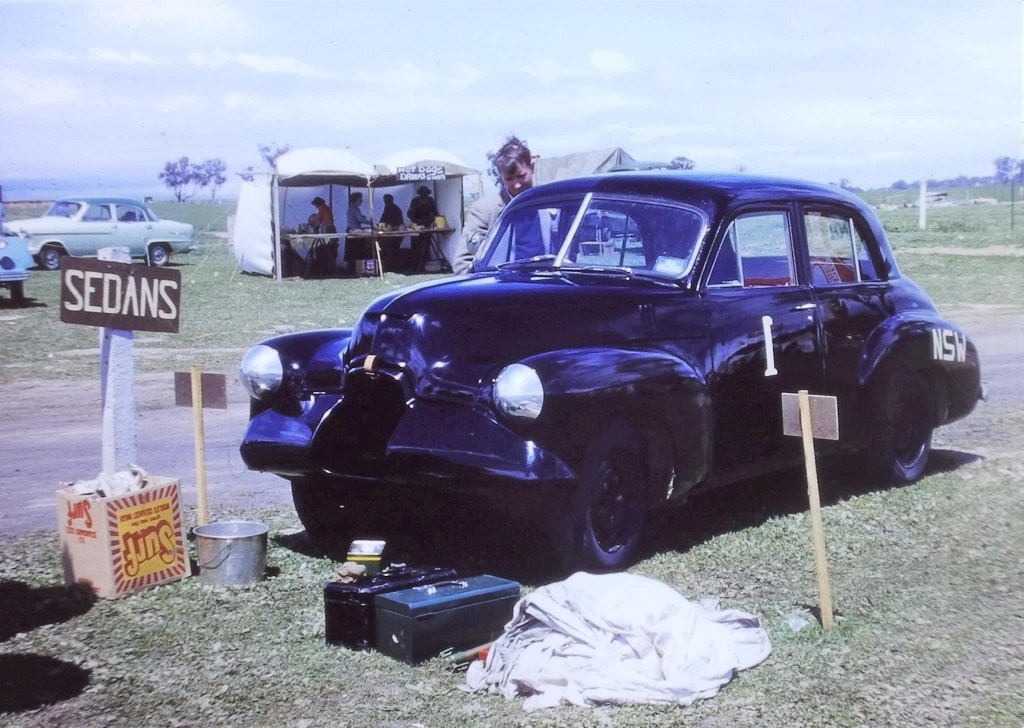
Bob was obviously a Leo Geoghegan fan, the earliest of his shots is of Leo doing a lap of honour in an official’s Austin Healey at Mount Druitt, Sydney, perhaps on the day be beat Frank Gardner’s Jaguar C-Type in a handicap race aboard his very quick Holden 48-215, the car is shown below in the Mount Panorama paddock in 1958.
(R Reid)(B Atkin)
Greg Cusack (at far left above) a successful car dealer himself was one of SV’s longest supported drivers.
These two fabulous shots were taken at Mallala circa 1964. It is the delivery session of Greg’s brand new Elfin Mallala Ford twin-cam by Garrie Cooper (in the natty red sox) and the Elfin boys into the care of the Cusacks. That Rice Trailer will shortly be off on the trip home to Canberra.
By the time I raced at Mallala that pit-counter was long gone, so too the aircraft hangar to the right in the shot below.
(B Atkin)
Credits…
Greg Atkin for sharing the Bob Atkin’s photographs, Ron Reid Collection, Alan Edward Giltrap
Tailpiece…
(A Giltrap)
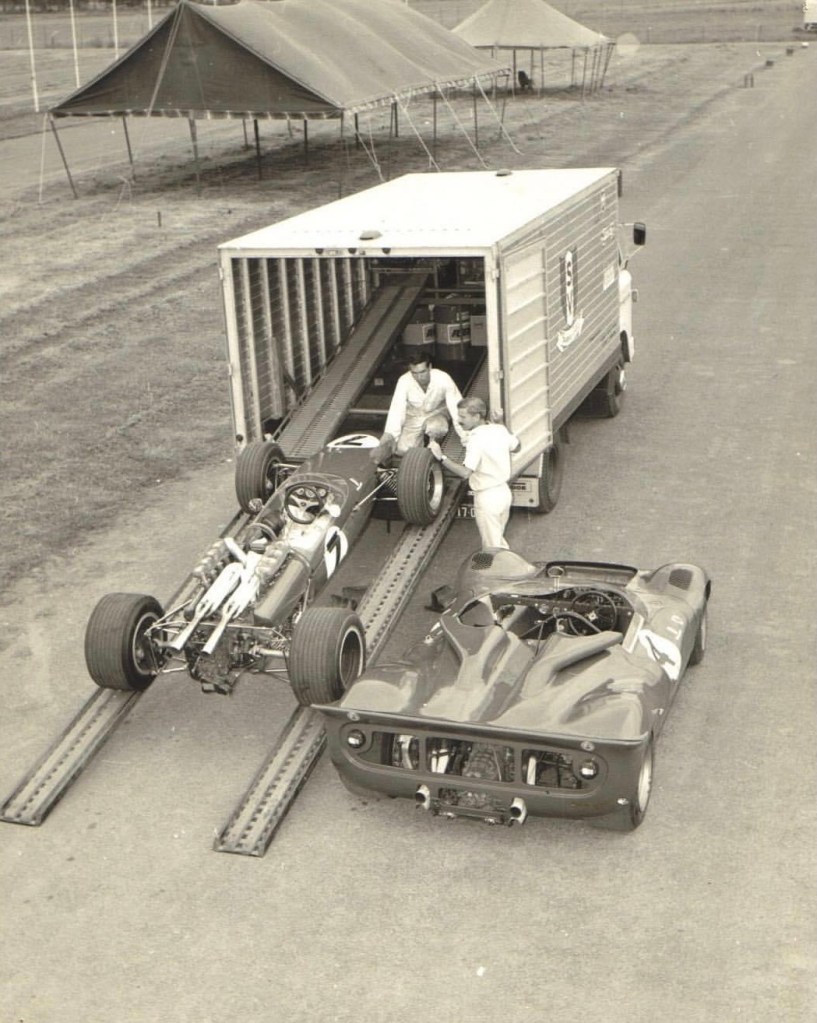
Bob Atkin and David McKay at Warwick Farm, probably not long after the Ferrari 350 Can Am arrived in late 1967. To comply with Australian rules, the car was fitted with headlights – such P4 fitments not required under Group 7/Can-Am rules – and a spare wheel, which SV fitted to the rear of the car aft of the transaxle. It ain’t there when this shot was taken.
“That D-Series Ford truck could take two cars, the Brabham on top and P4 (350 Can Am) underneath, the truck came from Greg Cusack’s Ford dealership in Canberra,” wrote Dominic David.
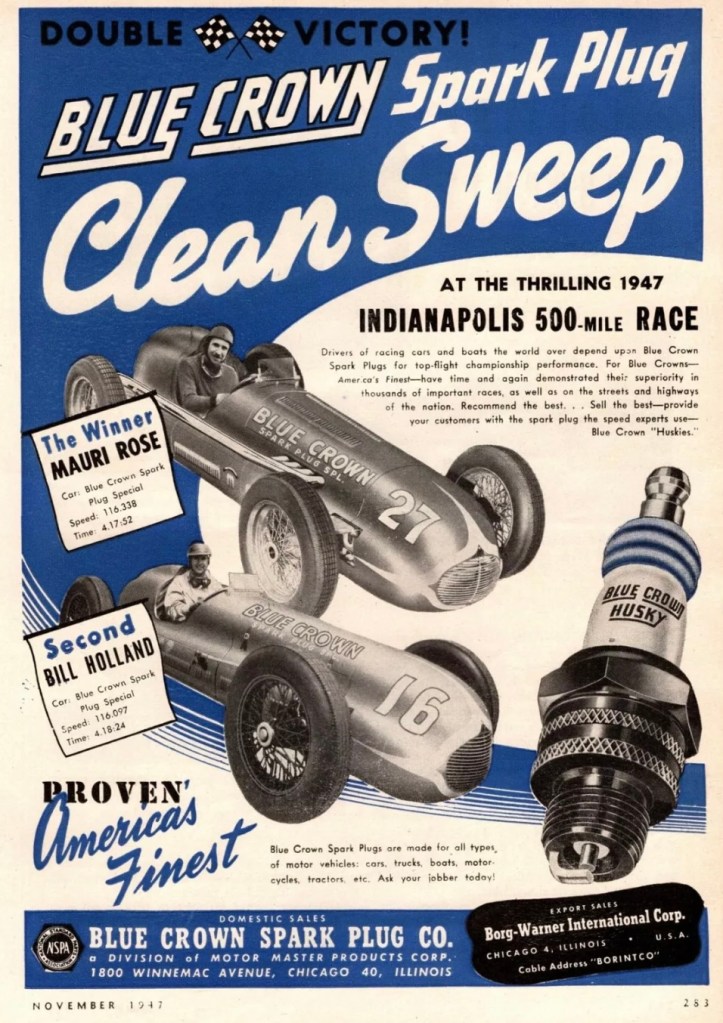
Lou Moore’s two Deidt FD Offy ‘Blue Crown Spark Plug Specials’ driven by Mauri Rose and Bill Holland being prepared for the 1947 Indianapolis 500.
The colourisation of this Getty Images shot was done by Sanna Dullaway for a Time magazine feature; ‘A Century’s Evolution of Indy 500 Racing’. The rare under-the-skin photograph shows clearly the key elements of these successful cars; front mounted engine and transaxle, girder chassis and big rear mounted fuel tank.
Rose won the race from Holland and Ted Horn’s Maserati 8CTF in a controversial result.
Holland took the lead at about the 100 mile mark, but lost it “when he skidded in front of Shorty Cantlon, Cantlon’s Snowberger FD Offy hit the outside wall and was killed.”
Mauri Rose (IMS)
At about 200 miles Holland regained the lead, late in the race he was given an ‘Ezy’ pit signal by Lou Moore – a former Indy polesitter and three times on the podium – which he took as a direction to do the final laps at a reduced pace. Rose ignored the signal and sped up, Holland wasn’t troubled as he thought he had a lap in hand.
The two drivers exchanged waves during the pass, Holland took this to be a congratulatory gesture, but it was a pass for he lead, Rose led the final 8 laps and won the race by 32 seconds. “Holland called it a lousy deal,” Indy Star reported.
(IMS)
Bill Holland, an unlucky second in 1947, Deidt FD Offy above.
He won the race for Moore in 1949, on this occasion, Rose’s late race surge while lying second – against Moore’s pit board instructions – resulted in a broken magneto and a DNF. Moore fired Rose as soon as he arrived back at the pits!
1947 Indy ticket
Credits…
Getty Images, Time, Indy Star, IMS-Indy Motor Speedway archive