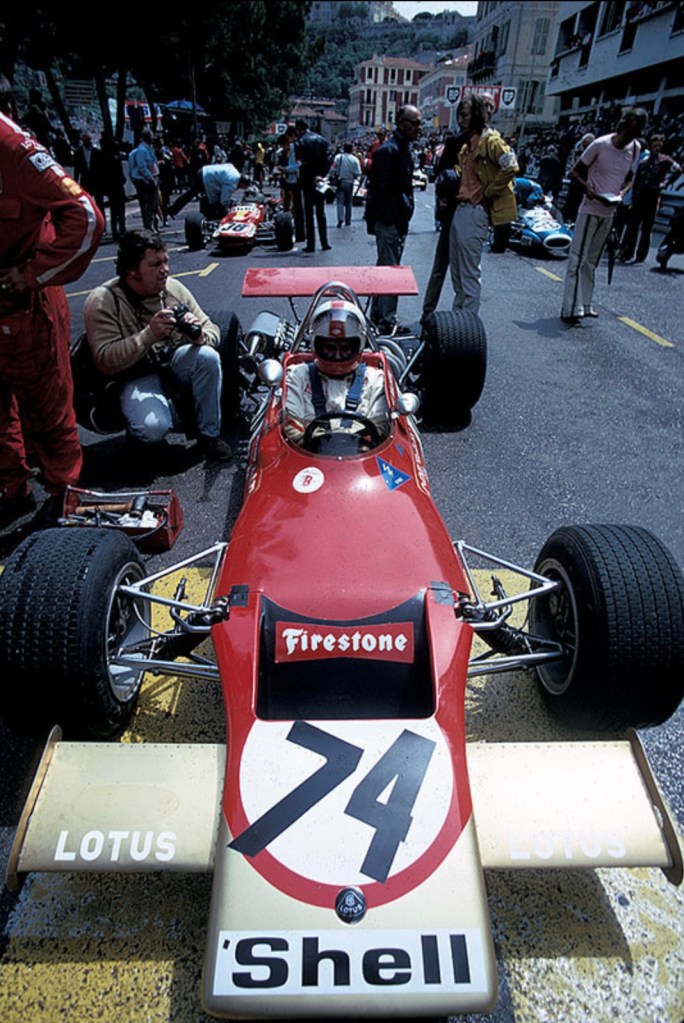
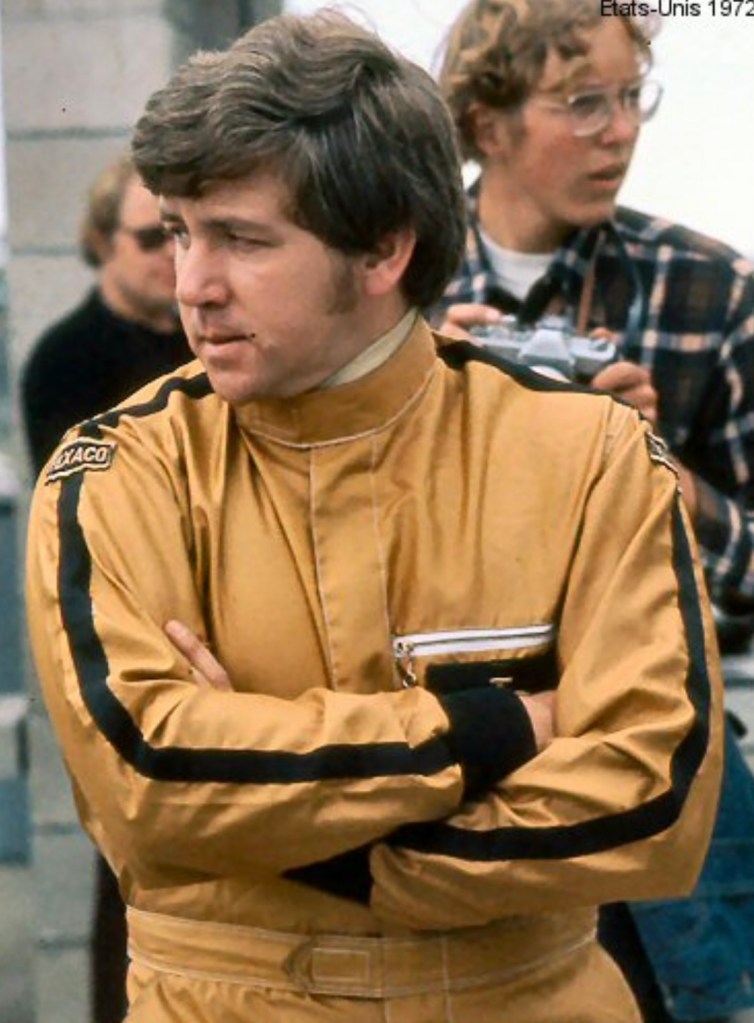
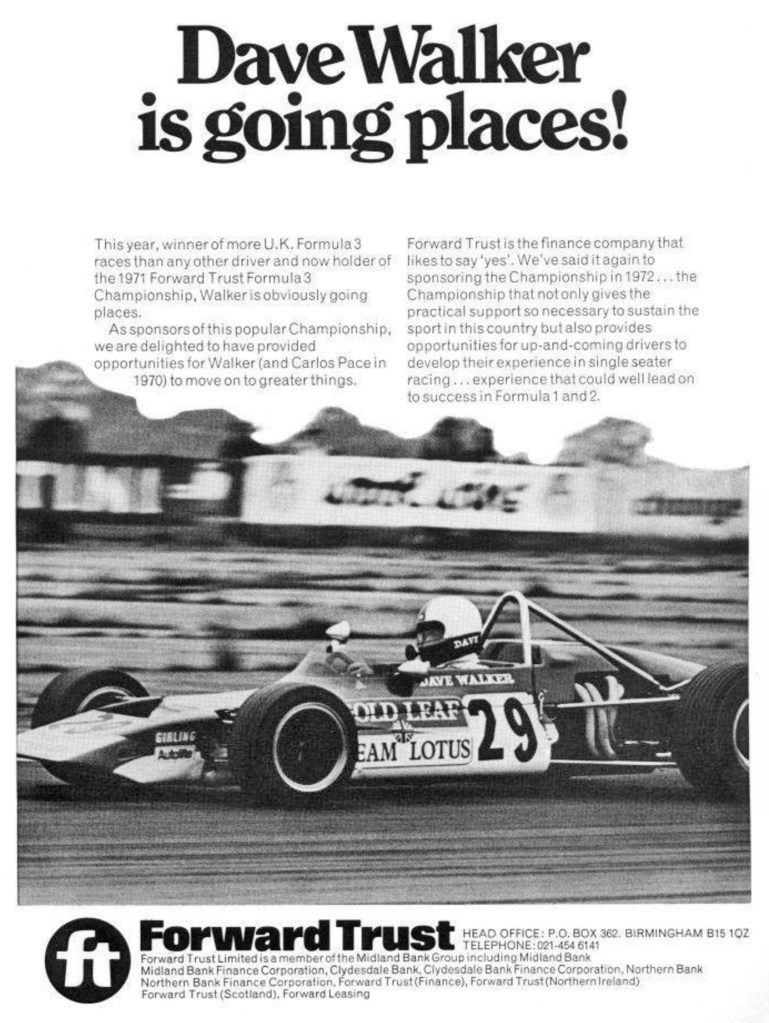
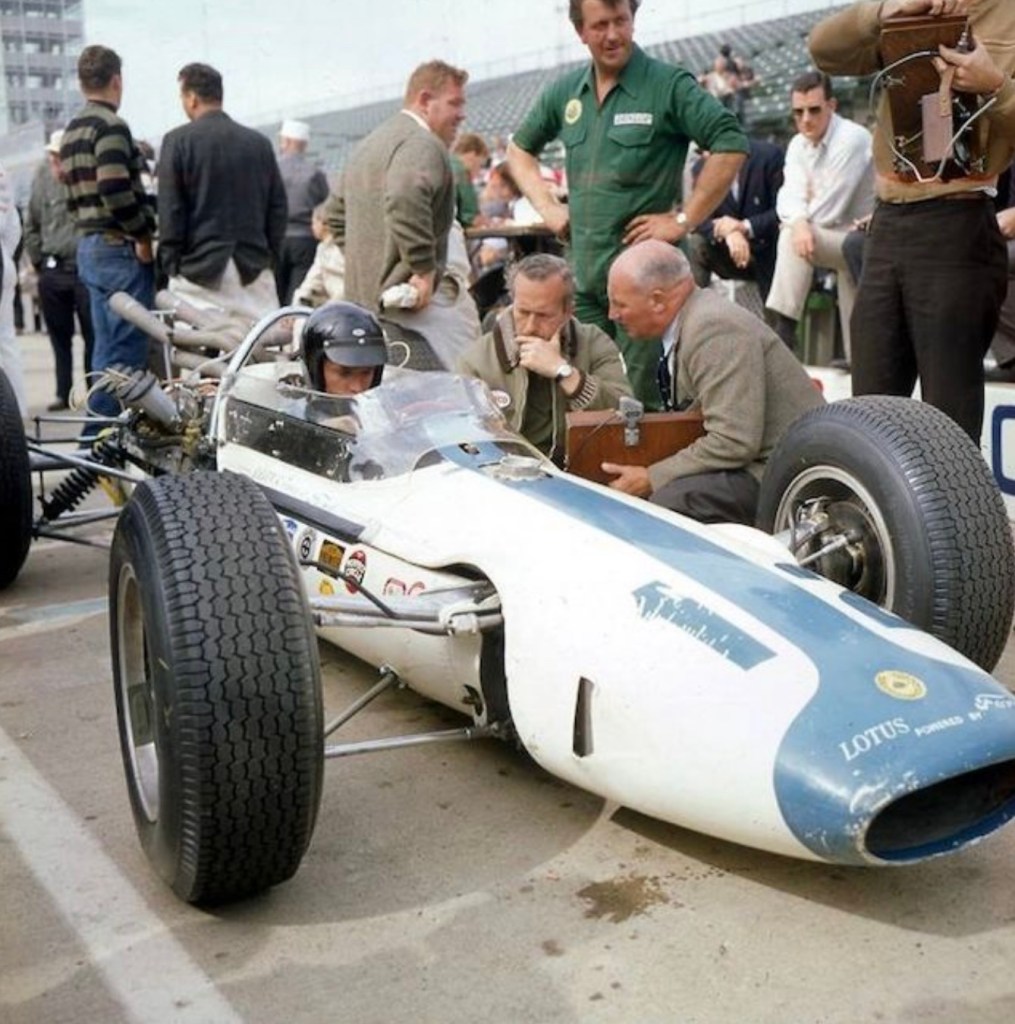
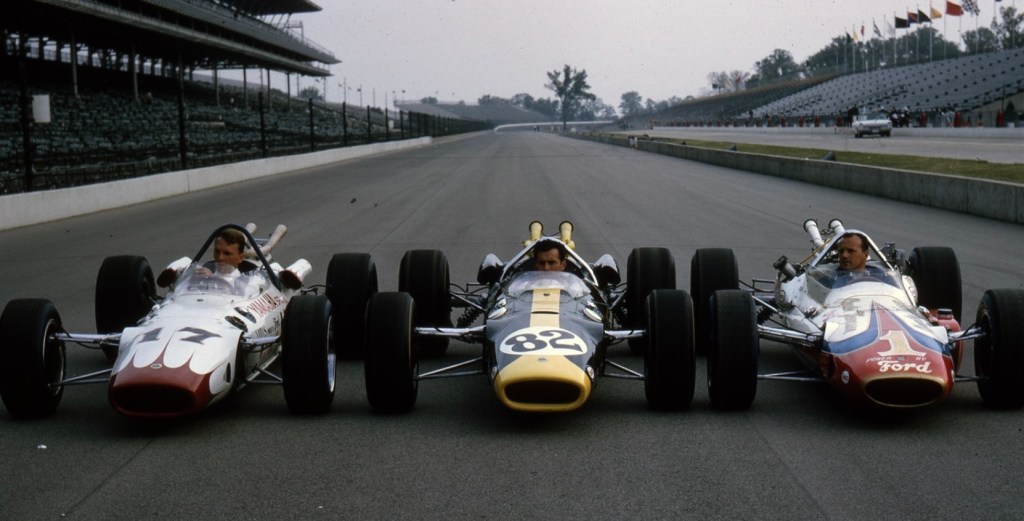
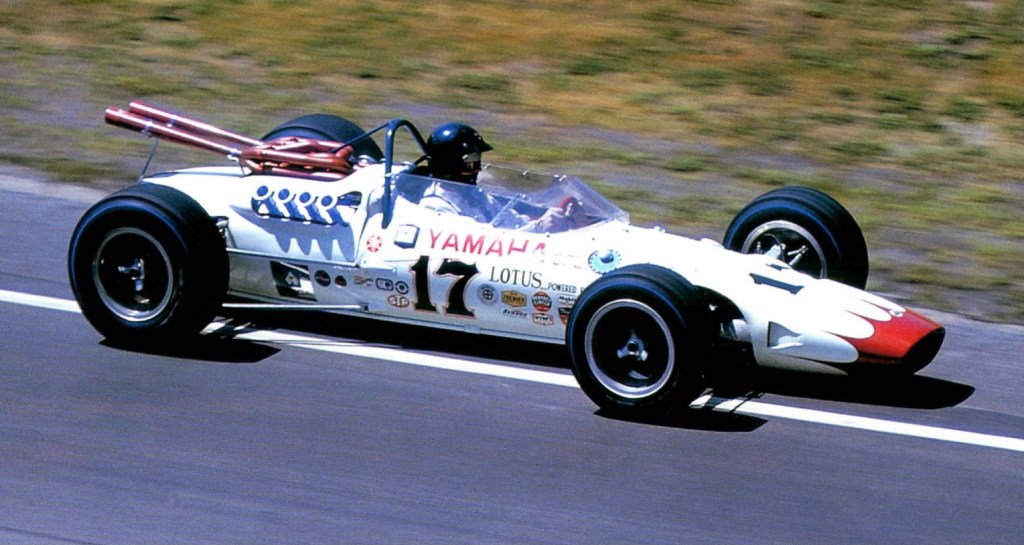
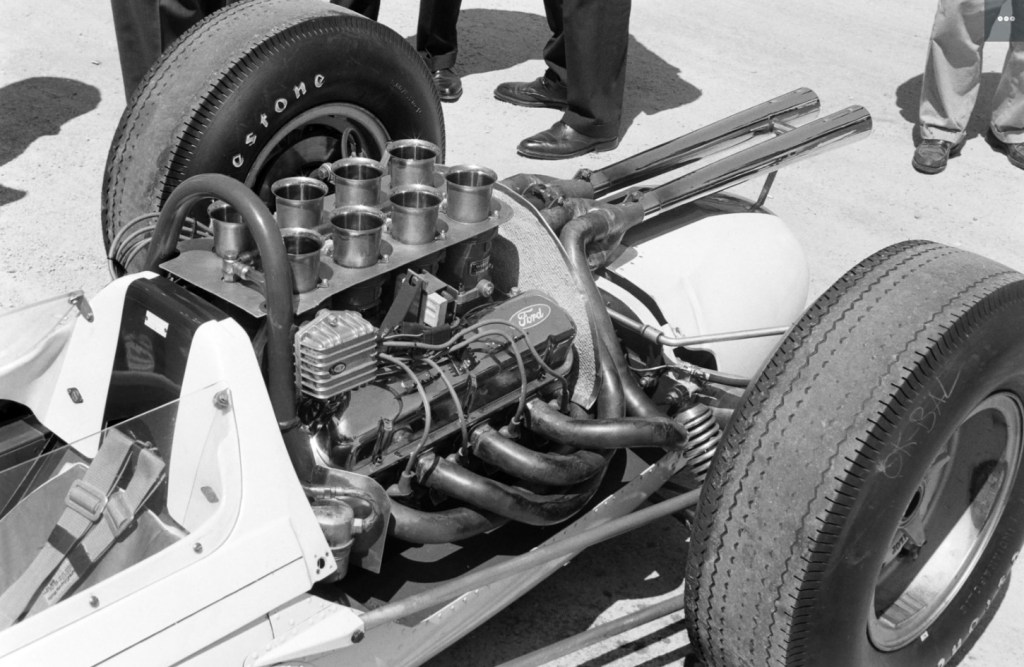
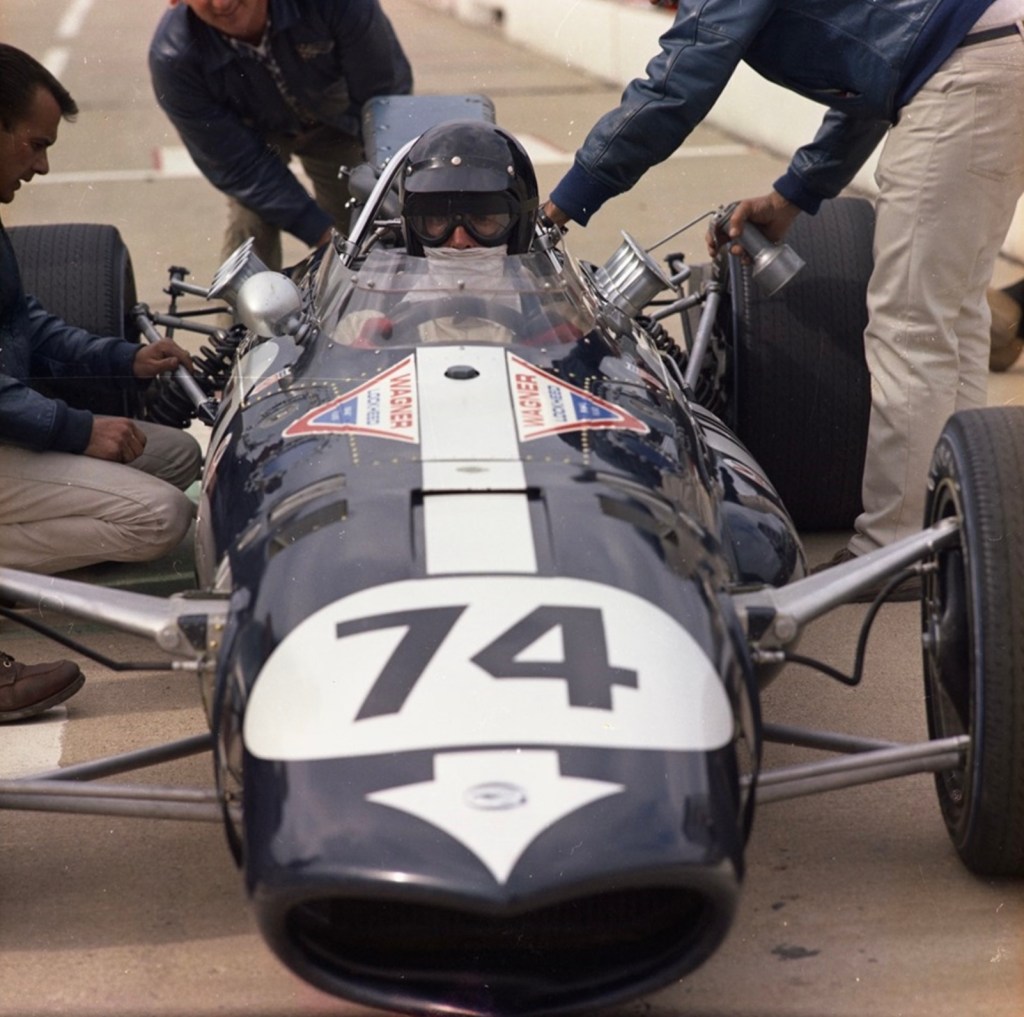
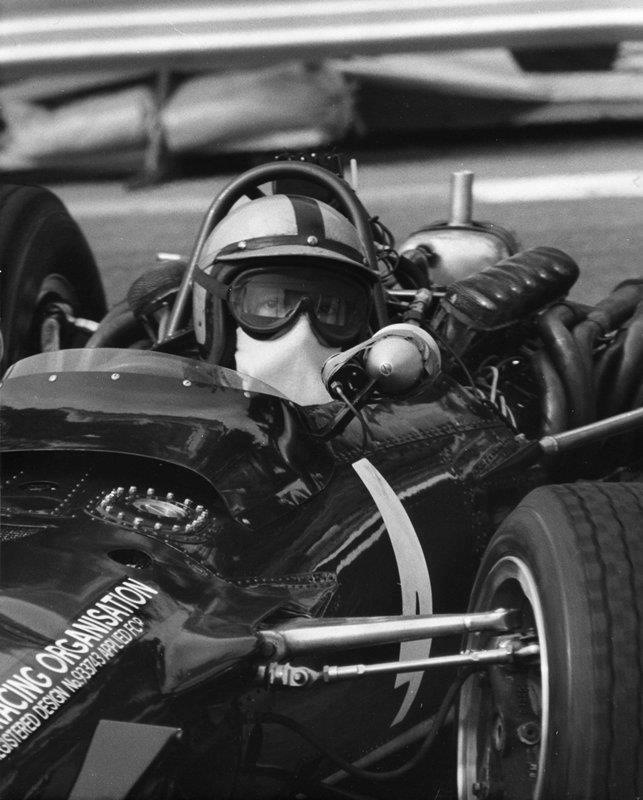
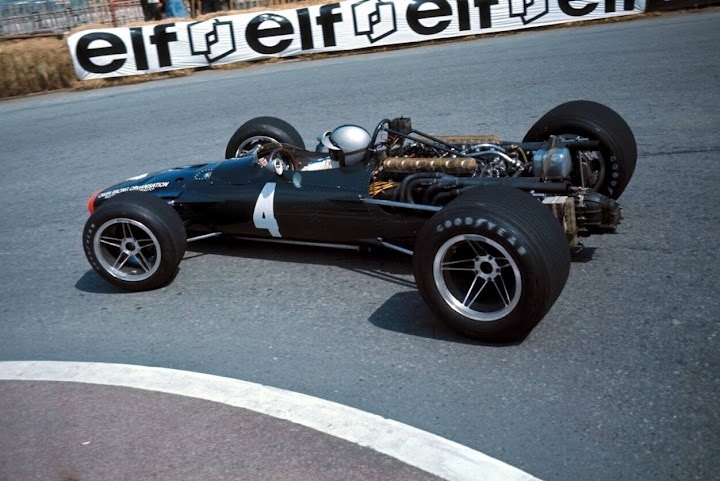
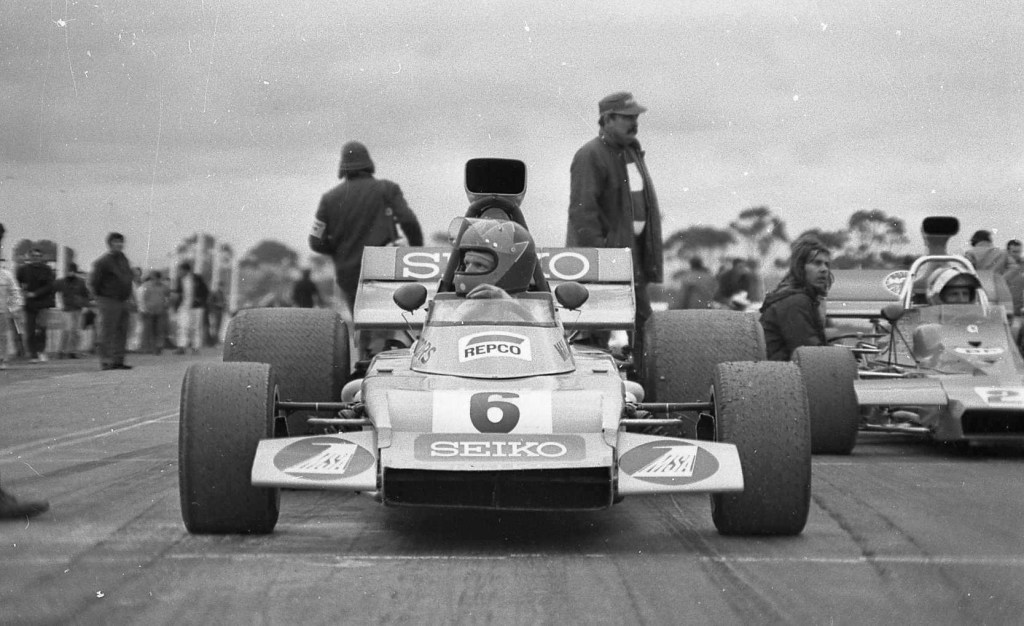
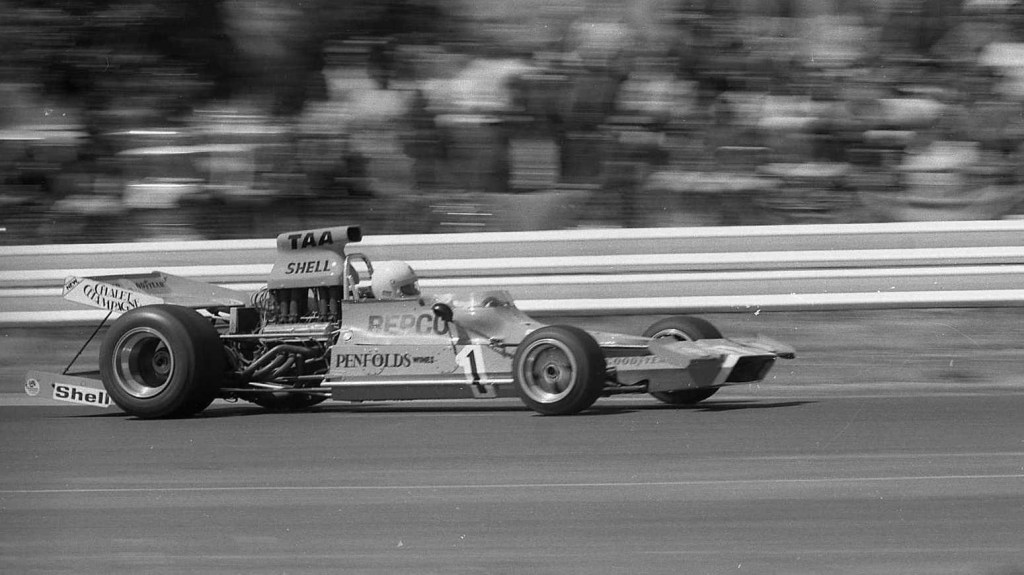
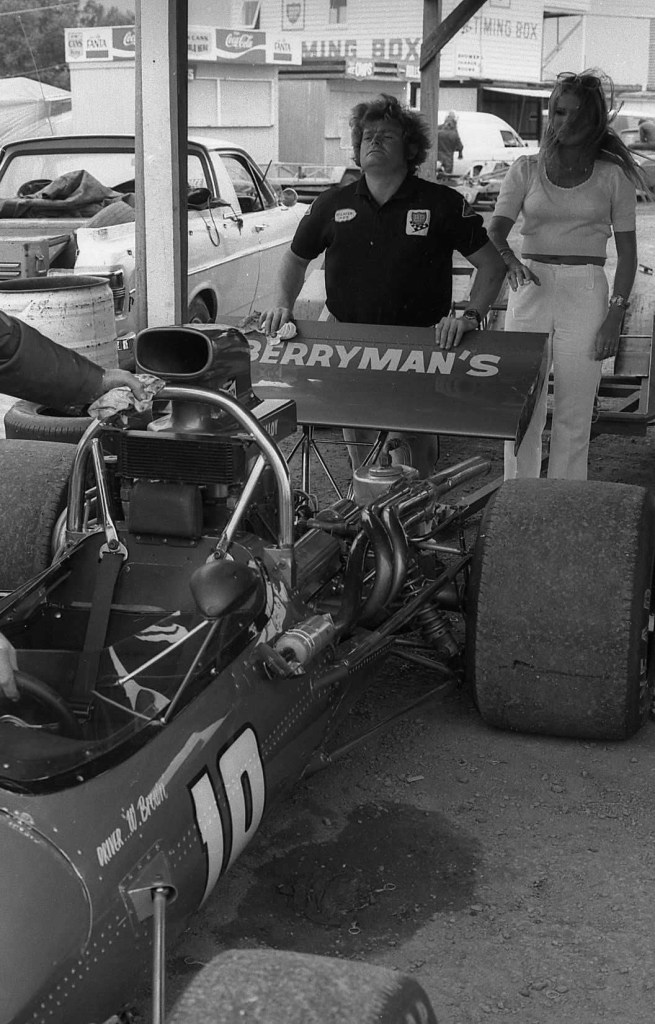
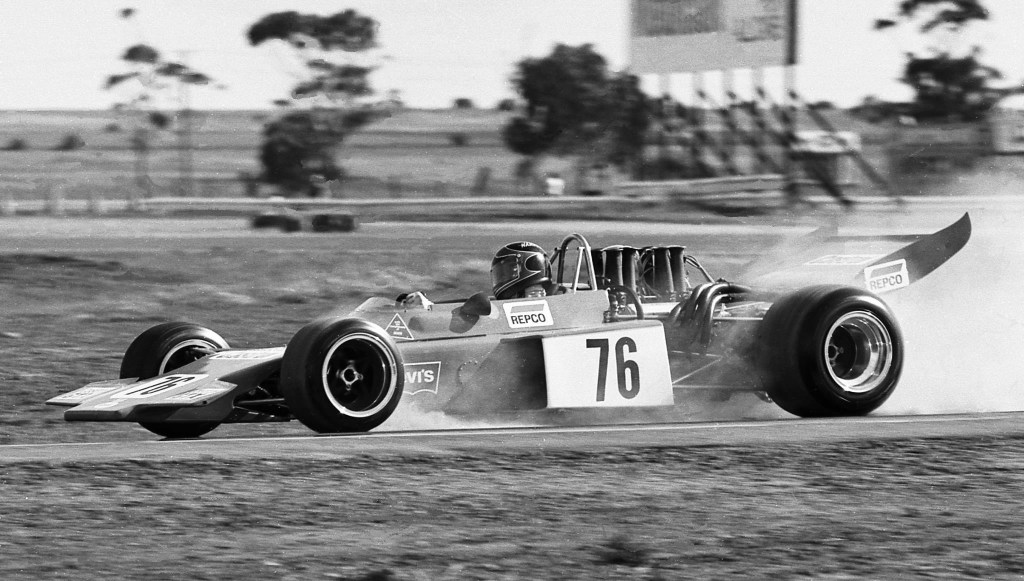
David Walker lined up for the final of the Monaco F3 GP, May 22, 1971.
He won his heat and the final in a race which was something of a metaphor of an incredible season aboard his works Lotus 69 Novamotor-Ford 1.6. Giancarlo Naddeo, Tecno 69 Ford was second, and Patrick Depailler’s Alpine A360 Renault, third.
The grid that year also included Steve Thompson, Jean-Pierre Jabouille, Roger Williamson, Rikki Von Opel, David Purley, Bob Evans and Francois Migault.
Walker’s F3 year included wins at Silverstone and Cadwell Park in April, Brands Hatch, Zandvoort (Dutch GP F3 race) and Oulton Park in May, and Silverstone in June. Early July brought victory in the French Grand Prix support race at Paul Ricard. That month got better with a win at Croft which ensured the Sydneysider was razor-sharp over the British GP weekend at Silverstone, Walker also won that blue-riband support event.
But there was no break for the team, the following day he won the the Cadwell Park BARC British F3 Championship round. August yielded wins at Thruxton and Croft, while Mallory Park fell to Walker in September and Snetterton in October.
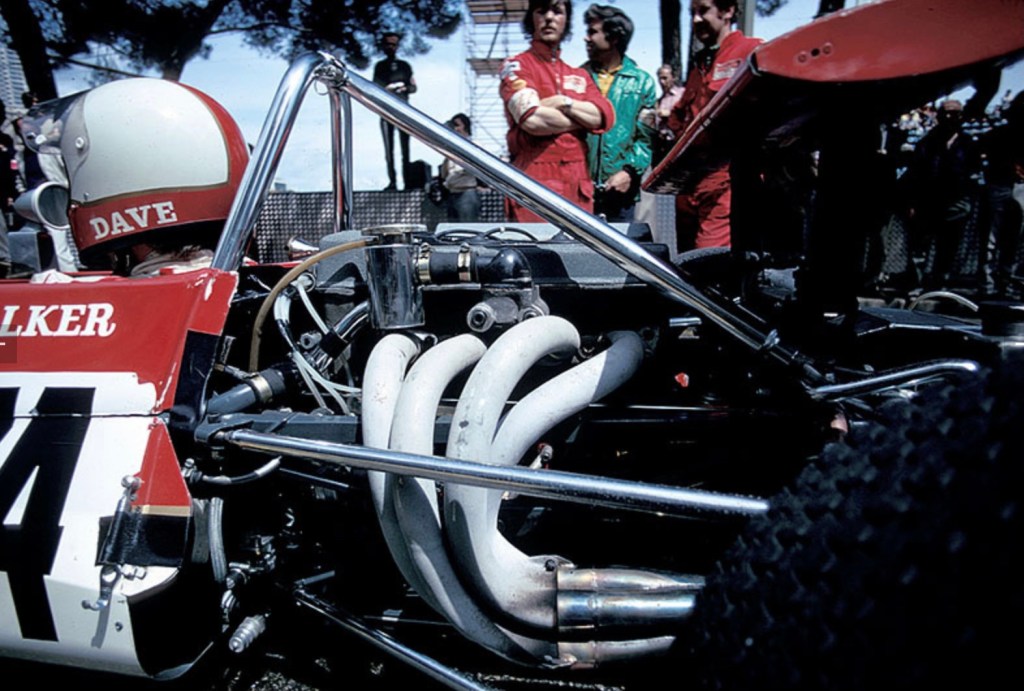
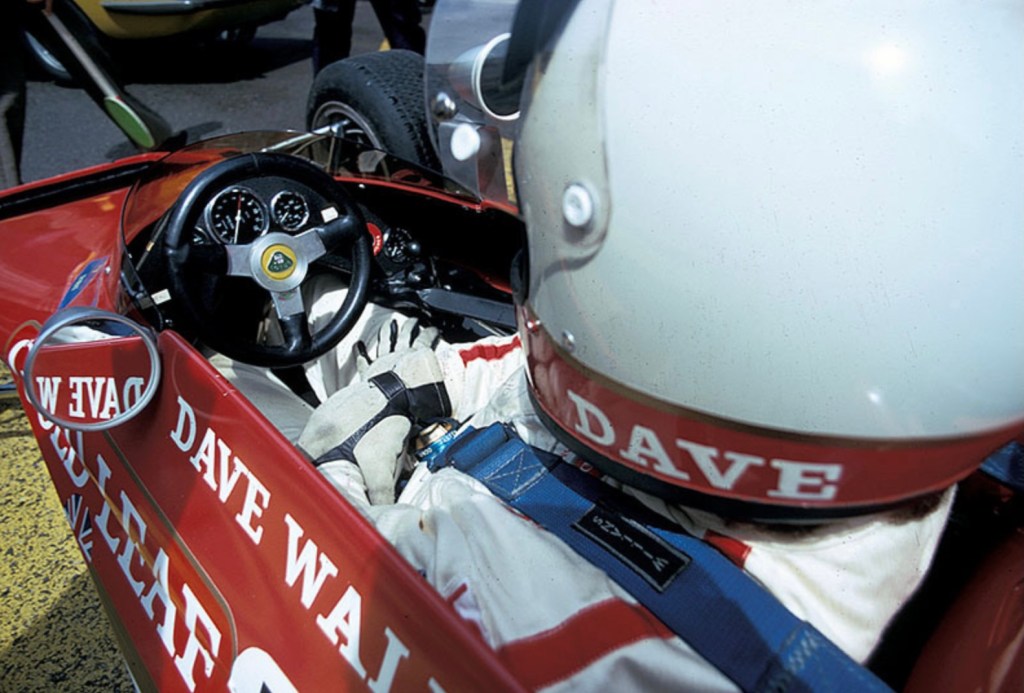
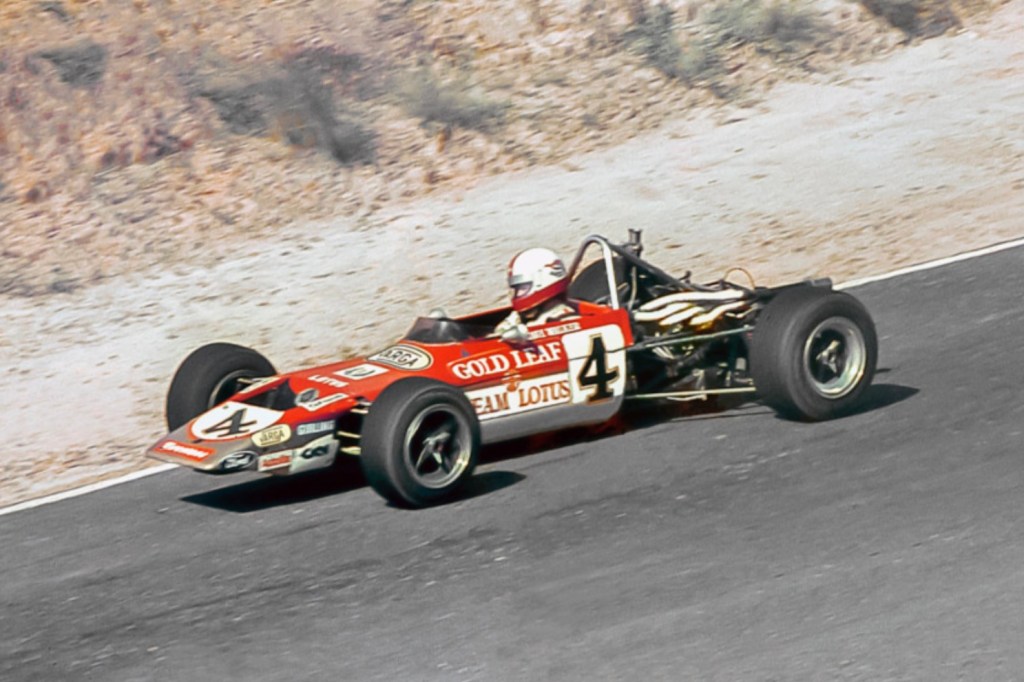
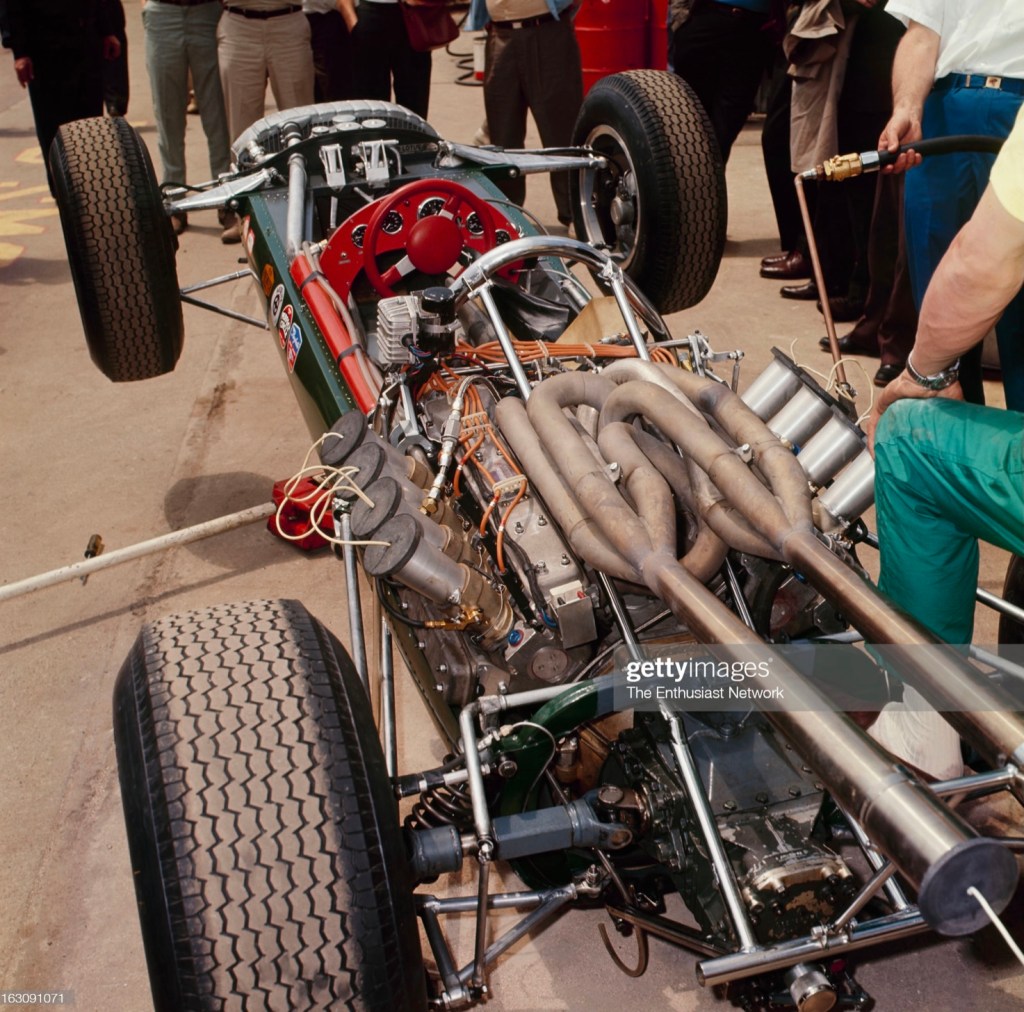
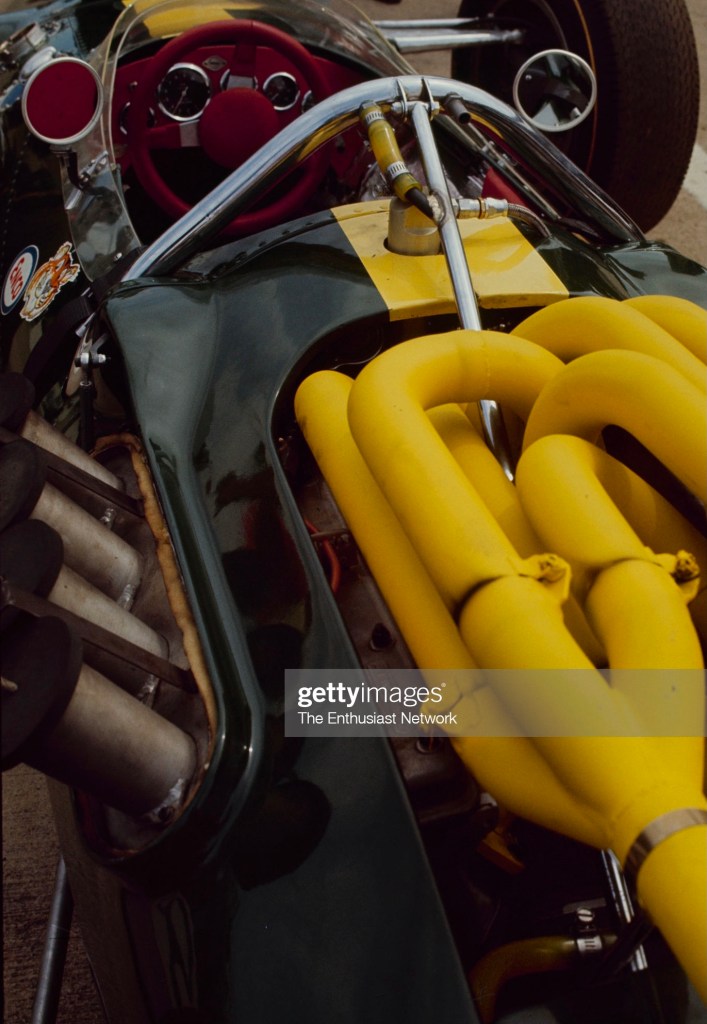
Dave Baldwin’s F3 Lotus 69 design (there were also F2, FB and FF 69s) had a spaceframe chassis based on his Lotus 59, disguised with the bodywork and beefed up front suspension of the 69 F2 car. 1.6-litre Novamotor Lotus Ford twin-cam, Kugelfischer injected via air restrictor Walker again at Monaco (R Schlegelmilch)Oh-so-period cockpit! Leather bound wheel and a dash full of Smiths instruments. Wonderful. Monaco (R Schlegelmilch)
In one of the most dominant ever seasons of F3 racing Walker won most of the big races and two of the three British F3 Championships – the BRSCC/MCD and BARC – with Roger Williamson taking the other, the BRSCC/MCD Lombard.
For the sake of completeness, Walker’s season commenced with the ‘Torneio Internacional de Formula 3 do Brasil’ (Brazilian F3 championship) run at Interlagos and Taruma during January.
Dave raced his (1970) works Lotus 59A Ford to third, second, 12th and first in the four round series, placing third overall behind Wilson Fittipaldi and Giovanni Salvati in Lotus 59A, and Tecno TF70 respectively.
Walker was the most successful of the 1971 Gold Leaf Team Lotus drivers, Emerson Fittipaldi and Reine Wisell had a lean year in Grand Prix racing, Lotus failed to win a GP for the first time in over a decade.
F1 proved a much harder nut for Walker to crack, and that story is a good deal more nuanced than most pundits would have you believe…one for another time.
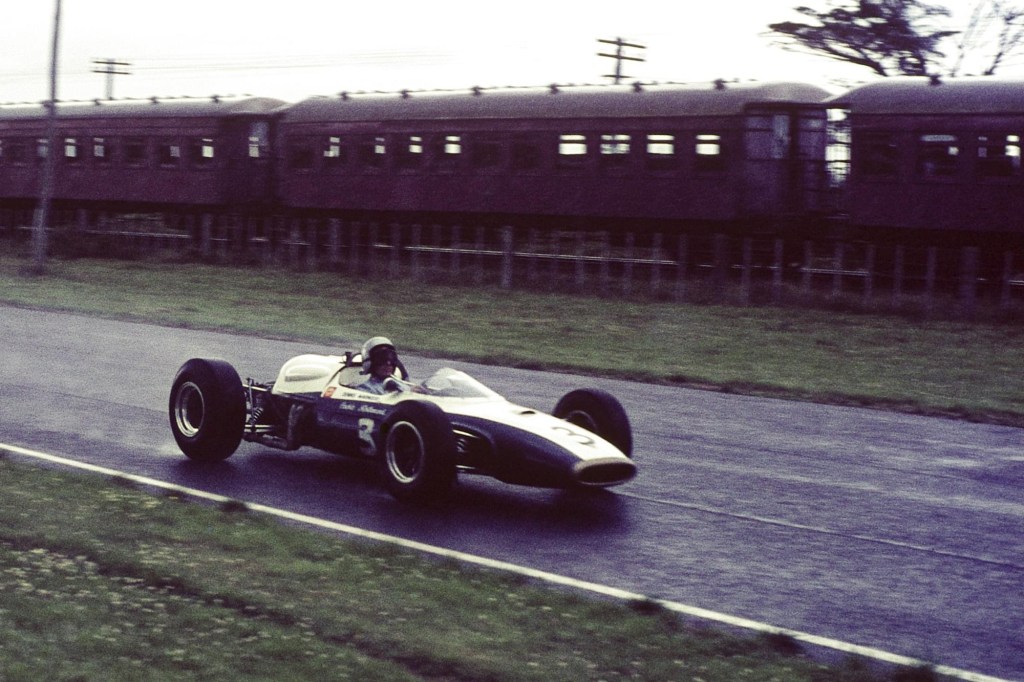
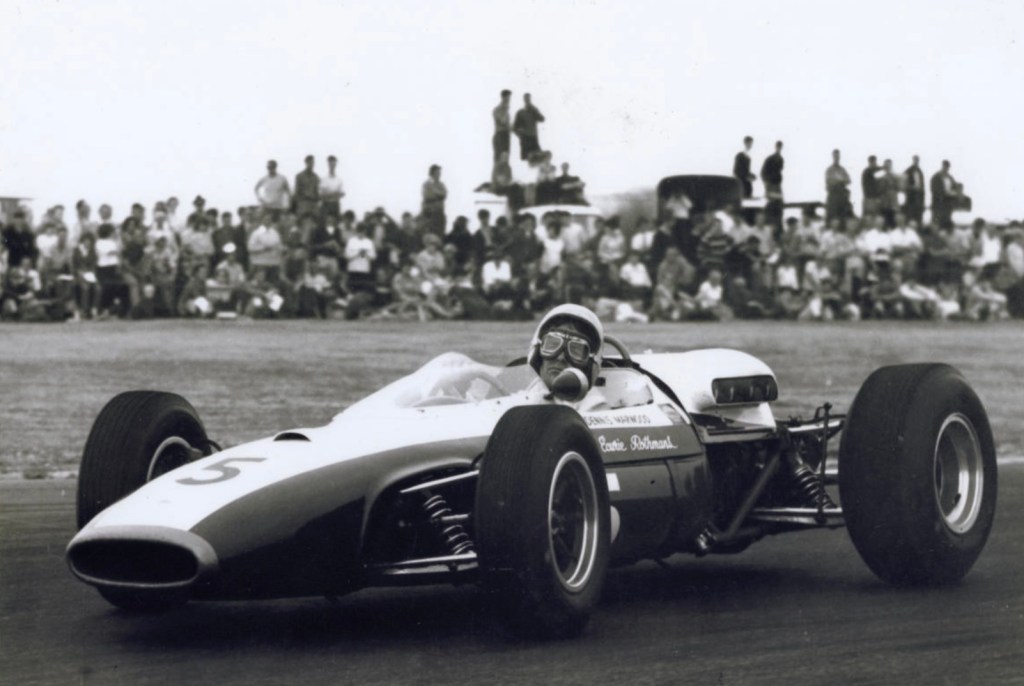
Dennis Marwood tries to focus on the job at hand while the 2.30pm Pukekohe-Auckland express rattles past: New Zealand Grand Prix, Pukekohe, January 8, 1966.
He did well too, placing his ex-works Cooper T66 Climax 2.5 FPF – chassis FL-6-63- fourth in the race won by Graham Hill, from Jackie Stewart aboard works BRM P261s, and Jim Palmer racing the ex-Clark Lotus 32B Climax.
Cooper’s best F1 days were well-past by 1963 when the spaceframe T66 was designed and built by Owen Maddock and his Surbiton team. An advance on the prior T60, the car was still a mid-grid machine despite being lighter, stiffer and slimmer. Driven by Bruce McLaren and Tony Maggs, McLaren’s second place at Spa was the team’s best result.
1964 was even grimmer, despite ’61 World Champ, Phil Hill, joining the squad. In a season of insufficient speed and lousy reliability, Bruce was seventh (5 retirements in 10 rounds), and Phil equal 19th in the World Drivers Championship. “Poor preparation, and indifferent engines supplied by Climax who now recognised Lotus as their major client and development partner, with Brabham next in line, cost them dear”, wrote Doug Nye.
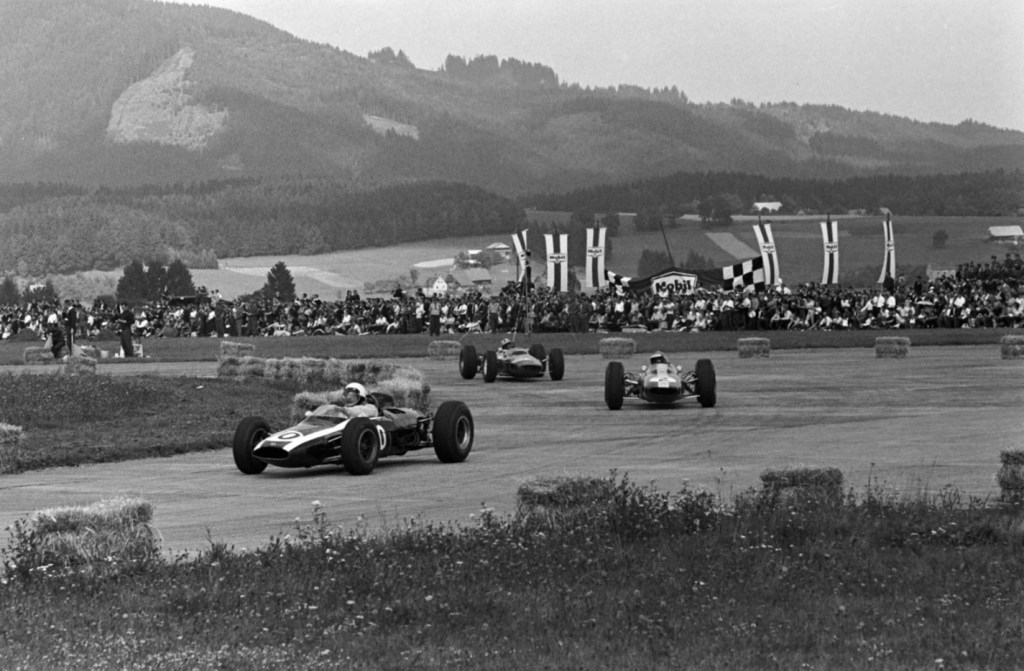
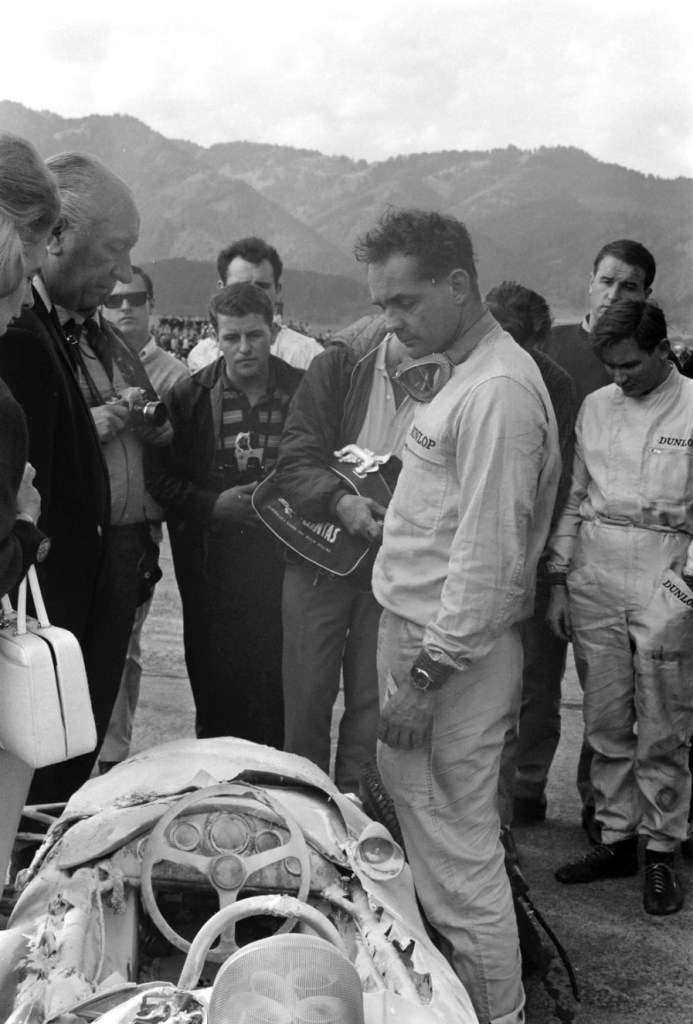
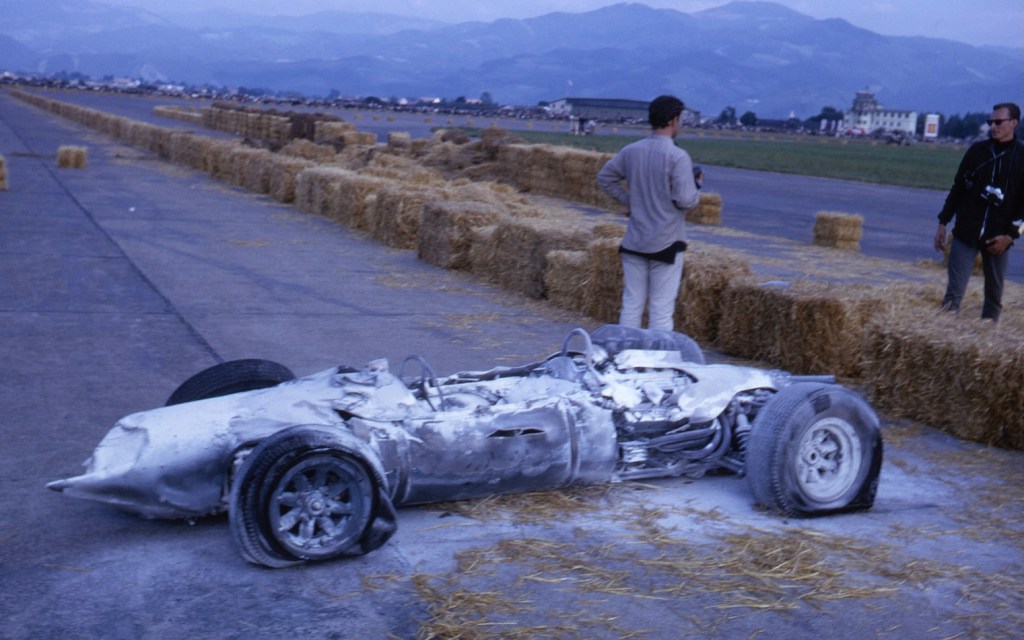
Zeltweg vista. Phil Hill leads Jim Clark’s Lotus 33 Climax and Chris Amon, Lola (MotorSport)Ooooh-sheeeet and Holy Moses, or thoughts to that general effect. Phil examines his fried Cooper while Bruce McLaren tries not to think of John Cooper’s reaction. Wonder who the visitor with the Qantas travel bag is? (MotorSport)F1-6-63 doesn’t look too flash but chassis damage was minimal, so not too dramatic a repair for a crew of talented Kiwis…(socalclicker@esc)
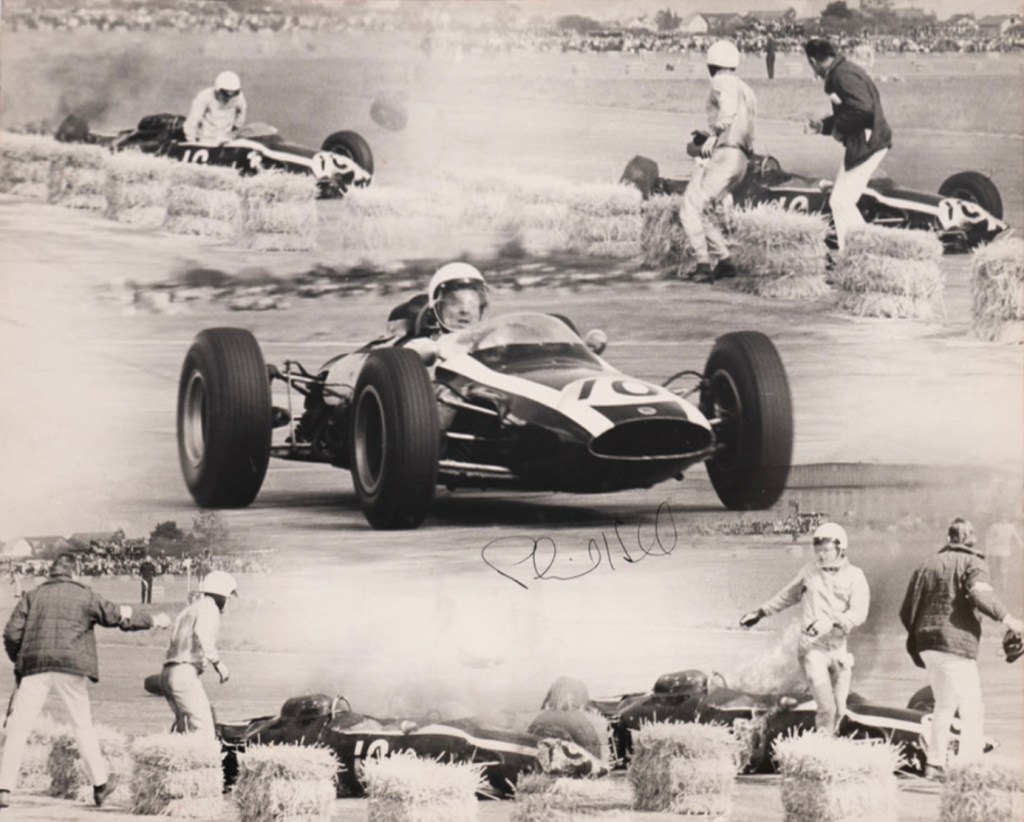
Phil’s nadir was on the Zeltweg aerodrome, Austrian GP weekend where he crashed his Cooper T73 during practice, then repeated the dose on the same corner in his replacement machine, T66 F1-6-63, during the race, albeit this time component failure may have been the cause.
The car struck the wall of straw bales on the entry to the runway section of the track, rear suspension collapsed, and caught fire. Phil escaped quickly, unscathed while the car burned to a crisp in a spectacular, frightening display of pyrotechnics. Up front Lorenzo Bandini’s Ferrari 158 won a race of constantly changing fortunes.
John Cooper fired Phil, but they later kissed-and-made up allowing Hill to finish an awful season. His confidence was restored with some stonking drives aboard a Bruce McLaren Racing Cooper T70 Climax during the ’65 Tasman Cup.
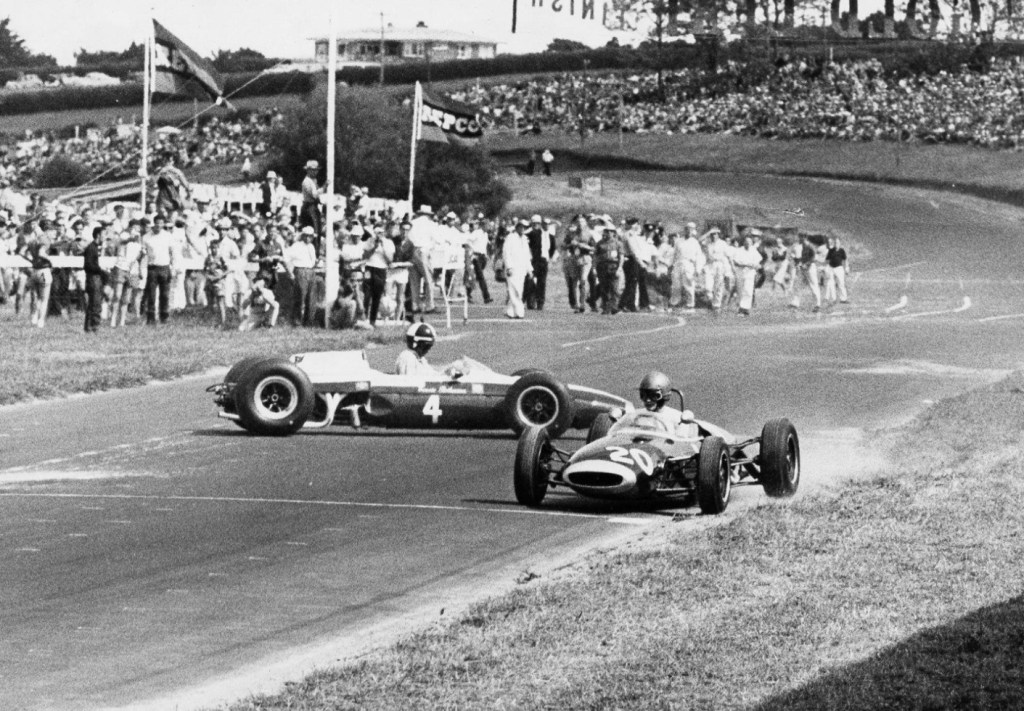
Oopsie, Bruce Abernethy deals with a Cooper T66 moment during the 1965 NZ GP at Pukekohe, while Ken Smith takes to the track fringes in avoidance, Lotus 22 Ford 1.5 – Kenny still racing and just turned 80. DNF for Bruce, 12th for Kenny, Graham Hill won in the Scuderia Veloce Brabham BT11A Climax (unattributed)
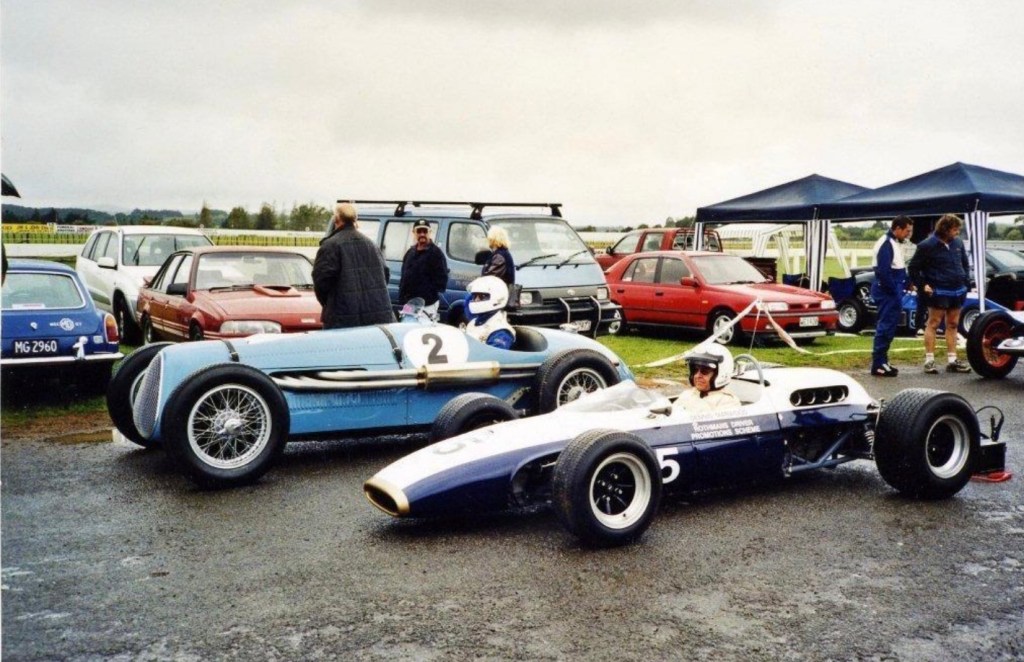
While the Cooper had been ‘thoroughly-heat-treated’, the chassis was ok, and was quickly bought by visiting Kiwi, Bruce Abernethy, who shipped it home. It was repaired and modified by Bill Hannah at his Havelock North workshop to take a Coventry Climax 2.5-litre FPF four-cylinder engine, for Tasman racing, rather than the 1.5-litre Climax FWMV V8 with which it was originally built.
Abernethy negotiated a deal whereby the car was owned and raced by the Rothmans Driver Promotion Scheme (later Ecurie Rothmans). The team overseen by Rothmans boss, Ken Simich, MANZ and Pukekohe chief Ron Frost, and former Kiwi ace, Ross Jensen.
Abernethy had a poor season and was replaced by Paul Fahey, he had some good drives in the car but decided touring cars were more his thing. In mid-1965, Morrisville dairy farmer, Dennis Marwood was tested, along with two other drivers, and got the gig.
Marwood aboard T66 F1-6-63 during the January 1966 Lady Wigram Trophy (motat.nz)In the best of company, Marwood being lapped by Graham Hill, BRM P261 during the 1966 Lakeside 99
Despite a touring car background, Dennis took to the challenging open-wheeler like a duck-to-water in his first drive in November 1965. He was immediately on the pace of the front-running locals in Gold Star events; second at Pukekohe in December.
During the ’66 Tasman Cup, his best results were a pair of fourths at Pukekohe and Teretonga from six races, including the Lakeside and Warwick Farm Australian rounds. Later that year he won the Pukekohe and Renwick Gold Star events – and again at Timaru in 1967, but reliability and budget issues got in the way of results. The team had only one, old FPF and suggestions to ‘buy some new tyres’ were rebuffed by Jensen.
Dennis aboard the Rothmans Cooper during the Pukekohe reverse-direction meeting, September 1966 (J Inwood)
Rothmans considered purchase of a more competitive 2.1-litre ‘Tasman’ BRM P261 V8 – mighty quick machines – but decided they had had enough and sold the car to Peter Maloney.
Marwood went into business with Ray Stone, in South Auckland based Performance Developments, and a stellar career in single-seaters and big tourers. Click here for more on Dennis; Tasman Cup F5000 Racing – Dennis Marwood – Jim Barclay
T66 F1-6-63 was restored and lives a sedentary life in New Zealand. Dennis Marwood (below) reunited with his old car, at Pukekohe in April 2009. Bob Harborow is alongside in the John Sheppard built Maybach 1 Replica, winner of the 1954 NZ GP in Stan Jones’ hands.
(jimbarclay.nz)
Etcetera…
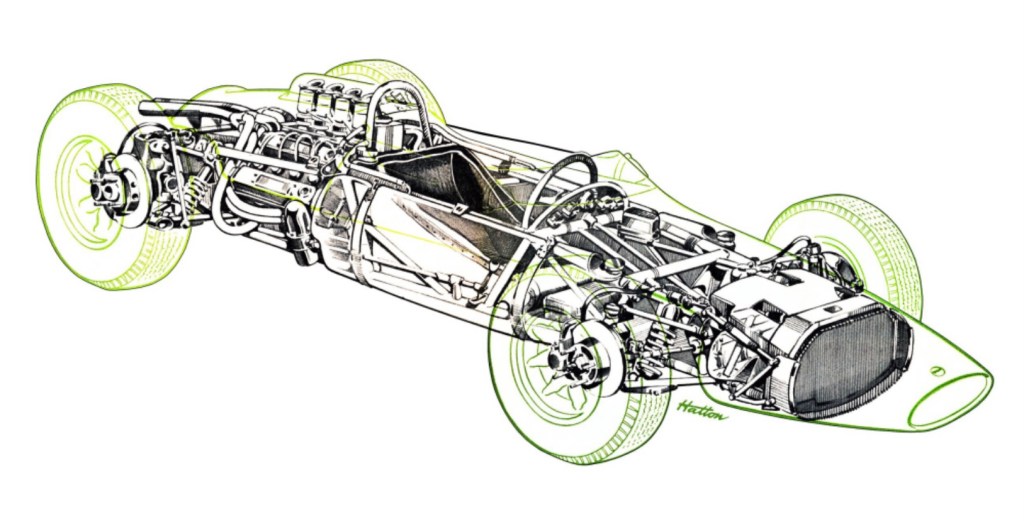
Cooper T66 Climax FWMV V8 cutaway (B Hatton)
The Cooper T66 chassis remained a spaceframe despite the monocoque onslaught around it, not that such technology was a barrier to ongoing Brabham success. Of multi-tubular construction, the frame comprised 1 3/8 and 1 1/2 inch 18-gauge steel tubing with smaller transverse and diagonal members, plus triangulation of the corners of the cockpit opening. Mild sheet steel reinforcement was welded to the floor section between the front and rear bulkheads.
Suspension used Alford & Alder (Triumph) uprights, upper and lower wishbones at the front, coil spring/dampers and adjustable roll-bar. The rear used cast magnesium uprights, fabricated upper and lower – wide based – wishbones, coil spring/dampers and adjustable roll-bar.
Brakes were Girling disc, 10.25 inches/9.75 inches in diameter front/rear. Cooper cast magnesium wheels were 13-inches in diameter and 6/7 inches wide front/rear.
The F1 engine was the ubiquitous Coventry Climax FWMV 1.5-litre, DOHC, two-valve, Lucas injected circa 200bhp V8. In Tasman spec the equally ubiquitous Climax FPF 2.5-litre, DOHC, two-valve, Weber 58DCO fed four gave about 235bhp. The transaxle was Cooper’s own C65 six-speed.
Credits…
Terry Marshall, Allan Dick in Classic Auto News, ‘History of the Grand Prix Car’ Doug Nye, Jack Inwood, Gooding & Co, socalclicker@esc, Museum of Transport and Technology, oldracingcars.com, jimbarclay.nz, Brian Hatton
Tailpiece…
(Gooding & Co)
Montage of Phil Hill’s Zeltweg accident and lucky escape. This mix excludes the mighty conflagration which followed once the fire took hold, aided and abetted by the hay-bales, there with safety in mind…
It was only when poor Lorenzo Bandini – winner of this race – perished in a gruesome firey accident aboard his Ferrai 312 during the 1967 Monaco GP that haybales were finally excluded from the standard suite of race organiser safety precautions.
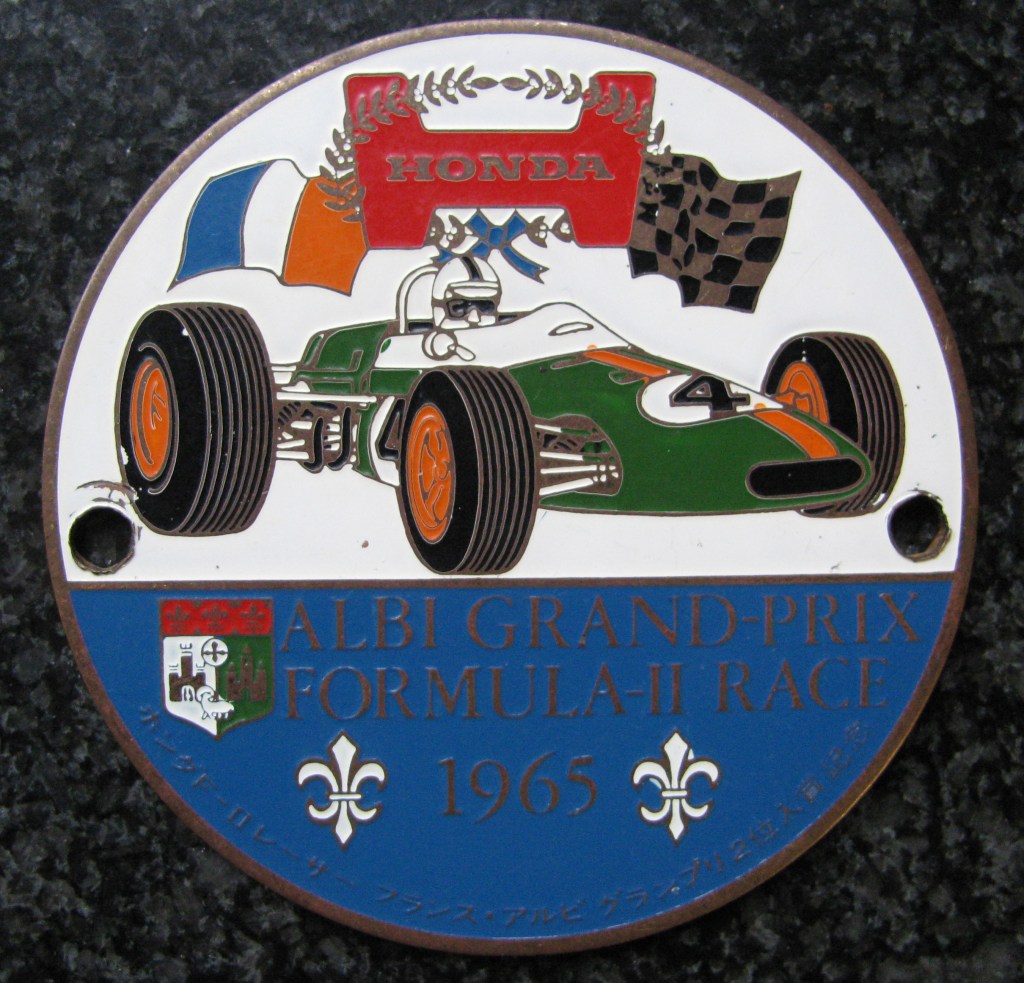
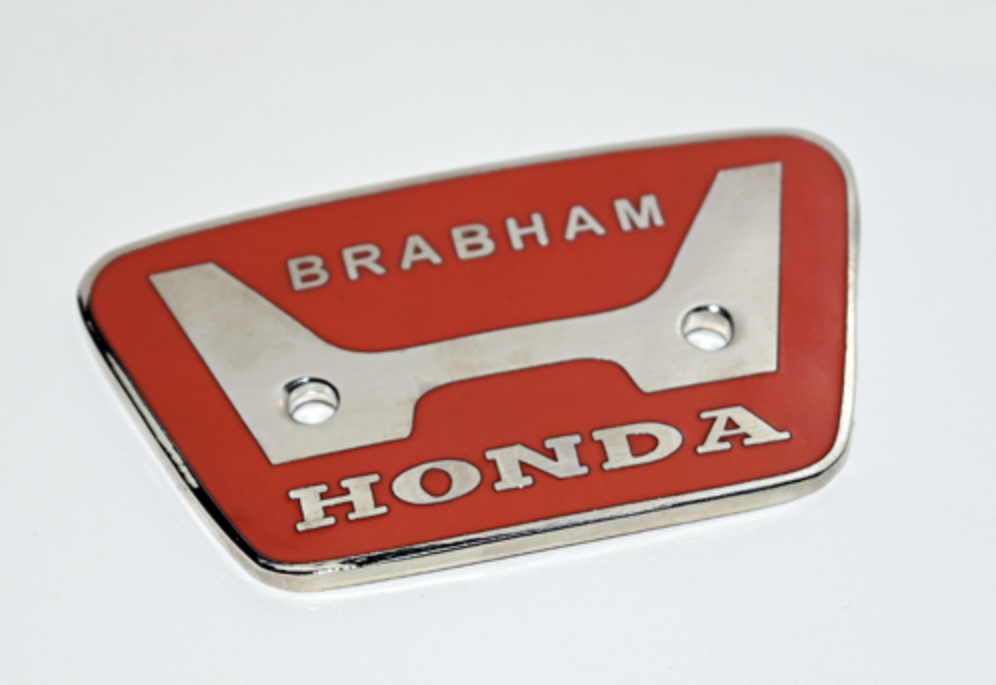
One of our friends in Belgium, Stef Van den Bergh, bought it recently and wants to know more about it. ” I am curious who made it. I suppose it was Honda since Brabham isn’t even mentioned on the badge. How many were made and were they sold, or given as a present?”
So there is the challenge folks. Was it made by Honda, the Albi GP organisers or their merchandise people, or perhaps a ‘renegade’ wanting to cash in on Honda’s presence in F2 as well as Grand Prix racing?
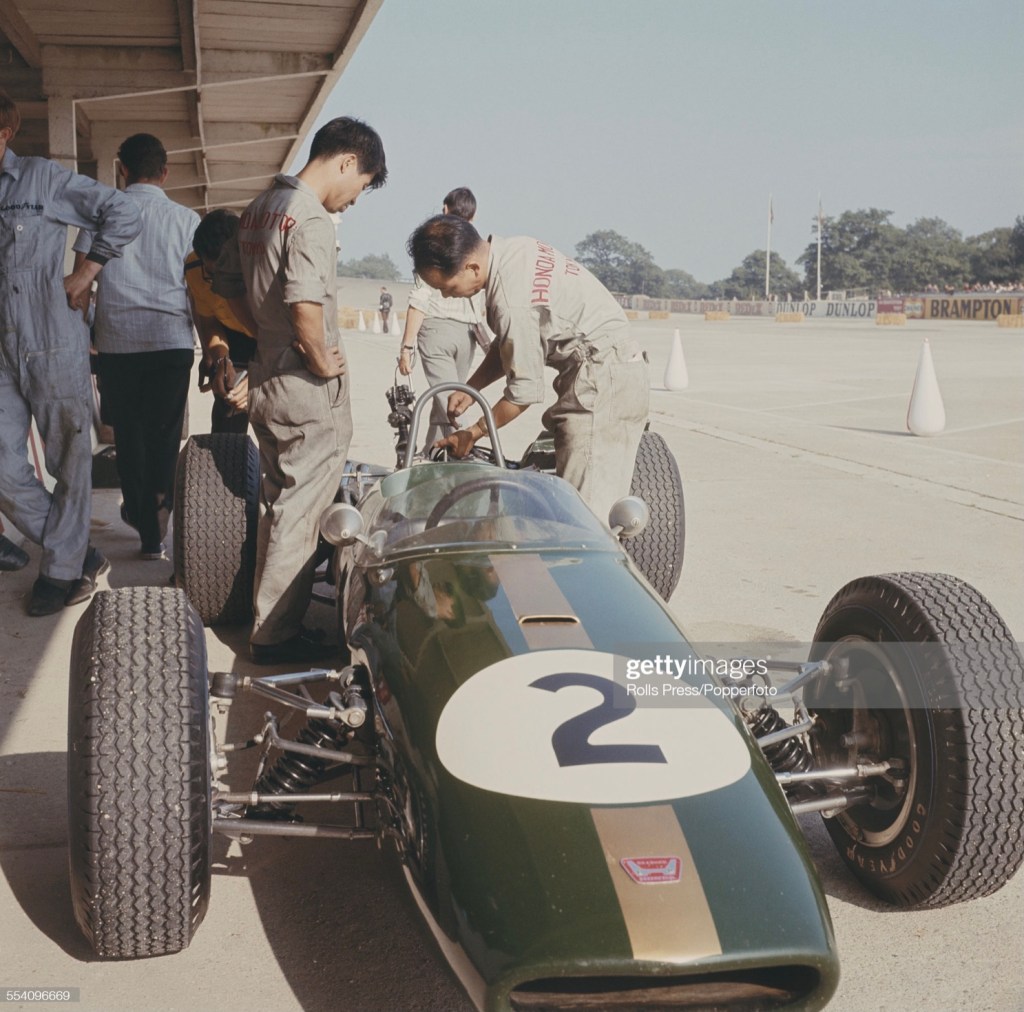
The real McCoy – and below fitted to the nose of Denny Hulme’s Brabham BT18 at Montlhery in September 1966. That weekend Jack Brabham won from Jim Clark’s Lotus 44 Cosworth SCA with Denny third, having started from pole. That season, many races were Brabham-Hulme one-two’s
When Richie Ginther won the 1965 season – and 1.5-litre formula – ending Mexican Grand Prix, Honda bagged it’s first of many F1 successes.
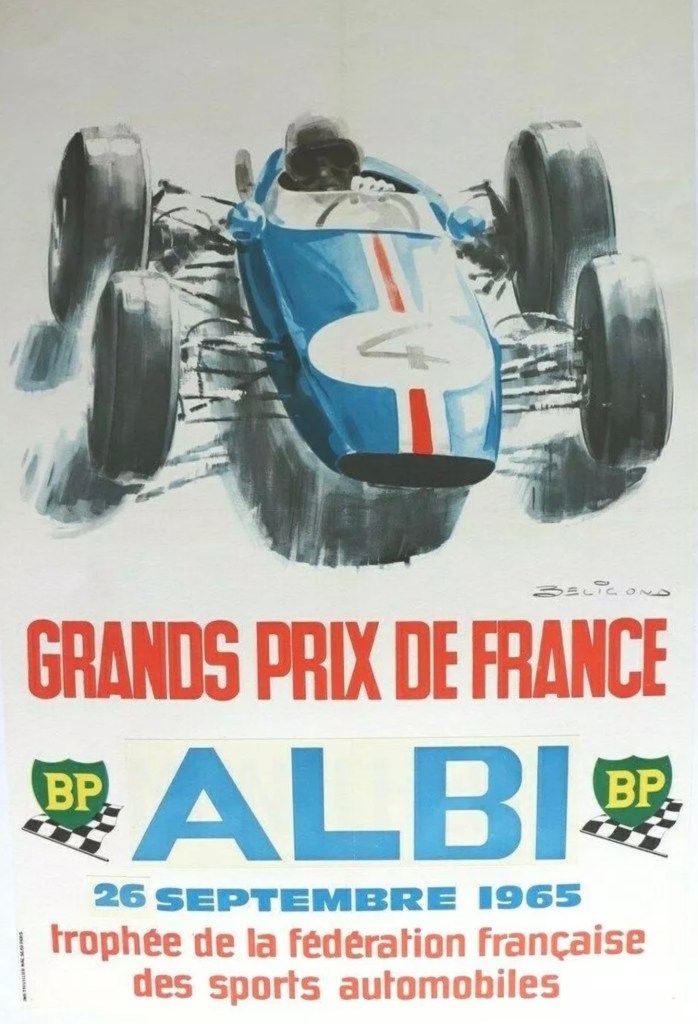
Brabham raced a BT16 powered by S800 Honda engines at four meetings in March and April 1965; Silverstone, Oulton Park, Snetterton and at Pau with poor results. Honda set to work to produce an engine which wasn’t so peaky from May to August, then Brabham reappeared at the Oulton Park Gold Cup and the GP Albi later in September. He retired with clutch dramas at Oulton but was right on the pace at Albi, finishing second to Clark’s Lotus 35 Cosworth SCA by six-tenths of a second after nearly two-hours, and 309km of racing…Honda were in town!
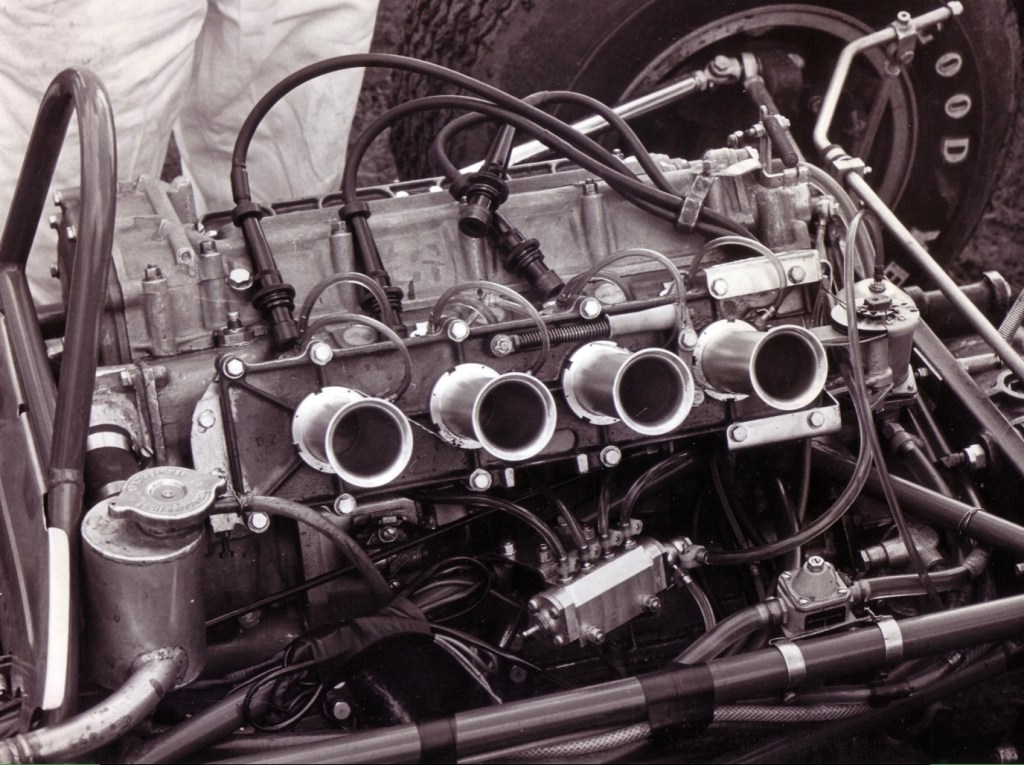
1965 Honda RA300E F2 engine in a Brabham BT16 chassis : 1-litre (72×61.2mm – 996cc) all alloy, DOHC, four-valve, fuel injected circa 135bhp @ 10000rpm (1965 RA302E 150bhp @ 11000rpm) four cylinder engine. Weight 145kg (Brabham Family Archive) Jack from Denny at Goodwood during the Sunday Mirror Trophy on April 11, 1966. Brabham BT18 Hondas one-two (Honda Racing)
The calibre and depth of F2 grids then is shown by looking at the Albi field, in order of finishing (or not); Jim Clark, Jack Brabham, Denny Hulme, Jochen Rindt, Alan Rees, Mike Spence, Frank Gardner, Bob Bondurant, Jo Schlesser, Jean Vinatier, Brian Hart, Trevor Taylor, Silvio Moser, Guy Ligier, Mike Beckwith, Graham Hill, Geki Russo, Peter Revson, Henry Grandshire, Eric Offenstadt, Ludovico Scarfiotti, Paul Hawkins and Richard Attwood. Five world champs, a couple of Indy winners, three Le Mans victors and two Can-Am Cup champions.
Ron Tauranac and Jack Brabham had plenty of balls in the air during 1965, apart from the usual manufacture of production racing cars and the running of works teams (Motor Racing Developments and Brabham Racing Organisation) in F2 and F1. They had nascent engine programs with Honda (F2) and Repco Brabham Engines (Tasman and F1), and in addition were helping Goodyear develop tyres which were critical to Brabham, MRD, BRO and RBE’s two 1966 F1 championship wins; the manufacturers and drivers championships.
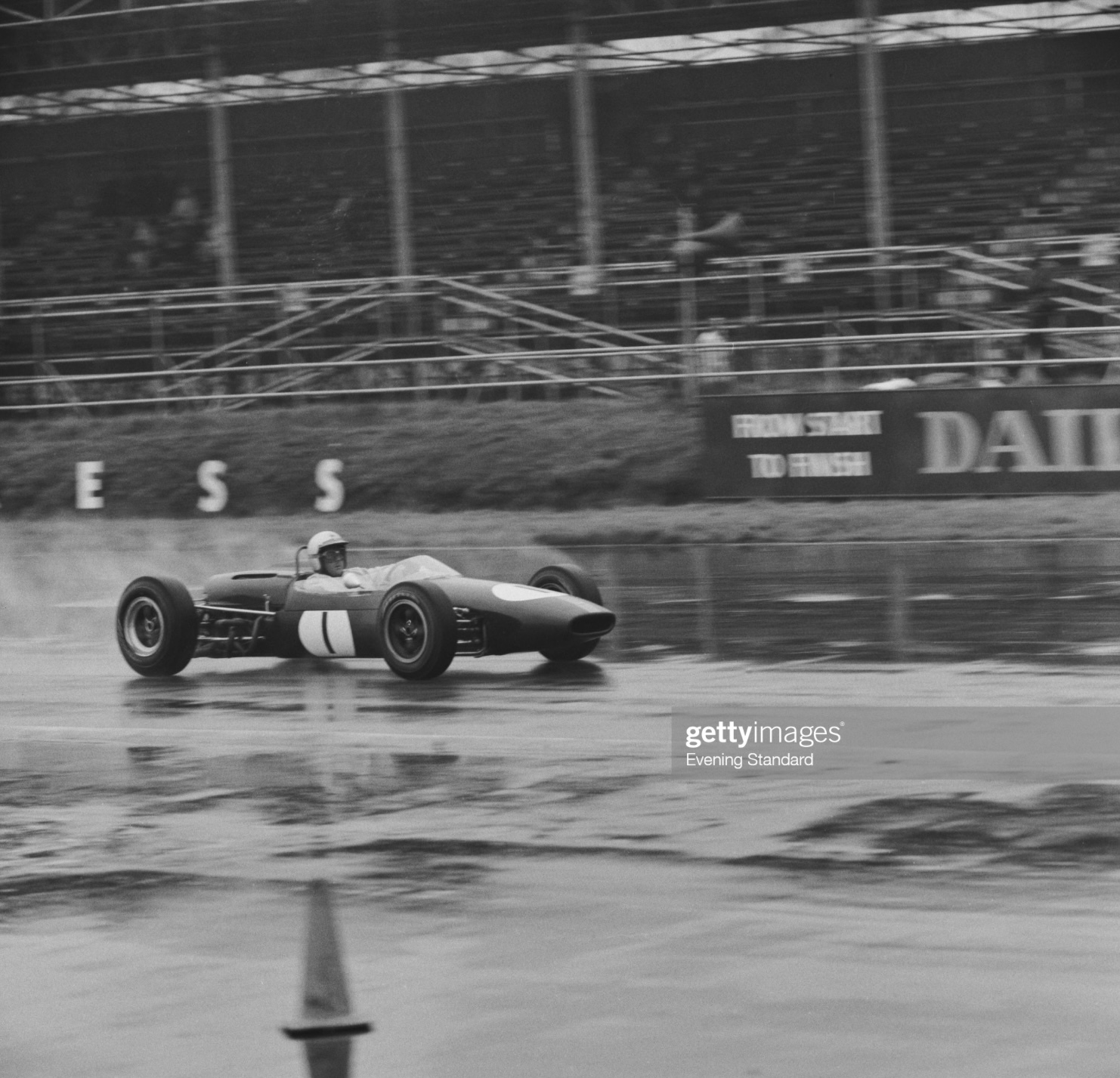
Jack Brabham, Brabham BT16 Honda during practice for the cancelled BARC Senior Service Trophy at Silverstone on March 20, 1965. The race was cancelled due to excessive amounts of water – visible – on the circuitRon Tauranac at left with stopwatch board, and Jack attend to changes during practice at Montlhery during the September 11, 1966 weekend. Brabham BT21 Honda. Brabham won by three seconds from Jim Clark’s Lotus 44 Ford SCA with Hulme two seconds behind Jim
The European F2 Championship commenced in 1967, the first year of the 1.6-litre F2. Despite the lack of a title in 1966 (although Brabham won the six round French F2 Championship) Brabham Honda were absolutely dominant. Of 16 major races held in Europe, Brabham won 10; Goodwood, Pau GP, GP Barcelona, GP Limborg, the London Trophy at Crystal Palace, GP Reims, the Kanonloppet at Karlskoga, Finland GP, GP de L’ille France at Montlhery, and the GP Albi. Six of these events were Brabham Honda one-twos, with Denny bringing his car home behind his team-leader. Hulme won two races as well, the GP Rouen and Trophee Craven A on the Le Mans, Bugatti circuit.
Credits…
Stef Van den Bergh, F2 Index, Getty Images, Brabham Family Archive, Honda Racing, MotorSport
Tailpiece…
(MotorSport)
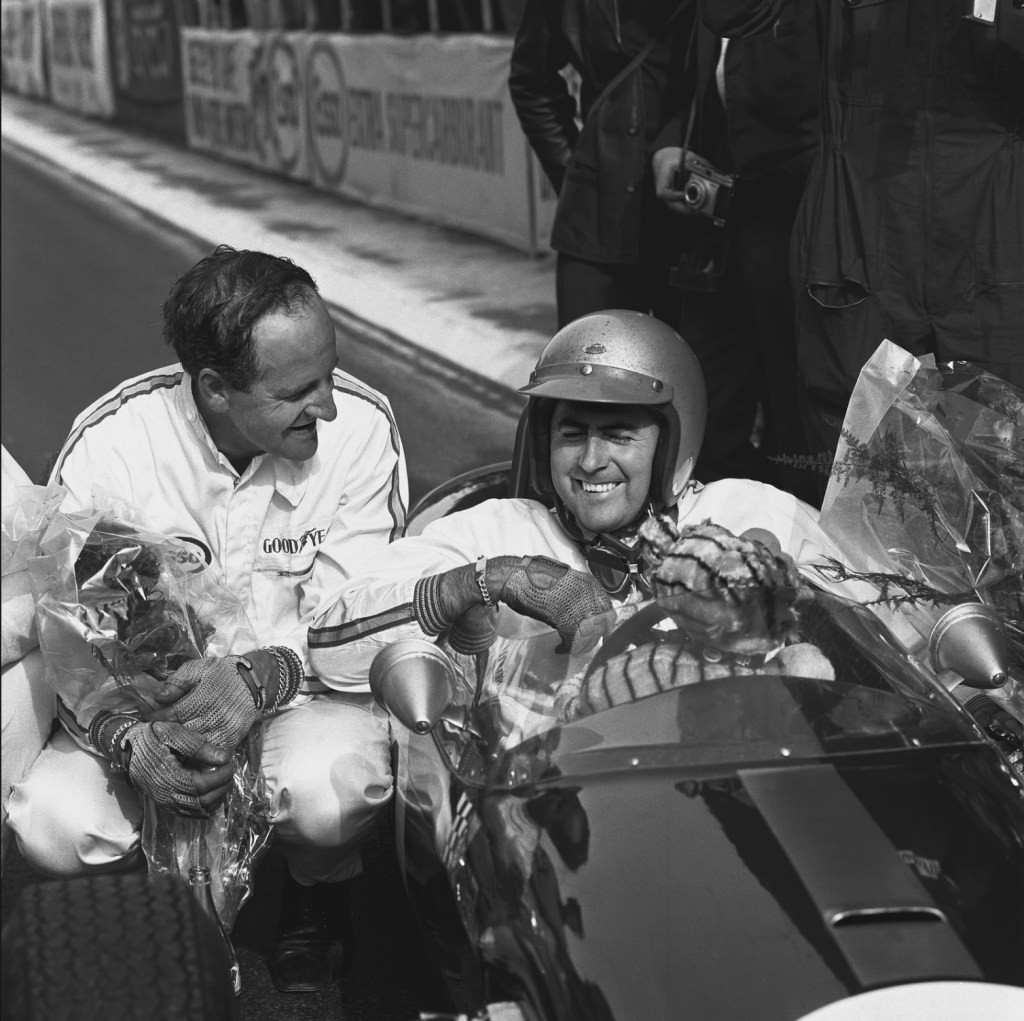
A couple of happy-chappies after the conclusion of the Pau GP on April 17, 1966. Jack and Denny finished in line astern aboard Brabham BT18 Hondas, with five-tenths of a second between them. Back in third, nearly 1 1/2 minutes adrift was Graham Hill in John Coombs’ Brabham BT16 BRM P80. Brabhams filled six of the top ten placings.
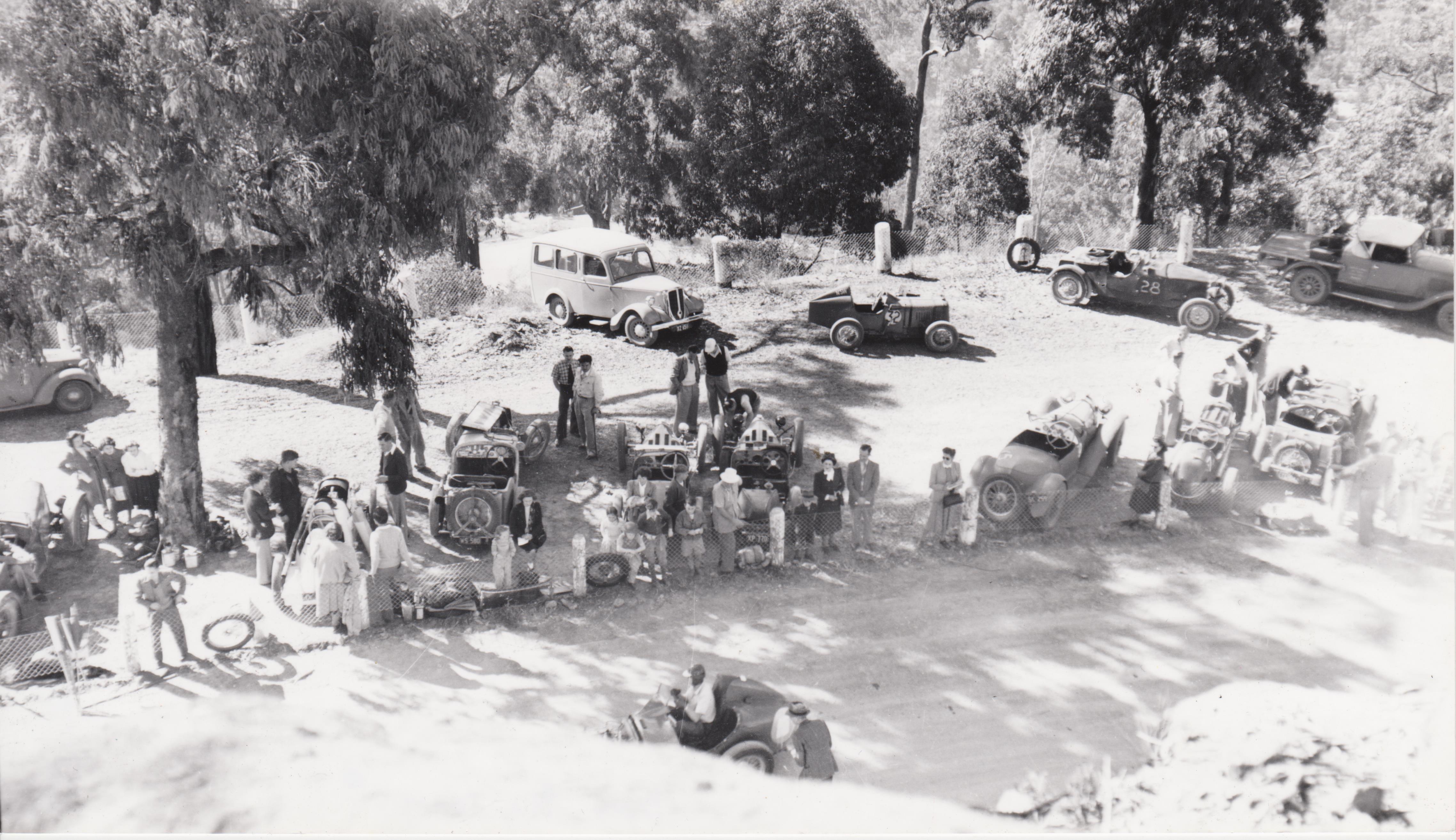
A Bill Daley photograph of Hawkesbury hill climb, circa 1948.
How many of these cars ran in an Australian Grand Prix, is the question which pops into my mind?
In the absence of a programme for the event, this classic study of racing cars taken at Hawkesbury Hillclimb has left the experts unable to identify all the cars; we call on our readers to fill the gaps.
The photograph came from the VSCCA (NSW) collection, per favore of Richard Walton. Note the spectating ladies with their handbags; they look as though they may have come straight from church.
Surprisingly, the owner of the Jowett Bradford van has been identified. John Medley says it belonged to Bob Pritchett – familiar to many of us as the ‘RBP’ of ‘Spotlight’ in Australian Motor Sports (R. Beal Pritchett). Kent Patrick describes the van as: “The bronchial Jowett Bradford – (which will) roll over with its engine stopped”. Within coughing distance to the right of the van is the unmistakeable shape of the Sulman Singer (#32) as it appeared pre-war in Tom Sulman’s hands. Kent speculates that the Riley, next in line (#28), might be Len Masser’s Lynx Sprite. I guess the next is a ubiquitous Ford A ute.
The nearest line of cars, backed up to the fence, pose some real problems. The car to the left of the tree is a mystery; the one to the right has an external exhaust on the left side – what is it? We then have the ex-Bill Thompson K3 MG (with bonnet open) – Kent suggests it might have been owned by Ken Tubman around this time. Ken was a graduate of Fort St School, a pharmacist, and is best remembered for winning the first Redex Round Australia Trial in a Peugeot 203. He still had the K3 in the sixties; we recall him bringing it to the Geelong Speed Trials as a spectator.
The first Grand Prix Bugatti with the folded full width windscreen is probably the Type 37 of Frank Lyell, chassis number 37160. This car had been discovered abandoned in a shed behind the Federal Hotel in Narromine a few short years before – it changed hands for 10 pounds! To its right is Type 37, chassis number 37209 owned by Irwin ‘Bud’ Luke, who was very competitive in the car; he finished seventh in the Australian Grand Prix at Leyburn in 1947. Kent thinks it might be Bud attending to the front wheel with his partner Ida at the rear of the car.
The touring bodied Bugatti bears elegant coachwork by Carrosserie Profilée and is chassis number 4264. It was probably owned by Doug Helsham and likely powered by a Chrysler Six. ‘Gelignite’ Jack Murray’s Day Special is next (second car from the right), a Ford V8 powered Type 39 Bugatti, chassis number 4607, which won the 1931 Australian Grand Prix driven by Carl Junker. The last parked car appears to be an Austin ‘7’ special, possibly Frank Lyell’s car. Of course, the car leaving the starting line (partially obscured at the bottom) is Frank Kleinig in his eponymous special.
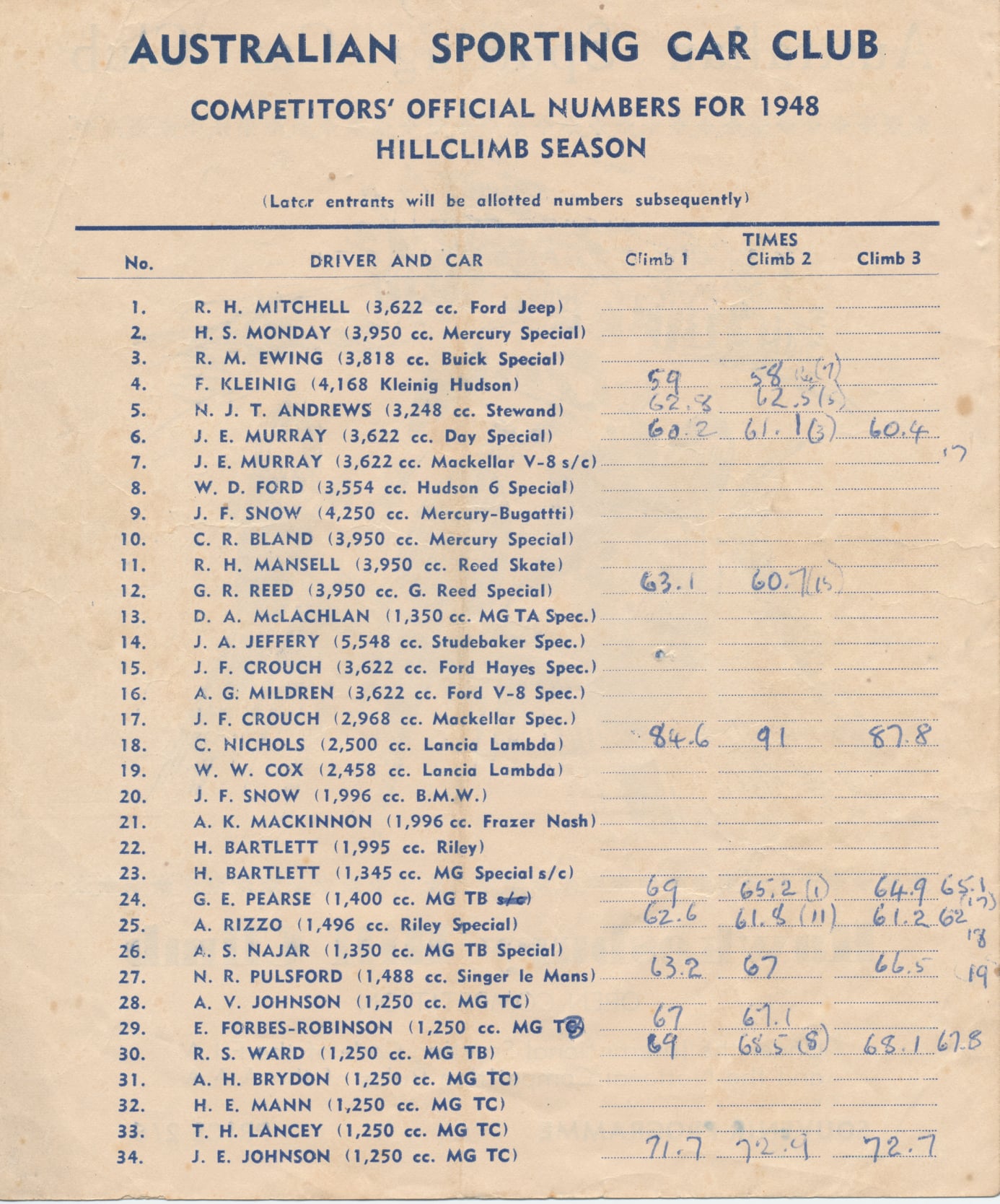
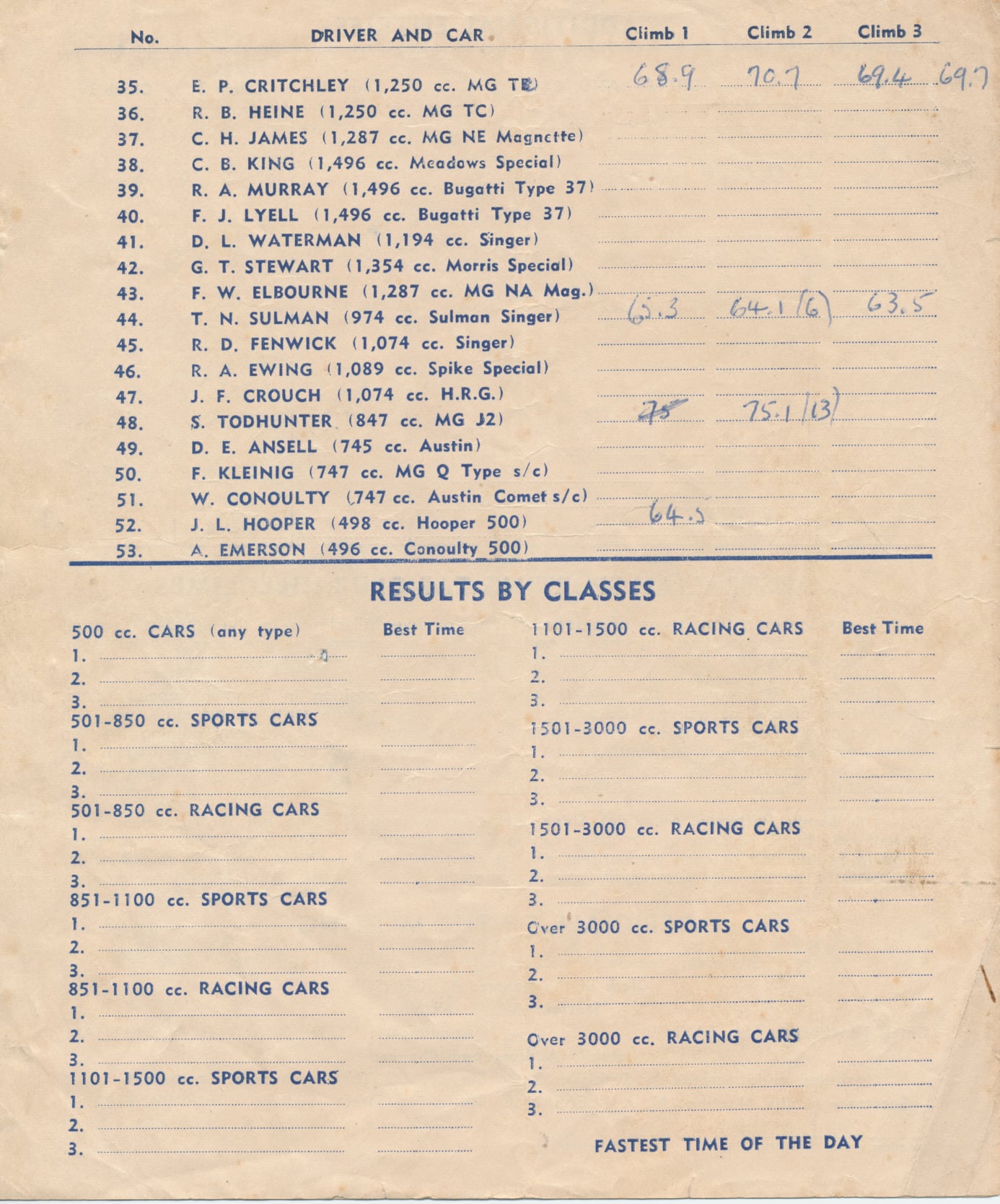
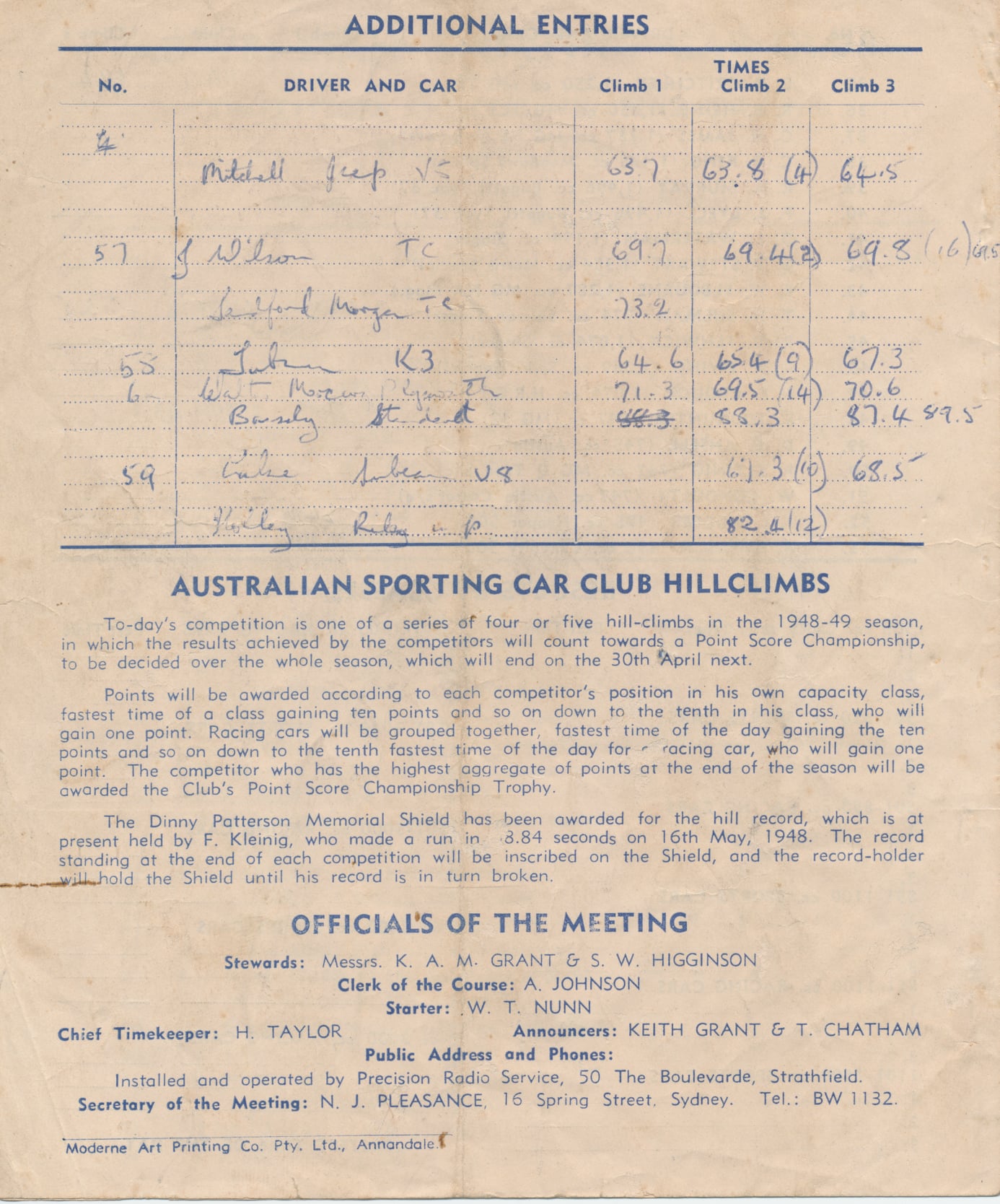
Since writing this, Cummins Archive (Paul Cummins) have posted on Facebook a 1948 programme for Hawkesbury hillclimb. It is not ‘our event’ as the numbers on recognizable cars differ – viz. Sulman Singer 32 in the photo and 44 in the published programme. This programme might help with the identification of some of the other cars – could Riley number 28 be the Rizzo Riley and the last car, which appears to be an Austin ‘7’ special be that of Ted Ansell? The list of competitors, which is a virtual Who’s Who of immediately post-war NSW racing drivers, appears to confirm Kent Patrick’s suggestion that the K3 MG is that of Tubman – see his listing under ‘Additional Entries’.
My first exposure to Bob Shepherd’s artistry was in the first issue of the late Barry Lake’s marvellous and way too short-lived Cars and Drivers magazine published in early 1977.
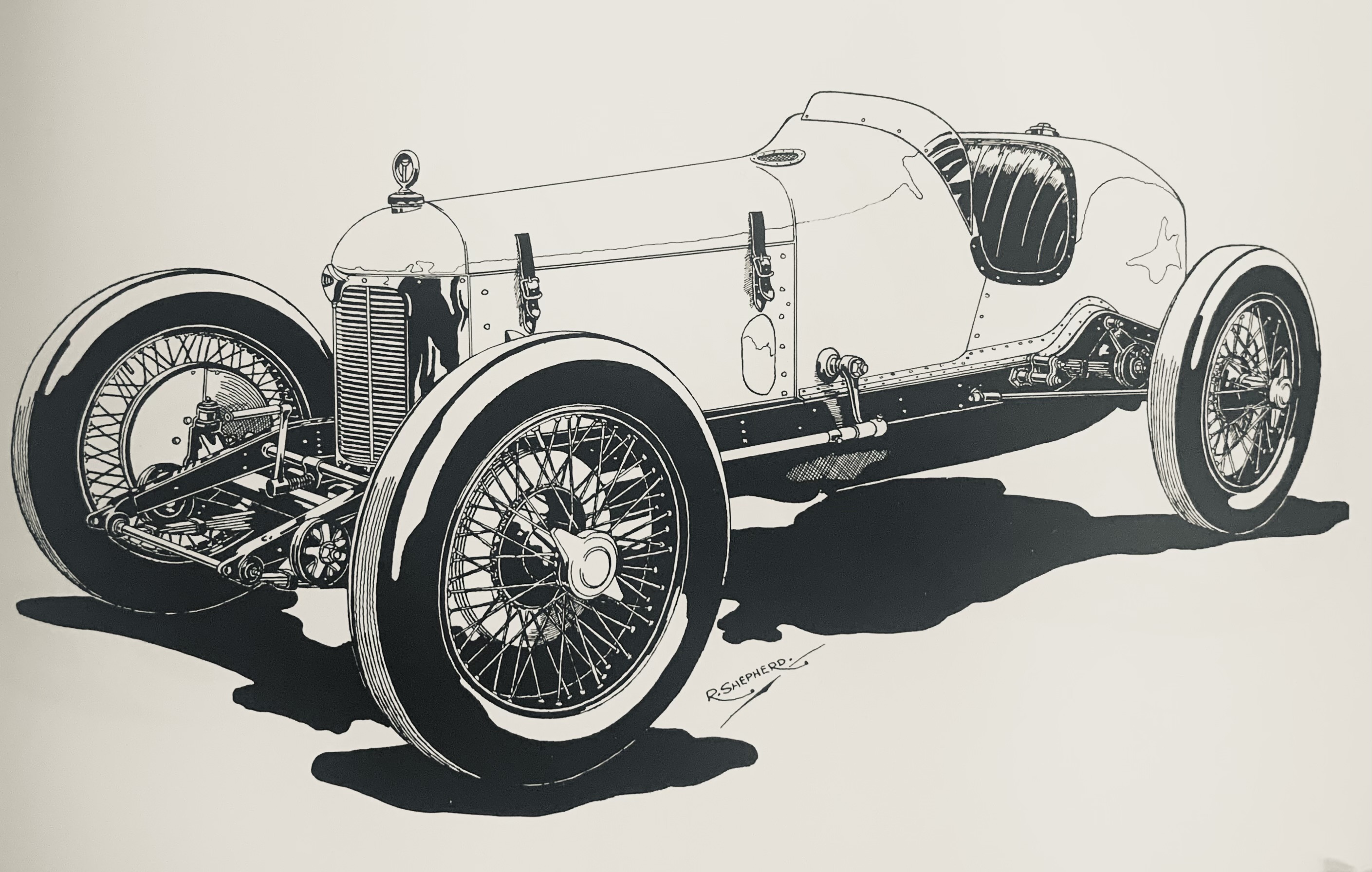
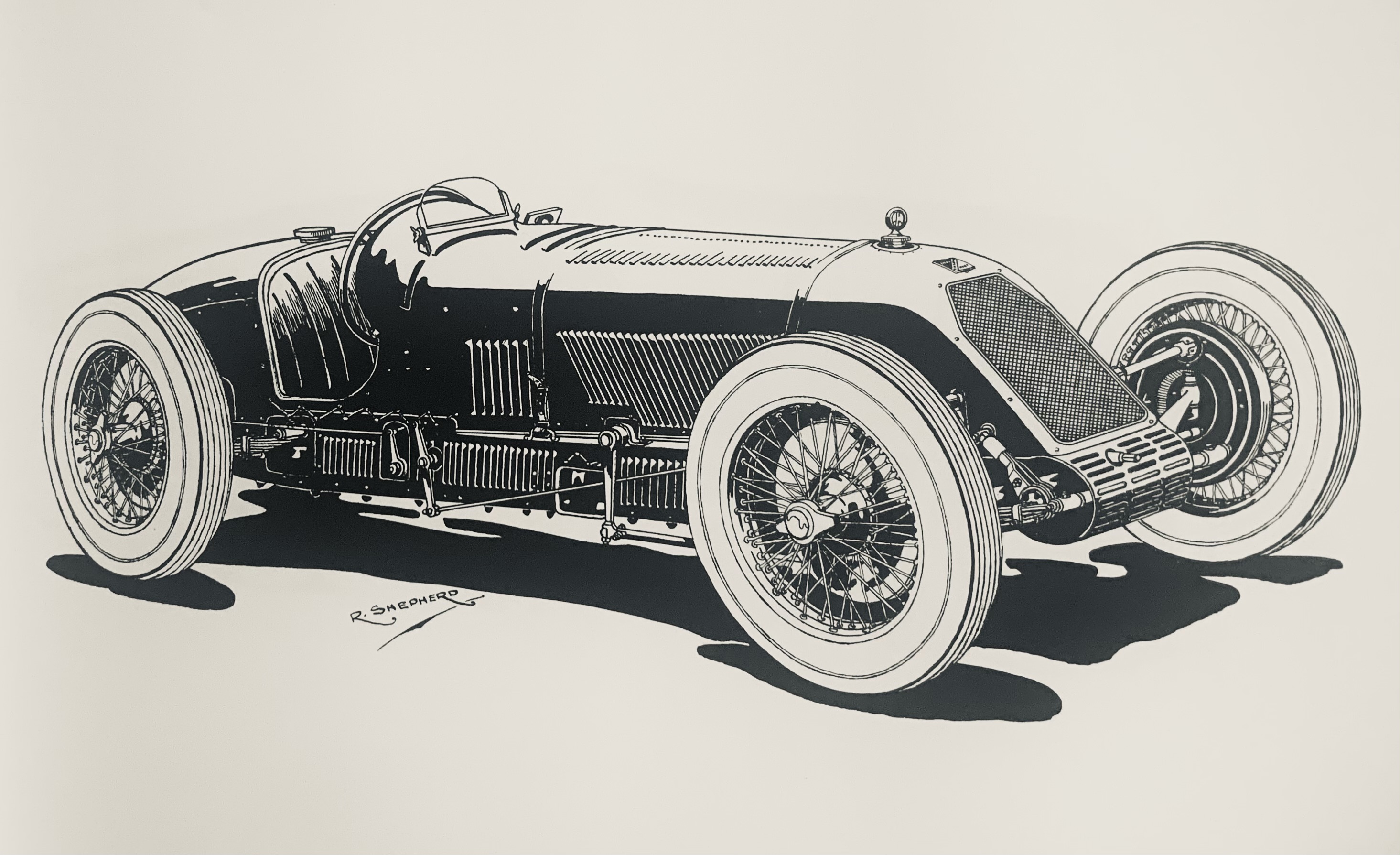
John Medley chose a Shepherd drawing of a Miller 122 to support an article he wrote about the ex-Zborowski machine which raced in New Zealand, and briefly in Australia pre-war, after the untimely death of the wealthy Briton at the wheel of a Mercedes during the 1924 Italian GP.
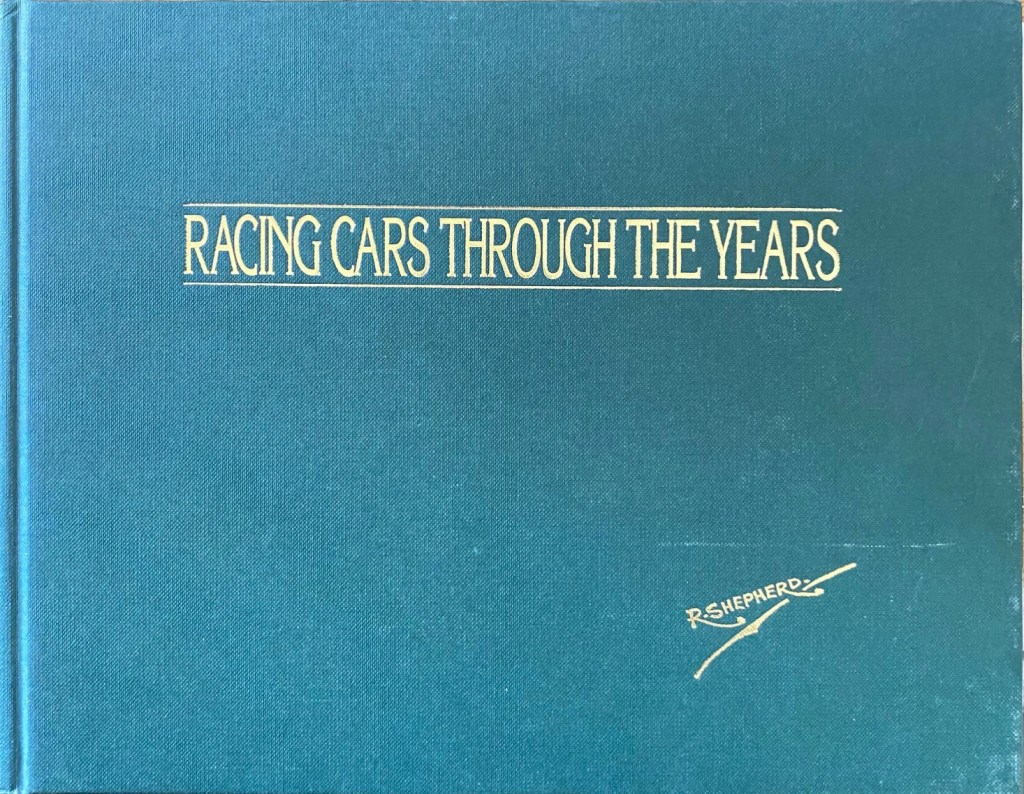
I’ve always been blown away by Shepherd’s work when I have tripped over it. Discussions with Bob King about the Miller led us to his copy of Graham Howard’s book (Racing Cars Through The Years) of Shepherd’s drawings published in 1993. Diana Davison/Gaze made available the Davison Family Collection of Shepherd images to Howard to allow the book to be published.
So little is known about Bob Shepherd we figured it was time to put something on the record more widely available than those lucky enough to have a copy of that marvellous book.
I asked Bob to do a bio, but after re-reading Graeme’s Introduction in the book, he said “How can I top that!”
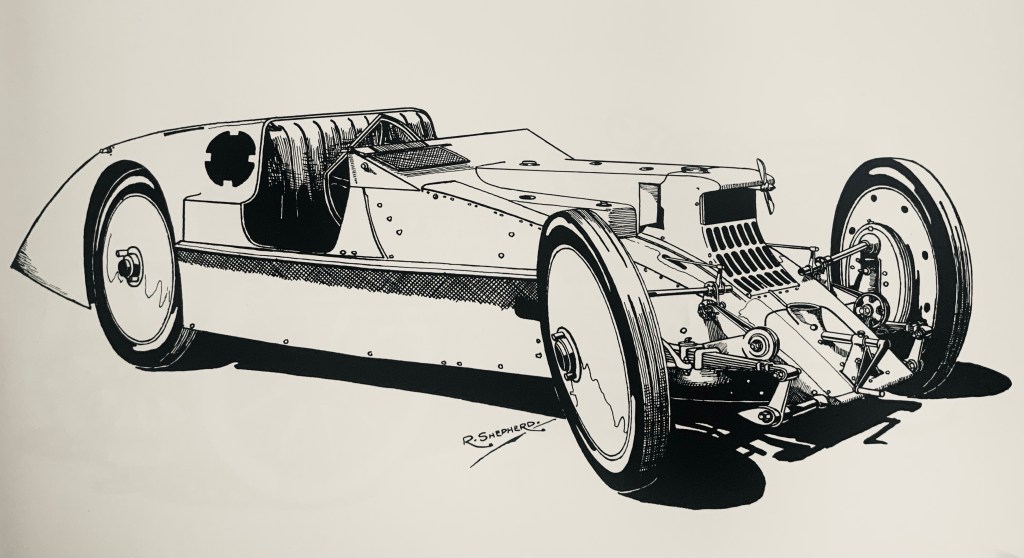
So, here it is, Howard’s words shortened only a smidge, and a small selection of drawings which I think demonstrate Bob’s mastery of his art. The descriptions of each car are exactly as they appear in the book.
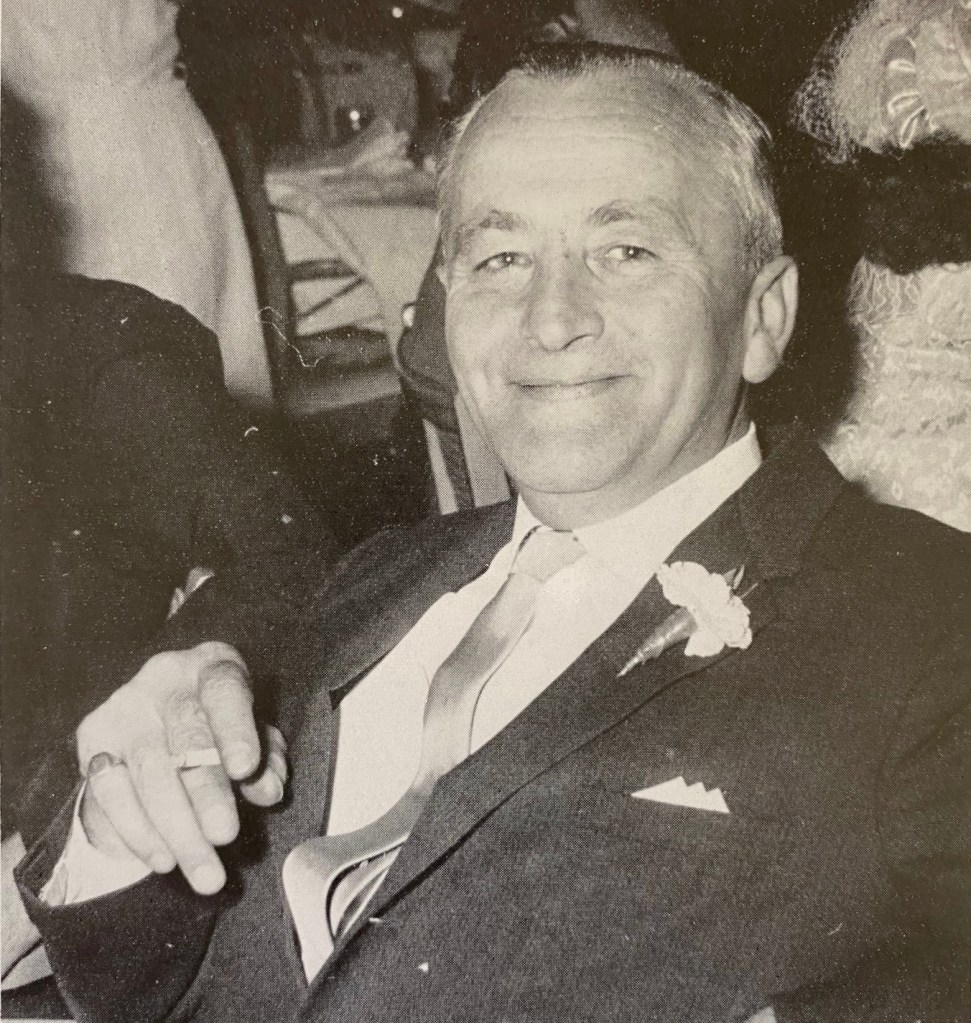
MG R-type Midget, 1935. Zoller blown at 24-28lbs, MG’s tiny single-cam four (57mm x 73mm, 746cc) delivered 120bhp – more than the Q-type’s leaf-spring chassis could handle. Hence the all independent 750cc R-type, MG’s first ever pure-racing car, with far-sighted backbone chassis and torsion bar parallelogram wishbone suspension. Drawing appeared in the March 1958 AMS.Bob Shepherd in 1960
“To countless Australians Bob Shepherd the artist was also Bob Shepherd the historian, primarily because of the series of articles he wrote and illustrated for the magazine Australian Motor Sports, starting in August 1946 and continuing for than 15 years.
With a distinctive combination of knowledge, passion and flair, he carried his audience into the magic world of the racing and high performance cars of Europe and (to a lesser degree) America, broadly from the time of the French Grands Prix through to the end of the 1930s. Month by month, car by car, Shepherd spread before his readers the treasures of the Vintage era and the legendary cars of the 1930s which laid the foundations for post-WW2 motor racing. Over the years he gave AMS readers an education in motoring history unrivalled anywhere in the world.
Not that he confined his energies to Australia. He sent drawings overseas to MotorSport and to the Bugatti Owners Club journal Bugantics and was singled out by British engineer-historian Laurence Pomeroy, in the second edition of his milestone book The Grand Prix Car, for having been particularly helpful in suggesting improvements and corrections to the original work. The significance of this acknowledgement needs to be emphasised – that, while far removed from the Northern hemisphere’s factories, archives and authors, Shepherd was nonetheless the master of details which had eluded even the most eminent of British motoring historians.
Even more remarkable was that Shepherd had no formal training, either as an engineer or as an historian, or for that matter as an artist. The writing and illustrating of his monthly AMS pieces, and the maintenance of his correspondence with enthusiasts around the world, was done from the lounge room of his house in the time he had spare from family life and his job as a stores clerk.
Itala 12-cylinder fwd, 1926. Tested but never raced, these innovative cars would have competed against such classics as the 1.5-litre Delages. They were true single-seaters with fully independent suspension; the supercharged V12 engines were built in 1500cc and 1100cc form, the single central camshaft flanked by its two rows of horizontal valves. Drawing appeared in the August 1952 AMS.
He was born in 1914 in the Sydney suburb of Pagewood, where his father was a hairdresser. He was the oldest of three children; he and his brother Sydney were each dux of Daceyville Primary School in their respective years, and Bob was later also dux of Cleveland Street High School, but university was out of the question. Cars and drawing were his great interest, but work in the motor trade was impossible to find: eventually a family friend heard of a job at Davis Gelatine, and he worked there until his retirement in 1979, holding a staff position from 1964. He married Joan Manhood in 1940, they had three children.
As a schoolboy Shepherd had started writing to overseas car manufacturers for catalogues; these catalogues, his voluminous international correspondence, and dissected copies of The Motor, The Autocar and MotorSport formed the basis of his archives, kept in rows of manila folders in large glass-fronted cupboards.
His drawings were made using the simplest of methods and materials. A pencilled grid, or a pair of dividers, would be used to transfer dimensions and proportions from the chosen source photograph onto a sheet of his favourite cartridge paper, and the drawing would start in HB pencil, which would be rubbed out after the final version had been inked-in using mapping pens. All his work was freehand – there were no rulers or artificial aids like French curves. He did most of his drawings on Sundays after church, working for four to five hours, resting his paper on a wooden board and taking advantage of natural light. It would usually need two Sundays to produce a drawing; those for AMS were sent to Melbourne (always by registered mail) in cardboard cylinders accompanied by the text for his article which – like his letters – would be written in copperplate script, blue ink on unlined paper.
He was not comfortable drawing vehicles in action, or drawing people, and he showed no interest in drawing aircraft or motorcycles. Almost all his work was black and white: AMS itself was not printed in colour. In some drawings he used a wash, rather than hatching, to provide shading: when he did use colour, for example for private commissions, it was with complete success. His black box of watercolour pigments, bought when he was 12, is still in use by one of his grandchildren.
Bob Shepherd’s colour drawing of a 1922 Bugatti Type 30 (B King Collection)Delage 2-litre V12, 1923-1925. After two relatively unsuccessful years as unsupercharged cars, the V12s were supercharged for the 1925 season (as illustrated) and finished 1-2 in the French Grand Prix. The four-camshaft engines (51.3mm x 80mm, 1984cc), unusual in having the exhausts in the centre of the Vee, gave about 190bhp in supercharged form. This drawing appeared in the June 1954 AMS.
As well as his work for AMS, he provided illustrations for many club magazines and illustrated ‘Vintage Types’ for the Vintage Sports Car Club of Australia, he was one of its founding members. His first published drawings may have been the series ‘Australia’s Best Known Speed Cars’ in Motor in Australia and Flying in 1939. He was sometimes asked to suggest shapes for rebuilds or of new racing cars. As a boy he had watched racing on the banked concrete saucer at Maroubra but went to few race meetings in later years. More surprisingly, he never owned a car (although he had part shares in several), seldom drove, and did not hold a licence, he never travelled outside New South Wales.
Yet he was in no way reclusive or narrow in his interests. While a reluctant partygoer, he was a most entertaining teller of stories, had an astonishingly broad general knowledge, was a keen reader, loved opera (he did his drawings with ABC radio playing) and was well enough known as a fisherman for there to be an unofficial ‘Shepherd’s Rock’ at nearby Kurnell.
There was little to single out the family house in Maroubra Bay Road. Shepherd took his research seriously – he shared in some ferocious debates in his correspondence columns – but there was absolutely no pretence; there was nothing in his manner to hint that here was one of the foremost authorities on motoring history. Joan and Bob Shepherd made everyone most welcome, whether they were famous names or awed tram-travelling young admirers (for which all those young admirers remain very grateful).
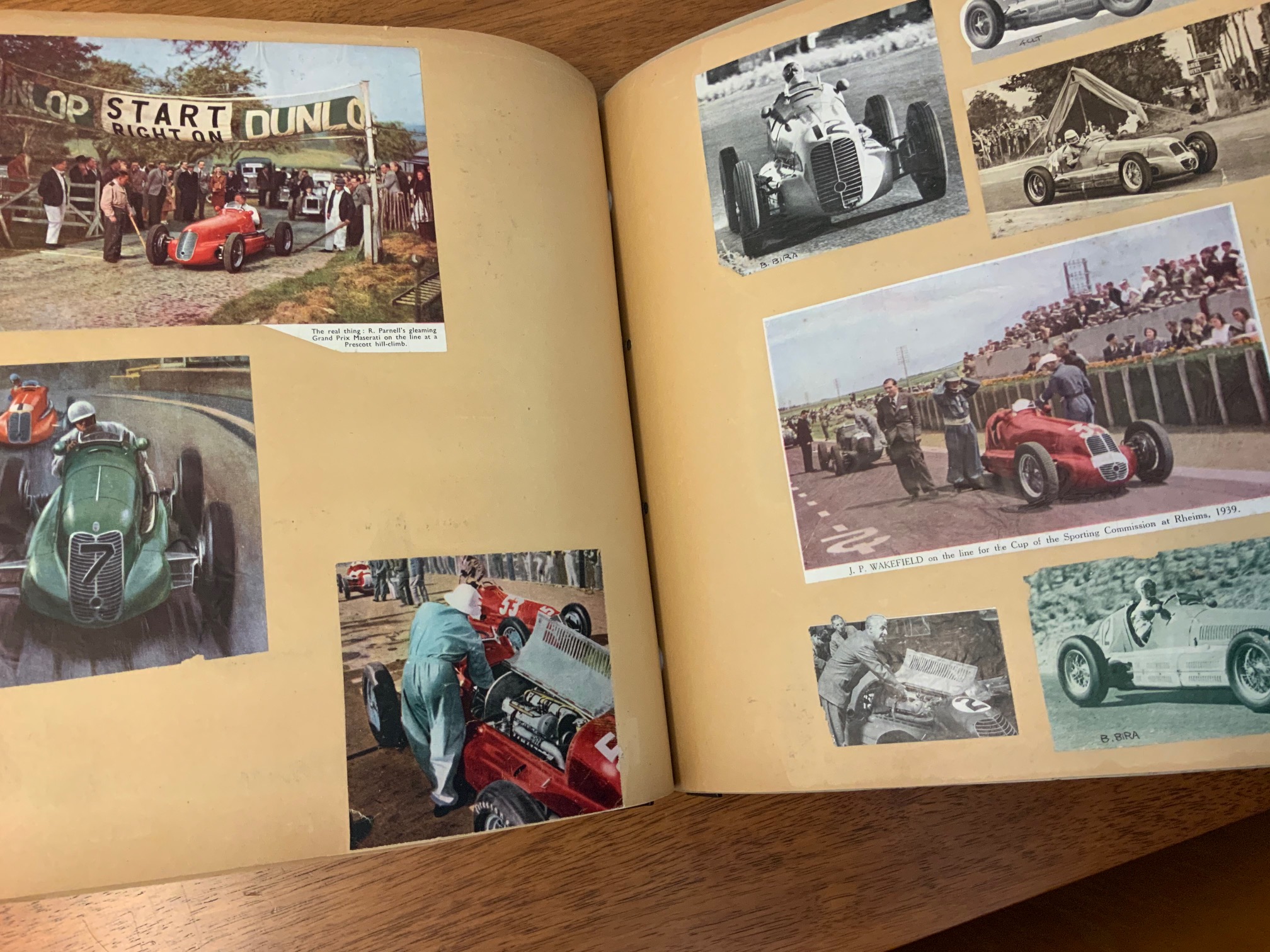
Voisin Grand Prix, 1923. Gabriel Voisin was a pioneer French aviator and aircraft manufacturer, as well as an innovative car maker. His cars for the 1923 French GP had only around 75hp from their 2-litre six-cylinder Knight double-sleeve-valve engines, but had aerodynamic body work and disc covered wire wheels and a true monocoque chassis of plywood and sheet metal. The drawing appeared in the September 1956 AMS.This is a spread from Bob Shepherd’s Maserati scrap-book, a simple but effective way of archiving material, I guess we all have one, or many! (D Zeunert Collection)
Like many remarkable people, Bob Shepherd was a paradox. He almost never drove a Vintage car, seldom went to the Vintage club meetings, yet was – without realising it – the Australian Vintage movement’s finest publicist. He never travelled outside Australia, never saw any of his beloved cars in their heyday, yet he knew them in minute detail and could picture them with elegant clarity. He had rare gifts yet remained a modest and gentle man. With this book we remember that man.”
Graham Howard, Sydney, 1993.
Talbot-Darracq 1.5-litre, 1926 (above). Continuing Darracq’s pre-1914 racing tradition, the company’s cars for the 1926 1.5-litre formula were 140bhp supercharged twin-cam straight-eights (56mm x 75.5mm, 1488cc). Engine and gearbox were slightly offset to the drivers left. A much modified version of one of these cars (still in 2021) survives in Australia, imported after WW2. The drawing appeared in the October 1951 AMS.
Oops, nearly forgot the Miller 122 at this pieces outset. Miller, 1923. Influenced by Fiat, Harry Miller used two valves per cylinder in hemispherical chambers when he scaled down his 183-cubic inch straight-eight for the 122-inch (2-litre) limit applying from 1923, obtaining an unrivalled 120bhp. Supercharged from 1924, and reduced to 91c.i. from 1926, these engines won Indianapolis in 1923, 1926, 1928 and 1929. That drawing appeared in the April 1957 AMS.
Credits…
‘Racing Cars Through The Years’ Bob Shepherd and Graeme Howard, Bob King Collection, David Zenuert Collection
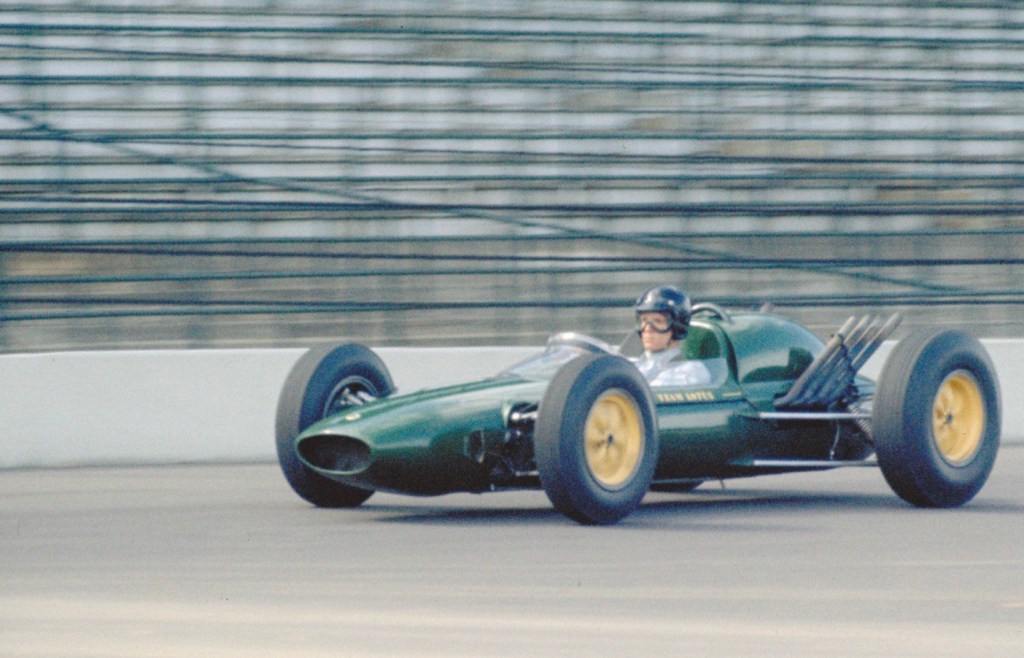
Gurney in Lotus 29-R1 Ford at Indy in March 1963. Here with symmetrical suspension, raced with offset
A bit like Chris Amon, there is no such thing as too much Dan Gurney.
I’ve been researching an article on Lotus’ 1963 Indy campaign and have discovered a few Dan shots too good to waste.
Gurney’s mind was blown, just like everybody elses, when the Lotus 25 Climax was rolled out of the Team Lotus transporter at Zandvoort in 1962. That monocoque design was an Indy winner; as a Californian he was keen to drink the Indy Winners Milk.
He said as much to Colin Chapman and flicked the Lotus supremo a free air ticket to watch him contest the ’62 event in a Mickey Thompson Spl: John Crosthwaite’s mid-engined, spaceframe design was powered by a Buick stock-block V8. Dan ran in the top ten until the transaxle was hors ‘d combat. Importantly ole-Chunky was on the hook.
I promise your slice of the pie will be no less than that Daniel! Colin Chapman and Dan Gurney at Indy in 1963Lotus 29 Ford’s first test at Indy in March 1963. Gurney aboard chassis R1, which is fitted with symmetrical suspension, wobbly-web wheels rather than the Dunlops it raced with and stack-exhausts rather than the megaphones which followed (unattributed)
Gurney was a Ford man, his teenage hot-rod exploits were all Flattie-Ford powered. He raced a Holman Moody Ford Fairlane NASCAR at Riverside in early 1962 and used a couple of Ford heavies he met that weekend to set up a meeting between he, Chapman and the-right-Ford-execs at Dearborn in July.
By March 1963 the Lotus 29 – call it a fat-25 – powered by a 350-375bhp, 255cid all aluminium pushrod variant of the 260 Windsor Falcon/Fairlane V8 was being tested for the first time by Jim Clark at Snetterton.
At Indy Clark ran second to Parnelli Jones’ Watson Offy Roadster for the last 20 or 30 laps. Jones was dropping oil, but was not black-flagged as other cars dropping lubricant throughout the race had been.
The Indy Establishment, led by Chief Steward Harlan Fengler – who had the black flag power – shafted Lotus, Ford, Chapman, Clark and Gurney. Revenge was sweet in 1965 when Lotus Fords occupied the front row driven by Gurney, Clark and AJ Foyt – and Clark won.
Gurney was seventh in 1963, his engine wore a cam-lobe, so he wasn’t able to press hard in the same manner as Clark. Check out my Auto Action feature on the 1963 race here; Auto Action #1823 by Auto Action – Buy through Issuu
Clark and Gurney, in his Yamaha sponsored 29, Indy 1963 (unattributed)Gurney during the Milwaukee 200 in 1963 (unattributed)
Keen to reinforce the point about their speed, Clark and Gurney raced in the Milwaukee 200 three weeks after Indy, Clark won with Gurney third.
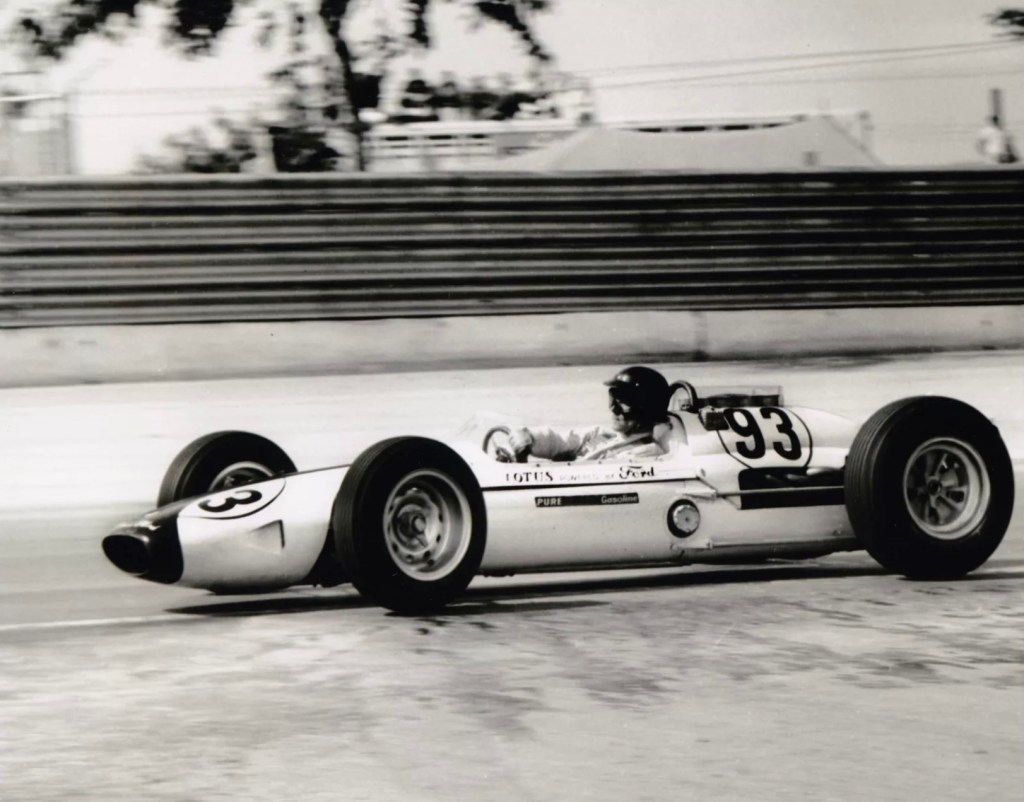
In 1964 the same duo raced the evolved Lotus 34, the most critical mechanical change of which was use of Ford’s Quad Cam Indy V8: this fuel injected, four-cam, two valve V8 produced circa 400bhp.
AJ Foyt’s Watson Offy won the race – the last by a front-engined car – which is primarily remembered for the horrific seven car, lap two accident and conflagration which cost the lives of Dave MacDonald (Thompson Ford) and Eddie Sachs (Halibrand Ford). Coincidently, Sachs’ Watson was the last casualty of ‘Fengler’s oil slick’ the year before, when he boofed the fence on lap 181, and then copped a punch-in-the-nose the following day when he fronted Jones about his win.
Gurney’s Lotus 34 quad-cam in 1964, Chapman alongside (D Friedman)
Lotus were contracted to Dunlop in F1. Chapman used hard Firestones in 1963 and sought the performance, and no doubt, the commercial advantage of softer Dunlops in 1964. One of Clark’s (from pole) tyres failed after 47 laps taking out the left-rear corner of the car. Gurney retired after 110 laps with excessive wear.
The FoMoCo were not amused as Clark’s failure happened on the entry to the main-straightaway (front straight) providing an exciting – and oh so public – epic-fail in front of 150,000 or so spectators. Needless to say, Ford took control of tyre choice in 1965, an all-Ford year.
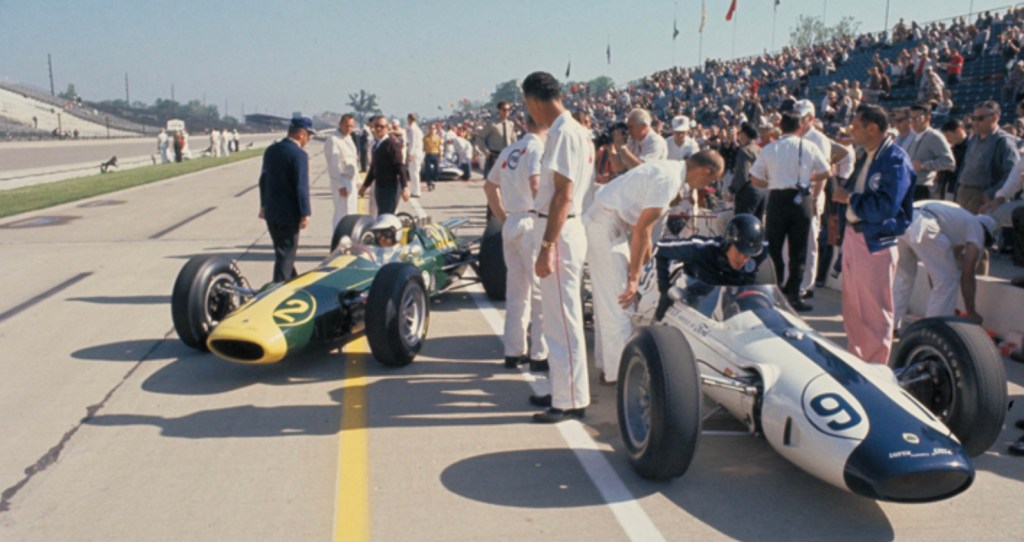
Indy front row 1965; Gurney, left and Clark in Lotus 38s and AJ Foyt on pole, Lotus 34 Ford (AAR archive)Gurney, Lotus 38 Ford, Indy 1965 (unattributed)
AJ Foyt’s Lotus 34 Ford took pole while Clark’s Lotus 38 won in 1965, having led 189 of the 200 laps, from Jones Lotus 34 Ford, a young Mario Andretti’s (Brabham based) Hawk Ford and Al Miller’s Lotus 29 Ford.
Poor old Dan started from the outside of the front row but was a DNF after 38 laps with timing-gear failure in his Lotus 38. While his Eagles won plenty of Indy 500s, Dan never did take one as a driver, a great shame!
Etcetera…
(MotorSport)
The business end of Gurney’s Lotus 29-R2 in 1963.
Gurney and Chapman pitched a 4.2-litre pushrod engine to Ford. They figured, based on Dan’s 1962 experience, that a 350 pound, 350bhp petrol fuelled Ford V8 would do the trick. As it did…
Clark’s Lotus 34 Ford in 1964.
The Lotus 29 and 34 were bathtub-monocoques, the 38 was a full-monocoque. Note the offset suspension to the right and Ford quad-cam 4.2-litre V8.
Credits…
Getty Images, David Friedman, AAR Archive
Tailpiece…
(AAR archive)
The boys fire up Dan’s Ford V8 in 1967. His beautiful, dual purpose F1/Indycar design, in Indy spec designated Eagle 67 Ford, was designed by Len Terry, the same bloke who drew Chapman’s epochal Lotus 25 F1 car and 29/34/38 Indycars.
He started from Q2, led two of the 200 laps but was out after 160 laps with piston failure. Better would come, Bobby Unser won in an Eagle 68 Offy in 1968, and Dan was second in an Eagle 68 Gurney-Weslake-Ford.
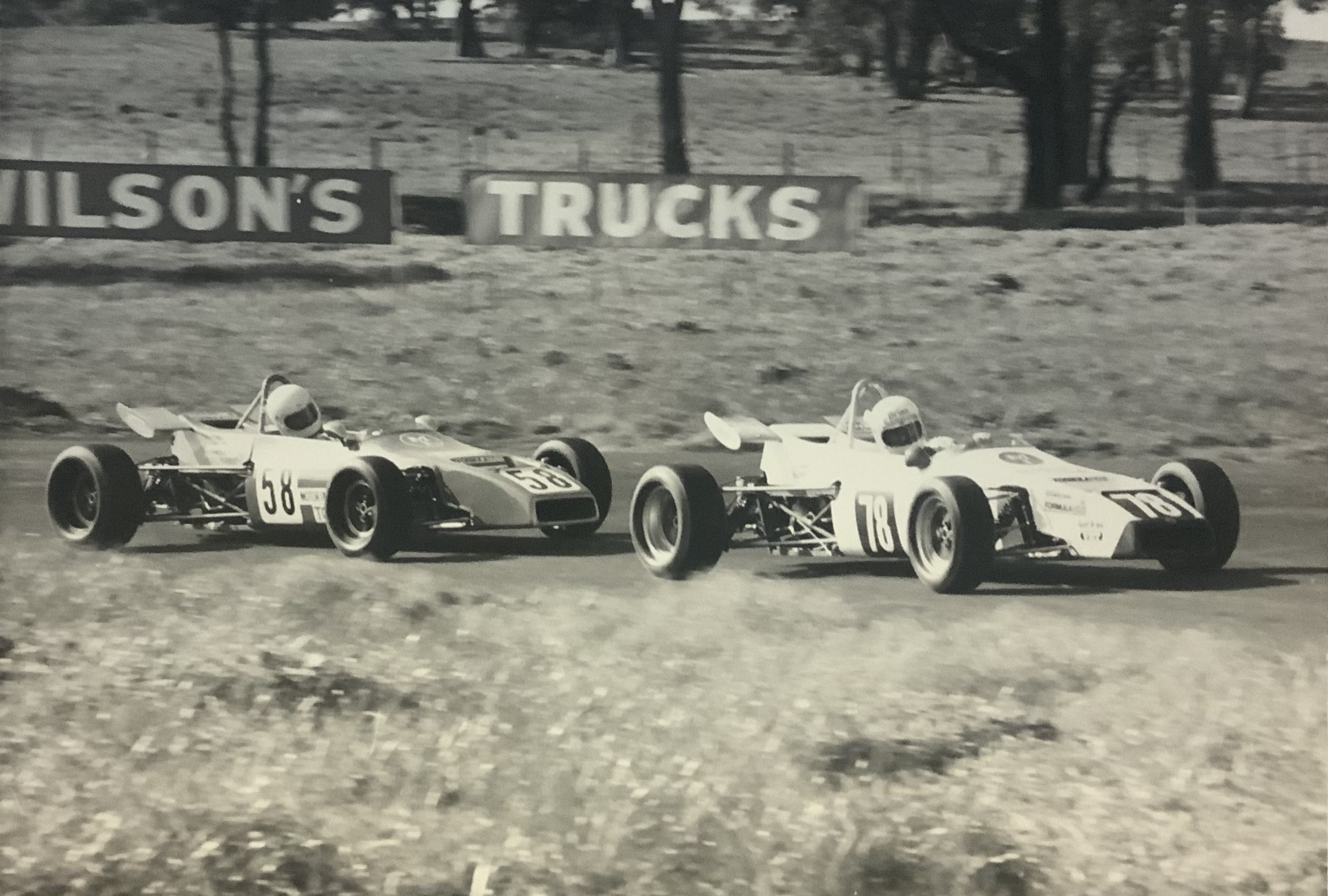
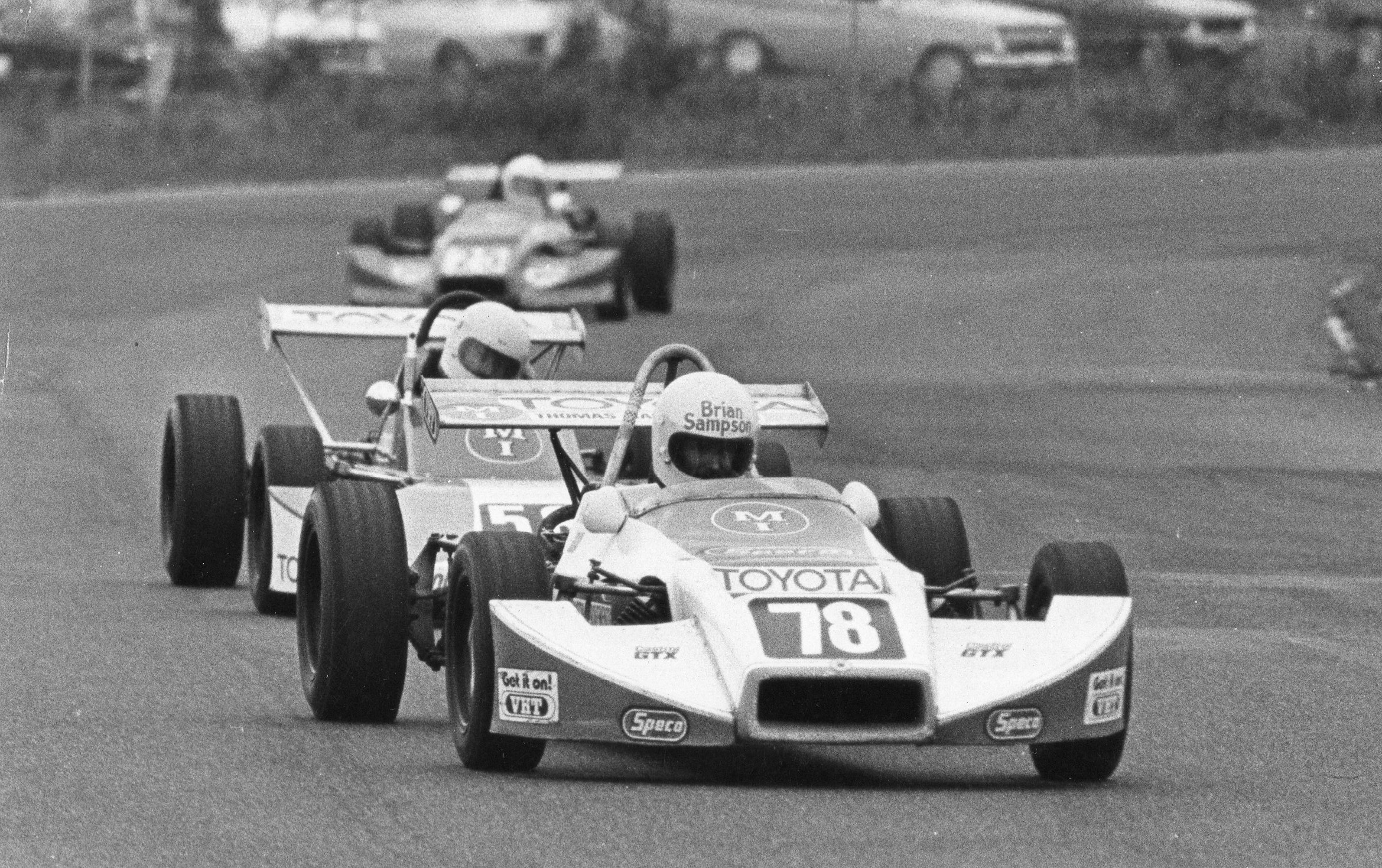
Cheetah Mk4 Toyota mounted Brian Shead and a distant Brian Sampson, sandwich Tony Stewarts ANF2 Birrana 273 Ford as they enter Sandown’s Dandenong Road corner circa 1973 (B Jones Collection)
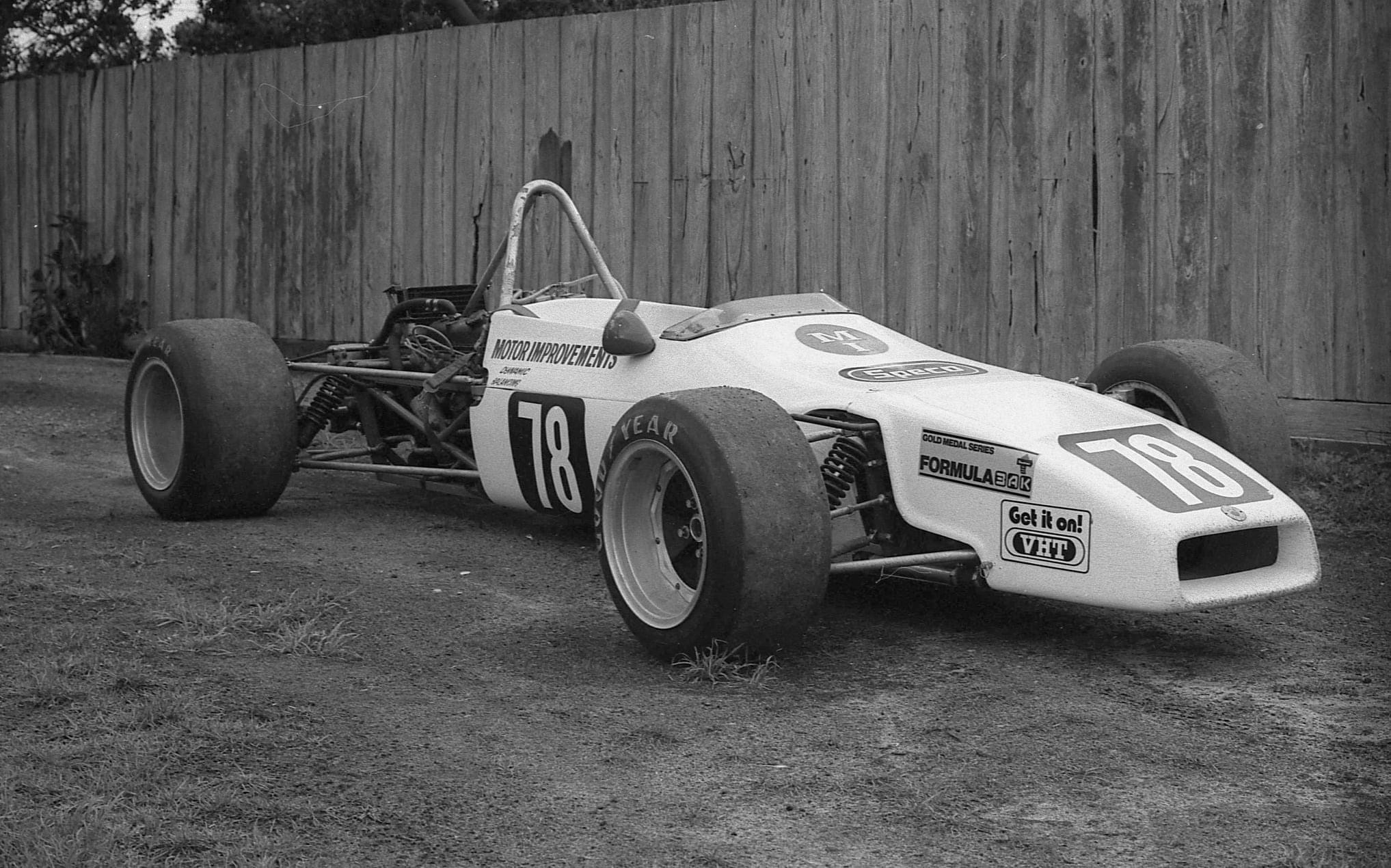
Brian Shead’s first car, the Mk1, Cooper-esque, BMC A-series powered Formula Junior was completed on August 1, 1960 and raced by the man himself. The Marks 2 and 3 were finished in early 1962 and 1963 respectively. Sheady got serious about ‘volume production’ in 1968 despite still having a ‘real-job’, his Service Manager role at Conquip Victoria was handily close to his home and workshop in Mordialloc, a Melbourne bayside suburb.
Brian Shead fettles his Cheetah Mk1 BMC at Rob Roy hillclimb, in Melbourne’s outer east, circa 1961. Note Laurie Rofe’s ? Alfa P3 at rear (M Borland Collection)
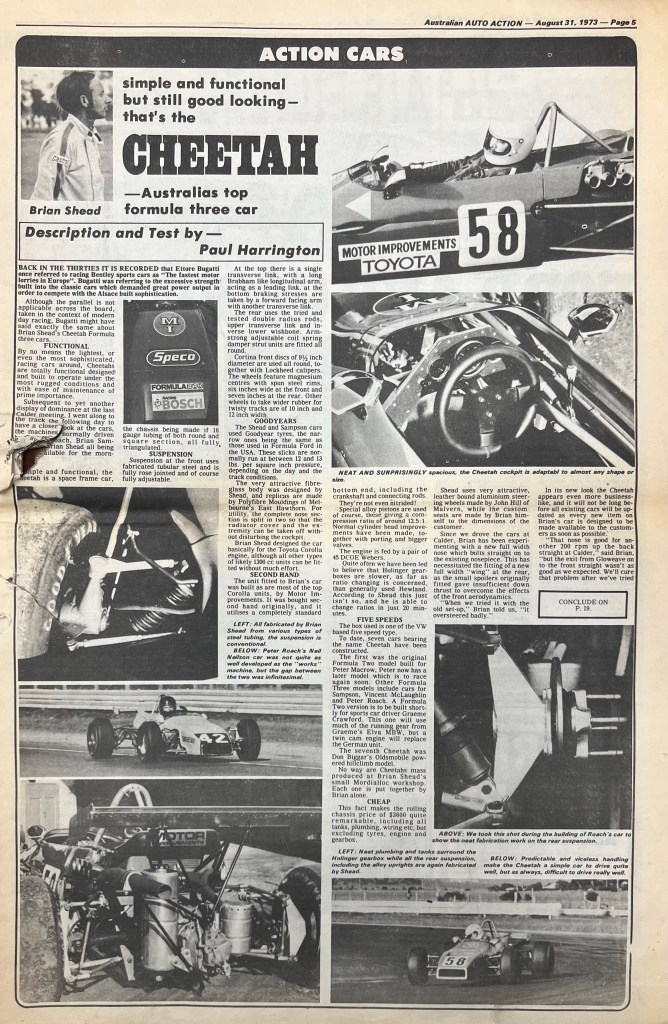
The Mark 4A was made from one-inch, 18-gauge round and square steel tube. Outboard wishbone suspension was used using the “later stiffer Triumph Spitfire front uprights,” Brian wrote in his diary. The rear suspension comprised a single top link, inverted lower wishbone, two radius rods and Shead’s cast aluminium uprights.
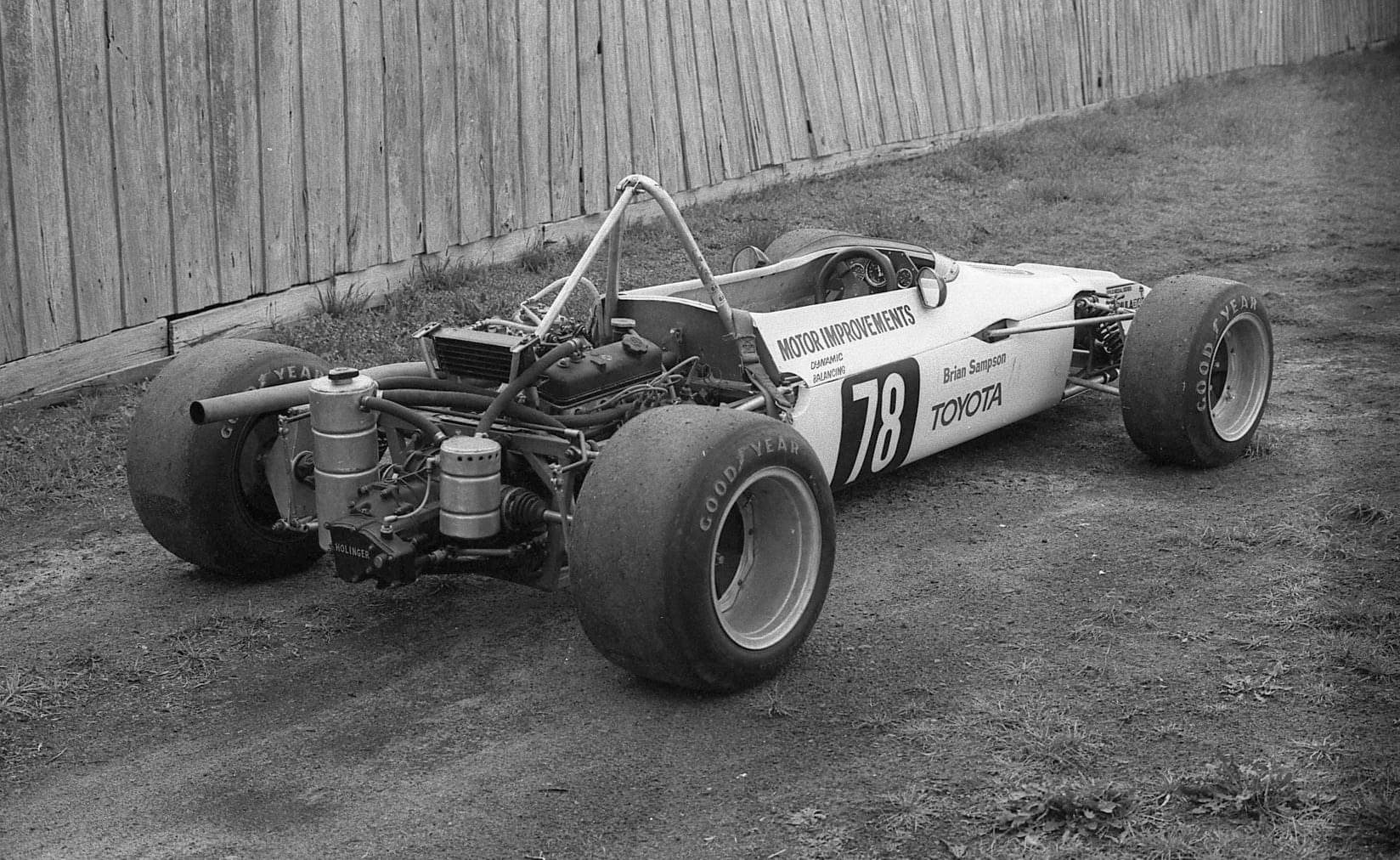
Rack and pinion steering was by way of modified Renault items, “all cars used modified VW transmissions with the F2 and F3 models employing the first of the recently introduced Holinger five-speed quick change units. Under seat aluminium six gallon fuel tanks were fitted whilst the Bob Edmonds Polyfibre Products body work was in fibreglass. A 16-gauge aluminium undertray was bonded and rivetted to the lower chassis rails. A new enclosed tandem trailer was built to transport my car,” Shead wrote.
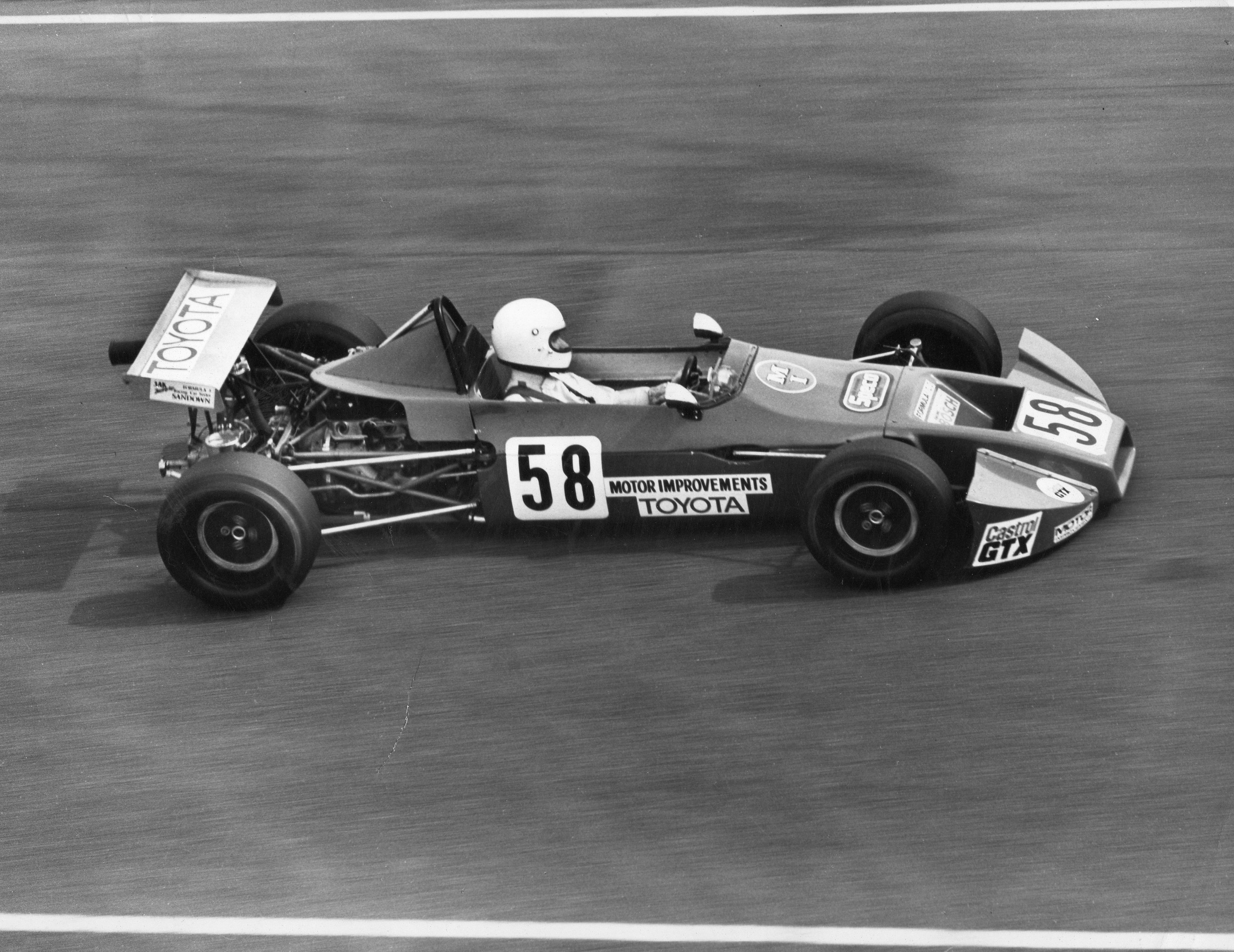
Sampson’s Mk4 Toyota (S Gall)Sambo’s Mk4 showing Holinger five-speed transaxle, fabricated rear uprights and Mario Costa built wheels. Sampson’s Motor Improvements’ 1.3-litre pushrod, twin Weber fed race motors were the ducks-guts F3/Clubman unit of the day and gave circa 130bhp (S Gall)
Peter Macrow’s 1.6-litre Ford twin-cam ANF2 car (Mk4B # 43-2) proceeded as funds allowed but one car, #4H-1 for Don Biggar and Shead’s #43-1 were finished mid-year. Biggar’s machine was a hillclimber fitted with a 3.5-litre Oldsmobile V8 and modified VW gearbox. Shead’s car was tested at Calder in mid-May, then made its race-debut on May 31.
Continuing good results and several wins over Brian Sampson’s Elfin 600B Toyota led to an order from Sambo for a Mk4 (#43-3), his car was finished in January 1973. Brian Shead describes this car as the “first production chassis, minor changes were made in the chassis layout. Live front axles were used with fabricated front and rear uprights, Holinger gearbox. Toyota Corolla 1300cc engine, new front nosecone and cockpit body sections.”
Other production Mk4s were built for Peter Roach (43-4), Vincent McLaughlan (43-5), while an ANF2 1.6-litre Ford twin-cam Mk4E (342-1) was delivered to Graeme Crawford in February. That makes seven Mk4’s in total, and I’m sure David Crabtree’s ANF2 Mk4 – which he retains – was delivered to Crabby and built up by him, so that makes eight…
The Mark 4 Cheetah was the dominant ANF3 car of the era, perhaps not so much in Sydney, where none were resident, and set up the reign of terror of the small-bore-classes Brian Shead had for the best part of a decade.
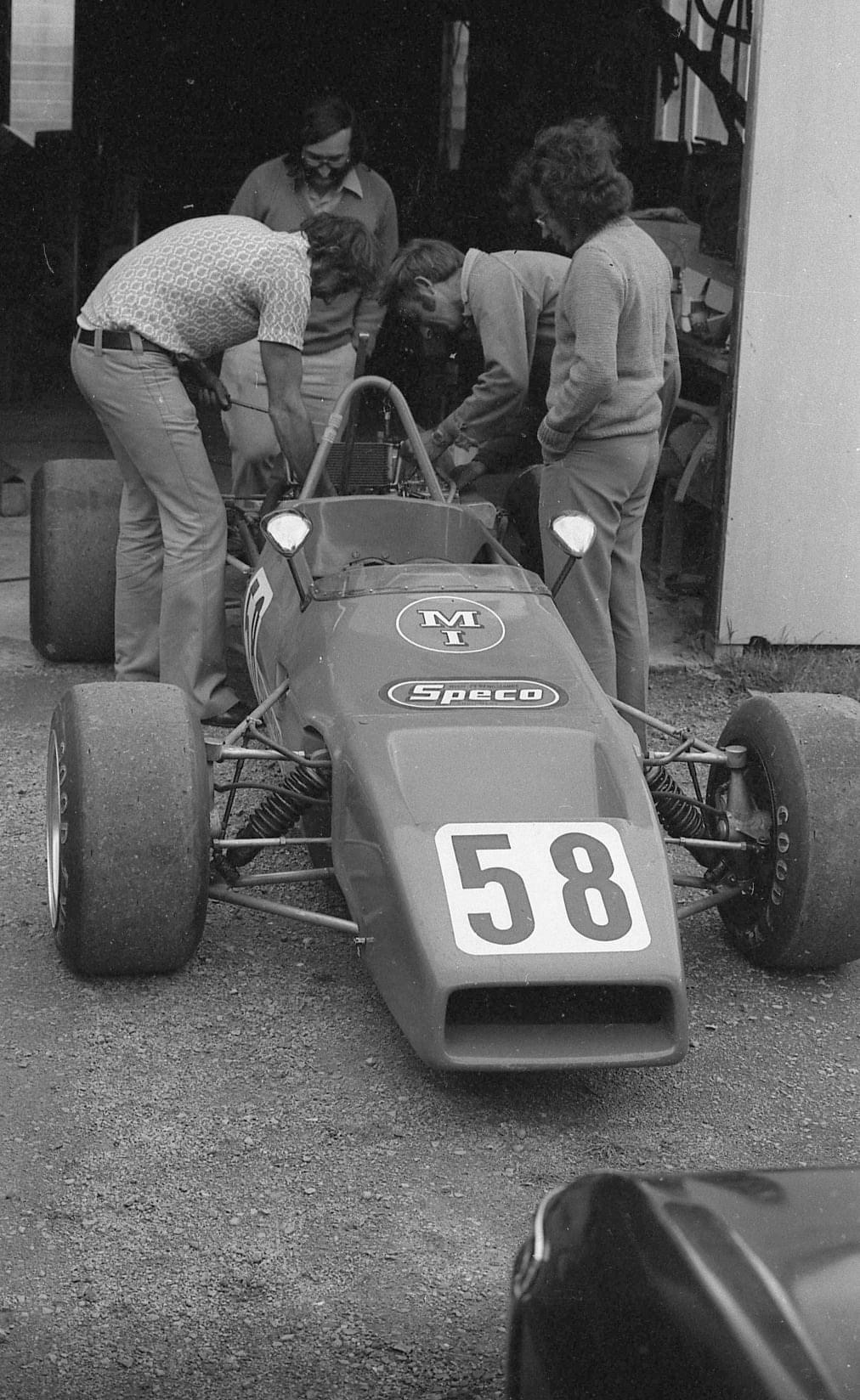
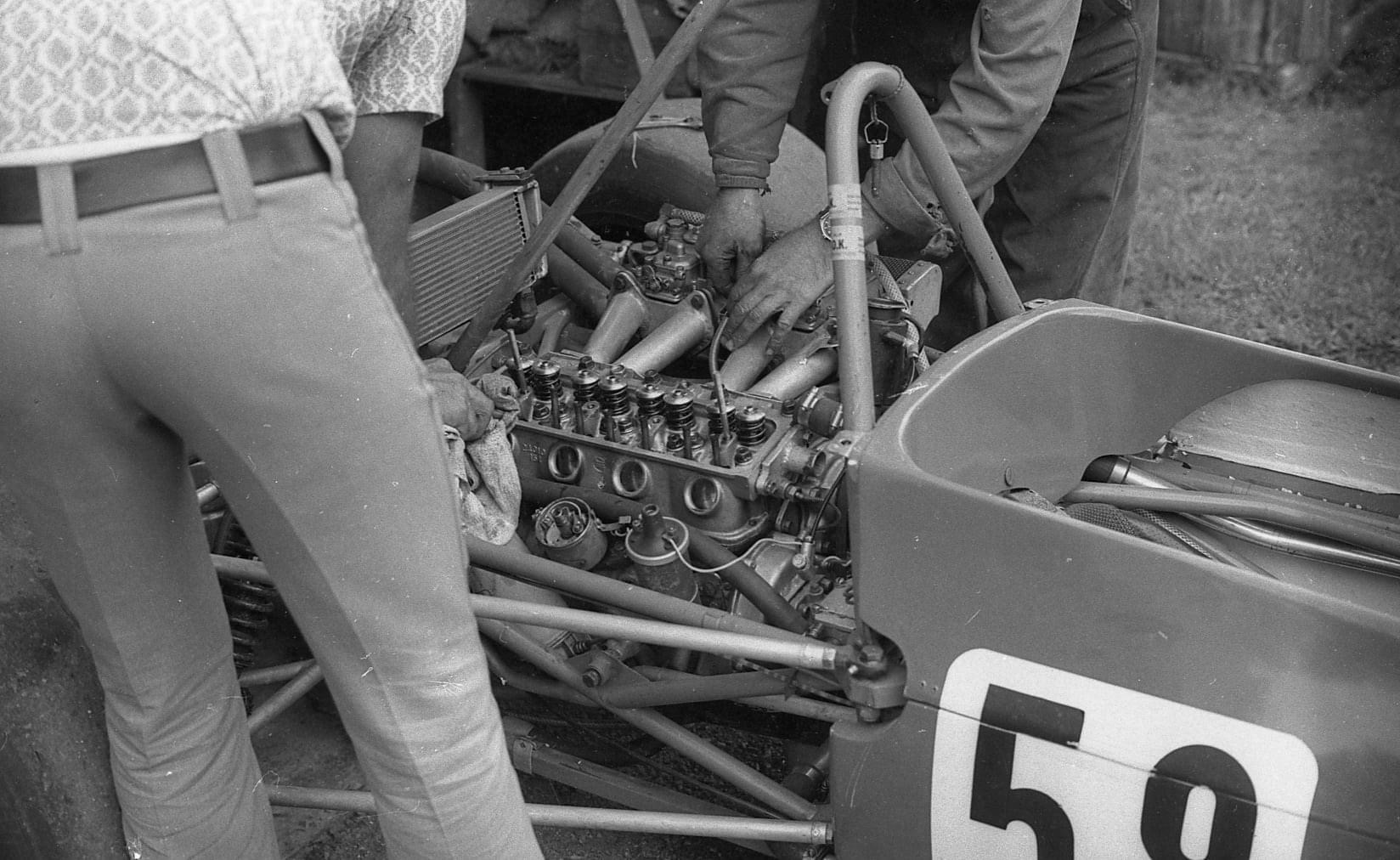
Shead’s car (Brian leaning over the engine at right rear) at Calder circa 1973, car by this stage fitted with fabricated front uprights rather than the Triumph Spitfire/Alford & Alder units with which it was originally built. These were chuckable, strong, light , fast racing cars (S Gall)Same Calder meeting with a spot of MI Toyota Corolla valve, rocker or head gasket problems…(S Gall)
Etcetera…
Credits…
Stephen Gall, Brendan Jones Collection, Brian Shead Diary, Michael Borland Collection
Tailpieces…
(Auto Action)
Racing cars are never static of course, by 1973 Australian F3 cars were growing wings as shown on the Sampson and Shead Mk4s at Winton above.
Shead’s solution at this stage was a modest rear body panel come wing, and wingless at the front.
A fugly Tyrrell-type nose followed, as shown below, all of which was refined in the marvellous, even more successful monocoque Mk5 and Mk6 F3/F2 machines which followed. Stories for another time, or you could buy Auto Action issue #1815 which covers the topic rather nicely; Auto Action #1815 by Auto Action – Issuu
The other member of the Victorian Cheetah triumvirate is Peter Macrow, running third at Sandown’s Causeway area circa 1973 – Sambo from Sheady up front. Look at the different rear-wing supports (B Jones Collection)(B Jones Collection)
Another shot of Brian Shead at Amaroo Park or perhaps Phillip Island. This aero evolution is towards the end of their time as the works machines, supported as you can see by Toyota; Australian Motor Industries, the Toyota importer, had been longtime supporters of Sambo’s Triumph Spitfire.
Neat engine cover, the appearance of Tony Alcock’s and Malcolm Ramsay’s monocoque Birrana 374 made it clear a new car was required, some marvellous racing followed between the Cheetahs and Paul King/Dean Hosking/Jim Evans 374s in 1974.
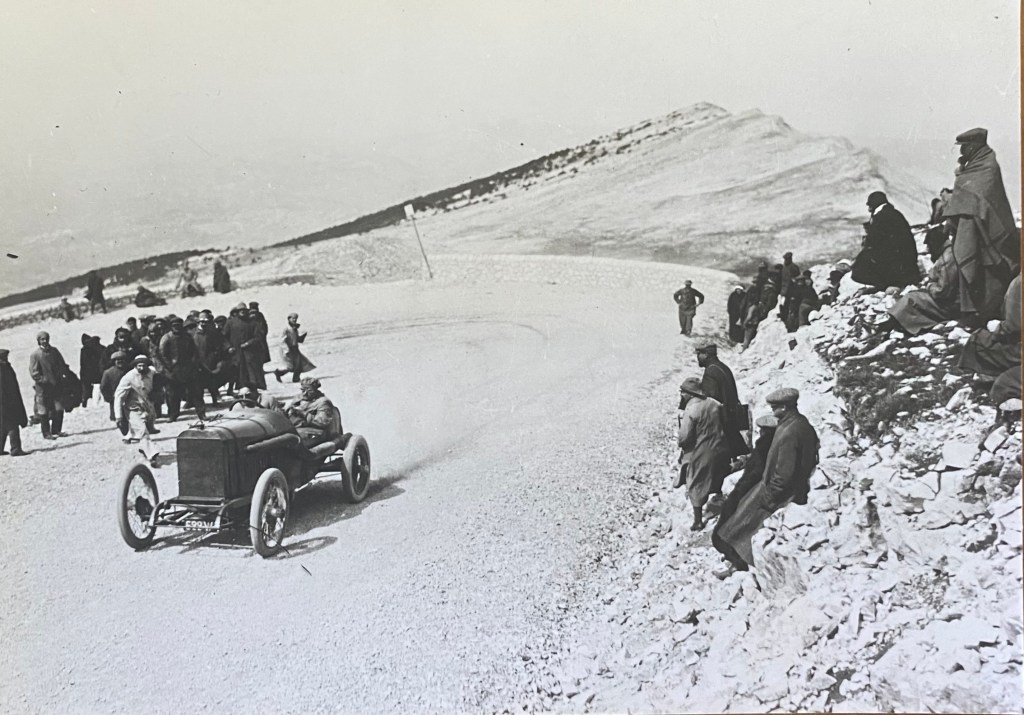
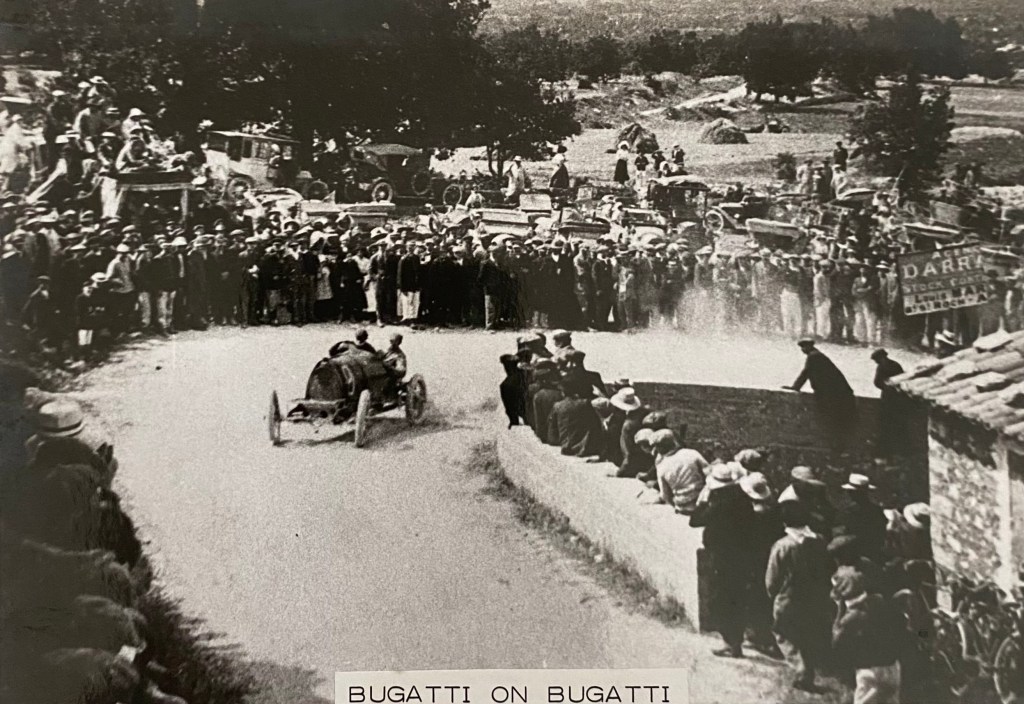
Known as ‘The Giant of Provence’, this 1900 metre mountain dominates southern Provence; its bald, treeless, summit gives it the appearance of being snow covered.
It will be familiar to those who watch ‘Le Tour de France’ (and who doesn’t?) as a particularly gruelling hill climb, but few will be aware that it is also famous as a car and motorcycle hill climbing venue.
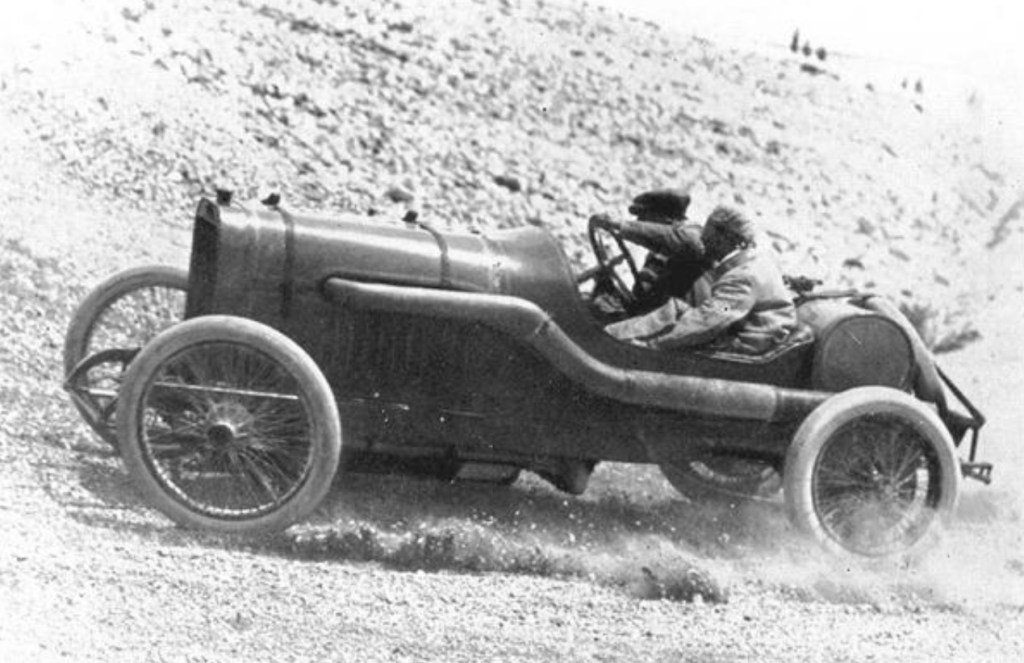
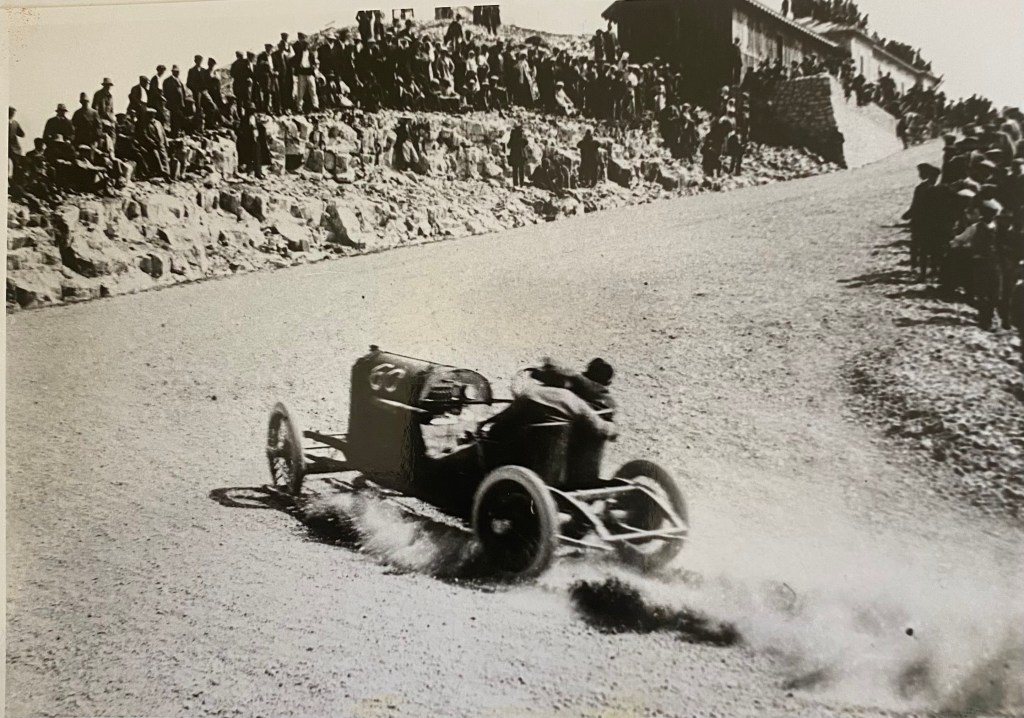
This short review was prompted when Mark Bisset spotted the featured photograph of George Boillot in my collection. Boillot, driving a Peugeot Lion, achieved FTD in 1910; this photograph shows him near the summit on a 7.6-litre, DOHC, 16-valve, four-cylinder Peugeot L76 on August 11, 1912. His time in 1910 was 21 min 30.4, in 1912 17 min 46 sec, and in 1913, again on Peugeot, he ascended in 17 min 38 sec.
Note the W-registration, a factory trade plate. No-doubt George and his compatriots had driven the car 600 kilometres from the Lion Peugeot factory in Sochaux to the Mount.
Boillot and passenger in 1912, lack of L76 front brakes doubtless added to the challenge! (unattributed)Ettore and passenger aboard his 5-litre chain drive Type 16 (B King)
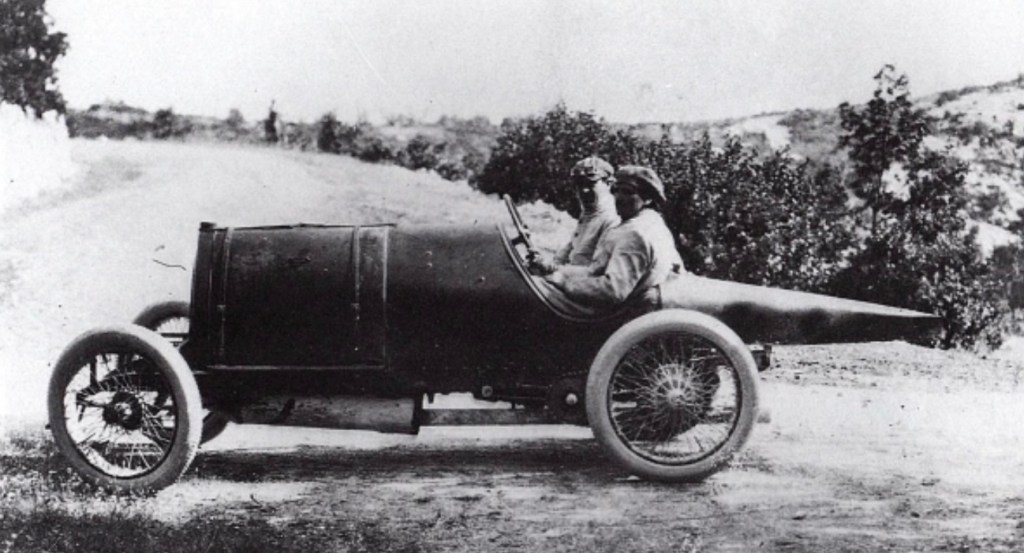
Ettore Bugatti also competed on one of his Type 16 5-litre, SOHC, three-valve, four-cylinder machines; his journey from Molsheim would have been 750 kilometres.
Note the luggage rack on which he mounted his suitcase for the journey from Molsheim! C/n 471 still exists…as does the suitcase.
Bugatti and passenger aboard T16 at Mont Ventoux. This view is perhaps not the racer’s best angle (unattributed)
The hillclimb dates back to 1902 and the “Palmares Autos” is decorated with many famous names – to mention just a few: Rougier, Boillot of course, Thomas, Divo, Carraciola, Straight, Von Stuck, Trintignant, Behra, Barth, Hermann, Stommelen and Mitter – a veritable ‘Who’s Who’ of Grand Prix and Hill Climbing talent.
With no safety barriers and a winning average speed of almost 150 kph there were no more open events after 1976, presumably for safety reasons.
Etcetera…
Boillot, Peugeot again, year uncertain, advice welcome (B King)
Credits…
Bob King Collection
Tailpiece…
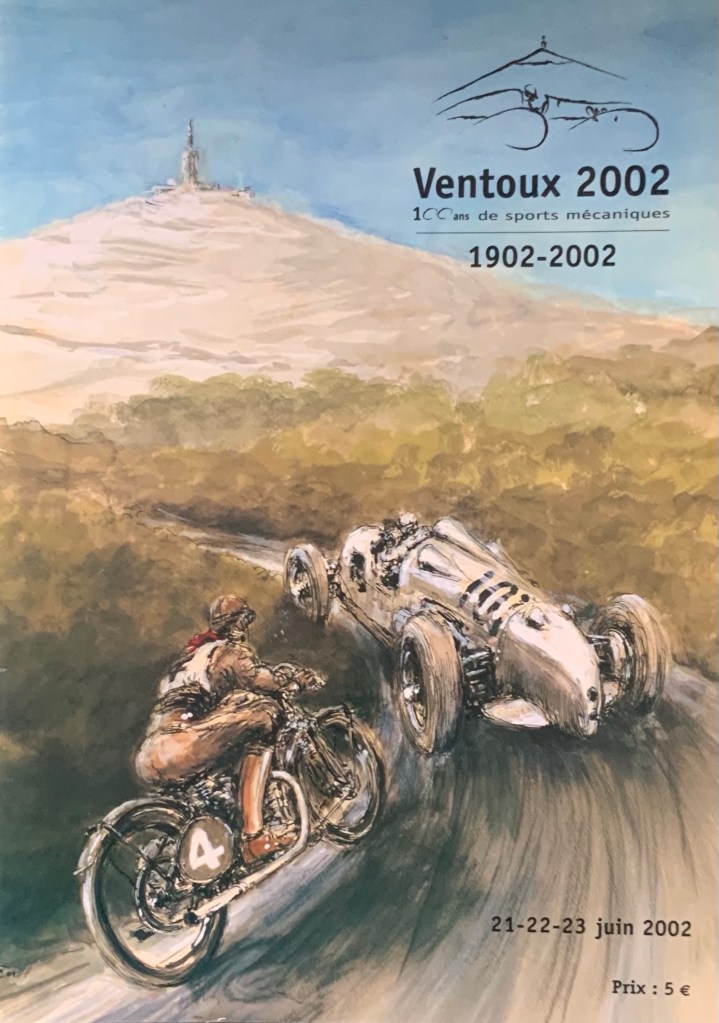
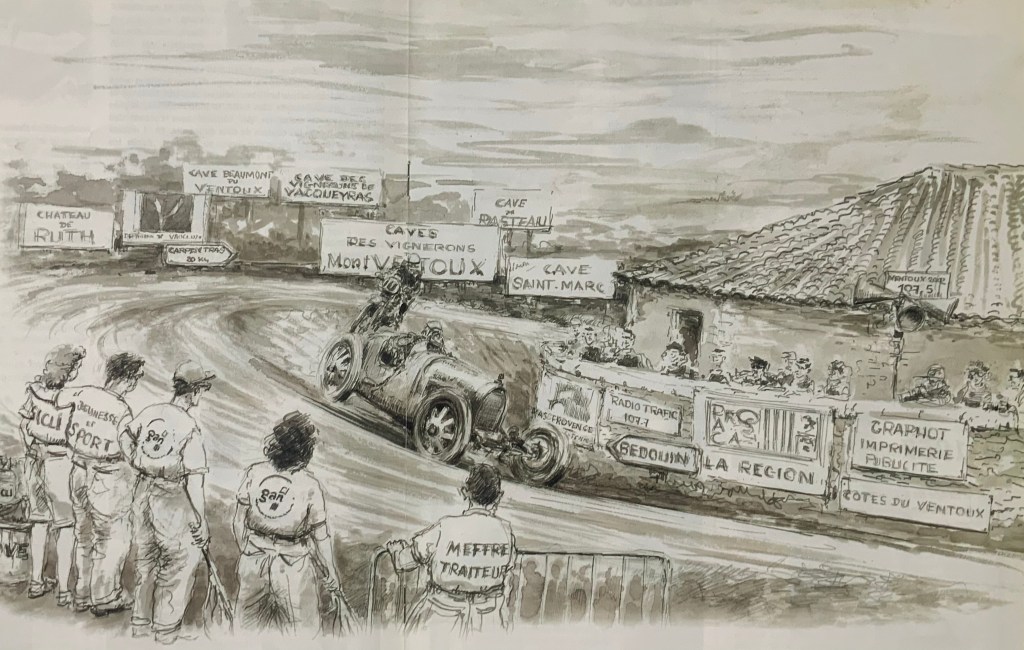
In 2002 an event was held to commemorate 100 years since the first event. My wife and I were lucky enough to chance on this celebration as we were holidaying in the region.
And what an event with over 250 racing cars and motorcycles with everything from a 1902 Paris-Vienna Renault, through scads of barely known French voiturettes (D’Yrsan, BNC, Darmont, Rally and so on), to a Porsche 906 Carrera 6 that competed in 1967, and an Abarth SP 2000 which was the European hill climb champion in 1970. What a feast for eye and ear!
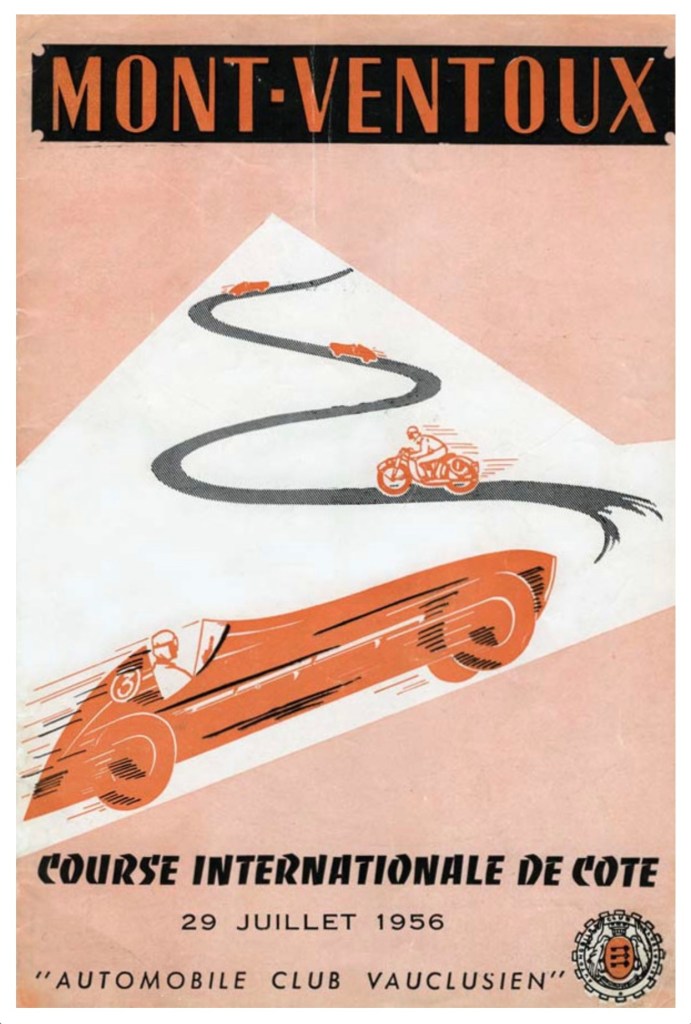
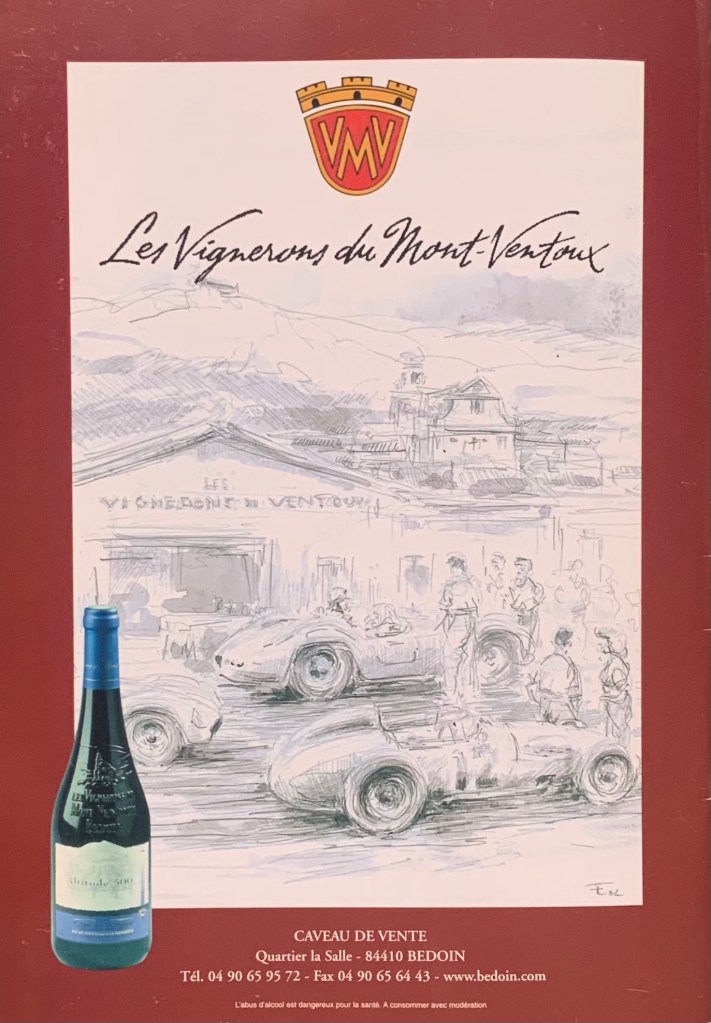
The French even manage to make their brochure ads cool rather than gauche!
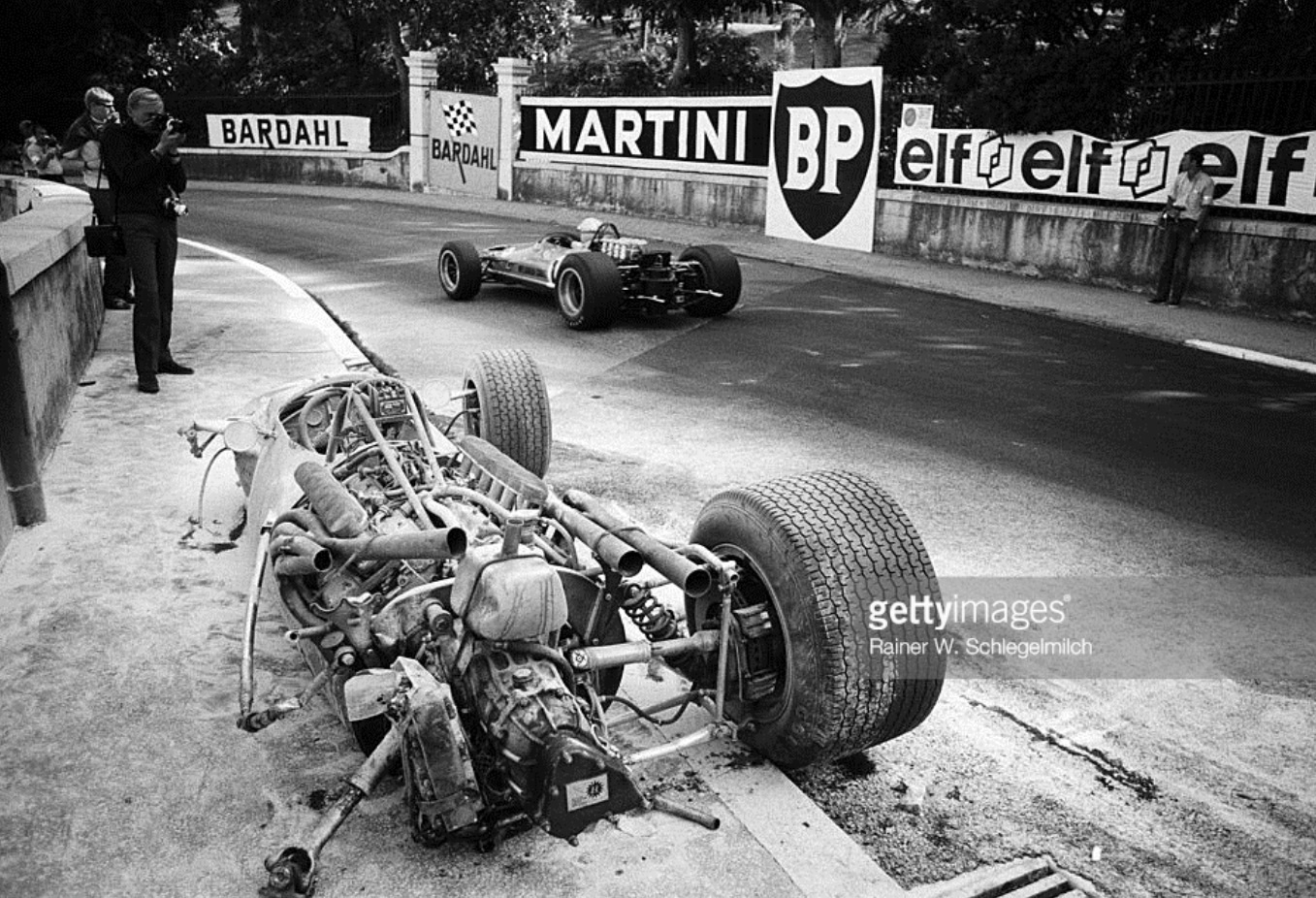
Denny Hulme’s snub/Monaco nosed McLaren M7A Ford passing Pedro Rodriguez’ very dead BRM P133 V12 during the 1968 Monaco Grand Prix…
By lap 16 there were only five cars left in the race won by Graham Hill’s Lotus 49B Ford from Richard Attwood’s BRM P126 and Lucien Bianchi’s Cooper T86B Maserati. Pedro boofed the Len Terry designed BRM on lap 16 having qualified ninth, Denny raced his car to fifth.
A couple of design aspects of the P126/133 design in the shot below are worth noting. The Hewland DG300 transaxle is the only occasion on which a non-BRM ‘box was fitted to a Bourne designed and built car. Checkout the remaining right-rear suspension componentry too, the twin-parallel-lower-links set up to better control rear toe, later picked up by all and sundry, was first designed for this car by Len.
Credits…
Rainer Schlegelmilch
Tailpieces: Pedro and BRM P133 in pre-rooted state…
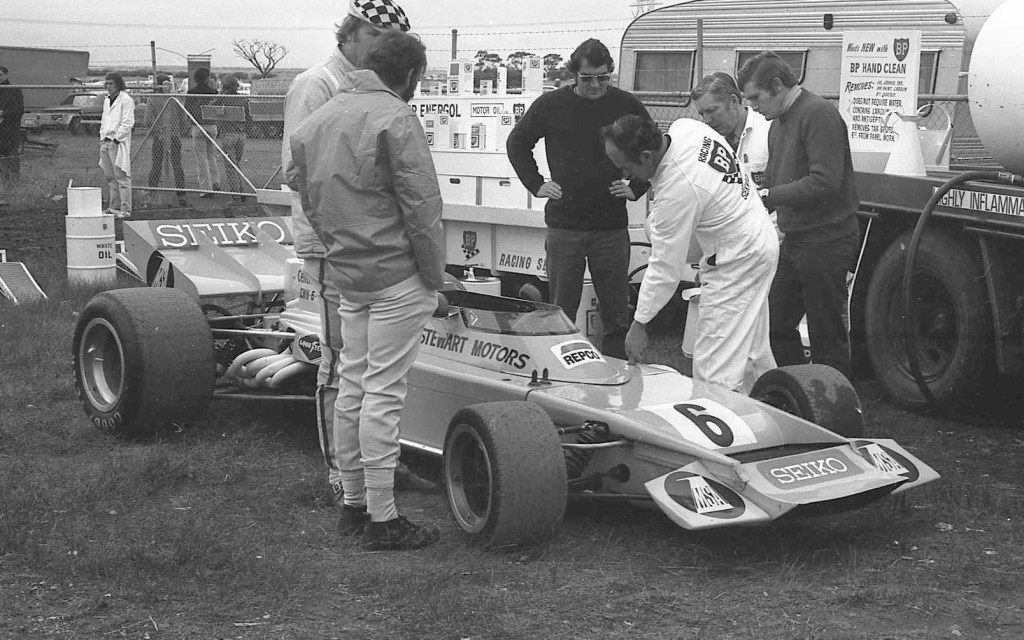
Max Stewart with John Walker at right, Calder 1972. Repco-Holden V8, then circa 490bhp powered Elfin MR5 and Matich A50 (S Gall)
During 1972, then Australian automotive parts manufacturing and retailing colossus, Repco Ltd celebrated its half century.
Yes folks, that means the now foreign owned 400 store retailer of automotive bits and pieces made by others is a centenarian in 2022! They have some exciting things planned for next year, I won’t rain on their parade by sharing the bits I’m aware of.
Time flies all too fast, as a young teenager I attended two of the five Repco Birthday Series F5000 championship meetings run at Calder between March and December ‘72 as part of those celebrations.
The man who was ‘sposed to win the Repco Birthday Series, F Matich Esq. Bi-winged Matich A50 Repco-Holden, Calder 1972 (S Gall)
At that stage Repco had been out of F1 for four years, the 3-litre V8 Repco Brabham Engines program had yielded two GP world constructors and drivers championships for Brabham Cars (Motor Racing Developments Ltd), Repco Brabham Engines Pty. Ltd, Jack Brabham and Denny Hulme in 1966-1967.
Repco’s cost effective means of maintaining a racing presence after pulling the F1 pin was a partnership with General Motors Holdens to build F5000 engines using GMH’ then ‘spankers 308 V8 as a base, from 1969 to 1974.
Phil Irving and Brian Heard did mighty fine jobs, their Repco-Holden V8 engine design won AGPs, NZ GPs, many Tasman rounds, several Gold Stars and countless sports-sedan and sportscar races.
The interloper: KB in his sinfully sexy and oh-so-fast Lola T300 Chev at Calder in 1972 (I Smith)
It was therefore a pain-in-the-tit when Kevin Bartlett’s Chev powered Lola T300 rained on Repco’s parade in their home state by winning a ‘72 championship the grand plan of which involved a Repco-Holden engined victory!
It wasn’t all bad, Frank Matich, in the Repco sponsored Matich A50 Repco-Holden won that years Gold Star, but KB’s two Birthday Series round wins gave him a nine point advantage over FM. Conversely, Bartlett was 12 points short of Matich in the Australian Drivers Championship, the Gold Star.
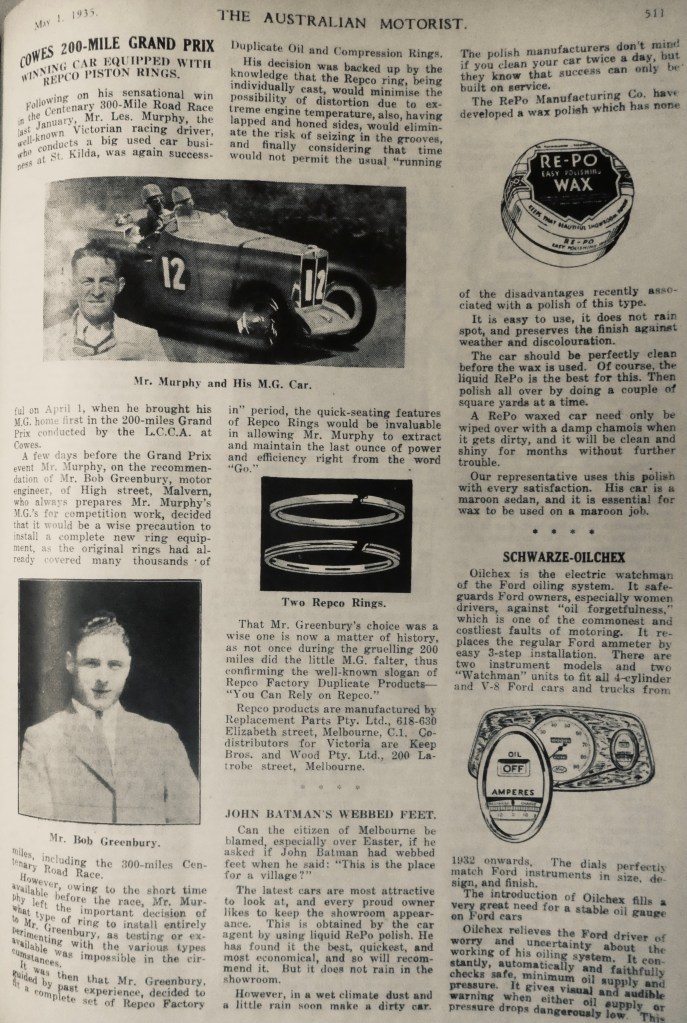
Repco’s race heritage goes all the way back. In 1935 they were sponsors of engineering substance, rather than just cash…not that cash is to be scoffed at (B King Collection)
In recent times Repco have returned to racing as series sponsors of the Bathurst maxi-taxis. In the forty years they were involved as OE and aftermarket suppliers to the motor industry, and constructors of cars (Maybachs, Repco Record), race engines, components and equipment from the mid-1930s to 1974 Repco’s involvement was supreme.
Still, the comparison is unfair. We once had an automotive industry in this country until it was sodomised to a standstill by a troika (sic) of incompetent, greedy fuckwits bereft of commonsense or a single-cell of vision; management, government and organised labour.
Gees he was a big, lanky prick wasn’t he? The capped Marvellous Maxwell Stewart partially obscured by mutton-chopped Bryan Thomson or Garrie Cooper (? who-izzit?) in the BP compound at Calder in 1972. Elfin MR5 Repco, not Max’ favourite car (S Gall)
Etcetera…
(T Johns Collection)
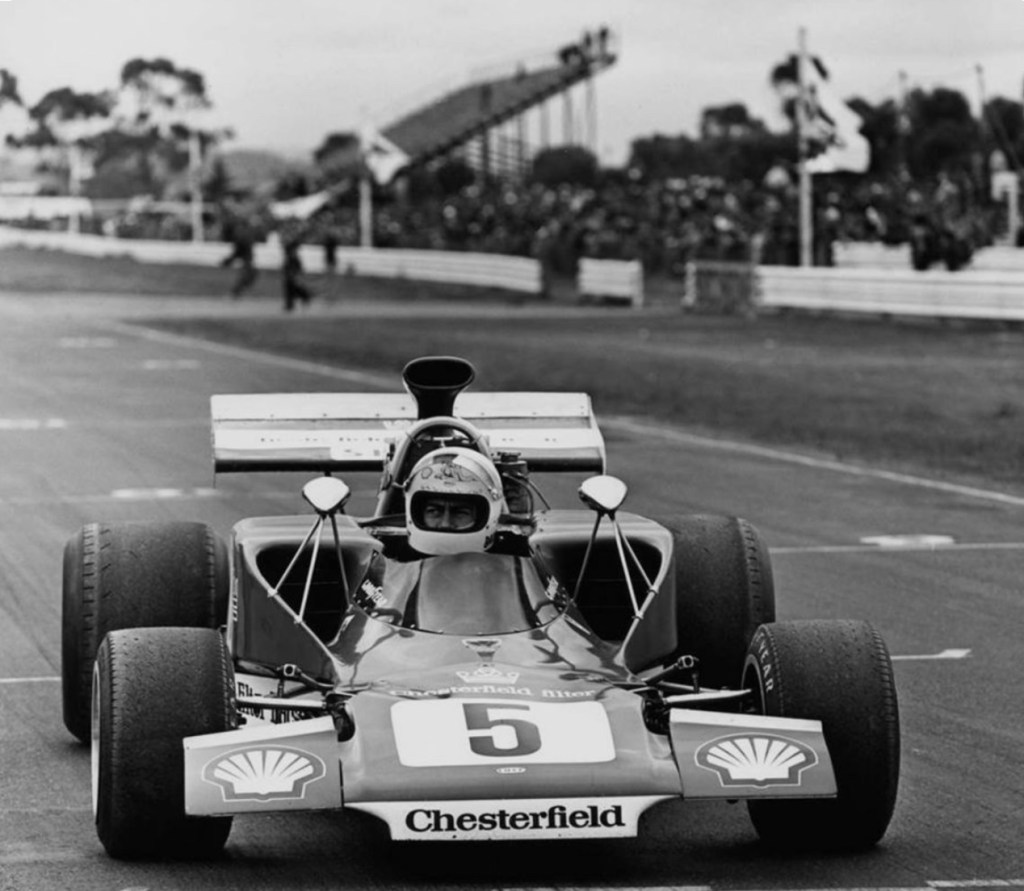
More on the use of Repco pistons and rings in 1935. This time fitted to Les Murphy’s MG P-Type during the ‘1935 Centenary 300’ held at Phillip Island in January.
(S Gall)
Warwick Brown proved he had the ability to handle these demanding 5-litre roller skates in 1972 having jumped out of a Cosworth FVC powered McLaren M4A – McLaren M10B Chev heading into Calder’s main straight in 1972.
(S Gall)
Graham ‘Lugsy’ Adams – then mechanic and later rather handy driver and F5000 constructor – does his best to focus on the Calder job at hand. Is that the future, and still current Mrs Brown looking thoroughly wonderful behind an M10B shortly to become Bryan Thomson’s Volksrolet?
Credits…
Stephen Gall, Bob King Collection, Ian Smith, Tony Johns Collection, Barry Edmunds
Tailpiece…
(B Edmunds)
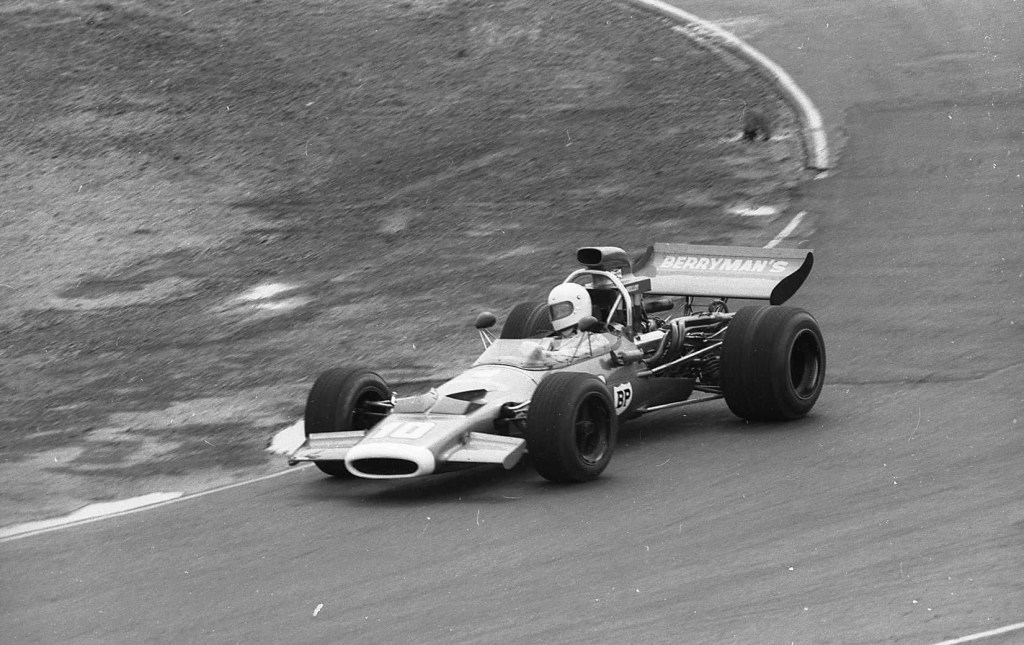
John Harvey in one of the very few appearances of Bob Jane’s Bowin P8 Repco-Holden F5000 at Calder in 1972 – Surfers Paradise and Warwick Farm were the others as far as I can see.
Bowin bias hereby declared…here I go. Again.
This beautiful, small, light, compact, ingenious, variable-rate suspension F5000 never got the run it deserved. Supposedly Janey put it to one side because Castrol wanted him to focus on his taxis rather than his real cars.
Then Leffo bought it in mid-1974, sans Repco-Holden V8, to replace the P8 chassis he boofed at Amaroo and then stuffed up the installation of a Chev V8 into a chassis for which it was never designed, creating a car as stiff as a centenarians todger, with handling reflective thereof…
John Joyce’s P8 Repco design is a great Oz F5000 mighta-been, not that mighta-beens count for SFA in motor racing!