
(Wolfe)
Looking at Jack in this shot i wondered who the most recent of the F1 driver/engineers was?
Brabham is helping the boys prepare his BT23E Repco before the Sandown Tasman round, the Australian Grand Prix, in early 1968. Jack, ever the practical, hands-on engineer.
Larrikins, Larry Perkins perhaps? He raced and prepared an Ensign, nee Boro in 1976. Was he, perhaps, the last or most recent of the genre? The guys I am referring to are the blokes who could both drive the things and could and would put ‘em together themselves.

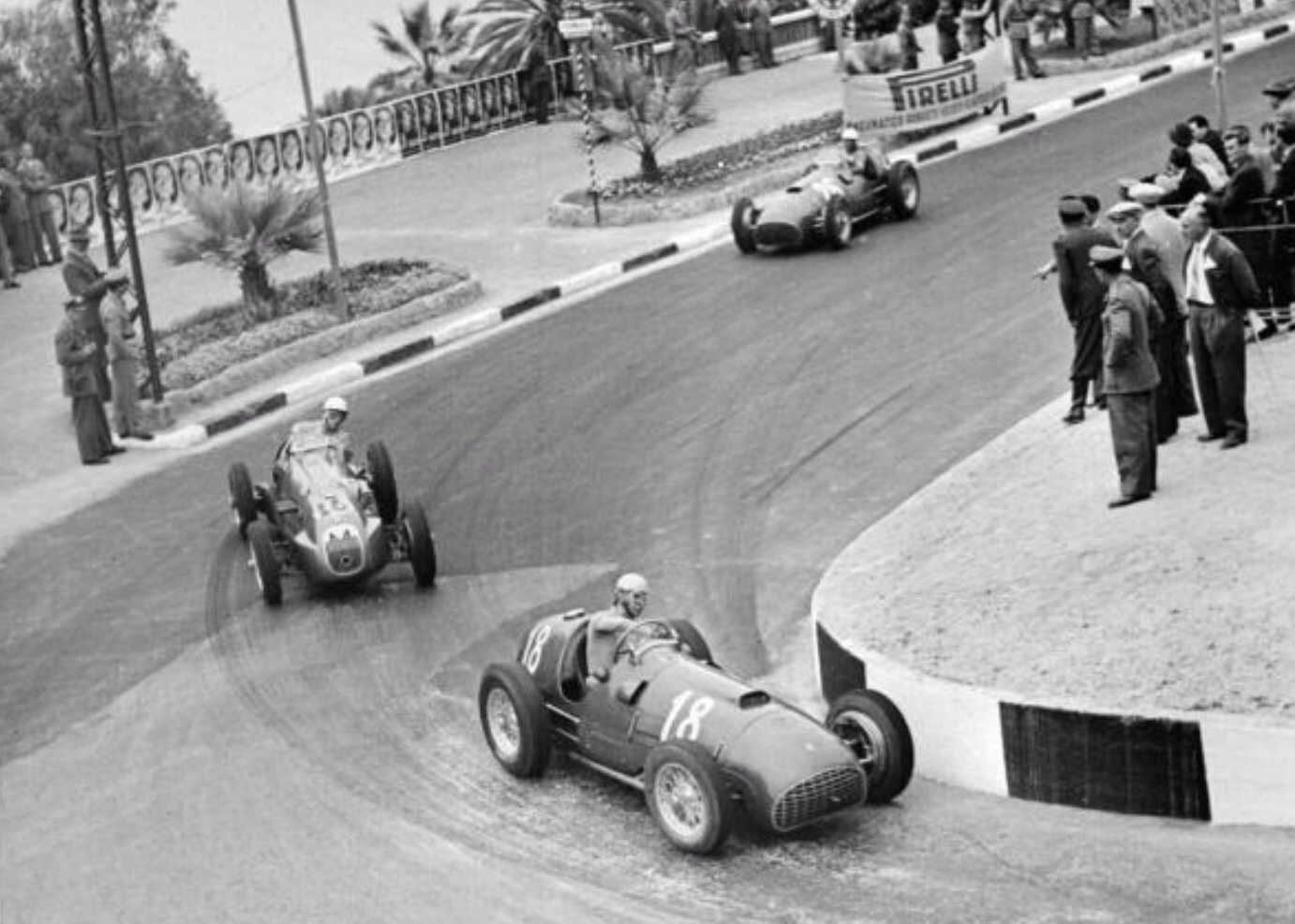
Nice overhead shot of Perkins Ensign ‘Boro’ N175 Ford at Monaco in 1976. He didn’t make the cut in the principality but raced the car in the Belgian, Spanish and Swedish Grands Prix for 8th, 13th and DNF in an operation which was very much smell of an oily rag and DIY…And did well enough to pick up a Brabham drive later in the season, one, sadly, he was not to keep. These cars of Mo Nunns were beautifully designed, quick jiggers. Chris Amon made ‘em fly too, tho their mechanical breakages sapped his confidence and bruised his body, ending his GP career (Schlegelmilch)
Qualifiers?…
Mercedes mechanic come driver ace Hermann Lang is the first who pops into my head but he can’t have been the only one pre-war? I wonder if the Renault brothers were ‘hands on’ maybe they qualify as the first way back in the Edwardian era? Vincenzo Lancia maybe?

Hermann Lang at Donington Park 1937. Apprenticed as a motor-cycle mechanic at 14, Lang was an ace on bikes by the time he joined Benz as a mechanic in 1934, by ’39 he was European (read World) Champion. He fettled Fagioli’s W25 initially. Aided and abetted by team manager Alfred Neubauer, and against the wishes of some of the drivers, he test drove the cars in 1935 and 1936 before being made a works driver for 1937 with the 5.6-litre W125. By 1939 he was the grids yardstick, winning 5 of the 8 major GP’s in the 3 litre W154. Having the momentum as the ace of the day was lost by the War years, after a few unsuccessful attempts in post-war GP’s, he won the ‘52 Le Mans in a 300SL Benz (Fox)
Fangio certainly built some of the ‘rockets’ he raced in Argentina early on in his career, whether he wielded a torch once he got to Europe is perhaps another thing.
The dudes i think of most readily are the fifties/sixties fellows; Jack and Bruce of course, Chapman qualifies altho he didn’t race in a GP, he did practice for the French GP in 1956 for Vanwall though. He qualified 5th but boofed the car so did not race.

Here’s a few practical chaps, and all pretty handy steerers including Brabham designer Ron Tauranac (far right leaning) who was quick in his Ralts in Oz before he was enticed to the UK by Jack. From left Howden Ganley a picture of 70’s sartorial elegance in the flares, and a mechanic at McLarens in the early days as he progressed thru the junior formulae ranks in the UK. Tim Schenken, (these two later partners in Tiga Cars) Graham Hill waxing lyrical and RT at right. Car is the one of a kind ‘Lobster Claw’ Brabham BT34 Ford, driven by Hill, its British GP practice @ Silverstone in 1971. Tim drove last years BT33 and was consistently quicker than GH in his first full F1 season (Blackman)
Graham Hill, Phil Hill, Richie Ginther, Dan Gurney, Jim Hall, Bob Anderson, Frank Gardner, Denny Hulme, Howden Ganley and Graham McRae all qualify. The Kiwi F5000 ace did a Gee Pee or two in ‘73ish and his cars were great bits of kit.

In 1970-3 Graham McRae was one of the worlds best F5000 pilots at a time the category globally was mega-competitive, winning races and championships in Australasia, Europe and the US. His Len Terry designed Leda LT27/ McRae GM1 Chev’s were the ‘ducks guts’ as well, until the Lola T300 rained on his, and everybody else’s parades. Formula Lola from then on. Here he is in one of Frank Williams Iso IR Fords during ’73 British GP practice at Silverstone. He didn’t complete the first lap with throttle slide dramas at the start of the lap which ended with Jody Scheckter’s big Woodcote, McLaren M23 shunt which took out half the field (unattributed)
Thinking slightly more broadly Chevron’s Derek Bennett wasn’t an F1 driver but otherwise is absolutely of the driver/engineer fix it yerself mould. Make that design, build and drive it. And in Australia Garrie Cooper (Elfin) and Frank Matich spring to mind, Frank was ‘elite level’ as a driver and his sports and F5000’s cars were all winners. Both were not F1 drivers to be clear. ANF1 drivers, but not F1 drivers…

Larry at the press launch of the BRM P201 in early 1977. Mike Pilbeam’s chassis was good, if they had popped a DFV into it they would have had a good car? By then the BRM V12 was well past it’s use-by date and hadn’t had any development to speak of for years (Keystone)
Larry was later than all that lot so I reckon its him as ‘the last’? Unless some of you guys can think of someone more recent, and you may well do, the above is outta my head which does not fit into the category of thorough, diligent research.

Perkins had several drives of the Holden Dealer Team supercharged, Holden LC Torana GTR XU1 during 1972, here at Catalina Park in Sydney’s Blue Mountains (Rod MacKenzie)
Perkins spannered the very first Ralt RT1 Tauranac built to his ’75 Euro F3 Championship win then lent his talents to Chris Amon on his Amon and, as I say largely self prepared the Ensign/Boro Ford well enough to be plucked by BC Ecclestone into Brabham for a while. Until Carlos Pace rained on his parade. By the time Larry got to BRM they were shit-heaps, that episode a total wasta time. Mike Pilbeam’s chassis was in search of a good engine.

Here Larry is trying to qualify the Amon AF101 Ford during German GP practice after Chris fell ill, Nurburgring 1974, DNQ. Clay Regazzoni won in a Ferrari 312B3 (Sutton)
Larry prepared all of his cars in the junior formulae in Australia before taking the same talents into European F3. I well remember seeing Larry rectifying his practice mishap transferring all the good bits of Robert Handfirds Ralt RT4 into a new chassis having had a territorial dispute with a slower car in practice, and rooted the cars tub, during the 1981 AGP weekend at Calder. Despite a lack of practice time the car was 4th on raceday, Roberto Moreno victorious in another RT4.

Teo Fabi and Perkins (near side) in March 782 and 77B during the 1979 F Pac NZ GP at Pukekohe.The 1979 NZ F Pac championship was won by Teo Fabi in a factory March 782. The 5 circuit, 5 weekend, 10 50-mile race series was tough. He dominated, the March 782 the best 1978 Euro F2 chassis, was fitted with the latest March 79B bodywork incorporating sliding skirts. Perkins was his toughest opponent driving the ex-works March 77B chassis raced by Danny Sullivan in NZ the year before. Perkins raced a Ralt Australia/Scuderia Veloce Ralt RT1 in the 1978 series finishing runner-up to Keke Rosberg. Larry was 29 then, it was still not too late to resuscitate his single-seater career, the result may well have been different had Perkins raced a car as quick as Fabi’s. Having said that, in early 1979 Fabi was an F3 graduate, Larry an ex-F1 driver so Larry should have been quicker. Perkins mixed single seaters and touring cars in the early eighties. He raced F Pac and F5000, winning the 1979 Rothmans International Series in an Elfin MR8 Chev. He then became a touring car specialist, winning the Bathurst 1000 6 times and a car constructor. He led the team which built the race cars at the Holden Dealer Team when it was owned by Peter Brock and formed Perkins Engineering to build and race Holdens from early 1986 to 2013.
Bob Janes All Australian, if you can call such an attempt in a German car!, attack on Le Mans in 1984 in a John Fitzpatrick Porsche 956 is a story in itself with the drive shared by Larry and Aussie Touring Car Legend, Pter Brock. The preparation of the car in Australia and France was in Larry’s tender, loving hands, the great run ended during the night whilst Larry was at the wheel.

Perkins at the wheel of the Porsche 956 he shared with Peter Brock in 1984. The car ran as high as 8th before crashing during the night (unattributed)
Larry was pushing hard and ran out of road passing two cars seeking to make up time, the car had slipped down to about 35th after losing 28 minutes repairing a front hub damaged when the car lost a front wheel whilst Brock was driving. He was sanguine about it saying later fatigue wasn’t the issue, the choice of passing a split second one of course, with hindsight backing off was the right one. Henri Pescarolo and Klaus Ludwig won in a 956B, Larry and Brock were out in the 18th hour having covered 145 laps

Perkins at the wheel of the Jguar XJR9-LM he co-drove to 4th place at Le Mans in 1988 (unattributed)
Jaguar and Holden Special Vehicles…
Tom Walkinshaw was well aware of both Larry’s speed and car construction skills. The Brit owned Holden Special Vehicles in the post-Brock era but was making the same climb up the UK motor racing greasy pole as a driver, as Perkins in the early 1970’s.
Amusing was being a guest of HSV at Bathurst for the 1000Km event in 1988-the design and branding business of which I was a partner designed/created the HSV Logo and brand look and feel, and seeing the ‘in team competition’ between the two Holden VL Commodore HSV racers.
One was built by the Poms at TWR and one built by Larrikins and the lads in Melbourne! Larry’s qualified in the top 10 but neither finished, Walkinshaw’s car doing only 5 laps and Perkins 137. HSV was a very do it yerself operation then, MD John Crennan himself drove the courtesy vehicle to ferry we guests from the circuit to the airport after the race, a far cry of later years as the business of building heavily re-engineered performance Holdens grew.
Walkinshaw invited Larry to join his TWR Jaguar squad at Le Mans in 1988. The Aussie tested the car at Silverstone in preparation for the race, the car was very quick even compared to the Porsche 956, also a ground-effect car, of 4 years earlier. He finished 4th in the French classic co-driving a Jag XJR-9LM together with fellow ex-F1 driver Derek Daly and Kevin Cogan. The big 7 litre V12 was 11 laps behind the winning Jag of teammates Jan Lammers, Johnny Dumfries and Andy Wallace.
Perkins touring car exploits in Oz as both builder and driver are well known. Suffice it to say that the Perkins Engineering workshop at Moorabbin Airport in Melbourne’s southern suburbs built amongst the best Holden Group A and V8 Supercars for a couple of decades both for his own team and customers.
This made him a prosperous businessman, in so doing he applied the self taught engineering, business skills and resilience which made him such a formidable driver. Make that driver/engineer, to pick up where we started!

Drivers meeting during the 1979 NZ F Pacific series. Larry is talking to Teo Fabi, who won the title that year, Jeff Wood is the tall dude and the blondie, Oz F Pac Ace John Smith (Cammick)

Jack Brabham explaining why front stiffness is critical to performance, Tasman Series, Australia 1968 (unattributed)
Back to the Brabham BT23E race-prep picture at this articles outset…
Whenever you see pictures of Jack he is always fiddling with something, he is rarely looking on at the mechanics doing stuff or checkin’ out the babes.
This (opening article) shot was in a general interest magazine in Rodway Wolfe’s suitcase of Repco Goodies which is in my care. I was certain ‘twas Jack’s 1968 Tasman mount, his BT23E, to which is being fitted an RB740 275bhp Repco V8.
Rodway believes the place is probably a workshop on the South side of the Princes Highway near the Warrigal Road corner close to Sandown in Melbourne. Jack’s Australian manager, Reg Thompson (ex-Redex) used to organise these locales close to the circuit, rather than the team operate from Repco Brabham Engines HQ in Maidstone, which in those pre-Westgate Bridge days was a ‘cut lunch and camel ride’ from Sandown in Springvale.
Jack is at left of course, hidden behind him is Graeme Bartels to the right is Norman Wilson, RBE’s Senior Design Engineer post Phil Irving. He is fettling the Lucas metering unit which is beneath the exhausts, I wonder if he is cursing his packaging as he works! Bevan Weston is facing the camera in the middle, all these fellas are RBE Maidstone crew. The other blokes are BRO. (Brabham Racing Organisation)
One of the many hints its Oz rather than Europe are the cans of Australian oil company ‘Ampol’ fuel and lubricant on the floor of the workshop. In F1 Jack was sponsored by Esso then Gulf from 1968. Ampol didn’t make competition fuel or lubricants, Nigel Tait says that RBE used Shell Super M lubricants at Maidstone whilst assembling and testing the engines, I wonder if its Shell oil and fuel in those Ampol cans!

Front rows of the ’68 Australian GP grid, Sandown Park, Melbourne. Clark #6 then Amon and Jack on the front row-Lotus 49 DFW, Ferrari Dino 246T and Brabham BT23E Repco. On row 2 Hill in the other 49 and Leo Geoghegan Lotus 39 Repco, well up in this 1965 chassis. You can just see Frank Gardner’s Brabham BT23D Alfa on the inside of the circuit (Howard)
Sandown 1968 Tasman Race: The Australian GP…
This account is a truncated version of that found on the excellent sergent.com website.
The conditions that weekend at Sandown Park were absolutely scorching, Melbourne had been in drought for the previous months. I can still remember water restrictions at the time, the race was held over 55 laps of the 3 and a bit Km, very fast circuit laid out around a horse racing course.
‘The first official practice was held in temperatures of up to 106 degrees, Brabham was quickest in the Brabham-Repco V8 fitted with the older 630 type heads which brought the exhausts up from the lower part of the engine. It was obviously a powerful arrangement, as Brabham had little effort getting down to 1:6.7 secs during his 10 laps’.
Its interesting but not quite right, in fact the engine was a brand new ‘830 Series’ Tasman V8, a combination of the ‘short’ 800 block to be used in the 1968 RB860 F1 engine, and crossflow 30 Series heads. These were more powerful than the 40 Series used in F1 in ’67 and more widely on various Repco engines of capacities from 2.5 to 5 litres.

The brand new, prototype or first RB830 V8 nestled in the back of Jack’s Brabham BT23E chassis at Sandown during the AGP weekend in 1968. That it was developmental is indicated by the tack on oil cooler and weird aluminium ‘fuel pot’ as Rod Wolfe describes it (Rod MacKenzie)
Clearly though the engine being popped into the chassis in the opening shot is a 740 not an 830, so exactly when this engine is being put in-or pulled out is an interesting, if arcane one!
Jack only did the Warwick Farm and Sandown Tasman rounds in 1968, the car clearly raced a 740 that weekend in Sydney their is plenty of photographic evidence to support that. Equally, if you look closely at the grid at the start of the Sandown race the engine fitted to Jack’s car is not a 740 ‘between the Vee’ exhaust engine but a ‘crossflow’ 830 engine.
Perhaps the car practiced initially at Sandown with a 740, the 830 fitted later in the meeting or perhaps the photo at the articles outset is in a Sydney workshop prior to WF, for sure it isn’t RB HQ at Maidstone in Victoria.
To add to the confusion there is a photo in the report of the AGP in the bible (History of The Australian Grand Prix by Graham Howard and others) which shows the car at Sandown fitted with a 740, but the photo caption I don’t think is right, I suspect it’s at WF not Sandown, they are both circuits built around horse racing tracks and the car carried #2 at both meetings. All contributions welcome on this arcane Repco topic of what engine where!
Clearly the 830 developed plenty of mumbo as Jack popped it on pole from Amon in the four valve Ferrari and Clark on the outside. Then came a brilliant Leo Geoghegan in his ex-Clark 1966 Tasman Series Lotus 39 but fitted with a Repco ‘740’ rather than the Coventry Climax FPF four which the car was built.
In fact it was built for the still-born Coventry Climax V16, but modified to suit the CC FPF. In any event Leo had the old car ‘dancin amongst this compoany in the latest and greatest from Europe and Graham Hill on the second row respectively.
Then was Gardner (Brabham BT23D Alfa Romeo T33 V8) and Cusack (Brabham BT23A Repco 740) Rodriguez (BRM P126 V12) then Piers Courage in the little 1.6 McLaren M4A Ford FVA, John Harvey’s old Brabham BT11 Repco V8 740 Attwood (BRM), Hulme and Bartlett (Brabham completed the grid with no ANF2 1.5’s allowed.

Jack in BT23E in the Warwick Farm pits the week before the Sandown AGP, car clearly fitted with a 740 Series ‘exhaust between the Vee’ engine. Car in front is one of the P261 BRM’s, behind is Piers Courage McLaren M4A FVA F2 car (Brian McInerney)
Race day was still scorching, the drivers avoided the usual pre-race sports car ride. Jim Clark led from Amon, with Jack making a poor start and getting away in 5th place as the field lined up Shell corner.
Coming under Dunlop Bridge for the first time the order was Clark, Amon, Hill, Gardner, Brabham, Geoghegan (already sounding off tune), Rodriguez, Cusack, Courage, Bartlett, Attwood, Hulme and Harvey.
Brabham took Gardner on lap 3 while Cusack slipped under Rodriguez. Hill fell to Brabham on lap 5. Cusack again poured it on to get by Geoghegan (only running on seven cylinders with a broken plug insulator) and Courage got by Rodriguez on the following lap.
The race was an absolute beauty by lap eight, the order was Clark and Amon with Brabham closing fast. Then came Hill, Gardner, a gap to Courage, Cusack, Geoghegan, Rodriguez, Attwood and Bartlett.
On lap 10 Rodriguez blew the V12 BRM. Brabham, by then was catching Amon and Clark at the rate of 0.5 sec a lap, the chase was sending the crowd wild. Three laps later Brabham had closed right up on Amon.
The three leaders lapped Hulme on BP Straight as they flashed past on lap 19, while Gardner got past Hill again and Bartlett somehow blew off Cusack in the Coventry Climax engined old Brabham BT11A. Next time round, Brabham had again lost ground to Amon and Gardner was one second ahead of Hill. Then, as the leaders came from under Dunlop Bridge onto the main straight, there were only two. Brabham came into view a little later coasting towards the pits with a seized engine.

Clark and Amon during their epic dice into turn 1 or Shell Corner for the quick blast past the old pits on the left, Sandown 1968 (Rod MacKenzie)
With Brabham out of the race, the crowd focused on the furious dice between Clark and Amon, and then back further to Graham Hill and Frank Gardner.
‘Amon desperately needed the win to make up points on Clark and he was driving superbly to hang on to the tail of the more powerful Lotus-Ford. He started a series of maneuvres which were to last throughout the race of slipstreaming the Lotus, then switching to the side and trying to forge past on the straights. However, Clark had enough steam to just hold the Ferrari leaving his braking slightly later than Amon on Shell and Lukey corners’.
Amon lost some ground lapping slower cars but by lap 43 he was looking into Clark’s ZF ‘box. Temperatures had tumbled during the race to a moderate 90 degrees (!) which made things a shade easier all round’.
‘With seven laps left in the 33rd Australian Grand Prix, Frank Gardner got the GO signal from the Mildren crew and roared after Hill. Amon had his nose over the finish line twice in the closing laps in a massive bid to snatch the lead from Clark, but he was out-braked each time into Shell. Gardner took Hill briefly at Lukey corner on lap 52 but Hill was in front again as they came under Dunlop Bridge.

Clark under brakes in the winning Lotus 49 DFW, AGP Sandown 1968 (Rod MacKenzie)
And that’s how they finished. It was probably the most exciting GP since the 1960 event at Lowood when Alec Mildren won by a mere one 26th second from Lex Davison. Clark credited Amon with a wonderful drive, and it was obvious both men were as near to the limit as anyone for the whole 55 laps. Courage came home a lap down in fifth place while Attwood, Geoghegan and Bartlett all completed 53 laps in that order. Geoghegan received the honour of first Australian home for the second time and Bartlett was fuming because he had received no pit signal as to how close he was to Geoghegan’.
F1 ‘830 Series’ Repco V8?…
An interesting historic sidebar is this engines prospects as an F1 engine, had it been raced in 1968.
The 860 Series, DOHC, 4 valve circa 390bhp engine bombed bigtime in F1 in 1968. Jack and Jochen Rindt had a torrid time, the engine was way behind with its build and testing compared to the simpler, championship winning 620 and 740 Series 1966 and 1967 engines-a story for another time.
Jack was later to reflect, including in a conversation with Repco’s Rodway Wolfe that another F1 title could have been won by Repco in 1968. His theory was that had they taken the simple SOHC, 2 valve approach which yielded championships in 1966 and 1967 by using the 830 V8 in ’68 another title beckoned. In 2.5 litre Tasman form the 830 gave circa 295 bhp, even if it gave 350 bhp in 3 litre form, which is 20bhp more than the 740 F1 engine gave in 1967, Jack was drawing a long bow about its ’68 prospects, i think.
By 1968 the Ford Cosworth DFV, which first raced in the ’67 Dutch GP was giving a reliable 405bhp and was in the hands of Lotus, McLaren and Matra; 5 or 6 cars raced the engine in every GP depending upon whether Ken Tyrrell’s Matra International fielded one or two cars. Every 1968 GP bar the French (won by Ickx, Ferrari) was won by the DFV…Yep, an 830 engined Brabham BT26 would have finished in the points had it been reliable, Rindt was pedalling it remember. But a title? I really don’t think so Jack, the game had moved on.
The great tantalising Repco ‘what if’ is how the 860 quad cam would have gone in 1969 with its bugs sorted and having a reliable, torquey Repco (real horses, not ponies) 400bhp. A title in 1969?! Maybe…
Credits…
Rodway Wolfe Collection, Rod MacKenzie Collection, Fox Photos, Keystone, Ross Cammick, The Roaring Season, Getty Images, Brian McInerney, Victor Blackman
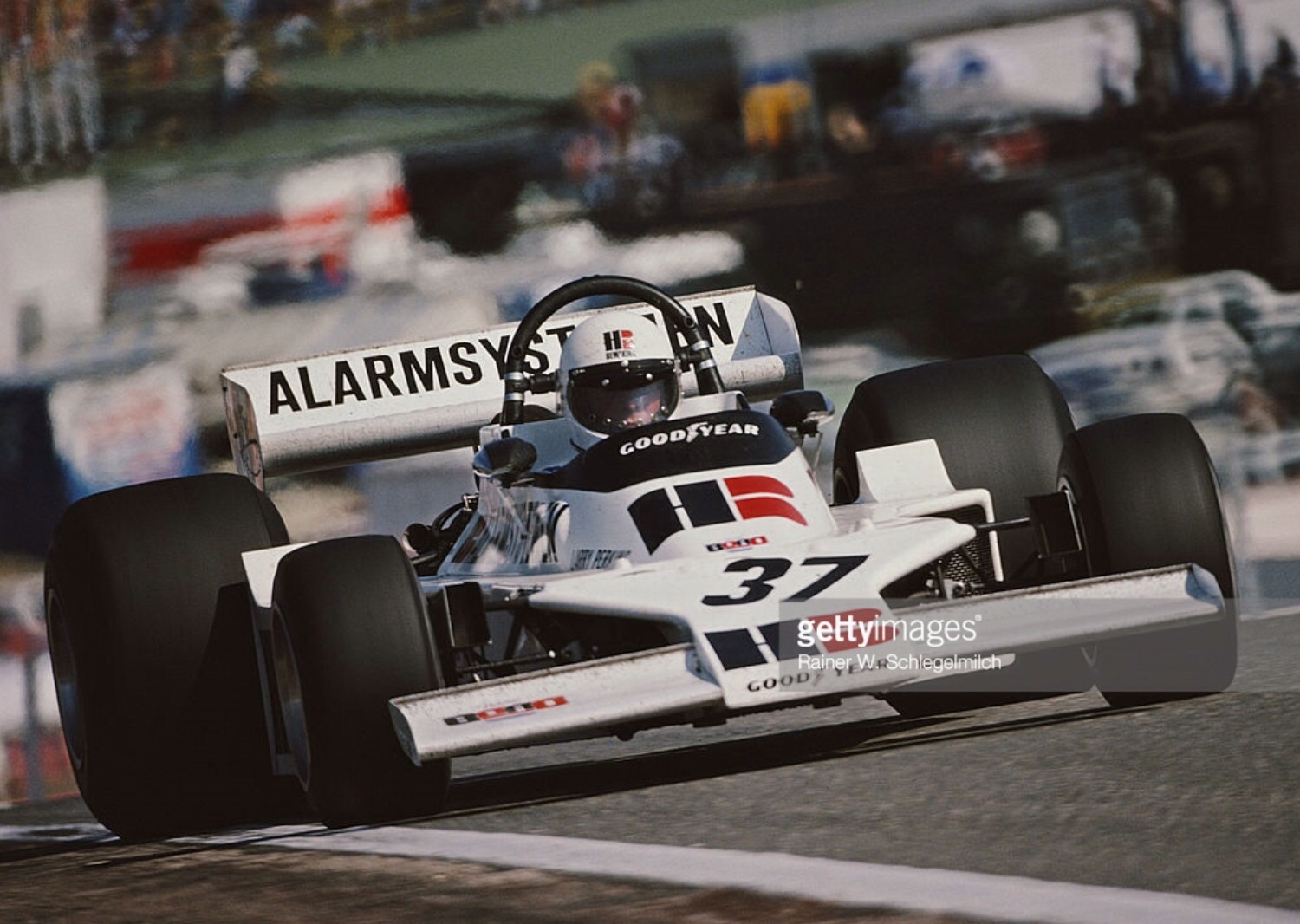
Tailpiece: Larry on his way to 13th in the Ensign N175 Ford during the 1976 Spanish Grand Prix at Jarama, Hunt won in a McLaren M23 Ford…

Finito…










 primotipo...