


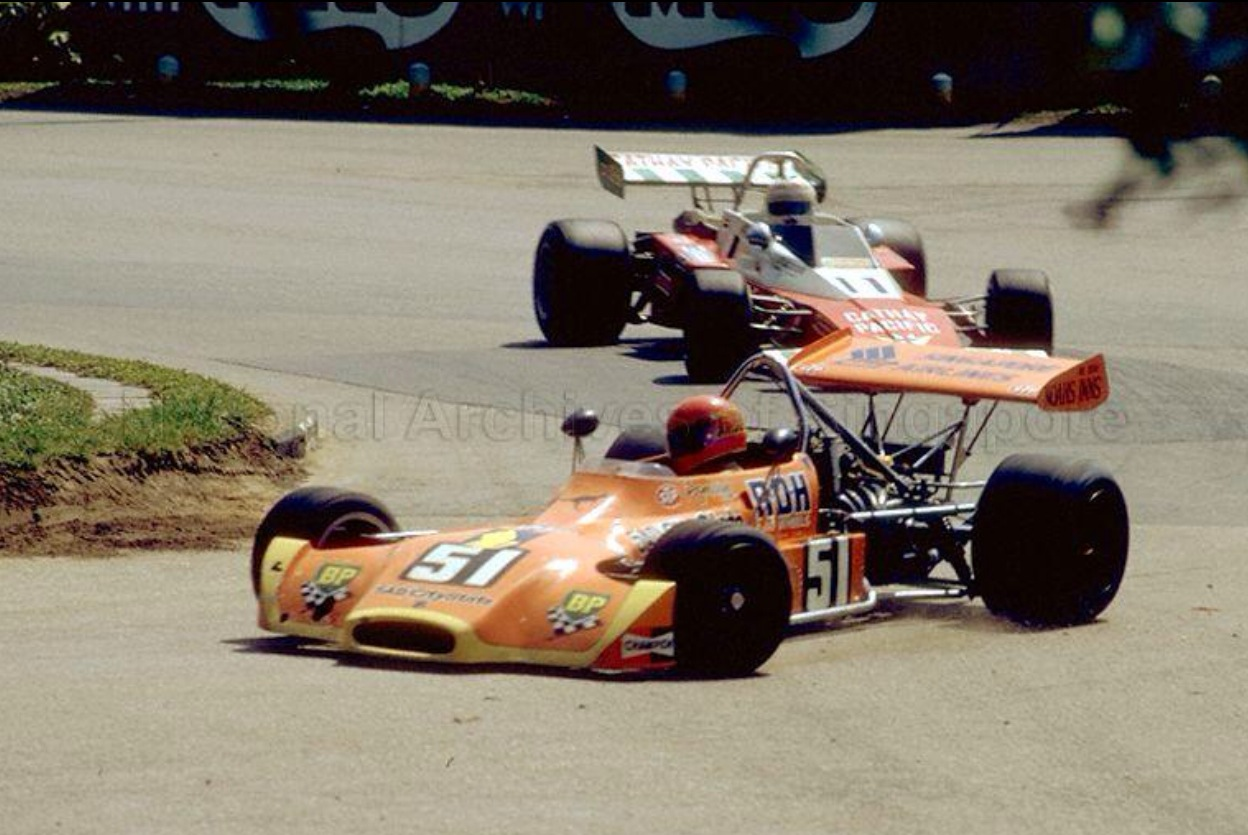
Birrana Engineering chief Malcolm Ramsay in his Birrana 273 ‘010’ Ford Hart during the 1973 Singapore Grand Prix, the last until the F1 era commenced in 2008…
I have been meaning to write about Birrana’s jewels of cars for a while. I tripped over this shot of Ramsay researching the Leo Geoghegan Lotus 39 article a while back, Leo was Birrana’s works driver from mid-’72 to the end of 1974.
This article started as a ‘quickie’ stimulated by the shot above, but segued into a longer piece when I found heaps of photos of the ’73 Singapore GP in the Singapore Government Archives. Too good to waste, low-res shots but still great to circulate. Bonuses were finding an existing article about the pre-F1 Singapore GP history and a contemporary ’73 race report. The basis of something interesting. Bewdy!
I need to a write a bit about Birrana Cars too though.
I don’t for Australian readers but that’s only 15% of you. So I have written what should be treated as ‘An Introduction to Birranas’, Part 2 ‘Birrana In Detail’ to come soon. Hopefully there is enough to explain how important the cars were to those who haven’t heard of the marque whilst being clear to Birrana enthusiasts, and there are plenty of us in Oz, that there is more to come.

The photos above and below are ‘compare and contrasts’; top of Leo G in his 274 at Oran Park, the bottom of Bob Muir in his 273/4 at Symmons Plains, Tasmania. Bob’s car is 273 ‘009’ with 274 nose and rear wing. Compare with ‘standard spec’ 273 shots in the Singapore GP 1973 part of this article (unattributed)
Leo won the Australian F2 Championship in 1973/4 with a 273 and then 274 model cars, powered by 1.6 litre Brian Hart Ford ‘416B’ injected 205/210bhp variants of the venerable Lotus/Ford twin-cam four cylinder engine first used in the Elan in 1963.

Bob Muir, Birrana 273 Ford ‘009’, Symmons Plains 22 September 1974. Bob took the win from RayWinter’s Mildren ‘Yellow Sub’ Ford and Sonny Rajah’s March 712M/732 Ford (unattributed)
The F3/F2 Birrana’s were typical, orthodox aluminium monocoque chassis, outboard suspension cars of the period but built to a very high standard of design, construction and finish with particularly careful attention to aerodynamics. ‘Boxes were Hewland Mk9/FT200 for ANF3/2 use respectively.
Twenty-one cars were built, (FF 4, F3 4, F2 11, F Atlantic 1 and Speedway! 1) the first car was the F71 FF built in Sydney by Alcock before he joined forces with Ramsay in Adelaide, their home town. The last ‘A78’ Ramsay built for his own use in 1978 after the factory had closed in terms of ‘volume production’.

Graeme Lawrence’ Rothmans March 76B alongside the very last built ‘Golden Churn’ sponsored Birrana A78. Graeme is the guy far right of his car and Ramsay the dude in the beard behind his. Selangor GP, Batu Tiga circuit 24 September 1978. Nose of Steve Millen’s Chevron behind. F Pac race, all cars Ford Cosworth BDD 1.6 powered. Of interest to Birrana historians; car was entirely new based on 273 tub design with forward braced roll bars as required then by FIA regs, and upper body panel, 274 nose with bottom lip added, bigger than 72-4 rear wing, no rear engine cover; the 272 and 273 did not have rear covers the 374/274’s did (Choong H Fu)
The pick of the cars, given driver feedback seems to be the 273, although the evolved 274 was built in larger numbers and won F2 titles for Leo G ‘015’ in ’74 and Geoff Brabham ‘018’ in 1975.
Visually though the F3 374 was a gorgeous bit of kit…if not as successful as the ‘works’ Cheetah Mk5/6 Toyota’s of ‘The Two Brians’ Shead and Sampson. Shead built the cars in his Mordialloc shop and Sambo the engines in his ‘Motor Improvements’ emporium in St Kilda Road, Elsternwick. All three of the 374’s were fitted initially with Sambo’s (ANF3 1300cc) Corolla based engines.

Dean Hosking in the John Blanden owned 374 Toyota ahead of the similar Lew Wade owned, Paul King driven car at Adelaide International in August 1974. Little jewels of things (Robert Davies)
Our ‘Racers Retreat’, click on the link atop the page for earlier articles, Peter Brennan was the mechanic on Paul Kings ‘Lew Wade Fiat’ owned Birrana 374 in 1974.
‘Lew had sponsored Paul King in an Elfin F Vee for a couple of years in Victoria, he was a really quick driver, so Lew decided to take the step up and buy an F3 car for Paul. He was a Fiat dealer in Cheltenham (in Melbourne’s bayside south), he figured the way to beat Sambo and Shead was a different chassis and a race prepped Fiat 128SL SOHC engine. The car was then new, the engine more advanced than the pushrod Corolla and he could cross-promote the sales of his Fiats.
Soon boatloads of lire were being sent to ‘Luigi The Unbelievable’ in Italy, when the engine finally arrived, late of course, we put it on the Challenge Motors dyno, it barely pulled 110bhp, not enough to pull the top off a rice-custard, the MI Corollas made a genuine 130/135bhp, even the customer engines’.
‘Lew had been serving it up to the Brians, who were both closeby in bayside Melbourne about how the Fiat engine would give them a belting and then had to eat big doses of humble pie and buy one of their donks!’
‘The day came to pick up the Birrana, so Paul and i were despatched to Adelaide in Lew’s big, lumbering Chev Impala and trailer. I don’t remember much about the factory other than it was small. Back in Melbourne, we soon had the thing plumbed and completed, Paul tested it at Calder and was immediately ‘on the pace’, he was a very quick driver but beating the Cheetah twins was another matter.’
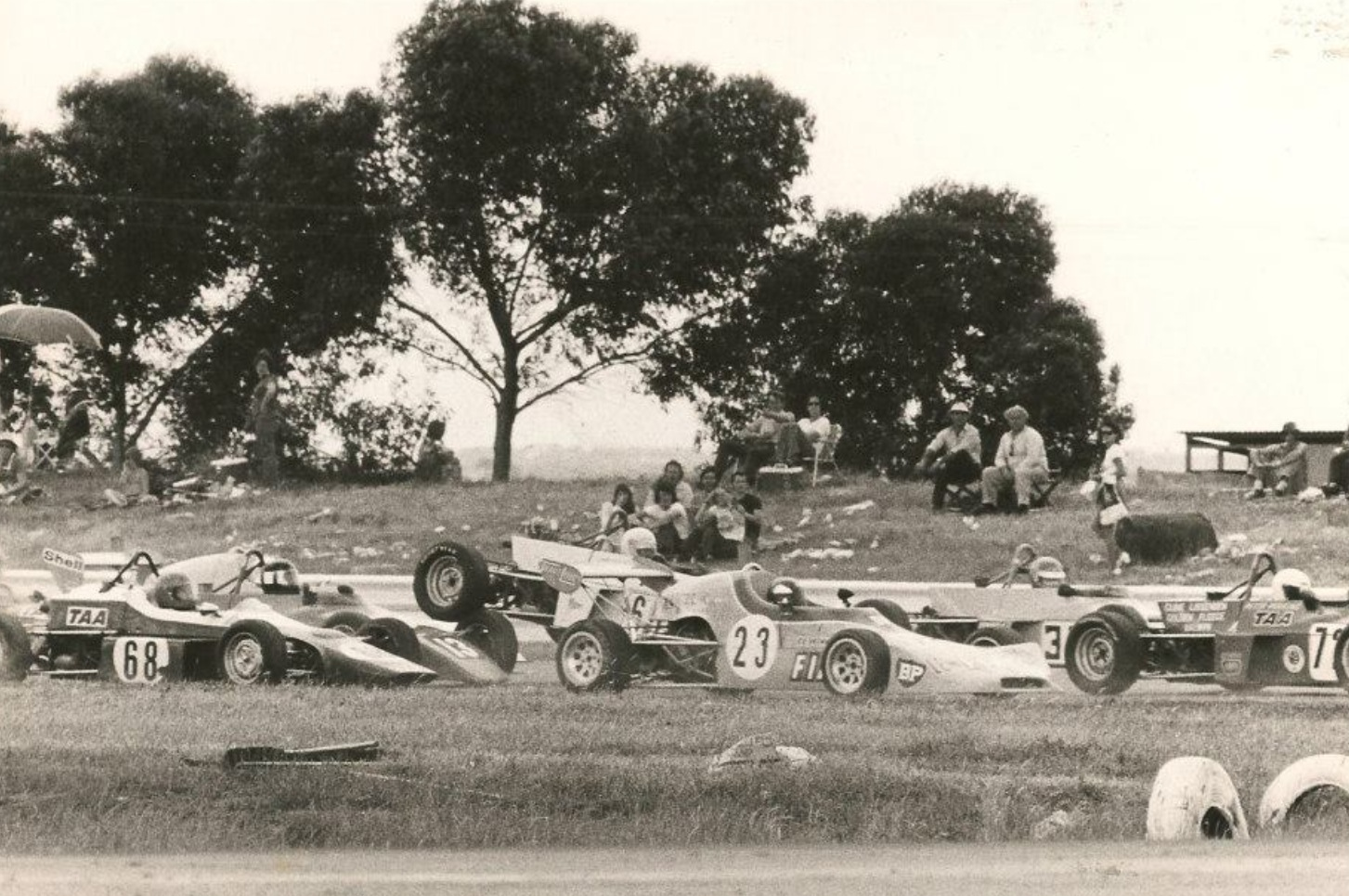
A little bit of biffo in this 1974 Calder combined F3/FF race. As best as i can work out its Peter (brother of Larry) Perkins Elfin 620 from Paul King’s Birrana 374, with 2 Elfin 620’s outside him, one ‘yumping’. #68 is a Wren FF with another FF beside him and on the very outside you can just make out the light covered rear engine cowl of Dean Hosking’s 374 (unattributed)

Paul King’s 374 ahead of Brians Shead and Sampson in this Winton promotional poster circa 1974/5 (Paul King Collection)
In those days FF’s and F3’s often raced together, there was no national F3 Championship, the quicker F3’s raced against the F2’s in their championship races (which from 73-75 in particular was well supported, comparative car specs; FF 1600 circa 105bhp, no wings or slicks. F3 1300 SOHC or OHV circa 135bhp wings, slicks, 5 speed box. F2 1600 DOHC 2 valve circa 205bhp, wings, slicks, 5 speed box)
‘The car itself was beautifully built and engineered, the only problem we had during that year was leaking fuel tanks, we had to take the car back to the factory to have them re-sealed, its before the days of bag-tanks in these cars. The car was easy to work on, the Toyota engine was bullet proof, and the Hewland Mk9, which was also new gave no problems with only 135bhp tearing away at it.'(these boxes sometimes fitted to 205bhp Ford Cosworth BDD engines, not particularly reliable all the time mind!)
The Mk5 Cheetah was a top car in both the hands of the ‘factory’ drivers and also as a customer car ‘the Birrana was a better engineered and finished car’ but Shead and Sambo had evolved the cars over the years into very quick devices and both of them were experienced, fast competitive drivers. Sampson won the Bathurst 1000 with Peter Brock in 1975 and only stopped racing, in his mid-seventies, in the last few years.
‘Whilst Paul was an F3 front runner Lew started to lose interest when he wasn’t winning all the time, Pauls marriage was also going down the blurter, the car was sold and that was that. Paul drifted from the scene and Lew crashed his Tiger Moth and killed himself some years later’.
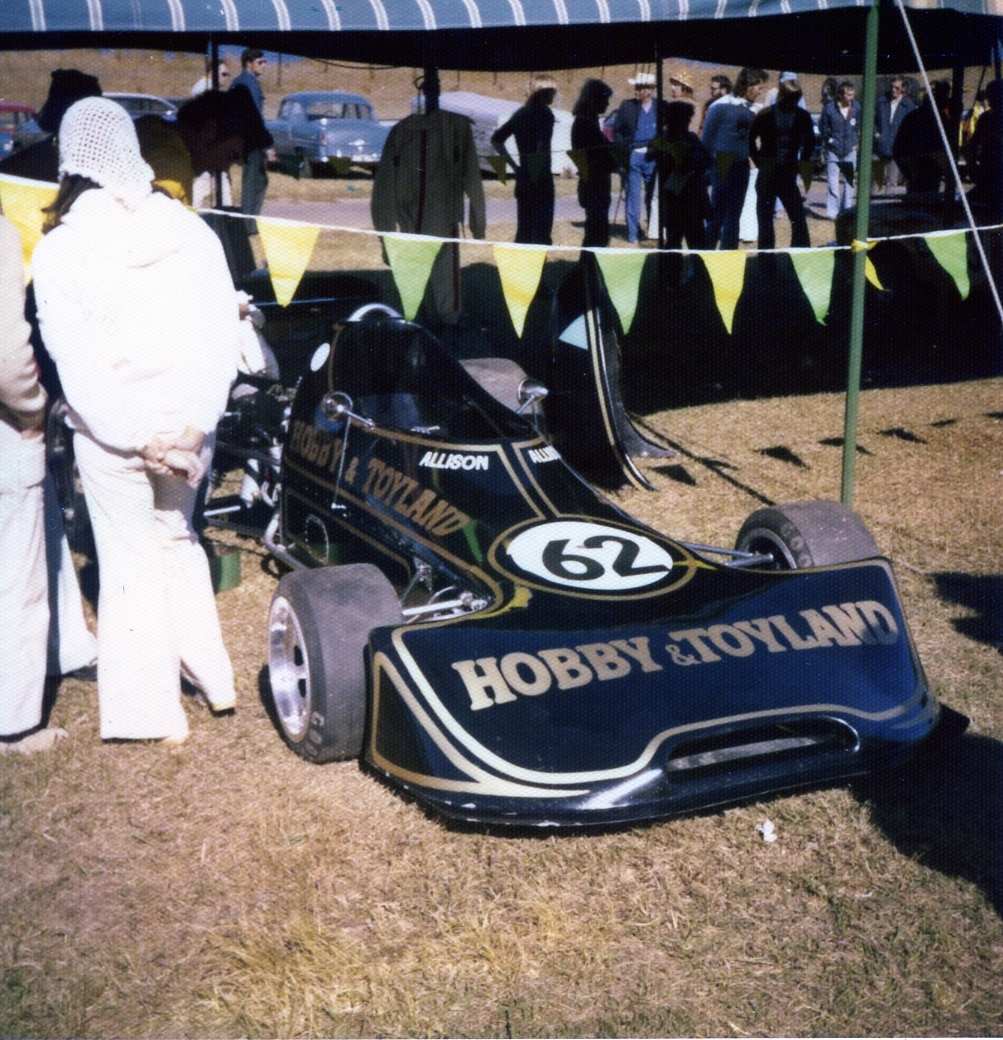
Bruce Allison’s 274 ‘017’ in the Lakeside pits, the Queenslander was 3rd in his home race,during the 1974 AF2 Championship, an 8 race series in 5 states. Workmanship and finish of these cars absolutely world class (Allison)
All of the F2 Birrana’s were fitted initially with Lotus/Ford/Hart twin-cams built by a raft of preparation outfits. During the period we are looking at Peter Nightingale was the designated factory engine and gearbox bloke, he also prepared, from memory (always dangerous) Geoff Brabham’s 274 ‘018’ in his ’75 AF2 Championship winning year so that makes Peter the most successful ‘Hart fettler’ of the day. He still looks after a few cars in his Adelaide home town.
Later, various of the F3/2 cars were fitted with a variety of 1.6 litre SOHC engines when the ANF2 rules were stupidly changed.
Some of the F2 cars had the Ford Cosworth 1.6 litre BDD’s later fitted for F Atlantic/Pacific. The Birranas were too long in the tooth as F Pacs in the mid/late ‘70’s in NZ when they adopted the class, but Bob Muir was competitive in the UK in mildly updated 273’s in 1975.
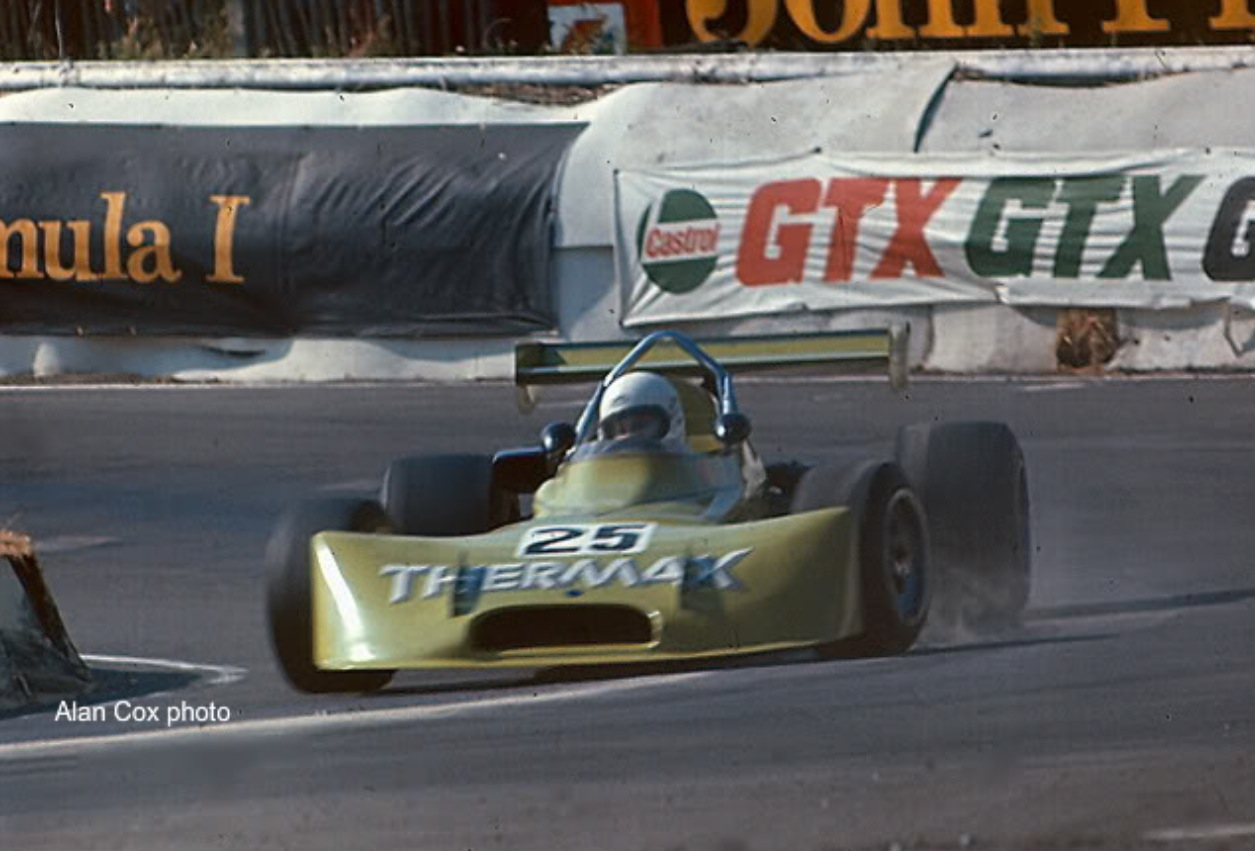
Bob Muir, Birrana 273 Ford BDD, Mallory Park, British F Atlantic Championship, Bank Holiday meeting August 1975 (Alan Cox)
The 273 derived European 2 litre F2 Ford BDG engined ‘Minos’ was a slug and optimistic in the extreme given the competitiveness of that class at the time with factory BMW and Renault V6 engines in March/Martini/Alpine chassis. More about ‘Minos’ in the later Birrana article.
One chassis was raced late in its life with a Waggott 2 litre DOHC 4 valve engine, which is the car I would personally like to own! However I am getting ahead of myself and starting to write the article I said at the outset I would do at another time. So, back a step.
By the middle of 1974 Ramsay and Tony Alcock his designer/partner in Birrana, decided it wasn’t commercially feasible to build cars profitably as they wanted to in Oz.

Bob Muir, Birrana 273 BDD ‘009’ at Mallory Park 24 August 1975, DNF with fuel surge, Jim Crawford’s Chevron B29 won. Later GP drivers Gunnar Nilsson and Tony Brise were also in this race (Alan Cox)
Tony travelled to the UK and initially ran the two Bob and Marj Brown owned 273’s for Aussie Bob Muir in the 1975 British F Atlantic Championship before he joined Graham Hills team. Unfortunately he was on ‘that flight’ which ended tragically at Elstree Airport, the whole team perished on that sad trip in difficult conditions.
Ramsay then focussed on his engineering business servicing the mining industry in Adelaide, where all but the first Birrana was built.
He very successfully applied his organisational and management skills by getting back involved in motor racing and winning multiple Gold Stars for other drivers in the Formula Holden era. His stable included Mark Webber, Paul Stokell, Jason Bright, Simon Wills and Rick Kelly. In addition, for a time he ‘turned to the dark side’ and ran V8 Supercars.

Geoff Brabham at Oran Park in his 274 ‘018’ the last built car originally sold to Neil Rear in WA but bought only slightly ‘shop soiled’ by the Brabham family for Geoff’s second full season in racing, he raced a Bowin P6F successfully in the Australian FF Championship in 1974. Brabham comfortably won the ’75 AF2 title but Alfredo Costanzo in Leo Geoghegan’s ’74 championship winning chassis kept him honest, Brabham’s the better prepared car. Their was no championship AF2 round at OP in 1975, so not sure when this is, clearly a Friday tho, only a few folks in attendance! Brabs was off to British F3 in ’76 (oldracephotos.com)
Without thinking too hard about it, the rollcall of drivers who ‘parked their arses’ in Birranas in the short period the cars were built is impressive…
Later Bathurst and AGP winner John Goss raced F71, Alcock’s first car, an FF whilst he was making his name in the McLeod Ford GTHO Falcon in 1971. Jumping from the nimble, responsive FF into the ‘big powerful barge’ of a Falcon at the same meeting must have been a challenge. And test of versatility. JG was one of a relatively small number of Aussies who were awesomely quick in both ‘taxis’ and single-seaters. Frank Gardner, Kevin Bartlett, John Bowe, Mark Skaife and Craid Lowndes spring readily to mind as some of the others. Click on the link at the bottom of this article to read about ‘Gossy’.
Andrew Miedecke, Richard Carter and Gary Brabham, the latter long after the car was built, (1982) raced F73, a superb FF built for Miedecke’s ’73 national ‘Driver to Europe’ championship FF assault. Carter won the ’76 DTE series in this chassis, Birrana’s only Australian FF Championship victory.

Bucolic Winton, Central Victoria, FF action in 1978. Steve Moody’s Birrana F72 from Gerry Witenden’s F71-the first Birrana built. Then, i think, obscured David Earle’s Elfin and Ron Barnacle’s (or Don Bretland’s maybe?) Van Diemen RF77. Lots of sideways action, Aussie FF’s raced on Bridgestone RD102 road-radials in this period which made them wild to drive having driven my share of laps at the time! A funny bi-product of this was that older chassis, which were designed around radials when the class first started, came to the fore. Witenden, a terrific bloke from Goulburn way, came within a point of winning the ’78 title in this 7 year old Birrana. He went to the UK too, did a few FF2000 races, maybe with Delta if any Brit enthusiasts remember him. Steve Moody is still around historic FF, Barnacle also won an Oz FF title (unattributed)
Drivers of the Birrana F2’s included Leo G, Bob Muir, Bruce Allison, Alfredo Costanzo and touring car ace Peter Brock who did his only single-seater season in 272 ‘006’ in 1973.
Allison very much showed ‘he had what it takes’ in 274 ‘017’ in the very competitive 1974 ANF2 Championship. He jumped up to F5000 in an ex-Bartlett, well sorted Lola T332 Chev in ’75, ‘rattling the established F5000 order’ as the category’s ‘enfant terrible’ in much the same way Warwick Brown did in ’72.
Bruce recalls the Birrana and that ’74 season with a lot of fondness; ‘I’d started racing an Escort Twin-Cam against the best of the guys in Series Production and realised how hard it would be to get an ‘equal car’ so we decided to buy an open-wheeler. Dad organised an Elfin 600FF from Garrie Cooper, the car we got was one that was coming back from South Africa or something, it hadn’t been paid for. Picking it up from the Brisbane docks is not something we looked forward to but a few slabs of beer my dad had brought along did the trick, we were soon on our way!’
‘I did well in that at Surfers and Lakeside then we got Garries 600D F2 (this car is pictured later in this article) which was a good car. Dad got Ivan Tighe to drive its first meeting at Oran Park, but he crashed it, not a big one, it was soon repaired and away we went but by that time the category was getting more competitive. A few people said we should get a Bowin P6 which looked sensational, we painted that car in the black ‘Hobby & Toyland’, Dads business’s colors. It had rising rate suspension but it was an absolute pig. We couldn’t get our heads around the thing, i know John Leffler and Bob Skelton did but i got rid of it after only about 6 months. In fact i boofed the car at Surfers after we had sold it and had to take a big chunk off the price.’

Bruce Allison hustles his 274 ‘017’ around, fast, demanding Lakeside, Qld, rear engine cover removed in deference to the summer heat.He was 3rd, the race won by Ray Winter’ old but fast Mildren ‘Yellow Sub’ from Geoghegans 274. Bruce’ results got more consistent and better as the season wore on (Allison)
‘By then it was clear we had to have a Birrana to run with the top guys. Dad did a deal with Malcolm Ramsay, both he and Tony (Alcock) were great to deal with and gave us all the help we needed that year. The car handled well, was forgiving and put its power down nicely. We had good engines, Harts which i think Ivan Tighe looked after, the car itself was maintained in a Hobby & Toyland workshop at Castles Road’.
‘I was 20, very brash and thought i was unbeatable. Leo was smooth, quick and had all of our measure, the grids were great, there were always 6 or 7 blokes scrapping at the front. For outright speed though Bob Muir was an absolute demon in that car. It was the previous years 273, but updated. Bob and Marj Brown who owned the car were wealthy Adelaide people who had a business which made oven glass, heated windscreens and the like. For a ‘part timer’ Bob was bloody good, he went to the UK with the Browns of course’
‘I was never the greatest at setting a car up, Peter Molloy (the very experienced engineer who looked after Bruce in his F5000 years) always rated my speed though and i did get quicker and more consistent that year as the season rolled along and proved it with my results. It was time to move up. The Birrana was important as it proved i could cut it in a competitive car, the 274 was the first of those i had’.
Bruce was soon off to European and US success with annual summer visits back to Oz to remind us of his skill. He won the Grovewood Award and raced in the British national F1 Series but didn’t get the ‘real’ F1 seat his talent and results warranted.
(Bruce lost most of the photos of his career in a fire some years back, these are the only two he has of the Birrana for example, if any of you have photos of Bruce in any of his cars, you are prepared to share with him please email them to me at mark@bisset.com.au and i will forward them on, Mark)
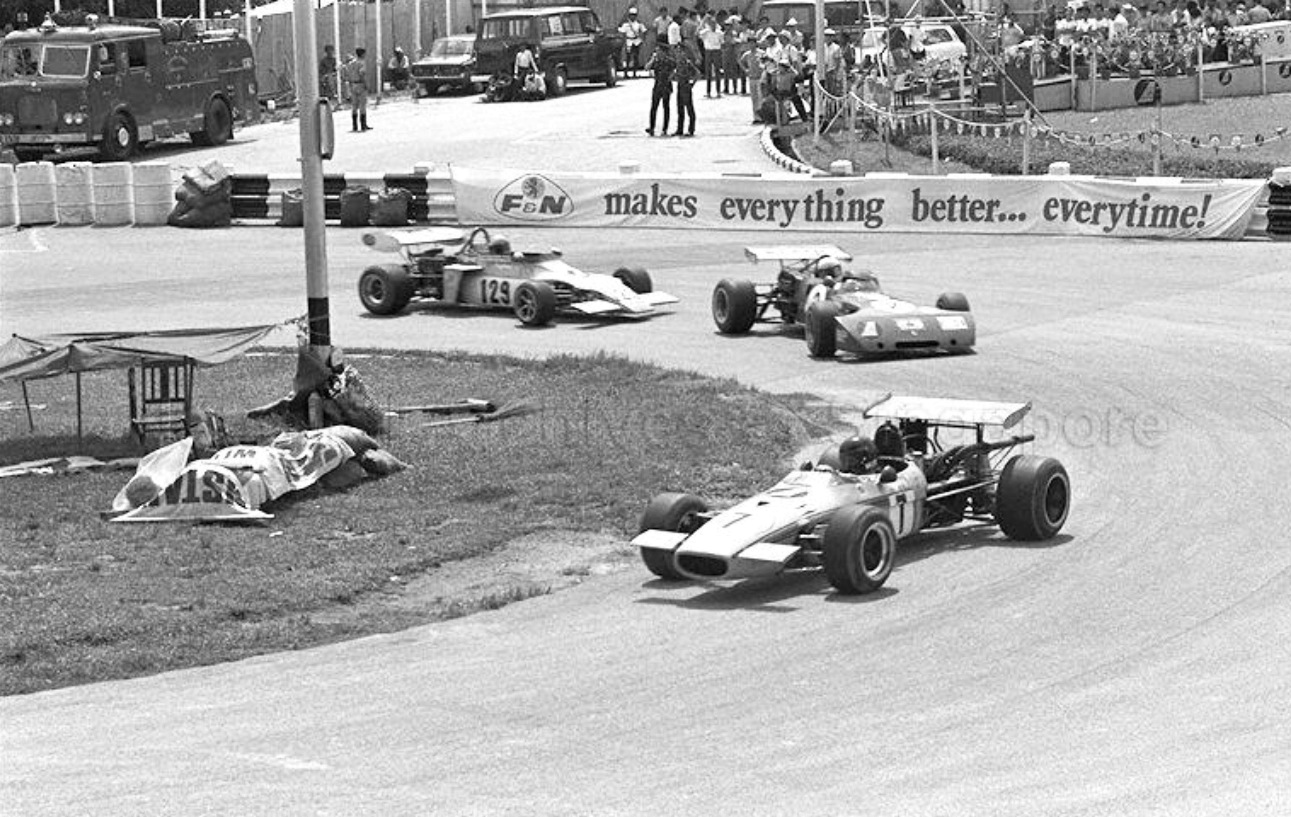
Bob Muir’s Rennmax Ford ahead of Garrie Cooper’s Elfin 600D Ford (the car Bruce Allison raced after Garrie) and a March 722 during the 1972 Singapore GP. Help welcome as to which corner and driver of the March (NAS)
Bob Muir was a seasoned professional by the time he jumped into the Brown family’s 273’s in 1974. Bob and fellow Sydney motor trader Geoghegan had an almighty battle for the AF2 title that year. If 1973 had an element of ‘cruise and collect’ for Leo, ’74 was the exact opposite with fields of depth rarely seen in Australian single-seater racing outside FF. The F2 grids that year had all of the local aces racing ‘down’ from F5000 in F2 as well as all of the ‘comingmen’ contesting a well sponsored series.
Bob had done two years in F5000 in 1972 and 1973, the latter in the US L&M Championship before jumping into the Browns cars after the first couple of ’74 rounds. After his Oz F2 season he then raced the 273’s in F Atlantic spec in the UK in 1975. After the F2 ‘Mino’s nee Birrana ‘bombed’ he was impressively fast in a Ford BDX engined Chevron B35 Derek Kneller built and prepared for the team. In ’76 he was 37 though, if only he was in Europe 10 years before. Like so many competitors of his period, his business funded his racing for much of his career, he wasn’t a ‘spoon-fed’ prat of the type we see so often today.
I digress, as usual. Suffice it to say, plenty of great steerers were attracted to Birrana’s. More of the above in ‘Birrana 2’.

The official party prior to the 1964 Malaysian GP at the Thomson Road circuit
Keying ‘1973 Singapore GP’ to Google inevitably led to lots of tangents and some good information to go with these shots which are a bit scrappy, but still worth circulating and are from the Singapore Government archives
The balance of this article is a heavily truncated ‘cut and shut’ with a reasonable addition of my own words of two articles; one written by Eli Solomon in the March 2006 edition of MotorSport and the other a race report by (the) Peter Collins published in Australia’s ‘Racing Car News’ and posted on ‘The Nostalgia Forum’ by ex-RCN journalist Ray Bell.
Eli has his own magazine, ‘Rewind’ which has great South East Asia current and historical content. You can either subscribe (pay) or access some of his material via Facebook, just click ‘Rewind’ into the FB search engine.

Not long after the start of the 60 lap 1964 Malaysian bike GP. Thomson Road circuit, #79 Shershall from Perry, Sang and Dingle (MCI)
The first Singapore Grand Prix was the 1961 ‘Orient Year Grand Prix’, held on a stretch of Upper Thomson Road.
In 1962 the race was renamed the Malaysian GP, until Singapore gained independence in 1965. Singapore ran its own event from ’66 while Malaysia held two events, one around the Singapore race near Easter, called the ‘Malaysian GP’ and another in September labelled the ‘Selangor GP’.
The racing season in Asia began at Macau in November, moved to Australia and New Zealand with the Tasman Cup, and returned to South East Asia with back-to-back races in Singapore, Johore, Selangor and Penang, followed by Japan.

Food vendors 1971 Thomson Road circuit style (NAS)

Alfa GTA, Albert Poon? winning the 1971 Touring Car race, start/finish is on ‘The Thomson Mile’ (NAS)
From 1966 to 1973 the Singapore Grand Prix became the main racing event on the local calendar each Easter. The 3.023-mile street circuit was a challenge, its narrow 24ft width offered little run-off area in a sport that was increasingly seeing faster speeds.
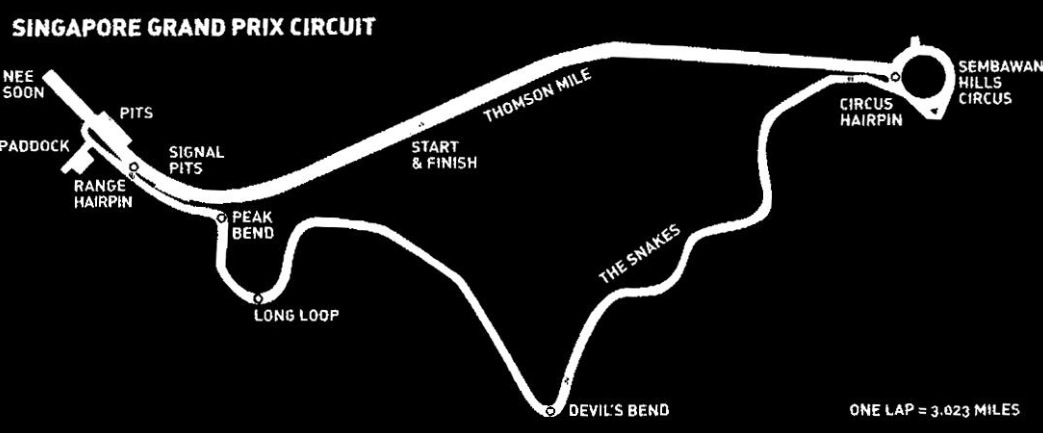
(Gel Motorsport)
Australian Vern Schuppan and British-born Hong Kong man John Macdonald both loved it. Never one to mince his words, Macdonald describes the track:
‘Flowing? In places, but hairpins were not exactly flowing. Dangerous? In those days no more so than expected and certainly safer by far than Macau. Monsoon drains? Yes. Bus stops? One after that lovely curve on the straight and a few lamp posts. None of these things got in the way and I did not go looking for them!’
The start-finish line was on the main straight, on a normal day the two lane black-top served as a major trunk road, on the right were fruit plantations and on the left new housing estates and industrial parks.
The bend halfway down the straight was ‘The Hump’, this had a false apex which sat on the turn-in that lifted cars off the road; it was this section that Frank Matich got wrong during 1970 practice, his McLaren M10A Chev F5000 hit a bus stop and was out for the weekend.
After ‘The Hump’ was ‘Sembawang Circus’ or ‘The Hairpin’, dangerous as cars approached it ‘flat’ until it was ‘chicaned’ in 1969 to preserve spectators generally and Singapores Cabinet sitting in VIP stands!
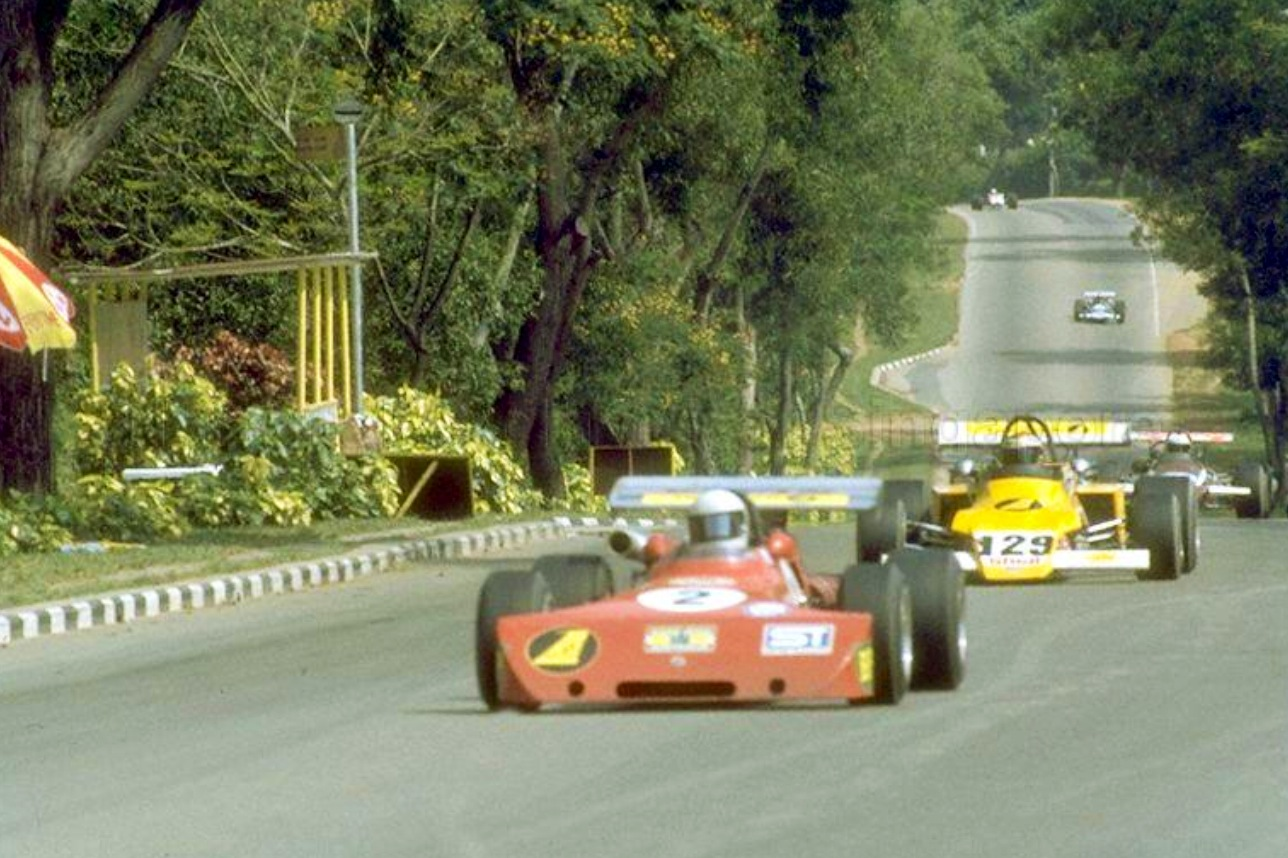
Garrie Cooper Elfin 600D Ford ahead of Vern Schuppan’s March 722 on ‘the Thomson Mile’, 1972 GP (NAS)
‘The Esses’ comprised several sections; ‘The Snakes’, four bends, then ‘Devils’ a rounded off v-bend which caught many out, then ‘Long Loop’, a right hander.
Then came ‘Peak Bend’, where TV and radio stations located themselves. The circuit then went down right to ‘Range Hairpin’ and then ‘Signal Pits with pit entry after ‘Range Hairpin’.
Then it was left onto ‘The Thomson Mile’ a fast undulating one mile stretch on what was then the start of Nee Soon Road and back to the start/finish line, a lap was circa 24 gear changes dependent upon type of car and ‘box of course.
It was not until 1968 that Australian constructors started to venture to South-East Asia. Garrie Cooper of Elfin Cars won the Grand Prix that year in his very first Elfin 600, powered by a Ford Twin Cam. ‘Nobody had ever heard of Elfins,’ said Aussie racer/constructor Frank Matich.
Cooper had also suggested that the Singapore GP be confined to racing cars, for qualifying times to limit the number of entrants and for a reduction in the number of laps from 60 to 50. Subsequent years saw the main race run as two heats of 20 and 40 laps over different days.
Local racers were increasingly sidelined by foreigners, 1967 the last year a local won the GP. In 1969 Kiwi Graeme Lawrence won in his McLaren-FVA M4A amid some very powerful machinery including Cooper’s Elfin 600C Repco 2.5 V8, which the locals thought was an F1 car.
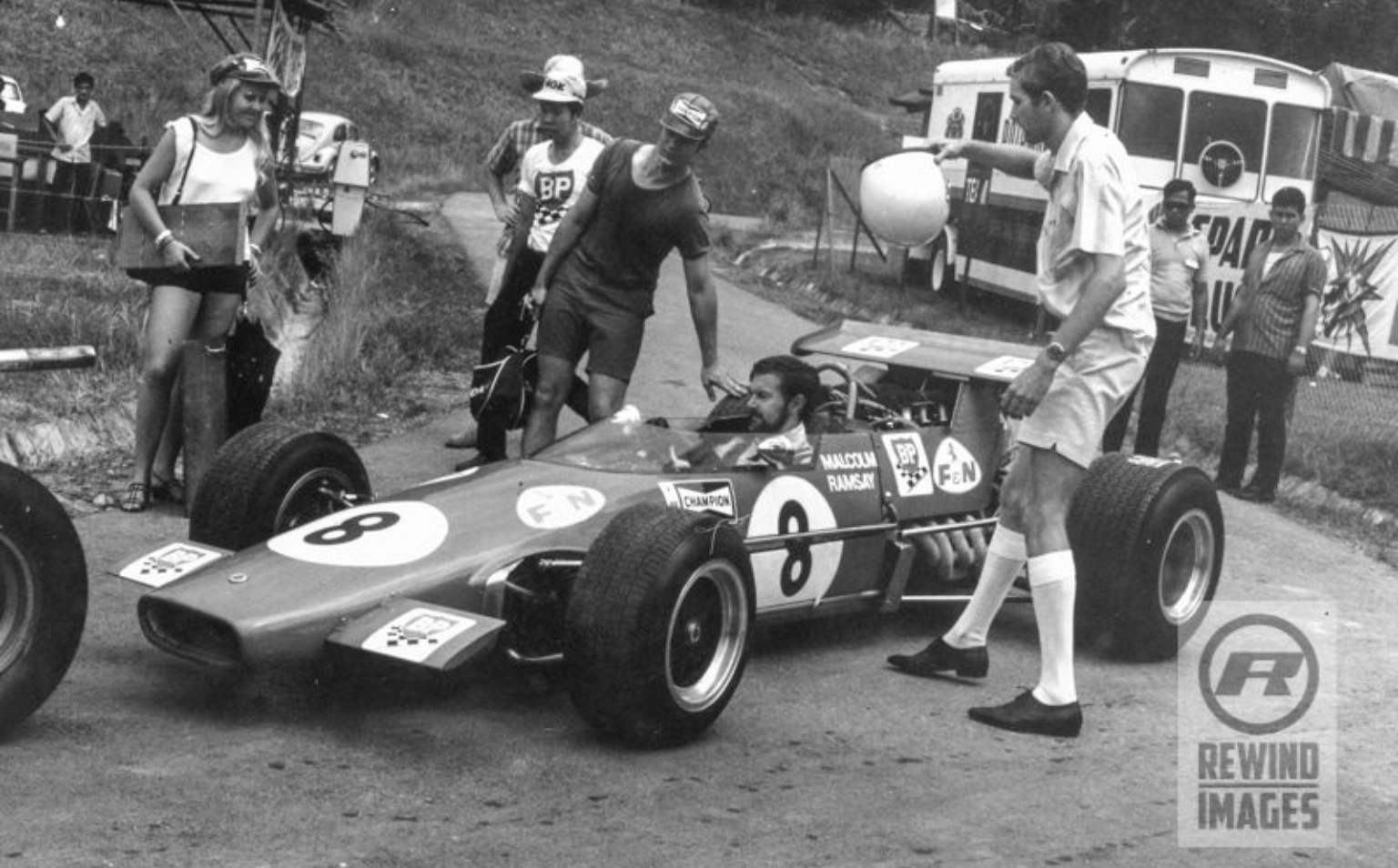
Mal Ramsay in the Thomson Rd paddock 1970. Elfin 600C Repco 2.5 V8 4th place in the race won by Graeme Lawrence’s Ferrari 246T (Rewind)
For the 1970 race Matich arrived in ‘Rothmans’ team livery with his McLaren M10A Chev F5000 that had recently won the NZ GP, while the Australian Alec Mildren ‘juggernaut’ consisted of Kevin Bartlett in his Mildren ‘Yellow Submarine’ (the Alfa V8-powered Len Bailey designed, Alan Mann Racing built monocoque racer which Frank Gardner debuted in the ’69 Tasman Series and was then handed over to KB upon Gardner’s return to Europe and in which KB won the ’69 Macau GP and Australian Gold Star Series).
Max Stewart raced the 2-litre Rennmax Mildren-Waggott, and Malcolm Ramsay the ex-Cooper Elfin 600C Repco. Mildren was there to supervise, as was Merv Waggott, designer/builder of the Waggott engines. Not to be outdone, Poon had the ex-Piers Courage Brabham-FVA BT30. While Matich wrecked his M10 in practice doing 160mph on the Thomson Straight, Lawrence went on to take his first win in Singapore in the ex-Amon Ferrari Dino 246T in which he also won the 1970 Tasman Series.
Lawrence made it two out of two in 1971 with his Brabham-FVC BT29 against formidable competition.
The big change was that the single-seaters now had to follow Australian F2/Formula B rules to ensure decent sized fields. So FVAs and BDAs were out. The new rules meant that single-seater racing would become the domain of the professional and semi-professional.
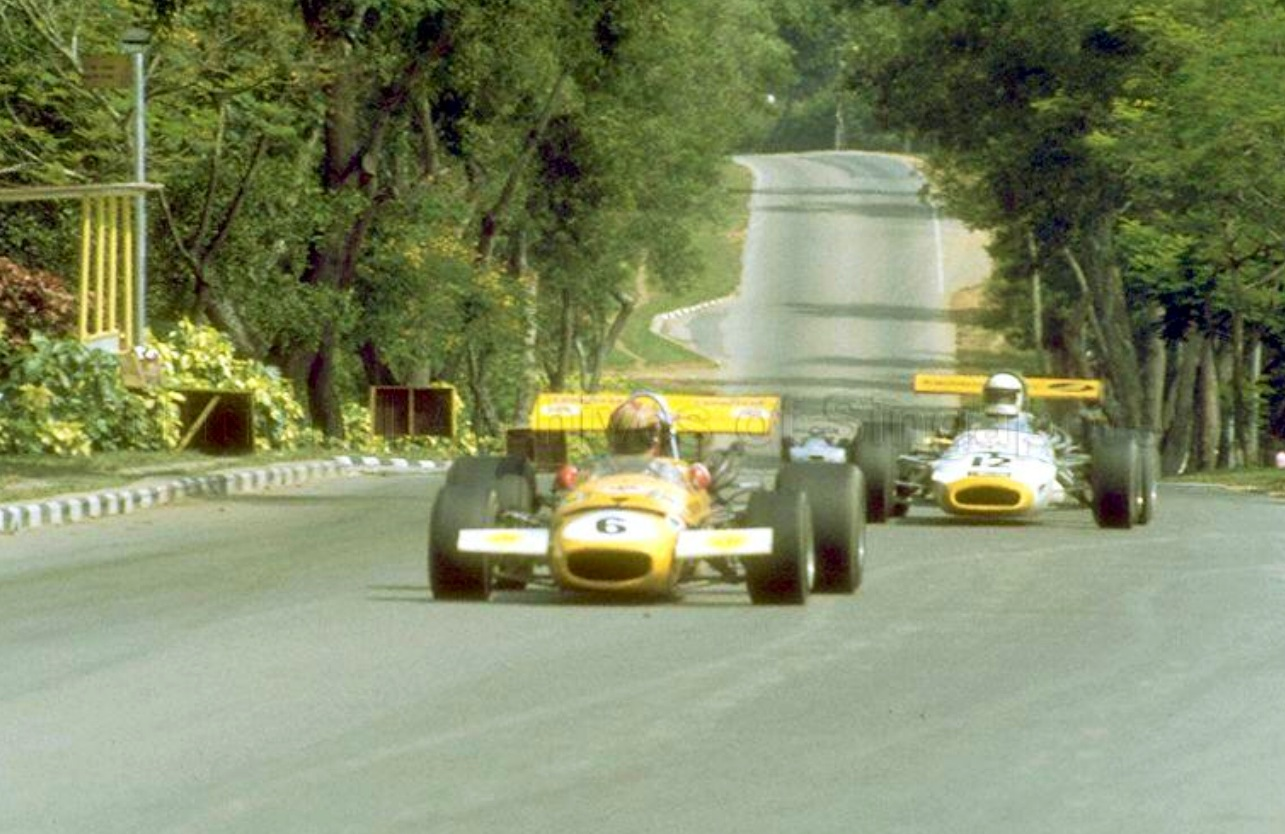
Stewart’s Mildren Waggott from Geoghegan’s, Graeme Lawrence owned, Brabham Ford in the 1972 GP here on ‘The Thomson Mile’ (NAS)
Max Stewart arrived in the Mildren-Waggott in 1972 — not only would it be the first time he finished a race in Asia, he would win it as well. By that stage the Mildren Tean had disbanded but Max bought his car off Mildren and promptly ‘nicked’ the ’71 Gold Star by a point with consistent performances from close mate Bartlett who won twice, Max took one race, but was more consistent in the 2 litre DOHC, 4 valve Waggott engine car than KB’s McLaren M10B Chev.
By 1972 the carnival had grown to 15 events, there were 430 competitor entries from around the globe, 146 ‘bikes and 284 cars.
The 1972 Singapore GP field included Bartlett, Schuppan and Macdonald, who had the ex-Rondel Racing Graham Hill Brabham BT36. Sonny Rajah raced the ex-Ronnie Peterson March 712M. Rajah was the local hero and looked the part with his long hair and Zapata moustache.

Sonny Rajah in the ex Petersen March 712M Euro F2 champ car, 4th in the ’72 Singapore GP (NAS)
But to gain admittance into a country where long hair was associated with drugs, he had resorted to using a short-hair wig! A fellow competitor once remarked: ‘He had brilliant car control but someone other than bullshit artists had to take him in hand! Natural talent and character to boot. Rajah was a very popular addition to the 1974 Australian F2 series when he raced the updated March that year.
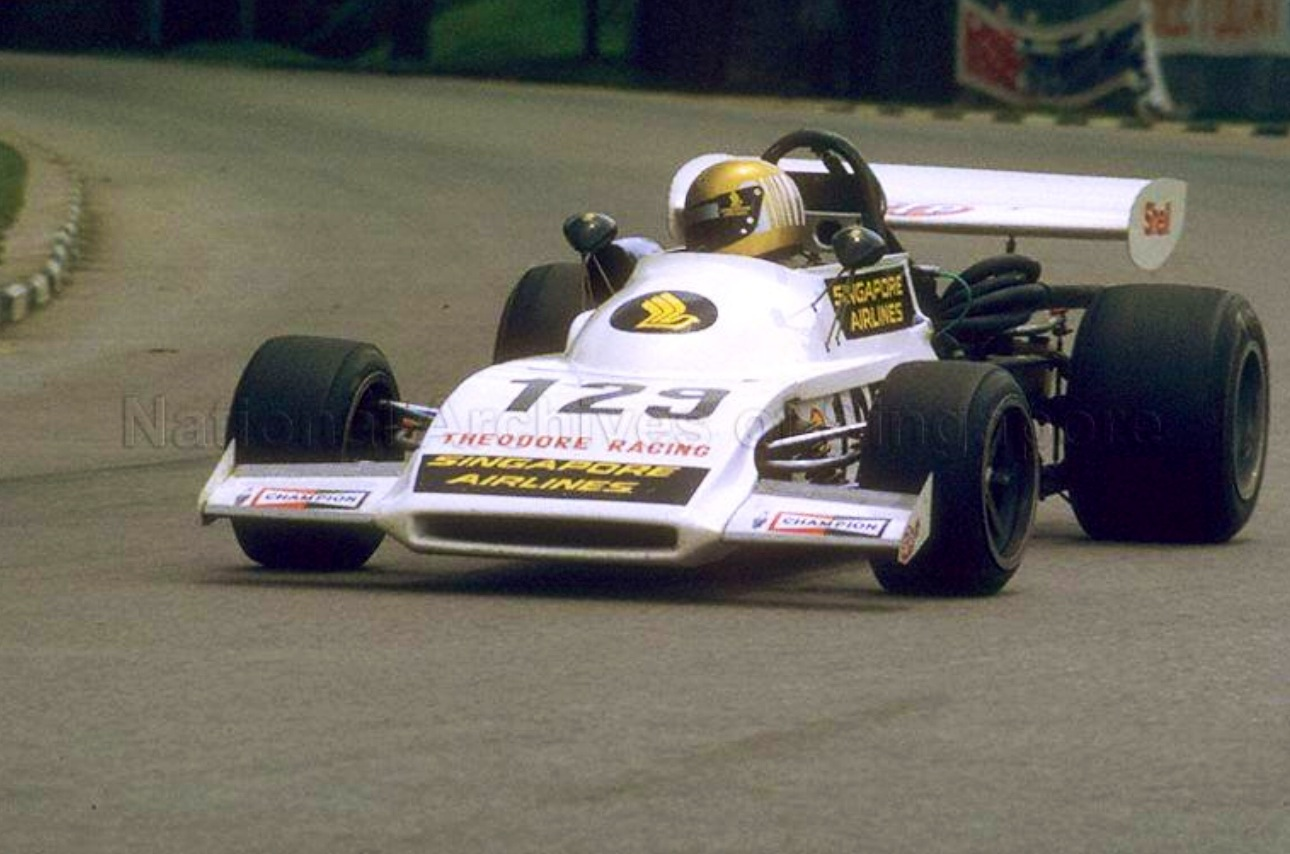
Singapore’s last pre-F1 GP was held in 1973 and was won by Schuppan in a March-Ford 722 (above)…
Schuppan vividly remembers the monsoon drains on the circuit: ‘It was a fast, flowing circuit, a lovely race track. No one talked about lack of run-off area because we were so young then.’ Of Schuppan, Macdonald said: ‘Vern, of course, got to the top but probably never reached the absolute top because he’s too darned straightforward, nice, honest and all those other good things that come up all too rarely.’

John MacDonald’s new Brabham BT40 Ford ahead Steve Millen’s Elden Formula Fords(NAS)
Macdonald was another favourite and had a brand new Brabham BT40 delivered to him in Singapore ahead of the race. Macdonald said the BT40 was a ‘magic car with a big ‘but…’ The team had a terrible time of it with fuel pick-up problems. A letter to Bernie Ecclestone, Brabham’s owner, resulted in a PR reply to say he was behind them all the way! Once sorted, the car was a prolific winner in Asia.
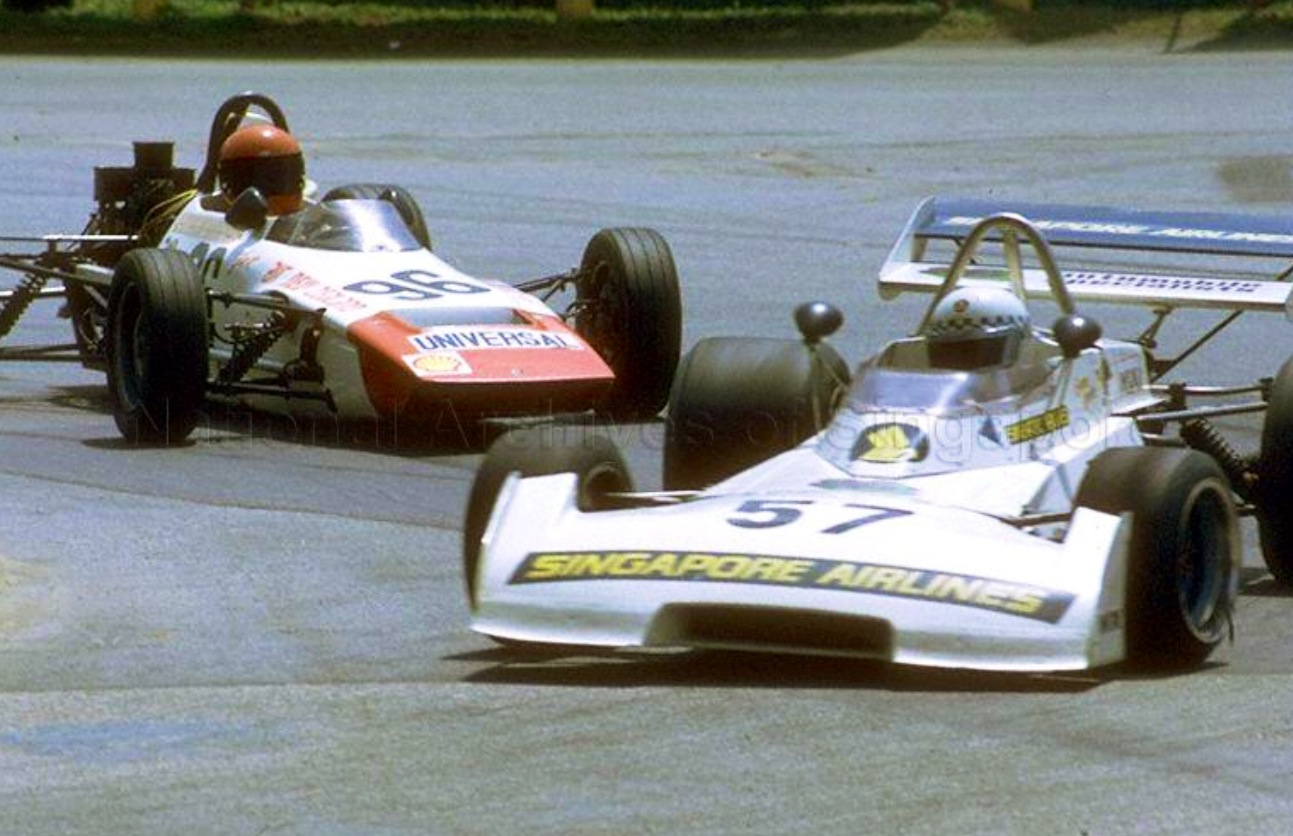
Lawrence’ Surtees ahead of Kiwi Steve Millen’s Elden Mk8 FF. Millen later a champion F Pac driver (NAS)
Schuppan, Kiwi Kenny Smith and Sonny Rajah were in March 722’s. Vern’s car was interesting in that the March had been modified by Canadian aerodynamicist Denis Falconer who developed a package of changes from Robin Herd’s original design. There were 5 (!) body configurations depending upon circuit type. The car also had a narrow track suspension set-up for faster circuits.
Graeme Lawrence raced the Surtees TS15 which first broke cover in that summers Tasman Series powered by a 2 litre Ford Cosworth BDG. Ramsay ‘010’ and Geoghegan ‘007’ were Birrana 273 mounted. Poon had a Brabham similar to MacDonald’s.
Tony Stewart’s Paul England owned ‘Dolphin’, a Brabham BT30 or 36 copy was powered by one of Englands very powerful twin-cams. Jack Godbehear built mighty-fine FF and F2 engines re-building many of the Hart 416B’s which were plentiful in Oz as the 1.6 litre AF2 flourished from 1972-5. (the ANF2 1.6 litre twin cam, 2 valve formula applied from 1971 to 1977 which cost effectively, and sensibly mandated variants of the Lotus/Ford t/c engine)

Tony Stewart in the Paul England owned Dolphin Ford a Brabham BT30/36 replica. Both John Leffler and Andrew Miedecke had one-off drives of this car in Australia (NAS)
Max Stewart’s Rennmax, twin-cam powered was faster than it had been with the more powerful Alfa GTAm engine the year before. Chain was in a Lotus 69, Bussell a Palliser WDB4, Wiano a GRD 272.
The cars had, by the way, come from Selangor where they had run in the Malaysian Grand Prix. Macdonald had won this from Canadian Brian Robertson and Poon, all drove BT40s. The Selangor GP was held later in the year.

Jan Bussell’s Palliser WDB4 Ford (NAS)
Starting Grid…
V Schuppan (1:57.3)______G Lawrence (1:57.1)
K Smith (1:59.1________L Geoghegan (1:57.8)
M Ramsay (1:59.5)______J Macdonald (1:59.1)
A Stewart (2:01.5)________M Stewart (2:01.3)
A Poon (2:04.0)____________S Rajah (2:02.6)
P Chain (2:07.5)_____________M Hall (2:04.0)
H Wiano (2:08.9)__________J Bussell (2:07.6)
Further back were: Kiyoshi Misaka (BT36 Toyota), Steve Millen (Elden FF), Harvey Simon (Elfin 600B ), John Green (Chevron B20), Dave Hayward (Hawke FF) and Chong Boon Seng (Brabham BT30) a very slow 2:49.1.

Geoghegan’s Birrana 273, Leo set the all-time lap record in his catch-up drive; 1.54.9 (NAS)
The Race…
Leo Geoghegan passed early leader Lawrence on the sixth lap. Schuppan’s March was third at this stage, but was under pressure from Ramsay, then Macdonald clear of Tony Stewart, Smith, Max Stewart and Rajah.
For fifteen laps Geoghegan’s Birrana 273 stormed away, but then had to pit when the engine began to stutter. The master switch on the roll-over bar had failed, it was shorted out to enable him to continue.
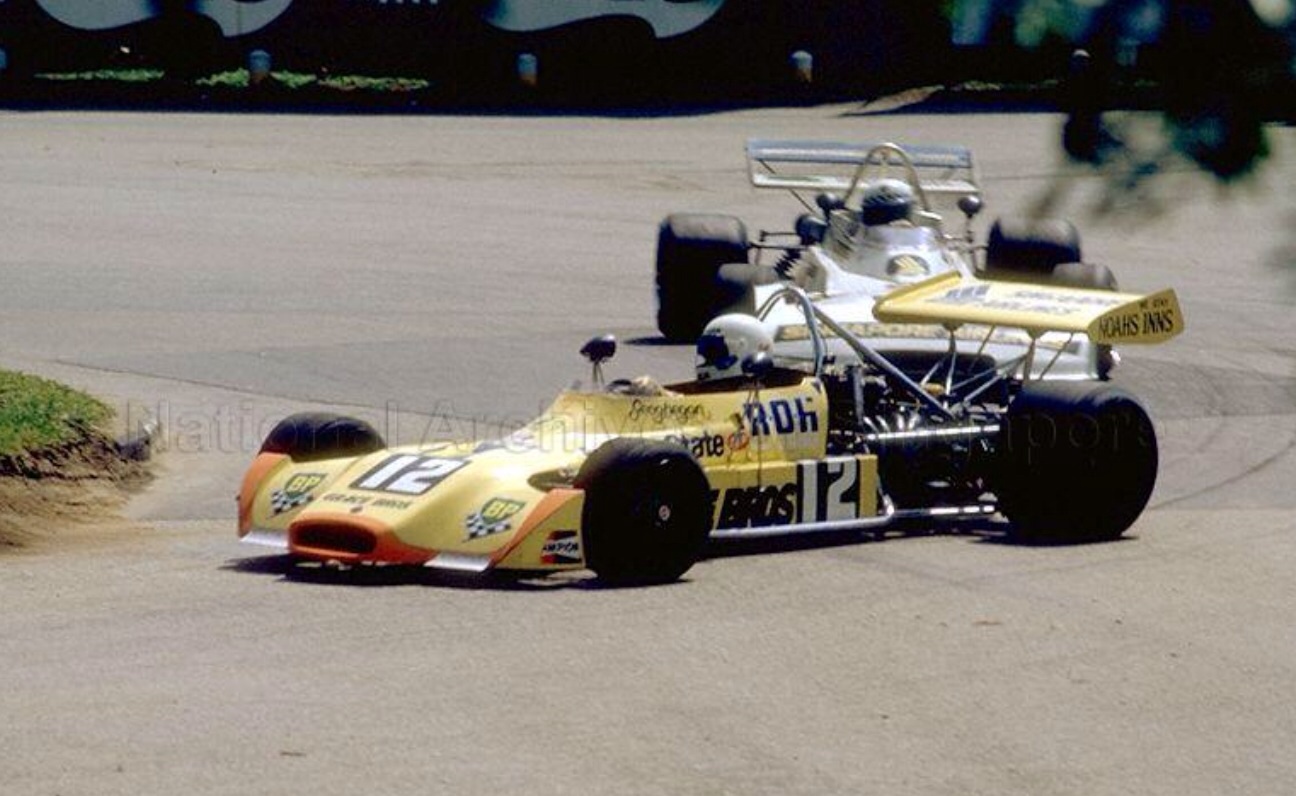
Geoghegan ahead of Lawrence in their great dice early in the race (NAS)
At the same time, Schuppan showered Ramsay’s 273 with rocks when he ran wide on a fast corner. One rock punctured the fuel tank, Ramsay’s car trailed flames for a couple of laps and then stopped. Another report of this incident had it; ‘Malcolm soldiered on until the pain of the petrol burning his balls forced him to retire.’ So, Ramsay’s retirement was due to either a burning car or burning balls!
And while Geoghegan was heading for the pits, Lawrence’s Surtees lost the use of its mechanical fuel pump, and whether this slowed him as he switched on the electric one or it meant the engine lost power, the net result was that Schuppan’s March swept into the lead.
Geoghegan’s return saw the lap record (Bartlett’s from 1970’s preliminary race) under threat as he carved his way through the backmarkers trying to regain as much of the two laps he lost as possible. He had to pit again later, but the record was his and he completed 41 laps for ninth place. Leo was razor sharp, his Birrana beautifully set-up given the intensity of the competition at home.

Kiwi star Ken Smith, in his youth. In his 70’s he is still a formidable F5000 pedaller! March 722 Ford, note the differences in his standard spec body and Schuppan’s modified 722 (NAS)
Rajah’s March was out at 25 laps with the battery dragging behind the car and Smith, March, struck problems to lose contact with the Stewarts, big Max passing young Tony as this happened for fourth. Tony Stewart, now there is a lost talent! If memory serves he raced a Birrana 273 for a while before leaving the sport and later making his fortune in ‘Car City’ on Ringwood’s Maroondah Highway in Melbourne’s outer east.
Both leaders had problems. Schuppan’s airbox was falling off, but that wasn’t as bad as the battery losing charge in Lawrence’s car and causing his engine to run roughly. The race ran out like this.
Results (50 laps – 150 miles)
1. Singapore Airlines: Vern Schuppan (March Hart 722) 1h 38:58.3 (1:56.8)
2. Singapore Airlines: Graeme Lawrence (Surtees TS15) 1h 39:36.8
3. Cathay Pacific Air: John Macdonald (Brabham BT40 Hart) 49 laps
4. Singapore Airlines: Max Stewart (Rennmax England t/c) 49 laps
5. Paul England Engineering: Tony Stewart (Dolphin England t/c) 49 laps
6. Air New Zealand: Ken Smith (March 722 Hart) 47 laps
7. Team Rothmans: Jan Bussell (Palliser BRM t/c) 47 laps
8. Air New Zealand: Steve Millen (Elden Mk 8) 43 laps
9. Grace Bros Race Team: Leo Geoghegan (Birrana 273 Hart t/c) 41 laps
10. Camel Melinda: Harvey Simon (Elfin 600B) 40 laps
Fastest lap and new outright record: Geoghegan, 1:54.9.

A gaggle of cars in the ’72 GP passes a group of flaggies doing their best to say out of the tropical heat, car at the rear perhaps Leo Geoghegan’s Brabham (NAS)
The demise of racing in Singapore was somewhat sudden given the level of publicity and government backing the race received. The social and economic issues (the oil shock and terrifyingly rapid infrastructure growth) that the country was facing may have contributed to this.
The government claimed that the GP promoted dangerous driving in its citizens, these were the very successful times of the ‘paternalistic democratically elected despot’ Prime Minister Lee Kuan Yew. The government acknowledged it would be impossible to implement adequate safety measures for the Thomson Road circuit. Although a permanent track was proposed which included an all-sports complex, this never materialised.
Over time the view of the government eased with the Malaysian GP at Sepang growing in stature, the ban on motor racing was reconsidered and dropped in 2005.
The Macau Grand Prix, of course, thrived through this period, but after 13 years 1973 was the end for Singapore’s big race’, until the F1 era of course, a story for another time.
Etcetera…

Field before the start of the 1971 bike GP, help welcome on competitors/bikes. What a wild, fast, narrow place! (NAS)

Kiwi, Geoff Perry winning the bike GP on a Suzuki 500 (NAS)

’73 Touring car race, help with cars/drivers welcome! (NAS)
Bibliography…
Eli Solomon Singapore GP article in MotorSport March 2006, Peter Collins race report published in ‘Racing Car News’, oldracingcars.com
Photo and Other Credits…
A very big thanks to Peter Brennan and Bruce Allison for their recollections
National Archive of Singapore, Bruce Allison Collection, oldracephotos.com, Alan Cox, Rewind Magazine, MCI, Choong H Fong, Robert Davies, Paul King Collection
Tailpiece: Kiwi Geoff Perry hustles his Suzuki 500 thru ‘The Snakes’ on the way to ’72 GP victory, the exciting perils of 50 Thomson Circuit laps evident…

(NAS)


























 primotipo...