
Uniroyal 1970 ad featuring a rather nice Renault Alpine A110 (Automobile Year 18)…
 | peterfinlay07 on Top Shot: Rileys at Gnoo … |
 | markbisset on Top Shot: Rileys at Gnoo … |
 | grahamedney on Top Shot: Rileys at Gnoo … |
 | Wayne Giles on Top Shot: Rileys at Gnoo … |
Uniroyal 1970 ad featuring a rather nice Renault Alpine A110 (Automobile Year 18)…

There are no details as to identification of these blokes in this magnificent period shot. You can feel the atmosphere of the day. Reg Nutt, perhaps at left, contributions from Australian enthusiasts welcome as to identities! (Dacre Stubbs)
A couple of Jack Day’s helpers fettle his Talbot Darracq 700 chassis #3 in the wide open parklands of Albert Park during practice for the 19-21 November, 1953 Australian Grand Prix…
The highly sophisticated 1.5 litre straight-8 1926/7 GP car was raced for him by Reg Nutt, like Day an ‘old stager’ whose racing pedigree extended back to the early days at Phillip Island where the first AGP’s were held in the 1920’s.
Nutt was the riding mechanic for Carl Junker’s successful 1931 Bugatti T39 win.
Day imported the car after its European career was well over in 1949. The racer was also outclassed in Australia by then although ‘a relation’, the Talbot Lago T26C of Doug Whiteford won this 1953 race, Whiteford took the third and last of his AGP wins.

AGP ’53 front row #3 Lex Davison’s HWM Jag DNF, #2 Stan Jones Maybach DNF and Doug Whiteford’s winning Talbot Lago T26C at right, #11 is Ted Gray’s Alta Ford V8 (Dacre Stubbs)
Nutt retired the car on lap 14 of the 200 mile, 64 lap event, the first race meeting at Albert Park. Depending upon the race report the car either dropped a valve or threw a rod or both perhaps! Second to Whiteford was Curley Brydon’s MG TC Spl and third Andy Brown’s MG K3, both cars illustrate the potential of the TD to finish further up the field that day had it run reliably.
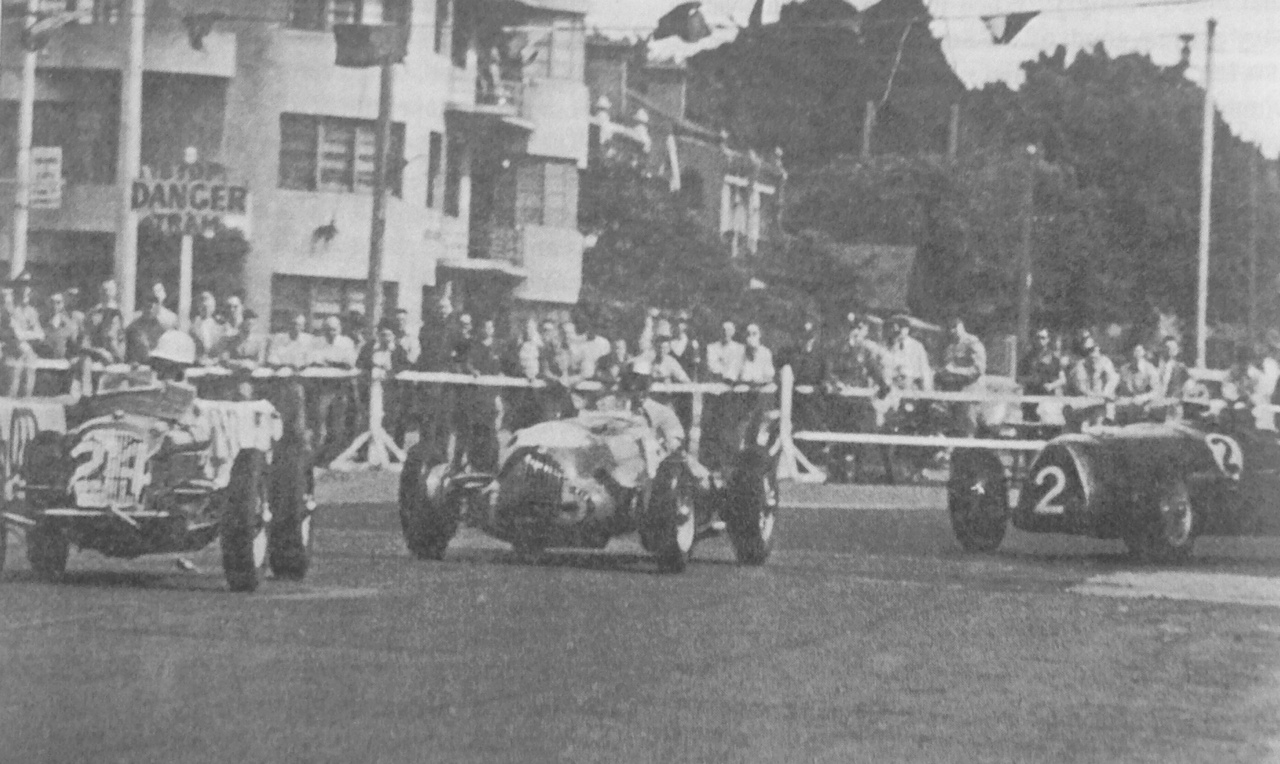
AGP ’53. Stan Jones # 2 Maybach DNF about to gobble up Bill Wilcox’ Ford Spl DNF and #24 Nutt in the TD (Arnold Terdich)
There were plenty of handicap events in Australia at the time so the car was still a racer which could provide a great spectacle for spectators but the car was not raced extensively and then the complex engine was mortally damaged, the car effectively not seeing the light of day until 1988. Its superb restoration then took a further 20 years! This is the story of that car.
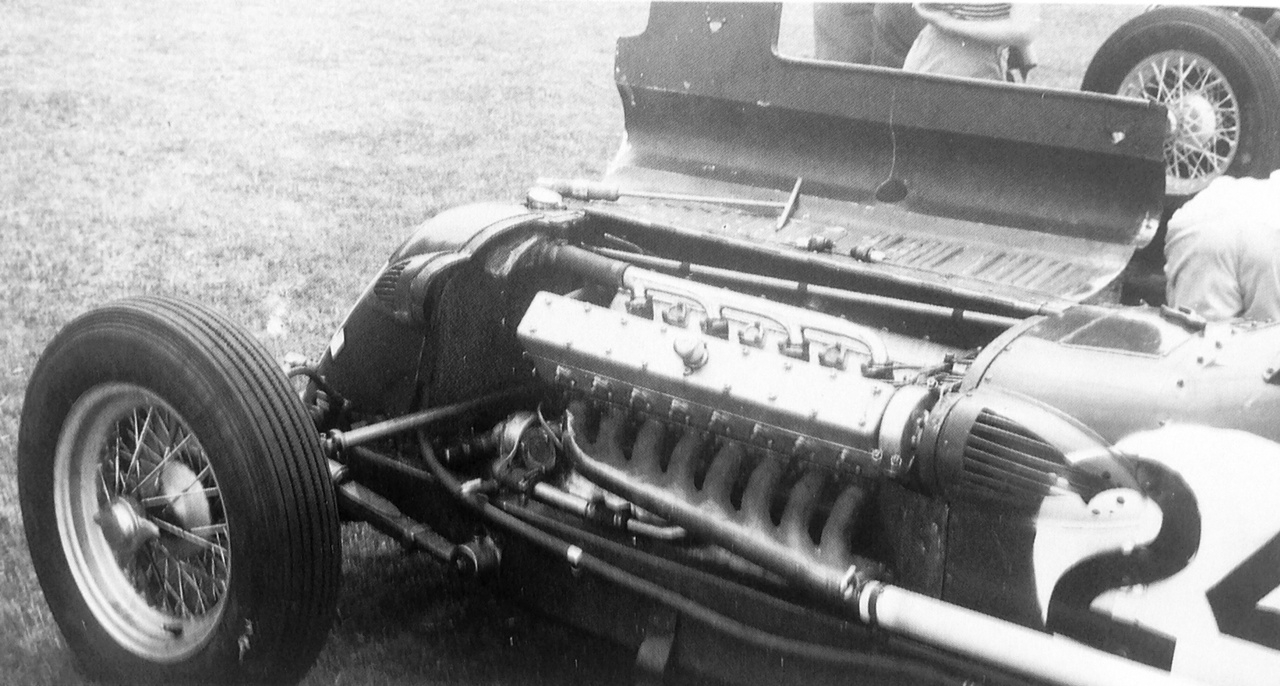
TD #3 in the ’53 Albert Park paddock, specifications as per text (Arnold Terdich)
Current custodian Noel Cunningham, below, at Rob Roy Hillclimb, in outer Melbourne’s Christmas Hills in 2015, thankfully the car is still in Australia.

VSCC Rob Roy Hillclimb 2015, Noel Cunningham in TD 700 #3 (Stephen Dalton)
Sunbeam-Talbot-Darracq-‘STD’…
I must admit to being confused by the relationships between these companies before embarking on this article. The corporate story is this; in 1919 British marques Sunbeam and Talbot merged, in 1920 they in turn merged with French company, Darracq, based in the Paris suburb of Suresnes.
The engineering genius from whose guidance some fantastic cars emanated was Louis Coatalen, a Frenchman who emigrated to Britain in 1901, joining Sunbeam in 1907. He worked on both automotive and aviation engines contributing enormously to Sunbeam’s success, the merger with Darracq allowed his return to France.
The very successful series of racing cars which followed comprise various cars, my confusion arising from their ‘badging’. The 1921 3 litre Sunbeams raced as both Sunbeams and Darracq’s. In 1922 2 litre DOHC 6 cylinder cars were built to the prevailing GP formula, these Fiat 404 clones were referred to as ‘Fiats in green paint’ in period! The Fiat 804 cars won the 1922 French GP and, supercharged, won again in 1923 badged as Sunbeams. The 1923 4 cylinder 1.5 litre TD voiturettes preceded the TD 700 design for the new 1.5 litre GP formula for 1926-8.
The latter category provided for cars of 1500cc supercharged with a minimum weight limit of 600Kg, and then 700Kg dry from 1927. Riding mechanics were barred but a mechanics seat was mandatory, the minimum cockpit width was 80cm.
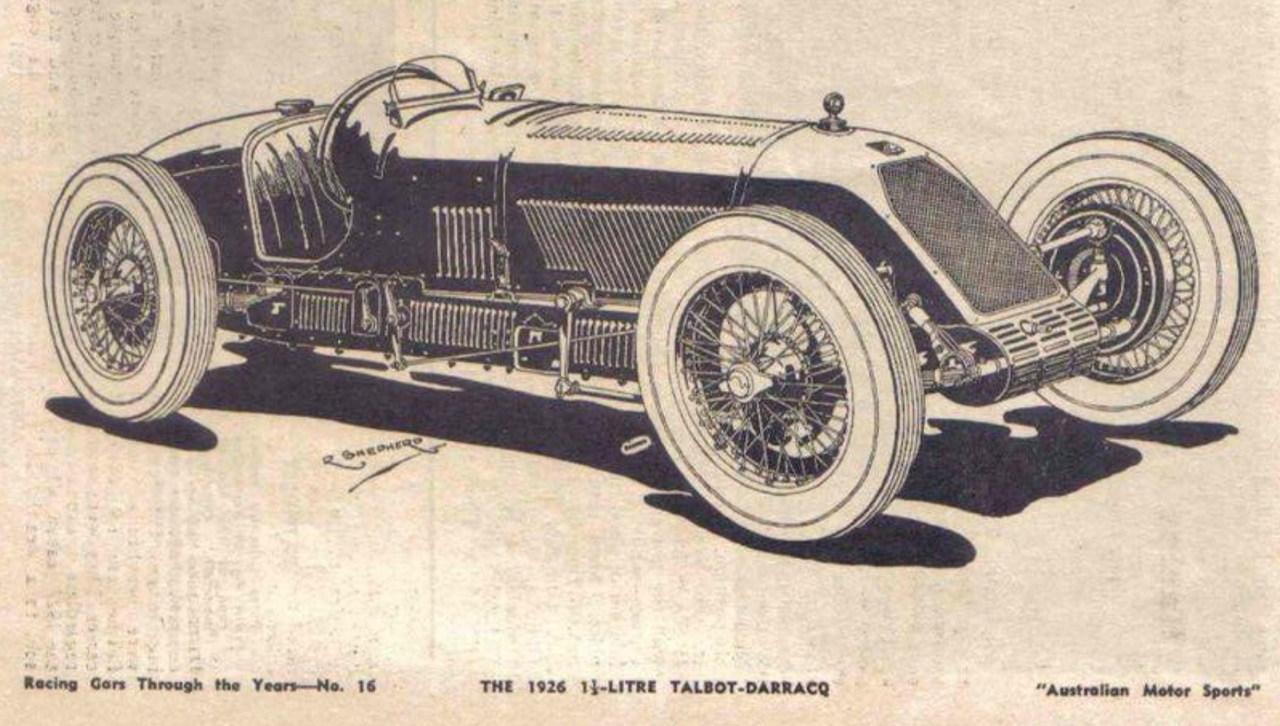
AMS’ Bob Shepherd did some wonderful drawings of cars he wrote about over the years, hard to get the ‘repro’ spot on tho! TD 700 (Bob Shepherd)
The Talbot-Darracq 700 is one of the most advanced Grand Prix designs of the early ‘tween-wars period.
Designed by two ex-Fiat engineers who left Italy for political reasons, fascism on the rise, to say the least at the time, Vincenzo Bertarione and Walter Becchia left the country and joined the TD Suresnes factory in 1922.
Of the relationship between the Fiat and TD designs Leonard Setright observed; ‘Both (the Delage and Talbot)…could be said to cling to the fashion originally dictated by Fiat some years earlier, the most significant change being the exploitation of the mechanics absence…In the case of the Talbot…it had been designed by Bertarione, who had now been joined by Becchia, another member of the original Fiat design team. The cars were produced at the Talbot works in Suresnes in Paris, but for Bertarione this was no more than an internal posting within the STD combine.’
The TD 700’s conceptual design approach was that of an offset single-seater, ultra low-slung, using a form of fabricated deep-section ladder-frame chassis, powered by an advanced straight-eight, supercharged engine.
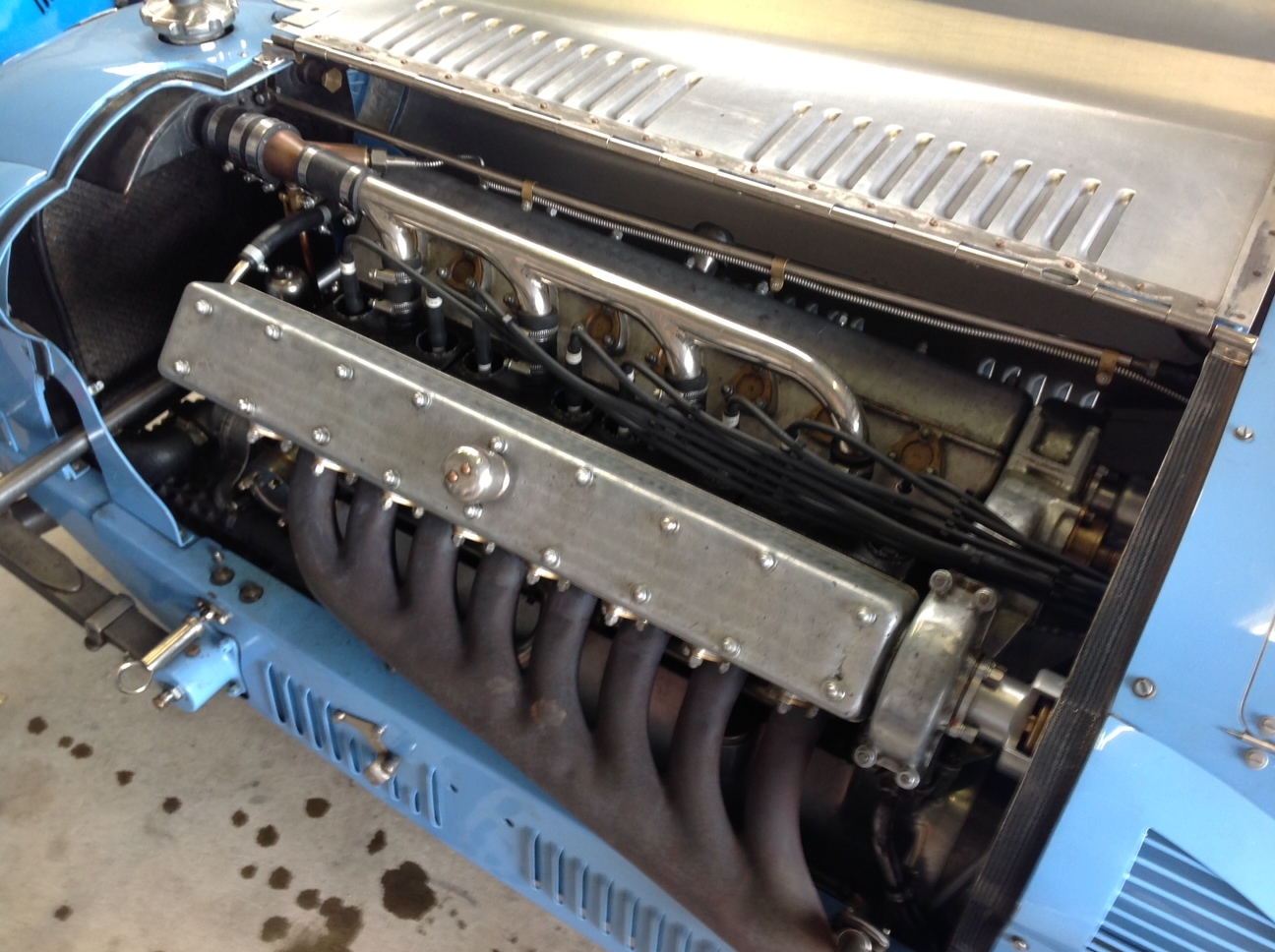
Exhaust side of the beautiful straight 8. 2 valves per cylinder set at 90 degrees to the centre line operated by fingers via DOHC. Each cam ran in 5 roller bearings and was driven by gears from the rear of the crank. Valve clearances adjustment was via thimbles, each valve had 3 springs, ports are rectangular in shape. 2 magnetos were driven by the centre gear of the cam train, each one fired 4 cylinders. The contact breakers protruded into the cockpit Bugatti style (Bisset)
The engine reflected previous STD experience incorporating gear-driven DOHC operating two valves per cylinder, a Roots-type supercharger and roller-bearing crankshaft. The 1485cc engine produced circa 145-160 bhp at a then very high 7,000 rpm. To minimise internal friction loss the engine had many intricate roller-bearings.
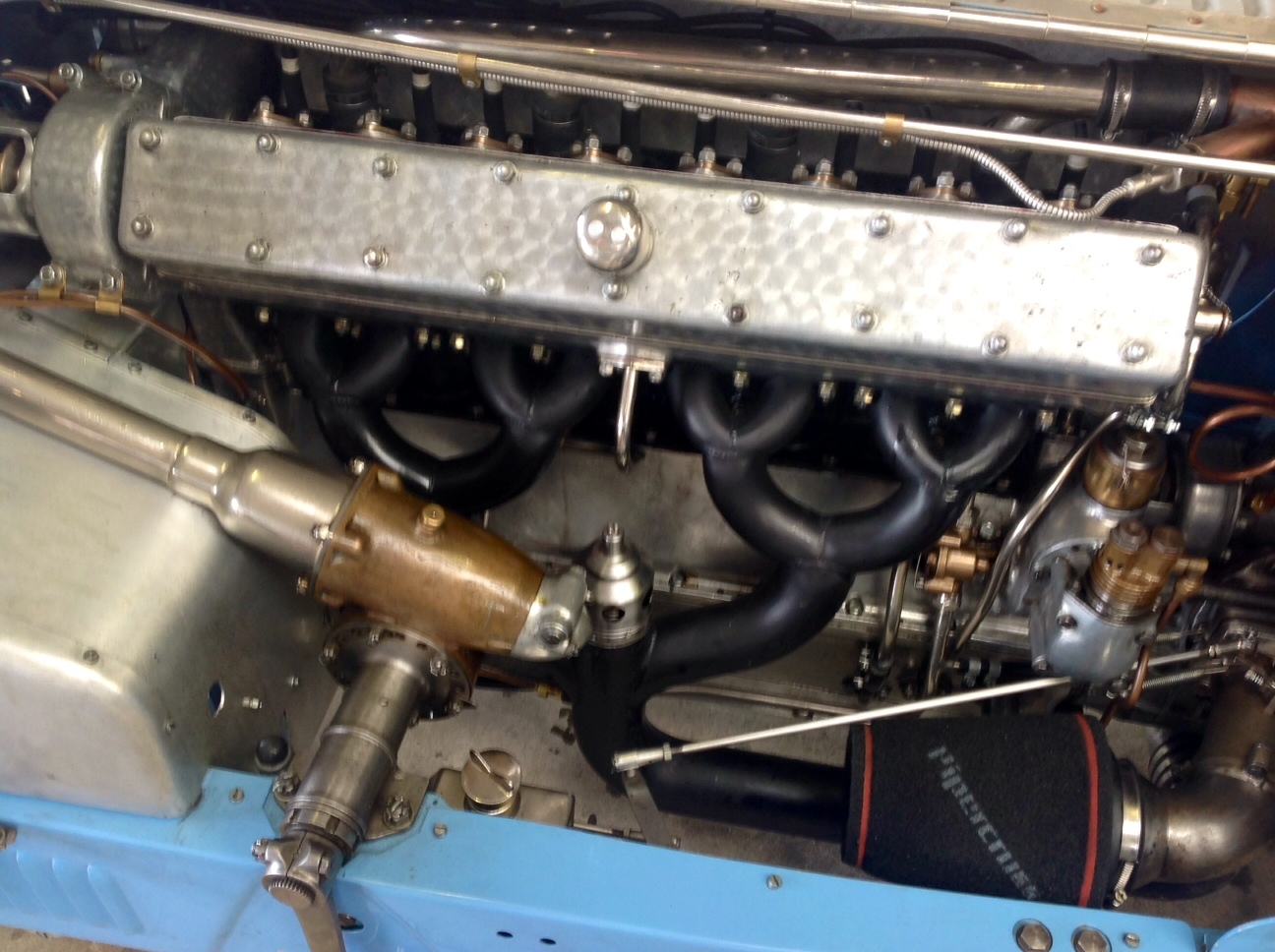
Engine induction side. Steering box and drop link in shot. Note relief valve, modern air cleaner to carb which is bolted directly to the Roots type supercharger, driven thru a laminated spring coupling, carb standard choke 49mm. Comp ratio 6.5:1, later 7:1, power 140 and later 145bhp @ 6500 rpm. The water pump and plunger pump for for fuel air pressure was also driven by the front gear train. Lubrication by dry sump with pressure and scavenge pumps, 4 gallon oil tank under the cockpit (Bisset)
The chassis took advantage of the new no riding mechanics rule; the entire engine/transmission line was offset across to the left of the chassis’ longitudinal centreline, the first car to do so. This placed the engine and prop shaft slightly left of centre. Drive passed through a double-reduction final drive permitting a low driving position. The pilots seat cushion rested on the chassis underpan.

Shot clearly shows the offset driveline as per text and 4 speed ‘box (Bisset)
The front axle was formed from two tapering tubular halves, abutting centrally in flanges which were bolted together, the semi-elliptic suspension leaf-springs passed through forged eyes. The rear semi-elliptic springs were underslung.

Semi elliptic springs, friction shocks, front axle tubular made in 2 sections joined in the centre by flanges and a ring of bolts, axle of hollow vee shape (Bisset)
The nose-mounted radiator was raked steeply back, and the finished car’s clean, flat-sided bodywork tapered inwards to a neat tail. It was one of the lowest and most striking-looking front-engined Grand Prix cars ever built.

TD #3 at Phillip Island, as are all these detail shots, March 2016 (Bisset)
Setright, in his eloquent prose said; ‘As for the car, it was an immediate descendant of the immensely successful 1 1/2 litre voiturette with which Talbot had campaigned in the subordinate class during the immediate preceding years, a car in which Bertarione had continued to redefine the work that he had begun so much earlier in Turin and continued in Wolverhampton. The bore/stroke ratio had dropped somewhat to 1.35 in the quest for higher crankshaft rates, contributing to an output of about 145bhp at 6500rpm with a further 500rpm safely available beyond’.
‘The chassis of the Talbot was altogether more refreshing, its pressed side members being agreeably slender but impressively deep at mid-wheelbase, tapering to the front and rear in recognition of those beam-building properties that Bugatti had already endorsed in his type 35 chassis. Indeed the same principles had been applied to the beam front axle, which displayed a progressive reduction in diameter away from its centre. The whole car was quite meritorious, but it was doomed to enjoy but little success due to the chill penury of STD suppressing what might have been a noble rage’ (!) More of the ‘chill penury’ later!
A more detailed analysis of the cars engine and chassis published in veloce.com, developed together with Stuart Anderson, then owner and restorer of TD 700 #3, the subject of this piece, is at the end the article.

Segrave prior to the start of the 1926 Brooklands JCC 200 Mile race which he won. Note the branding of the TD 700 in England, cars painted green for their UK events some reports say. Nice close-up shot of the cars body in its original form (unattributed)
The TD 700’s made their delayed racing debut in the 1926 English Grand Prix at Brooklands on August 7.
The cars did not start the first 3 Grands Prix of the year but Albert Divo and Henry Segrave led the British race from Robert Benoist’s straight-eight Delage 155B. Divo pitted the leading Talbot after 7 laps with an engine misfire, the ‘plugs were changed. Segrave led Benoist’s Delage until a pit stop for fresh rear tyres. Divo and Segrave demonstrated the new Talbots’ impressive speed, Segrave took the fastest lap, but brake and ignition problems sidelined the new, underdeveloped cars.
On 7 September at the Arpajon Records Day Divo set new records in the International 1500cc class for the Flying Kilometre and Flying Mile.
At the Brooklands JCC 200 Miles on 25 September Segrave and Divo drove to a convincing a 1-2 victory, but the dominant supercharged straight-eight Delages were not present, so it was somewhat of a hollow victory.
On October 17 the Talbot Darracqs were 1st-3rd, Divo, Segrave and Moriceau in the Grand Prix du Salon at Montlhéry, France.
The AICR manufacturers championship was won by Bugatti, the championship Grands’ Prix won by the Bugatti T39A (French, GP d’Europe, Italian) the Delage 155B (RAC British GP) and a Miller at Indianapolis.
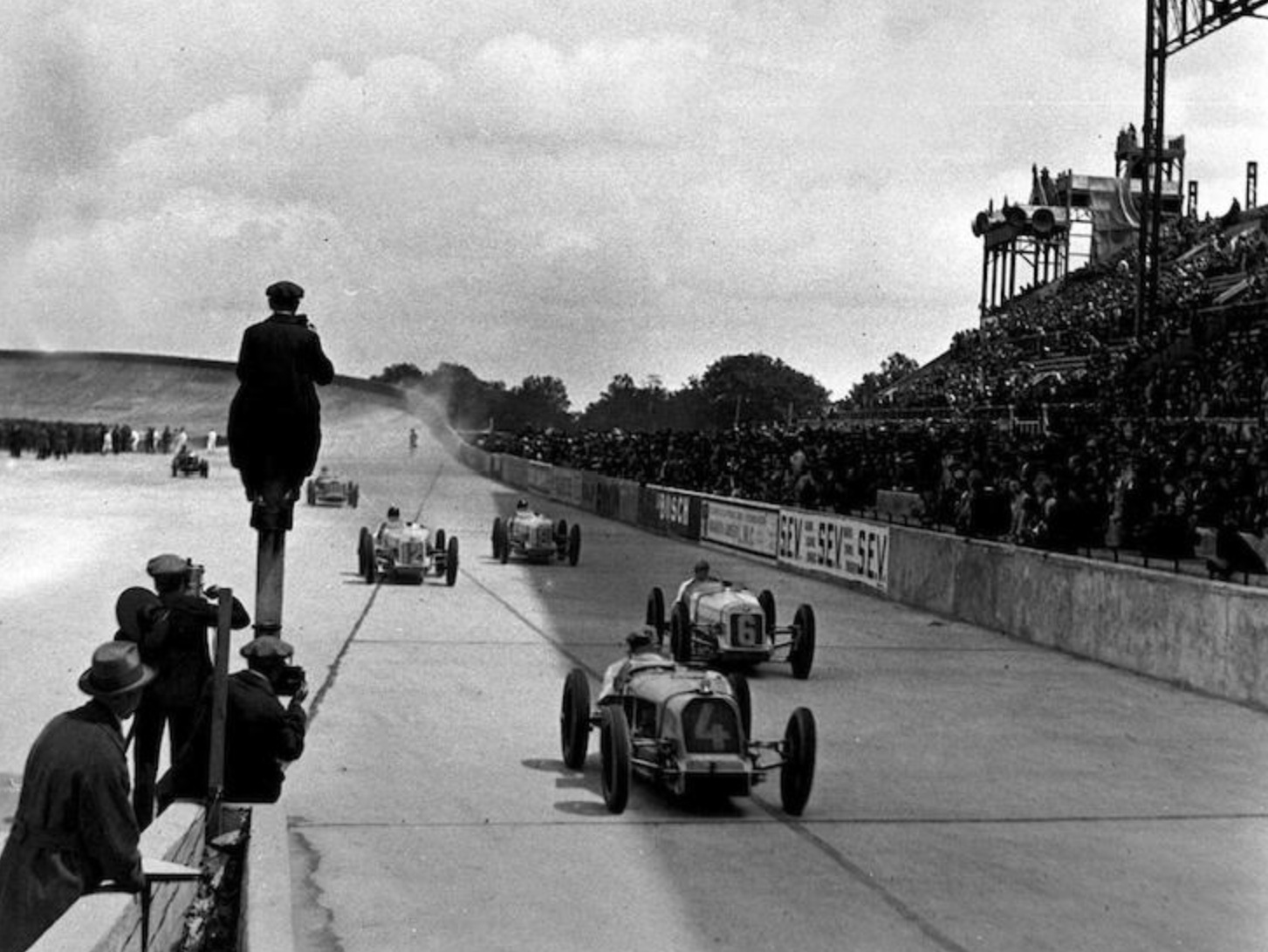
Divo TD 700 from the #6 Dubonnet Bugatti T35C, ( it doesn’t look remotely like a Bugatti, some help here would be good!), #12 Williams Sunbeam Course de Formula Libre 2 July 1927, Montlhery (unattributed)
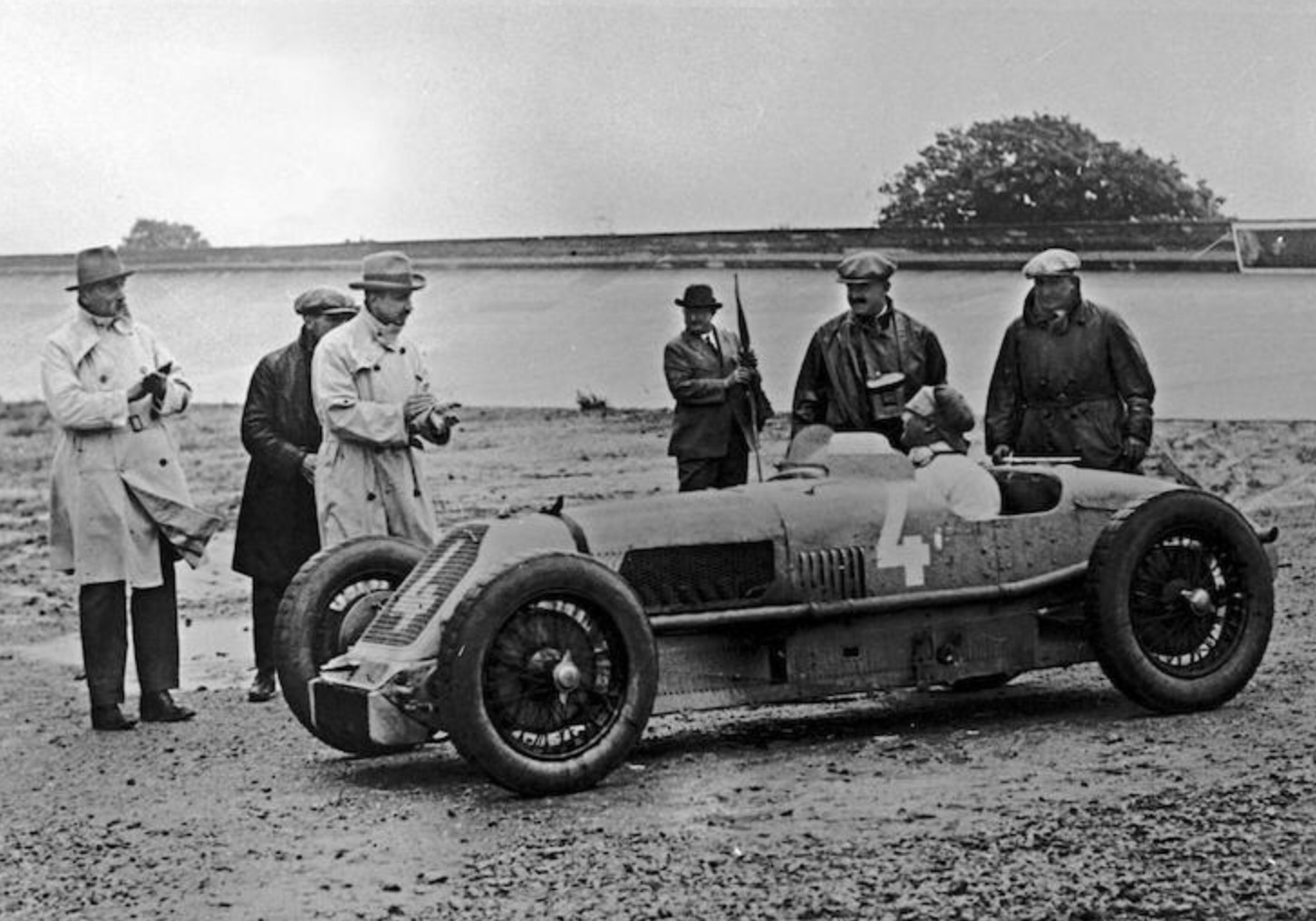
Albert Divo, TD 700 Montlhery 2 July 1927 (unattributed)
For 1927 Bertarione and Becchia improved their design; they transferred the oil cooler to the front of the car mounting it beneath the radiator. Large wire mesh openings were substituted for bonnet louvres and the front spring shackles were moved to the front ends of the springs. 1927 cars also had wider frames. In essence though the cars still lacked ‘race development’.
The first race entered was the GP de Provence at Miramas on 27 March where Moriceau and Williams were 1/2 in their heat but the cars were withdrawn from the final after a dispute, the subject of which is not disclosed.
The race program for the Suresnes concern was savaged as the group was in great financial trouble. One car shared by Williams/Moriceau was 4th in the French Grand Prix at Montlhéry on 3 July, the race won by Benoist’s Delage 155B while Divo won the Formule Libre supporting event on 2 July.
Delage won the 1927 AICR Manufacturers championship with Benioist’s 155B dominant, winning the French, Spanish, Italian and British GP’s. Duesenberg won at Indy, the other championship round.
Divo set a new record for the flying mile on 4 September during the Arpajon Records Day but after that the STD board closed its racing program, the 3 700’s were sold to Italian privateer Emilio Materassi.
Emilio offered his services to Bugatti as driver/team manager, after Ettore declined he created his own team, ‘Scuderia Materassi’. The straight-8 Talbots were delivered to Materassi’s workshop and modified.
The team made its ‘Talbot debut’ in the 1928 Tripoli Grand Prix at Mellaha, Libya, at that time an Italian colonial province. Materassi’s cars were disqualified after a protest over car weights by Nuvolari who then won the race.
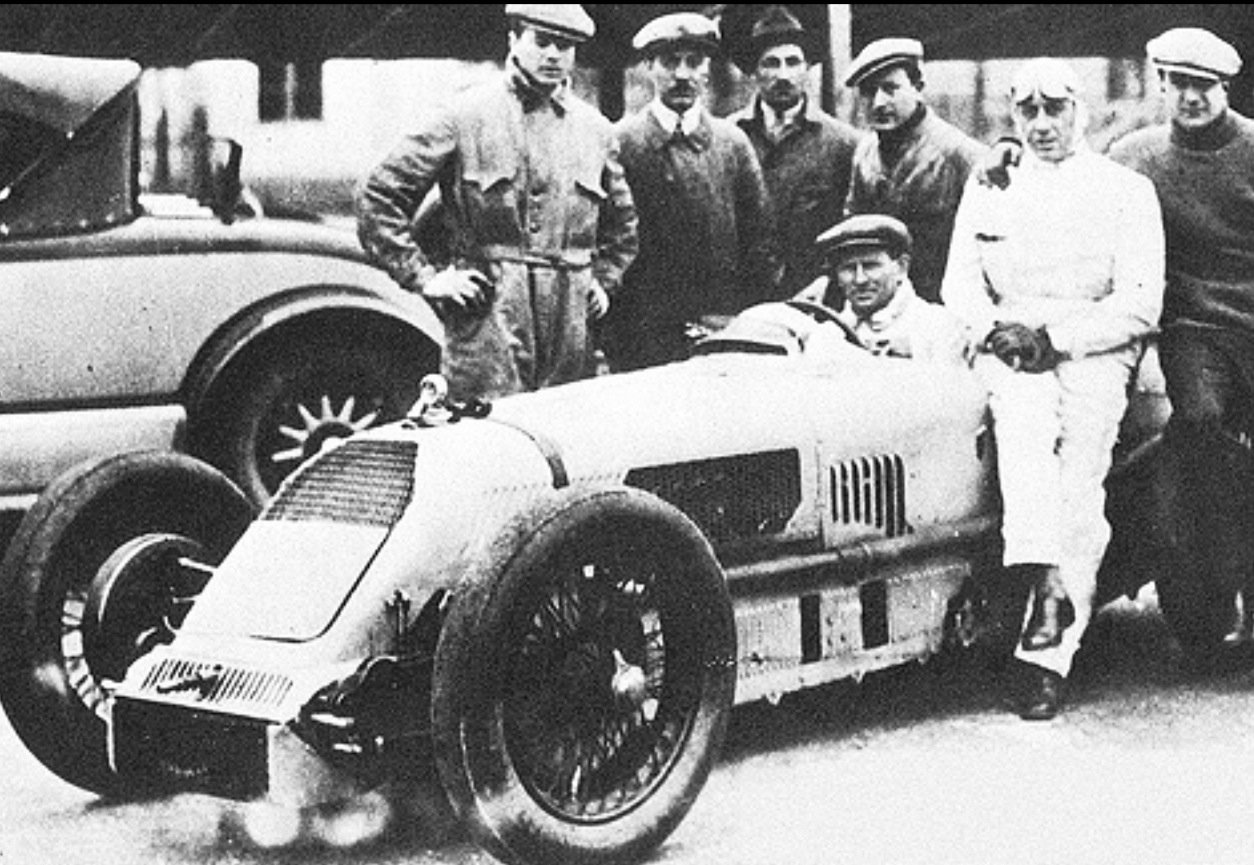
Materassi, TD700 and team, date and place unknown (unattributed)
Back in Italy Materassi contested the Circuito di Alessandria on 23 April. Emilio was 4th, Nuvolari won again. Driving one of the modified Talbots, Luigi Arcangeli won the Circuito di Cremona, with Materassi 3rd.
Emilio Materassi won his local Circuito del Mugello event for the third time on 3 June.
Emilio was 3rd behind Chirons and Brilli-Peri’s Bugatti T35C’s on the 10 June Premio Reale di Roma at the Circuito Tre Fontana, Arcangeli won the Circuito di Cremona on 24 June from Nuvolari’s Bug T35C, Materassi was 3rd.
In the Coppa Acerbo on 4 August at Pescara, Materassi retired. Team mate Arcangeli received facial injuries from a flying stone, Materassi replaced him, eventually finishing 2nd behind winner Campari’s Alfa Romeo P2.
Materassi took a Circuito del Montenero win at Livorno. He beat Nuvolari (Bugatti T35C) and Giuseppe Campari (Alfa Romeo 6C1500).
Then on to the terrible Italian Grand Prix at Monza on 9 September 1928.
Materassi started from grid 3 but was forced to make two early pit stops. Whilst trying to regain lost time that he crashed, killing himself and 23 spectators on lap 17.
The car slid to the left in a straight line, just after ‘the Parabolica’ when he tried to overtake Giulio Foresti’s Bugatti T35C, after this sharp change of direction the Talbot crossed the track, went through the fence and into the crowd. The cause, perhaps mechanical failure, has never been determined. The other team cars of Arcangeli, Brilli-Peri and Comotti were withdrawn.
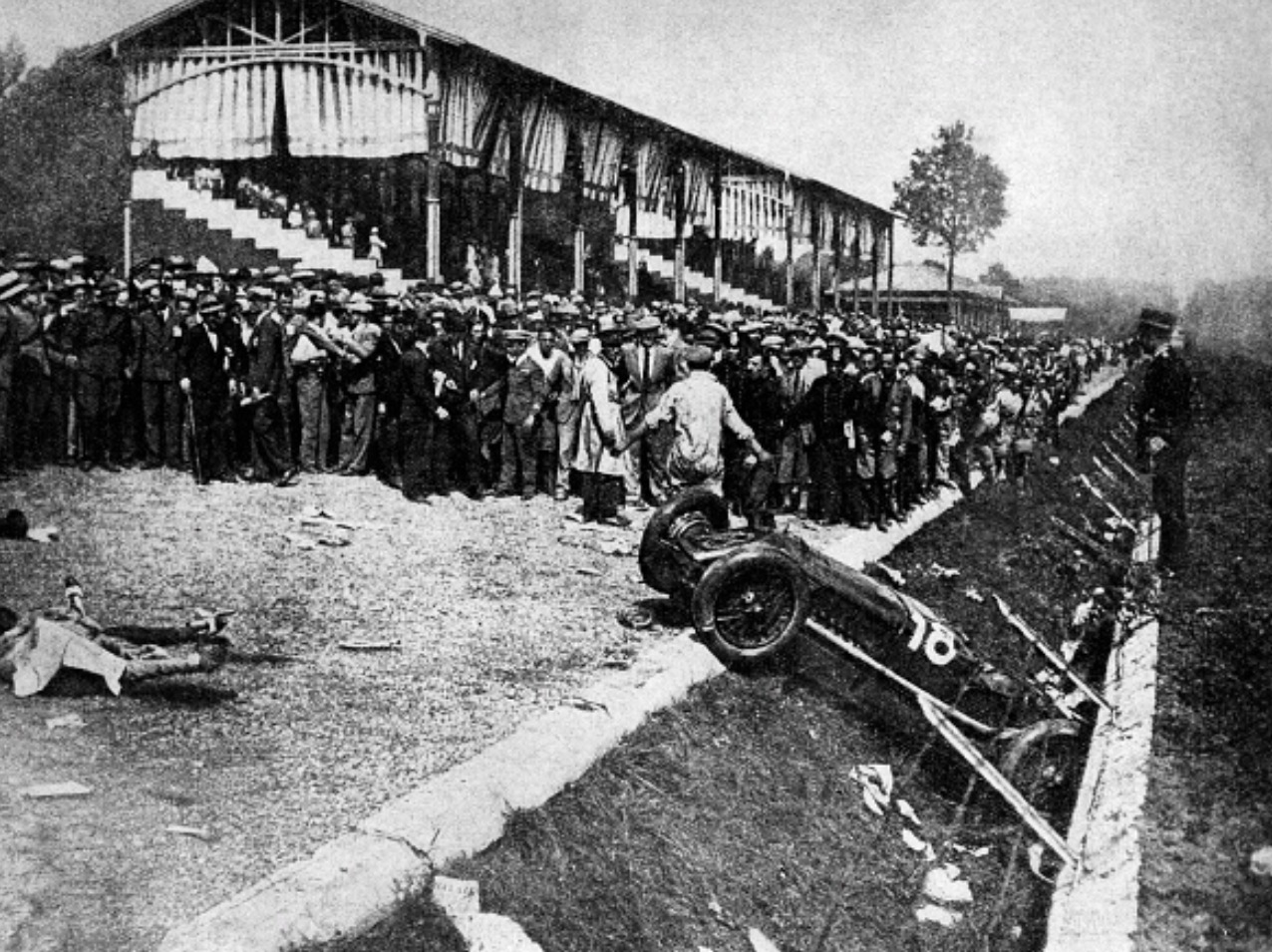
Aftermath of the Materassi Monza accident (Ullstein bild)
Materassi’s surviving team members continued to race the cars in 1929.
Brilli-Peri won the Tripoli GP in March, and Circuit di Mugello in June. In April Arcangeli and Brilli-Peri entered the Circuito di Alessandria, Gastone was 13th.
On 26 May Arcangeli won the 1500cc class and was 4th outright in the Premio Reale di Roma. Brilli-Peri won the Circuito di Mugello on 9 June from Morandi’s OM 665. Arcangeli was 4th in the Coppa Ciano at the Montenero on 21 July.
At the Monza GP on 15th September, Tazio Nuvolari’s TD 700 was 2nd in his heat behind Arcangeli in a sister car and 2nd again in the final, this time behind Varzi’s Alfa P2. A fortnight later on 29 September Arcangeli was 4th at the Circuit de Cremona, Brilli-Peri won in an Alfa P2.

Clemente Biondetti in his Scuderia Materassi TD 700 ahead of Louis Chiron’s 2nd placed Bugatti T35C in the 6 April Monaco 1930 GP. Dreyfus won in another T35C, Biondetti DNF with undisclosed mechanical dramas on lap 13 (unattributed)
The cars raced on into 1930, when Count Gastone Brilli-Peri, who led the team, crashed fatally during practice of the Tripoli Grand Prix on 23 March. Teammate Clemente Biondetti won the 1500cc Voiturette class heat and was 3rd in the final.
On April 6 Biondetti failed to finish the Monaco GP on 6 April. Biondetti was 4th in the Premio Reale di Roma at Tre Fontana on 25 May, the race won by Arcangeli’s Maserati 8C2500.
At the Coppa Acerbo, Pescara on 17 August Brivio was 4th with Biondetti DNF. At Monza for the GP di Monza on 7 September Biondetti was 5th in his heat, both he and Brivio failed to qualify for the final.
In October 1930 the cars were sold to Milanese engineer/owner-driver Enrico Platé.
Plate raced them in further modified form and from 1931 re-assembled two of them, probably the two crashed Monza/Tripoli cars, around entirely redesigned, stiffer frames made by Meroni SA of Turin.
The Meroni chassis were slightly narrower, but picked up the unchanged Talbot engines, transmission and drivelines. Platé also converted the braking system, the mechanical Perrot system replaced by an early version of Lockheed-Wagner hydraulic brakes. An early Weber carburettor was also incorporated.
Enrico ran the cars mainly in Italian domestic events, drivers included Ermini, Pratesi and Vismara racing in Voiturette events.
In 1936 Platé sold the two Meroni chassis cars. One went to Dr ‘Mario’ Massacurati’s Eagle racing team, the other, chassis # 3 to British amateur gentleman-driver, Antony Powys-Lybbe.

Powys-Lybbe at Brooklands, date unknown (unattributed)
Dick Seaman’s 9 year old straight-eight Delage, the TD’s foe in 1926/7 dominated Voiturette racing during 1936. Powys-Lybbe was advised by Brooklands preparation specialists Thomson & Taylor that the Talbot Darracq 700 being sold by Platé could be as competitive as Seaman’s amazing, modified Delage.
The car wasn’t delivered to Harwich until February 1937 after bureaucratic banking and customs issues. Powys-Lybbe, who spent half the cost of the car again on customs duties decided he wanted to spend little more on it, instructing Thomson & Taylor just to ‘get it going’. The complex car needed much greater attention than this and with wrong plugs, wrong fuel and wrong timing he had little success with it.

TD 700 being fettled, probably in Thomson and Taylors workshop, Brooklands 1 March 1938 (Fox Photos)
He drove it in a few Brooklands events, raced it at Cork, Ireland, then sold it on the basis that as an army reserve officer he was likely to be called up, World War 2 was imminent.
Graham Radford bought it and retained it throughout the war. Postwar he drove it several times, at Shelsley Walsh and Gransden Lodge in 1947 and Luton Hoo in 1948 before selling it to Jack Day, on a trip to the UK to buy a car for Australian events.
By that time the successful veteran had sold his ‘Day Special’, a Bugatti T39 with a Ford V8 engine and gearbox, he wanted a car in which he could have some fun, and in more serious events enter it for other drivers.

Jack Day settles the TD 700 into its new home in suburban Melbourne, May 1949 (Blanden Collection)
Day’s Talbot arrived in Melbourne, Victoria, in May 1949 following considerable pre-publicity. Over the next five years it ran in all kinds of events, initially with some success. towed on a trailer behind his Phantom I Rolls-Royce!


The TD’s first Australian event was at Fishermans Bend, Melbourne as above, the weekend a scorcher somewhat akin to the 1948 AGP meeting at nearby Point Cook according to the AMS meeting report. The car was driven by Cec Warren to 2nd in the under 1500cc scratch race. 1st and 3rd were the Bill Patterson and Lex Davison supercharged MG TC Spls. Stan Jones was 4th in his HRG 1500. All three were later Australian Gold Star champions.
Of the TD AMS said ; Jack Day’s TD looked and sounded grand, finishing 2nd in the Under 1500 scratch. Warren started to have axle tramp as he braked for corners, it caused a handbrake cable to foul a spring shackle and lock one brake partly on’
AMS mischievously mused ‘it is interesting, but unprofitable to note how the Ken Wylie Austin A40 Spl s/c and Patterson’s TC would have fared in 1926 1 1/2 litre GP racing’.
Cec Warren drove it to a Balcombe, on Melbourne’s Mornington Peninsula, heat win on 12 June 1950, the meeting held on the Kings Birthday weekend. In November Warren again drove it in the 2 day meeting at Ballarat finishing 6th in the ‘A Grade’ 6 lapper on the Saturday.
At Bathurst in October 1951 it was timed at 113.20mph over the ‘Flying Quarter’ and a month later was 9th in the Victorian Trophy at Ballarat’s airfield circuit.
In 1952 Reg Nutt raced the car at Fishermans Bend at the LCCA/Harley Club meeting.
In a lead up to the 1953 Australian Grand Prix Nutt raced it at Fishermans Bend again on October 3. Clearly the engine would have required a major rebuild if it threw a rod at the Albert Park, AGP meeting, damage less severe depending upon the havoc caused if it dropped a valve.
Blanden records ‘Day tried to replace the roller big end bearings with white metal however at a Phillip Island event in the early 1960’s when driven by Des O’Brien it threw a rod in a vintage event’.
Day then rebuilt the engine to roller bearing spec and discarded the original 4 speed manual ‘box, replacing it with an ENV pre-selector transmission which because of its small size was completely inadequate. The gearbox change was made shortly before he died.
TD 700 #3 then passed to Evelyn Porter, Days partner, the car was stored at one of Jack’s properties at Mount Martha, beachside, on the Mornington Peninsula. The car slumbered for some 20 years forgotten by most, Porter rejected all offers to sell until it Stuart Anderson bought it in 1988.

TD 700 #3 as repatriated from the Mt Martha garage of Day’s partner in 1988, it looks pretty good in all the circumstances. Tricolour, badge at top of rad is ‘Light Car Club of Australia’ (Anderson)
He first saw the car as a teenager on its arrival in Australia in 1949. In an oh-so-familiar pattern the car he was so impressed in his youth; its design, engineering, supercharged engine, its sight and sound, he ultimately acquired. It was ‘forlorn and derelict, but substantially complete’.
‘The car was in scruffy condition and was rescued from a shed locked up like Fort Knox. It was buried under junk and festooned with creepers, but amazingly nothing was broken’ said Anderson.
Restoration occupied some twenty years plus much fine engineering capability and skill, contributed by a number of specialists.
TD #3 retains the Enrico Platé/Meroni SA replacement chassis. It was completely dismantled, extraneous holes welded, the whole lot sand-blasted and repainted.
The engine was painstakingly restored. A new crankcase re-cast in LM25 hardened alloy and machined to original specifications was carried out by Billmans Foundry at Castlemaine, in Victoria’s Central Goldfields. Castlemaine is a centre of the Australian Hot Rod world and is full of specialist artisans capable of doing all sorts of design, fabrication, welding, casting and so on.
The crankcase contains a new set of four two-cylinder blocks, each one CNC cut from a solid billet of EN36A steel with all new sheet-steel water jackets and valve support plates. A new crankshaft was made using the original as the pattern, cut from two solid billets by Leaney Engineering in Bayswater, an outer eastern Melbourne suburb
New valves and guides were made with much of the machining, crank and engine work done by Crankshaft Rebuilders, at Blackburn again in Melbourne’s east.
A new gearbox to the original drawings was made by the highly talented Barry Linger in the UK.
In terms of the cars body Anderson’s choices were to restore the Plate built body on the car noting it retains its Meroni chassis fitted at the same time, or construct a body in the same style as the original to fit to the Meroni chassis.
Stuart chose the latter option, to restore the car to its original 1920s style by specialist coachbuilder/racer Richard Stanley Coach Craft, again based in Melbourne’s east, the finished car looks an absolute treat! It made its track debut in 2008.
Anderson used the car for a while before sending it to the UK for auction by Bonhams, fortunately it didn’t sell and returned to Australia. Noel Cunningham of Victoria acquired it, its in the ‘right hands’ and always attracts the attention a car of its pedigree deserves whenever he runs it, my photos were taken at the Phillip Island historic meeting a short time ago, March 2016.
In fact the car is about to travel to the UK with Noel for Goodwood, so a good few of you will get the chance to see and hear it.
Technical Specifications…
This section of the article borrows and truncates several articles on these wonderful cars by velocetoday.com written together with Stuart Anderson. Checkout this website if you have not discovered it;

Springs semi elliptic and small friction shocks, back axle, like the front passed thru the chassis side members. Prop shaft from ‘box was tubular. Brakes originally mechanical, later updated as per text to hydraulic operation (Bisset)
Chassis..
After purchase of the three cars from Materassi in 1931, Gigi Plate ‘re-chassied’ two of them with new channel section frames, made by Meroni S.A. of Torino.
They were much more conventional than the STD pressed steel lattice girder chassis, their dimensions such that axles, engines and transmissions could be swapped over without modification. Says Anderson, ‘It is much stiffer up front than the original and obviated the front axle tramp under heavy braking and high speed steering wander which was a problem with the torsionally flexible lattice girder chassis. This problem also affected the Delage opposition it seems, for in both cases the overall length of the gearbox-engine-blower was enormous, with too much unbraced chassis over that length.’
Engine..
‘…the (cars) piece de resistance was the straight-eight roller bearing DOHC supercharged engine…and its close relationship with the powerful Fiat 404/405′.
‘Vincenzo Bertarione and Walter Becchia, fresh from Fiat, came to work for STD… The two designers created the firm’s immensely successful Sunbeam DOHC six and a 1500cc four, based on existing Fiat engines’…’Louis Coatalen then asked the two Italians to draw up a new engine for the 1926 Grand Prix formula; that it would again be similar to the Fiats they had helped design was taken for granted’.

(Anderson/velocetoday.com)
Cylinder Head..
‘Taking it from the top, both engines reverted to a two valve combustion chamber after using four valves per cylinder, but with a significantly larger intake valve (by some 20 percent). The valve angle for the Fiat was 102 degrees, the Talbot 90 degrees. Both used roller bearings and finger type cam followers.
‘So far, very similar. But as Griff Borgeson wrote in his classic book, The Classic Twin Cam Engine, ‘A really major difference existed in the methods of driving the camshafts’. ‘A highly original Y shaped arrangement of three beveled shafts was used for the Fiat and a classical spur gear train in the Sunbeam.’ We know that the TD 1500 carried on the same spur gear arrangement’.
‘The technique used to weld the heads to the forged steel cylinder dated from the 1900s, but the DOHC concept made it a challenge. Borgeson published a rare photo of a cutaway section of the Fiat 404/405 cylinder and head, and we are able to compare it to the Talbot cylinder/head construction. Here the similarities are more than striking’.
‘Both engines made use of full length camshaft boxes that were bolted to the four sets of welded heads which were in turn fitted with the combustion chambers/piston cylinders. Obviously, the Fiat influence was very clear.’
‘Camshafts are hollow, and each cam lobe drilled so that there is a good supply of oil to the valve gear. Surplus oil spills down through drains front and rear, lubricating the cam drive gears at the rear, and the train of gears for water pump and other ancillaries at front. Valves are operated by finger-type cam followers, each individually mounted, so that they can be withdrawn individually for adjustments without disturbing all the rest of the gear and valve clearance adjustments are made using hardened steel lash-caps of varying thickness’.
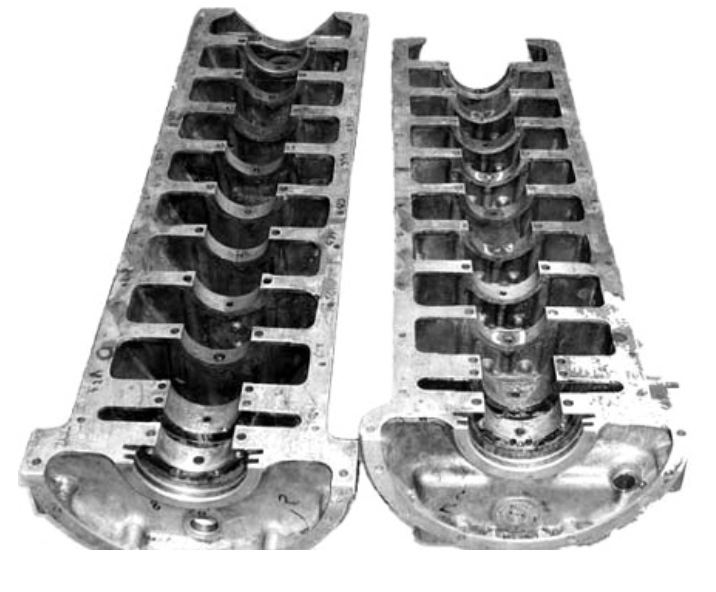
Complex crankcase casting, upper half on left, lower on the right (Anderson/velocetoday.com)
Crankcase, sump and crankshaft
‘The great complexity of the crankcase casting was very similar to that of the rival Delage.
Split roller bearings were relatively new, and used by STD instead of the normal one-piece roller bearings which necessitating a multi-piece crankshaft to accommodate the roller cages. Long through-bolts held the whole lot together, with threaded ends projecting through the upper surface of the upper half to act as locating and holding-down bolts for the 4 cylinder blocks. When assembled, there is virtually a solid cast wall and a bearing each side of each crank throw – almost like eight single cylinder engines in a row’.
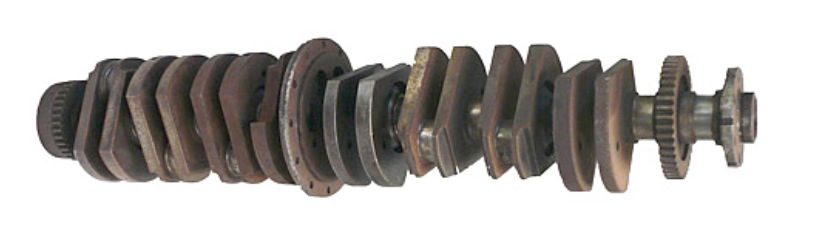
Original crank (Anderson/velocetoday.com)
‘The crankshaft is actually two four cylinder crankshafts, joined at 90 degrees to each other, giving a firing order of: 1,5,3,7,4,8,2,6. There are 10 main bearings, the one at the front being a large ball bearing acting as a thrust, the other 9 are all split cage roller bearings, the rear two straddling the crankshaft gear which drives the oil pumps below, and the cam drive above’.
‘STD did a lot of work on the engine in the winter of 1926-27, changing manifold pressures, diameters and temperatures, but Anderson thinks that problems may have been with the Solex carburetors. The Australian crew also eliminated cold start reluctance when fuel droplets can tend to fall out of suspension over the long manifold length, by fitting a Kigass pump and pipework. ‘It is very long and tortuous but in main, works well,’ said Anderson’.

You can’t see much of the air cleaner in the earlier shot, but see the carb bolted to the supercharger. Water pump and plunger pump for fuel air pressure also driven off the front gear train. Note throttle linkage and two return springs, standard of workmanship in Anderson’s restoration outstanding (Bisset)
TD 700 Engine Specifications
Straight eight, 56mm bore X 75.5mm stroke, 1485cc.
Construction comprises four welded steel blocks consisting of two cylinders each integral with cylinder block
Crankcase: two piece cast light alloy split on crankshaft centerline, with shallow oil sump below acting as collector for scavenge pump of dry sump oiling system
Two piece crankshaft, split in middle joined by a large circular flange on each piece, fitting neatly into a step on the other, and secured by a ring of 12 very tight-fitting bolts.
Rod big ends split roller
DOHC heads, valve angle 90 degrees, of steel welded construction integral with cylinders
Domed pistons, 7:1 compression ratio, valve gear triple coil valve springs
Camshaft case 10 roller bearings, Cam drive, gears driven from rear of engine
Roots Supercharger, front driven with Solex Carb
Magneto ignition, Bosch
Power 160 bhp at 7200 rpm (contemporary reports say 140/145 @ 6500)
Bibliography…
G Howard & Ors ‘History of The Australian GP’, J Blanden ‘Historic Racing Cars in Australia’, veloce.com article by Pete Vack and Stuart Anderson, The Nostalgia Forum, Bonhams auction catalogue, LJK Setright ‘The Grand Prix’, Stephen Dalton Collection, TD article by Bob Shepherd in ‘Australian Motor Sports’ October 1951
Photo Credits…
Martin Stubbs, Dacre Stubbs Collection, Stephen Dalton, Arnold Terdich Collection, Stuart Anderson
Tailpiece: Gastone Brilli-Peri TD700 place and date unknown…

Finito…

The Museum of Urban Art, Sau Paulo, Brazil…
My partner tripped over this on Instagram, luvvit, but she has no idea who the artist is. I’d like to know as it reminds me of my ‘Dinky’ childhood, ‘Hot Wheels’ the toy cars of the generations after mine!
Hot Wheels are still made, here are the top 50 of their cars, just in case you wanted to know!;
http://au.complex.com/sports/2013/02/the-50-best-hot-wheels-of-all-time/
Credit…
Museum of Urban Art, Brazil

A Shelby American mechanic fettles the Bruce McLaren/Ken Miles Ford GT40 Mk2 ‘106’ prior to the Le Mans 24 Hours commencement on 20 June 1965…
I always thought the 4.7/5 litre GT40 variants were masterpieces of Eric Broadley packaging, if a bit beefy given the steel rather than aluminium monocoque mandated by Ford- but the 7 litre Mk2 and Mk4 are altogether less subtle expressions of the genre! Successful ones at that.
You can’t see ‘Henrys’ cast iron blocked, ally headed 427cid pushrod OHV V8 under all the plumbing, the dry sumped 90 degree, 107.2mm X 96.1mm lump was fed by a single, big Holley 4-barrel 780CFM carb developing circa 485bhp@6200rpm and 475lb.ft of torque@3200-3600rpm, plenty for a car weighing 1200Kg.
The ‘cross-over’ exhaust sytem is a masterpice of the pipe-benders art, mufflers interesting and unusual on a racer, maybe to save the drivers ears a tad? You can just see the gulping, big mouth of the monster Holley in front of the exhausts.
To the right near the roof is the water radiator neck, filler and temperature sender, to the right are the gold colored fuel pumps, the fuel tank had a capacity of 159 litres.
You can see the Kar-Kraft / Ford T44 four-speed ‘box, in fact ’twas the failure of this very special transaxle, the design of which was led by Ed Hull, which caused chassis #’106′ retirement on lap 45 of the classic.
There are plenty of lovely ‘Aeroquip’ aircraft braided fittings too, well in advance of their adoption in F1, for brake lines and various oil feeds around the transaxle, note the transmission oil-radiator under the mech’s elbow.
See the big, rear, grey stove enamelled chassis diaphragm below the exhaust and above the ‘box to support the engine/gearbox and location of the rear suspension, the top of the spring/shock’s clear- there, too, is the brake cooling duct which takes air collected from the body. Big cast magnesium uprights, beefy driveshafts and top suspension link and forward facing radius rod and brake calipers for the outboard mounted, ventilated discs are also in shot.
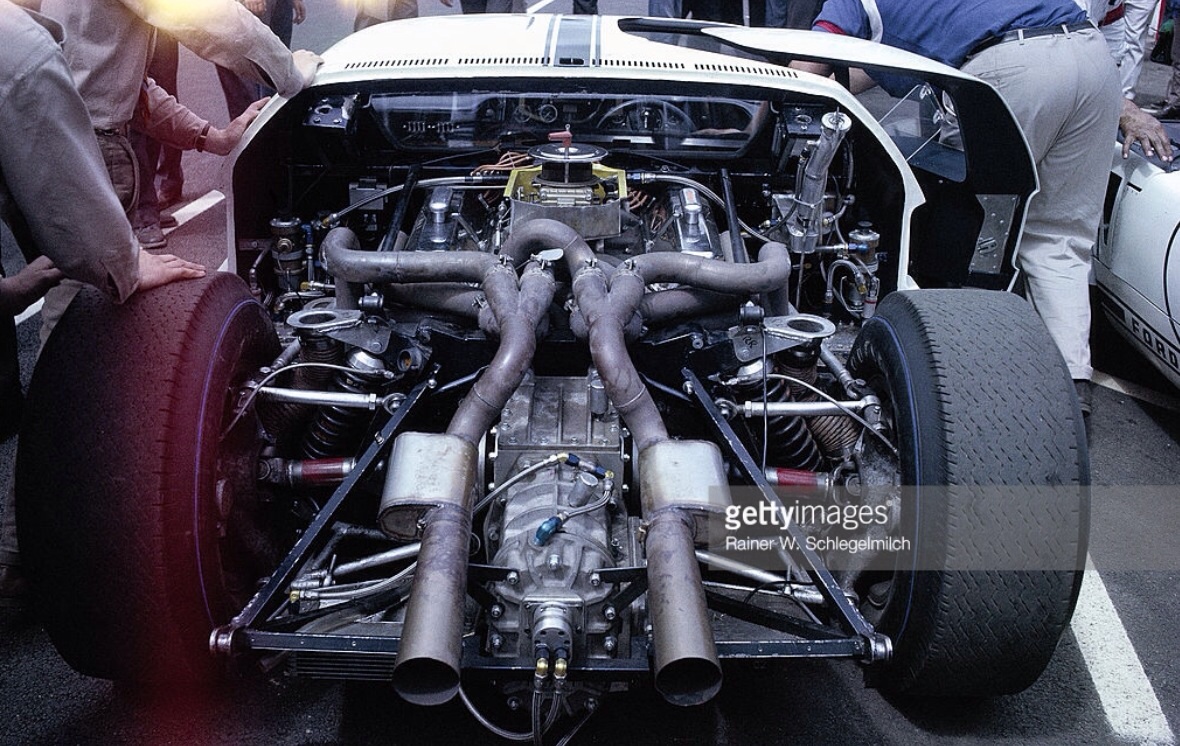
The quick-lift jack and ‘captive frame’ on the car is typical of Shelby’s thoughfulness and endurance racing knowledge…
Mind you they had a shocker of a race!
Five cars were entered, two Mark 2’s and three Daytona Cobra Coupes and all failed to finish; the Miles/McLaren Mk2 after 45 laps due to gearbox failure, the Amon/P Hill Mk2 on lap 89-clutch. The Johnson/Payne Daytona ‘2287’ was out on lap 158-head gasket, Gurney/Jerry Grant Daytona ‘2286’ on lap 204-engine and Daytona ‘2601’ Schlesser/Allen Grant on lap 111-clutch.
So, a disaster for Ford, their best placed car was the AC Cars Ltd entered Daytona Cobra Coupe driven by Sears/Thomson which finished eighth, the race was won, famously by the 3.3 litre V12 Ferrari 250LM of Masten Gregory and Jochen Rindt, the latter flogging the thing to within an inch of its life!
It was Ferrari’s last Le Mans win with the first of four on the trot to come for Ford from 1966-69- wins for the Mk2 and Mk4 in 1966 and 1967 and 1968/9 for the Mk1 5 litre GT40.
Finally, Shelby American made amends in 1966, taking the first two places in the infamous ‘Ford Form Finish’ ahead of arch rivals, the Holman Moody prepared Ford Mk2’s…
Etcetera…
(unattributed)
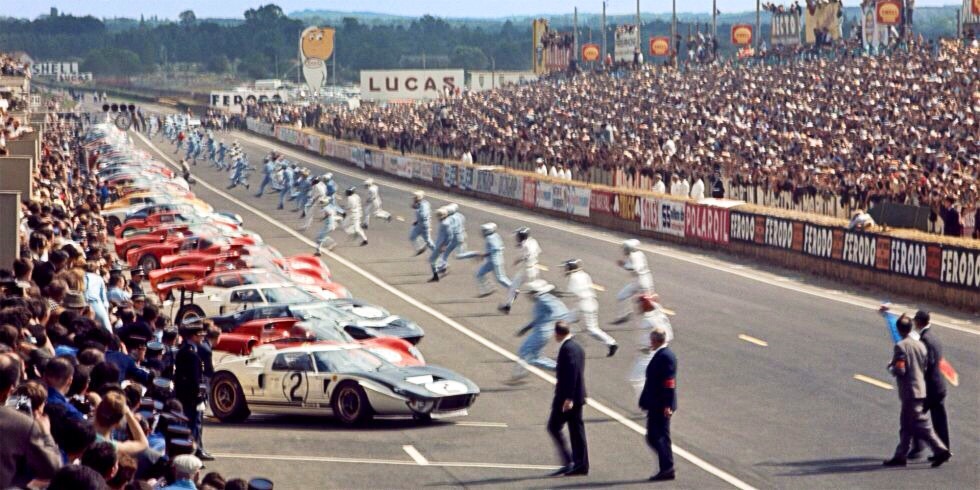
Le Mans 1965 start.
The Amon/Hill GT40 Mk2 on pole, then Surtees/Scarfiotti Ferrari 330P2 , Bondurant/Bucknum GT40 in 3 and McLaren/Miles GT40 Mk2 in grid 4

(unattributed)
McLaren/Miles Ford GT40 Mk2 early in the race, Le Mans 1965.
Both Mk2’s failed due to transaxle preparation mistakes with a gear that was intended for scrap being put into one gearbox and dirt on a bearing surface in the other.

(unattributed)
Carroll Shelby beside the Chris Amon/Phil Hill GT40 Mk2 chassis ‘106’ at Le Mans 1965- note the ‘at meeting’ fabricated rear spoiler addition.

(unattributed)
Shelby American Le Mans garage- Daytona Cobra Coupes #12 Schlesser/J Grant, #10 Johnson/Payne #9 Gurney/A Grant- all DNF.
Credits…
Rainer Schlegelmilch, teamdan.com
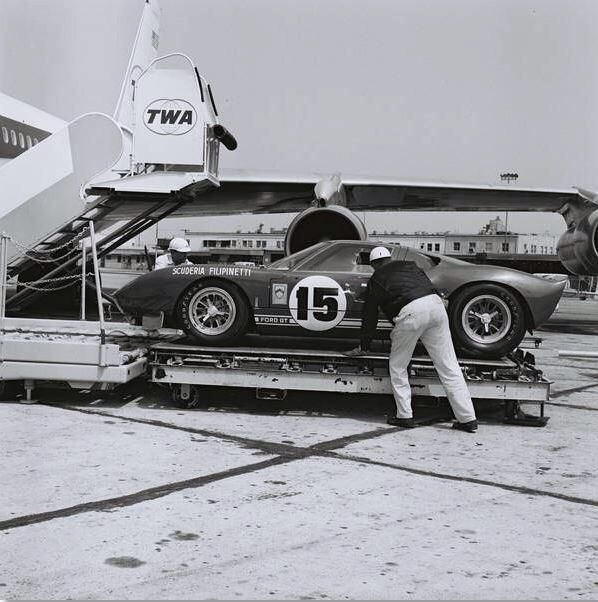
Tailpiece: Filipinetti’s GT40 Mk2, prepped by Shelby American on the way to Europe at LAX, it too failed to finish driven by Ronnie Bucknum and Herbie Muller…
Finito…

Phillis takes his Honda 350/4 for a practice lap at The Isle Of Man on June 4 1962…
Sadly, the young Australian World Champion and GP winner was killed on lap 2 of the 350cc event on 6 June aged 28.
Born in Marrickville in Sydney’s inner west on April 9, 1934, Phillis was a trend-setting international motorcycle racer as the first rider to win a World Championship Grand Prix on a Japanese machine. Aboard a Honda 125 he won the 1961 Spanish 125GP at Montjuic Park, Barcelona on 23 April.
He was the first Aussie to achieve a ‘Grand Prix Double’, (Clermont Ferrand France 21 May 1961 aboard Honda’s 125 and 500cc) the first man to lap the Isle of Man at 100mph on a push-rod bike and was Australia’s second World Motorcycle Champion. (Keith Campbell, the first, won the 1957 350 World Championship aboard a Moto Guzzi) His record of six GP wins in the ’61 season wasn’t improved upon by another Australian rider until Gregg Hansford did so in 1978).
Phillis clinched a drama-filled World 1961 125 Championship in the last round on October 15 in Argentina, whilst Mike Hailwood won the World 250 Championship on a machine supplied by the British Honda agent.
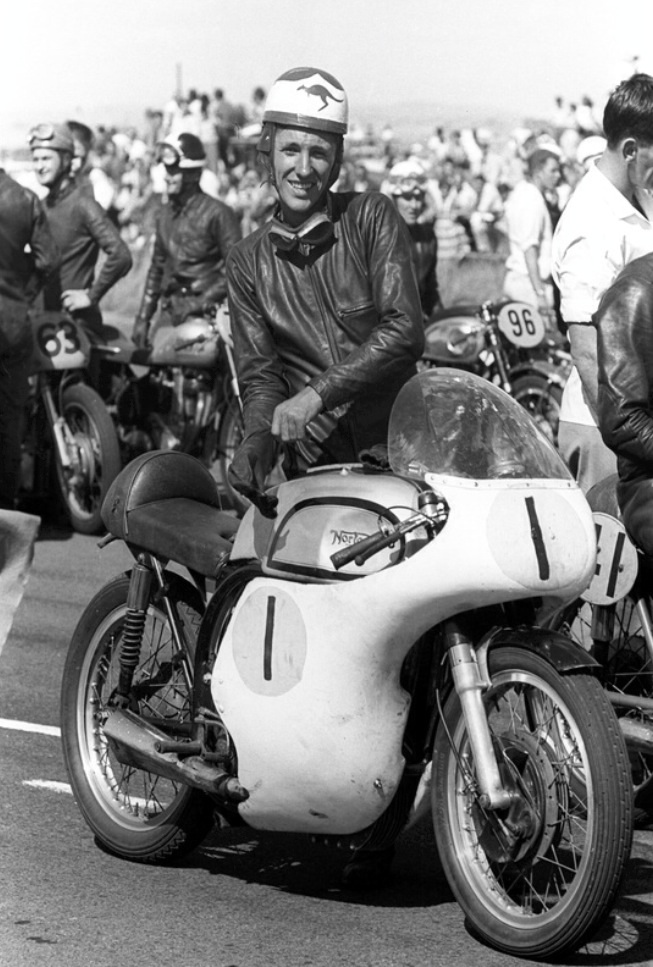
Phillis aboard a Norton on the Fishermans Bend, Melbourne grid in February 1959 (Charles Rice)
Tom Phillis’ daughter Debra has created an interesting website about her fathers racing exploits, click here for an interesting read and array of photographs of this great rider;
Credit…
Central Press, MotorsportRetro.com
Tailpiece: Tom Phillis takes Honda’s first ever championship GP win at Montjuic Park, Barcelona, Spanish 125cc GP on 23 April 1961…

(unattributed)
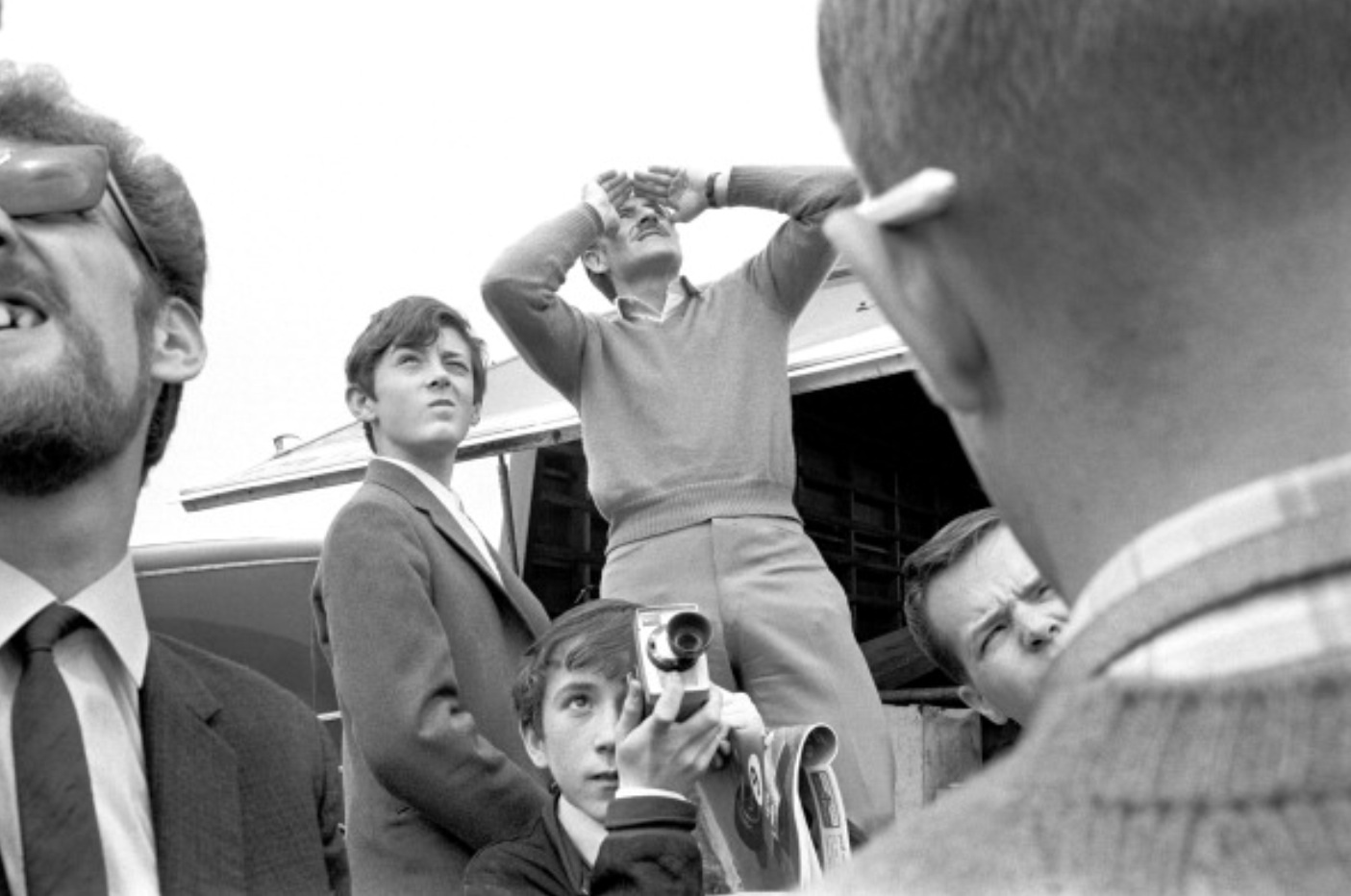
(Susan Wood)
The expressions on the faces of this lot are priceless! G Hill and fans sussing out a Hawker Harrier Jump-Jet maybe…
The showstopper at the Australian Grand Prix every year is the McDonnell Douglas FA18 Hornet, it always rather puts the performance of F1 cars and their ‘spectacle’ into context!
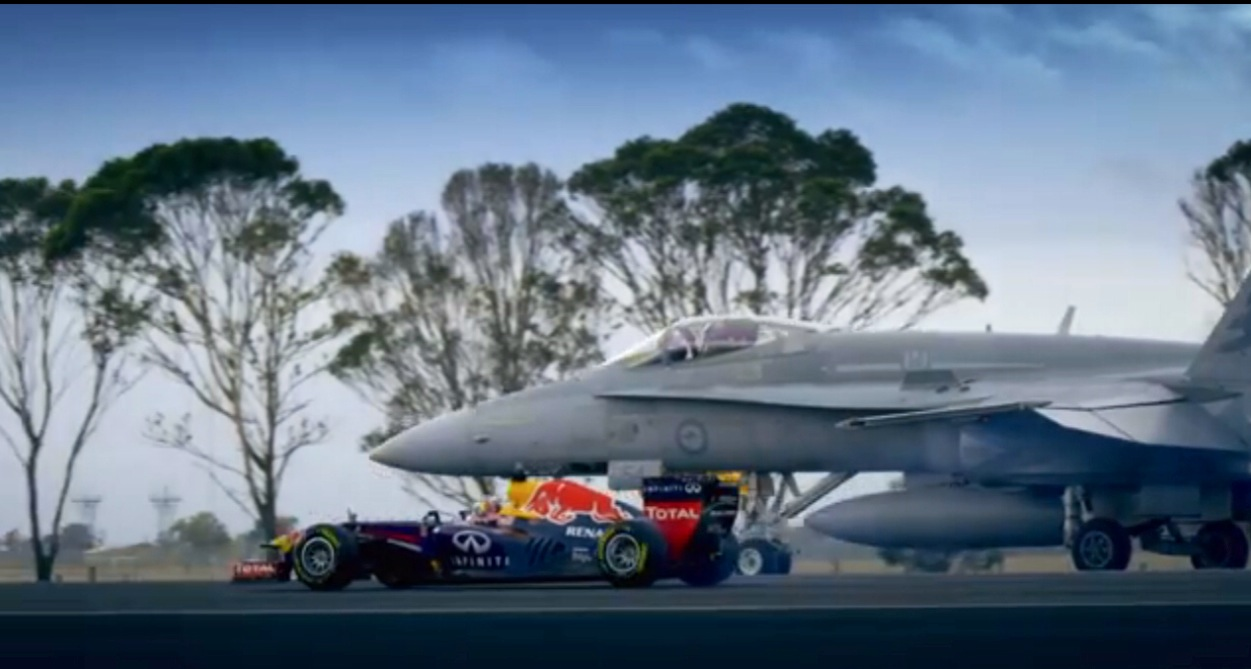
Red Bull and Hornet, AGP pre-promotion 2014 (RAAF)
I’ll never forget the first year in Adelaide, 1985 on the Thursday when a General Dynamics F111 fighter flew unannounced at ‘treetops height’, fast whilst we were strolling through the parklands. We hit the deck quicker than a Viet-Cong guerrilla, shouting ‘whatt the faaaaaaark wozzitt??!!’ as it roared past in the direction of North Adelaide.
The Graham Hill photo Getty Images caption is typically useless, it’s dated 1 January 1970, the circuit unidentified, praps one of you Poms can help?!
It’s either the ’69 or ’70 British GP I guess, ’69 at Silverstone maybe, the non-championship F1 races wouldn’t rate a Harrier?
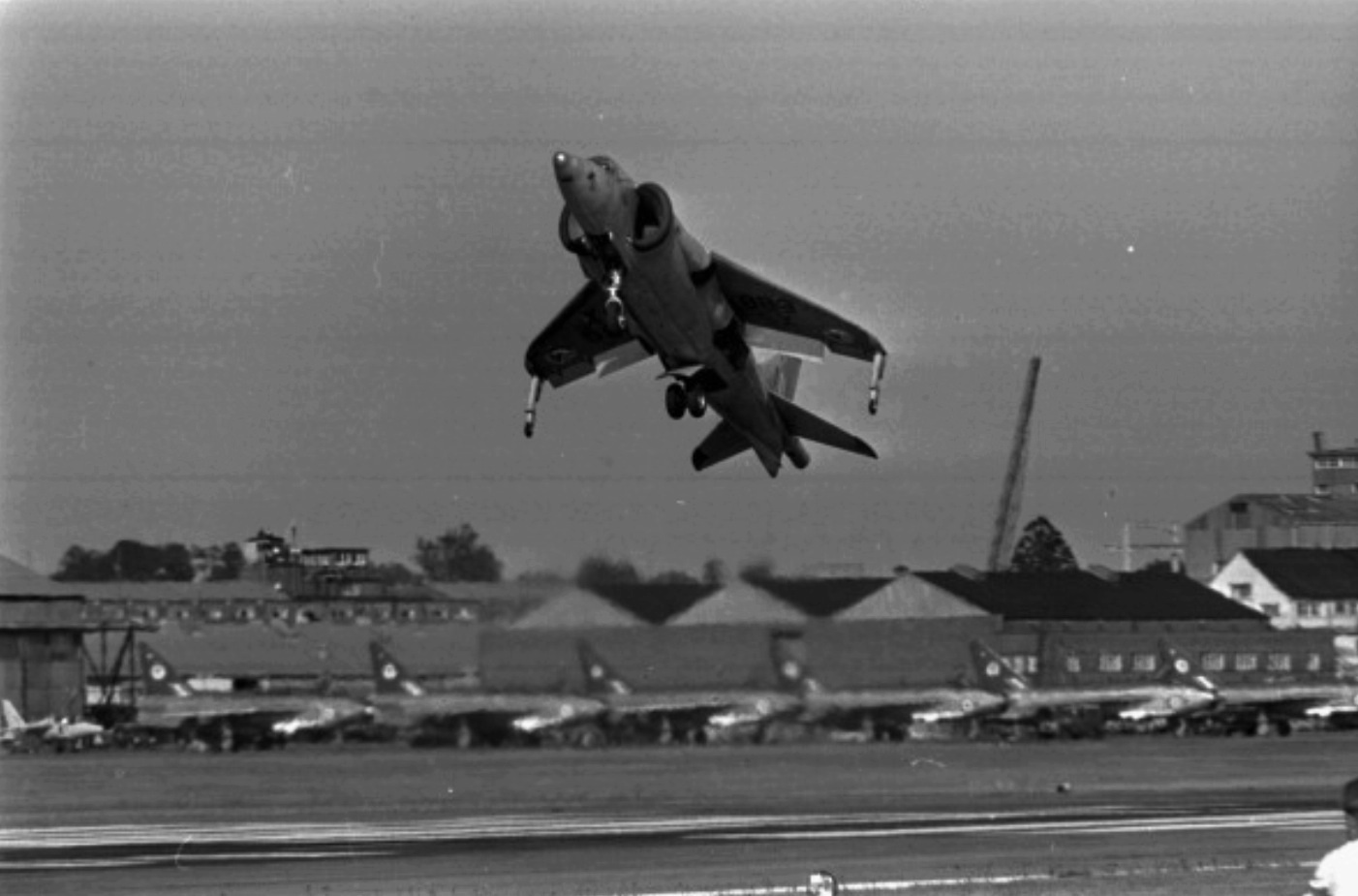
Hawker Siddeley P1127 prototype at Farnborough Air Show on 10 September 1964. Amazing V/STOL, vertical short take off and landing technology. The plane entered production as the Hawker Jump Jet (Victor Blackman)
Credit…
Susan Wood, RAAF
Tailpiece: Rubens, Ferrari and FA18…


Luvverly poster/program to promote the October 1955 race meeting at Fishermans Bend, 6 Km west of Melbourne’s CBD…
My guess is that the ‘artists car’ is Lex Davison’s Ferrari 500/625 and the bike an MV Agusta 4…

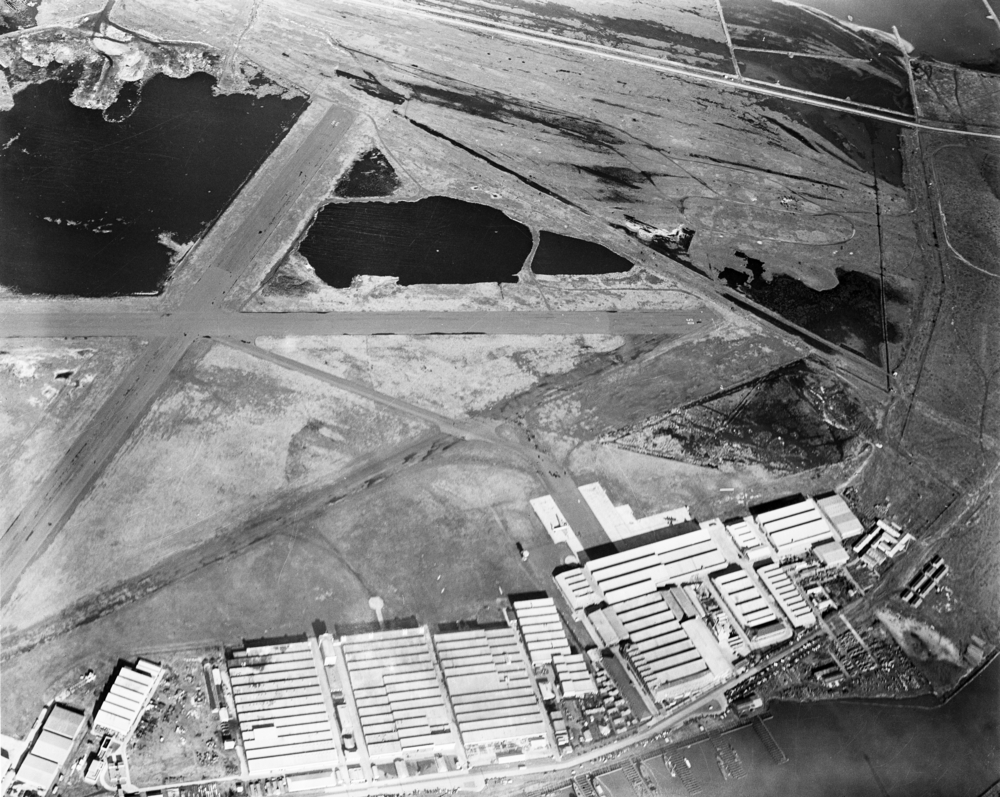
Fishermans Bend Aerodrome was located near the emergence of the Yarra River with Port Phillip Bay. The area was a vast swamp owned by the Commonwealth Government. In the early 1930s, a primitive airstrip was built there which was used by gliding and light aircraft enthusiasts.
In 1935 the Government built the Commonwealth Aircraft Corporation (CAC) factory, together with a long sealed airstrip. CAC is the best known of the Australian aircraft manufacturers of the Word War 2 and post war era’s. It began as a private company founded by Lawrence Wackett, a captain with the Australian Flying Corps known for his engineering ingenuity. After World War I, Wackett began design and manufacture of civil aircraft.
‘The CAC was conceived in 1935 by Essington Lewis then managing director of BHP. It was a private company formed by a consortium including BHP and GMH (Holden) to manufacture military aircraft with the intention of providing Australia with the tools to fight the modern war that was looming’.
‘Land was selected adjoining the recently completed GMH (General Motors Holden, 191 Salmon Street) factory at Fishermans Bend.
The factory manufactured a modified US designed advanced trainer under licence which became known as the Wirraway. Other wartime aircraft built included the Wackett elementary trainer, the P51 Mustang and the Boomerang, a fighter aircraft conceived, designed and manufactured in little over three months’.
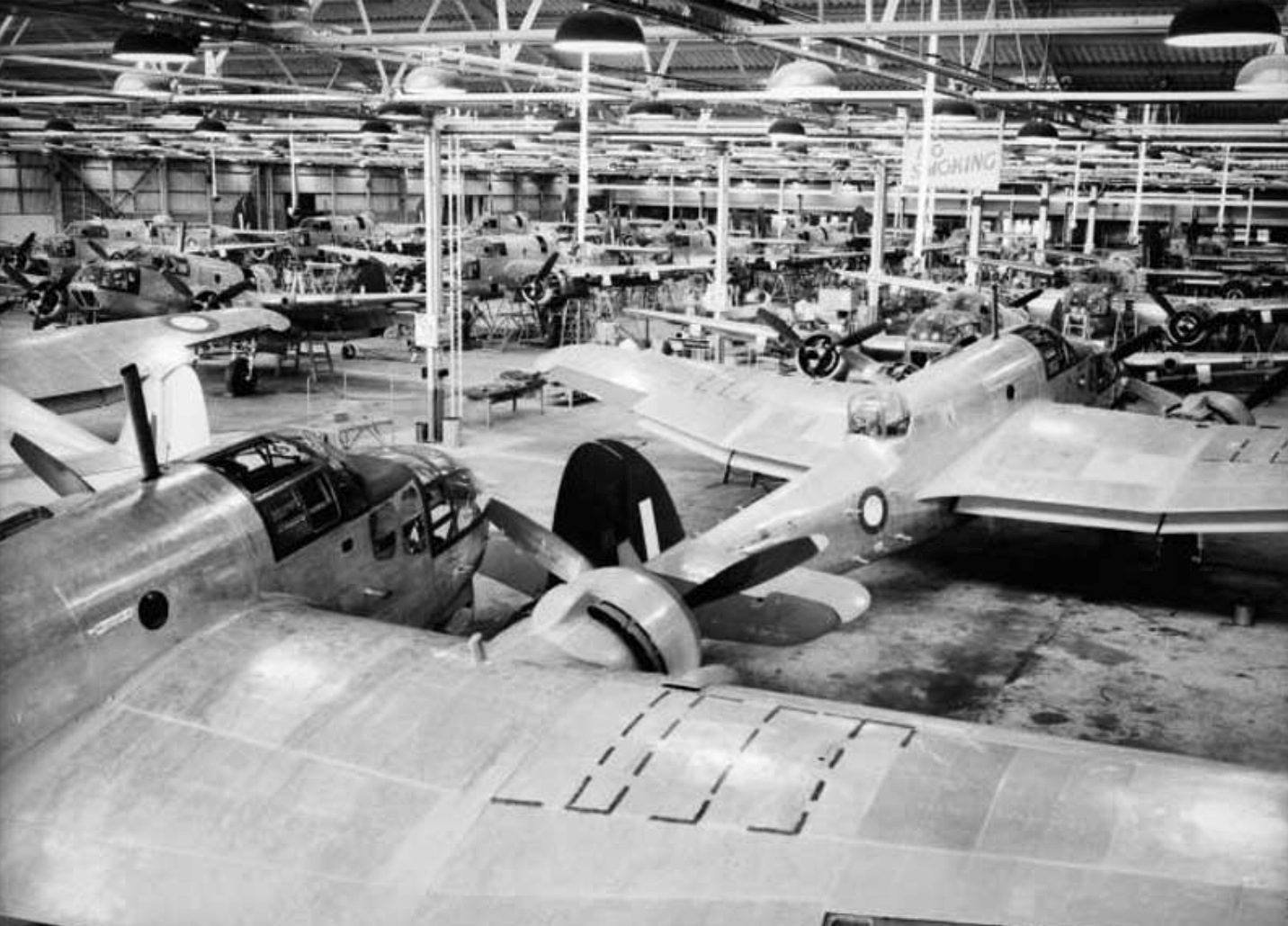
Bristol Beaufort Mk VIII being built at Fishermans Bend in 1943 (unattributed)
‘Fishermans Bend became a centre of the wartime aircraft industry with the adjacent Department of Aircraft Production factories and the Aeronautical Research Laboratories. During the war CAC produced two interesting prototypes which sadly never made it into production. The Woomera, the first was a three seater medium bomber that had remotely operated turrets in the rear engine nacelles. The other was an interceptor, the CA-15 or Kangaroo, it was a 721 km/h fast fighter with a range of 4000 Km’.
‘After the war the CAC Sabre, one of the ultimate Sabres of the type was built. With a more powerful Avon turbojet and twin 30mm cannons the (American) frame was 60% redesigned. Post WW2 the facilities continued manufacturing and assembling aircraft’.
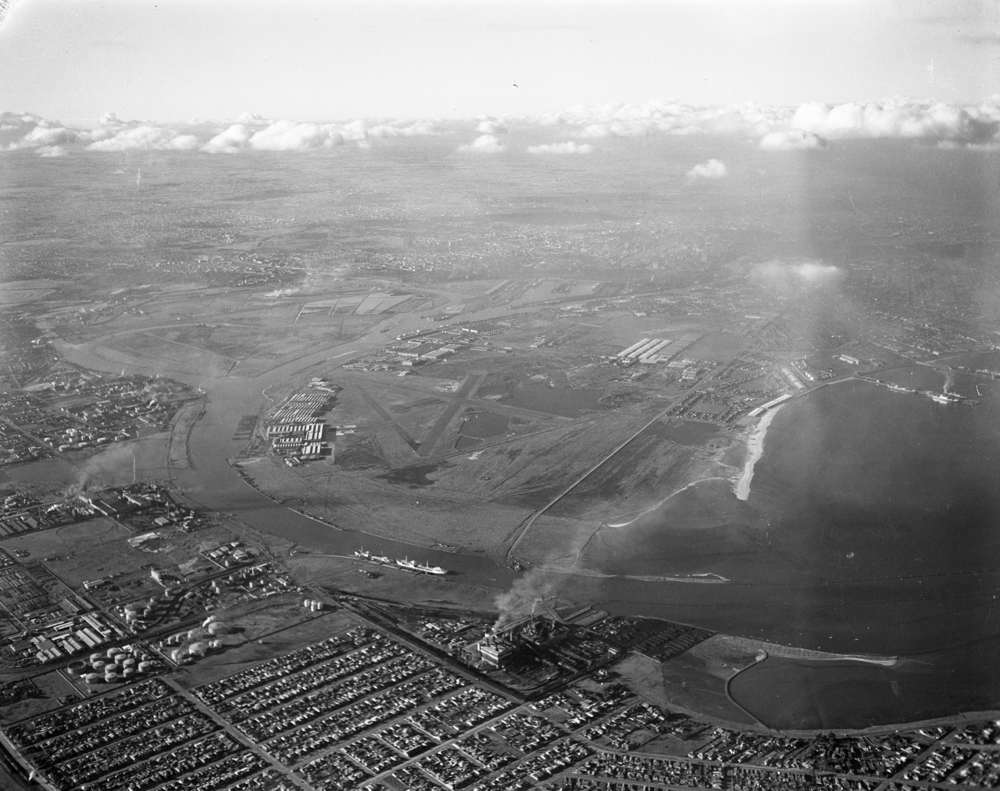
Aerial view of Yarra River, Newport and Fishermans Bend circa 1940-50. The smoke is coming from the Newport Power Station. To its right is the exit of the Yarra River into Port Phillip Bay. The straight road which ends at the Yarra near the berthed ship is Williamstown Road, there was a car ferry to cross the Yarra, the Westgate Bridge was opened in the mid-70’s. In the middle of the shot are the runways of the airfield used for racing. Shot also shows the Dept of Aircraft Production, Commonwealth Aircraft Corporation and the GMH Holden factory on the right or ‘above’ the runways. Melbourne CBD is lost in the haze at the top of shot but not far away as the crow fly’s (Francis Hodgson)
For the aviation history buffs click on this link to a very detailed publication about Fishermans Bend’s 60 year role in Australian Aviation…
Its a government document of value. Therefore a global rarity.
The Aerodrome was also used for car and motorcycle racing from 1949 to 1966, using the main airstrip and the 3 km perimeter road.
The Commonwealth Aircraft Corporation was taken over in 1986 and the majority of its buildings demolished in 2003-04.

Flavour of the era. Love this Fishermans Bend shot; ‘Victoria Trophy’ meeting February 1958 with the front engined cars of Ted Gray, Tornado 2 Chev and Stan Jones Maserati 250F up the front. Policeman and his horse oblivious to the cacophony, note the ‘safety’ fence. Industrial heartland of inner western Melbourne in the background (Geoff Green)
‘Westgate Park’ now occupies part of former CAC land. The aerodrome’s runway became Todd Road, the taxi runway became Wharf Road. A legacy of the past is found the names of some of the nearby streets; Sabre Drive, Wirraway Drive and Canberra Drive. The railway line which serviced industry in the area remains but is no longer used and isn’t connected to the contemporary rail system.
The former CAC factory, at 344-370 Lorimer Street and 231-249 Todd Road Port Melbourne, was constructed from 1937 to manufacture military aircraft.
The only remaining buildings of the extensive factories are a section of ‘saw-tooth’ factory to the west (now part of Hawker de Havilland/Boeing) and four hangars at the eastern end of the former factory at the corner of Lorimer Street and Todd Road. These hangars, dating from WW2 comprise one US made ‘Butler’ and three British designed ‘Bellman’ hangars.
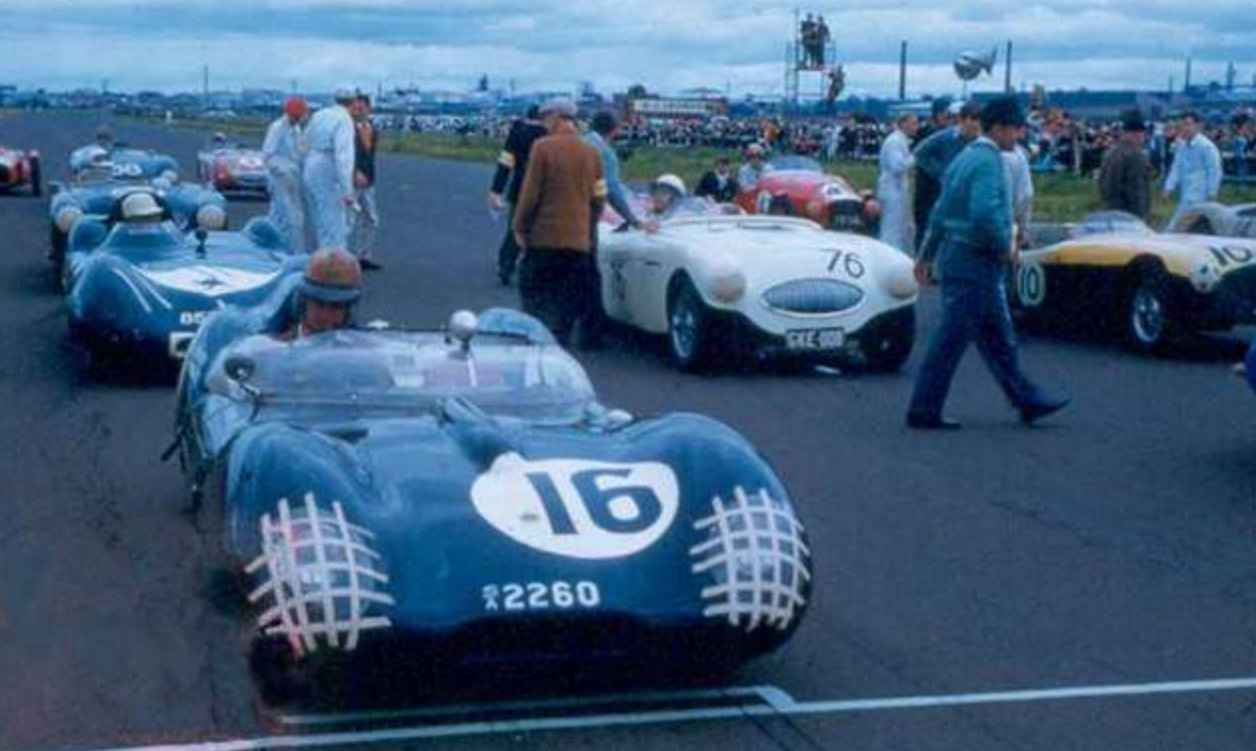
Fishermans Bend sports car race October 1958. #16 Derek Jolly’s Lotus 15 Climax, various Austin Healey 100’s and a Lotus 11 behind Jolly. To the far right is the Coad Bros Vauxhall Holden Repco Spl which the family still owns (Kevin Drage)
Motor Racing at Fishermans Bend…
Airfield circuits popped up post World War 2 globally; in Australia at Point Cook, Fishermans Bend, Leyburn, Caversham, Mallala and Lowood.
The infrastructure was available, people were looking for things to do postwar and governments sought ways of creating economic activity locally.
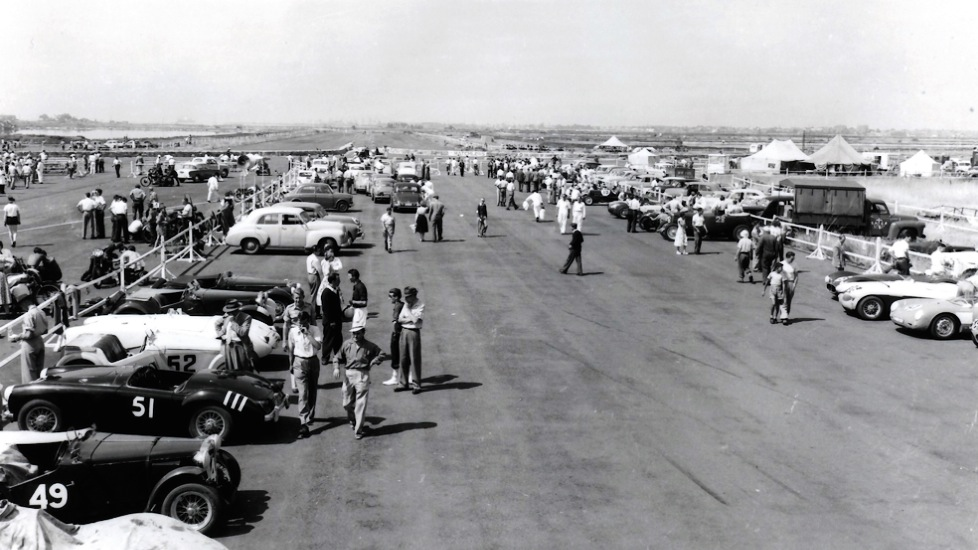
Fishos’ paddock, 10 February 1957. It would have been hot but at least it was sealed, unlike all but airfield circuits at the time! #49 the Graham Hoinville MG TC, which the prominent competitor, engineer and CAMS official still owns! (unattributed)
These photos are not to show a particular race meeting but rather are selected to ‘taste’ the flavour of the place; typically airfield flat and featureless, desolate, industrial backdrops and devoid of much in the way of amenities or safety considerations.

Greg McEwin’s HRG 1500 from South Australia. The body of this car, styled on the Healey Silverstone was built by Ray Manser in Adelaide, it first raced at Port Wakefield in September 1951.Note the aircraft factory backdrop, October 1953 meeting (SLV)
The Light Car Club of Australia and the Harley Motor Cycle Club were the circuits promoters on behalf of the Air Force Association, meetings were run to raise money for a variety of disparate charities over the years.
The pent up demand for entertainment post war is shown by a Melbourne ‘The Age’ newspaper article dated 31 October 1949 which estimated crowd numbers at 70000 people for a program of car and ‘bike events! Staggering really. Crowds of over 30000 were common, by 1952 ‘The Age’ pointing out the demand for motor sport should the quality of venues be improved.

A Cooper Bristol and Maybach 3 (or 4 Chev) , Fishermans Bend. I found this shot in the SLV archive, i’m certain about the cars, thats the easy bit! Perhaps its Tom Hawkes CB leading Stan Jones in Maybach, but it could be another CB and could be Ern Seeliger in Maybach. Stan retained Maybach after he acquired his 250F. Ern modified the car with Chev engine and mainly raced it but Stan used the car right up to 1959 on occasion. Interested to get a view from Aussie enthusiasts as to who and when (SLV/Reg Fulford Collection)
‘Fishos’ was used up until 1960 for road racing, as the surface deteriorated the government was unwilling to resurface it just for the sake of motor-racing.
The last road-race meeting was organised by the LCCA on 14 February and the last sprint meeting by the Victorian Amateur Drivers Club on May 5, 1960.
The airstrip was then used as a drag racing venue until 1966, ‘Riverside Raceway’ played an important part in the formative stages of Drag Racing in Australia…
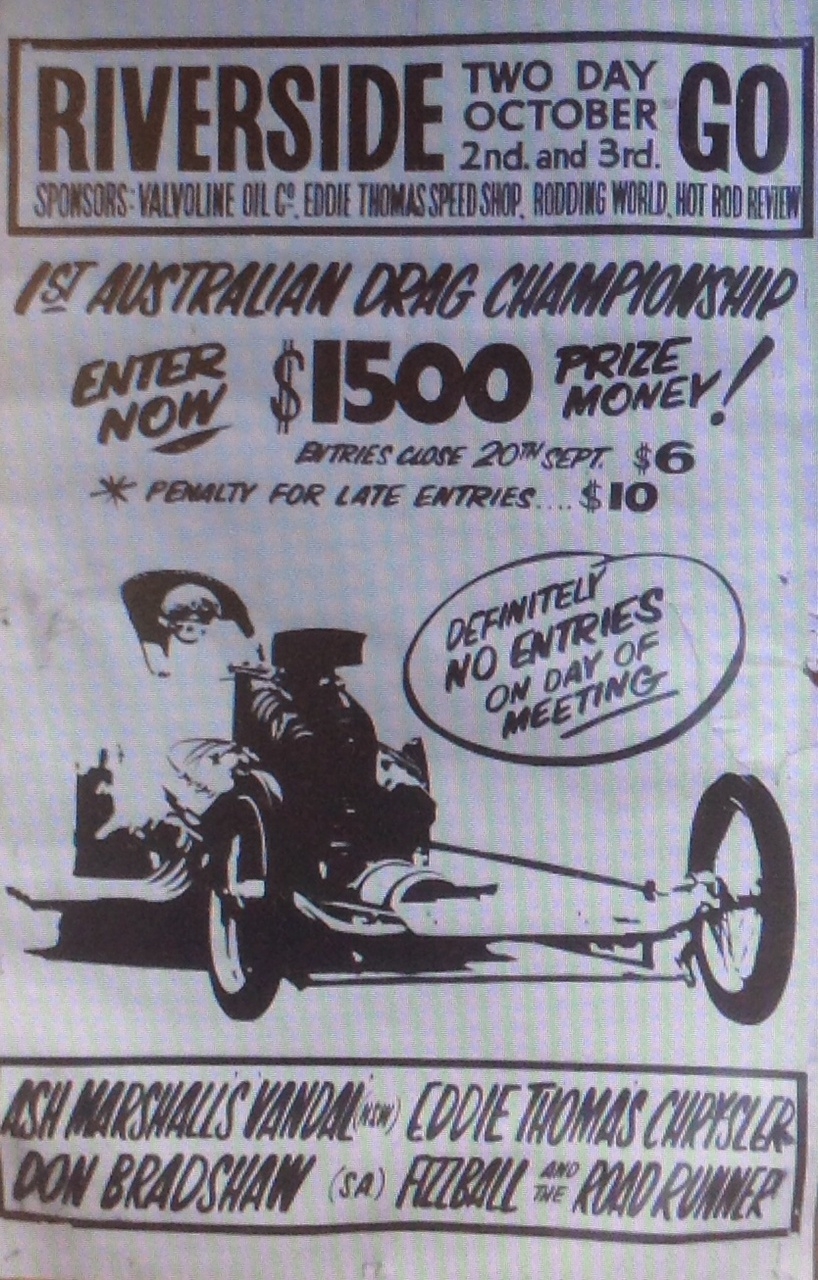
(Ray Sprague Collection)

Early sixties wonderful Fishos scene (T Beyer)
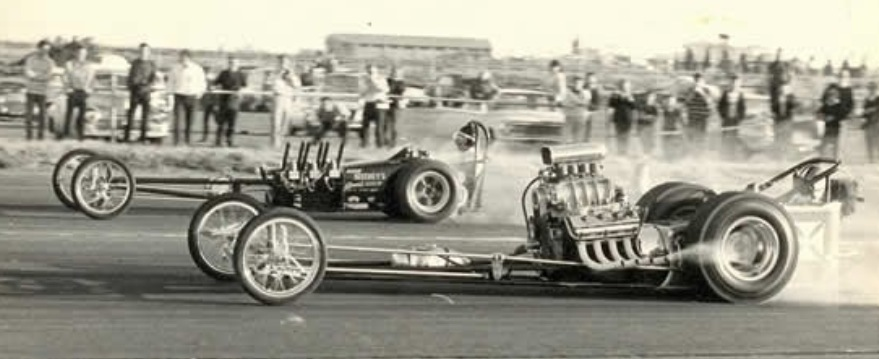
Unmistakable Fishermans Bend backdrop. The ‘Rails’ of Ash Marshall (near) and ‘Fizzball’ Collins at Riverside in 1965 (moondog.net.au)

Drag racers view- cars lined up date unknown (T Beyer)
Random Fishos’ Shots…

Ron Phillips and Doug Whiteford in Austin Healey 100S’ 14 October 1956. Dougs #’3907′ a little more understeering than Phillips #’3906′ (unattributed)
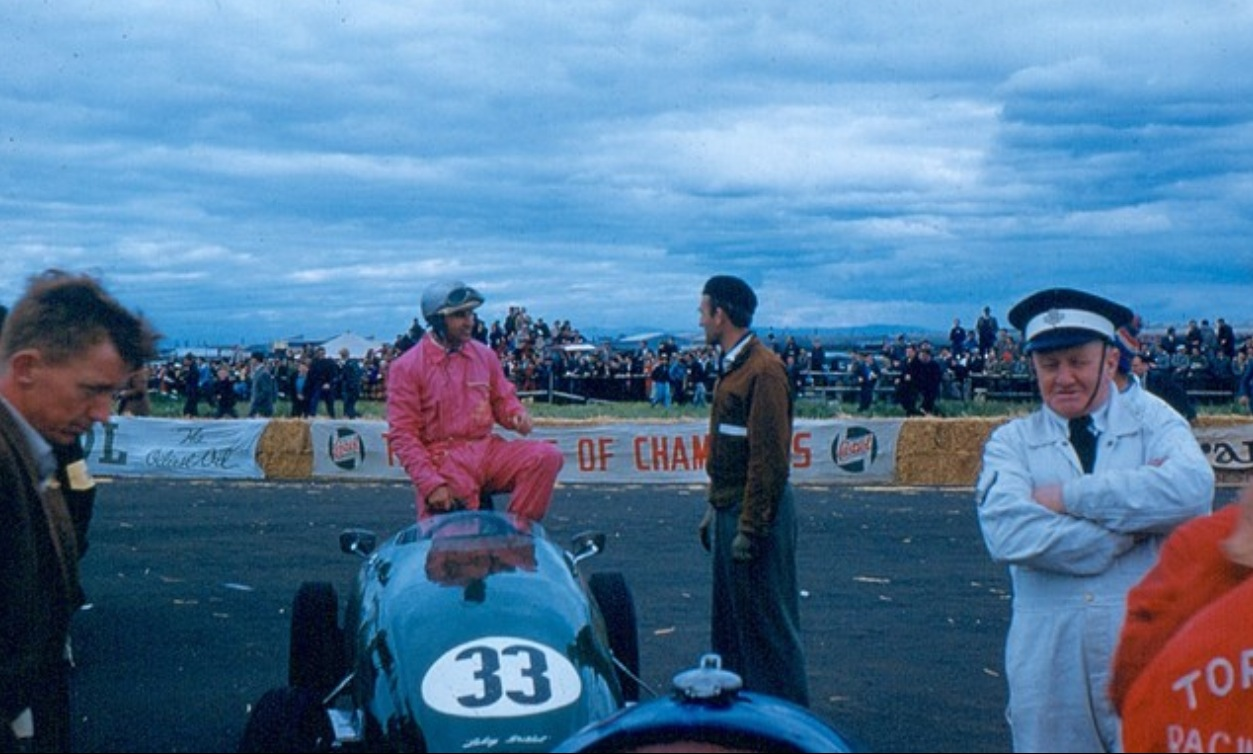
Len Lukey in his Lukey/Cooper Bristol after finishing 2nd in the October 1958 Victorian Road racing Championship, Derek Jolly in brown congratulating him. Ted Gray won this race in the Tornado i wrote about a while ago (Kevin Drage)
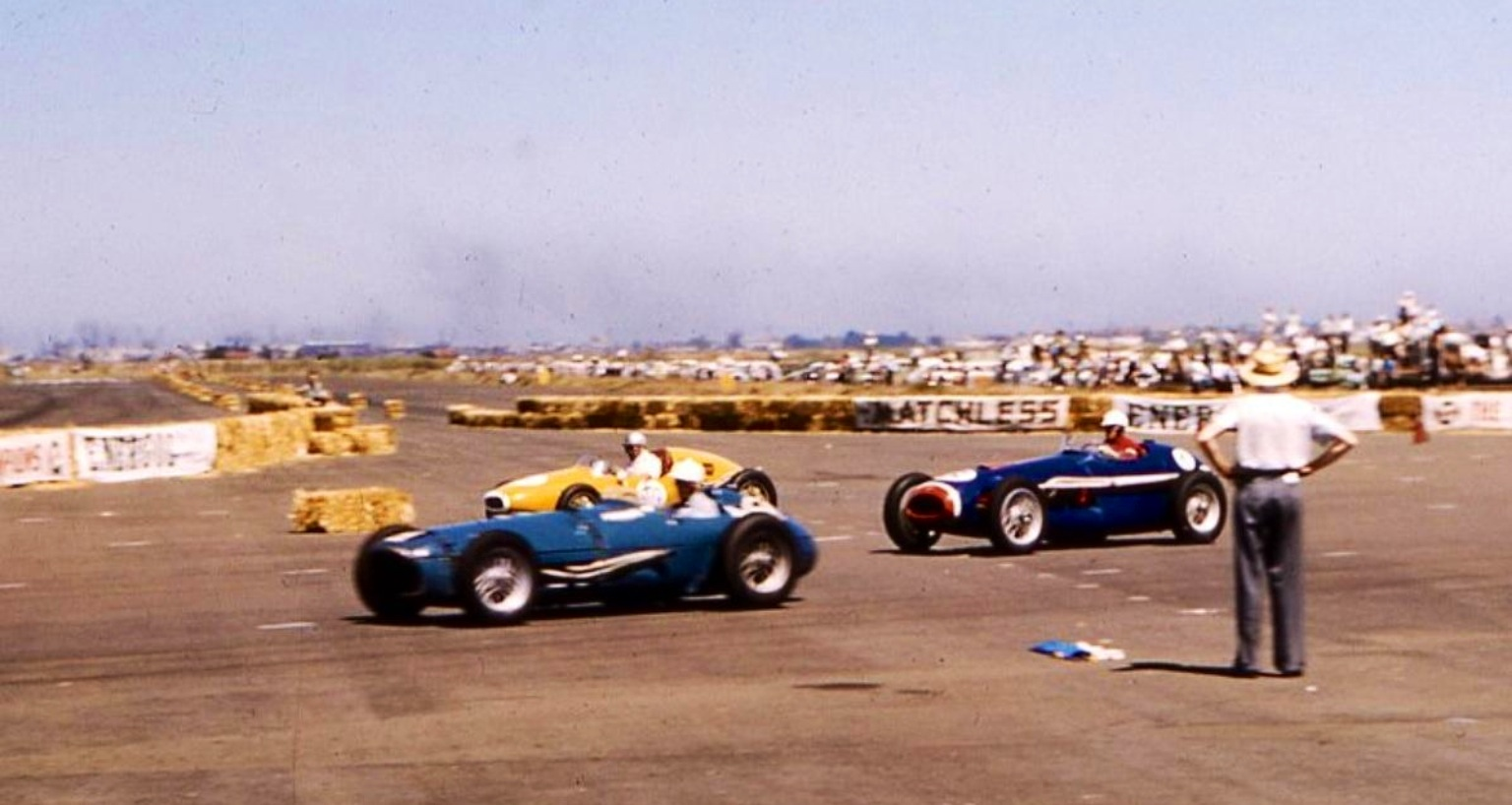
After the finish of the Victorian Road Racing Championship October 1958. Winner is Ted Gray in the dark blue Tornado 2 Chev V8, light blue car Ern Seeliger in Maybach 4 Chev V8 and the yellow Cooper T41 Climax of Austin Miller . Note how flat and featureless the place is, circuit in classic period style bordered by hay bales (David Van Dal)
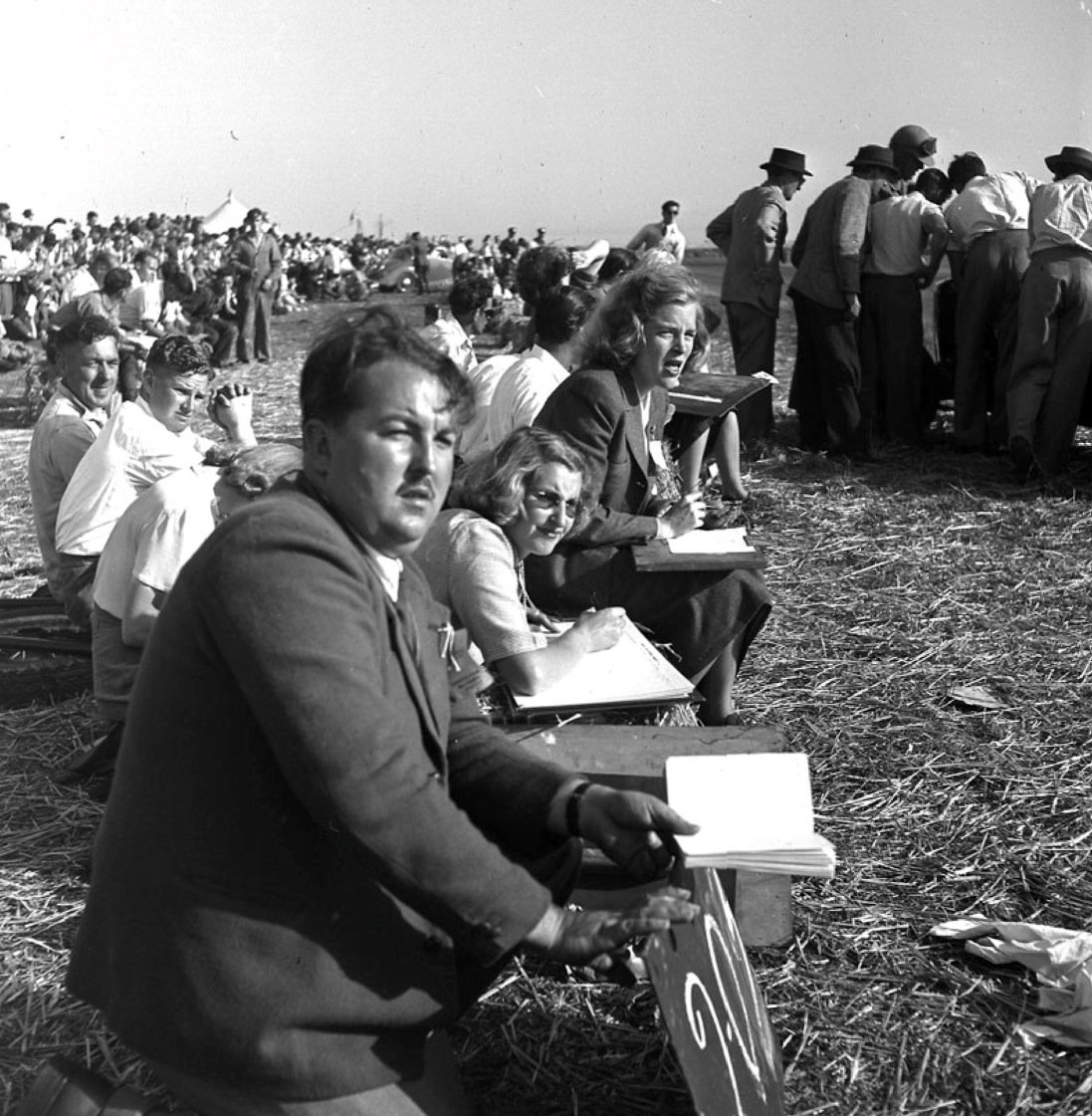
Lap charting Fishos 1949 style. Wonderful evocative shot from Martin Stubbs archive. Male at left in bright, white shirt Bib Stillwell 4 time Gold Star champion in the 60’s, beefy guy is Peter Ward and elegant lady with the ‘big’ lapchart is Diana Davison, Lex’ wife (Dacre Stubbs Archive)

Part of the nose of the blue McEwin HRG, O’Donohue’s Jim Gullan built Ballot Olds and Otto Stone’s MG K3, October 1953 meeting (SLV)
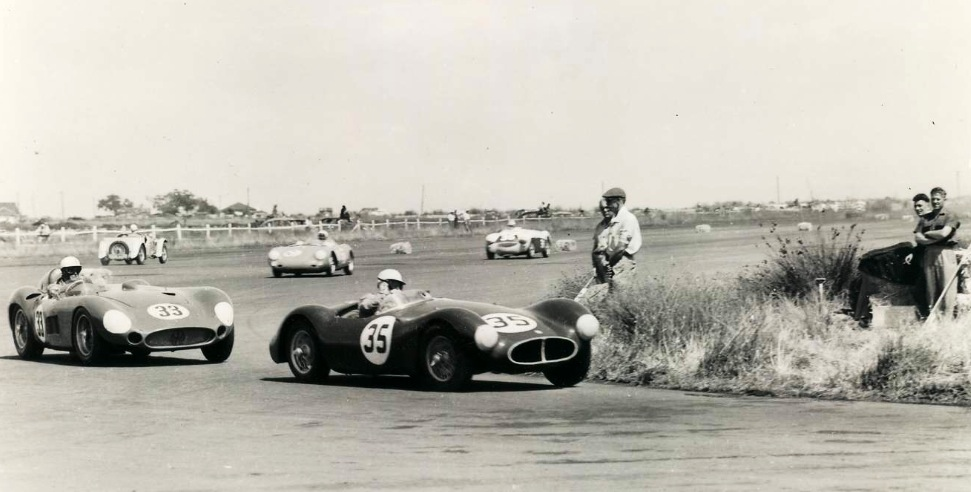
Paul England in the Ausca Holden from Doug Whiteford’s Maser 300S, Otto Stone in the Norman Hamilton owned Porsche 550 Spyder and Ron Phillips Austin Healey 100S 10 February 1957 (unattributed)
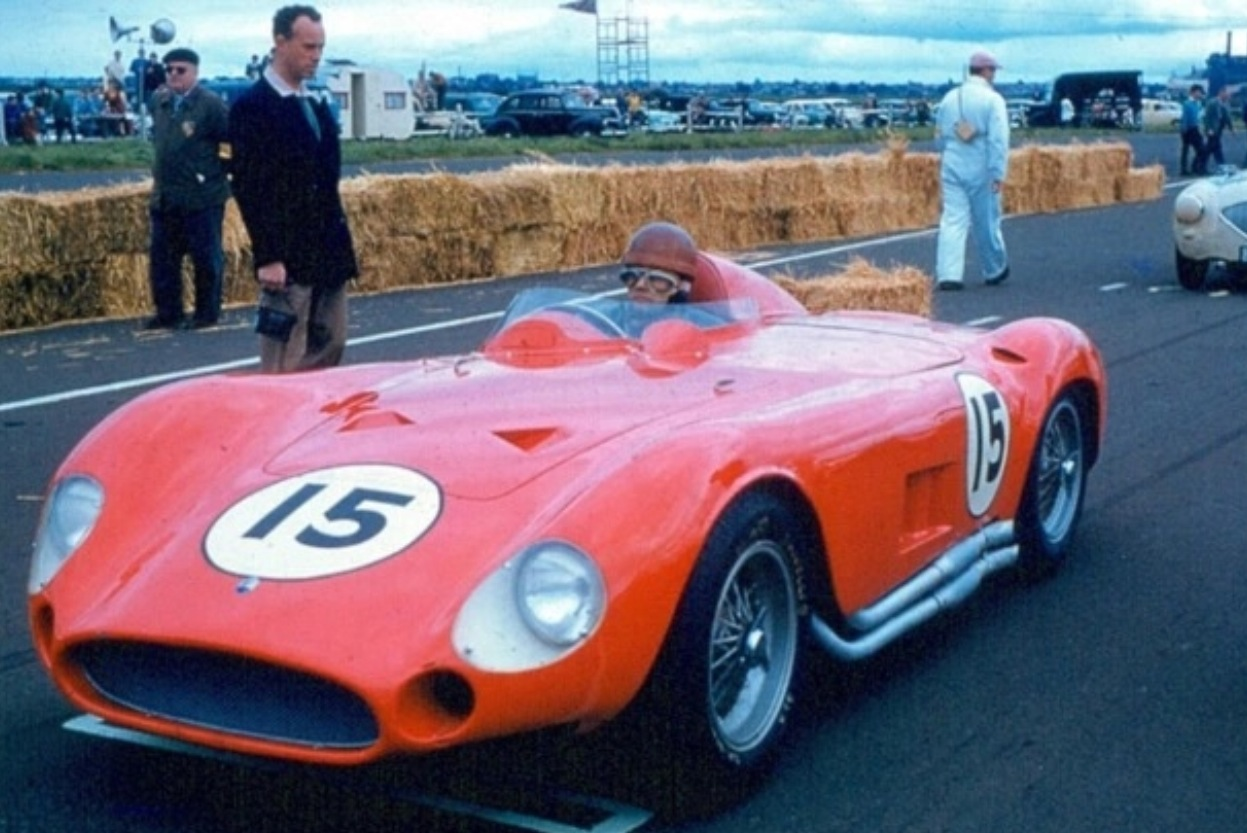
Bob Jane on the Fishermans Bend grid October 1958. Ex-works Maserati 300S, his debut in the car in which he was ‘wild and wooly’! He got the hang of the racing caper, dual Australian Touring Car Champion in 1971 and 1972 (Kevin Drage)

Ken Wylie and Jack Brabham Wylie Javelin and Cooper T23 Bristol. 22 March 1954 Victoria Trophy (SLV)
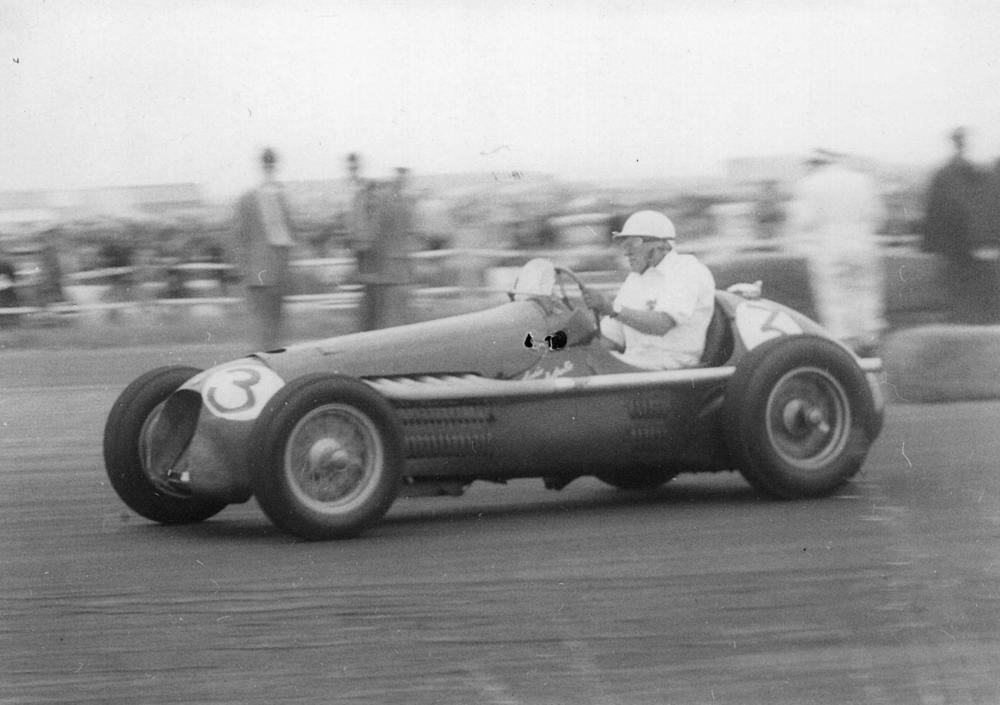
Lex Davison, HWM Jaguar, Victoria Trophy 1954. Davison won the 1954 AGP at Southport on Queenslands Gold Coast in this car (SLV)
Credits…
progcovers.com, australiaforeveryone.com, Greg Smith, Francis Hodgson, Kevin Drage, David Van Dal, Dacre Stubbs Archive, Geoff Green, State Library of Victoria, Reg Fulford Collection, Ray Sprague Collection, moondog.net.au
Thanks to Pat Ryan, Stephen Dalton and Shane Bowden for helping ID some of the cars in the SLV shots
Tailpiece: ‘Circuit Maps’…
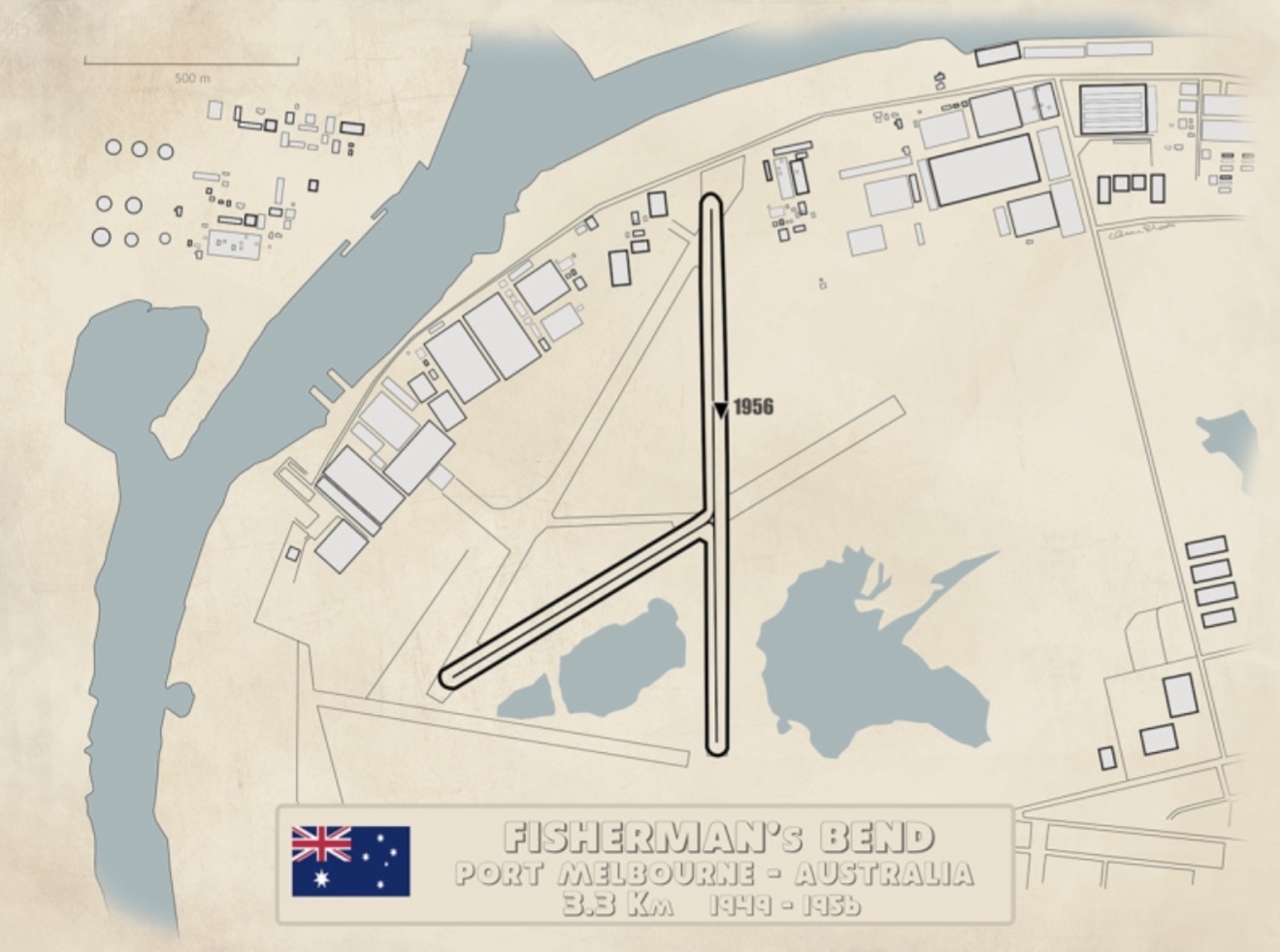
(O Plada)

(O Plada)
Finito…
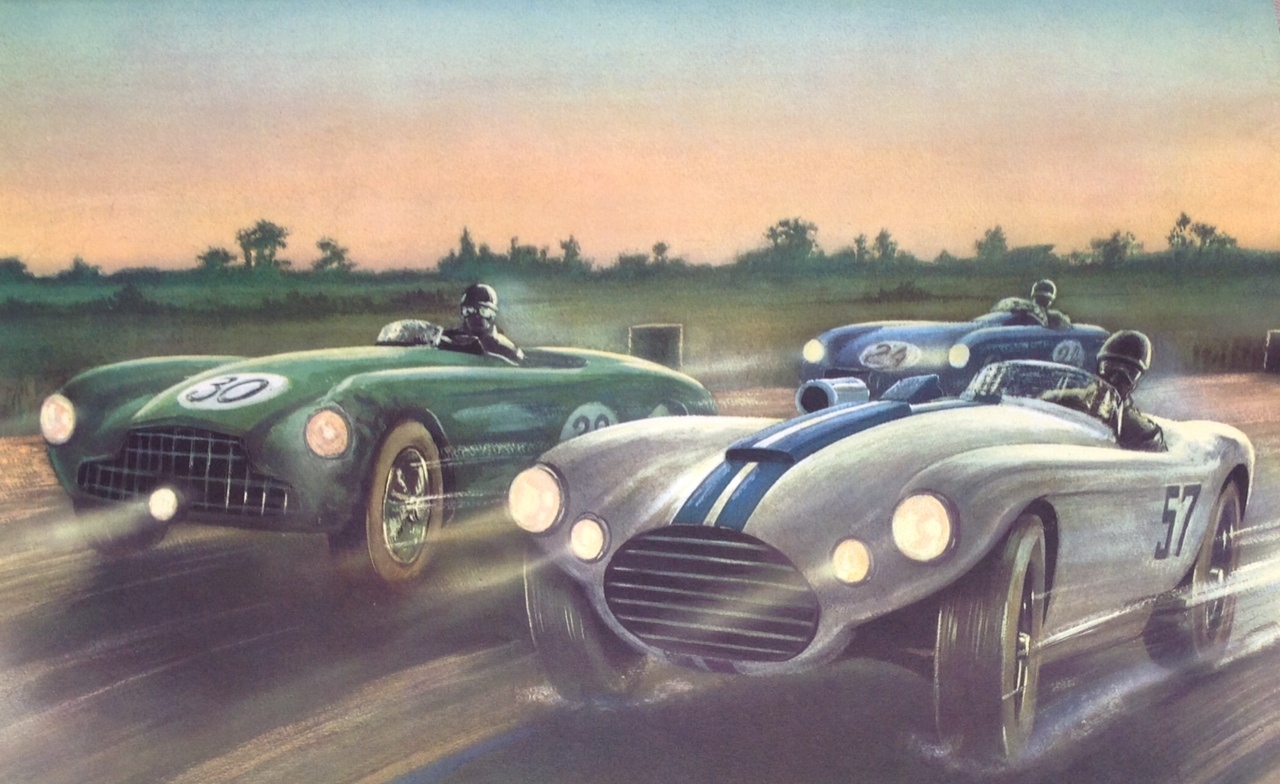
(Max Staub)
The Phil Walters/John Fitch winning Cunningham C4R Chrysler ahead of the Reg Parnell/George Abecassis Aston Martin DB3 and Cook/Moynet/Collier/Cahier/Bonnet/Morehouse!! DB Panhard…
The American car won by a lap from the Aston with Sherwood Johnston and Bob Wilder 3rd in a Jaguar C Type.
Credit…Max Staub
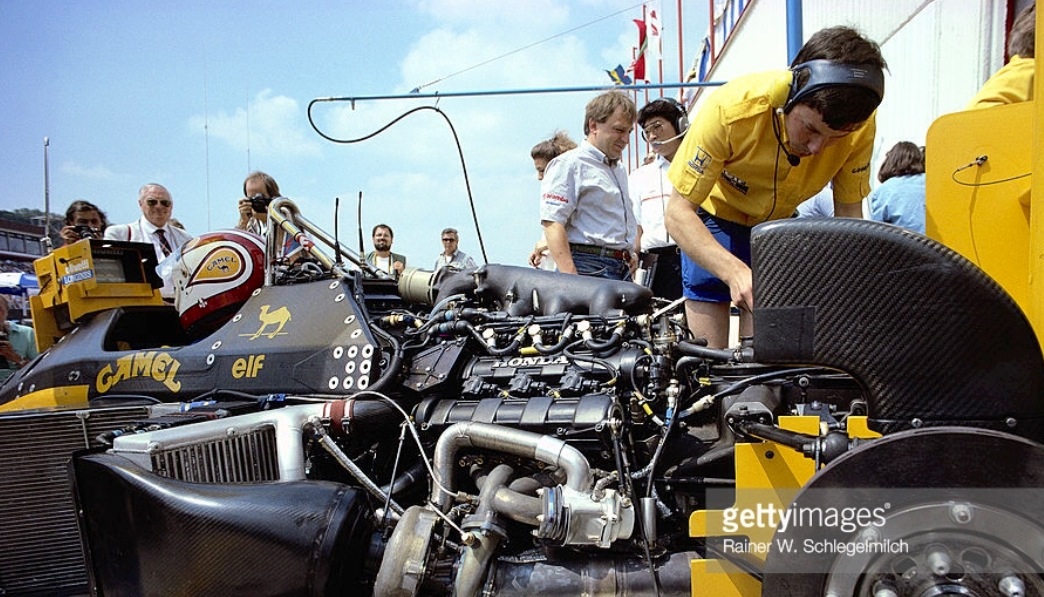
Nelson Piquet awaits ‘tweaks’ during Hungarian Grand Prix practice in 1988, it wasn’t a good weekend, Q13 and 8th, the race won by Senna’s McLaren Honda MP4/4…
The complex plumbing of the turbo-cars never ceases to amaze. It’s interesting to compare the architecture of the successful 1984/5 Porsche TAG-Turbo ‘TTE P01’ engine; the packaging of which was specified by its customers chassis designer, McLaren’s John Barnard, and this Honda V6 which didn’t have a chassis man ‘standing on the engine designers chest’!
A rather successful series of engines all the same!

1984 Porsche-TAG ‘TTE P01’ 1.5 V6 engine in the McLaren MP4/2 chassis. John Barnard’s brief to Porsche was strongly driven by the brilliance of the Ford Cosworth DFV, the packaging of which was influenced, read prescribed by ‘chassis-man’ Colin Chapman. Distance across the cam-boxes, crank height and engine mount to chassis were ‘lifts’ from the DFV. Note ‘McLaren tail’, big de-aerating oil tank beside suspension rocker, low-slung KKK turbo, intercooler and carbon fibre tub, Barnard its pioneer as chassis material with the first MP4 McLaren in 1980 (Doug Nye)
Not a good year for Lotus, or anyone else, McLaren in the other Honda RA168E 1.5 V6 engined cars ‘disappeared into the sunset’, winning all but the Italian Grand Prix, Gerhard Berger took the Monza race for Ferrari; 7 wins for Prost and 8 for Senna, with Senna taking his first title and McLaren the constructors of course.
Credits…
Rainer Schlegelmilch, LAT, Doug Nye ‘History of The GP Car ’65-85’)
Tailpiece…
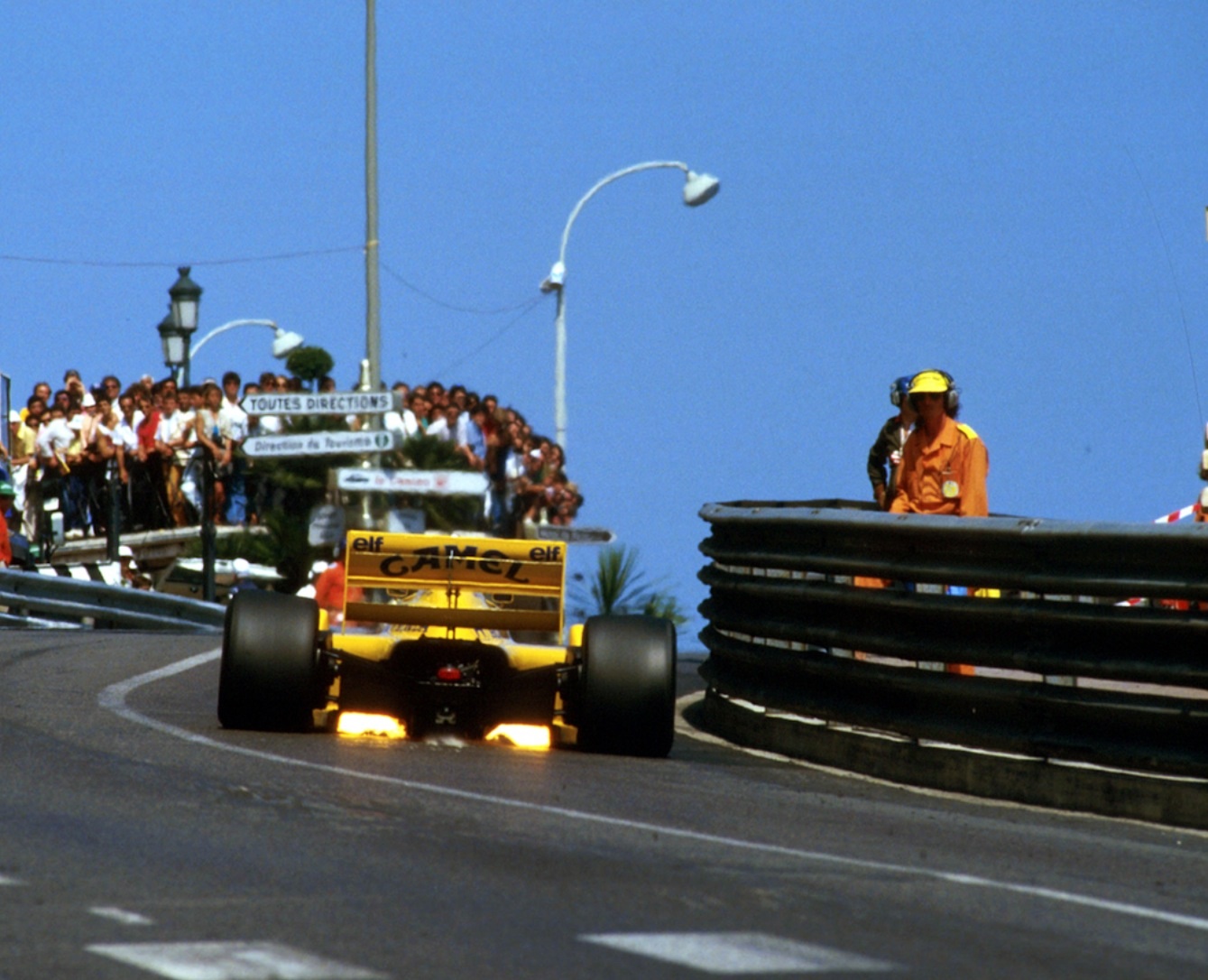
Piquet, Monaco 1988. Q11 and DNF after a lap 1 collision, race won by Prost’s McLaren (LAT)
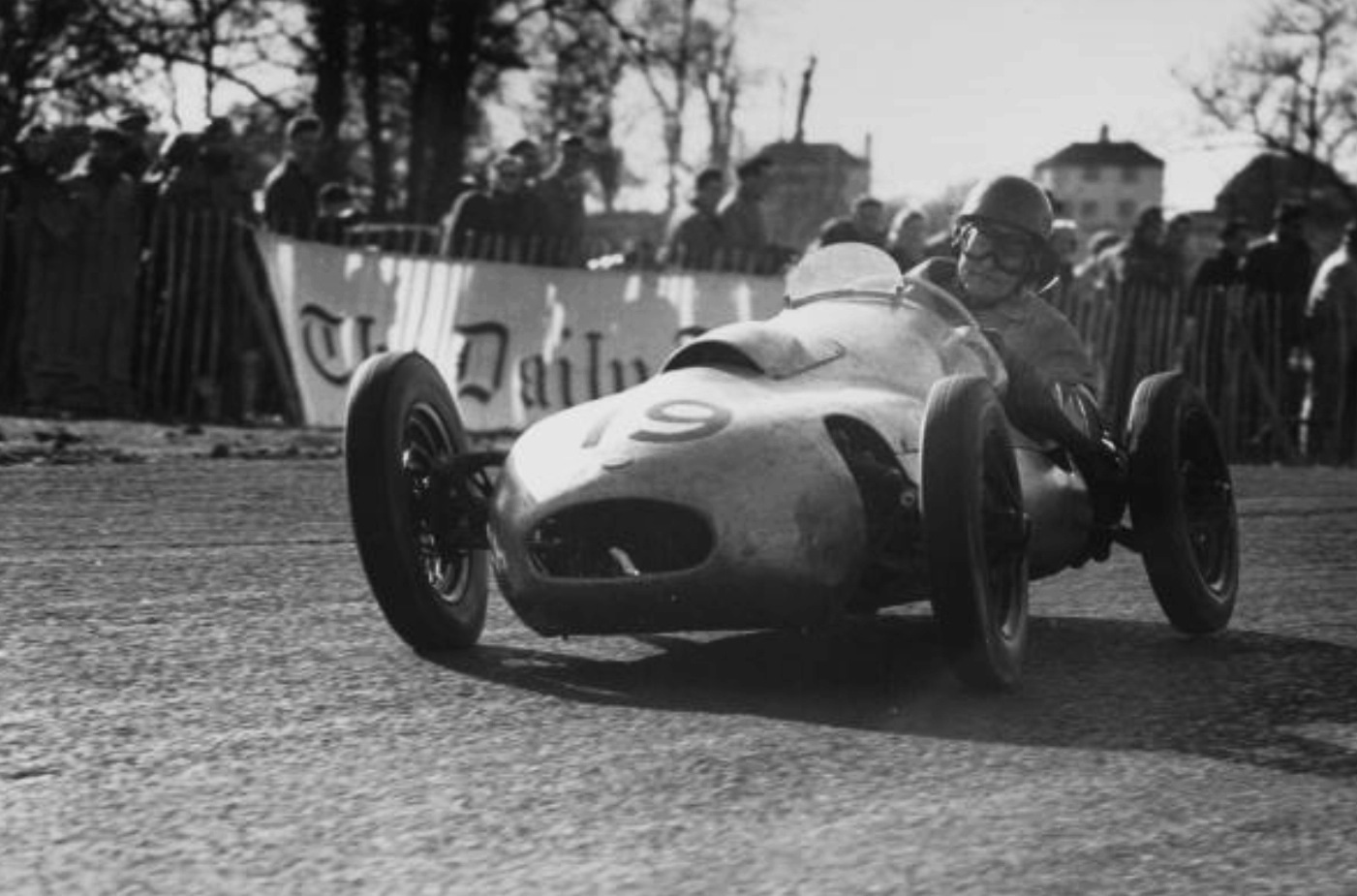
(Bert Hardy)
Paul Emery racing ‘the wrong way’ at Brands Hatch in 1951…
Car is the Emeryson 500 front-engined and front wheel drive car built by he and his family. Click here for an interesting article on the various Emeryson cars.
http://www.500race.org/web/Marques/Emeryson.htm
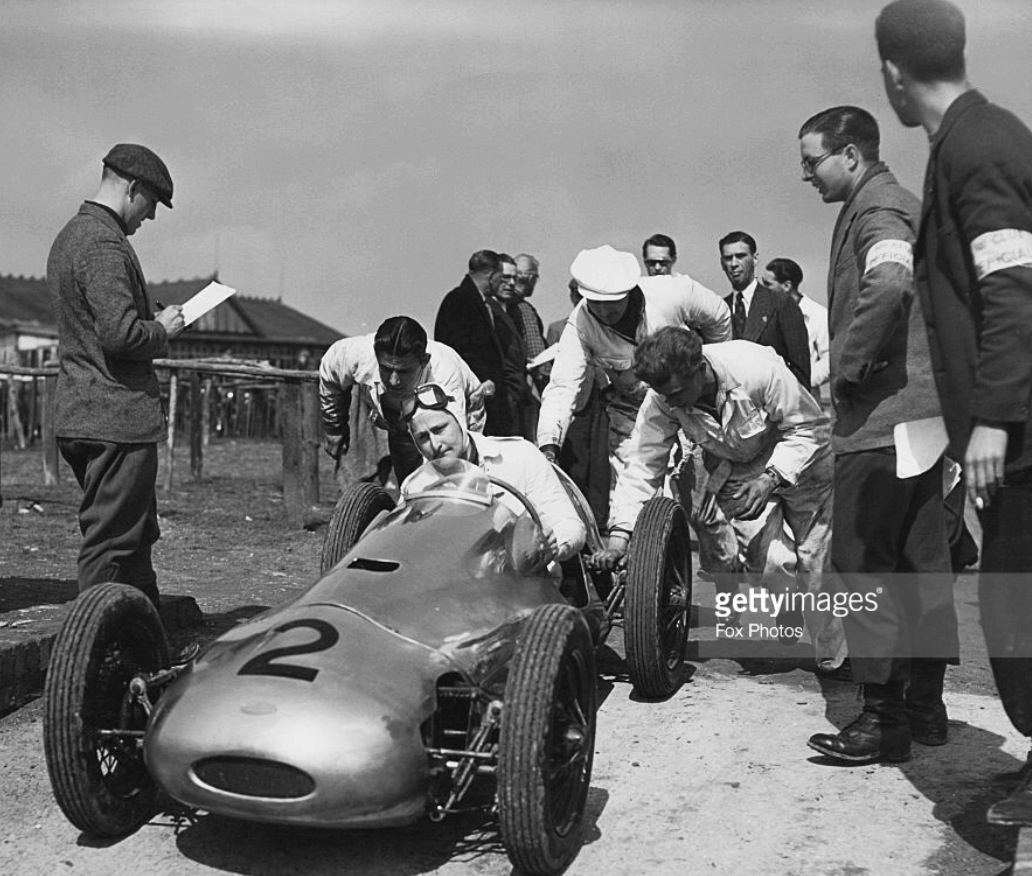
The photo below is Emery being pushed onto the grid in his Emeryson JAP twin 500cc car ‘for race 1, amateur built cars, the very first race at Brands Hatch during the inaugural Brands event on 16 April 1950’.
Credits…
Bert Hardy, Fox Photos

