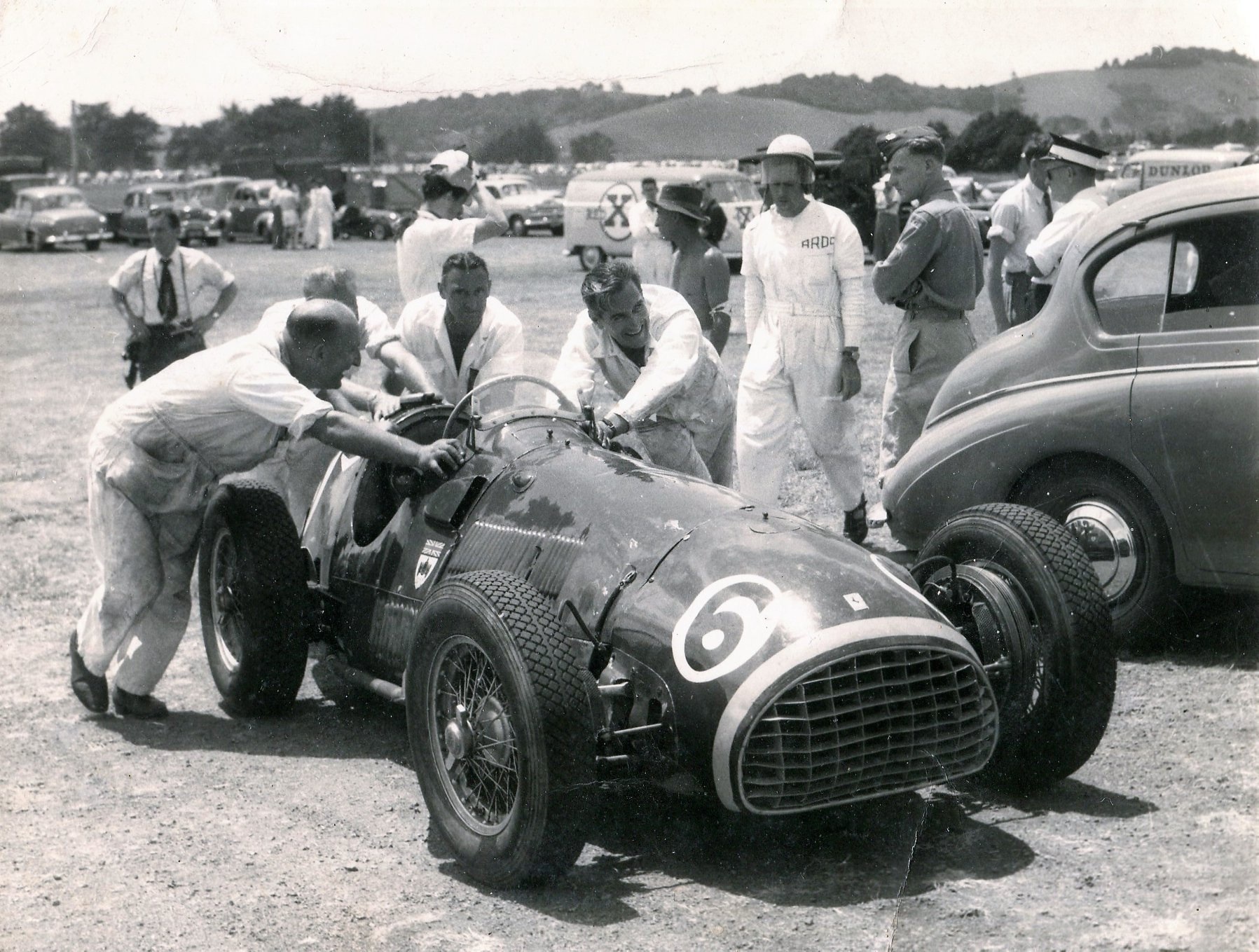
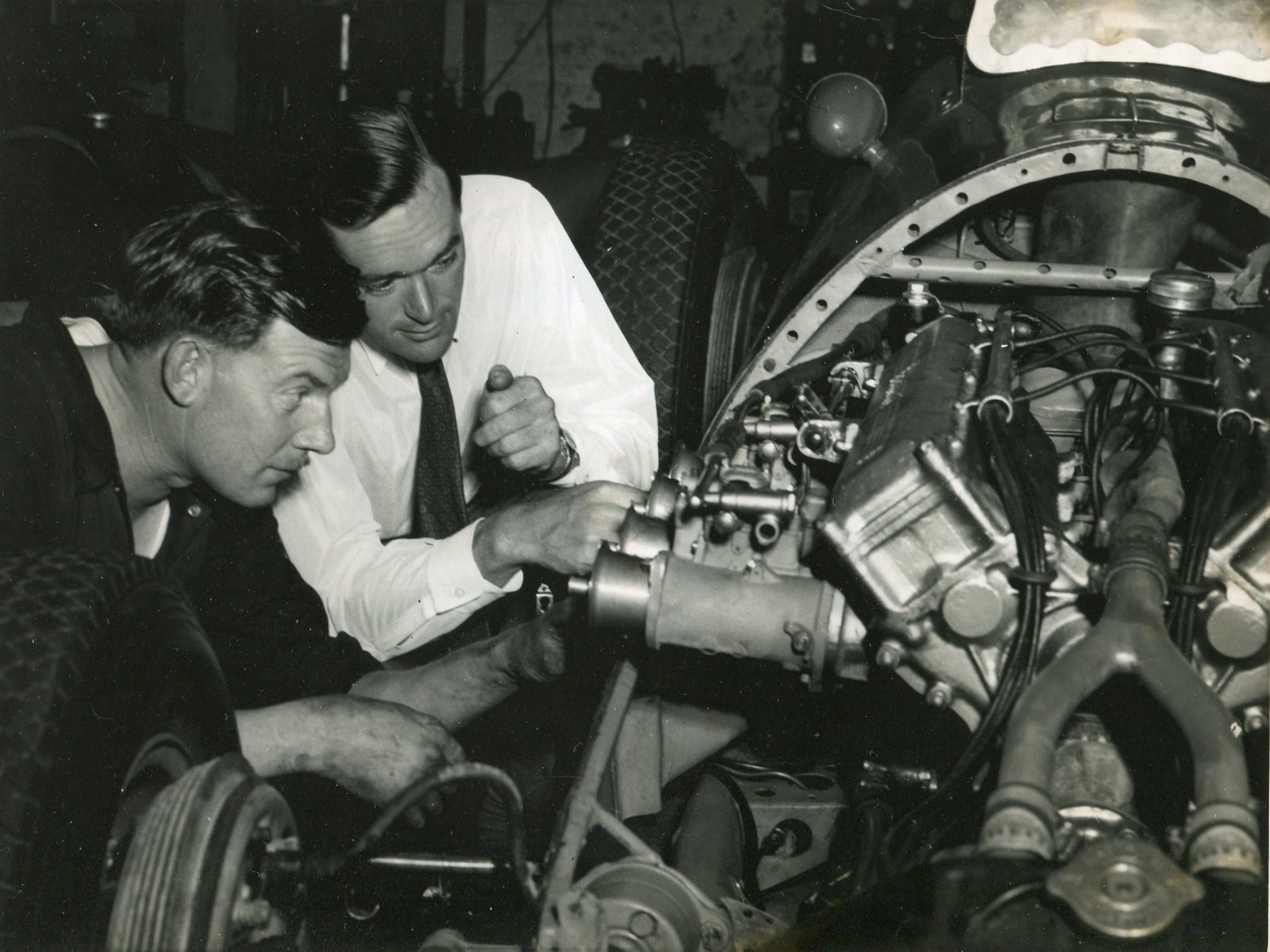
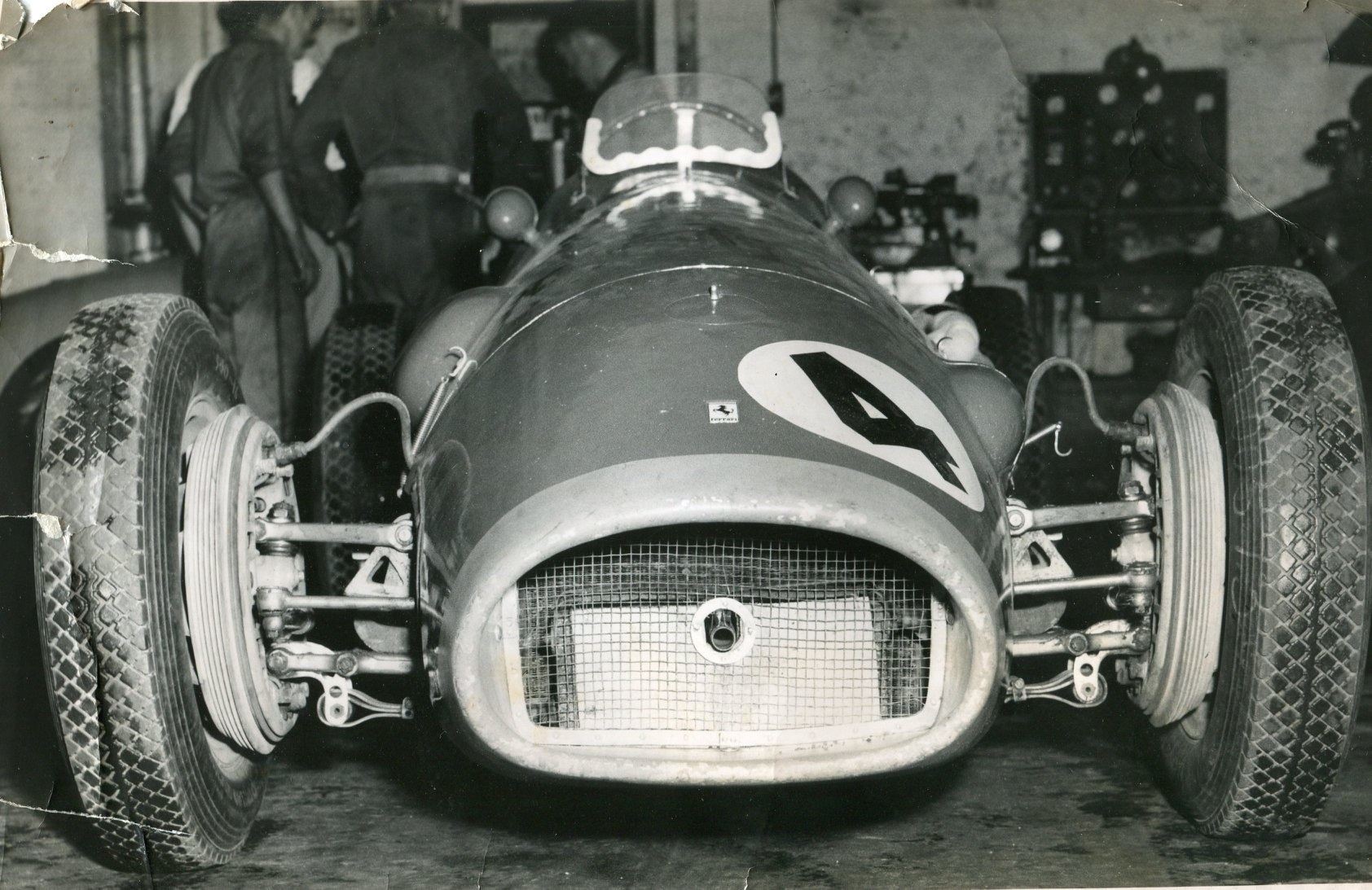
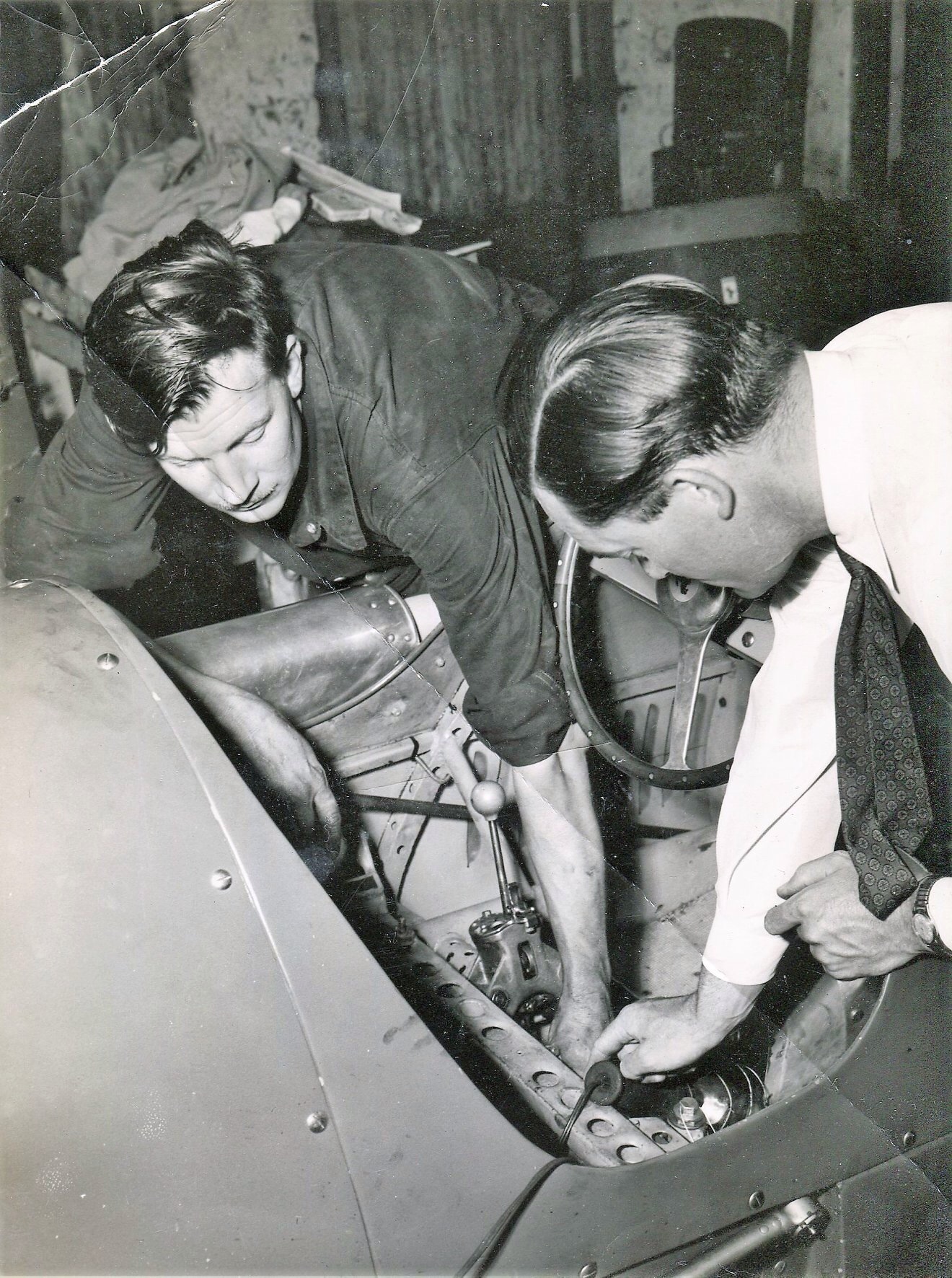
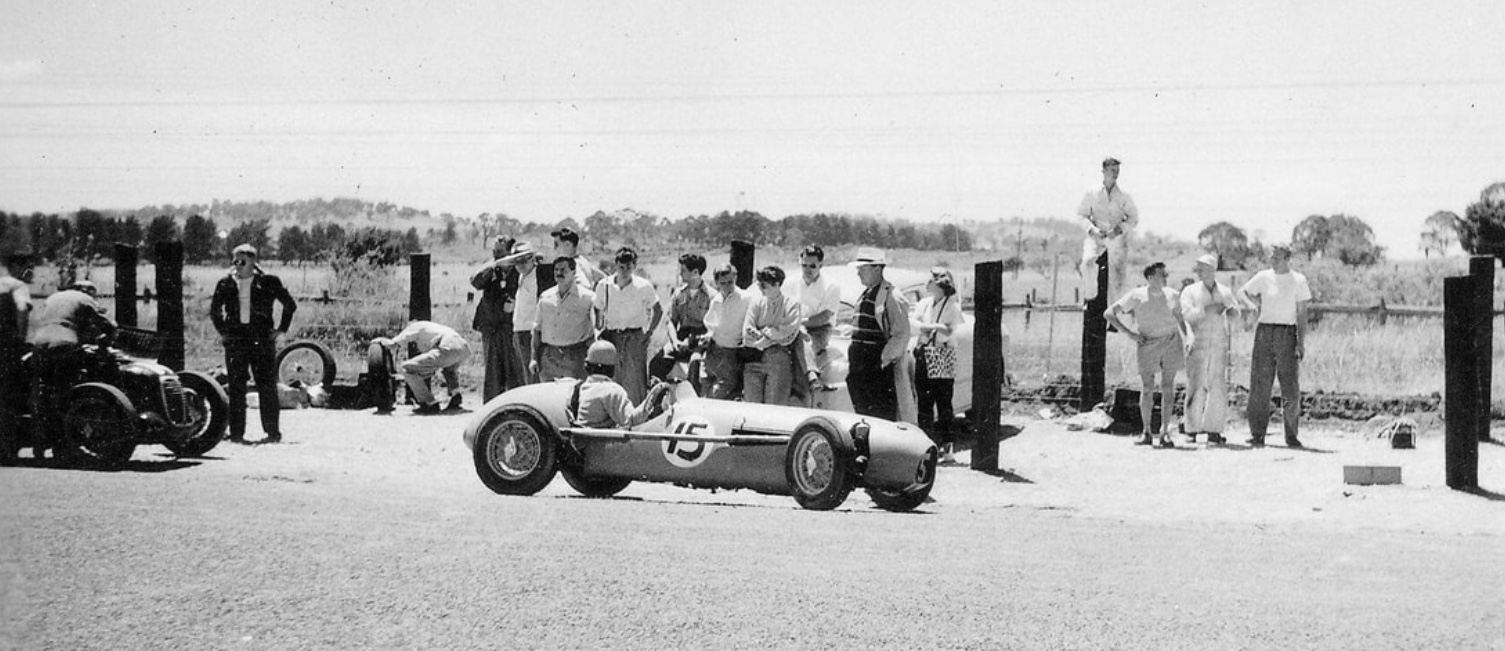
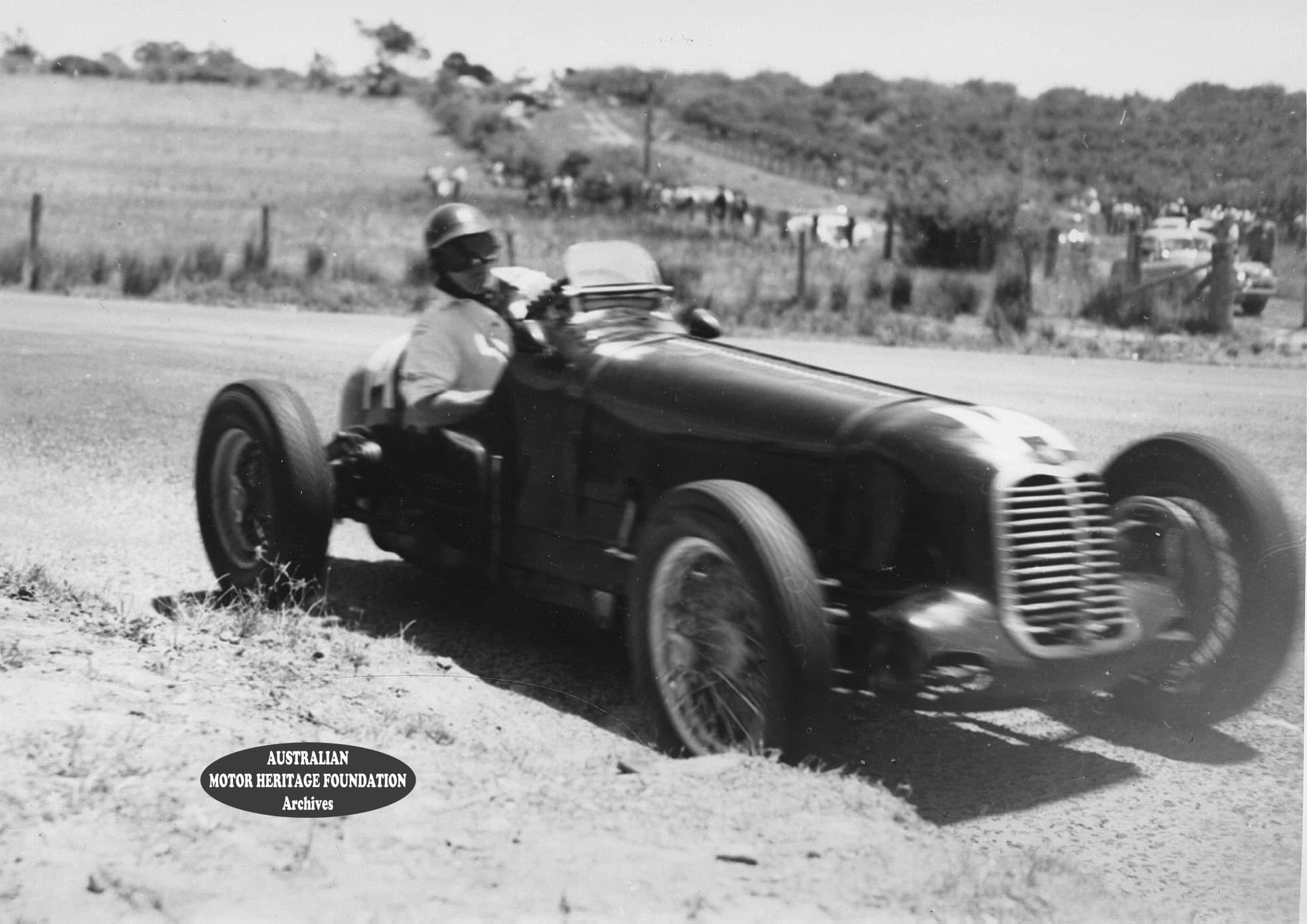
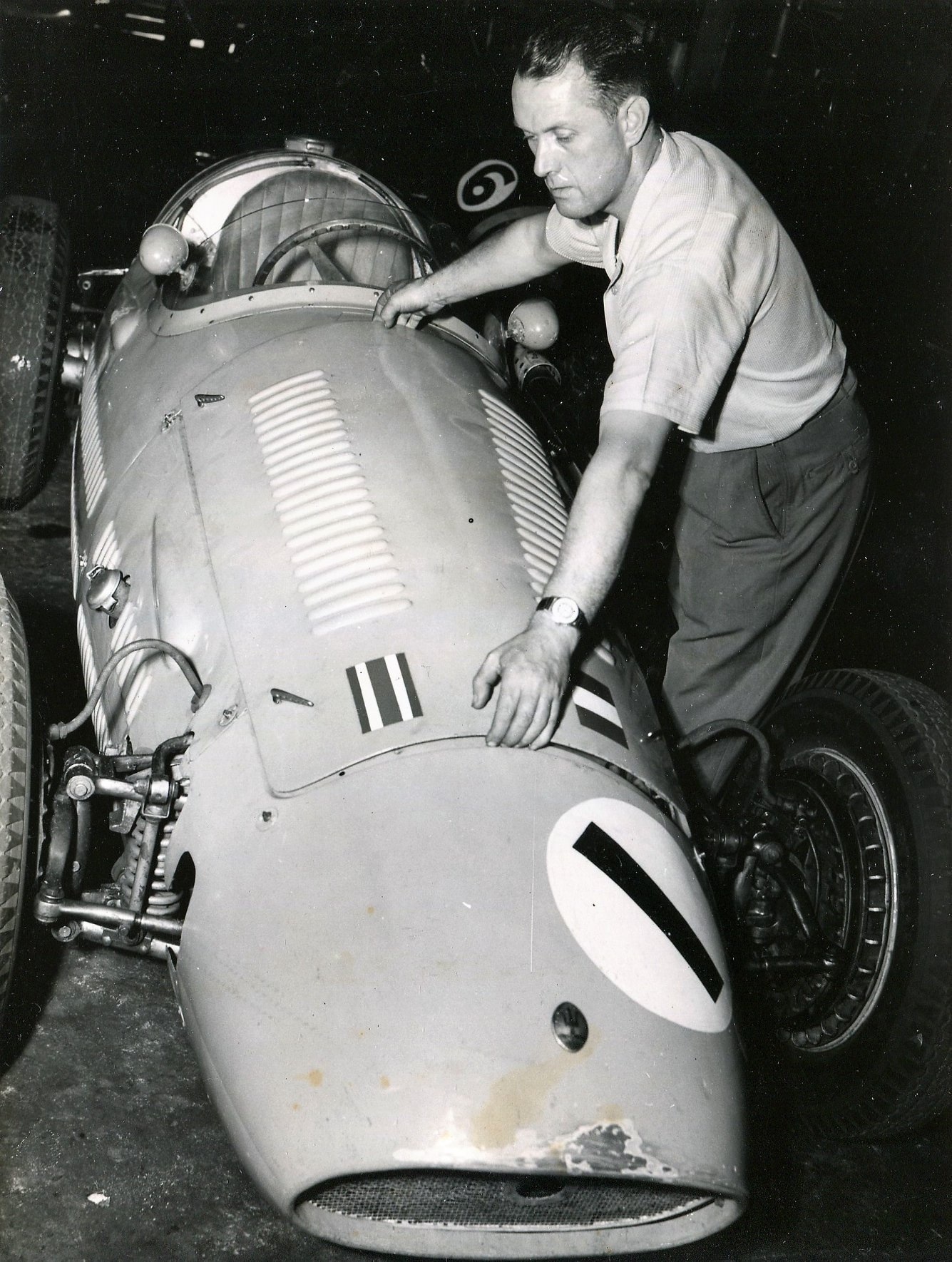
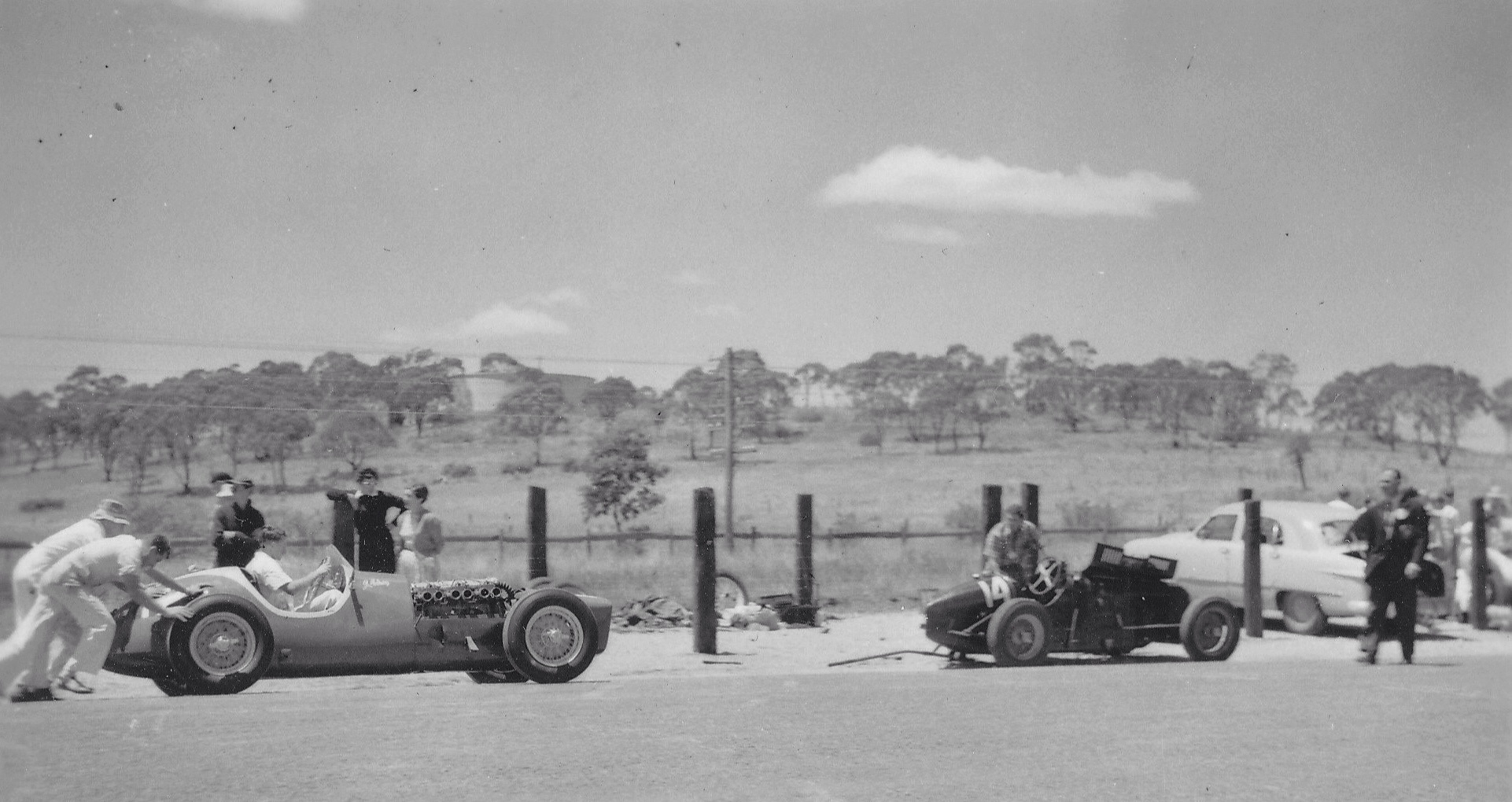
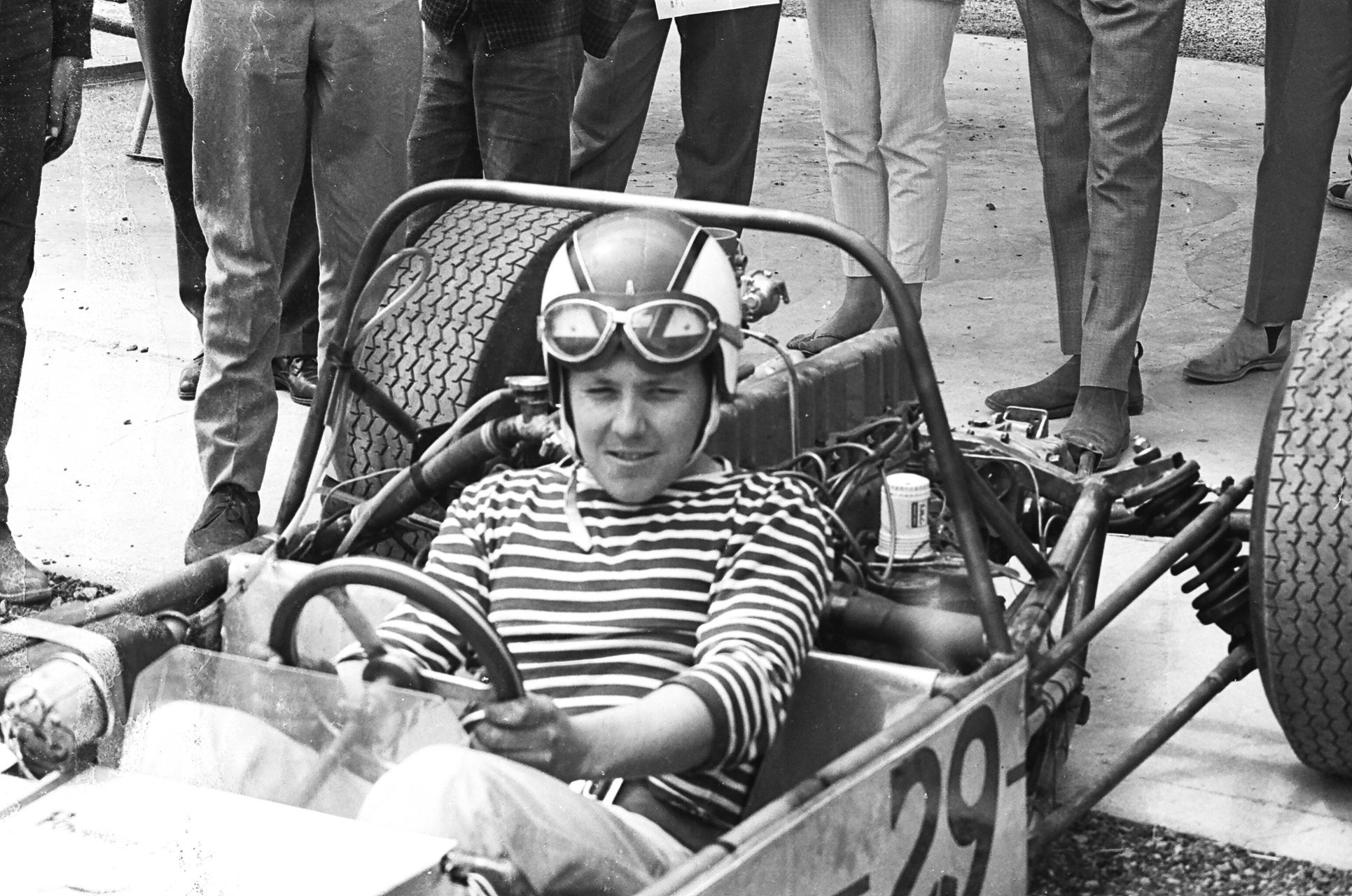
Dick Cobden’s Ferrari 125 being pushed through the Gnoo Blas paddock- that’s lanky, slim Jack Brabham with helmet on behind (F Pearse)

The natural or established order of Australian motor racing was shaken up and greatly changed by events over the summer of 1955…

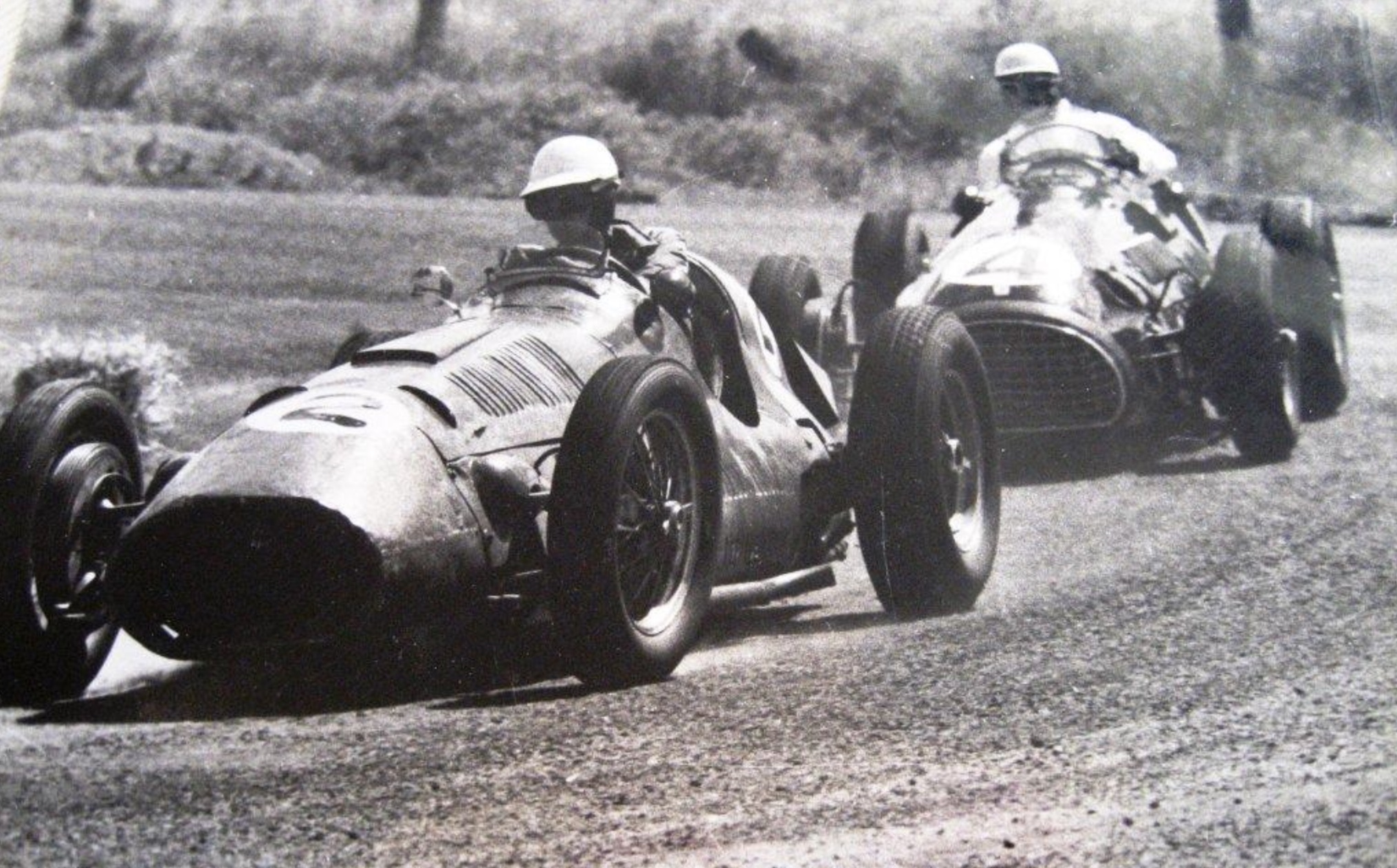
The Ardmore, New Zealand Grand Prix in January was won by Prince Bira’s Maserati 250F from Peter Whitehead and Tony Gaze in their matching Ferrari 500/625 3 litre, four cylinder hybrids, Jack Brabham’s Cooper T23 Bristol and Reg Hunt’s new Maserati 250F engined A6GCM, fifth.

Other Australians who made the trip but failed to finish were Stan Coffey, Cooper T20 Bristol, Lex Davison, HWM Jaguar and Dick Cobden in the Ferrari 125 V12 s/c he acquired from Peter Whitehead after the NZ GP the year before.

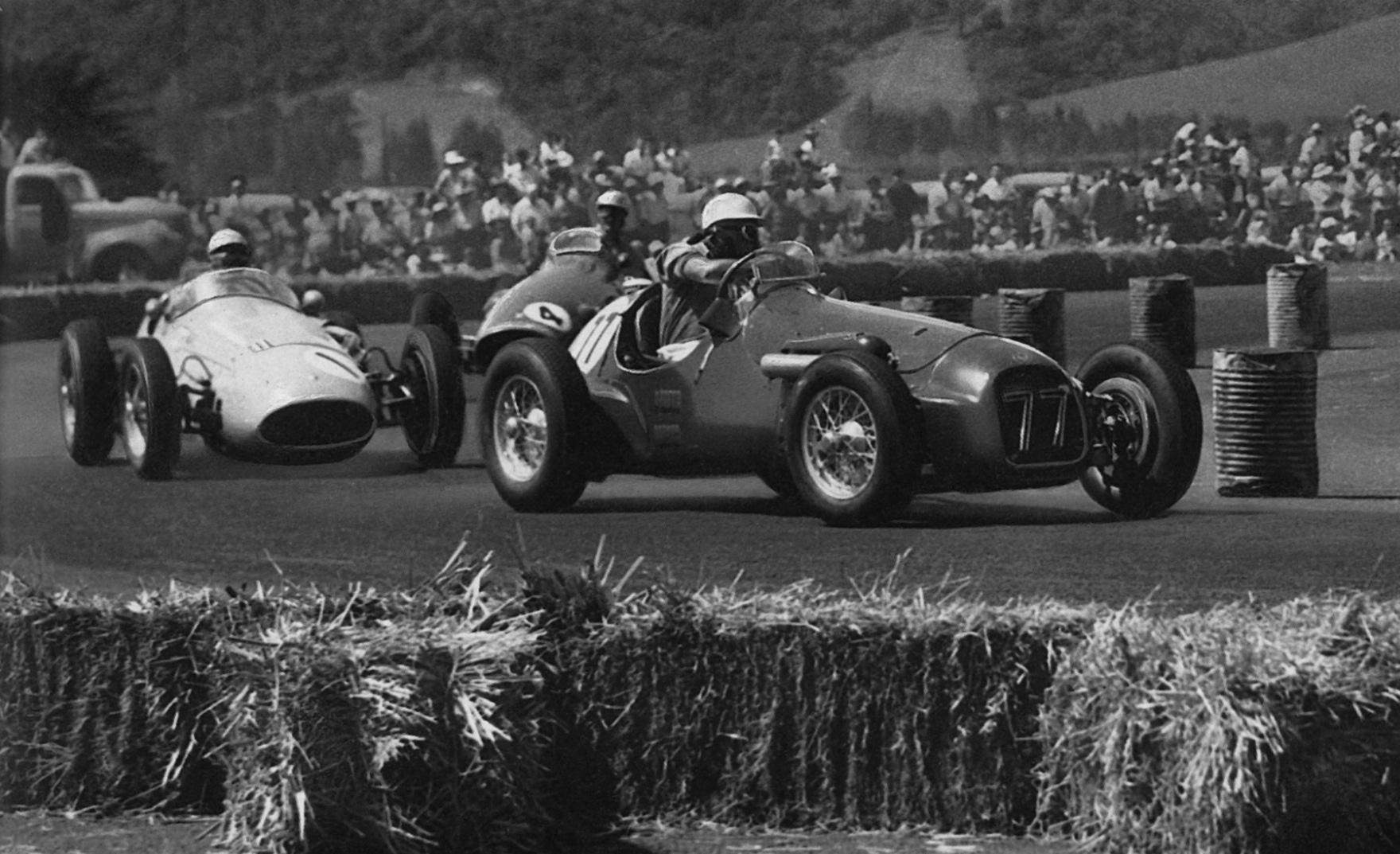
Lex Davison being chased by Bira and Tony Gaze at Ardmore, 1955 NZ GP. HWM Jaguar, Maserati 250F and Ferrari 500/625 (thechicaneblog.com)

(CAN)

A group of the front running cars at Ardmore in ‘Phil Neill’s showroom a day or two before the race.’

Bira’s 250F and Gaze Ferrari 500 in front with Whitehead’s #2 similar 500, #3 is Reg Hunt’s Maserati A6GCM, #77 Lex Davison’s HWM Jaguar, #9 George Palmer’s Mercury powered Palmer Spl, #6 Cobden’s Ferrari 125 and hidden, unfortunately, in the corner Bira’s ‘second-string’ Maserati 4CLT Osca V12 with a Ford Consul providing marvellous context!

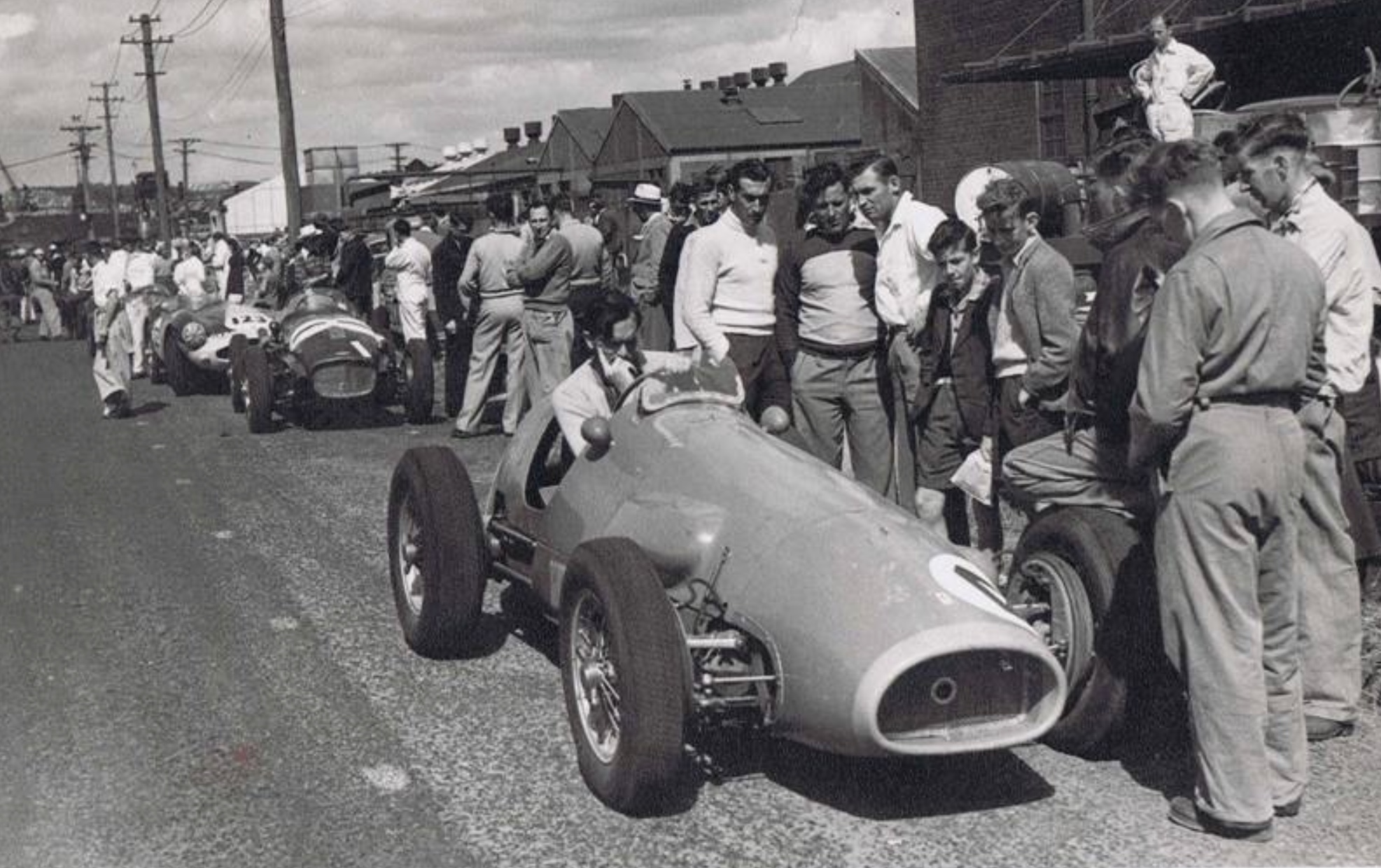
Tony Gaze warms up his 3 litre Ferrari four with plenty of admiring Kiwis by the Dunedin wharves, Ferrari 500/625, January 1955. Reg Parnell’s Aston Martin DP155 is behind and then an Aston Martin DB3S (unattributed)

By the end of the Ardmore weekend, Brabham, buoyed by his speed and his mind filled with ambition, ideas of opportunity and success paid bonuses from trade suppliers in the UK by the visiting RAC’s Dean Delamont- had determined to sell his Cooper and chance his luck in the UK.

Dick Cobden, another of the fast-men in Australia- his dices with Brabham during 1954 had drawn fans to meetings from far and wide, also planned a racing holiday in England in between continuing his stockbroking career in a London brokers office.

‘He was accompanied by mechanic Fred Pearse and the fascinating, frustrating Ferrari (125), and enjoyed some mobile spectating…Cobden hoped to collect the D-Type he had ordered, but long delays led to him cancelling the order, and the overseas trip was effectively his farewell to motor racing’ Graham Howard wrote.

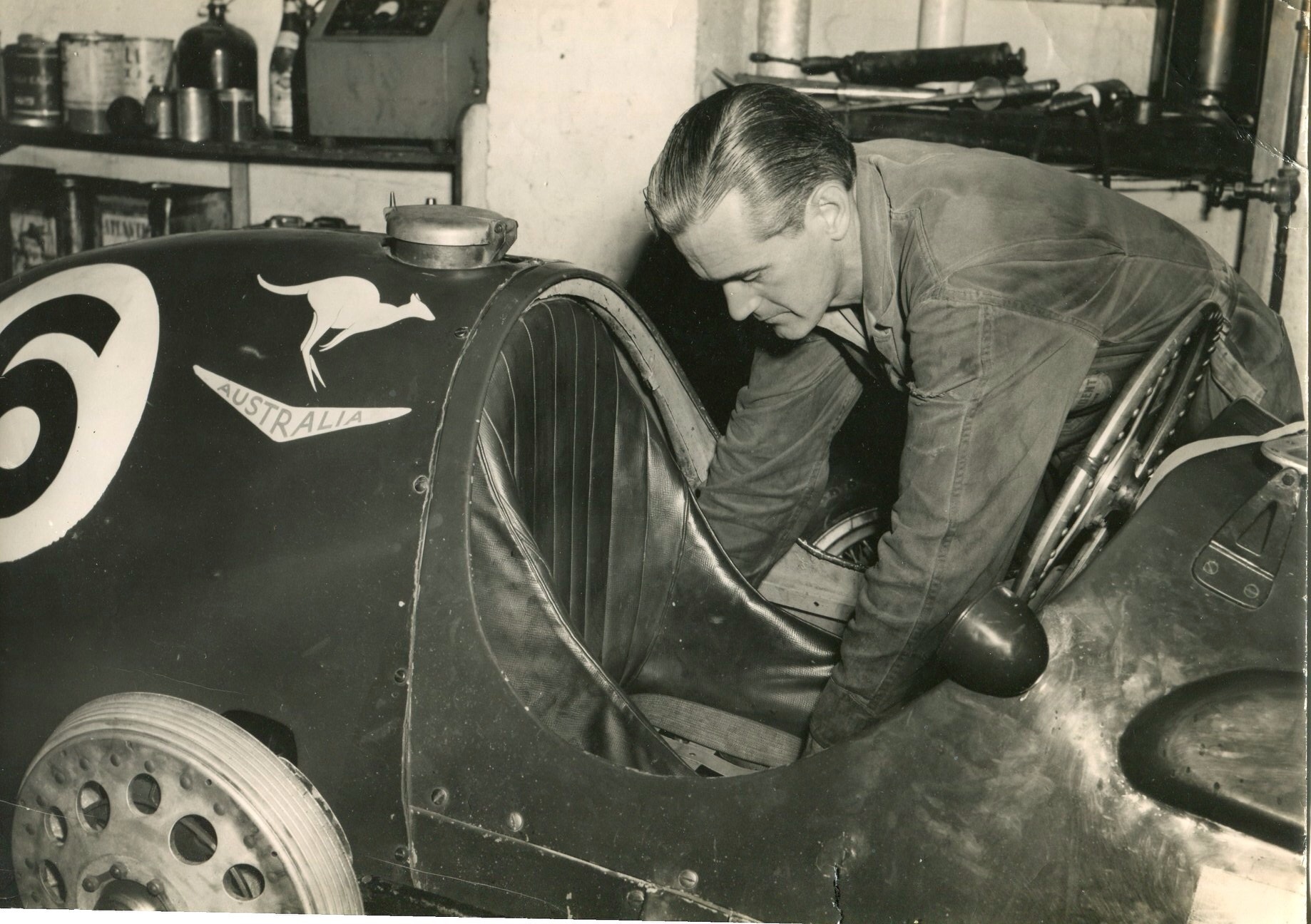
Fred Pearse attending to Cobden’s Ferrari 125 (F Pearse)

Pat Ratliff and Tony Gaze with Gaze’s Ferrari 500/625- the oh-so-famous ex-Alberto Ascari 1952 and 1953 World Championship winning chassis- one of the ‘winningest’ if not the most, GP cars ever (F Pearse)

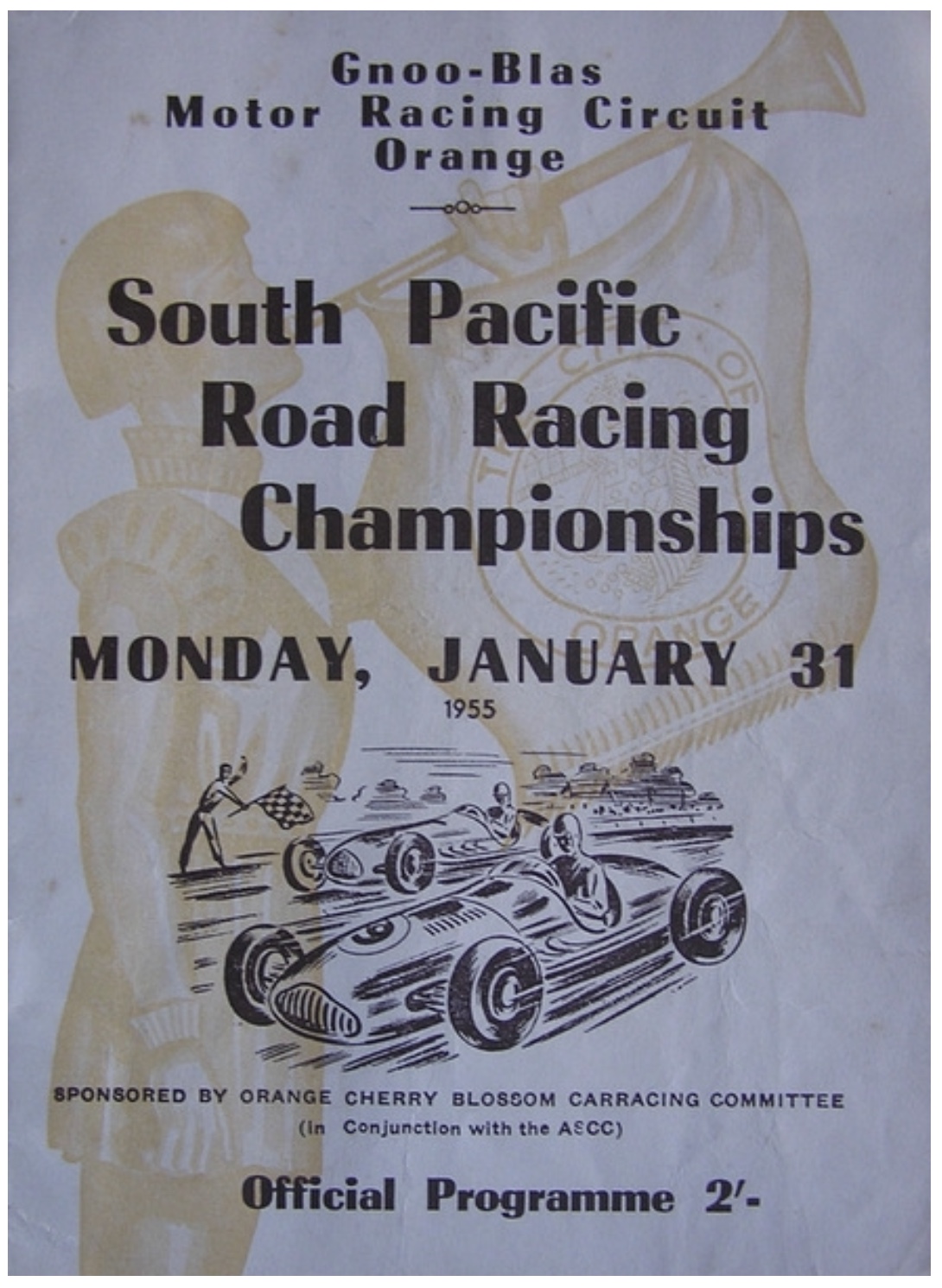
But first the travelling circus headed by sea to Sydney and then by road west to the Gnoo Blas road circuit at Orange for the ‘South Pacific Championship’ international held on 31 January. Bira, Whitehead and Gaze then planned to race their cars in South Africa.

Whilst Brabham and Cobden contested Gnoo Blas, Hunt and Davison, Lex the winner of the 1954 Southport AGP did not- Hunt was short of some critical parts for his A6GCM whilst Lex did not make the trip.

Hunt’s pace had always been apparent in Australia and in the year he raced a Cooper 500 in the UK and Europe- with the purchase of  the A6GCM he vaulted over the top of everyone in Australia- the speed of car and driver was THE combination of 1955.

Whilst Lex’ HWM Jag was fast, it wasn’t fast enough nor, despite ongoing development was it sufficiently reliable, it did of course hold together at Southport some months before, the 1954 AGP win was the first of Lex’ four victories in Australia’s premier event.

Davison no doubt showed more than passing interest in his good mate Gaze’s Ferrari 500 in the early months of 1955- a purchase he would consummate later in the summer of 1955-1956 and as a consequence set the standard- along with the local 250F’s of Hunt and Jones and Ted Gray’s bellowing V8 Tornado 2 Ford/Chev in the coming years.

Gaze #4 and Whitehead Ferrari’s getting a tickle- car behind is Bira’s Maserati 250F and at the rear the Broadbent/Haig Hurst Bentley (F Pearse)

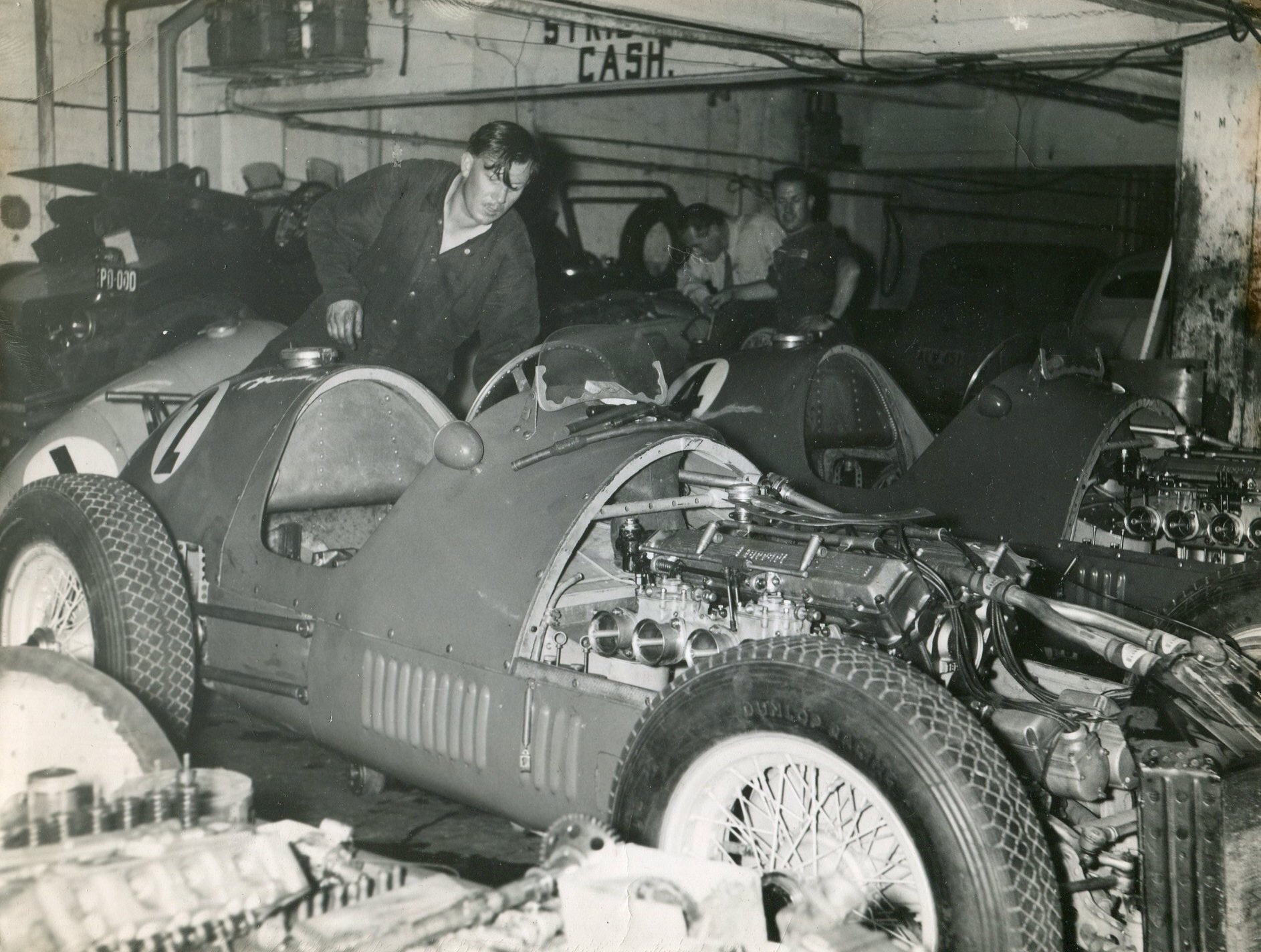
In Orange the ‘star cars’ were garaged in a workshop where several of these photographs were taken. The images by Fred Pearse, kindly circulated on social media by Peter Reynell who cared for Fred in his final years, take ones breath away.

Bob Pritchett makes mention in his AMS report of the race, of the OSCA being looked after at Lapham’s Garage in Orange, Mr Lapham was the Chairman of the Orange ‘Cherry Blossom Car Racing Committee’ which staged the event along with the Australian Sporting Car Club. Laphams is most likely the venue of the garage shots.

Tony Gaze Ferrari 500 (F Pearse)

Ratliff and Gaze (F Pearse)

Thirty-nine cars entered the 100 mile South Pacific Championship, there were also events for sport and touring cars, a purse of two-thousand five hundred pounds was offered for the feature race, very good money at the time.

The entry included Kiwis Fred Zambucka in the Maserati 8CM he raced in the ’54 AGP and John McMillan’s Alfa Romeo Tipo B- both pre-war machines which were at that stage a little too long in the tooth to be a threat, the race was a scratch event, even if, in a nod to the past, handicap placings would also be awarded.

Jack Murray, Allard Cadillac, Ted Gray aboard Tornado 1 Ford was fitted with the Lou Abrahams developed fuel injection setup for the first time. Tom Sulman had rebuilt his Maserati 4CM after a blow up at Gnoo Blas’ last meeting with parts flown specially from Italy to Sydney. Curly Brydon’s supercharged MG T single-seater special was one of the fastest in the country. Albury’s Jack Seaton entered a Maserati, Jack Robinson his Jaguar Special and Stan Jones had Maybach, a Cooper JAP and his Lancia GT entered- in the end Stan raced only the Lancia .

A special practice session was laid on before breakfast on the Sunday for the benefit of Bira, Gaze and Whitehead but it wasn’t of much benefit to the member of the Thai Royal Family when his Maserati 250F threw a rod after only 3 laps of practice, the car had done some miles in New Zealand, was rather tatty and overdue for a rebuild- this was the precursor to the tragedy which followed involving Iain Mountain and his very clever Mountain Peugeot Special the following day.

Practice itself started after breakfast and continued with breaks through until 5.30pm. No appearances were made by Hunt, Zambucka, Davison, the Jones Cooper 1100, James Barclay Special, the Moy MG Magnette Holden or the Peek MG Q Type.

Both Gordon Greig and Sydney’s Bill Reynolds appeared at the wheel of the Alfa Tipo B Alvis which Greig had only just acquired from Ash Marshall. Cobden’s Ferrari was spewing oil out of its breathers, Gaze’s had clutch and magneto problems and Bira’s crew had work to do on the exotic V12 OSCA’s oil scavenge pumps, so there would be no shortage of midnight oil poured in Lapham’s workshops.

Alf Harvey, ex-Bira Maserati 4CLT Osca V12 aka Osca V12 from Dick Cobden’s Ferrari 125 at Gnoo Blas during the 1956 South Pacific Trophy – Can’t find a shot of Bira in the car the year before (Gnoo Blas)

The ill fated Ian Mountain aboard his neat Peugeot Special, Sulman’s Maserati behind (K Devine)

Brabham’s Cooper T23 Bristol

Raceday started at 10.20 am with the ‘KLG Handicap’ for closed cars under 1100cc won by R Long’s Fiat 1100. The 5 lapper for Sports and Closed cars was taken by Jack Myers Holden, was he the ‘King of The Holdens’ at that stage?

Bira’s spare car was his OSCA V12- a marriage of a 4.5 litre, circa 300 bhp OSCA V12 with his old Maserati 4CLT/48 chassis, as noted earlier his crew had been trying to adequately prepare the car the evening before the race.

In the preliminary 5 lap ‘Gnoo-Blas Handicap for Racing Cars’ event it too suffered a major mechanical failure- a scavenge pump, the motor dumped its oil all over the road with Iain Mountain, who was following closely, lost control on the oil, left the road and crashed through a barbed wire fence at Connaghans Corner killing himself and 26 year old Ballan, Victoria, spectator James Young. Several spectators were injured, two of them were admitted to hospital- all were standing in restricted areas.

The MotorSport account is the one above, the Australian Motor Sports report of the race attributes the accident to driver error ‘Ian had been cautious about the corner on which he came to grief and it could be that he was off line to avoid stones thrown up by Curly Brydon’s car, which he was chasing; Curly actually saw him behind, and slowed down, having discussed the corner with Ian and knowing how he felt about it…’

Whatever the case it was a tragic motor racing incident, the ‘lotsa-money superb preparation of car’ Bira days were long gone. Poor Mountain, 26, had only married four months prior to the 1954 AGP weekend at Southport and had only been racing the beautifully built car from its first appearance at Fishermans Bend in early 1954.

Jack Robinson’s Jaguar Special won the race in which Mountain died, the South Pacific Championship for Closed Cars and another similarly titled 14 lap 50 mile race were won by Les Cosh’ Aston Martin DB2 and Bill Kelly’s Jaguar XK120 respectively.

South Pacific Championship…

The main event was delayed by 50 minutes for obvious reasons, with some indecision about the grid- it was to be 4-3-4, then decided to be 3-2-3 given the narrow road and ended up being 3-2-4. What follows is a summary of the AMS race report.

As the flag quivered before dropping, Jack Murray shot his Allard Cadillac between Gaze and Whitehead and led the field out of sight of the hill crest; Gaze somehow managed to get his clutch operational enough for the getaway and almost as soon as the last sound of the last cars had died, Jack Brabham flashed past the pits, his Cooper Bristol a good fifty yards ahead of Whitehead’s Ferrari, then Murray, Gaze, Cobden, and MacMillan in close quarters.

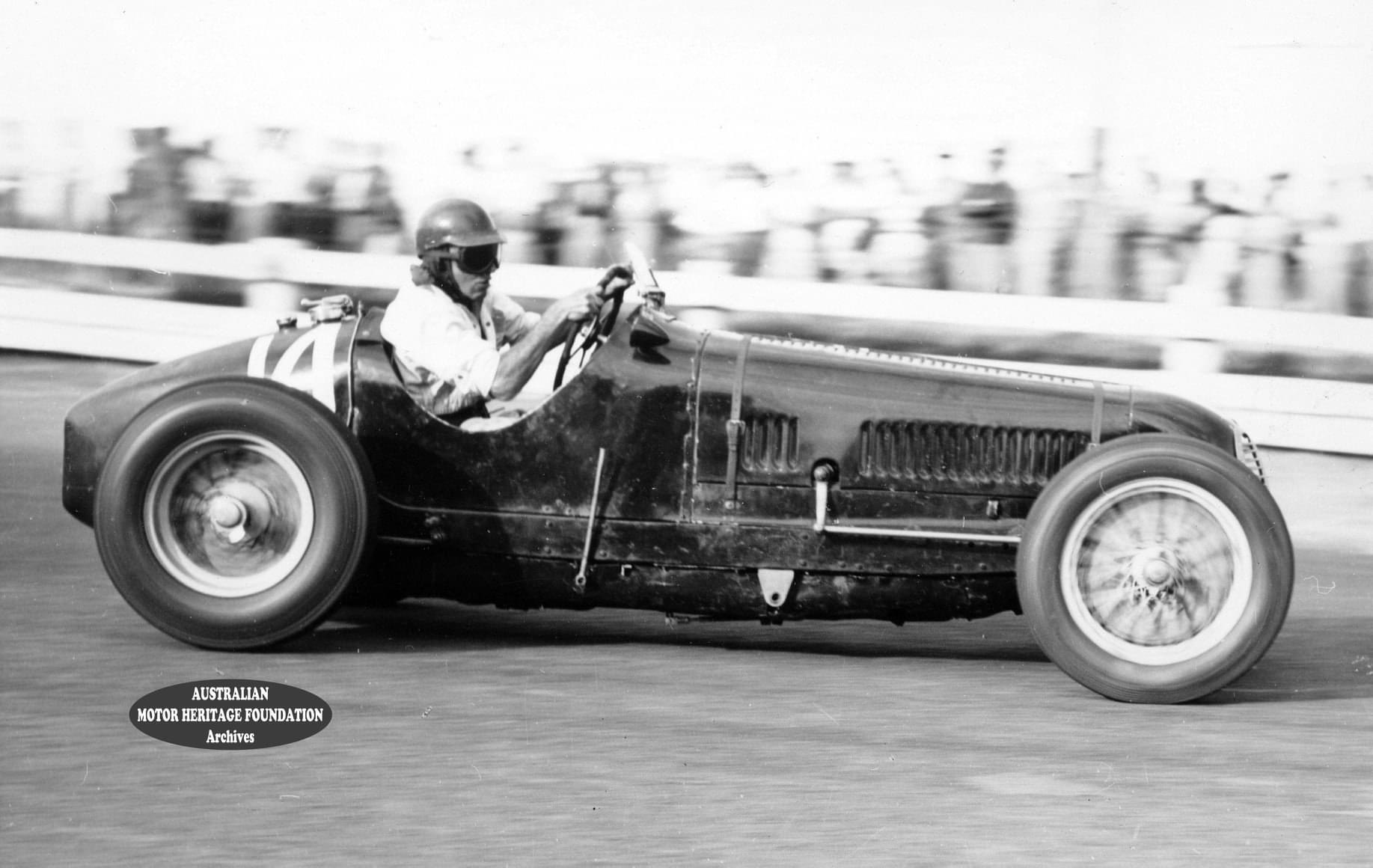
Gaze was past Murray in the next lap, but Cobden’s Ferrari was smoking and retired after 2 laps at Muttons Corner with a cylinder full of water and a bent rod which was shades of the last Orange meeting.

Brabham (K Devine)

Murray, Allard Cadillac (K Devine)

Tom Sulman, Maserati 4CM

Brabham’s lead was shortlived, it was not many laps before Whitehead was past the Cooper Bristol- but he drew away slowly indeed and, on the fast sweep and slow right angle corner, Brabham was very visibly fastest of any car in the race, drifting the sweep beautifully with all four wheels leaning outwards, braking late and going through Muttons Corner as clean as a knife…

Gaze, hampered by not having a fully operational clutch and only one effective magneto, was not as happy as he could have been.

For some laps there was a good duel between MacMillan in the Alfa Tipo B and Greig in the Alfa Tipo B Alvis, the two red cars looking very impressive as they came around in close company. Jack Robinson and Joe Murray went at it for most of the race, the Jaguar just ahead until towards the finish when he stopped briefly at the pits and lost two laps.

Curly Brydon, always quick and neat, kept hard on Tom Sulman’s hammer, and Bill Wilcox went very well in his green Ford Special until it went bad over a space of 3 laps or so and he retired. Noel Barnes had the ex-Ron Ward MG Special sounding very sweet and healthy even though he was lapped several times by the faster cars.

Finally, the sun well down on the Western horizon, Peter came around grinning and without his crash hat and we knew the race was finished. As Brabham was less than a minute behind at the end he naturally won the handicap, Peter had fastest lap in 2:21.

Peter Whitehead Ferrari 500/625, won from Brabham, Cooper T23 Bristol, Gaze, Ferrari 500/625, Jack Murray Allard Cadillac, Tom Sulman Maserati, Curly Brydon MG Spl, G Greig Alfa Tipo B Alvis

Whitehead’s top speed was 149 mph, Gaze 147, Brabham 136, Sulman 110 and Brydon’s 115mph.

Cobden about to go out, Sulman readies his Maserati (K Devine)

One of the Ferrari 500s at Laphams (F Pearse)

Snippets by AMS’ Bob Pritchett…

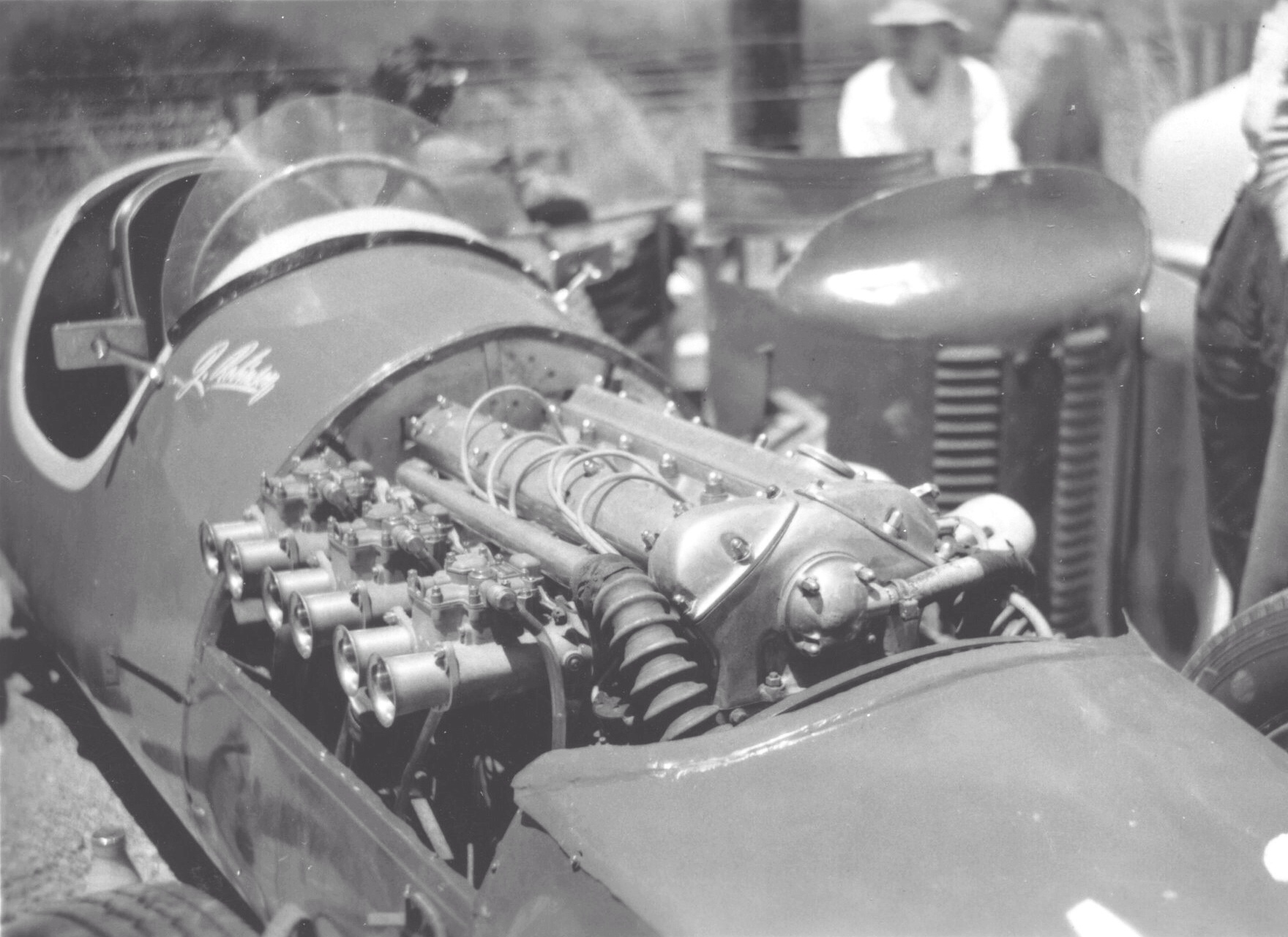
‘The 3 litre motors of Gaze and Whitehead have a bore and stroke of 104 x 90 mm and the inlet valve is open for, wait for it, 330 degrees of the revolution…I saw Gaze’s motor stripped later; the valves are simply tremendous, and the pistons are like outsized salmon tins with bumps on them, rods like a short length of RSJ and the five bearing crankshaft a beautiful piece of work’.

Big Muvvas: Weber sand cast 58 DCO’s (F Pearse)

Hunt didn’t race but was present in person ‘…With no Maserati, marooned in Melbourne with a broken back plate. He tried to borrow one of Bira’s spares but received the rather discouraging reply, that he could have them all and the car for 4000 sterling. Slightly different to the Australian approach- Tony Gaze did the race with a magneto coil out of Cobden’s Ferrari for instance.’

Bira’s Maserati 250F (F Pearse)

‘I reaped some sort of macabre delight out of watching the Clerk of Course Daimler steaming around festooned with advertising matter during the wrangle about slogans on cars which resulted in Coffey’s dramatic retirement on the (start)line, masking tape all over Murray’s Allard Cadillac, funny little blobs of green paint on Brabham’s Cooper Bristol and such.’

Stan Coffey’s Cooper Bristol, after a stoush with CAMS about advertising he did not take the start, I see Clive Adams prepared the car. Cobden Ferrari 125 at rear (K Devine)

Etcetera…

(K Devine)

Jack Robinson being push-started in his Jag Special whilst alongside Tom Sulman fettles his Maserati, photo below of Robinson’s Jag XK engine.

(K Devine)

#2 Whitehead, Ferrari 500 #4 Gaze’s similar car and #1 Bira’s 250F (F Pearse)

Tom Sulman, Maserati 4CM

Bibliography…

MotorSport May 2006 article by Jim Scaysbrook, Australian Motor Sports February 1955 race report by Bob Pritchett

Photo Credits…

Fred Pearse Collection, Ken Devine Collection, Stephen Dalton Collection, Allan Dick’s ‘Classic Auto News’, Australian Motor Heritage Foundation, Russell Hawthorn, Doug Chivas Collection

(D Chivas)

Postscript…

Brabham left for the UK in mid-March 1955 after a function held at Jack’s parents home in Hurstville attended by over 100 guests including the Mayor and Mayoress- at that stage he was expected to be away for six months.

It turned out to be rather longer than that of course, the great Australian finally retired from Grand Prix racing at the end of 1970 having been a front runner that season inclusive of one GP win which but for poor luck should have been three- competive to the very end of his long career.

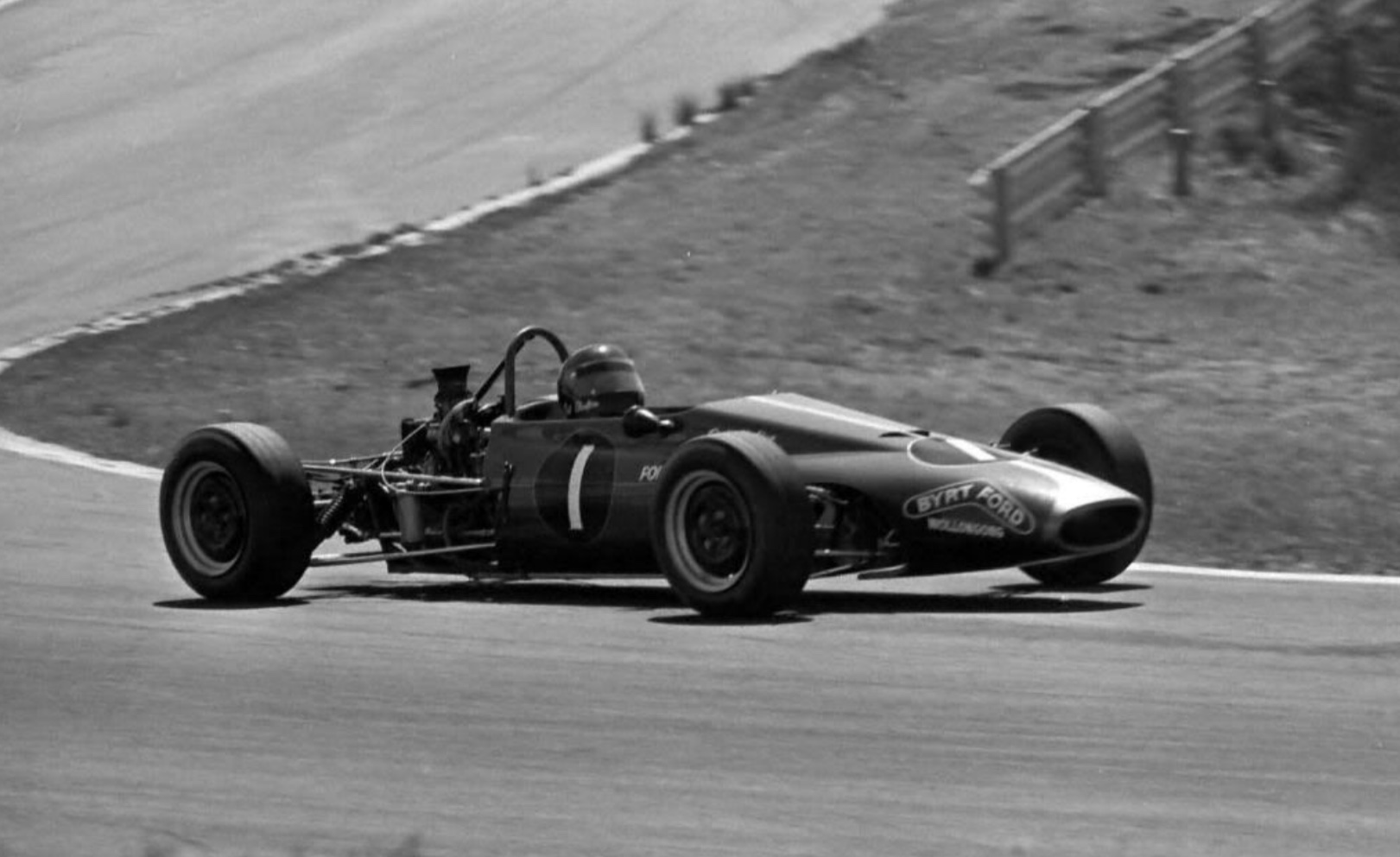
He couldn’t stay away from racing for too long though, by August 1971 he was back in the seat of the Jack Brabham Ford sponsored Bowin P4X Formula Ford and won the ‘Race of Champions’ at Calder from Frank Matich, Kevin Bartlett, Bib Stillwell, Alan Hamilton, Allan Moffat and others.

I think it was his last ever real ‘race win’, 1978 Sandown demo with JM Fangio duly noted?…

(R Hawthorn)

Tailpiece: Smorgasbord of ‘Big Red Cars’…

Whitehead, Cobden, Gaze and Bira, not that his 250F was red (F Pearse)

Finito…

(R Dalwood)

This shot at Baskerville, Tasmania on 4 December 1966 gave me a chuckle…

The race bike and it’s ‘Gunter-Wagen’ tow car frames John Goss’ brand new Tornado Ford, still without its rather attractive self built bodywork in the scrutineering bay.

One wag questioned whether the Beetle was towing the Suzuki or whether the 50cc two-stroke was pushing Wolfsburg’s finest.

I have written about the car which launched JG onto the mainland and subsequent fame in tourers and F5000 a couple of times before, checkout the link here; https://primotipo.com/2018/06/19/john-goss-tornado-ford-longford-1968/ , and here; https://primotipo.com/2018/07/17/1967-tasmanian-sportscar-championship/

(R Dalwood)

What a youngster! At 24 years of age Goss has constructed a very clever sports racer which became a competitive car and as fast as all but the big-buck cars at the very front of the fields- those raced by Matich, Allen, Jane, Hamilton and co.

(R Dalwood)

Look closely, the photo above shows the Tornado Ford’s initial VW front end which evolved to a more sophisticated wishbone set-up in the years to come.

(R Dalwood)

Gossy going around the inside of Allan Robertson’s Peugeot 203 that December weekend. One of the reasons I love these photos is because of the relaxed nature of a race meeting at a venue I’ve not been to.

Wonderful aren’t they?

(R Dalwood)

The crowd below are looking at the new Tornado Ford- it is the same group of people clustered around the car shown in the opening photograph but from a different angle.

(R Dalwood)

It would be interesting to know the intrepid pilot’s impressions of his handiwork after the first weekend of competition. I’m betting the little racer felt like a precise jet compared with the Customline and FJ Holden which preceded it- a mighty fine driver of Big Cars did John Goss become.

(R Dalwood)

Credits…

Historic Racing Car Club of Tasmania- Reg Dalwood Collection

Tailpiece…

(R Dalwood)

The way it was…

Finito…

image

(R Lambert)

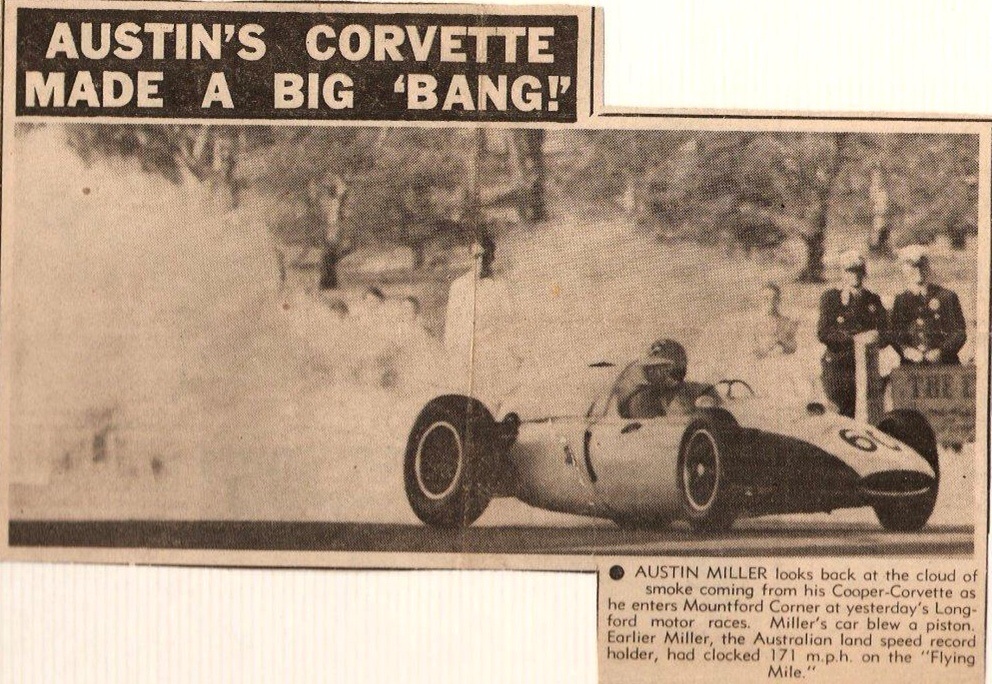
Austin Miller’s Cooper T51 Chev during his Australian Land Speed Record setting day-163.94mph at Bakers Beach, Tasmania watched by ‘four men and a dog’ on Monday 20 November 1961…

Only in Australia would a significant event like this have been achieved in such a clever, low key kind of way, still, the fellows involved were doers and goers not spruikers and bullshitters.

Watching him blast through the timing gear at over 160mph are car-builder Geoff Smedley, Bruce Burr, a few members of the local press and a small number of onlookers who have made their way to the quiet stretch of beach on Tasmania’s far north coast, 80 km from Launceston, the ‘Northern Capital’ of the island state.

When I first saw Ron Lambert’s image it simply blew my mind on a whole lot of levels other than its purely visual impact, powerful as it is. It says so many good things about this country and the understated, pragmatic, often ingenious way we tend to go about things.

Miller was born in Melbourne in 1923, in common with most of his contemporaries from around the world he enlisted to fight in WW2. He joined the army and became a tank instructor but he was keen to fly so moved from the Australian Army to the Royal Australian Air Force where he learned to fly in Tiger Moths before graduating progressively through the Wirraway trainer and on to Mustang and Spitfire fighters.

Post war, keen to stay in aviation- and there were plenty of great pilots in the world at that point in time, Aussie and his friend Ernie Tadgell formed Super Spread Aviation Pty. Ltd. a commercial crop dusting enterprise they commenced in 1952- Austin was Victoria’s first ‘Ag-pilot’.

Miller commenced racing a TQ Midget on Victorian and New South Wales’ speedways, then switched to circuit racing, first coming to prominence in 1958 when he won his class of the Victorian Road Racing Championship and the Victorian Trophy in the ‘Miller Special’, a Cooper T41 Climax FWB acquired in the UK. His good mate, Stan Jones won the Gold Star that year in a magnificent Maserati 250F with Austin taking second and third places in the Port Wakefield and Phillip Island rounds.

Austin identified the Cooper for sale in England albeit the Australian connection was that fellow Victorian Paul England had been racing the ex-Ken Wharton ‘F2/2/56’ or ‘F2/4/56’ machine throughout Europe in 1957 and was now ready to come home. I wrote about the car a while back, click here to read about it; https://primotipo.com/2015/05/20/aussie-miller-cooper-t41-climax-trevallyn-hillclimb-launceston-tasmania-1959/

One of the apocryphal Miller stories concerns the delivery of two Percival EP.9 aircraft (see the link at the end of the article about these interesting planes built in the UK by Australian born designer Edgar Percival) from Stableford Aerodrome in Essex where they were designed and built, back to Australia in 1957.

The duo were looking for replacements for their ageing fleet of Tiger Moths and first visited the US in 1956 where they test flew Stearman, Fletcher and Cessna aircraft before going to the UK in 1957 where the choices were the Auster Agricola or Percival EP.9 with the latter finally getting the nod.
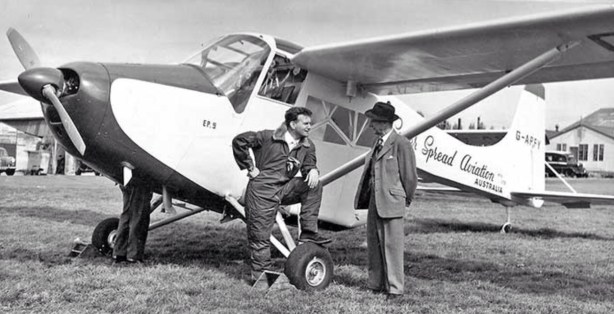
Austin ‘on arrival at home base Moorabbin after he and partner Ern Tadgell flew G-APFY and G-APBR in company from England on delivery’ Percival EP.9 (Goodall)

Aussie and Ern left England on 19 September 1957, included amongst the bits and pieces in the planes’ holds as ‘aircraft spare parts’ were the Cooper T41 and a Lotus 12 Climax which had been disassembled into their constituent parts and boxed as spares, crop spraying equipment etc.

This type of ruse, that is bringing racing cars into the country in parts was a well travelled path for Australian racers for decades to avoid the net of the ‘fiscal fiend’ whose import duties were punitive in nature and rapacious in quantum. The cars were called the ‘Miller Special’ and ‘Sabakat’ respectively when they arrived in the Great Brown Land with the chassis plates kept well away from the two machines and prying eyes.

The intrepid Percival pilots made thirty-two stops between the Old Dart and Oz before arriving at home base, Moorabbin Airport in Melbourne’s south on 27 October 1957- what an adventure! In fact it was very much so as Austin’s plane barely made it in to Darwin from Kupang as a result of heat from the exhaust causing the thermostatically controlled carburettor to lift the needle, burning excessive amounts of fuel, the tank was so dry, its said, that he couldn’t taxi the Percival to the hangar in Darwin.

Needless to say the ‘aircraft parts and crop spraying equipment’ were soon assembled into a couple of handy looking racing cars by the pair of aviation scallywags. Tadgell’s first Australian appearance in Sabakat was at the South Pacific Trophy meeting at Gnoo Blas, Orange over the Australia Day long weekend in January 1958 whereas Austin’s first run aboard the Miller Special/Cooper T41 was at Longford in 1959. Checkout this epic on the Lotus 12 here, inclusive of Sabakat; https://primotipo.com/2019/08/22/just-add-lightness/

Austin, Cooper T41 Climax, Trevallyn Hillclimb, Launceston 1959 (unattributed)

Miller first raced the Cooper at Phillip Island in January 1958 and over the next few years ran it in everything going- races, sprints and hillclimbs, self preparing the machine amongst the aircraft in his Moorabbin hanger, but he didn’t race much that year due to an extremely nasty Percival accident at home base on 15 April.

Super Spread by that time had three EP.9’s, the final aircraft was assembled in Australia from components acquired in the UK. The EP.9 ‘VH-SSW’ had just been rebuilt following a crash at Flinders Island in February, with the work complete Austin took off at dusk together with engineer Bill Symons- immediately after takeoff he climbed steeply, the aircraft stalled and crashed close to the Moorabbin Control Tower. The Department of Civil Aviation investigation found the cause of the accident to be elevator cables which had been installed wrongly so as to reverse normal operating sense. Both Miller and Symons were badly hurt, the severely damaged airframe was struck off the register and scrapped.

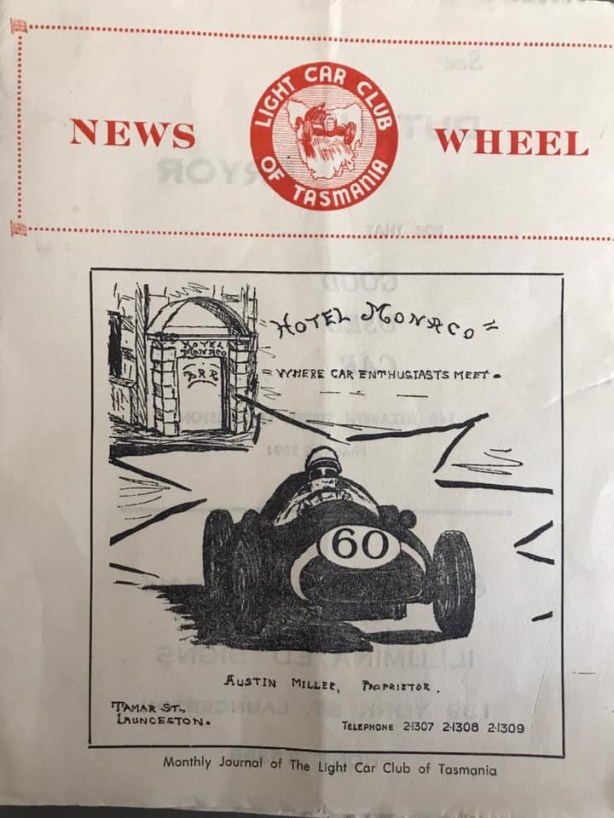
After recovery and with the responsibilities of a young family- Austin met Judy, later to become his wife, a nurse at the Alfred Hospital in Melbourne recovering from another nasty accident at Thorpdale, Victoria, Miller moved to Launceston to take over as the licensee of the Hotel Monaco. Aussie had been a Longford regular during the late 1950’s so the move across Bass Straight from Victoria to Tasmania was an easy one to a place he loved.
(E French/R Knott)

Cooper T41 Climax, Trevallyn Hillclimb March 1959 Tasmania, Aussie took FTD (Miller)

Miller’s Cooper T41 Climax at Port Wakefield during the October 1959 Gold Star meeting- Greg McEwin in the Mac-Healey alongside (K Drage)

Aussie continued to develop the T41 further by replacing the standard Citroen derived gearbox with a more sturdy Porsche 356 unit and installation of trailing arms (radius rods) to better locate the rear suspension. Austin again won his class of the Victorian Road Racing Championship and the Phillip Island Gold Star round in his new Cooper T51.

Single-seater racing expanded strongly in Australia at the time partially because of improved economic times and in large measure due to the ready availability of Grand Prix Coopers and Coventry Climax engines at ‘reasonable cost’. An international season was developing nicely in Australasia which morphed into the ‘Tasman 2.5 Formula’ and Tasman Cup in 1964- in short, if one had a car you could test your abilities against the best in the world in more or less equal machines and have a crack at the domestic Gold Star Series which itself grew and grew in stature, before dying on the vine a couple of decades hence.

Austin saw the opportunity to progress, he sold the T41 and jumped aboard a Cooper T51 in October 1959. Chassis ‘F2-20-59’ was imported new by Bib Stillwell and raced briefly by Bib and Stan Jones before passing to Miller, his first race in the 2.2 litre FPF engined car was at Island as stated above.

In a ‘Chinese deal’ Jones raced the car once or twice after Aussie owned it, during this period Jones collided with Len Lukey’s Cooper at Phillip Island- as a result the car was fitted with a frame made on the jig Lukey had created for this purpose. It would be very interesting to know just how many T51 jigs there were and still are in Australia! Jones then raced the car to fourth in the 1960 NZ GP at Ardmore before Miller next- finally got his hands on it.

Austin in a Ferrari Monza on the set of ‘On The Beach’ (Miller)

In an eventful 1959 Miller had a brush with Hollywood when he was contracted to perform as a stunt and stand-in driver for Fred Astaire in the movie ‘On The Beach’, filmed in Australia and based on Neville Shute’s novel of the same name, topically it is about the end of the world…

Into 1960 Aussie had some success with the T51 in Gold Star and other competition, perhaps it was his his busiest year of competition.

By that stage there was plenty of depth in Australian single-seater Formula Libre fields with some serious money was being spent by the likes of Stan Jones, Bib Stillwell, Alec Mildren, Lex Davison, Len Lukey and others, so Austin’s efforts in the self prepared, reliable Grand Prix Cooper should be seen with that perspective.

He was unplaced in the season opening March Longford Trophy despite qualifying up the pointy end of the field, the race was won by Jack Brabham from Alec Mildren and Bib Stillwell- all in Cooper T51s, but Austin made a big impression in the Monday Scratch Race for racing and sportscars. AMS reported that ‘One of the finest duels of the meeting occurred in this event when Austin Miller in a 2.2 litre Cooper Climax fought a long battle with Jon Leighton in a 1960cc model. Miller held the advantage and led, but ignominiously lost face and position when he misjudged a corner and was forced to take an escape road.’

Off to Westernport for the next round at Phillip Island in Victoria on 13 March the circus rumbled across the old wooden bridge from San Remo to Newhaven and settled in Cowes for a few days where the ‘Isle Of Wight’ was and still is the centre of social activity.

Brabham had still not returned to Europe and would again win the feature race, The Repco Trophy but Aussie started from the third row and raced in third place for some laps before tyre wear meant he yielded to Bib and finished fourth behind Jack, Bill Patterson and Bib Stillwell, all, again, T51 mounted.

The Victorians took in the Phillip Island Easter Saturday meeting before heading up overnight to Bathurst with Austin second and third in his two races won by Stillwell each time. It would have been interesting to see Stan Jones having a run in the ‘old girl’ Maybach 4 Chev in the last race of the day winning from Ray Gibbs’ Cooper Climax and Stumpy Russell’s Holden Spl whilst the serious Coopers had commenced the tow north towards the NSW border.

Alec Mildren was well into his stride with his Maserati engined Cooper T51, the locally developed car concepted by Alec and built up by Glenn Abbey was the class of the field during the Easter weekend at Mount Panorama on 17/18 April but Austin raced well jumping into an immediate lead of the first heat, finishing second aft of Alec but ahead of Bill Patterson and Queenslander Glynn Scott’s Coopers.

Mildren led from the starters flag of the Bathurst 100 from Stillwell and for 8 laps the pair provided a great dice, the lead of the race changed a number of times but near the end of the eighth tour Bib slid on oil near Murray’s and hit the wooden fence near the Timing Tower.

Bib was ok but the car was out for the day leaving Miller in a strong second place until brake trouble forced him to ease back a bit- Arnold Glass caught and passed Aussie when he went up the escape road at Hell Corner (end of Conrod Straight). ‘Miller had returned to the fray to come sixth’, whilst in front of him were Mildren, Glass, Patterson, Noel Hall and John Roxburgh- all in Coopers with the exception of Arnold Glass aboard the ex-works/Hunt/Stillwell Maserati 250F.
Bib Stillwell and Austin at Reid Park Gates, Bathurst in October 1960 during the ‘Craven A International’ won by Brabham’s similar Cooper T51 Climax (J Ellacott)

Miller, Cooper T51 Climax 2.2, Mount Panorama October 1960. The sign says ‘Superior Cars’- one of Stan Jones dealerships in Melbourne, very naughty of Austin too- such flagrant commerce was crass and not in accord with CAMS rules on advertising on cars at all- I wonder how many meetings it took before they spanked him? (J Ellacott)

What a tonic that second place would have been! Austin didn’t take his car to Lowood, Queensland for the ‘thriller-diller’ June AGP won by the hair on your chinny-chin-chin slimmest of margins by Mildrens’s Cooper from ‘Dame Nellie Melba’ Lex Davison, the comeback kid missed by the smallest of margins winning another Australian Grand Prix aboard a newly prepared 3 litre but old school, front engined Aston Martin DBR4/250.

Crazy were the Victorians who raced at Lowood competing at Phillip Island the following day, the 13 June Queens Birthday meeting- whilst Austin was fresh Stillwell and Patterson were not having contested the AGP the day before but both were there (in their second T51s I guess?)- Austin took a second and third in minor events but in the 10 lap Reg Hunt Motors Trophy race finished a strong second behind Bill Patterson but in front of the Stillwell and John Roxburgh Coopers, and Stan Jones- giving his Maserati 250F a run.

Speaking of Jones, Austin ran his Cooper at the Fishermans Bend Sprints on 5 June to get the final tuning of his T51 sorted for the Island the week later and who should be running on the same day but Alan Jones, ‘Following in fathers footsteps…he made a spectacular entry into open competition by cleaning up his young opponent in true G.P style, his mount- a Whirlwind go-kart powered by a 125cc motor mower engine…his time of 28.3 seconds after a push-start over the line wasn’t all that bad and it accounted for the under 1100cc racing class.’ I wonder if this is the first time AJ made it into a race report and results sheet? Now when did he start hill-climbing the Motor Improvements built Mini I wonder…
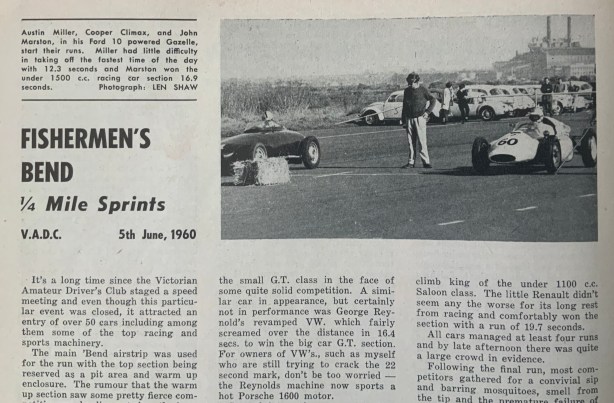
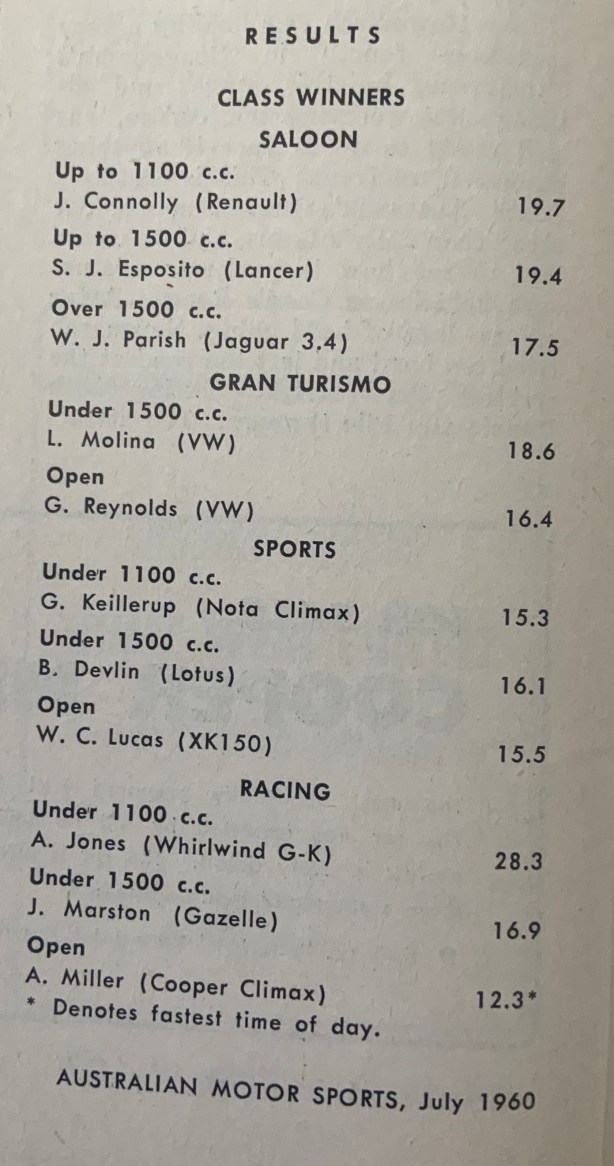
Fishos Sprints results listed for posterity- see A Jones and A Miller

Jack Myers tells Austin where to go- WM/Cooper Holden and T51, Bathurst Easter 1960

Austin didn’t enter the Queensland Road Race Championship, again at Lowood, in September, but returned to the Gold Star fray (make that serious competition fray because this event wasn’t a Gold Star round) in the Craven A International race at the traditional Bathurst October meeting where Jack Brabham prevailed, over the biggest grid of the year, as the 1960 World Champion won from Patterson and Stillwell all in 2.5 litre FPF powered Coopers with Miller a DNF- engine problems.

He failed to start at Mallala in October or at Caversham- Perth is such a long tow! but raced in the Lukey Trophy at Phillip Island in mid-December and finished a strong second, seven seconds adrift of Patterson’s T51- Stillwell was third.

The Warwick Farm Trophy was held the weekend after the Island, and whilst the new, fantastic circuit constructed around one of Sydney’s horse racing tracks was not a Gold Star round it attracted a good entry with Stillwell winning the 10 lap feature from John Youl, Miller, Davison having another run in the Aston Martin but also having lustful thoughts about Coopers however much he didn’t like the ‘Mechanical Mice’, and Doug Whiteford- all but Lex in T51s.

Mildren won the 1960 Gold Star from Stillwell and Patterson.
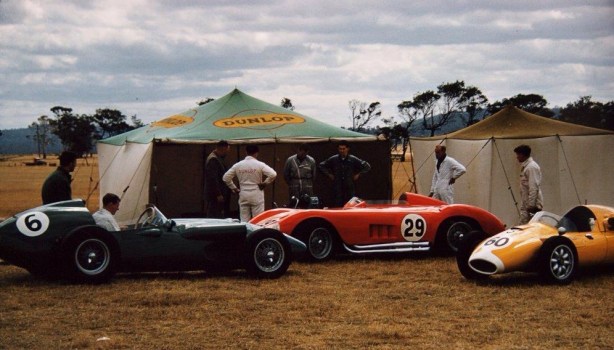
Longford Trophy paddock March 1961, Roy Salvadori won in a Cooper T51 Climax. #6 Bib Stillwell’s Aston DBR4/250 3 litre DNS- raced his Cooper T51, Doug Whiteford’s Maser 300S and Aussies Cooper T51 Climax 2.2 (R Lambert)
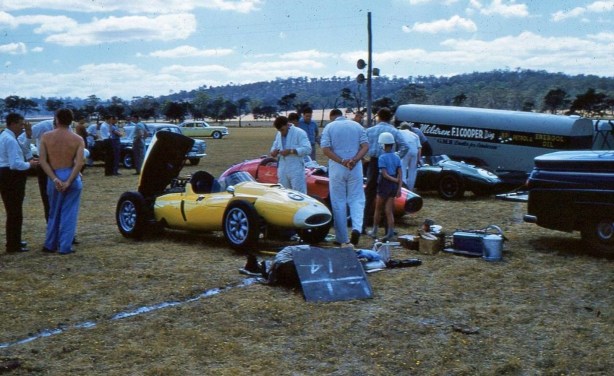
Longford Trophy paddock March 1960, Brabham won in a Cooper T51. Austin topless, Cooper T51 2.2, Arnold Glass Maser 250F and Alec Mildren’s Cooper T51 Maserati (R Lambert)
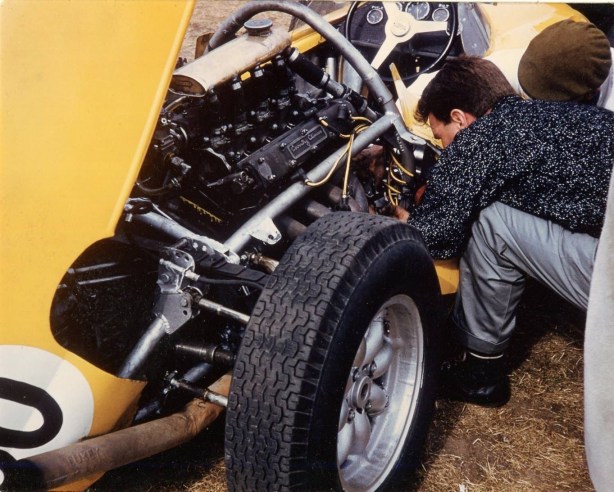
Aussie sets to work on the 2.2 litre Coventry Climax FPF, Longford 1960 (G Richardson)

In early 1961 Austin continued to campaign the Cooper in the summer internationals, opening his account with a strong fourth in the Warwick Farm 100 behind Stirling Moss in Rob Walker’s Lotus 18 Climax, Innes Ireland’s works Lotus 18 Climax and Stillwell’s Cooper T51 Climax. All three cars were fitted with full 2.5 litre FPF’s compared with Aussie’s 2.2, by this stage other locals Jones, Mildren, Glass and Patterson were using 2.5 litre engines whilst Davison’s Aston Martin DBR/4 was fitted with a 3 litre DBR/1 sportscar unit.

That summer internationals contestants included Jack Brabham and Ron Flockhart in Cooper T51s and Graham Hill and Dan Gurney in works BRM P48s- the first time BRM, having raced on and off in New Zealand since 1954, added Australia to their Southern Summer tour.

Austin was eighth in the Victorian Trophy at Ballarat Airfield, won by Gurney’s BRM, fourth in the Longford Trophy won by Roy Salvadori in a Cooper T51 and sixth in the Craven A International at the short, tight, new, Hume Weir circuit close to the New South Wales/Victorian border near Albury in March- Brabham prevailed in the two races that weekend in his T53 Lowline.

At that point Austin’s Cooper became Australia’s first Formula 5000 car…

Miller had become obsessed with a desire to break the Australian Land Speed Record which was then held by one of his fellow Gold Star competitors, Mel McEwin, in Tornado 2 Chev, a car I wrote about a while back. Click hear to read about this amazing front engined Australian special; https://primotipo.com/2015/11/27/the-longford-trophy-1958-the-tornados-ted-gray/

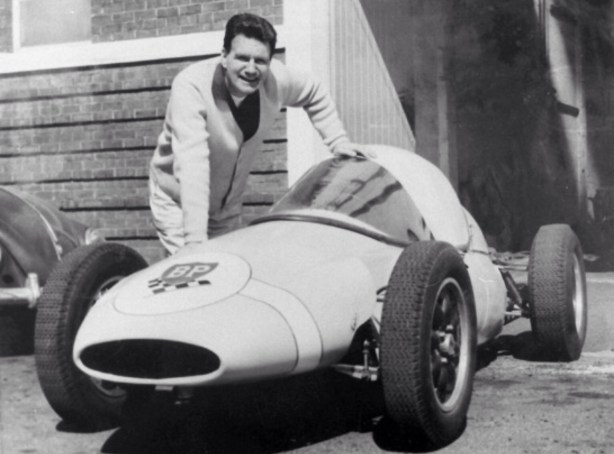
Not having the budget to purchase or build a purpose-built car capable of breaking the record, Aussie and his engineer/mechanic Geoff Smedley set about modifying Miller’s Cooper T51 in the loft of the building next to the Hotel Monaco.

Shots above and below are perhaps press shots in Launceston immediately after the modified T51’s build (G Smedley)
(G Smedley)

Geoff Smedley’s story of this amazing adventure is set below.

‘This is perhaps the most unlikely but successful challenge to a Land Speed Record ever staged and it comes with a story that is equally remarkable.

I had known my friend, the late Austin Miller, for a number of years previously. We had raced cars together in earlier times. Around 1959 when Austin came to live in Tasmania after recovering from a fairly major air crash in Victoria- he had operated an aerial crop spraying business for many years and decided at that time that perhaps a slower pace of life would be better suited to his well-being. So he bought a hotel in Launceston, renovated it and renamed it The Monaco Hotel which soon became the hub for motor racing fans from far and near.

 It could be argued that the array of beverages served at the Monaco may have instigated the record attempt! Not so! But it was Aussie’s infectious desire and persuasive talents that eventually won out and the idea grew into reality early in 1960, I was entrusted in putting together a vehicle that could better the current record of 157.5 MPH set by Ted Gray in the ‘Tornado Chev Special’ at Coonabarabran in 1957.

 Some of the difficulties soon became clear, firstly there was no money in the kitty. Meaning that all work had to remain ‘in house’. The only equipment available was the 1959 Cooper T51 F2 fitted with a 2.2 Coventry Climax FPF motor that was Austin’s current race car, but certainly not suitable for the job in hand.

 A friend of Aussie’s in Melbourne had just set a water speed record using a Corvette V8 engine. This engine was offered on loan as a starting point to our quest. The thought of stuffing 400 bhp of cast iron Chev into a petite Cooper F2 seemed almost as ridiculous as attempting the record itself.

 An assessment of the work needed to adapt the chassis to take the big, brutal Corvette engine proved it would need to be a bit of a ‘suck it and see’ effort or do it as she goes with all chassis work to be undertaken before the transplant could take place’.
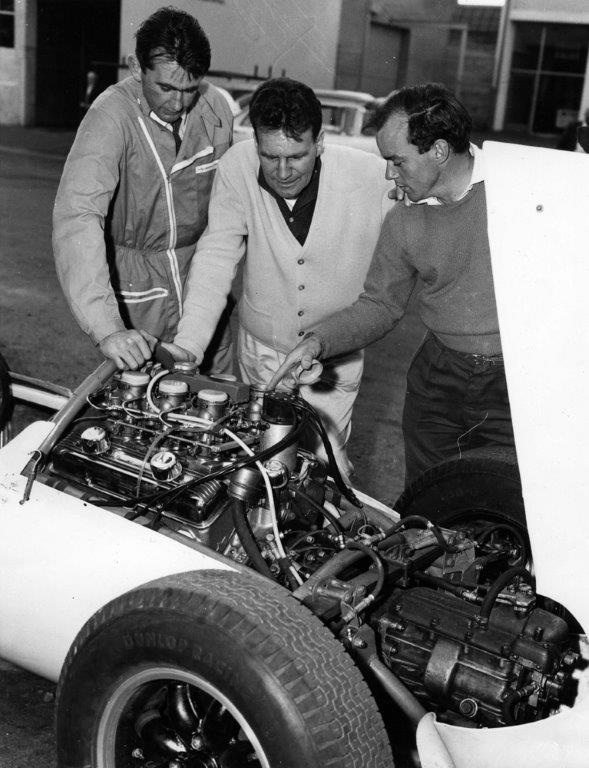
Bruce Burr, Miller and Geoff Smedley- the ‘heavy Chevvy’ looks an easy (cough!) fit (G Smedley)

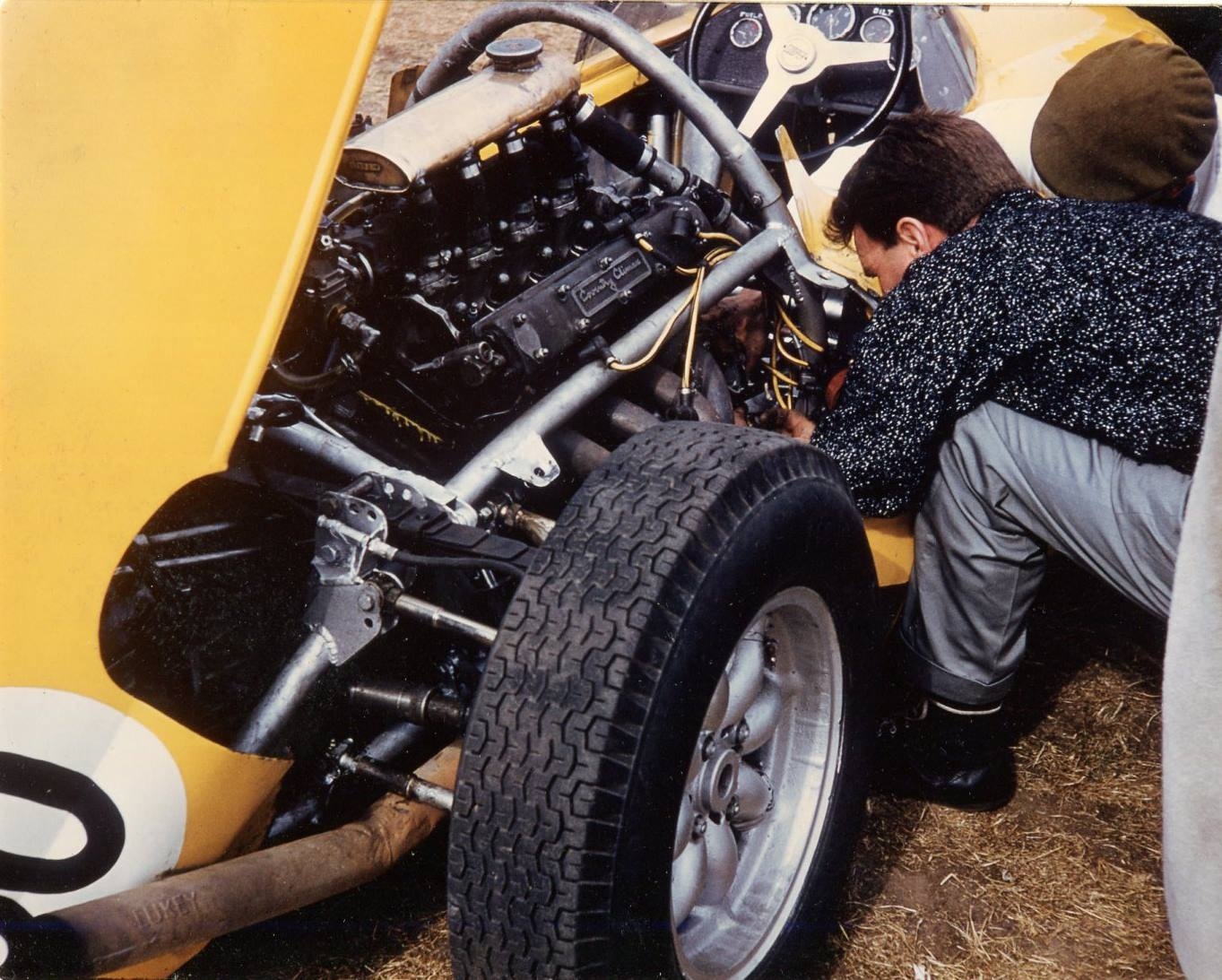
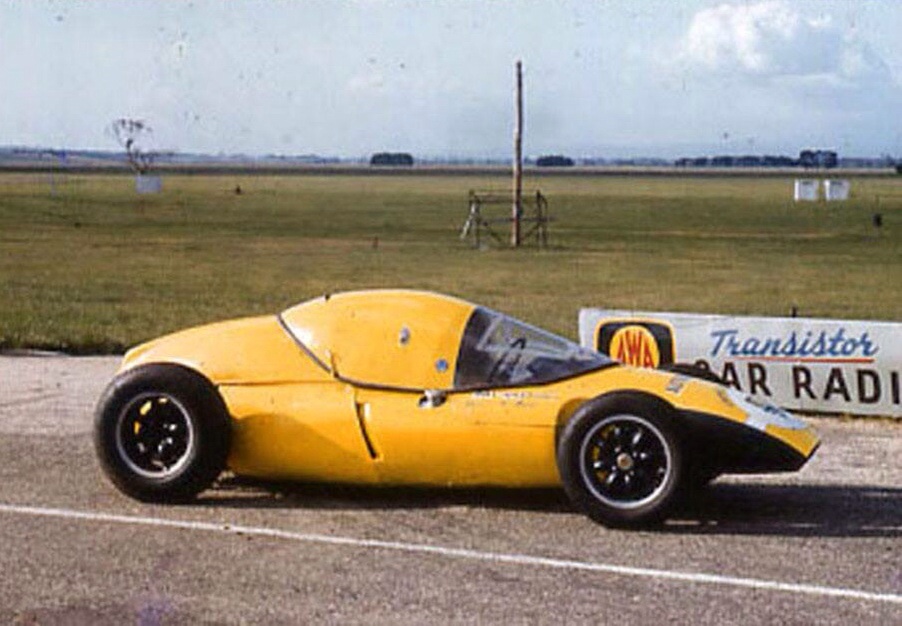
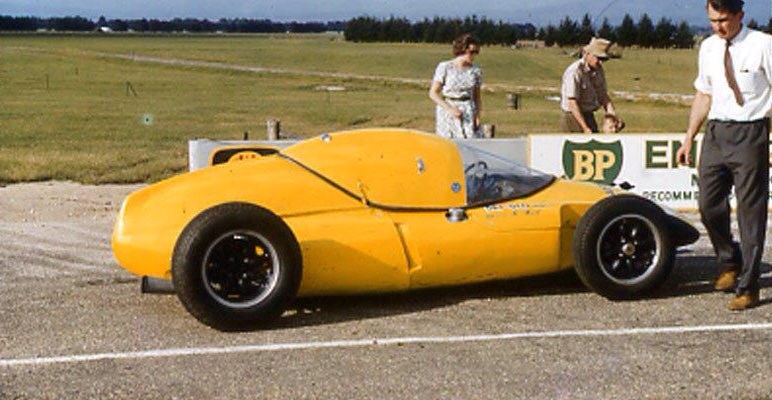
The engine provided by boat raced Keith Hooper (or Syd Fischer depending upon the source) was highly modified by fitment of some of the best ‘go faster’goodies available for the small-block Chev at the time- Isky cam, ported and polished heads, six twin-choke carbs sitting atop an Offy manifold, lightweight aluminium flywheel and a clutch capable of coping with 400 BHP and equivalent amounts of bulk torque. The fibreglass body of the Cooper was changed marginally in some respects but substantively by the incorporation of a ‘Perspex bubble’ which sat on top of the normal cockpit opening providing better high speed streamlining than the shallow road racing surround.

Geoff picks up the story again.

‘Also the transmission drastically needed modification from the existing Citroen Light 15-based box used by Cooper. To this end I was fortunate in respect of engineering facilities with the family business (Bedford Machine Tools) at my disposal and being a trained engineer I was able to modify this box to a beefy 2 speed specialised unit. With savage cross bolting of the housing, in theory, it would withstand the short lived punishment expected of it. All this together with special beefed up drive-shafts to cope with the extra power were made and, as it seemed, a never ending general tweek in all the right places, eventually we were starting to see some result and the project began to take shape into the car we hoped would bring us success.

 The only thing I was fully confident of was the fact that Aussie Miller was one of very few blokes in the world who could steer this mish- mash of bits to success. His long career in flying and driving at the top echelon of open wheeler racing in this country certainly proved he had not only the courage but also the anatomy to do the job’.

(Gray Family)
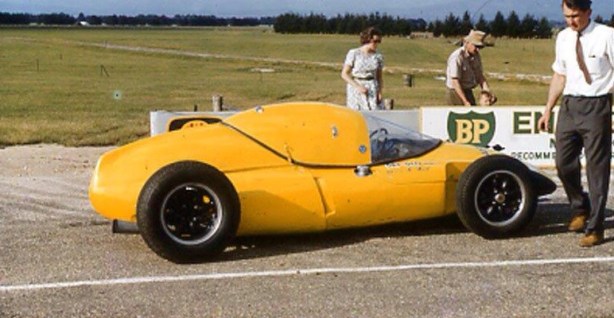
(Gray Family)

Photographs of the car show just how beautifully engineered and integrated the modifications to the standard Cooper T51 were. They were put to the test at Symmons Plains, the circuit built on the Youl family property of the same name 10 miles south of Launceston during October 1961. Austin achieved 140 mph in top gear of his two-speed gearbox before running out of circuit. The car also ran at Trevallyn Hillclimb on 22 October finishing second in the Tasmanian Hillclimb Championship behind John Youl’s Cooper T51 Climax.

 ‘After the work on the car was finished there was the hassle of setting up the legalities and finding a location suited to such an attempt. We had looked at a few areas as possibilities but each had drawbacks and we needed a course that would give us the very best of chances and a remote beach on the North-West coast of Tasmania at Bakers Beach looked like the ideal place, a little out of sight in case of failure and some 4.5 miles of good surface to set up a good surveyed strip to test our hopes. It took quite a few weeks for our little band of helpers to arrange all the last minute problems including being told that the official timing gear was in Hobart the night before we were about to contest the run which meant someone had to drive the 250 mile journey to retrieve this very important bit of gear.

While this was being attended to my friend Bruce Burr and I decided it would be prudent to take the car to the beach the evening before to eliminate any hold-up on the following day. The best laid plans were in place, we were armed with arrowed placards to be placed on trees showing the way into this well hidden beach, and the evening turned into night before we reached the last mile or so of very dense bush and not having ever tried to visit this remote place in darkness we became hopelessly lost and had diligently placed our signs in areas that have never been found to this day.

Our problems didn’t stop there. Eventually arriving on the Western end of the beach it required about a 4-mile drive in the Land Rover, with car and trailer on tow behind to the Eastern end to a base site we had previously chosen. We were finding this spot hard to locate in the darkness and required driving in the softer sand further up the beach and of course the trailer and race car became bogged and things became hopeless, so we simply unhitched the trailer and moved the Land Rover to a little higher ground and turned in for the night.

We were woken just after daylight by a local TV crew that had somehow found us without the aid of our signs and to our horror we found that the tide was in and was lapping the deck of the trailer and the car looked to be sitting on the water, which presented more of a comedy act than a serious record attempt. Anyhow with the aid of the TV crew we managed to get things into a more respectable state before officialdom and others started arriving, none of whom had seen any of the dozen or so directional signs we had placed the night before.
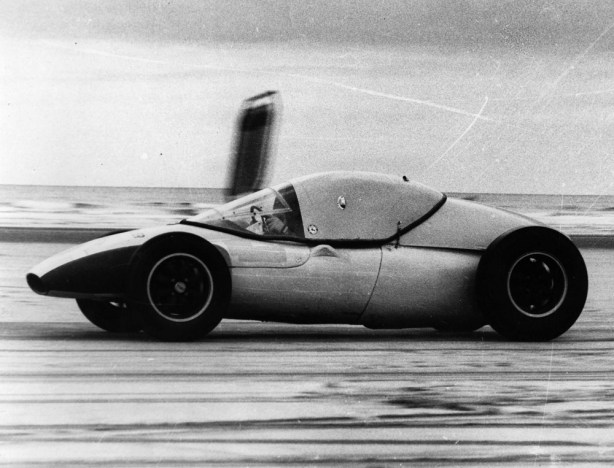
One of the early runs at Bakers Beach with canopy intact Cooper T51 Chev (SLV)

The timing equipment had been brought from Hobart and set up and it was time for the first test runs up the beach. Bearing in mind that this would be the first test of the car itself, it was a very nerve-racking time for me but if Aussie felt the same way he certainly didn’t show it climbing into the car as if heading off on a fun drive up the beach. The first couple of runs looked well but a problem with the timing equipment held proceedings up for some time giving and making all previous runs null and void, but it did give us a chance to delve into a possible gearbox problem which turned out to be a minor adjustment. Stripping a transmission on a beach in the open is not really recommended, soon all was ready for the first official run from East to West.

The car achieved 172 MPH, well on target. We had the car geared for around 202 mph @ 6,500rpm and this first run was looking good. The reverse run was a little down which was expected against a growing wind and adjustments were made to the car before the next speed run. While working on the engine it was necessary to remove the canopy I had made to try and wind-cheat the car. I had rigged up a quick release arrangement for this canopy should the need arise but somehow the mechanism got damaged in the refitting after the previous run causing a major drama on the next attempt.

At an estimated 170 mph the canopy ejected and went skywards also releasing the whole back half of the body and certainly shocked the observers and dimmed the hope of taking the record somewhat, but the ‘never say die Aussie’ the pilot was determined to have a go without such refinements even though beach conditions had deteriorated and the wind was lifting the sand into a heavy haze and pulling down his goggles, the intrepid Miller lad set off, disappearing into a wall of sand and into the record books by pushing the record up to 164.7 MPH, not what we hoped, but a record that would stand for almost 4 years all on the smell of an oily rag.

To reminisce on a time when this sort of thing was possible and practical learning was still in vogue. For me I later entered into F1. As a race engineer where in those early days your skills were required on every aspect of the car, you featured dirty hands but acquired a lot of private satisfaction. It was an era in time we will never see again in the name of motorsport, it was four years later when Donald Campbell in his jet powered Bluebird officially became the fastest man on wheels putting the record up to 403 mph on Australia’s Lake Eyre, but the successful Miller challenge remained for some 4 years and certainly must always remain as a dinkum piston engined record done on a shoestring by a man of his time……… Austin Miller (My Mate!)’ Geoff Smedley.
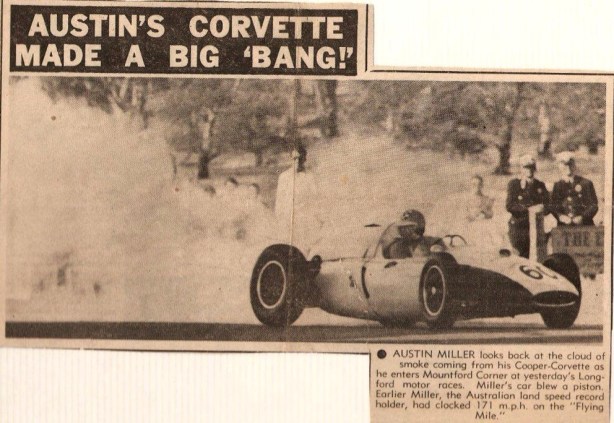
Miller raced the car on into 1962 albeit only briefly.

The Cooper retained its Chev engine and was entered in both the local South Pacific Championship at Longford retiring on lap 2 with valve problems and at Sandown’s opening meeting where the car also failed to finish. Another similar car in concept to Miller’s made a huge impression on Jack Brabham that weekend.

In a one-off Australian entry- it was the only time this car ever raced, Lance Reventlow’s mid-engined Scarab, powered by an aluminium Buick V8- from the same family of engines as that used by Repco in their 1966 F1 World Championship year, the Repco Brabham RBE620 motor was based on a modified production Oldsmobile F85 block. Miller was very much ahead of his time with the thinking behind the V8 engined Cooper.
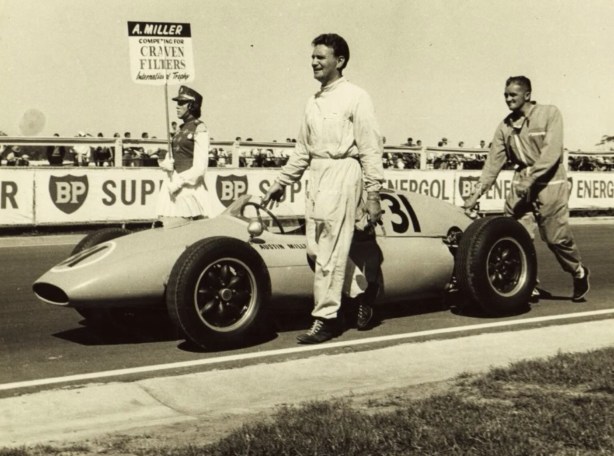
Austin strolls with his T51 Climax the wrong way up Sandown’s Main Straight from the old paddock onto the grid for the start of the feature race at Sandown’s first meeting on 12 March 1962, the ‘Sandown Park International’. Brabham won is his 2.7 litre Cooper T55 Climax- Aussie DNF in the Chev engined T51 (unattributed)

With that, and the local scene becoming ever more professional and expensive, Miller retired from racing to concentrate back on his agricultural spraying business and commercial aviation career.

The Cooper T51 passed through many hands during the sixties and early seventies before John Caffin acquired its remains which comprised the chassis, seat and a fuel tank. The car was fully restored by John, Aussie took great delight in running it a number of times, his T51, like so many of them left Australia many years ago.

Austin, in a very full life was married twice- to Florence with whom he had Vicky and Guy (a handy steerer of historic FFs), and to Judy with whom he had four children- Todd, Ashley, Tracey and Brett. After sale of the hotel in Tasmania he moved back to Victoria to aerial crop spraying- at that stage he bought a de Havilland Beaver and operated out of Derrinallum in Victorias’s Western District, two hours from Melbourne.

Aussie maintained his interest in cars, guesting in demonstrations of his Cooper in the historic era and he applied his mechanical talents to the restoration of the ex-Brabham/Davison Brabham BT4 (‘IC-2-62’) remains but that car was sold to John Coombs in the UK without ever seeing the light of day here.

Miller died aged 85 in 2009 but his name lives on, he is discussed when competitive drivers of that period are being looked at in the manner in which they went about their business and drove- and owner/driver/preparer Miller is much respected for his achievements but I guess racing the Cooper was a soda compared to the daily in-cockpit rigours of an ag-pilot!
(Miller)

Austin aboard a 235HP Piper Pawnee, Dookie College, between Benalla and Shepparton, Victoria, 1976.

Percival EP.9 Aircraft in Australia…

http://www.goodall.com.au/australian-aviation/percival-ep9/percivalep9.html

Etcetera…

(Miller)

Works touring car driver- Graham Hoinville and Austin drove an Australian Motor Industies Triumph Herald in the 1960 Armstrong 500 at Phillip Island, DNF in the race won by the Roxburgh/Coad Vauxhall Cresta
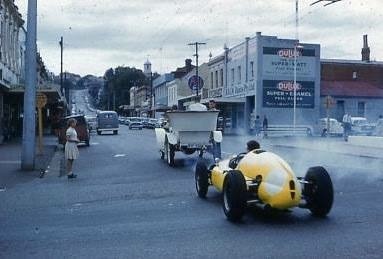
Aussie frightening the Elizabeth Street locals, Launceston circa 1961 (unattributed)

What a road car!

Lady at left seems pretty calm about the vivid yellow Cooper T51 Chev’s presence on the Launceston streetscape. Some type of car show or procession I guess- can someone help with the occasion and date?
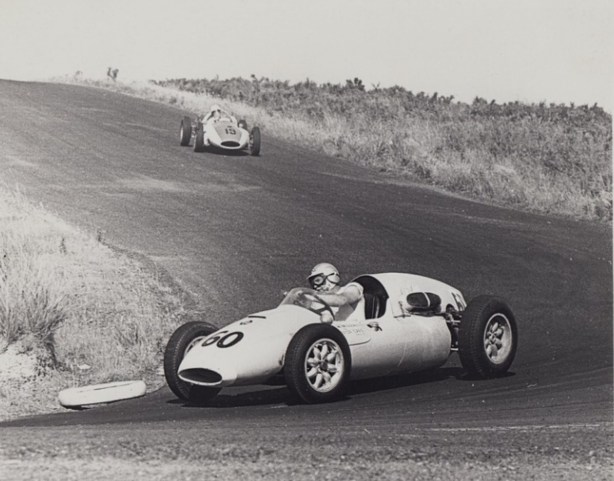
(G Miller)

‘Lukey Trophy’ Gold Star round at Phillip Island in December 1960.

Austin’s T51 with John Roxburgh’s T45 2 litre FPF in the distance on the drop into ‘MG’ corner- Bill Patterson won from Aussie and Bib Stillwell, T51’s all.

(J Ellacott)

Longford Trophy grid, March 1960.

Brabham #4, Stillwell #6 and Miller in yellow- all in Cooper T51s with Glass’ Maserati 250F beside Austin, before the off. Brabham won from Mildren and Stillwell- the dominance of Cooper T51’s in Australia throughout this period comes through in all of this article.

The tables only turned from Cooper when Jack and Ron’s ‘Intercontinental’ Brabham’s- the BT4/BT7A and later BT11A started to come into the country in numbers circa 1962/3 and beyond, but Coopers were dominant in number from 1958/9.
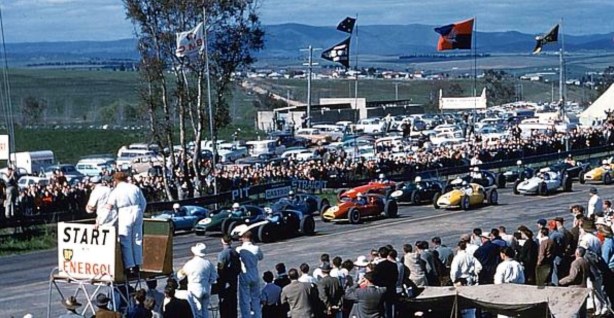
(NMRM)

1960 ‘Craven A’ International grid just before the off, Bathurst October 1960.

I’ve used this shot a couple of times before- it does illustrate the point made a moment ago about Cooper dominance at the time. Stan Jones’ blue T51 is on the outside of row 1, then Alec Mildren’s ‘Mildren green’ Maserati engined variant and then Brabham. John Leighton’s almost invisible T45 and Bib Stillwell’s red T51 on row two. Arnold Glass’ Maserati 250F on row three beside the crowd, then Noel Hall and Austin’s T51s. A row further back its Bill Patterson’s white T51 alongside John Youl’s. The other yellow car at far right rear is Doug Kelley’s ex-Miller Cooper T41 Climax.

Brabham won from Patterson and Stillwell.

(unattributed)

Bathurst I think- Austin, T51 Climax from Alec Mildren, Cooper T45 Climax- then again it may be Alec’s T51 Maserati but it must be 1961 not 1960 as the induction side on the engine in Mildren’s car in 1960 was on the other side, whereas in 1961 it was on ‘this side’ as above. I don’t think Austin’s T51 ever met Alec’s T45 at Bathurst- the T51 Maserati yes. Then again this might not be Bathurst…help, I think.
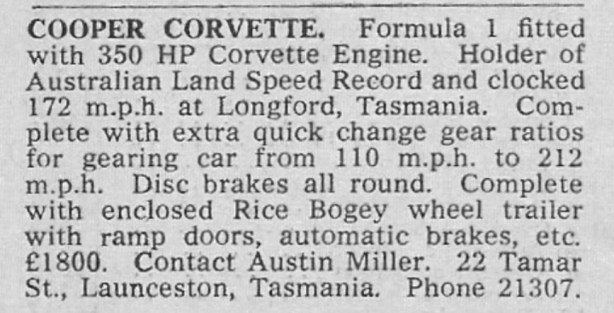
Arcane but sorta relevant…

Austin was a very highly rated pilot, when Commonwealth Aircraft Corporation boss (later Sir) Lawrence Wackett was after a test pilot for his new Wirraway Trainer based CA-28 ‘Ceres’ heavy payload agricultural aircraft in 1958/9 it was to Miller he turned.

Miller and Tadgell, familiar with the Wirraway from their RAAF days, decided to trial the plane as an alternative to their growing fleet of DH.82 Tiger Moths. After obtaining the licence endorsement they needed the Department of Supply sold them two aircraft for 500 pounds each. Both were fitted with a hopper behind the front seat and various designs of spraying equipment, also installed were RAAF underwing extra fuel tanks.

The experiments were successful, so, given Austin’s technical and analytical skills it was to Miller Wackett turned but he was too busy with Super Spread’s operation which by then included Victoria, Queensland, South Australia and Tasmania, not to forget his racing…and family so he let the opportunity pass.

Ultimately 20 of the aircraft were built, CAC transferred the production capacity then released at Fishermans Bend to the RAAF Mirage jet fighter project.
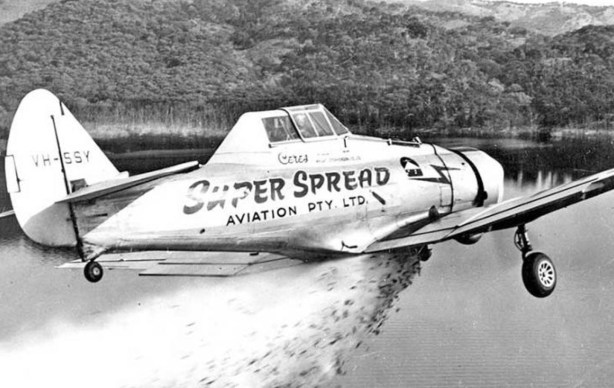
Super Spread CA28-10. Reg VH-CEK and later VH-SSY- Ceres Type C, which was the definitive final production type CA-28 to which most earlier series aircraft were field modified. First registered 20 September 1960. Here in 1962 it’s dropping a load of live fingerling trout into Lake Eildon, in Victoria’s Alpine region between Eildon and Mansfield 150 km from Melbourne- superb shot. This aircraft has, like a racing car, had a few decent hits down the decades, been de-registered and registered again when rebuilt and is still extant (Ben Dannecker Collection)

The most hours on the type were recorded by Super Spread pilot John McKeachie who commented about the plane as follows; ‘The Ceres carried a good load and had an excellent braking system. The Pratt & Whitney R-1340 radial was very reliable and the engine cowls were designed to give easy access for maintenance. It had a 3 second dump with the dump doors not being retractable as the whole bottom dropped out.’

‘The later models were designed to allow the loader driver to be carried behind the pilot. Spare parts were readily available. The aircraft had several negative features, being very heavy on the controls, slow on the turn and very tiring to fly. It was also heavy on fuel, needed a long runway and gave a rough ride when on the ground.’

Bibliography…

Austin Miller profile by Martin Agatyn, article by Geoff Smedley, oldracingcars.com, Aviation Safety Network, Geoff Goodall’s Aviation History Site, various issues of Australian Motor Sports 1958-1960, ‘Glory Days: Albert Park 1953-1958’ Barry Green, oldracingcars.com

Photo and other Credits…

Ron Lambert, John Ellacott, Guy Miller Collection, Greg Richardson, Rob Knott via Ellis French, National Motor Racing Museum, Ben Dannecker Collection, Kevin Drage, State Library of Victoria

Special thanks to Guy Miller and Geoff Smedley

Tailpiece: We have lift-off…

image

(G Smedley)

Finito…

(R Croston)

The wonders of social media…

Richard Croston popped onto that internet thingy some amazing factory data on the 1955 Ferrari Super Squalo ‘555-2’ raced by the factory in Grands Prix that season, and then acquired by Reg Parnell for modification to Formula Libre specifications by fitment of a Monza 860 3.4 litre engine where a 2.5 litre Gee Pee jobbie once nestled.

He and Peter Whitehead, in ‘555-1’, raced the cars in the 1956 Australian Grand Prix at Albert Park and then did the New Zealand internationals in January/February 1957 before selling the cars locally and then high-tailing it back to Europe. Suss this ’56 AGP piece; https://primotipo.com/2018/01/16/james-linehams-1956-agp-albert-park/

I’ve substantially added to an earlier article on ‘555-2’- its grown from 500 words to 2600 in a couple of separate additions, so worth a look, its a bonus if you speak Italian… https://primotipo.com/2015/08/25/arnold-glass-ferrari-555-super-squalo-bathurst-1958/

Credits…

Richard Croston Collection, George McKaige from ‘Beyond The Lens’

(unattributed)

The black nose-banded Parnell 555 Ferrari takes centre stage in the Albert Park paddock during the 1956 Australian Grand Prix weekend- the car behind is Whitehead’s identical machine.

Car #5 is the nose of Reg Hunt’s Maserati 250F, the #8 Ferrari Monza is I think Stan Coffey’s albeit he raced with number 9- it isn’t Ken Wharton’s who raced with #10. Theory folks?

Who is the short, burly driver standing behind Whitehead’s car?- it isn’t slight Peter or burly but balding Reg.

(G McKaige)

Reg and the boys push 555-2 onto the Albert Park grid- Stirling Moss won in a works 250F that day from Jean Behra’s sister car, then Whitehead in 555-1 and Parnell in 555-2.

(G McKaige)

Rare colour shot of Reg on the move during the race from George and Chester McKaige’s wonderful book ‘Beyond The Lens’. Many pundits are of the view that Parnell- who had a great career, was potentially one of Britain’s best Grand Prix drivers but he was one of the generation who lost a chunk of time by virtue of WW2.

A analytical racer with outright pace in single-seaters and mechanical understanding and sympathy in endurance events.

Tailpiece…

From Australian Motor Sports Review 1958-1959

Arnold Glass and 555-2, I wonder how big a seller ‘Bardahl’ was in Australia in the day?- plenty of competition amongst the various oil companies to have the better drivers on their books in those pre-advertising on cars days.

The third place in the 1959 AGP touted was achieved in Glass’ ex-works/Hunt/Stillwell Maserati 250F not the 555 Super Squalo shown mind you.

Finito…

(J Manhire)

Tony Gaze in his HWM Jaguar VPA9 at Ryal Bush in New Zealand’s South Island on 11 February 1956…

Isn’t John Manhire’s photograph a fantastic one? He has captured the car, the physicality of hustling these machines around a road circuit, and of course the crowd so well to add some drama and perspective. It’s a beauty of a shot which inspired this article.

Later in the day Tony was second in the first Southland Road Race run over 41 5.87km laps of a course laid out around the hamlet of Ryal Bush 20km north of Invercargill, at the very south of New Zealand’s South Island. He drove his ex-Ascari Ferrari 500 powered by a 3-litre 750S sportscar engine, in front of him was Peter Whitehead in a similar car.

By 1956 Australia’s first Formula 1 driver was a committed HWM pilot having first raced an ex-Moss 2-litre HWM Alta F2 car in Grands Prix during 1952 with good results given the nature of his privateer campaign. This chassis was later acquired by Lex Davison, fitted with a Jaguar XK engine it won the 1954 Australian Grand Prix at Southport on Queensland’s Gold Coast, it’s still in Australia in sportscar form but very original, in the loving hands of the Hough family.

Tony aboard his HWM Alta at Charterhall in October 1952- the ‘Newcastle Journal Trophy’. DNF in the race won by Dennis Poore, Connaught A Type. Gaze’ last race in the car as it transpired.

Tony was despatched to New Zealand by John Heath and George Abecassis together with the supercharged GP HWM Alta 2-litre in the Antipodian summer of 1954 with a brief to win a race or three and then sell the Formula Libre car before returning home. Whilst he didn’t win any races he did well and also fulfilled the second part of his brief, the lucky Kiwi’s had the machine for the rest of its in-period racing life. Click here to read a story about that tour and background information about HWM; https://primotipo.com/2019/12/13/tony-gaze-hwm-alta-new-zealand-1954/

Sportscar racing, make that every type of racing, exploded in England as the shackles of war were progressively cast aside with grids of Jaguar, Aston Martin, Lotus, Cooper, Lister, HWM and other marques making sportscar grids every bit as large and competitive as the single-seater categories.

Faced with the difficulty of finding a competitive car for the 1953 GP season – reliability of the Alta engine was a major concern for Gaze – Enzo Ferrari would sell Tony a Ferrari 500, but without works support that would have been a very expensive proposition, so he looked to sportscars for the next phase of his career.

Gaze was invited to be part of a pre-Le Mans 24 hour test of the Aston Martin DB3 at Monza, in the snow, at the end of which he and Graham Whitehead were offered cars. Tony recalled that ‘Wyer stitched us up. We were promised that Aston Martin wasn’t going to come out with something new to make us obsolete the moment we got these things. So the first race meeting I go to Reg Parnell turns up in a works DB3S which was a lot lighter and more powerful!’

Tony Gaze, Aston Martin DB3 at Dundrod during the 1953 TT, an excellent fourth place sharing Graham Whitehead’s car. The Collins/Griffith and Parnell/Thompson Aston Martin DB3S were first and second (Gaze)
Tony and Kay Gaze with Tony’s new Aston Martin DB3, looking immaculate, before the off at Oporto, Portugal (Gaze)
Gaze’s Aston Martin DB3 chassis #9, or the charred remains of it, in an Oporto Street after his high speed contretemps with a Ferrari and a stout tree. A lucky escape during the 1953 Portuguese GP (D Coelho)

He first raced his car, chassis DB3/9, one of ten DB3s built, at the Silverstone International Trophy meeting in May finishing fourth in his class. He then took it to the Cote d’Azur for the Hyeres 12 Hours in June, that race was held on the Iles d’Or 7km road course, sharing his car with Graham Whitehead the pair ran fifth in the pouring rain but retired after two hours with a broken timing chain.

His small equipe then headed south to take in the Portuguese Grand Prix which was held on 21 June on the 7.4km Boavista street circuit in Oporto. The race started badly for the UK contingent when on the very first lap Duncan Hamilton’s Jaguar C-Type ‘was punted off by an amateur driver who was apparently banned for life’ but got considerably worse when Gaze came close to losing his life in DB3/9.

Italian sportscar specialist, Pietro Palmieri’s Ferrari 250MM collided with the Aston on lap three catapulting it into a tree, at which point it broke in half and burst into flames leaving our former fighter-pilot ace semi-conscious in the middle of the road ten metres from the remains of his machine,’ which was completely destroyed. Absolutely rooted, it was written off, and somewhat surprisingly has not been re-birthed all these decades later. Palmieri’s Ferrari lasted until he had completed seven laps when engine failure intervened, the three hour, 60 lap race was won by Jose Nogueira Pinto in a Ferrari 250MM Vignale Spyder. Click here for a piece on the DB3; https://primotipo.com/2018/01/19/1952-goodwood-9-hours-and-aston-db3/

After his recovery, Tony sought to buy a works Aston from Wyer who refused to sell. After attempts by the insurance company to purchase a second hand DB3 to replace the destroyed car failed, and he received his money, Tony then tried to buy a Jaguar from Lofty England but couldn’t agree terms. So he approached his buddies at HWM who had just built a Jaguar engined car for company co-owner George Abecassis to race. The racer was immediately quick, with Heath’s triple-Weber fed Jaguar engines and Indianapolis style quick change Halibrand spur-gears to allow easy change of gear ratios to suit the demands of different circuits, both competitive aspects of the cars overall design.

Tony in HWM1 during the very wet May 1954 Aintree Daily Telegraph International meeting heading for fourth behind Duncan Hamilton, Jaguar C-Type, Carroll Shelby’s Aston DB3S and Jimmy Stewart’s C- Type (Gaze)
Tony Gaze during the 1953 Hyeres 12 Hours in HWM1- shared with George Abecassis (S Lewis)
Tony in VPA9 during the British GP sportscar support race, Silverstone, July 1954. DNF with the Collins, Salvadori and Shelby Aston DB3S up front of the 118km race (Gaze)

Whilst VPA9 (the first registration number of HWM sporties is generally the number by which they are recognised) took a while to be built so Tony raced Abecassis’ HWM1 at the Aintree opening meeting in May where he was fourth in the sportscar ten lapper, Duncan Hamilton’s C Type won.

In the Hyeres 12 Hours in early June he co-drove with George, they ran second until pinged and disqualified for a minor pit infringement by Abecassis. Trintignant/Piotti won in a Ferrari 250 Monza.

VPA9 – chassis #105′ is the number attributed to the car by John Blanden and some other sources online – is the third HWM Jaguar built, the first was built by Oscar Moore who converted his Alta engined HWM by fitment of a 3.4 litre, then later a 3.8 litre Jaguar engine. The package was mighty quick, he managed to stay in front of Abecassis’ works Aston Martin  in the Jersey International Road Race until the engine broke. Gaze’s car was finally delivered to him in June 1954 just prior to the Reims 12 Hour, which he contested with Graham Whitehead as co-driver.

Powered by a works Jaguar 3.4 litre XK experimental engine, the pair finished seventh in the 270bhp machine ‘despite extremely poor handling’ which was finally diagnosed twelve months hence as front shock absorbers which were fading, the problem was cured by adding some friction dampers. Up front the Peter Whitehead/Ken Wharton Jaguar D-Type won, it was an historic day as it was the first of many wins for Jaguar’s most famous racer.

In July, Tony’s car, which was always entered by HW Motors, was twenty-second in the British GP sportscar support race at Silverstone with various problems, up front of this 25 lapper which concluded the day’s proceedings was a trio of Aston Martin DB3S, Peter Collins won from Roy Salvadori and Carroll Shelby.

In a very busy August Tony won at Crystal Palace from pole, but he missed a gear leaving the tell-tale at 6900rpm. VPA9 crossed the channel to Zandvoort on 15 August where Tony failed to finish after a huge spin at Hugenholtzbocht behind the pits. He then took a shortcut to the other side but the grass was so wet the car became bogged, when he stopped he could see Duncan Hamilton in the pits overcome with laughter at his plight. Ninian Sanderson’s C-Type won that day with three other C-Types in line astern.

On 22 August Gaze took VPA9 to the French Southern Brittany seaside resort town of La Baule to contest the sportscar handicap race finishing sixth. Two D.B. Panhards were up front, then Jacques Peron’s 1350cc Osca MT4 with Duncan Hamilton fourth in his Jaguar C-Type then Jean Lucas in a small D.B. Renault with Tony next best of the big-cars.

After about an hour, with nine laps completed of the demanding 11 September RAC TT at Dundrod – sharing the car with John Riseley-Pritchard – VPA9’s engine dropped a valve, with nowhere to exit the circuit, surrounded as it was by slab walls the engine was fairly rooted by the time Tony came upon a cross road to exit the track. Mike Hawthorn and Maurice Trintignant won in a works Ferrari 750 Monza, and Piero Taruffi/JM Fangio Lancia D24 were second in this 1000km World Sportscar Championship round.

Tony oversees the preparation of his Ferrari 500/625 – #500-05 or as re-numbered by the factory when modified as Formula Libre machines GP.0480 – in Australasia during 1955-56. Gaze’s car, when fitted with a 750S engine later in 1955 had a flat spot which was not cured until Alan Ashton (at right) made some new jets for the Weber carburettors during the early period of Lex Davison’s ownership circa late 1956. Reg Hunt at left-top (MotorSport)
Tony in the Oulton Park paddock prior to the British Empire Trophy sportscar practice in May 1955. #44 is the Bertie Bradnack Cooper T33 Jaguar and the car behind that is George Abecassis in HWM1. Archie Scott-Brown won in a Lister Bristol (Alamy)
Tony Gaze in the Aston Martin DB3S he shared with David McKay to second place in the May 1955 Hyeres 12 Hours. With DB3S/102 he also contested the 1955 Circuito do Porto, Monsanto, Charterhall International, Snetterton International, Goodwood 9 Hour and Tourist Trophy meetings that year (Gaze)

It was time for an engine rebuild back at Browns Lane and whilst a replacement was provided Tony never did get back the trick engine, the motor he used at Goodwood during the BARC Autumn 25 September meeting ‘was not the original but Jaguar’s worst old engine’.

The team asked Tony to race the HWM 54 Jaguar GP car instead, this was the Alta engined car Lance Macklin raced in the July 1954 French Grand Prix, DNF after 10 laps on the day Mercedes Benz arrived back in Grand Prix racing in rather emphatic fashion. Gaze was to race in the Formula Libre Woodcote Cup,after some confusion with the pedals in practice (which were clutch/throttle/brake rather than the clutch/brake/throttle of his sportscar) or a mechanical failure, got to the bottom of Lavant Straight into Woodcote and the car wouldn’t stop, ‘Whatever the reason it wasn’t going to stop so I spun it down the escape road and hit the eight feet high dirt wall and got tossed over the top of it and ended up in the crowd,’ Tony recalled. Peter Collins won the race in one of Tony Vandervell’s Thinwall Ferraris whilst MotorSport observed that ‘Practice was notable for Tony Gaze ground-looping the HWM Jaguar when going too fast into Woodcote Corner, thereby bruising himself, and incidentally providing Fairman with another drive’.

‘The car was a write-off. There was a bit of a joke about the car because they salvaged what they could of it – the engine and things – and put the rest of it up against the factory wall ready to try and straighten it and sell it to some unfortunate bloke. But the scrap metal man arrived and took it without asking!’

Jack Fairman raced VPA9 whilst Tony was recovering from his Goodwood shunt, a week later John Riseley-Pritchard used it at Aintree, committed to other race commitments in 1955, primarily his ex-Ascari Ferrari 500-625 F Libre/GP car in the early months of the year, and Kangaroo Stable Aston Martin DB3S races (a story for another time), VPA9 didn’t race in Europe again. Tony’s final entry in it, at Oulton Park, for the British Empire Trophy meeting in April 1955 met with mechanical failure in practice which precluded racing.

‘John Heath had found a cheaper way of doing up Jaguar gearboxes…George Abecassis had a problem in practice with HWM1 and had changed the box, using the team’s only spare’ so when Tony changed down to third for Old Hall corner…everything locked up. He thought the engine had seized and let the clutch out which didn’t make the slightest difference and then found himself spinning around and around about five times. The corner marshall didn’t know which flag to wave so much was happening…the gearbox had slipped into two gears at once and solidly locked up…’ Gaze recalled.

Tony and Peter Whitehead raced their twin-Ferrari 500/625s in New Zealand with great success in early 1956, by then the cars were fitted with 3-litre 750S sportscar engines. Both took two-seaters along for the ride to use in the support events and to raise some cash at the end of the tour by selling them, Tony took VPA9 and Peter the very first Cooper T38 Jaguar (CJ-1-55) he and his half-brother Graham raced at Le Mans in 1955. Using VPA9, at Ardmore Gaze was third and took a win at Christchurch during the Lady Wigram Trophy meeting at the RNZAF airfield the following weekend. (happy to hear from any of you Kiwis who may be able to fill in the gaps of the HWM’s placings in other events that summer)

The tale of this tour is told here; https://primotipo.com/2019/09/05/the-gp-aston-martin-dp155/

NZ GP, Ardmore Airfield, Auckland 8 January 1955. That’s Bira in the #1 Maserati 250F 2504/2509 on the way to a victory with Lex up front in his ex-Moss/Gaze HWM now Jaguar powered, with Tony in his ex-Ascari Ferrari 500 and soon to be Lex’s in March 1956. Bira won from Peter Whitehead and Tony in their identical Ferraris. Lex must have been eternally grateful to his great mate Tony as three of his four AGP wins were courtesy of cars Tony sold him; 1954 at Southport in the HWM Jag and 1957 Caversham and 1958 Bathurst in the Ferrari. Mind you, that HWM Jag was in many ways quite a different machine to the rolling chassis Tony sold to him in early 1953 (unattributed)
Tony Gaze applying a touch of opposite lock at Albert Park in March 1956, this meeting his final one in VPA9. He was a big tall bugger! I only ever saw him as an older man – and a mighty imposing bloke he appeared – he had a real presence about him, he always looked friendly enough but I was never game to say gedday. I’ve always reserved my awe for real heroes and that he most certainly was. That shitty background is hessian trying to stop free-loading Melburnians checking out the action without paying but nicely stuffs up the background (G McKaige)

At the end of the NZ Internationals Gaze shipped his two cars across the Tasman Sea to Port Melbourne to contest the Moomba Meeting at Albert Park over the March Labour Day long weekend, winning the 48 lap 150 mile Tourist Trophy event from Bib Stillwell’s Jaguar D-Type and Ron Phillips’ Austin Healey 100S.

He was third in the Argus Cup, also at the park, a week later behind Stillwell’s D and Stan Jones ex-Whitehead Cooper T38 Jaguar. Before this meeting Lex had acquired both the Ferrari and HWM from his great mate, Lex’ first meeting in the Ferrari was this weekend.

Graham Howard wrote that Tony’s only condition upon sale of the cars was that ‘he urged Lex to have Alan Ashton, from AF Hollins, (A.F. Hollins Pty. Ltd. were motor engineers with a workshop at 694 High Street, Armadale, the building still exists not too far from the Orrong Road corner) who had been preparing Tony’s Australian racing cars since the 1940s and who had been looking after the Ferrari in New Zealand. The combination of Lex, Alan Ashton and the Ferrari was to become one of the great partnerships of Australian racing.’ Lex placed second twice in the Ferrari to Reg Hunt’s Maserati 250F that weekend.

Davison was a busy boy in 1956 racing the Ferrari, contesting the Mobilgas Round Australia Trial with Peter Ward in a Peugeot 403, racing his Phil Irving fettled Cooper-Vincent at Collingrove Hillclimb and at Part Wakefield, Templestowe and at Mount Panorama where he defeated Bruce Walton to win his second Australian Hillclimb Championship. Then there was the small matter of the AGP being organised by the Light Car Club of Australia, of which he had just been elected President, his Paragon Shoes business to run and a large family!

Lex raced VPA9 to seventh in the 32 lap Australian Tourist Trophy at Albert Park in the November/December 1956 Olympic Meetings, a wonderful fortnight of racing in which Stirling Moss won both the Australian Grand Prix in a Maserati 250F and the Australian Tourist Trophy in a 300S.

During it’s lay-off the HWM had been modified by fitment of a fibreglass Ausca body bought from Paul England in place of the aluminium alloy original in an endeavour to make it a tad lighter and more slippery.

Davo got caught up in the avoidance of Bill Patterson’s Cooper Climax’ attack upon the Park’s straw bales finishing the first lap in fourteenth place. Lex did well from that position finishing third of the local residents and lapping a couple of seconds quicker than Tony had in March, but the two D-Types of Bill Pitt and Bib Stillwell were two laps ahead of the HWM at race end. Moss won from Jean Behra, both in 300S Maseratis from the ill-fated Ken Wharton’s Ferrari Monza, then Pitt, Stillwell and Davison.

‘The HWM was the only racing sportscar Lex ever owned, and it was becoming more outdated with each passing day, he ran it just a few times more, its best performance being a class record 27.08 seconds at Templestowe in mid-1957,’ Howard wrote.

Lex aboard VPA9 in the Caversham paddock during the 1957 AGP weekend. Note the fibreglass Ausca body, the styling of which was heavily influenced by, if not a direct copy of the Maserati A6GCS body (K Miles)
Caversham AGP sportscar support race. #10 Ron Phillips Austin Healey gets the jump from Davison #30 HWM VPA9 and Derek Jolly, Decca Mk1 Climax, #24 Austin Healey is raced by Syd Anderson (austinhealey100s.com)

Davison took both the Ferrari and HWM across the Nullarbor to contest the March 1957, Caversham, WA AGP. Lex won his second AGP, sharing his Ferrari 500/625 with Bill Patterson on a scorching hot summers day, and after a lap-scoring dispute with Stan Jones who had taken the chequered flag having driven solo in his 250F fitted that weekend with his spare 3-litre (300S) engine.

The HWM finished well back in the Saturday support sportscar race but looked the goods for the 40 lapper on the Monday when the temperature was over 100 degrees Fahrenheit in the shade by the time the event started in the early afternoon.

‘Lex had only a ten second lead when he bought the HWM into the pits after 15 laps, the car overheating so badly onlookers said the engine was almost visible through the bodywork. Unscrewing the radiator cap released a geyser of steam’, and Patterson (his relief driver in this race too) rejoined the contest and very soon retired.

Not long after returning to Melbourne the car was damaged in an accident on the way back to town when driven by one of the mechanics from Templestowe Hillclimb. Taken to Lyndon Duckett’s workshop in Toorak the car’s body was removed, where the remains, ‘including the bent front end, suspension and buckled wheels’ stayed until acquired by Gavin Sala in 1974.

Sala started the process of acquiring the missing bits, the project progressed through the hands of Simon Ramsay, Noel Robson and Julian Phillips in Perth who engaged Cliff Byfield to finish the project. The car created great interest when it made its public debut in the inaugural F1 AGP at Albert Park in 1996. In 1998 VPA9 left our shores for the UK where it makes regular appearances in historic events inclusive of a demonstration by Tony Gaze in the Goodwood reopening meeting in September 1998.

Technical…

(S Dalton)
(S Dalton)

John Bolster puts the first HWM Jaguar HWM1 to the test for Autosport magazine in April 1955.

Of conventional construction, the chassis was a twin-tube affair with independent front suspension by upper and lower wishbone, coil spring/dampers with a de Dion rear axle, again suspended by coils and coaxial shock absorbers. Engines were all Jaguar XK of varying capacity as was the gearbox which used C-Type ratios, Bolster gives a comprehensive explanation of the quick-change-diff. Girling provided the brake drum componentry, Borrani the wire wheels and the somewhat slab-sided body – all of the HWMs were drawn and styled by the talented Abecassis – were constructed in aluminium.

(J Ross)
(Autosport via S Dalton)

HWM Jaguar awaits its body in the factory at Walton-on-Thames factory. A second series car, perhaps Heath’s HWM1 1956 ill-fated Mille Miglia car, which was the second time the plate was used.

Simon Taylor said that a total of nineteen HWM’s were built of which six were sportscars, four First Series machines, the Gaze car is one, and two Second Series cars styled by Abecassis along Aston Martin DB3S lines.

(J Ross)

De Dion axle housing being fettled in the machine shop with what appears to be the remains of a transmission in the container under the Webster & Bennett turning and boring machine. Any ideas as to the technician?

(J Ross)

I wonder if it’s some type of press occasion or John Ross was there taking his shots and interrupting the troops.

Perhaps John Heath at left and George Abecassis well rugged up behind what I think is the new chassis of HWM1, the completed car is Abecassis’ XPE2, given the front air intake as shown in the photograph below. It evolved from the car’s first meeting in May 1955, this group of shots were taken in early 1956, most certainly it’s winter!

I really must buy Mr Taylor’s two volume book set, if any of you have a copy, assistance with chassis numbers would be considered very favourably by The Editor, a complete list would be wonderful.

XPE2 displaying its lissom lines outside the Hersham and Walton Motors Ltd Aston Martin Dealership and workshops, the company is still a very successful Astons dealership having first taken on the concession in 1951.

(J Ross)

Do watch this interview of Simon Taylor by Steve Cropley about HWM generally as part of the promotion of his two volume tome ‘John, George and the HWM’s’ on the marque, a couple of years back. Held at Brooklands, the thing runs for one and a half hours but stick with it, it’s very entertaining and chockers with facts and anecdotes Taylor is a natural story-teller.

Australian’s of a certain age will remember Steve Cropley as one of the Sports Car World magazine guys which helped get us interested in cars, his career has been very much in the UK since the late 1970s mind you.

Etcetera…

(S Wills)

Another ropey background shot at Albert Park during the 1956 Moomba meeting with the Southern Command Army HQ in the background. It’s still a nice angle of the car, is it that the HWM is very low or Tony very tall, or both!?

Arcane and sorta relevant…

An afterthought really but too good a colorised Gaze photograph to waste! Tony Gaze #6 (chassis ‘F2/1’ according to his book) and Gordon Watson’s Alta F2 cars in the sunny Silverstone paddock during the 5 May 1951 BRDC Daily Express International Trophy weekend.

Not a good time for the Alta boys as Tony DNS and Gordon DNF in the race won by Reg Parnell in one of Tony Vandervell’s Thinwall Ferraris, in fact it was Gaze’s first race in the car, the start of his season.

The shot is included to show the car Tony raced throughout 1951, his results in brief were as follows; 5/5/1951 Silverstone Intl Trophy F Libre 13th in heat two – DNS final, 13/5 GP di Monza 12th, 20/5 GP Centenario Colombiano- Genoa eighth, 3/6 Eifelrennen Nurburgring eighth, 10/6 GP di Roma- Circuito Caracella Roma DNF, 24/6 GP di Napoli- Posillipo Naples 16th and DNF, 1/7 AVUS-Rennen AVUS 17th and DNF where the engine threw a rod, punching a nice big hole in the block.

The DNFs appear as Tony’s short, two month season moves on and the equipment was perhaps getting a tad tired. Gaze’s book records that the Avus blow up was at the end of his season as the two HWM Altas of Stirling Moss and Lance Macklin also had broken cranks and they were further up the Geoffrey Taylor repair queue than Gaze…

The class of the F2 fields, whenever they appeared, was generally the Ferrari 166F2/50, then Alberto Ascari raced the Ferrari 500 for the first time at Modena in late September and the die was cast for the next two years!

Beautiful cars, the very keen eyed will spot the Light Car Club of Australia badge on the lower edge of the grille of Tony’s Alta – a little bit of Oz onboard far from home – see below for a better shot. Luvvit, but despite trawling through Tony’s results I can’t work out where the photograph below is, assistance welcome. Look how far he sits outta that cockpit, gotta be a 500rpm penalty on every straight!

(unattributed)

Bibliography…

‘Historic Racing Cars in Australia’ John Blanden, ‘Glory Days Albert Park 1953-1958’ Barry Green, ‘Almost Unknown: Tony Gaze’ Stewart Wilson, ‘Lex Davison: Larger Than Life’ Graham Howard, Supercar Nostalgia, F2 Index, oldracingcars.com, MotorSport, racingsportscars.com, John Ross Motor Racing Archive

Photo Credits…

John Manhire, Tony Gaze Collection, George McKaige from his book ‘Beyond The Lens’, Spencer Wills, Ken Miles Collection, Duarte Coelho, austinhealey100S.com, MotorSport, Classic Auto News- ‘CAN’, Adam Gawliczek

Tailpiece…

(CAN)

Kids just wanna have fun. Just offloaded from a ship, the racing cars get plenty of attention in a Wellington, New Zealand back street in January 1956.

Gaze’s VPA9 is at left alongside Peter Whitehead’s Cooper T38 Jaguar, David McKay’s first Aston Martin DB3S and Stirling Moss’ 1956 NZ GP winning Maserati 250F.

The Cooper Jag is the first T38 built, chassis CJ-1-55, it was raced by Peter and his half-brother Graham at Le Mans as a Cooper works entry during 1955, and was sold to Stan Jones who quickly moved it on after not too many drives. Ron Phillips and John Ampt did well with it in-period, beautifully restored by Ian McDonald in the 1980s it is still in Australia but rarely seen.

The Aston is the car raced by Gaze and Gaze/McKay in 1955, chassis DB3S-102 before being acquired in full by McKay for use in Australia and New Zealand; see this story for details of the racer/Scuderia Veloce supremo/journalists two DB3S; https://primotipo.com/2017/09/28/david-mckays-aston-martin-db3ss/

The Moss Maserati is the family 250F #2508, the performances in which throughout 1954 won him his spot beside Fangio at Mercedes Benz in 1955, the car was sold in New Zealand after his Ardmore win.

Finito…

(I Smith)

Bob Skelton looking as pleased as punch in the Calder paddock in 1972…

Of course these days there will be some type of law against exploitation of the fine, feminine form in such a gratuitous, crass commercial manner. Now ‘yerd have to equalise things by having some blokes in the mix, somebody of trans-gender not to forgot a blend of souls with a range of colours from around the globe.

Skelton won the 1972 Driver to Europe Series in this Bowin P4A, here he is with car and some TAA ‘hosties’ during one of the Calder rounds.

Australian Formula Ford buffs will recall the days when Australia’s other-domestic-carrier was Trans Australia Airways before it was logically rolled into Qantas, whereupon the whole lot was privatised a cuppla decades ago. For a wonderful period TAA sponsored the Formula Ford Driver to Europe Series – Australian FF Championship – and in the process aided and abetted the overseas careers of drivers including Larry Perkins.

And so it was the ‘hosties’ airline attendants or cabin crew attended meetings particularly the one at which the annual award and kingsized – in physical dimensions if not the amount – cheque was handed to the winning driver.

Skelton took his prize and the very first Bowin P6, #P6F-119-72, to England late in the year and contested a couple of meetings including the Formula Ford Festival at Snetterton in which fellow Aussies, Buzz Buzaglo, Peter Finlay, John Leffler and Larry Perkins all had a run, a story to be told in an article about the Bowin P6/P8 I will finish soon. In the meantime there is a bit about the 1972 FF Festival in this piece about Buzz Buzaglo;

Dick Simpson’s shot at Calder during the 21 March 1971 DTE round shows Skello in front of Larry Perkins’ Bib Stillwell owned Elfin 600 with another 600 all cocked up in the background, perhaps Michael Hall? Larry won the round by the way (oldracephotos.com/D Simpson)

Bob Skelton in a works MG Midget at Bathurst in 1968 (D Simpson)

Skelton won the 1972 DTE with Bowin P4s taking the top three placings: Skelton won with 57 points, two points ahead of John Leffler (the 1973 winner aboard a P6F) with Bob Beasley third in the Jack Brabham Ford P4X on 53 points. The best of the Elfins was Enno Buesselmann’s 600 in fourth place.

Out of sportscars, Skelton had his first FF season in 1971 in a Bowin P4. He managed to convince Bryan Byrt who had advertised for sale the car speedway ace Garry Rush had been racing (P4A-106-70) with Byrt Ford support, to hang onto it and allow him to race it rather than sell it. He finished runner-up to Perkins that year. It was a great performance coming to open-wheelers ‘cold’.

Skelton got more got serious for 1972. He acquired a new P4 from John Joyce (P4A-115-72) and invested in the also new – eligible from that season – Capri XL uprated Kent 711M engine, still 1600cc but stronger in certain respects. In fact he was the only driver to use the motor from the season’s outset, but he missed the opening Warwick Farm round due to illness, Bob Beasley won in the Jack Brabham Ford Bowin P4X about which I have written in the past.

Skelton made amends at Sandown but Beasley won at Calder. By the fifth round at Hume Weir, John Leffler (P4A), Beasley and Enno Buesselmann (Elfin 600) all had the uprated Kent. Leffo’s was prepped by Bruce Richardson, Beasley and Buesselmann’s engines by racer/engineer Graham ‘Tubby’ Ritter in Melbourne. All these years later Tubby’s son, Michael Ritter continues the family Formula Ford preparation tradition!

Despite that, Skelton won at the Weir and Oran Park but throughout the year John Leffler, a very successful Cooper S sports-sedan racer who initially tasted FF in Alan Vincent’s Bowin P4A, was on the march. He had a new P4 of his own and secured Grace Bros sponsorship mid-year which would take him through Formula Ford and ANF2 (Bowin P8) all the way to an F5000 Gold Star win in a Lola T400 Chev in 1976.

Skelton from Enno Buesselmann’s Elfin 600 in one of the two Sandown DTE rounds in 1972 (AMRA)
A Bowin front-runner in 1971-1972 was another guy who had come out of sportscars- Clubmans was Bob Beasley, here in the Jack Brabham Ford P4X at Oran Park on 19 September 1971(L Hemer)

Leffler won the penultimate Warwick Farm round from Beasley and Skelton setting up a ‘winner takes all’ showdown at the Amaroo Park season-ender where, depending upon where they finished, either Skelton, Beasley or Leffler could win the title.

Further spice was added to the mix by the entry of Larry Perkins in the new side-radiator Elfin 620 Larrikins was shortly to ship to the UK to contest the Formula Ford Festival at Snetterton.

Larry was the 1971 FF title winner but took his prize a year later to amass a bit more experience before going ‘over there’, notably aboard Holden Dealer Team circuit and rallycross cars and picking up the 1972 Australian F2 Championship in Gary Campbell’s Elfin 600B Ford twin-cam. For Larry, the meeting was valuable race testing and for Elfin’s Garrie Cooper, a good run by Perkins would help fill his order book which had taken a dent with so much Bowin P4 success.

The pressure showed too. Skelton missed a gear in practice, bending a valve and taking the edge off his engine, without a spare, a standard head was fitted overnight. Larry made Skelton’s job easier by having a huge lose in The Loop taking out Bob Beasley, who, closely following Larry, hit the Elfin head-on. As a consequence Leffler had an easy round win, Skelton took the title and the trip to the UK, with David Mingay third in Birrana F71; the very first Birrana built by Tony Alcock in Sydney before his partnership with Malcolm Ramsay, this car was first raced by John Goss.

(Wirra)

Amaroo final round with John Leffler’s Bowin P4A in front of an Elfin 600, Enno Buesselmann or Bob Kennedy perhaps? and then Skelton’s P4A.

(Racing Car News)

The first photograph is not on the same lap as the latter two but you can get the drift (sic).

The end result is a rather sick P4X Bowin and perhaps a bit of repair work for Elfins in Edwardstown on the new, very first Elfin 620 before Perkins popped it on a plane to the UK. The 620/620B was a successful series of cars taking Driver to Europe titles in the hands of Terry Perkins in 1974 and Jeff Summers in 1982. I will always have a soft spot for them, my first drive of a racing car was in one of the four Bob Jane-Frank Gardner Race Driving School 620Bs.

Amaroo Park victory parade with the TAA hosties which is about where we came in! Bob on the XA Falcon GT whilst John Leffler and Bob Beasley make do with Fairlanes…

Other Formula Ford Reading…

On the early days in Australia and Bowin; https://primotipo.com/2018/08/30/bowin-p4a-and-oz-formula-ford-formative/ and Jack Brabham and his Bowin P4X; https://primotipo.com/2019/01/16/jacks-bowin-again/ and the FF Race of Champions at Calder; https://primotipo.com/2018/10/30/calder-formula-ford-race-of-champions-august-1971/ not to forget a bit about Skelton towards the end of this article on Peter Brock; https://primotipo.com/2019/02/01/this-is-hard-work/

Etcetera…

Skelton boots the XY Ford Falcon GTHO Phase 3 he shared with Phil Barnes to second place in the 1971 Bathurst 500. In front of the pair was Allan Moffat’s factory HO.

Credits…

‘AMRA’- Australian Motor Racing Annual 1973′, Paul Newby, Terry Sullivan, Ian Smith, oldracephotos.com/Dick Simpson, Wirra, Lynton Hemer, Racing Car News, Auto Action, Tony Hastings

Tailpieces…

(L Hemer)

Skelton, Bowin P4A, Oran Park September 1971…

Bob Skelton progressed from Formula Ford to ANF2 in 1973, converting the P6F he raced in England to F2 specifications over that Australian summer.

He was mighty quick too, here shown in the Hart-Ford 416B powered P6 at Oran Park in 1973.

(T Hastings)

Finito…

Coronavirus…

Posted: March 23, 2020 in Who,What,Where & When...?
Tags:

Guggenheim Bilbao (M Bisset)

About the only funny aspect of the Coronavirus is the various the adaptations of The Knack’s ‘My Sharona’ to ‘My Corona’ but otherwise its a long, hard haul we are all engaged in.

We primotipo mob are a global lot with lots of our readership buddies in Spain and Italy- our hearts and thoughts are particularly with you guys and your families at the moment.

I was lucky enough to visit Spain again in mid 2018 and had another two week blast through Italy last July. My partner is Italian and still has family in Montebelluna and Treviso in the Northern Italy ‘lock-down zone’, it is very distressing talking to these older folks at the moment and to see the scenes on television.

Here in Australia the progress of the virus is a little behind in its ‘maturity’ but we have gone from a business trip- Melbourne to Brisbane on 12-15 March to the Australian borders closure and most of our state borders closed or announced to be so from tomorrow.

We are now working, if we can at all, remotely, from home, its great to see the Italian toll decline for the first time overnight- anyway, thinking of you guys, we are in it together, the Chinese Wet Markets must be eliminated to avoid the next global killer.

Stay well my friends…

Varenna, Lake Como (M Bisset)


(P Maslen)

Paul Hawkins’ Lola T70 Mk3 Chev rounds Repco Hill bend during the 1967 Surfers Paradise 12 Hour enduro on 3 September…

‘Hawkeye’ shared the 5 litre Chev V8 engined car with its owner, Jackie Epstein, to third place behind the victorious Greg Cusack/Bill Brown Scuderia Veloce Ferrari 250LM and Alan Hamilton/Glynn Scott Porsche 906.

I did a quickie on this race a while back but it’s now a 3800 word feature thanks to the upload of many photographs on social media by Peter Maslen and Lindsay Ross (http://www.oldracephotos.com/content/home/) and discovery amongst my magazine collection of the September 1967 issue of ‘Racing Car News’, which has a beautifully written race report by Des White- click here to read it; https://primotipo.com/2018/08/28/1967-surfers-paradise-6-hour/

Credit…

Peter Maslen

(R Thorncraft)

Kevin Bartlett and Frank Gardner, McLaren M10B Chev and Lola T300 Chev, ‘Warwick Farm 100’ F5000 Tasman round, 13 February 1972…


Great mates both and former members of Alec Mildren Racing where FG was a mentor to KB in his formative days in the team from 1965. Both the Brabham 1.5 Ford and Mildren Maserati sporty Kevin first raced were cars FG also drove so he had much to pass on to the youngster who had raw talent, speed and car control to burn. Here the guys are deep into the Creek Corner braking area at the end of Hume Straight- the noses of their steeds close to the bitumen as the pitch angle increases.


By 1972 Gardner was about to step back from single-seaters, in fact he ‘retired’ from them after the following weekend at Sandown selling the works machine to Gary Campbell and sitting out the final Adelaide round. Mind you he did a race in the prototype T330 in late 1972 (third at the October Brands European F5000 championship round behind Redman’s Chevron B24 and McRae McRae GM1) just to make sure this masterpiece of an F5000- the greatest ever, was behaving as its designers intended. That chassis T330 ‘HU1’ is well known to Aussies as Max Stewart’s car, a very successful machine which is still in Oz.


(R Thorncraft)


Whilst the benchmark F5000’s from 1969 through 1971 (M10A and the refined M10B) the ex-Niel Allen chassis ‘400-02’ was getting a bit long in the tooth by the time KB acquired it after the 1971 Tasman Series from Allen. But the 1971 NZ GP winner was an astute purchase by KB as a trick/schmick M10B with all of the works and some home-grown developments and which had been beautifully prepared by Peter Molloy.


Bartlett pedalled it hard too, he was the only M10B driver to take a ’72 Tasman round win amongst all the newer kit- the Teretonga round at Invercargill. Thirds at Wigram and Warwick Farm were his other best results with four DNF’s out of the eight rounds. F5000’s always were brittle things, it was only unreliability which cost him the ’71 Gold Star Series, a championship won by his other Mildren Racing mate, Max Stewart in a reliable 2 litre Mildren Waggott TC-4V. By the start of the 1972 Gold Star in mid year a new T300 was in Kevin’s workshop back in Oz but not before he took in the first US ‘L&M’ round at Laguna Seca in the M10B (fifth) before switching to the Jones Eisert Racing T300 for subsequent US races.


Gardner didn’t have a great Australasian summer in T300 ‘HU1’- he boofed it during the AGP weekend at Warwick Farm in November 1971, after repair he won the NZ GP in it at Pukekohe in January 1972 and then his engine cut-out at high speed causing a big accident at Levin. He missed the balance of the Kiwi rounds whilst the car was re-tubbed around a fresh monocoque flown out from Huntingdon. The car was plenty fast though- he was second at Surfers Paradise, Warwick Farm and Sandown.


KB from FG on the exit of Creek (R Thorncraft)


The ‘Farm round was won by Frank Matich in his Matich A50 Repco from FG and KB but ‘the star’ of that series was Graham ‘Cassius’ McRae in his Len Terry designed Leda GM1 Chev aka McRae GM1. His Louis Morand Chevy powered car was both reliable and fast with wins at Levin, Wigram, Surfers and Sandown. It is fair to say the GM1 was the most successful F5000 car of 1972 with McRae also taking the US ‘L&M’ F5000 Championship- he was also third in the European title taking five of the fourteen rounds despite not contesting all of the them. More of the Warwick Farm Tasman in 1972; https://primotipo.com/2018/11/02/australias-mr-and-mrs-motorsport/


(R Thorncraft)


Credits…


All photos by Russell Thorncraft


Tailpiece: FG did get in front- KB’s McLaren from FG in front of a marvellous crowd…


(R Thorncraft)


Finito…
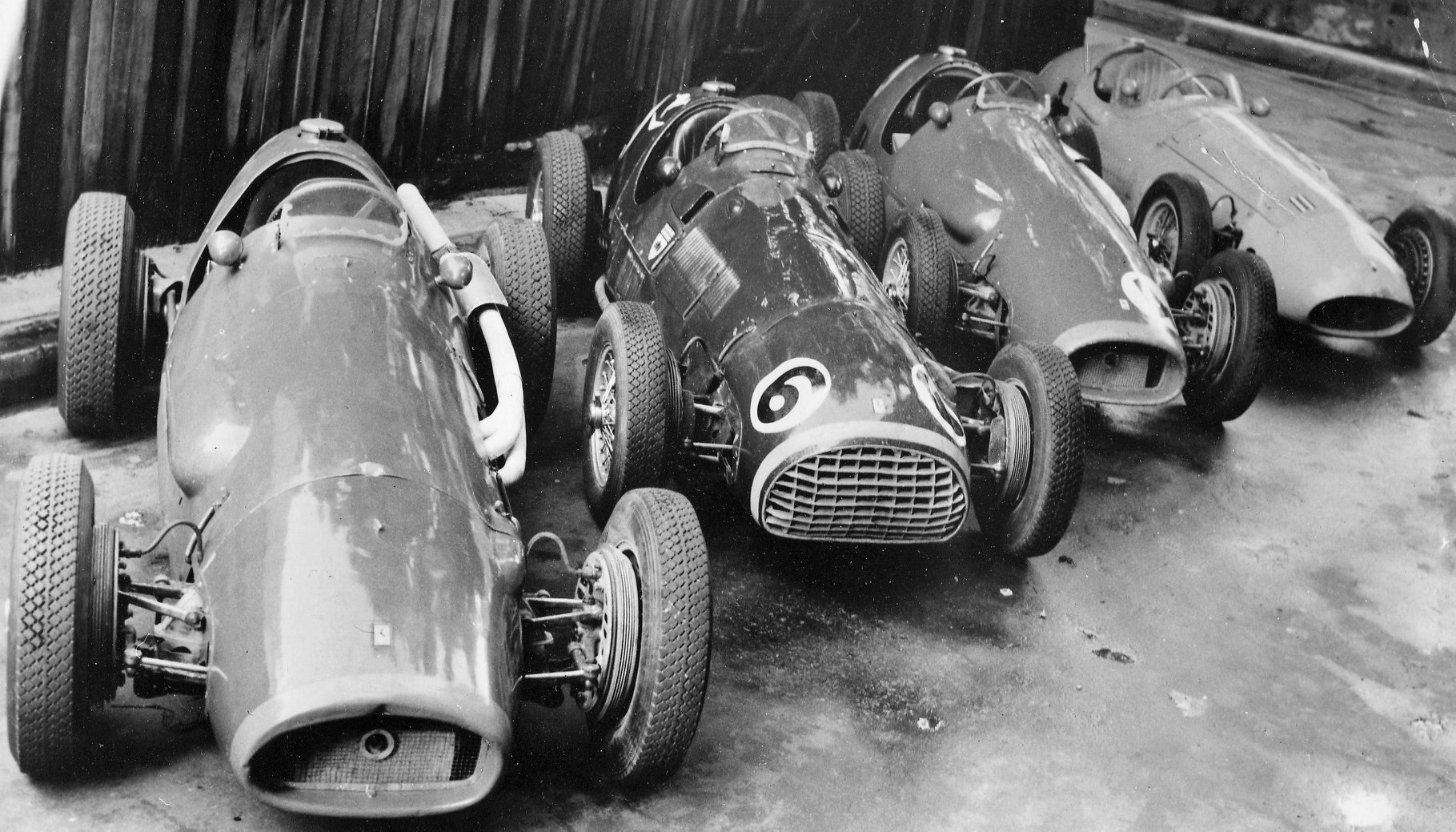
 

‘Start ya bastardo’ seems to be the expression on Glen Abbey’s face…

He and the other Alec Mildren Racing boys are trying to get Frank Gardner’s Brabham BT16 Climax alive for the start of the New Zealand Grand Prix at Pukekohe on January 7 1967.

It was a tough series for the Sydney crew- 1967 saw the V8 engines multiply that summer, the poor old, venerable Coventry Climax FPF 2.5 litre four potter- Tasman engine de jour for so long was overwhelmed by Repco-Brabham, Coventry Climax and BRM V8’s, the trend started the year before of course.

More would come in 1968 with the Ferrari V6 and BRM V12 adding to the onslaught but by then Mildren had a supply of Alfa Romeo Tipo 33 V8’s- not that they ever quite did the trick in the Tasman, but they were pretty handy at Gold Star level.

Wigram 1966, FG’s Brabham BT11A Climax 2.5 DNF accident, being hosed off by the 1.9 litre BRM P261 V8’s of Dick Attwood #2 2nd and Stewart #6 winner (unattributed)


FG and BT16 in New Zealand 1967, circuit unknown (E Sarginson)

In fact the little F2 based BT16 gave Gardner his best Tasman result ever, equal second.

Jim Clark won in a Lotus 33 Coventry Climax FWMV 2 litre, his yield was five wins, three in Tasman Cup championship events and 45 points, whilst equal second were Jackie Stewart, BRM P261 V8 2.1, two wins, Jack Brabham, Brabham BT23A Repco ‘640’ V8 with one and Frank who was winless but consistently quick throughout.

He was third at Lakeside, Warwick Farm and Sandown- three weekends in a row actually, and fourth at Levin, Wigram and Longford- his only DNF’s were in the NZ GP opening round at Pukekohe and Teretonga with engine and oil line problems respectively. Click here for Tasman 1967; https://primotipo.com/2014/11/24/1967-hulme-stewart-and-clark-levin-new-zealand-tasman-and-beyond/

So the paddock photo is representative of dramas which came in the 21 lap preliminary on GP morning when a valve and piston came into contact- that was it for FG’s weekend. Stewart won the NZ GP from Clark and Richard Attwood’s BRM P261.

Back to Mildren and Gardner’s plans for the 1967 Tasman.

Frank and Alec figured they needed something light in all the circumstances so an F2 frame into which they could pop their FPF and Hewland HD5 gearbox made sense- FG had raced Alec’s Brabham BT11A’s in the 1965 and 1966 Tasmans, one of them was raced by Kevin Bartlett. In fact 1967 would be KB’s first full Tasman, as against just running the Australian rounds.

Frank’s European commitments didn’t extend to full F2 seasons in 1965 and 1966 but he did a ‘halfa’ season or thereabouts in 1965 racing several cars- a John Willment Lotus 35 Cosworth SCA, Ken Tyrell Cooper T75 BRM P80 and Midland Racing Partnership Lola T60 BRM P80. In 1966 he raced MRP Lola T60 and T61 BRM’s.

Whilst Mildren’s were a ‘Brabham and Alfa Romeo Shop’ (yes i know not exclusively) and the chassis selection may have been a foregone conclusion, perhaps FG’s closeup view- ‘up the clacker’ of Jochen Rindt’s Winkelmann BT16 at Reims for an hour and a half in July 1965 convinced him Ron’s chassis was the go. Jochen won the Reims GP in 1:33.55.7 from FG on 1:33.55.9 in the Midland Lola.

And so it was they did a deal to buy the John Coombes ‘F2-8-65’ BT16 which had been raced by Graham Hill in 1965 and 1966 in Euro F2 until Coombes replaced it with a new-fangled monocoque Matra MS5 midyear. Click here for articles on Euro 1 litre F2;

Lotus 35, SCA and P80 engines; https://primotipo.com/2017/11/06/jim-clark-lotus-35-and-the-cosworth-sca-f2-engine/

and Brabham Hondas; https://primotipo.com/2015/07/30/xxxii-grand-prix-de-reims-f2-july-1966-1-litre-brabham-hondas/

and the F2 Matras; https://primotipo.com/2019/05/24/surtees-matra-1966-and-thereabouts/

FG in Brabham BT19 Repco ‘740’- Jack’s 1966 ‘620 Series’ powered championship machine during the Oulton Park Gold Cup in 1967 (M Hayward)


Gardner, Ford GT Mk2, Le Mans 1967 (D Friedman)

‘F2-8-65’ was soon in Australia and made race ready by Glenn Abbey for the Hordern Trophy, for some years the traditional Gold Star Championship final, December, Warwick Farm round. Frank won from Kevin Bartlett and Spencer Martin in ‘identical’ Brabham BT11A’s entered by Mildren and Bob Jane.

The 1967 Tasman result was outstanding for FG and Mildren’s, it was again a reminder of his speed, consistency and maturity.

At the end of the summer off he went to Europe for what by then had become his ‘usual cocktail’ of touring cars, sports-prototypes and sportscars, F2 and occasional, usually non-championship F1 drives. To me FG had it all-what a mix of cars, and paid well to do it!

Bartlett in the Mildren Brabham BT11A Climax at Warwick Farm during 1967

The BT11A was one of Kevin Bartlett’s all-time favourite cars so it was no surprise Mildren sold BT16 instead- KB and Spencer went at it hammer ‘n tongs again in 1967- a battle between two mates told here; https://primotipo.com/2018/04/27/kbs-first-bathurst-100mph-lap/

Niel Allen was the purchaser albeit the car was usually driven for him by Fred Gibson. From Niel- I think he sold it when he bought Piers Courage’ McLaren M4A Ford FVA at the end of the ’68 Tasman, it went to Col Green then Neil Rear in Perth, in the US now innit for quite some while?

Etcetera…

(D Logan)

FG has crested ‘Lukey Heights’ and is plunging left towards Dandenong Road during the 26 February 1967 ‘Sandown Cup’, he was third behind Jim Clark’s Lotus 33 Climax FWMV 2 litre V8 and Leo Geoghegan’s Lotus 39 Climax FPF 2.5.

Credits…

Doug Shaw Collection, Euan Sarginson, Duncan Logan, oldracingcars.com

Tailpiece; c’mon baby, please!…

Glenn, Stu Randall and Ian Gordon (?), note the nose of the ‘Scuderia Veloce’ 250LM at left, at that stage the custodian was Kiwi racer Andy Buchanan.

Its a period typical Brabham, skinny (albeit not at all so by the standards of a modern Formula Ford) and sturdy spaceframe chassis with upper and lower wishbones and outboard coil spring/shocks with an adjustable roll bar. Alford & Alder steel uprights- you beaut cast magnesium ones arrived with the 1967 BT23/24.

Wonderul bits of chuckable kit straight outta the box- design by Tauranac and final suspension settings by John Arthur Brabham.

Finito…