Carroll Smith, Frank and Joan Matich (NAA)

Frank and Joan Matich confer during the Warwick Farm Tasman meeting, February 11 to 13 1972…

The ’72 Tasman wasn’t the series the Matich’s expected after the debut win of the Matich A50 Repco at the Farm in November 1971- the brand new machine built closeby won the Australian Grand Prix only days after it’s completion, and looked the goods for the Summer Internationals.

Whilst Matich and his team worked their magic in Brookvale, Kiwi Graham McRae was casting a spell or two in Poole whilst Frank Gardner and Bob Marston were indulging in some F5000 sorcery of their own over at Huntingdon- the cars alluded to are the Leda LT27 aka McRae GM1 and Lola T300.

Mind you, things came good for Frank and Joan at home- Warwick Farm is not too far from the Matich HQ in Brookvale (they moved to Military Road, Cremorne on Sydney’s leafy North Shore circa August 1972) FM was quickest in unofficial practice, qualified on pole on Saturday afternoon and won the race, leading throughout from start to flagfall.

This article is superfluous really, I’ve done Matich and his career pretty well to death, several long pieces inclusive of an 11,000 word monster on his F5000 cars- at the end of this article are links to that piece and a couple of others of potential interest.

But then I came upon this swag of photographs of the Warwick Farm weekend which were too good to ignore. I’ve no idea of the publication for which they were intended or indeed if they ever were published. The shots are from the National Archives of Australia, the photographer uncredited. The series of photos are headed ‘Australia’s Mr and Mrs Motor Sport Sets a Fast Pace’. I’ve other photos of this weekend but I decided to maintain the original intent of whoever commissioned them, keep them together and focus on ‘Team Matich’.

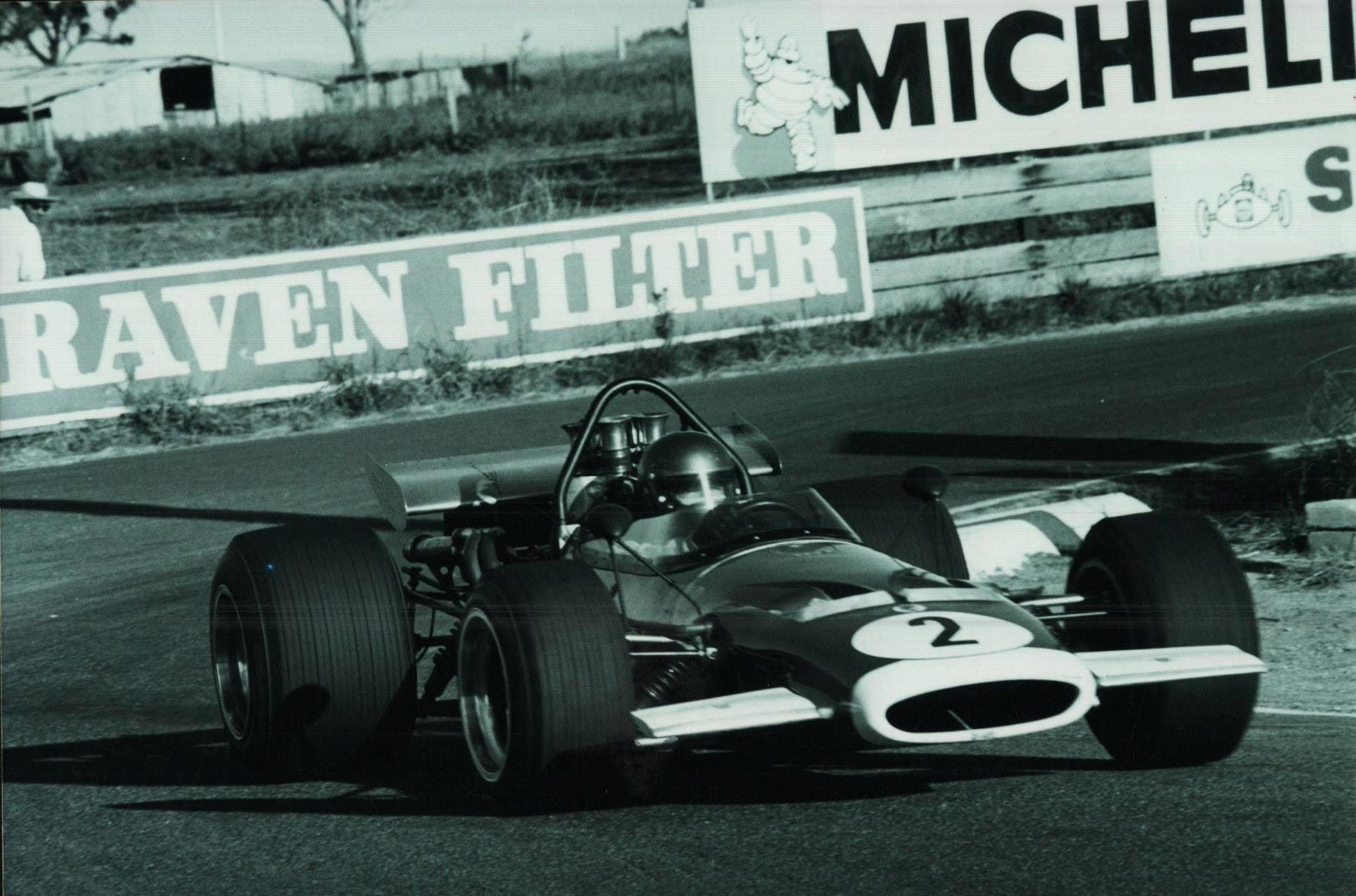
Frank Matich, Matich A50 Repco, Pit Straight, Warwick Farm February 1972 (NAA)

Is ‘Mr and Mrs Motorsport’ apt or a bit of PR Bullshit?…

Its a fair observation I suspect.

Frank was already racing his first competition car, an MG TC when he met Joan, ‘her parents thought the sound of the MG arriving was a plane as they lived at Mascot’ Frank recalled, in fact Joan could be said to be FM’s first sponsor as she lent him 140 pounds to rebuild the TC’s engine not long after they first started going out!

Joan went to many of the test sessions and race meetings down the decades, helped schmooze the sponsors and assisted to run the business which was not insubstantial by 1972. There was the race team chasing national titles, the production of racing cars (sportscars -several SR3 and SR4’s and six F5000’s) Firestone, and then later Goodyear race tyre and Bell Helmets importation and distribution and properties to manage, both domestic and business. Lets not forget the demands of four kids too. (Kris born circa 1958, Kim 1960, Lea 1962 and Katrina 1963)

Frank and Joan were not Mr and Mrs Motorsport in the way that Fred and Christine Gibson and Garth and Leanne Tander were in the sense that both were drivers but I think the ‘Mr and Mrs Motorsport’ label is a fair one.

Joan and Kris Matich- Kris went on to race Van Diemens in Formula Ford in the eighties

1972 Tasman Series Top Guns…

McRae, the reigning champion, Matich, Gardner, Mike Hailwood (Surtees TS8 Chev) and David Hobbs (McLaren M22) were perhaps the dudes most likely to fight for the Tasman Cup but Kevin Bartlett, hamstrung only by the age of his McLaren M10B Chev and 1970 champ Graeme Lawrence, like FG Lola T300 mounted would also be ‘thereabouts’. Then came Teddy Pilette, McLaren M10B Chev, Garrie Cooper, John McCormack and Max Stewart in Elfin MR5 Repco’s- all relative newcomers to F5000, and the rest.

In New Zealand it was all McRae- he started on pole in the first three rounds, won at Levin and Wigram, whilst Gardner took the NZ GP at Pukekohe a race in which Graeme Lawrence and Bryan Faloon had an awful accident killing Bryan and outing Graeme for months.

Derek Kneller pointing, how was it Frank? Ken Symes of Repco in the blue suit FM’s boys in the natty, very American STP togs. Note open top section of ‘bathtub’ aluminium monocoque chassis A50 ‘001/002’ (NAA)

FG boofed his Lola at Levin when the engine suddenly cut out on a high speed corner and he clobbered the fence. Gardner, a very ‘safe driver’ must have had more prangs in the 7 months to January 1972 than at any other time in his career- he wrote off the prototype T300P (akaT242P) at Snetterton in a collision with Brian Redman’s McLaren M18 Chev, when FG on pole and Brian off grid 2 had a territorial dispute, on 30 August 1971.

The quite significant in the history of F5000 cars, seminal, defining chassis T242P/T300P was rooted, destroyed.

Lola quickly built up a replacement car for Frank, ‘HU1’, the first production T300 which Gardner raced to a debut win at Hockenheim in front of Emerson Fittipaldi’s Lotus 56B Pratt & Whitney on 12 September. He took the car to another victory at Oulton and with a second place at the season ending Brands late September round nabbed the 1971 European F5000 Championship. He had been a winner in a Lola T192 earlier in the season prior to the T242/300 race debut, it wasn’t all down to the new car by any stretch.

‘HU1’ was then shipped to Australia in time for the AGP at the Farm, FG crashed it in practice, again the car was re-tubbed before shipping to NZ- only to be boofed again in an accident not of his making at Levin.

He would reappear at Surfers with the repaired car but the chances of the wily veteran winning the series were gone. A shame really as he ‘retired’ from single-seaters after the Sandown round selling the T300 to Sydney F2 pilot Gary Campbell. I say retired as he did a ‘Nellie Melba’ and contested the final round of the 1972 Euro F5000 Championship late in the year to ‘race test’ the prototype Lola T330- ‘HU1’ which became famous in Max Stewart’s hands and is of course still in Australia. A long digression!

Kevin Bartlett took a top win in the final NZ round at Teretonga, driving with a blend of speed and sure-footedness on a wet, difficult track which caught out pole-man Hailwood and McRae. David Hobbs tangled suspension with Matich.

Matich had a shocker of a time in NZ.

He qualified 5th/2nd/5th/2nd- a second at Levin and fourth and fastest lap at Teretonga his best with DNF’s at the NZ GP with engine failure- a broken conrod and a distant 12th at Wigram having only completed 34 laps- KB spun and FM hit him on the way through. Frank pitted and returned 3 laps later completing a further 13 laps before retirement. The sergent.com race report notes ‘…showing the sort of form, had fate not intervened, that would certainly have given him some Tasman points.

A50 left front suspension assembly- top link and swept back locating arm, lower wishbone, coil spring and Koni double-adjustable alloy bodied shocks, adjustable roll bar, big ventilated discs and four-pot Lockheed calipers (NAA)


All was not well in the Matich camp either.

A race team needs stability at the top, Peter Mabey had been the Matich Chief Mechanic since the SR3 period (at least), it was intended that Derek Kneller who arrived with FM’s first McLaren M10A in August 1969, (he had been building cars at McLaren Cars in 1968/9 including the first M10A raced by Peter Gethin) would replace Mabey but Peter decided to stay on to build the monocoque A50, as he wanted that experience and the two worked together well through the repair of FM’s McLaren M10B. The team rebuilt the cars aluminium monocoque rather than buy a repalcement from Trojan, to get some experience of this form of construction in advance of the build of the A50 in 1971.

After the ’71 AGP victory Kneller headed back to the UK, he was homesick, so went home to a gig with Team Surtees. Mabey stayed on but finally cried enough- and left the team after the Levin round having got tired of shouldering the load with other mechanics not pulling their weight the final straw.

Matich did Wigram and Teretonga with the other mechanics and called Derek in the UK, who agreed to return to Australia to assist. ‘I had planned and organised with Frank…to come back to Oz in the middle of the year (1972)…I arrived in Sydney on the Monday after Surfers, Joan picked me up from the airport, I went straight to Brookvale and started work on Frank’s joblist for the car’.

Normally there was a two week gap between the last NZ round at Teretonga and the first Australian one at Surfers Paradise but there was only one week in 1972 making the five day shipment of cars marginal so a group of teams hired a plane to freight the cars by air into Coolangatta, closeby to Surfers.

Derek and Scott McNaughton fitting the drink system- windscreen washer system complete with an electric pump and switch on the instrument panel. neat! (NAA)

Matich had plenty of success at the abrasive Surfers Paradise track over the years, he plonked the A50 on pole at the challenging power circuit and finished third behind McRae and Gardner- FG’s car was re-tubbed and he was back in the game. Kneller notes that the A50 rear suspension geometry was altered with a lighter rear subframe, and raced that way on the Gold Coast.

At the meetings end Frank and Joan jetted from Coolangatta back to Mascot in Sydney, with the A50 trucked back to Brookvale overnight- the team had no spare car, at the time the first customer A50 for George Follmer (Roy Woods Racing) was coming together in a corner of the Matich ‘shop with Carroll Smith assisting.

Kneller set to work preparing the A50 for the ‘Farm.

‘The rear suspension geometry was altered again after Surfers- the rear roll centre was raised…It was at this time the car was given the A50 ‘002’ moniker but it was ‘001’, the same tub, the bodywork was painted in STP colours and the roll bar chrome plated, it appeared different which was a bit of gamesmanship and kept the sponsors happy but it was, and still is the same tub which Bryan Sala now owns. This caused lots of historic (eligibility) grief in later years.’

For the sake of completeness and clarity ‘The same chassis (‘001′) was used for the rest of the 1972 Tasman Series and the 1973 Tasman, at its end it was put on axle stands at the Brookvale factory’ and is very clear photos in the article referred to earlier whilst the two A51’s were built up in advance of their 1973 US L&M Series tour.

A fresh Repco Holden V8 was popped into the rear of the A50 to replace the unit used at Surfers in addition to all of the usual pre-race checks- aided this time by operating from the teams home base rather than the garages used in other cities on tour.

A50 in the Brookvale workshop in the week prior to Warwick Farm. Repco Holden 5 litre Lucas injected V8 giving circa 480 bhp at this point in its development. 1973/4 flat plane crank Repcos the ultimate spec gave circa 520 bhp. Hewland DG300 5 speed transaxle, inboard disc brakes. Rear suspension, Matich designed- Commonwealth Aircraft Corporation cast magnesium uprights, single top link, lower parallel links, radius rods, coil spring/Koni dampers, adjustable roll bar with Aeroquip fittings throughout (NAA)


I’ve always thought Matich and McRae were a couple of peas from the same pod…

Both were from engineering backgrounds, Matich was apprenticed as a Diesel Engineer, McRae completed an Engineering Degree- both knew their way around racing cars from a drivers perspective and also as car conceptor, designer, builder, tester and fettlers. This is a very potent combination to build fast cars, or take what isn’t quick and change it and then keep changing it until the butt-cheeks and stopwatch confirm the steeds speed.

By the time both fellas had success at an international level they were not malleable youths- but rather battle hardened older racers who had cut deals to get where they wanted, with firm, battle-inspired opinions , which meant they were not naturally attractive to team managers after fast but perhaps more obedient youths.

Both proved their pace against the worlds best- lets not forget Matich’s speed against the F1 elite in his two Tasman 2.5 seasons in 1964/5 before his Elfin 400/Matich SR3/4 sportscar phase. He raced with Clark for much of a race at Lakeside and popped his Brabham BT7A, by then not the very latest bit of kit in 1965, on pole at Warwick Farm in front of Clark, Graham Hill, Brabham, McLaren, Phil Hill, Frank Gardner and the rest…

A50 Brookvale, FM at right. Note bathtub aluminium tub- 6 tubs were built, all the same design, 3 by Matich and 3 by Commonwealth Aircraft Corporation at Fishermans Bend, Melbourne- 3 A50, 2 A51’s one of which became an A52, and 1 A53. Note the way the lower suspension wishbone picks up, in part on the A-frame forward of the tub (NAA)

McRae beat the best in the F5000 world in Europe and the US- taking the 1972 US L&M Series in his self-built Leda LT27/GM1 and three Tasmans on the trot from 1971-1973.

Both had F1 offers, in FM’s case he had family and a business in Australia which was a barrier- unfortunately in McRae’s case his only F1 start was with Frank Williams Iso Ford in the 1973 British GP when he didn’t survive the first lap carnage wrought by McLaren’s new cub, Jody Scheckter’s mega first lap M23 Ford lose. McRae wasn’t involved in the shunt but the car’s throttle slides were filled with sand which prevented him taking the restart.

At their respective ‘right peaks’- say 1965 for Matich, (born 1935) and 1971/2 for McRae, (born 1940) both were surely good or better F1 material had they arrived at about those times aboard a halfway decent bit of kit!?

Matich and Bartlett before the off. Matich A50 Repco and McLaren M10B Chev. Just to the left of KB’s helmet is Frank Gardner’s silver Bell Magnum- his Lola T300 is on row 2 (NAA)

Meanwhile back in Sydney the 1972 ‘Warwick Farm 100’ beckoned…

Matich, Bartlett, Gardner and Max Stewart were probably the Warwick Farm aces in this race with perhaps Max to be discounted, his time in F5000 would arrive bigtime shortly, but he wasn’t going to win this race in his Elfin MR5.

Frank did pretty much all of his testing at the ‘Farm, he knew every blade of grass in ‘Gods Acre of Motor Racing’ and so it proved over that February 1972 weekend. The changes the team made to the car gave him the edge and additional confidence he needed, he was comfortably ahead of the field in unofficial practice.

On Saturday he was again the class of the grid popping the A50 on pole by 5/10 second from Kevin Bartlett’s McLaren M10B Chev, Frank Gardner Lola T300 Chev, the similarly mounted Bob Muir, Max Stewart Elfin MR5 Repco, McRae Leda GM1 Chev, who only did 12 laps of the slippery track.

Only the first few laps in the earlier Saturday session were dry, otherwise the track was wet or damp- a light drizzle greeted the drivers at noon as they set out for what would normally be the session in which the quickest times were set with cars by then having chassis’ nicely tweaked for the track.

Teddy Pilette McLaren M10B Chev, David Hobbs McLaren M22 Chev, John McCormack Elfin MR5 Repco and Warwick Brown McLaren M10 B Chev and the rest comprised the balance of the grid. Mike Hailwood had a shocker of a time, he missed much of practice when a tyre deflated, then in a discretionary session to test the car he muffed his entry onto The Causeway and clipped the fence breaking a wheel and causing some suspension damage. His boys had a long night ahead but did make the grid.

The Northern Crossing, formerly a series of temporary road patches laid across the top of the Warwick Farm horse racing track had neen replaced with permanent hotmix- a bump leading onto the crossing and a layer of silt across it made the going tough for the drivers, both Bob Muir and Max Stewart had spins during the day.

Pre-race build up- watching the TV feed of an earlier race. Derek ‘Frank’s gold race suit was given to him by Goodyear, they gave him a new set of race overalls every year, unalloyed Hinchman but for 1972 it was the ‘Fypro’ gold set’ (NAA)


Yerv got a hole in your sock Dad! Make sure you win but be careful all the same- FM and Kris Matich as Frank suits up (NAA)


Kneller belts Matich up so to speak- note the nickel or chrome plated roll bar- the cause of some consternation deacdes later in the ‘A50-002’ debate. There was no ‘002’ but rather a bit of gamesmanship by Matich! (NAA)


Lift off- FM gets the jump, he was never headed. Best view afforded by Max Stewart’s truck-top! (NAA)

Jack Brabham was present over the weekend and started the race at 1.30 pm- Matich led from pole winning the 45 lap, 100 mile race from European F5000 Champion Frank Gardner by 18 seconds and Kevin Bartlett another 30 seconds up the road.

FM started strongly, as did Bartlett who looked for a moment to have gotten off the line best,  and opened up a 2.5 second lead from Bartlett, Gardner, Stewart, Muir and McCormack- the latter made a blinder of a start from row 5 using the grass verge.

Matich widened the gap but the order up front remained the same with much of the race interest surrounding Mike Hailwood and his repaired Surtees TS8 who worked his way up from the back of the field- he was sixth on lap 6 passing Hobbs on lap 2, McCormack on lap 4 and Stewart on lap 5.

Pit board advising all is in hand, ease. STP sponsorship just for the Tasman, gone for the Gold Star Series which FM won convincingly in 1972 (NAA)

By lap 10 Matich was 15 seconds in front and at this early stage the race was looking like a repeat of his AGP effort in November. Bartlett was still in second ahead of Gardner in a nice tussle with a 10 second gap back to Muir, McRae with Michael The Cycle right up their clackers. In a ripper drive Hailwood passed McRae under brakes and then got Bob Muir on lap 12- by then FM up front was lapping the 2 litre Waggotts/BDA’s.

Gardner finally got past KB on lap 12 (or 13 depending upon your source), then came Hailwood, McRae ‘never really at home at the Farm’, Muir, McCormack, Pilette, Hobbs, Brown and Tony Stewart’s Mildren Waggott.

John McCormack Elfin MR5 Repco from Hailwood’s Surtees TS8 Chev, Pit Straight (NAA)

By lap 30 Matich eased the pace a smidge with only Gardner, Bartlett, Hailwood and McRae on the same lap- by lap 35 Hailwood could not catch Bartlett and succumbed to a challenge from McRae after he lost both second (early in the race) and fourth gears in his Hewland DG300 transaxle.

In the final four laps there were no changes so Matich won- setting a new record average speed for the race of 94.85 mph with second placeman Gardner setting a new lap record of 1:24.0 to take six-tenths off the mark set by Matich in November. KB was third 30 seconds behind Gardner, then McRae and Hailwood

John McCormack was 6th in his Elfin MR5 Repco, Mac was still in his formative F5000 phase but would soon be a force, then Teddy Pilette 7th in his VDS Racing M10B with Tony Stewart the best of the 2 litre cars in Max Stewart’s Milden Waggott- the car in which Max had won the 1971 Gold Star, then F5000 newcomer and later 1975 Tasman Champion Warwick Brown in his ex-Hamilton McLaren M10B Chev with American visitor David McConnell 10th in a GRD 272 Ford BDA 2 litre.

The quintessential WF victory shot, chequered flag car not quite perfectly in shot and crowded grandstand (NAA)


The win was just the fillip Matich needed, he carried the speed he had shown at Warwick Farm both to Melbourne at Sandown’s AGP the following weekend and at Adelaide International a fortnight later.

From pole at Sandown he led until lap 5 when an oil scavenge pump failed putting the A50 out, McRae took the win, and in Adelaide he started from pole but on this occasion had gearbox failure with David Hobbs taking the win in a McLaren M22 Chev.

(NAA)

No doubt a Rothmans executive handing over the goodies above as race sponsor, with the distinctive form of Brabham JA at right- he won an international race or three at Warwick Farm.

To the victor go the spoils- the much respected Australian Automobile Racing Club Chief, Geoff Sykes at right, and in the photo below Derek Kneller receives a trophy, perhaps, for the Chief Mechanic of the winning car.

Credits…

oldracingcars.com, ‘The Canberra Times’ 14 February 1972, National Archives of Australia, Derek Kneller, Alan Wood 1972 WF100 race report in March 1972 ‘Racing Car News’

Other Related Links…

Matich and his F5000 cars; https://primotipo.com/2015/09/11/frank-matich-matich-f5000-cars-etcetera/

Repco Holden F5000 engine; https://primotipo.com/2018/05/03/repco-holden-f5000-v8/

Graham McRae and his F5000 cars; https://primotipo.com/2018/09/06/amons-talon-mcraes-gm2/

Etcetera…

(NAA)

Ampol gets a fair crack of the whip in all these shots. Simpson race-boots common at the time at elite levels- FM’s Adidas jobbies are Nomex.

(NAA)

Looks like Derek Kneller at left taking a snap with his iPhone.

Never found the A50 the prettiest of F5000’s, functional and effective may be better descriptors. And successful. Both A50 ‘001’ and Bartlett’s very equally successful ex-Niel Allen M10B still extant and happily in Oz with Bryan Sala and Alan Hamilton respectively.

Debrief (NAA)

Nice shot of the top, or in part lack thereof, of the bathtub monocoque. Note steel structural element between each ally mono pontoon to which the dash is bolted- it contains the usual array of Smiths instruments. Bell Star helmet de-riguer at the time, FM the importer for Oz. The day I bought my first Bell Star circa 1975 from Ken Nancarrow at ‘Racegear’ in Ralston Street, South Yarra (Melbourne) is etched in my memory- remember him? Wonderful fella- you could never get outta the joint in less than an hour by the time he exhausted you with all of his on-point race gossip.

(NAA)

FM usually wore ‘Hinchman’ suits at this stage, remember the classic cream Hinchman of the era with vertical ‘race stripes’ on the left breast with prominent Goodyear embroidered badge? Always aspired to a set of those.

(NAA)


Nah, it’s not gunna rain, the weather comes from the direction of Liverpool.

Cockpit cowling (between Carroll Smith and FM) pretty much the same all the way through the A50-A53 models inclusive of the side-radiator A52 and A53.

I didn’t know who ‘Goodyear Cap Man’ was until reader/mate David Rees/Ray Bell identified him. Derek Kneller clarified the talented American engineer/mechanic/author’s (i’ve got two of his books purchased 20 years ago- ‘Tune To Win’ and ‘Prepare To Win’ from memory) role, which was to build up the A50 ‘003’ for Roy Woods Racing, a car initially raced by ace-racer George Follmer.

(NAA)

By the looks of it the boys are playing around with the steering rack- Matich very mechanically capable to say the least. Both he and McRae were very much in the Colin Chapman, Jack Brabham, Bruce McLaren, Derek Bennett, Garrie Cooper, Dan Gurney, Jim Hall, Frank Gardner, Howden Ganley, Larry Perkins mould of oh-so-capable, muck-in and geddit done types of driver/mechanic/engineer. A breed which no longer exists at elite level.

The A50 was an expression of the F5000 state of the art as Team Matich- FM, Kneller, Mabey and one or two others saw it in 1971. There was no ‘designer’ as such but rather draftsman who put onto paper the conceptual design of the car which was led strongly by the chief.

Tailpiece: ‘It sounds ok, great actually Ken’: Repco’s Ken Symes warms his liddl’ 5 litre baby up…

(NAA)

Repco-Holden F5000 V8 a simply glorious engine to listen to, unmuffled as they were for a few years yet.

Finito…

(NAA)

Jack Brabham testing the ‘Jack Brabham Ford’ Bowin P4X Formula Ford normally raced by Bob Beasley, August 1971…

I’ve rattled on a couple of times before about Jack’s last ‘in-period’ race victory being the Calder Raceway ‘Race Of Champions’ on 15 August 1971- he beat a stellar field.

Jack carried #1 on the flanks of the Bowin in the Calder race- its hard to know where this photo is taken, maybe its at Calder on the weekend of the meeting or perhaps Jack is putting in a few test miles elsewhere to get the hang of the car- its 100 bhp and Goodyear RR12 all weather tyres rather than the 440 bhp, slick shod F1 Brabham BT33 Ford he raced in 1970.

Maybe he is thinkin’- ‘i’ll just soften the rear bar a smidge and see if i can get a bit more bite from the back’…

Check out this article for heaps more on the Bowin Formula Fords;

Bowin P4A and Oz Formula Ford Formative…

(R Beckman)


Jack checks his times, eagle eyed Brabham watchers will note the Bell Star as the one he wore thru most of 1970, his last F1 season (R Hawthorn)


Front to rear, Stillwell Elfin 600, Brabham Bowin P4X and Matich Aztec- at right front Jane in the other Stillwell Racing Elfin 600 (Bennett)

The Calder race was a wonderful bit of promotion by Bob Jane- here is Tom Naughton’s ‘Racing Car News’ race report from the October issue of ‘The Monthly Bible’…

‘With all the pomp and ceremony of a Grand Prix, Calder staged a ‘Race Of Champions’ for their 15 August meeting.

Coming out of retirement were Jack Brabham and Bib Stillwell (Australian Gold Star National Champion 1962-1965) along with some of todays champions, and all mounted in borrowed Formula Fords, they turned on a most entertaining race. The ‘Master’ showed the way home, easing effortlessly away from the main scrap and showing that he had lost none of the skill after his period of retirement’. (only 8 months at the time!)

‘Brabham lined up in his own (Jack Brabham Ford, Bankstown, Sydney) FF normally steered by Bob Beasley, while Bib Stillwell took over his number one car (Elfin 600) usually driven by Larry Perkins (he won the Driver to Europe Series that year).

Allan Moffat (in fact the only driver without racing car experience) (not quite true, he had an outing or two in Bob Jane’s Brabham BT23E Repco Tasman car boofing it at Sandown in 1968) took over David Green’s car (Wren).

Bob Jane hopped into Mike Stillwell’s Elfin 600, Alan Hamilton into Graeme Peart’s (Wren) and Kevin Bartlett into Murray Coombs’ car (Wren). Frank Matich took over Mike Hall’s Aztec, while Leo Geoghegan slipped into Peter Edwards’ car (Elfin 600)’.

Moffat Wren, with 3 Elfin 600’s behind him- perhaps Leo G immediately behind him and Jack ranging in, partially obscured to his outside, Jack is ranging in (autopix)


Frank Matich in Mike Hall’s Aztec. In August 1971 FM is up to his armpits in the build of the Matich A50 Repco F5000, so my guess he may have preferred to stay in Sydney, in which he was to win the November AGP at Warwick Farm – wonder what he thought of the Melbourne, Ould brothers built Aztec? (AMRA)

‘That was the field and at the flag Jane was first away, leading from Moffat, Brabham, Geoghegan and Hamilton. By lap 2, the front three had closed up and on the following lap both Moffat and Brabham slipped by at Repco. Geoghegan came up to challenge Jane, while Brabham took the lead on lap 4. He started to ease away from the rest, while Jane slipped Moffat at Toyota, these next three keeping close company. By lap 6, Geoghegan took Moffat, and then inherited second spot when Jane slipped wide at Repco, dropping back behind Stillwell’.

‘Oops! The same thing happened the last time I drove one of these open-wheeler thingies’. Moffat in David Greens slightly second-hand Wren (Bob Jane)

In lap 9, Stillwell started a challenge on Moffat and Hamilton, but in front Brabham was well clear. He took the flag in true champion style, with Leo second, then a scrapping duo of Hamilton and Moffat, with Stillwell hard on their heels, then came Jane, Matich and Bartlett. Leo did the fastest lap, a 48.6.’

The three Brabham sons all had stints in Australian Formula Ford before heading off to Europe, Geoff in 1973/4 aboard Bowin P4X/Elfin 620/Bowin P6F, Gary in 1982 with the Birrana F73 and David in 1986/7 with Van Diemen RF85/86. There is a neat bit of symmetry in the ‘old man’ also having a race win in Oz FF- was it his very last race win I wonder?

Credit…

‘Racing Car News’ October 1971, Laurie and Nick Bennett Collection, Bob Jane Heritage Collection, Autopix, Australian Motor Racing Annual, Jonathon Koch Collection for the program and RCN, National Archives Australia, Lynton Hemer, Russell Beckman, Stephen Dalton Collection, Russell Hawthorn

Etcetera…

(S Dalton Collection)

From the Calder 15 August meeting program. Car in the photo is Jack’s last Tasman mount, the Brabham BT31 Repco at the Sandown Tasman meeting in February 1969

The race certainly had a great entry, for overseas readers, Stillwell, Bartlett, Matich and Geoghegan were all Gold Star Champions and Moffat, Jane and Hamilton national title holders on multiple occasions aboard Touring Cars and Sports Cars in Hamilton’s case. Jack probably requires no introduction…

For the sake of correctness, the car driver/combinations did not quite start as listed in the program.

Brabham was aboard the one off Bowin P4X- slightly different in the suspension to production P4A’s, Matich the Aztec, Jane a Stillwell Elfin 600, Geoghegan the Edwards Elfin 600 with Moffat, Bartlett and Hamilton aboard Wrens.

Brabham doing a parade lap in the P4X at Oran Park on 26 March 1972 (L Hemer)

Tailpiece: ‘It feels a bit like the ‘Stang, gearchange is on the right anyway’…

Moff saddles up in David Green’s Wren Formula Ford, these cars (not to forget his ‘Mk2’s constructed in the later 1970’s) were built in reasonable numbers by Bill Reynolds in his Carlisle Street, St Kilda workshop, not too far away from Calder.

Allan Moffat’s open-wheeler appearances, apart from this, were limited to a couple of races in the States circa 1966/7 (details please) and limited laps in Bob Jane’s Brabham BT23E Repco at Sandown in 1968.

Finito…

(Repco)

Frank Matich aboard his dominant 1969 Australian Sportscar Championship winning Matich SR4 Repco ‘760’, 4-cam, 4-valve 5 litre V8 at Calder Raceway in 1969…

Clearly the Repco PR snapper was there on the day to capture proceedings, i’m not sure of the meeting date, the championship rounds that year were at Warwick Farm, Surfers Paradise and Sandown- the photo is after the Monaco GP high-wing ban, which as you will see in the article attached is the form in which the car raced early in the year. An awesome machine in every respect.

Nigel Tait, the restorer/owner/driver of the car and i did a long feature about this wonderful machine, click here to read it; https://primotipo.com/2016/07/15/matich-sr4-repco-by-nigel-tait-and-mark-bisset/

(Repco)

Credits…

Repco Ltd

Tailpiece: Where is Meppa when I need him?…

Repco’s John Mepstead was seconded to Matich’s Sydney operation to look after the several-of-a-kind, DOHC, 32-valve, ‘760 Series’ Repco, circa 560bhp 4.8-5 litre V8’s which powered this machine.

SR4 was Matich’s proposed 1968 Can-Am contender- it ran way too late in its build so he raced it in Oz in 1969- it was like taking a sledge-hammer to crack a nut such was its local dominance!

Finito…

image

It can only be a Formula Libre race, somehow I doubt 4 year old Ray Dones had a future as a race promoter…

This shot of the little dude and his eclectic grid of racers was taken at the Denver Toy and Hobby Show on 3 April 1965, but it could just as easily be me at the ‘Scalextric’ track at Rosebud on Victoria’s Mornington Peninsula in 1969.

We ‘useter holiday at McCrae during the long, hot Australian summer- in between working on the ‘tan my brother and cousin spent lotsa time and money on donuts and laps at that place up the road in the Summer of ’69.

I never did parlay my Scalextric pace at 11 to exceptional Formula Vee speed at 21, sadly!

Credit…

Georgia Lowell

image

McCrae in the summer of ’69

Finito…

Start of the 50 Mile Handicap heats: Hunter in the Mrs Jones owned Alfa 6C1750 at left, Thompson’s obscured Bugatti T37A and two six-cylinder 4077cc Chryslers of E Patterson and #72/14 HJ Beith (Fairfax)

Bill Thompson’s Bugatti T37A swept all before him at Gerringong Beach on 10 May 1930…

Sydney’s finest was very much the form driver of the meeting, in fact many would say he was Australia’s best driver pre-War. He had not long before won the 1930 Australian Grand Prix at Phillip Island during the 24 March weekend- it was one of his three wins in Australia’s premier event. Bill was also coming off the back of record times at Penrith Speedway and at Kurrajong Hillclimb that season.

Gerringong is 130 Km south of Sydney on the Illawarra Coast, then as now it is a popular holiday destination. Throughout the 1920’s the relatively deserted Seven Mile Beach, between Black Head and Beecroft Head was a place where members of the Royal Automobile Club raced their cars, far enough from Sydney and the long cold stare of the law. These occasions were as much society events as they were motor racing ones.

The Smith/Harkness Anzac Rolls Royce arrives at Gerringong in December 1929 (Kiama Tourist)

Gerringong was very much in the public mind at the time as Norman ‘Wizard’ Smith had set an Australian Land Speed Record testing his Rolls Royce engined ‘Anzac’, at 128.571 miles per hour only months before on 1 December 1929. Wizard and his exploits, and the skill of Don Harkness, a racer himself, and his company which built ‘Anzac’ is a story for another time.

The beach had been the site of horse racing since the 1860’s but the noble beasts ‘could not compete with the speed and excitement of the motor’, mind you the take up of motor vehicles in Australia is indicated by the October holidays in 1919 when there was record volumes of motor traffic through the town, in just two hours, 12 vehicles were counted driving through Fern Street.

The weather on the 10th of May was awful for racing, with rain the night before and drizzle prevailing for most of the day from the 11.40am start of the meeting- only 300 hardy souls watched the race action.

The sand was wet, to the extent that all competitors of the first event had to be pushed out of the sand, into which they had sunk before the race started! The conditions became more difficult for the organisers, the Sydney Bicycle and Motor Club, as the programs timeline grew in inverse proportion to the usable width of beach- which was down to two cars  by the end of the days proceedings. ‘Another five minutes’, a club official said and ‘the tide would have beaten us’.

The ‘Sydney Referee’ report made note of the other difficulties as soft and slippery sand at the turn posts, drizzling rain and some ‘competitors whose race tactics, were, to say the least of it, unsafe’.

Thompson and a young admirer after his Gerringong win (Fairfax)

Thompson’s win of the feature event, the ’50 Mile Handicap’ for cars under 2000cc was described as a ‘great win’, a ‘fine individual effort’ ‘even though there have been better races held in Australia’.

Thomson won the race in the Bugatti T37A in which he was victorious at the AGP in the month before, chassis ‘37358’, which is still in Australia in the process of restoration. See my article at the end of this one on the 2015 Melbourne ‘Motorclassica’ for some information about that car.

Thomson won in 39 mins 4 secs from the CN Jackson MG Midget 847cc s/c, HG Potts Lea Francis 1496cc s/c. Other starters in the final were Charlie East’s Bugatti T37A, RR Hawkes Austin 7 Sports 748cc, N Hodge Morris Minor 847cc and the JAS Jones owned Alfa 6C1750 SS s/c driven by A Hunter, DNF due to splashing through a wave whilst on course. It is not clear if the other cars completed the distance.

The engine of Thonpson’s T37A is fettled before the off (Fairfax)


In other races, Charlie East won the final of the Four Miles Over 1000cc from the JO Sherwood Chrysler and J Aubrey Jones also in a Chrysler. There were three heats in all- won by Bill Thomson’s Bug, John Sherwood’s Chrysler and E Patterson’s Chrysler.

The Eight Miles Club Championship final was won by Thomson, the heats won by HJ Beith Chrysler Sports and Thomson’s Bugatti. Maroubra legend, Hope Bartlett in a Bugatti, did a very quick first lap in heat 1 but forgot the second lap! No pitboards were in use at Gerringong it seems.

The Handicap for Closed Cars was won by J Aubrey Jones Chrysler and the Handicap for cars under 1000cc was taken by the N Hodge Morris Minor.

Thomson said that such was the narrow course- it hardly gave him enough width to clear oncoming cars, that he was about to pull out. ‘It was the hardest event I’ve been in, much worse than the the Phillip Island race’, the ‘Island was famous for the challenging nature of its gravel roads, dust and undulations.

After the conclusion of the meeting Bill Thomson hoped to beat the Gerringong Flying 1 Mile record of 33 3/5 of a second set by Don Harkness in a Hispano Suiza in 1923 but failed to get there given the conditions, his 36 4/5 seconds not as good as he had hoped having changed into top gear a little too early with a head wind doing the rest of the damage to his time.

Another grid this time with two Chryslers to the left, #72 the E Patterson and HJ Beith Chrysler Sports, Charlie East Bugatti T37A to right (Kiama Tourist)

The only major incident of the day occurred when Mrs JAS Jones ‘winged’ one of the Chrysler mechanics (below) when competitors in the second heat of the over 1000cc Four Mile Handicap passed the finishing post and turned too quickly, and spectators pressed forward. Jones, in last place arrived at race speed and had to swerve several times to avoid cars and bystanders. She almost got through but struck Curley, breaking his leg.

(Fairfax)

The ‘Referee’ concluded its report of the meeting by saying ‘All things considered it was a successful meeting. But the supervision left a lot to be desired. It was this fault, plus stupidity on the part of certain competitors, that led to a serious accident. After crossing the finishing line several of the competing cars turned back towards the oncoming cars and one even swung out suddenly across their path. Thereafter the officials made their presence felt. But one subsequent offender should have been severely cautioned’.

Mrs JAS Jones aboard her Alfa 6C1750- a much respected racer and car. Raced by many latterly into the fifties Flathead Ford V8 powered inclusive of an AGP and still in Oz (Fairfax)

Motor Car Racing in Australia in 1930…

I wrote an article a while ago about Penrith Speedway and a championship meeting held there in 1930, click on this link to read it, not least for some context on the state of car racing, especially road racing at the time in Australia.

Penrith’s World Championship Race 1930…

Here are some snippets from that article, but do read the whole thing if you have not.

The Australian Grand Prix was held for the first time on an oval dirt layout around the showgrounds at Goulburn, New South Wales in 1927. The 1928 AGP, ‘The 100 Miles Road Race’ at Phillip Island, the first proper race in Australia on a road, run on a large, rectangular, gravel course was more indicative than Goulburn of the direction Australian racing would take and was indeed the race which started the tradition of road racing in Australia.

Gerringong Corners- two of them, one at end end of the beach, tide issues clear! (Fairfax)

At the time Australian motor racing was largely amateur, a ‘run what you brung’ approach prevailed with most competing cars driven to and from the track. The sport evolved from hillclimbs, sprints and races on horse-tracks, the province of the gentry pre-War, to hillclimbs at Waterfall Gully, Kurrajong, Mount Coot-tha and Belgrave, beach racing at Gerringong and Sellicks Beaches to venues such as the clay pans of Lake Perkolilli in Western Australia, and the Aspendale, Maroubra and Penrith Speedways.

John Medley wrote that ‘it was some time before other groups followed (the Light Car Club of Victoria’s Phillip Island) road racing direction, preferring the simpler expedient of running trials with speed sections included (rather like modern rallies) or contests on simple dirt speedways- both of these being more easily controlled by the organisers and also less accessible to the long arm of the law. One consequence was that their was very much a casual air to the whole occasion, with ‘chop picnics, family gatherings and exuberant overnight parties.’

E Patterson’s 4 litre Chrysler, desolate nature of the area at the time clear, Gerringong 1930 (Fairfax

I have not used the term speedway racing as the ‘forked road’ the sport took in later years had not yet occurred, competitors entered a variety of events as above. In addition solo intercity record-breaking attempts were important with Graham Howard recording that ‘…intercity records…were the most consistent form of competitive motoring in Australia until the late 1920’s, and produced our first household-name drivers…’ In fact the police made illegal the ‘Intercity Record Breaking’ in 1930 with Wizard Smith a household name as a result of these exploits.

A lot would change in terms of road-racing between 1930 and the war- ‘Round the Houses Racing’ in towns became common in Western Australia at places like Albany, Bunbury and Goomalling. Australian Grands Prix were held at Victor Harbor and Lobethal in South Australia and most importantly the Mount Panorama Scenic Drive, at Bathurst- which doubled as a racetrack, opened in March 1938- the 1938 Australian Grand Prix was held there on that weekend. By the war the foundations for car road racing in Australia were well and truly established, something which could not be said in May 1930.

Professor Neville Burkitt’s Mercedes Benz SS- came close to colliding with Bill Thompson’s Bug, or more particularly his Bugatti Thompson was driving!, in his heat (Fairfax)

Etcetera…

(A Patterson Collection)

A ‘Percy’ Hunter and Vida Jones aboard the Jones 6C1750 before one of the events. What a superb spectacle that car and the 37As must have made on that beach!

Bill Thomson and his Bugatti T37A…

Penrith’s World Championship Race 1930…

Bibliography…

Sydney Morning Herald 6 May 1930, Sydney Sun 10 & 11 May 1930, Sydney Evening News 10 May 1930, ‘Bathurst: Cradle of Australian Motor Racing’ John Medley, kiama.nsw.gov.au

Photo Credits…

Fairfax, Adrian Patterson Collection

Tailpiece: Thompson’s Bug blowing off a Chrysler, Gerringong Beach 1930…

Finito…

(unattributed)

‘It is not common for racing cars to be photographed from the rear- more usually from the side or front.
Here are a few rear views (or views of rears) from my archives’ – Bob.
Jack Saywell, above, in his only appearance at Bathurst in his 2.9 Alfa Romeo P3, Easter 1939.
He could do no better than 6th when his engine was reluctant to start after a pitstop to adjust the brakes. The photo below is from ‘The Magnificent Monopostos’ by Simon Moore- this pitstop one of several during the very hot 1939 AGP at Lobethal, the heat caused major tyre problems for the heavier cars which did not afflict winner Allan Tomlinson’s nimble, light MG TA Spl s/c, Jack was 6th again.

(GP Library)

My anal side, not dominant at all in normal life kicks in with a wonderful selection like this- I feel the need to pop in chassis numbers where I can- but I am going to resist given the time required to do so! Good ole Google works pretty well- ‘Jack Saywell Alfa Romeo P3 chassis number’ will give you anoraks a path to finding what you want, otherwise just enjoy these magnificent photographs from Bob’s archive, Mark.

(unattributed)

Paul Swedberg drove John Snow’s Delahaye 135CS to 2nd place at the Bathurst 1939 meeting, in John’s absence overseas. Paul’s own Offenhauser Midget, in which he was virtually unbeatable on the on speedways, was not entered.

(unattributed)

Ted McKinnon finished 13th in the 1953 Australian Grand Prix at Albert Park in his Maserati 6CM. Doug Whiteford won that day aboard the first of his two Talbot-Lago T23C’s.

(S Wills)

An unknown car exhibiting the disadvantages of a swing rear axle system. Something tells me that this is DW Stephenson in his DWS? Templestowe Hillclimb in outer eastern Melbourne, September 1954.

(S Wills)

Maserati’s chief mechanic Guerino Bertocchi is leaning into the cockpit of Moss’ victorious Maserati 250F at Albert Park during the AGP weekend in 1956.
Having debuted as a riding mechanic with Alfieri Maserati in the 1926 Targa Florio and subsequently being riding mechanic in thirteen Mille Miglias as well as the 12 Hour of Pescara, it has always saddened me that he should die in 1981 as a passenger to an American during a trial drive of a modern Maserati. Car enthusiast Peter Ustinov told an amusing story concerning Bertocchi. Guerino delivered a new Maserati road car to Ustinov in Switzerland and said to Peter “I don’t know who you are Senor Ustinov, but you must be important to have me, Bertocchi, delivering your car”.

(S Wills)

Reg Parnell enters Jaguar corner in his Ferrari Super Squalo during the same wonderful 1956 AGP weekend.
The 30mph sign would not have deterred him. It also serves to remind us that ridiculous speed limits are not a new phenomenon – this sign was at the start of Albert Park’s main straight.

(S Wills)

This photograph shows the large SU required to feed the highly modified supercharged Vincent engine in Lex Davison’s Cooper. Phil Irving was the designer and the modifier of this motor – still labelled H.R.D on its timing cover. Templestowe 1957.

(S Wills)

Stirling Moss in the Cooper T45 Climax FPF 2 litre, Melbourne Grand Prix, Albert Park, November 1958.
This photograph is taken during practice – the race was held on a hot day and the Cooper was denuded of much of its rear body work in an endeavour to keep the driver cool. The long shadows show that the photograph was taken in the early morning – I seem to recall that practice was at 6.30am.

In spite of the hour, note the huge crowd at Jaguar corner. In a previous post I have mentioned that Moss really only showed his sublime skill during the 1956 AGP when it began to rain with just six laps to go. On this morning Stirling was struggling with locking brakes and again demonstrated phenomenal car control – I was crowd marshalling at about the point from where this photograph was taken.

(S Wills)

Almost a rear view – note the missing engine cover to cope with the heat. Moss won the 32 lap, 100 mile race from Jack Brabham’s similar Cooper T45 Climax FPF, Doug Whiteford’s Maserati 300S and Bib Stillwell’s Maserati 250F.

Sadly this was the last race meeting at the ‘Park until the modern AGP era.

(S Wills)

Len Lukey (5th) in the Lukey Bristol tailing Bib Stilwell in the 250F Maserati through Jaguar corner in 1958.

(S Wills)

Ted Gray in the Tornado 2 Chev- again at Albert Park of course in 1958, Ted retired the Lou Abrahams car after completing only 4 laps.

(S Wills)

Len Lukey in the eponymous Lukey Bristol at Templestowe 23/3/1958 – or was it still called the Cooper T23 Bristol until it got its Vanwall inspired body?

(S Wills)

JW Philip in an Austin Healey at Templestowe on 20/04/1958. We know nothing of this car and driver.

(S Wills)

Jack French in a  Cooper Norton of only 499cc, but still good enough to break the magic (to me) 30 seconds. His time 28.15 Rob Roy, 1959. Coopers with various power plants were ‘King of the Hills’ in those days.

(S Wills)

At Templestowe in 1958; Bruce Walton in his Walton Cooper. Six times Australian Hillclimb Champion from 1958 to 1963.

(N Hammond)

And lastly, me at Rob Roy in my Type 35 Bugatti in 2008.
Credits…
Bob King Collection
References: ‘AGP – Howard et al’, Bathurst: Cradle of Australian Motor Racing John Medley, ‘ The Magnificient Monopostos’. Simon Moore. ‘Bugattis in Australia and New Zealand, 1920-2012. King and McGann
Tailpiece: Spiro (Steve) Chillianis, Rob Roy 1960, with some work to do …

(S Wills)

Car is the ex-Eddie Perkins rear engined Lancia Lambda Special, now fitted with an Austin A70 engine, or should we say ‘was fitted’. He recorded a time of 80.88 seconds- perhaps the ambulance broke the timing strip?
Finito…

(D Lupton)

Andy Brown’s unique Elfin Mono Clisby V6 in the Calder paddock during the 21-23 May weekend in 1965…

Melbourne racer, restorer and Brabham expert Denis Lupton sent this photo to me yesterday- it is magnificent in its colourful detail so I thought we might finish the weekend as we started it- with a Clisby theme. I’ll pop it into the other article too, but it was too good to ‘lose’ within there, so here it is in all of its detailed glory.

Click on the link to the earlier article for the engine’s full technical details, the following occurs to me in absorbing the photograph.

Clisby Douglas Spl and Clisby F1 1.5 litre V6…

Isn’t it an exquisite little thang! Denis’ shot is so sharp we can easily see the beautiful finish of the cam-covers, ‘Clisby’ script and contrasting coloured retaining bolts. Three of the four Bosch-Clisby distributors are clear, as is the battery of four coils to provide lotsa spark for each of the twin-plugs per cylinder.

Blow the shot up and the intricate, beautifully fabricated, ‘Rose’-jointed throttle linkage is clear- as are the two triple-throat Clisby carburettors- boy they look yummy, so nicely made and finished. Die or sand cast?

Garrie Cooper designed the Type 100 Elfin or more colloquially the ‘Mono’ to suit the Ford pushrod and Lotus Ford twin-cam inline four-cylinder engines- I wonder if the tub of this chassis, Mk1 ‘M6548’ is different to the rest, perhaps Mono Experts Ron and James Lambert can let us know.

Either way, routing the exhausts to clear the top of the aluminium full-monocoque tub and then through the rear suspension linkages was a challenge and a test of the pipe-benders art. The nickel plated top radius rod on this side is clear as is the similarly shiny gear linkage which pops from under the fibreglass body and travels between the cam-covers to the Elfin modified VW case- Southcotts cut the gears in Adelaide if my memory of a conversation with James Lambert last weekend is correct.

The oil filter is atop the ‘box, as is the rear black roll-bar which is set to full soft at this stage of the Autumn weekend. That engine is low, the conceptual thinking of the 120 degree V6 is clear in terms of getting the masses as low down in the chassis as possible.

Wow. A visual feast.

And, if only…

Photo Credit…

Denis Lupton

(A Clisby)

Harold William Clisby was one of those guys who did it all, above hurtling along in his 1952 Clisby Douglas Special…

Born in Norwood, Adelaide on 3 August 1912 he was a talented intuitive engineer/inventor from his childhood Meccano set fiddlings. He worked initially for his father in the family clothing business, for GM in an engineering capacity during the war, then post conflict made his fortune building Clisby Air Compressors and the Clisby/Sherline Lathe amongst many other products- Clisby Engineering Pty. Ltd. continues to this day. Click on the link at the end of this article for a comprehensive account of some of Clisby’s life.

(clisby.com)

In addition to the above he built his own stone castle, complete with miniature railway line in the Adelaide Hills, various cars and motorcycles and a 120 degree, DOHC, 2 valve, 1.5 litre V6 GP race engine! This motor was fitted into an Elfin T100 Mono chassis- in so doing creating the first, the only, all-Australian, make that South Australian Grand Prix car.

This article started as a quickie on Harold’s ’52 hillclimber but a ‘teaser’ on the V6 at the articles end turned out longer than planned- that is a marvellous feature story for another time, but a précis of the Elfin Clisby V6 forms the second part of this piece.

Clisby built this home/castle in the Adelaide Hills at Teringie- set on 1.62 ha it has a dungeon, catacombs, a tower with views across Adelaide and its own miniature railway- even a cannon to keep Ferrari’s lawyers away…

The Clisby home included its own miniature railway- what a place in which to grow up as a kid?! Clisby commenced construction in 1953, the home completed over a 15 year period

Harold was one of the instigators of the Sporting Car Club’s Collingrove Hillclimb built on land owned by the Angas family.

He spent a lot of time driving all around the large property with Robert Angas looking for a suitable hillclimb location in Angas’ Land Rover. Eventually the duo settled on a marvellous, challenging bit of geography- the land was surveyed and the Sporting Car Club of South Australia soon accepted a proposal to run the venue- which they do to this day, its one of the longest continuing motorsport venues in Australia.

Of course, as a co-instigator of the project Clisby needed a car to compete in the first meeting, the ‘South Australian Hillclimb Championship’ in March 1952, having cut his racing teeth in a modified MG TC he raced at Lobethal, Woodside and other local venues.

‘Having only three weeks to go before the maiden run, Harold decided that he would like to build a vehicle to compete…A rough layout was was drawn on a blackboard using the engine and gearbox of a Douglas motorcycle, time was short so all of the details had to be carefully planned’ clisby.com state.

‘The springs came first, as they would take the longest time to manufacture. A single tube of 3 inches in diameter was used for the chassis: the engine located on the front end of the tube, using a brake drum, the rear end to be attached to the gearbox, used the rear cover of a differential.

The wheels were from scrapped motorcycles, a chain drive drove a  large sprocket on the rear axle and incorporated the single rear drum brake.

Universal joints were used to produce independent rear suspension; a six foot long tailshaft of 7/8-inch diameter was supported on one end of the engine and one of the gearboxes.

The steering box was rack and pinion coming from a previously built incomplete automobile. The front wheels included their own drum brakes. A tapered fuel tank came from a pedal assisted motorcycle, the steering wheel from an MG and the seat supplied by Colin Angas from a farm implement.(!)

The engine was stripped, the ports were polished to accommodate slightly larger carburettors and the pistons were shortened and lightened by removing the bottom piston ring. A motorcycle speedometer was re-calibrated to show engine revolutions per minute. A racing magneto was used to replace the magdyno.’

Great shot shows the key elements of this amazingly simple but effective racer. Note independent rear suspension- fixed length uni jointed driveshafts and forward racing radius rods for location. Chassis and gearbox clear (A Clisby)

‘All these elements were collected and assembled within 2 weeks allowing a week to test the box of tricks prior to the hillclimb.

Harold had trouble registering the vehicle for the road, as they did not believe the car weighed just 350 pounds!

With one week to go, he then decided to drive the car to the town of Angaston some 60 miles away (from Adelaide) on a Saturday morning wearing a flying suit, arriving about 1 1/2 hours later.

He then drove the car up the hill (Collingrove Hillclimb) using maximum acceleration. Returning to Robert Angas home (on the property where Collingrove was built), he then discovered the tailshaft had twisted like a long letter ‘S’! He then proceeded to straighten the shaft using an anvil and carefully drove the car home.

With only a matter of a few days remaining, a new 2 inch diameter shaft was provided, still only supported at each end. At high engine revolutions, the shaft also distorted. A third shaft was made of 1 inch diameter, 16 gauge tubing cut into three sections, the centre section was supported by ball races within the 3 inch diameter main tube.

This easily withstood the engine revs of 8000 rpm. The following Saturday morning, the car was now ready to attack the hillclimb and was driven again to Angaston.

After a number of other vehicles had successfully climbed the hill, Harold’s turn finally came in the under 500cc class. He pressed the accelerator pedal until the rev indicator showed 8000rpm, then took his foot straight off the clutch, the rear wheels spun on the tarmac and the car shot off up the hill in a satisfactory manner.

There was little trouble in changing gear into the various bends until reaching the top, where the descent back to the paddock was made on a rough rock track. One rock knocked a hole in the crankcase, allowing all the oil to drain out.

Returning to the pit area, the car was rolled on its side and the hole was welded up with acetylene and oxy torch supplied by an oil company. The vehicle was now ready for a second run. Using the same procedures used from his first experience, the time was improved setting a record that wasn’t broken in its class for seven years’.

(Australian Motor Sports April 1952)

‘After the success of his hillclimb vehicle, he was then approached by several of his friends to design and build small competition cars with 125cc engines as the driving force. These were constructed out of steel tubing with rack and pinion steering and front and rear transverse independent suspension all round. The wheels were cast aluminium and fitted with 8 X 4 wheelbarrow tyres. Looking back he felt the cars led the way into the go-kart era in Australia’ clisby.com records.

Clisby Bantam: ‘This car is one of 6 examples developed and constructed in 1954…originally owned and raced by Lindsay Lemussurier of Adelaide. Used in a number of AHCC events including the 1954 Championship at King Edwardd Park, Newcastle, where it competed against Jack Sheppard and Jim Gosse in similar Clisby Bantams- and Ron Tauranac in his Ralt 500, who won. The Clisby Bantams were given the moniker of ‘screaming blowflies’ by track event announcers’ (From the VSCC Mt Tarrengower October 2018 program courtesy of Bob King)

Collingrove opening March 1952 meeting entry- Harold’s opposition included a youthful Bill Patterson’s Cooper 500. Stephen Dalton advises he also competed in a production sports MG TD. Love the cigarette butt warning!- tidiness or bushfire avoidance?  (S Dalton)

Specifications…

Chassis-

Backbone frame of single three-inch by 16 gauge steel tube. Engine mounted on clutch housing welded to front, gearbox mounted on steel pressing welded to rear. Independent front suspension by twin transverse leaf springs. The transverse leaf springs mounted above and below clutch housing. Independent rear suspension by splayed quarter elliptic springs and halfshafts located by radius rods trailing at 30 degrees. Rack and pinion steering. Motor cycle wheels- front 19 X 2 1/4 inches, rear 19 X 2 3/4 inches, three-inch motorcycle ribbed tyres at front, grip tread at rear. Mechanical brakes- non-compensated 6 inch BSA cable operated at front, single central rod operated eight-inch Douglas at rear.

Transmission/Gearbox-

Seven-inch single dry plate clutch mounted direct on engine. Three piece tubular steel drive shaft running on ball races mounted within tubular backbone chassis. Four-speed positive stop Douglas gearbox with hand operation- overhung at rear of the chassis with final drive by chain to differential-less swinging halfshaft back axle

Engine-

Douglas air-cooled, horizontally opposed, pushrod OHV two cylinder engine. Bore/stroke 60.8 X 60mm, 348cc. Wet sump lubrication, BTH magneto ignition. Bottom piston ring removed and piston skirts shortened by 1/2 inch, ports bored out and polished, two Amal carbs, compression ratio 8:1, 30bhp, maximum rpm 9000

Monoposto body to be fitted, weight when registered 325 pounds.

Construction quoted as commenced on 19 February 1952, inaugural Collingrove meeting 15 March 1952 during which a time of 50.1 seconds was achieved. The class record was set at the second Collingrove meeting at 47.2 seconds for the up to 750cc class- the report says the car used the standard engine in the first meeting, with presumably the modified engine at the second. ‘Since then it has had further runs, but Mr Clisby is now faced with excessive wheelspin and so is tackling the problem of weight distribution’.

(Courtesy Australian Motor Racing Annual No 3)

That ‘F1 Car’- Elfin T100 ‘Mono’ Clisby V6, chassis ‘M6548’…

(K Drage)

Elfin boss Garrie Cooper and legendary ace welder, Fulvio Mattiolo ponder the next step in the build of Andy Brown’s Clisby V6 engined Mono at Edwardstown, Adelaide during 1965.

Those with strong knowledge of the GP formulae will appreciate that 1965 was the final year of the 1.5 litre F1 and that therefore the little Clisby V6 was a tad late to the party!

The Elfin Clisby only raced on four occasions- at Mallala on 19 April 1965 when a rear tyre blew destroying the cars rear suspension, at Calder on 23 May when Brown retired with water porosity problems, back home in South Australia at Mallala on 14 June when the car popped an oil line in practice, non-starting the race. The cars last appearance was a championship one, Brown started the 11 October 1965 Mallala Gold Star round but retired from the race won by Bib Stillwell’s Brabham BT11A Climax after 8 laps when the engine locked up beneath him in the straight gyrating from high speed for 300 metres until coming to rest gently in the infield.

With that the project, one engine, was put to one side forever, there is a Repco epilogue however.

The chassis, engine and gearbox (using a VW case) were all made in South Australia, hopefully one day this extraordinary piece of Australian history- our only ‘all Australian’ GP car will run again.

An engine and the Elfin chassis are extant, sufficient of the engine patterns and moulds exist, with the will of all involved- chassis owner, the very keen James Calder, the Clisby family, and, critically Kevin Drage, the senior engineer on this project all those years ago this stunning machine will run. It must run- the combination is a national engineering treasure. Some very recent chatter online is promising too…

(Clisby)

Ferrari had been racing Vittorio Jano designed 1.5 litre F2 and 2.5 litre F1 DOHC, 65 degree V6 engines in the late fifties, Mike Hawthorn won the 1958 drivers title so equipped. Their 1961 championship winning car, the mid-engined 156, was powered by a 1.5 litre V6, initially with a Vee angle of 65 degrees and later 120 degrees. By the way, the first track test of Ferrari’s 156 120 degree V6 engine was at Modena, the car driven by Phil Hill, in April 1961.

During a long fact-finding trip to Europe in 1960 Clisby chose a 120 degree, DOHC, 2 valve V6 design for his proposed GP and sportscar engine. He set about the design process on a portable drafting machine in the cabin of the ship which brought him back to Australia.

In order to construct the engine he also needed to upgrade his Prospect, Adelaide, Clisby Industries factory facilities to ‘manufacture our own con-rods, pistons, distributors and oil pumps…plus build our own manufacturing equipment such as sand foundry, electric melting furnace, sand mixer, crankshaft grinder, camshaft grinder, nitriding furnace etc’ Clisby Development Engineer at the time Kevin Drage recalled.

The essential elements of the all aluminium engine (the extent of local content extended to the Comalco aluminium used, the bauxite and alumina was mined and processed in Australia) was a four main bearing, billet steel crank, twin overhead gear driven camshafts, two 14mm plugs per cylinder fired by conventional coil and ‘…dual ignition circuits- there were four distributors, one master and one slave for each of the two ignition circuits fired from each camshaft. This allowed the spark requirements to spread across 4 coils’ said Kevin. The distributors were Clisby modified Bosch components. A generator was in the front of the engines Vee, a starter motor at its rear.

The engine capacity was 1476cc, its bore and stroke 73 X 58.8mm with the engines ultimate potential size circa 2 litres. Clisby saw a gap in the market in Europe for engines of 1.5 to 2 litres for both GP and sportscar use. With a very modest initial compression ratio of 8.5:1 and cam timing derived from the BSA Gold Star motorcycle, around 170-180 bhp was expected from the early engines.

Carburetion caused a big problem, conventional twin-choke Webers would not feed the wide angle engine. Drage wrote to Weber to enquire about purchase of some of its triple choke carbs, only to be advised of their exclusive supply agreement of said units with Ferrari. The Scuderia’s lawyers followed this up with a salvo several months later advising ‘that they (Ferrari) owned the copyright to the 120 degree, V6 layout and that we should cease building our engine forthwith and certainly not attempt to market it!’ KD recalled.

Clisbys therefore decided to build their own carburettor bodies to which were fitted standard Weber chokes, auxiliary venturis, jets etc sourced from twin choke carbs Weber were happy to supply. ‘Harold drew up the triple carburettor body and had a set of patterns made. We joked that we should have left and right hand carburettors to make the fitting symmetrical. A few days later, Alec Bailey, who was working on the engine with me, came in to work with a set of left hand carburettor patterns which he had made up at home in the evenings! So we did finish up with a pair of left and right hand triple choke carburettors after all!’

Ron Lambert ponders the next step in the Elfin Clisby- he is still spritely and fettling Elfins in Tasmania (K Drage)

Kevin Drage in the Calder paddock 23 May 1965, Andy Brown a DNF in his Elfin Mono Clisby that weekend. Installation of 1.5 litre V6 into a monocoque chassis designed for the Lotus-Ford twin-cam inline four beautifully done (R Lambert)

The 260 pound, incredibly low, compact engine broke cover from about March 1961 with articles in Sports Car World, Road and Track, Sports Car Graphic and other publications following in 1962.

By then the BRM P56 and Coventry Climax FWMV 1.5 litre V8’s were dominating GP racing- Ferrari was developing its own V8, its ultimate 1.5 litre F1 weapon was the Ferrari 1512- a Flat-12 engine which formed a structural member of the cars semi-monocoque ‘Aero’ chassis in 1965. The point here is that by the time the Clisby engine was announced, let alone run, the game had well and truly moved on, but it does not matter in terms of the engines Australian historical significance.

Denis Jenkinson in his March 1963 MotorSport ‘Continental Notes’ wrote of Jack Brabham’s prospects for that GP season ‘…it looks as though the Australian is getting the design sorted out nicely…He will be dependent upon Coventry Climax and Colotti for the major components of the car…but the cars should be well in the running and he may even be patriotically inspired to try a Clisby V6 engine in a Brabham…’ if only it were true and had come to pass?!

As the engine came nearer to the stage of being installed in a car Kevin Drage initiated discussions with multiple AGP winner and Gold Star Champion, the wealthy Lex Davison. Kevin Drage recalled ‘…Lex was interested in seeing the Clisby engine run in a car…Initially he was prepared to fund an Elfin Mallala but later with the advent of the forthcoming Australian 1.5 litre Series he proposed building and campaigning an Elfin Mono. However by this time Harold had lost interest in the V6 project and was devoting his time to building model steam railway engines.’

‘I didn’t want to see four years of my involvement sidelined so I had discussions with Lex and Garrie Cooper regarding getting the Elfin Clisby Mono project off the ground. However, Andy Brown stepped in and offered to fund the Elfin Mono and Harold agreed for Andy to proceed- and the rest, as they say, is history’.

In fact Lex did order and pay a deposit on a Mono to be fitted with a Ford 1.5 twin-cam- this car was to be raced by young up-and-comers, but with Lex’ death at Sandown in early 1965 the project did not proceed.

Once on the dyno and in the car the V6 design’s problems surrounded engine balance and porosity of some of the castings- nothing which could not have been sorted with time and development.

Saucy titillating shot of the Clisby Mono- shot captures the Elfins ally monocoque- Cooper’s first such design, the challenge of accommodating the exhausts and ultra low layout of the 120 degree Vee Six (A Clisby)

I’ve already gone further with this teaser than I had planned, lets come back to this marvellous project with a feature later and finish on the thought below.

The sad thing is that Clisby should have persisted with the motor’s development in Australia at a capacity of 2 litres. Both BRM and Lotus (Coventry Climax) with 2 litre variants of their F1 V8’s engines proved to be Tasman Series winners despite a category limit of 2.5 litres and therefore those motors giving away capacity to fellow competitors. Mind you it’s easy for me to say ‘push on’, Clisby’s was a family business, I hate to think how much in cold hard cash, diverted resources and opportunity cost this amazingly ambitious project cost.

Harold Clisby with the original cross-sectional drawing of the Clisby V6 above the drawing board in his office (K Drage)

And that Repco epilogue, you ask?

When Repco Brabham Engines in Maidstone were looking for an Australian concern to cast their cylinder heads for the race program from 1966 to 1969 they chose Clisby given the problems they encountered in making the complex aluminium castings of their V6, and the learnings they had made as a consequence!

There is something rather neat about Australia’s first but largely unraced GP engine contributing to the World Championships of its Repco successors!

(K Drage)

I had a chuckle at this Kevin Drage photo of Harold Clisby (left) and Phil Irving in the Sandown paddock during the circuits opening international meeting on 12 March 1962…

‘No Phil, I’ve already got a copy of “Tuning for Speed”, I don’t need another’ is perhaps the conversation between these two great engineers. For sure the weather is not their interest.

At that stage Clisby is well into the build of his V6 whereas Phil is a couple of years away from starting the design of the aluminium GM Oldsmobile F85 block based 1966 World Championship winning ‘RB620’ V8.

The interesting bit in that context is that the Lance Reventlow owned, Chuck Daigh driven, mid-engined Scarab RE Buick V8 was competing at Sandown that weekend. If Jack, winner of the Sandown Park International in a Cooper T55 had not seen that GM motor before- its the brother of the F85, he most certainly did that weekend as i’ve posted a photo before of Jack looking lustfully at the engine and perhaps pondering its possibilities!

With Repco’s resources, Phil’s first 2.5 V8 ‘RBE620’ ‘E1’ burst into life about twelve months after he first put ink on paper, in Repco’s Richmond test-cells in March 1965- at about the same time as Harold’s V6 was being installed into Andy Brown’s Elfin Mono after a journey which started in 1960- whilst noting that Clisby Engineering and Repco Ltd were enterprises of vastly different sizes! Harold and his two offsiders also built an engine from scratch, most of it in-house too, whereas the first Repco jobbie did use plenty of components off the shelf, albeit to rather good effect!

(Clisby)

Credits…

Kevin Drage on The Nostalgia Forum, ‘Harold Clisby: The Life of a Restless Engineer’ on clisby.com, Australian Motor Sports April 1952, Andrena Clisby via Kevin Drage, Kevin Drage, Ron Lambert, Stephen Dalton Collection, Bob King Collection

Harold Clisby’s Biography, in part…

http://clisby.com/hwc.html

Tailpiece: Forty year old Harold Clisby with his Clisby Douglas Special in 1952…

(A Clisby)

Its a photograph of crystal clear clarity in terms of mechanical layout- from the flat-twin Douglas engine and mount, simple tubular chassis, independent front and rear suspension and seat which appears to be from a tractor!

‘Hang on Harold’! is the message as he departs the startline!

Ones legs getting dislodged from the pedals and touching terra-firma at speed does not bare thinking about!

Finito…

image

Rainer Schlegelmilch’s artistry lays bare the clinical beauty of the 1991 McLaren Honda at Silverstone on 14 July…

Whilst this article is a summary of McLaren’s ultimately successful 1991 season of changing fortunes with its new Honda V12 powered McLaren MP4/6- all of the photographs are by Rainer Schlegelmilch and were taken over the Silverstone British GP weekend of 11 to 14 July.

This was Honda’s third different type of engine in four seasons- a new 3.5 litre 60˚ V12 unit with greater piston area than the outgoing V10 it replaced and therefore it had a potentially higher rev limit. More revs, all things being equal, results in more power. It was not without its chassis design and packaging issues, the motor was longer, heavier and thirstier than the V10 it replaced but the anticipated 720bhp should have been more than enough, on balance to make the car faster.

When first tested by Ayrton Senna in an MP4/6C test-mule, he was far from impressed and said as much to the Japanese. The Honda people persevered of course, and McLaren’s season got off to a great start with four wins on the trot. The increased engine weight was partially offset by the latest development of McLaren’s six-speed manual, transverse Weisman/McLaren gearbox.

image

Team led by Neil Oatley produced a handsome and effective brute in MP4/6


Whilst visually similar to the outgoing MP4/5B, the new cars aerodynamic profile was different as designer Neil Oatley and his team had received fresh perspective and input from Henri Durand who had jumped ship from Ferrari to McLaren in mid-1990.

Many changes had to be made to the chassis to accommodate the longer engine and enlarged fuel cell needed to satisfy its greater thirst. Despite additional length, the new tub was much stiffer in terms of torsional rigidity and comprised fewer basic components than its predecessors.

There were changes to the suspension too. The  pushrod-activated coil-spring/dampers were now mounted on top of the chassis ahead of the cockpit instead of being installed vertically on either side of the footwell.

image

The increased fuel consumption presented lots of challenges. Despite plenty of development on the engine management system, Senna twice ran out of fuel (at Silverstone and Hockenheim) but the Brazilian Ace and his new car remained unbeaten up to and including Monaco- giving McLaren a comfortable lead in the Constructors‘ Cup at that stage of the season.

This margin was to prove crucially important as the team’s performance began to slip and Williams Renault began to gather pace with Nigel Mansell and Riccardo Patrese threatening as the Williams FW14 Renault V10’s reliability improved.

‘In Montreal two things quickly became apparent. The first was that the Honda’s extra power was simply to offset its greater weight relative to the V10s, particularly when its internal frictional losses continued to rise. The other was that the Williams FW14s, particularly Mansell’s, were really getting into their stride’ wrote McLaren.

Honda, of course continued development of its V12. The ‘Spec 1’, which won at Phoenix, Interlagos and Monaco was replaced by ‘Spec 2’- introduced ahead of Monaco offered better mid-range punch thanks to a new induction system. The friction problems were addressed in the ‘Spec 3’ variant here at Silverstone.

In addition the cars suspension was evolved, new linked rocker arms were fitted to reduce roll and a cockpit-adjustable ride-height mechanism was deployed.

The fuel metering issues so obvious during the British and German Grands Prix weekends were mainly caused by Shell’s experimentation with different fuel densities and viscosities.

image


At Silverstone Nigel Mansell and his Williams dominated at home, other than for part of the first lap- Senna jumped from grid 2 and led until Mansell passed him into Stowe, the Brit led from start to finish.

Nigel and Ayrton drove away from the rest leaving Berger, Prost and Alesi scrapping over third, a duel settled in Jean’s favour, he lost the place later in the race in a collision with Aguri Suzuki. Mansell won from Berger’s McLaren and Prost’s Ferrari 642 V12 with Senna classified fourth having lost his hard-raced second after running out of fuel, as written above.

Mansell gives Senna a lift back to the pits at the end of the British GP (R Schlegelmilch)

‘At Paul Ricard, another inaccurate readout forced Senna to drive conservatively, although following this Honda’s research and development effort accelerated dramatically so that by the time he arrived in Hungary he had a car which could be safely revved to 14,800 rpm, albeit only for short bursts’

In Budapest McLaren regained its form in order to able to save its season.

With great chassis balance and another reworked engine comprising lighter cylinder heads, camshafts and connecting rods, Senna pulled out some of the magic only he possessed and pushed the Williams FW14 Renault RS3 3.5 V10 duo back to second and third places.

Despite a ‘box failure he did it again at Spa where he nursed the failing car home and saw his lead over the Williams boys grow significantly after another Mansell retirement due to an electrical problem lost the Brit a ‘sure win’.

image

Engineers prepare two Honda RA121E V12’s for fitting into the cars of Senna and Berger

Then Williams had two wins- the Portuguese (Patrese) and Spanish GP’s (Mansell) in a season of changing fortunes, in Spain Senna struggled on the wrong tyres.

‘At Suzuka the order flipped again, the correct tyres and yet more successful engine development leaving Senna in an unassailable position on 96 points. He returned to Brazil with a resounding third title, while Berger finished fourth with 43 points, having been handed victory by Senna in Suzuka. McLaren again took the Constructors World Championship’.

An historic sidebar to MP4/6 is that it was the last car to win an F1 World Championship powered by a V12 engine and using a traditional manual gearbox. Whilst McLaren tested a semi-automatic ‘box during the season it was not deemed race-worthy so was not used, Williams and Ferrari were the only teams so equipped that season.

The 1992 championship winning Williams FW14B Renault was ‘an orgy of technology’- semi-automatic transmission, active suspension, traction control and for a while, anti-lock brakes whilst still using the evolved but tried and true Renault RS3/4 engines, a story for another time…

image


Credits…

Rainer Schlegelmilch, Getty Images, mcLaren.com

Tailpiece…

image

Finito…


(M Bisset)

Motorclassica must be the top-gun car display and concours in Australia these days…

Held at Carlton’s Exhibition Buildings, it’s just outside the city grid so has great access, the punters have been out in droves given some magic Melbourne Spring weather.

Its not really my thing, the racing content is not what the event is all about but a freebie ticket from Bob King, one of the concours judges changed my mind and got me in the door early, well before parents and kidlets dominated as the day unfolded.

Stan Jones, Maybach 1 ahead of the Gib and Alf Barrett driven, BWA Frazer Nash Spl during the 1953 AGP at Albert Park (Dacre Stubbs Archive is my guess)

One of the beauties of the thing is that there is something for everyone- current road exotica, car club displays in the capacious grounds outside, ‘classics’ ranging from ‘art deco’ which was a theme this year, through to American muscle-cars of the sixties and seventies as well as racers.

From a racing perspective ‘we celebrate the 90th anniversary of the Australian Grand Prix’- which was great as a swag of cars from the 1928 Phillip Island ‘100 Miles Road Race’, subsequently claimed as the first Australian Grand Prix, and adjacent Phillip Island GP events made a great display.

The faux pas, to say the least, is that most of us with an interest in Australian motor racing history now recognise the first AGP, in name and actuality, if not substance, as the January 1927 event of that very name held at Goulburn in New South Wales.

Aston DBR1- if it wasn’t on a tow truck you could see the whole car rather than this peek-a-boo (M Bisset)
Flouro in your face US homologation muscle cars a nice contrast to Euro subtlety! (M Bisset)
‘Morrie’ vans near the Nicholson Street Exhibitions Buildings entrance. I well remember the ‘Baker Boy’ bread man home delivering his wares with one of these vans in the, ahem, sixties (M Bisset)

It seems that some of the Victorian motoring establishment, and it is such conservative folks who own and are the organisers and officials of this event, are intent on ignoring ‘the majority’ including the Confederation of Australian Motorsport who recognise Goulburn and have moved on. Scratch the surface and state based rivalry is never too far away in our Commonwealth of Australia!

I took a million photos with my trusty iPhone, I think the best approach is to pop a few up today to give you the flavour of the gig as well as some favourites rather than carpet-bomb you with 300 happy snaps! Some of the AGP cars present lend themselves to juxtaposition of Bob King’s period race shots and the same cars now, so treat this as Motorclassica 1.

Tom Roberts’ Maserati 6CM (M Bisset)

If I had to pick one car of the show it’s the Tom Roberts owned ex-Johnny Wakefield Maserati 6CM-1500 Voiturette, chassis ‘1546’, just restored marvellously by David Rapley.

It gets the blend of originality and patination spot on, I love the fact we don’t do ‘chrome and shiny’ restos of cars which never appeared that way in period, in Oz. Tom Roberts has done great justice to a car which has not seen the light of day for decades.

(M Bisset)

This short history of the car is courtesy of an article I have truncated a bit by G Jackson published in the Victorian Vintage Sports Car Club magazine, received via Bob King.

‘Johnny Wakefield, a wealthy young Englishman and top racing driver of the pre-War period…took delivery of the Maserati in June 1937, he was 22 years old.

One of 27 built, the car featured a six-cylinder supercharged engine, with twin OHC of 1993cc capacity, developing 155bhp.

In his race debut in the car at the 1937 Florence Grand Prix, Wakefield was unplaced, but in his dozens of appearances in European Grands Prix, Donington, Phoenix Park and Crystal Palace he achieved a number of placings. In April 1938, Wakefield crashed at Cork in Ireland but he and the car escaped serious damage. The Maserati was not driven again as Wakefield bought a new racing mount, ERA R14B.

During the war he flew as a test pilot for Vickers Armstrong while serving for the Fleet Air Arm, but was killed in a plane crash in 1942, a couple of weeks after his 27th birthday…’

(M Bisset)

‘After the 1938 accident the engine was removed from the car and sent back to Maserati for overhaul, but the war intervened. The car languished at Brooklands until 1940, when, under Wakefield’s instructions, Rex Tilbrook, an Australian and Wakefield’s mechanic, shipped it to Port Adelaide. As importation duties would not be paid by representatives of the Wakefield Estate, the Maserati remained in a crate on the dock for a number of years.

When acquired in 1943 by Bill Brookes of Adelaide the car was complete apart from the engine, gearbox and steering box with some accident damage to the rear of the body and chassis, and still wearing its Cork racing number 34. Brookes rebuilt the chassis and body and in 1947 sold the car to Frank Kleinig still missing the engine, gearbox and steering box’.

Beautiful 6CM body hides a 1.5 litre, DOHC, 2 valve six-cylinder supercharged engine and 4 speed Fiat derived gearbox (M Bisset)

‘Kleinig had the intention to instal the supercharged 8 cylinder Miller engine that he had removed from the Kleinig Special to fit the first Hudson motor, but the car lay untouched until the Maserati body was transferred to the Kleinig Hudson in 1954.

Alf Blight of Adelaide bought the Maserati from Kleinig as he already owned another Maserati 6CM, chassis #’1542′, but #’1546′ was later purchased by Tom Roberts who had bought the Kleinig Hudson from Kleinig’s Estate in 1992.

‘Roberts has been able to source the original engine from Edinburgh, and a gearbox from Japan. Now with the original body fitted and the car meticulously restored by David Rapley, the magnificent Maserati is about to speak for the first time in 80 years since the Cork mishap…on display at Motorclassica’.

(D Rapley)

Since first writing this article the cars restorer David Rapley sent these two engine photographs of the 6CM, his comment ‘In the absence of the correct carburettor a two inch SU set down, twin bowl set up for alcohol was used. We received no help from anyone world-wide and had to work from pictures in books’- the result is truly stunning.

(D Rapley)

One of the great things about the day was meeting up with so many online buddies: Facebook, The Nostalgia Forum and primotipo have been great that way. That internet thingy is such a connector of kindred spirits. Bob King, Pat and Conor Ryan, Nigel Tait and his wife, Nathan Tasca, Tony Lupton, Phil Zmood and James Lambert were all folks i caught up with, only Stephen Dalton and Mike Gasking were there but we missed the connects.

Alan Jones looking pretty fit, and ‘muttering rotter’ Mark Fogarty (M Bisset)

Whilst wandering with James and his impressive armoury of cameras and lenses we watched Alan Jones being interviewed by Mark Fogarty, a local racing journo, the interview had substance rather than being at the ‘whaddit that Eff-Wun car do Jonesy? dull-shit boring end of the spectrum.

The boy from Balwyn’s toughest opponents were Nelson Piquet and Gilles Villeneuve ‘who was mad and never going to die in bed’ with Jones talking at length about that horrible last day for the acrobatic Canadian at Zolder.

His two Ferrari misfires were amusingly told- the first offer to join the famous Scuderia the occasion when Gilles got the drive Alan thought was his when Andretti re-signed for Lotus- that one turned out rather well for Alan as he fell into the nascent Williams team of Frank and Patrick Head. The second was when AJ messed them around when they wanted the retired Aussie to replace the injured Pironi, a drive which went Mario’s way- he popped the Ferrari on pole at Monza in the first of those rides, much to Jones’ chagrin!

Paul Faulkner’s ex-Jones Williams FW07- directly in front the ex-Clark/Geoghegan Lotus 39 Climax and alongside the Lotus a Brabham Climax Tasman car forgotten which (M Bisset)
From the top- ex-Piquet 1981 AGP Ralt RT4 Ford F Pacific, ex-Jones 1980 Williams FW07B Ford, ex-Bowe/Hunt Elfin MR8C Chev F5000 and ex-Allen/Bartlett McLaren M10B Chev F5000 (M Bisset)

He candidly admitted he retired from F1, the first time, too early at the end of 1981 ‘the first Victorian winter at Glenburn 80 Km from Melbourne (where AJ bought the pub and a farm) convinced me to move to the Gold Coast’.

A question about current F1 elicited a long response about the aero rules in particular, and their impact on the lack of overtaking, he didn’t talk about the mechanical package but said the need to bring back passing, spectacle and glamour was paramount. The grid girls got a 3 minute burst- to bring them back, his final riposte, politically incorrect as ever, ‘but why bother, they will all be wearing burkhas in a couple of years anyway’!

The Trumpster would approve, no fake news or Ruskies here (M Bisset)
Wowee. Alfa Romeo 6C2300 Mille Miglia (M Bisset)

An absolute jaw-dropper is the Alfa 6C2300 Mille Miglia Spyder, it first broke cover for me at an Alfa Club Concours a few years ago, the local restoration completed about 5 years ago.

Amazing to see young kids totally unfamiliar with Alfa Romeo, Vittorio Jano and Zagato’s work drawn to it like bees to a honey-pot- it’s sensuous lines are just oh-so-visually arresting whatever your age or automotive knowledge base.

(M Bisset)

Singers have been on my mind for the last month or so, it was great to meet young Bendigo enthusiast Nathan Tasca who has helped with some recent articles.

He is in the process- with his father from whom he inherited his Singer passion, in restoration of a car which is now objectively assessed as being the Singer 9 Sports which Bob Lea-Wright won the 1934 AGP at Phillip Island. Lea-Wright’s family, and Bob King and his archive have assisted in both the identification process and details of the cars specification event to event.

Nathan Tasca’s 1934 AGP winning Singer 9 Sports is coming along nicely with a flurry of activity to get it to the show- engine and ‘box fitted (M Bisset)

John Lawson’s Delahaye D6/70S is a local ‘Figoni and Falaschi’ build on an imported chassis, but hey, what a car. Interested to learn more about it.

(M Bisset)

Of the racing stuff you can never see enough of the ex-Clark 1966 Tasman car- Lotus 39 Climax.

This machine’s entire racing history has been in Australasia, it’s reassuring it’s still here, James tells me Chas Kelly has given the car another ‘birthday’ in recent times inclusive of a new crank.

Chas Kelly Lotus 39 Climax- who can criticise John Dawson-Damer restoring it so well to its original plus one spec- that is not in Climax Flat 16 stillborn form but as raced by Clark in the 1966 Tasman 2.5 Coventry Climax FPF engined- Me?, i lusted after it in 1967/8 Repco ‘740’ engined spec as raced by Leo Geoghegan (M Bisset)

Earlier but more importantly in the Lotus pantheon, as Col’s first Grand Prix Lotus (whilst duly noting its primary purpose as an F2 machine), is Mike Bennett’s Lotus 12 Climax.

With seat removed is was great to get a squizz at the cars ‘Queerbox’ and driveline. Too perfect to race, it is used in demonstration type events occasionally, an impressive run in Adelaide’s Victoria Park event springs to mind a few years ago.

Lotus 12 Climax FPF 2 litre (M Bisset)
Secrets revealed- Lotus 12 ‘Queerbox’, delicate spaceframe and Chapman Strut rear suspension. Chassis ‘353’ ex-Hill (M Bisset)
By Harley Earl or one of his acolytes- the subtlety of the thing is what blows one away…and the size (M Bisset)

From a Repco Brabham perspective, two Art Valdez cars have come to Australia- Aaron Lewis has acquired Brabham BT23E Repco, Jack’s 1968 Tasman mount and Nigel Tait Brabham BT17, a sportscar ‘it’s fitted with a ‘740’ and I think has a 5 litre crank but we shall see when I pull it down’ said Nigel with a very big smile upon his face!

Nigel Tait’s just outta the container last week ex-Brabham BT17 Repco ‘740’ (M Bisset)
Aaron Lewis’ ex-Brabham/Harvey 1968 Tasman Brabham BT23E Repco (M Bisset)

There is and was, much, much more, but let’s save that for bite-size slices for other times…

Bob King and his latest in a long line of Bugatti restorations- the Ettore designed Peugeot ‘Bebe’. We must get him to write about this car (M Bisset)
Lotsa Lambos, Ferraris, Porkers and McLarens (M Bisset)

Tailpiece: Perky little minx- Lotus 12 Climax…

(M Bisset)

Three sixties single-seater cars seductively in the distance are Adam Berryman’s ex-McLaren/Mayer/Hill Cooper T70, a Brabham BT7A and the Clark Lotus 39.

Finito…