Goerge Barton and John Sherwood with their MG NE Magnette, in 1934, place unknown…
John Sherwood was a rather talented Australian- an elite road racer, competitor in the 1938 Australian Grand Prix and winner of the 1939 New South Wales Grand Prix/Motor Road Race, both events at Bathurst. He was also an excellent Midget speedway racer, motor sport administrator and promoter.
Sherwood was the driving force of the NSW Light Car Club and the key individual who created the Mount Panorama track at Bathurst. From a pioneering motoring family, he was a formidable competitor and later, as a Director of Empire Speedways, was a big contributor to the growth of Speedway Racing in Australia
I was researching an article on Sydney’s Parramatta Park road circuit when I tripped over this article written by Sherwood in 1953. I’ve reproduced it for its rarity- a man of the sport, in the sport and involved in the business of racing writing about its history in period having participated in many of the events he describes.
The selection of photographs to help bring the article to life are my own, otherwise Sherwood’s work is reproduced verbatim.
John Sherwood exiting Murray’s Corner, MG NE Magnette, Bathurst, Easter Monday 10 April 1939 on the way to winning the handicap NSW GP/Motor Road Race. He won from Paul Swedberg in John Snow’s Delahaye 135S and John Barraclough’s MG NE Magnette. The Sydney Morning Herald reported that ‘Sherwood drove a splendid race throughout going into the lead after the first few laps and holding it to the end, though making two stops for faulty spark plugs’ (M Stahl)
‘Generally speaking, history tends to be on the dry side, but fortunately the historical side of motor racing is anything but dry. It is rather fascinating to look back along the years to see how the sport in Australia has developed.
Motor racing in our country has grown over the years despite several retarding factors: the continued objection of officialdom to all aspects of organised fast driving, for many years the impossibility of obtaining suitable circuits and tracks on which to race and the lack of factory support for ambitious and worthy drivers. Nevertheless, motor racing enthusiasts throughout Australia have overcome all these drawbacks, and today (1953 remember) we see more of the sport than ever before.
Motor racing in Australia developed in Australia through the early reliability trials of 45 years ago, followed gradually by the inclusion in such trials of speed events such as hillclimbs, acceleration tests and short timed events over quarter and half mile distances. Then commenced the various city to city record attempts, for a long time unhindered by officialdom, in which usually big engined chassis with bucket seats, and a host of spare tyres sped from capital to capital over atrocious roads with the success of the run always influenced by the number of blowouts of the cord beaded edge tyres, and the number of tyres it was possible to carry on the vehicle.
Drivers of these cars were considered super-drivers, and such men as the late AV Turner (later killed in a hillclimb), the late Boyd Edkins and ‘Wizard’ Smith were hero-worshipped everywhere by motor enthusiasts.
The first actual racing in Australia probably occurred on the enclosed tracks at Victoria Park Racecourse (Sydney) and the Aspendale one mile dirt track (Melbourne). Mostly big-engine low revving juggernauts took part, entirely unsuitable for the job as we look back now, but in those days the last thing in racing automobiles.’
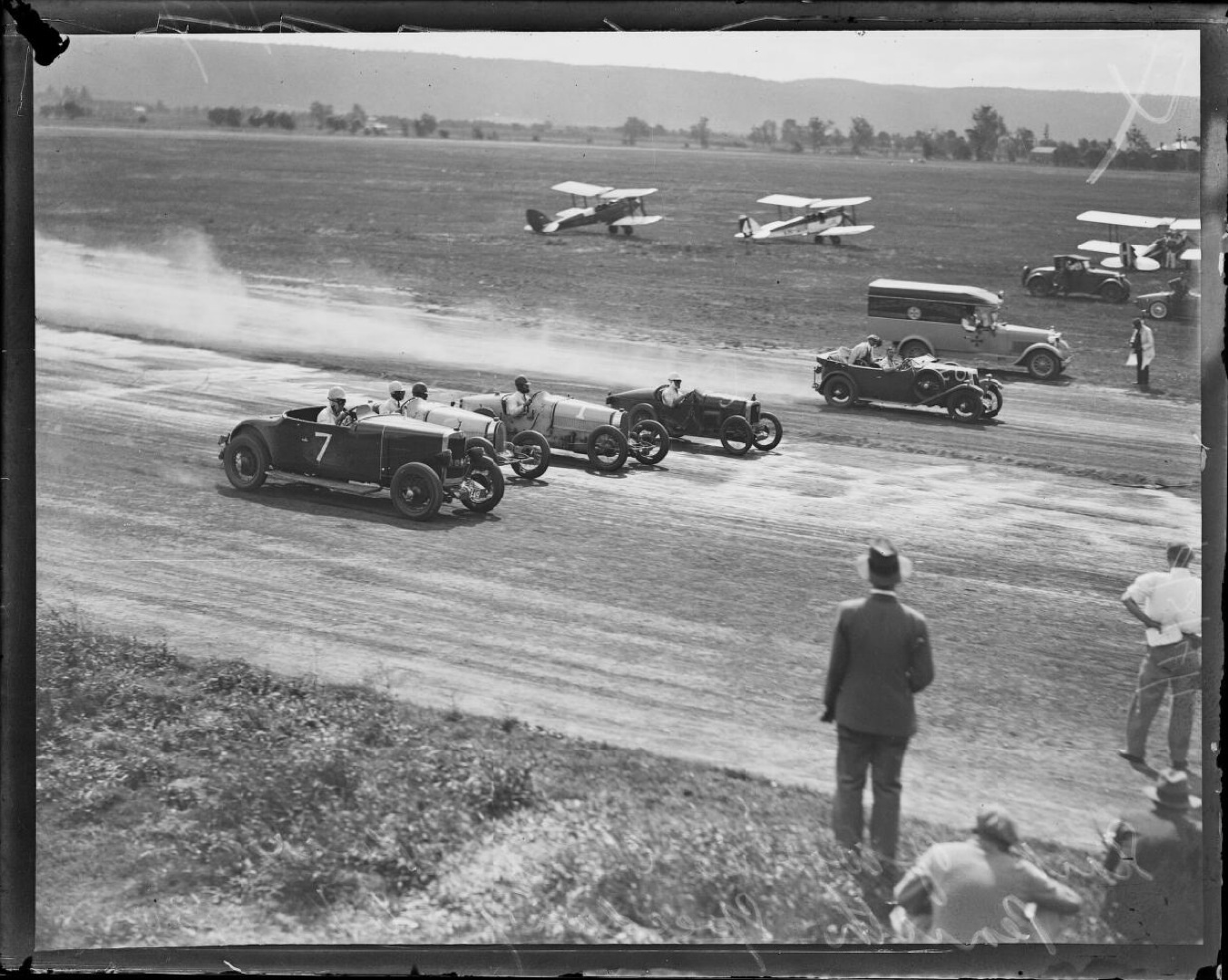
‘World Championship’ for Under 1500cc cars- Penrith Speedway, Sydney, 6 October 1930. From the outside is John Sherwood’s Lea Francis O-Type, then the Sam Aggett and Charlie East driven Bugatti T37’s and on the inside Tom Lord’s, Geoff Lowe owned Austin 7 Brooklands. On the very inside verge is Jack Field’s supercharged Lea Francis S-Type Hyper tourer slowing having paced the competitors for a lap before the championships 3 lap journey, East was the winner in his Bugatti (SLNSW)
‘The early drivers were keen, and more tracks were opened at Penrith (one mile) Maroubra (5/6 mile highly banked concrete track) and beaches at Gerringong and in Victoria came into use for racing purposes. At Gerringong, Don Harkness, driving an enormous Minerva engined chassis, was clocked at 107 mph to be the first in Australia to exceed the coveted ‘century’.
(The) First actual road racing circuit was opened at Phillip Island in Westernport Bay, 40 miles from Melbourne in 1928 and this became the mecca for motor racing enthusiasts for the next nine or ten years. At this point the dry bed of Lake Perkollili in Western Australia was the centre of motor racing in the west.
Australia’s best road circuit (more or less built specially for the purpose) at Mount Panorama, Bathurst came into being in 1938, and except for most of the war years, has been in use ever since. Other road circuits in other states have also sprung up, and since the war various ex-airforce strips have been adapted for racing with much success.
The newest circuit to come into use is in Parramatta Park, 15 miles from Sydney, a rather narrow 2 mile circuit, suitable mainly for the smaller cars, but by reason of its close proximity to a big population, is certain of success.
Down through the years cars have altered very considerably, the small high revving high compression engines now putting out power which one could not have conceived in the early days. Suspensions, brakes, steering, weight, tyres, fuel, streamlining and a hundred and one other things have combined to make the modern racing car a real thoroughbred, capable of sustaining terrific speeds over long distances.
As the years have rolled on, the scene changes, but motor racing itself does not change. Its spirit, rich in tradition and sportsmanship, linking past and present, reaches out to the future.’
Photo Credits…
Sam Hood, State Library of New South Wales, Max Stahl Collection
Bibliography…
South Coast Times and Wollongong Argus 21 September 1953, reprint of an article first published in the ‘Bentwood Review’, Sydney Morning Herald 11 April 1939, John Medley
Tailpiece: Sherwood and flock…
(Fairfax)
John Sherwood standing beside John Snow’s #4 Delahaye 135S, with the #6 Edison Waters Jaguar 100SS, Alf Barrett’s Alfa Monza and John Barraclough driven Alvis Terraplane straight-8 on the Bathurst grid in October 1939. Sherwood instrumental in the construction of this Australian racing institution- in the words of John Medley ‘Bathurst: Cradle of Australian Motor Racing’.
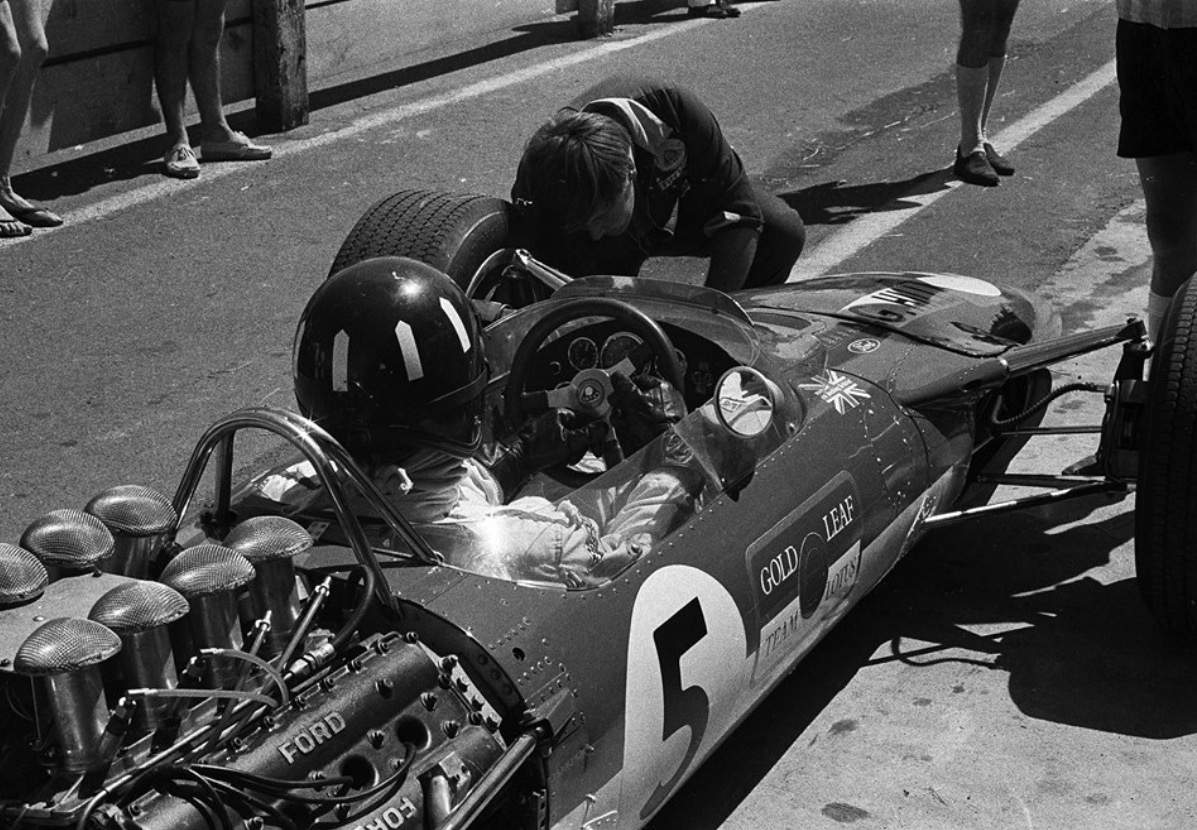
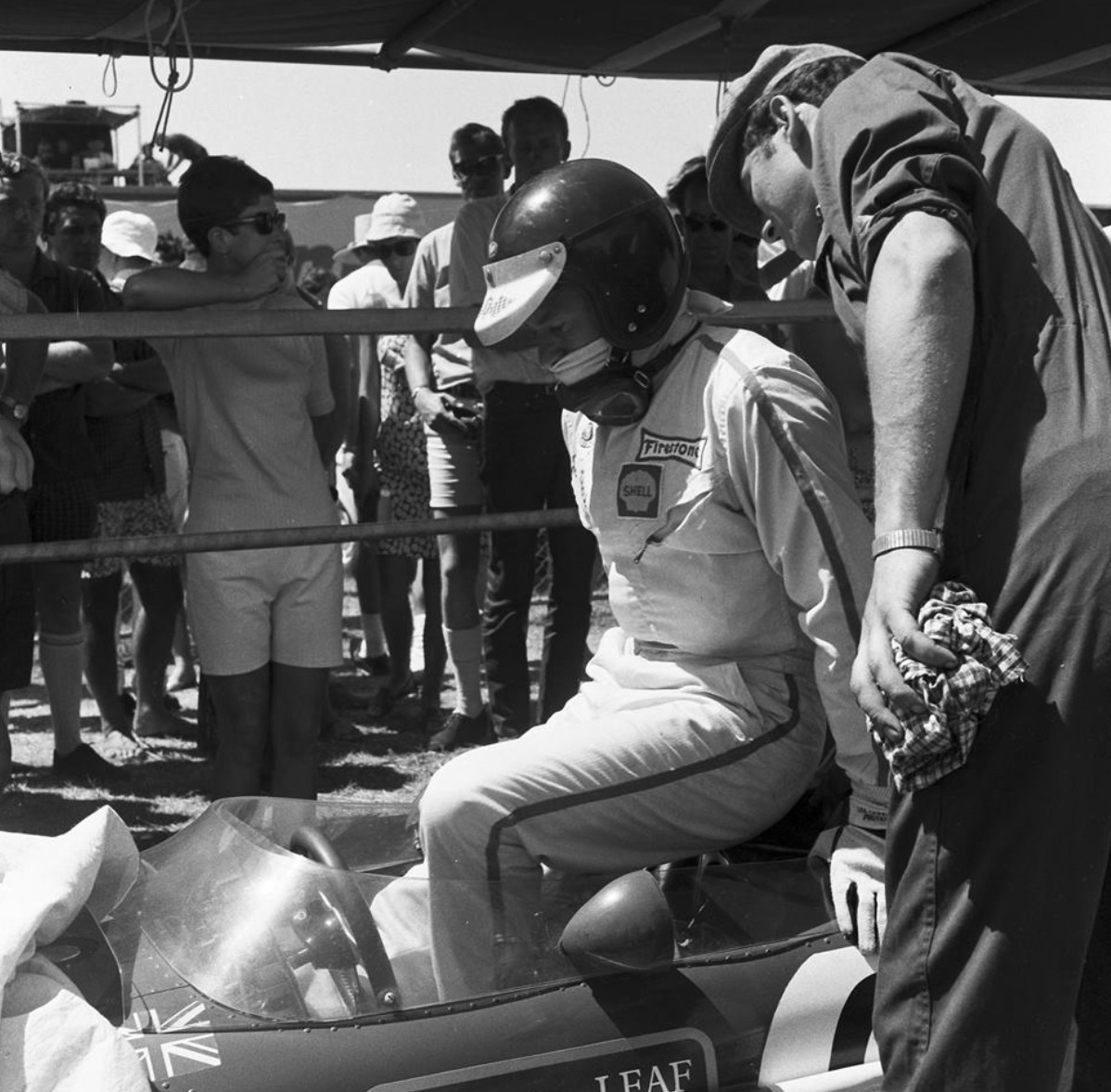
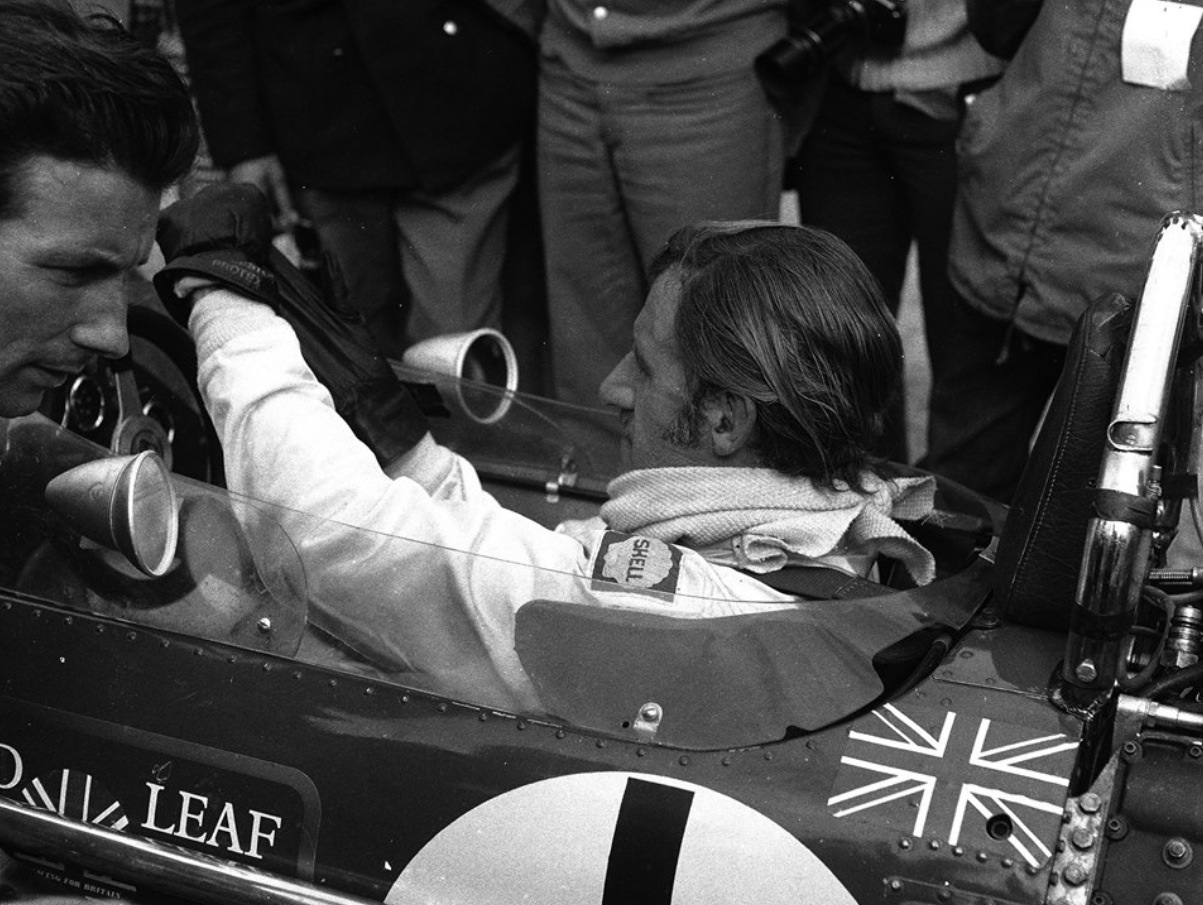
Graham Hill, works Gold Leaf Team Lotus 49 Ford 2.5 DFW in the Warwick Farm pitlane during the ‘Farm’s February 1968 Tasman Round weekend…
I’ve done the 1968 Tasman Series to death with a series of articles uploaded before including one on this particular weekend but this batch of ‘up close and personal’ photos by enthusiast Bryan Henderson are too good to ignore.
One of the reasons enthusiasts get misty eyed about that series is that both Clark and Hill had been regular, enormously popular visitors to Australasia from the dawn of the sixties pre-Tasman era, 1968 was the last we had the pair of them down south together.
Clark won the Tasman with the still very new Lotus 49 in dominant fashion and then returned to Europe after winning the series and the F1 season opening South African GP to his untimely death aboard a Lotus 48 Ford FVA during a Euro F2 round at Hockenheim. In the words of The Seekers popular song of the day ‘The Carnival Is Over’.
Hill, WF- this shot 1969
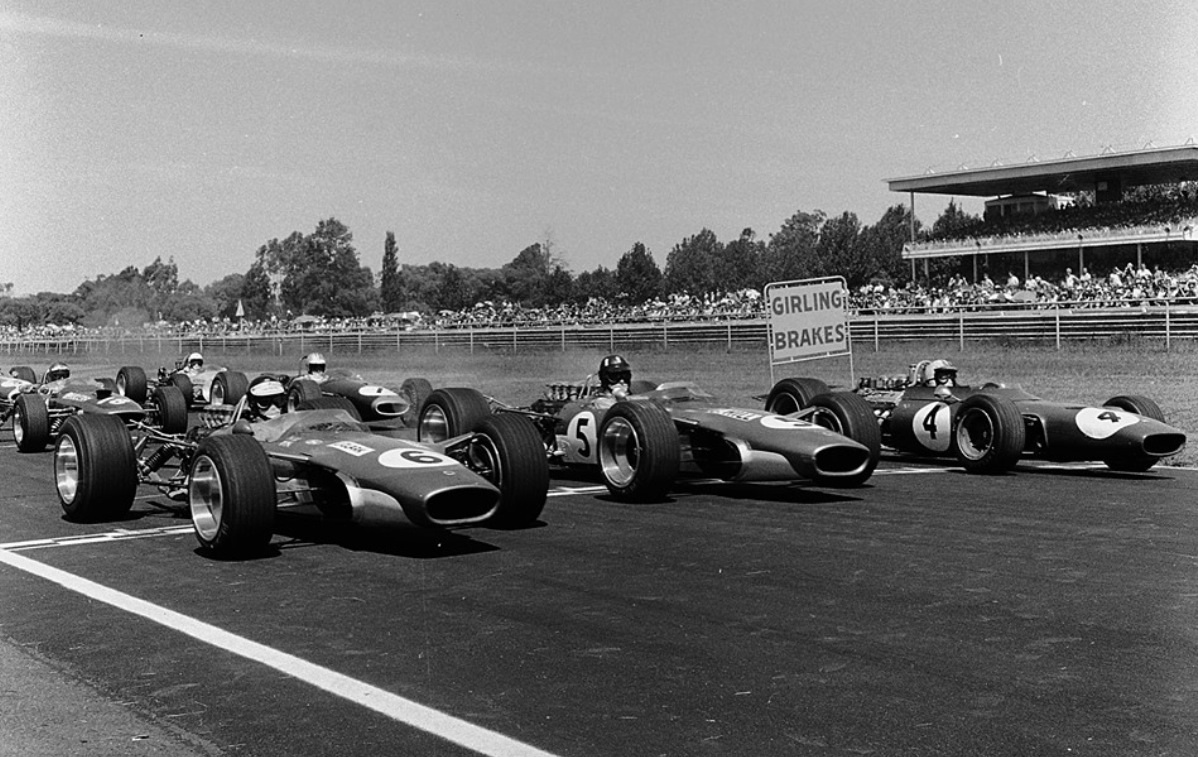
Clark and Hill, Lotus 49’s, Amon Ferrari Dino 246T, then Courage behind Clark, McLaren M4A FVA and Hulme, Brabham BT23 FVA with Gardner, Brabham BT23D Alfa behind Denny
We all have our favourite seasons of course but arguably that summer of ’68 was the Tasman peak.
The variety of cars was truly stunning- BRM P261 V8 and P126 V12, Ferrari Dino V6, Brabham Alfa Romeo Tipo 33 V8, the Lotus 49 Ford V8’s, various Brabham Repco V8’s including Jack’s latest works BT23E Repco ‘740’ V8 and a swag of Coventry Climax FPF engined machines in the hands of locals. The driving pool included just annointed World Champ Denny Hulme, Jack Brabham, Jim Clark, Graham Hill, Chris Amon, Bruce McLaren, Richard Attwood, Chris Irwin, Frank Gardner, Piers Courage and local hotshoes Kevin Bartlett, Leo Geoghegan, John Harvey, Graeme Lawrence and others. An amazing variety of cars and depth of talent on the grid…
Etcetera…
(B Jackson)
Things go better with…
Graham and the boys bleed the Lotus’ brakes, note the use of a solid rotor rather than the vented discs used initially in 1967. Nice shot of the front bulkhead and inboard front suspension packaging.
Credits…
All photographs- Bryan Henderson, exceptions attributed on the shot
Tailpiece: To the victor the spoils…
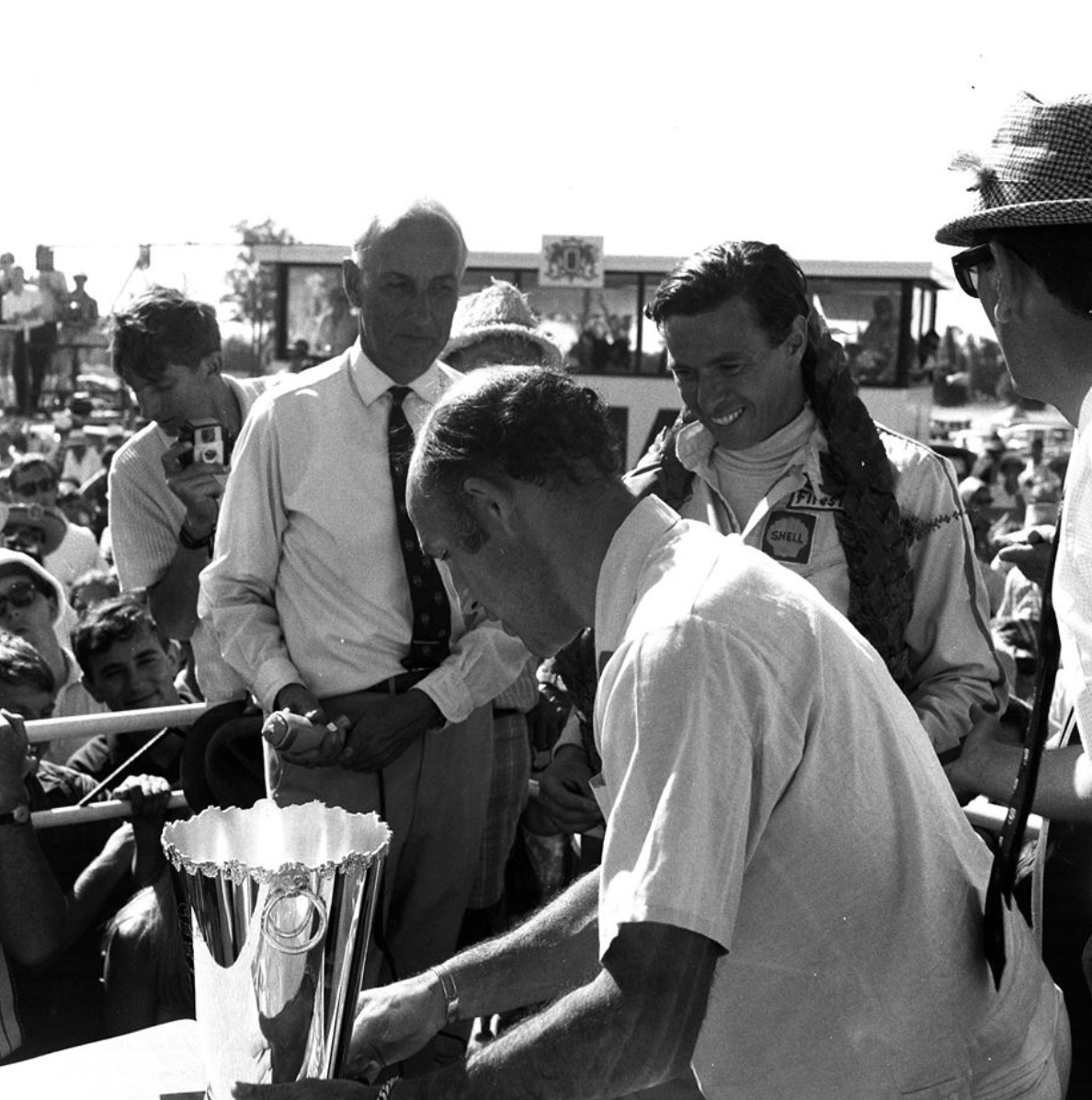
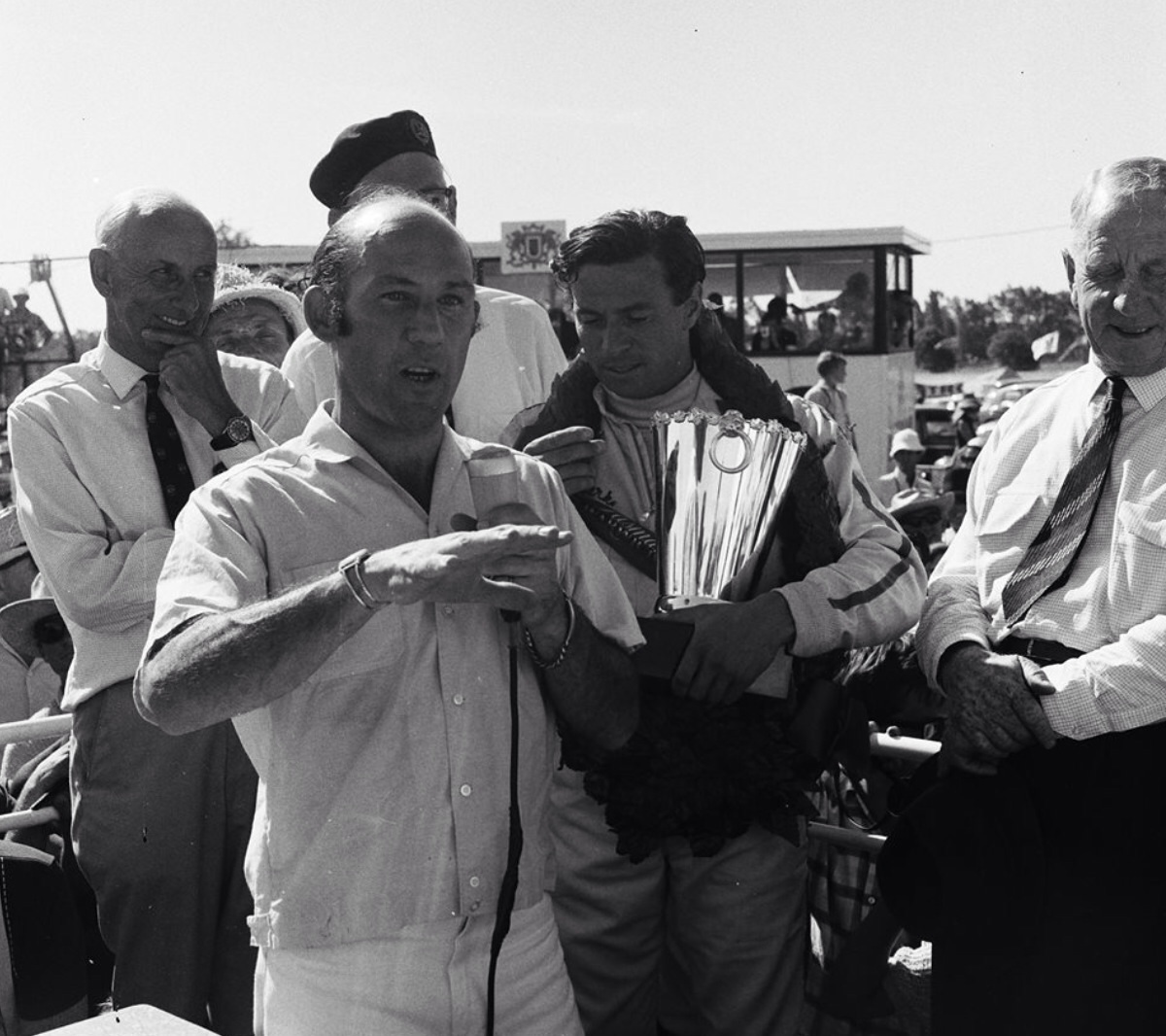
Stilrling Moss, long retired but looking disgustingly fit addresses the crowd in advance of presenting Jim Clark his trophy- he won from Graham and Piers Courage in an F2 McLaren M4A Ford FVA. The gent in the shirt and dark tie is the much respected Geoff Sykes, the AARC/Warwick Farm General Manager/Promoter.
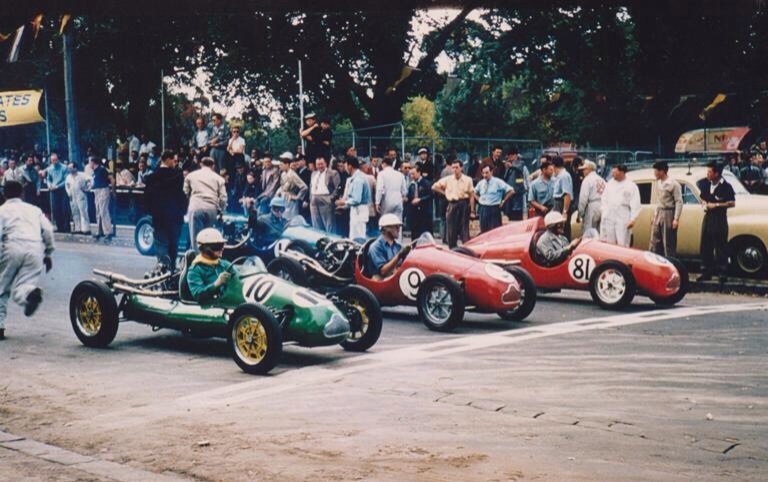
Albert Park, March 1955- ‘Albert Park Trophy’ with #10 Patterson, #9 Davison and #81 Jones on pole…
Rather a sign of the times, Cooper were on the march to world domination, their mid-engine, air-cooled designs perfected over the early forties into the fifties.
Between these three fellows were six AGP victories, or perhaps five given Davo and Patto shared one of them- and three Gold Stars, one apiece. They were front-running Victorians for well over a decade and shared a passion for cars and business- all three Holden dealers at one point in time.
Bill Patterson’s green machine is a Mk5 JAP, Lex Davison’s a Mk4 Vincent and Stan Jones a Mk4 JAP. Patto took the Albert Park win in a race of attrition from Gib Barrett’s BWA and Otto Stone’s MG K3- Jones pitted with a misfire and Lex also retired.
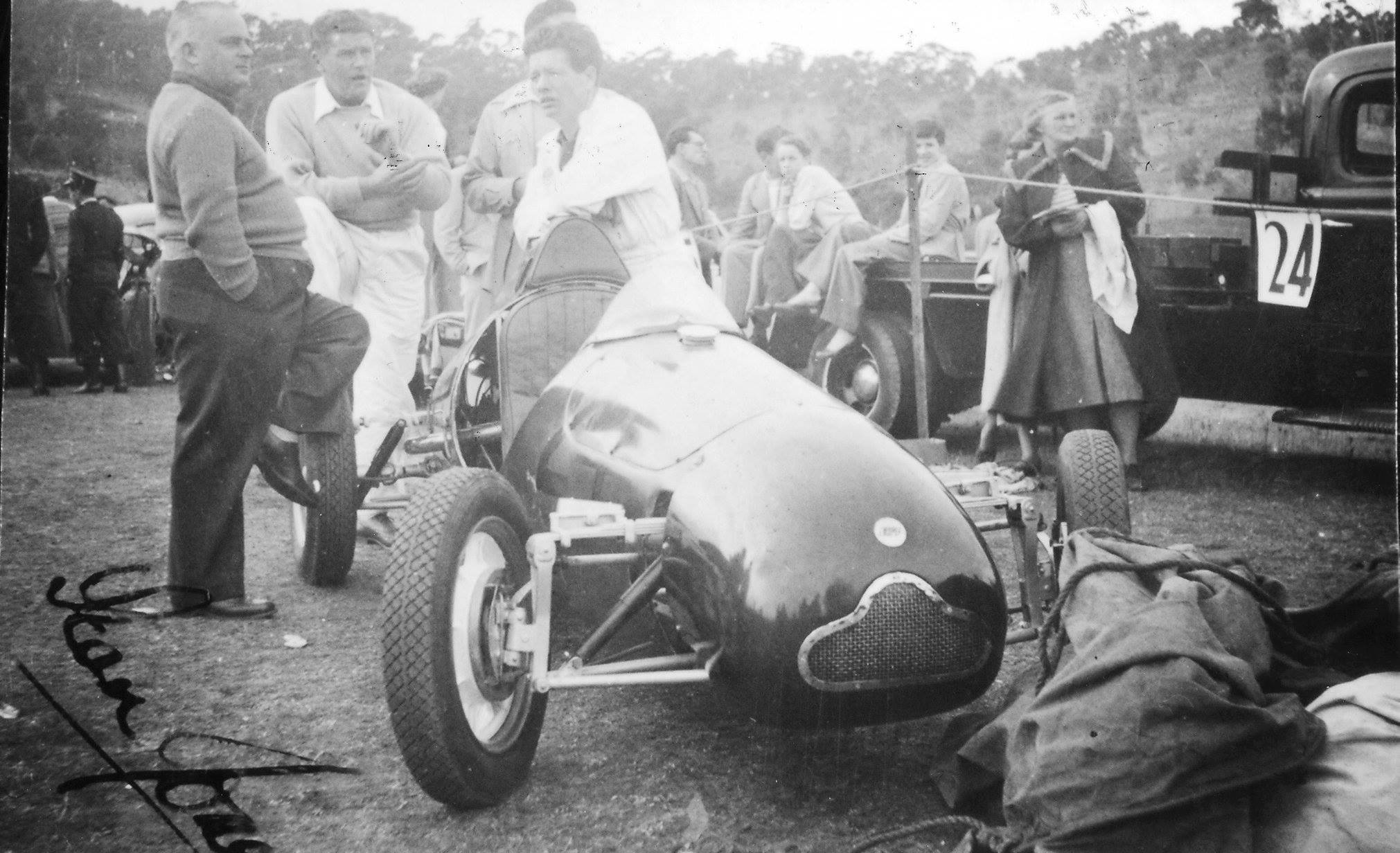
Stan behind, and Reg Robbins leaning on the Cooper Mk4 at Rob Roy (L Sims)
Jones aboard the Cooper Mk4 at Rob Roy, date folks? (L Sims)
Jones chassis ’10/53/50′ was imported by Melbourne Cooper distributor Keith Martin in early 1951 and was claimed to be an intermediate version having a Mk5 chassis and Mk4 bodywork. Fitted with a 1098cc JAP race motor, the 95bhp machine sat in Martin’s showroom for a year before acquisition by Stanley who first raced it at Rob Roy in March 1952.
‘The car became one of the top under 1500cc cars for both circuits and hillclimbs- the battle for hillclimb records between Jones, Davison and Patterson was a highlight of motorsport in the early fifties’ John Blanden wrote.
Holder of many outright records the car was offered for sale in AMS in December 1953 and finally acquired by Earl Davey-Milne in December 1955, he raced it first at Albert Park in 1956 and still retains the car which is said to be the lowest mileage air-cooled Cooper of them all.
Davey-Milne resplendent in collar and tie racing the Cooper at Albert Park during the Australian Tourist Trophy meeting in November 1956- DNF in his ‘rapid little Cooper-JAP’ in the Argus Cup (Davey-Milne)
Credits…
‘Historic Racing Cars in Australia’ John Blanden, Davey-Milne Family Collection, Leon Sims, Graham Noonan, ‘Glory Days’ Barry Green
Tailpiece: Jones aboard the Cooper Mk4, circa 1954…
It’s the end of the swinging-sixties- the Andy Warhol, Roy Lichtenstein and others ‘Pop Art’ phase is in full bloom…
It’s interesting to look at the graphic design and advertising imagery of the period which is wonderfully full of it, the style even extended to some stickers in Australia’s ‘Racing Car News’ magazine.
For the princely sum of 20 cents the six decals would be in your letterbox within the week, don’t you love the immediacy of snail-mail? The cheap giveaway was a time honoured technique in the pre-internet days of building a database of potential customers, oh for simpler times when identity fraud was rare rather than something to be mindful of in our daily online interactions.
The cars and drivers are all well known to Australian enthusiasts and include some of the stars of the day many of whom I have written about in whole or in passing.
The first image is Kevin Bartlett’s Alec Mildren Racing Mildren Waggott ‘Yellow Submarine’, a car first raced by Frank Gardner in the 1969 Tasman Series and then used by KB to win the Gold Star later that season. Click here for more; https://primotipo.com/2017/11/14/missed-it-by-that-much/
Frank Matich’s Matich SR4 Repco was built to contest the 1968 Can-Am series but ran hopelessly late so crucified local opposition in the 1969 Australian Sportscar Championship instead. Click here for a long feature on it;
The final three cars featured are Pete Geoghegan’s Australian built Mustang above (as in built for racing), Norm Beechey’s Holden HK Monaro GTS 327 with Bob Jane’s Shelby constructed Mustang as the ‘Tailpiece’. All of these machines are covered in an article I wrote about the 1969 Australian Touring Car Championship won by Geoghegan. Here ’tis; https://primotipo.com/2018/02/01/1969-australian-touring-car-championship/
These two blokes are aboard a Bugatti Brescia Type 23 out front of The George Hotel in Lydiard Street, Ballarat, Victoria between 1945 and 1950…
The shot is from the State Library of Victoria archive, it was taken by George Thomas, a prolific ‘snapper at motorsport events throughout Victoria at the time. Ballarat, 120 kilometres west of Melbourne is a Gold Rush town. Over 600,000 people came to Australia from all over the globe in the 1850s to chase their fortune. Ballarat was one of the main destinations of the optimistic, it’s a beautiful place with many of the stately buildings of the period still standing, including the George Hotel.
The interesting thing is of course, which particular chassis it is and who the fellows are. My recently acquired copy of Bugattis In Australasia (details in the credits below) personally delivered by the very knowledgeable, youthful, spritely 81 year old author, Bob King suggests it’s either Bill Fleming or Neil Barter, assuming the photo date range is accurate.
The car is a long-chassis Modifie. Without going into all of King’s detail, the chassis number of the car can’t be confirmed, but it came from New South Wales to Victoria in 1938 when owned by Fred Betts. He never registered it, but raced it at Phillip Island pre-war.
After the conflict it was raced by John ‘Bill’ Fleming at the Hurstbridge and Rob Roy Hillclimbs in Victoria in 1948, before being sold to Barter that October. At this stage, as shown in the opening photograph, the car was registered in Victoria JT441 and was fitted with engine number 2566.
Fleming on the startline at Hurstbridge Hillclimb in Melbourne’s outer north-east (King)The Fleming Brescia at Rob Roy Hillclimb in Melbourne’s Christmas Hills, ‘eighteen litres of Semmering Mercedes in the background’ (King)
Barter recounts in King’s book ‘By January we were driving it around as much as petrol rationing would allow. After correcting a dismally retarded camshaft timing, we found the performance astonishing – 40 mph first gear, 60 in second, 4,300 rpm etc – we were never short of superlatives. Alas youthful exuberance led to disaster and injury when… in April 1939…the car overturned at the corner of Dendy Street and The Esplanade, Brighton’, a bayside Melbourne suburb not too far from Albert Park Lake, a place all you global GP fans will be familiar with.
‘A regular trick was to drive it as quickly as you could along Beach Road at Brighton Beach and, instead of taking the right hand corner…we would hurl it into the gravel car park opposite the monument, put it into a 180-degree slide and then drive straight out again, heading back towards Hampton. The prize for the night went to the driver who travelled the quickest and made the cleanest slide!’ What a great thing to do after a few bevvies on a Friday or Saturday night?!
‘This all came to a halt when, one night, with four up, I rolled it when turning from the beach road into Dendy Street…a very sobering experience for all and particularly me’, Neil Barter wrote. Looking at the young blokes in the car at Ballarat my guess is that it’s Barter and one of his Brighton Grand Prix accomplices!
Bob King records a bewildering nineteen owners of this car. The last was Wolf Zeuner in the United Kingdom albeit this was way back 1992. The name Brescia was applied to these cars (T13 2.0 metre chassis, T22 2.4 metre, T23 2.55 metre) after the cars placed first to fourth in the 1921 Italian Voiturette Grand Prix.
Piero Marco, Brescia T22, Brescia before the off Gran Premio delle Vetturette, 1921 (Bugatti)
de Vizcaya, Brescia T13, GP Penya Rhin 1921- is the descriptor for this Barcelona event but my race results don’t accord with this car/driver combo that year (unattributed)
This event, the ‘1 Gran Premio delle Vetturette’, held on 8 September 1921 on the Circuito di Brescia comprise 20 laps of a 17 km course, a total of 346 km. Thirteen cars contested the race, the winning Bugatti T22 of Ernest Friderich completed the race in two hours 59 minutes 18.6 seconds. He was followed home by teammates Pierre de Vizcaya, Michele Baccoli and Piero Marco all aboard Bugatti 22s, they were chased home by a group of four OM465’s.
2,000 Brescias were built from 1919-1926 more than any other type of Bugatti. ‘Being the first Bugatti made in any numbers, it was the Brescia that established Bugatti’s reputation as a builder of sports and racing cars. They were imported into Australia and New Zealand in considerable numbers…’ King wrote.
Original period sales brochure with Brescia at centre stage, the rest of the document is below
Bob continues ‘The Brescia, of 1496cc capacity, has a cylinder block with non-detachable head and four valves per cylinder operated from a single overhead camshaft via ‘banana’ tappets. In Europe the standard touring model had a four sparking plug cylinder block with ignition from a magneto mounted transversely at the front the engine. These cars had a cast aluminium firewall and were known at the factory as the ‘Modifie’. Racing versions had eight plug cylinder blocks with two magnetos mounted in the dashboard driven (noisily) by spur gears. These latter were known as ‘Full Brescias’. Surprisingly, regardless of chassis length and whether fitted with racing, sports, or touring bodywork, the majority of new imports to Australia were ‘Full Brescias’. Perhaps it was thought to have the security of two magnetos in our relatively primitive motoring environment.’
Superb Brescia 16-valve engine cutaway, technical details as below (Griggs)
In the early twenties, Bugatti didn’t build the bodies of their cars, with the exception of minimalist T13 racing coachwork, so all of the new cars imported to Australia via the London agent, Sorel, were shipped in most cases in bare chassis form. A tax or tariff was imposed on imported coachwork to help stimulate the local industry with ‘Many of the local bodies fitted to Brescias appear to have been of poor quality. This, coupled with the harsh ride of the Brescia, and the poor roads on which they were driven, ensured that the coachwork had a short life. With the need for light bodies for competition work, the discarded original bodywork was usually followed by a succession of amateur built bodies.’ King wrote.
Bugatti played a very important part in the formative years of Australian motor racing as the weapon of choice for many sportsmen on road circuits, hillclimbs, the concrete saucer at Maroubra, gravel speedways and the beaches at places like Gerringong.
A straight-eight Bugatti T30 driven by Geoff Meredith won the first Australian Grand Prix at Goulburn, New South Wales in 1927. Goulburn, 200 km south of Sydney, was also a Gold Rush town. In fact Bugatti won five of the first six AGPs creating huge brand awareness by the standards of the time.
Four cylinder Bugatti T37As – the supercharged variant of the T37 – were victorious in the Phillip Island AGPs of 1929 with Arthur Terdich at the wheel, and in 1930 and 1932 when driven by the period’s ace, Bill Thompson. Carl Junker won in 1931 aboard a straight-eight 1.5-litre T39.
Drake-Richmond’s T37 goes thru Heaven Corner ahead of the Mert Wreford Riley Brooklands during the 1 January 1935 Centenary 300 at Phillip Island. This is the cover photo of Bob King’s book (King)
The Phillip Island AGPs were handicap events, so there is no reason a Brescia couldn’t have won a race with the right mix of speed, reliability and luck, but such never the case. The best Brescia results in our premier event were Merton Wreford’s fourth in 1932 and John Bernadou’s fifth in 1929.
Mert raced chassis 2133, ex-Arthur Terdich, and ‘In practice Wreford’s straight line speed was bettered by very few cars and he was actually faster than Drake-Richmond’s Type 37. In the race Mert was given a 15 minute start by the blown Type 37A’s of Terdich and Thompson and he finished a creditable fourth place on handicap, averaging almost 65 mph for the 200 miles with his old two-wheel-brake Brescia in spite of losing four valuable minutes with clutch trouble’ Bob King wrote.
John Bernadou raced his father Albert’s 2536 in the 1929 AGP – both father and son competed extensively in Victoria in the mid-twenties – despite being delayed by a hole in the fuel tank John was third in the Under 1500 cc class and fifth overall.
Bill McLachlan at Quarry Bend, Bathurst 1952. Bug T37A Ford V8 37358 aka the MacKellar Spl (B Gunther)
Some (not a huge number mind you) quite exotic racing cars came to Australia pre-War including several Vittorio Jano designed Alfa’s, but the faster Bugatti racing straight-eight T35 and T51’s didn’t make the trip until post-War, when they were of course beyond the first flush of youth.
In our racing, which comprised many events run to handicaps, the cars were competitive but none won a post-War AGP. All played an important role in bolstering grid sizes throughout the long Australian Special Era which in the main were MG based or Ford side-valve V8 powered. In many cases once the original Bugatti (or Alfa or Ferrari or Bristol) motor blew Ford V8s, or a bit later a small block Chev or Holden Grey-six-cylinder engine was inserted under said car’s shapely aluminium bonnets.
To reframe my shallow comment a moment ago about Australian Specials, the wonderful breed included tool-room-quality machines such as the Charlie Dean/Repco Research built Maybachs, the Lou Abrahams/Ted Gray Tornados and Chamberlain brothers Chamberlain 8. Also in the mix are outrageous in brilliant original conception cars like two of Eldred Norman’s masterpieces, the Double 8 and Eclipse/Zephyr Spl, while the rest includes anything and everything from mild-to-wild MGs and Ford V8 engined specials. Not to forget the Hudson straight-eight engined machines pre-War, the high point of those is the extant (Frank) Kleinig Spl: MG chassis, monoposto, Hudson-8 and much, much more. There was no lack of creativity among this country’s mechanics and engineers however basic the underpinnings of the machines they started with!
A game-changer was the move in AGP regulations from handicap to outright events from the 1949, Leyburn Queensland AGP won by John Crouch’s Delahaye 135S. Mind you that didn’t stop the organisers of the 1950 Lobethal, South Australia, and 1951 Narrogin, West Australia AGPs having an each way bet by placing as much emphasis on the handicap winner as the outright victor, which comes through strongly in the contemporary newspaper accounts.
1951 was the last handicap-AGP (in part) and the last won by an Australian built car (the Warwick Pratley driven, George Reed built, Ford V8 engined George Reed Special) until Frank Matich won the 1971 AGP at Warwick Farm a couple of decades later in brand new F5000 Matich A50 Repco Holden.
From 1951 those who wanted to win the AGP needed the readies to acquire a car with the speed, endurance on our rough road circuits and reliability. The balance of the fifties was the Factory Car Era. A Talbot Lago T26C won in 1952/3 (Doug Whiteford), HWM Jaguar in 1954 (Lex Davison), Ferrari 500/625 won in 1957/8 (Davison), a mid-engined Cooper T40 Bristol in 1955 (Brabham) and Maserati 250Fs in 1956/9 (Moss/Stan Jones).
John Cummins raced his T37A Holden ‘37332’ complete with Bellamy IFS until very late in the piece- here the eternal racer/raconteur is at Bathurst in 1961 (unattributed)
Among all this the pre-War Bugatti’s, whether Bugatti or black-iron-powered still played an important role. The last AGP grid of substantial Bugatti numbers was the 1952 Mount Panorama contest in which three entered. Bill McLachlan’s T37A Ford V8 finished 13th, while the T35B/51 shared by Phil Catlin and Peter Menere was 15th, but the P Lowe T37 Holden failed to finish. In fact the placings by McLachlan and Catlin/Menere were the last in an AGP for Bugattis, one was Ford V8 powered, the other still had its Molsheim motor.
For the record, the very last Bugatti AGP start was the David Van Dal/John Cummins T57 which failed to finish the very hot 1957 Caversham race outside Perth. There ended a rich contribution by the marque to Australian motor racing which commenced with substantial numbers of Brescias, and Geoff Meredith’s first AGP win aboard a T30 at Goulburn in 1927. Thirty years from start to finish, not a bad record at all!
Duncan Ord in the ex-Howe/Levegh T57 ‘57264’ 3.3 s-8 in the Patriotic GP at Applecross, Perth, WA on 11 November 1940. He is turning out of Tweedale Road (Terry McGrath))
Bibliography…
‘Bugattis in Australasia’ Bob King- Bob still has a couple of copies of this book and plenty of ‘The Brescia Bugatti’- contact rking4450@gmail.com
‘A History of Australian Grand Prix 1928-1939’ John Blanden, MotorSport July 1942, The Bugatti Trust
Photo Credits…
George Thomas, Bob King Collection, Byron Gunther, Bob Shepherd, Terry McGrath, Griggs, automobiles.narod.ru
Chassis: period typical girder, H-section front axle, weight circa 610 kg
Engine: Four-cylinder, SOHC by front bevel drive, four valve with bore/stroke of 66, 68, 69 x 100 mm for capacities of 1368/1453/1496 cc. Carburettor(s) one or two Zenith. Ignition one or two magnetos, usually SEV. Plugs one or two per cylimder. 30 plus bhp with an RPM limit of (‘prudent’) 4000 ‘or even 4500 on a good Brescia’
Gearbox: located centrally, four-speed and reverse with right-hand location, clutch wet multi plate
Brakes: Location and type – foot, transmission and right-hand for the rear. Four wheel brakes fitted from 1926
Wire wheels with original size 710 x 90
Dimensions: T13, wheelbase 2.0 metres or 1967 mm, T22 2.4 metres or 2417 mm and T23 2.55 metres all with a track of 1.15 metres
Drawing of Brescia ‘2566’ engine showing the oil drain tubes from cam-box to crankcase (B Shepherd)
Notes on The Brescia Bugatti: MotorSport July 1942…
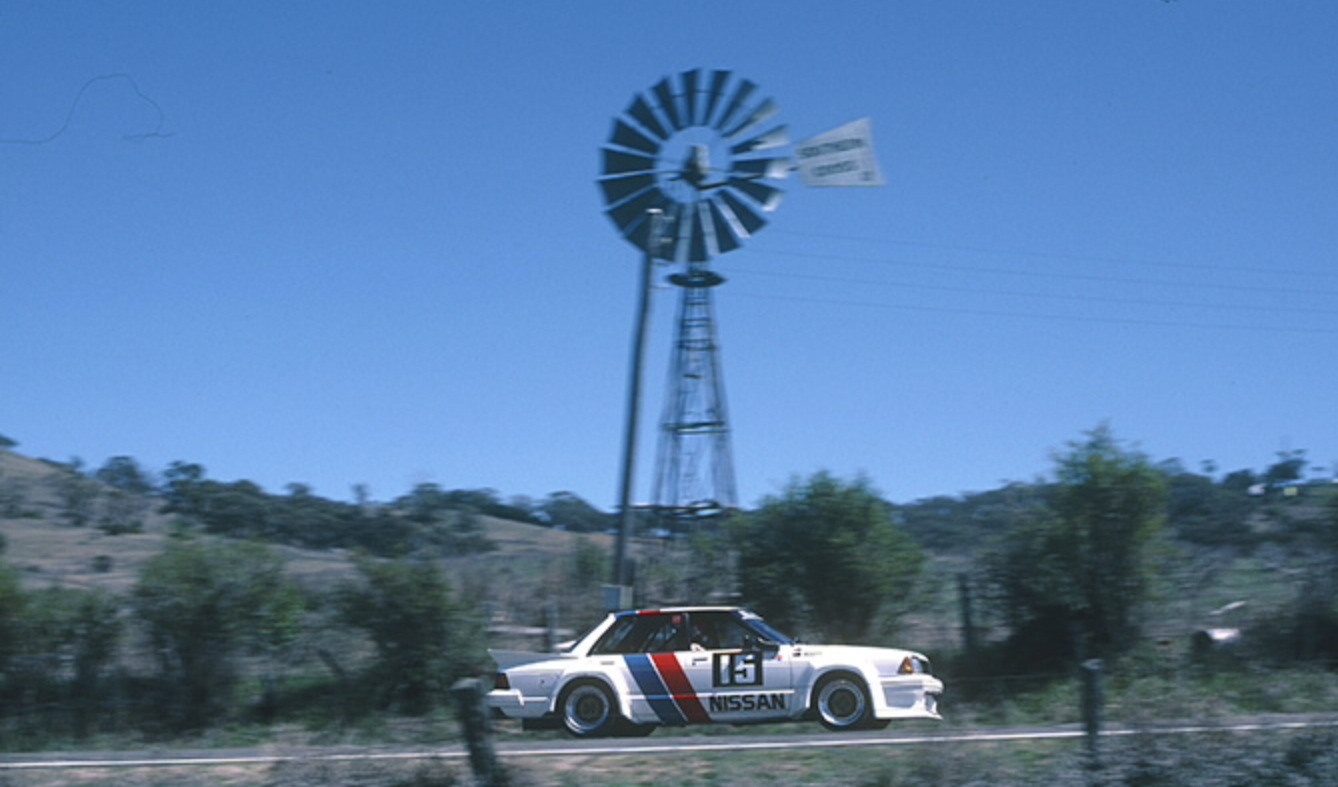
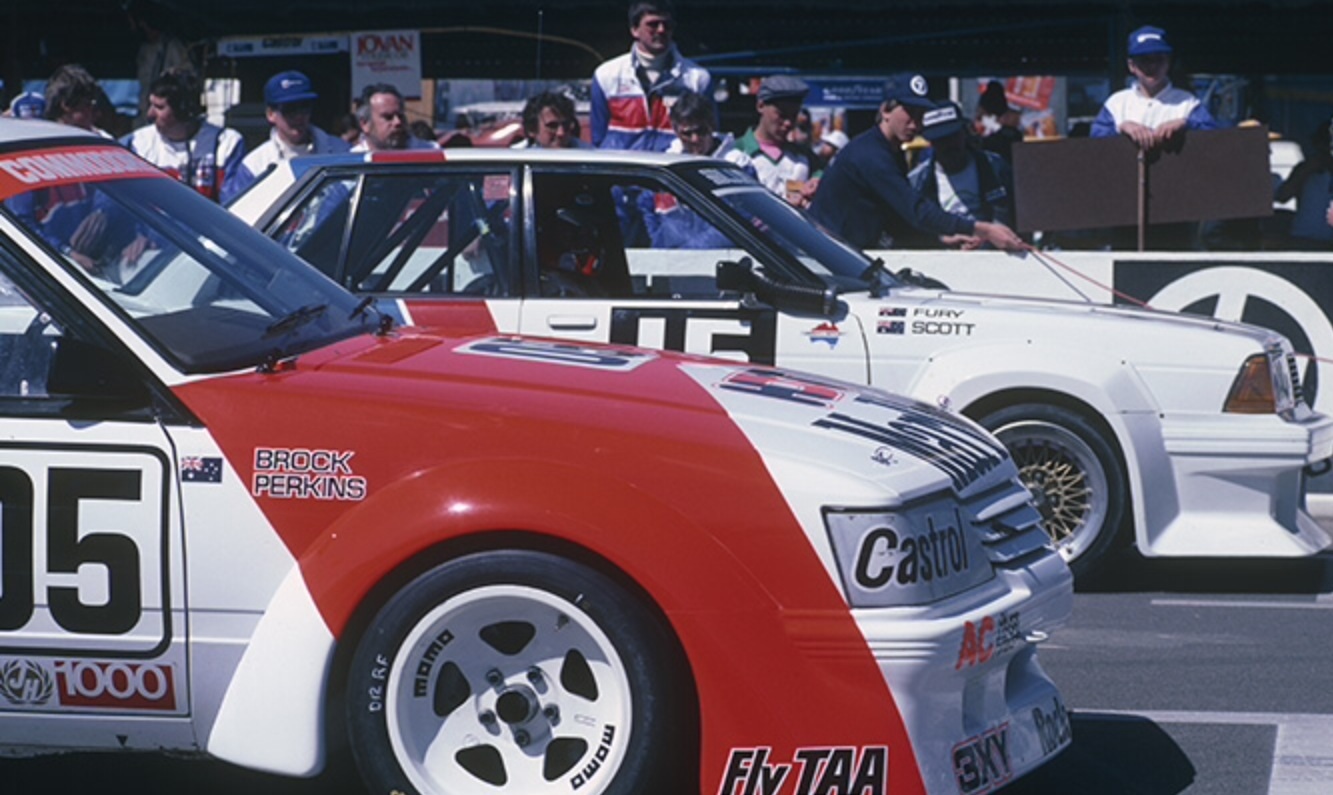
George Fury on Conrod Straight in his works Nissan Bluebird turbo during the September 1984 Bathurst 1000 weekend…
Touring Car Racing in Australia has always been tribal. From the sixties it was Holden vs Ford, later Holden vs Ford vs Chrysler/Valiant. Then there was the locally manufactured stuff vs foreign cars including ‘Rice Burners’, then a disparaging descriptor for anything from Japan. Its amusing now given Japanese dominance of our market but this kind of stuff aroused the passions as much as an afternoon at the footy, whatever your code (Aussie Rules, Rugby, Soccer).
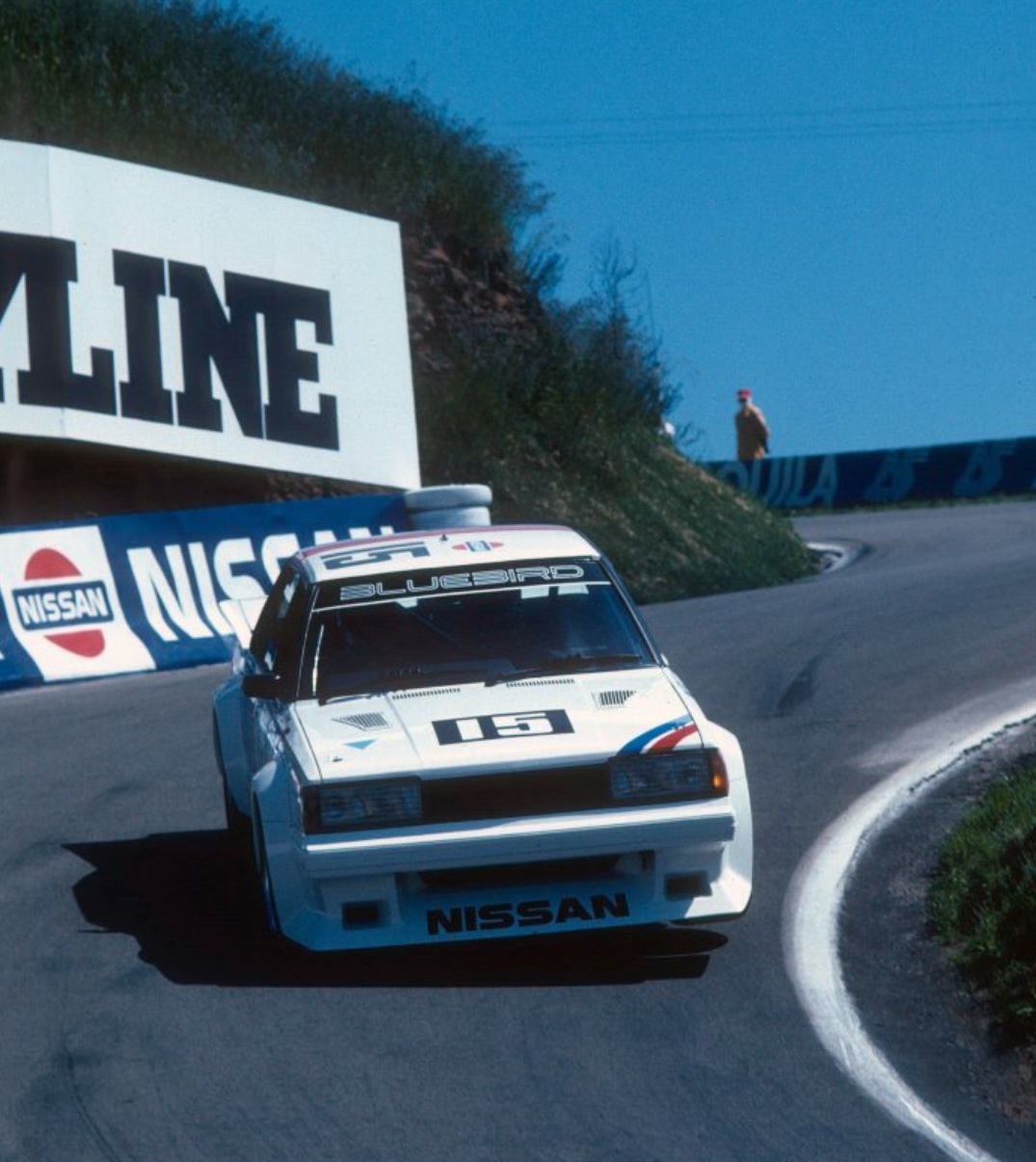
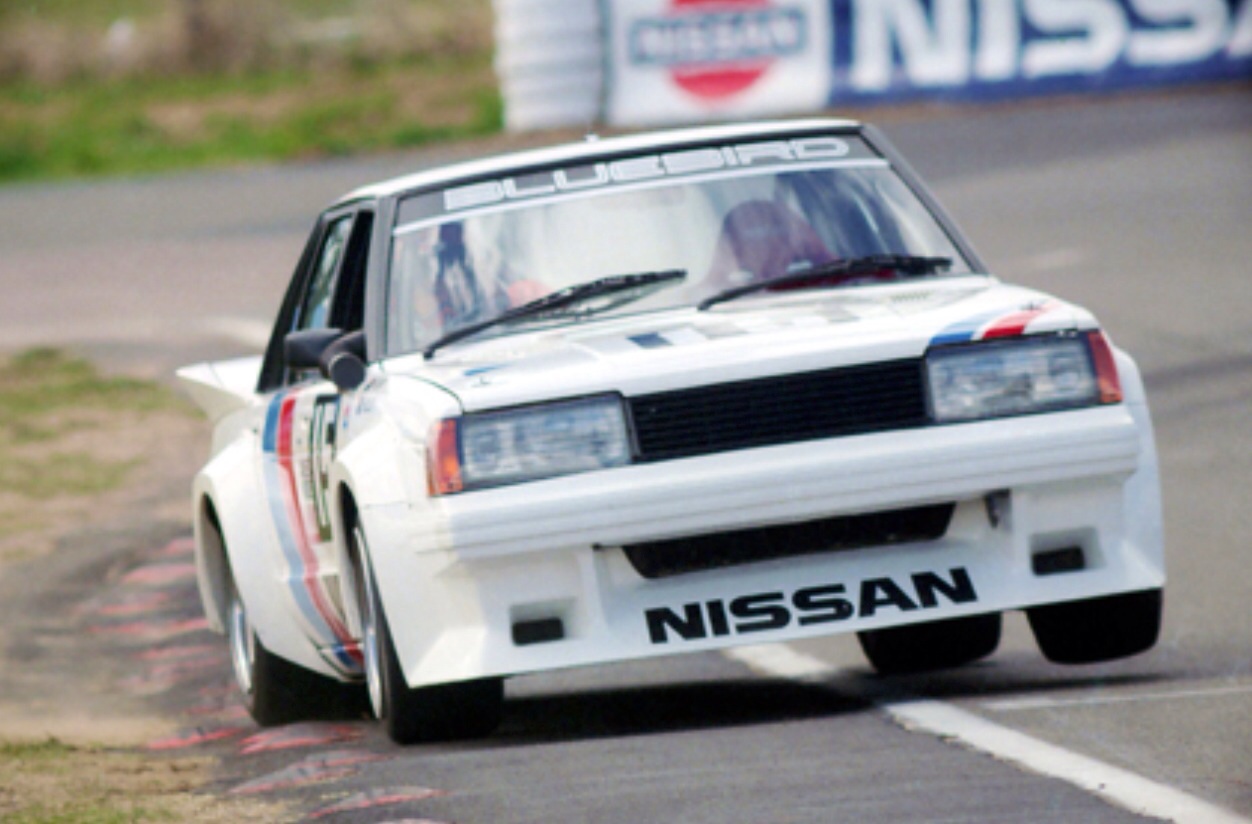
Fury/Scott Bluebird thru The Dipper, chassis the third and last Bluebird built by Nissan Motorsport Oz. Z18T 1.8 litre SOHC, 2 valve, twin-plug 4 cylinder turbo engine giving circa 350 bhp. Car still exists (supercars)
Fury exits Murray’s on ‘that lap’. It was an extremely cold day- it snowed in Bathurst that morning, getting heat into the tyres during the Hardies Heroes 2 lap top 10 qualifying format was tough for all- cold conditions suited the turbo-Nissan whatever tricks were also pulled (autopics)
Whilst the first Japanese outright win didn’t occur until the Jim Richards/Mark Skaife 1991 victory aboard a Nissan R32 GT-R ‘Godzilla’ (what a car!?) Nissan certainly signalled their intent with Australian Rally Champion turned racer George Fury’s splendid pole in the 1.8 litre, turbo-charged four cylinder Bluebird sedan on the mountain in 1984. His 2:13.850 ‘Hardies Heroes’ qualifying lap in the last season of the Group C era (Australian adopted Group A from 1985 noting their was a Group A category in the 1984 1000) was not beaten until 1991 when Skaife’s 2:12.630 R32 GT-R time bested it.
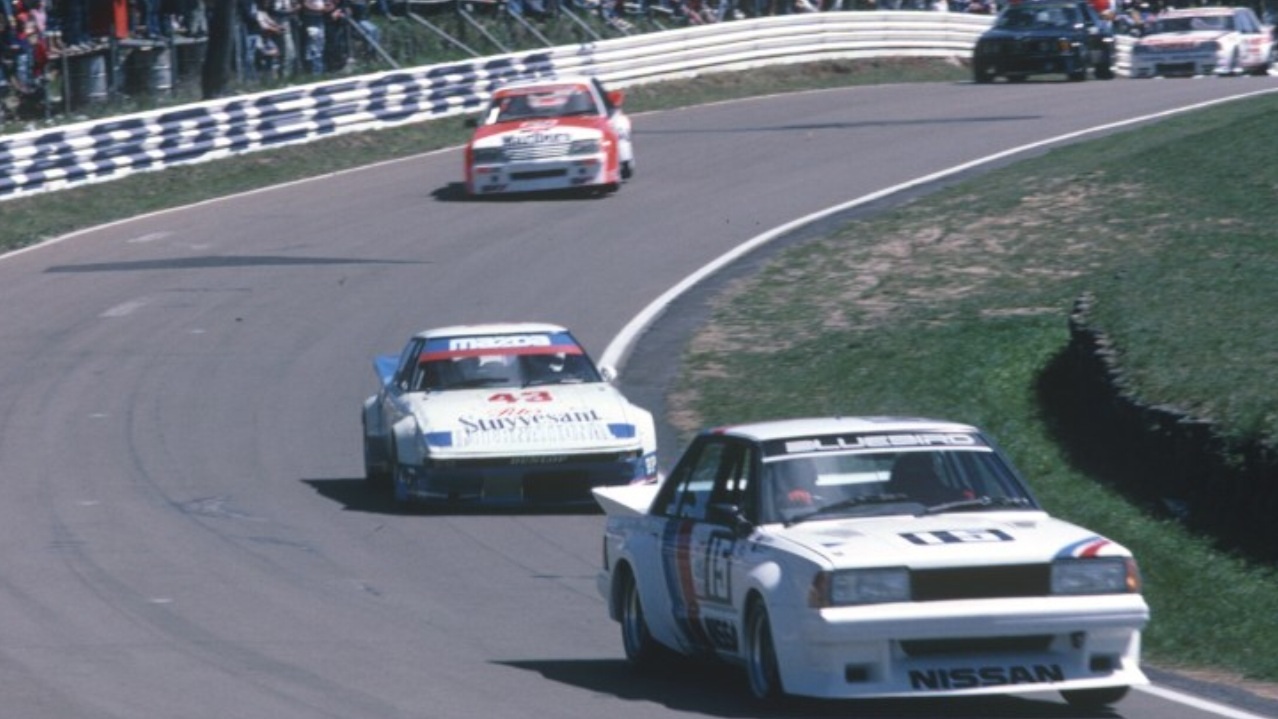
The Bluebird’s first Australian Touring Car Championship round win was at Lakeside in June that 1984 season. Pole on the mountain was a magnificent achievement, albeit the car, co-driven by Queenslander Gary Scott lasted 146 of the 163 laps in the race won by the Brock/Perkins Holden VK Commodore, the third win on the trot for that combo.
Lap 1 into Hell Corner: Fury Nissan from Brock VK Holden Commodore, Johnson XE Ford Falcon, Allan Grice white/yellow VK Commodore with Richards BMW 635 CSI and Masterton’s XE Falcon putting the squeeze on Moffat’s Mazda RX7. First start, race restarted and Brock got the jump (supercars)
Early laps Skyline: Fury, Moffat, Brock, Richards, Masterton (supercars)
Still, in some folks minds they stole pole given Fred Gibson’s admission some twenty years after the event (FG drove for the team and was Nissan Team manager by 1986) ‘that the Bluebirds had an illegal turbo-boost adjuster on the dashboard, as well as having the engine bay’s fire extinguisher spraying super-cooled Halon at the cars intercooler increasing horsepower’. It was the first time since qualifying first counted for grid positions in 1967 that a V8 had not been on pole, and a V8 would not sit on pole again at Bathurst until 1993.
Bloody rice-burners. Mind you, other than the Japanese body-shell the car was built entirely in Australia…
Credits…
Supercars Australia, autopics.com.au, Australian Musclecar
Tailpiece: Front row before the off, Bathurst 1984…
Modern Grand Prix photographers have a challenge their forebears did not, that is, generally uninteresting backgrounds by the standards of, say, pre-1970, whilst noting Monaco, Spa and Singapore as modern exceptions, not the only ones mind you…
My habit over the four year primotipo journey is making article research and writing choices based on inspiring or interesting photographs. This has taken me randomly into all manner of subjects, happily so, and further back in time than I figured at the outset. It’s been good for me as ‘my strengths’ such as they exist, are post 1960 but i’ve ended up writing articles on average about topics from much earlier periods. In part the photos which have taken my fancy are as much about the background as the car or driver and based on that are most often of the distant past. I must try harder in relation to the last twenty years or so!
So I guess whilst the photographers of today have far more sophisticated, digital, whoopy-doo, trick-schmick equipment- the act of taking a photograph is ‘easier’ than in ye olden days but they have their own creative challenges composing shots of interest to we punters on what all too often are bland circuits devoid of substantial differences from one another.
(McLaren)
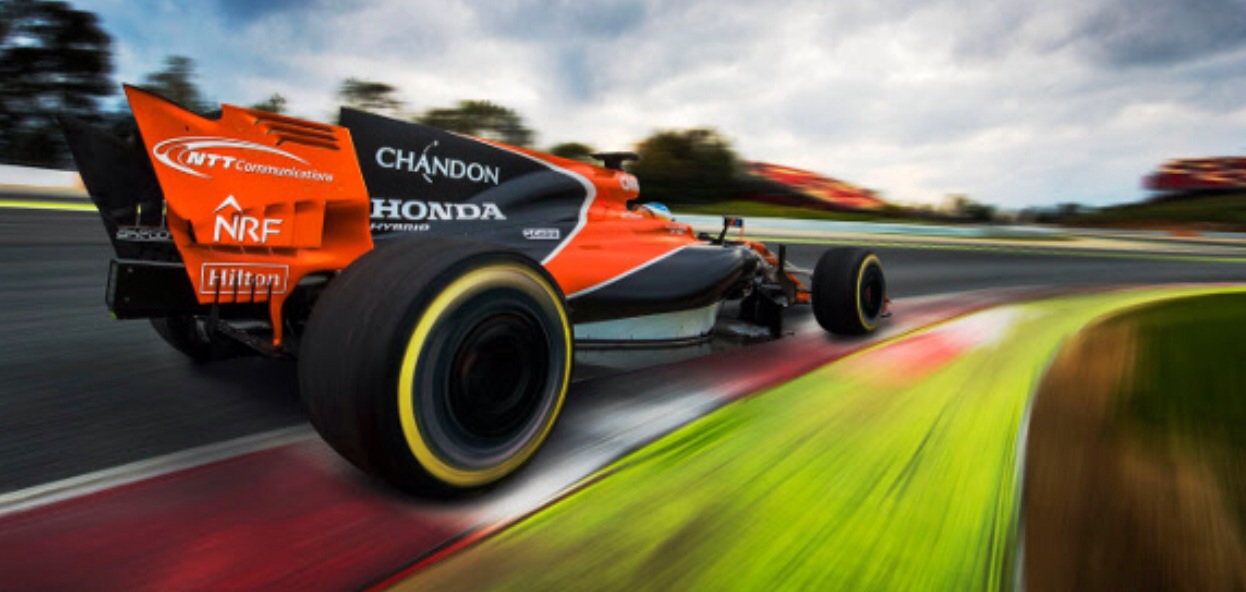
Albert Park gives the ‘snappers something to work with despite its flatness- the lake, city background, crowd and trees are all neat props. So it’s with these thoughts I went looking for some interesting current shots, Albert Park 2017 in this case. 2018 with the ‘fuggin halos was just a step too far.
It’s interesting to look at the choices these photographers made in composition, panning and crop. I’ve no idea of the driver of each McLaren in shot, both helmet designs have a bit of colour on top and a bit of white below, either Fernando Alonso or Stoffel Vandoorne are good guesses! It wasn’t a great race for McLaren mind you, Alonso was out on lap 50 with a broken floor and Vandoorne finished 13th, two laps down on winner Seb Vettel’s Ferrari SF70H.
There is no such thing as a bad orange(ish) McLaren however much the MCL32 Honda was a dog. Better times are surely around the corner at the time of writing, July 2018…
Frank Matich, Brabham BT7A Climax tries to outbrake Bib Stillwell #6, Brabham BT4 Climax, December 1963…
Photographer John Ellacott upon posting this shot online described it as ‘the two great rivals on Hume Straight’…Matich braking down the outside on the run into the slow second gear ‘Creek Corner’. Frank’s car was brand new, just unpacked, it had only turned a wheel for the first time several days before the 1 December ‘Hordern Trophy’, the final round of that years Gold Star, the Australian Drivers Championship.
Frank’s car was fitted with 2.5-litre ‘Climax FPF, Bib’s older chassis had an ‘Indy’ 2.7- a fair duel, one guy with the edge in chassis perhaps and one with a bit more power?
Stillwell led from the start of the 34 lap race and then FM began to reel him in, finally catching the Victorian on lap 20, the pair tangling in The Esses. The collision was enough to put Matich out of the race but Stillwell finished fourth, the race was won by John Youl in his Cooper T55 Climax 2.5 from David McKay’s ex-Brabham BT4.
Frank left and Bib – looking very natty is his BRDC blazer – developing his listening and empathy skills by the look of it after the Hordern Trophy. Great rivals with a lot of respect for one another’s abilities (Sports Car World)
In the 1964 Tasman Series which followed the month after this race Youl was the most successful of the locals. Stillwell only contested three Australian races gaining a strong second in the AGP at Sandown whilst Matich was prodigiously fast but had woeful reliability, we shall pick up the Tasman shortly.
I described the rivalry between Frank and Bib in a post about the Stillwell Cooper Monaco;
It’s fair to say Stillwell, born 31 July 1927 took a while to mature as a driver. He started racing MGs in the late 1940s and as his motor dealerships became more successful throughout the 1950s he acquired and raced some expensive, fast cars, D-Type Jag and Maser 250F included. By the time he commenced racing Coopers he had well over 15 years of experience and was ready to take on anybody, winning his first Gold Star in 1962 and the last in 1965, four on the trot.
Matich, born 25 January 1935 was a more precocious talent who first competed in an MG TC at Foley’s Hillclimb circa 1954 and raced seriously from later in the decade after selling his Austin Healey and purchasing the ex-Frank Gardner Jaguar XKC. He soon drove cars for Leaton Motors who employed him as Sales Manager. Bib was more the silver-spoon-special born on the right side of the tracks and funded into his first dealership with family money. Mind you, whatever Bib started with he multiplied many times over, he was an extremely successful businessman in Australia and then became an executive of global calibre inclusive of being President of the Gates Learjet Corporation in the US.
Frank, the young pro, was cut from totally different cloth. He was educated at De La Salle College, Marrickville in Sydney’s inner west and was apprenticed as a 15 year old Diesel Engineer at Sydney’s Kurnell Oil Refinery before progressing through Butlers Air Transport and in 1954 to Selected Sportscars where he first came into contact with the Englishman who owned the MG TC Frank prepared, and both men raced.
FM’s ability and gift of the gab attracted patrons and commercial support from very early on in his career, Matich too was shortly to do well out of the business of motor racing with Australian franchises for Firestone, and later Goodyear racing tyres, and Bell helmets, apart from the sale of some of the Matich sports and F5000 cars he built.
Matich and Stillwell were intensely competitive, driven, successful men, they had far more in common I suspect than not, especially in terms of mindset and will to win. The battles between the pair were absorbing, Matich very quickly got on the pace of the big 2.5 Climax Formula Libre cars (the 2.5 Tasman Formula started in 1964, Australia’s national F1 ANF1 was F Libre till then), having come out of powerful sportscars- Jags C and D Types, Lotus 15, 19, 19B and small bore single seaters, works-Elfin FJ Ford and Elfin Catalina Ford 1.5.
At the time, these 2.5/2.7 litre F Libre/Tasman cars were the fastest road racing cars in the world, F1 having changed from a 2.5 to 1.5 litre formula from 1 January 1961. Given his experience it was not a surprise when Frank was on the pace straight away as he jumped out of his Lotus 19B sporty and into the new Brabham acquired with the French Oil Company, Total’s, support.
Well before the Tasman Series commenced in 1964, we had a strong International Series of races in Australasia in January/February, with enough of the best in the world to test the locals in equal cars Matich was more than a match for any of them. So was Bib on his day.
Matich mounted up and ready for his first test of the naked BT7A, devoid of all signwriting and in civvies at Warwick Farm the week before the Hordern Trophy above. Brian Darby, at the rear, picked the car up from the Port Melbourne wharves the week before, Bruce Richardson is the other mechanic in shot. Note reinforced wide based top front wishbone and rubber mounted ball joint, inverted wishbone at the top and single lower link in the rear suspension. The later BT11A had the opposite rear set up, single top link and inverted lower wishbone (John Ellacott)
Matich was very quick in the Brabham throughout that ’64 Tasman Series and the short period in which he raced the BT7A, its interesting to look back at his time in the car. The late 1963 pre-international events in New Zealand are covered in this article here;
The first 1964 international was at Levin, which Frank missed, at Pukekohe, the NZ GP on 11 January, he ran strongly behind Brabham, McLaren, Tim Mayer and Hulme. He passed Mayer for third only to pop his engine on lap 26, McLaren won the race in a Cooper T70. After Puke he shipped the car home to Australia and re-joined the circus at Sandown on February 9. There he ran ahead of the locals before suffering crown wheel and pinion failure on lap 4.
At the Farm, Matich’s home turf, he started from pole, followed Jack away, then passed him but muffed his braking at Creek and ran off the road. Off to Queensland, at Lakeside, he was driving away from everybody before the engine let go, a Weber ingested a stone and the expensive motor went ka-boom on lap 8. After the long tow to Tasmania he finished third in the race won by Graham Hill’s BT4 and was first of the locals despite a misfire, and a revolution amongst his mechanics who pushed the car onto the grid but left his employ after the race.
Ray Bell wrote that ‘He had a mixed bag of results in shorter races during the middle part of the year, taking a number of outright lap records, then came the Gold Star closing events. Lakeside…pole and the lead before an oil line came adrift; Mallala he didn’t turn up (Stillwell basically could not be beaten for the Gold Star by this stage) and he led the Hordern Trophy till half distance before yet another engine failure’.
The 1965 Tasman Series was won by Jim Clark’s Lotus 32B Climax. Despite not contesting the four Kiwi rounds Matich was right on the pace at Warwick Farm, the first Australian round, starting from pole and leading to Creek corner, he then raced with Brabham behind Hill and Clark up front. ‘Both Hill and Matich had troubles in this race with cement dust getting into the steering, Hill spinning on the last lap because of it and failing to finish. Matich was third behind Clark and Brabham’s BT11A, Stillwell (BT11A) was thirty seconds behind him’ wrote Bell.
Matich in his semi-nude BT7A in the hot 1964 Lakeside summer sun, puddle notwithstanding! He is trying to stay cool in the searing Queensland heat, lower side panels removed. Shot shows the proximity of the aluminium side fuel tanks containing lots of Avgas, no rubber bag tanks prior to circa 1970 (Peter Mellor)
Down south at Sandown he ran just behind the internationals ahead of Stillwell only to retire with ignition failure, a rotor button on lap 10. During the AGP at Longford he pitted with suspension problems on lap 5 whilst best of the locals having run in sixth place. At Lakeside he contested the non-championship Lakeside 99 and made it a real race dicing with Clark on this high speed, demanding circuit for most of the race. ‘They traded places many times, but Matich did have a pitstop and lost some laps before rejoining the battle’. It was a race FM rated as one of his best.
Into the domestic season Stillwell won the Victorian Road Racing Championship Gold Star round in April after a couple of Matich spins, albeit FM was second despite a failing engine, and started from pole a half-second clear of Bib.
That was all the racing he did in that car. At Lakeside’s Gold Star round in late July, he crashed his Lotus 19B Climax, he took the sportscar to the meeting to test it in advance of the Australian Tourist Trophy which was held at the circuit later in the year, was burned and hospitalised and in the aftermath Total took the decision to cease their racing program and sold the cars and parts.
The story of the next phase of Frank Matich’s career in sportscars, initially with the Elfin 400 aka ‘Traco Olds’ is told in links within this article.
Frank Matich was one of Australia’s many F1 mighta-beens, to me the most likely to succeed of all, but with a young family and business ties in Oz it never happened despite offers being made to him on more than one occasion to go to Europe. As noted, Matich didn’t race single seaters for long at this stage of his career, from 1963 to 1965, racing sports cars very successfully until 1969 when he came back to open wheelers with the advent of F5000 – where he was a star as both a driver and constructor. Click here for an article on this phase of his career;
It’s a shame he didn’t drive Tasman 2.5 cars throughout this golden-era of single-seater racing in Australasia, his battles against the internationals as well as the local hotshots in both Tasman races and domestic Gold Star competition would have been sensational. Matich mixing it with Bartlett, Martin, Geoghegan, Harvey and the rest would have added depth to Gold Star fields which were increasingly skinny as the decade wore on.
Stillwell retired at the end of 1965, he was certainly as quick as anybody on his day and arguably had not quite peaked when he did retire. No less an observer of the local scene than journalist/racer/Scuderia Veloce owner David Mckay believed that by 1965 Stillwell had reached F1 standard, not least for his ability to drive fast without mistakes or destroy the equipment.
Intercontinental Brabhams at Longford, AGP 1965. Stillwell’s dark blue #6 BT11A (6th), Matich BT7A (DNF) and Frank Gardner in Alec Mildrens yellow BT11A (eighth), the race won by Bruce McLarens’ Cooper T79 from Brabhams’ BT11A (Kevin Drage)
The Intercontinental Brabhams…
The first of the Intercontinental Brabhams. Jack in BT4 ‘IC-1-62’ on its debut at the Australian Grand Prix, Caversham, WA on 18 November 1962. He retired after colliding with another car whilst lapping him, Bruce McLaren won in a Cooper T62 Climax (Milton McCutcheon)
When Jack started his climb to the top in Europe he returned and raced in Australia each summer, bringing a Cooper with him and racing it successfully, then selling the car to one of the locals before returning to Europe. It was a nice little earner and helped fund his way in Europe as he fought to gain a toehold in international competition.
Cooper sold a lot of cars in Australia, Jacks business brain was as sharp as his cockpit skills so it was natural that some of the earliest Brabham production racing cars were for Australasian Formula Libre and from 1964, the 2.5 Tasman Formula- which in effect meant cars built for Coventry Climax FPF ex-F1 engines- 2.5 litres but increasingly 2.7’s after Jacks successful Indy 500 run in 1961 in the Cooper T54 with its 2751cc FPF engine. The Tasman Formula mandated 2.5’s of course.
Soon Repco were making Climax parts and eventually building the engines in totality under licence in Australia. The bits were plentiful which was just as well as the level of competition was such that the long stroke donks were being pushed well beyond their limits with spectacular blow-ups fairly common.
Bib Stillwell in his BT4 Climax ‘Lakeside International’ 1963, 2.7 FPF powered. 3rd in the race won by John Surtees Lola Mk4A Climax 2.7 (Bruce Wells/The Roaring Season)
The first Intercontinental Brabham, i use that descriptor as that was the chassis prefix for each car (‘IC’), the design intended for the shortlived Intercontinental Formula created in response to the new 1.5 litre F1- was the BT4 based on the first Brabham GP machine, the 1.5 litre Coventry Climax FWMV V8 powered BT3.
The first Brabham, retrospectively referred to as ‘Brabham BT1’, was the MRD, an FJ machine first raced by Gavin Youl with the BT2 an evolution of the MRD/BT1. The Intercontinental cars which followed the BT4 were the BT7A in 1963 and BT11A in 1964, both F1 cars adapted for Climax FPF engines.
Some incredibly talented guys raced the ‘IC’ Brabhams- Internationals such as Brabham, Hulme, Gardner, Hill and Stewart as well as Australian champions including David McKay, Lex Davison, Stillwell, Matich, Spencer Martin, Kevin Bartlett, John Harvey, John McCormack and other drivers in New Zealand and South Africa.
Jack Brabham won Australian Grands’ Prix in a BT4 and BT7A in 1963 and 1964 respectively. The cars won the Australian Drivers Championship, the Gold Star for Stillwell in 1963 and 1964 aboard his BT4, in 1965 with a BT11A and for Spencer Martin, again BT11A mounted in 1966 and 1967.
Graham Hill ahead of Bib Stillwell, BT4 Climaxes, first and fourth. South Pacific Trophy, Longford March 1964 (Rod MacKenzie)Bib Stillwell in his final and successful Gold Star year 1965. BT11A at Warwick Farm. His final year of racing, he had a top year in the car at WF, finishing fourth in the Tasman race albeit behind Matichs’ BT7A in third and first in the Hordern Trophy at the end of the year (John Partridge Collection)
The ‘Brabham IC Australian party’ ended in 1968 when Kevin Bartlett won the Gold Star in BT23D/1, a one off car built for Alec Mildren’s Team around Alfa Romeo Tipo 33 2.5 V8s he secured to add a bit of Italian flavour to the local scene, Mildren was an Alfa Romeo dealer.
The Intercontinental cars were typically fast Tauranac designs of the period. They had rugged spaceframe chassis, suspension by upper and lower wishbones at the front with Armstrong shocks and coil springs. At the rear there was a single upper link, inverted lower wishbone, twin radius rods and coil spring damper units with adjustable sway bars fitted front and rear. With Jack doing all of the initial chassis setup work the cars were quick and chuckable ‘straight out of the box’.
Hewland HD5 gearboxes were used in the main (Colotti in the BT4) and rack and pinion steering completed the package with the cars clad in a slippery fibreglass body.
Bib Stillwell’s Brabham BT4 Lakeside February 1963. 2.7 litre Indy 2751cc Coventry Climax FPF engine, 58mm Webers, Colotti T32 five-speed ‘box. Rear of the spaceframe chassis apparent. Suspension- inverted upper wishbone, single lower link and twin radius rods for location, coil spring damper units, no rear roll bar here. Stillwell’s cars famously immaculate in preparation and presentation (Peter Mellor/The Roaring Season)
After Repco’s 2.5 litre Tasman V8 engine made its debut in BT19, Jacks victorious 1966 F1 winning chassis, in 1966 the Tasman Brabhams were variants of the BT23 frame (BT23A and BT23E) with the exception of the very last BT31 for the 1969 series. See Rodway Wolfe’s article about BT31 which he owned for many years; https://primotipo.com/?s=brabham+bt31
Once the 1.5 litre F1 ended in 1965 BRM quickly realised a stretched variant of their P56 V8 in a P261 chassis would be a Tasman winner and ‘their endeth the locals’ in Climax engined cars taking on the Internationals similarly mounted on more or less equal terms.
The Repco Tasman V8’s provided a supply of competitive customer engines for locals so the Tasman Formula continued into 1970 with engines capable of matching the internationals when the ever expanding F1 season and more restrictive driver contracts made eight weeks in January/February in Australasia no longer a proposition for the best in the world. With it went a wonderful decade or so of intense but sporting summer global competition in our backyard.
Those Intercontinental Brabhams were gems though and gave both the international aces and local hot-shots very effective tools with which to strut their stuff, not least Messrs Stillwell and Matich…
The Matich BT7A being pushed onto the Tasman grid, Longford 1964. Steering is Graham Matich, looking down at the rear is Geoff Smedley. Matich finished third, just in front of Stillwell, Graham Hill won the race in a BT4 (oldracephotos.com)
Tailpiece: Wanna buy a car matey, or a plane?…
Stillwell and Brabham, rivals and friends in the Longford paddock 1965. They are sitting on Bibs’ Bedford truck, BT11A up above…I doubt Jack sold anyone more cars over the years than he did Bib?! Bib put them to very good use mind you (Kevin Drage)
As nice a posed portrait of Jack and his BT11A ‘IC-5-64’ as you will ever see. The combination are in the old Sandown pitlane in February 1965 before he went out and won the Sandown Cup from Jim Clark, Lotus 32B and Phil Hill, Cooper T70, all Coventry Climax 2.5 FPF powered of course.
Etcetera…
Matich in his BT7A contesting the ‘Hordern Trophy’ at Warwick Farm in 1964. DNF in the race won by Leo Geoghegan in a Lotus 32 Ford 1.5, a great win for Leo, he and his brother Sydney Lotus dealers, Leo graduated to the ex-Clark Lotus 39 Climax at the end of the 1966 Tasman series (John Ellacott)The Matich BT7A sitting in the Longford paddock in 1965. DNF with suspension failure in the race won by McLarens’ Cooper T79 Climax. Rear suspension by this stage to BT11A spec (Kevin Drage)Front page spread in ‘Australian Motor Sports’, no advertising allowed on racing cars in Australia in those days but the colors on the nose of Franks’ Brabham (Leo Geoghegan’s Lotus alongside) are those of ‘Total’ the French oil company who were prominent in Australia at the time, the spread no doubt a ‘cross promotion’ as the modern marketers would call it!Racing Car News and Stillwell’s Gold Star win in 1964. Brabham BT4 Climax.
Photo and Other Credits…
John Ellacott, Milton McCutcheon, The Roaring Season/Peter Mellor/Bruce Wells, Kevin Drage, Rod MacKenzie, The Nostalgia Forum, Australian Motor Sports, Racing Car News, Peter Stephenson
theroaringseason.com, oldracephotos.com, Ray Bell on The Nostalgia Forum
Tailpiece: Matich, Brabham BT7A, and Graham Hill, red BT11A and Clark, Lotus 32B, Warwick Farm 100 1965…
John Goss, Tornado Ford, Ross Ambrose, Rennmax Climax and Alan Hamilton, Porsche 906 during the 1967 Tasmanian Sportscar Championship at Symmons Plains on 12 March…
It could only be Australia with that backdrop? Love Don Elliott’s transporter providing the spectator vantage point, devoid of Ford Mustang it makes a mighty fine mini-grandstand. Jaguar Mk1, stark eucalypt tree and the topography of the northern Tasmanian midlands circuit.
The cars are well known too, albeit Hamilton is about to lap the other two cars. Oh, and the drivers are prominent too, Goss and Hamilton Australian Champions- in Ambrose’ case perhaps he is known as much as the father of touring car ace Marcos Ambrose and ‘co-father’ with Ralph Firman of Van Diemen racing cars. No prizes for guessing who suggested the name of that great marque.
I’ve written articles about the John Goss built Tornado, Hamilton’s 906 and tangentially about Ross Ambrose’s car which started life as the Bob Britton built – he of Rennmax fame- Mildren Maserati sportscar driven by Ralph Sach, Frank Gardner and Kevin Bartlett. It then morphed into the ‘Rennmax Climax’. When sold by Alec Mildren to Ross Ambrose he fitted a Coventry Climax 2.2 litre four cylinder FPF engine in place of the Maserati Birdcage T61 motor which blew big-time whilst driven by Frank Gardner in the 1965 Australian Tourist Trophy at Lakeside, the chassis was re-named by Ross with Alecs consent.
This article was inspired by David Keep’s opening shot, it was only when I sought Rob Barthlomaeus’ help with a race report that he pointed out this was a tragic meeting as one of the contestants, Melbourne’s Wally Mitchell later died as a result of a collision in this event.
Many of the Symmons competitors contested support events during the Longford Tasman round a week before with the fields depleted by the likes of Noel Hurd’s Elfin 400 Ford due to an accident seven days earlier- Hamilton’s 906 made its debut race at Longford and was race favourite with the non-appearance of the powerful Elfin.
Alan was having a good day in the office with a Symmons preliminary win from Glynn Scott’s Lotus 23B Ford and Wally Mitchell’s RM1 Chev. The grid for the 30 lap, 45 mile championship race was derived from the lap times achieved during the earlier event.
Tas sportscar c’ship grid- L>R Mitchell RM1 Chev, Scott Lotus 23B Ford and Hamilton, Porsche 906 (oldracephotos/DKeep)
Hamilton started from pole with Scott and Mitchell alongside with Alan Ling Lotus 23B Ford and Bob Holden in a Morris Cooper Lwt on row two.
Scott led initially from Hamilton with Mitchell’s circa 350 bhp Chev V8 engined, spaceframe chassis car- built by he and St Kilda, Melbourne engineer/constructor Bill Reynolds, Bill’s cars were named Wren (R-Reynolds M-Mitchell) comprised a mixture of ex-Lex Davison Estate Brabham BT4/Cooper T62 and Wren components- passed by almost the entire field.
After 5 laps Hamilton had a sixty yard lead over Scott and had already lapped tailenders Mawdesley, Lotus Super 7 and Truscott’s Honda.
By lap 7 Hamilton led from Scott, Ling (who later lost 3rd gear) and Bob Wright’s Tasma Climax FPF 2 litre and was continuing to lap the slower cars.
An arcane but interesting sidebar to Bill Reynolds/Wren enthusiasts, and there are quite a few of us in the Australian Formula Ford ranks given the number of FF Wrens Bill constructed, is that the Tasma Climax was initially built by Reynolds as the ANF1/Tasman Formula Wren Climax single-seater. It too was fitted with an ex-Davison Estate 2.5 FPF but was only raced several times as such by Brendan Tapp and Wright before Wright widened the chassis and created the Tasma sports-racer, there is a story about both the RM1 and Wren Climax but that is for another time.
Goss spun Tornado at The Hairpin allowing Bob Holden and Kerry Cox’ Jaguar Spl through, the order at this point of the 30 lap journey was Hamilton, Scott, plugging along and hopeful in second, Ling unable to do much with third gear absent without leave, Holden, Cox, Goss, Mitchell, still with a misfiring motor and then the rest.
Wally Mitchell’s car finally chimed onto eight-cylinders and proceeded to make up lost ground over the slower cars hand over fist, he was up to third by lap 15 having passed Ling.
Mitchell’s RM1 Chev in front of Hamilton’s 906, a lap ahead, one lap before Mitchell’s tragic accident. He wore a seat belt, a big tick in 1967 as they were not mandated but it seems his fireproofs were sub-optimal and no balaclava, again, not mandated or universally used at the time (oldracephotos/DKeep)
Tragically at half distance, on that lap, Mitchell lost control of the probably not fully sorted RM1- it was originally fitted with a lightweight aluminium Coventry Climax FPF engine where the 5 litre cast iron Chev by then rested- over Bessant Hump, he went onto the grass, slammed into the fence tail first at TNT Corner, then bounced back onto the track. The car’s two fuel tanks ruptured with both the car and unfortunate driver engulfed in flames. The badly burned Mitchell released his seat belt eventually and jumped clear but not before suffering burns to eighty percent of his body.
Whilst poor Wally was attended to ‘The race was restarted at lap 16 as…the gutted RM1 still cast a pall of smoke over the pits’. In the final laps Ambrose passed Ling and Hamilton had a rod let go in the 906 on lap 26, the car expired at the Hairpin giving the win to Scott from Ling’s similar Lotus 23B Ford and Ambrose in the Rennmax Climax.
The sad aftermath of the accident is that the popular East Burwood based Wally died of his burns and related complications of pneumonia on 18 April in a Melbourne hospital.
Mitchell and the RM1 Chev at Symmons 12 March 1967. Nice looking car, I wonder what Wally and Bill took the fibreglass body flop off? Or was it bespoke? (E French)
oldracephotos.com.au- David Keep, Ellis French, Rob Bartholomaeus Collection- Racing Car News & Australian Auto Sportsman April 1967 issues, The Nostalgia Forum- Wally Mitchell thread
Tailpiece: Start of the ’67 Tassie Championship from the rear of the grid…
(oldracephotos/DKeep)
That’s Gossy to the right and the Peter Truscott Honda whilst up front it’s Hamilton’s white 906 sandwiched by two Lotus 23 Fords and then the Ambrose Rennmax and Mitchell RM1.
Doug Whiteford’s Maserati 300S blasts past Tom Sulman’s Lotus 11 Climax ‘Le Mans’ during Sandown’s opening International meeting on 12 March 1962…
I hate to think how many times these two fellows shared a starting grid- both personified the ‘Racing Is Living, All The Rest of It Is Waiting’ adage to a tee.
Unfortunately Tom died in one of his Lotus 11’s in a freak accident at Bathurst in 1970, he is 63 here with a career that stretched back to pro-Speedway racing in England pre-war.
Doug, a triple Australian Grand Prix winner, 44 years of age in 1962 raced into his dotage in Datsun Group E ‘Series Production’ Sedans and Production Sportscars after he had finished with the serious stuff.
It must be close to the end of his time racing the Maser, in fact John Ellacott who took the photo of the pair on Pit Straight, thinks it may well be his last race of the car before it’s sale. ‘3055’ was a works machine he acquired from the factory at the end of the 1956 Melbourne Olympic Grand Prix meeting with which he had considerable success in both Sportscar and Formula Libre events from then on.













 primotipo...