


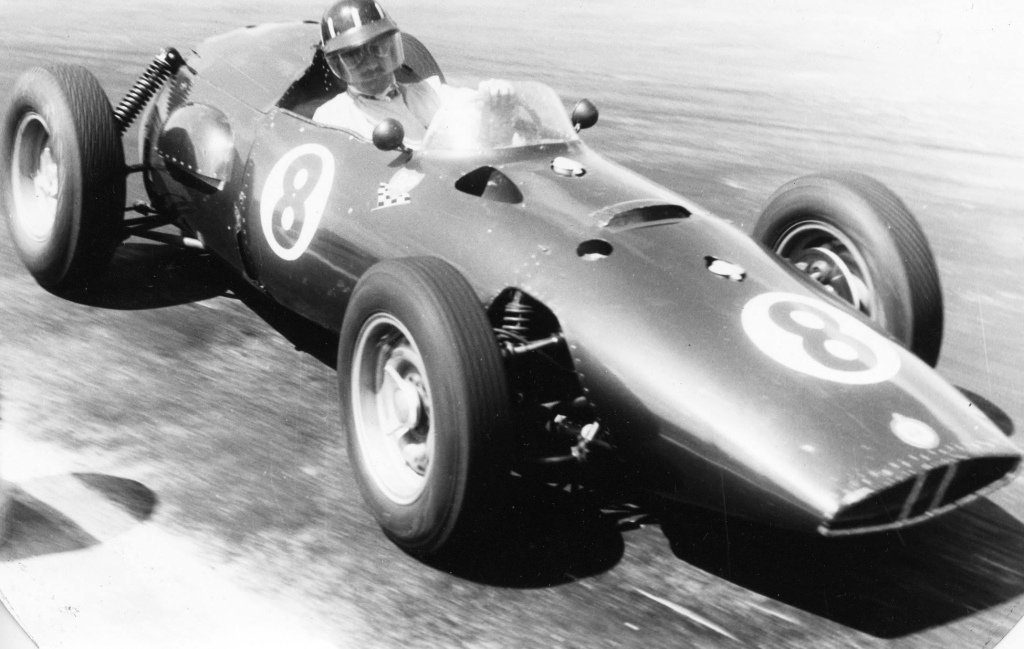
Atmospheric shot of Harry Schell’s BRM Type 25 during the August 23, 1959 Portuguese Grand Prix at Monsanto, Lisbon…
It was the breakthrough car for BRM, Jo Bonnier’s Type 25 won at Zandvoort in 1959 thereby breaking the F1 World Championship GP winning duck for the Boys from Bourne after nearly a decade of competition.
Immaculately credentialled engineer Stewart Tresilian “was largely responsible not only for the original conception and design of the BRM Project 25 2.5-litre four cylinder engine, but also of the compact P27 – or Type 25 – car (chassis) intended to carry it into battle.” Doug Nye wrote in ‘BRM Vol 1.’
“He had produced a homogeneous concept of car and engine combined, its essence being the complete antithesis of the original V16 in that it was all as small and compact and simple as possible, with the arguable exception of his projected 16-valve cylinder head for the four cylinder engine.”

The four-valve head design was subsequently over-ruled by Peter Berthon and after Tresilian left the Owen Racing Organisation to go to Bristol-Siddeley Engines in January 1953, Berthon, Tony Rudd and others brought the Type 25 to reality.
The result was a car that became increasingly fast, it not particularly reliable with each passing year from its race debut in 1955 until early in 1960. It allowed the team to develop the capabilities to win; car development, preparation and driver, they couldn’t do that with a car that never lasted too many laps. Mind you, the simplicity of Tresilian’s concept was complex in its execution…


The P27 semi-monocoque – in the centre section – chassis was strongly influenced by Tom Killeen’s Killeen K1 sportscar which was tested extensively at Folkingham by Rudd. He was impressed and the performance of the car “confirmed PB’s interest in stiffening his basic new P27 frame with a stressed-skin monocoque centre section.
The five-speed rear-mounted gearbox was drawn by Alec Stokes, “who was destined to become BRM’s dedicated transmission specialist and one of the country’s leading gear-men.” The back of the gearbox carried the controversial single, longitudinal-axis rear disc universally known as the ‘bacon-slicer’.
With 50/50 weight distribution and 70% of the braking load at the front, the thinking was that outboard front disc brakes would carry 35% each, leaving 30% for a single rear disc. It took a long time to sort, but when that was achieved “this arrangenent worked quite well on the front engined cars.”
Rear suspension was by way of a De Dion tube with Lockheed air struts inherited from the V16 program, front suspension comprised upper and lower wishbones and coil air strut units again, with the rack and pinion steering Morris Minor based.


While work progressed on the chassis there was a long test program with a single-cylinder model of the new engine. ORO were racing the V16 Mk2 and Maserati 250F during this period, with some success. By Easter 1955 the car was complete but for the engine. Finally, on June 5, 1955 the car ran for 19 laps at Folkingham with Rudd at the wheel, having given 260bhp @ 8000rpm on the test bed.
The major problem on test was the SU fuel injection system which was subseuently ditched in favour of a pair of 58DCOE Webers. After further tests by Ron Flockhart and Peter Collins, the car was entered for the September 3 Aintree meeting.
Peter Collins was chosen to race the machine but lubrication problems caused the engine to blow oil over the rear tyres causing a spin and chassis damage that prevented further running. A further run at Oulton Park on September 24 was impressive with Collins running third in front of Ferraris, Maseratis and Vanwalls etc ended when Peter noticed failing oil pressure and pitted. Thus turned out to be a dud gauge which had been shaken to death by the vibrations of the big-bore-four!
Post-meeting work involved rubber mounting the instruments, improving gearbox lubrication and gear teeth form. As Nye observed, “The new BRM was the tiniest car of its time. It was really minute, and very light, and very powerful…and very troublesome.” The eternal process of development was only just underway.


Stirling Moss tested the cars in the lead up to the 1956 season but went to Maserati instead, so Mike Hawthorn and Tony Brooks stepped into the breech. Those poor unfortunates enjoyed a season of great speed laced with equal amounts of unreliability and poor preparation.
The team addressed many problems that year. They slowed the rotating speed of the bacon-slicer by use of a reduction gear, experienced ‘stiction’ in the air struts, the big valves stretched and broke, they had pot-joint seizure and so on. Then Brooks experienced a jammed throttle rod at Silverstone at Abbey corner triggering a somersault which destroyed chassis #252 by fire. To compound a diabolical British GP weekend in front of the home crowd, Ron Flockhart’s car broke its timing gears. Despite all of that Hawthorn and Brooks had qualified in the Top 10, Mike in Q3. The team withdrew from the final two championship races of the year in Germany and Italy.

Alfred Owen then decreed there would be no more racing until the car had completed 300 miles of continuous running competitively. Flockhart achieved this late in the year at Monza. Three laps later, with Berthon waving him on, the car dropped a valve and ruined another engine. Nye observed, “From their debut in 1955 to the end of 1956 the BRM Type 25s had made only eight starts in just five races, and finished only once, Brook’s second in the Aintree 200.”
Over the winter Colin Chapman test drove the car twice and provided a comprehensive set of recommendations in a formal letter of advice including rear suspension changes. Fitment of tall coil spring/dampers and incorporating a Watts linkage to help locate the De Dion tube were among changes which help transform the cars.


In 1957 Brazilian born American Herbert Mackay-Fraser charged at Rouen, while poor Flockhart spun on oil , rolled into a ditch and wrote 254 off. Fraser died a week later aboard a Lotus 11 Climax FPF at Reims and Flockhart was still in hospital so Jack Fairman and Les Leston raced the cars at Aintree.
Jean Behra was so impressed by the corner-speed of the Type 25 at Aintree he cadged one for the 302km Caen GP which he won! Harry Schell drove a sister car in the event at the last moment, and soon became the most consistently successful Type 25 driver.
“At the end of the season, against meagre opposition, the three surviving cars, 251, 253, and 254 finished 1-2-3 in the Silverstone International Trophy, driven by Behra, Schell and Flockhart.”
During the 1957-58 break, a fifth main bearing was incorporated into the engine to solve ongoing timing gear problems, the cost was high, additional friction losses impacted horsepower. The chassis came in for attention too, the semi-monocoque centre section was ditched in favour of a full spaceframe with fully detachable bodywork.
Schell and Behra finished two-three in the Dutch GP, the team’s best result yet. The methanol burning four-bearing engine gave over 280bhp in 1957, whereas the five-bearing on Avgas gave only 240bhp, Behra left for Ferrari at the end of the year.


Fiery Harry Schell was one of the surprises of the 1958 with a series of qualifying performances and points finishes which proved just how much their ever evolving Type 25 – despite the power loss – had come. Second at Zandvoort was fantastic, so too a swag of fifth places at Monaco, Spa, Silverstone (from Q2) and Oporto. Behra’s best was third and Holland and fourth in Portugal, while Jo Bonnier’s was fourth place in the season-ending Moroccan round.
In the first season the manufacturers championship was run, BRM were fourth in the International Cup for F1 Manufacturers behind Vanwall, Ferrari and Cooper Climax. Vanwall had peaked as they led the pre-eminence of British Racing Green, while Coopers were on the rise…


While Jack Brabham and Stirling Moss rewrote the record books with their factory and Rob Walker Cooper T51 Climaxes in 1959 BRM put themselves in the annals of Grand Prix history when Jo Bonnier won at Zandvoort in May. Schell had a season of greater reliability than Bonnier but didn’t do as well as the year before.
That winter Harry Weslake had advised Bourne on improved cylinder head design, and the fifth main-bearing was machined out! BRM adopted new timing gears “with large, coarse teeth not critical to fine backlash tuning for reliability.” Further brake modifications and simpler, lighter chassis – numbers 2510 and 2511 – “made the BRM Type 25s simply the fastest front engine cars of 1959, with fantastic braking ability.” Doug Nye wrote.
Graham Hill, Dan Gurney and Bonnier drove the cars on into 1960 at which point all of the remaining Type 25s, except #258, the Zandvoort winner, were torn to bits to provide components for the new mid-engined P48 2.5-litre cars “being hastily built to follow Cooper’s rear-engined lead.”

Jo Bonnier “drifting into history”, as Doug Nye beautifully put it. By April 18, 1960 JoBo could have raced a new mid-engined P48 in the Goodwood Easter Monday Glover Trophy but chose to race Type 25 #258, his Zandvoort machine instead. Graham Hill and Dan Gurney gave the P48s their race debut that weekend, Hill was fifth, Bonnier sixth and Gurney had an accident on lap 3. In a sign of the times, Innes Ireland’s works Lotus 18 Climax won, it was the fastest, if not the most reliable GP car of 1960.

See here for the first of two articles on the next phase of BRM history; https://primotipo.com/2015/03/26/tony-marsh-boness-hillclimb-scotland-brm-p48-part-1/
Eleven BRM Type 25 chassis were built – #251-259, 2510 and 2511 – during the long 1953-1960 BRM Type 25 programme, starting in 21 championship and 26 non-championship and Formula Libre events. These 47 meetings yielded the Dutch GP win for Bonnier and seven minor event victories including the two preliminary heats of the 1957 International Trophy at Silverstone and the 1959 New Zealand Grand Prix heat at Ardmore for the ever patient Ron Flockhart.
Etcetera…

The boys; standing are Basil Putt, Team Manager, Mike Hawthorn, Tony Brooks, Peter Berthon, Tony Rudd, Raymond Mays, AF Rivers Fletcher. Who are the mechanics in front? Folkingham, Lincolnshire August 28 1956 ‘Test and view day’.

The cover and editorial of Autosport after Peter Collins made the race debut of the Type 25 at Oulton Park on September 24, 1955 says everything about Britain’s goodwill towards BRM in its fight to take on the best in the Grand Prix world.


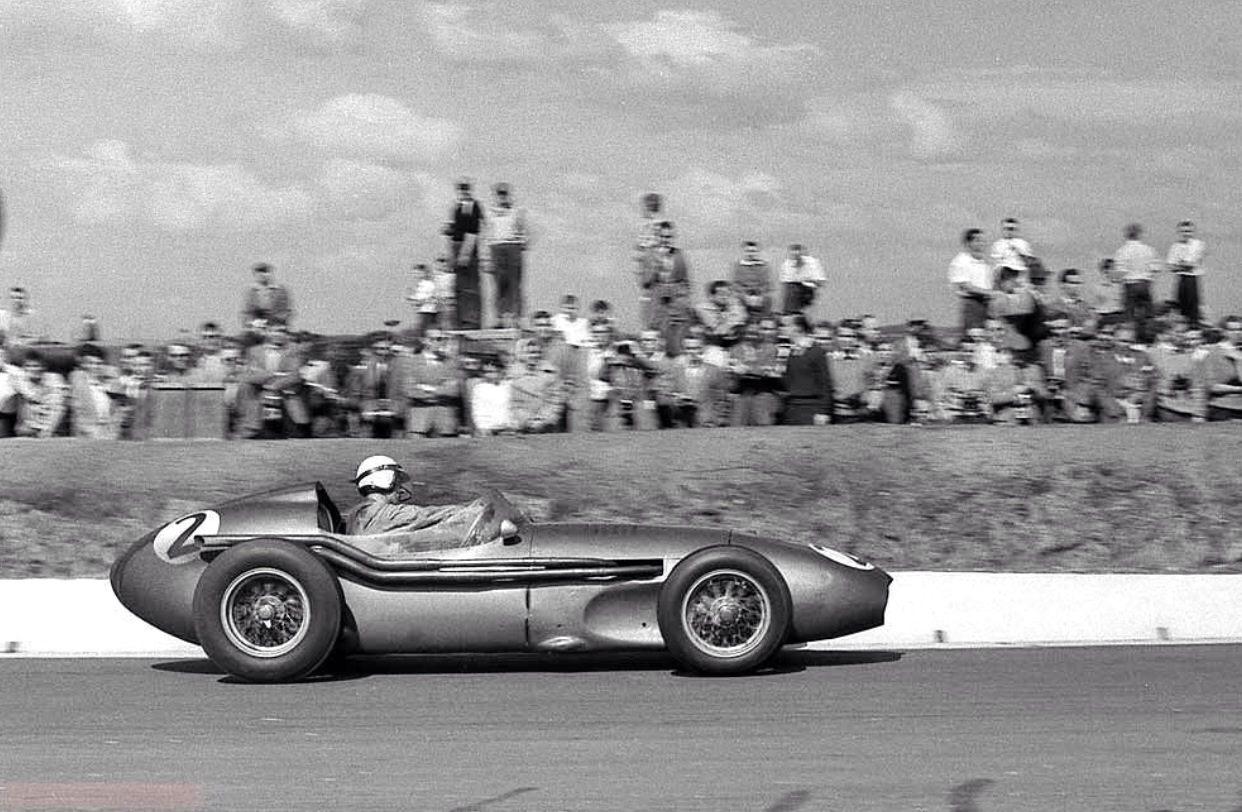
Great shot of Les Leston with team chief Raymond Mays at Aintree during the 1957 British GP weekend. Q12 and DNF engine after 12 laps, Jack Fairman lasted two laps more before he too suffered engine dramas. Up front, Tony Brooks and Stirling Moss shared the win in a Vanwall.

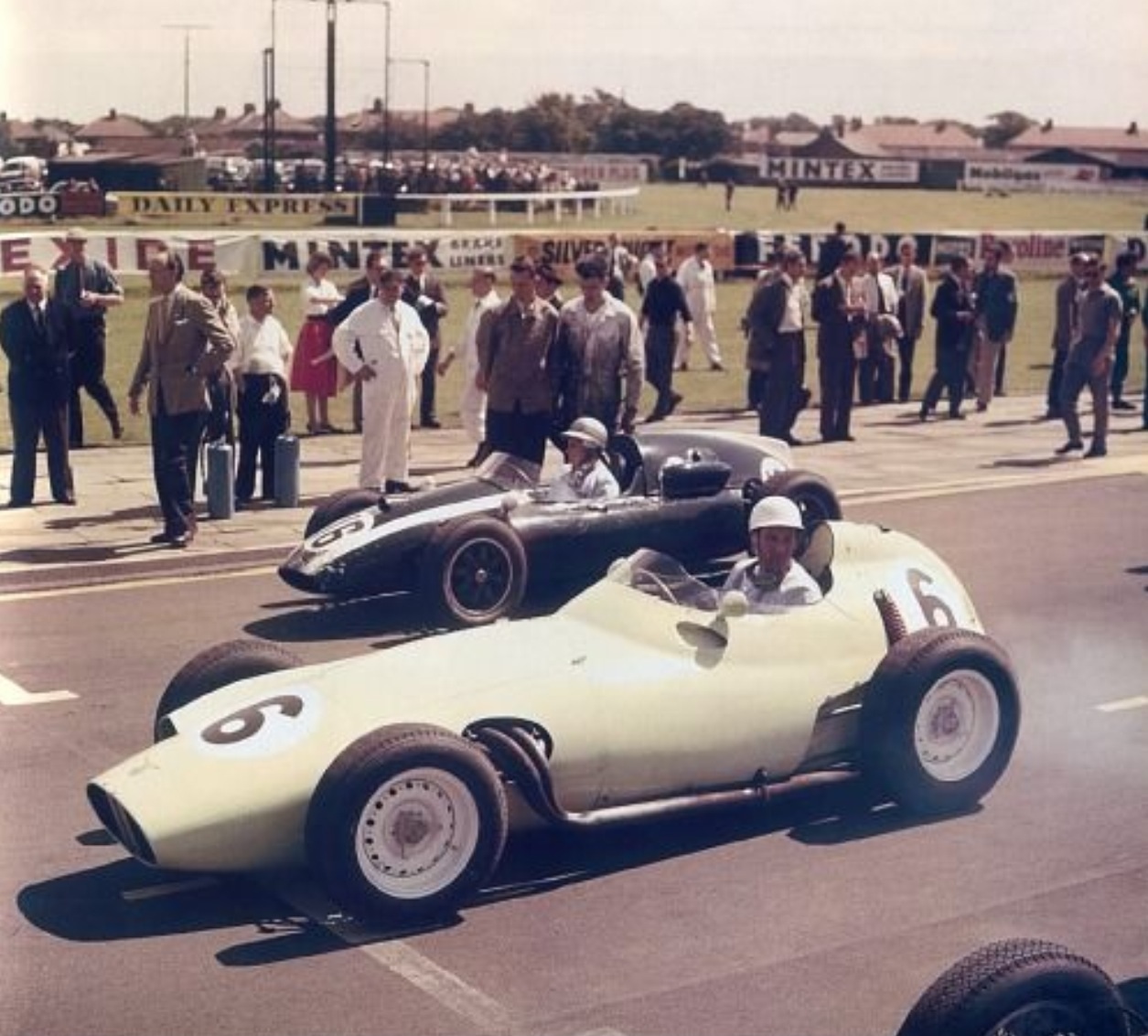
Rouen pits in July 1957, the incredibly quick BRM Type 25 #253 of the oh-so-promising American driver Herbert Mackay-Fraser awaits its wheels. Q12 and DNF transmission failure after 24 laps, Fangio won in a Maserati 250F. And below with the Mike MacDowel Cooper T43 Climax shared with Jack Brabham to seventh in the race. The contrast in size between the smallest front-engined car of the era and the grids most compact is quite marked.


Peter Berthon and 37 years old Harry O’Reilly Schell at Monaco in 1958. Despite a wild-man reputation Harry put together plenty of fast drives and high placings just as the team needed them. He was equal fifth (with the dead Peter Collins) in the drivers championship with 14 points, a personal best. 1959 was tougher, Stirling Moss bagged his car and Harry didn’t finish a race until Reims in July, but managed fourth at Silverstone and fifth in Portugal. Schell died at Silverstone in damp practice for the 1960 International Trophy, he clipped a low retaining wall at Abbey, was half flipped out of his Cooper T51 Climax and broke his neck.

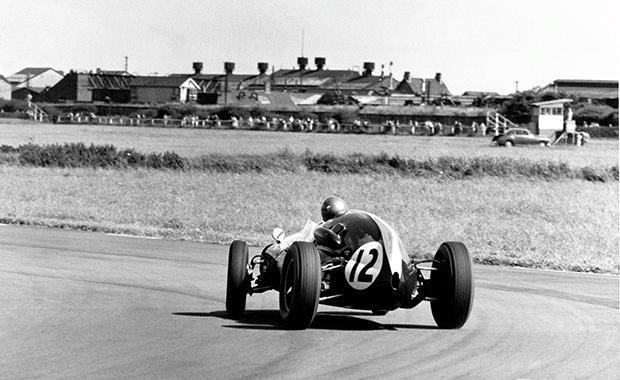
Behra at Oporto 1958. Doesn’t that BRM #256 look magnificent beside those small, very fast Cooper T45s. #12 is Maurice Trintignant, #16 Roy Salvadori with the obscured Jack Brabham copping a push start at right.

Ron Flockhart during the Lady Wigram Trophy, New Zealand in January 1959. If a bloke deserved a win in these cars it was Ron given the number of test and race miles he did in them. He won aboard #259 from pole in front of Jack Brabham and Bruce McLaren’s Cooper T45 Climax’.

‘Where is the starter again?’ Tony Rudd and mechanic in Harry Schell’s #257 at Monaco in 1959. Q9 and DNF accident after completing 48 laps of the race won by Jack Brabham’s Cooper T51 Climax. Bonnier’s car retired with failing brakes from Q7.

Yay team, again at Zandvoort in 1959, and one more time, there is no such thing as too much BRM…

BRM Type 25 model from Stephen Dalton, “it’s a Merit with the Alastair Brookman touch, he built it.”
Credits…
Clarence La Tourette, Getty Images, John Ross Motor Racing Archive, Bernard Cahier, John Ferguson, Classic Auto News, LAT, MotorSport Images, ‘BRM 1’ Doug Nye, History of the Grand Prix Car 1945-65 Doug Nye, Dave Williams, Stephen Dalton Collection, TC March, Tony Johns Collection
Tailpiece…

Phil Hill catches Jean Behra on the way to a DNF brakes at Monaco in 1958 from a splendid Q2 in chassis #256. Tony Brooks was on pole and Jack Brabham Q3 is the upstart 2-litre Cooper T45 – with two more of the pipsqueaks behind Jack – driven by Roy Salvadori and race winner Maurice Trintignant.
While the mid-engined writing wasn’t perhaps on the wall, the sign-writers were readying the paint…
Finito…








 primotipo...