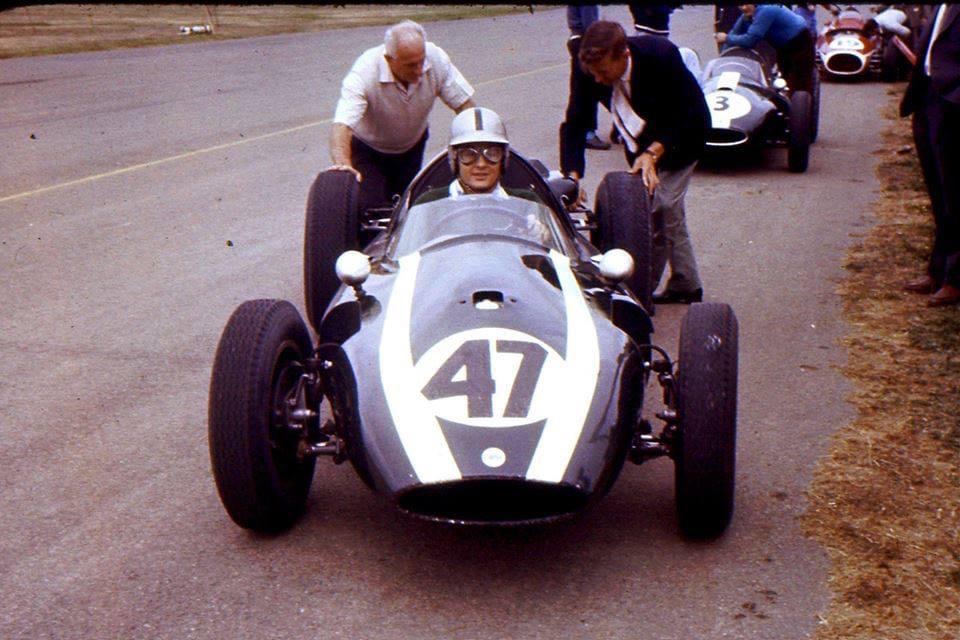
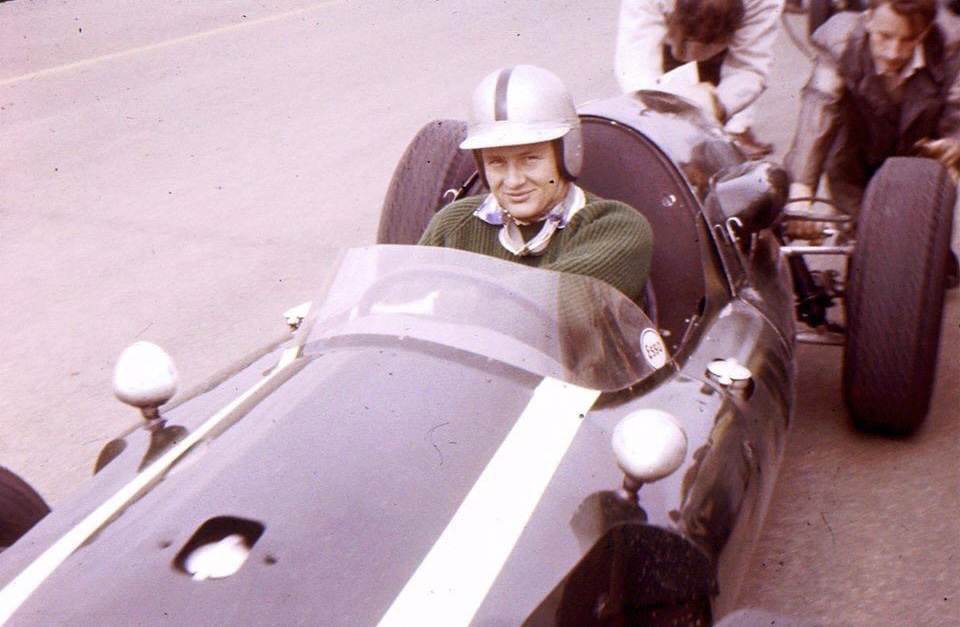
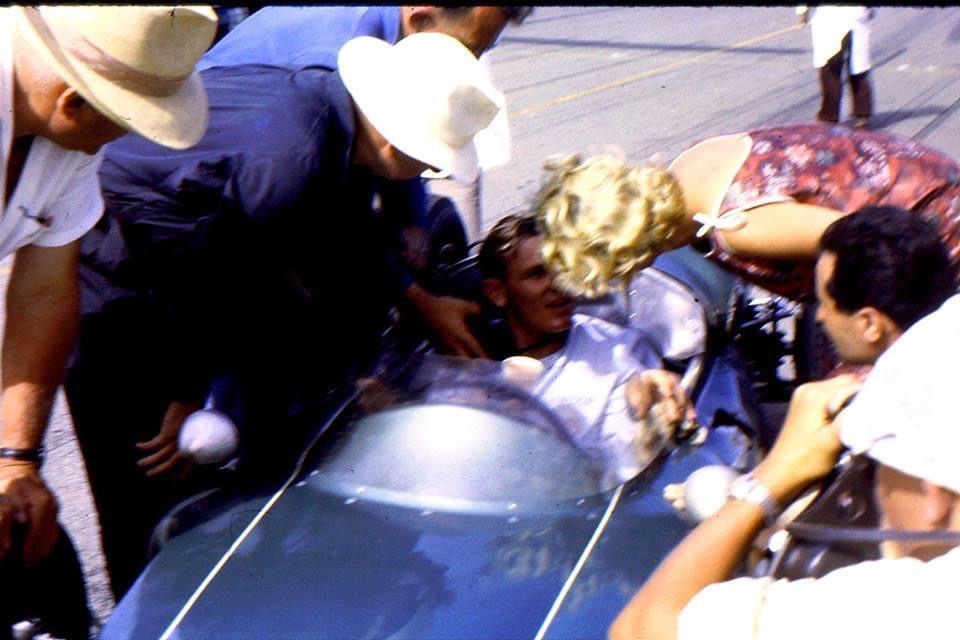
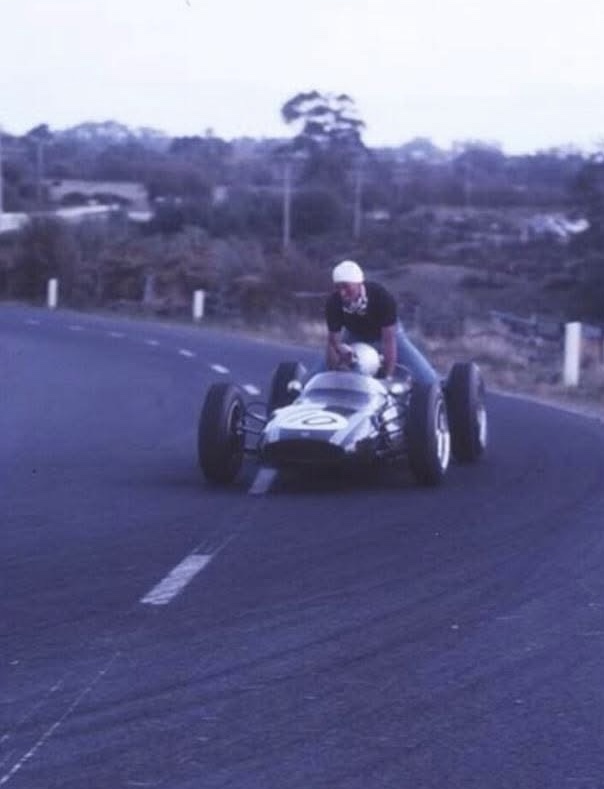
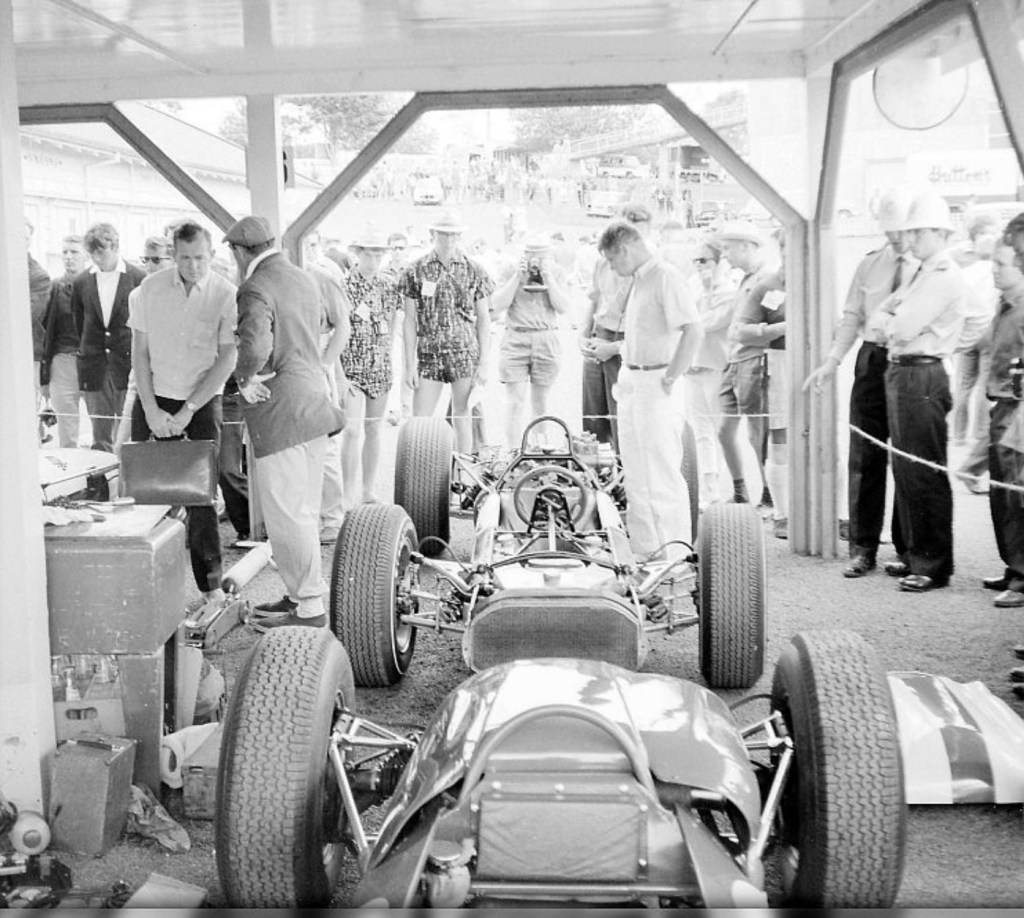
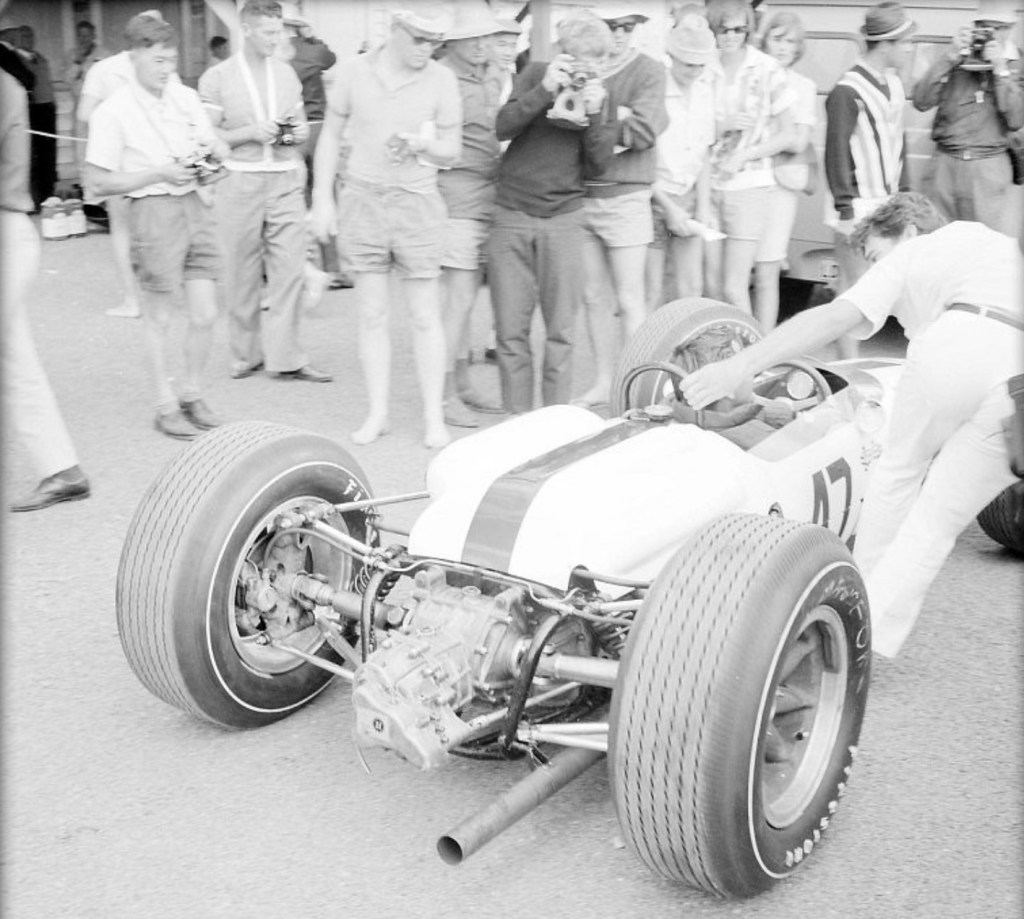
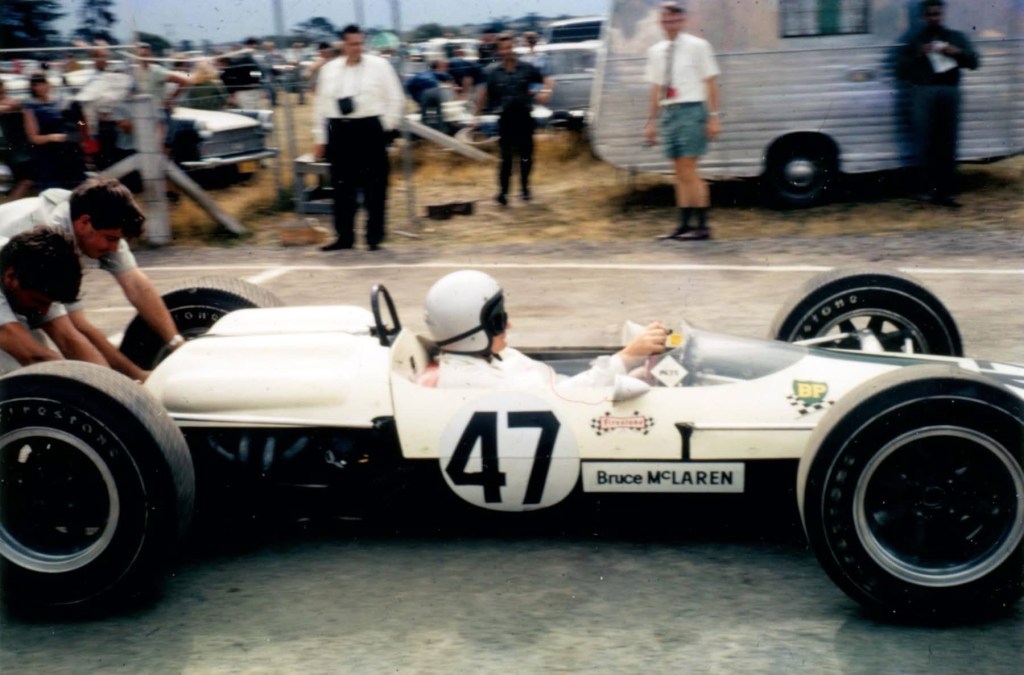
Pop McLaren and another helper about to bump-start Bruce’s Cooper T45 Climax FPF 2.5 at the Wigram RNZAF track on the January 23, 1960 weekend.
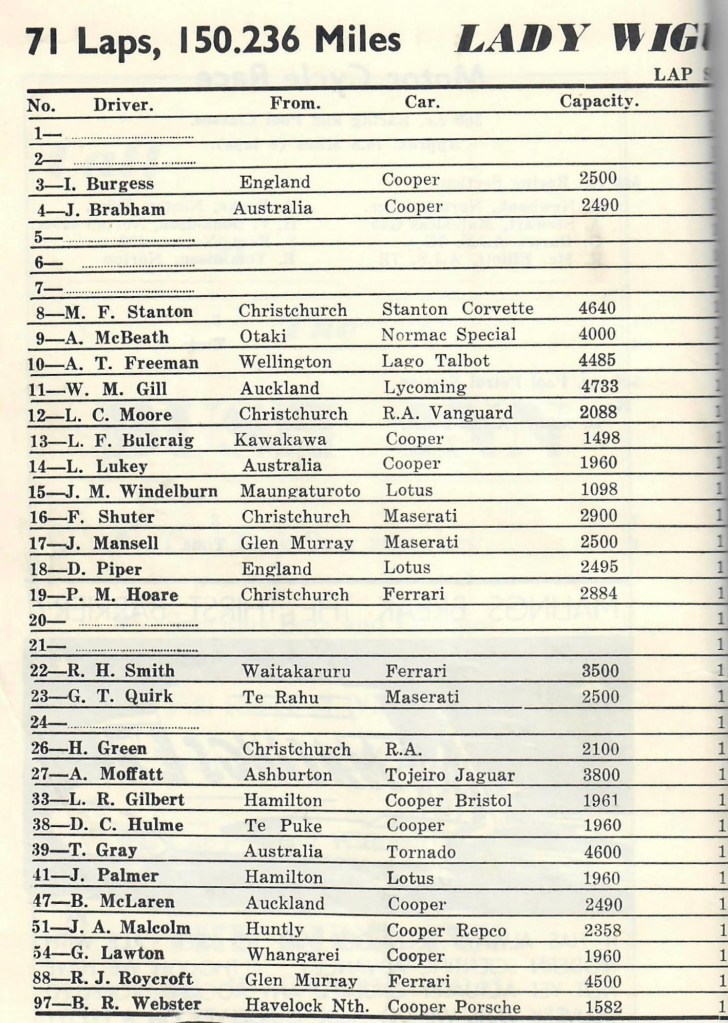
That’s Ian Burgess’ third-placed Cooper T51 Climax behind, then Pat Hoare’s Ferrari 256 V12 a little further back; he was fifth. Jack Brabham won the race in a T51 2.5-FPF with David Piper’s Lotus 16 Climax FPF 2.5 second. Bruce was fourth in the Lycoming Special; more of that soon.
New Zealand’s Summer Internationals commenced with the NZ GP, then held on the Ardmore Airfield circuit outside Auckland, with the Lady Wigram Trophy the other round most visiting internationals did. Sometimes they also entered the Dunedin Road Race and Teretonga International, held on a permanent racetrack near Invercargill, both venues on the South Island.
That year the visitors were headlined by Stirling Moss, twice-on-the-trot World Champion Brabham, and Burgess, Piper, while the Australian contingent included Bib Stillwell and Stan Jones in Cooper T51s, and Len Lukey in a T45. Similarly mounted was Kiwi youngsters Denny Hulme and George Lawton, both Driver to Europe exports; Lawton’s a sad one…
(T Marshall)
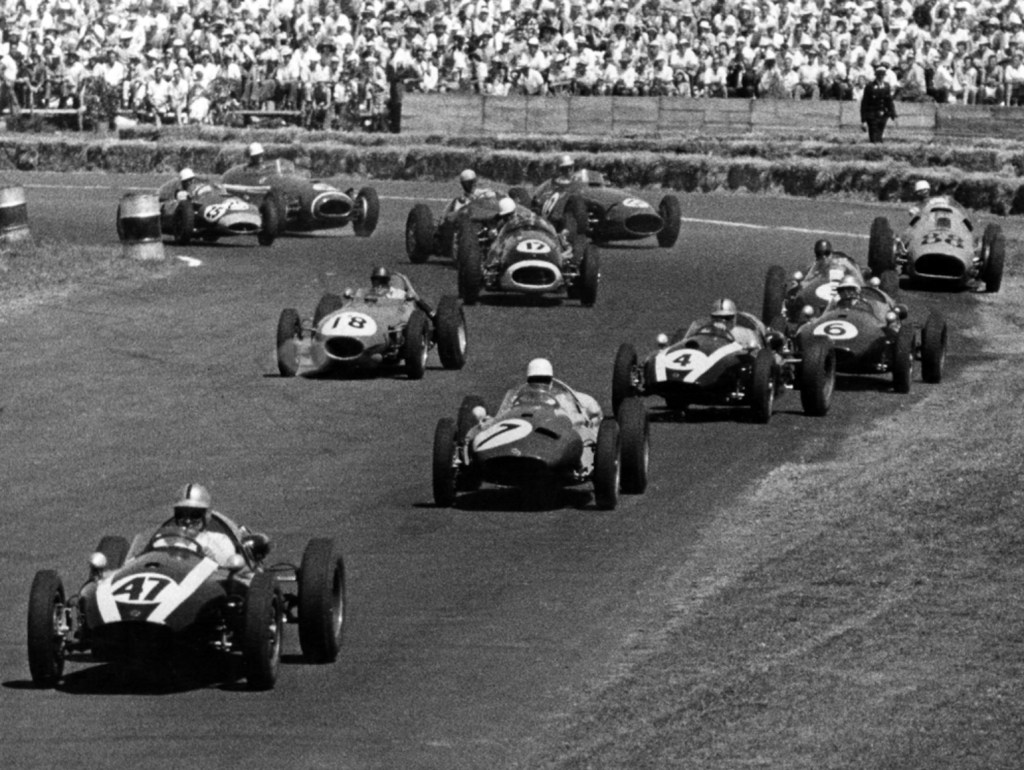
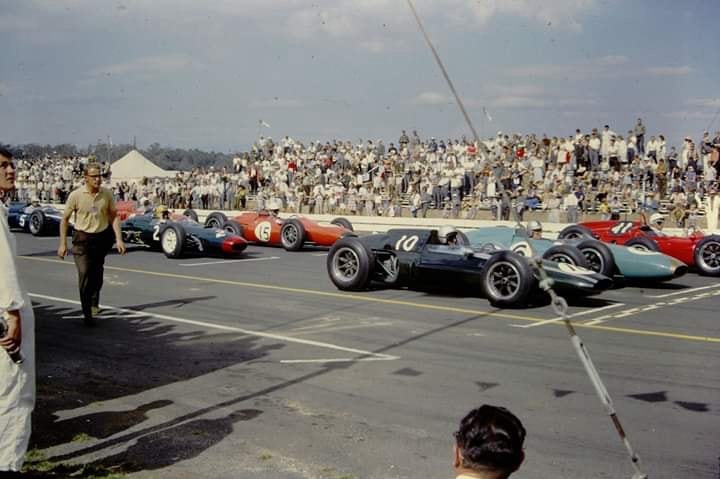
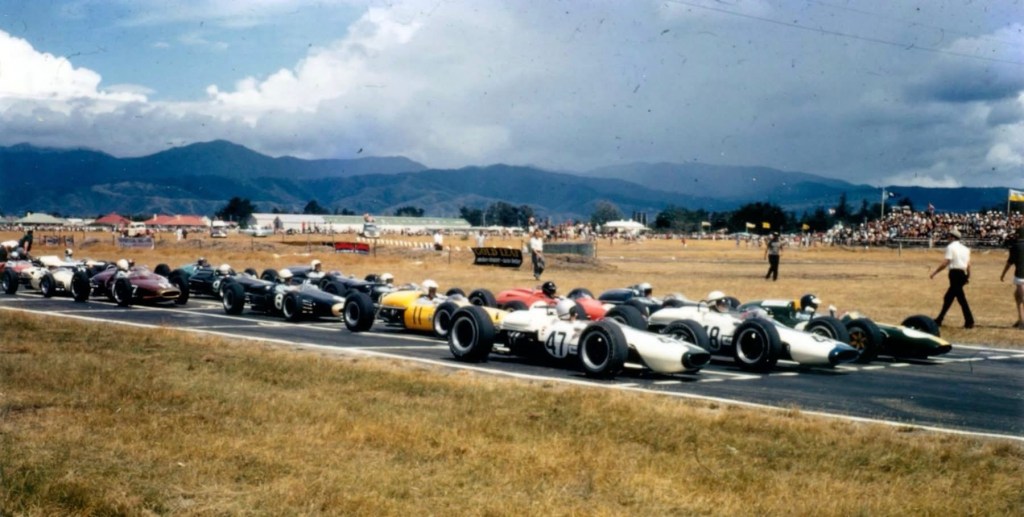
Coopers to the fore on the first lap at of the New Zealand GP at Ardmore: McLaren, Moss, Brabham, #6 Australian Bib Stillwell and then Ian Burgess. One T45 and four T51s. In the middle of the road is David Pipers Lotus 16 Climax, car #17 Johnny Mansel’s Maserati 250F, while #88 is Ron Roycroft’s positively historic but very well driven ex-Ascari Ferrari 375 4.5-litre V12. Behind Mansel is perhaps Pat Hoare, Ferrari 256 V12 – a Dino 246 fitted with a 3-litre V12 – then Arnold Glass in his Maserati 250F #12. Close to the oil drum is 1954 NZ GP winner Stan Jones, Cooper T51 Climax, and finally the big front-engined car is Ted Gray in his last drive of Australian Land Speed record holder, Ted Gray in Tornado 2 Chev V8.
At this time of technological change, it was certainly a grid lacking variety! Coopers were of course right up there: Brabham and McLaren finished one-two in their 2.5-litre FPF-powered cars from the 2.2s of Stillwell and Jones. The best placed front-engined cars were the pair of 2.5-litre six-cylinder Maserati 250Fs raced by Kiwi Johnny Mansel and Aussie Arnold Glass.
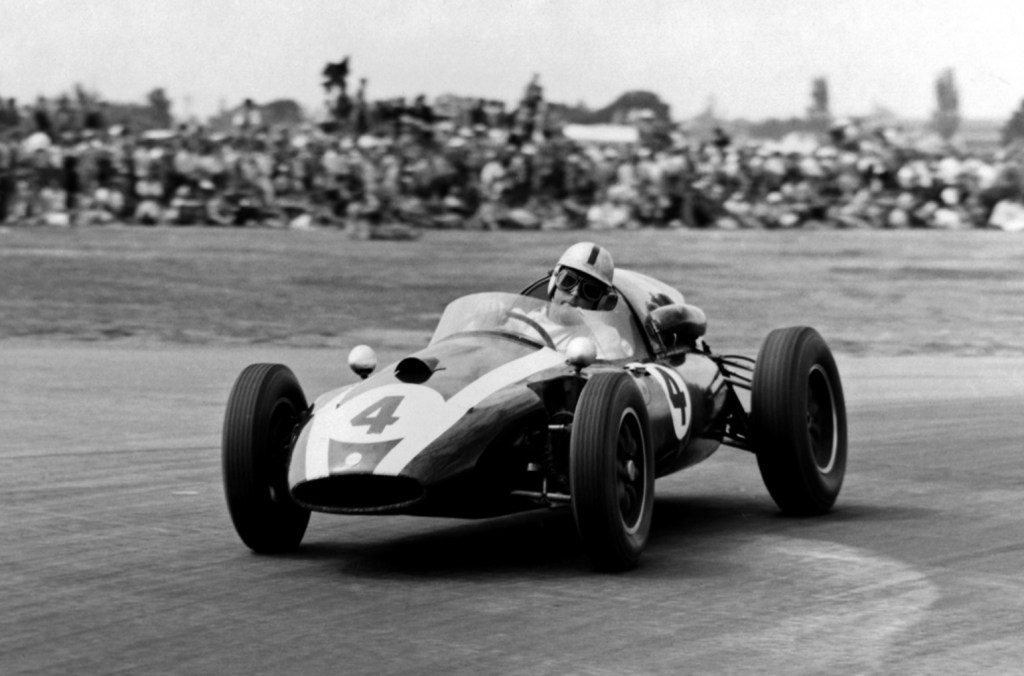
Stirling, Bruce and Jack all ears during the Ardmore drivers briefing – not necessarily in 1960 mind you (R Stuart)Brabham on the way to victory at Wigram in 1960, Cooper T51 Climax (T Marshall)
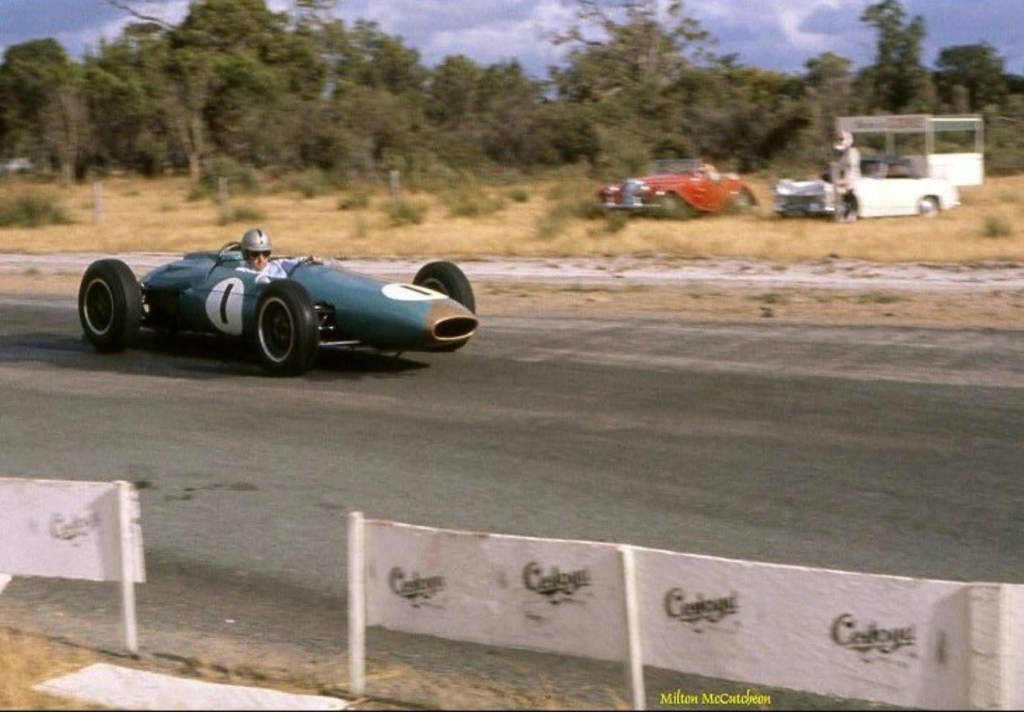
That summer, Jack Brabham won both the NZ GP and Wigram, while Syd Jensen’s nimble Cooper T45 Climax 1.5 won on the Dunedin city roads, and Ian Burgess triumphed at Teretonga, Cooper T51 Climax FPF 2.2-litre.
On the other side of The Ditch Brabham won at Longford and Phillip Island against local opposition; it was a great summer for him. It wasn’t until 1961 – and really 1962 – that the Australians had the tracks to cut it with the Kiwis to attract the internationals with the first Tasman Cup held and won by Bruce McLaren’s Cooper T70 Climax in 1964.
(G Woods Collection)McLaren, with ‘nomex’ jumper and long sleeved shirt on to deal with the summer chill, Burgess and Pat Hoare’s Ferrari 256 V12 (R Stuart)
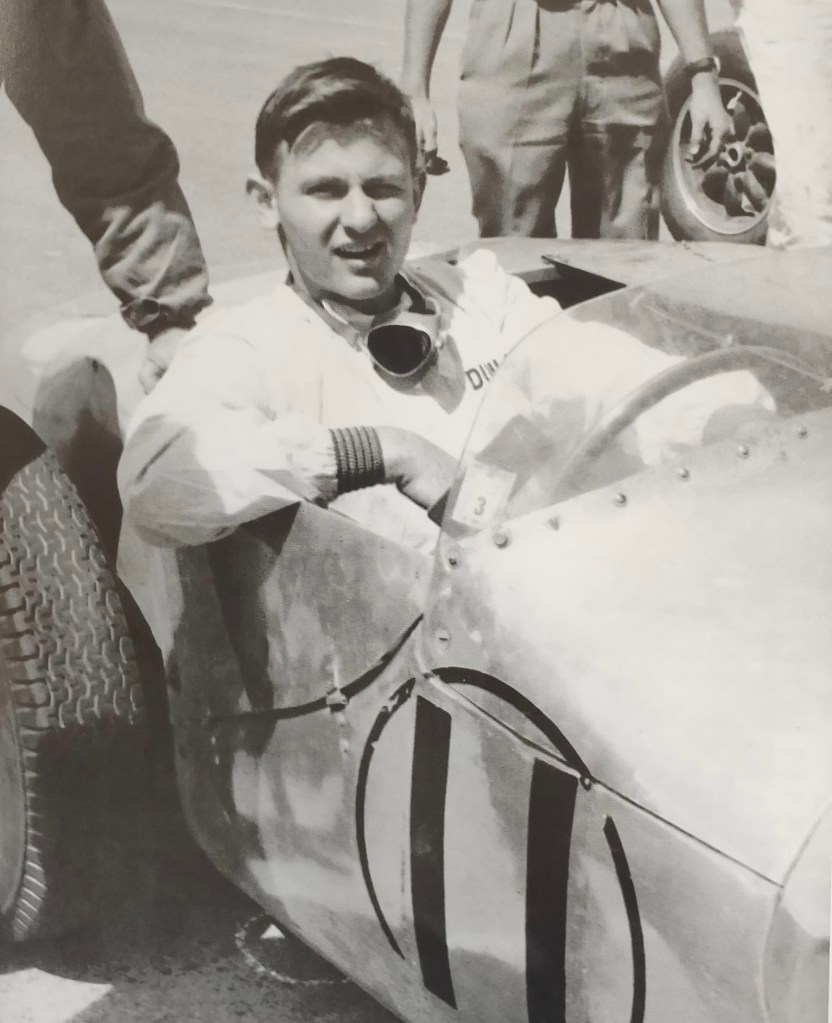
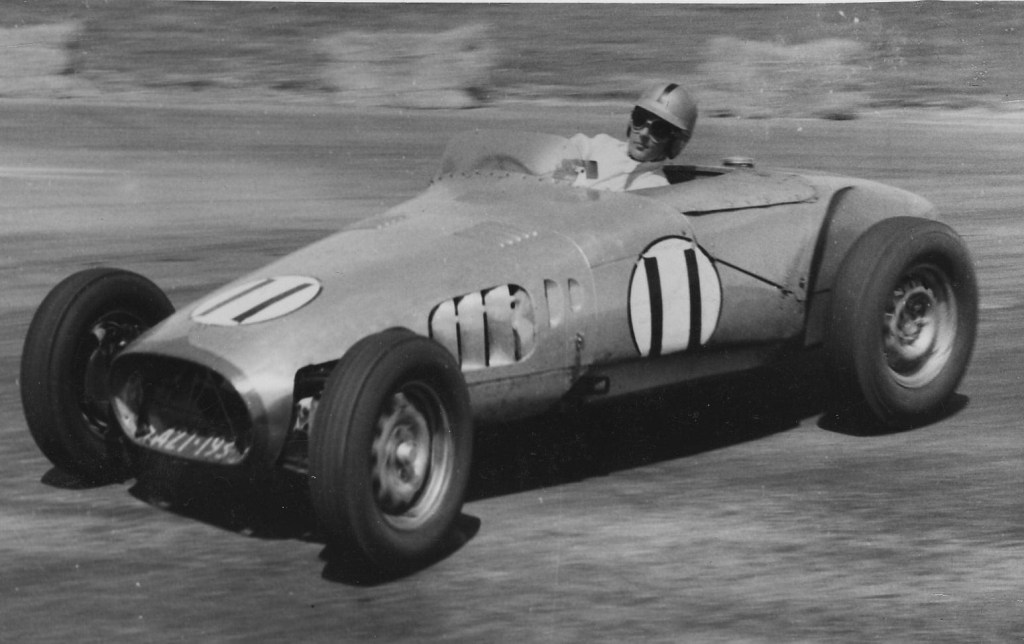
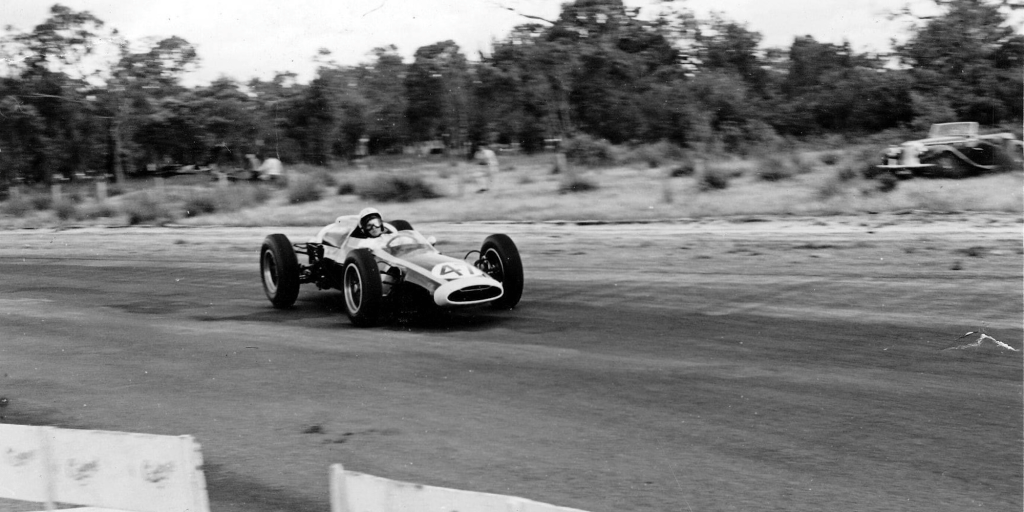
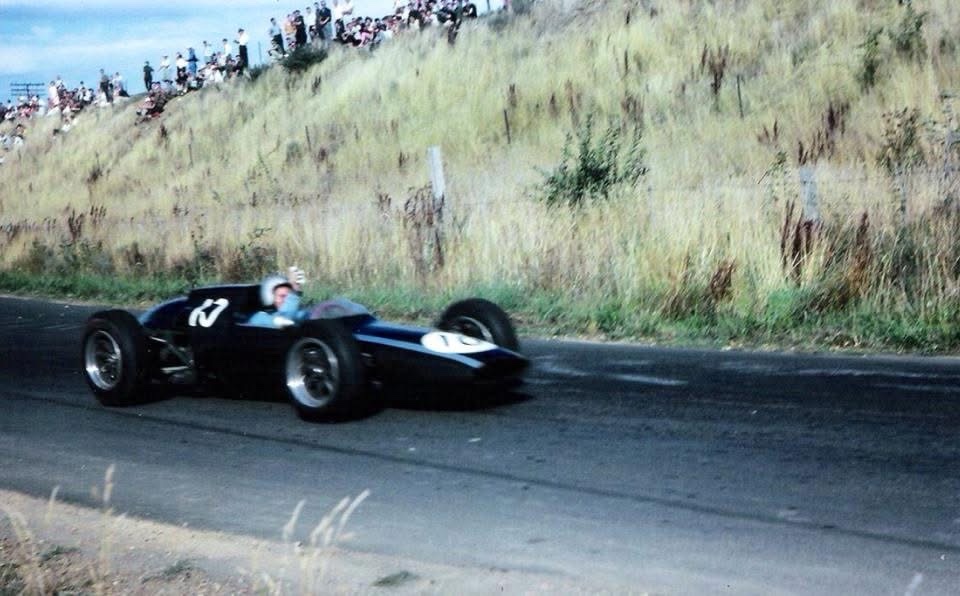
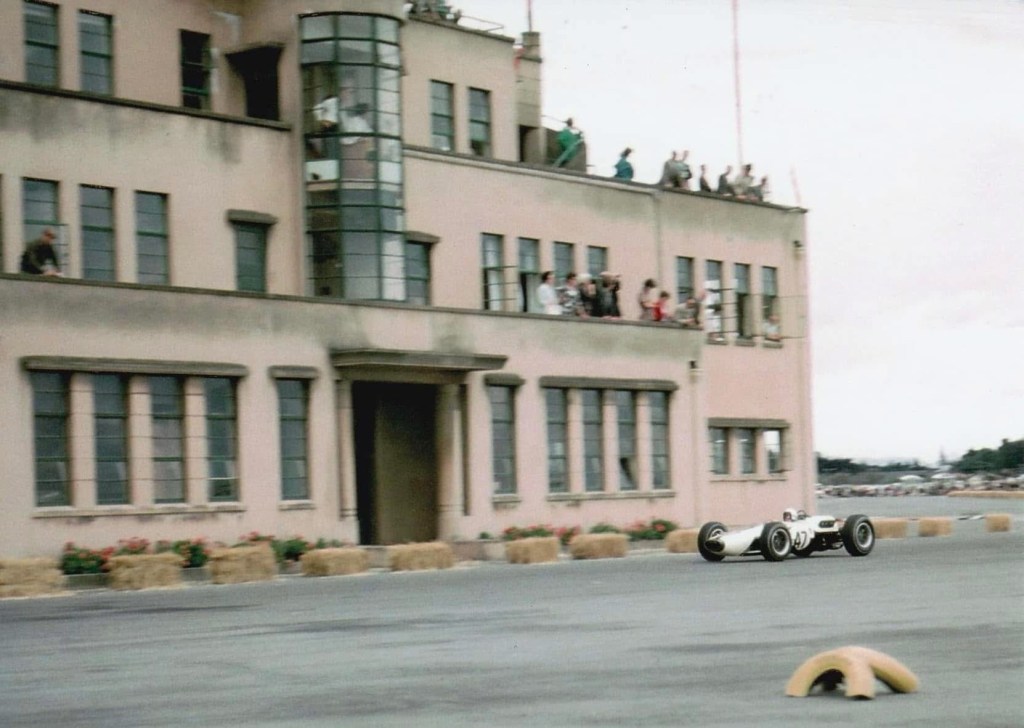
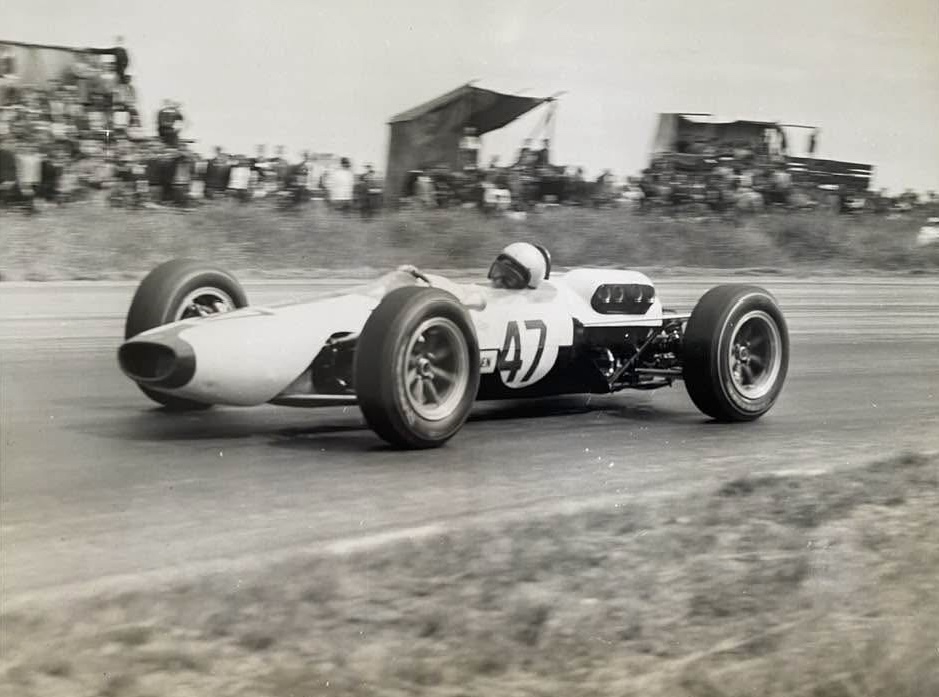
While Bruce McLaren started the Lady Wigram Trophy in his Cooper, he retired the car and then took over the famous aircraft-engined Lycoming Special, finishing the race in fourth place (below).
Jim Clark did a few laps in one of the Kiwis’ most loved specials during practice during the Tasman Series a couple of years later.
Bruce McLaren in the Lycoming here and below (M Knowles)(BMcL Trust)(M Fistonic)
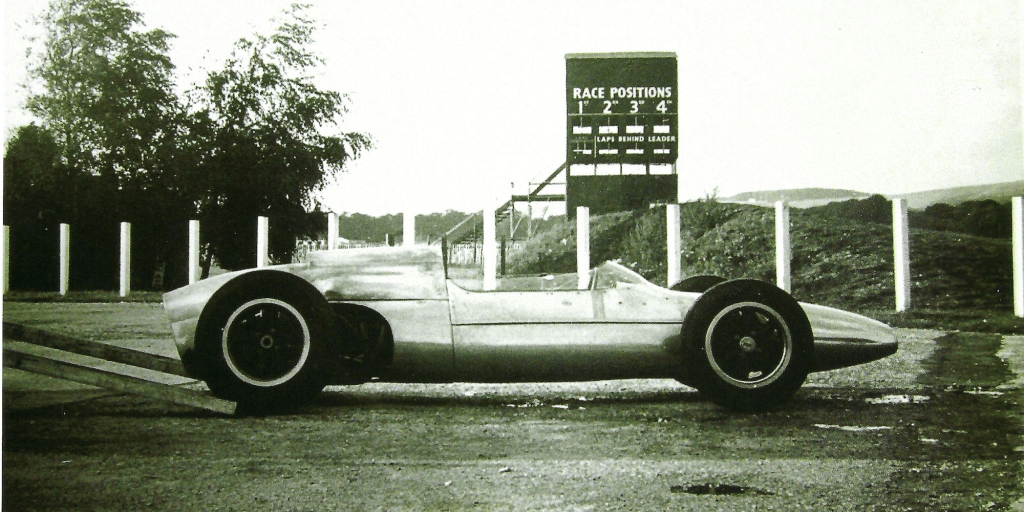
McLaren ran out of brakes in the Lycoming during the race; the car ran four-wheel drums sourced from an Austin road car. Bruce found the car’s handling so forgiving that he was able to make up for the lack of stoppers, in part, by throwing the it sideways into the corners.
Never one to forget a favour, when he returned to England, Bruce sent a set of Dunlop rotors and calipers to New Zealand, the Lycoming raced on so equipped!
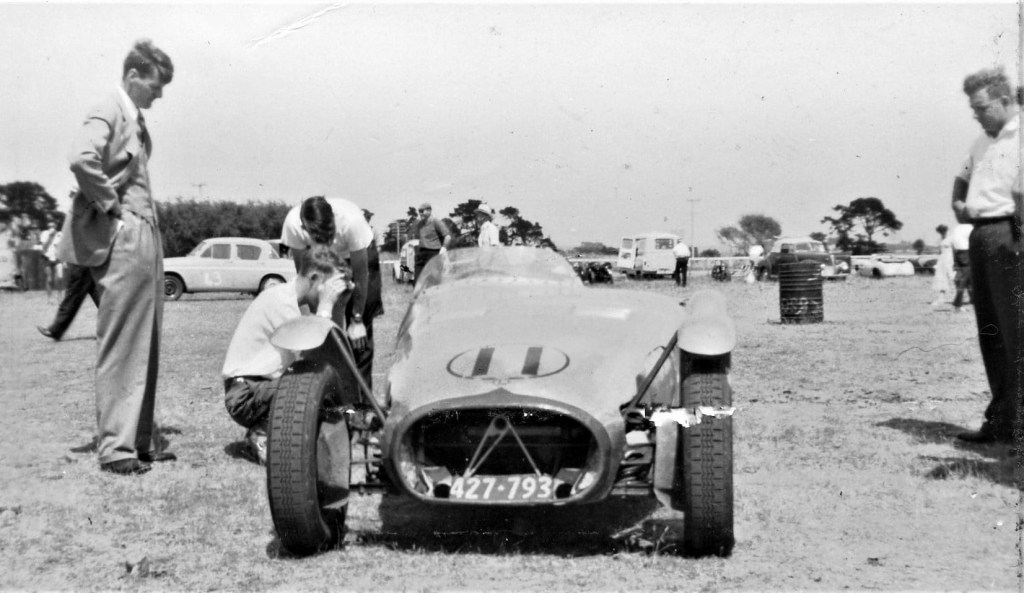
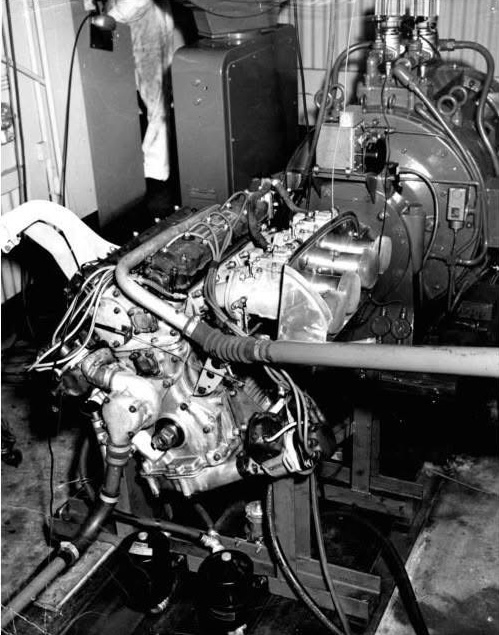
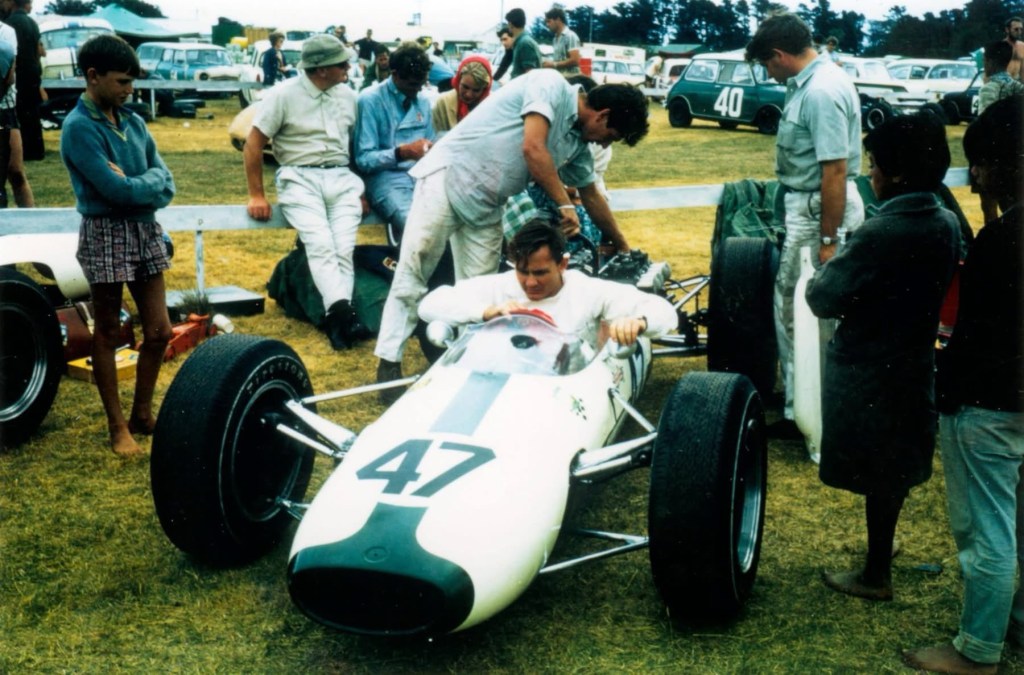
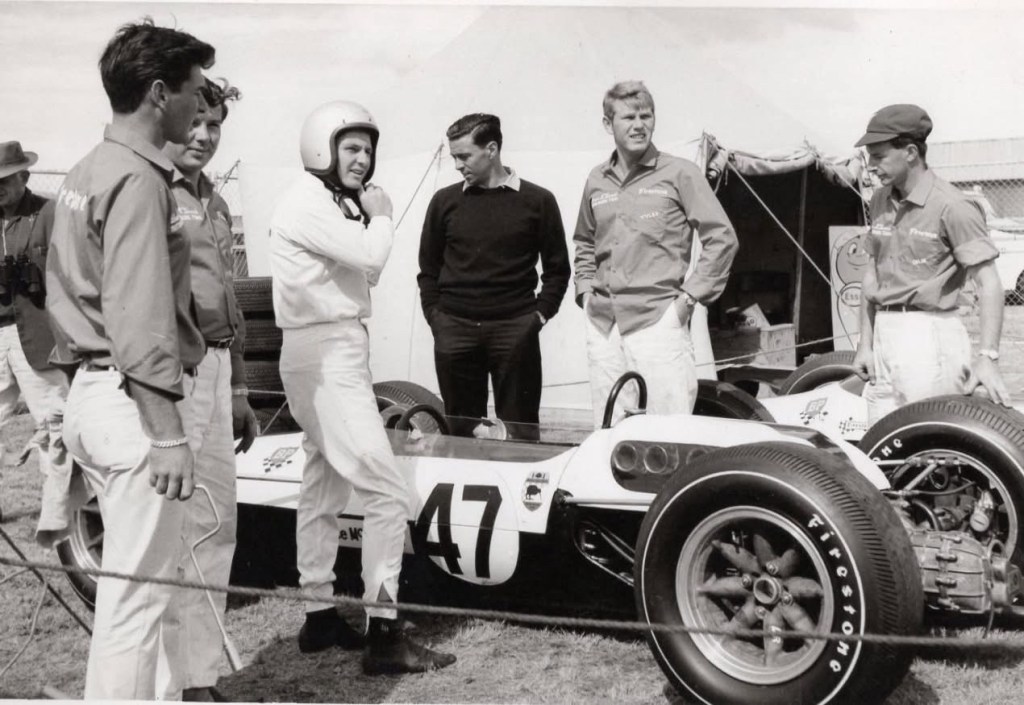
The shot above shows the Lycoming in the Levin paddock in January 1960. Note the road-rego and Michelin radial tyres. Clearly, (pic above) Bruce raced it on Dunlop racing tyres, but the 4.7-litre four cylinder engines car was originally built by oh-so-talented Kiwi engineer Ralph Watson as a road-going racer. At the time Bruce borrowed the car, it was being raced by Malcolm Gill and later Jim Boyd, happily it is extant, alive and well.
(Nat Lib NZ)
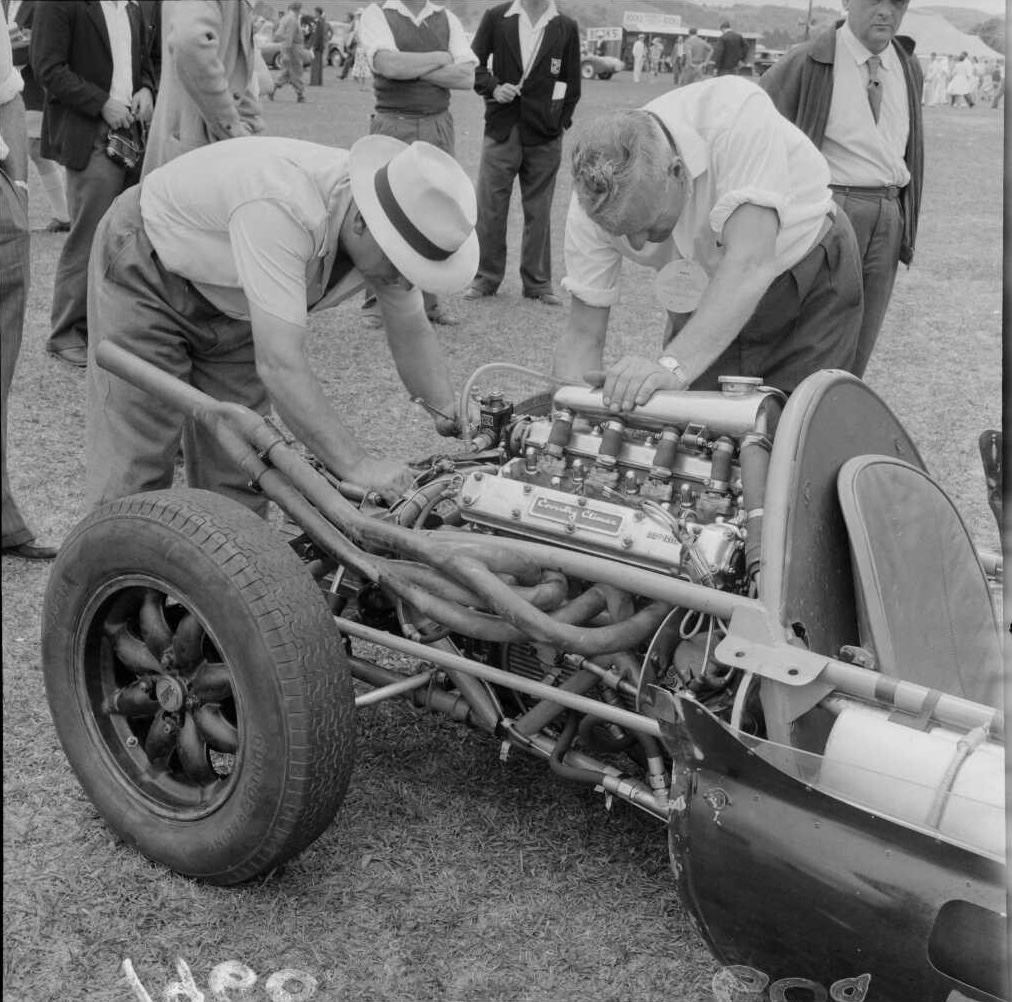
Ian Burgess’s Cooper T51 Climax at Wigram above, and the 2.5-litre Climax in Stirling Moss’ car being fettled in the Ardmore paddock below.
(Nat Lib NZ)
David Piper (below) pushing his Lotus 16 Climax 2.5 #368 to the start line at Dunedin on January 30, where he withdrew with gearbox problems after 22 of the 36 laps.
Piper coaxed local boy Arnold Stafford into the hot-seat of his 1.5-litre FPF-engined Lotus 16 #353 ‘renter’ at Wigram (below), but Stafford thought the better of it after a big-spin in practice, having not raced for three years and didn’t start.
(K Brown)(unattributed)
Both cars weren’t particularly old in years but were technically passé by early 1960, even in the colonies where Coopers had been rather popular from the early 1950s.
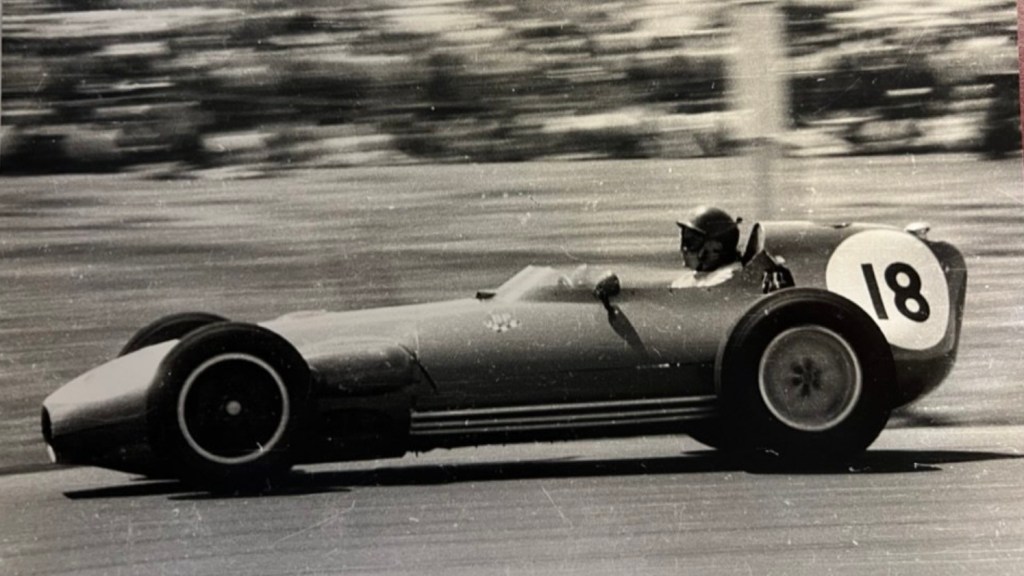
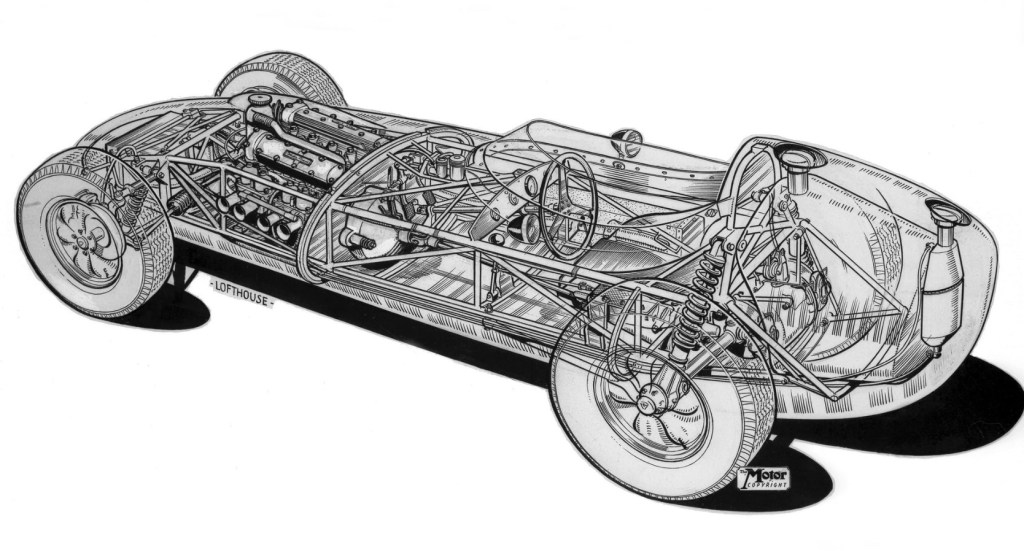
Lotus 16 Climax cutaway (Lofthouse)(R Stuart)
Etcetera…
McLaren at Wigram in 1962, where he was fourth in his 2.7-litre Cooper T53 behind Stirling Moss’ Rob Walker Lotus 21 Climax 2.5 and the 2.7-powered Coopers of Brabham, T55, and John Surtees, T53…Happy Patty below.
(R Stuart)(R Stuart)
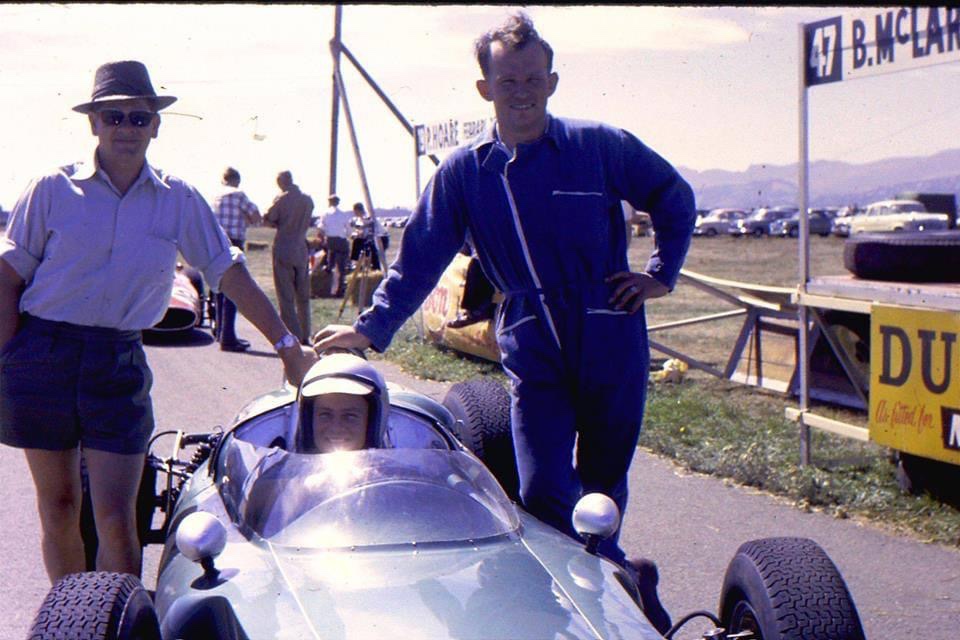
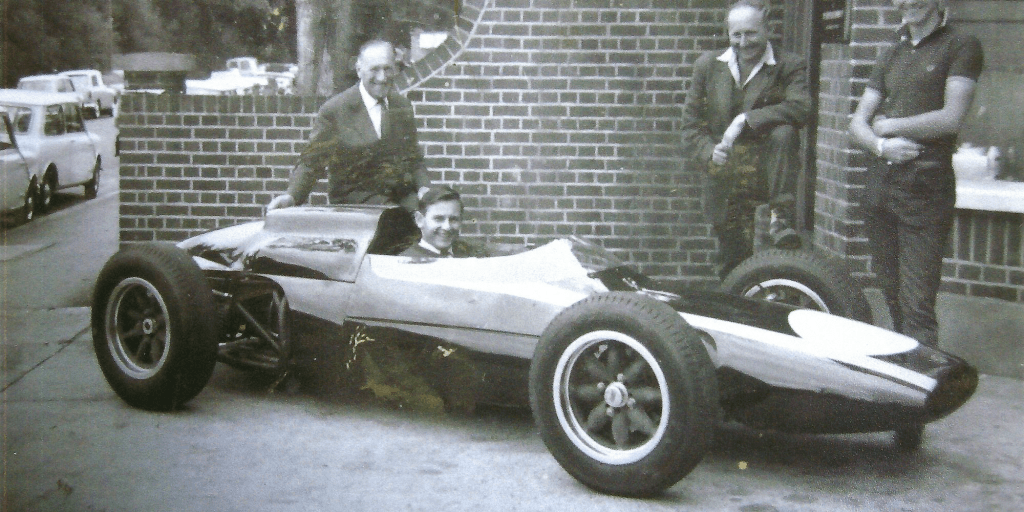
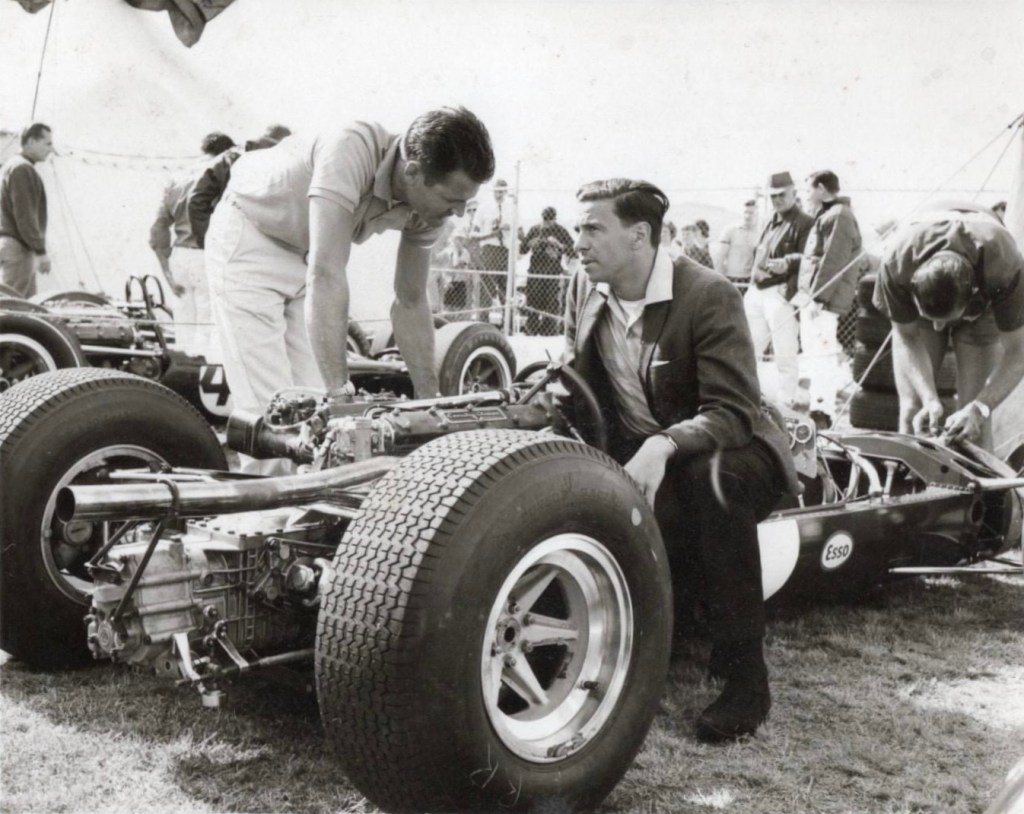
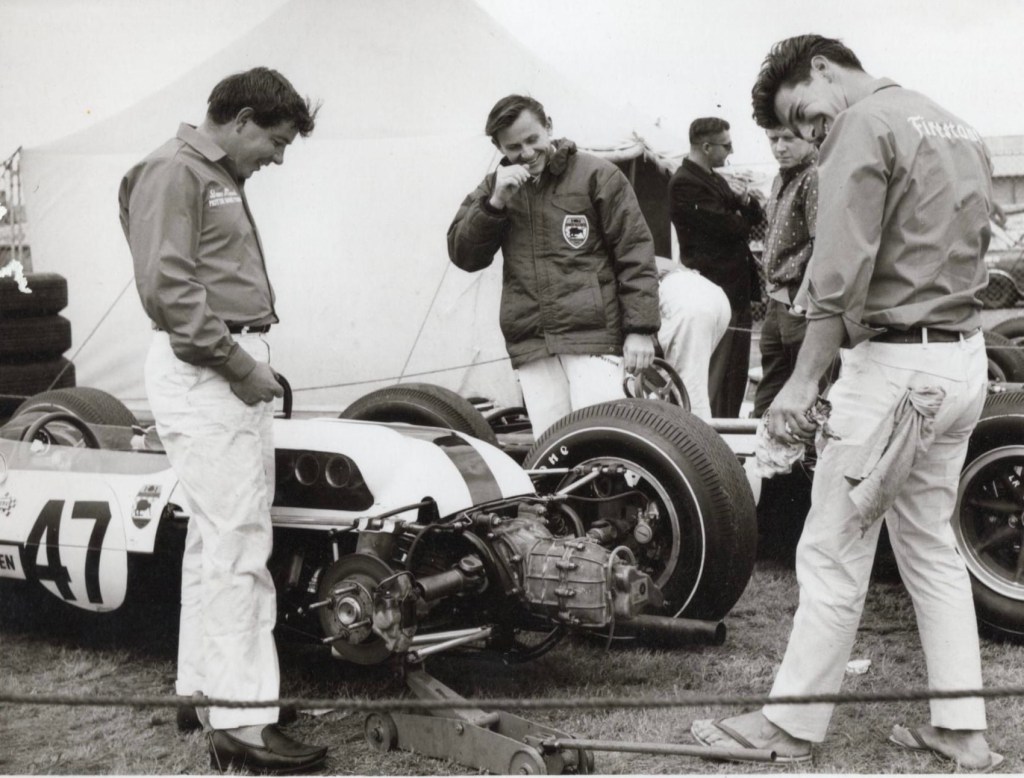
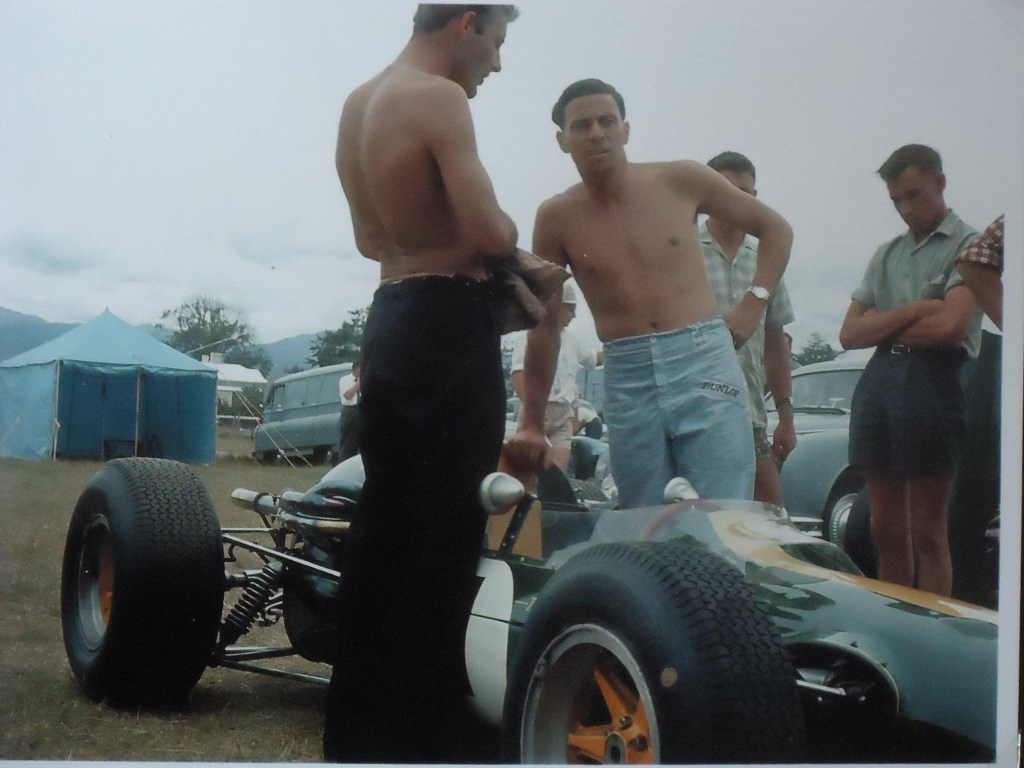
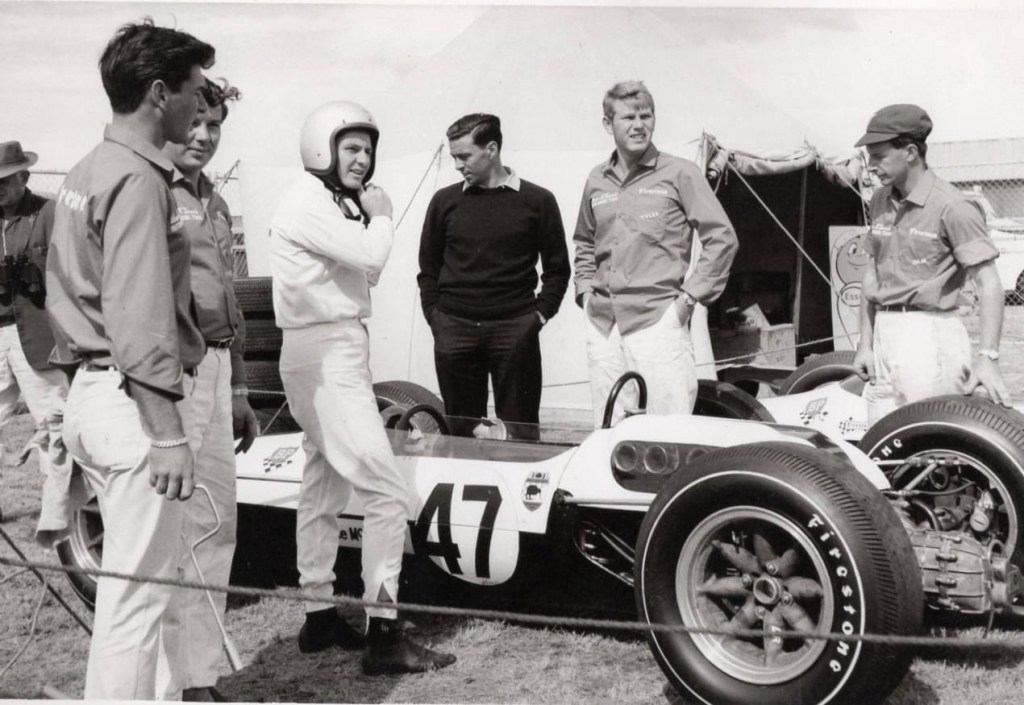
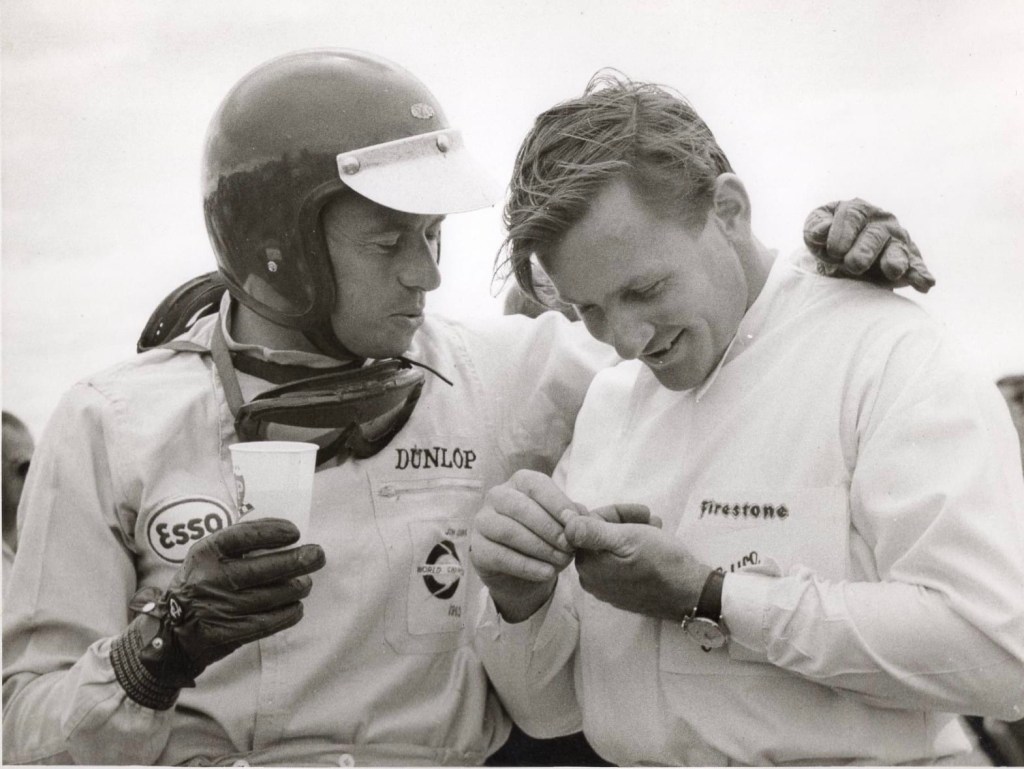
Pop McLaren and who folks?
Credits…
Rosalie Stuart, Graham Woods Collection, Merv Knowles, Bruce McLaren Trust via Jim Bennett, Kelvin Brown, Milan Fistonic, National Library of New Zealand
Master Mechanic Geoff Smedley made a pretty fine part-time photographer while fettling racing cars for the likes of John and Gavin Youl.
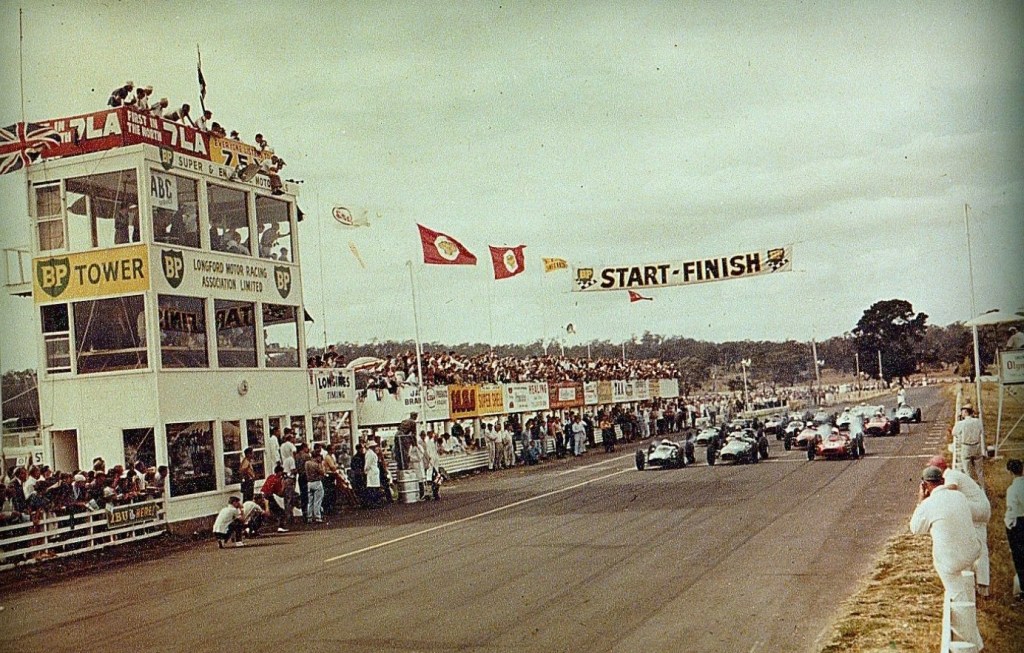
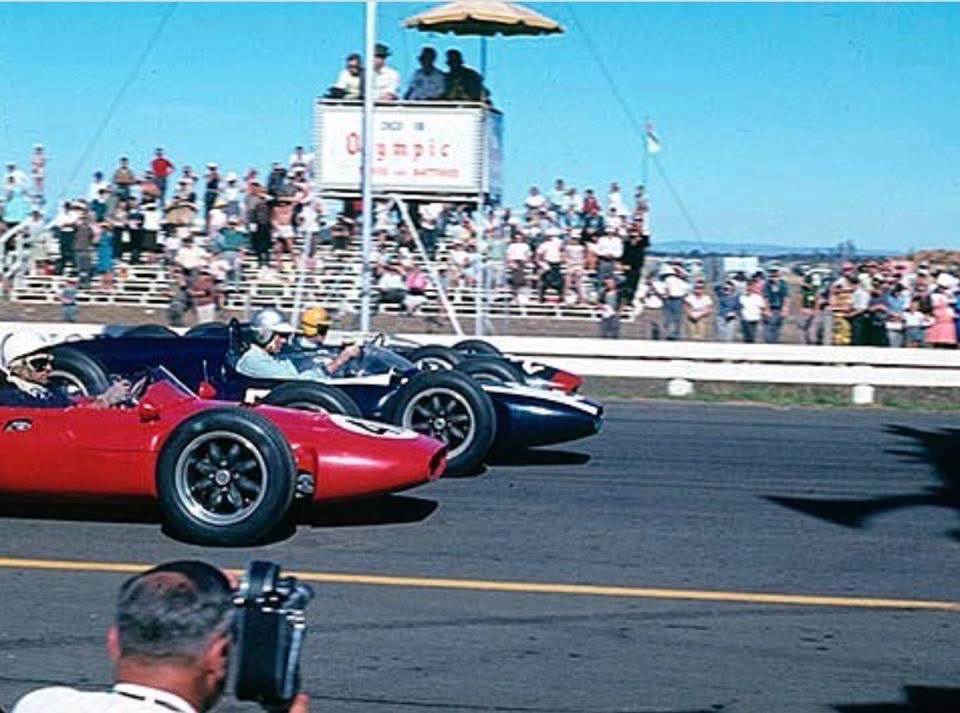
The 1963 South Pacific Championship has just got underway at Longford on March 4. Bruce McLaren is on pole in his Cooper T62 Climax at left with Bib Stillwell’s new Brabham BT4 Climax in the middle and Lex Davison’s Cooper T53 Climax on the right.
McLaren won the race comfortably from Bib Stillwell after Bruce’s dice with Jack Brabham’s leading BT4 Climax 2.7 ended with engine failure on lap 14 John Youl was third in his Cooper T55
Bruce McLaren on his way to winning the 1962 Australian GP, Caversham, Western Australia, Cooper T62 Climax (K Devine)Jack Brabham debuts the BT4 Climax, Caversham AGP, November 1962. BT4 #IC-1-62 was the first in a long line of very successful, profitable ‘Intercontinental’ Brabhams from Ron Tauranac
Context…
The Cooper vs Brabham Australasian summer was set during the 1962 Australian Grand Prix, November 18 weekend at Caversham, outside Perth, when McLaren’s new Cooper T62 Climax and Jack Brabham’s equally new Brabham BT4 Climax faced off for the first time. A fantastic dice between Bruce and Jack that day was resolved in McLaren’s favour after a passing he-zigged-when-I-zagged manoeuvre between Brabham and Arnold Glass’s BRM P48 Buick V8 went awry.
Both machines were inspired by their Coventry Climax FWMV 1.5-litre V8-powered Grand Prix siblings: the Cooper T60 and Brabham BT3. By the time the eight-race Tasman Circus travelled to Warwick Farm, round five, the weight of numbers favoured Jack Brabham and Ron Tauranac’s Motor Racing Developments business with BT4s in the hands of Brabham, David McKay, who had bought Jack’s ’62 AGP car’, and Bib Stillwell, who had acquired a newie.
McLaren and the business end of his Cooper T62 FPF, Caversham 1962, with David McKay, Cooper racer/writer/later Scuderia Veloce supremo, showing more than cursory interest in the car given his pending car update considerations (T Walker)BT4 Tim Wall, Jack Brabham and Repco Indy 2.7 in the Sandown paddock. By then, Repco’s Michael Gasking was preparing Jack’s Tasman FPFs, and Repco was or were soon to be the Australian importer/distributor of Coventry Climax spares (Repco)
Bruce won two of the four Kiwi rounds at Wigram and Teretonga with his Cooper T62, while John Surtees won the NZ GP at Ardmore in an ex-F1 Lola Mk4A Climax 2.7, with Jack taking a Levin win in his BT4.
The additional power and torque from 2.7-litre Coventry Climax FPF Indy four-cylinder engines were causing a great deal of driveline stress to gearboxes, clutches and driveshafts.
At Warwick Farm, Brabham won in his new BT4-IC-2-62 from Surtees’ Lola Mk4A, McLaren and McKay in his first race of the ex-Jack BT4-IC-1-62 with Stilwell fifth in his new BT4-IC-1-63; all cars powered by Indy 2.7s.
At Lakeside on February 17, Surtees won from Graham Hill’s Ferguson P99 Climax 2.5 FPF and Stillwell. It was a great shame that the Ferguson went home at this point, we Victorians and Taswegians didn’t get to see it. McLaren spun and could’t restart while Jack was a no-show. It was an even greater shame the Fergy didn’t arrive in New Zealand with a pair of 2.7-litre FPFs…
Then Bruce won at Longford and at Sandown Park on March 10, so McLaren and Cooper won the 1963 Faux Tasman Cup. Jack was a DNF with engine failure with Tony Maggs in the other Bowmaker Racing Lola Mk4A Climax 2.7 second and McKay third.
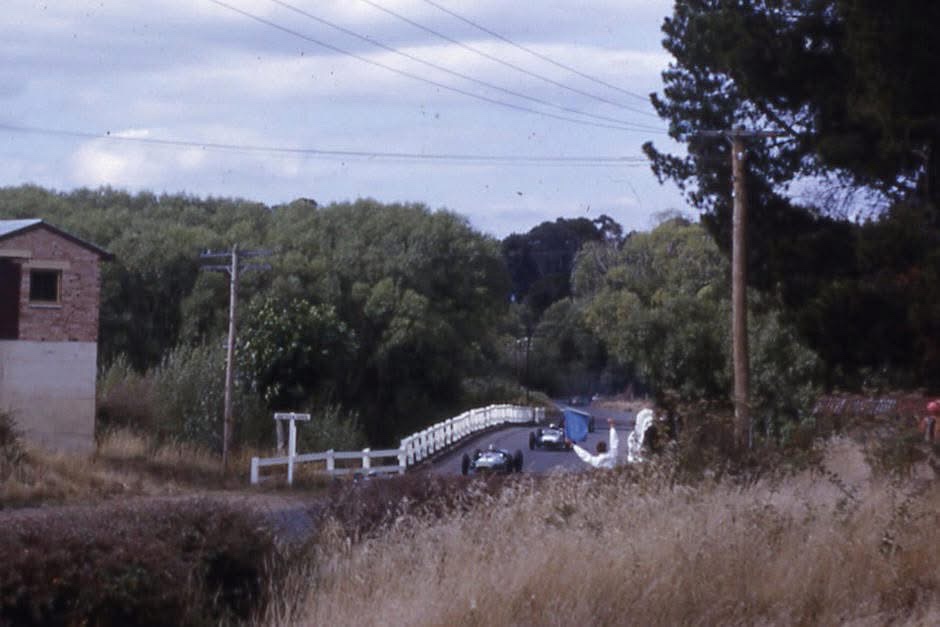
Lex Davison turns into the exit of Long Bridge, closely followed by John Youl, Coopers T53 and T55. Lin Gigney, the snapper of many of these shots, was a flaggie right here… (L Gigney)
Longford…
Down in the South Island Lex Davison was having a whale of a time in the Cooper T53 John Surtees used to win at Longford in 1962! He won both the Saturday 45-mile Formula Libre preliminaries, the first from Bib Stillwell and John Youl after Bruce McLaren retired from the leadership of the race with a broken universal joint.
The second Saturday race also fell to Melbourne’s famous cobbler, from Chris Amon, Cooper T53 Climax 2.5 and John Youl, Cooper T55 Climax 2.5. McLaren didn’t start this race; Brabham did, but then had carburettor problems during lap two that caused his retirement.
Lex Davison, Ford Galaxie – what a massive bit of real estate! – from Ern Abbott Chrysler Valiant on Long Bridge (L Gigney)
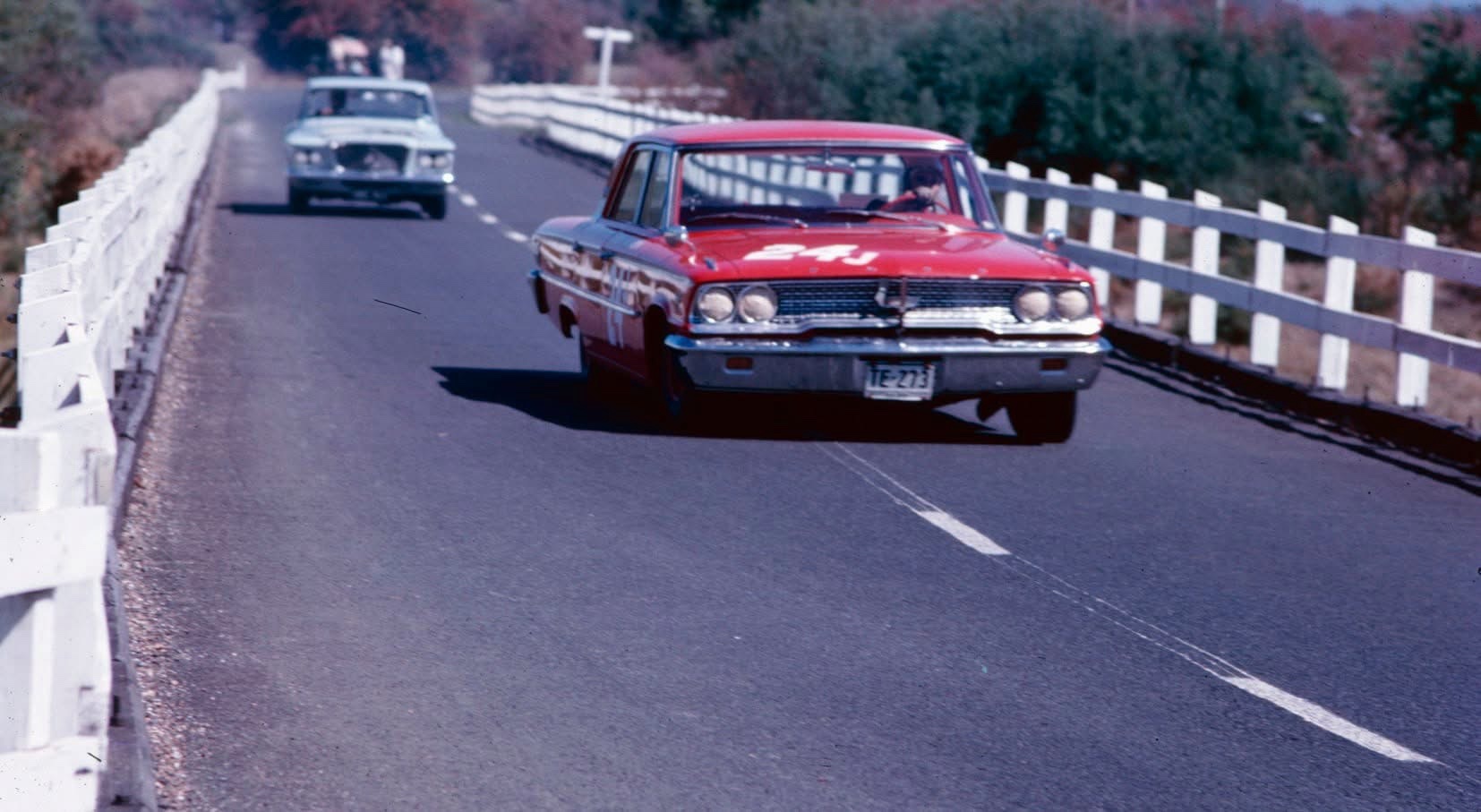
On top of that, the staunch traditionalist continued his flirtation with touring cars, finishing second in the 45-mile Touring Cars Championship aboard Len Lukey’s Ford Galaxie behind Bob Jane’s then-dominant Jaguar Mk2 3.9, with Ern Abbott’s Chrysler Valiant 3.9 in third.
The Jag was timed at 142mph on The Flying Mile, the Galaxie did 141mph in an experience Davison told Autosport reporter FGN Ewence as ‘Like Driving a Haystack.’ Ewence wrote that ‘It came out of corners as though they were launching pads, but its braking and handling let it down.’
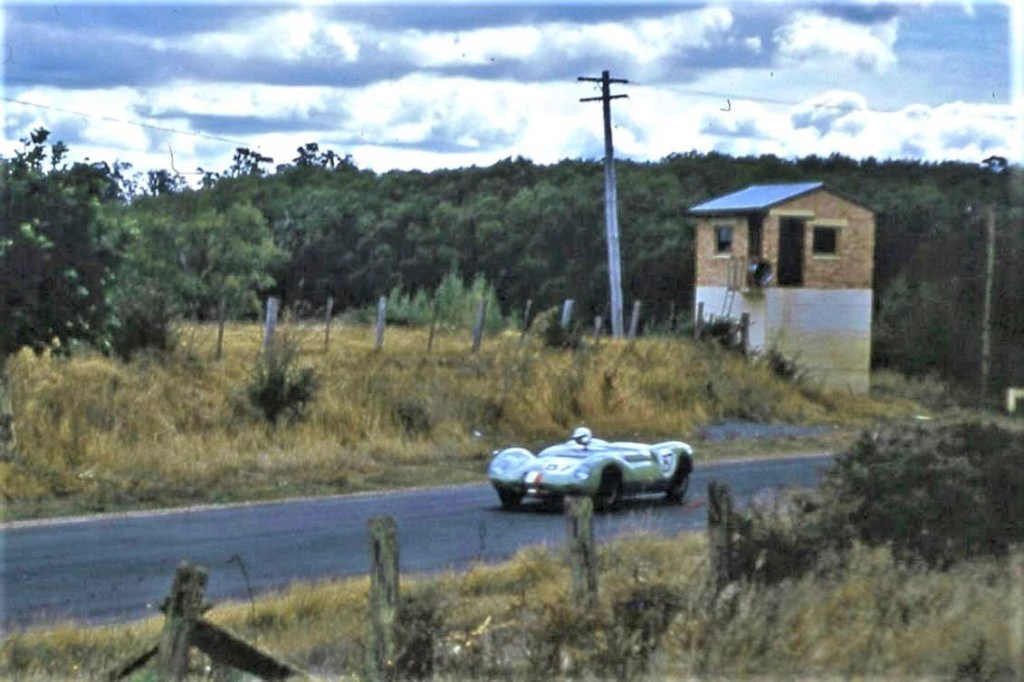
Frank Matich, Lotus 19 Climax, having just exited Kings Bridge and passed the irrigation water pumphouse (B Wright)
Bigger FPFs were fitted to Australian sports cars as well, notably Bib Stillwell’s Cooper T Monaco and Frank Matich’s Lotus 19, with FM winning the 45-mile Sports and GT Cars Championship from Stillwell and Bob Jane’s Jaguar E-Type.
Matich pushed his own lap record up to 108mph and was chuffed enough about the pace of his Lotus two-seater that he entered it in the Formula Libre feature.
Friday qualifying comprised two sessions, one in the morning and another in the afternoon. The quicks were McLaren on 2:23.3, McKay 2:27.0, Davison on 2:27.3. Of Davo, Ewence recorded that ‘Alan Ashton, got the 2.7 Climax to its bellowing best, and his wider wishbones had improved the car’s stability, and he had the brakes to a pitch which enabled Davison to rush up on his opponents as they approached corners.
Youl did a 2:27.4. Ewence noted that John’s Cooper ‘was handling much better following extensive modifications to the suspension, including widening of the track.’ Geoff Smedley was the engineer/mechanic involved.
Jack Brabham lines up his BT4 for the very strong timber Long Bridge exit clipping point! (L Gigney)
Brabham didn’t arrive from London, then Sydney, and on to Launceston until after 11am on the Friday morning and then spent most of the day chasing engine problems. Refer to the Climax twin-plug note in Etcetera.
The top three grid slots from times recorded in Saturday’s two races noted above were McLaren, Stillwell and Davison. Then came Maggs, McKay and Brabham, then Youl, Chris Amon, Jim Palmer, and the rest. The only starters from this race still alive are, I believe, Bob Holden, who raced his 1.5-litre Lynx Peugeot Formula Junior from grid 15, and Jim Palmer.
The Race…
Raceday at Longford was always on the Monday Labour Day holiday. There was no racing on the Sunday, giving plenty of time for dramas to be sorted: Jack’s engine, McLaren’s uni and driveshaft, Gardner’s clutch, Magg’s engine mount, etc. Bruce McLaren noted in his March 15, 1963 ‘From The Cockpit’ Autosport column how busy Repco Launceston and Merv Gray’s engineering shop were over that weekend.
(HRCCT)
The rear of the grid (above) before the South Pacific Championship, showing #87 Frank Matich Lotus 19 Climax, #13 Bob Holden Lynx Peugeot 1.5, on the next row is Frank Gardner’s Brabham BT2 Ford FJ, which is sandwiched by Tony Shelley’s Lotus 18/21 Climax against the pits and Peter Boyd-Squires Cooper T45 Climax. The white #9 Cooper T51 is Bill Patterson, and alongside him is the #3 Cooper T53 of Jim Palmer. Then Chris Amon in the red Cooper T51 #14 with John Youl alongside, Cooper T55 Climax and an obscured Jack Brabham in his BT4. On the second row is David McKay’s Brabham BT4 Climax and an obscured Tony Maggs’ Lola Mk4 Climax with Davison, Stillwell and obscured McLaren up the front.
(unattributed)
South Pacific Championship 3-2-3 grid, 14 starters, Longford, Monday, March 4, 1963.
Bruce McLaren Cooper T62 2.7, Bib Stillwell, Brabham BT4 2.7 and Lex Davison, Cooper T53 2.5, then on row two, Tony Maggs, Lola Mk4 2.7 and David McKay, Brabham BT4, on the third row, we can get a glimpse of Chris Amon’s Cooper T53 2.5 near the fence, and #5 John Youl’s Cooper T55 2.5 alongside.
All of the engines were Coventry Climax FPF, whether John Youl was using his Geoff Smedley-developed twin-plug, twin-Magneto 2.5, I don’t know.
David McKay, Brabham BT4 from Tony Maggs, Lola Mk4, Long Bridge (L Gigney)
F.G.N Ewence reported that it was a great first lap for the Brabham marque with the three of them leading in line astern across Long Bridge. David McKay’s run was short-lived with leaking cylinder head sealing rings; he only compltetd the first lap.
Brabham sat behind McLaren then he took the lead on lap 10, with Bib Stillwell third, but four laps later Jack’s run came to nought with the BT4 puffing plumes blue smoke of increasing volume on The Flying Mile, then through Mountford and into the pits. The ‘manifold leak’ caused a pit fire which was quickly extinguished with Jack leaving an oily calling card at Mountford that caused others some grief.
Brabham from McLaren on Kings Bridge, circa laps 10-14. The Viaduct is some way behind them, beyond the trees, with Longford village in front (Bob Wright)
Bruce took the lead back, having done the fastest lap of the race at 114mph on lap 13 in pursuit of Jack. He then modulated his pace to keep ahead of Bib Stillwell and John Youl. Bill Patterson was fifth behind Jim Palmer’s Cooper T53, and Tony Maggs demonstrated his professionalism by bringing the Lola home sixth despite being liberally coated with engine oil that escaped from a crack in the chassis tube, which conveyed the slippery stuff to and from engine and radiator.
(P Longley)
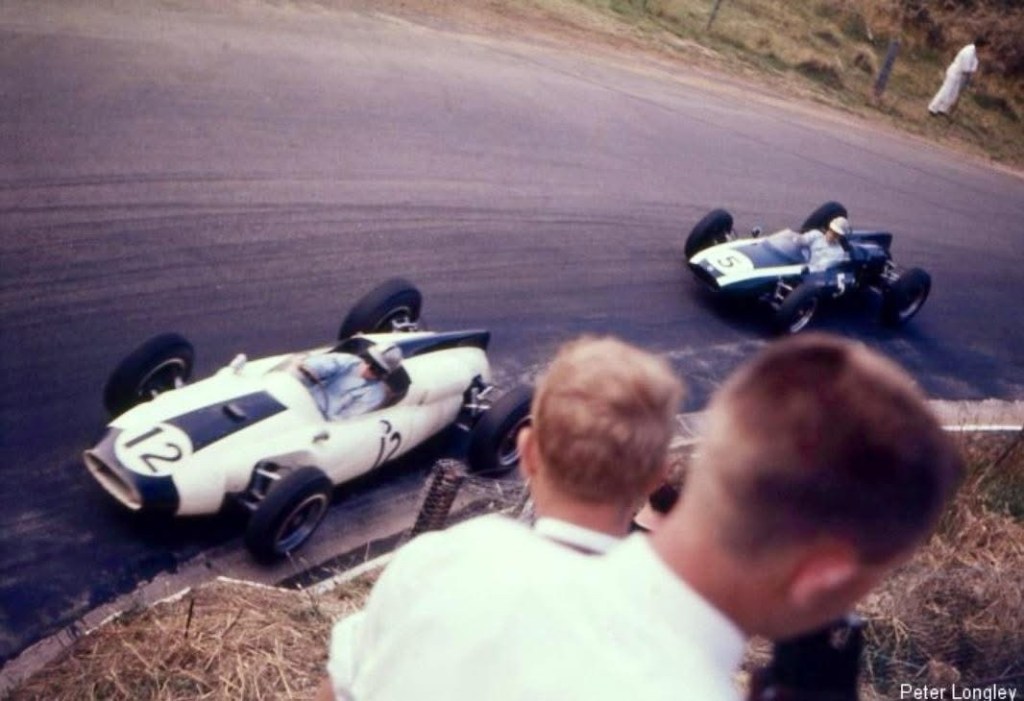
This scrap between Kiwi, Jim Palmer, Cooper T53 Climax and local boy, John Youl, Cooper T55 Climax was over third place, an argument resolved in Youl’s favour.
Palmer was a multiple Kiwi Gold Star Champion, a Tasman Cup perennial whose best placings were fourth in 1966, ex-Clark Lotus 32B Climax and equal fourth with Phil Hill in 1965, Brabham BT7A Climax. Youl was ‘one who got away’, the incredibly gifted driver was fourth in that old T55 in the ‘ 64 Tasman before taking up family farming responsibilities at their Symmons Plains property, not too far from Longford.
(R Bell)
Bruce McLaren receives the plaudits of the Longford crowd from atop the Viaduct, he had a good summer in his Cooper T62 Climax, winning the 1963 Faux Tasman Cup, then came back in ‘64 and won the real one!
The views of experienced outsiders is always an interesting perspective. Here is Ewence’s race report Postscript in full.
‘Postscript: Despite the fact that the Longford Motor Association has no paid officials, it is limited by a lack of population. The whole State of Tasmania has only 350,000 inhabitants. To get 30,000 of them to a meeting is equivalent to an attendance of some four million at a British meeting! This makes the £20,000 budget something of a nightmare for the L.M.R.A. The two previous years’ operations had resulted in losses after necessary capital expenditure was met. This year, the hats went in the air when Treasurer Geoff Hudson’s casting of accounts revealed a small profit. Longford will be on again next year, and State Premier Reece seemed so upset about an interruption caused by a passenger train at the level crossing in Longford township that those on the inside believe that the trains will be very strictly controlled in the future.’
Etcetera…
(oldracephotos.com)
The start of one of the 45-lap preliminaries with Lex Davison on this side, then John Youl, and Tony Maggs in the yellow helmet. Davo won them both.
(Andrew Lamont)(W ‘i anson)
Bruce McLaren’s unpainted Cooper T62 Climax at Goodwood for a test session on September 26, 1962 not long before the car was shipped to Fremantle, Western Australia for the 1962 Australian GP at Caversham.
McLaren’s T62 – #CTA/BM/2 – was built on Cooper’s T60 1961-63 jig by Tommy Atkins’ team at his Chessington workshop. Harry Pearce and Wally Willmott were the artisans who built the car. The rear was designed to take a BRM P56 1.5-litre F1 V8; Bruce planned to contest the non-championship F1 races that Coopers chose to ignore. When that engine ran late, Atkins and McLaren decided to convert the car to Climax Tasman spec, gearbox, and a Colotti T32 five-speed.
Tommy Aktins, Harry Pearce, partially beheaded Wally Willmott and completed T62 at Coopers in Hollyfield Rd, Surbiton (W i’ anson))Geoff Smedley’s Coventry Climax 2.5 FPF twin-plug on the Repco Research dyno in November 1963 (G Smedley)
Bruce McLaren (Eoin Young ghosting Bruce) wrote in ‘From The Cockpit’, ‘Brabham’s car was the centre of interest, sporting an 8-plug head. This was a very impressive looking set-up, but it must have been firing the right plug at the wrong time or the wrong plug at the right time, because he had a lot of trouble getting it to run right.’
‘That was Friday. The Saturday morning practice was kind to most of us except poor Jack again. The Brabham was smoking a lot more than a young car should, and he had to rush back to Launceston to take the engine out and fit his spare 2.7 Climax for the races in the afternoon..
Those with a keen memory may recall that Geoff Smedley developed a race-winning 2.5-litre Coventry Climax twin-plug in Tasmania for John Youl. That engine, with the necessary sparks provided by twin-magnetos, was first raced by Youl fitted to his winning Cooper T55 in the October 14 1963, Gold Star round at Mallala. The engine was then used in the ’64 Tasman, in which Youl finished fourth in that ageing Cooper behind Bruce’s new Cooper T70, Brabham’s new BT7A and Hulme’s year old BT4. Youl and Smedley’s was a mighty effort!
In it, Geoff recalled that ‘Frank Hallam at Repco Research had been playing around with a twin-plug head for one of Brabham’s engines, using two distributors driven from the rear of each cam bank and couldn’t make it work through an inaccurate spark which was put down to windup in the camshafts in the high rev range.’
So it seems the Repco FPF twin-plug was tested over the Longford ’63 weekend. I wonder whether Jack tried it elsewhere? Does anybody know what became of that pair of twin-plug heads?
Credits…
Geoff Smedley, Bob Wright via Kay Wright, Andrew ‘Slim’ Lamont Collection, Historic Racing Car Club Tasmania, Ray Bell, Terry Walker, Ken Devine, Repco. The detail in this article is via Paul Cummin’s archive, specifically F.G.N Ewence meeting report and Bruce McLaren’s ‘From The Cockpit’ column published in Autosport, March 15, 1963, Willian i’anson Ltd, Geoff Smedley, Stephen Dalton
Tailpiece…
(E French)
One of the men of the weekend, Lex Davison, had gear-selector problems on his sixth lap with his Cooper T53 and is shown bumming a ride from Bruce McLaren, who is just starting the Newry ascent. Ewence reported that Davo ‘Broke down near the pub, where last year he had so spectacularly lost his first 2.7 Cooper in a 130 m.p.h skid. “Why hello, Mr Davison, back again?’ remarked the landlord’s wife as he entered the portals.’
Davo famously wore his cloth helmet under his real one throughout his career. Lex turned 40 on February 12, 1963, and was still mighty fast indeed!
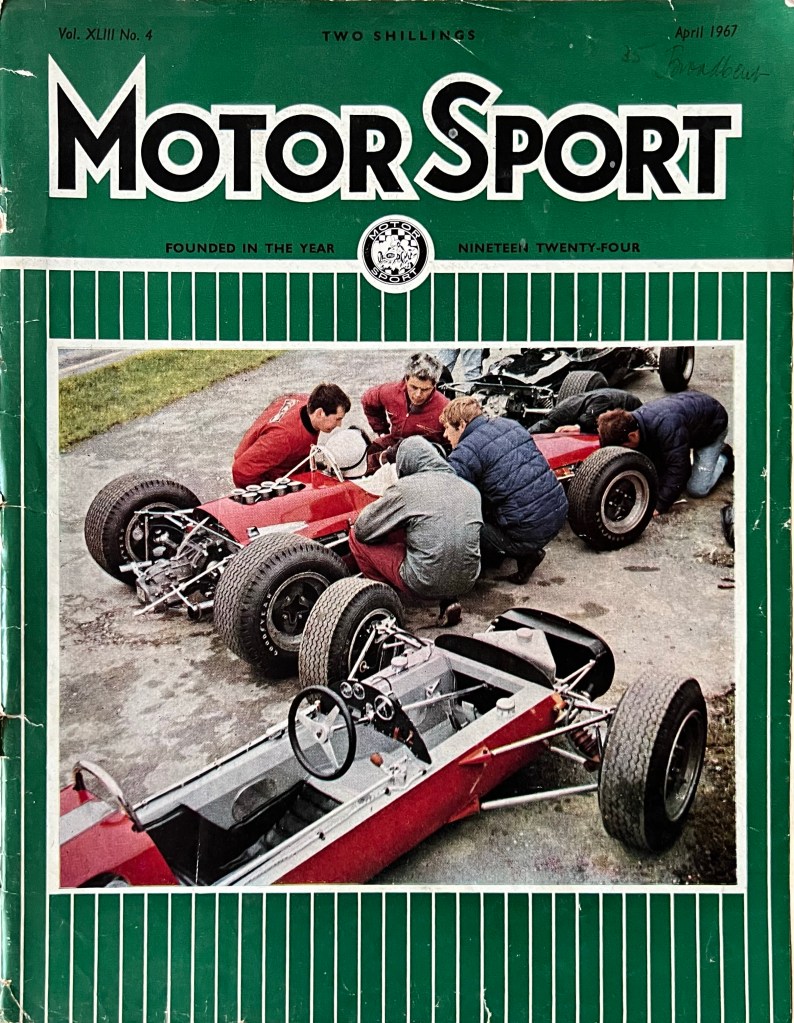
How often do you see Bruce McLaren and his boys gathered around to hear his assessment of the latest bunch of tweaks?
Motorsport’s caption, “The McLaren team are seen during a private practice session with Bruce McLaren seated in his new F1 car with B.R.M. V8 engine – McLaren M4B BRM P111 2.1-litre V8 – holding conclave with Robin Herd (designer) and Mike Barney (mechanic) on his left, and technicians Charlie Scarrano and Tyler Alexander on his right. On their knees at the front of the car are Wally Willmott and Gary Knutson.’ : https://primotipo.com/2016/10/07/mclarens-19667-f1-cars/ ‘
‘In the foreground, less its nose cowling is one of the 1967 F2 cars of the McLaren team. The cars are painted red because “our sports cars were red, and they seemed to go pretty fast” to quote McLaren.’ It’s Bruce’s 1967 F2 weapon, McLaren M4A-1 Ford FVA, another Robin Herd/McLaren collaboration.
He first raced the M4A at Snetterton on March 24. The Guards 100 was the first round of the European F2 Championship – the first ever round of a European F2 Championship – where Bruce was fifth in the race won by F2 King, Jochen Rindt’s Brabham BT23 FVA, very much the story that year! See here: https://primotipo.com/2019/11/02/the-wills-barc-200-f2-silverstone-march-1967/
Etcetera…
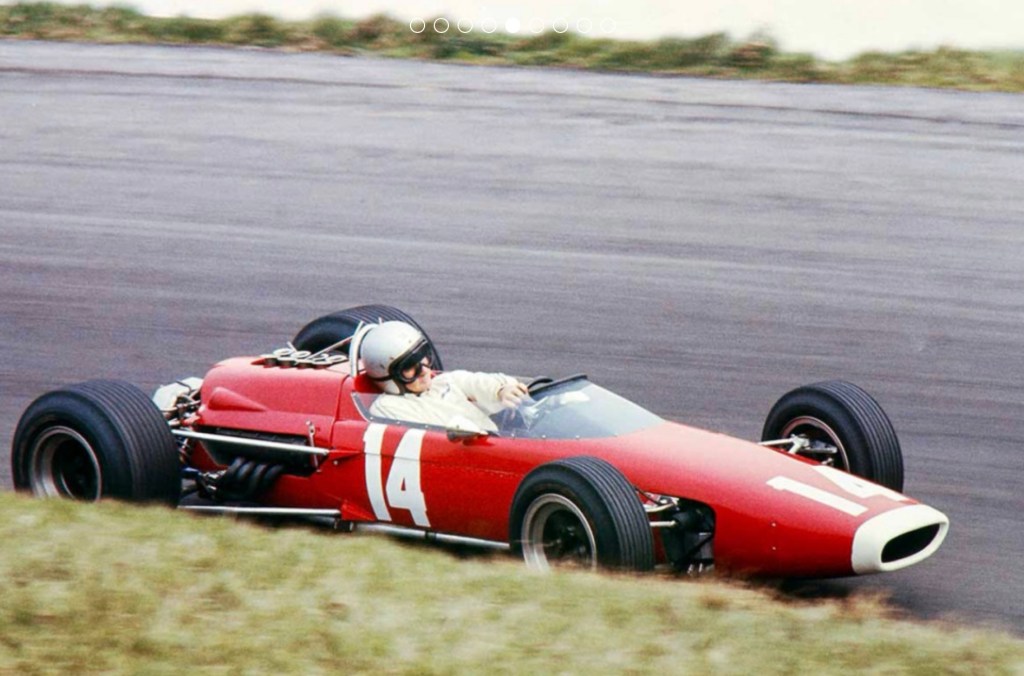
McLaren M4B BRM, Oulton Park Spring Cup, April 15, 1968 (enwheels.org)
McLaren had contracted to run BRM’s new customer 3-litre V12 in 1967 and built the M4B powered by the tried and true Tasman spec 2-litre V8 as a stop-gap pending the twelve’s delivery.
The car used a modified M4A chassis cut away to accommodate the bulkier V8 rather than the FVA for which it was designed. The fuel capacity was increased, too.
M4B-1 at Monaco in 1967. Note the short ‘Monaco-nose’ and additional tankage for 200 mile Grands Prix now fitted (enwheels.org)
Bruce raced the car five times: in the March Race of Champions at Brands Hatch DNF, the April Spring Cup at Oulton Park, fifth, and the BRDC International Trophy at Silverstone in late April where he was again fifth, at Monaco, where he was a splendid fourth behind Denny Hulme’s Brabham BT20 Repco, Graham Hill’s Lotus 33 BRM 2-litre and Chris Amon’s Ferrari 312.
(enwheels.org)
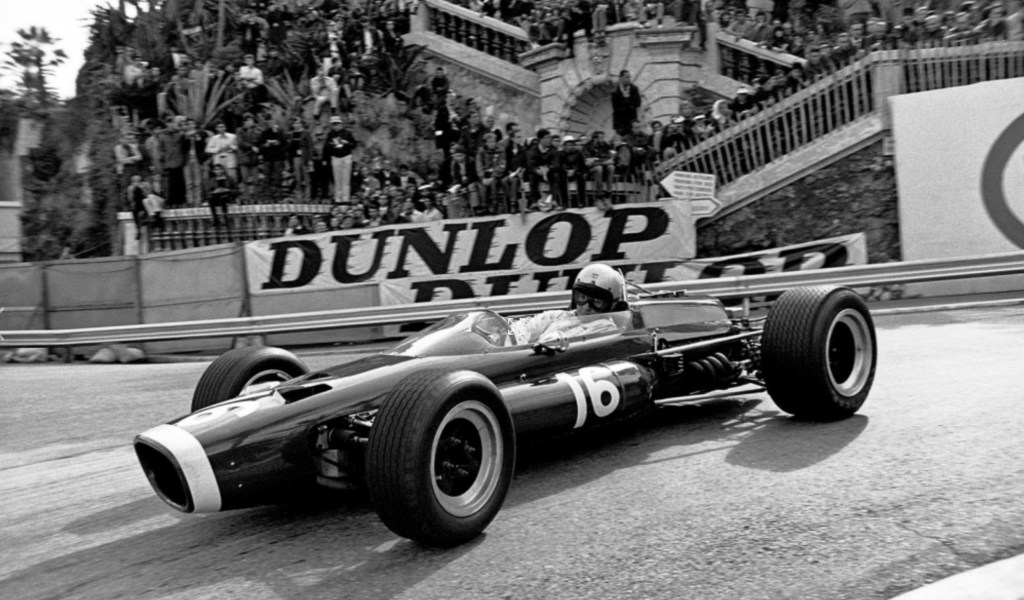
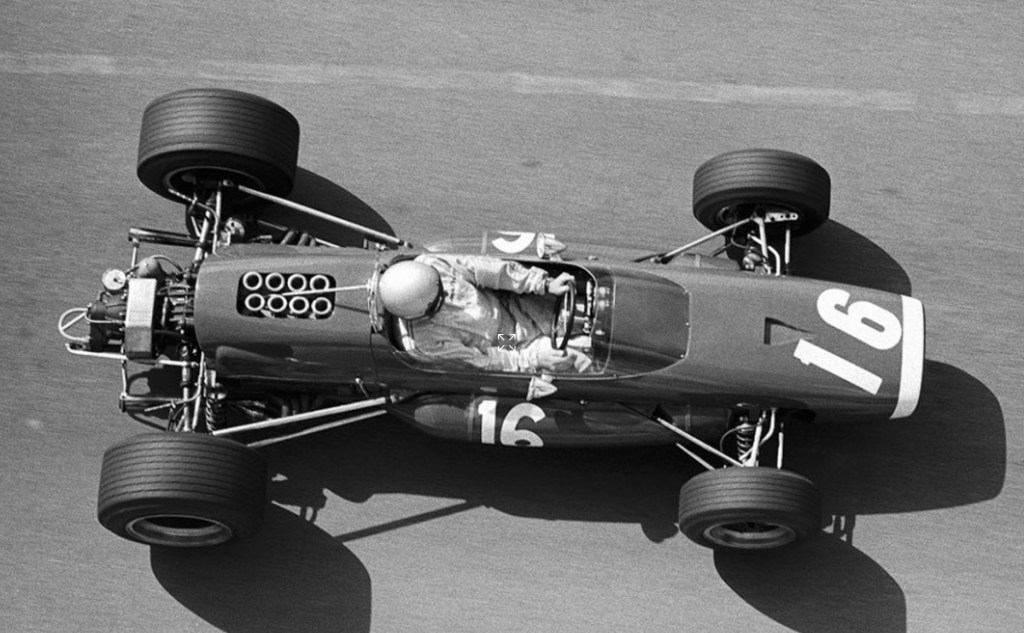
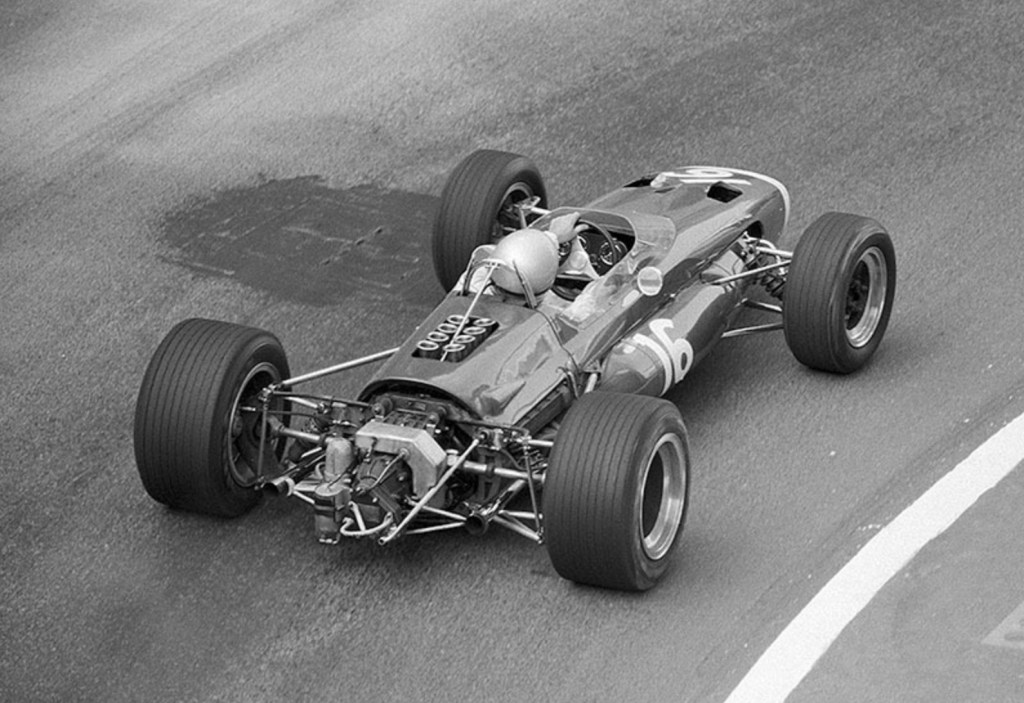
In Monaco (#16 shots), Bruce was fourth, and in the Dutch GP, he crashed; the car was then written off in a testing accident at Goodwood.
Tyler Alexander at left with Phil Hill’s Bruce McLaren Motor Racing Cooper T70 Climax FPF 2.5 at Pukekohe, Auckland during the January 9, 1965 New Zealand Grand Prix meeting. Car #17 is John Riley’s Lotus 18/21 Climax.
This car was an updated version of a chassis Bruce and the late Tim Mayer raced the year before – T70 FL-1-64 – while The Chief raced a new design designated the T79: T79 FL-1-65. It’s pretty familar turf to us, see here: https://primotipo.com/2016/11/18/tim-mayer-what-might-have-been/
(D Shaw)
That’s the chassis of the T70 above at Pukekohe – with a Brabham BT4 in the foreground – while Bruce is settling himself into the T79 at Levin, the second Tasman round below.
Bruce and Jim Clark collided in one of the Pukehohe heats. While Jim started the GP in his works Lotus 32B Climax, Bruce’s Cooper’s T79 was hors d’combat for the weekend, so he commandeered Phil’s T70 but succumbed to gearbox failure after 13 of the race’s 50 laps. Clark lasted only 2 laps before suspension problems, leaving Graham Hill to win the race aboard his Scuderia Veloce Brabham BT11A Climax.
(unattributed)
McLaren was fifth at Levin, with Jim Clark’s Lotus 32B Climax the race winner. Jim was the Tasman Cup victor too, with four wins from the seven championship rounds or five wins from eight races, including the Lakeside 99 non-championship round. Not to forget, however many heats Clark won.
Bruce’s Tasman plans were thrown somewhat up in the air. The two Coopers were designed around 13-inch Dunlops but Bruce had signed a contract with Firestone for supply of tyres. Defining though the deal was commercially, in the short term the hard, American 15-inch covers were shite for road racing.
The bigger wheels resulted in handling problems which would normally have been sorted before the long trip south. As it was, the necessary makeshift modifications were made between races.
NZ GP at Pukekohe, Bruce didn’t start the T79 having collided with Jim Clark in a heat. Note the Hewland HD 5-speed transaxle and tall Firestones (D Shaw)(unattributed)
The Levin International start on January 16, with Phil and Bruce alongside Clark despite problems adapting Bruce’s new Firestone tyres to a chassis designed with Dunlops in mind.
Despite these difficulties McLaren did Wigram and Teretonga races in faster times than those which gave him his 1964 victories.
In Australia, once 13-inch wheels were available, McLaren was fourth at Sandown and won the Australian Grand Prix final round at Longford from pole to finish the Tasman series runner-up to Clark, while Phil Hill was a well-merited third. There is no doubt that if pre-trip testing time had been on their side, the Cooper-Climax drivers would have made a much better showing in New Zealand.
Pop McLaren, Wally Willmott, Bruce Harre, Bruce McLaren, Jim Clark, Tyler Alexander and Colin Beanland David Oxton informs us, in the Wigram paddock, over the January 23, 1965 weekend.
Showing real progress, McLaren, below, was second to Clark’s Lotus with the well-driven Brabham BT7A Climax of Jim Palmer in third.
(CAN)(A Horrox)
Teretonga, above, was better still with a team two-three – McLaren from Hill – but Jim Clark was still the man in the front of the field with three wins on the trot, only Graham Hills Scuderia Veloce Brabham BT11A Climax win in the New Zealand Grand Prix at Pukekohe at the start of the month ‘rained on Jimmy’s Lotus parade.’
(K Wright)
Bruce McLaren leads Graham Hill and Jack Brabham early in his victorious run in the AGP into Longford village: Cooper T70, and Brabham BT11A’s by two, all Coventry Climax FPF 2.2-litre powered. McLaren and Brabham below.
(GP Library)(MotorSport)
Every Dog Has its Day – perhaps every car too!
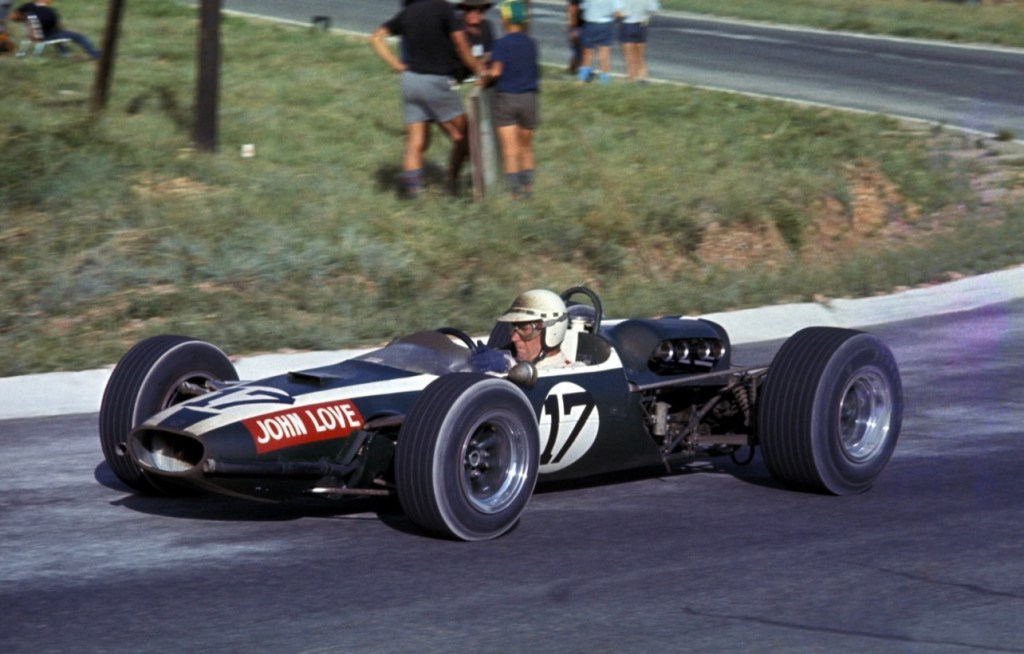
At the end of the Tasman, Bruce McLaren sold the T79 to South African ace, John Love. The shot above shows him on the way to a brilliant second place in the 1967 South African Grand Prix.
The machine was a star-car in Africa, winning the 1965, 1966 and 1967 South African National F1 Championships, co-credits to Love’s Cooper T55 Climax and Brabham BT20 Repco in 1965 and 1967 duly noted.
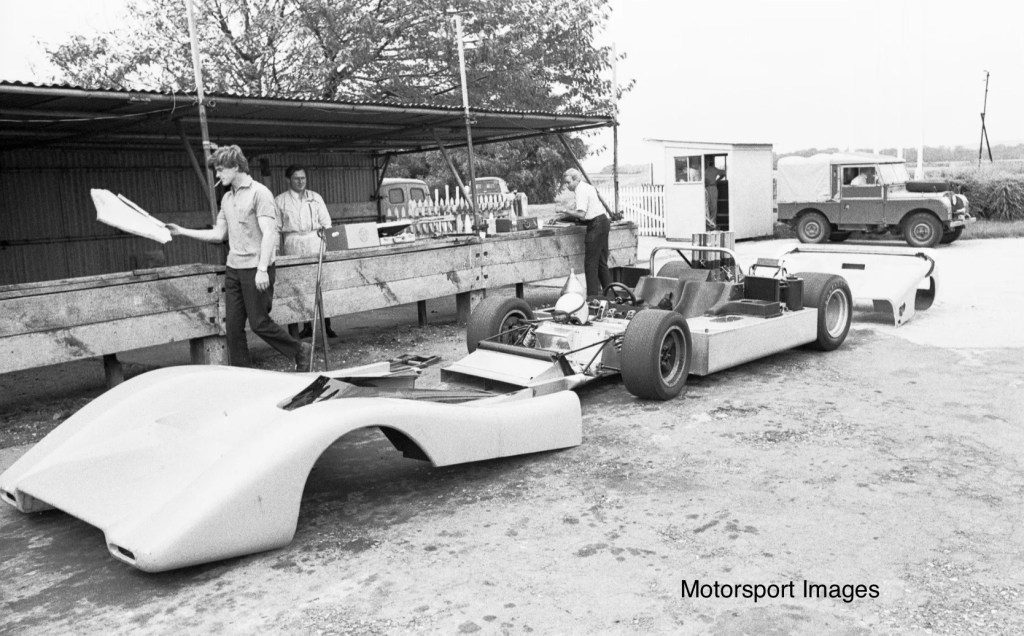
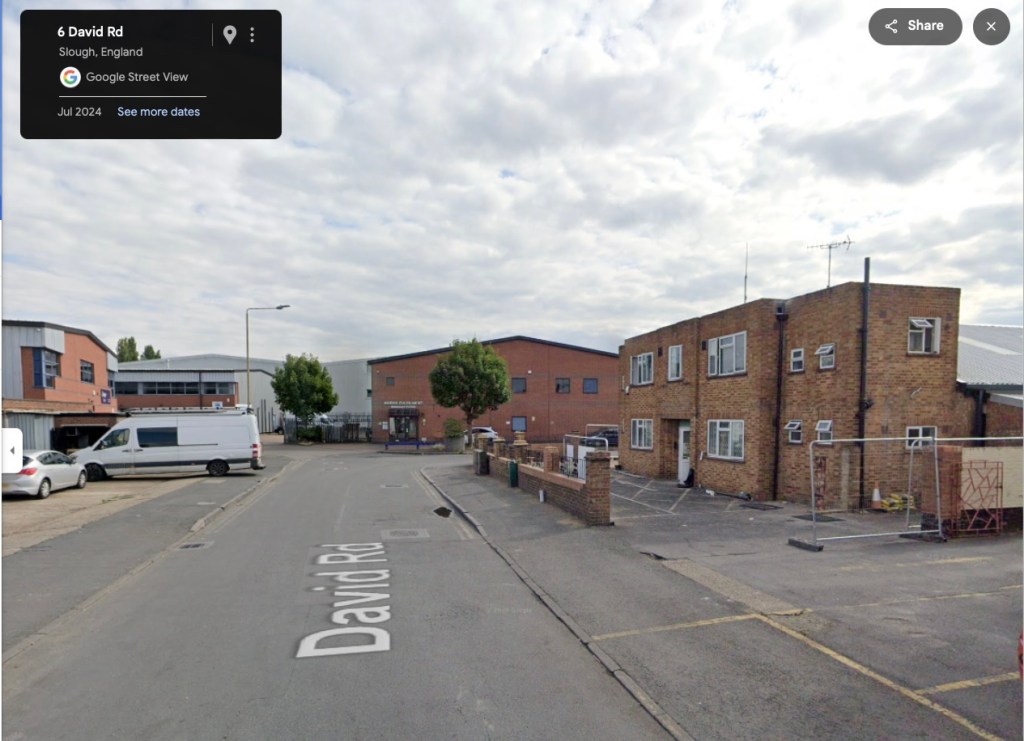
‘It’s the first McLaren M8A Chev outside McLaren’s David Road factory in Colnbrook,’ Derek Kneller recalled.
‘I was a fabricator working with Don Beresford, John Thompson and George Begg on the M8As. The shot was taken on my Polaroid camera when the first body was fitted.’
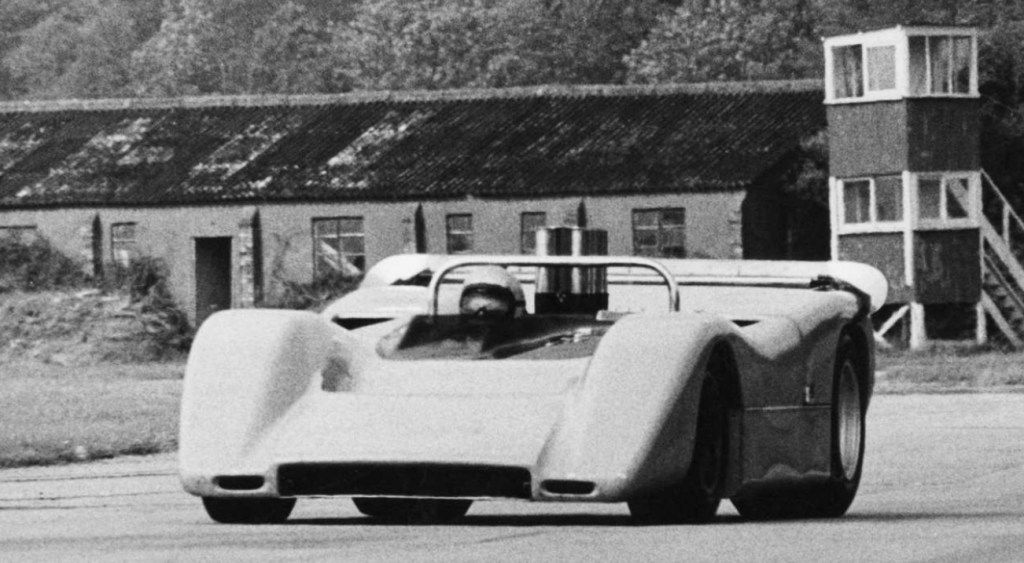
The shot below of Alistair Caldwell, Bruce McLaren and Teddy Mayer testing the car at Goodwood in July 1968 dates Derek’s shot. The car is still not fitted with mirrors, but does have a small spoiler on the rear bodywork, so perhaps a day #1 or day #2 test…
(goodwood.com.)
Bruce blasting past the Super Shell Building at Goodwood, what is that material going across the back of the car from wheel arch to wheel arch?
It wasn’t a bad season, McLarens won all six Can-Am Cup rounds: Denny Hulme took three, Bruce, Mark Donohue (M6A Chev) and John Cannon (M1B Chev) one apiece. Denny won the Canadian-American Challenge Cup from Bruce and Mark.
Etcetera…
As David Road is today courtesy of Andrew Hicks.
Credit…
Derek Kneller, Motorsport Images, Goodwood.com, Andrew Hicks
Yes, yes I’m not a Kiwi but I like them, they are Our Bro’s across The Ditch after all. I know S.F.A. about their rich racing history, my interest goes way beyond our shared ‘Tasman Internationals’ history too.
There are a load of photographs doing the rounds on NZ’s racing social media sites, so it seems smart to capture and share some of them rather than lose them in the bowels of Facebook. The potential for cockups is great as I don’t have the same depth of knowledge – such as it is – as I do of Australian material, but just drop me a note on mark@bisset.com.au and I’ll fix up any boo-boos.
There is no order to all of this, so apologies to all you OCD-ADHD-On The Spectrum mob.
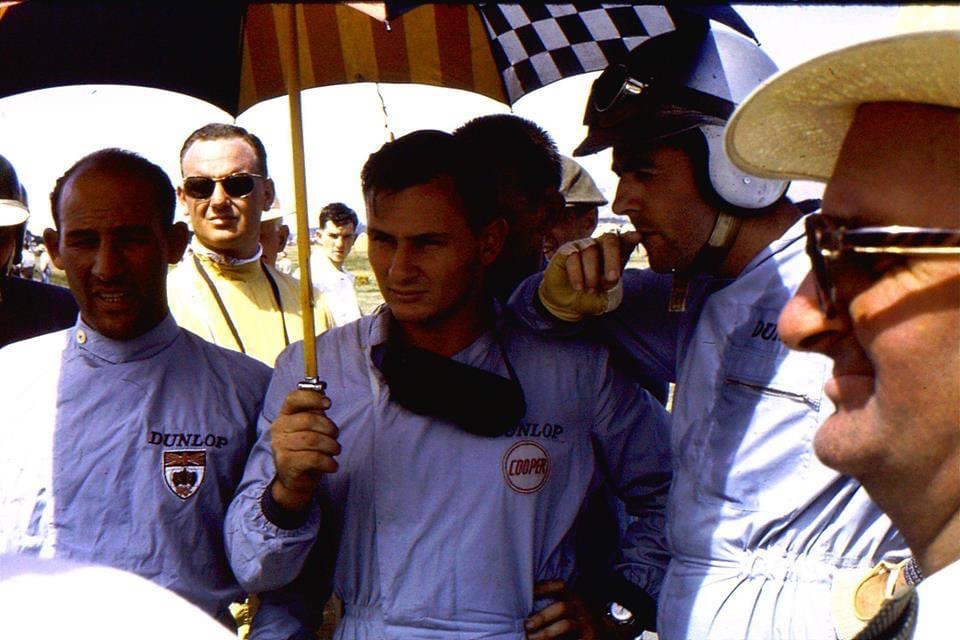
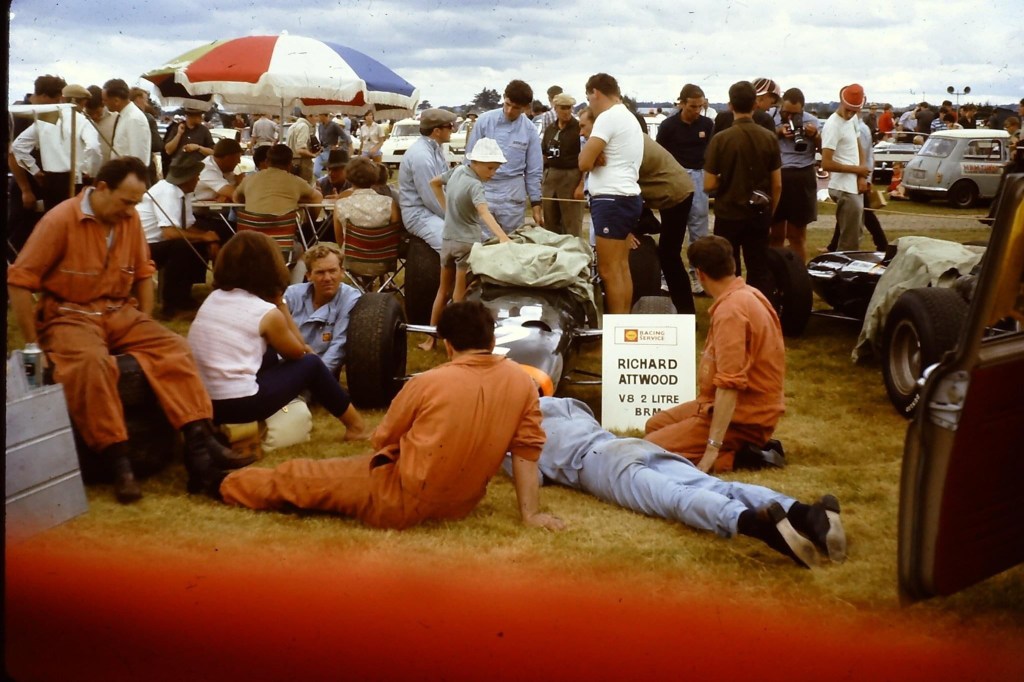
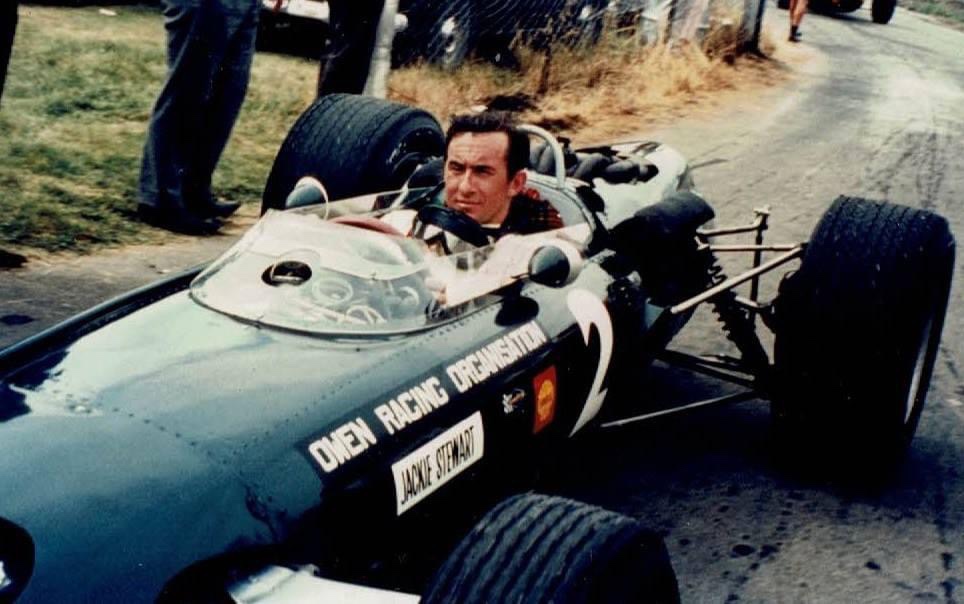
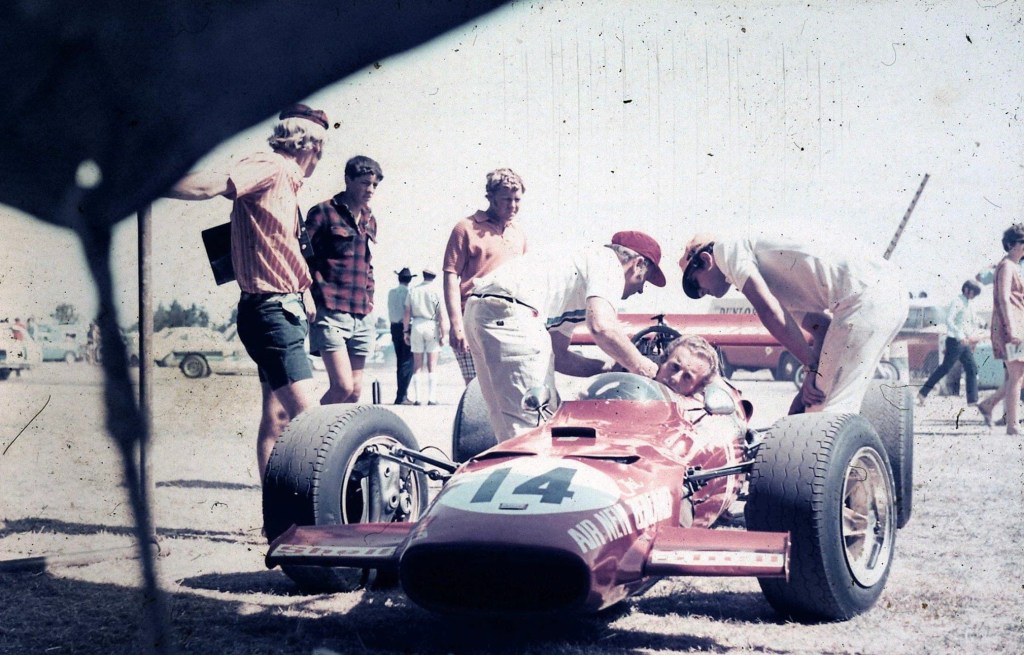
The more you look, the more you see of the shot above: from the left it’s Bill Hannah, Angus Hyslop’s mechanic with the big hat seated under the umbrella, to his left standing up with the peaked cap is Owen Steel, in the middle Jackie Stewart is talking to Kerry Grant, with Spencer Martin a little further to the right.
Stewart, Levin 1967. A non-championship round that year, the Levin International was won by Jim Clark’s Lotus 33 Climax FWMV 2-litre from Stewart’s 2.1-litre BRM P261 (R Cunningham)
This series of photographs were taken during the 1965 Tasman Cup, featuring Bruce’s new Cooper T79 Climax. The shot above shows Wally Willmott on the left and Pop McLaren in the Trilby during the Lady Wigram Trophy weekend where Jim and Bruce finished 1-2.
While Bruce won the Tasman in 1964 with his Cooper T70 Climax, the 1965 victor was Jim Clark, here in discussion with his mechanic, Ray Parsons, with their Lotus 32B Climax. Jimmy took four wins: Levin, Teretonga, Warwick Farm and Lakeside, and Bruce one win at Longford – the Australian Grand Prix – to finish the series second.
(M Waters)
The merriment is perhaps around getting Bruce’s new Firestones – he had just signed with them – to work with suspension geometry designed for Dunlops. It any of you Kiwis can explain exactly what changes were made I’d love to hear from you…
Wally Willmott, Bruce Harre, Bruce McLaren, Jim Clark, Tyler Alexander and Colin Beanland gathered around the Cooper T79, probably Wigram, 1965.
Why isn’t Jimmy ready to boogie? David Oxton remembers that “Graham Hill, Clark, Frank Gardner and Bruce flew direct from the South African GP in time for an unofficial testing session on the Wednesday. For some reason Jim didn’t take part in that, so that could be an explanation.” An alternative is offered by Milan Fistonic, “If it’s Wigram McLaren and Clark ran in different heats, so McLaren could be getting ready to go out in heat 1 while Clark still had time to suit up for heat 2.” Aren’t first-hand recollections gold, even 60 years later!
Peter Whitehead’s Ferrari 125 in the Wigram paddock, 1955. He won the race from Tony Gaze’s HWM Alta and Ken Wharton’s BRM P15 V16. This car was sold at the end of the summer, to Australian, Dick Cobden. More about Whitehead and the Ferrari here: https://primotipo.com/2023/12/13/peter-whitehead-ferrari-new-zealand/
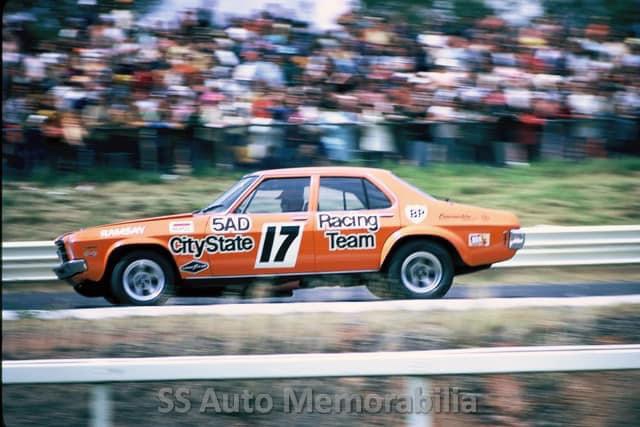
I’ll be faarked how it complied with those regs with THAT engine, THOSE strengthening members and fabricated wishbones DEVOID of fixed bodywork and all. Holy Moses. But maybe it was all in evening up the show for the local poverty-pack against the well-homologated Mustang, Camaro et al. Do tell taxi-experts. Hmm, lets think…In the back of my brain this car was pranged twice at Adelaide International, the second hit was fatal. Perhaps after the first one it morphed into a Sports Sedan, in which case the modifications make perfect sense. One for you Taxi Experts.
It was a mega-car too, I’ll never forgot the sight of Mal Ramsay wrestling the thing around Shell Corner at Sandown (as below) bellowing its F5000 roar during the very first car race meeting I ever attended, the 1972 AGP meeting. With a little more development from the Birrana Cars boys it could really have been a good thing, what a crowd-pleaser it was all the same.
(G Richards Collection)
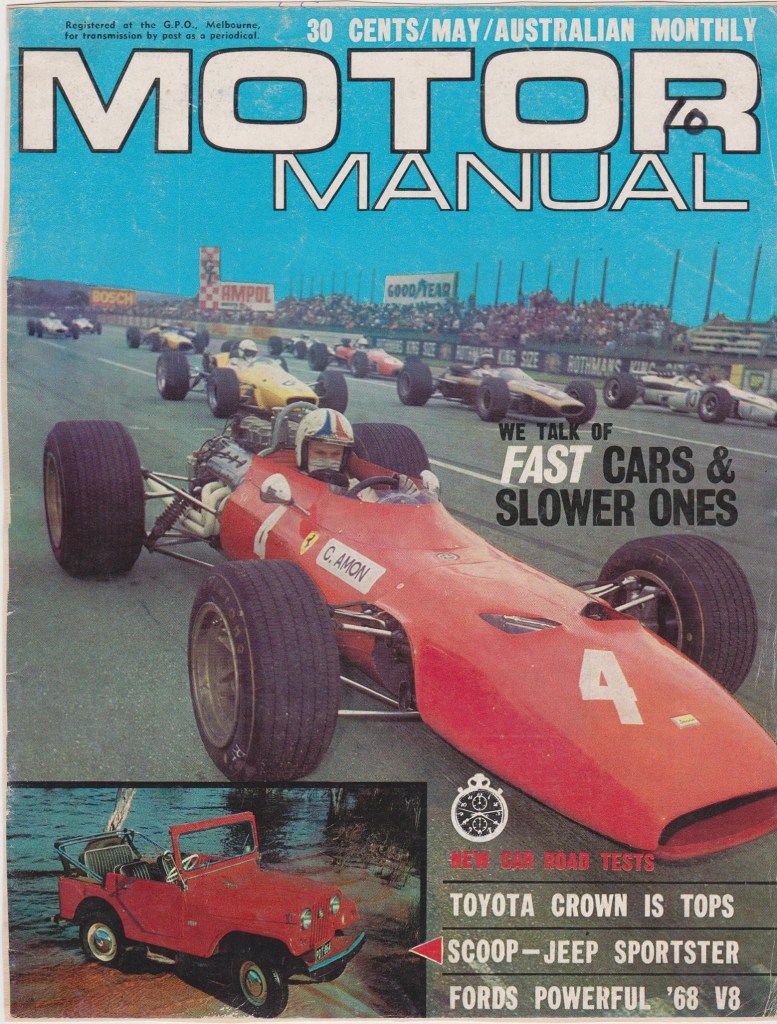
Chris Amon, Ferrari 246T on the cover of May 1968 Motor Manual. Ya gotta hand it to them, their coverage of the January-February Tasman Cup must have been considered, coz it sure wasn’t timely.
Amon won two of the seven rounds in the little Dino, he was bested by Jim Clark’s works-Lotus 49 Ford DFW. Chris went one better in 1969, taking four wins and the championship in 246T/69 #008. Ferrari then sold that car to Graeme Lawrence who repeated the achievement against a field of F5000/Tasman 2.5/2-litre cars in 1970. Lawrence won at Levin only, but his speed and consistency throughout was enough to beat the quickest F5000, Frank Matich’s McLaren M10A/B Chev which took two wins and placed second overall. More on the Dino 246T here: https://primotipo.com/2018/05/01/wings-n-dino-things/
(HEII)
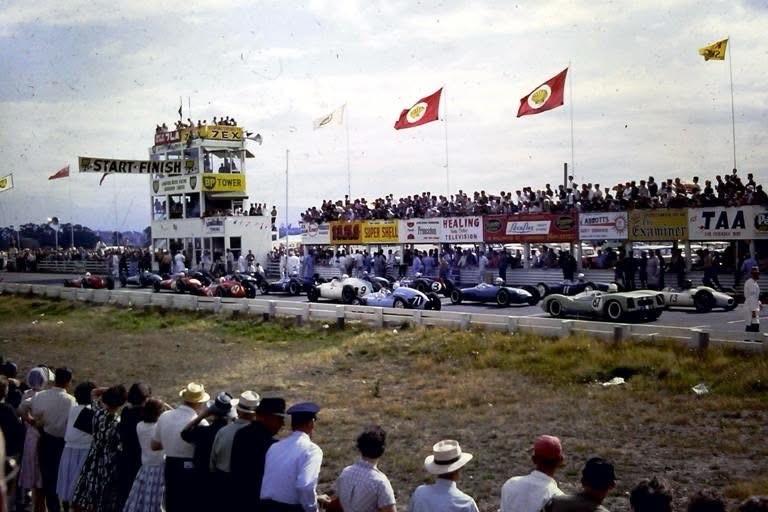
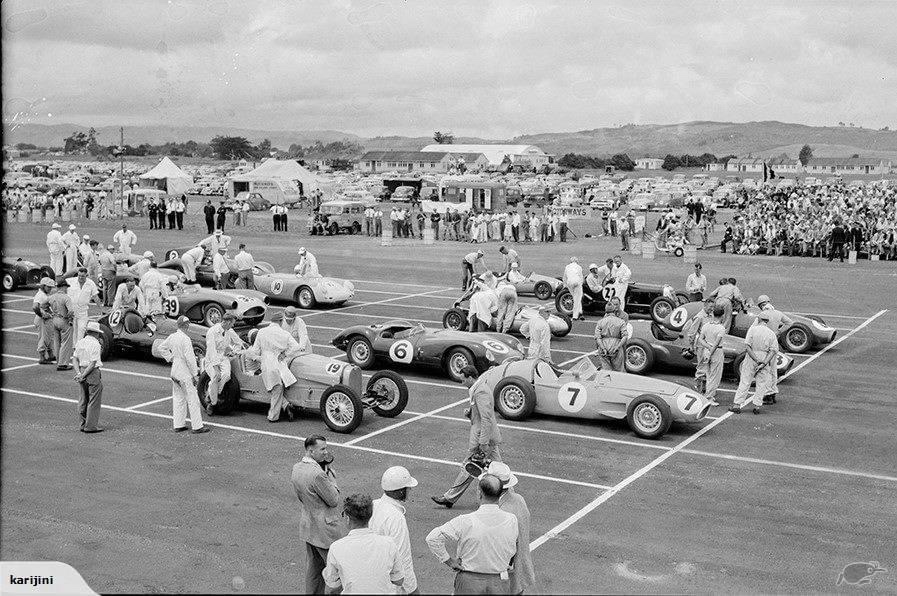
1956 NZ GP grid, a 100 lap, 186 miles race of the Ardmore Airfield circuit won by Stirling Moss’ #7 Maserati 250F from the 3-litre Ferrari 500/625s of Tony Gaze #4 and Peter Whitehead on the front row.
#19 is Ron Roycroft’s Bugatti T35A Jaguar 3.4 (sixth), #6 is Peter Whitehead’s Cooper T38 Jaguar that was raced to sixth place when Reg’s works-Aston Martin DP155 lunched an engine in practice, while #22 is Tom Clark’s Maserati 8CM 3-litre (eighth). #39 is either David McKay or Tom Sulman’s Aston Martin DB3S and #10, Norman Hamilton’s Porsche 550 Spyder awaiting pilot Frank Kleinig (ninth).
Roberto Moreno, Ralt RT4 BDA on pole before the start of the 1982 New Zealand Grand Prix at Pukekohe, January 9, 1982.
Steve Millen #7 and David Oxton in #18, RT4s as well. Moreno won the first heat from Millen, Millen won the second from Moreno while Roberto won overall.
(D Bull)(D Bull)(S Taylor)
Jim Clark, Lotus 49 Ford DFW 2.5 at Teretonga in 1968, Bruce McLaren won the Teretonga International from Jimthat January 27th in a works-BRM P126 2.5 V12.
Bruce didn’t run a car that summer, the deal came about as a result of McLaren’s use of customer BRM V12s during the 1967 Grand Prix season. It would be interesting to know (a) What Bruce thought of the 3-litre V12 (b) What Bruce thought of Len Terry’s P126 chassis and (c) What Bruce thought of the 2.5-litre variant of the V12. If anybody has a contemporary magazine article that covers any of that lot, I’d love to hear from you!
(J Inwood)
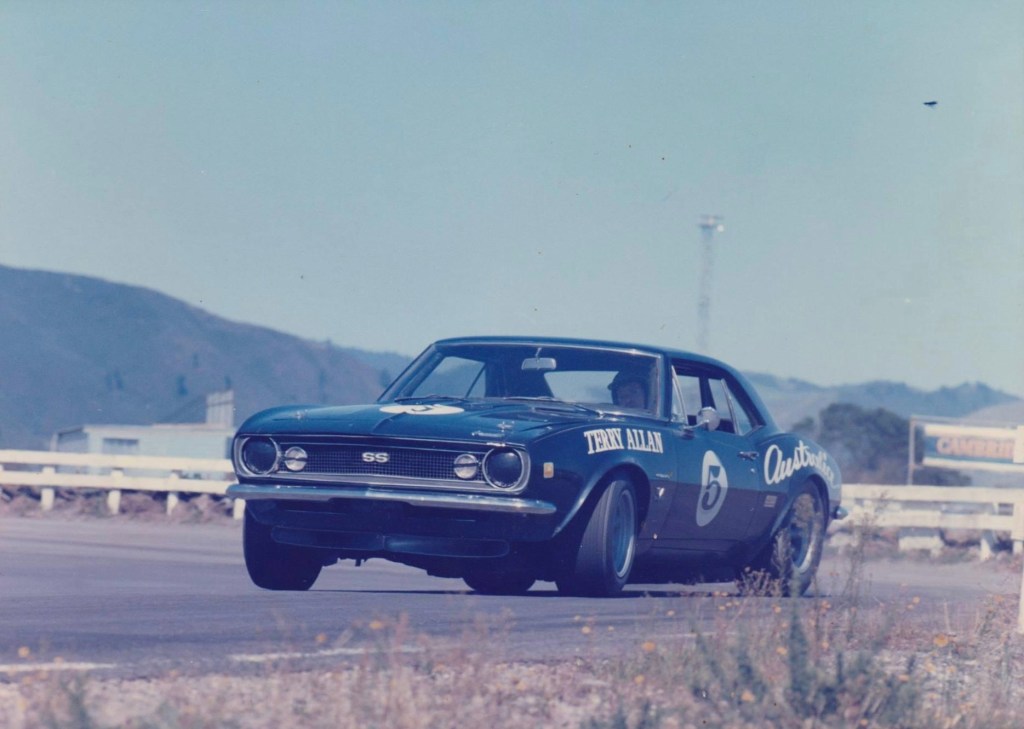
Aussie Terry Allan, Chev Camaro SS at Baypark during Easter in 1970.
Allan was the first bloke to race a Camaro in Australia, at Calder in May 1967. Fitted when delivered with a 327 cid V8, the machine was fitted with a worked 396 before it left the states for Oz. What became of it folks?
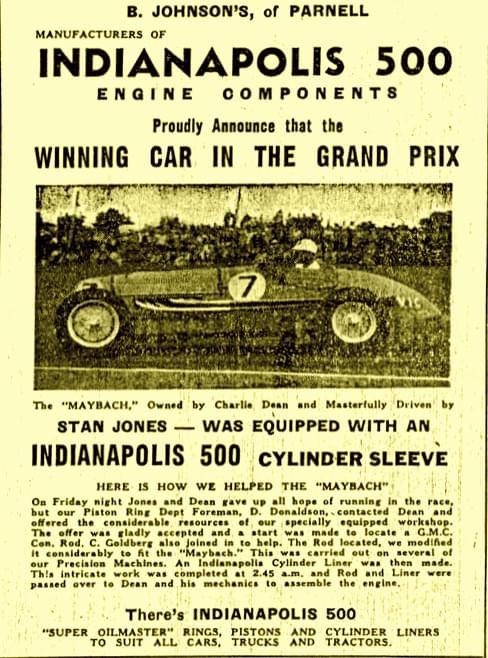
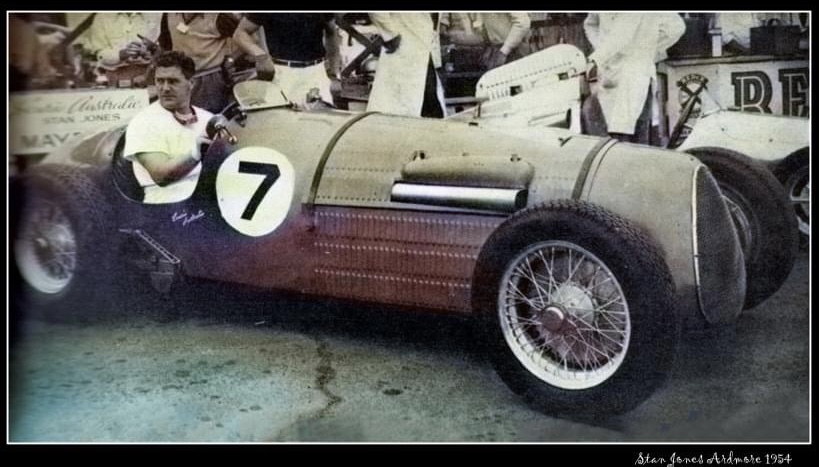
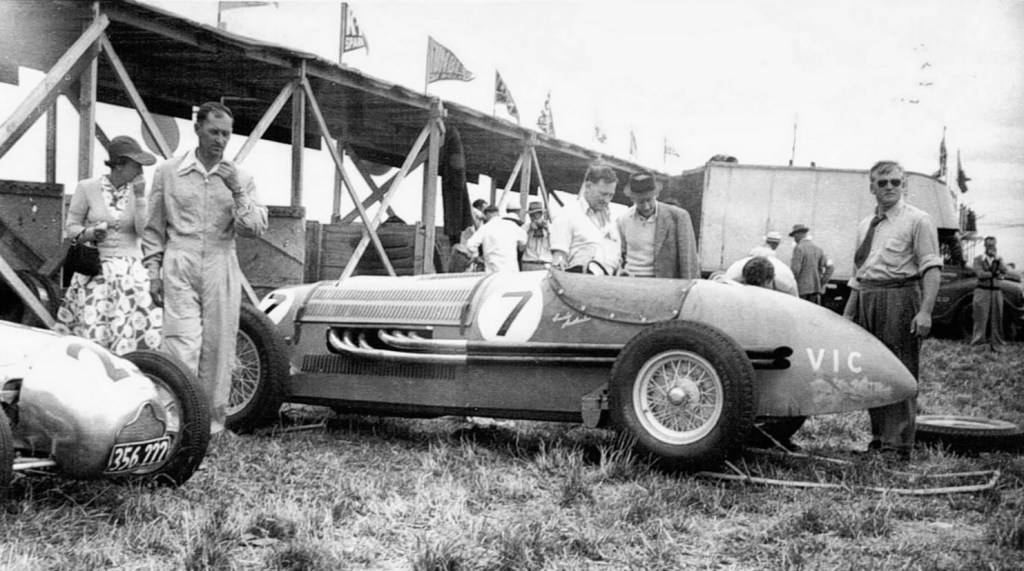
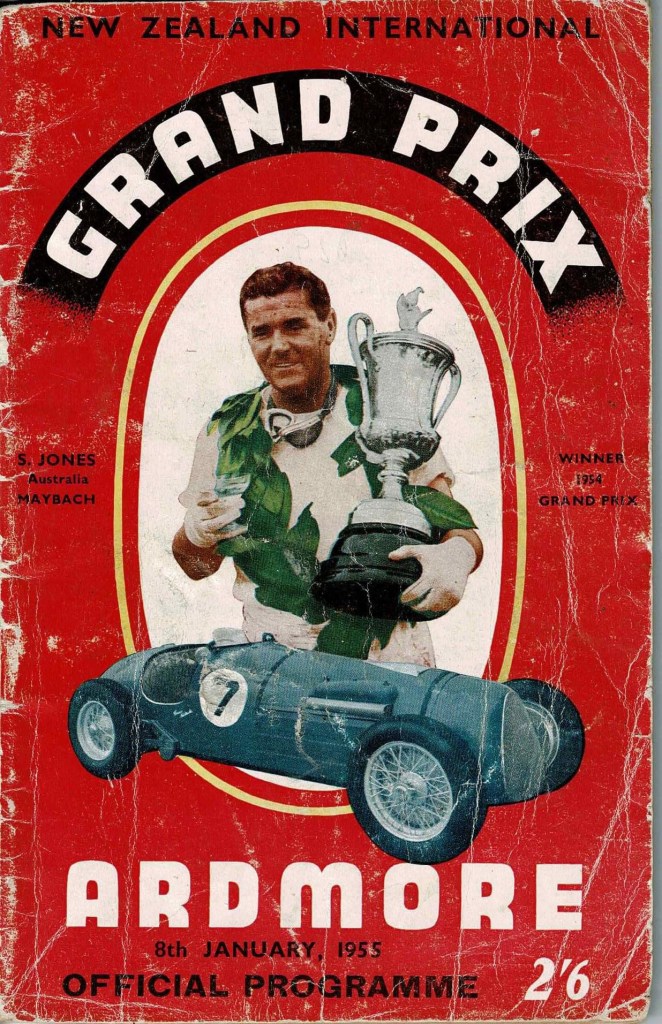
The Repco Research Maybach 1 success in the 1954 New Zealand GP at Ardmore is a real triumph over adversity effort told in this piece here;
When the car threw a rod and punched a hole in the block, “Charlie Dean phoned Australia for parts, but they couldn’t be landed in Auckland in time. Nothing daunted, the crew started scouring the city for makeshifts. They got a GMC conrod from Ray Vincent, a machine shop made up a new cylinder-liner – B Johnsons as above – while patches were fabricated for the crankcase,” related Naomi Tait.
Peter Donaldson related that his father, “Dawson Donaldson was dressed to go to the GP ball on Friday night but left mum standing at the front door in her ball-gown to head to Johnsons to work all night making parts including a new conrod.” In a tragic sidebar, “Dad was killed during an event in the Ostrich Farm Road hillclimb in December 1958 racing the Austin 7 Ulster that had been Bruce McLaren’s first car.”
“All Friday afternoon and night the crew toiled in Shorter’s garage while Jones slept in preparation for the race he might not run. At 10.40 in the morning the miracle happened. The motor was turned over, coughed and sprang into life. It was test run for a few minutes, hurriedly taken out to Ardmore, and the finishing tuning done on the course. And this was the car that won the race.”
Lex Davison’s ex-Moss/Gaze HWM, by then fitted with a Jaguar 3.4-litre XK engine with C-Type head, below, in the Ardmore paddock.
It wasn’t the quickest or most reliable of Davo’s cars, but it did deliver his first Australian Grand Prix at Southport Queensland a few months hence. Jones gift-wrapped the win after the chassis of his nearly-new Maybach 2 broke during the race giving Stanley the wildest of Gold Coast rides but luckily not killing, or badly injuring him. See more here: https://primotipo.com/2018/03/01/1954-australian-grand-prix-southport-qld/
(B Ferrabee Collection)(M Fistonic)
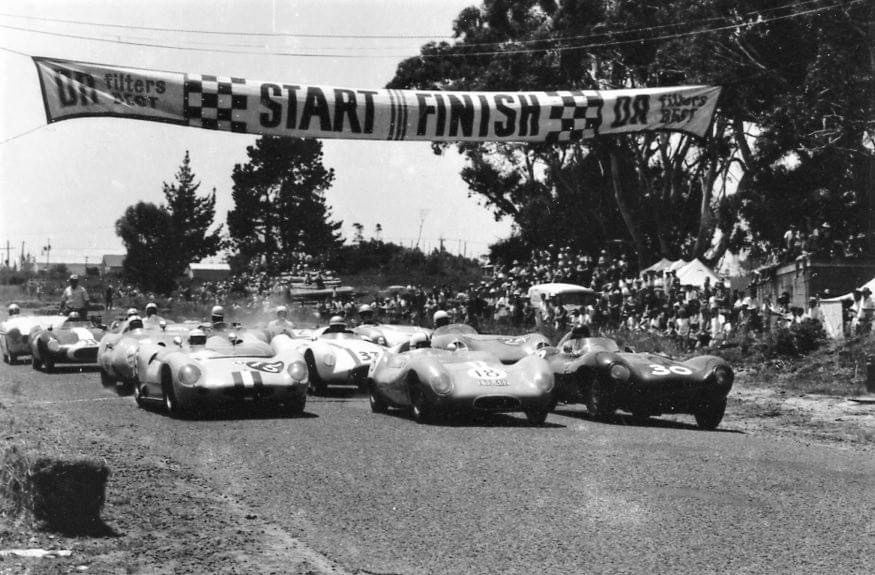
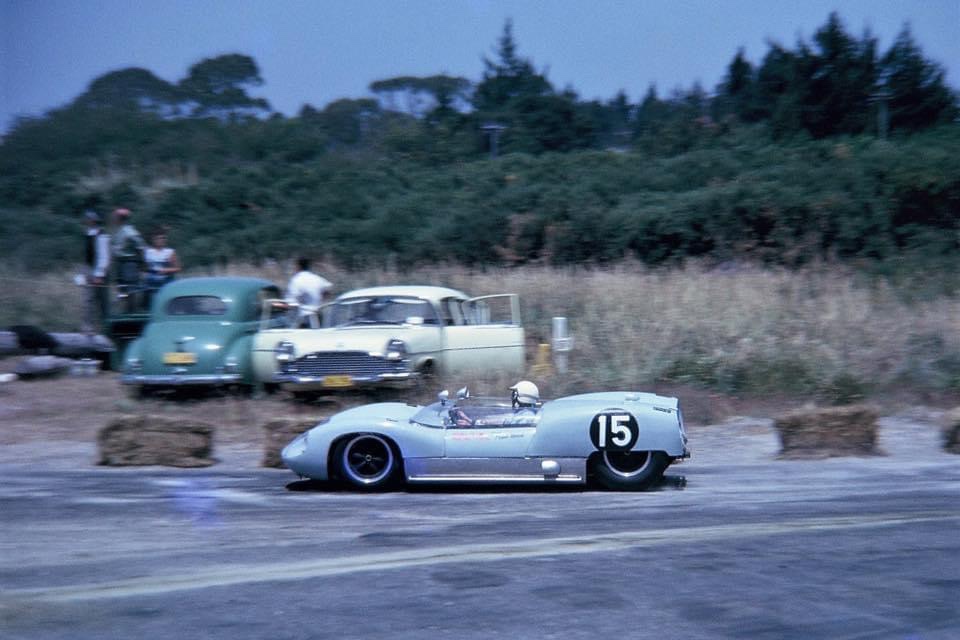
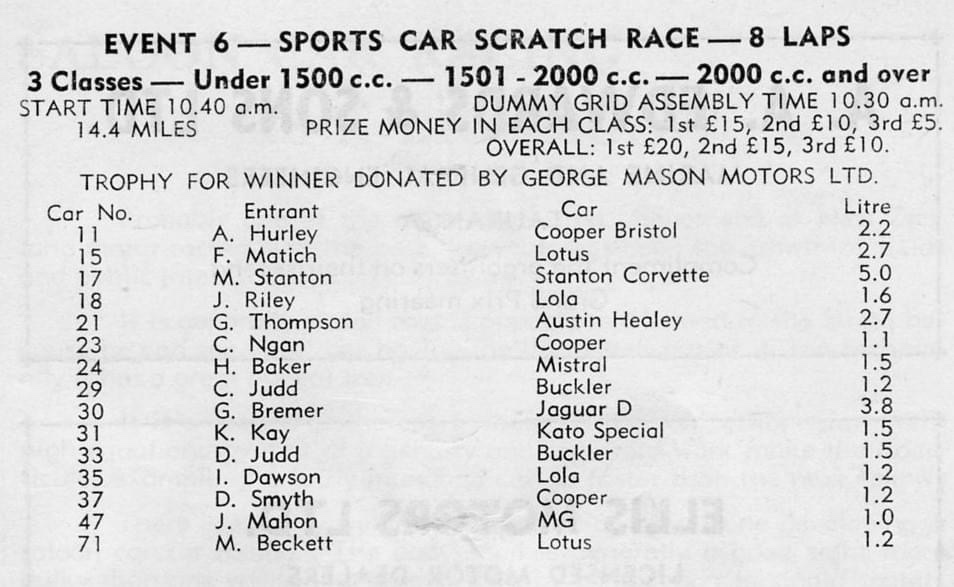
Start of the 1963 Mount Maunganui sportscar race Frank Matich, Lotus 19 Climax. John Riley, Lola Mk1 Climax and Garry Bremer, Jaguar D-Type on the front row.
Frank Matich, Lotus 19 Climax and again below (A Boyle)(M Fistonic)
(unattributed)
(HEII)
Chris Amon and David Oxton did swapsies with this March 701-3 Ford DFW 2.5 – Mario Andretti’s STP 1970 F1 car – and the Lotus 70 Ford 5-litre F5000 machine shown below at Levin during the 1971 Tasman Cup. STP’s Vince Granatelli is steering the car.
Steel Brothers, the Christchurch based NZ Lotus agents organised a deal for David Oxton to race the car – chassis #70-02 was the car raced by Dave Walker in the November 1971 Australian Grand Prix at Warwick Farm – but Chris wasn’t happy with the March, he was third in it at Levin, so STP bought Oxton’s Lotus.
In that he was Q9/ninth at Pukekohe, Q6/fifth at Wigram, missed Teretonga, then Q4/second at Warwick Farm and Q12/fourth at Sandown. Chris then flew to France to meet his new commitments with Matra, and John Cannon raced the Lotus in the final round Tasman round at Surfers paradise to Q6/seventh.
(HEII)
David Oxton’s races with the Lotus 70 yielded Q11/DNF half shaft at Puke, and Q10/seventh at Teretonga, maybe David could let us know the respective merits of both cars!?
Credits…
Bob Homewood, Gerard Richards, David Bull, Sean Taylor, Russ Cunningham, Jack Inwood, Naomi Tait Collection, Ross Cammick, Alan Boyle, Brian Ferrabee Collection
Tailpiece…
(N Tait Collection)
Jochen being bolted into his Lotus 49B Ford at Levin, January 11, 1969.
He boofed chassis R9 in the race – won by Chris Amon’s works-Ferrari 246T – so Colin Chapman flew another car, chassis R10 out the following week, and in which the staggeringly-quick Austrian took his first Team Lotus victory, in the Lady Wigram Trophy on January 18, 1969. See more here: https://primotipo.com/2018/01/19/rindt-tasman-random/
Jack Brabham from Bruce McLaren: a works Cooper T51/Climax 1-2 seemed likely for much of the race (MotorSport)
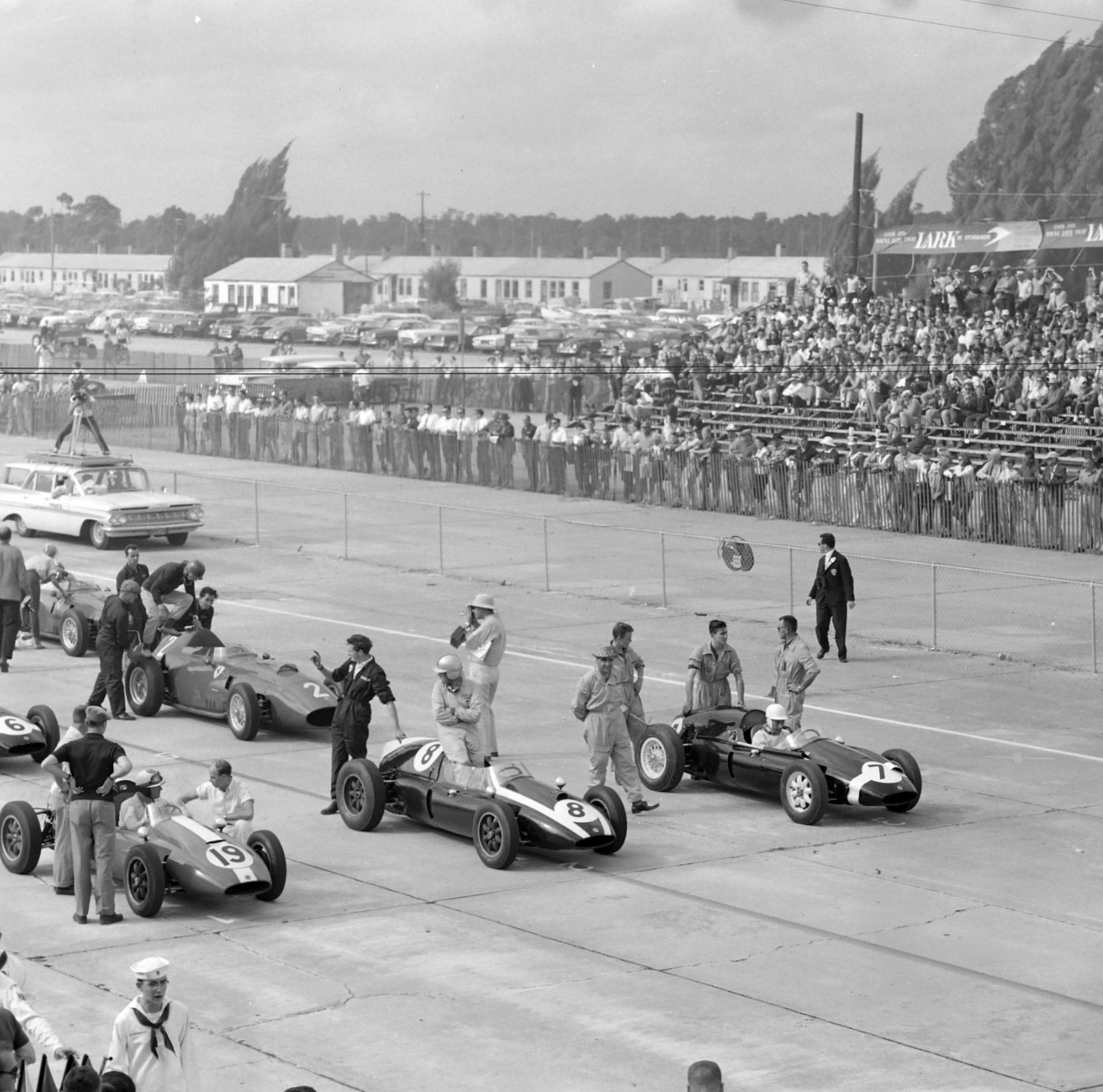
A thrilling race of course, Bruce McLaren took an historic win – as the youngest ever F1 championship GP winner, a title he held for yonks – after Jack Brabham’s Cooper T51 Climax ran out of juice on the last lap. Jack was fourth, Maurice Trintignant, Cooper T51 Climax was second and Tony Brooks, Ferrari Dino 246 was third.
Just before the off, Harry Schell, Jack Brabham and Stirling Moss all aboard Cooper T51s on the front row; Harry controversially so as he had taken a short cut during qualifying! #6 is Maurice Trintignant’s Walker T51, #2 Tony Brooks’ Ferrari Dino 246 (MotorSport)
The Americans entered F1 etc – Indy being part of the F1 World Championship from 1950-1960 duly noted – but the interesting thing was the mix of cars. Not just Rodger Ward’s utterly nuts and utterly wonderful, Kurtis Kraft Offy, but also Fritz d’Orey’s Tec-Mec F415 Maserati, Allesandro de Tomaso’s Cooper T43 OSCA Streamliner and Bob Said’s Connaught C-Type Alta.
(MotorSport)(MotorSport)
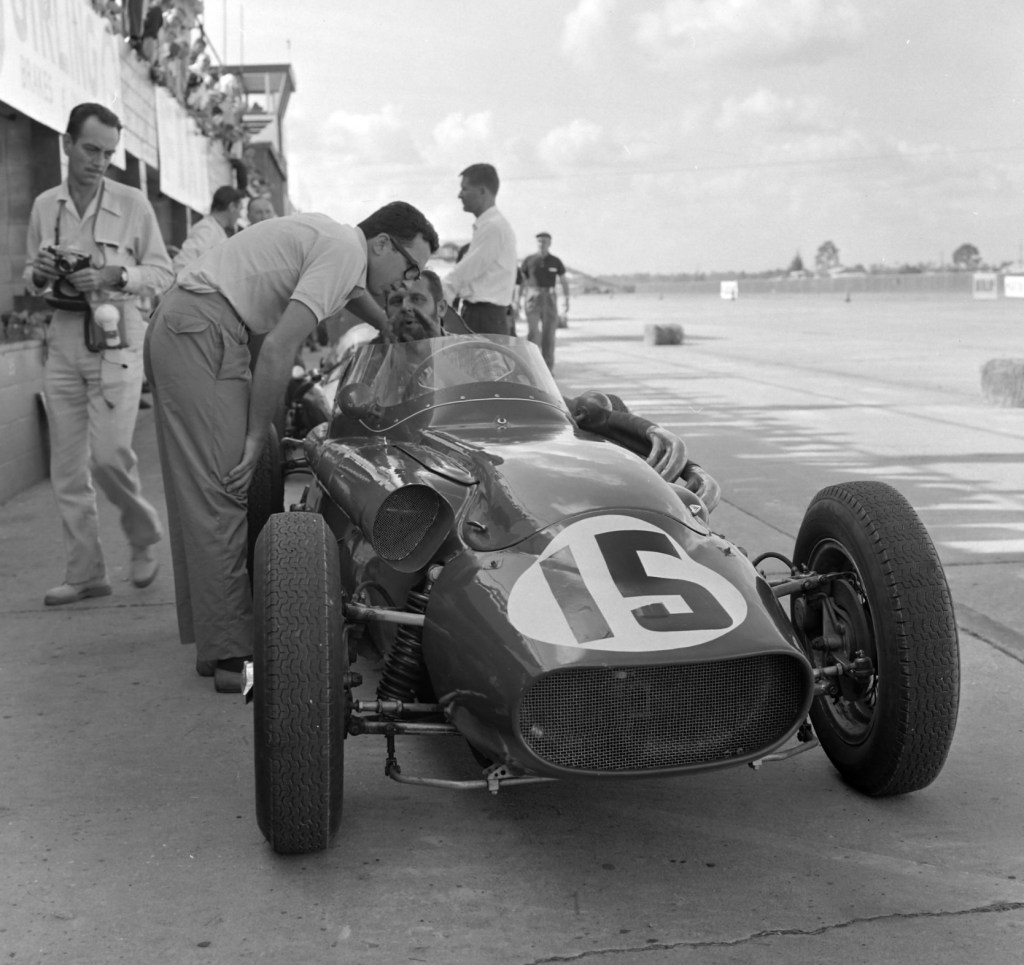
Fritz d’Orey in the one-off Valerio Colotti designed, Gordon Pennington owned Tec-Mec F415 Maserati at Sebring during practice.
Remember those days before carefully homogenised and pasteurised, hermetically clean and certified absolute sameness and dull-shit-boredom. Where did it all go wrong? See here for a story on this car: https://primotipo.com/2024/03/11/tec-mec-f415-maserati/
(MotorSport)
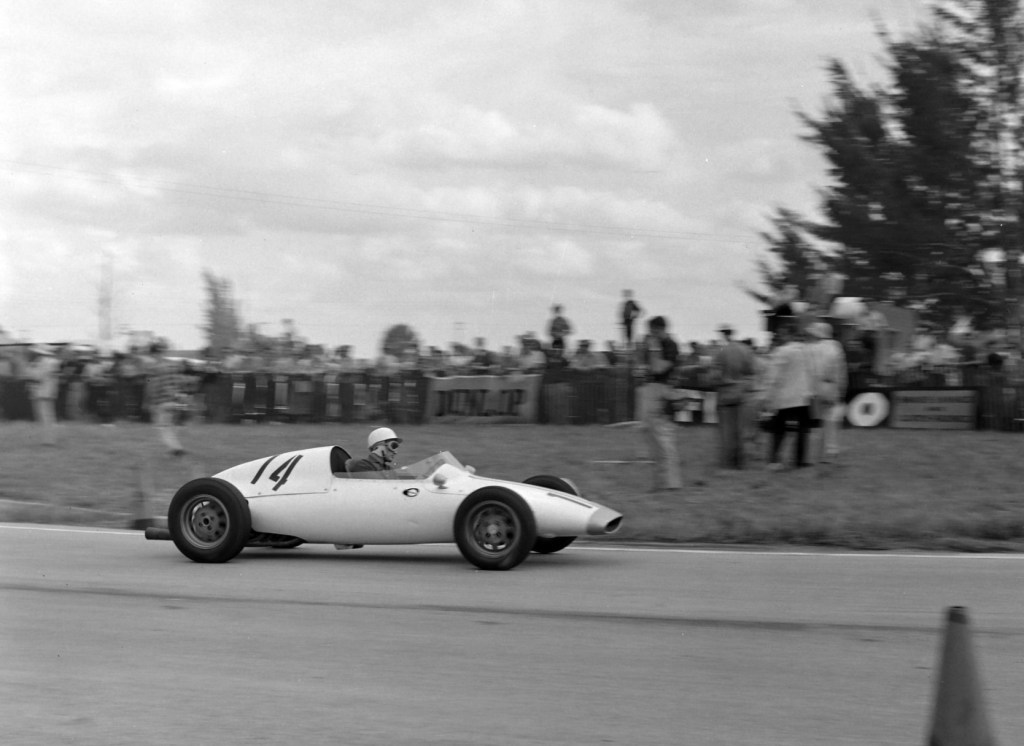
De Tomaso’s works Officine Specializate Costruzione Automobili entered Cooper T43 OSCA 2-litre was only ever going to be an also-ran given the modest displacement and endurance background its twin-cam, Weber fed four-cylinder engine. He qualified the car 14th on the 19 car grid and completed 14 laps before brake troubles intervened.
The car’s swoopy, beautifully finished and fitting body is far more attractive than any of the Coopers of that era, and more aerodynamically efficient? While said to be a Cooper T43, the chassis may be a copy, the wheels are also of De Tomaso’s design and manufacture. An interesting experiment, what became of the car?
(MotorSport)(MotorSport)
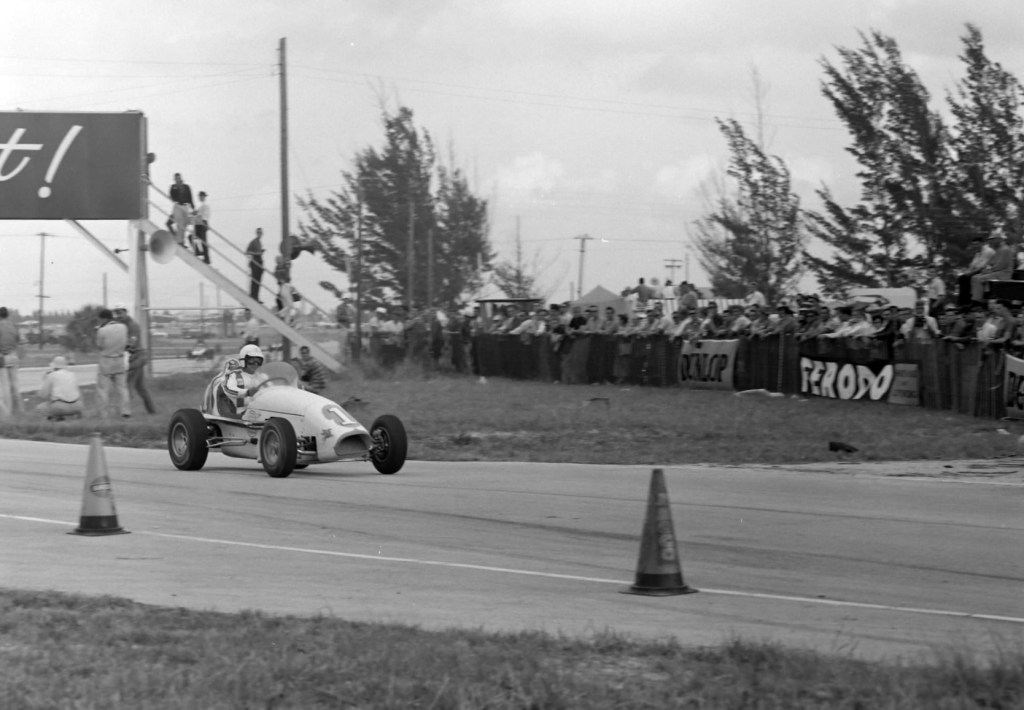
It made great commercial sense for the organisers to run the reigning Indy 500 champion, Rodger Ward, in the race. If you believe the hype, Ward thought his lightly modified Kuris Kraft Midget would give the ‘European Buggies’ a run for their money.
Jack Brabham related to Doug Nye, “The next day he, Bruce, and and I arrived together at the first corner of the track, and just as we jumped from brake to throttle pedal and streaked away from him he was astonished. To his credit he took it well.”
Ward’s qualifying time was well short of pole-sitter Stirling Moss in Rob Walker’s Cooper T51 Climax: 3 min dead vs 3 min 43.8 sec. Rodger lasted for 21 of the race’s 42 5.2-mile laps, getting as high as ninth as others retired, before clutch failure intervened.
A popular racer and a good sport, he became a Cooper convert overnight and worked on Jack and John Cooper to convince them to run a car at Indianapolis. After the 1960 US GP Jack ran his GP Cooper T53 Climax at Indy in a series of tests, aided and abetted by Ward; Coopers participation in the 1961 500 with a Climax powered Cooper T54 changed Indy history, and Rodger Ward played a key role.
(MotorSport)
Ward’s 1946 Leader Card Kurtis Kraft Midget, chassis #0-10-46 was powered by a 1.7-litre, DOHC, two-valve Offenhauser engine that gave away heaps of performance to the mainly 2.5-litre competition. It had a two-speed gearbox, a two-ratio rear axle, hand-disc-brakes and the usual other dirt-track accoutrements! Those Halibrand wheels are 12-inches in diameter and Firestone provided the tyres.
The beam front axle is sprung by a transverse leaf and located bt two radius rods. I’ll take your advice on shock-absorbers. Note the front discs, nerf protection in front of the rear wheels and high standard of preparation and presentation.
(MotorSport)
Jesse Alexander observed the following about the Kurtis Kraft in his Sports Cars Illustrated meeting report.
“The greater part of the two practice sessions was spent getting the car to run properly on Avgas (rather than the usual methanol). The several times that it did appear on the circuit it was obvious that the few modifications to the chassis to suit it better for road racing were worthwhile. Surprisingly stabile and getting through many of the corners as fast (in some cases faster) as much of the field.”
“The red and white Offy differed from normal midgets in having its engine fitted several inches farther forward in the chassis as well as having a supplementary 2-speed transmission installed. This meant that actually there were two 2-speed units, one behind the engine and the other in unit with the final drive gears. But these alterations could never possibly make up for the displacement gap between the parky Midget and her overseas competitors.”
“Rodger Ward deserves credit for his spirit and enthusiasm – it was great to see him at Sebring and lets hope it won’t be the last time out for an Offy-engined car.”
By late 1959 the car was owned by Florida man Gordon Pennington, he decided to enter the machine for its one-and-only race at Sebring.
With Brazilian wealthy-journeyman Fritz d’Oley at the wheel, the new car, being run for Pennington and D’Oley by the Camoradi Team, managed to qualify 16th, one grid-slot in front of the only 250F in the race driven by Phil Cade.
The Tec-Mec completed 7 laps before an oil leak forced Fritz’ withdrawal, while Cade didn’t take the start given the old-gal’s lack of pace: 3 min 39 sec in qualifying. While Tony Brooks’ front-engined Ferrari Dino 246 was third, and the Dinos raced on into 1960, Ferrari wheeled out a mid-engined prototype at Monaco that year.
Fritz d’Orey, Tec-Mec F415 Maserati during the race. “The Tec-Mec was never driven quickly enough to show up any defects. The only time we know of it being driven fast was when Jo Bonnier took it around the Modena Autodromo last summer. His comments were not all that favourable. He complained of, among other things, a flexing chassis.”
Fritz d’Orey, Tec Mec F415 on the hop (MotorSport)Bob Said in the Connaught C-Type Alta. Unusual and attractive body, Dunlop alloy wheels (MotorSport)
A bit like the Tec Mec, the Connaught C-Type Alta (chassis #C8) was also stillborn.
Rodney Clarke’s spaceframe chassis, disc braked, strut/De Dion tube rear suspension, double wishbone front suspension, Alta DOHC, two-valve four powered, Wilson pre-selector ‘transmissioned’ vast improvement of Connaught’s successful B-Type was tested but unraced when the assets of Connaught Engineering were sold in 1957.
Passed in at the auction, #C8 was later sold to Paul Emery (of Emeryson fame) and “keen amateur racing driver John Turner”. They soon did a deal with American driver, Bob Said, to race the car at Sebring.
Inevitably, shipping delays meant the project was knee-capped from the start. Poor Said had little testing time, with fuel injection difficulties adding to the challenge. He qualified the car a great 13th in the circumstances but had clutch problems in the race and then crashed it when he was caught out by the Alta engine’s erratic throttle response without completing a lap.
Jesse Alexander wrote, “The Connaught with Bob said driving drew many interested onlookers. This was the first racing appearance of the space-framed car that was under construction back when Connaught decided to cease building and racing cars. They never sold this one, which embodies many novel design features like a telescoping de Dion tube and servo-operated Lockheed disc brakes. Paul Emery got it running well enough for Said to turn a 3:27.3sec practice lap.”
Connaught C-Type #C8 in-build at Send. Note Alta engine and spaceframe chassis which looks very torsionally stiff in this photo and the one below. Double wishbone IFS and bespoke? uprights. Who are they folks? (W I’Anson Ltd)Dunlop wheels, diff clear but not the strut/De Dion arrangement. It all looks thoroughly modern and light, Wilson pre-selector box more weighty (W I’Anson Ltd)
While outside the scope of this article, the car was repaired back at the Send factory, near Guildford. With six inches added to the wheelbase, cut-down bodywork, a push-bar, and the Alta fuel injected engine tuned to 260bhp on methanol, Jack Fairman attempted unsuccessfully to qualify the car for the 1962 Indianapolis 500.
It’s such a shame this Connaught didn’t contest Grands Prix in 1957 as planned…
C8 was sold via a Road & Track ad and then lived in a private California museum from late ’62 until 1974 when Rodney Clarke repatriated the car to the UK. In another Tec Mec similarity, the car has been an historic racing front runner for decades, initially in Indy LWB spec and since the late 1990s in its original GP specifications.
Stirling Moss in the Walker Cooper T51 in front of the seventh placed Harry Blanchard’s Porsche RSK and Taffy Von Trips’ Ferrari Dino 246, sixth (MotorSport)
Stirling Moss’ Rob Walker Cooper started from pole but was out after only five laps with Colotti gearbox failure.
Alf Francis had modified the rear suspension from the standard Cooper transverse leaf setup to coil springs and ‘wishbones’ as shown in the shot below.
Jesse Alexander explains, “The new rear suspension had been tried out in the Fall back in England. Stirling liked its feel, then proved it by bettering the Goodwood lap record. Wire wheels at the rear, and the Colotti five-speed transmission were the only major differences bwtween the Walker cars and the works cars of Brabham and McLaren.”
(MotorSport)(MotorSport)
Bruce McLaren – with Jack in front of him – demonstrates the geometry of the standard T51 transverse leaf layout (at Sebring) where said spring performs that task, and locational duties. The 1960 Cooper Lowline (T53) quickly concocted by Messrs Cooper C, Brabham, McLaren and Maddock after the first race of the year, included among its successful bag-of-tricks a coil sprung rear end.
(MotorSport)
McLaren enroute to victory above. Alexander tells us that Brabham had initially practiced this car but “it had experimental settings for 1960” and Jack didn’t like the feel of it, so he and Bruce swapped chassis. “McLaren had not even expected to race at Sebring when I spoke with him in England in October. He expected to be in New Zealand for Christmas and participate in their Grand Prix. As it turned out, Masten Gregory’s injuries failed to heal in time for him to race at Sebring and Bruce replaced him.”
Didn’t fate play a couple of hands in Bruce’s favour!
(MotorSport)
Credits…
MotorSport Images, Jesse Alexander in Sports Cars Illustrated March 1960 via Stephen Dalton’s archive, William I’Anson Ltd
Cockpit shot of Denny Hulme’s second placed – Jack won in his Brabham BT33 – McLaren M14A Ford during the March 7, 1970 South African Grand Prix weekend at Kyalami.
Smiths instruments of course: the chronometric-tach telltale is on 10,100rpm, the DFV developed all of its punch from 8-10000. Oil pressure and temperature is the priority, fuel pressure and water temperature secondary and out of Hulme’s direct line of sight. Switches are for the rev limiter, ignition, electrical fuel pump (starting only) and the starter button. I’ve always liked a nice big ignition kill switch, but let’s not get picky.
Bruce and Denny M14As – with Jack out of focus – in the Brands paddock during the Race of Champions weekend in March 1970 (MotorSport)
The M14A was an evolution of Robin Herd and Bruce’s 1968 M7 design. A profitable Grand Prix winning design, not to forget the McLaren M10A and M10B F5000 cars which made McLaren and Trojan Cars plenty of dollars.
The cars had a few steerers in 1970: Bruce and Denny, then Dan Gurney after Bruce’s fatal Goodwood accident, and after that, Peter Gethin when conflicting oil company sponsorship contracts got in the way of Dan’s F1 and Can-Am McLaren drives.
Gurney’s qualifying best was a second adrift of Denny in the British GP, it would have been interesting to see if he could have got back his old Grand Prix race-pace had he finished the season with McLaren. He was right on-the-money in the Can-Am Cup mind you, winning the first two races at Mosport and St Joliet from pole in his M8D Chev – no doubt relishing the very first ultra competitive Can-Am car he had ever raced! – and qualified second on the grid at Watkins Glen, then faded with undisclosed dramas in his last race for the team.
Gurney’s M14A Ford, British GP July 1970 Brands Hatch (MotorSport)
There is no such thing as an ugly Papaya McLaren! Note the full monocoque aluminium chassis under that inspection hatch.
In a very tough year for the team, Bruce’s best was second place in the Spanish GP in M14A/1, and Dan’s best in three Grands Prix with that car, was sixth in the French at Clermont Ferrand.
Denny raced M14A/2 to second at Kyalami, and third in the Race of Champions at Brands Hatch and the German Grand Prix. He missed the Belgian and Dutch GPs after burning his hands at Indianapolis when an imperfectly secured quick-release cap on his McLaren M15 Offy leaked methanol and caught fire.
Peter Gethin then raced M14A/2, placing second in the Spring Trophy at Oulton Park and in the International Trophy at Silverstone.
Dan Gurney, McLaren M14A Ford, on the beautiful Clermont Ferrand road circuit, French GP 1970 (MotorSport)
M14A/3 became Peter Gethin’s car from the 1970 Italian GP until the Spanish in March 1971. In eight meetings his best was sixth in the Canadian GP at Mont Tremblant.
Ultimately the M14A fell a bit short in 1970, while noting again the mitigating factors. It was a rare GP season in which victories were spread far and wide amongst the Lotus 72 Ford, Ferrari 312B, Brabham BT33 Ford, BRM P153 and March 701 Ford! Jochen Rindt posthumously won the drivers title and Lotus the constructors.
Bruce in M7B Ford. Note the front wing support mounts directly to the upright, Race of Champions 1969 (MotorSport)
Hey you in the Big Banger…
No it’s not a single-seat M8 Can-Am car, in 1969 McLaren converted M7A/3 to ‘Lancia D50 spec’ by placing all the fuel centrally and low. By filling in the space between the wheels Bruce and Gordon Coppuck were also playing with the aerodynamics of the car; the car was then tagged M7B/3.
It didn’t work though, after racing the car on debut in the South African GP at Kyalami in January 1969, and then the Brands Hatch Race of Champions (above) the car was sold to Colin Crabbe, of Antique Automobiles, for Vic Elford to drive.
Vic was fifth in the French GP, then sixth in the British before crashing it at the Nurburgring in an accident not of his making. Mario Andretti crash-landed his Lotus 63 Ford 4WD and Vic collected one of its wheels, flipped and ploughed into the trees destroying the car and breaking his arm in three places. I guess the Ford DFV and Hewland DG300 gearbox from that car found their way into the new March 701 that Crabbe bought for Ronnie Peterson to race in 1970?
Vic Elford, McLaren M7B Ford, Nurburgring 1969 not long before his big, Mario inflicted crash (MotorSport)Bruce McLaren, McLaren M7C Ford, British GP Silverstone 1969. Third, race won by Jackie Stewart’s Matra MS80 Ford (MotorSport)
Bruce drove a new car, M7C/1 for the rest of 1969. The major factor which enhanced this cars performance was the use of a full monocoque aluminium chassis derived from the M10A F5000 car, itself derived from the bathtub-monocoque M7A.
McLaren’s conventional 2WD cars didn’t get as much love as they otherwise would have in 1969 given the attention lavished upon their 4WD brother, the M9A. McLaren, together with Lotus, Matra and Cosworth pursued this blind-alley. Ultimately, very quickly, wings and the tyre company Polymer Chemists solved the ‘3-litre problem’ of too much power and too little grip far more cost-effectively than then complex mechanical 4WD mechanisms.
Derek Bell aboard – although he looks like he is trying to escape it – the McLaren M9A Ford 4WD during the 1969 British GP weekend at Silverstone. DNF suspension after five laps (MotorSport)
Bruce’s 1969 M7C – as we have seen, a lineal descendant of the 1968 M7A – begat the 1970 M14A. The major advances from M7C to M14A were inboard rear brakes, new front uprights and a smidge greater fuel capacity.
A few more shots of the wideboy McLaren M7B Ford during that March 16, Race of Champions weekend at Brands Hatch in 1969.
High wings were the rage but Lotuses ‘cavalier’ engineering of their wing supports and their repeated failures – the last straw the breakages of Rindt’s and Hill’s wings and resultant crashes of their Lotus 49s at Montjuïc – saw them banned during the Monaco GP weekend that year. More tightly controlled, they stayed.
The photographs in this article demonstrate the changes being made by the teams to adapt in a a period of about 12 months, not to forget the related 4WD adventures for the affected teams!
(MotorSport)(MotorSport)
Credits…
MotorSport Images, oldracingcars.com
Tailpiece…
(MotorSport-Schlegelmilch)
Our pit-babe was at Clermont during the 1970 French GP weekend, the cars are Denny and Dan’s M14As and Andrea de Adamich’s M14D Alfa Romeo. Another of Rainer Schlegelmilch’s signature shots!
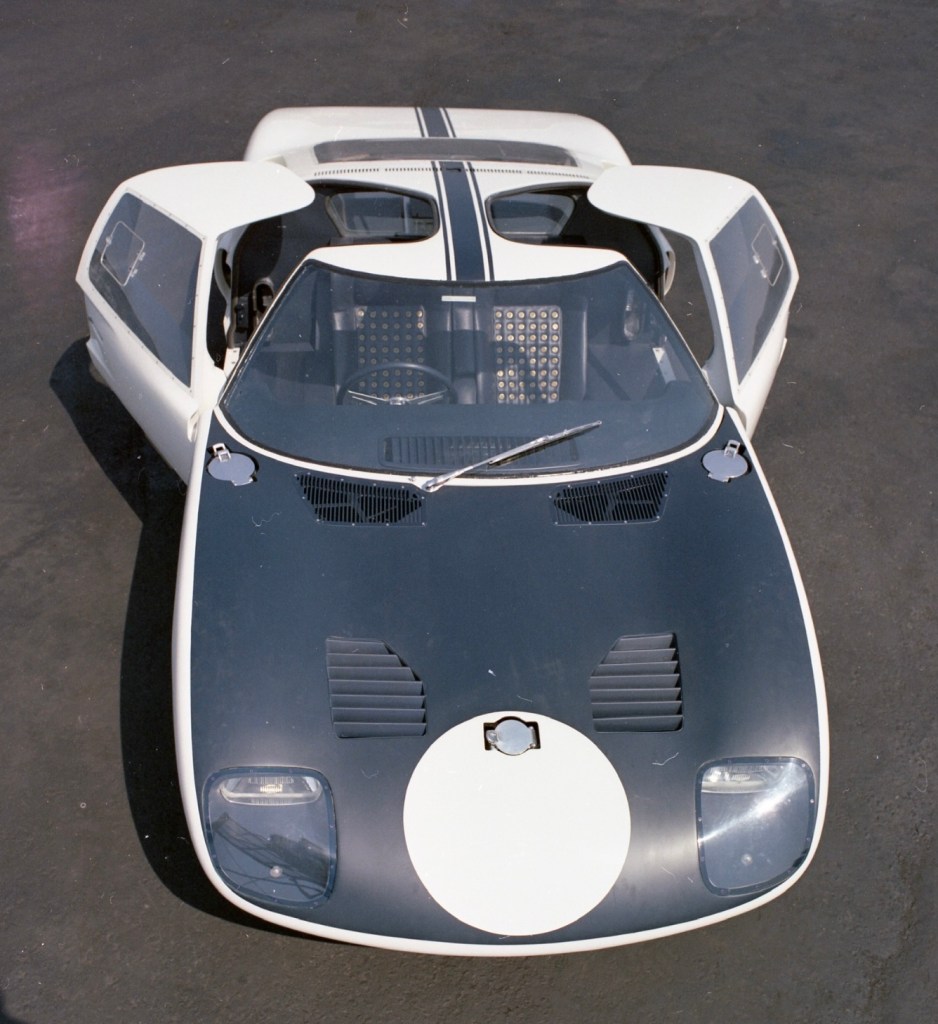
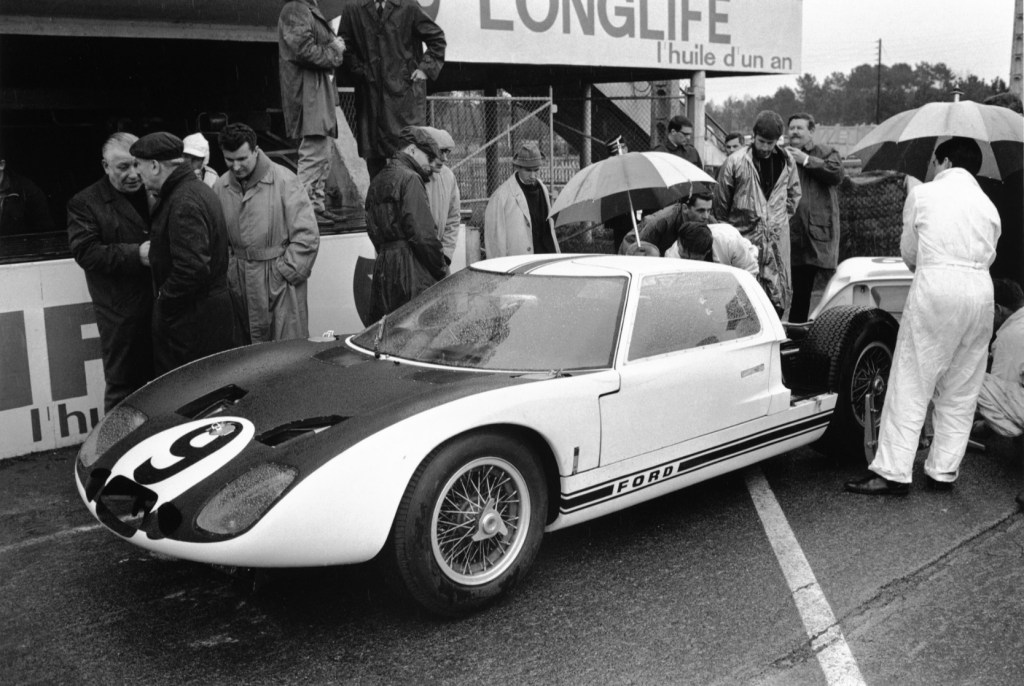
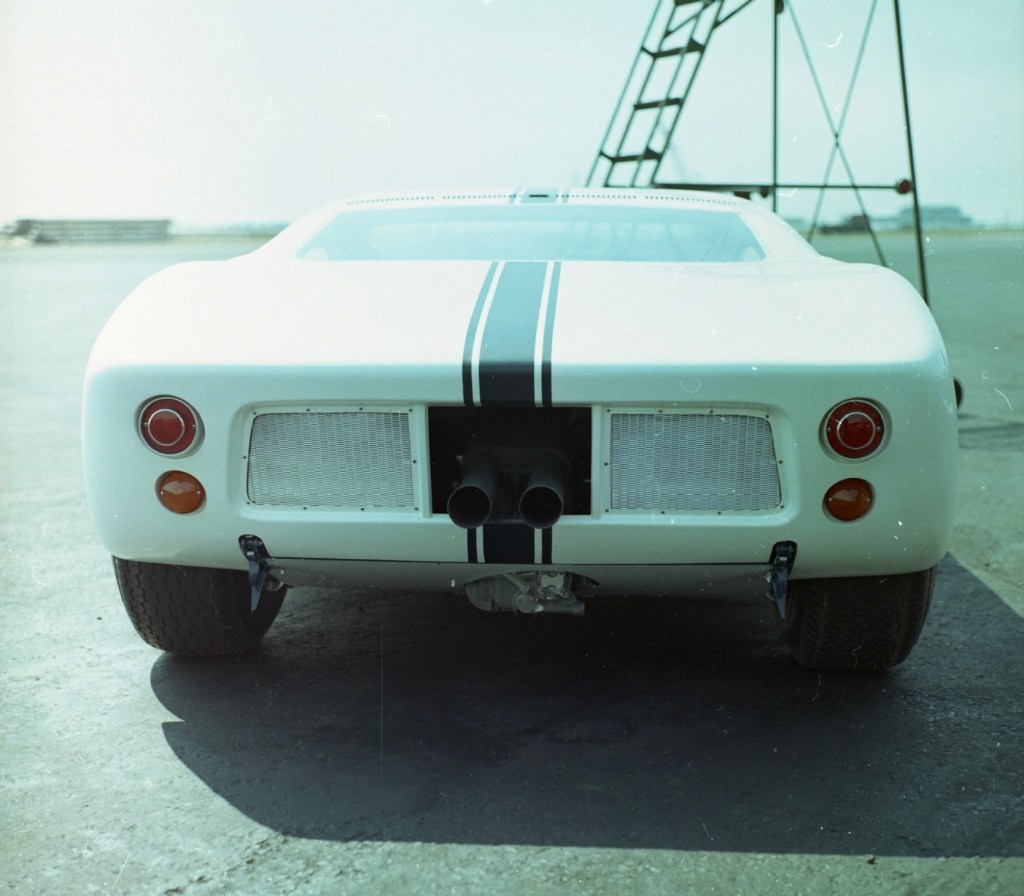
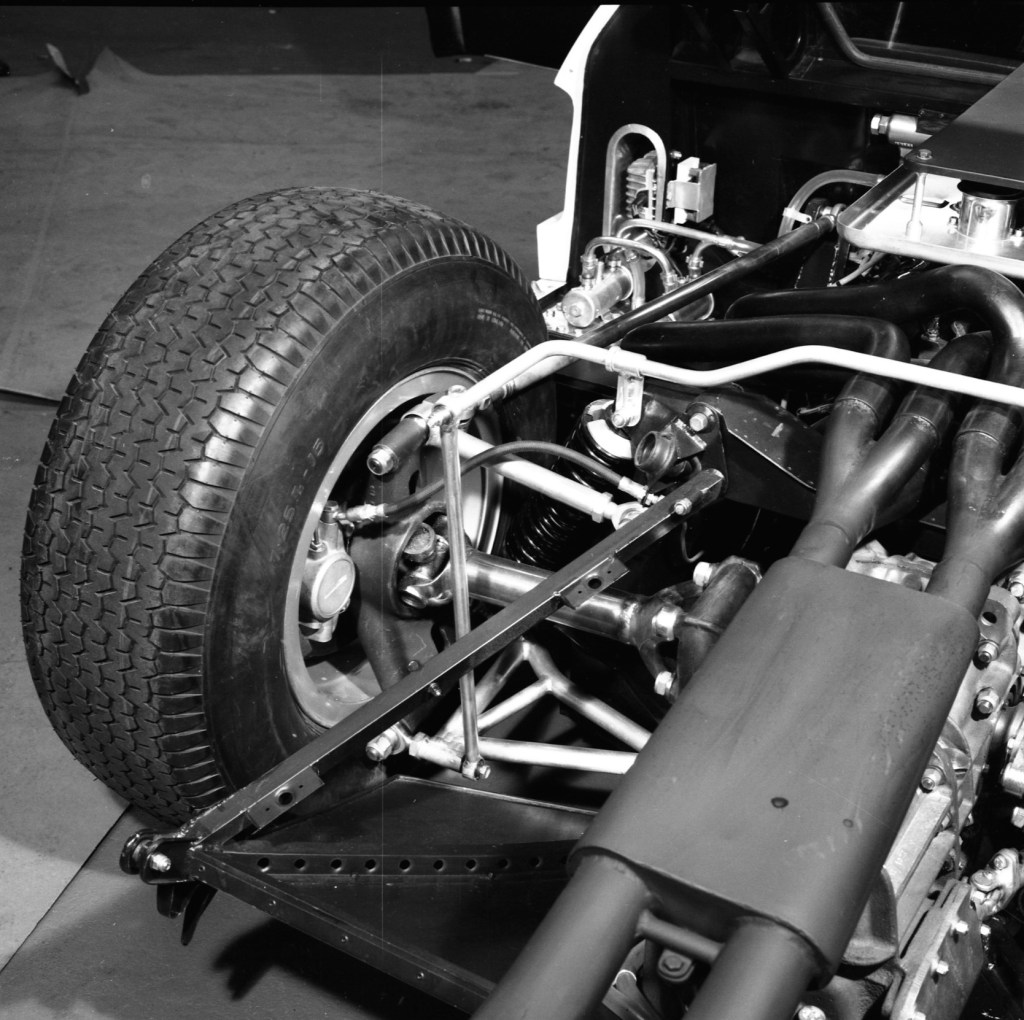
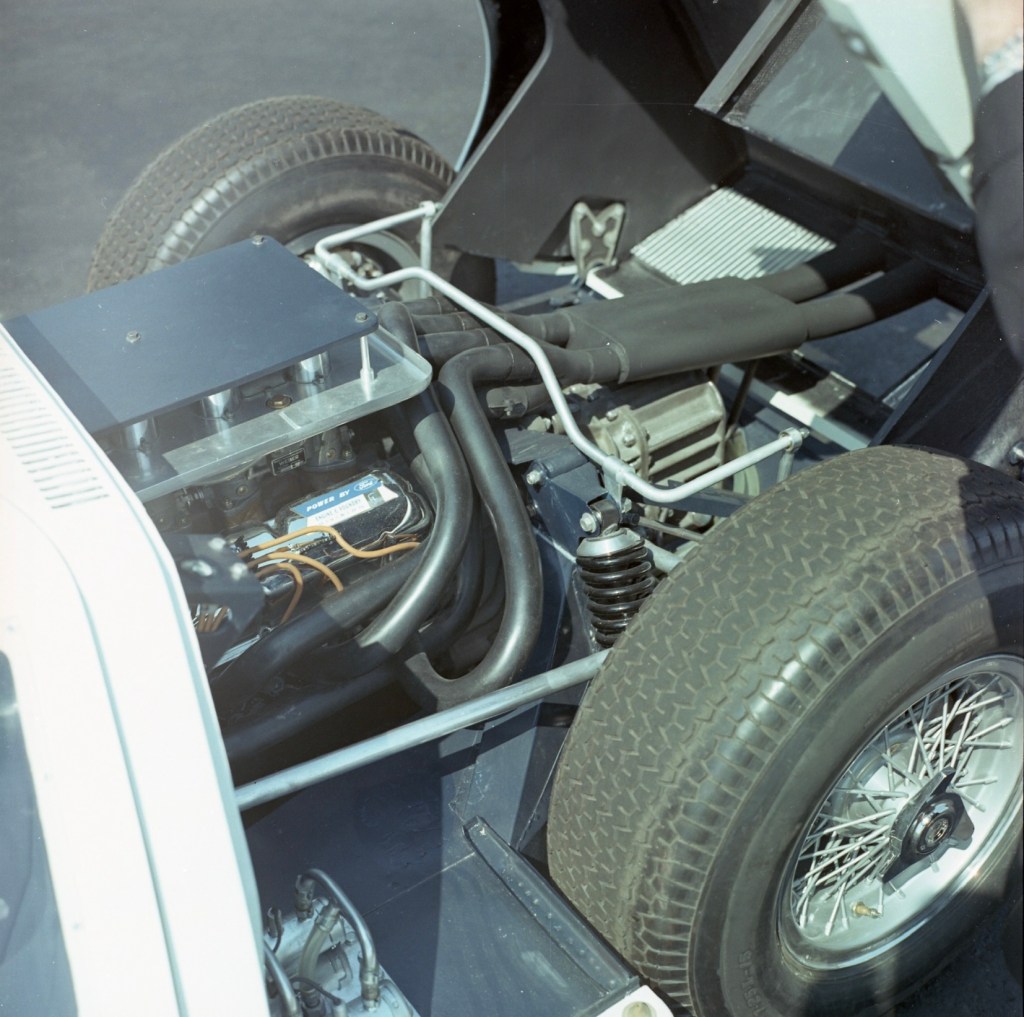
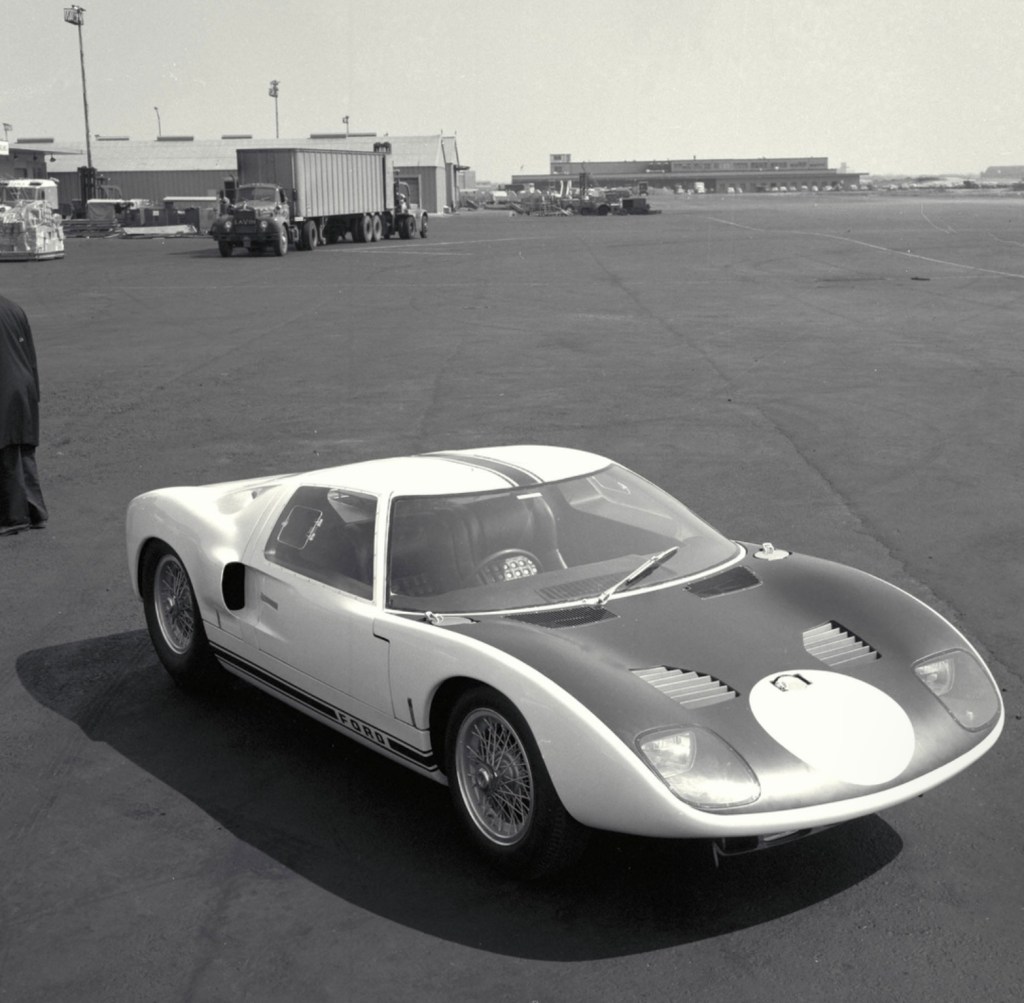
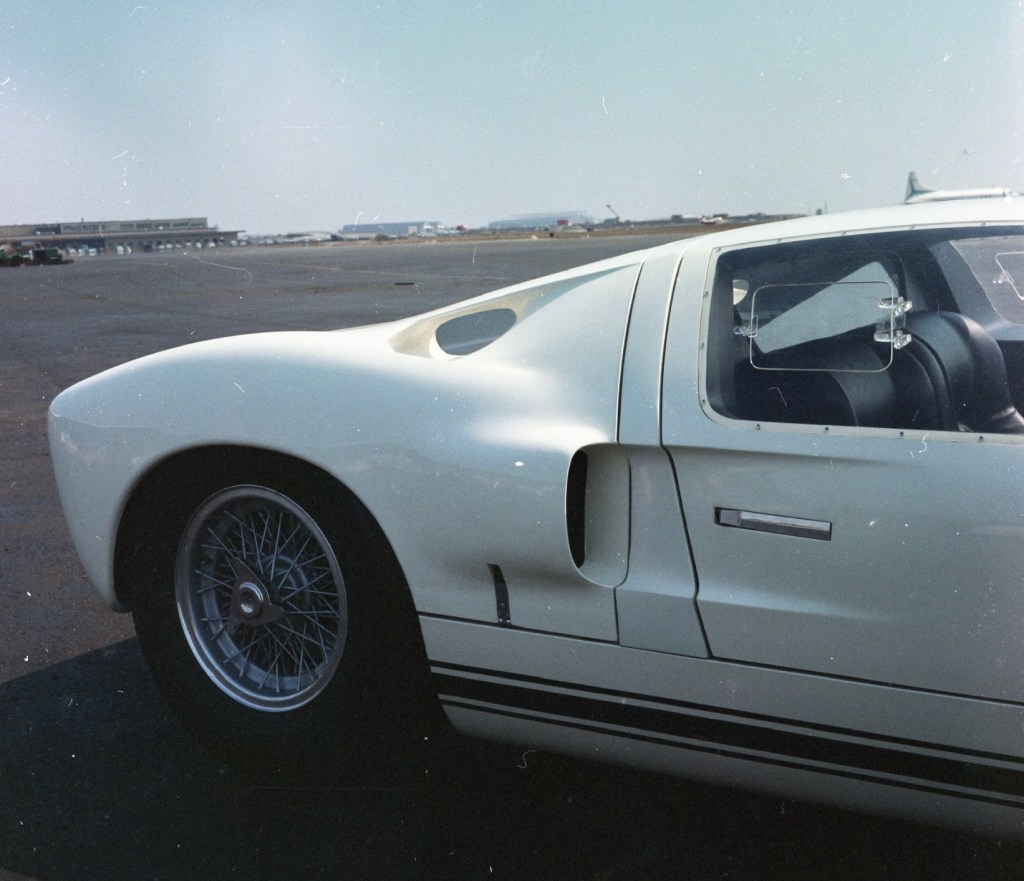
Ford GT40 chassis 101, the first of 12 prototypes built, on the runway at JFK Airport, New York, in early April 1964…
The machine is on its way to the New York International Auto Show, having been presented publicly to journalists in an open day at Slough, then outside the offices of Trans World Airlines at Heathrow on April Fools Day, before it was flown to the US “to be used for a press conference prior to the Mustang launch,” then display between April 4-12.
The car was a starlet for only the briefest of times, it was destroyed in an accident in the wet while being driven by Jo Schlesser during the Le Mans test weekend on April 18.
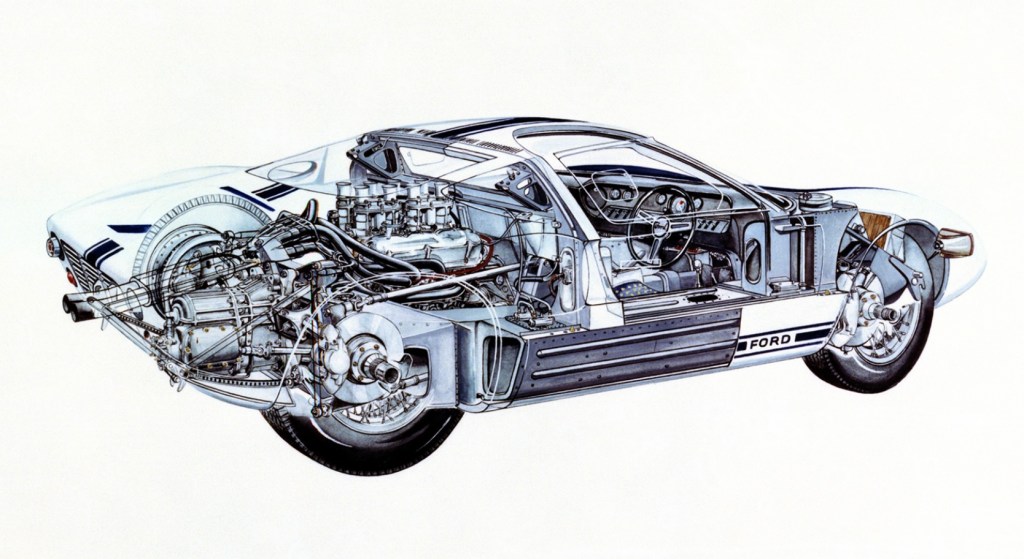
Jo Schlesser, Le Mans test weekend, Ford GT40 #101, April 1964 (MotorSport)Ford GT40 1964 cutaway (FoMoCo)
Ford’s blunt telex on May 22, 1963 announced the end of discussions of the takeover of Ferrari by the Detroit giant. “Ford Motor Company and Ferrari wish to indicate, with reference to recent reports of their negotiations toward a possible collaboration that such negotiations have been suspended by mutual agreement.”
A month later Ford created the High Performance and Special Models Operations Unit – catchy ‘innit? – to design and build a Le Mans winner. Members of that group included Roy Lunn and Carroll Shelby. Kar Kraft was established within FoMoCo to oversee the Ford GT program, with Lunn its manager.
They soon identified and contracted Eric Broadley as project engineer, his monocoque Lola Mk6 GT Ford, which had performed well at Le Mans in 1963, despite not finishing, was a ground-breaking sports-prototype. As part of the deal Ford acquired the two existing Lola GTs, giving them a nice head start. John Wyer was appointed as race manager, a role he had performed at Aston Martin when Shelby co-drove an Aston Martin DBR1 with Roy Salvadori to Le Mans victory in 1959.
“The four pronged team comprised Lunn and Broadley designing and building the cars, Wyer managed the operation with Shelby acting as frontman in Europe,” Ford wrote.
(FoMoCo)
Key members of the Slough design team included Broadley, Lunn, Phil Remington and Len Bailey.
In the 10 months prior to the ’64 Le Mans classic the program got underway at Lola’s premises in Bromley. The Ford Advanced Vehicles (FAV) operation later moved to a factory in Slough, alongside Lola, who moved as well – in the middle of what is now referred to as Motorsport Valley – in the Thames Valley.
Some development work was carried out in Dearborn, but in essence the Ford GT40 was a British design funded by US dollars. The Ford contribution – most critically was absolute monetary and management commitment from the top to succeed – included engines and aero-modelling in which a scale model of the car was tested in their Maryland wind tunnel. Computer aided calculations related to aerodynamics under braking was undertaken and anti-dive geometry explored. The two Lola Mk6 Fords were used as mobile test-beds in the hands of Bruce McLaren and others until the end of 1963.
Le Mans test weekend (MotorSport)(FoMoCo)
Let’s go back to the April 1964 logistics of #101. Ford GT40 anoraks shouldn’t get too excited by this piece, the words are a support for a bunch of great Ford Motor Company photos taken at JFK and in the studio I’ve not seen before. After the New York International Auto Show, the car retuned to the UK and was transported to the Motor Industry Research Association (MIRA) test track at Nuneaton where private shakedown tests took place.
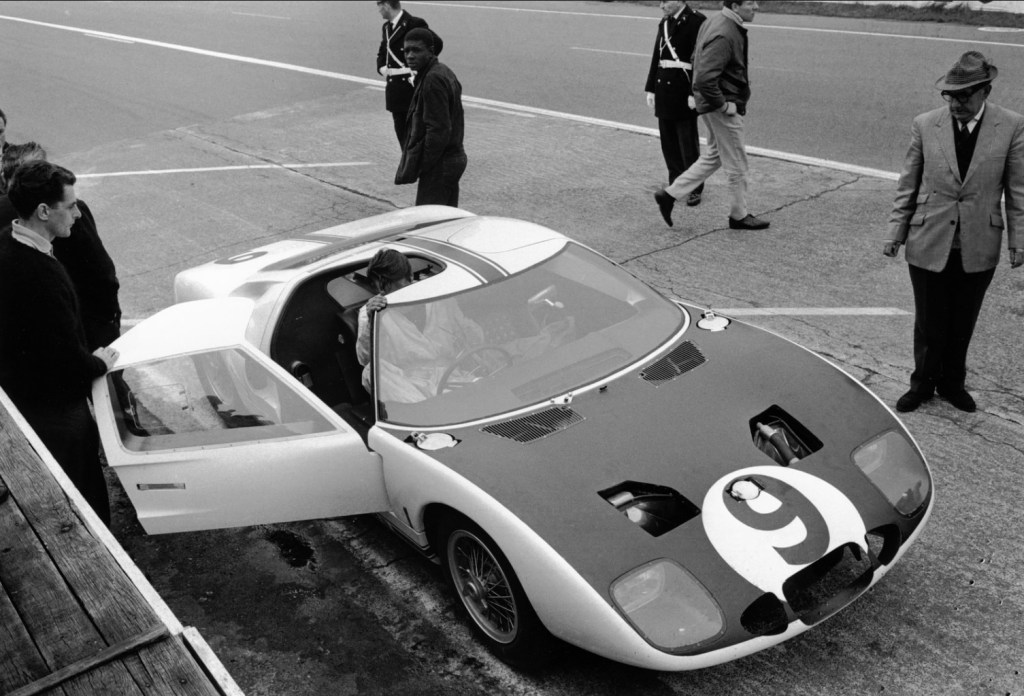
The Le Mans test weekend followed on April 18-19. Jo Schlesser was allocated #101 and Roy Salvadori #102. Jo had already complained about high speed directional instability, when, on his eighth lap, he lost control in the wet at over 150mph. Miraculously, the car didn’t roll or hit trees, but it was destroyed with Schlesser copping only a minor cut to his face. Lady Luck was with him that day…not so at Rouen in 1968.
(FoMoCo)
Chassis and Suspension…
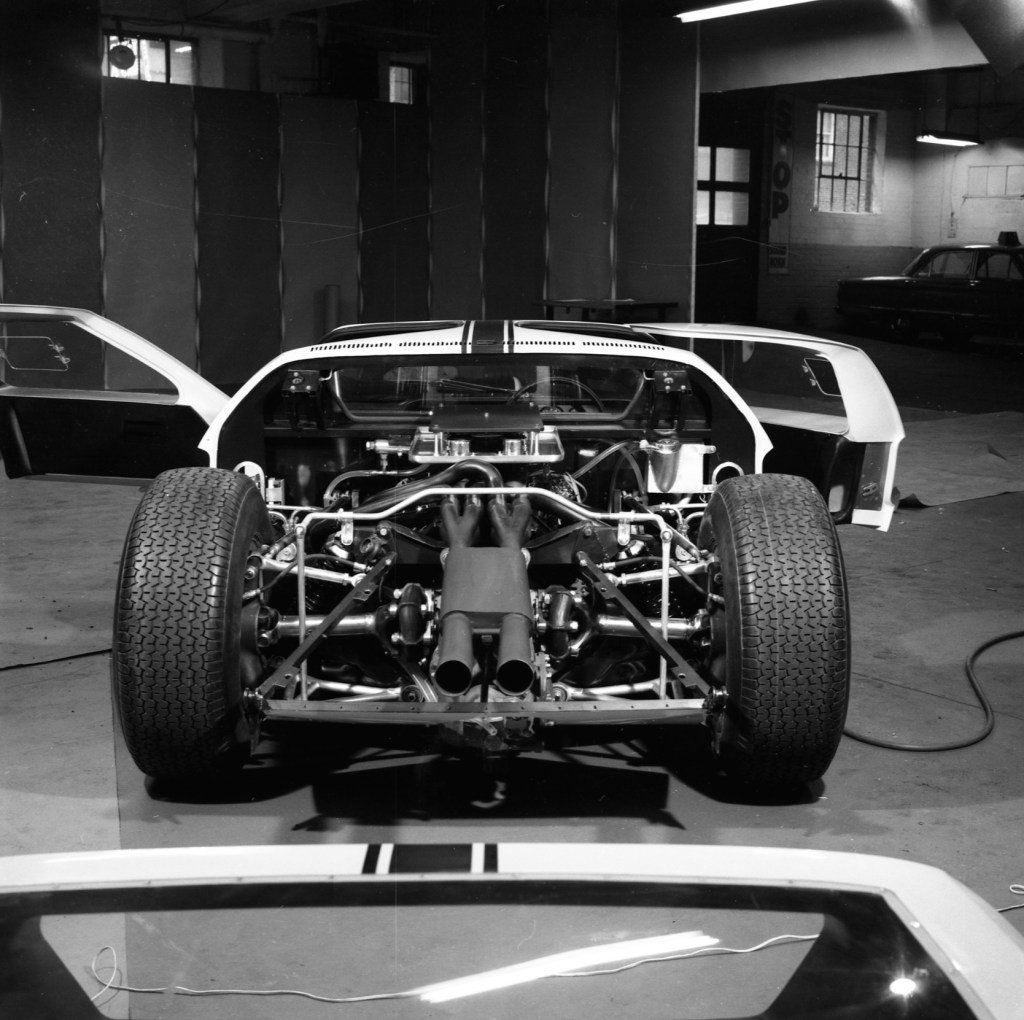
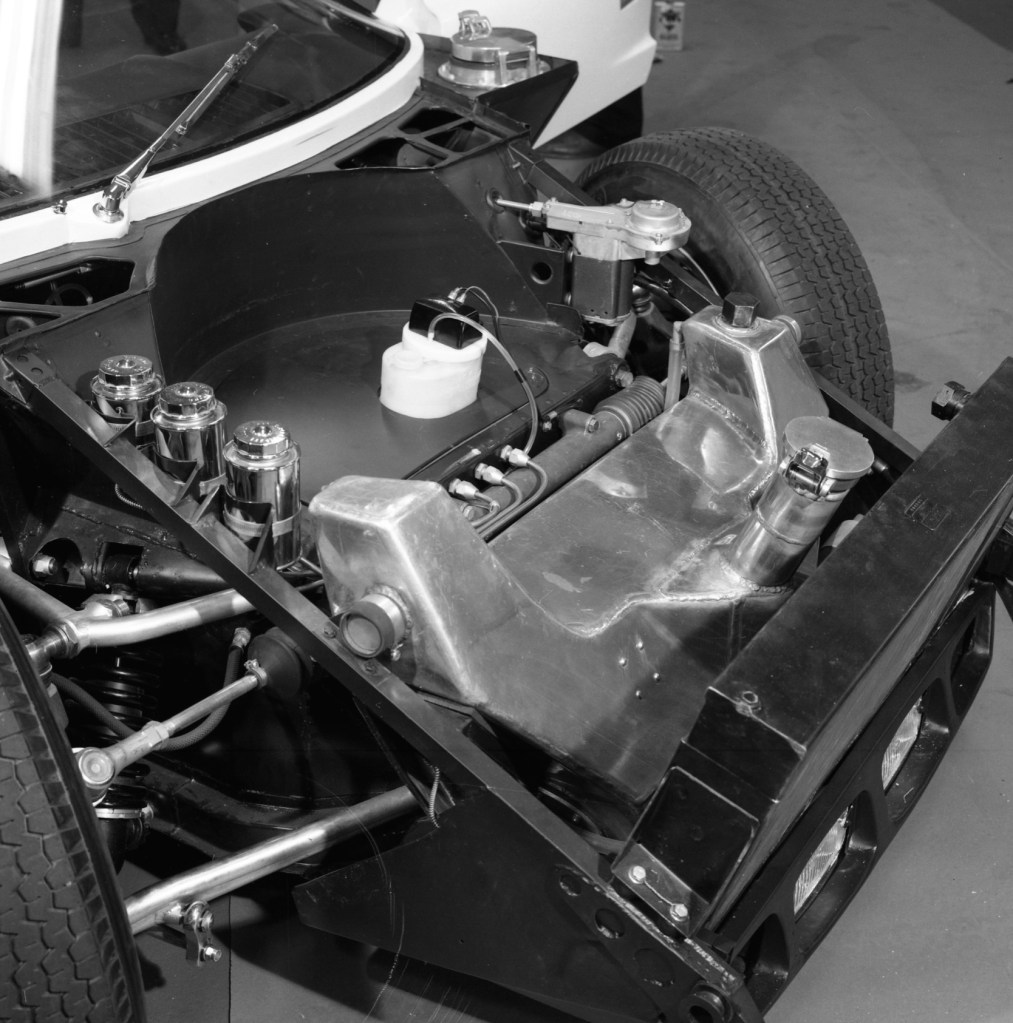
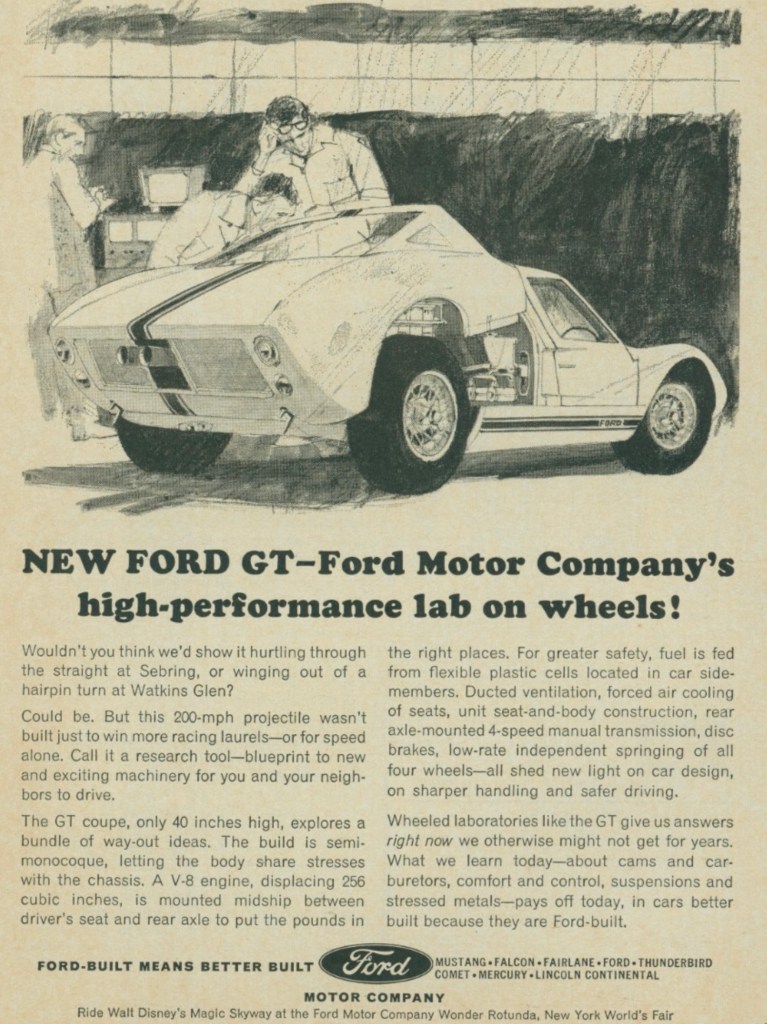
The Abbey Panels built steel monocoque – Eric Broadley wanted aluminium, while Ford wanted steel – incorporated two square tube stiffeners that ran from the scuttle to the nose. At the rear was a lightweight detachable subframe which supported the engine and suspension. Each sill-panel housed a bag-type fuel tank. The car weighed circa 865kg.
(FoMoCo)(FoMoCo)
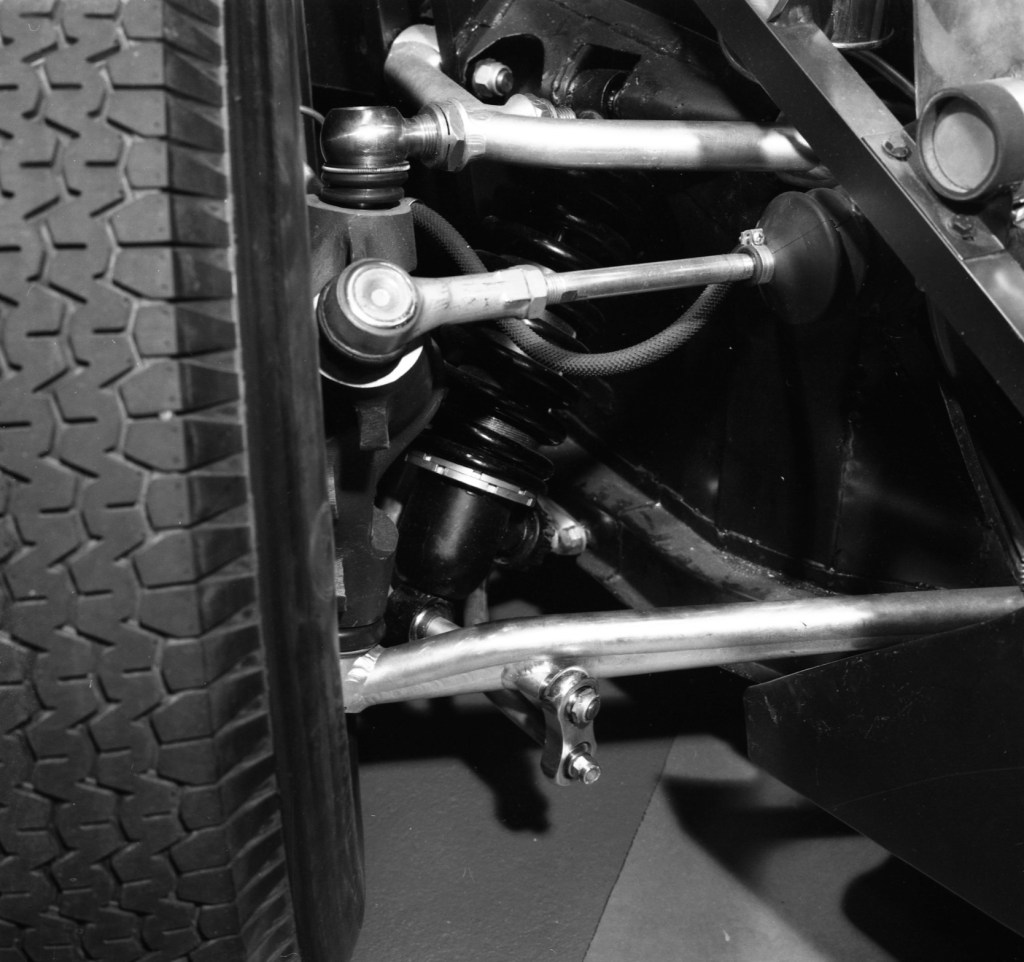
Front suspension was period typical upper and lower wishbones and coil spring/ Armstrong damper units, and an adjustable roll bar, the uprights were made of magnesium alloy. There was nothing radical at the rear either. Again the uprights were mag-alloy, there were single top links, lower inverted wishbones, coil spring/dampers and two radius rods looking after fore-aft location, and an adjustable roll bar.
(FoMoCo)
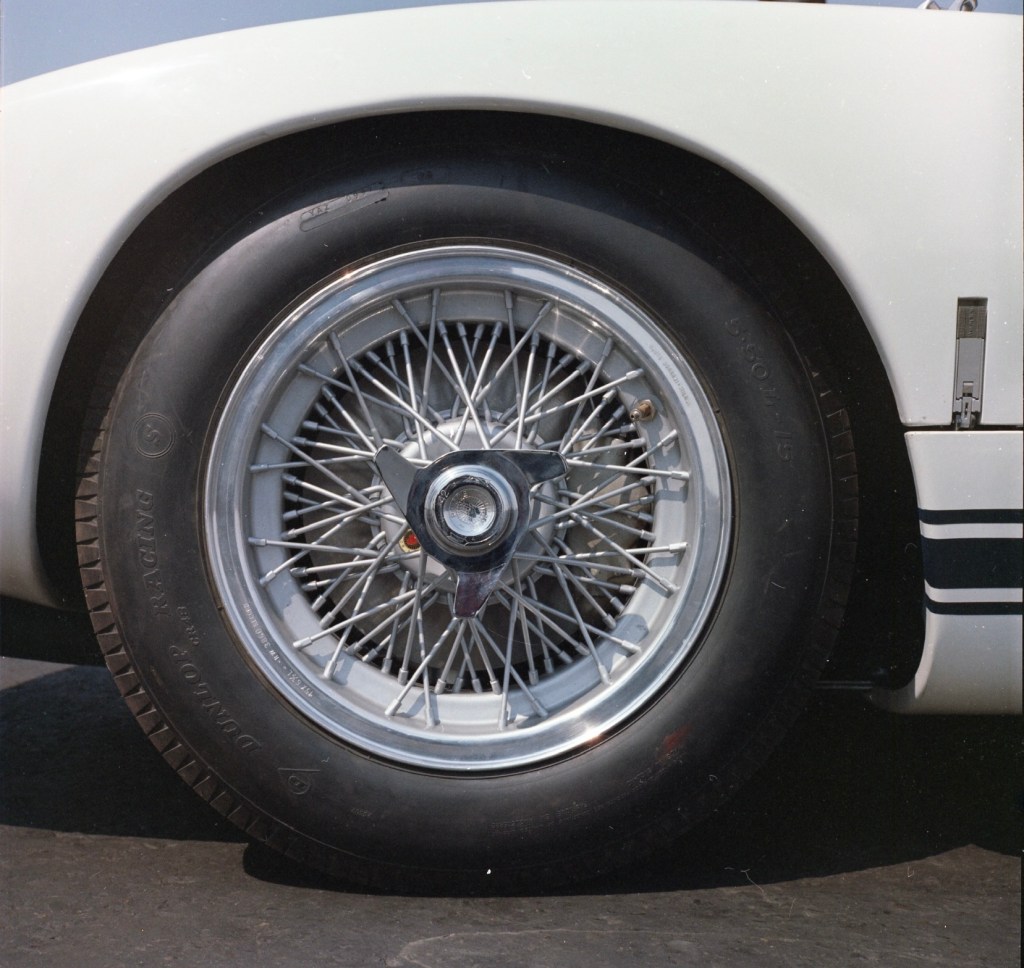
Brakes were 11.5 inch Girling rotors and calipers, while the wheels were heavy 15-inch Borrani wires, pretty naff by that stage given the modern technology used throughout the design; and addressed by Shelby American when they took over developmental charge of the race program from the end of 1964. The knock-off Borranis were 6.5-inches wide at the front and 8-inches up the back. ‘Boots’ were Dunlop R6s.
(FoMoCo)
Engine and Transmission…
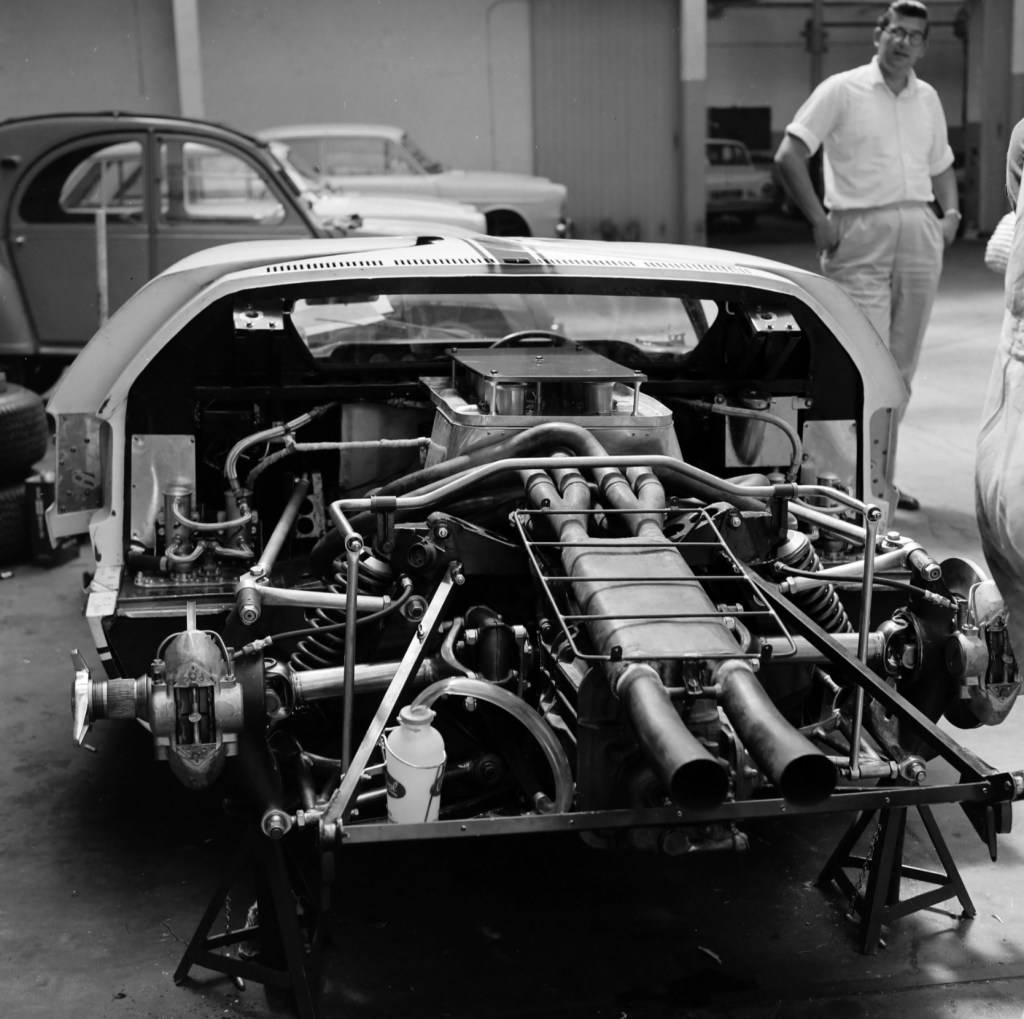
The engine was a Ford Windsor small-block, cast iron, pushrod 90 degree 255cid V8. With a bore-stroke of 95.5 x 72.9mm, the four 48IDA Weber fed 4183cc engine developed circa 350bhp @ 7200rpm and 299lb-ft of torque at 5200rpm using a compression ratio of 12.5:1.
Colotti provided their Type 37 four speed transaxle which incorporated a limited slip diff to get the power to the road via a Borg and Beck triple plate clutch. Gear ratios were of course to choice, with a top speed of 205mph quoted with Le Mans gearing.
(FoMoCo)
Bodywork and Aerodynamics…
The GT40 name came about by picking up on the cars incredibly low height, two inches lower than than Broadley’s Lola Mk6.
Specialised Mouldings, a Lola supplier, based then in Upper Northwood, made the fibreglass bodies, the aerodynamics of which took much time to get right. Shelby ‘perfected’ the sensational, muscularly-erotic shape of the cars which won Le Mans in 1966-68-69 over the winter of 1964-65. The ’67 Mk4 being a different aerodynamic kettle-of-fish.
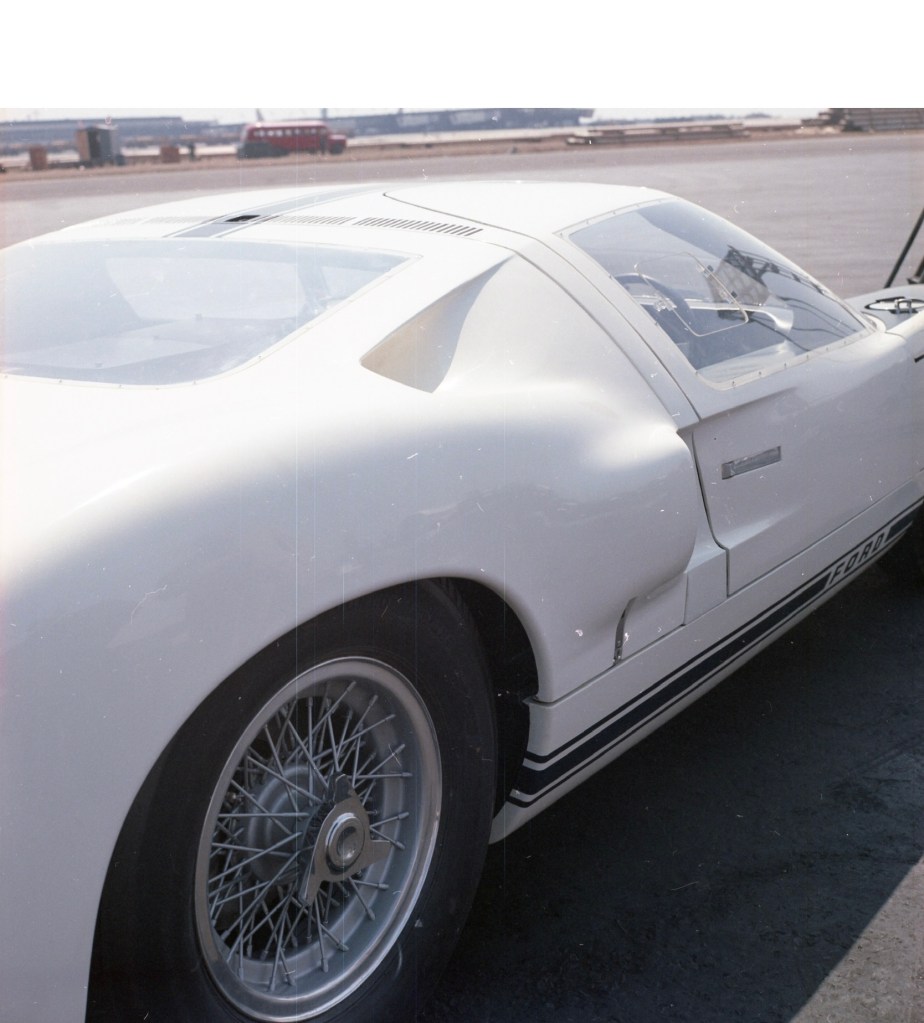
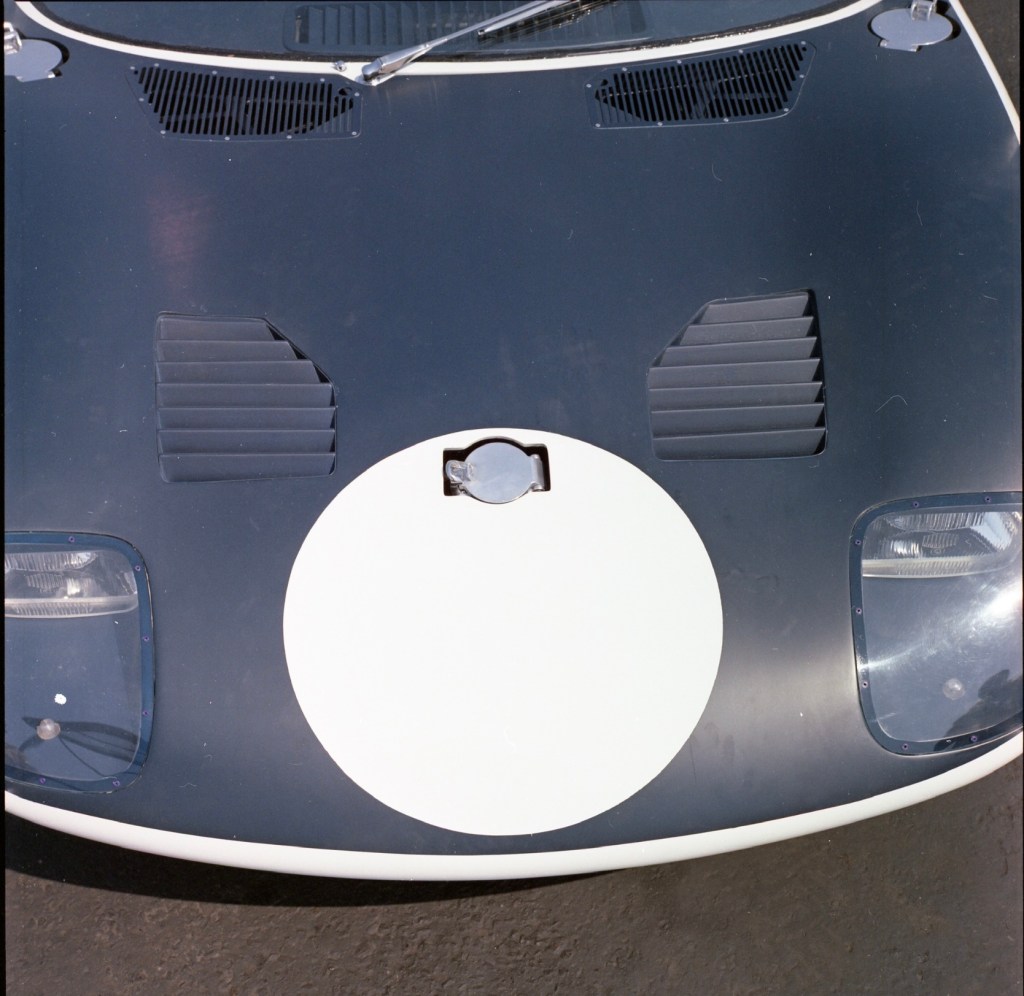
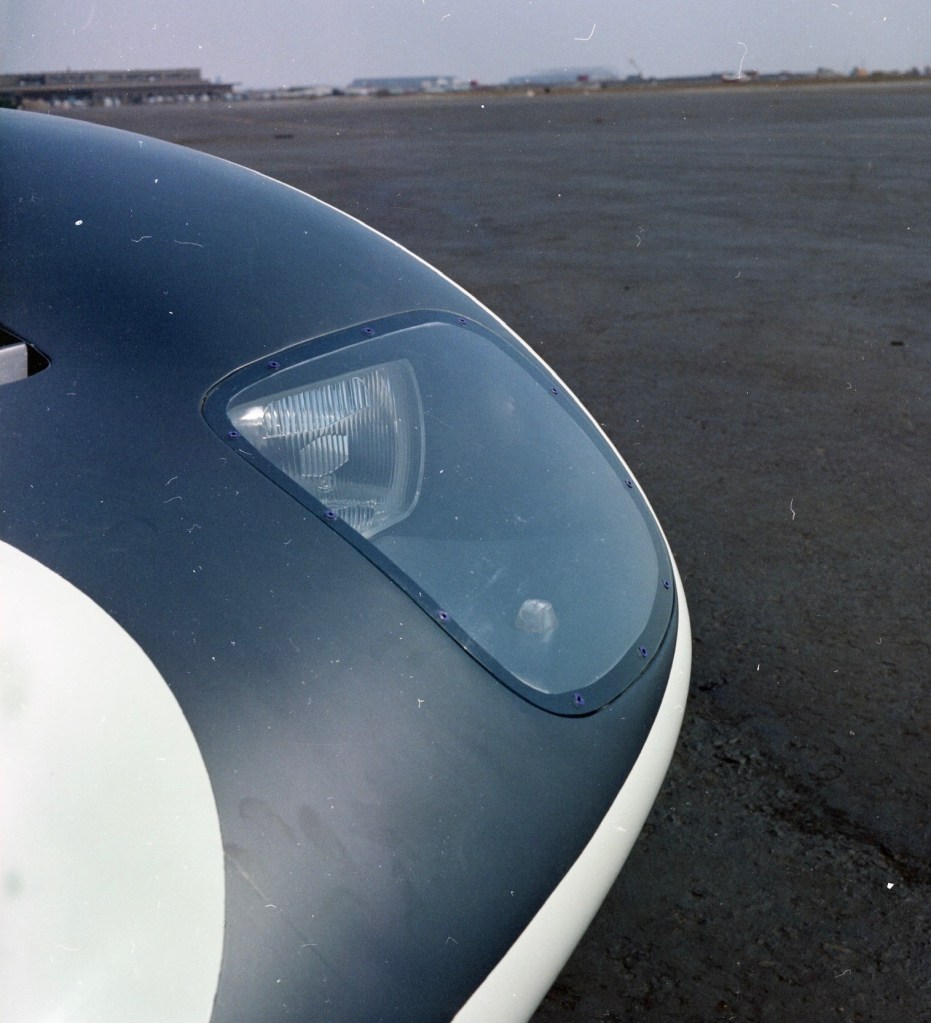
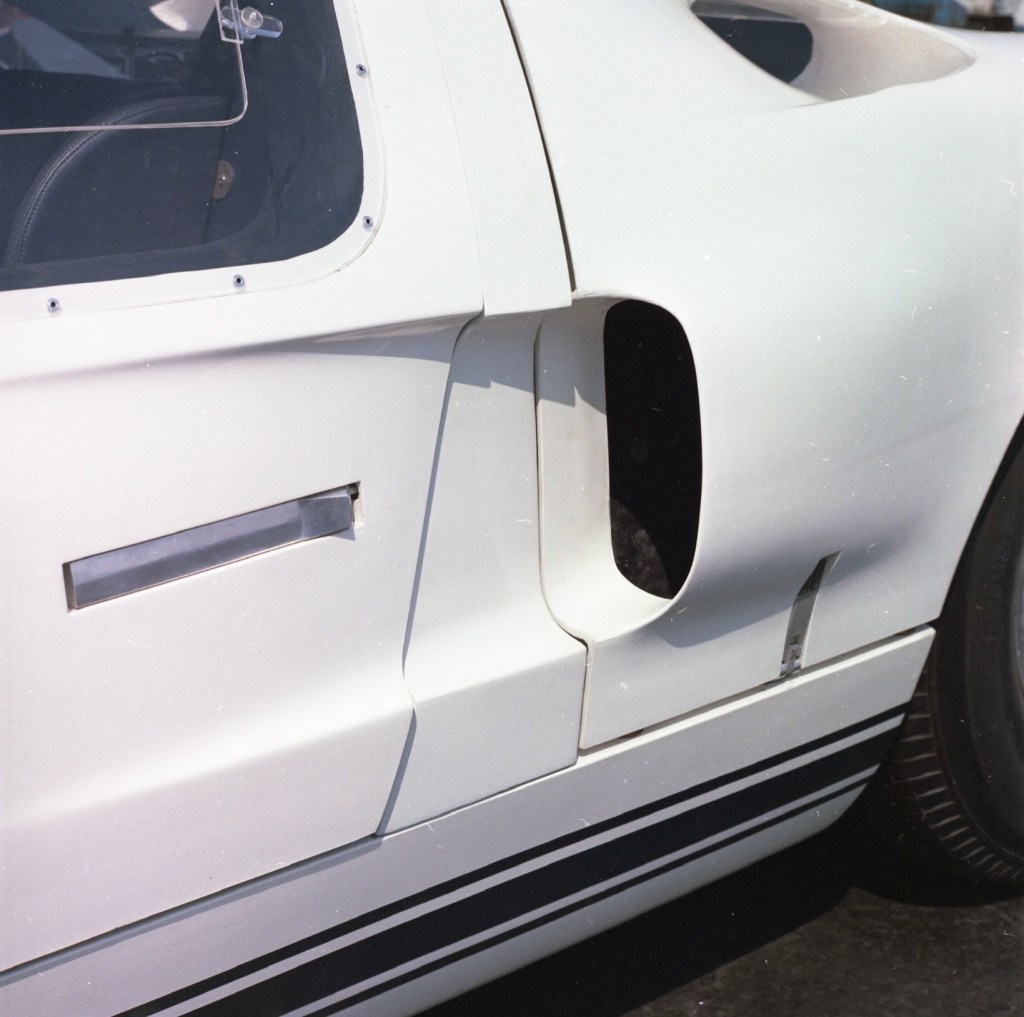
The headlights were fixed under clear Plexiglass covers with additional spotlights inboard of the brake ducts. Two big air intakes were sculpted into each flank to assist engine cooling with additional ducts on the panels each side of the rear screen.
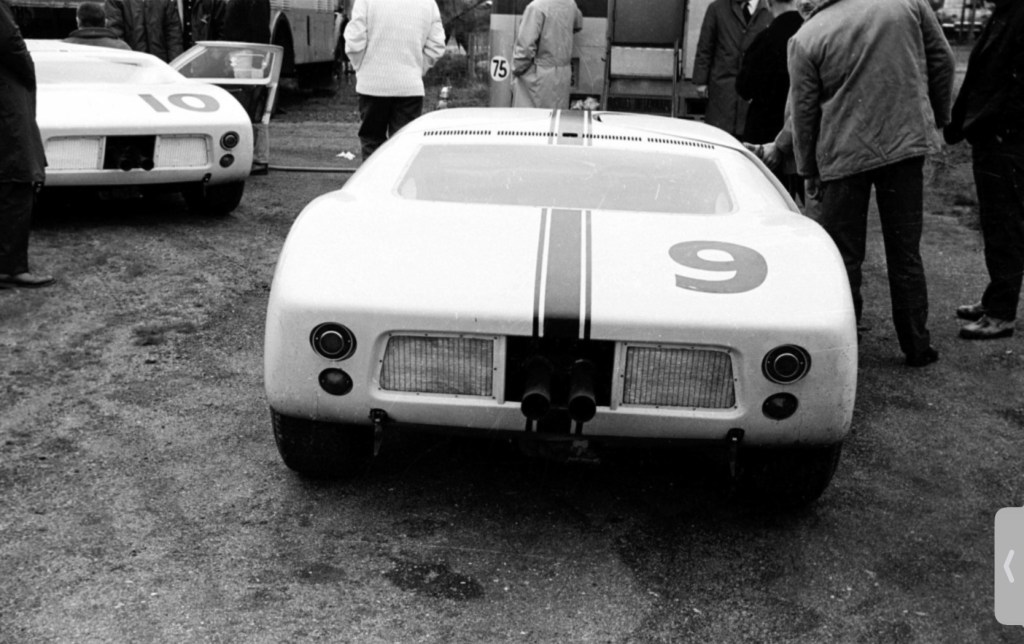
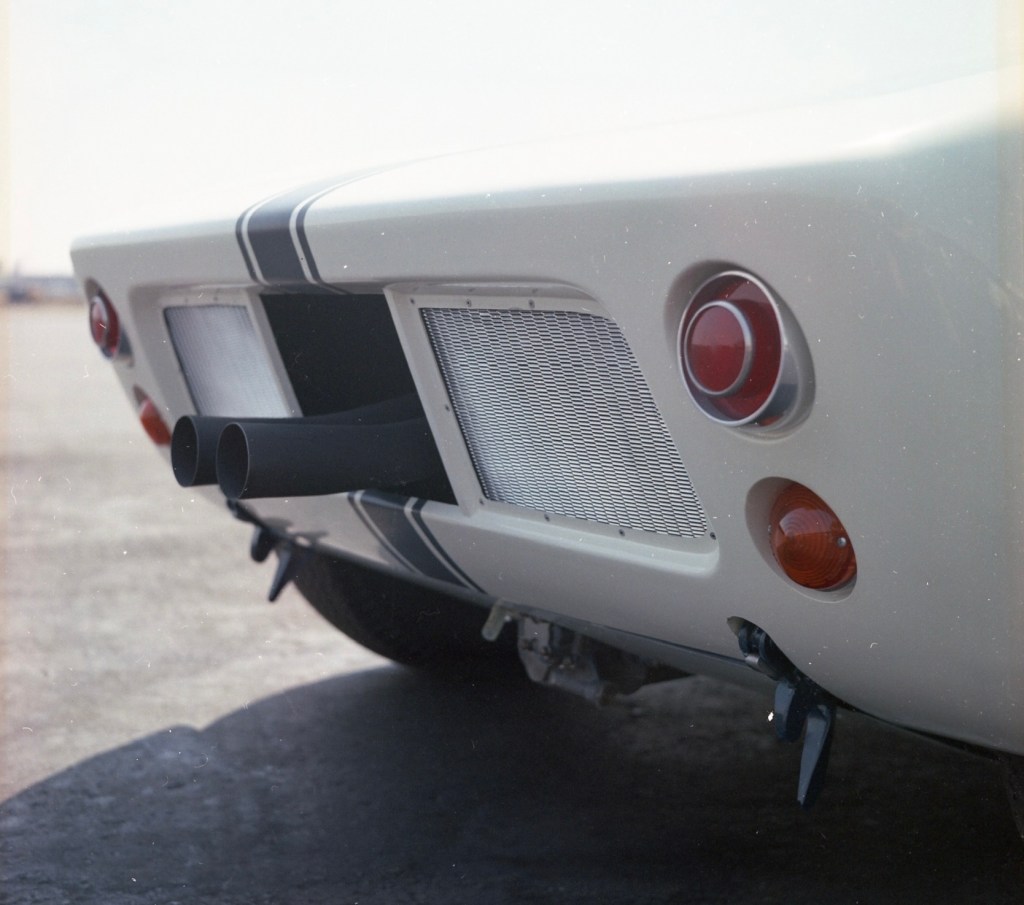
At the rear were meshed cooling vents through which the raucous V8 exited its gasses. The body was slippery enough but not yet effective.
(FoMoCo)(FoMoCo)
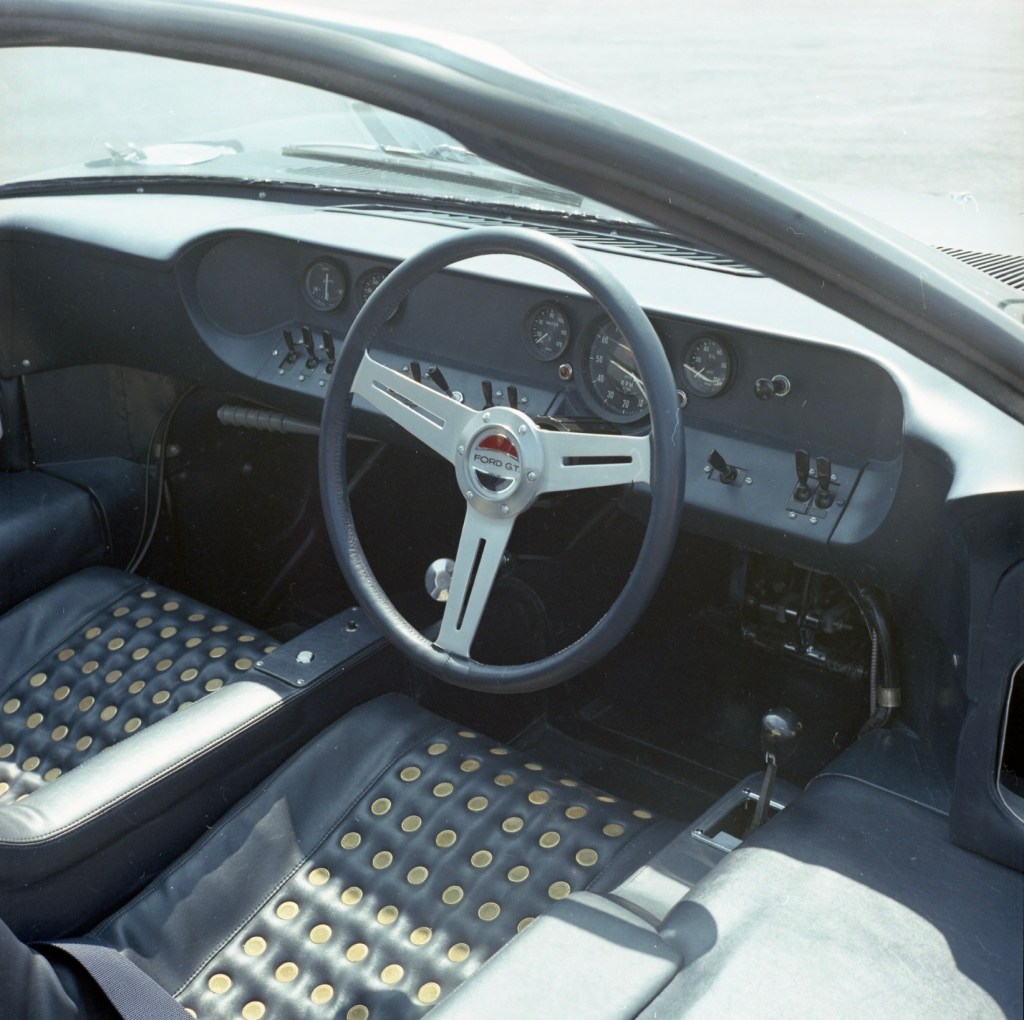
Driver ergonomics were very much to the fore. The top off each door was cut deeply into the roof. Once the driver cleared the wide-sill of the RHD, right-hand shift machine, he popped his arse into a light, fabric, perforated seat fixed in location; the pedals were adjustable.
I’m not sure if the 12 prototypes were built in this manner, but Denis Jenkinson described the GT40 production process in MotorSport as follows.
“The steel body chassis unit, made by Abbey Panels, of Coventry arrives in Slough in a bare unpainted form. Front and rear subframes are fitted, for carrying body panels etc, and then the unit goes to Harold Radford Ltd, where the fibreglass doors, rear-engine hatch which forms the complete tail, and front nosepiece, which is a single moulding, are cut-and-shut to fit the chassis/body unit, these panels then being marked and retained for the car in question. The fibreglass components are made by Glass Fibre Engineering of Farnham, Surrey and then delivered to Slough in the bare unpainted state. When the chassis/body unit is returned from Radfords the factory at Slough then assembles all the suspension parts, steering, wiring, engine, gearbox and so on, the final car being painted in the particular colour required by the customer.”
Checkout this evocative piece at Abbey Panels and Le Mans…
Many thanks for the tip-off Tony Turner!
1964 Season…
Given the lack of development time before the GT40 was raced, the initial races were pretty much a disaster.
Ford lost #101 (Schlesser) during the Le Mans test, while Salvadori gave #102 a gentle run, they were 12th and 19th quickest.
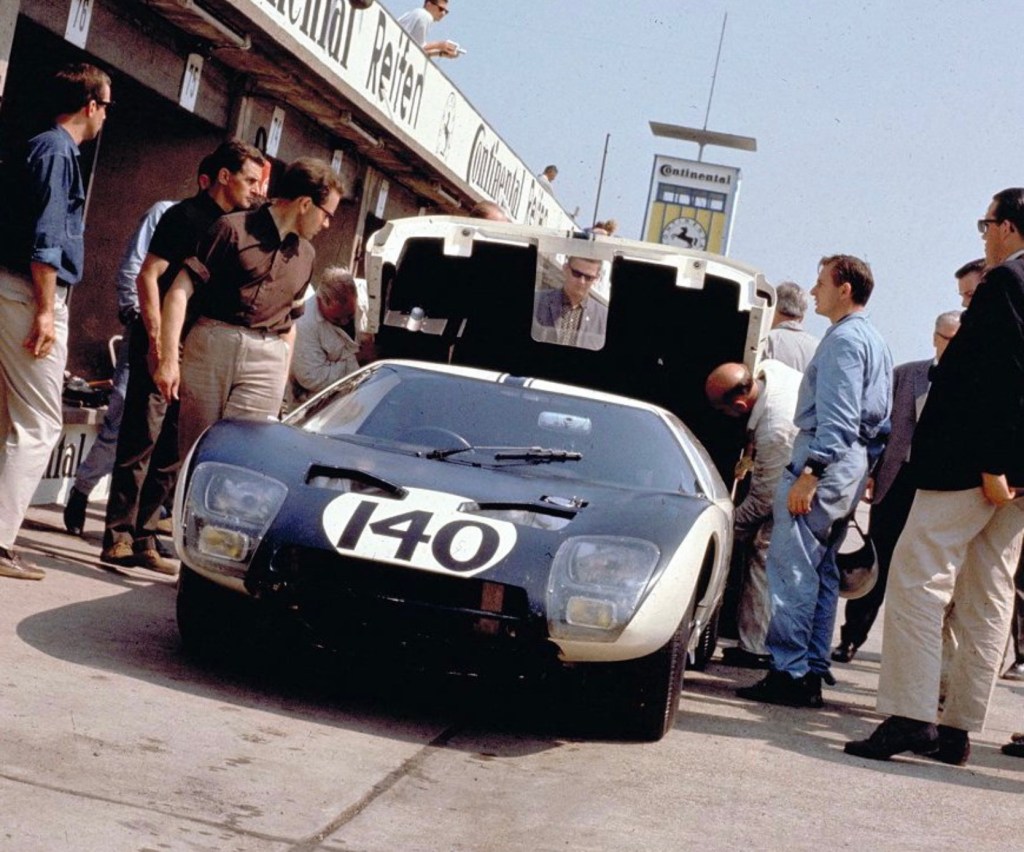
Six weeks later #102 contested the Nurburgring 1000km with a modified front clip manned by vastly experienced racer/engineers, Bruce McLaren and Phil Hill. Bruce was the lead test-driver on the GT40 programme. They qualified the car second behind the Ferrari 275P of John Surtees and Lorenzo Bandini. Phil ran between second and fourth in his stint but the car was retired with suspension damage early after Bruce took the wheel.
Broadley in brown, McLaren in blue, #102 in white. Nurburgring 1000km 1964 (unattributed)Business end of one of the GT40s at Reims in 1964 (MotorSport)Le Mans 1964. Attwood/Schlesser GT40 from the Baghetti/Maglioli, Ferrari 275P and Bonnier/Hill Ferrari 330P (MotorSport)
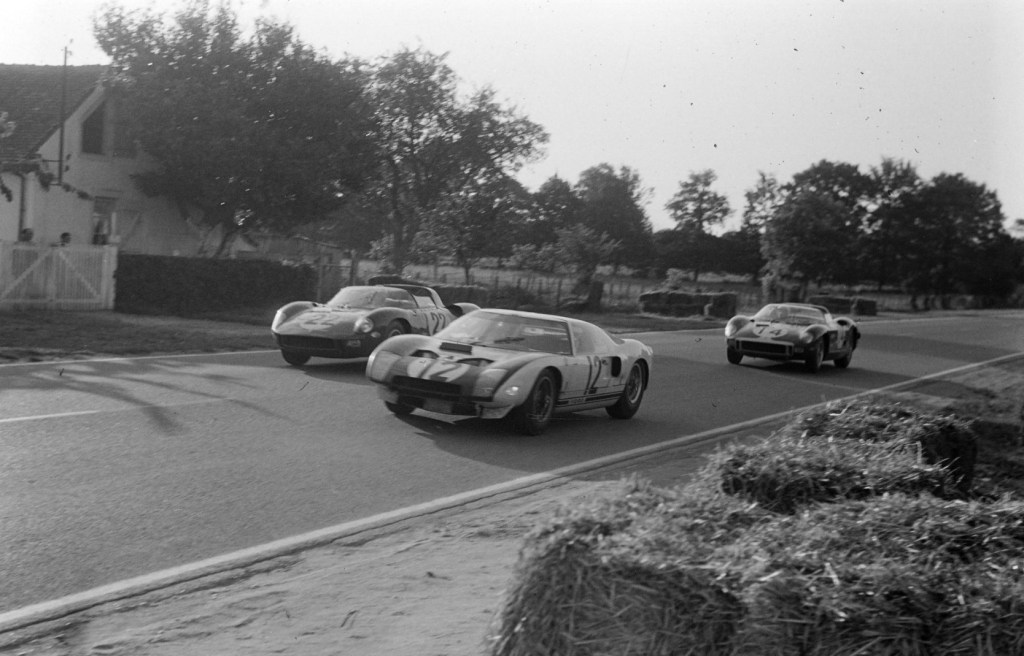
At Le Mans three cars were entered for Hill/McLaren, Richie Ginther/Masten Gregory and Richard Attwood/Schlesser. While Ford set a lap record, all three cars retired; the Attwood car caught fire, with both other cars retiring with gearbox failure.
The two cars that appeared at the Reims 12 Hours a fortnight after Le Mans were #102 and #103, plus a new car, #105, powered by Shelby prepared 289 V8 giving about 390bhp at a lower 6750rpm – 341lb-ft of torque was up too. New third-fourth selectors were fitted to the Colotti ‘boxes, and the dog-rings hardened. The Surtees/Bandini Ferrari 250LM started from pole, but by lap 10 the Ginther GT40 led McLaren. Richie’s lead ended with crown wheel and pinion failure on lap 34, Atwood’s with a plug that had come out of the gearbox, while the Hill/McLaren car blew its engine.
Chassis 103 and 104 were then raced in the Nassau Speed Week by Hill and McLaren fitted with 289 V8s (4.7-litres). Only Phil made it through the Nassau Tourist Trophy qualifier, Bruce had suspension problems in 104. Hill’s car suffered the same fate in the feature race.
Without a finisher in four meetings, chassis #103 and #104 were shipped to Shelby American in California. “The decision was made in Dearborn to move the (development) work back back to the US, with Carroll Shelby given operational control and Lunn engineering control.” Ford’s website records.
Over that autumn and winter an intensive development programme together with with FAV produced a race winner, not a Le Mans winner mind you, but that would come soon enough…
And what happened to #101 you ask?…
The car’s odometer recorded only 465 miles at the time of its death. It was written off with many parts salvaged…the monocoque may have been repaired and renumbered. Ford has never released the details of what became of the various components, not least the all-important chassis. There is a replica of course, no point letting a vacant chassis number go to waste, it won an award at Pebble Beach, so I guess it’s a very shiny one.
Etcetera…
(FoMoCo)(FoMoCo)
‘Total Performance’, ‘Going Ford is The Going Thing’, and the rest.
I lapped it all up! What was not to love about a global transnational with such commitment to motor racing in every sphere? From Formula Ford to Formula 1, Bathurst to Brands Hatch and the high banking of Daytona to the Welsh forests…God bless ‘em I say.
#102 and #101, Salvadori and Schlesser, Le Mans test weekend, April 1964 (unattributed)(FoMoCo)(FoMoCo)(FoMoCo)
Credits…
Ford Motor Company, corporateford.com, MotorSport Images
Tailpiece…
(MotorSport)
If Enzo started it all by ending negotiations with Ford, Eric Broadley finished it, unintentionally.
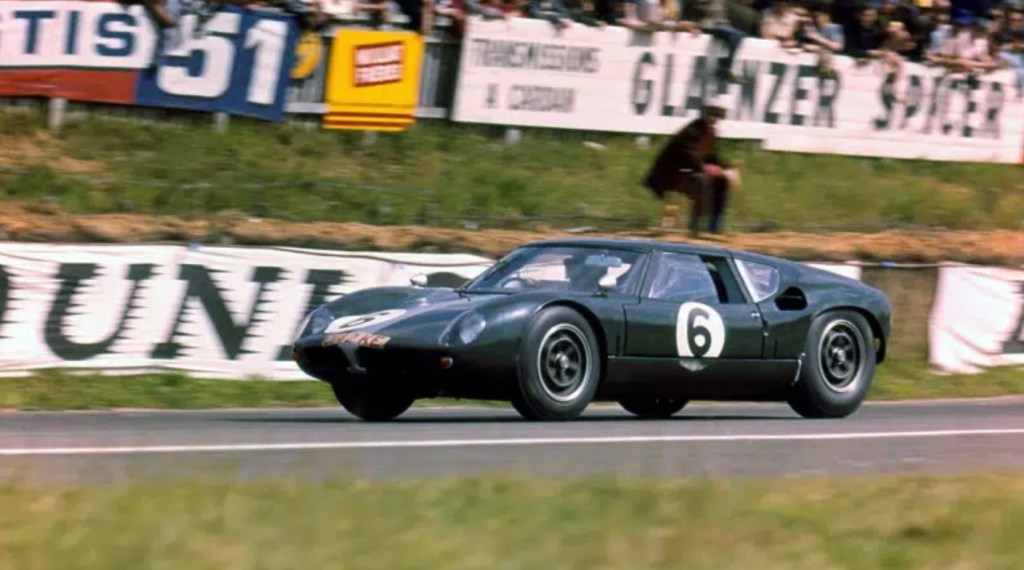
His Lola Mk6 Ford GT was so late for Le Mans that Eric sent drivers Richard Attwood and David Hobbs ahead and he drove the car to La Sarthe. What a road car…
The two Brits raced it as it arrived at the track; there were no alternative springs, bars or ratios. A missed shift by Hobbs of the tricky Colotti box ended their race too.
Eric Broadley bet-the-farm on that brilliant car but it paid off rather well!
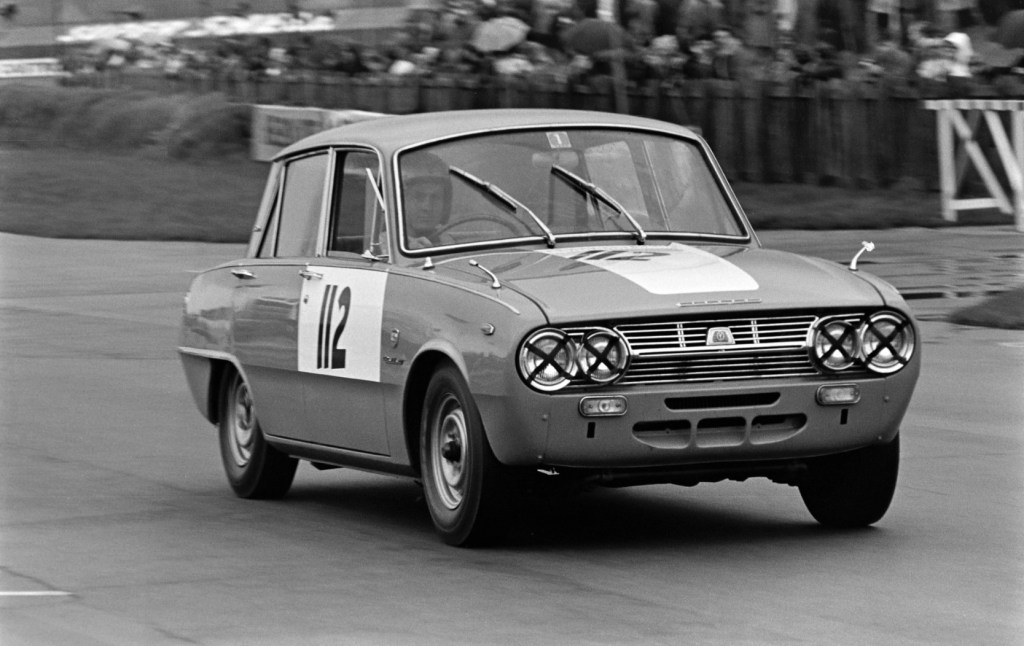
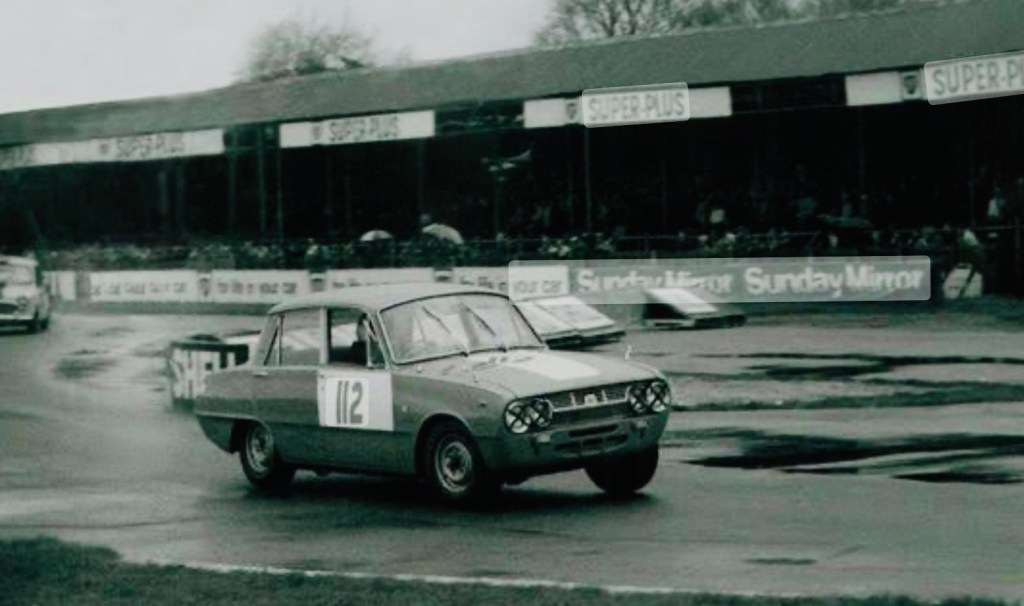
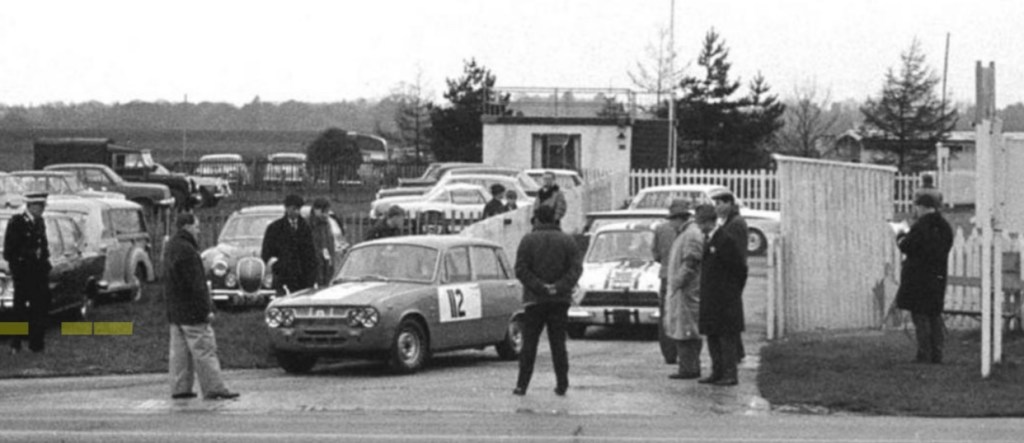
Bruce McLaren piloting the works Isuzu Bellett at Goodwood during practice for the St Mary’s Trophy race over the April 19, 1965 International Trophy weekend.
In a busy weekend McLaren raced his Cooper T77 Climax to fourth place in the F1 feature, the Sunday Mirror Trophy, and his 4.5-litre Elva McLaren Oldsmobile to third in Lavant Cup, both races were won by Jim Clark, in Lotus 25 Climax and Lotus 30 Ford respectively. The power to weight ratio of this Nippon Racing, British Saloon Car Championship entry would have been the lowest of his mounts I suspect…
It was the first time a Japanese car appeared at a BSCC round, so it was an historic occasion. The Autosport report of the race records that a piston failed in the 1471cc four-cylinder engine in practice, so Bruce didn’t take the start of the event won by Jim Clark’s Team Lotus, Lotus Cortina and Jack Sears’ sister car.
(unattributed)Bruce about to go out with the fourth placed John Willment Racing Lotus Cortina of Frank Gardner behind (Goodwood Sixties)
John Sprinzel raced the Bellett at Crystal Palace on June 7, albeit not in the BSCC race, how did he go?
MotorSport Images, ‘Motor Racing at Goodwood in the Sixties’ Tony Gardiner, Stephen Dalton, Jack Inwood, Brent Benzie, Doug Nye
Tailpiece…
(J Inwood)
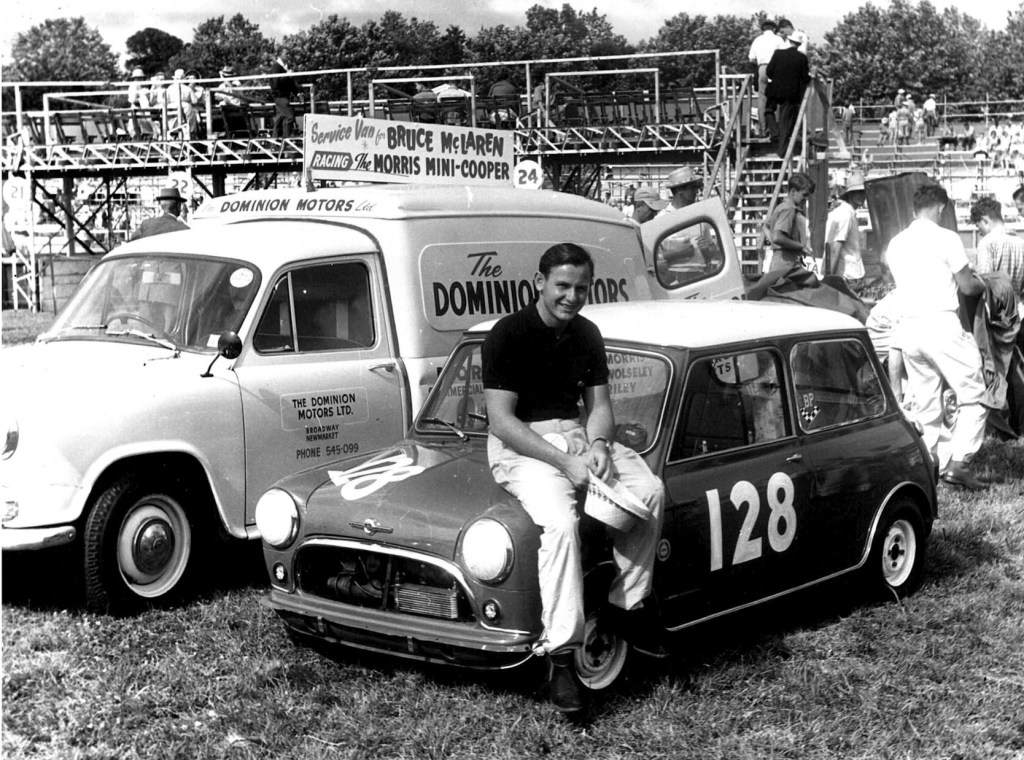
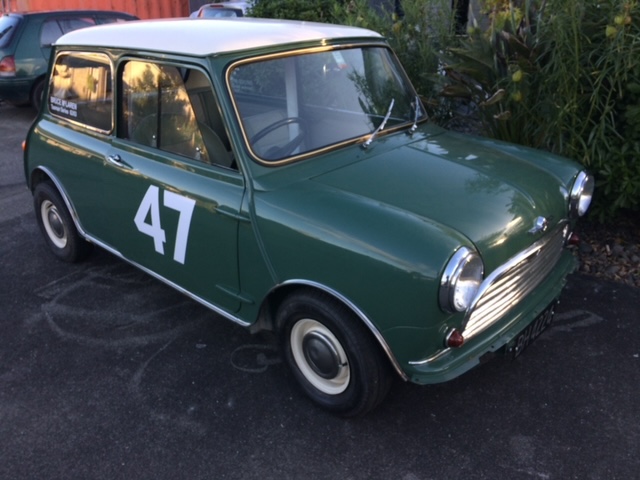
No doubt Bruce had ‘plenty’ of touring car form – don’t bother with an essay on the topic whatever you do, they were of no consequence to him – here with a works, I think, Morris Cooper at Pukekohe during the January 5, 1963 NZ GP meeting.
McLaren DNF’d that race after magneto failure in his Cooper T62 Climax on lap 24, John Surtees won aboard a Lola Mk4 Climax. I wonder how he went with the Mini? He brought this car out on his Australasian Tour that summer, racing it only in NZ, does it still exist?
Etcetera…
(B Benzie)
A few days after I posted this article I had a great email from Brent Benzie.
“I read with great interest the post about Bruce McLaren and the Mini Cooper he raced in the Tasman series support races (at least in New Zealand) back in 1962-63.”
“During the mid-late 1960s I owned and raced this car mainly at Teretonga, Wigram and Ruapuna. The late Wally Willmott, wh I got to know quite well in the 1970s, told me a lot about the details of the car and its history with Bruce, and that he (Wally) had quite a lot to do with its original preparation.”
“It had an interesting a very special engine that was basically a BMC Formula Junior unit. It was fitted with two 1 1/2 inch SU carbs with no provision for chokes and sure was hello get started in that South Island climate I can tell you.”
“I sold the Cooper to fund my move to Australia but I’m pleased to say that the car still exists in New Zealand and has been restored by a gentleman who lives in or near Auckland. See the photo.”
“Incidentally, before your post I had never heard of Bruce driving an Isuzu Bellett and it brought to mind a story I read several years ago about a company that, back in the 1990s, had just leased an abandoned warehouse near the docks in Los Angeles. Inside was a huge stock of Bellett parts – including complete engines, transmissions and body parts etc – all brought into the US by Isuzu but never distributed to their dealers before they ‘pulled the plug’ on that model.”

















 primotipo...