Ferrari 246T, Lotus 49 Ford, Lotus 49 Ford, Brabham BT24 Ford, and a Mildren Mono Alfa T33: Amon, Rindt, Hill, Courage and Gardner. Pukekohe NZ GP front couple of rows, January 4, 1969…
We didn’t know it at the time, but the 1969 Tasman Cup was the last for 2.5-litre cars, The Real Tasman in the minds of many. 1970 2.5-F5000 mix duly noted.
When Jim Clark appeared in a Gold Leaf Team Lotus machine during the Levin Wigram Tasman round the year before, it was the start of big bucks in ‘European Racing’. F1 was getting bigger, the season was getting longer with summer testing in the south of France and South Africa, and the drivers were ‘more valuable’. One couldn’t afford to put one’s GeePee programme at risk killing a driver on water-skis or the race track in Australasia.
Jim Clark was dead, killed at Hockenheim in a Lotus 48 Ford FVA on April 7, 1968. BRM were in F1 disarray, still struggling to throw off the shackles of the H16 debacle. Team Lotus came, with 49 Ford DFWs for just-minted World Champ Graham Hill, and fastest-kid-on-the-block, Jochen Rindt. BRM understandably stayed at home to get themselves sorted; in that regard, they failed!
‘Take it easy, sonny, play yourself in.’ Jochen Rindt (27) and Graham Hill (39) at Pukekohe (J Copsey)Amon in the Puke pits. Note the rear electro-hydraulic angle on the wing dangle device. ‘Moveable aerodynamic devices? Don’t look this way matey!’ (P Levet)
Scuderia Ferrari came too, or rather a triumvirate. Ferrari provided two Dino 246Ts with you-beaut four-valve 2.4-litre V6s, Chris Amon brought along his good self and Ace-mechanic and friend Bruce Wilson, while David McKay/Scuderia Veloce handled the on-ground logistics and team management.
Scuderia Veloce are the Ferrari Sydney dealer and McKay was an extremely capable ex-driver, journalist and auto-entrepreneur. Quite who paid for what has never been clear – by all means send me a copy of the contract if you have it – but the mix of Scuderia Ferrari, Shell and Firestone had enough lolly in the kitty to pop Derek Bell in the second car.
Jochen had a marker to put down, and did so big-time! He had been in GP racing since 1965 and finally had a car worthy of him. It wasn’t to be Hill’s happiest Tasman or Grand Prix season in any respect.
Derek Bell and Chris Amon (M Fistonic)Glenn Abbey warms up the Mildren Monos’ Alfa Romeo Tipo 33 2.5-litre V8. Engines made to Alec Mildren’s order, he was a good Auto Delta client, having bought two GTAs and a TZ2 in the mid-1960s (D Shaw)Note the beefy rear monocoque bulkhead. Hewland FT200 transaxle, twin-plug, twin-cam, two-valve 2.5-litre engine (D Shaw)
The other extremely capable Sydney ex-driver and auto-entrepreneur was Alfa Romeo Man Alec Mildren. His two cars were powered by 2.5-litre variants of Alfa Romeo/Auto Delta’s Tipo 33, twin-cam, fuel injected V8. He fielded a new monocoque designed and built by Len Bailey/Alan Mann Racing for Frank Gardner that used Brabham BT23 components: uprights/brakes, steering rack, wheels etc.
This gorgeous machine became an Oz Icon – The Yellow Submarine – driven by FG in this Tasman, and then Kevin Bartlett, and others, all of whom won in it even when it was a granny. KB’s car was the BT23D Alfa Gardner raced in the ’68 Tasman and with which Bartlett won that years Gold Star. They only had three engines, so KB only did the Australian rounds.
Leo Geoghegan, Lotus 39 Repco and the shot below (Peter Bruin)
Leo Geoghegan’s ex-Clark ’66 Tasman Lotus 39 #R12 was a veteran by 1969 but ongoing development of it by John Sheppard and Leo kept it towards the front and it was now equipped with Repco-Brabham Engines latest and final Tasman 2.5 V8 730/830 crossflow, SOHC, injected V8.
Similarly equipped was Jack Brabham’s F3 based Brabham BT31, although ultimately Brabham did only the Sandown round. It was a pity, as the very light, small car proved its competitiveness in its only gallop.
Climax 2.5 FPF-engined machines by then were also-rans, the other locals running FVAs and Lotus-Ford twin-cams didn’t have the puff to stay in the top half of the field and there were enough good 2.5s to make fast-reliable 1.6-litre runs not enough to bag a podium.
Courage, Brabham BT24 Ford DFWFrank Williams and Piers Courage at Puke, that sign is a year out of date! (J Copsey)
Speaking of which, McLaren M4A Ford FVA ’68 Longford winner, Piers Courage, was back with a bang. His Tasman 1968 solo run with the help of Les Sheppard provided a Ctrl-Alt-Delete reboot of his career. He had teamed up with F3-Travelling-Circus buddy Frank Williams to run a Ford DFW-powered ’67 Brabham BT24 #3 in the Tasman and was on the money throughout, winning the Teretonga round. The pair went one better in ’69 Grands Prix, running at the front all year with a ’68 Brabham BT26 converted to run a Cosworth DFV instead of the RBE 860 that first occupied the aft area. They were set to take on the world, let’s leave 1970 alone.
Graham Hill, Lotus 49B Ford DFW. Not the sturdy (sic) wing mounts attach directly to the uprights. ZF gearbox replaced by a Hewland DG300 by the series’ end (T Marshall)
Practice…
The Dinos of Amon and Bell positively gleamed in Auckland’s sunlight as the punters gazed upon them. Bruce Wilson had the cars early enough to pull them down and painstakingly assemble them with the time the Scuderia mechanics didn’t have. After the one-car learning expedition the year before, Ferrari was ready to boogie.
And so it proved during practice. Thursday was largely early sorting but Amon and Courage were the early quicks. Rindt wasn’t far behind – had he tested a 49 before heading down south? – while Hill and Gardner arrived late. Bell popped the nose of his car through railing early on, and an engine change was required of Chris’ car which was suspected of having a slipped cylinder sleeve.
Geoghegan’s Lotus 39 and Gardner’s Mildren Mono. Both started the series wingless and finished it with with them (P Bruin)David McKay checks in with Piers and Sally Courage (P Bruin)From top left, Derek Bell, Graham Hill checking his Lotus’ wing to ascertain the probability of it remaining attached to the car, Pier’s wingless Brabham BT24, and Amon heading for the grid (P Bruin)
Friday was business day with Rindt getting down to a 58.4 while wrestling with gear selection problems, including breaking the lever. Hill did a 58.8, winged-Courage a 59-dead then Amon pulled a 58.2 out of the bag to get pole. Jochen tried to better this but broke the gear lever again.
Next came Bell 59.6, wingless Gardner 60.6, Graeme Lawrence, McLaren M4A Ford FVA, Roy Levis, Brabham BT23 Ford FVA and Geoghegan, 63.5.
The Leo Geoghegan and Frank Gardner wingless machines out of Sydney: Lotus 39 Repco-Brabham 830 and Mildren Mono Alfa Romeo T33 2.5 V8.
The Off: Amon and Rindt up front, behind Amon is Bell, then Hill in the middle and Courage on the outside, and the rest
Race…
Chris and Jochen light em’ up on the front row, 100 miles the standard Tasman Cup distance (T Growden)
The start of the race was fiery in a different way. Bryan Faloon’s Brabham BT4 Climax was set ablaze by an errant spark and an overfilled fuel tank. Bryan was scratched but had mild burns to his hands. In amongst this excitement, the Team Lotus mechanics replaced Jochen’s tach, which wasn’t operating. Then, as the minute board went up, Gardner’s Mildren was pushed to the side of the track with a duff fuel pump.
Twelve months before, his new Brabham BT23D Alfa won the ’67 Hordern Trophy at Warwick Farm just before Christmas, the car was fully sorted before it lobbed in NZ. They were not as far advanced with the Mildren Mono, staggering was a complete lack of wings. The car grew them as the series progressed but FG gifted his rivals time, he was the only front running 2.5 racing sans wings.
Gardner’s gorgeous Mildren Alfa takes its place on the grid immediately prior to its fuel feed problems becoming apparent (W Collins)The Amon and Bell Ferraris ahead of Leo Geoghegan’s Lotus 39 with a slower car hanging out wide Rindt coming over Rothmans (T Growden)
When the flag dropped in front of a great crowd, it was Amon, Rindt, Courage and Hill. Chris was a couple of car lengths ahead of Jochen at the end of lap 1 from Courage, Bell, Hill, Geoghegan, Levis, Lawrence, then the elderly Brabham Climaxes of Red Dawson BT7A and Dennis Marwood BT?, and then the amazing Graham McRae in his very fast, small, clever, Brabham based, McRae S2 Lotus-Ford 1.5.
Rindt passed Amon on lap 2 and by lap 4 was two-sec clear of Chris, then came Courage, a bit of a gap to Bell and Hill, then a bigger one to Leo Geoghegan’s wingless Lotus 39 Repco who had a 10 second gap from Levis, then Lawrence, Dawson, McRae and David Oxton, Brabham BT18 Lotus-Ford 1.5.
By lap 6, Chris and Jochen were rounding up the tail-end-Charlies without difficulty, but Piers Courage wasn’t so lucky and lost a lot of ground on the right-hand sweeper out of Pit Straight.
Rindt tigered to try to clear away from Amon and did the fastest race lap of 58.9 on lap 9, doing 160mph through the timing traps on the back-chute. While this was going on, Graham Hill passed Derek Bell before the Londoners’ hard work came to nothing on lap 13 when a front-suspension ball joint broke. Simultaneously, Frank Gardner joined the fray, Glen Abbey having sorted or replaced the errant fuel pump.
So…it was Rindt, Amon, Courage, Bell, then Geoghegan back a bit, then Lawrence, Levis, Dawson, McRae and Oxton.
The Courage BT24 Cosworth entering The Esses (T Growden)Rindt (T Marshall)
The race was starting to look like a cruise-and-collect copybook first Lotus win for Austria’s finest but then he ran wide on some oil on the approach to the hairpin and ceded the lead to Amon as he sorted his misdemeanour. Courage remained third, Jochen regained some ground but he had lost his clutch and the wing feathering device wasn’t doing its thing on the straights, so began to lose a second a lap.
Rindt remained clear of Courage despite that – 24 seconds clear by lap 40 – who in turn had a good gap from Derek Bell, who too had a good margin from Leo G.
With eight of the 58 lap/100 mile race to go the order was Chris Amon, Ferrari 246T, Jochen Rindt, Lotus 49 Ford DFW, Piers Courage, Brabham BT24 Ford DFW, Derek Bell in the other 246T, Leo Geoghegan’s Lotus 39 Repco-Brabham, Graeme Lawrence, McLaren M4A Ford FVA, Roy Levis Brabham BT23 Ford FVA, Red Dawson, Brabham BT7A Climax and David Oxton Brabham BT18 Lotus-Ford 1.5.
And so it remained until the finish.
(T Growden)
Winners are grinners…
(S Oliver)
A suitably big smile on Christopher Arthur Amon’s face as he does a victory lap with the winners sash around his neck, back-to-back NZ GP victories.
246T/69-0008 was sold by Ferrari to Graeme Lawrence after the Tasman, he did well in it throughout the South Pacific inclusive of the 1970 Tasman Cup win, the little car had just enough pace and more reliability than the F5000s that year.
(S Oliver)(S Oliver)(S Oliver)
Chris Amon (1943-2016), Frank Gardner (1930-2009), and Piers Courage (1942-1970). Aged 26, Chris was already a six-year F1 veteran, maybe not such a big deal now, but his extreme youth on entry to Grand Prix racing was rare back then.
(S Oliver)Amon and at far right, Graeme Lawrence on the podium. GL was the first local home; sixth in his F2 McLaren M4A Ford FVA
Etcetera…
(T Growden)
To Wing, or Not To Wing…That is The Question…
1968 was the start of it in Grand Prix racing at least, the earlier Chaparral contribution is hereby duly noted. Courage – BT24 Cosworth DFW above – practised with them on and off, and raced with them on. Those wings – note the mount directly atop the rear uprights – look very much like a works-Tauranac fabrication(s) to me.
The Boys taking it all in, ‘Do you think the wings will catch on?’ (B Homewood)(T Growden)
A couple of shots of Graham McRae’s McRaes, topics for another time.
(K Lancaster)(T Growden)
David Oxton, ex-Silvio Moser Brabham BT16 Lotus-Ford. Later an F5000 and F Pacific front-runner, Oxton won NZ’s Gold Star from 1972-74 and in 1981-82.
Graeme Lawrence’s McLaren M4A-14 Ford FVA
Credits…
Peter Bruin via Chris Denby, Tony Growden, Stewart Oliver, Peter Levet via Milan Fistonic, Doug Shaw, Warner Collins, Jeff Copsey, Bob Homewood, Kevin Lancaster, oldracingcars.com
Yes, yes I’m not a Kiwi but I like them, they are Our Bro’s across The Ditch after all. I know S.F.A. about their rich racing history, my interest goes way beyond our shared ‘Tasman Internationals’ history too.
There are a load of photographs doing the rounds on NZ’s racing social media sites, so it seems smart to capture and share some of them rather than lose them in the bowels of Facebook. The potential for cockups is great as I don’t have the same depth of knowledge – such as it is – as I do of Australian material, but just drop me a note on mark@bisset.com.au and I’ll fix up any boo-boos.
There is no order to all of this, so apologies to all you OCD-ADHD-On The Spectrum mob.
The more you look, the more you see of the shot above: from the left it’s Bill Hannah, Angus Hyslop’s mechanic with the big hat seated under the umbrella, to his left standing up with the peaked cap is Owen Steel, in the middle Jackie Stewart is talking to Kerry Grant, with Spencer Martin a little further to the right.
Stewart, Levin 1967. A non-championship round that year, the Levin International was won by Jim Clark’s Lotus 33 Climax FWMV 2-litre from Stewart’s 2.1-litre BRM P261 (R Cunningham)
This series of photographs were taken during the 1965 Tasman Cup, featuring Bruce’s new Cooper T79 Climax. The shot above shows Wally Willmott on the left and Pop McLaren in the Trilby during the Lady Wigram Trophy weekend where Jim and Bruce finished 1-2.
While Bruce won the Tasman in 1964 with his Cooper T70 Climax, the 1965 victor was Jim Clark, here in discussion with his mechanic, Ray Parsons, with their Lotus 32B Climax. Jimmy took four wins: Levin, Teretonga, Warwick Farm and Lakeside, and Bruce one win at Longford – the Australian Grand Prix – to finish the series second.
(M Waters)
The merriment is perhaps around getting Bruce’s new Firestones – he had just signed with them – to work with suspension geometry designed for Dunlops. It any of you Kiwis can explain exactly what changes were made I’d love to hear from you…
Wally Willmott, Bruce Harre, Bruce McLaren, Jim Clark, Tyler Alexander and Colin Beanland gathered around the Cooper T79, probably Wigram, 1965.
Why isn’t Jimmy ready to boogie? David Oxton remembers that “Graham Hill, Clark, Frank Gardner and Bruce flew direct from the South African GP in time for an unofficial testing session on the Wednesday. For some reason Jim didn’t take part in that, so that could be an explanation.” An alternative is offered by Milan Fistonic, “If it’s Wigram McLaren and Clark ran in different heats, so McLaren could be getting ready to go out in heat 1 while Clark still had time to suit up for heat 2.” Aren’t first-hand recollections gold, even 60 years later!
Peter Whitehead’s Ferrari 125 in the Wigram paddock, 1955. He won the race from Tony Gaze’s HWM Alta and Ken Wharton’s BRM P15 V16. This car was sold at the end of the summer, to Australian, Dick Cobden. More about Whitehead and the Ferrari here: https://primotipo.com/2023/12/13/peter-whitehead-ferrari-new-zealand/
I’ll be faarked how it complied with those regs with THAT engine, THOSE strengthening members and fabricated wishbones DEVOID of fixed bodywork and all. Holy Moses. But maybe it was all in evening up the show for the local poverty-pack against the well-homologated Mustang, Camaro et al. Do tell taxi-experts. Hmm, lets think…In the back of my brain this car was pranged twice at Adelaide International, the second hit was fatal. Perhaps after the first one it morphed into a Sports Sedan, in which case the modifications make perfect sense. One for you Taxi Experts.
It was a mega-car too, I’ll never forgot the sight of Mal Ramsay wrestling the thing around Shell Corner at Sandown (as below) bellowing its F5000 roar during the very first car race meeting I ever attended, the 1972 AGP meeting. With a little more development from the Birrana Cars boys it could really have been a good thing, what a crowd-pleaser it was all the same.
(G Richards Collection)
Chris Amon, Ferrari 246T on the cover of May 1968 Motor Manual. Ya gotta hand it to them, their coverage of the January-February Tasman Cup must have been considered, coz it sure wasn’t timely.
Amon won two of the seven rounds in the little Dino, he was bested by Jim Clark’s works-Lotus 49 Ford DFW. Chris went one better in 1969, taking four wins and the championship in 246T/69 #008. Ferrari then sold that car to Graeme Lawrence who repeated the achievement against a field of F5000/Tasman 2.5/2-litre cars in 1970. Lawrence won at Levin only, but his speed and consistency throughout was enough to beat the quickest F5000, Frank Matich’s McLaren M10A/B Chev which took two wins and placed second overall. More on the Dino 246T here: https://primotipo.com/2018/05/01/wings-n-dino-things/
(HEII)
1956 NZ GP grid, a 100 lap, 186 miles race of the Ardmore Airfield circuit won by Stirling Moss’ #7 Maserati 250F from the 3-litre Ferrari 500/625s of Tony Gaze #4 and Peter Whitehead on the front row.
#19 is Ron Roycroft’s Bugatti T35A Jaguar 3.4 (sixth), #6 is Peter Whitehead’s Cooper T38 Jaguar that was raced to sixth place when Reg’s works-Aston Martin DP155 lunched an engine in practice, while #22 is Tom Clark’s Maserati 8CM 3-litre (eighth). #39 is either David McKay or Tom Sulman’s Aston Martin DB3S and #10, Norman Hamilton’s Porsche 550 Spyder awaiting pilot Frank Kleinig (ninth).
Roberto Moreno, Ralt RT4 BDA on pole before the start of the 1982 New Zealand Grand Prix at Pukekohe, January 9, 1982.
Steve Millen #7 and David Oxton in #18, RT4s as well. Moreno won the first heat from Millen, Millen won the second from Moreno while Roberto won overall.
(D Bull)(D Bull)(S Taylor)
Jim Clark, Lotus 49 Ford DFW 2.5 at Teretonga in 1968, Bruce McLaren won the Teretonga International from Jimthat January 27th in a works-BRM P126 2.5 V12.
Bruce didn’t run a car that summer, the deal came about as a result of McLaren’s use of customer BRM V12s during the 1967 Grand Prix season. It would be interesting to know (a) What Bruce thought of the 3-litre V12 (b) What Bruce thought of Len Terry’s P126 chassis and (c) What Bruce thought of the 2.5-litre variant of the V12. If anybody has a contemporary magazine article that covers any of that lot, I’d love to hear from you!
(J Inwood)
Aussie Terry Allan, Chev Camaro SS at Baypark during Easter in 1970.
Allan was the first bloke to race a Camaro in Australia, at Calder in May 1967. Fitted when delivered with a 327 cid V8, the machine was fitted with a worked 396 before it left the states for Oz. What became of it folks?
The Repco Research Maybach 1 success in the 1954 New Zealand GP at Ardmore is a real triumph over adversity effort told in this piece here;
When the car threw a rod and punched a hole in the block, “Charlie Dean phoned Australia for parts, but they couldn’t be landed in Auckland in time. Nothing daunted, the crew started scouring the city for makeshifts. They got a GMC conrod from Ray Vincent, a machine shop made up a new cylinder-liner – B Johnsons as above – while patches were fabricated for the crankcase,” related Naomi Tait.
Peter Donaldson related that his father, “Dawson Donaldson was dressed to go to the GP ball on Friday night but left mum standing at the front door in her ball-gown to head to Johnsons to work all night making parts including a new conrod.” In a tragic sidebar, “Dad was killed during an event in the Ostrich Farm Road hillclimb in December 1958 racing the Austin 7 Ulster that had been Bruce McLaren’s first car.”
“All Friday afternoon and night the crew toiled in Shorter’s garage while Jones slept in preparation for the race he might not run. At 10.40 in the morning the miracle happened. The motor was turned over, coughed and sprang into life. It was test run for a few minutes, hurriedly taken out to Ardmore, and the finishing tuning done on the course. And this was the car that won the race.”
Lex Davison’s ex-Moss/Gaze HWM, by then fitted with a Jaguar 3.4-litre XK engine with C-Type head, below, in the Ardmore paddock.
It wasn’t the quickest or most reliable of Davo’s cars, but it did deliver his first Australian Grand Prix at Southport Queensland a few months hence. Jones gift-wrapped the win after the chassis of his nearly-new Maybach 2 broke during the race giving Stanley the wildest of Gold Coast rides but luckily not killing, or badly injuring him. See more here: https://primotipo.com/2018/03/01/1954-australian-grand-prix-southport-qld/
(B Ferrabee Collection)(M Fistonic)
Start of the 1963 Mount Maunganui sportscar race Frank Matich, Lotus 19 Climax. John Riley, Lola Mk1 Climax and Garry Bremer, Jaguar D-Type on the front row.
Frank Matich, Lotus 19 Climax and again below (A Boyle)(M Fistonic)
(unattributed)
(HEII)
Chris Amon and David Oxton did swapsies with this March 701-3 Ford DFW 2.5 – Mario Andretti’s STP 1970 F1 car – and the Lotus 70 Ford 5-litre F5000 machine shown below at Levin during the 1971 Tasman Cup. STP’s Vince Granatelli is steering the car.
Steel Brothers, the Christchurch based NZ Lotus agents organised a deal for David Oxton to race the car – chassis #70-02 was the car raced by Dave Walker in the November 1971 Australian Grand Prix at Warwick Farm – but Chris wasn’t happy with the March, he was third in it at Levin, so STP bought Oxton’s Lotus.
In that he was Q9/ninth at Pukekohe, Q6/fifth at Wigram, missed Teretonga, then Q4/second at Warwick Farm and Q12/fourth at Sandown. Chris then flew to France to meet his new commitments with Matra, and John Cannon raced the Lotus in the final round Tasman round at Surfers paradise to Q6/seventh.
(HEII)
David Oxton’s races with the Lotus 70 yielded Q11/DNF half shaft at Puke, and Q10/seventh at Teretonga, maybe David could let us know the respective merits of both cars!?
Credits…
Bob Homewood, Gerard Richards, David Bull, Sean Taylor, Russ Cunningham, Jack Inwood, Naomi Tait Collection, Ross Cammick, Alan Boyle, Brian Ferrabee Collection
Tailpiece…
(N Tait Collection)
Jochen being bolted into his Lotus 49B Ford at Levin, January 11, 1969.
He boofed chassis R9 in the race – won by Chris Amon’s works-Ferrari 246T – so Colin Chapman flew another car, chassis R10 out the following week, and in which the staggeringly-quick Austrian took his first Team Lotus victory, in the Lady Wigram Trophy on January 18, 1969. See more here: https://primotipo.com/2018/01/19/rindt-tasman-random/
Chris Amon sneaks a look in his mirrors, no need to worry too much! Ferrari Dino 246T/69 #0008 (MotorSport)
Unlike previous years when the cars had been shipped across The Ditch – the Tasman sea – from New Zealand to Australia, in 1969 they were air freighted as there was only a week between the Teretonga and Lakeside rounds, that year the site of the 1969 Australian Grand Prix held on February 2.
Top Guns were the Scuderia Ferrari/Chris Amon/Scuderia Veloce run Ferrari Dino 246Ts of Chris Amon and Derek Bell and the Gold Leaf Team Lotus Lotus 49B Ford DFW V8’s of just minted World F1 Champion Graham Hill and The Hunter-Jochen Rindt, with everything to prove.
The 1969 Tasman Cup gets underway at Pukekohe on January 4 with the gig-two on the front row. Chris Amon, Ferrari Dino 246T and Jochen Rindt, Lotus 49B Ford. Amon won from Rindt and Courage (MotorSport)
At the end of the four Kiwi rounds Amon was looking the goods for Tasman Cup honours, having won at Pukekohe and Levin and picking up third place points at Wigram and Teretonga. While the Lotuses were the fastest cars, they weren’t as reliable as the Ferraris: Amon and Bell had six out of seven point scoring finishes, while Rindt, Hill and Piers Courage – in Frank Williams Brabham BT24 Ford DFW – scored off only four races. Chris won the cup with four race wins (his two in Australia were at Lakeside and Sandown) to Jochen’s two (Wigram and Warwick Farm) and Piers’ one (Teretonga).
Rindt, Lotus 49B Ford #R10 heads towards The Karussel with Lake (MotorSport)
Practice…
Of the internationals, Only Ferrari and Piers Courage managed to get themselves sorted out in time, Bruce Sergent wrote. “While Lotus had all sorts of problems with customs and freight. It was apparent that Ford Australia weren’t behind the Lotus effort this year, for they had to do most of their own organising right from administration down to transport for drivers and mechanics.” Ferrari, of course had the well drilled David McKay/Scuderia Veloce organisation to deal with the logistics, and it showed throughout the weekend.
The new stiffer rear springs Amon was after from the start of the series were waiting for the two Ferraris in Brisbane, and with these fitted the cars were out early on Friday and soon showed it would be a tough round Lotus to even make a clean breast of. While Amon and Bell were making hay on a clear track, Lotus had only just received their cars and both needed attention. Rindt’s engine was misfiring, and Hill’s blew up shortly after starting up in the garage. Even with getting an engine back from Courage, it still left them with one very sick car, Rindt’s.
On Saturday, Amon comfortably took pole pole from Courage. Gardner had fitted a bi-wing set-up to his Mildren Racing Mildren Yellow Submarine Alfa Romeo V8 like Courage’s in unofficial practice but didn’t have the time to evaluate it and had to remove the front one and save it for testing on home turf at Warwick Farm, Sydney, the following week. Hill broke his wing in practice – the curse of Team Lotus at the time – but still managed fourth fastest, while Rindt was only able to push his Lotus 49B to fifth, creditable under the extreme circumstances.
Piers Courage, Brabham BT24 Ford DFW from Jochen Rindt, Lotus 49B Ford DFW thru the kink. The start-finish line is just out of shot (MotorSport)They are off: Amon and Courage, Hill and Bell partially obscured by Courage, then the two yellow winged Mildren entries of Gardner and Bartlett (G Ruckert)
Race…
Amon won the jump from Courage and streaked off into the afternoon sun while Hill, Courage and Bell lined up for battle behind, then followed Gardner, Rindt and Kevin Bartlett aboard the Brabham BT23D Alfa Romeo Tipo 33 2.5-litre-V8 that Gardner raced in the ’68 Tasman and was then driven by KB to victory in that years Gold Star, the Australian Drivers Championship. Next was Niel Allen’s ex-Courage McLaren M4A Ford FVA. It was Niel’s first drive at Lakeside after his huge accident during the Gold Star round in July 1968, the car’s monocoque having been rebuilt/replaced by Bowin Cars.
Positions remained static for a bit until Courage closed in on Hill and tried to pass on the outside as they ranged under brakes for BMC bend. But Piers didn’t quite make it and there wasn’t enough room left for both cars, Graham didn’t give way, being on-line for the corner so the two cars touched and Courage suddenly ran out of track and retired the car on the dirt with slightly bent front suspension. Hill lost four seconds giving Bell his opportunity and he went through into second position to make it a Ferrari 1-2 for the first time in the series.
Bartlett retired on the following lap with no water and blown head gaskets, giving away his position to Niel Allen. Then he overdid it under brakes, the front set locked, and he lost four places getting things in hand. He picked up one of the lost places immediately and set out on a long hard haul back through the field.
Rindt hustles his Lotus – engine problem duly noted – into BP Bend, Q5 and DNF. With fresh engine he made good and ‘blew the field off the planet’ in the Warwick Farm 100 one week henceFrank Gardner, Mildren Alfa Romeo V8 aka the Mildren Mono/Yellow Submarine (MotorSport)
Jochen Rindt made the next move when he displaced Leo Geoghegan’s ex-Clark Lotus 39 albeit with a Repco Brabham V8 rather than the Climax FPF four, on the 13th lap for fifth spot, but Geoghegan was hanging on grimly and didn’t let the Austrian get away from him. But Rindt pulled out every horse he could find in the ailing Cosworth V8 and slipped by Frank Gardner on lap 19, making the order Amon and Bell in Ferrari Dinos, Rindt’s Lotus 49B, Gardner’s Mildren Alfa, Geoghegan’s Lotus Repco, Max Stewart, Mildren Alfa 1.6 F2, Allen, Glyn Scott, Bowin P3 Ford FVA F2 and Malcolm Guthrie, Brabham BT21B Lotus-Ford 1.6.
Rindt held onto this position, trailed by Gardner, who was becoming concerned over oil pressure. His fears were confirmed when the Alfa Romeo engine blew an internal oil line and he was forced out of the race on lap 12. Gardner’s demise brought everyone up a place but Jochen Rindt’s forceful run ended when the Cosworth Ford V8 engine lost power and he quickly shut off and headed for the pits.
Derek Bell, Ferrari Dino 246T/69 #0010. No adjustable wing for Derek (MotorSport)
Chris Amon was busy lapping all but his team mate, Derek Bell, while Leo Geoghegan was sitting in a wonderful position behind Graham Hill in fourth spot. Col Green, ex-Hill/Gardner Brabham BT16 Climax 2.5 FPF was in and out of the pits with gearbox and engine problems while Alf Costanzo, McLaren M4A Ford FVA F2 had retired after a spin over the back of the circuit, then stalled and was unable to restart.
The rear wing on Hill’s Lotus 49 had looked shaky for a few laps and finally it broke and folded over his rear wheel. He tried to keep the car as steady as possible so not to be black flagged, and finally pitted to have the offending piece of iron cut from the car. Geoghegan, meanwhile, seeing Hill’s problem, had speeded up and went by as Hill was having the operation finished to his wing. He came back into the fray bent on getting his third spot back from Geoghegan, but the Lotus was suffering from oversteer with the now, light rear end, and he steadily lost ground.
Graham Hill’s 49B #R8 with the rear wing mount problems that Lotus never satisfactorily solved. No bodily harm caused on this occasion. Ultimately the FIA solved Lotuses problem for them with their intervention over the 1969 Monaco GP weekend (G Ruckert)Niel Allen, McLaren M4A Ford FVA. #M4A/2 is the ex-John Coombs/Courage ’67 Euro F2 entry, then, in Pier’s ownership his ’68 Tasman machine, and Longford round winner (MotorSport)
Niel Allen, worked hard to make up time lost in two spins and managed to catch Max Stewart in the surviving Alec Mildren Racing entry, the Mildren Alfa/Autodelta 1.6 four-valve F2 car and, now in fifth spot, went on to win the battle of the F2’s. Englishman, Malcolm Guthrie, having sat behind Glyn Scott on the Queenslander’s home circuit, finally made a last-minute burst and finished ahead of the Bowin. Scott was still waiting for a set of rods to come from Cosworth for his FVA engine, he was running on a set borrowed from Allen.
With two rounds to run, Amon’s win put him into an almost uncatchable Tasman Cup points lead. Only Piers Courage, with a bit of luck and by winning the final two races, could take the championship from the New Zealander. Rindt and Hill, equal on 15 points, were at that stage relegated to fighting out second spot.
Ain’t she sweet, Graham Ruckert has captured the car with its unloaded left-front off the deck. Note the hydraulics to operate Chris’ rear wing
Etcetera…
(MotorSport)
Graham Hill blasts through the hole left for him by Glyn Scott at Lakesides flat-knacker Kink.
It’s a David and Goliath shot. John Joyce’s superb monocoque was Lotus inspired too, he had a number of senior engineering posts at Lotus between 1963 and late 1967 when he returned home to start P3 – Project 3 – his first two cars (Projects 1 and 2) built before he left for his stint in the UK were a modified Cooper and the Koala Formula Junior. More about Glyn and the Bowin P3 here: https://primotipo.com/2020/07/24/glyn-scott/ and here: https://primotipo.com/2021/05/06/ian-peters-ex-glyn-scott-bowin-p3-101-68/
(MotorSport)
Nah, its too skinny to be Sergeant Schultz! It must be Jochen Rindt with a touch of the Adolfs, not the best protection for the searing Queensland summer sun, and with a smile on his face despite the challenges of the weekend.
Piers Courage took up where he left off in the ’68 Tasman, as a front runner in the clever car Frank Williams assembled for him. Brabham BT24-3 was ex-Brabham/Rindt/Gurney/Ahrens, with its F1 3-litre 740 Series Repco Brabham V8 removed and a 2.5-litre Ford Cosworth DFW installed the bi-winged Brabham was a very competitive car raced ably throughout. Piers ultimate pace was reinforced during that years GP season where he proved one of the quickest men around…he arrived that year big time.
Courage, Brabham BT24 Ford. Generally, but not completely, Ron Tauranac’s wings remained where he intended them from the start to the finish of the weekend (MotorSport)(MotorSport)
Frank Gardner’s (above) Len Bailey designed, Alan Mann Racing built Mildren Alfa used many Brabham BT23 components and was ‘best of the rest’ behind the big-five. Gardner arrived in New Zealand ‘under-winged’, he scored in four of the seven rounds and would have gained a bit with more downforce from the start of the series.
It’s one of the most iconic and instantly recognisable single-seaters ever raced in Australia by – in turn – FG, Kevin Bartlett, Bob Muir and Ray Winter with Tipo 33 2.5 V8 as here, then Waggott 2-litre TC-4V and finally 1.6-litre Lotus-Ford twin-cam in ANF2 spec.
Derek Bell drove well throughout the series, a pair of seconds at Lakeside and Warwick Farm his bests. He was fourth at Pukekohe, and fifth at Wigram, Teretonga and Sandown. Depending upon your source, Scuderia Ferrari provided four of the latest spec 2.4-litre, DOHC, four-valve fuel injected V6s for the two-car touring team. Bell was given less revs to play with than his team-leader!
I truncated and added to Thomas B Floyd’s race report in the Australian Motor Racing Annual 1969, Sutton, MotorSport Images, Graham Ruckert Photography, Bruce Sergent on sergent.com, oldracingcars.com
Bill Brown in the Scuderia Veloce Ferrari 350 Can Am – aka P4 – at Bathurst during the 1968 Easter meeting. Such a marvellous evocative shot of the most seductive of cars.
In the space of a week photographs popped up on Bob Williamson’s FB site on Scuderia Veloce topics from three different photographers, Ray Sinclair, Greg Earle and Robert Spence.
In the shot below the scowling Kiwi is motoring through the Sandown paddock, perhaps miffed that his 4.2-litre 480bhp V12 was beaten by Frank Matich in the Sydneysider’s 4.4-litre Repco V8 powered Matich SR3. See here for a feature on this Ferrari; https://primotipo.com/2015/04/02/ferrari-p4canam-350-0858/
Chris Amon at very sunny Sandown earlier in the year aboard his Ferrari 246T, with a line of Formula Vees behind, with Bib Stillwell arriving at the circuit in the Ford Galaxie.
Chris just failed to pip Jim Clark in the closest of finishes in the Sandown Australian Grand Prix Tasman Cup round the following day, the official margin was one-tenth of a second. With that the Scot took both his last final GP and championship win – the Tasman Cup – aboard his works Lotus 49 Ford DFW. See here for a piece on that weekend; https://primotipo.com/2021/03/06/1968-australian-gp-sandown-2/
350 Can Am in the Sandown paddock. The #7 Brabham is Greg Cusack’s SV machine, the BT23A Repco raced by Jack Brabham the year before. Quickie on the BT23A here; https://primotipo.com/2017/01/04/scuds/
On the blast past the old pit-counter at Sandown, paradise for a young enthusiast, with the V12 howling its fabulous song in third gear.
Amon was given the short back-and-sides by Frank Matich’s Matich SR3 Repco V8 at the three meetings they met in the sportscar Tasman Cup round supports that summer; Warwick Farm, Surfers Paradise and Sandown. I wonder why FM didn’t take the SR3 to Longford to bag the Quadrella?
Chris Amon hustles his March 707 Chev around Riverside, during the weekend in 1970. Isn’t it a big, handsome brute, fast too…
The scale of March’s F1 achievement in 1970 from a standing start is unbelievable, 11 March 701 Ford DFV’s were built and won three F1 races that year. Jackie Stewart took the fiery Spanish Grand Prix and the Race of Champions at Brands Hatch, while Chris Amon won the International Trophy at Silverstone.
In addition, they created the infrastructure and team to build customer Formula Ford, F3 and F2 cars, and this Group 7/Can-Am program, “credited to SCCA Pro Racing Director Jim Kaser’s trip to Europe to drum up more business” wrote Hunter Farnham. In his spare time – sic! – Robin Herd led the design of a car that was immediately competitive in Helmut Kelleners’ hands in the European Interserie, and in the much more competitive Can-Am Challenge, where McLaren remained supreme, later in 1970.
“The detail design was executed by ex-Lola man Martin Slater (a friend of one of the March founders, Graham Coaker) and John Clark, a freelance designer who was involved with most of the early Marches, while further refinements were made during its construction by John Thompson, Roger Silman and Peter Turland.” wrote Mike Lawrence in ‘The History of March’. Well aware of how thin the businesses resources were, Amon enticed his long-time mechanic, Kiwi Bruce Wilson – who had not too long before prepared and spannered the Ferrari 246T in which Chris had won the 1969 Tasman Cup – to Bicester to help complete the cars.
Chris testing 707-01 at Silverstone sans bodywork – Bruce would be proud of him! – in May 1970 (B Wilson Collection)March 707 Chev technical specifications as per text, chassis depicted is Amon’s 707-02 (Bill Bennett)
Herd was partially responsible for the McLaren dominance of course, together with Bruce McLaren he designed and drew the 1967 McLaren M6A Chev, the first of the Papaya-Steamrollers comprising the 1967-71 M6A-M8A-M8B-M8D and M8F, all of which were Chevrolet V8 powered.
As was the case with the 701, Herd designed a simple car – nothing wrong with that, McLaren’s dominance was achieved with utterly conventional superbly designed, built and prepared racing cars – given the time constraints and customer queue. No way could he afford an expensive, time consuming development program with angry customers if an innovative approach turned-turtle.
Robin’s monocoque was fabricated in 20-gauge aluminium alloy with magnesium bulkhead castings at front and rear. It housed 70 gallons of fuel located in four Firestone bladders. In a neat touch, typical of some F1 cars of the day, the tub ended at the aft cockpit bulkhead with the engine and rear suspension/transaxle assembly bolted to a steel frame that attached to the back of the tub. With the fixings undone, the whole rear of the car could be rolled away for necessary maintenance.
707-02 getting pretty close to being ready for Chris first gallop at Silverstone by the look, no belt yet fitted tho. Lots of flat sheet to minimise the compound curvature fabrication challenges. Bruce Wilson second from the right, who are the other fellas folks? (B Wilson Collection)(B Wilson Collection)Ally block, capacity quoted as 494/502ci, Lucas injection, magneto ignition, Mota-Lita steering steering, Hewland LG ‘box (B Wilson Collection)
March purchased 494/502cid/8-litre Chaparral-Chev aluminium, pushrod, fuel injected V8s giving circa 720bhp @ 6500rpm. The ubiquitous Hewland LG600 gearbox transmitted its huge power and torque through roller-spline driveshafts to mag-alloy wheels and 23-inch wide Firestones at the rear.
Front and rear suspension was period typical. Upper and lower wishbones, coil spring-Koni damper units and adjustable roll-bar and mag-alloy uprights at the front. The rear used a single top link, twin parallel lower links, and radius rods, again with an adjustable bar and attaching to big, beefy but light mag-alloy uprights.
Brakes were Girling calipers with 12-inch rotors, steering was of course rack and pinion, the whole lot less fuel weighed a claimed 1460 pounds. The wheelbase, as published, was 96 inches, front track 68, rear track 64, length 156, and width 93 inches.
Pete Lyon’s ran his tape-measure over the cars and found that “the tape across the nose-fins was no wider that 83.5 inches, while the rear wheel arches swelled to only 83.75. That years M8D taped out at 79.5 at the latter point.” Lyon quoted Chris Amon from a Karl Ludvigsen – Motor Trend article as saying the true weight of the 707 was between 1600-1800 pounds. Big cars indeed…
Bruce Wilson and Chris catching up early in-build, 707-01, maybe (B Wilson Collection)(B Wilson Collection)(B Wilson Collection)
Chassis 707-01 was ready for Chris to test at Silverstone in mid-May (above). He was excited by the prospect of racing two 707s, which were part of his retainer agreement with March. Lawrence wrote that Chris viewed this effort as potentially a first step in establishing ‘Amon Racing Team’ to give him a measure of independence, and longer term security after he’d hung up his helmet.
In the end, March retained the cars, “the books would be balanced to suit” wrote Lawrence. Ultimately, Chris was never paid what he was owed by March, not that he was alone, just one of the first…
Chris complained of front end instability when he tested the car, the cockpit was so large that Robin Herd joined him for a few laps, the mechanics joked that “he’d designed the 707 that wide so he could hitch rides in it.”
Kelleners 707-01 was ready in time for the first Interserie round at the Norisring on June 26. He led both heats but was ousted by gearbox problems, a good effort as the brakes were troublesome and the weight distribution still wasn’t quite right. Progress was swift though, he won at Croft in July and at Hockenheim in October. The six round championship was won by Jurgen Neuhaus, Porsche 917K who was also victorious twice but was more consistent throughout the short season. Kelleners was the class of the field, despite the presence of some works-assisted Porsche 917s, with more reliability he would have won the title. Importantly, the lessons learned with the car were built into Amon’s machine which was quick and finished races from the start.
Helmut Kelleners 707-01 during the 1970 Trophy of The Dunes at Zandvoort on September 20 (unattributed)Zandvoort again, the shot chosen to highlight the fabulous mix of cars; Groups 5, 6 and 7, fitted with engines ranging in capacity from 2-8-litres! Gijs Van Lennep, Porsche 917K here leads Kelleners (MotorSport)
After the Italian Grand Prix, Amon took his March 707 to round 8 of the Can-Am at Donnybrooke, McLaren had won almost all of the preceding rounds in the superb, Batmobile M8D Chev. Dan Gurney was victorious at Mosport and St Jovite until sponsor-clashes brought his McLaren F1 and Can-Am drive to an end. Denny Hulme then won at Watkins Glen, Edmonton and Mid Ohio until Peter Gethin took the Road America round in the car vacated by Gurney.
The odd-ball victory of the season was Tony Dean’s in the wet at Road Atlanta in mid-September when his nimble, light 3-litre Porsche 908 Spyder beat all of the 6-7 litre machines
When Amon appeared at Donnybrooke during the September 27 weekend he was immediately on the pace despite a lower front suspension arm pulling away from the chassis in practice.
Amon arrived in Minnesota early enough to do some mid-week practice, “but twice its practice was cut short with suspension failures,” Pete Lyons in ‘Can-Am’ wrote. The ‘Boeing’ was third on the grid, with ‘patches’ fitted to each side to rectify the suspension problem, behind Peter Revson’s Carl Haas-works Lola T220 Chev and the Hulme M8D; Chris matched Denny’s qualifying time, not bad…
In the race he ran second for a while, then, despite fuel pick up problems while running third – one tank wasn’t emptying into the other – Chris was classified fifth, having pulled off to the side of the track, behind Hulme, Gethin, Revson and Jim Adams’ Ferrari 512P.
(B Wilson Collection)Amon negotiates Laguna Seca’s corkscrew (unattributed)(B Wilson Collection)
Then it was off to Laguna Seca for another promising run on October 18. This time Q5 and fourth, coping with spongy brakes on the challenging track behind Hulme, Jackie Oliver’s Autocoast TI22 Mk2 Chev – who engaged in a long thriller of a dice with Denny – and Revson’s Lola. Clearly 707 had plenty of promise and pace despite missing the bulk of the races and the ongoing development which is a part of that process.
It was more of the same in the final round at Riverside, Q5 and fourth for Chris, third until fuel woes re-emerged and he had to pit for a splash and dash. This time the finishing order was Hulme, Oliver and Pedro Rodriguez in the BRM P154, the Bourne marque also having a crack that season but not making as much impact as March’s much shorter campaign.
At the end of 1970 both cars were returned to Bicester. 707-01 was modified by the removal of the hammerhead nose, and the front mounted radiators were moved to the chassis’ side. Dubbed the 717, Kelleners struggled with reliability in 1971 and sold the car at the season’s end to Austrian racer, Stefan Sklenar who race it sporadically without much luck.
Chris’ 707-02 was rebuilt and demonstrated occasionally. Despite the very promising start, March didn’t return to the Can-Am Challenge but rather focused mainly on volume production of single-seater categories where they were globally successful. In the later 1970s 707-03, a spare chassis, was built up and fitted with 707 bodywork, the cars live on.
Etcetera…
(unattributed)
Helmut Kelleners looking for a bit of love from his crew in the Croft pitlane, a successful July weekend for the team in that short 25 lap race. He won aboard 707-01 from Jurgen Neuhaus, Porsche 917K and John Lepp, Spectre GP6 Ford.
The photographs in this section are a mix from Bruce Wilson’s collection including some March works shots from in-period press releases, and the Getty Images’ archive. They are mixed up to get a nice visual mish-mash of monochrome and colour.
(MotorSport)
Plenty to smile about at Riverside, while Karl Ludvigsen’s shot below on the same November 1 weekend is much more moody, the shadows enhance that distinctive hammerhead nose with quite separate wing-section.
It’s such a shame that March didn’t race on with an evolved car in the 1971 Can-Am though it is hard to be critical of the commercial choices made by the March Boys, whilst noting the ever present and well documented ongoing cashflow dramas.
(K Ludvigsen)It’s clear how much influence the F1 701 had on the nose-aero of its big Can-Am March sibling in this low angle shot (B Wilson Collection)Monterey GP pits, Laguna Seca 1970. Bruce Wilson in the red shirt (H Thomas)
The sheer subtlety of Can-Am machines is what makes them so attractive to so many of us…
1970 was the last real Can-Am in the minds of many experts of the class. The Chapparral 2J Chev was such a threat to orthodoxy, it was thown out. Doubtless in accordance with FIA rules. But when Jim Hall said ‘go and get rooted’, or the Texan equivalent thereof, everything good about the unlimited, truly wild class was gone. Those of you who saw them race in-period are so lucky…
(B Wilson Collection)Amon, again 707-02 at Laguna Seca in 1970 (H Thomas)“How’s the F1 car going Bruce?” “Hmm, Ferrari have come good pal!” (B Wilson Collection)
Bruce Wilson and Chris Amon were the best of buddies. Bruce was key to Amon’s success right back to his Maserati 250F days before Reg Parnell popped him on a plane to England in early 1963.
Coopers galore in NZ circa 1961, circuit folks? Chris aboard his Cooper T41 Climax with Bruce’ hand on rear body (B Wilson Collection)
Wilson wrote a lovely book – The Master Mechanic- about his life and times in racing in the Antipodes and Europe, I’m told it’s great, it’s certainly on my list. I don’t believe the publisher has any – it was released almost as he died in 2017 – so go the online route.
(B Wilson Collection)
Credits…
Bruce Wilson Collection, cutaway by Bill Bennett, Karl Ludvigsen, Can-Am review in ‘Automobile Year 18’ by Hunter Farnham, ‘The History of March’ Mike Lawrence, ‘Can-Am’ Pete Lyons, Getty Images-Henry Thomas
Seems to be the point Roger Bailey (or is it Bruce Wilson?) is making to Chris Amon before he takes to the Wigram circuit in January 1968…
The Ferrari lads popped a fresh engine into Chris’ Dino on Friday night so it may well be the thrust of the exchange! Terry Marshall took this wonderful shot, it was a good meeting for Chris, he was second to Jim Clark’s Lotus 49 in The Lady Wigram Trophy on Sunday, while Denny Hulme was third in an F2 Brabham BT23 Ford FVA. The shot below shows Clark’s fag-packet Gold Leaf Team Lotus, Lotus 49 Ford DFW – GLTL making its race debut and taking its maiden win – in front of Chris’ Ferrari.
(sergent.com)
I’ve done these Tasman Dinos to death in various articles so won’t prattle on again, click on the links below for more on these jewels of machines.
Terry Marshall commented about the weekend, “I was stationed at Wigram (an RNZAF airbase) doing my military service and could hear Amon and Clark howling around in practice while I was learning how to survive an atomic attack by lying down behind any brick or concrete wall that was handy. Makes me laugh just thinking about it!”
(I Peak)
The photos above, and at the end are by Ian Peak the following weekend in the Teretonga paddock. Oh to have been there?! Chris was fourth behind Bruce McLaren’s works BRM P126 V12, Clark’s Lotus 49 Ford DFW and Frank Gardner’s Brabham BT23D Alfa Romeo V8.
Only one of hundreds of Kart manufacturers made it to F1. Tecno had won Kart, F3 and F2 championships before they leapt into Grand Prix racing in 1972 but the venture failed dismally after only 10 grand prix starts thanks to Ferrari-esque levels of intrigue and infighting.
Bolognese engineers Luciano and Gianfranco Pederzani ran a successful truck hydraulics business named Oleodinamica Pederzani & Zini which was inspired by the technology in American trucks they saw post-war. Another American idea they rather liked was Karts!
Ronnie Peterson and Susanna Raganelli, Tecno Barilla in Denmark during the 1966 Kart World Championship weekend, she won
Tecno Kart operated from premises in Via Bufalini, Borgo Panigale, Bologna from 1962. Tecno were the first to volume produce ‘sidewinder’ chassis to take advantage of the newly developed Parilla air-cooled, rotary-valve motors.
These Parilla GP15L powered Tecno Kaimono’s (the caiman is a small alligator, the reptile featured on the Tecno logo) won the World Kart championship three times on the trot from 1964-66. Ex-Italian GP motorcyclist Guido Sala was victorious in 1964-65, then Susanna Raganelli won in 1966 after a furious battle with a couple of Swedes, Leif Engstrom and Ronnie Peterson.
Tecno put a toe in the water with Formula 250 cars in 1964, then Formula 850 machines in 1966, before building their first F3 car in 1966.
Tecno Automobili’s kart inspired, wide-track, short wheelbase TF66 debuted with Carlo Facetti at the wheel at the Circuito del Mugello on July 17. Two laps of a challenging 66km road course through the Tuscan countryside was a good test for the new chassis! In a good start for the marque, he finished fourth, Jonathan Williams was up front in a De Sanctis Ford.
Other early Tecno F3 pilots included Grand Prix winner, Giancarlo Baghetti, Chris Craft, Mauro Nesti and Tino Brambilla. Tecno’s breakthrough win came when Brambilla’s TF67 Ford won the Luigi Musso Trophy at Vallelunga in October 1967. Clay Regazzoni’s TF67 Ford Novamotor took the honours in the more prestigious GP Espana, Jarama, a month later.
After a modest start in 1967, Tecno sold 40 cars in 1968, commencing a great run of F3 success. They won the Italian championship from 1968-71, three French titles from 1968-1970 (Francois Cevert in 1968), not to forget Swedish titles for Reine Wisell and Ronnie Peterson in 1968-69.
Tecnos were quick at Monaco too, with wins for Jean-Pierre Jaussaud and Ronnie Peterson in 1968-69, and in Switzerland where they won championships in 1969 and 1972.
Francois Cevert, Tecno 68 Ford, winner of the Circuit de Vitesse at Nogaro in August 1968 (unattributed)Ronnie Peterson on the way to winning the Monaco F3 GP in 1969, Tecno 69 Ford-Novamotor (unattributed)
Luciano Pederzani adapted his Tecno 68 design to F2 specifications by adding bigger brakes, a five-speed Hewland FT200 transaxle and 210bhp Ford FVA 1.6-litre engine. 1968 works cars were raced by Regazzoni, Jaussaud and Facetti. Regga’s sixth place in the European championship was the best of the Tecnos which included Ron Harris entered cars for such notables as Pedro Rodriguez, Richard Attwood and Jonathan Williams.
Cevert and Nanni Galli raced the works F2s in 1969, with Francois taking Tecno’s maiden F2 victory in the GP de Reims in June. Cevert was third in the championship and Galli seventh in a year the Bologna boys built 60 F2 and F3 spaceframe chassis.
The bring-home-the-bacon (pancetta actually) year was in 1970 when Clay Regazzoni won the Euro F2 title with victories in four of the eight rounds, with Cevert sixth. That year both Tecno men made their F1 debuts, Regazzoni with Ferrari and Cevert with Team Tyrrell.
For 1971 the Pederzani’s secured Elf sponsorship but Equipe Tecno Elf had a lean time despite the best efforts of Cevert, Jean-Pierre Jabouille and Patrick Depailler, all of them rather handy Grand Prix pilots of the future.
Francois Cevert, Tecno 68 Ford FVA aviating during the 1969 German GP, DNF CWP. Henri Pescarolo won aboard a Matra MS7 Ford (MotorSport)Drivers angle into the cockpit of Cevert’s Tecno 68 Ford FVA at Thruxton in 1969. Eighth in the race won by Jochen Rindt’s Lotus 59B Ford (picfair.com)Clay Regazzoni, Tecno 69 Ford FVA. Second in the London Trophy at Crystal Palace May 1970. Jackie Stewart won in John Coombs’ Brabham BT30 Ford (LAT)
For 1972 the Pederzanis, confident in their own abilities, decided to take the giant leap into Grand Prix racing.
Not for them the garagista path either, purchase of a Ford Cosworth DFV 3-litre V8 would have been too easy, after all, they had been fitting Ford Cosworth FVAs into their F2 cars for three years!
They decided to build the chassis and engine, both of which had more than a nod to Ferrari practice.
Luciano Pederzani, Renato Armoroli – recruited from Ducati just down the road in 1968 – and other technicians commenced work on Project 123 (12-cylinders, 3-litres) a twin-cam, four valve, fuel injected a 180 degree 3-litre flat-12 in early 1971.
To shorten development time the team adopted the familiar bore and stroke ratio of Ford/Cosworth’s 1-litre F3 engines – 80.98x48mm – which resulted in a displacement of 2960cc, later tickled up to 2995cc by a small increase in stroke.
By early 1972 the first way-too-heavy (205kg, 40 more than a Cosworth DFV) engines were on the dyno, the best result after early fettling was a claimed 402bhp @ 11,000rpm.
Tecno hired Parma born engineer Giuseppe Bocchi from Ferrari, where he had been working on engine structural stiffness and vibrations. Bocchi redesigned the Tecno engine to incorporate four main bearings, rather than its original seven – just like Ferrari’s flat-12 – making the structure lighter and stiff enough to be used as a structural chassis member.
Tecno PA123-72 (B Betti)Tecno flat-12 on the test bed in 1971 (researchracing)Tecno PA123/1 public unveiling in Milan, December 24, 1971
While progressing the engine, the team also turned their attention to a narrow track, short wheelbase chassis based on existing F2 practice; at 2270mm it was 120mm shorter than the Ferrari 312B.
Tecno’s first monocoque chassis was designated PA123 (Pederzani Automobili- 12 cylinders-3-litres) and followed Ferrari Aero practice. It comprised aluminium sheets rivetted and glued to a light-gauge tubular frame. While side radiators were planned, the engines voracious appetite for coolant resulted in a large front radiator, and bluff-nose of the type Tyrrell popularised in 1971.
Martini and Rossi’s spectacular livery had adorned Porsche Salzburg 908s and 917’s in 1971, but with the end of the fabulous 5-litre sportscar era their sponsorship was destined for Tecno’s GP racing adventure.
Upon John Wyer’s suggestion, Count Gregorio Rossi engaged the now out of work, very well credentialled JW Automotive Team Manager, David Yorke, as motor racing consultant for Martini & Rossi International to replace Hans-Dieter Dechent.
Vic Elford aboard the winning Martini Porsche 908/3 he shared with Gerard Larrousse at the Nurburgring 1000km in 1971 (MotorSport)
Initially it appeared the M&R money was destined for Brabham, a home it found in 1975. Derek Bell had been offered a Brabham drive, but ultimately Tecno got the lire, their nominated team were drivers Nanni Galli and Bell with Yorke as team manager.
Predictably, despite track tests in December 1971, the complexity of building the car’s core components in-house ensured the Tecno PA123 ran late. Derek Bell expressed his admiration for Tecno about that first test to MotorSport all the same.
“Finally, we (Bell and Yorke) got the call to fly to Italy. We arrived at Pirelli’s test track to find a delegation from the Rossi family but no car. First, I was hoping it wouldn’t show and, when it did, that it wouldn’t start. I’m convinced that if Tecno had had a disaster that day, I would have been off to Brabham. It was an icy cold day and the team poured hot water in the engine, fired it up and it ran and ran. We couldn’t believe it. David had to concede that it was a remarkable showing for a first test.”
(MotorSport)
The car took its public bow during the Belgian GP weekend at Nivelles (above), the fifth round of the 1972 championship ultimately won by Emerson Fittipaldi’s Lotus 72D Ford.
Galli about to spin, and be hit hard enough to write off PA123/1, by Clay Regazzoni’s Ferrari 312B2 (MotorSport)PA123/1 certainly had a touch of the prototypes about it. Luciano Pederzani has gone to all that effort to have a nice low engine – in part to aid the flow of the airstream onto the rear wing – and then we go and plonk the oil tank and related up high in the air costing rpm and upsetting airflow onto the all-important wing (MotorSport)
PA123/1 impressed the masses with its sound if not its speed. Galli qualified second last but ran reliably until spinning and taking out Tecno compatriot, Clay Regazzoni’s Ferrari. The Tecno was written off in the process.
The team next contested the non-championship Gran Premio della Republica Italiana at Vallelunga in mid-June. Galli finished third aboard a new car, PA123-2, in a performance which cheered the team despite the machine being way off the pace in a small, but reasonably classy eight car grid.
Bell at Clermont Ferrand in PA123/2 Nanni Galli on the Brands Hatch pit counter, PA123/2PA123/2, Brands Hatch
Bell had his first race drive in that car at Clermont Ferrand but got no further than practice. Four of the nine bolts attaching the engine to the rear chassis bulkhead had cracked from the engine’s massive vibrations, somewhat impairing the car’s handling. Good Vibrations they were not.
Galli was entered at Brands Hatch where PA123-2 appeared with a new rear suspension cross-member which mounted the coil spring/dampers more conventionally (mounted less vertically) on the advice of Ron Tauranac.
Tauranac was freelancing having sold Motor Racing Developments, and later left them, he was marginalised and short-paid by Bernard Charles Ecclestone.
Nanni qualified the car 18th on the 27-car grid, not bad at all given its shortage of power and surfeit of weight on this technically demanding circuit.
The Tecno 123 never gave more than 420/430bhp, 20 and 60 less than the contemporary DFV and Ferrari, while the car weighed 640kg, far more than the 550kg Ferrari 312B2, 540kg Tyrrell 003 Ford and 575kg McLaren M23 Ford.
The relative practice performance was ruined by an accident on lap 10 of the race.
Bell in PA123/2 at the Nurburgring (LAT)Engine change for Bell in Germany (LAT)Galli in the Osterreichring pits, PA123/2 (MotorSport)
Bell was the more experienced Ring racer and took the wheel of PA123-2 in Germany. The car was further modified with wider front track and revisions to the oil tank. Derek was Q25 of 27 but out after only four laps with valve failure. Up front, the other flat-12 car, a 312B2 driven by Ickx won from pole.
Back in Bologna, Pederzani and his team wrestled with engine vibrations and lubrication issues in the same way Mauro Forghieri struggled to stop his flat-12 breaking its crankshafts early in its late 1969 life; seemingly insurmountable problems which resulted in Chris Amon leaving Ferrari…
Off to Austria, Galli qualified Q23 of 36 but 3.5 seconds adrift of winner/poleman Fittipaldi’s fastest Lotus 72 practice time. This time the Tecno finished the race with invaluable race mileage, albeit an unclassified 17th nine laps adrift of Emerson. Tecno had such a climb to make!
There was plenty of pressure too, with unhappy drivers, sponsors and Bologna technicians. The team’s home event at Monza was next. Armaroli left in frustration, believing the engine unreliability was due to inexperienced engine fitters at base and among the race team members.
Derek Bell aboard PA123/2 waving Carlos Pace and John Surtees through at Monza; March 711 Ford and Surtees TS14 Ford (LAT)Galli in PA123/5 at Monza in 1972 (MotorSport)Tecno PA123/5 drawn in 1972 Monza spec (G Piola)
Two cars were entered in Italy. A new machine, chassis PA123-5 (sic-what happened to chassis 3 and 4?) with neater front suspension and Matra-like nose for Galli, alongside PA123-2 for Bell.
With Fittipaldi again up front, Galli was Q23, while poor Derek didn’t make the cut. Worse still, in front of their home crowd – Galli’s, the Pederzani’s and Rossi’s – the car only completed 6-laps before, you guessed it, the engine failed.
The Martini Racing Team took the new car to North America for Bell to race, but it wasn’t a happy trip with Derek crashing on the warm up lap at Mosport from Q25, last on the grid.
On the fast, technically challenging Watkins Glen track in upstate New York, Derek was Q30 of 32, seven seconds adrift of Jackie Stewart’s Tyrrell 005 Ford pole. Again, the Tecno’s engine went pop, this time after 8 laps.
At best the year was a character building one, in reality it was a clusterfuck of some scale which got a whole lot worse in 1973.
Bell, Mosport 1972 in PA123/5. Note the Melmag wheels, popular at the time. Oil tank smaller but still not optimally placed (MotorSport)Get me outta here…Bell in PA123/5 at Watkins Glen 1972 (MotorSport)Derek Bell trying to forget about the task at hand, Disneyland 1972 (unattributed)
In a perfect world the plan for 1973 should have been obvious. Race one DFV powered Tecno while continuing to develop the flat-12 until it was competitive. That way the team would have gained valuable miles to develop the chassis while getting the engine to required levels of power and endurance.
Of course, sound decisions are only possible if all parties in a business cooperate and communicate; the Pederzanis, Rossis and Yorke. Clearly, they were not, despite that, to their credit, Martini & Rossi saddled up for another year.
Instead of commonsense – the chain of events differs depending upon your source – Yorke convinced the Rossi’s to back a plan involving him constructing a car in the UK.
For reasons Yorke never disclosed, he engaged his friend, Gordon Fowell’s Goral Engineering to design a car which was fabricated by John Thompson’s respected Northhampton firm. Professor Tim Boyce, also working with McLaren at the time, provided advice on aerodynamics.
Fowell’s design credentials then were entirely outside racing. His involvement in motorsport was as an amateur driver and partner to journalist Alan Phillips in a company which produced audio tapes of race engines. Goral was their latest venture.
David Yorke lost in thought at Le Mans in 1969, a good weekend for JW Automotive, the Pedro Rodriguez/ Jackie Oliver Ford GT40 won
David Christopher Yorke was a war-hero. He became an RAF Flying Officer (#37059) in 1937 and was twice awarded the Distinguished Service Order for bravery during the Battle of France. The first was for carrying out low-level reconnaissance on German positions in a Gloster despite heavy anti-aircraft fire, the second was a similar act which involved dropping supplies to beleaguered troops in Calais. The award of Flight Lieutenant Yorke’s Distinguished Flying Cross was recorded in The London Gazette on July 23, 1940.
He then flew Hurricanes in The Battle of Britain before being posted to India as a Squadron Leader in 1941. By the end of the David Yorke was serving as a Group Captain in the Far East.
He remained with the RAF post-war but in 1949 accompanied another former RAF officer, Peter Whitehead to the Czech Grand Prix. Whitehead won the race in his Ferrari 125 and offered Yorke the role of team manager, he commenced in 1950. Success with Whitehead, Vanwall, Aston Martin and JW Automotive followed in the succeeding two decades.
This extraordinary man was described in one of his medal recommendations as a “commander and organiser of exceptional merit.” In this case, however, he was most cavalier with Martini & Rossi’s money, his choice of Goral Engineering to design the save-our-bacon Tecno was a remarkably low percentage play.
The Pederzani’s – successful industrialists before they commenced racing, and even more so after they did, had no shortage of lire – thought stuff-this! They engaged Alan McCall’s Tui Engineering to design a new state of the art contemporary chassis, or a PA123-B, depending on your source.
“Luciano was offended because Yorke had suggested Italians couldn’t do monocoques,” McCall told MotorSport. “My car was intended as nothing other than an exercise to show that he could build his own tub.”
McCall was one of a small number of very talented Kiwi engineer/mechanics who had huge influence on elite level motor racing in the sixties, seventies and beyond. His CV included stints at Team Lotus and McLaren before venturing out on his own with the construction of Tui F2 cars.
His team commenced work on New Year’s Eve 1972 and completed the car, retaining only the original design’s rear end, an amazing 10 weeks later.
So, what could possibly go wrong?
Two opposing camps, one based in England, the other in Italy, within a team with poor communication and levels of trust, developing a chassis each powered by a limited supply of engines which struggled to string more than 10 race laps together. Oh yes, loss of driver continuity too, both Galli and Bell’s services weren’t required in 1973, or more likely they ran for the Dolomiti…
Chris Amon, Matra MS120B from an obscured Tim Schenken, Brabham BT33 Ford during the 1971 French GP at Paul Ricard (MotorSport)‘Joisus David, my 250F was quicker than this!’ Amon and Yorke during a difficult 1973
Meanwhile, back home in New Zealand, Chris Amon was enjoying a long, languid summer. His Matra drive ended at the conclusion of 1972 when the French aerospace giant ceased their one-car F1 program.
Amon agreed terms to rejoin March, with whom he had a tempestuous 1970. Somehow, again the reports differ, the deal went awry and collapsed, so Chris signed with Martini & Rossi after an approach from Yorke.
Chris was still one of F1’s quickest drivers. The young veteran (29), schooled by Bruce McLaren, was also a gifted development driver. Amon was great for Tecno, albeit the Bologna boys were way below Chris’ status in life, but beggars couldn’t be choosers in the late summer of ‘73…
Amon told MotorSport “When I agreed to drive, I had no idea what car I’d be driving. “Then Yorke filled me in, explaining that the McCall chassis was nearly ready, and that Fowell’s would be for later.”
Chris tested the McCall/Tui chassis, PA123-6, at Misano in March, Vittorio Brambilla had a steer that day too, he happened to be there testing his F2 March.
“When Pederzani saw the thing, he suddenly got excited about racing it,” remembers McCall, who corroborates press reports of the time that the car could have raced as a Tecno Tui.
In a crazy situation, McCall claims that Yorke “rode roughshod over the Pederzanis” with the result that Luciano “felt insulted”. McCall’s right-hand man, Eddie Wies, recalls “the British turning up one day, covering our car in Martini stickers and claiming it as theirs.”
This scenario is entirely possible given the Goral/Fowell machine was still nowhere near complete, Tecno needed a race-ready car.
At this point the relationship between the parties was trashed, the marriage was over with only the final act to be played out in a truncated 1973 F1 season.
“After that (the takeover of the McCall car) Luciano said he was only going to fulfil his obligations and no more,” recalled McCall, who departed Tecno straight after the Misano test.
“His contract was to supply engines, transport, and the mechanics. He’d built something like 12 engines, but no development was undertaken. He didn’t even put them on the dyno.”
Amon in PA123/6 at Zolder in 1973. Sixth in a rousing if uncompetitive performance (LAT) Amon with plenty of rear wing at Zolder (unattributed)(LAT)
When the Tecno transporter rumbled into the Zolder paddock for the Belgian Grand Prix in mid-May the team had already missed the Argentine, Brazilian, South African and Spanish Grands Prix.
Emerson Fittipaldi had won three of them for Lotus, while Jackie Stewart took one for Tyrrell. JYS was about to start a serious run for the title aided and abetted by Fittipaldi, and his new Lotus teammate, Ronnie Peterson taking driver’s championship points off each other.
At Zolder, Amon qualified 15th of 26 cars and finished a rousing, point-scoring sixth, totally exhausted due to high temperatures inside the cramped cockpit. He was three laps adrift of Stewart, but it was a typically gritty drive.
At Monaco things seemed even better. Amon started a fantastic 12th and was running as high as seventh before he stopped with braking problems on lap 15, then retired on lap 19 with the same drama.
“It wasn’t a bad chassis at all. It was a little bit too heavy, but in handling terms was probably a match for anything around. On the tighter tracks it went well, but once we got to somewhere like Silverstone we were in trouble.”
Amon on the hunt at Monaco, seventh was stunning while it lasted. The drive says plenty about Amon’s skill but also the quality of the chassis, and , perhaps, the torque of the Tecno flat-12 Kiwis both. Amon in front of Denny Hulme’s McLaren M23 Ford at Monaco in 1973 (MotorSport)
The team skipped the Swedish GP in mid-June but entered the French GP, held at Paul Ricard on July 1. Amon and Yorke arrived from England, but the truck from Italy was nowhere to be found.
By then the Goral chassis, the Tecno E731 had run for the first time. Bruce McIntosh, an Italian speaker after seven years with Serenissma, was employed by Yorke to put the car together. “We built the monocoque over here at John Thompson’s place, but we never had a dummy engine,” McIntosh recalled. “So, I had to take the tub to Italy and work out all the systems at the rear end.”
Doubtless the sheer stupidity of this duplication of effort with limited resources isn’t lost on you. There wasn’t a lot of love either. In one meeting Luciano Pederzani floored Yorke, in another Amon’s frustration boiled over in Tecno’s offices. He picked up an ashtray and chucked it across the room, a journalist standing outside throughout duly reported the shenanigans in the following morning’s Gazzetta dello Sport.
The Goral Tecno first ran down a back alley behind Tecno’s workshops on Via Ducati before being transported back to England and tested at Santa Pod. On both occasions there it spewed out oil.
Amon with two toys to play with at Silverstone in 1973; The McCall/Tui PA123/6 in the lower shot, and Fowell/McCall E731 in the upper shot (MotorSport)
Amon had no recollection of driving this car until the British Grand Prix weekend when Chris practiced both Tecnos.
Ultimately, he qualified 29th, and last for the race in the Tui/McCall car. The result was hardly surprising on this power circuit, Amon felt the car had no more than 400bhp. In the (restarted) race he retired after only six laps with failing fuel pressure.
A fortnight later the Goral/Fowell E731 was taken to Zandvoort, and again, after driving both cars, Amon practiced and raced the PA123-73. He qualified 19th of 24 cars in the tragic race which cost Roger Williamson his life aboard Tom Wheatcroft’s March 731 Ford. Chris was out with a fuel system problem after 22 laps.
Amon heading out to practice the Tecno E731 at Zandvoort (MotorSport)
Tecno missed the German GP but rejoined the circus at the Osterreichring for what proved to be their final race, an act of the complete farce.
Pit pundits were amused to see the Tui Tecno arrive in the Tecno transporter and the Goral Tecno on a trailer behind Fowell’s Road car; one-for-all and all-for-one.
Amon qualified the PA123-73 second last on the grid but didn’t take the start. There simply wasn’t a suitable race-engine to install, he departed in disgust and contempt.
And that, sadly, was that.
Chris, PA123/6 Osterreichring 1973 (MotorSport)Tecno E731 Osterreichring 1973. Note the neat location of the big oil tank and radiator, Hewland FG400 gearbox and challenging exhaust pipe runs (MotorSport)
The Pederzani’s withdrew from racing but continued with their other enterprises. Amon finished the season with a couple of guest drives for Team Tyrrell, albeit his drive at Watkins Glen evaporated after Francois Cevert’s tragic death during practice in a sister car.
Looking back decades later, Amon claimed that Tui Tecno PA123-73 was the better car, but conceded the Goral Tecno didn’t get a fair crack of the whip. “It was a beautiful looking car, but it lacked development” Indeed, given its late arrival the E731’s potential was never unlocked according to those involved.
“Fowell was a clever guy,” says McIntosh, who remained with the designer to work on Amon’s own F1 car the following year; another catastrophic piece of Amon decision making.
Thompson recalls the final Tecno incorporating a host of “different ideas”. It was the first F1 chassis, he claims, to run a fibreglass rear wing.
McCall and McIntosh, from opposite camps, agreed that Luciano Pederzani was a talented engineer. McCall describes the Italian as “a hands-on mechanic and a real smart man”. McIntosh remembers him as “an intuitive engineer”.
MotorSport wrote that “The end appears to have come at Silverstone, and explains why the team ran out of engines two races later. The story below was told to Wies by a Tecno mechanic years later…”
“He told me that a very long top gear was put in our chassis. The idea was to try to make the British (Goral Tecno) car look better than it was.” That might explain why the Tecno did not qualify that weekend.
This makes no sense to me…The Tecnos wouldn’t have had the torque/power to pull a super tall top gear. A short top would have popped engines due to over revs, a tall one? Not so.
“As soon as Luciano found out he went home and said that he would never be seen at a racetrack again.” Work on a flat-eight F1 engine was immediately stopped.”
Luciano Pederzani kept his word right up to his death in his Bologna workshop in January 1987, he never did return to racing. It was very much motor racing’s loss.
Any assessment of Tecno’s considerable achievements should be viewed over a decade, not the much narrower F1 prism of 1972-73.
Chris Amon, PA123/6, Monaco 1973 (unattributed)
Etcetera: Tecno PA123/6...
(MotorSport)
Beautiful fabrication wherever you look. Tubular rocker operating coil-spring Koni damper and lower wishbone. Bodywork is aluminium.
(MotorSport)
Amon’s car having an engine change at Monaco. Just how low these flat-12s sit in the car – a stressed component as you can see – is shown from this shot. Rear of the 123-73 is the same as 123-72; a design mandatory requested of Alan McCall.
(G Piola)(unattributed)
The overhead shot from a Monaco apartment shows the shape of PA123/6 and it’s width. Deformable structures were mandated by the FIA that season, some teams did a better job of integrating them than others.
(MotorSport)
Note fuel rail and Lucas fuel injection and forward facing roll bar. There is no need to knock the chassis, Amon said it was good.
(MotorSport)
Flat-12 engine output somewhere north of 420bhp while noting Amon’s view that it felt more like 400, inboard rear discs, Hewland FG400 gearbox,
(MotorSport)(MotorSport)
The far more resolved location of ancillaries of the 1973 PA123 is clear. Note fuel metering unit, electronic ignition box and brake ducts.
Reference and photo credits…
MotorSport Images, Tecno Register, Italiaonroad.it, oldracingcars.com, ‘History of The Grand Prix Car’ Doug Nye, MotorSport, Automobile Year 21
Tailpiece…
(MotorSport)
Let’s finish where we started with the F1 cars; PA123/1 at Nivelles on debut in 1972. Rainer Schlegelmilch’s typically wonderful arty-farty shot of Nanni Galli during the Belgian GP weekend.
I love these nudie-rudie shots, so many of a car’s secrets are revealed by photographs like this.
Jim Culp caught one of the Ferrari 312Bs raced by Jacky Ickx and Clay Regazzoni at Hockenheim over the August 2, 1970 German Grand Prix weekend coming off its transporter.
Key elements of Mauro Forghieri’s design on display are the low, wide 3-litre, fuel injected flat-12 (180 degree V12 if you prefer) engine and far-back weight distribution; the two oil tanks and related dry sump pump drives, battery, and twin, beautifully ducted oil coolers/radiators.
Ickx started the race from pole, with Regga third but Jochen Rindt’s Lotus 72 Ford prevailed over Ickx by a little less than a second, after a great long dice, with Regazzoni out with engine failure.
In a year of great sadness (deaths of Bruce McLaren at Goodwood and Piers Courage at Zandvoort) it was Jochen Rindt’s last win, and the start of a great run home for Ferrari.
Sheer economy of the design shown in this Hockenheim refuelling shot of Regga’s car (R Schlegelmilch)Regazzoni from Rindt and Ickx early in the German GP (MotorSport)
Ickx won at the Osterreichring a fortnight later, and Regazzoni at Monza after Rindt’s tragic practice accident. Ickx won again at Mosport and Mexico City but Emerson Fittipaldi’s first GP win for Lotus at Watkins Glen helped ensure Rindt won the drivers title, and Lotus the manufacturers championship. Karma prevailed in an unusual year in which race wins were spread among drivers; Jack Brabham, Jackie Stewart, Pedro Rodriguez, Regazzoni, Ickx, Fittipaldi and Rindt.
Ferrari had a torrid time throughout 1968-69. The Ford Cosworth DFV was dominant and used by many of the front-runners. Team-leader, Chris Amon was in winning positions at least four times over this period only to be continually let down – Ickx’ ’68 French GP win duly noted.
Ickx at Monaco in May. Note the radiator exit duct and inboard rocker front suspension (MotorSport)The Lotus 72 made everything with a front radiator – the rest of the grid – look old, but the 312B was a very effective cohesive marriage of bespoke engine and chassis. Fast and reliable too (G Piola)Chris Amon testing at Modena in late 1969. This shot shows the chassis ‘pontoon’ to which the engine mounts behind the top radius rod. Wonderfully neat and structurally rigid is the way the high roll bar braces to the rear of the pontoon, and forms the wing mount, and fire extinguisher mount!
Forghieri placed a new, clean sheet of drafting paper on his drawing board in 1969, the first such F1 occasion since he led the design of gorgeous, but never fully developed 1964-65 1.5-litre 1512 flat-12.
He again chose a flat-12 given its potential power output, low centre of gravity and lesser weight than the V12 it replaced. He made the engine a stressed member of the chassis, as was the engine on the 1512 – following the lead provided by Vittorio Jano’s Lancia D50 design – but this time the engine attached both to the rear bulkhead behind the driver, and underneath a ‘boom or pontoon’ chassis extension rearwards behind the drivers shoulders. The 1512 bolted to the rear bulkhead.
The Tipo 015 flat-12 – designed by Forghieri, Franco Rocchi and Giancarlo Bussi – was a great engine which powered the Scuderia’s Grand Prix cars from 1970 to 1980 (two drivers titles for Niki Lauda, and one for Jody Scheckter), and won them a World Endurance Championship when fitted in suitably detuned form to 312PB chassis in 1972.
There were a few teething problems early on however. To minimise friction losses and release a few more horses, the engine had only four main bearings, two plain shell bearings in the middle, and ball-bearing races at each end of the crank. With minimal support, crankshaft breakages were so much of a problem that Chris Amon cried “Enough!” and left the team, not even completing the 1969 GP season.
Ignazio Giunti at Spa during his first championship GP. He was fourth in the Belgian GP won by Pedro Rodriguez’ BRM P153 after an epic race-long dice with Amon’s March 701 Ford (R Schlegelmilch)Ickx at Watkins Glen, he started from pole but pitted with a broken fuel line. In a tiger of a drive he went from 12th to fourth, Fittipaldi took his maiden GP win aboard a Lotus 72 Ford. Doesn’t the 312B look long from this angle? You can see the rearward weight bias and relatively clean air in which the rear wing operates thanks to the low engine (MotorSport)
A tilting dyno bed at Maranello enabled cornering oil surge to be monitored, the crank torsional vibration problem was fixed by adding a Pirelli cushion-coupling between the crankshaft and the flywheel.
Before too long the gear driven, twin-cam, four valve, Lucas injected engine produced a reliable 460bhp @ 11,500rpm, which rose over time to about 510bhp @ 12,000rpm.
While Chris made the works March 701 Ford sing in 1970, his solo Silverstone International Trophy win was no compensation for the four wins Ferrari produced with a car he put his heart and soul into at Modena in early testing…
Regazzoni is wedged between one of the BRMs and Stewart’s wingless March 701 Ford early in the Italian GP (R Schlegelmilch)Tifosi Monza 1970, Things Go Better With…(R Schlegelmilch)
While the Italian Grand Prix that year (above) was a terrible weekend, Ferrari had a home win, the tifosi went berserk and Mr Ferrari attended practice as he traditionally did.
Ickx started from pole, Regga was Q3 and Giunti Q5. Regazzoni was the only one of the three to finish, in the right spot too. Ignazio was out with fuel system woes after completing 14 laps, and Jacky with clutch troubles after 25 laps.
Regga won from Jackie Stewart’s March 701 Ford and Jean-Pierre Beltoise’ Matra MS120. Points of GP trivia are that it was the last time a GP was won by a driver wearing an open face helmet, and the last time the first three finishers used different tyre brands; Firestone, Dunlop and Goodyear in first to third respectively.
“The race is in the bag Commendatore”. “Yeah-yeah you told me that last year Mauro” (R Schlegelmilch)Ickx heads out to set pole at Monza (R Schlegelmilch)
Credits…
Jim Culp, MotorSport Images, Rainer Schlegelmilch, ‘The History of The Grand Prix Car’ Doug Nye, Giorgio Piola
Tailpiece…
(MotorSport)
Clay Regazzoni, 312B from Jackie Stewart’s March 701 Ford and Jean-Pierre Beltoise’ Matra MS120 at Druids Hill early in the 1970 British Grand Prix.
Jochen Rindt was well beaten by Jack Brabham that afternoon but a crewman’s fuel mixture switch mistake gifted Jochen the win in an amazing last lap change of fortune. Last lap drama happened at Monaco too, but that day the mistake was Jack’s due to the pressure Jochen applied.
Bruce McLaren blasts past the Royal New Zealand Airforce control tower building during the 1965 Lady Wigram Trophy.
The reigning Tasman Cup champion finished second in his Cooper T79 Climax to Jim Clark’s Lotus 32B Climax with Jim Palmer’s Brabham BT7A Climax third. Clark won the title that summer with wins in four of the seven rounds.
Wigram Aerodrome was located in the Christchurch suburb of Sockburn, now named Wigram/Wigram Skies. It operated as an airfield from 1916, and as an RNZAF training base from 1923 to 1995.
Sir Henry Francis Wigram was a successful Christchurch businessman, politician and promoter of the fledgling aviation industry. He gifted land for the airfield to the Canterbury (NZ) Aviation Company (Sockburn Airport), later the land was re-gifted to the RNZAF.
The Lady Wigram Trophy was named in his wife’s honour.
Charles Kingsford Smith’s Fokker F.VII Trimotor Southern Cross at Wigram having made the first Tasman flight from Sydney to Christchurch on September 10, 1928 (discoverywall.nz)
Wigram August 1937. The first aircraft is a Gloster Grebe, others include De Havilland Tiger Moths, with Vickers Vildebeests at the end. Happy to take your input/corrections (natlib.govt.nz)
The first motor racing event took place at Wigram in 1949 when the Canterbury Car Club organised the NZ Championship Road Race meeting on February 26.
Winners of the Lady Wigram Trophy subsequently included many internationals such as Peter Whitehead, Archie Scott Brown, Ron Flockhart, Jack Brabham, Bruce McLaren, Stirling Moss, Jim Clark, Jackie Stewart and Jochen Rindt. Other F1 drivers who won around the hangars include Graham McRae, Larry Perkins and Roberto Moreno.
The 1949 feature, the NZ Championship Road Race was won by Morrie Proctor’s Riley 9 at the far left of this photograph.
The legendary Ron Roycroft leads in his ex-works/Sir Herbert Austin, Austin 7 Rubber-Duck s/c from Hec Green in a Wolseley Special with Bob Christie aboard an MG TA Spl at the tail of this group.
(teara.govt.nz)
Jack Brabham leads Bruce McLaren, Brabham BT7A Climax and Cooper T70 Climax, at Wigram with the Port Hills forming a lovely backdrop in 1964.
Bruce won the 44 lap race from Jack with Denny Hulme’s works Brabham BT4 Climax third.
McLaren won the inaugural Tasman Series. His three wins in New Zealand matched Brabham’s in Australia, but Bruce’s 39 points haul trumped Jack’s 33.
Brabham was the dominant marque that summer, Graham Hill and Denny took a race win apiece aboard their BT4s giving Motor Racing Developments a total of five wins in the eight rounds.
Reg Parnell’s 3.5-litre Ferrari 555 Super Squalo alongside teammate Peter Whitehead’s similar car in the Wigram paddock – note the hangars – in 1957.
Whitehead took the win from Parnell with Horace Gould’s Maserati 250F third. See here for more these cars; Squalo Squadron… | primotipo…
1957 starting grid panorama (I Tweedy)
BRM’s Ron Flockhart won the 1959 race from pole in a convincing display, he gets the jump in the P25 here with the obscured Coopers of Brabham and McLaren immediately behind, and Syd Jensen’s at right.
Frank Cantwell’s Tojeiro Jaguar is on the left, then Ross Jensen’s light coloured sharknose Maserati 250F, then Tom Clark’s Ferrari 555 Super Squalo #22.
Jack Brabham crouched in the cockpit of his Cooper T55 in typical style during the 1962 running of the Wigram classic.
Stirling Moss won again in his final New Zealand victory, aboard a Rob Walker Lotus 21 Climax (below) from Brabham, with John Surtees third in a Cooper T53 Climax. Jack and John used 2.7-litre Indy FPFs, while Moss’ was a 2.5.
Moss motors away in Rob Walkers’ Lotus 21 Climax #935, who is aboard the chasing Cooper T53? (MotorSport)
We have lift-off in 1967.
Frank Gardner’s four cylinder Coventry Climax FPF was going to struggle against the 2.1-litre BRM V8s of Dickie Attwood and Jackie Stewart on the right.
Frank finished a good fourth in a series of great speed and reliability, but up front at Wigram were three different V8s; Jim Clark’s 2-litre Lotus 33 Climax, Attwood’s BRM P261 and Denny Hulme’s 2.5-litre Brabham BT22 Repco.
Clark won the series with three wins from six championship rounds. Stewart won two and Jack Brabham, Brabham BT23A Repco one. The BRMs were quick, as they had been in 1966 – Stewart won the Tasman that year – but the transmissions wouldn’t take the additional punch of the V8s, which that year were bored out to 2.1-litres, rather than the 1.9-litre variant of the original 1.5-litre F1 V8 which did the trick the year before.
The cars are on the start-finish straight and lining up for Hangar Bend. Look closely, there are two BRM P261s in the mix so it’s probably 1966 or 1967, not 1968 I don’t think.
Christchurch enthusiast Geoff Walls remembers this era well, “It was the most fabulous fast circuit as those airfield situations can be, particularly rounding Bombay Bend onto the main straight/ runway at 100mph before really opening up for the length of the straight.”
“The Lady Wigram Trophy weekend was always in the Summer school holidays so on the Thursday, practice day, and again on Friday, some mates and I used to bike to the airfield, hide our bikes in the dry grass covered ditch parallel with the main runway, crawl through the wire fence and then sprint across the track at the right time and into the middle of the circuit where all the cars and drivers were for the day, great stuff!”
“In later years the Country Gentlemen’s Historic Racing and Sports Car Club used to hold a race weekend there with 250 entries and I was Clerk of the Course, also great occasions on the circuit. That was a great social occasion too and I do have photographic evidence!!”
(G Danvers)
This photograph was taken in October 1968 from the top of the water tower, looking east towards the control tower. Don’t the hangars in the foreground make the control tower building which looms large over Bruce McLaren in our opening shot seem small!
(T Marshall)
Adelaide Ace John Walker – later 1979 Australia GP and Gold Star winner – with Repco-Holden F5000 V8 fuel injected thunder echoing off the hangar walls.
It’s the ’74 Tasman round, the tremendously talented Terry Marshall has captured the perfect profile of JW’s unique Repco-Holden powered Lola T330 with a perfect-pan. His DG300 Hewland was hors d’combat after 20 laps. John McCormack won in another Repco-Holden powered car, Mac’s Elfin MR5 was timed at 188mph on Wigram’s long straight, the two VDS Chevron B24 Chevs of Teddy Pilette and Peter Gethin were second and third.
Six months earlier, closeby, this BAC 167 Strikemaster Mk88 was pictured in repose. The jet-powered trainer and light attack machine had bones dating back to the 1950 Percival Provost.
(John Page)
(T Marshall)
Dave McMillan won two Wigram Trophies on the trot in 1979 and 1980 aboard one of Ron Tauranac’s most successful designs, a Ralt RT1 Ford BDA Formula Atlantic/Pacific.
They were good wins against strong opposition too. He won both races in 1979, in front of Teo Fabi and Larry Perkins in one race, and Fabi and Brett Riley in the other. In 1980 he was in front of Steve Millen, second in both, and Ian Flux and David Oxton in third.
An RNZAF Douglas A-4 Skyhawk single-seat subsonic fighter on display during the Wigram Wings and Wheels Exhibition February 1986 weekend.
(canterburystories.nz)
Credits…
Classic Auto News. The talkmotorsport.co.nz website provided most of the photographs, I’d love to provide credits to the snappers concerned if any of you can oblige. Terry Marshall, John Page, canterburystories.nz, Isabel Tweedy, the Gary Danvers Collection, discoverywall.nz, teara.govt.nz
Tailpieces…
Piers Courage, Brabham BT24 Ford DFW alongside the similarly powered Lotus 49Bs of Graham Hill and Jochen Rindt at Wigram in January 1969.
Chris Amon’s Ferrari Dino 246T is behind Jochen, Frank Gardner, Mildren Alfa V8 behind him.
Perhaps the Tasman Cup high point was 1968 when the field included two works Lotus 49 Ford DFW V8s, Amon’s factory Dino V6, works BRM P261 V8 and P126 V12s, Jack Brabham’s Brabham BT23E Repco, and various other Repco V8 engined cars, Alec Mildren’s Brabham BT23D Alfa V8 and the rest.
Jochen Rindt won the 1969 LWT, it was the great Austrian’s first Team Lotus, ok, Gold Leaf Team Lotus, victory.
He won from Hill and Amon with Chris winning the Tasman that year with four wins in the seven rounds.
(G Danvers Collection)
RNZAF Wigram in 1992 complete with a Tiger Moth and 11 Airtrainers ready to boogie, the wonderful building is still with us, and as a Listed Heritage Place always will be.
The government rationalised their military properties in the 1990’s, in that process RNZAF Wigram was closed in September 1995. Wigram Aerodrome then operated until March 2009 when it was progressively redeveloped for housing. The aviation connection continues though, the Christchurch Air Force Museum is located on the northern side of the old aerodrome.
Yes, yes, yes, I know I’ve done these Dinos before many times. But I rather like the two photographs of the great Lancastrian, Brian Redman, racing Dino 166 #0008 in the XXXI ADAC Eifelrennen Euro F2 round at the Nurburgring in 1968.
That 21 April day was his Ferrari debut, Motoring News reported the sight of the great-Brit three-wheeling the car around the South Circuit’s turns as quite startling.
Redman finished a fine fourth despite a stop after his goggles were smashed, cutting one eye. Chief Engineer Mauro Forghieri was so impressed he telephoned Enzo Ferrari and recommended Ferrari contract him, an offer he turned down then. Later, Redman was a valued member of the Scuderia’s sportscar squad.
0008 was a new car for 1968. Chris Amon raced it at Montjuïc Parc, Barcelona on its March 31 debut, finishing third behind the Ford FVA engined Matra MS7s of Jackie Stewart and Henri Pescarolo.
Amon amid the trees and high speed swoops of marvellous Montjuïc Parc, behind is the #11 Lola T100 Ford of…Brian Redman, DNF engine (unattributed)
Amon raced it at Hockenheim in mid-June (eighth) before it was damaged in a multiple-car accident in the Monza Lotteria GP in June driven by Tino Brambilla.
Chris raced the repaired car at the Tulln-Langenlebarn airfield circuit in mid-July (classified twelfth) before Brambilla was third in a heat at Zandvoort, and bagged fastest lap. At Sicily in late August he was again third in the Mediterranean GP at Enna, this time behind F2 King Jochen Rindt’s Winkelmann Brabham BT23C Ford and Piers Courage’ similar Frank Williams entry.
Brian Redman three-wheeling on the Nurburgring in 1968 (MotorSport)
The little F2 1.6-litre Ferrari V6, even in four-valve spec, never had the legs of a decent Ford FVA four. Funnily enough, the 2.4-litre Tasman spec V6 gave very little away to the Ford Cosworth DFW, the 2.5-litre variant of Cosworth’s 3-litre DFV V8, GP racing’s most successful engine.
0008 was then prepared for the 1969 Tasman Cup, as part of a successful two car assault on the championship together with Derek Bell in #0010. As I’ve written before, Chris won the championship in fine style with 2.4-litre engines fitted – four wins of the eight rounds including the NZ GP – before selling the car to Graeme Lawrence who repeated the dose in 1970.
Graeme Lawrence on the hop during the 1970 Lady Wigram Trophy, DNF overheating #0008. (G Lawrence Collection)
Credits…
MotorSport, F2 Index, Graeme Lawrence Collection, oldracingcars.com
Tailpiece…
(MotorSport)
Chris Amon and Jochen Rindt, Ferrari 246T and Lotus 49 Ford, on the front row at Pukekohe, start of the New Zealand Grand Prix, first round of the 1969 Tasman Cup on January 4.
Amon won from Rindt and Piers Courage in Frank William’s Cosworth DFW powered Brabham BT24. All three were stars of the series, Chris won four races, Jochen two and Piers one.


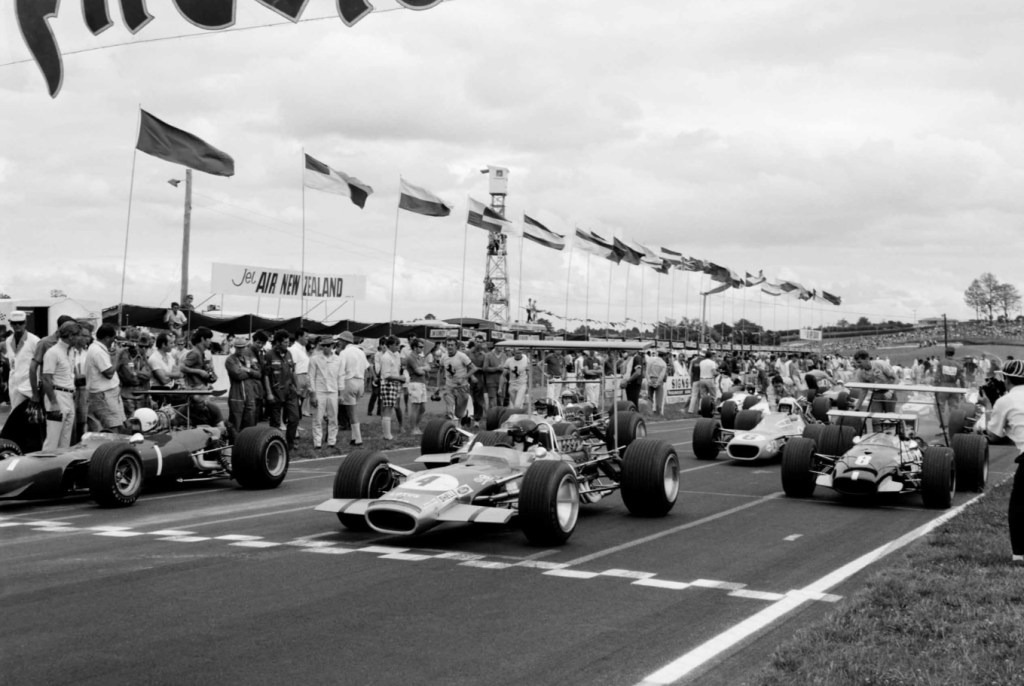
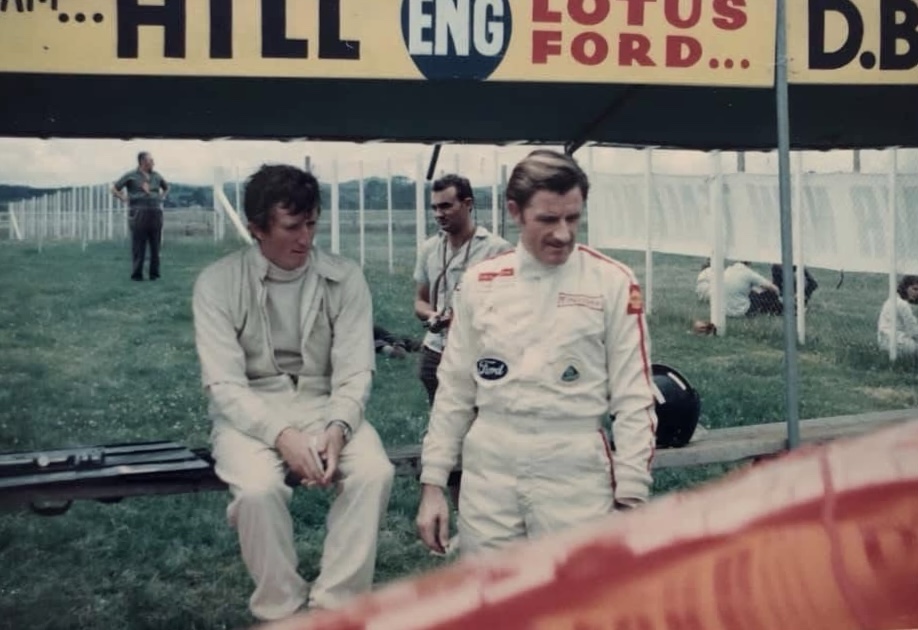
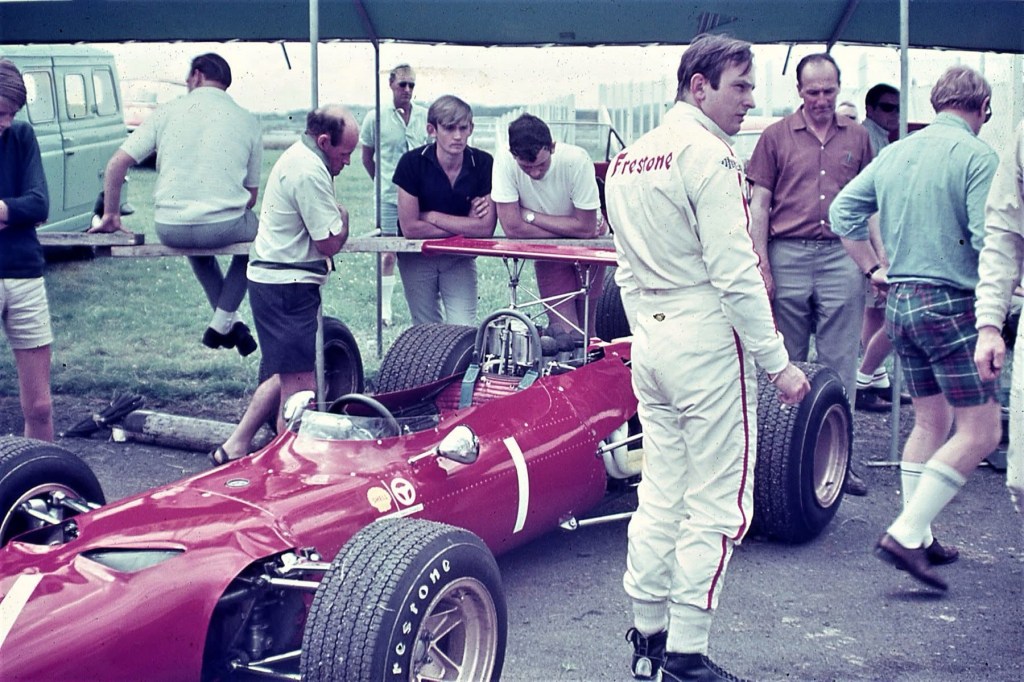
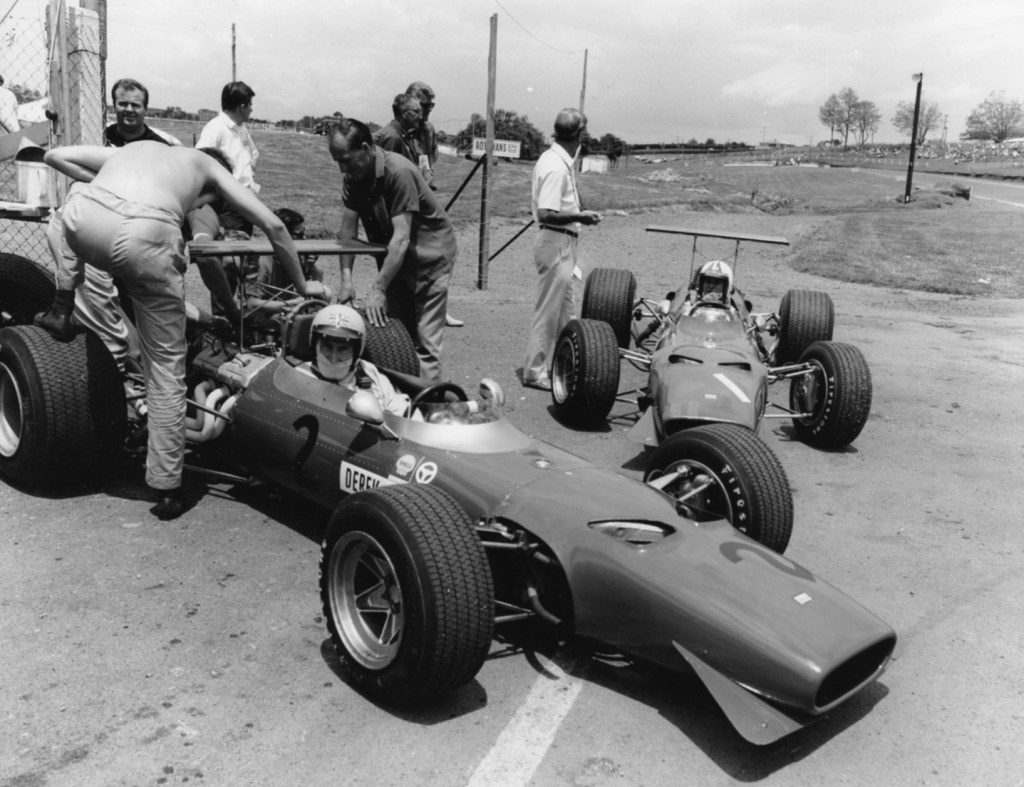
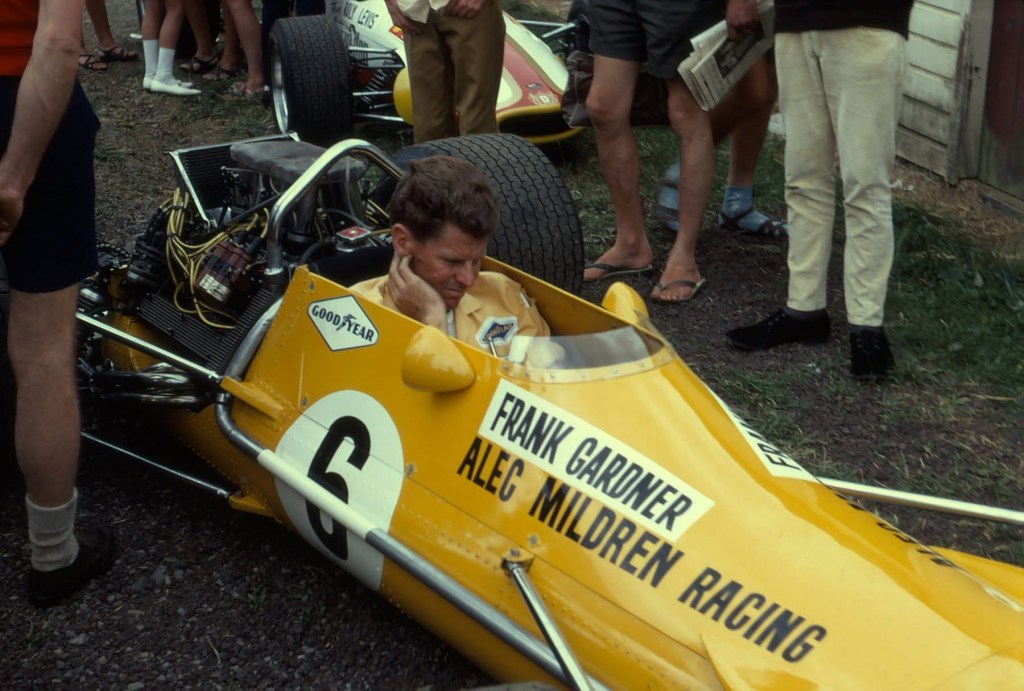
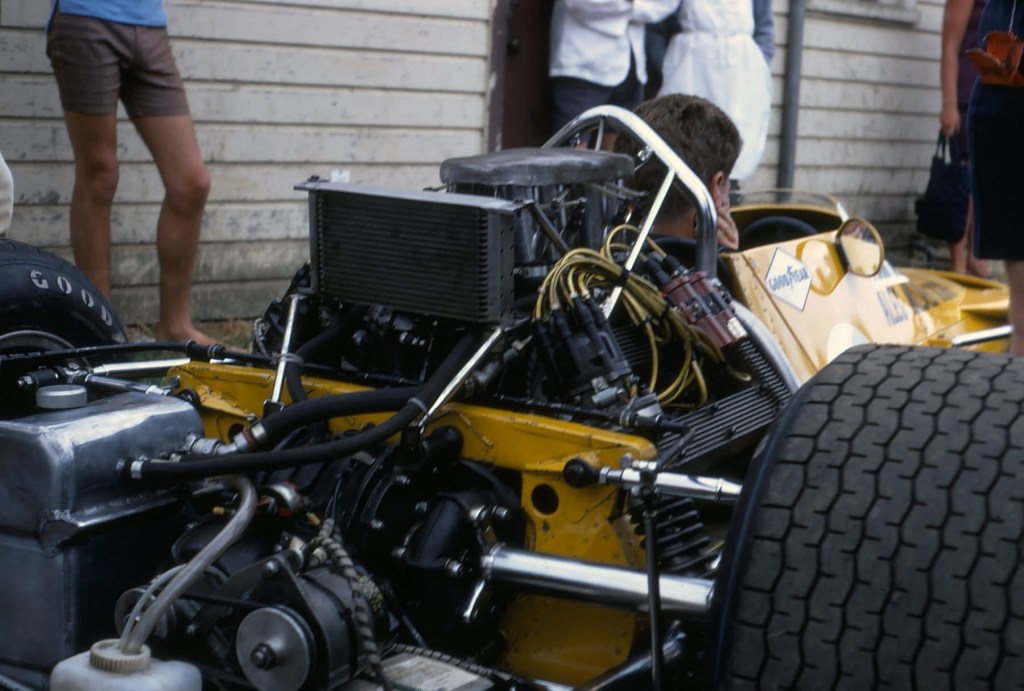
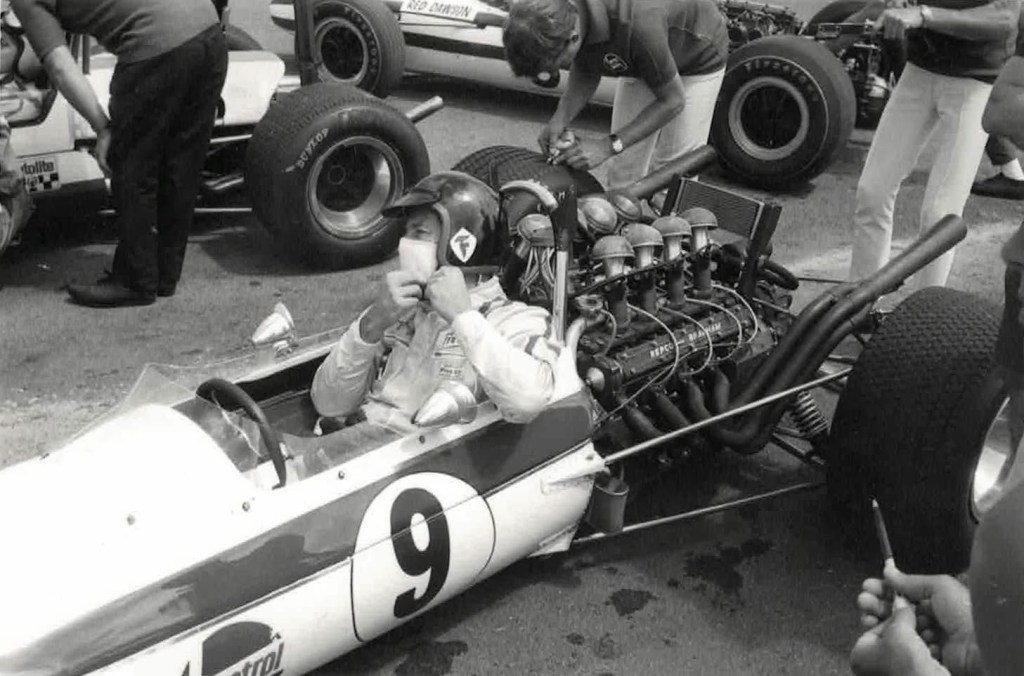
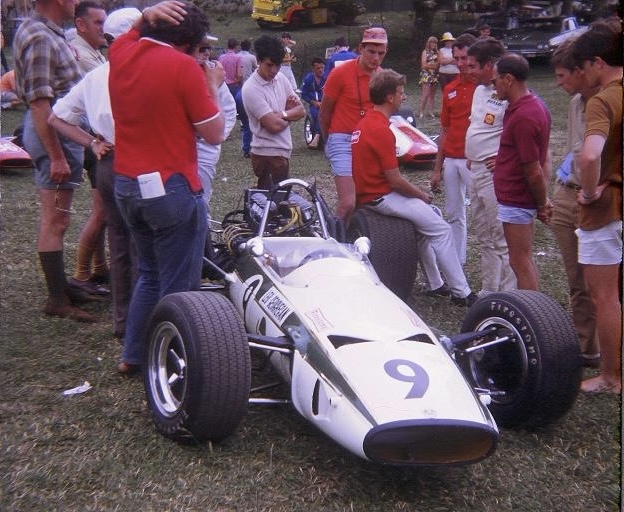
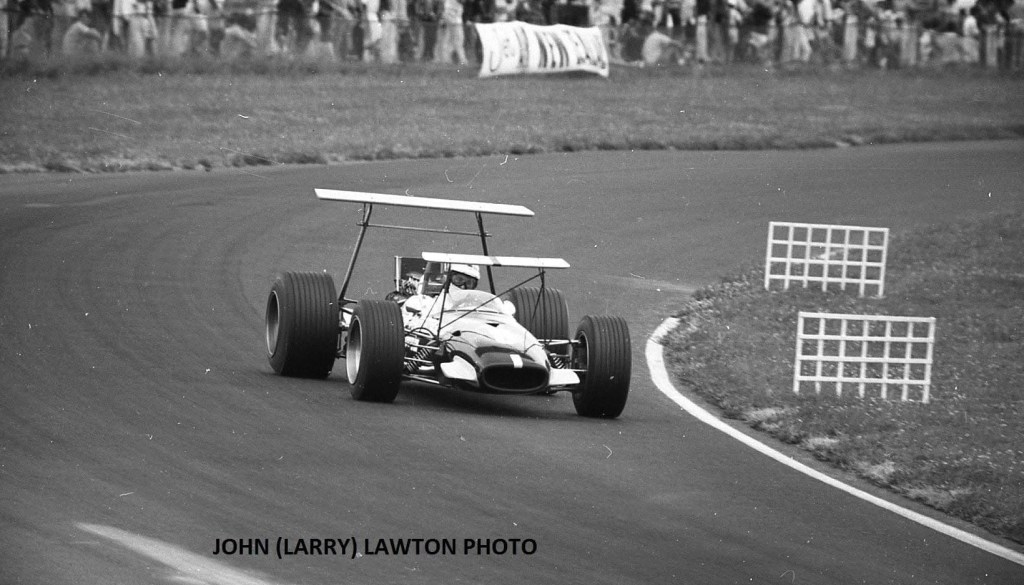
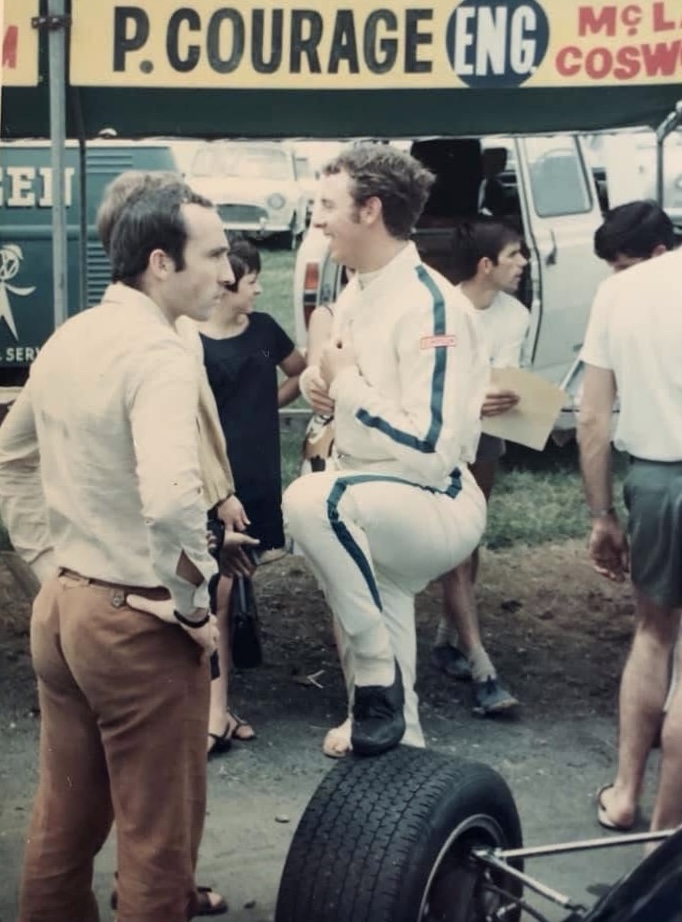
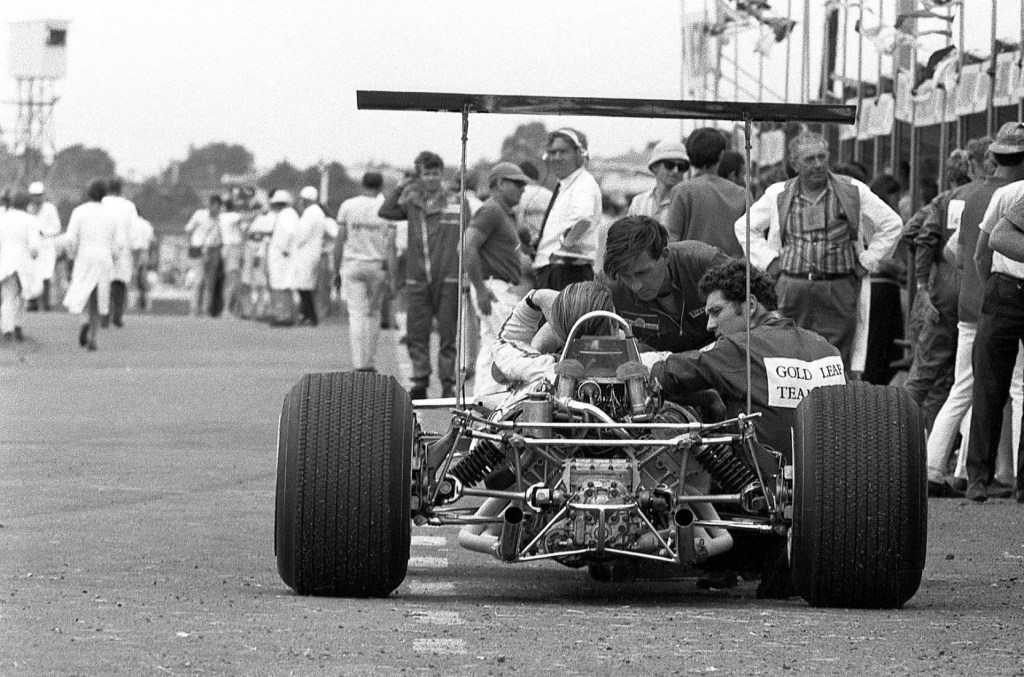
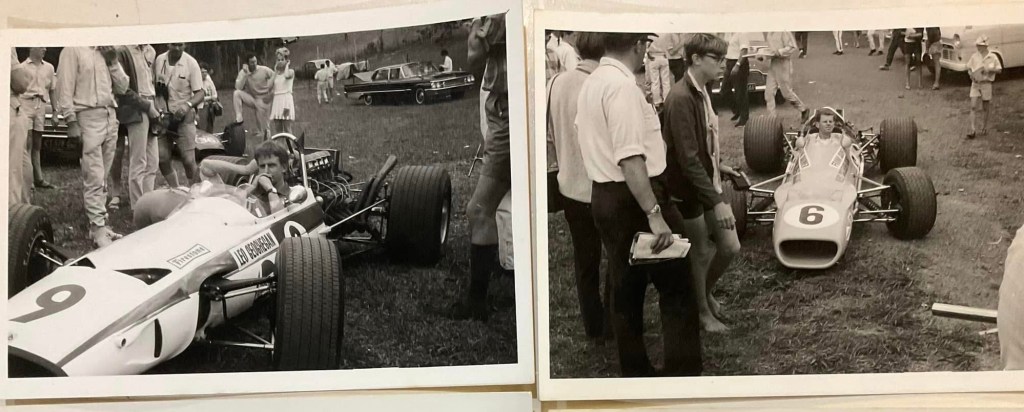
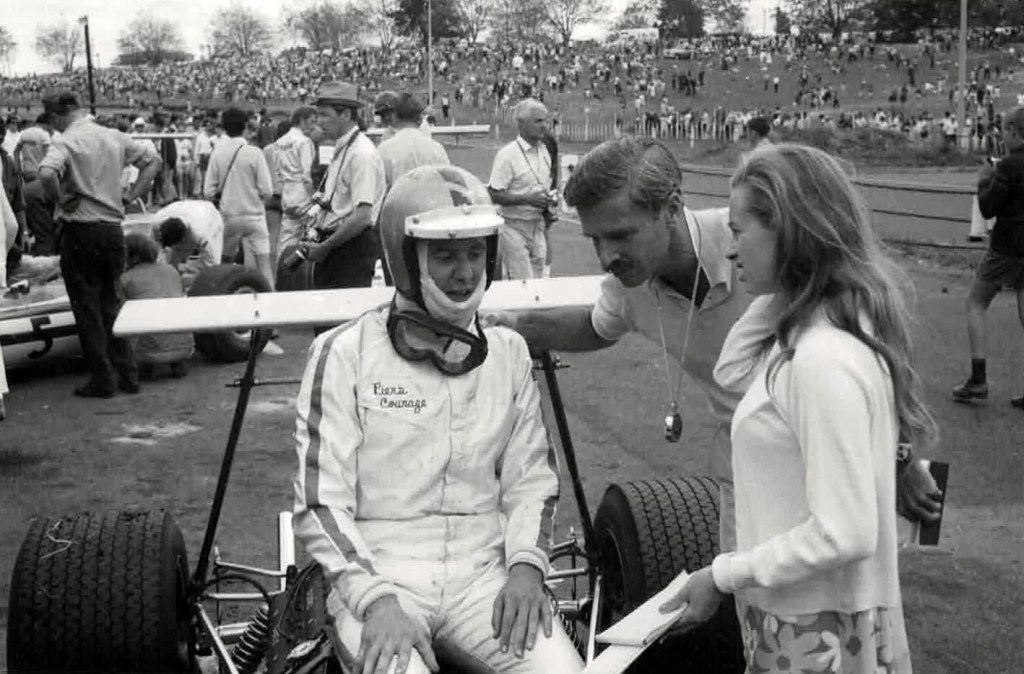
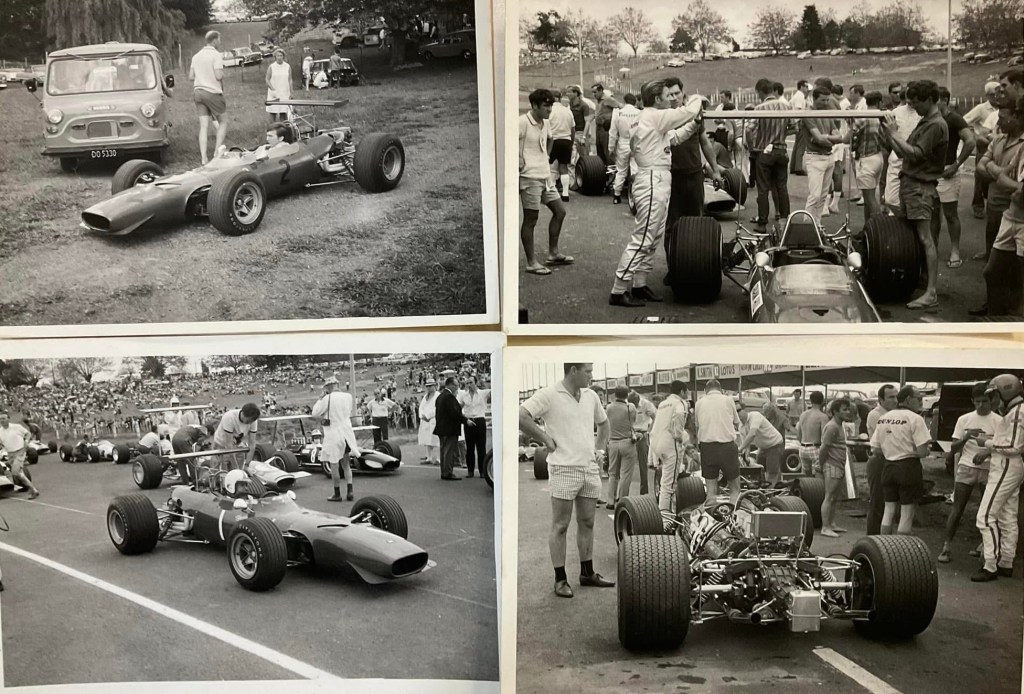
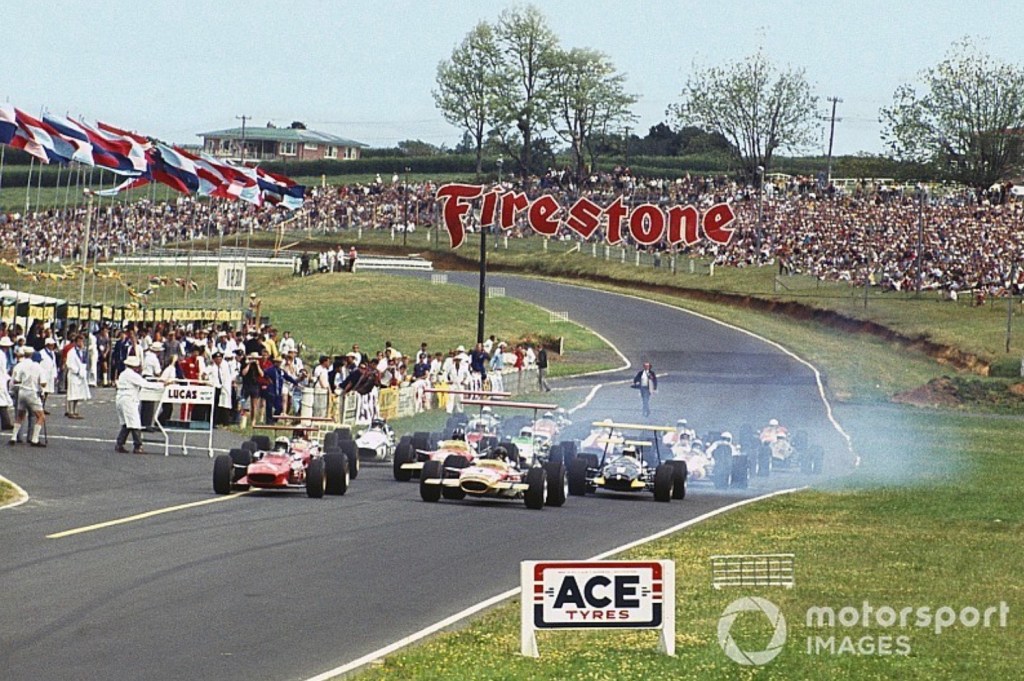
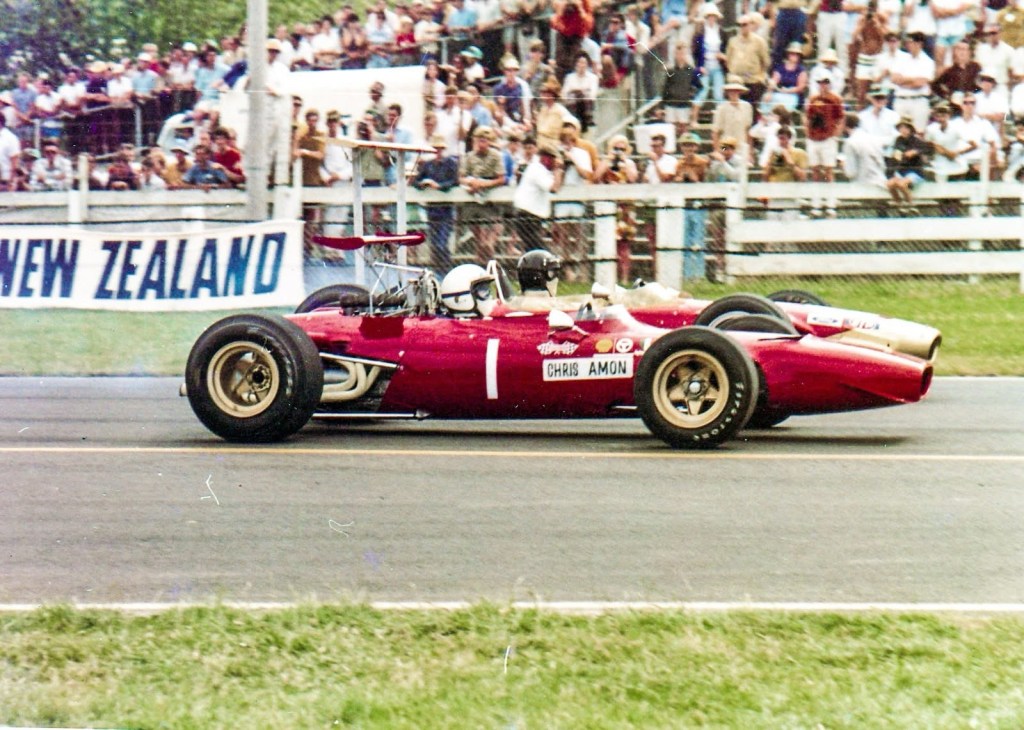
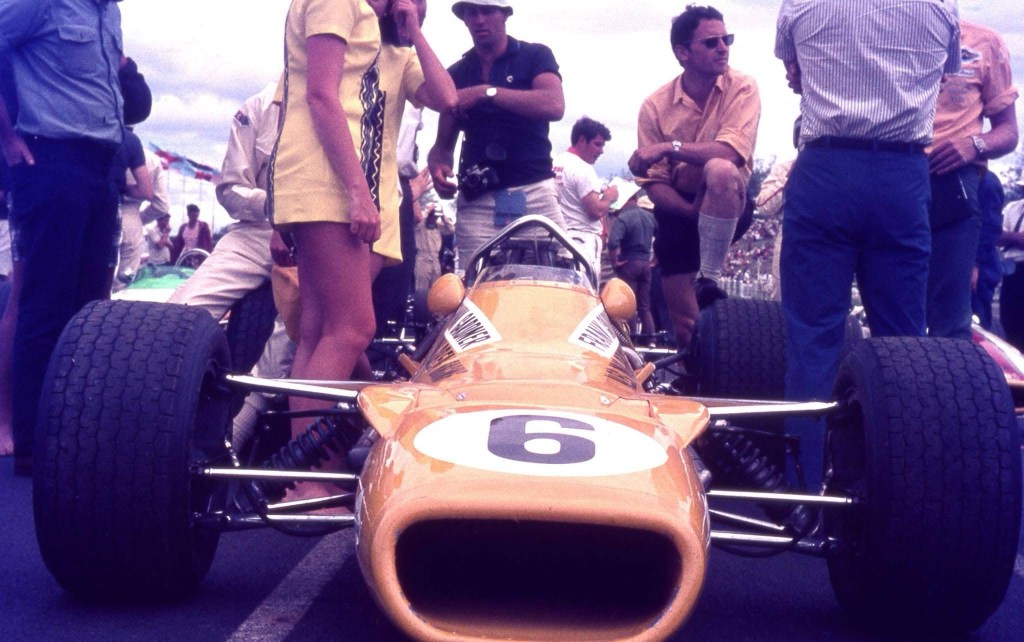
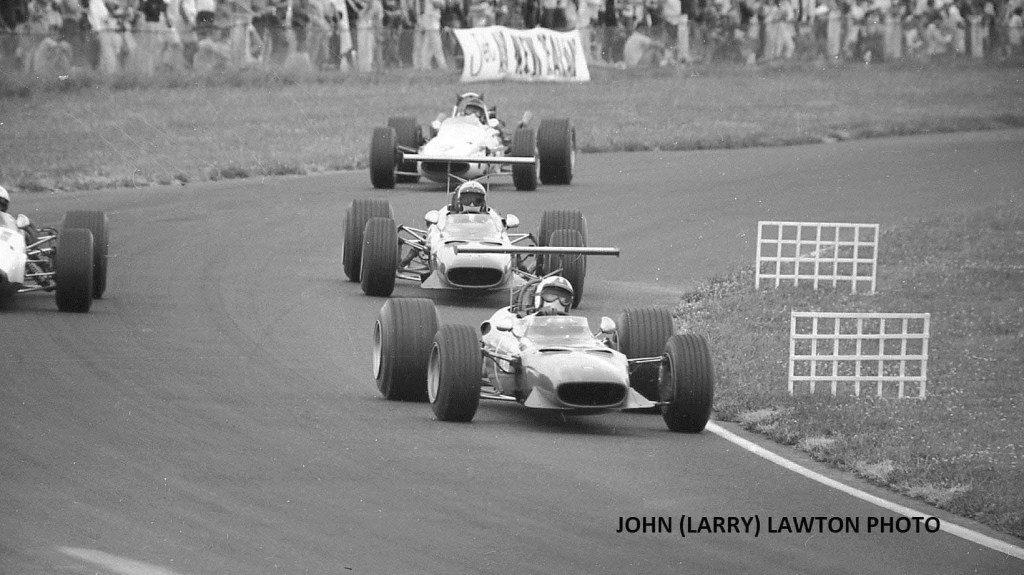
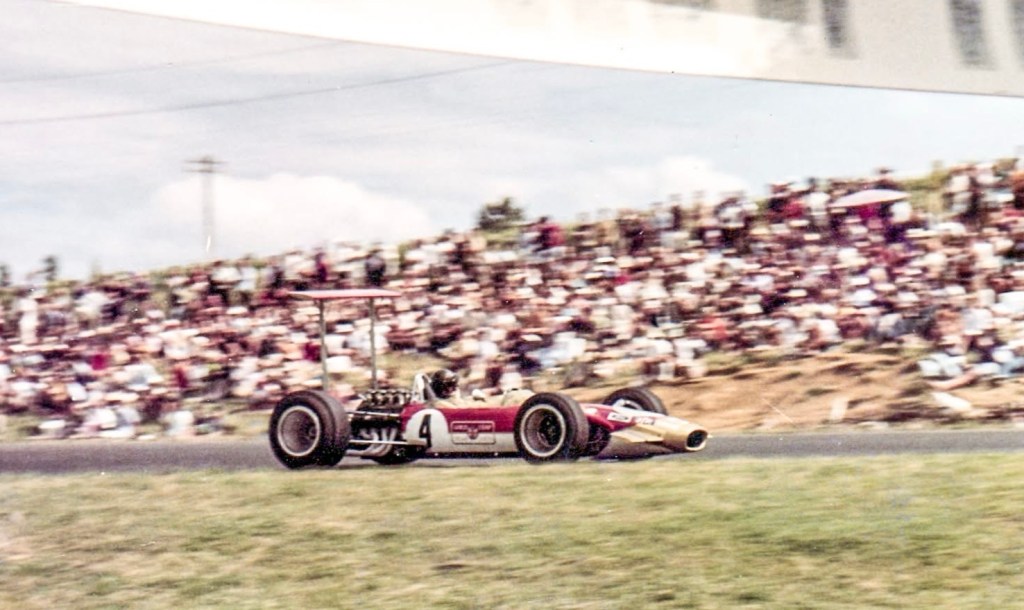
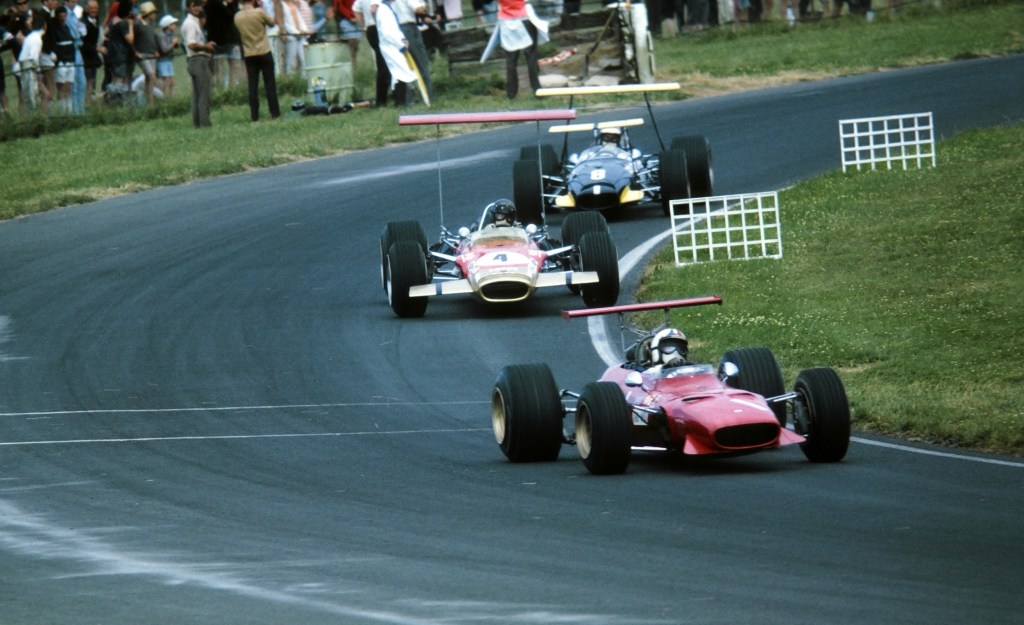
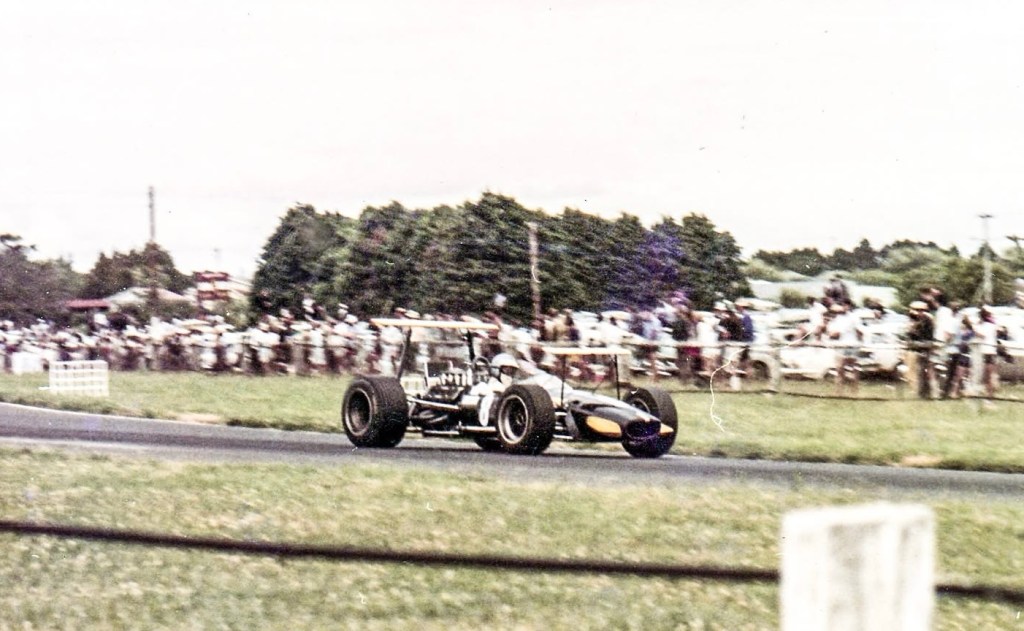
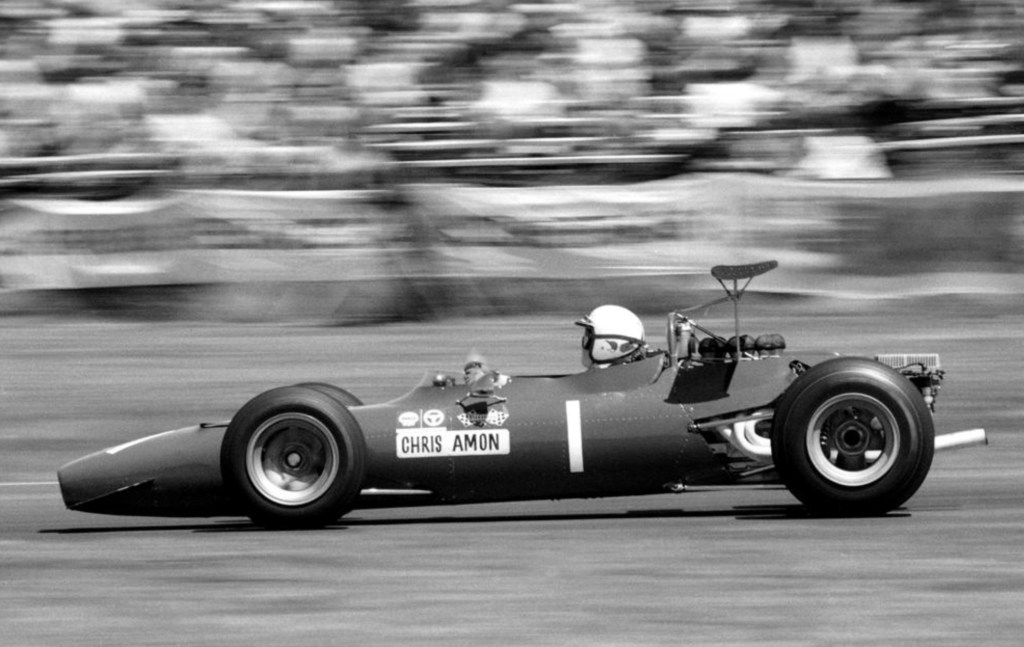
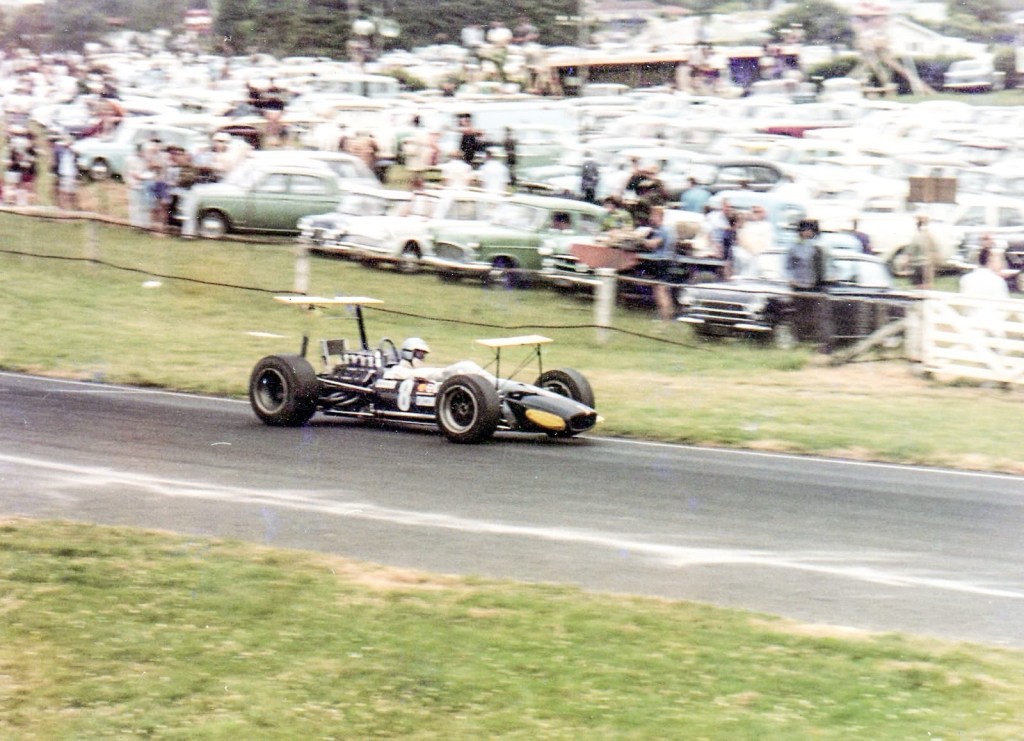
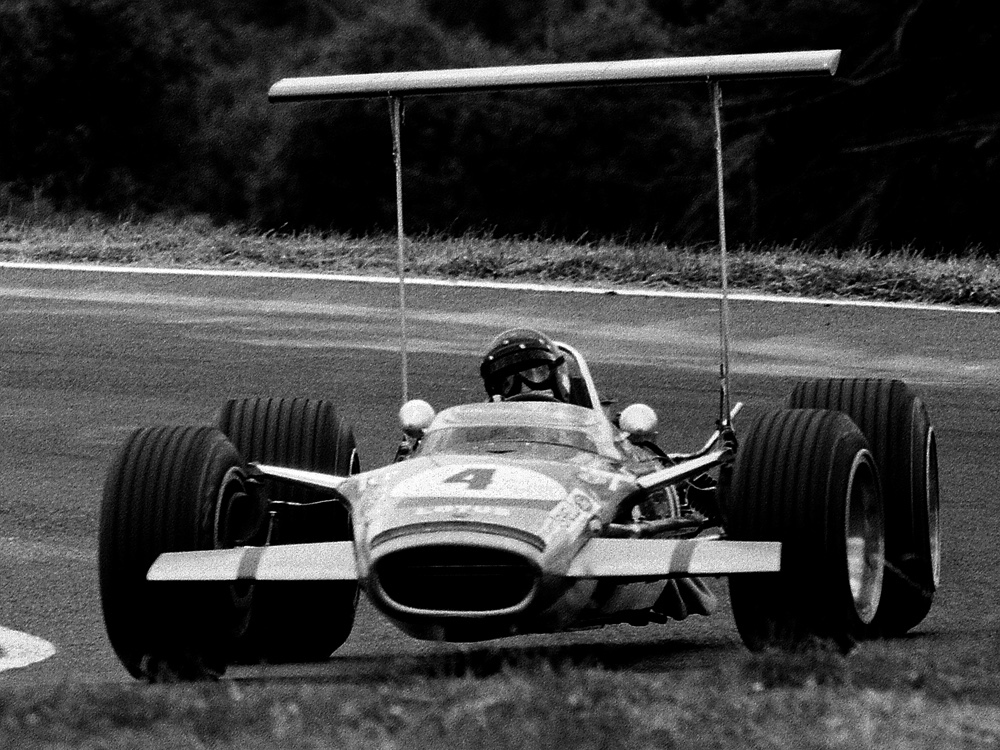
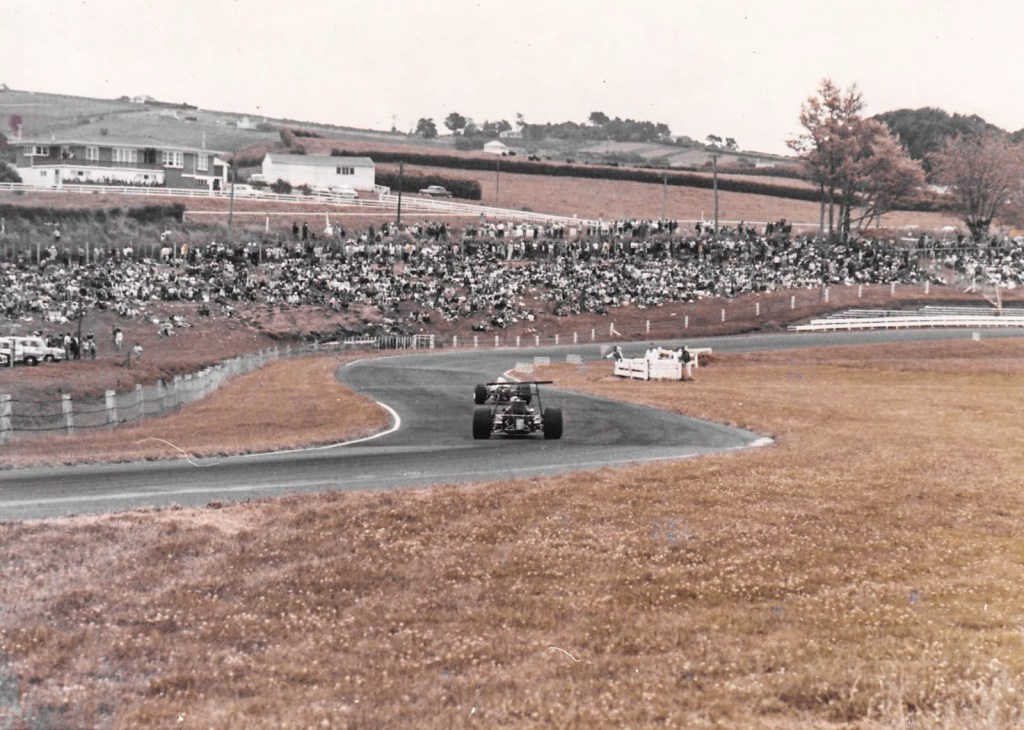
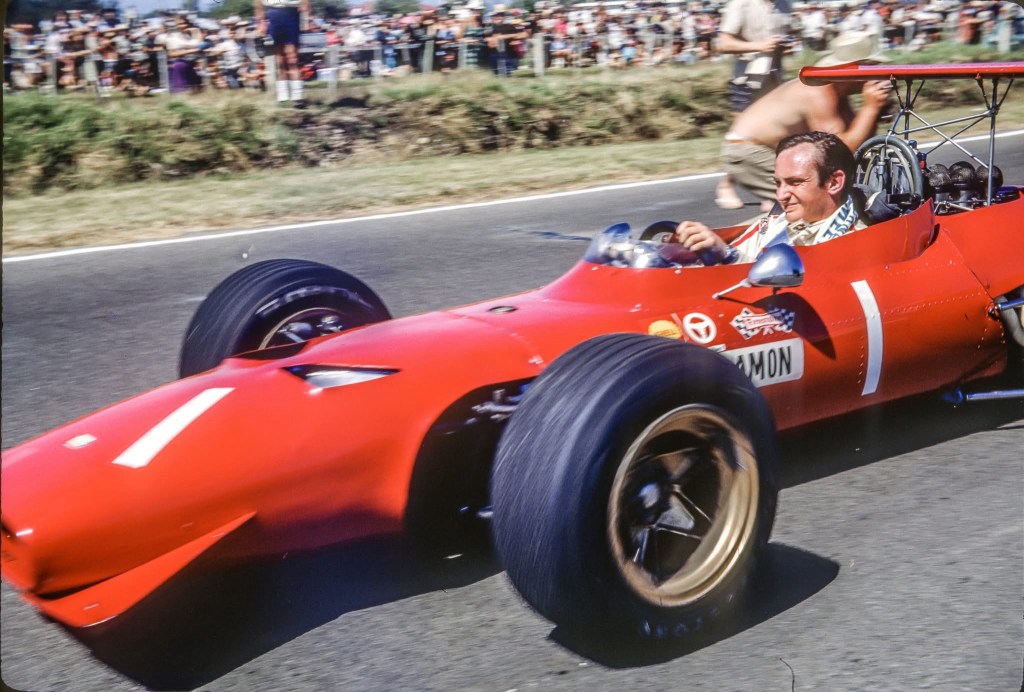
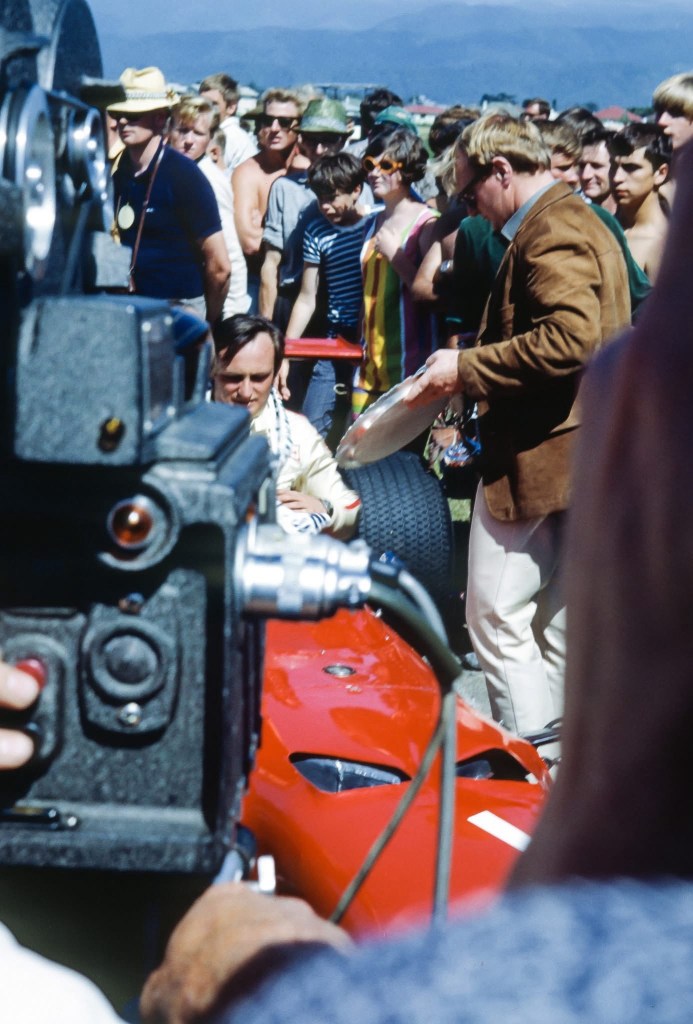
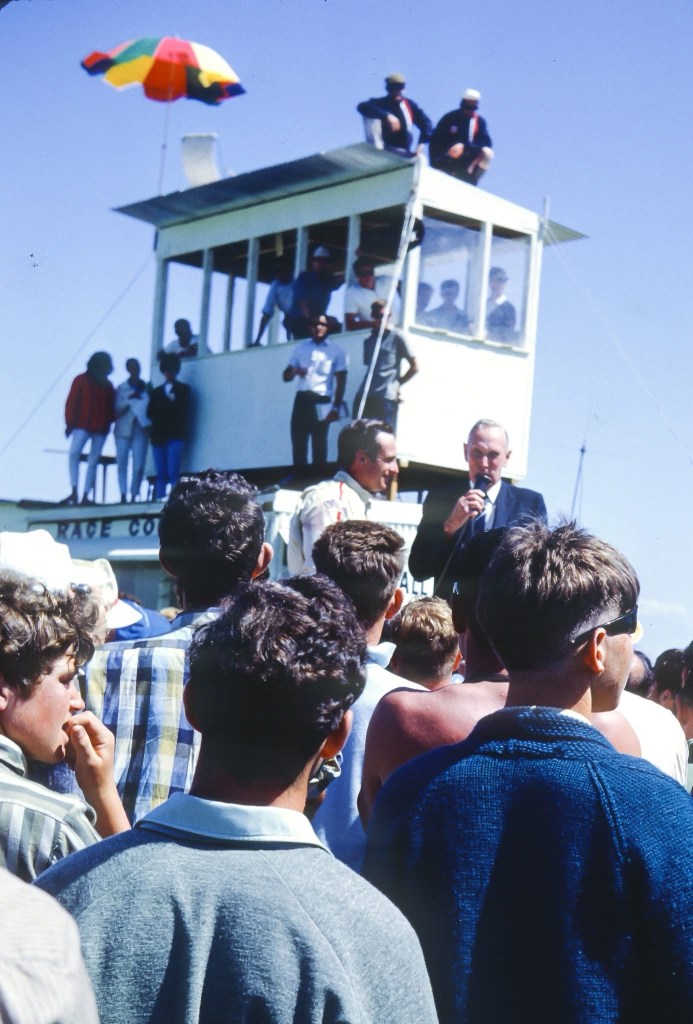
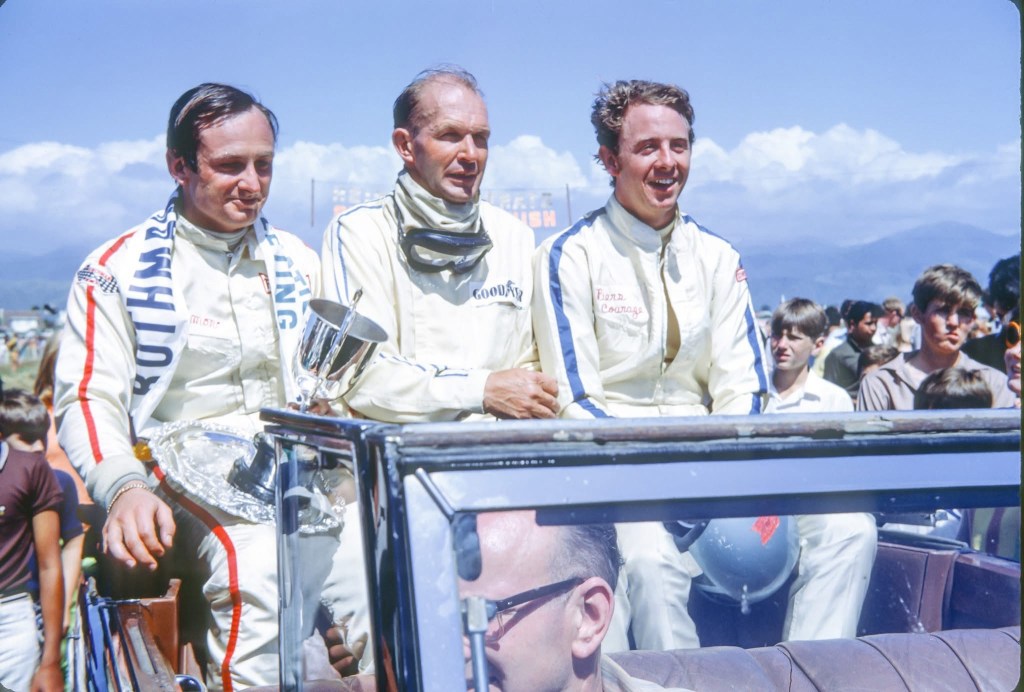
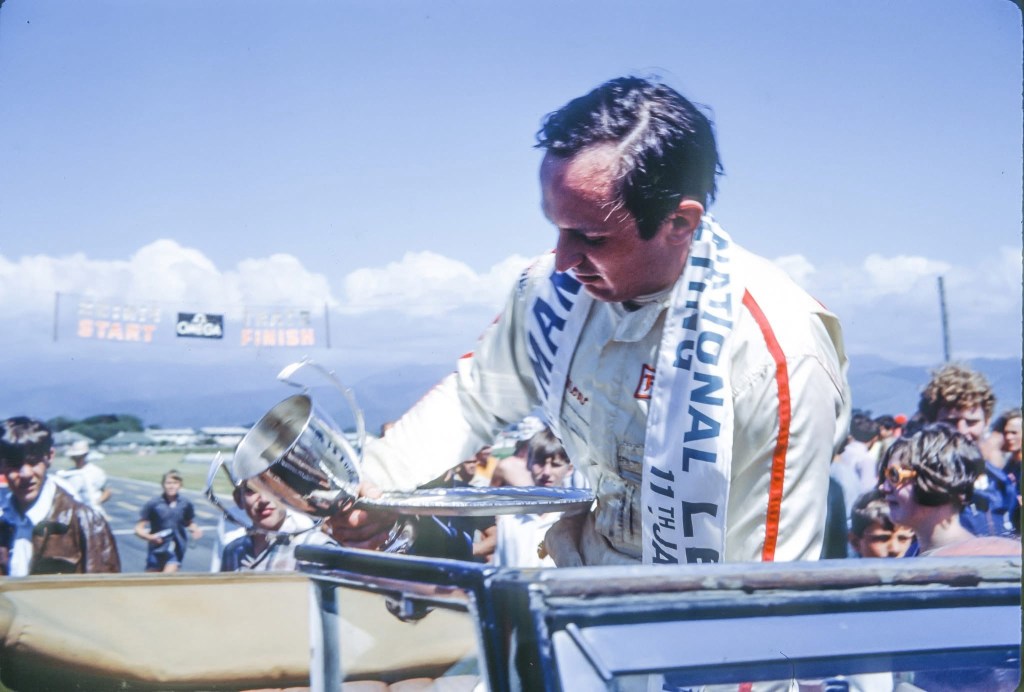
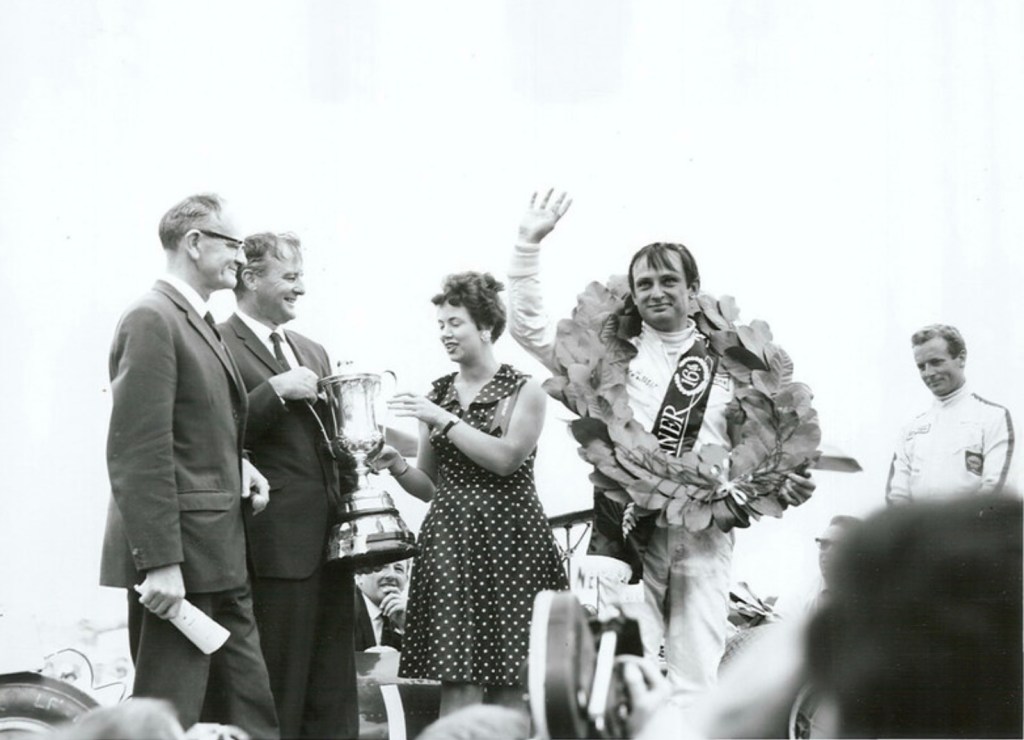
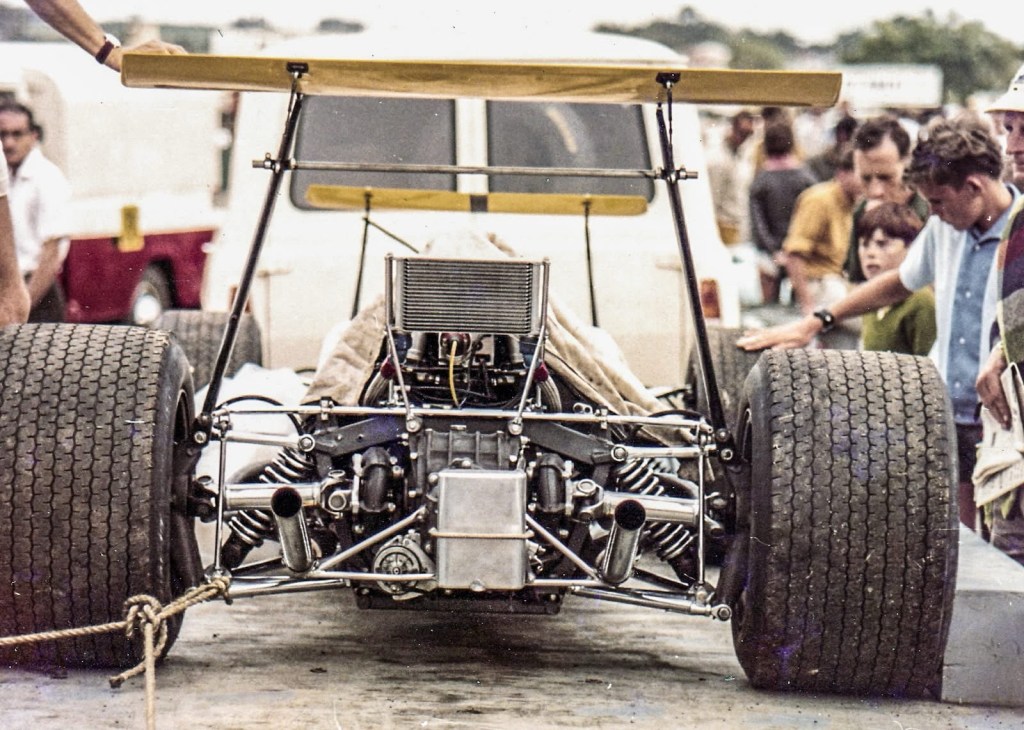
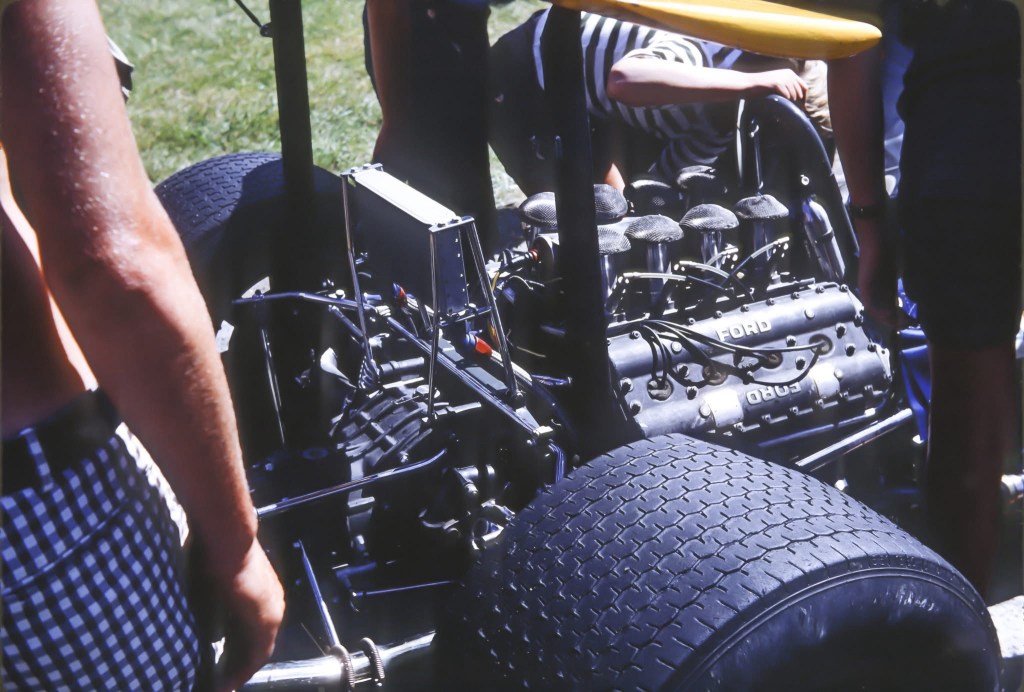
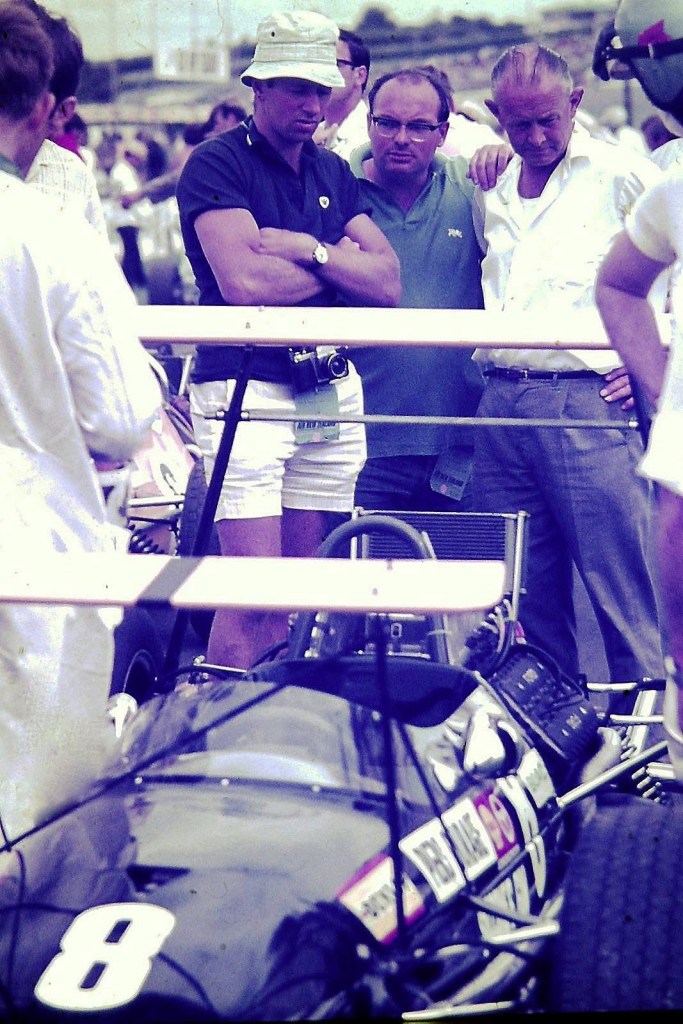
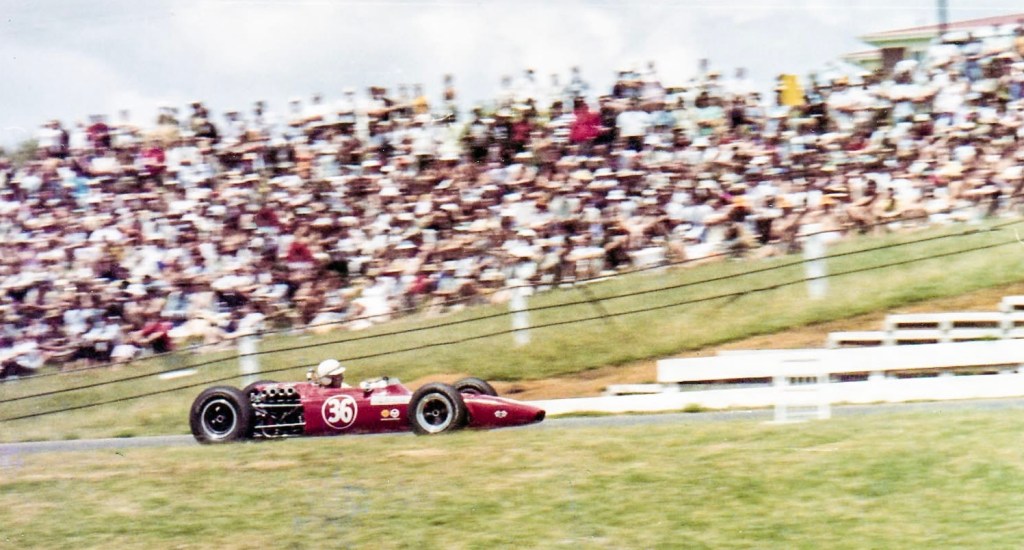
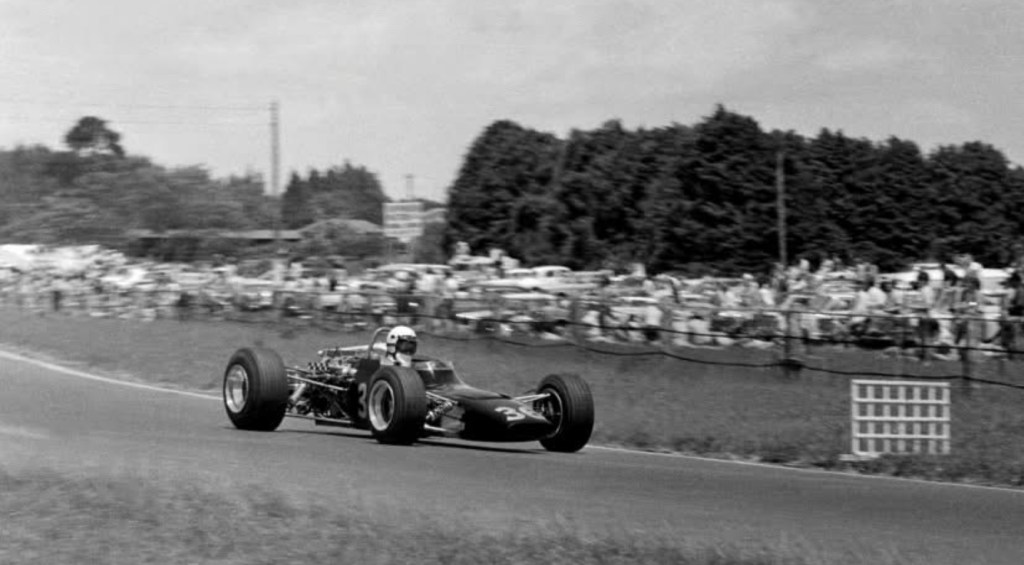
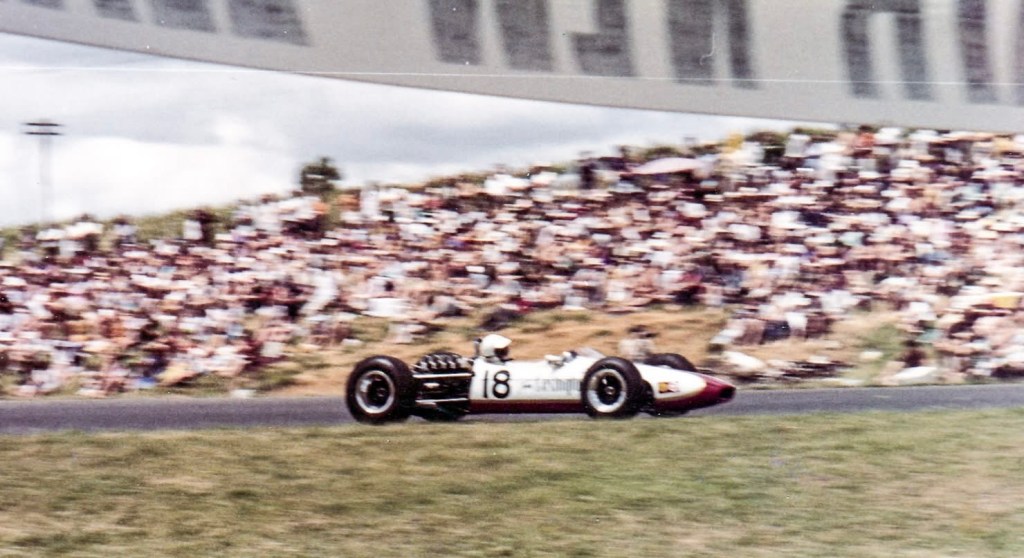
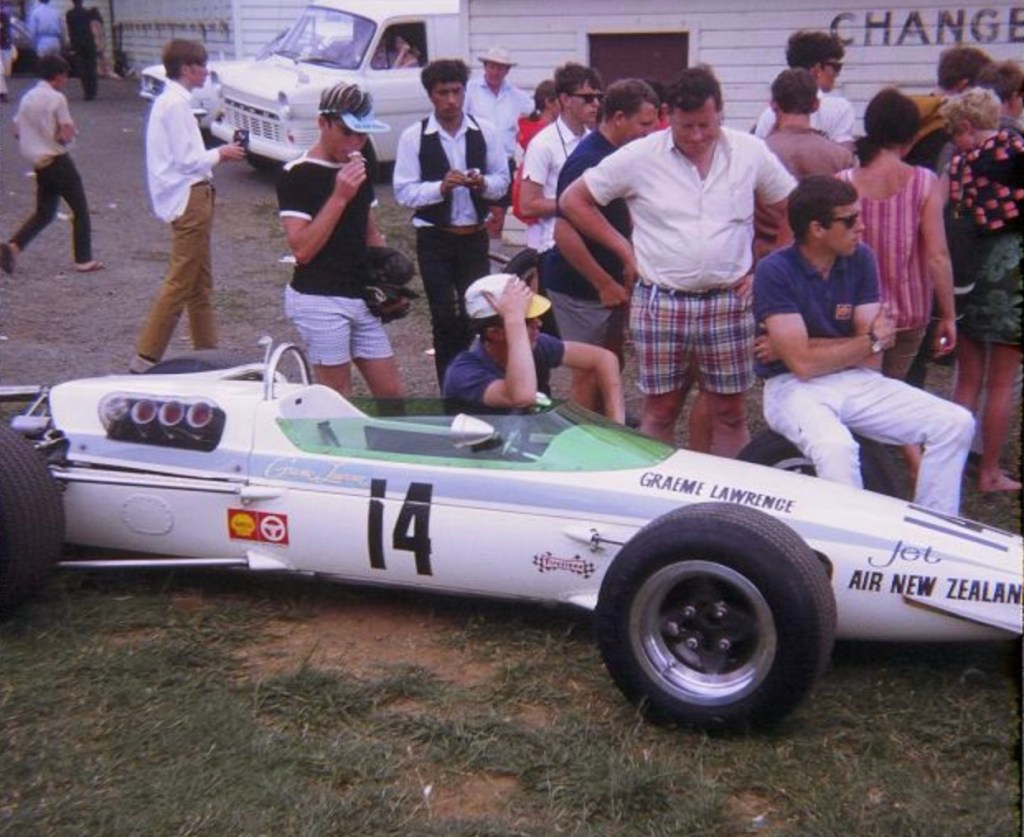
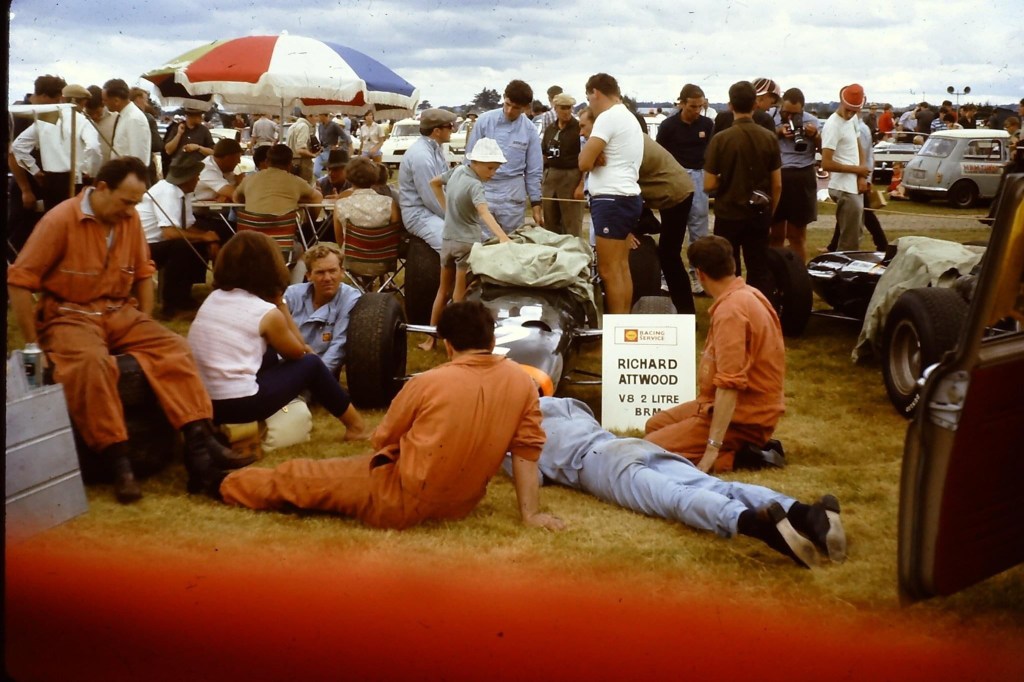
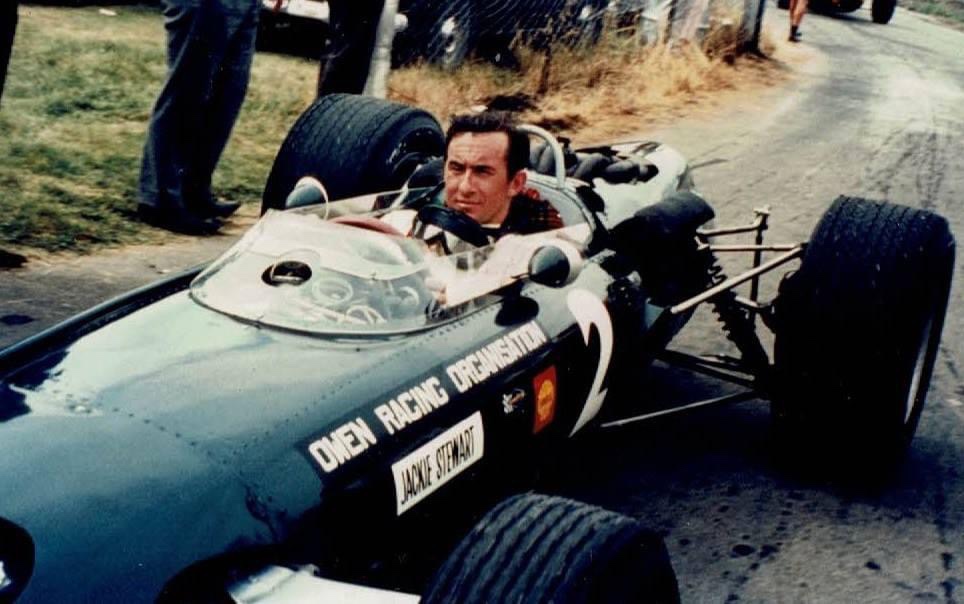
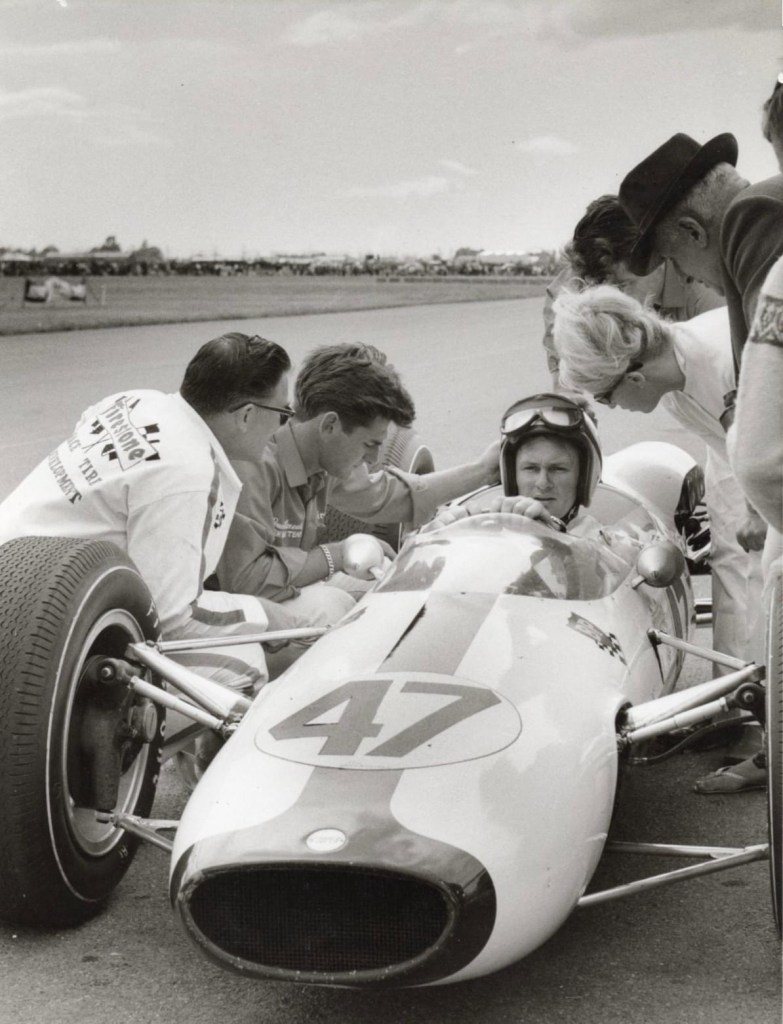
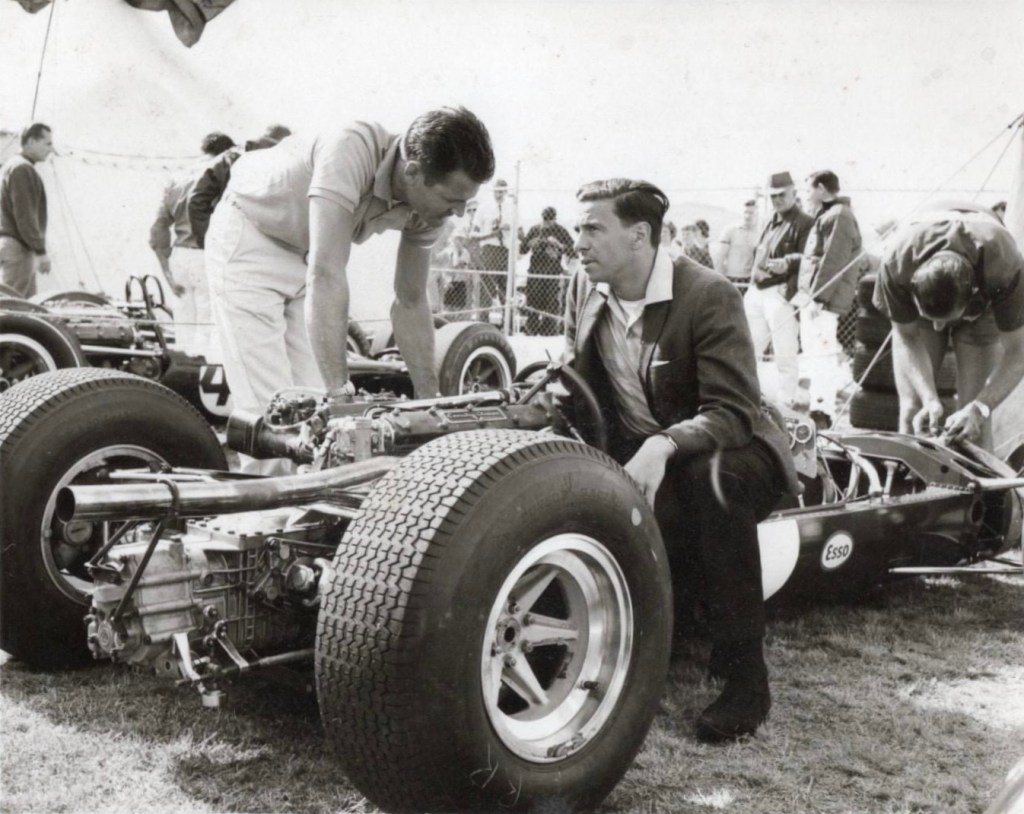
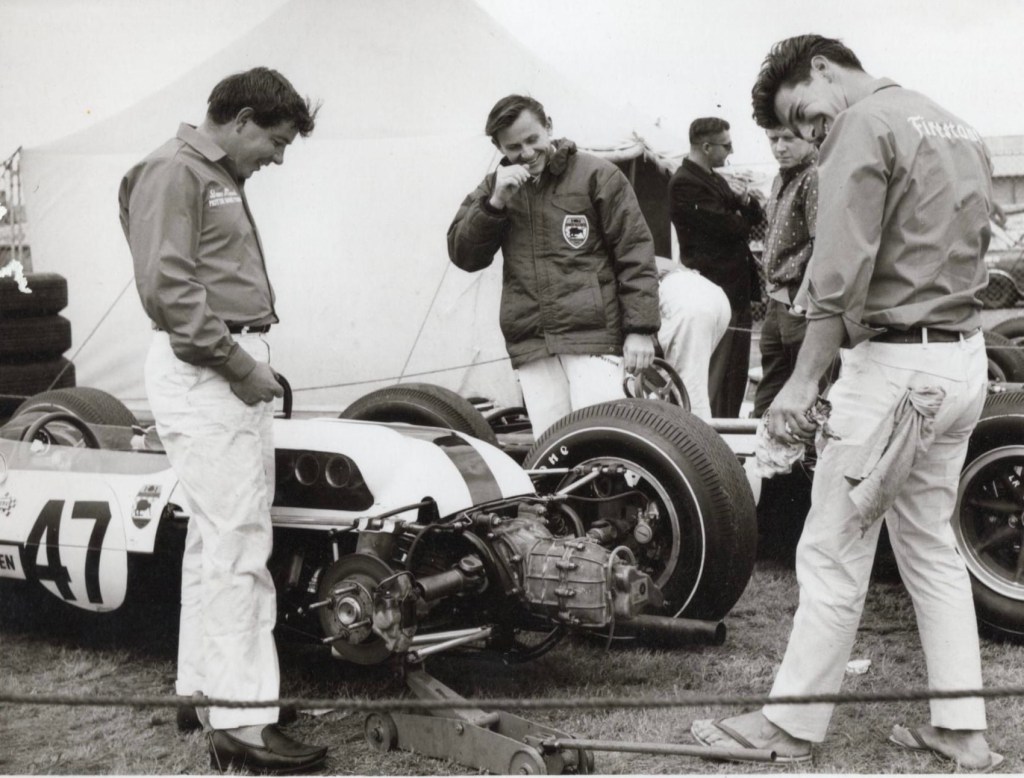
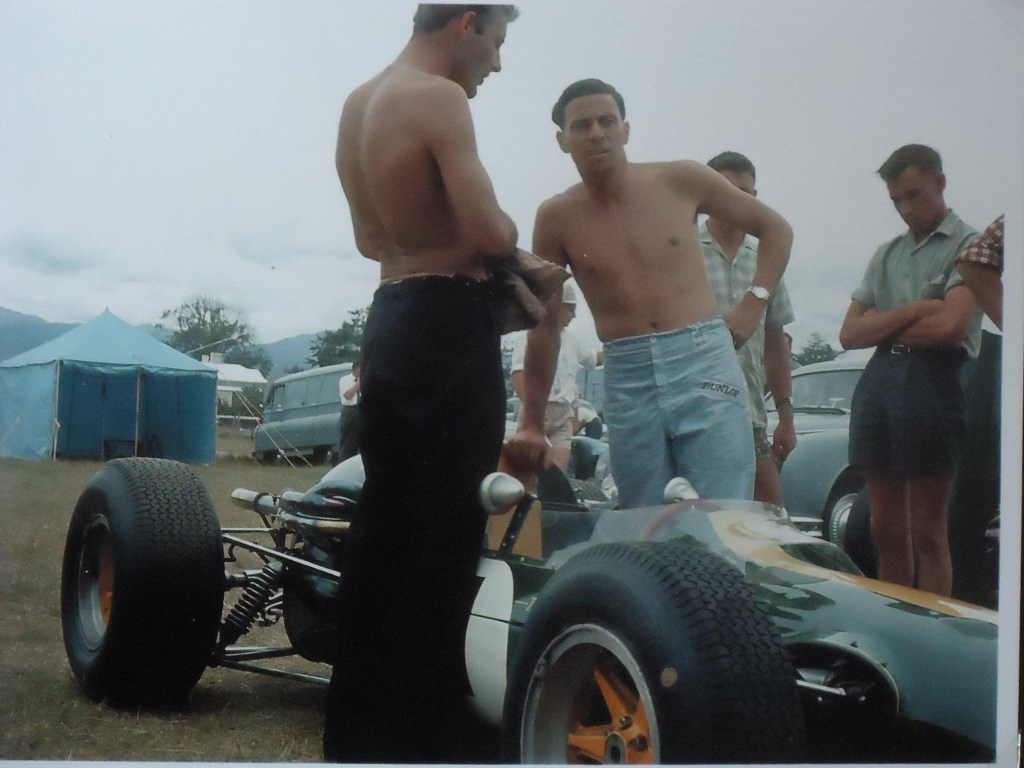
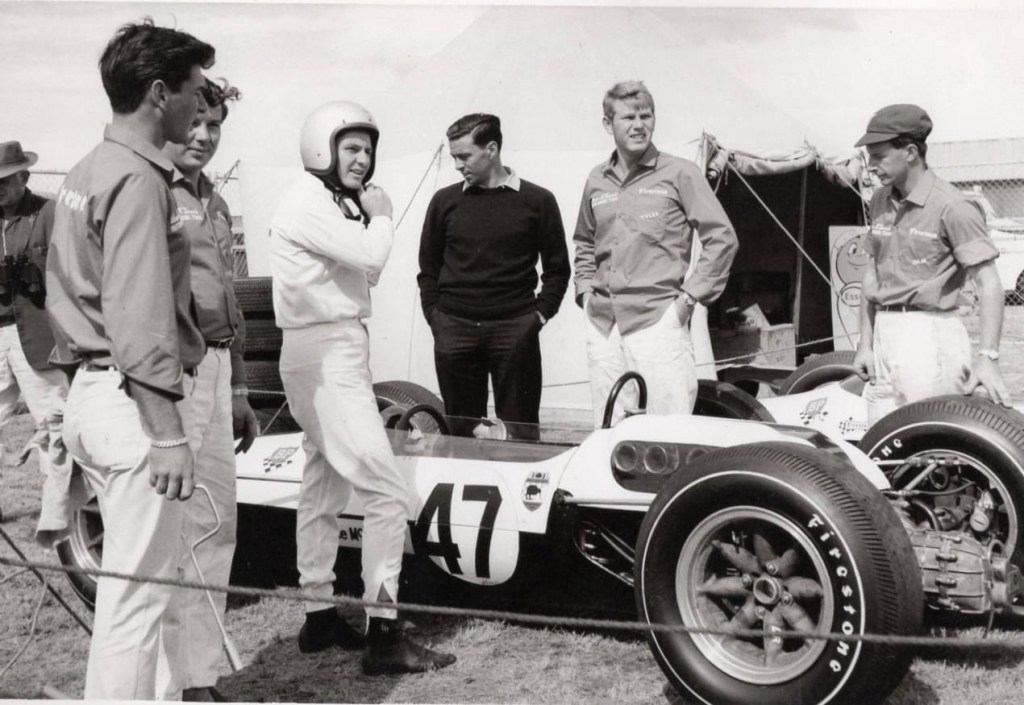
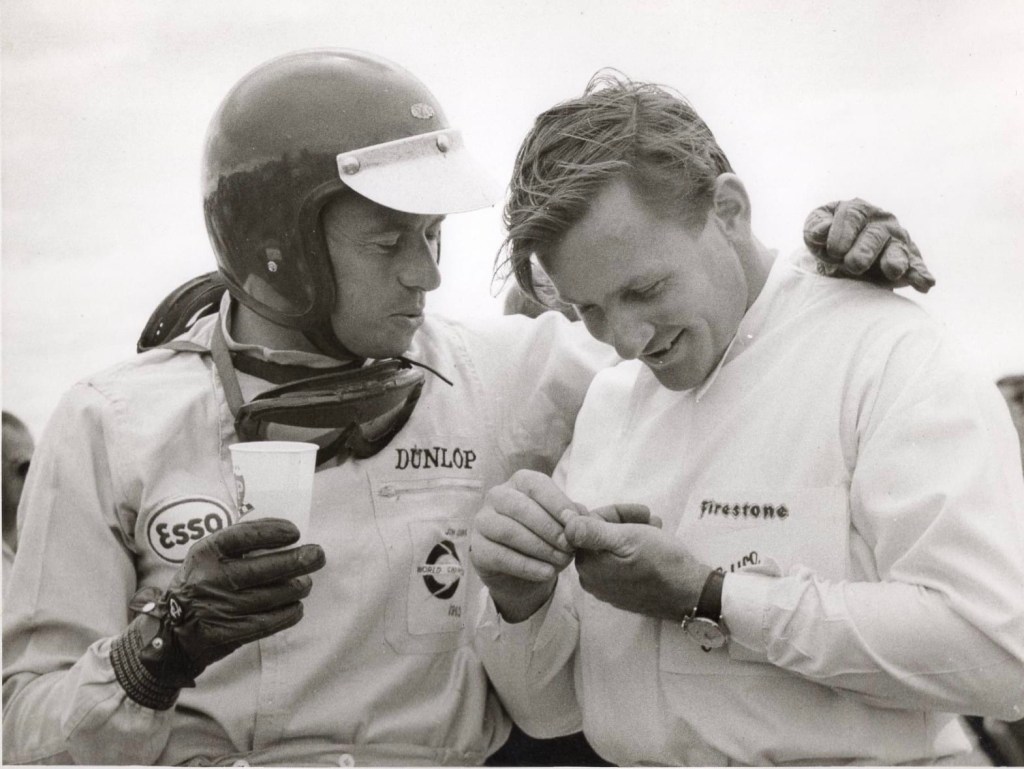
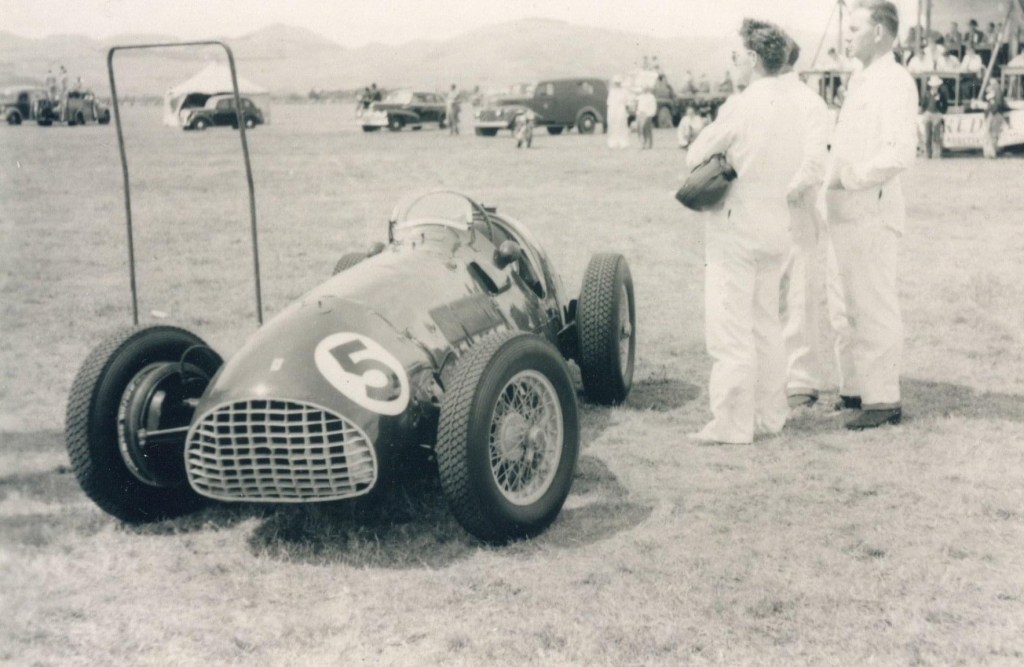
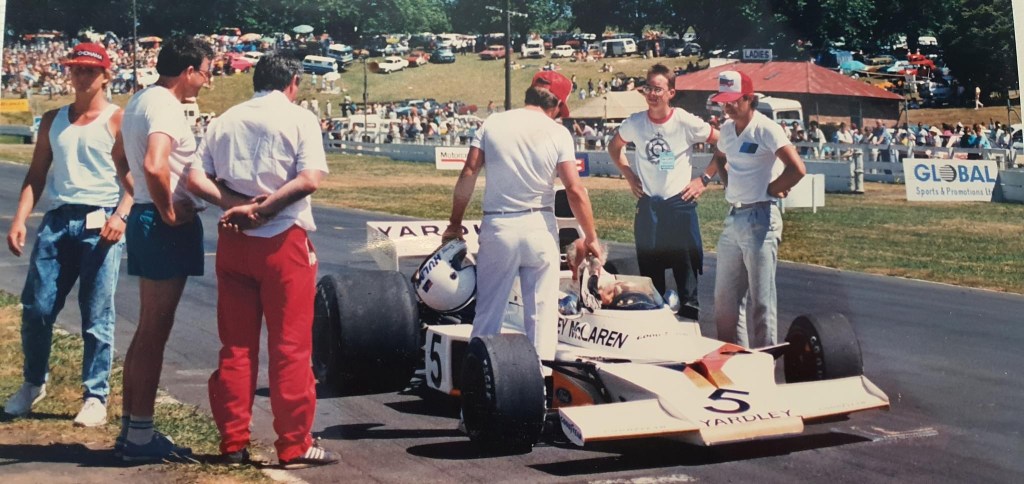
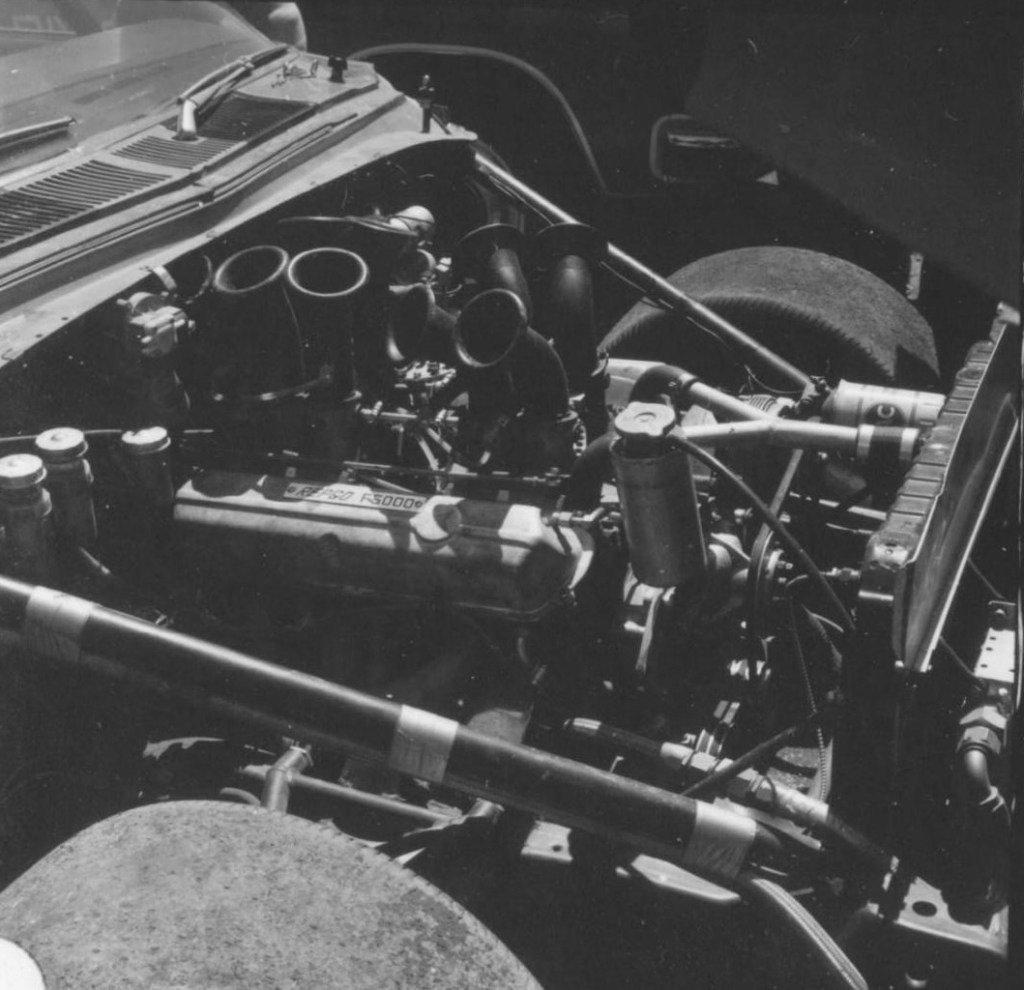
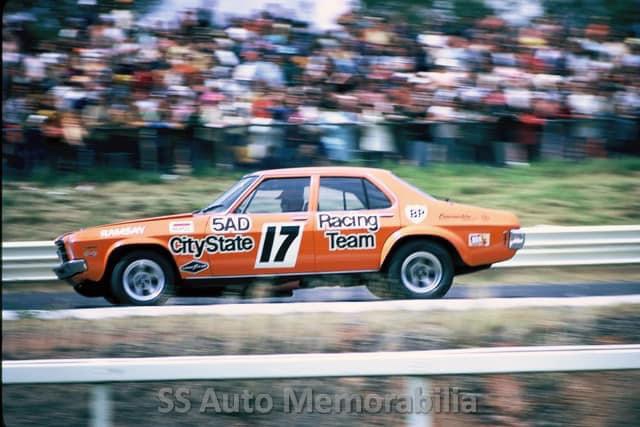
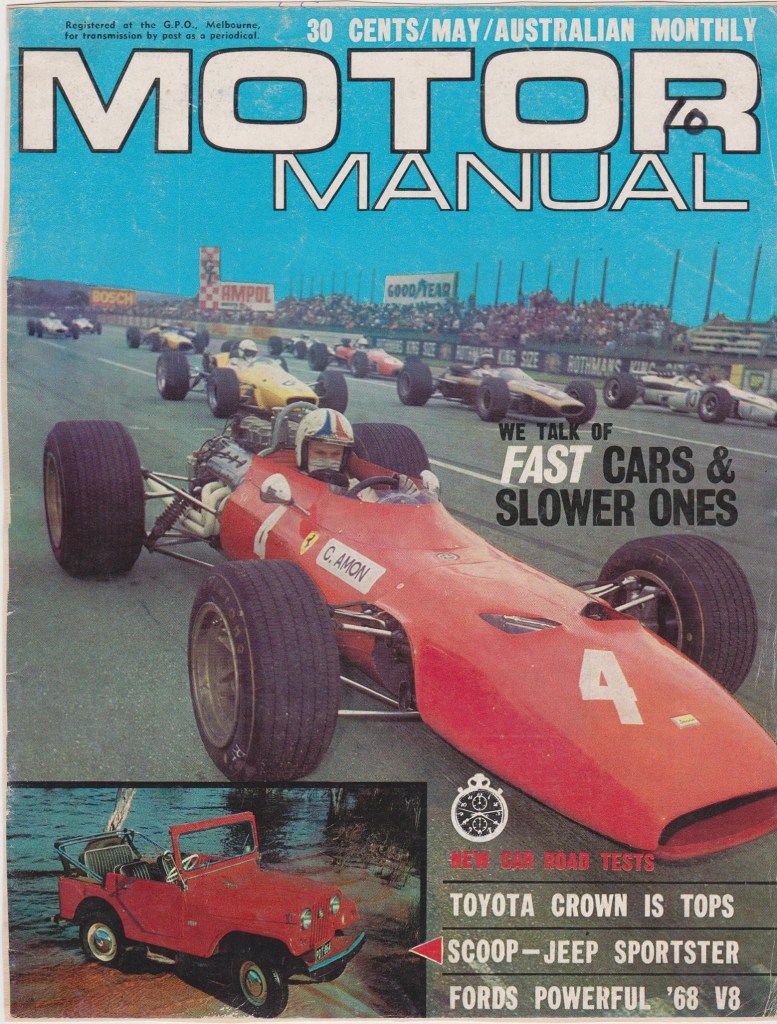
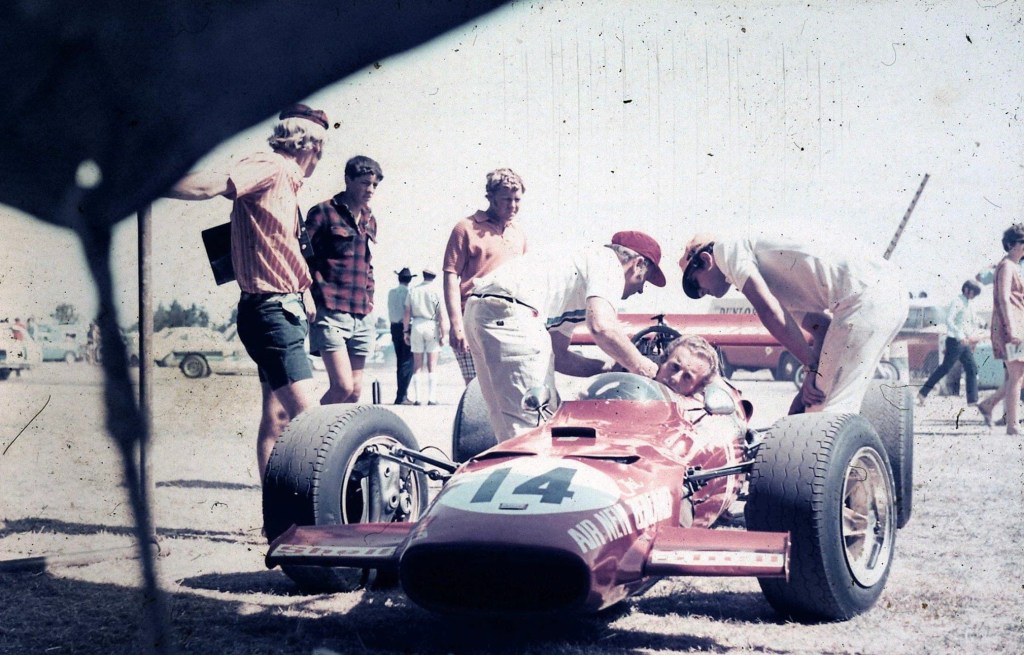
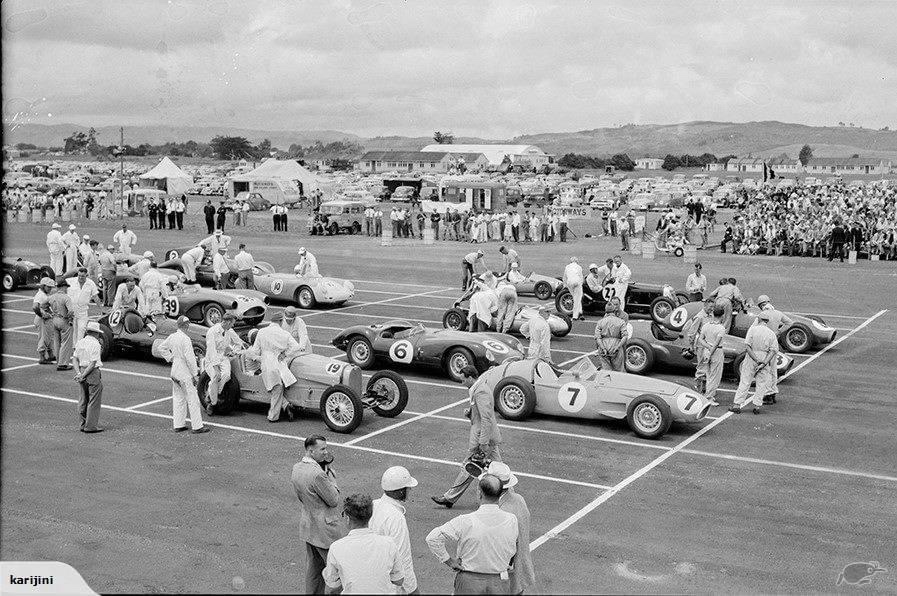
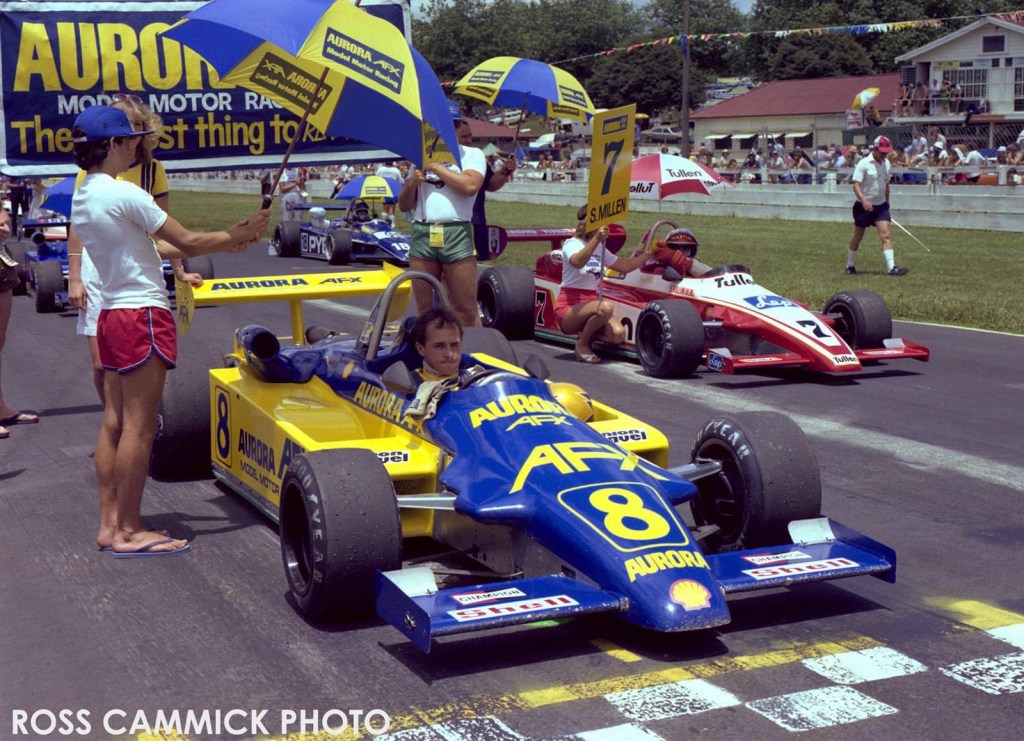
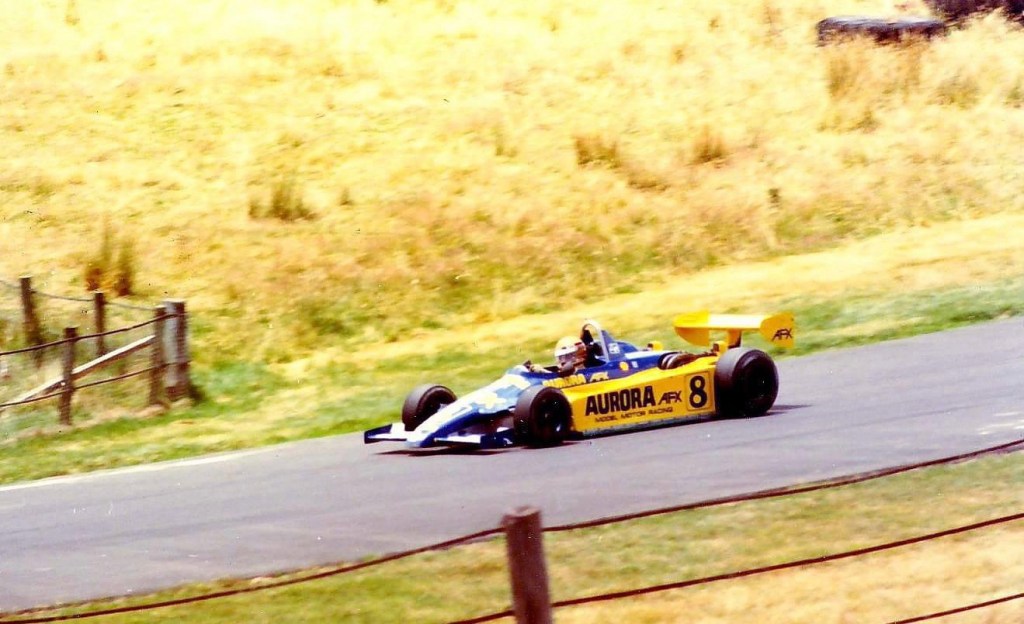
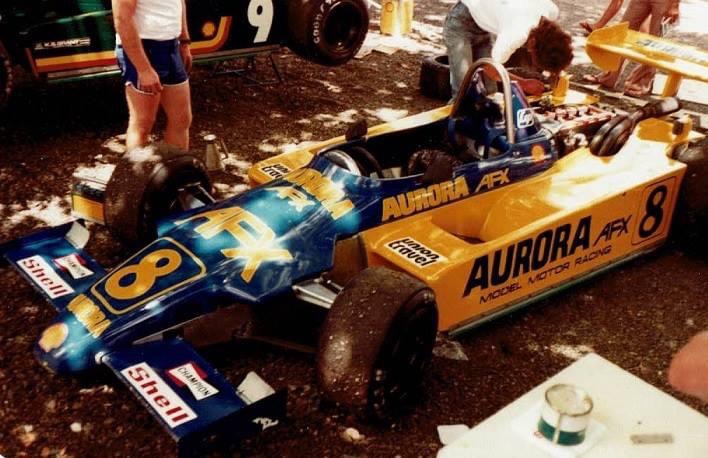
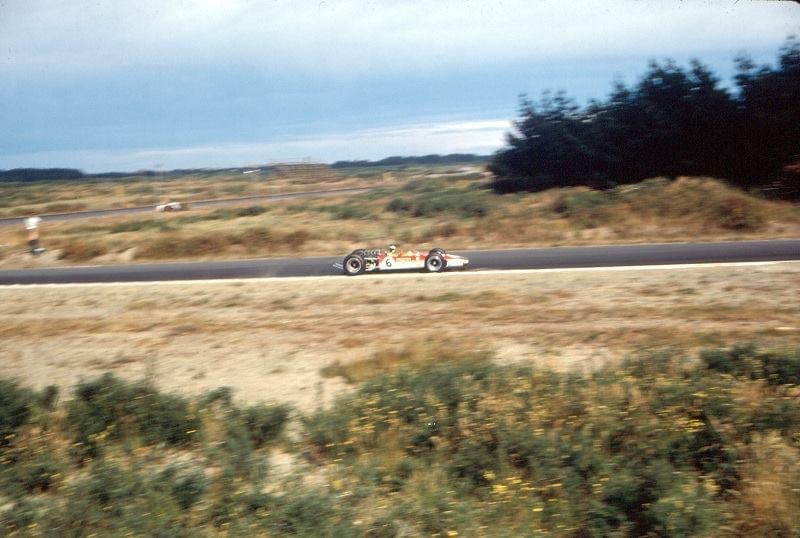
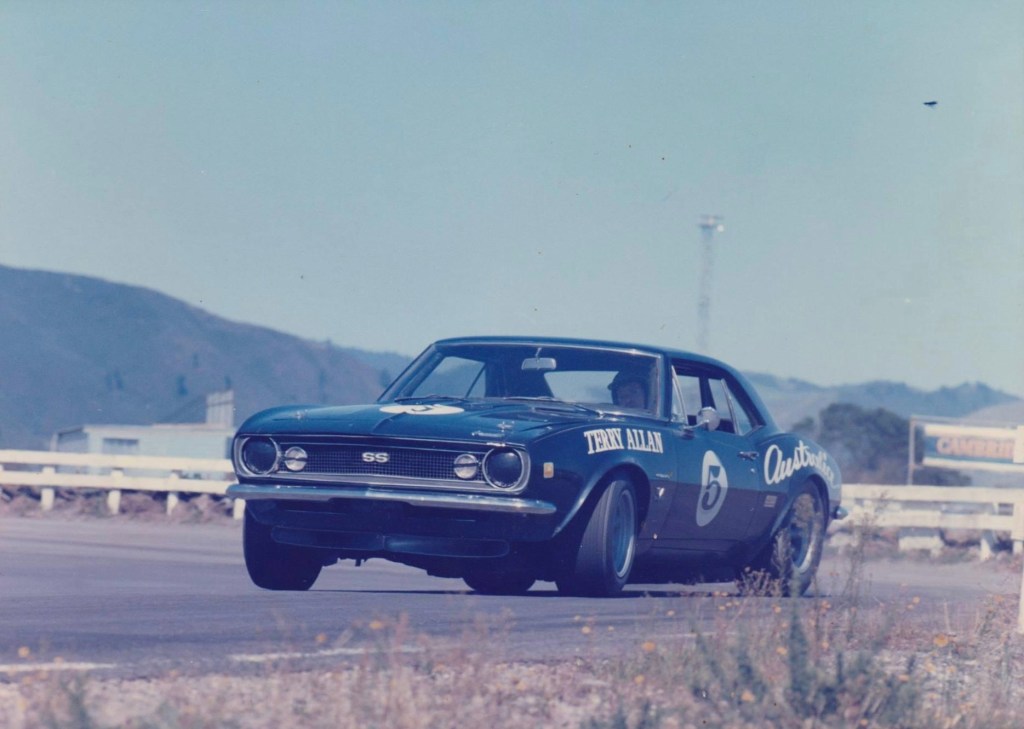
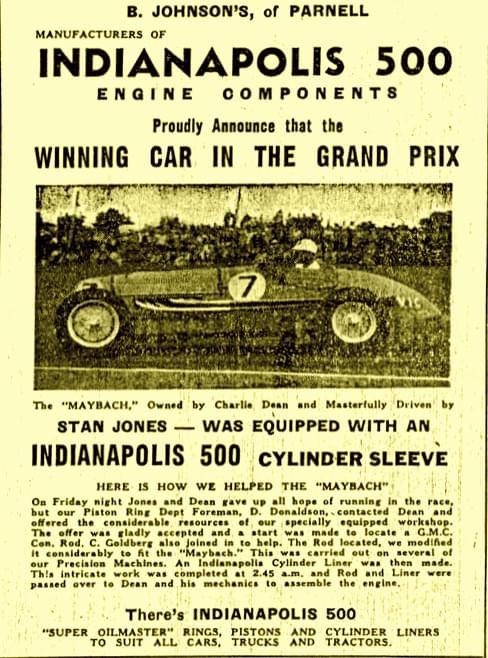
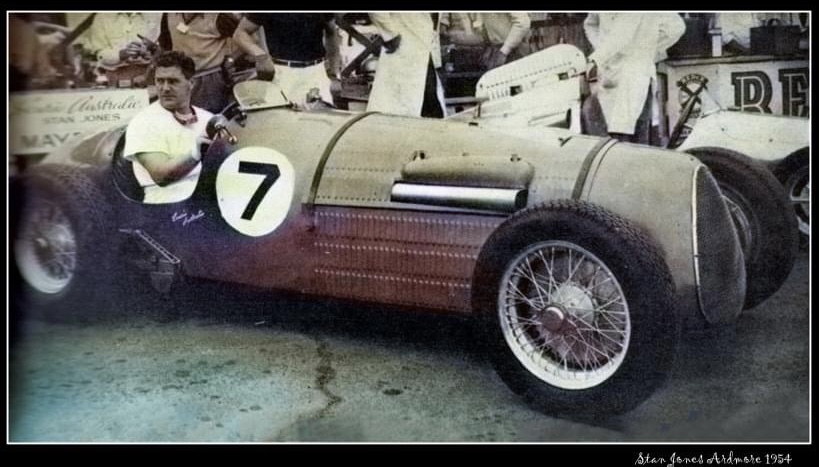
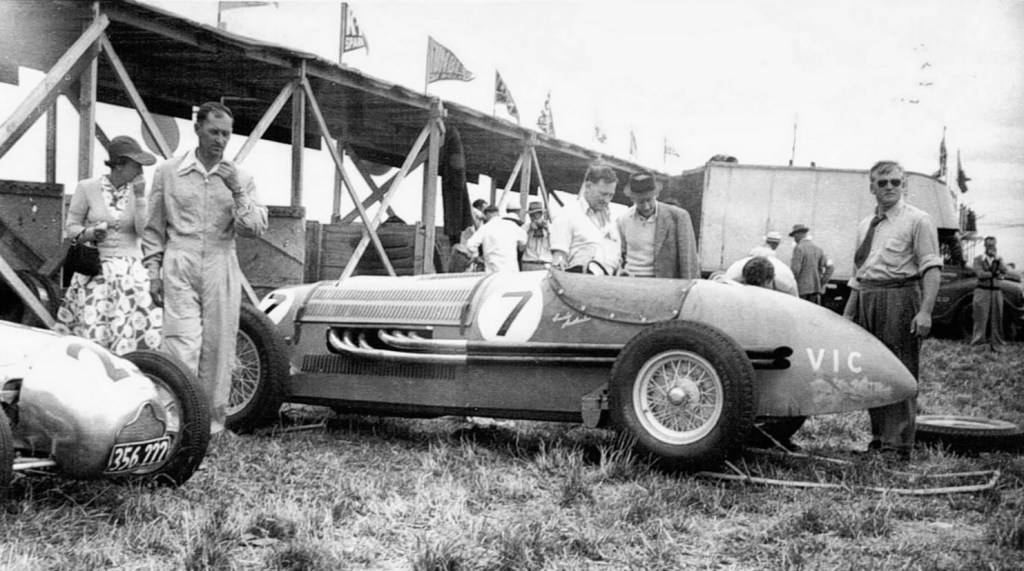

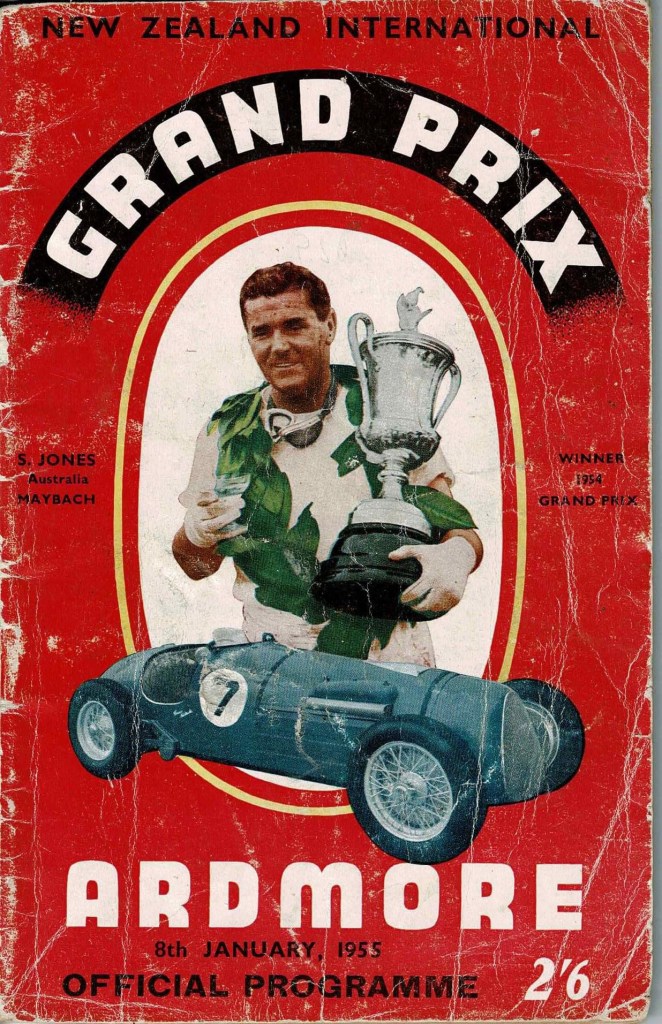
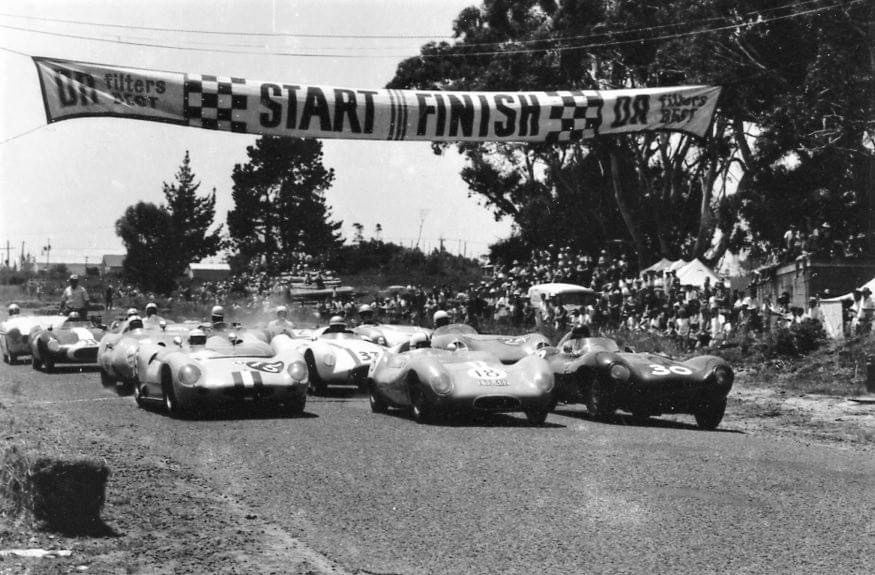
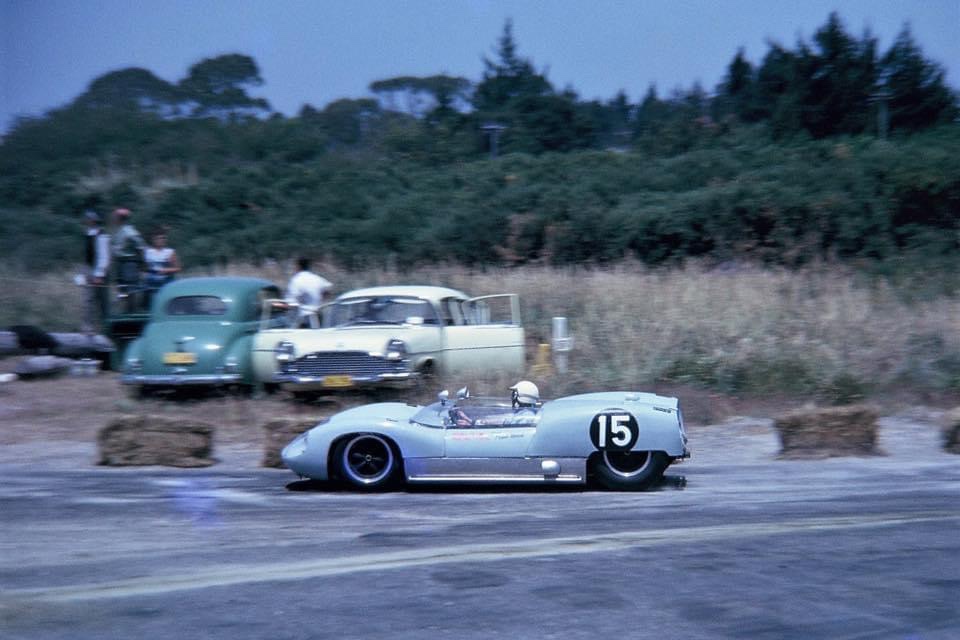
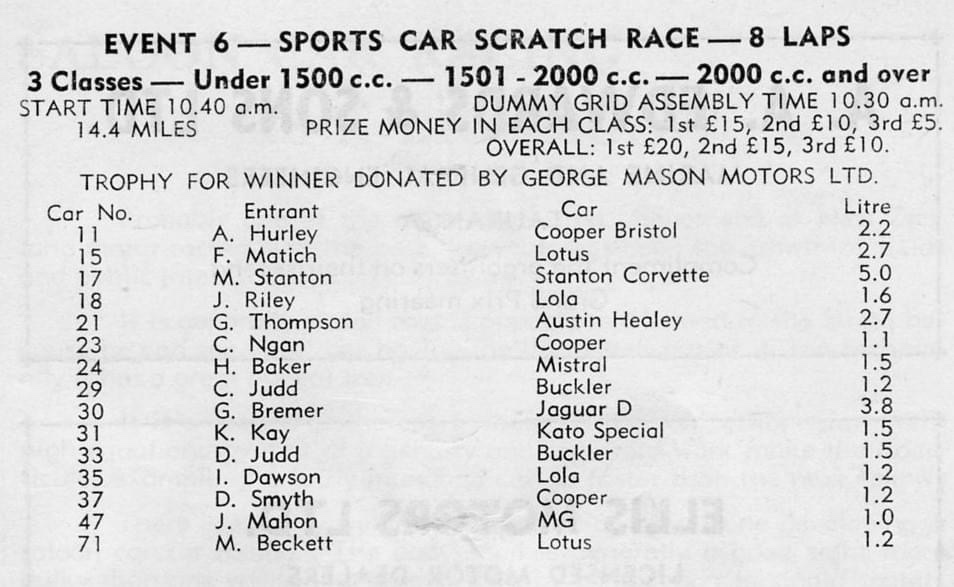
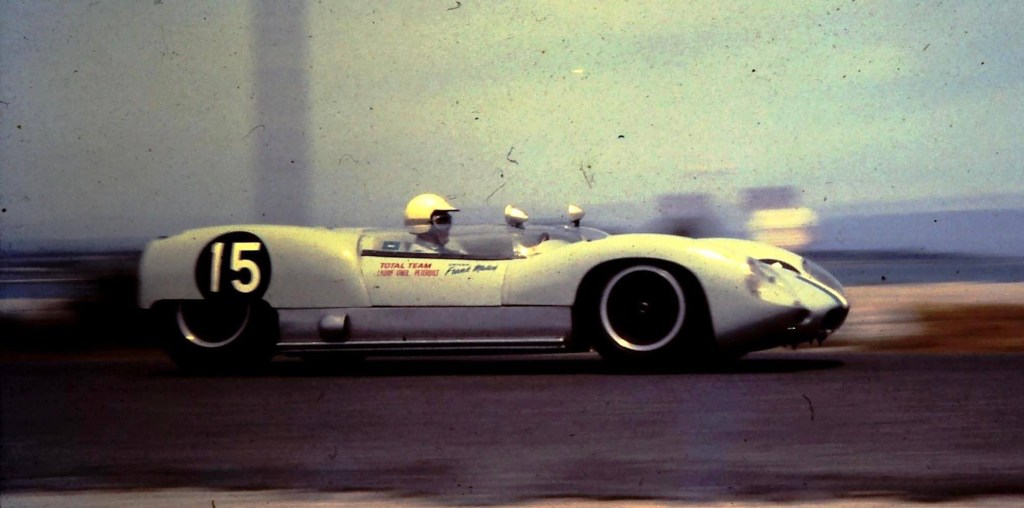
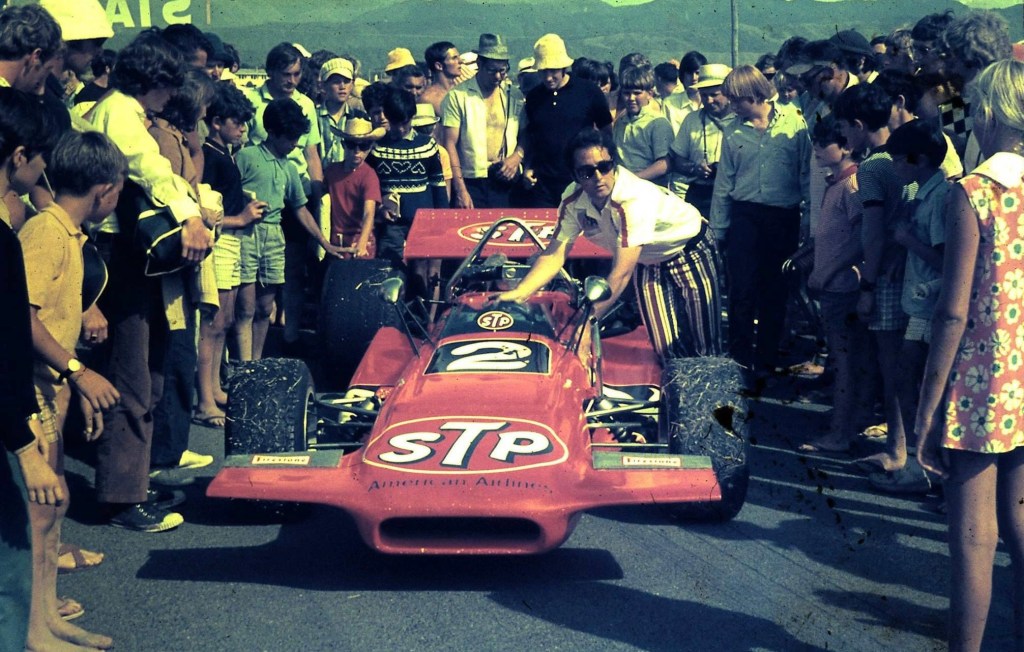
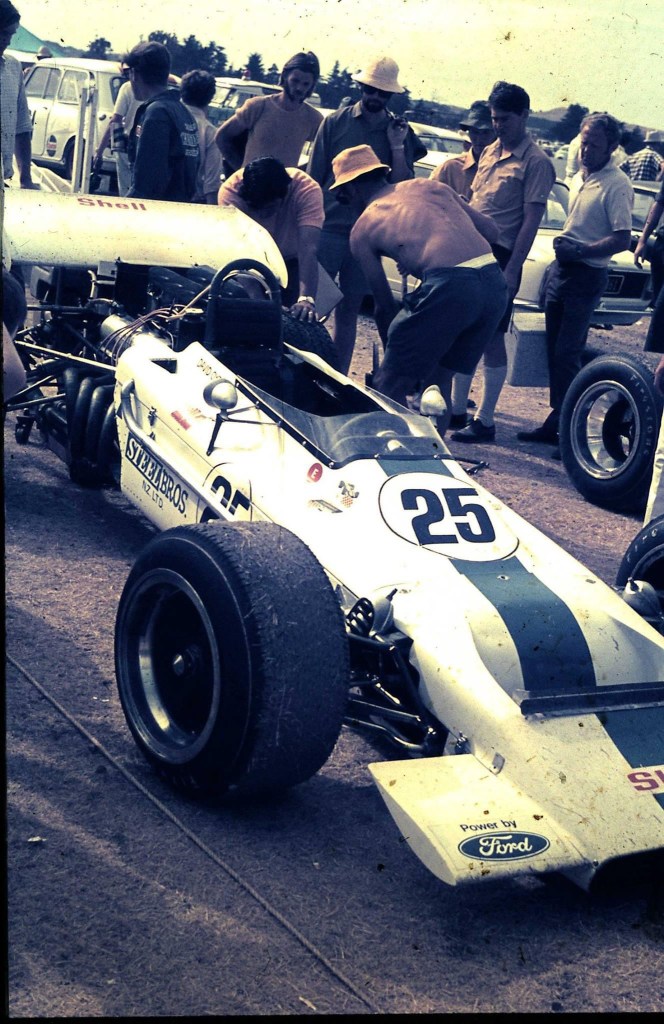
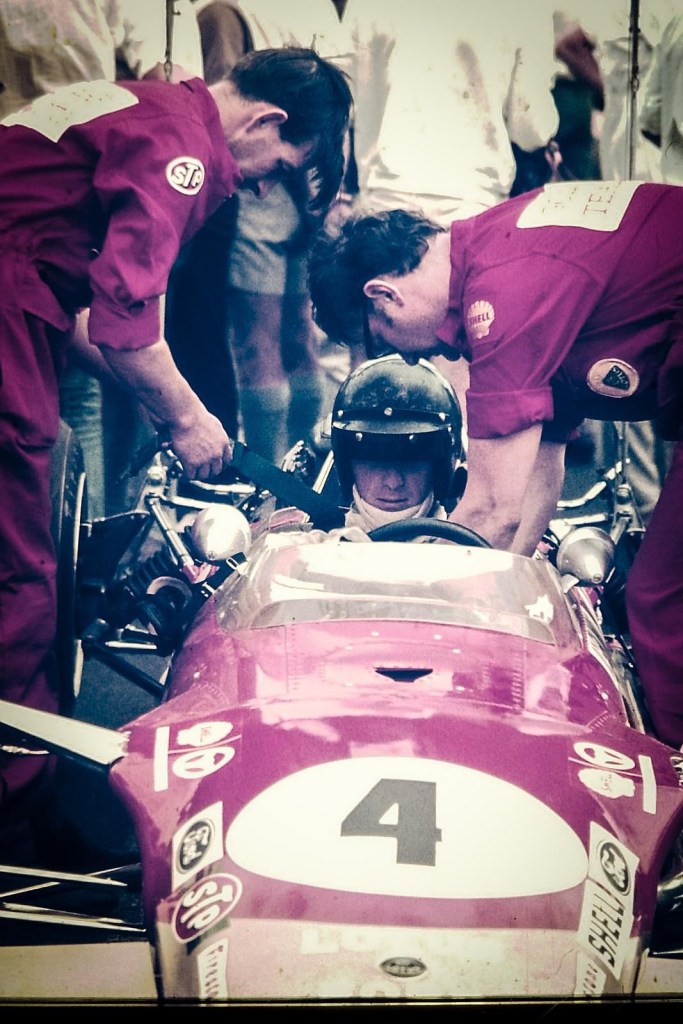

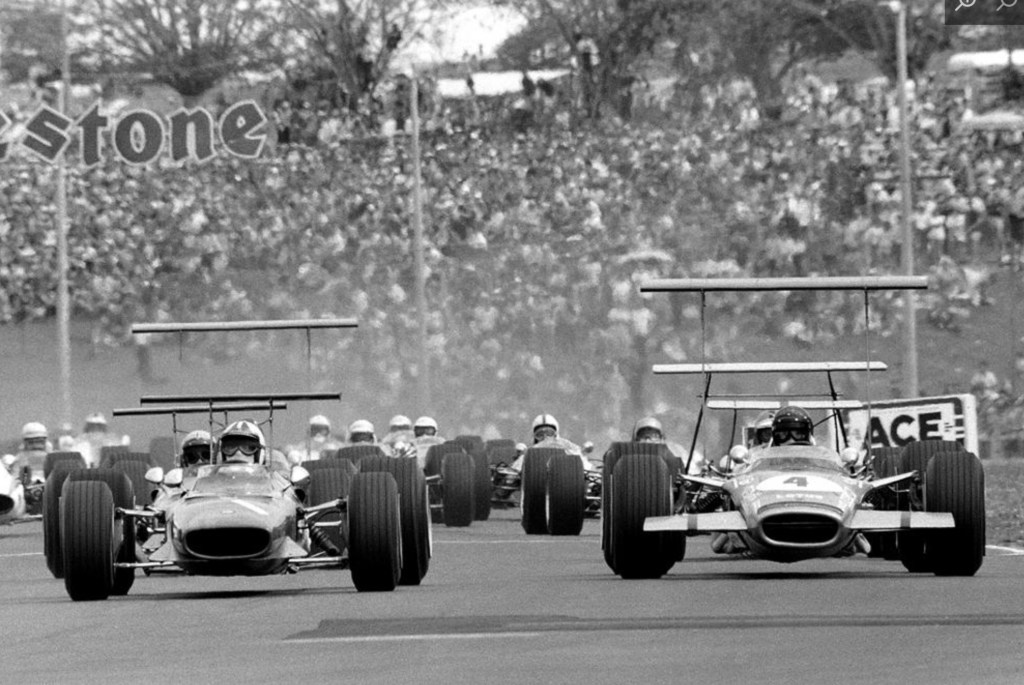


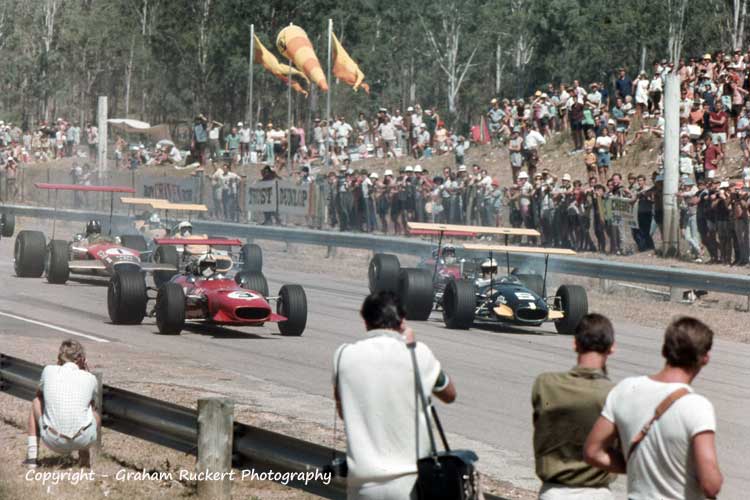


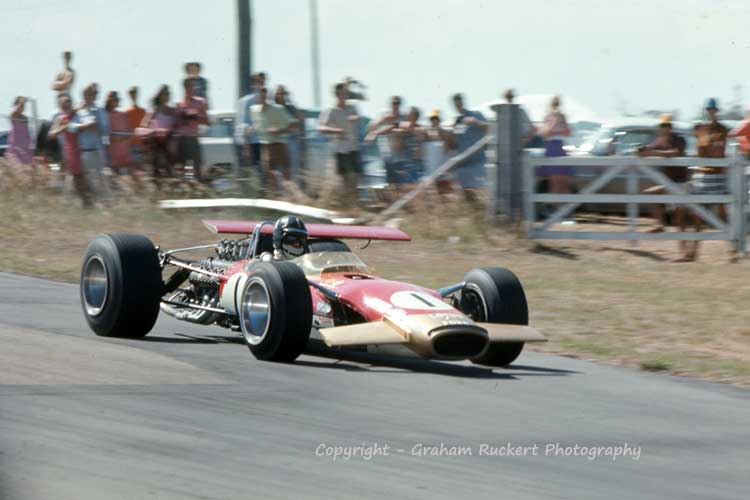


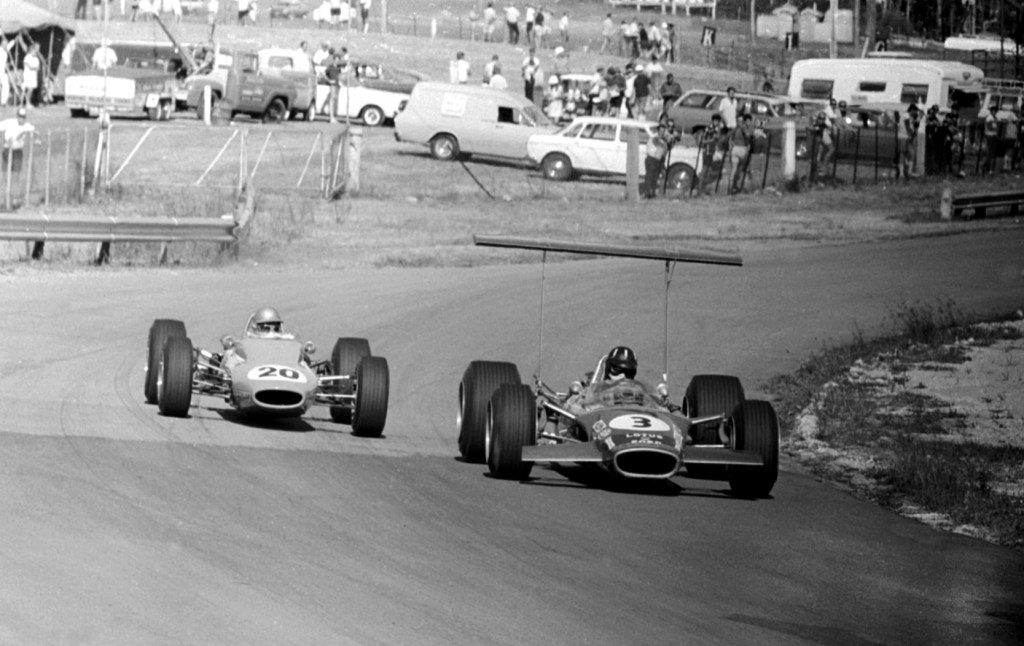


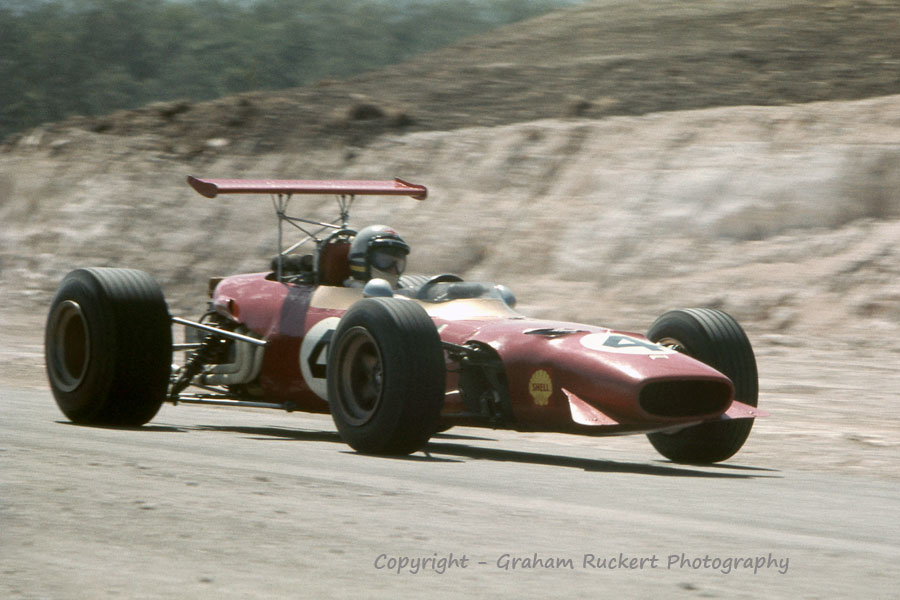
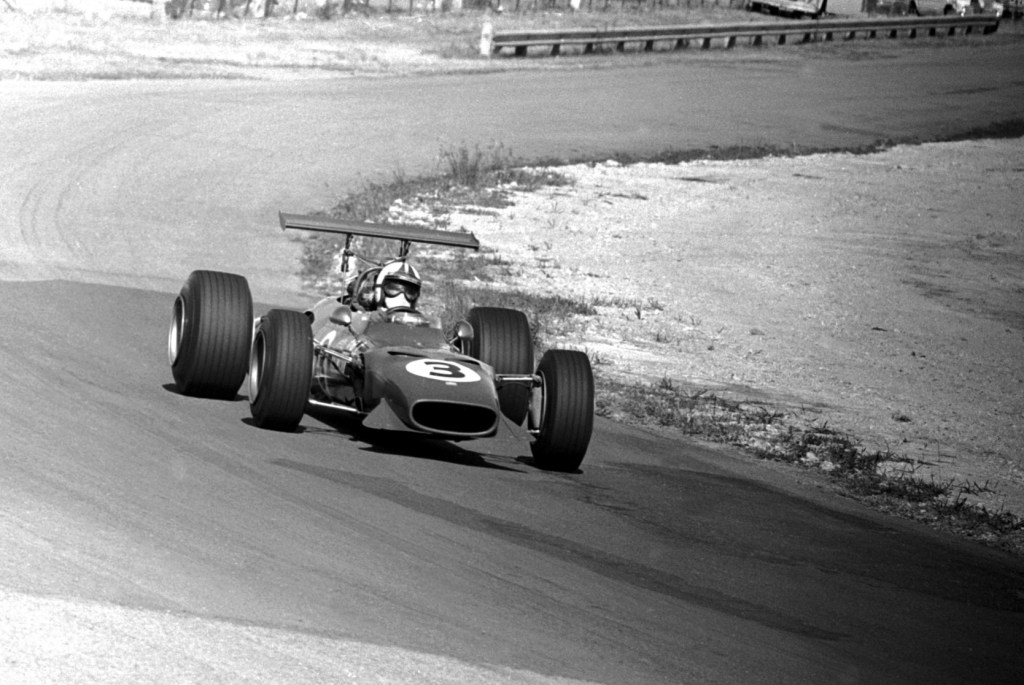
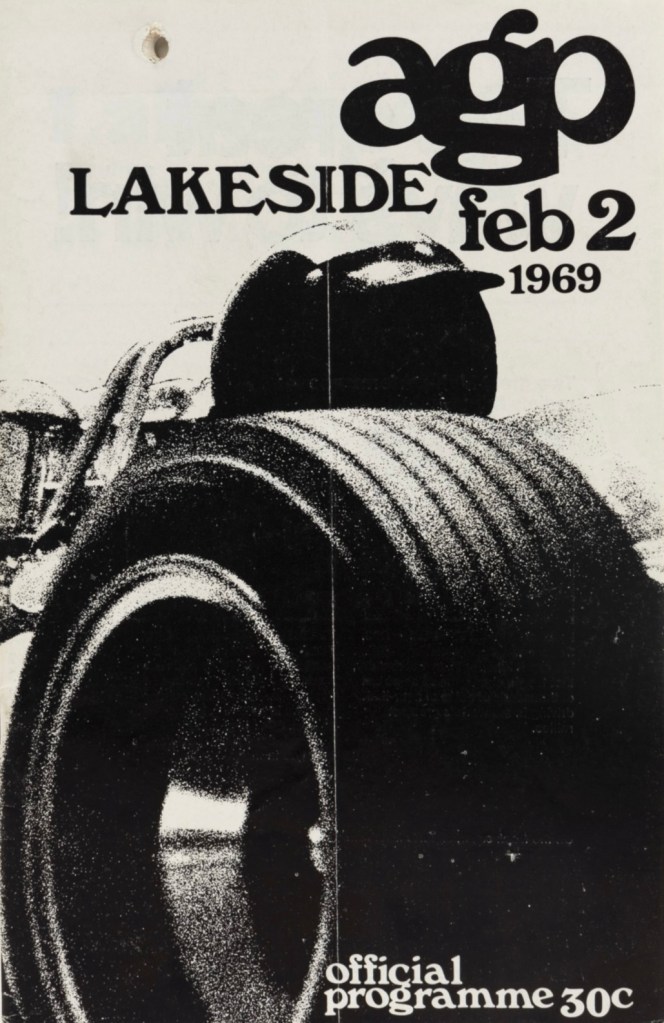
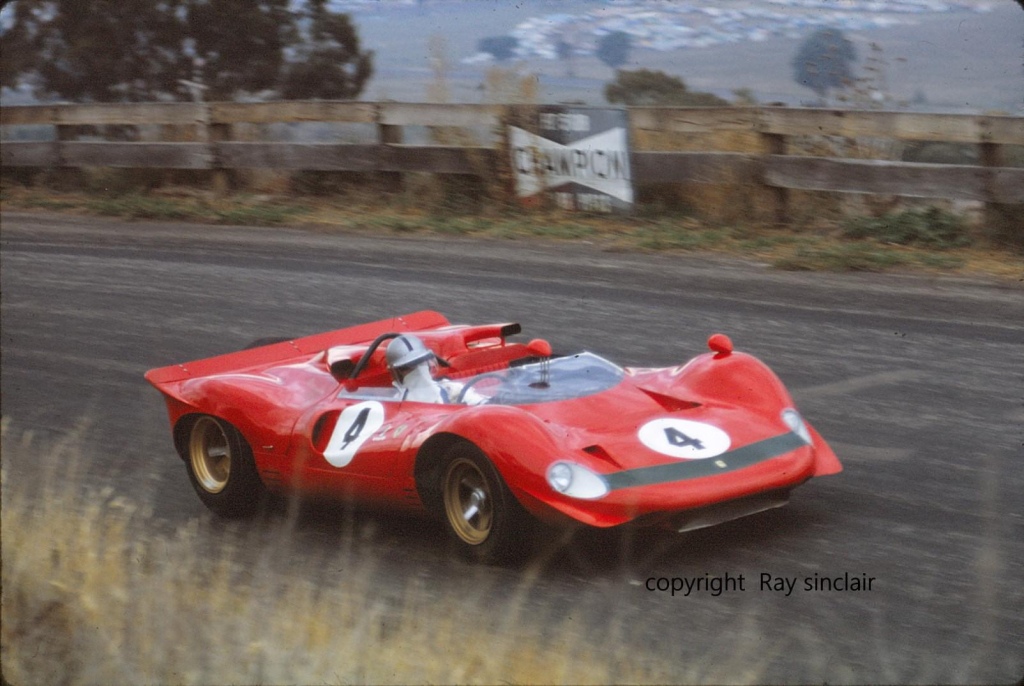
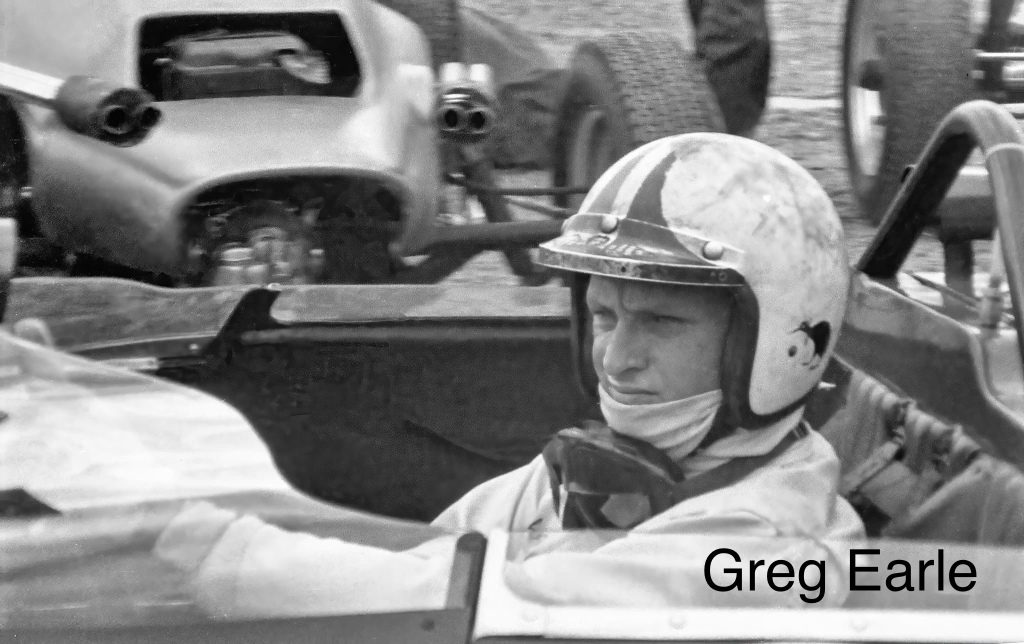
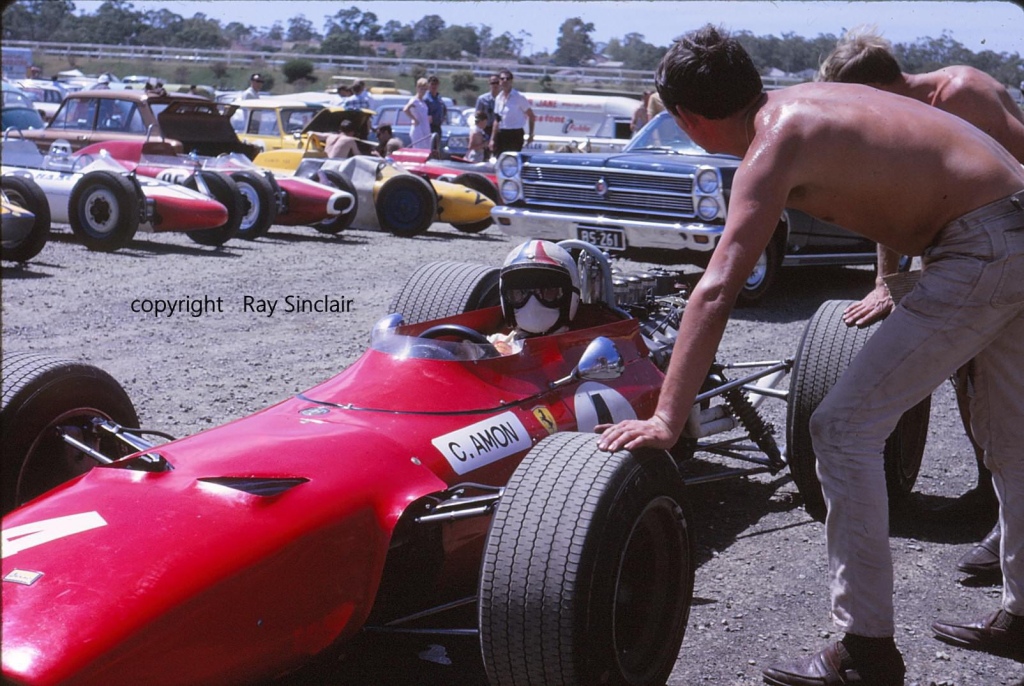

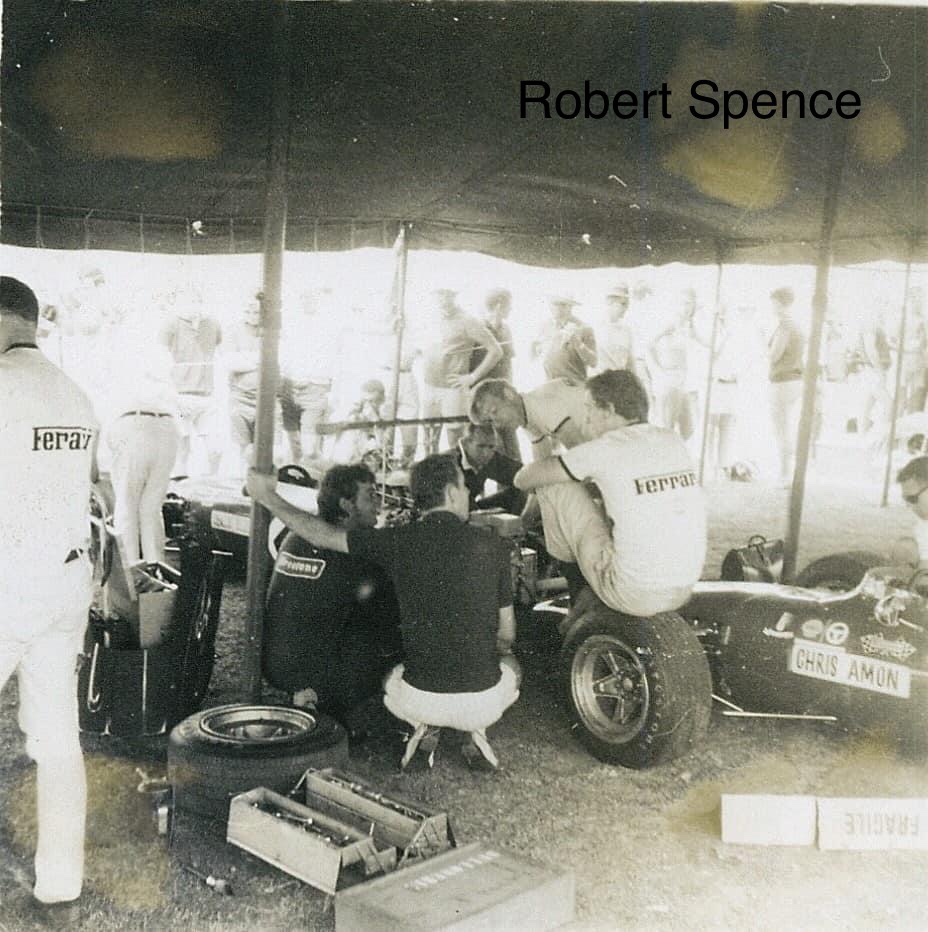
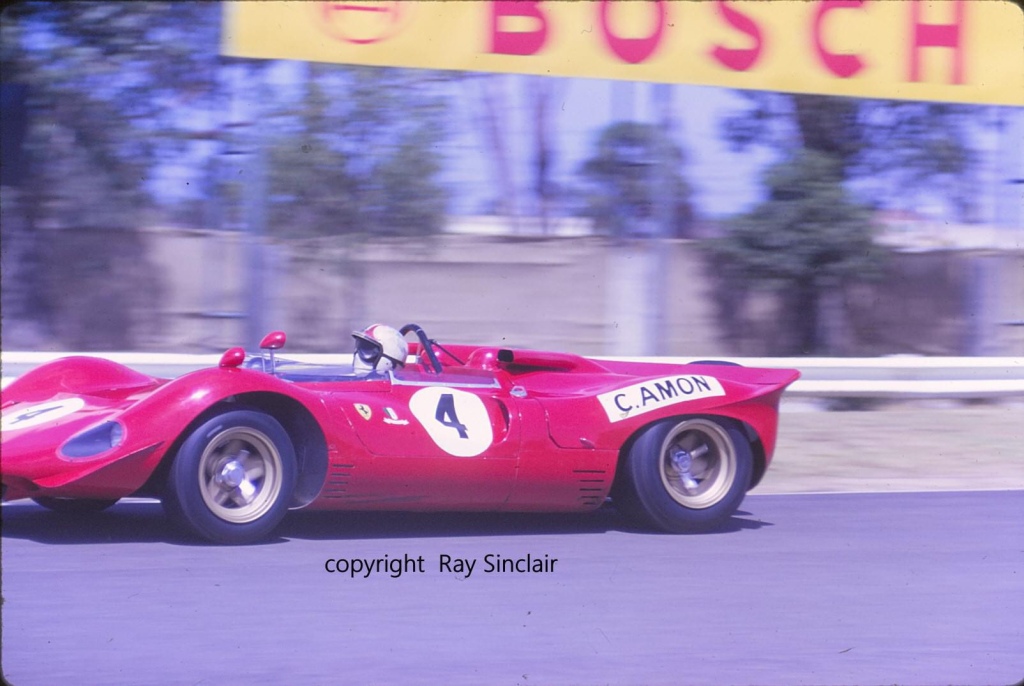
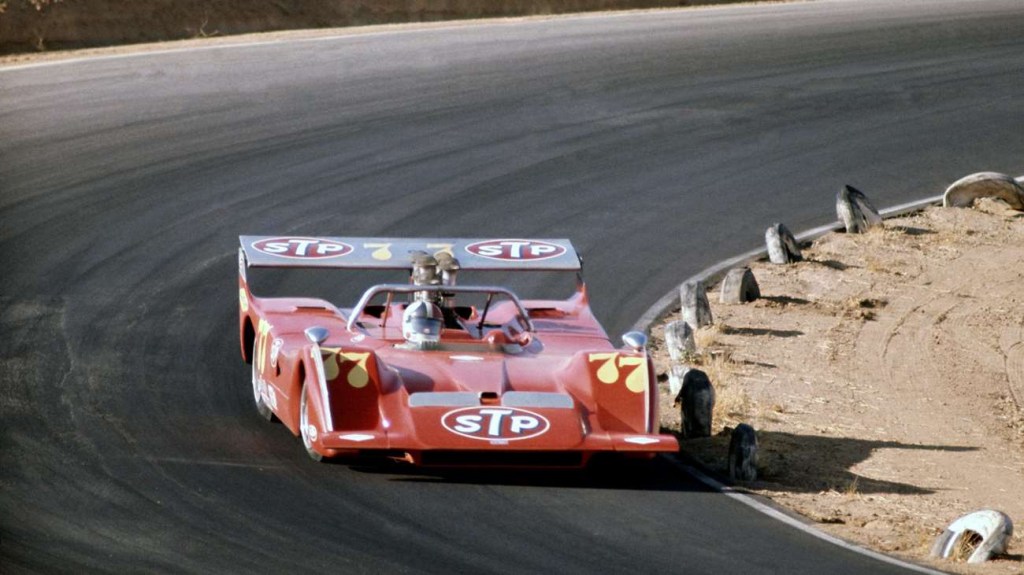
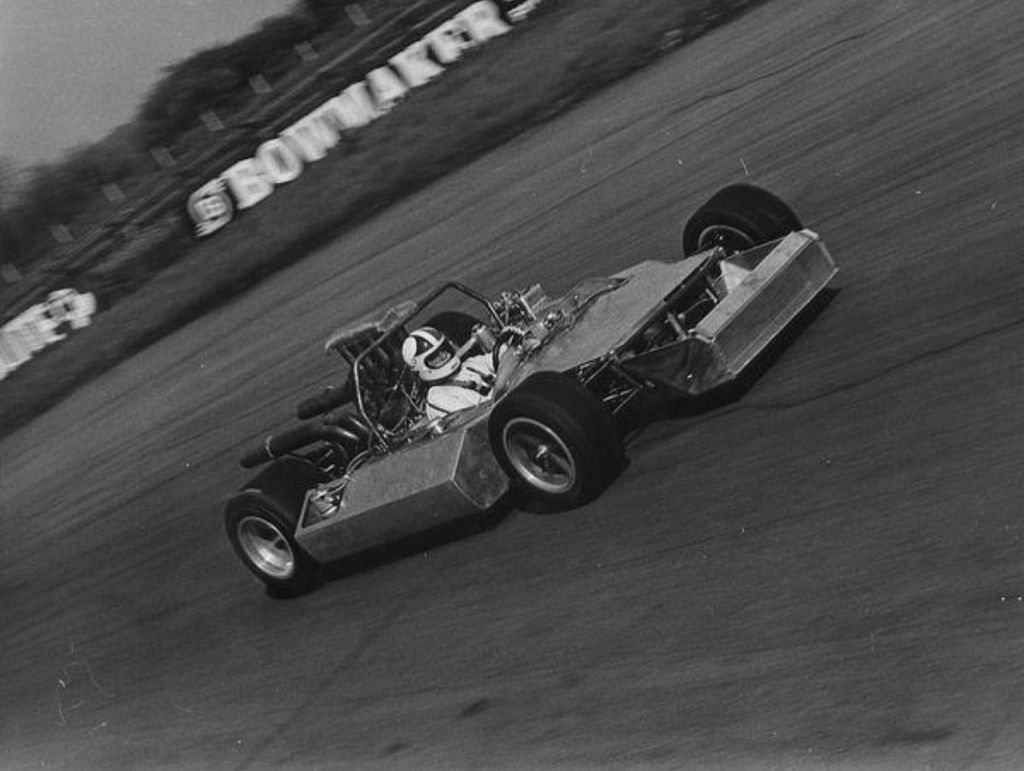


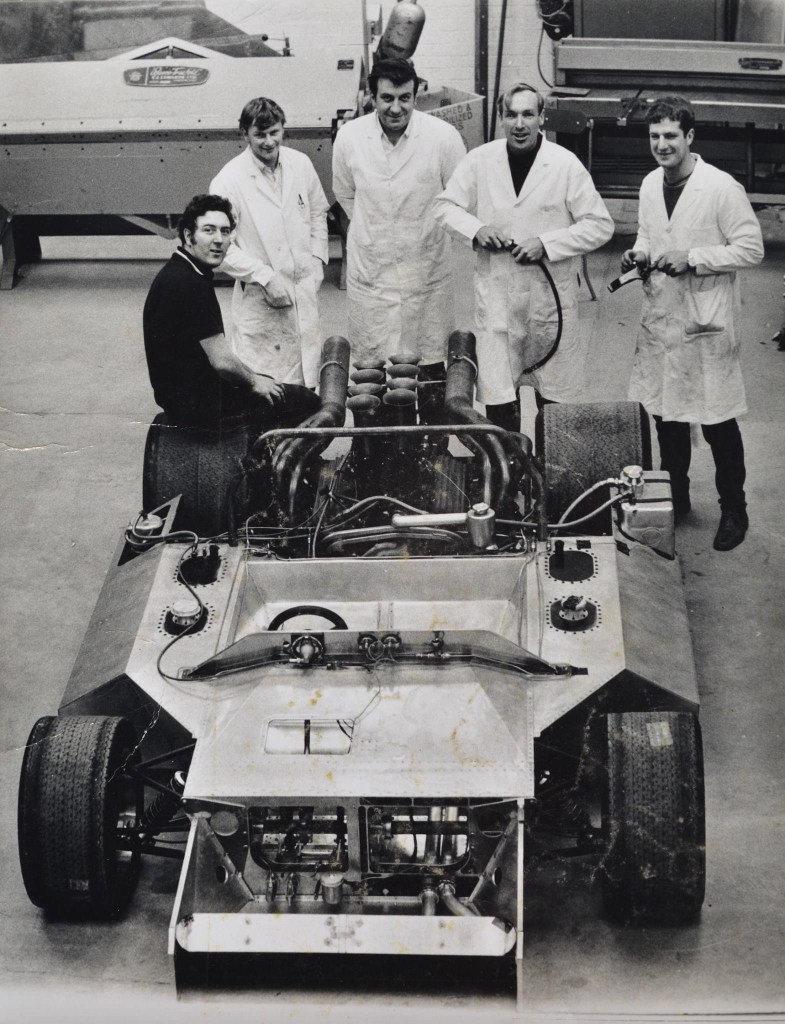
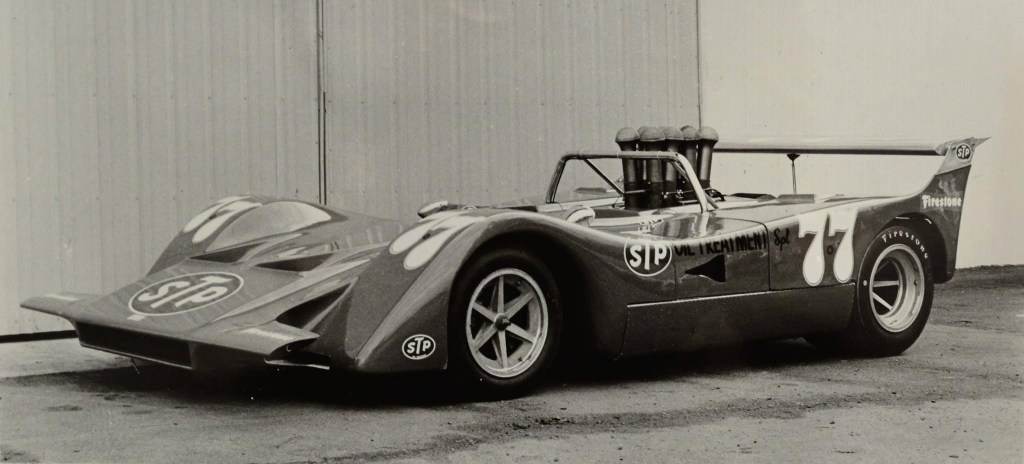


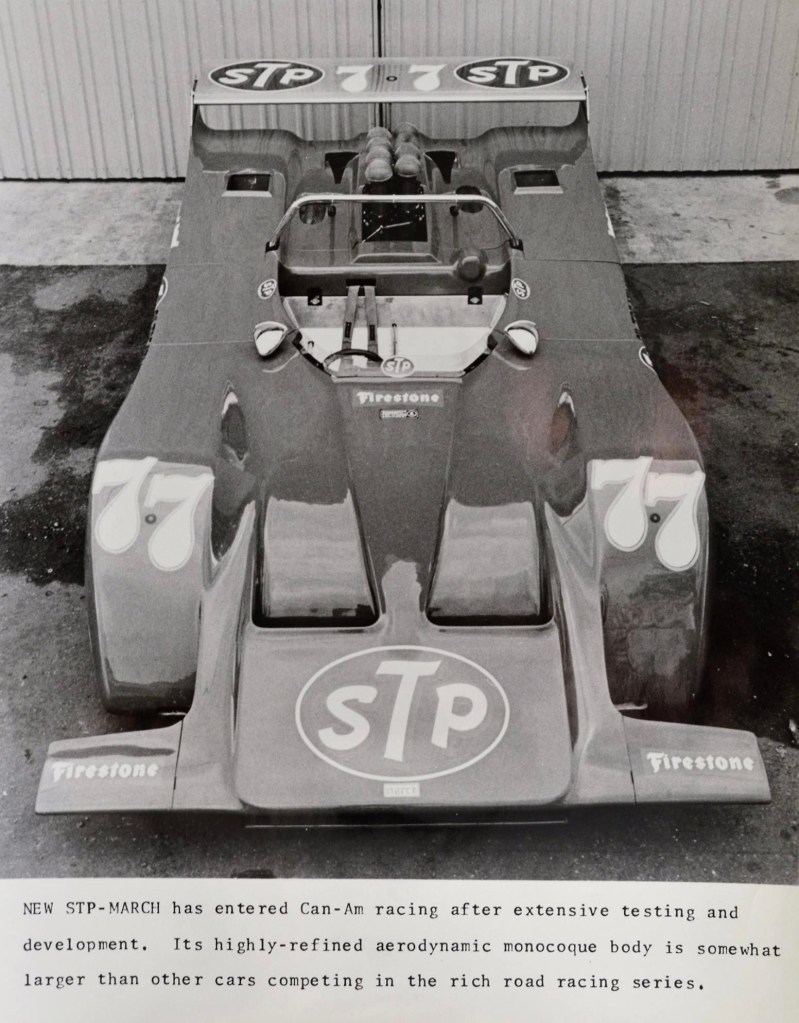
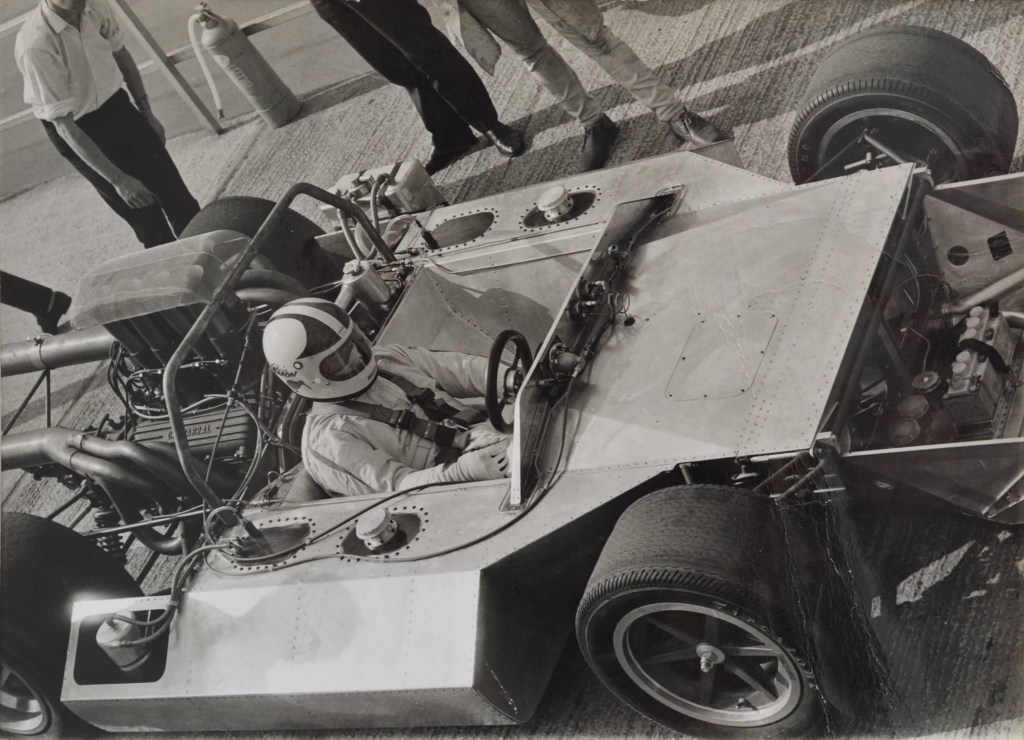


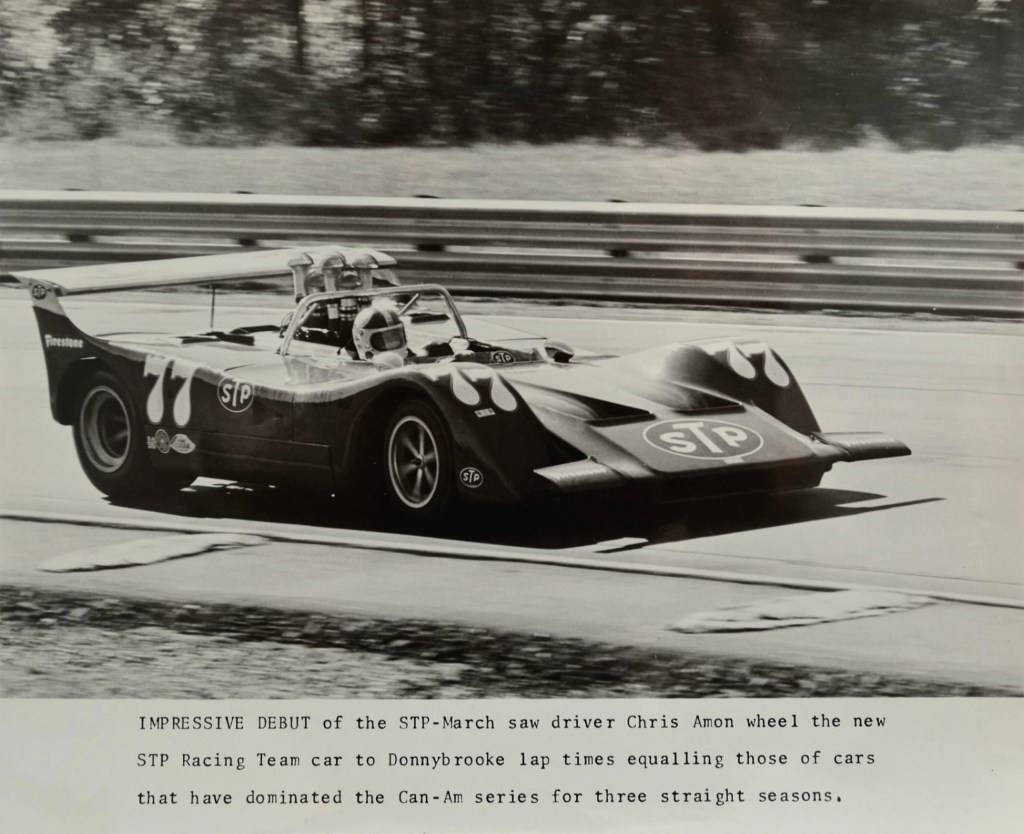

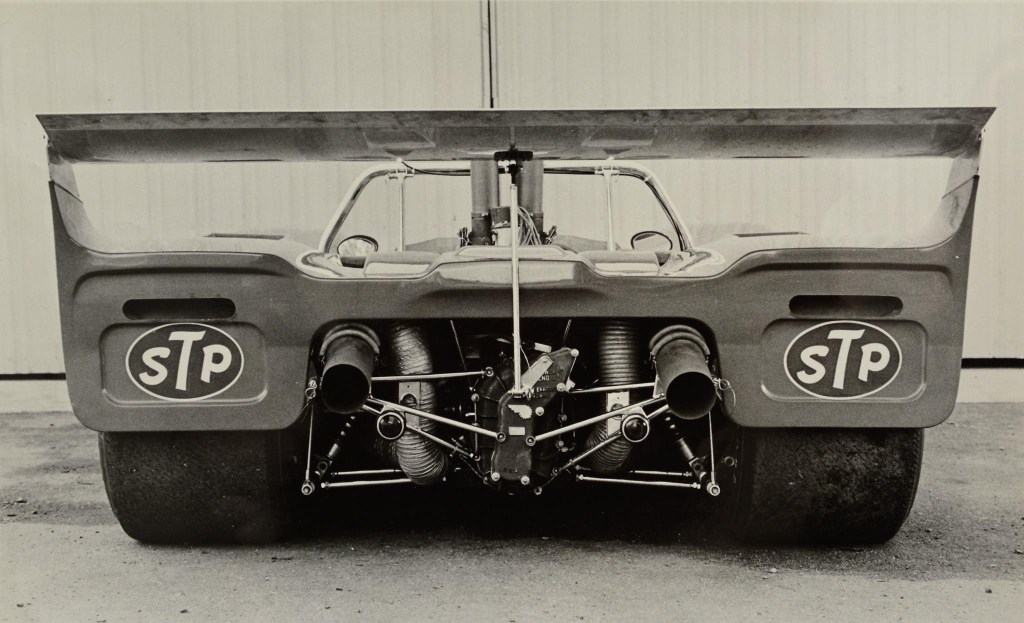


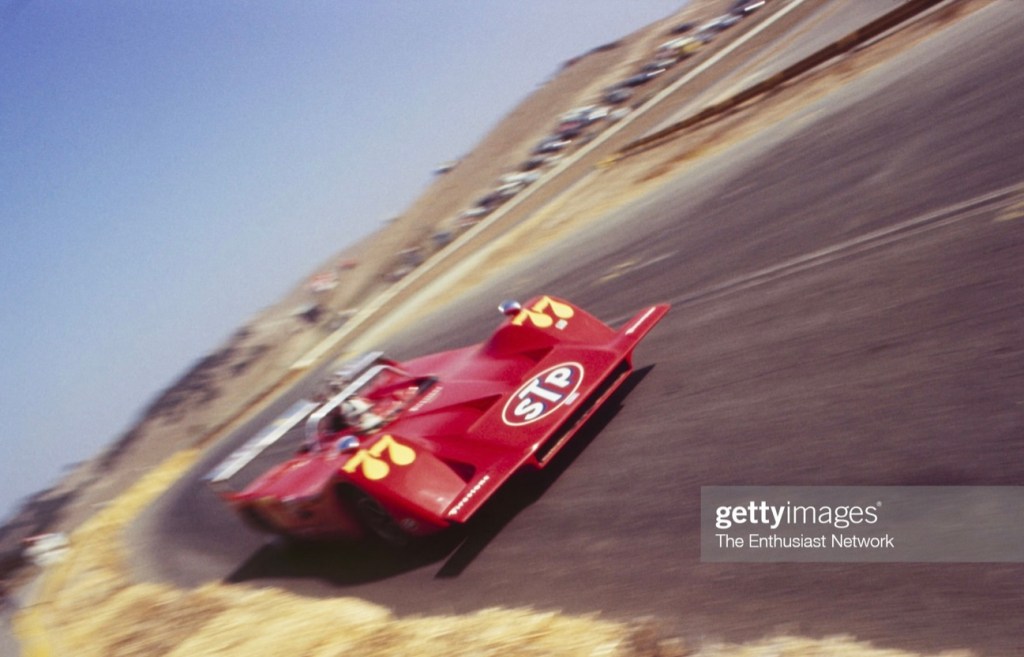

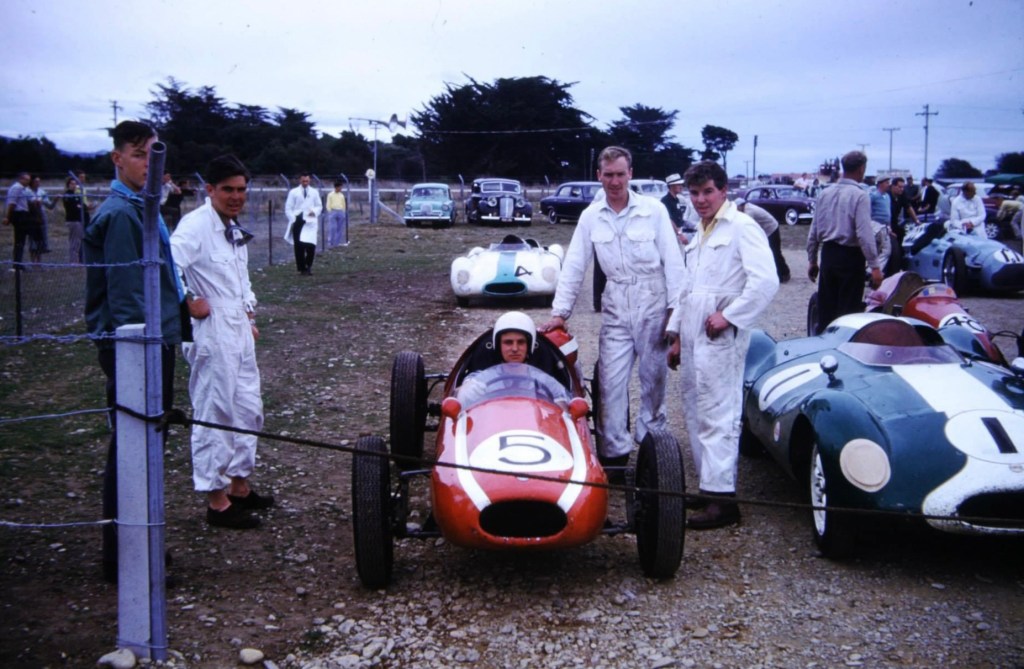


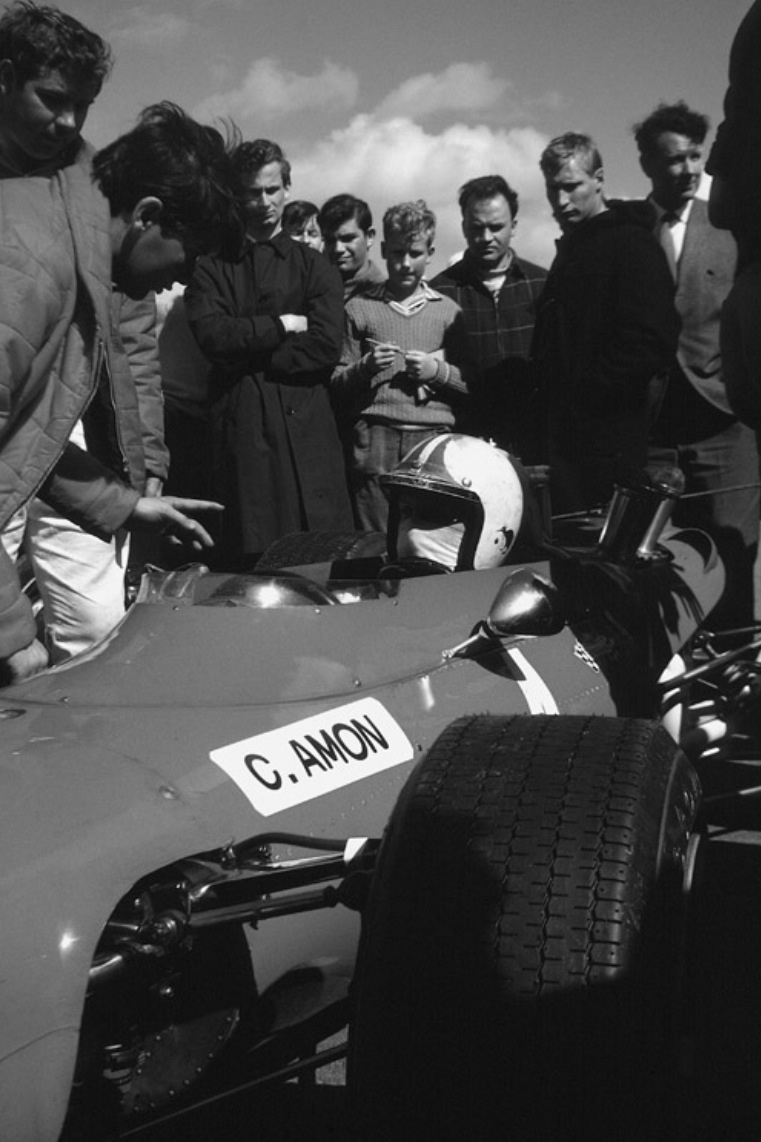


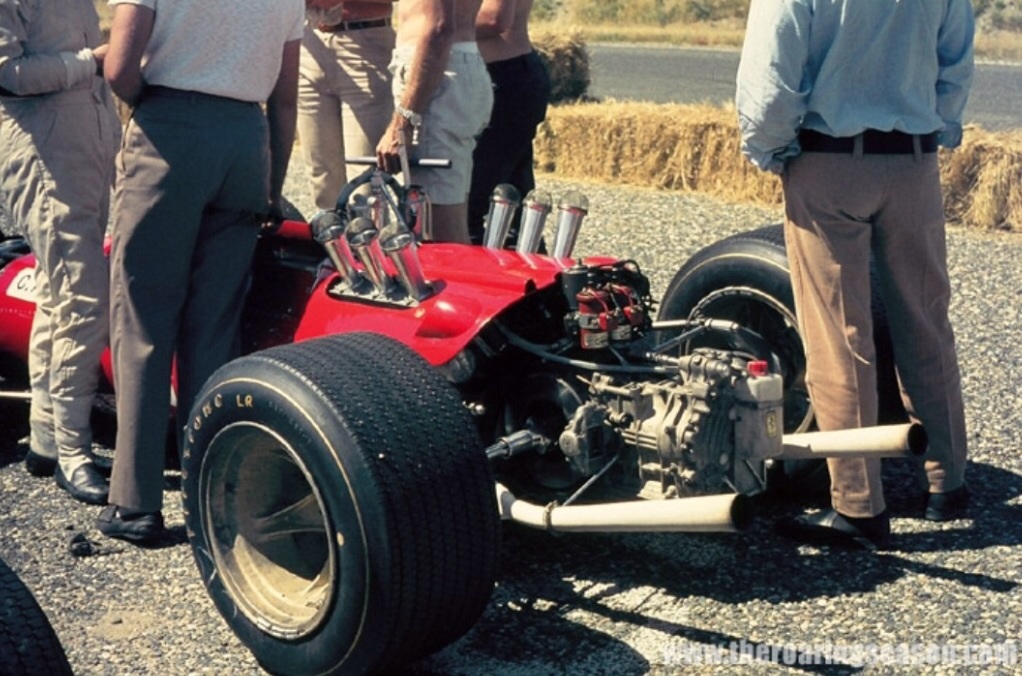
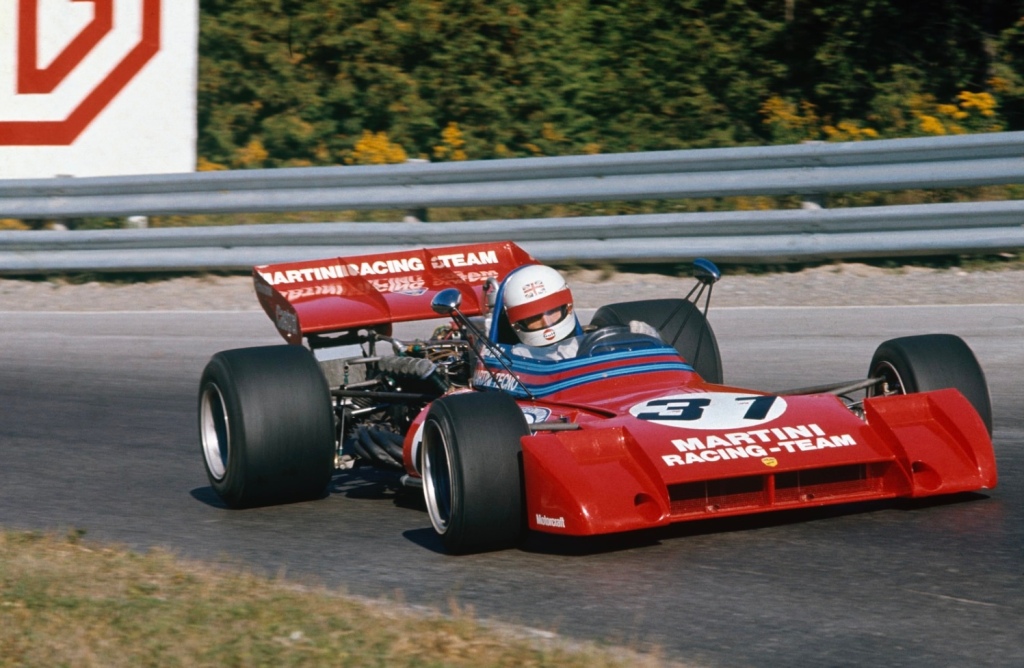
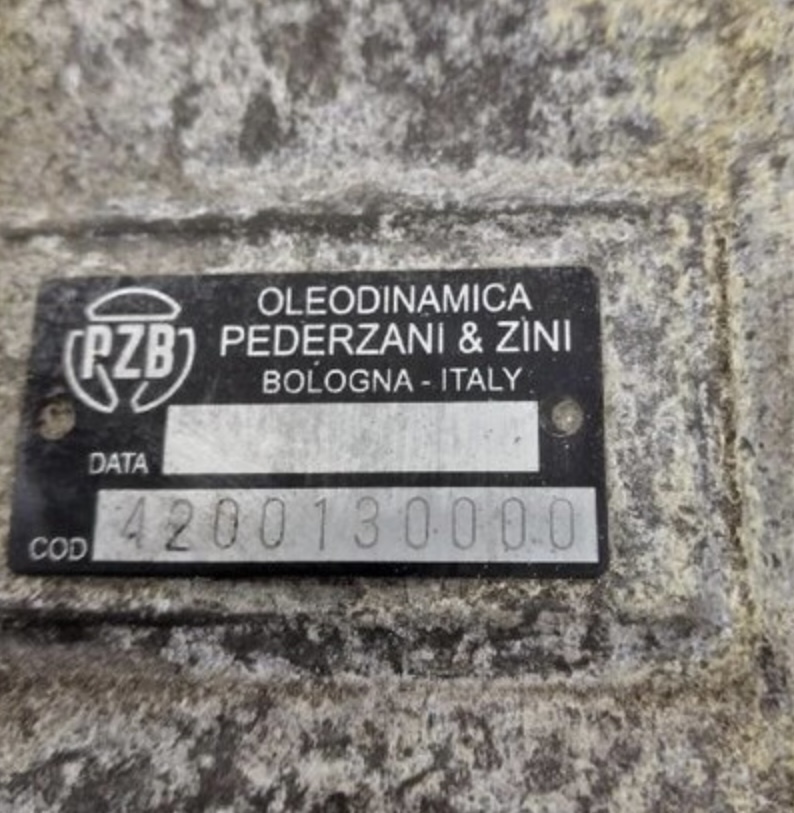
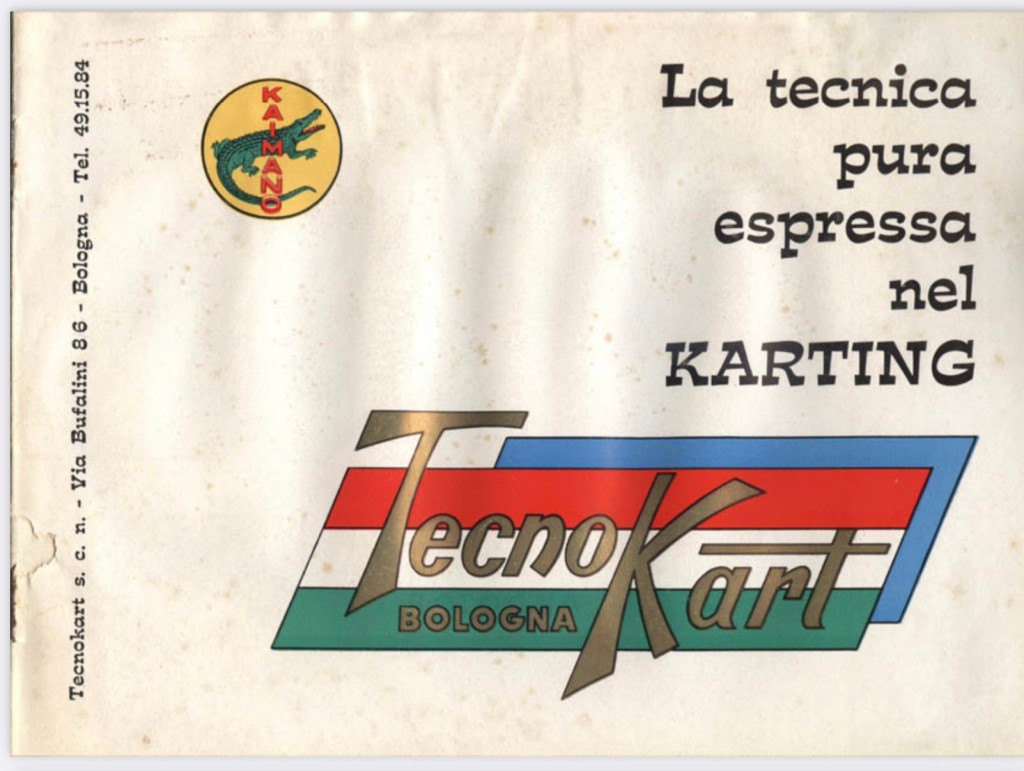
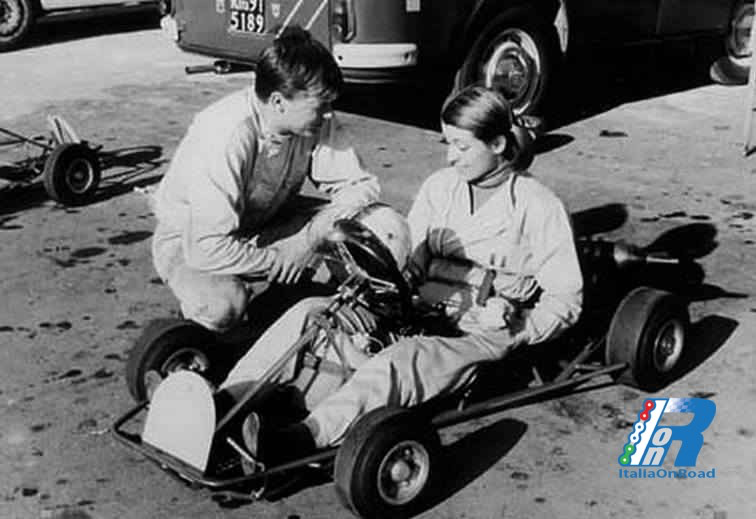
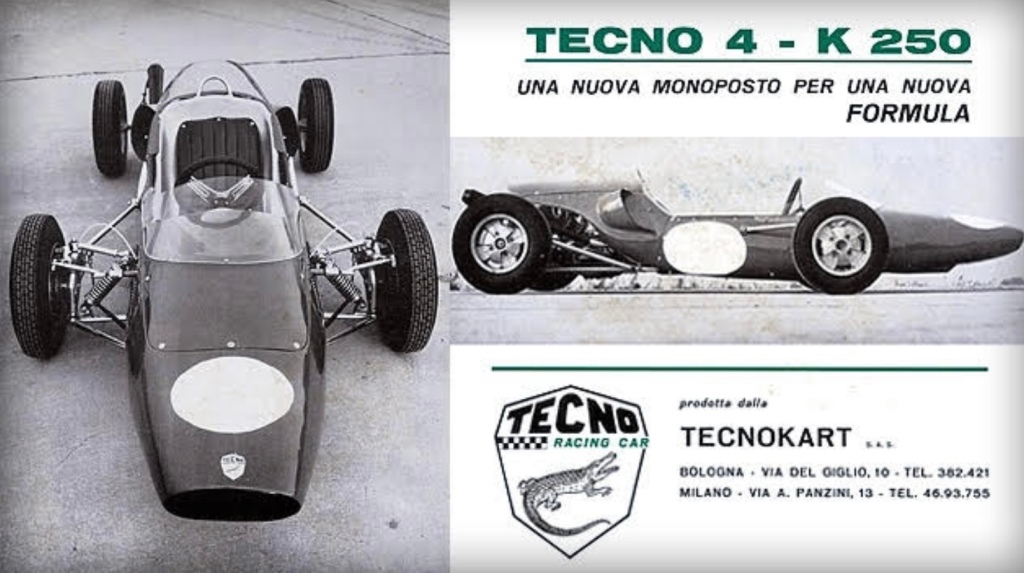
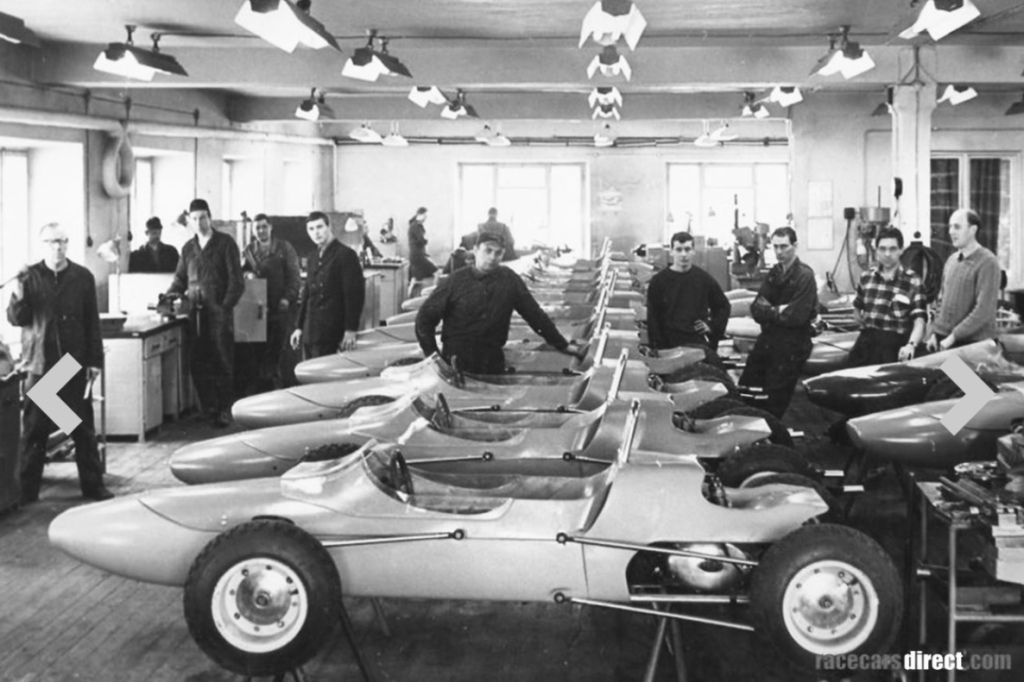
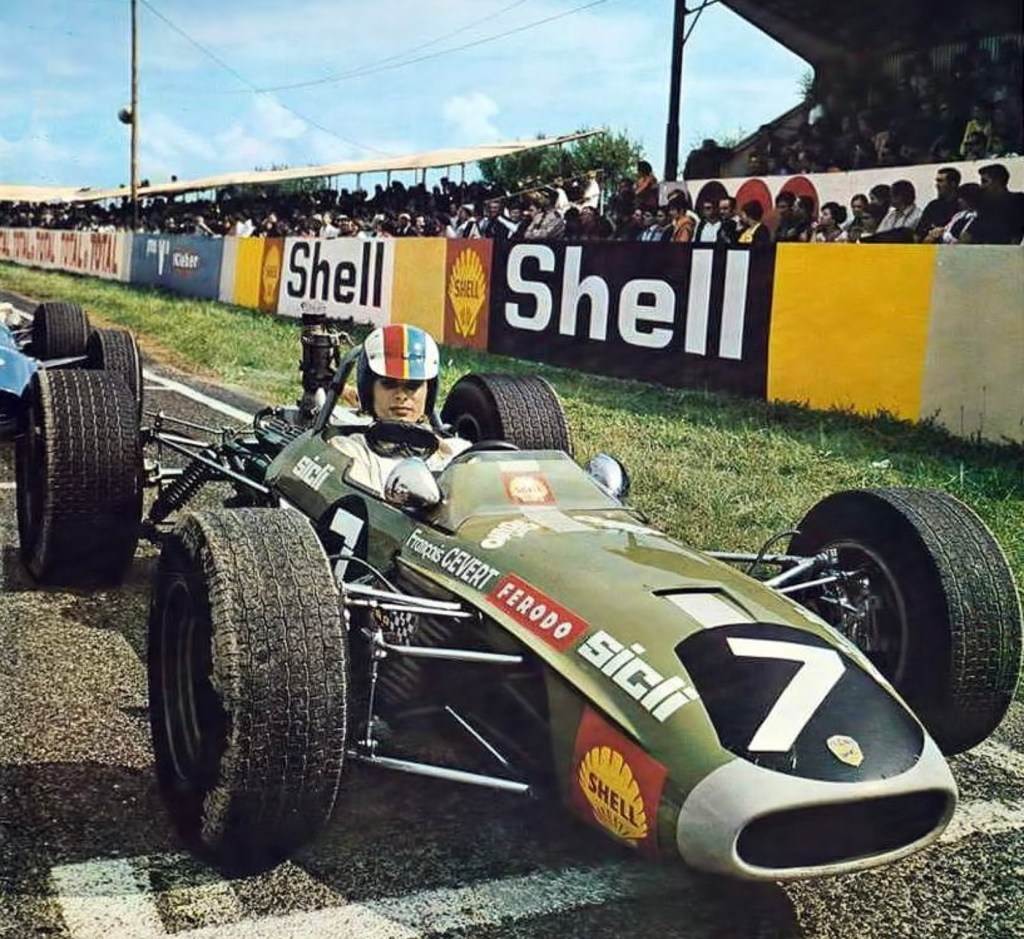
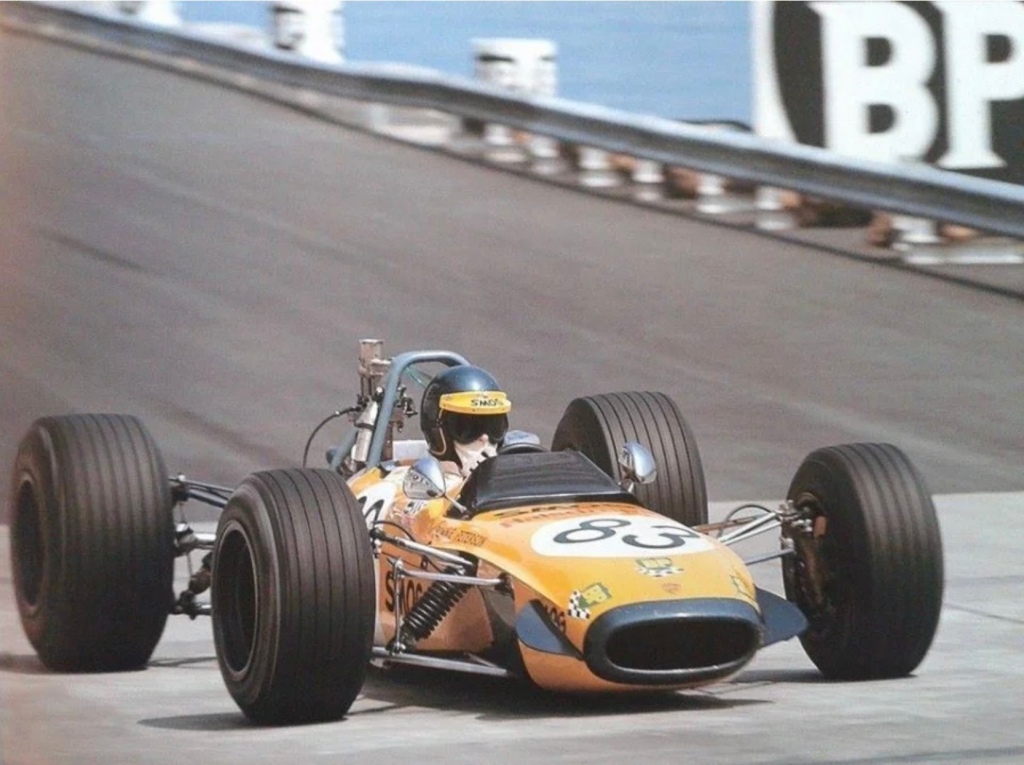
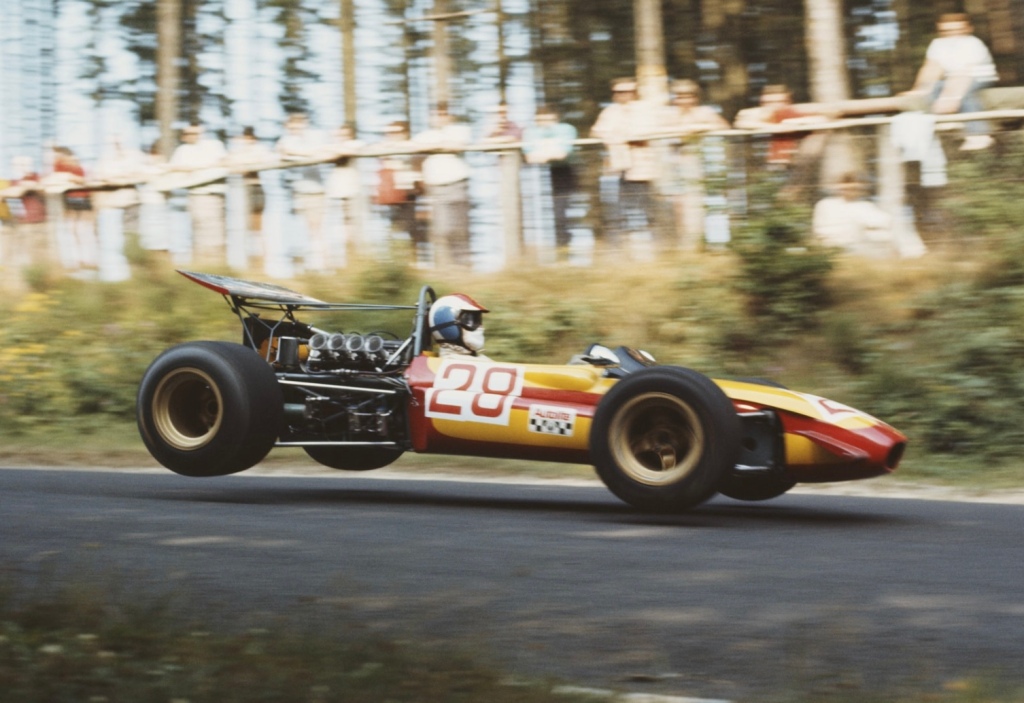
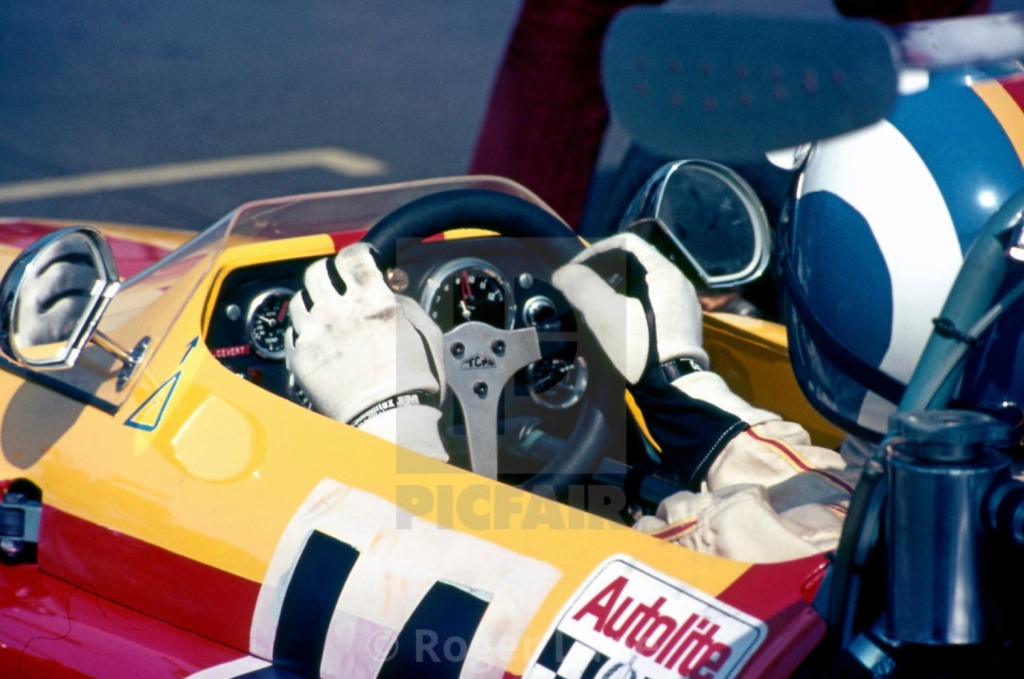
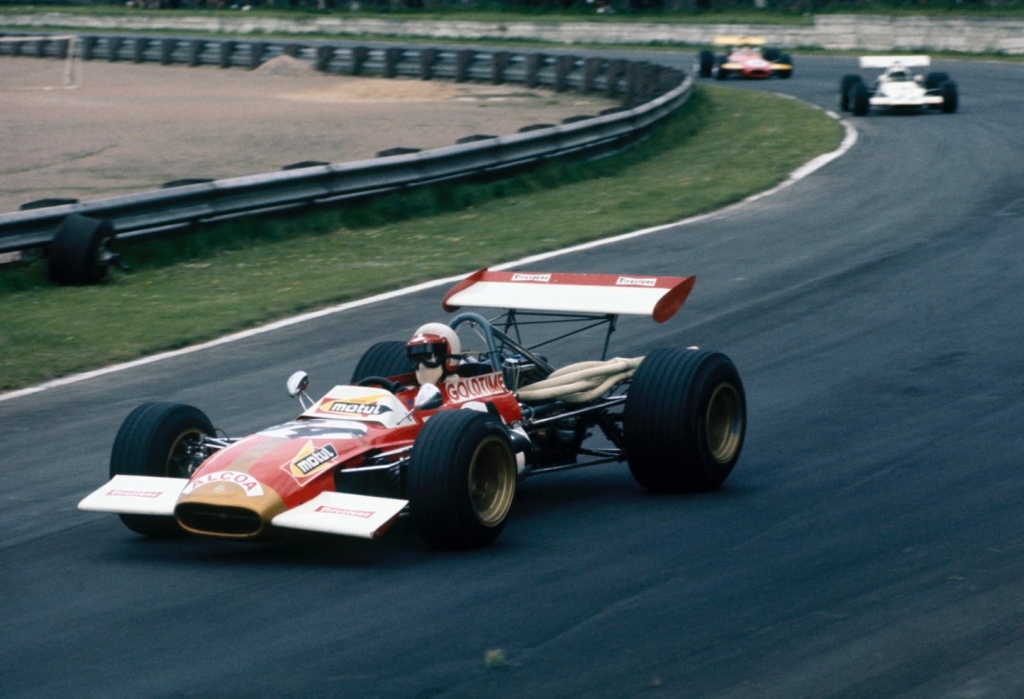
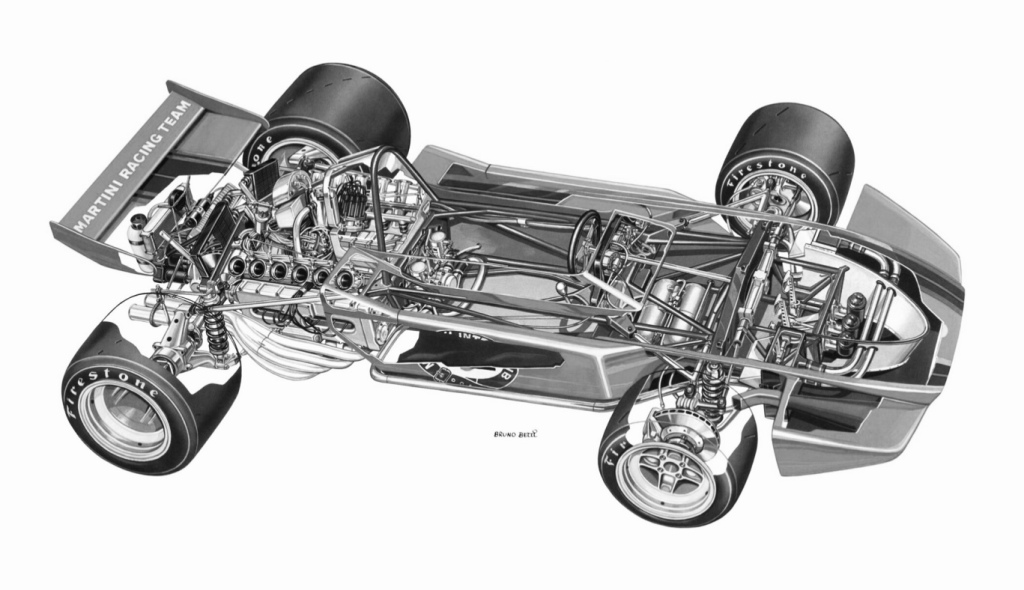
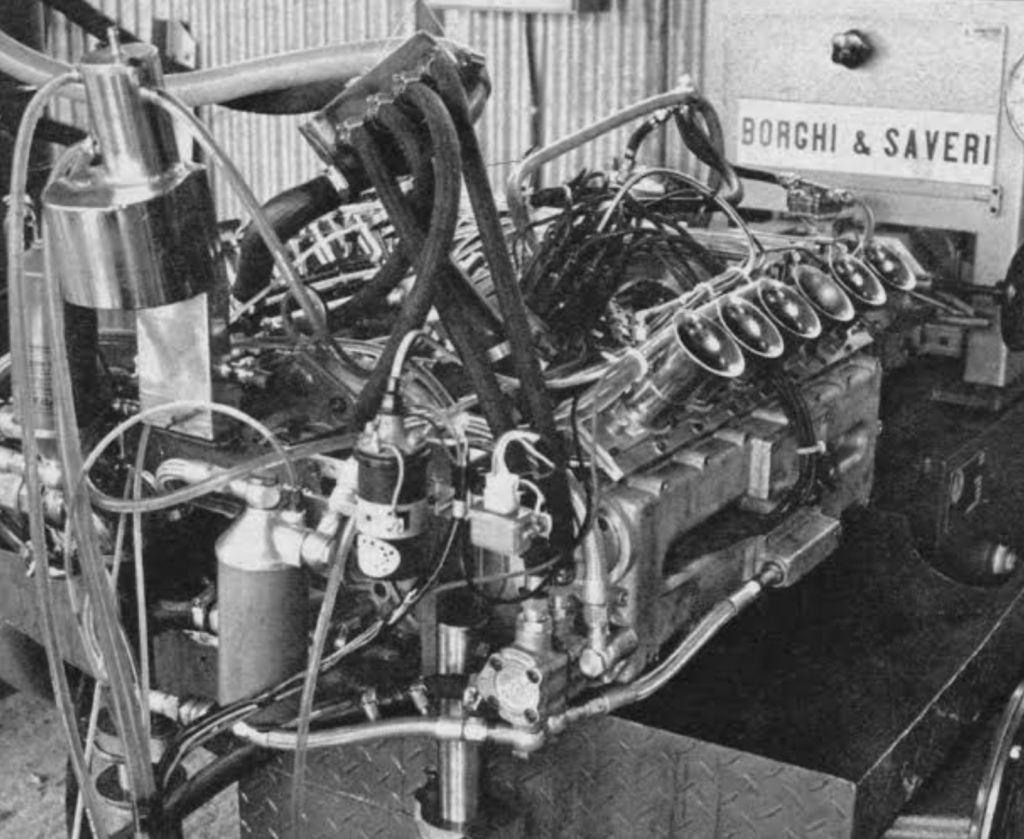
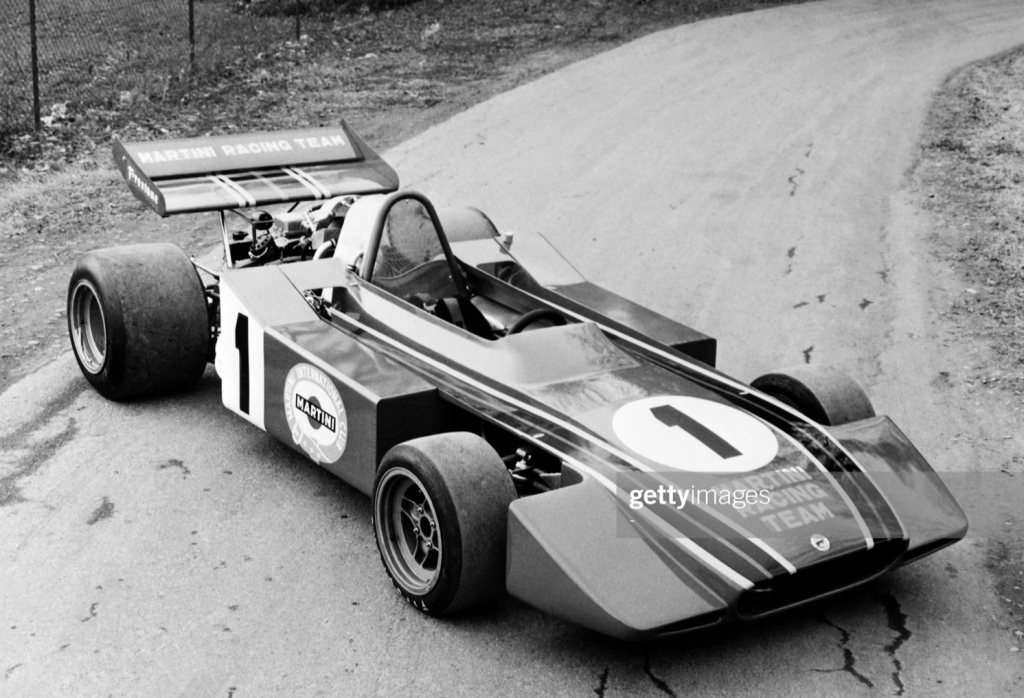
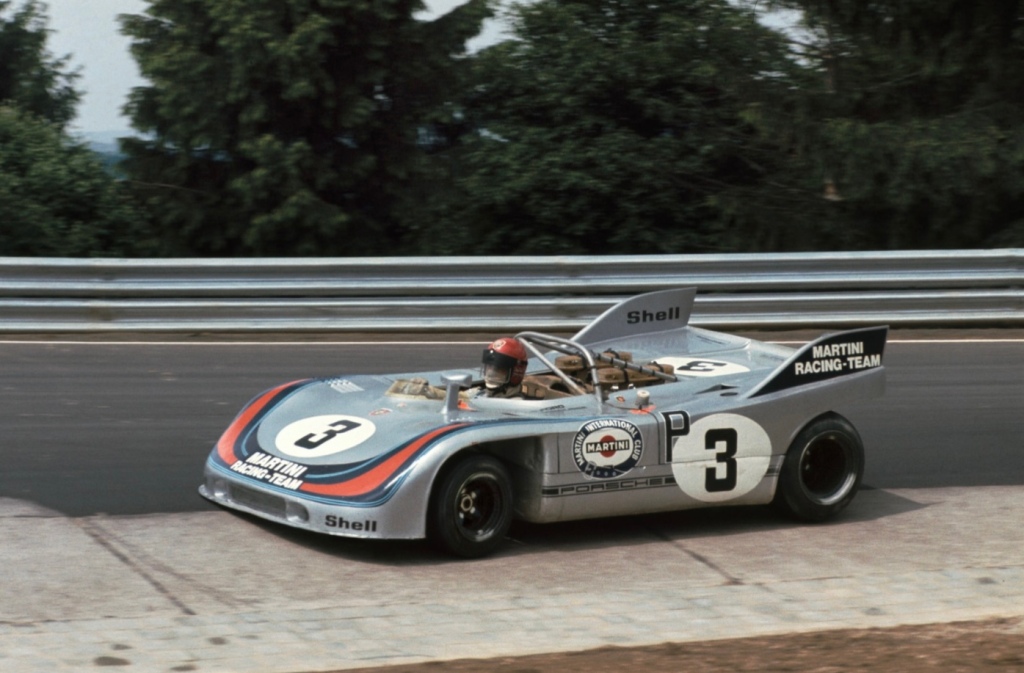
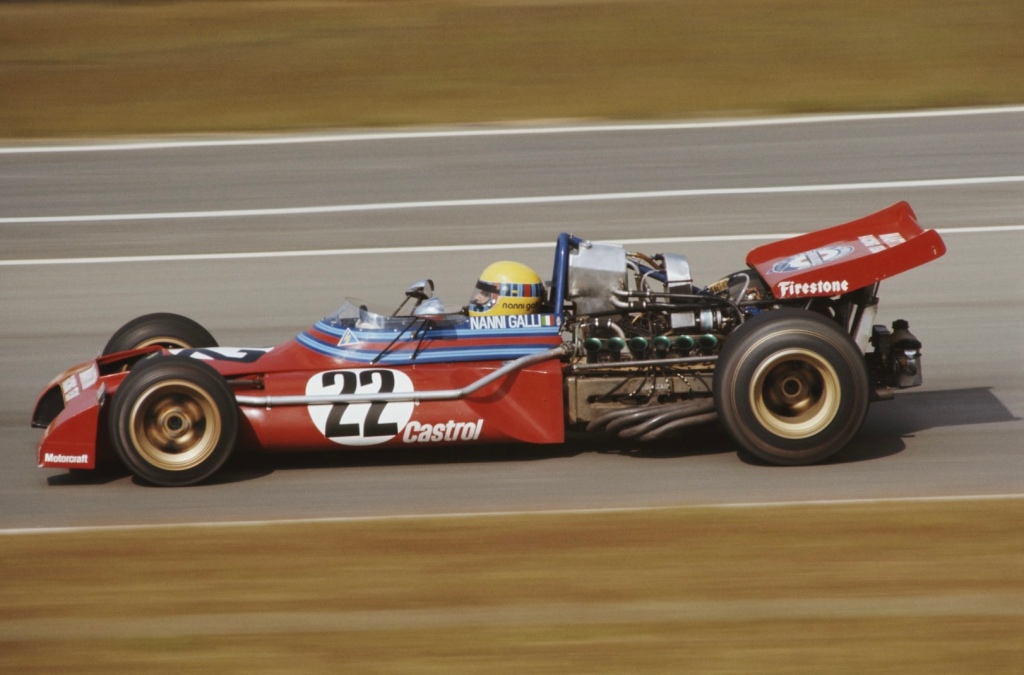
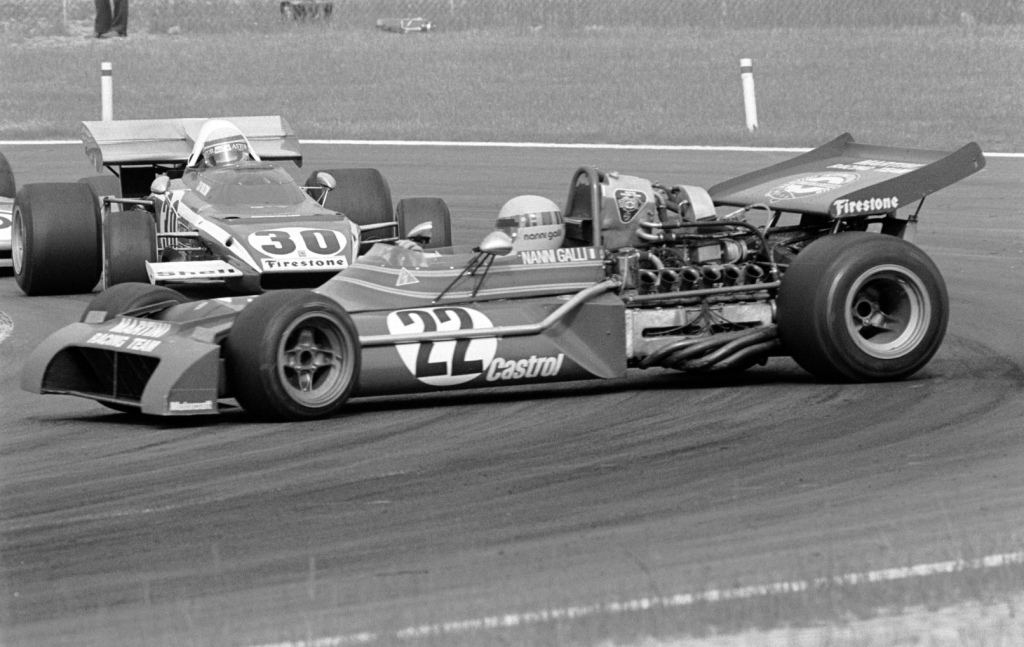
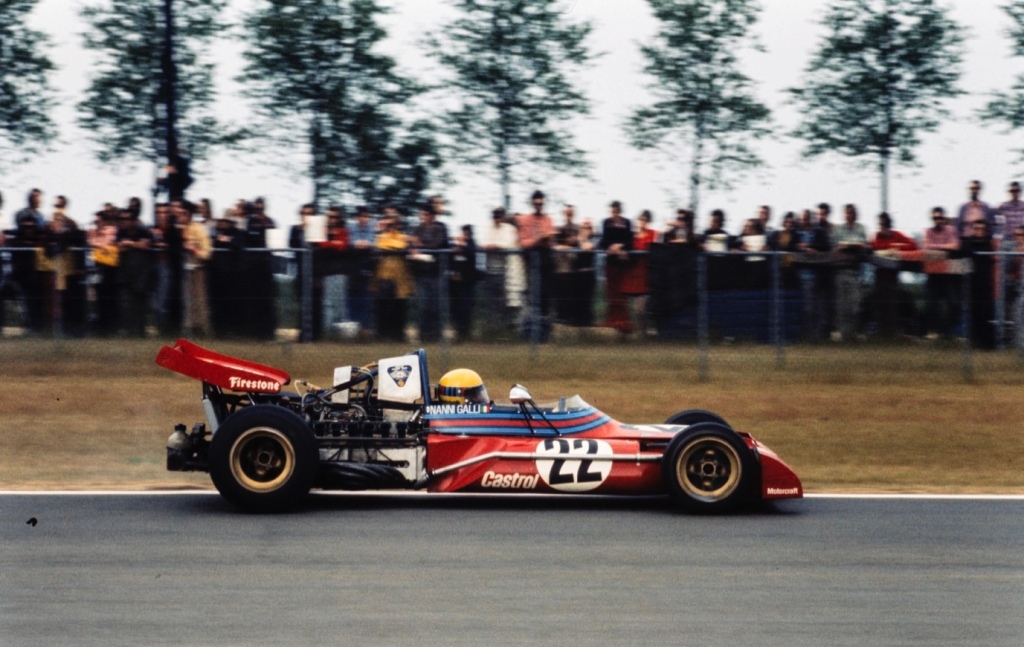
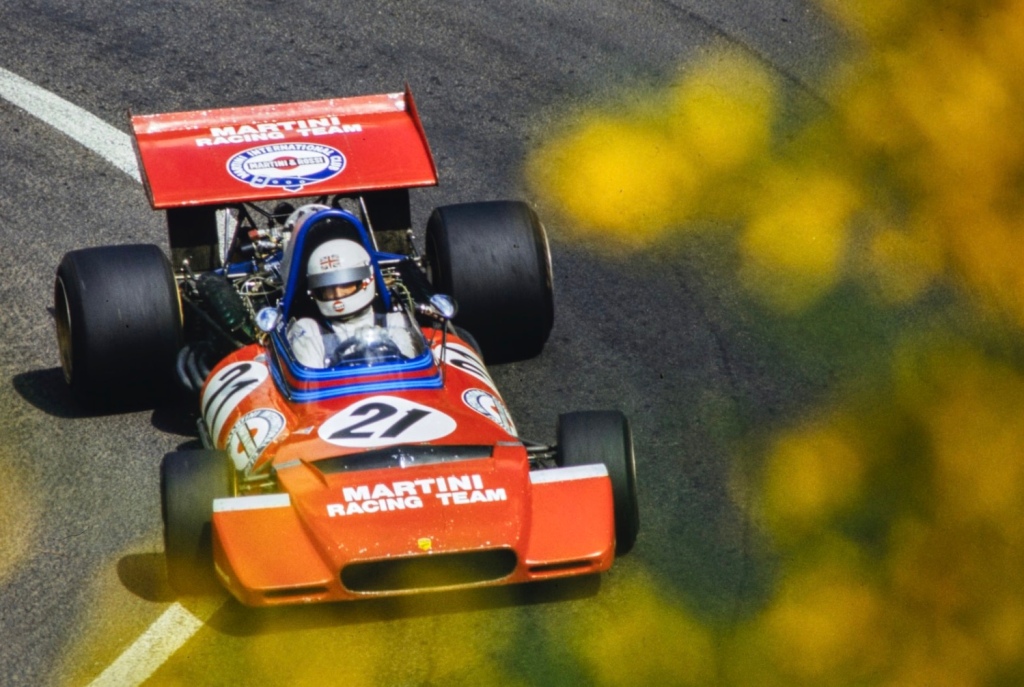
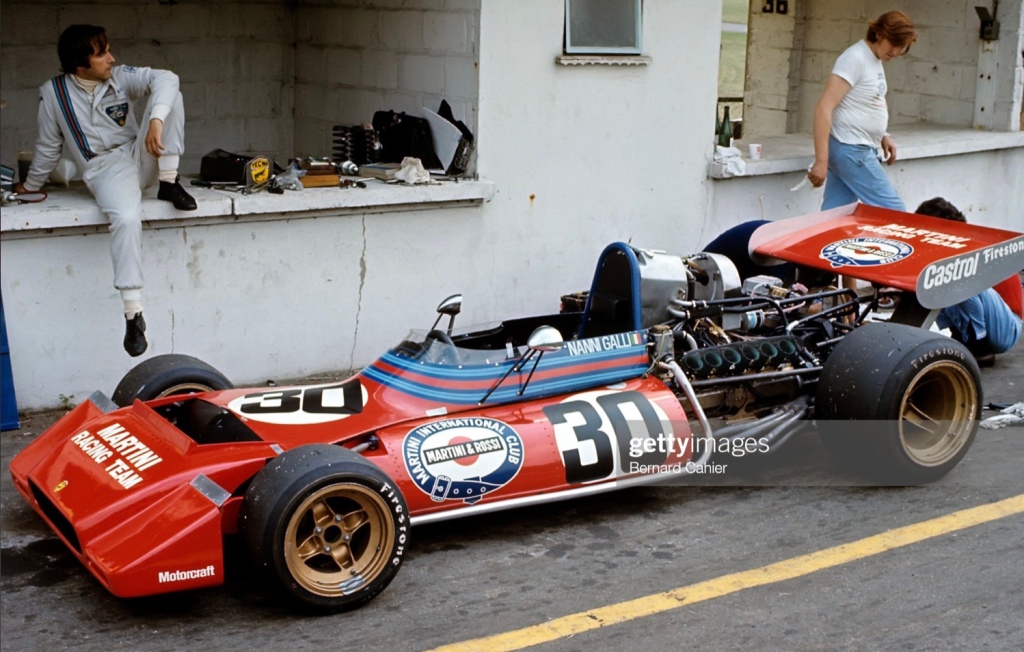
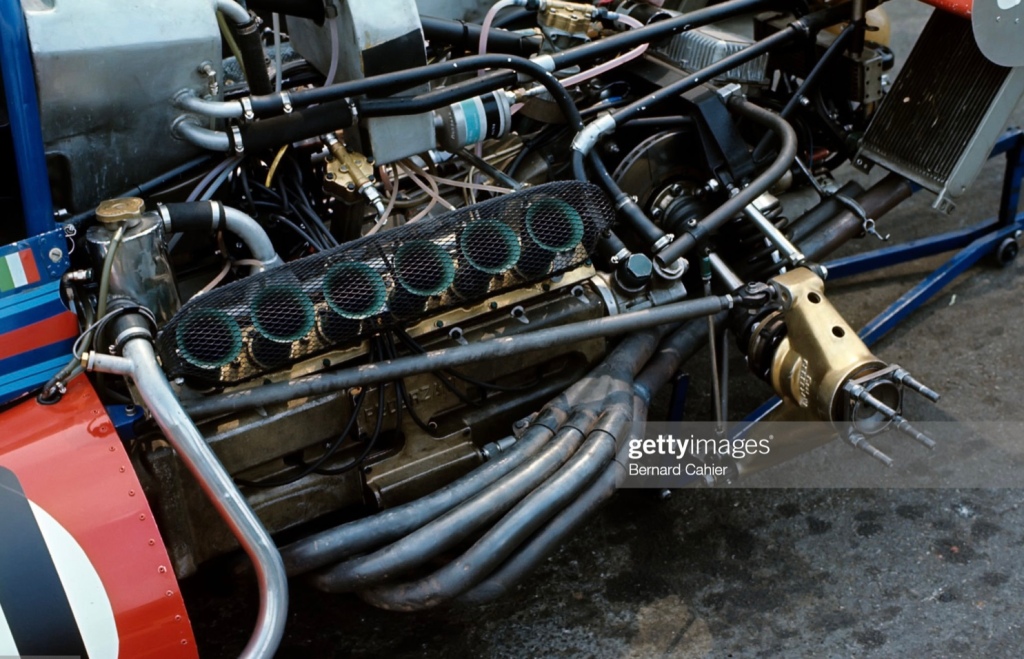
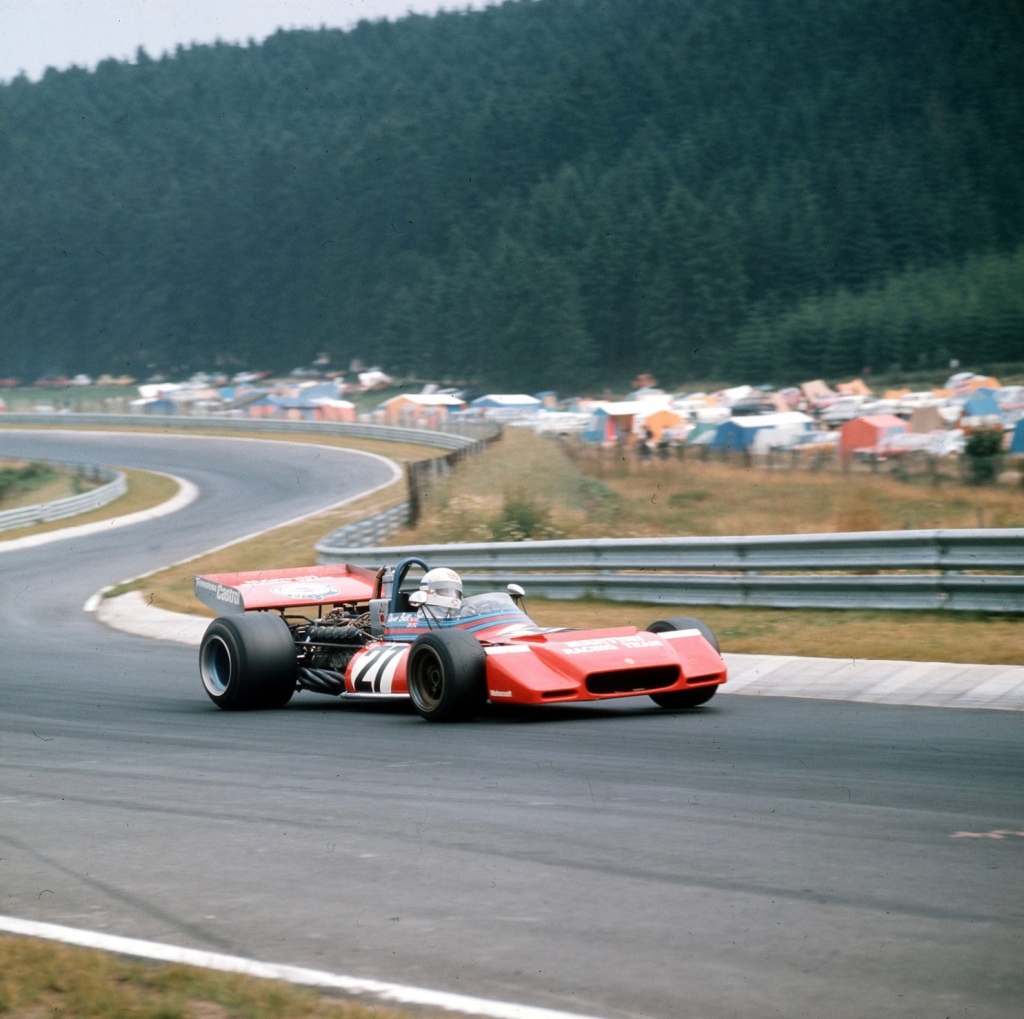
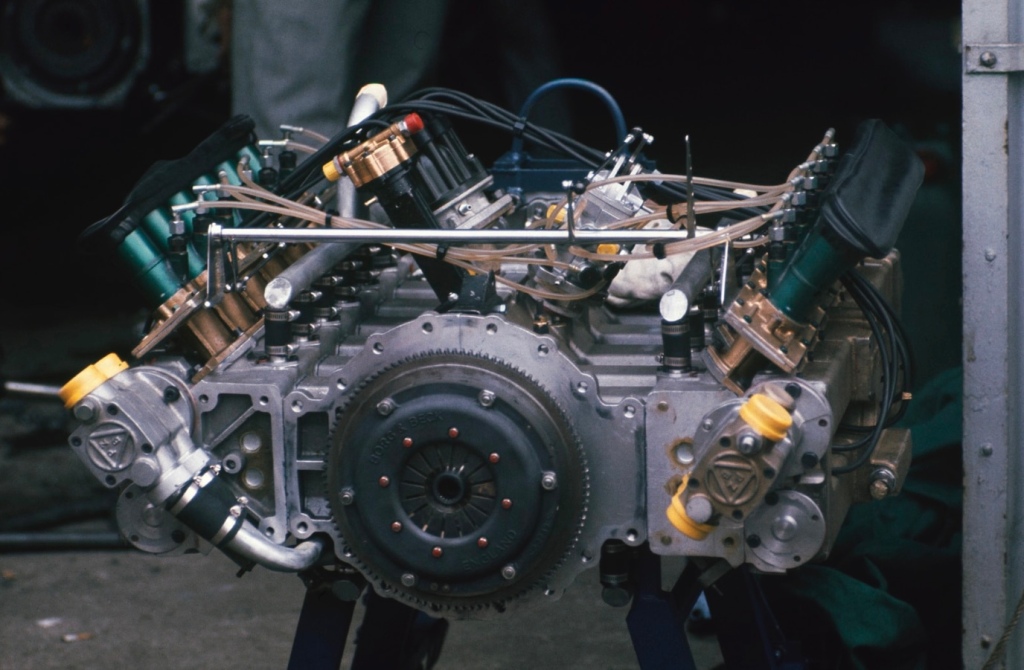
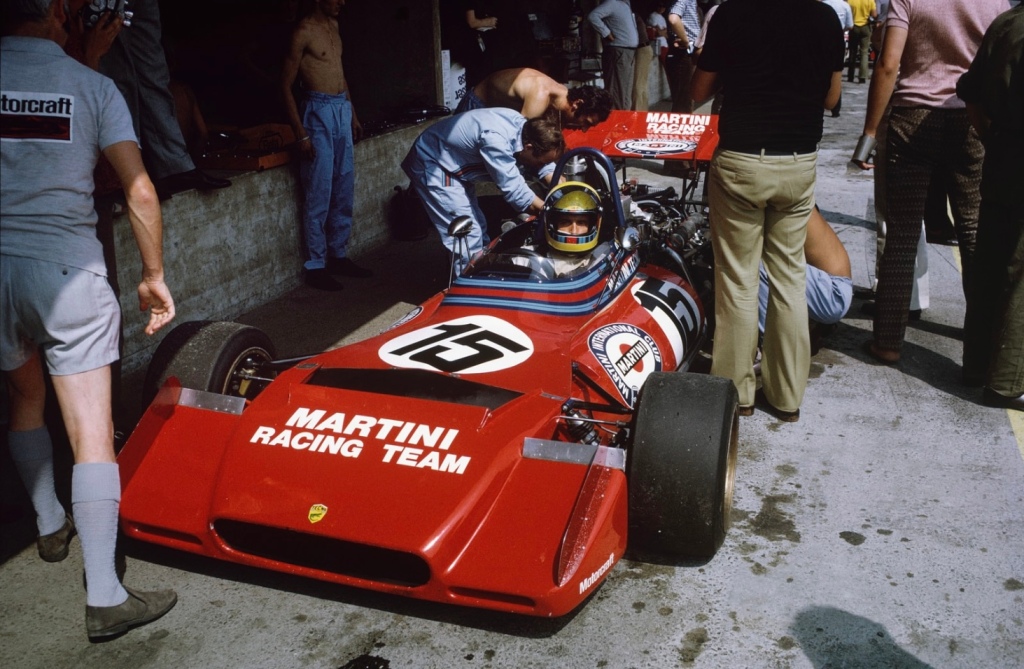
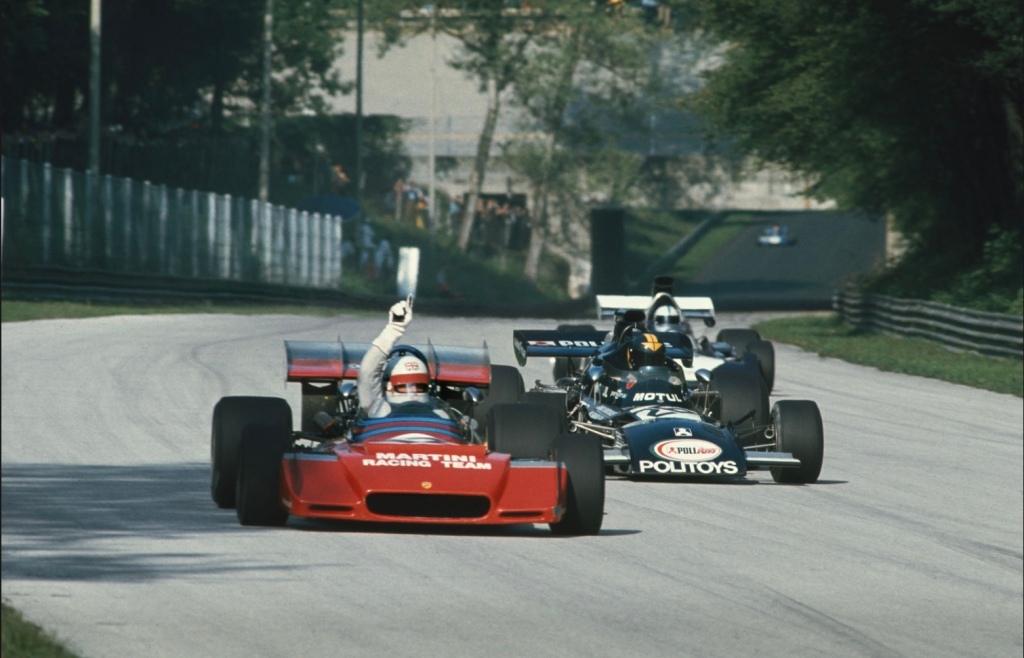
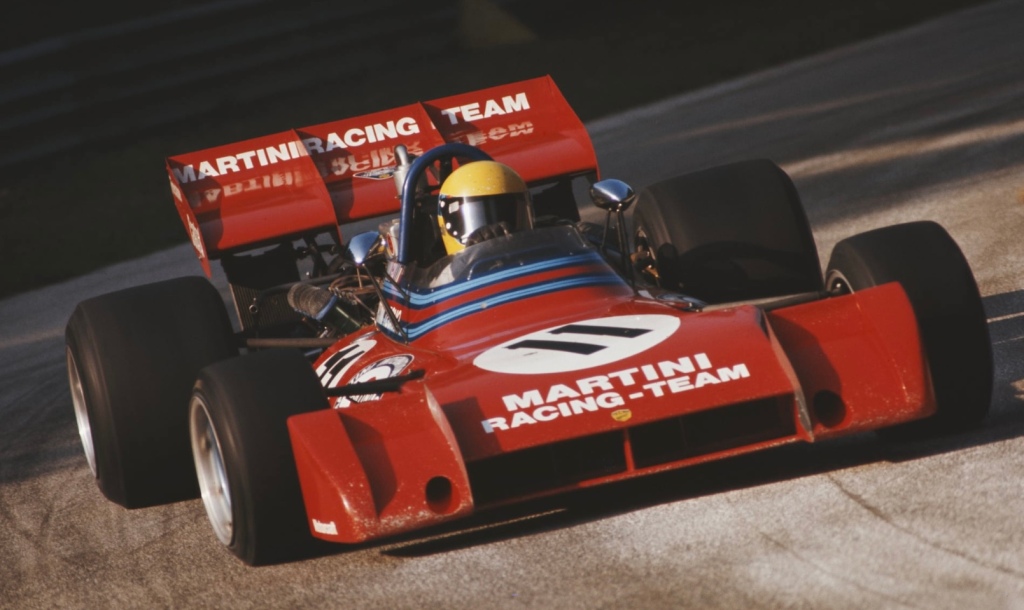
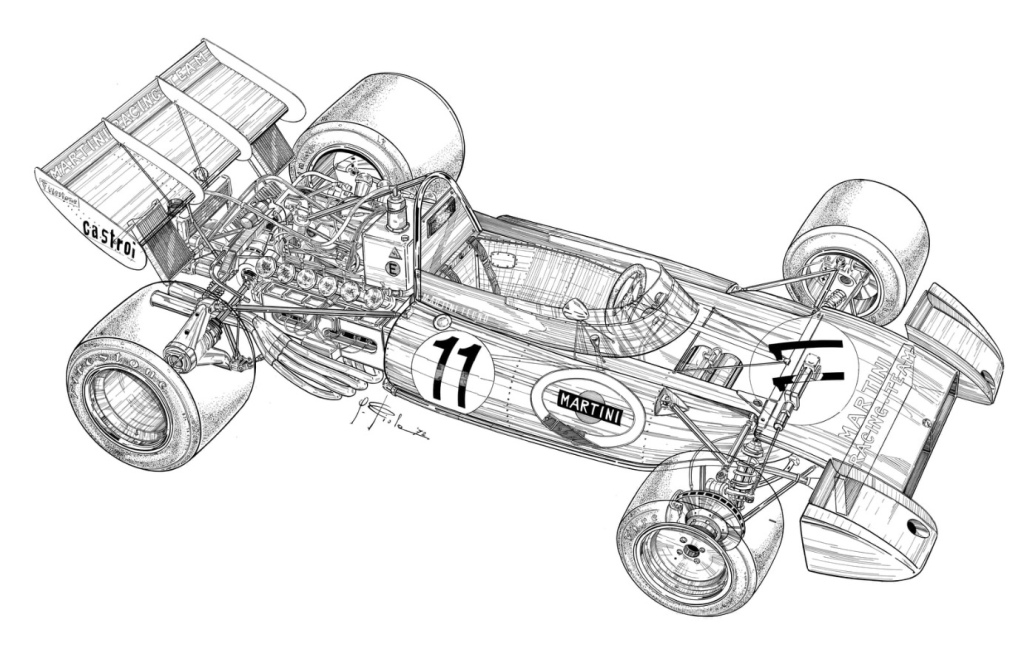
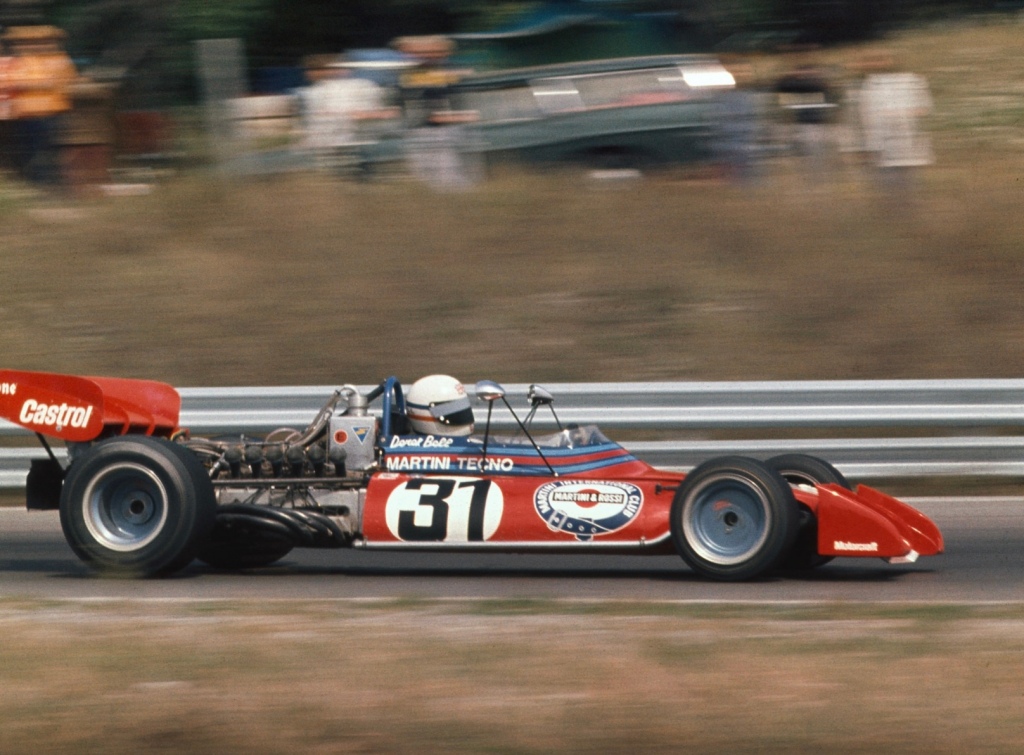
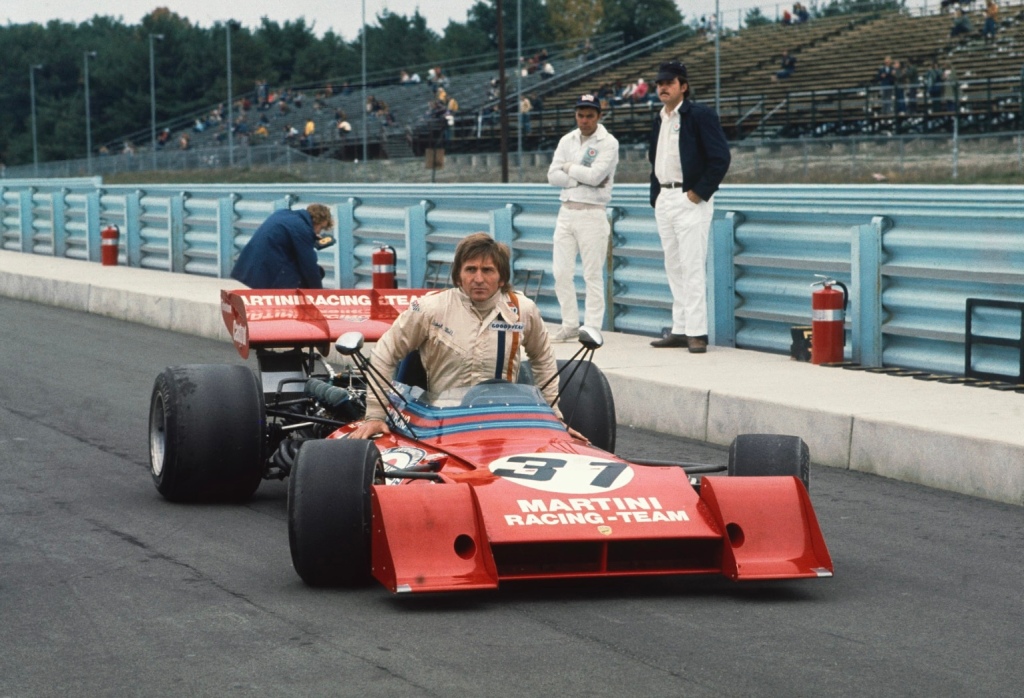
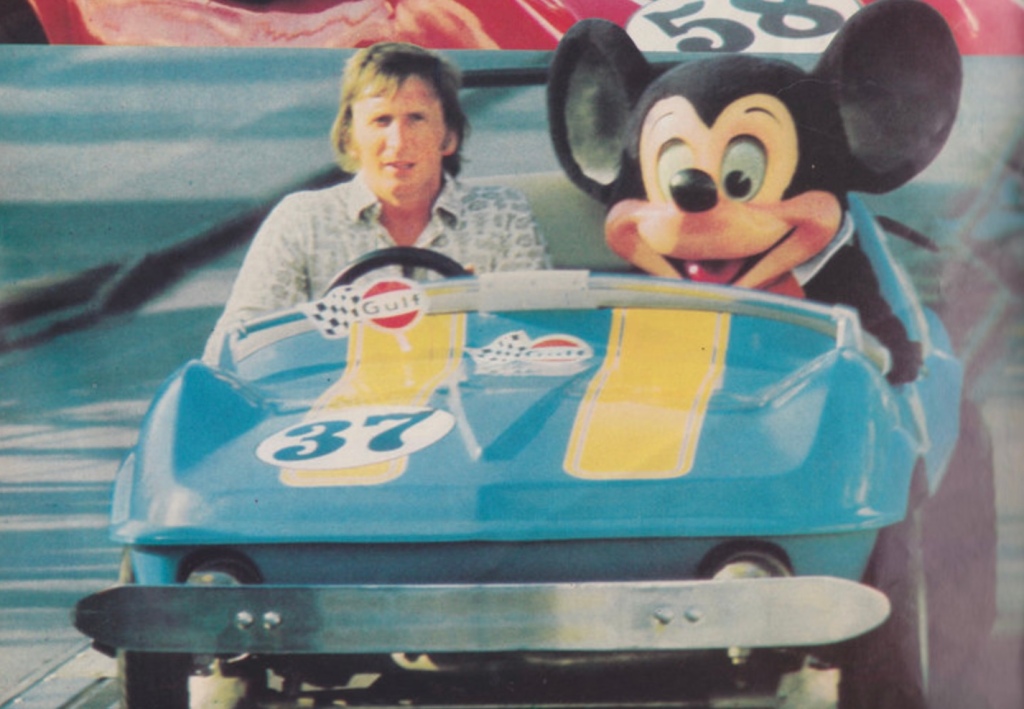
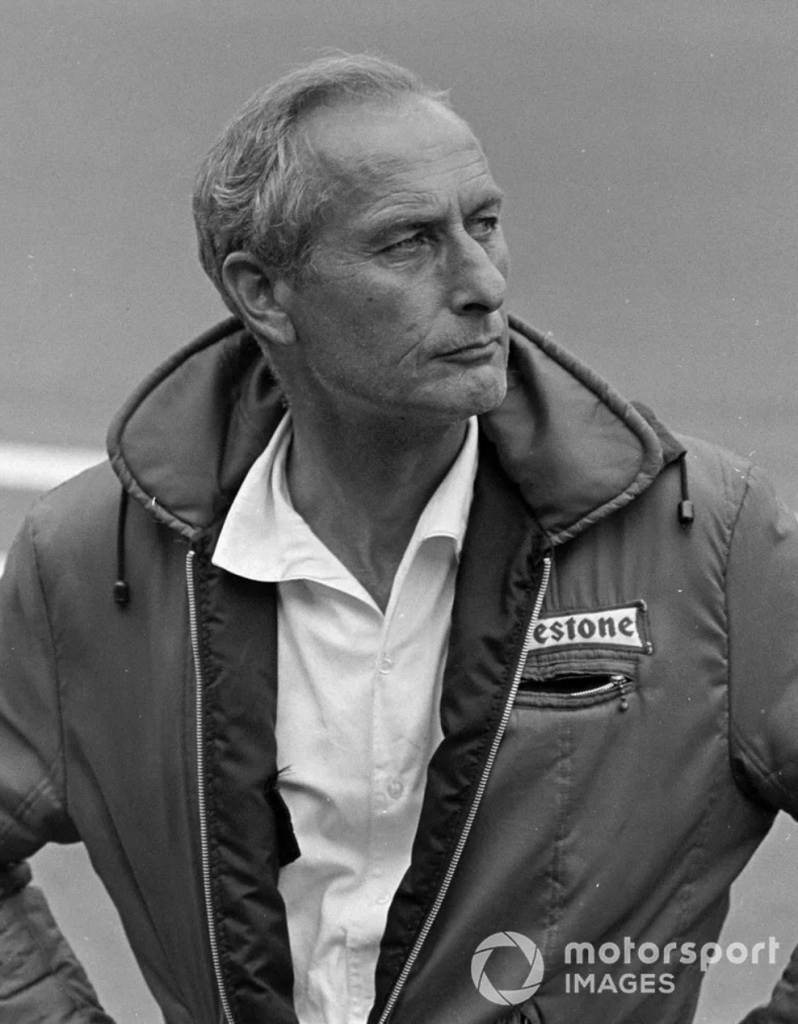
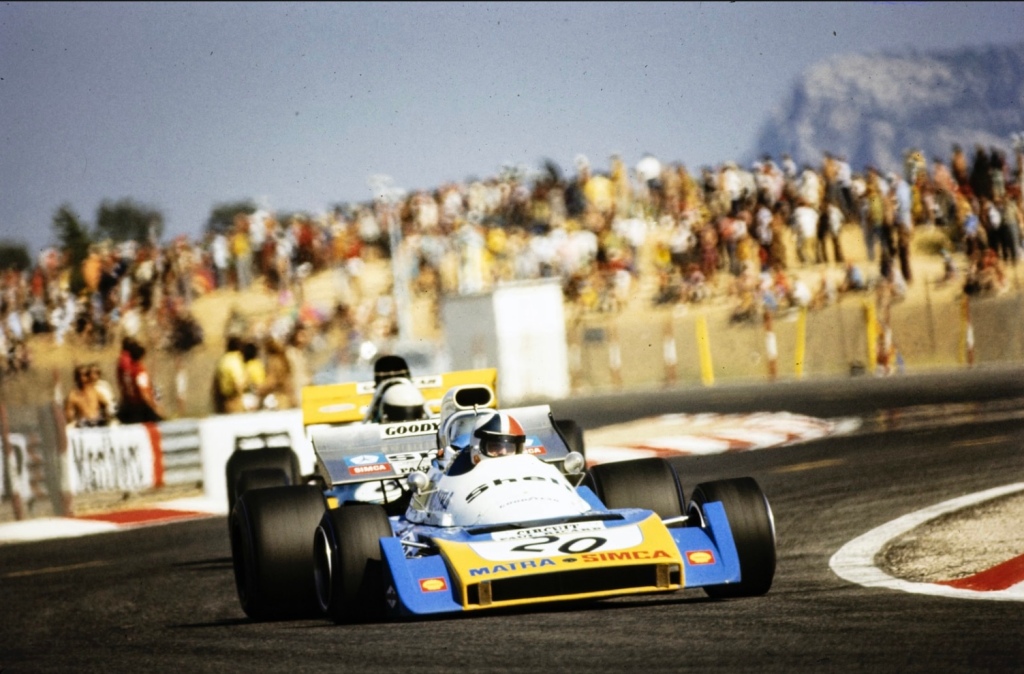
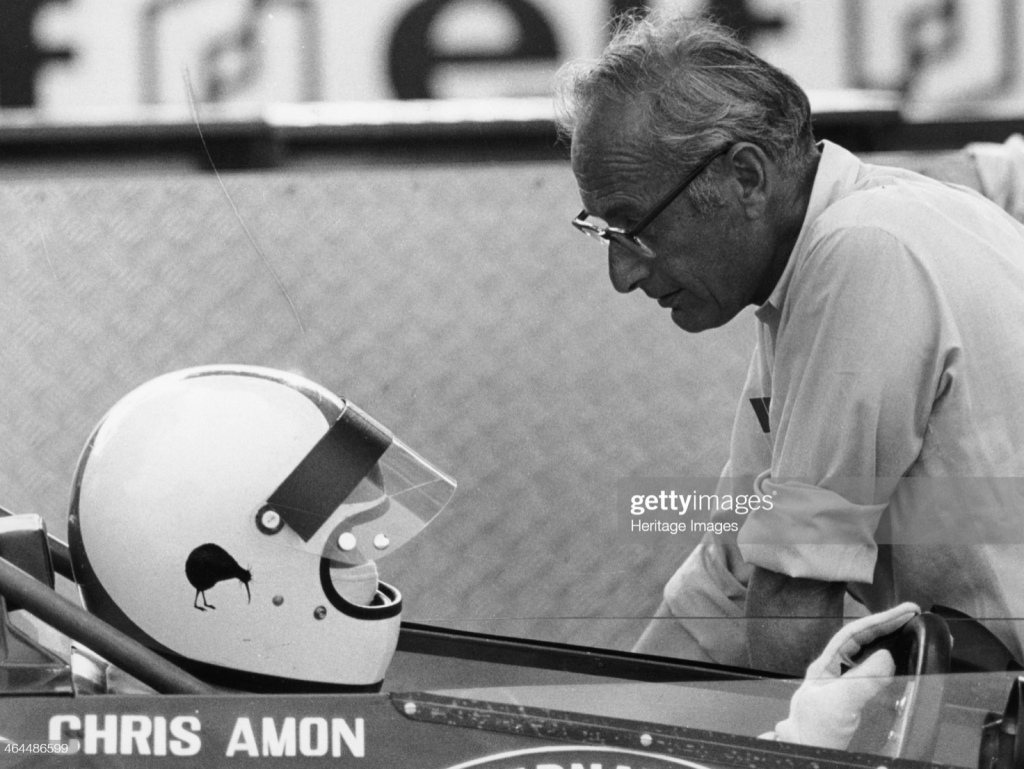
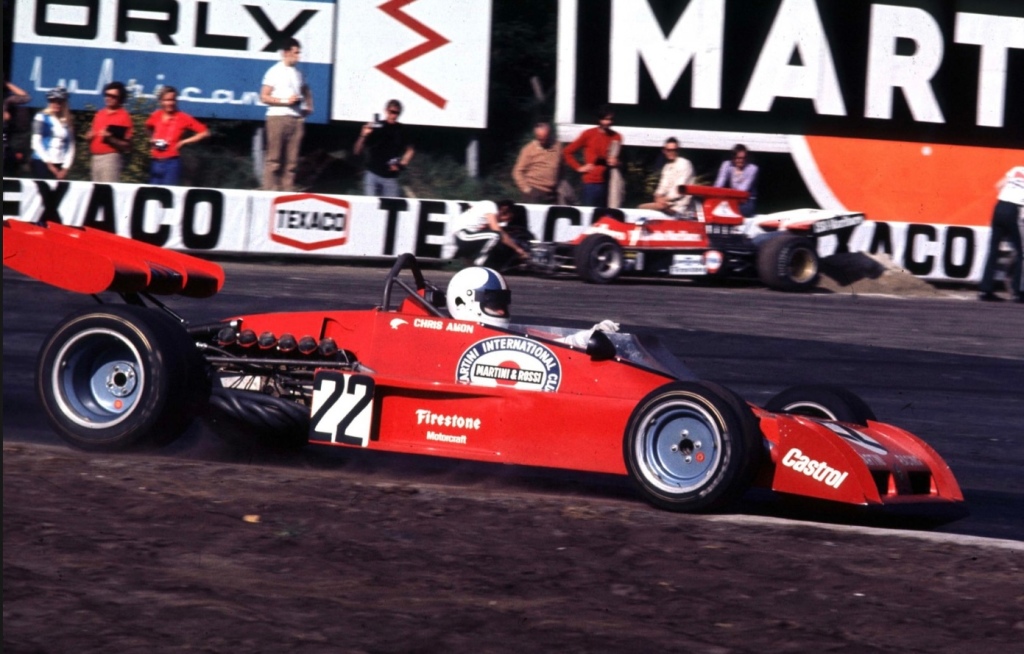
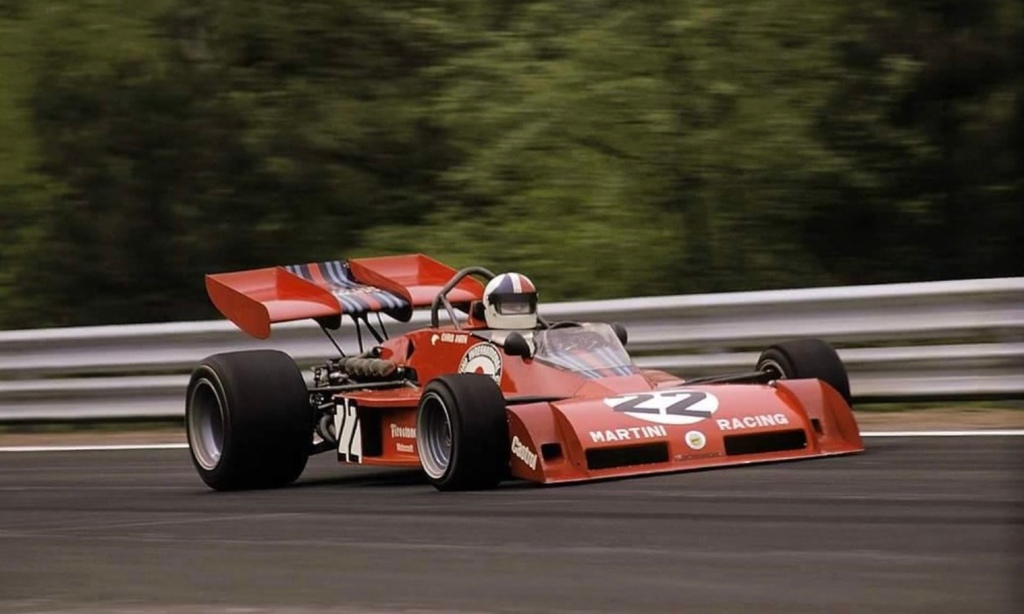
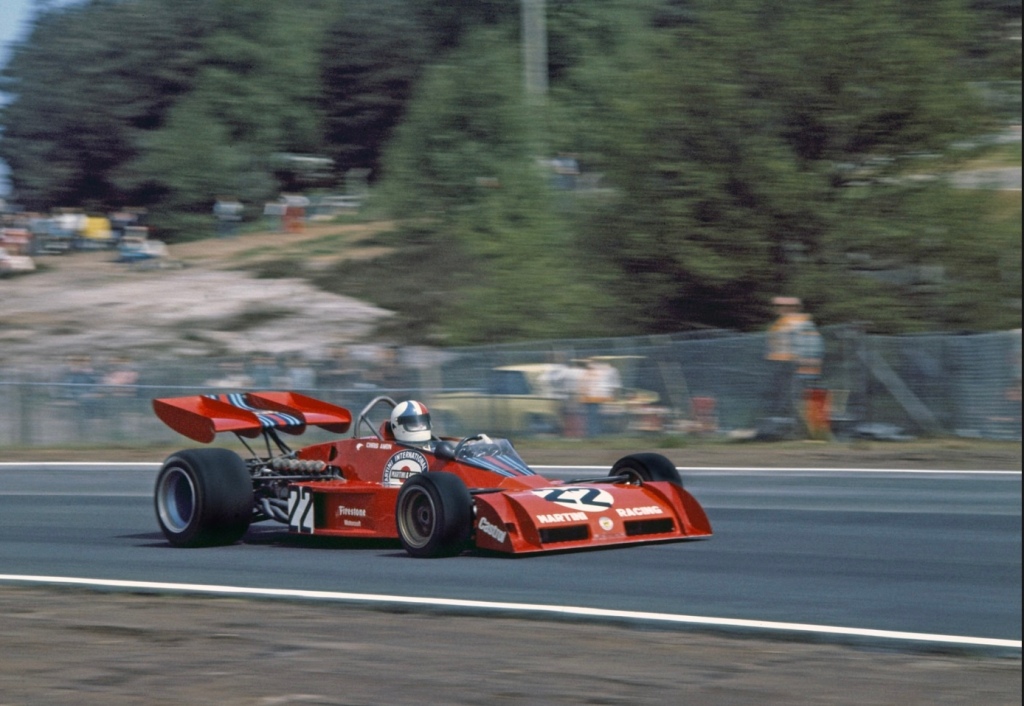
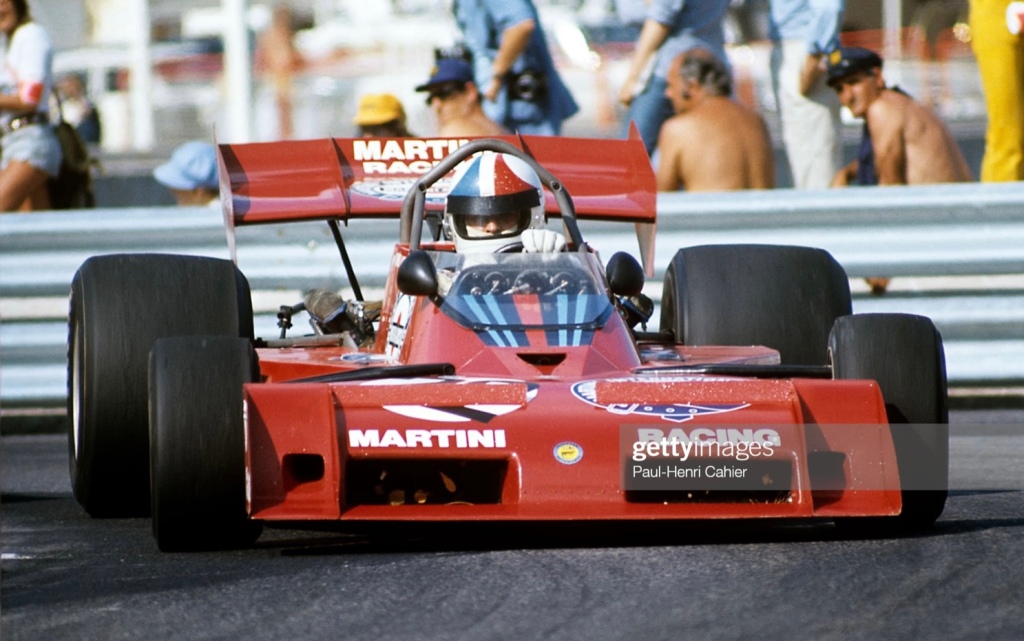
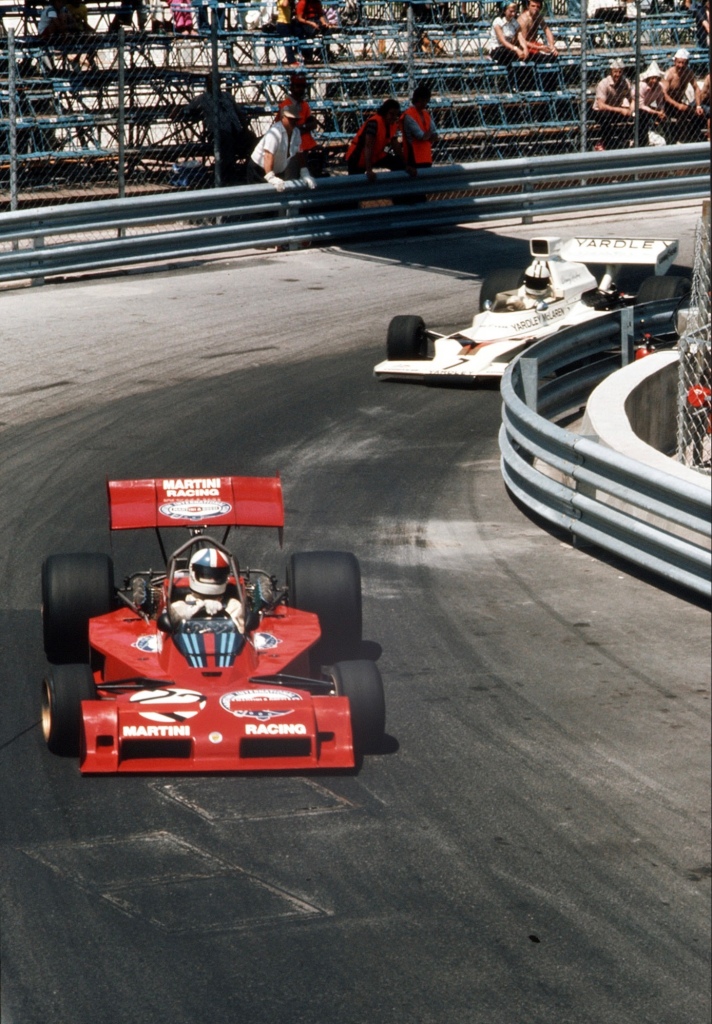
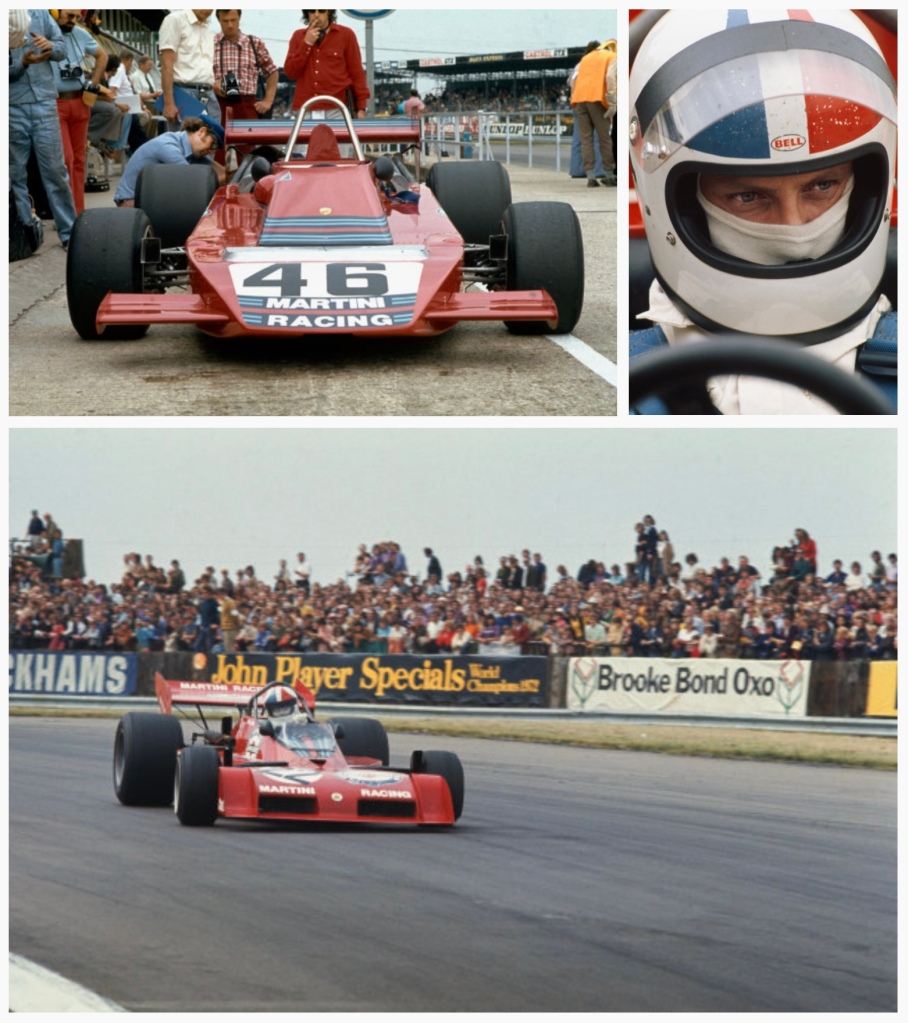
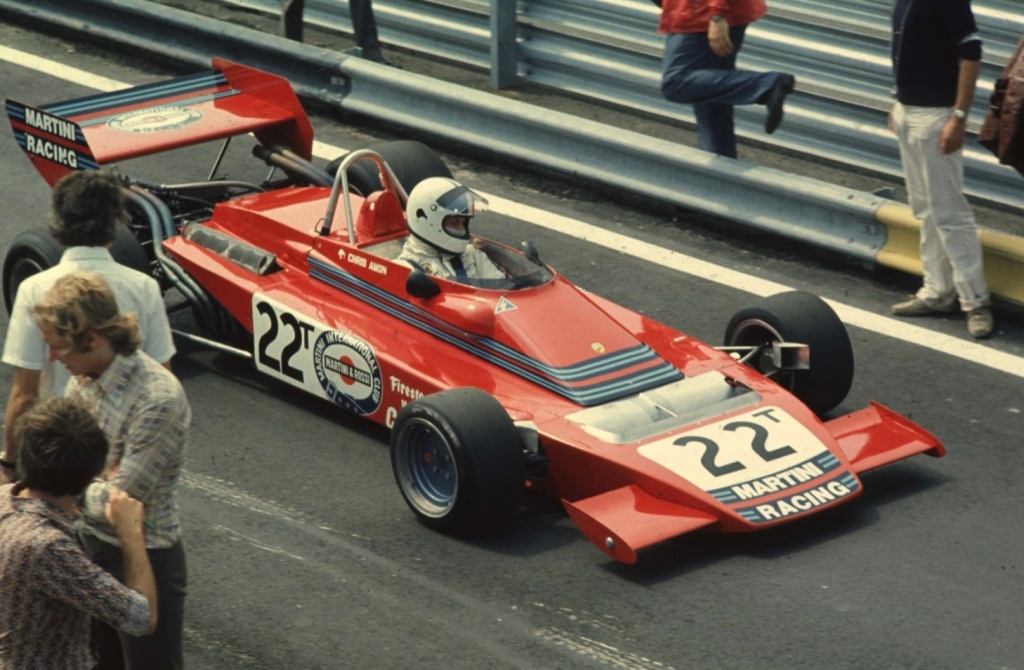
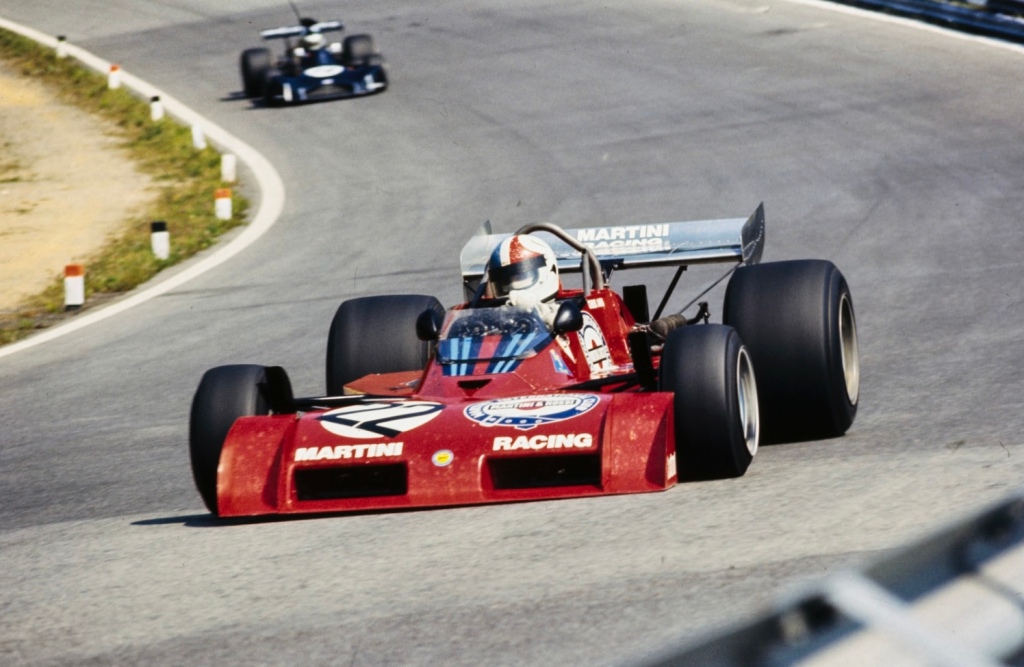
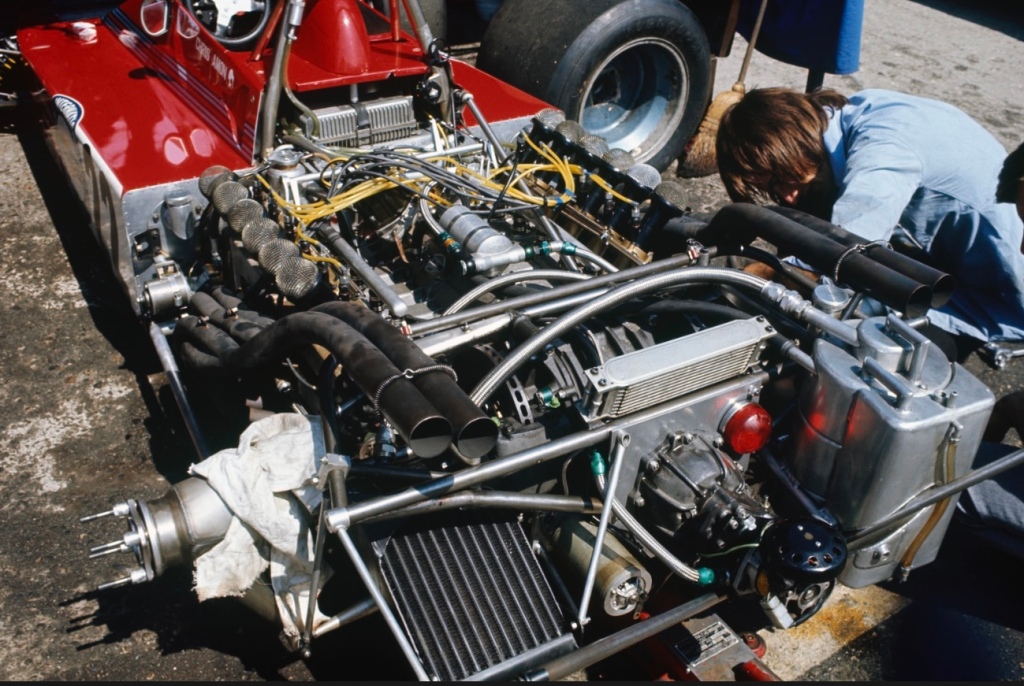
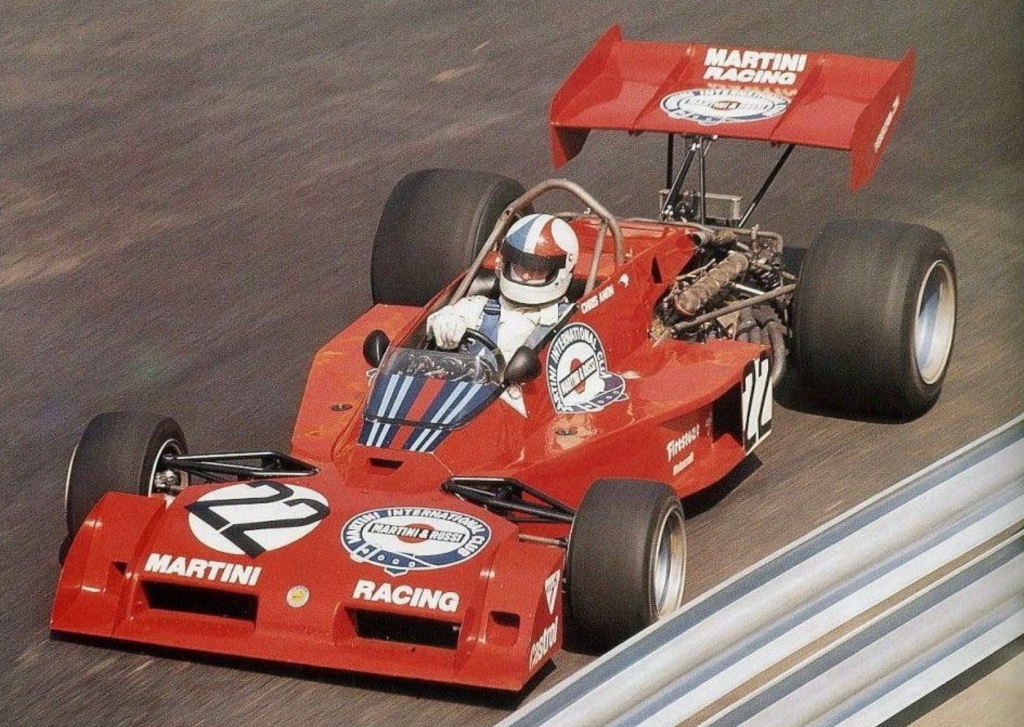
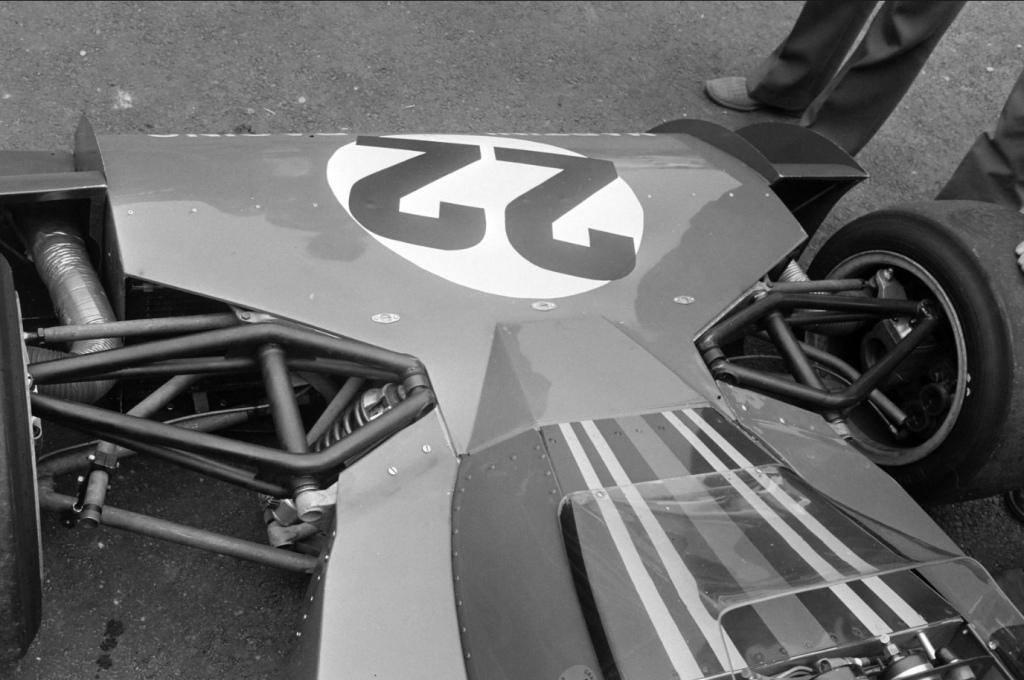
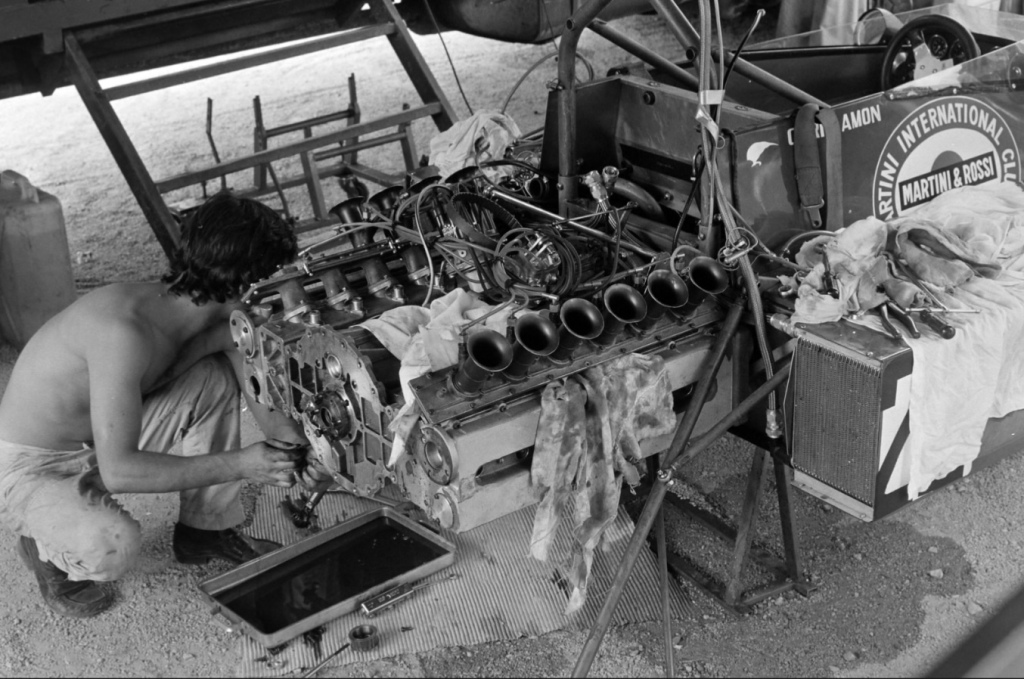
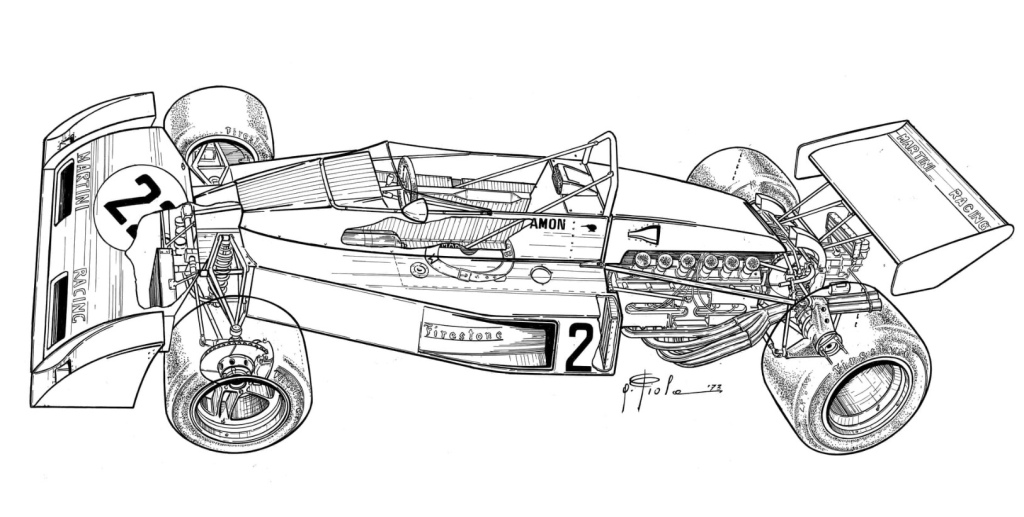
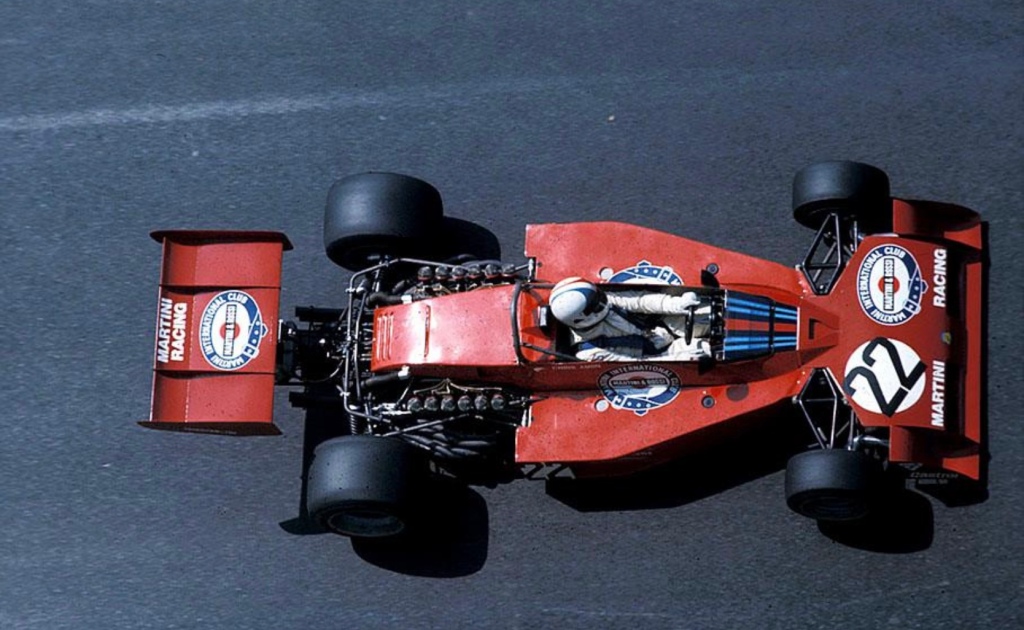
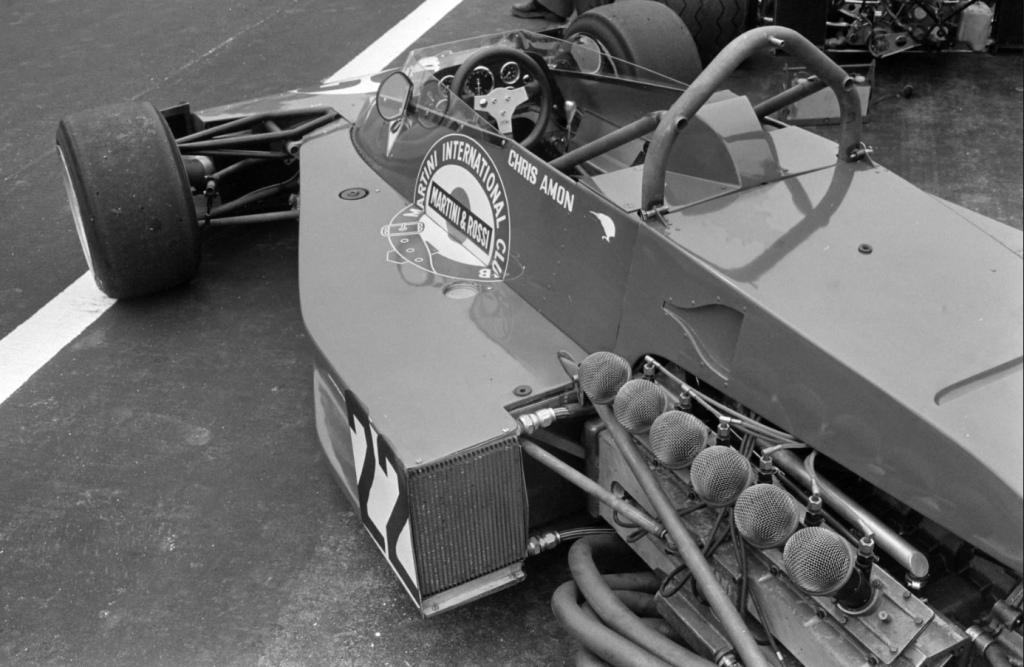
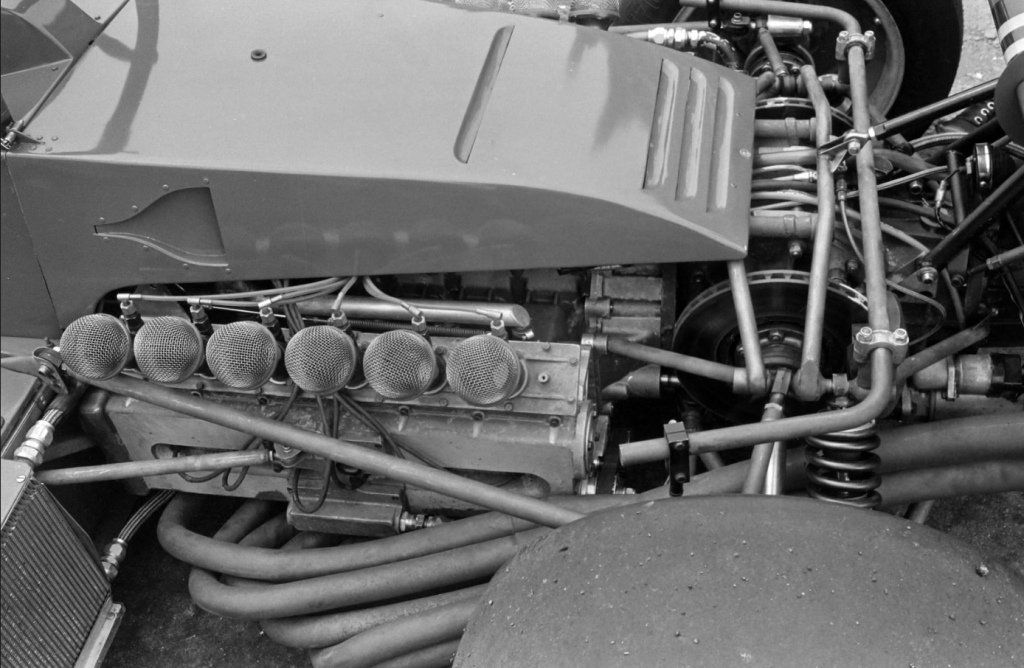
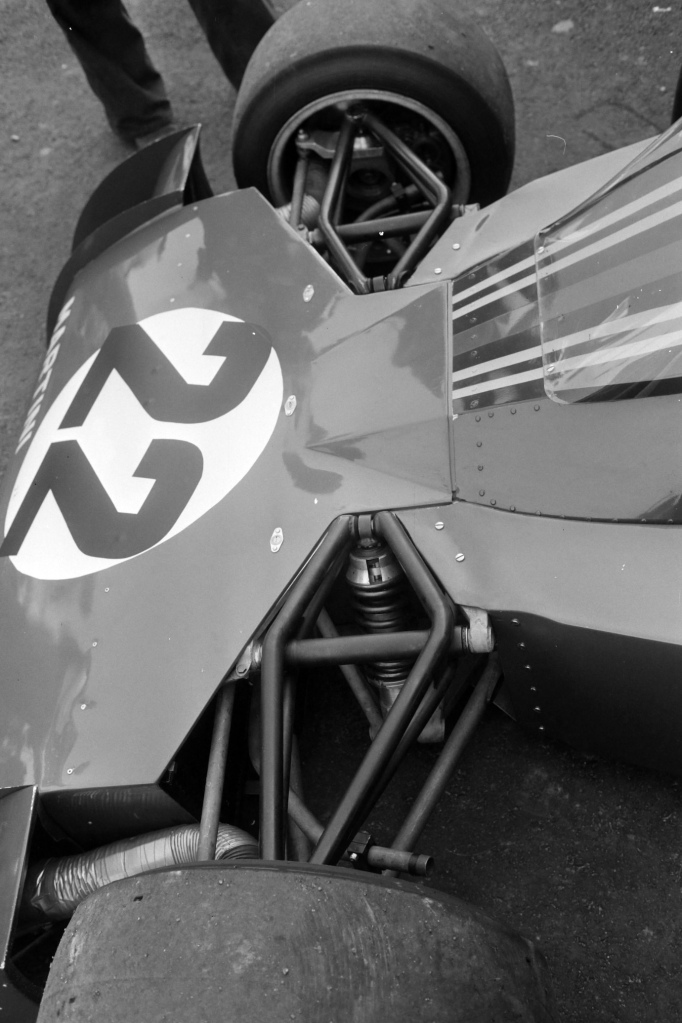
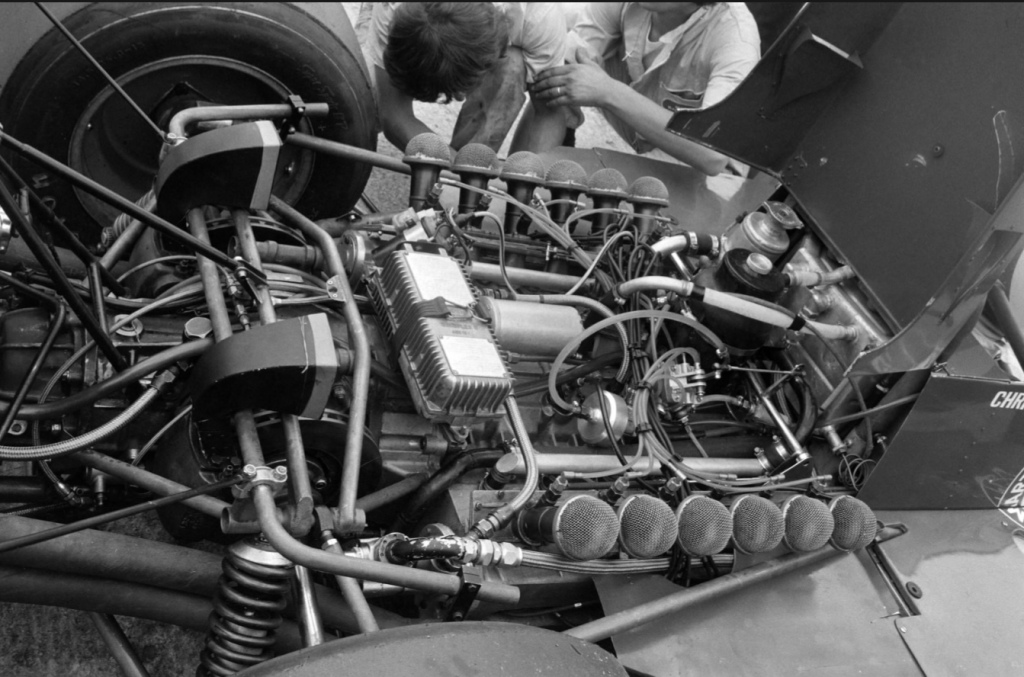
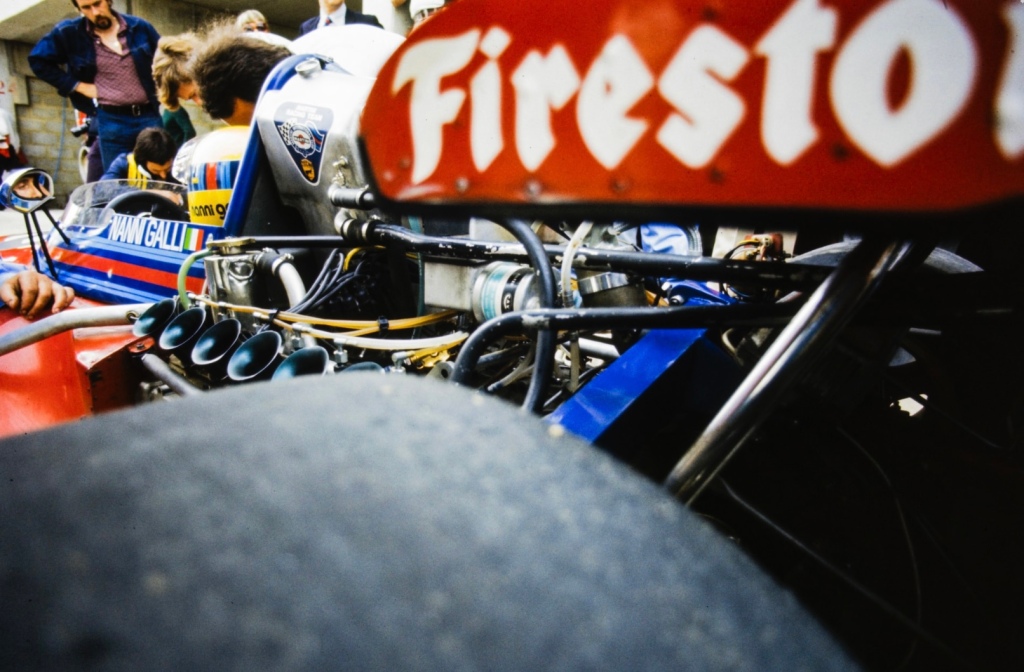

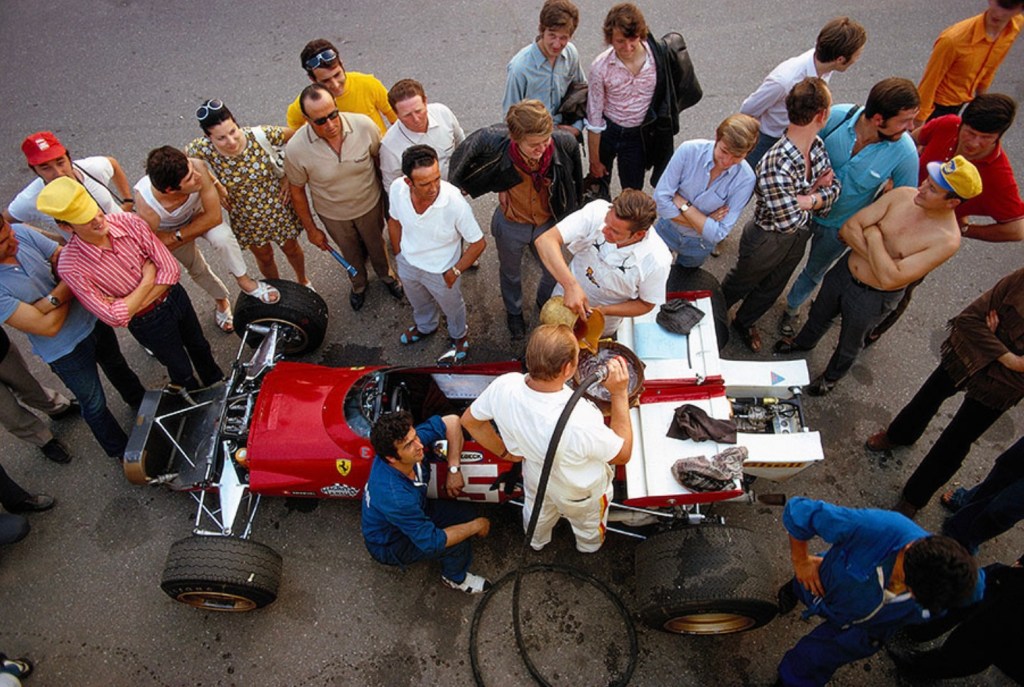
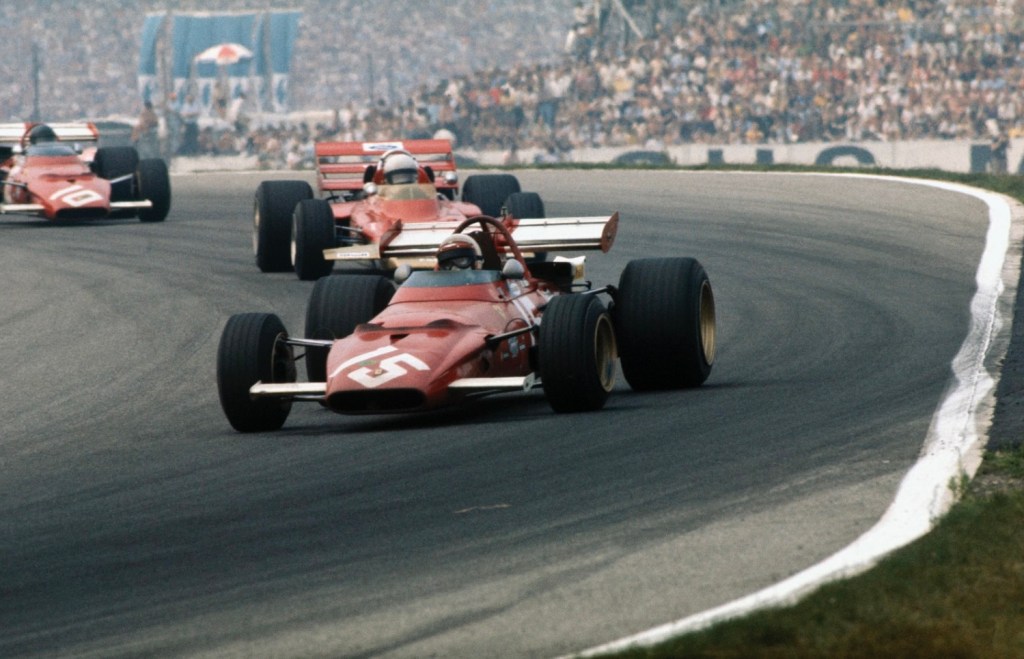
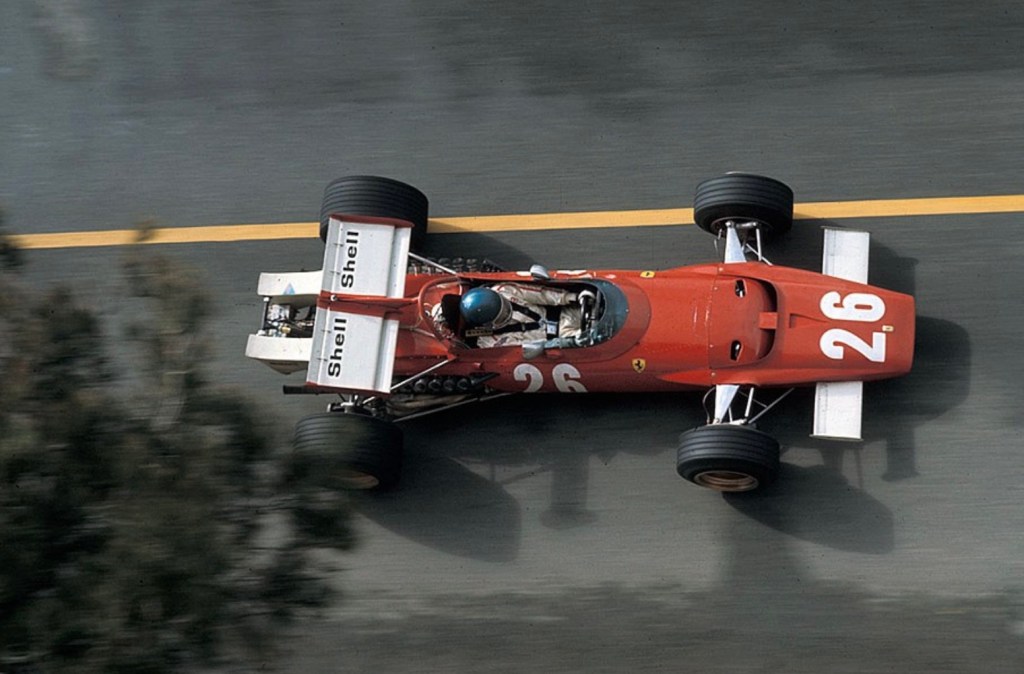

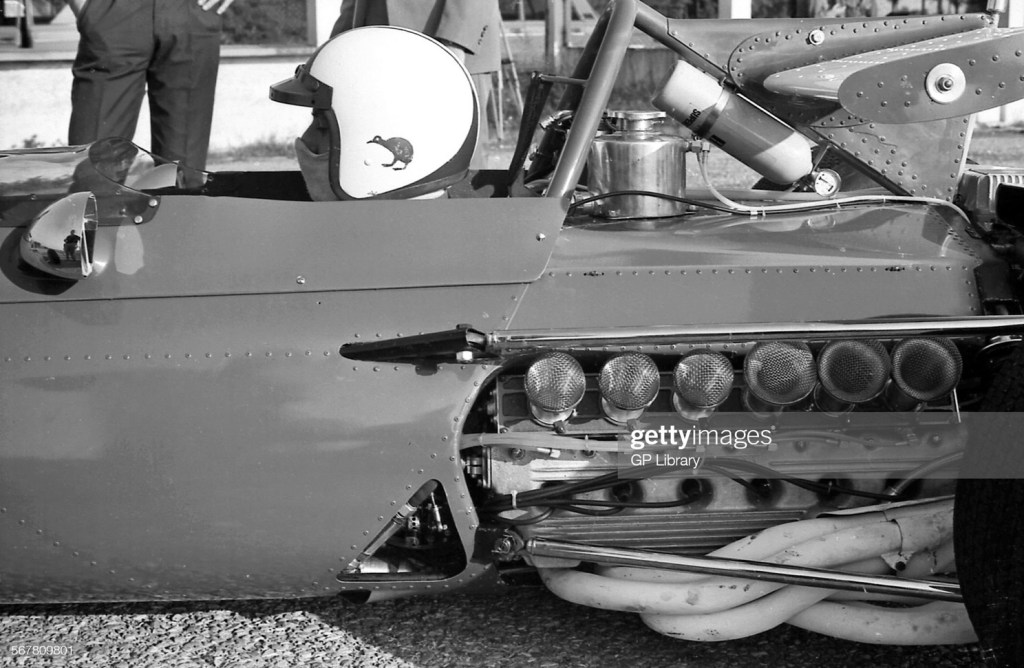
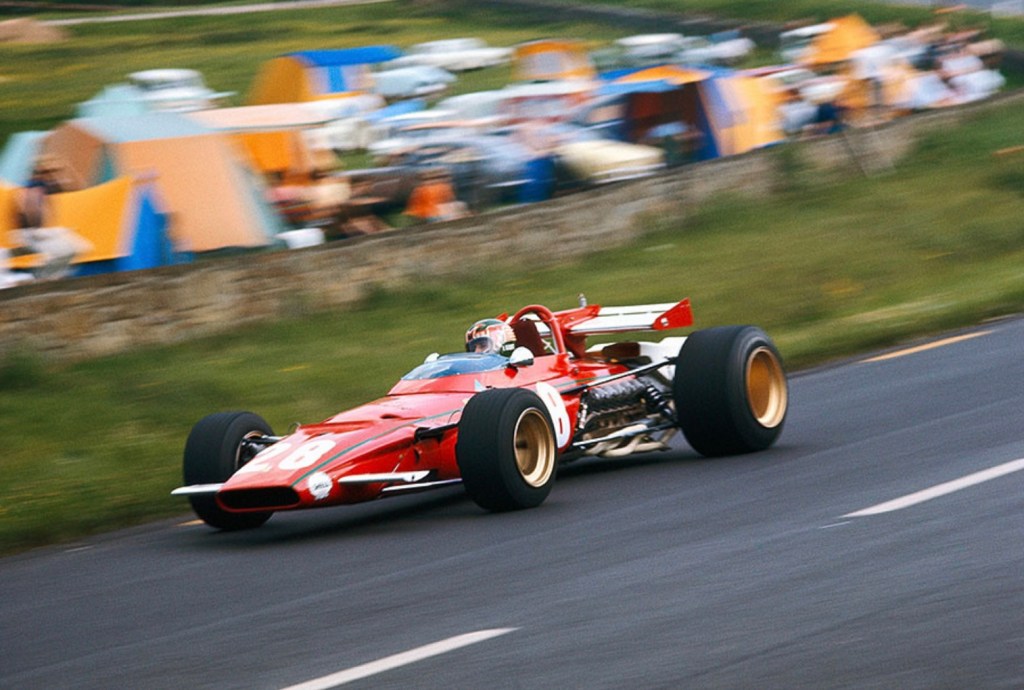
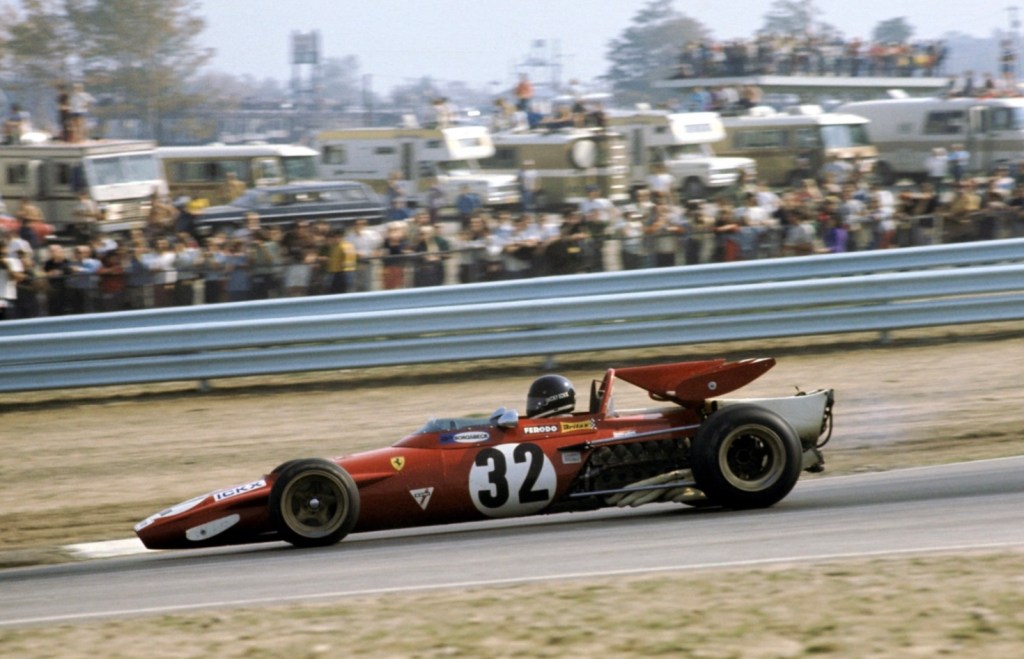
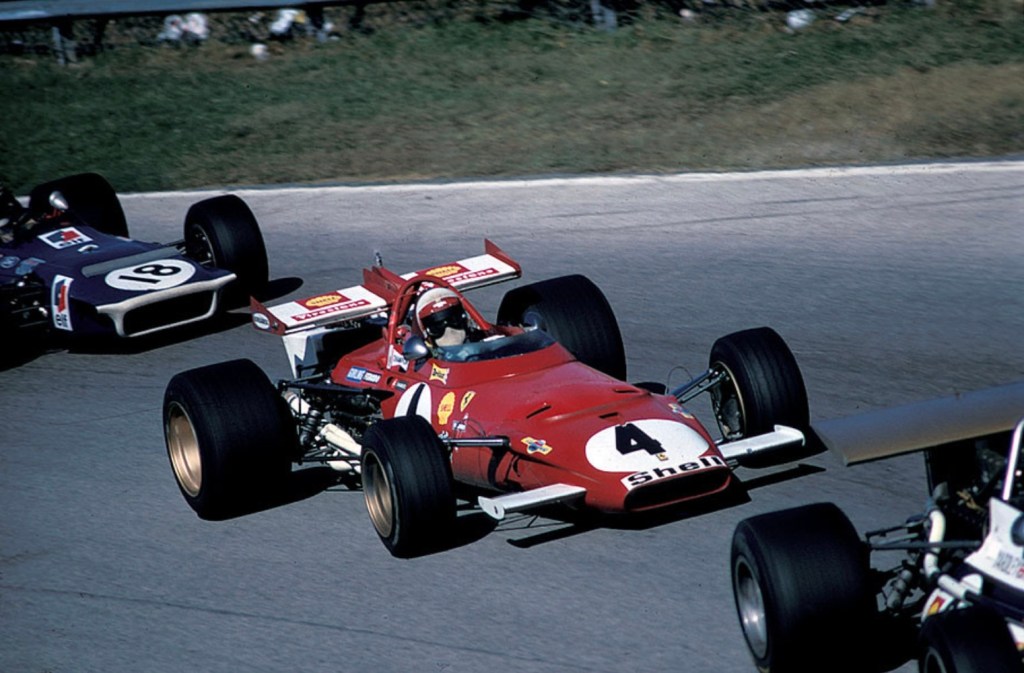
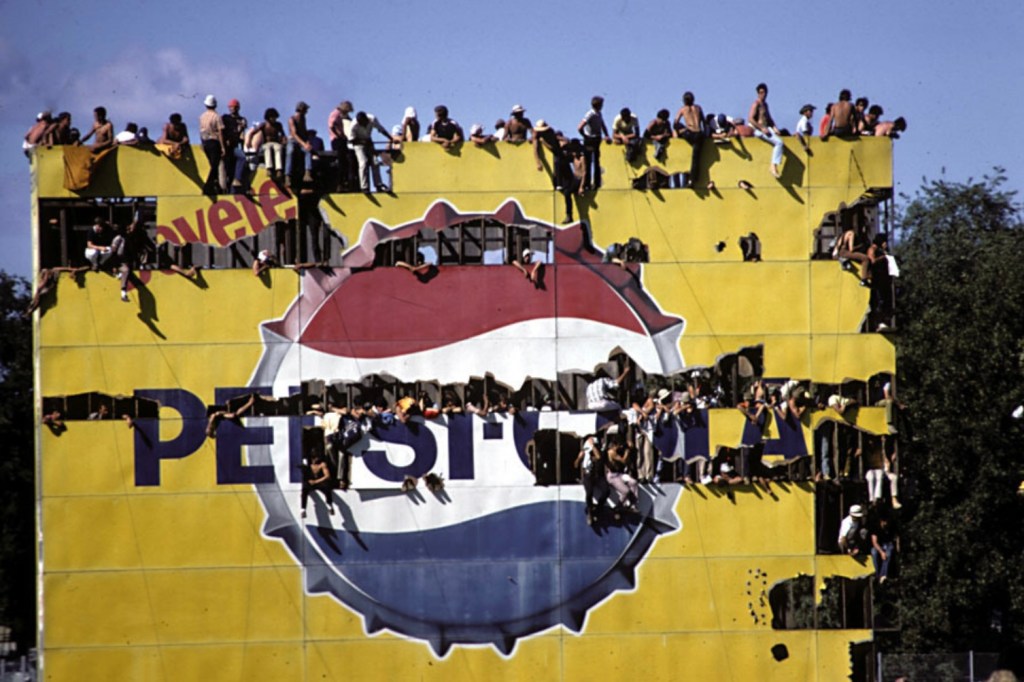
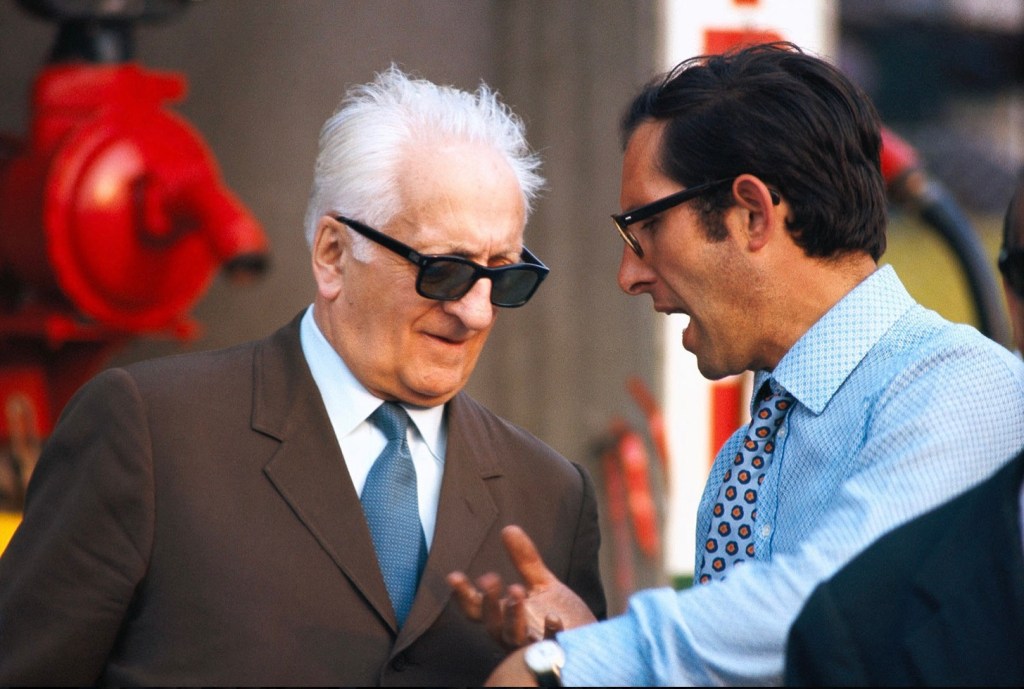
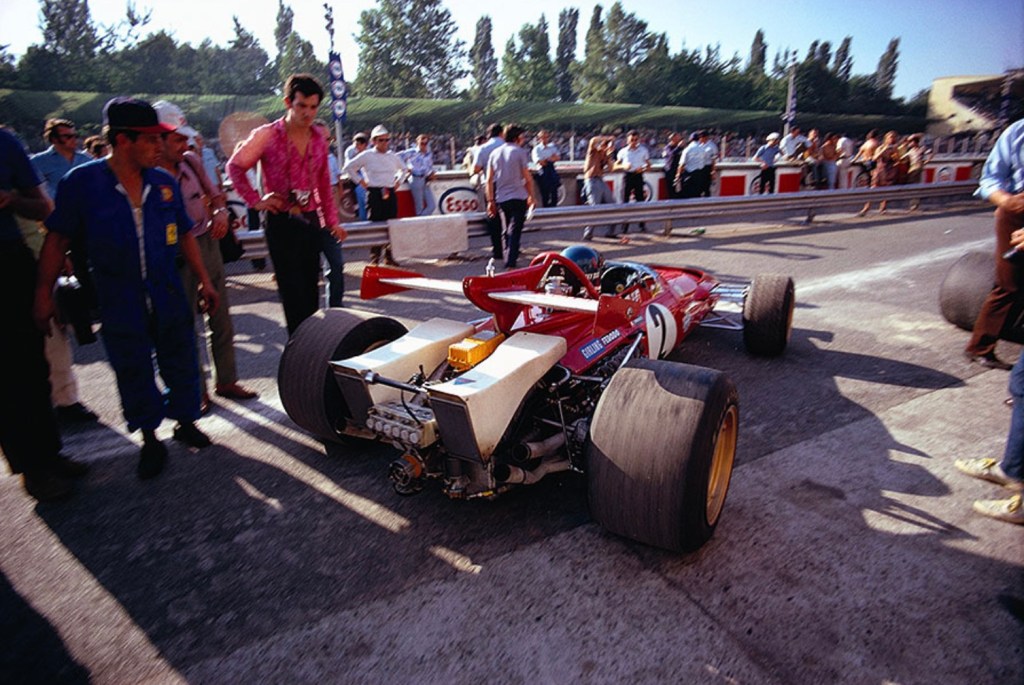
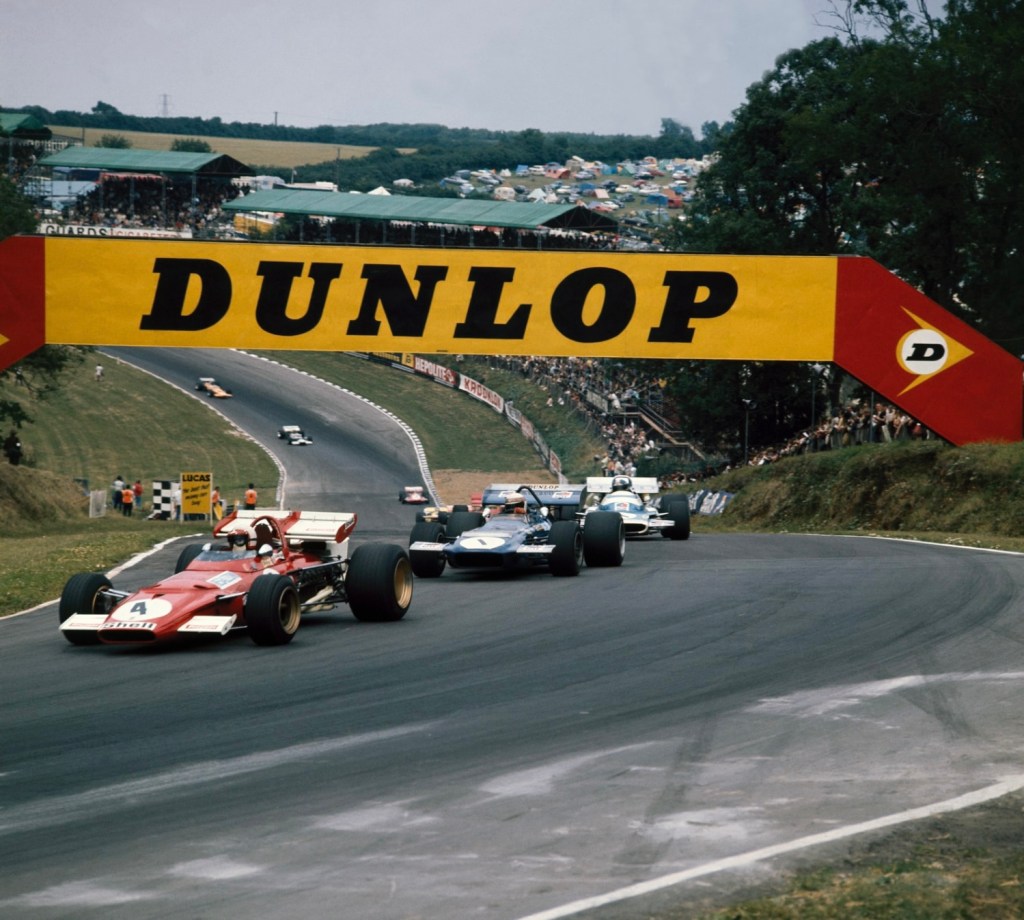
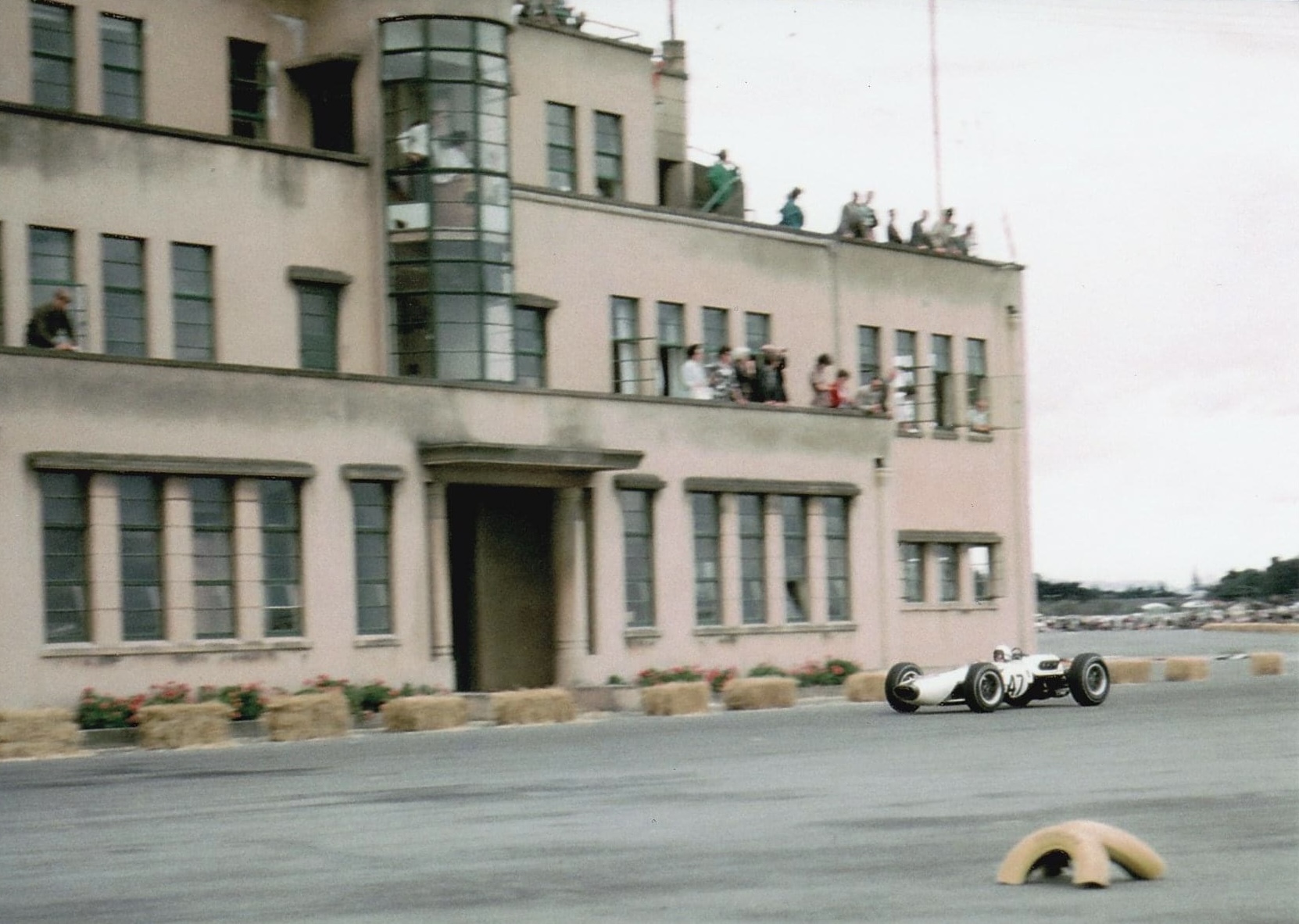
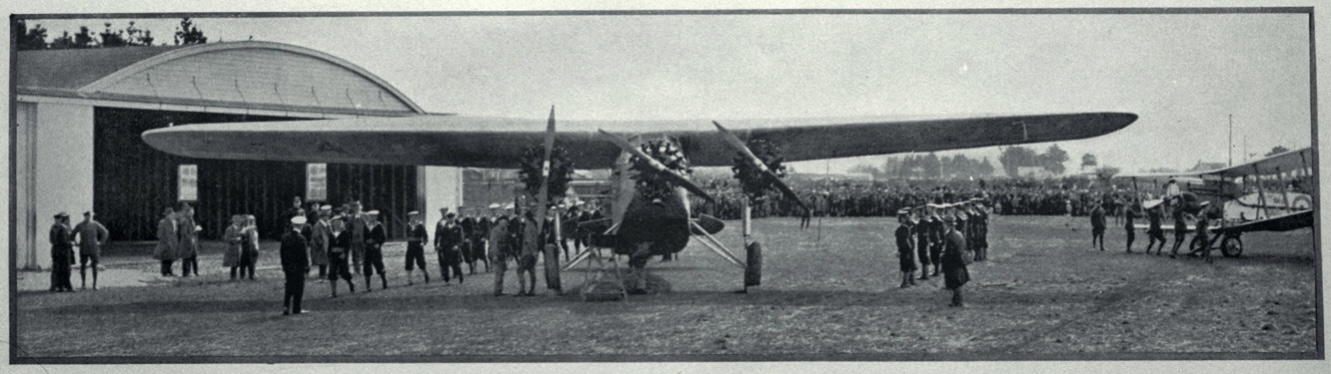
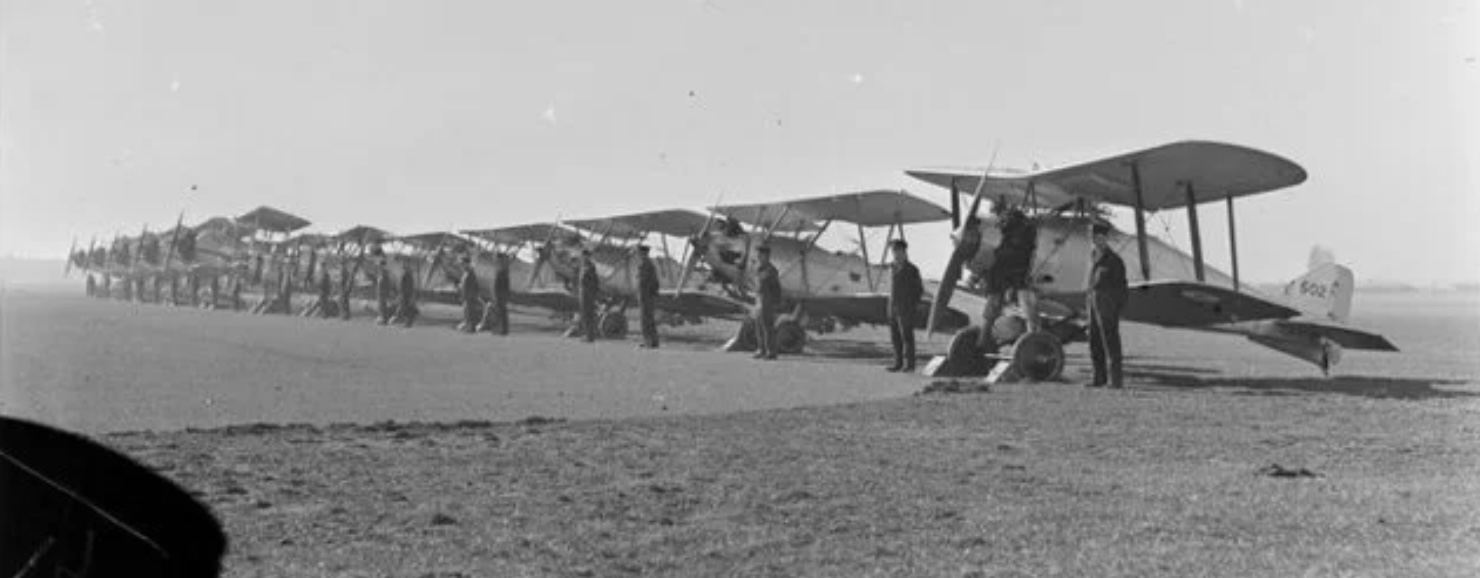
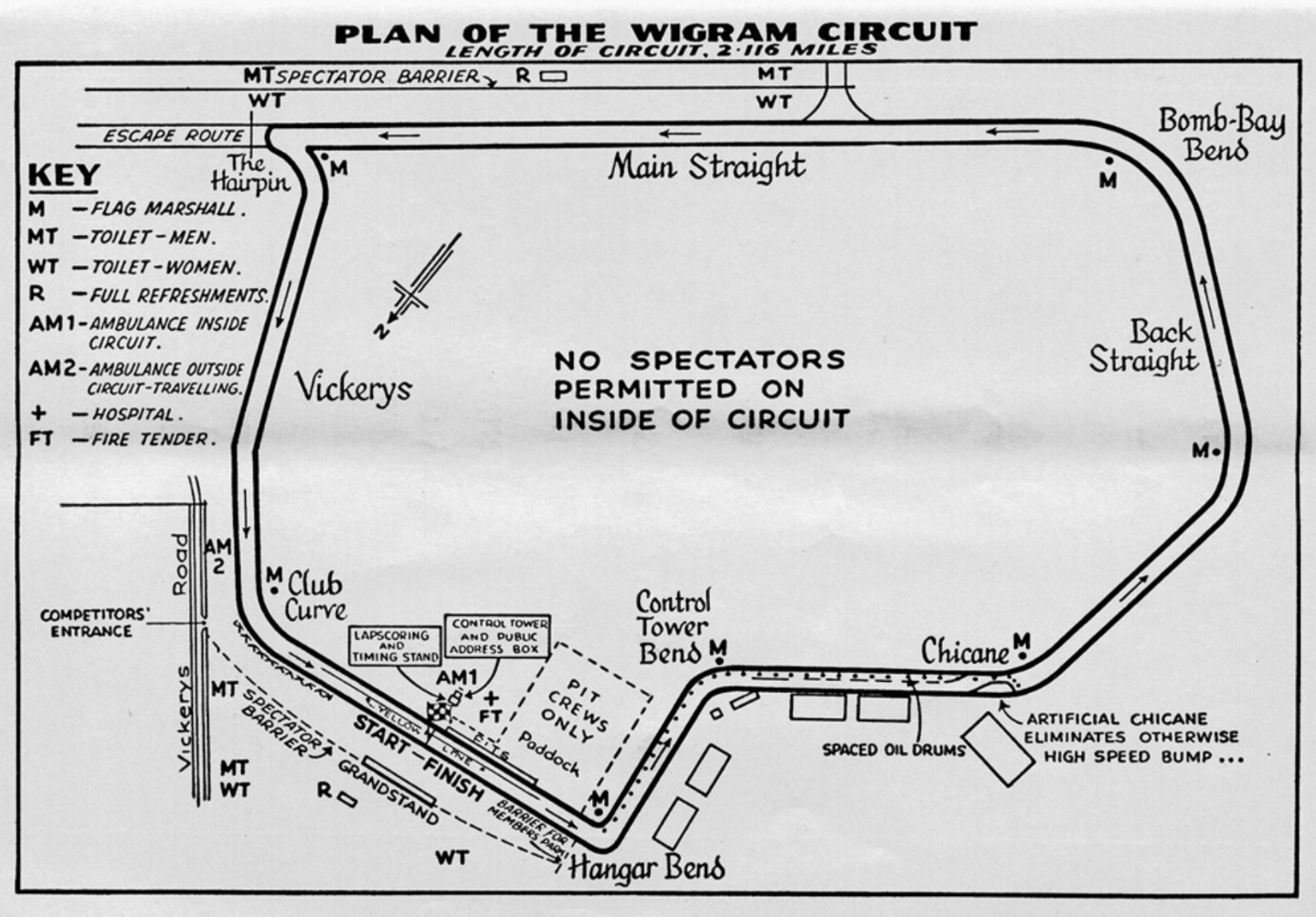
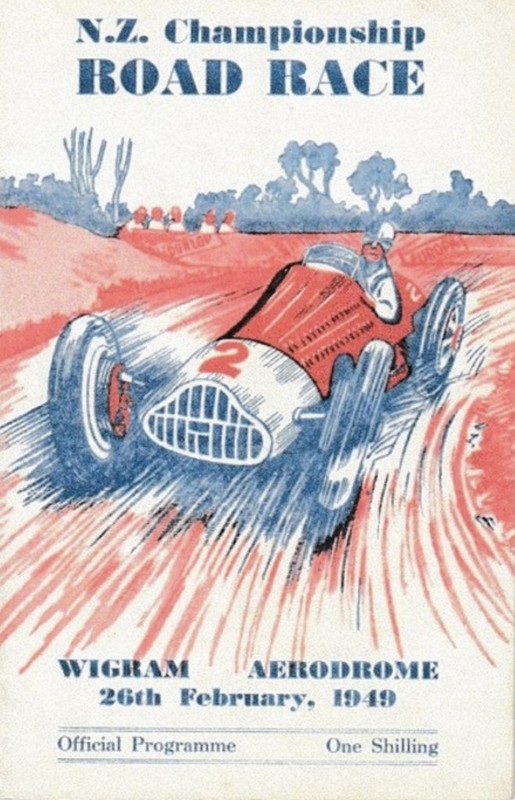
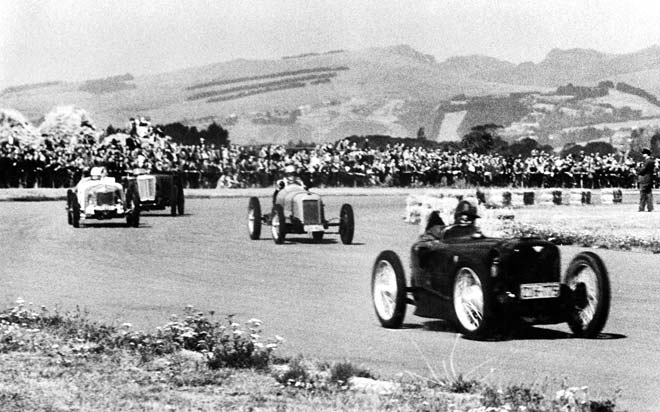
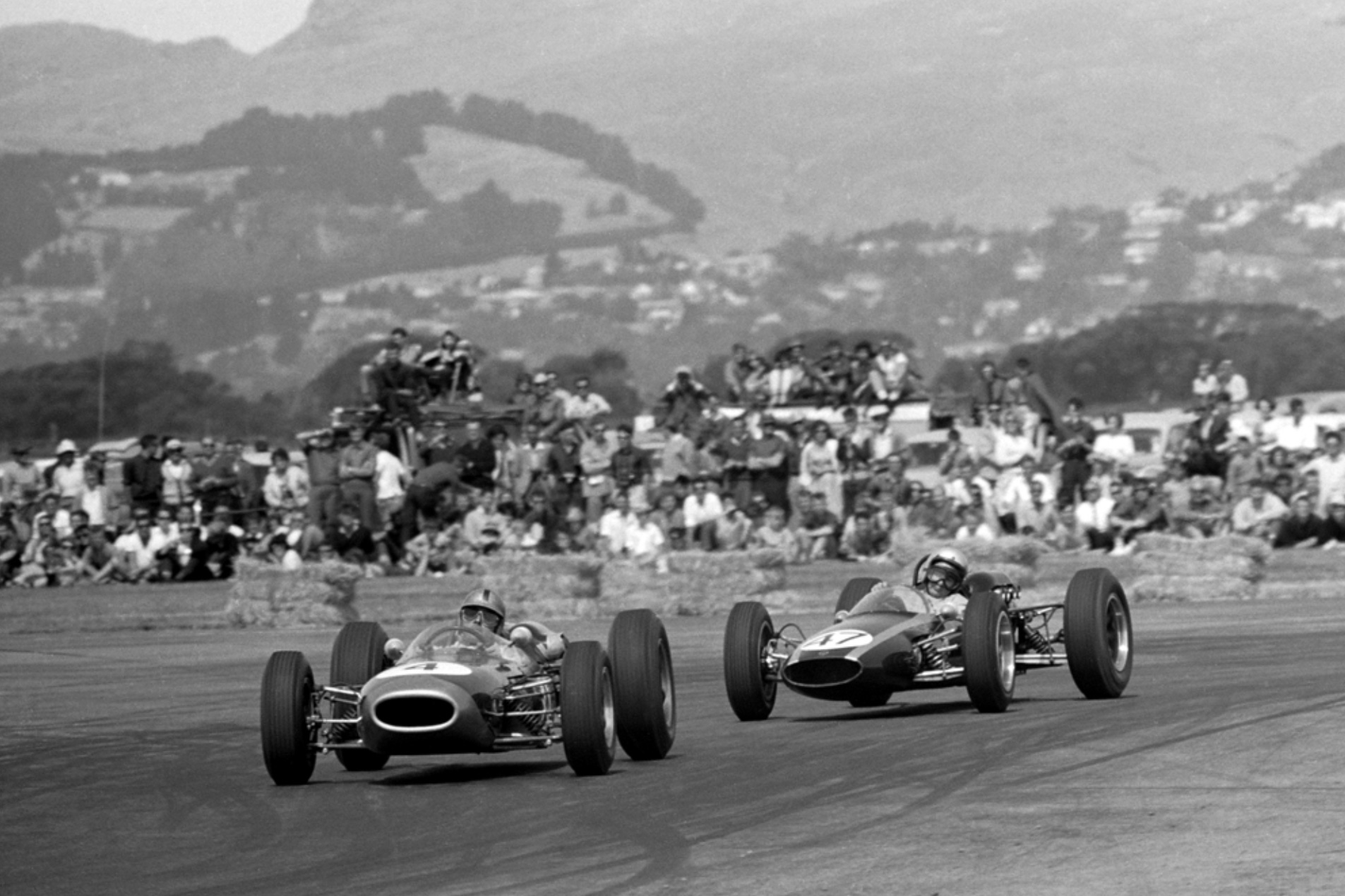
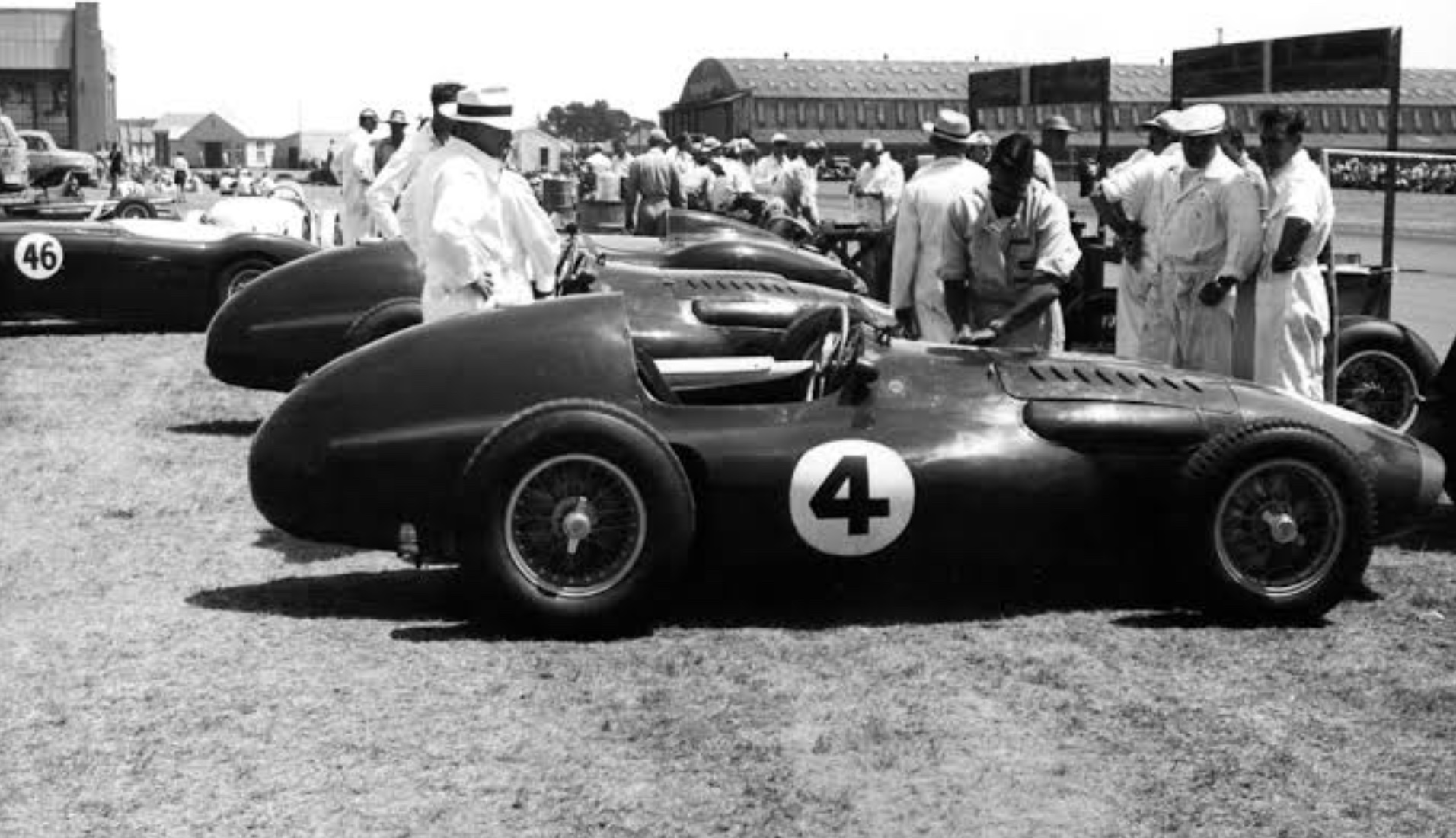
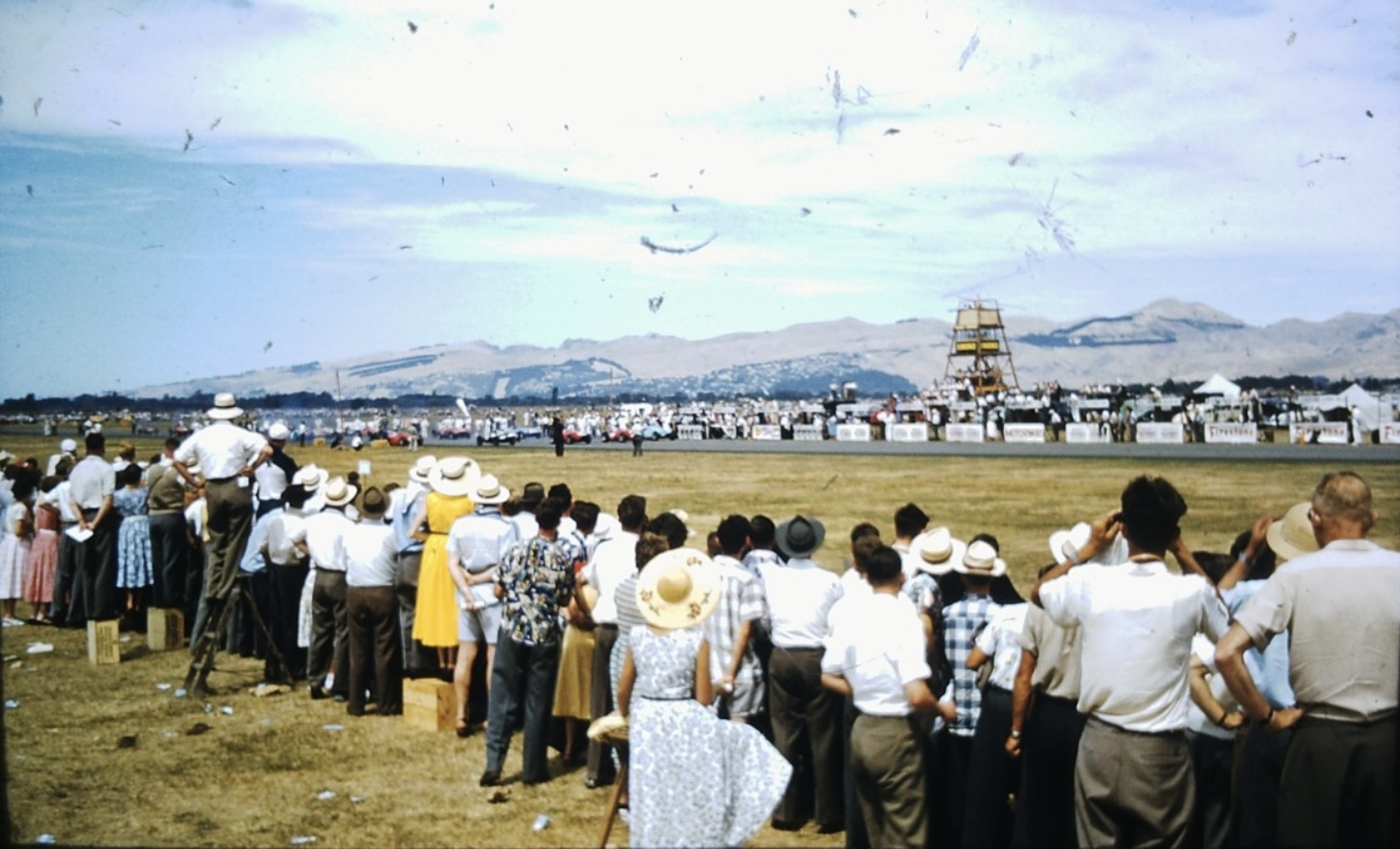
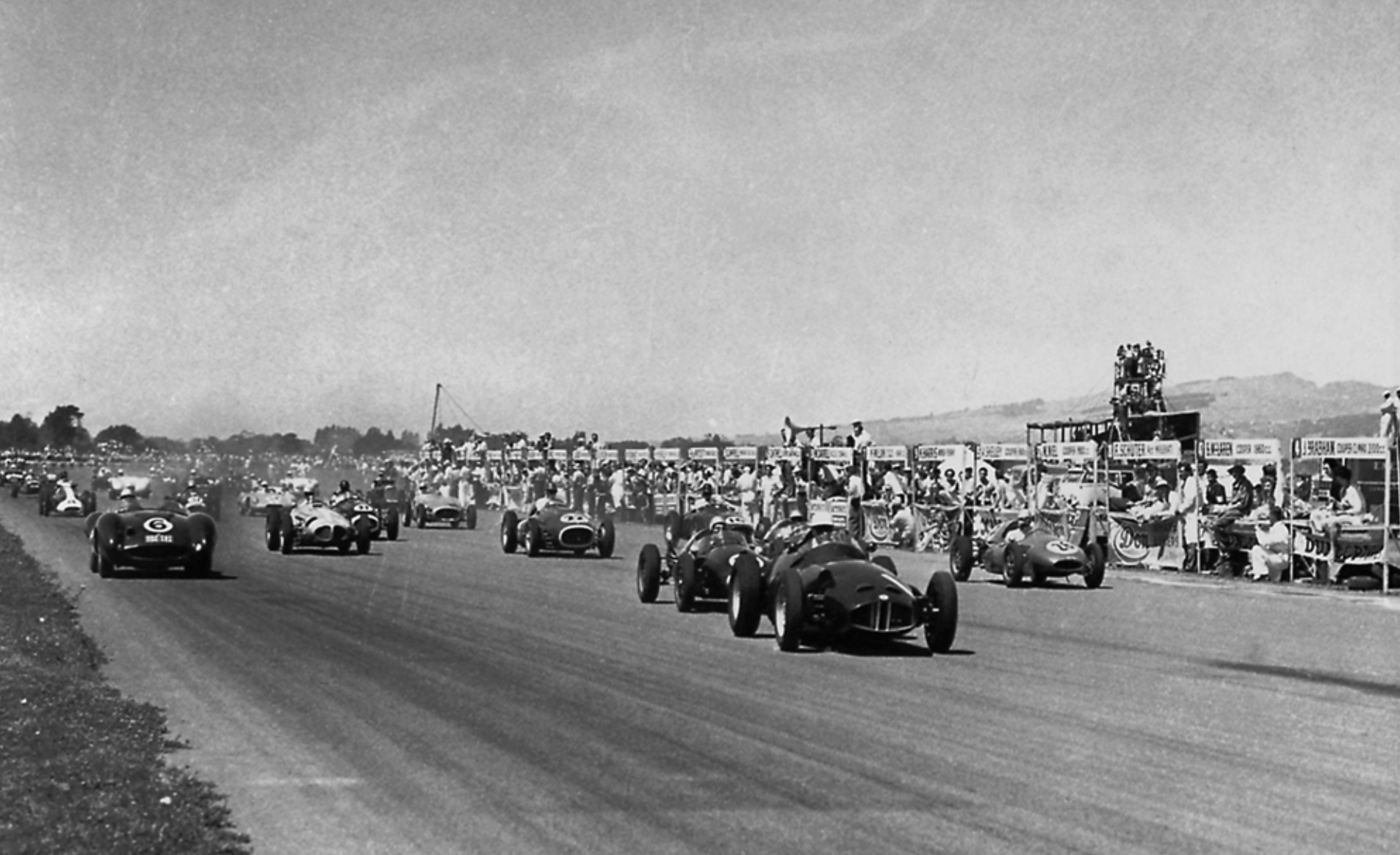
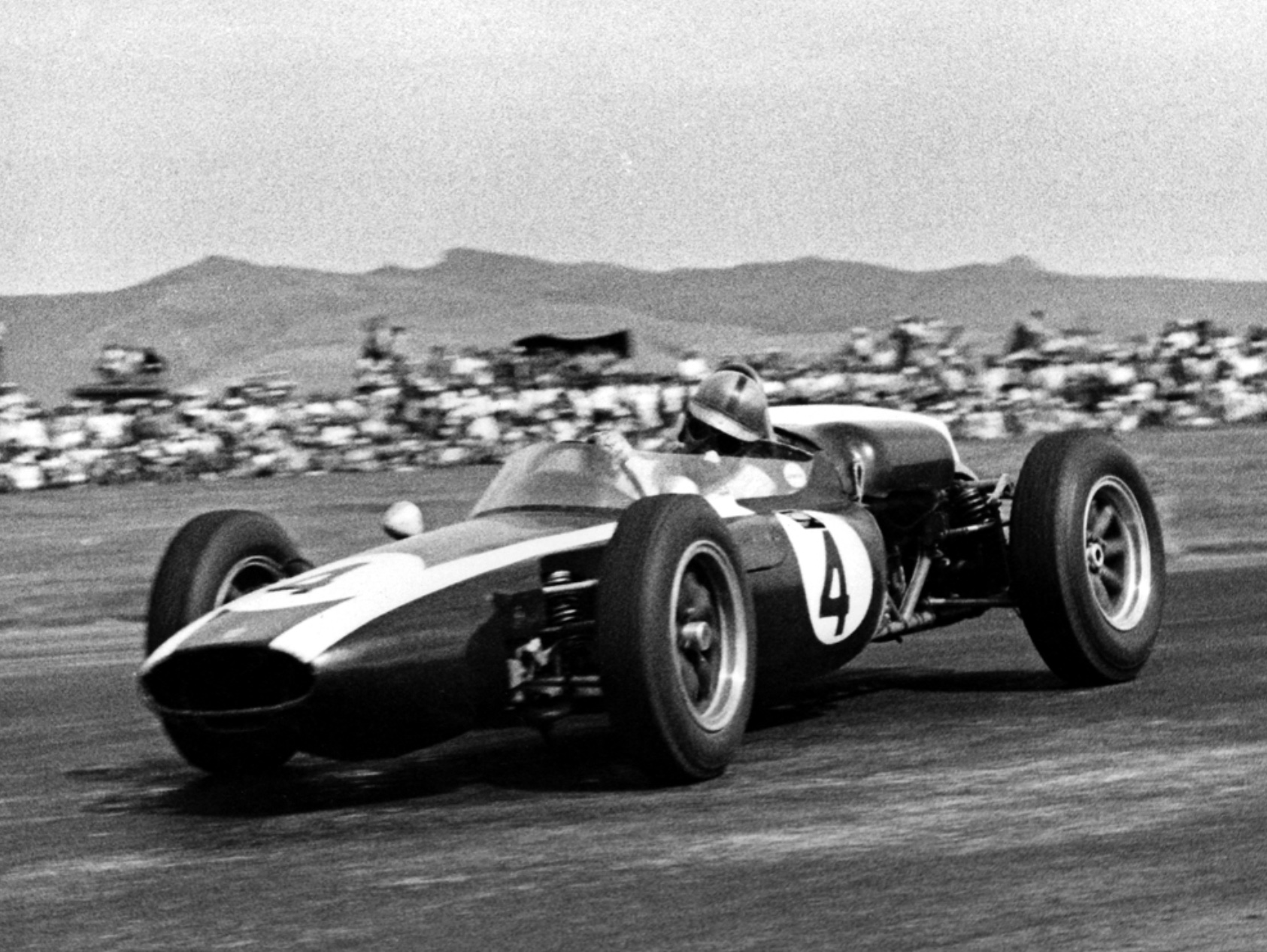
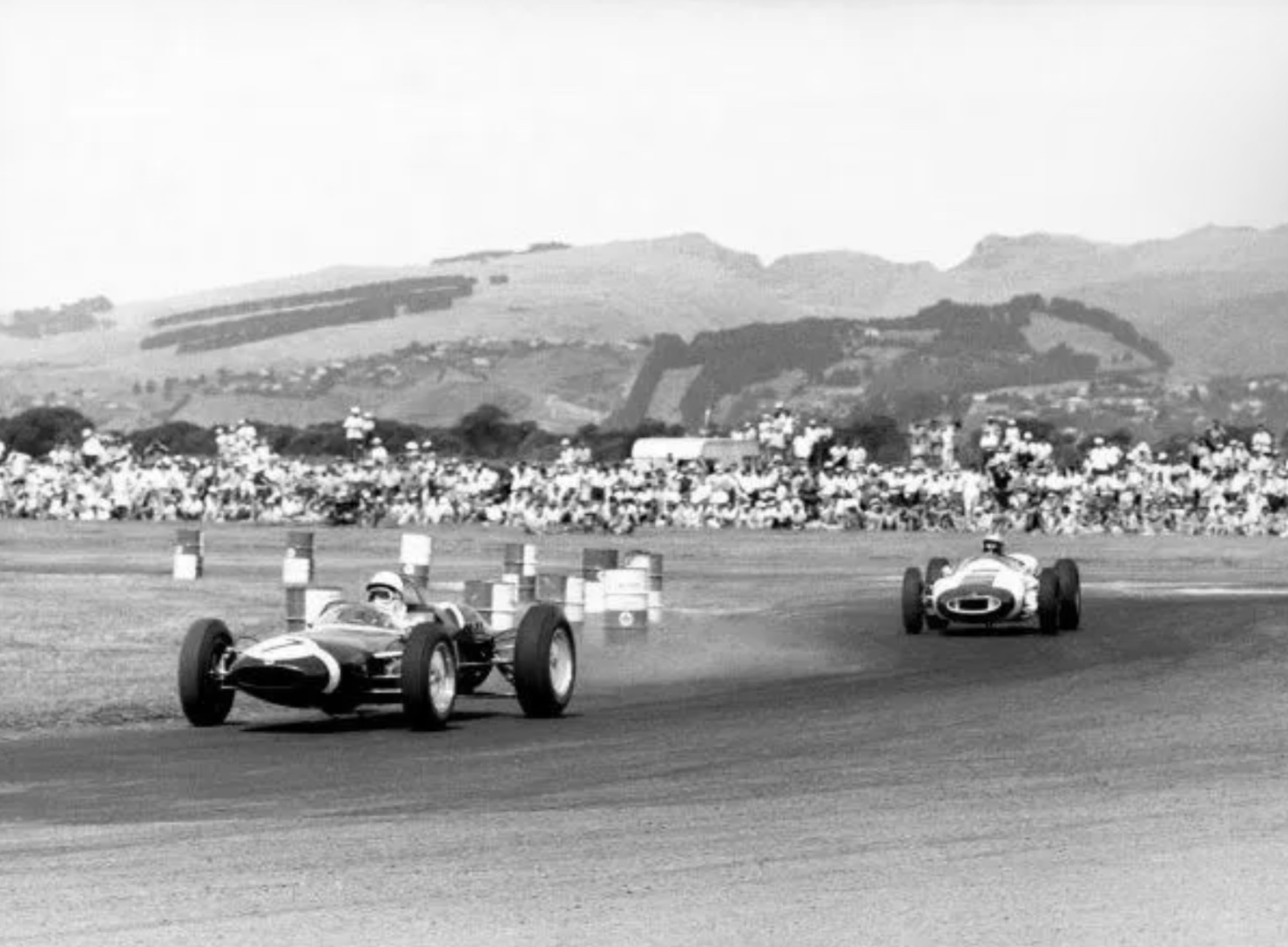
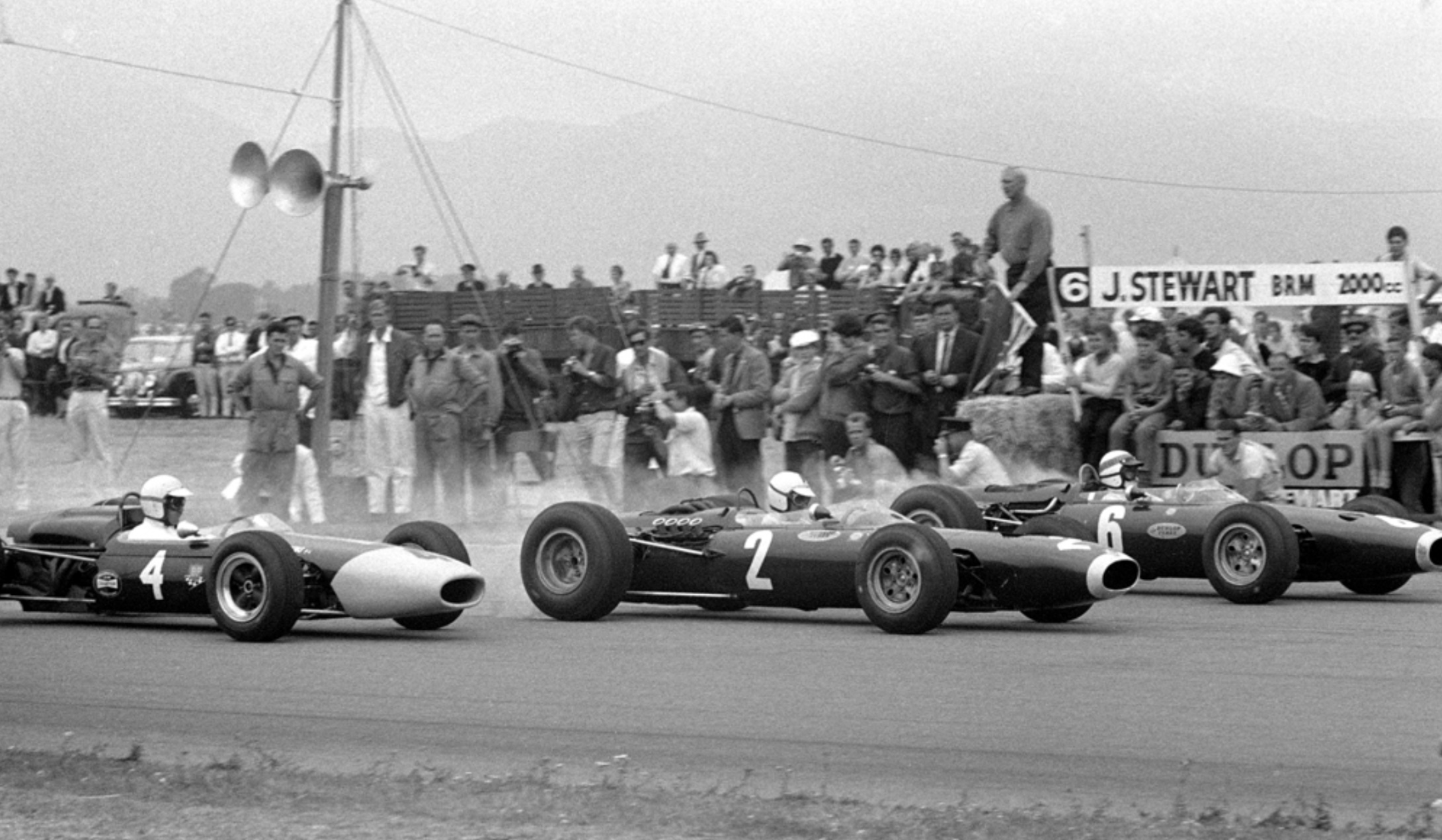
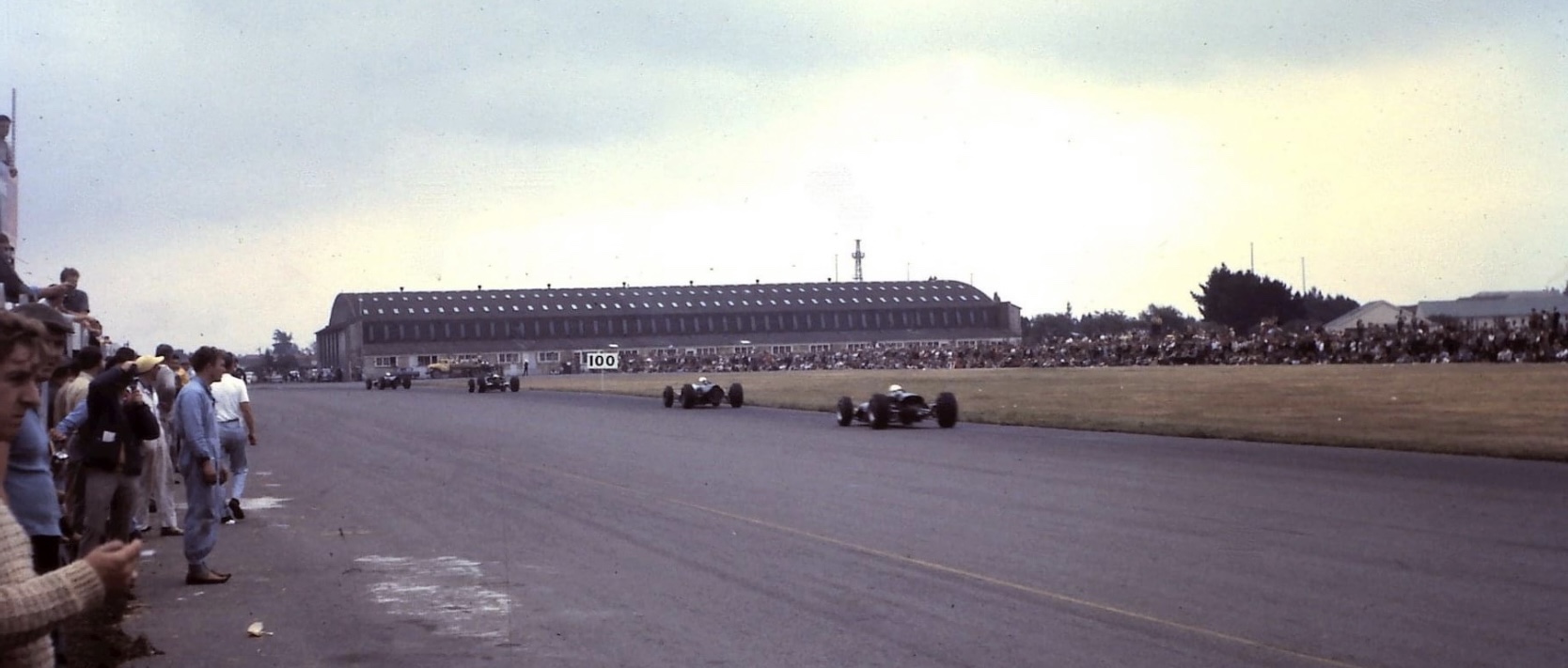
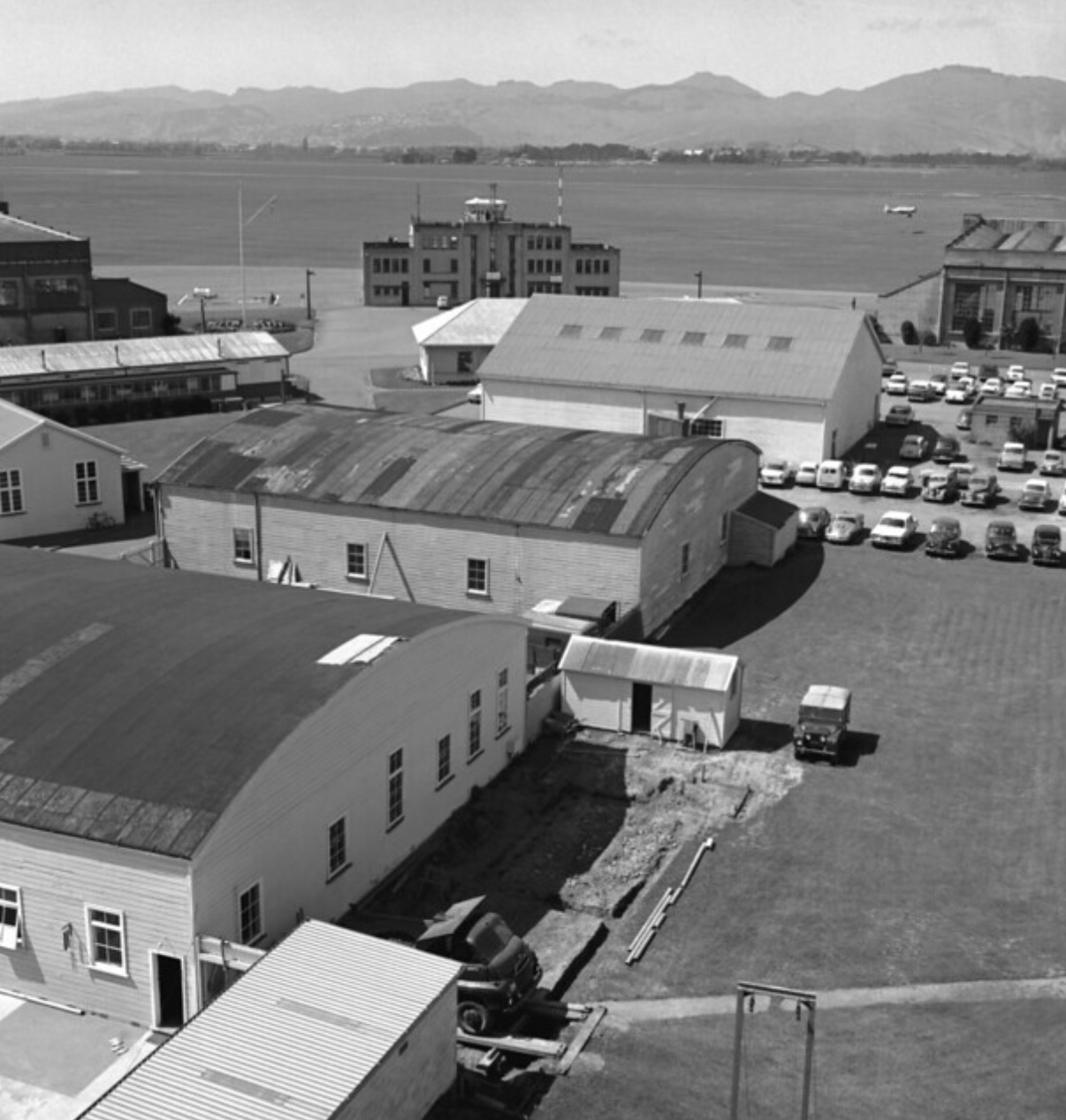
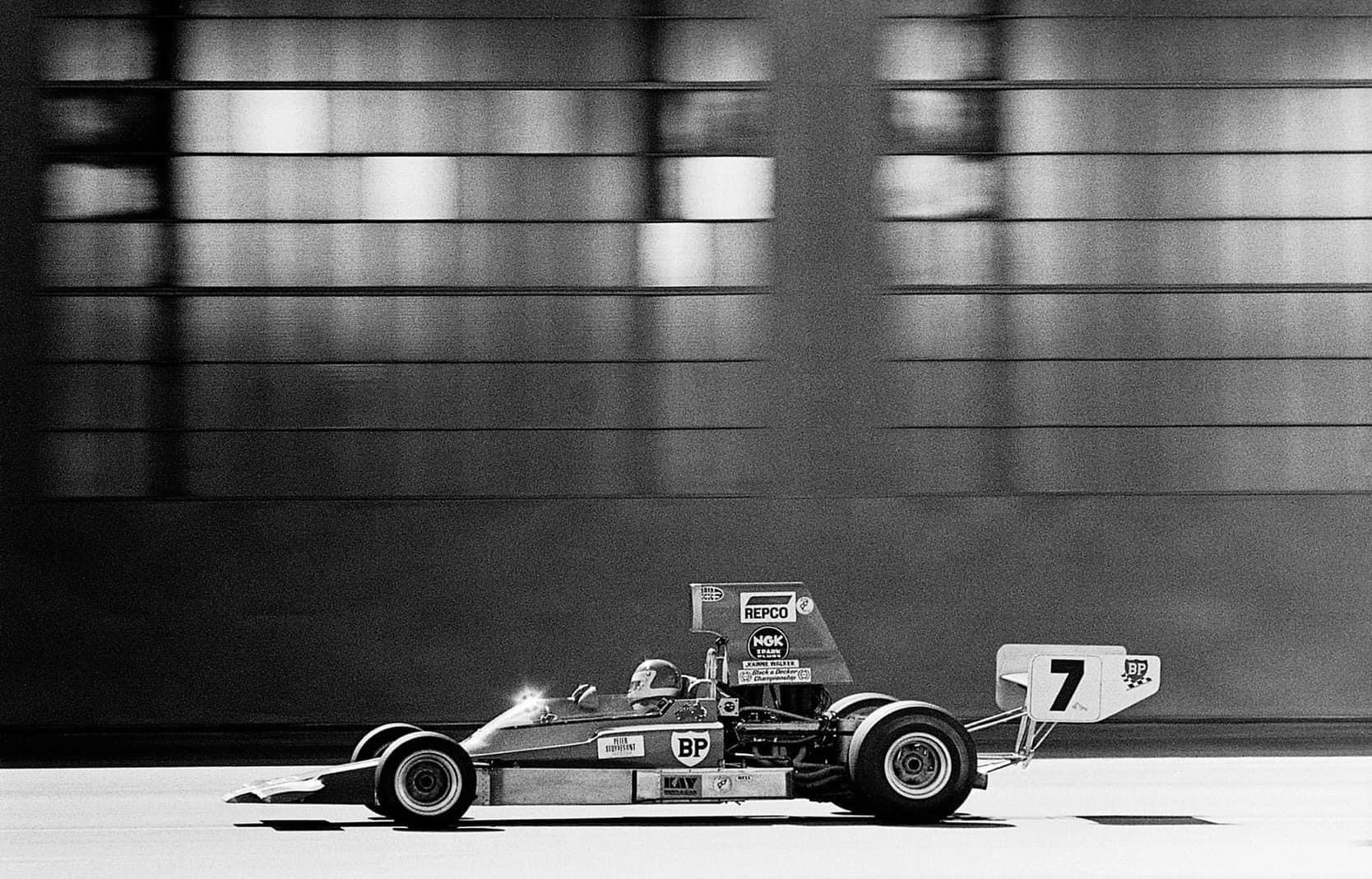


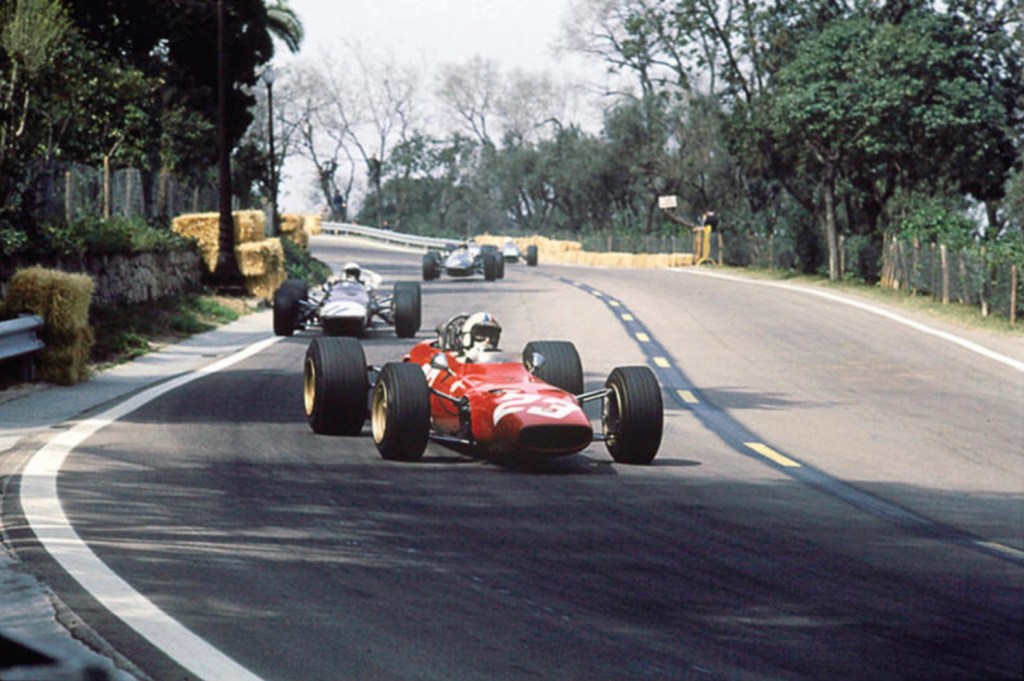
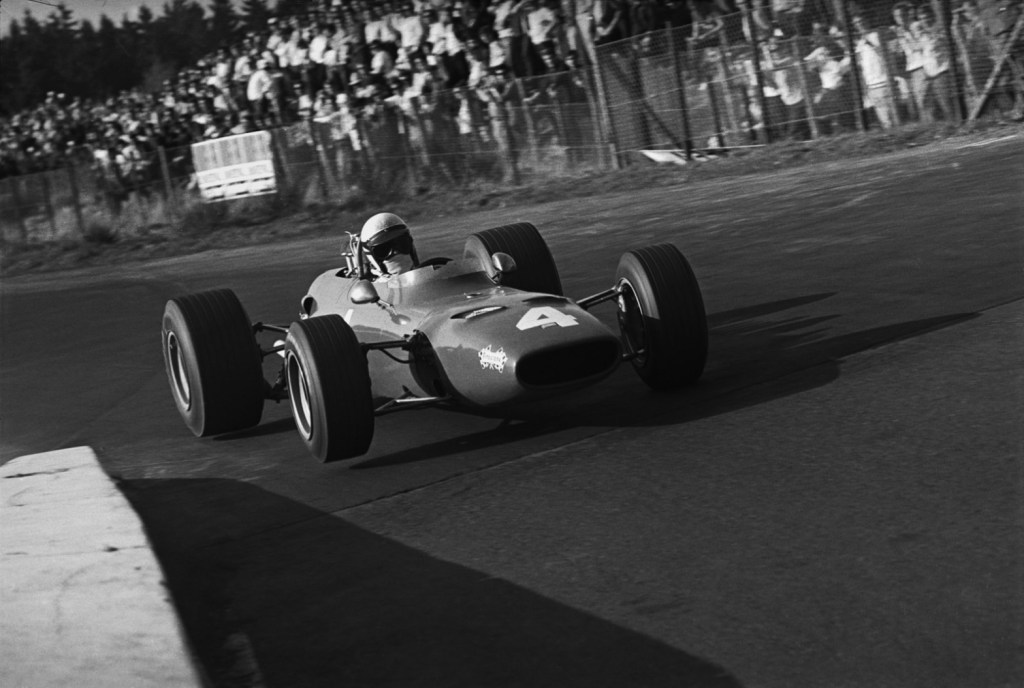

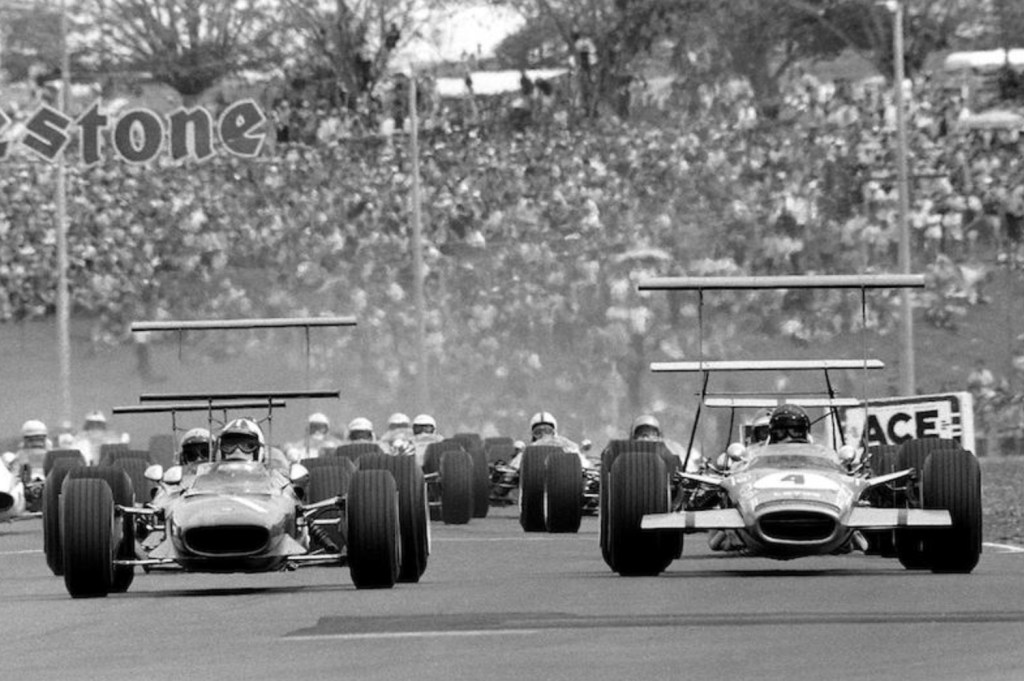
 primotipo...