Posts Tagged ‘Cooper T51 Climax’

(R Stuart)

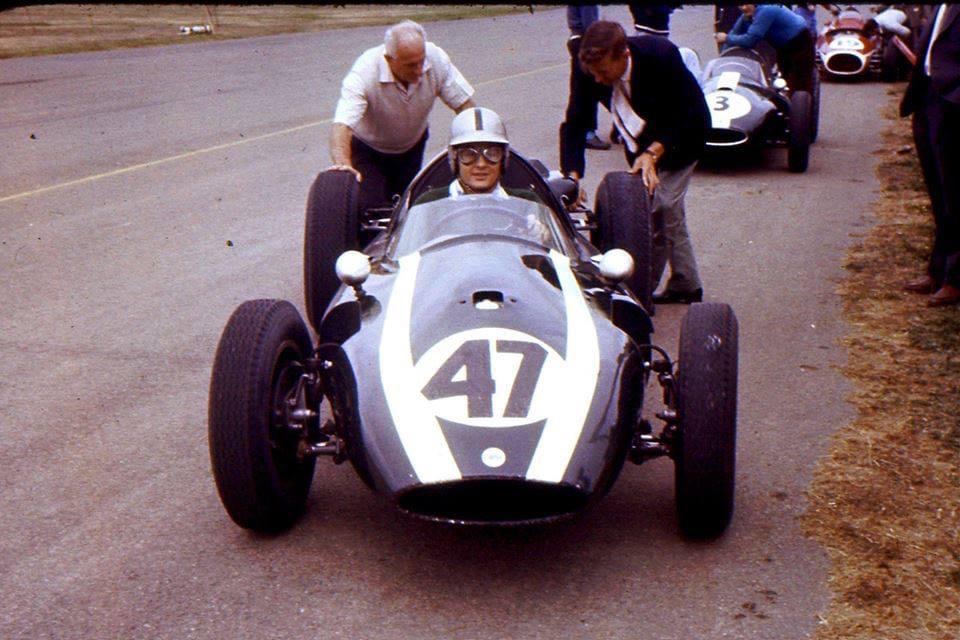
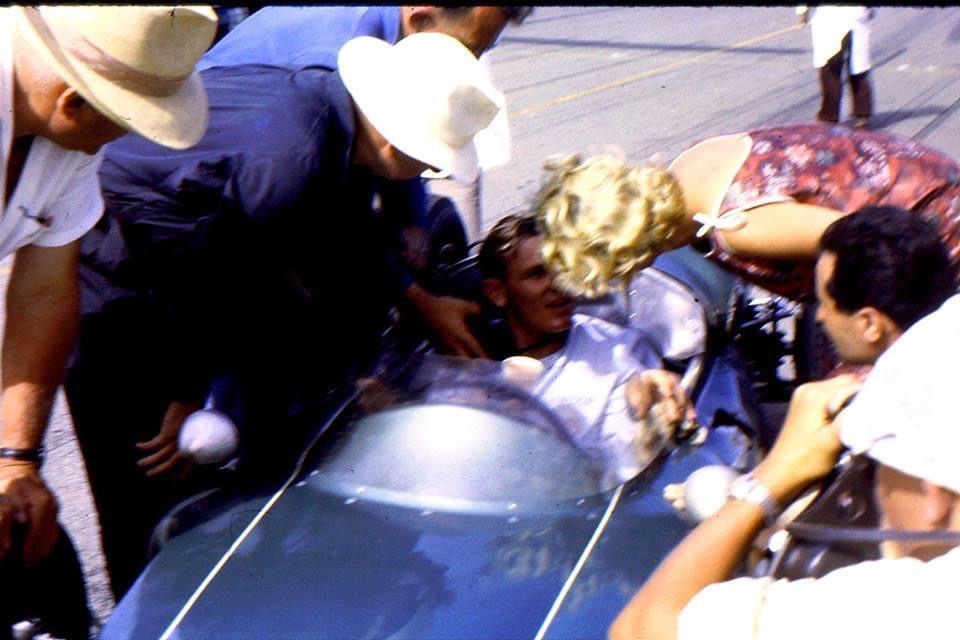
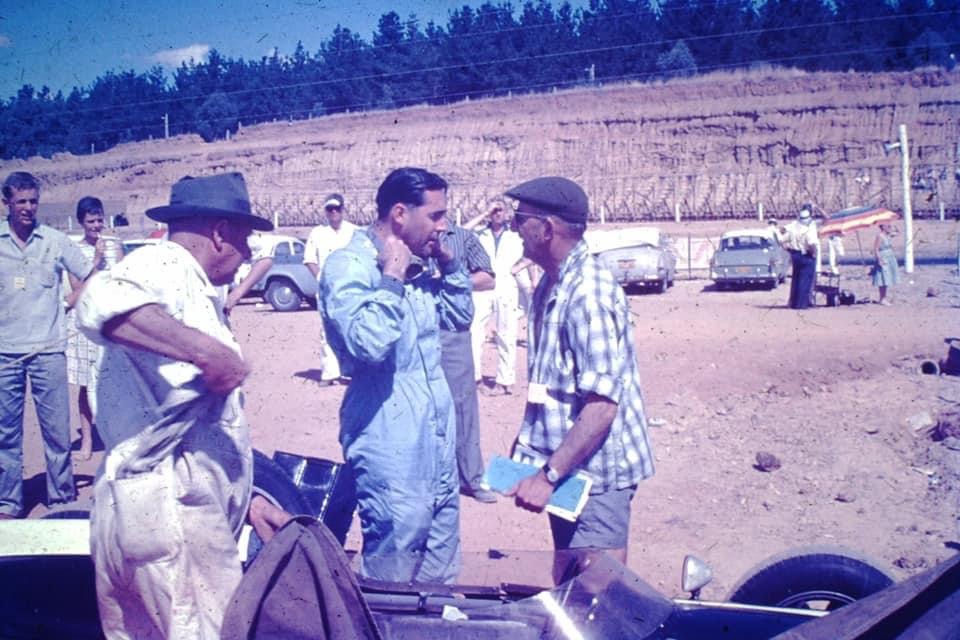
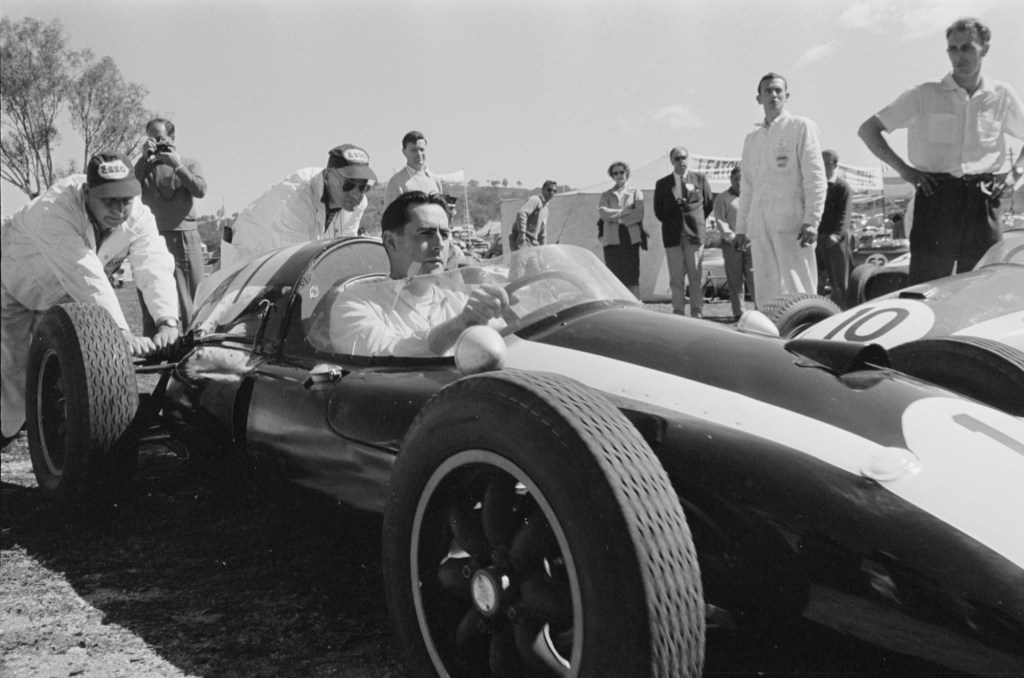
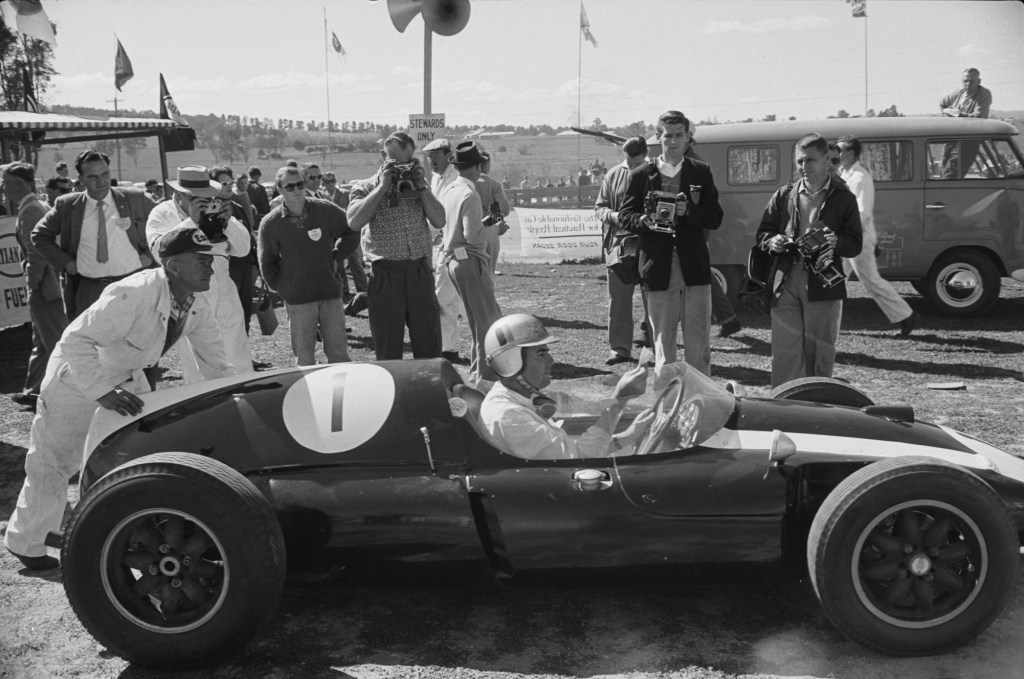
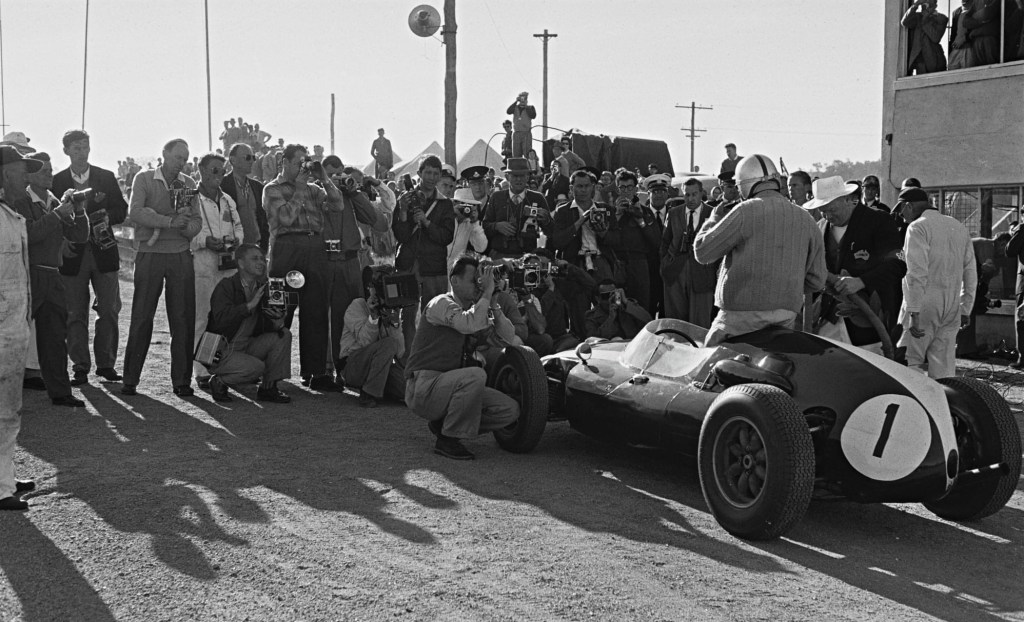
Pop McLaren and another helper about to bump-start Bruce’s Cooper T45 Climax FPF 2.5 at the Wigram RNZAF track on the January 23, 1960 weekend.

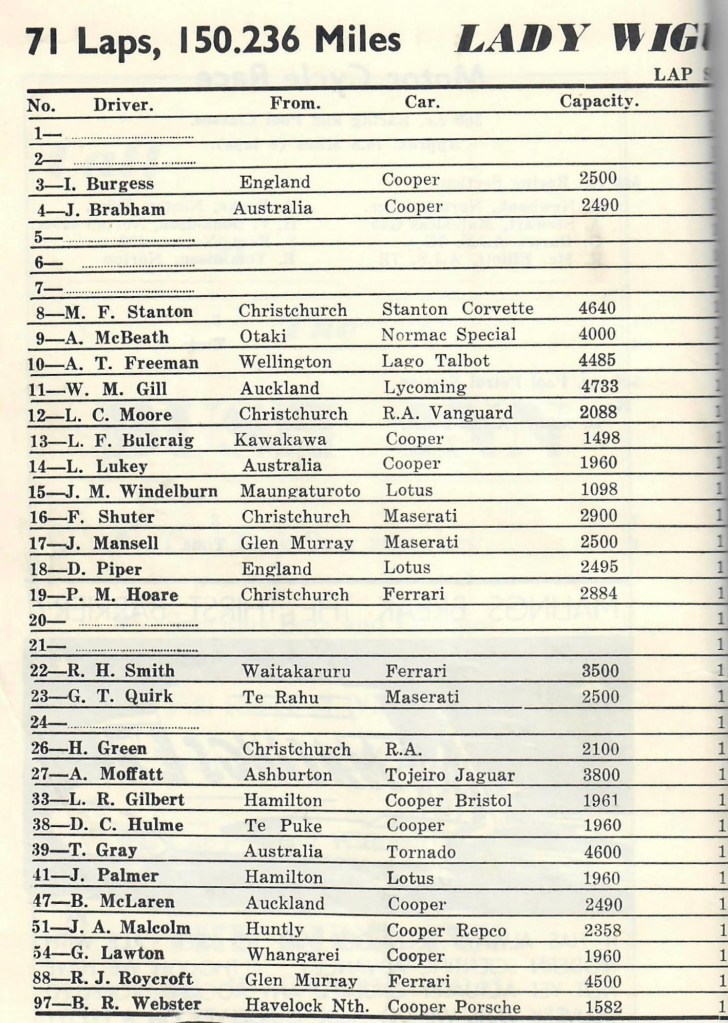
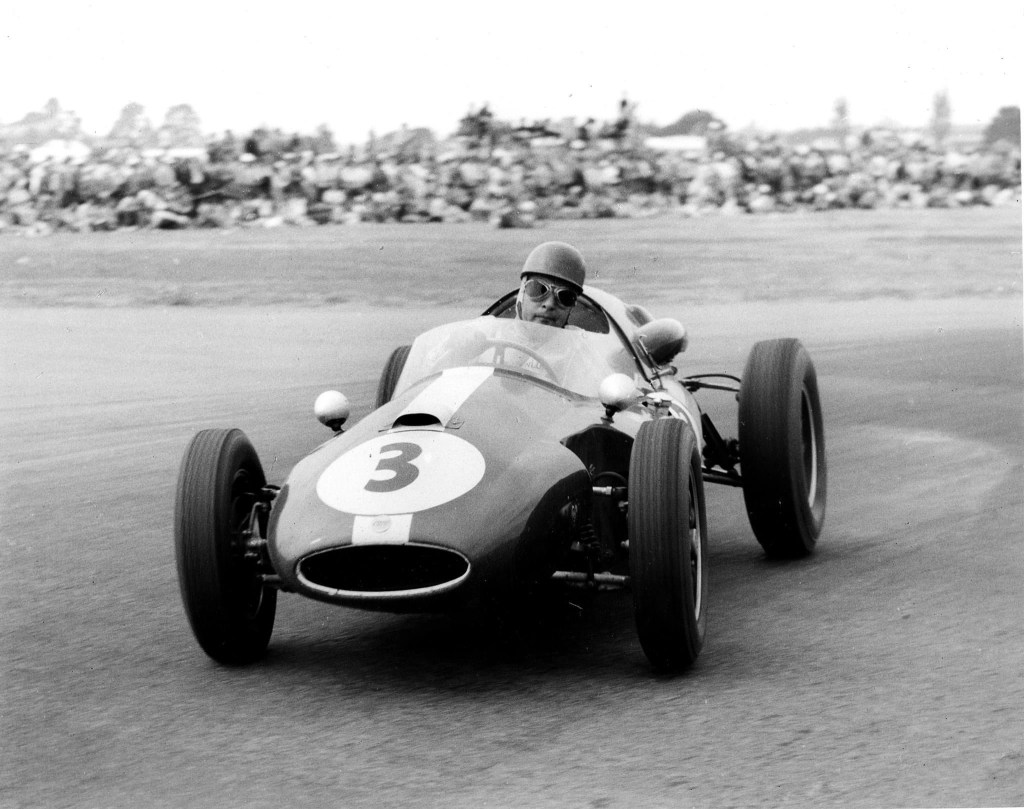
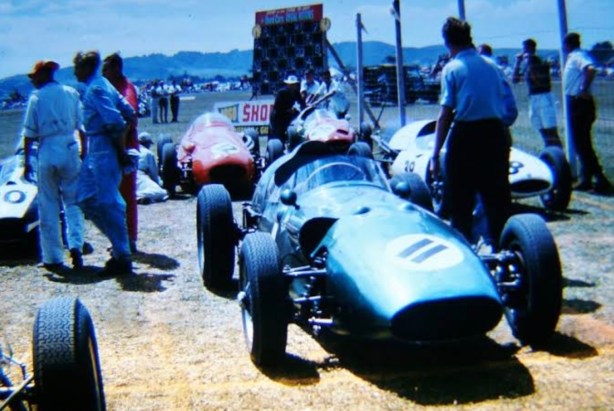
That’s Ian Burgess’ third-placed Cooper T51 Climax behind, then Pat Hoare’s Ferrari 256 V12 a little further back; he was fifth. Jack Brabham won the race in a T51 2.5-FPF with David Piper’s Lotus 16 Climax FPF 2.5 second. Bruce was fourth in the Lycoming Special; more of that soon.

New Zealand’s Summer Internationals commenced with the NZ GP, then held on the Ardmore Airfield circuit outside Auckland, with the Lady Wigram Trophy the other round most visiting internationals did. Sometimes they also entered the Dunedin Road Race and Teretonga International, held on a permanent racetrack near Invercargill, both venues on the South Island.

That year the visitors were headlined by Stirling Moss, twice-on-the-trot World Champion Brabham, and Burgess, Piper, while the Australian contingent included Bib Stillwell and Stan Jones in Cooper T51s, and Len Lukey in a T45. Similarly mounted was Kiwi youngsters Denny Hulme and George Lawton, both Driver to Europe exports; Lawton’s a sad one…

(T Marshall)

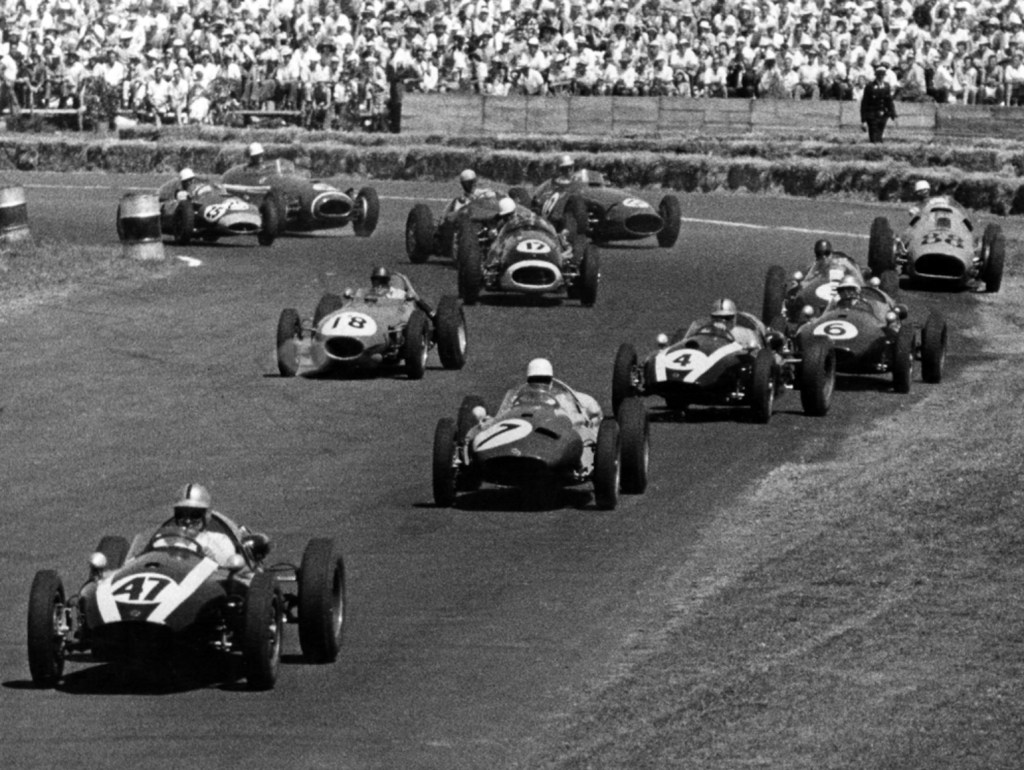
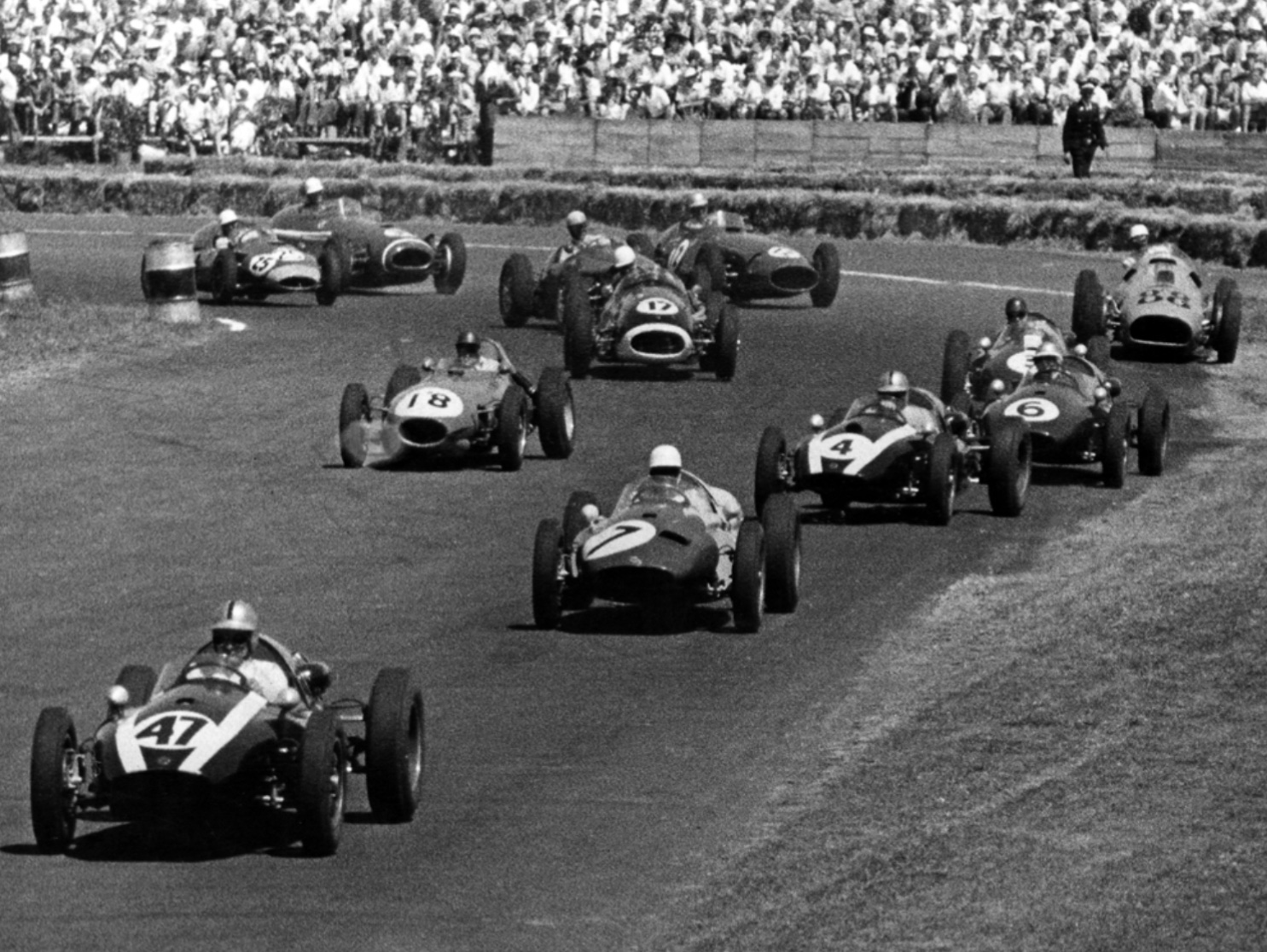
Coopers to the fore on the first lap at of the New Zealand GP at Ardmore: McLaren, Moss, Brabham, #6 Australian Bib Stillwell and then Ian Burgess. One T45 and four T51s. In the middle of the road is David Pipers Lotus 16 Climax, car #17 Johnny Mansel’s Maserati 250F, while #88 is Ron Roycroft’s positively historic but very well driven ex-Ascari Ferrari 375 4.5-litre V12. Behind Mansel is perhaps Pat Hoare, Ferrari 256 V12 – a Dino 246 fitted with a 3-litre V12 – then Arnold Glass in his Maserati 250F #12. Close to the oil drum is 1954 NZ GP winner Stan Jones, Cooper T51 Climax, and finally the big front-engined car is Ted Gray in his last drive of Australian Land Speed record holder, Ted Gray in Tornado 2 Chev V8.

At this time of technological change, it was certainly a grid lacking variety! Coopers were of course right up there: Brabham and McLaren finished one-two in their 2.5-litre FPF-powered cars from the 2.2s of Stillwell and Jones. The best placed front-engined cars were the pair of 2.5-litre six-cylinder Maserati 250Fs raced by Kiwi Johnny Mansel and Aussie Arnold Glass.

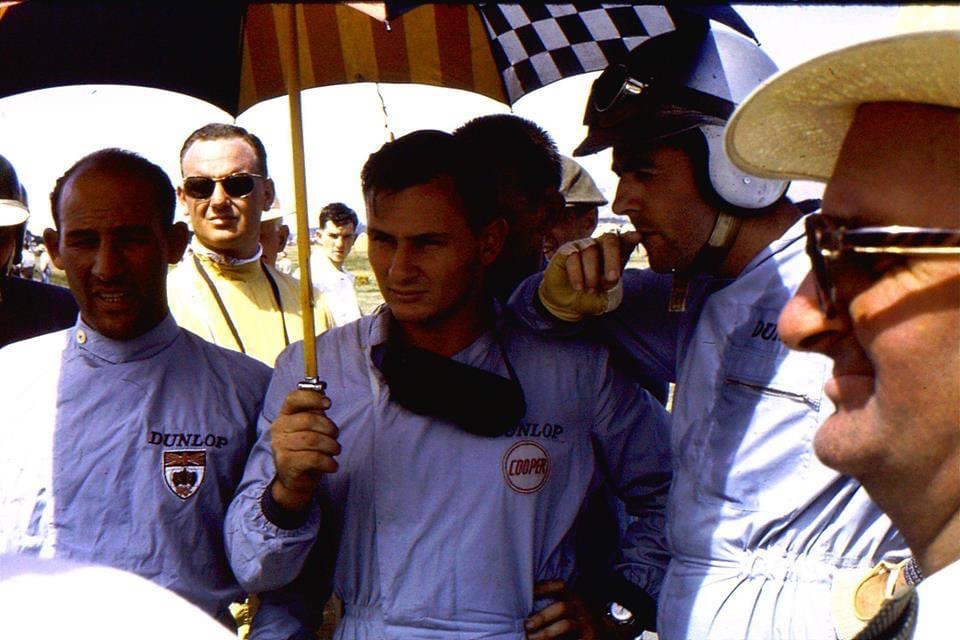
Stirling, Bruce and Jack all ears during the Ardmore drivers briefing – not necessarily in 1960 mind you (R Stuart)
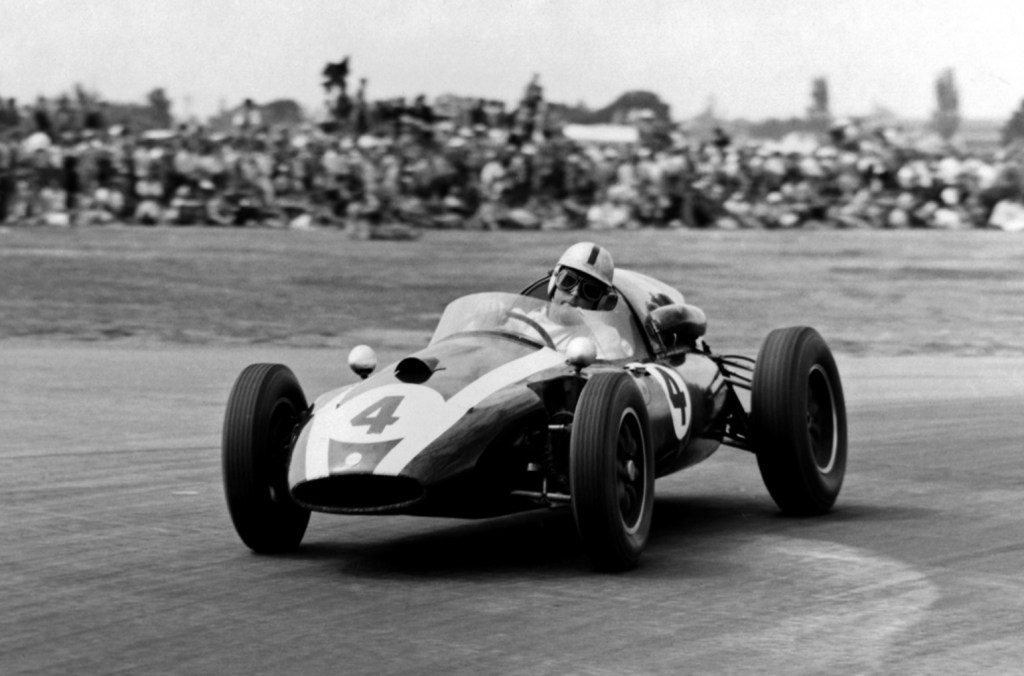
Brabham on the way to victory at Wigram in 1960, Cooper T51 Climax (T Marshall)

That summer, Jack Brabham won both the NZ GP and Wigram, while Syd Jensen’s nimble Cooper T45 Climax 1.5 won on the Dunedin city roads, and Ian Burgess triumphed at Teretonga, Cooper T51 Climax FPF 2.2-litre.

On the other side of The Ditch Brabham won at Longford and Phillip Island against local opposition; it was a great summer for him. It wasn’t until 1961 – and really 1962 – that the Australians had the tracks to cut it with the Kiwis to attract the internationals with the first Tasman Cup held and won by Bruce McLaren’s Cooper T70 Climax in 1964.

(G Woods Collection)
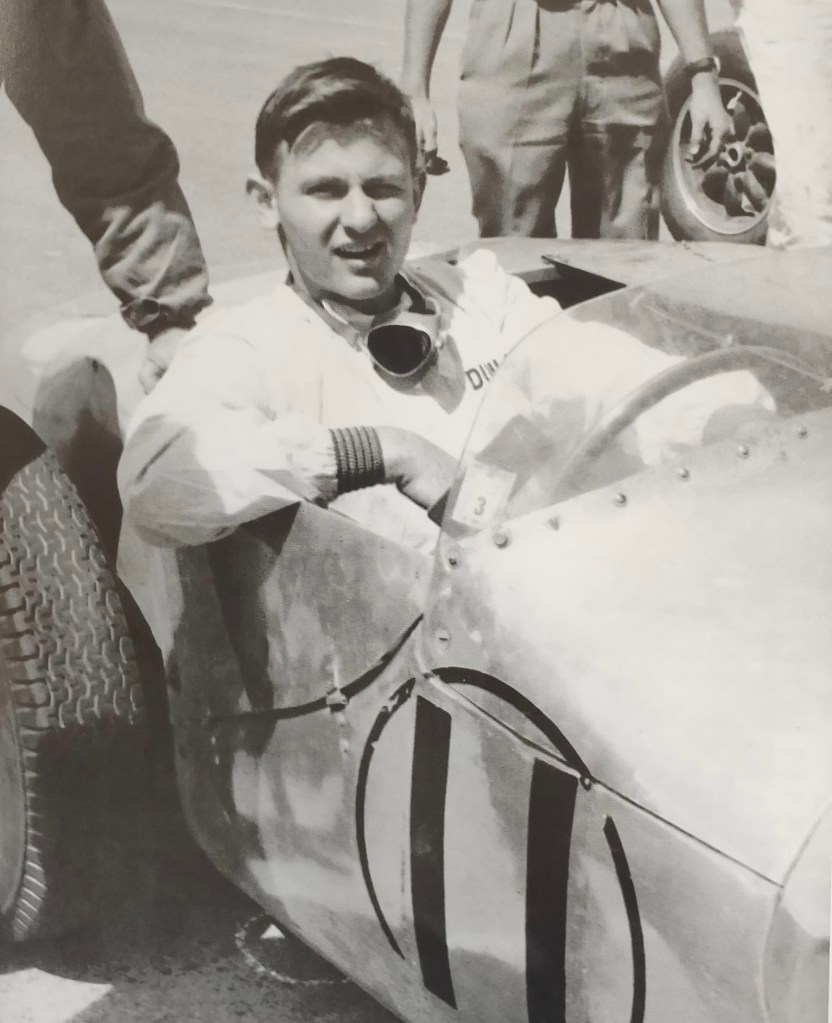
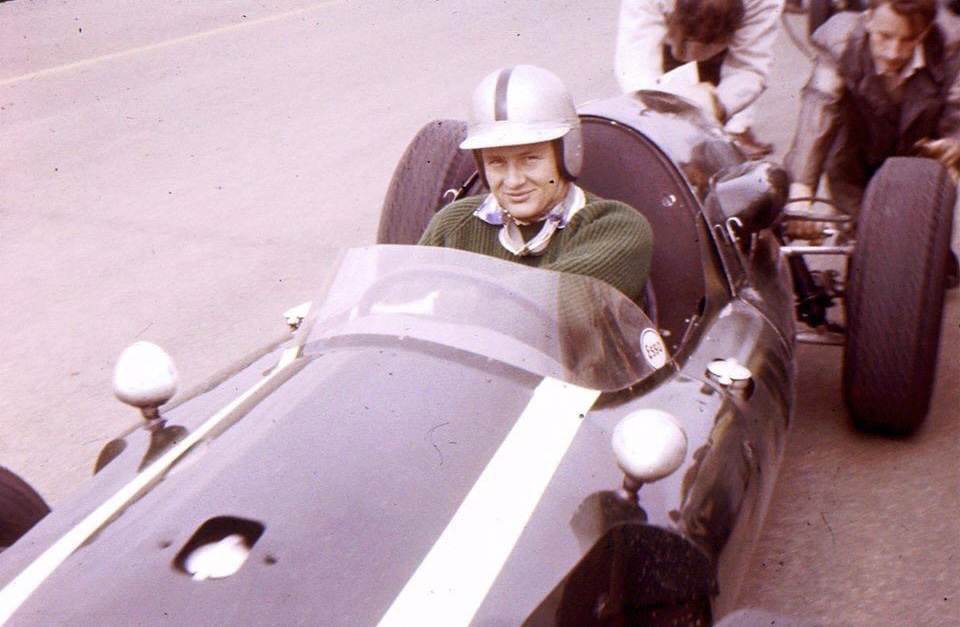
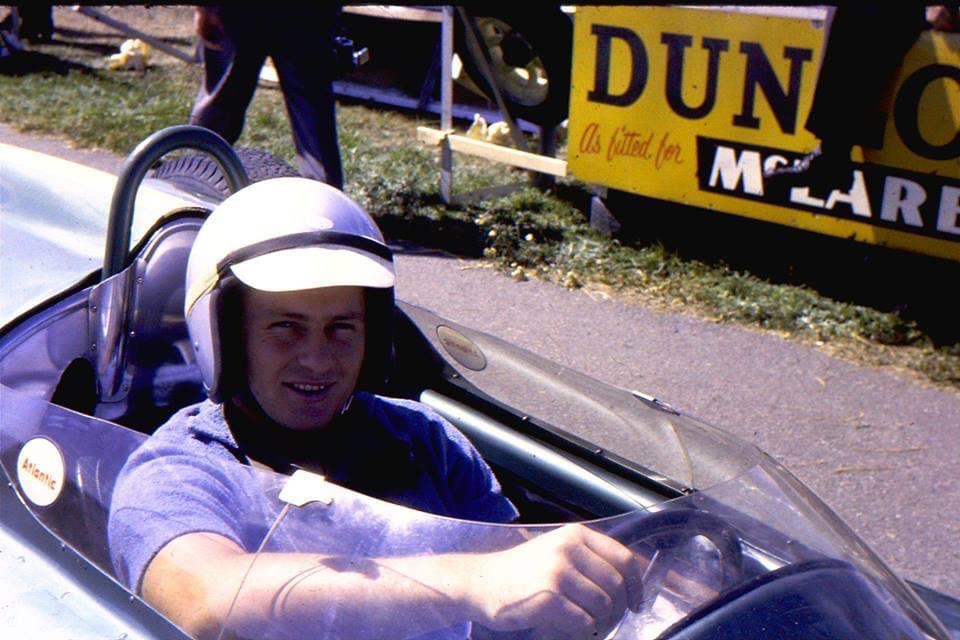
McLaren, with ‘nomex’ jumper and long sleeved shirt on to deal with the summer chill, Burgess and Pat Hoare’s Ferrari 256 V12 (R Stuart)

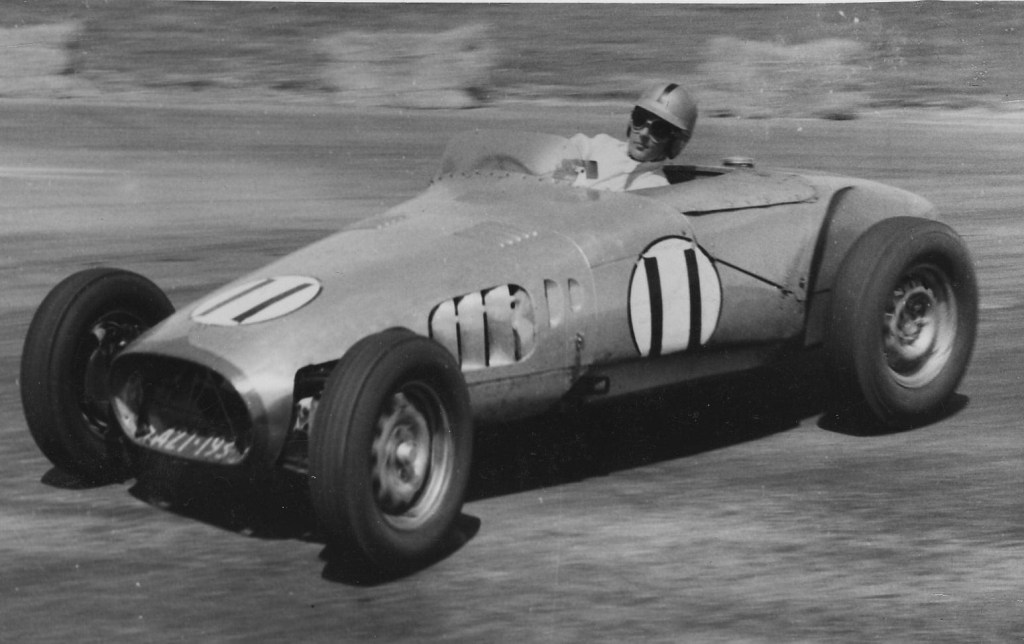
While Bruce McLaren started the Lady Wigram Trophy in his Cooper, he retired the car and then took over the famous aircraft-engined Lycoming Special, finishing the race in fourth place (below).

Jim Clark did a few laps in one of the Kiwis’ most loved specials during practice during the Tasman Series a couple of years later.

Bruce McLaren in the Lycoming here and below (M Knowles)
(BMcL Trust)
(M Fistonic)

McLaren ran out of brakes in the Lycoming during the race; the car ran four-wheel drums sourced from an Austin road car. Bruce found the car’s handling so forgiving that he was able to make up for the lack of stoppers, in part, by throwing the it sideways into the corners.

Never one to forget a favour, when he returned to England, Bruce sent a set of Dunlop rotors and calipers to New Zealand, the Lycoming raced on so equipped!

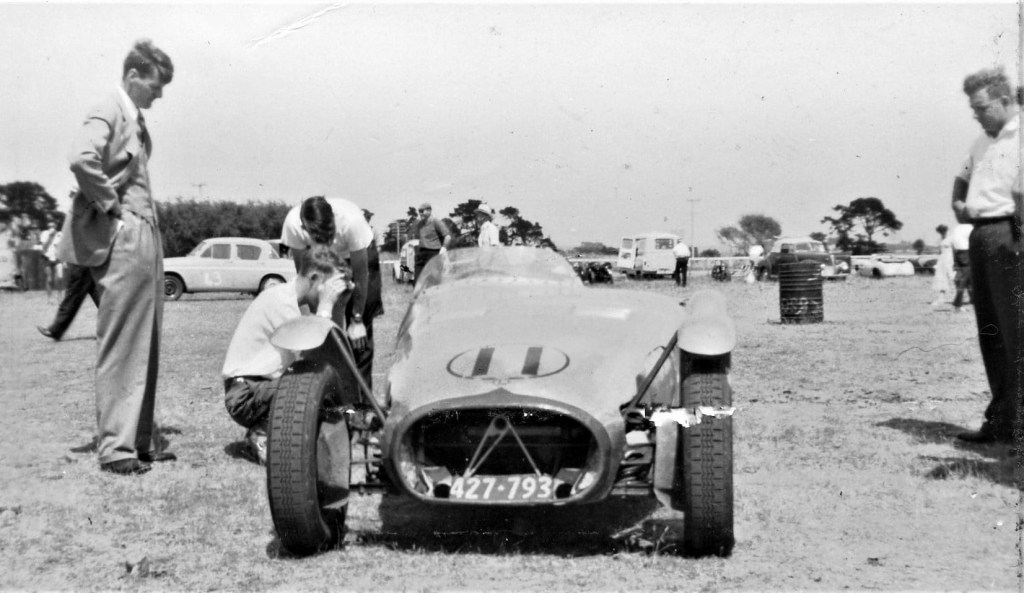
The shot above shows the Lycoming in the Levin paddock in January 1960. Note the road-rego and Michelin radial tyres. Clearly, (pic above) Bruce raced it on Dunlop racing tyres, but the 4.7-litre four cylinder engines car was originally built by oh-so-talented Kiwi engineer Ralph Watson as a road-going racer. At the time Bruce borrowed the car, it was being raced by Malcolm Gill and later Jim Boyd, happily it is extant, alive and well.

(Nat Lib NZ)

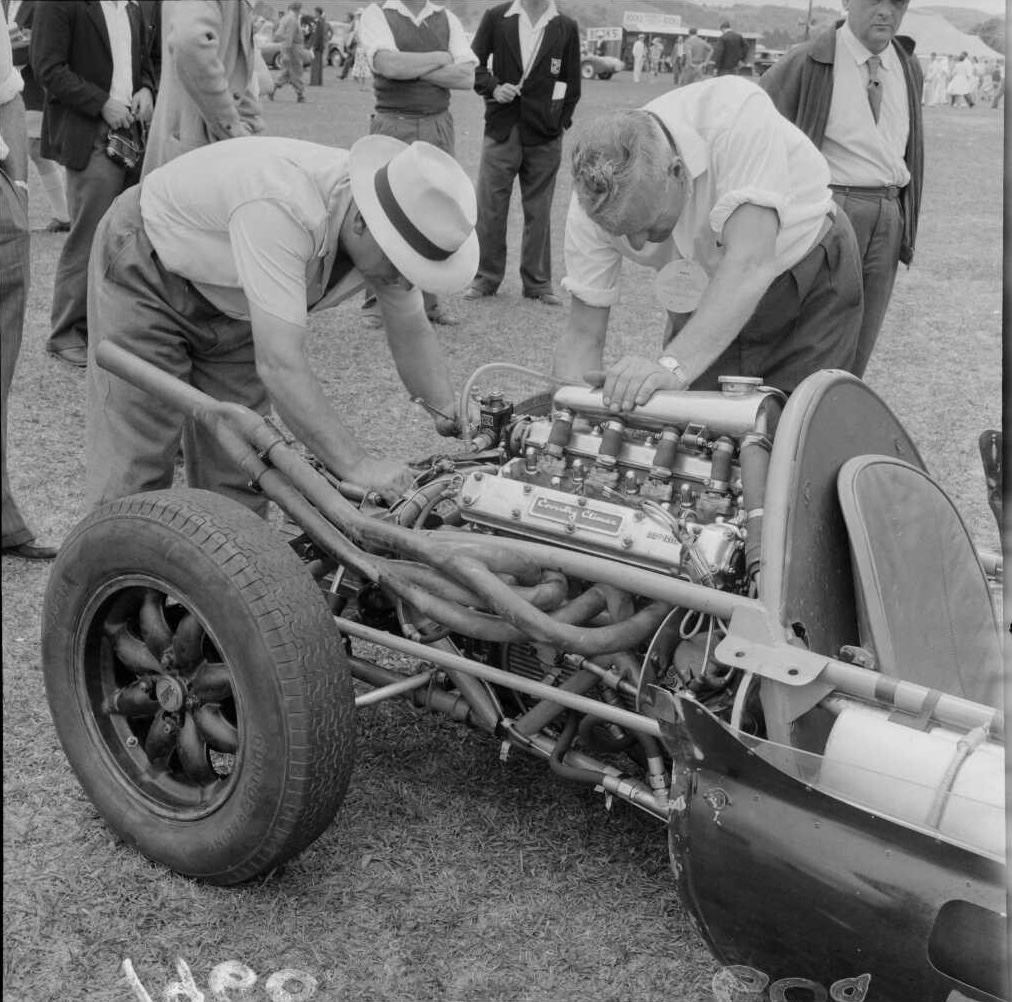
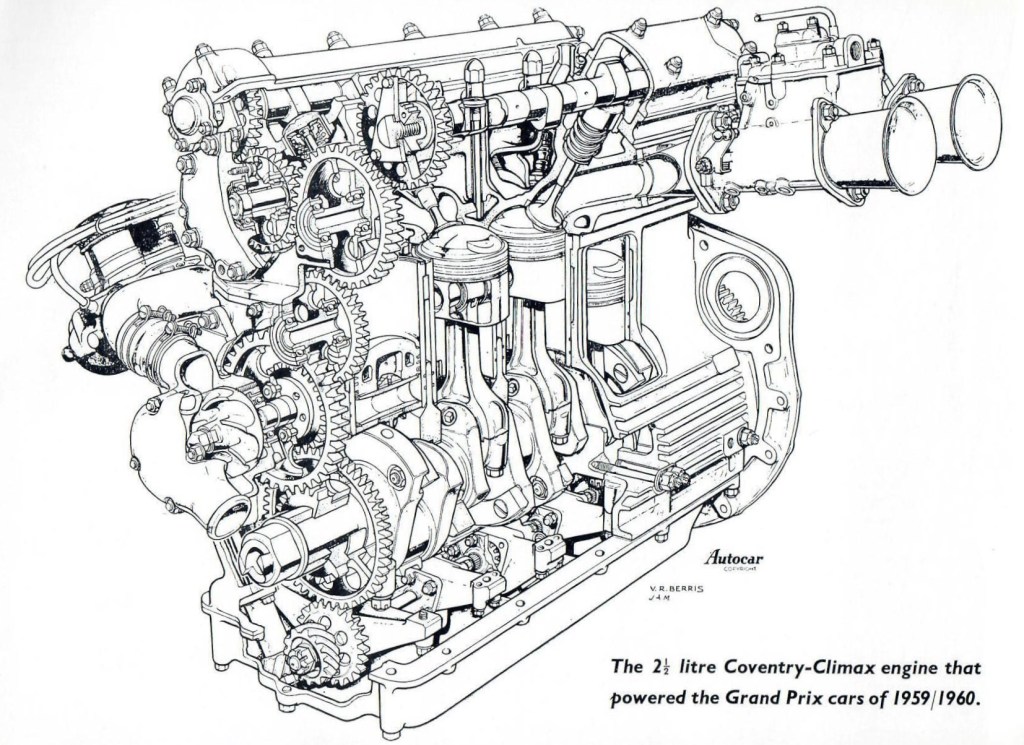
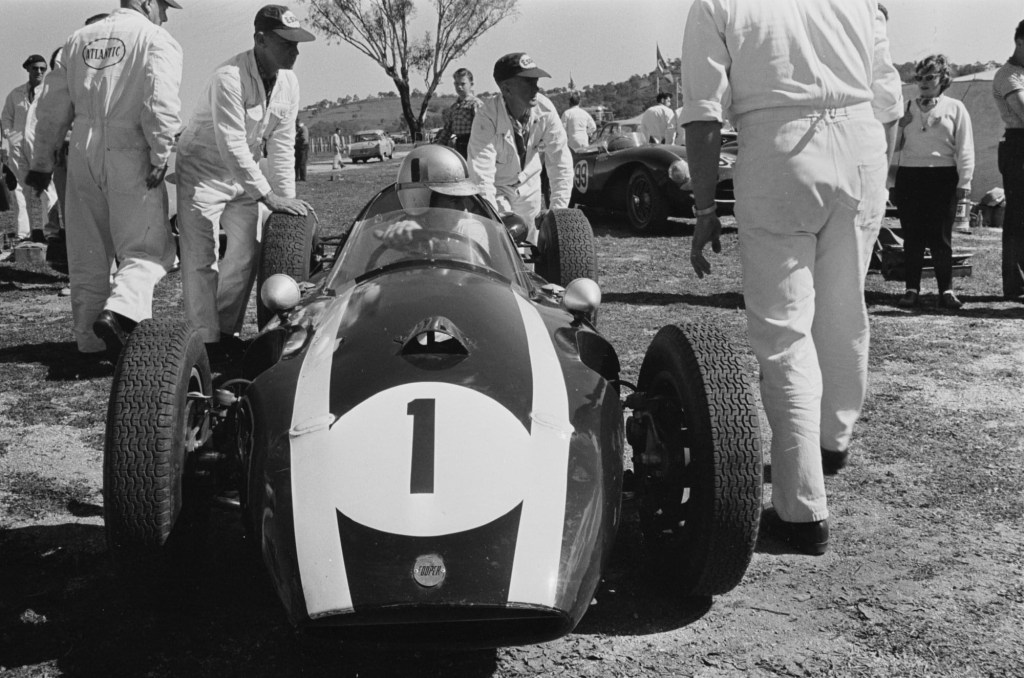
Ian Burgess’s Cooper T51 Climax at Wigram above, and the 2.5-litre Climax in Stirling Moss’ car being fettled in the Ardmore paddock below.

(Nat Lib NZ)

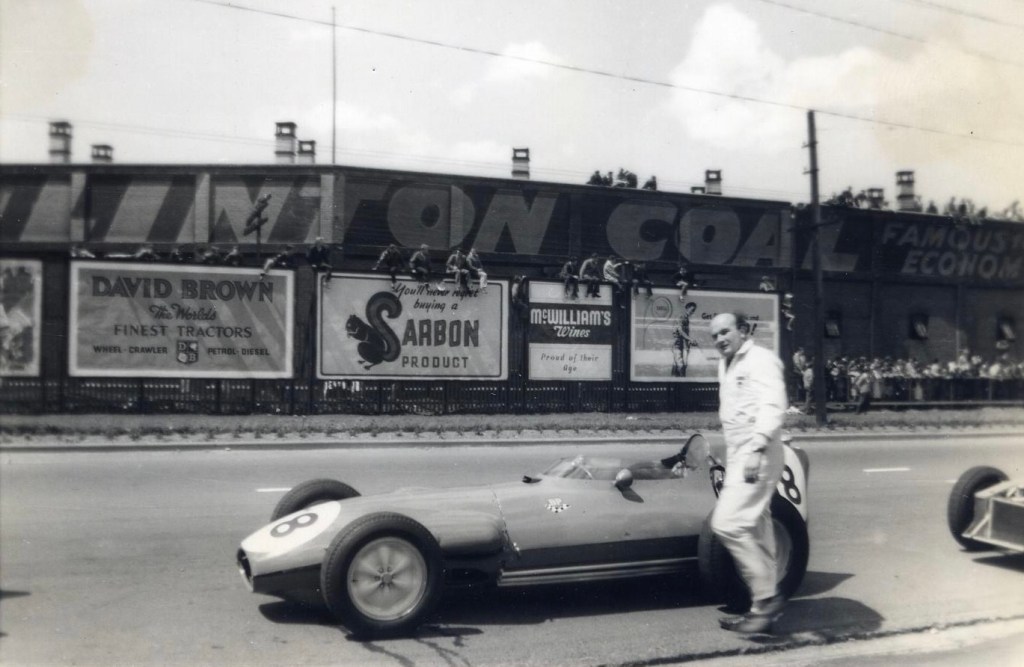
David Piper (below) pushing his Lotus 16 Climax 2.5 #368 to the start line at Dunedin on January 30, where he withdrew with gearbox problems after 22 of the 36 laps.

Piper coaxed local boy Arnold Stafford into the hot-seat of his 1.5-litre FPF-engined Lotus 16 #353 ‘renter’ at Wigram (below), but Stafford thought the better of it after a big-spin in practice, having not raced for three years and didn’t start.

(K Brown)
(unattributed)

Both cars weren’t particularly old in years but were technically passé by early 1960, even in the colonies where Coopers had been rather popular from the early 1950s.

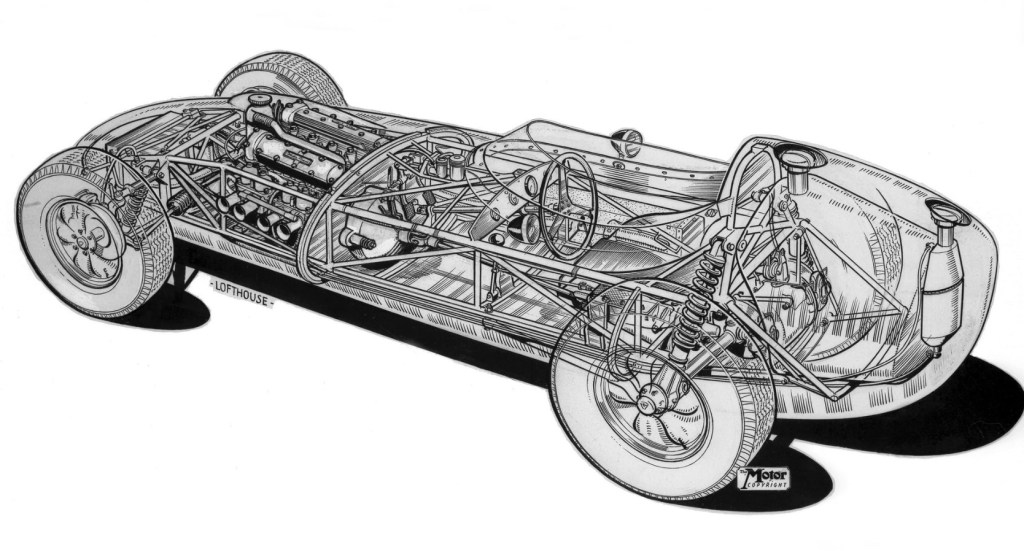
Lotus 16 Climax cutaway (Lofthouse)
(R Stuart)

Etcetera…

McLaren at Wigram in 1962, where he was fourth in his 2.7-litre Cooper T53 behind Stirling Moss’ Rob Walker Lotus 21 Climax 2.5 and the 2.7-powered Coopers of Brabham, T55, and John Surtees, T53…Happy Patty below.

(R Stuart)
(R Stuart)

Pop McLaren and who folks?

Credits…

Rosalie Stuart, Graham Woods Collection, Merv Knowles, Bruce McLaren Trust via Jim Bennett, Kelvin Brown, Milan Fistonic, National Library of New Zealand

Finito…

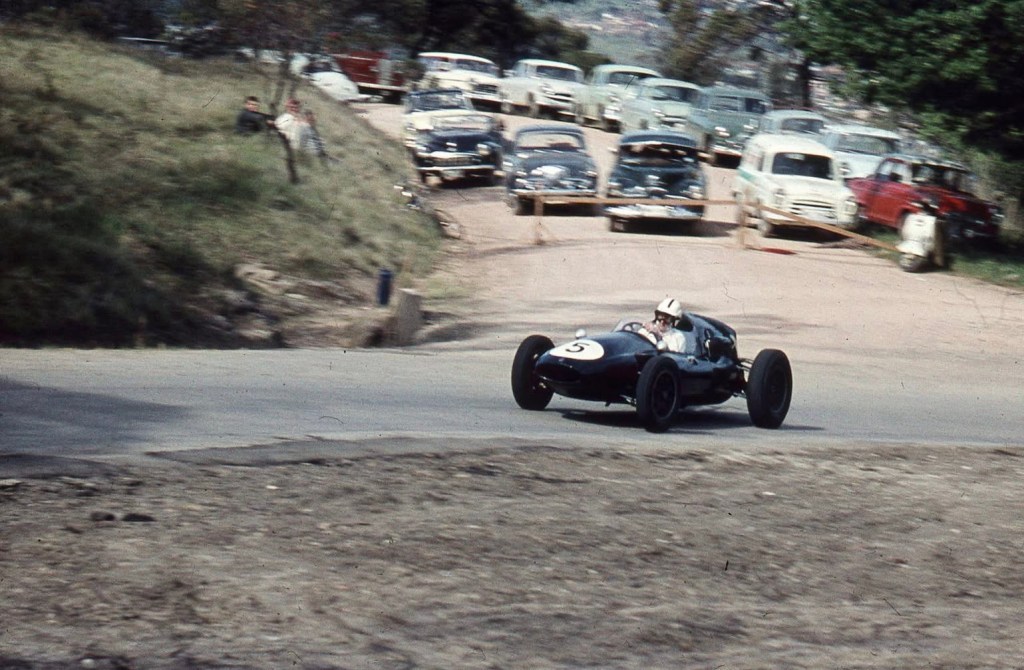
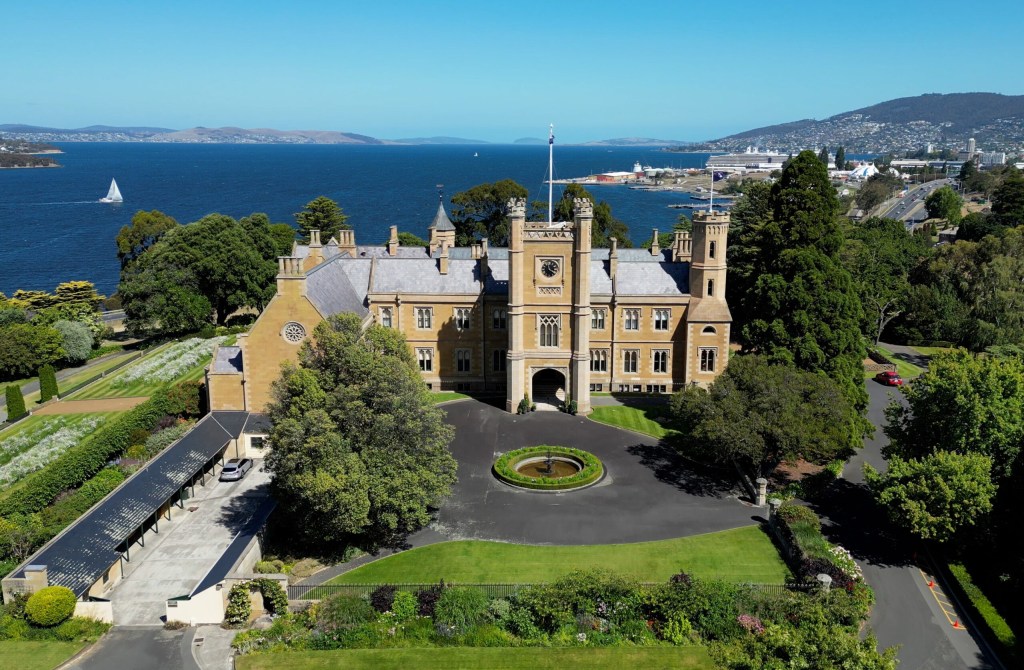
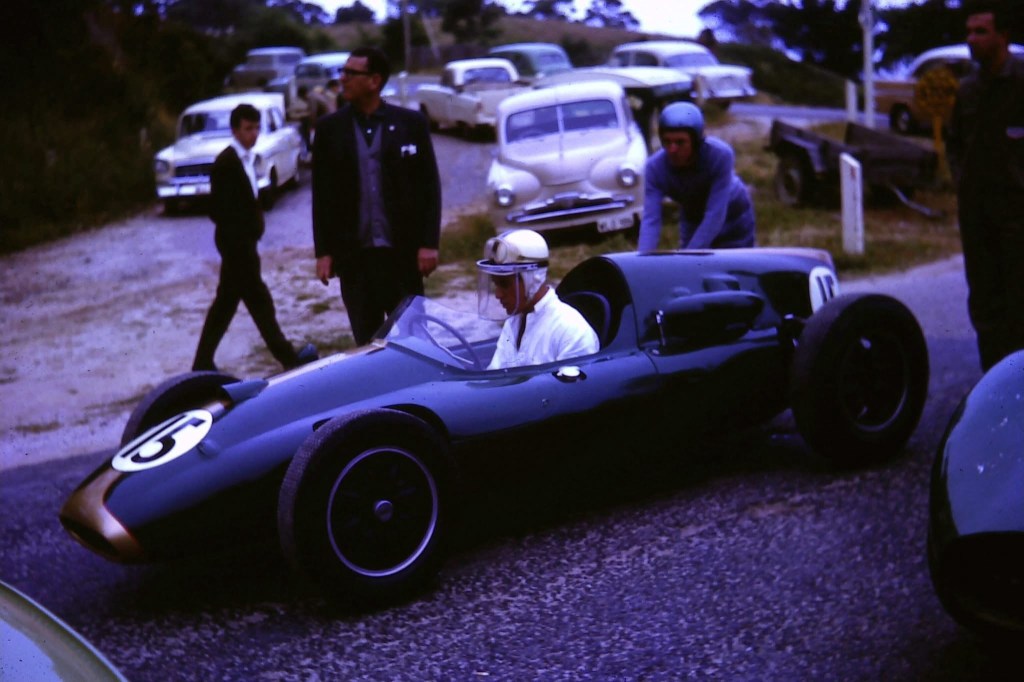
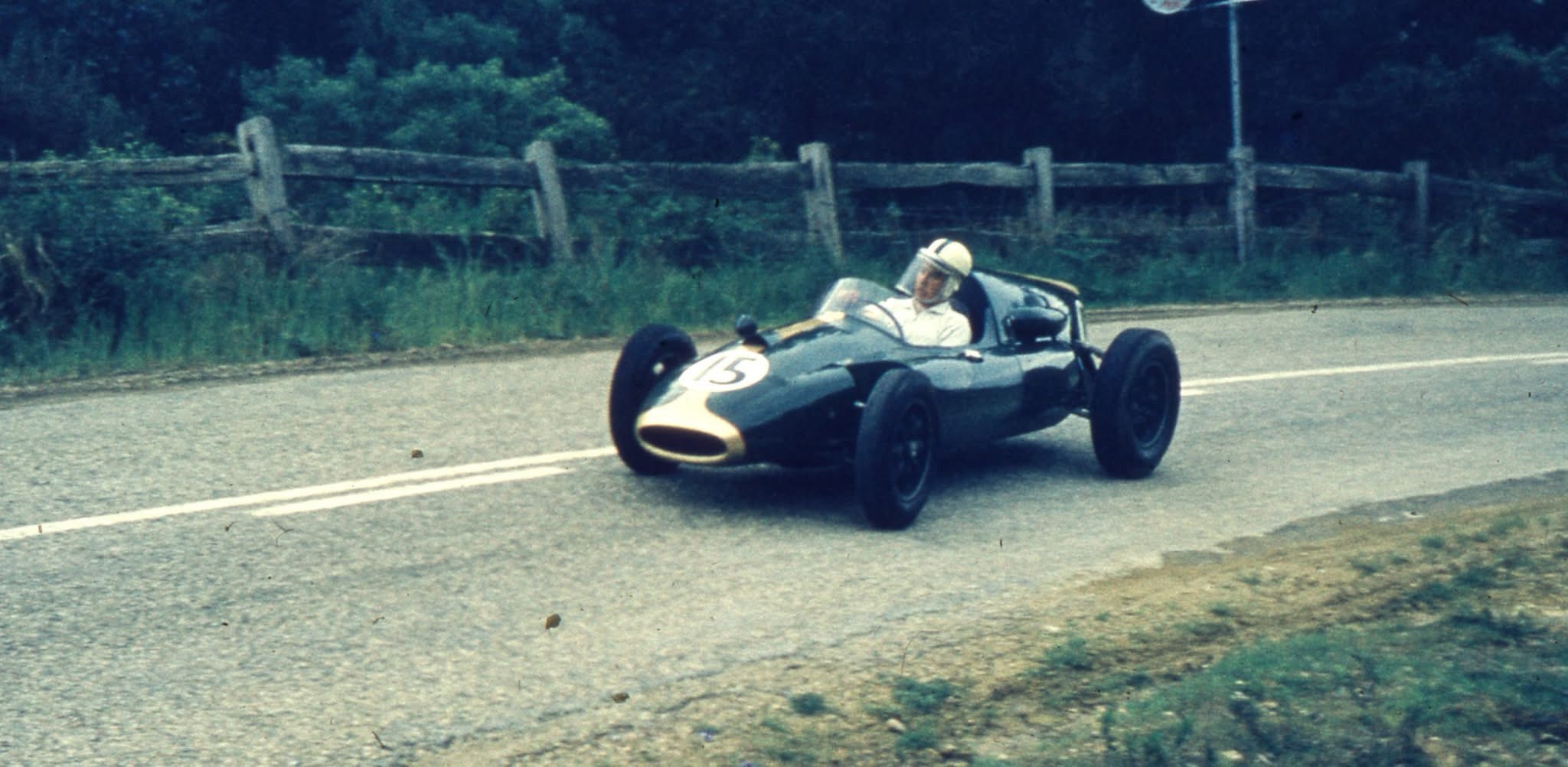
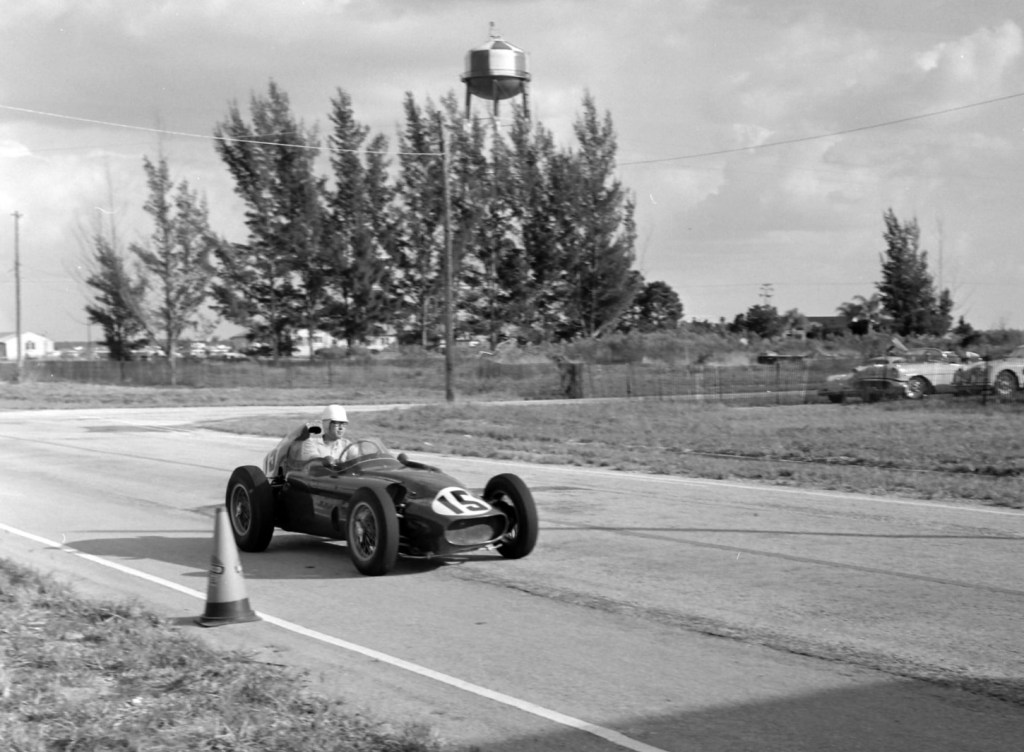
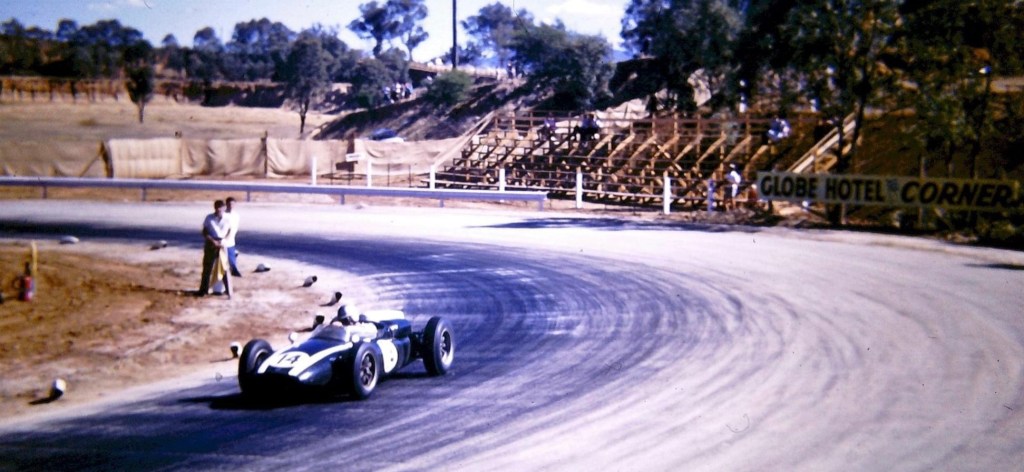
David Sternberg corrects a delicate slide in his Cooper T51 Climax at the Queens Domain hillclimb, Hobart, Tasmania, early 1960s. Date folks? As the name suggests, the locale contains the Governor’s Tasmanian pad.

I wrote about Lex and David Sternberg and this T51 a while back, see here:https://primotipo.com/2025/08/12/double-trouble/

Its a magnificent shot, photographer unknown, of a short-lived venue in central Hobart that was used from circa-1955-65. A modern event is held there. The climb was well regarded enough to hold the November 14, 1959, Australian Hillclimb Championship, which was won by the legendary Bruce Walton in his Walton Cooper.

Government House within the Queens Domain. Where are the hillclimb roads? Good question (Australian Gardens)
(G Brooks)

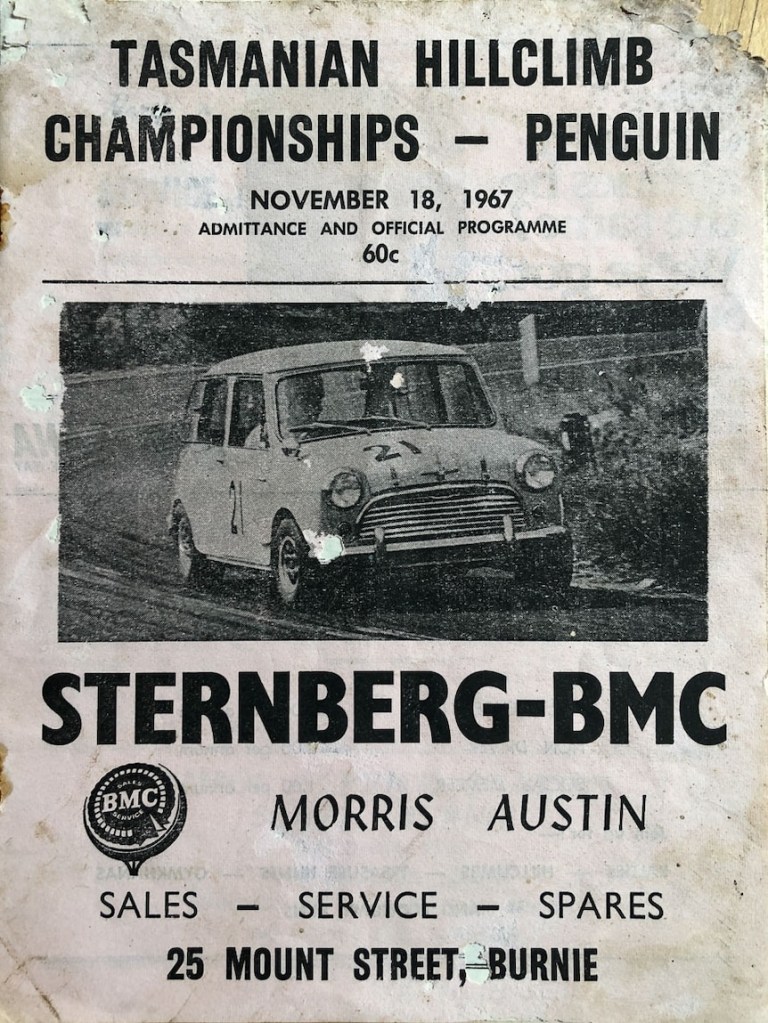
David Sternberg lines up the family Cooper at Penguin Hillclimb, on the island’s north coast at about the same time. That’s father Lex hanging onto the right rear.

Credits…

Grant Brooks, Australian Gardens

Finito…

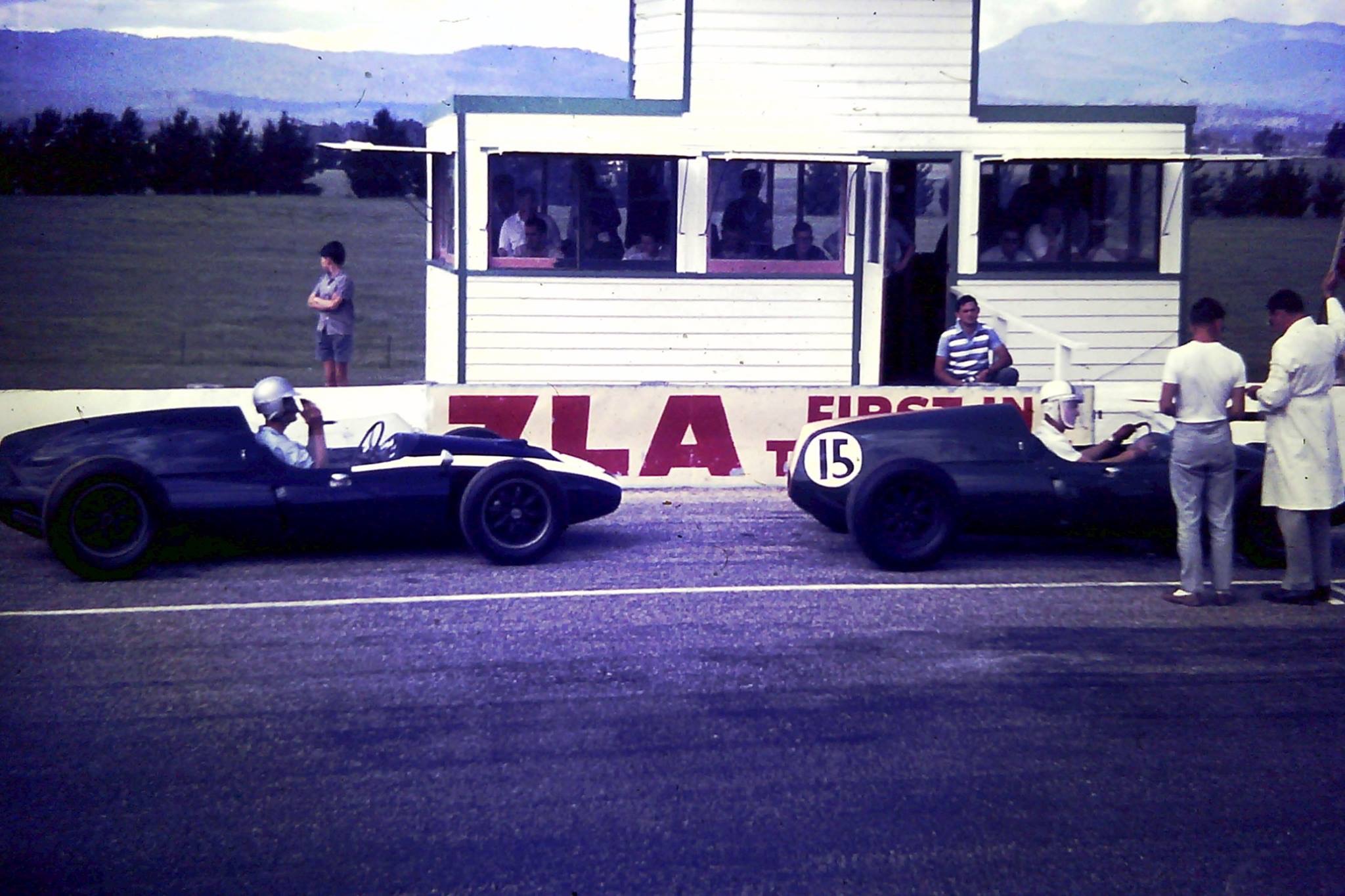
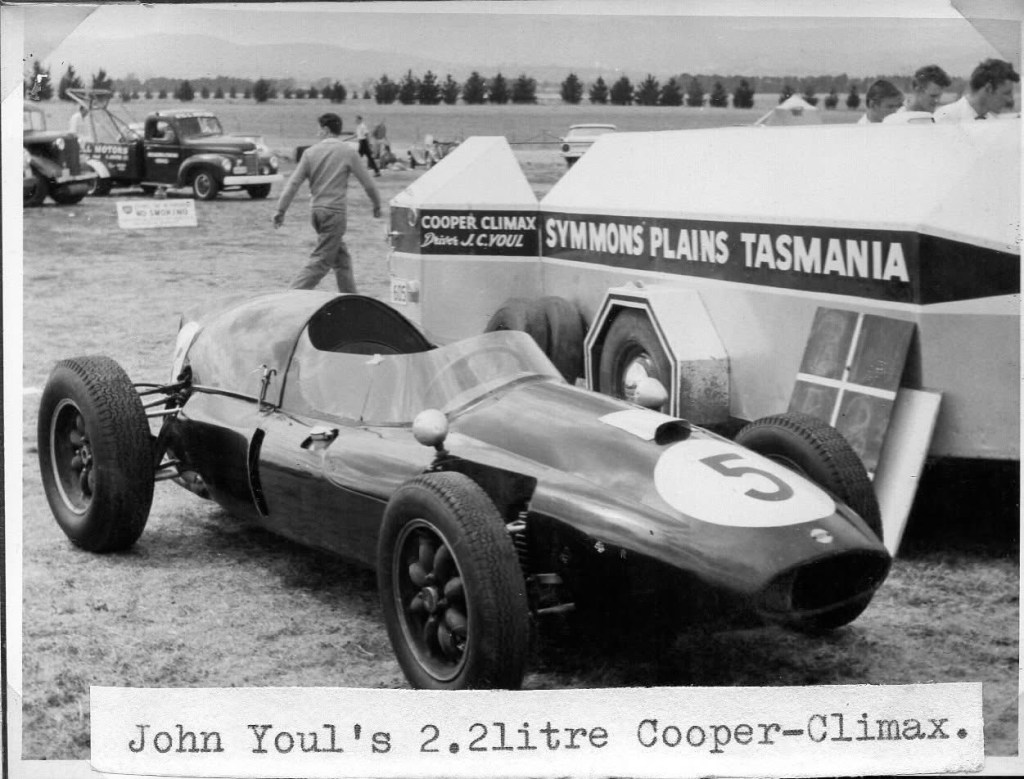
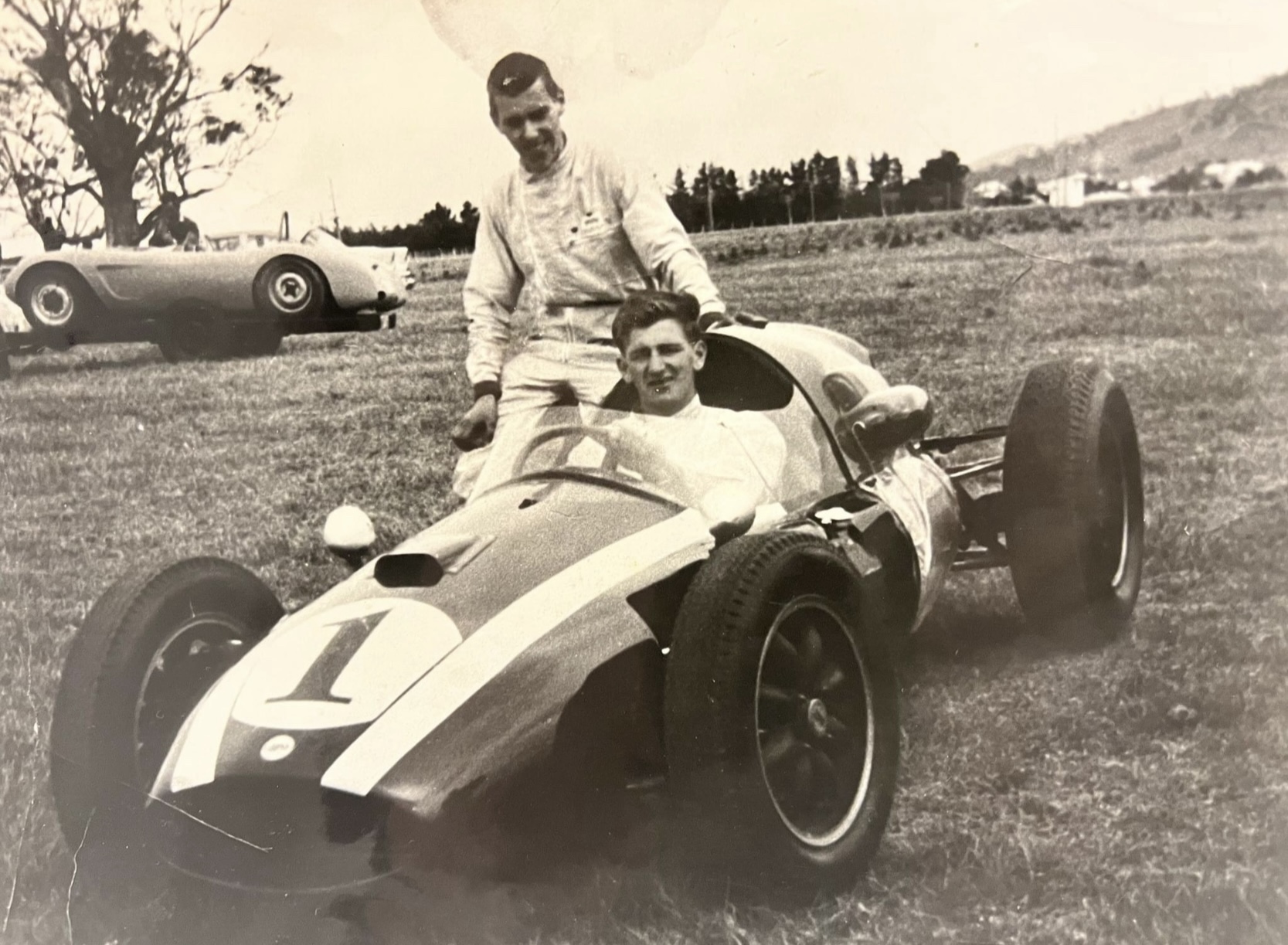
John Youl, left and Lex Sternberg aboard their Cooper T51 Climax’s at Symmons Plains circa 1961-62…

There were four of the eleven Cooper T51s that had ‘permanent residency’ in Australia, based in Tasmania for a while, this pair and those of Austin Miller. We know it’s before 15 April 1962 as Andrew ‘Slim’ Lamont tells us the Youl car passed to Jack Hobden then.

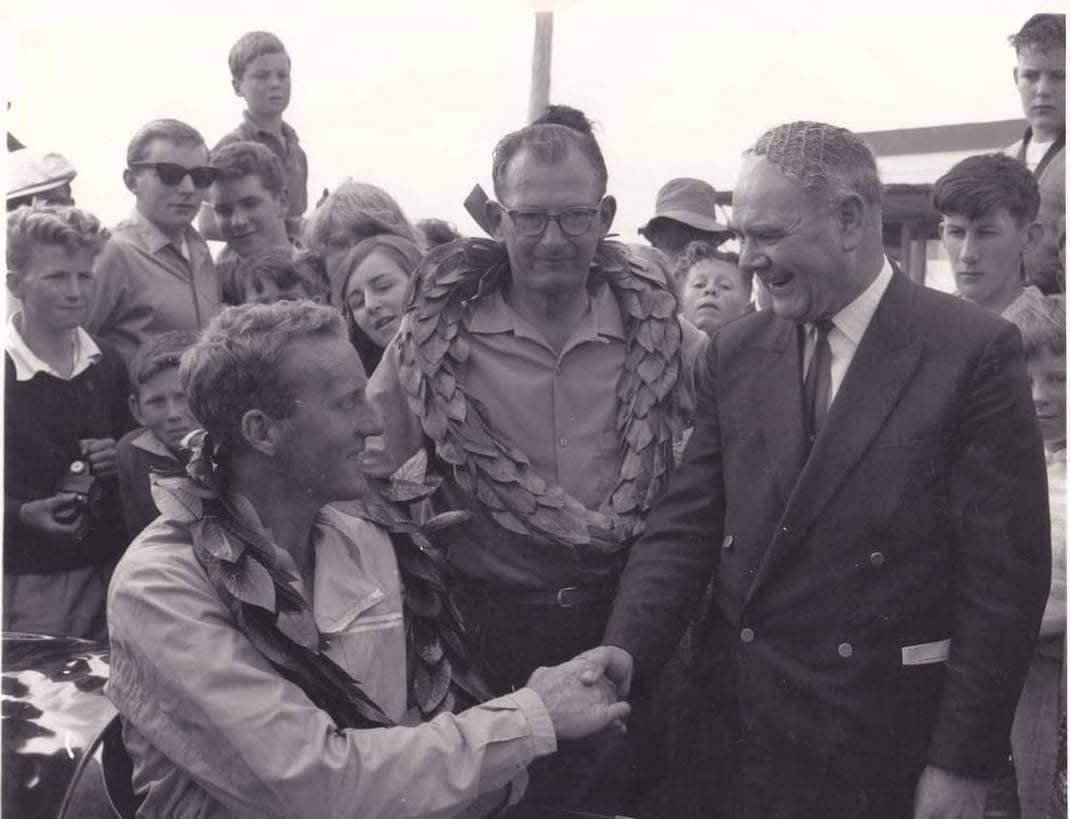
John Youl accepts the plaudits of the crowd and Tassie Premier, ‘Electric Eric’ Reece. Probably after winning the December 1962 Examiner £1,000 in the Cooper T51 (HRCCTas)
Symmons Plains 1961-62 (K Thompson Collection)
David Sternberg ascends Penguin hillclimb in the family T51, date unknown, but welcome, where is my copy of that book I wonder? (G Hartley)

Youl’s car history is simple, he says confidently, John acquired F2/9/60 new from the factory whereas Sternberg’s F2/7/59 or F2/9/59 was an ex-works 1959 car brought to Australia for Jack’s 1960 Summer Tour and then sold to Bib Stillwell after Bathurst 1960. Bib bought it to obtain the 2.5 Coventry Climax FPF with which it was fitted; they were as rare as Rocking Horse Poop in the colonies at that stage.

Bib raced it a few times, including Longford’s 1961 meeting before selling it to Burnie’s Lex Sternberg, both he and his son David raced it. The later ownership has the usual twists and turns of many of these cars, which is beyond the scope of this pictorial. Click here for The Nostalgia Forum thread in relation thereto, it’s content rich; https://forums.autosport.com/topic/150838-cooper-t51s-in-tasmania/

(R Lambert)

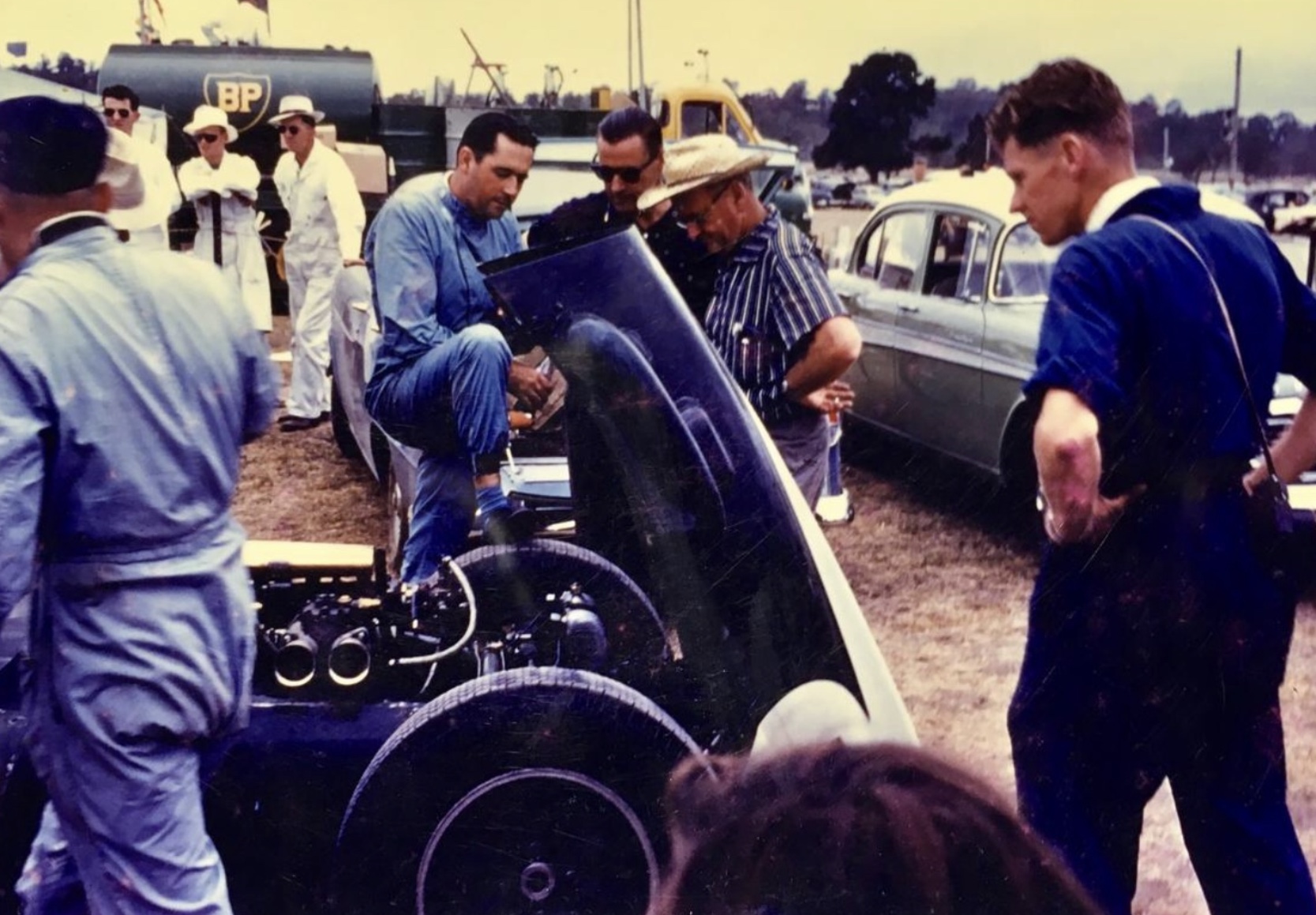
Jack with T51 F2/7/59 or F2/9/59 at Longford in March 1960.

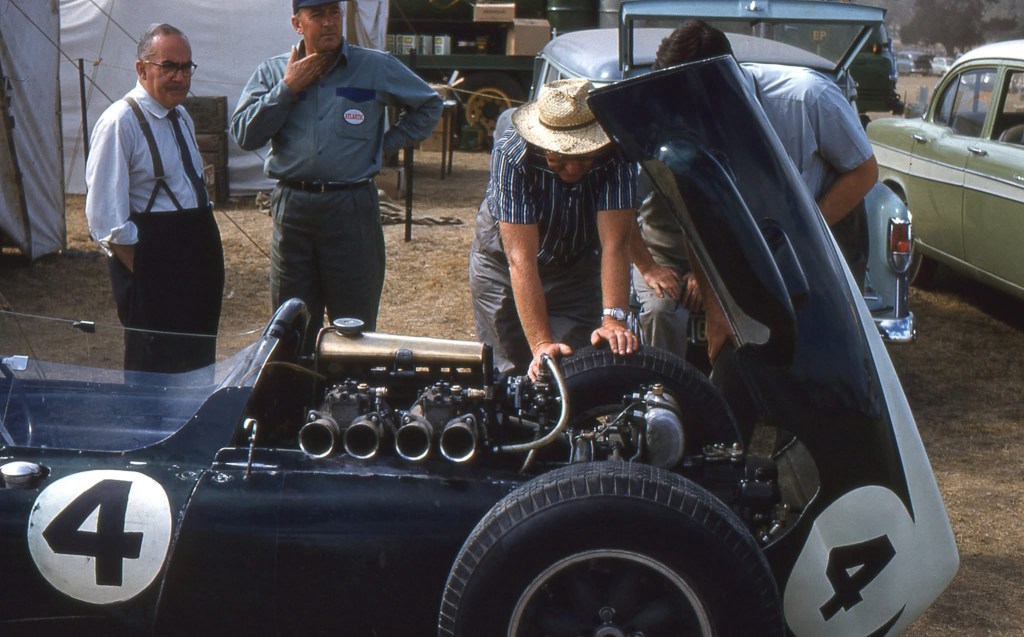
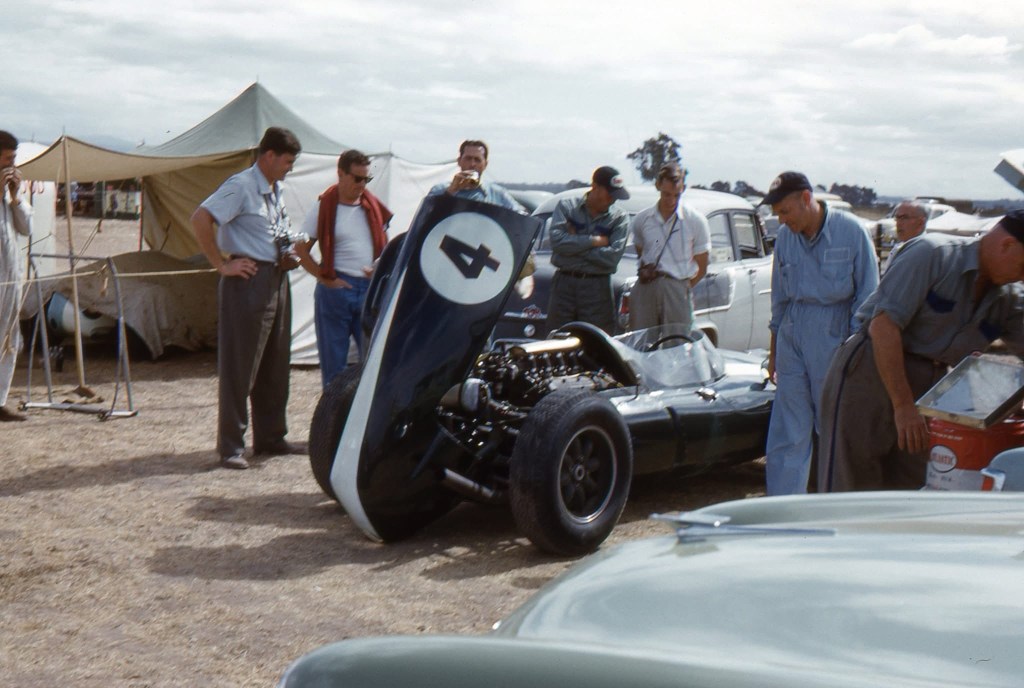
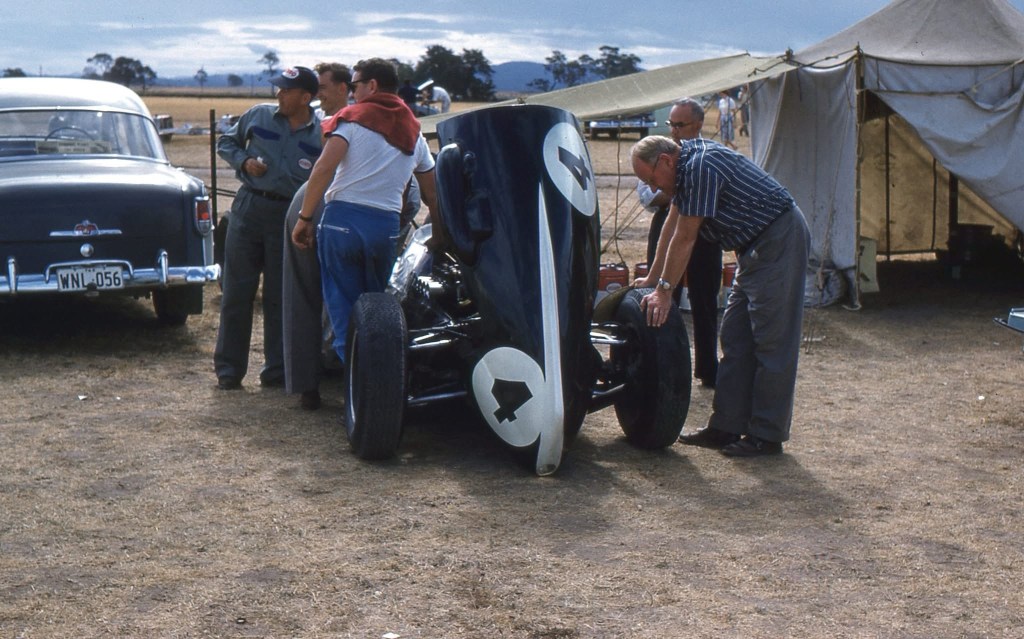
Brabham consorting with a couple of chaps during practice. Is that Alec Mildren in the straw hat or is my imagination running riot? Look at the monster mouths of those 58DCO Webers.

Jack had a good run with this car that summer winning at Ardmore – the New Zealand GP – and Wigram before shipping the car across the Tasman and was then victorious at Longford and Phillip Island in March, and then Bathurst in October.

Brabham won the March 5 Longford Trophy from Mildren’s Cooper T51 Maserati and Stillwell’s T51 Climax.

(unattributed)

Jack Hobden (30/8/1942-18/9/2022) aboard the ex-Youl F2-9-60 at Baskerville?

The defunct Longford Grand Prix Expo FB page wrote that ‘Jack was requested to represent Tasmania in the 1965 Australian Grand Prix at Longford by then Premier Eric Reece. Upon being told of a lack of finances, he funded Jack’s race.’

Hobden was 12th in the race won by Bruce McLaren’s Cooper T79 Climax from Jack Brabham and Phil Hill.

Etcetera…

(N Barnes)

Noel Barnes was prowling the paddock at about the same time as Ron Lambert!

(N Barnes)
(N Barnes)

Credits…

Historic Racing Car Club of Tasmania, Ron Lambert, G Hartley, The Nostalgia Forum, Ellis French, Andrew ‘Slim’ Lamont, oldracingcars.com, Greg Ellis Collection, K Thompson Collection, Noel Barnes

Tailpiece…

(G Ellis Collection)

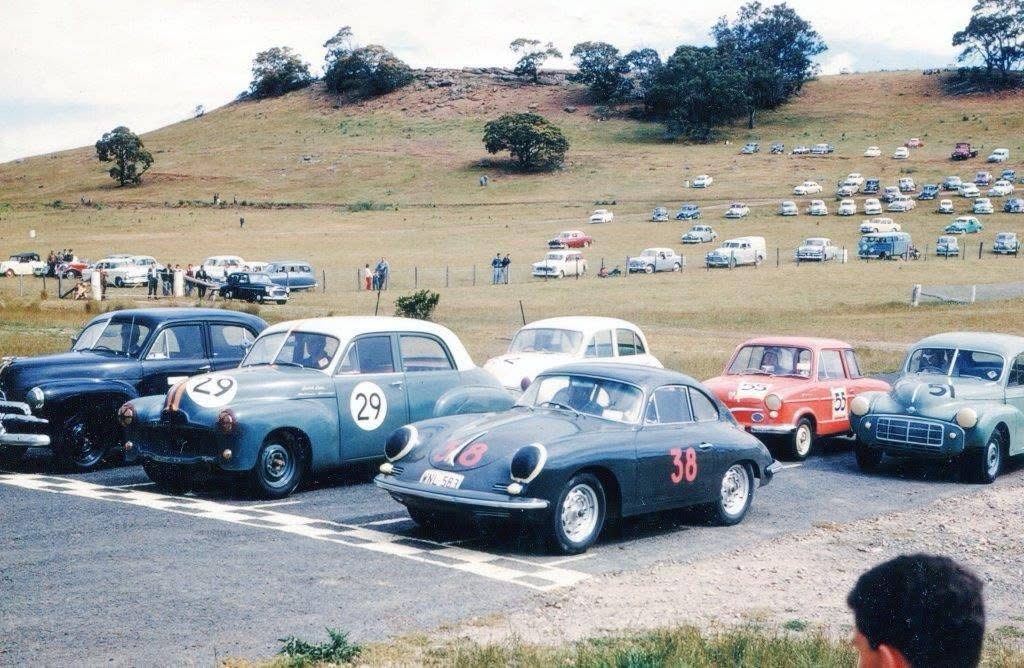
An early Baskerville grid containing two Youls, #38 Gavin’s Porsche 356 and #55 John’s NSU Prinz, #7 is Ross Larner, #29 David Lewis’ Humpy Holden, the white Morris Minor is Greg Ellis and #51 is Dick Crawford

Finito…

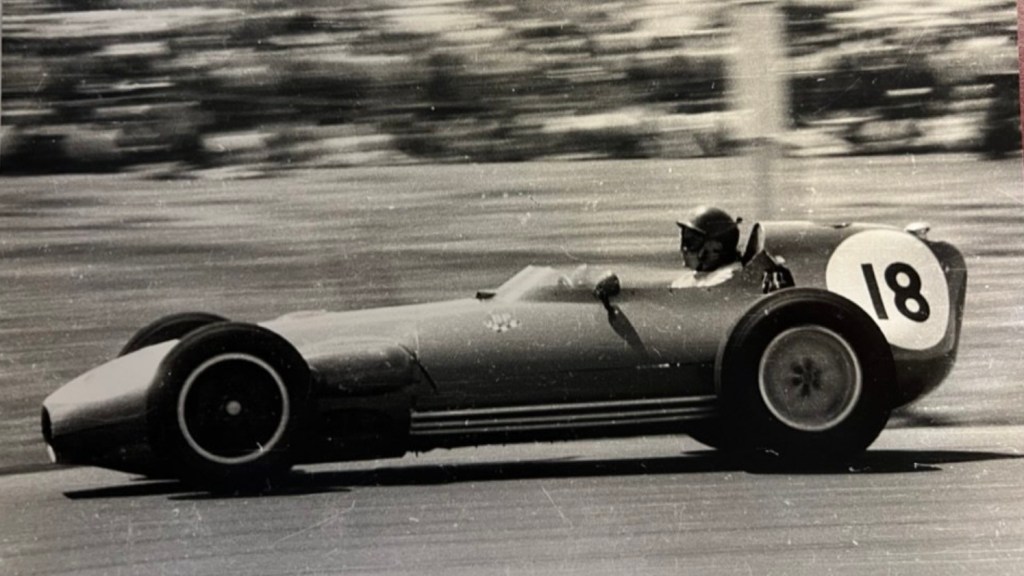
By 1957 Jack Brabham was getting the hang of this European racing caper, he was the winningest Formula 2 driver in in the winningest car that year.

Cooper’s Type 43 was powered by the brand-new 1475cc Coventry Climax twin-cam, two-valve FPF four-cylinder engine.

Coopers entered Jack in nine F2 races that year and he won five of them, most were blue-riband events too: the London Trophy at Crystal Palace, Prix de Paris, Montlhery, the Rochester Trophy at Brands and Oulton Park’s Gold Cup.

Motor Racing’s fantastic cover shot – very well-used down-the-decades and perhaps taken by Geoff Goddard – above was taken at Goodwood during the Woodcote Cup on September 28, where Jack’s teammate, Roy Salvadori triumphed in another works T43. Roy also won the BRDC International Trophy at Silverstone a fortnight before, other 1957 Cooper T43 winners were George Wicken and Tony Marsh.

The Haves in 1957 used a Cooper chassis and a Climax FPF engine, the rest made do with a Climax single-cam FWA or FWB engine and another chassis.

Funnily enough Lotus’ best ‘F2 result’ for the year was Tom Dickson’s victory at Snetterton on May 19 aboard a Lotus 11 FWA during a combined F2/sportscar race. The much vaunted, light, clever, gorgeous, front-engined, and fragile F2 Lotus 12 FPF (below) flattered to deceive: its best results were a second and a third placing for Cliff Allison in the Gold Cup, and Woodcote Cup respectively.

Lotus 12 Coventry Climax FPF to be precise

Other F2 winners in ’57 were Maurice Trintignant aboard a works Ferrari Dino 156 in the Coupe Internationale de Vitesse at Reims in July and Edgar Barth’s victory in the F2 race within a race, at the GermanGrand Prix at the Nurburgring in August aboard a Porsche 500RS.

That Dino spawned a series of V6 cars, race and rally engines that were still winning well into the mid-1970s.

By mid-1959 Brabham was looking a fairly complete professional…

Jack and (the works team) Cooper had just taken their first Grand Epreuve wins at Monaco on May 10, while Motor Racing’s cover above shows Jack on the way to victory in the BRDC International Trophy at Silverstone on May 2.

By then Brabham’s Cooper is a Type 51 and the engine a 2.5-litre FPF. The F2 youth of 1957 had grown into a dominant adult by 1959. It may have been a simple motor but it was oh-so-sweet.

See here for a long feature on Cooper Types 41/43/45/51/53: https://primotipo.com/2019/10/04/cooper-t41-43-45-51-53/ More about Jack in ’57: https://primotipo.com/2020/01/28/cooper-t39-climax-le-mans-1957-brabham-raby/

Motor Racing magazine, as the covers note, was the official organ of the British Racing and Sports Car Club. It succeeded Iota and was published from January 1954 to February 1970…bloody good too!

Credits…

Motor Racing magazines – fantastic they are too – many thanks to Bob King

Finito…

Jack Brabham from Bruce McLaren: a works Cooper T51/Climax 1-2 seemed likely for much of the race (MotorSport)

A thrilling race of course, Bruce McLaren took an historic win – as the youngest ever F1 championship GP winner, a title he held for yonks – after Jack Brabham’s Cooper T51 Climax ran out of juice on the last lap. Jack was fourth, Maurice Trintignant, Cooper T51 Climax was second and Tony Brooks, Ferrari Dino 246 was third.

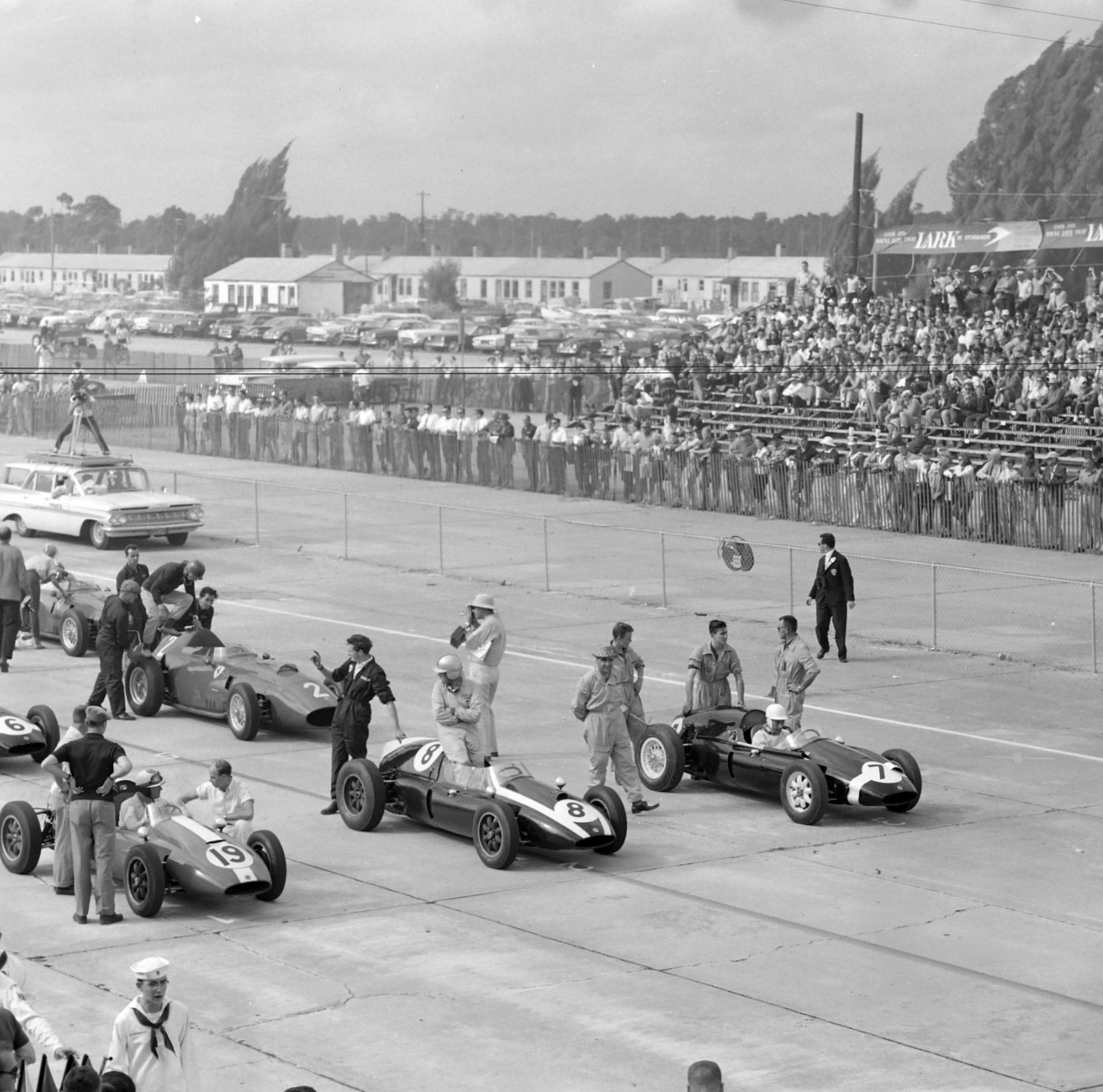
Just before the off, Harry Schell, Jack Brabham and Stirling Moss all aboard Cooper T51s on the front row; Harry controversially so as he had taken a short cut during qualifying! #6 is Maurice Trintignant’s Walker T51, #2 Tony Brooks’ Ferrari Dino 246 (MotorSport)

The Americans entered F1 etc – Indy being part of the F1 World Championship from 1950-1960 duly noted – but the interesting thing was the mix of cars. Not just Rodger Ward’s utterly nuts and utterly wonderful, Kurtis Kraft Offy, but also Fritz d’Orey’s Tec-Mec F415 Maserati, Allesandro de Tomaso’s Cooper T43 OSCA Streamliner and Bob Said’s Connaught C-Type Alta.

(MotorSport)
(MotorSport)

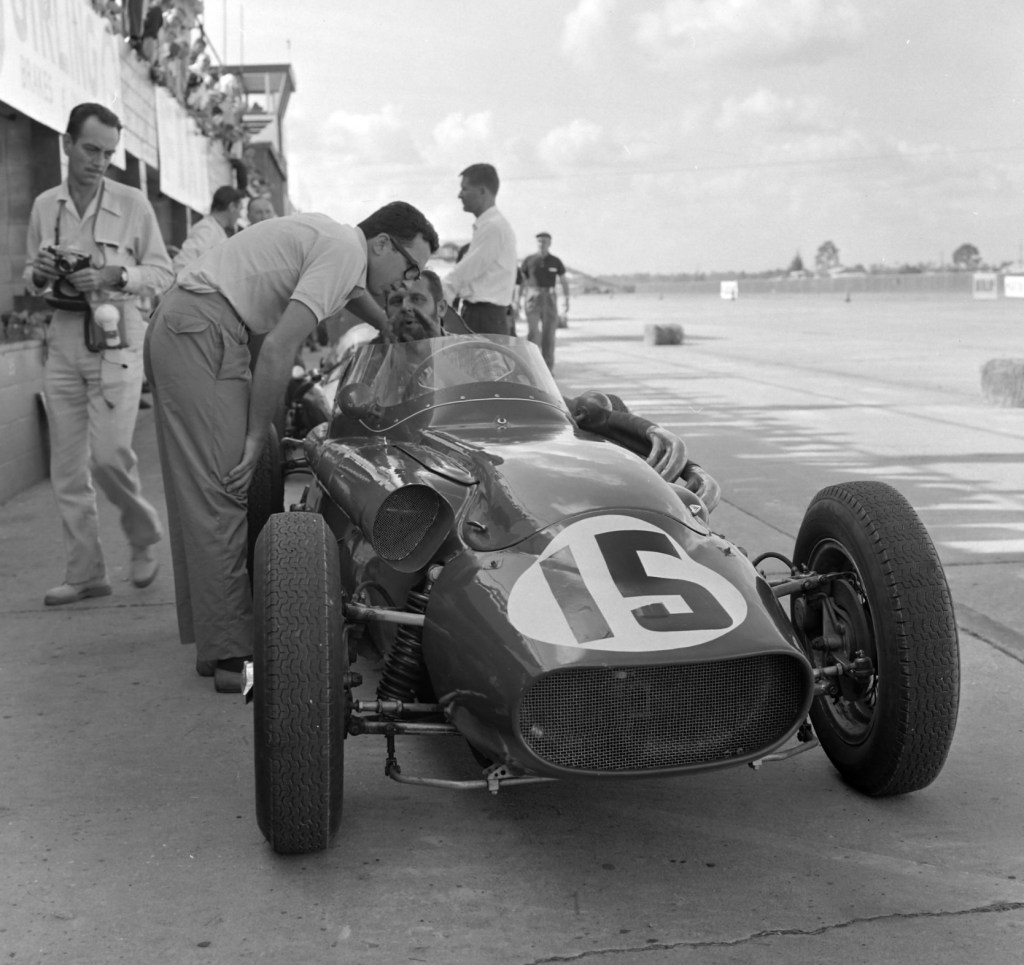
Fritz d’Orey in the one-off Valerio Colotti designed, Gordon Pennington owned Tec-Mec F415 Maserati at Sebring during practice.

Remember those days before carefully homogenised and pasteurised, hermetically clean and certified absolute sameness and dull-shit-boredom. Where did it all go wrong? See here for a story on this car: https://primotipo.com/2024/03/11/tec-mec-f415-maserati/

(MotorSport)

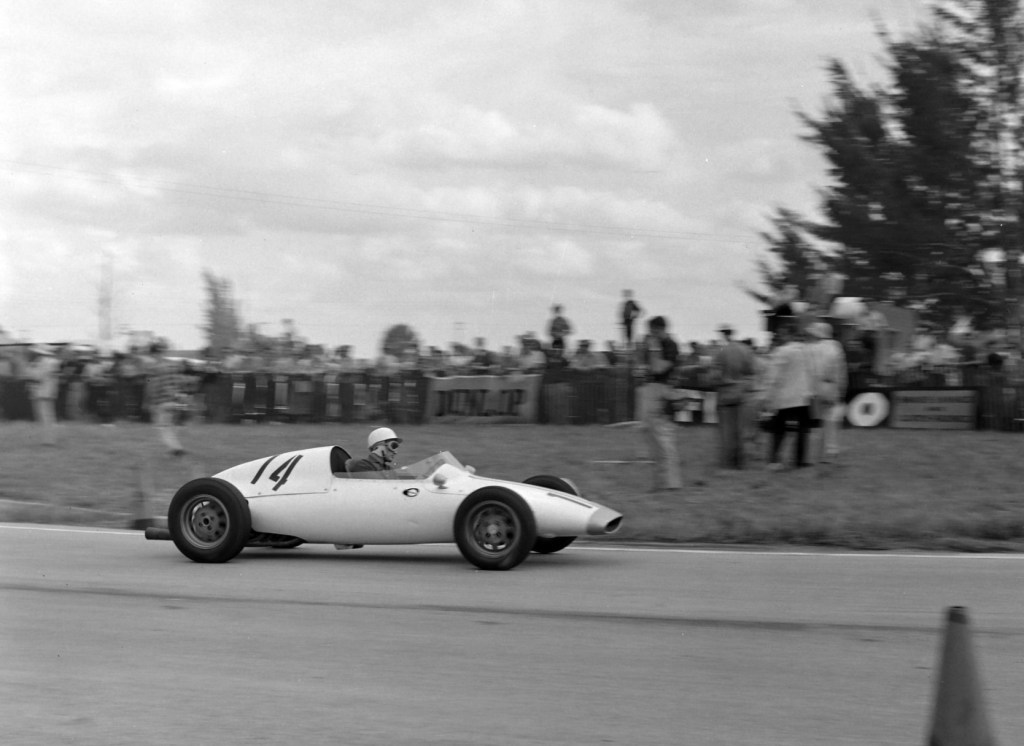
De Tomaso’s works Officine Specializate Costruzione Automobili entered Cooper T43 OSCA 2-litre was only ever going to be an also-ran given the modest displacement and endurance background its twin-cam, Weber fed four-cylinder engine. He qualified the car 14th on the 19 car grid and completed 14 laps before brake troubles intervened.

The car’s swoopy, beautifully finished and fitting body is far more attractive than any of the Coopers of that era, and more aerodynamically efficient? While said to be a Cooper T43, the chassis may be a copy, the wheels are also of De Tomaso’s design and manufacture. An interesting experiment, what became of the car?

(MotorSport)
(MotorSport)

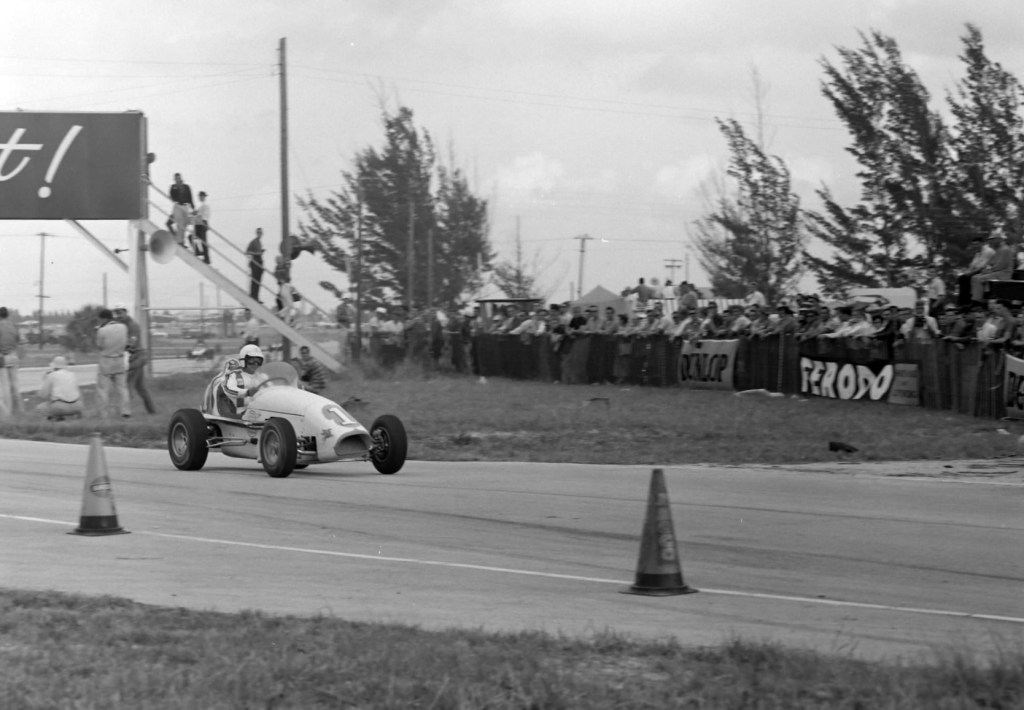
It made great commercial sense for the organisers to run the reigning Indy 500 champion, Rodger Ward, in the race. If you believe the hype, Ward thought his lightly modified Kuris Kraft Midget would give the ‘European Buggies’ a run for their money.

Jack Brabham related to Doug Nye, “The next day he, Bruce, and and I arrived together at the first corner of the track, and just as we jumped from brake to throttle pedal and streaked away from him he was astonished. To his credit he took it well.”

Ward’s qualifying time was well short of pole-sitter Stirling Moss in Rob Walker’s Cooper T51 Climax: 3 min dead vs 3 min 43.8 sec. Rodger lasted for 21 of the race’s 42 5.2-mile laps, getting as high as ninth as others retired, before clutch failure intervened.

A popular racer and a good sport, he became a Cooper convert overnight and worked on Jack and John Cooper to convince them to run a car at Indianapolis. After the 1960 US GP Jack ran his GP Cooper T53 Climax at Indy in a series of tests, aided and abetted by Ward; Coopers participation in the 1961 500 with a Climax powered Cooper T54 changed Indy history, and Rodger Ward played a key role.

(MotorSport)

Ward’s 1946 Leader Card Kurtis Kraft Midget, chassis #0-10-46 was powered by a 1.7-litre, DOHC, two-valve Offenhauser engine that gave away heaps of performance to the mainly 2.5-litre competition. It had a two-speed gearbox, a two-ratio rear axle, hand-disc-brakes and the usual other dirt-track accoutrements! Those Halibrand wheels are 12-inches in diameter and Firestone provided the tyres.

The beam front axle is sprung by a transverse leaf and located bt two radius rods. I’ll take your advice on shock-absorbers. Note the front discs, nerf protection in front of the rear wheels and high standard of preparation and presentation.

(MotorSport)

Jesse Alexander observed the following about the Kurtis Kraft in his Sports Cars Illustrated meeting report.

“The greater part of the two practice sessions was spent getting the car to run properly on Avgas (rather than the usual methanol). The several times that it did appear on the circuit it was obvious that the few modifications to the chassis to suit it better for road racing were worthwhile. Surprisingly stabile and getting through many of the corners as fast (in some cases faster) as much of the field.”

“The red and white Offy differed from normal midgets in having its engine fitted several inches farther forward in the chassis as well as having a supplementary 2-speed transmission installed. This meant that actually there were two 2-speed units, one behind the engine and the other in unit with the final drive gears. But these alterations could never possibly make up for the displacement gap between the parky Midget and her overseas competitors.”

“Rodger Ward deserves credit for his spirit and enthusiasm – it was great to see him at Sebring and lets hope it won’t be the last time out for an Offy-engined car.”

I wrote about the Valerio Colotti designed Giuseppe Console built Tec-Mec F415 Maserati – ‘the ultimate expression of the Maserati 250F’ – a while back, see here: https://primotipo.com/2024/03/11/tec-mec-f415-maserati/comment-page-1/

By late 1959 the car was owned by Florida man Gordon Pennington, he decided to enter the machine for its one-and-only race at Sebring.

With Brazilian wealthy-journeyman Fritz d’Oley at the wheel, the new car, being run for Pennington and D’Oley by the Camoradi Team, managed to qualify 16th, one grid-slot in front of the only 250F in the race driven by Phil Cade.

The Tec-Mec completed 7 laps before an oil leak forced Fritz’ withdrawal, while Cade didn’t take the start given the old-gal’s lack of pace: 3 min 39 sec in qualifying. While Tony Brooks’ front-engined Ferrari Dino 246 was third, and the Dinos raced on into 1960, Ferrari wheeled out a mid-engined prototype at Monaco that year.

Fritz d’Orey, Tec-Mec F415 Maserati during the race. “The Tec-Mec was never driven quickly enough to show up any defects. The only time we know of it being driven fast was when Jo Bonnier took it around the Modena Autodromo last summer. His comments were not all that favourable. He complained of, among other things, a flexing chassis.”

Fritz d’Orey, Tec Mec F415 on the hop (MotorSport)
Bob Said in the Connaught C-Type Alta. Unusual and attractive body, Dunlop alloy wheels (MotorSport)

A bit like the Tec Mec, the Connaught C-Type Alta (chassis #C8) was also stillborn.

Rodney Clarke’s spaceframe chassis, disc braked, strut/De Dion tube rear suspension, double wishbone front suspension, Alta DOHC, two-valve four powered, Wilson pre-selector ‘transmissioned’ vast improvement of Connaught’s successful B-Type was tested but unraced when the assets of Connaught Engineering were sold in 1957.

Passed in at the auction, #C8 was later sold to Paul Emery (of Emeryson fame) and “keen amateur racing driver John Turner”. They soon did a deal with American driver, Bob Said, to race the car at Sebring.

Inevitably, shipping delays meant the project was knee-capped from the start. Poor Said had little testing time, with fuel injection difficulties adding to the challenge. He qualified the car a great 13th in the circumstances but had clutch problems in the race and then crashed it when he was caught out by the Alta engine’s erratic throttle response without completing a lap.

Jesse Alexander wrote, “The Connaught with Bob said driving drew many interested onlookers. This was the first racing appearance of the space-framed car that was under construction back when Connaught decided to cease building and racing cars. They never sold this one, which embodies many novel design features like a telescoping de Dion tube and servo-operated Lockheed disc brakes. Paul Emery got it running well enough for Said to turn a 3:27.3sec practice lap.”

Connaught C-Type #C8 in-build at Send. Note Alta engine and spaceframe chassis which looks very torsionally stiff in this photo and the one below. Double wishbone IFS and bespoke? uprights. Who are they folks? (W I’Anson Ltd)
Dunlop wheels, diff clear but not the strut/De Dion arrangement. It all looks thoroughly modern and light, Wilson pre-selector box more weighty (W I’Anson Ltd)

While outside the scope of this article, the car was repaired back at the Send factory, near Guildford. With six inches added to the wheelbase, cut-down bodywork, a push-bar, and the Alta fuel injected engine tuned to 260bhp on methanol, Jack Fairman attempted unsuccessfully to qualify the car for the 1962 Indianapolis 500.

It’s such a shame this Connaught didn’t contest Grands Prix in 1957 as planned…

C8 was sold via a Road & Track ad and then lived in a private California museum from late ’62 until 1974 when Rodney Clarke repatriated the car to the UK. In another Tec Mec similarity, the car has been an historic racing front runner for decades, initially in Indy LWB spec and since the late 1990s in its original GP specifications.

Stirling Moss in the Walker Cooper T51 in front of the seventh placed Harry Blanchard’s Porsche RSK and Taffy Von Trips’ Ferrari Dino 246, sixth (MotorSport)

Stirling Moss’ Rob Walker Cooper started from pole but was out after only five laps with Colotti gearbox failure.

Alf Francis had modified the rear suspension from the standard Cooper transverse leaf setup to coil springs and ‘wishbones’ as shown in the shot below.

Jesse Alexander explains, “The new rear suspension had been tried out in the Fall back in England. Stirling liked its feel, then proved it by bettering the Goodwood lap record. Wire wheels at the rear, and the Colotti five-speed transmission were the only major differences bwtween the Walker cars and the works cars of Brabham and McLaren.”

(MotorSport)
(MotorSport)

Bruce McLaren – with Jack in front of him – demonstrates the geometry of the standard T51 transverse leaf layout (at Sebring) where said spring performs that task, and locational duties. The 1960 Cooper Lowline (T53) quickly concocted by Messrs Cooper C, Brabham, McLaren and Maddock after the first race of the year, included among its successful bag-of-tricks a coil sprung rear end.

(MotorSport)

McLaren enroute to victory above. Alexander tells us that Brabham had initially practiced this car but “it had experimental settings for 1960” and Jack didn’t like the feel of it, so he and Bruce swapped chassis. “McLaren had not even expected to race at Sebring when I spoke with him in England in October. He expected to be in New Zealand for Christmas and participate in their Grand Prix. As it turned out, Masten Gregory’s injuries failed to heal in time for him to race at Sebring and Bruce replaced him.”

Didn’t fate play a couple of hands in Bruce’s favour!

(MotorSport)

Credits…

MotorSport Images, Jesse Alexander in Sports Cars Illustrated March 1960 via Stephen Dalton’s archive, William I’Anson Ltd

Tailpiece…

(MotorSport)

Just luvvit…

Finito…

(Draper Family Collection)

One upon a time Grand Prix drivers weren’t paid fees that make the GDPs of third world countries look small.

I guess that over 20 Grands Prix and the associated test and race-simulation loads keep them busy, the rest of the time is devoted to the body-beautiful, PR and the needs of the girl/boyfriend.

At the dawn of the space-age, wily Jack Brabham worked all the angles to optimise his earnings, short and perilous as it was in the days when drivers died in the cockpit as a matter of routine.

John Cooper paid him a retainer and a percentage of his winnings. He ghosted magazine articles, had a motor garage and dealership or three, drove cars for others and owned and entered cars for himself and others. That’s how he found himself in the New South Wales/Victorian border-town of Albury, on the Murray River, for the Craven-A International at the small, new, Hume Weir circuit over the March 12/13 1961 weekend.

(Draper Family Collection)
(G Garth)

That summer he’d brought a Cooper T53 Climax (chassis F2-8-60) and Cooper T51 Climax (F2-5-57 or F2-7-59) home to do the Kiwi and Australian Internationals.

He did pretty well too, winning the New Zealand Grand Prix on the Ardmore aerodrome and the Lady Wigram Trophy on the RNZAF base of the same name in the T53. Ron Flockhart that car on pole at Ballarat, and finished third, while Ron’s best with the Cooper T51 was fourth at Ardmore and fifth in the Warwick Farm 100 where Stirling Moss won the first international held on the great Sydney track aboard Rob Walker’s Lotus 18 Climax.

(J Richardson)

Roy Salvadori – who had raced a Reg Parnell Lotus 18 in New Zealand that summer – took the wheel of the Cooper T51 in Tasmania, winning the Longford Trophy (above) but his weekend wasn’t so successful in Albury where he was fourth in the Saturday 20-lapper, and failed to finish the equally hot Sunday race. Brabham won both races in the T53 in skinny six/seven car grids.

Our Jack dragged in he crowds, doubtless Craven A sold a few cancer-sticks, so everybody went home happy. Brabham always flogged the cars he brought to Australia at the end of his tour but on this occasion both Coopers returned to the UK and equally oddly both disappeared into the ether later in the year.

(Draper Family Collection)

Credits…

John Richardson, Draper Family Collection, Glenn Garth, oldracingcars.com

Tailpiece…

(Draper Family Collection)

Roy Salvadori reflecting on the size of his ‘Gregory Peck’ at the Weir while entertaining the crowd, announcer’s name folks?

Finito…

(L Stringer)

After Jack Brabham won his second World Championship on-the-trot at Boavista, Portugal in late August 1960 he returned to Australia between the Italian and US Grands Prix (Riverside that year) to contest the Craven A International, a one-off race sponsored by a cigarette company, at Mount Panorama on October 2.

The great one raced a Cooper T51 Climax 2.5 (perhaps chassis #F2-4-59) to a convincing win from the similar cars of Bill Patterson and Bib Stillwell, albeit their cars were powered by 2.4-litre and 2.2-litre Climaxes respectively.

Jack takes his slot on the dummy grid, car #10 is John Roxburgh’s Cooper T45 Climax, DNF accident (L Stringer)
Brabham in Cooper T51 #1, #2 is Mildren’s Maserati engined T51 and #4 is Stan Jones’ T51 Climax, DNF accident (L Stringer)

Brabham started from pole and won by 36 seconds. Coopers occupied the first five places of nine finishers in a field which included such pre-War ancients as Tom Sulman’s Maserati 4CM and Frank Elkins Holden engined Bugatti Type 37.

Australian motor racing was still in transition – very quickly – to the modern mid-engined era.

(L Stringer)
Brabham takes the plaudits of the crowd and ‘snappers. Jumper, or perhaps a cardigan over the top of his overalls indicates a chilly Spring Bathurst day! (L Stringer)

These photographs posted by Leigh Stringer on social media this week beautifully capture the vibe and feel of that long ago weekend at Bathurst.

The Gold Star (Australian Drivers Championship) had been won by Alec Mildren’s Cooper T51 Maserati that year, he won four of the seven championship rounds. This Bathurst event wasn’t a title round, but it didn’t stop 28 cars starting the race, and even more entering it, such was the attraction of racing on the same grid as our Champ!

Credits…

Leigh Stringer, oldracingcars.com

Tailpiece…

(L Stringer)

No shortage of Esso capped assistance for Brabham, perhaps Tom Sulman’s Aston Martin DB3S behind? Where is John Medley’s Bathurst Bible when you need it, not here with me in the UK at the moment?!

The end of this story has information on the Cooper T51s in Australia, it draws together the results of 15 years of research by several marque experts; The Naughty Corner ‘Renta’ GP Winner… | primotipo… and this one may be of tangential interest, Coopers Type 41-51; Cooper T41/43/45/51/53… | primotipo…

Finito…

(Nat Lib NZ)

Who is a pretty boy then? youthful too…

Bib Stillwell poses for the camera during the 1961 New Zealand Grand Prix meeting at the Ardmore Aerodrome, South Auckland. Bewdy’, nice cockpit shot of Stillwell’s Aston Martin DBR4/250 i thought- but upon closer inspection the negative is wrongly marked, it is not 1961 but  actually two years before- 1959 or three, 1958 or perhaps even four, 1957 and Bib is aboard his Maserati 250F. Evidence includes the different screen, see the Aston’s below, fuel filler located in different spots and the Maserati cloth badge on Stillwell’s polo-shirt, you can just see a glimpse of that under Bib’s left wrist/glove.

In 1959 Bib finished sixth behind the three Cooper T45s of Moss, Brabham and McLaren and the 250Fs of Carroll Shelby/Harry Schell and Ross Jensen.

Stillwell Maserati 250F, chassis ‘2516’ circuit unknown (Stillwell)


(TRS)

This time it is the Ardmore paddock in 1961 with Bib’s Aston Martin DBR4/250 ‘3’ taking centre stage.

To the left is the nose of the Glass Cooper Maserati, the #12 Maserati 250F is Stan Jones’ Maserati 250F raced by David McKay that weekend- DNF exhaust after completing 45 laps. The Cooper T51 in the right-rear corner of the shot is Jo Bonnier’s, the gearbox of which, repaired after practice, soiled itself again in the race after completing only half of the first lap. As to the Cooper T43(?) to the right, i shall take your advice. See this piece on the Aston Martin DBR4/250; https://primotipo.com/2020/05/08/aston-martin-dbr4-250/

Bib, sharing, almost alternating the mid and front engined collection of cars in his Kew, Melbourne workshop raced one of his Coopers the year before- 1960.

Check him out below running in fourth place just after the start behind the McLaren Cooper T45, Moss and Brabham Cooper T51s- Bib in #6 is similarly mounted as is the partially obscured car of Ian Burgess behind the Victorian.

#18 out left is David Piper’s Lotus 16 Climax, #17 is Johnny Mansel’s Maserati 250F, followed by the similar cars of Arnold Glass and obscured Ross Jensen #88 the Ron Roycroft Ferrari 375 V12- Stan Jones Cooper T51 is nipping inside the unmistakable nose of the Ted Gray driven wonderful Tornado 2 Chev. What a shame Lou Abrahams and Ted Gray didn’t take Tornado to New Zealand in 1958 and 1959, by 1960 it was well and truly all over red-rover for the big, front-engined beasties.

Brabham won from McLaren, Stillwell and Stan Jones aboard another T51.

A bit about Bib Stillwell here; https://primotipo.com/2015/03/10/bib-stillwell-cooper-t49-monaco-warwick-farm-sydney-december-1961/

(E Sarginson)


(TRS)

Love this shot above, this time 1961 of one of the Rob Walker mechanics- is it Mal Simpson?, giving the lovely Rob Walker Lotus 18 Climax a bit of a whirl on one of Ardmore’s access roads.

I never bought the ‘biscuit box’ descriptor of the 18’s appearance, i’ve always thought they were sexy little things, far nicer than the Cooper T53, the only thing between Lotus world dominance in 1960 was the pox ridden Lotus sequential gearbox…without doubt they were the fastest tool of the year but far from the most reliable, an attribute Messrs Cooper, Maddocks and Brabham worked very hard to build into their new ‘Lowline’.

The NZ GP was won by Brabham from McLaren both aboard Cooper T53s from Graham Hill’s BRM P48.

Credits…

National Library of New Zealand, ‘TRS’- The Roaring Season, Euan Sarginson, Stillwell Motor Company, sergent.com

Tailpiece…

(E Sarginson)

First corner Ardmore Airfield 1961 shot by Euan Sarginson.

Ron Flockhart, Cooper T51 from #7 Moss, Lotus 18, Bruce McLaren’s Cooper T53 with Brabham right behind Bruce in another T53, then Innes Ireland #1 and John Surtees #2 aboard works Lotus 18s- all of these cars Coventry Climax FPF powered.

#20 is the Denny Hulme Cooper T51 Climax from Graham Hill, BRM P48, then finally the two Australians, Bib Stillwell’s Aston Martin DBR4 and Arnold Glass’ Cooper T45 Maserati.

Sixty-five thousand Kiwis basked in marvellous summer sun and saw Brabham win from McLaren Hill, Flockhart, Hulme and Clark- it was Jack’s third win at Ardmore.

Finito…

(P D’Abbs)

Beautiful Peter D’Abbs photograph of Lex Davison’s Aston Martin DBR4/250, chassis #1 3-litre with Austin Miller, Cooper T51 Climax in the background, Phillip Island, 23 October 1960…

Lex became famous for his retirements from racing and Dame Nellie Melba type returns to the grid. His 1958 AGP win at Bathurst was the final time he raced the marvellous ex-Ascari/Gaze Ferrari 500/625. He took a break from racing, but heading into 1960 he planned to take a holiday in Europe with his wife Diana, and to acquire a new racer.

He had watched the ‘Cooperisation’ of Australian racing from the sidelines and decided that a modern incarnation of his (ex-Moss 1954 AGP winning) HWM Jaguar would be competitive with the growing number of mid-engined cars.

Lex pitched the idea of a DB4 3.7-litre engine fitted to a DBR4 GP chassis to Aston Martin Racing Manager John Wyer. Wyer assured him the motor wouldn’t readily fit and that the David Brown five-speed transaxle, already marginal, would be pushed beyond its limits.

After plenty of argy-bargy Lex did a deal to buy DBR4 chassis #1 fitted with a 3-litre DBR1 sportscar engine, and a DB4GT road car. A rather nice combination of roadie and racer!

After the cars rebuild in March 1960 it was tested at Goodwood by Jack Fairman, and Roy Salvadori over two days before shipment to Port Melbourne. Davison drove the car on the second of the days to within a fraction of a second of Fairman’s best.

Chassis 1, unsurprisengly the first of the DBR4s built, was raced by Salvadori during the 1959 and four times in 1960.

After an initial test session with Allan Ashton and the AF Hollins crew at Phillip Island Lex raced it to THAT missed-a-win-by-a-bees-dick Australian Grand Prix at Lowood on 12 June. There, Alec Mildren’s Cooper T51 Maserati led Davo home by an official margin of one half of a second after a little over an hour of Grand Prix motor racing of the first order- click here for a feature on Mildren inclusive of a full race report on the AGP; https://primotipo.com/2018/06/08/mildrens-unfair-advantage/

Davison in his new car, Aston DBR4/250-1 during the 1960 AGP at Lowood, Queensland (B Thomas)

Davison and Mildren hard at it at Lowood. The flaggies are absorbed in the battle, not sure if it’s Glynn Scott or Jon Leighton’s Cooper Climax behind (B Thomas)

Lex and the boys made the long trip back to Queensland in September and ran again at Lowood in another Gold Star round for third place behind Alec and Bib Stillwell, both T51 mounted, then at the non-championship meeting at Phillip Island in October. Davo then raced in the soggy Warwick Farm opening meeting on 18 December where he was fourth behind the T51s of Stillwell, John Youl and Austin Miller having started from the front row.

Famously these Aston Martins were at least two years late to be competitive in Grand Prix racing. Honours as the successful front-engined GP cars go to the Ferrari Dino 246 and Vanwall, winners of the 1958 drivers and manufacturers respectively. While handing out gongs, perhaps the most sophisticated front-engined GP car was the Lotus 16 Climax, if not the most reliable.

Two of the magnificent Aston Martins came to Australia in 1960. Davison’s ‘DBR4/250 (1) and Bib Stillwell’s ‘DBR4/250 (3)’.

Unlike Lex, Bib had an each way bet, his Kew, Melbourne Holden dealership was spitting out wads of cash so he had a Cooper or three in his garages as well as the Feltham beastie. Lex’ eggs were in one basket, until he borrowed one of Stillwell’s Cooper T51s and nicked the 1961 AGP at Mallala, South Australia from under the noses of the established water-cooled Cooper aces.

I say that as Lex had been winning races and hillclimbs in two Phil Irving fettled Vincent engined Coopers for years, he was hardly unfamiliar with the handling characteristics of these small, light mid-engined missiles.

Ain’t she sweet our friend is thinking. Ballarat 1961 (P Skelton)

Davison’s DBR4-1 in the Ballarat paddock with Warwick Cumming at the wheel, and perhaps Allan Ashton doing the pressures. I’m not sure whether #4 or 14 is correct but both shots are at the Ballarat Airfield (P Coleby)

Into 1961 Lex raced the Aston in the late January Warwick Farm 100- Q11 and DNF oil leak,  the race was won by the Walker/Moss Lotus 18 Climax. Davison then contested the Victorian Trophy at Ballarat Airfield on 12 February- the colour photo taken above by Phillip Skelton at that meeting could almost be a BP PR shot!

This time the car was out after completing nine laps with gearbox dramas, the hot and dusty race was won by Dan Gurney from Graham Hill in BRM P48s. It was the only international win for these cars.

Three weeks later, Davison and Stillwell took the cars to Longford. While Bib practiced the Aston he raced his Cooper whereas Davo raced to the finish of the 24 lap 100 miler, finishing in fifth behind Roy Salvadori, Bill Patterson, John Youl and Austin Miller in 2.2-litre and 2.5-litre Coventry Climax engined Cooper T51s.

Davison howls off Kings Bridge during the 1961 Longford Trophy, Aston DBR4/250-1 (oldracephotos.com.au/JSaward)

Dunlop HQ at Longford in 1961. Doug Whiteford’s Maserati 300S and Bib Stillwell’s Aston Martin DBR4/250-3 in attendance. This car was built to a later spec than Davo’s DBR4/250-1. In fact it was of the same specs of Davo’s new in 1961 chassis 4 inclusive of Maser transaxle and 80-degree engine (R Lambert)

Davison, during practice at Longford in 1961, DBR4-1 (G Smedley)

After Longford Lex shipped the car back to the UK. It needed a major rebuild as “the chassis was breaking up” wrote Graham Howard. The AF Hollins crew had repaired chassis tubes and added strengthening gussets to the machine in their Armadale, Melbourne workshop between the Ballarat and Longford meetings.

Lex’ plan was to race an Aston Martin at Le Mans and contest a number of Intercontinental Formula races in 196. In the event, after ongoing discussions with John Wyer, Aston Martin provided Davison a later chassis, “the sister car to Stillwell’s later model DBR4”, chassis 4 which was built but unraced in 1959, for Lex to use at Silverstone in July and Brands Hatch in August.

It was equipped, as was chassis 1 with a five speed Maserati transaxle instead of the heavy, recalcitrant David Brown unit, the latest cylinder head design which had valves arranged at an included angle of 80 degrees rather than the earlier variants 95 degrees. In 3-litre form it was good for circa 296bhp @ 6,700rpm, a good deal more mumbo than the 230 or so bhp of an FPF 2.5, but of course the chassis was no svelte nymph.

This article tells a bit of Bib and Lex’ 1961 European Adventures; https://primotipo.com/2015/09/22/aston-martin-db4gt-zagato-2vev-lex-davison-and-bib-stillwell/

(TC March)

Davo above having his first race in the second Aston DBR4/250-4 3-litre at Silverstone during the July 8 1961 British Empire Trophy Intercontinental Formula race. DNF gearbox quill-shaft after 17 laps, up front after 245km was Moss and Surtees in Cooper T53 Climaxes.

Davison had a busy weekend as he also contested the GT race in John Ogier’s Aston Martin DB4GT, “a bit of an old nail” and finished third behind the Ferrari 250 GTs of Stirling Moss and Graham Whitehead.

The Australian’s DBR4 drive received good press coverage, but Graham Howard wrote that it added to confusion for later historians as to which car Davo raced. The Motor described the machine as an ex-works DBR4 Grand Prix car fitted with a much modified 3-litre sportscar engine, while Autosport added to the confusion by noting that “a new chassis was fitted.”

Aston Martin themselves didn’t help either. In a late 1961 letter to Lex about a variety of things including shipment of the car to Australia, Wyer advised “the Aston had now been shipped, although there had been a mix-up with chassis numbers and it had been stamped DBR4-1 rather than DBR4-4”.

To be clear on this point, Graham Howard makes no comment about the chassis number of Lex’ first Aston, nor does Doug Nye, while Anthony Pritchard – his book was published later – says that the car is generally accepted to be DBR4-1. John Blanden in the second edition of his book simply lists one car and applies two chassis numbers to the “one entity”.

The correct position seems to be that the two cars were quite separate. Lex raced DBR4-1 in Australia, returned it to Feltham in early 1961, then raced DBR4-4 (the unused 1959 built chassis) in the UK and then later in Australia. The chassis, body and engine were different, built to a later spec. Whether the Maserati gearbox and other componentry fitted to chassis 1, which was interchangeable, was carried over to #4, who knows.

What is clear is that Lex was unhappy with his new car after Silverstone, Autosport quoted Lex as saying its “handling was nothing like the original car.”

A month later Davison contested his second and last Intercontinental race, the Guards Trophy at Brands Hatch on 7 August. This time, in dry, sunny conditions he brought the “new dinosaur” home in sixth place, ‘bruising’ the nose of the car; up front, four laps up the road in fact, Jack Brabham headed Jim Clark home in Cooper T53 Climax and Lotus 18 Climax respectively.

The relative size of the Aston Martin is put into context by Lorenzo Bandini’s Centro Sud Cooper T51 Maserati going underneath Davison into Surtees at Brands. The Italian was seventh and last of the finishers, and several months later was a popular contestant in our 1962 summer internationals (Getty)

Davison cruising through the Silverstone paddock during the July 1961 International Trophy meeting, his first race in DBR4/250-4 (unattributed)

A week or so after Brands the family headed home to Australia with the Aston Martin left behind at the factory for further work. This included repair of the panel damage sustained at the Kent circuit and to fit 12.5:1 pistons to suit the alcohol based fuel Lex used in Australia.

Howard reports that Davison was still unhappy with the handling of the car. He quotes from a letter written by Lex to Brian Josceleyne of the Aston Martin Owners Club, “My Grand Prix car is still at the works, where they are endeavouring to sort out some of the handling bugs, for the new chassis proved rather twitchy, unlike my earlier one which was a superb handling car and could be thrown about in a rather flippant way.”

Davo returned home via America including Hawaii, in time to win the AGP in South Australia on 9 October in one of Stillwell’s Cooper T51s. It was a car he rented from Bib after it became clear the DBR4 wouldn’t arrive in Australia on time for the race, that story is here; https://primotipo.com/2018/03/29/the-naughty-corner-renta-gp-winner/

Pat Hawthorn in the second of the Davison DBR4/250 Astons, chassis 4. The eagle eyed will note that the induction and exhaust ports of this car/engine are the reverse of the earlier machine (P Hawthorn)

There was still life in the old design though, Davison raced the Aston Martin to second place in the Victorian Trophy at Calder behind Stillwell’s Cooper T53 Climax in late February 1962. Not too far from home, at Sandown’s opening meeting he contested the Sandown Park International on 12 March where he was eighth behind a swag of Climax engined Coopers and Lotuses as well as the Chuck Daigh driven Scarab RE Buick 3.8-litre V8, it too was a mid-engined machine.

By that stage Lex had got-with-the-strength and was racing a Cooper T53 Lowline which famously met its maker in a huge accident at Longford on March 4. A gust of wind caught the car while airborne on the hump in the road before the Longford pub, it was a very lucky escape. The Yeoman Credit Cooper was geared for 170mph @ 6,700rpm that weekend, Davison described the accident, raconteur as he was, to John Wyer in one of the many letters they exchanged.

“I was managing to lap at 110 to 112 mph, some three seconds faster than Brabham’s lap record of the year before, when I became airborne over a hump some 200 yards prior to a 90-degree corner in the middle of a little town. A gust of wind caught me and I landed in a drain beside the road. I motored along this at some 140 mph causing some uneasiness to the police, radio announcers, officials, television cameramen and various others cluttering up the entrance to the escape road. I regained the road again but the heavy rear-engined end slid in the gravel and I shot down the road sideways. I hit a tree with the nose, which plucked everything forward of the soles of my feet off the car and spun the car around in the process. It then shot along a hotel wall at window height, demolishing the floral display, pot plants etc, then a 360 degree spin around the entrance porch of the hotel and back up the wall again. The car then fell off the hotel wall and back into the road and shot across the road backwards into a grain mill. I shook what was left from me and went back into the pub and ordered a brandy. They even made me pay for it, which was the cruelest blow of all.”

After the international visitors returned home Lex ran the Aston at Sandown in May 1962, winning a race for front engined racing cars. He didn’t run it again until February 1963 when he gave it a gallop at Calder, in part to demonstrate it to potential purchasers. In the process he provided five thrilling laps for spectators in a three car match race with Bryan Thomson’s supercharged Cooper T51 Climax and Frank Matich’s new, works, Elfin Catalina Ford pushrod 1.5.

The Aston Martin was advertised for sale in Australian Motor Sports during 1962 and was soon acquired by garage proprietor and Calder Raceway part owner, Pat Hawthorn. He is photographed above proudly showing off his new acquisition at his Clayleigh Service Station in Clayton, not too far at all from Sandown where, by March 1963, he was mixing it with the heavies in the Sandown Park International.

Pat Hawthorn on the way to fourth place in the Advertiser Trophy, 1963 Mallala Gold Star round. And kids just want to have fun below!, circuit uncertain, Winton perhaps. Aston Martin DBR4/250-4 (P Hawthorn)

(P Hawthorn)

Hawthorn raced the car through until 1966 in Victoria and South Australia. Perhaps the last championship points the car scored were in the 14 October 1963 Advertiser Trophy, Mallala Gold Star round. There he was fourth among the mid-engined hordes, behind the Cooper T55 of John Youl, Bib Stillwell’s Brabham BT4 and Wally Mitchell’s MRD (aka Brabham BT1) Ford Formula Junior.

Pat sold the car to UK historic racer Neil Corner in 1966, there he was a consistent race winner, the Calder Raceway signed Rice Trailer cut quite a dash on UK Motorways! DBR4-4 of course still exists.

Aston Martin DBR4/250 cutaway drawing, 95 degree engine spec (conceptbunny.com)

Chassis numbers and development of the Aston Martin GP cars in summary…

My standard reference for all things chassis numbers is Allen Brown’s great site, oldracingcars.com (ORC). I say great in the sense that most of the standard texts were written in the pre-internet days before it was possible to debate the merits of ‘what is what’ and ‘which is which’ amongst knowledgeable enthusiasts to land on generally agreed positions based on facts which have been often vigorously debated.

Using ‘Howard’ (see bibliography) published in 2004, ‘Nye’ in 1993, ‘Blanden’ in 2004, ‘Pritchard’ in 2006 and ‘ORC’ as my source material the Aston Martin Grand Prix cars built are as follows and their destiny, I think and hope is as follows…

Reg Parnell does all the work as Peter Whitehead and Tony Gaze share a joke. Aston Martin DP155/1 at the Dunedin Wharf rail head, New Zealand, January 1956 (T Selfe)

1. DP155 and the DBR4/250

Aston’s first toe in the water GP exercise was the DB3S based DP155 I wrote about a while ago. Its most significant racing was with Reg Parnell at the wheel during the 1956 New Zealand Internationals, click here; https://primotipo.com/2019/09/05/the-gp-aston-martin-dp155/

‘Its bones’ were converted back into a DB3S albeit there is a car doing the rounds in the UK ‘sorta in the style’ of DP155. It has none of the original car’s core componentry.

Getting more serious, in the summer of 1956 – at the same time they started development of the DBR1 – Aston Martin’s engineers commenced the design of the DBR4/250 GP car.

The spaceframe chassis was fitted with a short-stroke version of their 3-litre sportscar RB6 engine. This 2493cc DOHC, two valve, 50DCO Weber fed engine produced 250bhp @ 7,800rpm on the Avgas which was mandatory from 1958.

The design was period typical in having upper and lower wishbone suspension at the front, with torsion bars and co-axial shock absorbers, and De Dion rear suspension with torsion bars again the springing medium. The axle was located by a Watts linkage and radius rods. Armstrong provided the shocks front and rear.

A transaxle was used at the rear – the unpopular with drivers – David Brown CG537 five-speeder. Girling provided the brakes, Borrani the wire wheels. Initially Morris Minor rack and pinion steering was used, later the DB4 rack and pinion was adopted.

Roy Salvadori in practice aboard DBR4-1 during practice at Zandvoort, 1959 Dutch GP weekend. DNF overheating after 13 laps. Jo Bonnier won in a BRM P25, it was BRM’s first championship GP win (Getty)

2. DBR4/250 chassis number 1

‘This prototype’ was built in time for testing by Reg Parnell and Roy Salvadori at MIRA in December 1957. It was further testing again there in February 1958 before being put to one side as sportscar racing was prioritised.

Stirling Moss won the Argentinian GP in a Rob Walker Cooper T45 Climax in early 1958. Time was of the essence with the DBR4/250. The oh-so-sexy-beast, was, in effect obsolete by the time of its launch in April 1959.

By then the car was fitted with modified DB4GT coil and wishbone front suspension which was more practical than the torsion bar arrangement, but was 15 pounds heavier – in a car which was already a pork-chop.

Salvadori’s second place in the BRDC International Trophy at Silverstone flattered to deceive. Initial problems were an engine at the wrong end of the car (cheap shot), too much weight, and, most critically engine bearing lubrication issues which meant revs had to be kept down to an uncompetitive level.

Aston Martin won at Le Mans in 1959, Salvadori and Carroll Shelby took a splendid win in the DBR1. Poised to win the World Sportscar Championship, the F1 program, rightfully, took second place in the allocation of scarce corporate resources.

In the winter of 1959/1960 chassis 1 and 2 were modified. After surgery they were two inches slimmer and some 55lb lighter. ‘”Merely replacing Brown’s own heavy and baulky CG537 transaxle with one from Maserati (Type 5M-60) saved 50lb. The Aston gearchange, reliable, but heavy and slow – tolerable in a sportscar, was out of place in Formula 1″ Doug Nye wrote.

After negotiations between Davison and Wyer DBR4 1 was fitted with engine number RB6/300/1 from sportscar chassis DBR1-1 and shipped to Australia, John Blanden wrote.

DBR4 1 was returned to the UK by Davison in early 1961 and was eventually bought by Neil Corner, to use as a spare for his DBR4-4 he ran in historic racing with chassis 1 built into a complete car by Geoffrey Marsh in the early eighties.

Front and rear suspension of Trintignant’s DBR5-1, British GP weekend, Silverstone 1960. Upper and lower front wishbones, torsion bar, roll bar, Armstrong shock, Girling solid disc brakes. The major difference to the DBR4 is the use of a torsion bar instead of a coil spring. De Dion rear suspension, Armstrong shock and radius rods – same as DBR4 (Getty)

Carroll Shelby during the 1959 Portuguese GP at Monsanto Park, eighth in DBR4-2. Moss won in a Cooper T51 Climax (LAT)

3. DBR4/250-2

Was Carroll Shelby’s chassis in 1959, and like #1 contested only the Dutch, British and Portuguese GPs that year. 1959/1960 winter modifications as above. DBR4-2 was scrapped.

Bib Stillwell susses his equipment, DBR4-3 in the Ardmore paddock, NZ 1962 (E Stevens)

4. DBR4/250-3

This car was lighter than the first two built by virtue of a stressed skin body centre section, one piece De Dion tube and lighter Maserati gearbox. Its race debut was at Monza in September 1959.

Salvadori retired it while running sixth, Moss won in a Rob Walker Cooper T51 Climax. Front engined Ferrari 246 and BRM P25s filled six of the top eight places so a good front-engined machine could still do well, on fast circuits at least!

Stillwell bought the car on a bit of a whim, frustrated as he was by not being able to buy a 2.5-litre Coventry Climax FPF engine for his Cooper T51 at the time. The motors were in short supply, allocation preference was to the works favoured or contracted Cooper, Walker and Lotus teams.

In the event, no sooner had Bib committed to the Aston Martin, he was able to buy the Cooper T51 Jack Brabham raced in Australia that year…fitted with a 2.5-litre FPF.

In fact the Kew, Melbourne Holden Dealer had possibly fallen out of love with the Aston before its arrival in Australia. Bib raced his new 2.5-litre T51 to first at Port Wakefield in October, then second at Caversham, and third at Phillip Island on consecutive December weekends. He topped off his late season form by winning the (non Gold Star) Warwick Farm Trophy on 18 December, back in fourth place was Lex’ DBR4 surrounded by a sea of Cooper T45/51s.

Fitted with 3-litre RB6/300/7 sportscar engine, DBR4/250-3 arrived in Australia in late 1960 and was almost immediately shipped to New Zealand to contest the NZ GP at Ardmore, Auckland in early January 1961. He placed fifth in a heat and was classified twelfth in the GP, Jack Brabham won in a Cooper T53 Climax.
Bib Stillwell’s Aston DBR4-3 in the Ardmore paddock during the January 1961 NZ GP weekend. Jo Bonnier’s Cooper T51 Climax right rear, David McKay’s Stan Jones owned Maserati 250F #12, and the #38 Cooper is uncertain. Denny Hulme drove a car with that number in this race but the car shown is not the dark coloured Yeoman Credit T51 Denny raced (TRS)

A nice compare and contrast shot. Stan Jones’ Cooper T51 Climax alongside Stillwell’s DBR4-3 before practice at Longford in March 1961

Back In Australia, he practiced the car for the Warwick Farm 100 in late January but didn’t race it. Running the T51, he finished third behind the Moss and Innes Ireland Lotus 18 Climaxes. Bib’s crew then took the car across Bass Straight to Longford in early March, Bib practiced it, but the engine burned a piston so he raced his Cooper T51, retiring with plug problems in the Longford Trophy won by Roy Salvadori’s Ecurie Vitesse (Jack Brabham) Cooper T51 Climax.

Bib continued to race his T51 but returned with the Aston Martin to Warwick Farm in May. He won the (non Gold Star) 10 lap Racing Car Scratch from Alec Mildren’s Cooper T51 Maserati 2.9 and Noel Hall’s Cooper T51 Climax 2.2. Was this the only race win of a DBR4 in-period anywhere?

And that was it. Bib displayed the car at Jim Abbott’s Melbourne Racing Car show in August before racing it again in the 1962 NZ GP, doubtless, given his flotilla of Coopers, with a view to selling the car in New Zealand. He was tenth in the sopping wet race won by Stirling Moss – having qualified seventh – inclusive of a mid race plug-change.

Bay of Islands driver Lionel Bulcraig acquired the car after the race, running it in NZ through to 1965, his time in the car is covered here; https://primotipo.com/2019/09/02/waimates-aston-martin-dbr4-250/

Bulcraig advertised it in Car and Driver, the American international magazine, in late 1965. It was acquired by Peter Brewer who dominated Historic Racing in the UK in the late sixties with it. Bought by Tom Wheatcroft’s Donington Collection in 1970, it was “a collection of horrible bits”, as Doug Nye described it, for restoration to original 1959 specifications.

Stillwell, DBR4-3 during the 1962 NZ GP, site of a Stirling Moss Lotus 21 Climax wet weather master-class. Stillwell was tenth, 6 laps in arrears (Ardmore)

DBR4-3 chassis in recent times in the Hall & Hall workshop. Rare chassis photograph (H&H)

Plug change for Salvadori’s IRS “diabolical handling” DBR5-2 during the 1960 British GP weekend, nice cockpit shot. Trintignant’s de Dion DBR5-1 is in front (Getty)

5. DBR4/250-4

This chassis built at the same time as #3 but was unraced in F1 in 1959 and 1960.

After DBR4-1 was returned by Davison to Feltham in early 1961, DBR4-4 was built to ultimate spec; De Dion rear, Maserati gearbox, 80 degree cylinder head and magnesium alloy block RB6/300 engine specifications for use in the Intercontinental Formula in the UK. Then limited use in Australia before its sale to Pat Hawthorn in early 1963.

Later to Neil Corner in 1966, who also acquired DBR4-1 which was eventually built up as an historic car.

Trintignant’s DBR5/250-1 being unloaded from Aston Martin’s AEC transporter at Silverstone during the July 1960 British GP weekend at Silverstone- a poor eleventh was the result (LAT)

Cars 6. and 7. DBR5/250-1 and 2- sometimes also referred to as DP201

For 1960 Aston Martin designed a new car – still front engined mind you – the DBR5/250 was 3 inches shorter than the DBR4 with a wheelbase of 7 ft 3 inches and used torsion bar independent front suspension.

Two cars were laid down, DBR5/250-1 which was built with a De Dion rear and chassis 2 which was fitted with independent rear suspension by torsion bars.

Both DBR5s were scrapped after unsuccessful performances in the International Trophy, at Zandvoort and in the British GP.

Doug Nye wrote that “The new rear end merely made the cars handle worse, so following the British GP, David Brown wisely withdrew his team from the dying Formula”,- the 2.5-litre F1 ended on 31 December 1960.

In summary, Aston Martin built seven Grand Prix cars; one DP155, four DBR4s and two DBR5s with three now extant – DBR4 1, 3 and 4.

Zandvoort 1960, two cars for Roy Salvadori. DBR4-3 at left was brought along as the practice hack and DBR5-1 is at right, the racer. DNS along with the Scarabs when the Dutch GP organisers reneged on the start money deal. The cars were rumbling back towards the Channel by the time the race commenced. It’s a nice side by side shot, the only obvious difference is the 95-degree engine in the DBR4 and 80-degree exhaust on the left motor in the DBR5 (D Friedman)

DBR5-1 with Lucas fed 80-degree twin-plug 2.5-litre six – 245bhp @ 7,500rpm. Zandvoort 1960 (D Friedman)

Anthony Pritchard wrote that “By this time (Zandvoort) Aston Martin realised the hopelessness of their position.”

Team Manager Reg Parnell asked Stirling Moss to try the car, the best that he could manage was a 1:40 compared to 1:33.2 in his Lotus 18 Climax. Trying his very hardest, Salvadori achieved 1:37 seconds.

Zandvoort, (D Friedman)

British GP July 1960. Nice compare and contrast of the Weber DCO and Lucas injected engines. The independent rear suspension shot is Salvadori’s DBR5-2 which handled atrociously; upper and lower wishbones, roll bar, Armstrong shock and two radius rods, torsion bar (Getty)

Etcetera…

(Michael Oliver Collection)

After publication Lotus historian and author Michael Oliver got in touch and sent these two marvellous shots of Lex during the Brands Hatch Guards Trophy meeting taken by his father, and his dad’s mate, below.

Whilst Lex damaged the nose of the car during practice he also knocked off the right-front corner of the Aston. The shot captures the damage and is a rare colour image of the suspension.

(Michael Oliver Collection)

(K Harley)

Ecurie Australie at Longford in 1961.


Photo Credits…

Peter D’Abbs via Mark Ellery Collection, Pat Hawthorn Collection via Russell Hawthorn, Phillip Skelton via the Tony Johns Collection, Getty Images, Ron Lambert, oldracephotos.com.au/JSaward, Peter Coleby Collection, Tony Selfe, David Friedman Collection, LAT, E Stevens, Brier Thomas, Hall & Hall, TC March, conceptbunny.com, Michael Oliver Collection, Kim Harley

Bibliography…

‘Lex Davison: Larger Than Life’ Graham Howard, ‘History of The Grand Prix Car 1945-65’ Doug Nye, ‘Aston Martin: A Racing History’ Anthony Pritchard, ‘Historic Racing Cars in Australia’ John Blanden, oldracingcars.com

Tailpieces…

(P D’Abbs)

The opening shot of Lex again but cropped a tad tighter to focus that little bit more on the car- DBR4/250-1. While below is the same car eighteen months before in the Dutch sand dunes rather than the Australian ones, Roy Salvadori at Zandvoort during the 29-31 May weekend in 1959.

(LAT)

Finito…

(R Meyer)

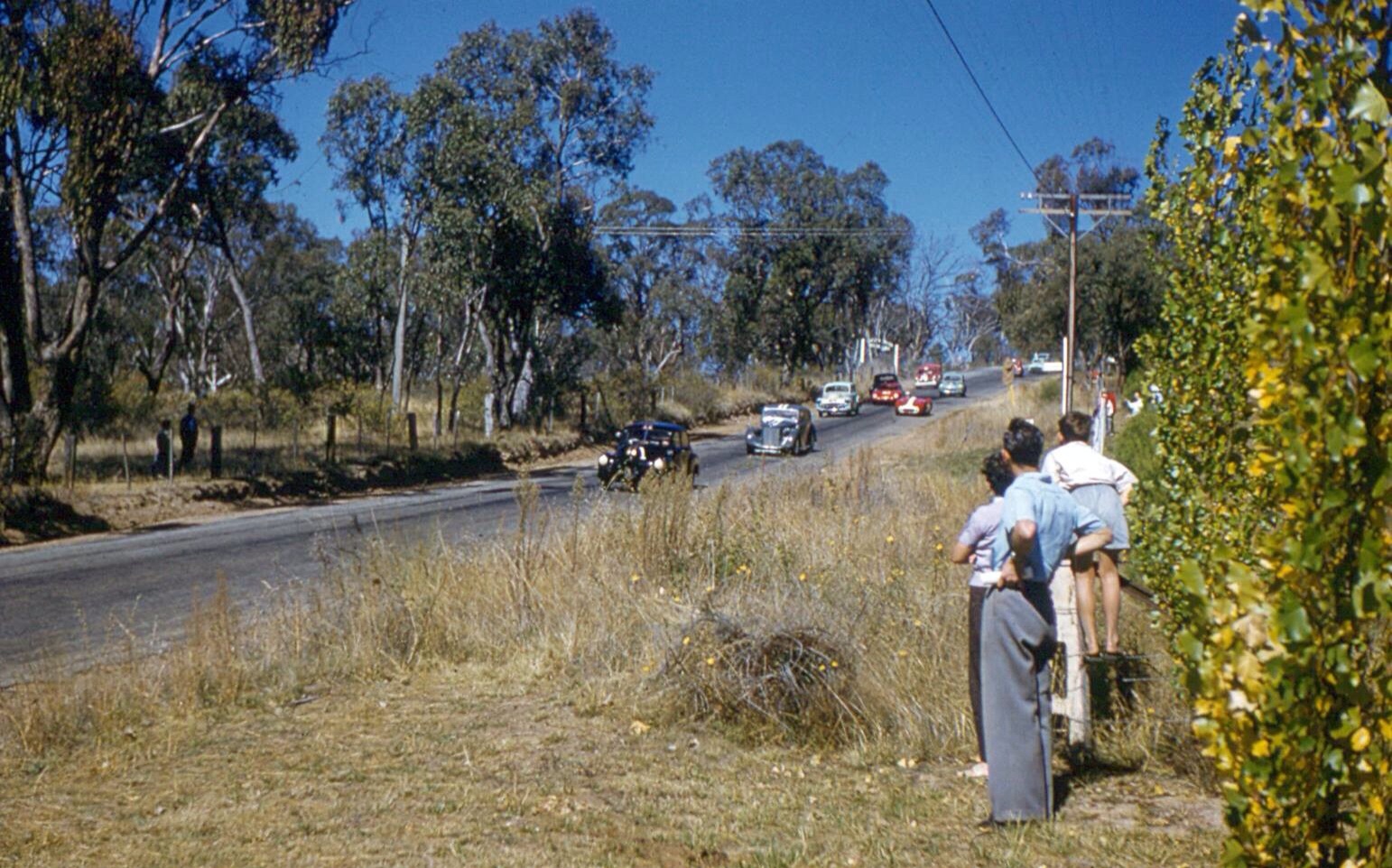
Leo Geoghegan’s Holden 48-215 from Frank Hamm’s Jaguar Mk5, Bathurst, Easter 1959…

I’m not sure if this is the parade lap described below or a race but the presence of the sportscar in amongst the touring cars suggests the former.

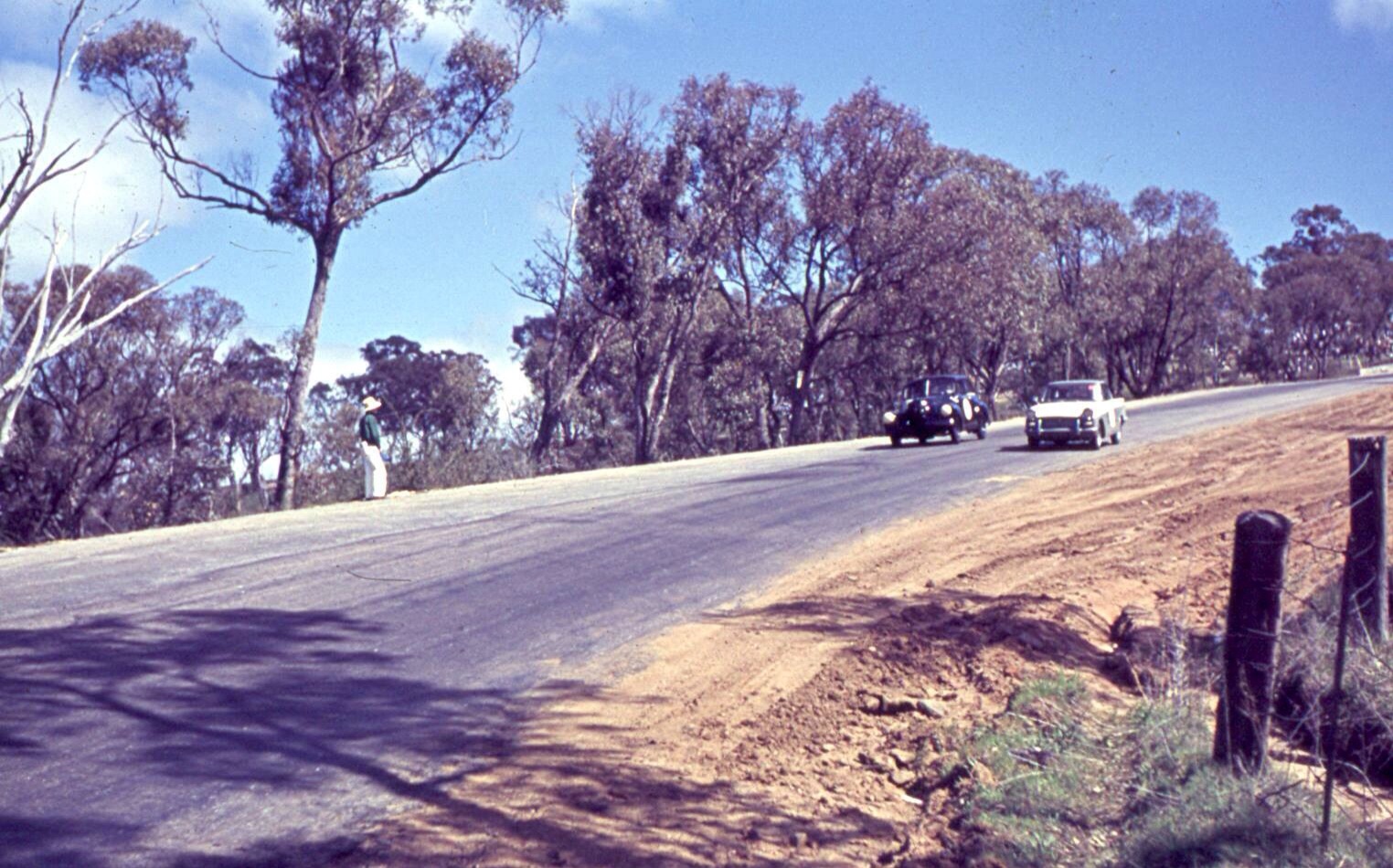
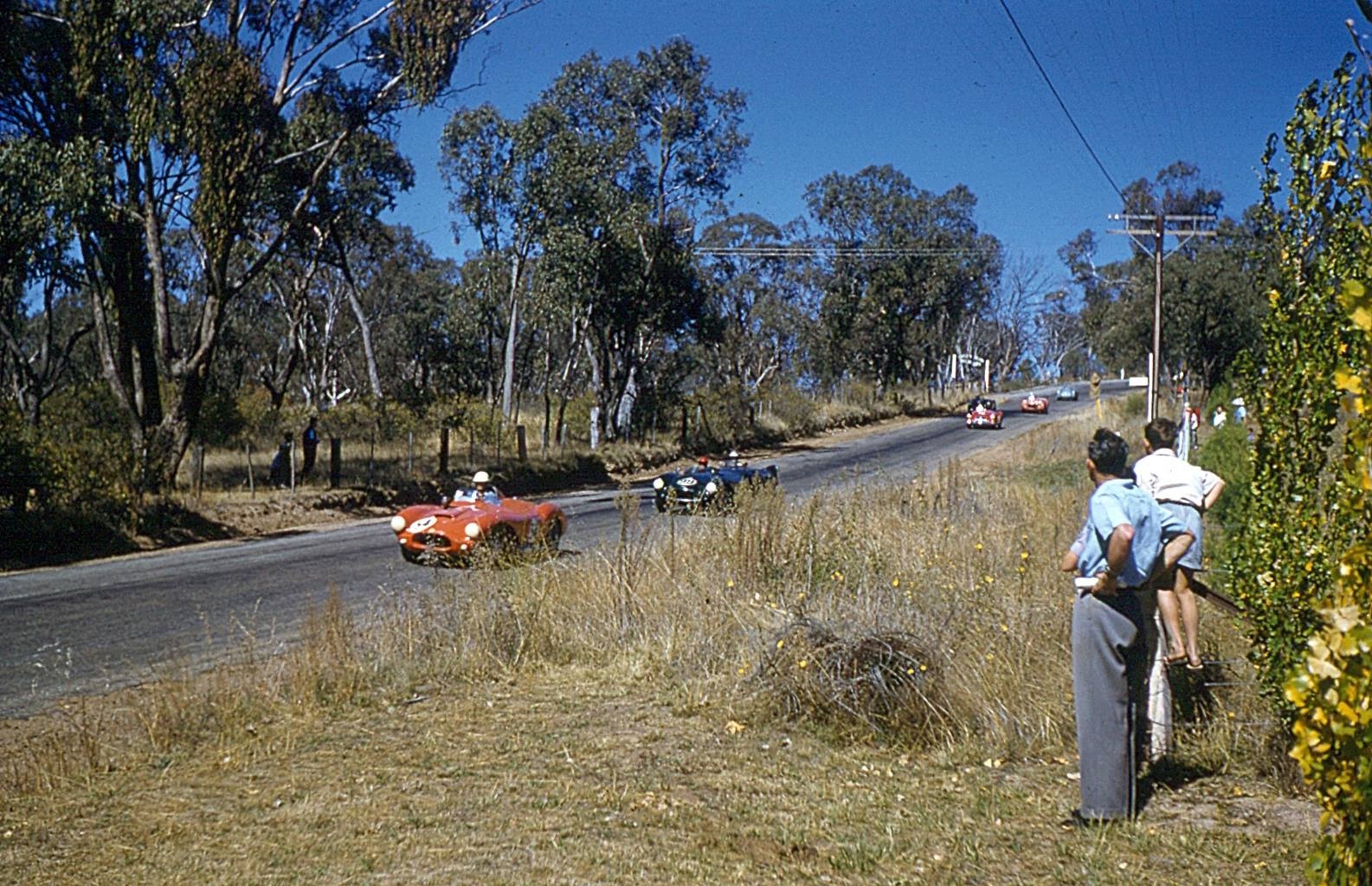
The stunning series of photographs are uber-rare ones from the inside of Conrod Straight, the cars have just cleared Forrests Elbow and are winding up in top gear. The kid standing on the fence is Rick Meyer, his father took these wonderful rare photos trackside, ‘locals’ photographs.

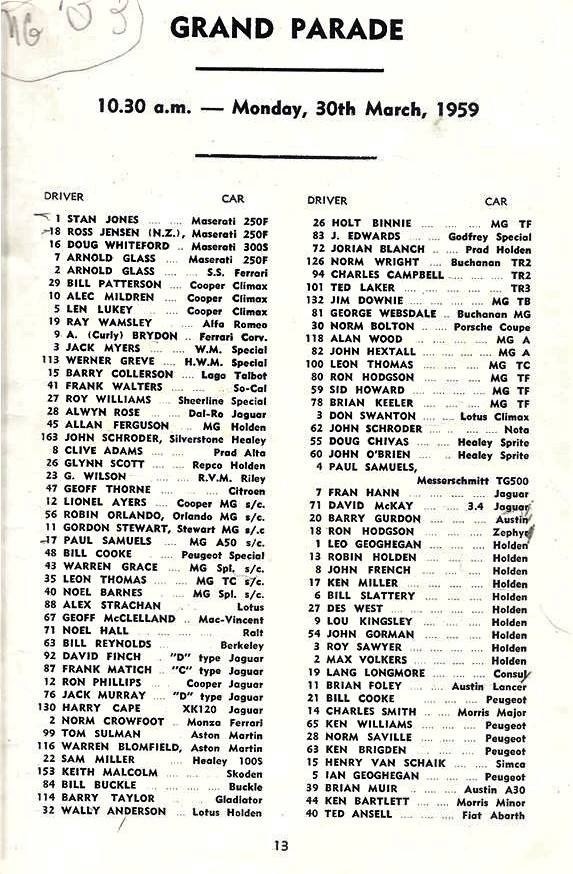
The Easter meeting was the Gold Star round traditionally- there are a huge number of past, current and future top liners or champions amongst the entry list. ‘Currents’ include Stan Jones, Doug Whiteford, Ross Jenson, Curley Brydon, Jack Myers, Jack Murray and David McKay. ‘Future stars’ are Len Lukey, Alec Mildren and Bill Patterson- Gold Star winners in 1959, 1960 and 1961 respectively, Lionel Ayers, Glynn Scott, Arnold Glass, Frank Matich, Ron Phillips, Ron Hodgson, Doug Chivas, Leo Geoghegan, John French, Des West, Max Volkers, Brian Foley, Ian Geoghegan, Brian Muir and ‘Ken’ Bartlett- no doubt Kevin Bartlett learned the value of clean, clear hand-writing on entry forms when he perused the race program at the circuit!

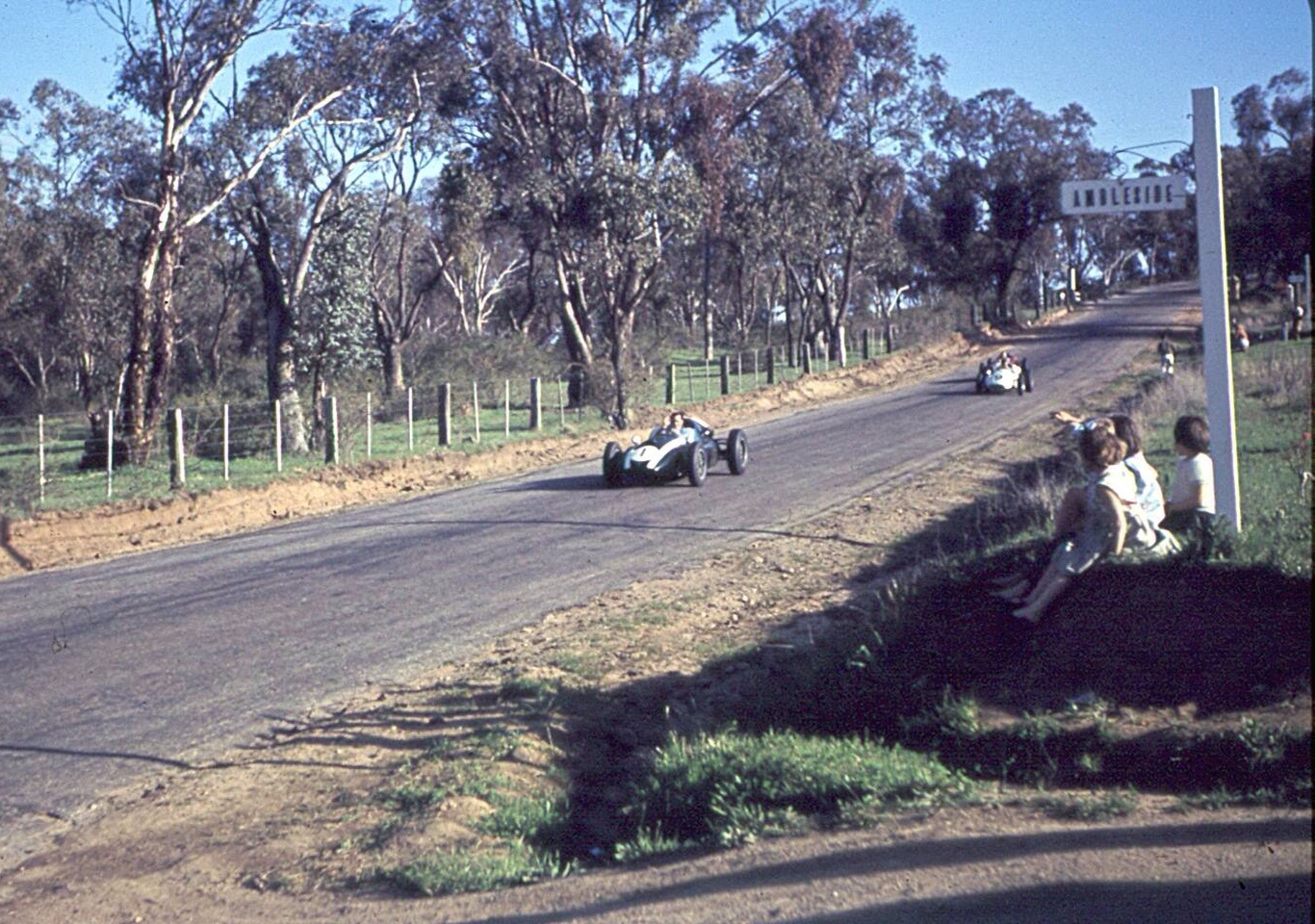
The photo below is from the same spot and shows reigning World Champ Jack Brabham on the 2 October 1960 weekend when the local boy returned to Australia having retained his F1 drivers title, to win the ‘Craven A International’ from a classy field of locals.

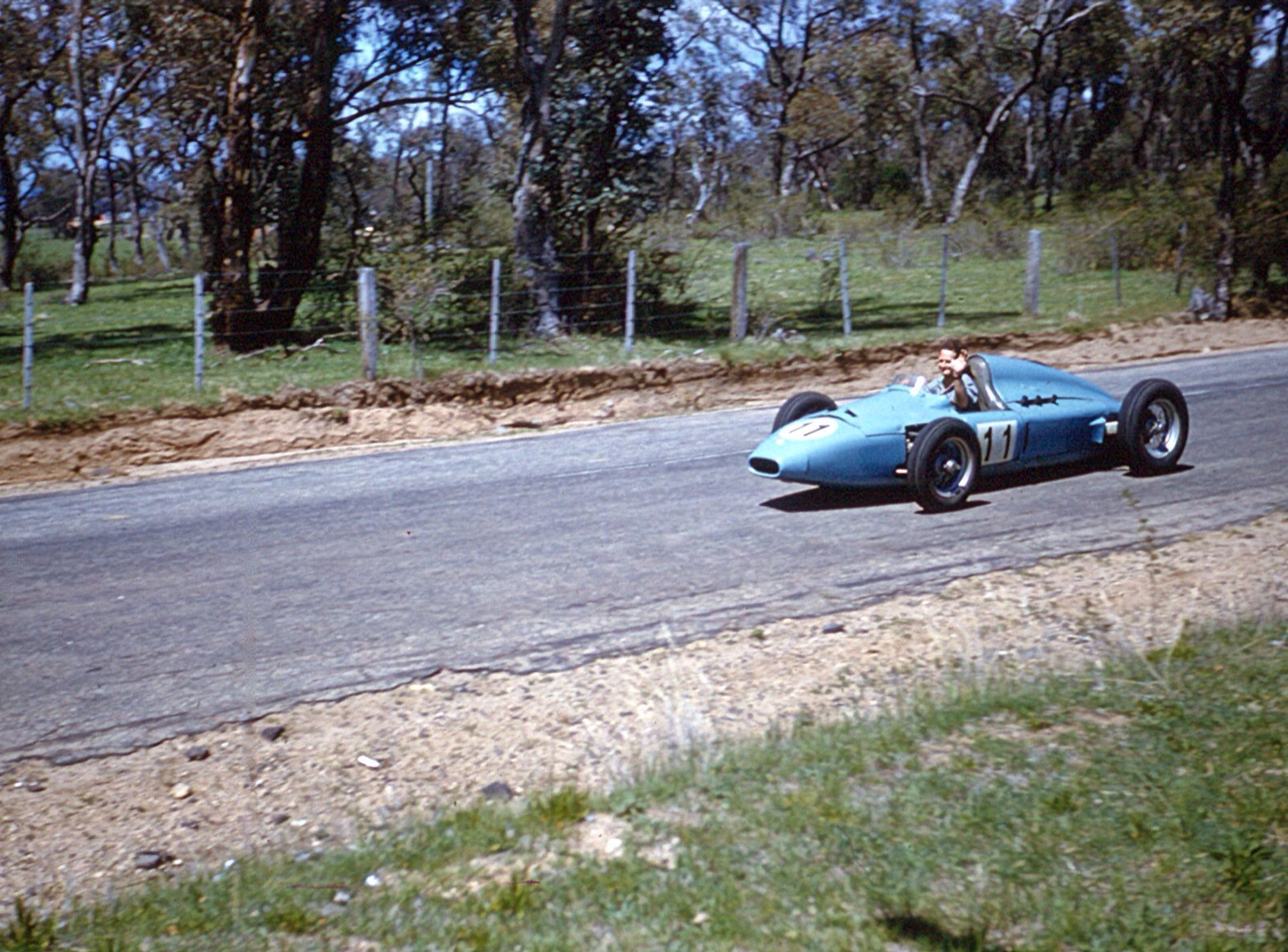
The Cooper T51 Climax leads the similar white-coloured machine of 1961 Australian Gold Star Champion, Bill Patterson. Patterson was second in the race with Bib Stillwell, also T51 equipped in third- he is probably that flash of red car behind Patto.

(R Meyer)

The photo below is again Geoghegan who is about to take, perhaps, Barry Gurdon’s Austin on the run down Conrod, or is it a Triumph Herald? By this stage Leo’s car is very quick and much modified- light weight, it has a Repco Hi-Power cylinder head and multiple SU carbs, is fitted with an MG TC gearbox, slippery diff and disc front brakes.

The introduction of the Australian Touring Car Championship from 1 January 1960 run to Appendix J regulations would reign-in the ‘costs out of hand’ development of touring cars without in any way constraining the appeal of tin-top racing to either spectators or owner-drivers.

(R Meyer)

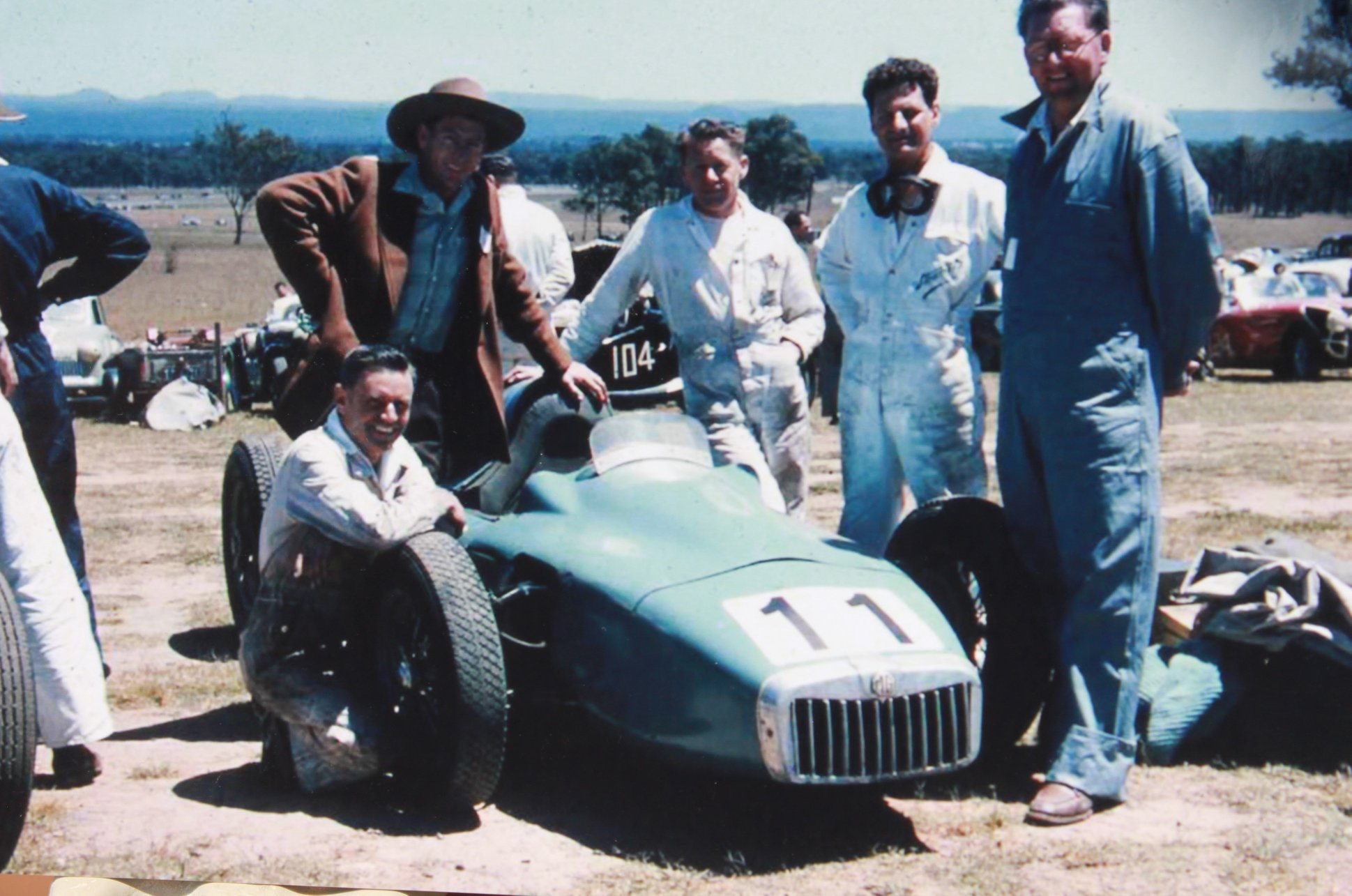
Beautiful picture of the Les Wheeler funded, Gordon Stewart designed and built Stewart MG…

Believe it or not this very advanced car was concepted and constructed in the early fifties around a tubular steel spaceframe chassis, MG TC engine and brakes. With a Bob Baker built body, modified in the nose here, it first raced at Mount Druitt in 1955.

(R Meyer)

The engine was 1350cc in capacity and fitted with a Laystall crank and locally made rods. By the time the car appeared lots of serious stuff from Europe was racing locally so it missed the boat a bit as a potential ‘outright’ contender but its 1957 Gordon Stewart driven 142 mph made it the fastest TC speed ever over Bathurst’s Flying One-Eighth!

Here, Dick Willis says the car is supercharged ‘B-Series’ BMC powered, still with Gordon at the wheel. This car is extant and a wonderful feature article, such is its conceptual design and execution, for another time.

(D Willis)

A bit more from Dick Willis, here the Stewart MG crew- ‘Ecurie Cinque’ at Mount Druitt probably in 1958. ‘Jim Robson (at right) of Silverdale fame was a technical writer for Riley (Nuffield) before the war writing workshop manuals etc. After the war he emigrated to Australia and soon struck up a friendship with the like, Nuffield minded, Gordon Stewart- Jim was one of the team who developed the Stewart MG…’

Credits…

Rick Meyer, Dick Willis, Paul Newby

Tailpiece: Finish as we started, neighbour still with hands on hips and the obedient Rick still on and behind the fence!…

(R Meyer)

Cars are Horst Kwech’s RM Spyder (Buchanan body) and Tom Sulman’s Aston Martin DB3S during the Easter 1960 meeting.

Paul Newby explains that Horst Kwech built the RM Spyder whilst working at Regional Motors in Cooma- New South Wales sub-alpine country, hence the ‘RM’. It comprised a Buchanan bodied upside-down Singer chassis powered by a Repco Hi-Power headed Holden ‘Grey’ six-cylinder engine and still exists in Canberra.

Finito…