Posts Tagged ‘Leo Geoghegan’

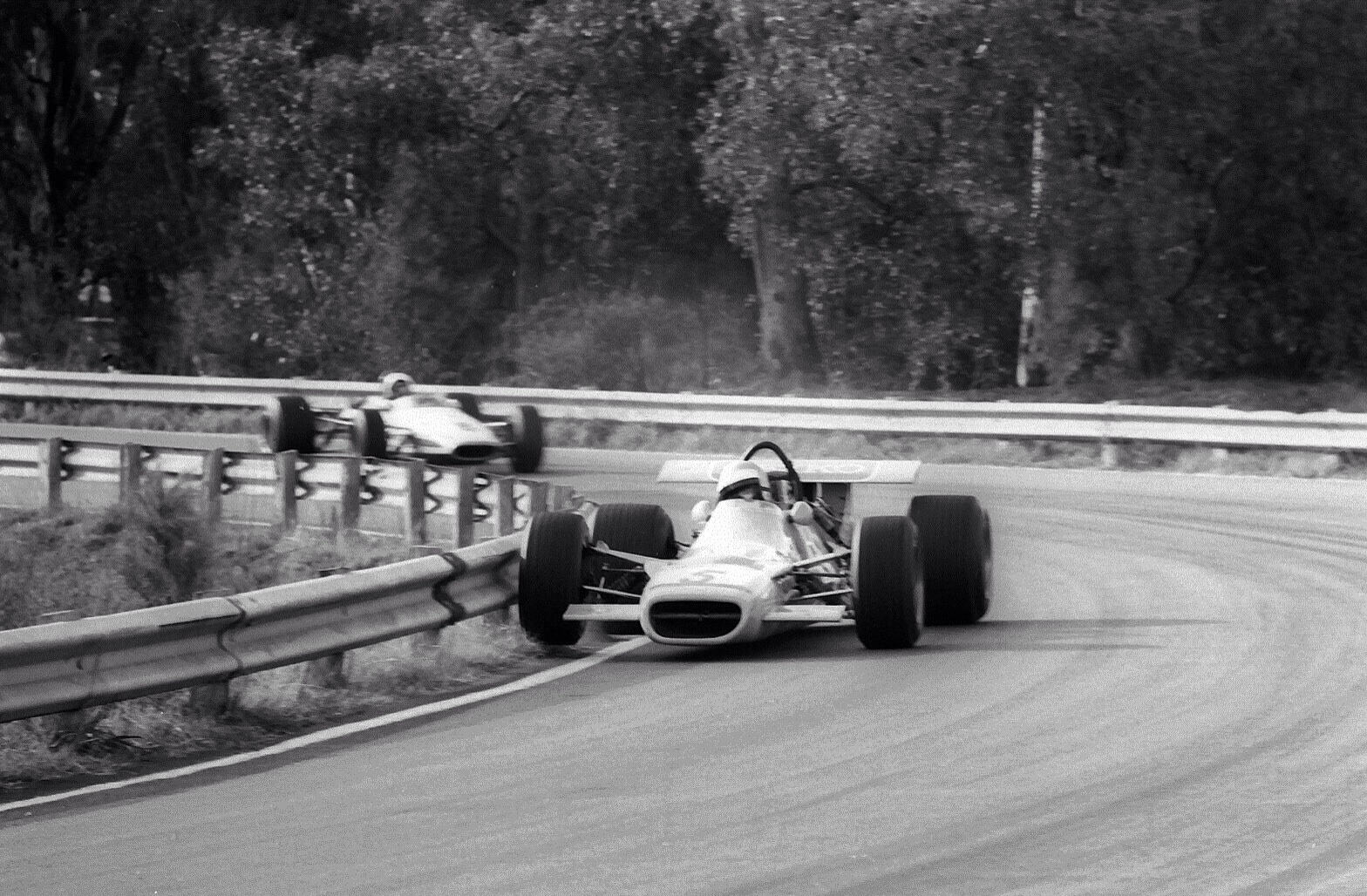
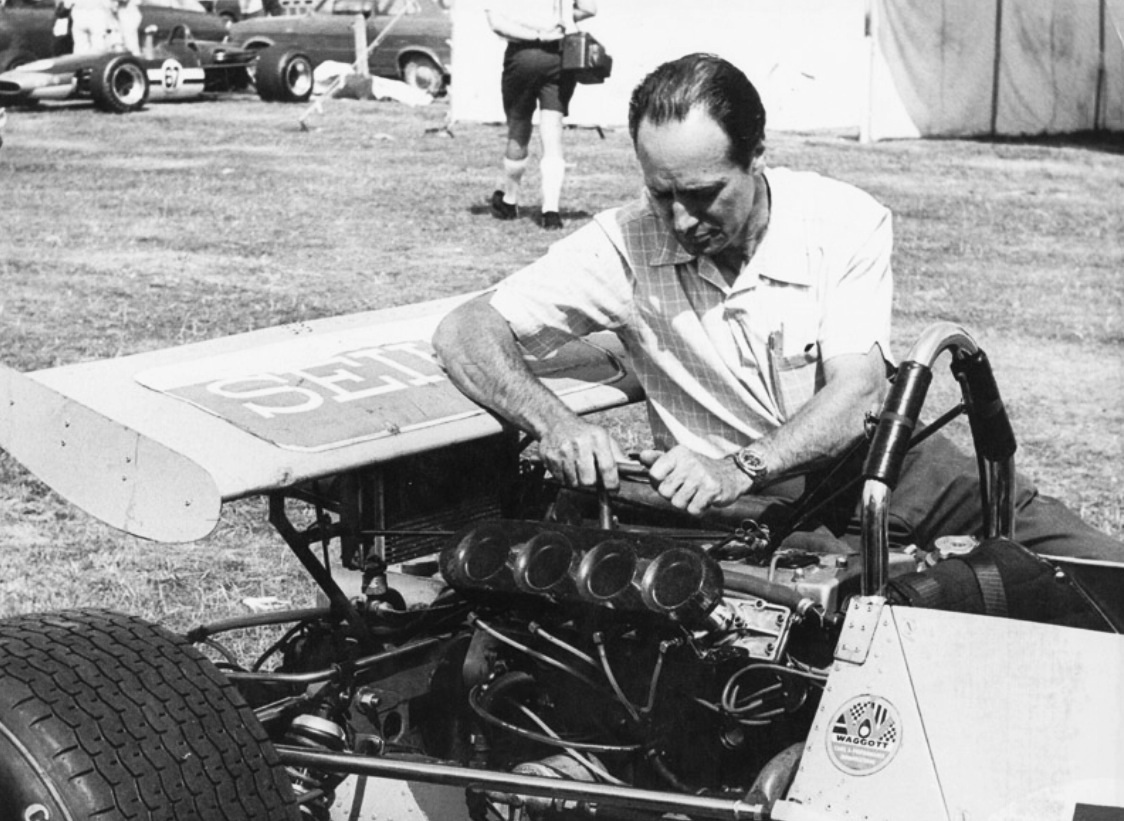
‘Joisus Harry and the boys look after me pretty well’ is perhaps the thought going through Peter Brock’s mind…

Harry and the Boys are the Holden Dealer Team- Harry Firth, Ian Tate, Bruce Nowacki and others who built and prepared the various Holdens that Australian Touring Car Greats, Peter Brock and Colin Bond raced.

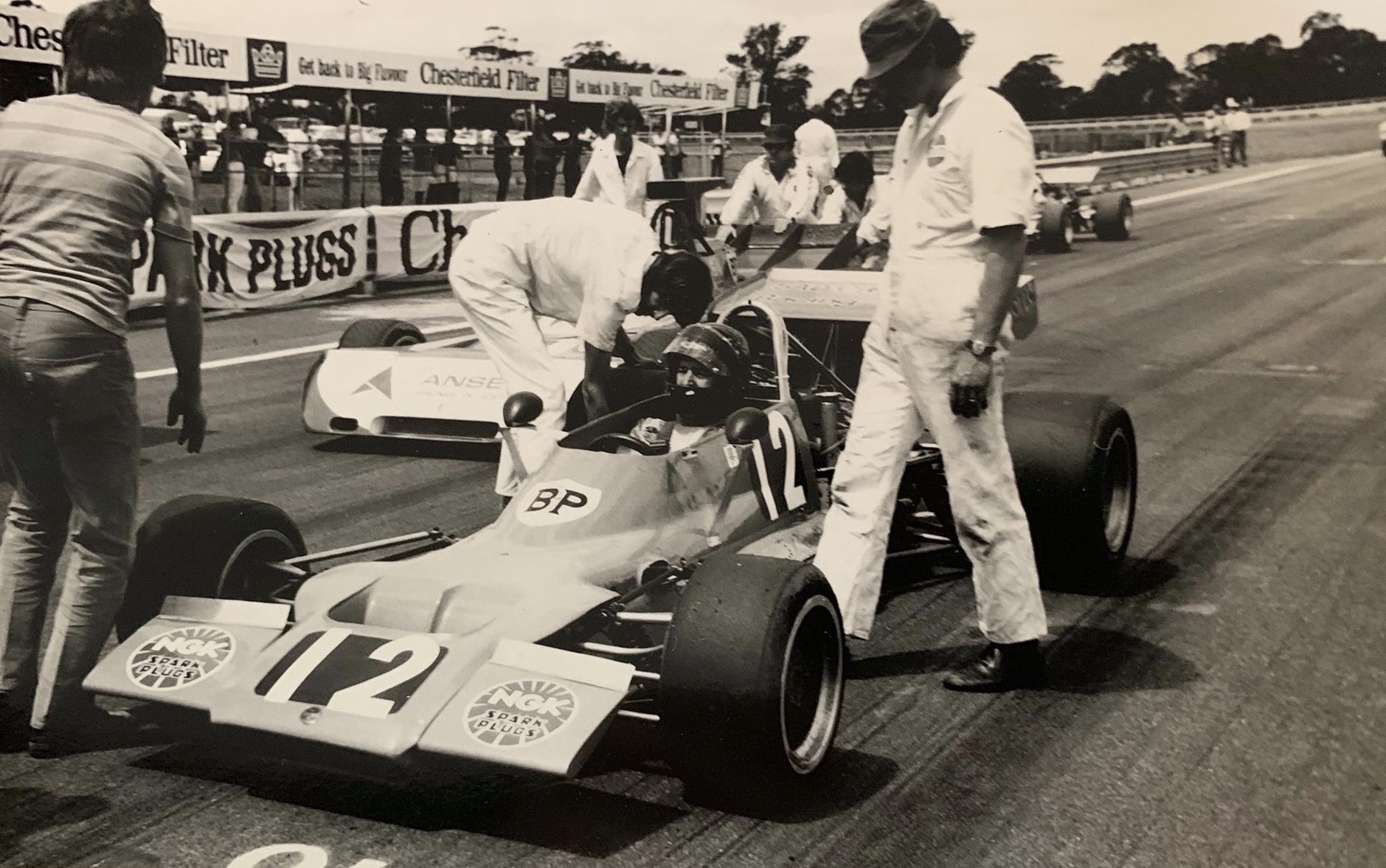
The Birrana 272 Ford ANF2 car Peter is looking after at Hume Weir in 1973 was a Father and Son operation between Geoff and Peter Brock.

This wasn’t new to the touring car ace mind you- the Austin A30 Holden Sports Sedan which thrust the lad from Diamond Creek to fame was run in just that manner but by 1973 he had been a works driver for four years with all of the cossetting- and expectations which goes with it.

Brock has that ‘where the hell is Tatey’ look about him!? Mind you, he may have just spotted a pretty young filly at the burger stand and doing that instantaneous, nano-second process of visual assesssment we all do.

This is another of my whacky-dacky articles in that it started as a mid-week quickie but grew like topsy into a feature as I chased a few tangents- so its not as cohesive as some of my efforts. Its a bit of this and a bit of that, without being a whole lot of any one thing! Bare with me all the same.
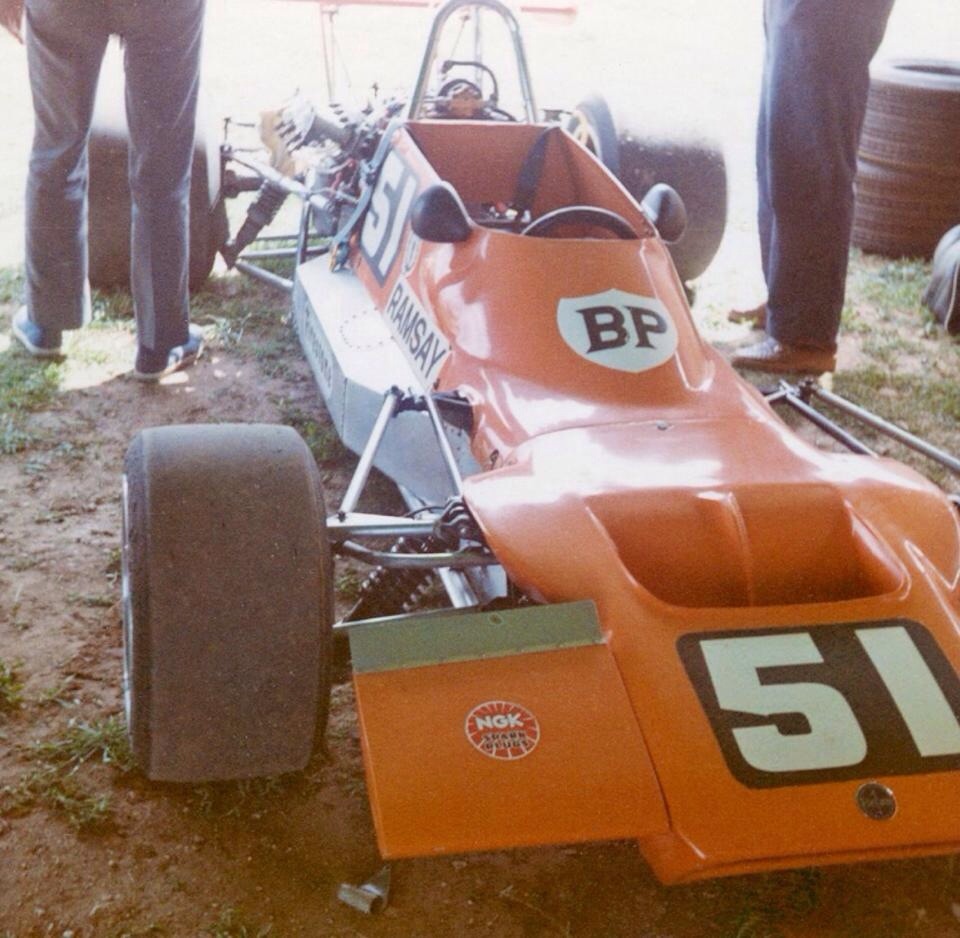
Chunky lines of the new Birrana 272 in the Victorian Trophy Sandown paddock. Single top link and radius rod and bottom lower wishbone, coil spring/damper front suspension. Note the ‘stay’ between the front and rear front suspension mounts on the tub (Kym)

I’ve written about this important car- ‘272-002’ and Brocky’s time with it before.

The car is significant in the pantheon of Birranas in that that it was the first monocoque chassis Tony Alcock and Malcolm Ramsay built, as well as the first of a very successful run of Formula 2 and Formula 3 cars constructed by Birrana between 1972 and 1974- noting that production spluttered along into 1978 with a couple of additional cars built in the interim.

In 1972-3 ‘272-002’ was raced by Ramsay, 1971 AF2 Champ Henk Woelders once, Leo Geoghegan and Brock before passing into Bernie Zampatti’s hands in Perth- he still has it, so rather a nice jigger to own in every respect.

Some of the additional photographs of the car were taken in the Sandown paddock during the weekend Malcolm Ramsay contested the ‘Victorian Trophy’ Gold Star round in April, i’m wondering if this was the car’s race debut? Frank Matich won the race in his Matich A50 Repco, with Ramsay seventh- FM took the Gold Star that year, his only Australian Drivers Championship in a couple of decades at the pointy end of Australian motor racing in both sports cars and single-seaters.

For most of the year Malcolm raced the car in South Australia and Victoria- in addition to the Gold Star round at Sandown there was a ‘Repco (fiftieth) Birthday Series’ of five rounds at Calder contested by F3, F2 and F5000 cars- won by Kevin Bartlett’s Lola T300 Chev

Tony Alcock built the first Birrana- the Formula Ford F71-1 initially raced by John Goss and then David Mingay in the garage behind his house in the Sydney suburbs. By the time the later F72 FF’s were constructed he was in partnership with Malcolm Ramsay back in his native Adelaide.

Ramsay had previously raced Elfins and Alcock worked for Garrie Cooper both before and after a sojurn to Europe working for McLaren, Cooper, Cosworth and others- both were mates of Garrie, so in a way it must have felt strange competing with the much respected outfit from Conmurra Road Edwardstown.

Ramsey- is that him sitting on the tub? and 272 at cold, windy Calder during 1972- possibly the August meeting (oldracephotos.com.au/Hammond)

Mind you, the story is that Malcolm approached Garrie to build him a car with some design features he wanted, the ever accommodating Cooper was fully committed with the build of the 620 and MR5 series of cars at the time so really didn’t have the capacity to do a ‘one off’. So Mal decided to do it himself and approached Tony who was at a loose end at the time.

Ramsey, Victorian Trophy meeting, Sandown. Note the injected Lotus-Ford twin cam and its metering unit and breathers on the roll bar. Box FT200, shocks I think Armstrong- half moon steering wheel a distinctive Birrana feature- Frank Matich the other proponent of those in Oz (Kym)

The 272 was an utterly conventional racing car of the period but what was different from the Elfin 600- which had pretty much ruled the small-bore racing car roost in Australia since its 1968 Singapore GP win with Cooper at the wheel, was that the Birrana had a monocoque chassis whereas the 600- a winner in FF, F3, F2 and ANF1 guises was a spaceframe.

The 272 was beautifully built and quick out of the box- its performance when driven by Malcolm and ‘Dame Nellie Melba’ Geoghegan when Leo- the 1970 Gold Star Champion returned from short-lived single-seater retirement to drive the car later in 1972- and Birrana Australian Formula 2 Championship wins in 1973 (273) and 1974 (274). For the record, Birrana national F2 titles were also taken by Geoff Brabham (274) in 1975 and Graeme Crawford (273) in 1976.

Leo first raced the 272 in the Hordern Trophy Gold Star round at Warwick Farm in November only completing 3 laps before having gear lever problems. He raced the car again in the final Repco Birthday Series round at Calder in December and was convinced of the Birrana’s potential so signed to drive one of two works ‘273’ cars- the other raced by Ramsay in 1973.

The 273 took Alcock’s concepts further, the 274 further again with sales and wins aplenty- the full history of Birrana is for another time.
Leo Geoghegan gridding up for the Hordern Trophy at Warwick Farm late in 1972- that’s Garrie Coopers ELfin MR5 Repco to the left (S Geoghegan)


Brock squirts his 272 around Calder in early 1973 (G Moulds)

At the end of the 1972 season Birrana sold the car to Brock- who made it available for Malcolm Ramsay to race in the opening round of the 1973 championship at Hume Weir whilst Peter attended to Holden Dealer Team commitments.

Malcolm handed the car to Leo who had broken valve spring problems with his 273 Hart motor throughout the weekend including raceday. Geoghegan took a great and somewhat lucky win from the rear of the grid when Tony Stewart’s leading 273 had overheating dramas and had to reduce his pace- the plucky, quick Victorian was second and Chas Talbot, Elfin 600E Ford third.

Tony Stewart’s 273 from Geoghegan in the 272 with an the Skelton Bowin P6 on the outside- and Clive Millis’ abandoned 600B on the inside of the corner. A shame Stewart ceased racing this car after so few meetings- very fast driver, with support from Paul England should have, and could have gone far (ACY)


Geoghegan on Hume Weir’s Pit Straight, Birrana 272 1973- race run in tricky conditions including some rain, tailor made for the experienced Leo (ACY)

Brock raced the 272 for several more meetings before he too acquired a 273. Brock’s too short single-seater/Birrana sojurn is told here; https://primotipo.com/2018/05/07/brocks-birrana/ , with some Birrana history here; https://primotipo.com/2016/04/29/birrana-cars-and-the-1973-singapore-gp/

The 272 had a locally built 1.6 litre Lotus-Ford injected twin-cam engine- the Hart 416B variant de-rigeur in Australia from 1973 when all of the top-guns used these motors excluding Peter Brock.

Hewlands ubiquitous 5 speed FT200 gearbox was specified with lower wishbone bottom, top link and radius rod suspension at the front and single upper link, two lower links and twin radius rods deployed at the rear. Roll bars were used of course with cast Birrana uprights, wheels and steering rack finishing off a very nice package.
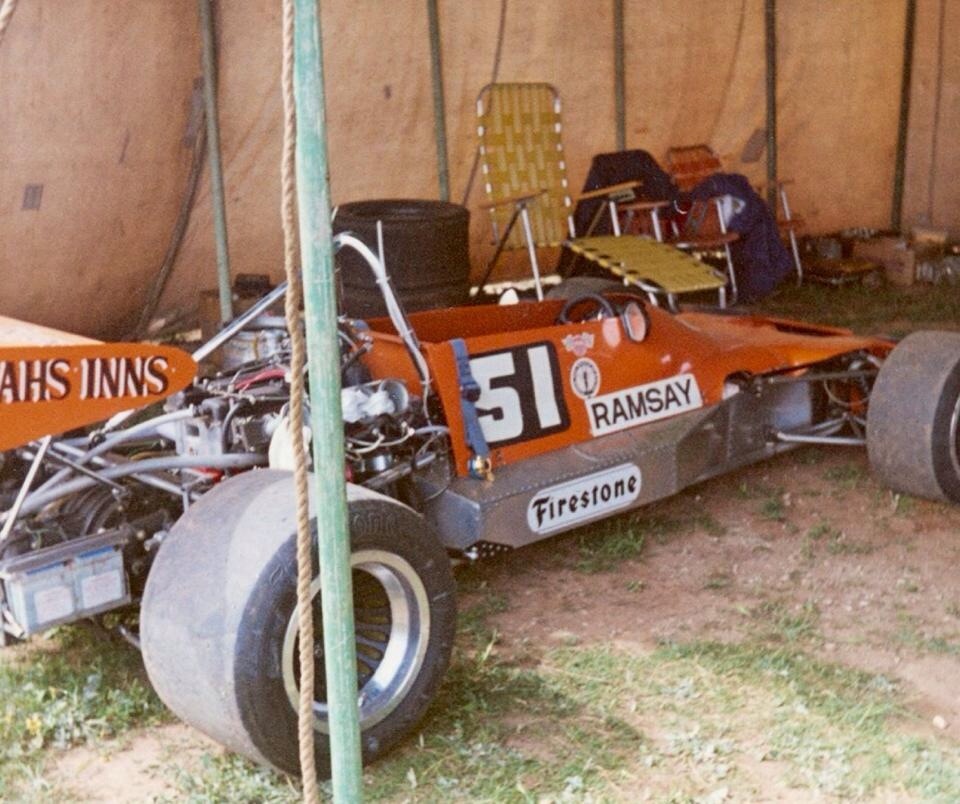
Wide, shallow, very rigid monocoque chassis, Varley battery beside the gearbox, locally built twin-cam by Peter Nightingale fitted with Globe injection (Kym)

Tailpiece: ‘Formula Birrana’ Adelaide International 7 October 1973…

(ACY)

Geoghegan and Ramsay in works 273’s sandwich the #18 Bob and Marj Brown owned 273 driven by Enno Buesselmann at Adelaide International in 1973, this race was won by Enno after Leo suffered a puncture.

Evolution of the 272 to 273 clear in this shot inclusive of period-typical ‘Tyrrell type’ enveloping nose.

Marque experts rate the 273 the pick of the Birranas with the 274 said to be not really a quicker car- as proved by the pace of Buesselmann’s car when driven by Bob Muir for the Browns in 1974 fitted with 274 nose and rear wing.

Geoghegan crushed the opposition in 1973- demonstrating amazing reliability, he finished all seven of the championships rounds, winning six of them- one in the 272, the balance in his 273. In a busy season, Geoghegan and Ramsay also raced the cars in Asia- this tour is covered in one of the articles linked above.
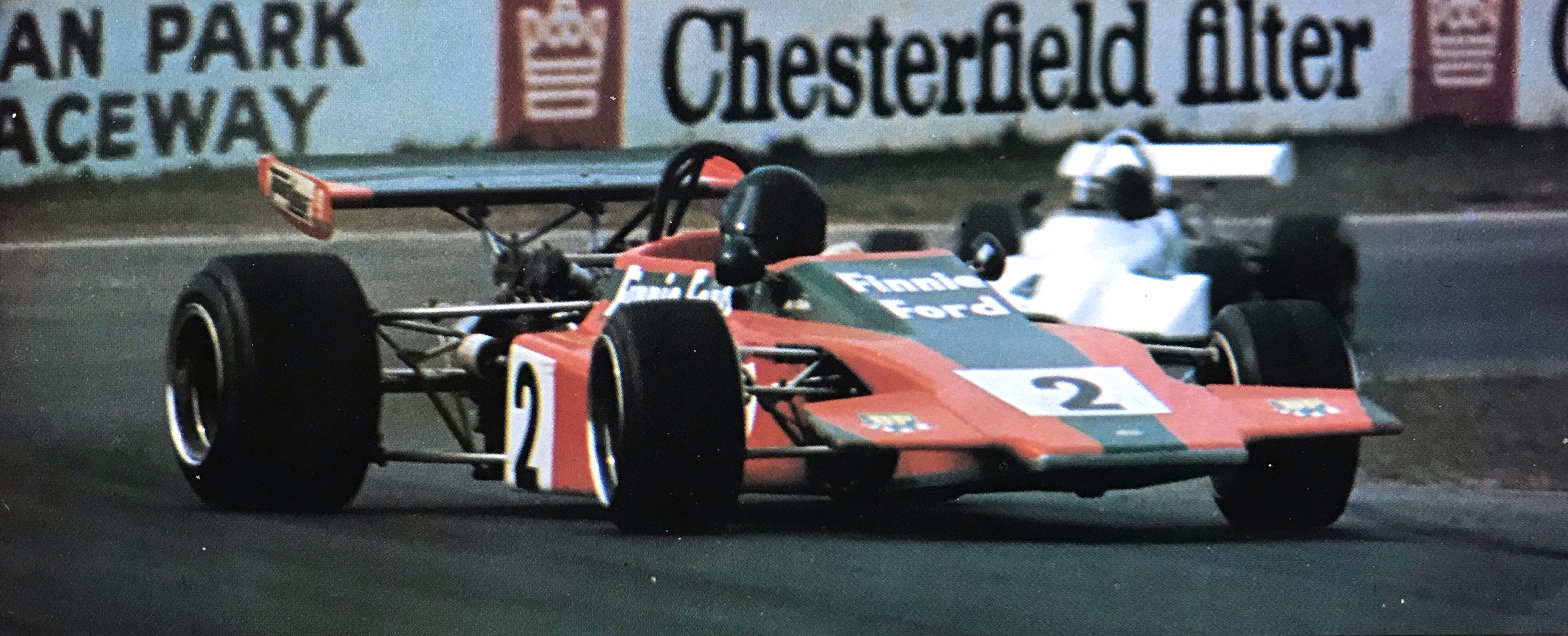
Bob Skelton, Bowin P6 Ford-Hart from Peter Brock, Birrana 273 Ford, Oran Park 1973 (ACY)

Afterthoughts…

Bob Skelton and the Bowin P6.

An interesting thing looking back at this F2 season is the performance of 1972 ‘Formula Ford Driver to Europe’ (DTE) winner Bob Skelton and his spaceframe chassis Birrana P6 Ford-Hart.

He was, despite being a far less experienced open-wheeler pilot than Leo who had been racing Tasman 2.5’s since 1966, and was racing wings and slicks for the first time- right up Geoghegan’s clacker on raw pace if not finishing record that season in a brand new, unsorted car. Two second placings from four of the seven rounds he finished was his best.

Let’s look a bit closer in terms of raw speed- at Hume Weir both Leo and Bob didn’t record a time- Tony Stewart started from pole on 45.4 seconds with no race times disclosed.

At Oran Park Geoghegan was on pole 42.3 secs, with BS right behind him on 42.5, Brock 44.2.

At Amaroo LG pole 48.7, BS again in second slot with 48.9, PB on 51.9- the last round of the series Brock contested.

At Surfers the cars raced within the Gold Star Glynn Scott Memorial Trophy F5000 race- Skelton bagged the F2 ‘pole’ with 1:9.5 from Leo on 1:10.4 with BS a tenth quicker in the race- the first occasion that happened that season.

Kneeling John Joyce fettles Skelton’s P6 at the Hume Weir opening round (ACY)


Symmons Plains grid with Geoghegan and Skelton on the front row. Chris Farrell, Dolphin 732 Ford (Brabham BT36 copy) and Enno Buesselmann Birrana 273 on row 2 with the distinctive #62 black Bowin P6 Hart of Bruce Allison on the right- to the left is Ian Fergusson’s Bowin P3 Ford. The #3 white 273 is Don Eubergang in the ex-Tony Stewart ‘273-007’- then an assortment of Elfin 600’s and a couple of Cheetah Toyota F3’s towards the rear- a very young John Bowe is in one the 600’s (ACY)

From Queensland the circus moved down South to Symmons Plains in Tasmania where Leo put the championship beyond doubt- both did 55.7 secs in practice. Skelton didn’t contest the final rounds in Adelaide or at Calder.

The conclusions to be drawn from the above are firstly that Skelton was a very quick driver- no shit Sherlock- he had won the DTE in 1972 apart from demonstrable pace in the sports and touring cars from whence he came. On raw pace the Bowin P6 was the equal of the Birrana 273 despite being brand new and untested prior to the seasons outset- and in the hands of a ‘wings and slicks’ novice.

It is a great shame Skelton’s single-seater career ended at this point, he deserved another crack at F2 or elevation to the F5000 Big League.

Bob got the babes, or TAA ‘hosties’ air- hostesses as they were before the days of political correctness! Bob Skelton taking a Ford Falcon XA GT Amaroo Park lap of honour after wrapping up the 1972 DTE. Slumming it on Fairlanes are second placed John Leffler and third place-man Bob Beasley- all raced Bowin P4A’s (unattributed)

In fact Skello’s ‘P6-119-72’ was the very first P6 built by John Joyce, completed, according to Bowin records, on 8 September 1972.

After winning the DTE in his trusty P4 Bowin Skelton raced the P6 once or twice in Oz to Formula Ford specifications- the P6 was an FF/F3/F2/Formula Atlantic spec car, four of the latter were exported to Canada in 1973/5, before shipping it to the UK and contesting the Snetterton Formula Ford Festival or ‘World Championship’.

He raced in the UK together with fellow Australians Larry Perkins (1971 DTE winner), John Leffler (1973 DTE winner) Buzz Buzaglo and Peter Finlay- the latter duo were at the time living in the UK and were ‘jets’ in British/Euro Formula Ford. How the Aussies fared is covered in this feature on Buzz I did yonks ago;

Buzz Buzaglo: Australian international racing driver and the eternal racing story of Talent ,Dollars and Luck…

Bob Skelton and ‘P6-119-72′ in the Snetterton paddock in late 1973, variable rate rear suspension linkages clear, alongside is Larry Perkins’ equally new Elfin 620. Both cars successful Formula Fords models for their respective makers (unattributed)

After shipment of the P6 back to Sydney the Bowin lads removed all the Formula Ford clobber- ‘Kent’ 1600 motor, Mk9 Hewland, brakes, wheels etc and added Hart 416B, FT200, wheels and calipers and wings and the rest and had the car ready- just, for the first 1973 F2 round at Hume Weir.

Hey presto, now I’m an F2! ‘P6-119-72’ in F2 guise with a nice shot of Skletons trick, schmick alloy, short-stroke Hart 416B twin-cam, circuit unknown (MRA)

These days the beautiful, radical P6/P8 Bowins with their progressive or ‘variable rate’ suspension are somewhat maligned on social media- it really is time I attack Bowin as a subject and address the facts armed with statistics in relation to the P6/P8- favourite racing cars of mine!

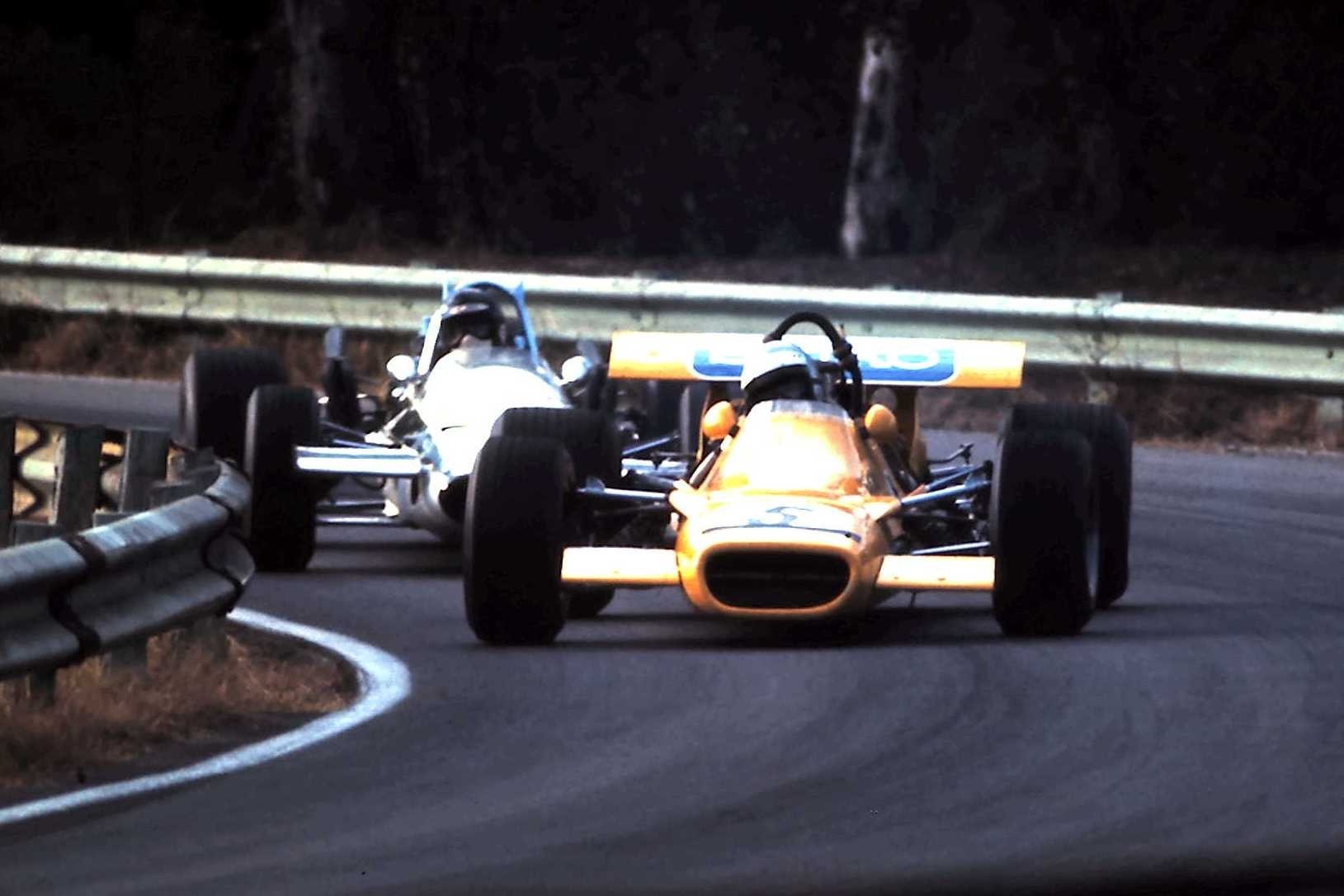
The colour photo above is Skelton’s P6 in front of Brock’s 273 at Oran Park during the ANF2 Championship round on 5 August- Geoghegan won from Brock and Skelton. Peter’s second place was the best of his two 1973 championship appearances, the final one was at Amaroo Park, also in outer Sydney, a fortnight later where he was sixth.

After that Brock ceased racing the 273- as quickly as he started it- the lure of touring cars was too great, Holden weren’t happy for Brock to race a Ford engined car and no doubt the self-running nature of the program was no fun- and by then not what was required to win in F2.

Mark Fogarty quoted Brock as saying ‘Brock was disillusioned by the formula…in 1972 F2 meant a simple chassis and twin-cam engine, but in 1973 monocoque chassis and supertrick Hart motors were the rule if you wanted to be competitive’. ‘Brock, in between HDT commitments, struggled on…until it became apparent that he was banging his head against the wall without a Hart…’

PB was second in the ’73 Oran Park round, here in his new Birrana 273- unsponsored. Odd the lack of support for the 1972 Bathurst winner (ACY)

Peter Brock and single-seaters.

The opening photograph in this article aroused plenty of Facebook chatter about Brock’s prowess as an open-wheeler driver- the fact is of course we can never be definitive about Peter’s capabilities because he simply didn’t stick at it for long enough to make a determination.

He had good equipment in both the 272 and 273 chassis but the cars were not, as noted above, fitted with the Ford-Hart 416B engine. Good for about 205 bhp, these motors were 15-20 bhp, depending upon accounts, more powerful than the best of the local twin-cams.

Most of the quicks in 1973 had them including Geoghegan, Ramsay, Buesselmann, Stewart, Skelton and Bruce Allison (Bowin P6- a sixth and a fourth Bruce’s best in a car he loathed- the 274 he raced in 1974 was much more to his taste and his results reflected it!) Winter (Mildren Yellow Submarine).

What we do know is that Brock was quick in anything and everything- in machines as diverse as the Austin A30 Holden, Touring Cars of god knows how many number from Holden Monaro GTS350 to V8 Supercars, rally and rallycross cars, Bob Jane’s 600 bhp plus Chevy Monza Sports Sedan to the Group C Porsche 956 Prototype he shared with Larry Perkins at Silverstone and Le Mans in 1984. In all of these cars and disciplines Brock was a winner or at least very competitive.

By all accounts- and so many of us watched him for four decades, so we all have a view- Brock was a versatile, adaptable, mechanically sympathetic, consistently fast and aggressive but thoughtful, analytical racer of elite international level and standing.

That does not mean he would have been an ace in single-seaters, but on balance, my ‘I reckon’ is that he would have been at least the equal of the best Oz resident open-wheeler guys had he focused in part or exclusively in the rarefied end of the sport…

Let the debate begin!
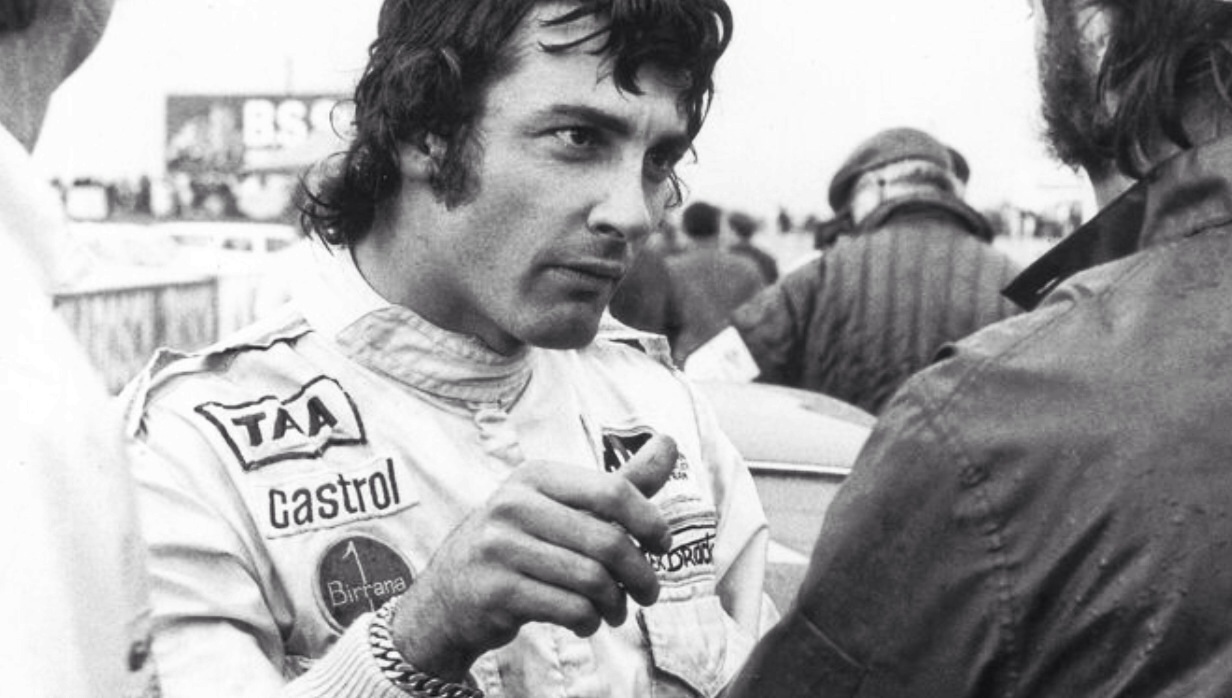
Brock, in Birrana overalls bending Ian Tate’s ear (i think) at Calder in 1973 (unattributed)

Photo and other Credits…

Dean Oliver, Kym, Glenn Moulds, ACY- Australian Competition Yearbook, Mark Fogarty in Australian Motor Racing Annual, Racing Car News, oldracingcars.com, Shaun Geoghegan

Etcetera…
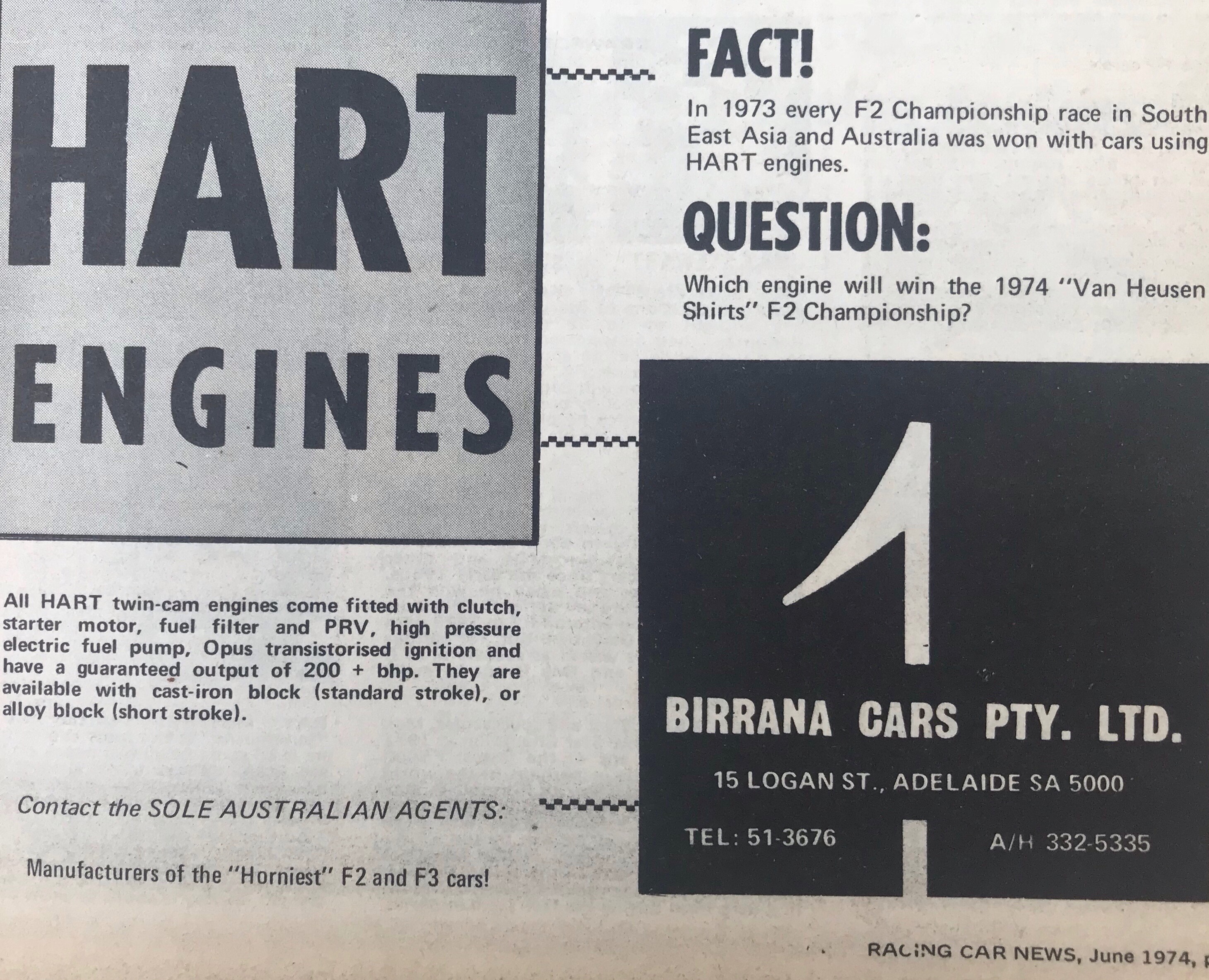
Brian Hart and Hart engines article; https://primotipo.com/2016/10/21/hart-attack/

Brock, Birrana 272 Ford, Calder 1973 (AMRA)

Tailpiece 2…Leo G and Birrana the dominant 1973/4 F2 combo…

(AMY)

I’ve taken a few twists and turns in this article but let’s not lose track of Leo’s superb driving in 1973- Birrana gave him a brilliantly designed, built and prepared car that year and in 1974which he put to very good effect.

A shame was that he didn’t switch into F5000 after his 1970 Gold Star win aboard a Lotus 59B Waggott- Lord knows we needed a few more cars on the grid, but it was great, having read so much about Leo before I first went to a race meeting, to be able too see so many of his F2 races in 1973 and 1974! He was ‘the goods’.

RIP Leo Geoghegan.

Finito…


(P Greenfield)

Niel Allen blasts 5 litres of fuel-injected Chevy off the line at Bathurst, Easter 1970- McLaren M10B Chev F5000…

Peter Greenfield has beautifully captured Niel at the start of the historic three lap ‘Captain Cook Trophy’ in which Allen set a lap record at Bathurst with a time of 2:9.7 seconds which stood for 32 years until it was taken by John Bowe in a Ford V8 AU Supercar with 2:8.3873 to take provisional pole in 2002. Brad Jones did a race lap of 2:9.5705 in the same AU Falcon.

Whilst the track changed in the interim period as to a much better surface it was slowed by the high speed ‘The Chase’ on Conrod. Not to mention the fact that the last Easter Meeting with outright open-wheelers took place in 1973- the track had simply become too dangerous for cars of that performance envelope as it then was.

The feature event on the program that Easter 1970 weekend was the second round of the Australian Touring Car Championship which was won by Norm Beechey’s Holden Monaro GTS350, click here to read about that race;

Variety Is The Spice…

(Rod MacKenzie)

Start of the lap record race, above, with an obscured Niel Allen over against the Pit Counter. On this side is John Harvey, Brabham BT23E Repco and in white, Leo Geoghegan, Lotus 39 Repco- there was life in the old dog though, in beating Harves in the racing car 13 lapper Leo did a 2:12.1, the fastest ever time by a Tasman 2.5 car at Bathurst.

This meeting must have been just about the last race for each of those cars before John and Leo jumped into the Bob Britton built Jane Repco V8 and Lotus 59B Waggott respectively for the balance of their 1970 Gold Star campaigns- a title won by Geoghegan.

(J Bondini Collection)

The shadows are getting longer- Niel squints in the afternoon sun as he guides his 5 litre missile around Hell Corner for the blast up Mountain Straight- McLaren M10B in the pantheon of Formula 5000 cars one of the greats.

Niel Allen collects one of his trophies for the weekend from Chris Davison (C Williams)

Allen did a qualifying lap of 2:11.2 with a trick flat-plane crank Chev engine fitted to one of the fastest F5000’s on the planet at the time. The 1970 NZ GP winner flew around the treacherous for ultra fast single-seaters, circuit to do his amazing time- 171.7 miles per hour down Conrod in the process, a much narrower strip of bitumen than it is now.

The current Bathurst lap records are held by McLarens.

Shane van Gisbergen did a 2:1.5670 in his McLaren 650S GT3 during the February 2016 Bathurst 12 Hour endurance race. Jenson Button did a 1:48.88 in his F1 McLaren MP4-23 Mercedes in the pre-event Vodaphone publicity session he did with Craig Lowndes and his V8 Supercar prior to the 2011 AGP at Albert Park- I do like the symmetry of ‘another’ McLaren single-seater holding the ‘lap record’ even though the time was not set in a race.

I wish.

(zimbio.com)

Credits…

Peter Greenfield, motorsport.com, Road & Track, Wikipedia, Rod MacKenzie, ‘Bathurst: Cradle of Australian Motor Racing’ John Medley, Craig Williams

Tailpiece: Shane Van Gisbergen, McLaren 650S 2016…

(Road and Track)

Finito…

(WFFB)

Despite being in the middle of built up Sydney, Warwick Farm had its bucolic elements…

And there is nothing more quintessentially country Australian than a windmill- here as a backdrop for Leo Geoghegan’s Lotus 59B Waggott prior to the 1971 Tasman round on 14 February.

Frank Gardner’s Lola T192 Chev was victorious that weekend, Leo succumbing to ignition problems. The Lotus was kind to him though, he won the 1970 Gold Star in it with wins here and at Mallala- with the F5000’s about in the Tasman rounds the competition was a bit tougher though.

Geoghegan’s 59B in the Oran Park paddock during the September 1970 Gold Star weekend which he won from Garrie Cooper’s Elfin 600D Repco and Bob Muir’s Rennmax BN3 Waggott. Love the knock on wheels, radiator nostrils and distinctive air exit ducts. Bob Holden’s Ford Escort Twin-Cam behind (K Hyndman)

Dave Baldwin designed the spaceframe 59 as Lotus Components’ 1969 F3 and F2/B customer racing cars, there were a few Formula Fords too. Guys such as Emerson Fittipaldi, Mo Nunn, Roy Pike, Dave Walker, John Miles, Max Mosley, Graham Hill and Jochen Rindt raced the cars with success.

Shades of the 1961/2 F1 Ferrari 156 of course (P Townsend)
As pretty (and effective) as it is possible to get in its Castrol livery, WF 1970. Note the tail of Leo’s works Valiant Pacer Series Prod car behind (P Townsend)

In Australia the Tasman 2.5 litre Formula 1 (ANF1) was being phased out and F5000 phased in over 1970-71 so Leo Geoghegan saw an opportunity to replace his long lived, much loved, ex-Jim Clark Repco V8 engined Lotus 39 with a 59B.

Geoghegan’s Sporty Cars were Australia’s Lotus importer- it would also have made sense for Leo to race a Lotus 70 F5000 machine, not that it was one of their greatest designs mind you. Leo astutely chose the 59B and installed one of Merv Waggott’s new ‘TC-4V’ 275 bhp, fuel injected, DOHC, 4-valve 2 litre engines into the space usually occupied by a 1.6 litre Ford FVA F2 engine.

In a year of consistency he finally won the national title he had been chasing for years in the 39 Repco.

Leo’s car, chassis ’59-FB-14′ is still in Australia, in the Holmes family collection.

Etcetera…

Hewland FT200 5 speed transaxle, big oil tank and hub mounted inboard discs (P Townsend)

Again at the Farm, 6 September 1970 (D Simpson)
(N Murphy)

Geoghegan at Bathurst, Easter 1970.

Photo Credits…

(WFFB) Warwick Farm Facebook page, oldracephotos.com.au, Ken Hyndman, Peter Townsend, Neil Murphy

Tailpiece…

(oldracephotos)

Geoghegan and Lotus 59B Waggott on Warwick Farm’s Pit Straight in 1971.

Finito…

(B Hickson)

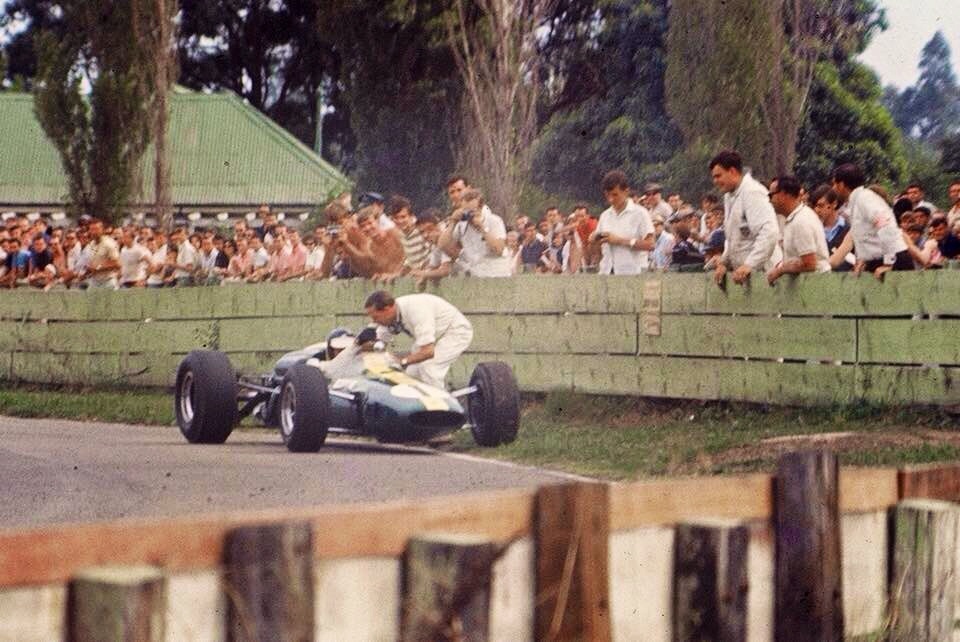
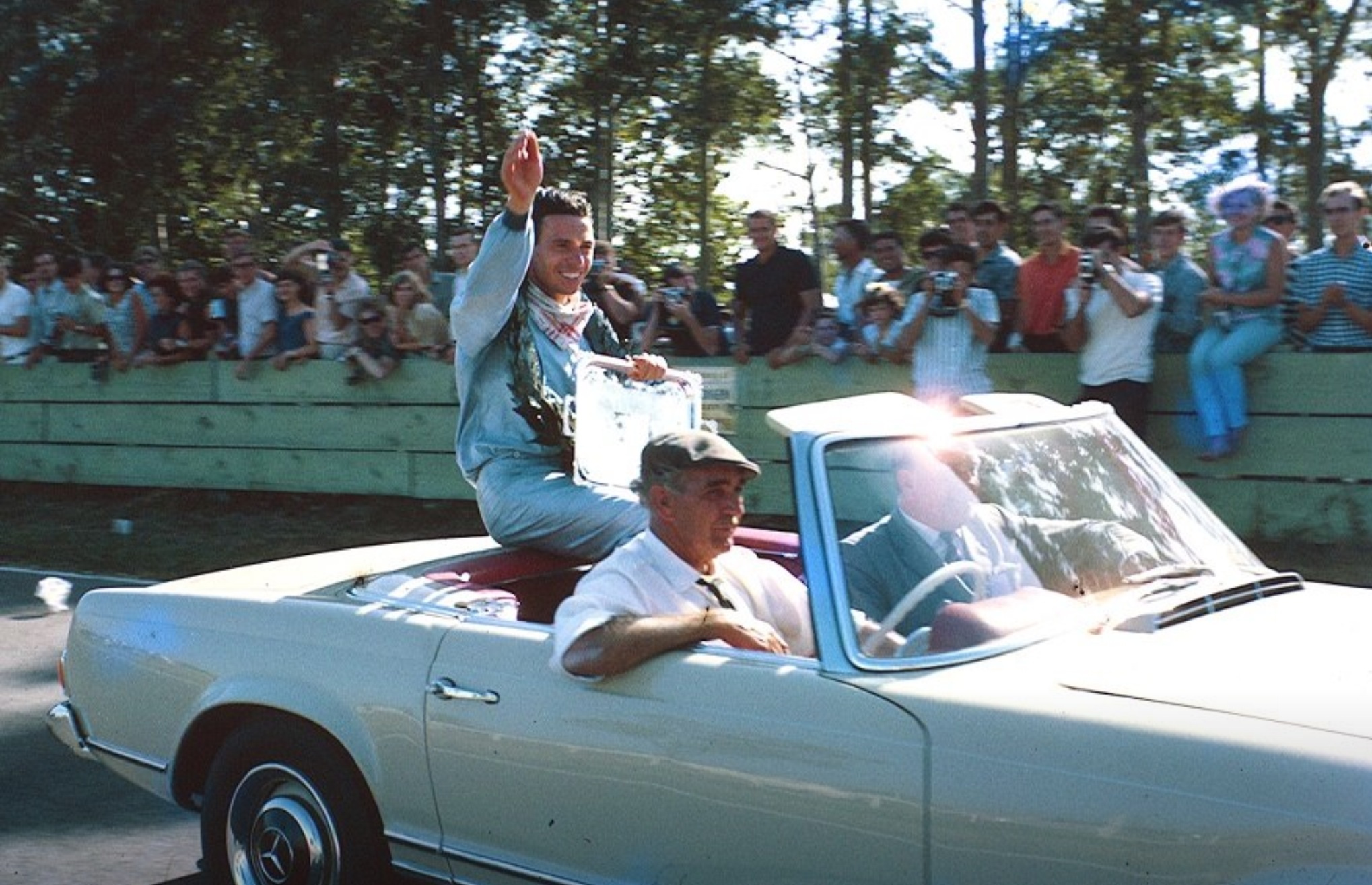
Jim Clark stops his Lotus 39 to collect a celebratory beer after winning the 13 February 1966 ‘Warwick Farm 100’ Tasman round…

Clark won the Tasman Series in 1965, 1967 and 1968. His 1966 mount, whilst a good car, the 2.5 litre Coventry Climax four-cylinder engine was outgunned by the ex-F1 BRM P261, the capacity of which had been stretched from 1.5 to 1.9 litres with Jackie Stewart winning the championship taking four victories from eight rounds.

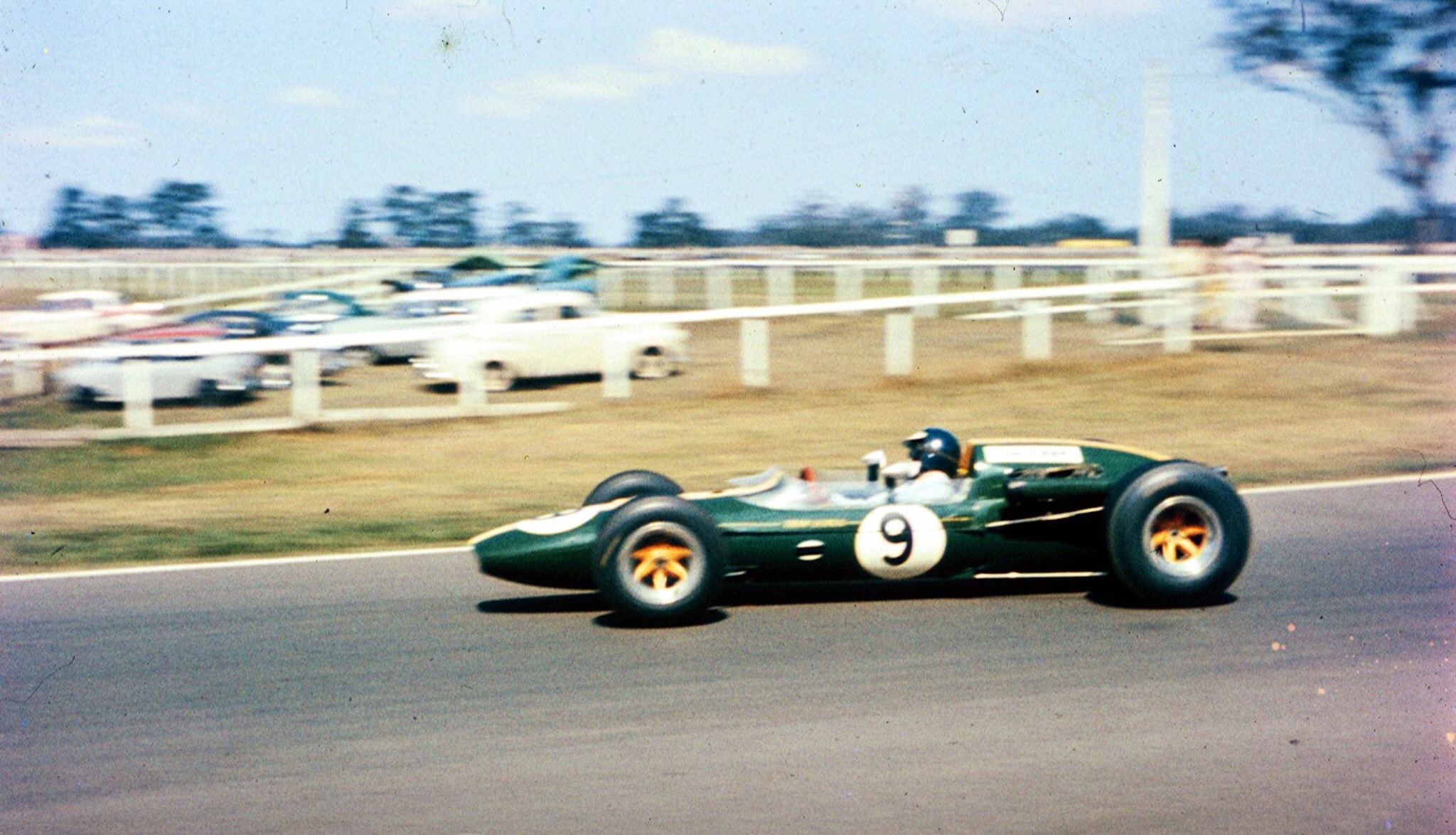
I wrote a feature article about this one-of-a-kind Lotus 39 a while back; https://primotipo.com/2016/02/12/jim-clark-and-leo-geoghegans-lotus-39/

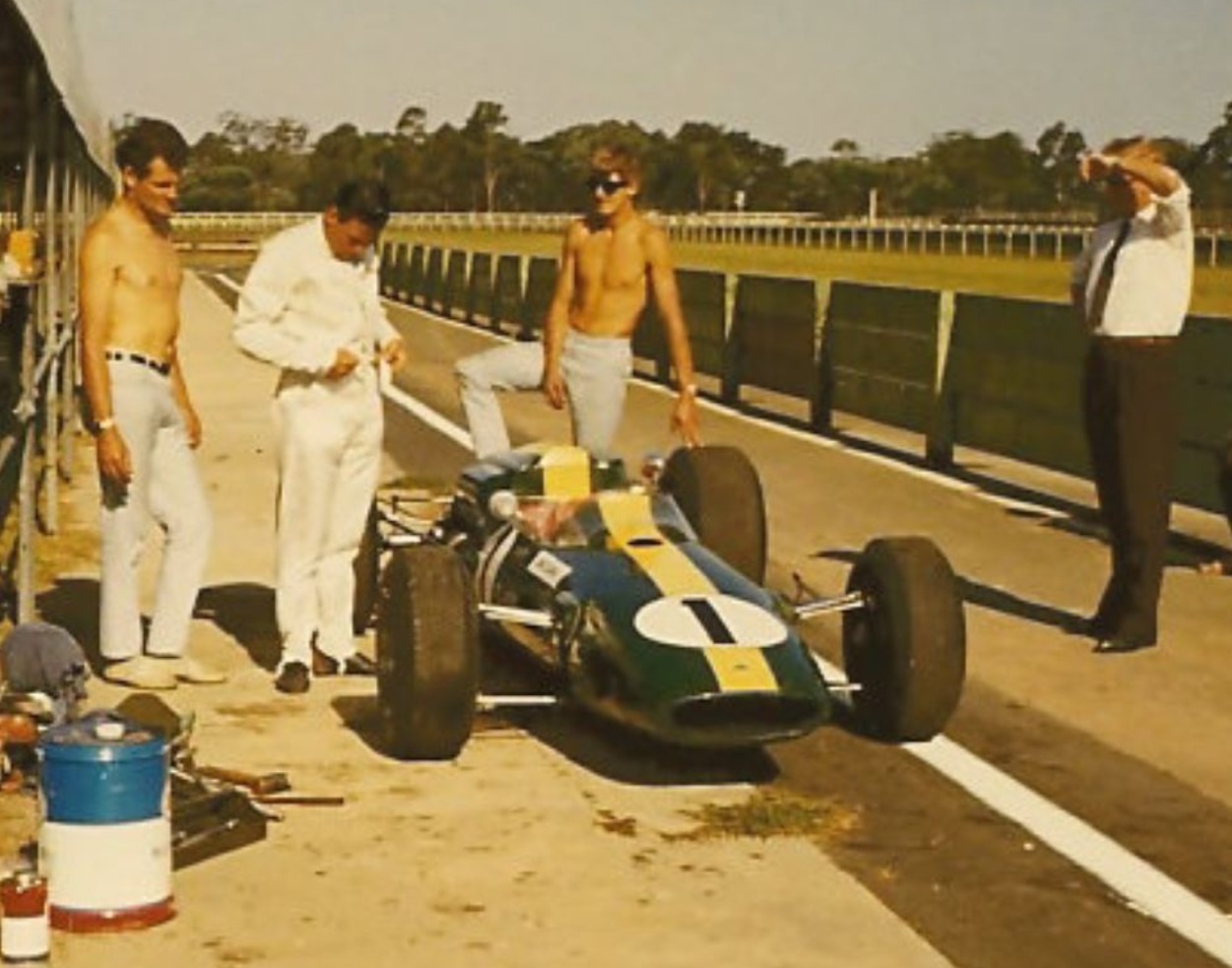
JC and the lads looking fairly relaxed for this Thursday or Friday WF test of the 39, WF pitlane 1966 (ABC)

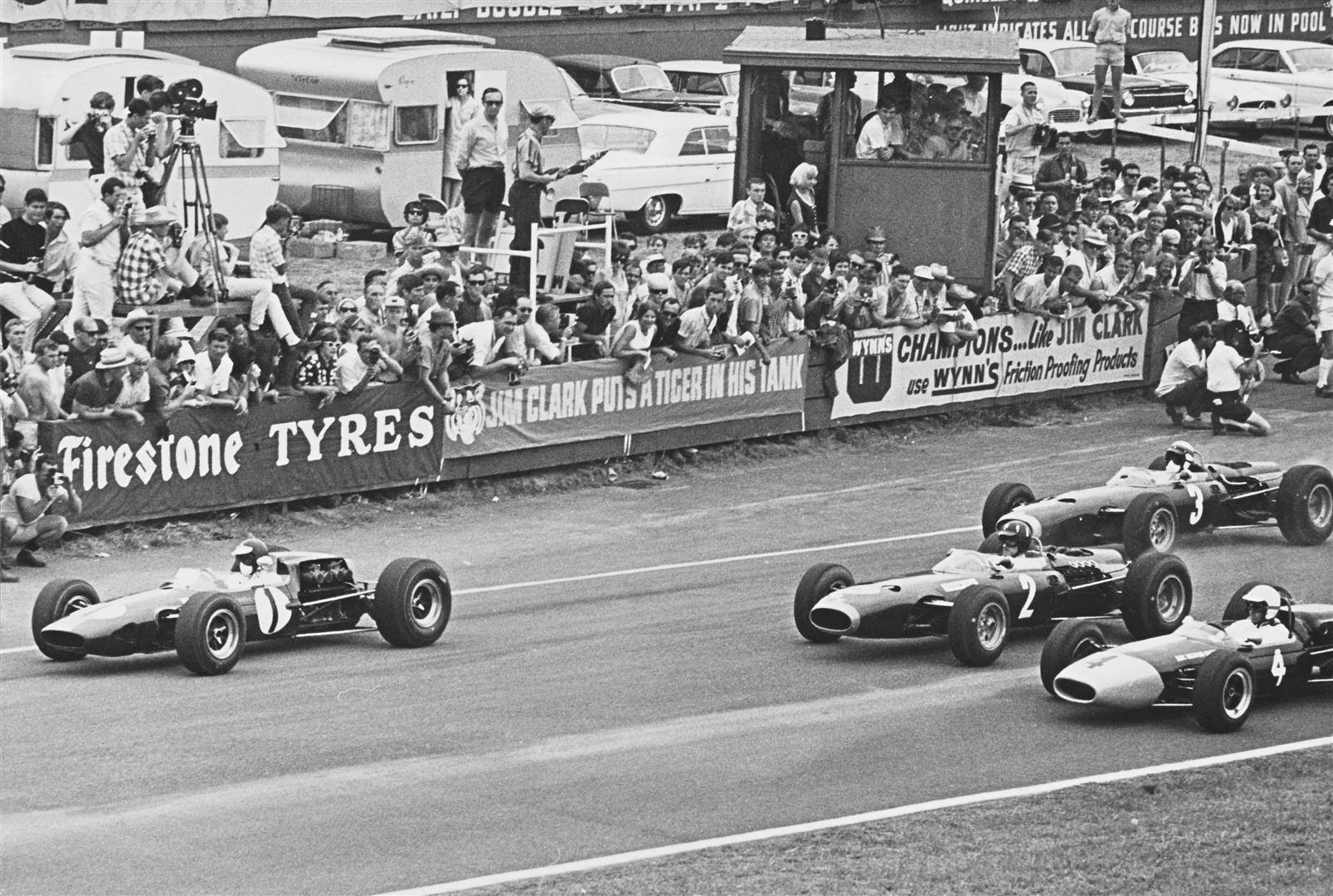
From the off at WF: Clark’s Lotus 39 scampers away from the Hill and Stewart BRM P261’s and Frank Gardner in Alec Mildren’s Brabham BT11A Climax #4 (WFFB)

Jim’s only 1966 Tasman win was in Sydney- Barry Hickson took this photograph whilst a flag marshall at Homestead Corner recalled that Dick MacArthur Onslow, the Homestead Sector Marshall promised Jim a ‘cold one’ if he won, here in the opening photo, the great Scot has pulled up to collect the promised cool beverage from Dick!

Benz 230SL to Clark’s liking, Homestead Corner fans happy to have JC back after his stop a short time before (B Hickson)

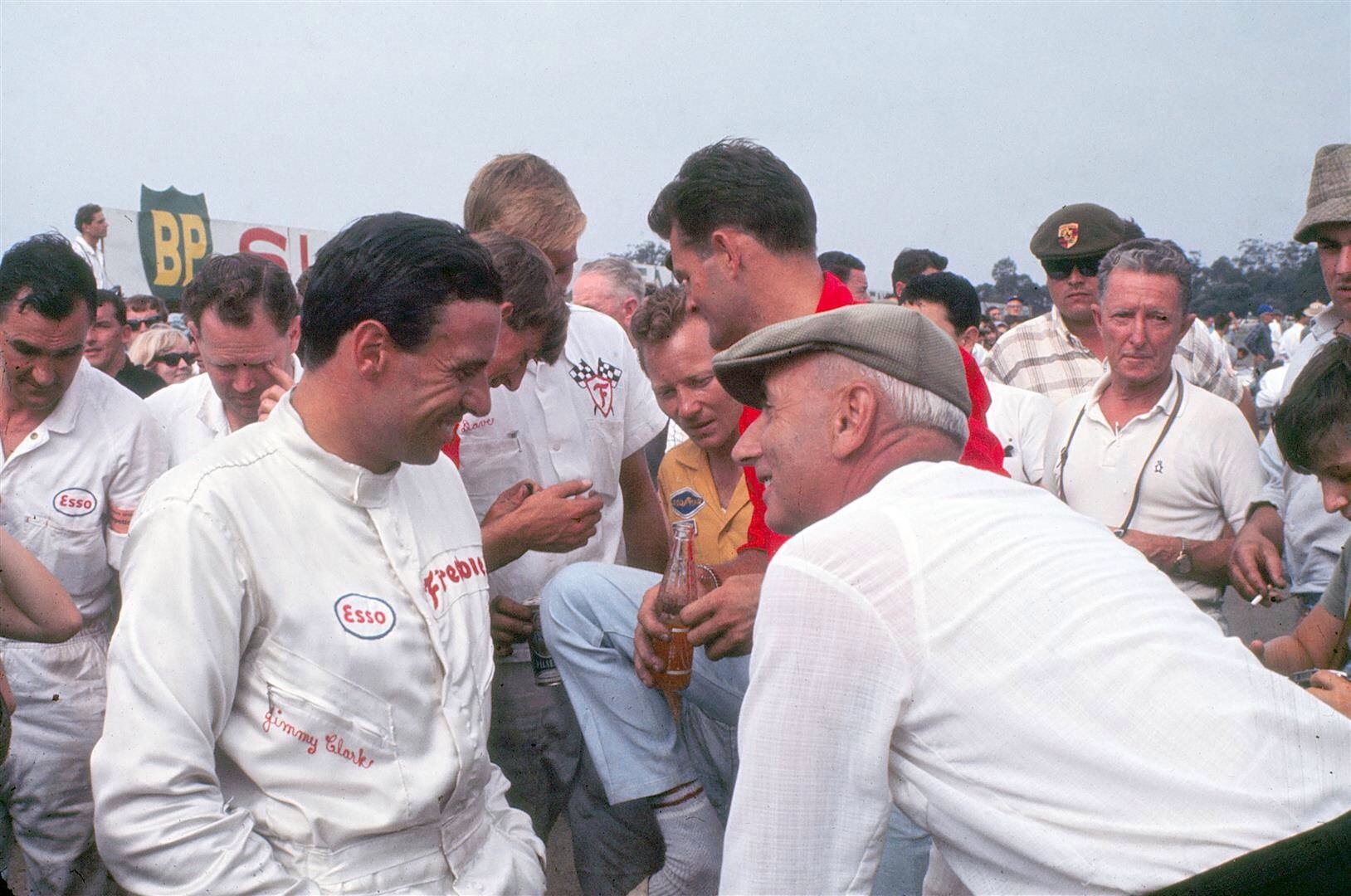
Clark and WF supremo Geoff Sykes swap notes after the 1966 win (WFFB)

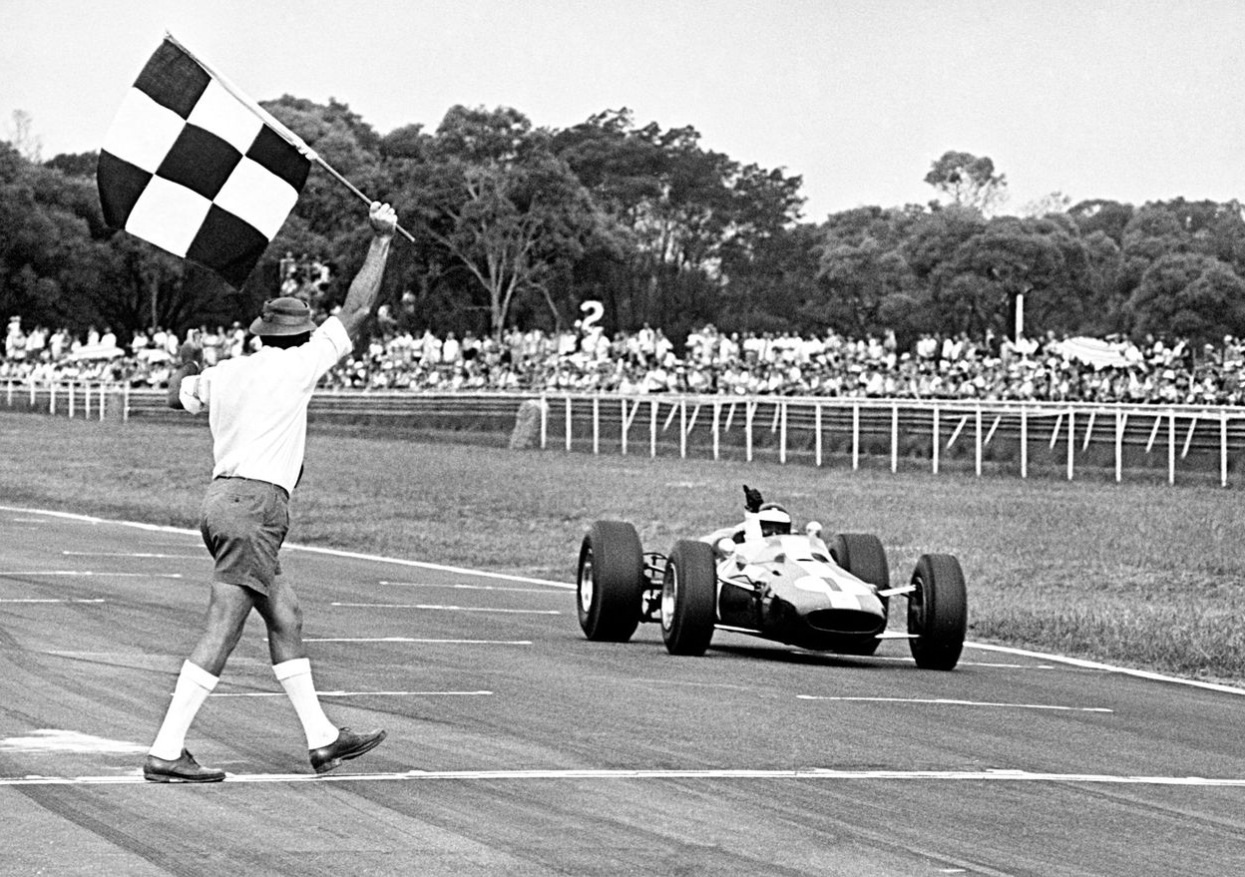
Clark excelled at the technical, depending, outer Sydney track, he started from pole and won from Graham Hill, BRM P261 and Frank Gardner in Alec Mildren’s Brabham BT11A Climax with JYS fourth in the other P261.

In fact the ‘Farm was a very happy hunting ground for Jim, he raced there from 1965 to 1968 winning on three of his four visits aboard works Lotus machines- 1965 32B Climax FPF, 1966 39 FPF, and in 1968 aboard a 49 Ford DFW, the 2.5 litre variant of the 3 litre F1 Ford Cosworth DFV. In 1967 he fell short of the mark but not by much taking second to Jackie Stewart’s BRM P261, that Tasman Series the BRM V8’s were stretched to 2.1 litres in capacity. Jim’s 1967 car was an F1 Lotus 33 Coventry Climax FWMV 2 litre V8.

Victory for Clark at WF in 1966 aboard the Lotus 39- a car which would become iconic in Australia thereafter in Leo Geoghegan’s hands in both Coventry Climax and Repco V8 engined forms. And still resident in Oz (unattributed)

Credits…

Barry Hickson, Aust Broadcasting Corp, Warwick Farm Facebook page

Tailpiece: Clark on the way to his 1965 Warwick Farm 100 win, this time in his Lotus 32B Climax, Homestead Corner…

(B Hickson)

And the same 32B chassis in the WF paddock beside Jack Brabham’s Brabham BT11A Climax, with Roy Billington toiling on Jack’s car. Is that Ray Parsons behind the 32B? Who is the Repco clad bloke looking at Jim’s car who attended to Jack every year whilst he was in Oz?

(B Hickson)

Finito…

image

(Glenn Murphy)

Max  Stewart enjoying the trip back to the hotel aboard his evergreen, fast Mildren from Singapore’s Thomson Road Circuit 8-11 April 1971. Note the tow-rope!…

Max failed to finish in his Mildren Alfa that year, a successful one in which he won the Australian Gold Star Championship, albeit the car was Waggott 2 litre rather than 2 litre Alfa GTAm powered as it is here.

The Singapore race was won by Kiwi, Graeme Lawrence in a Brabham BT29 Ford FVC  from the Australian duo- John Walker’s Elfin 600 Ford twin-cam and Bob Muir’s Mildren ‘Yellow Submarine’ Waggott third. It was Rennmax’ galore in this race with Ken Goodwin 6th in his BN3 Ford with Stewart a DNF, his Mildren chassis also built by Bob Britton’s Rennmax concern.

Stewart on the way to his 1972 Singapore GP win, Mildren Ford, behind is Leo Geoghegan in Graeme Lawrence’s Brabham BT30 Ford (SMI)

In 1972 Max brought this car in which he had so much success over so many years back to Singpore and won the race held on 2 April…

The race had depth- Vern Schuppan ran a March 722, Garrie Cooper, the Elfin boss converted his Elfin 600D from Repco V8 to Lotus/Ford twin-cam spec, Leo Geoghegan raced Graeme Lawrence’s Brabham BT30, Bob Muir a Rennmax BN3 and Sonny Rajah his ex-Ronnie Peterson March 712M.

In fact that was the big change to the meeting- the organisers effectively adopted Australian National F2 engine regs which in a practical race winning sense mandated the use of the Lotus/Ford 2 valve, twin cam engine. Max’s car was fitted with a Paul England built mill in place of the Waggott 2 litre 4-valver with which the car won so many events.

Click here for my article on the 1972 Singapore race; https://primotipo.com/2016/11/24/singapore-sling-with-an-elfin-twist/

Max receives the booty and tells all after his ’72 Singapore GP win (SMI)

Their is a story to tell about fitment of the Alfa GTAm engine to the Mildren for its Asian Tour in 1971 though, and i would love to hear it!

The Singapore GP race in mid-April was well before the start of the Australian Gold Star Series at Lakeside on 6 June. So why was the Alfa engine, no doubt provided by Brian Foley, the only chap in Oz with a GTAm, fitted instead of the usual Waggott 2 litre with which it raced right through the 1971 season by Max and then the 1972 Australian Tasman rounds in Tony Stewart’s hands?…

(NAS)

Etcetera: Stewart, Mildren Waggott, Singapore Grand Prix 1970…

Max during the 1970 GP when the little Mildren was powered by Merv Waggott’s TC-4V 2 litre engine. The race that year was dominated by Stewart’s teammate in the Mildren Alfa 2.5 V8 ‘Yellow Submarine’- Kevin Bartlett won the 20 lap preliminary and led the GP until a valve spring let go, Graeme Lawrence’s ex-Amon Ferrari 246T with whom KB had been dicing throughout, took a popular win. GL won many races in South East Asia for the best part of a decade from the mid-sixties to the seventies. Not sure where Max placed.

Tailpiece…

(K Wyndham)

One article, one car, three pictures- three different engines.

Here is Max’s Alec Mildren owned machine- that’s Mildren talking to Glenn Abbey, his longtime friend and Chief Mechanic behind the truck in the Oran Park paddock in June 1970.

A successful weekend for the team as Max won the Gold Star round powered by a 2 litre Waggott engine from Leo Geoghegan, Lotus 59 Waggott and Garrie Cooper, Elfin 600D Repco 2.5 V8. The dude tending to the front Goodyear is Derek Kneller (his book is on the way and will be a beauty) with Stu Randall at the rear. I wonder who the pretty Missy is with an interest in all things mechanical?

The engine count for this chassis (in fact one car- two chassis frames) is something like- Alfa Romeo 1.6 twin-plug 2 valve DOHC F2, Waggott 4 valve DOHC- 1600/1860/2000cc, Lotus Ford 1.6 litre 2 valve DOHC and Alfa Romeo 2 litre 2 valve twin plug DOHC.

Credits…

Glenn Murphy, Singapore Ministry of Information/Arts, Ken Wyndham, oldracingcars.com, National Archives of Singapore

Finito…


What a couple of pert, perky, taut little tooches!? I do like a finely formed little rump, the Lotus Elan and Jag E Lwt, two of the tightest…

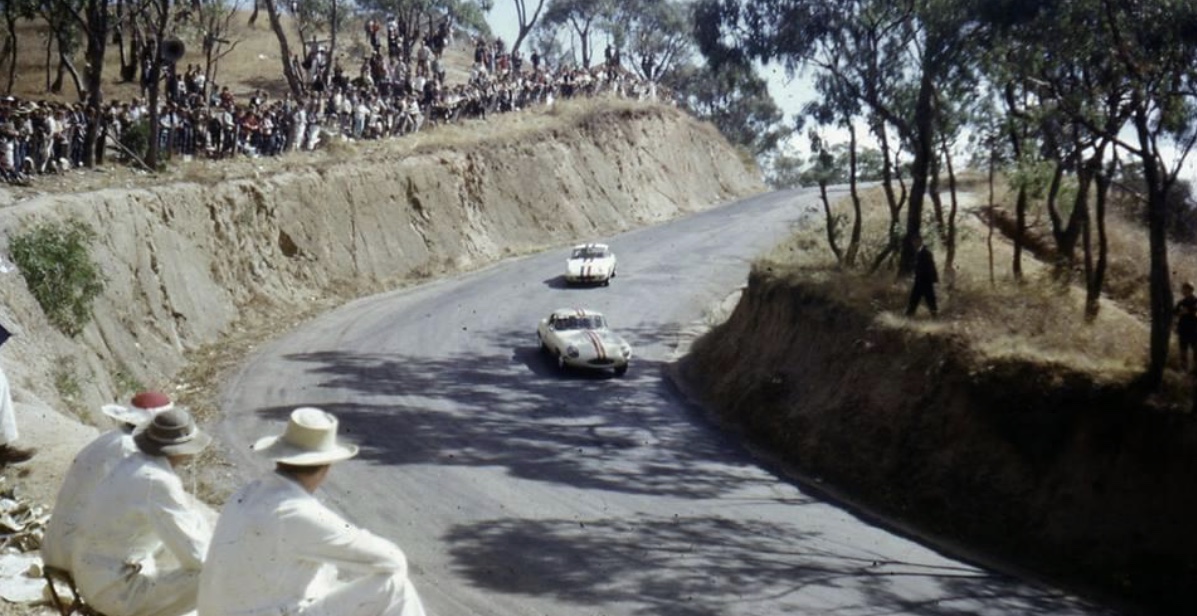
Its Leo Geoghegan chasing Bob Jane through Hell Corner for the blast up Bathurst’s Mountain Straight, I’ve my money on the punch of the Jag’s mid-range torque not to forget its beefy top end over the delicate little Elan. Timeless, twin-cam designs both.

I’ve written about these blokes often enough for international readers to know they were both prominent Australian champions- Bob best known for exploits in touring cars and Leo in open-wheelers. Here they are on ‘neutral ground’, sportscars, during the Easter meeting in April 1965.

(unattributed)

Jane got the better of Leo in both the 5 lap preliminary and 13 lap NSW Production Sportscar Championship, winning both races from the Sydneysider, top speeds of the cars were 147.05 and 142.85 mph (Elan) on Conrod Straight.

I notice Bob’s Jag has a Victorian number plate. The successful businessman lived just off Kew Boulevard in Melbourne’s leafy inner east, no doubt the racer was exercised on that marvellous stretch of road from time to time.

I’ll get around to a comprehensive article on Jano’s Lwt E Type one day, for now enjoy these snippets and shots great sixties sporties.

Etcetera: Jano and his E Types…

(D Lupton)

The Jane Jag E Lwt and Mk2, plus Fiat 2300 at Calder 1964- the E Types first race was here on 8 December 1963.

Its said that the car was a gift from Sir William Lyons via Australian Jaguar importer Jack Bryson. Bob was a Jaguar sub-dealer and had done amazing things to promote the marque in Australia via his race exploits in his Mk 2, an Australian developed car.

Bob and his brother Bill Jane later raced the car in the UK- Jane retained it until 1980 when it was reportedly sold at auction for $A80,000- his ex-works Maserati 300S was sold for a similar figure. He said ‘it was the biggest business mistake i ever made’…


Jane at Bathurst looking fairly hot and dry, Easter 1966 perhaps (T Smith)


(B Caldersmith)

Cracker of a shot above appears to be a lap one horde at Warwick Farm’s Homestead Corner.

Spencer Martin is aboard the Lwt from Leo Geoghegan, Lotus Elan 26R, Kevin Bartlett in Alec Mildren’s Alfa Romeo TZ2 and Andy Buchanan or Greg Cusack in David McKay’s Ferrari 250LM- then the dark top of Fred Gibson’s Elan and a gaggle of ‘Sports Racing Closed’ Minis.

Spencer is driving for Bob so it’s 1966 or 1967.

(H Schendzielorz)

Jane in the Lwt heading up Templestowe Hillclimb in Melbourne’s outer east, circa 1964.

Bob’s Lightweight was his second E Type, as most Australian enthusiasts would be aware.

He bought his first, a series 1 red-roadie in the UK in 1961 complete with Warwickshire rego-plate ‘2152WK’- the car’s chassis number was RHD 621.

It was continually modified and as a consequence was a more successful racer than the Lightweight which competed against sportsracers rather than production sportscars. It competed in 21 race meetings in only 15 months, incuding third in the 1963 Australian GT Championship when driven by Bill Jane, Bob’s brother.

Jane at Longford circa 1963 (unattributed)


Lakeside 1963. Bob’s multi-Oz touring car championship winning Mk2 and E Type FHC (J Psaros)

When Bob bought the lightweight in late 1963 he sold the Fixed-Head E to Adelaide’s Clem Smith, prominent racer and Mallala circuit owner- he raced it twice more.

Soon after it was sold to a member of the RAAF and disappeared, presumed crashed in the Adelaide Hills in the 1960’s or 1970’s.

In more recent times research via Jaguar racer, Mark Trenoweth and Jaguar Magazine have tracked the car to Toowoomba, north of Brisbane where it was owned by a group of enthusiasts- still fitted with is aluminium bonnet and other goodies.

The magazine reported that the car had several owners after that and at one stage was fitted with automatic transmission- the ‘case’ has now gone cold again, do get in touch if you can shed some light on its whereabouts.

(Nantes)

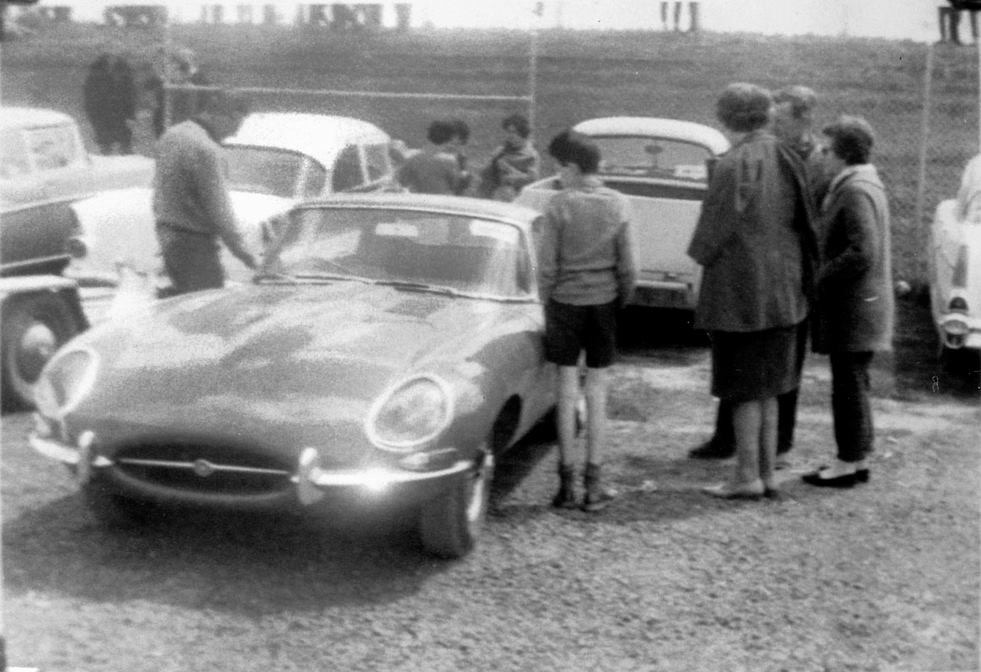
The photographs above and below are unmistakenly Sandown’s old pits, some of the first shots of Bob’s FHC, which still looks in standard specification- more than likely this is the circuit’s opening meeting in March 1962- the Lotus Elite below is driven by Tony Osborne.

(autopics.com.au)


(unattributed)

Wet Lakeside meeting above and Bob is alongside Frank Matich in his Lotus 19B Climax, wet international meeting in 1963 at a guess. Elfin Streamliner on the second row plus other cars you pick yourselves. Matich might have won this race…

And below at Mallala, circa 1963, with Bob ‘half-out-the-window’ as he is in quite a few shots of this car!

(Smith Family)

Etcetera…

(unattributed)

Lightweight E Type at Mallala.

(unattributed)

The red E FHC, i suspect after Bob had sold it, but where, when and who is the driver are my questions!?

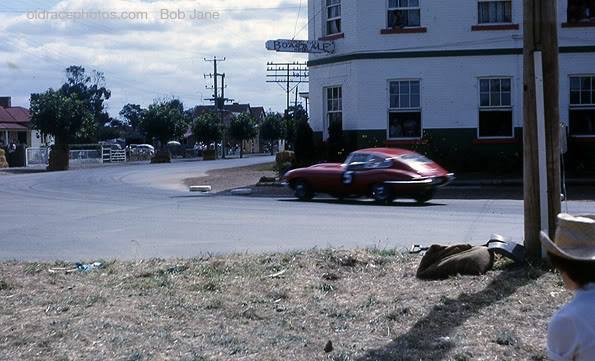
Superb shot of Jane heading for the apex of Pub Corner in Longford Village circa 1963.


(unattributed)

Low down shot perhaps taken at Warwick Farm.

Credits…

autopics.com.au, ‘Bathurst: Cradle of Australian Motor Racing’ John Medley, Dennis Lupton, Heinz Schendzielorz, Jock Psaros, oldracephotos.com, Nantes Family, Clem Smith Family Collection, Terry Smith, Brian Caldersmith

Tailpiece: Geoghegan and Jane leaning into Hell Corner, April 1965…

Finito…


(Rod MacKenzie)

…in the words of Maxwell Smart, for you aficionados of Mel Brooks’ wonderful sixties TV show ‘Get Smart’.

Kevin Bartlett with an inside wheel off the deck demonstrating the millimetre precision for which he was famous aboard the Mildren ‘Yellow Submarine’ Alfa in Warwick Farm’s Esses, September 1969. Rod MacKenzie has opened his shutter at precisely the right moment.

Another inch or so and the talented Sydneysider would have ripped an expensive corner off the front of a car which was so kind to him. I’m not sure of the racer behinds identity. A Lotus 27 or 32 perhaps?

Bartlett inherited the Len Bailey designed, Alan Mann Racing built, Alec Mildren owned car after Frank Gardner raced it in the 1969 Tasman Series. KB used it to great effect in that years Australian Gold Star Series winning three rounds and the title in it- Symmons Plains, Surfers Paradise and in Bartlett’s Warwick Farm backyard in December.  During a busy season KB and the Sub also won the Macau Grand Prix on 16 November and contested the JAF Japanese Grand Prix at Fuji.

Every inch a GP car of its day isn’t it, just magnificent. Mildren Alfa in its ‘Alfa ultimate form’. Lynton Hemer’s shot captures the car at WF on Hume Straight in July 1970- interesting shot as the Alfa engine is back in the car long after its first Waggott engined race (L Hemer)

It wasn’t the ‘same car’ by the end of the year though as the Alfa Romeo Tipo 33 2.5 litre V8 engines with which the chassis was originally designed and built were put to one side and replaced by Merv Waggott’s Sydney built, 2 litre all alloy, DOHC, 4 valve, Lucas injected 275 bhp engine.

The history of my favourite ‘Australian’ racing car is one for another time- it’s a long story as this jewel of a car’s ‘in period’ history starts with 1969 Alfa V8 wins, continues with Waggott engined victories and ends with 1.6 litre Hart 416B success in Australian National F2 form in 1974/5. A fellow named Ray Winter was campaigning this famous car by then.

(Bill Pottinger)

High Speed Precision too…

Bartlett was famous for his tail out style, he was ‘the absolute master of opposite lock’ as Sam Posey described him having raced against KB during the 1973 Tasman Series and in the ‘L&M F5000 Championship’ in the ‘States in 1972/3.

This shot of the car is in ‘neutral to very subtle oversteer’ attitude, a very high speed, delicate drift- was taken by Bill Pottinger whilst Kevin traversed Teretonga’s ‘loop’.

The 1970 Tasman was tough in a 2 litre car, it was the first year of the Tasman F5000 Formula. KB was still quick enough to take 5th at Pukekohe and Teretonga- a second at Surfers Paradise, very much a power circuit was amazing and first at Warwick Farm brilliant but understandable. Bartlett, Matich and Leo Geoghegan were surely the quickest blokes around ‘Gods Own Acre of Motor Racing ‘ out Liverpool way?!

A mighty fine car and a mighty fine driver- thankfully both are still alive and well in Australia, Queensland to be precise…

(Bill Pottinger)

Merv Waggott fettles…

Sydney’s engineering genius Merv Waggott doing a plug change in ‘The Sub’ during the 1970 Teretonga weekend. Alec Mildren had been using Merv’s talents for years and specifically the smaller variants of Waggott’s engines in his other car, the Rennmax Engineering built Brabham BT23 copy ‘Mildren Waggott’ raced by Max Stewart.

When Merv decided to build a bespoke aluminium block to allow a capacity of 2 litres, something the Ford Cortina blocks used hitherto could not, it was an easy decision for Alec to go the more cost effective route with the local engine rather than the 2.5 litre Alfa V8.

The Alfa unit had received no development since first fitted to Mildren’s Brabham BT23D chassis in late 1967. Alfa were focussed on 3 litre engines for both their Tipo 33 Sportscar program and F1. Two litre Waggotts won Australian Gold Stars for Leo Geoghegan in 1970 (Lotus 59B) and Max Stewart in 1971 (Mildren Waggott)

(H Ellis)

Etcetera: Australian Competitor Set 1970…

Startline of the first round of the 1970 Gold Star Series at Symmons Plains, Tasmania in March 1970.

John Harvey’s #2 Bob Jane Racing Brabham BT23E Repco on pole alongside KB in the Mildren ‘Yellow Sub’ Waggott with Leo Geogheagn’s Lotus 39 Repco on the outside, and behind him in the other yellow Mildren Racing entry is Max Stewart in the Mildren Waggott spaceframe Bob Britton/Rennmax built car. Harvey won a top race from Leo and KB.

In a season of change it was Leo’s last championship race in the venerable ex-Clark Lotus, Harves was about to switch to the Britton/Rennmax built Jane Repco V8- yet another car, like the Mildren Waggott built on Britton’s Brabham BT23 jig whilst KB spent much of 1970 racing in the US so did not defend his Gold Star title. It was also the last year of the Tasman 2.5 Gold Star Formula- Geoghegan taking the title in a new Lotus 59B Waggott 2 litre as noted above.

KB gets a shove during the 1970 Tasman meeting- he won in front of the F5000’s. Glen Abbey, Ian Gordon and another fella. Stewart’s Mildren Waggott in the paddock behind (unattributed)

Photo Credits…

Roderick MacKenzie, Bill Pottinger on The Roaring Season, Lynton Hemer, Russell Thorncraft, Harold Ellis

Tailpiece: Bartlett from Geoghegan, Warwick Farm Esses during 1969- Mildren Alfa from Lotus 39 Repco…

(R Thorncraft)

Finito…


Geoghegans were the Australian importers and distributors of Lotus cars from the mid-sixties to the mid-seventies when Jim Smith’s Peter Manton Motors in Melbourne stepped up to the plate

The brothers Geoghegan are no doubt well known to most primotipo readers by now, even you international mob. Between them they had ‘Taxis’ or Touring Cars and Open-Wheeler racing covered in Australia. Ian or ‘Pete’ Geoghegan was a multiple national champion aboard cars with a roof and Leo was similarly credentialed in the more rarefied and refined single-seater world.

Whilst the Lotus Racing Halo internationally was huge in the mid-sixties for all of the obvious reasons, the Geoghegan connection must have polished the Lotus brand considerably in this part of the world too.

Who wouldn’t want to buy a car from them and then have it serviced there? Why, if you were lucky during February, you might even time your trip to have your Elan’s Webers tickled with the visit of Team Lotus who operated from the Paramatta Road, Haberfield dealership during the Warwick Farm Tasman weekend.

(Dalton)

The Lotus franchise in Australia is a bit of a ‘hot spud’ really- no one has distributed the things for a long time.

Not even those who were multi-franchise dealers and therefore had the earnings of other marques with greater volumes to support the lower financial contributions of what has always been a very niche brand in Australia, the brothers Geoghegan probably the longest lived of the dealers.

Some well known motor racing names have been involved in flogging the wonderful but idiosynchratic cars down the decades.

Alec Strachan was the original importer, he was based at Waitara, Sydney and negotiated the rights with Chapman off the back of purchase of a Lotus 6-the first of Chapman’s machines in Australia. Then Derek Jolly with his impeccable racing and engineering connections to Chapman himself took over, but that was never going to really work, Adelaide is a long way from the main East Coast markets especially back then given the transport and road infrastructure. Adelaide, Perth, Brisbane and Hobart had tiny populations for such a niche product.

Performance Automobiles sold a few in Hobart and in Melbourne John Roxburgh, and Dick Thurston’s Pitstop Motors on the Nepean Highway, Brighton waved the Hethel flag. At the same time Lance Dixon sold plenty of used ones, many times I rode by bike from North Balwyn to Doncaster to dream about a red Europa or Elan. Simply Sportscars of South Melbourne have the rights now- these blokes are hard-core enthusiasts and should do well where others have failed.

Whad’ll she do mister? Leo Geoghegan’s ex-Clark Lotus 39 Repco sitting forlornly on the 253 Parramatta Road lot in 1970. Leo raced the car finally, having acquired it from Team Lotus after the 1966 Tasman Series, in the 1970 Tasman, then it was put to one side to sell whilst Leo raced to Gold Star victory in a new Lotus 59 powered by a Waggott 2 litre DOHC, 4 valve injected engine (Fistonic)

These photos by Milan Fistonic capture the late-sixties flavour of the Geoghegan’s dealership in Sydney’s Parramatta Road, ‘Auto Alley’.

The shots are very much dated as being late 1970, the year in which Leo stopped racing his evergreen ex-Clark Lotus 39 Repco V8. There it is, the 1969 JAF Japanese Grand Prix winner sitting on the used car lot just waiting for a punter with the necessary readies. Click here to read my article about this wonderful car; https://primotipo.com/2016/02/12/jim-clark-and-leo-geoghegans-lotus-39/

It was not an easy car to move at the time with F5000 in the process of becoming the new ANF1, to replace the 2.5 litre Tasman Formula. The nutbags at CAMS made F5000 cars eligible to contest the 1970 Tasman Series but not the domestic 1970 Gold Star- that title was won by Leo G in the Lotus 39’s replacement, a brand new Lotus 59B to which he bolted a superb circa 275bhp 2 litre Waggott engine built not too far from the dealership. The 39 fell into the very best of hands, John Dawson-Damer, who did a brilliant job restoring it to its original, ex-works 2.5 litre Coventry Climax FPF engined form. It’s still in Australia, happily!

It seems fitting to provide some period written flavour to accompany the photos.

To do so I have reproduced the wonderful recollections of ‘DanTra2858’ he contributed to ‘The Nostalgia Forum’, Daniel worked for the brothers Geoghegan at that time, the late sixties. I’ve positioned his thoughts around several different headings to preserve some semblance of flow.

(Dalton)

On assembling Lotuses in Australia.

The cars arrived by ship from Hethel ‘CKD’ or in Completely Knocked Down form… ‘…1969, also working there at the time was Barry Lake (racer and very well known racing journalist) and Wally Willmott (for many years Bruce McLaren’s right hand in the nascent years of BM Motor Racing in the UK) Service Manager was Bob Everitt.
With a little help to remove a Europa from its crate and the motor/gearbox and diff assemby, it took me about 10 hours to assemble a car ready for registration.

There were some long days assembling the cars mainly due to the clutch plates attaching themself to the flywheel. Of course this did not show up until the installation of the motor/gearbox into the car on initial start up, sometimes it could be rectified by starting the car in gear but not always. Then out with the motor/gearbox as that was easier than split, fix the problem then put it all back together again, good days!

When Lotus cars were imported…they came in a open frame wooden crate with the car wrapped in plastic sheeting, that was the full extent of protection (during the long voyage from England) The motor/gearbox assembly was in a wooden box complete with the suspension, tailshaft , diff and wheels. Each crate/box had identification numbers on them to match the motor to body, so the first thing to do was match up the components to assemble a car.

When this was done the body crate was opened, plastic wrapping removed and using 2 trolley jacks the body was moved into the workshop and placed on modified jack stands. Then the motor box was opened and all suspension parts/wheels were removed and taken into the workshop ready for assembly, by this this time it was time to stop work for morning tea!

Now refreshed it was time to fit the suspension and wheels so the car was now a roller which made it easier to work on. When assembling the rear suspension the diff, drive shafts, Hillman Imp rubber doughnuts etc were all fitted. Now for lunch.

So with a full belly it was time to bring in the motor/gearbox, tailshaft and fit them into the car, along with the exhaust system. When this assembly was bolted in, cooling hoses, electrics and other parts were fitted. Then it was time to present to this ‘new arrival’ its first full meal of lubricants including brake fluid, so we then bleed the brakes. By this time it was about 4 in the afternoon so a cuppa was in order, then back to work.

Now that the car was fully assembled the work really started. Re-check that all previously assembled parts were correctly assembled and all bolts/nuts were tight, oil levels were correct and that there were no leaks in the brake hydraulic system and fluid was at correct levels. Next I checked that the clutch operated correctly and if not then one of two steps were taken to rectify the adhesion of the clutch plate to the flywheel/pressure plate. If there was no trouble with the clutch it was time to connect the battery and start the motor, let it warm up, check for fluid leaks and bleed the heater system in the cabin of the car by slackening the bleed screw on top of the heater core remembering to tighten it after all the air was bled off. If there was clutch trouble the first thing we did was to start the car while in gear, this usually caused the clutch plate to release then operate correctly. If not then it was out with the motor/gearbox assy to fix the problem then pop it back into the car- this would add 3 hours to the assembly time.

If all went well it was now about 6 pm but still the to-do list list included wheel alignment, checking that all lights operated correctly and that all of the electrics worked. Then tyre pressures were set with a final check for leaking fluids. By this time it was about 8pm and another 12 hour day was complete leaving the road test for first thing the next day- that also included cleaning up wood crates and plastic wrapping. Then onto normal service work with another assembly starting the next day. Well folks that is how it was done at Geoghegans, I may have missed a few steps somewhere along the way, it is a long time from 1969…you have the picture’.

Plenty of lonely S2 Europa’s in 1970 (Fistonic)

On The Hot Sellers of the Lotus range…

‘The sales section always required stock on the floor that covered the Lotus range excluding Super 7’s. (Not sure why they were not imported to Australia, Chapman didn’t do the deal with Graham Nearn at Caterham cars to take over the rights to build 7’s until 1971 from memory, so Lotus Components were certainly still building them in the late sixties)

The slowest moving car was the Elan Plus 2 so every time one was sold we would assemble another but that did not happen often, the most popular was the Elan Coupe followed by the Europa, we would assemble 2 or 3 a week depending on sales of the model.

I found the Europa quicker to assemble than the Elan. My first experience driving a Europa along Paramatta Road (a main artery into and out of Sydney in the days before freeways it was the ’normal’ way to go between Melbourne and Sydney so there was plenty of local and interstate traffic inclusive of large semi-trailers) was just straight out frightening especially when a double decker bus pulled up alongside me while waiting for the traffic lights to change to green. Sitting in the Europa I found myself looking up at the centre of its wheels with the bus towering over me, a feeling of vulnerability quickly came over me.’

Tried and true technique of naked ladies to get us blokes to scan the pages of a brochure in a thorough manner. Lotus Elite brochure , must be US issue, way too racy for 1960 Australia (Dalton)

On Painful Customers…

‘Pete Geoghegan did not come down to the service section much at all…on one of those times he was showing off on a motor bike, doing wheel stands in the lube bay then the 6 foot dash from the lube bay through our parts area into the Lotus workshop then back again with the biggest smile I have ever seen on a guy that has just achieved what no-one else has done.

One Elan FHC I do remember very well.

Its owner arrived at our service area unannounced while we were having morning tea wanting something fixed right away, I told him that I would look at it as soon as I finished my coffee but that was the wrong answer for this guy.

He then spoke to Bob Everitt, the Service Manager and was told by him that I would look after his car as soon as I had finished my coffee, this slowed him down a bit but he kept on looking to his watch. So I finished my coffee quickly…went into the service bay held out my hand and introduced myself, without a blink he shook my hand introduced himself and told me what the problem was, I fixed it in 10 minutes and he was on his way, oh his name…Warwick Brown, I serviced his Elan from then on…’(In 1969 20 year old WB would have just been starting his racing career in a little Brabham owned by Pat Burke- who was still his patron when he won the Tasman Championship in 1975 aboard a Lola T332 Chev F5000)

Photographer Milan Fistonic with an eye for Plus 2 Elans (Fistonic)

Lotus equals ‘Lots Of Trouble Usually Serious’…

‘Whilst at Geoghegans I only worked on one Elite and was very impressed by the construction of the car as a full mono-fibreglass enclosure setup…it was on sale in the yard so it would have been a quick mechanical check up prior to the car going on sale. The main thing that had to be done, as with all fibreglass Lotus’ was to make sure that the electrical earth set up was not corrupted by corrosion on the body to chassis alloy mounting bobbins in the body. That was number one check on all Lotuses even new ones. The alloy bobbins on the Elite are for suspension mounting, but there again steel bolts into alloy bobbins, which means corrosion of the bobbin which have been known to become loose in their fibreglass enclosure- meaning fibreglass repairs.

Lotus Elans were bad for water leaks at the top of the A-pillar and in the boot. We tried re-gluing the door sealing at the top of the A-pillar but all to no avail as the inside plastic section of the seal kept on pulling it down leaving a small opening at the top where the seal assembly transferred to the horizontal. The final Geoghegan factory fix was to push the seal assembly up as hard as you could into the top of the A-pillar while your offsider drilled a one eighth inch hole through the vinyl inside section of the seal and into the fiberglass body, then insert a pop rivet and pull it home and there was a permanent fix with nothing but happy customers. By the way we didn’t leave the pop rivet just plain silver so it would show, we concealed it by painting it with a black texta.

For me the hardest thing while working at Geoghegans was learning how to spell their name, Smith or Brown would have been much easier!’…

Photo Credits…

Milan Fistonic

Bibliography…

DanTran2858, The Nostalgia Forum, Stephen Dalton Collection


image

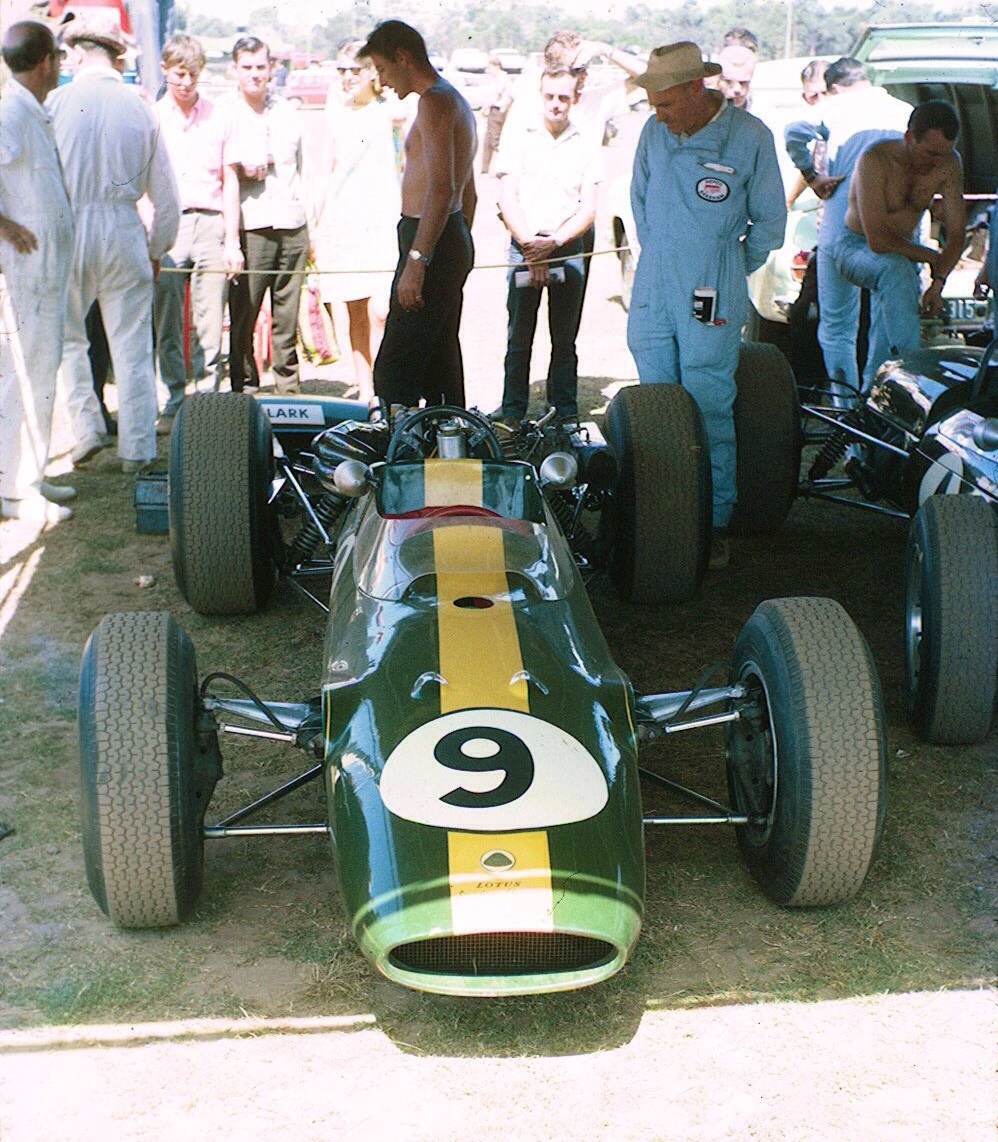
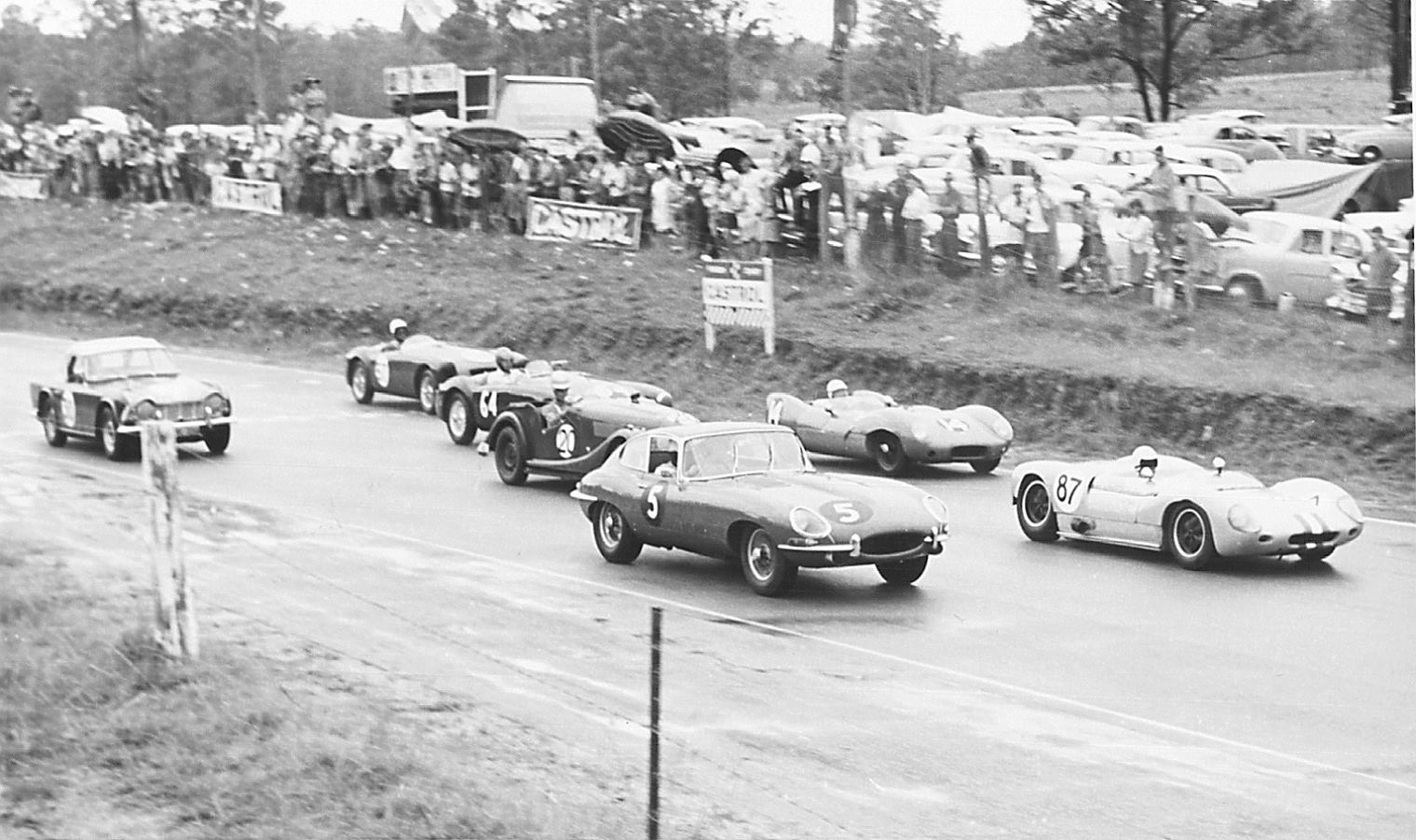
This fantastic advertorial shot is of Frank Matich’s Brabham BT7A Climax and Leo Geoghegan’s Lotus 27 Ford at Sandown in April 1964…

The magazine is the much loved and lamented ‘Australian Motor Sports’, the cover its June 1964 issue. The caption reads ‘…picture taken on the main straight up from the Dunlop Bridge, that’s the Dunlop R6 tread pattern photographer David Parker has caught so clearly on Frank’s car, at the April Sandown meeting’.

The 19 April meeting featured the Victorian Sportscar Championship which Matich won in the Total Team Lotus 19B Climax, the weekend for the team made almost complete by Geoghegan’s Lotus 27 victory in the ‘Victorian Trophy’, that year limited to 1.5 litre cars. Matich retired the Brabham with gearbox problems in the 15 lap racing car feature for ‘Tasman’ cars whilst in the lead, the race was won by Lex Davison’s Brabham BT4 Climax.

At the time the French oil company had aggressively entered the Australian retail market. Formation and promotion of this team, launched in July 1962, was an important part of their marketing and positioning strategy.

Total supported the Matich and Geoghegan team cars of Frank, Leo and brother Ian Geoghegan. Both Frank and Leo I have written about in detail, clink on the links below to read about them.

image

Ian or ‘Pete’ Geoghegan’s Lotus 23 Ford, Leo G’s Lotus 32 Ford and Frank Matich’s Lotus 19B Climax at Oran Park, NSW in 1965 (Rod MacKenzie)

Credits…

AMS, David Parker, Rod MacKenzie Collection

image


image

The spare Lotus 48 Ford FVA, chassis 48-2 during the Eifelrennen Euro F2 round in the Nurburgring pitlane on 24 April…

Oliver’s Lotus Components entered Lotus 41B was the most successful of the Lotus works entries, he finished 11th. The Team Lotus duo of Graham Hill were 15th with Clark retiring with fuel metering unit failure. The latter two drove Lotus 48 Ford FVA’s, Oliver’s car was an update of Lotus’ 1966 contender. Jochen Rindt won the race in a Brabham BT23 FVA.

image

Oliver on his way to 4th place and first F2 home during the Oulton Park Spring Trophy. His Lotus 41B was behind the Brabham Repco’s of Jack and Denny Hulme, and the Honda RA273 of John Surtees. 15 April 1967 (Brian Watson)

Oliver raced for the Charles Lucas factory Lotus F3 team in the second half of 1966, driving a Brabham BT18 Ford and Lotus 41 Ford finishing third in the Les Leston British F3 Championship, Harry Stiller won it from Chris Lambert.

For 1967 Oliver contested the British F2 Championship, finishing 5th, as well as many Euro F2 rounds, for 1968 he was a member of the ‘works’ F2 team racing Lotus 48’s together with Jim Clark and Graham Hill.

image

Lotus Team compound during the 25 June 1967 Reims GP weekend. The white car is Ollies Lotus 41B 7th. Jim Clark is talking to Jackie beside his car #8 Lotus 48 DNF, the car under the cover is the spare carrying #8. Hill is talking to the mechanics next to his chassis, 2nd. The race was won by ‘F2 King’, Rindt in a Brabham BT23 FVA (unattributed)

Then, in the worst of circumstances he ascended to the F1 team upon Jim Clark’s death at Hockenheim on 7 April during the second round of the 1968 Euro F2 Championship.

Oliver was 5th in the championship won that year by Henri Pescarolo’s Matra MS5 Ford, Rindt the dominant driver, as ever, in the category but ineligible for the title as a graded driver.

Olivers first Gold Leaf Team Lotus F1 race was the Monaco Grand Prix in which he qualified his Lotus 49B Ford 13th but was out on the first lap after colliding with Bruce McLaren.


image

Oliver Q10 in the Dutch dunes where the Lotus 49B made its victorious debut in Clark’s hands the year before. He was non-classified having done insufficient laps. Jackie Stewart won in a Matra MS10 Ford (unattributed)


In a character building year, he had a monster accident at during French GP practice when the cars rear wing support failed-pinging the fence of a chateau on an amazing 125mph trip thru the Rouen countryside. He was able to walk away but the car was hors ‘d combat, so that was his meeting.


image

Oliver reflecting on life after a wild, wild, wingless ride thru rural France. Whilst his mechanic reflects on the long night ahead (sic) Jackie is sussing out his DG300 box and rear suspension which is 50 metres back up the road from whence he came (unattributed)


image

The chateau gates Oliver hit are to the right past the Lotus 49’s rear end (unattributed)


image

Chapman, Hill and Oliver during the tough 1968 season (unattributed)


His best result from a year in which Graham Hills tour de force of leadership gave him and the team world titles was Q2 in his home race at Brands Hatch, the race won by Jo Sifferts Rob Walker Lotus 49B, and 3rd in the season ending Mexican GP, Hill was the winner of that race.


image

Oliver DNF gearbox after qualifying 2nd, ahead of Jo Siffert 1st both in Lotus 49B’s, Chris Amon 2nd, Ferrari 312, the last car in the group Surtees Honda RA301 5th (Getty)


image

Oliver leads Pedro Rodriguez BRM P133, 3rd and 4th in the 1968 Mexican GP, 3 November. Hill won from Bruce McLaren (unattributed)


For 1969 Jackie was off to BRM, Jochen Rindt took his Lotus seat for 1969 in an ‘all star’ team with Hill. It was a tough year in  1969 as BRM had  ‘lost their way’ in a design sense, the P133/138/139 uncompetitive, better was to come  in 1970 with the Tony Southgate designed P153.


image

Oliver, BRM P133 Monaco GP 1969 , Q13 and DNF with an accident of lap 1. Hill won in a Lotus 49B Ford (Schlegelmilch)


image

Jack Oliver giving his brand new BRM P153 V12 plenty during the season opening South African GP weeeknd at Kyalami in March 1970. Car looks gorgeous without its Yardley branding! Brabham won in a Brabham BT33 Ford, Oliver DNF with gearbox dramas (unattributed)


Chapman waxed and waned between monocoques and space frame chassis for his ‘small bore’, production single-seaters throughout the 1960’s…

Whilst the marketing advantage of a you-beaut monocoque ‘just like Jim Clark’s Lotus 25’ was clear, equally the relative cost of repair of a spaceframe, especially in the field, a long way from the Norfolk was something which wasn’t lost on a lot of customers. Local garagiste ‘Louis the Torch’ may have been able to fix bent RF corner tubes, but he was less likely to be able to assist with curved sheet metal/aluminium complexities…

Statistically the most successful FJ/F3/F2/FB cars of the 1960’s were Ron Tauranac’s spaceframe Brabhams which were built to a consistent design philosophy throughout.

The cars were simple, strong, fast and forgiving straight outta the box. The latter because Jacks ‘finely tuned arse’ in testing contributed the ex-factory suspension settings which could be relied upon as a competitive, starting position by customers. Plenty of championships were won by not straying too far from them.


image

Jim Clark, Pau GP, 25 April 1965, victorious in his Lotus 35 Cosworth Ford SCA from Richard Attwood’s Lola T60 and Jochen Rindt’s Brabham BT16, both also SCA powered (unattributed)


Lotus Components 1965 F2/3 car was the monocoque 35, a modified version of the 1964 32, with Clark winning plenty of races in the car including the  Trophee de France, the Scot won 3 of the 4 rounds.

Aussie John Joyce (later the designer of magnificent Bowin racing cars when he returned to Australia) with assistance from Dave Baldwin were briefed to build a spaceframe F3/F2 frame for 1966 designated the 41. The Lotus brains trust were having second thoughts about monocoque chassis suitability in the junior classes. Issues were cost, weight and utility and expense of repair. The 41 was raced from 1966 to 1968 and whilst a good car didn’t have the factory support needed to further develop it, the exception the Lotus Components 41 raced by Oliver. The chassis was also raced in the US FB class.


image

Pau GP, ’65 JC ponders setup changes on his monocoque Lotus 25 inspired 35 (unattributed)


The works Lotus F2 car for 1967, the first year of the 1.6 litre F2, the Lotus 48 was a monocoque, the car Oliver raced was the customer 41B, a spaceframe.

Both cars were comprehensively blown off by Tauranac’s Brabham BT23 which had some mighty fine pilots; aces like Rindt, but also coming drivers who extracted all the performance the car had to offer. The Matra F2’s, the MS5 and MS7 were also fairly tidy, fast (monocoque) devices…


image

Leo Geoghegan, Australian Gold Star Champion in a Lotus 59 Waggott 2 litre in 1970. Here at Oran Park, Sydney that year (oldracephotos.com)


Chapman’s 1969 F3/F2 car, the Dave Baldwin designed 59 was a spaceframe. Its successor, the final Lotus production racing cars produced in volumes, the 1970 69 was a spaceframe for FF/F3 (spaceframe chassis are mandated in FF) and a monocoque for F2. Go figure!? Mind you, the 59 and 69 were very effective, successful tools whatever the variant.


image

Jochen Rindt doing his thing in his Lotus 69 FVA during the Crystal Palace Euro F2 round, the ‘London Trophy’ on 25 May 1970. Jochen’s car DNF battery lead, Jackie Stewart’s John Coombs Brabham BT30 FVA won the race. The 69, a monocoque, was a mighty fine car in the hands of the works and customers, competitive into 1971 (unattributed)


These Lotus chassis changes are only of arcane interest over the decade I guess. Perhaps the reasons for the choices were simply the opinions and preferences of the individual designer who worked on each cars design or layout, not that I am suggesting Chapman ever lacked clarity about design direction or objectives!

In terms of the general specifications of F2 cars of the early 1.6 litre Formula, those and that of the engine de jour, the Ford Cosworth FVA 1.6 litre unit are well covered in my article on the Lotus 48, click here to read it, there is no point repeating it all;

https://primotipo.com/?s=lotus+48


ollie

Lynn Oliver, Monaco 1968. Husband Jackie and Bruce McLaren collided on the first lap, both DNF. Car is Lotus 49B Ford, Graham Hill’s sister car won (Schlegelmilch)

Credits…

Rainer Schlegelmilch, Brian Watson, oldracephotos.com, Getty Images

Tailpiece: Ollie’s Lotus 48 aerobatics at Klostertal during the ’67 German GP weekend, he was the F2 category winner…

image

(Schlegelmilch)

In a great performance Jackie was 5th in a Lotus 48, the race won by Denny Hulme’s Brabham BT24 Repco

Finito…