Posts Tagged ‘Phil Irving’

Jack Brabham Oulton Park Gold Cup 1966, Brabham BT19 Repco

Jack Brabham wins the Oulton Park ‘Spring Cup’ 1966. Brabham BT19 Repco (Brian Watson)

The second episode covered the design and building of the 1966 ‘RB620’ V8, the engine which would contest and win the World Constructors and Drivers Championships in 1966, this is a summary of that season…

Brabham BT19 cutaway

Cutaway drawing of Brabham BT19 # ‘F1-1-65’, JB’s 1966 Championship Winning mount. Produced in 1965 for the stillborn Coventry Climax Flat 16 cylinder 1.5 litre F1 engine and modified by Ron Tauranac to fit the ‘RB620’ engine, which was designed by Phil Irving with Brabham/Tauranacs direct input in terms of ancilliaries etc to fit this chassis. A conventional light, agile, driver friendly and ‘chuckable’ spaceframe chassis Brabham of the period. Front suspension independent by upper and lower wishbones and coil spring/ damper units. Rear by upper top link, inverted lower wishbone, twin radius rods and coil spring/ damper units. Adjustable sway bars front and rear. Hewland HD500, and later DG300 ‘box. Much raced and winning chassis…still in Australia in Repco’s ownership (Motoring News)

The 1966 South African Grand Prix…whilst not that year a Championship round was the first race of the new 3 litre F1 on 1 January.

In December 1965 the first 3 Litre RB620 ‘E3’ was assembled and with slightly larger inlet valves, ports and throttle bodies than the ‘2.5’ produced 280bhp @ 7500rpm. After six hours testing it was rebuilt, shipped to the UK and fitted to Jacks ‘BT19’, a chassis built during 1965 for the stillborn Coventry Climax 16 cylinder engine, the rear frame modified to suit ‘RB620’.

Brabham started from pole and lead until the Lucas injection metering unit drive coupling failed. He achieved fastest lap but was the only 3 litre present.

Straight after the race the car was flown to Melbourne and fitted  with  Repco 2.5 engine ‘E2’ for the Sandown Tasman round on February 27, Repco’s backyard or home event…

BT19 on the factory floor in Melbourne

Roy Billington prepares BT19 for fitment of the’RB620′ 2.5 Tasman engine in place of the 3 litre used in South Africa on 1 January 1966 (Wolfe/Repco)


Brabham and Frank Hallam, Sandown 1966

Jack Brabham with RB Engines GM Frank Hallam at Sandown 1966. Publicity shot with BT19, long inlet trumpets give the engine away as a ‘Tasman 2.5’. Car sans RH side ‘Lukey Mufflers’ exhaust tailpipe in this shot ‘, sitting across the drivers seat. Rear suspension as described in cutaway drawing above, twin coils, fuel metering unit, HD500 Hewland, battery and ‘expensive’ Tudor oil breather mounted either side of ‘box (Brabhams World Championship Year’ magazine)

During a preliminary race the car set a lap record- the race won by Stewart’s BRM. But in the main race but an oil flow relief valve failed, causing engine damage, Stewart won from Clark Lotus 39 Climax and Graham Hill in the other BRM P261.

Upon dissasembly, it was found a sintered gear in the pressure pump had broken. The engine was then rebuilt for the final Tasman round at Longford Tasmania.

In a close race, with the engine overheating, the car ran short of fuel and was beaten by the two 2 litre BRM P261’s (bored out 1.5 litre F1 cars) of Stewart and Hill, Jackie Stewart easily winning the 1966 Tasman Championship for the Bourne team.

Brabham BT 19 refuelling, Longford 1966

BTT19 being filled with the sponsors product, Longford paddock 1966 (Ellis French)

In early January 1966 the engine operation was transferred from Repco’s experimental labs in Richmond to the Maidstone address and factory covered in episode 2 where the operations were ‘productionised’ to build engines for both BRO (Brabham Racing Organisation) and customers.

So far the engine had not covered itself in glory but invaluable testing was being carried out and problems solved.

Meanwhile back in Europe other teams were developing their cars for 1966…

All teams faced the same challenge of a new formula, remember that Coventry Climax, the ‘Cosworth Engineering’ of the day were not building engines forcing the ‘English Garagistes’ as Enzo Ferrari disparagingly described the teams, to find alternatives, as Jack had done with Repco.

Ferrari were expected to do well, as they had done with the introduction of the 1.5 litre Formula in 1961, they had a new chassis and an engine ‘in stock’, which was essentially a 3 litre variant of their 3.3 litre P2 Sports Car engine, the ‘box derived from that car as well. The gorgeous bolide looked the goods but was heavy and not as powerful as was claimed or perhaps Repco’s horses were stallions and the Italian’s geldings!

Ferrari 312 1966 cutaway

Hubris or too little focus on F1 in 1966…on paper the Ferrari 312 shoulda’ won in ’66…when Surtees left so did their title hopes, Ferraris’ decline in the season was matched by Brabhams’ lift…

Cooper also used a V12, a 3 litre, updated variant of the 2.5 litre engine Maserati developed at the end of the 250F program in 1957 when it was tested but unraced.

Cooper T81 Maserati engine 1966

Coopers’ 1966 T81 was an aluminium monocoque chassis carrying a development of Masers’ 10 year old ‘Tipo 10’ 60 degree V12. DOHC, 2 valves per cylinder, Lucas injected, and a claimed 360bhp @ 9500rpm. The cars were heavy, reasonably reliable. Surtees and Rindt extracted all from them (Bernard Cahier)

Dan Gurney had left Brabham and built a superb car designed by ex-Lotus designer Len Terry. The T1G Eagle was to use Coventry Climax 2.7 litre FPF power until Dans’ own Gurney-Weslake V12 was ready. Again, the car was heavy as it was designed for both Grand Prix and Indianapolis Racing where regulation compliance added weight.

Denny Hulme stepped up to fulltime F1 to support Jack in the other Brabham.

The dominant marque of the 1.5 litre formula , Lotus were caught without an engine and contracted with BRM for their complex ‘H16’ and were relying also on a 2 litre variant of the Coventry Climax FWMV 1.5 V8…simultaneously Keith Duckworth was designing and building the Ford funded Cosworth DFV, but its debut was not until the Dutch Grand Prix in 1967.

BRM, having failed to learn the lessons of complexity with their supercharged V16 1.5 litre engine of the early 50’s, and then reaping the benefits of simplicity with the P25/P48/P57, designed the P83 ‘H16’, essentially two of their 1.5 litre V8’s at 180 degrees, one atop the other with the crankshafts geared together. They, like Lotus were also using 2 litre variants of their very fast, compact, light and simple 1965 F1 cars, the P261 whilst developing their ‘H16′ contender.

Honda won the last race of the 1.5 litre formula in Mexico 1965 and were busy on a 3 litre V12 engined car, the RA273 appeared later in the season in Richie Ginthers’ hands.

Ginther Honda RA273 , Monza 1966

Richie Ginthers’ powerful but corpulent, make that mobidly obese Honda RA 273 at Monza, the heaviest but most powerful car of 1966…it appeared too late in the season to have an impact but was competitive in Richies’ hands, a winner in ’67 at Monza…(unattributed)

Bruce Mclaren produced his first GP cars, the Mclaren M2A and M2B, technically advanced monocoque chassis of Mallite construction, a composite of balsa wood bonded between sheets of  aluminium on each side.

His engine solution was the Ford ‘Indy’ quad cam 4.2 litre V8, reduced to 3 litres, despite a lot of work by Traco, the engine whose dimensions were vast and heavy, developed way too little power, the engine and gearbox weighing not much less than BT19 in total…He also tried an Italian Serenissima engine without success.

Bruce McLaren, McLaren M2A Ford Indy, Riverside 1966

Bruce testing M2A Ford at Riverside, California during a Firestone tyre test in early 1966. M2A entirely Mallite, M2B used Mallite inner, and aluminium outer skins. Note the wing mount…wing first tested at Zandvoort 1965. L>R: Bruce McLaren, Gary Knutson, Howden Ganley and Wally Willmott (Tyler Alexander)

So, at the seasons outset Brabham were in a pretty good position with a thoroughly tested engine, but light on power and on weight in relation to Ferrari who looked handily placed…

Variety is the spice- 1966 MotorSport magazine visual of the different F1 engine solutions pursued by the different makers

Brabham contested two further non-championship races…with the original engine in Syracuse where fuel injection problems caused a DNF and at Silverstone on May 14 where the car and engine achieved their first wins, Brabham also setting the fastest lap of the ‘International Trophy’.

Brabham , Silverstone Trophy 1966, BT19 Repco

First win for BT19 and the Repco ‘RB620’ engine, Silverstone International trophy 1966 (unattributed)

Monaco was the first round of the 1966 F1 Championship on May 22…

Clark qualified his small, light Lotus 33 on pole with John Surtees in the new Ferrari alongside. Jack was feeling unwell, and the cars were late arriving after a British seamens strike, Jack recorded a DNF, his Hewland HD 500 gearbox jammed in gear.

Mike Hewland was working on a stronger gearbox for the new formula, Jack used the new ‘DG300′ transaxle for the first time at Spa. Clarks’ ‘bullet-proof’ Lotus 33 broke an upright, then Surtees’ Ferrari should have won but the ‘slippery diff’ failed leaving victory to Jackie Stewarts’ 2 litre BRM P261.

Richie Ginther Monaco 1966

Richie Ginther going the wrong way at Monaco whilst Jack and Bandini find a way past. Cooper T81 Maser, BT19 and Ferrari 246 respectively. Nice ‘atmo’ shot (unattributed)

Off to Spa, and whilst Brabham was only fourth on the grid…he was quietly confident but a deluge on the first lap caused eight cars to spin, the biggest accident of Jackie Stewarts’ career causing a change in his personal attitude to driver, car and circuit safety which was to positively reverberate around the sport for a decade.

image

The rooted monocoque of Jackie Stewarts’ BRM P261, Spa 1966. He was trapped within the tub until released by Graham Hill and Bob Bondurant who borrowed tools from spectators to remove the steering wheel…all the while a full tank of fuel being released…(unattributed)

Surtees won the race from Jochen Rindt in a display of enormous bravery in a car not the calibre of the Ferrari or Brabham, Jack finished fourth behind the other Ferrari of Lorenzo Bandini. Denny Hulme still driving a Climax engined Brabham.

At this stage of the season, the ‘bookies pick’, Ferrari, were looking pretty handy.

BRM P83, Stewart, Oulton Park 1966

Another major new car of 1966 was the BRM P83 ‘H16’…love this shot of Jackie Stewart trying to grab hold of the big, unruly beast at the Oulton Park ‘Spring Cup’ 1966. The car got better as 1966 became 1967 but then so too did the opposition, the message of Brabham simplicity well and truly rammed home when the Lotus 49 Ford appeared at Zandvoort in May 1967…free-loading spectators having a wonderful view! (Brian Watson)

Goodyear…

Dunlops’ dominance of Grand Prix racing started with Engleberts’ final victory when Peter Collins won the British Grand Prix for Ferrari in 1958.

Essentially Dunlops’ racing tyres were developed for relatively heavy sports prototypes, as a consequence the light 1.5 litre cars could compete on the same set of tyres for up to four GP’s Jimmy Clark doing so in his Lotus 25 in 1963!

Goodyear provided tyres for Lance Reventlows’ Scarab team in 1959, returned to Indianapolis in 1963, to Europe in Frank Gardners’ Willment entered Lotus 27 F2 at Pau in 1964 and finally Grand Prix racing with Honda in 1964.

In a typically shrewd deal, Brabham signed with Goodyear in 1965, it’s first tyres for the Tasman series in 1965 were completely unsuitable but within days a new compound had been developed for Australian conditions, this was indicative of the American giants commitment to win.

By 1966 Goodyear was ready for its attack on the world championship, we should not forget the contribution Goodyears’ tyre technology made to Brabhams’ wins in both the F1 World Championship and Brabham Honda victory in the F2 Championship that same year.

Equally Goodyear acknowledged Brabhams’ supreme testing ability in developing its product which was readily sought by other competitors at a time when Dunlop and Firestone were also competing…a ‘tyre war’ unlike the one supplier nonsense which prevails in most categories these days.

Dan Gurney Eagle T1G Climax, Spa 1966

Dan Gurney, Eagla T1G Climax, Spa 1966. In my top 3 ‘GP car beauties list’…Len Terry’s masterful bit of work hit its straps 12 months later when the car, by then V12 Eagle-Weslake powered won Spa, but in ’66 the car was too heavy and the 2.7/8 Climax lacked the necessary ‘puff’…Goodyear clad cameraman exceptionally brave!, shot on exit of Eau Rouge (unattributed)

The French Grand Prix was the turning point of the season…

Brabham arrived with three cars- Hulmes’ Climax engined car as a spare and finally an ‘RB620’ engined car for the Kiwi. Perhaps even more critically for Brabham, John Surtees had left Ferrari in one of the ‘Palace Upheavals’ which occurred at Maranello from time to time, fundamentally around Surtees’ view on the lack of F1 emphasis, the team still very much focussed on LeMans and the World Sports Car Championship, where the marques decade long dominance was being challenged by Ford.

Surtees was also, he felt, being ‘back-doored’ as team-leader by team-manager Eugenio Dragoni in choices involving his protege, Lorenzo Bandini. The net effect, whatever the exact circumstances was that Surtees, the only Ferrari driver capable of winning the ’66 title moved to Cooper, Bandini and Mike Parkes whilst good drivers were not an ace of 1964 World Champ, Surtees calibre…

Reims was the ultimate power circuit so it was not a surprise when four V12’s were in front of Brabham on the grid, the Surtees and Rindt Coopers and the two Ferraris. Surtees Cooper failed, and Jack hung on, but was losing ground to Bandini, until his throttle cable broke with Brabham leading and then winning the race.

It was Jacks’ first Championship GP win since 1960, and the first win for a driver in a car of his own manufacture, a feat only, so far matched by Dan Gurney at Spa in 1967.

It was, and is a stunning achievement, but there was still a championship to be won.

Jack Brabham French GP 1966 Brabham BT19 Repco

Brabham wins the French GP 1966, the first man to ever win a GP in a car of his own construction. Brabham BT19 Repco (umattributed)


image

Brabham’s BT19 leads out of Druids at Brands Hatch, ’66 British GP. Gurney Eagle T1G Climax, Hulme’s Brabham BT20 Repco, Clark’s Lotus 33 Climax and the two Cooper T81 Masers of Surtees inside and Rindt, then Stewart’s BRM P261 and McLaren’s white McLaren M2B Serenissima and the rest (unattributed)

At Brands Hatch Ferrari did not appear…

They were victims of an industrial dispute in Italy. Cooper were still sorting their Maser V12, the H16 BRM’s did not race nor did the Lotus 43, designed for the BRM engine. BRM and Lotus were still relying on 2 litre cars. Brabham and Hulme were on pole and second on the grid, finishing in that order, a lap ahead of Hill and Clark.

At Zandvoort, in the Dutch sand-dunes

Brabham with beard Dutch GP 1966

Jack was tough but had a sense of humor…he had just turned 40 a month or so before, there was a lot in the press about his age so JB donned a beard, and with a jack-handle as walking stick approached BT19…much to the amusement of the Dutch crowd and press (Eric Koch)

Brabham and Hulme again qualified one-two but Jim Clark drove a stunning race in his 2 litre Lotus leading Jack for many laps, the crafty Brabham, just turned forty playing a waiting game and picking up the win after Clarks’ Climax broke its dynamic balancer, the Scot pitting for water and still being in second place when he returned, such was his pace. Clark fell back to third, Hill finishing second, the Ferraris and Coopers off the pace.

Brabham in BT19 Repco, Dutch GP 1966

Bernard Cahiers’ famous shot of Brabham ‘playing with his Goodyears’ in the Dutch sand-dunes is still reproduced by Repco today and used as a ‘promo’ handout whenever this famous car, Jacks’ mount for the whole of his ’66 Championship campaign, still owned by Repco, is displayed in Australia


German GP grid 1966

German GP grid, Nurburgring 1966. I like this shot as it says a lot about the size of 1966 F1 cars and the relative performance of the ‘bored-out 1.5 litre cars vs. the new 3 litres at this stage of the formula. The only 3 litre on the front row, is Ferrari recent departee John Surtees Cooper Maserati #7, Clark is on pole #1 Lotus 33 Climax, #6 Stewart BRM P261, # 11 Scarfiotti Ferrari Dino, all ‘bored 1.5’s. Row 2 is Jack in BT19, and #9 and #10 Bandini and Parkes in Ferrari 312’s, all ‘3 litres’. The physical difference in size between the big, heavy Ferraris, and the little, light BT19 ‘born and built’ as a 1965 1.5 litre car for the stillborn Coventry Climax Flat 16 engine, is marked (unattributed)

The Nurburgring is the ultimate test of man and machine…

Brabham qualified poorly in fifth after setup and gearbox dramas. Clark, Surtees, Stewart and Bandini were all ahead of Jack with only Surtees, of those drivers in a 3 litre car!

The race started in wet conditions, Jack slipped into second place after a great start by the end of lap one and past Surtees by the time the pack passed the pits, Surtees suffered clutch failure widening the gap between he and Brabham, Rindt in the other Cooper finishing third. Hulme was as high as fifth but lack of ignition ended his race.

Hill and Surtees were still slim championship chances as the circus moved on to Monza.

Jack Brabham and Denny Hulme, German GP 1966

Denny and Jack ponder the setup of Hulmes BT20, practice conditions far better than raceday when Jack would triumph (unattributed)

Ferrari traditionally perform well at home…and so it was, Ludovico Scarfiotti winning the race on September 4.

Another power circuit, Brabham was outqualifed by five ‘multis’ the V12’s, the Ferraris of Parkes (pole) Scarfiotti and Bandini, the Cooper of Surtees and the H16 Lotus 43 BRM of Clark in third.

The Ferraris lead from the start from Surtees, but Brabham sensing a slow pace took the lead only losing it when an inspection plate loosened at the front of the engine, burning oil, the lubricant not allowed to be topped up under FIA rules. Hulme moved into second as Jack retired. The lead changed many times but Surtees retirement handed the titles to Brabham, Scarfiotti winning the race from Parkes and Hulme.

The cars were scrutineered and weighed at Monza.

The weights of the cars was published by ‘Road and Track’ magazine. BT19 was ‘Twiggy’ at 1219Lb, the Cooper T81 1353Lb, BRM 1529Lb, similarly powered Lotus 43 1540Lb and Honda RA273 1635Lb. Lets say the Repcos’ horses were real at 310bhp, Ferrari and Cooper (Maserati) optimistic at 360 and BRM and Honda 400’ish also a tad optimistic…as to power to weight you do the calculations!

Jim Clark Lotus 43 BRM Monza 1966

Jim Clark jumps aboard his big, beefy 1540Lb Lotus 43 BRM whilst Jacks light 1219Lb BT19 is pushed past, ’66 Monza grid. Love the whole BRM ‘H16’ engine as a technical challenge…(unattributed)


Scarfiotti and Clark Italian GP 1966

2 of the ‘heavyweights’ of 1966, Ludovico Scarfiottis’ Ferrari 312 leading Jim Clarks’ Lotus 43 BRM at Monza, Scarfiottis’ only championship GP win (unattributed)

Jim Clarks’ Lotus 43 BRM achieved the ‘H16’s only victory at Watkins Glen…the Scot using BRM’s spare engine after his own ‘popped’ at the end of US Grand Prix practice. Jack’s engine broke a cam follower in the race, Denny also retiring with low oil pressure.

jack us

Front row of the Watkins Glen grid. #5 Brabham’s BT20 on pole DNF, Bandini’s Ferrari 312 DNF and Surtees Cooper T81 Maser 3rd (Alvis Upitis)

The final round of the 1966 was in Mexico City on October 23…

The race won by John Surtees from pole, in a year when he had been very competitive, and perhaps unlucky. Having said that, had he stayed at Ferrari perhaps he would have won the title, the Ferrari competitive in the right hands. Brabham was fourth on the grid, best of the non-V12’s with Richie Ginther again practicing well in the new, big, incredibly heavy V12 Honda RA273. Surtees’ development skills would be applied to this car in 1967.

Surtees finished ahead of Brabham and Hulme, despite strong pressure from both, whilst Clark was on the front row with the Lotus 43, the similarly engined BRM’s mid-grid, it was to be a long winter for the teams the postion of many not that much changed from the seasons commencement…

Mexican GP 1966, Surtees, Brabham and Rindt

John Surtees, Jack and Jochen Rindt, Coopers T81 Maserati X2 and BT19. Mexican GP 1966. Ferrari missed Surtees intense competitiveness when he left them, the Cooper perhaps batting above its (very considerable!) weight as a consequence, Rindt no slouch mind you. The Coopers’ competitive despite the tough altitude and heat of Mexico City. (unattributed)

Malcolm Prestons’ book ‘Maybach to Holden’ records that 3 litre engines ‘E5, E6, E7 and E8’…were used by BRO in 1966, in addition to E3, all having at least one replacement block.

Some engines were returned to Melbourne for re-building and at least three were sold in cars by Brabham to South Africa and Switzerland, whether Repco actually consented to the sale of these engines, ‘on loan’ to BRO is a moot point!, but parts sales were certainly generated as a consequence.

Detail development of the ‘RB620’ during the season resulted in the engines producing 310 bhp @ 7500rpm with loads of torque and over 260bhp from 6000-8000rpm.

Brabham team with BT19 1966

Back In Australia…

The Tasman ‘620’ 2.5 litre engine was not made available to Australasian customers in 1966, they were in 1967, a Repco prepared Coventry Climax FPF won the ‘Gold Star’, the Australian Drivers Championship in 1966, Spencer Martin winning the title in Bob Janes’ Brabham BT11A.

4.4 litre ‘RB620′ engines were built for Sports Cars, notably Bob Janes’ Elfin 400, we will cover those in a separate chapter.

Development of the F1 engine continued further in early 1966 in Maidstone, whilst production and re-building of the ‘RB620’ for BRO continued, we will cover the design and testing of what became the 1967 ‘RB740′ Series engine in the next episode…

Meanwhile Brabhams’, Tauranacs’, Irvings’ and Repcos’ achievements were being rightly celebrated in Australia where ingenuity, practicality and brilliant execution and development of a simple chassis and engine had triumphed over the best of the established automotive, racing and engineering giants of Europe…

Repco 'RB620' 3 Litre F1 V8

‘RB620’ 3 litre V8 in Brabham BT19, 1966 F1 World Champions (Bernard Cahier)

Etcetera…

Jack Brabham and Denny Hulme , Mexican GP 1966

Jack Brabham and Denny Hulme, 1st and 4th in the World Drivers Championship 1966. Mexican GP 1966, lovely Bernard Cahier portrait of 2 good friends. Graham Hills’ BRM P83 ‘H16’ at rear.


Brabham 'Championship Year' magazine

BT19 cutaway

BT19 Repco cutaway (unattributed)


london Racing Car Show 1967

Brabham BT19 Repco on ‘centre stage’ at the 1967 London Racing Car Show (unattributed)


RB Nose

Brabham after Rheims victory 1966

A fitting photo to end the article…the joy of victory and achievement after his Rheims, French GP victory. The first man ever to win a GP in a car of his own manufacture, Brabham BT19 Repco (unattributed)

Bibliography…

Rodway Wolfe Collection, ‘Jack Brabhams World Championship Year’ magazine, Motoring News magazine, The Nostalgia Forum, oldracingcars.com, Nigel Tait Collection

‘Maybach to Holden’ Malcolm Preston, ‘History of The Grand Prix Car’ Doug Nye

Photo Credits…

The Cahier Archive, Brian Watson, Tyler Alexander, Ellis French, Eric Koch, Alvis Upitis, Rodway Wolfe Collection

Tailpiece: The Repco hierachy at Sandown upon the RB620’s Australian debut, 27 February 1966. Phil Irving leaning over BT19 and trying to grab another fag from Frank Hallam’s packet. Norman Wilson with head forward leaning on the rear Goodyear, Kevin Davies and Nigel Tait in the white dust coat…and Jack wishing they would bugger ‘orf so he could test the thing. Nigel Tait recalls that the car probably had 2.5 engine #E2, had no starter motor and he the job of push-starting the beastie…

sandown

(Tait/Repco)
 

post

Jack Brabham, Repco engineer Nigel Tait, and Brabham BT19 Repco. Sandown Park Melbourne for its Tasman Series debut, January 1966. RB620 ‘E2’ engine in 2.5 litre capacity. (Australian Post magazine)


rb 620

Repco Brabham ‘RB 620 Series’ 3 litre SOHC V8 engine. The ’66 World Championship winning engine. Circa 310 bhp @ 8000 rpm. Weight 160 Kg, the ‘600 series’ block was F85 Oldsmobile based, ’20 series’ heads early crossflow type (Repco)

In this Repco article we start with a summary of the events leading to Repco’s involvement in Grand Prix Racing, then identify key team members, the equipment used to build the engines and finally have a detailed account of the 1966 championship winning engines construction…

records

RBE factory records ’60’s style (Wolfe)

Why did Repco Commit to Grand Prix Racing?…

Younger readers may not know the background to Australian automotive company, Repco’s involvement in Grand Prix racing in the mid-sixties.

Coventry Climax, the Cosworth Engineering of their day caused chaos for British GP teams when they announced they would not build an engine for the new 3 litre F1 commencing in 1966.

Repco had serviced the 2.5 litre Coventry Climax FPF four cylinder engines, the engine ‘de jour’ in local Tasman races, but were looking for an alternative to protect their competitive position, Jack Brabham suggested a production based V8 to them.

Brabham identified an alloy, linerless V8 GM Oldsmobile engine, a project which had been abandoned by  them due to production costs. Jack pitched the notion of racing engines of 2.5 litre and 3 litre displacements using simple, chain driven SOHC, two valve heads to Repco’s CEO Charles McGrath.

GM developed a family of engines comprising the F85 Oldsmobile and Buick 215. They were almost identical except that the F85 variant had six head studs per cylinder rather than the five of the 215 and was therefore Brabham’s preferred competition option.

Jack had first seen the engines potential racing against Chuck Daigh’s Scarab Buick RE Intercontinental Formula mid-engined single seater in a one off appearance by Lance Reventlow’s outfit at Sandown, Australia, in early 1962.

The engine’s competition credentials were further established at Indianapolis that year when Indy debutant Dan Gurney qualified Mickey Thomson’s 215 engined car eighth, the car failing with transmission problems after 92 laps. It was the first appearance of a stock block engined car at Indy since 1945.

scarab

Jack Brabham looking carefully at the Buick 3.9 litre engine in the mid-engined Scarab RE at Sandown Park, Melbourne in 1962, filing the information away for future reference! (Doug Nye with Jack Brabham)

Whilst the engine choice was not a ‘sure thing’ its competition potential was clear to Brabham, as astute as he was practical.

At the time the engine was the lightest mass production V8 in the world with a dry weight of 144 kg and compact external dimensions to boot. Its future at GM ended in 1963 due to high production costs and wastage rates on imperfectly cast blocks, about 400,000 engines had been built by that time.

New Kid on the Block…

‘Having talked my way into the Repco Brabham Engine Co with a promise of hard work and a 3 weeks trial I was very happy’ recalls Rodway Wolfe.

I was given a nice grey dustcoat with a lovely Repco Brabham insignia on the pocket and shown around the factory and introduced to everyone- I was the seventh employee. Repco had picked the cream of their machinists from throughout the empire to work at RBE, they were great guys to work with and willing to share all their skills.

The three-week trial period was a gimmick, after a few days I had settled in as one of the team. After the trial my wage was increased to slightly higher than my previous job in the Repco merchandising company.’

People: Key Team Members…

dyno

L>R: Phil Irving, Bob Brown, Frank Hallam and Peter Holinger dyno testing the first 2.5 litre Tasman RB620 engine at Russell Manufacturing’s engine test lab in Richmond in March 1965. Weber carbs borrowed from Bib Stillwell, the engine did not race in this form. The engine initially produced 235 bhp @ 8200 rpm, equivalent to a 2.5 Coventry Climax engine. ‘Ciggies a wonderful period touch (Repco)

The first prototype RB engine was built at the Repco Engine Laboratory in Richmond, Victoria, an inner Melbourne suburb, then a hub of manufacturing now a desirable inner city place to live, 1.5 km from the CBD.

It was designated the type ‘RB620’, which was the nex file number of the various laboratory, research and development projects in process at the time.

‘Frank Hallam was General Manager and Phil Irving was Project Engineer together with Nigel Tait and others. Peter Holinger made the components and Michael Gasking tested the engines. There were others involved before my time, those mentioned were involved at Richmond’.

As an industrial site using steel garages in Richmond the RB project received comment in various overseas publications as the ‘World Championship Fl engine built in a tin shed in Australia’.

When I joined in late 1965 the project had just arrived at the Maidstone, Melbourne factory. (87 Mitchell Street, Maidstone, then an industrial Melbourne western suburb, 10 km from the CBD) The Manager was Frank Hallam. In the drawing office, the Chief Engineer was Phil Irving, the Production Manager Peter Holinger, Production Superintendent Kevin Davies and the machine shop leading hand was David Nash. We also had a Commercial Manager, Stan Johnson who came and went’.

hallam

Frank Hallam and Jack Brabham discuss the turning of camshaft blanks on the Tovaglieri lathe (Repco)

‘Around this time Michael Gasking also transferred from the Richmond Laboratory- he was Chief of Engine Assembly and Testing.  Also on the machine tools was John Mepstead who was a great all rounder and later appointed to help Michael with engine assembly. He eventually joined Frank Matich to ‘spanner’ the 1969 Australian Sports Car Championship winning Matich SR4 Repco.

Frank Hallam arranged for me to attend RMIT night school, Repco picked up the bill. Those Tuesday and Thursday nights for 4 years helped me immensely, over the period I obtained a certificate in ‘Capstan and Turret and Automatic Screw Machines’ operation and a certificate in ‘Product Drafting’. My status was as a First Class Machinist in the Repco Brabham factory.

If I had any queries I would also ask Phil Irving who loved a yarn and was a huge bank of knowledge. I felt so honoured to to work for him, and learned so much’.

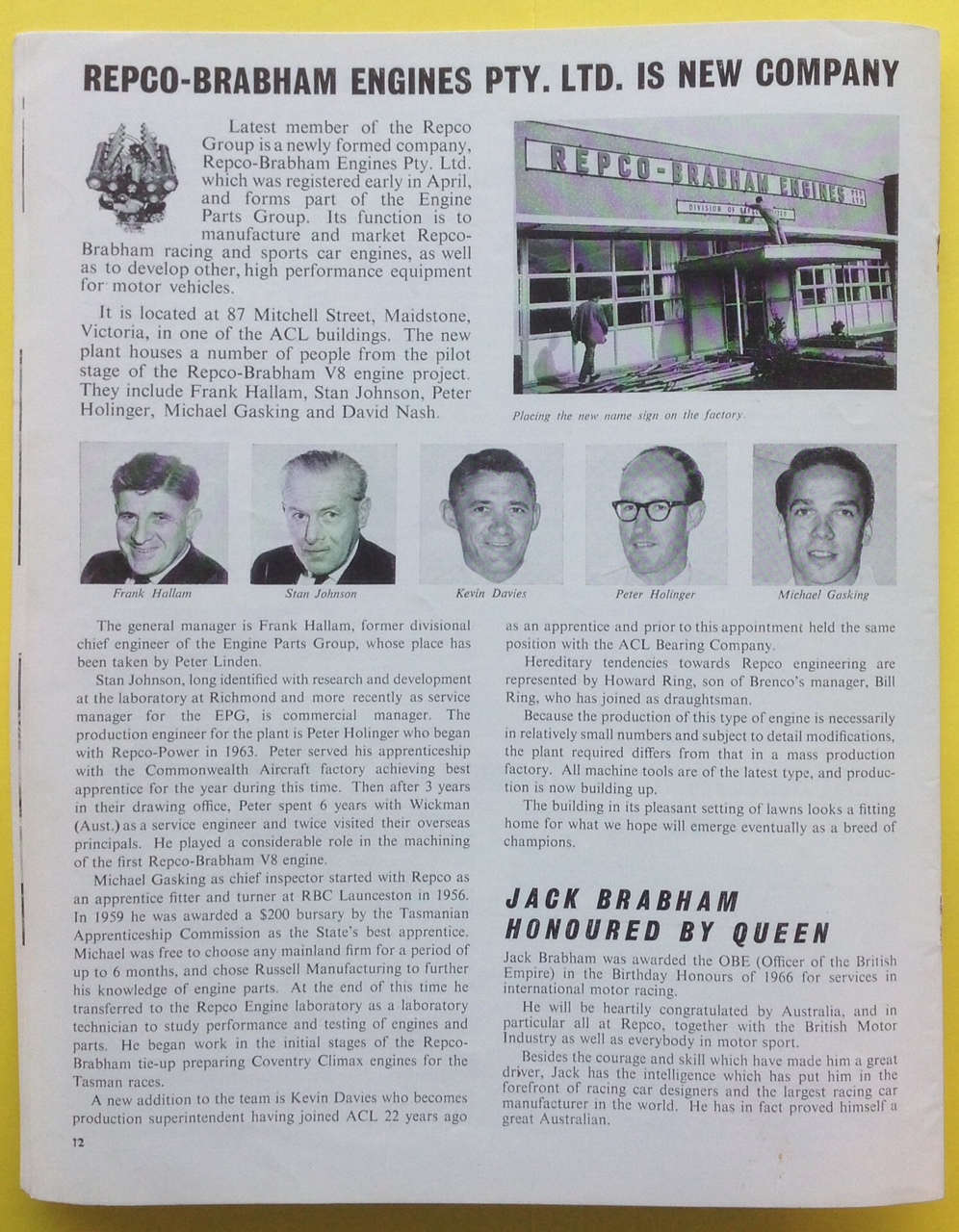
RBE formation

‘Repco Record’, the internal Repco staff magazine announces the formation of Repco Brabham Engines Pty. Ltd. (Repco)

Machine Tools…

‘Frank Hallam was a machine tool enthusiast.

It was a big help, he made sure we worshipped our machines, blowing away the swarf with an air hose. I learned respect and cleanliness of all machine tools. Few machine shops were as clean or free of swarf and mess everywhere with the exception of Holinger Engineering, Peter was also fastidious.

We were lucky to have top machines in the workshop. Our biggest was an Ikegai horizontal boring machine. RBE had two lathes- a Dean Smith & Grace English machine and also a Tovaglieri Italian unit.

We had a small Deckel horizontal borer and a couple of mills- a Bridgeport and a French Vernier. The older machine was a Herbert capstan lathe, I used this to make every stud for all the future Repco Brabham engines- main bearing and cylinder head studs, a very big variety in different steel types, it was repetitive stuff that would normally be boring but I didn’t care, we were winning the World Championship’…

‘When he drew a new design of stud, Phil Irving would come out and check my thoughts on being able to make it with what we had and other various things. We would do a yield point test in a vice where we measured the length of the new stud after I made a sample and then tension it to a nominated foot pound tension and we would keep increasing the tension until the stud refused to return to the original length. That tension was known as the yield point so Phil would pick a tension somewhere in a safe range under that yield point’.

RB620 Series Engine: Machining and Modification of the Oldsmobile F85 block…

olds

Not the sharpest of shots but a rare one showing the ‘production’ Olds and RB620 engines. RB620 on the right. The engine was the lightest production V8 in the world at the time (unattributed)

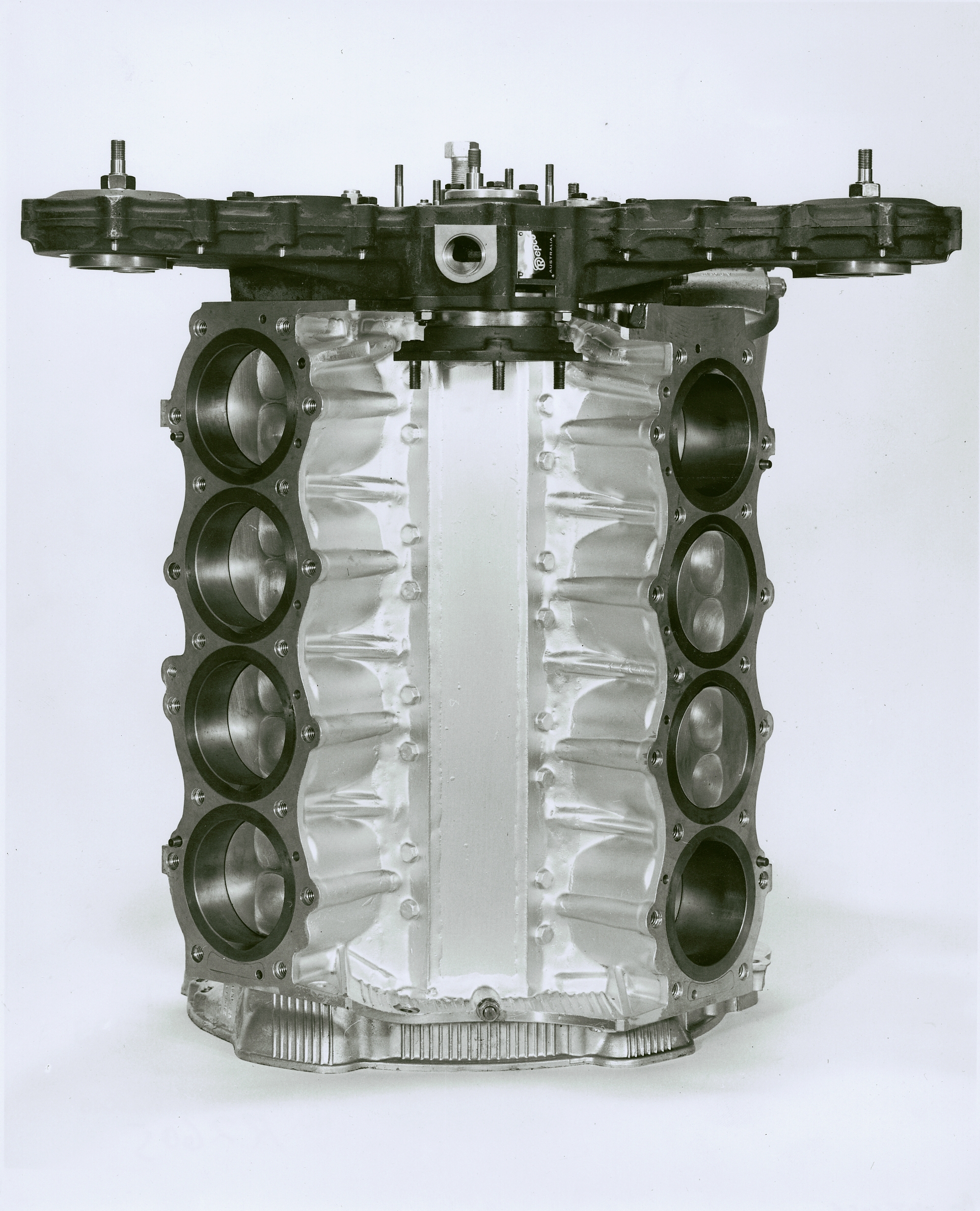
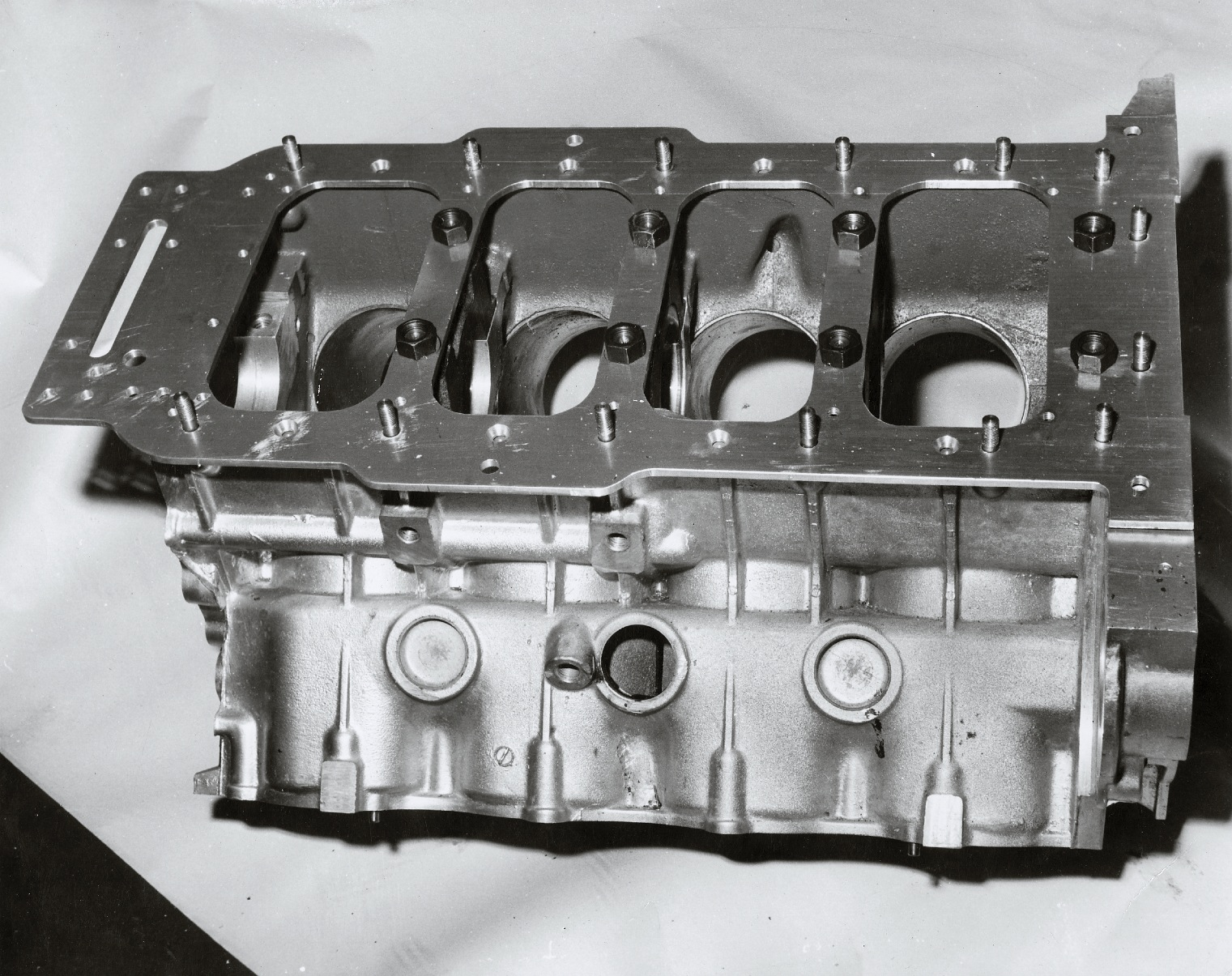
‘When I arrived there were a lot of aluminum cylinder blocks along one factory wall. Repco acquired twenty-six Oldsmobile cylinder blocks from General Motors in the US. (2 of the 26 were prototype engines E1 and E2 which were built up in Richmond)

One of my first jobs was to remove all the piston assemblies from those twenty-four blocks. They were not short blocks as known in Australia (here they are complete without sump or cylinder heads) but these were not complete to that stage. They had crank bearings in place, all main bearing caps and the 3.5 inch liners were cast into the block. We didn’t use the cast iron main bearing caps or bolts, replacing them with steel caps and high strength studs.

The RB 620 used the original 3.5 inch cast in sleeves but practically everything else was changed.

All surfaces were re-machined for accuracy, all bolt thread holes re-tapped and recessed to accept studs of superior material. The camshaft bearings were in the valley of the block of course but we pressed them out and rotated them 45 degrees and pressed them back in place to cut off the original oil galleries as our engine ran twin overhead camshafts, one per cylinder bank.

The front original camshaft bearing was left intact and the second camshaft bearing was removed and fitted was a sleeve with an INA roller bearing.

We made up little jackshafts which were driven from the crankshaft by a duplex chain, which also drove the single row chain driving the overhead camshafts. These jackshafts used the first original Oldsmobile slipper bearing and a small roller type bearing in the second original cam bearing location. The chains etc, were all enclosed inside the RB chain-case.

rb 620 chain case

RB600 F85 Olds block from above. Note the valley cover of aluminium sealed ‘with a sea of Araldite then painted over with Silverfros- those blocks which are still in service today still retain the Araldited plate and still do not leak’ comments ex RBE engineer Nigel Tait. Phil Irving’s design had lots of clever bits including the timing chain arrangement which allowed the heads to be removed in the field without disturbing the engine timing- and was also clever in that the same head could be used on either side of the engine (Tait/Repco)


block & timing case

600 block and timing case, ‘Purolator oil filter housing, timing chain single row (Repco)

‘A lot of people in 1966, including the international motoring writers, did not realise the extent of the machining required to the F85 Oldsmobile cylinder block to use as our race engine base. It was more work and and involved to adapt the F85 than in machining our new Repco cast blocks (700 and 800 Series) used later in the project.

It used to annoy all of us when our engine was referred to as ‘based on a Buick’ in various world motoring magazines. It also added insult to injury by them adding ‘Built in a tin shed in Australia’!

We then had to close up the large cavity in the valley where there used to be a cover plate, pushrods and cam followers in the original engine.

We spent many hours fettling aluminum plates by hand and fitting them into the valleys to cover the original cam followers and holes etc. When we had a very good fit of these plates we mixed two pot resin (Araldite) with additional aluminum powder and filled up the valley seams around the plate.

Then with some elaborate heating systems we invented, we dried the Araldite in place. This also gained us the reputation of the ‘The Grand Prix engine held together with Araldite’ in various magazine articles!’

rb 20 block

RB600 block on the left, Olds’ F85 unmodified block on the right. The 600 block has the pushrod holes covered with the Araldited aluminium plate. ‘The 1/4 inch thick block stiffener plate protrudes from the top of the modified block. This gives the effect of cross bolting…note also the Repco designed magnesium sump’ notes Tait (Tait/Repco)

‘I finished the job of dismantling the blocks, we only worked on two or three at a time during the early months of 1966. Unless the parts were an easy item or required substantial machine set up we only made a few of each component as design changes were ongoing. Not critical large changes but small subtle ones’.

‘We didn’t have any problems with the Oldsmobile block by there was one race in 1966 when a cylinder liner failed. As explained, we used the cast in liners and retained the 3.5 inch bore.

BRO, (Brabham Racing Organisation) sent back the failed engine block and we bored out the remains of the cylinder liner. There was a casting cavity behind the liner which caused the weakness and failure. This was a problem that could not be dealt with without boring out all the liners and fitting sleeves. Otherwise there could be more failures due to bad castings. From that date we used dry liners and eradicated the risk of it occurring again.’

block

Jack and Phil specified this aluminium plate to add stiffness to the production F85 Olds block, big holes to provide rod clearance obviously. ‘This block would have had dry sleeves which led to considerable blowby problems due to distortion and eventually wet sleeves were specified by Phil Irving’ notes Nigel Tait (Tait/Repco)
UK Components: Crankshaft etc…

Phil Irving completed most of the design of the engine in England, he rented a flat in Clapham in January 1964 close to BRO and together with Jack they settled on a relatively simple single overhead camshaft configuration compatible with the block and fitment into the unused Brabham BT19 spaceframe chassis. This simplen specificaton is what Jack pitched to the Repco board at the projects outlet.

The BT19 frame had remained unused throughout 1965 when the engine for which it was designed, the Flat-16 Coventry Climax FWMW, was not released to Brabham, Lotus and Cooper as planned.

To expedite things in the UK, whilst simultaneously mailing drawings to Australia, Phil  commissioned Sterling Metals to cast the heads. Prior to his return to Australia in September 1964, HRG machined an initial batch of six heads, fitting valves and seats to Irving’s specifications.

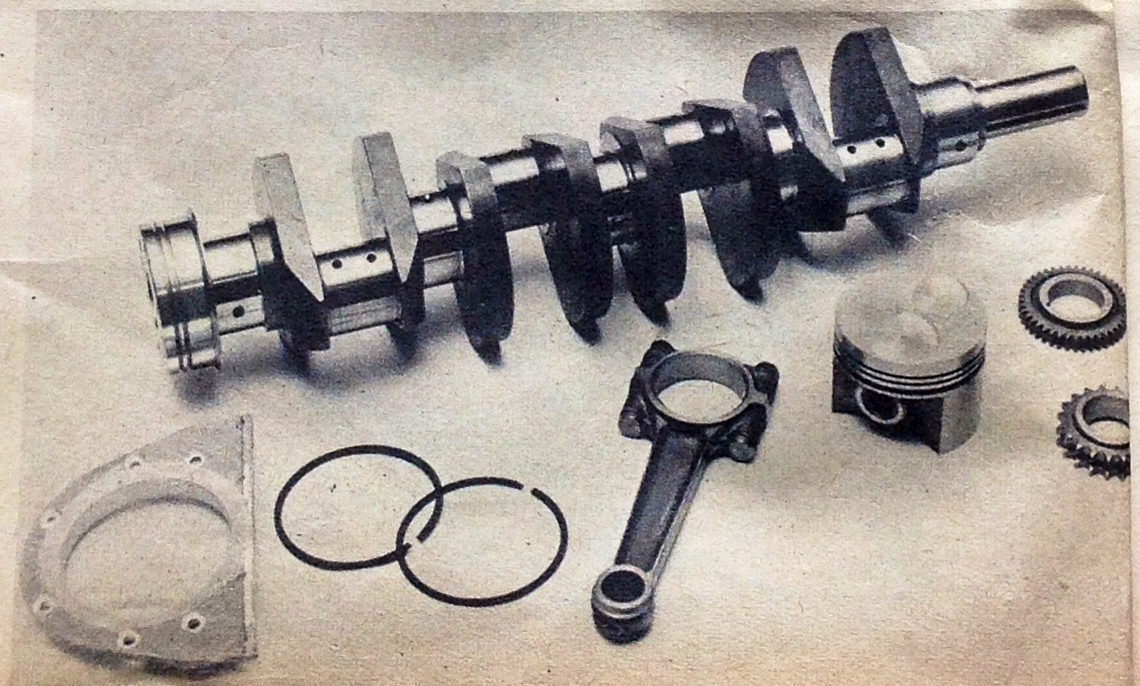
‘Laystall in the UK also made the crankshaft. Constructed from a single steel billet the ‘flat’ nitrided crankshaft was a wonderful Irving design. I don’t recall any updates or changes to the design of the crankshaft over the years the RB engines were built. It was supplied in 2.5, 3 litre and 4.2 litres for the Indy engines- also 4.4, 4.8 and 5 litre sportscar versions. All crankshafts were of the same bearing dimensions etc’.

‘The term ‘flat-crank’ refers to the connecting rod journals being opposite each other and not in multi-plane configuration as is usual in production V8’s. It meant the engine was not such a well balanced unit at low revolutions but it actually converted the engine to virtually two four cylinder units and either cylinder bank would run quite smoothly on its own. The layout also enabled the superior use of exhaust configuration eliminating the need for crossover exhaust pipes to obtain full extraction effect’.

crank

Crankshaft was made by Laystall to Phil Irving’s design, pistons and rings by Repco subsidiaries. (Repco)

Pistons…

‘Repco is a piston ring manufacturer and very experienced in ring design which meant that we were well ahead in that regard.

The famous SS55 oil rings were well known already around the world. The pistons were Repco Products.

No other F1 engine constructor of the sixties made their own pistons. The experience we gained with the supply of Coventry Climax pistons and rings contributed to this success.’

Bearings: Vandervell Interlopers and ‘Racing Improves the Breed’…

‘Repco was already supplying engine bearings to various manufacturers globally from the Tasmanian based Repco Bearing Company, we obtained these components as required.

During 1966 an advert appeared in a British motoring magazine, ‘French Grand Prix won on Vandervell bearings’. Vandervell are of course a British bearing company, Repco were furious and telex messages to and from BRO (Brabham Racing Organization) revealed that Jack Brabham was not happy with the depth of the lead overlay on our copper/lead crankshaft bearings.

Our bearings had a lead overlay of .001 inch and the Vandervell bearings an overlay of .0005. So I was instructed to pack away all our existing bearings and mark them not for use, our bearing company came up with the improved design bearings with the lesser overlay in time for the next GP. Racing certainly improves the product!

Before I transferred to the RB project, i worked in Repco merchandising and received brochures and information about a new Repco alumina/tin bearing known as the ‘Alutin’ and advertised by Repco as a new high performance product. Repco were promoting them as a breakthrough design.

I learned these new bearings had been unsatisfactory under test in the F1 engine and within a short period no more was said about the new product ‘Alutin’. They were inclined to ‘pick up’ on the journals at high rpm – another example of how racing  improves the product. This problem had not been evident in the engine testing of the product by Repco to that date.’

ad

‘Racing Improves the Breed’…Repco Ad 1966

Outsourced Items…

‘There were some components we did source outside the Repco Group.

There were cam followers, Alfa Romeo cam buckets, valve springs from W&S, valves manufactured by local company Dreadnaught. The ignition system was sourced from Bosch by Brabham.

The collets were from the UK and were a production car or motorcycle collet, the name escapes me. We made the valve spring retainers and collet retaining caps. Over the project we made  changes to the collet retainer material from aluminum to heat treated aluminium bar and later titanium. Not a lot was gained as titanium fatigues as well, as we found out.’

Lucas Fuel Injection…

‘The fuel injectors and fuel distributor were Lucas items, the system was in early stages of development. It consisted of an injector for each cylinder, in our case installed in the inlet trumpet a short distance from the inlet port in the cylinder head.

The system is timed with a fuel distributor in the engine valley driven from the chaincase by the distributor drive gear. The fuel is supplied at 100psi from an electric pump. The fuel pressure supplies and operates small shuttles which are constantly metering supply according to the length of shuttle travel. The amount of fuel supplied to the injectors is controlled by a variable small steel cam which is profiled to suit the particular engine size etc. The steel cam therefore controls the actual fuel mixture and is linked to the throttle inlet slides’.

‘It is interesting to note that although the fuel distributor can be timed to any position in the engine cycle, injecting at the point of the inlet valve opening or with it closed or wherever, it does not make any important difference in engine performance but as Phil Irving explained to me there is a point of injection that lowers engine performance so therefore the fuel distributor is timed in each installation to avoid the undesirable point of injection. The air inlet trumpets were cut to length spun and profiled.

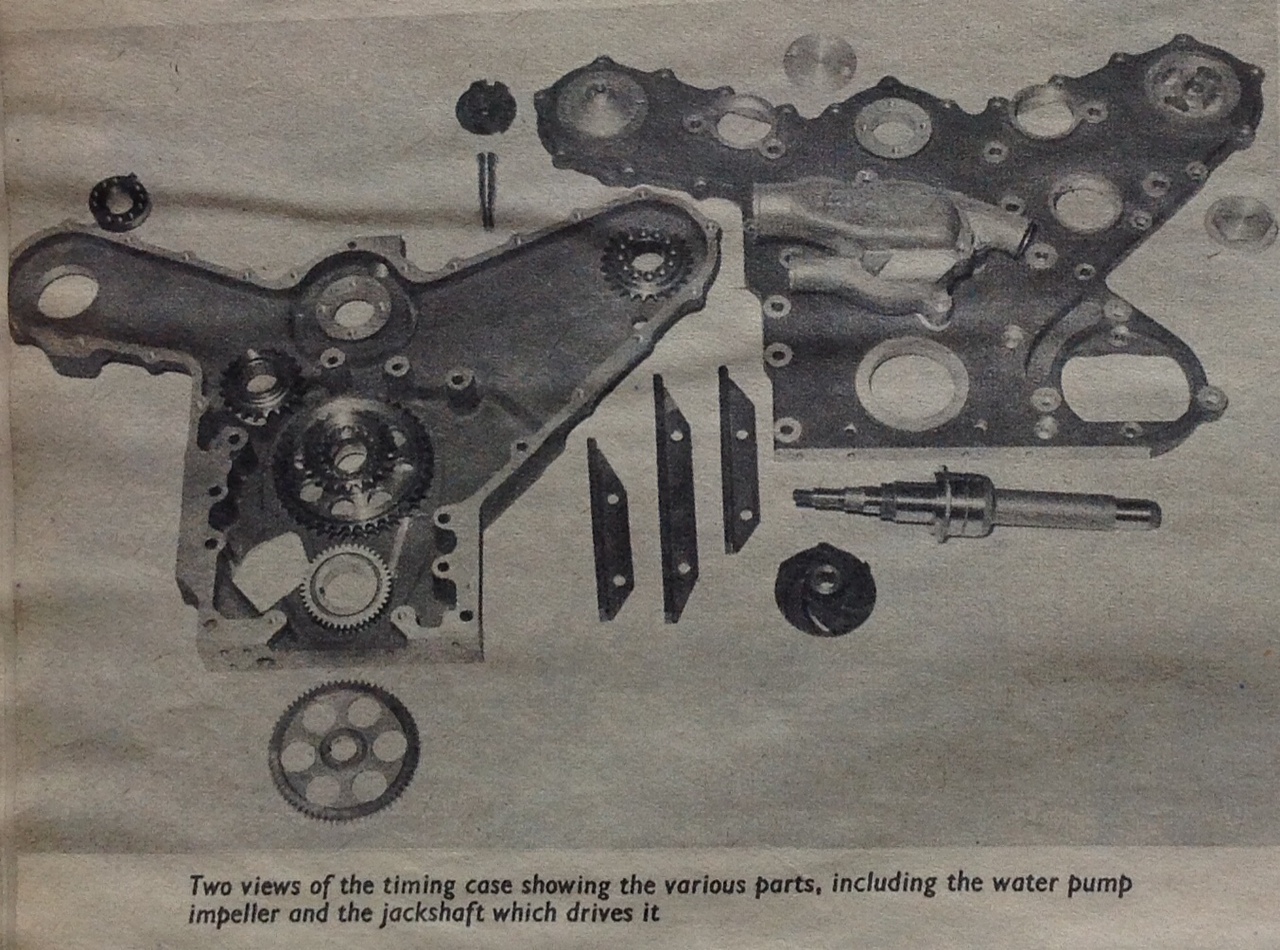
The chaincase was a magnesium casting and the ‘620’ 1966 World Championship engine used a single row handmade chain imported from Morse in the US. We cut all the sprockets and manufactured all the camshaft couplings etc. We used an SCD hydraulic chain adjuster, a standard BMC component.

The cam chain was driven by a small jackshaft which was fitted in the front two original camshaft bearing spaces of the original Olds block. The jackshaft was driven by a Morse duplex chain from the crankshaft sprocket, also Repco made. The crankshaft had a small gear driving the oil pump mounted underneath the chain case.’

chain case

Assembly of chain in the magnesium timing case of an RB620 engine (Repco)

Oil Pump…

‘The oil pump was a wonderful Irving design, simple to service but a small work of art. It featured flexible supply hoses with snap fittings and was a combination of oil supply pump which supplied the engine with oil up through a gallery in the chaincase and also a slightly larger scavenge pump connected to each end of the engine sump- it was also a magnesium casting. The pump assemblies, sump and all components were made by Repco.

The system consisted of a sump with an inertia valve located in its lowest point. If the car was braking the inertia moved the valve forward which opened a cavity in the front of the sump causing oil to be drawn from the front. Under acceleration the inertia valve moved backwards and the forward cavity closed and the rear cavity opened. This meant a minimum of blowby and air to be pumped by the scavenge system. I don’t recall any failure of this system apart from the  Sandown debut race of our ‘620’ Series 2.5 litre engine in January 1966′.

‘The ‘Tasman’ cars were held on the grid for rather a long time and as a result the oil had cooled in the Repco Brabham. Jack left the line with plenty of revs, the cold oil and resulting oil pressure split the pressure pump gears. The first engines used cast Fordson Major tractor pressure pump gears and one gear had split due to the extreme pressure. Jack Brabham did  3 or 4 laps from memory.

I arrived at work on Monday morning and in typical Irving style found a drawing  for the supervisor for the construction of new steel gears and a ‘Do Not Use’ request for all the Fordson gears in stock. Phil had arrived at the drawing office on Sunday evening after the Sandown meeting and made the modifications straight away’.

‘The chaincase featured a couple of inspection caps which were removed to allow for chain tension adjustment etc. We made these caps and when it came to cutting the retaining threads in the chaincase we could not obtain the required thread tap anywhere. Phil had specified similar threads to the Vincent Motorcycle chain adjuster cap threads so that’s exactly what we used. Irving brought in the original Vincent motorcycle thread tap and we used that to thread all the chaincases under manufacture at the time, actually going back to valve spring collet retainer caps.

I recall that the first engines used BSA motorcycle collet retainers. One of the things I enjoyed so much working with Phil was that he did not waste time on risk taking design, he used tried and tested systems from his past. He once said “There is really nothing new, it is just changed around in some way”- well he sure proved that with the first RB620 engine!’

chaincase componentry

Cylinder Heads…

‘The cylinder heads were cast aluminum of crossflow design, the cam covers cast magnesium. All our cast magnesium and aluminum components were supplied by CAC in Fishermans Bend, Melbourne, with the exception of the first batch of six heads cast in the UK. (Commonwealth Aircraft Corporation).

Phil was remarkable with his engine design skill in that he could see the item in reverse or three dimensions and could design all the sand boxes etc and patterns required to arrive at the finished item.

The engine used no bolts as the original Olds did. Cylinder heads, cam covers, main bearing caps, sump, oil pump and chaincase were fitted with, or retained by high tensile studs.That was my department and apart from the first couple of prototypes I made all the studs for the 1966/67 RB engines. Some were quite a challenge, the thread specification and tolerances were exacting.

The crankshaft rear bearing seal was a slipper ring design with a bolted on ring retaining flange. The slipper rings were supplied by our Russell Manufacturing Co, we made the outer flange in the factory. The steel flywheel was also turned and made by Repco’.

Conncting Rods and Ease of Servicing…

rod

RBE conrod drawing (Repco)

‘We used modified Daimler connecting rods and competition Chevrolet and Repco rods. In later engines we occasionally used Warren rods from the US. In the valley of the engine a small drive housing held the vertical ignition distributor and also the fuel distributor. Sometimes in the larger engines we also fitted a mechanical fuel pump to this housing.’

‘The type 620 engine engine had throttle slides running on small grooves with 1/8 inch steel rollers to prevent lock ups which would be a disaster. The slide covers were  fastened directly to the cylinder head and in later engines were changed to fully assembled units and fastened directly to the cylinder heads for ease of changing if required. They were then complete units with studs bolting them to the inlet flanges’.

A big feature of servicing the RB620 engine was that either cylinder head could be removed without disturbing camshaft timing or the camshaft from the cylinder head, a great time saver. (See the photos in the block section above which clearly shows this)

The oil pump can be removed in one small unit and replaced with no other dismantling. Or the two cylinder heads can be removed without disturbing the timing of the camshafts or the chain case. All very important design features for use ‘in the field’.

engine assembly

RB620 engine assembly early 1966, Maidstone (Repco)

First Test…

The first engine, a 2.5 litre Tasman engine designated ‘E1’ was fired up on March 26 1965, almost twelve months to the day Phil Irving commenced its design.

It was initially run with Weber 32mm IDM carbs and after a checkover fitted with 40mm Webers. The engine produced 235BHP @ 8200RPM, equivalent to a good Coventry Climax 2.5 FPF at the time.

Repco committed to build 6 engines for the 1966 Tasman Series, later changed to three 2.5 litre Tasman engines and two 3 litre F1 engines, the first race for the new engine was the non-championship South African Grand Prix on January 1 1966, the next part in the Repco story is the 1966 race program for the new engine.

rb 20 dyno long shot

‘2.5 litre 620 V8 E1 on the Heenan and Froude GB4 dynamometer in Cell 4 at Richmond, 1965. The exhausts lead straight out through a hole in the wall. Also there was minimal noise insulation in the tin shed that served as a test cell. Vickers Ruwolt across the road blamed us for the large crack that developed in their brick wall on the other side of Doonside Street!’ recalls Nigel Tait (Tait/Repco)

Photo & Other Credits…

Autocar, ‘Jack Brabhams World Championship Year’, Repco Record, ‘Doug Nye with Jack Brabham’, Australian Post, ‘From Maybach to Repco’ Malcolm Preston, Rodway Wolfe Collection, Nigel Tait recollections and his Collection, Repco Ltd photo archive

Etcetera…

letterhead

Original RBE Pty.Ltd. Letterhead. Jack Brabham had no financial (equity) or directorship involvement in this company, it was entirely a Repco subsidiary.


wade

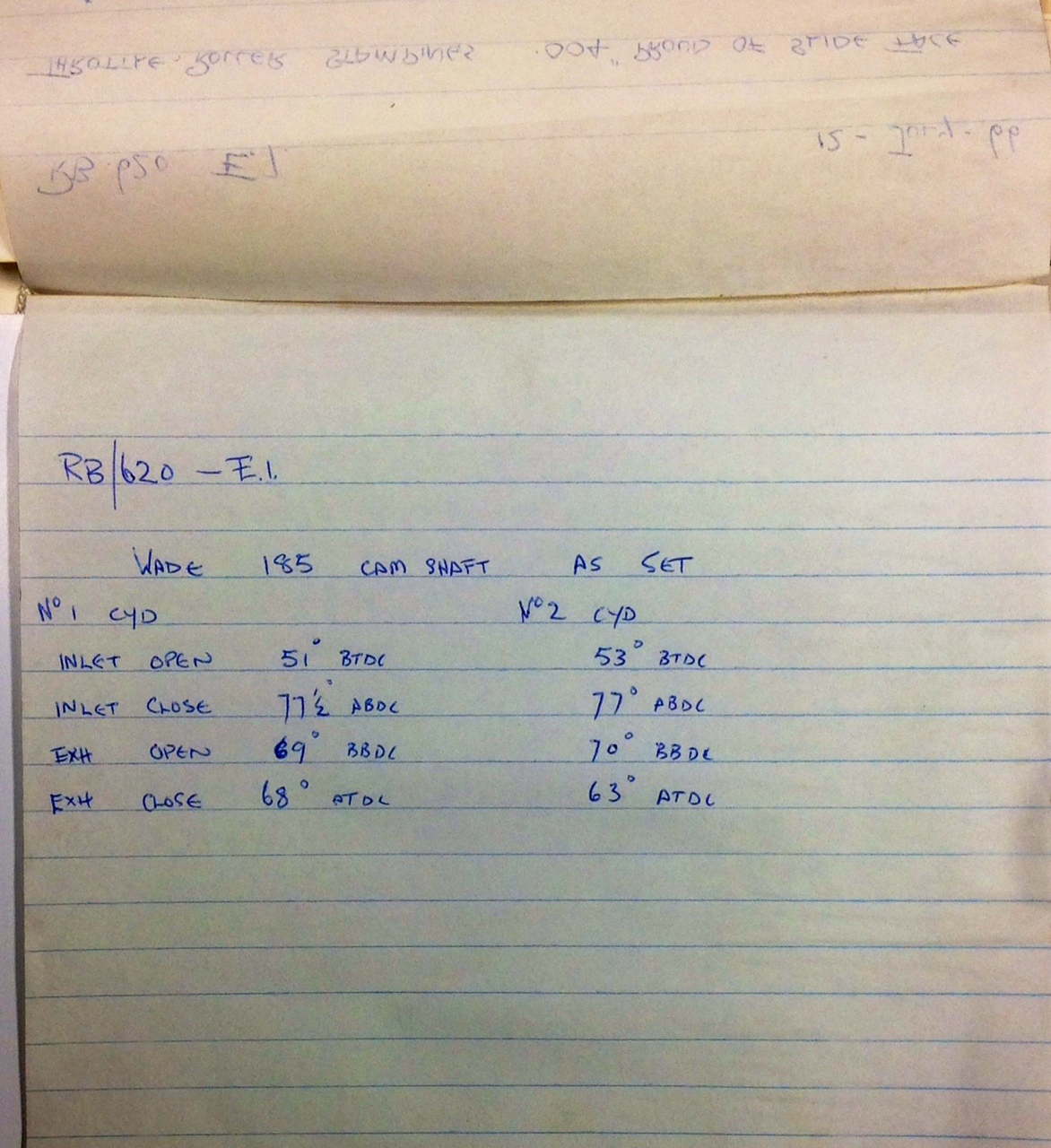
‘E1’ was the RB620 prototype Tasman 2.5 litre engine. Most of the entries in this exercise book are dated, this one is not, but its mid 1965, the book records the use of cams with the ‘Wade 185’ grind and the valve timing, no dyno sheets sadly! (Wolfe/Repco)


repco 1

Have a look at this Repco film produced in mid-1965…

It covers some interesting background on the relationship between Brabham and Repco, footage of Jack at home in the UK, the Brabham factory in New Haw, some on circuit footage at Goodwood and then some sensational coverage of the 1965 Tasman Series in both NZ and Oz. The latter segues nicely into footage of the first ‘RB620’ 2.5 Tasman V8 engine ‘E1’ on the dyno at the Repco Engine Laboratory, at Russell Manufacturing, Richmond in ’65…

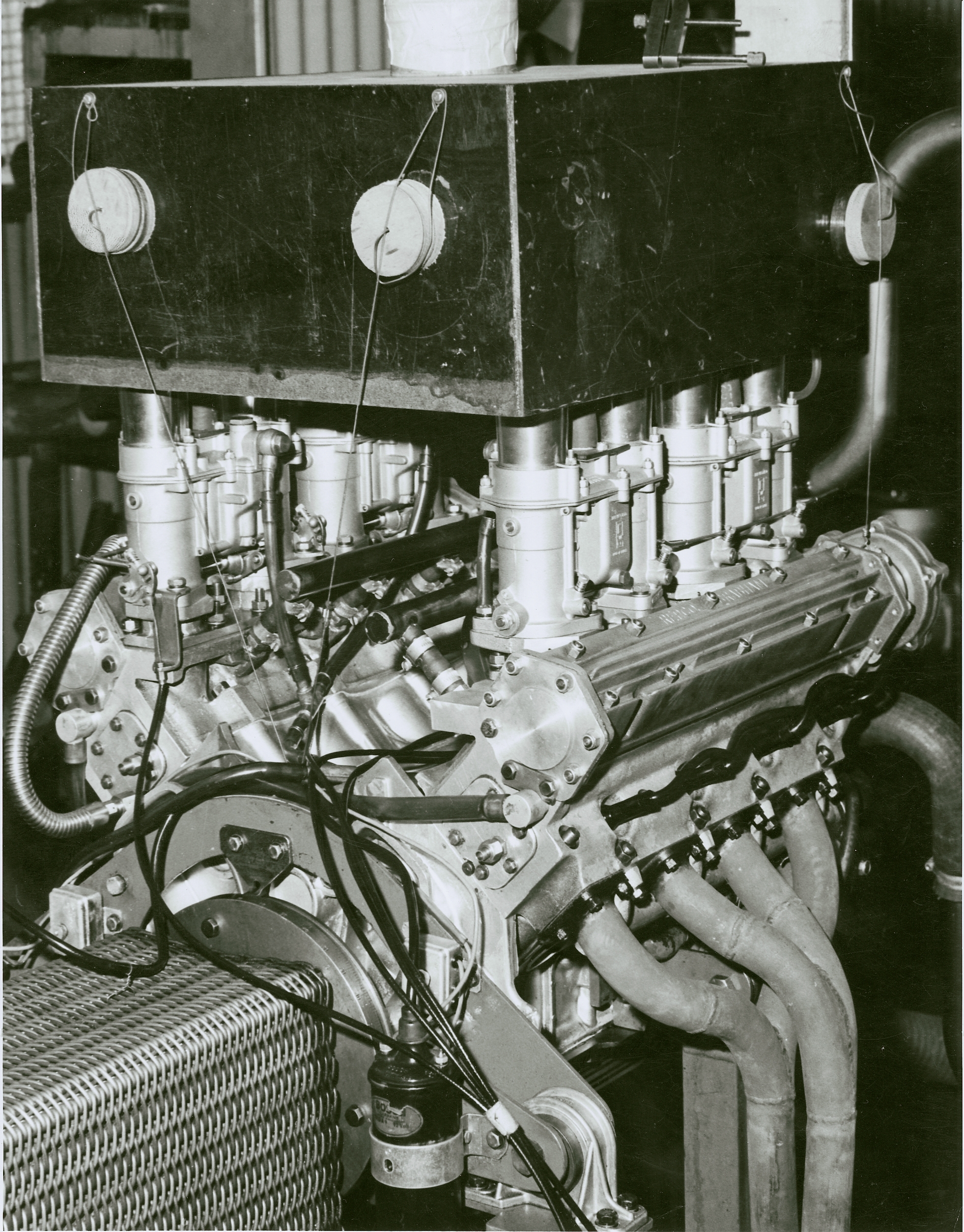
Tailpiece: #1-RBE620 2.5 litre ‘E1’, the prototype Tasman 2.5 V8, fitted with Webers on the GB4 dyno- Repco Engine Lab at Russells, Richmond 1965. The box over the Webers is for airflow measurement notes Nigel Tait…

rb 620 on dyno

(Tait/Repco)


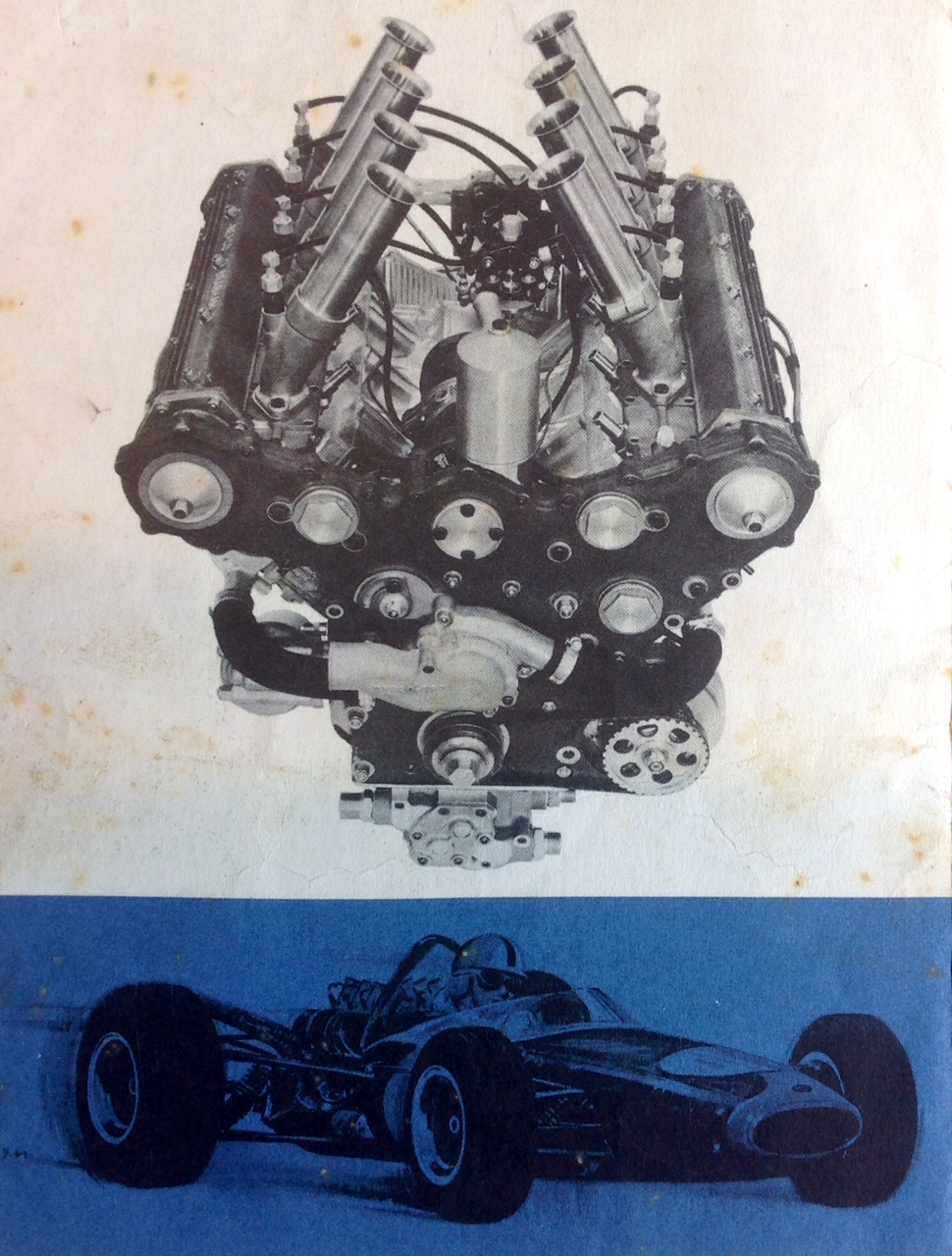
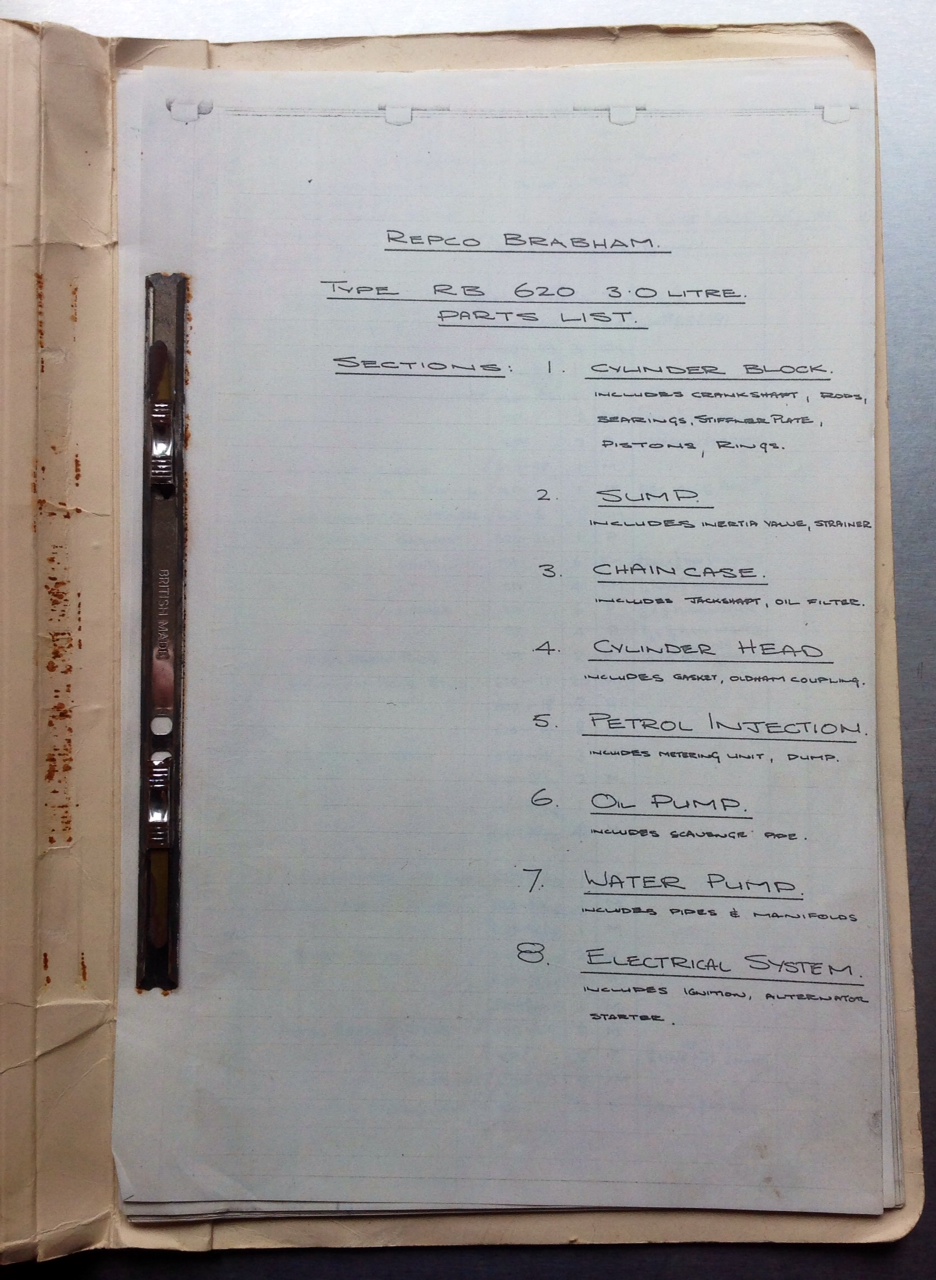
RB Cover

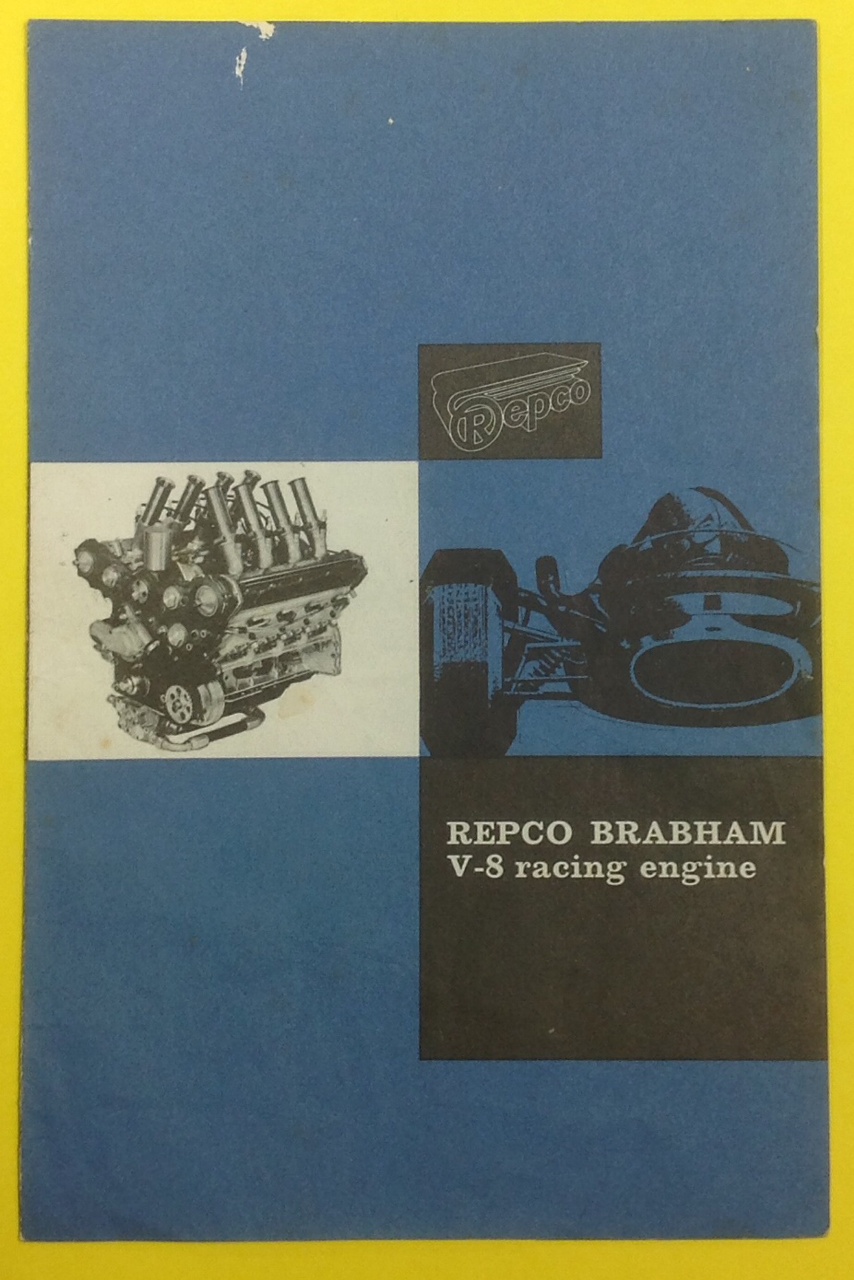
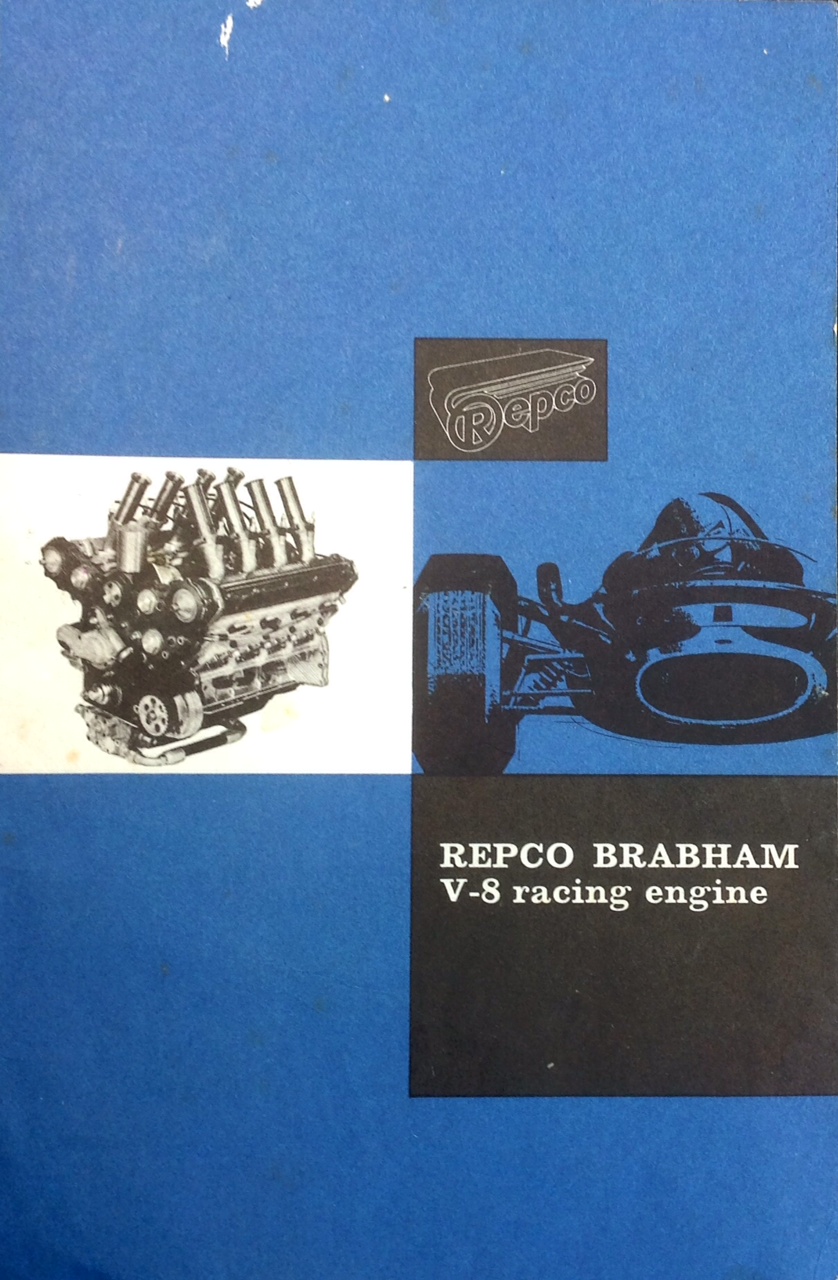
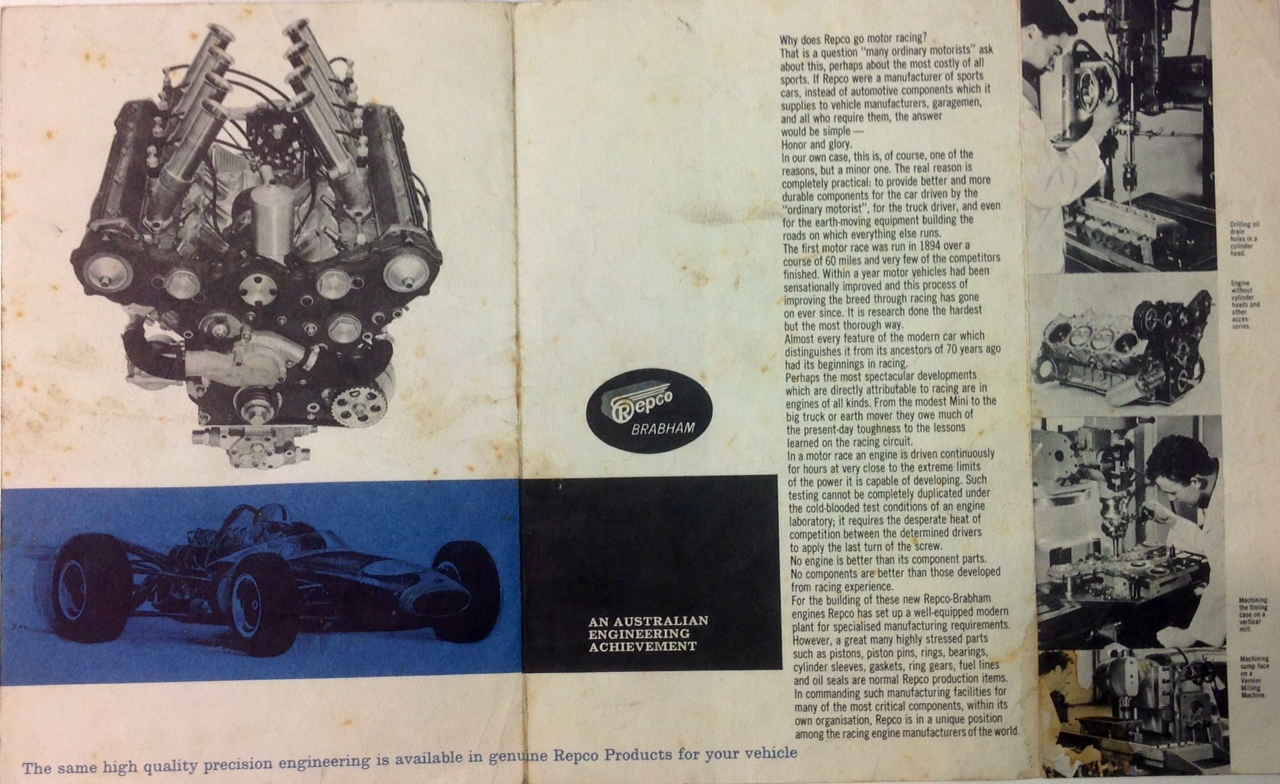
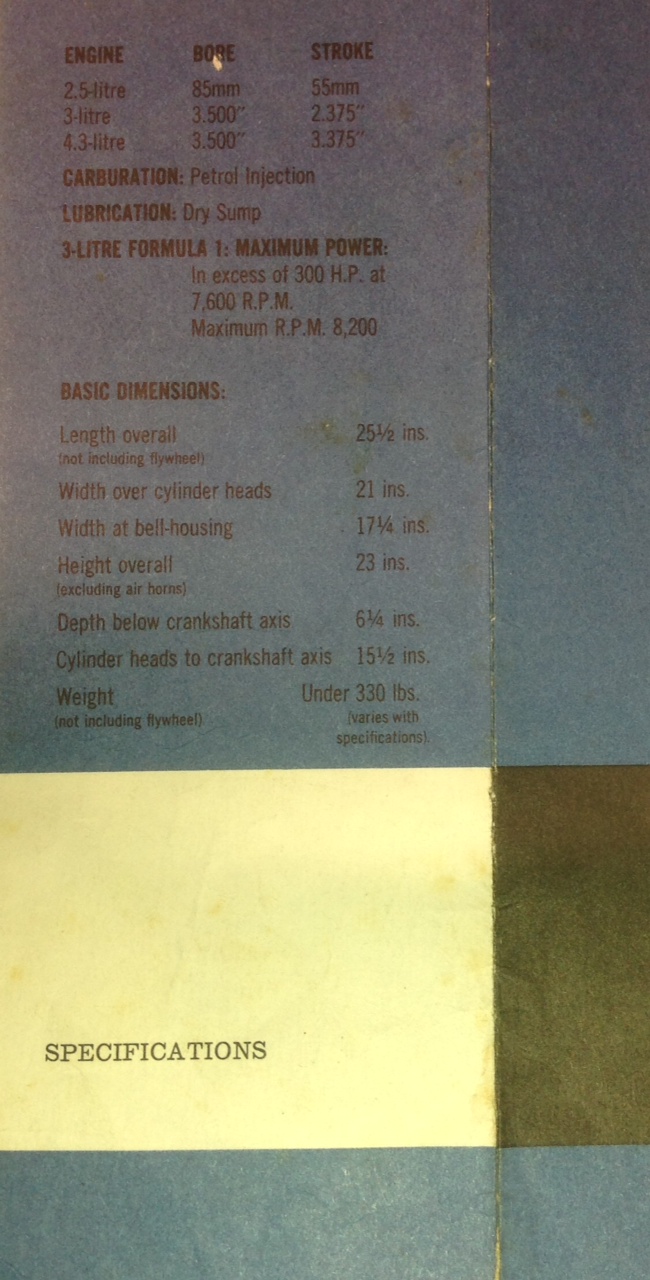
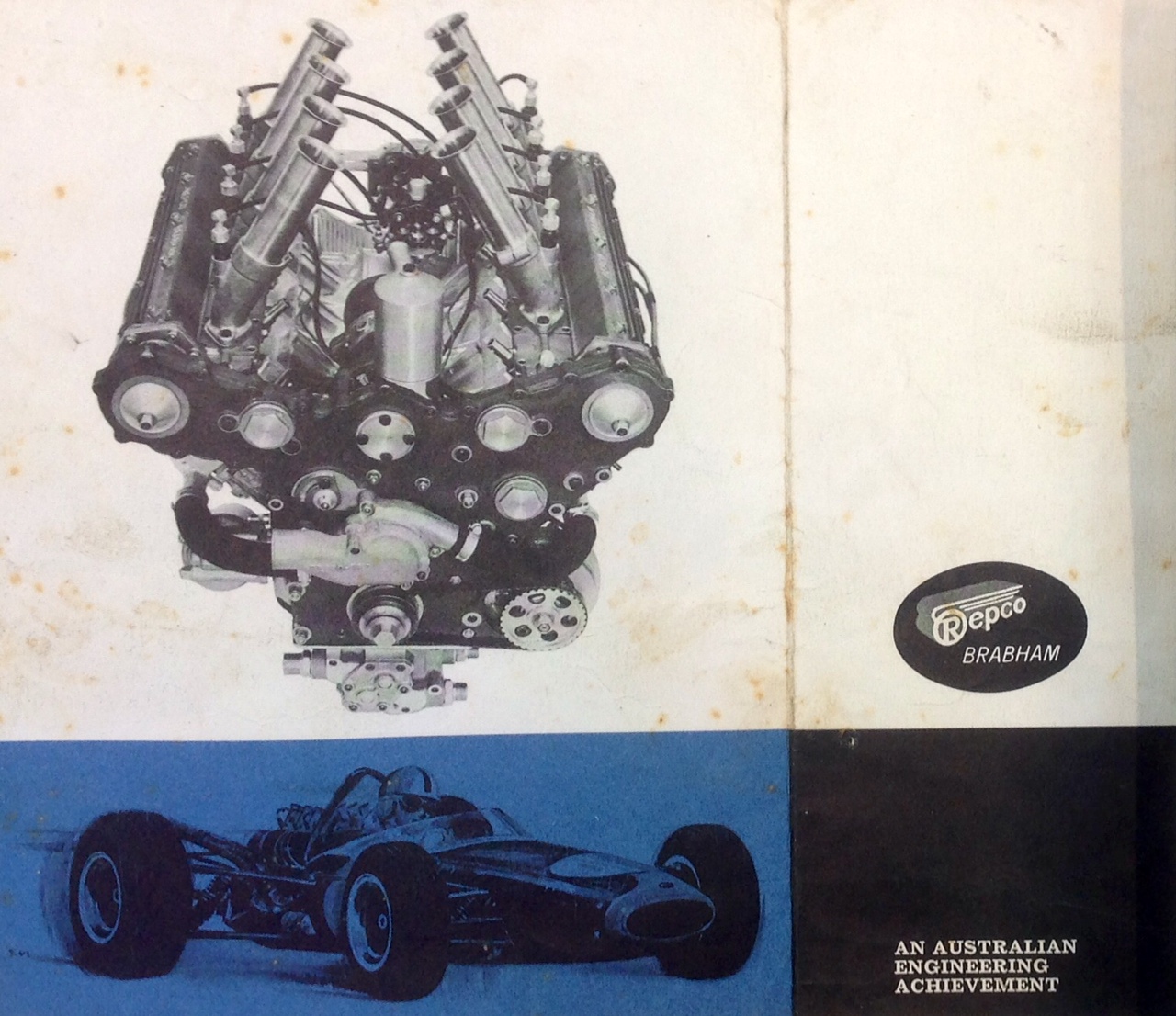
This is the first Repco brochure about the RB project which fired my imagination to become a part of the project and off to Melbourne i went (Repco)

Mechanical Childhood…

I was born in Melbournes’ Kew and moved to Traralgon, in Victorias La Trobe Valley a long time ago! I suppose I can blame my lifelong interest in all things mechanical on my grandfathers as they were both blacksmiths. I have never been keen on horses and so I am possibly lucky that I was born after the motor car.

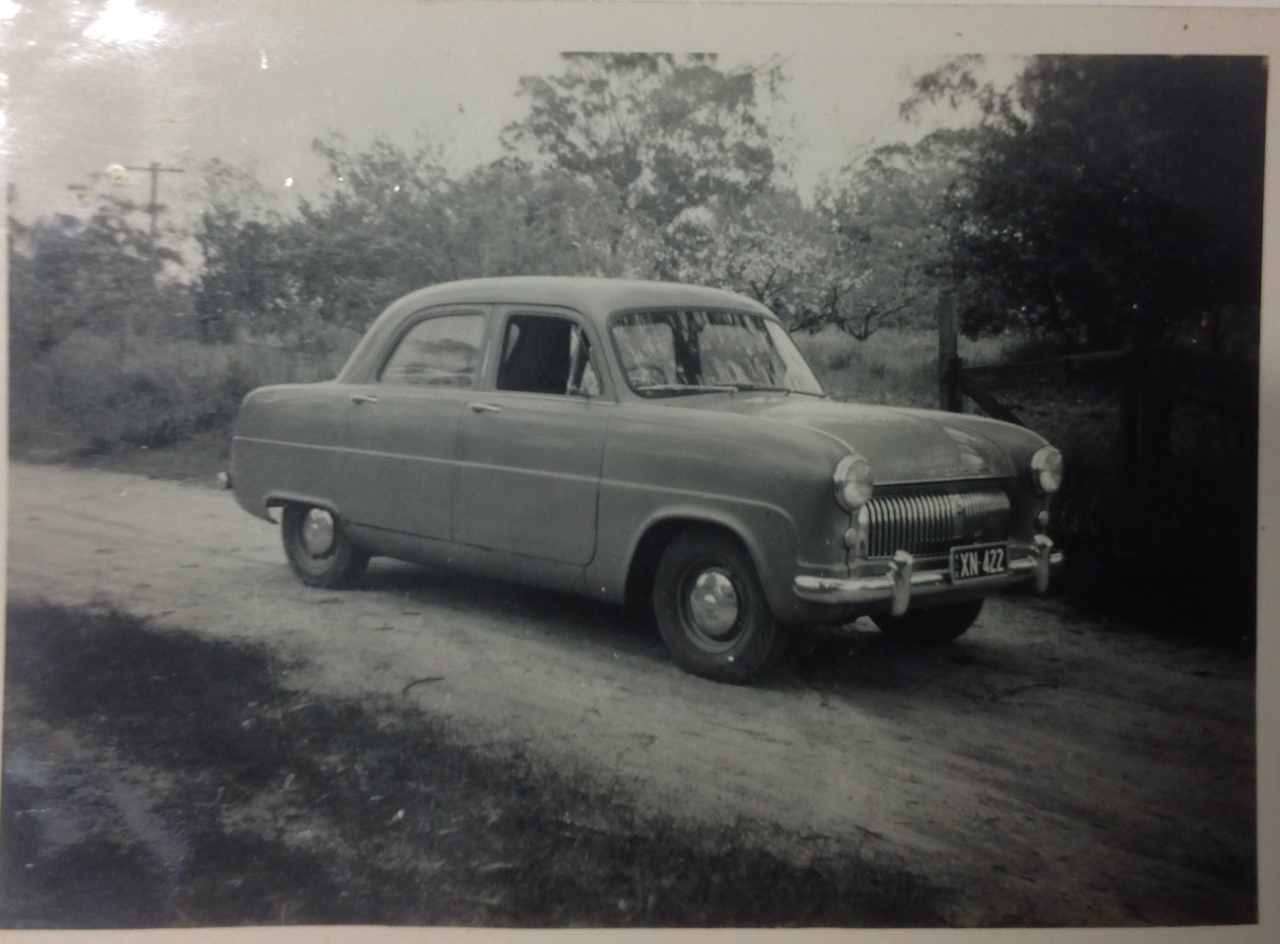
From a young age I was fascinated by anything with wheels or gears that whizzed around . My dad bought a new Ford Consul when I was 9, I studied it closely and learnt all I could. It was one of the first production cars with independent front suspension , dad would pull up in the main street and people would come up and push the mudguards up and down to show their mates how it worked, he used to get so annoyed!

He was a civil engineer and had 400 guys working for him at the local paper mill. In the early 1950’s he bought a derelict farm 10 km out of town. He loved farming but wasn’t very practical and he stayed at the paper mill and gradually improved the property on weekends.

In 1954 when I was 11 he bought a new Fordson diesel tractor. There were not many diesel’s on local farms, it was our pride and joy. I still have and use it! I learnt a huge amount from it. I remember when dad was at work I removed the Simms injector pump and pulled the governor apart and various pieces, Dad was due home so I stuck it all back together and went to start it, it wouldn’t! I hurriedly checked everything and figured out that because the injector pump had a small block coupling it could be put back 180’ degrees out of timing so I quickly removed all the pipes and refitted the pump and just managed to start the engine as dad drove up the driveway.

The Consul developed a bad flat spot when you accelerated . I reckoned it was a challenge , I pulled the downdraught Zenith carbie  to pieces. It had this funny looking thing held on with three screws on the side of the carbie and the book called it an economiser. I pulled that apart and the small rubber diaphragm had a hole in it. I put it all back together and during the week got another diaphragm from the Ford dealer. I fitted it on the following weekend and the Consul ran perfectly.

Dad told the whole world what a great mechanic I was, repairing something that the paper mills top mechanic could not etc,  that was my first mechanical victory!

ford consul

Dads Ford Consul taught me a lot and the independent front suspension was a Traralgon novelty (Wolfe)

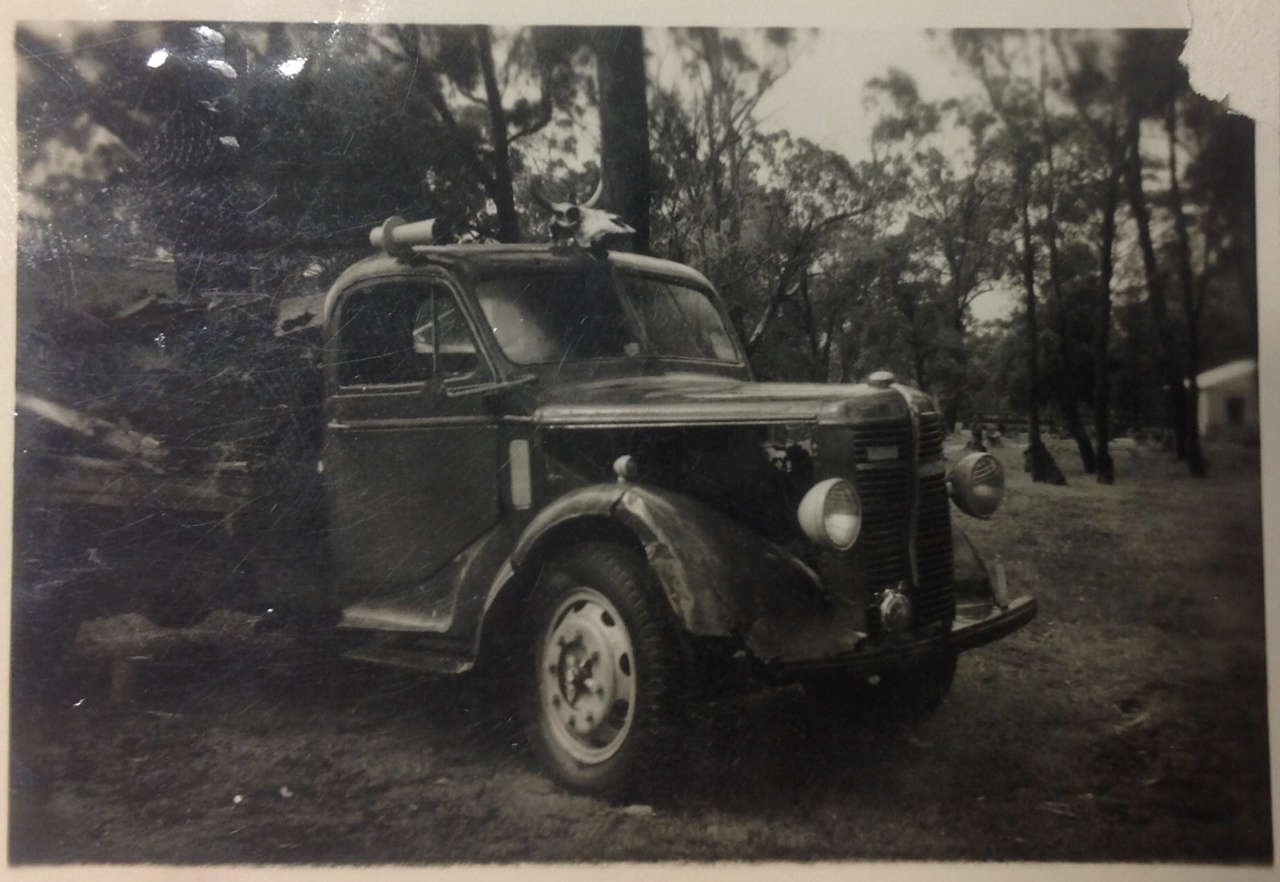
Over the next few years I  had a Bedford truck given to me which I loved and knew every nut and bolt on as well. Dad bought me another ‘problem’ , in the mill workshop they had a small machine called a Calfdozer. Its a baby bulldozer built in England by Aveling Barford. The mechanics couldn’t start the engine, a Dorman single cylinder petrol unit. Dad bought it for me for 40 pounds, $80 now, and we lugged it home we could only unload it at a gravel pit we had so every bit of spare time I had was at the gravel pit trying to start this weird machine. It has a Zenith carbie as well, I first tested for spark of course and it had a wonderful big orange spark, after much fiddling with the magneto, timing and points it finally had a nice small blue spark and the thing duly burst into life. I still also have the Calfdozer and give it a run on occasion.

Bedford

This Bedford truck , bought by my Dad was one of a range of vehicles which taught me basic mechanics (Wolfe)

Motor Apprentice & Repco Rep…

All of this ‘fettling’ of machinery made my career path clear , dad agreed to me leaving school which I disliked very much! , but on the strict condition that I completed a motor mechanics course with RMIT by correspondence, which I did over 4 years, completing the practical elements some years later. I was encouraged to read books, no TV in those days but it was starting in the cities. I read all the motor magazines I could including ‘Wheels’ and ‘Modern Motor’, writing letters asking advice about my various farm engines. Phil Irving and Charlie Dean were my heroes, I read all I could about their projects including the Repco Cross-Flow head for the Holden ‘Grey’ motor.

I became interested in motor sport and bought the first Mini Cooper to be sold in East Gippsland, entering many hill climbs and usually winning the up to 1000 cc class. The first Coopers were 997cc ,only later did the 1275cc ‘S’ arrive . A few of us formed a new club, the Latrobe Valley Motor Sports Club’, its now known as the Gippsland Car Club .

In 1963 I read a local paper advert for employees required by Repco , they were opening an automotive workshop and parts store in Traralgon, I had since married and needed a better income than that derived on the farm . They didn’t offer me the manager’s job much to my disappointment but instead a drivers job distributing parts, engines and parcels . A new EJ Holden ute was mine, I did a huge amount of miles ,in those days, travelling up and down the Latrobe Valley in Gippsland Victoria sometimes twice in the one day. It taught me how to drive as things were totally different to today . The highways were pretty much free for all and there was no speed limit but if you exceeded 60MPH you had to prove in the case of an accident or incident that you were driving within your ability and safely. To give you an idea, the local police station in Traralgon had one car, a Ford Anglia with a top speed of about 70 MPH.

I enjoyed the job immensely and learnt lots of stuff in the workshop. Crankshaft grinding and cylinder head surfacing, clutch rebuilding etc. and of course engine assembly. I was lucky to work with the grandson of the Chairman of Repco’s Board, Sir Charles McGrath.

Mr David McGrath (brother of Sir Charles) was the managing director of our parts company and his son David junior was spending time in our particular branch learning the internal operations, he became a good mate and through him I learned a great deal about the parent company.

Repco owned ‘Brenco’ in Moonee Ponds Victoria , a machine tooling company,’ Warren and Brown’ in Footscray, a hand tool company and ‘PBR Brakes’ in Moorabbin and so the list went on. Each entity had a director on the Repco Board ,i was to learn a lot more of the politics of Repco as time went on.

On the road to Repco Brabham Engines…

RB fullspread

One of my tasks was to organise brochures etc, to be packed in each parcel we consigned. One day I received a bundle of these telling of the proposed development of a Repco Brabham Formula One engine. I read every word and decided that was what I wanted to do!

The following week the Melbourne Motor Show was on, I took the long train ride Melbourne for the show. Pride of place on the Repco stand was the prototype RB engine. There was a young fellow in a suit looking after the display , I asked him a few questions. He couldn’t really answer me and told me he was a student draughtsman helping Phil Irving in the drawing Office. That was enough for me, if this guy worked there so could !

I got him to divulge where the engine was being built, out in Maidstone near Footscray to Melbourne’s inner West. The following day, Monday, I took a ‘sickie’, hired a taxi and ventured out to Maidstone. After a lot of driving and walking around I found a small group of factories. They were ACL factories (Automotive Components Limited). ACL was operating under licence to an American Company , they manufactured in Australia, ‘Perfect Circle Piston Rings’, ‘Glacier Bearings’ and ‘Polson Pistons’. In the prior year the American company made moves to take over ACL, as this would have been a disaster for Repco, it was decided by Repco to buy ACL. So I arrived at these 3 factories, one of the empty ones had been assigned for the RB project.

I banged on the door , a guy answered but no way was he going to let me in. He explained that it was a special project and not open to the public. I gave him my whole story, he seemed to be happy that I was already a Repco employee. Finally Kevin ,let me in , I could see about 8 machines and 6 guys working making various components. I explained to Kevin that I would love a job there.

He was a bit taken back ,he told me these are Repco’s top guys and very special operators. I was young and confident and told him I would sweep the floor or anything if he would consider me. We stood and watched a guy turning something in a lathe, as I stood there an older guy wandered across to talk to the lathe operator. It suddenly struck me that this was the legendary Phil Irving standing beside me. In person, I could not believe it!

I took up the subject of a job again and he asked if I would like to look over a piston ring factory ? Anything to please Kevin as by this time I learned he was the works superintendent. He took me into the adjacent factory and introduced me to the manager, saying he would see me later and off I went , the Manager was good ,he stopped the machines, mainly operated by women , to show me what they were doing and held up various production lines to show the finished products . I now know that Kevin had arranged the factory inspection to have a second opinion on me.

I went back to Kevin and he said’ look we have decided to give you 3 weeks trial, but you will have to accept a lesser wage than you are presently getting in the country’. That didn’t worry me to work for Phil Irving, I would have worked there for nothing ! So I had to go home and tell my poor young wife that we were moving to Melbourne. I did not have a clue where to, all I knew was I had my job at Repco Brabham Engine Co and I was happy!

And so, an incredibly challenging but successful part of my life commenced…

RB detail 2

performance 2


film

tailpiece