Archive for 2015

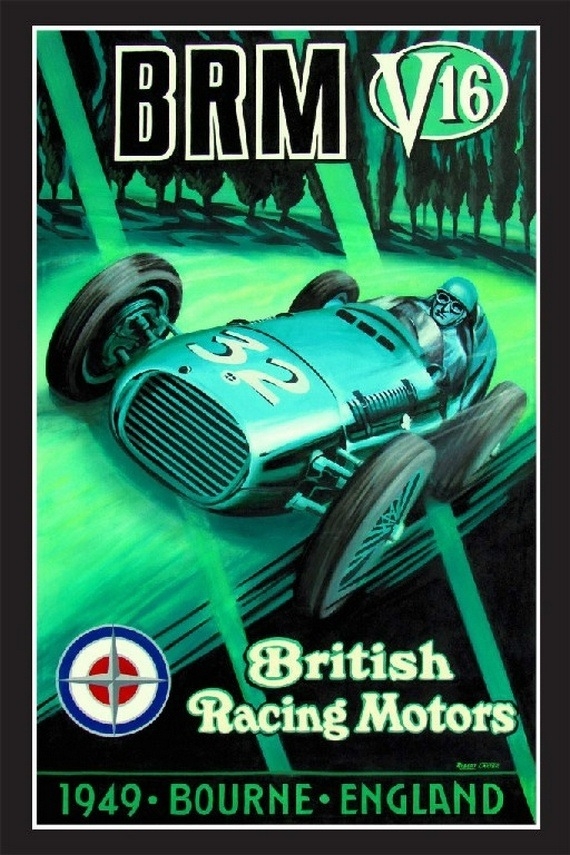
brm m sport v16 cover

About 15 years ago, I got a phone call from my father, telling me that his brother, my Uncle Henry had passed away at his home in Derbyshire, UK…

I remember Henry from the early 1960s, my dad’s dashing brother, who never married, but whenever he visited, arrived on or in interesting machinery. My first ride on a bike was on his Vincent Comet and then on a legendary Black Shadow. A Mini Cooper was thrilling, even more so, a Cooper S.

We moved to Australia, but news came occasionally of the succession of Lotus, Porsche and latterly turbocharged Nissans of the Silvia and Skyline variety.

brm 1

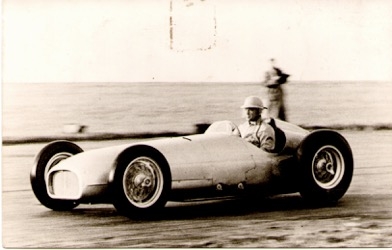
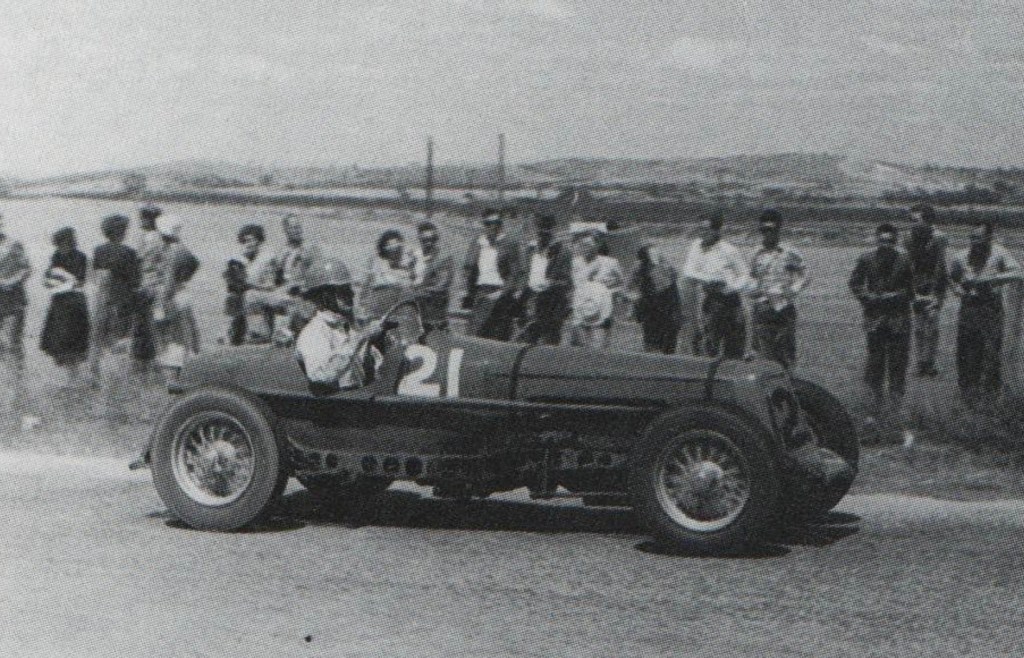
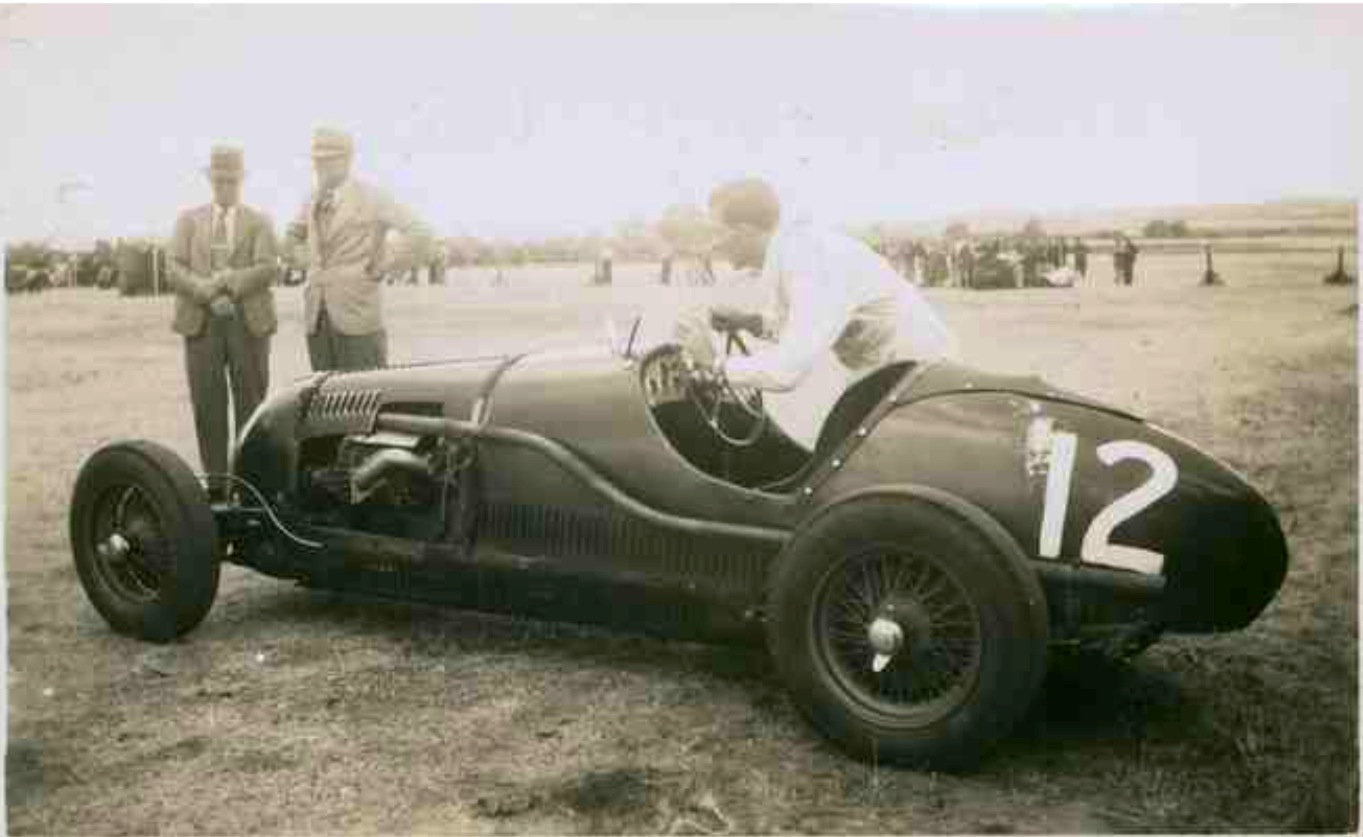
BRM V16, Ken Richardson, Folkingham 15 December 1949. (Marcus Clayton Collection)

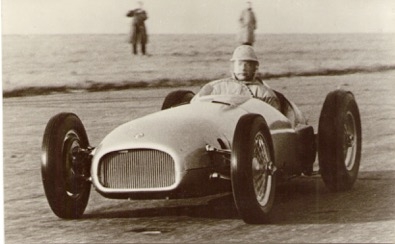
I was pleased to receive, as part of a modest inheritance from Henry, a packet of photos, reproduced here. They are obviously very early BRM shots, which I had never seen before. I thought they may have been taken by him as a young man, but 2 of them appear elsewhere on the interweb, so I can only assume they are part of a postcard pack, or press pack. I would date them around 1950/51.

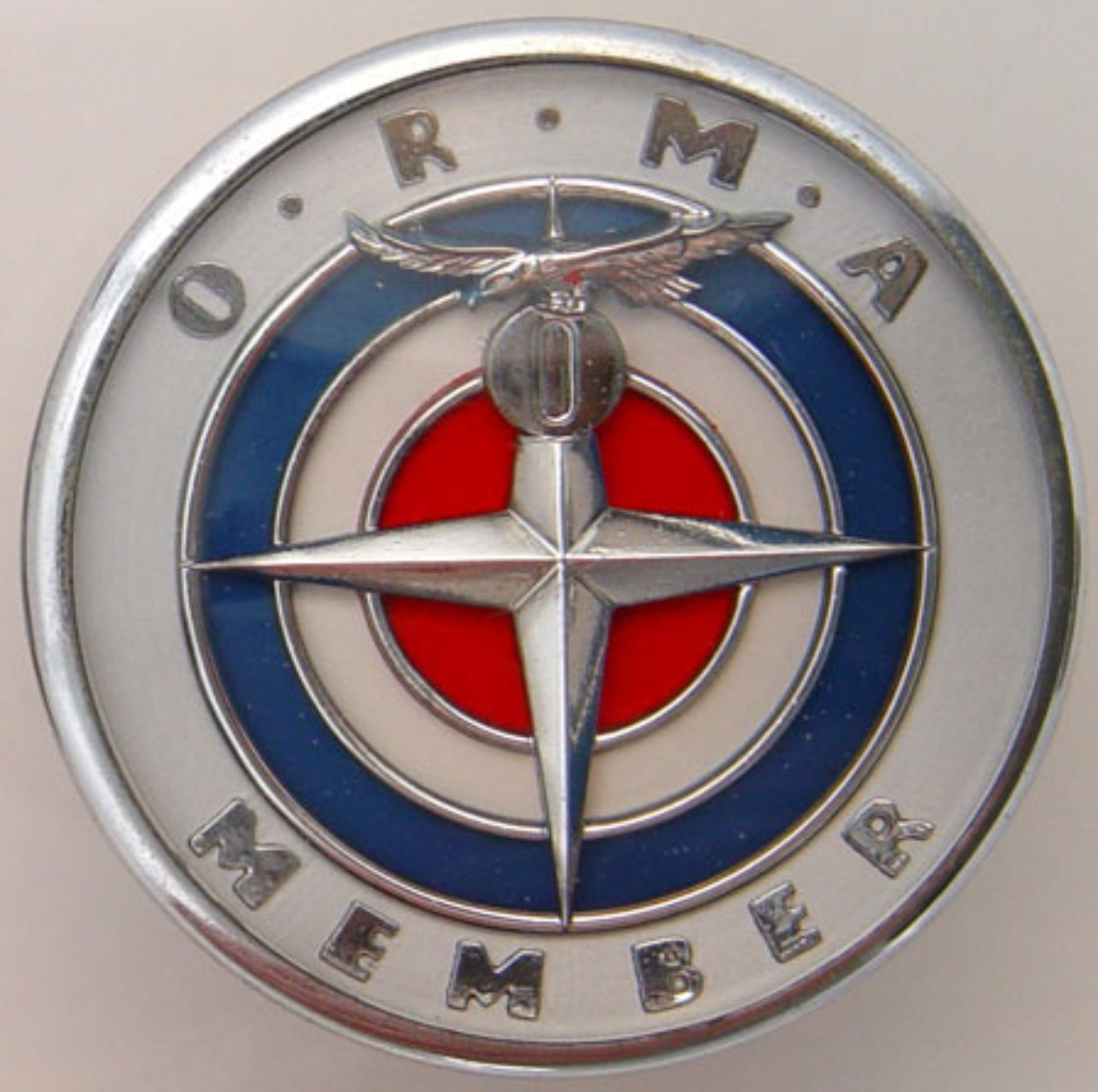
(Contributor/Historian Stepen Dalton advises the photos are BRM Press Kit shots, the cars launch was at Folkingham on December 15 1949, Stephen suspects Henry may have been a ‘BRMA’ or ‘ORMA’ member, the BRM supporters groups. The members of those groups were perhaps provided with copies of the shots. See membership badges below. Stephen has also indicated the likely dates of the track sessions and drivers, i have changed the captions accordingly.)

brm 2

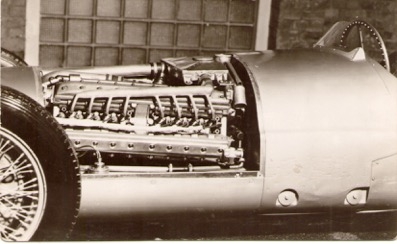
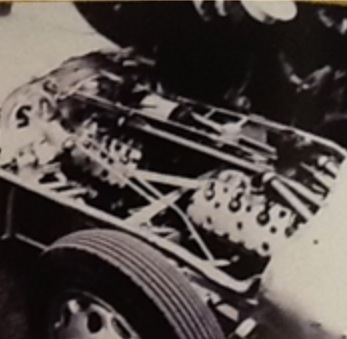
1488cc, centrifugal-supercharged, DOHC 2 valve V16. (Marcus Clayton Collection/Louis Klemantaski)

I have always had a fascination with the BRM. It has been written about extensively, so I can only add my personal take on this machine.

Mark Hales described it as like ‘The Victorians trying to build a moon rocket, and they very nearly succeeded’.

16 cylinders, each of less than 100cc, highly supercharged, spinning at 12,000 rpm, air suspension, disc brakes, with all this componentry, supplied by dozens of different companies, motivated to show ‘Johnny Foreigner’ that British engineering was still the best in the world. Inevitably, when there are so many suppliers involved, with so many radical parts, the project was delayed, time and time again, until the great day when the car had its first race start. It travelled about 3 feet, after breaking an axle at the start.

brm v 16 cutaway

Chassis was tubular comprising double-tube side members, 4 cross members, aluminium body. Suspension at front by Porsche type trailing arms and Lockheed air struts, de Dion rear axle located by a single radius rod each side and Lockheed air struts. Brakes Girling 3 shoe drums,(Mk 2 had discs) Wheels Dunlop centre lock wires with 5.25 inch wide x18 inch diameter wheels at front and 7 inch x17 inch diameter at the rear. BRM 5 speed gearbox with ZF ‘slippery diff, gearchange on RHS, transmission angled to pass to the left of the driver. Engine specifications with engine cutaway drawing below. Weight at the start line circa 862Kg. (Tony Matthews)

The cars were extensively sorted over 3 years before they became reliable. Exhausts changed from full length, to in front of rear wheels, to stubs behind the front wheels. Radiator intakes increased and decreased, oil cooling and filtration revised, nearly every part was altered and changed.

When some cars were being properly restored during the 90s, the original dyno shed was discovered, and on the walls were all the different firing orders tried. I don’t know that the final order used was ever identified.

Of course there is the sound.

I don’t know if it is the greatest sound in the automotive world, but it has to be in the running. I played a recording of the BRM to an engineering colleague, who makes drag racing engines. He thought the BRM sounded like an extremely angry Funny Car, and took some persuading to be convinced that all that fury came from only 1500 cc.

brm 3

BRM V16, Folkingham, Ken Richardson 15 December 1949. (Marcus Clayton Collection)

None of the drivers really liked the car, as it was unreliable and difficult.

‘The V16 was a thoroughly nasty car,’ said Moss. ‘The brakes were OK, the acceleration was incredible – until you broke traction – but everything else I hated, particularly the steering and the driving position. Handling? I don’t remember it having any…’

Raymond Mays, (Who I think is driving in the photos) ‘Before we went to Albi in ’53, I drove Fangio’s car at Folkingham Aerodrome and I had it up to 190mph on the 2000-yard runway. It was quite frightening, because you could re-spin the wheels at 9800 in fourth gear. I reached 11,800, with a high gear in…’

mays

Ray Mays, BRM V16, Daily Express Int Trophy Meeting, Silverstone 26 August 1950 (J Wilds)

Mays again ‘By the end of that lap, though, Fangio detected a misfire, and, as Mays admitted, ‘When you got a misfire on the V16, it could have been 1001 things… We worked through the night, and at 3.30am it was decided that I would test the car. At that time of the day – early dawn – there were horses and carts about, farmers coming out of gates, but on this long straight road I had the thing up to 180, and I scared myself stiff.’ How wide was the road? I asked. ‘Narrow’. said Mays. ‘Narrow.’

So the cars were ultimately irrelevant, only winning races in Formula Libre after time ran out for them when F1 changed to the unsupercharged 2 litre formula.

brm 4

Handsome side profile undeniable.(Marcus Clayton Collection/Louis Klemantaski)

The world is a better and more interesting place for the BRMs having been made. It would be unlikely to happen today, as the risks were far too high, but they were, like so many of the automotive and other objects that we so treasure, a delightful folly.

The recording is of Nick Mason’s BRM in 1998, driven by Mark Hales, from ‘Into the Red’.

brm 5

BRM V16 Folkingham. Perhaps Ray Mays on the cars first trial run, 3 December 1949. (Marcus Clayton Collection)

Restoration and Maintenance of This Car, Type 15 Chassis #1 Owned by the British National Motor Museum…

http://www.telegraph.co.uk/cars/classics/brm-v16-appeal/

Etcetera…

brm 6

Another shot at what appears to the be the launch of the BRM Type 15. (Marcus Clayton Collection/Louis Klemantaski)

brm board

Raymond Mays at right doing a bit of ‘stakeholder management’.R>L: Mays leaning, behind him Peter Berthon. Beside Peter, publicist Walter Hill, to his left Bob Henderson Tate from the Ministry of Supply. Standing, still going R>L are members of the ‘British Motor Racing Research Trust’ Bernard Scott and Denis Flather of Lucas, Alfred Owen far left. Seated in front of the table is administrator and later company secretary of BRM James Sandercombe. The meeting is in the study at Eastgate House, Mays family home in 1948. (photo unattributed but caption details ‘BRM Vol1’ Doug Nye)

brm engine cutaway

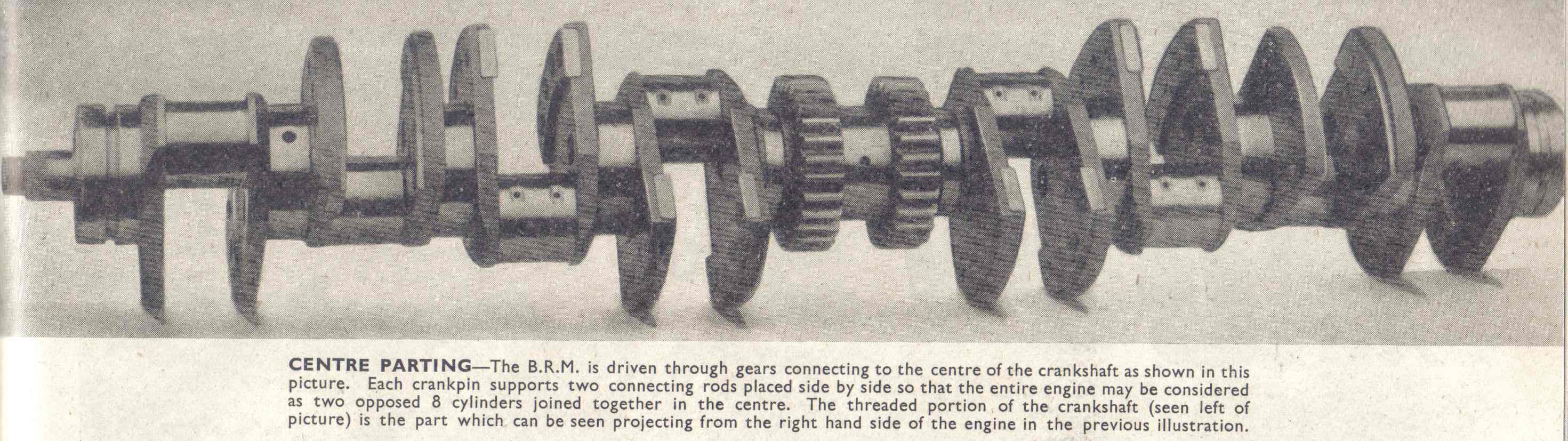
135 degree all alloy, 1488cc V16 with cast-iron wet liners. 10 bearing crank. DOHC 2 valves per cylinder, Rolls Royce 2 stage centrifugal supercharger fed by 2 SU carbs. Ignition by Lucas coil and 4 Lucas magnetos.Mk 1 Type 15 power 330bhp@10250rpm 1950-460bhp@11000rpm 1951.(unattributed)

BRM V16 crank

BRM crankshaft, centre power take-off clear. (Stephen Dalton Collection from the ‘BRM Ambassador for Britain Booklet’)

BRM V16 Vandervell ad

(Stephen Dalton Collection from the ‘BRM Ambassador for Britain Booklet’.)

orma

‘Owen Racing Motor Association’badge.

brma

Scratchy ‘BRM Association’ lapel badge.

brm postcard

Photo and Other Credits…

Tony Matthews cutaway, Motorsport magazine, Stephen Dalton Collection, J Wilds, ‘BRM Vol 1’ Doug Nye

Finito…


hill hi wing

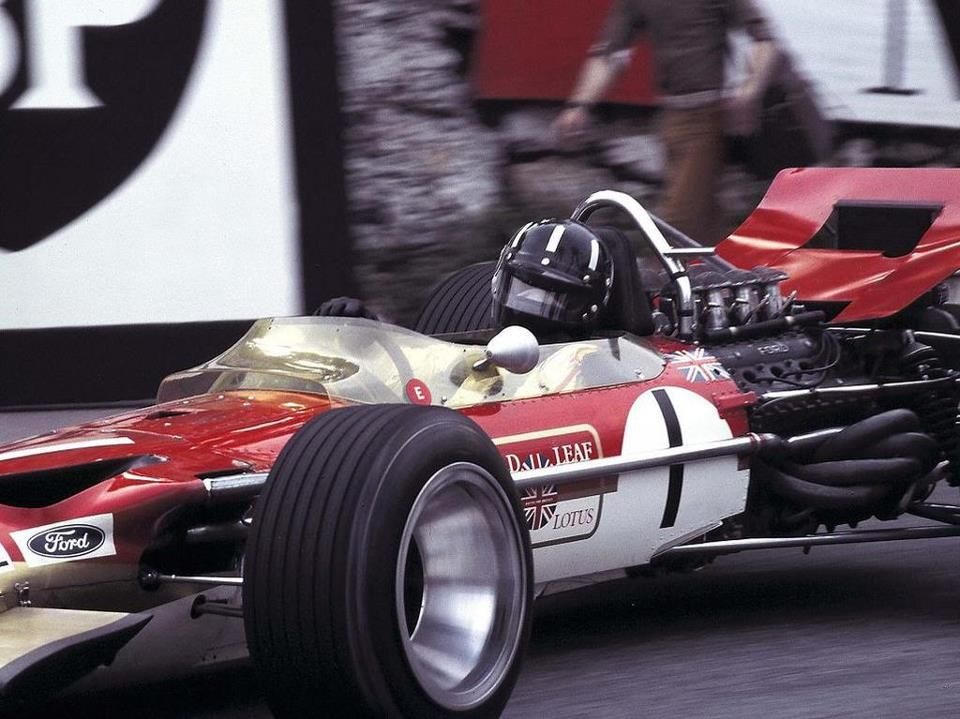
Graham Hill in his hi-winged Lotus 49 during practice for the 1969 Monaco Grand Prix, he went on to win the last of his five Monaco victories on Sunday May 18 1969…

‘Twas his last Grand Prix win as well but his competitiveness was still there, wins were to come in F2 and in endurance racing. His ’72 Le Mans Matra victory with Henri Pescarolo made him unique in our sport as the only winner of ‘Motor Racing’s Triple Crown’; victories in the Drivers World Championship, (BRM 1962 Lotus 1968) Indy (Lola 1966) and Le Mans.

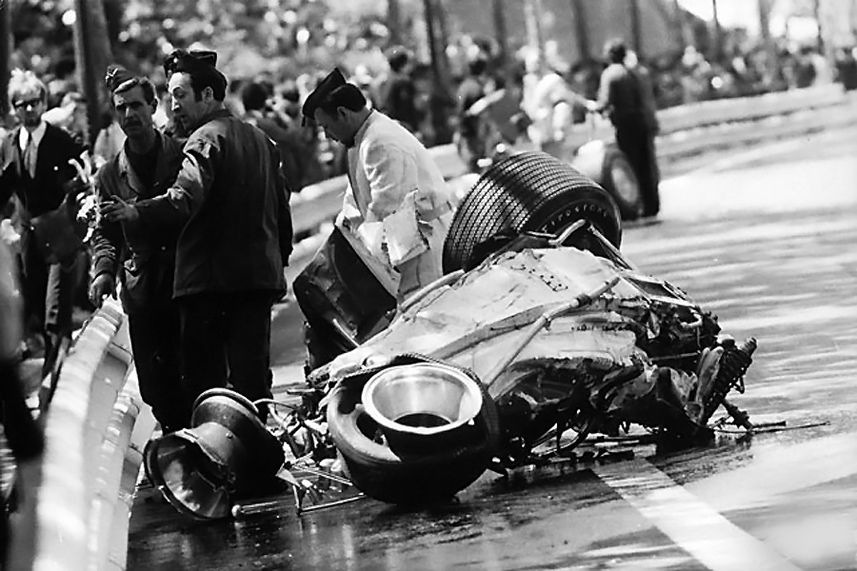
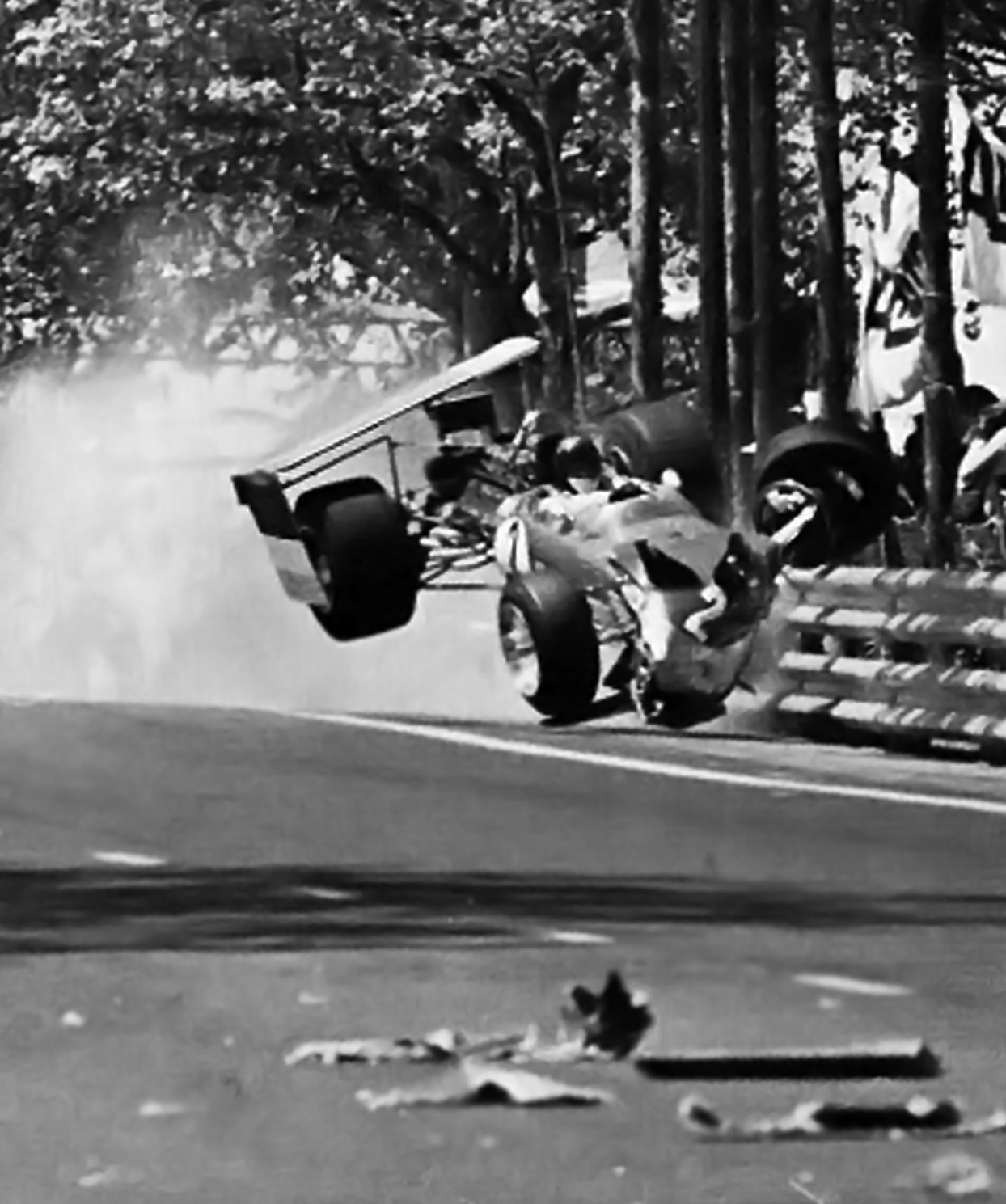
The story of the weekend was all about wings. There had been some big failures as engineers battled with forces they did not fully understand, notably the collisions, fortunately without serious injury to both Hill and Jochen Rindt at Barcelona on May 4, the race before Monaco.

Hill’s rear wing failed on lap 9 as he crested the rise after the Montjuic Park pits, he crashed heavily but was uninjured. Eleven laps later Rindt’s leading Lotus 49 suffered the same failure, collided with Hill’s abandoned car and overturned. He emerged with cuts, bruises and a broken nose. The wing on Ickx’ Brabham BT26 fell apart during the race as well.

There had been other failures in the recent past, the authorities needed to act before someone was killed.

rindt rooted lotus

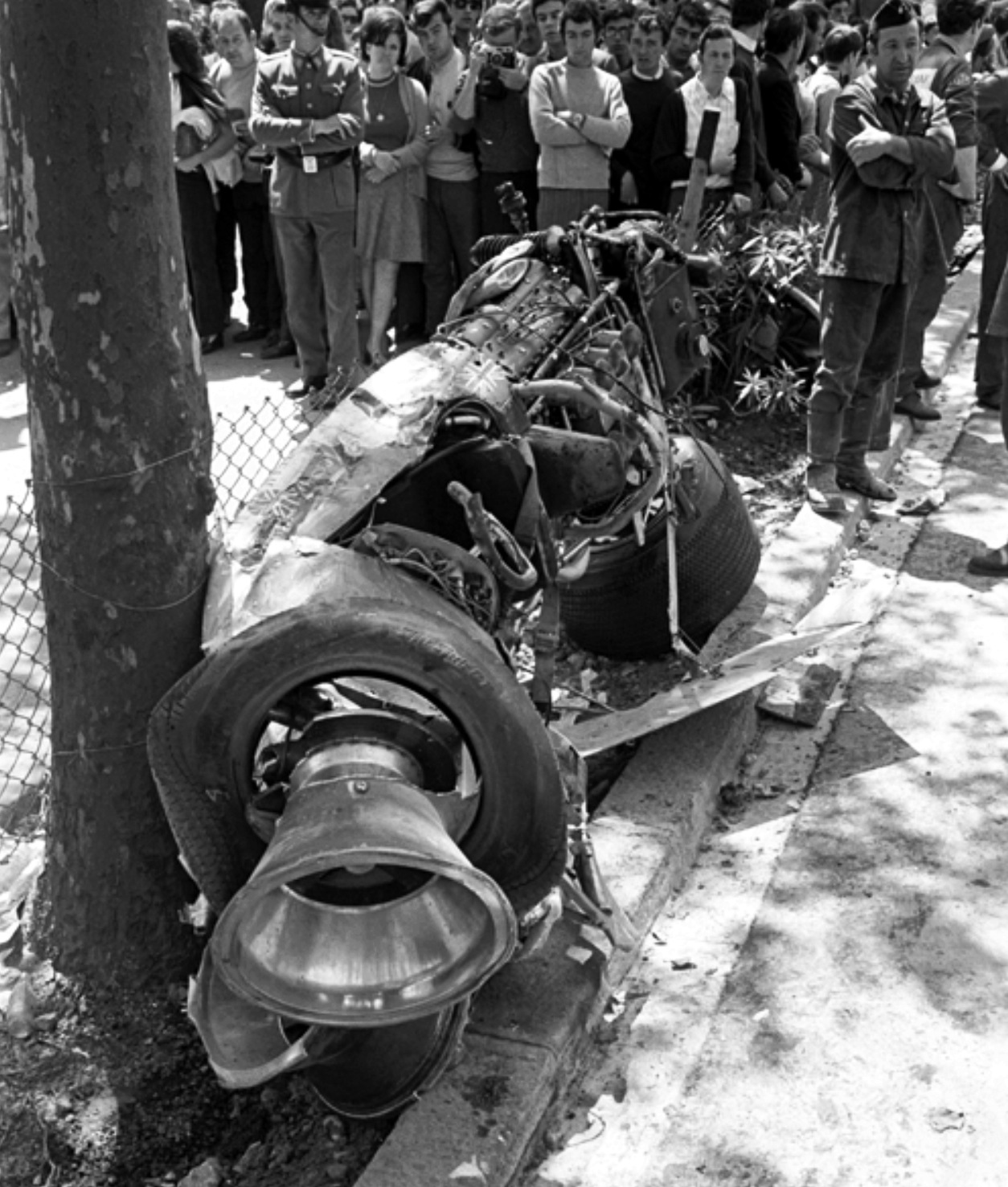
Rindt’s rooted Lotus 49, Montjuic Park Barcelona 1969. Jochen was a very lucky boy to escape withour serious injury after a wing support failure, Hill’s car into which Rindt collided is just down the road. (unattributed)

The CSI met in Monaco and acted after first practice by banning high wings forthwith, times were scrapped and the process of qualifying recommenced.

The sport was made safer as a consequence, some remain of the view that wings should have been banned then. Full stop.

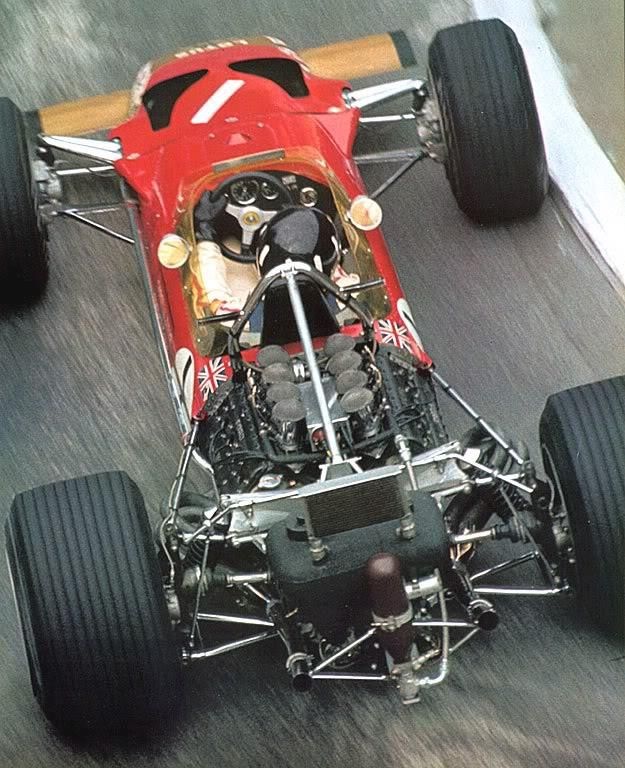
hill monaco interim

Wonderful overhead shot of Hill in qualifying post the wing ban; Chapman chose to keep the front wings, meanwhile the tin-snips were being put to work…3 litre Ford Cosworh DFV, big rear oil tank, external extinguisher the first thing to leave the car in the event of a major rear impact (handy for the driver in need of foam!), and Aeroquip brakelines running along the radius rods all clear to see. You can just about read the Smiths tach and chassis plate! (Automobile Year 16)

Stewart took an early lead from Amon’s Ferrari 312 in the race, Hill moved into third shortly after the start and after differential failures to both Amon and Stewart’s Matra MS80 Ford gained the lead he never lost. He took victory from Piers Courage’ Brabham BT26 Ford and  Jo Siffert’s Lotus 49B.

hill low level spoiler

By the time of the race’ start Chapman and his team had fashioned this neat spoiler…not as nice as the 49 used at Monaco in ’68 but that was built at the factory, this was not bad overnight and ‘ in the field’. (unattributed)

Winners are grinners, Hill ‘The Mayor of Monaco’ was always a popular victor in the Principality…

hill victory

Hill victorious in Lotus 49 ‘R10′, first debut’ by Jochen Rindt at Wigram NZ in January 1969. Victories in the Tasman Warwick Farm 100 in Rind’ts hands and Hill at Monaco. 49’s much raced by many drivers this chassis also raced by John Miles. Alex Soler-Roig and Emerson Fittipladi, Emmo raced it in its final GP, Austria in August 1970. Car still exists in the UK. (unattributed)

Etcetera…

montjuic

All those hi-wings in the Montjuic dummy grid, soon to be a thing of the past. #7 Jackie Stewart with teammate Jean Pierre-Beltoise behind, both Matra MS80 Ford, Graham Hill Lotus 49 Ford beside Stewart, #6 Bruce McLaren McLaren M7A Ford, #15 Chris Amons Ferrari 312 and #4 Jacky Ickx Brabham BT26A Ford (unattributed)

rindt barcelona

Rindt’s Lotus 49B and its broken wing supports clear in this shot of the ‘unguided missile’. Spectators and Rindt fortunate. Montjuic Park 1969. (unattributed)

rindt spain

49 ‘R9’ decidedly second-hand, Jochen was so lucky to ‘walk away’ from this accident (Getty Images)

rindts letter to chapman

Rindt’s 9 May 1969 letter post Spanish prang to Chapman is widely circulated and a classic! Prophetic sadly. (Jochen Rindt Archive)

Credits…

oldracingcars.com chassis research, Automobile Year 16, Getty Images

maybach
(State Library of South Australia)

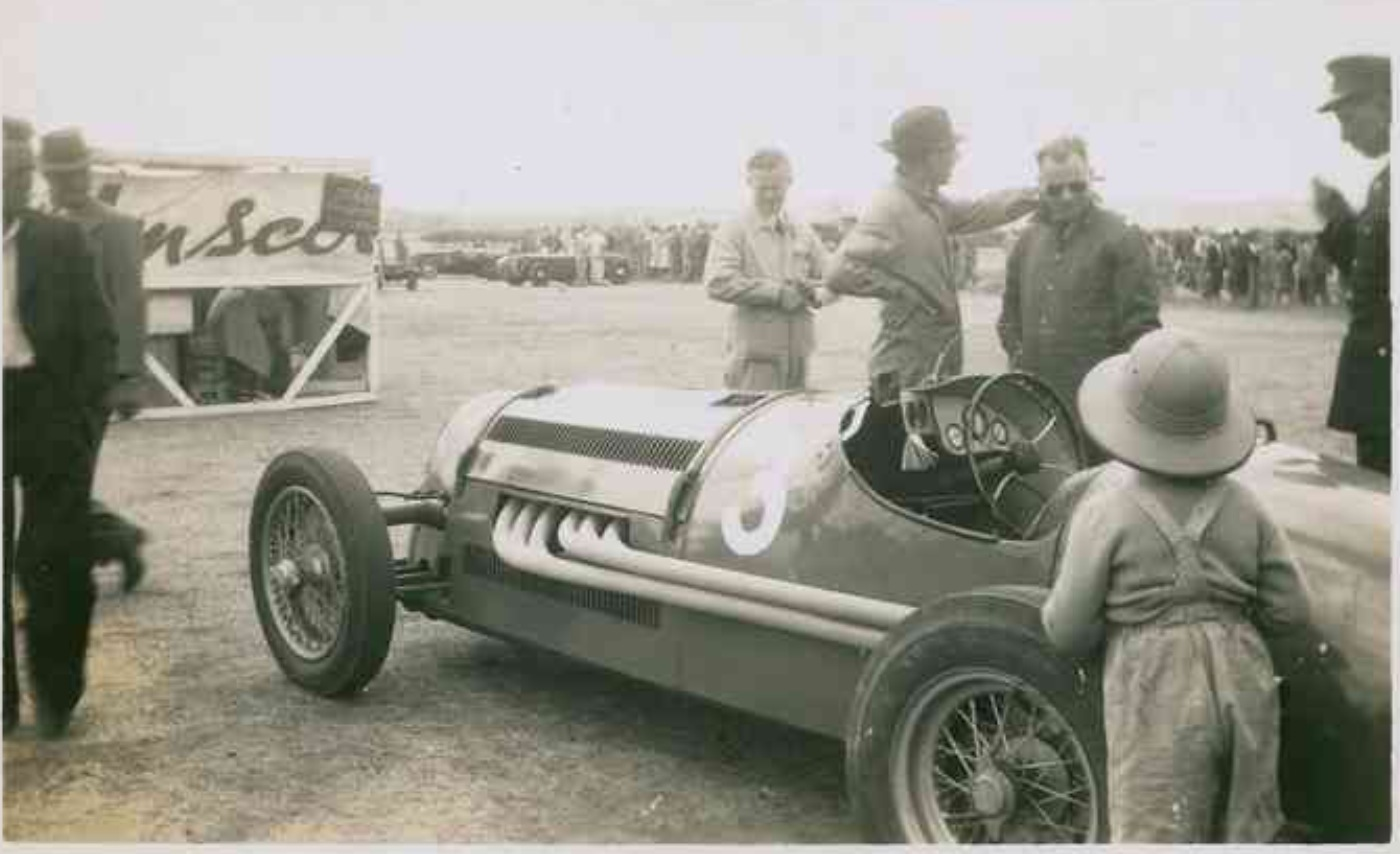
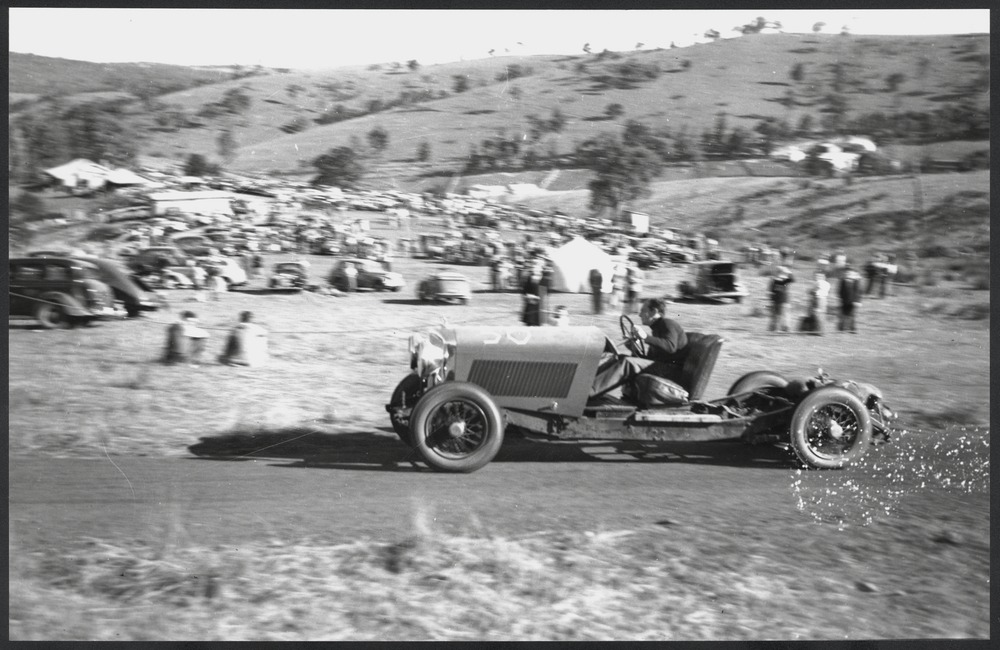
 The carefree nature of the 1950 Nuriootpa race paddock is contrasted by the formal attire of the day, young boy in the Pith Helmet is impressed by Charlie Dean’s Maybach 1…

The first post war Australian Grand Prix in South Australia was held in the Barossa Valley. Not on the daunting Lobethal road circuit where the 1939 event had been run, but just down the road on roads at Nuriootpa.

The circuit was basically a square layout of 3-miles on flattish land. A permit for Lobethal couldn’t be obtained but one for Nuriootpa was thanks to the intervention of some prominent local businessmen including John Hill-Smith of the Yalumba wine family.

Nuri cover
1950 AGP Program cover (Stephen Dalton Collection)

Graham Howard’s ‘History of The AGP’ described the circuit…

‘There was a slight uphill section along the (Nuri) Main Street, followed by a right hand corner onto a downhill section back into the countryside…This led to an Ess at a narrow bridge, after which the road ran straight to an intersection around which were collected the finish line, the pits and – on the next straight after the intersection – the start line. There was a vineyard to the left…but enough grazing paddocks for parking etc…’

The starting straight led to two fast right hand sweeps after which the road then led west by way of a pair of gentle Esses…to a T Intersection…then via a left-right sweep across another narrow bridge, into the Main Street again. There were some very bumpy parts…the roads just wide enough for two cars to pass readily…’

map
Nuriootpa Road Circuit Map (History of The AGP)

The Sporting Car Club of SA ran the event to the Australian Automobile Association’s decree, the winner was the competitor finishing in the fastest time but otherwise in the best traditions of the AGP at the time, the event was a handicap and awards were made on that basis. Geddit?

The main contenders for the race were primarily cars I have written about before so I won’t go through the detail, here are some links if you want to refresh your memory: The Maybach, driven by its creator Charlie Dean; https://primotipo.com/2014/12/26/stan-jones-australian-and-new-zealand-grand-prix-and-gold-star-winner/ ‘Black Bess’, the Ford Ute V8 Spl driven by its builder, Doug Whiteford; https://primotipo.com/2015/05/05/doug-whiteford-black-bess-woodside-south-australia-1949/

rupert steele monza nuriootpa
Rupert Steele in his ex-Alf Barrett Alfa Monza, drove an exceptional race as a relative novice against the tough Doug Whiteford. (John Blanden Collection)

The ex-Alf Barrett Alfa Romeo Monza, was by the time of the Nuriootpa event owned and driven by relative novice Rupert Steele. https://primotipo.com/2015/02/20/alf-barrett-the-maestro-alfa-romeo-8c2300-monza/ Lex Davison, who would later win four AGPs started his Alfa Romeo P3, the scratch man was Tony Gaze’ 1935 2-litre supercharged Alta 56S, although he was not to start after dramas in a preliminary race, all these racers were Melburnians.

Fastest resident South Australian was Harry Neale in Eldred Norman’s, extraordinary ‘Double Eight’ or ‘Double V8’ which married the chassis of a World War 2 weapons carrier and a pair of single carb Ford V8s from army trucks. It had independent suspension on all four corners, 7834cc in total and was rated a good chance on a ‘point and squirt’ course like Nuri with slow corners and long straights. See the section below for details on this amazing car.

Australian Motor Sports described the race day scene…

‘Brilliant sunshine made the competitors paddock a colourful spectacle with racing cars in different hues, tender vehicles ranging from furniture vans and in which the Steele cars had been brought from Melbourne to the luggage trailer which Peter Damman had towed behind his racing Hudson the same distance. In a handy position near the course, Motors Ltd’s mobile service van was in constant demand with its stock of racing oils, spares and field workshop’.

‘Between the finish of the under 1500cc scratch race and the start of the Grand Prix, there was a brief interval for luncheon; then, as 1.30 drew near, cars were lined up in the continuation of the crossroads behind the starting straight, in preparation for the big race. Two spectators climbed up stepladders which they had brought to the course for private grandstands, and the three limit men were away…’

davison nuri
Lex Davison takes to the circuit, Nuriootpa paddock in the background. Alfa Romeo P3/Tipo B (unattributed)

The race itself was diminished by the inability of Gaze to start, Davison’s retirement on lap one, having lost compression on two of the Alfas eight-cylinders and Dean’s withdrawal on lap 21 with magneto, overheating and braking problems.

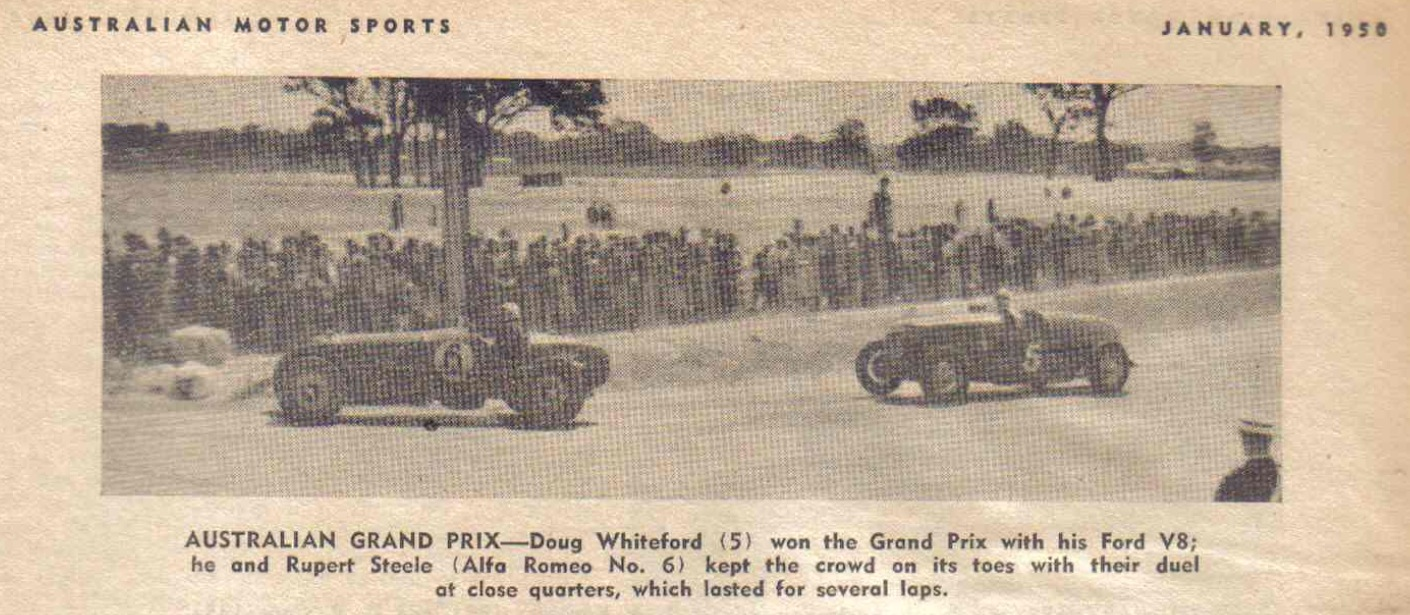
What was absorbing was the battle between the Aussie Battler garage proprietor Whiteford in his carefully evolved and very well driven Ford V8 Spl, ‘Black Bess’ and the ‘Silvertail’ from Toorak, Rupert Steele in the aristocratic Alfa.

The latter had the edge on top speed, but the Ford, with more supple suspension was better suited to the South Australian country roads. Whiteford was a hard man as a driver, but the novice Steele was no slouch, he must have been a-natural to adapt to the GP car with his experience limited to a few hillclimbs and speed events in a Bentley road car.

1950 agp

On lap 13 Steele ran out of road having passed a gaggle of MGs, he spun the big Alfa and stalled, then lost about 1 minute 49 seconds, hand-cranking the supercharged straight-eight back into life but his race was effectively run.

Whiteford won from Steele’s Monza and Jim Gullan’s Ballot Olds. The latter was first on a handicap basis from David Harvey and Ron Kennedy, both in MG TC Specials. Steele’s sporting focus was on horses for the rest of his life, sad really as his potential as a driver was clear, the Alfa was sold to ‘Racing Ron’ Edgerton by the end of 1951.

Doug went on to enjoy two more AGP wins in 1952-53 at Bathurst and Albert Park, and a career which went well into the 1970s as a works driver of Datsun sedans and sportscars.

whiteford
Doug Whiteford, victorious in the 1950 AGP at Nuriootpa, in Black Bess’ his self constructed Ford V8 Spl. (John Blanden Collection)
nuriootpa poster

Other Competing Cars…

The stimuli for this article were several shots I found in the State Library of South Australia archive of the Dean Maybach, McKenna BMW 328, Jones HRG and other cars which competed that weekend.

I’ve done the Maybach to death in the Jones article referenced above, but here are some notes about the other cars with John Blanden’s ‘Historic Racing Cars in Australia’ providing much of the detail.

bmw 328
Peter McKenna’s BMW 328 in the Nuri paddock Car was the winner of the 1948 AGP, at Point Cook, Victoria driven by Frank Pratt (State Library of SA)

McKenna’s BMW 328 was raced by him all over Australia at Rob Roy, Fishermans Bend, Ballarat, Port Wakefield, Albert Park’s initial meeting in 1953 and as far afield as Southport on Queensland’s Gold Coast for the 1954 AGP. He overshot on a corner and rolled that day, the car passed through many hands before leaving Australia for Japan in the early 2000s.

Chassis # 85136 was brought into the country by John Snow, who acquired it on one of his regular trips to Europe, in 1937. A German General sold the car, Snow bought it on behalf of George Martin, president of the Light Car Club of Australia in Melbourne.

It finished the 1938 AGP at Bathurst in tenth, see my article on Peter Whitehead’s ERA which covers this race, Martin sadly had a fatal accident in it near Wagga Wagga on his return trip to Melbourne.

Their were two ‘racing 328s in period in Australia, both of which were involved in fatal road accidents. The other killed very talented racing driver Colin Dunne and his wife Billie at Phillip Island. It wasn’t a race accident mind you, but one which took place on the circuit between motor-cycle events.

By 1947 the 328 had passed into the hands of champion Geelong motorcyclist and dealer Frank Pratt. Pratt famously won his very first car race, the 1948 Australian Grand Prix held at Point Cook! He was aided by a favourable handicap, excellent driving and the extraordinary heat of the day which knocked out many of the more fancied runners.

Whilst new to car racing he was well familiar with intense competition. The car’s preparation by multiple AGP winner Les Murphy was also a factor. Some reports say that Murphy was extremely pissed off, he was originally entered to drive the car, and then was supposedly sharing it with Pratt, whose intention to drive the race solo soon became clear to Les once the arduous event was underway!

McKenna had a handicap of 9 minutes at Nuriootpa, but was unclassified.

HRG
Stan Jones, HRG Bathurst, Nuriootpa AGP meeting 1950. Jones cooked his engine in a preliminary race so was a non-starter for the GP (State Library of SA)

HRG ‘Bathurst’…

Tony Gaze brought the first HRG to Australia in 1947. The car was uncompetitive so Gaze specified future cars to be light, sports/open-wheelers with easily removable lights and guards so the cars could run as sports or racing cars in local events.

Brown and Dureau, a Melbourne trading firm who ‘Gaze was with’ imported the first car to these specifications in 1949, Stan Jones was the purchaser of the 1.5-litre, four-cylinder car (which had no chassis number).

He first raced it at Rob Roy in June, it was soon supercharged running at 12-psi of boost, racing it at Corio, Geelong in late 1949 and then entering the AGP at Nuriootpa.

In one of the preliminary races for under 1500cc cars Jones had a furious dice with fellow Melbourne motor trader/racer and later champion Bill Patterson – Bill was MG TC Spl mounted – both cars retired with overheating maladies. Jones’ car didn’t take the AGP start and Patto retired with head gasket failure; it was not a successful trip to the Barossa for either of them.

The car was sold later to Alan Watson in 1950 but was badly damaged by him and driven by Sil Massola in the 1952 AGP at Bathurst. According to the ‘Blanden Bible’ it was/is still in Australia.

massola
Silvio Massola in the ex-Jones HRG. Victorian Trophy, Fishermans Bend 21 March 1954 (VHRR/State Library of Vic)

Blurry Maybach in the ‘Nuri Paddock…

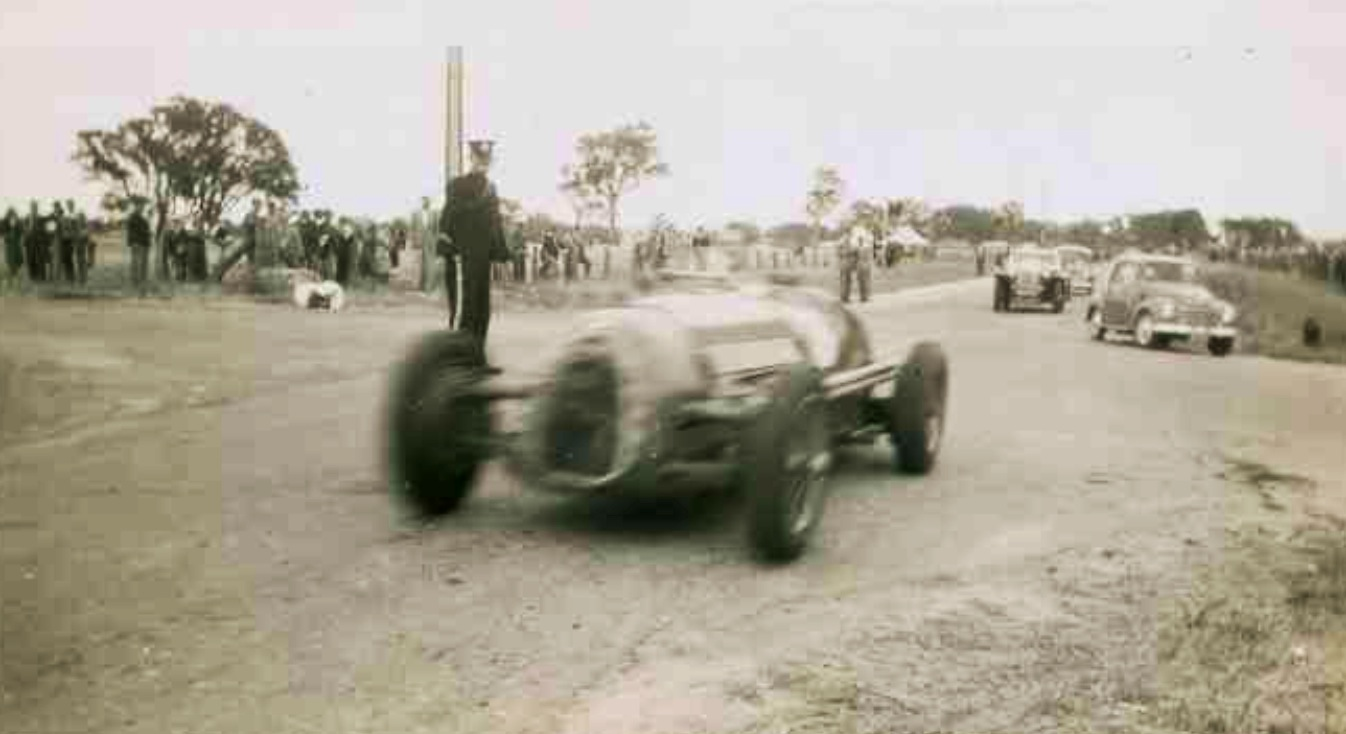
The shot is a bit fuzzy but still included for the atmosphere it shows, Charlie Dean in the paddock, the ‘Copper’ is keeping an eye on proceedings, Fiat Topolino behind the Maybach.

mayback blurred
Charlie Dean, Maybach, Nuriootpa AGP meeting January 1950 (State Library of SA)

Other Entrants…

Curran Ford V8.

curran ford
Dennis Curran, Curran Ford V8 3920cc (State Library of SA)

Regarded as one of the most specialised Ford side valve V8 specials built in Australia, Dennis Curran, then an apprentice, made many of the car’s advanced features including its independent front suspension and modified Minerva braking system. The attractive body appears to be in the style of the Alfa Romeo Alfetta 158/159 GP cars of the period.

The car was raced by Curran at the 1951 Narrogin AGP in WA, then in Bill Wilcox hands in the 1953-55 AGP’s as the ‘FLS’. The machine was then further modified by Frank Murphy on behalf of the owner, Melbourne car dealer Harry McLaughlin by fitment of a Lancia Lambda rear end, Jaguar XK120 gearbox and a new body.

A 5-litre Ford V8 was also fitted inclusive of Offenhauser heads and induction manifolds, it competed in this form at the 1956 Olympic AGP won by Stirling Moss at Albert Park. It was then known as the ‘Marchel’, the car then disappeared but was found by Noel Tuckey in 1980, restored and is now known as the ‘CWM Ford V8 Spl’ an amalgamation of the surname initials of the contributors to the cars evolution: Curran, Wilcox, Murray.

Bugatti Dodge.

bugatti dodge
L Robinson, Bugatti Dodge, Nuriootpa 1950. Interested to know more about this car if anyone has any information on it  (State Library of SA)

Ballot Oldsmobile.

ballot
Jim Gullan, Ballot Olds, AGP Nuriootpa 1950 (State Library of SA)

Jim Gullan replaced the Ballot Ford he had been racing in 1944 with a 2-litre Ballot bought nearby to his familiy’ garage in South Melbourne.

The Ballot engine was sold and replaced by an Olds six and ‘box, the chassis shortened by two feet and narrowed by six inches. It was lightened too, you can see the holes made in its longerons to do so. A body was made by Bob Baker in Melbourne – he built many racing bodies at the time – this Ballot is credited as the first. The sports two-seater was registered and commenced racing in 1946. It won the 1950 AGP handicap class as above.

Journalist and historian Ray Bell wrote about this car on ‘The Nostalgia Forum’, here is his detailed account of the construction and development of the car.

‘Jim Gullan’s Ballot will always rank as one of those cars that looks the part of an Australian Special. The raked nose, the heavily drilled chassis, steering wheel close to the chest and mandatory straps over the bonnet, its wire wheels carried a car that mixed European and American as well as any other. Fortunately the early life of the car is well detailed in Gullan’s book, ‘As Long As It Has Wheels,’ and there was plenty to write about as the Ballot Olds was to bring Gullan a number of successes.’

‘The car was bought in 1944, almost on a whim, it seems, after Gullan had sold the Indianapolis Ballot (by now fitted with Ford V8) early in the war.  A 2-litre model with sohc engine and knock-on wire wheels (more important, according to Gullan), it had a poor body. He mentions four-wheel brakes with Dewandre servo, making it a 1926/28 model 2LT.

Soon after buying it a workmate offered money for the engine, gearbox and radiator to fit into a Bugatti chassis.  Said Gullan: “I suppose any engine was better than none..’ Having just the chassis left, he thought he’d build a copy of his favourite car, the ERA. He was reluctant to go for another Ford, having had bad experiences with the V8, so an ad for an Oldsmobile engine and box (unused spares purchased for a Taxi) overcame his problems. It was to have triple Ford carbies and extractors.

The chassis was made into a copy of a Bugatti chassis, was shorter and narrower, designed to be ‘strong in the middle,’ boxed and drilled liberally ‘as on the SSK’ for lightness. The original hubs were retained, but laced to smaller rims, the spring shackles were located at the front instead of the rear as Gullan drew on all the modern technology he could identify.’

‘Bob Baker built the body round an angle iron frame, which was screwed to the chassis with small reject aircraft bolts. A deliberate effort was made to reduce frontal area, hence the car’s low appearance. Quick-fill petrol and radiator caps were fabricated and instruments (like the carbies) came from army disposals’.

‘The Ballot name was retained, even though virtually only the axles and wheel hubs remained, because it made it simple to register the car. Just roll up and pay the money!’

‘Springs were fitted outside the chassis and there were torque stays to the front axle, with finned alloy drums off a spare 2-litre Ballot Jim had bought and sold. The first race was at Ballarat at the beginning of 1947, after which hydraulic shocks were fitted front and rear (‘to the horror of the Hartford purists!’) and hydraulic actuation of the brakes was arranged. For Lobethal 1950, (the event which is the subject of this article) which the car was to win on handicap, a specially made 3.5:1 diff replaced the original 4.1:1 unit. Jim had to do the design work for the gear cutter.’

‘Gullan was in business with one of his major opponents on the track, Doug Whiteford, and when Doug imported an Edelbrock cam and heads (he’d melted a pair of alloy heads at Lobethal in 1940!) Bruce Rehn copied the cam profile and lift for the Olds. By the time of the Point Cook AGP (1948) there was yet another higher lift cam and special ratios in the gearbox. As a result of the heat at Point Cook, with the Olds running so cool and well, the engine was bored 3/16”, while both cars were fitted with enlarged sumps with cooling tubes fitted. Then for Nuriootpa’s opening meeting in 1949 PBR made up special alloy brake shoes and backing plates. These were found to be bending the chassis, so some more work was required’.

‘The car was Gullan’s expression of all he’d learned from observing racing and running his own Salmson, Wolseley, Austin and Ballot V8. It was considered by Whiteford to be ‘too sensitive in the steering and brakes, difficult to drive.’ Gullan adjudged Black Bess to be ‘tail light, tending to wander at speed, with light and spongy steering and poor brakes.’

‘Considering just how it came together – the bits that just happened to be there, the chance acquisitions – it worked very well. Gullan was a handicap specialist, with his wife Christine timekeeping and acting as strategist, and they beat the handicaps with monotonous regularity. He comments that he just had to keep on making the car quicker to keep on beating them, so it was well developed when sold to Alan Watson.’

‘He mentions getting airborne over the top of the hill approaching Lobethal at 110mph, touching 116mph on the straight and holding it flat all the way from Lobethal to within sight of the pits at that early stage of its development. By the time it won the handicap section of the 1950 AGP it must have been a fairly quick car’ (Ray Bell)

The car passed through many hands over the next 20 years, it was raced as late as 1963 at Calder, Victoria. It has been used since 1970 in historic events, is still alive today I believe in Frank Moore’s Collection of Australian Specials in Queensland.

ballot olds 1946
Jim Gullan in his Ballot Olds at Rob Roy,Victoria in 1946. This provides a clearer view of the car (George Thomas)

Double V8.

double 8
Eldred Norman in the ‘Double 8’ during the 1950 Nuriootpa, AGP. DNF on lap two (TNF)

The following truncated account of this car is by ‘theotherharv’ on ‘The Nostalgia Forum’.

‘In 1946 Eldred was purchasing ex-army vehicles left behind by the Americans and selling them in Adelaide. While visiting Papua-New Guinea , he acquired a war-surplus Dodge weapons carrier chassis along with a host of Jeeps and Blitz trucks at an auction in Port Moresby.

Eldred used the Dodge to construct a race car – the ‘Double Bunger’, or more commonly ‘Double V8’ – it was built from the bodywork of an aircraft and a tubular steel chassis.

d 8 engine
Scratchy shot of the 2 Ford V8 engines. Double 8. (TNF)

Power came from two Ford Mercury 239ci flathead V8 engines for a total capacity of 7,800cc. These engines were good for 100-110bhp each when run independently, giving Eldred some 200bhp in the Double V8. Engine cooling suffered despite radiators both in front and behind the driver with a tendency to overheat in long races. The engines were coupled flywheel-to-crank snout with a four-row chain drive and were timed to fire as a V16, with a Scintilla magneto providing the sparks.

This large 2500 lbs machine had independent suspension and water-cooled drum brakes supplied by four US made Toronto fuel pumps. The drum brakes produced spectacular clouds of steam as he applied them, despite being undersized for the task. The rear drums were built inboard, operating on the back axle and were additionally cooled by a fan worked by the tail shaft.

d 8 road
Eldred Norman aboard his road registered Double V8, attractive body, truck wheels betraying cars weapon carrier underpinnings! Two seater form here, this evolved over the car’s life (TNF)

Road-registered, Eldred was frequently seen driving the Double V8 around the Adelaide hills, with trade plates tied with string or a strap around his neck! Between 1948-51 he drove the car successfully in hill-climbs and various race tracks in three States, the car was also driven long distances to compete at tracks such as Fisherman’s Bend, Victoria, a 900-mile round trip sans mufflers.

In addition to circuit racing, Eldred raced at Sellick’s Beach, South Australia where competition was undertaken between mile posts. An annual speed trial and motorcycle races were held on three kilometres or more of sand along Aldinga and Sellick’s Beaches up to 1953. The Double V8 won both the unlimited scratch race and the over 1500cc handicap race held at the beach by the Racing Drivers Association of South Australia in April 1950. This event drew more than 5,000 spectators. One incident with Harry Neale at the wheel of the Double V8 ended with the car deposited into the sea, ripping off the bodywork and leaving Harry sitting on the chassis, wet but unhurt!

norman dbl 8 woodside
Eldred Norman Double V8, Woodside 1949 (State Library of SA)

Eldred’s can do, larrikin spirit was also evident in the way he once retrieved the telephone cables laid out for communication between officials at each end of the Sellick’s Beach strip. He fitted a bare rim to the Double V8 rear axle and fired up the twin V8s to power what must have been Australia’s most powerful fishing reel.

d 8 woodside 2
Double V8 in the Woodside, SA paddock 1949. (State Library of SA)

The Double V8 marked the start of Eldred’s entries in the Australian Grands Prix: in the January 1950 Nuiootpa Australian Grand Prix the Double V8 retired after only two laps.

The 1951 Australian Grand Prix was again run as a Formula Libre event in March at a 4.4 mile ‘around the houses’ road circuit at Narrogin, Western Australia. Eldred entered the Double V8, whilst leading on lap 7 of 24 it again broke down, this time due to suspension failure, leading to Eldred’s retirement from the race.

The car was sold in 1951 to Syd Anderson, proprietor of the Sydney Anderson Automotives used-car dealership in William Street Western Australia.  During both Anderson’s and subsequent ownerships in WA the car was modified repeatedly.

Anderson raced the Double V8 extensively, including the following West Australian meetings: The Great Southern Flying 50 at Narrogin in March 1952, winning the scratch race for over 1500cc. The Northam Flying 50 meeting in April yielded a win in the three-lap scratch race for over 1500cc cars. At the Goomalling Speed Classic, on the road circuit in June he was fourth in the 15 lap handicap for Racing Cars, first in the 3 lap scratch race for racing cars over 1500cc and first in the 5 lap handicap for racing cars.

d 8 2
Wonderful colour shot of Syd Anderson racing the Double 8 in the Goomalling Speed Classic at Goomalling WA in 1952: two first places at the meeting. Note truck wheels drilled for relative lightness. (TNF)
Toby Carboni with three helpers trying to get 16-cylinders to cooperate. Note the two carburettor vertical inlets, ‘V16’ script on the hubcaps and heavily drilled steel wheels especially on the rear. Caversham perhaps (K Devine)

Anderson entered the Double V8 in the 1953 Johore Grand Prix in Malaya but retired from the race with overheating dramas. The car was then sold by Anderson to James Harwood, a navy veteran, musician and motor enthusiast in Perth.

Harwood tossed a penny with Anderson to decide the purchase price – either £50 or £100 – Harwood won. The vehicle was then towed to his business premises where Bill Strickland removed the two Ford V8 engines, which were sold. The Double V8 body was then placed outside James’ business as advertising, although it was removed a few days later at the request of Perth City Council.

In the period 1955-1957 Toby Carboni raced the car extensively in Western Australia before Keith Windsor bought the Double V8 body in 1957 and installed a V12 Lincoln Zephyr engine.

Lincoln produced these engines from 1936-1948, ceasing production nearly a decade before Windsor’s repowering of the Double V8. I’m not certain if Windsor used the 267ci, 292ci or 306ci engine (110-130bhp), though in any case it was a marked reduction from Eldred’s 478ci (~200bhp) double V8 powerplant.

Windsor debuted the V12 Double V8 in the Christmas Cup at Caversham in late November 1958, competing in the five-lap racing car scratch race for over 1500cc cars, although he did not place in the top three positions. Sadly, Windsor found the V12 vehicle was not manageable and subsequently scrapped it; if there is one car which would be welcome at Australian historic race meetings it is most certainly this stunning creation!

After the Double V8, Eldred bought a 1936 Maserati Type 6CM.

MG K3…

(S Jonklaas)

Otto Stone’s car, out after completing only one lap.

Healey Elliott…

healey elliott
(SLSA)

The car behind the Healey Elliott is a Nash Ambassador. Donald Healey built 101 of these cars – Elliott refers to the body builders – Healey provided the ladder frame chassis to that firm to clothe, the engine was a Riley 2.5-litre pushrod-four, the car for a time was the fastest four seater in the world. They were built from 1946 to 1950, suspension used trailing arms at the front, and a live axle at the rear suspended by coil springs front and rear.

Etcetera…

Rupert Steele.

steele bentley
(George Thomas)

Rupert Steele contesting a Rob Roy Hillclimb in his Bentley devoid of bodywork in 1948. The step up from this lumbering tourer, he only did one circuit race in the car, to the Grand Prix Alfa Monza must have been immense.

whiteford paper article
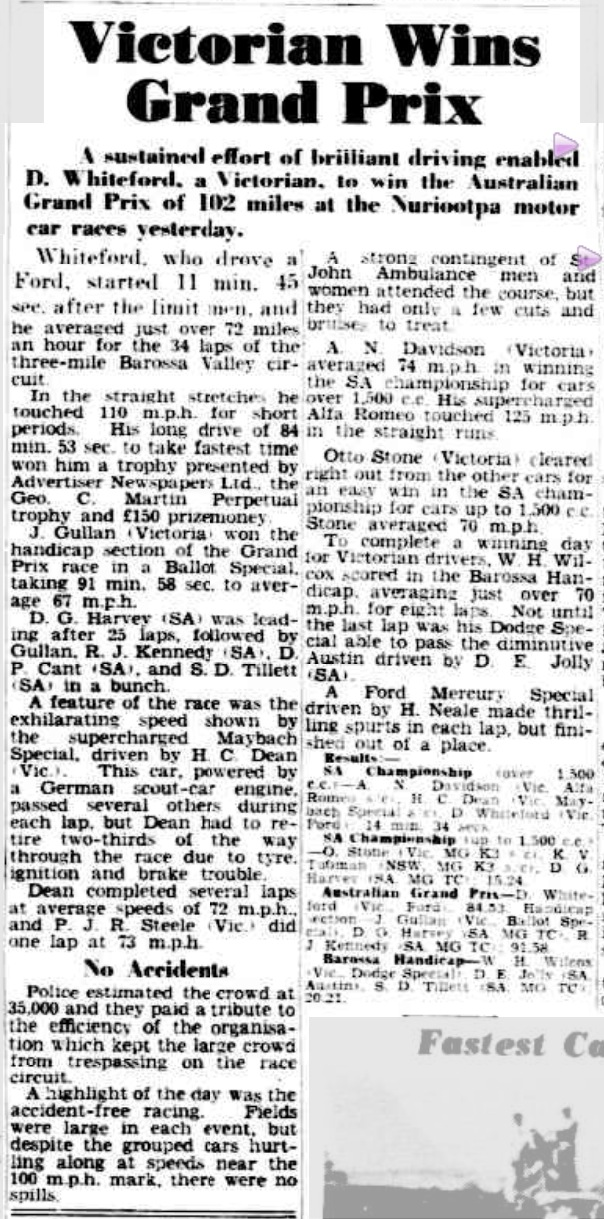
‘The Adelaide Advertiser’ 3 January 1950.

Bibliography…

Graham Howard ‘History of The Australian Grand Prix’, John Blanden ‘Historic Racing Cars in Australia’, Australian Motor Sports January 1950, Stephen Dalton Collection, Motormarques, Ray Bell, The Nostalgia Forum (TNF), The Adelaide Advertiser 3/1/1950

Photo Credits…

Publications as above, State Library of South Australia, John Blanden Collection, George Thomas, The Nostalgia Forum, Stuart Jonklaas Collection

Tailpiece…

Ron Kennedy from Don Cant, both in MG TC Spls, finished in fourth and third places respectively.

Finito…

stuart

Stuart Lewis-Evans with the assistance of Tony Harris lowers his Cooper Mk V from the roof of his ‘Landy’ at Crystal Palace in 1956…

It looks as though the most tricky part of a race meeting with this set up was actually getting the racer to the meeting and safely onto the Paddock terra-firma!

Lewis-Evans was one of the many stars spat out of 500cc/F3 and within a couple of years was into Grand Prix racing in a career which promised much but was cut short by the tragic accident which took his life at Ain Diab, Morocco in 1958.

Vanwall Cars and the 1958 Moroccan Grand Prix…

I wrote an article a while back about these fabulous air-cooled Coopers which is worth a read if you have not seen it.

Cooper Mk V JAP: Penguin Hillclimb, Tasmania, Australia 1958…

Photo unattributed.

Hamilton-Rosberg

Lewis Hamilton from Nico Rosberg. Mercedes Benz F1 W06. (Motorsport/LAT)

Mark Hughes report of the race for Motorsport…

‘It was a time for keeping your nerve, when the British weather was holding the crowd’s race-leading favourite Lewis Hamilton hostage to fortune. The rain had arrived on around lap 35 of the 52-lap race – after Mercedes’ raw pace had got Hamilton ahead of the faster-starting Williams that ran much of the first stint in a tense, internally stressed 1-2 with the Mercs tight in their wake – but awkwardly it was only falling at selected parts of the track…Was Hamilton lucky in the timing of a new, heavier rainfall just as he had pitted to avoid being devoured by Rosberg? With the whole track suddenly wet just as he’d stopped, leaving Rosberg consigned to a slow in-lap on slicks, it was the winning of the race for Hamilton. Just as the weather had put what would otherwise have been an assured victory in jeopardy, so it ultimately rescued him from the dilemma it had created.’

http://www.motorsportmagazine.com/f1/reports/2015-british-gp-report/

Lewis-Hamilton

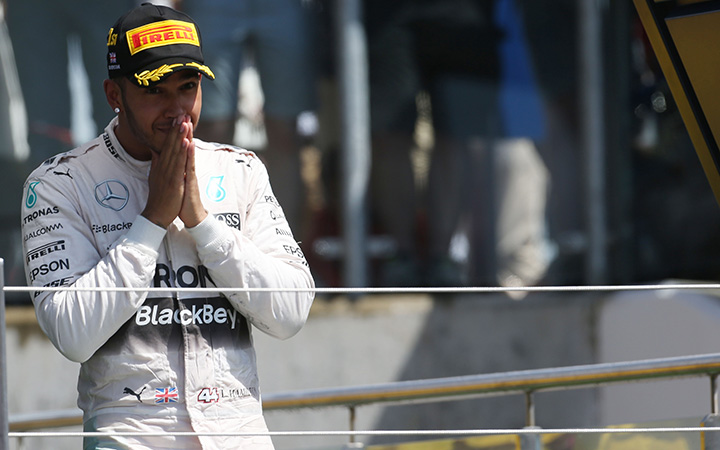
Lewis Hamilton, winner of the 2015 British GP. (Motorsport/LAT)

Stewart and Clark Dutch 1965

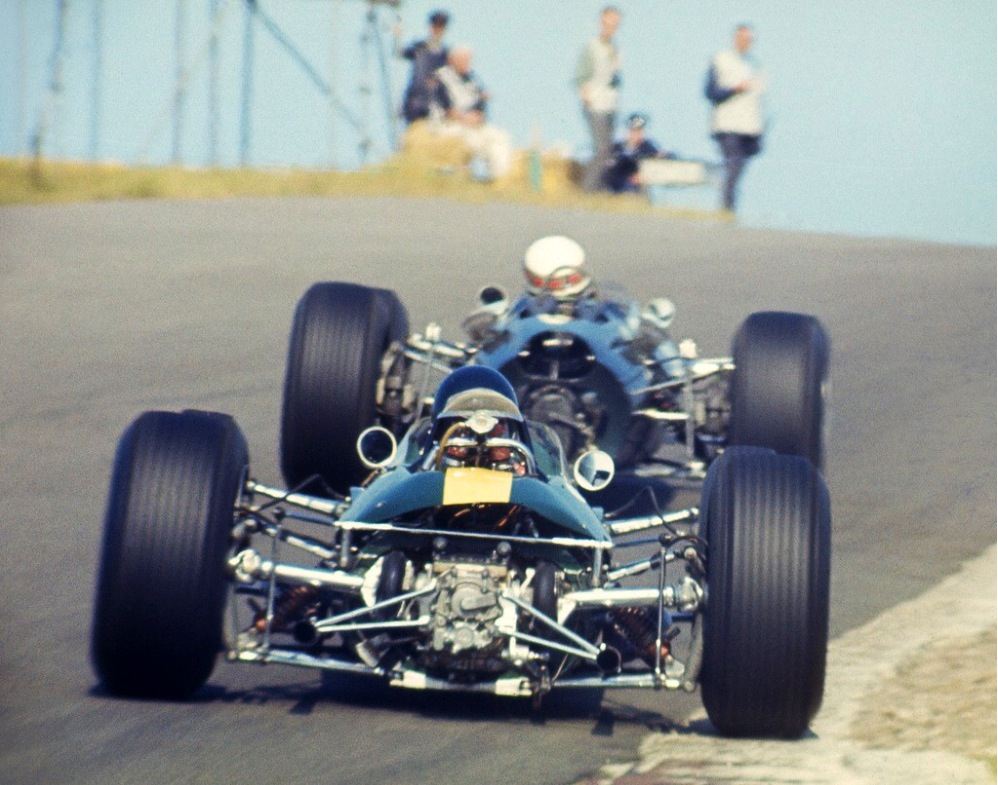
Jim Clarks’ Lotus 33 Climax chasing Jackie Stewarts’ BRM P261 through the Dutch sand-dunes…

Jackie had his first F1 drive with Lotus in the non-championship, late 1964 Rand Grand Prix in South Africa, but made the intelligent decision to join BRM for 1965 where he felt he would have the support and time to develop as a driver. Lotus would have been tougher, Clark was the established ace, and Chapmans track record with ‘number 2’s wasn’t good.

Stewart had great relationships with both his countryman Clark and his teammate Graham Hill who mentored and guided him well, that and Stewarts’ natural ability saw him take his first win in Italy later in 1965.

One of racings great ‘mighta beens’ are the potential duels between he and Clark as JYS matured as a driver and finally got a competitive F1 car with the Matras he drove from 1968…

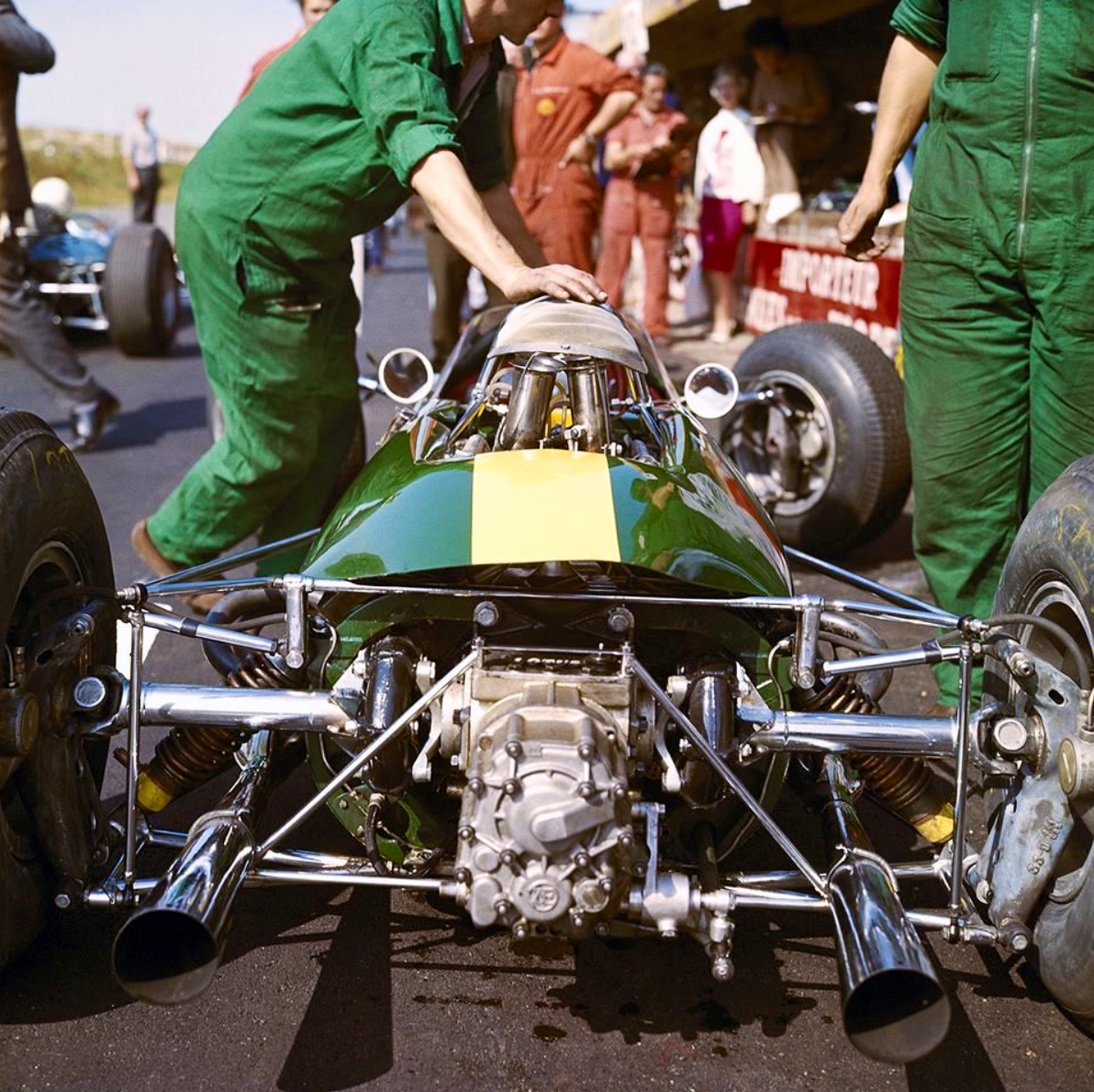
The Lotus 33 rear view…is an interesting study in suspension design and aerodynamics of the mid ’60s GP car. Fully faired cigar shaped body of the BRM in contrast with the naked Lotus. The clutter of the outboard rear suspension and its impact on the airsteam is marked relative to the rocker arm, inboard approach at the front…

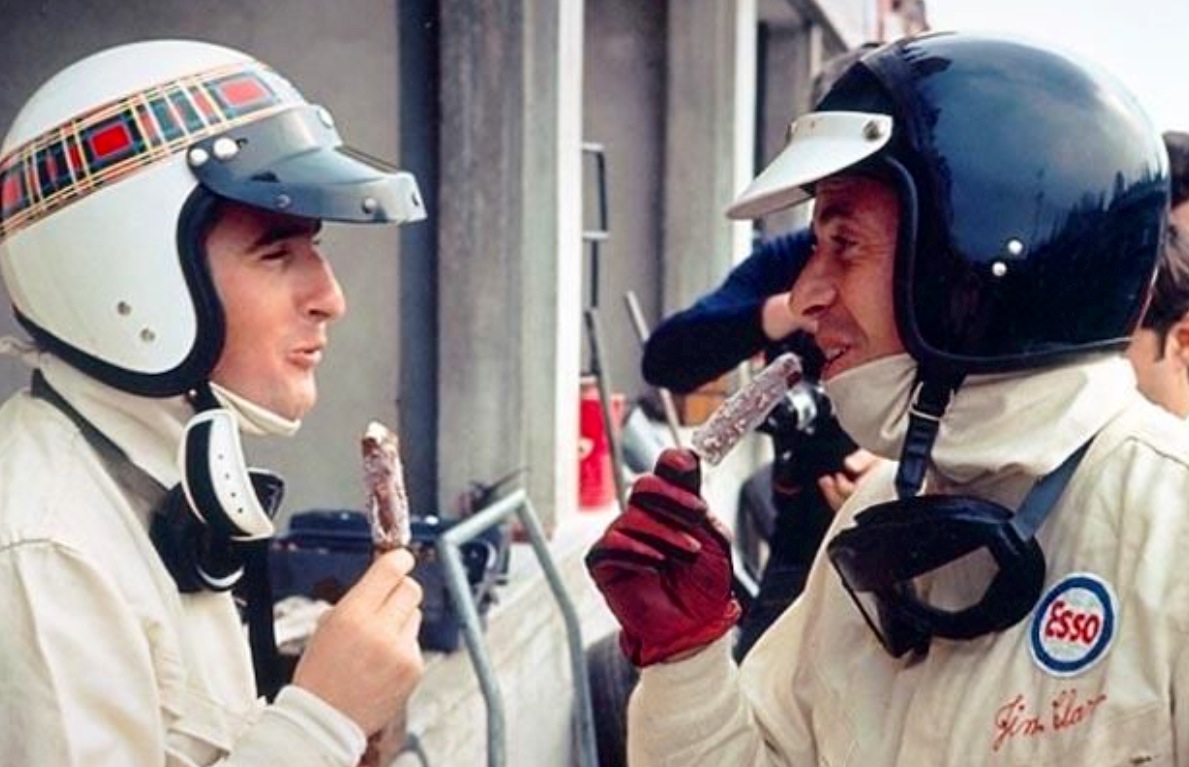
Stewart and Clark icecream

Lotus 33 rear

Lotus 33 Climax, Dutch Grand Prix 1965. Close up…ZF gearbox, later series 32 valve Coventry Climax FWMV 1.5 V8, rubber donuts on driveshaft, suspension single top link, inverted lower wishbone, twin radius rods for location fore and aft, cast magnesium uprights, coil spring/damper units and adjustable sway bar, oh so period and gorgeous!  (unattributed)

Photos unattributed…


john goss

John Goss and pit crew 1974, Amaroo Park. Aunger Wheels, a Goss sponsor photo shoot. Car is Ford Falcon XA GT351 Coupe ‘Sports Sedan’.(unattributed)

Australia has had quite a few drivers who have been stars in both open-wheelers and touring cars at the elite level; Kevin Bartlett, John Bowe, Mark Skaife, Craig Lowndes and John Goss spring to mind…

Gossy left his adopted Tasmania with guts, determination, self built Tornado Ford sportscar and made his way to Sydney. Before long his speed and ‘gift of the gab’ secured support from Rockdale, Ford dealer Max McLeod. This took him all the way to the top of Australian motor racing, he and Kevin Bartlett won the Bathurst 1000 in 1974 in a Ford Falcon XA GT. Goss also won the F5000 Australian Grand Prix at Sandown in 1976.

He is the only man to have won both events.

davies matich sandown 1975

John Goss, Matich A53 Repco, Sandown Tasman 1975 . Goss won the race from John McCormack Elfin MR6 Holden and Max Stewart Lola T330 Chev. Fencing behind destroyed by the lap 1 crash of John Walkers Lola T332. (Robert Davies)

Three Vignettes of John Goss, all at Sandown Park stick in my mind…

The first was at the Sandown Tasman meeting, my very first motor race in January 1972. I was there for the F5000’s the ‘Taxis’ of no great interest to me but i happened upon John Goss near his Falcon GTHO Series Production car in the paddock, he was holding fort with a group of supporters or sponsors.

They were enthralled by his experiences. At 14 i was  amazed at the atrocities he performed on the Queens English, it would have been impossible to use more words to describe the simplest of things, all delivered with the most nasal-‘strine accent. Imagine Paul Hogan on steroids, but more nasal and you have nailed the Gossy accent! As one wag put it after a JG Bathurst win; his victory speech was longer than the race itself!

He won the South Pacific Touring Car Championship, the touring car series support of the 1972 Australian Tasman Rounds, the plucky privateer beat the works teams. Takeouts; he was quick and gifted on the commercial side of the sport.

goss ho

Goss doing his thing in the Phase 3 ‘XY’ Falcon GTHO with its brand new for Bathurst 1972 ‘Globe’ alloy wheels. Oran Park 1972. No front spoiler. (Vic Hughes)

The second was at the same meeting the following year when he blazed a trail with the Ford Falcon XA GT ‘Superbird’ or 2 door coupe variant of Fords new series of cars.

Pretty much everyone else stuck with the previous model, ‘XY’ Falcon GTHO’s for one more year, including the Broadmeadows factory until the Manufacturers Championship in the second half of the year. Ford and Holden, the latter with their Torana V8 SLR5000 and L34, had big oil surge problems with their engines; a function of greater grip with the wider tyres allowed and inadequate wet sump arrangements. (dry sumps stupidly not allowed by the regs).

Goss’ big yellow fat tyred car looked and sounded sensational. He was showing the way with it and getting lots of publicity, but he and long-suffering mechanics were up to their armpits in alligators with mechanical mayhem. Takeouts; he was prepared to make his own calls and not follow ‘the herd’ and had good developmental and mechanical skills.

The final impression was of his absolute competitiveness as a driver, his win in the 1976 AGP at Sandown.

I was one of 38000 people enthralled by his battle with Vern Schuppan in Garrie Cooper’s latest Elfin MR8 Chev. Vern broke a valve spring early in the race, John was in one of two Matich’s he acquired when Frank Matich retired from the sport in 1974. John’s A53 was actually the older of the two cars he bought, an updated A51 chassis # ‘005’, the car Lella Lombardi raced in two Gold Star rounds in 1974, Goss acquired it in 1975.

The car wasn’t in the first flush of youth by then, Goss drove superbly to take the win by half a second from Schuppan, then a driver of world class. In my mind Vern’s slightly down on power engine was compensation of JG not having the latest of equipment.

goss '76 agp

Goss in his Matich A51/53 ‘005’ Repco during his wonderful 1976 AGP winning drive at Sandown. He is turning into ‘Dandenong Road’, Marlboro Hill in the background. (unattributed)

Many saw Goss, born in the South Eastern Melbourne suburb of Glen Iris on 2 May 1943 as a Touring car driver. Whilst he started his career after qualifying as a mechanical engineer, in the Island state, he moved to Tasmania whilst a child, in a Holden FJ and Ford Customline he soon progressed to the self built Tornado Ford sportscar.

The car was powered by a Ford Falcon 170cid 6 cylinder engine which was harnessed via a VW gearbox. oldracephotos Lindsay Ross recalls ‘A Falcon XL sedan provided the motor, triple Webers were fitted in 1967, the steering wheel was fashioned out of a yacht centreboard. The Lotus 32B wheels were purchased from the Sternbergs who ran the ex Clark car in Tasmania in 68-69’.

goss tornado baskerville 1966 (david keep oldracephotos)

John Goss makes the race debut of his Tornado Ford, Baskerville, Tasmania 1966. Car sans the attractive body which came later, Ford straight 6 on single carb, steel wheels. Natty race-suit doubled as post race pub attire! (David Keep/oldracephotos.com)

‘First outing for the Tornado was at Baskerville in 1966. One of my first motorsport memories is a handicap race there in 1967 which only had 2 cars start. Goss in the Tornado off scratch and Lyn Archer in the Elfin Catalina 1.5 pushrod. Both drivers absolutely flat stick from the start over 6 laps and less than half a car length across the line at the finish with Goss just ahead. Great stuff from two very good drivers.’

goss longford 1968

John Goss in his Tornado Ford, Longford 1968. Proudly Tasmanian by the look of the decal on the cars rear…despite being born in Melbourne! Probably the Monday and coming down from the Water Tower. (Stephen Dalton Collection)

Hoping to progress in racing Goss took the Tornado to Sydney, with some success scoring points in the Australian Sports Car Championship in 1969 and 1970 (10th in both years).

He sought support from various sponsors Max Mcleod initially provided some money to help run the Tornado, Goss convinced McLeod to enter Series Production racing in 1969, this class exploding in public consciousness at the time with some phenomenal road cars built by Holden, Ford and Chrysler.

Goss made his Bathurst 500 debut in 1969 driving a Ford Falcon GTHO, co-driver Dennis Cribbin crashed the Falcon at Forrest Elbow. In 1970 Goss set the fastest lap during the event in his XW Falcon GTHO Phase II.

The following year he won two rounds of the Toby Lee Series at Oran Park against strong opposition such as Colin Bond and Fred Gibson.

goss bathurst 1973

Goss exiting Murray’s Corner Bathurst 500 1973. His Ford Falcon XA GT, shared with Kevin Bartlett is about to swallow the Leo Leonard/Gary Sprague Valiant Charger. (Vic Hughes)

John gained open-wheeler experience in 1971 at the wheel of the very first Birrana. Tony Alcock returned from a stint in Europe and designed and built the first Birrana, the F71 Formula Ford in Sydney and enlisted John’s help to develop and race the car.

Later Alcock moved to Adelaide and built over 25 cars in partnership with Malcolm Ramsay which won multiple championships in FF and F2, a story for another time.

29

John Goss in the very first Birrana, the F71 FF ahead of 2 Bowin P4a FF’s, Oran Park 1971. (lyntonh)

Goss won the 1972 South Pacific Touring Car Series and the 1972 Sandown 250 endurance race, both in Series Production Ford XY Falcon GTHO Phase III’s. He also put his Falcon on the front row of the grid at the 1972 Hardie-Ferodo 500, qualifying second fastest behind the Works GTHO of Allan Moffat. Engine failure after splashing around for 24 wet laps ended his race

1972BATHURSTJOHNGOSSETALHELLCORNER

Goss in his Ford Falcon XY GTHO Ph3, Hell Corner Bathurst 1972. Peter Brock won that year in a Holden Torana LJ XU-1. (Rod MacKenzie)

The Series Production class was replaced by Group C for 1973, it allowed greater modifications than before. Commercially, Goss had ongoing sponsorship from Shell, Max McLeod as well as factory assistance from Ford Australia who provided purpose-built XA racing chassis’.

As noted above, Goss was the first to race the XA Hardtop in the 1973 ATCC, before the Works team who used a modified Phase III GTHO during the Australian Touring Car Championship which Allan Moffat won for them. They switched to the Hardtop for the Endurance races, the ‘Manufacturers Championship’ later in the year.

Goss and open-wheeler/touring car ace Kevin Bartlett teamed up for the 1973 Bathurst and qualified on pole. Goss started and built up a good lead which was kept until he was involved in a crash, not of his making, at The Cutting, damaging the front end and causing radiator damage which finished their race.

The pair returned to Bathurst for the 1974 Hardie-Ferodo 1000 in the same car, repainted blue after losing Shell sponsorship winning a race marred by driving rain. To celebrate the victory, Ford Australia released a limited edition XB Falcon Hardtop in 1975 called the ‘John Goss Special’. Around 250 cars were built.

goss bartlett

Goss/Kevin Bartlett victorious Ford Falcon XA GT. Bathurst 1974. (unattributed)

Goss surprised the racing world when he snaffled the best of Frank Matich’s F5000 equipe when he retired at the end of the 1974 Tasman Series. FM had been badly hurt in a boating incident in which he was electrocuted, he decided it was time to quit to focus on his family and business interests which then comprised the distribution of Goodyear race tyres and Bell helmets in Australia. His cars were advertised in the May edition of ‘Racing Car News’.

Goss gained some support from ‘Scotch’ brand adhesives and was immediately competitive in the Matich A53 Repco, the last and best of Matich’s world class designs. His first race was at the Oran Park 1974 Gold Star round on 4 August.

Over the coming years Goss, chief mechanic Grant O’Neill and their small team continued to develop the two chassis ‘A51 005’ and ‘A53 007’ remaining competitive against the best the world had to offer in the F5000 categories peak period.

1976 agp

1976 AGP finish at Sandown. Goss from Vern Schuppan by 5/10 second. Matich A51/53 Repco and Elfin MR8 Chev. (Graham ‘Howard History of The Australian GP’)

1974 Gold Star Series…

The first series Goss contested was the domestic single seater championship the then very prestigious ‘Gold Star’.

For most of its life the Championship lacked quantity but not quality. The costs of fielding an ANF1 car, whatever the formula has been, has always been high. Australia’s obsession with Touring Cars has meant that funds have generally not been flush in open-wheeler racing, the early years of Formula Pacific, 1981-2 arguably the exception.

In 1974 Gossy faced Australian Champions Kevin Bartlett, Max Stewart and John McCormack in Lola T332, T330 and Elfin MR5 respectively. Later champions John Walker and Warwick Brown also contested the series in their Lola T332’s albeit Warwick took in some races in the US in his Pat Burke owned car, the very first production T332.

Frank Matich, whose last and best car Goss owned had retired. This created an opportunity for the rest of the field as Matich was arguably the ‘first among equals’ as a driver and the best funded, courtesy of Repco and Goodyear. I always figured ‘Cranky Franky’ had an actual and psychological advantage over the competition; he pounded around Warwick Farm getting his cars to a fine pitch and was always well prepared whenever he arrived at a meeting, his actual advantage. The psychological advantage was the fact his fellow competitors knew that he was well prepared! Whereas they, without similar fiscal support were not as much so.

Brittle things F5000’s; the Hewland DG300 box was originally designed for Gurney’s 400bhp F1 Eagle, not a 500bhp Chev. Crown wheel and pinions needed to be in the full flush of youth to be problem free. Engines too, with all drivers chasing the edge, were far from reliable especially if the engine-builders maintenance cycles were not followed, a temptation if you were not flush with cash. Despite the big corporate names which adorned the Matich cockpit over the years JG was not well-funded, in common with most of his fellow local competitors.

John’s first meeting was at one of his home tracks, Oran Park on 4 August, finishing 4th for the weekend. He was 9th at Surfers, 4th in the first heat and had an accident in the second. He didn’t contest the Calder and Sandown rounds in Victoria but was back for the AGP at Oran Park although by this stage Max Stewart had the ‘Gold Star’ in the bag. John had his tail up, he and Kevin Bartlett won the Bathurst 1000 in October the pair driving brilliantly to win the race held in difficult conditions that year.

The AGP field was buoyed by the addition of Internationals Graeme Lawrence, the former Tasman Champ Lola T332 mounted and Signorina Lella Lombardi. ‘A Sheila in a F5000’ got the tabloids interested in the race, which was good as only nine cars started, she drove a Matich A51 (the car Goss was to later acquire as noted above) very well, scoring equal second fastest race lap, despite the unfamiliar car. The car she drove in Europe which brought her to the local promoters attention, her Lola T330 (HU18) is owned by Peter Brennan in Australia, it’s restoration well covered in primotipo.

Gossy ran a bearing so didn’t start the race, Brown cantered off into the distance, quickly mastering Oran Park’s new layout, Stewart took the win when Warwick retired on lap 49 with a harmonic balancer kaput.

goss op

Goss in his Matich A53 Repco ‘007’. Oran park during practice for the opening 1975 Australian Tasman round, the ‘Oran Park 100’. Car just painted but devoid of sponsors decals. Jon Davison looking for divine inspiration in the background, his car an earlier Matich A50 Repco ‘004’. Warwick Brown won the race in his Lola T332 Chev, Goss DNF with electrical maladies. (Andrew Lynch)

The 1975 Tasman Series started in New Zealand on January 5 at Levin but John’s funding didn’t allow him to contest the four Kiwi rounds, he was up against opposition which had already had four consecutive weekends to get their cars to a fine pitch.

In addition to the leading drivers covered above, other frontliners in the series that year were Kiwis Graham McRae in his McRae GM2 and Chris Amon in the Talon MR1, an identical car to the GM2, the design acquired from GM by American Jack McCormack, the cars built in the ‘States. Another Kiwi was Ken Smith in an ex-Brian Redman Lola T332.

goss and bartlett

Oran Park Handling Lesson; Goss’ mildly understeering Matich A53 Repco being given a bit of hurry up by Kevin Bartlett’s new and somewhat recalcitrant, grass cutting oversteering Lola T400 Chev. (unattributed)

He had a DNF the at Oran Park with electrical failure, was 3rd the following weekend at Surfers, had another DNF at Adelaide, a water hose came loose on lap 3 and then things all came together at Sandown in the final round.

I have covered this meeting in another story, click on the link here;

The Mother and Father of Lucky Escapes…John Walker, Sandown Tasman 1975…

Suffice it to say, depending upon results, any of Lola drivers, Brown, Lawrence or Walker could take the title…Walker crashed on lap 1, Lawrence retired with fuel metering unit failure late in the race, Brown got the necessary point and Goss won the race in a fast, controlled drive. A strong win against opposition of depth.

matich sandown

Goss eases his Matich A53 ‘007’ through Torana Corner Sandown on the way to his first F5000 victory in the Tasman round ‘Sandown Park Cup’ on 23 February 1975. (unattributed)

By the time Goss commenced his 1975 Gold Star campaign he also owned the earlier Matich A51 Repco which was updated to later A53 specs.

JG continued his good form in the ‘Toby Lee’ sponsored F5000 Series held over 6 rounds, 5 at Oran Park and 1 at Sandown. Max Stewart won the series in his new for Tasman ’75, Lola T400. Goss took 4 of the 12 heats which comprised the series before being ‘pinged’ by CAMS for a black flag incident which almost cost him his AGP start.

Bruce Allison also starred in the Series, the 22 year old jumped out of his Birrana 274 F2 car and took to the ex-Bartlett Lola T332, prepared and guided by the very experienced Peter Molloy, like a ‘duck to water’.

And ducks they needed to be at Surfers Paradise Gold Star season opener held in torrential conditions. The AGP was the first round of the Gold Star that year, Goss matched local boy, Bruce Allison’s pole time but withdrew from the race early with a rough engine and visibility problems. Max Stewart had a lucky win when John Leffler, leading well and as comfortably as you can be devoid of vision!, in the radical, under-developed,tricky to drive but utterly wonderful Bowin P8 Chev, slowed with drowning electrics.

At Sandown he was 6th and then didn’t start at Oran Park, Calder and Phillip Island.

By 1976 the Tasman Series was over, the Kiwis had the ‘Peter Stuyvesant Series’ and we ‘Skips’ the ‘Rothmans Series’, still 4 rounds each. Internationals for the Australian Rounds were Aussie Vern Schuppan and the UK’s David Purley, Lola’s T332/T330 mounted and American John Cannon adding some interest with a March 73A/751 Chev.

At the ‘Oran Park 100′ Goss was 5th, in Adelaide he crashed, at Sandown he was 3rd in the race won by Cannons’ March, the final round at Surfers was washed out. As in the circuit was under the flooded Nerang River, Schuppan took the trophy, the presentation in waist deep water, the promoters gaining a shot for the tabloids despite the lack of a race!

agp 76 start

Ian Smith’s great shot of the start of the 1976 AGP at Sandown. Taken from the outside of Shell Corner, turn 1. L>R; Max Stewart Lola T400 Chev, Vern Schuppan Elfin MR8 Chev and Goss to the right, Matich A5153 Repco. (Ian Smith)

Goss’ domestic 1976 Gold Star campaign started well with his AGP win at Sandown in September, he didn’t finish at Oran Park with gearbox failure, at Calder he had an exhaust problem and didn’t contest the one off ‘Rose City 10000’ at Winton nor the final Phillip Island Gold Star round. John Leffler took the title in a new Lola T400 Chev, consistent finishes but no wins bagged the Championship.

agp 77

There was nothing quite like seeing F5000’s raced by top line Pro’s and look at the Oran Park 1977 AGP crowd! Front running group; Goss, Gethin, Schuppan and Bartlett. Matich A51/3 Repco ‘005’, Chevron B37 Chev, Elfin MR8 Chev and Lola T332 Chev. (‘History of the AGP’)

The 1977 Rothmans International Series of 4 races in Australia had good prizemoney, Count Rudy Van der Straten’s Team made a welcome return to Australia with a Lola T430 and Chevron B37 for Warwick Brown and Peter Gethin respectively, nuts from a spares point of view but both interesting cars, and critically not more Lola T332’s, wonderful devices that they are.

Alan Jones returned to Oz, to race a Teddy Yip, Theodore Racing Lola T332C, he was ‘on the rise’ well and truly by this stage, he drove for the Surtees F1 team in ’76, and took his first F1 win in Austria later in the year.

The development of the Lola T332 was ongoing, the T430 and Chevron B37 were new designs, Garrie Cooper’s Elfin MR8 was also the state of the art. In that context John Goss’ grid place (4th) and strong race performance in the season opening AGP at Oran Park, he ran in 2nd and 3rd for much of the race, in a car which dated to 1974 and an engine which had no development, Repco having withdrawn from racing in 1974, very creditable.

Jones jumped the start, depriving the spectators a duel at the front but all eyes were on him as he sought to make up the 1 minute penalty incurred. Brown won the race with teammate Gethin 2nd and Goss 3rd.

surfers 77

‘Surfers Paradise 100’ Rothmans Series 1977. L>R In the distance Alan Jones in Kevin Bartlett’s loaned Lola T332 Chev, Jones boofed his in practice. Warwick Brown Lola T430 Chev, Peter Gethin in the lead, Chevron B37 Chev, John Leffler in the white Lola T400 Chev and on the outside Goss, Matich A53 Repco. Finishing order, Brown, Gethin, Leffler and Goss. (Bill Forsyth)

Brown and Gethin repeated the performance at Surfers the following weekend, Goss 4th. Max Stewart won in his Lola T400 at Sandown, his last race win before his tragic death at Calder in the one off Kleber 40000 race at Calder. Goss DNF with engine failure.

goss sandown 77

‘Sandown Park Cup’ February 1977. Goss leads from Garrie Cooper Elfin MR8 Chev 3rd and Alf Costanzo Lola T332 Chev 2nd. Goss had an engine failure, the race was won by Max Stewart’s Lola T400 Chev. (Ian Smith)

In Adelaide, the last Series Round he was 4th and lapped as was the rest of the field, Jones dominant in his Lola T332. Brown took the Series win in the VDS Lola T430 Chev, both T430 chassis’ owned by VDS were sold to Alan Hamilton at the series end and would be an important part of the F5000 scene going forward in both Hamilton’s and especially Alfredo Costanzo’s hands.

mat ford

Gossy having his mirrors fitted in the clearly just finished Matich A53/55 Ford ‘007’. Thats Grant O’Neill doing the adjusting, Sandown paddock, 1978. Ford engine of note! (Ian Smith)

Goss’ had been developing a Ford F5000 engine based on the 302, cross bolted ‘Boss’ block, fitted to his newer Matich chassis ‘007’ it was entered in the first 3 Rothmans rounds but failed to appear in any of them.

Development of the Ford engine made sense given his Ford connections and whilst there were some Ford engines in the category in its formative years, he and his small team were giving away decades of development to the small block Chev. A smarter move, hindsight a brilliant thing, would have been a more up to date chassis…and a strong Chev engine.

The Matich Ford, the engine comprised a 4 main bearing bolt Windsor ‘Boss’ block with Cleveland heads, the latter to address the shortcomings of the Windsors ports, was tested but it does not appear to have ever been raced. He qualified the Ford car at the Sandown 1978 Rothmans with a 64.6 second lap but raced the Repco chassis. At Oran Park he practiced the Ford engined chassis on Friday and Saturday but again elected to race ‘old faithful’ A51/53 Repco ‘005’.

During this period the team were developing the Ford engine, Goss raced his other, earlier chassis with Repco power; A51/53 ‘005’, the chassis he used to win the AGP.

sandown maticj ford

Chris Jewell’s shot of the Matich A53/55 Ford ‘007’ at Sandown 1978. Car practiced but not raced. Same tub as 1974, in fact the chassis were to the same 1971 design for all 6 chassis’ built. (Chris Jewell)

Goss didn’t contest the 1977 Gold Star Series but ran Bathurst Teammate Henri Pescarolo in the one off ‘Kleber 40000’ event referred to above on 20 March, Alf Costanzo won the 2 heat event.

henri

Henri Pescarolo cruising the Calder paddock in Goss’ Matich A51/3 Repco ‘005’ during the February 1977 ‘Kleber 40000’ meeting. (oldracephotos.com)

JG reappeared in the Matich for the 1978 Rothmans, Warwick Brown was dominant winning all 4 rounds of the series in his Lola T333/332.

Goss was 6th at Sandown and in Adelaide and 5th at Oran Park. He tested the Ford engined chassis ‘007’ at Oran Park but chose to race his usual Repco engined car ‘005’.

matich ford

Goss testing his Matich A53/55 Ford at Oran Park during the Rothmans series in February 1978. Neat evolution of the A53 ‘007’ tub. Ferrari 312T-esque front wing, neat deformable structure and rear ‘flush’ mounted’ radiators, no airbox. Neat. (Doug Eagar)

At Surfers he failed to finish with oil scavenge pump problems.

With the costs of F5000 rising, and the Formula Pacific push for ANF1 underway Goss wound down his F5000 activities and sold both cars; the much raced A51/53 ‘005’ to touring car star Jim Richards who contested the ’79 Rothmans Series in it and A53 ‘007’ to Mel McEwin who converted it back to Repco form, and raced it towards the end of the category in Australia. Both cars still exist.

sandown 1978

John Cannon 3rd ahead of John Goss 6th ,1978 ‘Sandown Park Cup’. March 73A/751 Chev and Matich A51/53 Repco. (Anthony Loxley)

Formula 1 Ensign MN05 Ford Cosworth…

With interest in F5000 waning in the late 1970’s the ‘Rothmans Series’ rules were changed to allow F1 cars to compete in the 1979 Internationals. The F1’s were ‘brought back to the field’ by the hard Goodyears they were mandated to run. All the same the cars were great to watch, for many of us the first modern GP cars we had seen and heard.

Goss was keen to have a drive, Theodore Racing had 3 cars; 2 Wolf WR4 Ford’s  and an Ensign MN05 raced by Scot David Kennedy and Brit, Geoff Lees. Keen to run a car at Oran Park, Goss wasn’t so happy to stump up the $10K for the weekend but late on the Saturday the team gave him a run in the Ensign anyway.

He did 7 laps, brushed the wall on the out lap keeping out of the way of another car which moved over on him, he managed a 1:10.4 compared with Warwick Browns Lola T332 Chev pole of 1:5.4. It was not enough time for John to find the limits of the car , sadly he didnt race it. An interesting ‘mighta been’ had he raced the car.

john goss ensign mn05 oran park

John Goss, Oran Park 1979. Theodore Racing F1 Ensign MN05 Ford. A few laps in practice, no race sadly. (Dick Simpson)

In 1980 Goss began campaigning a V12 Jaguar XJS at Bathurst. His 3 previous Bathurst starts with Henri Pescarolo in Falcons were all DNF’s.

He started essentially a standard Jag from 58th on the grid, but lasted only 14 laps before retiring with gearbox failure. In 1981, he teamed with 1965 winner Barry Seton and after an improved qualifying effort (19th), they weren’t classified as finishers of the crash shortened race.

Goss returned with a better prepared effort in 1982, sharing the drive with American IMSA Jaguar sports car driver/team owner Bob Tullius who also assisted with technical info for the car and engine. Goss qualified 14th but after a strong run, once again the big cat failed to finish following suspension failure on lap 119.

Goss missed the 1983 James Hardie 1000, but returned in 1984 for the last year of Australia’s Group C racing sharing a drive with Tom Walkinshaw. Walkinshaw ran three factory backed Group A XJS’ in the ETCC, won that title in 1984, and added a lot of technical assistance to Goss’ team with revised suspension and the use of one of TWR’s V12 engines.

Despite trouble in qualifying with no suitable rear tyres arriving in time to use, the Scot qualified the car 8th before falling to 10th in the Hardies Heroes top ten run-off . Walkinshaw also started the race but never left the line.

The Jags clutch had gone leaving Walkinshaw stranded with his arm out the window warning other drivers he was stationary. Unfortunately in the dust kicked up off the start, the Kevin Bartlett owned Chevrolet Camaro of John Tesoriero was coming through at speed and could not avoid the Jag, a multiple crash ensued.

Goss-Jaguar

Goss/ Armin Hahne Jaguar XJS. Bathurst winner in 1985. (unattributed)

Australian Touring Car racing changed to International Group A rules in 1985, and Goss scored his second and last outright Bathurst win with West German co-driver Armin Hahne in one of a three-car assault by Tom Walkinshaw’s TWR team using the 1984 ETCC-winning V12 Jaguar XJS’

Goss, installed by Walkinshaw as lead driver of the team’s third car, qualified fastest going into Hardies Heroes, giving lie to those who believed he was past his best as a driver. He ended up 6th in the Top Ten run-off after mistakes on both laps.

Goss made a good start and for the opening laps was in a dice for 2nd with Allan Grice (Commodore), Robbie Francevic (Volvo), Dick Johnson (Ford Mustang), Jim Richards (BMW 635 CSi) and Peter Brock (Commodore). First Francevic, then Goss, broke free of the dice. Goss chased down the Volvo in less than 10 laps, giving Jaguar a 1-2 on the road for the first time since the early laps before the team’s second car driven by Jeff Allam retired with engine failure. From then on, the Goss/Hahne Jaguar was in second place for most of the race behind the Walkinshaw/Win Percy car.

Goss and Hahne’s job was made more difficult by the driver’s seat of their car having completely broken at the base of the back. The car took the lead on about lap 120 following a split oil line on the Walkinshaw/Percy car with both Peter Brock and Roberto Ravaglia (BMW) closing the gap to within 30 seconds.

The chase effectively ended with Brock’s engine allowing Goss to back off over the last 3 laps. Walkinshaw finished third with Win Percy, the pair crossing the finish line together.

After Jaguar Rover Australia declined to help fund a return effort by TWR in 1986 Goss returned with his own privately entered XJ-S backed by Citibank Australia and co-driven by veteran Bob Muir. Electrical troubles in the race resulting in a flat battery saw them complete 140 laps and finish 24th outright.

Goss missed the 1987 World Touring Car Championship round as well as the 1988 race but returned to drive for Glenn Seton Racing in 1989 in a Ford Sierra RS500. He paired with Seton for a fourth placed finish at the Sandown 500. At Bathurst Goss was teamed with Tony Noske in the second car, they were joined during the race by Seton after his own car failed. After a troubled run the trio went finished 20th outright.

Goss’ final Bathurst 1000 came in 1990 when he paired with fellow Sydney based veteran Phil Ward in Ward’s Mercedes-Benz 190E to finish 12th outright and a Division 2 class win after starting 38th.

Where Does Goss fit in the Pantheon of Australian Drivers…

Former Racing Car News journalist, Ray Bell saw most of Goss’ big races and had this to say on ‘The Nostalgia Forum some years back…’But to return to the main question, the reality of his ability, let’s just look at his AGP win, which was one of very few wins he had in F5000.

He diced through that race with Vern Schuppan, who was acknowledged as a F5000 pilot world wide at that time. John drove the three year old Matich A53, based on the 5 year old A50. Vern was in the almost new MR8. John’s car was no longer a ‘work in progress’, its designer had retired. Vern’s was under the care of Garrie Cooper who raced that model himself.

I think you would have to say that he demonstrated in that race all the qualities that are necessary, the skill to do the job; the determination to be there, overcoming whatever hurdles might have been put in his way along the path he followed; the recognition of openwheelers as the pinnacle, despite having already won the biggest race in Australia. And Sandown was never a place for the limp of wrist or small of heart in these cars…’

In retirement Goss is a businessman and maintains a couple of yachts for wealthy owners…

Etcetera…

The following images are from Graham Howard’s ‘History of The Australian Grand Prix’, and describe Frank Matich’s F5000 cars generally and John Goss’ pair specifically.

mat 1

mat 2

mat 3

mat 4

mc leod ford ad

Bibliography…

Graham Howard ‘History of The Australian Grand Prix, Wikipedia for touring car stuff, The Nostalgia Forum, Facebook Australian F5000 Group, Stephen Dalton Collection

Photo Credits…

oldracephotos.com, David Keep, Lyntonh, Dick Simpson, Rod MacKenzie, Robert Davies, Vic Hughes, Andrew Lynch, Ian Smith, Bill Forsyth, Chris Jewell, Doug Eagar, Anthony Loxley

Finito…


charger 1

(Robert Davies)

John McCormack wrestles his big, powerful but relatively nimble Valiant Charger Repco around the tight Calder, Melbourne confines in 1974…

Robert Davies shots have inspired two other articles, this is the third about a car which set a new paradigm in local Oz Sports Sedan racing in the mid-seventies.

In 1970 Touring Car Racing in Australia comprised ‘Series Production’ for essentially standard cars, contesting the Bathurst 500 and the like. ‘Improved Touring’ were more highly modified cars, the Australian Touring Car Championship was run to these regs, and ‘Sports Racing Closed’ or ‘Sports Sedans’ was an ‘anything goes’ type of category.

Sports Sedans were often the province of the more impecunious, owner driver, engineering types who created some incredibly quick Minis, Holdens of all descriptions and the occasional bit of ‘heavy metal’ V8’s from Oz or the US.

sharp

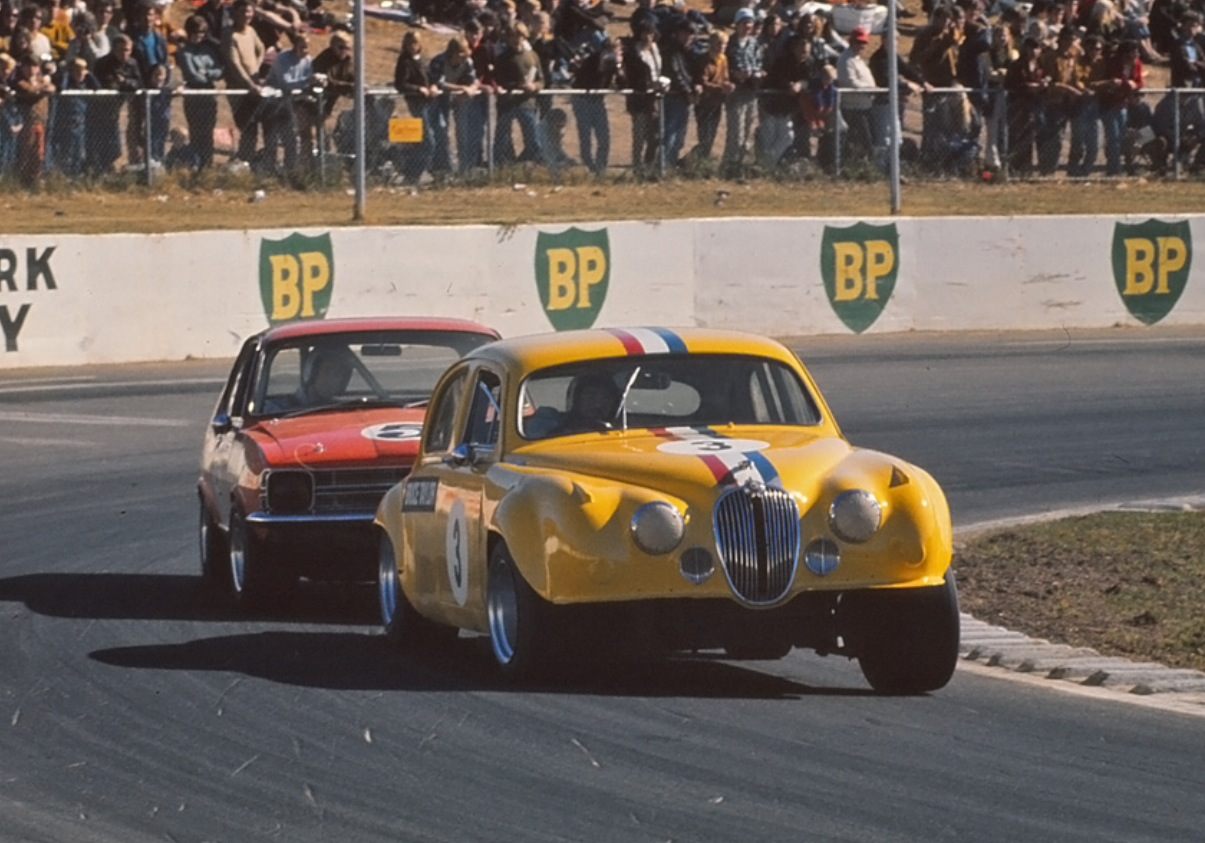
The Spirit of Sports Sedans in 1971; full spectator mounds, here at Sydney’s Oran Park. Bruce Taylor’s ex-Sharp Jag Mk2 Ford V8 ahead of Barry Seton’s ‘LC’ Holden Torana GTR XU1- old and new. (Vic Hughes)

Australian race fans liked Sedans, they were easier to understand and more spectacular to watch than most open-wheelers and the punters could relate to cars they either drove or saw on the road.

Other than during the Tasman Series, in most years our domestic single seater championship, the prestigious ‘Gold Star’ fields were thinnish. Scarce sponsorship dollars progressively found its way to Touring Cars fanning the open wheeler problem. Promoters were keen to give spectators what they wanted to fill their venues, and so, over time the dominance of Touring Cars in Australia occurred. And continues today. Sadly for open-wheeler nutters like me.

Castrol, for example, sponsors of Bob Jane Racing, one of our bigger teams encouraged Jane to get out of racers and more into touring cars in 1971. The Brabham and Bowin single seaters and McLaren sporty were progressively put to one side, replaced by a Holden Monaro Improved Tourer and Holden Torana Repco V8 Sports Sedan.

jano

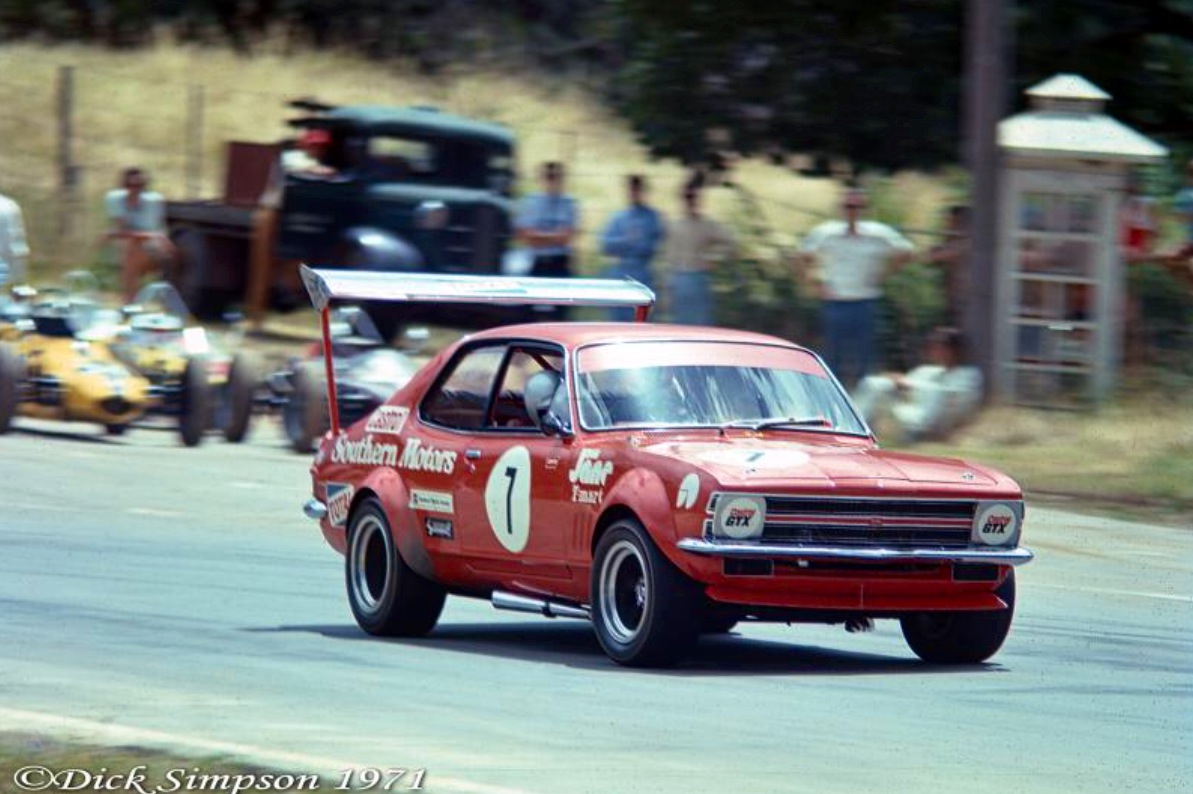
Bob Jane’s Holden Torana ‘LC’ GTR XU1 Repco. Hume Weir, Boxing Day 1971. John Sheppard built and prepared superb cars, this is one of his best, its first iteration here was not that highly modified, engine and Borg Warner ‘box excepted. Phase 2 in its life was when Frank Gardner returned to Oz and raced the car for Jane in 1975; an F5000 Chev replaced the Repco, the suspension also modified substantially in addition to the car being lightened considerably. Jane reputedly said to Gardner when he saw it ‘What have you done to my beautiful car…?’. Car still exists. (Dick Simpson)

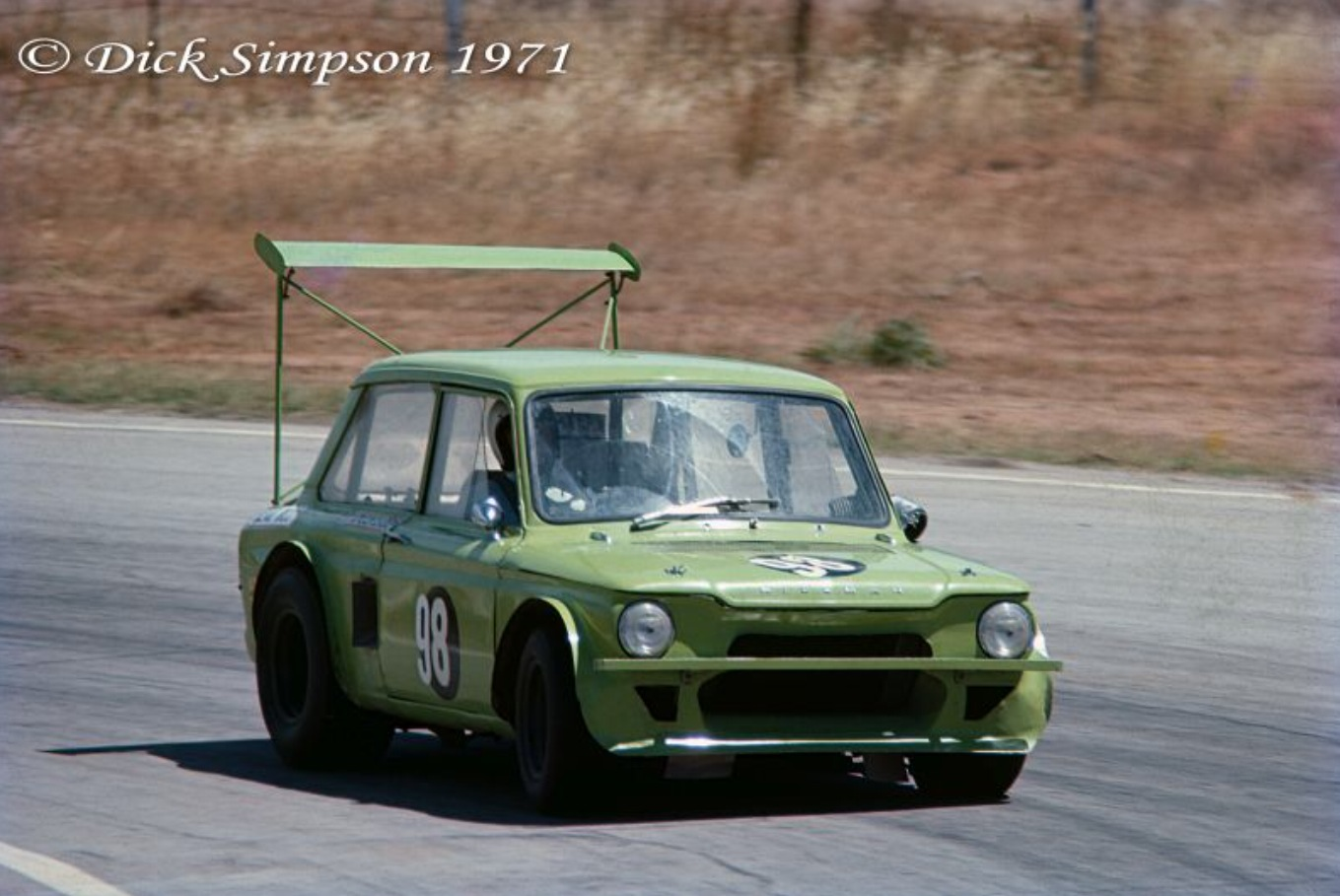
There had been other ‘clever’ Sports Sedans, Harry Lefoe’s Hillman Imp Ford V8, an example but Bob Jane’s John Sheppard built Torana, which married a lightweight but still fully trimmed LC Torana with the Repco 4.4 Litre ‘620 Series’ V8 Bob had sitting in his Brunswick Race HQ took things to another level.

The alloy Repco developed 400 bhp but at 360 pounds weighed less than the cast iron 3 litre ‘186cid’ straight 6 fitted to the car in production form. Bob and John Harvey won many races in this car.

The ‘professionalisation’ of Sports Sedans was underway.

imp

Harry Lefoe in his Hillman Imp Ford at Hume Weir, Albury, NSW on Boxing Day 1971, Dick Simpson took this shot and the one above of Bob Jane in the same race. Car had a 450bhp plus Ford ‘Windsor’ shoved in the back seat, Lefoe had balls of steel to drive the thing, twas usually sideways, considerably so! Its life ended with a big accident at Sandown in the late 70’s. Extremely short wheelbase clear, big wing, engine put out slightly more power and was slightly heavier than the 1 litre alloy standard engine…(Dick Simpson)

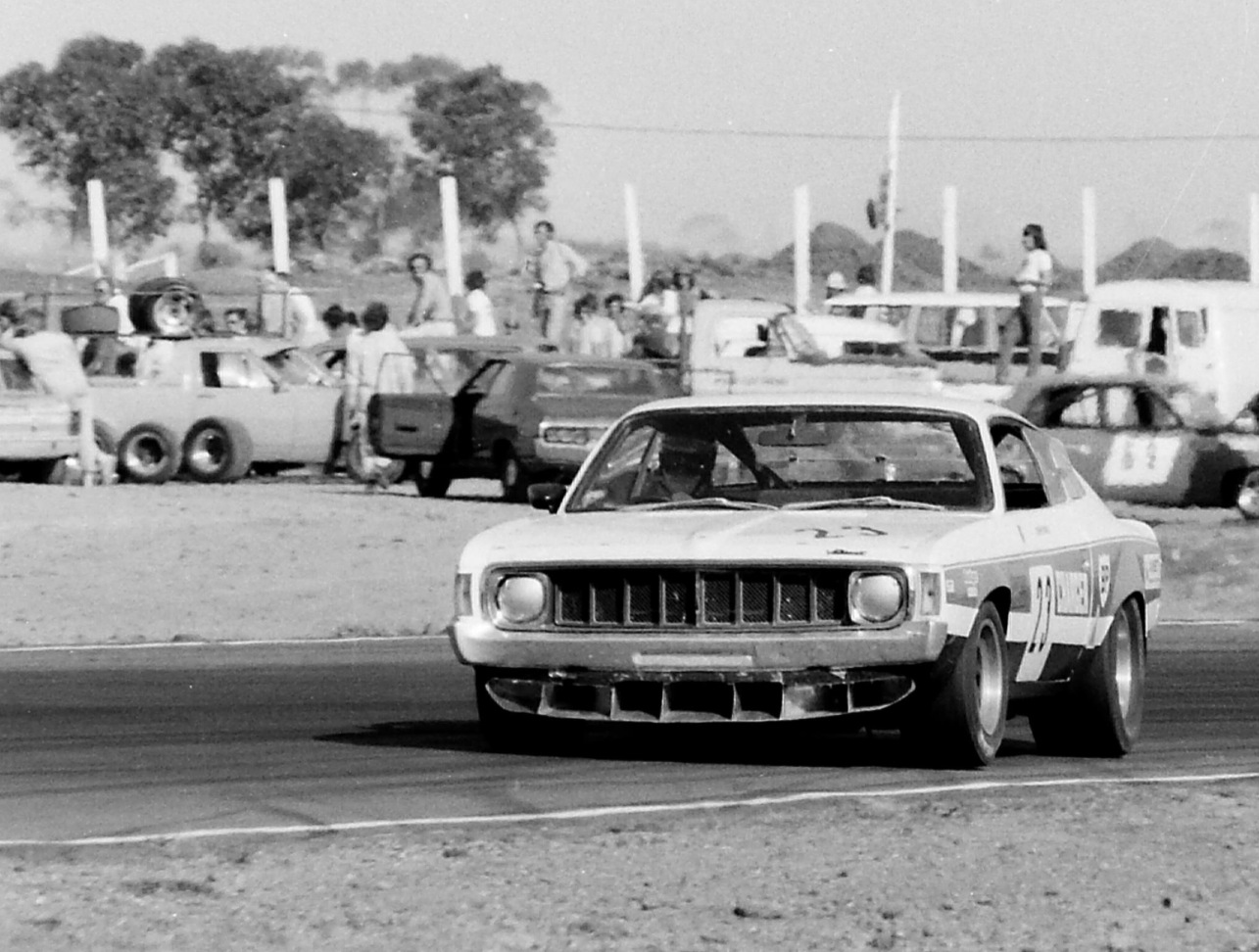
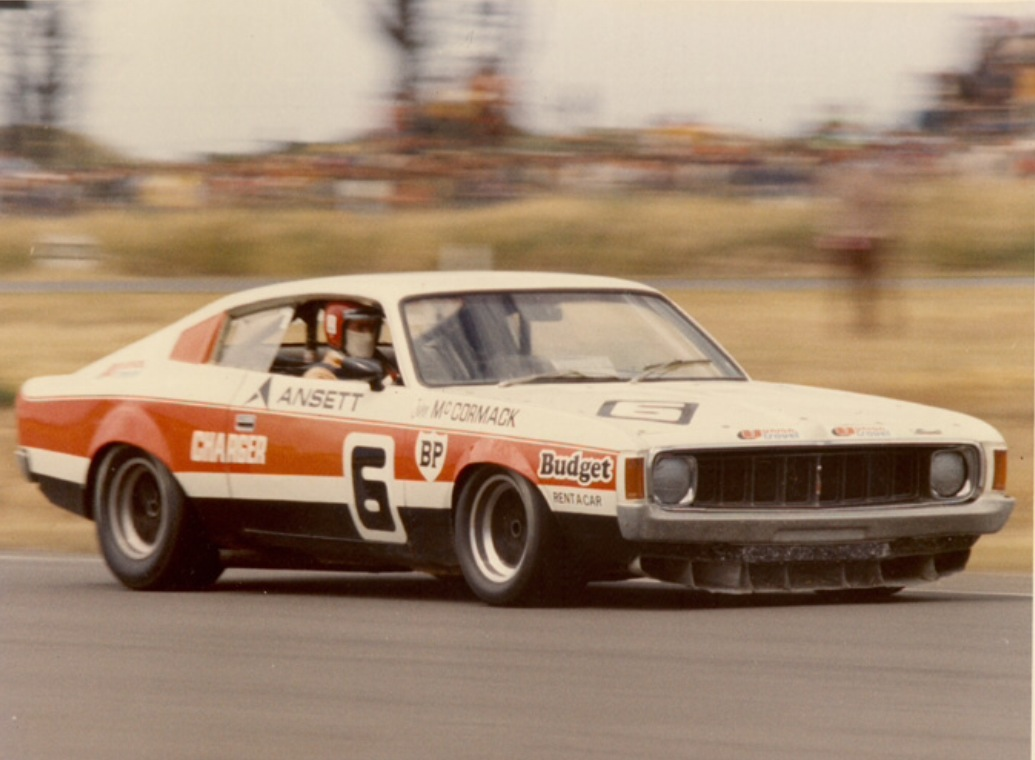
Another trend setting Sports Sedan was the Valiant Charger Repco built by Elfin and John McCormack’s team in 1973. Macs background is covered in the article about his McLaren M23 I wrote 12 months ago, you can read it here, I won’t repeat it.

Mac’s McLaren: Peter Revson, Dave Charlton and John McCormack’s McLaren M23/2…

John was an open-wheeler man, he won the Gold Star in 1973 in his Elfin MR5 Repco F5000, but he was also a professional driver who needed to chase dollars. Oran Park promoter Allan Horsley agreed appearance money with McCormack if he ran a Sports Sedan in his ‘Toby Lee (shirts) Series’ in 1974, that was the impetus McCormack needed.

McCormack and Elfin boss Garrie Cooper (who ran 2 Elfin MR5 F5000 cars as Ansett Team Elfin in the Gold Star and Tasman Series at the time) toyed with the idea of a mid-engined Chev Corvair but commercially a deal with Chrysler made more sense.

In those far away days Ford, GM (Holden), Chrysler (Valiant) and British Motor Corporation all made cars in Australia, with others VW included assembling them here. Now only Ford, Holden and Toyota (who changed from assembly to construction of their cars progressively after 1970) remain but have announced plans to withdraw as manufacturers.

The economic and social policy as well as wider societal implications of this are beyond the scope of this article. Suffice it to say the death of the Automotive Industry in Australia is sad, wrong and was avoidable with a mix of better management, cooperation from the global headquarters of Ford, GM and Toyota and politicians who are not fuckwits. An oxymoron i grant you.

mc cormack

McCormack during his NZ Tour with the Charger in 1975, circuit unknown. Beautifully proportioned racing car, the external appearance matched the unseen clever and well executed engineering. Elfin 10 inch wide wheels, that width mandated then, not much to put 495 energetic ponies to the road. But spectacular! (The Roaring Season)

Elfin were based in Edwardstown, a southern Adelaide suburb, the Valiant factory was at Tonsley Park, not so far down the road. Valiant lost the promotional value of motor racing when they ceased building and racing their performance ‘Chargers’ and were receptive to the idea of a Sports Sedan Charger to go some way to matching Ford and GM who were still actively involved in racing and exploiting its promotional benefits in the competitive local market.

In one day McCormack and Ansett Elfin’s John Lanyon negotiated a deal which gave them cash, a truck to transport the racer, support and a Charger which made its debut after much surgery and modification in early 1974.

Cooper’s Conmurra Avenue shop was ‘chockers’ building Elfins so McCormack set up a workshop just around the corner in Coongie Road where the Charger was built. He took two Elfin employees in the process, Dale Koenneke and Harry Aust which did not go down well with Cooper, way too decent a man to be mixed up in professional motor racing…

The Charger was the result of the design ideas of McCormack and Cooper but was always Macs project, Garries priorities were production racing cars and his own racing program which was always fitted in around his customers needs. Elfin built 11 cars in 1973, 14 in 1974, a lot from the small facility.

McCormack and his team ran and prepared the car with the income derived going to Mac, but Ansett and Ansett Team Elfin received the promotional value of winning races in a growing part of the sport.

charger 2

Rare cockpit shot of the McCormack Charger. Clearly cylinder head or valve gear problems during this Calder meeting in 1974. Mid-mounted Repco F5000 engine sans Lucas injection in this shot. Standard Valiant style steering wheel and column a nod to the donor car. Smiths chronometric tach, instruments and Hewland DG300 ‘box, the alloy case of which you can see aft of the engine all ‘standard F5000’ kit. RH gearchange outta sight, the pedal box was off the Elfin shelf as well, Mac felt right at home. (Robert Davies)

The trend setting bit referred to above was the decision to use as many F5000 bits as possible and to locate the 495 BHP Repco Holden F5000 engine amidships beside the driver, the car was in essence mid-engined albeit the engine was in front of the centre-line of the car rather than to its rear.

The car was completely gutted of all interior trim and surplus metal, an integral roll cage designed by Cooper adding considerable torsional rigidity to the standard sheet metal shell.

Elfin uprights and wheels were used front and rear, upper and lower wishbone’s and coil spring damper units were used at the front and single top link, twin parallel lower links, coil spring dampers, radius rods providing fore and aft location at the rear. Roll bars were of course adjustable. An Elfin steering rack was used as were Lockheed brake calipers.

The transmission was standard F5000 issue, a 5 speed Hewland DG300 transaxle, located aft of the engine. There were two though, the front one contained the gears and the rear DG300 case the differential. Mac placed the gearchange lever to the right of the very low mounted drivers seat so he would feel pretty much at home, the driving position akin to the single-seaters from whence he came.

repco F5000

Phil Irving’s adaptation of General Motors’ Holdens then new ‘308’ V8 as an F5000 engine in 1970 created a very effective racing engine. Lucas fuel injection was one of the few non-Repco manufactured parts. 495bhp@7500 rpm is the quoted figure but the few flat-plane crank engines of 1973/4 produced closer to 525. It didn’t matter, the engine had greater mid-range punch than most Chevs, the blend of power/torque won it championships. (Repco)

The Charger had its first race at Adelaide International in early 1974, the Elfin MR6 Leyland F5000 made its debut on the same day, by the end of it the Chrysler executives present were far happier than the Leyland guys, the race variant of that engine always somewhat of a ‘hand grenade’ as covered in the McLaren article referred to above…the Charger cantered away and won its races.

The intelligent beast was immediately successful, Mac getting $2500 appearance money each time he ran in the ‘Toby Lee Series’ at Oran Park and carted away a good share of the prize money in 1974, he won the series from Jim McKeown’s Porsche and Frank Ure’s Holden Torana V8.

The car was also raced around the country with similar success.

He raced the car into 1975 selling it eventually to Tony Edmonson who was also successful in it.

McCormack re-focussed on single seaters with his ultimately successful McLaren M23 Leyland program and was just coming back into sports sedans, having built a Jaguar XJS at the time of the untimely road accident in which he was a passenger, ended his racing career.

Their were many very clever Sports Sedans which followed the McCormack/Cooper Charger but arguably it was the first…

thommo

Bryan Thomson VW Fastback being chased by John McCormack’ Charger at Sandown’s, you guessed it, Torana Corner in November 1974. They are about to unleash 500’ish Chev and Repco Holden horses up Sandowns’ long back straight. Great circuit for these cars. Two clever cars from 1974; both F5000 based, both ‘mid-engined’ the VW at the mid-rear and Charger in the mid-front. (Paul Van Den Akker)

PostScript…

Frank Gardner got around to building a Chev Corvair, the car well engineered (see etcetera below) as you would expect and largely built around Lola F5000 componentry. He essentially ‘killed the category’ such was the dominance of the car until the regs were changed to effectively ban it (the Corvairs engine and gearbox in standard form, were located Porsche 911 style, with the engine behind the gearbox, the legislators would allow a Corvair to race in that format but not the layout Gardner had with the classic ‘box behind the engine layout).

gardner

Frank Gardner in the Chev Corvair ahead of Red Dawson’s Chev Monza, Bay Park, NZ 1976. (The Roaring Season)

Etcetera…

vw

Other ‘Class of ’74 Cars’; Bryan Thomson’s ‘Volksrolet’ was a marriage of VW Fastback and an ex-Hamilton/Brown McLaren M10B F5000, but it never worked as well as Frank Gardner’s Corvair variation on the same theme despite the prowess of Thommo and his engineer Peter Fowler. But a massive crowd-pleaser. Behind is Peter Brock in the Holden Dealer Teams ‘Beast’. From memory an ex-rallycross LC Torana chassis into which was shoehorned a Repco Holden F5000 engine mated to a Borg Warner T10 ‘box. Ok in ’73 but the game had moved on by 1974, let alone the cars to come. Sandown Park November 1974. (Robert Davies)

mac

Baskerville, Tasmania 1975. McCormack ahead of Jim Richard’s Kiwi built, old tech but superbly driven Ford Mustang 351 and Allan Moffat’s Ford RS3100 ‘Cologne Capri’. Moffat won the Australian Sports Sedan Championship in 1976 using this car and a Chev Monza. (oldracephotos.com/Leigh Stephens)

corvair

Frank Gardner’s Corvair as raced by Allan Grice after Gardner stepped outta the driving seat. Circa 1977. Nose of Grice’ Group A Commodore to the right. FG raised the Sports Sedan bar  again with the Corvair, the bottom shot clearly shows the car for what it was conceptually; a Lola T332 F5000 albeit with a spaceframe chassis and a roof! Brilliant device, even the 6 litre cars couldn’t keep up with it, put its power down so well. (The Nostalgia Forum)

Bibliography and Photo Credits…

‘Australia’s Elfin Sports and Racing Cars’ John Blanden and Barry Catford, ‘Maybach to Holden’ Malcolm Preston

Robert Davies, Dick Simpson, Vic Hughes, Dick Simpson, Paul Van Den Akker, The Roaring Season, The Nostalgia Forum, oldracephotos.com/Leigh Stephens, Bruce Keys

Tailpiece: McCormack, Charger Repco Holden, Calder, December 1974…

(B Keys)

Finito…

lauda mclaren mp4 cockpit

Niki Lauda at rest and awaiting qualifying set-up tweaks, staying ahead of ‘Frenchy’ Alain Prost the challenge of the year…

Experience, cunning, speed and consistency won him his third and final title with McLaren in 1984 but Alain prevailed in 1985, Nikis’ last season of racing and Prosts’ first title.

Click on this link for an interesting, short visual comparison of the evolution of McLaren steering wheels down the decades, as good as any an indicator of ‘progess’! http://www.motorsportretro.com/2014/11/mclaren-f1-steering-wheels/

mclaren mp4 2 cutaway

1984 McLaren MP4/2 Porsche: carbon fibre honeycomb chassis, double wishbones and pushrod suspension front and rear, carbon fibre brakes, 540Kg. TAG/Porsche 1499cc DOHC twin turbo V6, circa 750bhp in ’84 spec. McLaren/Hewland FGB 5 speed transaxle

(Unattributed)

Repco Record NZ

The one and only ‘Repco Record’ in surreal surroundings, the Wairakei geothermal field near Taupo in the centre of New Zealand’s North Island in 1959…
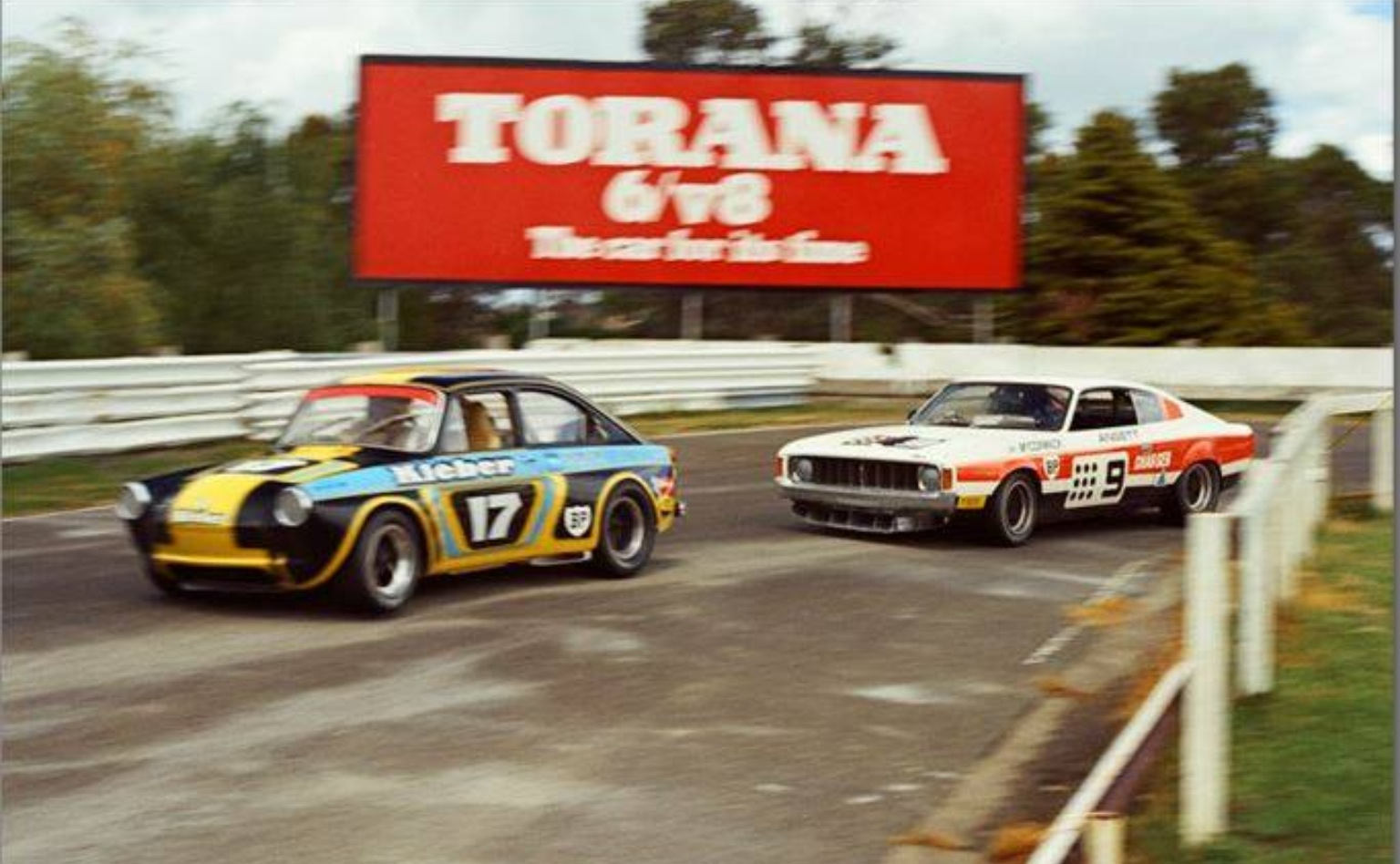
After the end of Maybach’s useful life, the racing brainchild of Charlie Dean well covered in my article on Stan Jones, the talented Repco Engineer looked for a new project. https://primotipo.com/2014/12/26/stan-jones-australian-and-new-zealand-grand-prix-and-gold-star-winner/

Dean, Head of Repco Research, the large transnationals ‘Skunkworks’ turned his attention to the creation of a road car which would form a test bed for the companies products, a promotional tool and an expression of Repco’s innovative capabilities.

Dean recruited Tom Molnar (Chief Engineer of Patons Brakes) and Wally Hill (Repco Research) to assist with development of the car; Molnar with its engineering and brakes, Hill built the body with some assistance from Bob Baker to Deans design, a process completed in Dean’s spare time at his Kew, Melbourne kitchen table!

The cars construction took 4 years, the yellow coupe made its debut at the 1959 Melbourne Motor Show, where it was ‘The Starlet’ painted a distinctive shade of yellow.

repcorecordrear

The ‘Repco Experimental Car’ as it was then unimaginatively called was a mobile test bed designed to trial the groups products, but that didn’t stop contemporary reports speculating about series production. In the context of its time it was a highly specified, comfortable high speed car of potentially modest cost using largely production based components.

When originally built it was fitted with a Ford Zephyr engine with a Raymond Mays cylinder head Dean bought to fit to his company car, and an MG TC gearbox. A Holden engine was slotted in when the Repco ‘Hi-Power’ head was developed, a David Brown Aston Martin ‘box replaced the MG unit at the same time.

‘Sports Car Worlds’ Peter Costigan tested the Record with Dean on board and raved about its comfort, performance, roadholding and handling. Less impressive was the David Brown ‘box and brakes which faded after repeated high speed applications. The car cruised comfortably at 100mph with a top speed of 120 mph, the Repco modded Holden engine in ‘touring tune’. Heavier shocks, improved brakes and an oil cooler were suggested improvements.

recoord 1

Repco shot with the car posed in front of Repco Research’ new home in Dandenong, Victoria. Late 50’s. (Repco/From Maybach to Holden)

The pretty Coupe was used during the filming of ‘On The Beach’, a Hollywood movie shot in Australia featuring Gregory Peck, Ava Gardner and Fred Astaire during 1959.The film was based on a novel by British/Australian author Nevil Shute.

The car was one of several used in the productions racing scenes filmed at Phillip Island. It was during breaks in filming that SCW magazine drove the car, it was about this time someone dubbed the car ‘Repco Record’ a name never officially endorsed by Repco but an appellation which stuck!

Repco SCW 03

Repco ‘Hi-Power’ headed Holden ‘Grey Motor’ 2.3 litre OHV 6 cylinder, cross-flow engine fed by 2 Weber carbs. Circa 133 bhp with a ‘cooking cam’ and extractors. (SCW Magazine)

After testing of various Repco subsidiary components and the changing of the cars livery and especially rear window treatment the Record was sold after a few years into private hands, it is still in Australia, last sold several years ago and pops up occasionally at historic events.

Repco Record 2014 PI

Contemporary shot of the Repco Record at Phillip Island in 2014, changed frontal treatment not for the better. (Stephen Dalton)

Specifications…

The Record used the then contemporary (1948-1962) Holden 6 cylinder ‘Grey Motor’ bored to 2360cc. It featured a cast iron block, 4 bearing crank fitted with Repco Hi-Power crossflow, OHV semi-hemispherical cylinder head, 2 Weber 36 DCLD7 downdraught carburettors. On a compression ratio of 8.7:1. the engine developed circa 133bhp@5500 rpm and 141lbs/ft of torque@4000 RPM. For more on the Repco Hi-Power head see the separate section below.

The chassis was of integral construction with a tubular backbone, the steel body was welded to the frame to provide stiffness.

Suspension comprised modified Holden components; wishbones, coil springs and telescopic dampers at the front. At the rear a Holden live axle, quarter elliptic leaf springs and telescopic dampers was used. Rear axle was ENV spiral bevel, its ratio 3.66:1, Gearbox was a David Brown 4 speed manual with synchromesh.

Brakes were hydraulic drums front and rear with a Repco PBR booster, Steering by recirculating ball. Tyres: 6.40-13 on steel wheels

Fuel Capacity: 42 litres (9.5 gal) Height: 1320 mm (52 in) Length: 3810 mm (150 in) Weight: 1018 kg (2240 lbs) Wheel Base: 2286 mm (90 in)

Max. Speed: 120 m.p.h. (1st gear: 48 m.p.h., 2nd gear: 66 m.p.h., 3rd gear: 98 m.p.h., 4th gear: 120 m.p.h.) Acceleration: 0-60 m.p.h. in 10.5 secs. 0-100 m.p.h. in 21.2 secs. Standing quarter mile: 17.2 secs.

Repco AMS annual advert

Repco Record contemporary press ad. (Stephen Dalton Collection)

repco high power

Repco Hi-Power headed Holden engine complete with optional aluminium rocker cover. Engine variously named ‘HighPower’ ‘Hypower’ and ‘Hi-Power’ the latter the name it was finally marketed as…notwithstanding the name on the rocker cover! (Maybach to Holden)

Repco Hi-Power Head…

All countries have production car engines which, with tuning provide a staple for road going sedans, racing or sportscars, sometimes all three!

The BMC ‘A and B Series’, Ford 105E through Kent engines, the small block Chev and Ford V8’s and more recently Ford Zetec and Toyota 4AGE engines spring to mind. In Australia the Holden ‘Grey’ and ‘Red’ 6 cylinder engines were the tuners weapon of choice for 2 decades starting in the early ’50’s.

Repco were active in racing throughout this period, largely starting with the efforts of Charlie Dean and his Repco Research colleagues based in their Sydney Road, Brunswick, inner Melbourne base.

Phil Irving of Vincent and Repco Brabham RB620 Engine fame, his exploits well covered in the articles I have written about the 1966 World Championship wins by Brabham and Repco, designed the ‘Hi-Power’ cylinder head to meet market needs and exploit the knowledge Repco had gained about improving the performance of Holden’s 2200cc, 6 cylinder, iron, 4 bearing, OHV engine which in standard tune gave, according to Irving, a claimed and real 62 BHP at 4000 rpm. Click here for an article about Irving’s 1966 F1 Championship Winning Repco engine;

‘RB620’ V8: Building The 1966 World F1 Champion Engine…by Rodway Wolfe and Mark Bisset

RepcoHi-Powerhead_preview

Contemporary ‘horsepower press’ ad from ‘Wheels’ magazine July 1962 edition. (Wheels)

Irving, a noted author himself wrote about the Repco head in Barry Lake’s late, lamented and sadly shortlived ‘Cars and Drivers’ magazine in 1977, this piece is based on Irving’s article, the quotes are just that…

Irving’s simple proposal to Dean was to design a head which would increase the engines power, Dean agreed on the basis that the design be interchangeable with the original head, inexpensive and simple enough to be machined with little or no special equipment. In effect this precluded the head being made of aluminium so cast iron it was.

‘The valves were arranged in two rows with the 1.375 inch exhaust valves vertical and on the near side, while the inlets were inclined at 25 degrees on the opposite side, their heads being 1.56 inches in diameter’.

‘The 6 circular exhaust ports were short and direct, while the rectangular shaped inlets were arranged in two groups of 3, springing from the 2 galleries, these formed partly in the head and partly in the manifolds. The manifolds were simple open sided castings, made in several types to suit vertical or horizontal carburettors’.

The pressed steel side plates were replaced by an aluminium plate. ‘This feature enabled the head to be widened to give room for desirably long inlet ports and inclined rockers which oscillated on a hollow bar… Another bar carried the exhaust rockers, both bars mounted to pedestals integral to the head and thus free from flexure under load.’

Cost pressures meant the rockers were made of nodular iron, hardened locally and proved failure free.

Most of the development work was done by Repco subsidiaries; Warren and Brown the patterns, Russell foundry the head castings, Brenco the heavy milling and Repco Research the final machining.

‘There was no fancy work done on the ports, the first head was slapped on an FE Holden engine that was fired up in the middle of the night…after playing about with jet sizes and ignition settings we obtained 85bhp with a single Holden carburettor on a mocked up manifold’

‘The compression ratio was only 7.5:1 to suit the 90 octane fuel of the day which most people today (1977 at the time of writing) wouldn’t even put in their lawn mowers!’

‘It was an encouraging start with 100bhp, it was enough to push a road car along at over the ton…but more was needed for serious racing…which wasn’t difficult to get by changing camshafts, raising the compression ratio and boring .125 oversize…with each carburettor supplying 3 cylinders it was discovered the induction system came into resonance at around 4000rpm’.

irving and england

Ropey shot of Phil Irving and Paul England, ‘Racers’ in thought word and deed both! They are fettling the first Hi-Power head on the Russell Manufacturing Co dyno, Richmond, Melbourne. This was the same cell in which the first RB620 F1/Tasman engine burst into life in 1965. This first head was fitted to England’s Ausca sportscar, the car very successful, a car i must write about. (P Irving/Cars and Drivers magazine)

The bolt on kit was priced at £150, a fully rebuilt engine with camshafts and carburettors of the clients choice was £450. ‘The most popular choice was the 140bhp version with 2 double choke progressive Weber down-draft carburettors which gave a road speed (in a Holden sedan with three ‘on the tree’ speed gearbox) of 114mph’.

‘The harmonic balancer was the weak link with bad, critical oscillations at 6200rpm…crankshafts were prone to break if run consistently near 6200rpm…’

103 heads were made most going into road cars or speed boats ‘In a couple of seasons Hi-Power heads just about dominated sedan racing with drivers like John French, the Geoghegans, Stan Jones, Bob Holden and Ray Long on top of the pile’. Lou Molina fitted one to his MM Sportscar, (later supercharging the engine), Tom Hawkes to his Cooper in place of the Bristol original for a while holding the Phillip Island lap record together with Lex Davison’s Ferrari 500/625.

‘General Motors failed to evince any interest in our design which would have kept them ahead of the game for years…The end of the engine was hastened by the advent of big V8’s…and by a change in (racing) regulations which prohibited replacing the heads on production cars’.

hi power engine design

Phil Irving’s drawing of a cross section of his Repco Hi-Power head, his notes self explanatory. (P Irving/Cars and Drivers magazine)

Etcetera…

record 2

The Record worked hard as test bench, promotional tool and ‘function starlet’, here at such a function. The controversial and ever evolving rear fin is well shown in this shot. In the context of its time, an attractive car, front on view arguably its best angle? (Repco/From Maybach to Holden)

hi power ad

repco record

‘Repco Record’ at the Phillip Island Classic in 2008. Front treatment has changed along the way, not for the better! (Dick Willis)

repco price list

Repco Hi-Power head and related parts price list 1956. (From Maybach to Holden)

Credits…

Stephen Dalton and his collection for the provision of ‘Sports Car World’ March 1960, ‘Australian Motor Sports’ May 1959 and ‘Modern Motor’ January 1960 as reference sources, Dick Willis, ‘Maybach to Holden’ Malcolm Preston, ‘Cars and Drivers’ Magazine Number 2 1977 Phil Irving Repco Hi-Power head article, Don Halpin Collection

Tailpiece…

(D Halpin Collection)

Love this shot of Phil Irving and Charlie Dean trying to keep a straight face during a Repco promotional shoot to promote their new head. FE Holden, lovely head, extractors and twin-Strombergs clearly visible.

Finito…