I got terribly excited when I found this letterhead among the Vintage Sports Car Club of Victoria’s photo archive. What a discovery, a speedway in inner Melbourne, on the current AGP site way back in 1903!
Yes and no. The speedway was built but for the use of our equine friends, just as the first automobiles were trickling into Australia.
(SLV)
The speedway was one mile long “on the seaward side of Albert Park. 145 feet wide, the course was divided into two tracks with a space in the middle for pedestrians. “It is well laid out, planted with ornamental trees with rockeries interspersed,” Table Talk recorded.
The track was open to the public when not in use “and beautified a portion of the park that has hitherto been an eyesore.” As one who walks/runs around Albert Park daily I’m intrigued to know about this aspect of the park and fascinated to know exactly where the horse-course was 120 years ago.
At the opening ceremony on August 29, 1903, the club president outlined that the purpose of the speedway “would stimulate the desire to possess first-class horses, and so improve the breed of our carriage and trotting horses.” The club “wanted to provide a track where a gentlemen with a horse that had a turn of speed could exercise it without the risk of prosecution for furious driving.”
(SLV)
The Governor, who had been given a golden-key to open the gates of the speedway, replied that he hoped it (the key) “would open the eyes of the local councillors to the fact that it was a good thing to have a Speedway in their midst, and in a portion of Albert Park that had been up to the present but an indifferent cow paddock.”
The Gov concluded by observing that American Speedways had improved the quality of their horses, and that “the Albert Park Speedway was in the hands of good sportsmen, and good men, and in declaring it open, wished the club all prosperity.” Tally-ho, jolly good show and happy hockey-sticks…
I do find interesting the history of a part of the world, dear to my heart, but by March 1907, with little interest in the venues activities, the Melbourne Speedway Club had to relinquish its use of that part of Albert Park.
While the horse-men were keen on building best-of-breed, devotees of new-fangled-horsepower were ‘racing’ already. Harley Tarrant, Argyll 10HP at left won a 3-mile race ‘for heavy automobiles’ at Sandown Park on March 12, 1904. That’s Tom Rand’s second placed Decauville 16HP alongside.
When I billed this as Australia’s First ‘Motor Car Race’ in the second of the two articles above, ‘Prof’ John Medley – Australia’s foremost motor racing historian – told me how brave I was, which was his polite way of saying “I wouldn’t be so sure about that Sonny-Jim!” Whatever the case, the ‘competition’ was one of the first between cars in Oz. And lookout horses, we are coming through…
Credits…
Vintage Sport Car Club of Victoria, State Library of Victoria, Table Talk September 3, 1903, Algernon Darge – State Library of Victoria
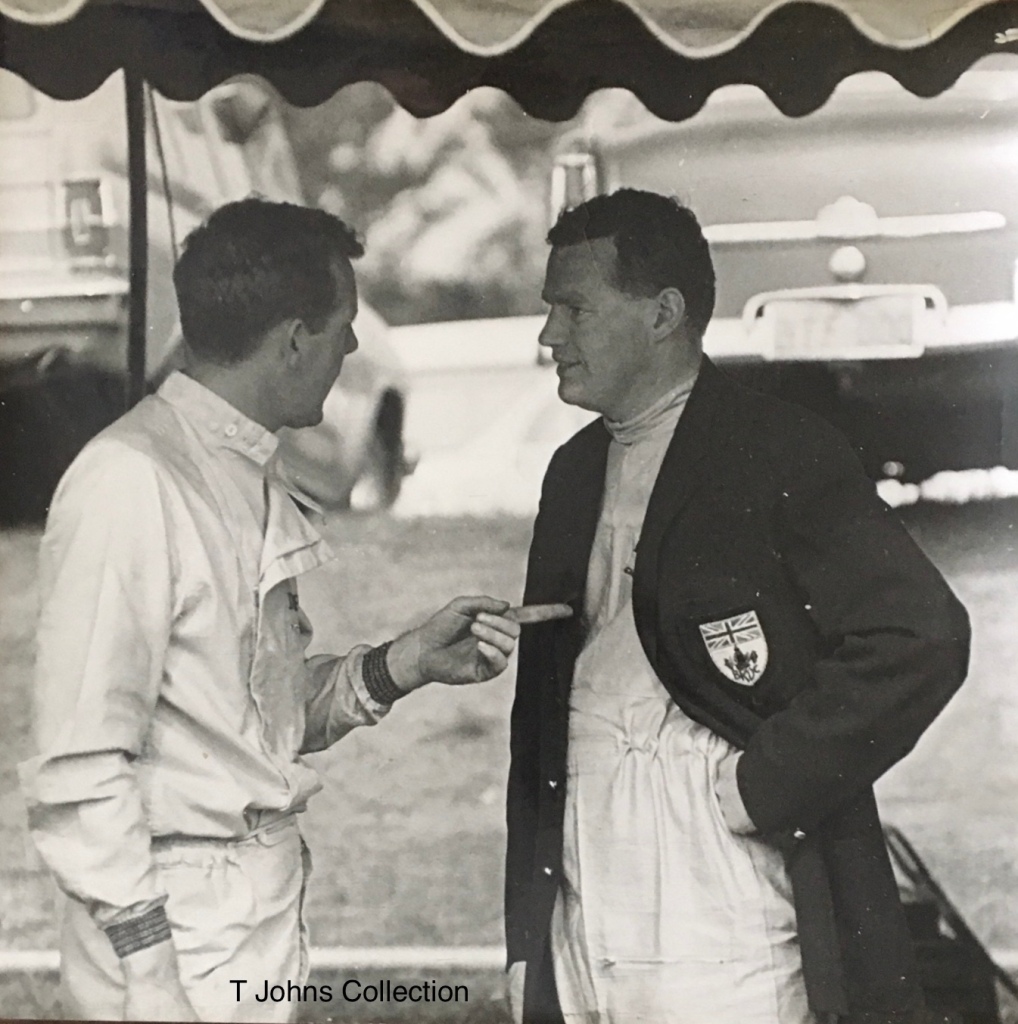
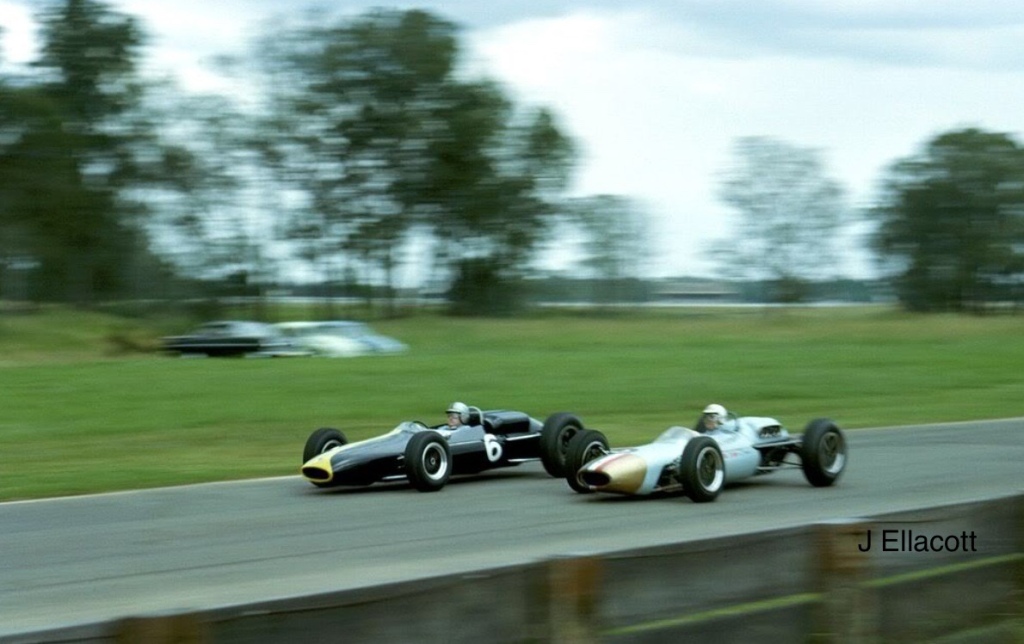
‘Christ! He’s bloody quick already!’ is perhaps the line of thought in the mind of the – at that stage – twice Gold Star Champion. Matich made his Formula Libre debut that weekend aboard a new 2.5-litre Brabham BT7A Climax, Bib’s mount a 2.7 FPF engined Brabham BT4.
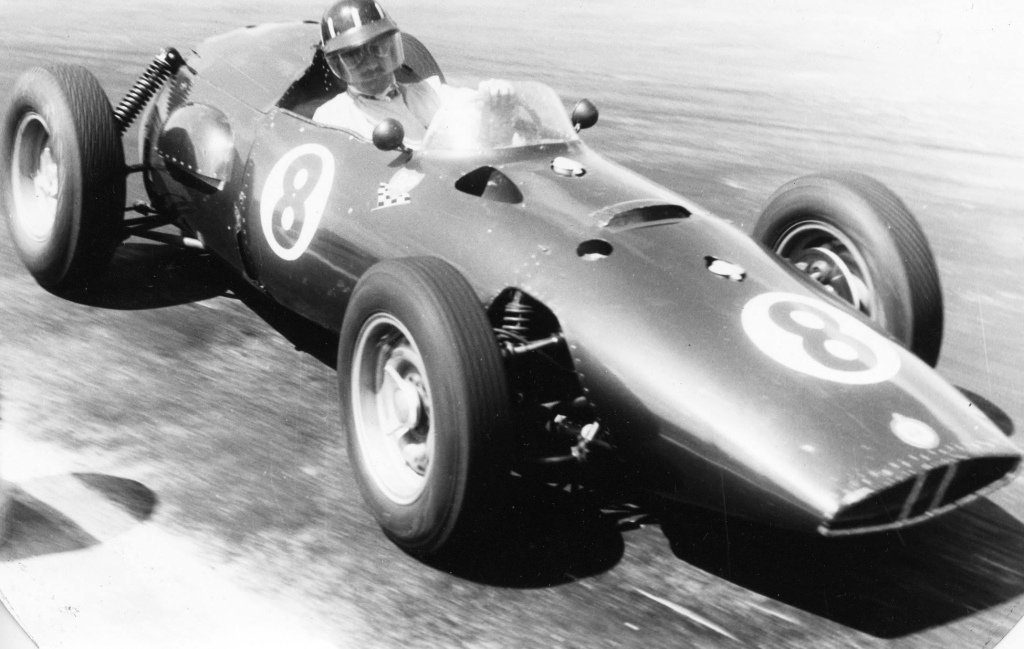
Atmospheric shot of Harry Schell’s BRM Type 25 during the August 23, 1959 Portuguese Grand Prix at Monsanto, Lisbon…
It was the breakthrough car for BRM, Jo Bonnier’s Type 25 won at Zandvoort in 1959 thereby breaking the F1 World Championship GP winning duck for the Boys from Bourne after nearly a decade of competition.
Immaculately credentialled engineer Stewart Tresilian “was largely responsible not only for the original conception and design of the BRM Project 25 2.5-litre four cylinder engine, but also of the compact P27 – or Type 25 – car (chassis) intended to carry it into battle.” Doug Nye wrote in ‘BRM Vol 1.’
“He had produced a homogeneous concept of car and engine combined, its essence being the complete antithesis of the original V16 in that it was all as small and compact and simple as possible, with the arguable exception of his projected 16-valve cylinder head for the four cylinder engine.”
BRM P15s, JM Fangio on the front row, and Ken Wharton behind him, Albi GP May 1953. Fangio won the heat and dominated the final before tyre troubles intervened, Louis Rosier won in a Ferrari 375 with Froilan Gonzalez second in another BRM P15. Car #3 is Nino Farina in the Vandervell Thin Wall Ferrari 375 (B Cahier)
The four-valve head design was subsequently over-ruled by Peter Berthon and after Tresilian left the Owen Racing Organisation to go to Bristol-Siddeley Engines in January 1953, Berthon, Tony Rudd and others brought the Type 25 to reality.
The result was a car that became increasingly fast, it not particularly reliable with each passing year from its race debut in 1955 until early in 1960. It allowed the team to develop the capabilities to win; car development, preparation and driver, they couldn’t do that with a car that never lasted too many laps. Mind you, the simplicity of Tresilian’s concept was complex in its execution…
Peter Collins crashed his Type 25 #252 during practice of the Daily Telegraph Trophy meeting at Aintree on September 3 1955, so took his bow here at Oulton Park during the September 24, 1955 International Gold Cup meeting in the same car. Q13 and DNF after loss of oil pressure after 13 laps. Stirling Moss won in a Maserati 250F from Mike Hawthorn’s Lancia D50. Oh to have been there that day! Many thanks to Stephen Dalton for these two programme pages – studiously marked up by a knowledgeable spectator – from that BRM Type 25 failed race debut September 1955 meeting at Aintree
The P27 semi-monocoque – in the centre section – chassis was strongly influenced by Tom Killeen’s Killeen K1 sportscar which was tested extensively at Folkingham by Rudd. He was impressed and the performance of the car “confirmed PB’s interest in stiffening his basic new P27 frame with a stressed-skin monocoque centre section.
The five-speed rear-mounted gearbox was drawn by Alec Stokes, “who was destined to become BRM’s dedicated transmission specialist and one of the country’s leading gear-men.” The back of the gearbox carried the controversial single, longitudinal-axis rear disc universally known as the ‘bacon-slicer’.
With 50/50 weight distribution and 70% of the braking load at the front, the thinking was that outboard front disc brakes would carry 35% each, leaving 30% for a single rear disc. It took a long time to sort, but when that was achieved “this arrangenent worked quite well on the front engined cars.”
Rear suspension was by way of a De Dion tube with Lockheed air struts inherited from the V16 program, front suspension comprised upper and lower wishbones and coil air strut units again, with the rack and pinion steering Morris Minor based.
BRM P25 2.5-litre, (2491cc 102.8mmx74.93mm bore/stroke) four main bearing, DOHC, two-valve, Weber fed, twin Lucas magneto and twin-plug sparked four-cylinder engine shown in one of the cars at Monaco in 1956. That hole in the bonnet is the extent of the access my friendsBRM Type 25 1958 specification spaceframe chassis (C La Tourette)BRM Type 25 during the 1959 Dutch GP weekend at Zandvoort. Cars then spaceframe chassis with vastly superior mechanical access, note the single rear disc brake under the fuel tank at right. All that fuel sitting very high, the trade-off decisions are made clear in this shot (BRM 1)
While work progressed on the chassis there was a long test program with a single-cylinder model of the new engine. ORO were racing the V16 Mk2 and Maserati 250F during this period, with some success. By Easter 1955 the car was complete but for the engine. Finally, on June 5, 1955 the car ran for 19 laps at Folkingham with Rudd at the wheel, having given 260bhp @ 8000rpm on the test bed.
The major problem on test was the SU fuel injection system which was subseuently ditched in favour of a pair of 58DCOE Webers. After further tests by Ron Flockhart and Peter Collins, the car was entered for the September 3 Aintree meeting.
Peter Collins was chosen to race the machine but lubrication problems caused the engine to blow oil over the rear tyres causing a spin and chassis damage that prevented further running. A further run at Oulton Park on September 24 was impressive with Collins running third in front of Ferraris, Maseratis and Vanwalls etc ended when Peter noticed failing oil pressure and pitted. Thus turned out to be a dud gauge which had been shaken to death by the vibrations of the big-bore-four!
Post-meeting work involved rubber mounting the instruments, improving gearbox lubrication and gear teeth form. As Nye observed, “The new BRM was the tiniest car of its time. It was really minute, and very light, and very powerful…and very troublesome.” The eternal process of development was only just underway.
Willie Southcott tending Tony Brooks’ car, #252, at Goodwood during the Glover Trophy meeting in April 1956. DNF oil pressure in the race won by Stirling Moss’ Maserati 250FBritish GP scene July 14, 1956. The Type 25 cars of Tony Brooks, Mike Hawthorn about to receive a fresh engine, and Ron Flockhart at right; DNF accident, uni-joint and engine respectively. Fangio won in a Lancia Ferrari D50 (MotorSport)Tony Brooks’ Type 25 #252 enroute to Q6 and second in the Aintree 200 in April 1956, Moss won in a 250F (MotorSport)
Stirling Moss tested the cars in the lead up to the 1956 season but went to Maserati instead, so Mike Hawthorn and Tony Brooks stepped into the breech. Those poor unfortunates enjoyed a season of great speed laced with equal amounts of unreliability and poor preparation.
The team addressed many problems that year. They slowed the rotating speed of the bacon-slicer by use of a reduction gear, experienced ‘stiction’ in the air struts, the big valves stretched and broke, they had pot-joint seizure and so on. Then Brooks experienced a jammed throttle rod at Silverstone at Abbey corner triggering a somersault which destroyed chassis #252 by fire. To compound a diabolical British GP weekend in front of the home crowd, Ron Flockhart’s car broke its timing gears. Despite all of that Hawthorn and Brooks had qualified in the Top 10, Mike in Q3. The team withdrew from the final two championship races of the year in Germany and Italy.
The Brooks Silverstone conflagration, thank goodness the Gods of Goodnesss were smiling on Tony that day, but chassis 252 was very dead (TC March – T Johns Collection)
Alfred Owen then decreed there would be no more racing until the car had completed 300 miles of continuous running competitively. Flockhart achieved this late in the year at Monza. Three laps later, with Berthon waving him on, the car dropped a valve and ruined another engine. Nye observed, “From their debut in 1955 to the end of 1956 the BRM Type 25s had made only eight starts in just five races, and finished only once, Brook’s second in the Aintree 200.”
Over the winter Colin Chapman test drove the car twice and provided a comprehensive set of recommendations in a formal letter of advice including rear suspension changes. Fitment of tall coil spring/dampers and incorporating a Watts linkage to help locate the De Dion tube were among changes which help transform the cars.
Les Leston at Aintree during the 1957 British GP weekend, Q12 and DNF engine after 12 laps in chassis #253. Brooks/Moss won in Vanwall VW4 (MotorSport)Herbert Mackay-Fraser’s BRM T25 #253 ahead of Mike Hawthorn’s Ferrari Lancia D50 at Rouen during the 1957 French GP
In 1957 Brazilian born American Herbert Mackay-Fraser charged at Rouen, while poor Flockhart spun on oil , rolled into a ditch and wrote 254 off. Fraser died a week later aboard a Lotus 11 Climax FPF at Reims and Flockhart was still in hospital so Jack Fairman and Les Leston raced the cars at Aintree.
Jean Behra was so impressed by the corner-speed of the Type 25 at Aintree he cadged one for the 302km Caen GP which he won! Harry Schell drove a sister car in the event at the last moment, and soon became the most consistently successful Type 25 driver.
“At the end of the season, against meagre opposition, the three surviving cars, 251, 253, and 254 finished 1-2-3 in the Silverstone International Trophy, driven by Behra, Schell and Flockhart.”
During the 1957-58 break, a fifth main bearing was incorporated into the engine to solve ongoing timing gear problems, the cost was high, additional friction losses impacted horsepower. The chassis came in for attention too, the semi-monocoque centre section was ditched in favour of a full spaceframe with fully detachable bodywork.
Schell and Behra finished two-three in the Dutch GP, the team’s best result yet. The methanol burning four-bearing engine gave over 280bhp in 1957, whereas the five-bearing on Avgas gave only 240bhp, Behra left for Ferrari at the end of the year.
Schell at Eau Rouge, Spa, Belgian GP 1958. Harry was fifth in #257, with four of the first five cars British, the only interloper was Mike Hawthorn’s second placed Ferrari 246. Brooks and Lewis-Evans were first and third on Vanwalls, while Cliff Allison’s tiny Lotus 12 Climax was fourth (MotorSport)Onya Harry! Third (right) on the grid at oh-so-fast Reims, 1958 French GP aboard #258. The Ferrari Dinos of Mike Hawthorn #4 and Luigi Musso share the front row with him. Hawthorn won while Harry retired with overheating after 41 lapsBehra, Oporto, Portugal in 1958, fourth from Q4 in #256 with Moss the winner in Vanwall VW10 (Getty)
Fiery Harry Schell was one of the surprises of the 1958 with a series of qualifying performances and points finishes which proved just how much their ever evolving Type 25 – despite the power loss – had come. Second at Zandvoort was fantastic, so too a swag of fifth places at Monaco, Spa, Silverstone (from Q2) and Oporto. Behra’s best was third and Holland and fourth in Portugal, while Jo Bonnier’s was fourth place in the season-ending Moroccan round.
In the first season the manufacturers championship was run, BRM were fourth in the International Cup for F1 Manufacturers behind Vanwall, Ferrari and Cooper Climax. Vanwall had peaked as they led the pre-eminence of British Racing Green, while Coopers were on the rise…
Moss on the way to second place in the BRP entered BRM Type 25, Aintree, British GP July 1959. Brabham won on a Cooper T51 Climax. Bourne standards of preparation encouraged Moss to have his Type 25 #2510 fettled by his (Alfred Moss and Ken Gregory) British Racing Partnership. This chassis met a violent death at Avus the following month when Hans Hermann had brake failure on the approach to the southern hairpin during the German GP, the lucky pilot survived the monumental accident unscathed. The BRM Gods of Goodness again smiled on Hans, but former BRM racer Jean Behra was not so fortunate that same weekendRon Flockhart’s #2511 during Aintree Friday practice, British GP weekend in July 1959. DNF spin after 53 laps (D Williams)Jo Bonnier in #258, in front of Masten Gregory at Zandvoort during Jo Bo’s famous May 31, 1959 BRM Type 25 victory, Masten was third and Brabham second on works-T51s (MotorSport)
While Jack Brabham and Stirling Moss rewrote the record books with their factory and Rob Walker Cooper T51 Climaxes in 1959 BRM put themselves in the annals of Grand Prix history when Jo Bonnier won at Zandvoort in May. Schell had a season of greater reliability than Bonnier but didn’t do as well as the year before.
That winter Harry Weslake had advised Bourne on improved cylinder head design, and the fifth main-bearing was machined out! BRM adopted new timing gears “with large, coarse teeth not critical to fine backlash tuning for reliability.” Further brake modifications and simpler, lighter chassis – numbers 2510 and 2511 – “made the BRM Type 25s simply the fastest front engine cars of 1959, with fantastic braking ability.” Doug Nye wrote.
Graham Hill, Dan Gurney and Bonnier drove the cars on into 1960 at which point all of the remaining Type 25s, except #258, the Zandvoort winner, were torn to bits to provide components for the new mid-engined P48 2.5-litre cars “being hastily built to follow Cooper’s rear-engined lead.”
(unattributed)
Jo Bonnier “drifting into history”, as Doug Nye beautifully put it. By April 18, 1960 JoBo could have raced a new mid-engined P48 in the Goodwood Easter Monday Glover Trophy but chose to race Type 25 #258, his Zandvoort machine instead. Graham Hill and Dan Gurney gave the P48s their race debut that weekend, Hill was fifth, Bonnier sixth and Gurney had an accident on lap 3. In a sign of the times, Innes Ireland’s works Lotus 18 Climax won, it was the fastest, if not the most reliable GP car of 1960.
The old and new, BRMs Type 25 and P48, both 2.5-litres in September 1959. That’s #481 in shot with its unique nose on the Folkingham floor between the two cars, Type 25 chassis number unknown (BRM 2)Graham Hill tips his BRM P48 into one of the oil-drum marked corners on the Ardmore Airfield circuit during the January 1961 New Zealand Grand Prix weekend. He was third behind the Cooper T53 Climaxes of Brabham and McLaren (M Fistonic)
Eleven BRM Type 25 chassis were built – #251-259, 2510 and 2511 – during the long 1953-1960 BRM Type 25 programme, starting in 21 championship and 26 non-championship and Formula Libre events. These 47 meetings yielded the Dutch GP win for Bonnier and seven minor event victories including the two preliminary heats of the 1957 International Trophy at Silverstone and the 1959 New Zealand Grand Prix heat at Ardmore for the ever patient Ron Flockhart.
Etcetera…
(TC March – T Johns Collection)
The boys; standing are Basil Putt, Team Manager, Mike Hawthorn, Tony Brooks, Peter Berthon, Tony Rudd, Raymond Mays, AF Rivers Fletcher. Who are the mechanics in front? Folkingham, Lincolnshire August 28 1956 ‘Test and view day’.
The cover and editorial of Autosport after Peter Collins made the race debut of the Type 25 at Oulton Park on September 24, 1955 says everything about Britain’s goodwill towards BRM in its fight to take on the best in the Grand Prix world.
Great shot of Les Leston with team chief Raymond Mays at Aintree during the 1957 British GP weekend. Q12 and DNF engine after 12 laps, Jack Fairman lasted two laps more before he too suffered engine dramas. Up front, Tony Brooks and Stirling Moss shared the win in a Vanwall.
Rouen pits in July 1957, the incredibly quick BRM Type 25 #253 of the oh-so-promising American driver Herbert Mackay-Fraser awaits its wheels. Q12 and DNF transmission failure after 24 laps, Fangio won in a Maserati 250F. And below with the Mike MacDowel Cooper T43 Climax shared with Jack Brabham to seventh in the race. The contrast in size between the smallest front-engined car of the era and the grids most compact is quite marked.
(LAT)
Peter Berthon and 37 years old Harry O’Reilly Schell at Monaco in 1958. Despite a wild-man reputation Harry put together plenty of fast drives and high placings just as the team needed them. He was equal fifth (with the dead Peter Collins) in the drivers championship with 14 points, a personal best. 1959 was tougher, Stirling Moss bagged his car and Harry didn’t finish a race until Reims in July, but managed fourth at Silverstone and fifth in Portugal. Schell died at Silverstone in damp practice for the 1960 International Trophy, he clipped a low retaining wall at Abbey, was half flipped out of his Cooper T51 Climax and broke his neck.
Behra at Oporto 1958. Doesn’t that BRM #256 look magnificent beside those small, very fast Cooper T45s. #12 is Maurice Trintignant, #16 Roy Salvadori with the obscured Jack Brabham copping a push start at right.
(CAN)
Ron Flockhart during the Lady Wigram Trophy, New Zealand in January 1959. If a bloke deserved a win in these cars it was Ron given the number of test and race miles he did in them. He won aboard #259 from pole in front of Jack Brabham and Bruce McLaren’s Cooper T45 Climax’.
‘Where is the starter again?’ Tony Rudd and mechanic in Harry Schell’s #257 at Monaco in 1959. Q9 and DNF accident after completing 48 laps of the race won by Jack Brabham’s Cooper T51 Climax. Bonnier’s car retired with failing brakes from Q7.
(unattributed)
Yay team, again at Zandvoort in 1959, and one more time, there is no such thing as too much BRM…
BRM Type 25 model from Stephen Dalton, “it’s a Merit with the Alastair Brookman touch, he built it.”
Credits…
Clarence La Tourette, Getty Images, John Ross Motor Racing Archive, Bernard Cahier, John Ferguson, Classic Auto News, LAT, MotorSport Images, ‘BRM 1’ Doug Nye, History of the Grand Prix Car 1945-65 Doug Nye, Dave Williams, Stephen Dalton Collection, TC March, Tony Johns Collection
Tailpiece…
(B Cahier)
Phil Hill catches Jean Behra on the way to a DNF brakes at Monaco in 1958 from a splendid Q2 in chassis #256. Tony Brooks was on pole and Jack Brabham Q3 is the upstart 2-litre Cooper T45 – with two more of the pipsqueaks behind Jack – driven by Roy Salvadori and race winner Maurice Trintignant.
While the mid-engined writing wasn’t perhaps on the wall, the sign-writers were readying the paint…
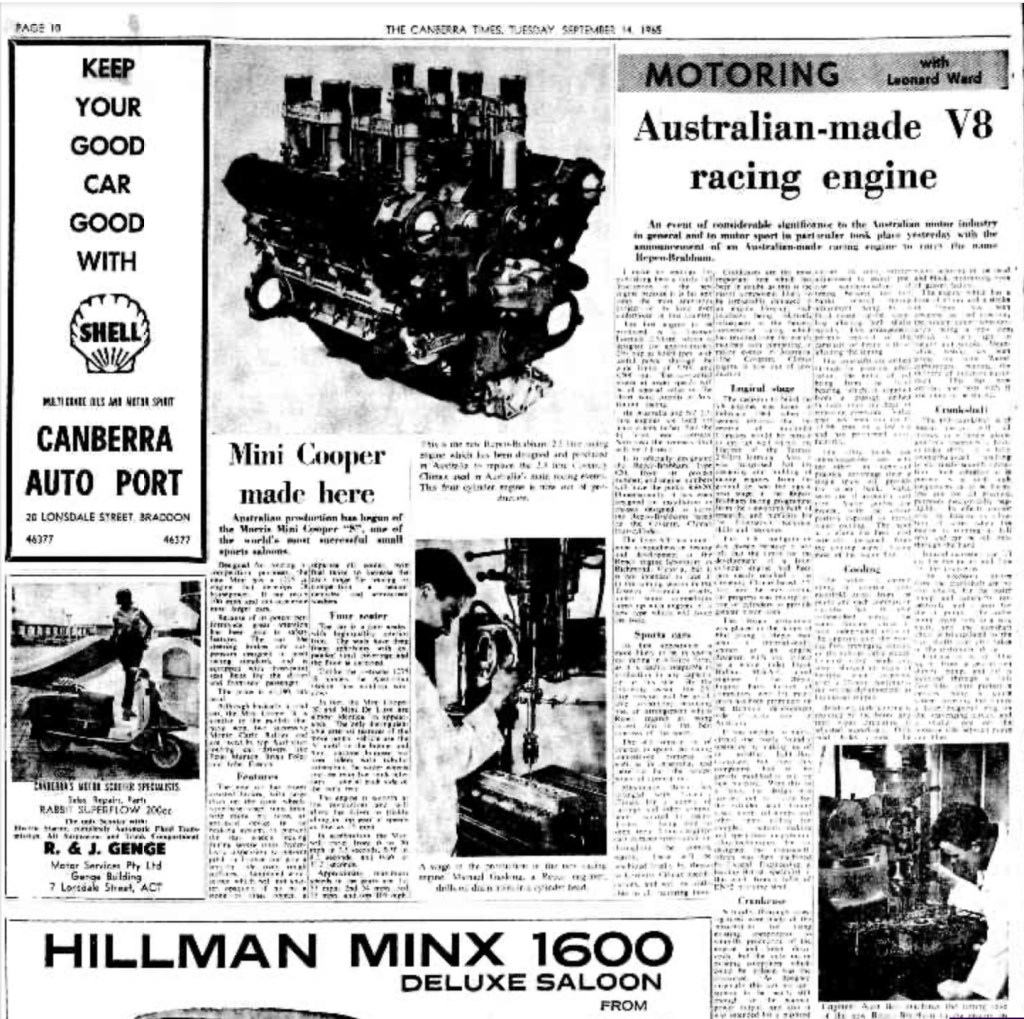
The Repco Record cover girl for September 1965 is the prototype 2.5-litre Repco Brabham 620 V8. Engine #E1 first spluttered into life on the Repco Laboratory testbed, Richmond on 26 March 1965…
She is quite a cutie replete with Weber carbs rather than the Lucas fuel injection with which the Repco engines always raced. Click away at the links below for plenty of articles on this engine, this is another piece from Michael Gasking’s wonderful collection of Repco memorabilia.
The public announcement of the engine was made by Repco on Monday September 13, 1965. Many thanks to historian David Zeunert who forwarded a copy of Leonard Ward’s piece about the initiative which was published in the Canberra Times the following day.
It includes an unusually detailed technical description of the engine, but makes no mention – at that point at least – of a 3-litre 620 variant for the new F1 which commenced in 1966.
That the 1275cc Morris Cooper S – ‘one of the worlds most successful small sports saloons’ – has gone into production at BMC’s Australian plant at Zealand, inner-Sydney would have been big news too, albeit well-known to enthusiasts.
Credits…
Michael Gasking Collection, Repco Ltd, Canberra Times via David Zeunert Collection
Bill Dutton’s gorgeous little Alta 1100 Special in the Fishermans Bend paddock during the 29-30 January, 1950 Victorian Tourist Trophy meeting. Love the ‘works’ Alta overalls.
George McKaige attended the meeting and took some marvellous photographs. A prolific enthusiast, driver, restorer and photographer, he and his son Chester published two books of George’s work, called ‘Beyond The Lens’, the shot above is on the cover of Volume 1.
This little known car was conceived when Bill Dutton – of the famous Melbourne car trading family – bought the supercharged, DOHC Alta 1100c engine (number 25S) which had been cast aside when Bill Reynolds bought Alta 21S from probable British MI5 spook, Alan Sinclair. Sinclair raced the car in Australia in 1938, an exhaustive and exhausting account is here; https://primotipo.com/2018/11/08/the-spook-the-baron-and-the-1938-south-australian-gp-lobethal/
Reynolds replaced the troublesome Alta four with a big, fat, lazy, powerful and reliable Ford V8. The Alta engine was surplus to requirements until Dutton saw its potential and built a car around it. The evolution of Alta 21S from four-cylinder sweetie to brawny V8 marauder is covered here; https://primotipo.com/2015/11/27/the-longford-trophy-1958-the-tornados-ted-gray/
Alta 21S as built, an 1100cc sportscar delivered to Scotland’s AJ Cormack on March 19, 1934. Here at Donington Park later that year (G Smith)The svelte Alta 21S 1100cc sports of the previous picture, by the time of the 100 miles January 3, 1938 South Australian GP at Lobethal, had become a dumpy, upright 1100cc single seater. Probable MI5 spook, Alan Sinclair up (N Howard)
Tony Johns tells me that the Dutton family business had all of the mechanical, engineering and body building skills to create the car on their Burnley Street, Richmond site. Stephen Dalton points out that Bill Dutton thanks Jack Dongers and Tom Stevenson for construction and body help respectively in the October 1949 issue of Australian Motor Sports. Do theses chaps ring a bell with any of you?
The 1950-51 Motor Manual Yearbook records that the Alta 25S four was 1096cc in capacity, was of twin-cam, two-valve type and fed by an Alta built Roots type-blower/SU carb giving 130bhp @ 5800rpm with 15lbs of boost. It was mated, via a bespoke bellhousing and metal to metal clutch, to a four-speed gearbox of unspecified make.
The Alta Spl it is a fine example of the body-builder’s art, but who was the gifted chappy? (R Edgerton Collection)
The chassis was made of chrome-moly steel tube, the main members of which were 16 gauge and two inches in diameter. The tubular front axle was specially made and suspended by transverse leaf springs front and rear with Armstrong hydraulic/Hartford friction shocks. The back axle was also specially made and used Ford bevel gears.
Brakes were hydraulic using modified Chev/Ford drums front/rear, wheels were pressed steel, 16 inch x 6 inch in size, with the whole lot clad ‘in a single-seat aluminium panelled racing body with a long tail, similar to a Grand Prix Alta.’
Ted Gray aboard Alta 21S Ford V8 (aka the Male Special / Ford V8 Special) at Penrith Speedway, west of Sydney in 1940 according to John Medley. Racer Ken Wylie is in the goggles at right, perhaps Jim McMahon left. I’ve still to get to the bottom of Pinocchio’s presence on the scuttle. Just look at all those names on Byron Gunther’s image…Ted Gray clears Hell Corner for the run up the mountain, Bathurst October 1950, the left front is just clear of terra firma (J Blanden Collection)
Bill Dutton engaged Wangaratta’s Ted Gray to drive his new car. Ted initially showed speed on pre-War speedways and in two very impressive appearances in the Male Special midget against Peter Whitehead’s ERA R10B at Rob Roy and Aspendale in 1938. Gray’s Alta credentials became impeccable when his patron, Melbourne car dealer, Alan Male bought Alta 21S Ford with which Gray took 24 wins from 26 starts pre-War according to John Blanden.
After the conflict, Ted re-commenced racing in another famous old-Oz racer, the ex-JAS Jones Alfa Romeo 6C1750 Zagato into which, you guessed it, Ted fitted a Ford V8. Blanden records that the Alta Special’s first race as being at the Fishermans Bend October 29-30, 1949 meeting where a broken cam-follower ended proceedings early in the day. ‘In the late 1940s, early 1950s, the car was a regular competitor, however the engine problems continued. The little car was third in the F1 Scratch Race at Woodside in October 1951,’ a better performance.
(T Johns Collection)(T Johns Collection)
In the 1950s ‘the car simply disappeared’, one theory is that it sat on a service station roof in St Kilda (an adjacent suburb to AGP venue Albert Park) as a drawcard for punters after the servo owner refused to pay an exorbitant Alta engine repair bill from a Sydney business. Then Melbourne pilot/enthusiast/engineer Graeme Lowe responded to a VSCC Newsletter ad for an engine in 1967. His £10 purchase of 1100 #25S was the catalyst of a very long, thorough reconstruction/restoration of Alta 21S which was completed and then made its public debut in Betty Lowe’s hands in 1999.
In recent times 21S was acquired by Fiona Murdoch, the shot below was taken at Gladysdale, Victoria on March 4, 2023 during a drive – one I won’t forget in a big hurry – and photo session for a feature article just published in issue 07 of quarterly Australian classic car magazine, Benzina. If you can’t find it in a newsagent, a decent example of which is as rare as rocking horse shit in Australia these days, email the publisher, Jack Quinn; jack@benzinamagazine.com
(M Bisset)
Credits…
George and Chester McKaige, Ron Edgerton Collection, ‘Historic Racing Cars in Australia’ John Blanden, 1950-51 Motor Manual Year Book, Graham Smith Collection, David Woodhouse, Norman Howard, Byron Gunther
Etcetera…
(T Johns Collection)
The other pages of the 29-30 October, 1949 Fishermans Bend (correct spelling of the place according to our Government and lack of apostrophe by the way) programme sent by Tony Johns.
I always find these documents of wonderment as I don’t have a collection of them. This was fundamentally a local meeting but there are a swag of interstaters too, its interesting to see the Top Guns, Future Top Guns and Notables in the mix. Mine are – in no particular order – Ted Gray, Reg Hunt, Otto Stone, Lex & Diana Davison, Ken Tubman and Dick Cobden (NSW interlopers), Stan Jones, Gib Barrett, Rupert Steele, Tony Gaze, Jim Leech, Charlie Dean, Eldred Norman (Adelaide Hills), Doug Whiteford, Tom Hawkes, Ron Edgerton, Jim Gullan, Lou Molina, Murray Carter, Hedley Thompson, Arnold or Arthur Terdich, Peter Manton, Bill Patterson, Derek Jolly and no doubt others who just don’t ring-the-bells for me.
(T Johns Collection)
What jumps off the pages too is the importance of Australian Specials, and MGs in particular, which provided the lifeblood and bulk of Australian motor racing grids for decades. Depending on the year MG provided both outright contenders and the ‘Formula Vee’ in unmodified form, and ‘Formula Ford’ in modified form entry-level classes of the day.
Rolf Stommelen jumps aboard the Alfa Romeo T33/TT/3 he shared with Nino Vaccarella in the May 5, 1972 Targa Florio, the pair retired with valve-spring failure on lap three.
The car carries #1 in recognition of Alfa’s fantastic win the year before when local lad Nino Vaccarella won with Toine Hezemans aboard a T33/3 3-litre V8. The brilliant Schlegelmilch shot below captures Nino during his winning ’71 drive.
(R Schlegelmilch)
It was a great year for Alfa Romeo/Autodelta, they won the Brands Hatch 1000km (Andrea De Adamich/Henri Pescarolo) and Watkins Glen 6-Hour (De Adamich/Ronnie Peterson) as well, not to forget class wins at Monza, Spa and Zeltweg. The opposition 3-litre flat-8 Porsche 908-03s and flat-12 Ferrari 312P were plenty quick too, not to forget the 5-litre 12-cylinder Porsche 917s and Ferrari 512S’.
(MotorSport)
Vaccarella, sharing the T33/TT/3 shown in the painting with Rolf Stommelen during the 1972 race. Despite the Porsche 908/03 inspired T33/TT/3 spaceframe chassis – lighter, weight-forward, still V8 powered (TT is telaio tubolare or tubular chassis) – making its debut in practice at Targa twelve months before, the four Autodelta entries still couldn’t knock off a late-entry singleton Ferrari 312PB 3-litre flat-12 driven by Arturo Merzario and rally-ace Sandro Munari.
Rolf Stommelen creating huge interest in the Targa pits in 1971, he is about to do some laps in the first Tipo 33/TT/3 spaceframe car. Its 219cm wheelbase was 13cm less than a T33/3 and at 560kg it was 50kg lighter. Rolf lapped in the 37 minute mark – reporting it too stiff – compared with other cars doing 34/35s. While entered for Carlo Facetti/Teodoro Zeccoli it was not intended they race it, nor did they drive it, but Rolf and Nino did, the long test process was underway
Nanni Galli and Helmut Marko were 17-seconds behind the winning Ferrari and catching it hand-over-fist at the end of the race, Marko set a lap record of 33min 41sec in his epic chase. De Adamich and Toine Hezemans were third in another Alfa T33/3, while the Vic Elford/Gijs Van Lennep duo were out with engine failure without completing a lap. As recorded, Vaccarella/Stommelen were out with a broken valve spring after completing three laps. 38 cars finished the gruelling event with a massive 37 DNF’s, five due to accident damage.
Art Merzario in – very low as always! – the winning Ferrari 312PB (P Lyons)(Wiki-unattributed)
The first of the privateers placed fourth, the Antonio Zadra and Enrico Pasolini Scuderia Brescia Corse 2-litre Lola T290 Ford FVC is shown above at Collesano in a classic Targa shot, they also won the 2-litre class.
MotorSport)
The winning Ferrari (above) completed the 792km journey in 6hr 27min/48seconds. The Armco-installer must have been well-lubed with grappa when he executed his contract.
This wonderful race was living on borrowed time for yonks, it became a national race from 1974 until 1977 when the race ceased, albeit the Targa Florio Rally was a round of the Italian Rally Championship for some years.
Tribute events have popped up around the world, not least Targa Tasmania, itself in the news in recent years because of fatalities as a consequence of a mix of (mainly) amateur drivers, high speeds and unyielding eucalypts.
Butt shot of De Adamich in his T33/TT/3 during the 1972 race. Feel the vibe folks, you are so lucky if you experienced this lot!Gijs Van Lennep swaps notes with an Autodelta technician before the off in 1972 (unattributed)The Businello/Zeccoli/De Adamich/Galli Alfa T33 2-litre Periscopica heads out for practice on the Nurburgring during the May 1967 1000km weekend. They were fourth in the race won by the Udo Schutz/Joe Buzzetta Porsche 910 (unattributed)
With a view to class and outright wins Chiti and his team started development of a 3-litre Tipo 33 which used an aluminium monocoque chassis rather than the complex cast magnesium chassis of the earlier 2-litre (and some 2.5-litre) machines.
Fitted with 2998cc 90-degree V8s giving between 400bhp @ 9000rpm and 440 bhp @ 9800rpm over the life of the 1969-72 program, and first six, then later five-speed Alfa gearboxes, the cars were first tested in early 1969.
Vaccarella during his victorious 1971 Targa win with Toine Hezemans. Alfa T33/3 monocoque, with Bernard Cahier’s rear body-off shot (below) of one of the T33/3s during the same meeting
With ongoing development, class wins at Imola and Zeltweg were achieved in 1970, with a magnificent run of success, as covered above in 1971.
Inspired by the ultra-light 908/03, and detuned-F1-powered Ferrari 312P, a new spaceframe T33/TT/3 was built, tested and raced in 1971 before an assault on the 1972 World Championship of Makes. While Alfa Romeo finished a very good second to Porsche in the 1971 World Sportscar Championship (72/51 points), things were grim in 1972 when Ferrari beat them resoundingly, 160 points to 85, with the Alfas not taking a win.
Ferrari won 10 of the 11 qualifying rounds with their 312PB, electing not to contest Le Mans on the basis that their detuned F1 engined cars wouldn’t last the distance. A 3-litre detuned F1 engined Matra MS670 V12 driven by Henri Pescarolo and Graham Hill took an historic win for France that day instead. While on one level Ferrari’s Le Mans non-appearance was savvy – they had the WSC locked up – it was also gutless, they dipped out on the only sportscar race that really matters every year.
Vaccarella aboard the Alfa T33/TT/3 he shared with Toine Hezemans to third place behind the Ferrari 312PBs of Mario Andretti/Jacky Ickx and Ronnie Peterson/Tim Schenken, Sebring 12-Hours March 1972Duo of Alfa T33TT/12s on the Eau Rouge swoop, Spa 1000km 1975. Jacky Ickx from Henri Pescarolo, the Pesca/Derek Bell machine won from Ickx/Art Merzario
Context for Ferrari’s amazing 312PB dominance in 1972 is that they sacrificed their 1971 5-litre 512M program by selling cars/512S update kits to privateers but elected not to race the 512M as works cars, effectively gift-wrapping the final 5-litre Era endurance title for Porsche. It’s staggering in the sense that Ferrari could only finance the build of these 25 5-litre cars due to the sale of of his business to Fiat in 1969.
The pay-off was that the single 312P prototype that raced (driven mainly by Jacky Ickx and Clay Regazzoni) throughout 1971 was turned into a panzer division of evolved, ready-to-rock 312PBs in 1972. Despite ongoing development at Maranello, Matra caught Ferrari napping in 1973, winning five of the ten rounds, Le Mans and the title that year, change is the continuum after all.
Alfa T33/SC/12 1977. Monocoque chassis, five-speed Alfa transaxle, 180-degree V12 ‘flat-12’, 2995cc, gear driven DOHC, four-valve, Lucas fuel injected circa 520bhp @ 12000rpm (B Betti)Alfa Romeo 520bhp 3-litre flat-12 during the Dijon 500km weekend in 1977. The Jean-Pierre Jarier/Art Merzario T33/SC/12 won this race
Alfa Romeo returned with the Tipo 33 TT/12 in 1973 – spaceframe 3-litre 500bhp flat-12 – and finally took the World Championship of Makes in 1975 with that car, and the World Sportscar Championship in 1977 with the Tipo 33 SC/12 – where SC is Scatolato, a boxed or monocoque chassis 3-litre 520bhp flat-12 and Tipo 33 SC/12 Turbo – monocoque 2.164-litre 640bhp flat-12 – open sports-prototypes.
Vittorio Brambilla enroute to a Monza 500km victory in April 1977, Alfa T33/SC/12
Credits…
Yuriy Shevchuk, Rainer Schlegelmilch, Pete Lyons, Getty Images, Bruno Betti, MotorSport Images, ‘Alfa Romeo Tipo 33 : The Development & Racing History’ Peter Collins and Ed McDonough
(MotorSport)
Tailpieces…
Evocative shot of Helmut Marko on-the-hop in his furious pursuit of the leading Ferrari 312PB in the closing stages of the 1972 Targa. It really was an impressive drive of the T33/TT/3 on this most toughest of tracks.
(MotorSport)
While these days best known as Red Bull’s stock-picker, Marko had the makings of a fine GP driver in 1972. He was, with Gijs Van Lennep, the reigning Le Mans champion aboard a fearsome Porsche 917K, but his racing career ended with the loss of sight in his left eye after an incident at Clermont Ferrand.
A stone thrown up by Emerson Fittipaldi’s Lotus 72D Ford penetrated his visor while at the wheel of a BRM P160B (above) during the closing stages of the July 1972 French GP. Marko later commented that, new to the car, his seat wasn’t fully sorted so he was sitting 15cm higher than in the P153B. But he was still happy to be at the wheel of a more competitive car, he qualified it sixth too, but that 15cm made all the difference with that small, sharp, missile…
Tony Gaze in a reflective moment celebrating what was perhaps his final motor racing career victory, at Albert Park on March 11, 1956.
He had just won the 48 lap, 150 mile Moomba Tourist Trophy in his HWM Jaguar from Bib Stillwell’s Jag D-Type and Ron Phillips’ Austin Healey 100S in a huge 37 car field. Over the following days he sold both this car ‘VPA9’ and the ex-Alberto Ascari Ferrari 500/625 #005 he had been racing in single seater events around the world for two years or so.
Tony Gaze’s HWM Alta in the Silverstone pits during the 1952 British Grand Prix weekend, he retired with head gasket problems after completing 19 laps (Q26 of 32). The race was won by Alberto Ascari in Ferrari 500 #005, the car referred to in the previous paragraph, from Piero Taruffi’s similar machine, and Mike Hawthorn’s Cooper T20 Bristol in third.
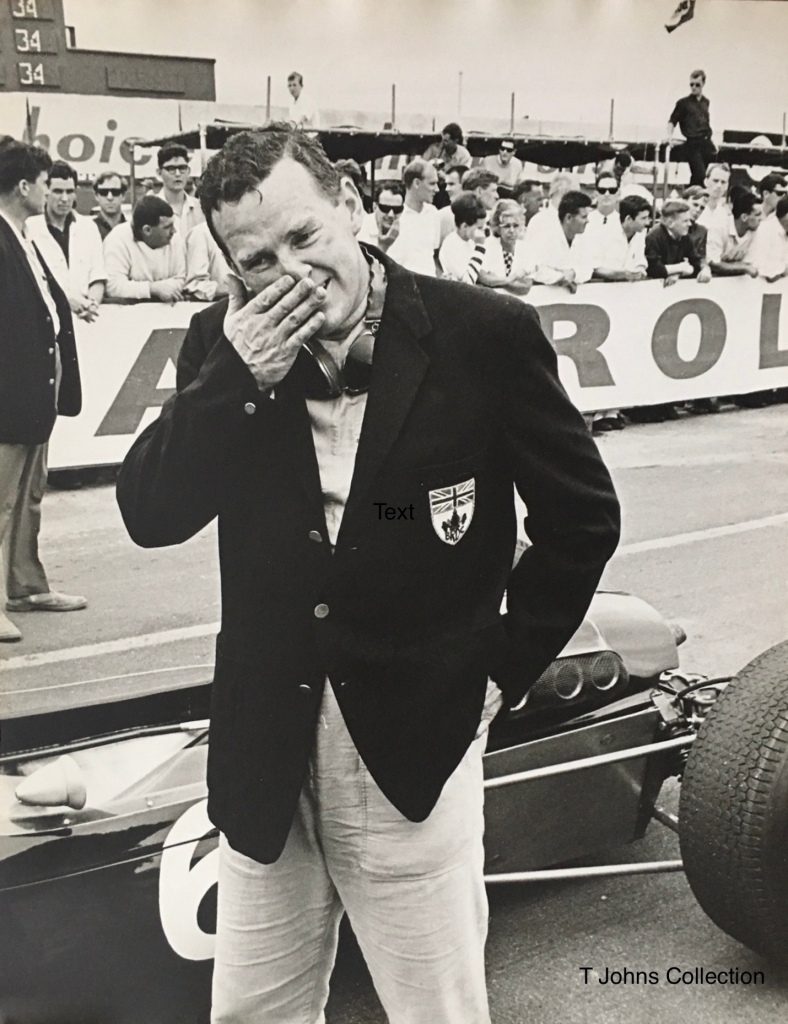
Light Car Club of Australia former-members will pick that bonnet-badge, same badge as on the obscured gent’s blazer in the opening shot. The tyres are Dunlops…
(MotorSport)
Gaze aboard Graham Whitehead’s Aston Martin DB3 (DB3/10) during the Tourist Trophy, World Sportscar Championship round at Dundrod on September 5, 1953. They were an excellent fourth and first of the privateers while up front were two new Aston DB3S’ crewed by Peter Collins/Pat Griffith and Reg Parnell/Eric Thompson, then the works-Jaguar C-Type of Stirling Moss/Peter Walker in third.
(D Coelho)
Tony Gaze own DB3, chassis DB3/9 was only two races old when the car lost its life, and Tony nearly his too. He was forced to swerve around Pietro Palmieri’s Ferrari 250MM in the Portuguese Grand Prix at Boavista on June 21, 1953. The Aston hit a tree, broke in half and burst into flames with Gaze semi-conscious in the middle of the road ten metres from the remains of his car. Wow, she really is daffy-ducked!
With his insurance monies in hand, after a second-hand DB3 could not be sourced, Gaze was unable to buy an Aston Martin DB3S, or a Jag D-Type on acceptable terms, so he acquired HWM Jaguar VPA9 instead.
(MotorSport)
Gaze, Ferrari 500/625 on the way to victory in the 1820 Settlers Trophy, a handicap race held at Queenshaven, South Africa on March 26, 1955. Held on a 3.8-mile track laid out on the disused Palmietfontein aerodrome south of Johannesburg, a crowd of about 60,000 people watched the action.
Peter Whitehead and Gaze were the star international attractions in a two race tour in the same pair of identical Ferraris that excited New Zealanders at Ardmore during the NZ GP on January 8 where the Whitehead/Gaze train were second and third behind the victorious Prince Bira’s Maserati 250F.
Their first event in South Africa was the 7th Van Riebeeck Trophy, a handicap held on the new 1.75-mile Eerste River airfield circuit in the Western Cape, on March 12. Whitehead was 11th and Gaze 13th so the handicapper must have belted them hard! Chris Andrews won the race in a Studebaker Special.
(MotorSport)
The Dickie Stoop/Tony Gaze Frazer Nash Sebring Bristol 2-litre at Le Mans in 1956, DNF accident after completing 100 laps at about 10am on Sunday morning. The pair weren’t as successful as other Nash’s in recent years, in that context the ad below makes interesting reading.
Ain’t she sweet, and fast. Frazer Nash Sebring Bristol in the Le Mans pits in 1956 (MotorSport)(K Brown Collection)
Off to New Zealand now for the last bunch of shots. Above is the grid for the Lady Wigram Trophy at the RNZAF base of the same name on 1956
Almost obscured on the far left is Reg Parnell in Aston Martin’s forgotten GP car, DP155, Gaze #3 and Whitehead #2 aboard their Ferrari 500/625s with the all enveloping bodied #4 Connaught B-Type Jaguar of later famous artist, Leslie Marr. On row two is Ron Frost’s Cooper Mk9 Norton alongside Ron Roycroft’s Bugatti Jaguar, row three comprises Pat Hoare’s Maserati 4CLT, David McKay’s Aston Martin DB3S and the R Archibald Jaguar XK120. Whitehead won the 71 lap, 150-mile race from Gaze, Marr and Parnell.
Contemporary driver shots from a magazine report about the 1956 NZ GP won by Stirling Moss in a Maserati 250F. And yes it is Reg Parnell, not his nephew, Roy, who was an Aston Martin test driver, and FAO Gaze was an Aussie. Let’s not get picky, it’s the shots that matter (G Woods Collection)(G Woods Collection)
A favourite shot this one, Gaze in his HWM Jag on the Ryal Bush road circuit during the 1956 NZ Internationals. Tony placed second to Peter Whitehead in the Southland Road Race Formula Libre feature that February 11 weekend in their Ferrari 500/625s.
The sportscar event was a handicap, David McKinney wrote that “the three 1.5-litre Singers outfoxed the handicapper and filled all the first (three) places at the end of the 43 miles.” CR Bath won from Kelvin Kerr and Dave Edmiston. “Although unplaced on handicap, Whitehead (Cooper T38 Jaguar) made fastest time on scratch from Gaze, the HWM slowed by rear-axle trouble, and Tom Sulman (Aston Martin DB3S) who had been off into the scrub and damaged his exhaust…”
(G Woods Collection)HWM Jag in the Ryal Bush paddock (S Quertier)Gaze again in VPA9 in NZ, Ardmore or Wigram folks? (unattributed)
Etcetera…
(B Sternberg Archive)
There is a Tony Gaze connection here, it’s HWM Alta 2-litre s/c #GP107, his mount on his 1954 Kiwi tour. It’s shown after a fresh coat of red paint in Auckland in late 1957. By this stage the machine was probably owned by Tom Clark in a long period of continuous NZ owners/ownership which is related in the first of the articles linked above.
(B Sternberg Archive)(B Sternberg Archive)
Credits…
Sydney Morning Herald, MotorSport Images, Graham Woods Collection, Duarte Coelho, Kelvin Brown Collection, B Sternberg Archive, Stewart Quertier, David McKinney race report via Roger Clark
Jack Brabham, Cooper T39 Climax, and the Bib Stillwell-Bill Pitt Jaguar D-Types just before the start of The Argus Cup 8-lap, 25-mile sportscar support race before the Australian Grand Prix. December 2, 1956.
On row two are the red Ausca Holden of Paul England at left, and Lex Davison’s HWM Jaguar alongside. The third row comprises Stan Coffey’s Ferrari 750 Monza, Ron Phillips’ Austin Healey 100S and Tom Sulman’s green Aston Martin DB3S at right.
This AGP day grid excludes some of the cars which contested the ATT the week before including the first three placegetters, Moss and Behra, Maserati 300S and Ken Wharton, Ferrari 750 Monza. By that stage the Maseratis may have been sold to locals Doug Whiteford and Reg Smith, if not they were very much for sale, so best not to put them at risk by racing them, cash was critical to Maserati.
Brabham and Stillwell
Brabham’s 1.5-litre Climax FWB engined machine won the race by nine seconds from Stillwell’s D-Type, Jack’s task was made easier when Pitt – first Aussie home in the ATT the week before – clipped a kerb in his D-Type on lap one and rolled it, he handily landed amongst the hay bales while the Jag was rendered somewhat second-hand. In a motor-dealer strong field, Bill Patterson’s T39 Bobtail was third, then Paul England in the superb Ausca from Kiwi, Ross Jensen’s AH 100S and then Ron Phillip’s similar car in sixth.
The single-seater shots are of course the machines contesting the AGP won convincingly by Stirling Moss’ works-Maserati 250F from team-mate, Jean Behra’s similar 2.5-litre F1 car. Peter Whitehead was third in a Formula Libre 3.4-litre Ferrari 555 Super Squalo from local 250F exponents Reg Hunt and Stan Jones.
The gathering of drivers before the off is interesting, perhaps it’s just before the drivers briefing. Mind you, they may be discussing their flight connections that evening, the army’s Southern Command Band marched and played on…and on, as landlords of part of this particular manor, they weren’t keen to leave the track after their moment of glory, ensuring the race started an hour late.
From the far-left it’s Whitehead’s #3 Ferrari, the guy in the brown sports-jacket looks like Bib Stillwell to me. He didn’t contest this race but still may have ambled up for a gander. Based on the shot below, the guy in the green/blue helmet is perhaps Whitehead, but who is the driver in the white helmet? Behra is in his car with Moss perched on his left-rear, Stirling’s car is on pole. Look at that crowd and the Repco sign.
Moss’ car is about to be fired up, a mechanic is inserting the battery operated starter-shaft, the silver car on row two at right is Ken Wharton’s Maserati 250F, DNF engine failure. What wonderful theatre it must have been.
These colour shots really do allow you to feel the vibe, the palette – high quality Kodachrome film here I think – of clothing is so much more muted than today’s. This stretch of road and trees are still there, It’s roughly parallel with the current front straight, and between it and the lake. Look at the press-men in their stereotypical brown ‘flasher’ trench coats. Isn’t the lady elegant and rare, these days Drive To Survive has ’em out in droves, happily motor-racing remains a girlfriend free zone for me.
That’s Whitehead’s Ferrari 555 with, perhaps, Lex Davison’s 3-litre Ferrari 500/625 being pushed into place behind, he shared the second row with Ken Wharton’s Maserati 250F, on the third row was Reg Hunt’s 250F, Reg Parnell in the other Ferrari 555 Super Squalo and Kevin Neal in the ex-Hunt 2.5-litre Maserati A6GCM.
Credits…
Ian Curwen-Walker and Russell Garth many thanks, ‘Glory Days : Albert Park 1953-58’ Barry Green
Tailpiece…
Moss on the hop before the rains came, he beat Jean Behra by close to two minutes, the 80 lap/250 miles journey took him 2 hours 36 15.4 min/secs.








 primotipo...