


Jack Brabham, with jaw firmly set, looks for his braking and turn-in points for Shell Corner at Sandown during the February 16, 1969 Sandown Park Cup in the one-off Brabham BT31-1 Repco 830 2.5 V8.
He was third in his only Tasman Cup appearance that summer, up front was Tasman winner, Chris Amon in a works Ferrari 246T with Jochen Rindt second in a works Lotus 49B Ford DFW.

David McKay keeps an eye on Derek Bell’s works Ferrari 246T with Jack Brabham’s Brabham BT31 Repco as the field is assembled prior to the start of the Sandown race; the horsey nature of the place is readily apparent. The angle of incidence on Jack’s wing is on the shallow side; still, it’s a fast track.
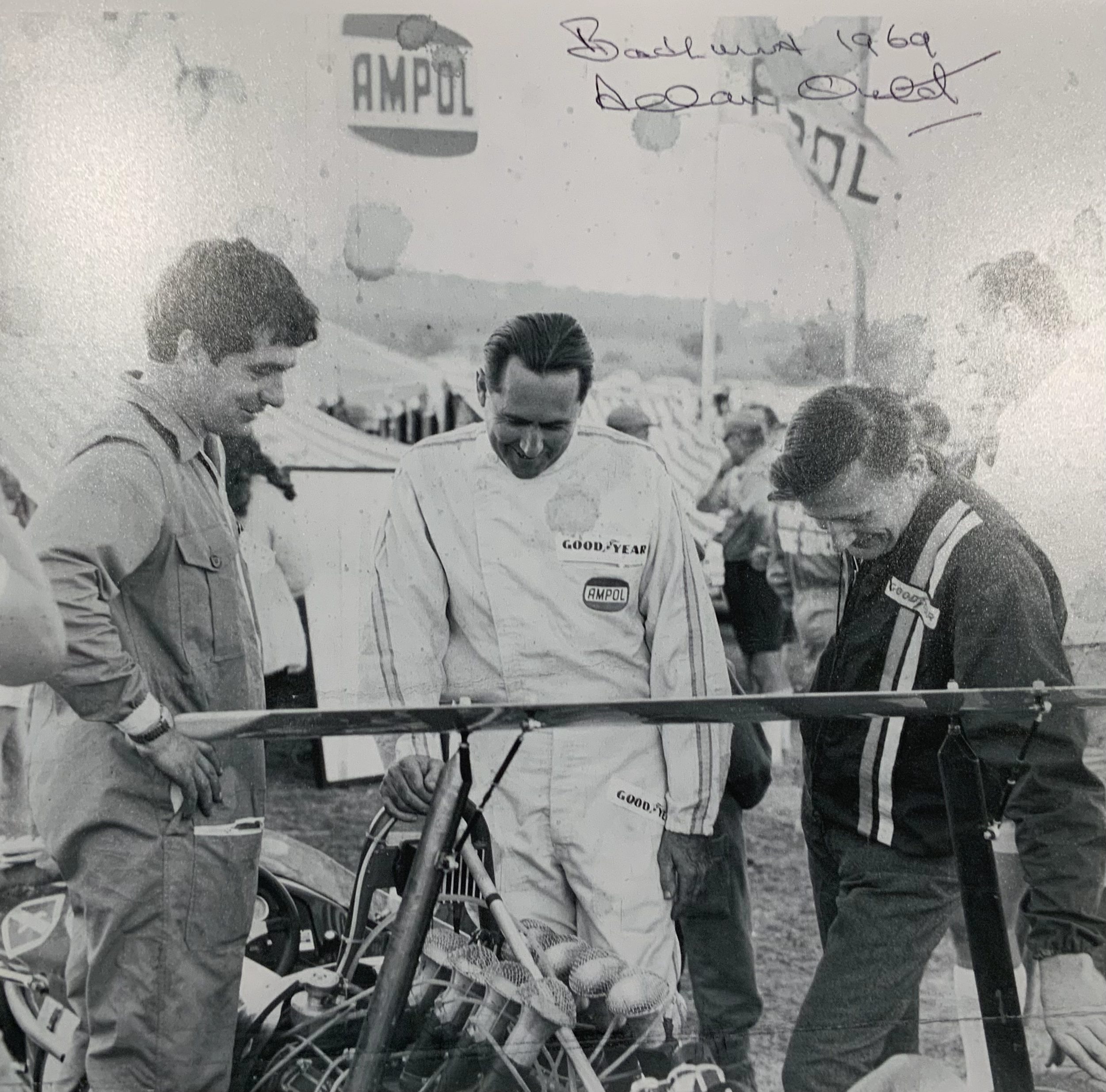
BRM mechanic Allan Ould, Jack Brabham and a Goodyear rep looking pretty happy with BT31-1 in the Sandown paddock.
Post Brabham, Ould built several Aztec racing cars and then had a very successful career in the retail motor trade. Can anybody put me in touch with him? I want to invite him to a catch-up of the Repco Brabham Engines crew in November.

A couple of days before, having finally got their hands on the car which had been stuck on the Port Melbourne docks as a consequence of a wharfies strike, BT31-1 is being race-prepared in RBE’s Mitchell Street, Maidstone factory. That’s John Brookfield at left, Jack alongside, then RBE’s GM Frank Hallam and Michael Gasking on the right.

Shortly thereafter, on Friday the car was taken to Calder Raceway for systems checks. Jack is focused on the job at hand, while watched by John Brookfield leaning on the back of the car, Michael Gasking in grey and John Mepstead on the right.
And below off on another lap. The session was famously brought to an end when a farmer adjoining the Keilor property cracked-the-shits with the Repco boys who were running the car after a curfew which limited the hours during which race engines could do their thing. Gotta look after the sheep, after all…


BT31-1 is the lowest-mileage works Brabham of all. It contested the Sandown Tasman event and the Bathurst Australian Driver’s Championship Gold Star round over Easter in 1969, and was won by Jack in what was his final in-period RBE-powered win in a long relationship that commenced with Repco-prepared Coventry Climax FPFs at the dawn of the 1960s.

Bathurst Gold Star grid on April 7, 1969. Leo Geoghegan in the white Lotus 39 Repco 730 on pole, with Niel Allen’s McLaren M4A Ford FVA and Max Stewart, Mildren Waggott TC-4V 1.6 comprising the front row.
Brabham is off grid seven; his task of winning the race was made easier when Stewart and Allen had an argument about the same bit of real estate in the Dipper that took both out on the spot on the first lap. Brabham won from John Harvey, Brabham BT23E Repco 830 and Henk Woelders, Elfin 600B Lotus-Ford.


I’m not sure that Jack practised without wings, but he certainly tested bi-winged and the set-up above, which is how he raced.
More about BT31-1 here:https://primotipo.com/2022/04/04/humble-pie-is-best-served-cold/ and here:https://primotipo.com/2015/02/26/rodways-repco-recollections-brabham-bt31-repco-jacks-69-tasman-car-episode-4/

Down through the Dipper above and at rest below. The Brabham-Repco relationship concluded during 1969 with meetings at Sandown Park and Bathurst in Australia and stateside at Indianapolis and the Indianapolis Racing Park.
In the latter, Peter Revson brought the business relationship to an end in the best possible way by winning the IRP 200 from strong opposition, his Brabham BT25 powered by the 4.2-litre RBE760, the four-cammer redeeming itself with a splendid win against strong opposition…


RBE engineer, Brian Heard commented on this photograph, ‘This pic is of a 830 2.5L RB engine. Constructed specifically for the Aussie Tasman series. Great little engine, using the 800 block (cast in magnesium) which was essentially the same dimensionally as the 700 series block, but had a deck height 1.190″ shorter that the 700, making it very compact.’
‘The 30 series heads were earlier than the 40 series, but were very similar except for the exhaust ports, which exited outside the V. This engine had a 55mm stroke and weighed just 250lbs, meaning that it gave a little over 1hp/lb. It begs the question: why was it not used to make a 3L F1 830? Hmmm, can’t answer that; maybe others can?’
RBE 830 Tasman 2.5-litre V8. SOHC, two-valve, Lucas fuel injection, circa 295bhp @ 9000rpm.
Credits…
Ampol, Allan Ould Collection, oldracephotos.com/Dick Simpson, Brian Heard, Bob Frankel, Mildren Films
Tailpiece…

Finito…


Superbe article magnifiquement illustré ! Bravo et merci
J-P Manière
[…] and tie to meet his new employer during the February 16, 1969 Sandown Tasman Cup round. See here:https://primotipo.com/2026/08/23/brabham-bt31-repco-take-3-by-mark-bisset/ Sandown’s old pits were heaven on a stick for teenage enthusiasts with a capacity to jump […]