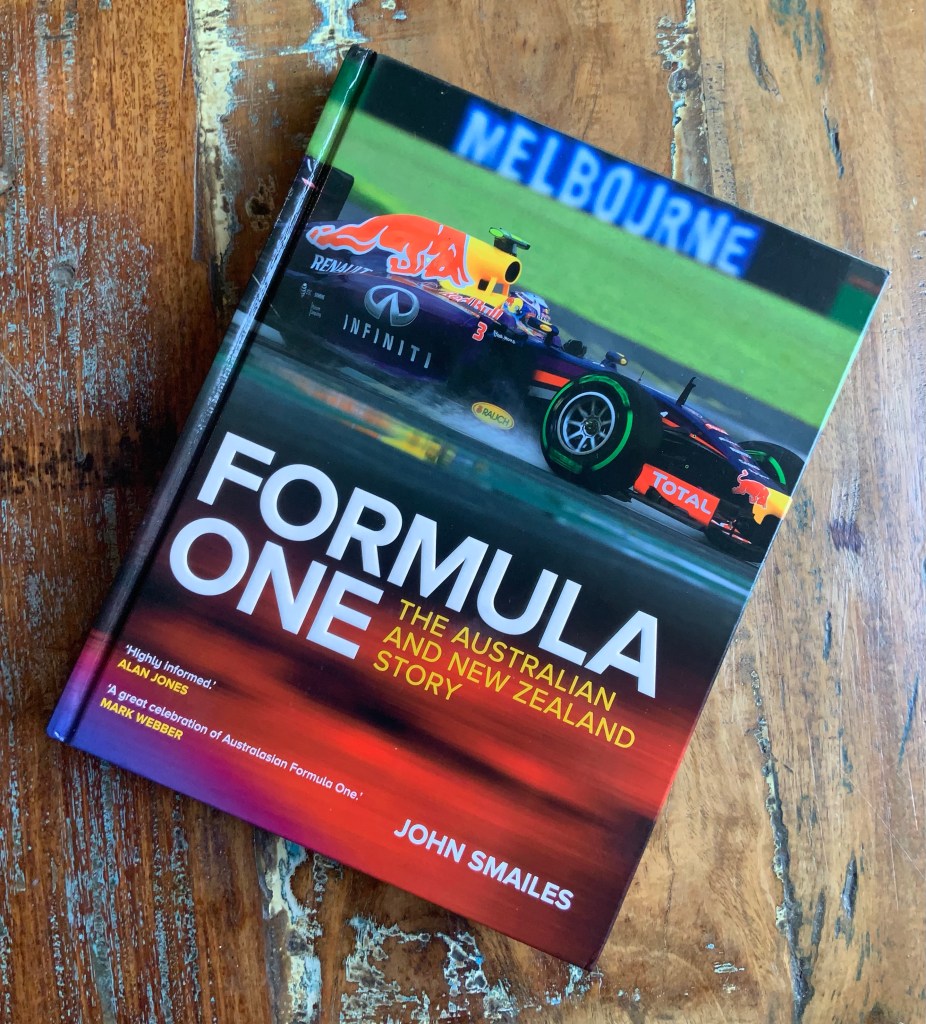
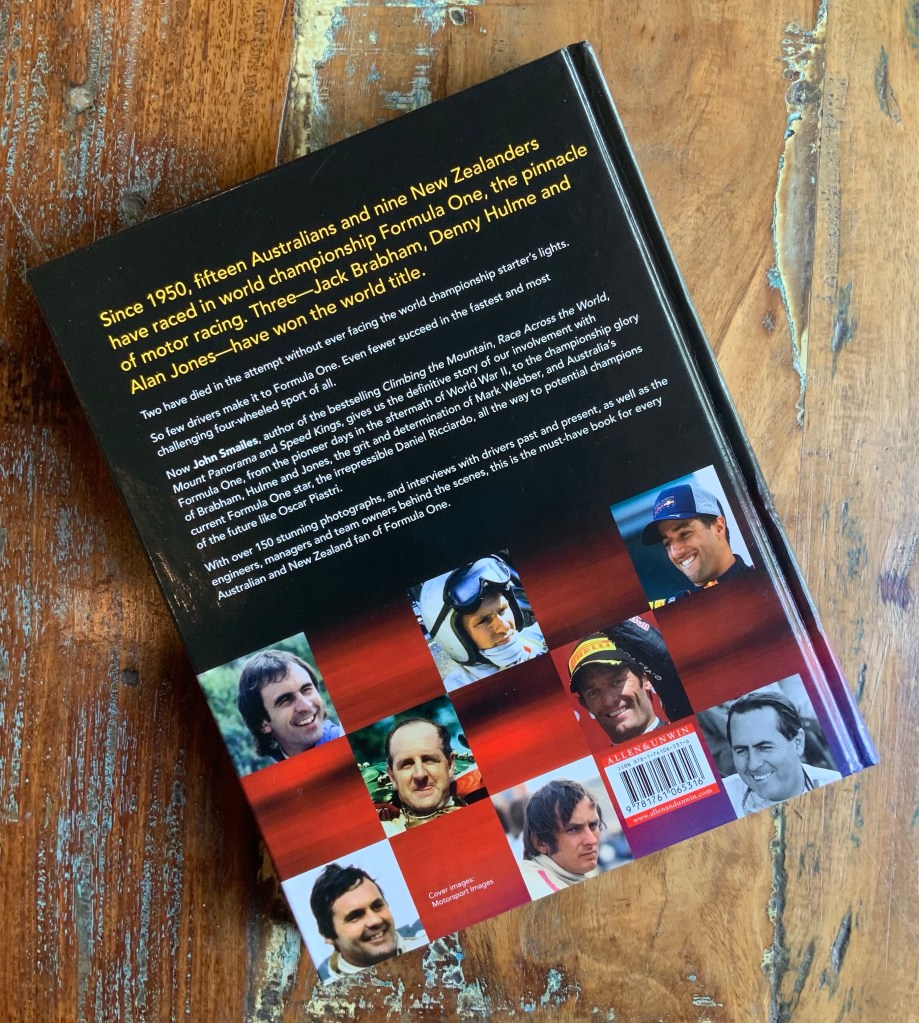
Formula One : The Australian and New Zealand Story is John Smailes’ latest masterpiece, and what a ripper read it is!
24 ANZACs faced an F1 starter, another 13 tested or raced in non-championship F1 events, this is their story told in John’s relaxed, engaging, informative style chockers with facts.
This time Allen and Unwin have cranked up the production budget, the book is a larger hardback and many of over 150 photographs are colour throughout 295 pages.
Smailes’ (he has now written five books with Allen and Unwin) books are passion projects, each one takes about a year to write, he interviewed 44 of his victims in 2019-2021 (or their nearest and dearest) so it has lots of new stuff, it isn’t a regurgitation of what’s gone before.
The format is ‘chronological interesting’. Whammo, he opens with Oscar Piastri – why not start with the future – before launching into the pre-war generation. There are a couple of drivers with stand-alone chapters, the rest are shared and neatly fuse, for example; Frank Gardner and Paul Hawkins, The Brothers Brabham, the ‘Best Opportunity : Worst Luck’ duo of Chris Amon and David Walker, ‘The Bruce and Denny Show’, and ‘Aussie Grit’ Webber/Ricciardo combination. The telling of the story(s) is skillfully cohesive rather than a bunch of stand-alone chapters.
As with his ‘Speed Kings’ Indy book, John has maintained his focus on others who made it to F1 as well as drivers; it’s fascinating to read about designers, team managers/principals, race officials and entrepreneurs in addition to those behind the wheel.
I’d rate myself a subject matter expert on half the drivers but I learned plenty, even about them. It’s a book the knowledgeable will enjoy, but equally assumes no racing expertise so the kid (or partner) you are trying to nurture in the right direction will engage and enjoy.
It’s a buy folks, $A39.99 from all the usual outlets in Australia and New Zealand. For international readers the ISBN is 978 1 76106 531 6 or http://www.allenandunwin.com
My first exposure to Bob Shepherd’s artistry was in the first issue of the late Barry Lake’s marvellous and way too short-lived Cars and Drivers magazine published in early 1977.
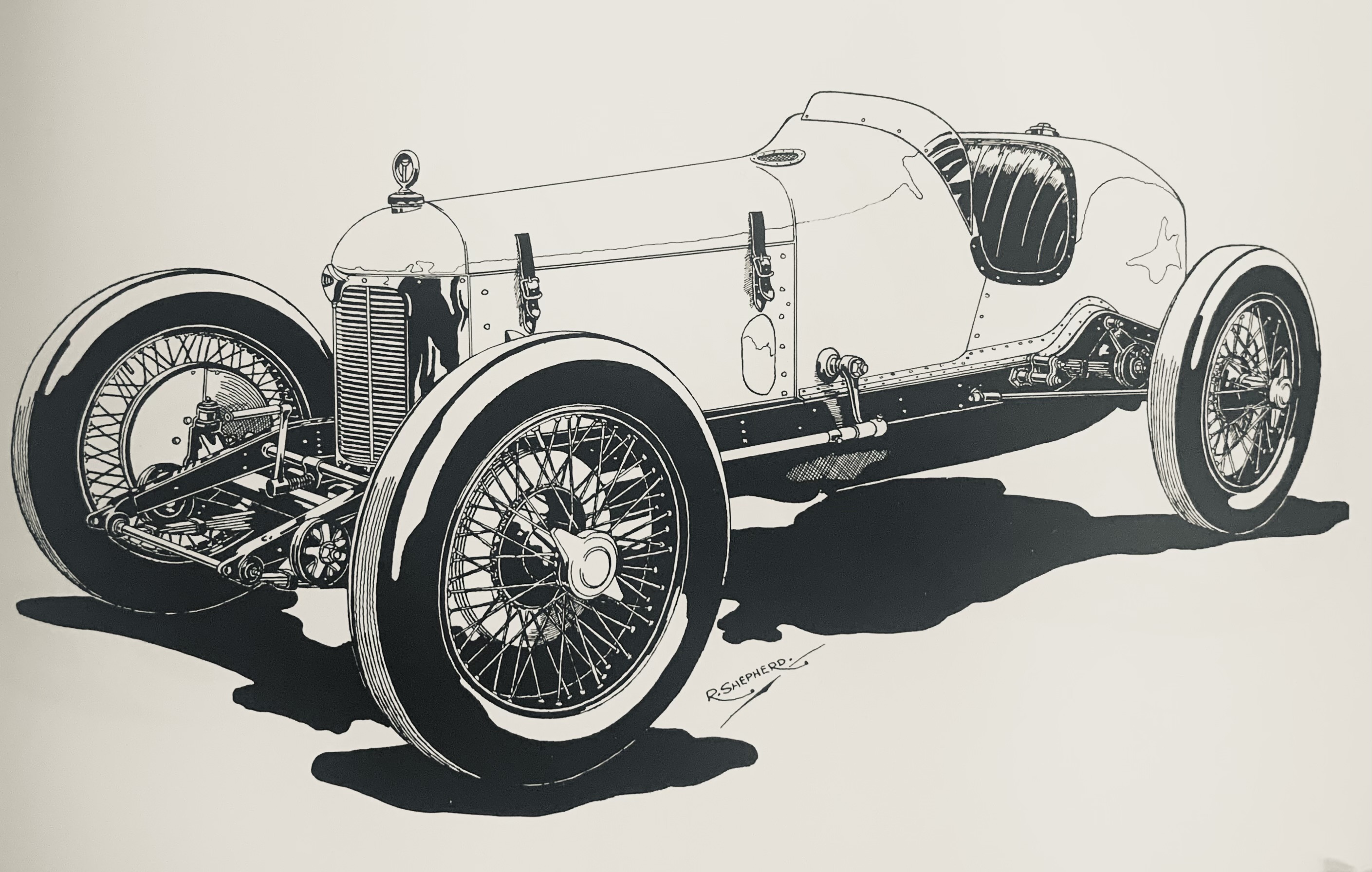
John Medley chose a Shepherd drawing of a Miller 122 to support an article he wrote about the ex-Zborowski machine which raced in New Zealand, and briefly in Australia pre-war, after the untimely death of the wealthy Briton at the wheel of a Mercedes during the 1924 Italian GP.
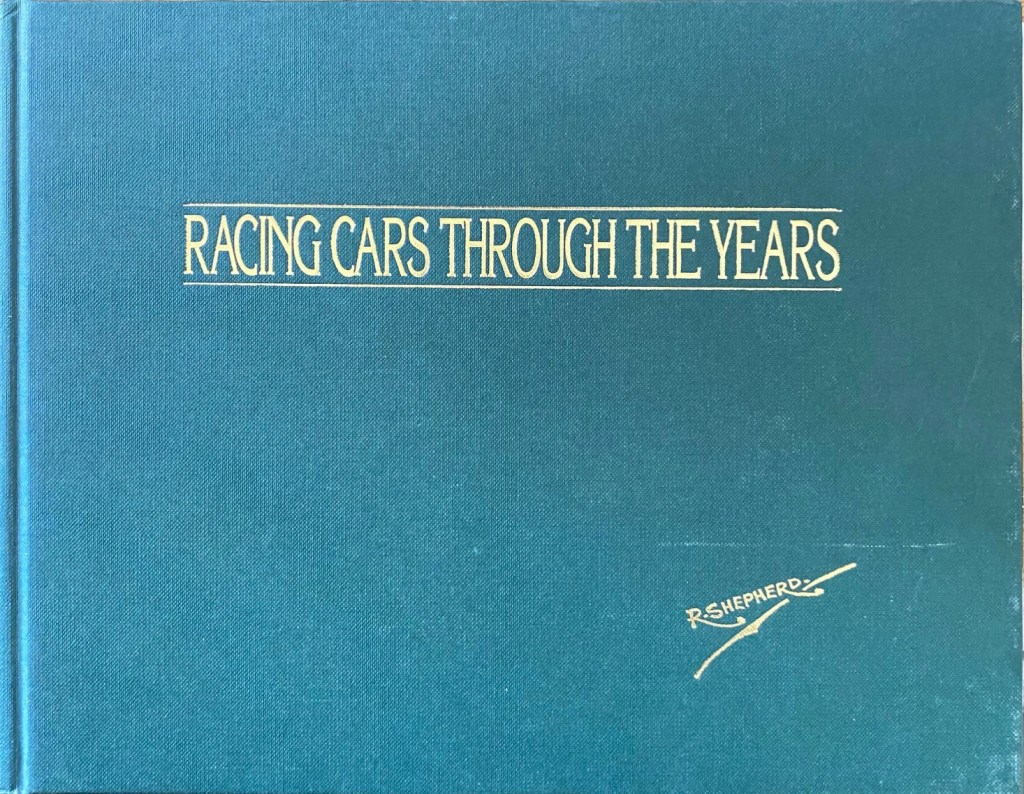
I’ve always been blown away by Shepherd’s work when I have tripped over it. Discussions with Bob King about the Miller led us to his copy of Graham Howard’s book (Racing Cars Through The Years) of Shepherd’s drawings published in 1993. Diana Davison/Gaze made available the Davison Family Collection of Shepherd images to Howard to allow the book to be published.
So little is known about Bob Shepherd we figured it was time to put something on the record more widely available than those lucky enough to have a copy of that marvellous book.
I asked Bob to do a bio, but after re-reading Graeme’s Introduction in the book, he said “How can I top that!”
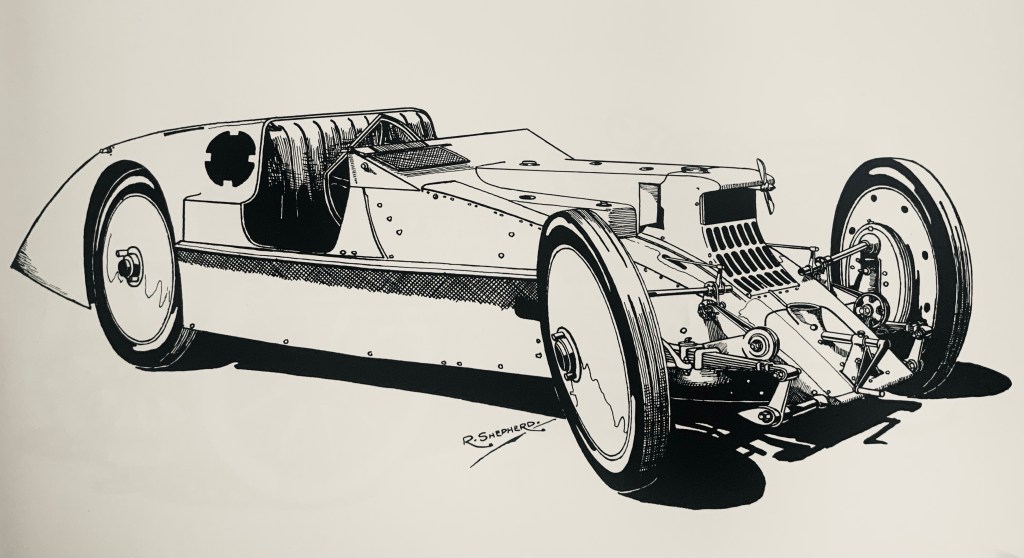
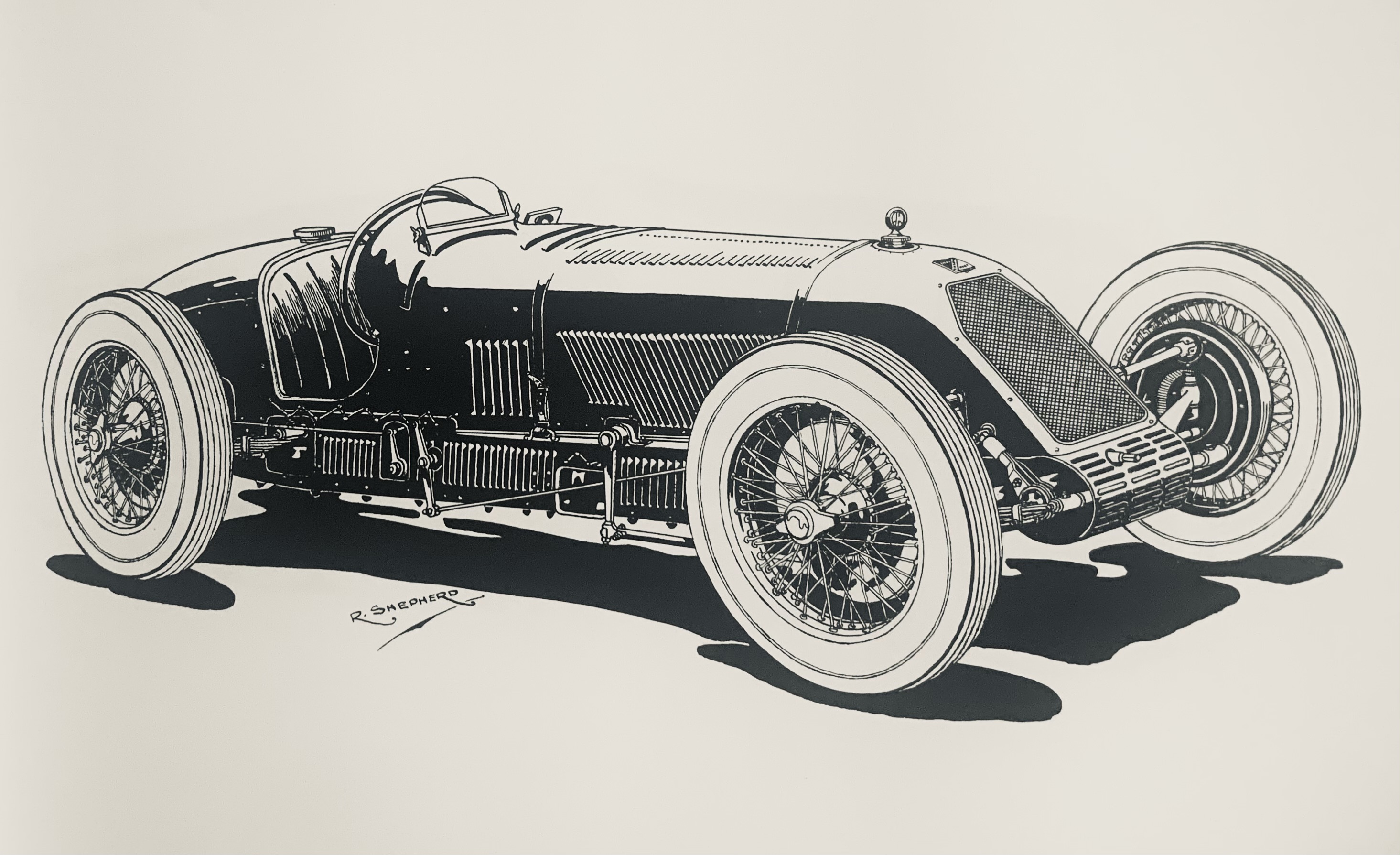
So, here it is, Howard’s words shortened only a smidge, and a small selection of drawings which I think demonstrate Bob’s mastery of his art. The descriptions of each car are exactly as they appear in the book.
MG R-type Midget, 1935. Zoller blown at 24-28lbs, MG’s tiny single-cam four (57mm x 73mm, 746cc) delivered 120bhp – more than the Q-type’s leaf-spring chassis could handle. Hence the all independent 750cc R-type, MG’s first ever pure-racing car, with far-sighted backbone chassis and torsion bar parallelogram wishbone suspension. Drawing appeared in the March 1958 AMS.Bob Shepherd in 1960
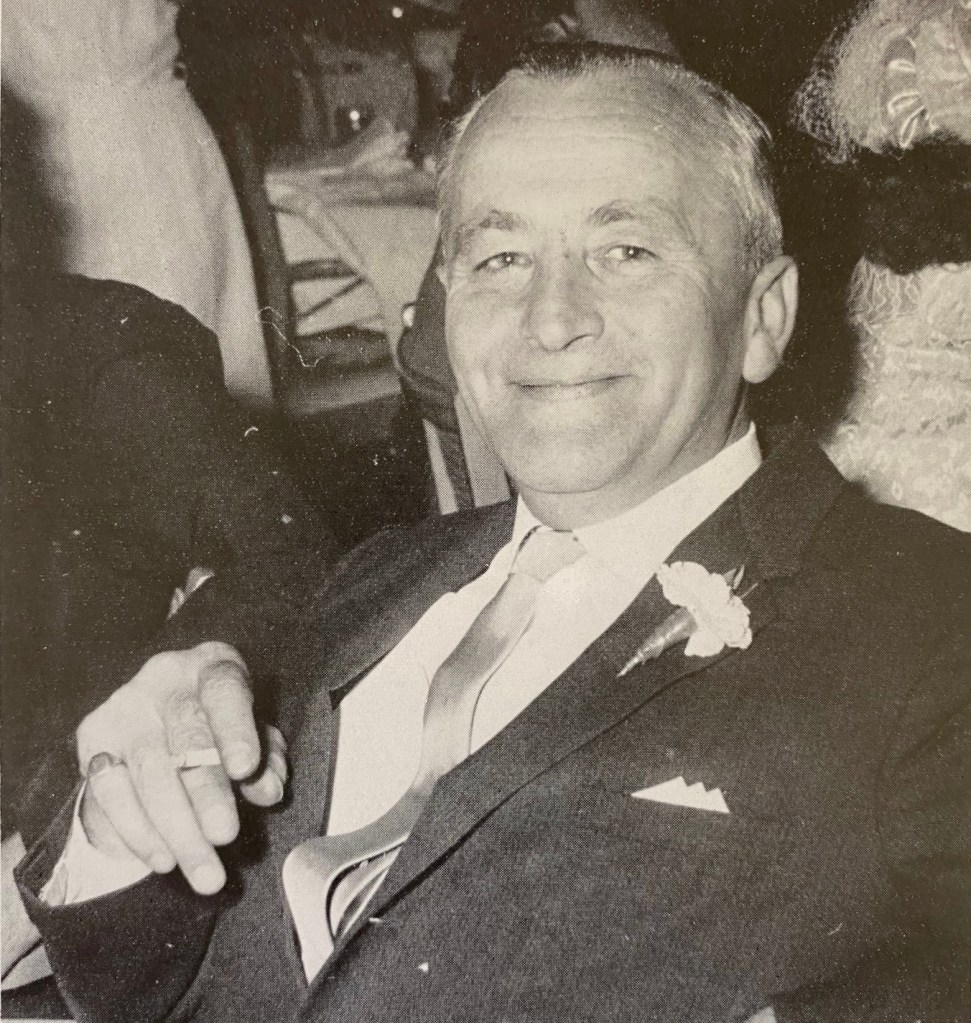
“To countless Australians Bob Shepherd the artist was also Bob Shepherd the historian, primarily because of the series of articles he wrote and illustrated for the magazine Australian Motor Sports, starting in August 1946 and continuing for than 15 years.
With a distinctive combination of knowledge, passion and flair, he carried his audience into the magic world of the racing and high performance cars of Europe and (to a lesser degree) America, broadly from the time of the French Grands Prix through to the end of the 1930s. Month by month, car by car, Shepherd spread before his readers the treasures of the Vintage era and the legendary cars of the 1930s which laid the foundations for post-WW2 motor racing. Over the years he gave AMS readers an education in motoring history unrivalled anywhere in the world.
Not that he confined his energies to Australia. He sent drawings overseas to MotorSport and to the Bugatti Owners Club journal Bugantics and was singled out by British engineer-historian Laurence Pomeroy, in the second edition of his milestone book The Grand Prix Car, for having been particularly helpful in suggesting improvements and corrections to the original work. The significance of this acknowledgement needs to be emphasised – that, while far removed from the Northern hemisphere’s factories, archives and authors, Shepherd was nonetheless the master of details which had eluded even the most eminent of British motoring historians.
Even more remarkable was that Shepherd had no formal training, either as an engineer or as an historian, or for that matter as an artist. The writing and illustrating of his monthly AMS pieces, and the maintenance of his correspondence with enthusiasts around the world, was done from the lounge room of his house in the time he had spare from family life and his job as a stores clerk.
Itala 12-cylinder fwd, 1926. Tested but never raced, these innovative cars would have competed against such classics as the 1.5-litre Delages. They were true single-seaters with fully independent suspension; the supercharged V12 engines were built in 1500cc and 1100cc form, the single central camshaft flanked by its two rows of horizontal valves. Drawing appeared in the August 1952 AMS.
He was born in 1914 in the Sydney suburb of Pagewood, where his father was a hairdresser. He was the oldest of three children; he and his brother Sydney were each dux of Daceyville Primary School in their respective years, and Bob was later also dux of Cleveland Street High School, but university was out of the question. Cars and drawing were his great interest, but work in the motor trade was impossible to find: eventually a family friend heard of a job at Davis Gelatine, and he worked there until his retirement in 1979, holding a staff position from 1964. He married Joan Manhood in 1940, they had three children.
As a schoolboy Shepherd had started writing to overseas car manufacturers for catalogues; these catalogues, his voluminous international correspondence, and dissected copies of The Motor, The Autocar and MotorSport formed the basis of his archives, kept in rows of manila folders in large glass-fronted cupboards.
His drawings were made using the simplest of methods and materials. A pencilled grid, or a pair of dividers, would be used to transfer dimensions and proportions from the chosen source photograph onto a sheet of his favourite cartridge paper, and the drawing would start in HB pencil, which would be rubbed out after the final version had been inked-in using mapping pens. All his work was freehand – there were no rulers or artificial aids like French curves. He did most of his drawings on Sundays after church, working for four to five hours, resting his paper on a wooden board and taking advantage of natural light. It would usually need two Sundays to produce a drawing; those for AMS were sent to Melbourne (always by registered mail) in cardboard cylinders accompanied by the text for his article which – like his letters – would be written in copperplate script, blue ink on unlined paper.
He was not comfortable drawing vehicles in action, or drawing people, and he showed no interest in drawing aircraft or motorcycles. Almost all his work was black and white: AMS itself was not printed in colour. In some drawings he used a wash, rather than hatching, to provide shading: when he did use colour, for example for private commissions, it was with complete success. His black box of watercolour pigments, bought when he was 12, is still in use by one of his grandchildren.
Bob Shepherd’s colour drawing of a 1922 Bugatti Type 30 (B King Collection)Delage 2-litre V12, 1923-1925. After two relatively unsuccessful years as unsupercharged cars, the V12s were supercharged for the 1925 season (as illustrated) and finished 1-2 in the French Grand Prix. The four-camshaft engines (51.3mm x 80mm, 1984cc), unusual in having the exhausts in the centre of the Vee, gave about 190bhp in supercharged form. This drawing appeared in the June 1954 AMS.
As well as his work for AMS, he provided illustrations for many club magazines and illustrated ‘Vintage Types’ for the Vintage Sports Car Club of Australia, he was one of its founding members. His first published drawings may have been the series ‘Australia’s Best Known Speed Cars’ in Motor in Australia and Flying in 1939. He was sometimes asked to suggest shapes for rebuilds or of new racing cars. As a boy he had watched racing on the banked concrete saucer at Maroubra but went to few race meetings in later years. More surprisingly, he never owned a car (although he had part shares in several), seldom drove, and did not hold a licence, he never travelled outside New South Wales.
Yet he was in no way reclusive or narrow in his interests. While a reluctant partygoer, he was a most entertaining teller of stories, had an astonishingly broad general knowledge, was a keen reader, loved opera (he did his drawings with ABC radio playing) and was well enough known as a fisherman for there to be an unofficial ‘Shepherd’s Rock’ at nearby Kurnell.
There was little to single out the family house in Maroubra Bay Road. Shepherd took his research seriously – he shared in some ferocious debates in his correspondence columns – but there was absolutely no pretence; there was nothing in his manner to hint that here was one of the foremost authorities on motoring history. Joan and Bob Shepherd made everyone most welcome, whether they were famous names or awed tram-travelling young admirers (for which all those young admirers remain very grateful).
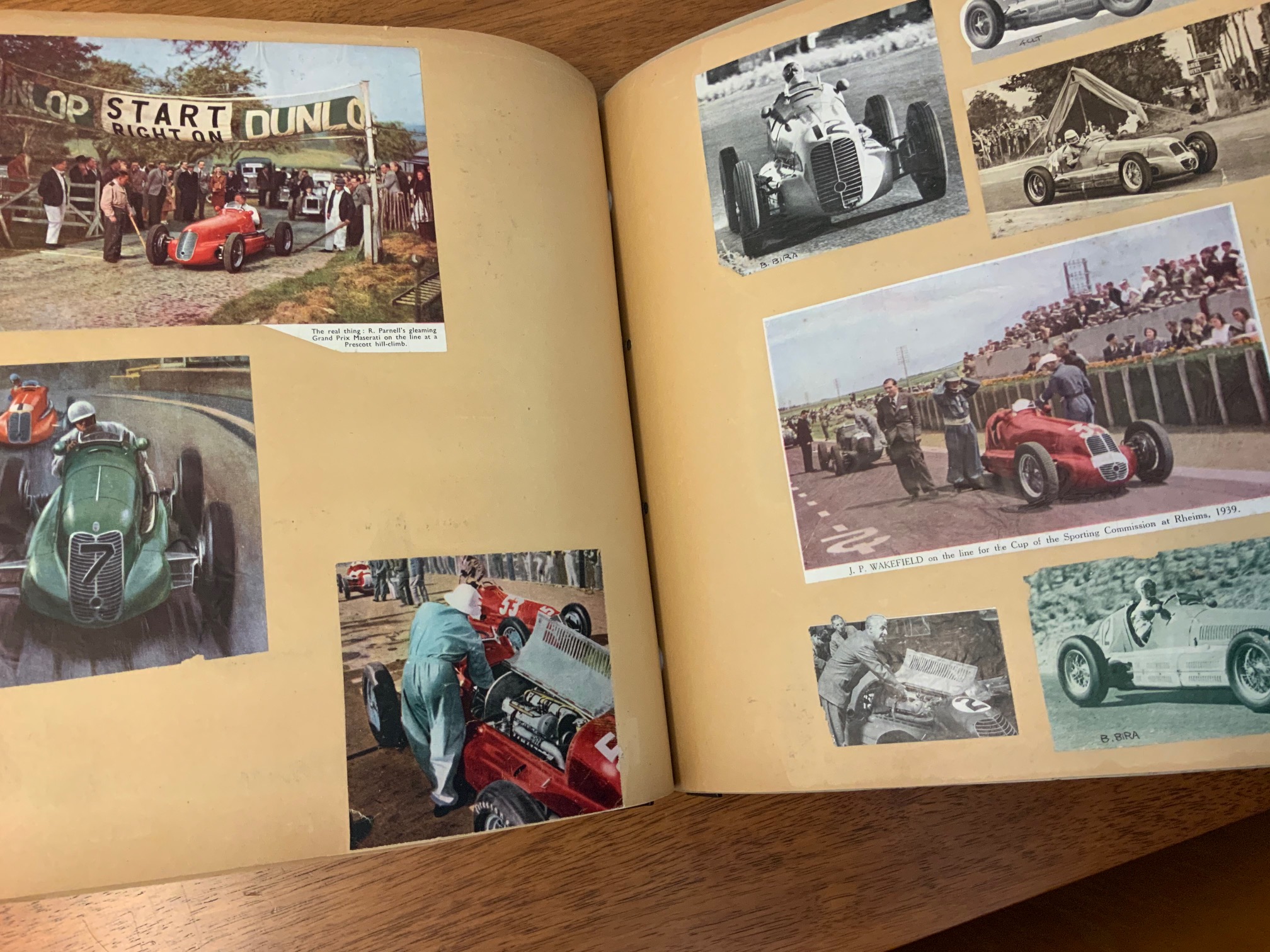
Voisin Grand Prix, 1923. Gabriel Voisin was a pioneer French aviator and aircraft manufacturer, as well as an innovative car maker. His cars for the 1923 French GP had only around 75hp from their 2-litre six-cylinder Knight double-sleeve-valve engines, but had aerodynamic body work and disc covered wire wheels and a true monocoque chassis of plywood and sheet metal. The drawing appeared in the September 1956 AMS.This is a spread from Bob Shepherd’s Maserati scrap-book, a simple but effective way of archiving material, I guess we all have one, or many! (D Zeunert Collection)
Like many remarkable people, Bob Shepherd was a paradox. He almost never drove a Vintage car, seldom went to the Vintage club meetings, yet was – without realising it – the Australian Vintage movement’s finest publicist. He never travelled outside Australia, never saw any of his beloved cars in their heyday, yet he knew them in minute detail and could picture them with elegant clarity. He had rare gifts yet remained a modest and gentle man. With this book we remember that man.”
Graham Howard, Sydney, 1993.
Talbot-Darracq 1.5-litre, 1926 (above). Continuing Darracq’s pre-1914 racing tradition, the company’s cars for the 1926 1.5-litre formula were 140bhp supercharged twin-cam straight-eights (56mm x 75.5mm, 1488cc). Engine and gearbox were slightly offset to the drivers left. A much modified version of one of these cars (still in 2021) survives in Australia, imported after WW2. The drawing appeared in the October 1951 AMS.
Oops, nearly forgot the Miller 122 at this pieces outset. Miller, 1923. Influenced by Fiat, Harry Miller used two valves per cylinder in hemispherical chambers when he scaled down his 183-cubic inch straight-eight for the 122-inch (2-litre) limit applying from 1923, obtaining an unrivalled 120bhp. Supercharged from 1924, and reduced to 91c.i. from 1926, these engines won Indianapolis in 1923, 1926, 1928 and 1929. That drawing appeared in the April 1957 AMS.
Credits…
‘Racing Cars Through The Years’ Bob Shepherd and Graeme Howard, Bob King Collection, David Zenuert Collection
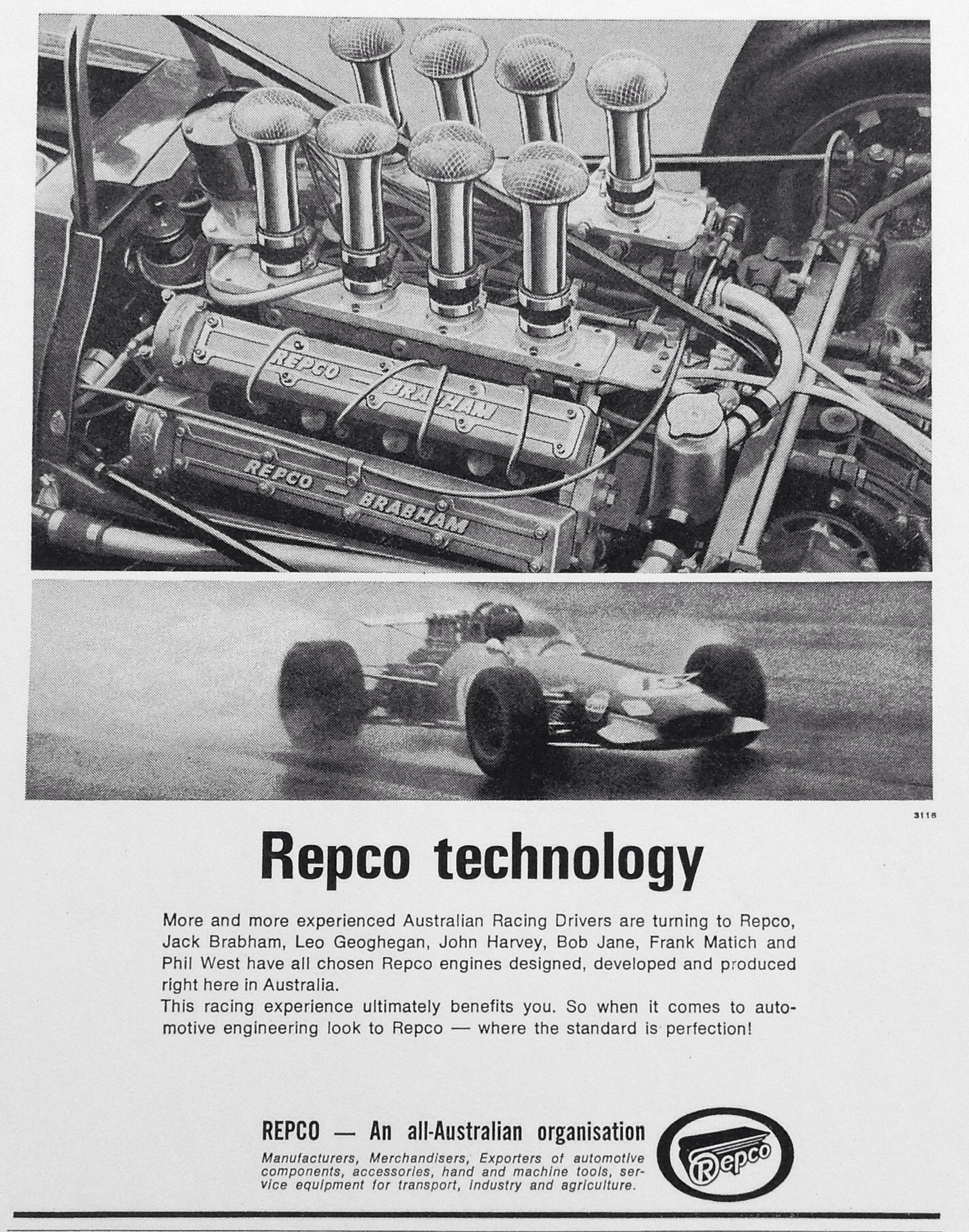
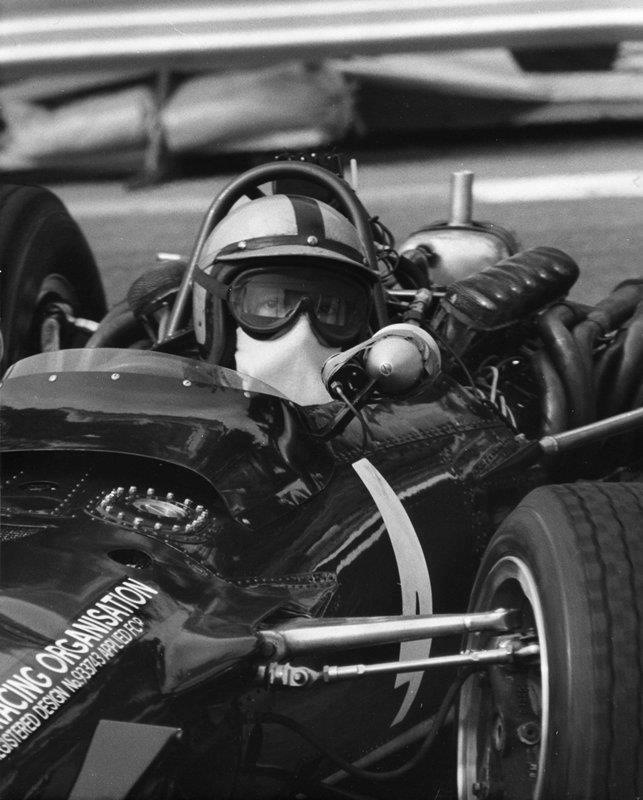
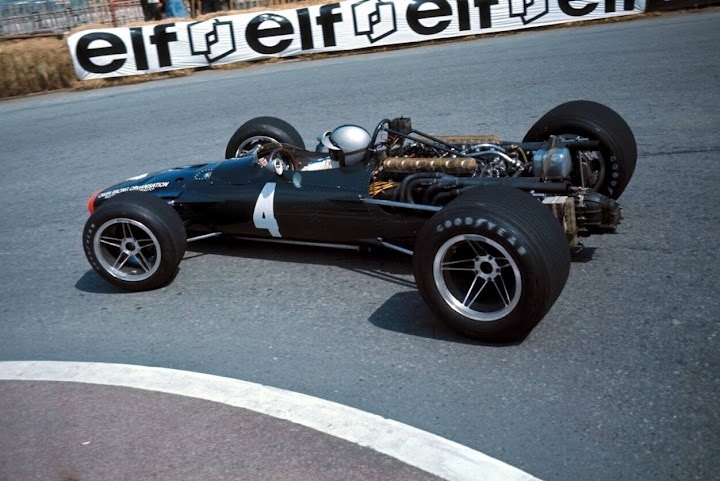
I think anything Repco Brabham is a thing of functional and engineering beauty, simplicity and performance…while admitting hopeless bias!
Their F1 3-litre, DOHC, four-valve 860 V8 engine didn’t enjoy the same success in 1968 as its SOHC, two-valve 620 and 740 brothers had in 1966/7 . Don’t forget though, in 4.2-litre Indy, and 4.8/5-litre sportscar form, the 760 (same DOHC, four-valve heads as the 860 but with the long 700 block) delivered the goods for Peter Revson (Brabham BT25 at Indy Raceway Park) and Frank Matich (Matich SR4 in Oz Sportscar Champ) in 1969. The Repco Holden F5000 V8 engine which followed was an international race-winner too.
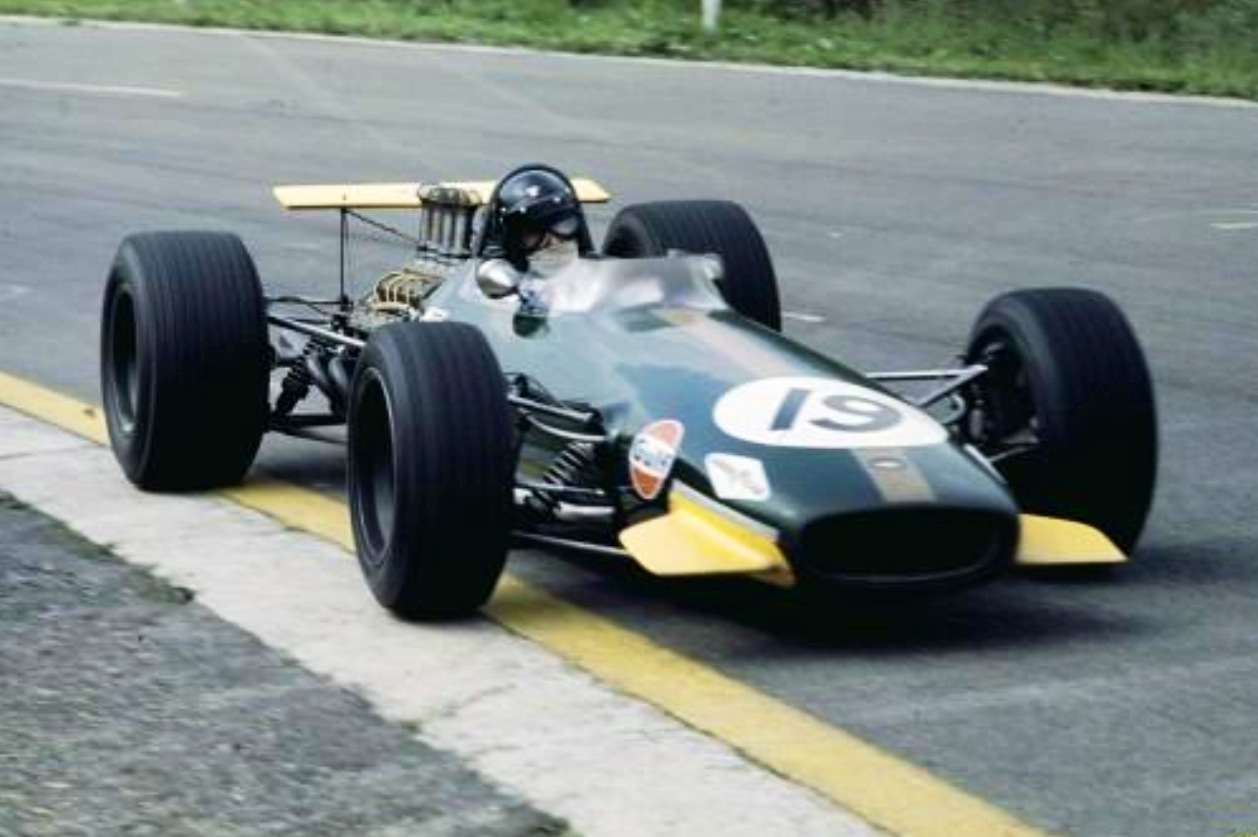
It’s the 860 depicted in the ad above, the shot is Jochen Rindt during the Belgian GP weekend on 9 June 1968, his Brabham BT26 Repco was DNF engine, the race was won by Bruce McLaren’s McLaren M7A Ford.
Jochen’s Brabham BT26 Repco in the dry earlier in the Belgian GP weekend at Spa. Q17 and DNF engine, Jack Q18 and out with throttle slide problems. Bruce McLaren won a famous win in his McLaren M7A Ford (unattributed)
Jochen made these cars sing, he popped the BT26 on pole twice, on the front row three times. With development over the ‘68/9 Australian summer the engine was potentially a winner in ’69. I’m not saying the world title, but there is no reason 400bhp of reliable 860 Series Repco couldn’t have delivered what 405bhp of Cosworth DFV did for Ickx in the Brabham BT26A Ford in 1969; wins on the Nurburgring and at Mosport.
IF ‘yer Aunty had balls she’d be ‘yer Uncle of course, but it is the great intriguing Repco mighta-been had the boys from Maidstone done one final F1 season…
Credit…
Michael Gasking Collection, MotorSport
Tailpiece…
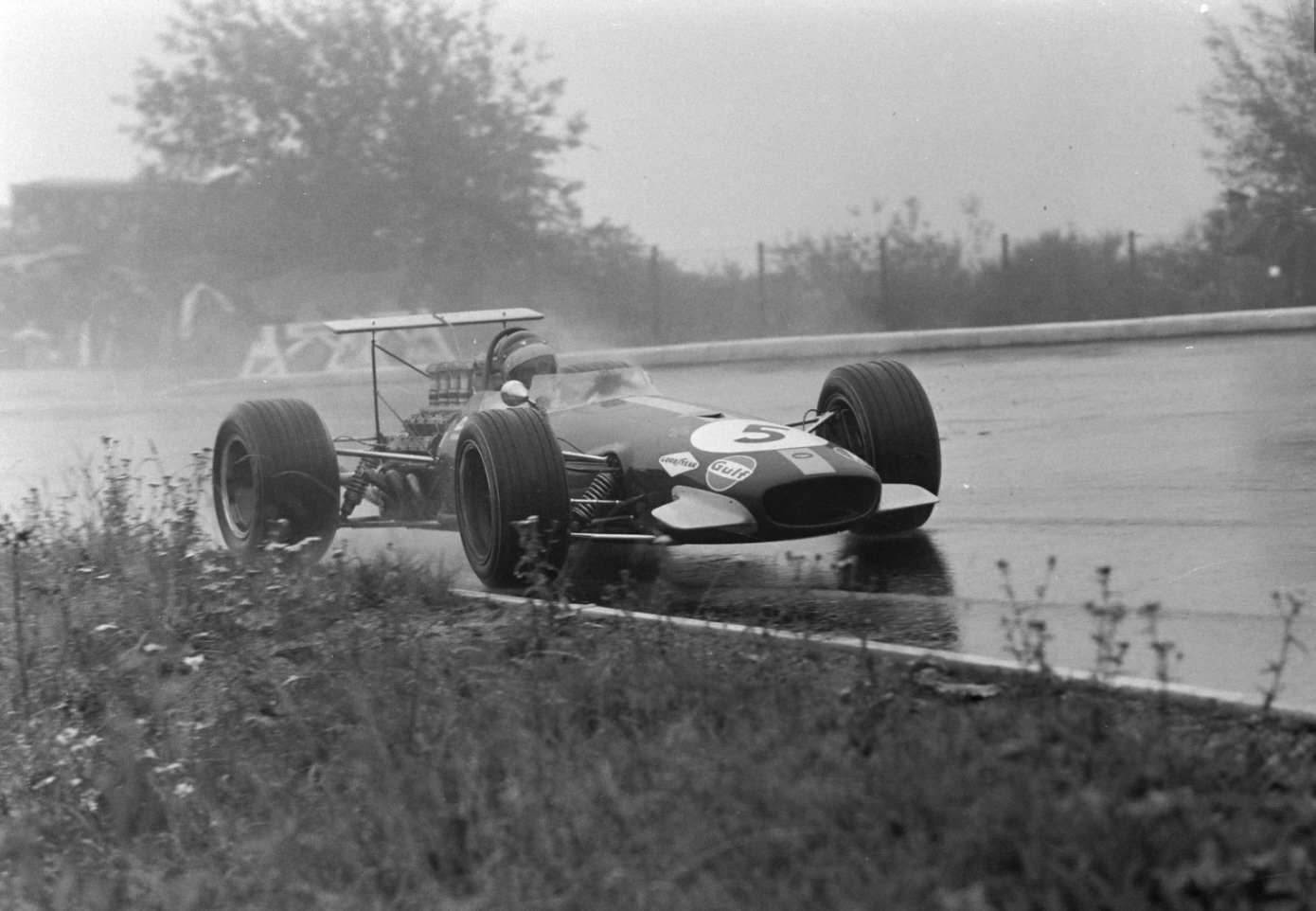
Jochen Rindt in the Eifel Mountains gloom in 1968, he started from grid-slot three and finished in third place behind Jackie Stewart’s Matra MS10 Ford and Graham Hill’s Lotus 49 Ford. The great Austrian was over four minutes adrift of Stewart mind you, but it was still a morale boosting result for the Brabham Racing Organisation and Repco Brabham Engines.
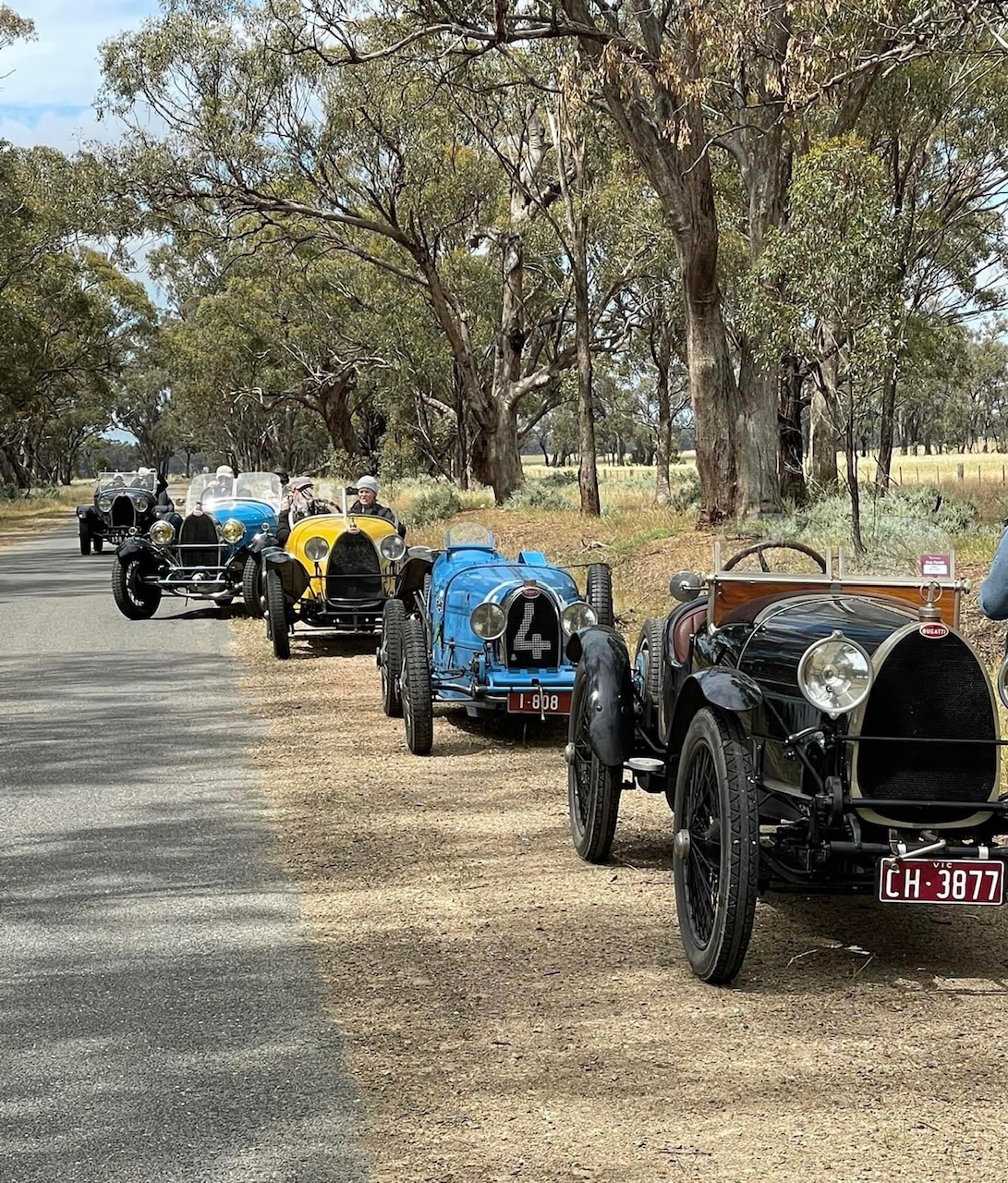
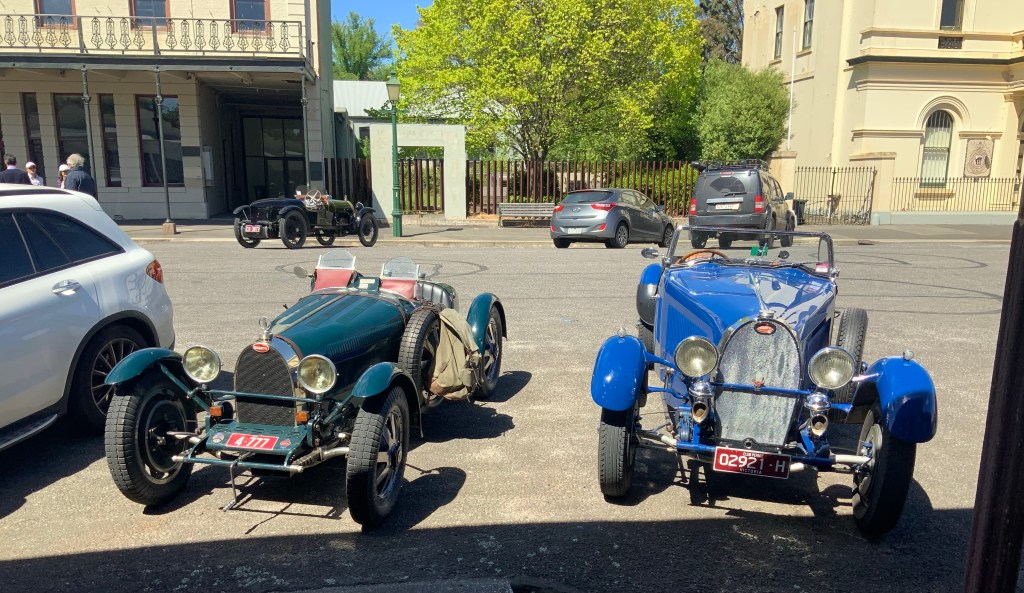
From the front, Types 30, 37A, 23 and 44 by two (G Murdoch)
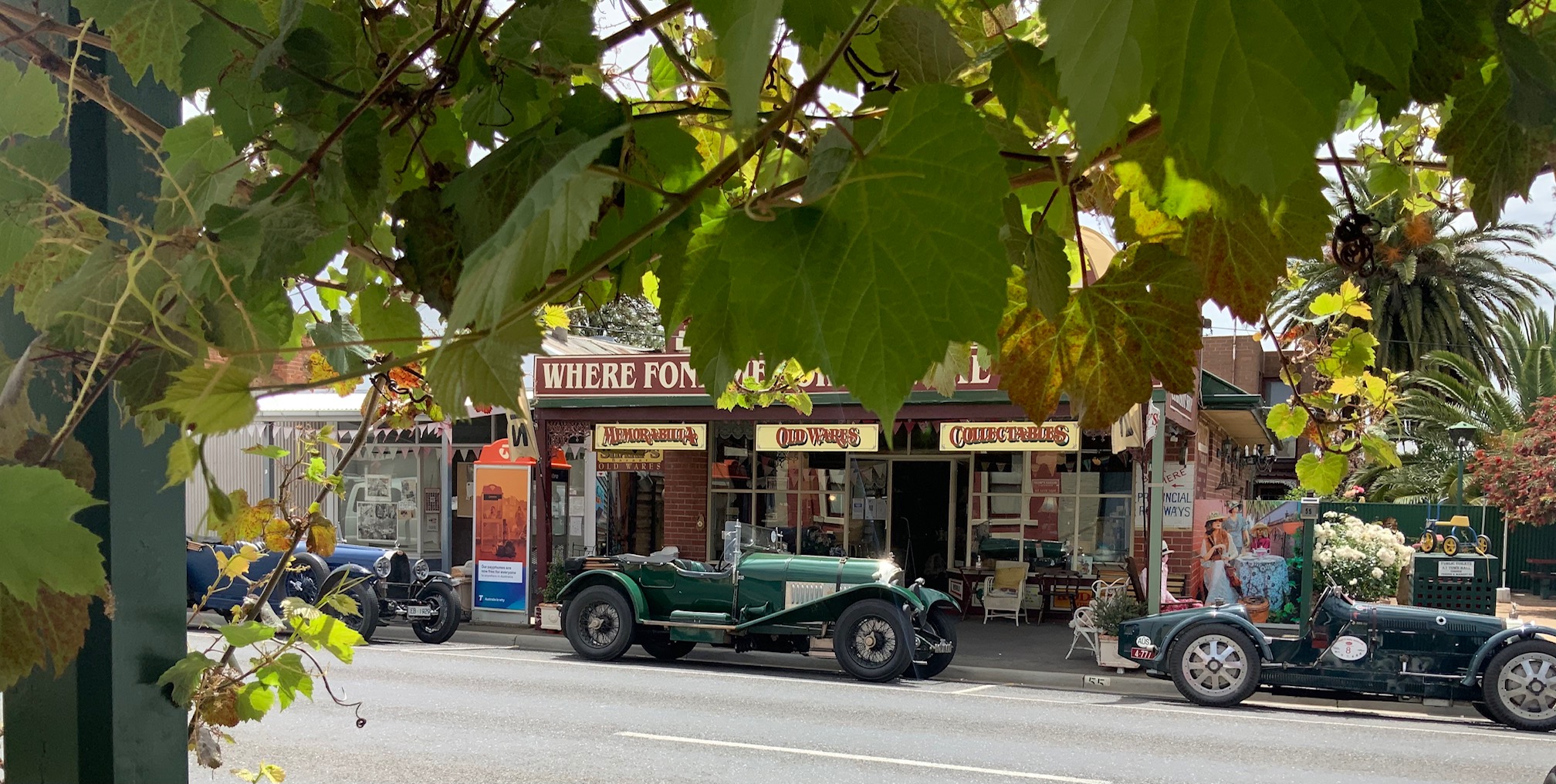
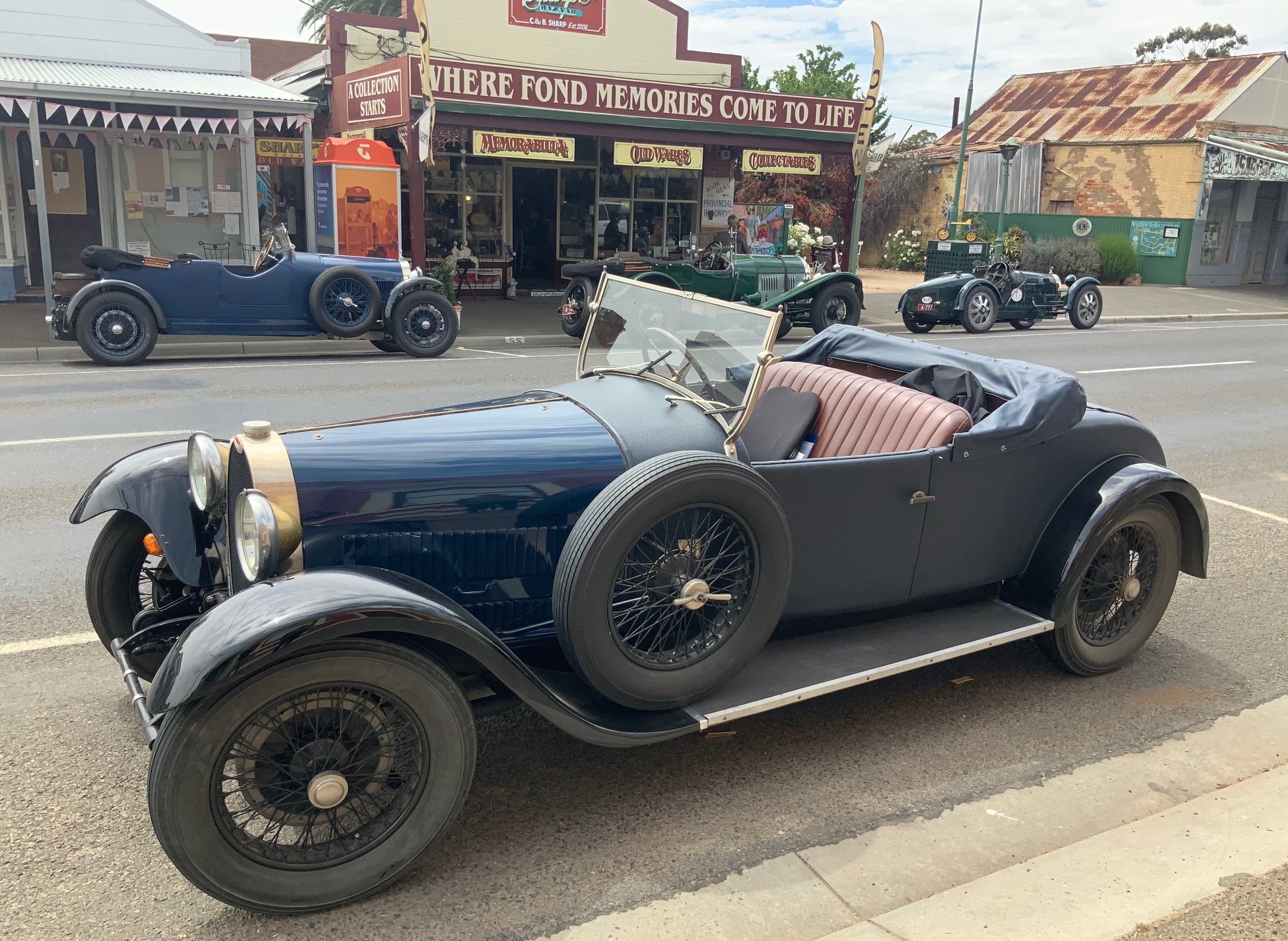
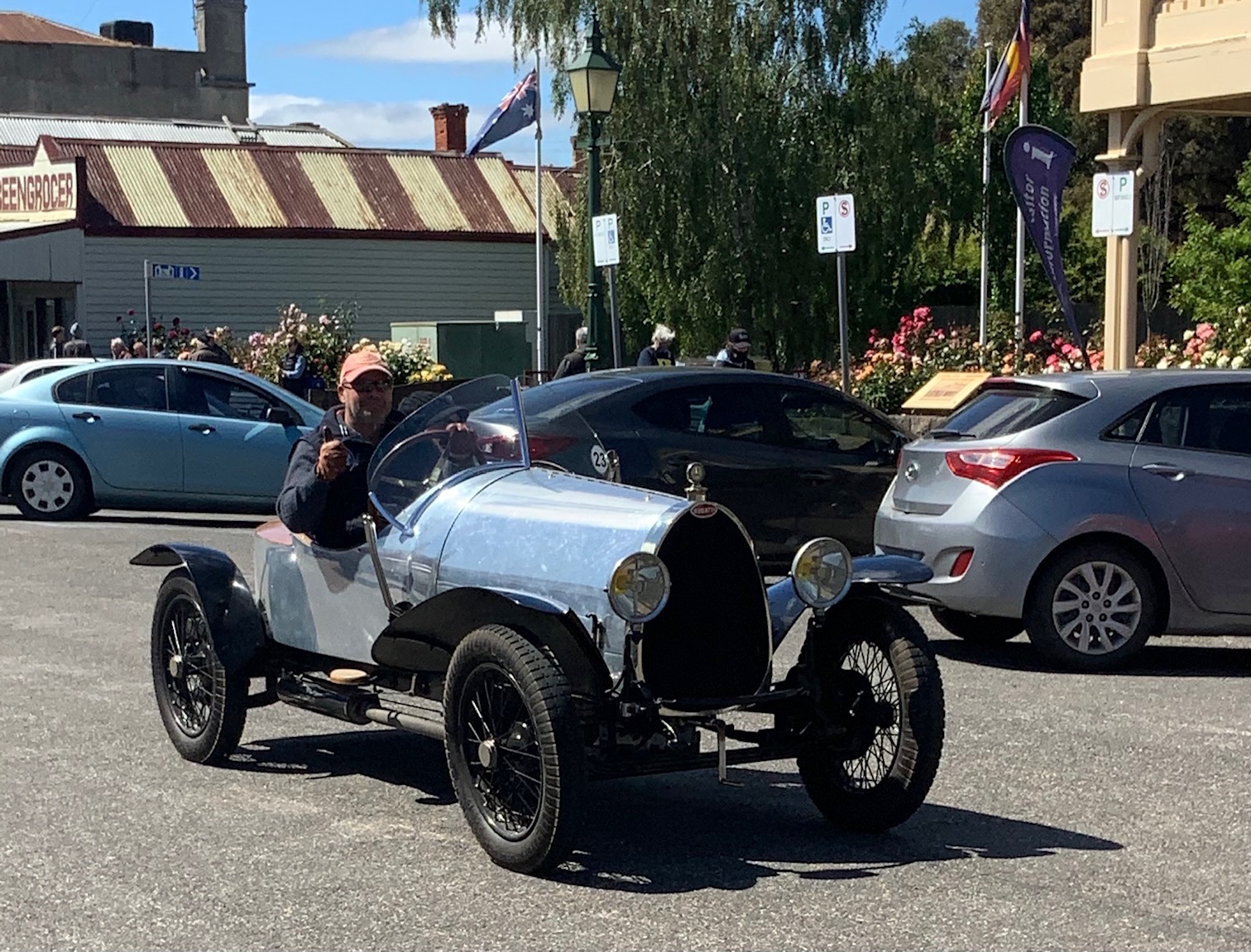
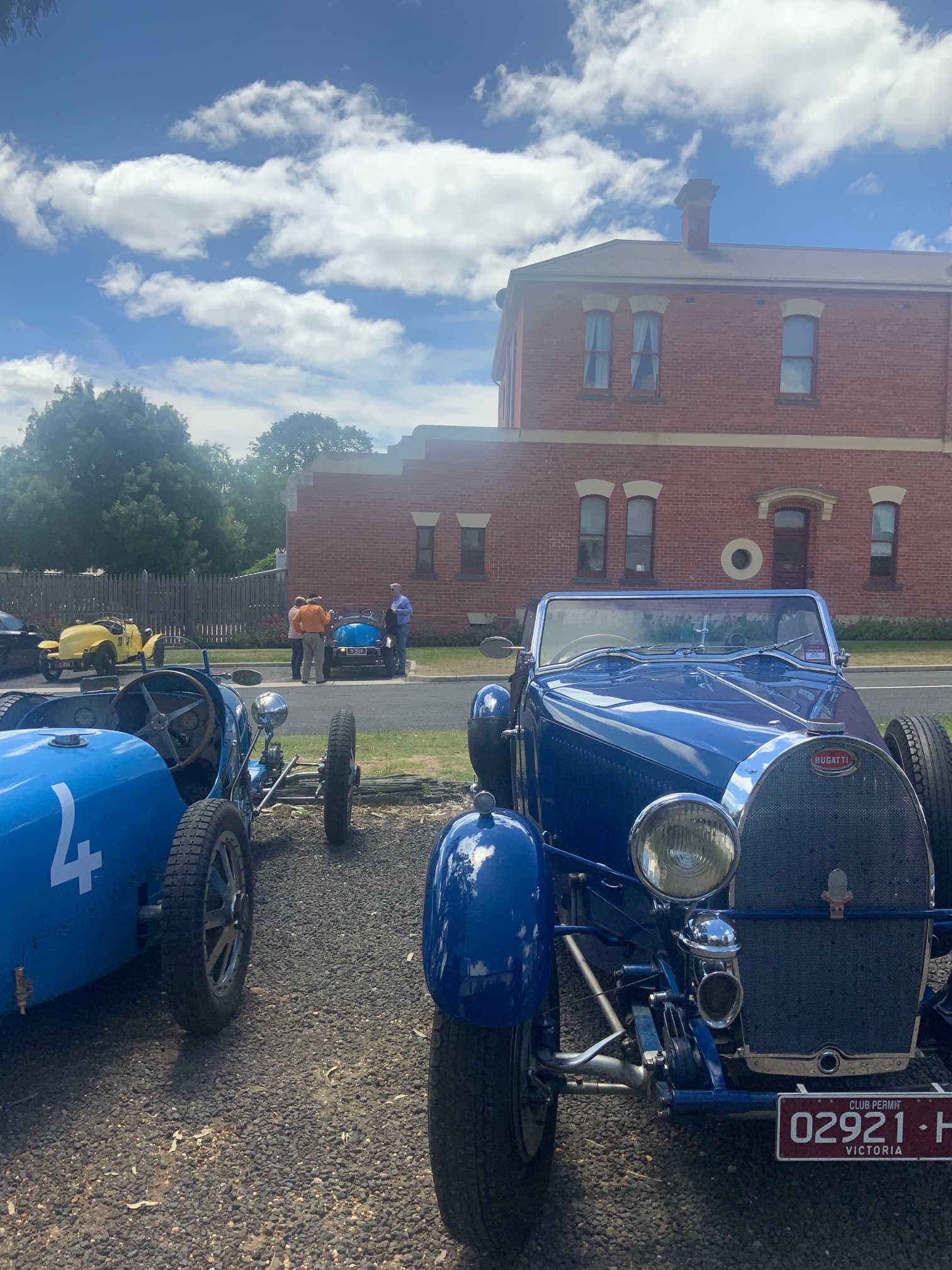
Castlemaine, a Victorian Gold Rush town 120km to Melbourne’s north-west was home to the Victorian members of the Bugatti Owners Club of Australia, Spring Rally.
Event El Supremo Roger Cameron made a great choice of event base, there are some superb roads in the area. The town itself has some wonderful, majestic buildings as befits its status one of the boom-towns within the Golden Triangle, the area bounded by Avoca-Castlemaine-Wedderburn. 1,898,391kg of gold was mined in Victoria between 1851-1896, a few bucks-worth in today’s values.
More than a few examples of early Australian automotive exotica was acquired with gold-wealth, not least Bugattis.
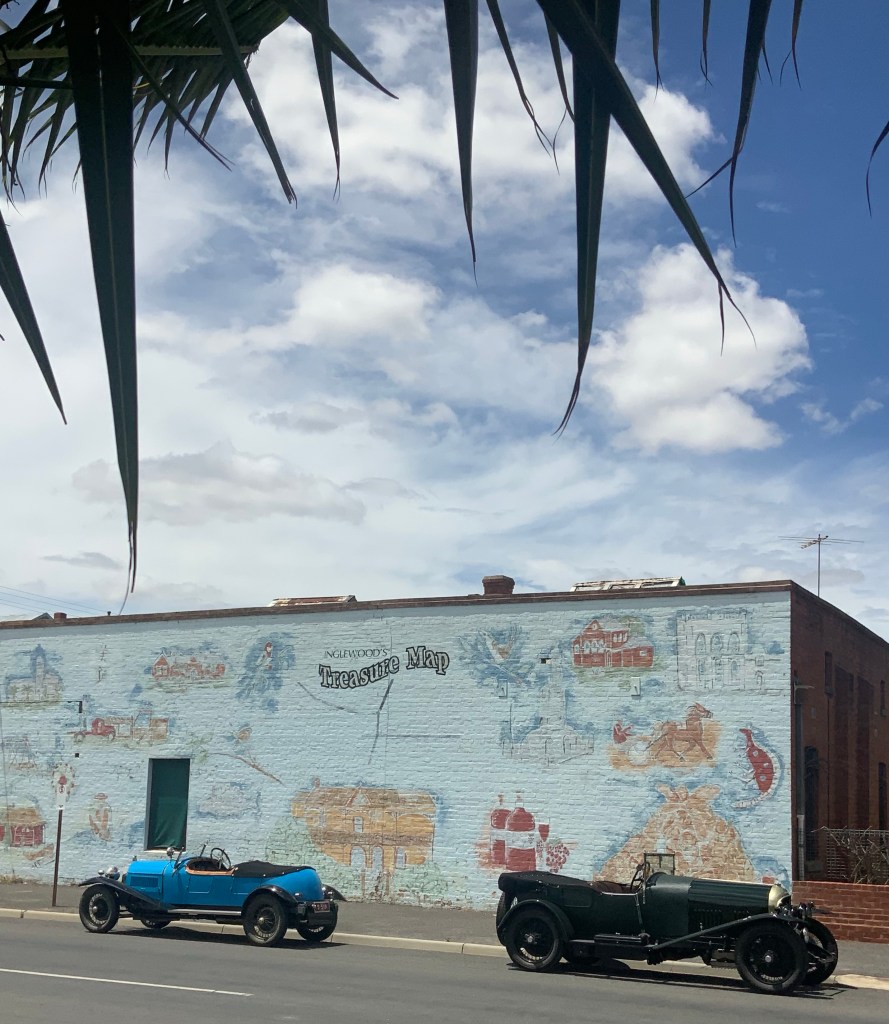
Inglewood. Jim Thompson’s ex-Molina Brescia in the foreground, over the road, Type 44, 3/5-litre Bentley and T35B Pursang at right (M Bisset)Likely Lads: Messrs, Stanley, Thompson, Berryman at rear, and Montgomery, at Inglewood (M Bisset)Roger Cameron aboard his Type 44 on Saturday morning, by mid-afternoon the look of delight had changed to one of concern with maladies which transpired to be a broken brake-shoe spring (M Bisset)
Given the People’s Republic of Victoria’s title as the most Covid 19 locked-up-joint-on-the-planet, it was no surprise to see plenty of Victorian clubbies celebrate freedoms recently returned to us by the talented ruling duumvirate of Scotty-Bro and The Allstars, and Dan The Dastardly. Victoria’s weather can be capricious, but sunny, blue skies prevailed for most of the three days. In short, the planets were aligned for a wonderful weekend of motoring on great roads, albeit many of them are sadly in need of decent maintenance.
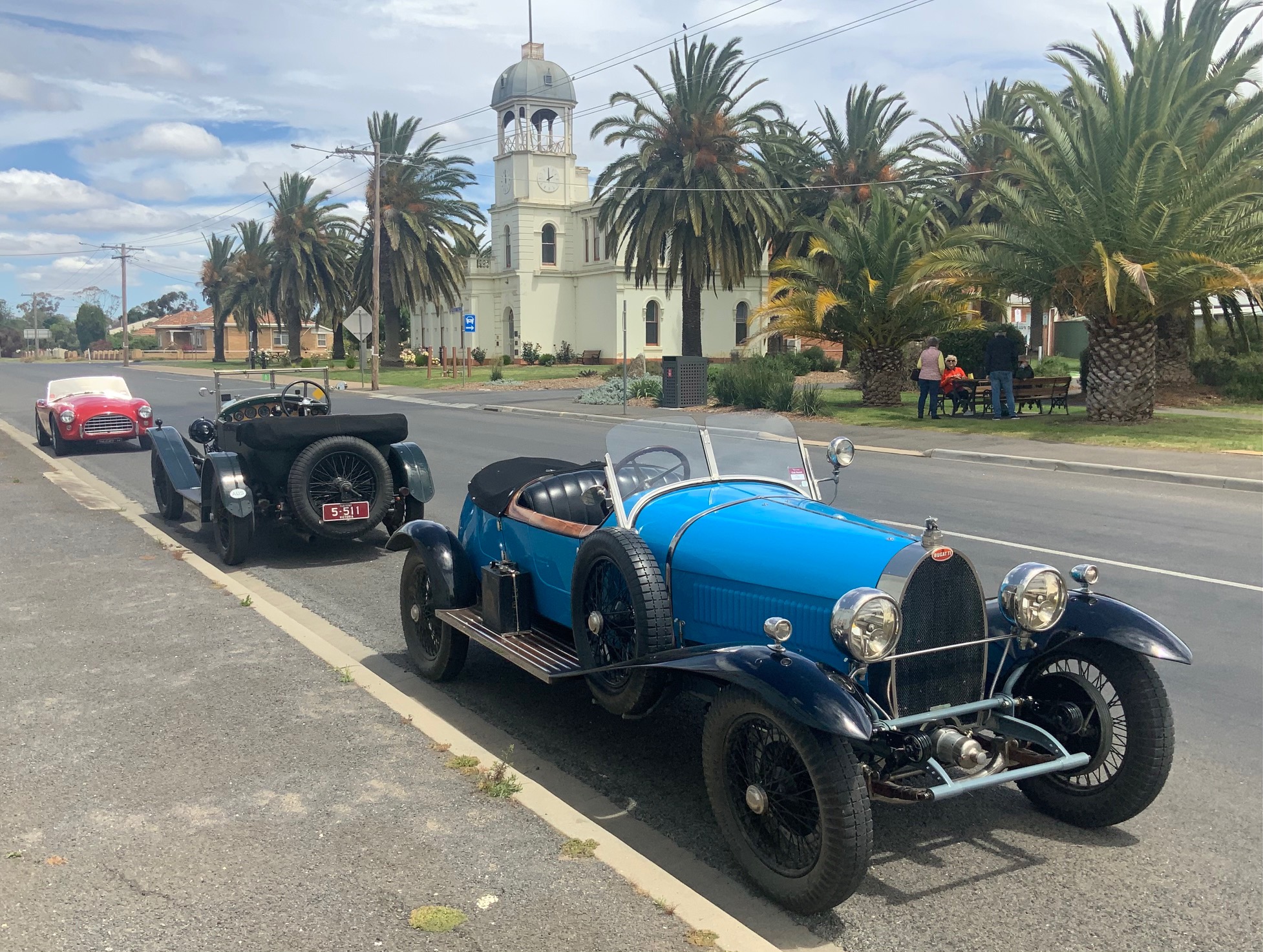
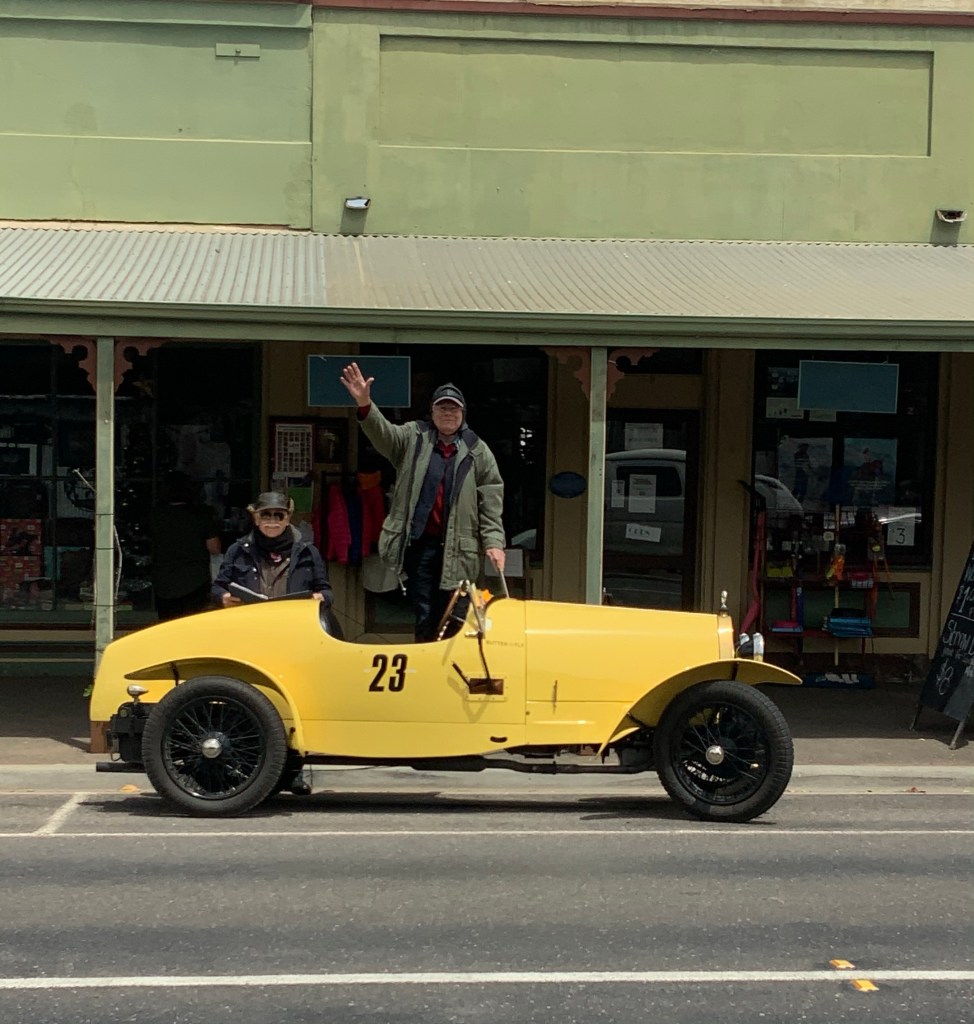
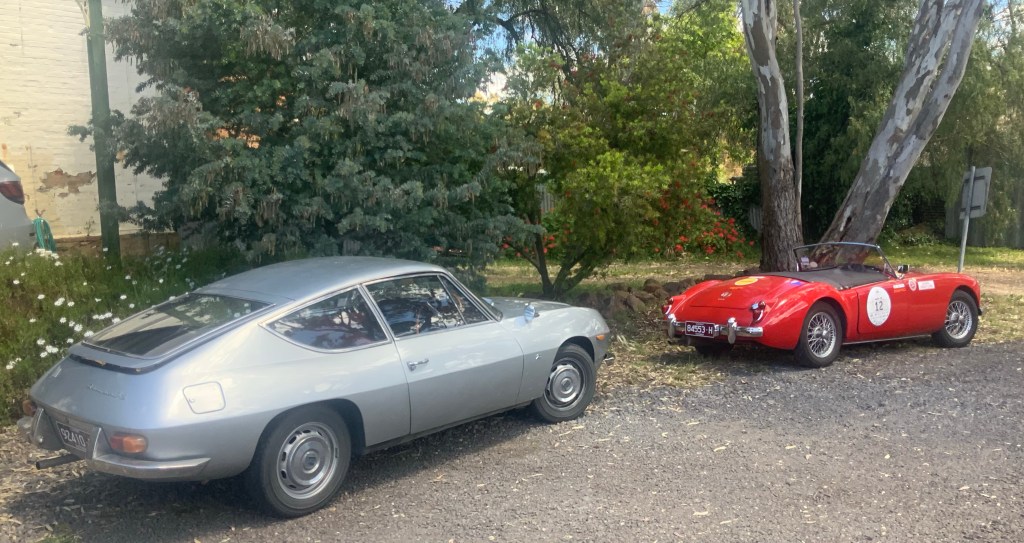
The line-up included three Brescia Type 23s, two Grand Prix cars – Types 37A and 35B Pursang – and an interesting mix of two and three-litre eight-cylinder un-supercharged tourers; Types 30 and 44. John Shellard’s Type 57 two-seater Corsica replica body machine is impressive – straight-eight 3-litre DOHC non-supercharged – a car I don’t recall seeing before. Co-stars comprised an interesting mix including two 5-litre’ised 3-litre Bentleys, a Lancia Fulvia 1.3S Zagato, MGA, Porsche 992/911 and my buddy, Bob King’s AC Ace-Bristol.
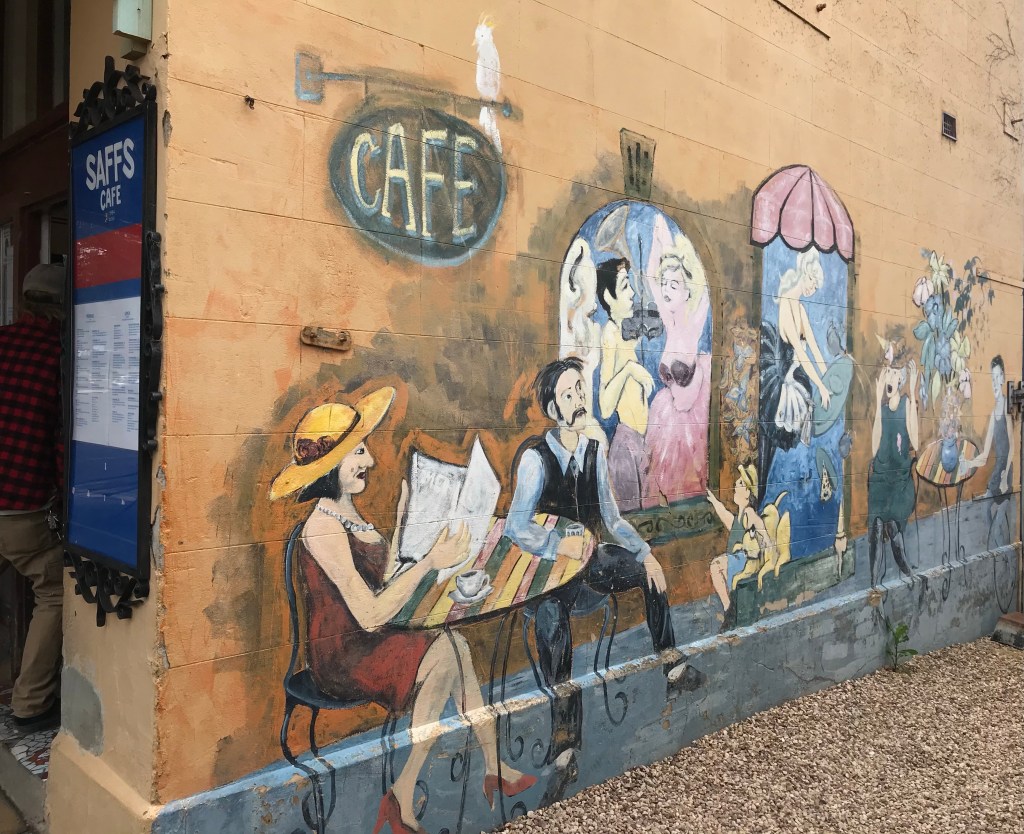
Avoca Hotel vista with the Shellard T57, and Murdoch and Thompson Brescias up front (M Bisset)Saffs in Castlemaine, very good too (M Bisset)Inglewood. Anderson T44, Montgomery Bentley and Schudmak T35B (M Bisset)
Starting point was the Woodlands Historic Park at Oaklands Junction (adjoining Melbourne Airport at Tullamarine) and then to Lancefield via Romsey.
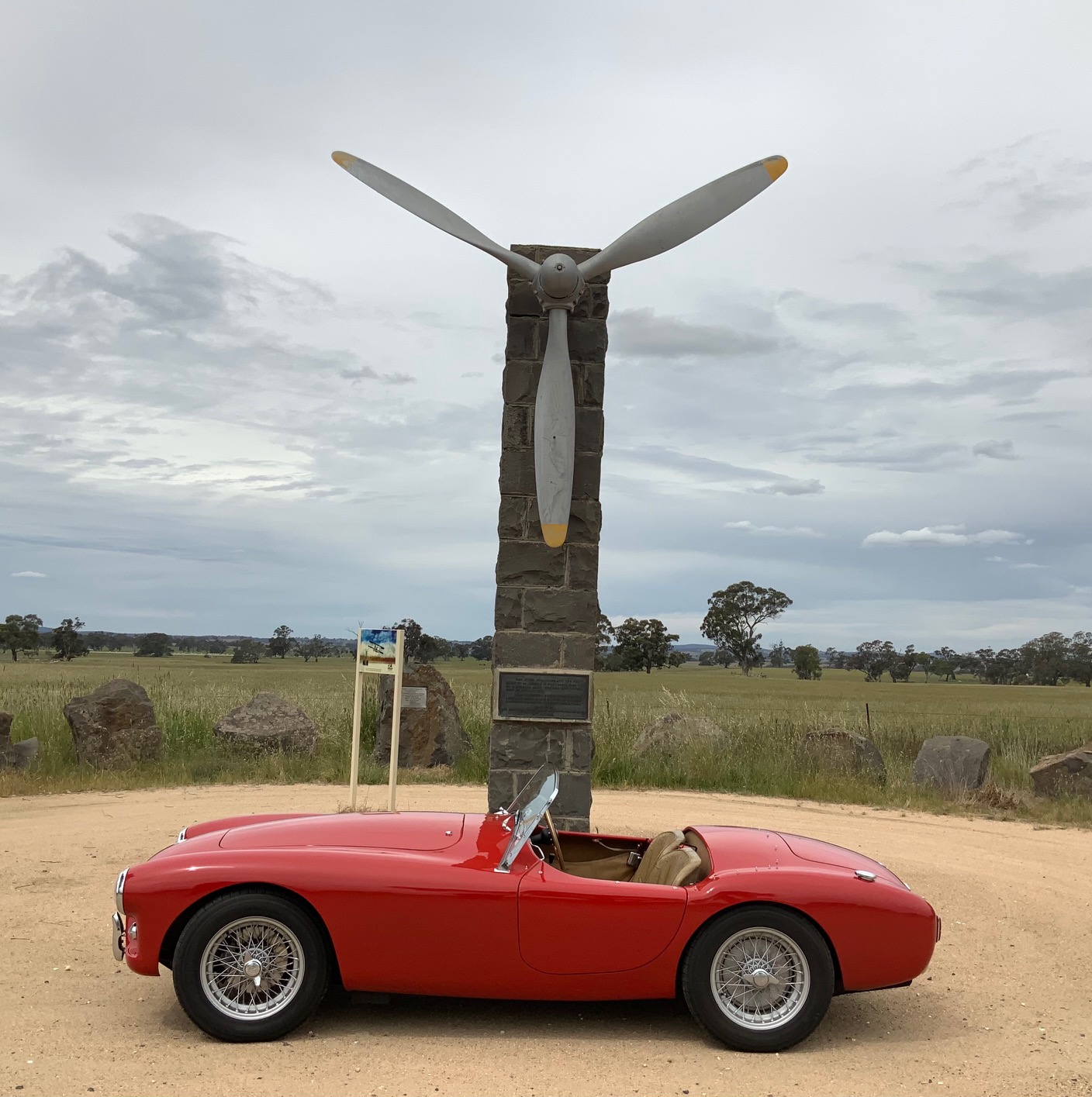
The post-lunch session was some magnificent roads from Lancefield to Castlemaine. Immediately after clearing Lancefield we headed north west on the Burke and Wills Track, which is great but gets rutted and shitful towards Mia Mia. Then a respectful stop at Spring Plains, the site of the first flight – seven metres – by John Duigan aboard an Australian designed and built aeroplane on July 16,1910. Click here for more; John and Reginald Duigan, Australian aviation pioneers (monash.edu.au)
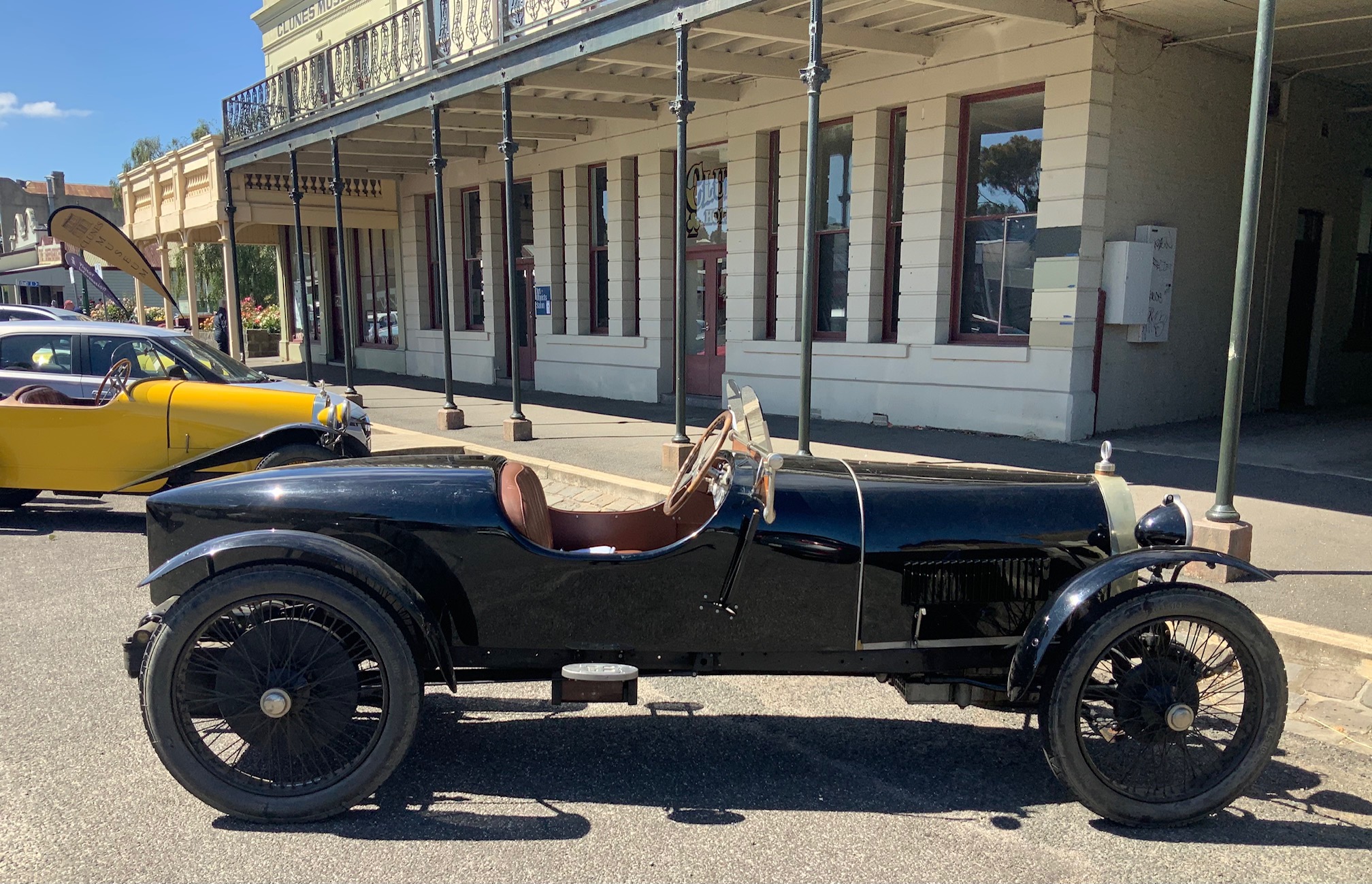
Electrical and motor engineer, John Duigan mid-flight on the family farm, Spring Plains, Mia Mia circa 1910. Self constructed – of wood, metal and Dunlop rubber coated cotton fabric – pusher type single-seat biplane with a moving foreplane elevator and light undercarriage. Power by a JE Tilley (Melbourne) 25hp vertical four stroke, four cylinder OHV engine, with drive to the four-blade 2.6-metre prop by chain. 9.27-metres long, wingspan 7.47-metres, weight including pilot 280kg, maximum speed 40mph in sustained flights at heights of 30-metres (Museums Victoria)Cameron T44 detail. Nice (M Bisset)The only one owner early Bugatti in the world? The late Dr Noel Murdoch famously did his 1920s rounds at his country, Yarra Junction practice in a Fiat 501 and this T44 – which is still a treasured family member nearly a century later. That’s the Anderson T44 opposite (M Bisset)
Then on to Redesdale, Sutton Grange, Faraday and into Castlemaine via Chewton on its eastern outskirts.
French mistresses are notoriously fickle, high maintenance critters so it was no surprise that one or two of the breed required the care of tender, loving, expert hands before dinner.
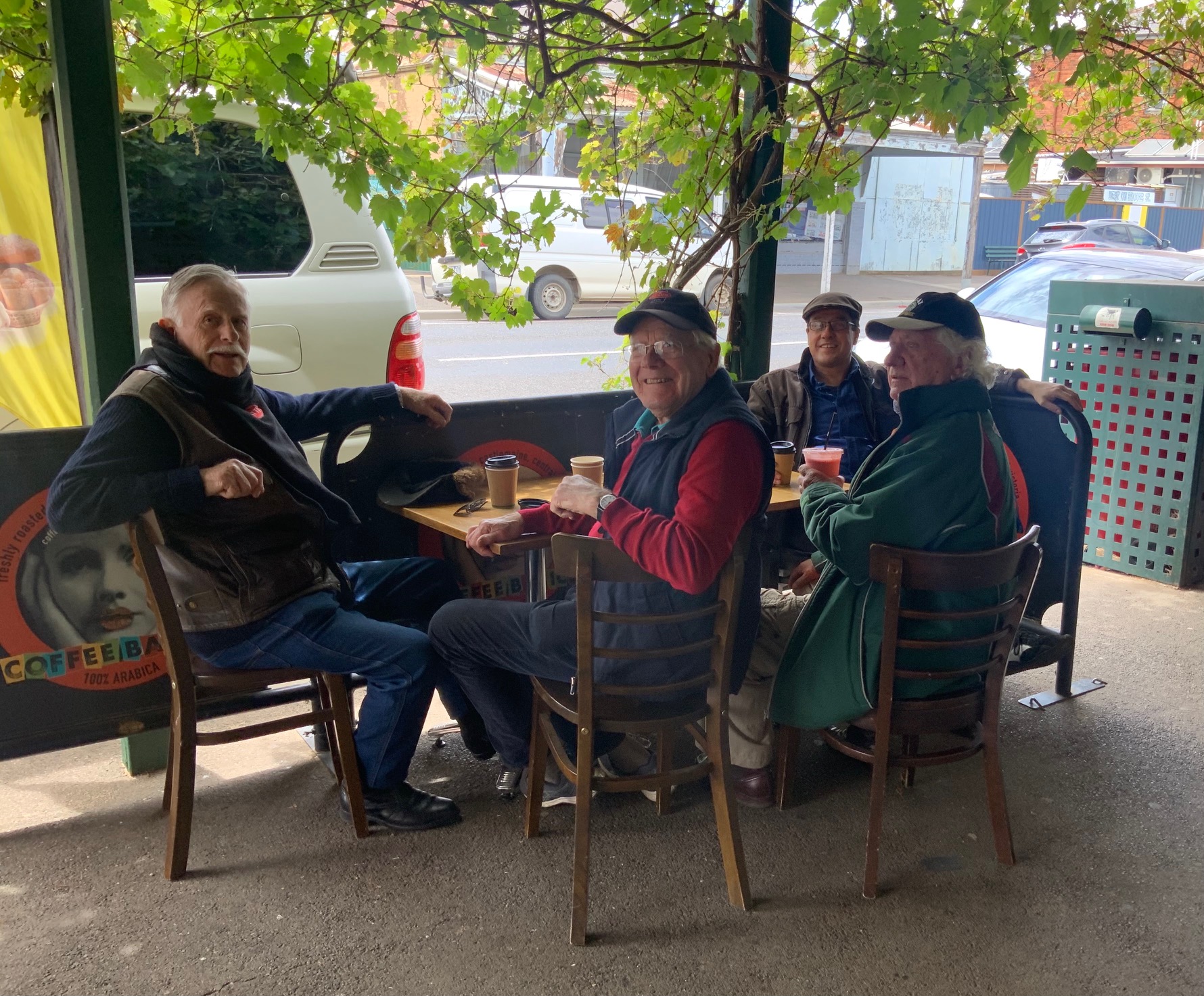
Grant Cowie’s Up The Creek (ya gotta hand it to a Kiwi with a sense of humour) enterprise – one of Australia’s acknowledged fettlers of fine pre-war marques, Bugatti included – is in Castlemaine and was called upon once or twice to assist in keeping Ettore’s finest behaving to the manor born.
A quirk of automotive history is that the hot-rod capital of Victoria (Australia?) is Castlemaine and its surrounds. As restoration of fine cars grew exponentially in the 1970s, many specialist body and engine builders, woodworkers and others located in the area to draw upon the technical skills, foundries and jobbing shops which had progressively grown earlier.
While being a treacle-beak at Grant Cowie’s, Bob King spotted David Reidie, formerly proprietor of the Harley City, and a recently minted Bugatti owner (King’s 35B Rep). He showed us through his amazing museum of 125 or so historic, mainly competition Harley Davidsons. Reidie is still working out how often to open to the punters, but it’s complete, ready to rock-and-roll, and will be a must-see even for those not particularly interested in ‘bikes.
Min Innes-Irons T23 Brescia in Clunes (M Bisset)Schudmak T35B and Shellard T57, Clunes (M Bisset)
Proceedings started at 10am Saturday morning, with plenty of rumbling straight-eights being gently warmed up in the cool but sunny Spring breeze, and Adam Berryman getting good oil-pressure sans spark-plugs, by nine. The run was to Avoca, to the south-west, the Avoca Pub to be precise.
There were some dirt sections thrown into the mix early in the day, reminding me again that these folks like to use their cars, they aren’t Pebble Beach poseurs. What was it the late, great Lou Molina useter say? “We are goers, not showers”.
The route went through Muckleford South, the fringe of Maldon, Lockwood, Woodstock, Newbridge and into Inglewood for the first coffee pitstop for the day. Needless to say, the cars are a hit with local folks, it’s not every day of the week automotive splendour of a bygone era comes to town.
Cameron T44, Dillon Bentley, and King AC in Inglewood (M Bisset)King AC Ace at Mia Mia (M Bisset)
The roads are a great test of chassis, my mount was Bob King’s 1960 AC Ace Bristol, what a great car it proved to be.
The 2-litre Bristol straight-six (thanks muchly BMW) is at its lusty best from 3000-4000 rpm, the thing has a gear for every occasion too, with Laycock de Normanville overdrive fitted. Suspension is independent front and rear – with leaf springs nicely controlled by Koni reds – soaks up all the bumps Victoria’s roads throw at it, brakes (disc/drum) are good, the driving position is great as are the seats – which are fantastic. My only grumble is the heavy steering at low speeds, but maybe I’m just turning into a soft-old-codger.
After an hour we set sail south for Avoca via Rheola, Bealiba, Riversdale, and thence the Avoca Hotel, it’s an easy relaxed pace, there was no competitive component to the proceedings and the route instructions are good, clear.
Berryman T37A at left, Shellard T57 in shot, Avoca (M Bisset)Amazing what you can get at Mitre 10 these days. Berryman’s T37A #37327 in Inglewood (M Bisset)
The lunch at the Avoca Hotel was great, but I was preoccupied. Adam Berryman suggested it was time to drive his Type 37A on the return leg to Castlemaine, about 100km.
I’m very familiar with right-hand-shift Hewland ‘dog-boxes but it was still with some trepidation I jumped alongside Adam for the return voyage. The buffeting in the passenger seat sans small-aero screen on the short trip to clear town was incredible, but there was no such problem in the right-hand seat.
You drop your bum into a tight seat, wedged between the gearbox and passenger on your left, and chassis frame to the right. Don’t even think about a drive without your race-boots on and even then, there is no dead-pedal to the left. Your right foot (conventional pedal set-up in this car thankfully) looks after the throttle and brakes, with the left either dabbing the (easy) clutch or sitting as lightly as you can manage above it.
“First is towards you and back, second is straight forward, third is back-across-and away from you and back. Fourth is directly forward again,” Adam shouts. “Yep, goddit.” Without even a feel of the ‘box away we go.
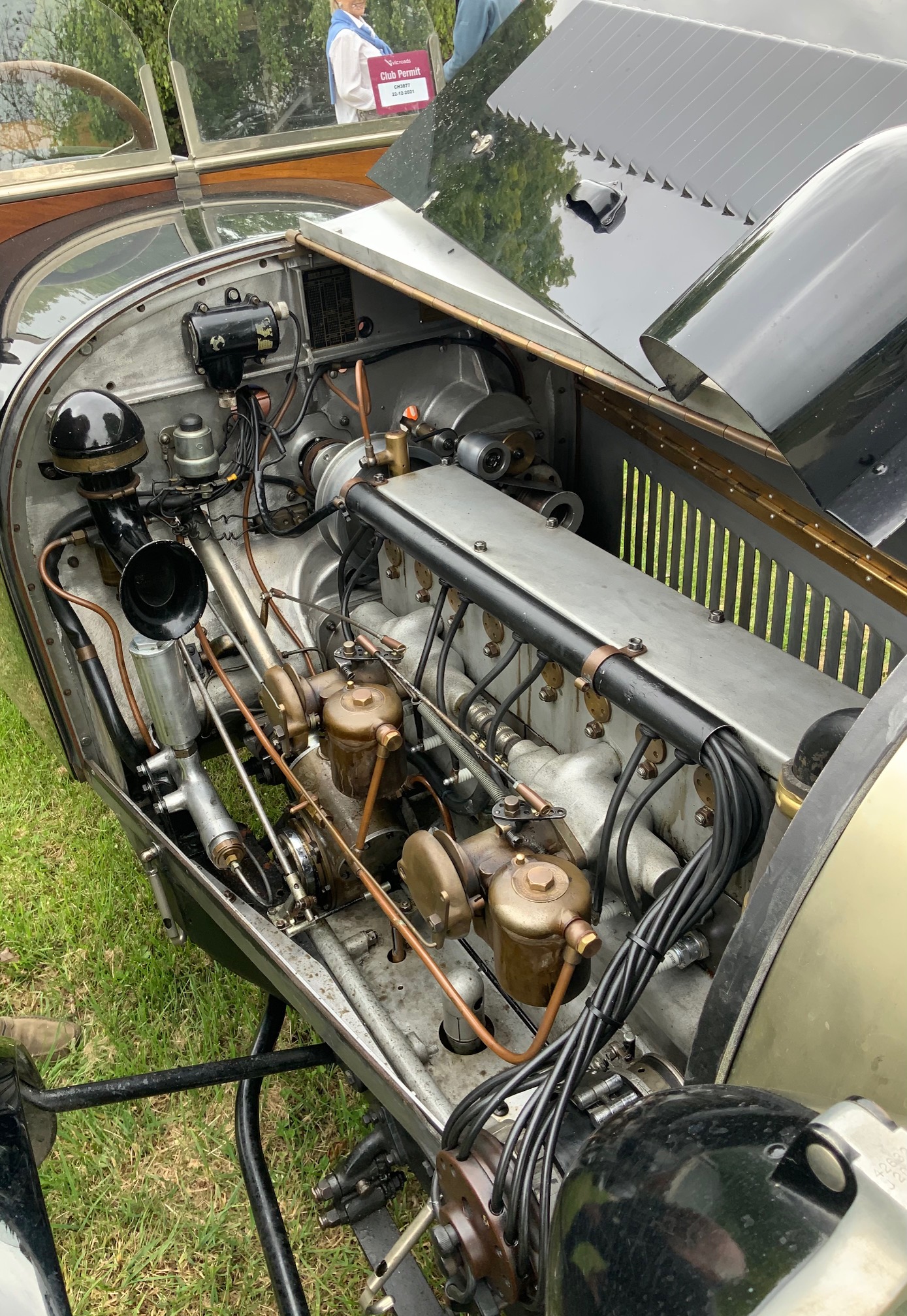
The supercharged three-valve, SOHC, 1.5-litre 110bhp four is hard edged. It’s rappy and revvy with a very light flywheel and is not too many hours back from a Tula Engineering (UK) rebuild. Its magnificent, your whole-body fizzes for hours afterwards, the solidly mounted engine buzzes you good-vibrations. Adam uses ear-plugs, ya need ‘em too.
The whole experience is heightened by being on public roads, nuts of course. Glorious nuts. The thing is deceptively fast, Adam shouts that we are doing 85mph, well over the Victorian maximum, the roads are so poor the chassis is easily affected by the road corrugations, it’s sprung race stiff of course.
I wouldn’t say I covered myself in complete glory with the gearbox, second was my boogie gear on the way down early on, but if you are used to a right-hand shift it’s not too dramatic a change.
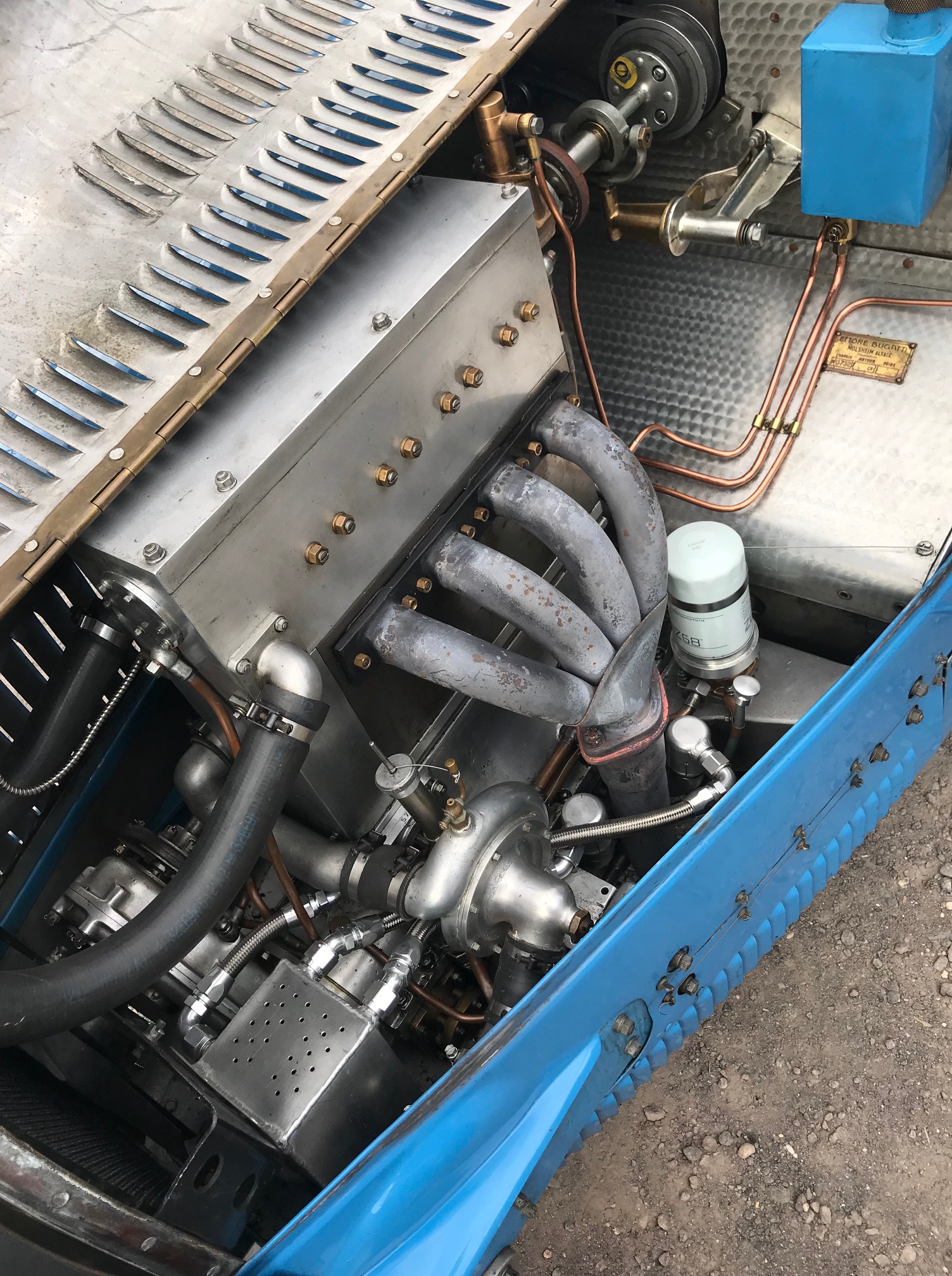
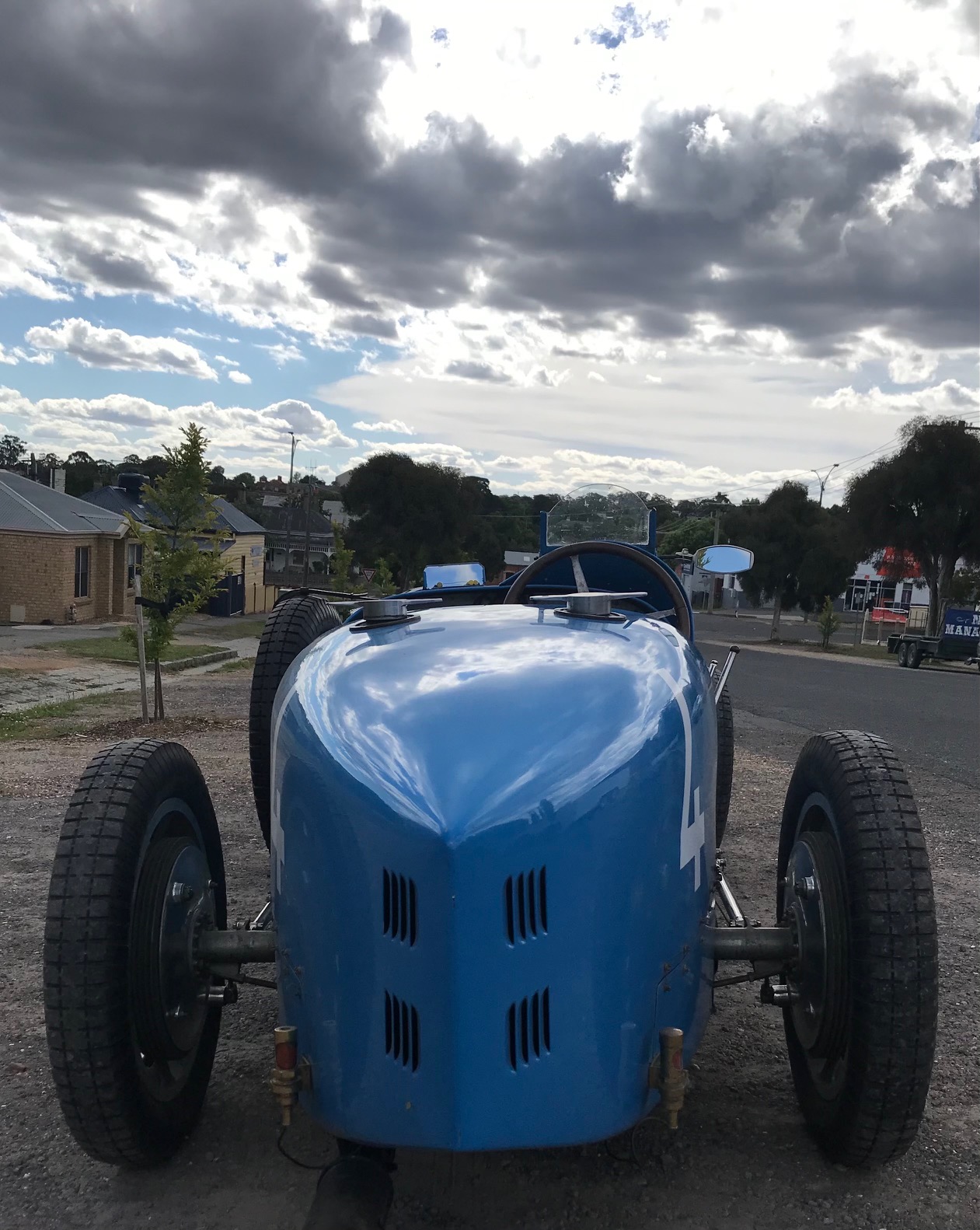
Berryman’s rump framed via an Ace bonnet in the wilds of Arnold. Only the muffler underneath ruins the visage – but is appreciated while at the wheel! (M Bisset)Business end of T37A #37327. 1496cc (69x100mm) SOHC, 3-valve, Roots supercharged four cylinder engine giving circa 110bhp @ 5000rpm (M Bisset)
The engine never copped the big rev, rather the trip was about savouring the experience, the view down the road through the aero screen and tall, narrow tyres wobbling away, big wooden rim wheel oh-so-close to your chest, moving constantly – don’t keep correcting it, just let it move gently in your hands – almost sits in your crutch. Its counter intuitive if your long-armed, 10-inch Momo orientation is a Van Diemen Formula Ford or Ralt RT4 phenomena, but the size of the thing makes sense as you negotiate tight corners where the big wheel provides the required leverage!
Sounds assault you, not the exhaust so much, gasses and associated music exits via a long pipe under the car and a minimalist hot-dog muffler at the very rear of that seductive derriere to the lucky schmo following you. Gears assail you in a very raucous mechanical orchestral kinda-way. The gearbox is beside you, the diff immediately behind, while the camshaft and engine ancillaries are mainly gear driven, not to forget the supercharger meshing and doing its thing.
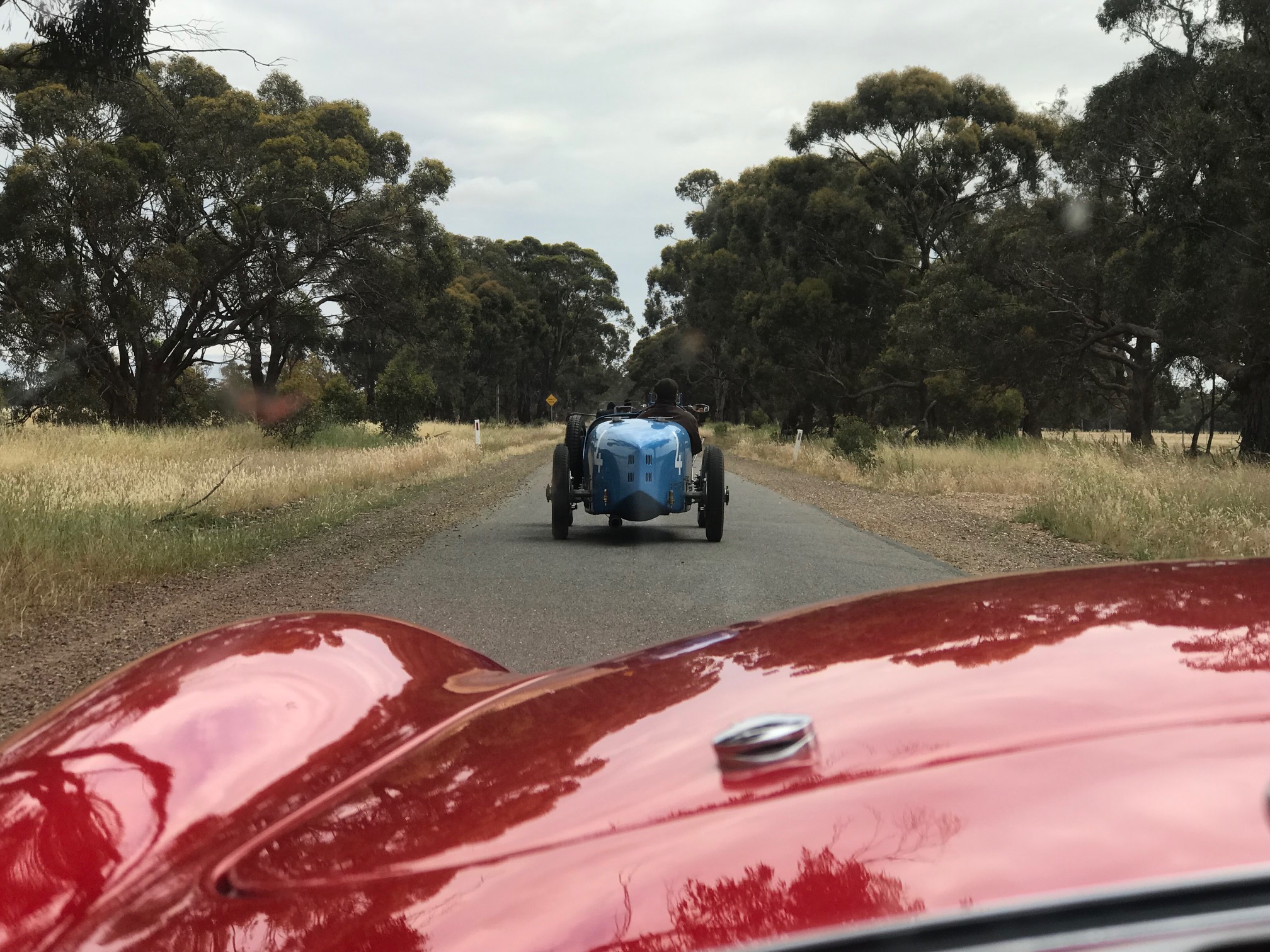
The reaction of the good citizens of Maryborough was so funny. The French racing blue rocket (chassis 37327), looks exactly as it did when raced by ‘Sabipa’ (Louis Marie Paul Charavel) in the ’27 Targa, and later by Frenchmen Jean-Claude D’Ahetze, Vincent Tersen and Andre Vagniez throughout Europe and North Africa from 1928 to 1931.
The look on little kids faces on the footpath, or their front-yards is the five-year-old equivalent of WTF?!, it’s just so out of place. Not behind the wheel mind you, albeit my left leg is tiring of trying to stay clear of the clutch pedal at about the 80km mark, the oil and water temps are good (thermatic fan fitted), the clutch is easily modulated and light and gearbox now more familiar. I could have gone for hours…
All too soon we are in the Castlemaine ‘burbs, one final blat away from the lights, then a U-Turn into the BP servo in Barker Street, and it’s all over.
Some days are forever etched in ‘yer brain as experiences to treasure, a drive of a GP Bugatti is one of them. Sick little unit that I am, I’ve been buzzing with afterglow for days, hopefully my state of arousal will subside soon, it’s quite uncomfortable really. Grazia Adam, bigtime.
Orf-piste @ Targa. Louis Charavel in, perhaps, #37327 during the 1927 Targa Florio. The Dieppe born, sometimes works-Bugatti driver – winner of the 1926 Italian GP aboard a T39 – ‘left the road on the first lap near Polizzi when his Bugatti fell 15 meters down a ravine tumbling over (doesn’t look like it to me) Luckily he suffered no injuries,’ according to kolumbus.fi (unattributed)Murdoch T30, and distant T44 roadside at Arnold West. Fuel delivery dramas being sorted by Geoff Murdoch (M Bisset)
The Murdoch family Bugatti Type 30 (above) always draws me.
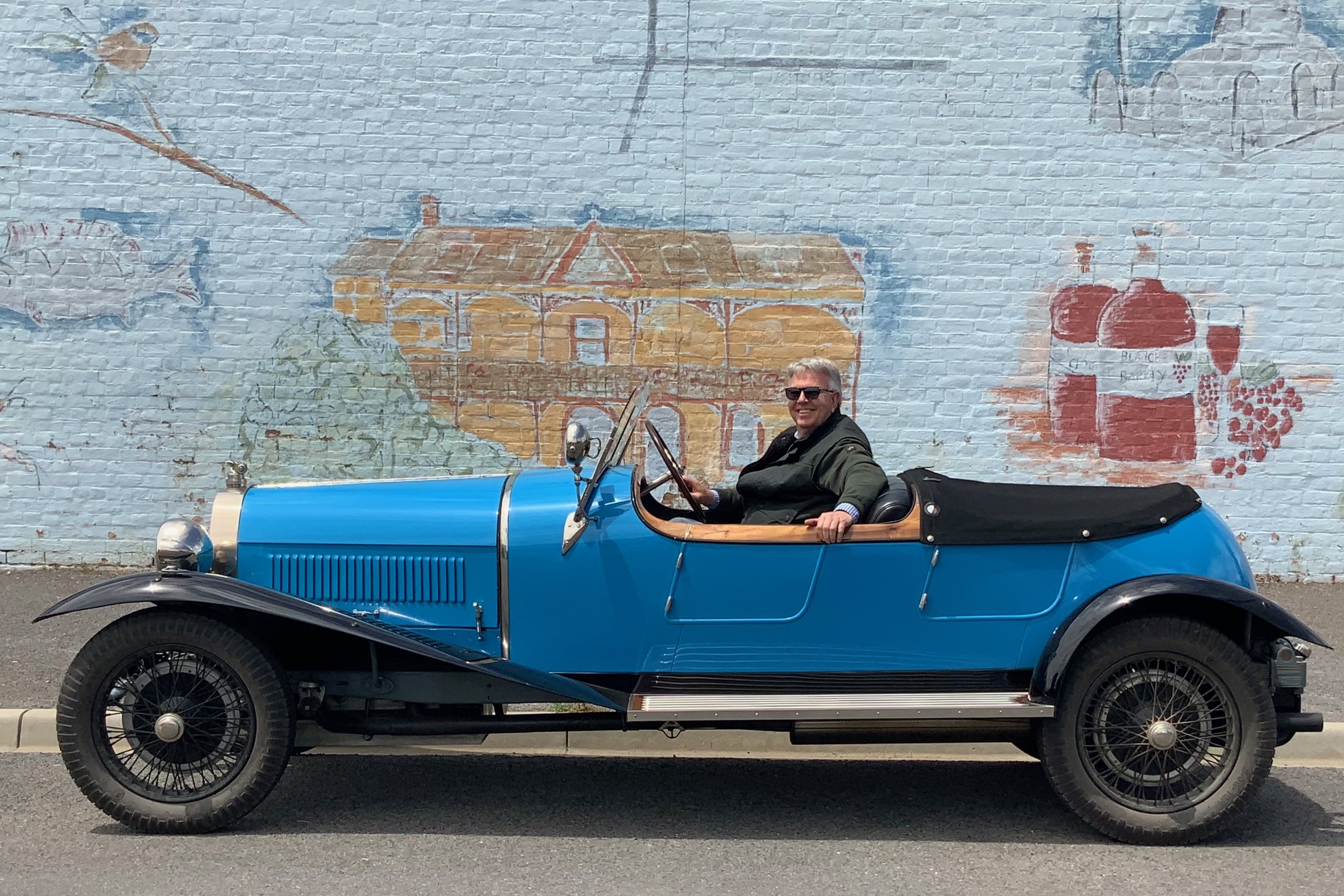
Its allure is its beauty and history, powered as it is by the very same 2-litre, three-valve, twin-carb straight eight #89 (below) fitted to Geoff Meredith’s Type 30 chassis #4087 when he won the very first Australian Grand Prix at Goulburn in 1927.
This T30, (chassis #4480 pictured), has an in-period Australian competition record of its own. There is a good chance the remaining parts of Meredith’s ex-AV Turner, and later Jack Clements “possibly most famous of Australian Bugattis” #4087 will be reunited by the Murdochs one day.
Bugatti 2-litre straight-eight #89 fitted to T30 #4480 (M Bisset)Murdoch family T30, and T23 Brescia behind, in Clunes (M Bisset)
The evening functions at the Castlemaine Railway Hotel and Wild Food and Wine, within the space of Castlemaine’s old fire station were great, add them to your list.
Doyens, and founding members of the club, and the Bugatti world globally, are Stuart Murdoch, Stuart Anderson and Bob King. Anderson’s 90th birthday was recognised with Murdoch’s only a short time away, Bob is a veritable youth in this company.
They are interested, and interesting, having been into Bugattis when they were old-bangers, and restored many of them. Anderson’s cv includes restoration and racing a GP Talbot Darracq 700 and a couple of Maseratis, Murdoch’s a couple of Delages and lordy knows what else, Bob’s restoration and race tastes are mainly, but not exclusively French.
These events have a rhythm a bit like a race meeting, albeit without the pressure. Soon we were up-and-attem on Sunday morning, warming the cars up, but this time, after a pitstop in Clunes, then lunch in Trentham – all god’s own rolling hills country – it was time to go home.
Etcetera…
(M Bisset)
A couple of scallywags in Inglewood. Bodybuilder (car) extraordinaire Richard Stanley, and Jim Thompson about to jump into his much cherished ex-Molina Brescia.
(M Bisset)
Des Dillon’s Bentley bullies Bob King’s AC Ace in Inglewood, ‘the world’s fastest lorries’ really do have on-road presence and menace the likes of few!
(M Bisset)
Ecurie Schudmak – Phil and Susan – in Avoca, about to hit the road. These guys and their trusty Pursang T35B have done Bugatti rallies on most continents of the globe in this much loved and used car.
(M Bisset)
The Latreille Lancia Fulvia 1.3S Zagato, very tasty too, and Quinn MGA.
(M Bisset)
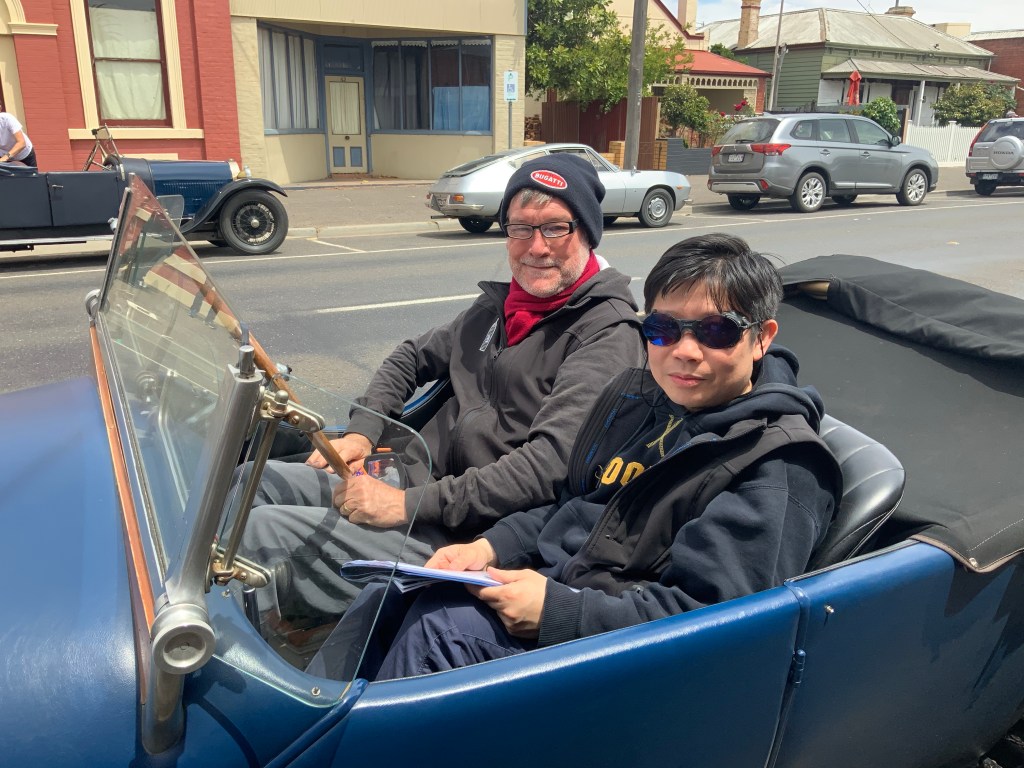
Michael Anderson and Bui Khoi before the off in Inglewood, Anderson family Type 44, another cherished car which has been in family hands for decades.
Shellard T57, great in profile, in Lancefield.
(M Bisset)
Clan Murdoch, or part thereof, in Inglewood.
(M Bisset)
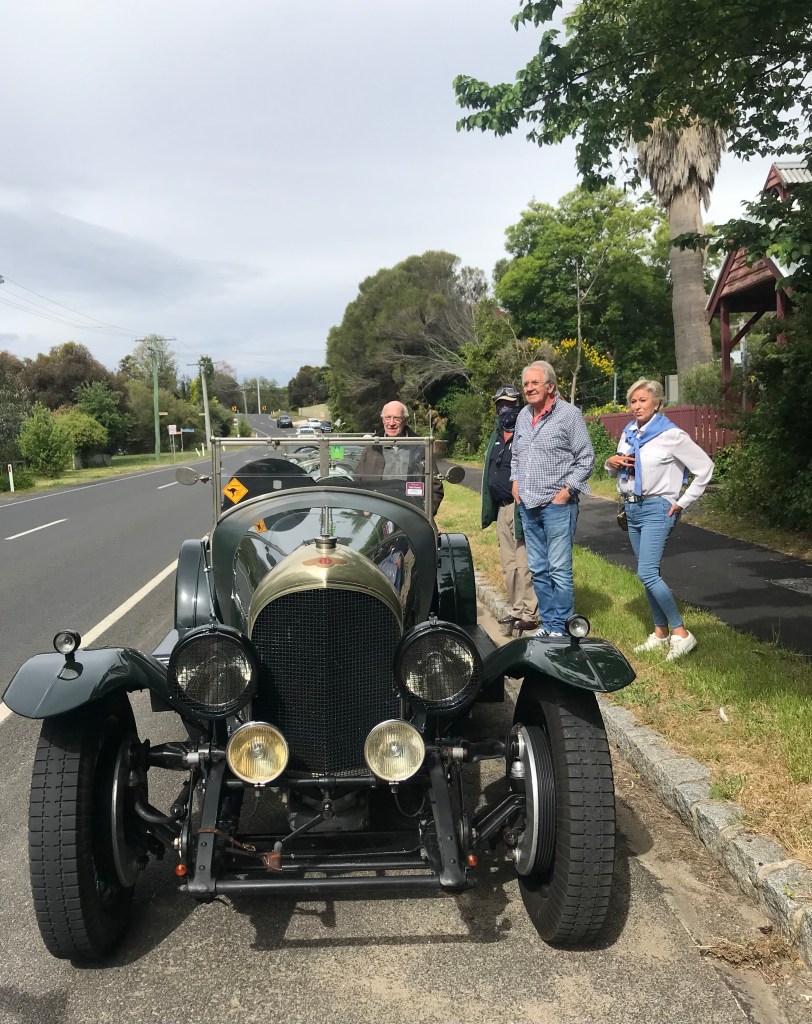
Chewton crew. Bob King, then the masked avenger, Trevor Montgomery, Des Dillon and his lady – and Bentley 3-litre.
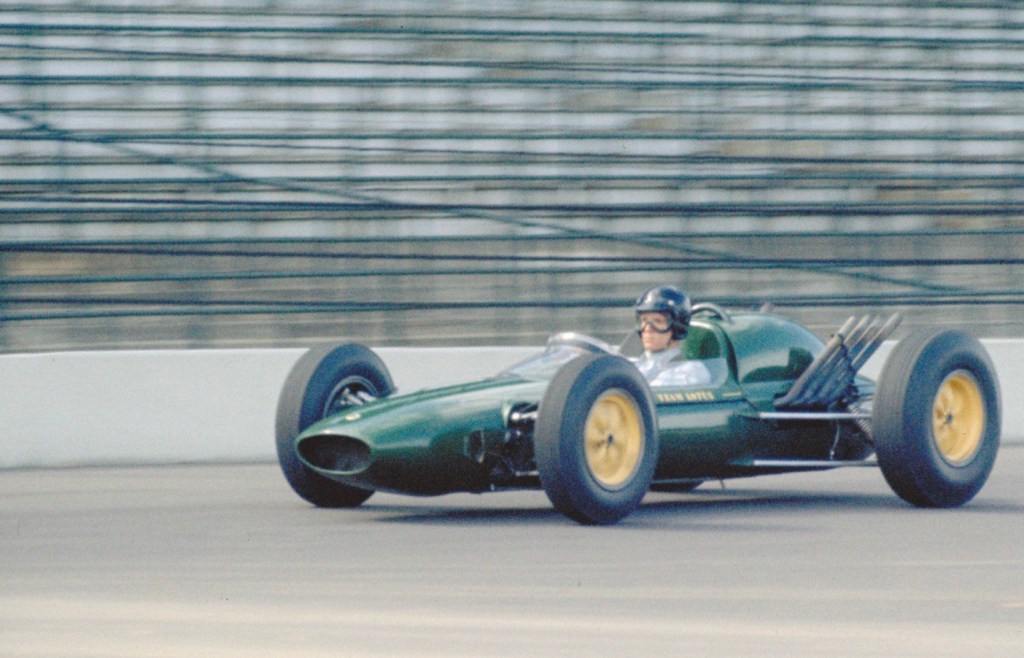
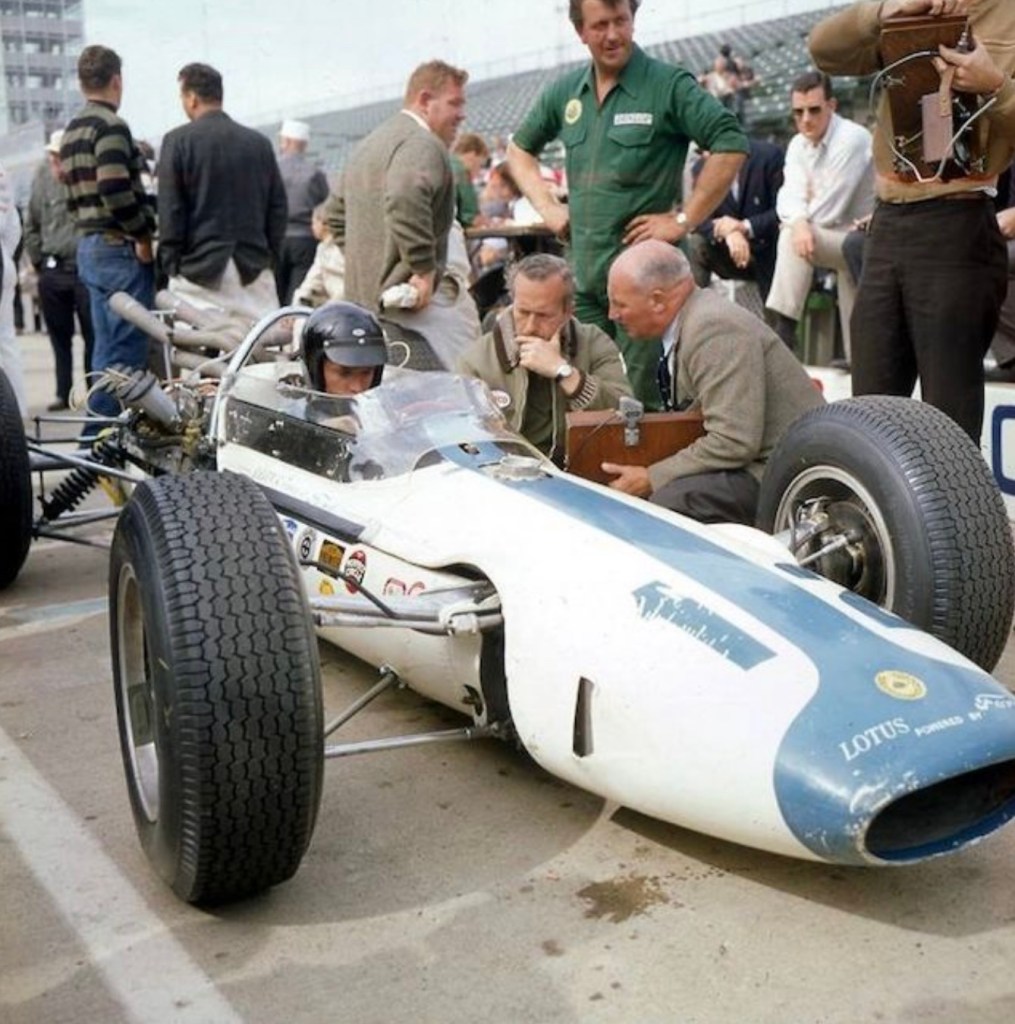
Gurney in Lotus 29-R1 Ford at Indy in March 1963. Here with symmetrical suspension, raced with offset
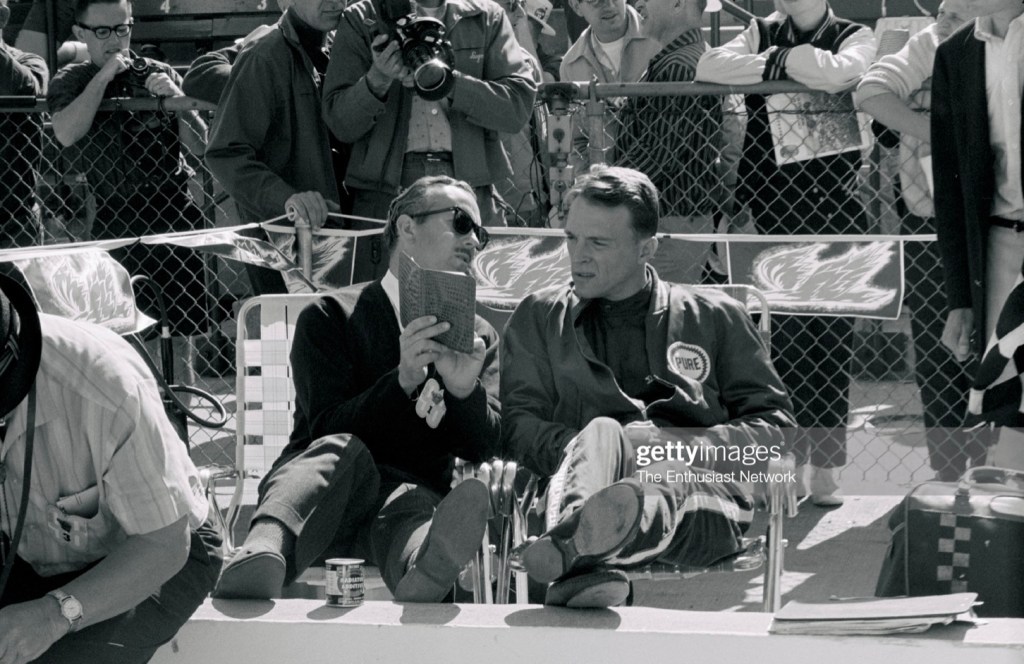
A bit like Chris Amon, there is no such thing as too much Dan Gurney.
I’ve been researching an article on Lotus’ 1963 Indy campaign and have discovered a few Dan shots too good to waste.
Gurney’s mind was blown, just like everybody elses, when the Lotus 25 Climax was rolled out of the Team Lotus transporter at Zandvoort in 1962. That monocoque design was an Indy winner; as a Californian he was keen to drink the Indy Winners Milk.
He said as much to Colin Chapman and flicked the Lotus supremo a free air ticket to watch him contest the ’62 event in a Mickey Thompson Spl: John Crosthwaite’s mid-engined, spaceframe design was powered by a Buick stock-block V8. Dan ran in the top ten until the transaxle was hors ‘d combat. Importantly ole-Chunky was on the hook.
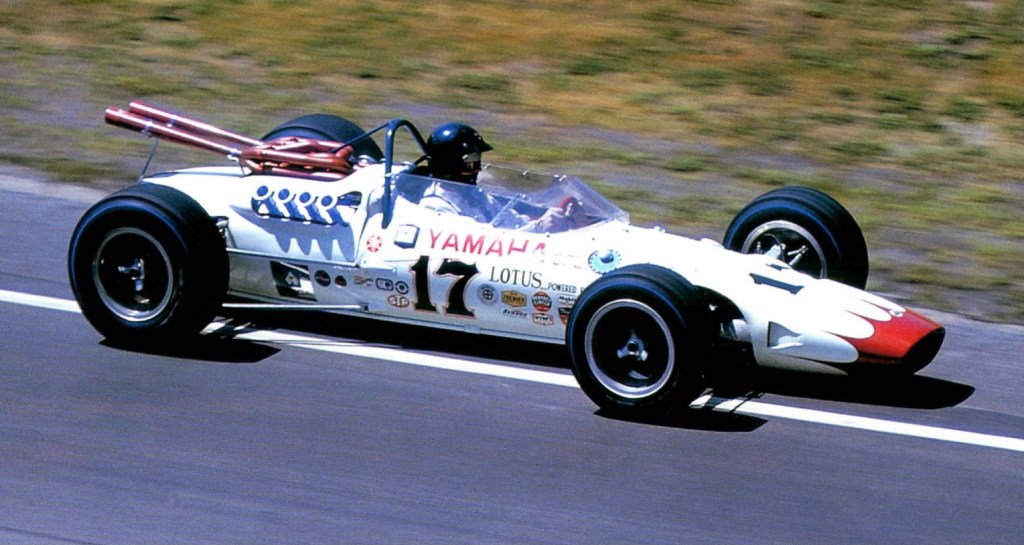
I promise your slice of the pie will be no less than that Daniel! Colin Chapman and Dan Gurney at Indy in 1963Lotus 29 Ford’s first test at Indy in March 1963. Gurney aboard chassis R1, which is fitted with symmetrical suspension, wobbly-web wheels rather than the Dunlops it raced with and stack-exhausts rather than the megaphones which followed (unattributed)
Gurney was a Ford man, his teenage hot-rod exploits were all Flattie-Ford powered. He raced a Holman Moody Ford Fairlane NASCAR at Riverside in early 1962 and used a couple of Ford heavies he met that weekend to set up a meeting between he, Chapman and the-right-Ford-execs at Dearborn in July.
By March 1963 the Lotus 29 – call it a fat-25 – powered by a 350-375bhp, 255cid all aluminium pushrod variant of the 260 Windsor Falcon/Fairlane V8 was being tested for the first time by Jim Clark at Snetterton.
At Indy Clark ran second to Parnelli Jones’ Watson Offy Roadster for the last 20 or 30 laps. Jones was dropping oil, but was not black-flagged as other cars dropping lubricant throughout the race had been.
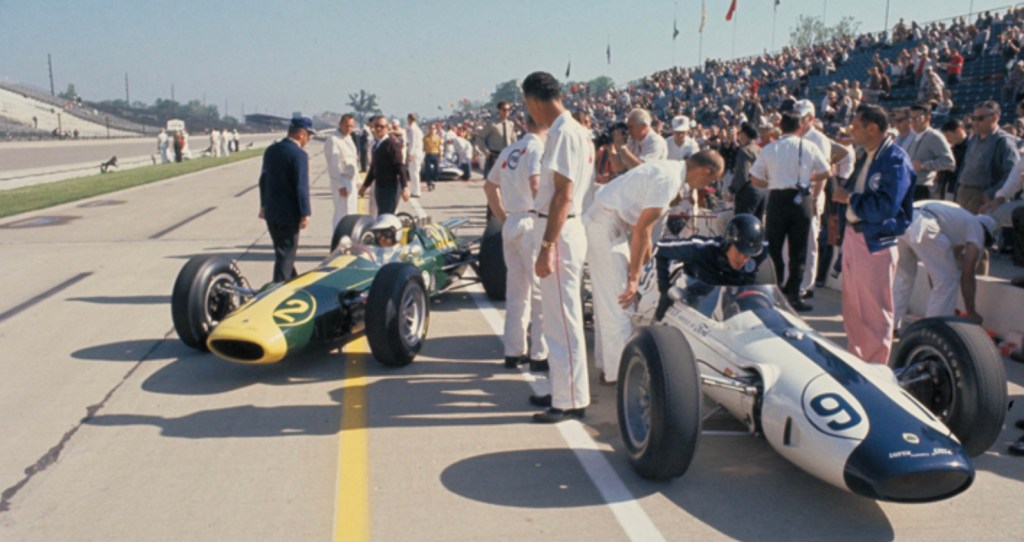
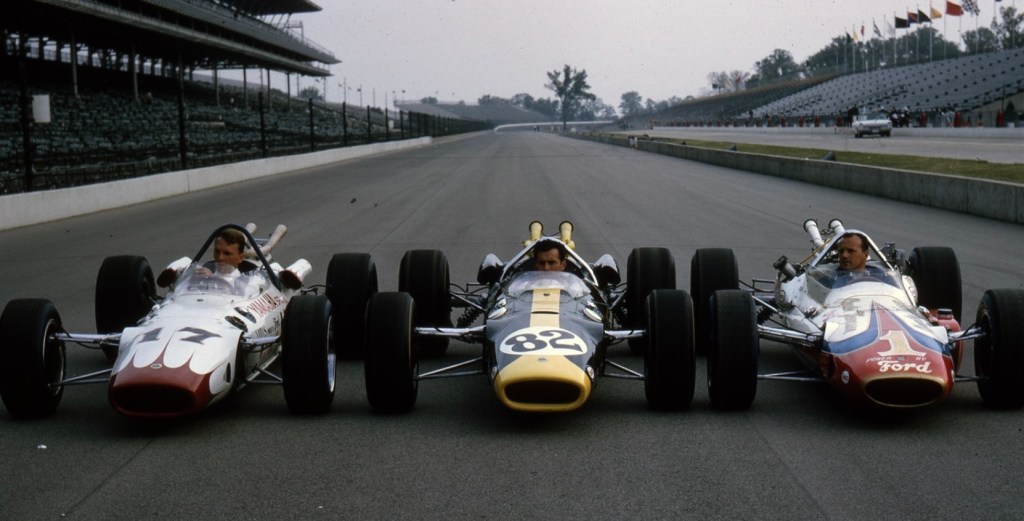
The Indy Establishment, led by Chief Steward Harlan Fengler – who had the black flag power – shafted Lotus, Ford, Chapman, Clark and Gurney. Revenge was sweet in 1965 when Lotus Fords occupied the front row driven by Gurney, Clark and AJ Foyt – and Clark won.
Gurney was seventh in 1963, his engine wore a cam-lobe, so he wasn’t able to press hard in the same manner as Clark. Check out my Auto Action feature on the 1963 race here; Auto Action #1823 by Auto Action – Buy through Issuu
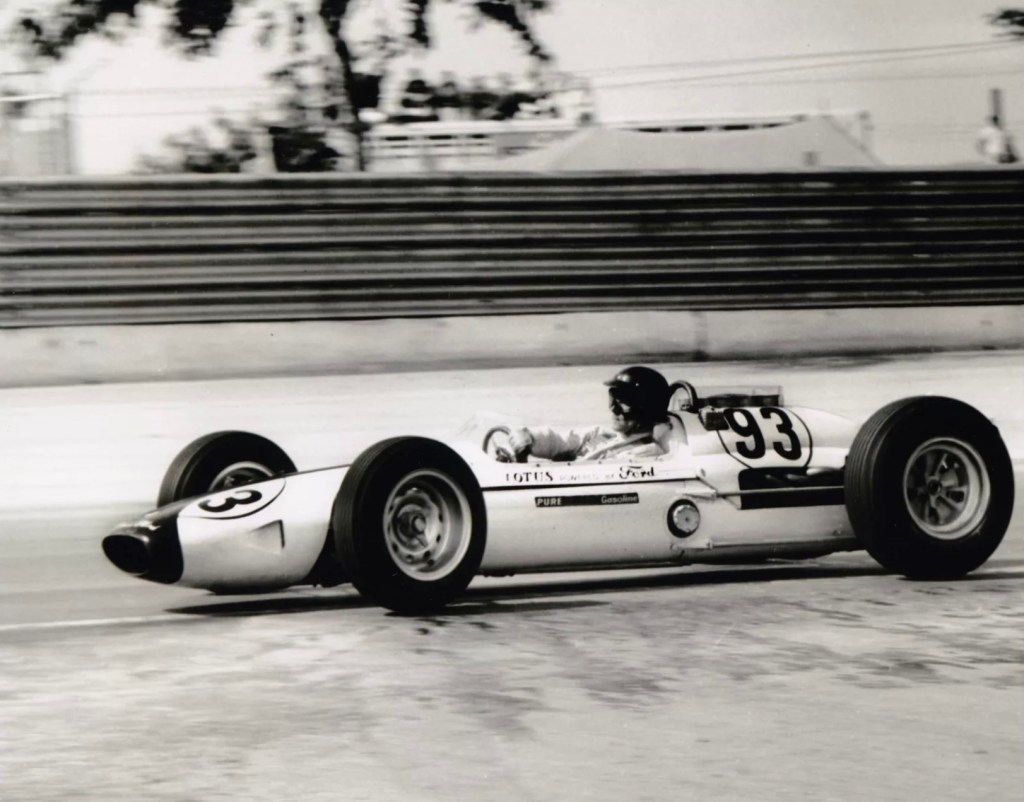
Clark and Gurney, in his Yamaha sponsored 29, Indy 1963 (unattributed)Gurney during the Milwaukee 200 in 1963 (unattributed)
Keen to reinforce the point about their speed, Clark and Gurney raced in the Milwaukee 200 three weeks after Indy, Clark won with Gurney third.
In 1964 the same duo raced the evolved Lotus 34, the most critical mechanical change of which was use of Ford’s Quad Cam Indy V8: this fuel injected, four-cam, two valve V8 produced circa 400bhp.
AJ Foyt’s Watson Offy won the race – the last by a front-engined car – which is primarily remembered for the horrific seven car, lap two accident and conflagration which cost the lives of Dave MacDonald (Thompson Ford) and Eddie Sachs (Halibrand Ford). Coincidently, Sachs’ Watson was the last casualty of ‘Fengler’s oil slick’ the year before, when he boofed the fence on lap 181, and then copped a punch-in-the-nose the following day when he fronted Jones about his win.
Gurney’s Lotus 34 quad-cam in 1964, Chapman alongside (D Friedman)
Lotus were contracted to Dunlop in F1. Chapman used hard Firestones in 1963 and sought the performance, and no doubt, the commercial advantage of softer Dunlops in 1964. One of Clark’s (from pole) tyres failed after 47 laps taking out the left-rear corner of the car. Gurney retired after 110 laps with excessive wear.
The FoMoCo were not amused as Clark’s failure happened on the entry to the main-straightaway (front straight) providing an exciting – and oh so public – epic-fail in front of 150,000 or so spectators. Needless to say, Ford took control of tyre choice in 1965, an all-Ford year.
Indy front row 1965; Gurney, left and Clark in Lotus 38s and AJ Foyt on pole, Lotus 34 Ford (AAR archive)Gurney, Lotus 38 Ford, Indy 1965 (unattributed)
AJ Foyt’s Lotus 34 Ford took pole while Clark’s Lotus 38 won in 1965, having led 189 of the 200 laps, from Jones Lotus 34 Ford, a young Mario Andretti’s (Brabham based) Hawk Ford and Al Miller’s Lotus 29 Ford.
Poor old Dan started from the outside of the front row but was a DNF after 38 laps with timing-gear failure in his Lotus 38. While his Eagles won plenty of Indy 500s, Dan never did take one as a driver, a great shame!
Etcetera…
(MotorSport)
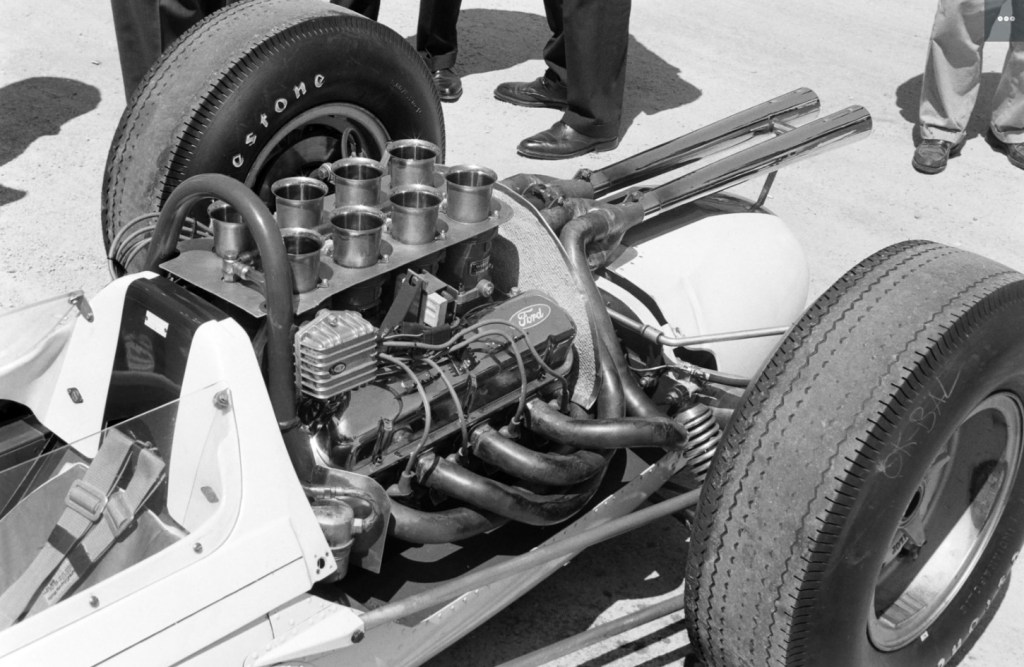
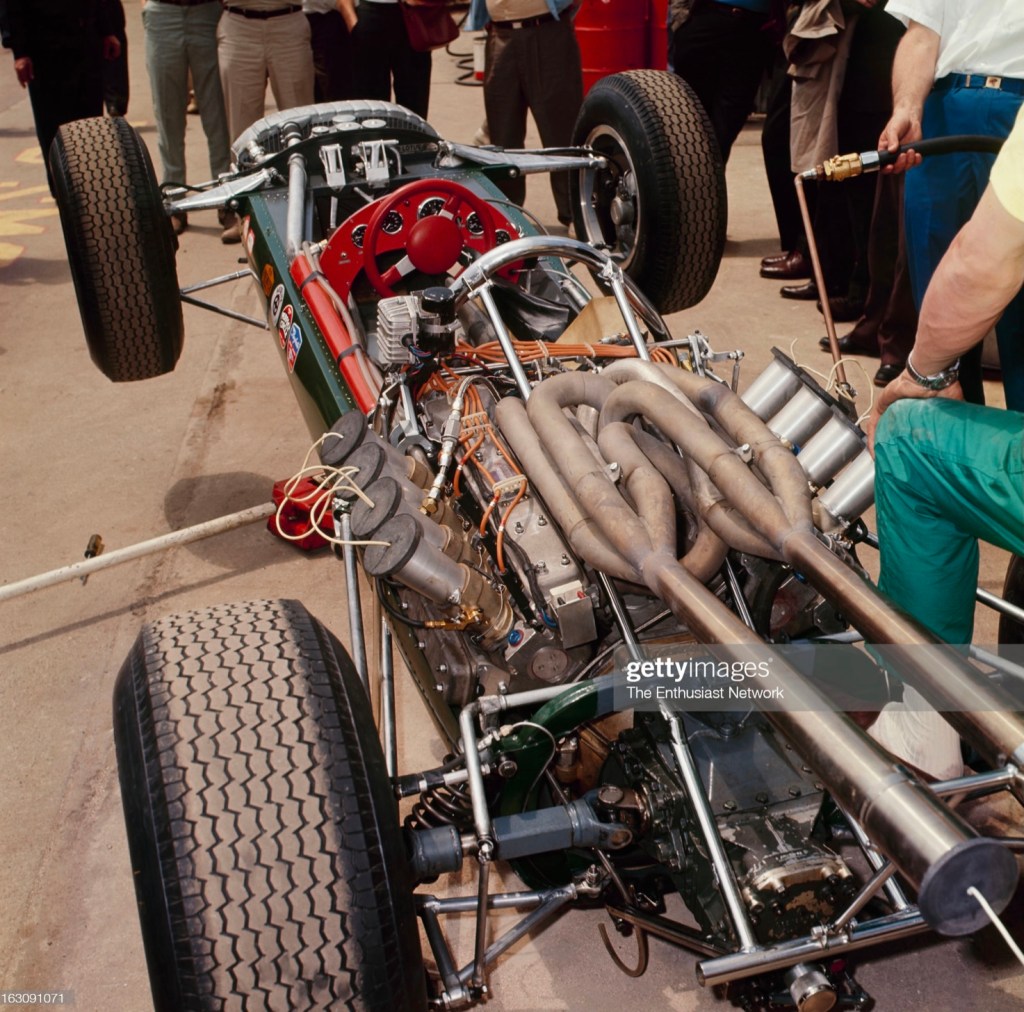
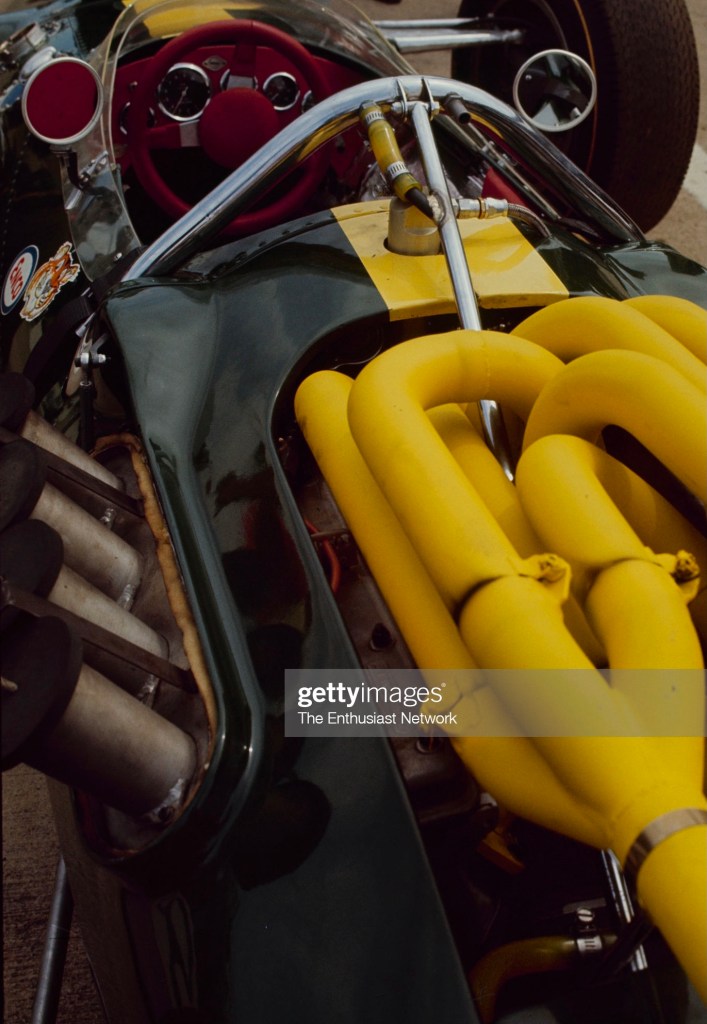
The business end of Gurney’s Lotus 29-R2 in 1963.
Gurney and Chapman pitched a 4.2-litre pushrod engine to Ford. They figured, based on Dan’s 1962 experience, that a 350 pound, 350bhp petrol fuelled Ford V8 would do the trick. As it did…
Clark’s Lotus 34 Ford in 1964.
The Lotus 29 and 34 were bathtub-monocoques, the 38 was a full-monocoque. Note the offset suspension to the right and Ford quad-cam 4.2-litre V8.
Credits…
Getty Images, David Friedman, AAR Archive
Tailpiece…
(AAR archive)
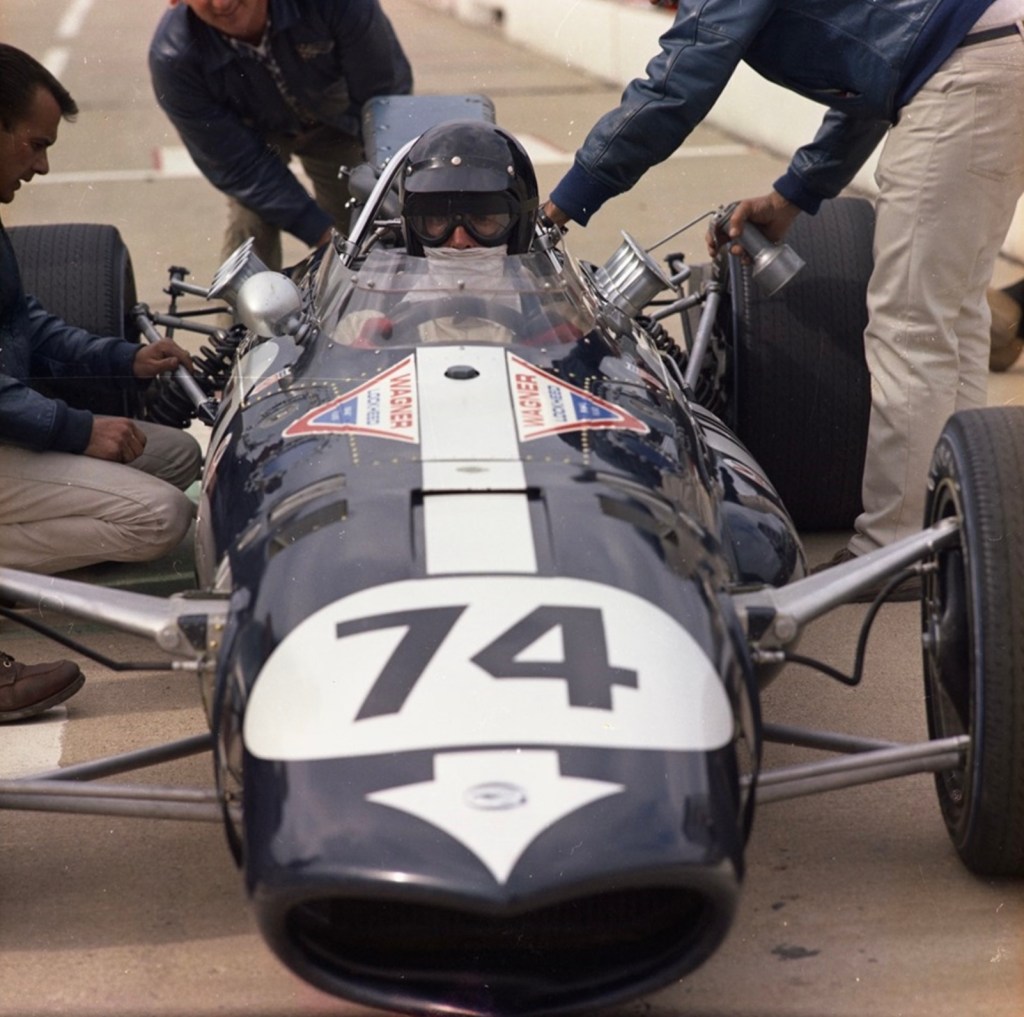
The boys fire up Dan’s Ford V8 in 1967. His beautiful, dual purpose F1/Indycar design, in Indy spec designated Eagle 67 Ford, was designed by Len Terry, the same bloke who drew Chapman’s epochal Lotus 25 F1 car and 29/34/38 Indycars.
He started from Q2, led two of the 200 laps but was out after 160 laps with piston failure. Better would come, Bobby Unser won in an Eagle 68 Offy in 1968, and Dan was second in an Eagle 68 Gurney-Weslake-Ford.
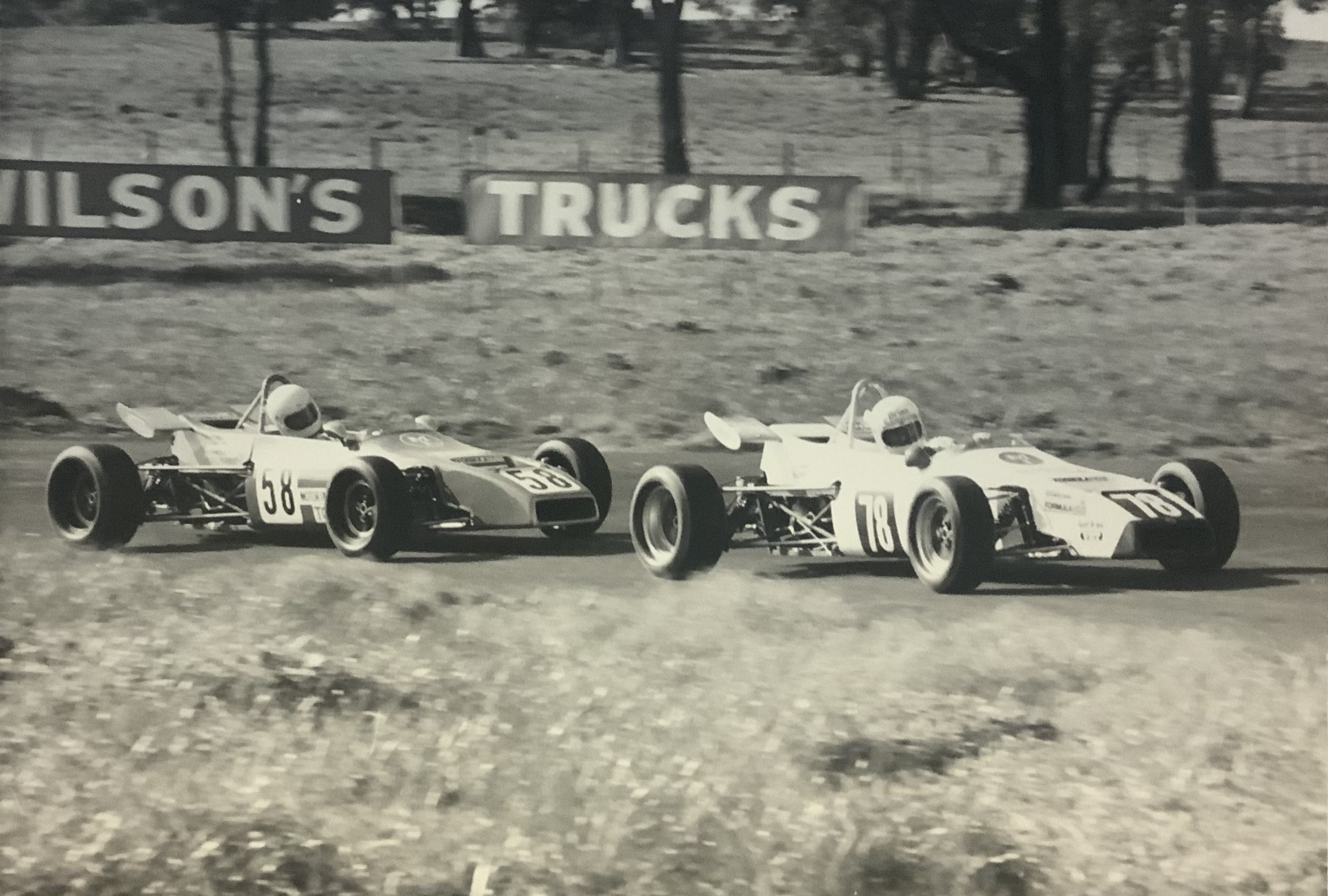
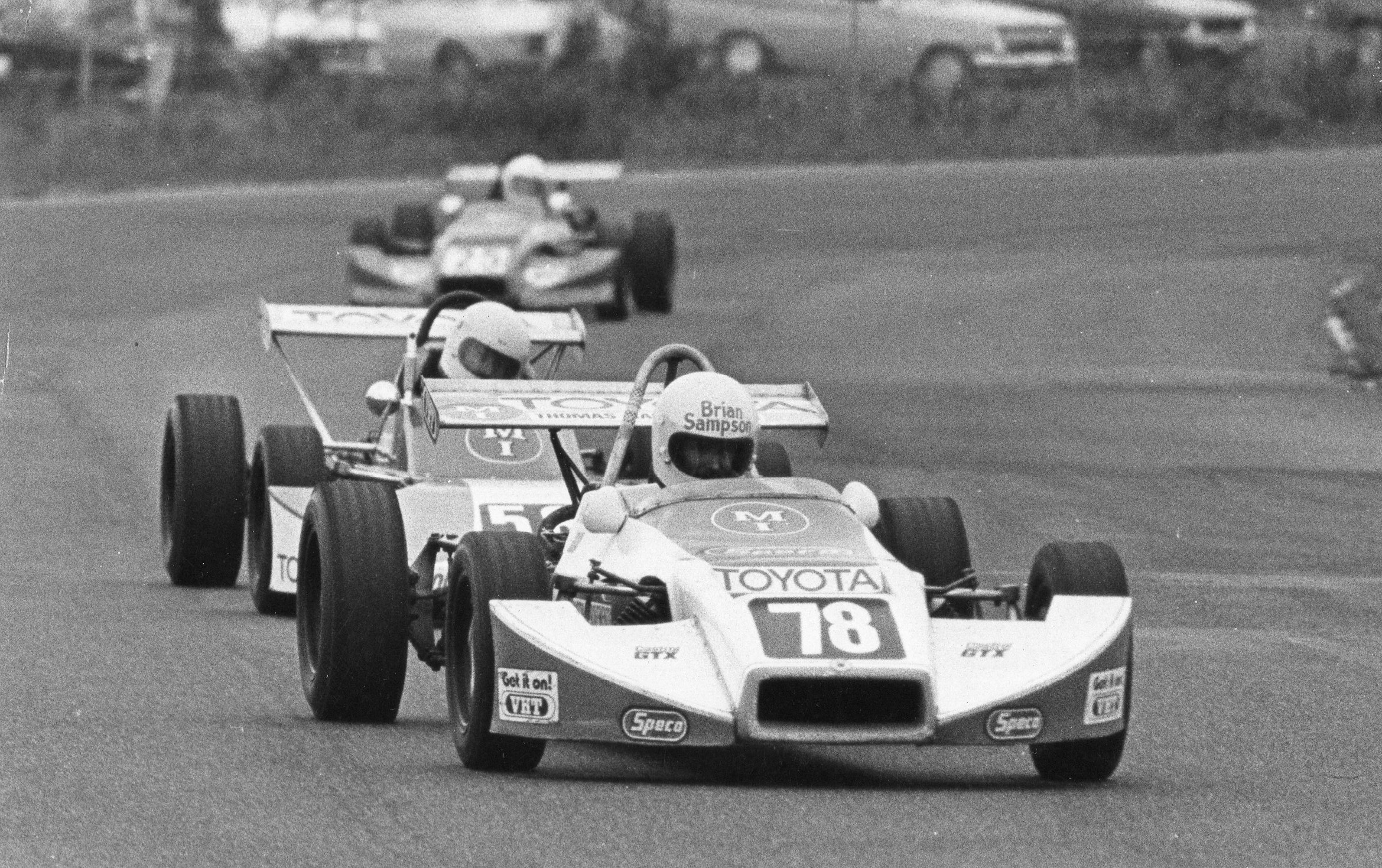
Cheetah Mk4 Toyota mounted Brian Shead and a distant Brian Sampson, sandwich Tony Stewarts ANF2 Birrana 273 Ford as they enter Sandown’s Dandenong Road corner circa 1973 (B Jones Collection)
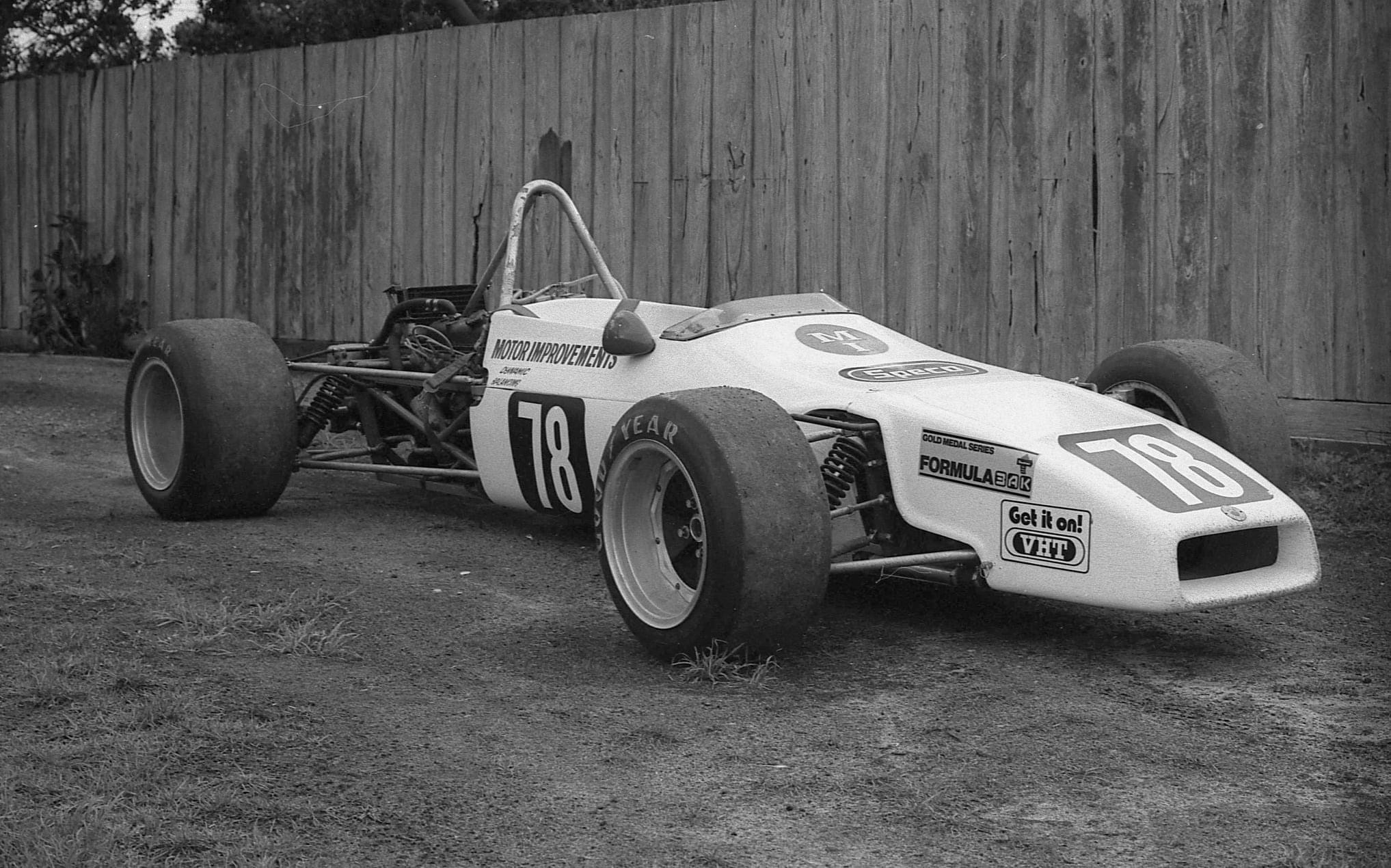
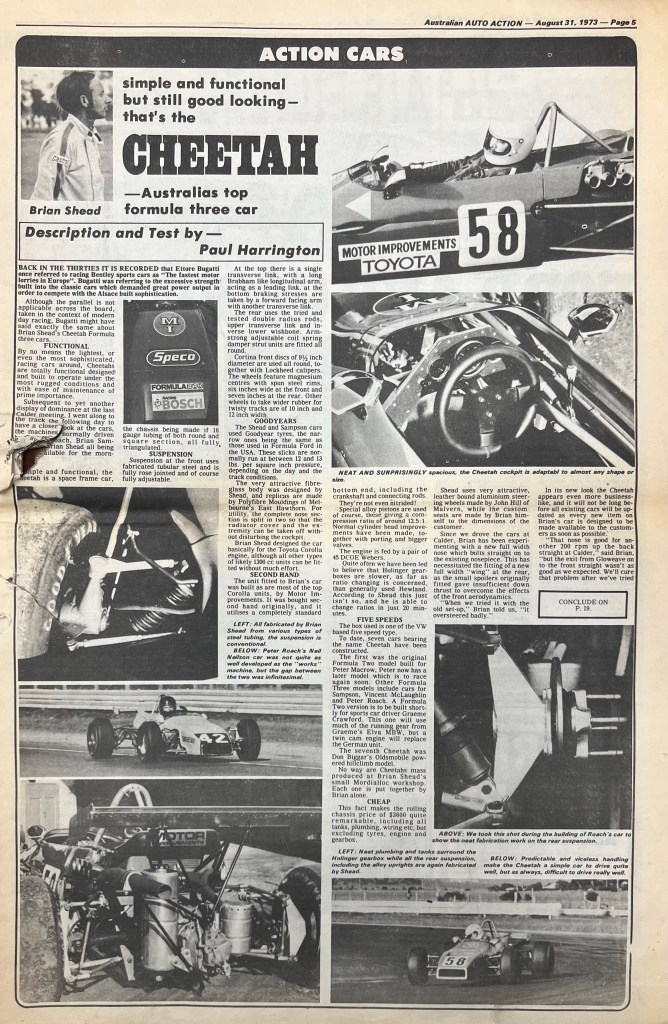
Brian Shead’s first car, the Mk1, Cooper-esque, BMC A-series powered Formula Junior was completed on August 1, 1960 and raced by the man himself. The Marks 2 and 3 were finished in early 1962 and 1963 respectively. Sheady got serious about ‘volume production’ in 1968 despite still having a ‘real-job’, his Service Manager role at Conquip Victoria was handily close to his home and workshop in Mordialloc, a Melbourne bayside suburb.
Brian Shead fettles his Cheetah Mk1 BMC at Rob Roy hillclimb, in Melbourne’s outer east, circa 1961. Note Laurie Rofe’s ? Alfa P3 at rear (M Borland Collection)
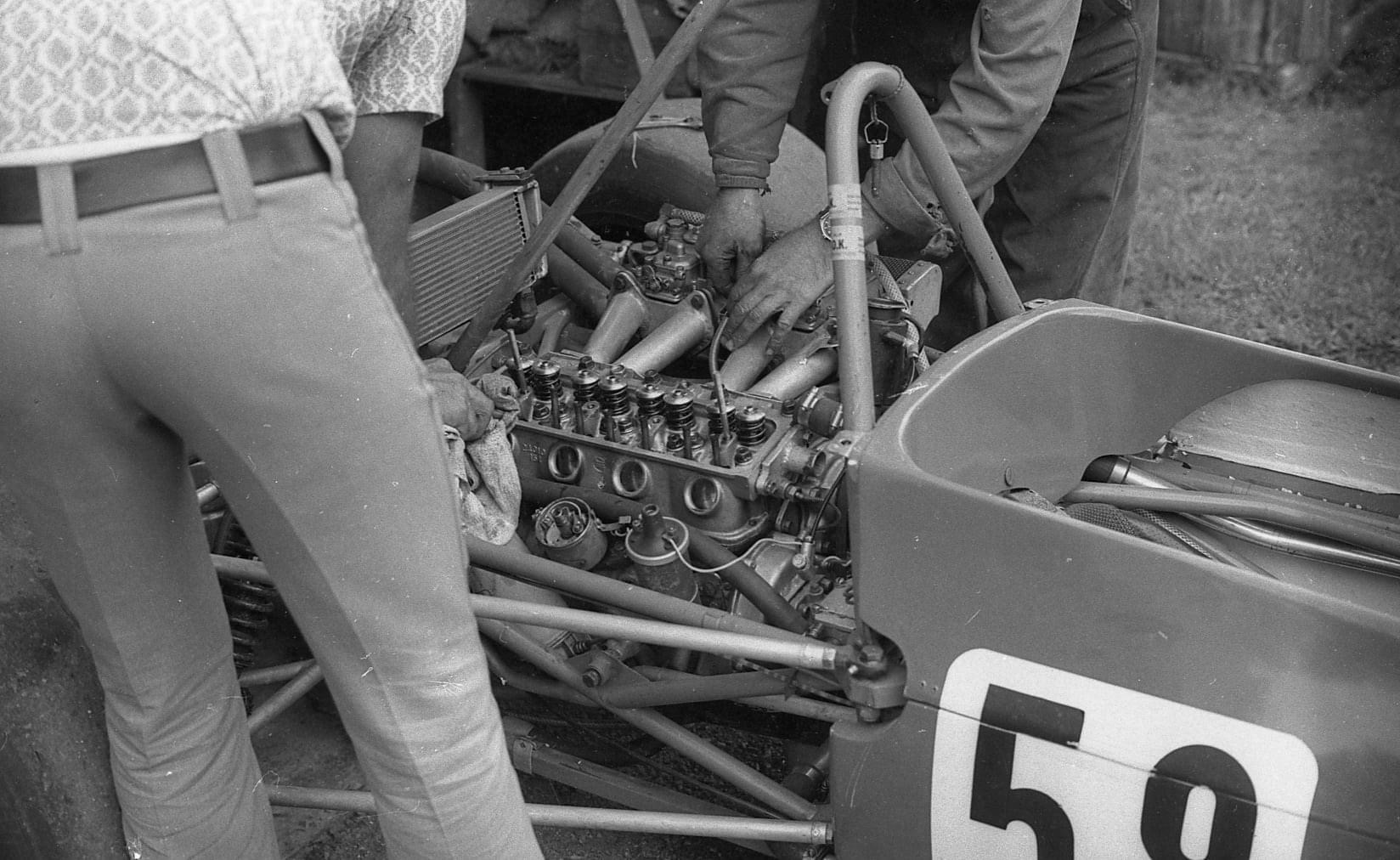
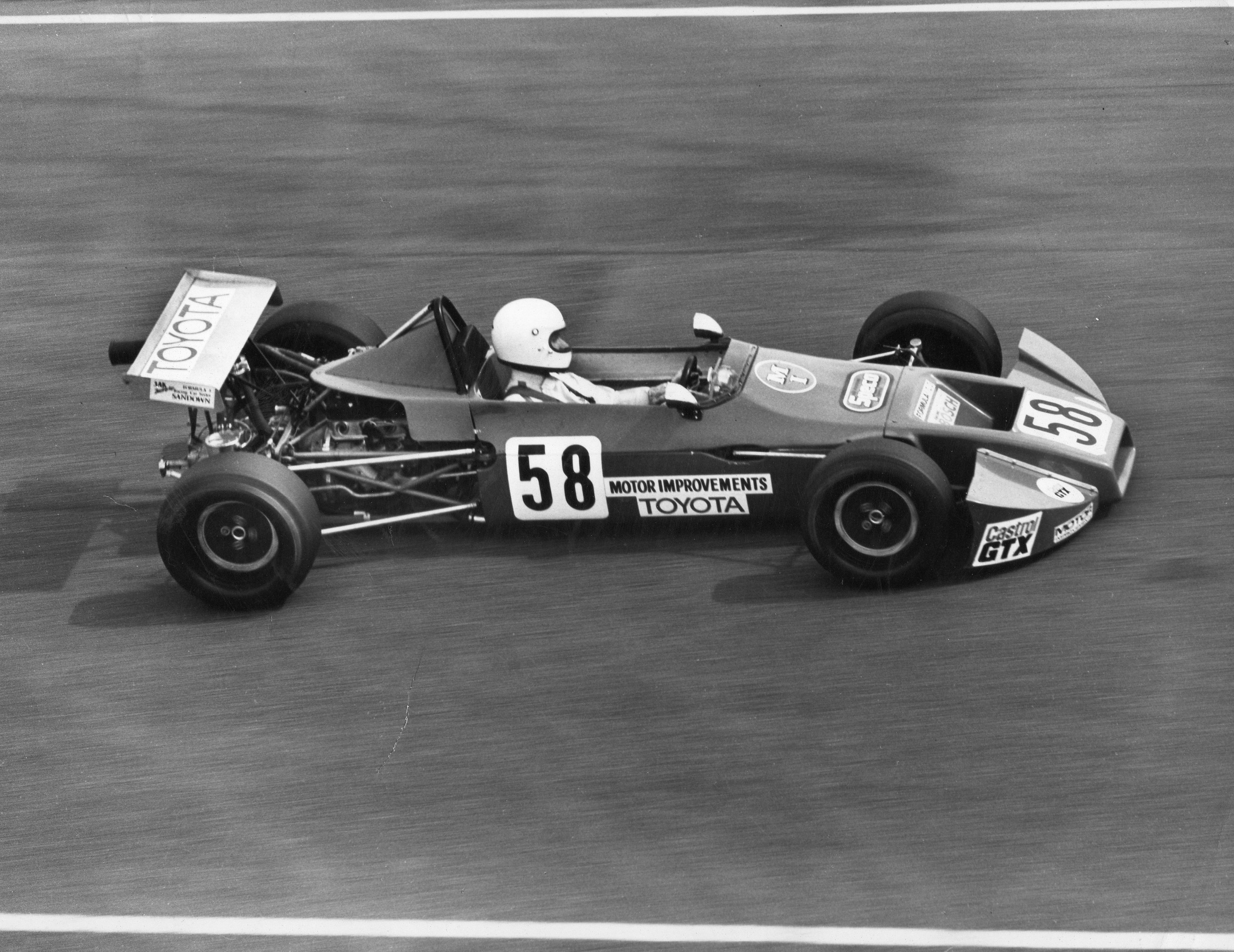
The Mark 4A was made from one-inch, 18-gauge round and square steel tube. Outboard wishbone suspension was used using the “later stiffer Triumph Spitfire front uprights,” Brian wrote in his diary. The rear suspension comprised a single top link, inverted lower wishbone, two radius rods and Shead’s cast aluminium uprights.
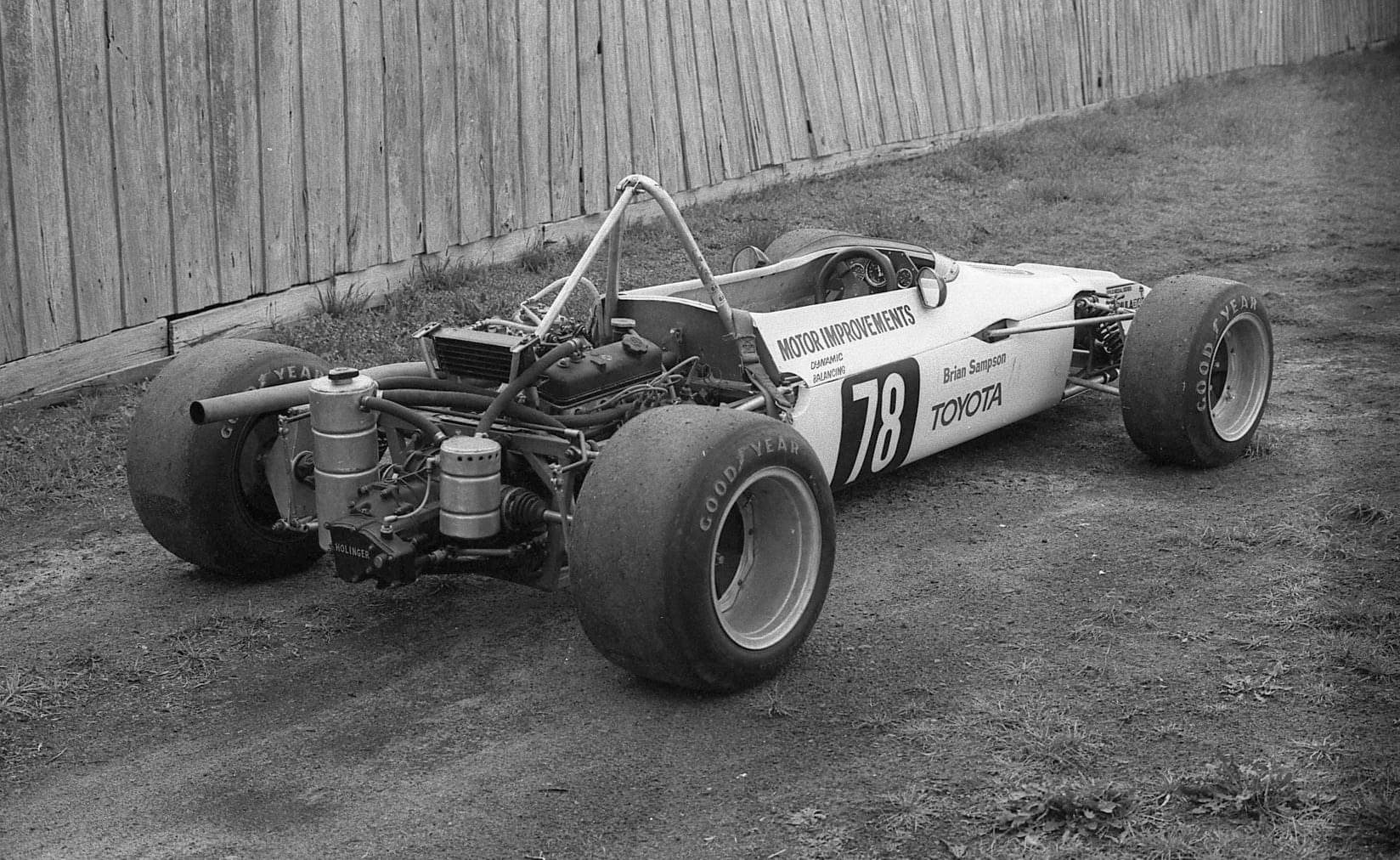
Rack and pinion steering was by way of modified Renault items, “all cars used modified VW transmissions with the F2 and F3 models employing the first of the recently introduced Holinger five-speed quick change units. Under seat aluminium six gallon fuel tanks were fitted whilst the Bob Edmonds Polyfibre Products body work was in fibreglass. A 16-gauge aluminium undertray was bonded and rivetted to the lower chassis rails. A new enclosed tandem trailer was built to transport my car,” Shead wrote.
Sampson’s Mk4 Toyota (S Gall)Sambo’s Mk4 showing Holinger five-speed transaxle, fabricated rear uprights and Mario Costa built wheels. Sampson’s Motor Improvements’ 1.3-litre pushrod, twin Weber fed race motors were the ducks-guts F3/Clubman unit of the day and gave circa 130bhp (S Gall)
Peter Macrow’s 1.6-litre Ford twin-cam ANF2 car (Mk4B # 43-2) proceeded as funds allowed but one car, #4H-1 for Don Biggar and Shead’s #43-1 were finished mid-year. Biggar’s machine was a hillclimber fitted with a 3.5-litre Oldsmobile V8 and modified VW gearbox. Shead’s car was tested at Calder in mid-May, then made its race-debut on May 31.
Continuing good results and several wins over Brian Sampson’s Elfin 600B Toyota led to an order from Sambo for a Mk4 (#43-3), his car was finished in January 1973. Brian Shead describes this car as the “first production chassis, minor changes were made in the chassis layout. Live front axles were used with fabricated front and rear uprights, Holinger gearbox. Toyota Corolla 1300cc engine, new front nosecone and cockpit body sections.”
Other production Mk4s were built for Peter Roach (43-4), Vincent McLaughlan (43-5), while an ANF2 1.6-litre Ford twin-cam Mk4E (342-1) was delivered to Graeme Crawford in February. That makes seven Mk4’s in total, and I’m sure David Crabtree’s ANF2 Mk4 – which he retains – was delivered to Crabby and built up by him, so that makes eight…
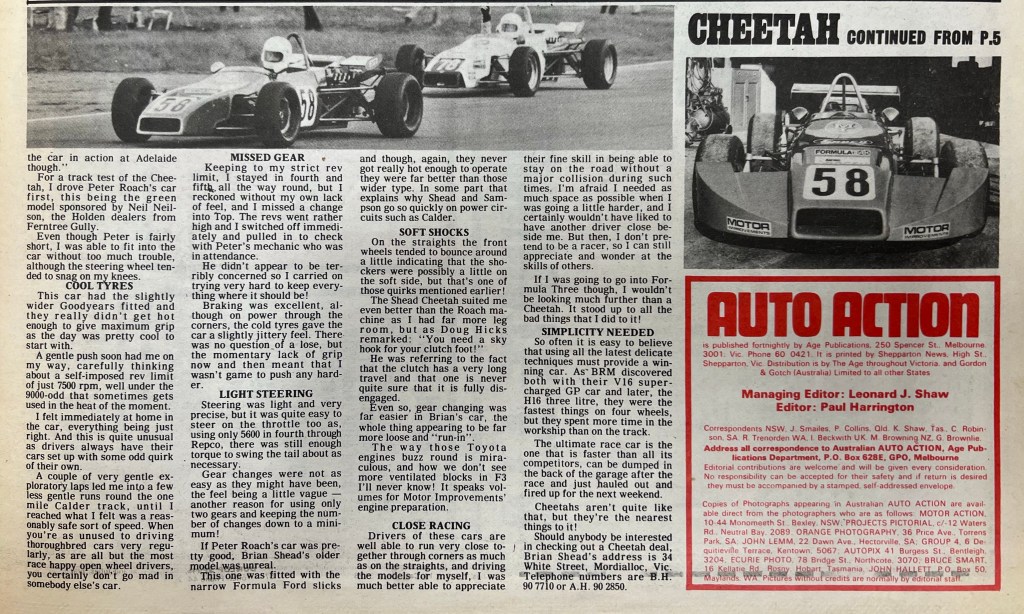
The Mark 4 Cheetah was the dominant ANF3 car of the era, perhaps not so much in Sydney, where none were resident, and set up the reign of terror of the small-bore-classes Brian Shead had for the best part of a decade.
Shead’s car (Brian leaning over the engine at right rear) at Calder circa 1973, car by this stage fitted with fabricated front uprights rather than the Triumph Spitfire/Alford & Alder units with which it was originally built. These were chuckable, strong, light , fast racing cars (S Gall)Same Calder meeting with a spot of MI Toyota Corolla valve, rocker or head gasket problems…(S Gall)
Etcetera…
Credits…
Stephen Gall, Brendan Jones Collection, Brian Shead Diary, Michael Borland Collection
Tailpieces…
(Auto Action)
Racing cars are never static of course, by 1973 Australian F3 cars were growing wings as shown on the Sampson and Shead Mk4s at Winton above.
Shead’s solution at this stage was a modest rear body panel come wing, and wingless at the front.
A fugly Tyrrell-type nose followed, as shown below, all of which was refined in the marvellous, even more successful monocoque Mk5 and Mk6 F3/F2 machines which followed. Stories for another time, or you could buy Auto Action issue #1815 which covers the topic rather nicely; Auto Action #1815 by Auto Action – Issuu
The other member of the Victorian Cheetah triumvirate is Peter Macrow, running third at Sandown’s Causeway area circa 1973 – Sambo from Sheady up front. Look at the different rear-wing supports (B Jones Collection)(B Jones Collection)
Another shot of Brian Shead at Amaroo Park or perhaps Phillip Island. This aero evolution is towards the end of their time as the works machines, supported as you can see by Toyota; Australian Motor Industries, the Toyota importer, had been longtime supporters of Sambo’s Triumph Spitfire.
Neat engine cover, the appearance of Tony Alcock’s and Malcolm Ramsay’s monocoque Birrana 374 made it clear a new car was required, some marvellous racing followed between the Cheetahs and Paul King/Dean Hosking/Jim Evans 374s in 1974.
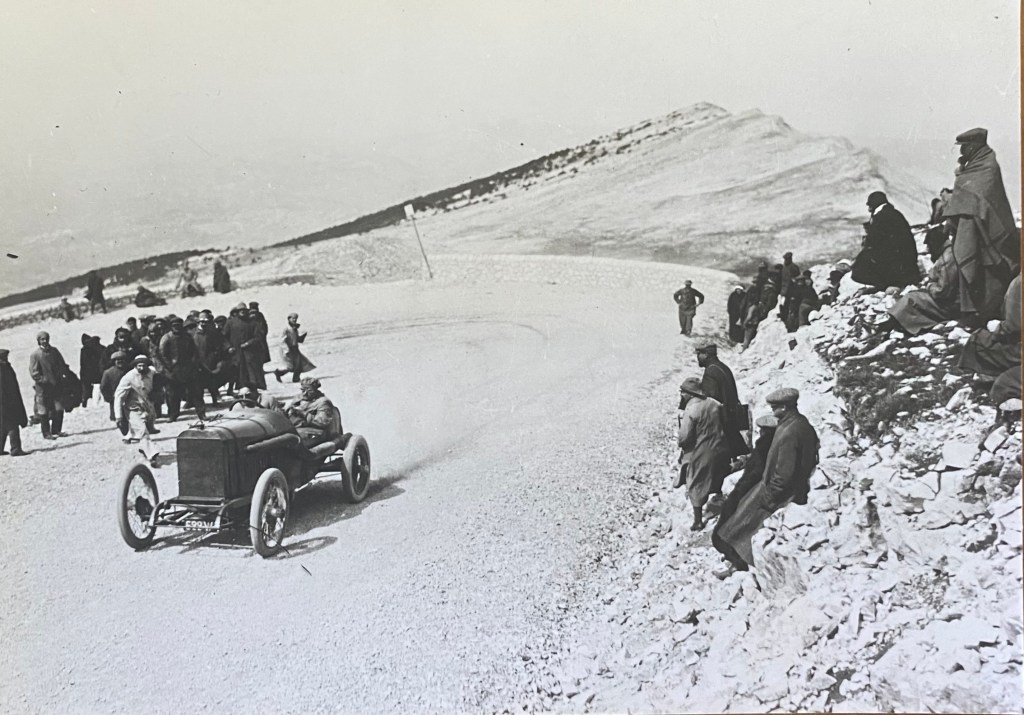
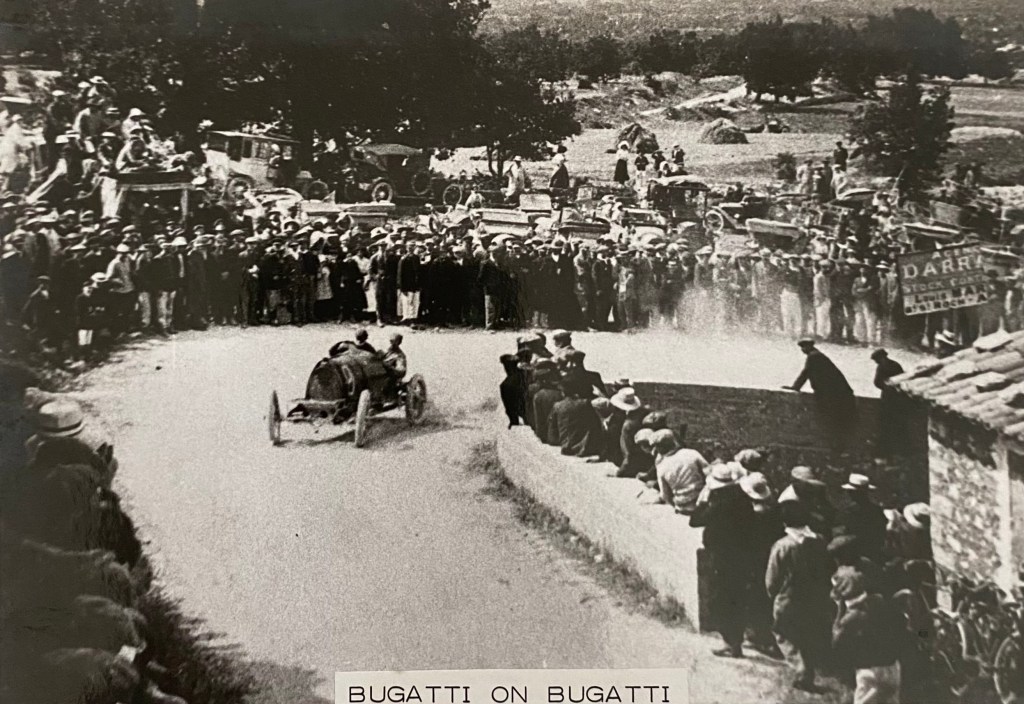
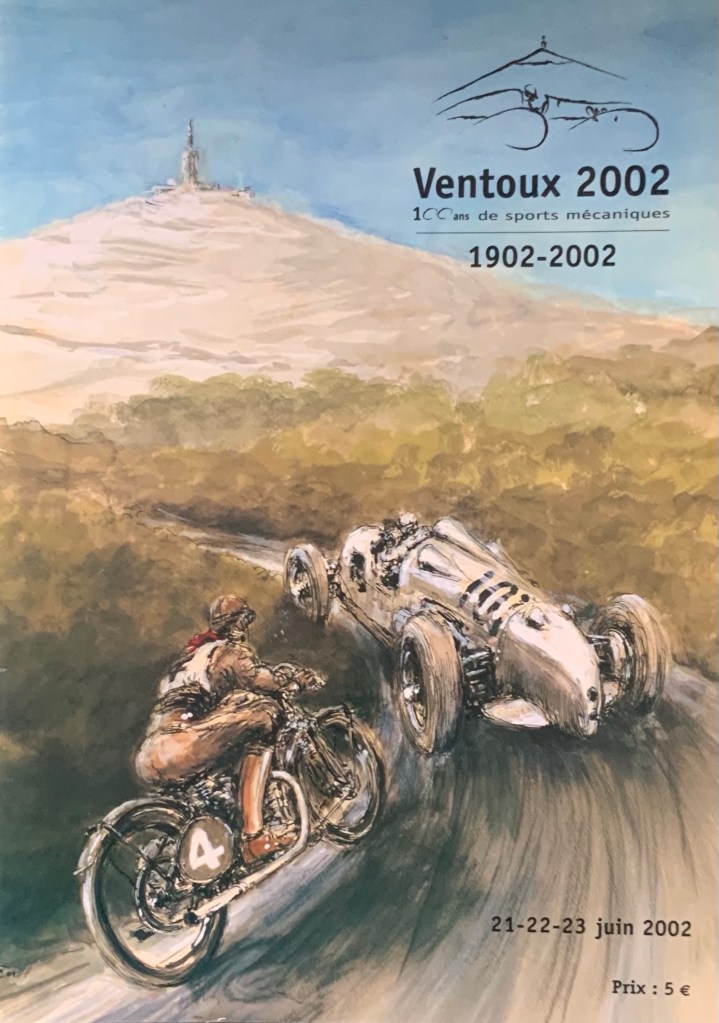
Known as ‘The Giant of Provence’, this 1900 metre mountain dominates southern Provence; its bald, treeless, summit gives it the appearance of being snow covered.
It will be familiar to those who watch ‘Le Tour de France’ (and who doesn’t?) as a particularly gruelling hill climb, but few will be aware that it is also famous as a car and motorcycle hill climbing venue.
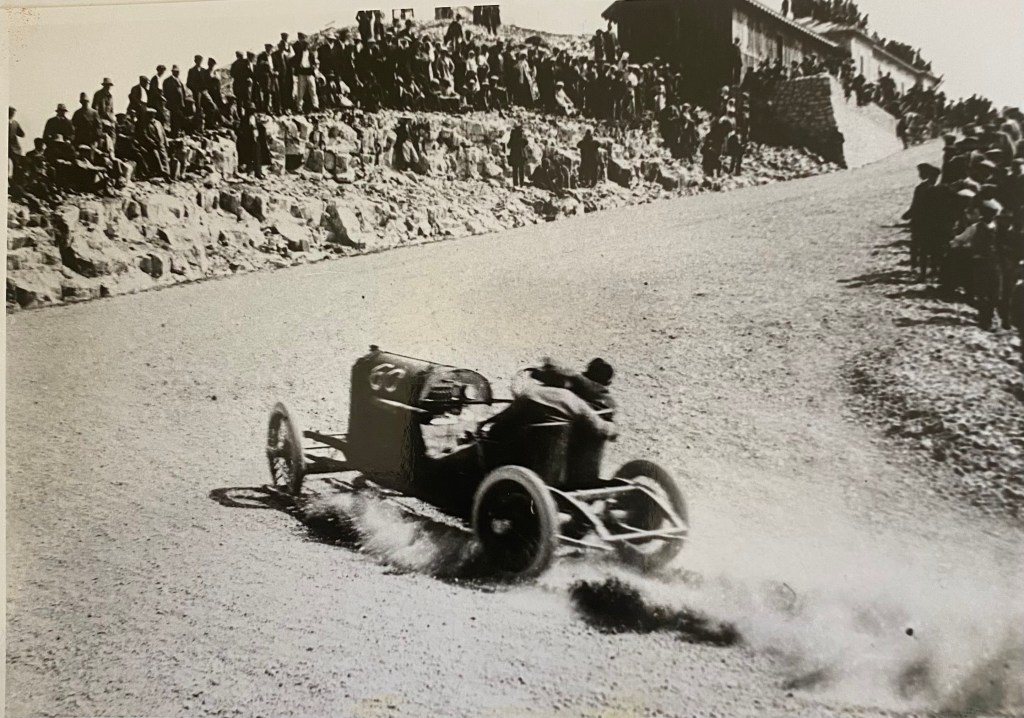
This short review was prompted when Mark Bisset spotted the featured photograph of George Boillot in my collection. Boillot, driving a Peugeot Lion, achieved FTD in 1910; this photograph shows him near the summit on a 7.6-litre, DOHC, 16-valve, four-cylinder Peugeot L76 on August 11, 1912. His time in 1910 was 21 min 30.4, in 1912 17 min 46 sec, and in 1913, again on Peugeot, he ascended in 17 min 38 sec.
Note the W-registration, a factory trade plate. No-doubt George and his compatriots had driven the car 600 kilometres from the Lion Peugeot factory in Sochaux to the Mount.
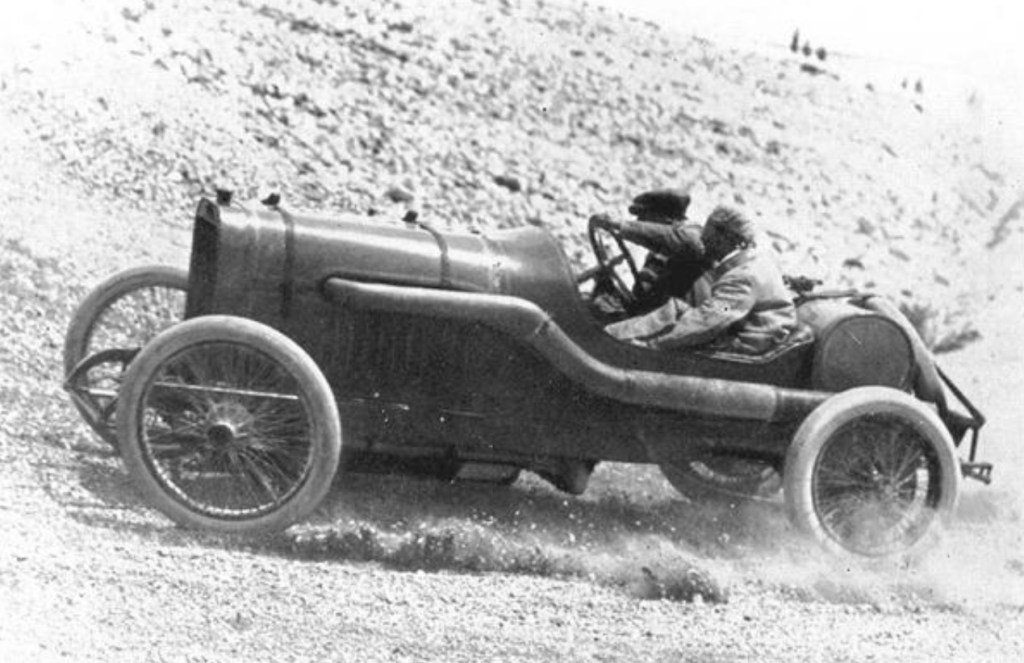
Boillot and passenger in 1912, lack of L76 front brakes doubtless added to the challenge! (unattributed)Ettore and passenger aboard his 5-litre chain drive Type 16 (B King)
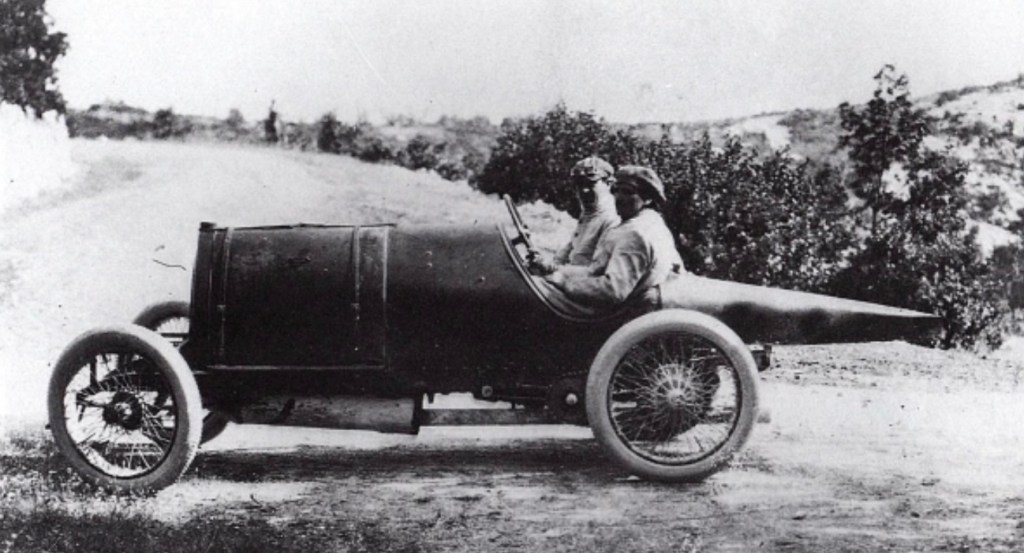
Ettore Bugatti also competed on one of his Type 16 5-litre, SOHC, three-valve, four-cylinder machines; his journey from Molsheim would have been 750 kilometres.
Note the luggage rack on which he mounted his suitcase for the journey from Molsheim! C/n 471 still exists…as does the suitcase.
Bugatti and passenger aboard T16 at Mont Ventoux. This view is perhaps not the racer’s best angle (unattributed)
The hillclimb dates back to 1902 and the “Palmares Autos” is decorated with many famous names – to mention just a few: Rougier, Boillot of course, Thomas, Divo, Carraciola, Straight, Von Stuck, Trintignant, Behra, Barth, Hermann, Stommelen and Mitter – a veritable ‘Who’s Who’ of Grand Prix and Hill Climbing talent.
With no safety barriers and a winning average speed of almost 150 kph there were no more open events after 1976, presumably for safety reasons.
Etcetera…
Boillot, Peugeot again, year uncertain, advice welcome (B King)
Credits…
Bob King Collection
Tailpiece…
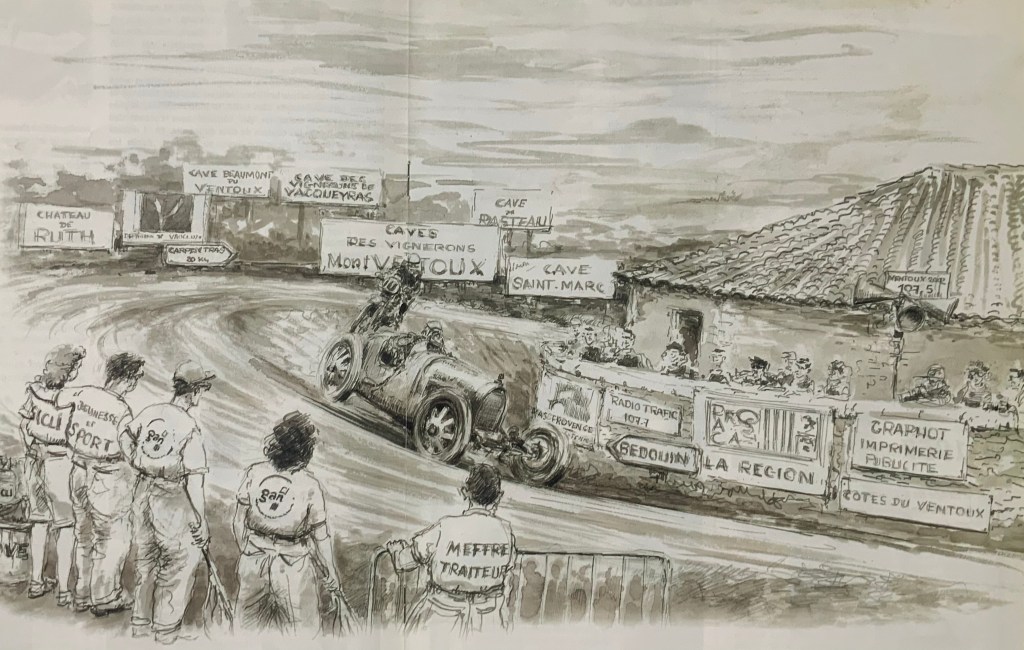
In 2002 an event was held to commemorate 100 years since the first event. My wife and I were lucky enough to chance on this celebration as we were holidaying in the region.
And what an event with over 250 racing cars and motorcycles with everything from a 1902 Paris-Vienna Renault, through scads of barely known French voiturettes (D’Yrsan, BNC, Darmont, Rally and so on), to a Porsche 906 Carrera 6 that competed in 1967, and an Abarth SP 2000 which was the European hill climb champion in 1970. What a feast for eye and ear!
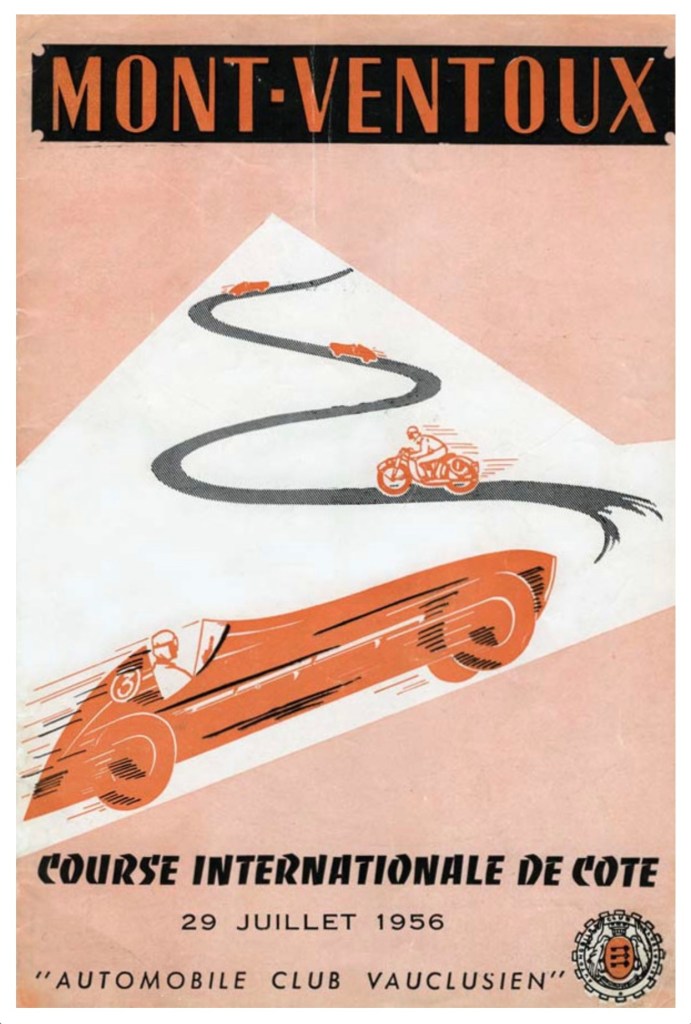
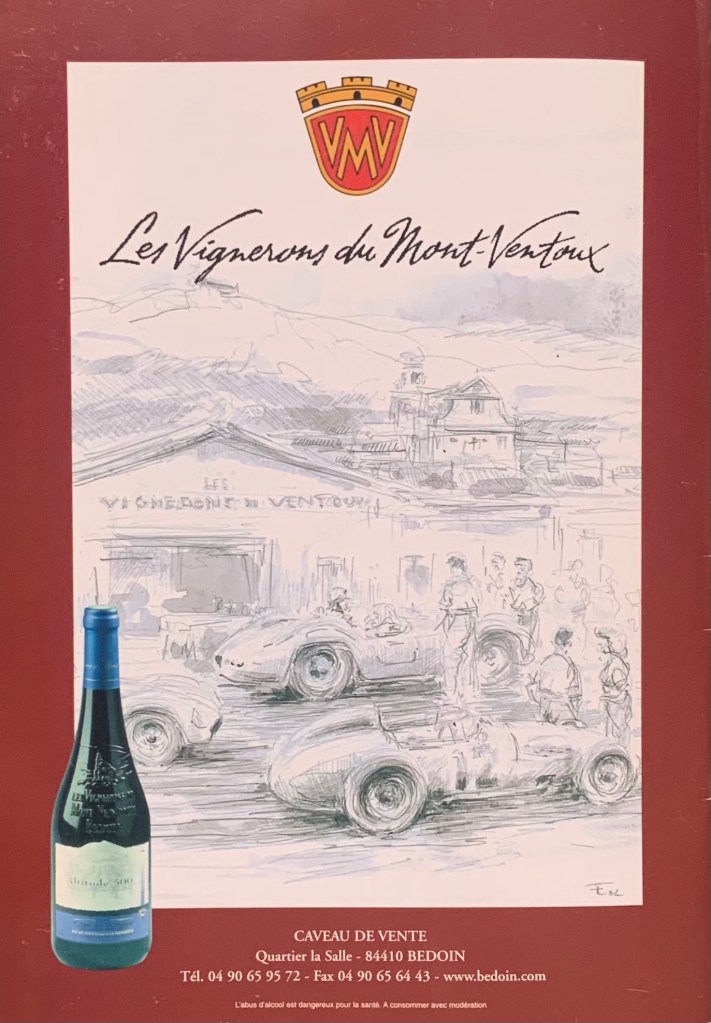
The French even manage to make their brochure ads cool rather than gauche!
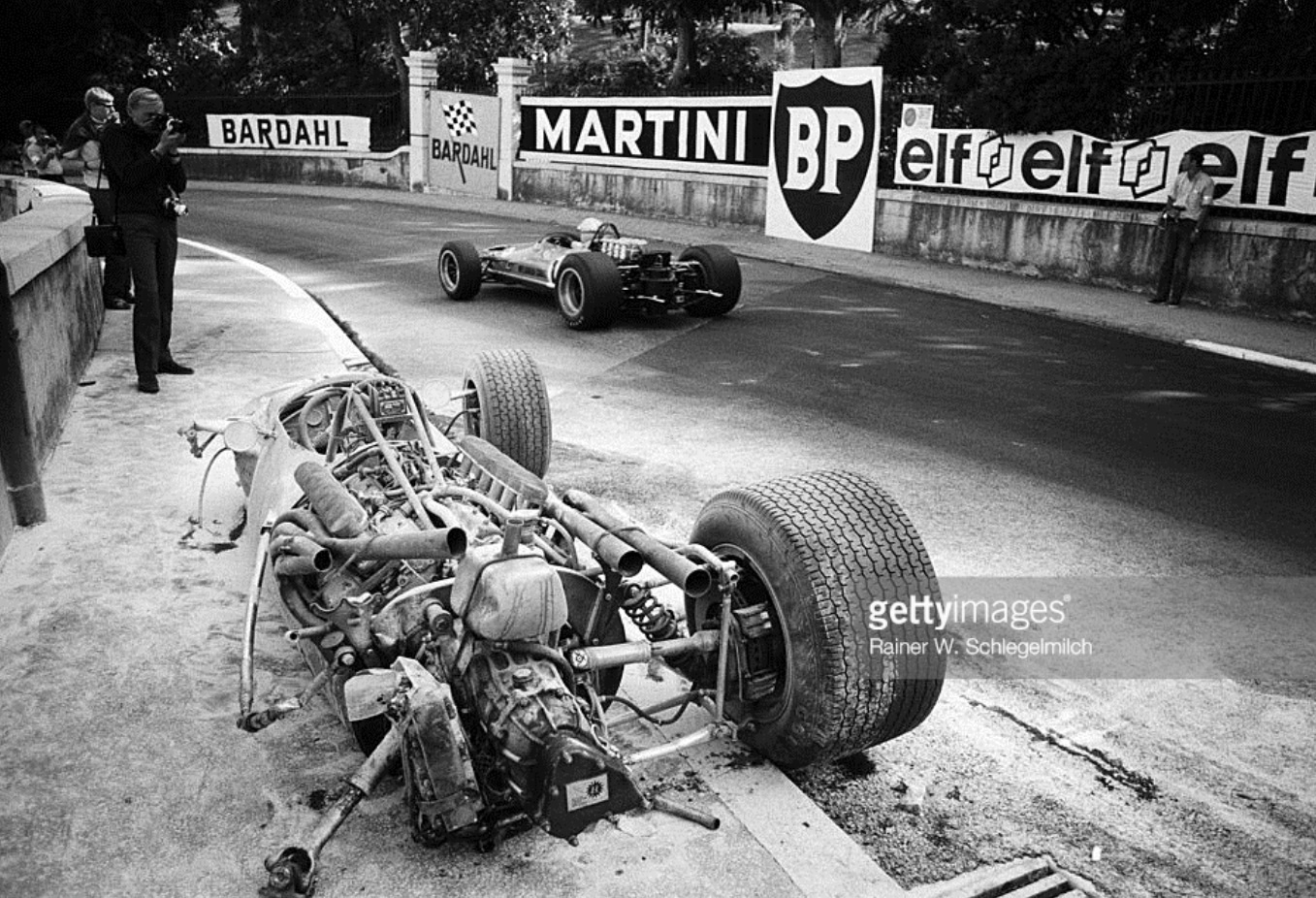
Denny Hulme’s snub/Monaco nosed McLaren M7A Ford passing Pedro Rodriguez’ very dead BRM P133 V12 during the 1968 Monaco Grand Prix…
By lap 16 there were only five cars left in the race won by Graham Hill’s Lotus 49B Ford from Richard Attwood’s BRM P126 and Lucien Bianchi’s Cooper T86B Maserati. Pedro boofed the Len Terry designed BRM on lap 16 having qualified ninth, Denny raced his car to fifth.
A couple of design aspects of the P126/133 design in the shot below are worth noting. The Hewland DG300 transaxle is the only occasion on which a non-BRM ‘box was fitted to a Bourne designed and built car. Checkout the remaining right-rear suspension componentry too, the twin-parallel-lower-links set up to better control rear toe, later picked up by all and sundry, was first designed for this car by Len.
Credits…
Rainer Schlegelmilch
Tailpieces: Pedro and BRM P133 in pre-rooted state…
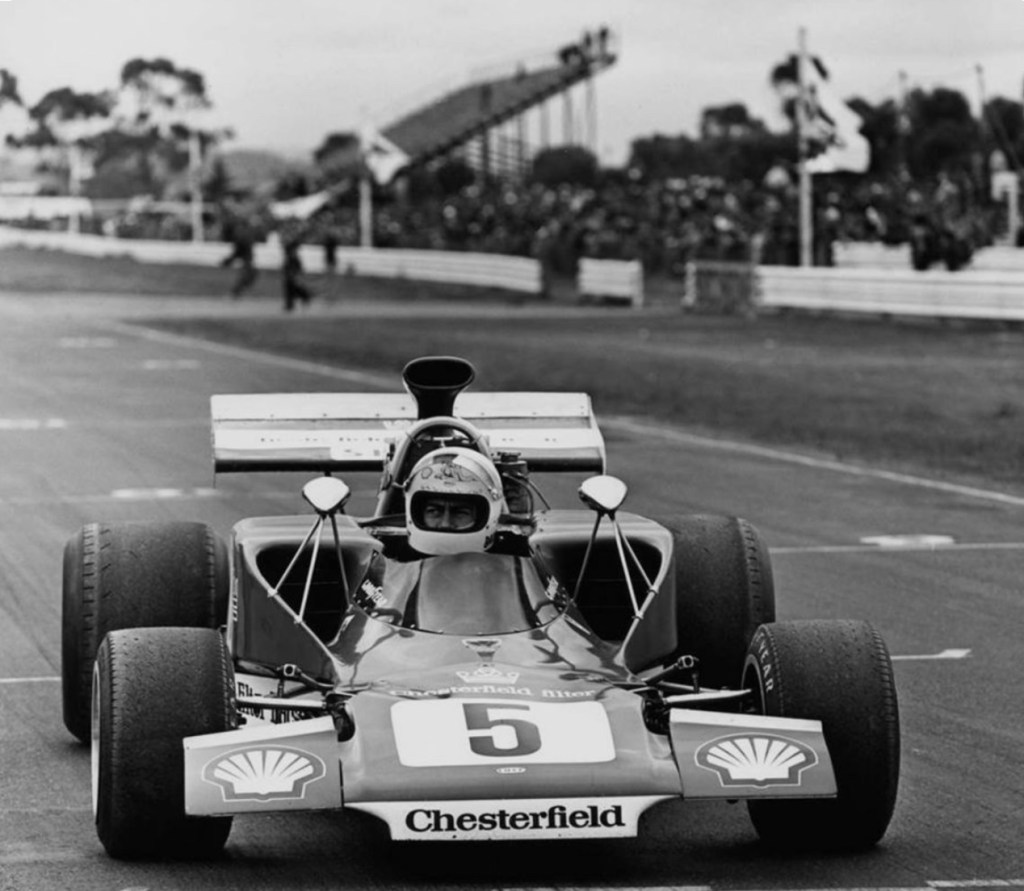
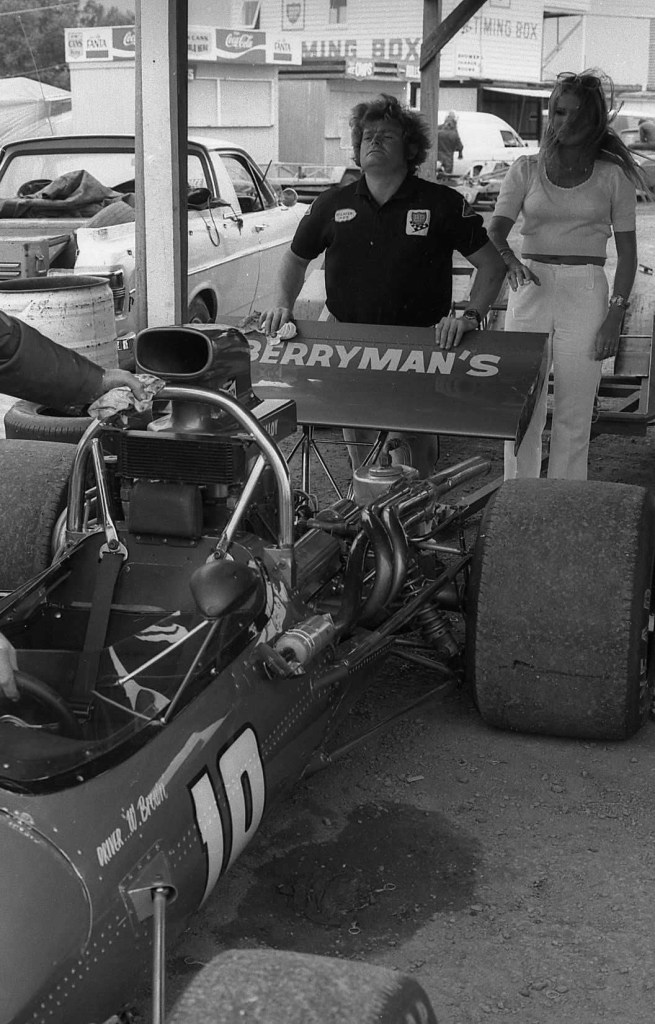
Max Stewart with John Walker at right, Calder 1972. Repco-Holden V8, then circa 490bhp powered Elfin MR5 and Matich A50 (S Gall)
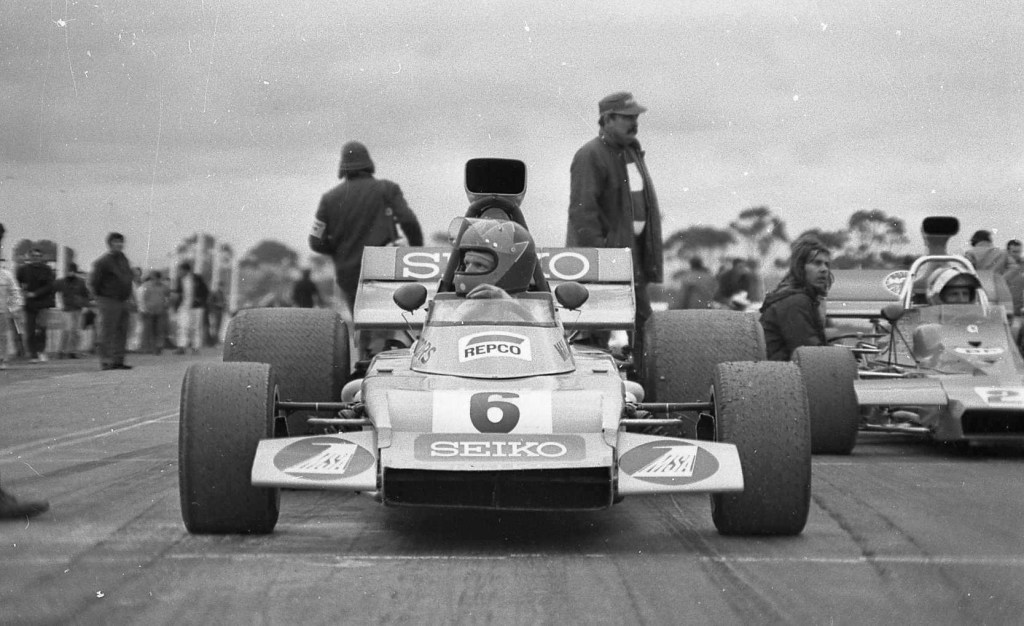
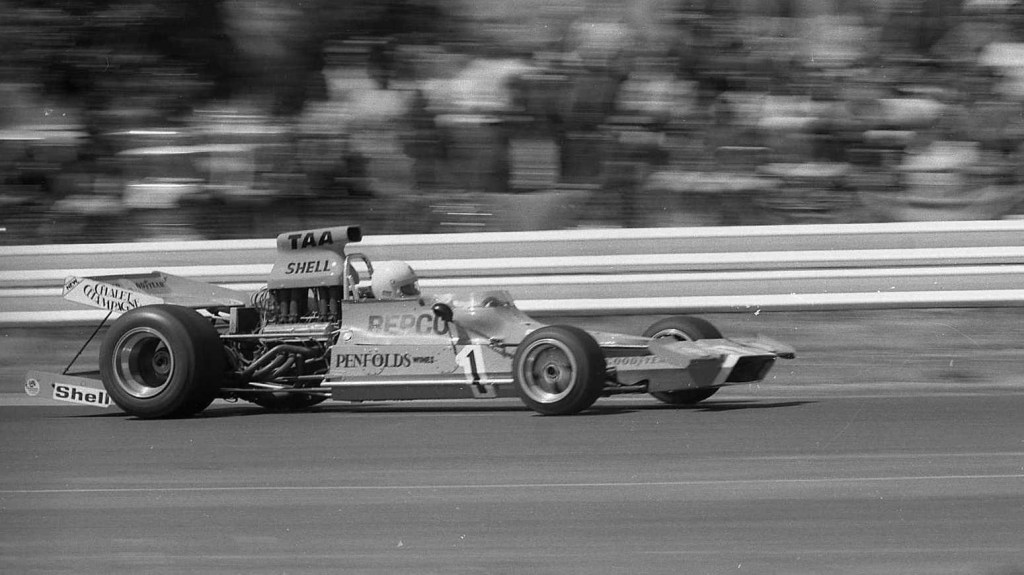
During 1972, then Australian automotive parts manufacturing and retailing colossus, Repco Ltd celebrated its half century.
Yes folks, that means the now foreign owned 400 store retailer of automotive bits and pieces made by others is a centenarian in 2022! They have some exciting things planned for next year, I won’t rain on their parade by sharing the bits I’m aware of.
Time flies all too fast, as a young teenager I attended two of the five Repco Birthday Series F5000 championship meetings run at Calder between March and December ‘72 as part of those celebrations.
The man who was ‘sposed to win the Repco Birthday Series, F Matich Esq. Bi-winged Matich A50 Repco-Holden, Calder 1972 (S Gall)
At that stage Repco had been out of F1 for four years, the 3-litre V8 Repco Brabham Engines program had yielded two GP world constructors and drivers championships for Brabham Cars (Motor Racing Developments Ltd), Repco Brabham Engines Pty. Ltd, Jack Brabham and Denny Hulme in 1966-1967.
Repco’s cost effective means of maintaining a racing presence after pulling the F1 pin was a partnership with General Motors Holdens to build F5000 engines using GMH’ then ‘spankers 308 V8 as a base, from 1969 to 1974.
Phil Irving and Brian Heard did mighty fine jobs, their Repco-Holden V8 engine design won AGPs, NZ GPs, many Tasman rounds, several Gold Stars and countless sports-sedan and sportscar races.
The interloper: KB in his sinfully sexy and oh-so-fast Lola T300 Chev at Calder in 1972 (I Smith)
It was therefore a pain-in-the-tit when Kevin Bartlett’s Chev powered Lola T300 rained on Repco’s parade in their home state by winning a ‘72 championship the grand plan of which involved a Repco-Holden engined victory!
It wasn’t all bad, Frank Matich, in the Repco sponsored Matich A50 Repco-Holden won that years Gold Star, but KB’s two Birthday Series round wins gave him a nine point advantage over FM. Conversely, Bartlett was 12 points short of Matich in the Australian Drivers Championship, the Gold Star.
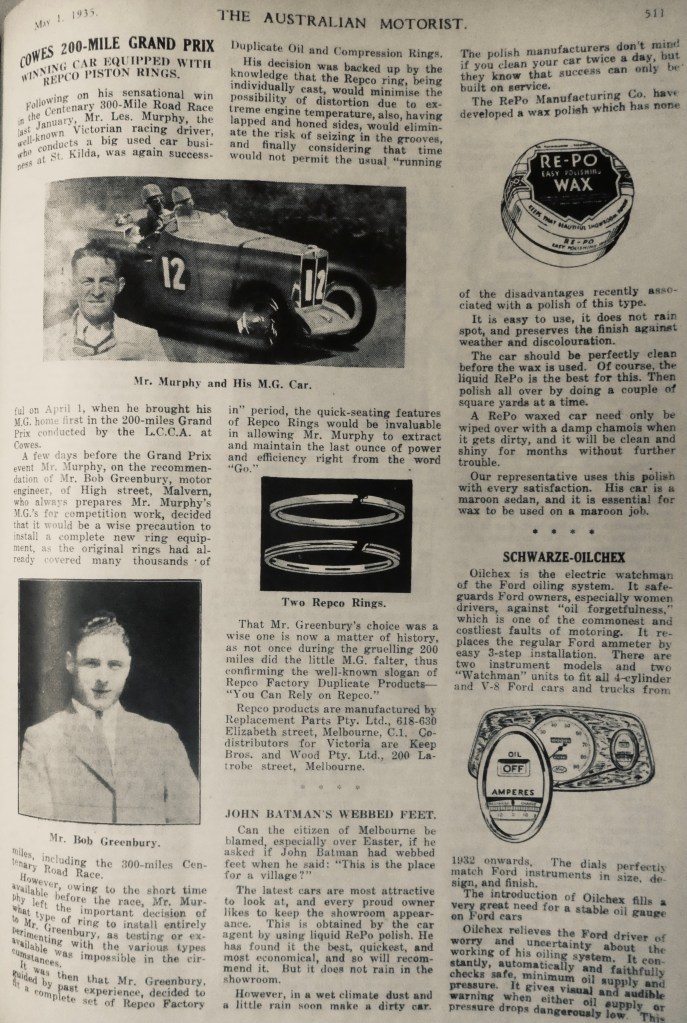
Repco’s race heritage goes all the way back. In 1935 they were sponsors of engineering substance, rather than just cash…not that cash is to be scoffed at (B King Collection)
In recent times Repco have returned to racing as series sponsors of the Bathurst maxi-taxis. In the forty years they were involved as OE and aftermarket suppliers to the motor industry, and constructors of cars (Maybachs, Repco Record), race engines, components and equipment from the mid-1930s to 1974 Repco’s involvement was supreme.
Still, the comparison is unfair. We once had an automotive industry in this country until it was sodomised to a standstill by a troika (sic) of incompetent, greedy fuckwits bereft of commonsense or a single-cell of vision; management, government and organised labour.
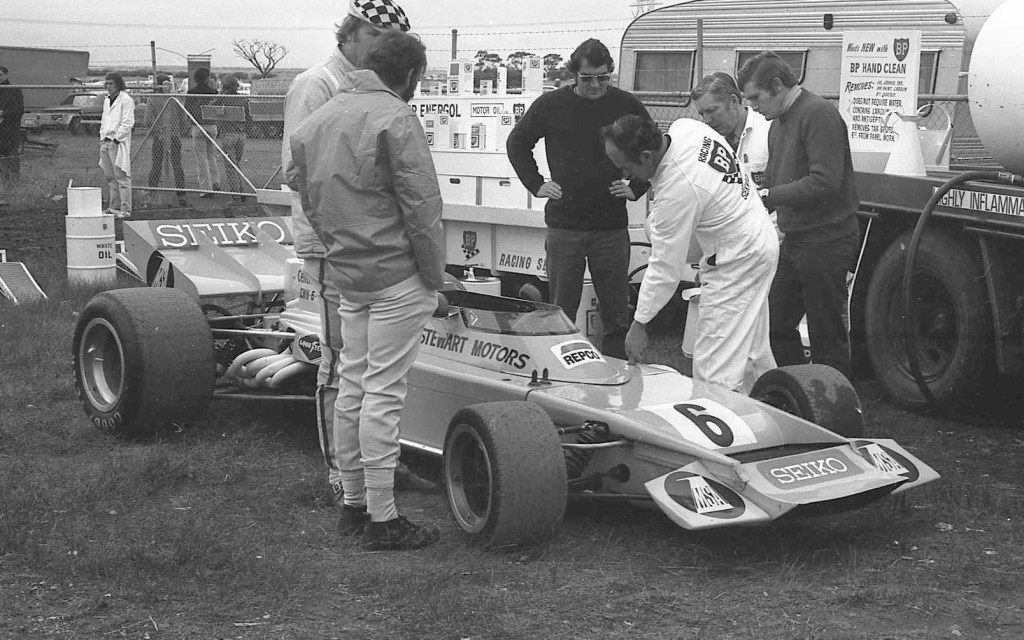
Gees he was a big, lanky prick wasn’t he? The capped Marvellous Maxwell Stewart partially obscured by mutton-chopped Bryan Thomson or Garrie Cooper (? who-izzit?) in the BP compound at Calder in 1972. Elfin MR5 Repco, not Max’ favourite car (S Gall)
Etcetera…
(T Johns Collection)
More on the use of Repco pistons and rings in 1935. This time fitted to Les Murphy’s MG P-Type during the ‘1935 Centenary 300’ held at Phillip Island in January.
(S Gall)
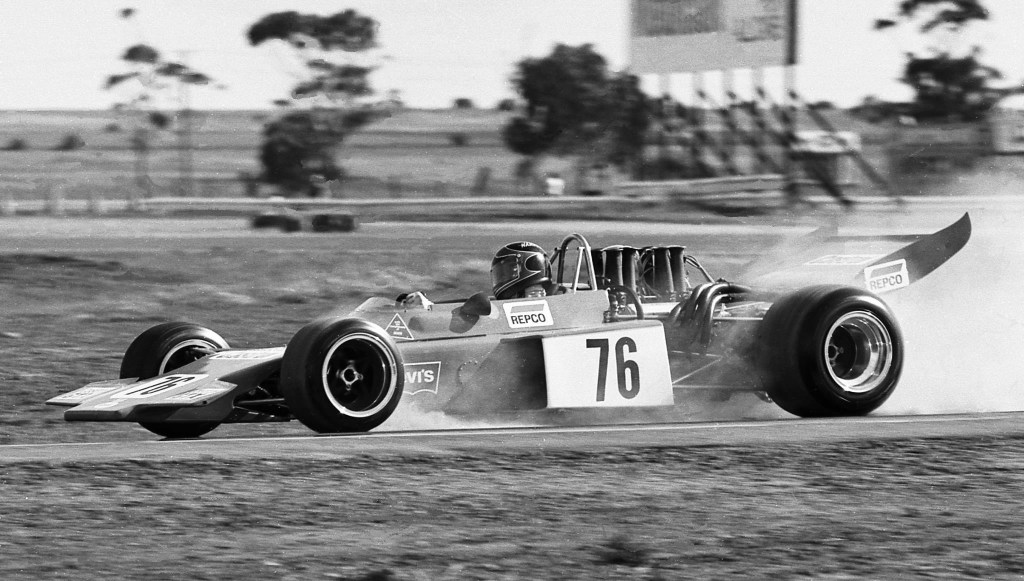
Warwick Brown proved he had the ability to handle these demanding 5-litre roller skates in 1972 having jumped out of a Cosworth FVC powered McLaren M4A – McLaren M10B Chev heading into Calder’s main straight in 1972.
(S Gall)
Graham ‘Lugsy’ Adams – then mechanic and later rather handy driver and F5000 constructor – does his best to focus on the Calder job at hand. Is that the future, and still current Mrs Brown looking thoroughly wonderful behind an M10B shortly to become Bryan Thomson’s Volksrolet?
Credits…
Stephen Gall, Bob King Collection, Ian Smith, Tony Johns Collection, Barry Edmunds
Tailpiece…
(B Edmunds)
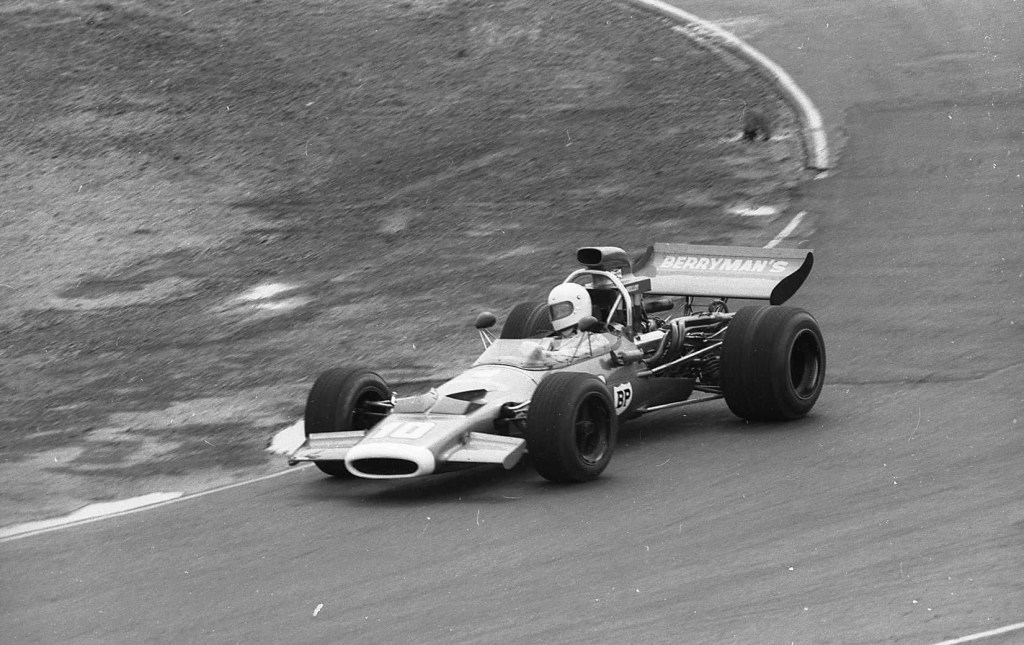
John Harvey in one of the very few appearances of Bob Jane’s Bowin P8 Repco-Holden F5000 at Calder in 1972 – Surfers Paradise and Warwick Farm were the others as far as I can see.
Bowin bias hereby declared…here I go. Again.
This beautiful, small, light, compact, ingenious, variable-rate suspension F5000 never got the run it deserved. Supposedly Janey put it to one side because Castrol wanted him to focus on his taxis rather than his real cars.
Then Leffo bought it in mid-1974, sans Repco-Holden V8, to replace the P8 chassis he boofed at Amaroo and then stuffed up the installation of a Chev V8 into a chassis for which it was never designed, creating a car as stiff as a centenarians todger, with handling reflective thereof…
John Joyce’s P8 Repco design is a great Oz F5000 mighta-been, not that mighta-beens count for SFA in motor racing!
















 primotipo...