Lady Godiva meets California Girl in Florida? Compound curavature of both chassis’ catch the eye…
Automobile Year 18 was the first issue of that great annual i pored over repeatedly from cover to cover, this page has always stuck in my mind.
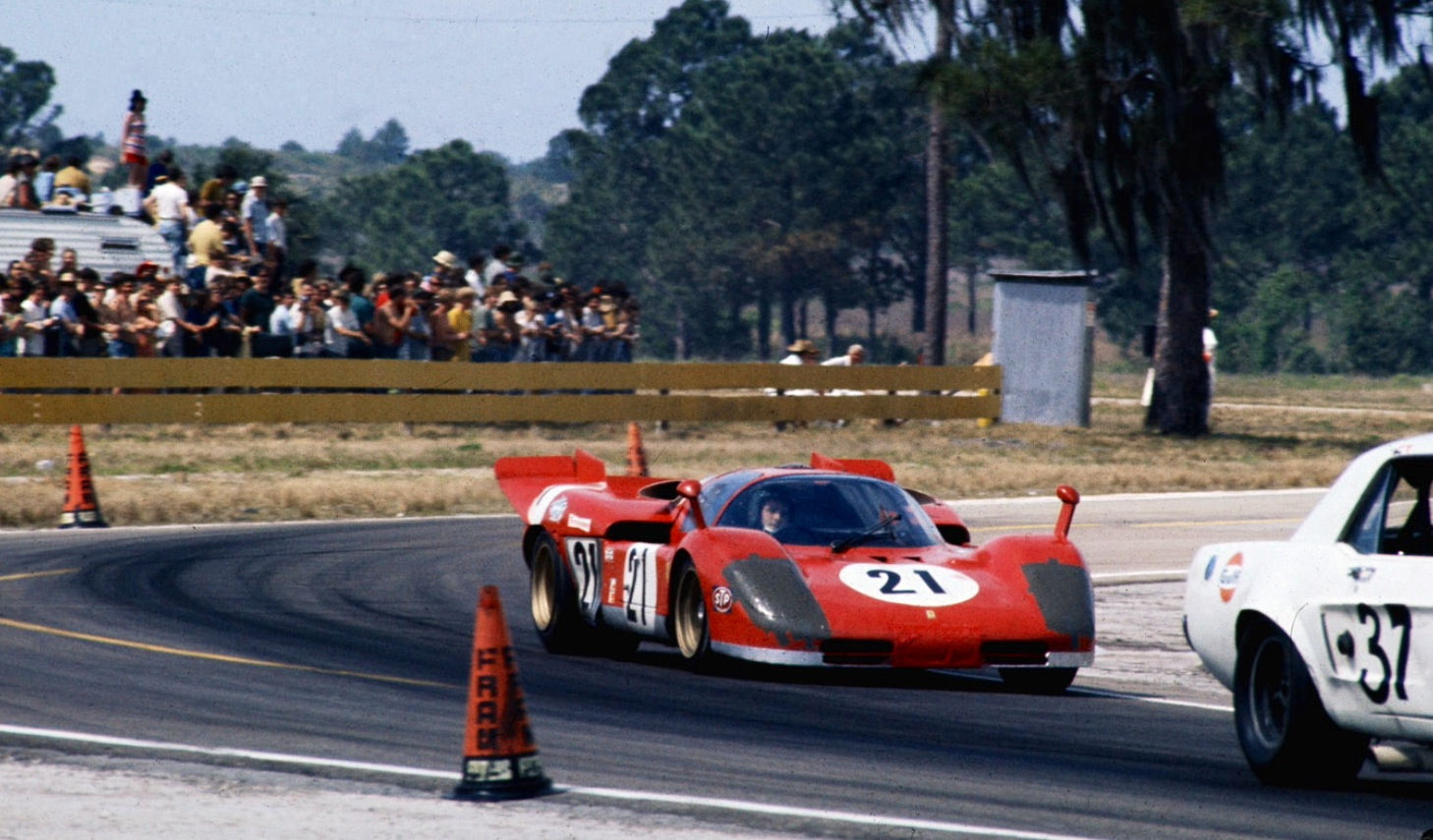
The race was won, if you care! by the trio of Ignazio Giunti, Nino Vaccarella and Mario Andretti in a Ferrari 512S from Peter Revson and Steve McQueen’s Porsche 908 and the Toine Hezemans, Masten Gregory Alfa Romeo T33/3 in third.
The 512S flattered to deceive, Sebring was the only blue riband event the fantastic car won in 1970, Porsche with the 908/3 and 917 swept the board with chassis suited to either handling or high speed circuits.
Giunti in the Ferrari 512S he shared with Nino Vaccarella and, later in the race Mario Andretti who jumped into this car after gearbox failure in the car he shared with Arturo Merzario. Car # 37 is the Collins/Wilson Ford Mustang, 24th. (petrolicious)
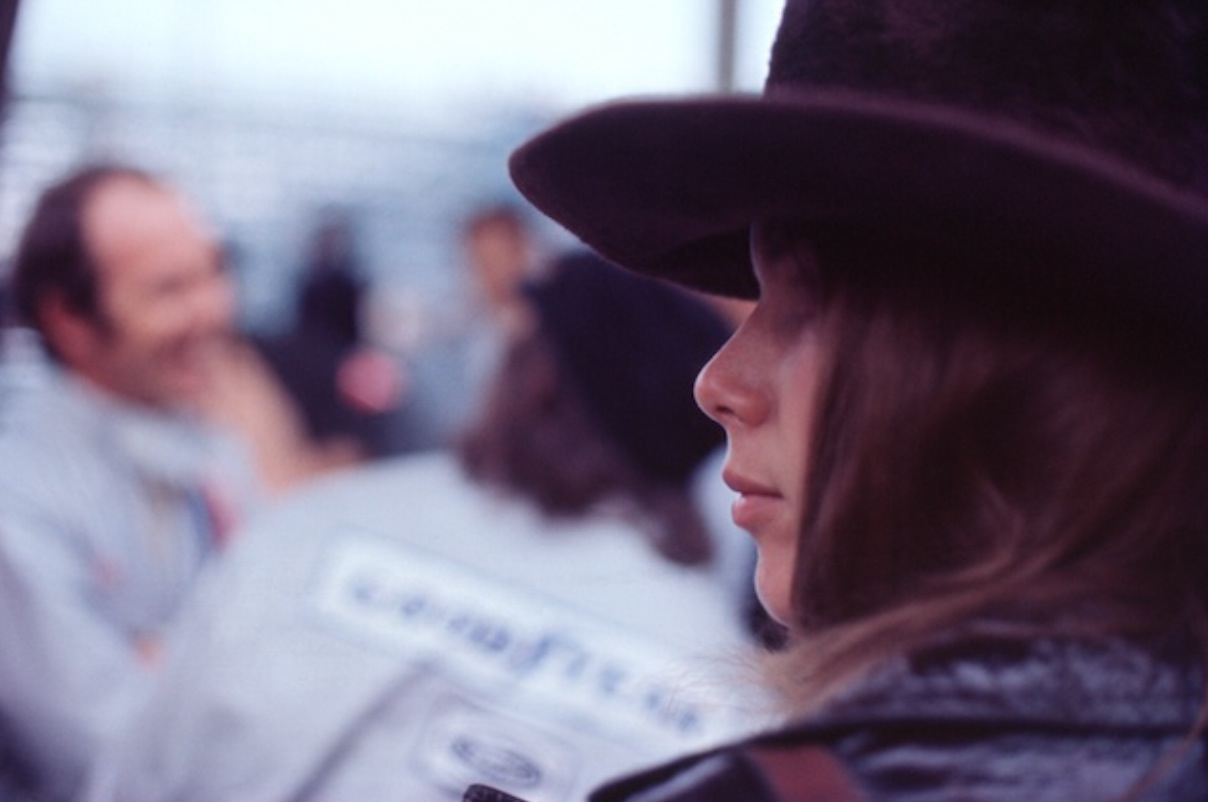
This fashion shot is from a photo site, I have no caption details, the chassis and engine are of no interest to these folks of course! Clearly the babe is a Cooper fan, my ‘educated guess’ of car is a 1963 T67 BMC Formula Junior, twin SU’s are unlikely on the rival Ford engine of the day?
So, one for you Cooper experts, it would be interesting to know the Who, What, Where and When of this photo.
1963 Cooper T67 BMC Formula Junior. (Theo Page)
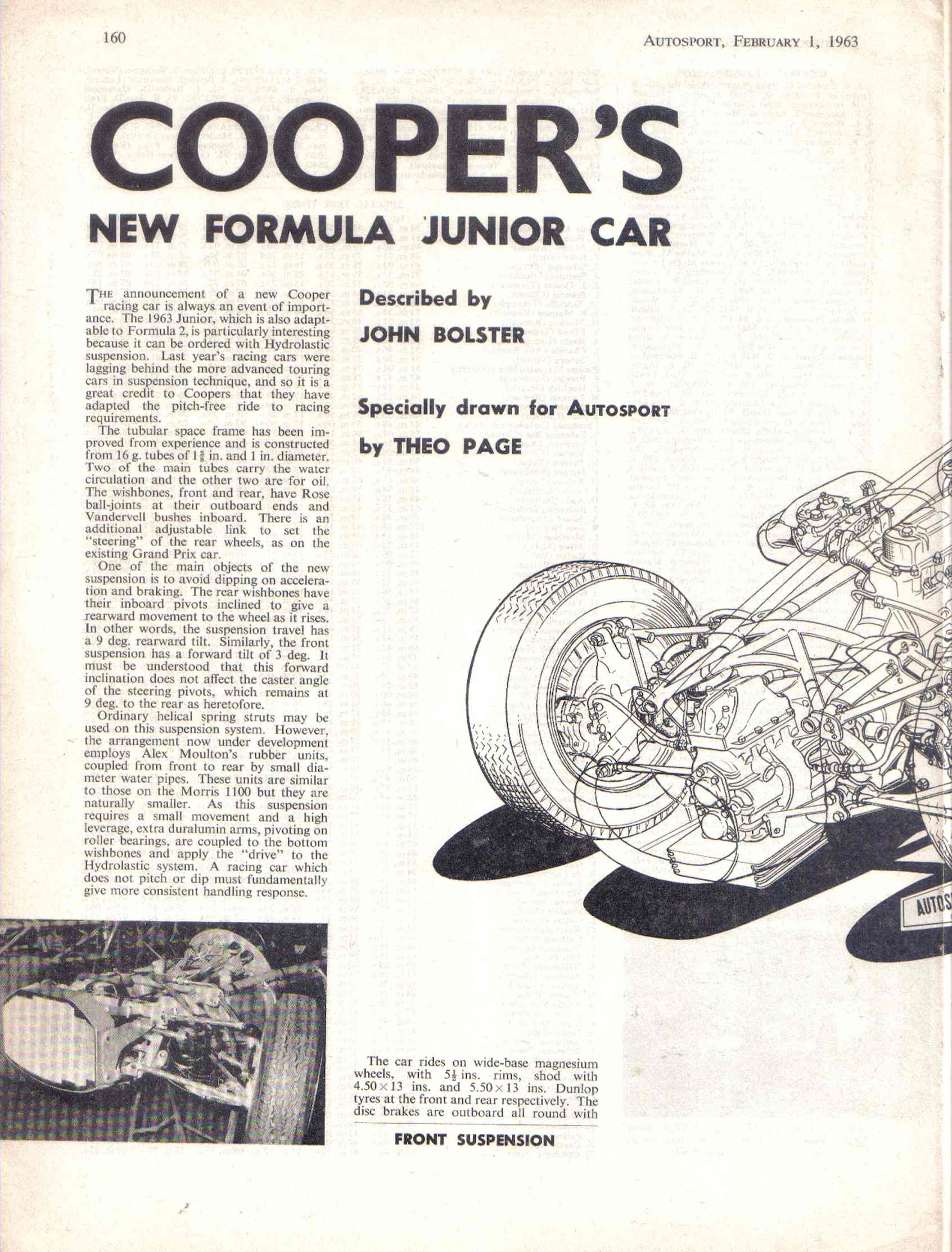
Autosport Article on the Cooper T65/67 and its ‘Hydrolastic Suspension’ referred to in the response by Ken Collins/Peter Jackson below…
Credits…
‘Photo Is Art’, Theo Page cutaway drawing, Stephen Dalton Collection for the Autosport article
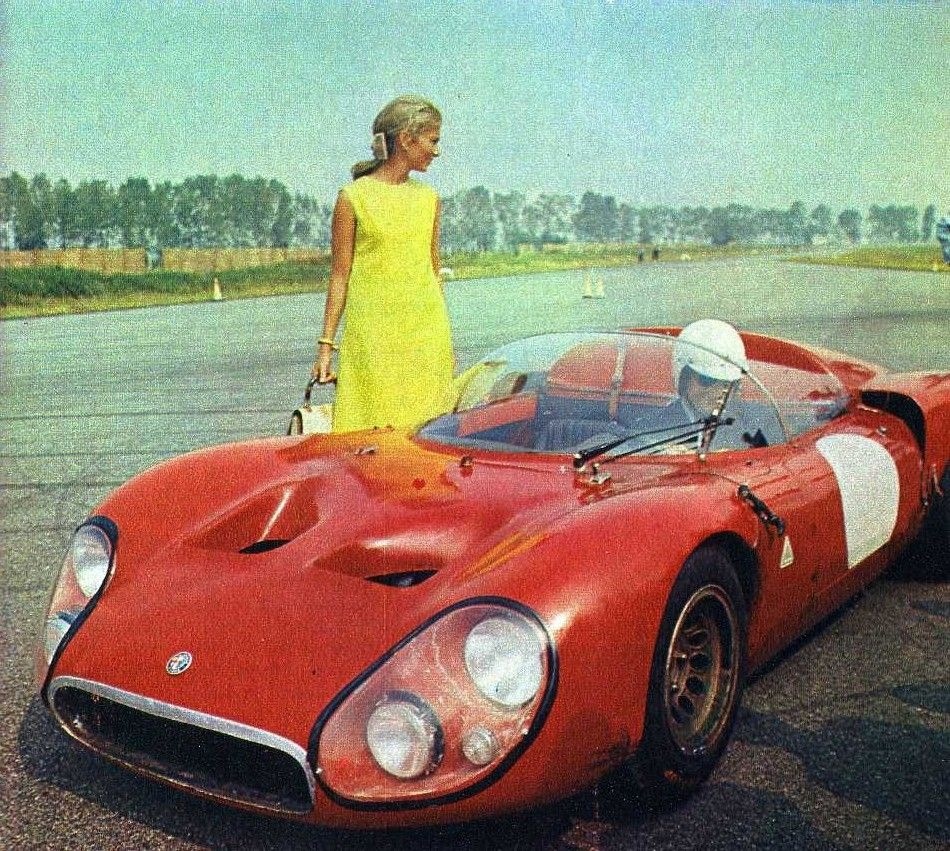
Alfa Romeo publicity shot of Prince Albert and Princess Paola, Belgian Royals at Balocco, Alfa’s test circuit…
The Prince is about to test the ultimately very successful Tipo 33, here in Mugello Spyder 2-litre 1967 form. Thanks to Claudy Schmitz for identifying the Royal Couple and Balocco as the correct venue, the power of Facebook! Whilst the Princess was born of Italian Royal blood it would be interesting to know the circumstances of this test drive, the car was definitely too small for their family of five!
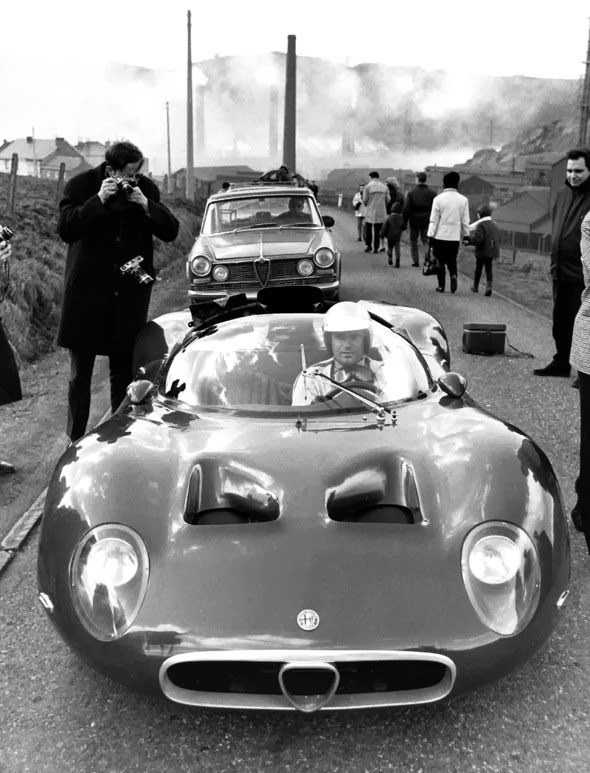
Alfa’s first mid-engined racer made its competition debut at the Fleron Hillclimb in Belgium on 12 March 1967, factory test pilot Teodoro Zeccoli took a win from some stiff competition.
Zeccoli at the Belgian Fleron Hillclimb upon the T33 ‘Periscopica’ debut meeting. Alfa 2600 Berlina behind. Fleron is in the Province of Liege, location appears very industrial, power station in the background (unattributed)
The 33 made its race debut at Sebring that summer of ’67, the weekend of 1 April...
Andrea De Adamich led the 12 Hour event’s first lap but both cars entered retired with suspension and overheating dramas.
Here are some shots of the cars in the Sebring paddock; #65 is DeAdamich/Zeccoli, #66 Roberto Businello/Nanni Galli. The race was won by the factory Ford Mk4 of Bruce McLaren and Mario Andretti. I covered the 1967 Endurance Season in some detail in an article i wrote a while back about Ferrari P4/CanAm350 ‘0858’ which may be of interest to some of you;
The more you look the more you see, Sebring, the DeAdamich/Zeccoli T33. Engine, two coils, behind the engine the circular vertical ducts which take cool air to the inboard discs when the body is lowered into position are clear. See the rear chassis diaphragm and coil spring/dampers, inboard Girling discs, oil tank to the left of the six-speed Alfa ‘box, battery to its right. Build quality clear.
(Paolo Devodier)
Those beautiful Alfa mag alloy wheels, filler for centrally located fuel tanks, a spare had to be carried under the regs of the time.The front of the cast magnesium chassis extension houses the radiator, you can just see the nearside suspension ‘top hat’ and adjustable roll bar going forward and mounting at its outer end.
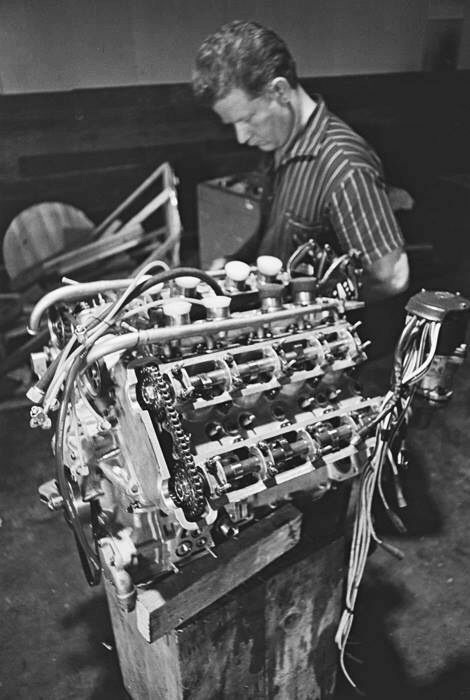
Engine change in the Sebring ’67 garage. ‘Periscopica’ 2-litre T33 all alloy, Lucas injected, DOHC chain-driven two-valve V8 engine developed a claimed 260-270bhp @ 9500rpm (Paolo Devodier)
Four cars were entered in the ’67 Targa Florio…
All failed to finish due to suspension problems (De Adamich/Jean Rolland/Bonnier/Baghetti) and a minor accident involving the Geki Russo/Nino Todaro. The race was won by the Porsche 910 of Paul Hawkins and Rolf Stommelen.
Targa Florio 1967. The Bonnier/Baghetti T33 ahead of the other factory cars…Periscopica clear to see. Love the ‘period’ hand-painted numbers. (Unattributed)Jo Bonnier in the T33 he shared with Giancarlo Baghetti during Targa 1967 (unattributed)T33 cockpit shot at ’67 Targa. LHD unusual in racing sportscars, Alfa would later change to the norm. Momo steering wheel, Veglia instruments, change for six-speed box all clear, lots of instruments for the driver to monitor. Not sure which chassis this is, or the T33 in front, you can just see the tail of the Scuderia Filipinetti Ferrari P3/412P ahead (Rainer Schlegelmilch)
Nani Galli and Andrea De Adamich finally broke through for the team at the Nurburgring, they finished fifth in the 1000Km behind four Porsche 910s...
The winning Porsche 910 was driven by the combination of Joe Buzzetta and Udo Schutz. The De Adamich/Galli T33 had another suspension failure on lap 18, but they shared the other car driven by Businello/Zeccoli, the four drivers getting the joy of the cars’ first race finish.
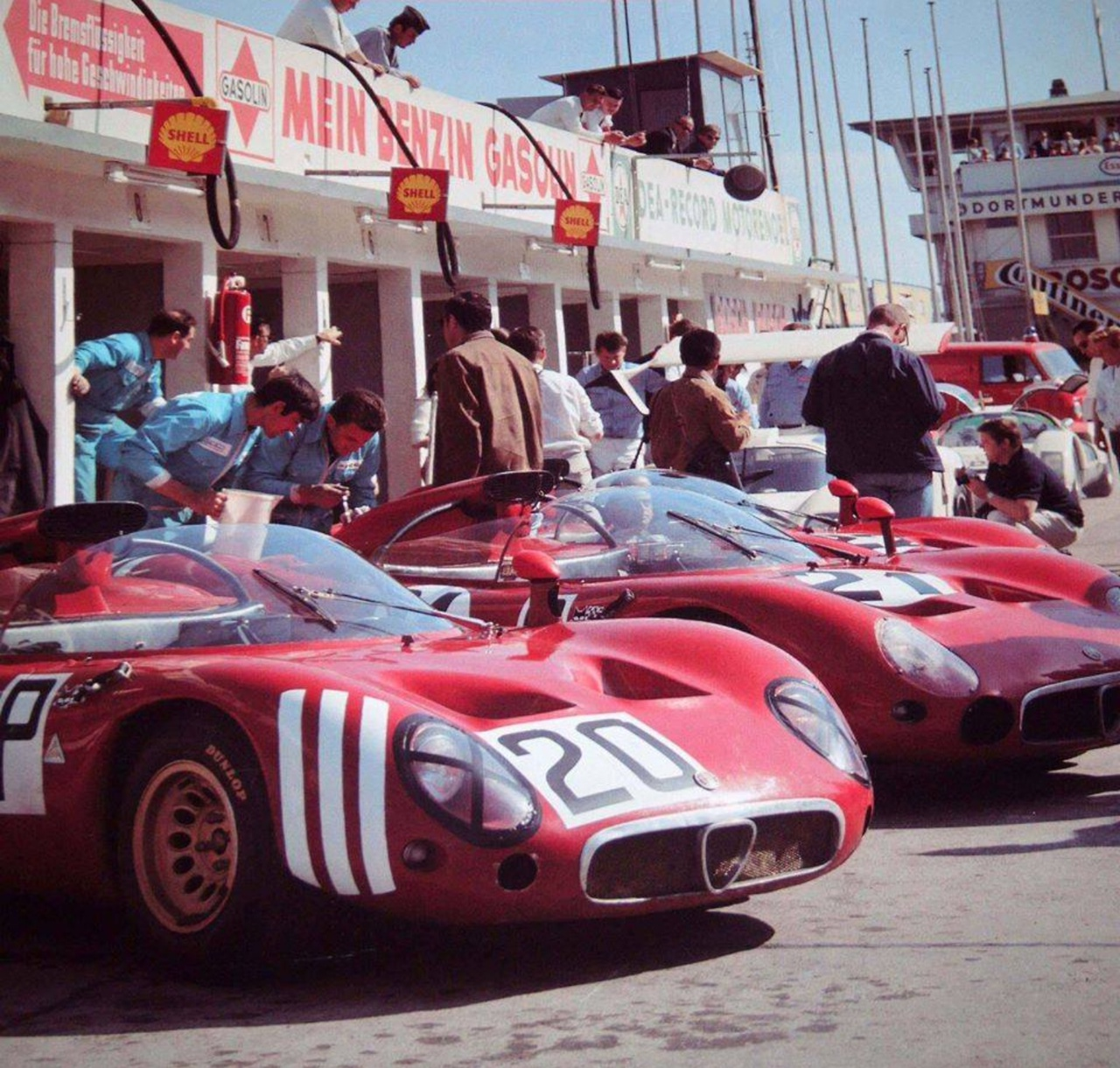
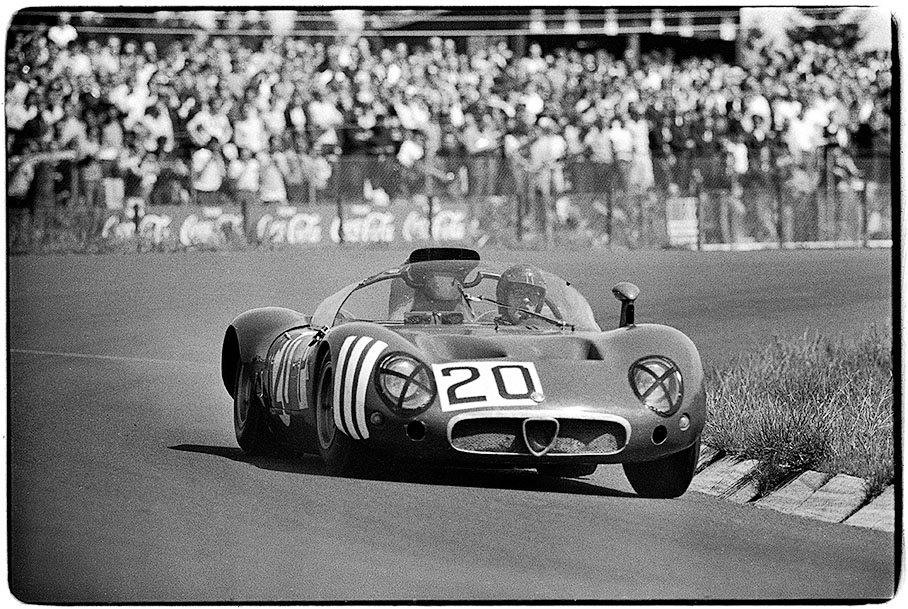
Autodelta SpA lineup in the Nurburgring pitlane, 28 May 1967. #20 DeAdamich/Galli (DNF suspension) #21 Russo/Baghetti (DNF ‘box) and #22 fifth place car of Businello/Zeccoli/DeAdamich/Galli (Accursio Cassarino)Andrea De Adamich in the T33 he shared with Nanni Galli, the Italian duo DNF with suspension failure, then hopped into the #22 surviving car for fifth place (unattributed)The ‘pre-owned’ T33 of de Adamich/Galli during Nurburgring practice 28 May 1967 (Rainer Schlegelmilch)Ignazio Giunti with tyre problems at Mugello (unattributed)
The Periscopica’s final start for 1967 was the Circuit of Mugello in July, eight laps of a tough 66km road circuit…
Udo Schutz and Gerhard Mitter won the race tailor made for the fast, light but tough Porsche 910. A privately entered GTA was the best place Alfa in seventh, the three Autodelta T33s of DeAdamich/Galli, Lucien Bianchi/Giunti and Colin Davis/Spartaco Dini all failed to finish.
(Accursio Cassarino)
It had been a patchy start but the Tipo 33 continually evolved over the following decadeultimately winning many races, sometimes not against the strongest of opposition, but ultimately winning the World Championship of Makes in 1975 and 1977.
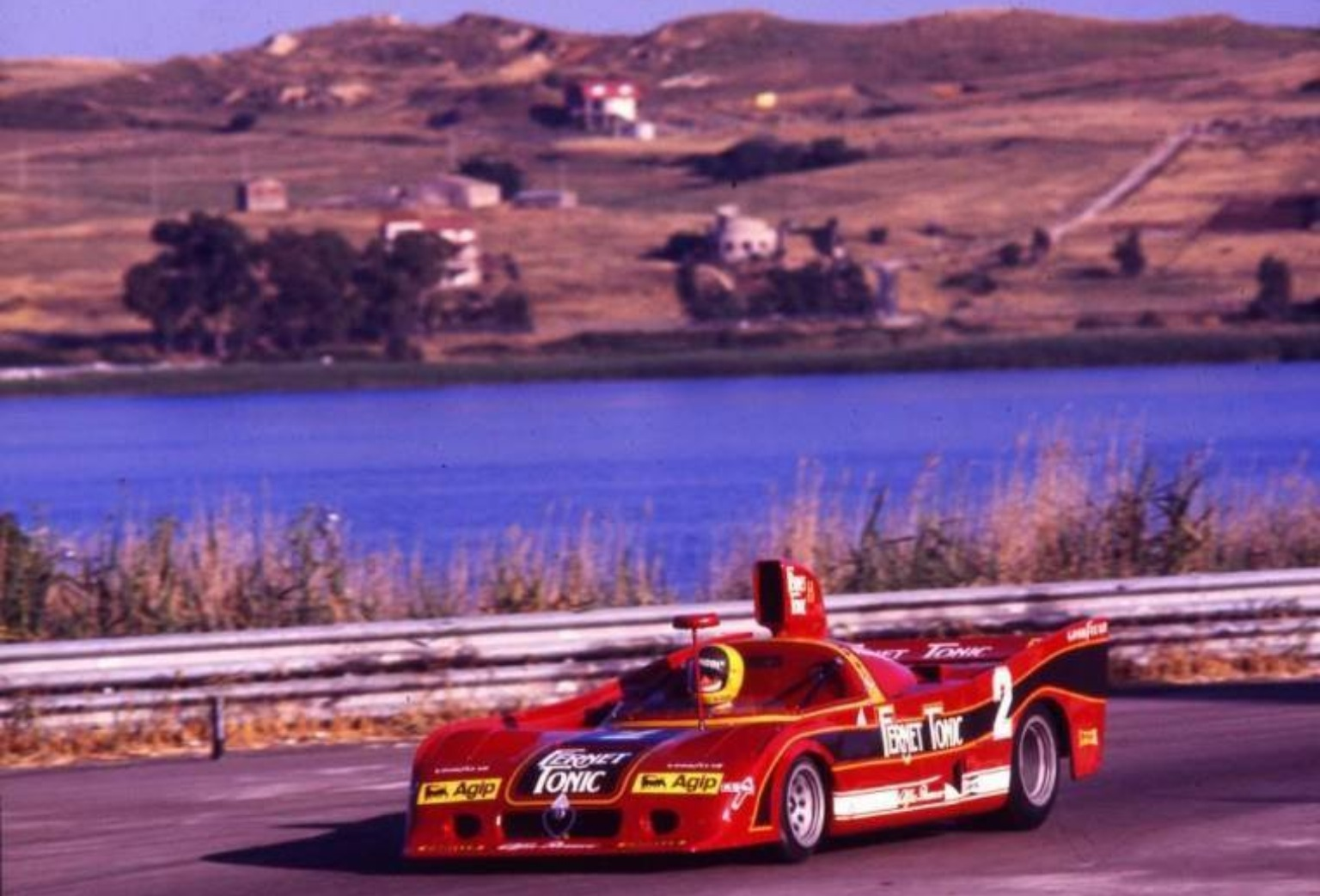
Shown above is the 1977 Alfa 33 SC12 driven by Spartaco Dini at Enna-Pergusa in June. The car used a spaceframe chassis (Alfa used both spaceframes and monocoques during the model’s long life and evolution) and a 2.1-litre fuel injected, twin turbo, four-valve V12 producing circa 640bhp. Dini practiced the car but did not start, this car was driven by Francia/Merzario but was disqualified for a startline infringement, Arturo Merzario won in another SC12.
(Vic Berris)
The T33 in its original guise had an unusual chassis design...
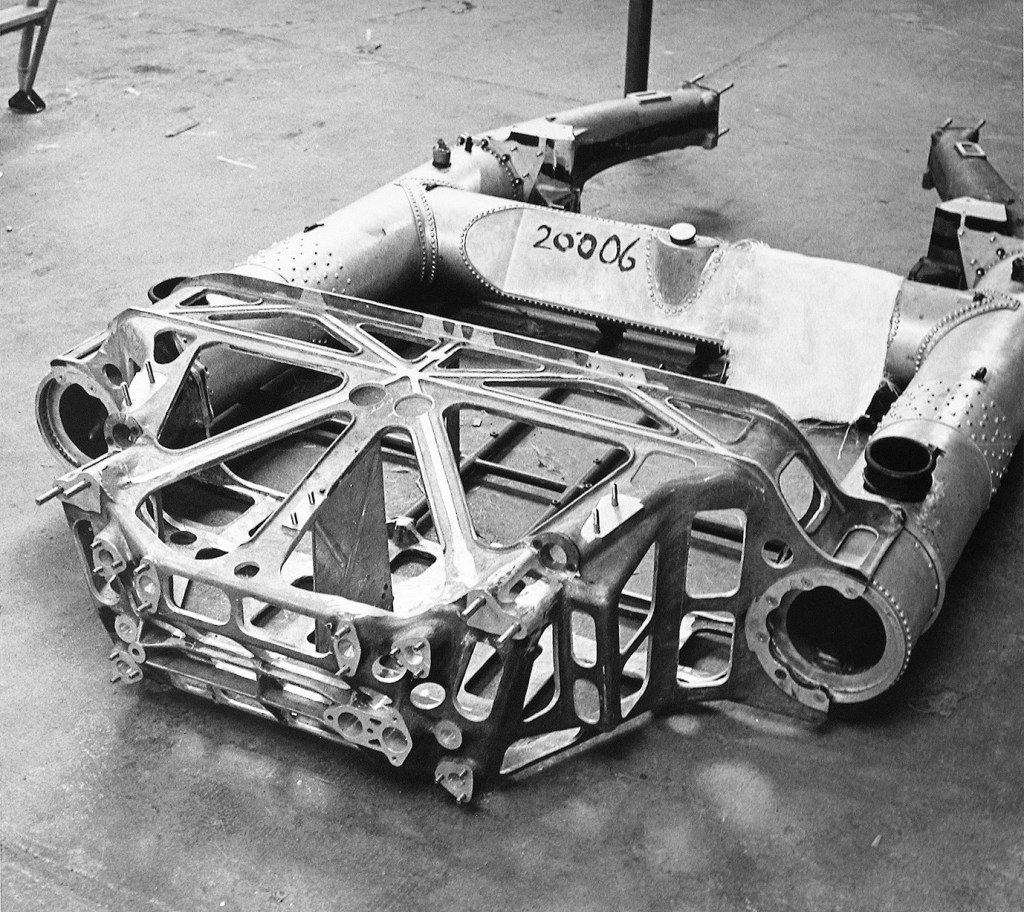
The main structure comprised two longitudinal aluminium spars to which was mounted a complex magnesium casting at the front, the front suspension mounted to it. At the rear the spars had a fabricated sheet metal saddle to which the suspension was attached.
The suspension itself was conventional for the period; upper and lower wishbones and coil spring/ damper units and single top link, inverted lower wishbone and twin radius rods, coil spring/ dampers at the rear. Adjustable sway bars fitted of course. Uprights were cast magnesium, steering rack and pinion with Girling disc brakes front and rear. Weight 580Kg.
(LAT)
Periscopica chassis. The incredible, complex cast magnesium front bulkhead referred to in the text is clear, the spars are bolted to it, and in turn, the two rear section pieces to the large spars.
The tall ram air intake gave the car it’s nickname, Periscopica…
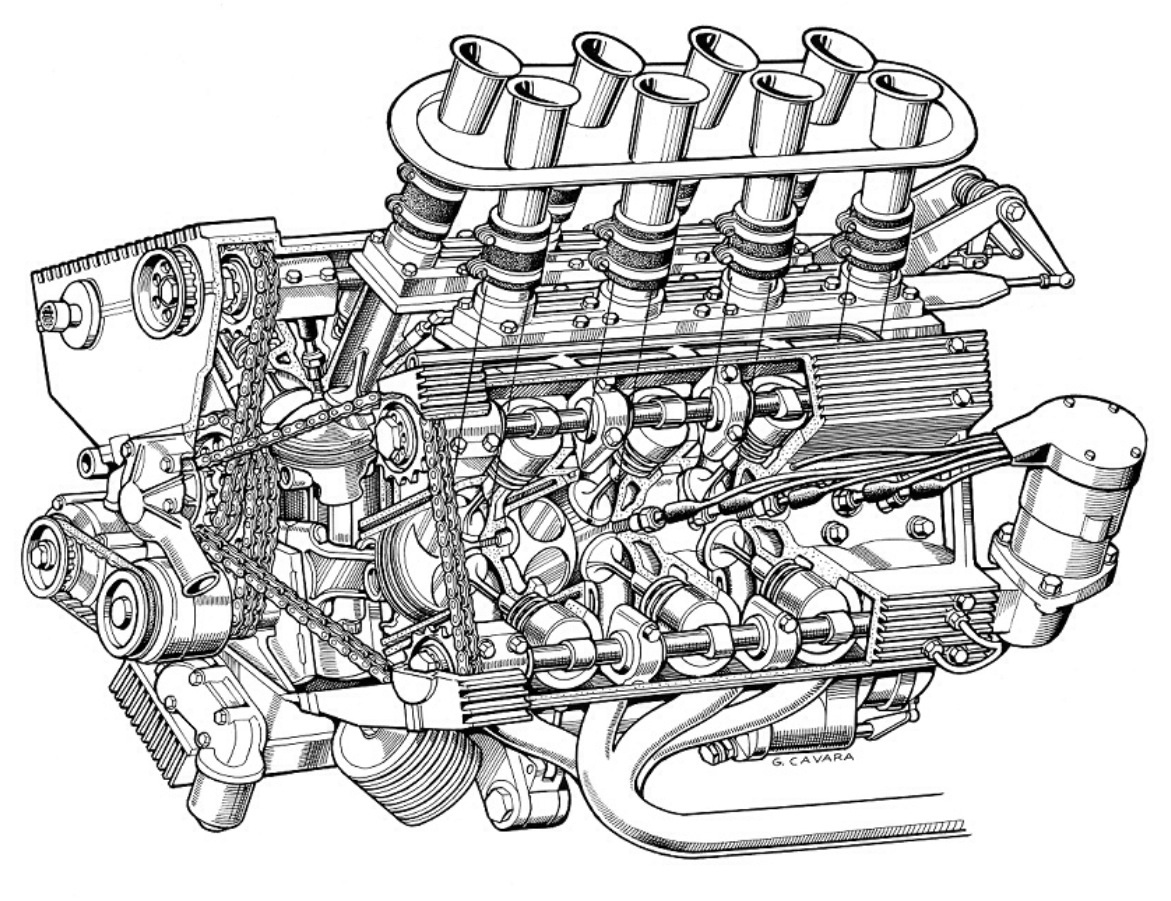
The heart of the early T33s was of course it’s superb little all alloy DOHC V8. Initially 2-litres (1995cc) and two-valves per cylinder, the cams were chain driven, the Lucas fuel injected engines power output was a claimed as 260bhp @ 9500rpm, the gearbox Alfa’s own six-speed transaxle.
Cutaway drawing of car Vic Berris, engine cutaway G Cavara, Claudy Schmitz, Paolo Devodier, Accursio Cassarino, Rainer Schlegelmilch, Facebook ‘Alfa Romeo 33 Sport Car’ Group, LAT, Tony Pashley Collection
Tailpiece…
(Rainer Schlegelmilch)
Andrea De Adamich jumping the T33 he shared with Nanni Galli at the Nurburgring 1000Km in 1967, DNF.
Go faster Al! Als times increased by 10 seconds per lap, his concentration on the race lost, he pitted soon after this signal, the couple left the circuit quickly thereafter…
I’ve got no idea where or who this is, perhaps its at Sebring in the mid 1960’s, but its only a guess. If any of you know who, what, where and when i’m sure we would all like to know!
Another evocative Jesse Alexander shot capturing Helen Stewart during a moment of reflection, circa 1972. Jackie at rear with Peter Gethin or George Follmer maybe?…
The halycon days of politically incorrect advertising, doncha’ miss-em!?
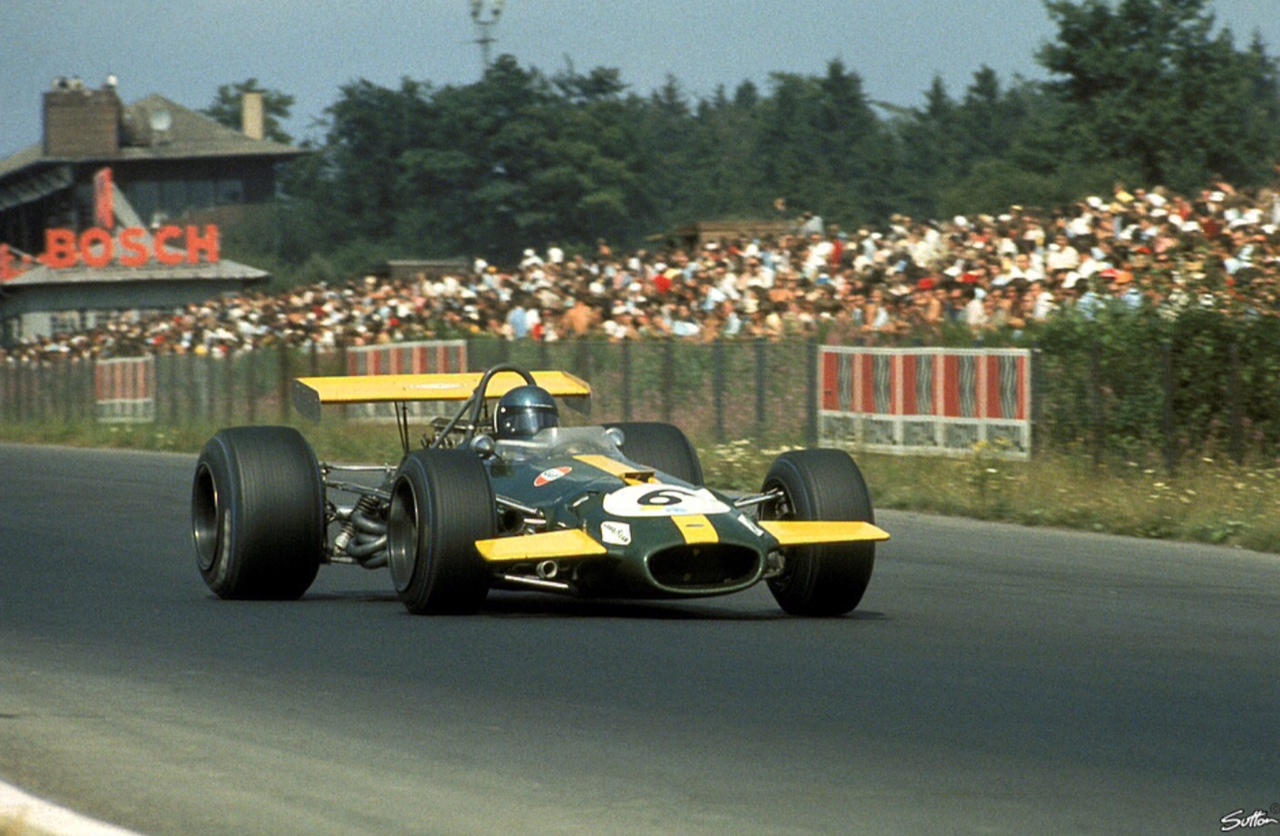
That is Jacky Ickx under that fine femine form. Ickx arrived from Ferrari at Brabham at the end of’ ’68 and left to go back at the end of ’69 but not before winning two Grands’ Prix in the BT26, its fortunes transformed by the replacement of the troublesome 4 cam, 32 valve Repco ‘860 Series’ 3 litre V8 used in 1968, with the ubiquitous 4 cam, 32 valve 3 litre Ford Cosworth DFV V8 for 1969.
One of Grand Prix Racings’ interesting historic footnotes would have been to see if Repco could sort the problems of the ‘860’ to determine if the engine could match the world championship winning pedigree of the Repco ‘620 Series’ and ‘740 Series’ engines which won titles for Brabham and Hulme in 1966 and 1967 respectively…
Ickx won at the Nurburgring and Mosport Park, Canada in the BT26.
The return to Ferrari worked for him, he narrowly missed out on the 1970 title won posthumously by Jochen Rindt, mind you Brabhams’ 1970 car, the BT33 was every bit as competitive as his Ferrari that year.
As to the Castrol missy, Brabhams’ oil company was Gulf in 1969, so not quite sure where she fits in, but who cares!?
Jacky Ickx Brabham BT26 Ford winning the German GP at the Nurburgring from pole and achieving fastest lap, Ickx an acknowledged ‘Ring-Meister’. Jackie Stewart was 2nd and Bruce McLaren 3rd, Matra MS80 Ford and McLaren M7 Ford respectively. (Sutton)
Todd Treat’s fantastic, evocative, fun shots of a very happy Alfa driver and his mechanics, doing his best to maintain focus under extreme pressure…
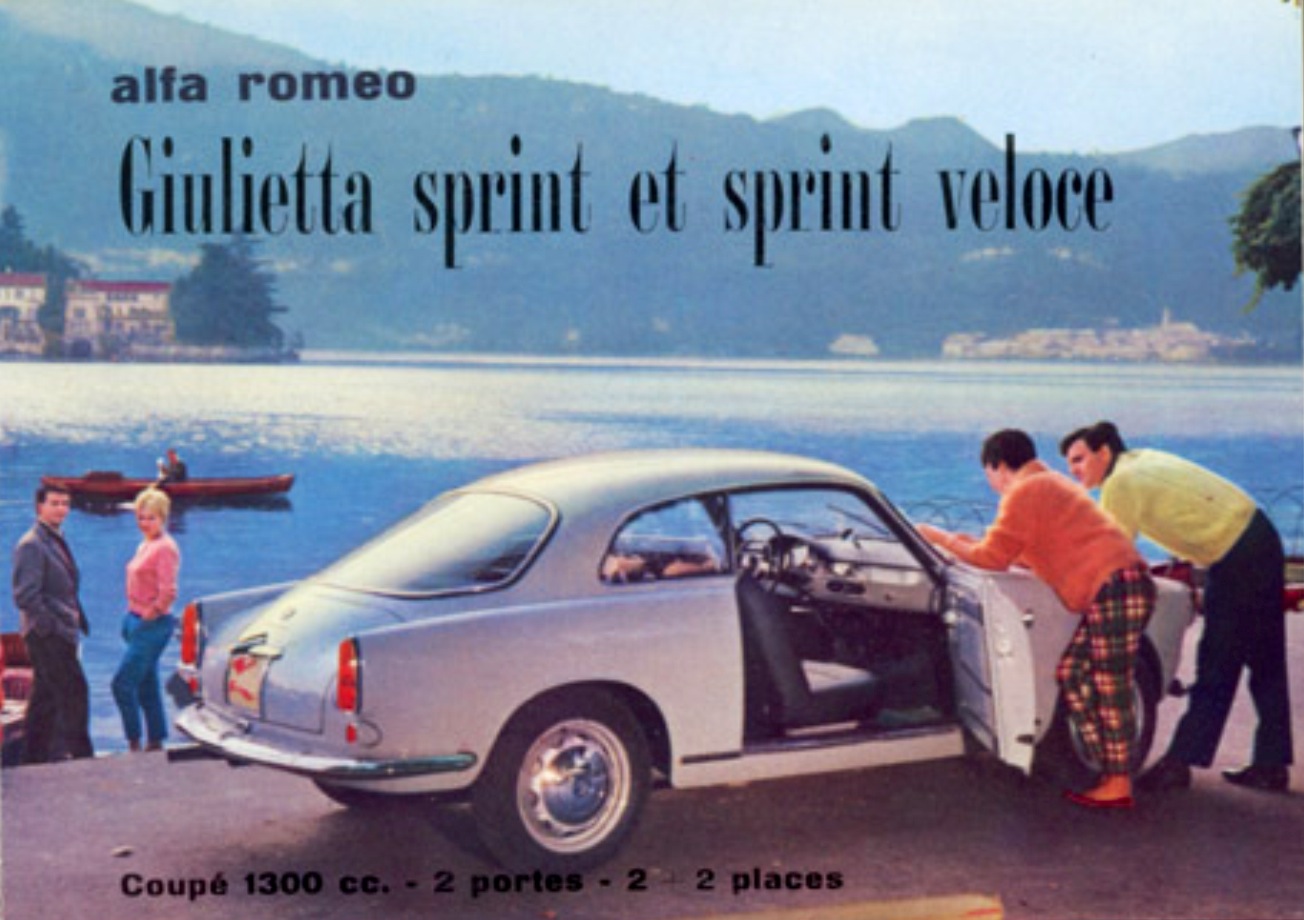
The shot was taken at the Harewood Acres, Ontario, Canada circuit. Whilst I am uncertain if the Giulietta is ‘750’ or ‘101’ Series I am positive the young temptress is ’36/24/36′.
Gone but not forgotten i suspect.
Such a ‘pit crew’ as this is not conducive to quick lap times, mind you if one had support such as this lap times may not be the top race weekend priority. Wonderful shots…
Alfa Giulietta…
A comprehensive article on the Giulietta and an interesting website is below:
The iconic John Frankenheimer 1966 ‘Grand Prix’ is an evocative racing epic most of us have seen, if you haven’t make sure you do, it captures the Grand Prix cars of the sixties very essence!
Described by some film purists as ‘a few million dollars worth of star power and a nickels worth of plot’, from a racing point of view its superb, and features cameos of some of the stars of the day including Phil Hill, Graham Hill, Juan Manuel Fangio, Jim Clark, Jack Brabham and Jochen Rindt.
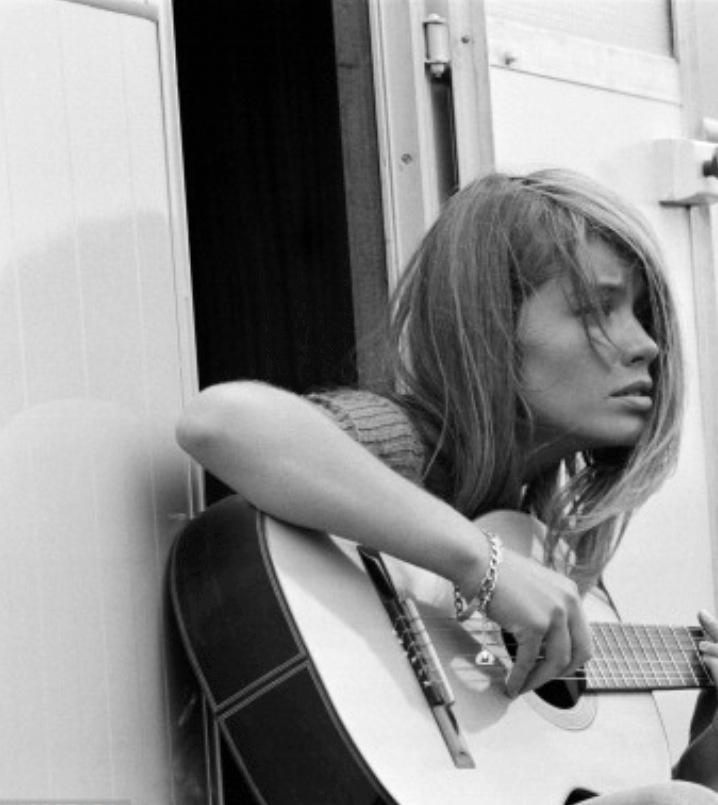
Francoise Hardy plays Lisa, the ‘romantic interest’, in the politesse of the sixties, of Ferrari driver Nino Barlini.
(Getty Images)
Hardy first found fame as a singer and was signed to her first record label at 17. She achieved her first Gold Record in 1962 with ‘Tous Les Garcons et les Filles’. She played minor roles in several films including ‘Whats New Pussycat’, and in ‘Grand Prix’, her primary career has always been as a singer, in French, English, Italian, Spanish and German…
She is now 70 and lives in Paris, and still a style icon…
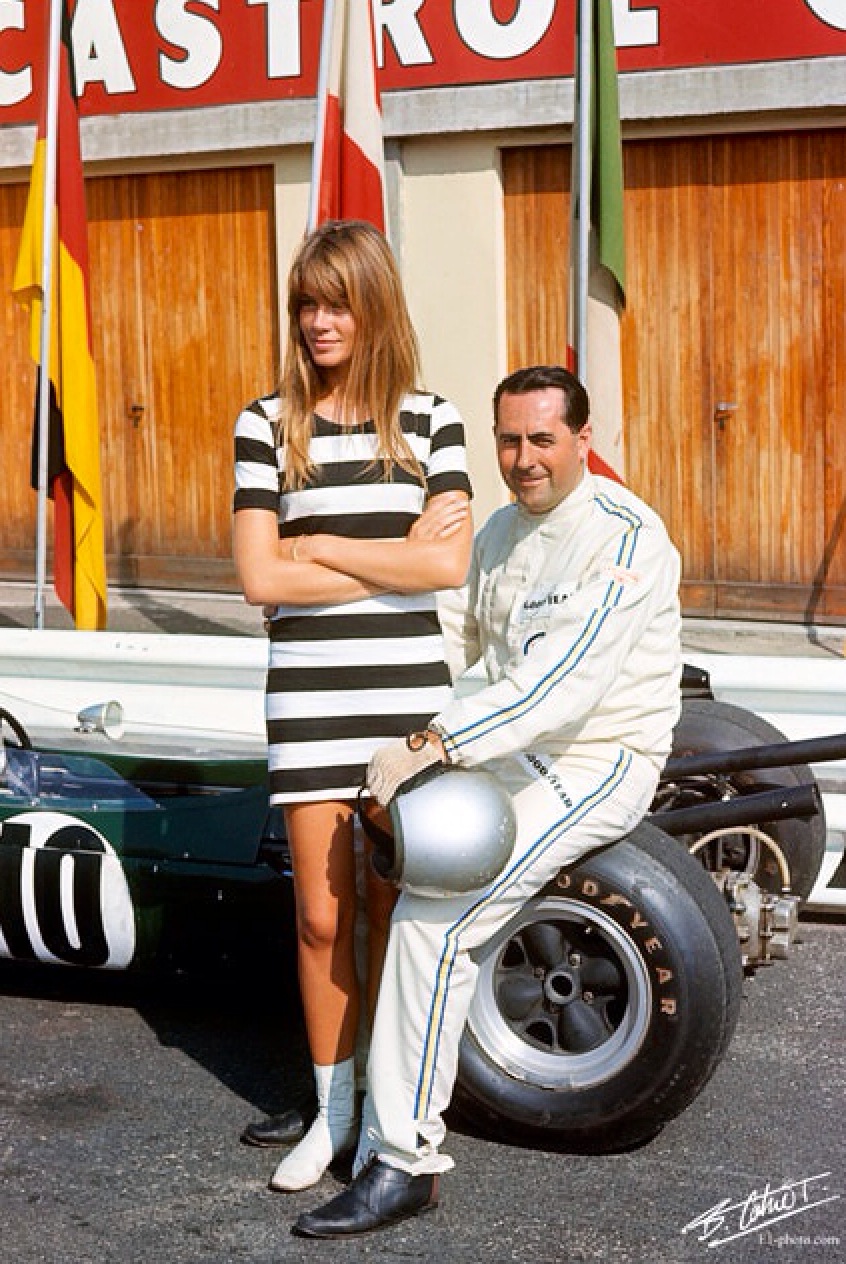
Francoise Hardy and Jack Brabham, Italian Grand Prix , Monza 1966. The car is Jacks’ 66′ championship winning BT19 Repco, DNF in this race won by Scarfiottis’ Ferrari 312. Jack looks happy and who wouldn’t be? (Bernard Cahier)
‘Lisa’ in Nino’s ‘Ferrari’, which i think, is a Brabham Climax, its certainly a Coventry Climax FWMV V8, despite the exhaust…anyway its all about Francoise not the car…many of the cars used in the film were F3 cars in ‘F1 Drag'(Pinterest)
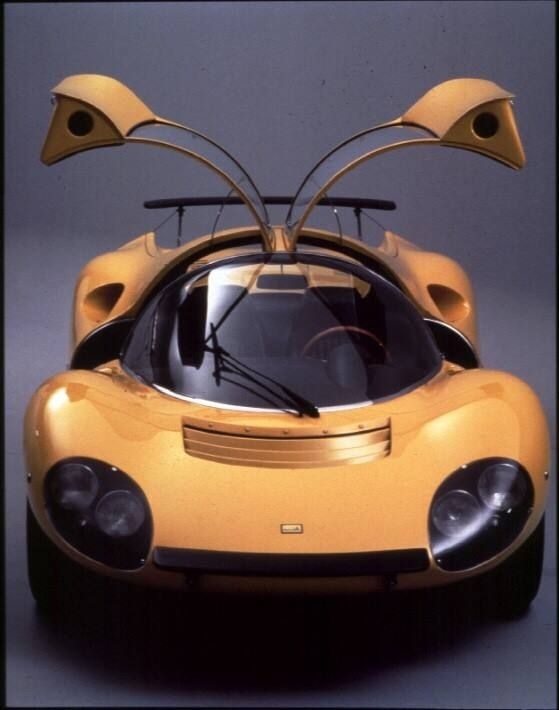
Designed by Paolo Martin, Pininfarinas’ Dino 206 Competitzione was one of the more influential designs of the 1960’s…
Based on an unused, unraced Ferrari 206 S chassis, ‘206S-034’, later renumbered ‘10523’. Pininfarina unveiled ‘The Yellow Dino’ at the 1967 Frankfurt Motor Show, after many years in ‘Farinas’ own collection it is now in private hands in the US.
Martin was 23 when he designed the car, his CV also includes the Ferrari Modulo, and Alfa 33 Roadster concept. He recalls, ‘i used to work on the 1:10 scale model on my house’s small balcony, spreading wood shavings in the underneath courtyard…i was working for Pininfarina secretly for contractual reasons’.
The final shape was created in aluminium, two prominent wings were added late in the project by Pininfarina, Paolo said, ‘they were added only at the last minute, since the management thought the design had to be enriched. I was always against it, anyway this was the final decision’.
Its a pity, the wings are ‘imposed’ on an otherwise fluid combination of compound curves. The car was widely hailed one of the show cars of the decade all the same.
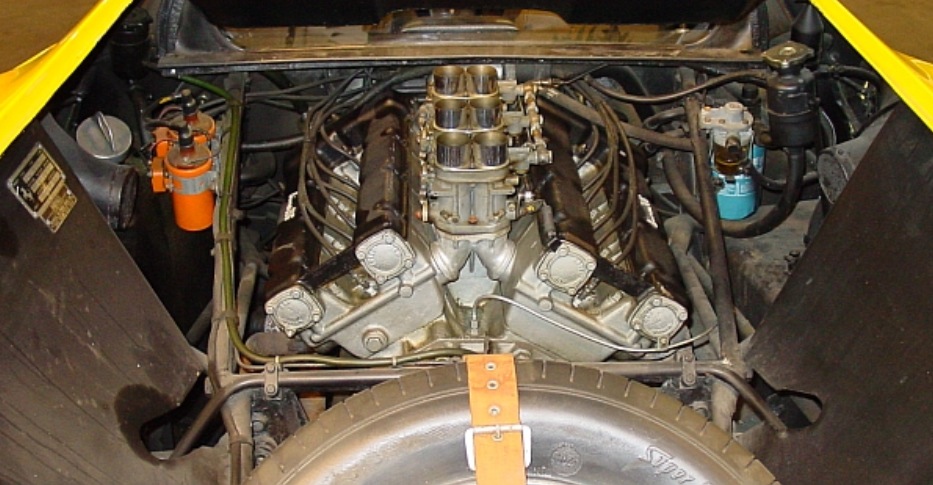
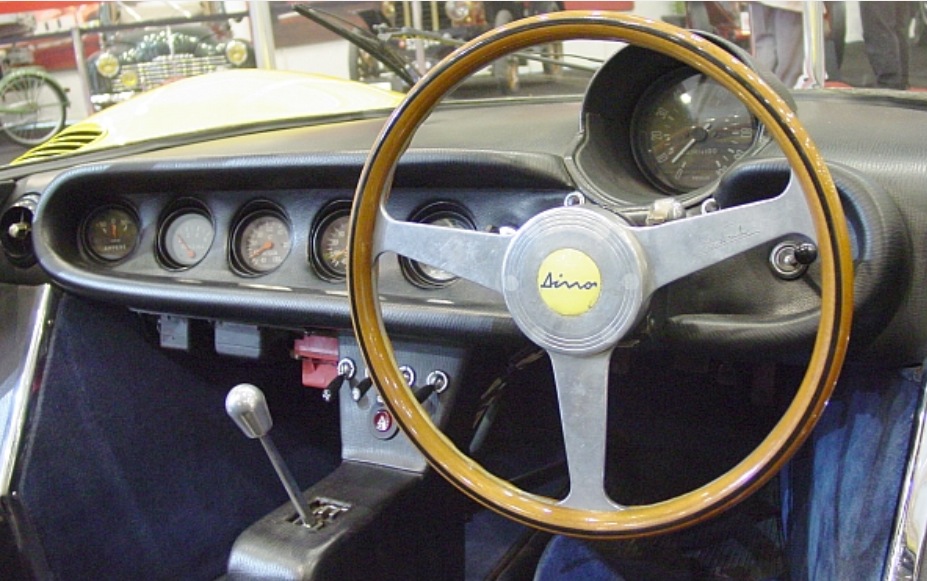
Whilst chassis ‘206S-034’ was unraced the car is fitted with an ex-Le Mans 12 valve race engine which still has its ACO affixed scrutineering tags. Circa 218bhp @ 9000rpm.Pininfarina advertisement in ‘Automobile Year 16’ 1968 year reviewVilla D’Este Concourse 2008
Ferrari 206 S…
Ferrari showed its 1966 World Sportscar Championship contenders, the P3 4 litre V12 Prototype, and 206 S, 2 litre V6 Sports Car at the 1965 Paris Auto Show.
To be eligible to race as a Sports Car, Ferrari had to produce a minimum of 50 cars, due to industrial troubles in Italy at the time only 18 were produced, the 206S was therefore forced to compete against much more powerful cars. It still sold well to privateers and was entered on occasion as a ‘Works Car’, the fastest 2 litre car of its day.
It was powered by variants of the Jano designed V6 which won the F1 Drivers Championship for Mike Hawthorn in 1958. Engine capacity was 1987cc, it was fed by Weber carburetors and later Lucas fuel injection. two, three and four-valve heads were developed, with both single and twin-plugs, the engine produced circa 218bhp @ 9000rpm.
A 5 speed gearbox was utilised, the chassis was Ferraris’ typical space frame of the time with welded on aluminium panels creating a ‘semi-monocoque’ structure. Some exterior pnaels were fibreglass.
Suspension comprised wishbones and coil spring/damper units at the front, and lower inverted wishbone,2 upper links and 1 radius rod, again with coil spring, Koni shocks at both front and rear. Disc brakes were by Girling. 7.5 and 8.5 inch wide (F/Rear) Campagnolo wheels were fitted, the whole lot weighing 654Kg. Very light!
The stunning cars were styled either in-house, or by Piero Drogo, depending on the source document, the bodies built by Piero Drogos ‘Carozzeria Sports Cars’ in Modena.
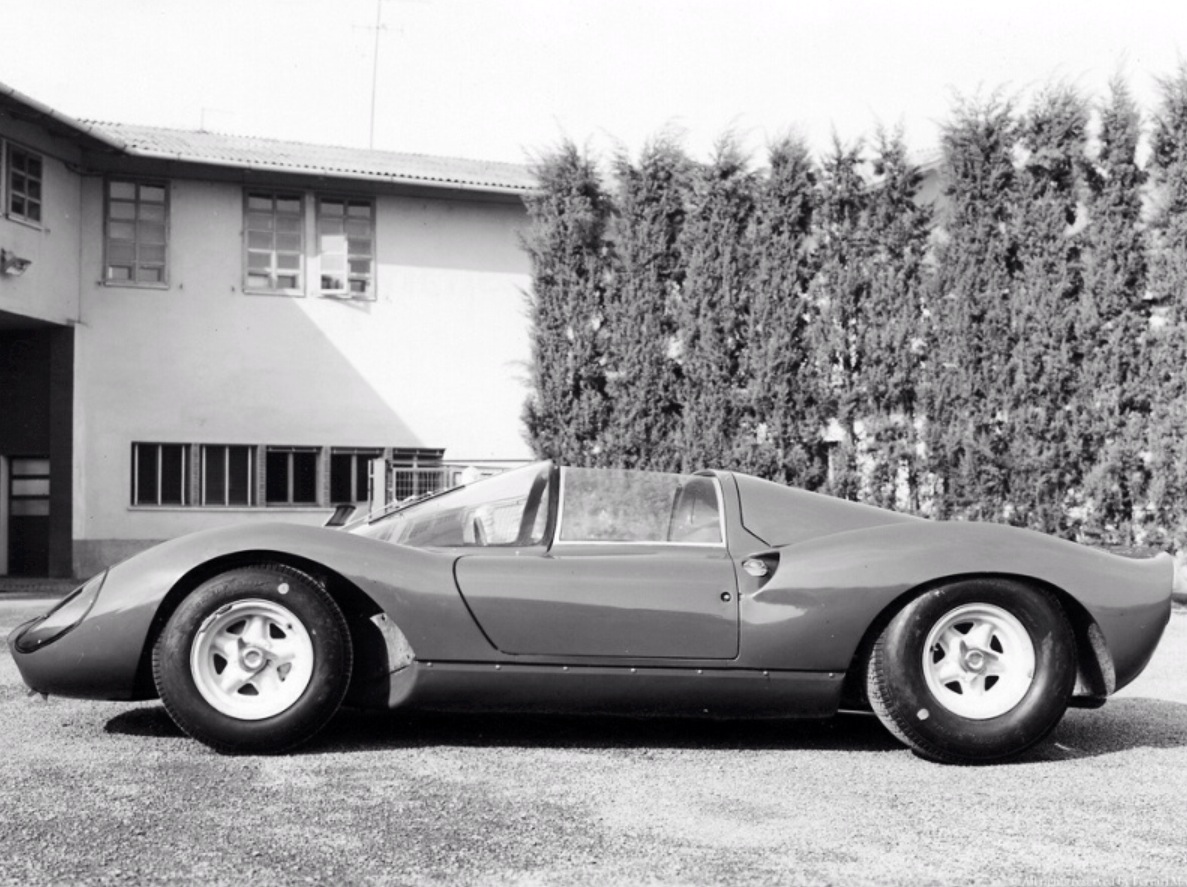
The shape is mouth-watering, the production 206/246GT road cars clearly took their styling from these cars.
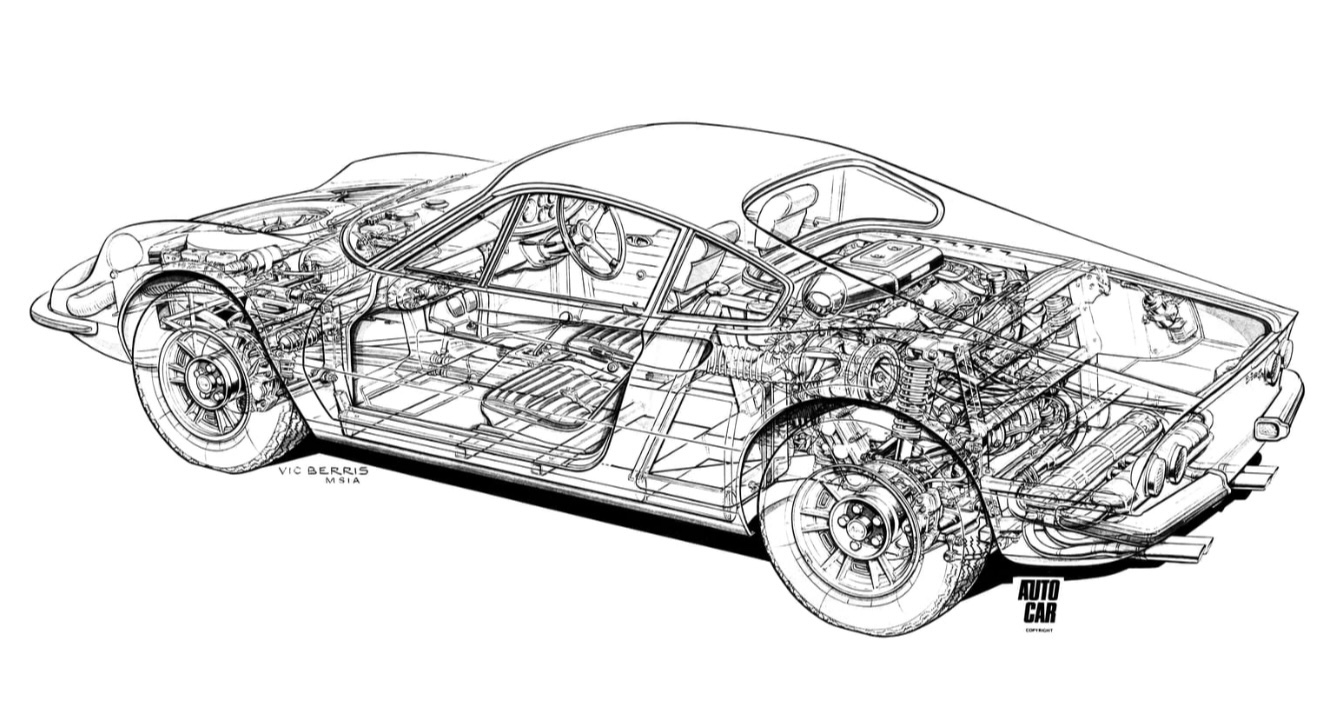
Nurburgring 1000Km, 1966. Rodriguez/Ginther 206 S (Pinterest)Targa Florio 1966. Biscaldi Ferrari 206 S (Pinterest)Ferrari factory shot at Maranello shows the 206 S stunning profile to good effect and just how close the road-going 206/246 GT was to its competition brother (Ferrari SEFAC)Ferrari Dino 206GT Prototype 1967Ferrari Dino 246GT cutaway (V Berris)
No ‘Tom Toms’ in those days! Superb PR shot shows the beautiful lines to great effect…
Not too many of the 1954-1957 1400 cars didn’t end up in the US , the cars of Sophia Loren & Pablo Picasso exceptions.
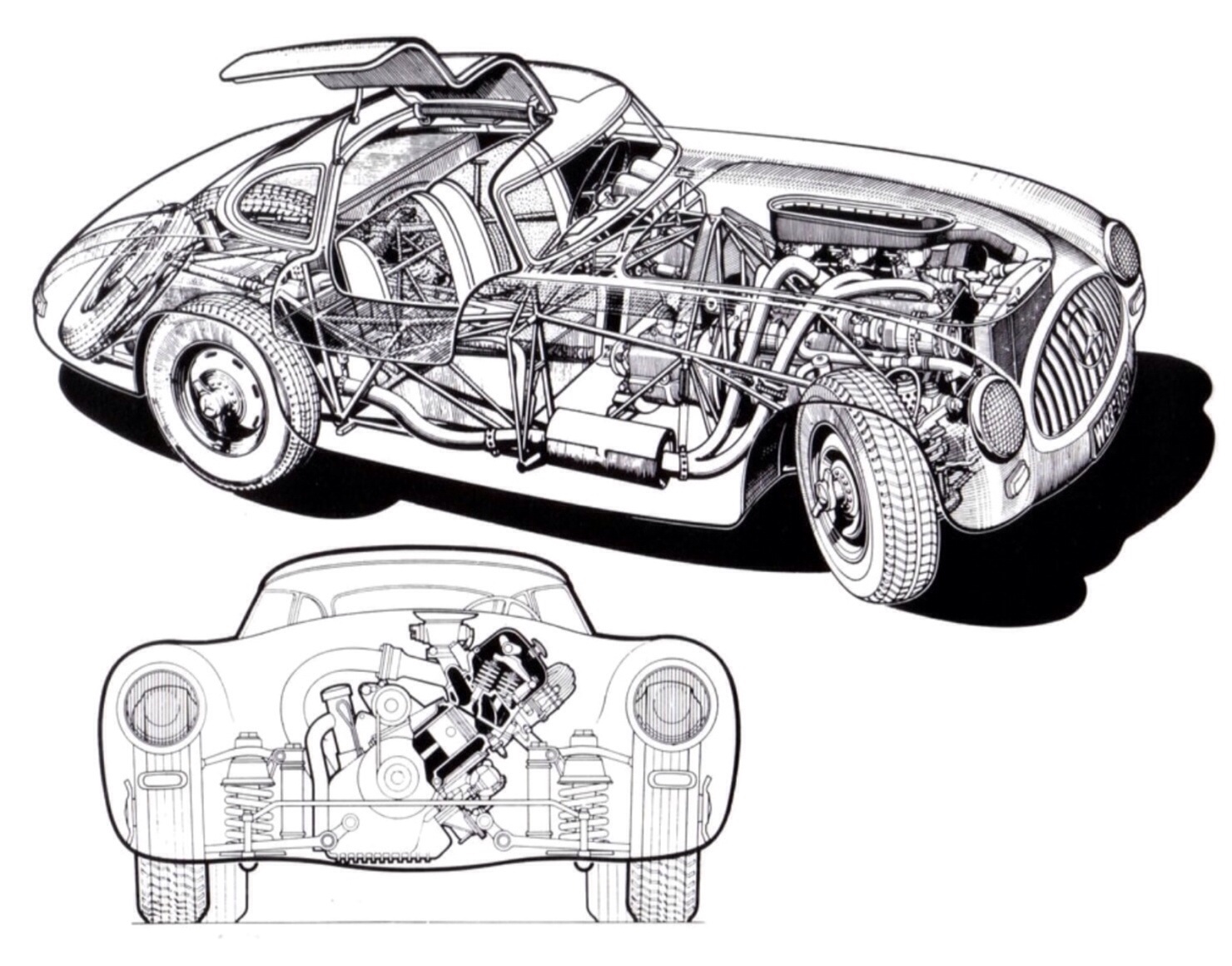
The road going variant of Rudi Uhlenhaut’s 1952 Le Mans winning 300SL was the most advanced road car of its day. Its features included a spaceframe chassis, the gull-wing doors necessary to clear the frame side members, front and rear independent rear suspension and a dry-sumped, fuel injected 240bhp 3-litre straight-six cylinder engine which made it the fastest road going car of its day as well…and one of the sexiest.
A bit like Sophia Loren really.
(Mercedes Benz)
Factory SLR build shot shows off the cars spaceframe chassis, engine, front and rear suspension and big drum brakes to good effect




























 primotipo...