‘Daily Express’ motoring writer David Benson races a Lotus 31 at the Racing Car Show, Olympia, London January 19-26, 1966…
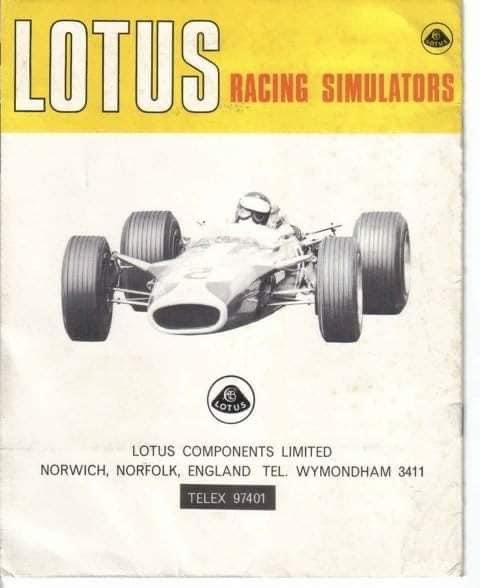
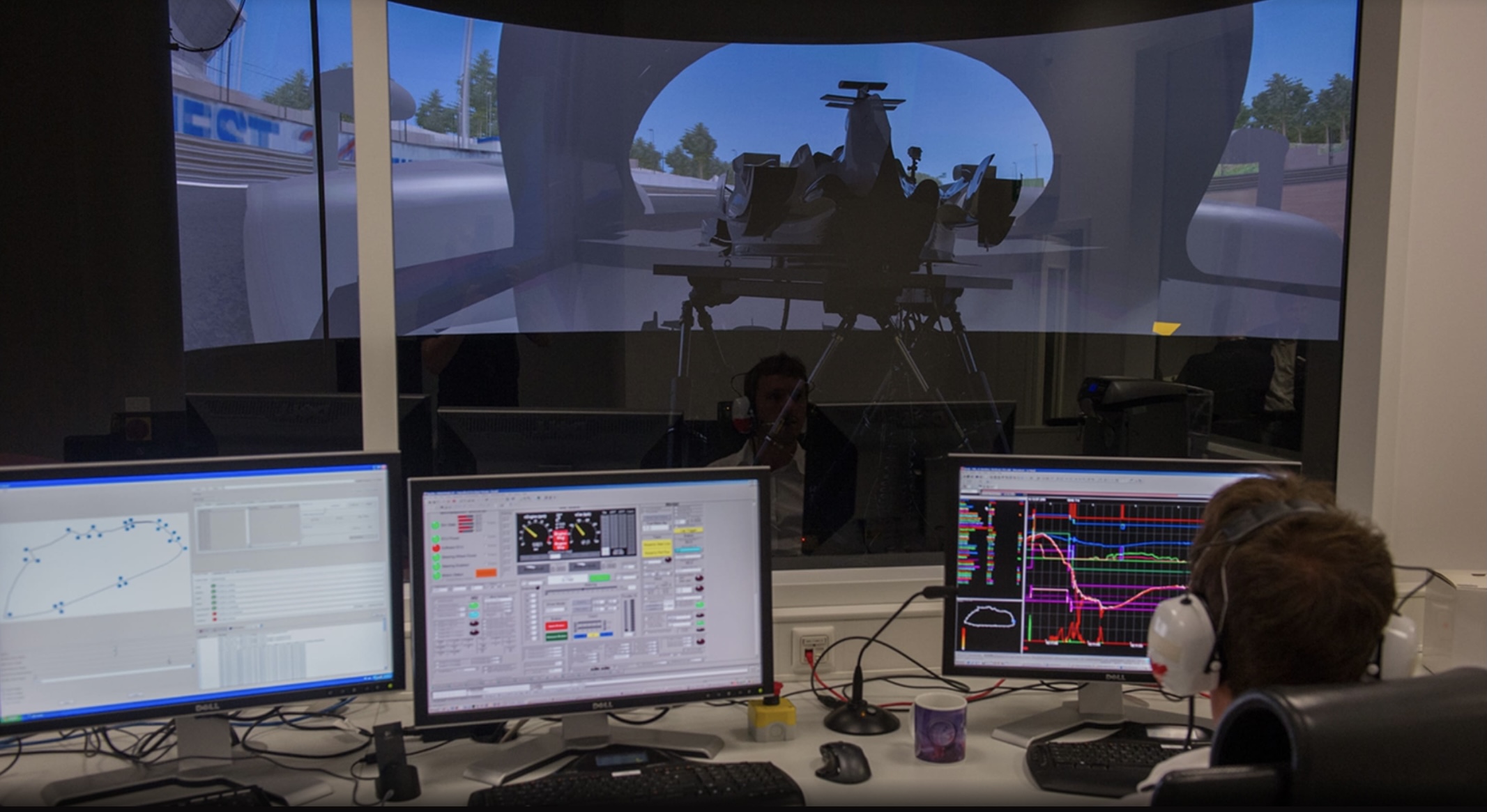
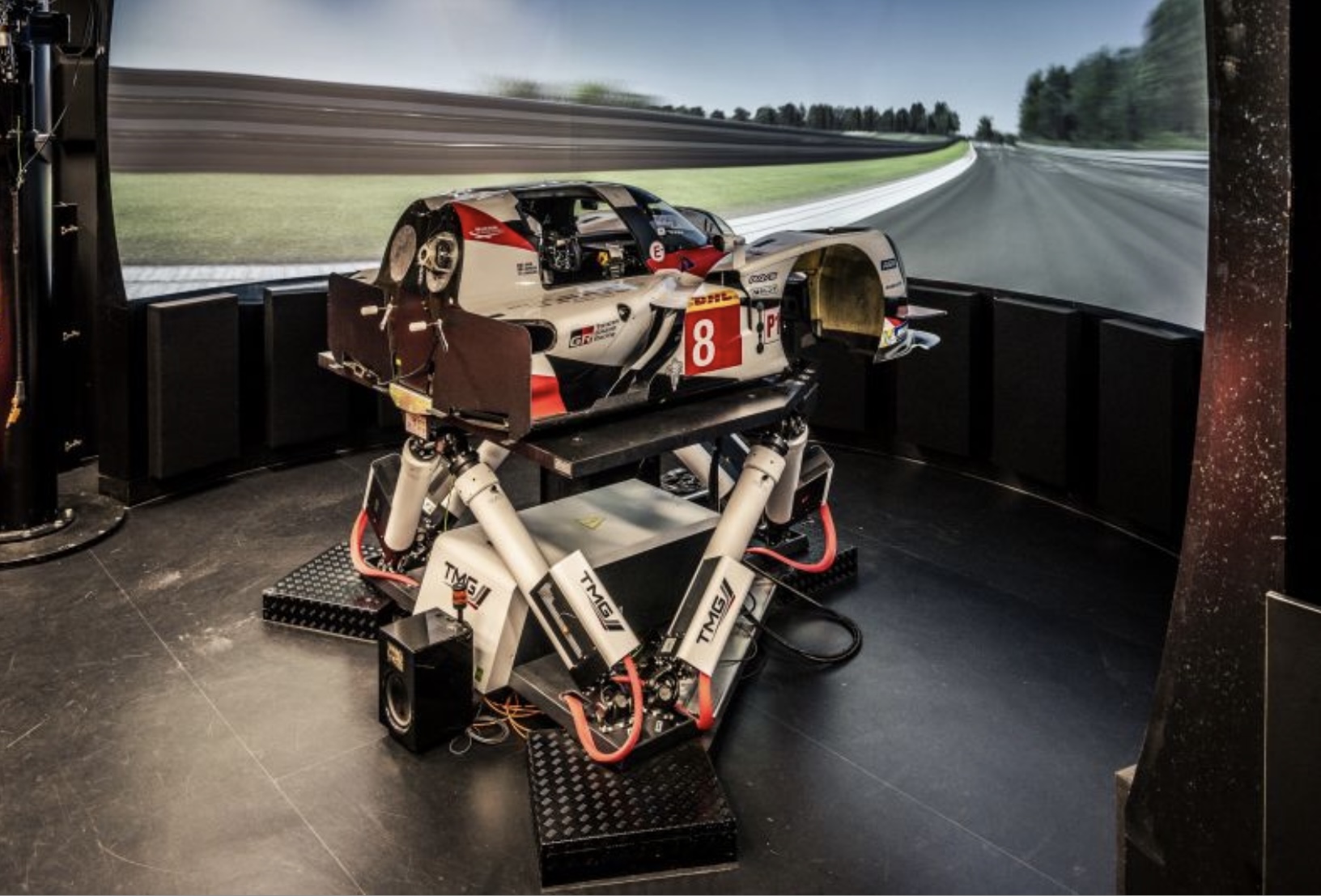
These days no self-respecting race-team from F1 down would be without their race simulator to sharpen their drivers preparation and performance. Like so many innovations from the mid 1950s to the mid 1980s, Lotus paved the way with a small number of sims they built for commercial/entertainment use in the sixties.
Aviation led the simulation way of course. French commanders Clolus, Laffont and Clavenad built the Tonneau Antoinette, regarded as the first ground training aircraft. Progress was swift, by World War 2 The Allies produced 10,000 Link Trainers to assist 500,000 new pilots into the sky.
Whether Colin Chapman’s motivation was broadening the appeal of racing by putting anyone in the driving seat, building the Lotus brand, or perhaps another profitable line of business is unclear. A small number – about 18 – were built and sold to dealerships and large corporates such as BP. The Avengers tragics may recall the ‘Dead Mans Treasure’ episode in which the woman behind the wheel had to keep driving fast or otherwise receive a deadly electric shock…
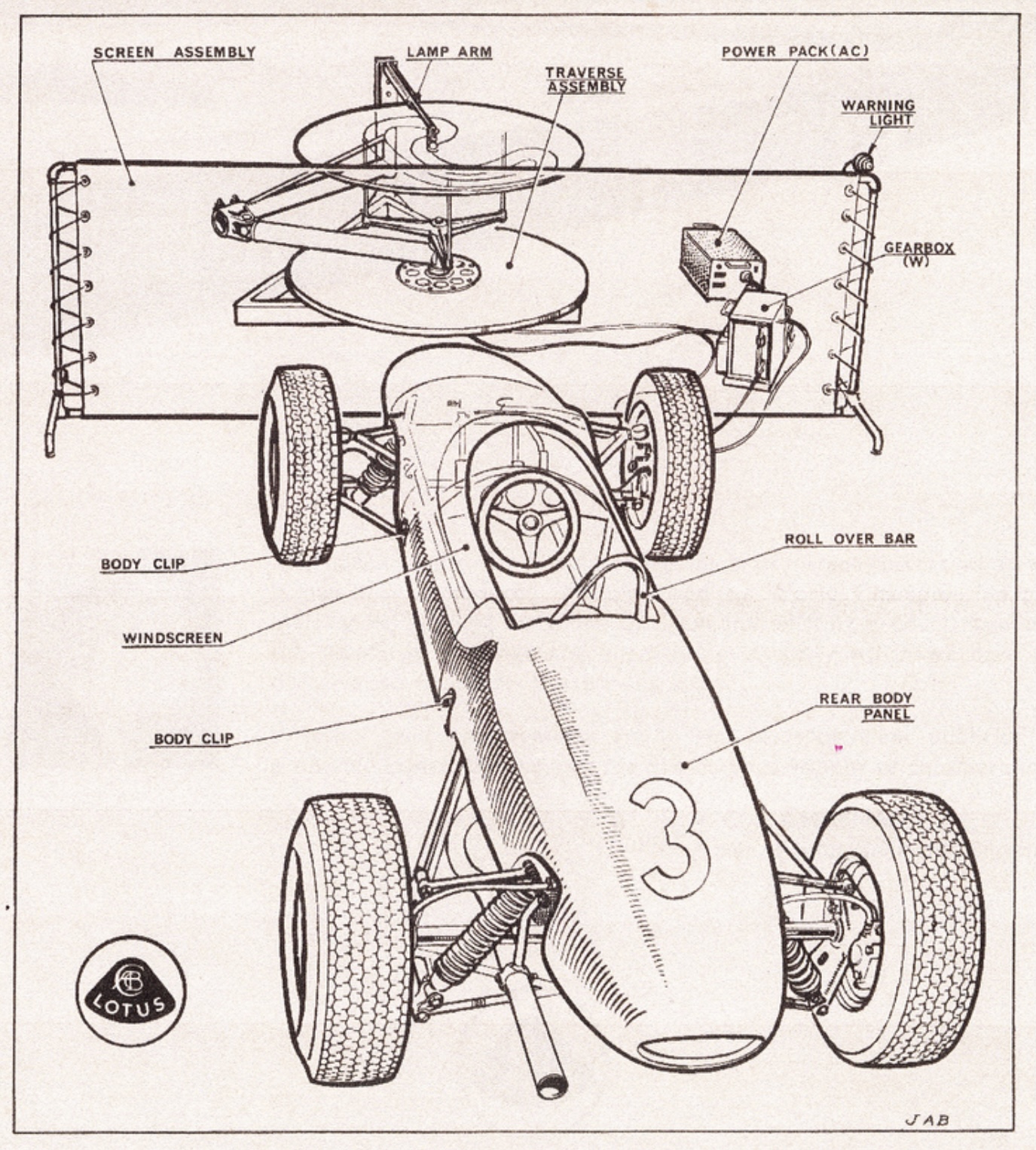
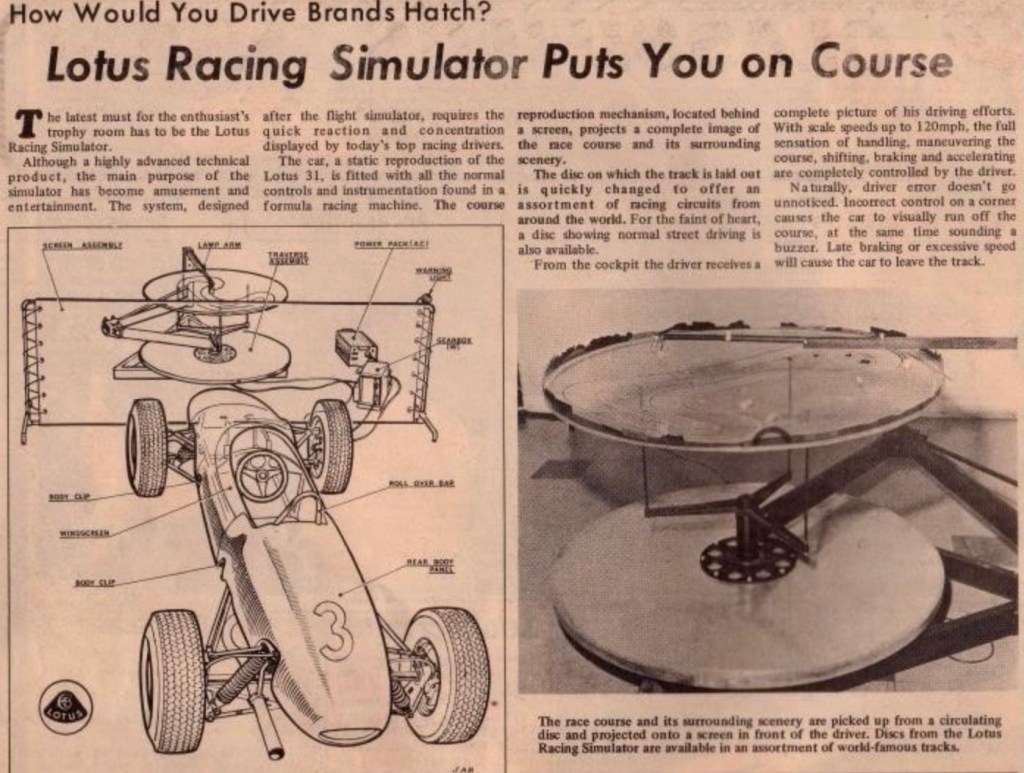
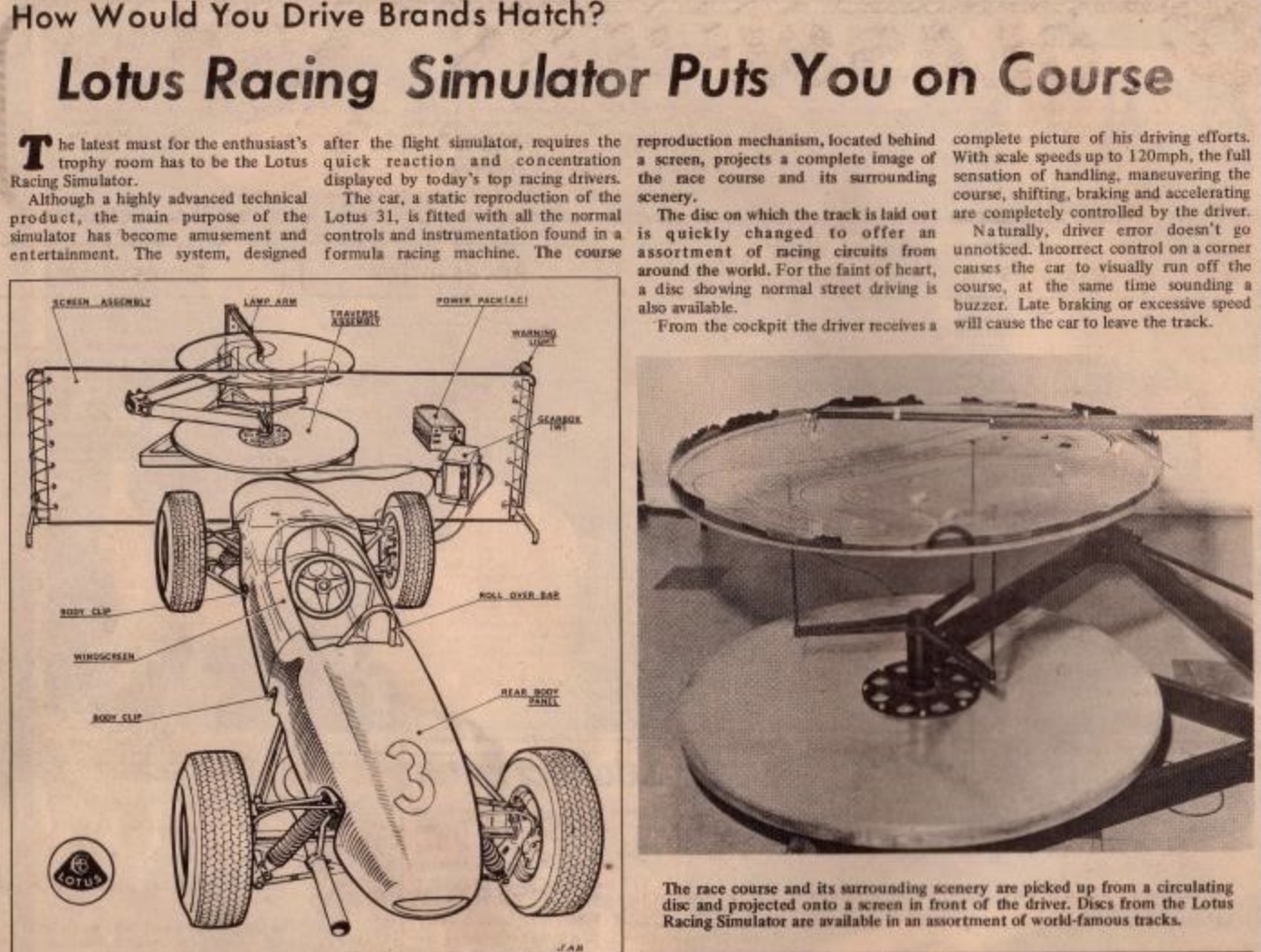
The car is a reproduction of an F3 Lotus 31 (it would be intriguing to know the differences between the real deal and the sim cars) fitted with all of the track-bound instruments and controls. “The course reproduction mechanism, located behind a screen, projects a complete image of the track and its surroundings.”
“The disc on which the track is laid out is quickly changed to allow a change of circuits. For the faint of heart, a disc showing normal street driving is available. From the cockpit the driver receives a complete picture of his driving efforts. With scale speeds up to 120mph, the full sensation of handling, maneuvering the course, braking and accelerating are completely controlled by the driver.”
“Naturally, driver error doesn’t go unnoticed. Incorrect control on a corner causes the car to virtually run off the course, at the same time sounding a buzzer. Late braking or excessive speed will cause the car to leave the track,” – while technology has advanced a tad, that much remains unchanged!
Etcetera…
(Grant Craft Collection)
Credits…
Victor Blackman, Golden Gate Lotus Club, Grant Craft Collection
Tailpiece…
(Toyota)
The elapse of a half-century – Toyota F1 race simulator circa 2008, and current TS050 Hybrid sim below, pretty much the only thing which cannot be replicated are the g-forces but doubtless that will come!
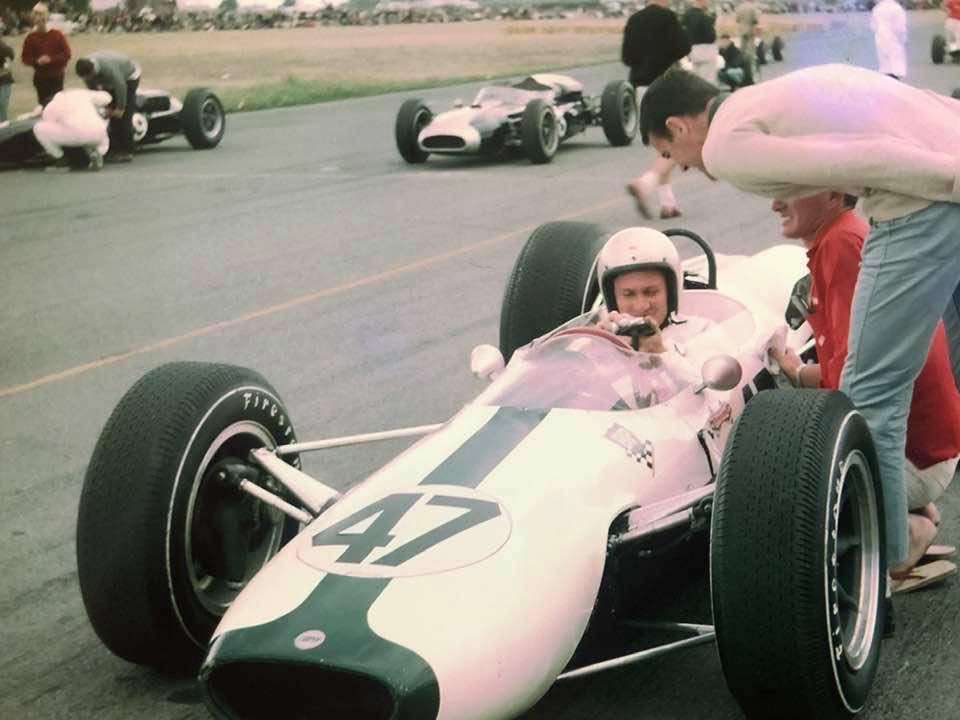
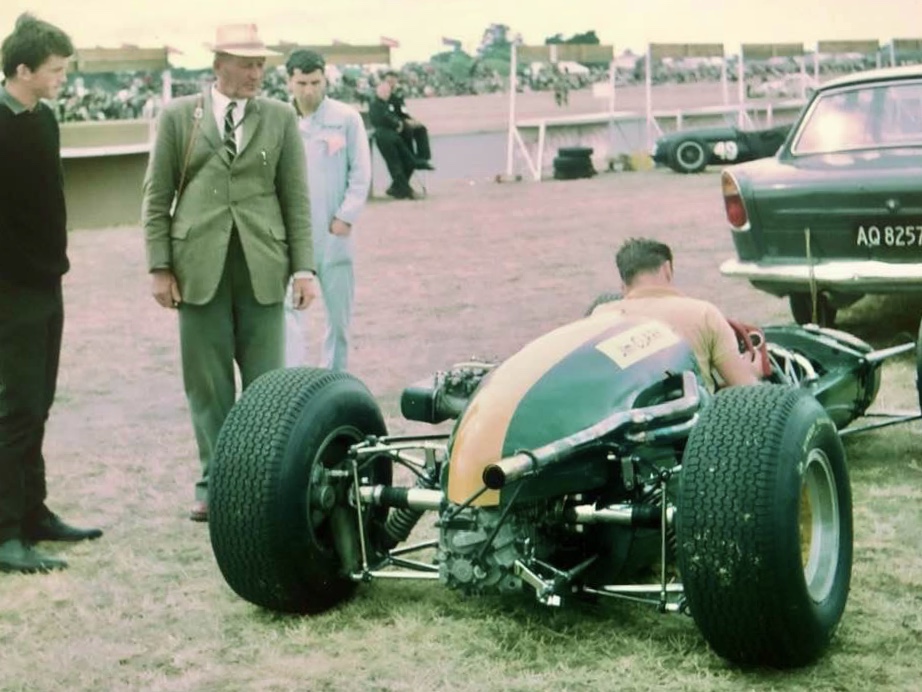
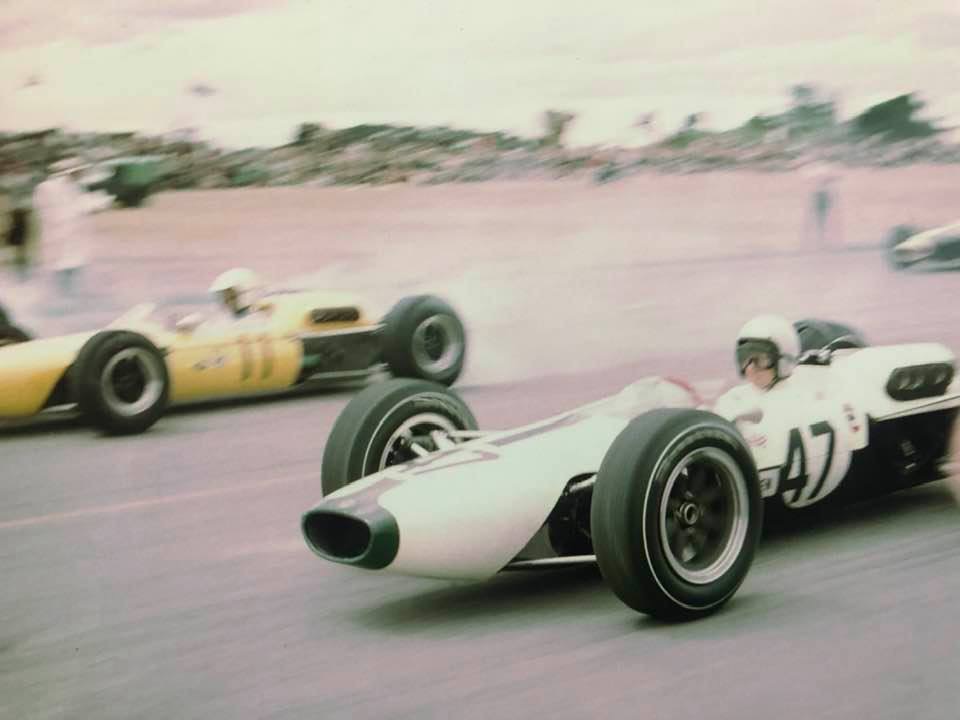
Bruce McLaren setting up a selfie before the Lady Wigram Trophy, Tasman Series, 23 January 1965…
Sorting his goggles in any event, Cooper T79 Climax. The cars in the background are the #9 Bill Thomasen Brabham BT4 Climax and Red Dawson’s Cooper T53 Climax Lowline.
What stood out on an initial scan of this bunch of photos are those big tall white-wall Firestone tyres on large 15-inch wheels. It’s the start of the tyre-war; Firestone and Goodyear had just entered the domain which had been a cosy little monopoly for Dunlop for the previous few years.
Bruce won the first Tasman Cup in 1964 with what are regarded as the first McLarens. The two Cooper T70s Bruce and Wally Willmott constructed at the Cooper factory in Surbiton the year before were Dunlop shod machines. Click here for a piece on these cars; https://primotipo.com/2016/11/18/tim-mayer-what-might-have-been/
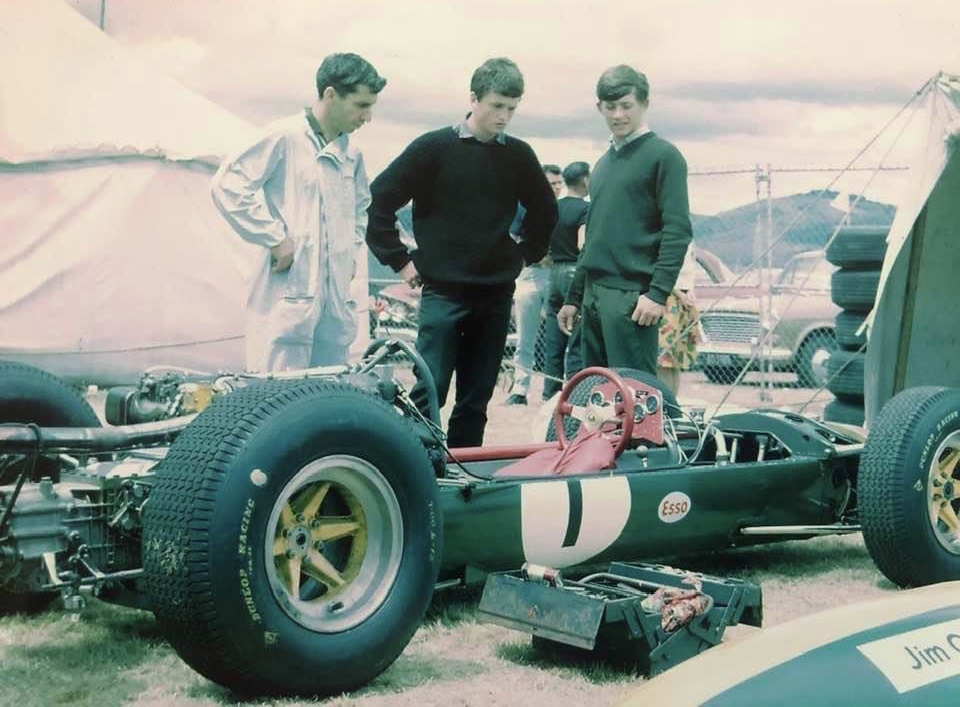
Admirers of the Clark Lotus 32B monocoque chassis, Wigram (A McKee)
It was going to be tough to knock Jim Clark’s Dunlop shod Lotus 32B Climax off in 1965- Bruce and Phil Hill’s campaigns were said to be sluggish at the series outset until Bruce and his boys adapted the suspension geometry and settings to the American tyres. Mind you, a close look at the results suggests Bruce was not far off the pace from the get-go.
The commercial relationship with Firestone was an important one for the entrepreneurial Kiwi as he assembled the technical partners and funding to take his nascent team forward- Bruce McLaren Racing’s first F1 season was in 1966.
Jack Brabham signed with Goodyear from 1965, that year of learning with the Akron giant was a critical foundation piece for Brabham Racing Organisation’s successful tilts at the 1966 and 1967 F1 championships for drivers and constructors.
Jim Clark had one of the greatest of seasons any driver ever had in 1965- he won an F1 drivers title, the Indy 500, the Tasman Cup plus a sprinkling of F2, touring car and other wins- the breadth of his achievements in that twelve month period has never been matched, or is ever likely to be I expect.
The start of that lot was in New Zealand- whilst Graham Hill won the first Tasman round, the NZ GP at Pukekohe in David McKay’s Scuderia Veloce Brabham BT11A Climax, Clark won the next two on the trot at Levin, where he won from the scrapping Frank Gardner and Jim Palmer aboard BT11A and BT7A’s respectively, and here, on the Wigram Airfield on 23 January from McLaren and Palmer- Jim acquired Clark’s series winning Lotus at its end. Bruce was obviously getting the hang of the Firestones mind you- he matched the lap record Clark set in the preliminary race in the championship event.
Off to Teretonga – famously the most southerly race track on the planet – Clark won again from McLaren and Phil Hill in the other Bruce McLaren Racing Cooper- an updated T70 raced by Bruce and the late Tim Mayer the year before.
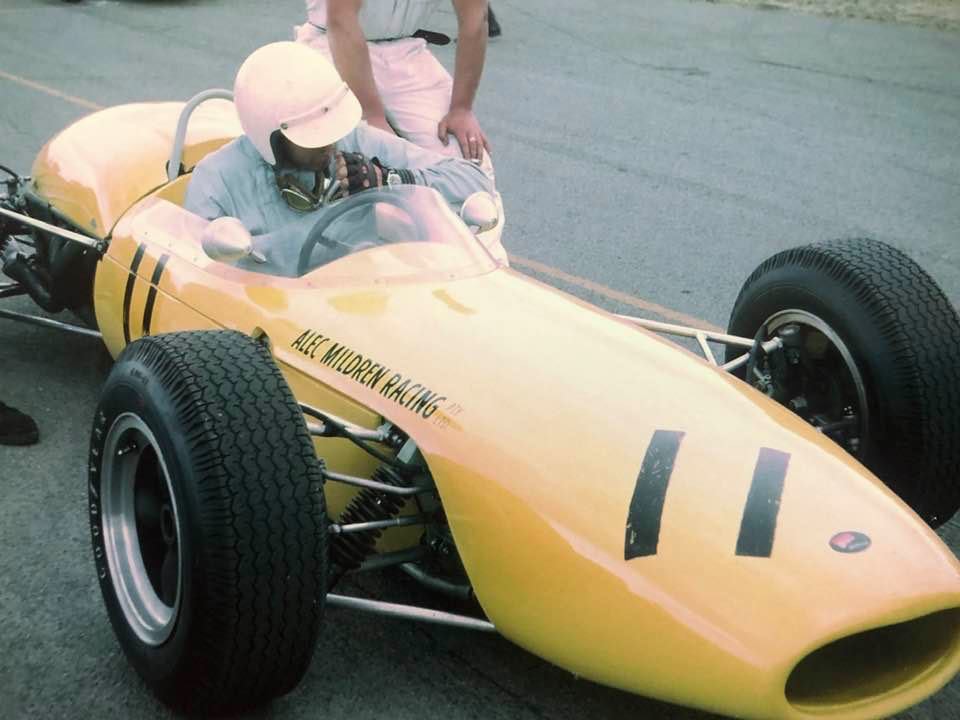
Jim at the wheel, 32B ‘beetle-back’ all enveloping bodywork, ZF gearbox. #49 in the background is the Peter Gillum Cooper T67 Ford FJ (A McKee) The off. Bruce with Frank Gardner’s distinctive Alec Mildren Racing yellow Brabham BT11A Climax alongside (A McKee)
That Bruce was getting the chassis/tyres sorted was further indicated by his pace- he pulled alongside Clark on lap 20, but Jim had enough in hand to pull away- taking the duo clear of Hill, Grant (ex-Jack 1962 AGP Brabham BT4 Climax, a car later to put John McCormack on the map) and Palmer.
The summary of the balance of the series is this; Clark won from grid three at Warwick Farm on 14 February whilst Bruce was Q5 and DNF engine. Brabham joined the Series in Sydney aboard a new BT11A- he was second from Q4. Matich was third from pole.
At Melbourne’s Sandown a week later, Jack won from pole with Jim second from Q2, Phil Hill third from Q6 and Bruce fourth from Q4- Goodyear, Dunlop, Firestone, Firestone if you like…
The seven round series ended at Longford with the Australian Grand Prix on 1 March 1965. Bruce won from pole from Brabham, Hill P and Hill G, Bruce Sergent observed that ‘Longford saw the McLaren cars come resoundingly into their own with good short-stroke engines and the small frontal area and shallow tread of the Firestones on this ultra fast circuit.’
Clark’s second half of the series was not as dominant as his first half. This was in large measure due to Jack’s presence and the pace of the McLaren Coopers- he won three races in New Zealand and once in Australia, but took the 1965 Tasman Cup with 35 points from McLaren’s solo victory and 24 points, then Jack with a win and a points haul of 21 from only three races. Brabham certainly would have given Jim a run for his money had he contested the championship in full. Gardner, Phil Hill and Jim Palmer were equal fourth…Or Dunlop, Firestone, Goodyear, Goodyear, Firestone and Dunlop.
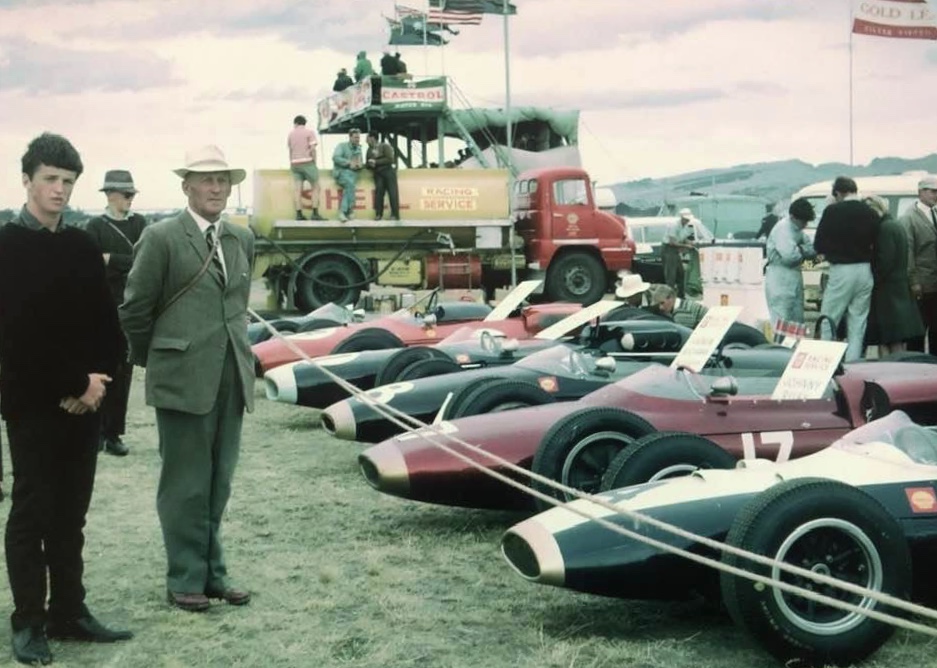
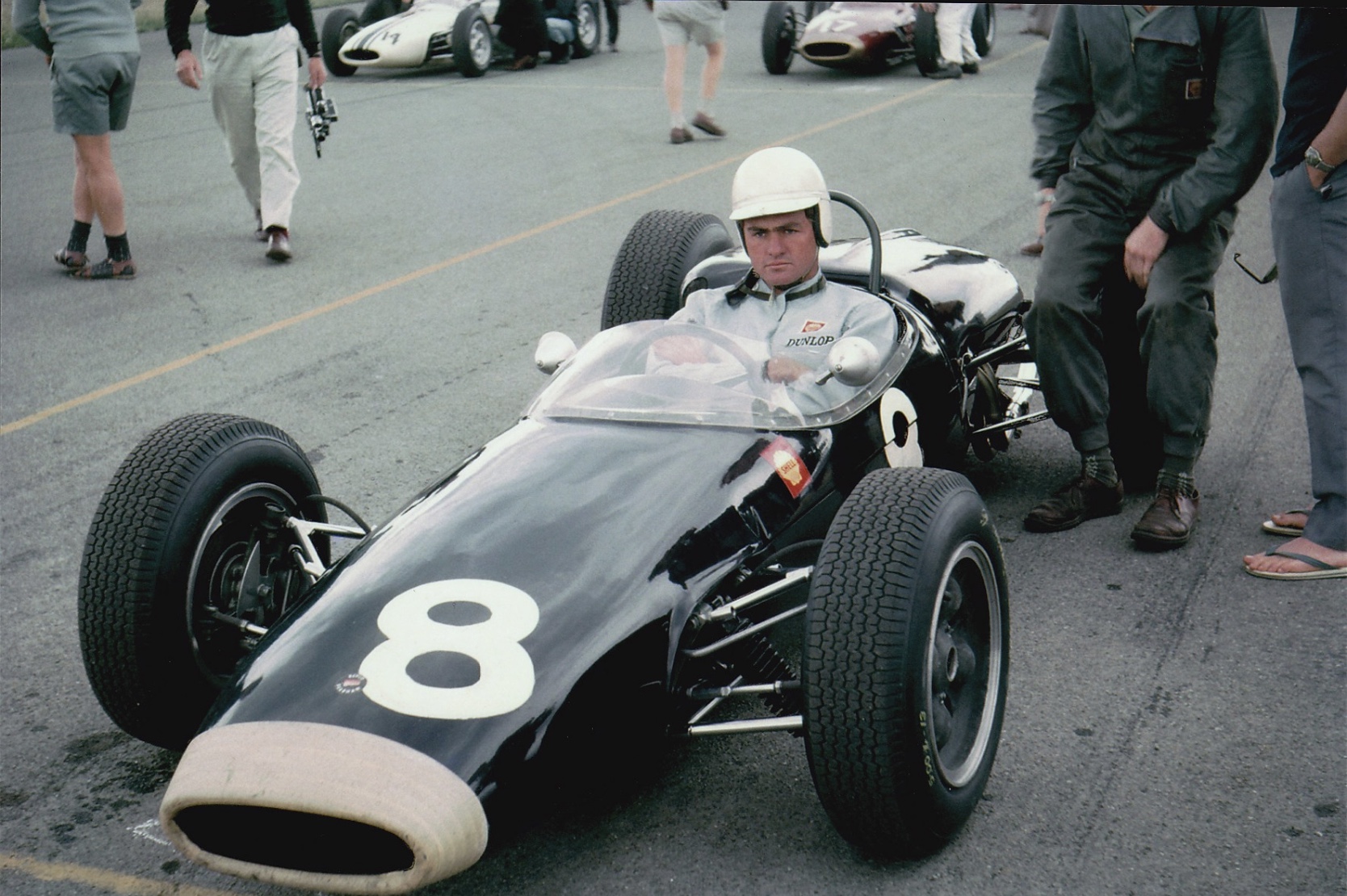
Wigram Shell Team compound, from this end; Bruce Abernathy Cooper T66 Climax, John Riley Lotus 18/21 Climax, Andy Buchanan #8 Brabham BT6 Ford 1.5 twin-cam, perhaps the Scuderia Veloce Graham Hill Brabham BT11A Climax and uncertain closest to the truck (A McKee)
Those early years of the F1 tyre war rolled as follows; Dunlop shod Clark’s 1965 winning Lotus 33 Climax and Stewart’s 1969 winning Matra MS80 Ford. Goodyear bagged back to back titles in 1966 and 1967 on Jack’s Brabham BT19 Repco and Denny’s Brabham BT24 Repco, while Firestones were on the Lotus 49 Ford Cosworth DFV used by Graham Hill in 1968, and Jochen Rindt’s Lotus 72 Ford in 1970.
Dunlop bailed from F1 at the end of 1970, leaving the two American giants. Then Michelin came in etcetera…and now of course we have same, same, same coz same, same, same is what is mandated by the commercial, sorry, sporting powers that be.
It was a bit different in the Tasman where Dunlop shod Clark’s winning Lotus 32B Climax and Stewart’s 1966 BRM P261, but then it was all Firestone on both Clark’s 1967 Lotus 33 Climax, 1968 Lotus 49 Ford DFW and the Ferrari Dino 246T raced by Chris Amon to victory in 1969, and Graeme Lawrence in 1970.
The Goodyear shod Mildren/Gardner Brabham BT11A Climax (A McKee)
Etcetera…
(A McKee)
Andy Buchanan awaits the off in his immaculate Brabham BT6 Ford 1.5 twin-cam, top left in white is Graeme Lawrence’s similar machine. These cars were immensely successful 1.5-litre racing cars in Australasia, and at right the red ex-Tony Shelly Lotus 18/21 of John Riley.
Credits…
Bruce Sergent on sergent.com, oldracingcars.com, Ian Smith Collection
(I Smith Collection)
Tailpiece…
Brabham went like a rocket at Longford, the 1965 Tasman’s final round, he made a cautionary stop after giving Roly Levis a love-tap when the Kiwi locked a brake going into Mountford.
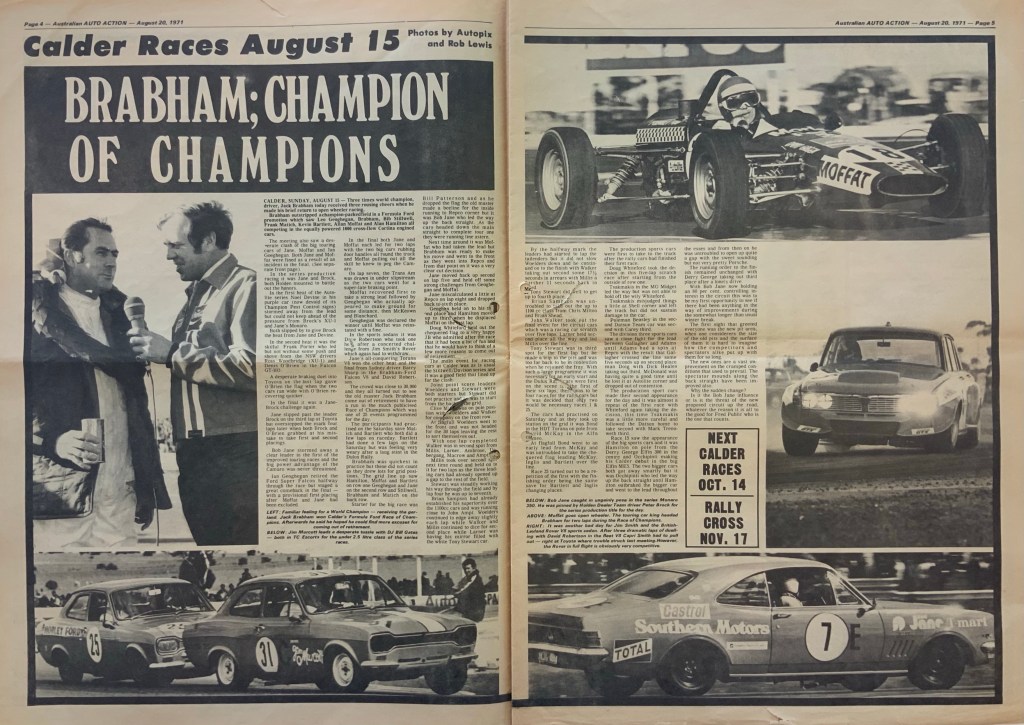
The sight of Teddy Whitten interviewing Black Jack on the victory dais gave me a chuckle. Whitten (RIP) is a legendary Melburnian, one of our most decorated of all VFL/AFL footballers. While he had the gift-of-the-gab, his motor racing knowledge could fit easily on a postage stamp so his banter with Jack for the punters at the circuit and on Channel Seven would have been amusing.
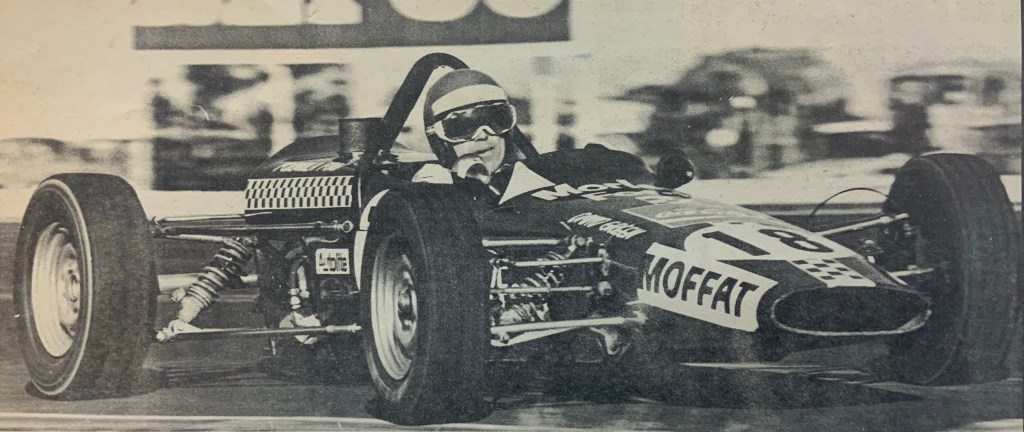
He enjoyed the Formula Ford foray, brief as it was, commenting in his Auto Action column; “My car – Morley Ford Wren went like a charm. I enjoyed the change in handling and the beautiful response you get. There’s no doubt that these cars teach you quickly and teach you well.”
“Sitting out there in the open with the front wheels bobbing a few inches away and the track disappearing alongside is a really thrilling experience. Formula Ford just has to be the way for the young drivers,” was great endorsement from Moff during FF’s second full season in Oz.
If those who would change FF fuck-off and leave things well alone we should have the category for another 50-years. When it ain’t broke don’t fix it.
Credits…
Auto Action, Sydney Morning Herald
Tailpiece…
(SMH)
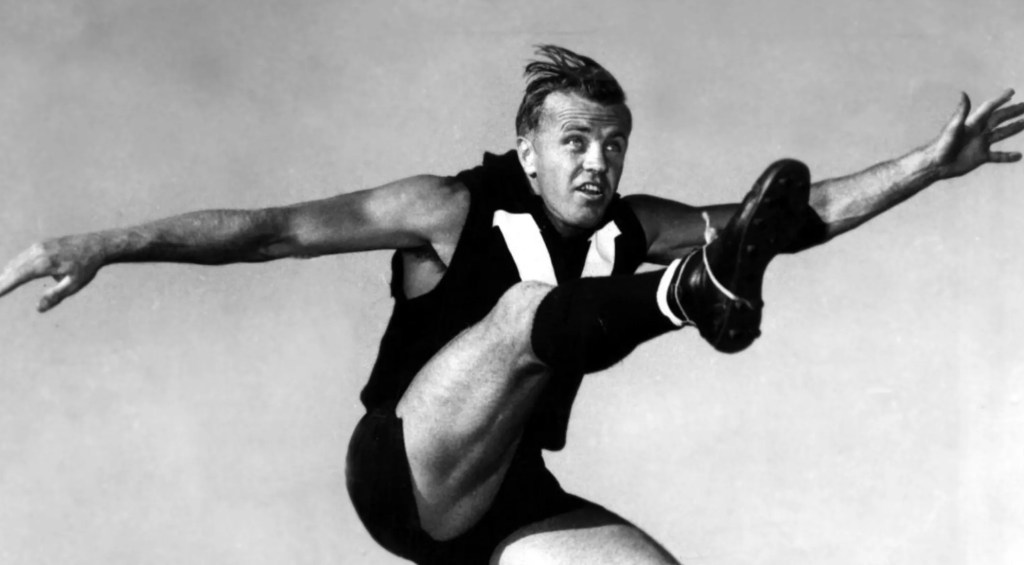
The great EJ Whitten, wearing his beloved Big V, Victorian state side jumper, during training for a state carnival game in 1963.
To those of us from less exalted climes, they were known as “the three ‘Ds’ from Toorak”, Dale, Duckett and Davey-Milne; all imbued with a fine sense of what a good motor car should be. They lived in close proximity, Duckett just around the corner from Davey-Milne and the Dales less than a kilometre away. They and their cars were often seen together. A fourth ‘D’ was their friend Lex Davison, four times winner of the Australian Grand Prix, but he was farming at Killara Park, near Lilydale.
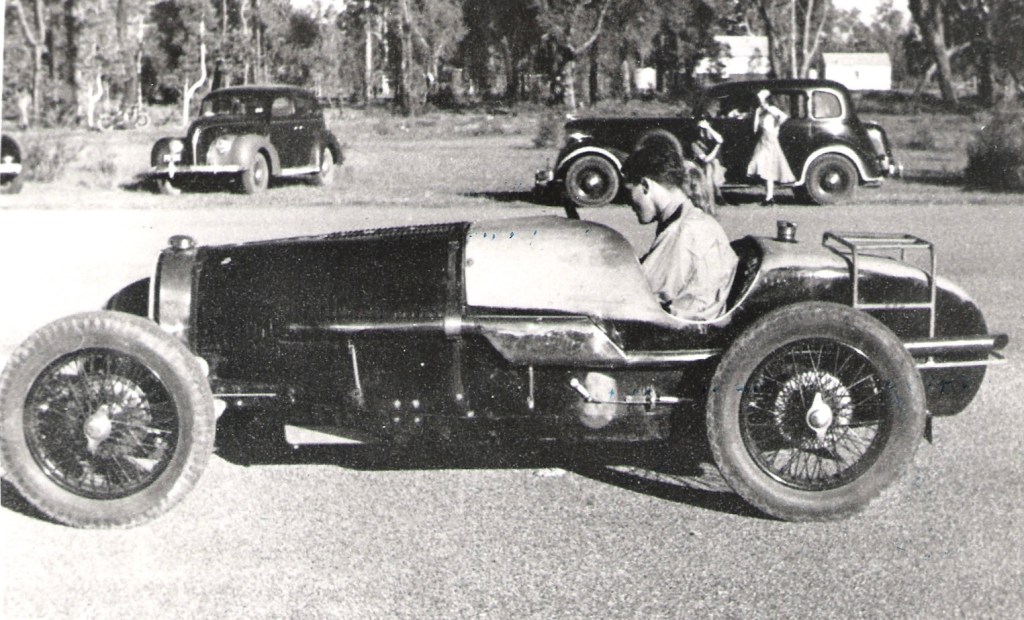
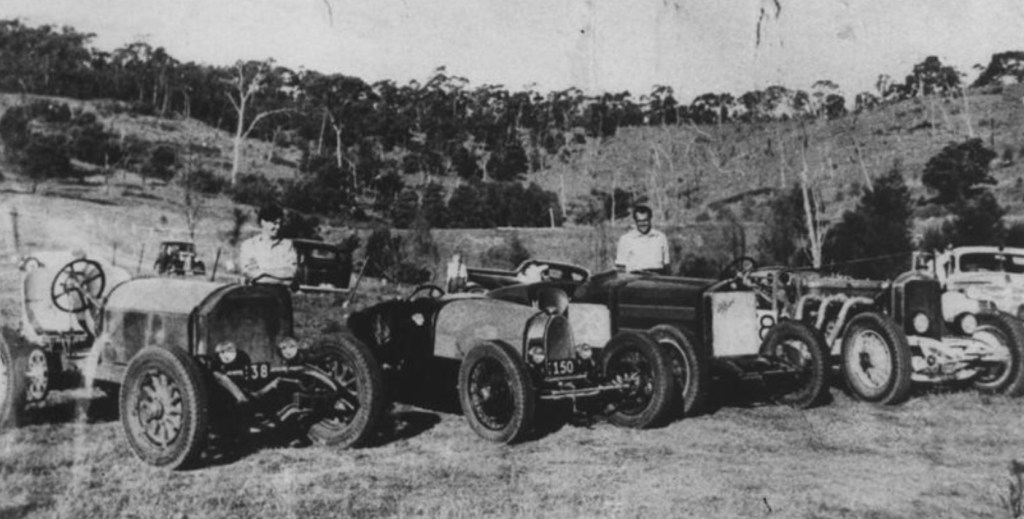
Lyndon’s family had a thriving hardware business in Melbourne. He was only a teenager when he ventured to Europe in the late 1930s. Whether the primary purpose of this visit was to find a racing car is not known, but he certainly brought one back with him, the car he made famous, the Anzani Bugatti Special. Lyndon wanted a twin cam Grand Prix Bugatti – in other words, a Type 51. As these were still being actively raced in Europe, they may have been a little beyond his purse. In a London mews he did find a single cam Type 35 with a blown-up motor. With his young mind obsessed with the twin cam idea, he contacted the works of Ettore Bugatti in Molsheim, France, and was assured that they had such a car (or was it an engine) for him. This was to be a disappointing trip, for on arrival there, the only Grand Prix Bugatti they had available had but a single camshaft; he did not purchase it. He took a side trip to Nuremburg for the annual Nazi Party rally and heard Adolf Hitler’s address, an event which horrified him. On return to London, he bought the 35 sans moteur.
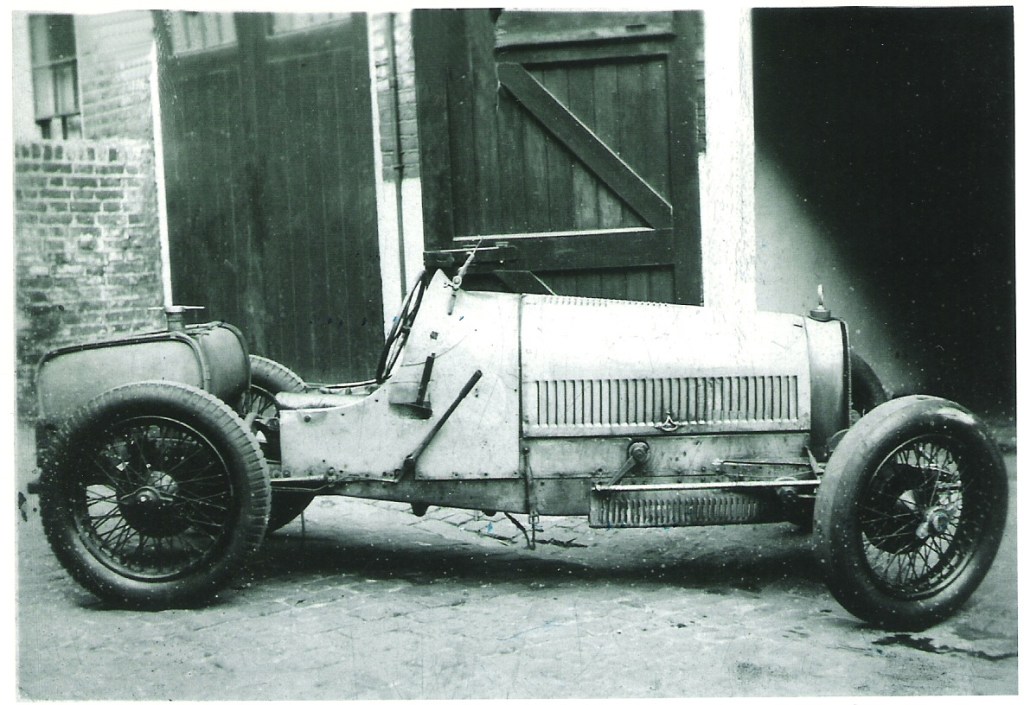
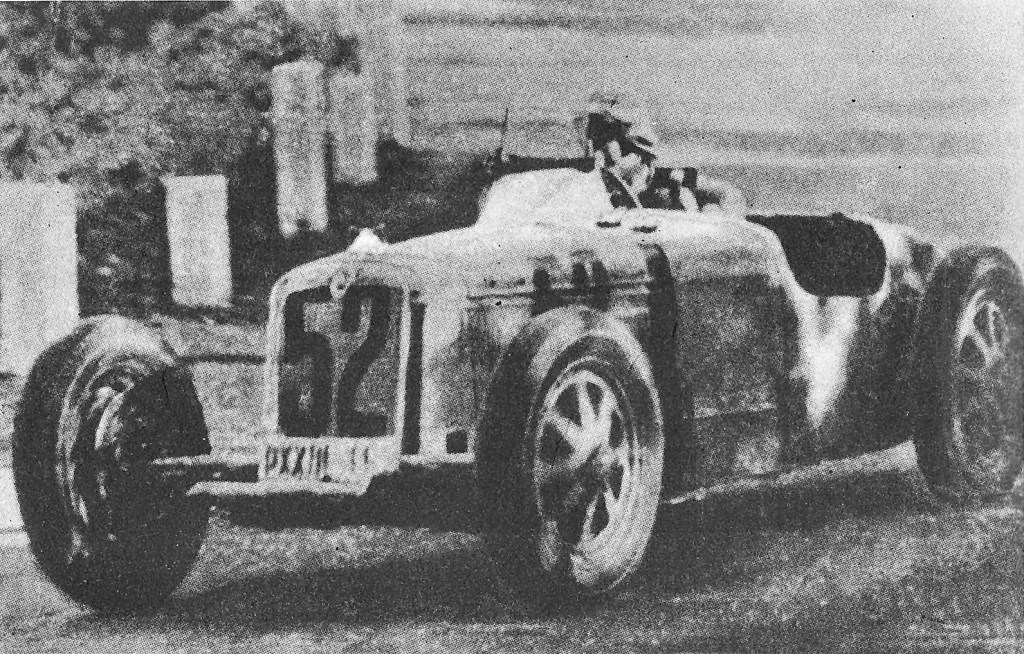
The opening photograph is the engineless 1925 Type 35 Grand Prix Bugatti, chassis no. 4450, as found by Lyndon in a London Mews. Lyndon noted that there was a lot of sand in the chassis rails – it had an extensive racing history at Southport Sands and other venues in the hands of TGV Selby who was later involved in the development of Bristol cars. Its first owner was Glen Kidston and it was the first Grand Prix Bugatti to be raced in England. Kidston later became one of the ‘Bentley Boys’.
(Bugatti Trust)
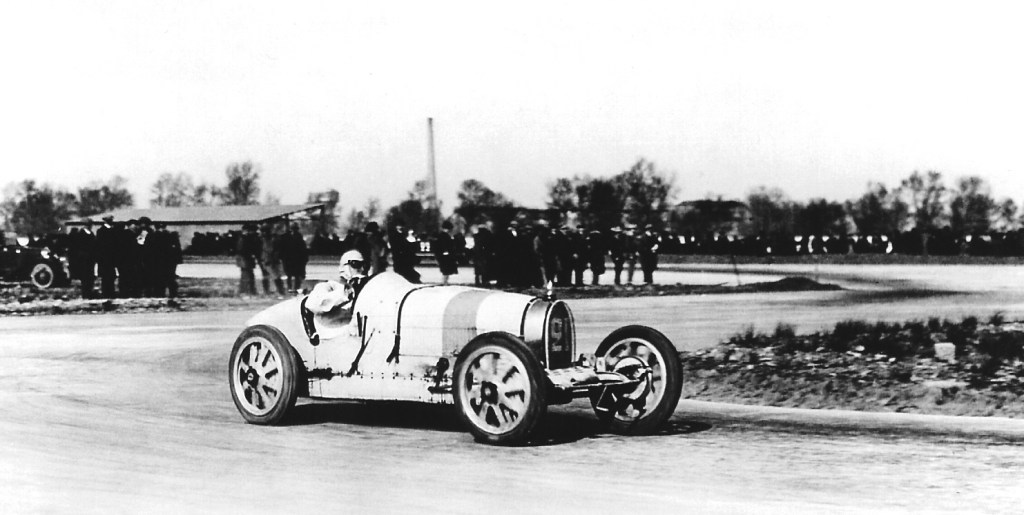
Glen Kidston on his way to a class second place in the Grand Prix de Provence in March, 1925. The band over the bonnet was yellow and denoted the 2-litre class.
(B King)
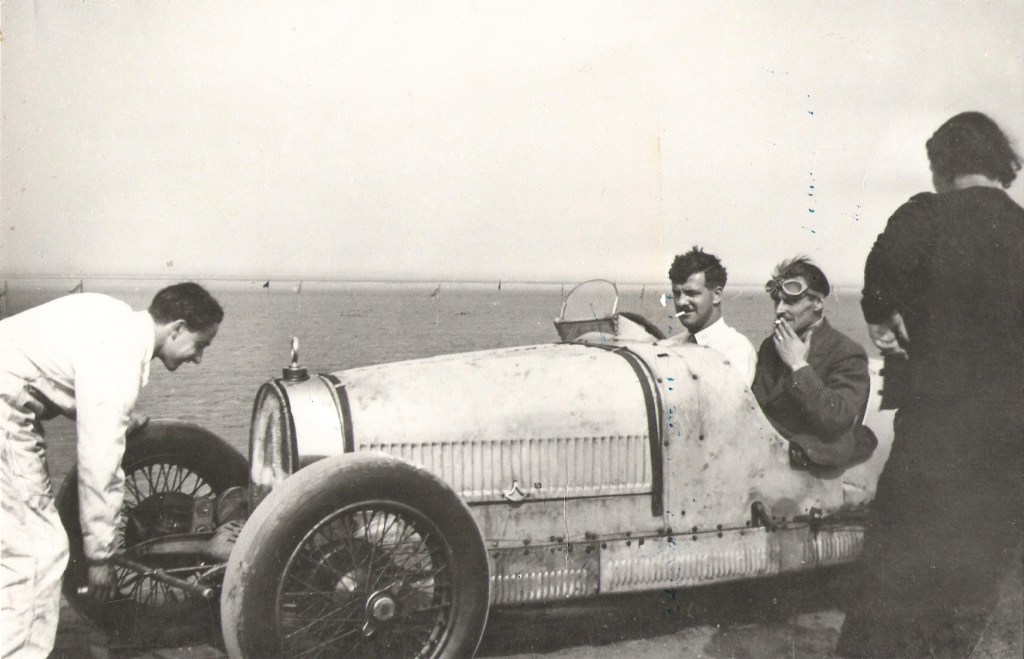
TVG Selby on Southport Sands. The Bugatti, chassis number 4450, can always be distinguished by the unusual bonnet lift handles that Kidston had fitted by the Nice Bugatti agent Friderich while it was there for the GP de Provence.
Lyndon’s search for a twin cam motor bore fruit when he found a brand new Anzani R1, 2 OHC, 4-cylinder, 1496cc motor; the same as fitted to the Squire motorcar. This engine, numbered R1 62, was the last engine to leave the Anzani works in Kingston-on-Thames – there were probably only 12 made. The English Bentley specialists Pacey’s were tasked with adapting the motor to the chassis, but this work was unsatisfactory and had to be redone in Australia. (Sound familiar?) A neat round tailed body was constructed by Cardigan Motor Body Works in Carlton. Initially there were problems with the motor (they had never been properly sorted by the factory, but Lyndon’s engineering skills overcame these problems).
(B King)
Lyndon Duckett in his immaculate Anzani Bugatti special.
For 10 years after the war Lyndon used the car for all sorts of motorsport. 1946 saw early success with ftd at a vintage sprint held at Lex and Diana Davison’s property, Killara Park. Duckett and the ‘Anz’ went on to be the inaugural winners of the Vintage Sports Car Club’s premier trophy, the ‘Vickery’.
(B King)
Lyndon at Marsden Park, NSW.
Not only did Lyndon set fastest under 1500cc time at Rob Roy, but he also beat allcomers at Marsden Park in a quarter mile sprint after an epic drive from Melbourne. Motor racing was just getting back on its feet after WWII and events were few and far between. Lyndon and Lex Davison had decided to make the long journey to north-west Sydney; Lex accompanied by his 17-year-old fiancé Diana Crick on the bodyless chassis of his 1500cc Alfa Romeo.
They had only reached the northern outskirts of Melbourne when the Alfa had a fit of Italian temperament and Lex needed Lyndon, the engineer, to travel with him. Diana, who did not have a licence, was installed in the Anzani and given a quick lesson on gear changing. In particular, she was told to get into top gear and stay there until she reached the outskirts of Albury, over 300 kilometres north! Lyndon had many more successes with the car, including wins at Ballarat Airfield races in 1950. Its last competitive outing with Lyndon ended as it had begun with a handicap win in the Tasmanian Trophy at Longford Road Races in 1955.
(B King)
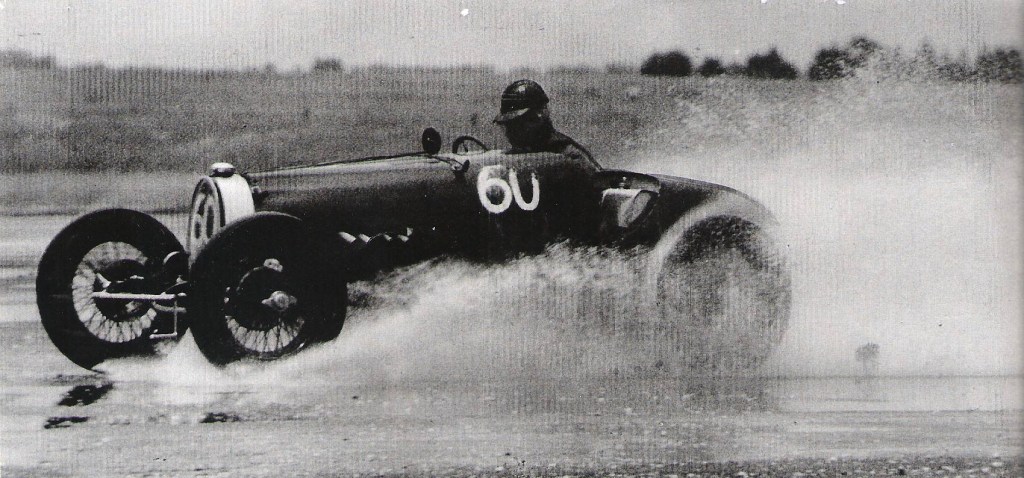
It was wet in Ballarat for the 1950 Road Races held on Ballarat Airfield. It won the D Grade race. Note the stub exhausts.
(B King)
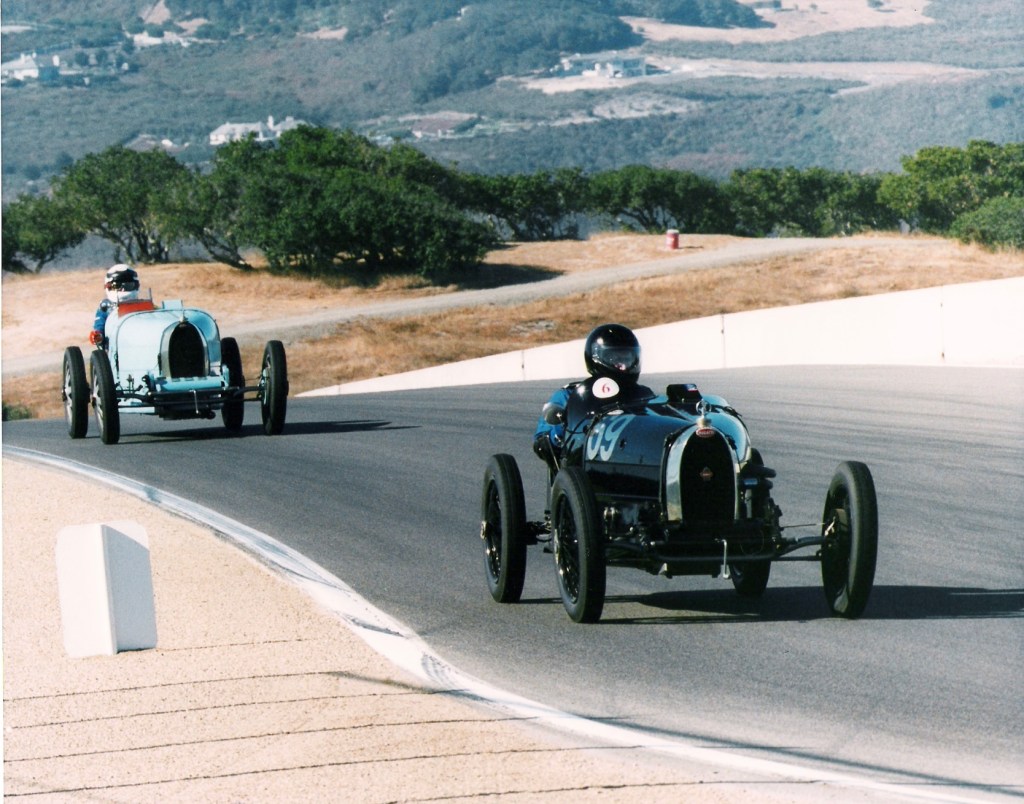
The writer also had 52 years of pleasure and some success in Historic Racing with the car. Here it is seen on the long climb up the hill at Laguna Seca in 2003 at a ‘Bugatti Grand Prix’.
(AMS)
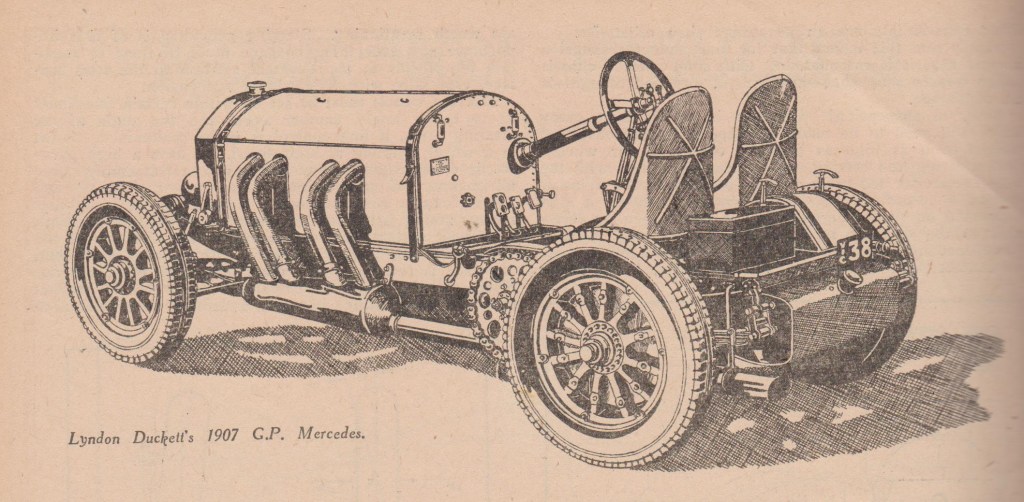
This drawing of Lyndon’s Semmering Mercedes, aircraft seats and all, appeared in the July 1947 Australian Motor Sport.
The Anzani Bugatti could hardly have been off the boat from England when the young Lyndon purchased this monster. At the time of Bob Shepherd’s AMS drawing, there was much discussion as to just what type of Mercedes it was. At 17.3 litres, it did not conform with the specifications of the 1907 or the 1908 Mercedes Grand Prix cars – it was larger than both and the largest Mercedes ever. Subsequent research has identified it as a 1908 car developed specifically to win the 10Km Semmering hill climb in Austria; it succeeded in 1908 and 1909. Lebbeus Hordern was just 18 years of age when his merchant father died, leaving him a £4,000,000 fortune. What better way to spend it than on the ultimate bird puller?
(G McKaige)(G McKaige)
No account exists of Lebbeus using the car, but the next owner Colin Smith, another millionaire, competed in 1911 at Artillery Hill, south of Sydney, before selling the car to Percy Cornwell, owner of potteries in Brunswick, an inner suburb of Melbourne. It was raced in a few events by Cornwell who also had the notorious Rupert Jeffkyns drive it for him before it passed to Ike Watson in Melbourne who dismantled it. It was bought by a brave young Lyndon in January 1942, and he had it running within a year. He confirmed that it had engine dimensions of 175×180 mm, consistent with the hill climb car. The gear ratios were equally heroic, 1st, 5:1; 2nd, 2.25:1; 3rd, 1.5:1 and 4th, direct drive.
(SLV)
Rob Roy with the Semmering Mercedes and Anzani Bugatti; also, the Davison ‘Little Alfa’ 6C1500 and 38/250 Mercedes Benz with Lex at the rear.
In July 1953 at Fisherman’s Bend race track the Melbourne Mercedes dealer attracted some attention which they may have preferred to have avoided. They pitted their new 300 model against the 1908 car, and to the delight of the considerable crowd, it was soundly beaten.
The writer recalls the only time he saw the Mercedes mobile; it was on the Argus Veteran Car rally in January 1955. The car was observed leaving a control in St Kilda Road and each time the engine fired the rear tyres left two black skid marks on the road – impressive.
(G McKaige)
Barn find. Lyndon’s Type FENC Isotta Fraschini.
This remarkably complete little jewel of a 1908 Isotta Fraschini Voiturette was found in rural Victoria; two of them had come here and they both survive. There are three others known, two in Italy and one in USA.
(G McKaige)
Professionally Lyndon had a motor engineering business in west-central Melbourne where he attended to client’s cars while accumulating a collection of vehicles for his own amusement.
At the time of his death, he had low-mileage Alfas, an Aston Martin, a Ducati and several other bits and pieces, including a rare Jowett Jupiter R1 and a Tojeiro chassis to which he hoped to mate a new MG twin-cam motor which was still in its box. I believe this was for a projected Le Mans car that he and Jumbo Goddard had dreamt up. The Isotta Fraschini remains with his sister.
(B King)
Isotta Fraschini FENC in recent times with Noel Cunningham at the wheel in Victoria’s Western District on a Bugatti Rally.
Etcetera…
Enthusiast, historian and restorer, Chester McKaige knew Lyndon as a child and shares his memories.
“He was a great bloke, he Bob Chamberlain, Earl Davey-Milne and a couple of Bentley Club bods in the Bentley Club were great to a kid growing up.”
“I have many fond memories of Lyndon and his mother Edith. The huge kitchen in Towers Road, Toorak, with kitchen table at one end piled high with car magazines. The stag head on the wall in the hall, the mosaic covered fountain. Lyndon’s obnoxious nephew too! Edith teaching me to play the saxophone. And towards his later years, the stick to keep the hoist up at his garage. The huge quantity of oil filters he had in stock that turned out to be empty boxes or filled with used ones.”
“I was his Godson and fortunate to get a guernsey in his will, so I was able to buy his Coventry Climax engined Morris Minor. I have his garage sign hanging on the wall in my garage. He used to keep spare cash under the carpet in his cars. I found $8 in $2 notes under the carpet in Morris. Dad used to call him Fella”.
Credits…
Australian Motor Sport, 1947, ‘Bugattis in Australia and New Zealand’ 1920 to 2012. King and McGann, Serpollete’s Tricycle, Volumes 2 & 3. https://earlymotor.com/serpolettes-tricycle/ The Brescia Bugatti, Bob King, Earl Davey-Milne, State Library of Victoria, George McKaige
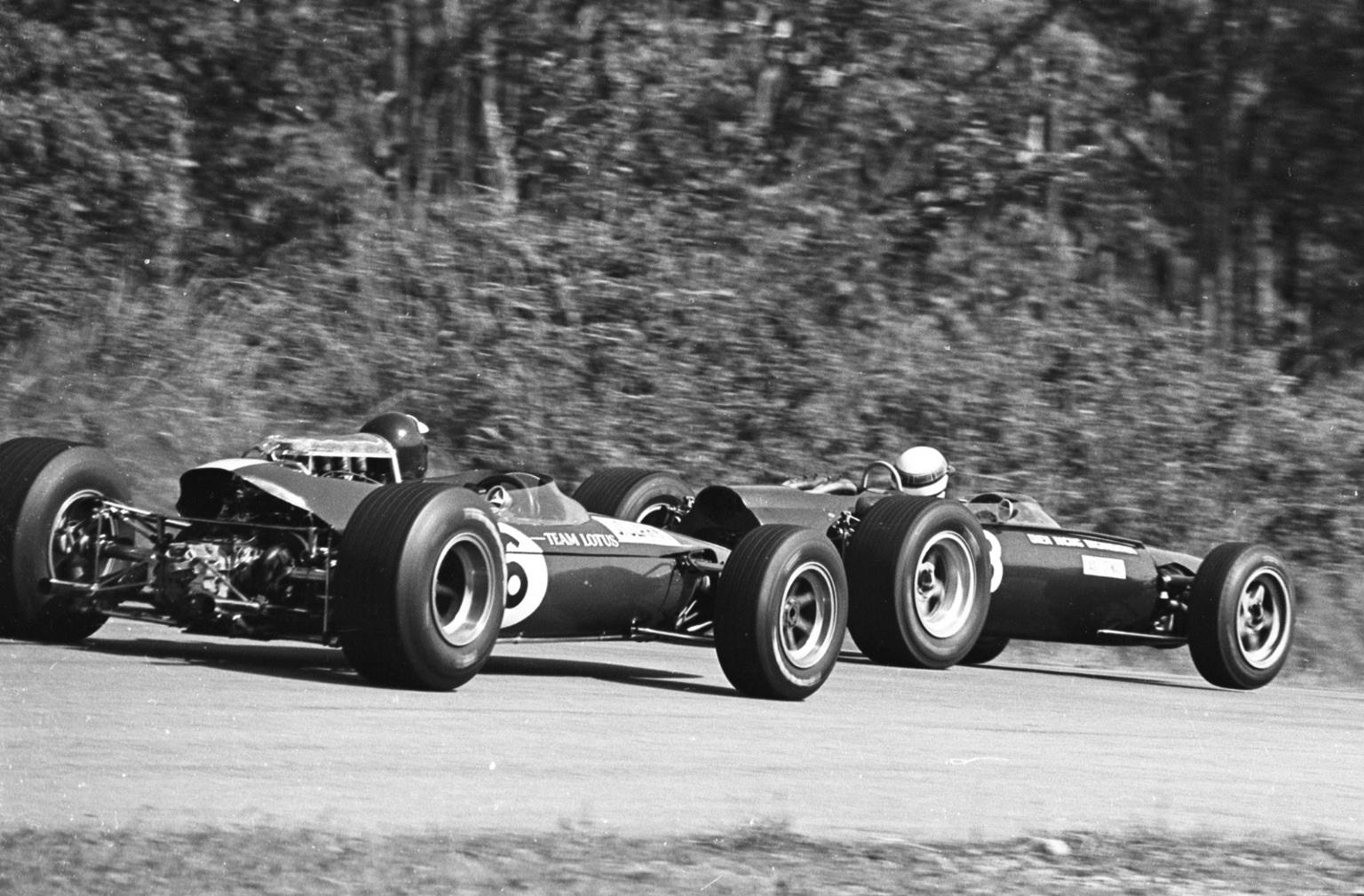
Jackie Stewart leads Jim Clark through Lakeside’s Eastern Loop during the 1967 Tasman round at the fast Queensland circuit on 12 February…
You can just see that the lightly loaded right-front wheel of Jackie’s 2070cc BRM P261 V8 is off-the-deck. Jim is chasing him in Lotus 33 R14 powered by a 2-litre variant of Coventry Climax’s 1.5-litre FWMV V8 Climax built for Lotus to tide them over pending delivery of the BRM H16 engines they used in the 1966, the first 3-litre GP year. The Ford Cosworth DFV V8 arrived at the ’67 Dutch GP in the back of a Lotus 49 and changed the GP world of course.
Stewart was the reigning Tasman Champion, BRM cleaned up in 1966 winning seven of the eight races – Jackie won four, Graham Hill two and Dickie Attwood one.
It was a lot tougher in 1967.
Lotus put to one side the 2.5-litre Coventry Climax FPF four cylinder engines they had previously used in their Tasman cars and used the F1 33 powered by the Climax V8, creating a very competitive mount despite giving away 500cc to some of the competition.
Jim finished all eight rounds and won five races including three point-scoring events. Jack Brabham’s Brabham Repco 640 Series V8s driven by he and Denny Hulme were also fast but had poor reliability. Jackie took two wins in 1967 for second in the series but was well behind Jim.
The BRMs were still very competitive in 1967 but the final increase in capacity – and resulting power and torque proved a bit too much for the transmission. BRM suffered gearbox problems in ’67 with the 2070cc variant of the P56/60 V8, they had not experienced with the 1930cc version used the year before.
(HRCCT)
The photo above shows the pair again, this time with Clark in front of Stewart during the final 1966 Tasman round at Longford, Tasmania on 7 March.
There Jackie won from teammate Graham Hill, Jack Brabham’s Brabham BT19 Repco third. It was the Brabham Repco V8 combination’s third race, by the early European Grands Prix the 1965 BT19 chassis and Repco 620 Series V8 was finding ultimate race and championship winning pace and reliability.
Clark’s 1966 Tasman Lotus was the 39 Coventry Climax FPF, he took one round win it at Warwick Farm.
Froilan Gonzalez launches his BRM V16 Mk1 off the line. 19 July, Silverstone ‘Daily Express Formula Libre Trophy’…
He is slow away on the inside though, Piero Taruffi is quicker off the line in the Thinwall Ferrari on the outside with Ken Wharton in the other #8 BRM, similarly sluggish. Big, heavy beasts that they are, with Gigi Villoresi in the factory Ferrari 375 V12 between the two V16’s.
‘Get knotted’, hmm, maybe not. ‘Take it easy for two laps’ Raymond Mays seems to be saying to his driver? (Ronald Startup)
2-litre F2 became the World Championship category in 1952, a consequence of there being too little opposition to Ferrari upon Alfa Romeo’s withdrawal from Grand Prix racing at the end of 1951.
BRM’s unreliability in terms of commitment to GP racing forced the issue upon the CSI. The choice was to have Ferrari dominate F1 or potentially open up the fields by running the World Championship to F2 of which their were plenty of manufacturers, ignoring the fact that the Scuderia dominated there anyway.
Despite the change to F2, ten F1 races of substance were held in 1952, but quite a few of them were in reality Formula Libre events, as Silverstone was. Event organisers were keen for the Grand Prix car spectacle, there were plenty of them even if the grids were thin of recent F1 cars.
The big, brutish, distinctive BRM Type 15 profile. Gonzalez, Silverstone (Louis Klemantaski)
The 35 lap race was won by Piero Taruffi in Tony Vandervell’s Ferrari 375 Thinwall Special from the Scuderia Ferrari 375 of Luigi Villoresi and Chico Landi’s 1951 spec Ferrari 375. Fourth was Australian Tony Gaze in a pre-war Maserati 8CM.
Gonzalez was out on lap eight after an accident, Ken Wharton in the other BRM completed 33 laps before retiring with a gearbox problem. The mixed nature of the grid is indicated by the place-getters below fourth who were Ron Flockhart and Bob Gerard in ERA D and A Types, John Barber in a Cooper T20 Bristol, Graham Whitehead in ERA C Type, and Bira in Maser 4CLT Osca V12 and the rest. There was no shortage of variety in the field which comprised pre and post War, supercharged and normally aspirated, F1 and F2 cars.
Although not GP wins the BRM was finding some form later in the season with victories for Reg Parnell at Turnberry in August and Gonzalez at Goodwood in late September. Gonzalez led home Parnell and Ken Wharton in a BRM 1-2-3 in the 15 lap ‘Daily Graphic Goodwood Trophy’ that day in a grid comprising mainly F2 cars.
If only it’s development were a year or so further advanced at the time…
Credits…
Louis Klemantaski, Ronald Startup
Tailpiece: Gonzalez wowing the Silverstone crowds with the stunning music of 1.5-litres of supercharged BRM V16…
Ya gotta be kiddin’ blokes! This thing is rattling my teeth!
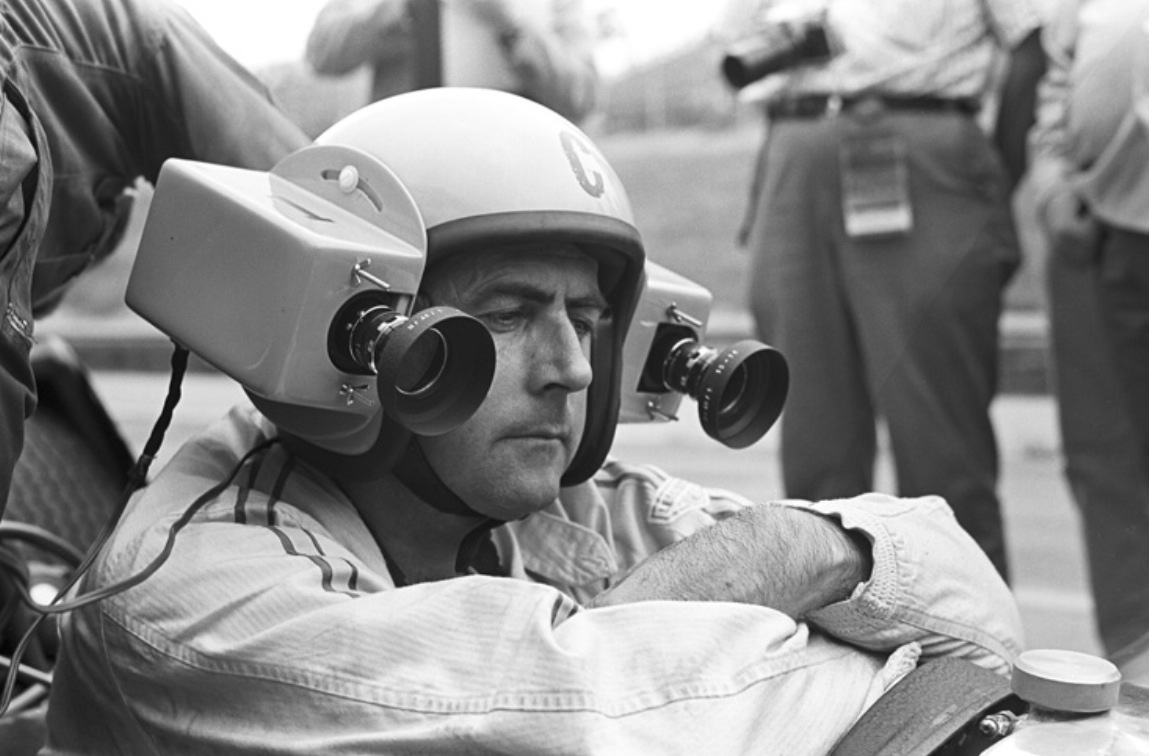
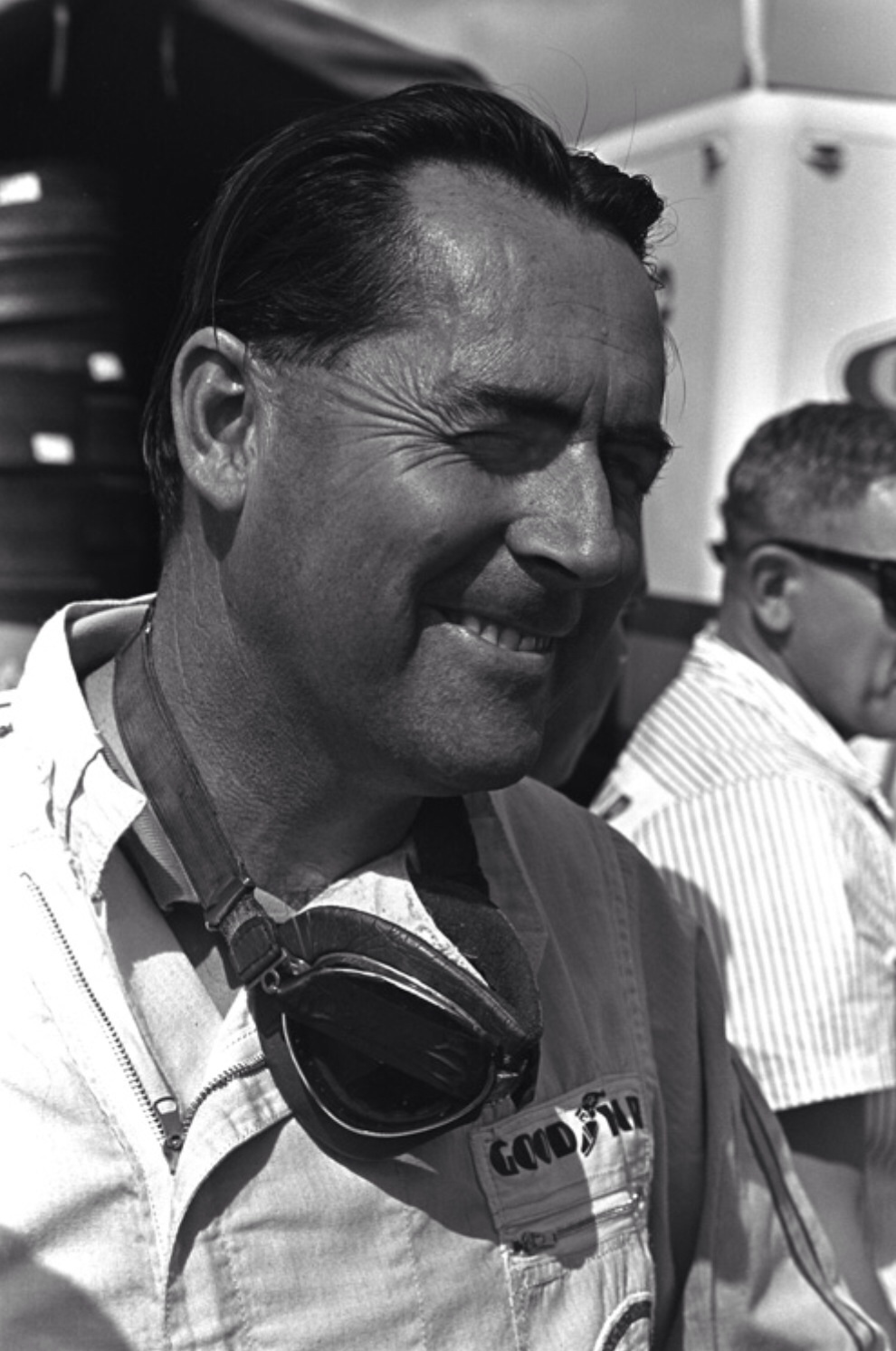
Is the look on Jack Brabham’s face aboard his Brabham BT24 Repco in the Mosport pitlane. By the end of the weekend he was a happy-chappy as winner of the first, soggy, 1967 F1 Canadian GP…
These days every Tom, Dick and Harold has a little, lightweight GoPro to capture their every move aboard their kart, board, bike, girlfriend or racer. It was a whole different ballgame in 1967, the state of the art was somewhat more cumbersome.
The interesting thing is where the footage ended up? Perhaps it was quickly consumed by the local TV news audience. I’ve had a fossick on that YouTube thingy but cannot find anything, do let us know the link if you discover its whereabouts.
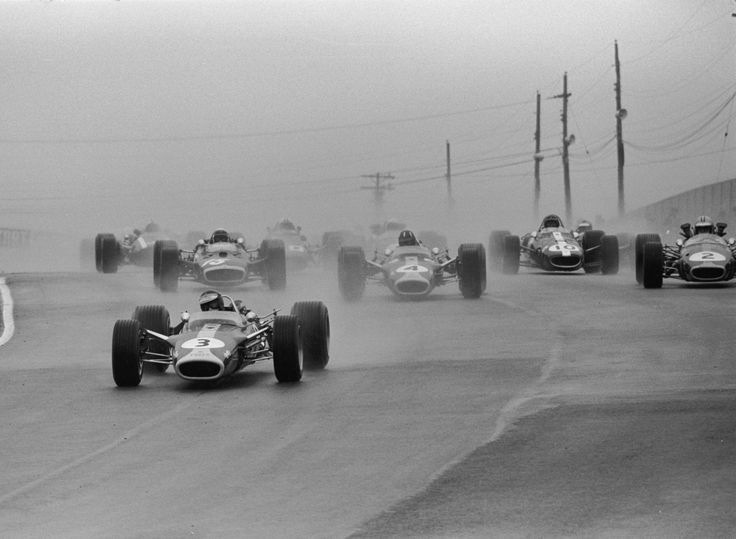
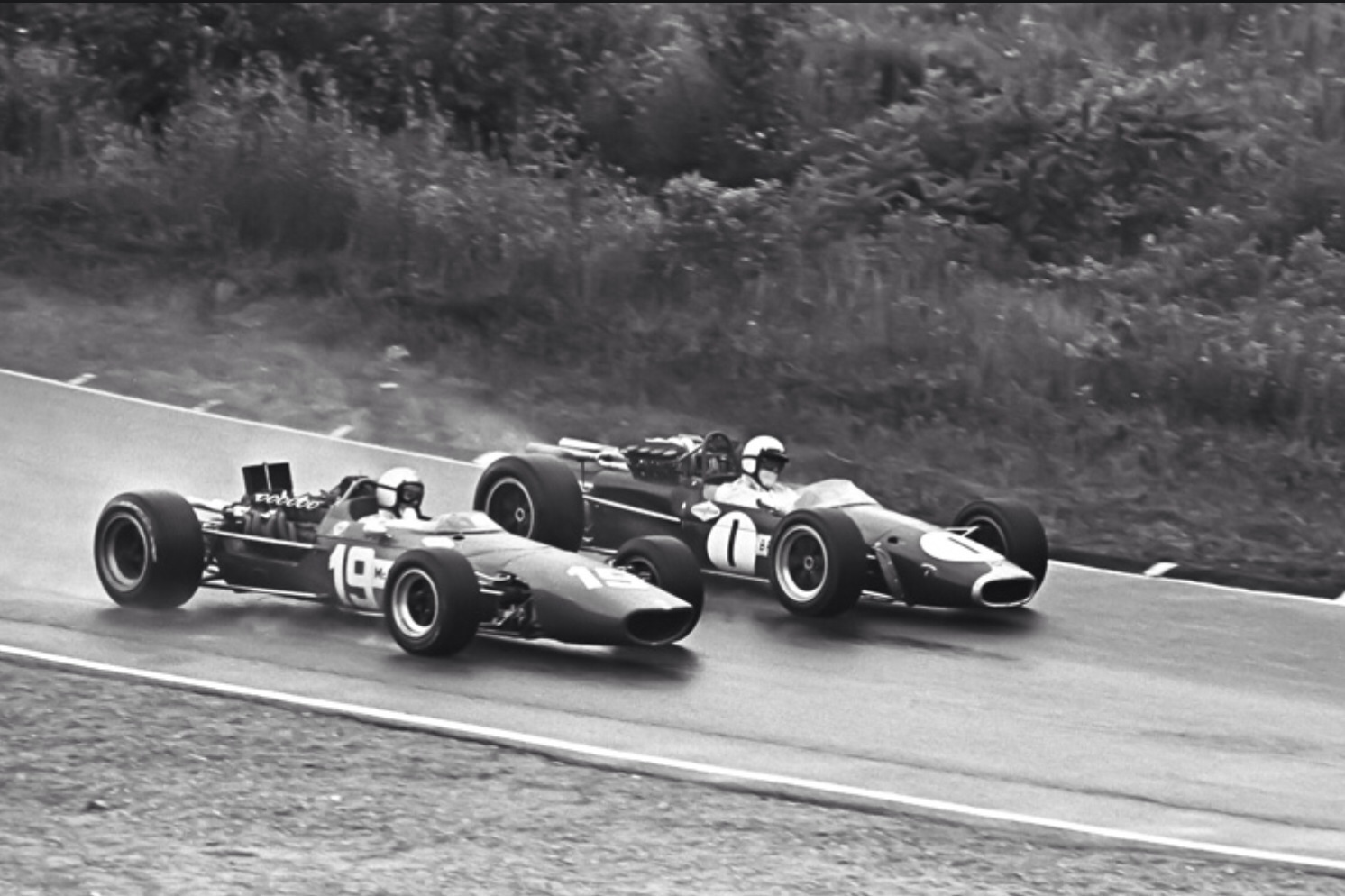
Jim Clark and Graham Hill were quickest in qualifying aboard Lotus 49 Fords from Chris Amon, Ferrari 312, Dan Gurney, Eagle Mk1 Weslake, Bruce McLaren, McLaren M5A BRM V12, Brabham’s BT24 Repco and Jochen Rindt, Cooper T81 Maserati.
Into the first turn at Mosport its Clark Lotus 49, from L>R Stewart BRM P83, Hill Lotus 49, Gurney Mk1 Eagle and Hulme Brabham BT24. That’s Rindt far left Cooper T81, Amon’s Ferrari 312 is in the murk behind Stewart’s left rear and the rest (unattributed)
Rain fell before the race to make things interesting. Clark led from Hulme, who took the lead on lap four, with Jack passing Hill for third. I rather fancy driving the Brabham, with its nice flat, fat torque curve rather than the DFV engined Lotus with its very abrupt power delivery in its earliest days in these conditions.
Bruce McLaren worked his way up thrugh the field, taking Jacks third place, then on lap 22 he took Clark’s second too. Clearly the conditions suited the V12 BRM engined McLaren. As the track dried, Jim and Jack both passed Bruce. Denny was still happily in the lead but Clark’s Lotus was quicker in the dry conditions and soon led, it rained again. Clark kept the lead but then his DFV went kaput. Jack overtook Denny at about the same time and won from Hulme with Gurney a distant third.
At the end of the meeting Denny had a nine point lead in the drivers championship over Jack, but with three GP’s to go; Italy, the US and Mexico City it was well and truly game-on between the buddies and teammates.
Jack is on the drying line in BT24 so I think its him re-taking McLaren’s M5B third place, rather than Bruce taking Jack earlier on (R Laymon)
Jack was out-fumbled by John Surtees’ Honda RA300 on the last lap, last corner at Monza with Hulme retiring due to overheating early in the race. At Watkins Glen Clark’s Lotus 49 Ford won from Hill’s with Denny third and Jack a distant fourth. Denny then led the championship from Jack by five points before the final round. It was all down to Mexico where Clark won from Brabham and Hulme. Denny bagged the title from Jack – 51 points to 48 points and Jim third on 41.
The car of the year was undoubtedly the new Lotus 49 Ford in terms of outright speed, but the less powerful, not much slower and more reliable new Brabham BT24 chassis with its new Repco Brabham 740 Series V8 should never be forgotten in the shadow of the sexy Lotus 49, as it always is! It did win the Manufacturers Championship after all.
Credits…
Ron Laymon Photography
Tailpiece: Winners are Grinners and Jack had a smile which lit a room. Mosport 1967…
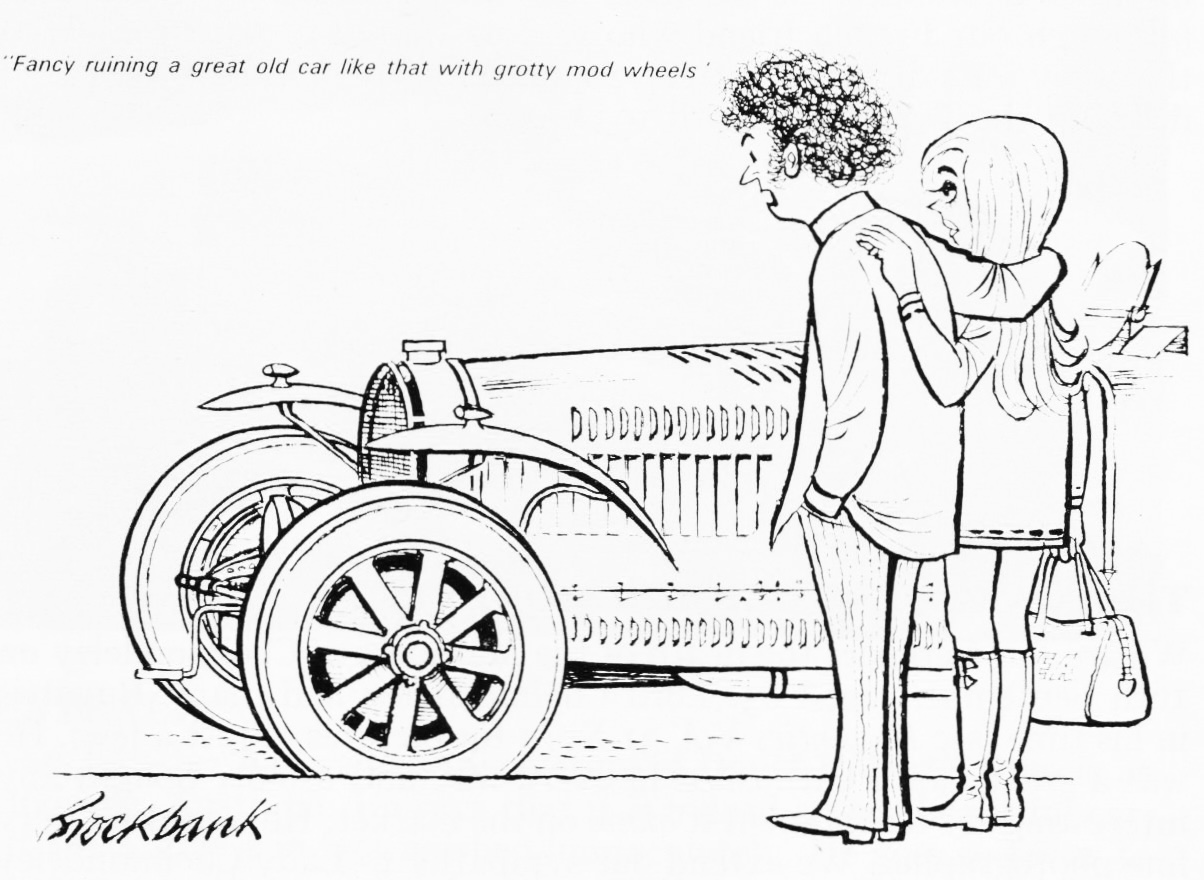
I think the car Brockbank had in mind with this beauty is Graham Hill/Guy Edwards’ 1974 F1 Lola T370 Ford.
It wasn’t the only car that season to stretch the envelope in terms of airbox design. I’m not so sure about the aero advantages but the size of the mobile billboard is of course considerably advanced, that must have filled Embassy with joy, even if the race results did not.
Lola fetishests will know the F5000 T330/332 donated some of its DNA to its F1 brother while the look of the car is very much like the ‘75 F5000 T400 – with the long-lived T332 the pick of the bunch.
(Lola Heritage)
Checkout the details of the car in the Lola Heritage site – worth an extended visit; Lola Heritage These shots are all from that site, what is lacking are captions identifying the circuits…
Today we are so used to cast or forged alloy wheels on our cars that we don’t think about them, at least not until we hear that infuriating crunch when we brush a curb. Just when the modern alloy wheel first appeared is subject to some speculation. (See The Nostalgia Forum – https://forums.autosport.com, 12 November, 2009 et seq.) When discussing these wheels, aluminium, magnesium and Elektron (a magnesium alloy) are often confused. Regardless of what we call them, ‘Mag, Alloy or Ali’, there is no disputing that Ettore Bugatti pioneered the use of aluminium wheels on racing cars when he used them on his ground-breaking Type 35 that first appeared at the Grand Prix de l’ACF (French Grand Prix) at Lyon on 3 August, 1924.
Ignoring Bugattis pioneering wheel for the moment, it would seem that cast or forged alloy wheels started to appear in general use in the late 1930’s – perhaps initially in the aviation industry – by this time the USA was a hotbed of experimentation in aluminium casting and alloy development. In England Alex Issoginis used 6 spoke Elektron wheels on his fabulous ‘Lightweight Special’ which he developed in the latter half of the 1930’s. These wheels had integral brake drums, à la Bugatti, but the spokes were bolted to the rim as distinct from being cast in one piece; a technique also used with aircraft.
Bugatti’s aluminium wheel as seen at the French Grand Prix in 1924 (B King)Alec Issigonis aboard his Lightweight Special with electron wheels in 1961 (unattributed)
In the early post-war years, the use alloy of wheels became commonplace, particularly with racing cars. Perhaps the first to use these wheels in this period was John Cooper on his Mark II. Doug Nye in his seminal COOPER CARS , states that Cooper discussed the increasing difficulty in obtaining suitable wheels with his cousin Colin Darby and they came up with the idea of casting wheels with an integral brake drum “like Bugatti pre-war”.
They patented their design and had them cast, claiming that the wheels were “lighter and stronger than the old Fiat type”. Arthur Owens, THE RACING COOPERS, states that their first production alloy wheels appeared in 1947 and were “cast in Elektron with 8-inch brake drums cast integrally”. Others state that it was in 1948 that the Cooper Mk. II, their first production model, appeared with these wheels. Again, claims were made for better brake cooling, more rigidity and better access to the brakes. Other small-time manufacturers such as Laurie Bond with his eponymous Bond ‘C’ type of 1948 used alloy wheels; in the case of Bond, they were to his own design.
Cooper Mk2 cast aluminium wheels (Cooper Cars)
Meanwhile across the pond, ex-Douglas aircraft engineer Ted Halibrand began experimenting with magnesium alloy wheels in 1946 which he first used on his own midget racing car. He tried them out on Indy cars in 1949, but had problems with cracking and the soon to become ubiquitous Halibrand cast wheel did not appear at the Indianapolis 500 until 1950. Subsequently, every Indy car between 1951 and 1967 wore Halibrand wheels and Halibrand’s influence still looms large in the wheel industry and hot rod community.
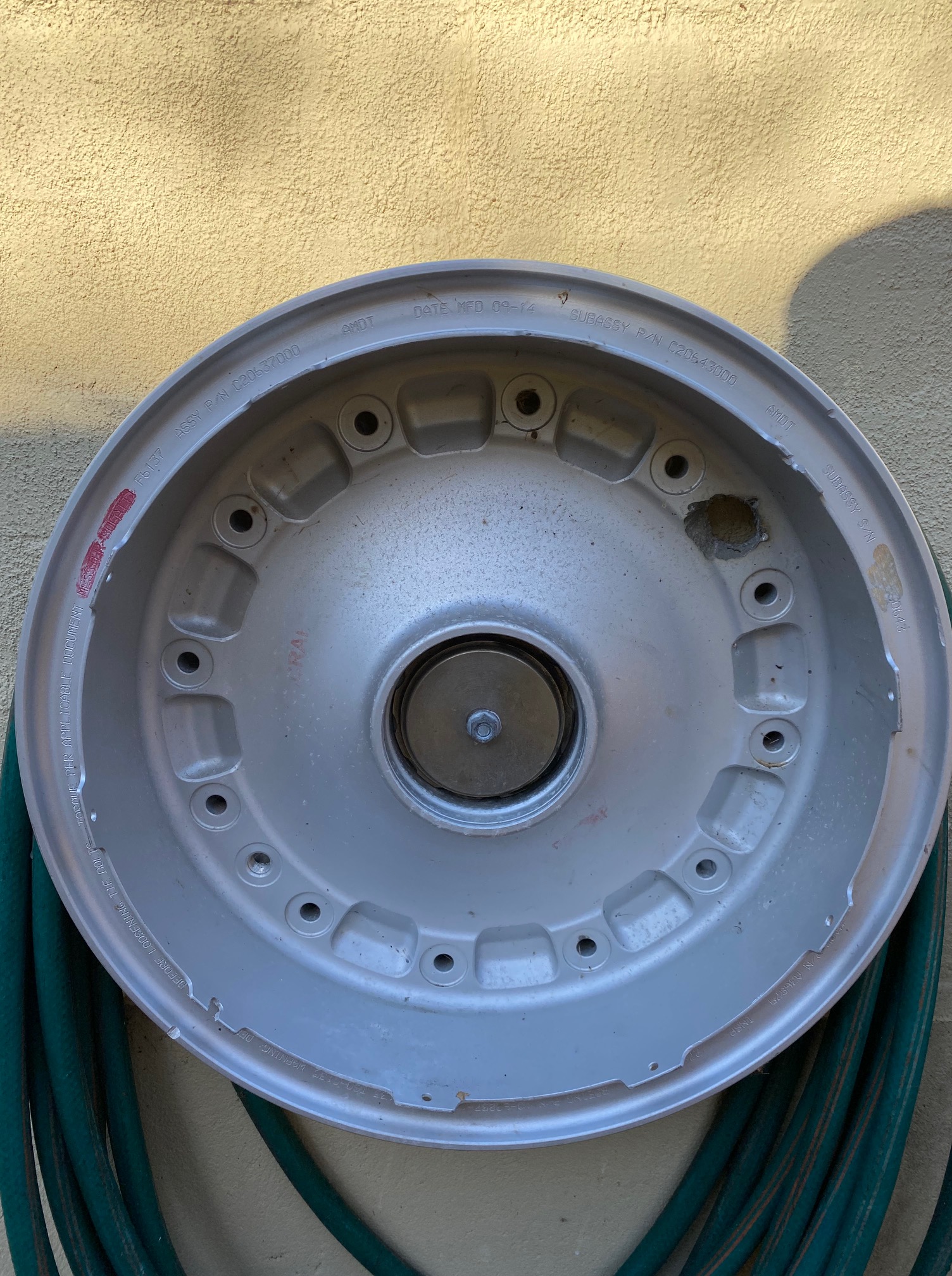
‘Sure, it looked a lot more aggressive than a steelie with poverty caps’. Ted Halibrand with magnesium alloy wheels and other castings (Internet Commons) A ‘modern’ Messier Bugatti alloy Boeing nose wheel serves as a hose reel for the writers garden hose. Yes, the Bugatti name survives in the aero-spatial industry (B King)
Historically, it had been generally accepted that the cast aluminium wheel was solely the product of the inventive mind of Ettore Bugatti. However, in 1981 influential American automotive historian Griffith Borgeson (1918-1997) set the cat among the pigeons with his BUGATTI by BORGESON (Osprey). The sub-title of this book is ‘The dynamics of mythology’, and in it he tries, at times too hard, to discredit some of the pioneering work of Bugatti. In chapter 13, ‘Wheels within Wheels’, Borgeson claims priority for the invention of the aluminium wheel for Harry A Miller in a US Design patent of 4 May 1920,
Miller’s design for an ‘ornamental wheel’ (G Borgeson)
Recently, while researching the racing history of Diatto factory works driver Carlo Massola we were shown a book on the marque by Sergio Massaro titled simply: DIATTO. We were astonished to see that on the front cover there was depicted a car with what appeared to be cast wheels. In fact, in 1923 ‘Automobili Diatto’ produced a version of their racing Tipo 20S with aluminium wheels described by Massaro as “the fantastic ‘holey’ wheel” which was cast in light alloy.
It is important to understand that there had been a long-standing relationship between Bugatti and Diatto dating back to their membership of the Turin branch of Club Automobilisti d’Italia as early as 1899 or 1900. According to Steinhauser’s ETTORE BUGATTI, Pietro Diatto, who was nine years older than Ettore, ‘Took an interest in Bugatti’s prototype T8 in 1907. Their relationship was uninterrupted’.
The T8 refers to Bugattis eighth car design which was for the German industrial giant that was Deutz. It was in effect a prototype for future Bugattis with an overhead cam actuating vertical valves via ‘banana’ tappets – a design feature later glorified by his highly successful Brescia model. In October 1915 Louis Panabel, the Diatto agent for France, obtained an option for Bugatti’s pioneering eight in-line steel-block aero engine in the name of Cavaliere Pietro Diatto. This was the aero-engine which had grown from Ettore’s concept for a luxury car engine of eight cylinders with which he had been experimenting since 1912.
The Diatto-Bugatti aero engine was successfully tested in September 1916, Diatto sending an enthusiastic telegram to Bugatti “I am happy to announce the excellent results for the engine … the testing resulted in a brilliant 210 HP”. This collaboration led to a 1919 agreement in which Bugatti was to supply Diatto with fifty 16 valve car chassis made in Molsheim; they were to be fitted with Diatto radiators. (Other than the radiator and the bonnet, these cars were identical to the Bugatti factory product – they are what today is referred to as the ‘Brescia Bugatti’).
Three of these Diatto-Bugattis were shown at the Paris Motor Show in 1919, all with a Diatto radiator with a Bugatti badge. Bugatti displayed two of his outdated 8-valve cars on another stand. Bugatti was a late entrant for the show, and it would appear that the industrial giant Diatto had stolen a march on the under-funded Molsheim factory. There is an unsubstantiated claim in Wikipedia that Diatto also manufactured chassis for Bugatti.
The fantastic holey wheel used on the Diatto 20S (Massaro)
Dane Claude Teisen-Simony has written of the relationship between Bugatti and Diatto. According to Claude, Diatto, which was the second largest Italian automobile manufacturer post-WWI, formed what was “an absolute dream team. Not only did he start with the collaboration of Bugatti, he also linked-up with the outstanding engineering capacity of Giuseppe Coda of FIAT and SCAT racing fame plus two of the Maserati brothers, Alfieri and Ernesto”.
Teisen-Simony claims that “Bugatti used the much larger Diatto factory and its capacities as a test facility for his new ideas, such as a hollow front axle in 1920 and racing cars with superchargers in 1921”. He states that the remarkable Bugatti hollow front axle was developed as a collaboration between Bugatti and Coda. He notes that Borgeson also referred to a partnership between Bugatti and Coda in the development of the Deutz Type 8.
Although the source of the information on the alliance between Bugatti and Coda is not given, there is sufficient grounds to accept that Diatto and Bugatti worked closely on a number of projects, including aero engines and the sixteen-valve car. Other tangible evidence of the close association between Bugatti and Diatto is indicated by the similarity between their radiator badges and by their adoption of the term ‘Thoroughbred’ translated as, ‘Pur Sang’ and ‘Puri Sangue’ respectively, to describe their cars. It is not clear to the writer when Ettore first used the ‘Pur Sang’ description; but it has been applied retrospectively to the first Bugatti, his Type 13 of 1909 – ‘Le Petit Pur Sang’. Diatto used ‘Puri Sangue’ to promote the company’s success with their Tipo 30 (Bugatti).
The Diatto radiator badge has an identical form to the Bugatti badge (Massaro)Diatto’s thoroughbred (Internet Commons)
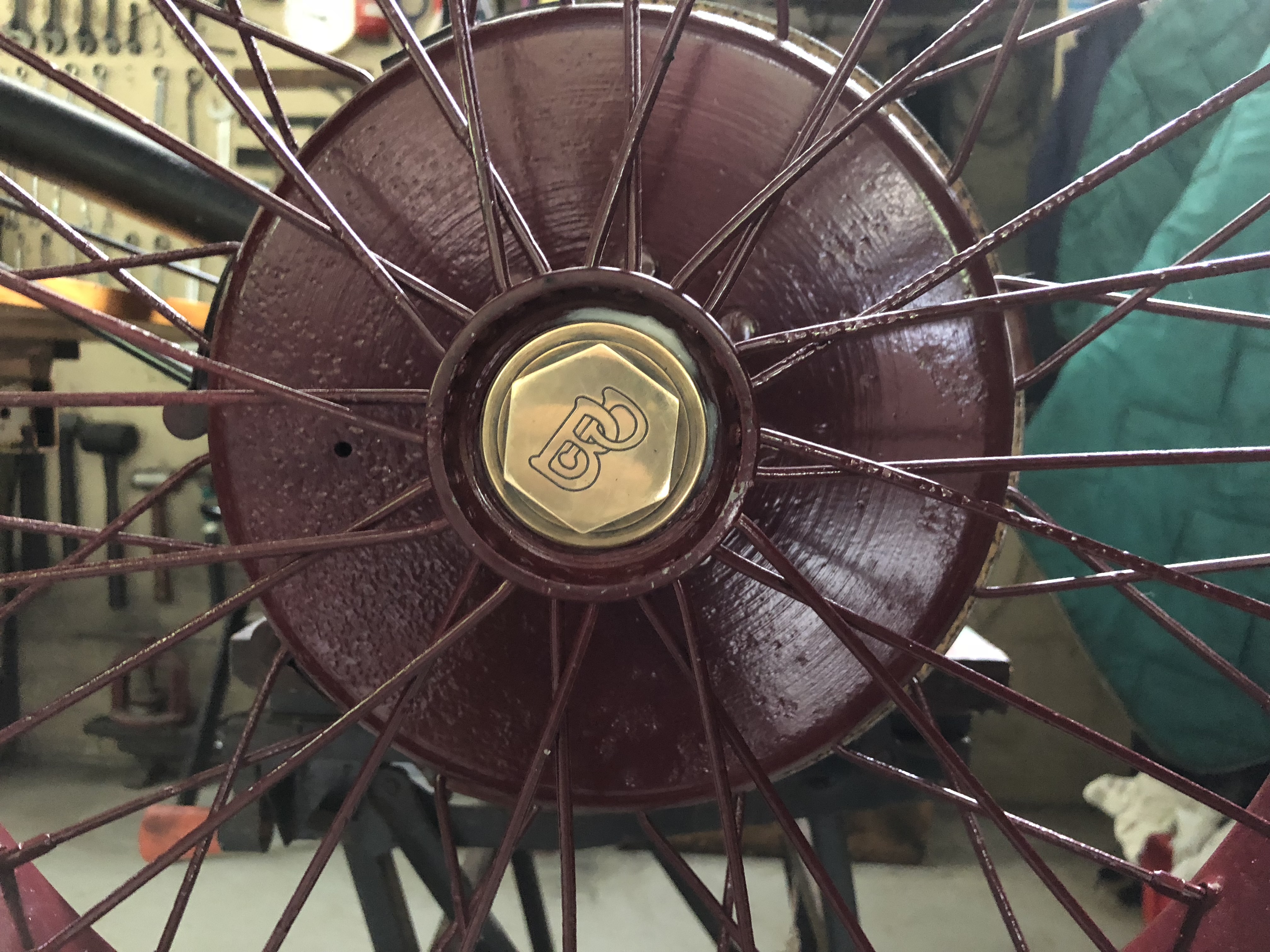
The Bugatti cast aluminium wheel.
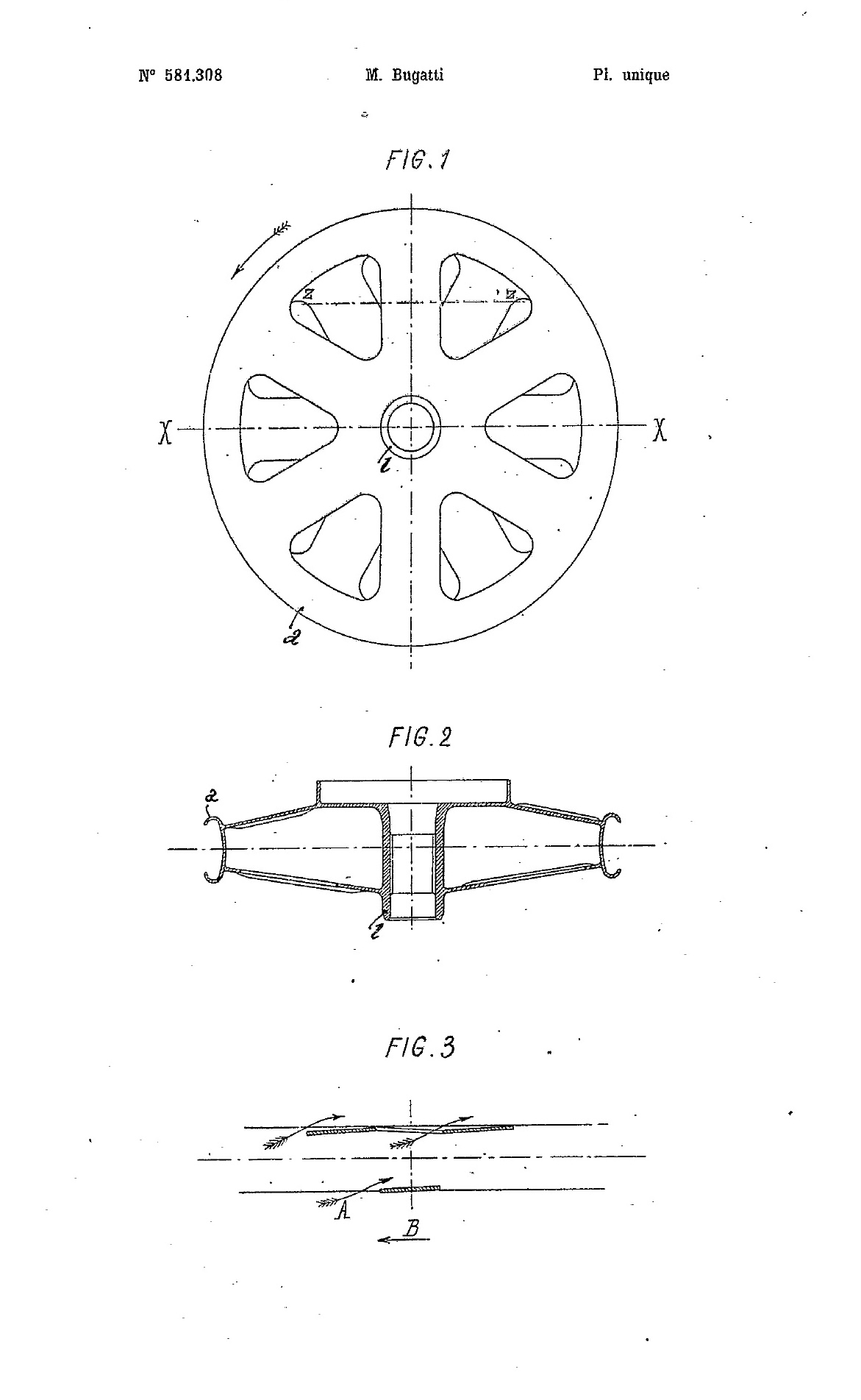
Cast wheels were not a novelty in 1924, and therefore not patentable; nor would the change from iron to aluminium have had patentable merit. Bugattis first patent for his wheel (FR581308), filed on 5 May 1924, was titled Roue à disque à refroidissement ‘cooled disc wheel’, concerning itself with the increased brake cooling provided via skewed spokes. (In production the spokes were parallel).
The Bugatti wheel was distinguished by its integration of the brake drum into the wheel, but this arrangement was not unique as many automotive wire wheels prior to WWI had their spokes laced into the periphery of the brake drum. Malicet et Blin (MaB) were well known for their use of this design and as parts suppliers to the automotive industry this pattern of combined wheel and brake drum appeared on many, mostly French, cars in the early days. Closer to home, Bugatti used this pattern of wheel on his Type 16, the Bébé Peugeot, from 1912 – possibly this influenced his thinking when it came to making an aluminium wheel with an integral brake drum.
The rear wheel of the writers Bebe Peugeot, showing the integration of the brake drum into the wheel (B King)The original Bugatti aluminium wheel as patented in 1926 in the USA. It shows two rows of six spokes, offset; significantly different to the final product (Ploeg)Bugatti wheel (Salzman)
Wheel manufacture had played an important part in Diatto’s history; Guglielmo Diatto was a thirty-year-old wheelwright and coachbuilder when he established his eponymous company on the banks of the Po River in Turin in 1835. In 1838 he patented ‘a perfect wheel’. From what can be seen in a photograph of the wheel taken from the patent application, it appears to be a normal metal spoked cart wheel. Was it the use of metal spokes that made it patentable, or was it a pioneering cast wheel?
Guglielmo Diatto’s ‘perfect wheel’ of 1838 (Internet Commons)
Aluminium wheels, Bugatti, Miller or Diatto?
It seems unlikely that Bugatti was influenced by the 1919 Miller design for an aluminium wheel. Miller, strictly, did not patent the design – it was a Model Registration that concerned ‘the ornamental design of a wheel’. The wheel was intended to be used on an innovative racing car known as the T.N.T., but in its one or two track appearances it was fitted with conventional wire wheels. (Mark Dees, THE MILLER DYNASTY) The model registration did not address any perceived mechanical advantage from a cast wheel. The wheel was six spoked, compared with Ettore’s eight spokes, and there is nothing in the model registration to suggest it used an integral brake drum. It appears that Borgeson, not for the first time, was ‘drawing a long bow’ when he suggested that Miller’s design was the inspiration for Bugatti’s cast aluminium wheel.
In regard to the association between Bugatti and Coda, we are prepared to believe that the Diatto and Bugatti aluminium wheels might have had common antecedents. In the absence of documentation, just who influenced who remains unclear. The presence of Giuseppe Coda in the allegedly contemporary drawing of a Diatto 20S with perforated aluminium wheels does imply his possible involvement in this novelty.
Bugattis original patent described the wheel “as consisting of one, two or several discs, pierced in a manner to give the desired form to the ‘arms’ or spokes”. This description better fits the Diatto wheel than the aluminium wheel as it first appeared on the Type 35 Bugatti at Lyon in 1924. Could this design have arisen from discussion between Coda and Bugatti, or was Bugatti inspired to make his own version having seen the cast wheel designed by Coda? Italian patents relating to the aluminium wheel might be revealing.
A representation of Coda at the wheel of a Diatto 20S with cast aluminium wheels (Massaro)
What is certain is that Ettore Bugatti was the first to produce a practical light alloy wheel for racing and passenger cars – wheels that are now standard on modern cars.
Etcetera…
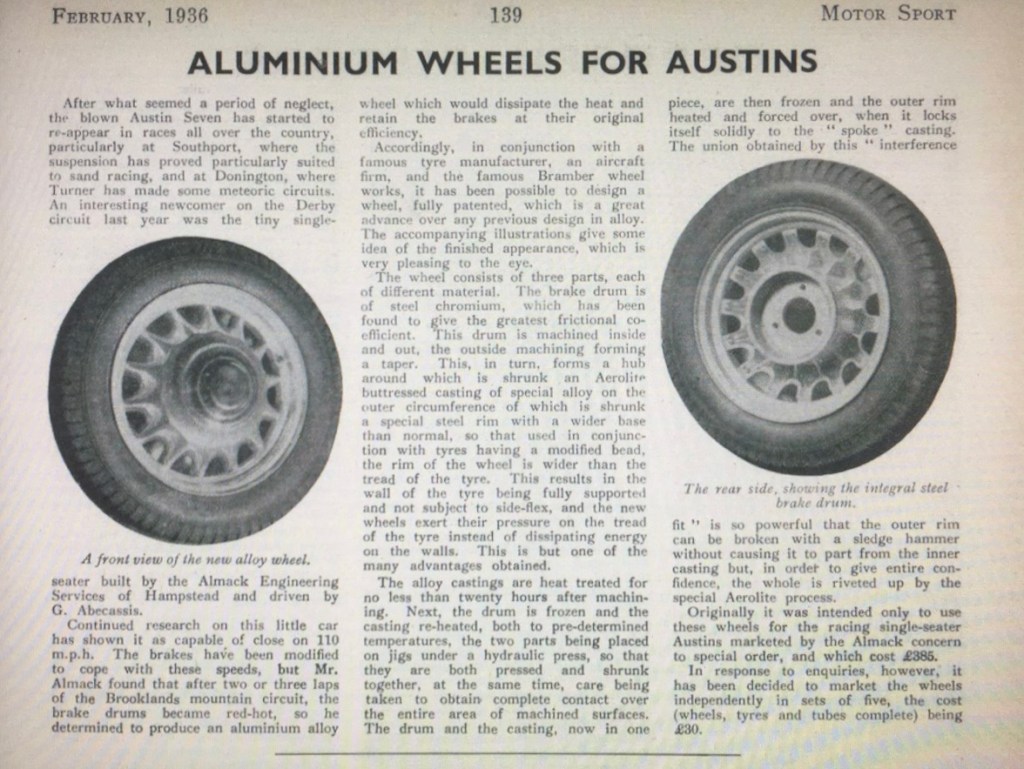
Aerolite wheels detail construction
More on the Aerolite wheels from Stuart Ulph, owner of the Almack Austin.
“I was completely unaware that a commercial fleet had been equipped with Airlite wheels. My knowledge of these wheels (apart from owning some) was derived from the “Motor Sport” article, so to me they were ‘Aerolite’. They were made by Bramber with, I am pretty sure, Dunlop rims, the rims being steel of course. I had wondered if High Duty Alloys were involved in the supply of materials – just speculation.
Pete Almack refers to them as ‘my patented wheels’. I assumed he was the patent holder – he held other patents – but a patent search has revealed nothing. Peter also acted in some sort of consulting capacity to the patents board. It has occurred to me that Bramber may have held the patent.
As far as Austin Sevens are concerned, I know that both 15″ and 16″ wheels were made. I had heard that a ‘Motor Show’ Vauxhall 14 was equipped with Pete’s wheels and I have a set of 16″ wheels which were fitted to a BMW 315. Unlike the Austin 7 wheels, these do not have integral brake drums. The BMW wheels have a patent pending number on them as I recall but even this proved of no use to the searcher.
You would think that more of these wheels might turn up, given that Bramber seem to have sold quite a few sets. I telephoned Bramber circa 1980, by which time they had moved to Wales and their major occupation was in producing trailers for Land Rovers. Though interested by the story, by then they had no records or knowledge of the alloy wheels.”
CZ Z13 1.5-litre two stroke (D Ploeg)
And this contribution from Dick Ploeg, “You may also wish to add that the Czechoslovakian firm of CZ (CESKOSLOVENSKA ZBROJOVKA), on their 1931 Z13 racing car they copied the Bugatti alloy wheels, with integral brake drums.
Furthermore there was a French make of aftermarket light alloy wheels available shortly before and after WW2. These were seen, I believe, on Amilcars and Peugeot Darlemats of the period. I have no name available at the moment, but it must be recorded somewhere.”
Credits…
Bob King and his collection, Tony Johns, Mike Costigan, Stuart Ulph, Dick Ploeg, Diatto’ Sergio Massaro, Brockbank and other references quoted in the text
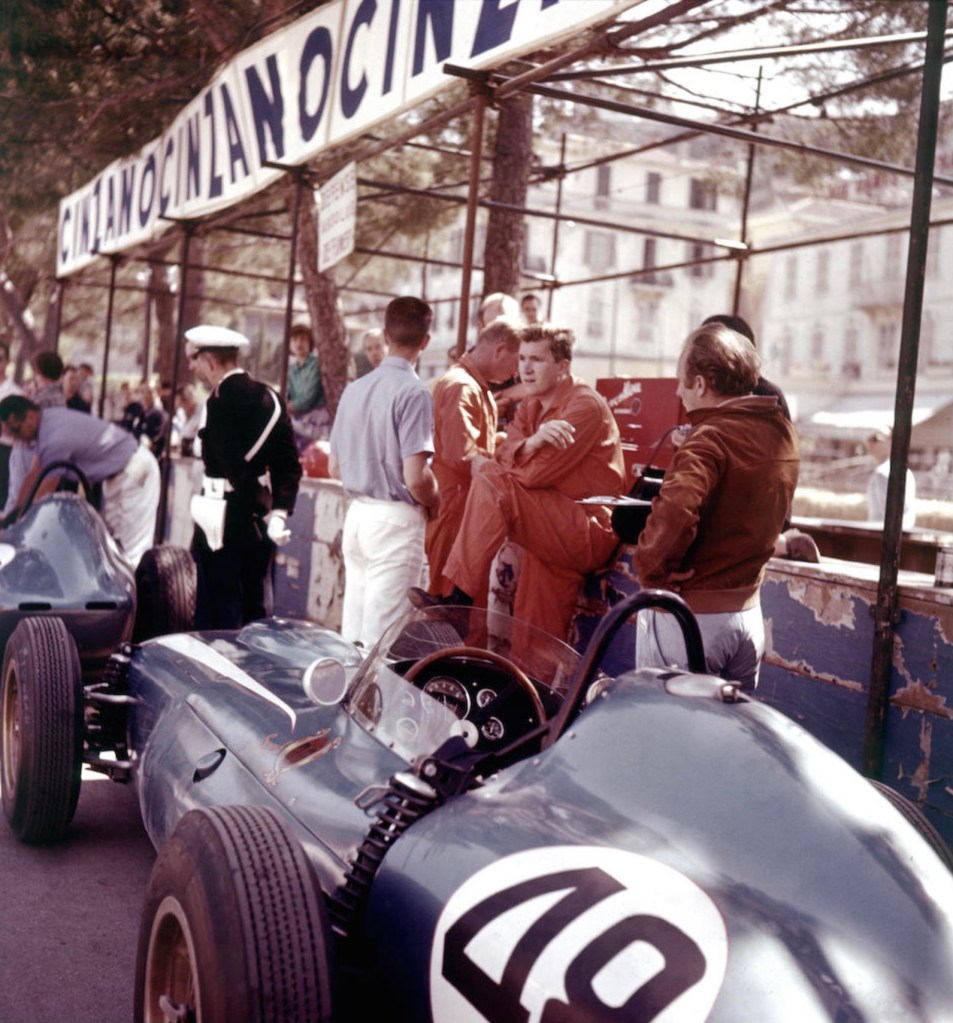
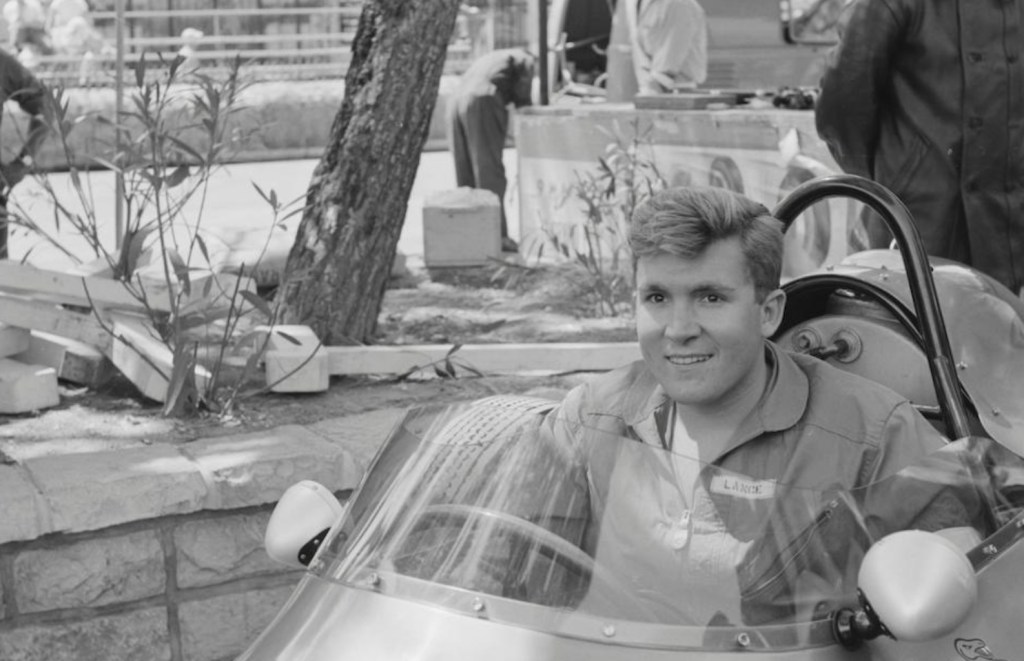
Lance Reventlow front and centre with foot on the tyre. Scarab, Monaco 1960
Timing is everything in life, innit-like?
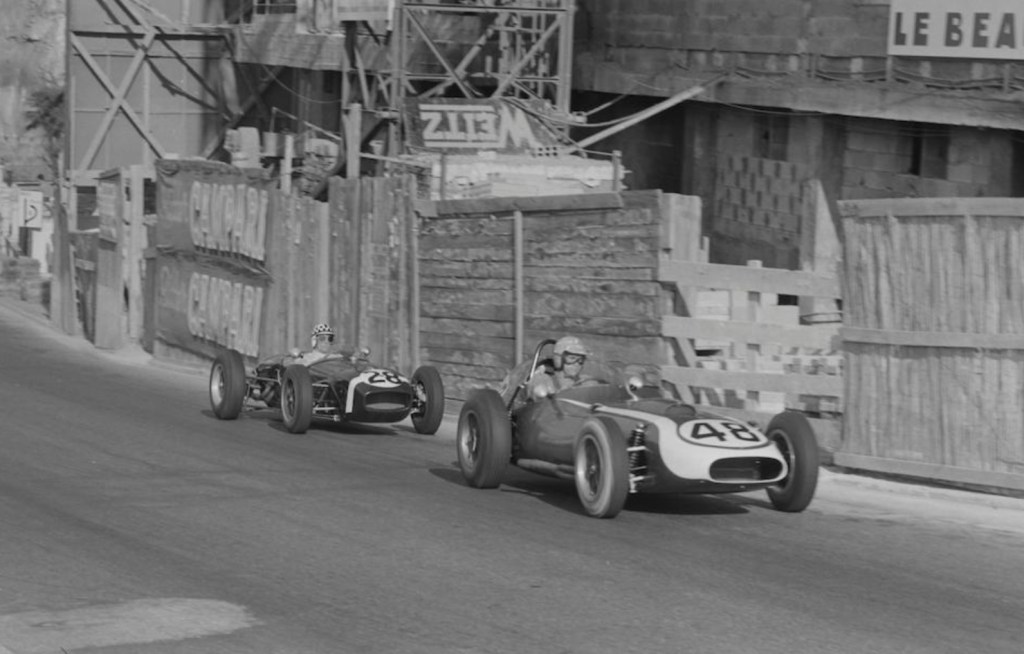
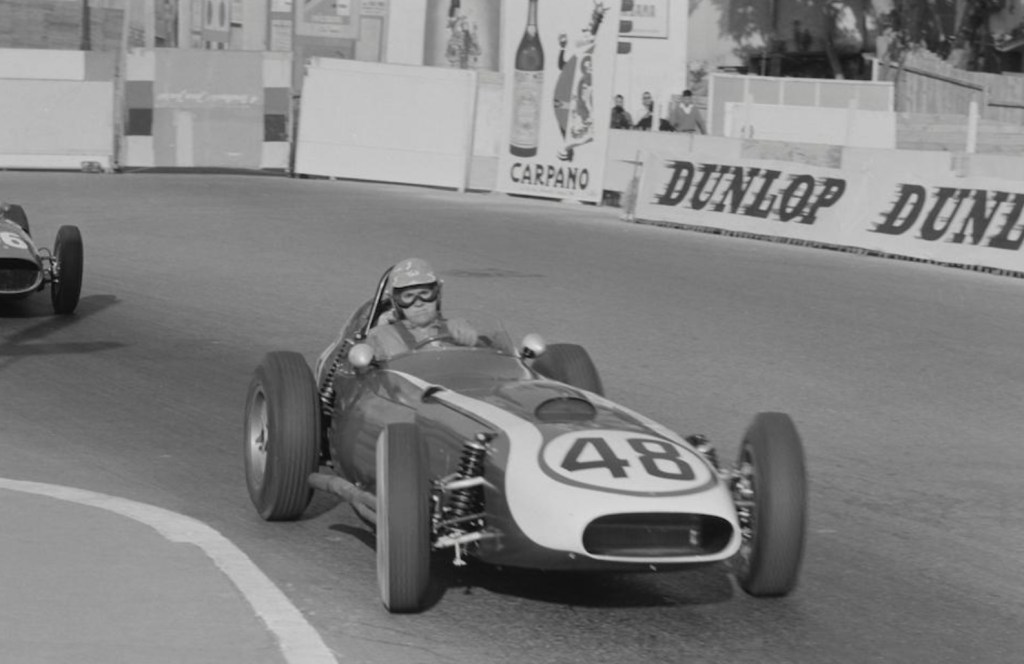
Love the Aston Martin DBR4 and Scarab as I do, they both missed the boat as new front-engined racing cars in the brave-new mid-engined GP world.
Lance Reventlow’s Scarabs really were crazy brave, but I guess you can be so, when money is no object. The Scarabs were beautifully designed, built and finished.
What is not to like about the slinky body, spaceframe chassis, bespoke four-cylinder 2.5-litre, desmodromic-valved, fuel-injected engine and four-wheel discs? The Corvette four-speed gearbox was a bit butch and last-minute in a GP car. See here for a piece on Scarab; https://primotipo.com/2016/01/27/chucks-t-bird/ This article is pictorial, making use of some great shots which have lobbed on the internet thingy recently.
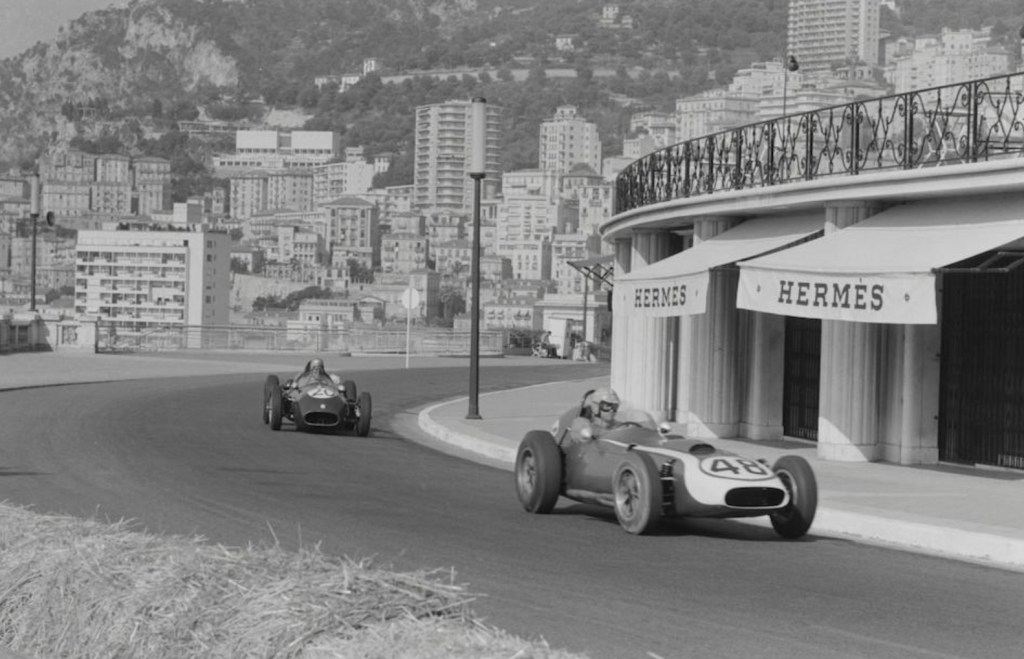
Reventlow, and Daigh behind during Monaco practice. Cooper T51 Climax is Roy Salvadori in Tommy Atkins’ car, DNFReventlow about to be swallowed by Innes Ireland’s Walker-Lotus 18 Climax. The sheer economy of the Lotus says it all in terms of the front-engined-packaging-challenge. Arguably the Lotus 16 did this best albeit its results don’t suggest that…Scarab 2.5-litre, DOHC, desmo two-valve fuel-injected four. Note canting to keep the bonnet line low
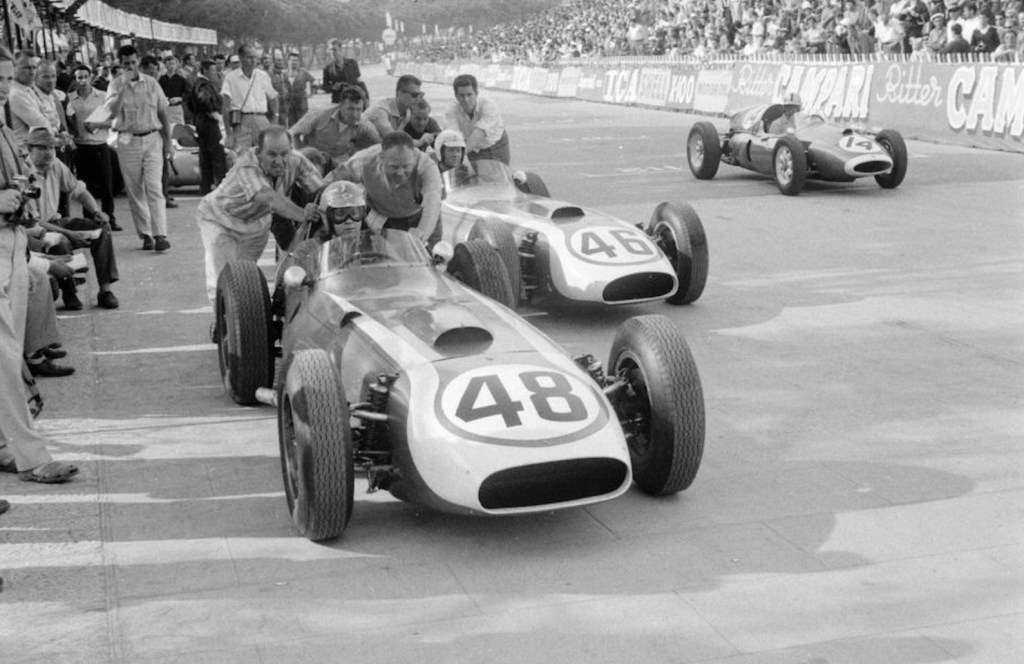
Had Reventlow and team-driver Chuck Daigh lobbed on the Monaco GP grid in May 1958, rather than 1960, things may have been a bit different. Still, the team were there adding welcome variety.
The degree of difficulty couldn’t be higher. New car, new team, two drivers who had not raced at Monaco before – or contested a championship GP for that matter.
Colin Chapman, late to the mid-engined party himself, had upped the ante with his new Lotus 18, taking the Coopers-concept and running with it.
The 18 was the car of 1960, only it’s ‘Queerbox’ transaxle let it down. John Cooper’s/Owen Maddock’s/Jack Brabham’s ‘Lowline’ Cooper T53 wasn’t too shabby either. It was a much more reliable device than the Lotus, not the least of its improvements was the Cooper-Knight C5S transaxle. Wouldn’t ole-Chappers have liked to have gotten his hands on a couple of those!
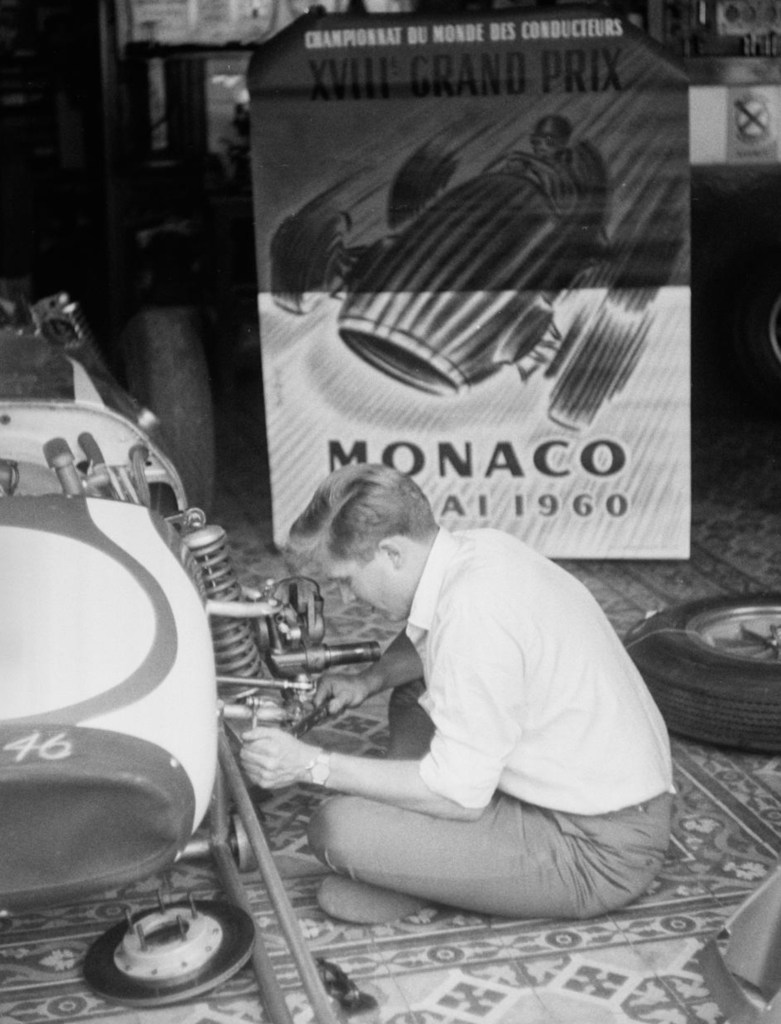
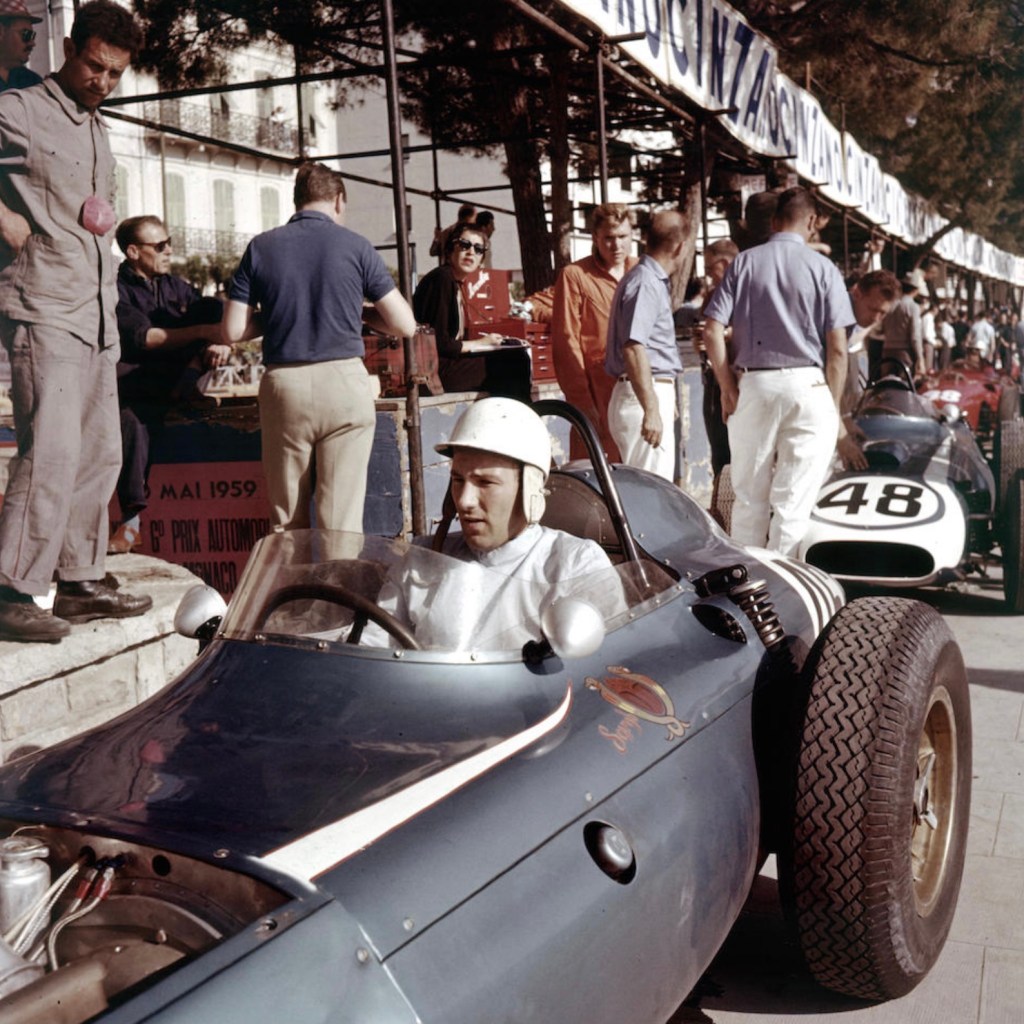
Reventlow with a bit of push, as the Americans like to call understeer. A bit of Phil Hill’s Ferrari Dino 246 following The boss gets his hands dirty, Reventlow attacks the front suspension. Photos show plenty of understeer, perhaps that is the focus. Upper and lower front wishbonesMoss readies himself for a run in Reventlow’s chassis. Note Goodyear tyre and Halibrand wheel. IRS by upper and lower wishbones. Lance watches with paternal interest from alongside Daigh’s car. Quality of workmanship and finish clear
It was no surprise that the Scarabs were slugs.
“Just to see if it was the cars or drivers, Reventlow let Moss try one. He did 1min 45sec, which equalled Jimmy Clark’s time with the Lotus 18 FJunior, so the answer to the Scarab trouble was cars and drivers. However, there were other factors, such as first time out, first attempt at anything so exacting as Monaco, and the simple fact that their Goodyear tyres are not as good as the Dunlops tyres”, Denis Jenkinson wrote in his Monaco GP race-report.
Moss’ pole in the Rob Walker Lotus 18 was 1min 36.3sec.
Jenkinson mused about what may have been possible, “A set of Dunlops would certainly have given Moss 1min 43sec. If it had been his own car and fitted him properly he would have done 1min 42sec, and if he had been trying he would have got down to 1min 41sec, and if starting money had been involved he would have got down to 1min 40sec, which would have been a reasonable time for a new car to new conditions.”
Moss won the 100 lap, 314km race in 2:53.45 in his Lotus 18 from the similarly 2.5-Climax FPF powered Cooper T53 of Bruce McLaren with the best of the front-engines, Phil Hill’s Ferrari 246. The Scarabs didn’t make the qualifying cut, together with six others.
Reventlow from the Brian Naylor’s JBW-Maserati 250S during practice, both DNQ
Etcetera…
Reventlow, bright-eyed and bushy-tailed at Monaco 1960. Man, didn’t he give it – sportscars and single-seaters – a red-hot go!
After Monaco, Scarab entered the Dutch GP in the Zandvoort dunes but didn’t race after a start-money dispute.
A pity as the fast flowing course would have given the team a better chance to optimise the car’s suspension before the flat-out challenges of Spa where lack of punch was always going to be problematic.
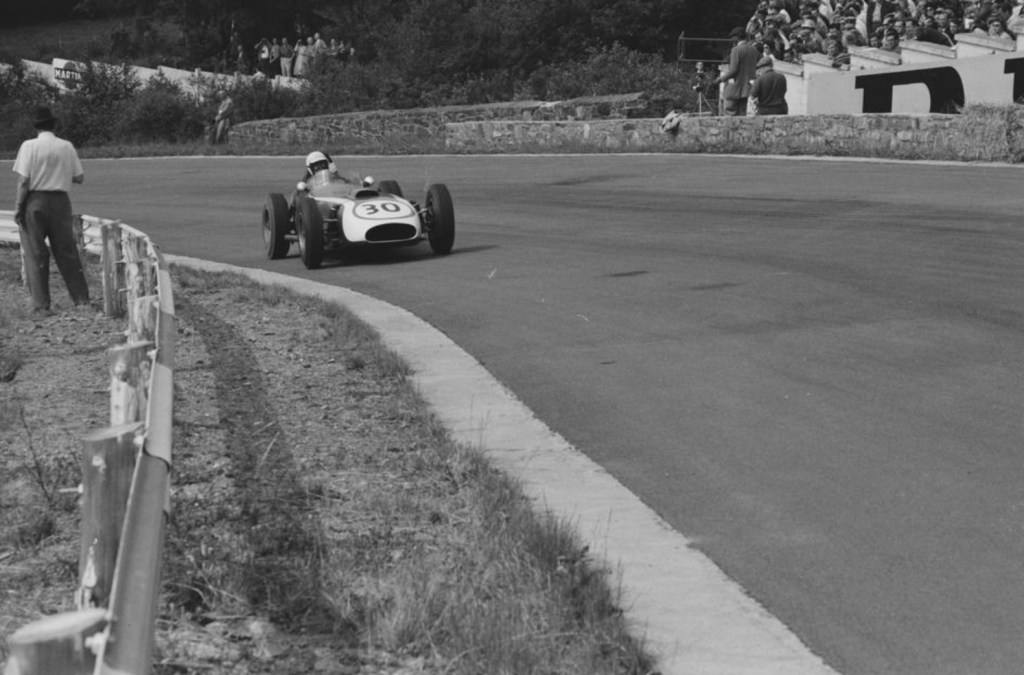
Chuck Daigh gives Jo Bonnier a lift back to the Spa pitsDaigh pushing hard thru Eau Rouge, hiking the inside-right
Reventlow qualified sixteenth and Daigh eighteenth (of 19) but both were out with engine problems after one lap and 16 laps respectively. Brabham’s Cooper T53 won the most-gruesome of GPs.
The final appearance of the Scarab in 1960 was at home in California, the US Grand Prix at Riverside in November.
There, finally, Chuck Daigh finished in tenth place, albeit five laps adrift of the winning Moss Lotus 18.
The last Scarab European hurrah were races at Silverstone, and here in a Goodwood Intercontinental Formula race in April 1961.
Daigh started his Offy powered chassis, 01, last on a grid of nine, finishing the 20-lap Lavant Cup eighth. Moss won in a Walker Cooper T53 Climax.
Daigh, Scarab- Offy 3-litre, Goodwood, April 1961
Wonderful colour butt-shot of the two Scarabs in the Spa paddock – #30 is Daigh – during the 1960 Ardennes Forest carnival of speed.
Note the offset to allow the driveshaft to pass alongside the driver’s left to keep his bulk nice and low.
Rear mounted fuel tank, big-comfy cockpit and beefy roll-bar for the period. The Scarab pilots wore a seat-belt.
Credits…
Don Orosco Collection, Denis Jenkinson in MotorSport
Tailpiece…
Daigh, Spa 1960
Chuck Daigh, Spa 1960. He did enough to be given some opportunities in a more current car.
In Australia he raced the mid-engined Scarab RE Oldsmobile in the 1962 Sandown International, impressing all who watched his professionalism amongst the Reventlow/Jill St John sideshow with which the local press were fixated.