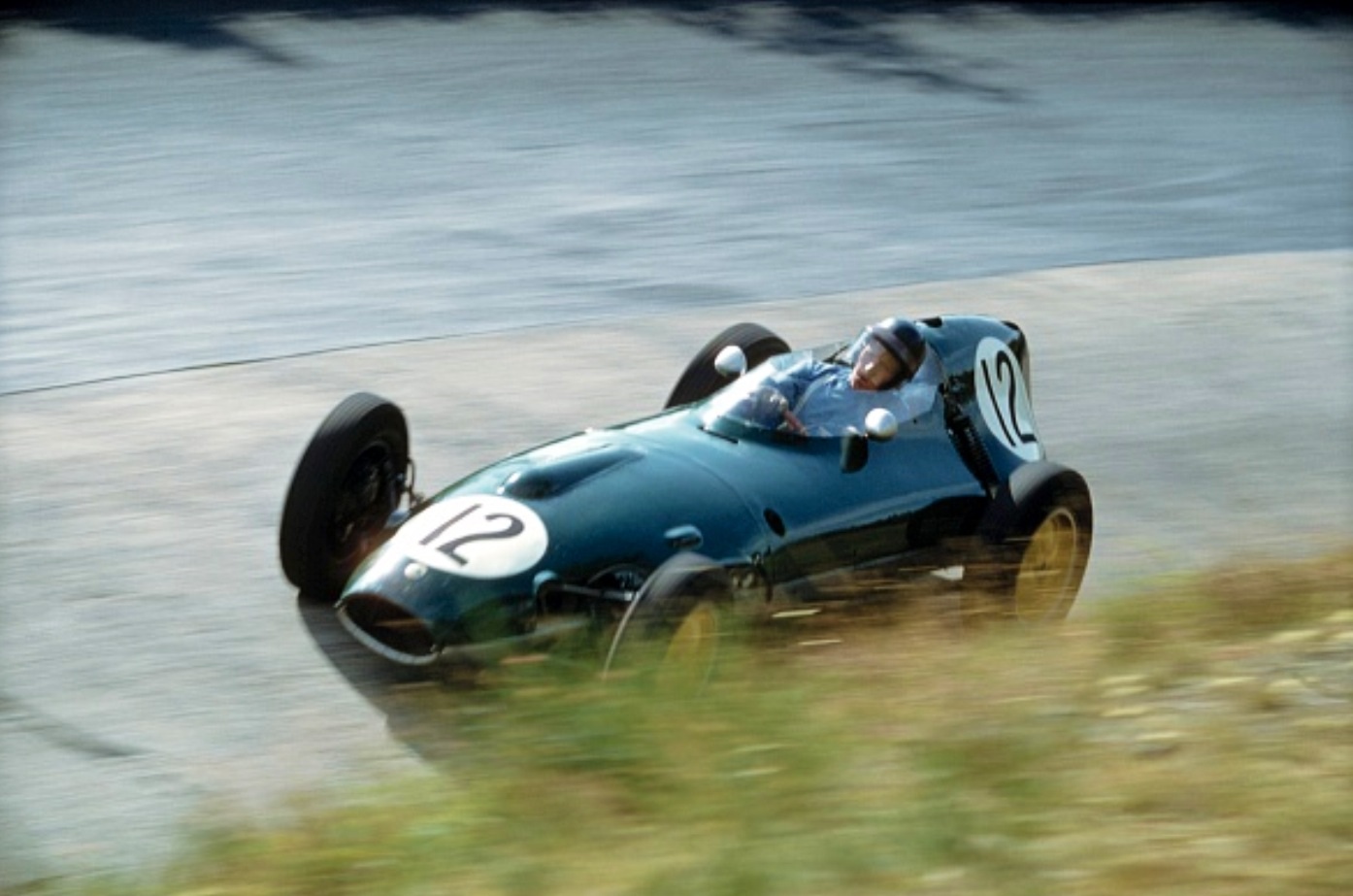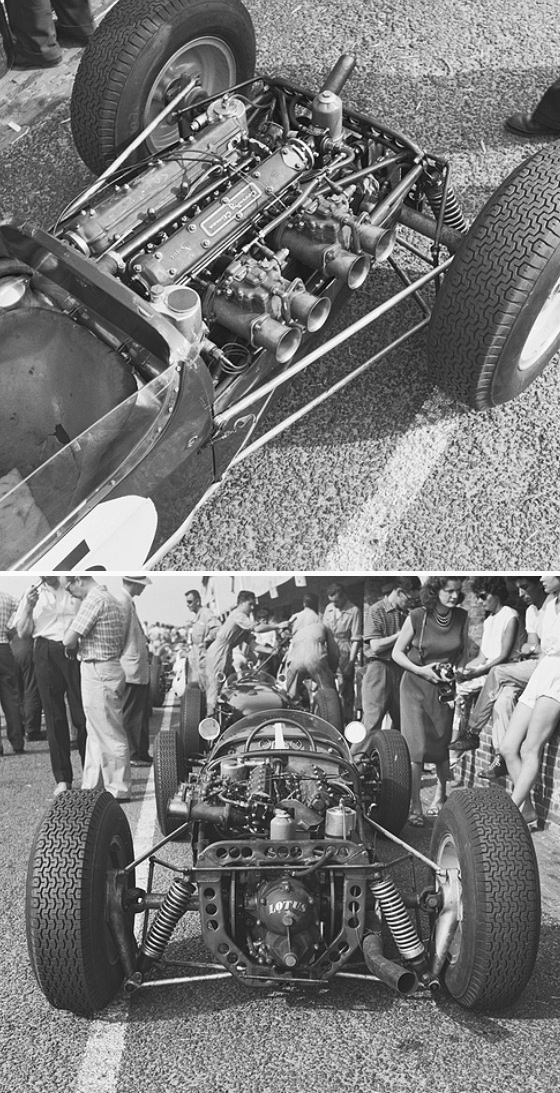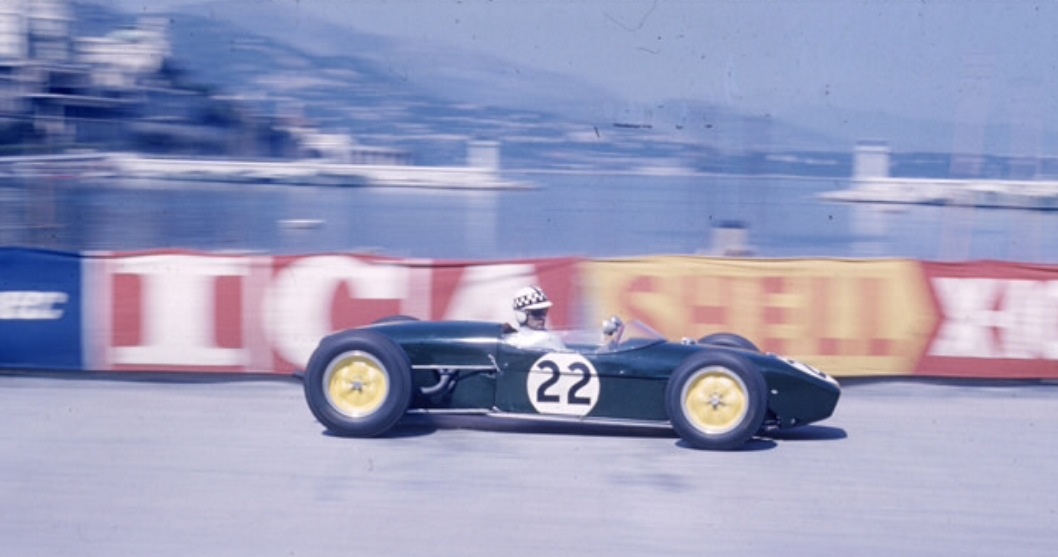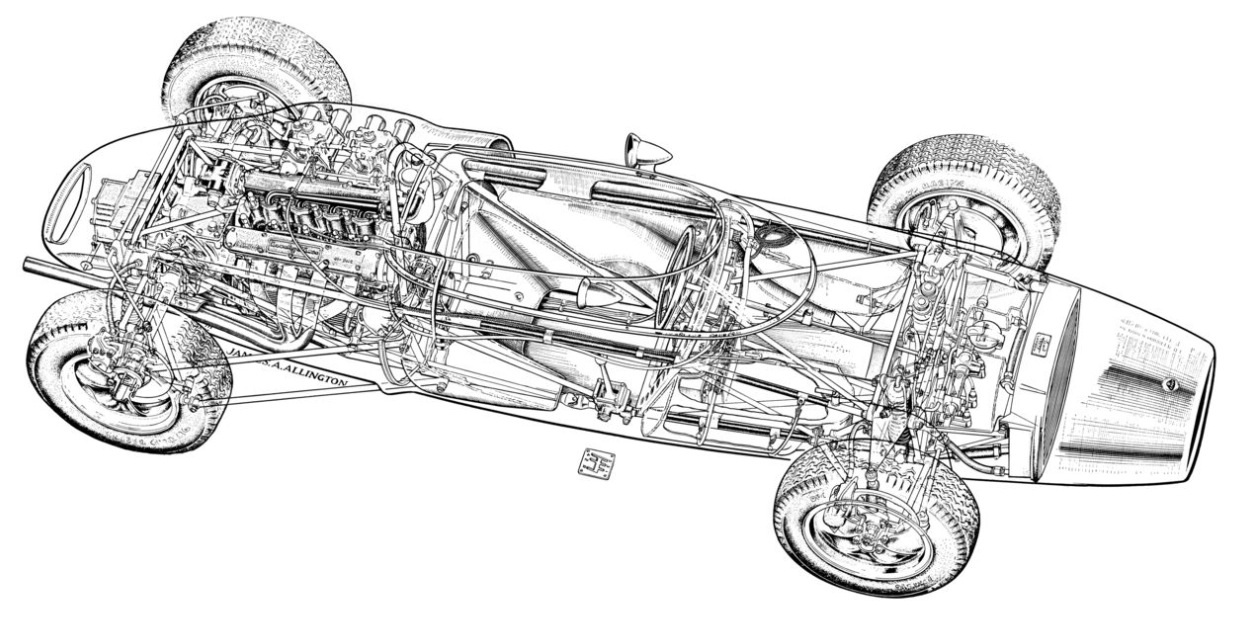
Archive for the ‘F1’ Category

arr ric sa

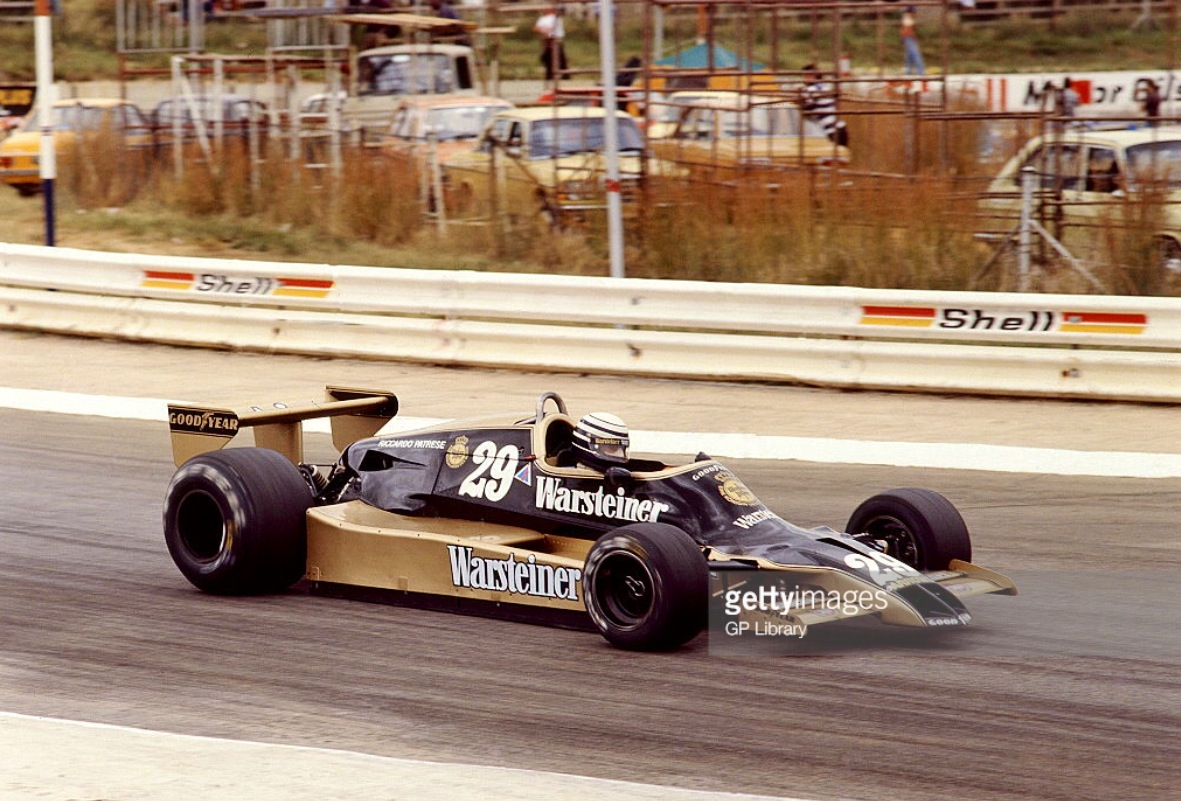
Patrese debuts Arrows A1-06 Ford at Kyalami, South African GP 1979. Q8 and 11th in the race won by Gilles Villeneuve’ Ferrari 312T4 (Schlegelmilch)

What’s it like livin’ and lovin’ the most successful race engine ever built?…

Our ‘Racers Retreat’, Peter Brennan owns and cares for ‘DFV250’. I have decided in fact he is a ‘perick’! Not only can he drive ‘big cars’ very quickly but he can  also reconstruct, rebuild and maintain the things which makes him a multi-talented ‘perick!

OLYMPUS DIGITAL CAMERA

Pete Brennan in the Arrows at Phillip Island, Paul Faulkner’s ex-Jones ’81 Williams FW07 behind (Brennan)

image

Villeneuve and Patrese, 7th and 5th in the 1979 Belgian GP at Zolder. Ferrari 312 T4 and Arrows A1 ’06’ May 1979 (unattributed)

‘DFV250’ sits in the back of his Arrows A1-‘06’. It was Ricardo Patrese’s car for the early season races in ’79 before Arrows switched to the more advanced but unsuccessful A2 which was not Tony Southgate’s best work. A1-06 was then sold for Aurora Series and Historic F1 use, eventually ending up in the Al Copeland Collection from whom Pierre acquired it after Copeland’s passing.

We will get to restoration of the Arrows and the Ford DFV which was at the ‘dismantle, crack-test and reassemble’ end of the spectrum rather than the ‘reconstruct around the monocoque bulkheads, four corners and ‘box’ huge task which Lola T330 ‘HU18’ represented, soon. Click on this link for a series of articles on that mammoth job which shows Peter’s talents.

https://primotipo.com/2014/06/24/lellas-lola-restoration-of-the-ex-lella-lombardi-lola-t330-chev-hu18-episode-1/

For now I just want to focus on the care and maintenance of a DFV race to race which I expect is rather more involved than that of my ‘Peter Larner Engines’ 105bhp Formula Ford ‘Kent’ moteur?
image

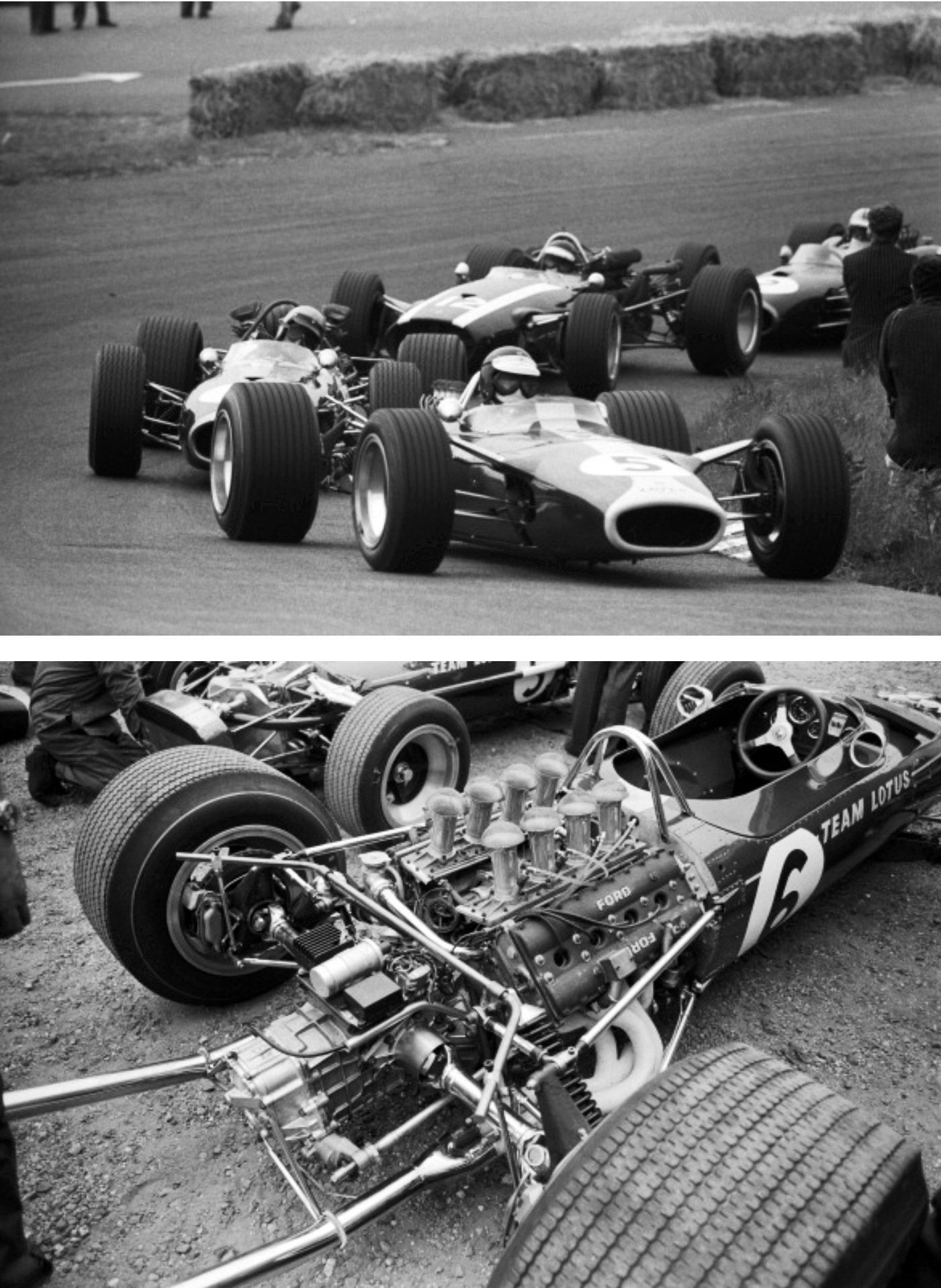
Clark on the way to the DFV and Lotus 49’s first win, Dutch GP, Zandvoort 4 June 1967. Clark leads Brabham Brabham BT19 Repco 2nd, Rindt Cooper T81B Maserati DNF and Hulme Brabham BT20 Repco 3rd (Schlegelmilch)


Why the DFV you ask?…

Keith Duckworth’s Ford sponsored 1967 3 litre, 4 valve, fuel injected, 2993cc V8 is both the most successful grand prix engine of all time with 155 championship GP wins from 1967-1983 but also part of the winningest ‘family’ of engines. The DFV spun off the 3.9 litre Le Mans winning endurance racing ‘DFL’ and single turbo-charged 2.65 litre ‘DFX’ Indy victor.

image

Theo Page cutaway of the Ford Cosworth DFV in 1967. All the key elements referred to in the text covered in this superb drawing

Phil Reilly Engineering…

Brennan has tackled all manner of race engines over the years including lots of Chevs, Repco Holden F5000, Repco Brabham V8’s and various Coventry Climax FPF’s, but the DFV was new to him. His ‘guru’, a source of advice from afar and the fellow to whom he sent the his heads was Phil Reilly who has forgotten more about these engines than most people ever knew. His ‘shop, well known to American enthusiasts is in Corte Madera, California. Reilly Engineerings ‘Care and Feeding Your Cosworth DFV’ and Peters practices in looking after ‘250’ form the basis of this article.

dfv lotus

Butt shot of one of the Lotus 49’s upon debut at Zandvoort 1967, ZF 5 speed ‘box, the ratios of which could not easily be changed about to be swapped. Shot shows the brilliant packaging of the DFV. Lotus’ Chapman prescribed a stress bearing V8 to Keith Duckworth inclusive of the way he wanted to attach the engine to the chassis at the bulkhead aft of the driver. Note the tubular brackets either side of the Borg and Beck clutch to which the suspension mounts. Their is no tubular frame or monocoque structure aft the driver, the engine itself forms the function of being the bit to which other bits are attached! Part of the brilliance of the DFV is its combination of power, weight, reliability and cost, the other aspect is the way it integrates with the chassis (Schlegelmilch)

DFV’s and DFV’s…

The development of these engines has effectively never stopped, you can still buy the bits from Cosworth Engineering, inclusive of a new engine should you buzz it to 15000rpm on an errant downchange and pop a rod or three thru its slender aluminium or magnesium flanks.

The DFV in Jim Clark’s winning Lotus 49 at Zandvoort on 4 June 1967 gave a smidge over 405bhp, its power delivery in the early days quite ferocious, coming in with a bang all up top, making it a bit of a challenge for Messrs Clark and Hill. A long stroke, same as Jims, engine like DFV250 gave around 470bhp and 260 lbs/foot of torque at 10500/9000rpm respectively whilst being thrashed to within an inch of its life by Patrese in early 1979.

A wrong turn of phrase really as the talented Italian multiple GP winner was both mechanically sympathetic and great test driver.

ickx

Jacky Ickx, Ensign N177 Ford, Monaco GP 1977, 10th in the race won by Scheckter’s Wolf WR1 Ford (unattributed)

dfv dfv

All go and no show Cosworth Engineering. Subtle stamping of engine number in the engines valley (Brennan)

In fact when ‘250’ was first born it was a Cosworth lease engine used by Team Ensign and supplied to them on December 3 1976.

It was fitted to the N177 chassis’ driven by Jacky Ickx and Clay Regazzoni, multi GP winners both, during 1977.  Without the teams records its not possible to know into which chassis ‘250’ was installed race by race.

image

Launch of the Arrows A1 at Silverstone in late 1977, maybe they figured the white body against the white snow would disguise its similarity to the new Shadow DN9, the design drawings of which Southgate erroneously thought were his! Patrese in car, Jack Oliver behind left and Tony Southgate at right. The High Court writ was shortly ‘in the mail’ (unattributed)

The engine was then bought by Arrows when the team spun out of Shadow. Jackie Oliver, Alan Rees, Tony Southgate and Dave Wass all felt they could ‘build a better mousetrap’ and left Don Nichols outfit at the end of 1977. The High Court legal stoush about ‘IP infringement’ which followed is a story for another time; in some ways Nichols had the last laugh as Shadow won a GP, the 1977 Austrian when Alan Jones took his first win in an a DN8 Cosworth, whereas Arrows never did win one albeit the business lasted a lot longer than Shadow…

OLYMPUS DIGITAL CAMERA

(Brennan)

The Calm Before The Storm…

Here is ‘250’ all ready to rock on Peter’s dyno; ‘It takes about a day to plumb the thing up, its godda be done very carefully of course. Cosworth prescribe very fully how to do it (see below) Having gotten thru all the preliminary stages of running it in, i gave the thing ‘a tug’. All was okey-dokey for a bit and then all hell broke loose, a huge bang and then schrapnel everywhere!’

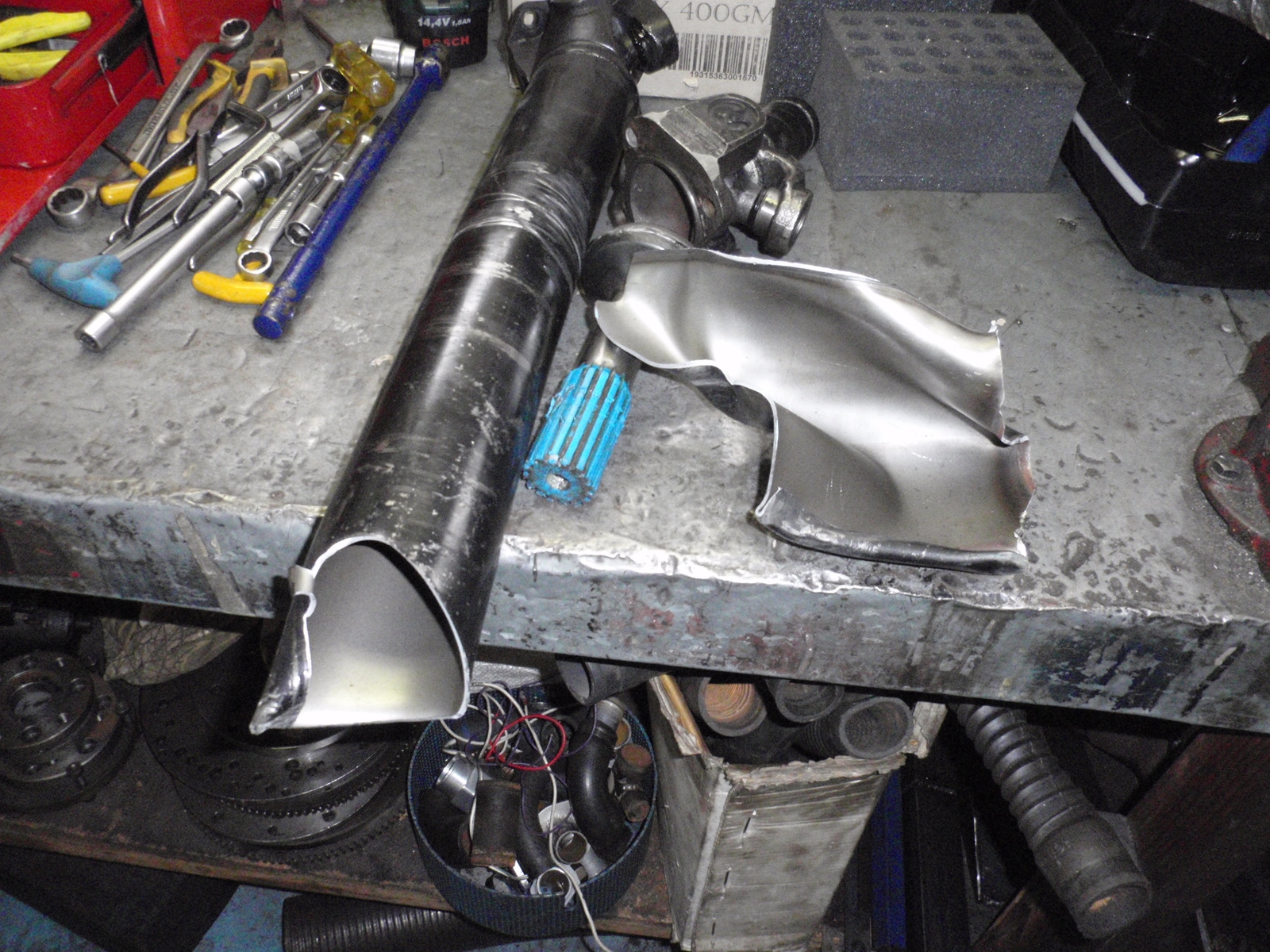
‘Thank christ it wasn’t the engine itself. The DFV’s vibrate so much it broke the dyno driveshaft @ 9200 rpm precisely! I have had all manner of donks on that dyno, over 500bhp Chevs etc but nothing has done that before. Having had that happen i still haven’t given it a full power run on the dyno anyway!’

But we are getting ahead of ourselves, the rebuild of the engine itself we will cover in an article about the car.
OLYMPUS DIGITAL CAMERA

Brennan’s dyno driveshaft after Cosworth assault @ 9200rpm (Brennan)
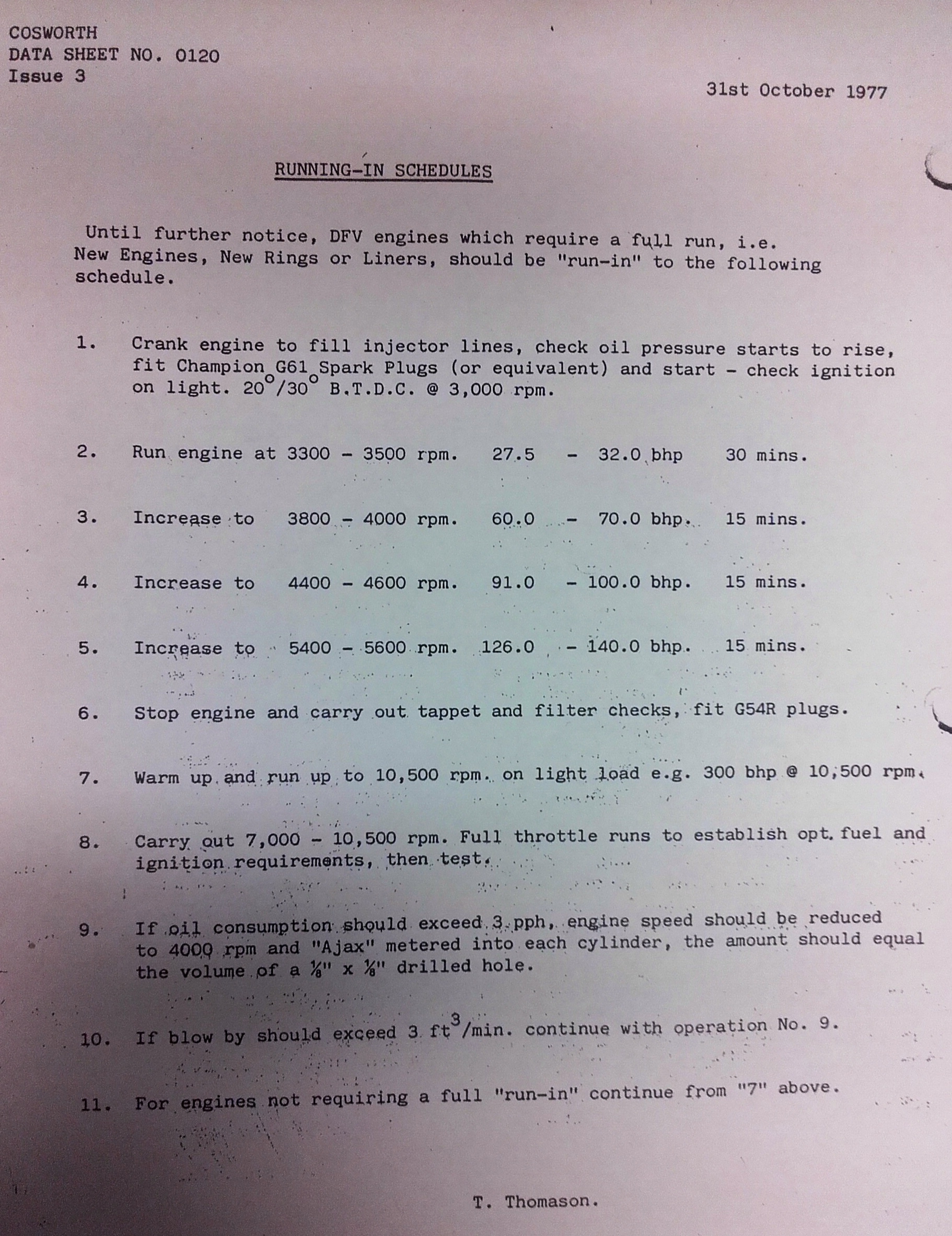
dfv run in

Cosworth’s dyno running in procedures dated 31 October 1977 (Cosworth)

DFV use in Modern Times…

Phil Reilly; ‘If you rev the engine to 10800/11000rpm as Messrs Hunt, Fittipaldi and Jones did you will get the sort of engine bills Messrs Mayer, Fittipaldi and Williams paid!’

‘The DFV with an 11000rpm rev limit is a 3-4 hour motor…which will blow up big-time every now and then…needing an injection of $10-15K of parts and lots of (expensive) TLC…for vintage events use 10000rpm as a normal shift point. Doing this keeps the engine well below its stress point yet still provides enough power to test any drivers skills…the bonus is the engine will live 15-20 hours between rebuilds’.

Geoff Richardson Engineering have been looking after the engines since their heyday, James Claridge provided their perspective; ‘The routine rebuild interval for an engine limited to 10000rpm is approximately 1000 miles’.

‘This would comprise of us stripping it down, crack testing components, inspection of all parts, followed by re-assembly and dyno testing. Replacement of valve springs happens every time.Possible replacement of pistons depending on condition, if they were re-used they would certainly be replaced at 2000 miles. The same applies to all of the valves, they are taken on condition. New con-rod bolts are fitted, all new bearings, a new set of piston rings, and all new seals and O-rings are fitted. Nearly all the other parts are taken on condition and replaced accordingly’.

‘An engine with no issues or catastrophes that we knew the history of and is well looked after might cost somewhere in the region of £12-15000.00 to completely refresh’.

Peter Brennan provides the drivers perspective; ‘ The DFV has three quite distinct phases of power, one bangs in at 5500rpm, the next at 7000, then it goes ballistic at 9000 and all you do is chase gears with the tach going bananas…’ ‘Its not that difficult to get off the line, it obviously doesn’t have 500 plus foot pounds of torque like an F5000, sliding the foot sideways off the throttle at around 8000 rpm and then modulating it to match wheelspin with circuit grip soon has you motoring in the direction of tomorrow pretty smartly!’

Click on this footage of Brennan in the Arrows at the Adelaide Motorfest in 2014, the event uses part of the Adelaide GP circuit and some other streets.

‘The howl of the thing at 10000rpm as it yelps its way from cog to cog along the main straight at Phillip Island; with a 22/24 top fitted, fifth is 183 mph @ 10000rpm is unbelievable and Patrese would probably take it flat! Its not to be believed and relished every time you do it, Southern Loop comes up all too soon, its not the seagulls you are focused on as you turn the thing in believe me’.

allison

Bruce Allison in the March 771/781 Ford, Thruxton or Oulton Park in 1978 (Allison)

Bruce Allison raced Cosworth powered March’s in the Aurora Series in 1978 ‘The record of the engine speaks for itself, it will still be popular in historic racing in 50 years! The engine was powerful, smooth and reliable the cars of course handled better with far less weight at the back than the F5000’s i was used to. The 781 March may have been the 782 with a DFV shoved in it but it was a beautiful handling car, the 761 chassis i used early in the season was not as good but the engines were always great, beautiful to drive’.

Lookin’ After Cossie: These things are like a mistress, stunning to look at but always wanting attention, never happy and a constant sap of cash…

dfv ball

Brennan’s sense of humor never too far from the surface! ’06’ at Sandown historics 2014. Dissertation on the chassis and suspension i will save for the article on the car itself. Shot included to show just how much the engines compact size, packaging and stress bearing nature assists the chassis designer. Compare how Tony Southgate mounts his suspension to the engine via these fabricated aluminium plates compared with Chapman’s tubular structures in the Lotus 49 of 1967. Note back of sparkbox in the Vee, ‘two towers’ behind that to connect with air scoop to cool inboard mounted rear discs, rear suspension outta the airsteam and clear of G/E tunnels, single support for gold rear wing, oil cooler and black painted starter motor with drive going forward (Bisset)

Storage and Fuel System.

The engine needs to be turned over by hand one revolution each week. Turn on the fuel pump as well, this will ensure no two valve springs remain fully compressed for too long and will circulate fuel through the metering unit to prevent corrosion and keep all the seals from sticking in one place.

The fuel filter needs to be changed every 500-700 miles, the engines have a high pressure pump to start and a mechanical one for normal on circuit running. The engine won’t run below 2000 rpm on the mechanical one, the electric one is needed for starting, fuel pressure of 120psi needs to be maintained at all time, at least 95 psi is needed to fire her up.
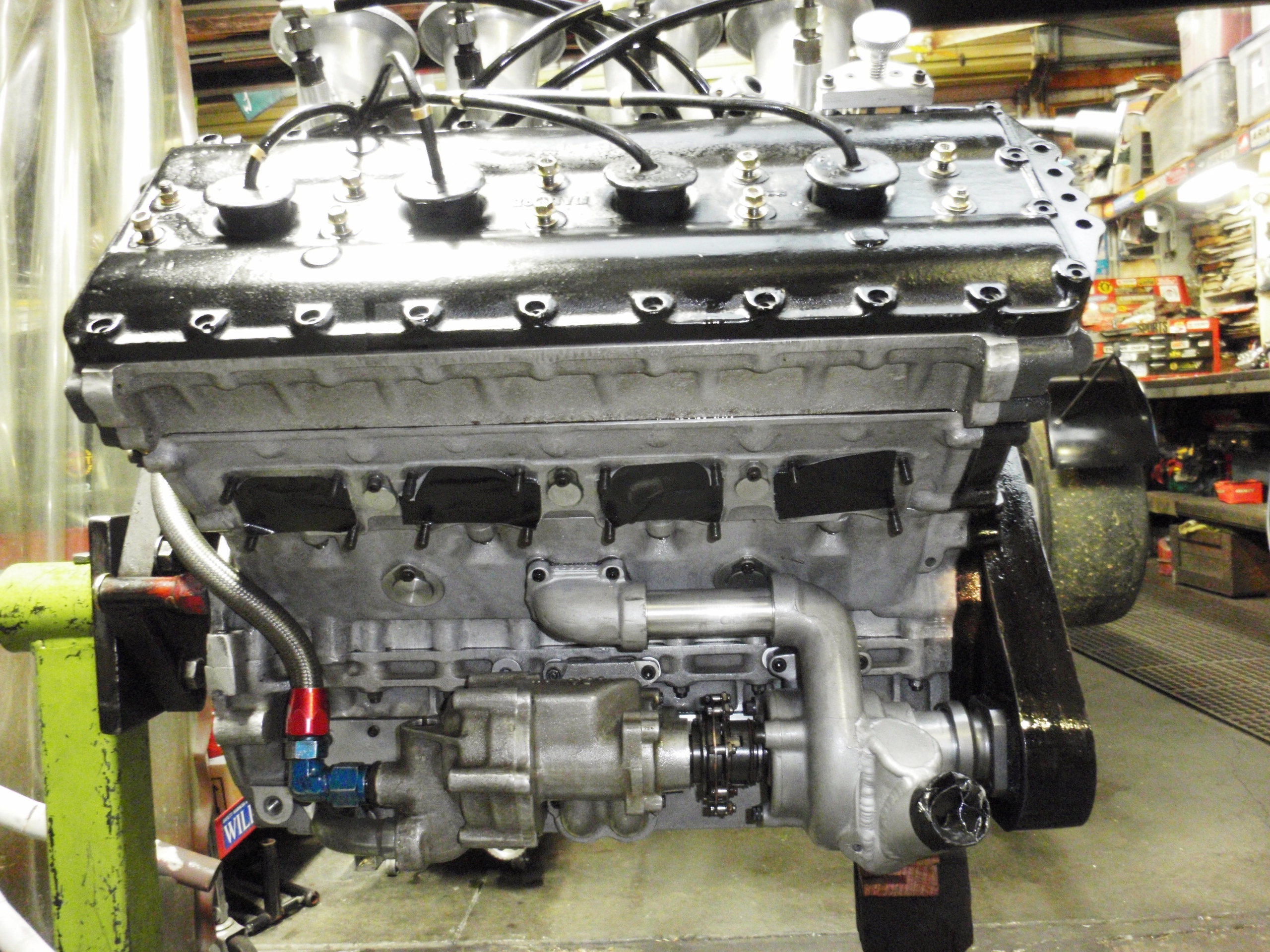
OLYMPUS DIGITAL CAMERA

‘250’ ‘right bank’ showing both the auxiliary drive belt housing (right) and the super clever oil scavenge/de-aerator pump at left and one of the water pumps in between. The black coupling between oil and water pumps is called an ‘oldham drive’, a flexible joint (Brennan)

Olio.

A more critical liquid than fuel is oil. The engine must be plumbed to Cosworth specs…its data sheet DA0626 for ‘DFV250’ and the like. Its critical the engine never sucks air, at high revs bearing failure will result. At 10000rpm the engine is rotating at 166 times plus per second.

Peter; ‘I use Kendall 20/50 mineral oil, which has a high zinc content which is great for the cams and followers’. The Cosworth oil filter (Part #PP0404) needs to be changed every 300 miles, the oil level needs to be checked religiously as the engine uses as much as 4 quarts every 100 miles.

Oil temperature should be 90-100 degrees centigrade measured at the inlet to the pressure pump. 7000rpm should not be exceeded before the oil is at least 50 degrees centigrade.

OLYMPUS DIGITAL CAMERA

‘250’ ready to be refitted to ’06’ in Brennans eastern Melbourne workshop. Note spark box between the Vee and behind it the fuel metering unit below the ‘aeroquip’ lines, Lucas injection of slide as against butterfly type. ‘Knurled wheel’ beside rear LH injector sets mixture, ‘behind’ this is the drive for the mechanical tach. Line at far right is cable drive for electro-mechanical fuel pump. The more you look the more elegant the packaging of it all is (Brennan)

Spark.

‘250’ has the Lucas ‘Opus’ system which has a pickup on the crank which fires the Opus at 38-40 degrees BTDC. The Opus also has a retard mechanism which is set for starting at 12 degrees BTDC.

The DFV has an alternator which provides sufficient power as long as the electrical  fuel pump is switched off, DFV pilots need to remember this as they zap away from pitlane. ‘Pump Off’ was a familiar pit signal for decades!

Ignition timing is set on the dyno and is usually impossible to change in the chassis. Opus runs at 38-40 degrees BTDC, the sytem needs to be mounted in a cool place, the stock Cosworth mounting between the injection trumpets is usually fine.

The engine must be connected to negative earth with rev limiters set to 10400rpm.

The plugs are 10mm Bosch surface discharge to special order. Warm up plugs aren’t required, with plug life 3-4 race weekends. The plug wells need to be blown out, the HT leads removed with pliers. Plugs are tensioned to 9-10 foot pounds having been coated with ‘Copaslip’ first.

Spark boxes are delicate devices, you will kill them by voltage spikes caused by breaking the earth, so be clear on shut down procedures.

dfv throttle

Throttle linkage of Brennans Arrows at Sandown 2014, ’06’ about to fired up. Note the ‘Opus’ spark box between the injection trumpets and black electro-mechnical fuel pump atop the centrally mounted, between driver and engine, fuel cell. Note radiator header tank and cap, bottom right is roll bar support bracket (Bisset)

Mechanical Installation.

The valve cover engine mounting bolts are 5/16 inch UNF and should be tightened to 16-18 ft pounds, be careful not to over-tighten to avoid cracking or deforming the magnesium casting.

The engine throttle slides have four over-centre return springs at the rear, these are a unique Cosworth invention which both reduces pedal pressure and ensures the slides close fully when you lift your foot. But they are not the throttle return springs which sould be well designed and of the ‘compression type’.
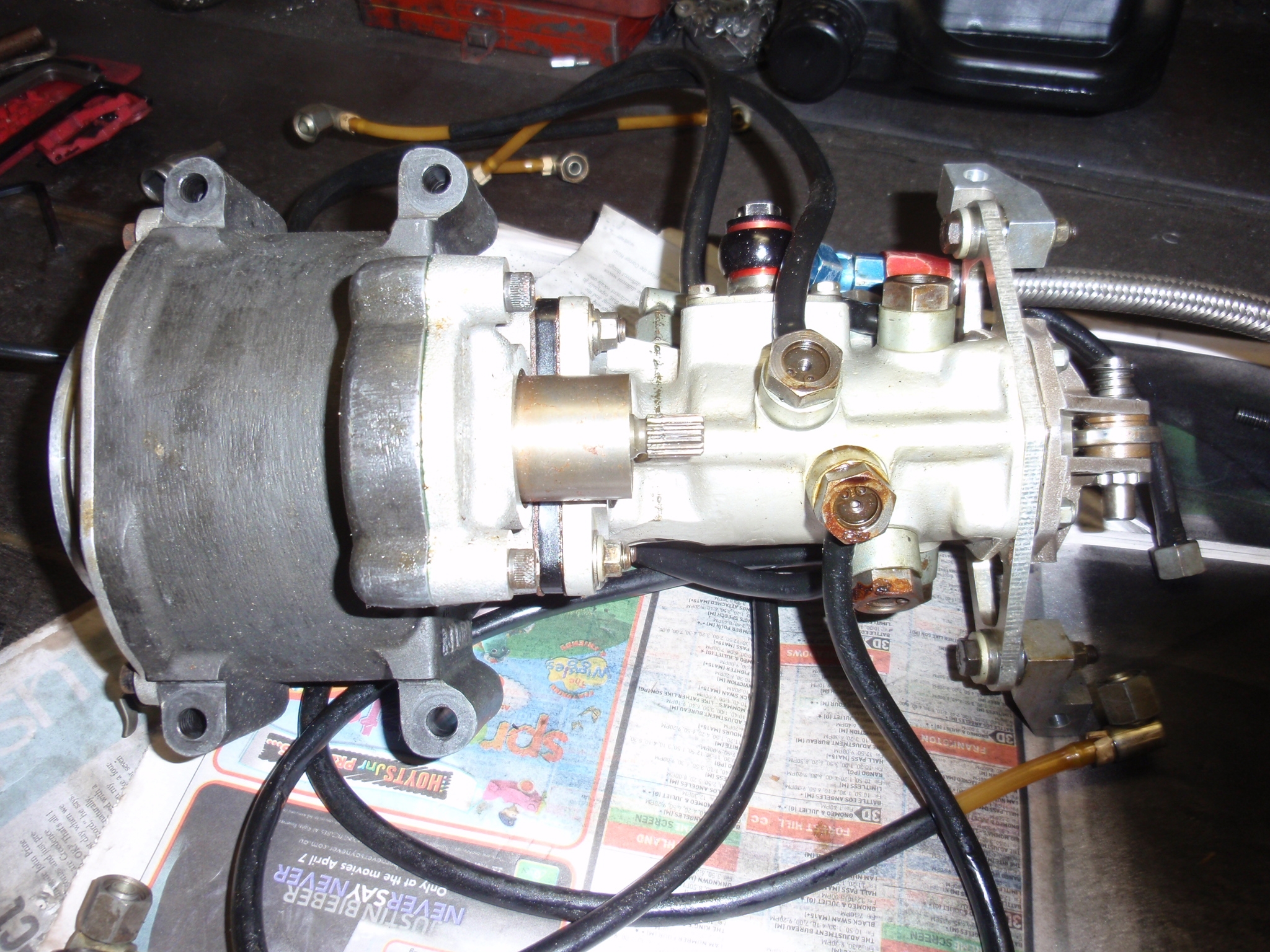
OLYMPUS DIGITAL CAMERA

‘The Bomb’; Distributor cap missing at left, alternator in the middle and fuel metering unit at right, This is driven by a quill shaft off the complex gear set (shaft is only 6mm in diameter and designed to snap in cold weather rather the metering unit itself!) (Brennan)

The system needs to be cleaned and lubed regularly. The metering unit fuel cam should be flushed with aerosol ‘brake clean’ and carefully lubricated with a dab of ‘Copaslip’ before each event. If the fuel cam mechanism is gummy it will cause the throttle to seem to stick on.
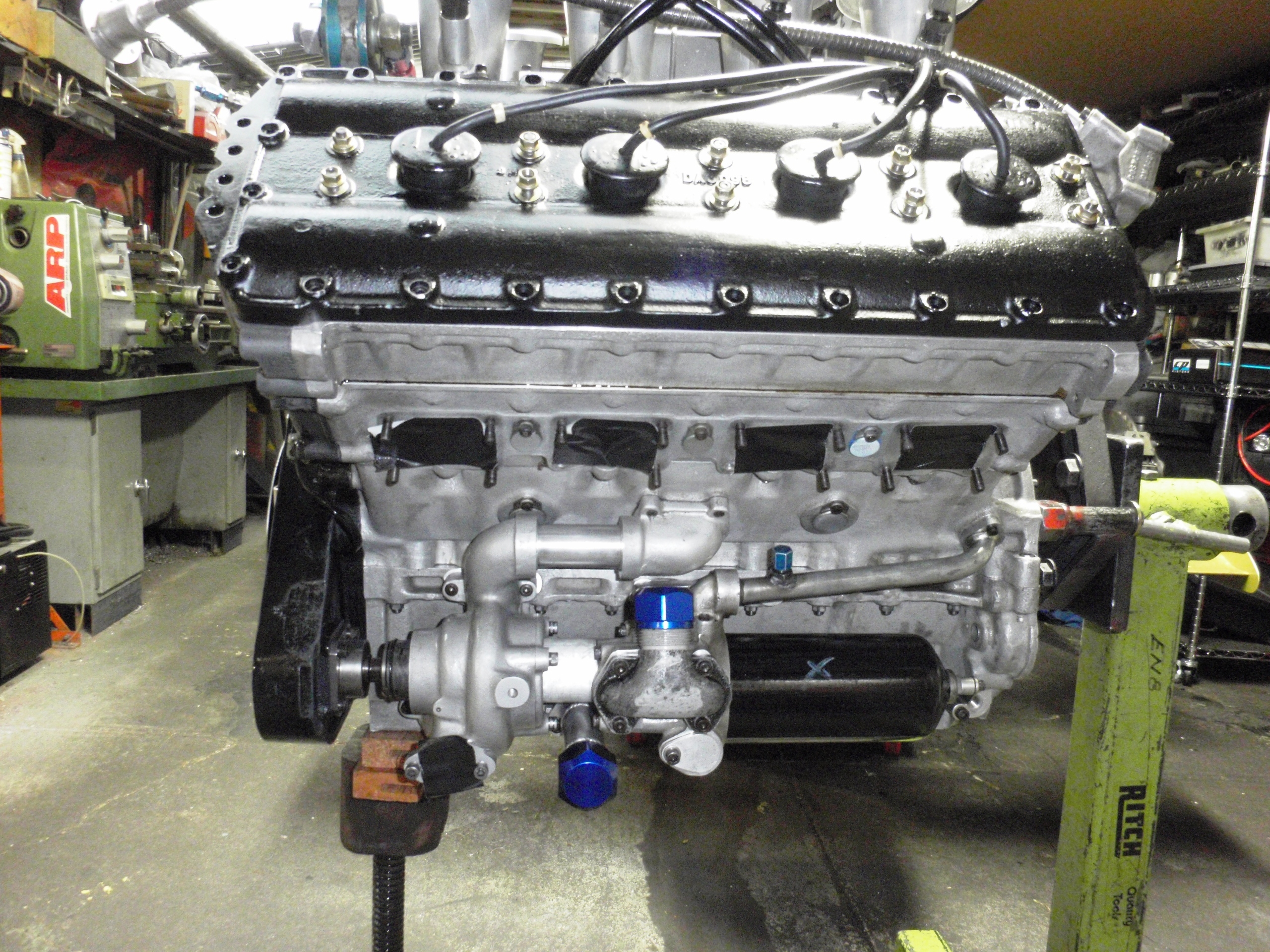
OLYMPUS DIGITAL CAMERA

‘250’ this time showing the ‘left side’ of the engine with combined water pump and oil pressure pump/filter assy. 250 engine a ‘twin water pump long stroke engine’ as against later ‘slim line’ from circa 1980 which only had one water/oil pump to maximise the space available for ground effects tunnels (Brennan)

The cooling system must not trap air, use bleeds as required, the system uses a 15-20psi cap. A 50/50 mix of water/glycol keeps corrosion in check and lubricates the water pump. Temperature strips should be used to monitor ‘real’ engine temperatures. The water outlet temps at the back of the heads should be 90-110 degrees centigrade and inlet temps 70-80 degrees.

OLYMPUS DIGITAL CAMERA

‘250’ during its disassembly. Complex gear train to drive 32 valves, with degree plate to record engine valve timing during disassembly as a matter of record (Brennan)

Fuel & Fuel System.

Peter uses 100 octane avgas. Light engine oil is always added to the fuel to increase the life of the metering unit, fuel pumps and valve guides/seats. 20/50 Kendall is used, the ratio 2 ounces to 5 gallons of fuel.

The Lucas system needs 120psi to operate properly. Individual injector nozzles should seal at 50-65psi and thus not leak when the electrical pump is switched on, some leakage at 100psi plus is not unusual but it shouldn’t be pissin out…

The metering unit cam is set to run at specific clearances, typical DFV settings are .006 inch idle and .078inch wide open, these settings are 1 notch from full lean. These settings will be on the engine build sheet, check them periodically.

The mechanical fuel pump seal should be lubricated every 500 miles

dfv_parts

Cosworth DFV and its constituent parts (unattributed)

Trivial Pursuit Question?

The firing order is; 1-8-3-6-4-5-2-7

Cold Weather Operation.

Clearances in the metering unit are so tight that in cold weather the quill drive or the metering unit drive will break. Not a good idea.

In weather below 45 degrees fahrenheit the engine shouldn’t be spun over before warming the metering unit with either a hair dryer or judicious amounts of boiling water being poured over it.

Firing Her Up: The Good Bit.

Warm up plugs and oil heaters aren’t needed, so some of the theatre of a bygone era is lost!

Make sure Arrows isn’t in gear!

Set the fuel cam datum pin to full rich

Switch on the electric fuel pump

100psi of fuel pressure should be present

Crank the engine over for 8-10 seconds with the throttle full open

Then prime each injection trumpet with a delicate squirt of fuel

Hit the Opus system retard switch (switch back across for on circuit work)

Switch on the ignition

Hold the throttle open about 25%, start the engine, but don’t race it as it fires. Hold her steady above 2300rpm, savouring the beautiful music it plays, settle the revs wherever the mechanical chatter is minimised but @ around 2300rpm

Its important not to run the engine below 2000rpm as the cams are not properly lubricated below that

Once the engine settles down with a little temperature switch off the electric fuel pump.

As the engine warms, the engine should be leaned one datum pin down, one notch at a time. With each notch it will spit and crackle a bit until it warms to it.

Engines are set normally to run one notch from full lean, they will be ‘grumpy’ at low speed which is normal.

Oil pressure should be 40-60 psi, make sure your driver has a look every now and then on circuit!

Unsurprisingly running a DFV is more complex than its Ford ‘Kent’ little brother! If the maintenance regime is followed and the driver keeps the engine in its optimum band and doesn’t buzz it on the down-changes, something Ricardo did during his Arrows days according to Tony Southgate then ‘DFV250’ will last around 1700-2000 miles  between rebuilds…

DFV Engine in the Ground Effect Era…

Credits & Bibliography…

Peter Brennan many thanks

Phil Reilly Engineering, Geoff Richardson Engineering

Dossier on Arrows A1-06 written by Alan Henry for oldracingcars.com

Rainer Schlegelmilch

Tailpiece…

arr sticker


moss

Stirling Moss cruising back to the pits, off the racing line on the Curva Grande, deep in thought…

The gearbox in his Vanwall failed during his dice with Mike Hawthorn’s Ferrari Dino 246 and with it his hopes of the 1958 World Championship, won of course by Hawthorn in Morocco a month later.

As to the other car and driver, my guess is Cliff Allison’s Lotus 12 Climax. All other entries welcome!

Tony Brooks won the race in another Vanwall VW 57 from Hawthorn and Phil Hill’s Dino’s after a stunning drive in his second GP, his first for Ferrari.

Photo Credit…Yves Debraine

lewis indy

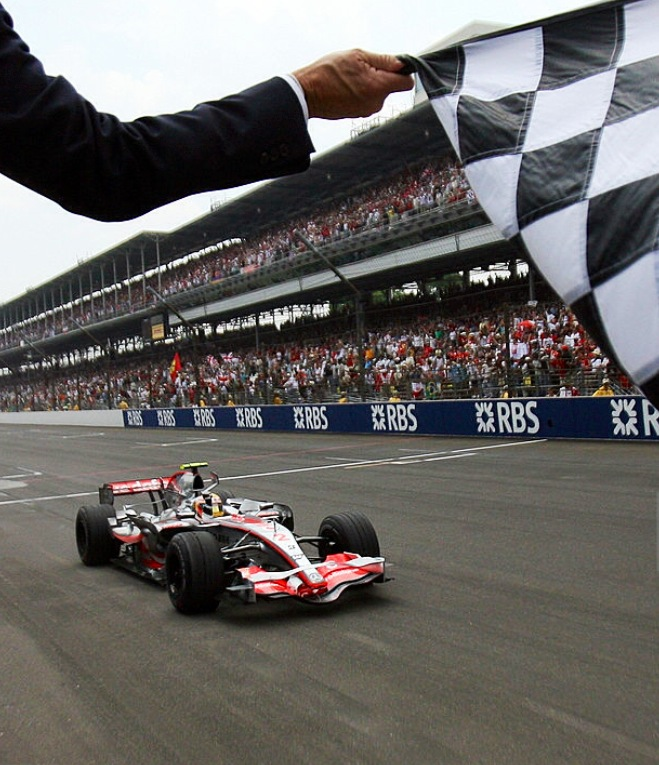
Lewis Hamilton takes the Indy chequered flag, his McLaren MP4/22 Mercedes wins the 15 June 2007 event…

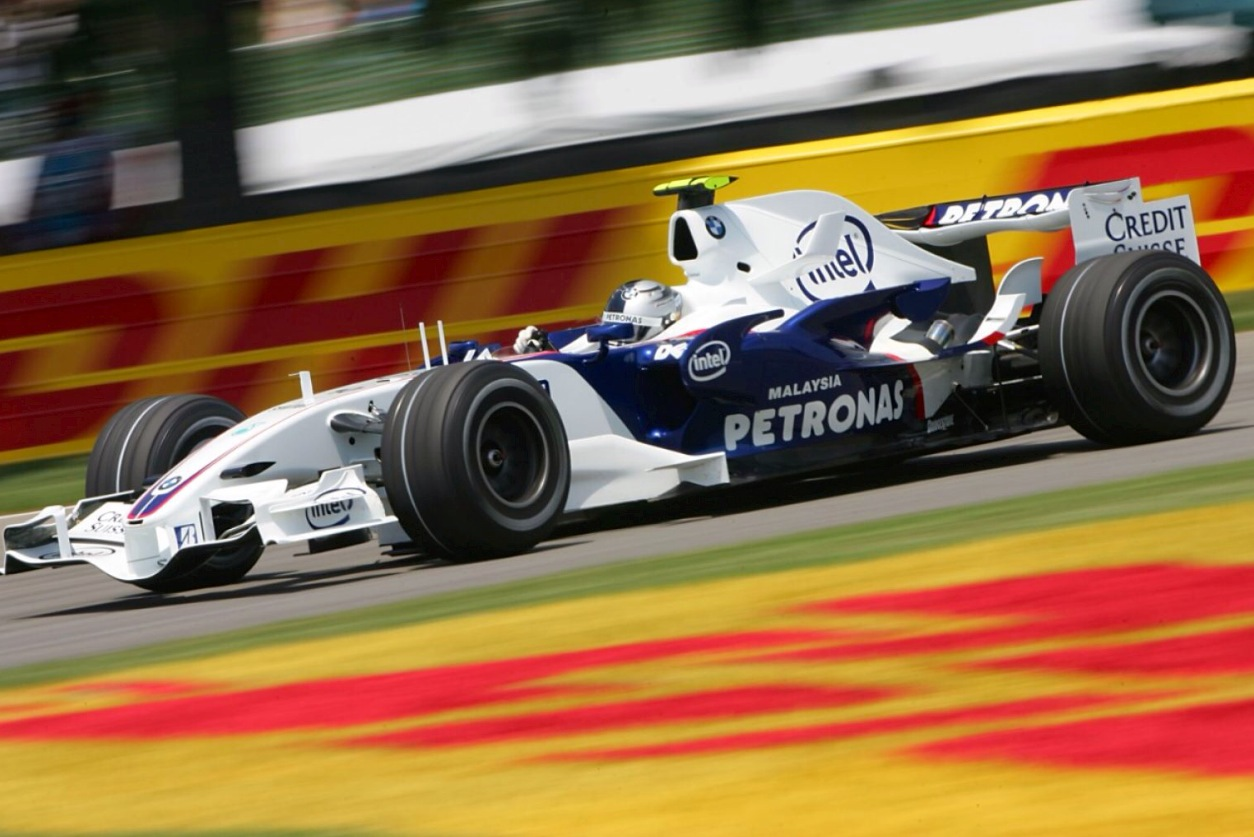
Hamilton won from Fernando Alonso in the other McLaren and Felipe Massa’s Ferrari F2007. Robert Kubica’s huge Canadian GP shunt the week before allowed Sebastian Vettel to make his GP debut for BMW Sauber. He was the teams test and reserve driver, his eighth place making him the youngest driver to win a championship point.

vettel

Seb Vettel on his way to 8th place USGP 2007 BMW Sauber F1.07 (unattributed)

Sadly it was the last USGP at Indy, Tony George and Bernie Ecclestone unable to agree acceptable commercial terms. The Austin, Texas ‘Circuit of The Americas’ first hosted the event in November 2012.

Credit: Gabriel Bouys

jochen skis

(Imago)

Jochen Rindt showing good form in his ‘Kneissl’s’ in early 1968…

Love this PR shot, its useless from a skiers perspective tho as the caption includes no information as to the resort, Austria is as precise as it comes!

Jochen joined Brabham for 1968 from Cooper, it wasn’t a great season for the team as the Repco ‘860 Series’ DOHC, 32 valve 3 litre V8 was as unreliable as its forebears in 1966 and 1967 were paragons of dependability, in the main at least, drivers and manufacturers titles won for Brabham and Hulme in 1966/67 respectively.

jochen color

Rindt BT24 Repco, Monaco 1968 (Getty)

Until the ’68 Brabham BT26 was ‘ready’ Jochen raced the 1967 BT24 in South Africa, Spain and Monaco, the cars speed demonstrated by Q4 and 5 at Kyalami and Monaco. These shots are all of the ’68 Monaco GP race won by Graham Hill’s Lotus 49 Ford, Jochen qualified 5th and boofed the car in the race.

Detailed stories about the 1967 and 1968 Brabham Repco seasons i will write soon.

jochen butt

The ’67 BT24 ‘760 Series’ 2 cam/2 valve Repco beside its ’68 BT26 ‘860 Series’ DOHC/4 cam sibling and Jochen happy despite a character-building season. Despite the difficulties Jochen enjoyed his year with Brabham and likewise Brabham and Tauranac working with him. ‘Twas a close run thing that he didn’t rejoin the team for 1970. He had committed to Jack who waived the verbal agreement when Chapman offered Rindt a ‘deal he could not refuse’, so off to Lotus he went… (Getty)

image

Monaco; 68 lap 1 down the hill past Rosies Bar and into Mirabeau; Rindt BT24 from Hulme’s McLaren M8 Ford, the BRM’s of Attwood (not in shot) then Rodriguez P133 and the rest (Schlegelmilch)

jochen profile

Rindt, again at Monaco 1968, the elegant simplicity of the ’67 Championship winning Brabham BT24 Repco clear (Getty)

Credit…

Imago, Getty Images, Rainer Schlegelmilch

jochen tailpiece

Eyes on the apex! Rindt, Monaco 1968 (Getty)

Tailpiece…

image

The 1968 Repco ‘RB 860 Series’ engine may have lacked reliability but not poke! Rindt put it on pole twice in ’68, here at Rouen and at Mosport, Canada. In France Jochen picked up a puncture from the debris of Jo Schlesser’s horrific Honda RA302 accident and had a fuel tank leak later in the race, DNF . Here he is in the cockpit of his BT26 during practice. French GP 1968 (Schlegelmilch)


image

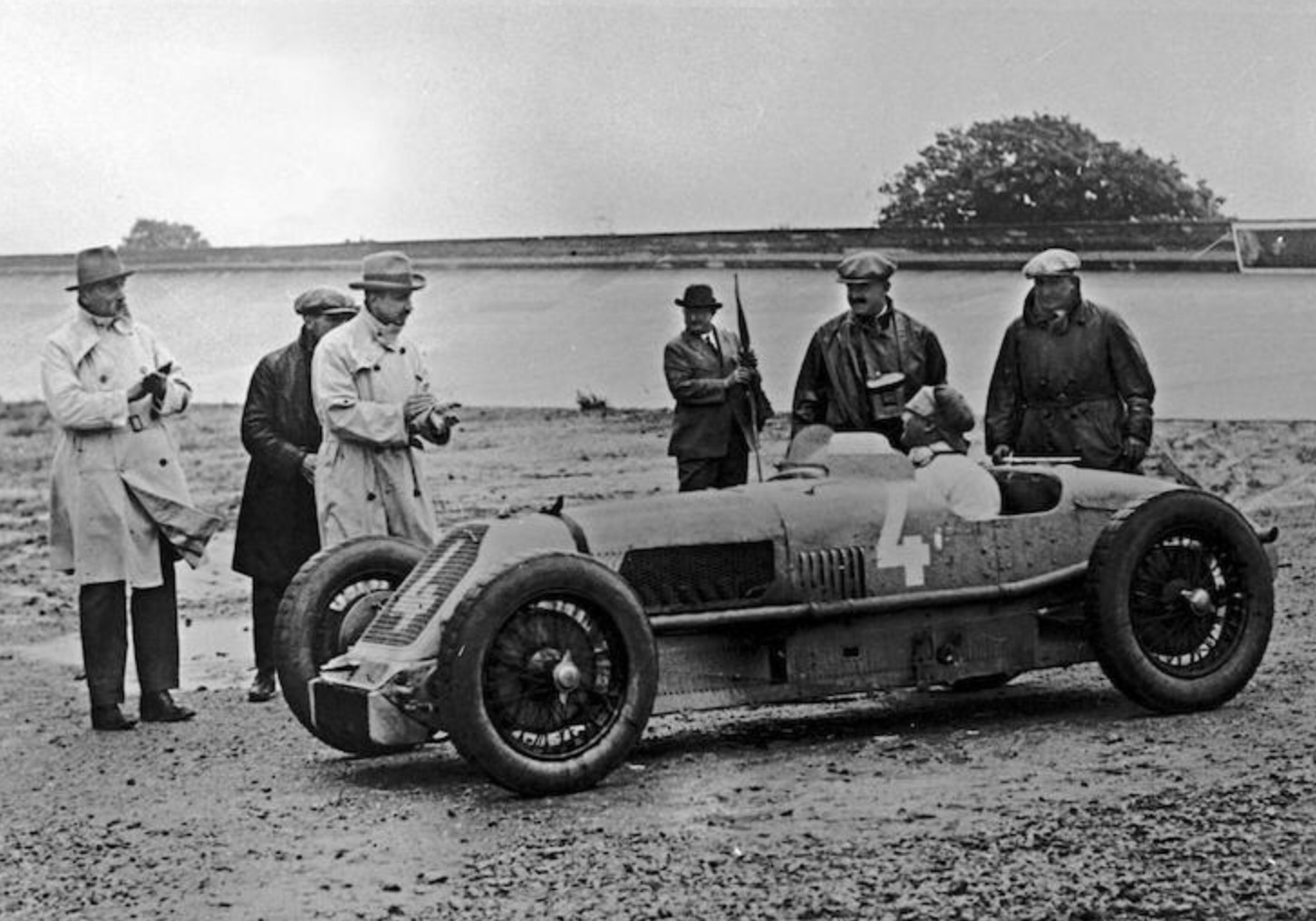
There are no details as to identification of these blokes in this magnificent period shot. You can feel the atmosphere of the day. Reg Nutt, perhaps at left, contributions from Australian enthusiasts welcome as to identities! (Dacre Stubbs)

A couple of Jack Day’s helpers fettle his Talbot Darracq 700 chassis #3 in the wide open parklands of Albert Park during practice for the 19-21 November, 1953 Australian Grand Prix…

The highly sophisticated 1.5 litre straight-8 1926/7 GP car was raced for him by Reg Nutt, like Day an ‘old stager’ whose racing pedigree extended back to the early days at Phillip Island where the first AGP’s were held in the 1920’s.

Nutt was the riding mechanic for Carl Junker’s successful 1931 Bugatti T39 win.

Day imported the car after its European career was well over in 1949. The racer was also outclassed in Australia by then although ‘a relation’, the Talbot Lago T26C of Doug Whiteford won this 1953 race, Whiteford took the third and last of his AGP wins.

ap gp

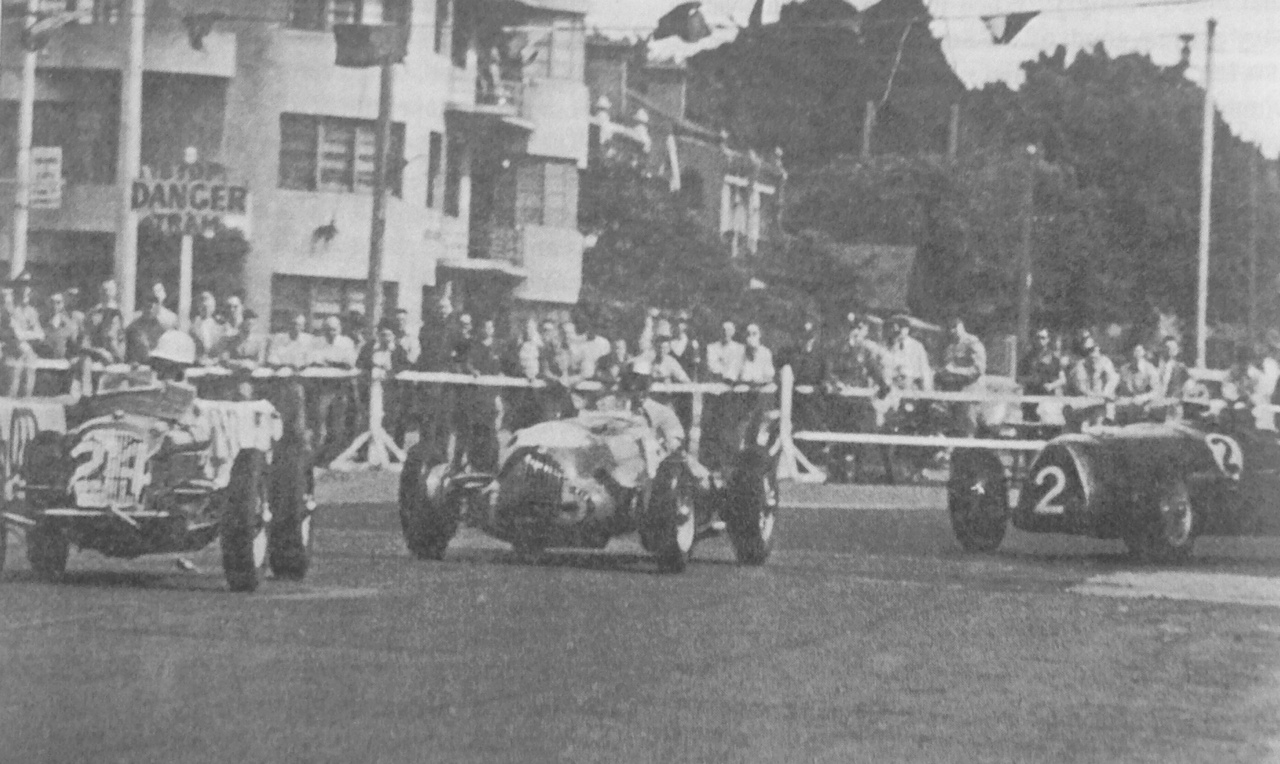
AGP ’53 front row #3 Lex Davison’s HWM Jag DNF, #2 Stan Jones Maybach DNF and Doug Whiteford’s winning Talbot Lago T26C at right, #11 is Ted Gray’s Alta Ford V8 (Dacre Stubbs)

Nutt retired the car on lap 14 of the 200 mile, 64 lap event, the first race meeting at Albert Park. Depending upon the race report the car either dropped a valve or threw a rod or both perhaps! Second to Whiteford was Curley Brydon’s MG TC Spl and third Andy Brown’s MG K3, both cars illustrate the potential of the TD to finish further up the field that day had it run reliably.

td race

AGP ’53. Stan Jones # 2 Maybach DNF about to gobble up Bill Wilcox’ Ford Spl DNF and #24 Nutt in the TD (Arnold Terdich)

There were plenty of handicap events in Australia at the time so the car was still a racer which could provide a great spectacle for spectators but the car was not raced extensively and then the complex engine was mortally damaged, the car effectively not seeing the light of day until 1988. Its superb restoration then took a further 20 years! This is the story of that car.

td engine

TD #3 in the ’53 Albert Park paddock, specifications as per text (Arnold Terdich)

Current custodian Noel Cunningham, below, at Rob Roy Hillclimb, in outer Melbourne’s Christmas Hills in 2015, thankfully the car is still in Australia.

Talbot Darracq 2015 VSCC Rob Roy 02 MB

VSCC Rob Roy Hillclimb 2015, Noel Cunningham in TD 700 #3 (Stephen Dalton)

Sunbeam-Talbot-Darracq-‘STD’…

I must admit to being confused by the relationships between these companies before embarking on this article. The corporate story is this; in 1919 British marques Sunbeam and Talbot merged, in 1920 they in turn merged with French company, Darracq, based in the Paris suburb of Suresnes.

The engineering genius from whose guidance some fantastic cars emanated was Louis Coatalen, a Frenchman who emigrated to Britain in 1901, joining Sunbeam in 1907. He worked on both automotive and aviation engines contributing enormously to Sunbeam’s success, the merger with Darracq allowed his return to France.

The very successful series of racing cars which followed comprise various cars, my confusion arising from their ‘badging’. The 1921 3 litre Sunbeams raced as both Sunbeams and Darracq’s. In 1922 2 litre DOHC 6 cylinder cars were built to the prevailing GP formula, these Fiat 404 clones were referred to as ‘Fiats in green paint’ in period! The Fiat 804 cars won the 1922 French GP and, supercharged, won again in 1923 badged as Sunbeams. The 1923 4 cylinder 1.5 litre TD voiturettes preceded the TD 700 design for the new 1.5 litre GP formula for 1926-8.

The latter category provided for cars of 1500cc supercharged with a minimum weight limit of 600Kg, and then 700Kg dry from 1927. Riding mechanics were barred but a mechanics seat was mandatory, the minimum cockpit width was 80cm.

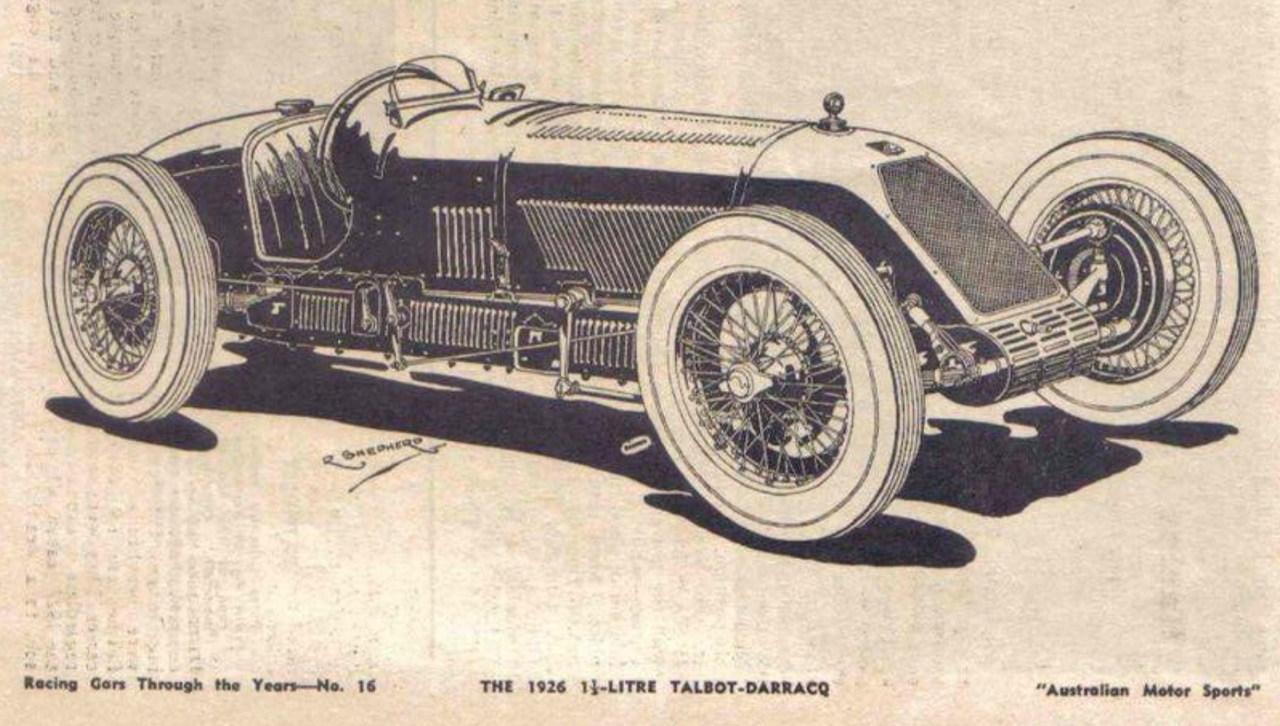
td drawing

AMS’ Bob Shepherd did some wonderful drawings of cars he wrote about over the years, hard to get the ‘repro’ spot on tho! TD 700 (Bob Shepherd)

The Talbot-Darracq 700 is one of the most advanced Grand Prix designs of the early ‘tween-wars period.

Designed by two ex-Fiat engineers who left Italy for political reasons, fascism on the rise, to say the least at the time, Vincenzo Bertarione and Walter Becchia left the country and joined the TD Suresnes factory in 1922.

Of the relationship between the Fiat and TD designs Leonard Setright observed; ‘Both (the Delage and Talbot)…could be said to cling to the fashion originally dictated by Fiat some years earlier, the most significant change being the exploitation of the mechanics absence…In the case of the Talbot…it had been designed by Bertarione, who had now been joined by Becchia, another member of the original Fiat design team. The cars were produced at the Talbot works in Suresnes in Paris, but for Bertarione this was no more than an internal posting within the STD combine.’

The TD 700’s conceptual design approach was that of an offset single-seater, ultra low-slung, using a form of fabricated deep-section ladder-frame chassis, powered by an advanced straight-eight, supercharged engine.

td eng 1

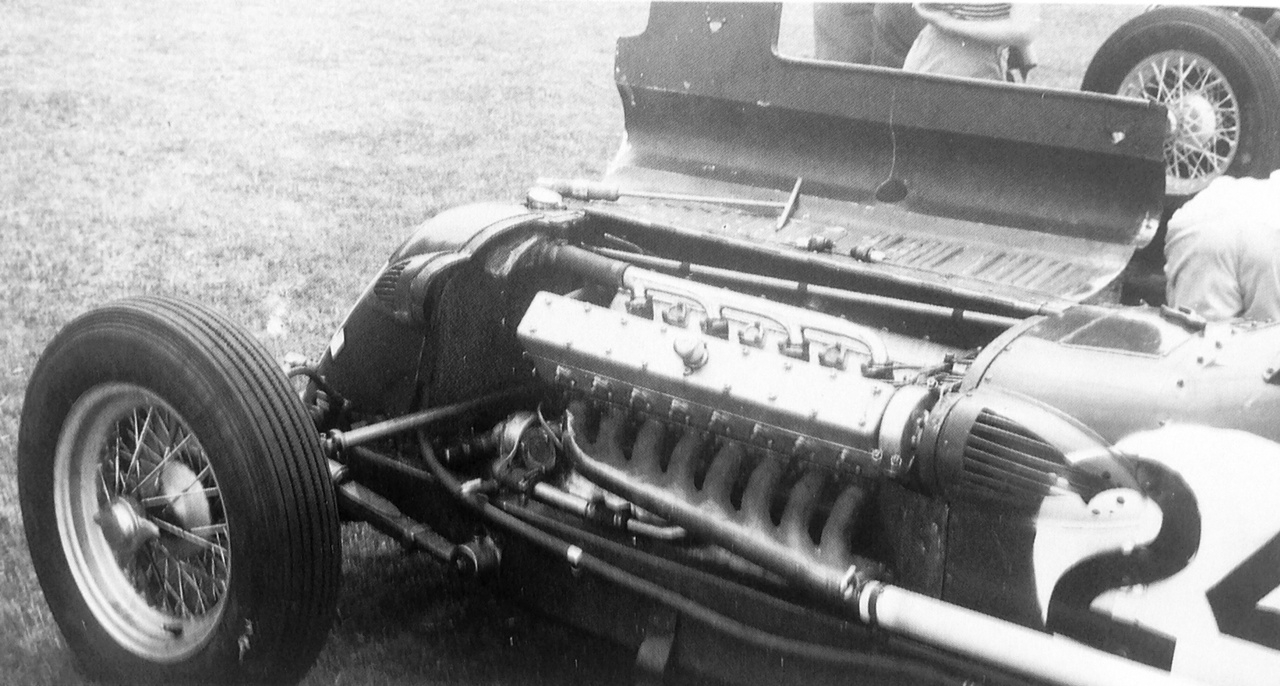
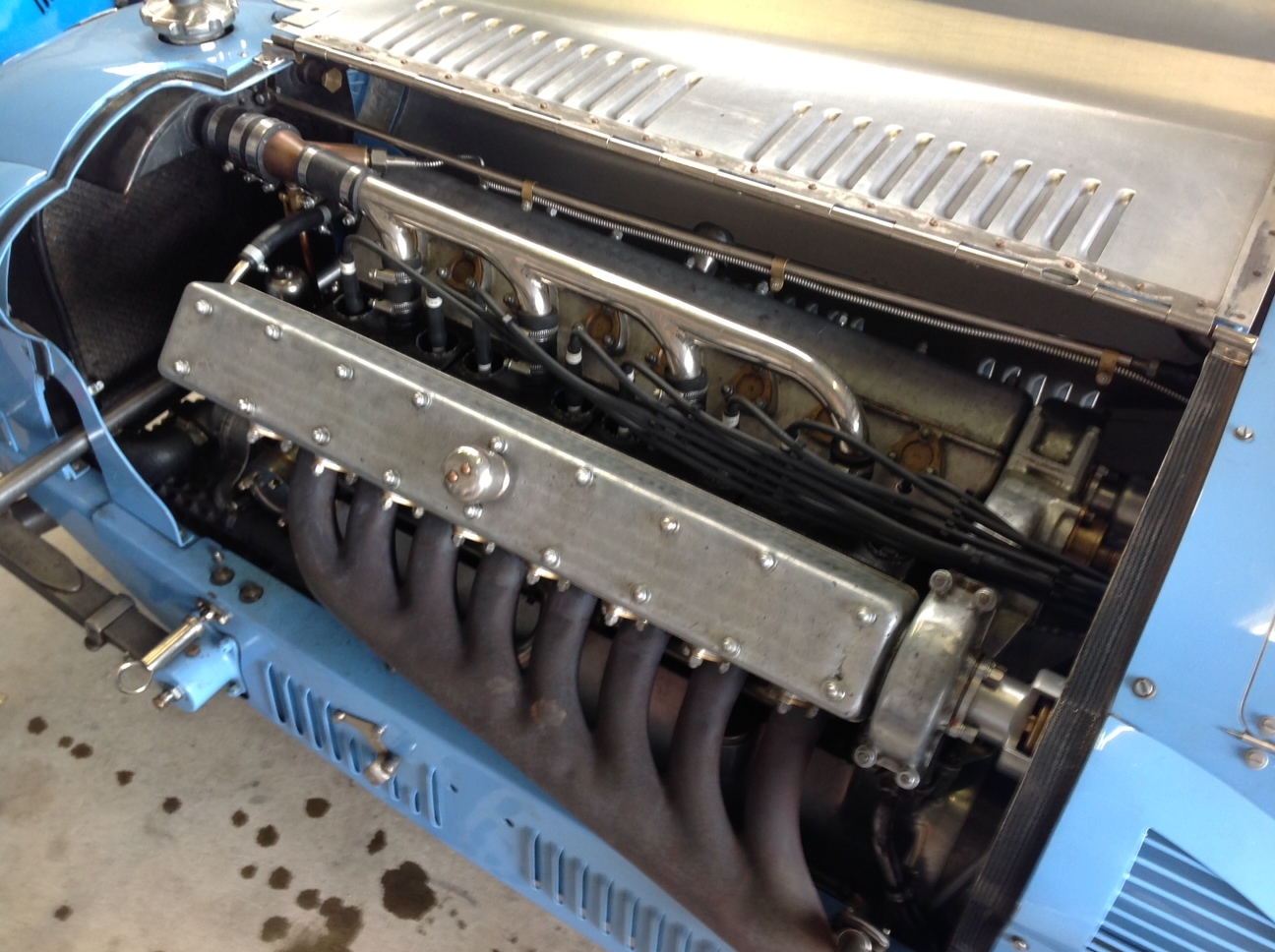
Exhaust side of the beautiful straight 8. 2 valves per cylinder set at  90 degrees to the centre line operated by fingers via DOHC. Each cam ran in 5 roller bearings and was driven by gears from the rear of the crank. Valve clearances adjustment was via thimbles, each valve had 3 springs, ports are rectangular in shape. 2 magnetos were driven by the centre gear of the cam train, each one fired 4 cylinders. The contact breakers protruded into the cockpit Bugatti style (Bisset)

The engine reflected previous STD experience incorporating gear-driven DOHC operating two valves per cylinder, a Roots-type supercharger and roller-bearing crankshaft. The 1485cc engine produced circa 145-160 bhp at a then very high 7,000 rpm. To minimise internal friction loss the engine had many intricate roller-bearings.

td eng 2

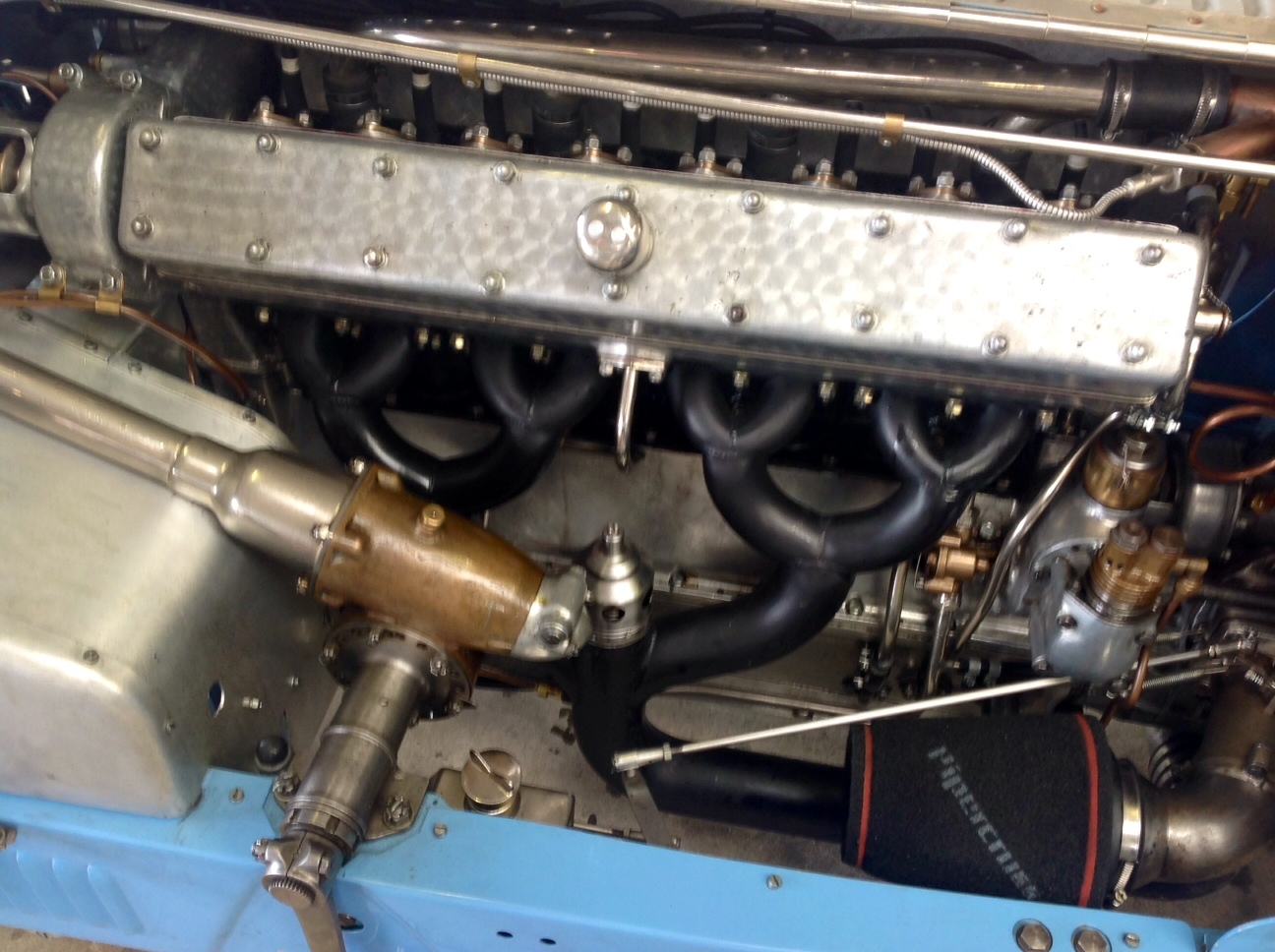
Engine induction side. Steering box and drop link in shot. Note relief valve, modern air cleaner to carb which is bolted directly to the Roots type supercharger, driven thru a laminated spring coupling, carb standard choke 49mm. Comp ratio 6.5:1, later 7:1, power 140 and later 145bhp @ 6500 rpm. The water pump and plunger pump for for fuel air pressure was also driven by the front gear train. Lubrication by dry sump with pressure and scavenge pumps, 4 gallon oil tank under the cockpit (Bisset)

The chassis took advantage of the new no riding mechanics rule; the entire engine/transmission line was offset across to the left of the chassis’ longitudinal centreline, the first car to do so. This placed the engine and prop shaft slightly left of centre. Drive passed through a double-reduction final drive permitting a low driving position. The pilots seat cushion rested on the chassis underpan.

td cockpit

Shot clearly shows the offset driveline as per text and 4 speed ‘box (Bisset)

The front axle was formed from two tapering tubular halves, abutting centrally in flanges which were bolted together, the semi-elliptic suspension leaf-springs passed through forged eyes. The rear semi-elliptic springs were underslung.

td fs l

Semi elliptic springs, friction shocks, front axle tubular made in 2 sections joined in the centre by flanges and a ring of bolts, axle of hollow vee shape (Bisset)

The nose-mounted radiator was raked steeply back, and the finished car’s clean, flat-sided bodywork tapered inwards to a neat tail. It was one of the lowest and most striking-looking front-engined Grand Prix cars ever built.

t d front

TD #3 at Phillip Island, as are all these detail shots, March 2016 (Bisset)

Setright, in his eloquent prose said; ‘As for the car, it was an immediate descendant of the immensely successful 1 1/2 litre voiturette with which Talbot had campaigned in the subordinate class during the immediate preceding years, a car in which Bertarione had continued to redefine the work that he had begun so much earlier in Turin and continued in Wolverhampton. The bore/stroke ratio had dropped somewhat to 1.35 in the quest for higher crankshaft rates, contributing to an output of about 145bhp at 6500rpm with a further 500rpm safely available beyond’.

‘The chassis of the Talbot was altogether more refreshing, its pressed side members being agreeably slender but impressively deep at mid-wheelbase, tapering to the front and rear in recognition of those beam-building properties that Bugatti had already endorsed in his type 35 chassis. Indeed the same principles had been applied to the beam front axle, which displayed a progressive reduction in diameter away from its centre. The whole car was quite meritorious, but it was doomed to enjoy but little success due to the chill penury of STD suppressing what might have been a noble rage’ (!) More of the ‘chill penury’ later!

A more detailed analysis of the cars engine and chassis published in veloce.com, developed together with Stuart Anderson, then owner and restorer of TD 700 #3, the subject of this piece, is at the end the article.

td segrave

Segrave prior to the start of the 1926 Brooklands JCC 200 Mile race which he won. Note the branding of the TD 700 in England, cars painted green for their UK events some reports say. Nice close-up shot of the cars body in its original form (unattributed)

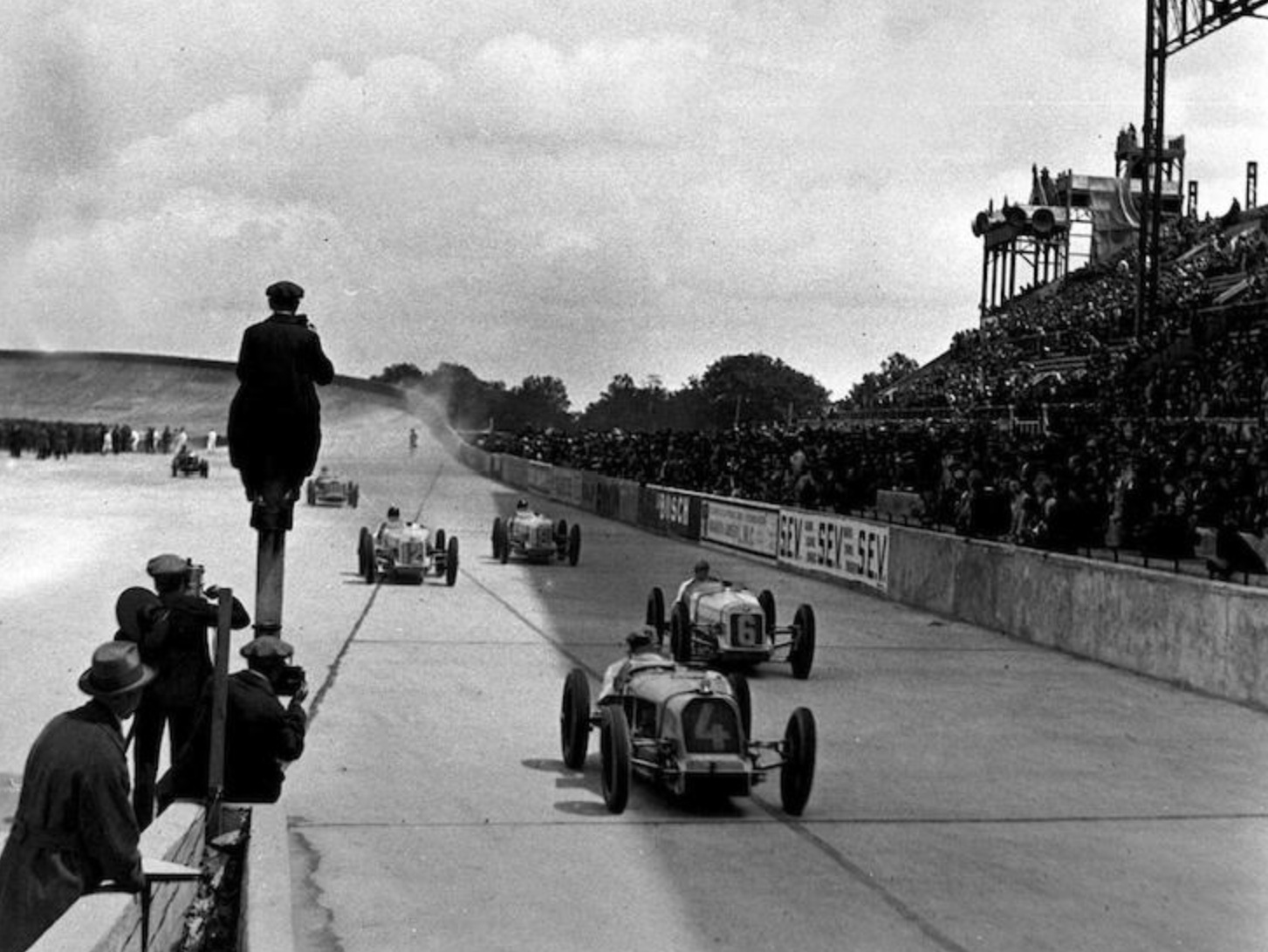
The TD 700’s made their delayed racing debut in the 1926 English Grand Prix at Brooklands on August 7.

The cars did not start the first 3 Grands Prix of the year but Albert Divo and Henry Segrave led the British race from Robert Benoist’s straight-eight Delage 155B. Divo pitted the leading Talbot after 7 laps with an engine misfire, the ‘plugs were changed. Segrave led Benoist’s Delage until a pit stop for fresh rear tyres. Divo and Segrave demonstrated the new Talbots’ impressive speed, Segrave took the fastest lap, but brake and ignition problems sidelined the new, underdeveloped cars.

On 7 September at the Arpajon Records Day Divo set new records in the International 1500cc class for the Flying Kilometre and Flying Mile.

At the Brooklands JCC 200 Miles on 25 September Segrave and Divo drove to a convincing a 1-2 victory, but the dominant supercharged straight-eight Delages were not present, so it was somewhat of a hollow victory.

On October 17 the Talbot Darracqs were 1st-3rd, Divo, Segrave and Moriceau in the Grand Prix du Salon at Montlhéry, France.

The AICR manufacturers championship was won by Bugatti, the championship Grands’ Prix won by the Bugatti T39A (French, GP d’Europe, Italian) the Delage 155B (RAC British GP) and a Miller at Indianapolis.

mont

Divo TD 700 from the #6 Dubonnet Bugatti T35C, ( it doesn’t look remotely like a Bugatti, some help here would be good!), #12 Williams Sunbeam Course de Formula Libre 2 July 1927, Montlhery (unattributed)


mont 1

Albert Divo, TD 700 Montlhery 2 July 1927 (unattributed)

For 1927 Bertarione and Becchia improved their design; they transferred the oil cooler to the front of the car mounting it beneath the radiator. Large wire mesh openings were substituted for bonnet louvres and the front spring shackles were moved to the front ends of the springs. 1927 cars also had wider frames. In essence though the cars still lacked ‘race development’.

The first race entered was the GP de Provence at Miramas on 27 March where Moriceau and Williams were 1/2 in their heat but the cars were withdrawn from the final after a dispute, the subject of which is not disclosed.

The race program for the Suresnes concern was savaged as the group was in great financial trouble. One car shared by Williams/Moriceau was 4th in the French Grand Prix at Montlhéry on 3 July, the race won by Benoist’s Delage 155B while Divo won the Formule Libre supporting event on 2 July.

Delage won the 1927 AICR Manufacturers championship with Benioist’s 155B dominant, winning the French, Spanish, Italian and British GP’s. Duesenberg won at Indy, the other championship round.

Divo set a new record for the flying mile on 4 September during the Arpajon Records Day but after that the STD board closed its racing program, the 3 700’s were sold to Italian privateer Emilio Materassi.

Emilio offered his services to Bugatti as driver/team manager, after Ettore declined he created his own team, ‘Scuderia Materassi’. The straight-8 Talbots were delivered to Materassi’s workshop and modified.

The team made its ‘Talbot debut’ in the 1928 Tripoli Grand Prix at Mellaha, Libya, at that time an Italian colonial province. Materassi’s cars were disqualified after a protest over car weights by Nuvolari who then won the race.

td mater

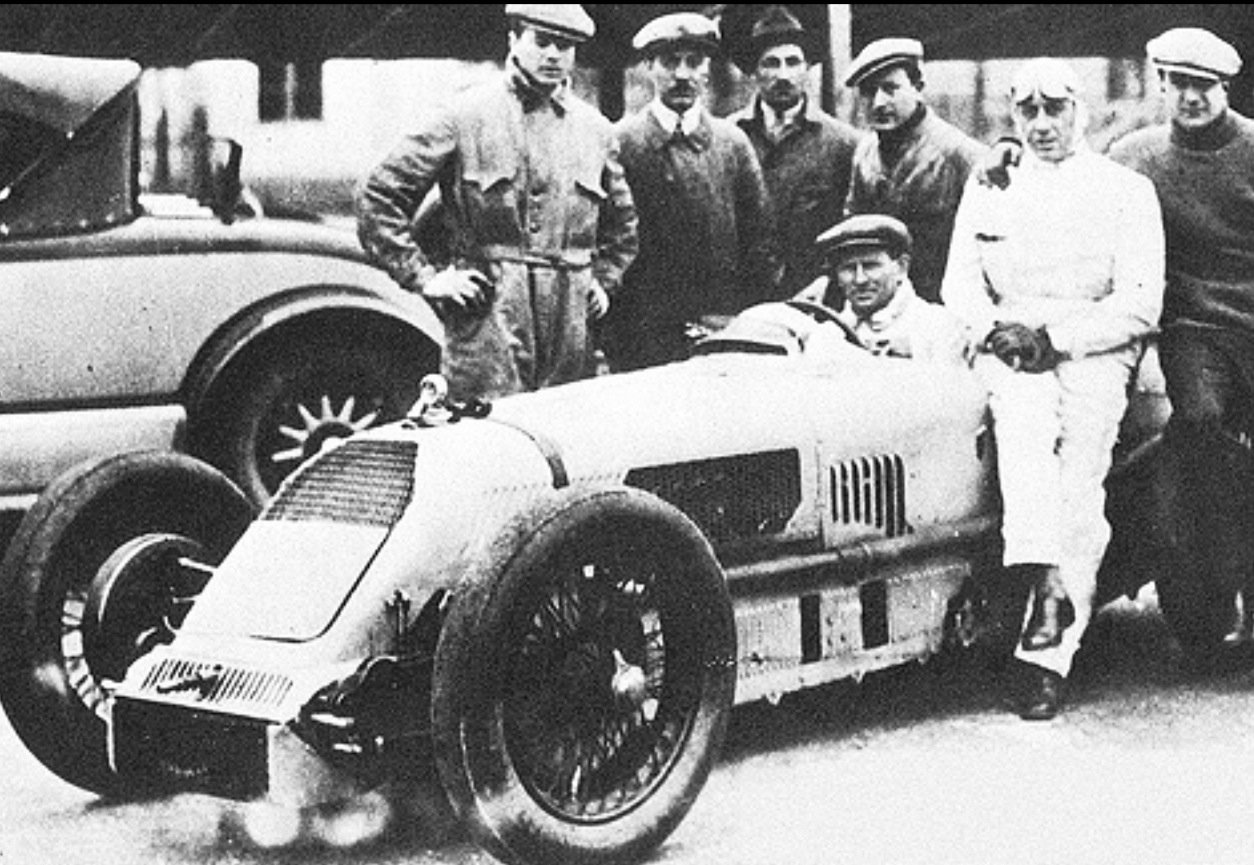
Materassi, TD700 and team, date and place unknown (unattributed)

Back in Italy Materassi contested the Circuito di Alessandria on 23 April. Emilio was 4th, Nuvolari won again. Driving one of the modified Talbots, Luigi Arcangeli won the Circuito di Cremona, with Materassi 3rd.

Emilio Materassi won his local Circuito del Mugello event for the third time on 3 June.

Emilio was 3rd behind Chirons and Brilli-Peri’s Bugatti T35C’s on the 10 June Premio Reale di Roma at the Circuito Tre Fontana, Arcangeli won the Circuito di Cremona on 24 June from Nuvolari’s Bug T35C, Materassi was 3rd.

In the Coppa Acerbo on 4 August at Pescara, Materassi retired. Team mate Arcangeli received facial injuries from a flying stone, Materassi replaced him, eventually finishing 2nd behind winner Campari’s Alfa Romeo P2.

Materassi took a Circuito del Montenero win at Livorno. He beat Nuvolari (Bugatti T35C) and Giuseppe Campari (Alfa Romeo 6C1500).

Then on to the terrible Italian Grand Prix at Monza on 9 September 1928.

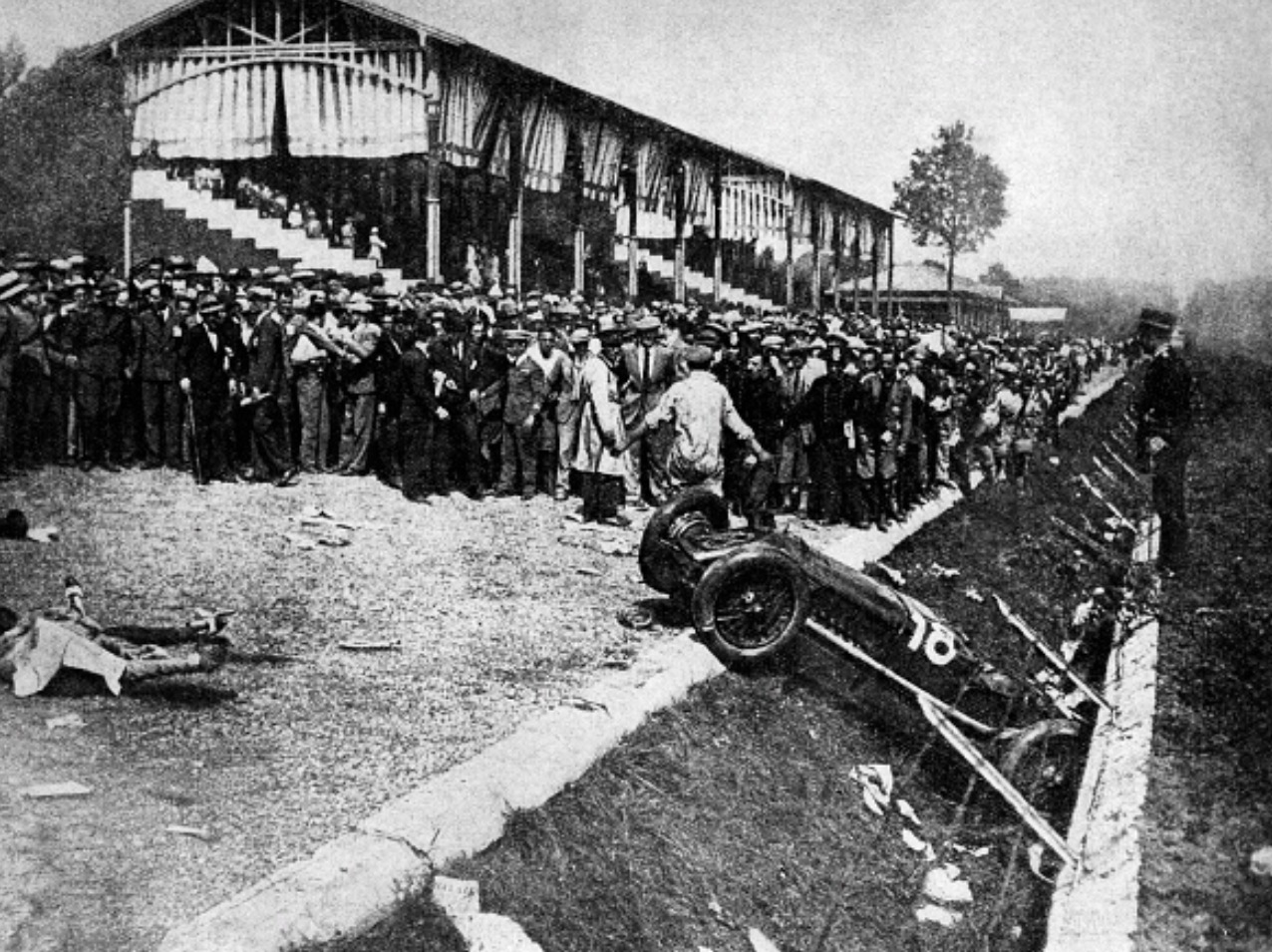
Materassi started from grid  3 but was forced to make two early pit stops. Whilst trying to regain lost time that he crashed, killing himself and 23 spectators on lap 17.

The car slid to the left in a straight line, just after ‘the Parabolica’ when he tried to overtake Giulio Foresti’s Bugatti T35C, after this sharp change of direction the Talbot crossed the track, went through the fence and into the crowd. The cause, perhaps mechanical failure, has never been determined. The other team cars of Arcangeli, Brilli-Peri and Comotti were withdrawn.

mat monza

Aftermath of the Materassi Monza accident (Ullstein bild)

Materassi’s surviving team members continued to race the cars in 1929.

Brilli-Peri won the Tripoli GP in March, and Circuit di Mugello in June. In April Arcangeli and Brilli-Peri  entered the Circuito di Alessandria, Gastone was 13th.

On 26 May Arcangeli won the 1500cc class and was 4th outright in the Premio Reale di Roma. Brilli-Peri won the Circuito di Mugello on 9 June from Morandi’s OM 665. Arcangeli was 4th in the Coppa Ciano at the Montenero on 21 July.

At the Monza GP on 15th September, Tazio Nuvolari’s TD 700 was 2nd in his heat behind Arcangeli  in a sister car and 2nd again in the final, this time behind Varzi’s Alfa P2. A fortnight later on 29 September Arcangeli was 4th at the Circuit de Cremona, Brilli-Peri won in an Alfa P2.

td monaco

Clemente Biondetti in his Scuderia Materassi TD 700 ahead of Louis Chiron’s 2nd placed Bugatti T35C in the 6 April Monaco 1930 GP. Dreyfus won in another T35C, Biondetti DNF with undisclosed mechanical dramas on lap 13 (unattributed)

The cars raced on into 1930, when Count Gastone Brilli-Peri, who led the team, crashed fatally during practice of the Tripoli Grand Prix on 23 March. Teammate Clemente Biondetti won the 1500cc Voiturette class heat and was 3rd in the final.

On April 6 Biondetti failed to finish the Monaco GP on 6 April. Biondetti was 4th in the Premio Reale di Roma at Tre Fontana on 25 May, the race won by Arcangeli’s Maserati 8C2500.

At the Coppa Acerbo, Pescara on 17 August Brivio was 4th with Biondetti DNF. At Monza for the GP di Monza on 7 September Biondetti was 5th in his heat, both he and Brivio failed to qualify for the final.

In October 1930 the cars were sold to Milanese engineer/owner-driver Enrico Platé.

Plate raced them in further modified form and from 1931 re-assembled two of them, probably the two crashed Monza/Tripoli cars, around entirely redesigned, stiffer frames made by Meroni SA of Turin.

The Meroni chassis were slightly narrower, but picked up the unchanged Talbot engines, transmission and drivelines. Platé also converted the braking system, the mechanical Perrot system replaced by an early version of Lockheed-Wagner hydraulic brakes. An early Weber carburettor was also incorporated.

Enrico ran the cars mainly in Italian domestic events, drivers included Ermini, Pratesi and Vismara racing in Voiturette events.

In 1936 Platé sold the two Meroni chassis cars. One went to Dr ‘Mario’ Massacurati’s Eagle racing team, the other, chassis # 3 to British amateur gentleman-driver, Antony Powys-Lybbe.

td brook

Powys-Lybbe at Brooklands, date unknown (unattributed)

Dick Seaman’s 9 year old straight-eight Delage, the TD’s foe in 1926/7 dominated Voiturette racing during 1936. Powys-Lybbe was advised by Brooklands preparation specialists Thomson & Taylor that the Talbot Darracq 700 being sold by Platé could be as competitive as Seaman’s amazing, modified Delage.

The car wasn’t delivered to Harwich until February 1937 after bureaucratic banking and customs issues. Powys-Lybbe, who spent half the cost of the car again on customs duties decided he wanted to spend little more on it, instructing Thomson & Taylor just to ‘get it going’. The complex car needed much greater attention than this and with wrong plugs, wrong fuel and wrong timing he had little success with it.

image

TD 700 being fettled, probably in Thomson and Taylors workshop, Brooklands 1 March 1938 (Fox Photos)

He drove it in a few Brooklands events, raced it at Cork, Ireland, then sold it on the basis that as an army reserve officer he was likely to be called up, World War 2 was imminent.

Graham Radford bought it and retained it throughout the war. Postwar he drove it several times, at Shelsley Walsh and Gransden Lodge in 1947 and Luton Hoo in 1948 before selling it to Jack Day, on a trip to the UK to buy a car for Australian events.

By that time the successful veteran had sold his ‘Day Special’, a Bugatti T39 with a Ford V8 engine and gearbox, he wanted a car in which he could have some fun, and in more serious events enter it for other drivers.

td house

Jack Day settles the TD 700 into its new home in suburban Melbourne, May 1949 (Blanden Collection)

Day’s Talbot arrived in Melbourne, Victoria, in May 1949 following considerable pre-publicity. Over the next five years it ran in all kinds of events, initially with some success. towed on a trailer behind his Phantom I Rolls-Royce!

Talbot Darracq AMS cover

td ams race

The TD’s first Australian event was at Fishermans Bend, Melbourne as above, the weekend a scorcher somewhat akin to the 1948 AGP meeting at nearby Point Cook according to the AMS meeting report. The car was driven by Cec Warren to 2nd in the under 1500cc scratch race. 1st and 3rd were the Bill Patterson and Lex Davison supercharged MG TC Spls. Stan Jones was 4th in his HRG 1500. All three were later Australian Gold Star champions.

Of the TD AMS said ; Jack Day’s TD looked and sounded grand, finishing 2nd in the Under 1500 scratch. Warren started to have axle tramp as he braked for corners, it caused a handbrake cable to foul a spring shackle and lock one brake partly on’

AMS mischievously mused ‘it is interesting, but unprofitable to note how the Ken Wylie Austin A40 Spl s/c and Patterson’s TC would have fared in 1926 1 1/2 litre GP racing’.

Cec Warren drove it to a Balcombe, on Melbourne’s Mornington Peninsula, heat win on 12 June 1950, the meeting held on the Kings Birthday weekend. In November Warren again drove it in the 2 day meeting at Ballarat finishing 6th in the ‘A Grade’ 6 lapper on the Saturday.

At Bathurst in October 1951 it was timed at 113.20mph over the ‘Flying Quarter’ and a month later was 9th in the Victorian Trophy at Ballarat’s airfield circuit.

In 1952 Reg Nutt raced the car at Fishermans Bend at the LCCA/Harley Club meeting.

In a lead up to the 1953 Australian Grand Prix Nutt raced it at Fishermans Bend again on October 3.  Clearly the engine would have required a major rebuild if it threw a rod at the Albert Park, AGP meeting, damage less severe depending upon the havoc caused if it dropped a valve.

Blanden records ‘Day tried to replace the roller big end bearings with white metal however at a Phillip Island event in the early 1960’s when driven by Des O’Brien it threw a rod in a vintage event’.

Day then rebuilt the engine to roller bearing spec and discarded the original 4 speed manual ‘box, replacing it with an ENV pre-selector transmission which because of its small size was completely inadequate. The gearbox change was made shortly before he died.

TD 700 #3 then passed to Evelyn Porter, Days partner, the car was stored at one of Jack’s properties at Mount Martha, beachside, on the Mornington Peninsula. The car slumbered for some 20 years forgotten by most, Porter rejected all offers to sell until it Stuart Anderson bought it in 1988.

td discovery

TD 700 #3 as repatriated from the Mt Martha garage of Day’s partner in 1988, it looks pretty good in all the circumstances. Tricolour, badge at top of rad is ‘Light Car Club of Australia’ (Anderson)

He first saw the car as a teenager on its arrival in Australia in 1949. In an oh-so-familiar pattern the car he was so impressed in his youth; its design, engineering, supercharged engine, its sight and sound, he ultimately acquired. It was ‘forlorn and derelict, but substantially complete’.

‘The car was in scruffy condition and was rescued from a shed locked up like Fort Knox. It was buried under junk and festooned with creepers, but amazingly nothing was broken’ said Anderson.

Restoration occupied some twenty years plus much fine engineering capability and skill, contributed by a number of specialists.

TD #3 retains the Enrico Platé/Meroni SA replacement chassis. It was completely dismantled, extraneous holes welded, the whole lot sand-blasted and repainted.

The engine was painstakingly restored. A new crankcase re-cast in LM25 hardened alloy and machined to original specifications was carried out by Billmans Foundry at Castlemaine, in Victoria’s Central Goldfields. Castlemaine is a centre of the Australian Hot Rod world and is full of specialist artisans capable of doing all sorts of design, fabrication, welding, casting and so on.

The crankcase contains a new set of four two-cylinder blocks, each one CNC cut from a solid billet of EN36A steel with all new sheet-steel water jackets and valve support plates. A new crankshaft was made using the original as the pattern, cut from two solid billets by Leaney Engineering in Bayswater, an outer eastern Melbourne suburb

New valves and guides were made with much of the machining, crank and engine work done by Crankshaft Rebuilders, at Blackburn again in Melbourne’s east.

A new gearbox to the original drawings was made by the highly talented Barry Linger in the UK.

In terms of the cars body Anderson’s choices were to restore the Plate built body on the car noting it retains its Meroni chassis fitted at the same time, or construct a body in the same style as the original to fit to the Meroni chassis.

Stuart chose the latter option, to restore the car to its original 1920s style by specialist coachbuilder/racer Richard Stanley Coach Craft, again based in Melbourne’s east, the finished car looks an absolute treat! It made its track debut in 2008.

Anderson used the car for a while before sending it to the UK for auction by Bonhams, fortunately it didn’t sell and returned to Australia. Noel Cunningham of Victoria acquired it, its in the ‘right hands’ and always attracts the attention a car of its pedigree deserves whenever he runs it, my photos were taken at the Phillip Island historic meeting a short time ago, March 2016.

In fact the car is about to travel to the UK with Noel for Goodwood, so a good few of you will get the chance to see and hear it.

Talbot Darracq Bonhams ad

Technical Specifications…

This section of the article borrows and truncates several articles on these wonderful cars by velocetoday.com written together with Stuart Anderson. Checkout this website if you have not discovered it;

http://www.velocetoday.com/

td rear

Springs semi elliptic and small friction shocks, back axle, like the front passed thru the chassis side members. Prop shaft from ‘box was tubular. Brakes originally mechanical, later updated as per text to hydraulic operation (Bisset)

Chassis..

After purchase of the three cars from Materassi in 1931, Gigi Plate ‘re-chassied’ two of them with new channel section frames, made by Meroni S.A. of Torino.

They were much more conventional than the STD pressed steel lattice girder chassis, their dimensions such that axles, engines and transmissions could be swapped over without modification. Says Anderson, ‘It is much stiffer up front than the original and obviated the front axle tramp under heavy braking and high speed steering wander which was a problem with the torsionally flexible lattice girder chassis. This problem also affected the Delage opposition it seems, for in both cases the overall length of the gearbox-engine-blower was enormous, with too much unbraced chassis over that length.’

Engine..

‘…the (cars) piece de resistance was the straight-eight roller bearing DOHC supercharged engine…and its close relationship with the powerful Fiat 404/405′.

‘Vincenzo Bertarione and Walter Becchia, fresh from Fiat, came to work for STD… The two designers created the firm’s immensely successful Sunbeam DOHC six and a 1500cc four, based on existing Fiat engines’…’Louis Coatalen then asked the two Italians to draw up a new engine for the 1926 Grand Prix formula; that it would again be similar to the Fiats they had helped design was taken for granted’.

td blocks

(Anderson/velocetoday.com)

Cylinder Head..

‘Taking it from the top, both engines reverted to a two valve combustion chamber after using four valves per cylinder, but with a significantly larger intake valve (by some 20 percent). The valve angle for the Fiat was 102 degrees, the Talbot 90 degrees. Both used roller bearings and finger type cam followers.

‘So far, very similar. But as Griff Borgeson wrote in his classic book, The Classic Twin Cam Engine, ‘A really major difference existed in the methods of driving the camshafts’. ‘A highly original Y shaped arrangement of three beveled shafts was used for the Fiat and a classical spur gear train in the Sunbeam.’ We know that the TD 1500 carried on the same spur gear arrangement’.

‘The technique used to weld the heads to the forged steel cylinder dated from the 1900s, but the DOHC concept made it a challenge. Borgeson published a rare photo of a cutaway section of the Fiat 404/405 cylinder and head, and we are able to compare it to the Talbot cylinder/head construction. Here the similarities are more than striking’.

‘Both engines made use of full length camshaft boxes that were bolted to the four sets of welded heads which were in turn fitted with the combustion chambers/piston cylinders. Obviously, the Fiat influence was very clear.’

‘Camshafts are hollow, and each cam lobe drilled so that there is a good supply of oil to the valve gear. Surplus oil spills down through drains front and rear, lubricating the cam drive gears at the rear, and the train of gears for water pump and other ancillaries at front. Valves are operated by finger-type cam followers, each individually mounted, so that they can be withdrawn individually for adjustments without disturbing all the rest of the gear and valve clearance adjustments are made using hardened steel lash-caps of varying thickness’.

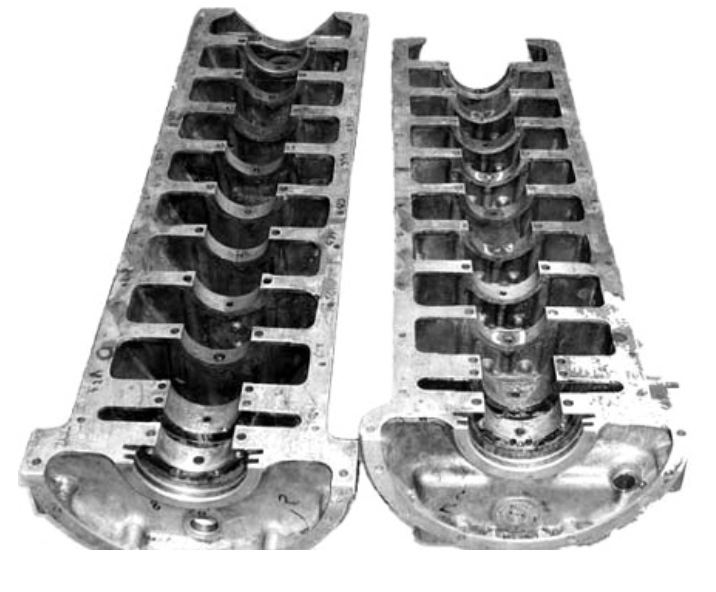
td crankcase

Complex crankcase casting, upper half on left, lower on the right (Anderson/velocetoday.com)

Crankcase, sump and crankshaft

‘The great complexity of the crankcase casting was very similar to that of the rival Delage.

Split roller bearings were relatively new, and used by STD instead of the normal one-piece roller bearings which necessitating a multi-piece crankshaft to accommodate the roller cages. Long through-bolts held the whole lot together, with threaded ends projecting through the upper surface of the upper half to act as locating and holding-down bolts for the 4 cylinder blocks. When assembled, there is virtually a solid cast wall and a bearing each side of each crank throw – almost like eight single cylinder engines in a row’.

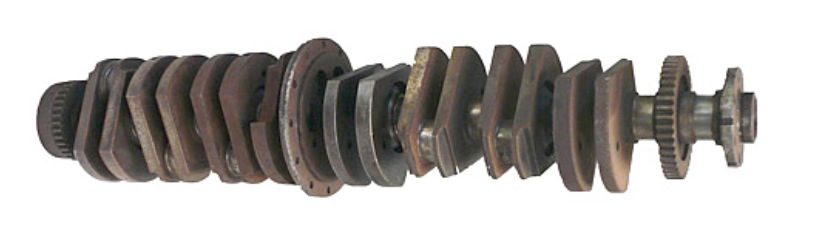
td crank

Original crank (Anderson/velocetoday.com)

‘The crankshaft is actually two four cylinder crankshafts, joined at 90 degrees to each other, giving a firing order of: 1,5,3,7,4,8,2,6. There are 10 main bearings, the one at the front being a large ball bearing acting as a thrust, the other 9 are all split cage roller bearings, the rear two straddling the crankshaft gear which drives the oil pumps below, and the cam drive above’.

‘STD did a lot of work on the engine in the winter of 1926-27, changing manifold pressures, diameters and temperatures, but Anderson thinks that problems may have been with the Solex carburetors. The Australian crew also eliminated cold start reluctance when fuel droplets can tend to fall out of suspension over the long manifold length, by fitting a Kigass pump and pipework. ‘It is very long and tortuous but in main, works well,’ said Anderson’.

td carbs

You can’t see much of the air cleaner in the earlier shot, but see the carb bolted to the supercharger. Water pump and plunger pump for fuel air pressure also driven off the front gear train. Note throttle linkage and two return springs, standard of workmanship in Anderson’s restoration outstanding (Bisset)

TD 700 Engine Specifications

Straight eight, 56mm bore X 75.5mm stroke, 1485cc.

Construction comprises four welded steel blocks consisting of two cylinders each integral with cylinder block

Crankcase: two piece cast light alloy split on crankshaft centerline, with shallow oil sump below acting as collector for scavenge pump of dry sump oiling system
Two piece crankshaft, split in middle joined by a large circular flange on each piece, fitting neatly into a step on the other, and secured by a ring of 12 very tight-fitting bolts.
Rod big ends split roller

DOHC heads, valve angle 90 degrees, of steel welded construction integral with cylinders
Domed pistons, 7:1 compression ratio, valve gear triple coil valve springs
Camshaft case 10 roller bearings, Cam drive, gears driven from rear of engine

Roots Supercharger, front driven with Solex Carb
Magneto ignition, Bosch

Power 160 bhp at 7200 rpm (contemporary reports say 140/145 @ 6500)

Bibliography…

G Howard & Ors ‘History of The Australian GP’, J Blanden ‘Historic Racing Cars in Australia’, veloce.com article by Pete Vack and Stuart Anderson, The Nostalgia Forum, Bonhams auction catalogue, LJK Setright ‘The Grand Prix’, Stephen Dalton Collection, TD article by Bob Shepherd in ‘Australian Motor Sports’ October 1951

Photo Credits…

Martin Stubbs, Dacre Stubbs Collection, Stephen Dalton, Arnold Terdich Collection, Stuart Anderson

Tailpiece: Gastone Brilli-Peri TD700 place and date unknown…

brilli

Finito…


image

(Susan Wood)

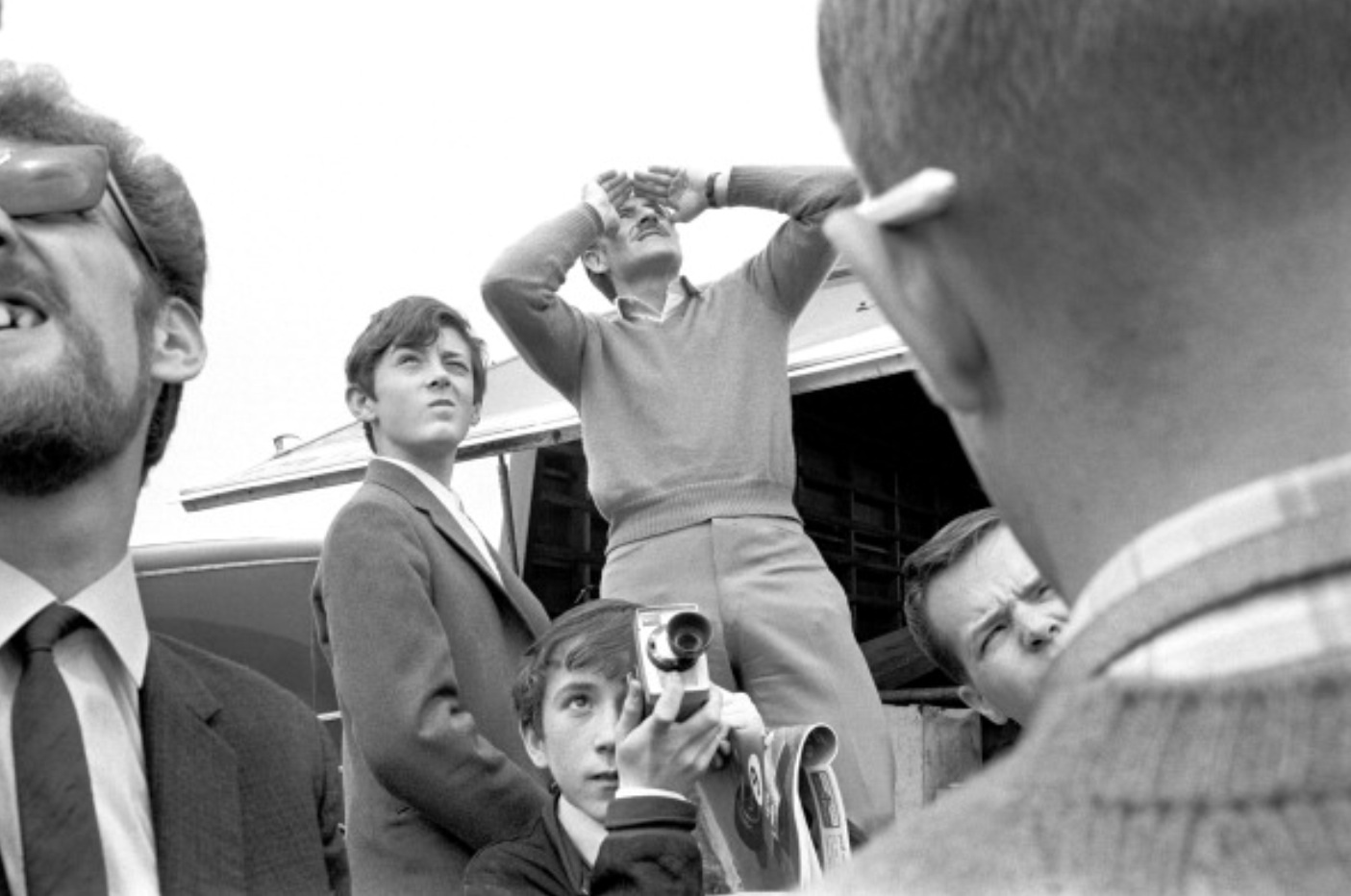
The expressions on the faces of this lot are priceless! G Hill and fans sussing out a Hawker Harrier Jump-Jet maybe…

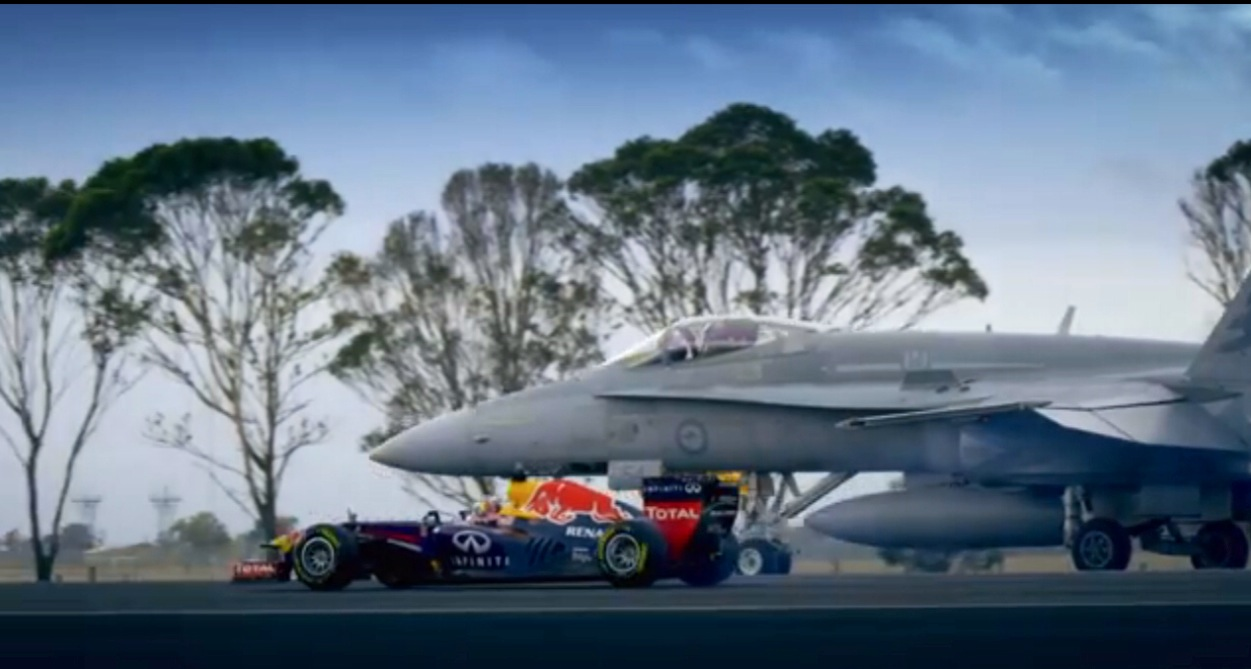
The showstopper at the Australian Grand Prix every year is the McDonnell Douglas FA18 Hornet, it always rather puts the performance of F1 cars and their ‘spectacle’ into context!

daniel

Red Bull and Hornet, AGP pre-promotion 2014 (RAAF)

I’ll never forget the first year in Adelaide, 1985 on the Thursday when a General Dynamics F111 fighter flew unannounced at ‘treetops height’, fast whilst we were strolling through the parklands. We hit the deck quicker than a Viet-Cong guerrilla, shouting ‘whatt the faaaaaaark wozzitt??!!’ as it roared past in the direction of North Adelaide.

The Graham Hill photo Getty Images caption is typically useless, it’s dated 1 January 1970, the circuit unidentified, praps one of you Poms can help?!

It’s either the ’69 or ’70 British GP I guess, ’69 at Silverstone maybe, the non-championship F1 races wouldn’t rate a Harrier?

image

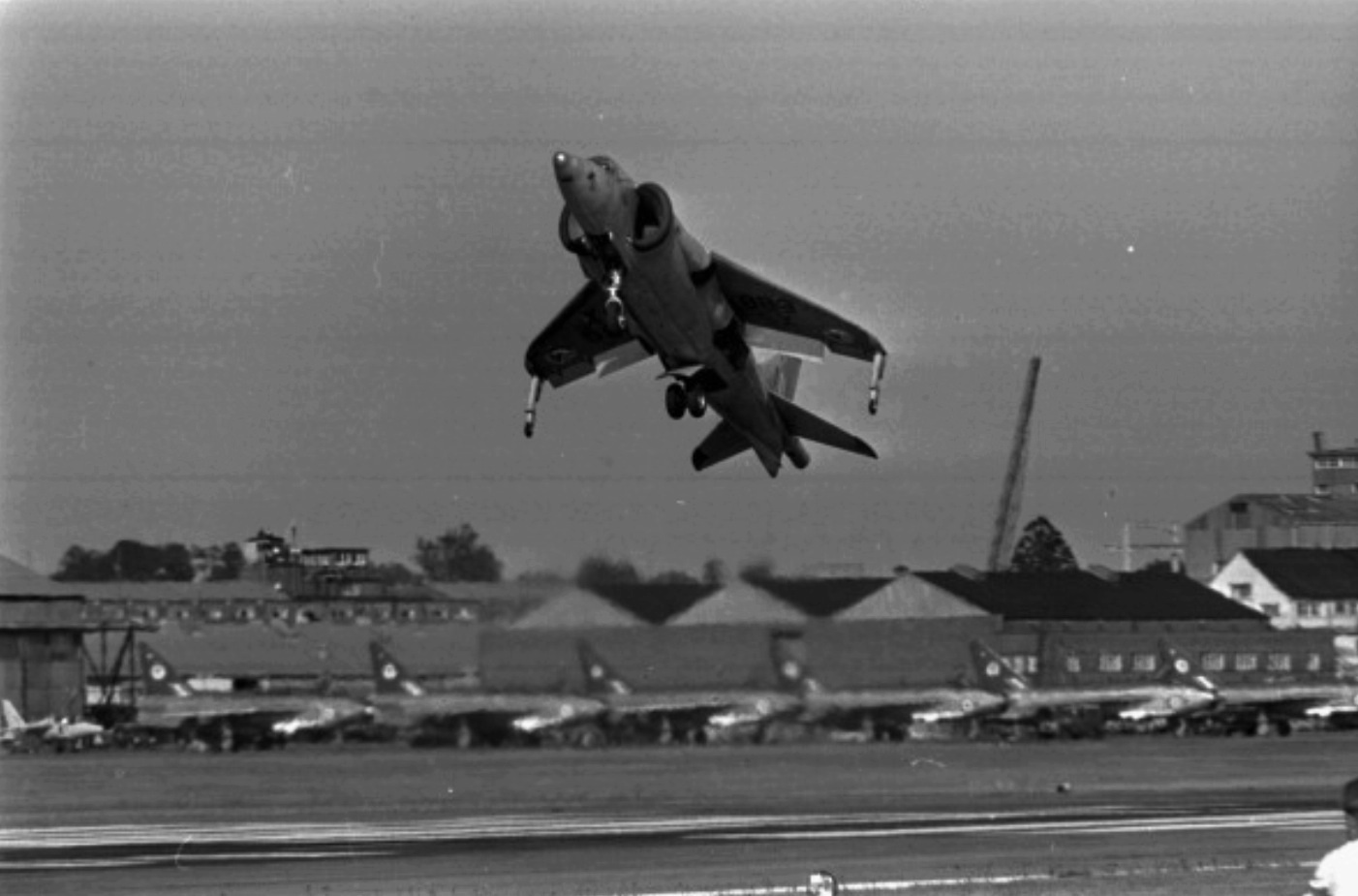
Hawker Siddeley P1127 prototype at Farnborough Air Show on 10 September 1964. Amazing V/STOL, vertical short take off and landing technology. The plane entered production as the Hawker Jump Jet (Victor Blackman)

Credit…

Susan Wood, RAAF

Tailpiece: Rubens, Ferrari and FA18…

rubens


Lotus 100T Renault…

Posted: April 12, 2016 in F1, Fotos
Tags: ,

image

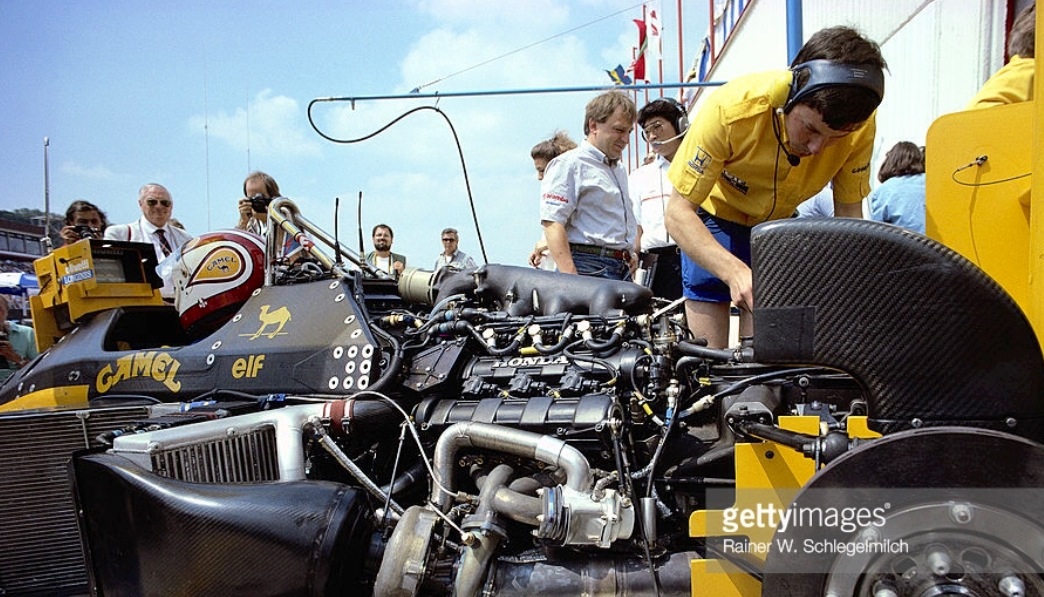
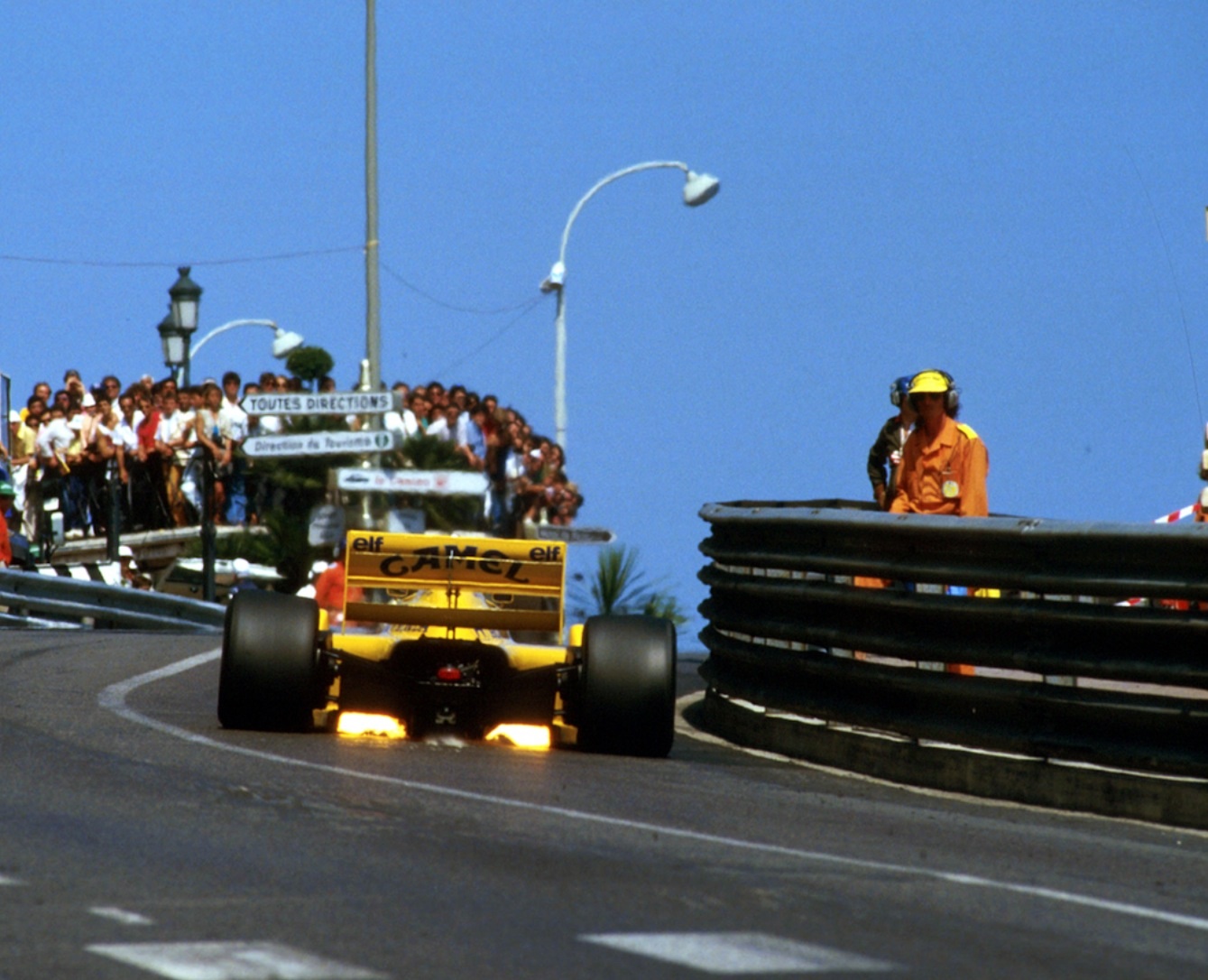
Nelson Piquet awaits ‘tweaks’ during Hungarian Grand Prix practice in 1988, it wasn’t a good weekend, Q13 and 8th, the race won by Senna’s McLaren Honda MP4/4…

The complex plumbing of the turbo-cars never ceases to amaze. It’s interesting to compare the architecture  of the successful 1984/5 Porsche TAG-Turbo ‘TTE P01’ engine; the packaging of which was specified by its customers chassis designer, McLaren’s John Barnard, and this Honda V6 which didn’t have a chassis man ‘standing on the engine designers chest’!

A rather successful series of engines all the same!

image

1984 Porsche-TAG ‘TTE P01’ 1.5 V6 engine in the McLaren MP4/2 chassis. John Barnard’s brief to Porsche was strongly driven by the brilliance of the Ford Cosworth DFV, the packaging of which was influenced, read prescribed by ‘chassis-man’ Colin Chapman. Distance across the cam-boxes, crank height and engine mount to chassis were ‘lifts’ from the DFV. Note ‘McLaren tail’, big de-aerating oil tank beside suspension rocker, low-slung KKK turbo, intercooler and carbon fibre tub, Barnard its pioneer as chassis material with the first MP4 McLaren in 1980 (Doug Nye)

Not a good year for Lotus, or anyone else, McLaren in the other Honda RA168E 1.5 V6 engined cars ‘disappeared into the sunset’, winning all but the Italian Grand Prix, Gerhard Berger took the Monza race for Ferrari; 7 wins for Prost and 8 for Senna, with Senna taking his first title and McLaren the constructors of course.

Credits…

Rainer Schlegelmilch, LAT, Doug Nye ‘History of The GP Car ’65-85’)

Tailpiece…

image

Piquet, Monaco 1988. Q11 and DNF after a lap 1 collision, race won by Prost’s McLaren (LAT)


image

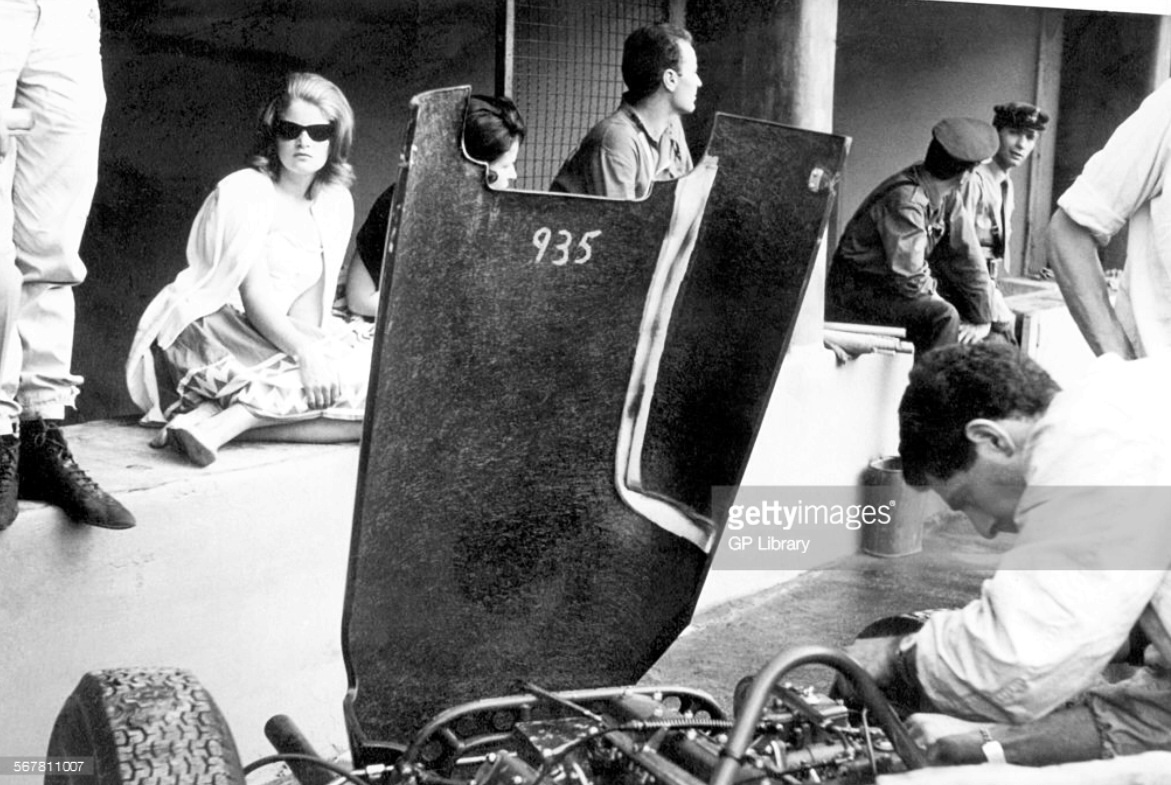
I was lookin’ for shots of chicks and cars as I do a fortnightly post of a babe with a car. When I spotted this image ’twas the lady who initially caught my eye…
But we ‘anoraks’ are so into chassis numbers right?

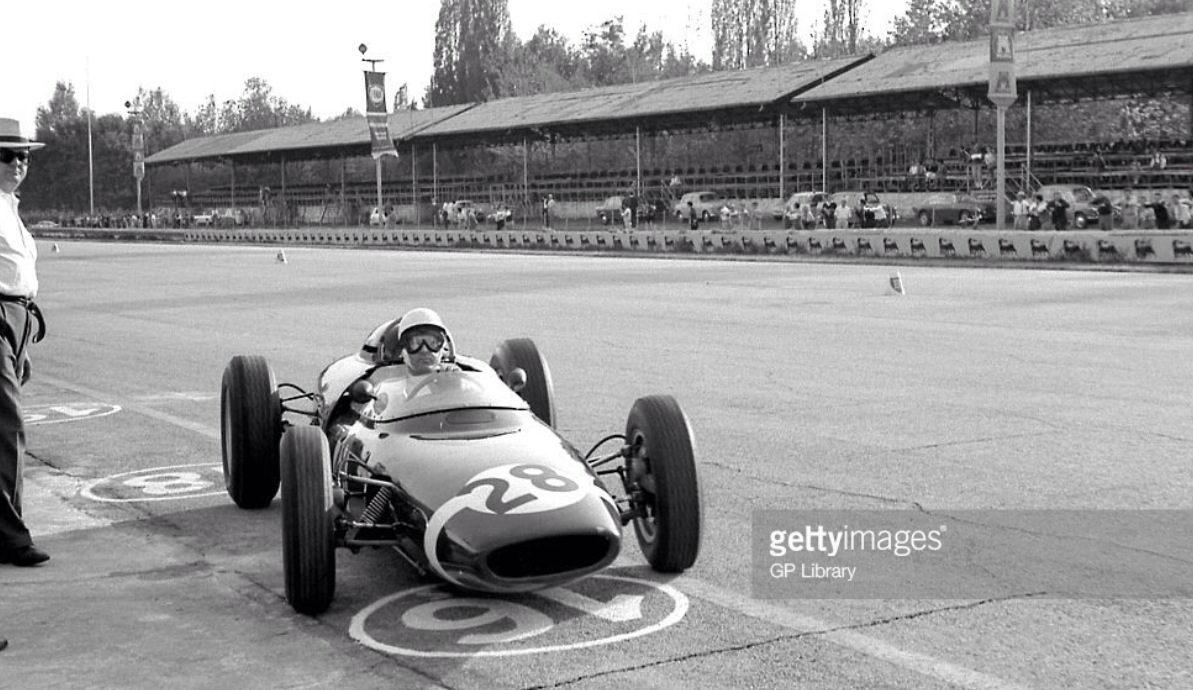
‘935’ on the engine cover stood out, a Lotus 18 number I thought- a quick google and no less an authority than DC Nye identified the car as a Lotus 21 delivered to Rob Walker, its locale Monza, lets come back to that.

Stirling Moss raced ‘935’ in the Australasian summer ‘Tasman’ races in early 1962.

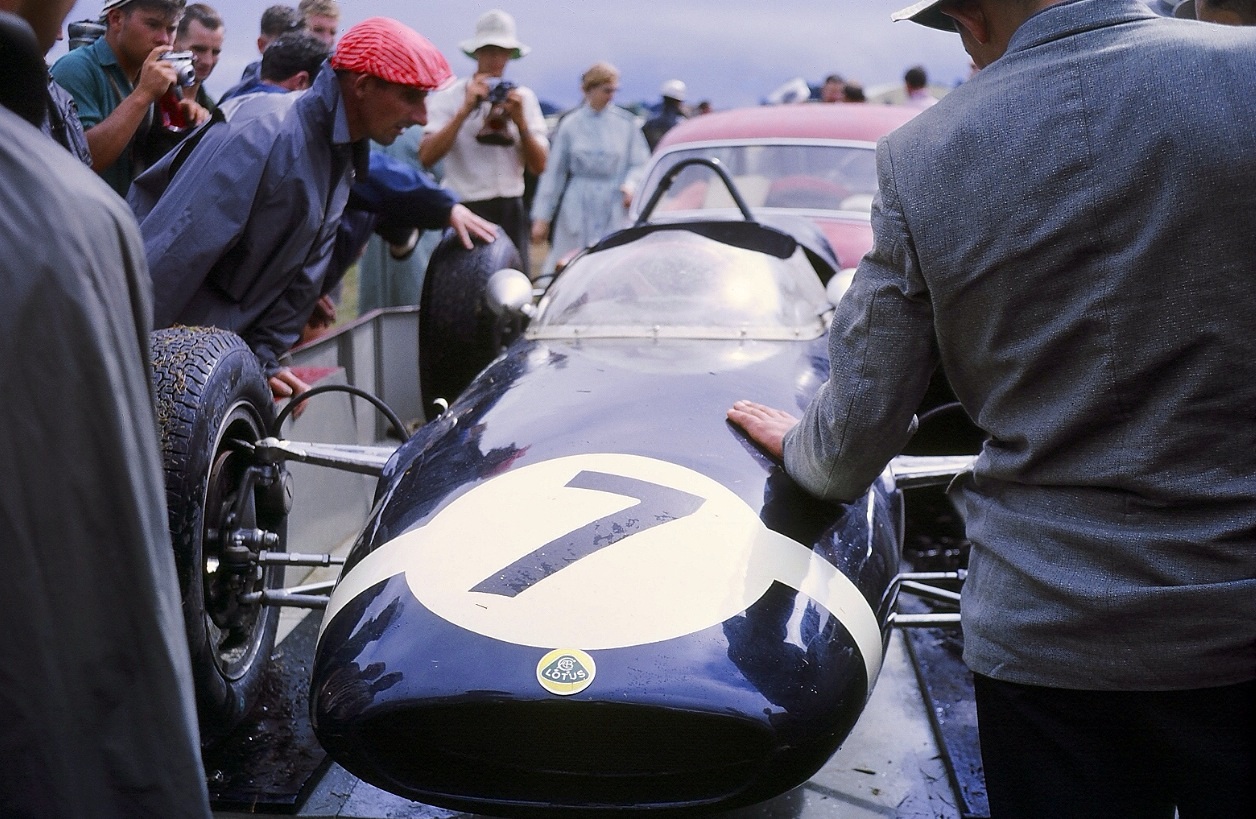
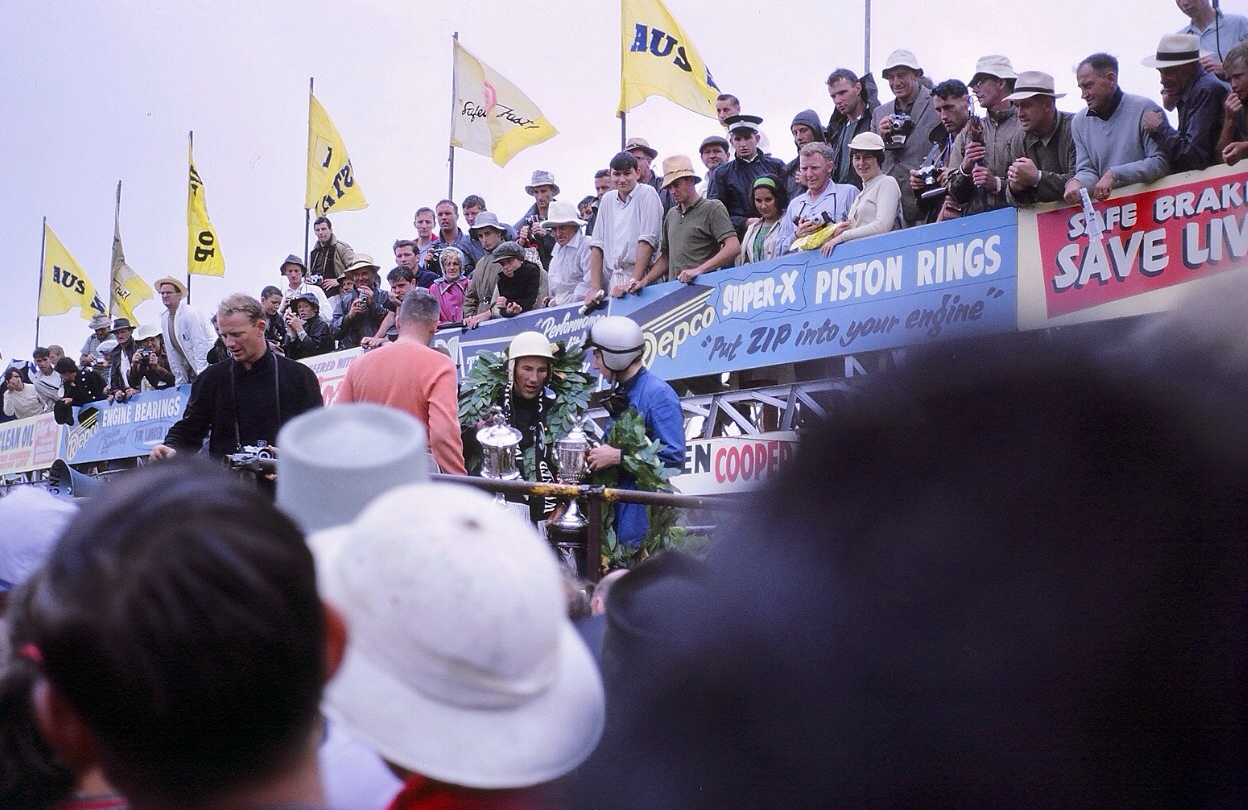
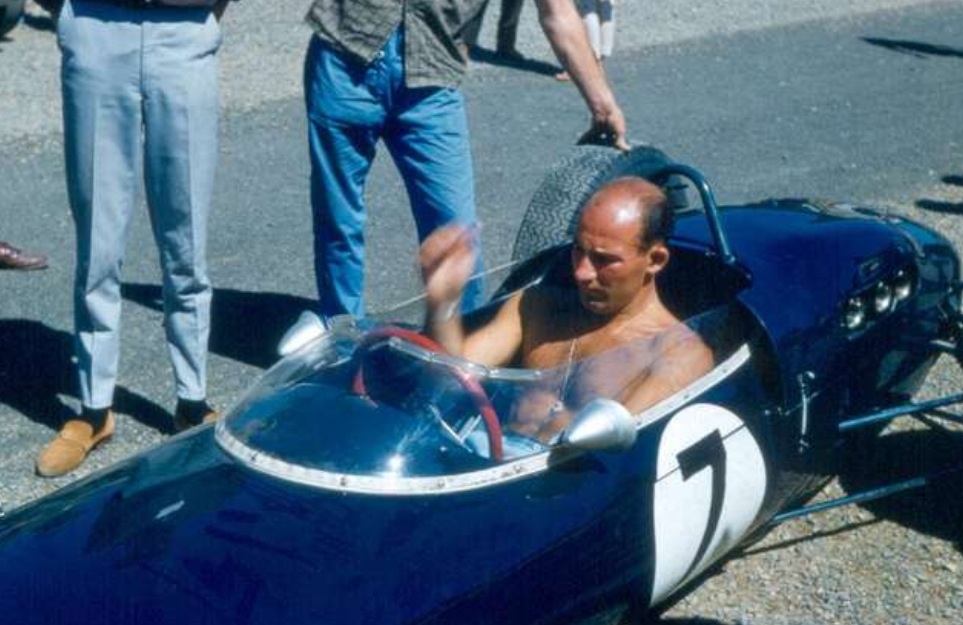
Here it is below after its victorious run in the very wet, Ardmore, New Zealand Grand Prix. I love the way the gent ‘touches the greatness of Moss’ by giving the Lotus an affectionate pat! ‘Red cap’, a more technical type of bloke is sussing the rear suspension of the 21 compared with the Lotus 18s from the year before.

image

(Stephen Page)

Lotus 21: The Forgotten Chapman GP Car?…
When you think about it Colin Chapman peaked early as an F1 designer.

His 1956 Vanwall, or rather his chassis design and choice of Frank Costin as it’s body designer/aerodynamicist was a GP winner, not too many fellas have done that with their first car.

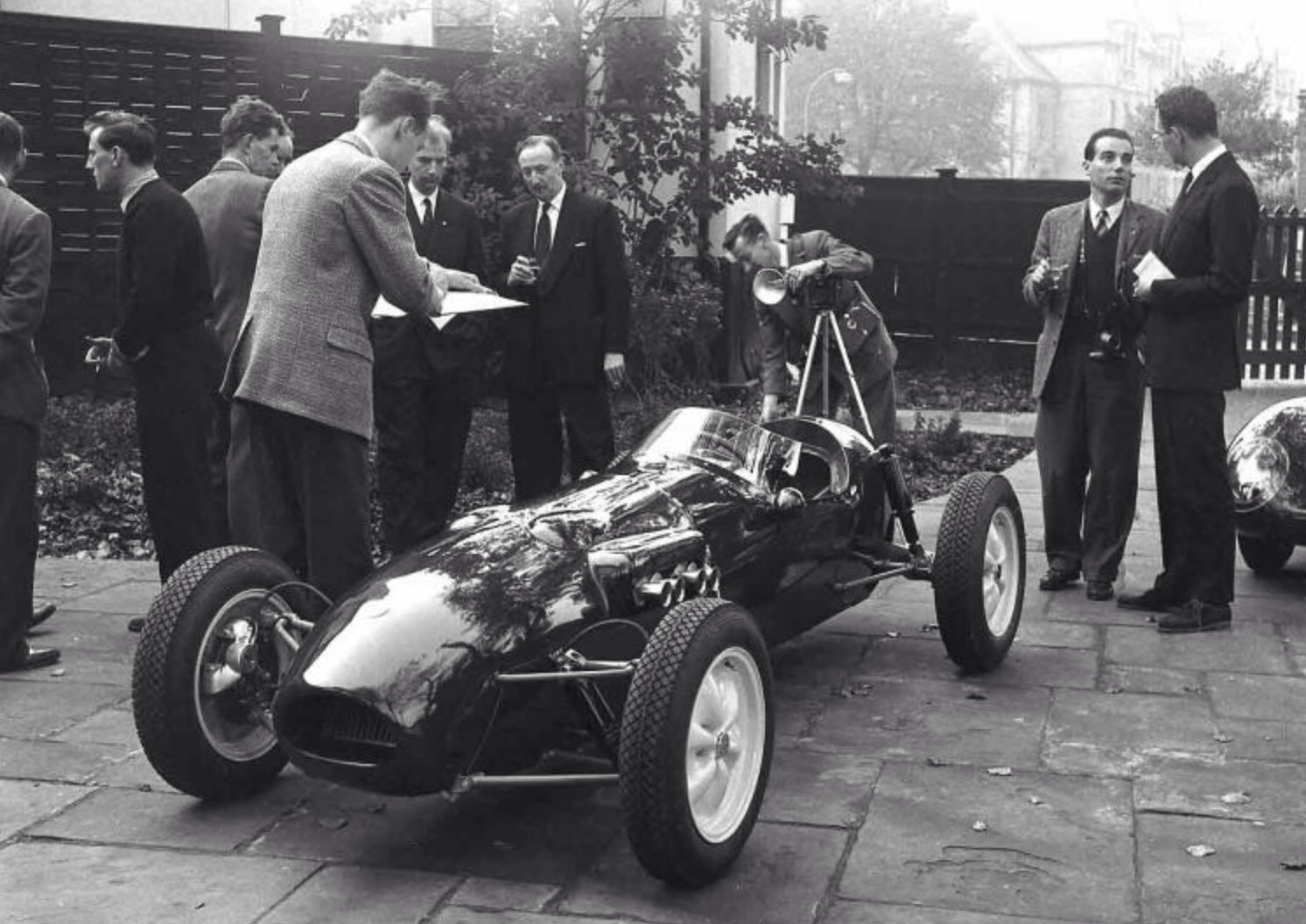
image

Press launch of the Lotus 12 Climax F2 car in 1956, note the extraordinary smallness of the car, the 12 and 16 remarkable bits of front-engined GP kit. Cliff Allison did 167mph in a Coventry Climax 2207cc FPF engined 12 on Masta Straight, Spa in 1958, with much of his small body outside the cockpit! He was fourth but famously could have won the race had it gone another lap as the first 3 cars all failed to complete the cool-down lap (John Ross)

His first Lotus GP design was the 16, Chapman always referred to the 12, which competed in Grands’ Prix from Monaco 1958, as an F2 car, the design was originally used in 1.5 litre racing before being fitted with Coventry Climax 1960cc and 2207cc engines for F1 use.

One of the things which intrigues me given his subsequent record as the designer/design inspiration for so many epochal cars is why Chapman didn’t design a mid-engined car for 1959? Cooper blazed that trail, GP winners from Argentina 1958, Moss of course taking that win in a Rob Walker Cooper T43 Climax.

image

Allison, tenth in the Lotus 16 Climax, Nurburgring 1958. Brooks won in a Vanwall, Lotus 16 famously the ‘Mini-Vanwall’, both Chapman chassis designs  (Klemantaski)

Whilst the front engined 12 is understandable, it appeared in late 1956 and was quite the smallest front engined ‘F1 car’ ever, the 16 shoulda’ been mid-engined?

The 16 was quick mind you, but fragile in both chassis and it’s ‘queerbox’, Lotus’ own gearbox which was unreliable largely due to one small set of dogs trying to pick up every gear. The 16 also didn’t receive a 2.5litre Climax FPF until later in the piece. But if Chapman set trends, and he did, he was a slowish adopter of the mid-engined trend.

image

Works Lotus 18 Climax, Zandvoort, Dutch GP 1960. Chapman was quick to refine the mid-engined paradigm! 2.5 litre CC FPF, 5 speed Lotus ‘box, rear suspension notable for lack of a top-link, the fixed length driveshafts performed locational duties as well as motive ones. This is Alan Stacey’s car, DNF gearbox on lap 57 from Q8. Ireland’s car was second from Q3, quick cars 18’s! Brabham won in his Cooper T53 Climax (Dave Friedman)

His first such design, the 18 was an immensely successful car in FJ, F2 and F1 specification.

Despite its ‘chubster, biscuit shaped’ looks it was the fastest 2.5 Litre F1 car of 1960 if not the most robust or reliable. No less than Moss himself had strong views on Chapman’s ‘marginal engineering’ of key components the failure of same caused some massive accidents.

image

Ireland, works Lotus 18 Climax, Monaco 1960, 9th in the race won by Moss’ similar car. Lotus’ first GP win (Dave Friedman)

Roll on into 1961, the first year of the 1.5 litre F1, the Brits were faced without a suitable engine as their ‘racing mafia’ were convinced the CSI, in the end, would not make the change to the smaller engines. They did, Ferrari the beneficiary with their 156, a car developed in F1/2 in 1960, click here for a story on that wonderful conveyance;

Ferrari’s first mid-engined Car: The 1960 Dino 246P…

Whilst BRM and Coventry Climax worked hard to get their V8’s completed all of the British firms persevered with Mk2 versions of the 1.5 litre Coventry Climax FPF- in 2.5 litre form the championship winning engine of 1959/60.

Chapman and his team had the dimensions of the coming Coventry Climax FWMV V8 when they set to work on the 21, their 1961 contender, but they knew initially the little, underpowered FPF would be used.

So, light weight and aerodynamic efficiency were key design tenets of the new Lotus 21.

These aims were achieved by lying the driver down in the cockpit, Chapman went further in 1962 with his 24/25 designs, but the trend was set by the 21. The car was notably small in size, low in frontal area, the body enveloping the chassis all the way to the casing of its ZF gearbox, specially made for the car. Have a look at a 21 beside a 156 and see just how ‘butch’ in size the Fazz is by comparison.

Chapman used a top rocker and lower wishbone for the cars front suspension, getting the spring/shocks outta the airstream, thus further adding to top speed. At the rear the suspension was outboard- single top link, inverted lower wishbone and coil spring/damper unit with twin radius rods for location.

image

Lotus 21 Climax FPF cutaway, specifications as per text (James Allington)

Lotus Components built eleven of the 21 chassis’ during the year, which otherwise in specification were leaders of the mid-engined paradigm- multi-tubular spaceframe chassis, Chapman the high priest of chassis design. Rack and pinion steering, discs on all four wheels, magnesium alloy (Lotus ‘wobbly web’) wheels, Ferrari still used heavy Borrani wires till 1963. The CC 1495cc, DOHC, 2 valve, all alloy, Weber carbed 4 cylinder engine gave circa 155bhp, the Lotus weighed 990lb, had an 89 inch wheelbase and a track of 53 inches front and rear.

The prototype was built from scratch in six weeks, just missing the Aintree 200 meeting but was tested at Silverstone two days later, the car made its debut at Monaco in May. The works cars in 1961 were steered by two Scots- Innes Ireland, the seasoned professional and up and coming Jim Clark who graduated from the works Lotus 18 FJ he raced in 1960.

Fitted with the new Coventry Climax V8 the Lotus 21 was a winning car in Moss’ hands if not Ireland’s or Clark’s.  But as it was Chapman didn’t get his hands on an FWMV in 1961 due at least in part to the spat he was having with Climax’ MD Leonard Lee about the quality of the CC FWE engines supplied for his Elite road cars- the engines weren’t the Elites only reliability problems mind you!

In the event the 21 won only one championship GP at Watkins Glen, Innes Ireland broke through for both Team Lotus and his first win that October.

image

Ireland’s winning Lotus 21 leads Gurney’s second placed Porsche 718 and Graham Hill’s fifth placed BRM P48/57 Climax, US GP Watkins Glen, 8 October 1961 (unattributed)

The cars chances of more wins were missed by Chapman’s decision not to sell Rob Walker his latest car, as he had with the 18 the year before. Moss’ two wins in 1961, remarkable ones, were in the Walker 18 at Monaco and 18/21 hybrid at the Nurburgring. Armed with a new 21 all year he may, praps have taken one or two wins off Ferrari despite the car’s relative ‘lack of puff’.

The 21 took wins in non-championship 1961 events- the Solitude GP for Ireland in July, the Flugplatzrennen at Zeltweg again for Ireland in September, and the Rand, Natal and South African Grands’ Prix in Jim Clark’s ‘African Tour’ in December 1961. As written here Moss did well in Australasia in early 1962.

The Lotus 21 should be remembered as both a GP winner and the progenitor of the design maxims Chapman’s ever creative mind evolved with the 1962 spaceframe  Lotus 24 and it’s revolutionary monocoque sibling, the 25.

image

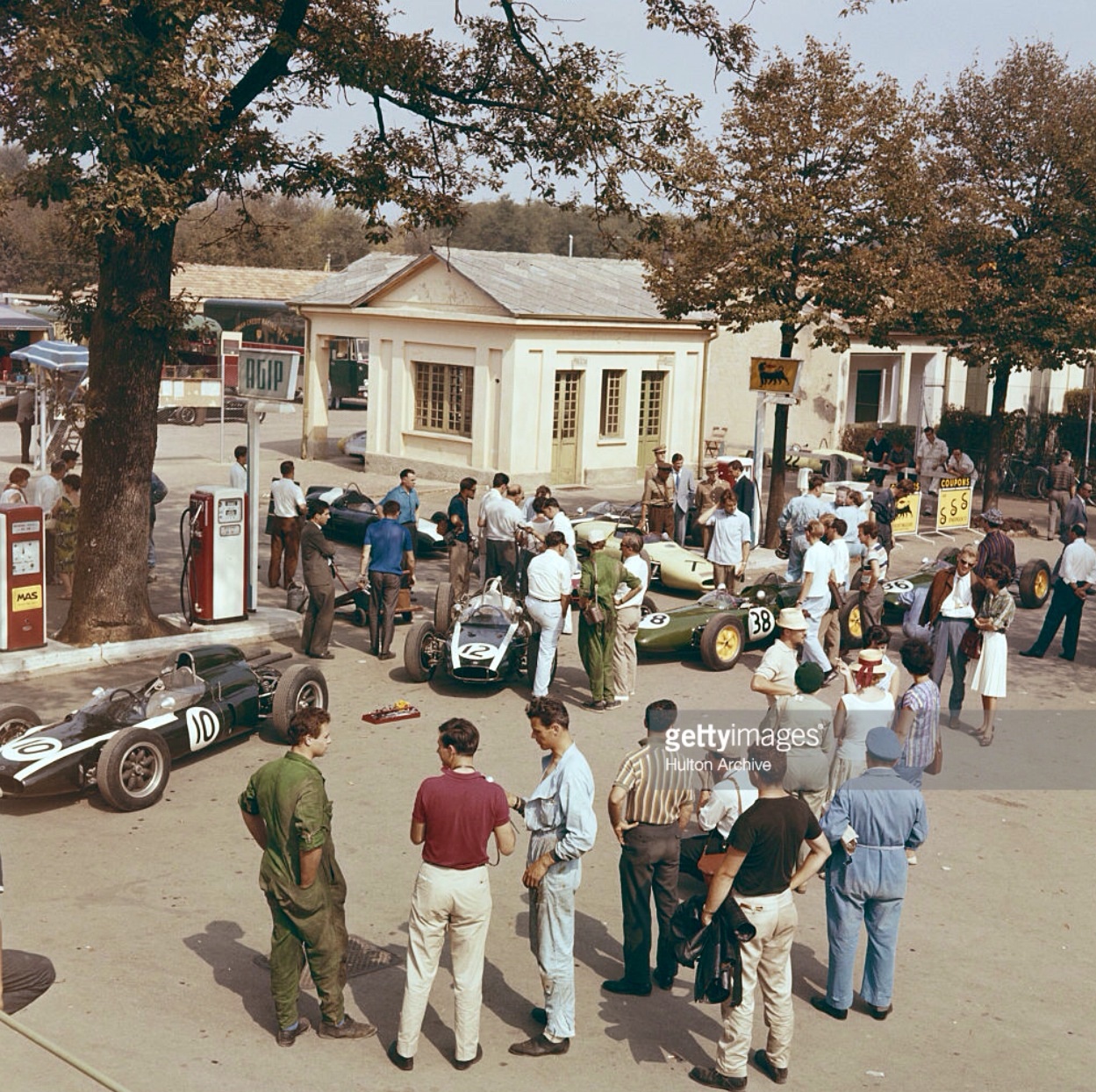
Love the atmospherics of this 1961 Italian GP, Monza paddock shot. #10 is Brabham’s Cooper T58 CC V8, contrast it with McLaren’s #12 CC FPF powered T55 behind. #38 and 36 are the Ireland/Clark Lotus 21 CC FPF’s before the ‘jiggery pokery’ with the chassis swap between Innes and Stirling. The pale green painted ‘T’car is UDT-Laystall’s spare, the Cooper T51 is Jack Lewis’ (Hutton Archive)

Moss’ first drive of a Lotus 21 was his steer of  Innes Ireland’s works car at Monza on 10 September.

That weekend was infamous for the tragic race collision between Jim Clark’s Lotus 21 and Taffy von Trips Ferrari 156 which resulted in von Trips death as well as that of 15 innocent spectators.

Moss took Lotus’ first ever GP win at Monaco in May. Whilst Chapman was eternally grateful he wasn’t inclined to give Moss or Walker too much of a ‘free-kick’ by selling them his latest car, the 21, given his primary aim was works car wins. In fact its probably Esso we have to blame as they were Lotus’ fuel supplier, BP were the sponsor of Rob Walker/Moss, both companies had their commercial positions to protect.

image

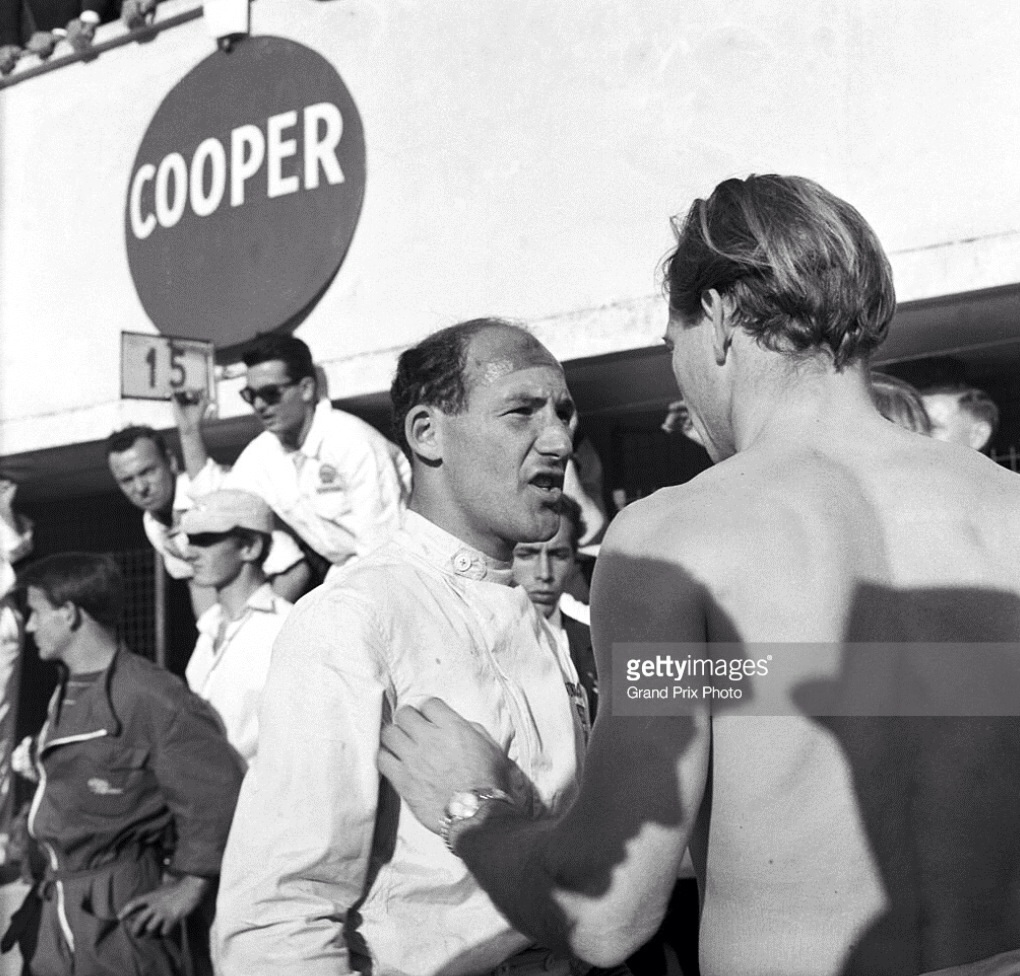
Moss and Ireland swapping notes at Monza, Italian GP, September 1961 (GP Photo)

The Monza weekend was also significant for the first race appearance of the new 1.5 litre BRM P56 V8 and the further appearance of the Coventry Climax FWMV V8 first raced by Jack Brabham at the Nurburgring the month before.

Jack qualified his new Cooper T58 on grid 2 in the Eifel Mountains but crashed on lap 1 with a sticking throttle so the engine hadn’t been race-tested.

The P56 V8’s were fitted to modified BRM P48/57 chassis, the CC V8 to Jack’s Cooper and a specially modified Lotus 18/21 built up by the Walker Team. Team Lotus were unable to secure an engine as noted earlier, so appeared in 21’s powered by the 1.5 litre 4 cylinder FPF Mk2 used by the British teams, including BRM that year.

BRM tested their new engines with no intention to race them, Brabham raced his Cooper despite problems in practice.

Moss was sportingly offered Ireland’s factory 21 FPF, chassis ‘933’. Chapman and Ireland reasoned that Moss would have a better chance of success in a 21 rather than the tired Walker 18/21. Moss was the only Lotus driver with a vague (very) chance at the World Championship, Ireland raced the Walker 18/21 FPF engined car. In Denis Jenkinson’s race account he writes about the ‘cloak and dagger’ stuff behind closed garages to make the necessary change of chassis and body work between Moss and Ireland, the secretive stuff was doubtless so as not to upset the trade supporters of both teams.

Which brings us back to ‘ole 935’ and the photo at this articles outset.

The two works Lotus Monza chassis according to Nye’s ‘Theme Lotus’ were ‘933’ and ‘934’. If ‘935’ was at Monza there was no point making the chassis and bodywork changes between the Moss/Ireland cars both Jenkinson and Nye report took place. If ‘935’ were at Monza either as a works spare or delivered to the Walker Team Moss would have raced it and Ireland his regular works 21 rather than the inferior Walker 18/21.

So, whats the explanation of the photo then?

Either it isn’t Monza, although i am inclined to believe Nye who has been there once or twice! The probable story is that the engine cover of the new ‘935’ was ‘borrowed’ and fitted to one of the works Lotus 21’s for the weekend. The first race entry for ‘935’ i can find, looking at non-championship and championship Grands’ Prix results later in 1961 seems be its races in New Zealand in early 1962-the 1962 NZ GP report by sergent.com describes ‘935’ as unraced before that event on 6 January.

image

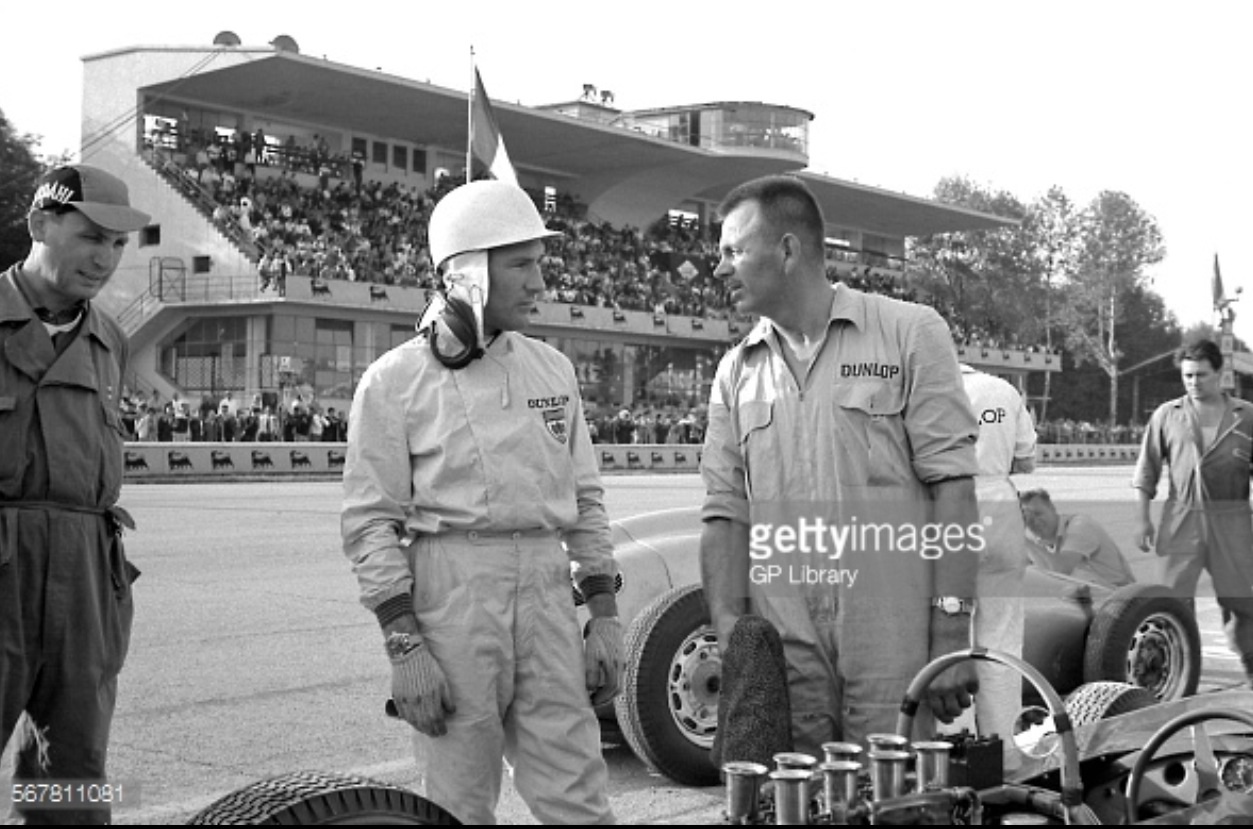
Moss and Alf Francis confer during Monza practice, by the look of it neither are ‘happy campers’, the Lotus 18/21 CC FWMV  chassis #’906′ was always a handful (GP Library)

The Moss 18/21 was modified to fit the FWMV V8 with the assistance of Ferguson Research.

The rear of the 18 chassis aft of the drivers seat was ‘chopped off’ and replaced with a frame to suit the width and mounting needs of the new engine. 21 rear suspension was incorporated comprising new 21 uprights which were located at the top by a link to the chassis thus relieving the half shafts of the suspension loads the solid ‘shafts of the 18 performed- the new components had Hardy Spicer splined shafts to accommodate ‘plunge and droop’.

A Colotti Type 32 gearbox was used. The rear framework was a complete assembly which attached to the main frame by large bolts screwed into the ends of the tubes, which had been plugged and tapped. The structure was made from small diameter tubing which had to be detached completely before the engine and gearbox could be removed. The car was finished in a big hurry so the old Lotus engine cover was retained with a bulge to clear the four downdraft Webers.

Whilst no-doubt well engineered it doesn’t all add up to the levels of torsional stiffness no doubt required to put all of the new engines power to the ground effectively.

During the race the tragic accident between Clark and von Trips occurred on the first lap, the German and hapless spectators killed, the race continued whilst the carnage was attended to.

Moss retired on lap 36 with wheel bearing failure, Ireland on lap 5 with chassis problems and Brabham’s FWMV failed on lap 8 due to overheating problems- shortcomings sorted over the winter off-season.

Phil Hill’s Ferrari 156 won the race and  1961 title from Gurney’s Porsche 718 and McLaren’s Cooper T55 FPF.

image

The Walker Lotus 18/21 CC V8 during 1961 Monza practice (GP Library)


image

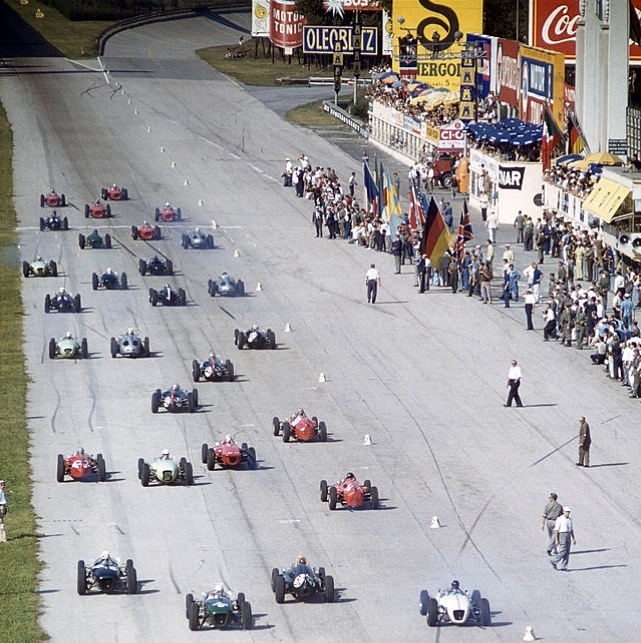
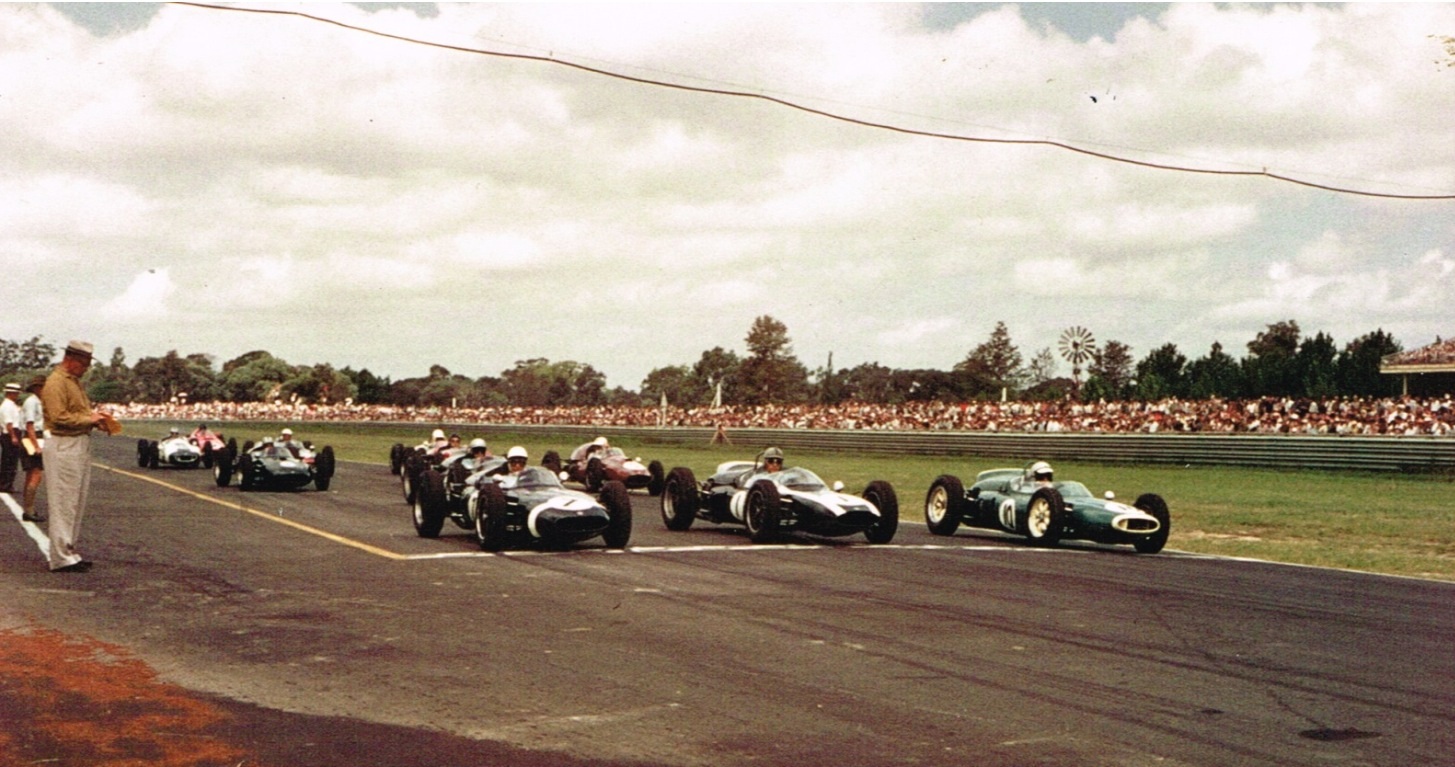
Italian GP ’61 start with a swag of 5 Ferrari’s up front, leading green car at left is probably Hill G’s BRM Climax, Clark is between Hill and a Ferrari, thats Gurney’s Porsche 718 on the right from grid 12, the carnage took place shortly thereafter (Klemantaski)


image

Moss in the Walker bodied works Lotus 21 CC FPF during the race, dicing with Gurney’s 2nd placed Porsche 718 (GP Library)

New Zealand…

Over that 1962 European winter Coventry Climax worked on the reliability of the FWMV and BRM their P56 V8 and the P578 chassis to carry it. At Cheshunt Colin Chapman was building the spaceframe 24 and its epochal monocoque sibling, the Lotus 25.

Both marques were the key players in an amazing 1962 season which in the main didn’t feature Stirling Moss, whose Glover Trophy career ending accident took place on Easter Monday 23 April 1962 in the Walker Lotus 18/21 Climax V8 ‘906’ described above.

The Walker Team would make do with their 18/21 in GP’s, later in the season they raced two Lotus 24 FWMV’s but by the time they were ready Moss’ career was finito.

image

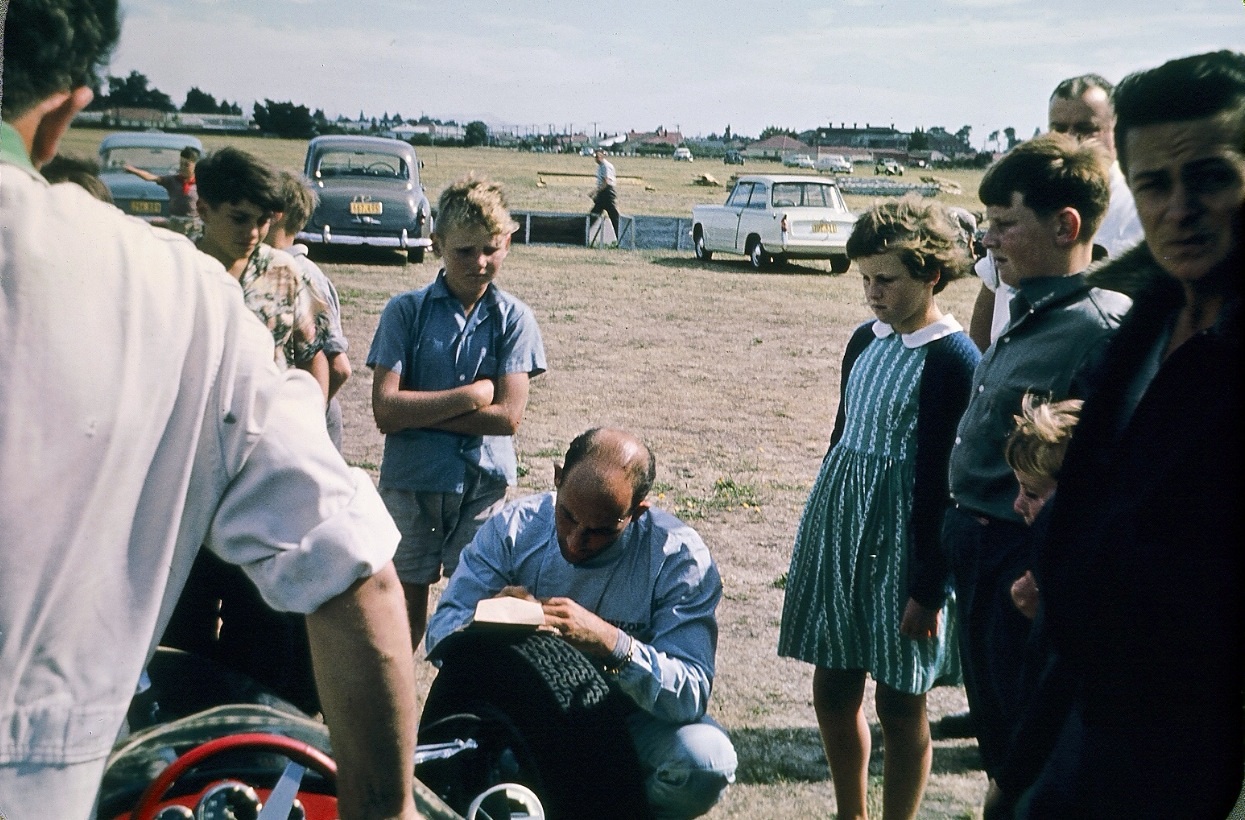
Moss looking after the fans, Kiwi kiddies drawn to the great Brit, Ardmore NZGP meeting. Car is 21 ‘935’ (Stephen Page)

For Moss, in the meantime there were the annual summer internationals to contest in Australasia.

Whilst Stirling loved the speed of his Lotus he revelled in the forgiving ‘chuckability’ and robustness of Coopers. Robust is not an apt adjective to describe the Lotus single-seaters of the period. So, hedging his bets for his 1962 Australasian Tour he had Rob Walker ship both ‘935’ as well as a Cooper T55 ‘F1-7-61’  on the long voyage south. Both cars were Coventry Climax FPF powered- engines of both 2.5 and 2.7 litres capacity were used, our International Series was run to Formula Libre in its pre-Tasman Cup formula days.

image

Moss and second placed Surtees on the Ardmore victory dais (Stephen Page)

Moss raced the Lotus to an NZ GP win at Ardmore on 6 January and at the Wigram Airfield circuit event fitted with 2.5 litre FPF’s. At Levin and Teretonga he was second in the Cooper powered by a 2.7 FPF, Brabham won at Levin and McLaren at Teretonga- so Moss’ campaign had started well.

image

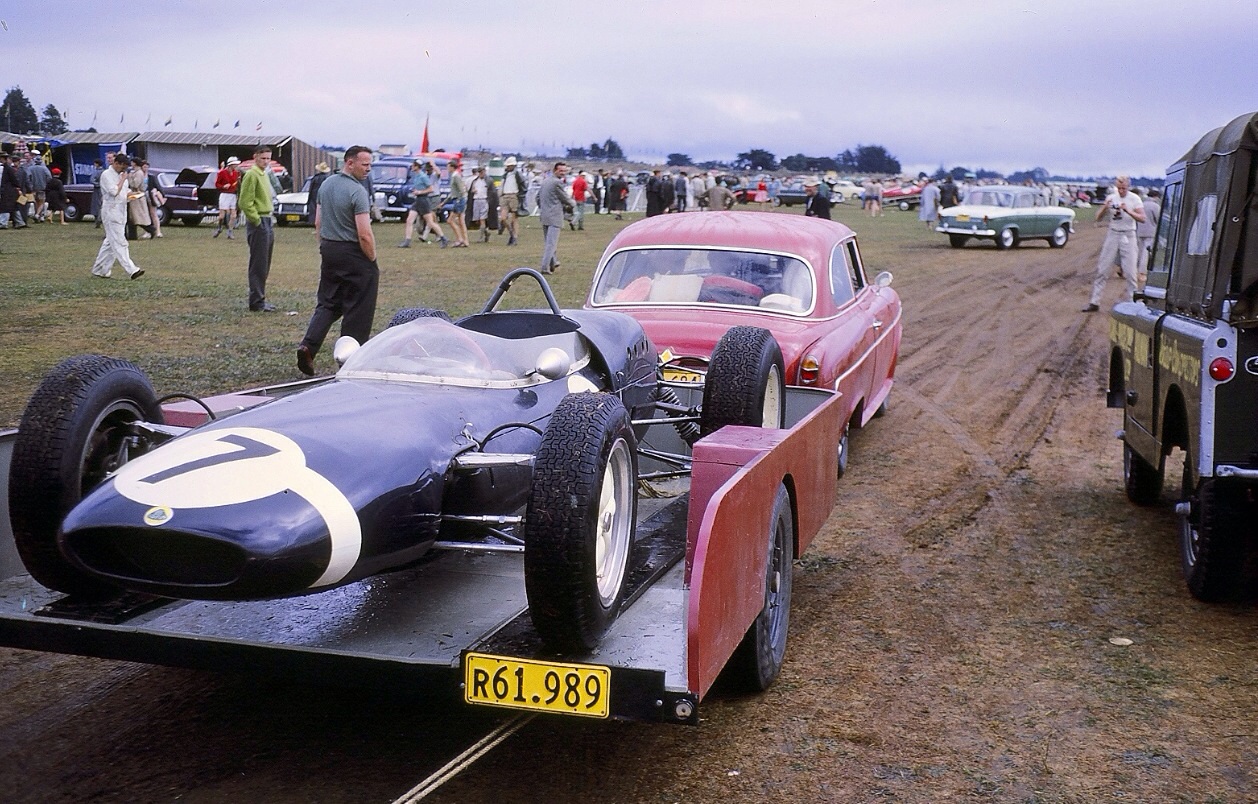
Borgward Isabella and 21 off to the next round of the NZ Internationals at Levin. Shot shows the inboard front suspension, the top rocker actuating inboard mounted spring/shock. At the rear is a single top link, reversed lower wishbone, outboard spring/shock and twin radius rods. Extreme lowness clear as is the slippery nature of the body and reduction in driver space which advanced as a trend over the following decades!  (Stephen Page)

The NZ Internationals were contested by Moss, Surtees, McLaren and Salvadori, the latter three drivers in Cooper T53 Climaxes, Bandini in a Cooper T53 Maserati, Brabham a Cooper T55 Climax and Ron Flockhart, a Lotus 18 Climax.

Chris Amon made his first international appearances that summer in the ex-BRM/Brabham Maser 250F, other ‘local heroes’ were Pat Hoare Ferrari 246/256 V12, Angus Hyslop, Cooper T53 Climax and Aussies Bib Stillwell, Aston Martin DBR4/250, David McKay, Cooper T51 Climax and Arnold Glass’ in a BRM P48.

Moss ‘brained’ the NZGP field in an awful, wet race- he lapped the field winning from Surtees, McLaren and Salvadori.

Australia…

image

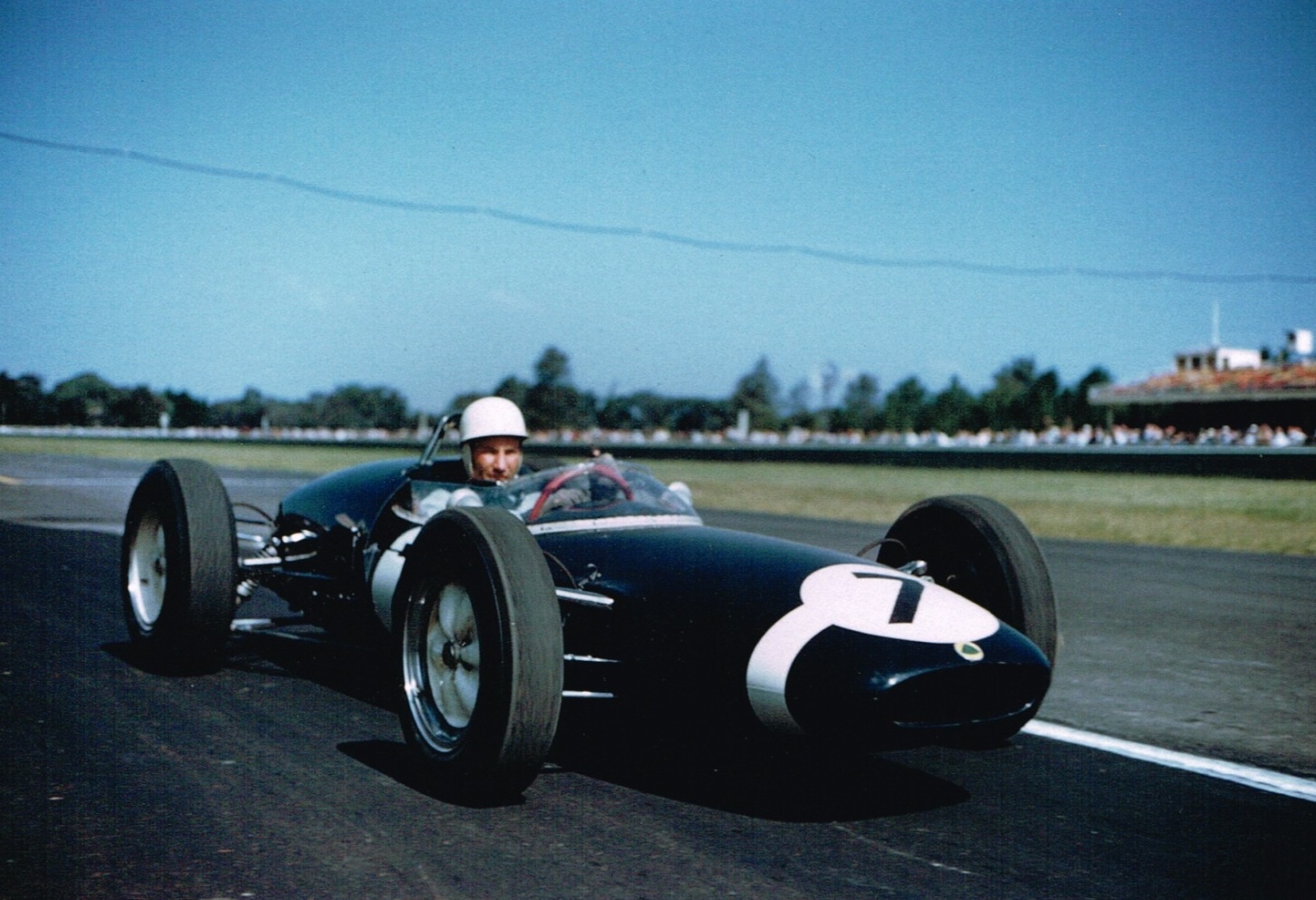
Beautiful shot of Moss in the Walker Lotus 21 Climax 2.5 ‘935’ on Warwick Farm’s pit straight, he practised the car but raced the more ‘chuckable’ Cooper (Mal Simpson)

The cars were then shipped to Sydney, the first race of the Australian leg was the ‘Warwick Farm 100’ on the testing, technical outer western Sydney circuit on 4 February.

Moss practised both cars but elected to race the Cooper to a race win from McLaren and Stillwell.

image

Moss in his Lotus 21 passes John Youl sneaking a peek over his shoulder, Cooper T51 Climax during WF practice. Youl DNF in the 2.2 litre car with clutch problems in the race, the Taswegian a very quick steerer (John Ellacott)


image

WF 100 front row, 4 February 1962- Moss, Brabham, McLaren in Coopers T53, T55, T53 (Mal Simpson)

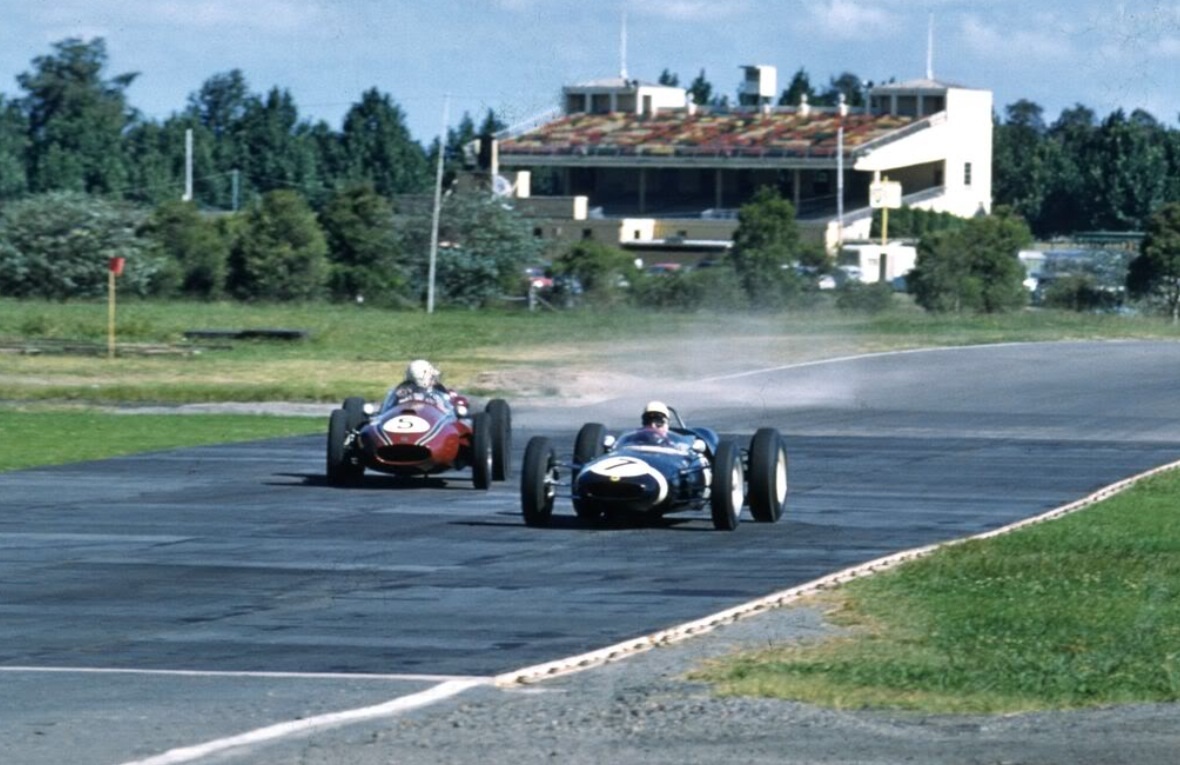
Moss missed the Lakeside event won by Brabham’s T55 Cooper and Longford’s ‘South Pacific Championship’ race won by Surtees Cooper T53 Climax but raced ‘935’ fitted with a 2.7 litre FPF at the Australian Grand Prix, Sandown’s inaugural meeting on 12 March.

Jack Brabham won the race in his 2.7 engined Cooper from Surtees, McLaren and Chuck Daigh in the very interesting Scarab RE Buick V8, the cars only race- read my Chuck Daigh article for that cars interesting story.

image

Moss cruises the Sandown paddock in the 2.7 ‘Indy’ FPF engined Lotus ‘935’, March 1962. The man absolutely the best and fastest driver in the world at the time (Kevin Drage)

In between these Australian events, reinforcing the regularity and intensity of his racing schedule, Moss raced in the Daytona 3 Hours, finishing fourth in a Ferrari 250 GT SWB on 11 February.

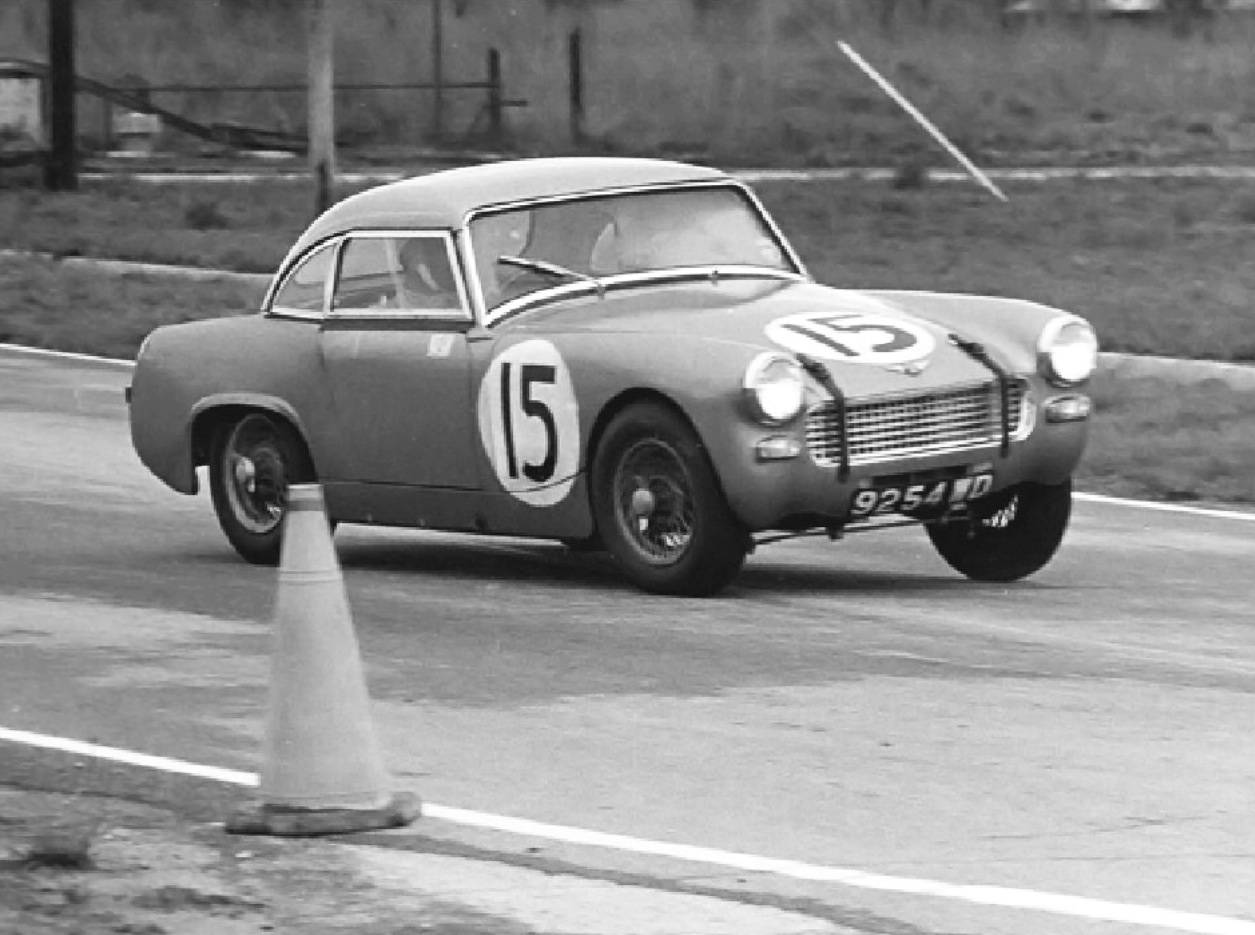
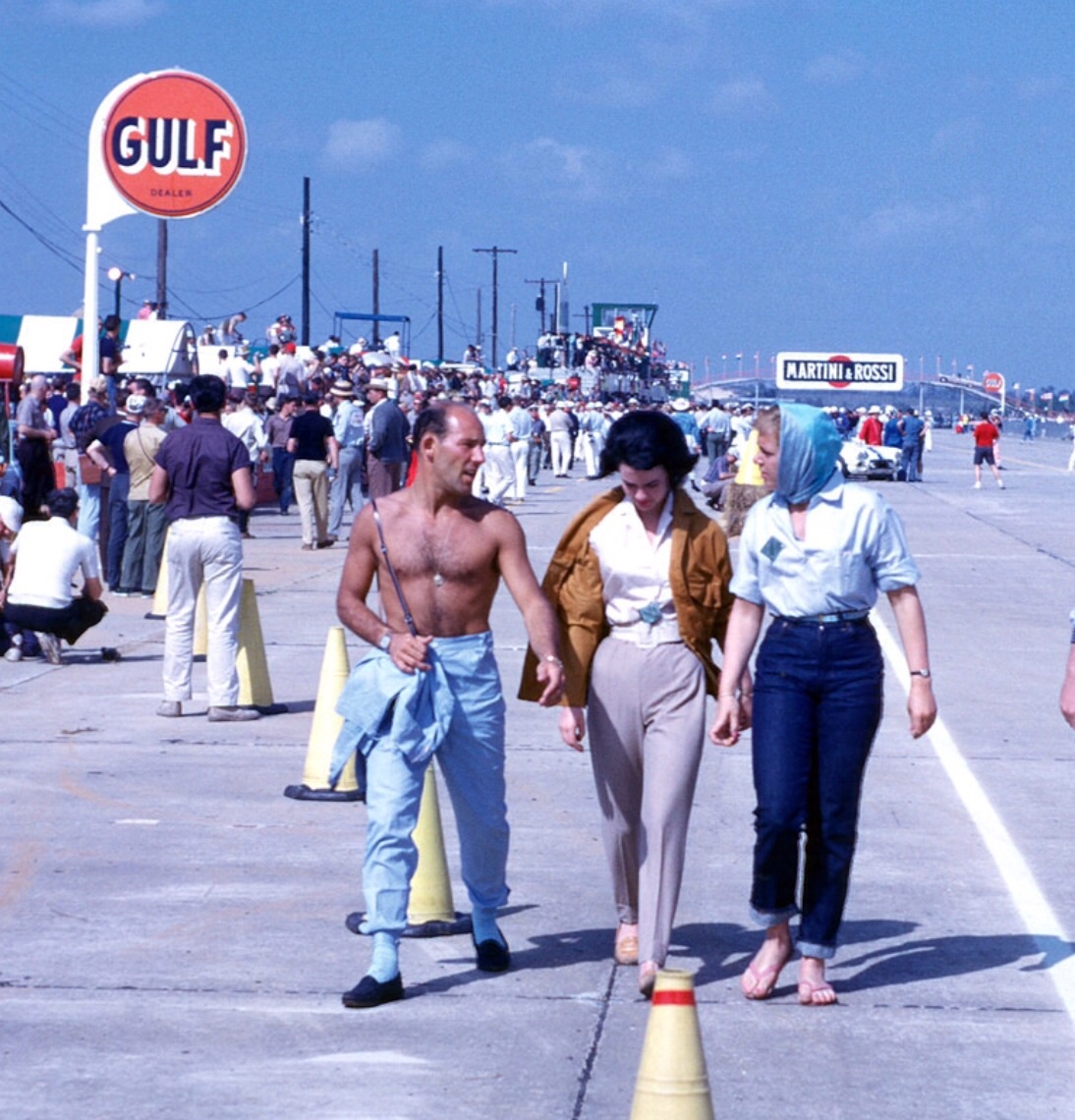
After Sandown he returned to the US to contest the Sebring 3 Hours and Sebring 24 Hours on 23/24 March finishing third in an Austin Healey Sprite and DNF in a NART Ferrari Dino 248SP respectively.

image

Moss, AH Sprite, Sebring 3 Hour 1962 (Tom Bigelow)


image

Moss, maidens, Sebring 1962. That he was in such great physical shape no doubt a factor in his attraction to the babes but it  also stood him in good stead in surviving the horrific Goodwood shunt, surgery and month long coma (Tom Bigelow)

Moss then returned to Europe for the 1 April GP of Brussels and Lombank Trophy at Snetterton on 14 April yielding second and seventh in the Walker Lotus 18/21 FWMV V8 ‘906’ before that fateful day at Goodwood on 23 April.

image

Moss, Goodwood, Lotus 18/21 ‘906’ not long before the prang, Easter Monday 1962 (Doug Nye)


image

It took over an hour to cut Stirling free from the mortally wounded Lotus. One of the things I have learned and detest in researching various pieces is the vast number of gruesome images of racing crashes on the internet- you won’t ever see them here, I am all for ‘freedom of the press’ but believe there is a place for censorship of said images (Victor Blackman)

Moss was an enormously popular visitor to Australia from the mid-fifties, sadly his Goodwood 1962 accident was not too far away during his early 1962 tour.

His Antipodean fans never forgot him though.

We turned out in droves to see his ‘comeback’ drive in a Holden Torana L34 V8 at Bathurst in 1976, he shared the car with Jack Brabham. The all-star combination had a shocker of a race when Jack copped a Triumph Dolomite ‘up the arse’ on the startline thanks to his Holden’s clutch failure.

Brabham was stranded as the rest of the field moved post-haste towards Hell Corner, the unsighted Dolly was an innocent victim of Black-Jacks misfortune, the car was patched up but Jack and Stirling failed to finish, a great shame!

Moss, a great man, ’tis wonderful he remains one of our sports great ambassadors.

image

Brabham/ Moss, Holden Torana L34, Bathurst 1976 (Autopics)


image

Moss and Brabham at Bathurst in ’76, that’s Scuderia Veloce’s David McKay in between (autopics.com)

Bibliography…

Automobile Year, MotorSport 1961 Italian GP race report by Denis Jenkinson, Doug Nye ‘Theme Lotus’, William Taylor ‘The Lotus Book’, oldracingcars.com, GP Encyclopaedia, silhouet.com, Team Dan

Photo Credits…

GP Library, James Allington, Mal Simpson, Kevin Drage, Stephen Page, John Ellacott, Klemantaski Collection, John Ross Motor Racing Archive, Dave Friedman Collection, autopics.com, Victor Blackman, Doug Nye, Tom Bigelow

Tailpiece: The future. Jim Clark at Sandown, Lotus 21 Climax ‘933’, World Champion in the new, epochal monocoque Lotus 25 within two years and a GP winner within months. Here with the lower sidepanel removed due to Melbourne summer heat…

image

(Kevin Drage)

Finito…


bruce

Bruce McLaren poses for this studio shot on 26 April 1967…

He was the all-rounder; tester, driver, designer, engineer, company director…and male model! I bet Teddy Mayer had to twist his arm for this job tho. ‘Daily Express’ shot so it was possibly to go with a feature on the multi-talented Kiwi Champion.

A good year, the team took its first Can Am title, Bruce winning in the M6A Chev he co-designed with Robin Herd. He raced a factory Ford GT40 Mk4, in sports car events, one of Dan Gurney’s Eagle T1G’s whilst his own GP car was made race-ready, then of course there were the Elva built customer cars to consider and sponsors to look after. And a company to run…

Credit: McKeown/Getty Images, Dave Friedman Archive, The Enthusiast Network

image

McLaren and his M6A Chev at the 1967 Road America Can Am, Denny Hulme won this round. Look closely and you can see the ‘McLaren Engines Flower Power’ decal on the 6 litre, injected, ‘Heavy-Chevys’ rocker cover! (Dave Friedman)

image

Bruce McLaren, Road America September 1967. DNF with an oil leak from grid 1. Hulme in the other M6A took the win  (Dave Friedman)


Tailpiece: Las Vegas sunset, Stardust Raceway, Bruce McLaren and M6A Chev, 14 November 1967…

image

Not a good race weekend for Bruce as he blew an engine from grid 1, but he did win the ’67 championship! Surtees took the round win in his Lola T70 Mk3B Chev (The Enthusiast Network)


tim

‘Don’t worry about the T-Shirt Tim, it was the only one in the cupboard this morning! Go quicker than him and I’ll  make some with your name on them!?’…

FW exhorting Tim Schenken to get more speed from his steed.

Frank Williams raced the De Tomaso 505 Ford in 1970, a car designed for him by Gianpaolo Dallara. But it was shitbox, nowhere near as fast as the second-hand Brabham BT26 Frank ran in 1969 for his great friend Piers Courage. He drove with skill and conviction, second place the seasons highpoint at Watkins Glen in the US GP.

The De Tomaso was slow, too heavy amongst other shortcomings from the start, Piers Courage died in it at Zandvoort. I’m not suggesting a component failure was the accident’s cause but perhaps trying too hard to compensate for its lack of pace was.

image

Piers Courage, De Tomaso 505 Ford, Zandvoort, 21 June 1970. He qualified the car 9th, was in 7th place on lap 22 when he ran wide into a sand bank, hit a post, overturned the car which then caught fire. Rindt won, the Lotus 72’s first win, no joy for Jochen, his close friend died (unattributed)


Brian Redman raced the car for FW at Clermont Ferrand and Hockenheim, Tim took over the drive at  the Osterreichring, Monza, Mosport and Watkins Glen. He retired in every event except Mosport where he was not classified but qualified 17th, his best ‘result’.

image

Schenken, 16 August, Zeltweg, Austria 1970, DNF on lap 25 with engine failure, Q19. Ickx won in a Ferrari 312B (unattributed)

Schenken made the most of the opportunity FW gave him, he was recruited by Ron Tauranac for 1971, Jack Brabham retired that winter, Tim was teamed with Graham Hill who drove the problematic BT34. Tim raced the year old but still very quick BT33, his best placings 6th and 3rd at the Nurburgring and Osterreichring respectively.

Bernie Ecclestone bought Brabham during 1972, Tim was uncertain about Bernard Charles ability to run the team and left for Surtees, he was later to rue ’twas not the best career decision i ever made’…

tim

Schenken in the Williams De Tomaso 505 Ford in the rain, Zeltweg 1970 (unattributed)

Credit…REX Shutterstock