Archive for the ‘F1’ Category

image

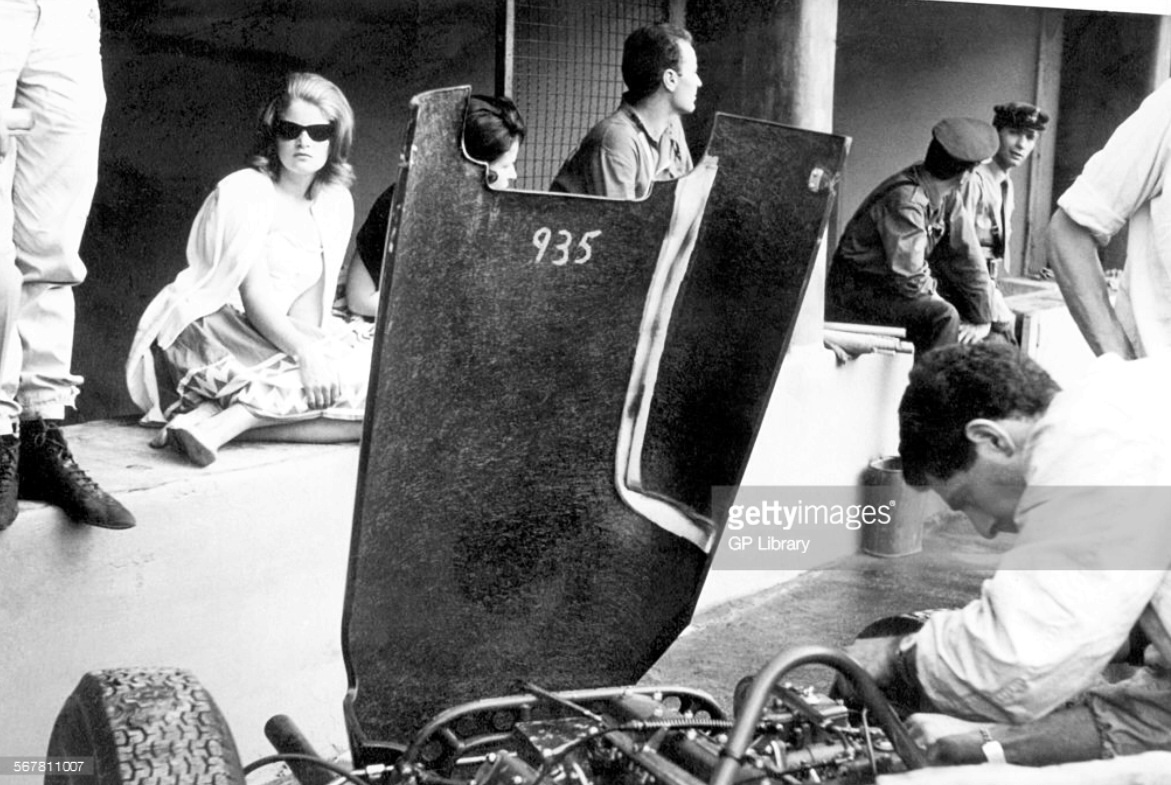
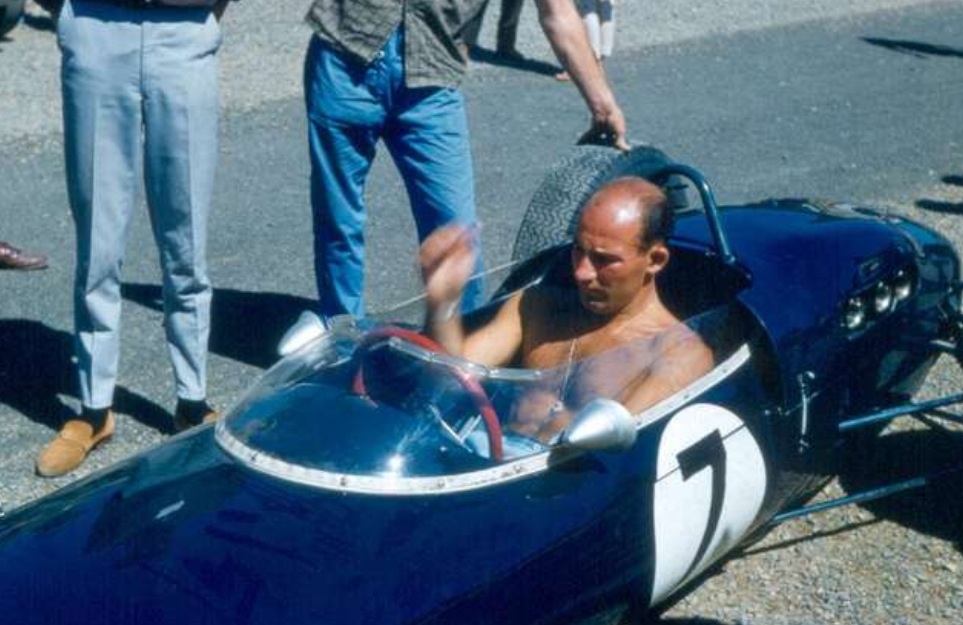
I was lookin’ for shots of chicks and cars as I do a fortnightly post of a babe with a car. When I spotted this image ’twas the lady who initially caught my eye…

But we ‘anoraks’ are so into chassis numbers right?

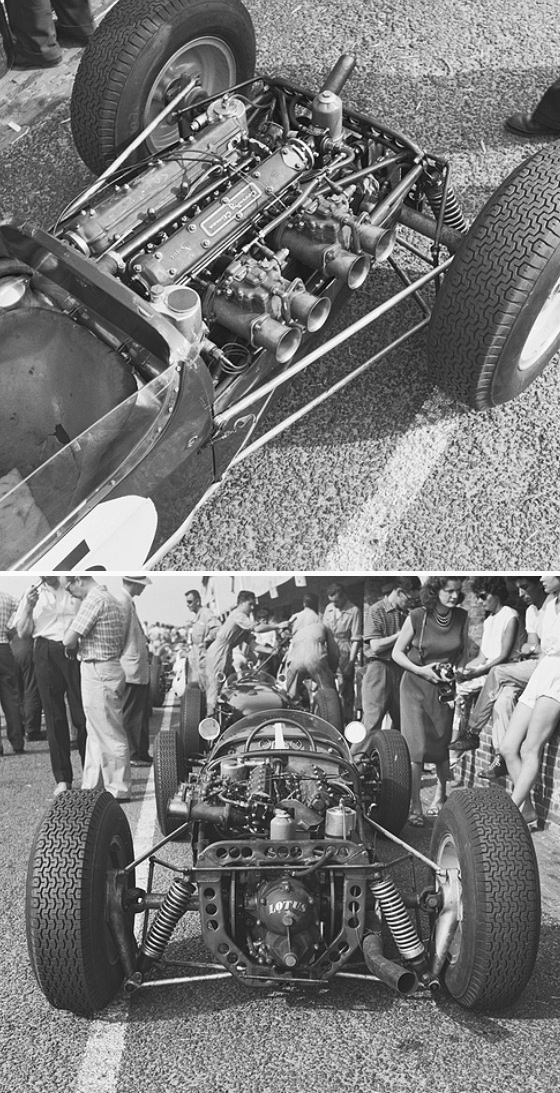
‘935’ on the engine cover stood out, a Lotus 18 number I thought- a quick google and no less an authority than DC Nye identified the car as a Lotus 21 delivered to Rob Walker, its locale Monza, lets come back to that.

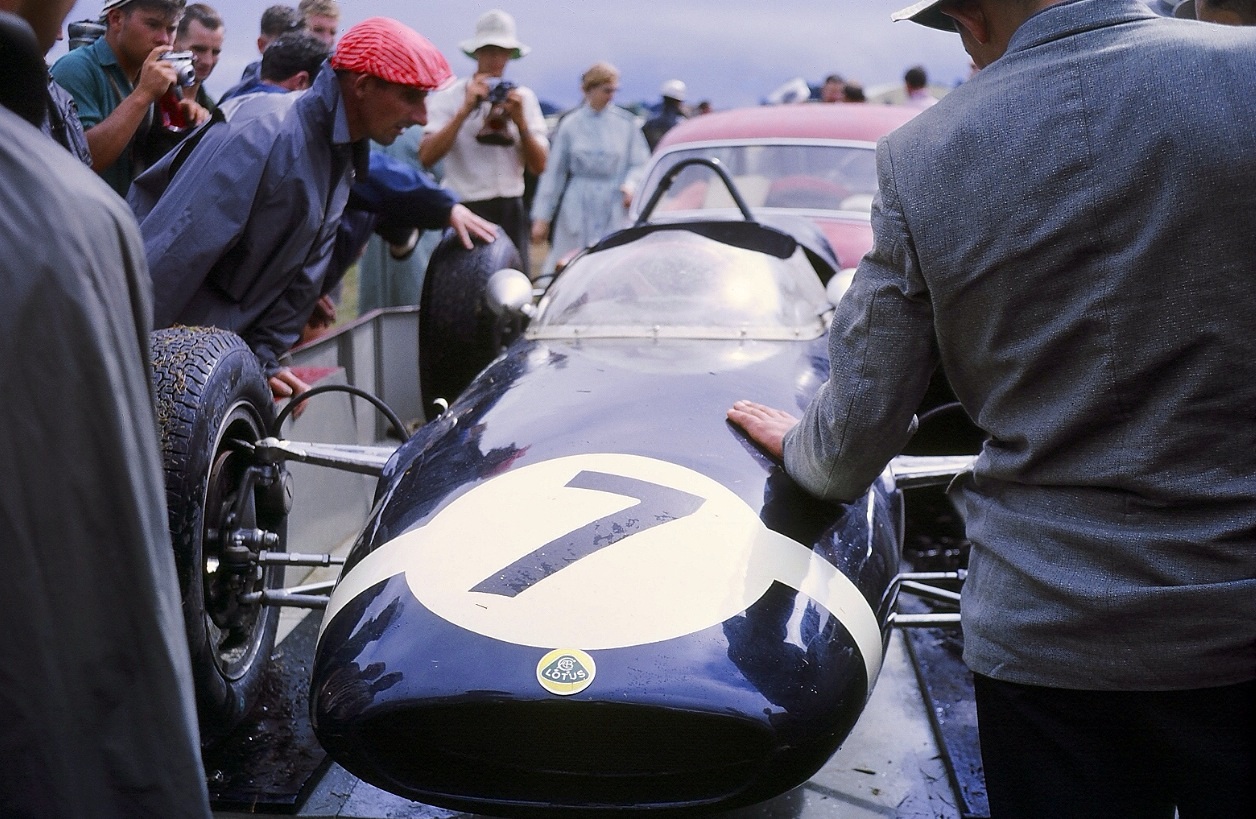
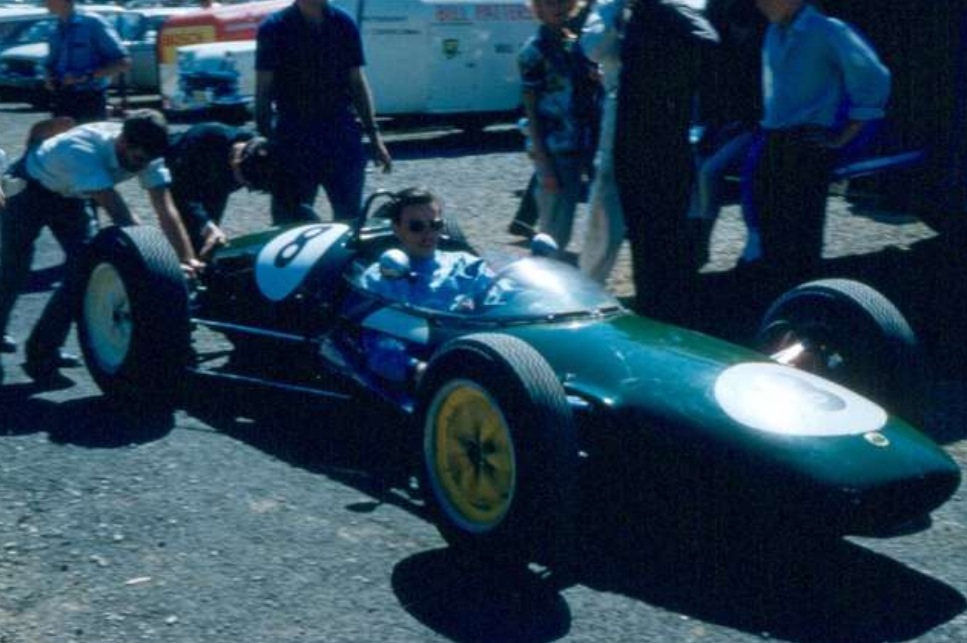
Stirling Moss raced ‘935’ in the Australasian summer ‘Tasman’ races in early 1962.

Here it is below after its victorious run in the very wet, Ardmore, New Zealand Grand Prix. I love the way the gent ‘touches the greatness of Moss’ by giving the Lotus an affectionate pat! ‘Red cap’, a more technical type of bloke is sussing the rear suspension of the 21 compared with the Lotus 18s from the year before.

image

(Stephen Page)

Lotus 21: The Forgotten Chapman GP Car?…

When you think about it Colin Chapman peaked early as an F1 designer.

His 1956 Vanwall, or rather his chassis design and choice of Frank Costin as it’s body designer/aerodynamicist was a GP winner, not too many fellas have done that with their first car.

image

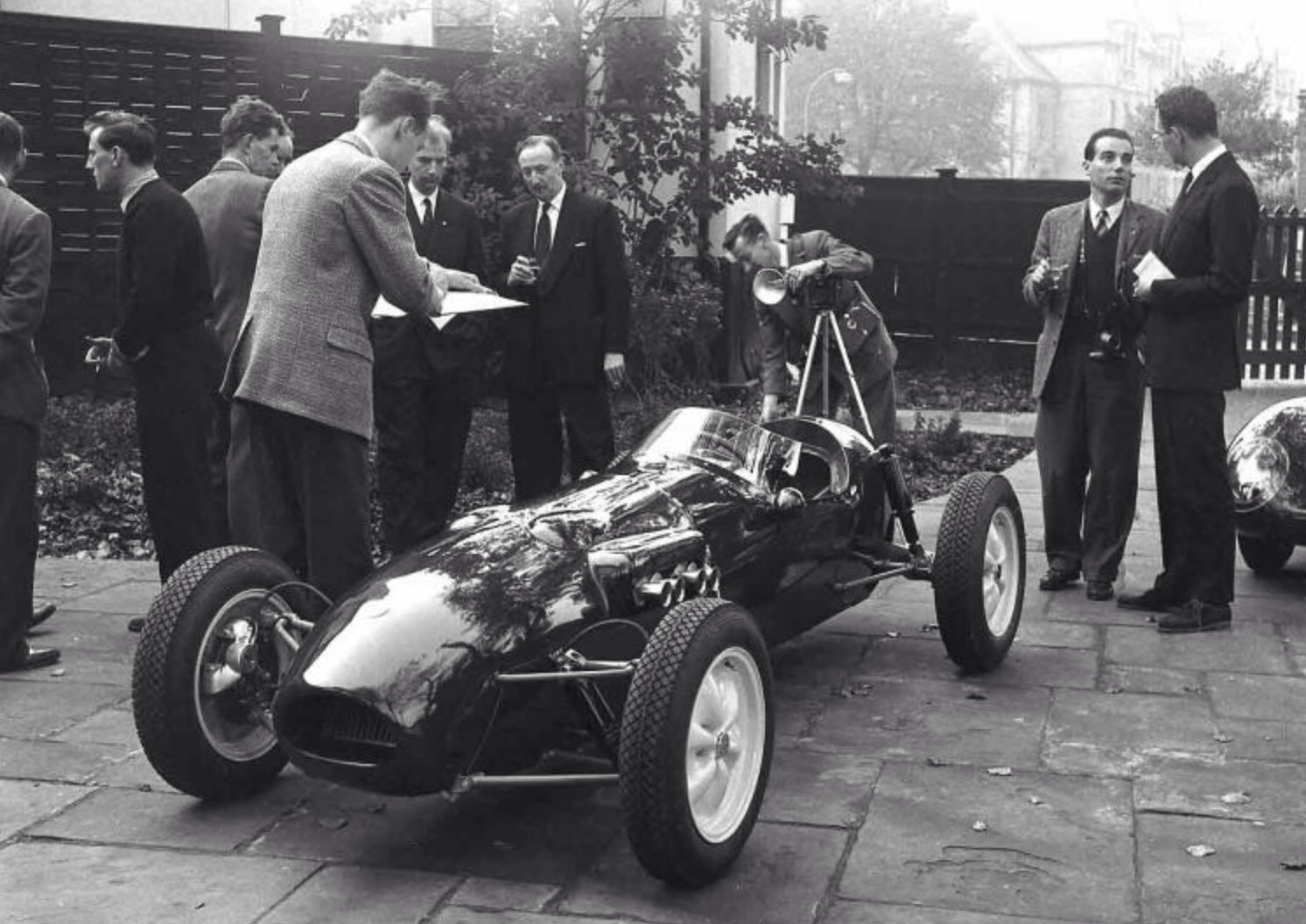
Press launch of the Lotus 12 Climax F2 car in 1956, note the extraordinary smallness of the car, the 12 and 16 remarkable bits of front-engined GP kit. Cliff Allison did 167mph in a Coventry Climax 2207cc FPF engined 12 on Masta Straight, Spa in 1958, with much of his small body outside the cockpit! He was fourth but famously could have won the race had it gone another lap as the first 3 cars all failed to complete the cool-down lap (John Ross)

His first Lotus GP design was the 16, Chapman always referred to the 12, which competed in Grands’ Prix from Monaco 1958, as an F2 car, the design was originally used in 1.5 litre racing before being fitted with Coventry Climax 1960cc and 2207cc engines for F1 use.

One of the things which intrigues me given his subsequent record as the designer/design inspiration for so many epochal cars is why Chapman didn’t design a mid-engined car for 1959? Cooper blazed that trail, GP winners from Argentina 1958, Moss of course taking that win in a Rob Walker Cooper T43 Climax.

image

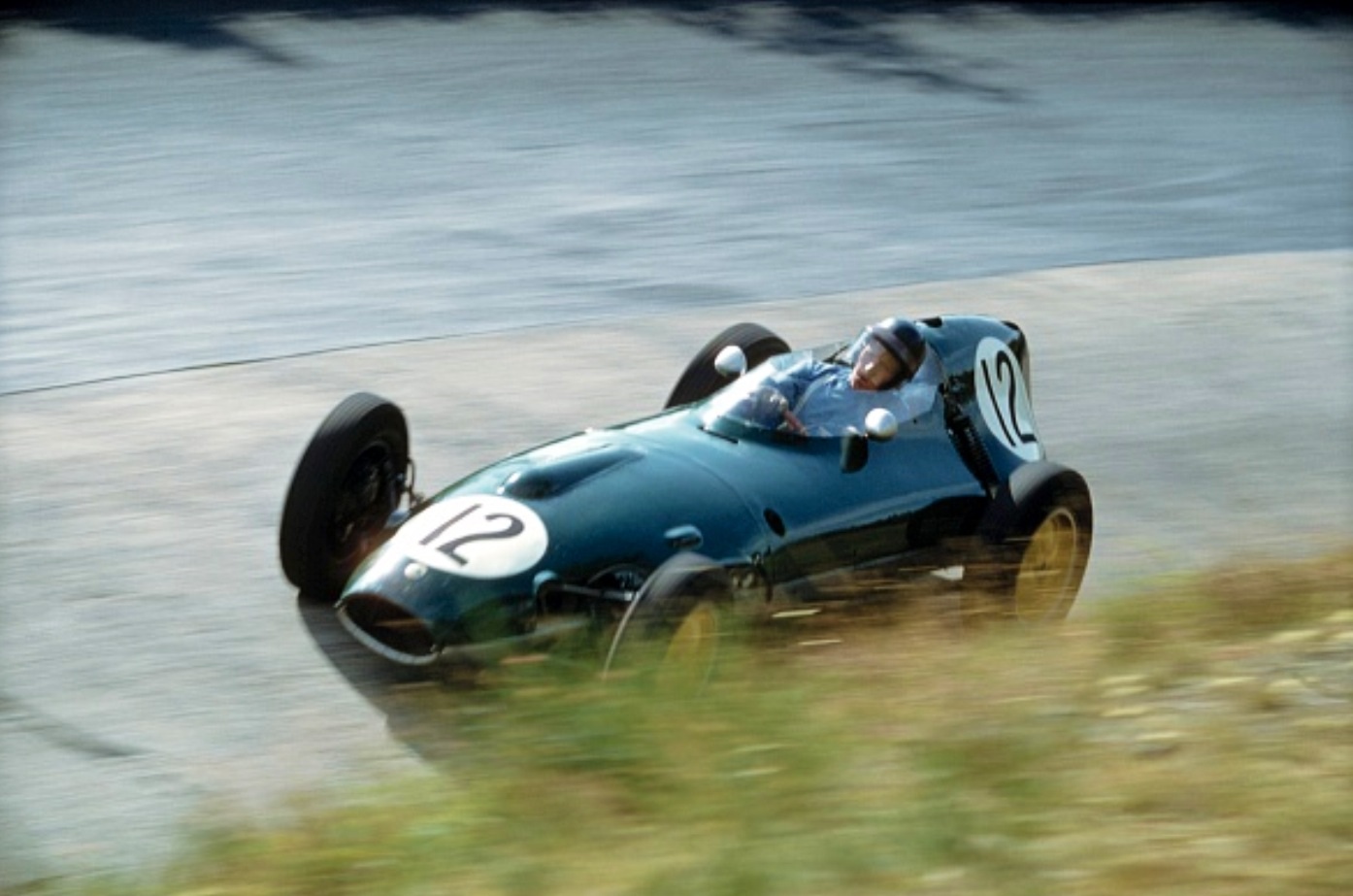
Allison, tenth in the Lotus 16 Climax, Nurburgring 1958. Brooks won in a Vanwall, Lotus 16 famously the ‘Mini-Vanwall’, both Chapman chassis designs  (Klemantaski)

Whilst the front engined 12 is understandable, it appeared in late 1956 and was quite the smallest front engined ‘F1 car’ ever, the 16 shoulda’ been mid-engined?

The 16 was quick mind you, but fragile in both chassis and it’s ‘queerbox’, Lotus’ own gearbox which was unreliable largely due to one small set of dogs trying to pick up every gear. The 16 also didn’t receive a 2.5litre Climax FPF until later in the piece. But if Chapman set trends, and he did, he was a slowish adopter of the mid-engined trend.

image

Works Lotus 18 Climax, Zandvoort, Dutch GP 1960. Chapman was quick to refine the mid-engined paradigm! 2.5 litre CC FPF, 5 speed Lotus ‘box, rear suspension notable for lack of a top-link, the fixed length driveshafts performed locational duties as well as motive ones. This is Alan Stacey’s car, DNF gearbox on lap 57 from Q8. Ireland’s car was second from Q3, quick cars 18’s! Brabham won in his Cooper T53 Climax (Dave Friedman)

His first such design, the 18 was an immensely successful car in FJ, F2 and F1 specification.

Despite its ‘chubster, biscuit shaped’ looks it was the fastest 2.5 Litre F1 car of 1960 if not the most robust or reliable. No less than Moss himself had strong views on Chapman’s ‘marginal engineering’ of key components the failure of same caused some massive accidents.

image

Ireland, works Lotus 18 Climax, Monaco 1960, 9th in the race won by Moss’ similar car. Lotus’ first GP win (Dave Friedman)

Roll on into 1961, the first year of the 1.5 litre F1, the Brits were faced without a suitable engine as their ‘racing mafia’ were convinced the CSI, in the end, would not make the change to the smaller engines. They did, Ferrari the beneficiary with their 156, a car developed in F1/2 in 1960, click here for a story on that wonderful conveyance;

Ferrari’s first mid-engined Car: The 1960 Dino 246P…

Whilst BRM and Coventry Climax worked hard to get their V8’s completed all of the British firms persevered with Mk2 versions of the 1.5 litre Coventry Climax FPF- in 2.5 litre form the championship winning engine of 1959/60.

Chapman and his team had the dimensions of the coming Coventry Climax FWMV V8 when they set to work on the 21, their 1961 contender, but they knew initially the little, underpowered FPF would be used.

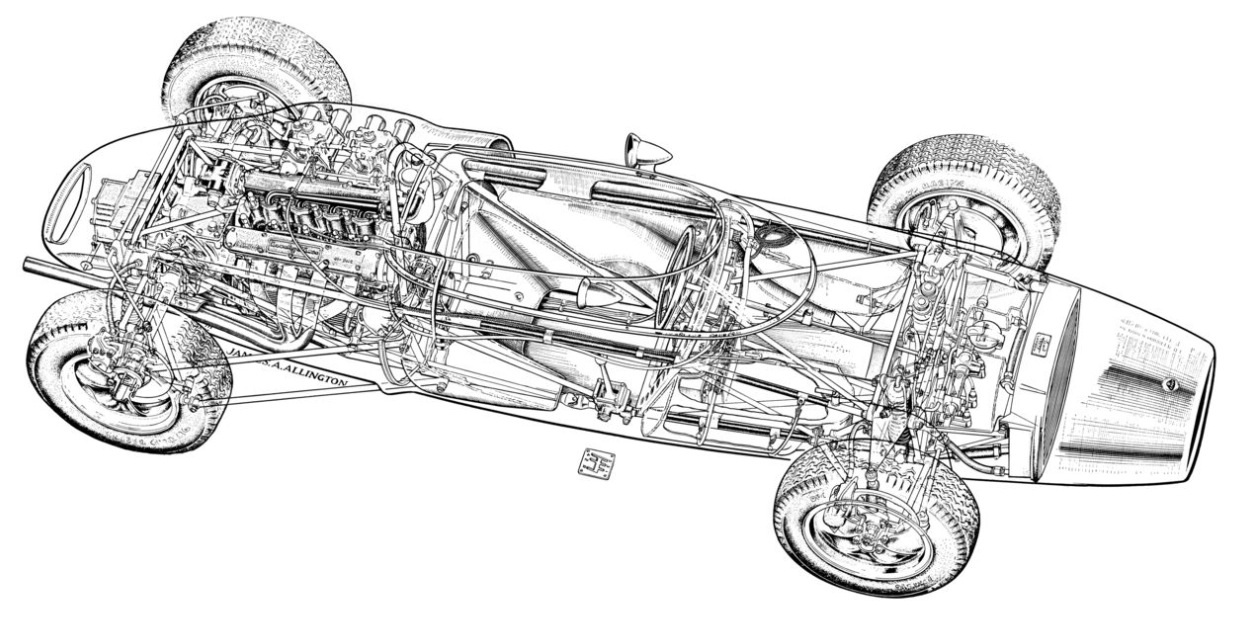
So, light weight and aerodynamic efficiency were key design tenets of the new Lotus 21.

These aims were achieved by lying the driver down in the cockpit, Chapman went further in 1962 with his 24/25 designs, but the trend was set by the 21. The car was notably small in size, low in frontal area, the body enveloping the chassis all the way to the casing of its ZF gearbox, specially made for the car. Have a look at a 21 beside a 156 and see just how ‘butch’ in size the Fazz is by comparison.

Chapman used a top rocker and lower wishbone for the cars front suspension, getting the spring/shocks outta the airstream, thus further adding to top speed. At the rear the suspension was outboard- single top link, inverted lower wishbone and coil spring/damper unit with twin radius rods for location.

image

Lotus 21 Climax FPF cutaway, specifications as per text (James Allington)

Lotus Components built eleven of the 21 chassis’ during the year, which otherwise in specification were leaders of the mid-engined paradigm- multi-tubular spaceframe chassis, Chapman the high priest of chassis design. Rack and pinion steering, discs on all four wheels, magnesium alloy (Lotus ‘wobbly web’) wheels, Ferrari still used heavy Borrani wires till 1963. The CC 1495cc, DOHC, 2 valve, all alloy, Weber carbed 4 cylinder engine gave circa 155bhp, the Lotus weighed 990lb, had an 89 inch wheelbase and a track of 53 inches front and rear.

The prototype was built from scratch in six weeks, just missing the Aintree 200 meeting but was tested at Silverstone two days later, the car made its debut at Monaco in May. The works cars in 1961 were steered by two Scots- Innes Ireland, the seasoned professional and up and coming Jim Clark who graduated from the works Lotus 18 FJ he raced in 1960.

Fitted with the new Coventry Climax V8 the Lotus 21 was a winning car in Moss’ hands if not Ireland’s or Clark’s.  But as it was Chapman didn’t get his hands on an FWMV in 1961 due at least in part to the spat he was having with Climax’ MD Leonard Lee about the quality of the CC FWE engines supplied for his Elite road cars- the engines weren’t the Elites only reliability problems mind you!

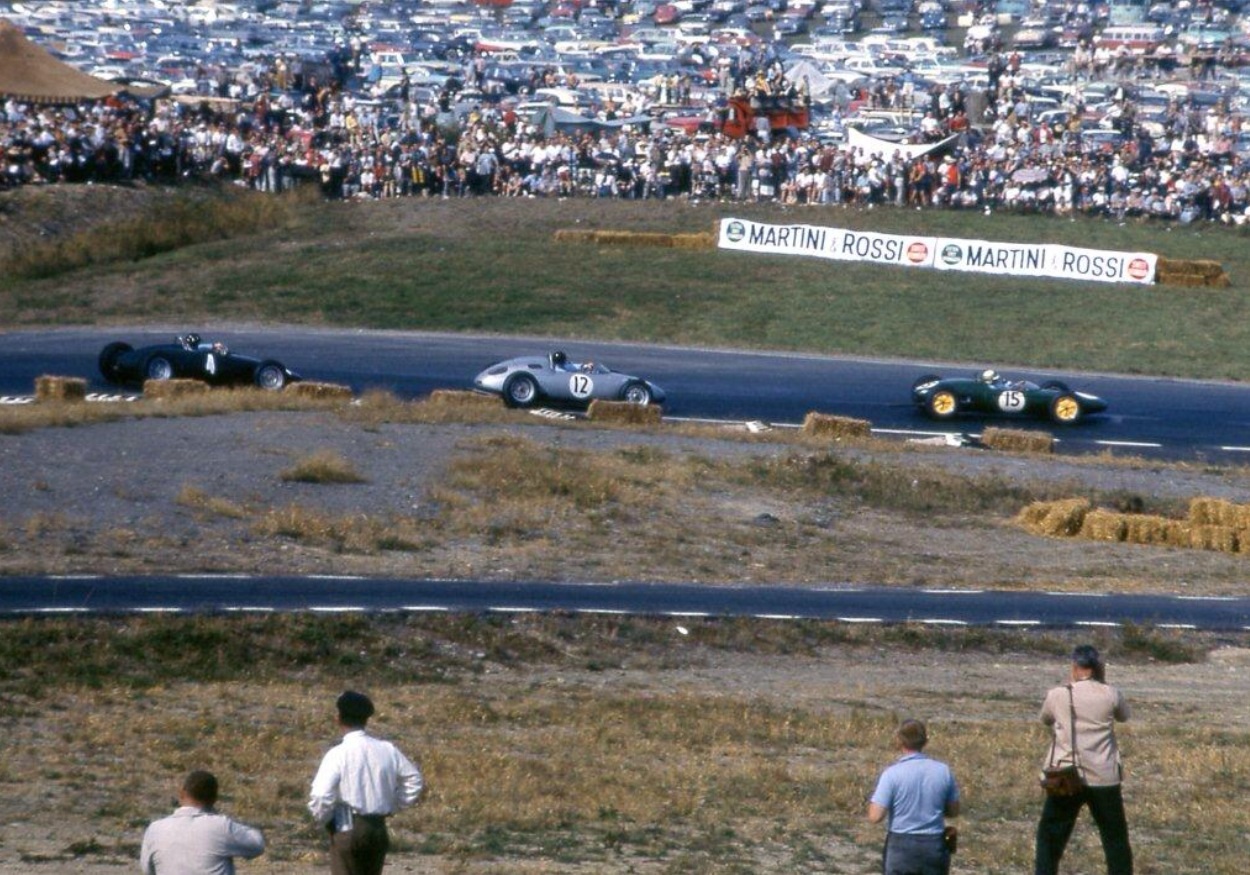
In the event the 21 won only one championship GP at Watkins Glen, Innes Ireland broke through for both Team Lotus and his first win that October.

image

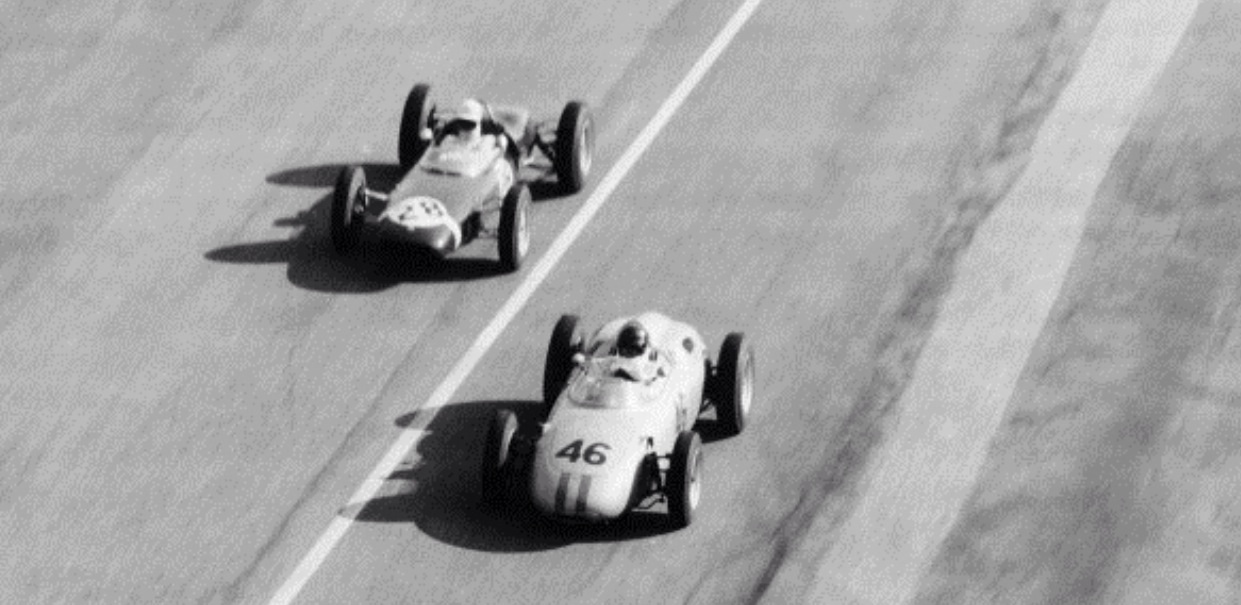
Ireland’s winning Lotus 21 leads Gurney’s second placed Porsche 718 and Graham Hill’s fifth placed BRM P48/57 Climax, US GP Watkins Glen, 8 October 1961 (unattributed)

The cars chances of more wins were missed by Chapman’s decision not to sell Rob Walker his latest car, as he had with the 18 the year before. Moss’ two wins in 1961, remarkable ones, were in the Walker 18 at Monaco and 18/21 hybrid at the Nurburgring. Armed with a new 21 all year he may, praps have taken one or two wins off Ferrari despite the car’s relative ‘lack of puff’.

The 21 took wins in non-championship 1961 events- the Solitude GP for Ireland in July, the Flugplatzrennen at Zeltweg again for Ireland in September, and the Rand, Natal and South African Grands’ Prix in Jim Clark’s ‘African Tour’ in December 1961. As written here Moss did well in Australasia in early 1962.

The Lotus 21 should be remembered as both a GP winner and the progenitor of the design maxims Chapman’s ever creative mind evolved with the 1962 spaceframe  Lotus 24 and it’s revolutionary monocoque sibling, the 25.

image

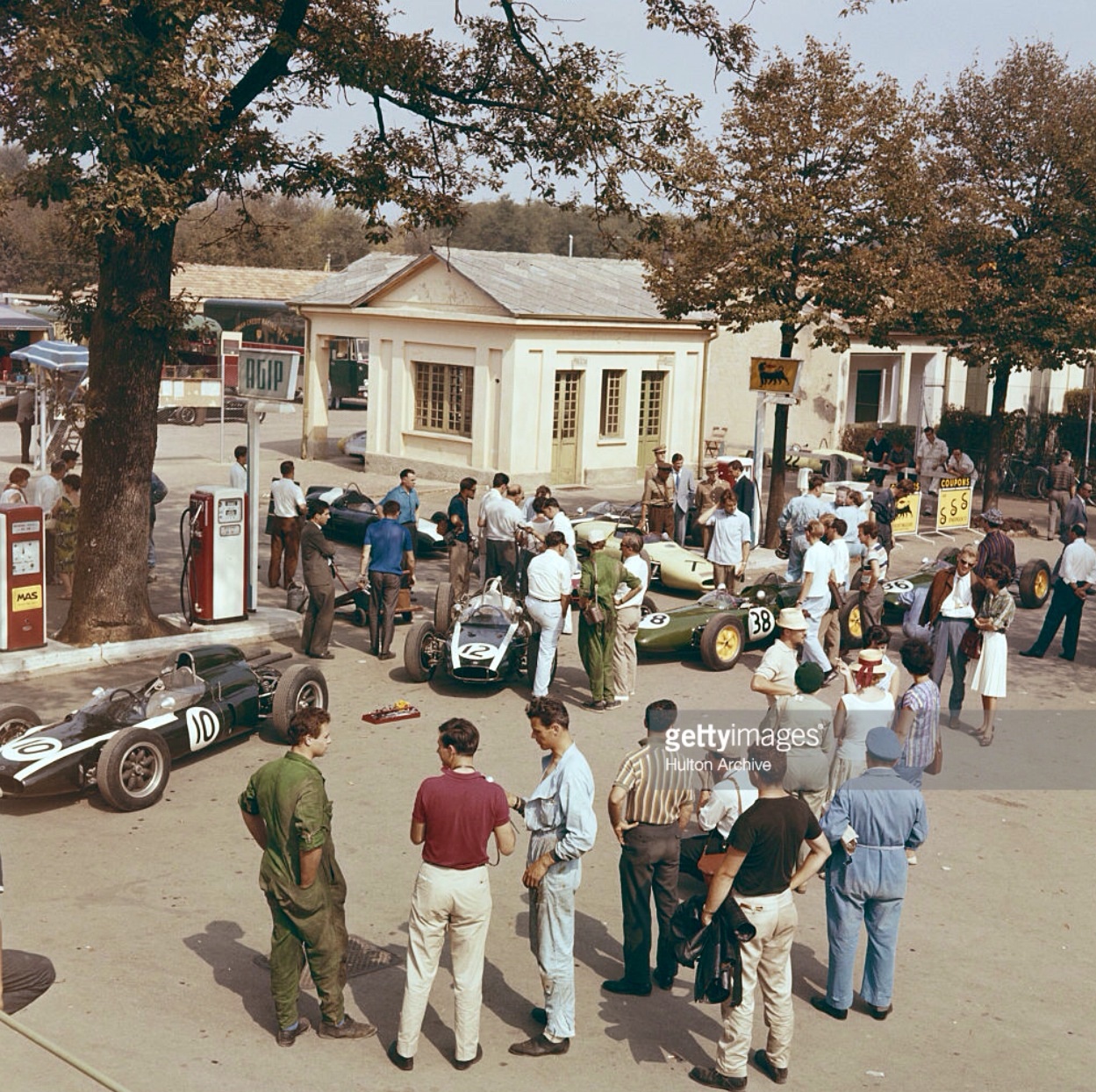
Love the atmospherics of this 1961 Italian GP, Monza paddock shot. #10 is Brabham’s Cooper T58 CC V8, contrast it with McLaren’s #12 CC FPF powered T55 behind. #38 and 36 are the Ireland/Clark Lotus 21 CC FPF’s before the ‘jiggery pokery’ with the chassis swap between Innes and Stirling. The pale green painted ‘T’car is UDT-Laystall’s spare, the Cooper T51 is Jack Lewis’ (Hutton Archive)

Moss’ first drive of a Lotus 21 was his steer of  Innes Ireland’s works car at Monza on 10 September.

That weekend was infamous for the tragic race collision between Jim Clark’s Lotus 21 and Taffy von Trips Ferrari 156 which resulted in von Trips death as well as that of 15 innocent spectators.

Moss took Lotus’ first ever GP win at Monaco in May. Whilst Chapman was eternally grateful he wasn’t inclined to give Moss or Walker too much of a ‘free-kick’ by selling them his latest car, the 21, given his primary aim was works car wins. In fact its probably Esso we have to blame as they were Lotus’ fuel supplier, BP were the sponsor of Rob Walker/Moss, both companies had their commercial positions to protect.

image

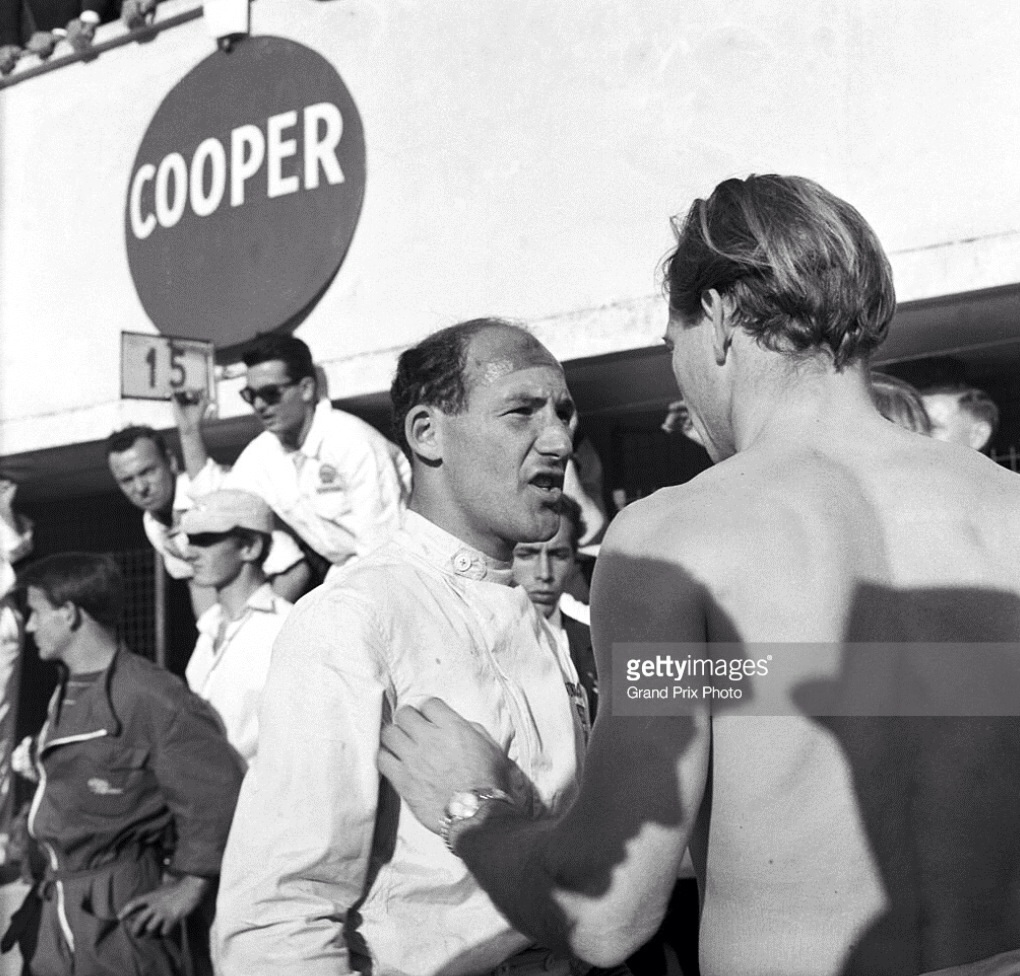
Moss and Ireland swapping notes at Monza, Italian GP, September 1961 (GP Photo)

The Monza weekend was also significant for the first race appearance of the new 1.5 litre BRM P56 V8 and the further appearance of the Coventry Climax FWMV V8 first raced by Jack Brabham at the Nurburgring the month before.

Jack qualified his new Cooper T58 on grid 2 in the Eifel Mountains but crashed on lap 1 with a sticking throttle so the engine hadn’t been race-tested.

The P56 V8’s were fitted to modified BRM P48/57 chassis, the CC V8 to Jack’s Cooper and a specially modified Lotus 18/21 built up by the Walker Team. Team Lotus were unable to secure an engine as noted earlier, so appeared in 21’s powered by the 1.5 litre 4 cylinder FPF Mk2 used by the British teams, including BRM that year.

BRM tested their new engines with no intention to race them, Brabham raced his Cooper despite problems in practice.

Moss was sportingly offered Ireland’s factory 21 FPF, chassis ‘933’. Chapman and Ireland reasoned that Moss would have a better chance of success in a 21 rather than the tired Walker 18/21. Moss was the only Lotus driver with a vague (very) chance at the World Championship, Ireland raced the Walker 18/21 FPF engined car. In Denis Jenkinson’s race account he writes about the ‘cloak and dagger’ stuff behind closed garages to make the necessary change of chassis and body work between Moss and Ireland, the secretive stuff was doubtless so as not to upset the trade supporters of both teams.

Which brings us back to ‘ole 935’ and the photo at this articles outset.

The two works Lotus Monza chassis according to Nye’s ‘Theme Lotus’ were ‘933’ and ‘934’. If ‘935’ was at Monza there was no point making the chassis and bodywork changes between the Moss/Ireland cars both Jenkinson and Nye report took place. If ‘935’ were at Monza either as a works spare or delivered to the Walker Team Moss would have raced it and Ireland his regular works 21 rather than the inferior Walker 18/21.

So, whats the explanation of the photo then?

Either it isn’t Monza, although i am inclined to believe Nye who has been there once or twice! The probable story is that the engine cover of the new ‘935’ was ‘borrowed’ and fitted to one of the works Lotus 21’s for the weekend. The first race entry for ‘935’ i can find, looking at non-championship and championship Grands’ Prix results later in 1961 seems be its races in New Zealand in early 1962-the 1962 NZ GP report by sergent.com describes ‘935’ as unraced before that event on 6 January.

image

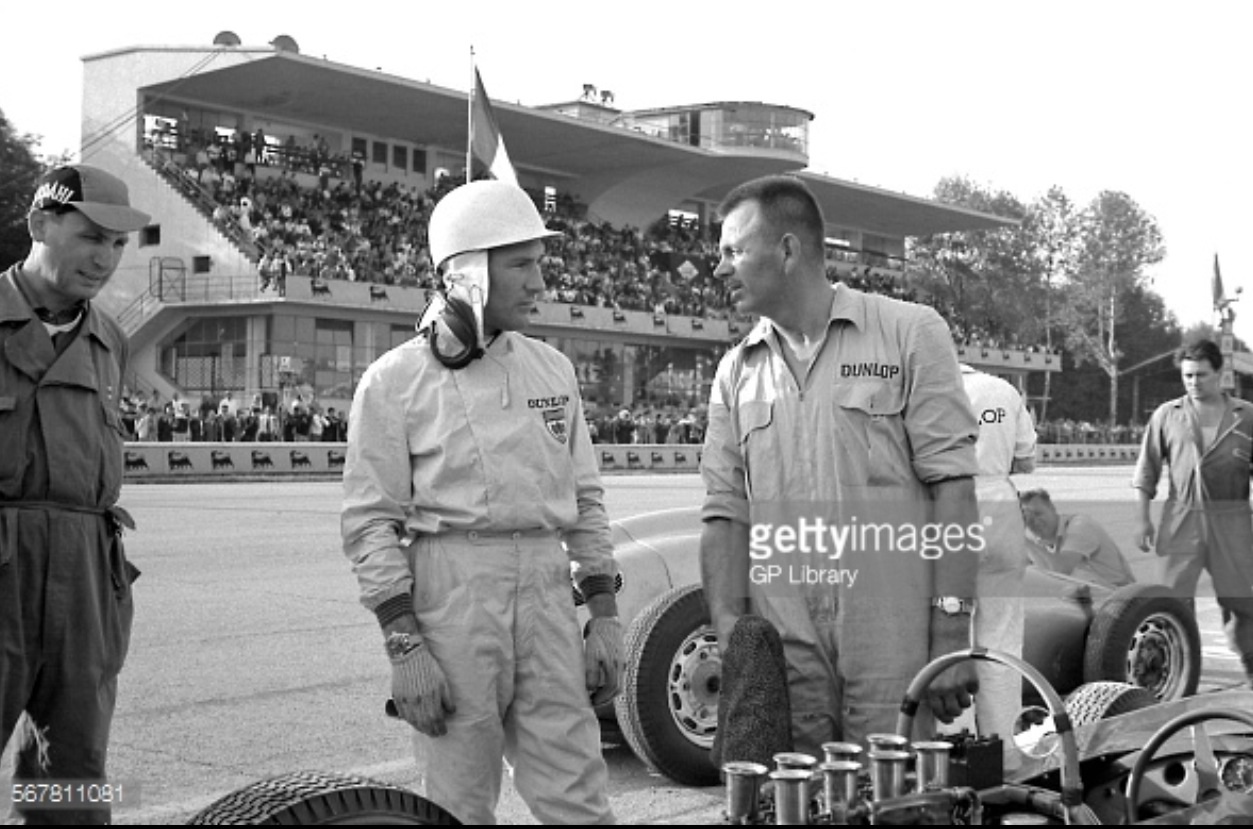
Moss and Alf Francis confer during Monza practice, by the look of it neither are ‘happy campers’, the Lotus 18/21 CC FWMV  chassis #’906′ was always a handful (GP Library)

The Moss 18/21 was modified to fit the FWMV V8 with the assistance of Ferguson Research.

The rear of the 18 chassis aft of the drivers seat was ‘chopped off’ and replaced with a frame to suit the width and mounting needs of the new engine. 21 rear suspension was incorporated comprising new 21 uprights which were located at the top by a link to the chassis thus relieving the half shafts of the suspension loads the solid ‘shafts of the 18 performed- the new components had Hardy Spicer splined shafts to accommodate ‘plunge and droop’.

A Colotti Type 32 gearbox was used. The rear framework was a complete assembly which attached to the main frame by large bolts screwed into the ends of the tubes, which had been plugged and tapped. The structure was made from small diameter tubing which had to be detached completely before the engine and gearbox could be removed. The car was finished in a big hurry so the old Lotus engine cover was retained with a bulge to clear the four downdraft Webers.

Whilst no-doubt well engineered it doesn’t all add up to the levels of torsional stiffness no doubt required to put all of the new engines power to the ground effectively.

During the race the tragic accident between Clark and von Trips occurred on the first lap, the German and hapless spectators killed, the race continued whilst the carnage was attended to.

Moss retired on lap 36 with wheel bearing failure, Ireland on lap 5 with chassis problems and Brabham’s FWMV failed on lap 8 due to overheating problems- shortcomings sorted over the winter off-season.

Phil Hill’s Ferrari 156 won the race and  1961 title from Gurney’s Porsche 718 and McLaren’s Cooper T55 FPF.

image

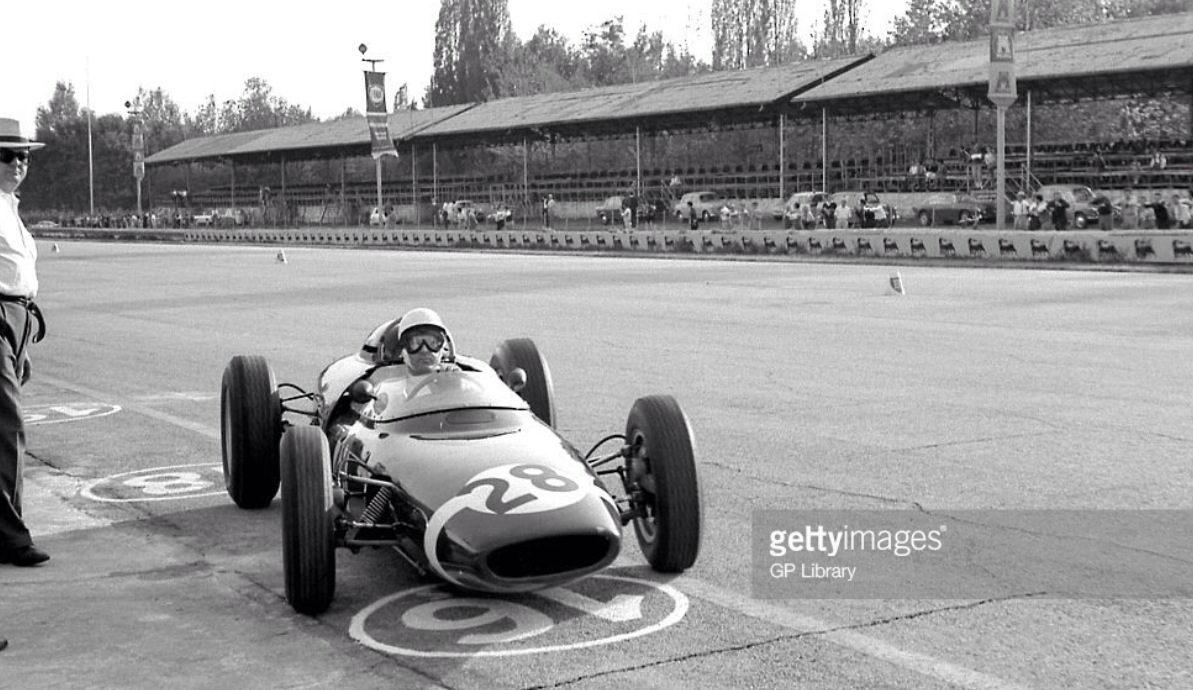
The Walker Lotus 18/21 CC V8 during 1961 Monza practice (GP Library)


image

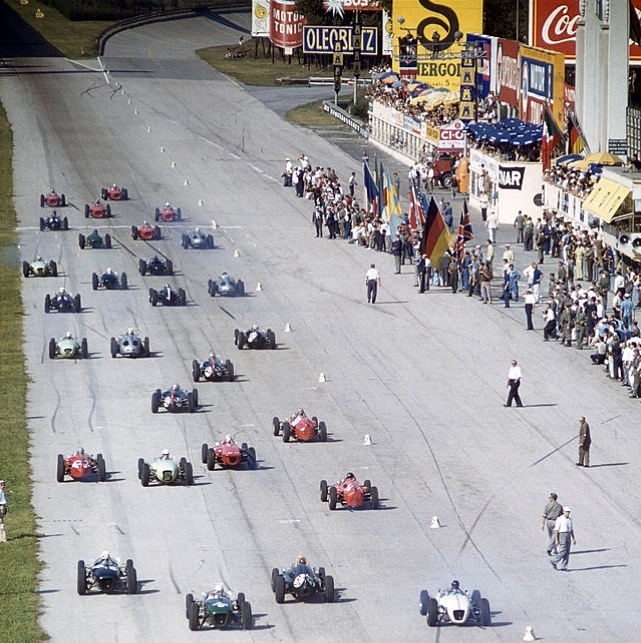
Italian GP ’61 start with a swag of 5 Ferrari’s up front, leading green car at left is probably Hill G’s BRM Climax, Clark is between Hill and a Ferrari, thats Gurney’s Porsche 718 on the right from grid 12, the carnage took place shortly thereafter (Klemantaski)


image

Moss in the Walker bodied works Lotus 21 CC FPF during the race, dicing with Gurney’s 2nd placed Porsche 718 (GP Library)

New Zealand…

Over that 1962 European winter Coventry Climax worked on the reliability of the FWMV and BRM their P56 V8 and the P578 chassis to carry it. At Cheshunt Colin Chapman was building the spaceframe 24 and its epochal monocoque sibling, the Lotus 25.

Both marques were the key players in an amazing 1962 season which in the main didn’t feature Stirling Moss, whose Glover Trophy career ending accident took place on Easter Monday 23 April 1962 in the Walker Lotus 18/21 Climax V8 ‘906’ described above.

The Walker Team would make do with their 18/21 in GP’s, later in the season they raced two Lotus 24 FWMV’s but by the time they were ready Moss’ career was finito.

image

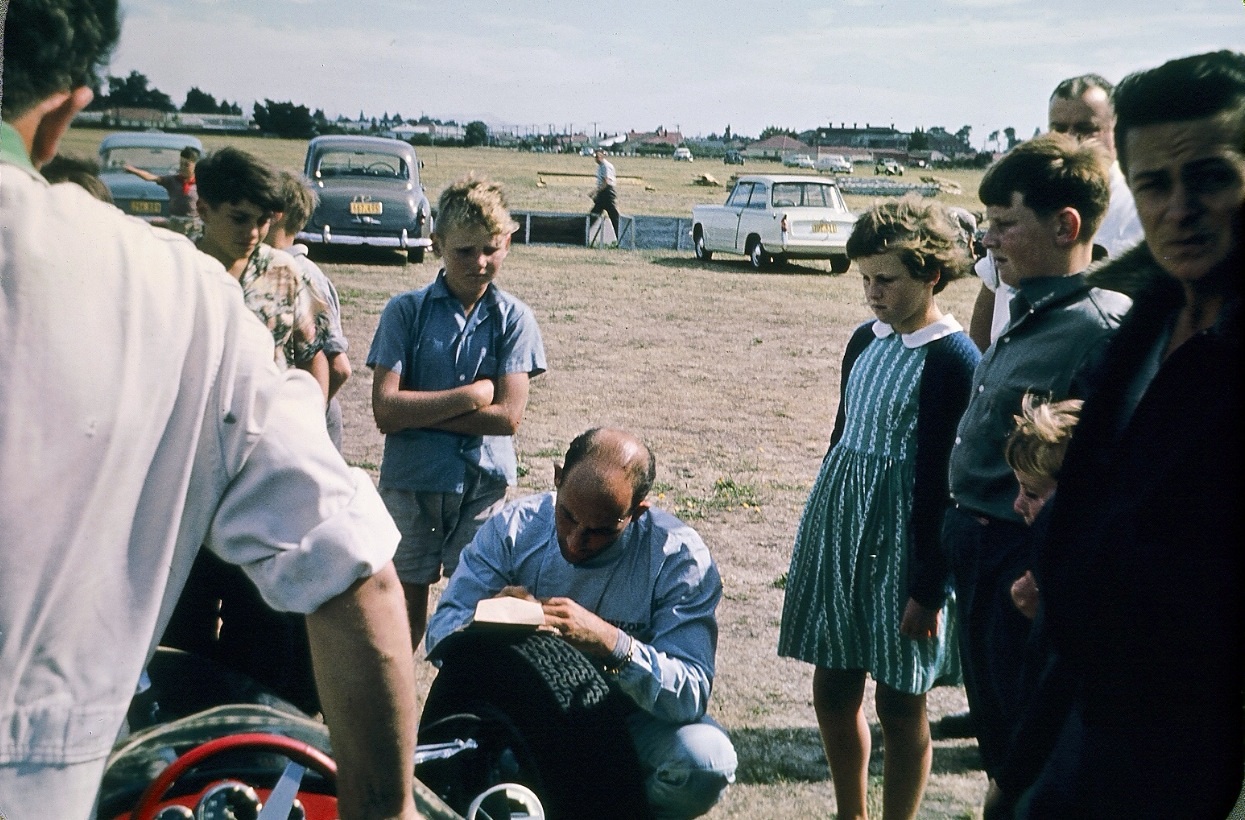
Moss looking after the fans, Kiwi kiddies drawn to the great Brit, Ardmore NZGP meeting. Car is 21 ‘935’ (Stephen Page)

For Moss, in the meantime there were the annual summer internationals to contest in Australasia.

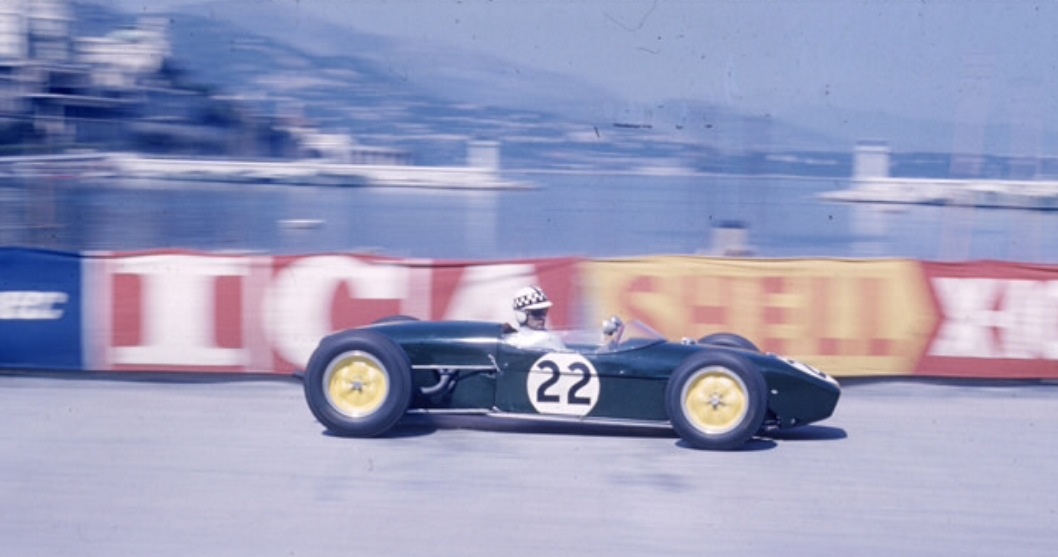
Whilst Stirling loved the speed of his Lotus he revelled in the forgiving ‘chuckability’ and robustness of Coopers. Robust is not an apt adjective to describe the Lotus single-seaters of the period. So, hedging his bets for his 1962 Australasian Tour he had Rob Walker ship both ‘935’ as well as a Cooper T55 ‘F1-7-61’  on the long voyage south. Both cars were Coventry Climax FPF powered- engines of both 2.5 and 2.7 litres capacity were used, our International Series was run to Formula Libre in its pre-Tasman Cup formula days.

image

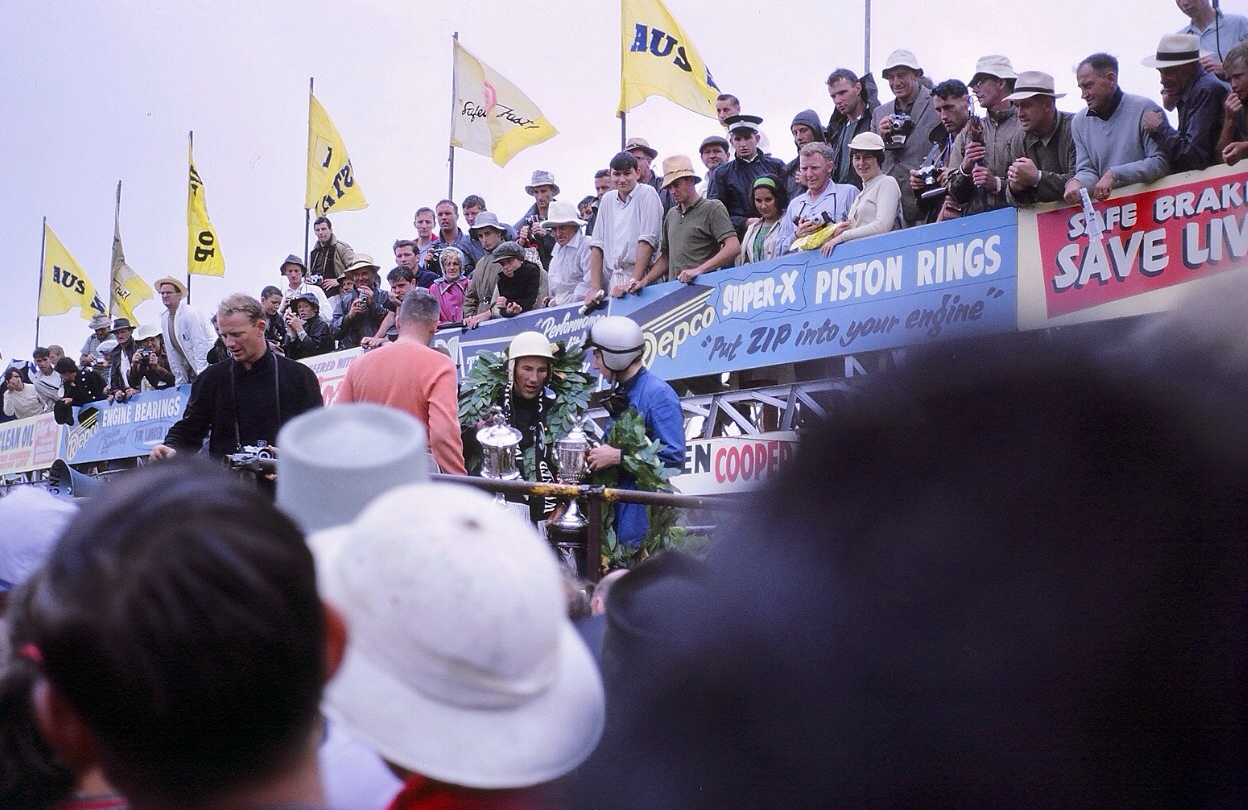
Moss and second placed Surtees on the Ardmore victory dais (Stephen Page)

Moss raced the Lotus to an NZ GP win at Ardmore on 6 January and at the Wigram Airfield circuit event fitted with 2.5 litre FPF’s. At Levin and Teretonga he was second in the Cooper powered by a 2.7 FPF, Brabham won at Levin and McLaren at Teretonga- so Moss’ campaign had started well.

image

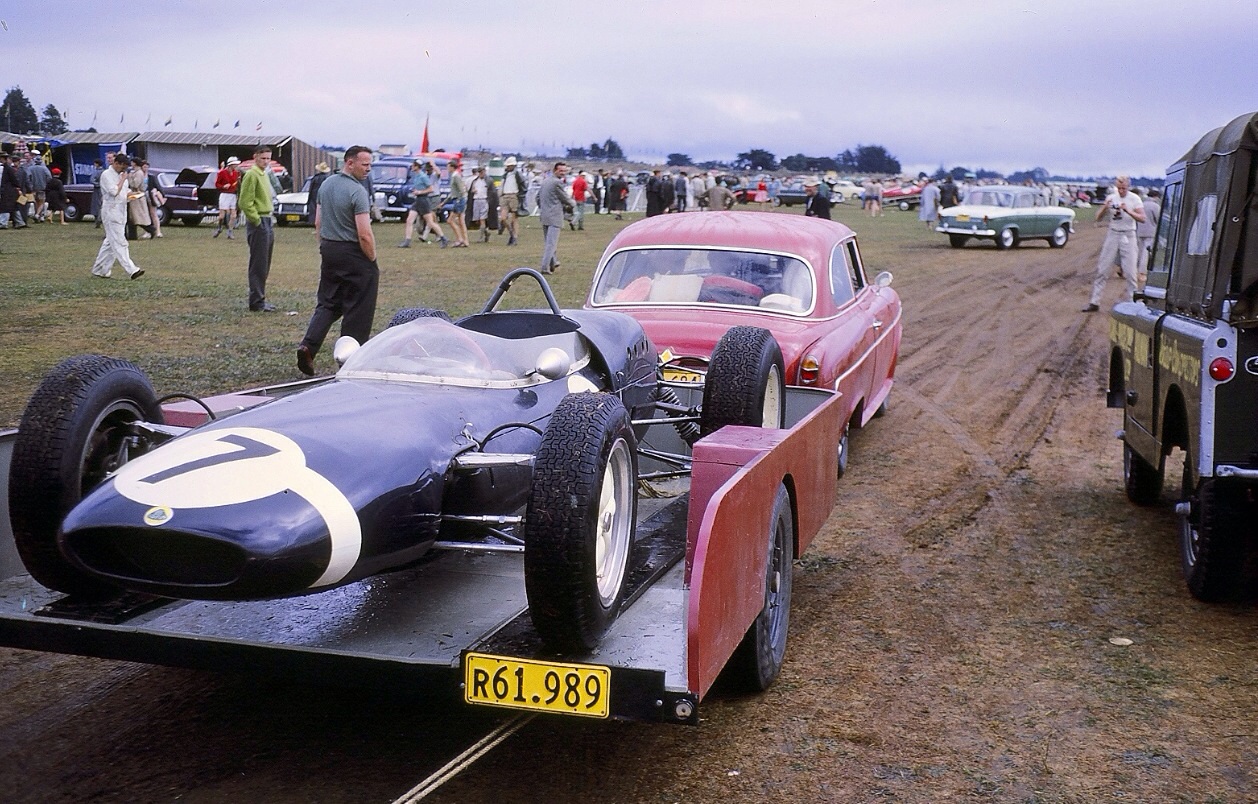
Borgward Isabella and 21 off to the next round of the NZ Internationals at Levin. Shot shows the inboard front suspension, the top rocker actuating inboard mounted spring/shock. At the rear is a single top link, reversed lower wishbone, outboard spring/shock and twin radius rods. Extreme lowness clear as is the slippery nature of the body and reduction in driver space which advanced as a trend over the following decades!  (Stephen Page)

The NZ Internationals were contested by Moss, Surtees, McLaren and Salvadori, the latter three drivers in Cooper T53 Climaxes, Bandini in a Cooper T53 Maserati, Brabham a Cooper T55 Climax and Ron Flockhart, a Lotus 18 Climax.

Chris Amon made his first international appearances that summer in the ex-BRM/Brabham Maser 250F, other ‘local heroes’ were Pat Hoare Ferrari 246/256 V12, Angus Hyslop, Cooper T53 Climax and Aussies Bib Stillwell, Aston Martin DBR4/250, David McKay, Cooper T51 Climax and Arnold Glass’ in a BRM P48.

Moss ‘brained’ the NZGP field in an awful, wet race- he lapped the field winning from Surtees, McLaren and Salvadori.

Australia…

image

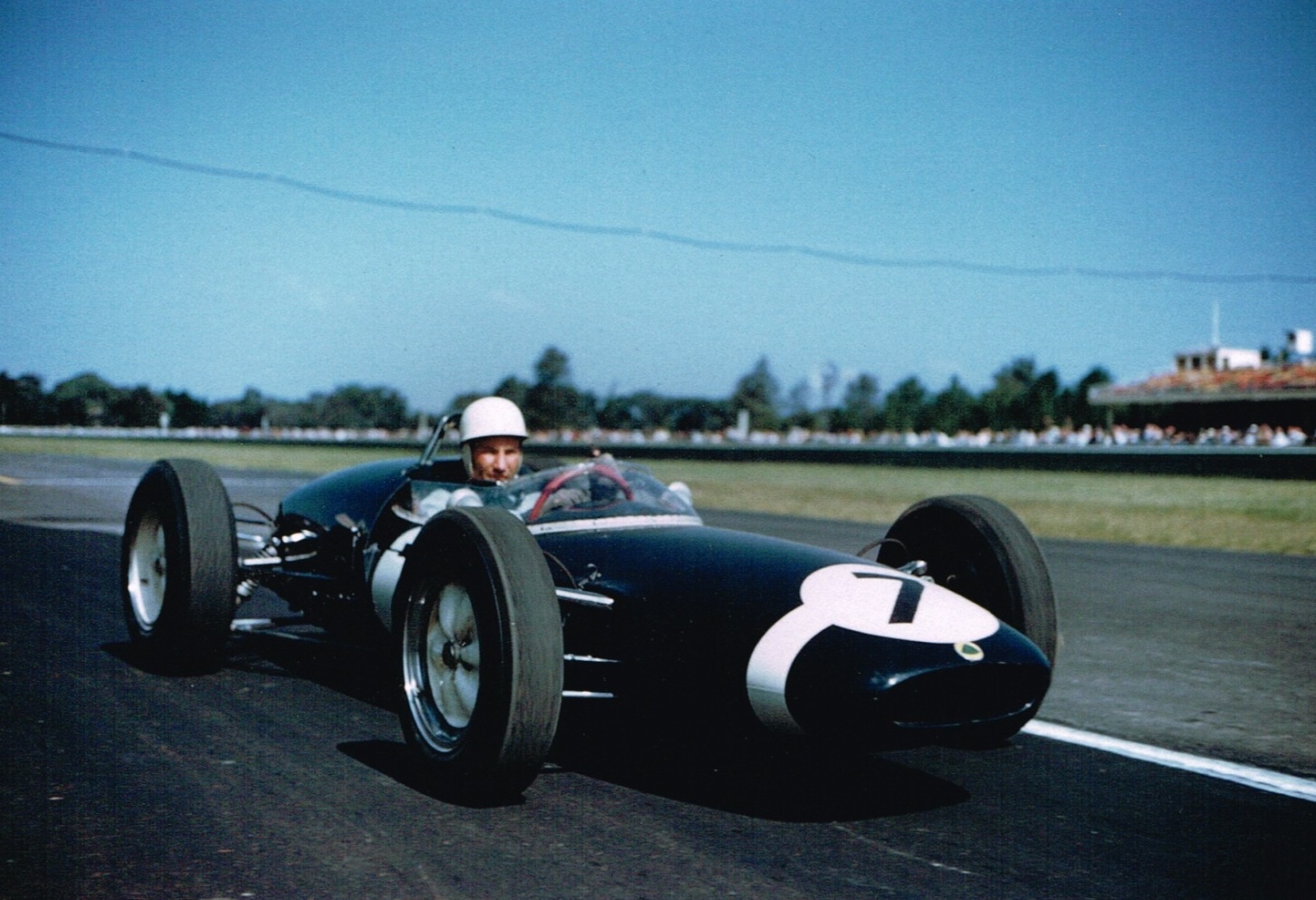
Beautiful shot of Moss in the Walker Lotus 21 Climax 2.5 ‘935’ on Warwick Farm’s pit straight, he practised the car but raced the more ‘chuckable’ Cooper (Mal Simpson)

The cars were then shipped to Sydney, the first race of the Australian leg was the ‘Warwick Farm 100’ on the testing, technical outer western Sydney circuit on 4 February.

Moss practised both cars but elected to race the Cooper to a race win from McLaren and Stillwell.

image

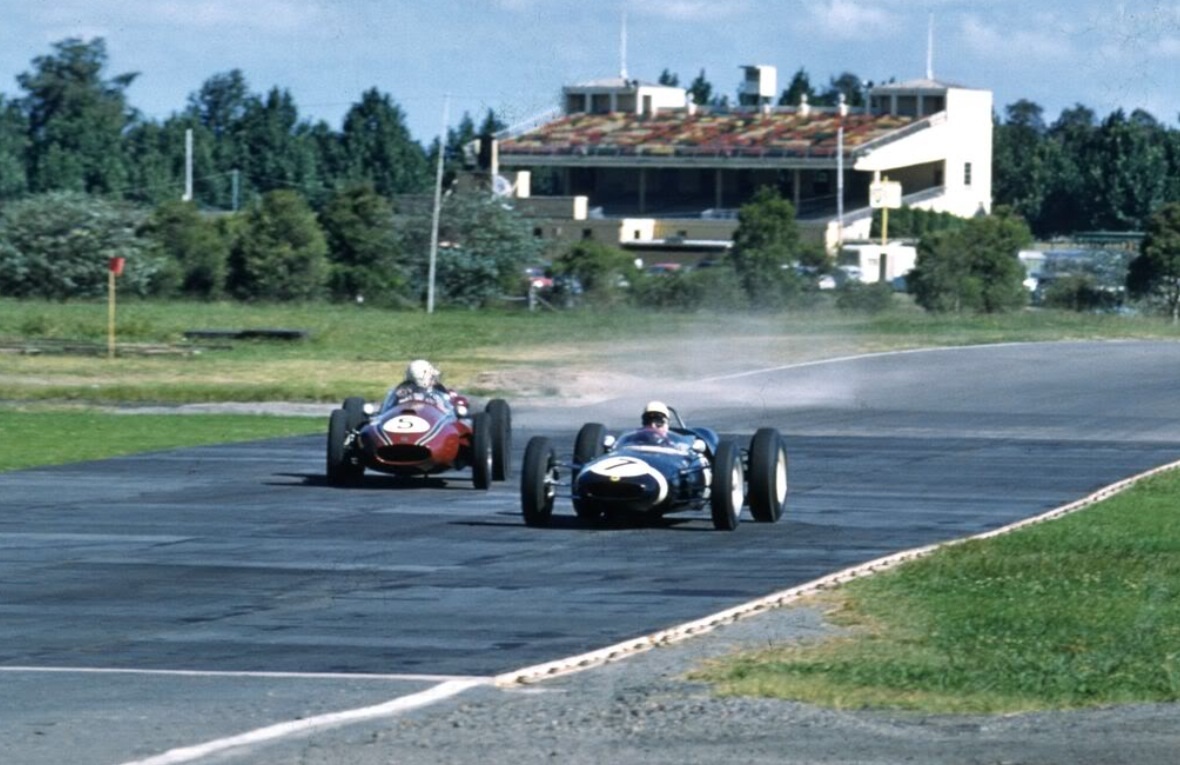
Moss in his Lotus 21 passes John Youl sneaking a peek over his shoulder, Cooper T51 Climax during WF practice. Youl DNF in the 2.2 litre car with clutch problems in the race, the Taswegian a very quick steerer (John Ellacott)


image

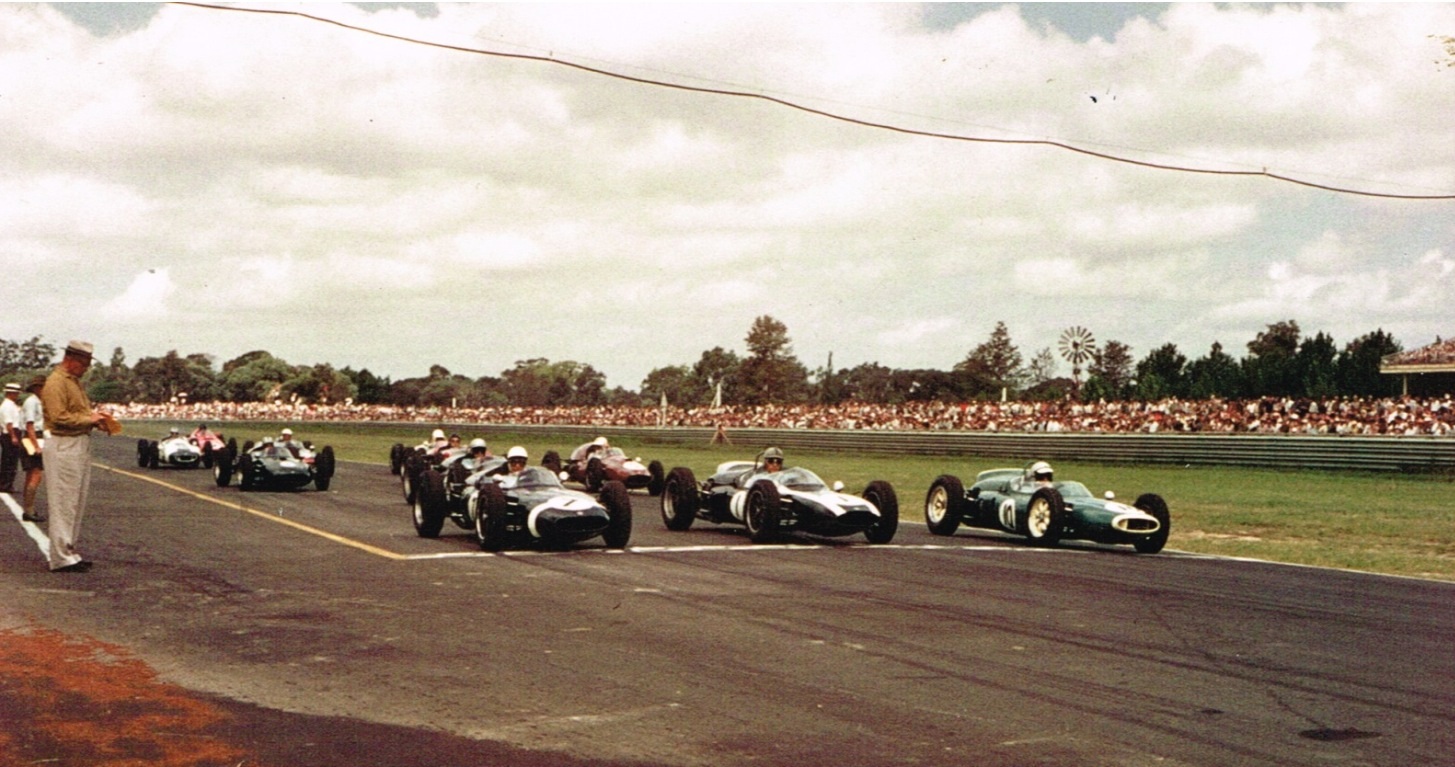
WF 100 front row, 4 February 1962- Moss, Brabham, McLaren in Coopers T53, T55, T53 (Mal Simpson)

Moss missed the Lakeside event won by Brabham’s T55 Cooper and Longford’s ‘South Pacific Championship’ race won by Surtees Cooper T53 Climax but raced ‘935’ fitted with a 2.7 litre FPF at the Australian Grand Prix, Sandown’s inaugural meeting on 12 March.

Jack Brabham won the race in his 2.7 engined Cooper from Surtees, McLaren and Chuck Daigh in the very interesting Scarab RE Buick V8, the cars only race- read my Chuck Daigh article for that cars interesting story.

image

Moss cruises the Sandown paddock in the 2.7 ‘Indy’ FPF engined Lotus ‘935’, March 1962. The man absolutely the best and fastest driver in the world at the time (Kevin Drage)

In between these Australian events, reinforcing the regularity and intensity of his racing schedule, Moss raced in the Daytona 3 Hours, finishing fourth in a Ferrari 250 GT SWB on 11 February.

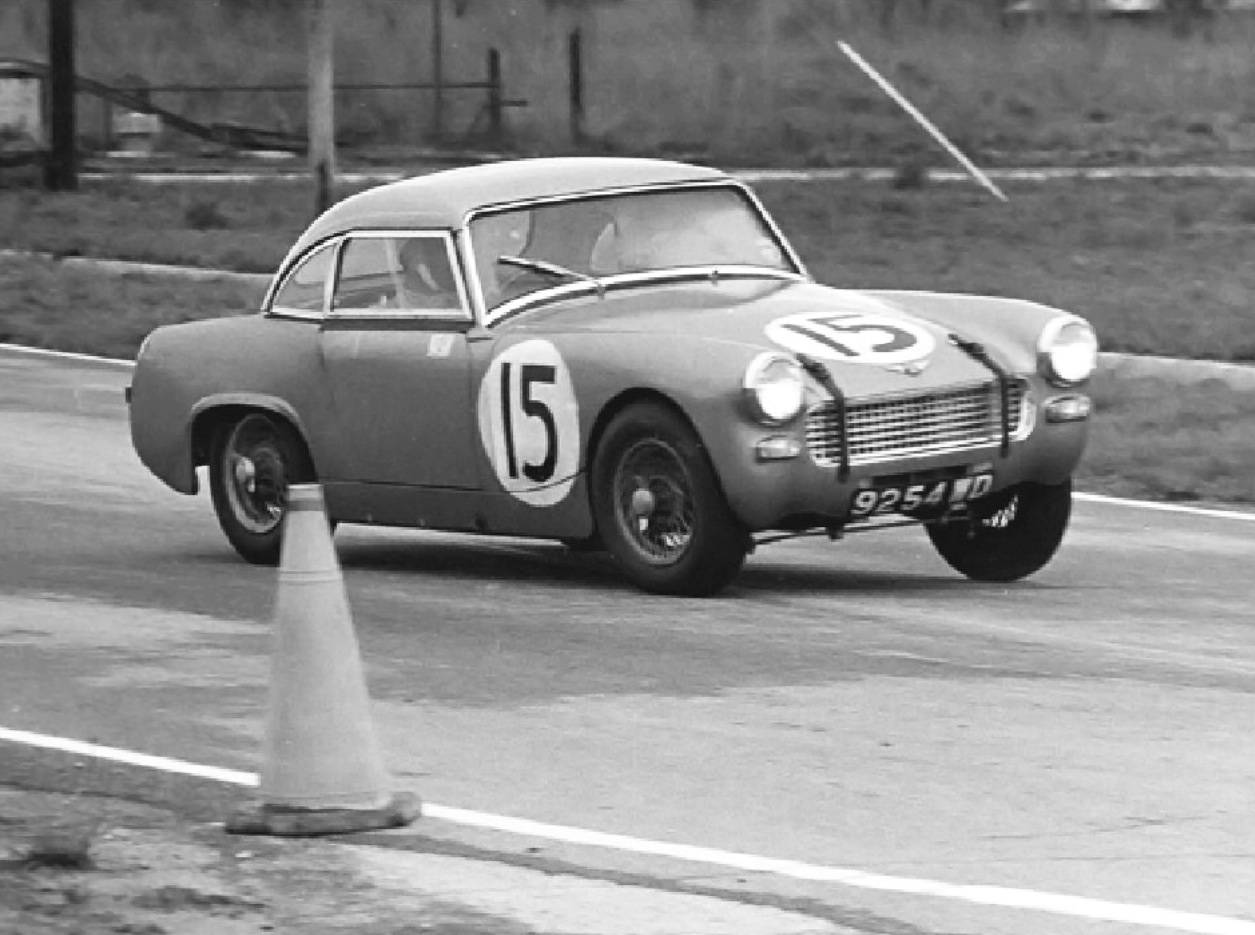
After Sandown he returned to the US to contest the Sebring 3 Hours and Sebring 24 Hours on 23/24 March finishing third in an Austin Healey Sprite and DNF in a NART Ferrari Dino 248SP respectively.

image

Moss, AH Sprite, Sebring 3 Hour 1962 (Tom Bigelow)


image

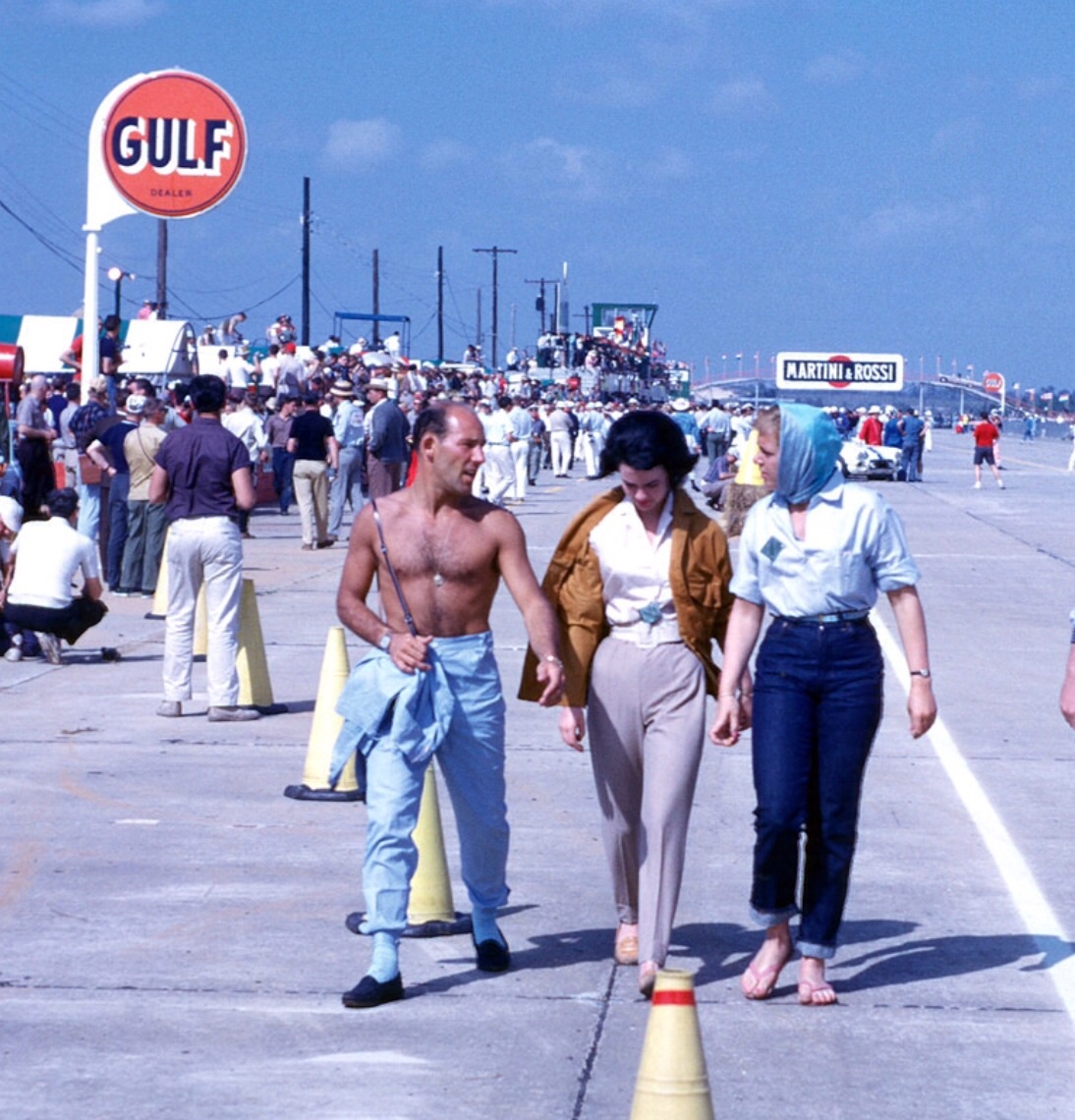
Moss, maidens, Sebring 1962. That he was in such great physical shape no doubt a factor in his attraction to the babes but it  also stood him in good stead in surviving the horrific Goodwood shunt, surgery and month long coma (Tom Bigelow)

Moss then returned to Europe for the 1 April GP of Brussels and Lombank Trophy at Snetterton on 14 April yielding second and seventh in the Walker Lotus 18/21 FWMV V8 ‘906’ before that fateful day at Goodwood on 23 April.

image

Moss, Goodwood, Lotus 18/21 ‘906’ not long before the prang, Easter Monday 1962 (Doug Nye)


image

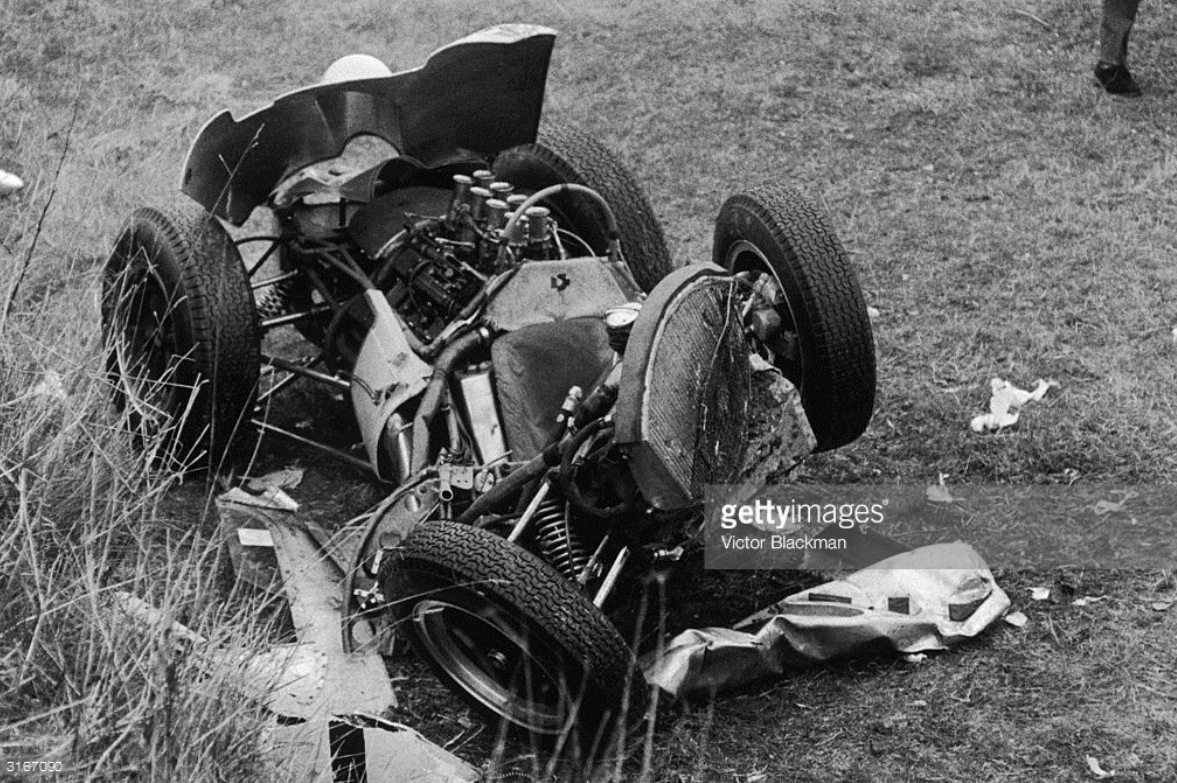
It took over an hour to cut Stirling free from the mortally wounded Lotus. One of the things I have learned and detest in researching various pieces is the vast number of gruesome images of racing crashes on the internet- you won’t ever see them here, I am all for ‘freedom of the press’ but believe there is a place for censorship of said images (Victor Blackman)

Moss was an enormously popular visitor to Australia from the mid-fifties, sadly his Goodwood 1962 accident was not too far away during his early 1962 tour.

His Antipodean fans never forgot him though.

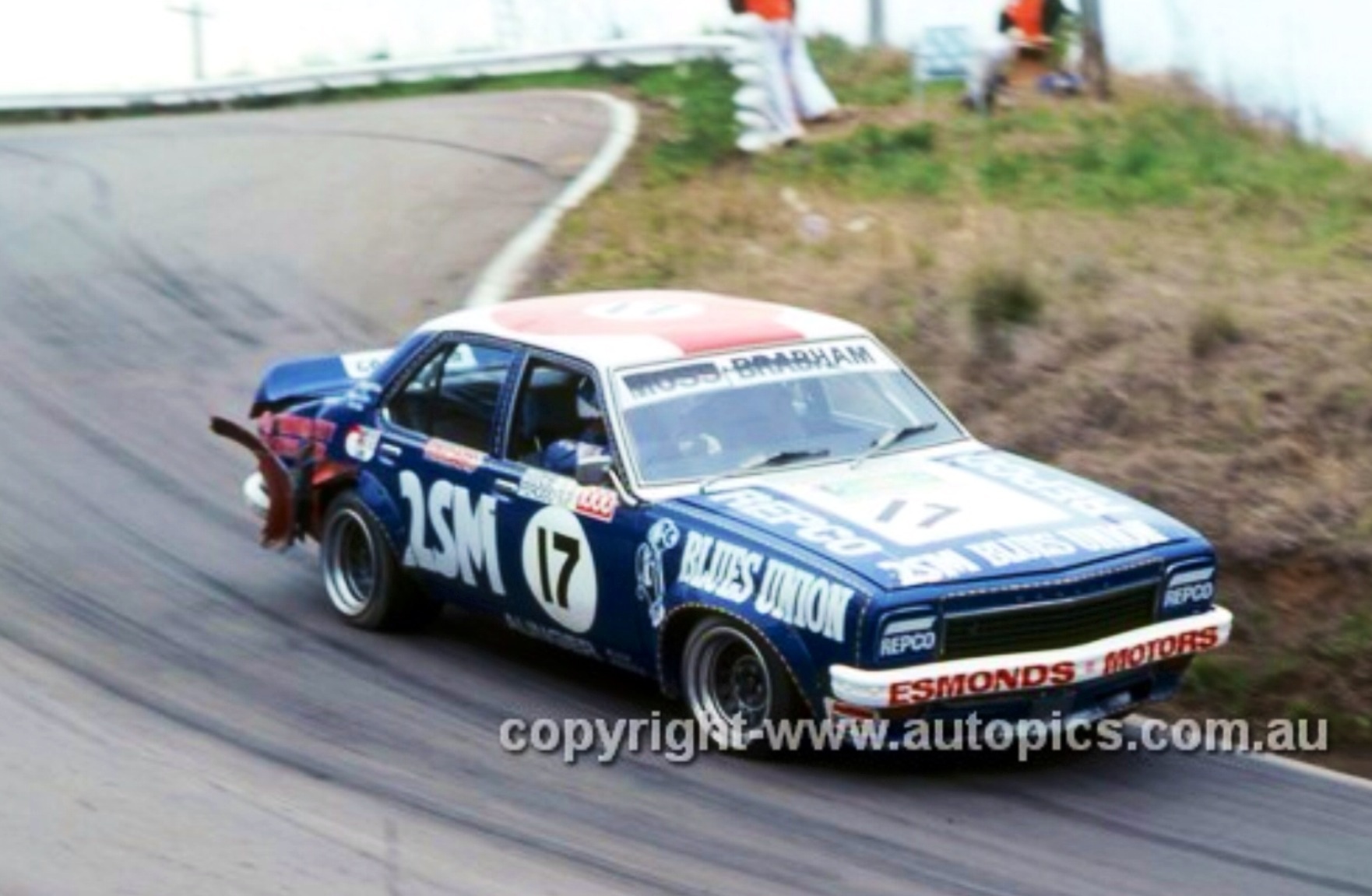
We turned out in droves to see his ‘comeback’ drive in a Holden Torana L34 V8 at Bathurst in 1976, he shared the car with Jack Brabham. The all-star combination had a shocker of a race when Jack copped a Triumph Dolomite ‘up the arse’ on the startline thanks to his Holden’s clutch failure.

Brabham was stranded as the rest of the field moved post-haste towards Hell Corner, the unsighted Dolly was an innocent victim of Black-Jacks misfortune, the car was patched up but Jack and Stirling failed to finish, a great shame!

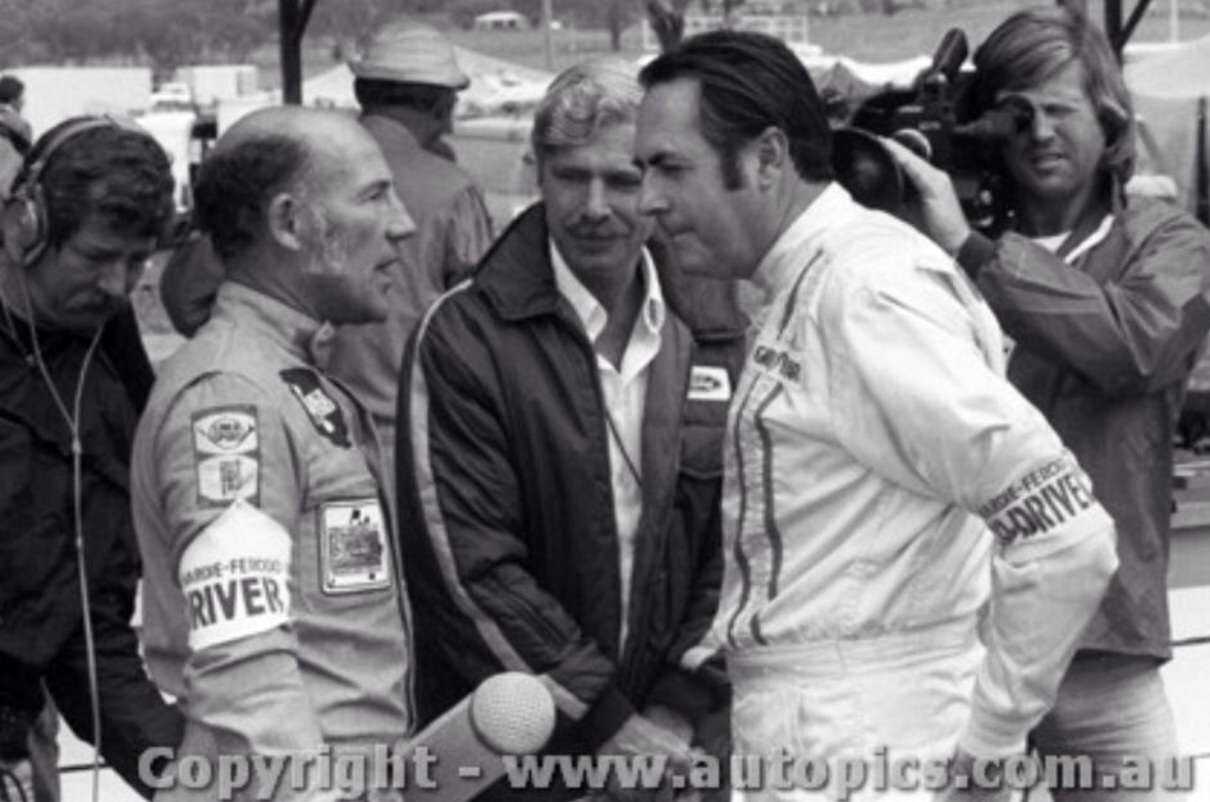
Moss, a great man, ’tis wonderful he remains one of our sports great ambassadors.

image

Brabham/ Moss, Holden Torana L34, Bathurst 1976 (Autopics)


image

Moss and Brabham at Bathurst in ’76, that’s Scuderia Veloce’s David McKay in between (autopics.com)

Bibliography…

Automobile Year, MotorSport 1961 Italian GP race report by Denis Jenkinson, Doug Nye ‘Theme Lotus’, William Taylor ‘The Lotus Book’, oldracingcars.com, GP Encyclopaedia, silhouet.com, Team Dan

Photo Credits…

GP Library, James Allington, Mal Simpson, Kevin Drage, Stephen Page, John Ellacott, Klemantaski Collection, John Ross Motor Racing Archive, Dave Friedman Collection, autopics.com, Victor Blackman, Doug Nye, Tom Bigelow

Tailpiece: The future. Jim Clark at Sandown, Lotus 21 Climax ‘933’, World Champion in the new, epochal monocoque Lotus 25 within two years and a GP winner within months. Here with the lower sidepanel removed due to Melbourne summer heat…

image

(Kevin Drage)

Finito…


bruce

Bruce McLaren poses for this studio shot on 26 April 1967…

He was the all-rounder; tester, driver, designer, engineer, company director…and male model! I bet Teddy Mayer had to twist his arm for this job tho. ‘Daily Express’ shot so it was possibly to go with a feature on the multi-talented Kiwi Champion.

A good year, the team took its first Can Am title, Bruce winning in the M6A Chev he co-designed with Robin Herd. He raced a factory Ford GT40 Mk4, in sports car events, one of Dan Gurney’s Eagle T1G’s whilst his own GP car was made race-ready, then of course there were the Elva built customer cars to consider and sponsors to look after. And a company to run…

Credit: McKeown/Getty Images, Dave Friedman Archive, The Enthusiast Network

image

McLaren and his M6A Chev at the 1967 Road America Can Am, Denny Hulme won this round. Look closely and you can see the ‘McLaren Engines Flower Power’ decal on the 6 litre, injected, ‘Heavy-Chevys’ rocker cover! (Dave Friedman)

image

Bruce McLaren, Road America September 1967. DNF with an oil leak from grid 1. Hulme in the other M6A took the win  (Dave Friedman)


Tailpiece: Las Vegas sunset, Stardust Raceway, Bruce McLaren and M6A Chev, 14 November 1967…

image

Not a good race weekend for Bruce as he blew an engine from grid 1, but he did win the ’67 championship! Surtees took the round win in his Lola T70 Mk3B Chev (The Enthusiast Network)


tim

‘Don’t worry about the T-Shirt Tim, it was the only one in the cupboard this morning! Go quicker than him and I’ll  make some with your name on them!?’…

FW exhorting Tim Schenken to get more speed from his steed.

Frank Williams raced the De Tomaso 505 Ford in 1970, a car designed for him by Gianpaolo Dallara. But it was shitbox, nowhere near as fast as the second-hand Brabham BT26 Frank ran in 1969 for his great friend Piers Courage. He drove with skill and conviction, second place the seasons highpoint at Watkins Glen in the US GP.

The De Tomaso was slow, too heavy amongst other shortcomings from the start, Piers Courage died in it at Zandvoort. I’m not suggesting a component failure was the accident’s cause but perhaps trying too hard to compensate for its lack of pace was.

image

Piers Courage, De Tomaso 505 Ford, Zandvoort, 21 June 1970. He qualified the car 9th, was in 7th place on lap 22 when he ran wide into a sand bank, hit a post, overturned the car which then caught fire. Rindt won, the Lotus 72’s first win, no joy for Jochen, his close friend died (unattributed)


Brian Redman raced the car for FW at Clermont Ferrand and Hockenheim, Tim took over the drive at  the Osterreichring, Monza, Mosport and Watkins Glen. He retired in every event except Mosport where he was not classified but qualified 17th, his best ‘result’.

image

Schenken, 16 August, Zeltweg, Austria 1970, DNF on lap 25 with engine failure, Q19. Ickx won in a Ferrari 312B (unattributed)

Schenken made the most of the opportunity FW gave him, he was recruited by Ron Tauranac for 1971, Jack Brabham retired that winter, Tim was teamed with Graham Hill who drove the problematic BT34. Tim raced the year old but still very quick BT33, his best placings 6th and 3rd at the Nurburgring and Osterreichring respectively.

Bernie Ecclestone bought Brabham during 1972, Tim was uncertain about Bernard Charles ability to run the team and left for Surtees, he was later to rue ’twas not the best career decision i ever made’…

tim

Schenken in the Williams De Tomaso 505 Ford in the rain, Zeltweg 1970 (unattributed)

Credit…REX Shutterstock

image

British GP, Brands 1970

A winning racing cars performance is greater than the sum of its individual components, said items often of great engineering beauty…

The left front corner of the 1970 F1 Ferrari 312B is a good example of an exquisite bit of a very cohesive design which was quicker than the ‘sum total of its bits’.

I wrote an article about this car, a personal favourite a while back, click here to read it;

Life Is All About Timing? Chris Amon and the Ferrari 312B…

So, what have we got?

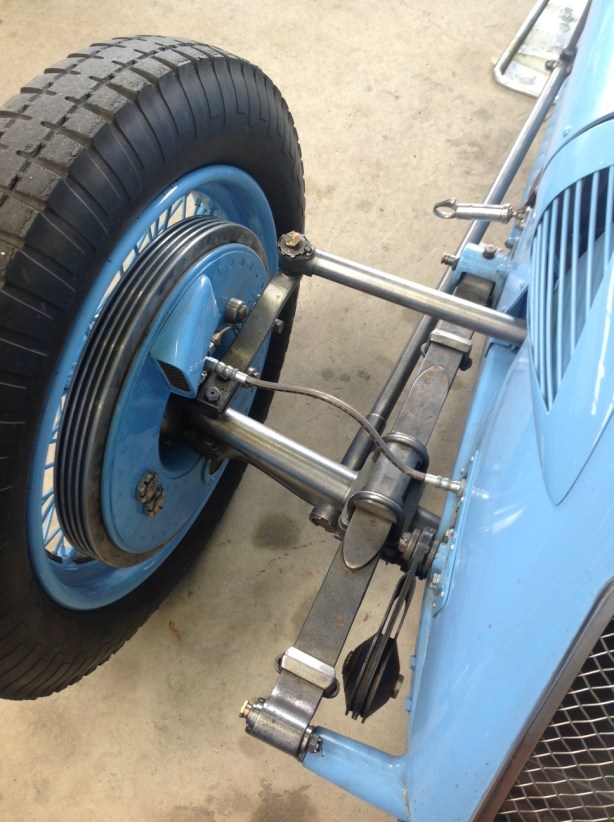
The upright is fabricated rather than cast, the neat bracket to pick-up the steering arm has a few pick-ups indicative of a bit of experimentation.

The brake caliper is Girling’s, the F1 grid that year split between Girling and Lockheed as suppliers. The disc itself is 10.5 inches in diameter and is cast iron, the use of composites still a decade or so away.

I’ve a feeling Bruce McLaren may have introduced braided steel ‘Aeroquip’ lines for fluids into F1 via his exposure to them in his US Can Am campaigns, his ’66 M2B F1 car certainly had them. Ford fitted them to their Indy Ford V8 engines provided to Lotus from 1963 but Chapman didn’t quickly adopt them for brake and clutch lines in his cars. By ’70 they were F1 passe as here on Forghieri’s Fazz.

The aluminium disc bell, drive pegs for the wheels and centre-lock hubs finish a luvverly, competitive bit of Maranello kit…

Credit…

GP Library, Racecar Engineering

Click on this link for an interesting article on contemporary F1 Cars Braking Systems;

F1 2014 explained: Brake systems

image

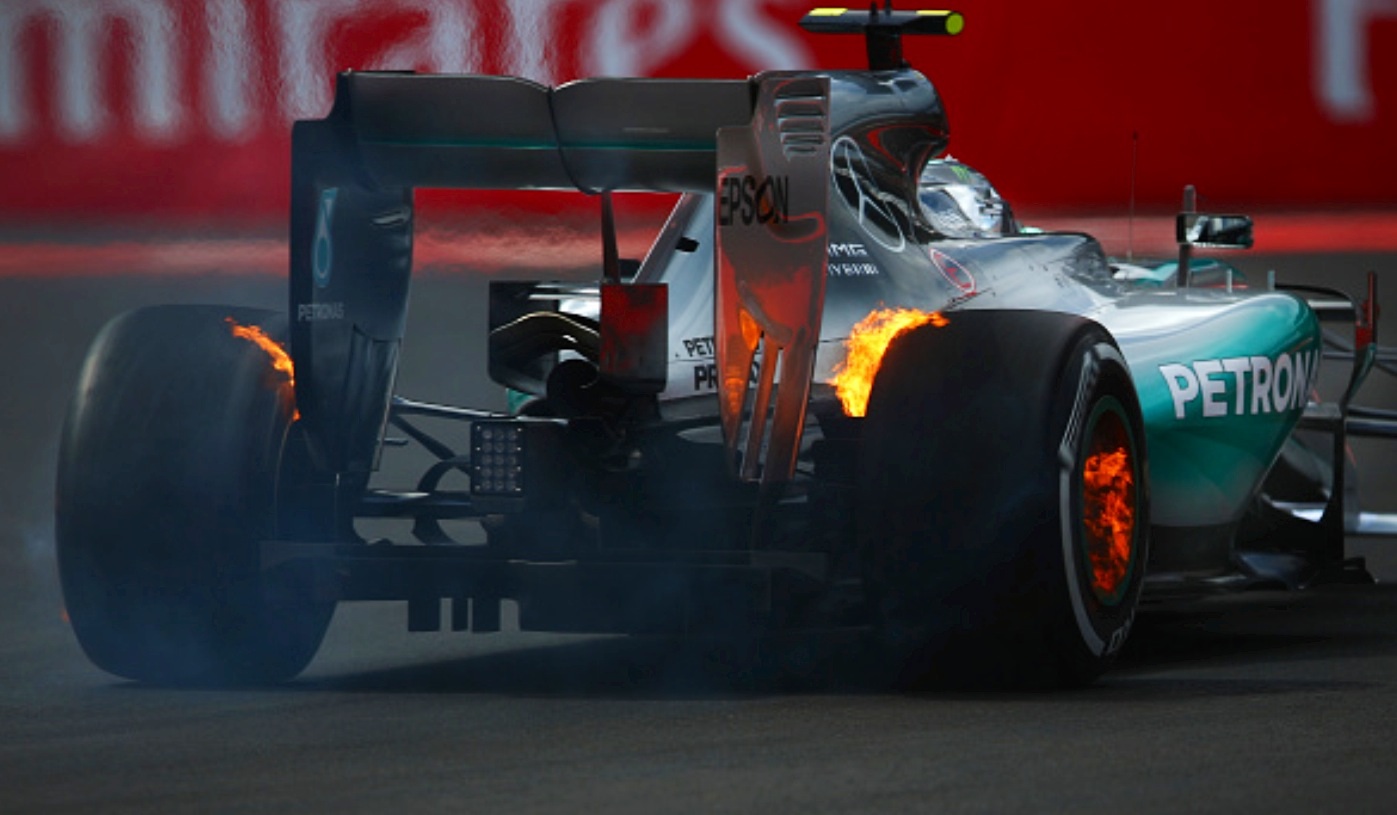
Nico Rosberg, Mercedes F1 W06, Mexico GP practice 2015 (Clive Mason)


ickx and mv

(Schlegelmilch)

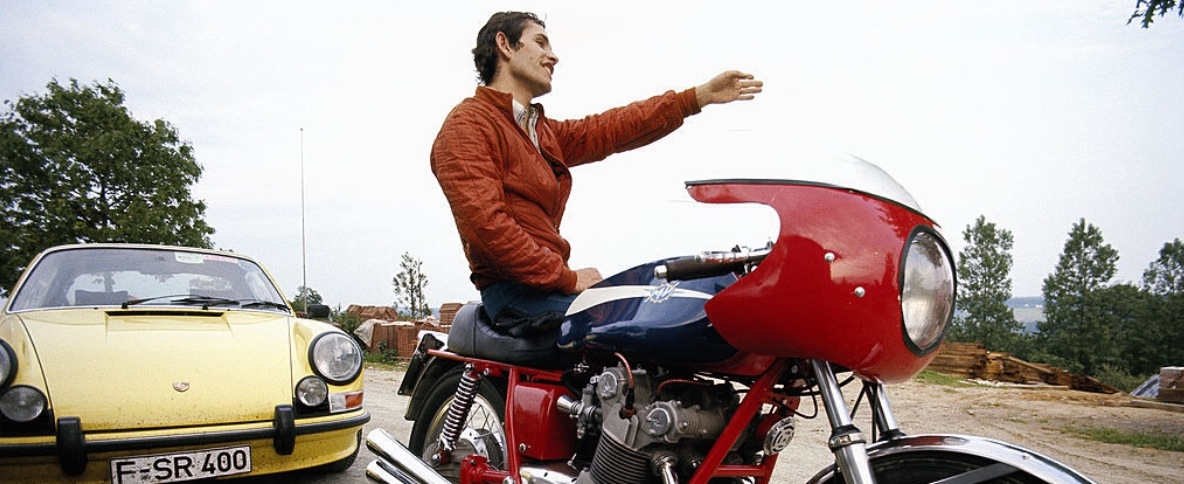
Jacky Ickx astride his MV Agusta 750 after the 1972 Belgian Grand Prix, 4 June 1972…

The 911 is Prince Rainier’s. It wasn’t a great weekend for the Belgian ace; he qualified his Ferrari 312B2 fourth and was running in the lead group early in the race but retired with fuel injection dramas on lap 47. Emerson Fittipaldi won the race in his Lotus 72D Ford, he took the first of his two world titles that year.

ickx

Ickx, Ferrari 312B2, Nivelles, June 1972 (unattributed)

Credit…

Rainer Schlegelmilch

coops

(Getty)

One tends to sometimes forget that British Entrepreneur, Engineer, Team Owner John Cooper was also a driver and the birth of Cooper as a marque is a function of his need for a racer…

The great Brit is piloting his works Cooper T20 Bristol F2, the caption for the photo says in the ‘IV Daily Express International Trophy’ race at Goodwood on Whit Monday, 10 May 1952′. In fact JC was entered for that meeting/race at Silverstone on that day as #14 but did not arrive, so ‘praps this is a practice shot.

Before focusing on the construction and sales of his cars and managing the team he was a very capable driver taking many 500cc wins, a class for which the first Cooper, famously constructed of two Fiat 500’s welded together to provide an independently suspended car, was built.

image

Cooper 500 Drivers L>R in this 1948 photo; John Cooper, George Saunders, Charles Cooper, the shot credits Chas as the cars designer and Stirling Moss. ‘New midget racing cars made by Charles Cooper at his Surbiton, Surrey garage’ is the caption (Popperfoto)

The front-engined Cooper Bristols Types 20 and 23 ‘launched’ the successful careers of Mike Hawthorn and Jack Brabham amongst many others, i wrote an article about them, click here for the link; https://primotipo.com/2015/02/10/stirling-moss-cumberland-park-speedway-sydney-cooper-t20-wm-holden-1956/

I started to research an article to write on John Cooper’s career and influence and came upon the obituary published by Britain’s ‘The Telegraph’ on 27 December 2000, it seems to me it covers things rather well so here it is, truncated slightly and with my photographic additions…

image

JC at left, having already done a few laps, slightly quizzical supervises Ken Wharton’s test of a Cooper T23 Bristol at Goodwood in 1953. What a ripper period scene, love the casual dude in suit pants, vest, tie and fag! (Popperfoto)

‘John Cooper, who has died aged 77, was one of the great figures in the history of motor racing; his Cooper-Climax cars were the force behind Jack Brabham’s dominance of the drivers’ championship in the early 1960s, while his Mini Cooper was destined to become a symbol of the decade itself.

Cooper and his small design team at Cooper Cars first came up with a rear-engined sports car in 1955. Based around a Coventry Climax firepump engine, the “Bobtail” Cooper-Climax was without peer in its class. By narrowing the chassis and fitting slender bodywork which left suspension and wheels exposed, Cooper then created a rear-engined Formula Two car which could easily be upgraded to meet the demands of Formula One.

image

Jack Brabhams Cooper T40 Bristol ‘Bobtail’ on the way to a lucky Australian Grand Prix win at Port Wakefield, South Australia in 1955 (unattributed)

By 1957, the Australian Jack Brabham had joined Coopers, and a 2-litre version of the Formula Two car was entered for the Monaco Grand Prix. Brabham pushed it home in sixth, having been third. On twisting circuits, the nimble rear-engined Cooper could challenge the comparatively flat-footed Ferraris’, Maseratis’ and Vanwalls’ which traditionally competed for places on the podium.

image

Stirling Moss on his way to the first mid-engined car F1 win, Cooper T43 Climax 1.9, Argentine GP 19 January 1958 (Getty)

The next year, in the Argentine Grand Prix, Stirling Moss drove a Cooper to a first world championship victory by the rear-engined car, and at Monaco another Cooper won, this time driven by Maurice Trintignant.

image

Moss, Argentina 1960, Moss giving away more than 500cc to his competitors, the Coventry Climax FPF 1.9 litres (Getty)

The persuasive Cooper then managed to talk Coventry Climax into building full-sized 2.5 litre engines for his works’ drivers – Brabham and Bruce McLaren – and under his direction Coopers promptly won both the 1959 and 1960 Formula One constructors’ titles, while Brabham took two consecutive world champion drivers’ titles. By 1962 every Formula One marque had put their engines where Cooper had his – behind the driver.

cooper

John Cooper aboard the Cooper T49 ‘Monaco’ in March 1959 during a press release, Brands Hatch (John Ross)


image

Lap 1 Portuguese GP 1960; Brabham’s Cooper T53 Climax from Gurney’s BRM P48 DNF and Surtees Lotus 18 Climax DNF. Jack won the race having had a huge accident in Oporto the year before (Autosport)


image

Argentine GP 1960 post victory in the UK; McLaren 1st Cooper T51 Climax, Brabham DNF and JC (unattributed)

In the mid-1940s, Cooper had competed against Alec Issigonis, the designer of the Mini, in hill-climbs. Soon after its launch in the mid-1960s, Cooper suggested to George Harriman, head of the British Motor Corporation (the Mini’s manufacturer), that he should market a tuned-up version. Harriman doubted that he could sell more than 1,000; the final total of owners attracted by Cooper’s modifications exceeded 125,000.

Cooper was consulted regularly about improvements to the design and an entire family of Mini Cooper variants evolved, among them the Mini Cooper S. The Mini Cooper lorded it over rally racing for the rest of the 1960s, winning multiple championships and four consecutive Monte Carlo rallies between 1964 and 1967.

image

It was the first economy car to become a status symbol, the height of chic. Its owners included King Hussein of Jordan and members of The Beatles. “Drive a Mini Cooper – the most fun you can have with your clothes on!” ran the advertisements. “If your tyres survive more than 2,000 miles, you’ve driven like a wimp.”

At the end of the decade the car featured prominently in the film The Italian Job (1969), in which Michael Caine and his team of bullion raiders made the most of the Mini’s virtues of small size and great speed to escape pursuit via the roofs, sewers and marble staircases of Turin. The Minis were painted red, white and blue, and the film not only helped boost sales of the Mini Cooper all over the world but, by identifying the car with a time of great British style and ingenuity, helped it also to attain immortality.

image

John Cooper was always going to be involved with cars! Caption of this 27 May 1935 photo’ Dwarfed by a full-sized car, Mr CW Cooper of Surbiton drives the miniature racing car which he built for his son John. The tiny vehicle is fitted with a 1.25 horsepower two-stroke engine and can travel 52 miles an hour. The other car is an Alfa Romeo 8C Monza, does anybody know who the occupants are? (Fox Photos/Getty)

Cooper was born on July 17 1923 at Kingston, Surrey. His father Charles ran a modest garage in nearby Surbiton; among the cars he maintained for customers was the Wolseley “Viper” raced at Brooklands by Kaye Don. When John was eight, his father made him a half-scale car with a motorcycle engine. At 12, he was given a lightweight Austin 7-based special capable of 90mph; he tried it out at Brooklands but was chased off the track by enraged officials.

On leaving Surbiton County School at 15, John became an apprentice toolmaker, and after RAF service in 1944-45, he and his friend Eric Brandon (later a successful racing driver) built themselves a single-seater racing car for the new 500cc class. Two scrap Fiat 500 front-ends were welded together to provide an independently suspended chassis, on to which was mounted a 500cc motorcycle engine behind the driver’s seat to chain-drive the back axle.

Wearing sheet aluminium bodywork, this first Cooper racing car was very successful, and a second was built for Brandon in 1947. Cooper and his father then founded the Cooper Car Company to build a batch of 12 replica 500s for sale. One of their first buyers was the 18-year old Stirling Moss.

The Cooper Car Company quickly became the first, and largest, post-war specialist racing car manufacturer; Lotus, Lola and March – among others – would follow them. While John Cooper provided the firm’s enthusiasm and drive, Charles Cooper kept control of the firm’s finances.

image

Cooper after victory at Rouen in 1952. Cooper MkV 500 (Heritage)

John Cooper was also a very capable racing driver in his own right. In 1952 at Grenzlandring he scored the first 500cc race to be won at an average of more than 100mph, and the next year drove his streamlined works car to victory in the Avus Speedbowl, Berlin. He also enjoyed first places at Monza and at Rouen.

image

JC record breaking at Monthlery, France on 9 October 1951, car is streamlined, slightly stretched Cooper MkV JAP. 500 & 1100cc engines used (Popperfoto)

Click here for an interesting article on the Cooper Land Speed Record cars;

http://www.ugofadini.com/cooperstory.html

image

JC in the chassis of the Mk V record-breaker, a variety of JAP engines used, 15 November 1952 (Central Press)

In the early 1950s, Coopers diversified into front-engined sports and single-seater racing cars. The first British world champion driver, Mike Hawthorn, first made his mark in a 1952 Cooper-Bristol Grand Prix.

A warm, even extrovert man, John Cooper relished every moment of his fame, although he was perhaps never the same after being badly injured in 1963 when his prototype four-wheel drive Mini Cooper crashed. It was many months before he was fully fit, and in 1965 – the year after his father died – he sold the Cooper Car Company to the Chipstead Motor Group.

image

1966 US GP Watkins Glen; front row Brabham in BT19 Repco DNF, Bandini Ferrari312 DNF and Surtees Cooper T81 Maserati 3rd. Jim Clark took the only win for the BRM H16 engine in his Lotus 43  (Alvis Upitis)

Although he continued to co-direct the Formula One racing team until 1969, when it was disbanded, from the mid-Sixties onwards its homegrown construction was overtaken by more sophisticated and better-funded technology at Lola, Lotus, BRM and Ferrari. Characteristically, Cooper never felt any envy as his company was upstaged.

He retired to the Sussex coast, where he founded the garage business at Ferring, near Worthing, which still bears his name. Recently, he had been much cheered by the decision of Rover to develop a new generation of Mini Coopers, primarily for enthusiasts in Japan. Rover’s new owner, BMW, has embraced the project, and just before his death Cooper was delighted to see his son drive the prototype BMW Mini Cooper.

John Cooper was appointed CBE last year. He leaves a wife, a son and daughter. Another daughter predeceased him.’

image

JC ‘races’ the ‘first Cooper ‘ his dad built for him in 1930 (Keystone France)

Credits…

‘The Telegraph’ John Cooper obituary 27 December 2000,  GP Library, GP Encyclopaedia

Getty Images, Keystone France, Alvis Upitis, Central Press, Popperfoto, Heritage Press, Fox Photos, Autosport, John Ross Motor Racing Archive

Tailpiece: ‘I don’t care Bruce just go faster!’ With Bruce McLaren and Phil Hill in 1964…

image

European/British GP, Brands Hatch 1 July 1964; JC, Phil Hill 6th and McLaren DNF #10 is Hill’s Cooper T73 Climax. Clark won the race in a Lotus 25 Climax (G Pollard)

Finito…


image

Barry Sheene laps Brands Hatch in a 1976/7 Surtees TS19 Ford in his first F1 drive on 25 April 1978…

It would have been interesting if Bazz gave cars a ‘red-hot’ go from about then, born in 1950 he was 28 and had already won the 1973 Formula 750 and 1976/7 500cc World Titles for Suzuki.

Not too many motor-cyclists have made the transition from bikes to cars successfully at elite level. Three spring to mind; John Surtees, Mike Hailwood and less obviously Johnny Cecotto. His speed and race wins on bikes flowed into F2 drives, badly broken legs in his Toleman Hart during 1984 British GP practice, he had already banged himself about on bikes, ended an F1 career of great promise.

image

Buckle up. At the time the Surtees TS19’s were being raced in the British F1 Series, so were ‘still current’

Sheene still had unfinished business on bikes though; always a threat when on a decent machine, he raced on in 500’s, his battles against Kenny Roberts the stuff of legend, his last win the 1981 Swedish GP.

An accident at Silverstone during 1982 British GP practice was one too many. He hit a fallen competitors obscured bike at around 160mph, slid for 150 metres, breaking both legs again, and an arm. Undimished, Sheene had enormous courage and resilience, he raced on into 1983 on a semi-works Suzuki even finishing 8th in the British GP 12 months after the awful accident. Unsurprisingly, his ultimate edge was dulled, he retired from bikes in 1984.

image

Place, date and bike unknown (unattributed)

Barry did race touring Cars and trucks prior to emigrating from the UK to Oz in the late 1980’s, he left his beloved Britain in search of sun to help ease arthritis partially caused by his many race prangs down the years.

An immensely likable character, he was soon as popular here as in Europe mixing property development, motorsport TV coverage and commentary with product endorsements. He and Oz Touring Car Legend Dick Johnson did a series of TV ads for Shell for years which both polished its brand and were iconic in terms of their laconic humor. Sadly lost to cancer at the all-too-young age of 53 in 2003.

image

Isle of Man 1971, Barry Sheene at Quarter Bridge after crashing out of the race in apalling conditions whilst 2nd in the 125cc race on his Suzuki. His only IOM TT race. 21, how young does he look!? (Bob Thomas)


image

‘you missed the apex by that much!’ Sheene, George Harrison and John Surtees, Brands during the test

image

Barry, George and those Linea Sport overalls so period!

Credits…

Roger Lings, Bob Thomas, Patrick Litchfield, Keystone France

Tailpiece: You can be certain the one thing, ‘the two amigos’ aren’t talking about is Texaco…

image

22 May 1978 (Litchfield)


jersey pit

Jersey Maserati line up of ; #1 Chiron 4CL, #2 Pagani 4C, #3 Sommer 4CL, #4 Bira 4C…

‘MotorSport’ announced the first British post-war international race at St Helier, Jersey on 8 May in its April 1947 issue…

‘The course embraces 1.5 miles of the St Helier promenade and measures 3.5 miles per lap, the race is a scratch contest over 160 miles, under Formula Rules ie; supercharged 1.5 litre and unsupercharged cars of 4.5 litres. There are no fuel restrictions and lady drivers are barred…Already everyone in the country seems to be booking accommodation…for the Jersey Road race will attract immense crowds of spectators’ MotorSport said.

Saint Helier is the capital of Jersey, the largest of the North Sea Channel Islands which had been liberated from the Germans less than two years before. The race was the first of five held on the island (1947-1950 and 1952), Brooklands having been bomb damaged during the war and there were problems with the authorities using a circuit on the mainland…

jersey ray era workshop

Raymond Mays supervising the preparation of his ERA D Type ‘R4D’ on 1 April 1947. The workshop shot is of interest as is the girder chassis of the car, 6 cylinder supercharged engine awaits installation on the bench (Getty)

Starved of racing opportunities the race was well supported by British entrants and was also the first meeting supported by drivers from the continent; Maserati 4CL’s were entered for Reg Parnell, Louis Chiron and Raymond Sommer, 4C’s for Bira, Ian Connell, Nello Pagani and Robert Ansell.

chiron

Louis Chiron surrounded by his team and well-wishers on race-day. Maser 4CL 2nd but probable winner of the race…(Bert Hardy)

A swag of ERA’s were entered; George Abecassis and Joe Ashmore in A Type’s, B Types for John Bolster, Bob Gerard, Peter Walker, Cuth Harrison and Billy Cotton/Wilkie Wilkinson, a D Type for Raymond Mays and E Type for Peter Whitehead.

Other notable entrants were Pierre Levegh’s Delage D6.70 these cars also entered for Henri Louveau and Jean Achard. Leslie Johnson was entered in a Talbot T150C.

jersey parnell

Victor Reg Parnell’s Maserati 4CL (Bert Hardy)


mays color

Raymond Mays ready to practice his ERA at St Heliers on 4 June 1947 (Getty/Popperfoto)

Bira set the quickest time during practice on the Tuesday and Wednesday evenings at 2.6.6 but all three Scuderia Milano Maserati’s; Sommer, Chiron and Pagani were under 2.10.

bira in pits

Bira Maser mirror adjustment in the pits, fastest by some way in practice (Bert Hardy)

Melted pistons in several of the blown cars was a problem causing MotorSport to speculate about the impact of missing fuel company expert technicians. Whitehead ran well until a split fuel tank in the ERA E Type dumped its contents on the road, the tank was repaired for the race, not well as it turned out!

maser mechanics

Maser mechanics fetting (Bert Hardy)

Johnson did a good time of 2.17 in the sports Talbot, the ‘Ecurie Delsac’ Delages of Louveau, Levegh and Achard slower.

The front row comprised Bira on pole from Pagani, Chiron and Sommer with Mays, Gerard and Ansell on row two and Whitehead, Parnell, Walker and Dixon on row three.

parnell grid

Parnells Maser being pushed onto the grid (Bert Hardy)


chiron grid

Chiron’s Maser 4CL being pushed onto the grid (Bert Hardy)


jersey start

’47 Jersey Road race just prior to the start. The front row L>R Sommer, Chiron, Pagani with Bira on pole all in Maserati’s (Jersey Evening Post)

MotorSport reported ‘The start was quite colossal…the entire field hurtled off with a crash. Impressions were difficult to analyse during the first mad rush, with the howl of the engines rising to a scream and the confusion of the blurring colours. Pagani took a slight lead from teammates Chiron and Sommer while Whitehead’s ERA hung slightly on getaway so that the Talbot and two Delages of Johnson, Levegh and Achard closed up like a released rubber band’.

‘After about 90 seconds of silence the leaders dived out of the Bayview Hotel corner, brakes on and slowed for the pedestrian like hairpin, Sommer in the lead from Bira 2 seconds back then Pagani and Parnell. There was an appreciable gap…to Mays, Ansell and Whitehead’ the latter retired the ERA E Type with a recurrence of the split aluminium fuel tank.

jersey bira

Bira correcting a slide in his Maser 4CL on the harbour front road (Klemantaski)

Bira got in front of Sommer before lap 5 but the Frenchman got the lead back but couldn’t hold it, Bira pitted on lap 10 to change a wheel having boofed a kerb.

bira racing

Bira Maser 4C from Sommer Maser 4CL early in the race at Bel Royal corner (Jersey Evening Post)

The Thai Prince lost only around 24 seconds but Derby’s Reg Parnell was in front by 45 seconds, a lead he never lost.

Sommer set a lap record of 2.6.2, 91.28mph on this road circuit before retiring with a ‘worn engine’.

chiron

Chiron’s Maserati 4CL Klemantaski)

There was considerable confusion about race positions the scoreboard and broadcast announcer at odds ‘It was not until 3 laps from the end that Parnell was shown as the leader with Chiron 2nd …Certainly (Parnell) was driving as if he thought he was 2nd, unlike Chiron who was driving as if he was sure he was 1st’.

jersey spectators

Spectators as confused about race positions as the drivers and their crews? The scoreboard says its #7 Parnell from #4 Bira and #18 Gerard on Lap 15 (Bert Hardy)


jersey chiron pitstop

Chiron pistop for fuel (Bert Hardy)

Further back ‘Mays drove as he has seldom before, climbing ruthlessly up the ruck to 3rd place once he got the car running on all six’.

gilby

Sam Gilby in his Maserati 6CM ‘Went well indeed but he should remember that in his first race, style, driving manners and a complete lack of baulking are are more important than dicing hard. Style and correctness are still the first things to learn’ MotorSport noted! (Klemantaski)

‘Johnson, playing a waiting game behind Louveau’s Delage…lost top gear, just when his pit signalled him to take Loueveau during the last third of the race’.

parnell race

Parnell (Bert Hardy)

‘Final placings after all the protests and shouting had died down were’;

Parnell Maser 4CL from Louis Chiron Maser 4CL, Mays 3rd in ERA D Type then Ashmore’s ERA A Type, Henri Louveau Delage D6.70 and Leslie Johnson Talbot T150C.

Picture Post…

jersey pic post

For the winner the spoils; Reg Parnell on the ‘Picture Post’ 24 May 1947 cover (Bert Hardy)

The inspiration for this article is the amazing work of Bert Hardy who was the principal photographer for the ‘Picture Post’, Britains most influential news-pictorial magazine, who took many of the shots used in this piece.

The magazine’s life spans around 30 years from 1938 to 1957, very quickly achieving sales of 1.7 million copies per month. What took my breath away is the sheer breadth of coverage of Hardy’s work, pretty much the progress, daily lives, sport, politics, contemporary culture and all of the conflicts in which the UK became enmeshed is shown in the archive. If you are a Brit take the time to have a look at the work. The disadvantage of the Getty Images (who now own the archive) format is that the low res scans don’t have the details of each shot unless you click on them and it ‘kicks you out’ after every 5 0r 6 clicks but its worth persevering.

Here is a link to the images;

http://www.gettyimages.com.au/photos/bert-hardy?sort=mostpopular&excludenudity=true&mediatype=photography&phrase=bert%20hardy

And here is a long but very interesting article about Bert Hardy, as an Aussie i have never heard of the man but he was truly an amazing photo-journalist;

http://www.photohistories.com/Photo-Histories/50/the-life-and-times-of-albert-hardy-1913-1995

Etcetera…

bira gridding

Bira preparing for the off , Maser 4C (Bert Hardy)


jersey gay ray

The top shot is Parnell’s Maserati 4CL being refuelled, the lower one Ray May’s, preoccupied but looking after the autograph needs of young fans (Bert Hardy)


crowd

Car #15 the Leslie Brooke ERA B Type passes the pits DNF engine failure (Bert Hardy)

Bibliography…

Motorsport April and June 1947

Photo Credits…

Bert Hardy, Louis Klemantaski, Jersey Evening Post, Getty Images

Tailpiece: Ray Mays ERA D Type independent  front suspension detail…

ray smiling

22 April 1947

Finito…

bar honda

Honda finished fourth in the 2006 F1 Constructors Championship, behind Renault, Ferrari and McLaren Mercedes but ahead of the other Japanese Teams; Toyota 6th, MF1 Toyota 10th and Super Aguri Honda 11th. Honda broke through for an F1 victory in the ‘modern era’ when Jenson Button won the Hungarian GP in the teams new for 2006, mandated 2.4 litre V8 engined RA106 chassis.

But there is more than one way to ‘skin the public relations cat’. Setting a new Formula 1 car land speed record over the Bonneville flying mile with an average speed of 400 kph was Honda’s PR mission they called the ‘Bonneville 400’.

The racer used for the attempt was its 2005 F1, 3 litre V10-powered BAR-Honda 007. For the runs out on the salt, the car was fitted with an upright rear fin instead of the standard wing and used a parachute to help slow down at the end of each run.

Driver Alan van der Merwe, the team and the car broke F1 class records three times.

honda side

During the final attempts, the Honda set two LSR’s  for GP cars. Over the flying mile, the car achieved an average speed of 397.360kph (246.908mph). The second record was over the flying kilometer, an average of 397.481kph (246.983mph).

The magic 400 kph average remained outta reach, though earlier in the  week the car hit 400.454 kph on one pass of the measured mile. ‘007’ wasn’t able to match the feat on the return trip.

17th July 2006 Bonneville 400. Day 1. Formula 1 land speed record attempt on the Bonneville Salt Flats, Utah. USA Images copyright free.

17 July 2006 ‘Bonneville 400’
Day 1. F1 land speed record attempt, Bonneville Salt Flats, Utah. USA (Honda)

While disappointed that they didn’t set the record at 400, Honda were pleased with the success achieved but not as happy as they were with their first F1 win since the 1967 Italian GP victory by John Surtees! Button took that win, his first in F1 racing 3 weeks later on 6 August 2006.

Jenson won in changeable greasy conditions from Pedro de la Rosa’s McLaren MP4/21 Mercedes and Nick Heidfeld’s BMW Sauber F1.06. It was a well deserved win for both team and driver.

image

Button, Honda RA106, victorious in Hungary 2006 (Clive Mason)

image

Button, Hungary 2006, intricacies of modern F1 cars aerodynamics clear in this shot (Clive Mason)

image

Button, Hungary 2006 (Mark Thompson)

Photo Credits…Honda Corp, Clive Mason, Mark Thompson

Tailpiece: I bet ‘007’ Sounded Sensational on the Bonneville Salt!…
Listen and see the YouTube footage;

17th July 2006 Bonneville 400. Day 1. Formula 1 land speed record attempt on the Bonneville Salt Flats, Utah. USA Images copyright free.

17 July 2006 ‘Bonneville 400’, BAR-Honda 007, Alan van der Merwe (Honda)

modena chis and plane

image

Chris Amon is not a driver one readily associates with the very successful 1970 Ferrari 312B and even then only in a ‘lost opportunity’ kind of way…

As he drove from his digs in Maranello the 20km to the Modena circuit Ferrari used for testing each time in mid 1969 he did so with an increasingly heavy heart.

Chris had motor racings dream job, Ferrari’s ‘number one’ driver and the considerable resources of the famed Scuderia at his disposal. He tested and raced F2 and Tasman Dino’s, Sports Prototypes, big Can-Am Group 7 cars and of course GP cars. The company car was not to be sneezed at. Ferrari’s drivers were only marginally less popular than the Pope, he loved living in Italy, enjoyed the food, people, the vibe in Maranello and testing the cars, Mauro Forghieri rated him one of the teams greatest test drivers and of course his racing of them.

But in his terms, as one of the five best drivers in the world at the time, he was not achieving the grand prix winning success he deserved, so many times he had led races in 1968 and early in 1969 only to have the car fail beneath him. And now, a car he thought looked fabulous and was testing well had an engine which consistently ‘grenaded’ behind him at Modena in the most spectacular fashion.

What should he do? Stay with Ferrari in the belief the engineering problem would be solved or move to another team with a Ford Cosworth powered car was the decision which tortured him…

image

Amon, Monaco 1967 in the awful race in which his teammate Lorenzo Bandini died the most gruesome, fiery death. Denny Hulme’s Brabham BT20 Repco won from Hill’s Lotus 33 BRM and Amon  (unattributed)


image

The partnership between Amon and Mauro Forghieri was a fruitful one based on great mutual respect, which is not to say they always agreed! Here with 312 at Zandvoort in 1967. How young does he look?! Ferrari team-leader at 24 by the end of 1967 (unattributed)

He joined Ferrari in 1967 as one of four drivers- Lorenzo Bandini, Mike Parkes, Ludovico Scarfiotti and himself. The ‘pudgy’, heavy 312 of 1966 evolved into the 1967 car, quite the sexiest looking of any GP car. After the end of the sports car season it became a very fast one fitted with a lightweight block and F2 derived gearbox- and from Monza with four-valve heads the car flew. Amon believed the 390bhp claimed for it and described the (’67 and ’68) chassis as ‘an absolute dream to drive’. Chris should have won at Watkins Glen in front of the two Lotus 49s but the engine blew 12 laps from the end. In Mexico Chris qualified well in second but pitted for fuel.

A road accident early in the 1967 season put him out for a while, his speed had been demonstrated in all types of car, his place in the team was cemented despite an awful season for Ferrari- the tragic death of Bandini at Monaco and the effective end of Mike Parkes’ career in a huge, high speed Belgian GP, Spa shunt.

modena amon color

Amon with Ferrari 312 in the Monza pits, Italian GP 1967. Q4 and 7th in the race won by John Surtees Honda RA300 (Schlegelmilch)

For 1968 his teammate was Belgian ‘Wunderkind’ Jacky Ickx.

One of the ‘crosses Ferrari F1 drivers sometimes bore’ was Enzo Ferrari’s obsession with sports car racing, particularly Le Mans. Whilst the team had better resources than most, the impact of the sports car program on F1 was great or little depending upon the competitiveness of said GP cars at the time! In mid-season, the focus was on the Sports Cars, after that F1 was re-prioritised.

In 1968 Ferrari ‘spat the dummy’ at  CSI rule changes (ending unlimited cars and changing to 5 litre Sports Cars and 3 litre Prototypes) not building a car for the season with a consequent focus on F1 and development of a car which could have won both ’68 world titles.

image

1968 Spanish Grand Prix. Ferrari 312/68 Q1 and led until fuel pump failure on lap 58. Hills Lotus 49 Ford won (unattributed)

The 48 valve V12 was developed to give circa 410bhp at a time the Ford Cosworth DFV gave much the same, albeit the Fazz lacked the mid-range punch of the DFV, Amon quipped that ‘there was nothing at home below 9800rpm’. The engine also had high water and oil temperatures with consequent power loss. The Ferraris went to the grid carrying 8-10 gallons more ‘juice’ than the Cosworth cars, a weight penalty of 55-70 pounds, despite all of that the 312/68 was a very competitive, if unreliable beast.

image

In amongst the damp North Sea dunes at Zandvoort in 1968. Dutch GP Q1 and 6th, the race won by Stewart’s Matra MS10 Ford  (Schlegelmilch)


image

French GP, Rouen 1968. Q5 and 10th in the race won by teammate Ickx, the ‘rainmaster’ who started the damp race on full wets and drove away in the early laps when, again, a driver, Jo Schlesser, died in another fiery accident in the Honda RA302. These accidents accelerated changes to circuit and car safety, not that they were the last horrible fiery deaths in the period. Amazing Rainer Schlegelmilch shot of Rouen and the butt of Amons 312; look at the hay bales, tyre distortion and the presence of wings which grew thru ’68 (Schlegelmilch)

In 1968 the grid was ‘awash’ with Ford Cosworth DFV’s- Lotus, McLaren and Ken Tyrrell’s Matra’s were fitted with them. Colin Chapman waived his exclusivity agreement to the engines upon Ford’s Walter Hayes request that he do so ‘for the good of GP racing’ such was Hayes’ fear of Lotus dominance. Not that Ford’s position was diminished by more DFV powered cars on the grid than less!

amon oulton

Amon in the Oulton Park Gold Cup 17 August 1968. I had this shot on my bedroom wall for years as a scho0l kid! Wings are growing…Amon 2nd to Stewart’s Matra MS10 Ford (unattributed)

For Ferrari, BRM, Weslake and Honda the impact of the Ford engine was great. The DFV was built on modern, tape controlled equipment bought for the purpose which meant the quality of the product was consistent, parts made would fit all engines. Prior to that some GP engines were to an extent hand fettled and bits needed to be modified to fit each engine, which was effectively bespoke. Cosworth’s quality control and the pressure on them to rebuild the engines in a timely consistent way for all took a while to get sorted, but the writing was well and truly on the wall, the Ford engine a considerable F1 weapon of course right into the eighties and beyond in F3000 guise.

None of this was lost on Amon of course, the competitiveness of his compatriot Bruce McLaren’s cars in 1968 was something he observed and discussed with both Bruce and Denny Hulme.

image

Italian GP, Monza 9 August 1968. Giulio Borsari makes some adjustments to Ickx’ 312. Forghieri devised this ‘movable aerodynamic device’ operated by oil pressure. The wing went to hi-angle mode in 1/2/3rd gears but feathered for low drag with the throttle open in 4/5th gears. It returned to download position in those gears when the brakes were applied. An override switch was fitted which Chris liked and Ickx had removed (Klemantaski)


image

Amon putting the movable wing to good effect at Monza in 1968. Q3 and DNF after an accident, Hulme won in a McLaren M7A Ford  (unattributed)

But Chris was ‘on fire’ in 1968. Ferrari were on the front row nine times, eight to Amon and took four poles, three to Amon, but unreliability robbed them, and Chris of three probable wins. Ickx took the only race win at Reims during the tragic French GP in which Jo Schlesser died in the Honda RA302.

At Monza Chris led until an oil leak onto a rear tyre caused an almighty accident which destroyed the car. He dominated in Canada despite clutchless gear changes from lap 12 but of course the gearbox broke under the strain, the clutch should not have failed.

image

Chris on the way to a 1969 Australian GP victory at Lakeside, Queensland on 2 February. He won the Tasman Series beating the Team Lotus Rindt/Hill duo and others. Left front of the Dino 246T off the deck thru the very fast kink opposite the pits (Rod MacKenzie)

1969 started well, Chris tested his 246 Dino Tasman cars thoroughly at Modena before shipping the cars home to New Zealand.

He convincingly won the Tasman Cup in 300bhp, 24 valve cars he helped develop and a team he put together. He collaborated with David McKay’s Sydney based Scuderia Veloce who provided on ground back-up for the mix of speed and reliability needed for this championship of intensity- eight races in eight weeks.

He beat the factory Lotus 49s of Hill and new-signing and probable ‘fastest guy on the planet’ Jochen Rindt taking four wins including the NZ GP at Pukekohe and AGP at Lakeside. The series of depth also included Derek Bell (in the other Dino), Frank Gardner (Mildren Alfa T33 V8) and Piers Courage (Brabham BT24 Ford DFW).

Back at Maranello the finishing touches were being made to the 312P, Ferrari were back in endurance racing that year, and the latest evolution of the 312 GP car.

Strategically the future for Ferrari was bright despite the financial difficulties the team were in early in the year.

Discussions underway with Fiat were consummated in June, Enzo Ferrari had effective control of the racing department for his lifetime whilst Fiat took over the development of the road cars, and a considerable amount of cash changed hands.

The injection of working capital allowed Ferrari to build the 25 512S Sports Cars required for homologation into Group 5 for 1970 and to develop Ferrari’s first ‘clean sheet’ 3 litre F1 car, the flat-12 312B.

Ferrari authorised Forghieri to start this program early in the year well before the Fiat deal was done, the Fiorano test facility, opened in 1972 is another example of the sort of investment which would not have been possible without Fiat’s investment.

amon monaco

Monaco 1969 Amon beside Jackie Stewart’s Matra MS80 Ford which won the title that year . Q2 anf a failed diff. Note the lack of wings, banned overnight by the CSI. Hill won in a Lotus 49 Ford (Yves Debraine)

From Amon’s perspective then, he was potentially in the right place.

He was esconced in one of the sports greatest teams, he had won the Tasman, Ferrari was in the process of doing a deal with a partner with deep pockets, a new car was underway for 1970 but 1969 could be a challenge with an evolution of the ’68 cars and more Cosworth powered cars on GP grids! It was critical to Chris the 312B tested well.

Whilst Mauro Forghieri worked on the design of the 312B Ing Stefano Jacoponi was responsible to do what he could with the obsolescent V12. The chassis was much the same although the cars appearance was different with a flatter nose and evolution of wings, partially at the whim of the (CSI) rulemakers who banned, rightly, high-wings during the Monaco GP weekend.

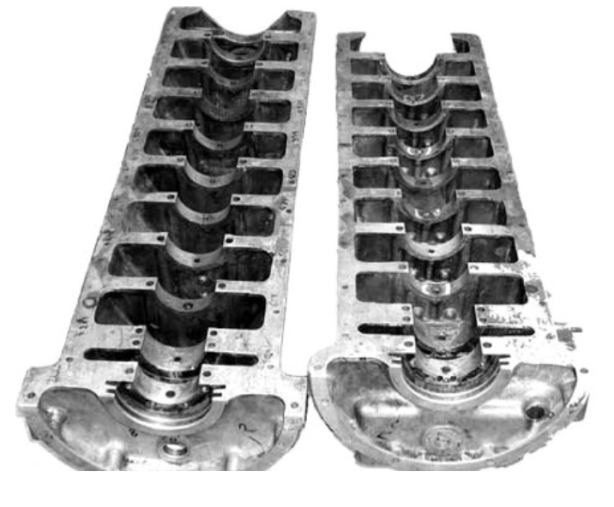
The V12 was changed with heads which reversed the porting, returning the exhausts to outside the Vee lowering the cars centre of gravity and reducing turbulence around the rear wing. Inlets were in the Vee, more radical cams were developed and disastrous efforts made to reduce frictional losses and release power by reducing main bearing area…

amon spain

Amon, Q2 DNF engine, Spanish GP, Montjuic Park, Barcelona 1969. Stewart won in a Matra MS80 Ford. Look at that oil cooler trying to do just that (unattributed)


image

Forghieri with the 312/69 in the Silverstone, British GP paddock. V12 cooling issues clear by the ‘orrible oil cooler/duct incorporated into the rear wing. Amon Q5 and DNF lap 45 with gearbox failure. Stewart’s Matra won after a titanic battle with Rindt’s Lotus. 3 Ferrari’s were entered #32 the spare (unattributed)

Early in the season Ferrari entered only one car for Amon. He was second on the Spanish GP grid and inherited the lead after the two Lotus 49’s crashed with wing failure, with a lead of over 30 seconds the engine seized. At Monaco he was second when the diff failed and at Silverstone, joined by Pedro Rodriguez both retired with ‘box and engine failures.

To add to these frustrations and be in no doubt elite sport is as much mental as physical, his erstwhile teammate Ickx- Amon had been demonstrably the quicker of the two in 1968 was winning races in Brabham’s year old spaceframe chassis BT26. That car was now as consistently fast and reliable with a DFV in 1969 as it was consistently fast and unreliable with a Repco ‘RB860 Series’ V8 in 1968. Amon’s disappointment with his situation was immense, he was a race-winner in a reliable Ferrari or another car.

Such were their problems Ferrari withdrew from the German GP on 3 August, Ickx won there, to prepare the new 312B for Monza, it simply was not worth racing the fast but unreliable 312/69.

Amon had great hopes for Mauro Forghieri’s new for 1970 car, the ‘clean-sheet, Flat-12 engined 312B…

modena amon mirrors

Amon readies himself for the off, Modena, exact date unknown (GP Library)

Mauro Forghieri’s Ferrari 312B was one of the most beautifully integrated Ferrari’s ever built, whilst much is made of the engine the success of the car was about far more. Doug Nye; ‘The 312B…was quite the best integrated 3 litre F1 package yet created. It would remain the best packaged of all Ferrari’s until the Postlethwaite 156 appeared in 1985’ he said writing in 1986. I always thought the 312T/T2 were pretty handy bits of integrated kit, but the point is, the car was a beautifully designed and executed car!

The talented Modenese born engineer saw at close hand as an at thecircuit race-engineer the success of the Lotus 49 and its imitators, the engine beautifully integrated with the chassis and the powerful, torquey, compact, relatively frugal and reliable nature of the Cosworth DFV itself. The engines basic dimensions and valve angles gave instruction to a whole generation of engine designers.

The suspension of the competition were all period conventional; wishbones/wishbones or rocker/wishbones at the front and single top-link, lower wishbones and radius rods for fore and aft location. The 312B followed that course.

Aerodynamics were still a black art but the CSI’s mandated lower wings meant airflow to the critical rear wing needed thought as the wing could no longer be mounted high in ‘clean air’. Remember, at the time traction was important, the cars had a wonderful surplus of power over grip.In the end that problem solved as much by tyre alchemy as wings let alone the 1969 4WD blind-alley of which Ferrari was not a part.

A 12 cylinder engine was a ‘Ferrari given’. Forghieri’s challenge was to unlock sufficient power to combat the DFV despite the inherent packaging issues of the longer engine and frictional losses and other bottom end shortcomings which were such problems in the existing V12.

image

Ferrari 312B 1970 showing the chassis structure and rear ‘boom or beam’ to which the engine attaches (Nye)

Forghieri’s chassis was another of Ferrari’s ‘aero constructions’. They were not monocoques in the British sense but rather a tubular internal frame stiffened by riveted on ‘ally panels. Not a problem, Ron Tauranac’s old-fashioned spaceframe BT26’s were race winning GP cars in 1969 until effectively outlawed by the ‘bag tank’ rules of 1970.

The clever bit, ‘praps learning from the DFV’s simple chassis mounts mandated by Lotus designer Colin Chapman to Cosworth’s Keith Duckworth was the use of a ‘beam’ aft of the usual drivers bulkhead to which the engine mounted. This provided a very stiff structure but also very good, better than all other cars in 1970, airflow to the rear wing. It promised more downforce and therefore grip for less angle, drag, than the other cars.

image

Note the rivets on the rear beam which is part of the cars chassis to which the engine attaches, it also biolts to the bulkhead behind the driver. Low nature of engine and good airflow onto the wing. Oil cooler ducts also in shot (GP Library)


image

Ferrari factory drawing of the Flat-12 312B engine showing its deep base chamber, roller bearing mains, narrow included valve angle, induction tracts above the heads, exhausts below and extensive cross-bolting of the split crankcase castings (Nye)

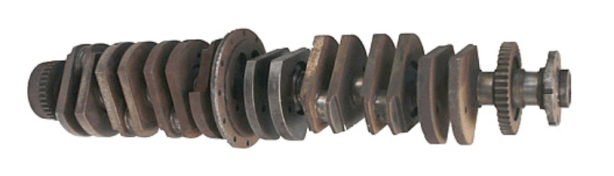
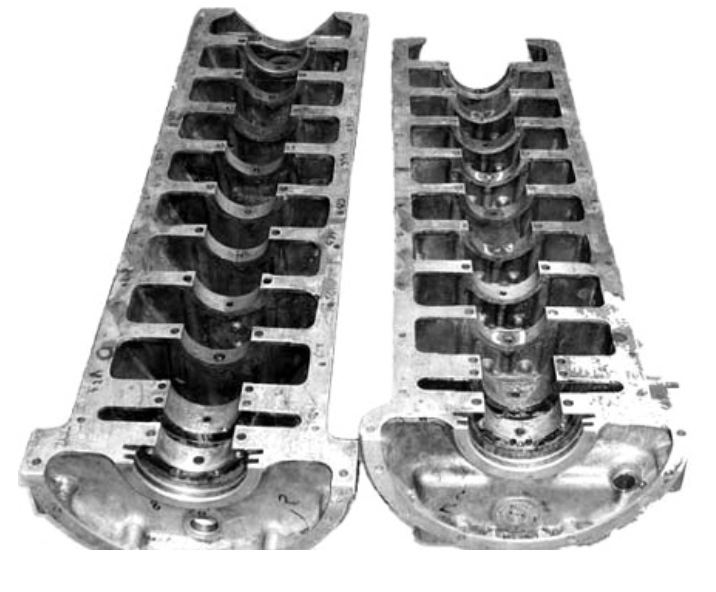
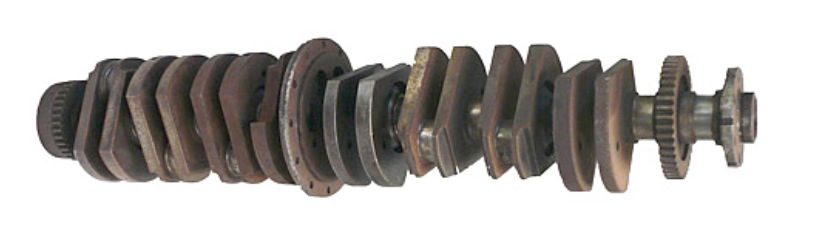
Engineers Forghieri, Rocchi and Bussi’s 3 litre Flat-12 engine was conceived in that horizontally opposed configuration to get the cars centre of gravity low and get the engine out of the airstream to the wing. The need for lower frictional losses was met by the use of just 4, the old V12 had 7, main bearings. The design used  2 plain bearings in its centre and ball bearing races at each end.

Bore and stroke were 78.5mm x 51.5mm, vastly oversquare, for a capacity of 2991cc. Four overhead camshafts and 4 valves per cylinder were used, the heads evolved from ’69 V12 practice. Lucas fuel injection was carried over onto the new engine. The cams were driven by gears  from the crank’s nose.

Doug Nye; ‘The light alloy block was cast in 2 parts and united on a crankshaft centreline bolted flange…Light alloy cylinder liners were used, cooled by water circulation at their upper ends, by oil circulation down below. The crankshaft was machined from a steel forging, each of its six crankpins carrying two con-rods. The crankshaft nose gear drove alternator, ignition distributor and and fuel metering unit via gears and pinions. The crank tail drove the valvegear train. A tiny flywheel assembly incorporated a rubber vibration damper. Forged titanium con-rods were used…and Mahle forged aluminium pistons…a single oil pressure pump was driven off the rear of the RH cylinder timing gear fed the oil filter mounted behind the fuel metering unit.’

image

Side on flat-12 engine detail, DOHC, 4 valve, Lucas injected, single plug, how low do they take the CofG with this approach?! See rad header tank and extinguished bomb, the latter messy in terms of flow to the wing and exposed! Check out the very clever roll bar brace; it triangulates and stiffens the rear beam structure as well as providing a neat, faired mount for the wing itself (GP Library)


image

312B front end detail. Suspension top rocker actuating coil springs and Koni shocks and lower wide based wishbone. Note ally ducting behind rad to exhuast hot air via ducts in the fibre-glass nose (GP Library)


image

Butt shot of the 312B as it heads out onto Modena Autodrome with Amon saying a few silent ‘Hail Marys’ as to engine life no doubt! Ducting to oil coolers, rear mounted battery and outboard brake discs/suspension all clear (GP Library)

Amon watched the jewel of a car evolve at Maranello, it was with a great deal of optimism that he approached his early tests at Modena.

Right from the start he and Forghieri were happy with the chassis, the sort of balance they achieved with the earlier V12’s was still present. The car was lighter, was good under brakes had good traction and top speed for as long as the new, powerful engine lasted…

With Chris in the car the 312B had a series of monumental, catastrophic engine failures due to piston, crankshaft and lubrication problems. Amon; ‘I could feel that it was tremendously strong and powerful during those early tests, but it kept flying apart, i thought hell i can’t stand any more of this…’

After one of these sessions in August Chris said ‘enough’ and decided to leave the team.

Its ironic that Amon made the decision to leave due to the early failures of an engine which became a paragon of powerful reliability for a decade winning 3 drivers, 4 manufacturers and 1 sportscar championship for the Scuderia. Its performance was only compromised by its low/bulky architecture, a strength but an impediment in the ‘wing car ‘ era when the engine took space needed for ground-effect tunnels.

The engines bottom end failings were resolved by building a tilting dyno-bed at Maranello  to reproduce oil surge in corners. The crank torsional issues were sorted by the addition of a Pirelli cushion coupling between the crank and flywheel. In this form the 1970 spec engine developed 460bhp from 11500-11700 rpm rising to 510bhp@12000 rpm in 1979/80.

But for Chris it was all too much, he could see another season of Ferrari DNF’s caused by the repeated engine failures which had cost him victory or good placings on so many occasions. He saw his immediate future best served by driving a Ford Cosworth DFV powered car, the dominant engine of the time, so off to the nascent March concern he went.

He hadn’t burned his Ferrari bridges though, he was invited to be a member of the teams 512S sportscar squad in 1970…but Enzo Ferrari did say to the Kiwi that he, Ferrari, would win a race before Chris did!

image

Ickx, having made a smart move to Brabham in 1969 came back to Maranello for 1970 as ‘numero uno’ and was unlucky in some ways, in a season of great cars, not to win the title in the 312B!

The 312B came on strong, all issues solved in the second half of the season, the car won in Austria, Mexico and Canada for Ickx and at Monza for Regazzoni. Had the car started the season as well as it finished, noting Rindt’s death at Monza took out the seasons fastest combination, Ickx would have won the title. Mind you, there are plenty of new cars down the years that if they had reliability from the start of the season would have taken the title.

image

This group of shots (the one above and those at Modena below, all are undated sadly) are included for the sake of completeness; they are all of the same session. They show the beauty of this incredibly good, important for Ferrari car.

The photos convey a certain sense of calm as well, despite the problems which were apparent with the engine from the start. Apart from Chris of course, i am sure he felt far from calm trying to best assess his short and longer term options!

Driving careers are fickle things; he felt he had to seize the moment having in his mind stayed at Ferrari a season too long. Hindsight is brilliant of course, in fact he stayed a season too little, his testing skills may well have meant the car started the season better prepared than it did. Ickx wasn’t a noted test driver and new-boys to F1 Regazzoni and Giunti weren’t in a position to make the contribution Chris could and had made since 1967…

modena wing

Another view of the roll bar/wing mount covered earlier (GP Library)


modena forg

Forghieri with the pad, sans rear wing in this shot (GP Library)


image

Who is the belle of the ball!? Lotus 72 was ‘the radical’ of 1970: side rads, rear weight distbn, torsion bar suspension but all the other race winners that year were ‘conventional’ front rad cars; 312B, BRM P153, Brabham BT33, March 701. Best aero direction not clear at this point in GP history nor would it be until the Lotus 78 started the ‘wing car’ trend (GP Library)


image

Chris Amon, Modena June/July 1969. He lost many races due to bad luck, the decision to leave Ferrari tho wasn’t so much bad luck as a judgement call which time proved was the wrong one. Wonderful hindsight i know (GP Library)


image

(GP Library)


modena chris 1

Amon lost in his thoughts, Modena 1969 (GP Library)

Amon Post Ferrari…

This article is not about Amon’s career, rather Ferrari elements of it. What follows is not a full summary of the balance of his wonderful career.

For Chris 1970 was frustrating!

The March 701 was not the best car of the season but both he and Jackie Stewart in Ken Tyrrell’s car ‘made it sing’. Stewart took a Spanish GP win and Chris the BRDC International Trophy at Silverstone, an F1 win but not the GP win he sought.

He came close to that in a titanic battle with Pedro Rodriguez’ BRM P153 at Spa in a test of the brave, bold, skilful and precise, just coming second.

He proved as quick as anyone in 1970, again. His record head to head in the 10 Championship GP’s he and Stewart raced the 701, the Scot in a Dunlop rather than Firestone shod car was 8/2 in Stewart’s favour. In all but 2 occasions Chris was only 1 or 2 grid slots behind Stewart who was arguably the best driver in the world at the time if not its fastest. Until his death most would argue that was Jochen Rindt. There is little doubt the Tyrrell 701 was a better prepared car than Amon’s March works car. The point to take here is that Amon was ‘right thereabouts’ with the best driver in the world at the time.

amon march

Amons March 701 being tended by the cars designer Robin Herd at Monaco 1970, Q2, DNF suspension failure,Ronnie Peterson’s customer, Colin Crabbe owned yellow March 701 behind. Rindt won in a Lotus 49C Ford (unattributed)

If the departure from Ferrari was not strategically the right one for all the reasons outlined earlier in the article, the departure to the new March outfit was a ‘leap of faith’ largely i suspect in designer Robin Herd which provided a competitive Cosworth powered car if not the quickest one. Amon knew Herd from their March days, Robin designed the first McLaren F1 car, the M2B and the ’67 CanAm Championship winning M6A Chev.

March were a company whose very successful raison d’etre was the construction and sale of production racing cars, its works teams secondary considerations. Its not hard in that context to work out what Max Mosley and Robin Herd’s prime focus was in 1970; to win in FF, F3 and F2 to flog cars for the coming year. Chris signed relatively early for March, before he knew they were selling 701′ s to ‘every man and his dog’ including the 1969 world champion for 1970. In 1970 Amon, Siffert, Stewart, Servoz-Gavin, Cevert, Peterson, Andretti and others raced 701’s. Works drivers Amon and Siffert didn’t have the cars to themselves.

Brabham, McLaren and BRM would have been better places to be in 1970 than March. Not that BRM was an attractive option in 1969.

Chris joined Matra who made him an offer he couldn’t refuse, back to a V12 for 1971 and 1972, taking a Non-Championship GP win in Argentina in 1971 and again lead races more than once only to experience car failures or punctures.

image

1971 Argentinian GP placegetters; Henri Pescarolo March 701 Ford, Amon 1st where he belongs! Matra Ms120 and Carlos Reutemann McLaren M7C Ford Ford (GP Library)

During 1972 Matra were mainly a single-car entry for Amon its focus increasingly on Endurance Racing success.

amon matra

German GP 1972. Amon Matra MS120D Q8/15. Ickx won in a Ferrari 312B2 (unattributed)

Tecno in 1973 was a disaster but Chris raced a third Tyrrell in Canada (Q11 2 slots behind Stewart in the unfamiliar car and 10th in the race) and the US (Q12 at the time the team withdrew from the race) for Tyrrell but not converting that into a 1974 drive after the death of Francois Cevert and retirement of Jackie Stewart at Watkins Glen.

His own Amon F1 car was also a disaster in 1974, a project commenced after a return to March in ’74 ‘evaporated’ over the Christmas New Year period seemingly after a failure in communication between Max Mosley and Chris. An engine development business with ex-BRM engineer Aubrey Woods also cost the Kiwi a lot of money. Looking at Chris’ career and some of the decisions suggests he needed a decent business manager, or a better one if he had one!

amon watkins chassis fit

In Tyrrell 005 in the Kendall Centre, Watkins Glen. Note the inboard front brakes of Derek Gardner’s design. Tragic weekend with teammate Francois Cevert’s high speed, fatal practice crash in an 006 chassis. Both remaining cars withdrawn and Jackie Stewart didn’t get the chance to race in his last, planned GP (Mike Glynn)


amon watkins

Amon in Tyrrell 005 Ford, Watkins Glen, USGP practice, 6 October 1973 (unattributed)

In 1975 he raced  the Talon MR1 Chev F5000 (nee McRae GM2) in the Tasman Series and in the US showing he had lost none of his skill despite a car not as good as the ubiquitous, highly developed Lola T332’s.

image001

Amon enters the Sandown paddock, Saturday 22 February 1975. 5th in the race, Talon MR1 Chev, car behind is John McCormack’s 2nd placed Elfin MR6 Repco. John Goss won in a Matich A53 Repco (M Bisset)

The only time i saw Chris race was in the final round of the ’75 Tasman at Sandown in February, he did the full series in one of Jack McCormack’s Talons, not the ‘fastest tool in the shed’ but Chris made the car sizzle despite junk engines which failed 3 times. He took a win at Teretonga, the final Kiwi round and was quick everywhere whilst the car stayed together.

I was a starstruck teenager who didn’t stray too far from his pit the whole weekend. On circuit what was impressive was his speed which was deceptive. He drove the car in a very ‘neutral’ fashion through the slow/medium corners where so many others were ‘tail out’. Across the top of ‘Marlboro Country’ a fast entry quicker corner his carrying speed and control was a joy to watch as was his precision under brakes into ‘Dandy Road’. I still recall the toe/heel too; on the brakes late and a change down late as well, a short/few revs blip at the throttle, easy on the DG300 box. A pro.

image002

‘Auto Actions’ Paul Harrington gets the gen from Amon, Sandown Tasman ’75 practice Saturday, looks like its tough going! McRae GM2/Talon MR1 clones lovely cars (M Bisset)

Late in 1975 he had some drives of Mo Nunn’s Ensign GP cars, he and Nunn developed these pretty, effective cars into machines which shaded many of the big budget teams in 1976.

He was 10th on the Spanish GP grid, finishing 5th, 8th on the Zolder grid but lost a wheel and flipped the car emerging unscathed in the race. At Monaco he was Q12 and 13th. At Anderstorp he was a terrific 3rd on the grid but crashed out of 4th on lap 39 when the cars suspension failed.

amon sweden 1

Swedish GP, Anderstorp 1976; Amon Ensign N176 Ford in between Patrick Depailler’s Tyrrell P34 Ford and Gunnar Nilsson’s Lotus 76 Ford. Scheckter won in the other P34, Amon an amazing Q3 and accident caused by suspension failure (unattributed)

Chris missed the French GP injured after Sweden, Patrick Neve qualified the car 26th, perhaps more indicative of the machines pace without an ‘ace’ at the wheel…

At Silverstone for the British GP, Chris qualified 6th, this time a water leak the cause of a DNF.

The problems of a low budget team in terms of design and preparation were clear, Chris decided he had ‘had enough’ of GP racing in this way and elected not to take the re-start of the German GP after Niki Lauda’s accident. The risk of something breaking on that circuit in that car was simply too great.

1976 showed he had lost none of his sublime, deceptively fast skill, speed and testing ability. He was still only 33 despite having his first Championship GP drive in 1963.

image

Amon’s last pro drive. Mont Tremblant CanAm 12 June 1977 in Walter Wolf’s Wolf Dallara WD1 Chev, grid 2 and DNF. Race won by Klauser’s Schkee Chev (Bob Harmeyer)

Amon’s last race was in Walter Wolf’s single-seat Can Am car in 1977 before saying ‘enough’, recommending Gilles Villeneuve for the ride before returning to his native New Zealand and farming at Bulls in the ‘Land of The Long White Clouds’ North Island. He sold the property some years ago but is not too far from the local racing scene and maintains a long-standing commercial relationship with Toyota.

Chris Amon had a career most of us can only dream about, life is all about the decisions we take, perhaps the decision to leave Ferrari in 1969 was the worst he ever made but in the same circumstances i suspect many of us would have made the same call.

To me though he should be remembered for what he achieved rather than what he didn’t: wins at Le Mans, Daytona 24 Hours, Monza 1000Km, a Tasman Championship, NZ (2) and Australian GP wins against some of the best drivers in the world, two non-championship F1 races and many individual race wins and the respect and fear of his peers. From 1967 to 1972 he was in the top 10 drivers in the world, for some of those years top 5.

Bot wow, Amon in a 312B in 1970, if only…

Etcetera…

image


image

Ferrari 312B cutaway (unattributed)


image

Bleeding the brakes with Dave Ramsay, F5000 Talon MR1A Chev during the Long Beach GP weekend in September 1975. Amon 4th, race won by Brian Redman’s Lola T332 Chev (D Ramsay)

Bibliography…

Automobile Year 16, 17 and 18, Doug Nye ‘History of The GP Car 1965-85’, GP Encyclopaedia, MotorSport March ’84 Amon article by Alan Henry

oldracingcars.com is one of my standard, always reference sources- checkout Allen Brown’s piece on the cars and each chassis built here; https://www.oldracingcars.com/ferrari/312b/

Photo Credits…

Getty Images, Rainer Schlegelmilch, Mike Glynn, Klemantaski Collection, GP Library, Rod MacKenzie, D Ramsay, Bob Harmeyer, Yves Debraine

Tailpiece: ‘This thing is a Jet if only they could keep it together for more than 10 laps?!’ …

modena tailpiece

Finito…