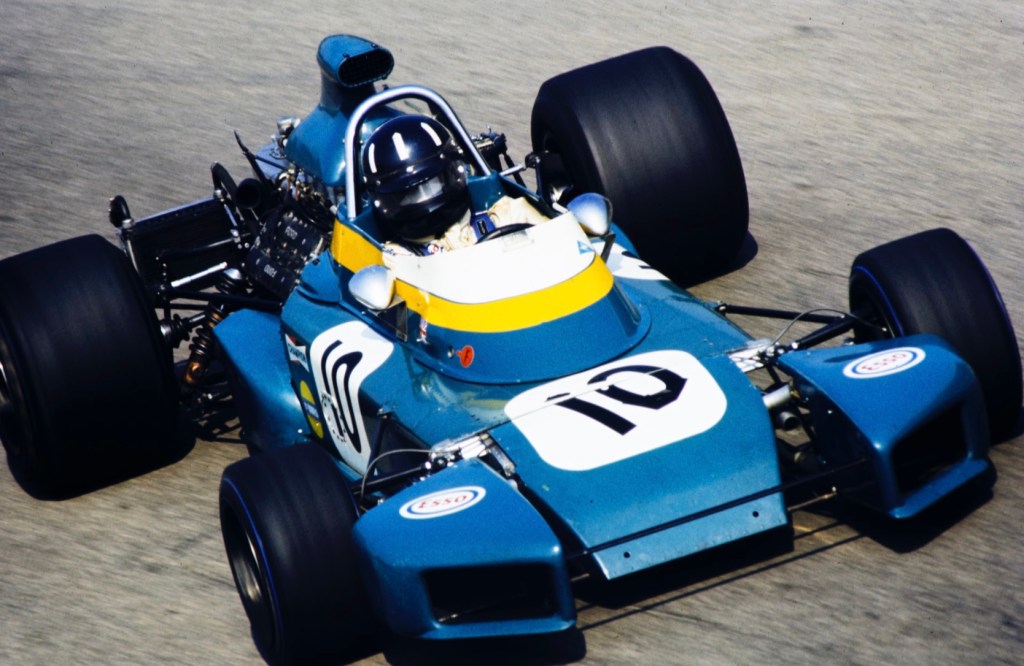
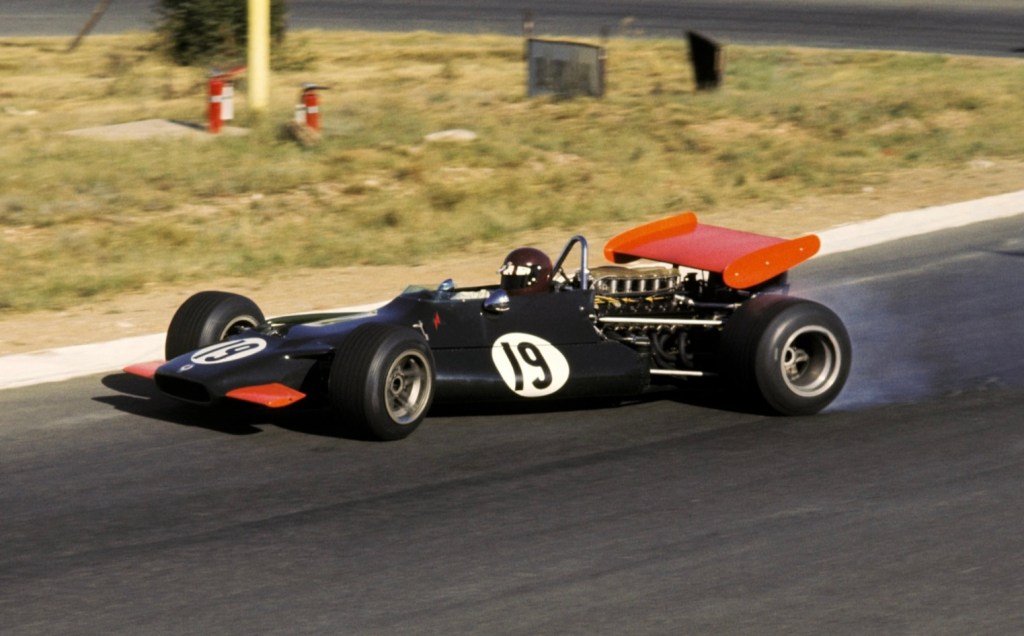
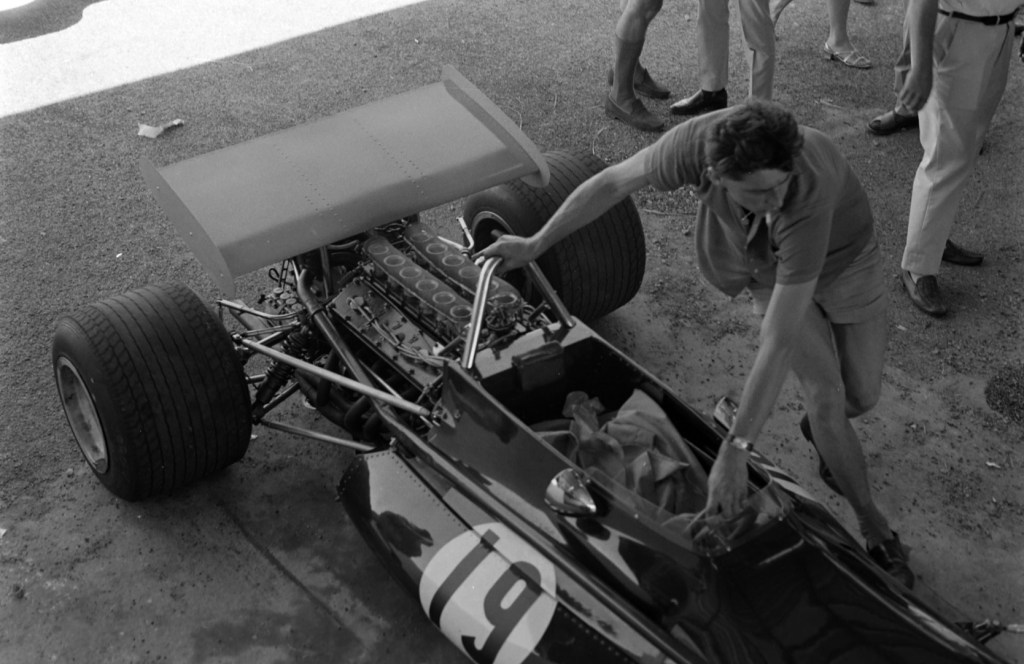
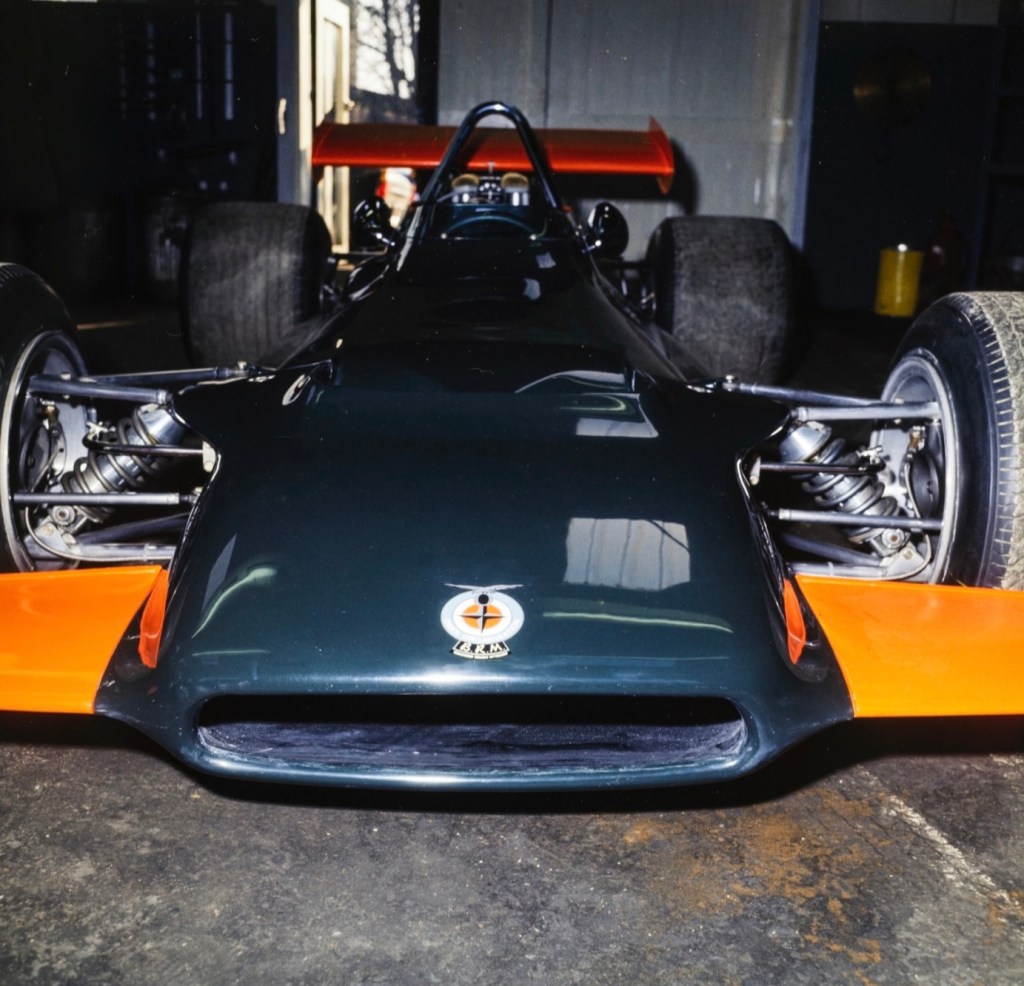
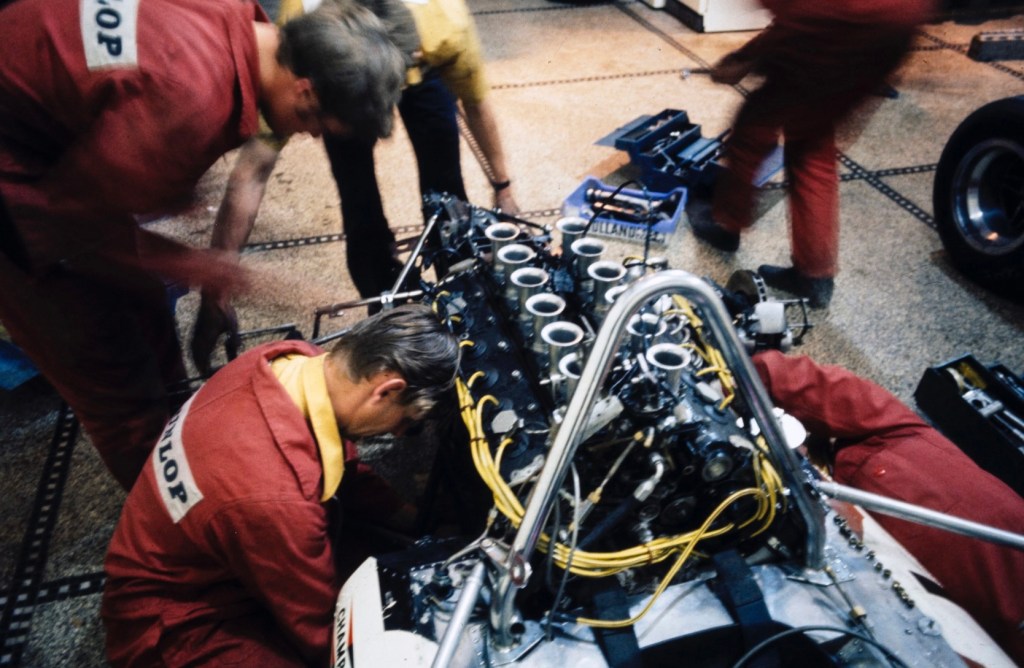
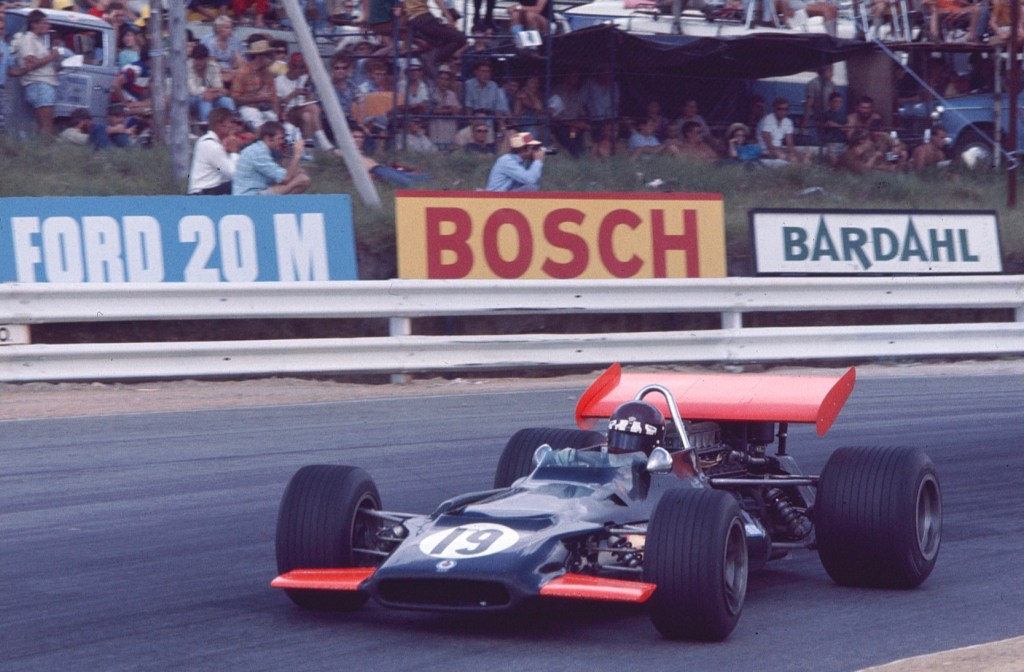
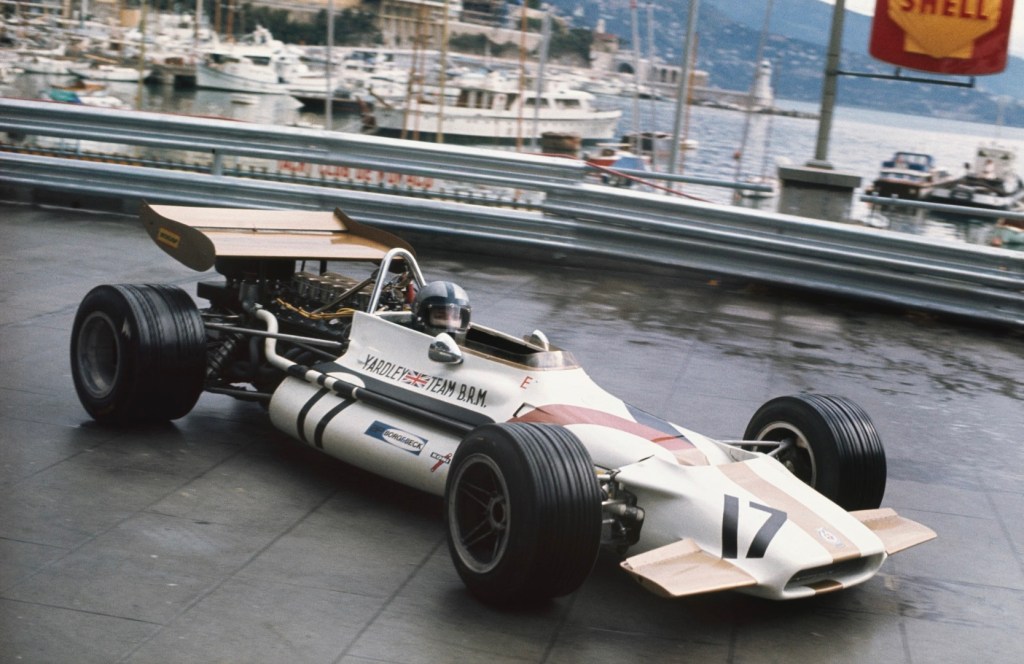
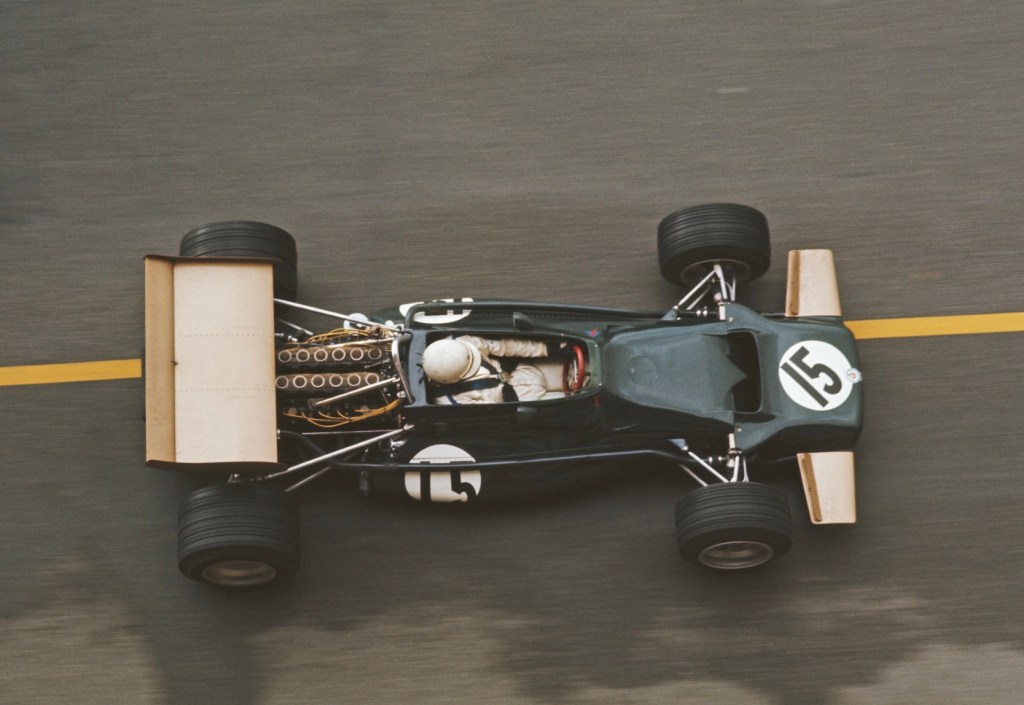
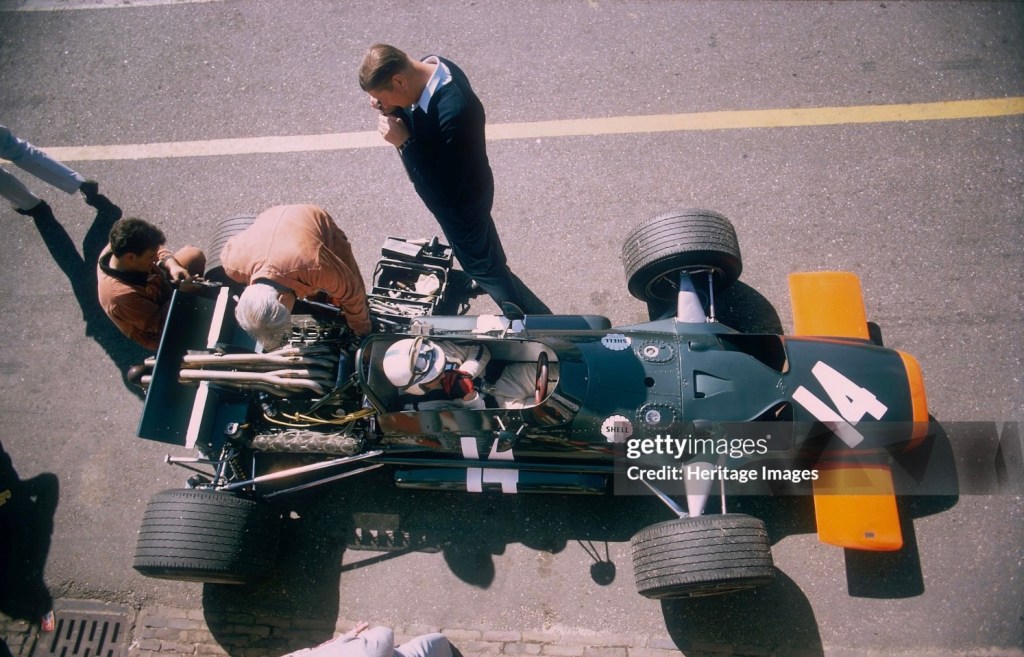
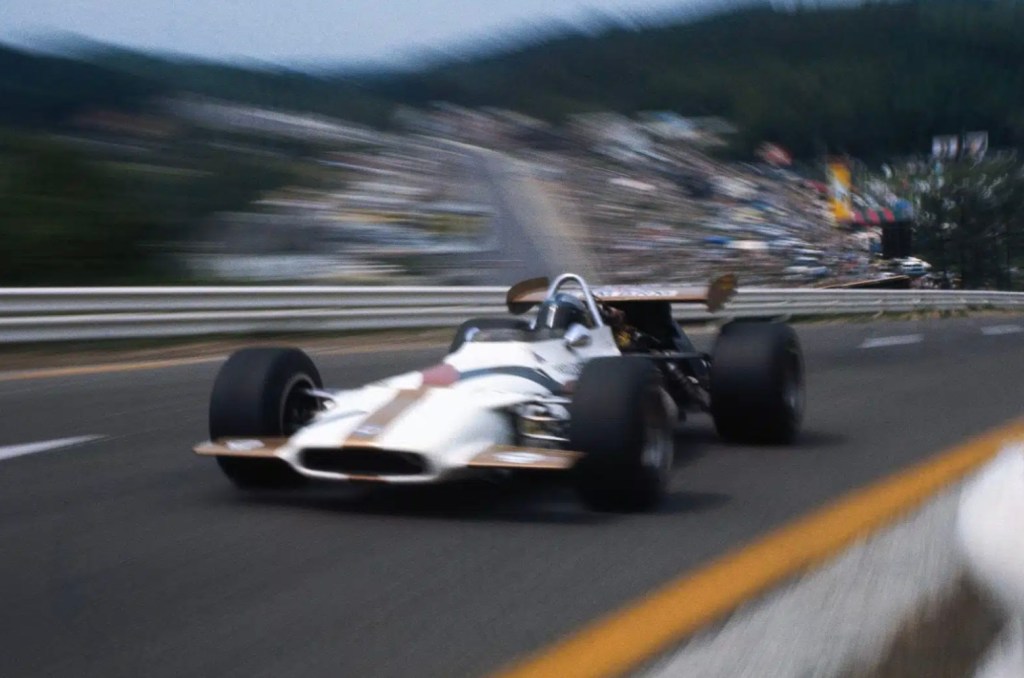
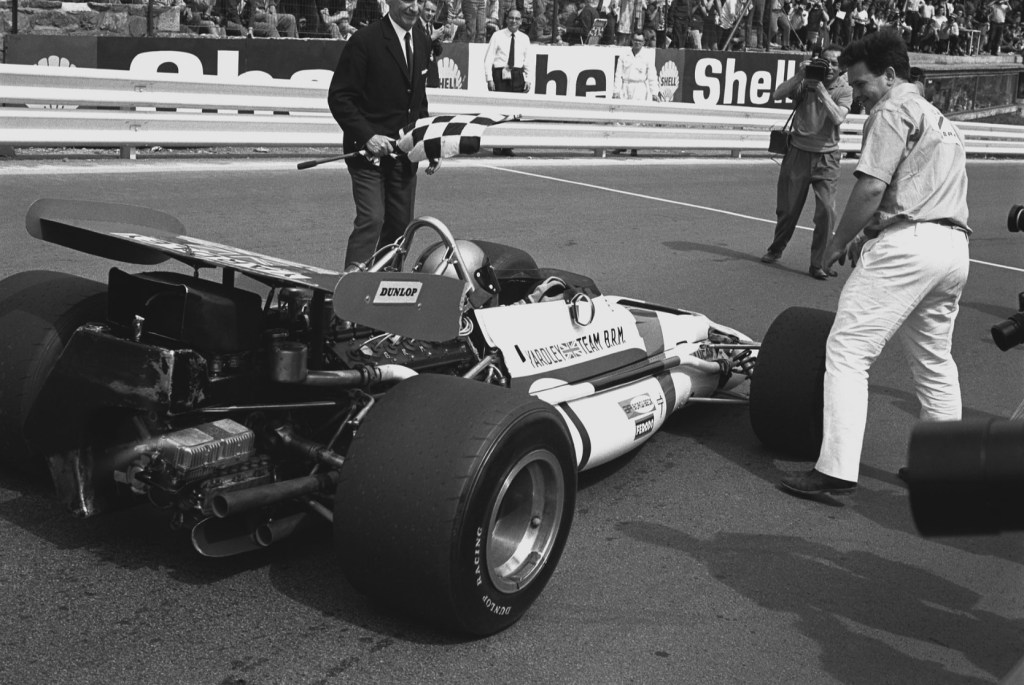
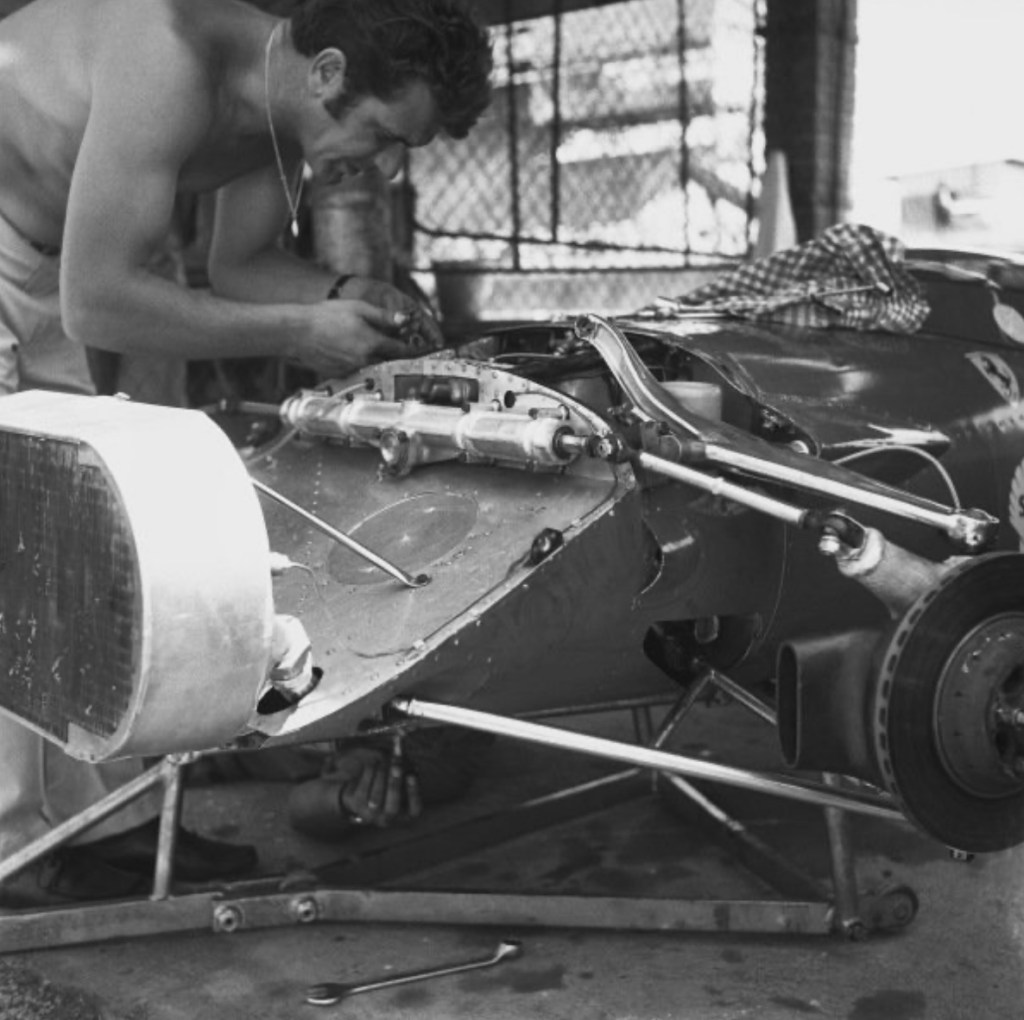
I’m a big fan of Ron Tauranac’s Brabham BT34 Ford ‘Lobster Claw’. The one and only BT34/1 raced throughout 1971 by Graham Hill isn’t at her Elle MacPherson best sans clothes, wings front and rear specifically. Italian Grand Prix practice, Monza, September 5 weekend in 1971.
I’ve almost finished a feature on BT34, but this shot got me thinking about which car(s) were the last to test or race at Monza without wings. It was the practice in the early-winged-era – 1968-71 at least – for much of the grid to test with and without wings to assess drag/grip/top speed tradeoffs in the quest for the optimum race setup. Does anybody know who was the last to do so, small things amuse small minds I know. More on the BT34/BT37 here: https://primotipo.com/2016/11/15/carlos-bt37-butt/
Graham raced winged, Q14 and DNF gearbox in one of the best ever F1 races won magnificently by Peter Gethin’s BRM P160 by a bees-dick from Ronnie Peterson’s March 711 Ford. Their official times were 1hr 18m 12.600sec and 1:18:12.610 respectively.
(MotorSport)
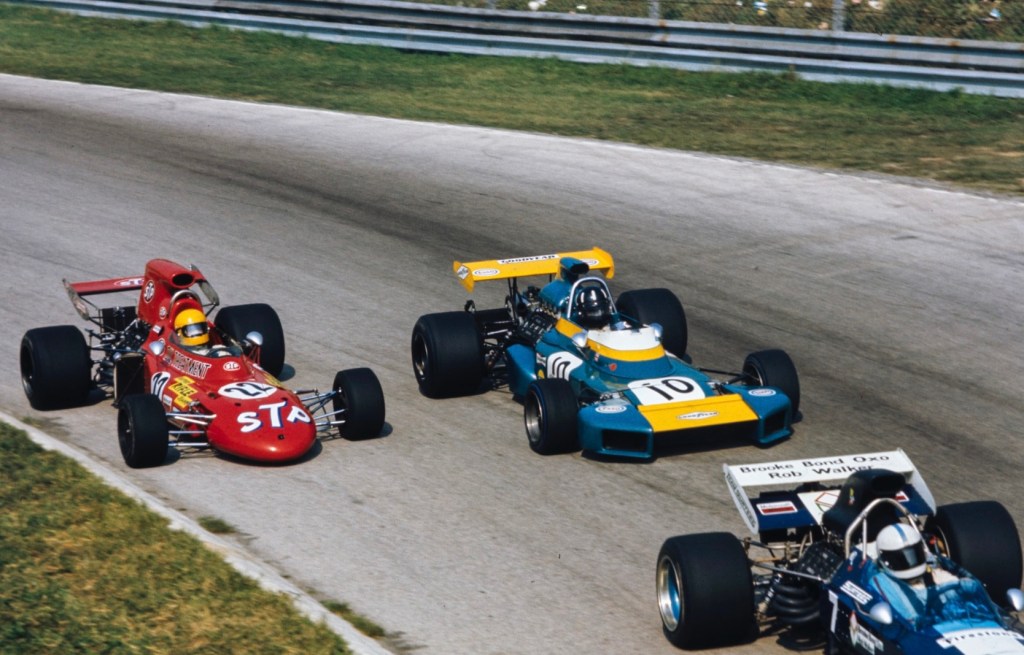
Graham early in the race – his BT34 aero-kit now fitted – with John Surtees, Surtees TS9B Ford (DNF engine) and Nanni Galli’s #22 March 711 Ford (DNF electrics).
BT34’s best results were in non-championship F1 races: Hill won the May 1971 BRDC International Trophy at Silverstone and Carlos Reutemann the March 1972 Brazilian GP.
By 1971 Graham was arguably past his F1-best. While Hill got the better of his team-mate, Tim Schenken – 1970 BT33 mounted – in the first half of ’71, the reverse was the case in the ‘back-nine’. It would have been interesting to see what Tim could have done with the car. Reutemann certainly showed its pace, not only did he win in Brazil but sensationally put the BT34 on pole on his championship GP debut in Argentina in late January.
Not that Graham was a spent force. He won the Thruxton Euro F2 round in a Rondel Racing Brabham BT36 Ford FVA from Ronnie Peterson’s March 712 in March 1971, and another, the GP della Lotteria di Monza on June 29, 1972 aboard a Brabham BT38 Ford BDA. Not to forget Le Mans that year of course, where Graham shared the winning Matra MS670 with Henri Pescarolo over the June 10-11 weekend. See here: https://primotipo.com/2023/09/19/matra-random/
Credits…
MotorSport Images, LAT, F2 Register
Tailpiece…
(LAT)
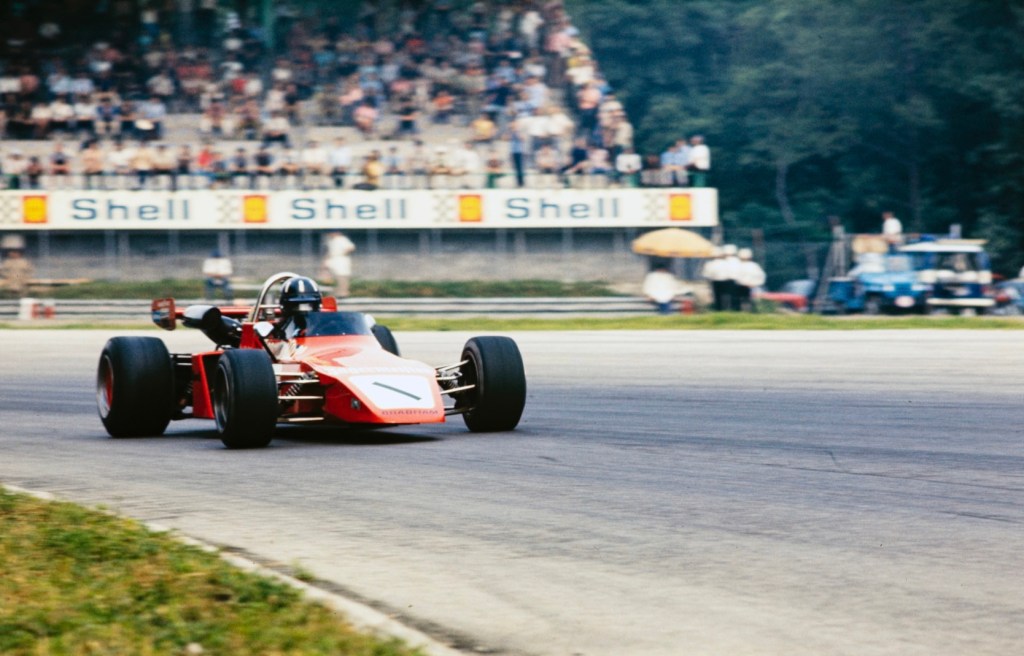
Hill (above) on the way to winning the 1972 Monza Lottery GP F2 race, still in search of the optimum low drag Monza setup on his Brabham BT38 Ford BDA: no front wings and a very shallow angle of incidence at the rear.
May as well finish with another question, this time for the Graham Hill experts. Was that Monza Lottery win – not a Euro F2 Championship round that year – on June 29, 1972 Graham’s final race win?
More BT34 soon. Oh yes, the Fugly Car Cup will be an occasional article.
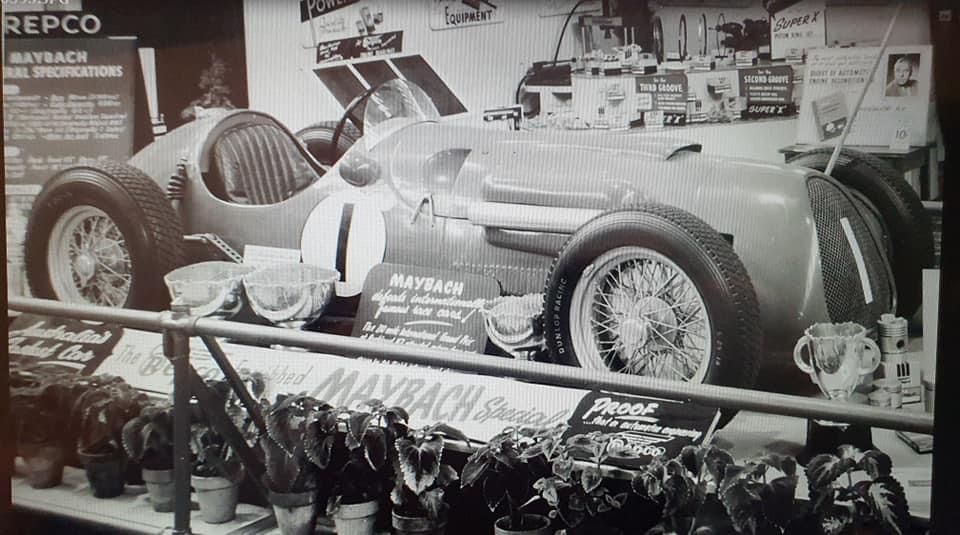
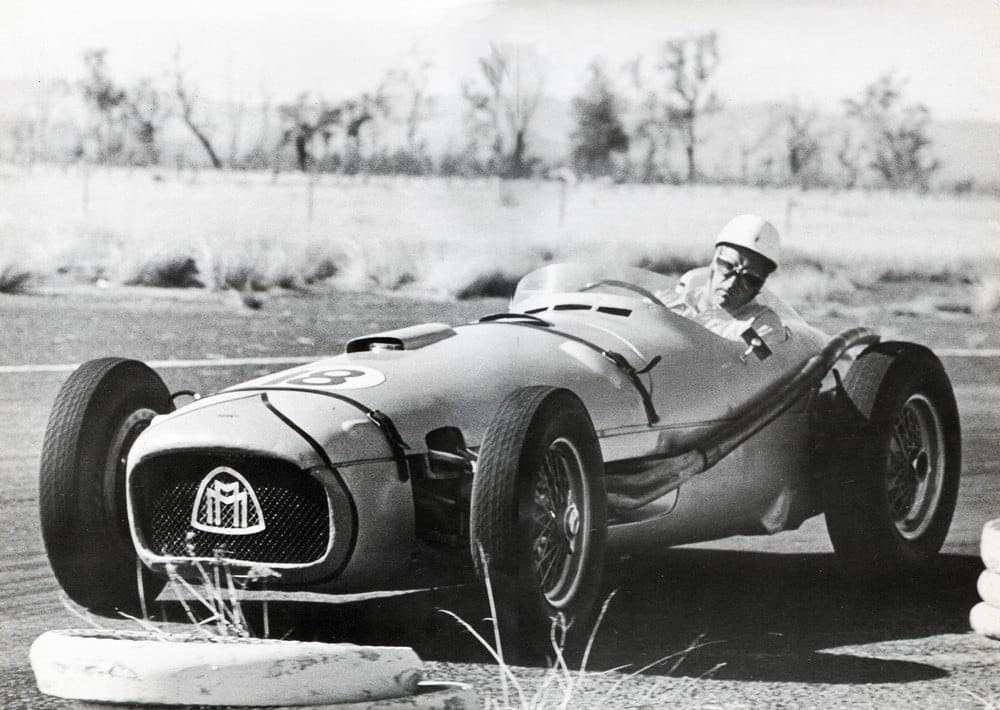
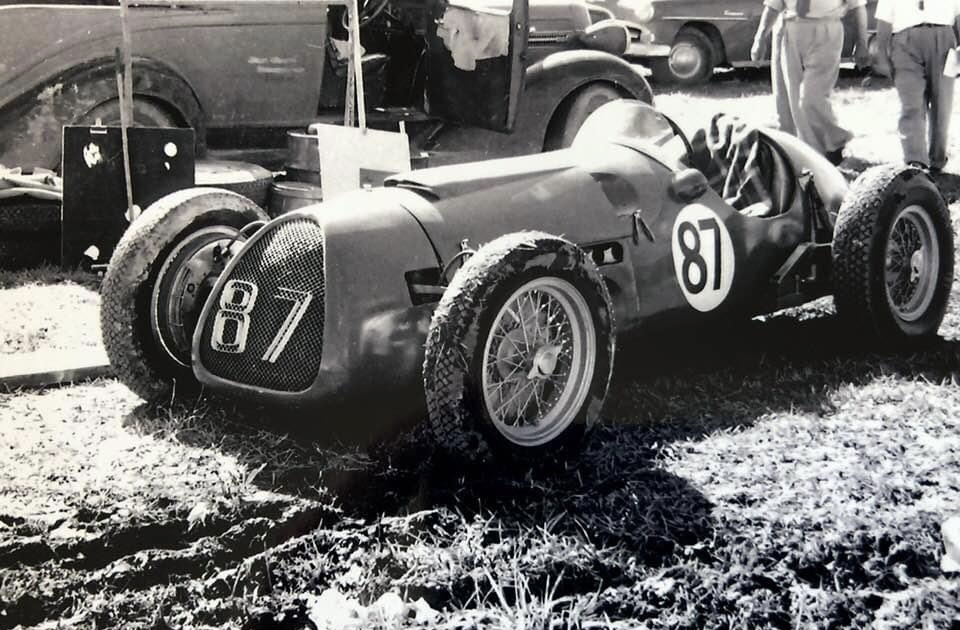
Maybach 2 on display at the Melbourne International Motor Show, Exhibition Buildings, April 1-10 1954 (D Zeunert Collection)
A while back I published an article about Maybach 1, the first in a series of three chassis – four cars – built by Charlie Dean/Repco Research and Ernie Seeliger between 1947 and 1958. Click on this link to that piece: https://primotipo.com/2024/01/15/maybach-1-technical-specifications/
As with that article, this one is also a copy of the technical specifications and evolution of these machines published in the Australian Motor Sports Annual 1958-59. The author’s name isn’t cited, so I’ve credited it to John Goode, the book’s editor.
The photo choices are mine, so too the are the Notes sections. I’m taking as-read a general knowledge of Maybach, but if you need a refresher, click on the links at the end of this piece.
(L Sims)
Introduction…
Here are three photographs to illustrate the journey from Maybach 1 in 1947 to Maybach 1 Series 3 – the 1954 New Zealand Grand Prix winner in Stan Jones’ hands – to get us to the start of this article, Maybach 2, which commenced its life in April 1954.
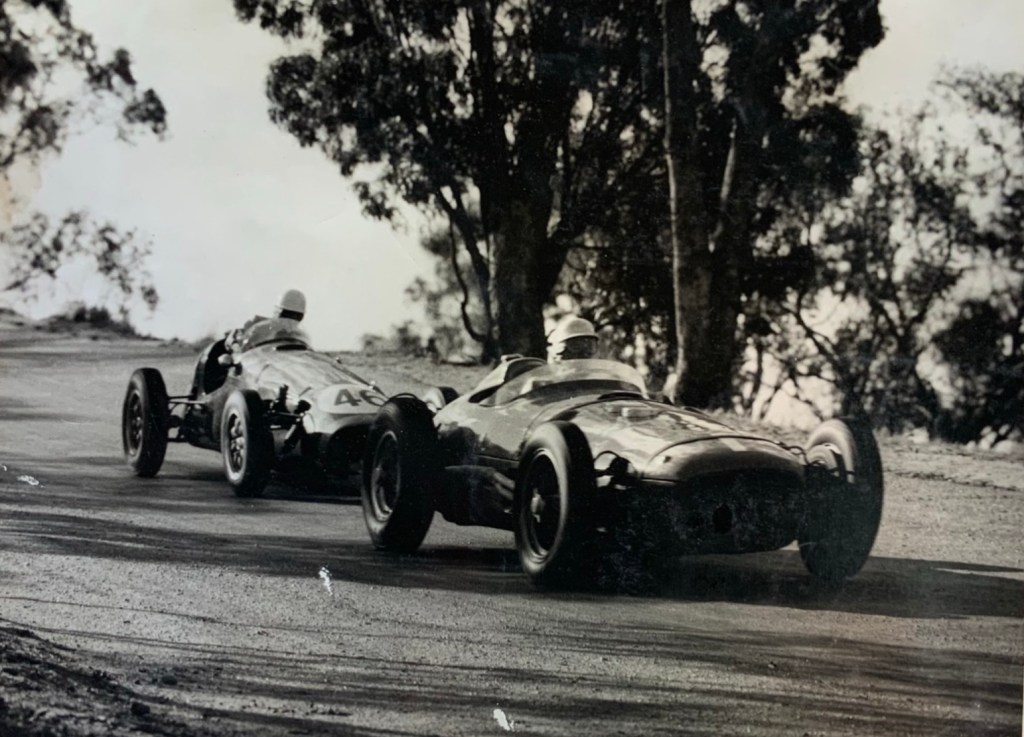
The shot above shows Charlie Dean and the brave Jack Joyce aboard Maybach 1 at Rob Roy during the Melbourne Cup long-weekend in November 1947. What a wild road car the beast would have made, the car received its body immediately prior to the 1948 Australian Grand Prix held at Point Cook, in Melbourne’s inner-west.
(G Thomas)
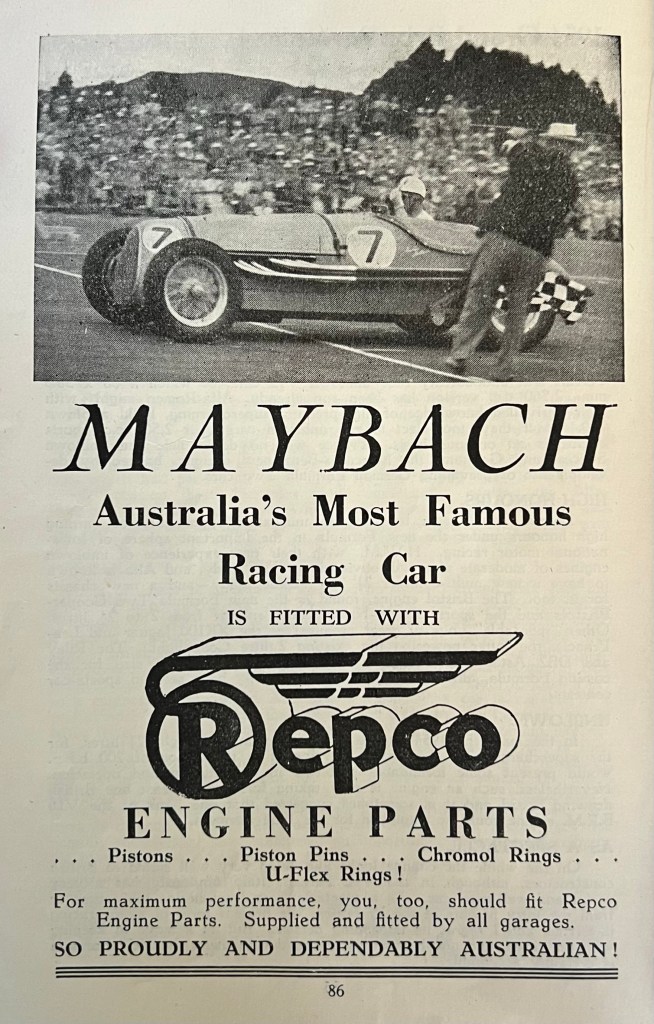
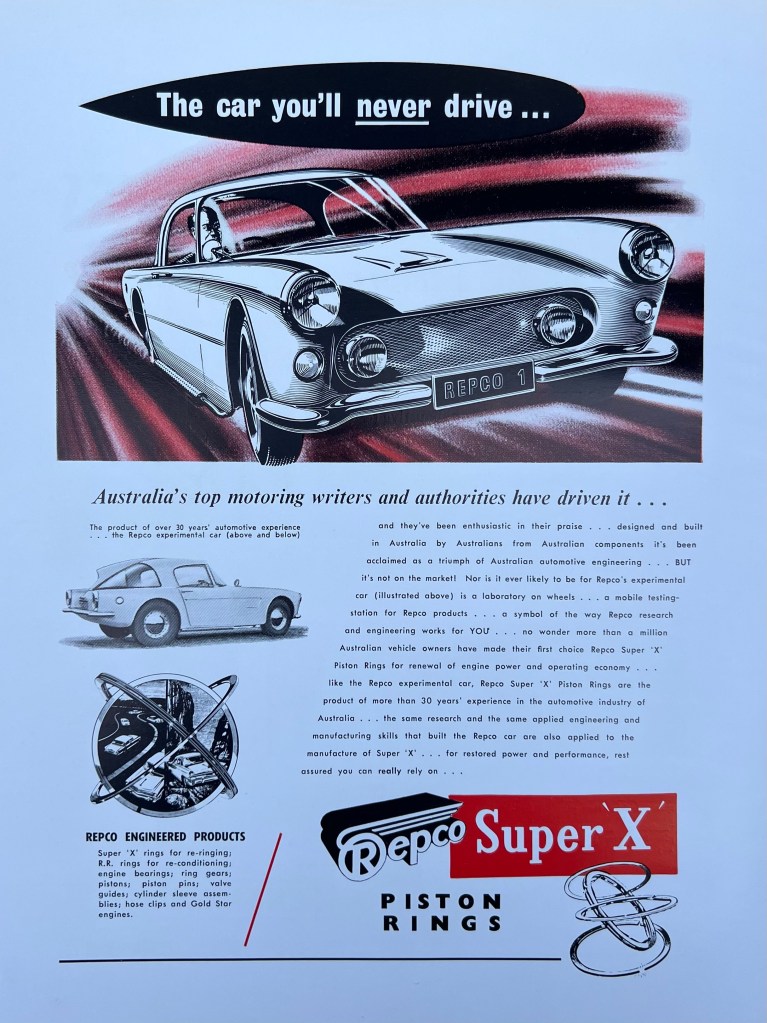
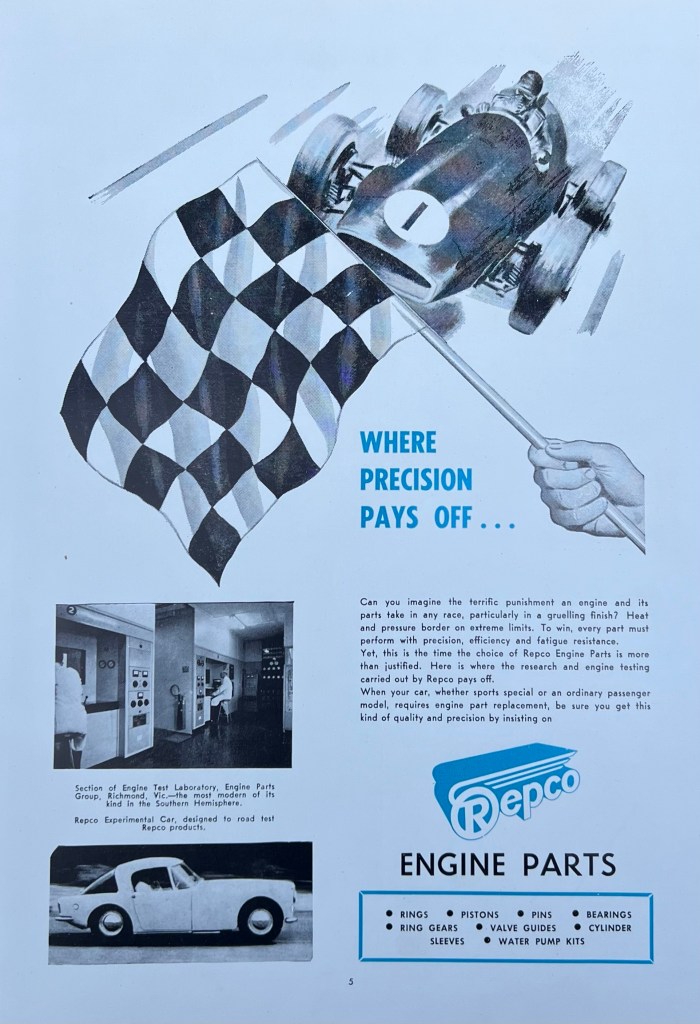
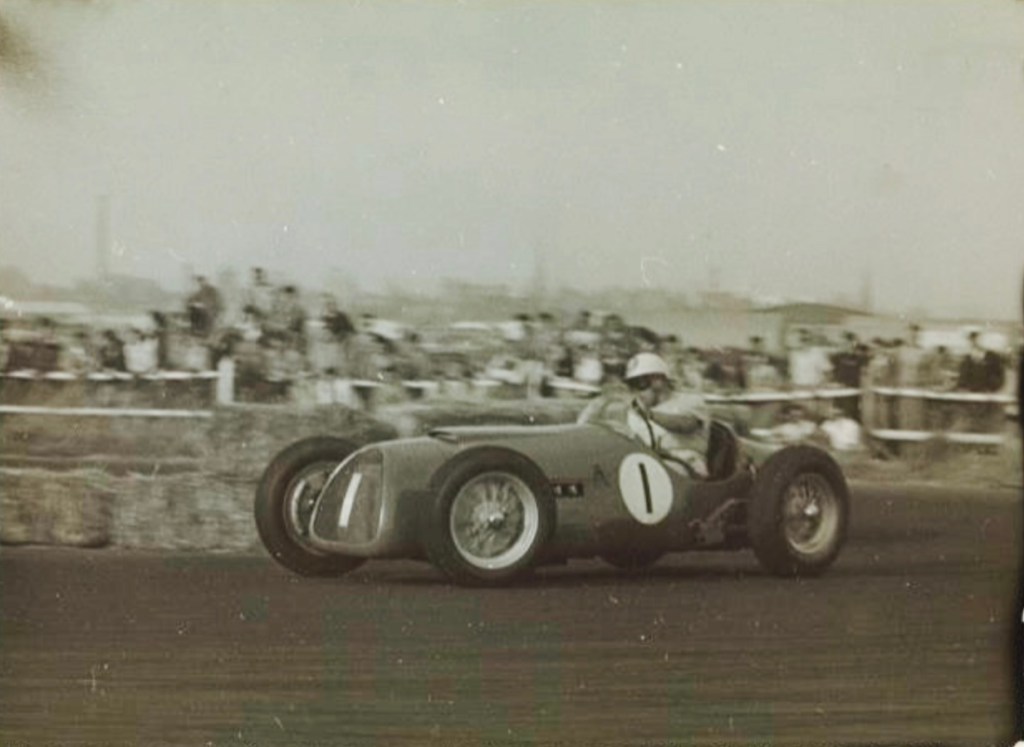
The shot above shows Dean on-the-hop at Rob Roy in 1948 – Maybach 1 painted in its original white – and below coloured blue, on test at Willsmere, near Dean’s Kew home circa 1951. And then below that, the Repco advertisement shows Maybach 1 Series 3 winning the 1954 NZ GP at Ardmore.
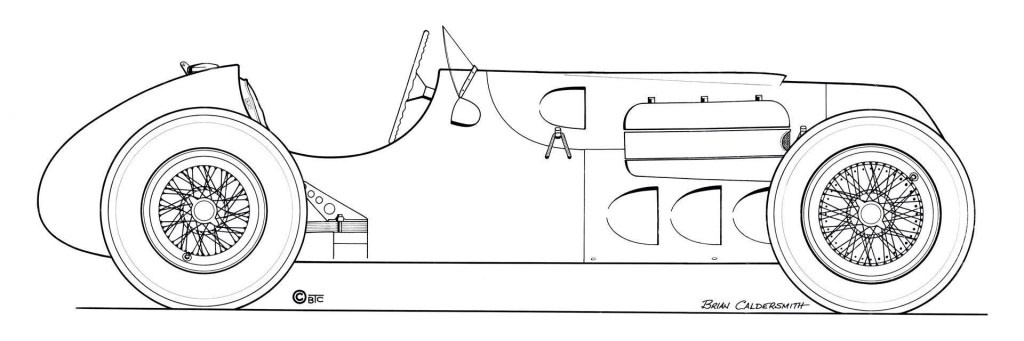
(D Stubbs)Compare and contrast: Maybach 1 Series 3 above, with Maybach 2 below (B Caldersmith)
MAYBACH II (April 1954-November 29, 1954)…
ENGINE: 6 cyl. in-line single oh. camshaft. Bore and stroke: 91 × 110mm. Capacity: 4,250 c.c. Output: 257 b.h.p. at 5,000 .p.m. (bench tested). Carburettors: Three 2 3/16″ S.U. Compression Ratio: 11 to 1. Fuel used: 60% Methanol, 20% Benzol, 20% Aviation Petrol Octane rating: 110. Cast iron cylinder block with wet liners.
Single casting cast iron cylinder block and crankcase, with sump joint well below the crankshaft centre line. Crankshaft machined all over and fully counter balanced, running in eight white metal lined bearings, one between each crank throw and an extra one behind the camshaft drive pinion situated at rear end of crankshaft. Wet liners fitted to cylinder bores with lightweight balanced connecting rods and other reciprocating parts.
Single camshaft running in seven white metal bearings, opening valves by means of rocker arms fitted with eccentric bushes which could be rotated and locked to adjust valve clearances. Rockers had roller cam followers. Valves inclined at 65 degrees in hemispherical head and located on opposite sides. Helical timing gears with idler (originally compounded fabric, but replaced by steel).
Wet sump lubrication through filter with pressure fed oil supplied to centre main bearings, then to other caps, and through the crankshaft to big end bearings. Also fed to valve rocker shafts and camshaft bearings.
Complete body and chassis redesign converting it into a single seater. Mk. I Series 3 Maybach motor used.
NOTES:
The wording in relation to the chassis is misleading. Maybach 1’s chassis was set aside – tired and much modified as it was – and a new single-seater chassis was designed and fabricated for Maybach 2.
The engine came from a German half-track vehicle captured during the Middle East campaign and shipped to Australia for technical study by the military.
Maybach 2 in the Southport paddock during the November 1954 Australian Grand Prix meeting, racer, Owen Bailey at far left (VSCC Collection)Stan being pushed onto the grid. He led the race before a chassis weld broke on lap 14 of 27, pitching him down the road at high speed. Jones was miraculously ok but Maybach 2 was very dead (J Psaros)
TRANSMISSION: Gearbox: four speed using Fiat 525 case with Repco manufactured gears. Ratios: First- 7.08:1 Second-4.94:1 , Third-3.78:1, Top-3.14:1.
DRIVESHAFT: Dropped to pass beneath back axle and driving a short forward shaft into differential through two helical gears, easily accessible from rear, permitting alteration to overall ratios up or down by 3%. Differential: Resembled American Four Lock locking type constructed by Repco workshops from their own and American components. Rear Axle: Vibrac type high tensile steel.
CHASSIS: Frame: Based on two 4″ dia. 16 gauge steel tubes.
Suspension: Front – Independent with wishbones and Delco shock absorbers with low placed 3 leaf traverse spring. Rear Panhard type with reversed quarter elliptic springs and torque arms anchored to heavy cross member linking two main longitudinal tubes of the chassis. Tubular Monroe Wylie shock absorbers.
Steering: Peugeot rack and pinion.
Brakes: Paton’s Hydraulic using twin parallel master cylinders, one operating front and one the rear. Action on both integral but operation separate permitting one set in action if others fail. Front shoes, twin leading design with I6in. special helically finned drums, cooled by air scoops to forward sides. Rear shoes of leading and trailing type in 14 in. drums.
Wheels: Locally constructed wire type with Rudge Whitworth hubs. Front 18″ dia. Tyres: 5.25 × 18. Rear 16″ dia. Tyres: 7.00 x 16.
Body: Single light aluminium shell easily removable in three seclions. Fuel Capacity: 25 gallons in tail mounted aluminium tank.
Dimensions: Wheelbase 94″ • Track: Front 4 ft. 3 ins. Rear 4 ft. I ins. Weight: 16 cwt. Power/weight ratio: 7 Ibs. per b.h.p.
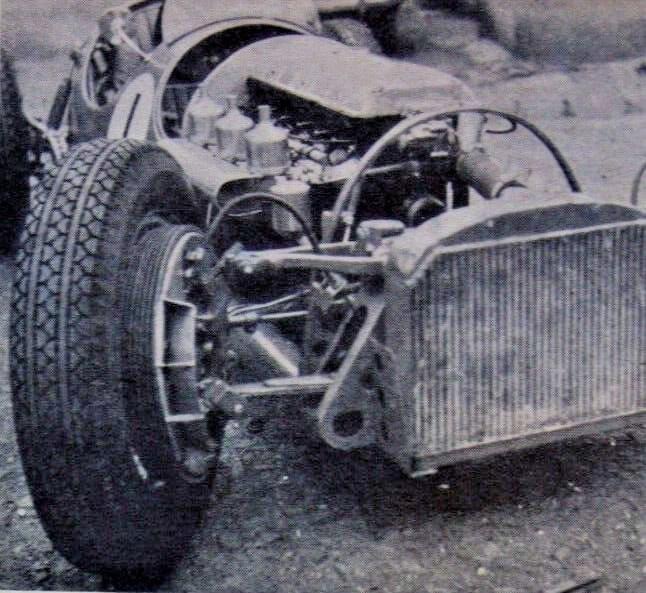
“Rare photograph showing the front crossmember of Maybach 2 where the chassis tube broke” (S Scholes Collection-Wheels May 1955)
NOTES:
In many ways Maybach 2 was the one that got away…
It went like a jet from the start, Jones won the Victorian Trophy at Fishermans Bend in March 1954 on its race debut, then won again at the Easter Bathurst meeting where he took the two preliminaries before gearbox failure scuttled his run in the feature. He was victorious again at Altona in May and was second to Jack Brabham’s Cooper T23 Bristol there in June. At Fishermans Bend in October he had gearbox failure again.
Then it was off to Southport for the AGP in November where Stan simply drove away from the field until the chassis weld failure caused the massive accident that destroyed the car, and from which Jones very fortunately walked away…
This 4.2-litre 257bhp @ 5000 rpm, 725kg monoposto was one helluva fast racing car.
In the woulda-coulda-shoulda stakes were the battles we never got to see with Stan aboard Maybach 2 and Reg Hunt’s Maserati A6GCM/250 in 1955. Hunt upped the local ante big-time when he imported a current GP car, and was immediately quick in it, his talent refined with some 500cc F3 racing aboard a Cooper MkVIII in Europe in 1954.
Reg’s Maserati gave about 240bhp @ 7200rpm and weighed between 500-580kg. Both the Maserati and Maybach 2 had four-speed ‘boxes, IFS and live-rear axles. Maybach’s weakness was its ginormous, all cast iron engine which weighed circa 320kg; let’s not forget it was designed for the German military not competition use. The 250F engine’s quoted weight is 197kg, much of the weight differences between the two cars is in engine weight.
While torque figures for Maybach 2 weren’t quoted, the long stroke 4.2-litre six would have produced more torque than its twin-cam Italian competitor but not, one suspects, enough to offset the considerable weight disadvantage.
Whatever the case, when Maybach 2 was destroyed at Southport, all of the momentum gained by building, racing, and refining the car was lost. Maybach 3 (below) didn’t appear until the April 1955 Bathurst 100 weekend when the team started the process again, by which time Reg was used to and exploiting his car successfully.
What is my point? The Repco-Maybach program effectively ended post-Southport, with only one remaining engine to instal in Maybach 3, a 3.8-litre unit at that. Stan confronting Reg in 1955 aboard Maybach 2 really would have been something to see…woulda-coulda-shoulda.
AMS Annual 1958-59Jones in Maybach 3 during the 1956 South Pacific Championship (R Donaldson)
MAYBACH III (1955 – Jan 1956)…
ENGINE: 6 cyl. in-line inclined 60 degrees to left. Shortened stroke crankshaft (approx. 10% ). Bore and stroke: 90 × 100 mm. Capacity: 3,800 c.c. Compression Ratio: 11 to 1. Power Output: 260 b.h.p. at 5,000 r.p.m. Direct fuel injection by Dean and Irving.
TRANSMISSION: Clutch: Repco single plate. Gearbox: Four speed with top overall ratio 3.2 to 1. Drive: Open propeller shaft passing on right of driver to offset differential. Differential: limited slip (as previous model).
Charlie Dean at Rob Roy, date unknown. The competition debut of Maybach 3, was at Templestowe Hillclimb on May 8, 1955. 68.56sec where Dean was third in the over 3-litre racing car class (SLV)(SLV)(Davey-Milne)Rob Roy again. Despite the fuzziness, note the the considerable reduction in engine height achieved by the 60-degree laydown of the Maybach six (Davey-Milne)
CHASSIS: Frame: Built up from two 4″ dia. steel tubes, linked by transverse tubing. Redesigned body of flatter appearance due to inclined engine.
Suspension: Front – Independent with transverse leaf spring set low. Rear Quarter elliptics with radius rods.
Dimensions: Wheelbase 95″. Track Front 4 ft. 3 ins. Rear 4 ft. 1 in. Steering: Marles box and divided track rod.
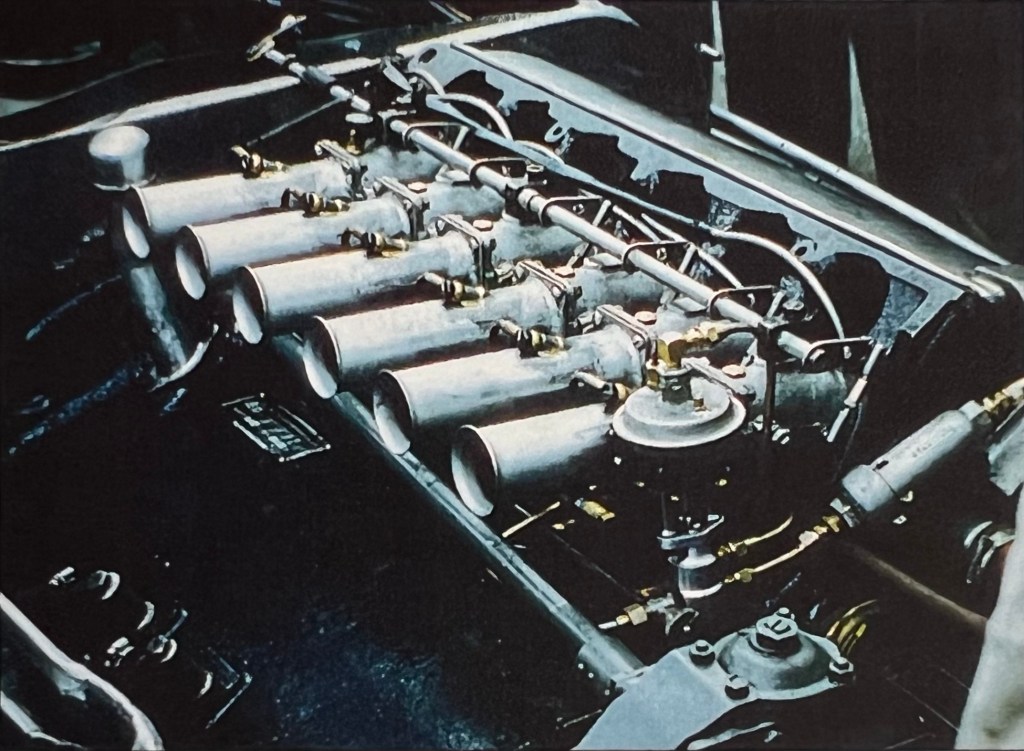
Maybach 3 in the Gnoo Blas paddock in 1956. Trumpets of Repco built fuel injection clear (B Caldersmith)(B Caldersmith)
NOTES:
The beginning of the end. Jones (above) is an absolute bolter at the start of the January 1956 South Pacific Championship at Gnoo Blas, New South Wales.
Reg Hunt’s new Maserati 250F is way back here but will reel Stan in. Being pushed hard to hang onto the very best European F1 car of the day, the Maybach engine let go in a big way.
Jones had a 250F several months later. Stan let his good friend, ace engineer/mechanic/racer Ern Seeliger loose on Maybach, its evolution to Chev Corvette 283 V8 power and other modifications – Maybach 4 – was soon underway.
(B Caldersmith)(AMS Annual 1959-60)Stan Jones, Maybach 4 Chev, Australian Grand Prix, Lowood, June 1960 DNF engine (B Thomas)
MAYBACH IV March- 1958…
ENGINE: Chevrolet Corvette 8 cyl. Vee motor. 4.6 litre. Compression ratio: 9.2:1. Bore and stroke: 98.501 × 76 mm stroke. 2 four-barrel Carter Carbs. 274 b..p. at 6,000 r.p.m. 300 Ibs. torque at 3,500 r.p.m. All oilways completely modified. Bearings altered in regard to oil ways. Engine dry sumped. Modified cooling system.
GEARBOX: As previous Maybach. Drive: As previous Maybach. Differential: As previous Maybach modified with shortened axles incorporating constant velocity joints. Clutch: Seeliger designed and built multi-plate clutch.
CHASSIS: As previous Maybach but chassis lengthened lo take Di Dion rear end. New 30 gallon fuel tank fitted.
Suspension: As previous Maybach with mods. to front end by fitting an anti-roll bar incorporating brake forque rods and transverse leaf in place of quarter eliptics at rear.
Dimensions: Same as previous Maybach, but rear track widened to 4 ft. 2 ins. All up weight reduced to 14} cwt. with 4 gals. of petrol. Full oil and water.
NOTES: Ern Seeliger first ran Maybach 4 at Fishermans Bend in March 1958.
In one of The Great Australian Grands Prix, Stan Jones, Maserati 250F, Lex Davison, Ferrari 500/625 and Ted Gray, Tornado 2 Chev battled up front for most of the ‘58 race on Mount Panorama until Lex was the last-man-standing. Ern Seeliger drove a great race into second, with Tom Hawkes third in his much modified ex-Brabham Cooper T23 Repco-Holden.
Jones proved further the pace of Seeliger’s final Maybach evolution by winning a Gold Star round in it at Port Wakefield in 1959. It would have been very interesting to see what times Stan could have done in Ern’s car in practice at Bathurst over that ’58 AGP weekend!
(AMS Annual 1958-59)
Etcetera…
(VHRR Archive)
Prettiest of the lot in my opinion…Stan the Man on the way to winning the Victorian Trophy at Fishermans Bend in 1954, Maybach 2.
(B Caldersmith)Maybach 2 in the Southport paddock over the 1954 AGP weekend (J Psaros)
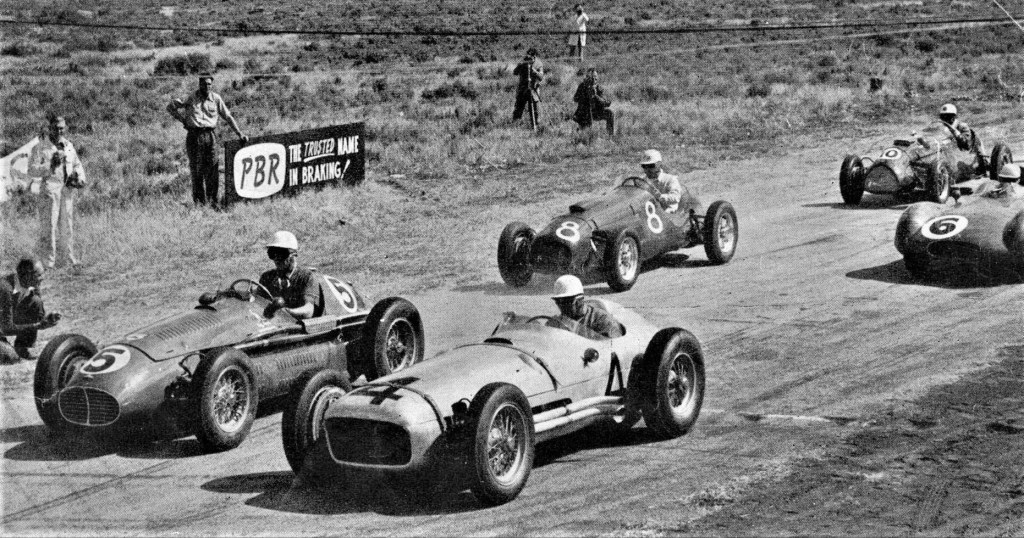
Starting grid of the 1955 Australian GP (or is a heat, whatever) at Port Wakefield, South Australia. #5 Reg Hunt, Maserati A6GCM/250, Jones, Maybach 3, #8 Tom Hawkes, Cooper T23 Bristol, #6 Jack Brabham in the winning Cooper T40 Bristol and #10 Kevin Neal, Cooper T23 Bristol.
This is a good contextual shot showing Jones in Maybach 3 – Mercedes W196 styling influence clear – among current’ish European cars: Reg Hunt’s Maserati A6GCM 2.5 – the so-called interim 250F – two Cooper T23s of Tom Hawkes #8 and Kevin Neal. Plus the nose of the winner and newest car here, Jack Brabham in the mid-engined Cooper T40 Bristol he built in time for the British Grand Prix at Aintree that July.
(G McKaige)
The final evolution of the Dean/Repco Research Maybach engine development programme. ‘Short-stroke’ 3.8-litre and fuel injected delivering circa 260bhp @ 5000rpm. George McKaige took this shot of Maybach 3 at Fishermans Bend in October 1955. I wonder what that plate in the engine bay says?
(Q Miles)
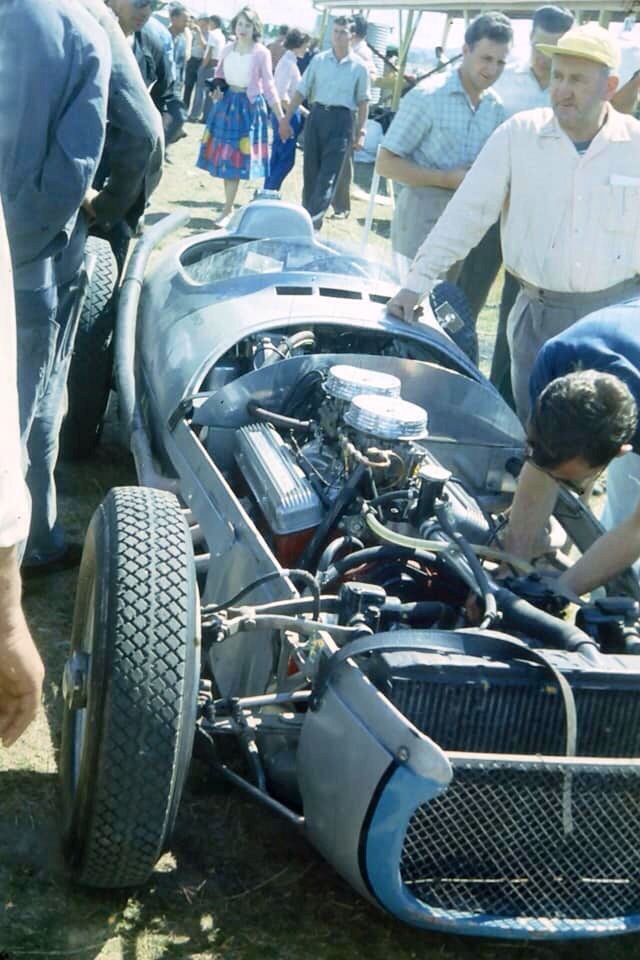
Great colour photograph of Maybach 4 Chev in the Lowood paddock inJune 1959. Note how the twin-Carter-carbed Corvette 283 V8 is offset to the right allowing the driver to sit low to the left rather than high atop the driveshaft.
Credits…
Australian Motor Sports Review 1958-59, Brian Caldersmith, Brier Thomas, Jock Tsaros, Davey-Milne Family Collection, George McKaige and Chester McKaige via their superb two ‘Beyond The Lens’ books, Stan Griffiths, Dacre Stubbs, VSCC Vic Collection, J Montasell, Clem Smith, Quentin Miles, Ron Edgerton Collection
Tailpiece…
(K Drage)
Towards the end of a very long competitive Maybach road.
Stan Jones lines Maybach 4 Chev up alongside Alec Mildren’s tiny, mid-engined 2-litre Cooper T45 Climax before the start of the South Australian Trophy, Port Wakefield Gold Star round in March 1959.
Jones won the race from Len Lukey and Keith Rilstone – it was the last championship level win for Maybach in-period.
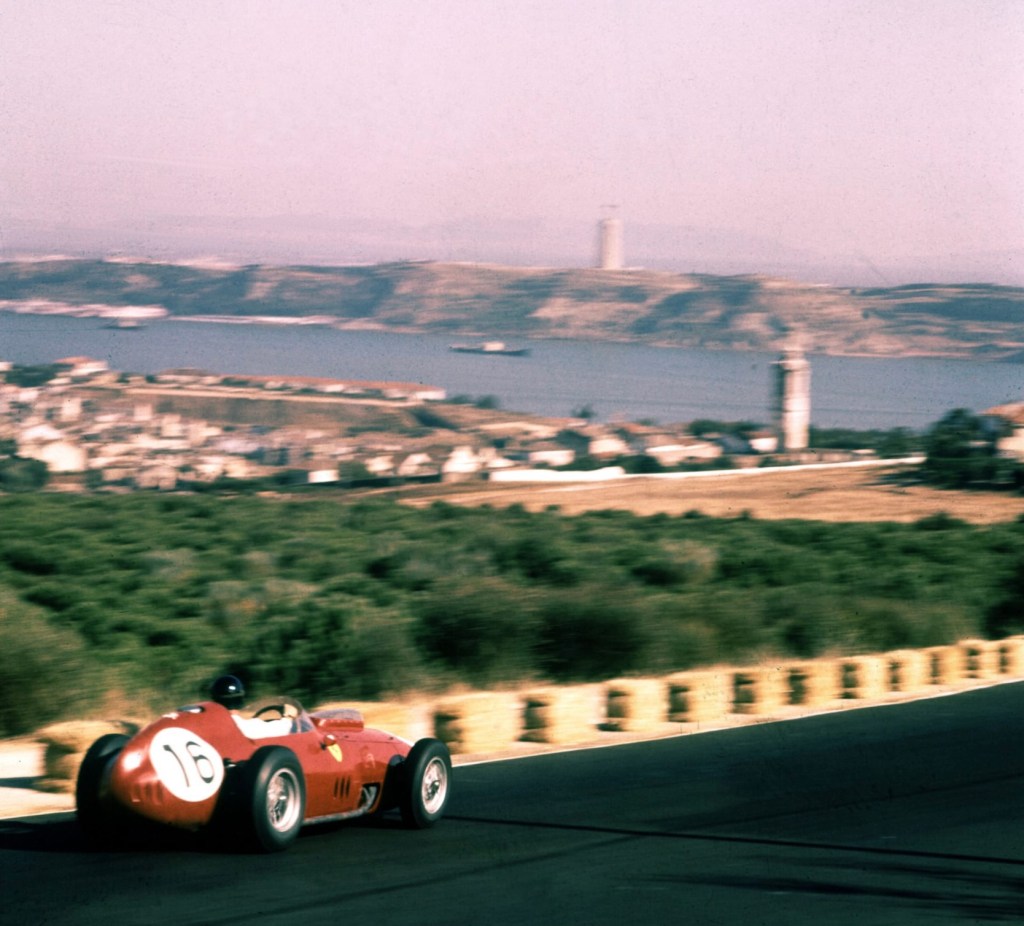
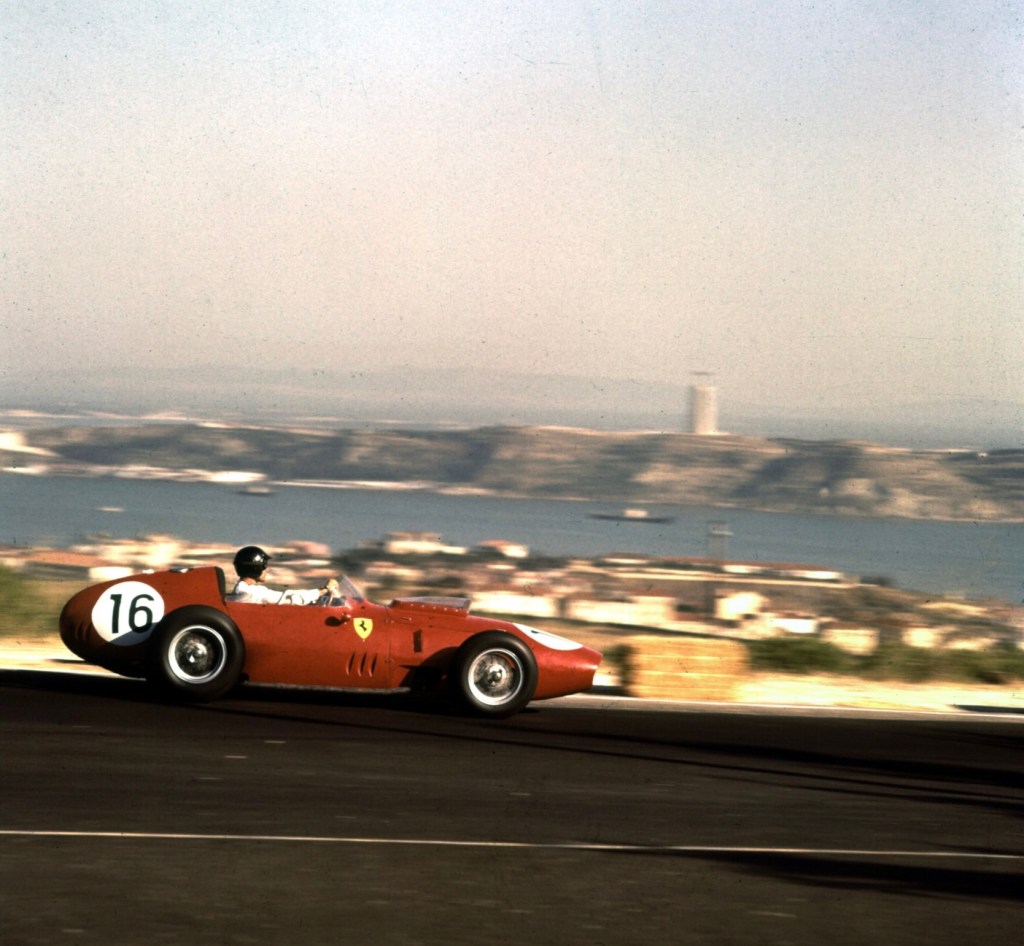
The days of sublime, simply beautiful Grand Prix photographs are long gone, sadly. I friggin’ hate modern abbreviations like OMG but it does make a point, very economically.
Dan the Man is blasting his Ferrari Dino 246 around the Circuito de Monsanto, a port city in Lisbon, Portugal, during the August 23, 1959 Portuguese Grand Prix. He was third behind the Cooper T51 Climaxes raced by Stirling Moss and Masten Gregory.
(LAT)
Back then, photographs weren’t usually attributed to the artist, so sadly we cannot give the talented ‘snapper the accolade he/she/uncertain deserves: try this https://primotipo.com/2017/07/14/composition/
Of course, rather than completely wallowing in the past, the challenge is to find some modern settings which match the OMG-WOW Factor of photographs like these. This is the first in what will be an ongoing series…
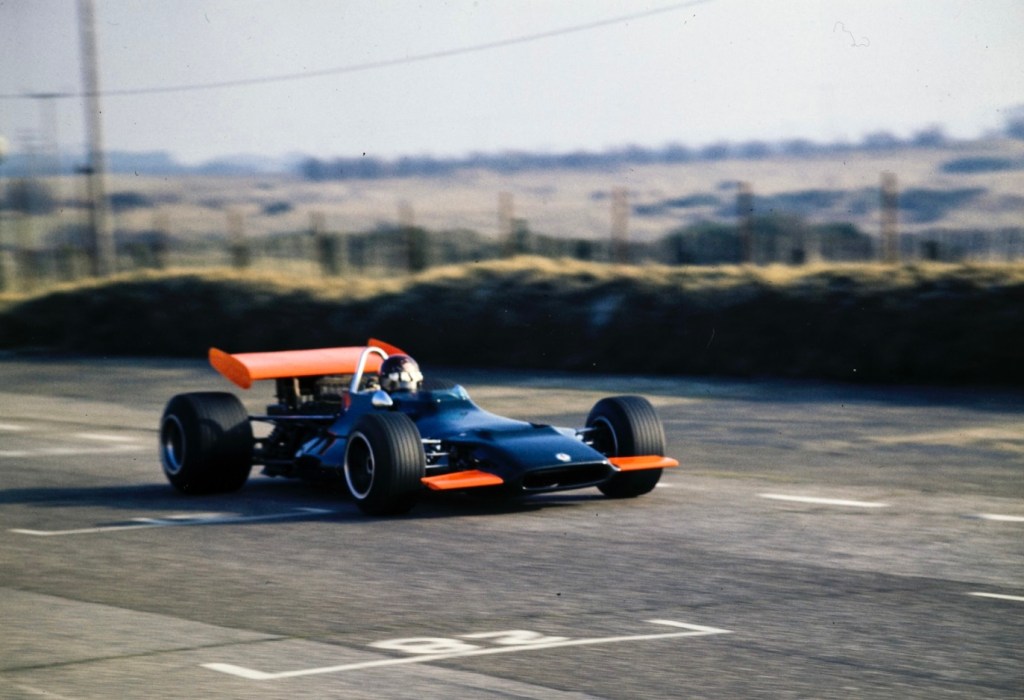
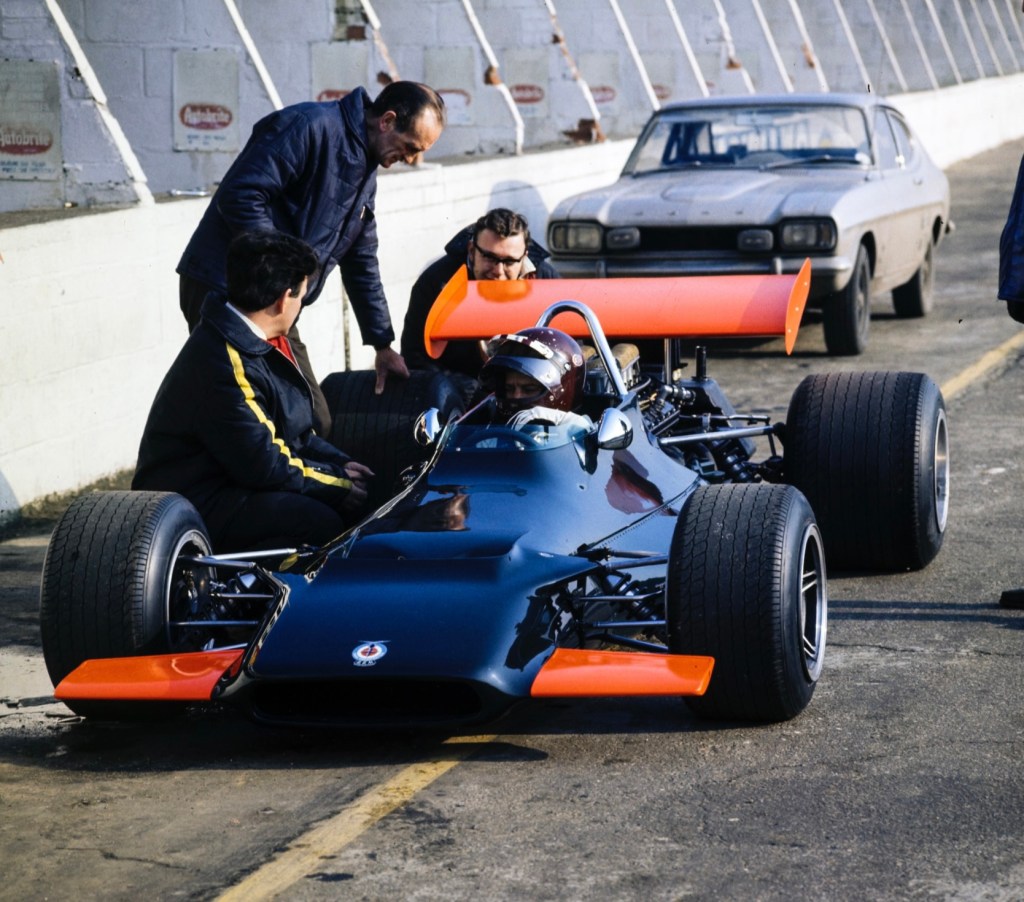
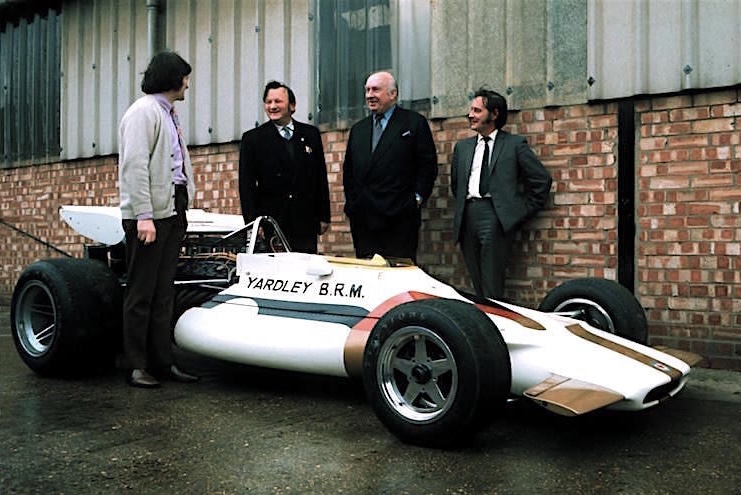
The 1970-71 BRM P153/P160 are two of my favourite Grand Prix cars, designer Tony Southgate at his best. Jackie Oliver is using every inch of Snetterton in this first test (?) of Bourne’s new P153.
It’s chassis P153/01 on January 1, 1970. This car had rather a short life sadly, it was burned to a crisp after Oliver had front stub-axle failure on the first lap of the Spanish Grand Prix on April 19. Ollie ploughed into the innocent Jacky Ickx’ Ferrari 312B – 312B/01 in fact – the ensuing massive conflagration and incompetence of the marshalls ensured both cars were destroyed.
The P153/P160 were race winning cars too. Pedro Rodriguez was victorious in a P153 in the 1970 Belgian Grand Prix after an epic dice with Chris Amon’s March 701 Ford. He also won the Oulton Park Spring Cup in 1971 aboard a P160. P160 championship victories went to Jo Siffert and Peter Gethin at the Osterreichring and Monza in 1971, while Gethin also won the non-championship Brands Hatch Victory Race that October. In 1972 Jean-Pierre Beltoise took his only GP win at Monaco in soggy conditions in a P160B.
The P153 in its early traditional, pre-Yardley, BRM green with orangey-red trim looked superb! We have Southgate to thank for the new colour too. “The F1 BRMs had been painted a dark, dull, metallic green I thought looked terrible. I called it British Racing Mud…I persuaded the team to change to a more lively green and I ended up with a colour used by Vauxhall Motors, which looked great.
“Cor, this BRM really does look the goods boys!” Snetterton, January 1, 1970 (MotorSport)(MotorSport)
After the phenomenal speed and results of the simple, light 1.5-litre P261 V8 Grand Prix car from 1963-65, BRM had been in the doldrums since 1966-67 with the phenomenal lack of speed of its complex, heavy P83 H-16.
Much respected, long-time engineering chief Tony Rudd – the architect of BRM’s late 1950s-early 1960s rise and rise – left Bourne for Hethel where he became Group Lotus’ Director of Engineering in mid-1969 and was replaced by Tony Southgate who had been drawing and building winning Eagles for Dan Gurney in California.
Tony Rudd fettles his nemesis at Monaco in May 1966, the gloriously-nuts P75 H-16 engined BRM P83. Oliver gives his early impressions of the new car to a Dunlop technician at left, and who else? Snetterton (MotorSport)BRM Brains Trust during the 1971 British GP weekend: Tony Southgate, technician Gerry van der Weyden and Tim Parnell with the Bastard! look on his face
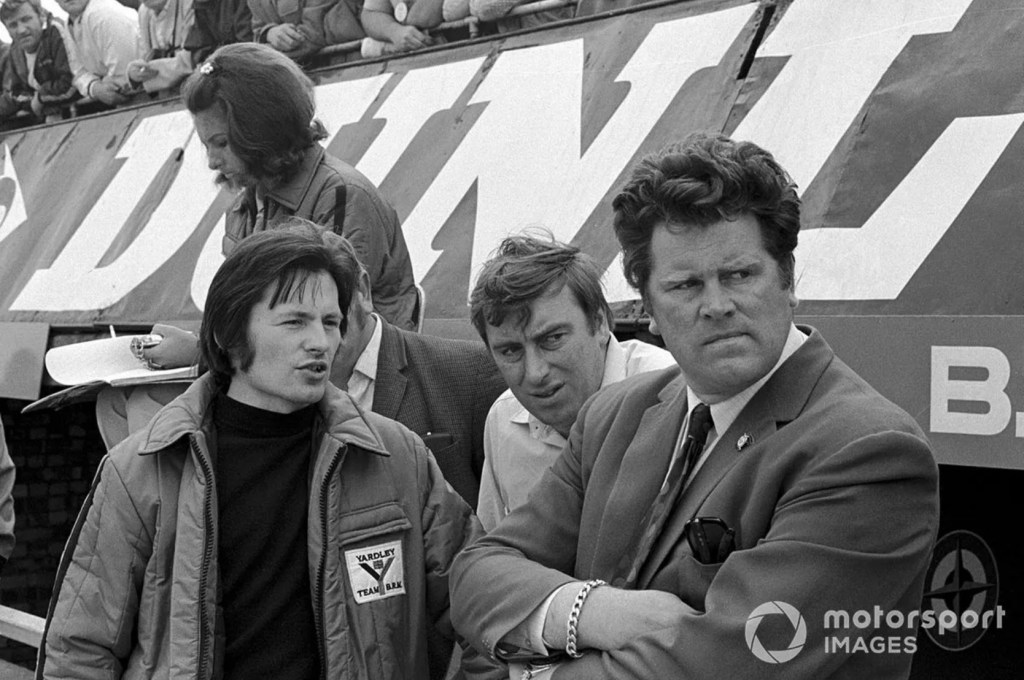
When 29 year old Tony Southgate arrived at BRM in June 1969 his boss was the self-styled, polarising, ‘Lord’ Louis Stanley. The leadership team comprised Southgate, in charge of chassis design and development, Aubrey Woods of engine development with Alex Stokes as the gearbox specialist.
“My brief was to improve the existing P139 for the remainder of the 1969 season, if possible, and then to deliver an all-new car for 1970,” he wrote in his great ‘Tony Southgate : From Drawing Board to Chequered Flag’.
Southgate decided Alec Osborn’s (who departed BRM along with Peter Wright when Southgate arrived) P139 wasn’t worth spending time on as “Some of the suspension systems and mountings deflected, which produced very spooky handling…Surtees withdrew from the German Grand Prix on the Nurburgring after two of the three practice periods; he was convinced that something was going to break on the car…”
As many of you will recall, John Surtees was having something of an annus horribilis that year, driving shit-heaps on ‘both sides of the Atlantic’: the BRMs and Jim Hall’s Chaparral 2H Chev in North America.
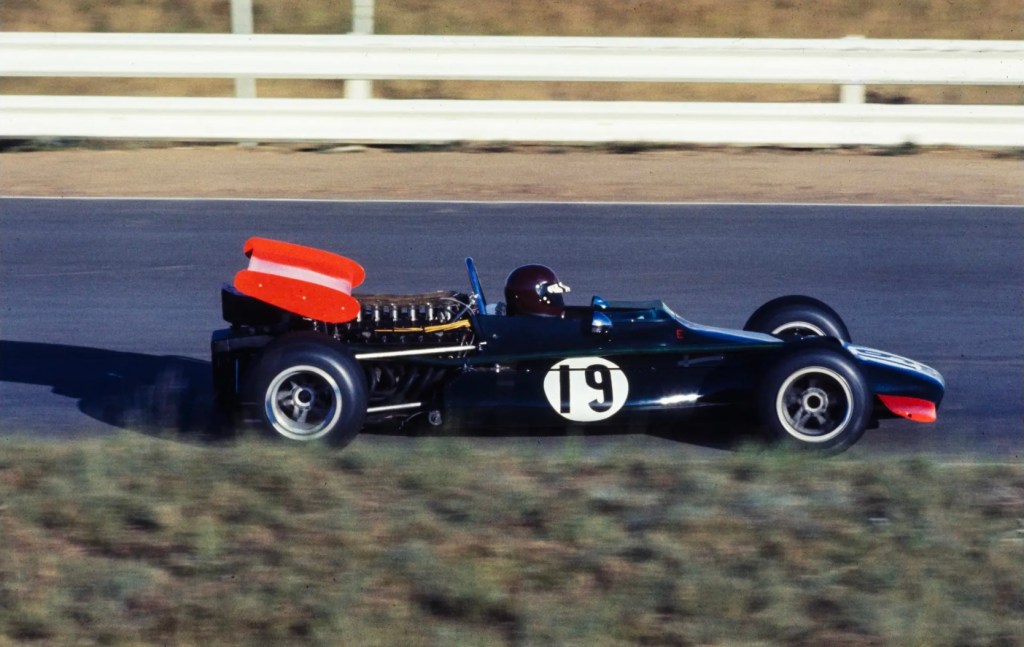
Jack Oliver giving his P153 plenty during the 1970 South African GP weekend (MotorSport)Kyalami pits 1970 (MotorSport)
Design and construction…
Tony Southgate wrote that “The philosophy behind the P153 design was maintaining my obsession with low CG, with the fuel concentrated in the centre of the car to achieve minimal interference with the weight distribution as the fuel level changed. Coupled with this was very good torsional stiffness between the wheel centres, and great rigidity of the suspension and its mountings.”
“Aerodynamic testing in 1969 was still basic by modern standards…The full-size race car ran in the MIRA wind tunnel, and the scale model work was done in the Campbell tunnel at Imperial College, London.”
“One of the cars interesting points of note was that it ran on 13-inch diameter wheels both front and rear, when the opposition were using 15-inch at the rear. The car ran on very fat Dunlop tyres (their last year in F1), giving it a very low, squat appearance.”
“The monocoque was unusual in that it had a very pronounced double-curvature shape, being 4 feet wide at the centre. The panels were hand rolled in-house and have a very ‘pregnant’ look to the car.”
(MotorSport)
Front suspension was period typical: magnesium uprights, upper and lower wishbones with Koni shocks and coil springs and an adjustable roll-bar.
Engine change of Rodriguez’ P153 on Sunday June 7, 1970 during the victorious Belgian Grand Prix weekend (MotorSport)
“The V12 engine, as originally designed by Geoff Johnson, was unstressed, but we modified it to make it semi-stressed. A small, neat triangular framework was added to the rear of the monocoque to take part of the load. The engine was very light for a V12. It weighed the same as a Cosworth DFV and had more or less the same maximum horsepower, approximately 427bhp, but less torque. We used 11,200rpm whereas at that time the DFV was limited to around 9300rpm.”
Doug Nye adds further detail about the 1970 engine developments of the 48-valve BRM P142 engine in his ‘History of the Grand Prix Car 1966-85’.
“In 1970, the P142s powered more adequate Southgate designed chassis and began winning races, but power was not destined to improve dramatically in the years left to BRM and its V12 engines. After Rudd had gone to Lotus, Aubrey Woods took over engine development.”
“Woods considered the chain-driven four-cam centre exhaust P142 overheated both its water and oil too easily, and suffered badly from detonation. Its relatively long stroke was a limiting factor, new pistons were required and they took along time to make. He designed new cylinder heads lowering engine CoG with outside exhausts and in’ve inlets with improved ports and enlarged cooling waterways. The crankcase was now cross-bolted and stiffened to allow use as a semi-stressed chassis member.”
“The BRMs would always retain their camshaft chain-drive as the systems last refuge in Formula 1.”
Southgate, “The (Project 131) gearbox for the P153 was the existing one carried over, but with a new outer casing and rear cover castings carrying the complete rear suspension, the rear wing and oil tank assembly. The P153 had np problem getting down to the minimum weight requirement…”
Oliver, Kyalami 1970 (MotorSport)
Racing the P153 in 1970…
“The car was immediately quick, but somewhat fragile. Our new number-one driver, Pedro Rodriguez, did a great job and became an instant star within the team. He was amazingly easy to work with, simply a natural, but not a technical driver like John Surtees.”
Frustrated with the lack of progress, and already building Surtees F5000 cars, Big John left to build and race his own F1 cars and to expand his range of customer cars. Jackie Oliver replaced him.
“I had some problems with the P153 in the beginning. A rear axle broke during Kyalami testing…then a similar problem at the front caused a famous fiery accident…” that destroyed both Oliver’s P153 and Jacky Ickx’ Ferrari 312B at Jarama, Spain.
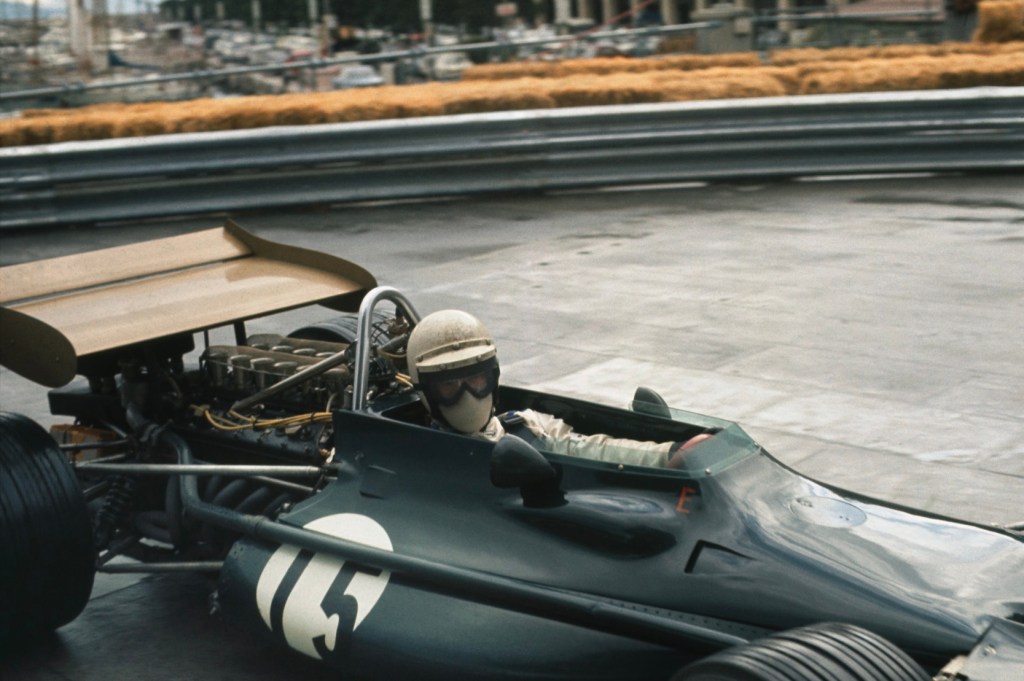
At Monaco the ‘commercial rot had set in’, or less emotionally, commercial reality, the pristine P153 pledged allegiance to Yardley. Not entirely though, George Eaton’s was in each-way bet livery as below: green car and Yardley-gold wings (MotorSport)Pedro leads Chris at La Source during their titanic dice at Spa in 1970. That day the mighty BRM stayed together, Rodriguez sizeable wedding-tackle did the rest (MotorSport)
“Reliability was the main problem of 1970. The engine oil system was being particularly difficult. I tried ‘trick’ oil tanks, and by the time we got to the Belgian Grand Prix at Spa-Francorchamps, the oil-tank had grown to 4.5 gallons in capacity and was fed by 1.25 inch bore Aeroquip pipes (these were hardly hoses)! Miraculously, this did the job for a while. Pedro won the race after leading most of the way, closely caused by Chris Amon’s March 701 Ford. BRM was back…”
“But engine problems still dogged BRM throughput the year, although Pedro gained a second place in the US GP at Watkins Glen and a couple of fourths in other races, and he also won the non-championship Gold Cup at Oulton Park.”
Pedro was leading at Watkins Glen until a splash-and-dash pitstop for fuel, Doug Nye wrote. Fuel consumption had slipped from about 4.8mpg to 6mpg at St Jovite, the BRMs were forced to make pitstops in both Canada and the US as a consequence.
Southgate, “My thoughts on the engine problem were simple: the main bearings were all too small, too narrow. However, this was one of the main reasons the engine was so short. There was no chance of any major design changes in this area, so we had to do with lots of detail design improvements including even better oil tank systems.”
To Southgate’s point, look at the truly massive oil tanks under the BRM’s rear wing in the Mont Tremblant, Canada pitlane below; a few RPM were lost in aero-drag in that lot! Some of the fuel consumption problem is right there…
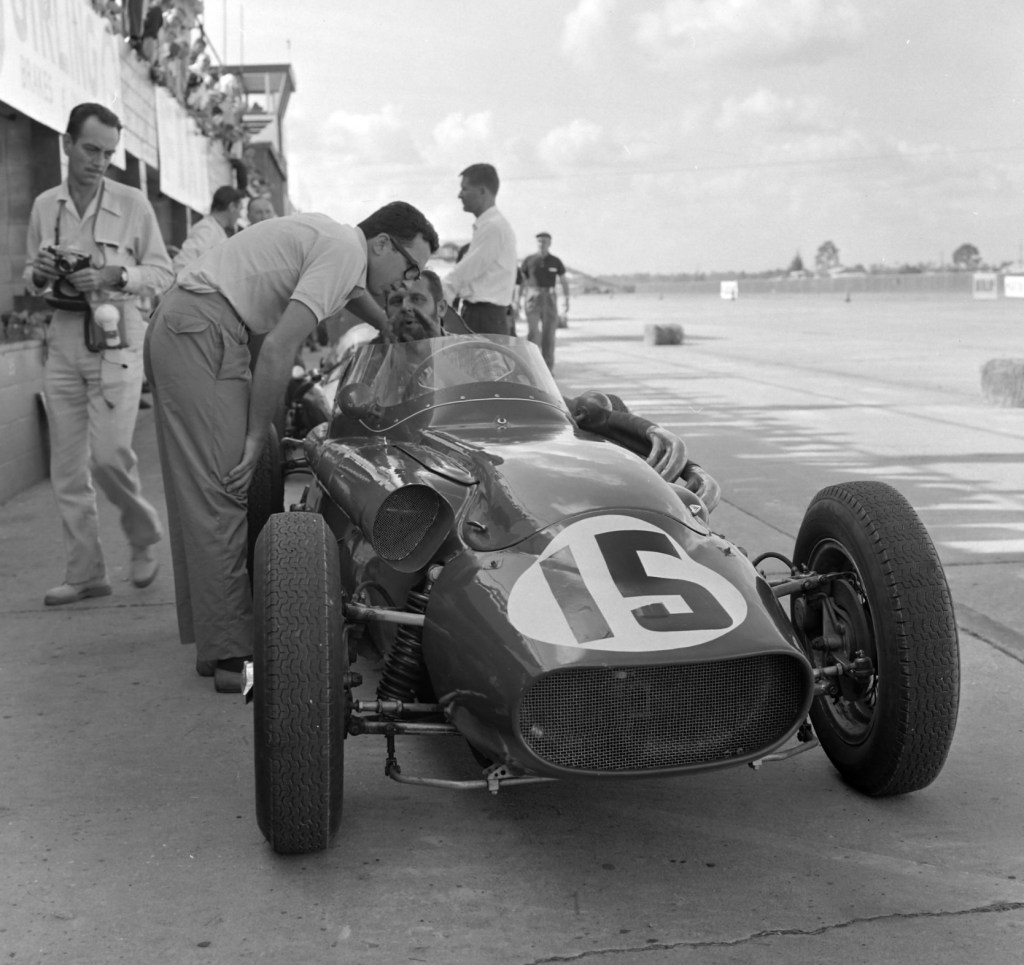
Pedro readies himself in the Mont Tremblant-St Jovite pitlane, fourth that weekend. #15 is Oliver’s P153 (LAT)Pedro, Mont Tremblant 1970 (MotorSport)
In 1970 BRM finished 16 times from a total of 37 starts and placed sixth in the World Constructors Championship with Rodriguez seventh in the driver’s and Oliver a disappointing twentieth after retirements in 10 of the 13 rounds!
Nye, “Southgate produced the finest 3-litre BRM in 1971: the definitive chisel-nosed P160, a cleaner, lower, lighter development of the P153, though actually incorporating few interchangeable parts.” A story for another time folks…
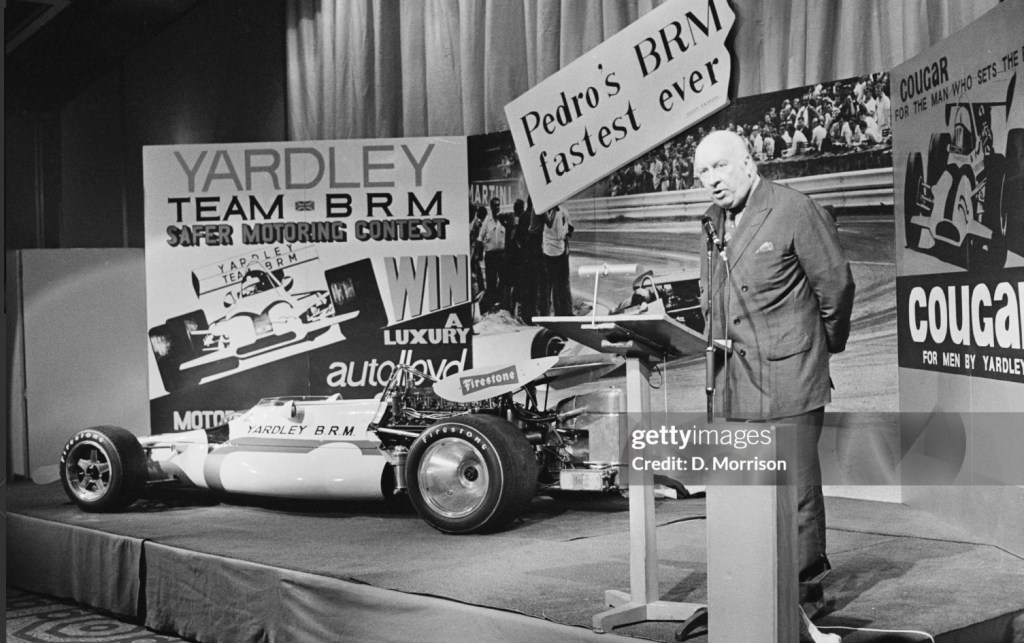
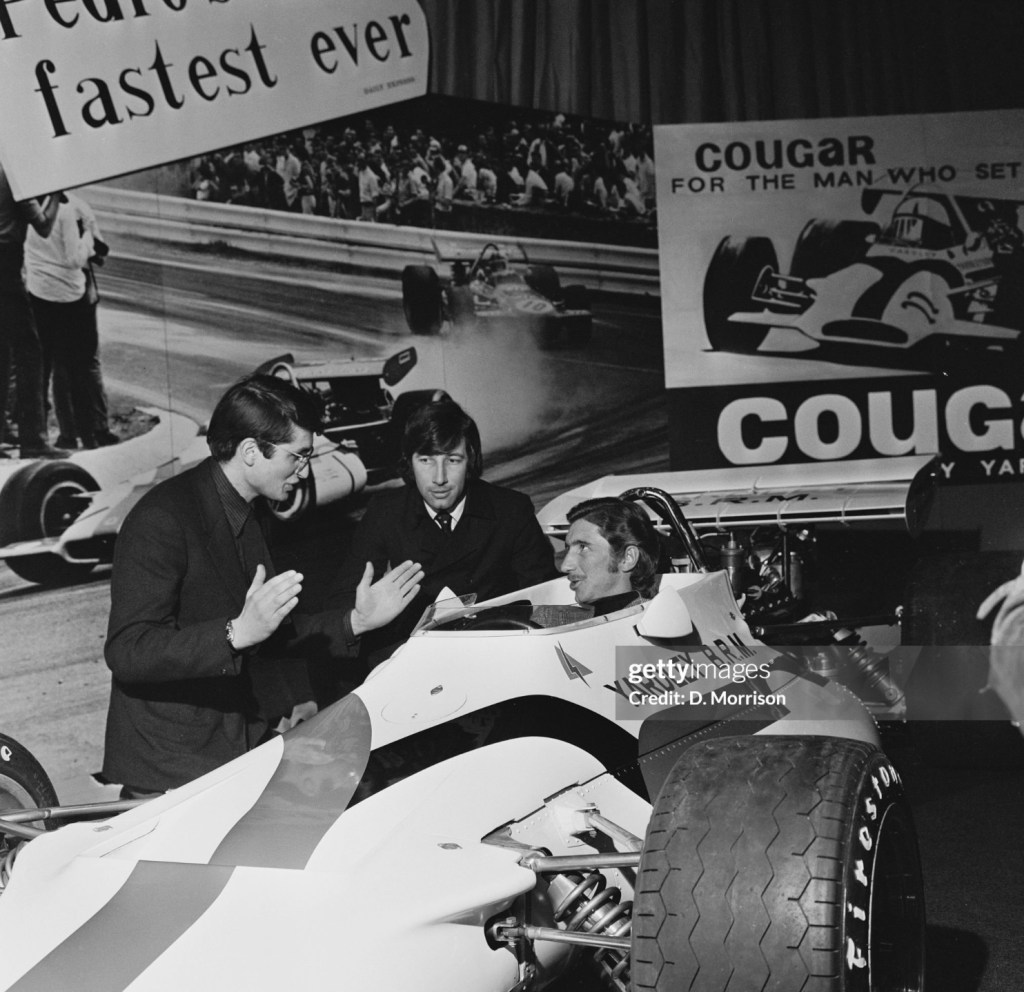
Big Lou extolls the virtues of the new BRM P160 and Cougar aftershave – ‘it’ll drive your mistress wild I tell you’ – place unknown, February 17, 1971
Etcetera…
(MotorSport)
A pair of compare and contrast shots: George Eaton, 1970 BRM P153 at Monaco in May 1970 above, and John Surtees, 1969 BRM P139 during the British GP meeting at Silverstone that July.
The photographer in the Surtees shot looks suspiciously like Rob Walker, he has wandered away from his car, Jo Siffert’s Lotus 49B Ford.
Note the flatter, wider aerodynamic form of the P153, partially informed by the wind tunnel, and earlier P138.
The front suspension of Southgate’s car comprises simpler outboard wishbones, the earlier car uses more complex to make, and more aerodynamic, top rocker and lower wishbone layout. Rear suspension is the same albeit the more advanced two-lower links on the P138 were replaced by Southgate with lower inverted wishbones.
The engine fitted to the P153 is 1970 spec P142 inlet between the vee and side exhaust, that to the P139 is a 1969 spec P142 centre-exhaust V12.
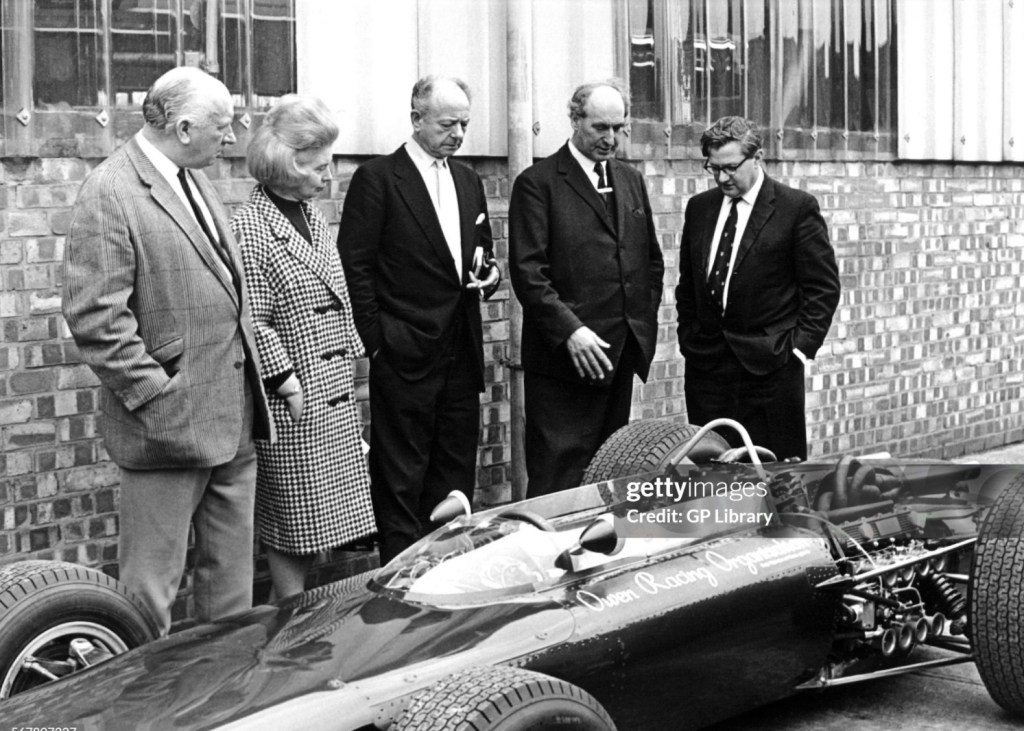
Louis Stanley, Jean Stanley nee-Owen, Raymond Mays, Sir Alfred Owen and Tony Rudd with a BRM P83 at Bourne, allegedly in 1969.
I say allegedly as by 1969 the H16 hadn’t been raced since late 1967, and it makes sense for the PR shot to be with the latest model, not the problem-child. The H-16’s solitary GP win was powering Jim Clark’s Lotus 43 at Watkins Glen in 1966.
In the best tradition of nepotism, Stanley’s power and position arises from his marriage to Jean Stanley, Alfred Owen’s sister.
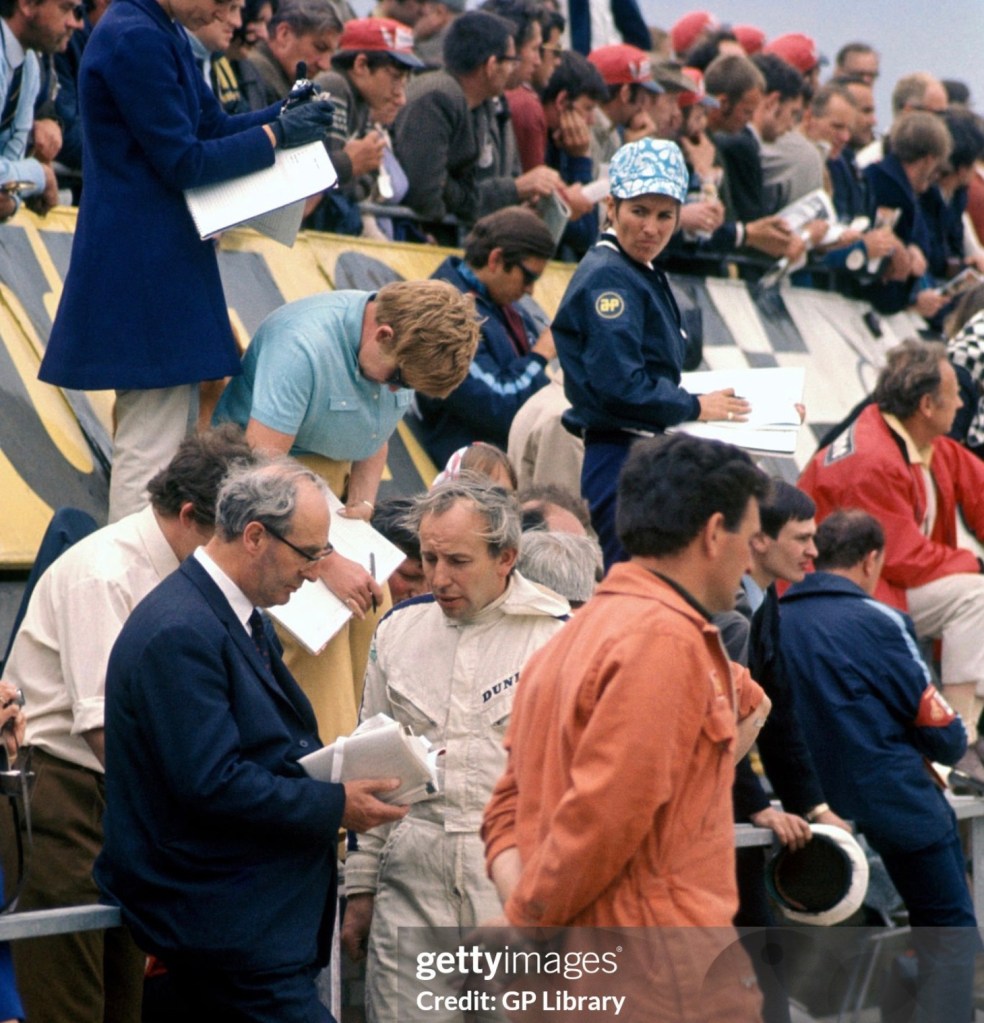
John Surtees tells it like it is to his boss, Sir Alfred Owen at Silverstone during the July 19, 1969 British GP meeting. Owen was a great industrialist and corporate leader, respected by all who came within his orbit. The AP-Lockheed lady is all over what’s going on, the rest are doing their best to look the other way…
Surtees qualified his BRM P139 sixth, and Oliver his P133 13th, Surtees was out with a suspension problem after completing one lap and Oliver on lap 20 when his transmission failed.
By that weekend Southgate was already onboard. He discloses in his autobiography that the approach for him to join BRM was made by Surtees in the US, John being delegated the task given his regular travel between the UK and US.
Lovely portrait of Tony Southgate (born May 25, 1940) at Silverstone during the July 1971 British GP weekend.
The funniest part of Southgate’s BRM chapters involves his first month at Bourne and running-the-gauntlet from the ageing (August 1, 1899-January 6, 1980) but still very frisky ‘Gay Ray’ Mays!
By that stage – the English Racing Automobiles and British Racing Motors founder – “RM had no particular job at BRM but he was still very much on the scene as a sort of ambassador.” As a handsome young bloke, Southgate was potential Mays’ fresh-meat despite the fact he was married.
Suffice it to say – and do re-read the chapter, in fact the whole fantastic book – after Tony declined to return RM’s car-keys to him to his bedroom, having borrowed said vehicle to visit the team mechanics across town earlier in the evening. Mays then refocussed his energies back on the hotel bell-boys for which he was somewhat infamous…
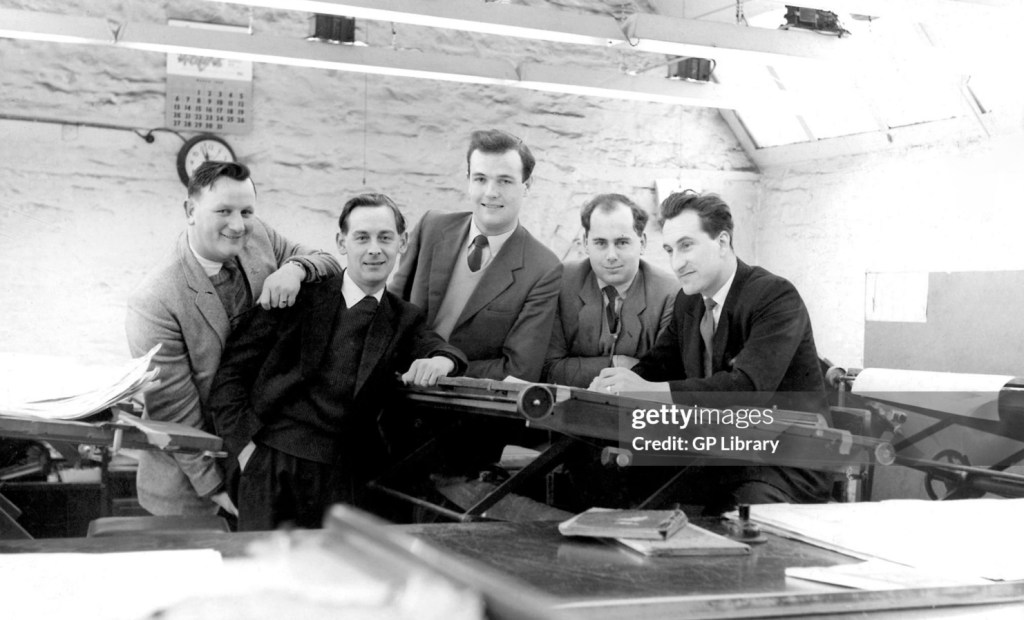
This fantastic shot of the BRM design team is diminished only because the caption cites four names rather than the requisite five!
Alec Stokes, Aubrey Woods, Alec Osborn and Geoff Johnson in 1959, who is missing folks? The drawing office was then located in the old maltings building behind Raymond Mays’ house.
(BRM Association Archive)
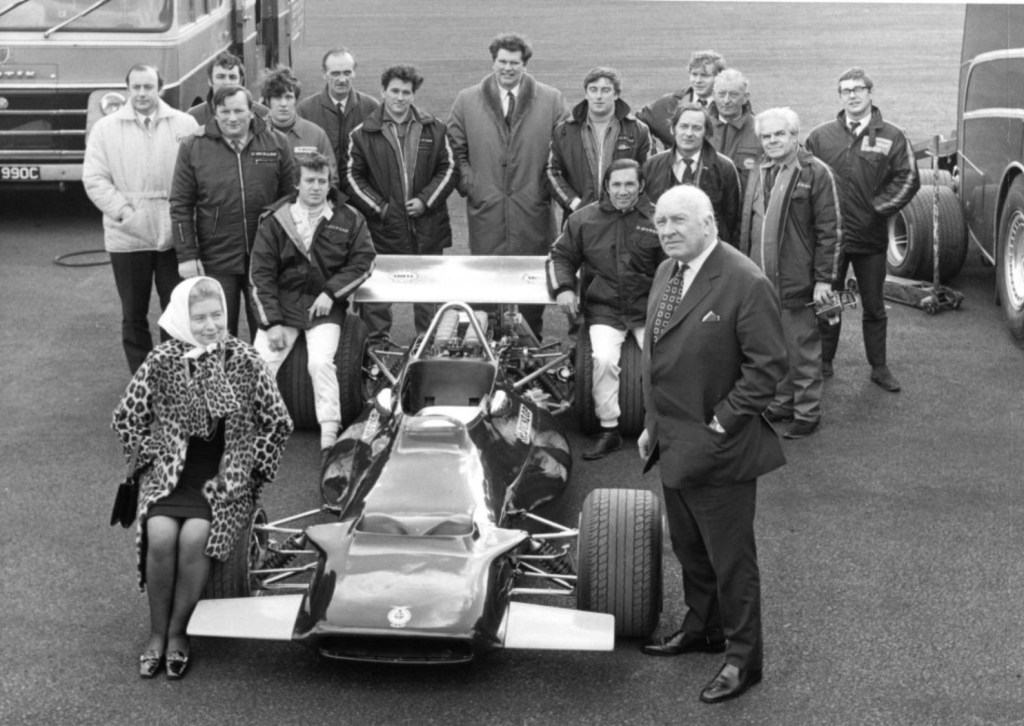
P153 launch at Silverstone, the car has grown a Dunlop decal since Snetterton in early January. Date folks?
From the left, back row – Dunlop employee Ken Spencer, Alec Stokes, Dave Mason, Len Reedman, Alan Challis, Tim Parnell, Gerry Van-Der-Weyden, Aubrey Woods, then two Shell employees, Willie Southcott, Dunlop employee. Centre Jackie Oliver and Pedro Rodriguez. Front, Jean and Louis Stanley.
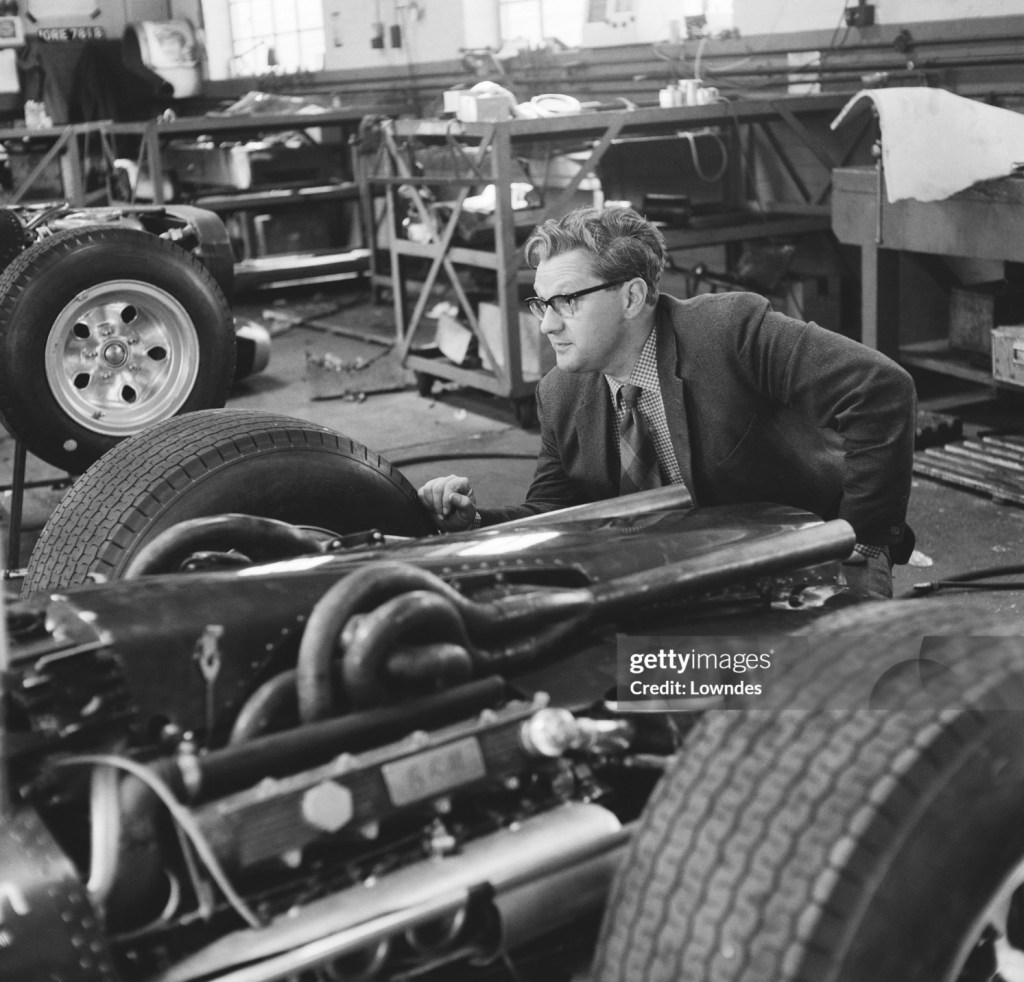
Tony Rudd with BRM P83 at Bourne on May 17, 1966.
I suspect there are a couple of generations of BRM fans like me who feel we almost know Tony Rudd thanks to the all-embracing manner in which he worked with Doug Nye to produce the magnificent ‘Saga of British Racing Motors’ Volumes 1-3, with Vol 4 in-the-pot at present.
There are so many documents and corporate reports contained within written by him that you can form an impression of the way he thought, operated and communicated as part of the team. There nothing to suggest he was anything other than someone to know, like, trust and respect…
He was clearly determined, and stubborn too…Doug Nye wrote that “the ultimate, much modified, magnesium block four-valve-per-cylinder H16 engine (yes 64 valves, 128 valve springs – imagine assembling it all) was completed and tested for 1968 but the policy decision was taken to set it aside and concentrate on the simpler, lighter V12.”
Despite that, “The engine continued in test as late as from 13 December 1968 to 25 January 1969. It was number ‘7541’ and the best of its eight runs peaked at only 378bhp at 10,300rpm; that was nothing like enough to compete with Cosworth’s DFV, which was already beyond 430bhp.”
It seems the catalyst, or straw that broke the camels back in terms of Rudd’s departure from BRM was pursuing the H16 for too long, contravening the policy direction of a year or so before. Southgate wrote that “Tony Rudd…hadn’t done what had been ordered, which was to drop the team’s H16 engine programme and proceed with the V12 only.”
Clearly pink was in! Southgate, Alec Stokes, Stanley and Aubrey Woods perhaps at the time the Yardley deal was done. Bourne.
George Eaton, BRM P153, Monaco 1970 (MotorSport)
Every man and his poodle raced a BRM P153…
The long-lived machines, in P153, P153/P160B spec, were raced by a swag of drivers, many of them F1 virgins. The roll-call includes Rodriguez, Siffert, Oliver, George Eaton, Howden Ganley, Reine Wisell, Helmut Marko, Alex Soler-Roig, Vern Schuppan, Peter Westbury (DNQ US GP 1970) John Miles and John Cannon. Quite a list, in part due to Stanley’s crazy Marlboro-multiple-entry 1972 season and renta-ride availability.
Allen Brown’s chassis by chassis record of the seven P153s built from late 1969 to early 1971 is here: https://www.oldracingcars.com/brm/p153/ The shot below shows three BRM P153 pilots at Brands Hatch in early 1971: John Miles, Howden Ganley, and Jo Siffert in the car.
Jack Oliver, South African GP, Kyalami 1970 (MotorSport)
Credits…
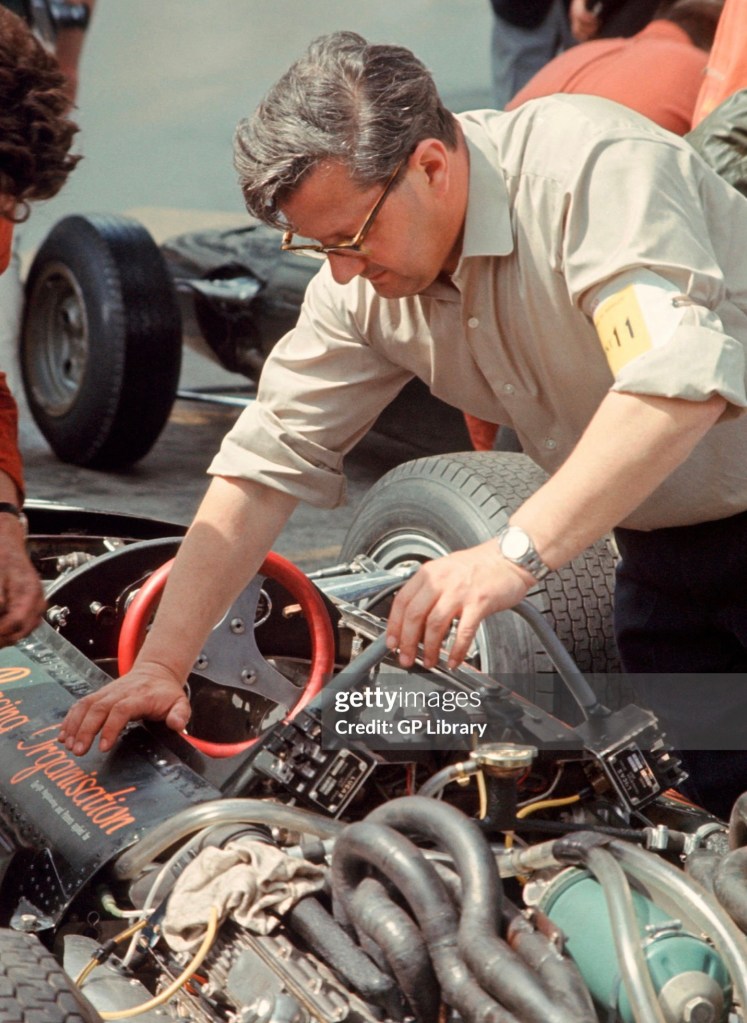
‘Tony Southgate : From Drawing Board to Chequered Flag’ Tony Southgate, ‘History of The Grand Prix Car 1966-85’ Doug Nye, MotorSport Images, Rainer Schlegelmilch, Getty Images, GP Library, BRM Association Archive
Tailpiece…
(MotorSport)
Superb MotorSport Images shot of Pedro Rodriguez blasting through Eau Rouge on his way to that hard-fought Belgian Grand Prix, P153 3-litre V12 win.
Any win at daunting Spa was pretty special, and Pedro had a few there, but that one must have been the sweetest of all given fabulous Chris Amon pushed him very hard all the way. It was the last Grand Prix held on the old circuit too…
Fritz d’Orey in the Sebring pits, US GP December 1959 (MotorSport)
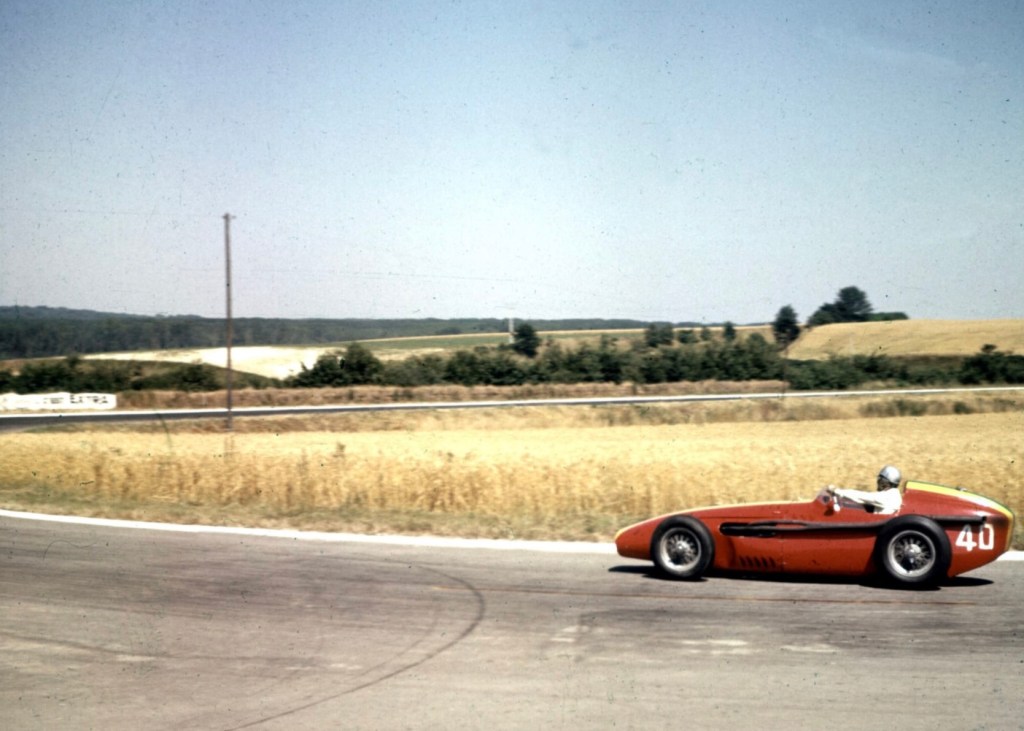
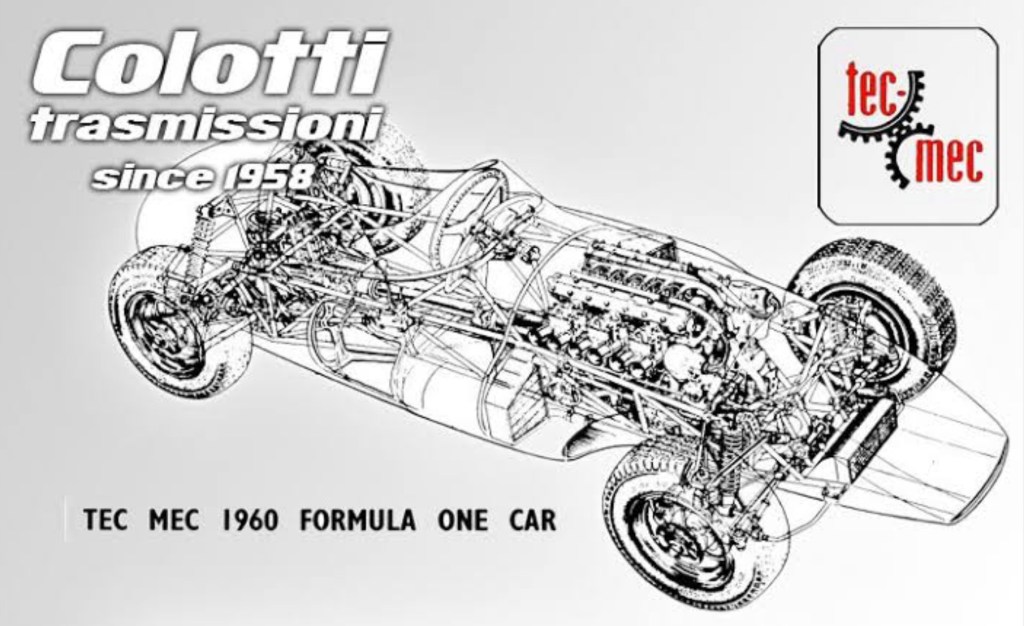
The ultra-light, disc-braked Maserati 250F-engined TecMec F415 was the ultimate development of the long line of 2.5-litre front-engined Maserati 250F Grand Prix cars which commenced in 1954; the preceding 2-litre Maserati A6GCM F2/Grand Prix machines of 1952-53 are duly noted.
In 1957 the works team’s Piccolo 250Fs took Juan Manuel Fangio to his record-setting fifth and final world title. Soon after, with the company on its financial knees, Maserati withdrew from racing. In the best of Italian traditions it wasn’t quite a final withdrawal. In the 1958 French Grand Prix, a special lightweight 250F appeared for Fangio in what became his his final race appearance. He was fourth, and with that the Maserati works-team was no more.
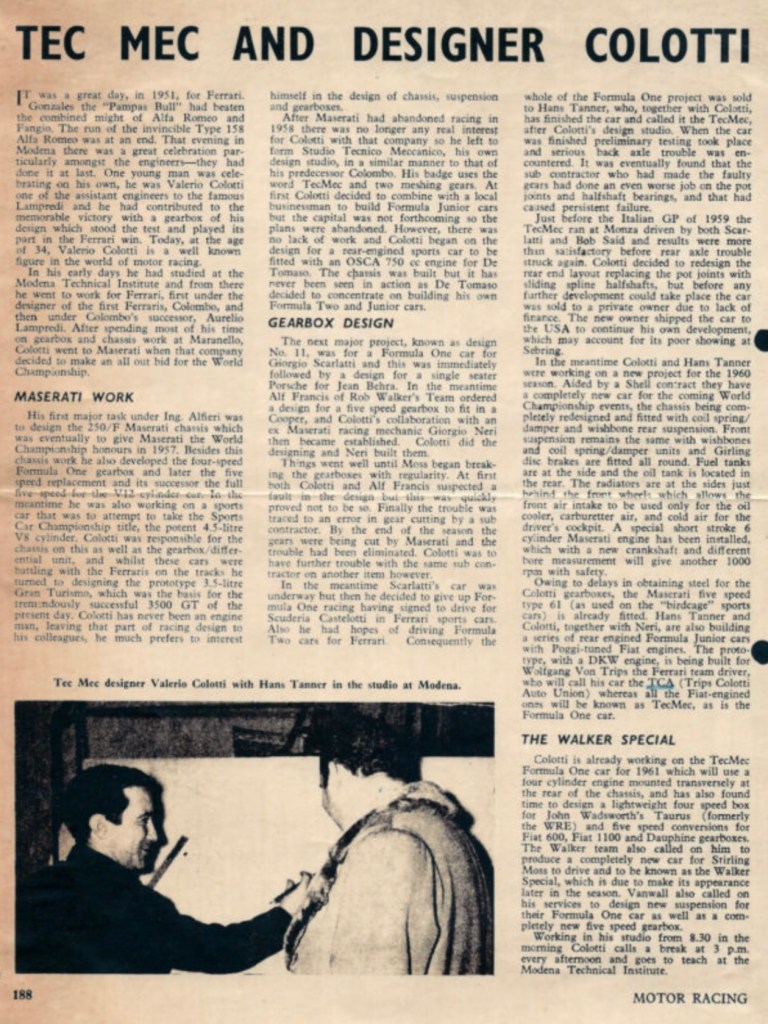
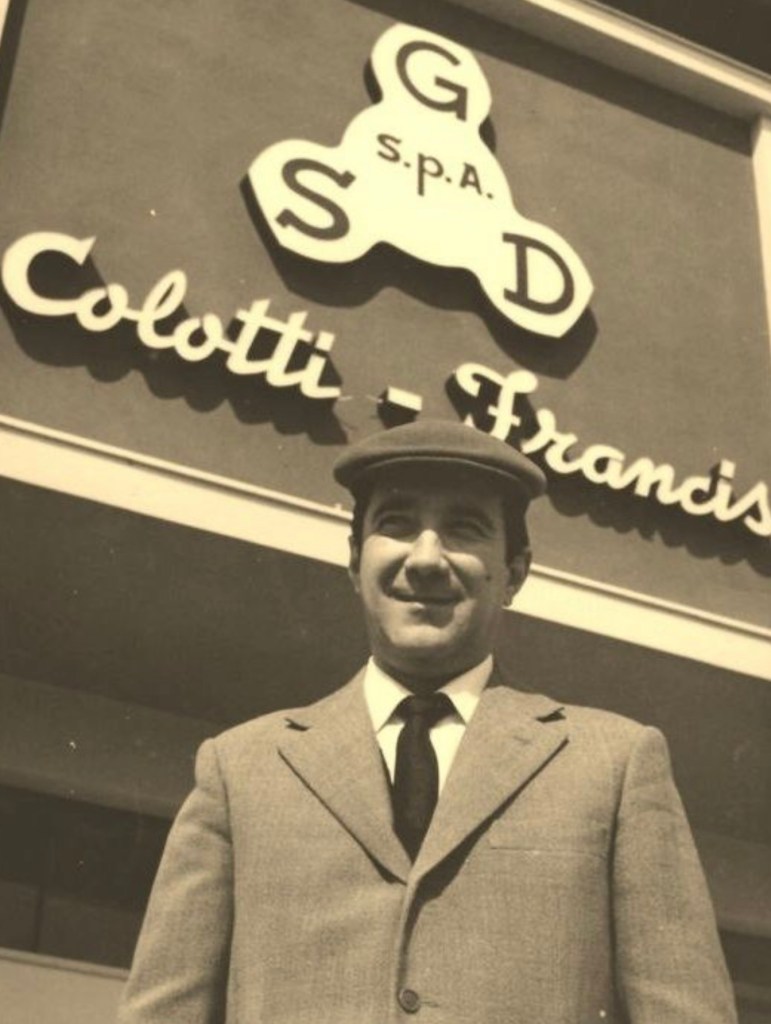
The team’s chassis and transmission engineer during the latter 250F years was ex-Ferrari man Valerio Colotti (1925-January 19, 2008). As the Cooper mid-engined ascendancy began he had a new super-lightweight 250F on his drawing board. Colotti left Maserati to form his own Studio Tecnica Meccanica in Modena.
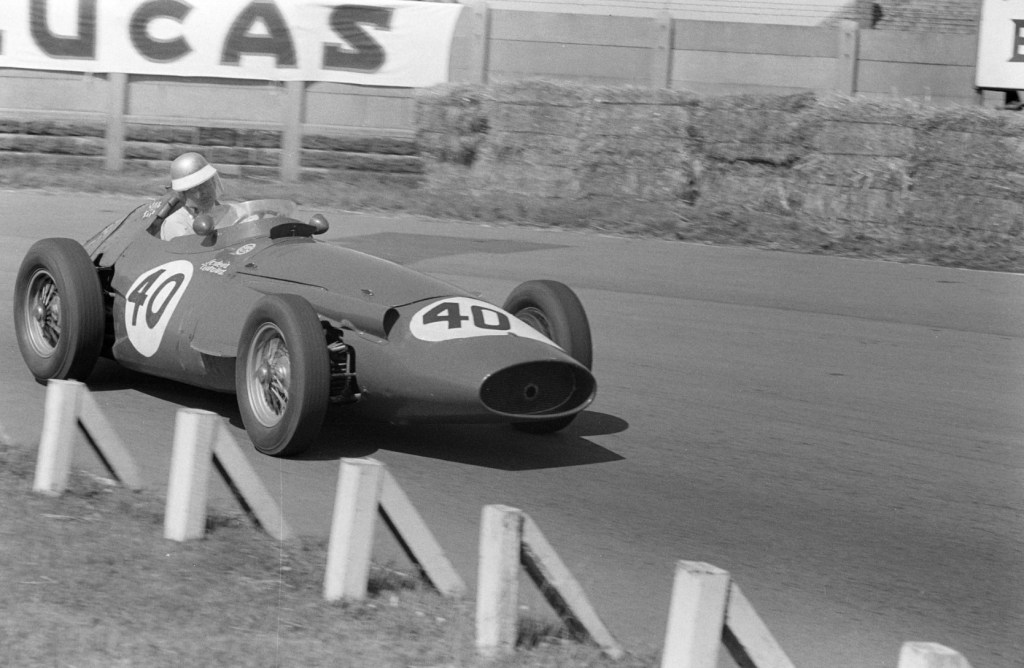
Georgio Scarlatti, Maserati 250F during the 1959 French GP at Reims, Q21 and eighth (MotorSport)
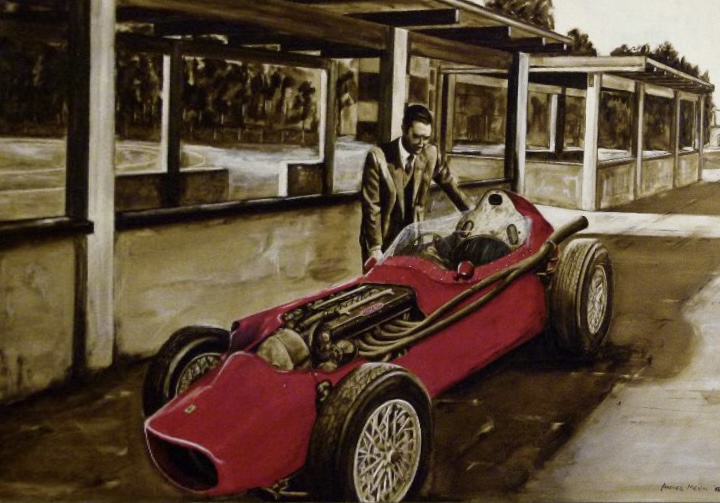
Racer, Giorgio Scarlatti approached Colotti with a view to building the ultimate 250F. Valerio set to work, fabricating a light, multi-tubular spaceframe chassis made of small diameter steel tube. He scrapped the De Dion rear rear suspension, replacing it with an independent transverse top leaf-spring and lower wishbone set up. At the front was a very un-Italian pair of Alford & Alder uprights, supported by upper and lower wishbones and coil/spring damper units, an adjustable roll-bar was incorporated. Girling discs replaced the 250F’s finned drums but the wheels remained passé Borrani wires. Scarlatti provided an ex-works 2.5-litre six-cylinder engine.
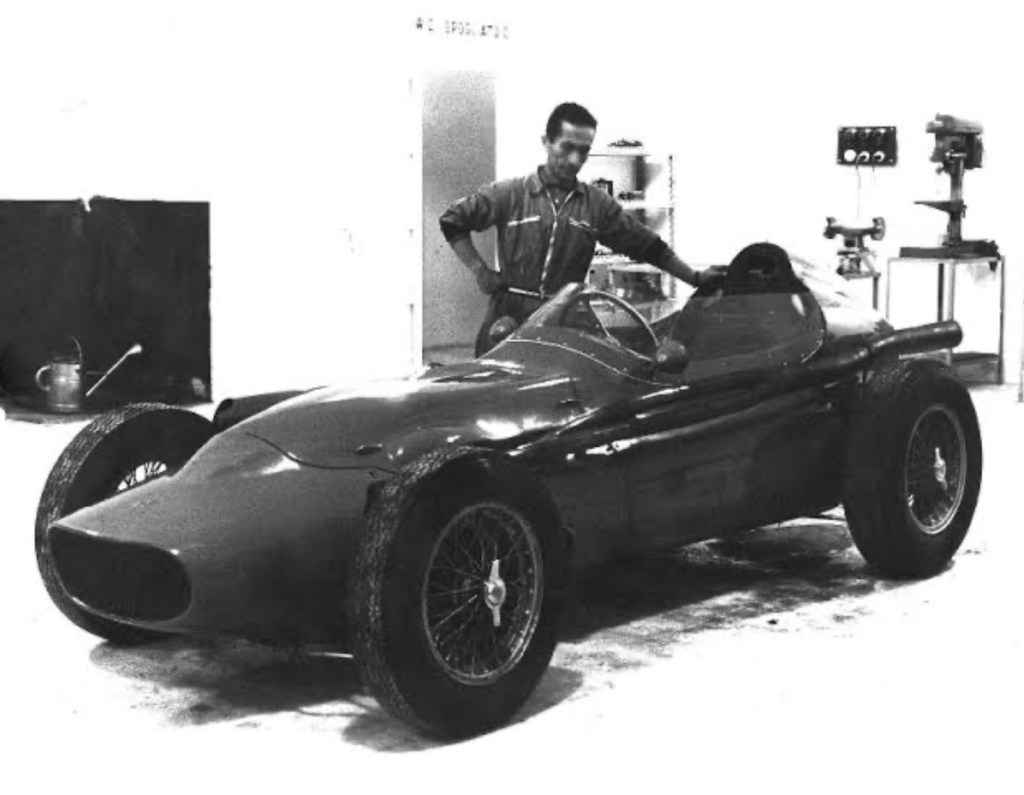
Giuseppe Consoli, an ex-works mechanic, built the car for Colotti, working in the living room of his house near Modena’s aerautodromo. When workshop space was later made available the embryo Tec-Mec F415 was wheeled out through Giuseppe’s French windows!
The car was clad in a functionally attractive, tight fitting aluminium body, the height of which was constrained a bit by the relatively tall Maserati 270bhp, DOHC, two-valve, triple-Weberised six-cylinder engine.
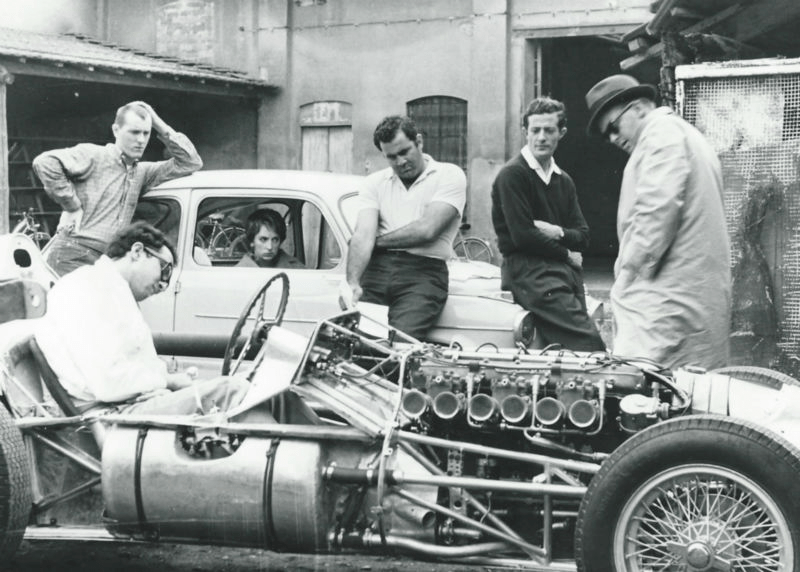
(Colotti)The Tec-Mec F415 shortly after completion, date and workshop unknown (Colotti)Testing times, the boredom is palpable! (Colotti)
Bonhams wrote that, “In the meantime Hans Tanner, Swiss motoring journalist and entrepreneur, became involved with the project. He had been on the Modenese scene for years and was close to Maserati. He enlisted backing from Floridan racing enthusiast Gordon Pennington who lived then in Modena’s famous Hotel Reale.” Pennington intended to race an Italian car so Scarlatti sold him his interest in the Tec-Mec project.
Colotti, meanwhile, had gone into partnership with former Stirling Moss mechanic Alf Francis as ‘Gear Speed Development SpA’, with plans to build Colotti transaxles as the mid-engined revolution popped, and so too the demand for quality, reliable gearboxes.
While all of this played out, Consoli completed Tec-Mec in 1959, complete with engine #2523 purloined from a 250F Jo Bonnier had for sale.
“Under the Pennington-Tanner aegis, Studio Tecnica Meccanica changed its name to Tec-Mec Automobili. The car was tested at Modena by American driver Bob Said, Piero Drogo, Jo Bonnier and Scarlatti.”
Just like the front-engined Scarab and Aston Martin DBR4 programmes, this one was too late. The basically 1957-designed Tec-Mec became raceworthy in late 1959 just as Jack Brabham clinched the first World Championships for a mid-engined car aboard the Cooper T51 Climax 2.5 FPF.
Fritz d’Orey during the 1959 British GP at Aintree. Maserati 250F, Q20 and DNF accident (MotorSport)
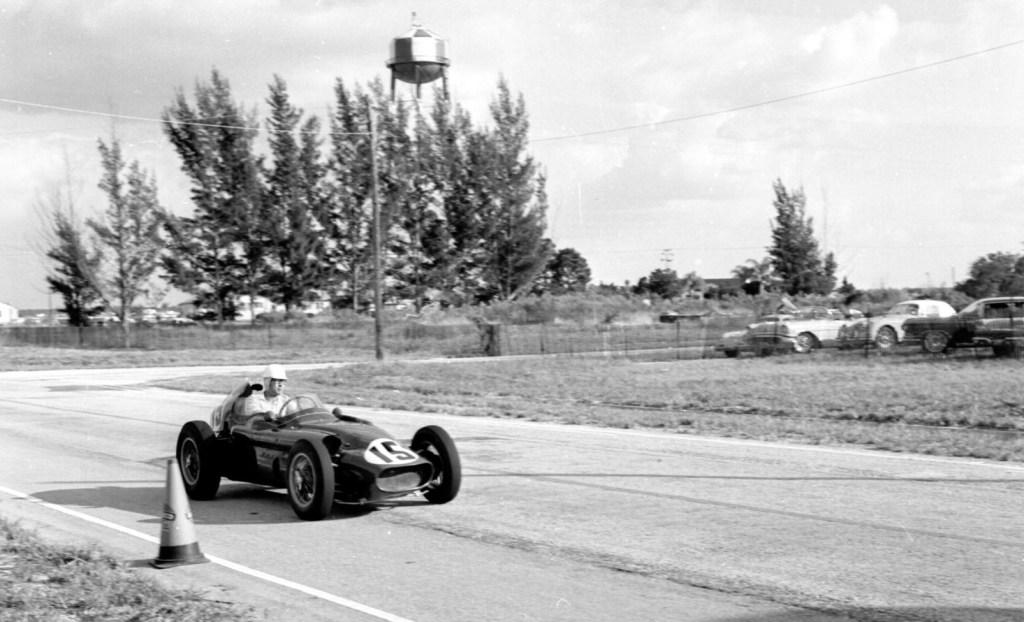
The 1959 World Championship closed with the United States Grand Prix at Sebring, Florida in December. Given it was in Gordon Pennington’s ‘back yard’ the Tec-Mec F415 was entered for Brazilian amateur – and former 250F racer – Fritz d’Orey. He qualified the Camoradi team run car 17th of 19 starters but retired after seven laps with an oil leak/engine failure.
Jesse Alexander wrote this comment about Fritz d’Oley’s performance in the car in his Sports Cars Illustrated race report. “The Tec-Mec was never driven quickly enough to show up any defects. The only time we know of it being driven fast was when Jo Bonnier took it around the Modena Autodromo last summer. His comments were not all that favourable. He complained of, among other things, a flexing chassis.”
One race in-period only, D’Orey and the Tec-Mec at Sebring (MotorSport)
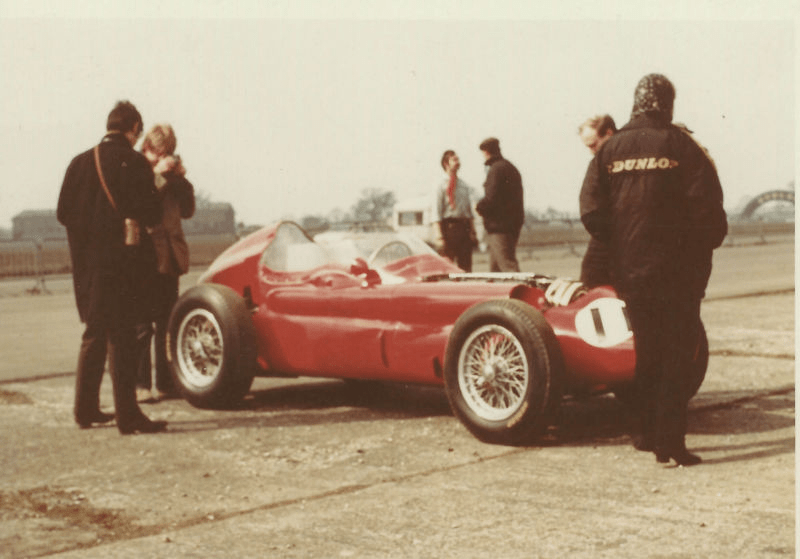
After repair, the car was taken Daytona Speedway for a record attempt but D’Orey was injured in another car. Then Pennington lost interest and the project was abandoned. The car lay on a trailer in a Miami garden until early 1967 when it was acquired complete with spares – including unopened boxes of new parts – by Tom Wheatcroft for what became The Donington Collection.
After restoration he drove the car regularly in open test days at Silverstone and Oulton Park before crashing it heavily into a parked ambulance after spinning-off at Silverstone. After the car was rebuilt it was driven by engineer/restorer Tony Merrick in VSCC events while residing in the Donington Collection. After sale by Wheatcroft in the 1990s the car has been a formidable historic racer.
Etcetera…
(Colotti)
Tec-Mec F415 – Tec-Mec Project 11 – on its first appearance, perhaps, after its restoration.
(Colotti)(Colotti)
Credits…
Bonhams, MotorSport Images, Colotti Transmissioni, Sports Cars Illustrated March 1960 via Stephen Dalton, colotti.com
One of my true racing loves is the 1970 F1 Ferrari 312B and its successors.
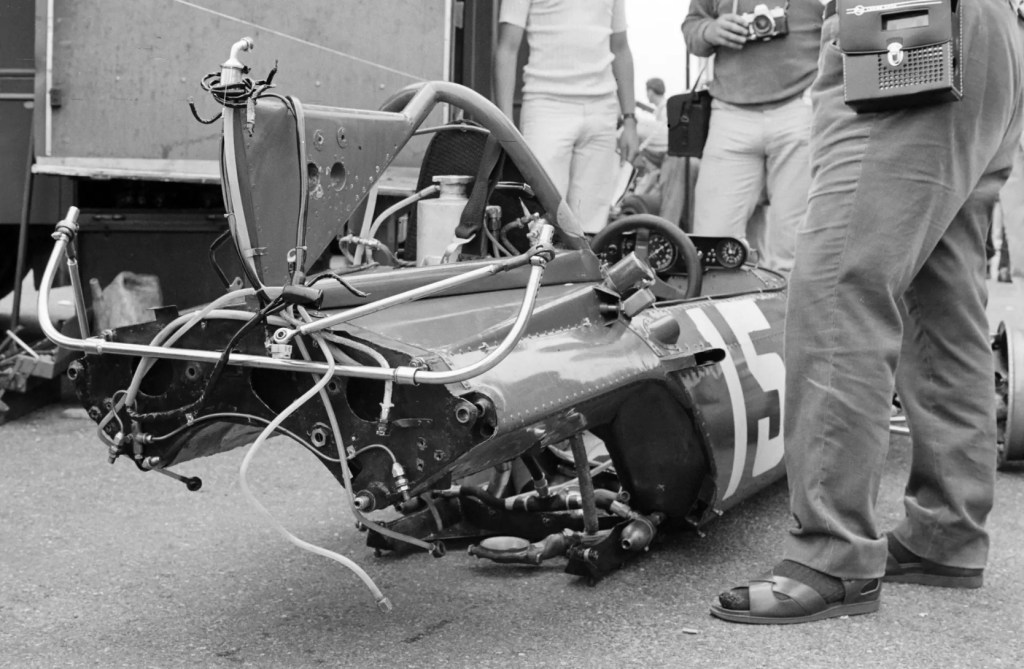
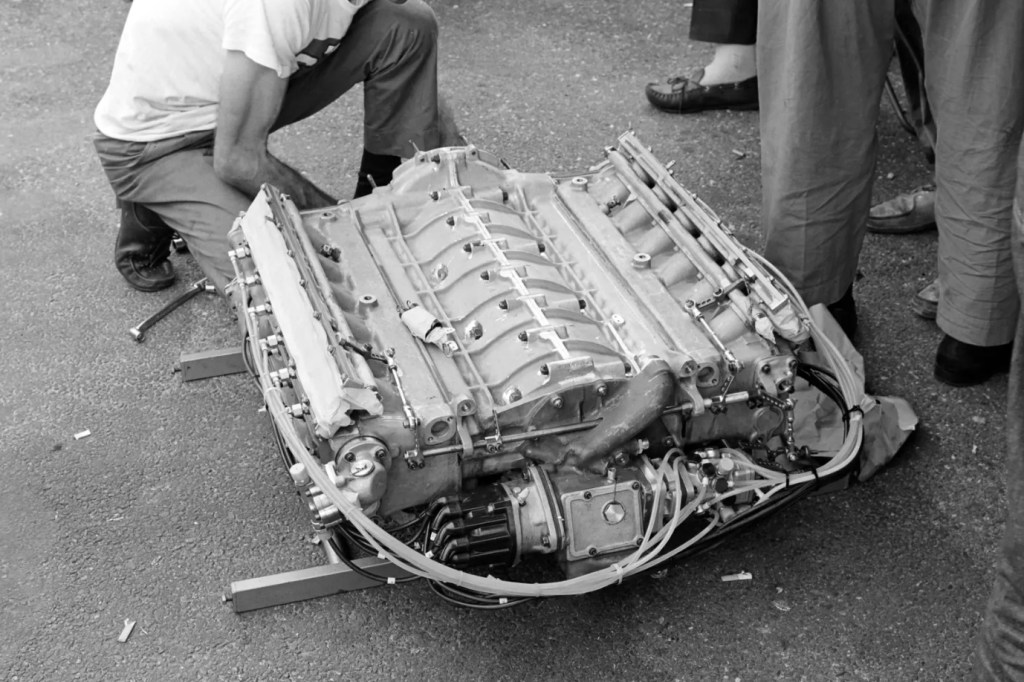
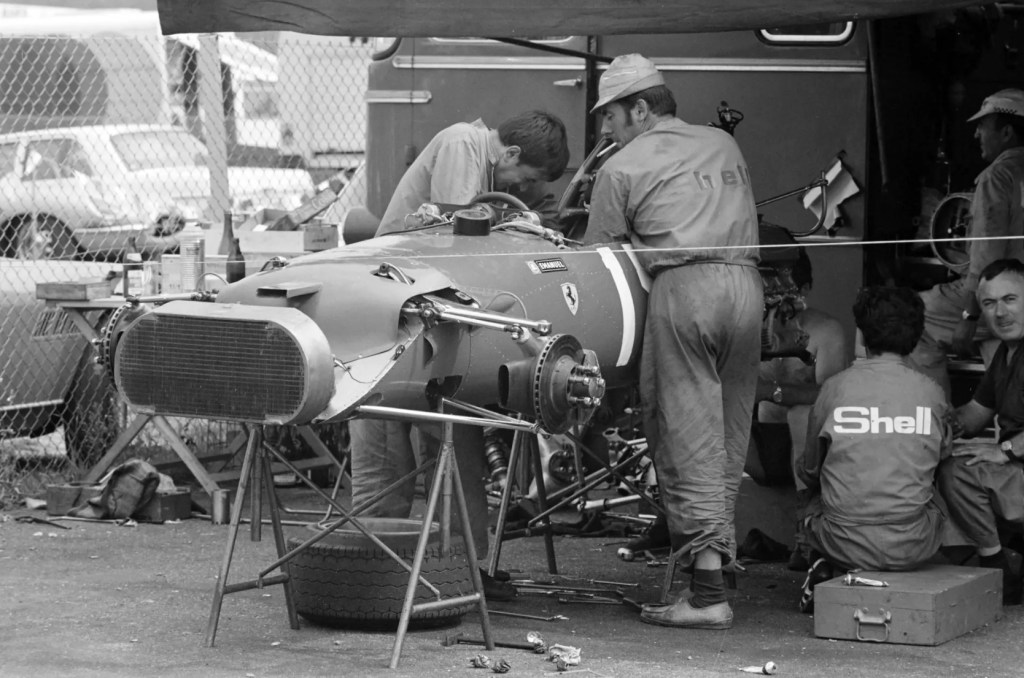
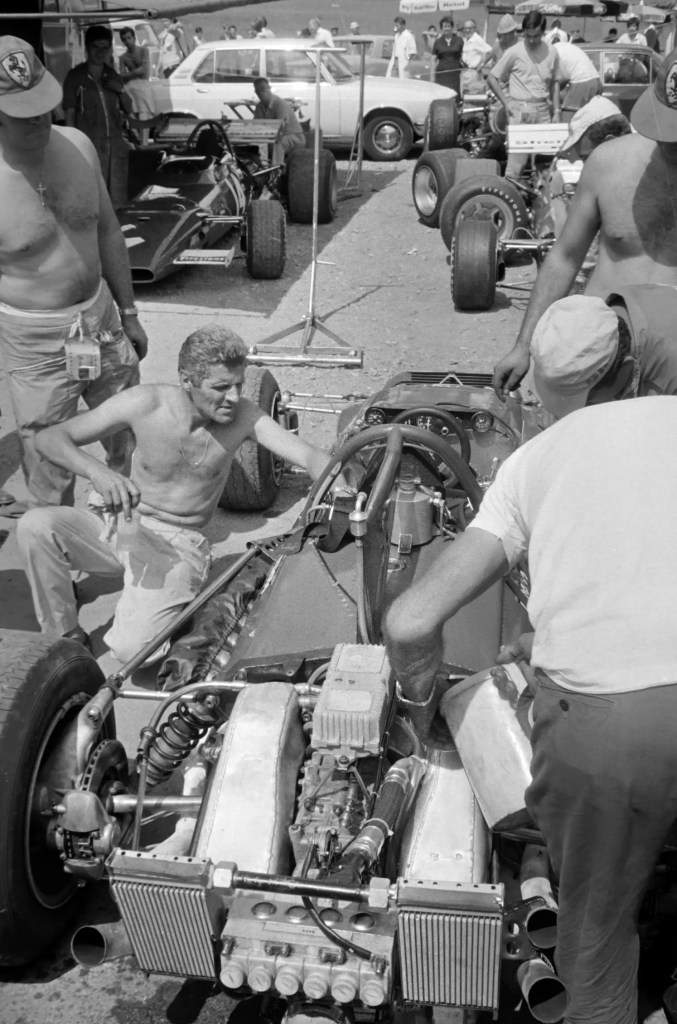
I’ve done it to death of course, this article tells its story in detail: https://primotipo.com/2016/02/26/life-is-all-about-timing-chris-amon-and-the-ferrari-312b/ But this series of shots of an engine change during practice in Clay Regazzoni’s 312B/001 during the 1970 German GP weekend at the Hockenheim Motordrom are too good to ignore. We’ll make this the first of a similar series of a largely pictorial nature.
Doug Nye characterises this Mauro Forghieri – and team – designed machine as one the best integrated F1 Ferraris. The photographs here convey clearly why this is so.
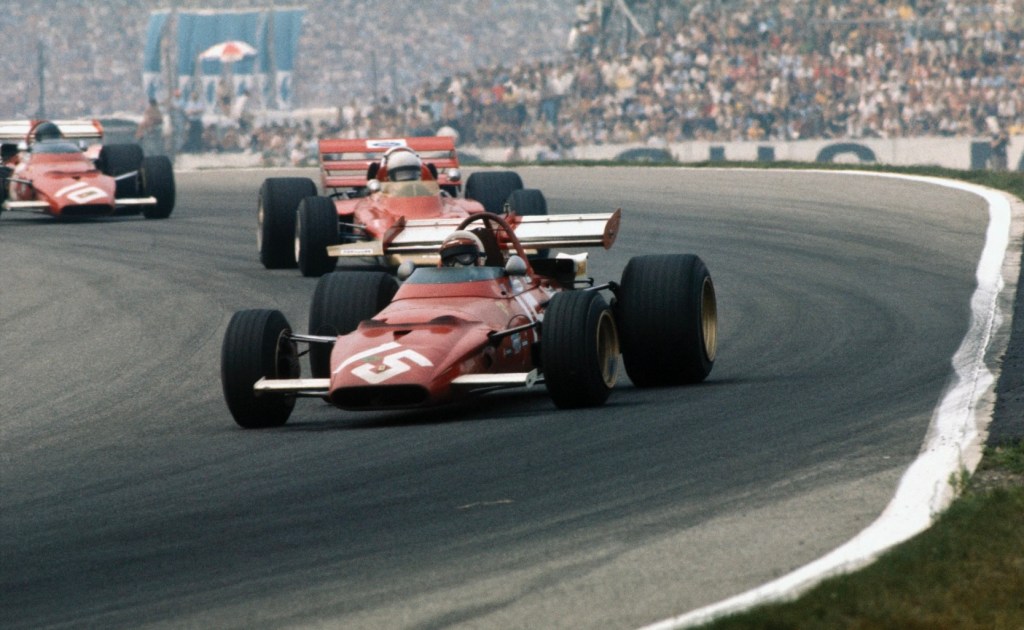
Clay Regazzoni and Jacky Ickx, Ferrari 312Bs sandwich the winning Lotus 72C Ford of Jochen Rindt during the early laps at Hockenheim (LAT)(LAT)
The four main-bearing twelve cylinder engine – a Flat-12 or 180-degree V12 – depending upon your engineering religion of choice – was a paragon of reliable power after the early challenges experienced largely by Chris Amon circa-September 1969 were overcome.
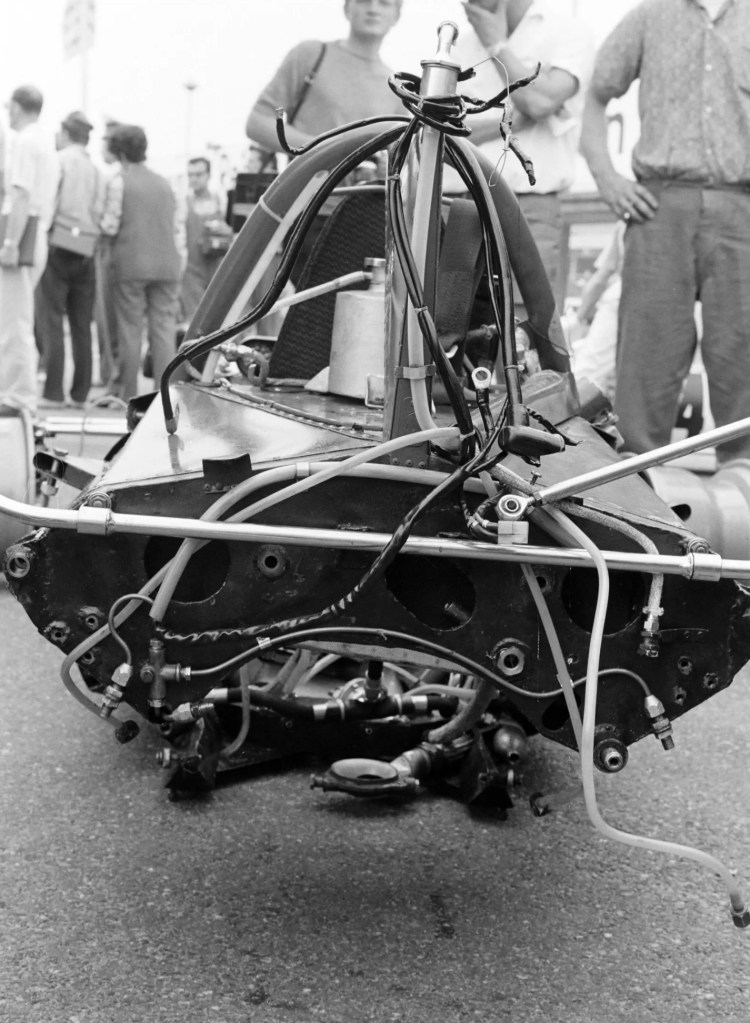
These shots show how low, wide and compact it was. All that weight sat low in the chassis with the wild monocoque carrying the engine ‘underslung’. At that early stage of its development, Ferrari quote an output of 450bhp @ 12000rpm, a capacity of 2991.01cc and bore/stroke of 78.5×51.5mm.
(LAT)
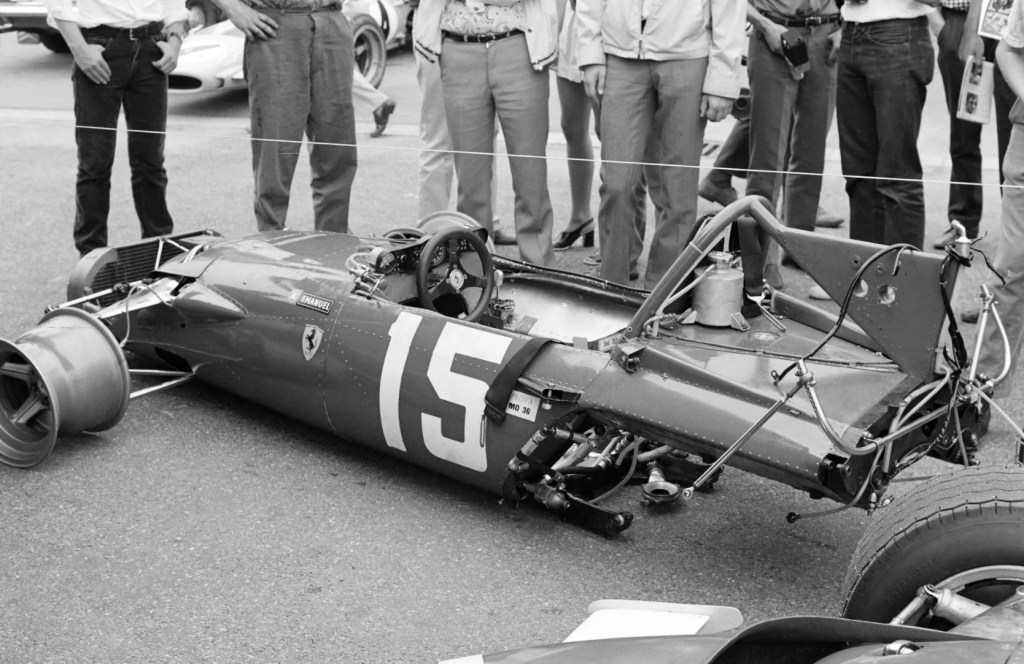
Devoid of tyres, Regga’s #312B/001 sits on its tummy.
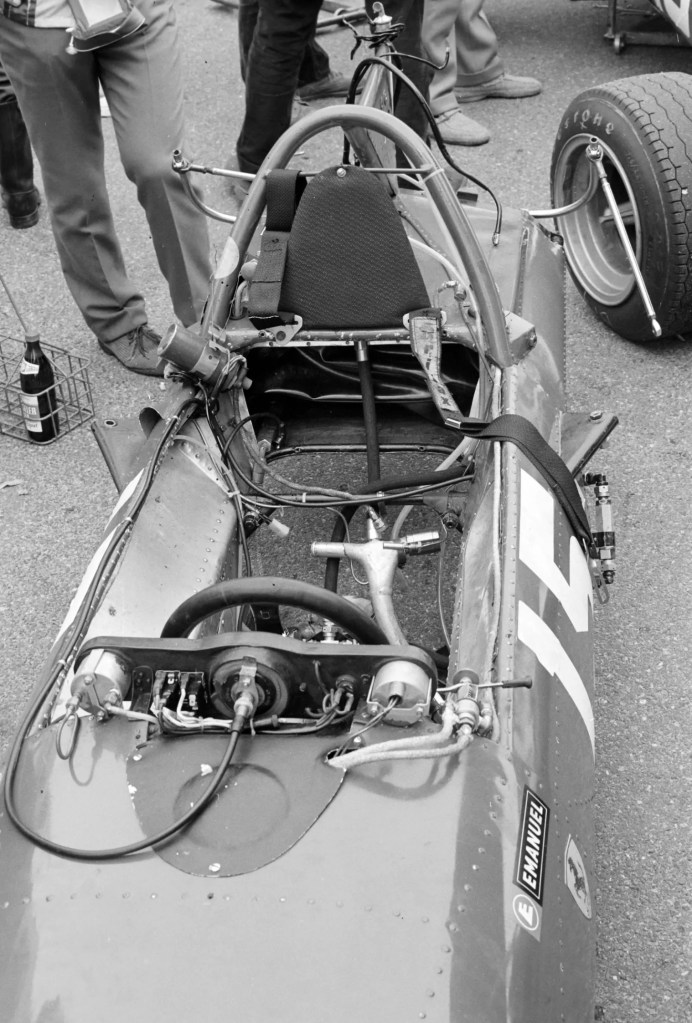
Note the inboard rocker front suspension – Ferrari had used this set up continually since the 1963 156 Aero – and clever way in which the aero-element rollbar stay ‘triangulates’ the monocoque boom. Oh to have been there to watch the engine replacement!
Ferrari still used their ‘Aero semi-monocoque’ at this stage, in that the tubular steel chassis had aluminium panels riveted to it with the engine used as a semi-stressed member.
Five of these chassis were built: 312B/001 – #312B/004 albeit #312B/002 was re-tubbed after Jacky Ickx’ collision with Jack Oliver’s BRM P153 during the 1970 Spanish GP. All four cars exist, what lucky owners they are! See oldracingcars.com for chassis by chassis details: https://www.oldracingcars.com/ferrari/312b/
#312B/001 was Ickx’ usual chassis throughout that season: the Austrian, Canadian and Mexican GP winner. As the chassis number suggests, this machine was the first built. It was entered for Chris Amon in the 1969 Italian Grand Prix but failed to take to the track after engine failure in three test sessions at Modena in the lead up to Monza.
(LAT)
Jochen Rindt won the Hockenheim race that weekend during the mid-season run of victories – the Dutch, French, British and German GPs – that gave the fearless Austrian enough points to win the World Drivers Championship posthumously. With a little more luck it could have been Jacky Ickx, but karma, thankfully prevailed.
In Germany the top-three qualifiers were Ickx, Rindt and Regazzoni. While the Ferrari challenge was strong, newcomer Regga – who won the Italian GP in September – led laps 22 and 23 of the race and was then slowed and retired with gearbox trouble in the 50 laps race.
Rindt’s win from Ickx was a good one, Denis Jenkinson noted in MotorSport that “As was very evident in Zandvoort it was the Lotus 72 showing superiority over the other competitors, rather than the driver…he (Rindt) won by only 0.7 sec from Ickx but the win was convincing as he was able to pass the Ferrari whenever he wished…”
(LAT)
More often than not the floor is a key contributor to the structural rigidity of both spaceframe and monocoque chassis – glued and riveted as they often are – but apparently not so much with this Ferrari, the floor of which was seemingly located by removable bolts. There are rubber fuel-bags within the monocoque on each side, mandated by the FIA from 1970.
(LAT)(MotorSport)
Front suspension long top rocker and wide based lower wishbone, steering rack and steering arm mounting ‘ear’ on the upright on one of the 312Bs at Kyalami during the 1970 South African GP weekend.
Credits…
LAT Images, oldracingcars.com, Ferrari.com
Tailpiece…
(LAT)
Is Borsari the mechanic? I know the face of the longtime Scuderia man, I’m just not so sure of the name. Look how Forghieri is shifting weight to the very rear of the car: the Varley battery and neatly faired oil radiators. Outboard rear suspension is period-typical: cast magnesium uprights, single top links, inverted lower wishbones and twin radius rods, plus coil-spring/Koni dampers.
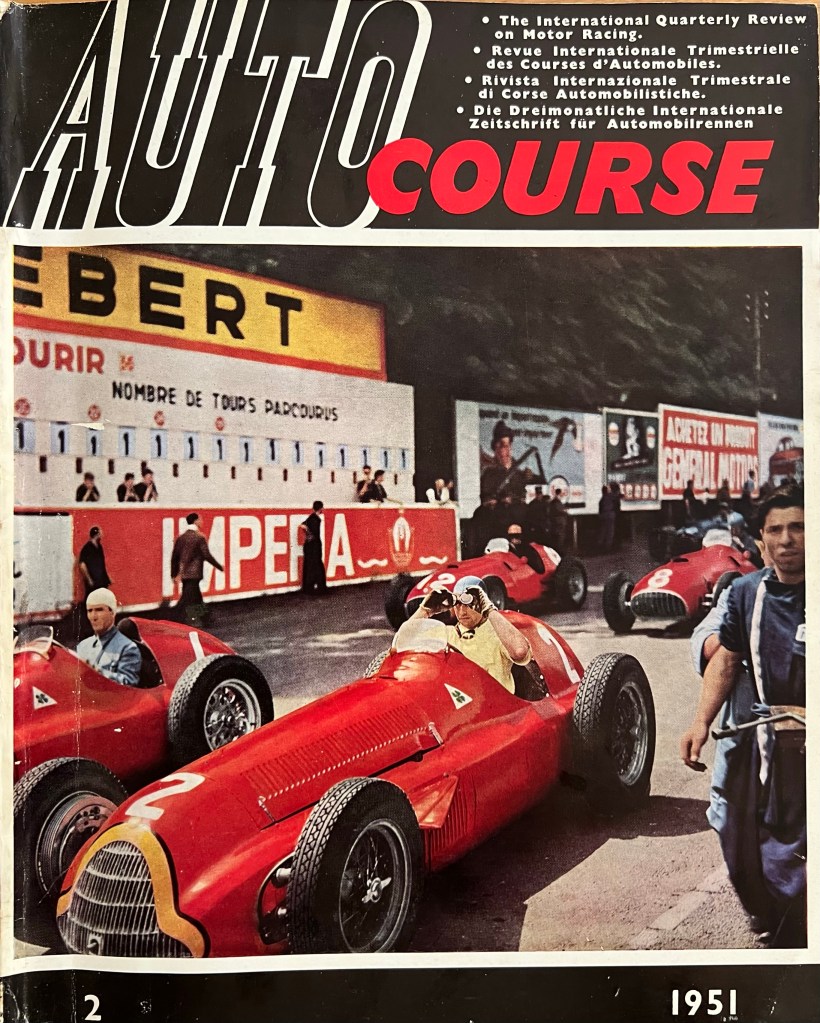
This is the second in an occasional series of articles plucked from the early issues of Autocourse, via the collection of my friend, racer and historian, Tony Johns.
In the unlikely event one could find Formula 1 articles of a technical type amongst all of the ‘Drive to Survive’ inspired dull, shit-boring, insipid dross in most magazines these days, one on racing spark plugs would be the last to expect!
These days they are a purchase-instal-and-forget item but once upon a time one’s méchanicien needed to be able to anticipate, read, and change plugs to suit the changing weather and other circumstances throughout a race weekend. Remember the shots of a mechanic labouring in the pits and paddock under big wooden boxes of plugs?
This article was written by Herr G Werner, a Bosch employee.
Oh yes, the opening shot is before the off, Spa, the Grand Prix de Belgique, June 17, 1951. Juan Manuel Fangio #2 is on pole in his Alfa Corse Alfa Romeo 159 with Giuseppe Farina alongside in another Alfa; the 1951 and 1950 World Champions of course. Farina won from the pair of Scuderia Ferrari Ferrari 375 V12s driven by Alberto Ascari and Luigi Villoresi.
Car #12 on the second row is Piero Taruffi’s Ferrari 375 (DNF rear axle) and #8 Ascari. Farina took 2hr 45min 46.2sec to complete the 36-lap, 316-mile race through the daunting, high speed swoops and dives of the Ardennes road circuit.
Fangio finished ninth and last. He was gradually catching Farina in the lead, when he pitted for fuel and tyres after 14 laps but no amount of hammering by the mechanics of the left rear wheel would move it (below). In the end the poor technicians removed the brake drum and wheel assembly, losing nearly 15 minutes in total. Fangio rejoined last of the remaining ten runners and four laps adrift of Farina.
Autocourse notes the following in relation to the Fangio and Farina 159s, “Fitted with an oval-section petrol tank each side of the driver extending forwards to the bulkhead and an oval-section tank on the right-hand side of the engine under the exhaust manifold. Fangio’s car had a De Dion back axle.”
(MotorSport)(Autocourse)
The Racing Plug : Its selection and the factors which influence its efficiency
Much has been written about sparking plugs. A whole science has evolved around them and their correct choice, and they have been become an inexhaustible theme for discussion at large motor sport events. A glance at the problem of the correct choice of sparking plugs will prove ample justification for this.
The purpose of our article is the discussion of the “Racing Plug”. Although its construction and requirements are entirely different from those of a normal plug, they have nevertheless many things in common.
One thing is expected from every type of plug. At exactly the right moment it must produce a sufficiently powerful spark for the fuel mixture in the cylinder of the engine to be ignited and for the chemical energy of the fuel to be converted into heat and work, thus giving life to the engine.
For obvious reasons a racing engine makes more specialised demands on the construction and material of the plug than does an ordinary engine. The right choice of a racing plug for a particular race needs much experience and knowledge of the many factors which play their part in the functioning of the plug. These problems will shortly be considered.
For every race the type of track and its length are common knowledge. The tuning of the engine develops from these known facts and from the conditions laid down in the regulations.
The type of fuel to be used will be either prescribed or left to choice. On it depends the compression ratio, the carburettor adjustment, the degree to which the ignition is to be advanced and, of course, the sparking plug itself. The length of the race and the engine’s performance determine the fuel consumption and accordingly the number of stops required for refuelling during long races. Fuels with a high alcoholic content raise problems different from petrol, benzol or a mixture of these two.
A two-stroke engine using a fuel-oil mixture requires a different plug from a four-stroke engine.
The weather is also a factor to be taken into consideration, as changes may occur between practice days and the actual day of the race. Even the most ideal carburettor and ignition adjustments may have to be changed if, for example, it is raining on the day of the race whilst during practice it was bright and dry.
We need hardly tell the experts, whether firms or individuals, how to adjust their engines so as to be “fit” for a particular race, but there are the younger ones without the experience of the more seasoned enthusiasts to whom perhaps a few hints might be of value. If amongst these tips there is something new to the old hands, we shall be doubly rewarded.
We feel that perhaps fifty years’ experience of plugs has given us some authority and we make no apology for stating our views.
I. What sparking plugs are required when the length and conditions of the race are known ?
This question, in so far as heat value is concerned, will, in most cases, be resolved after practice, but to some extent the driver must know the sort of plug he requires, at least the plug thread-either 18 mm. or 14 mm. thread diameter and 12 1/2 mm. or 18 mm. reach.
2. The higher the compression ratio, r.p.m. and consequently the engine pertormance, the higher the heat value of the plug must be, if self-ignition is to be avoided
3. Tracks which have no gradients and where corners can be taken without loss of speed present no great difficulty in the choice of the right heat value of the plug. Then, a high heat value and consequently a cold or hard plug is preferable as there is less danger of the plug becoming dirty or oily.
4. On tracks with steep gradients and many corners when brakes and accelerators are much in use it is different.
When decelerating and consequently pouring less fuel mixture into the cylinder a momentary depression results in the combustion chamber. This causes oil to seep through the piston rings which brings with it a danger of the plugs getting oily and the formation of a carbon deposit. If carbon enters the plug, it may well stop the plug from firing, as carbon is an electrical conductor. This conductor may cause a short and instead of the plug sparking, the impulse will be diverted to the secondary circuit. It will be seen therefore that conditions demand special care in the choice of plug, as it is important to ensure that the plug does not become overheated during long races on fast circuits.
On the other hand the plug must not become oily when braking at corners or descending slopes; it must reach such a temperature to ensure that all the carbon is burnt up thus avoiding the formation of a secondary circuit. This temperature is approximately 500 degrees centigrade at the points.
5. If the driver removes his plug during practice after a fast run and discovers (generally by means of a magnifying glass) that a fine light grey metal deposit, the size of a microscopic pearl, has formed on the electrodes and insulator, then there has been an error, even if, according to the driver’s opinion, the engine has been running well. This metal deposit means that the ignition was too advanced and that there is a burning of the piston. Here, too, it may be advisable to use a colder plug with a correspondingly higher heat value. But the most important factor of all is a correct ignition adjustment.
6. The metal washer between the plug and the engine must not be forgotten. This washer must fit well but not too tightly. If too tightly fitted, then the piece between the thread and the plug body will become strained and looseness will result. The looseness brings about a deterioration of the thermal conductivity in the inner part of the plug which causes overheating.
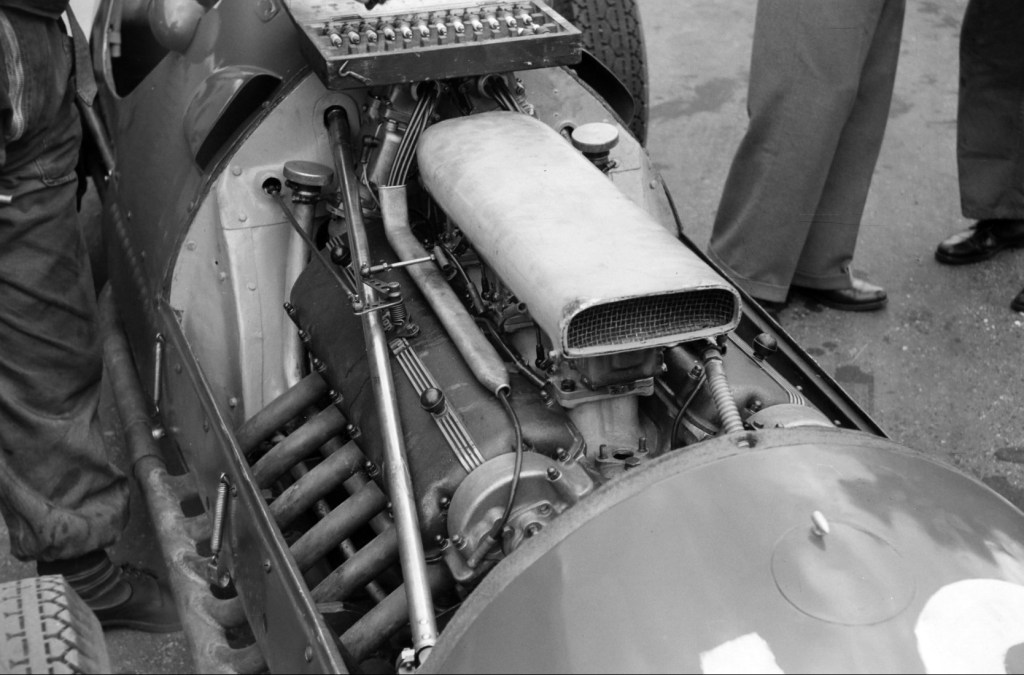
Plug-box to the fore on the scuttle of one of the Alfa 159s during the July 1951 British GP weekend at Silverstone (MotorSport)Bosch 1950s adPlug box atop the engine bay of a Ferrari 375 V12 again at Silverstone during the 1951 GP weekend. Twin-plug heads = 24 plugs, I wonder what a good time to change them all was? (MotorSport)
7. If the compression ratio of the engine is raised with a consequent increase in output, the temperature of the exhaust gas from the engine itself becomes relatively cooler. The ultimately greater output is due to the fact that more heat is converted into energy; thus proportionately less heat passes unused from the exhaust pipe.
The implication is that the engine would now appear to run cooler, and the most suitable plug would be one with a lower heat value. This, however, is not the case. Although the greater amount of heat converted into energy in the engine’s combustion chamber-the most economical use of the fuel-leads to a relatively lower temperature, the combustion gas temperature in the chamber itself and also of the plugs, pistons and valves become higher as the amount of heat being converted is greater. It will be realised, therefore, that a high compression ratio demands a correspondingly high heat value of the plug and therefore a colder one.
8. The amount that the ignition is advanced measured in the degrees of the angular movement of the crankshaft or in the mm. of the stroke, greatly influences the output and particularly the temperature of the plugs, the piston and valves. The more advanced the ignition, the longer the period of contact between the flame and the plug, the piston and valves, which naturally become correspondingly hotter. If the ignition is advanced then a colder plug with a higher heat value is necessary. It is, of course, well known that the ignition must be advanced when the amount of engine revolutions is increased.
9. No alteration can be made to the plug seat or to the position of the plug unless the cylinder-head is altered. Nevertheless it may be said that the shape of the combustion chamber as well as the position of the plug and of the ignition spark are of great importance to starting and accelerating and to the output of the engine.
10. The selection of the plug for a two-stroke racing engine, running on a mixture of fuel and oil should not be more difficult than the selection of a plug for a four-stroke engine. It has to be remembered of course, that fuel, to which oil has been added in the ratio of 1 : 15 or 1 : 20 requires a rather warmer plug as the danger of it getting dirty and of carbon forming is greater than with a four-stroke engine. Therefore a plug with too high a heat value should not be chosen.
11. In general the heat value of a plug for an air-cooled engine should be somewhat higher than for a water-cooled engine. The plug should be cooler for the simple reason that with an air-cooled engine the rate of loss of temperature from the plug to the cylinder is smaller and therefore the cylinder and the plug seat become hotter.
12. It should be said that in principle the temperature of the water in a water-cooled engine has little influence on the temperature of the plug. Therefore the water temperature should have little bearing on the choice of the heat value of the plug.
13. The type of fuel used has the greatest influence, not only on the output of the engine, on the fuel consumption and on the number of refuelling stops during long races, but also on the carburettor adjustment. In view of the large output required, the adjustment of the carburettor must be generous. This adjustment may well cause the plug to get dirty and especially will have an influence on the temperature of the plug in use.
It is well known that a fuel with a high alcohol content allows for high compression and therefore an increased output. As alcohol possesses a high vaporization heat, the engine, and to a certain degree, the plug, remain cool.
Unfortunately, the self-ignition temperature of the alcohol fuels is considerably lower than that of petrol and benzol. Therefore, self-ignition may take place, in spite of the fact that the knocking resistance of alcohol is higher than of hydrocarbon fuels, i.e., petrol and benzol.
14. It is hardly necessary to mention that should the engine, pistons, piston-rings, cylinder sleeve, valves, etc., be in bad condition, this may be responsible for the plug getting oily or dirty.
15. The weather, in particular, has a great influence on the selection of plugs. Not only the team manager, the driver and the mechanics, but also those who are responsible for plug service, may consider themselves lucky if the weather during the actual race remains the same as during practice.
If during practice the weather is hot and dry and the plugs are selected accordingly, but on the day of the race it is cold and rainy, then in most cases a new plug which gets warmer, i.e., with a lower heat value, must be selected. Conversely, if the weather changes change from cold and rain during practice to dry during the race, a higher heat value, ie, a colder plug is indicated.
The weather indeed poses a problem for plugs, but generally it is fair to say that the height of the barometer is proportional to the height of the heat value of the plug.
It is beyond the scope of this article to go into the many factors which influence ignition and the many different stages of combustion. Theses subjects will be dealt with at some later date.
(Werkfoto Bosch)
From left to right a typical range of racing plugs shown in assembling order of hardness. It will be seen that the gas volume in the mouth of the plug decreases with the plug’s increasing ability to stand heat.
This photograph shows Bosch racing plugs with a thread of 3/4 and 1/2 inch. For alloy cylinder heads the longer thread is used to safeguard against stripping while the shorter thread is quite satisfactory for cast heads. The plug lying in the middle shows the centre and earth electrodes and the spark gap.
Credits…
Autocourse No 2 1951, Editor Stanley Sedgwick. Tony Johns Collection
Tailpiece…
(Rudy Mailander)
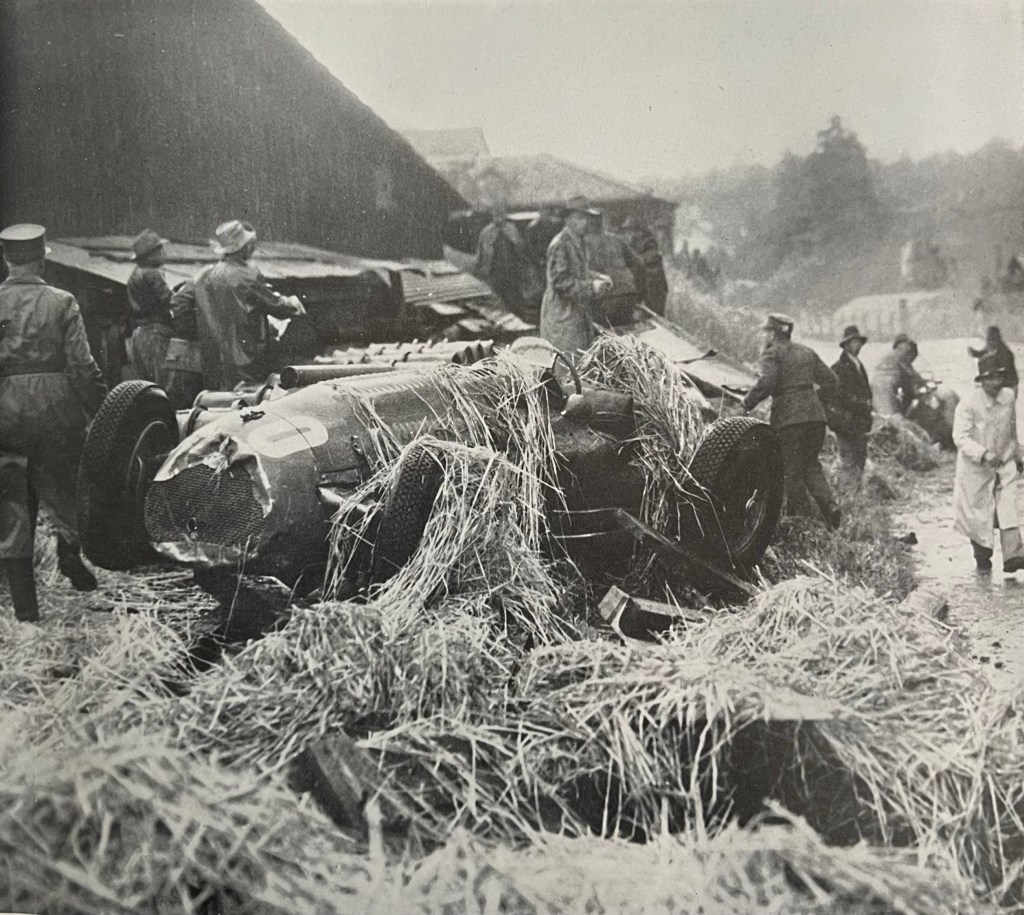
“Louveau’s car after running out of road and overturning’. Swiss Grand Prix, Bern, May 27, 1951.” It looks like quite an accident…
Bern’s 4.52-miles wasn’t for the faint heated either, especially in the wet. “Henri Louveau ran out of road on (lap 31) the fast corner after passing the pits, overturning his Talbot , and sustained a broken leg.” He qualified his Ecurie Rosier Talbot-Lago T26C 11th of 21 starters in his second and last championship GP start. The race was won by Fangio from Taruffi. More about Louveau here: https://www.f1forgottendrivers.com/drivers/henri-louveau/
Autocourse described the challenges of the place thus, “The Bremgarten Circuit at Berne is at the same time perhaps the most beautifully situated and the most exacting course in Europe. The bends, curves, corners and gradients make constant demands upon both drivers and cars and the thickly-wooded stretches leave no margin for error.”
(MotorSport)
This shot of the Henri Louveau and Louis Rosier Talbot-Lago T26Cs shows rather well some of the perils of Bremgarten.
The Gold Leaf Team Lotus rig is probably kosher as far as Bernie and the Liberty Media money-mob are concerned but the Pete Lovely VW Motors Kombi Ute and old Lotus 49B Ford would have made them choke on their canapés and Bolly.
Your average VW Dealer may have run a sportscar or touring car with his I’ll-gotten gains, not our boy from Fife, Seattle though, this lifelong racer contested US national events with his ex-Team Lotus/Mario Andretti 49B-R11 and took in the odd Grand Prix as well.
The shot above is in the Clermont Ferrand paddock during the 1970 French Grand Prix weekend.
(MotorSport)
The American took delivery of the car in time for the 1969 Race of Champions at Brands Hatch. He was sixth among 12 starters in the March 16 race won by Jackie Stewart’s Matra MS80 Ford, the second of the combos six championship and non-championship F1 wins that season.
Brands was the first of ten meetings Lovely did that year: five F1 races including the Canadian, US and Mexican GPs and five US national meetings. Seventh place in the Canadian GP was impressive.
In 1970-71 – living the dream – Pete, his wife and the Kombi did another eight meetings, all but one were F1 events, but by then the game had moved on, his efforts were littered with DNQ/DNS/UNC.
Pete Lovely during the 1971 Canadian GP weekend (MotorSport)(MotorSport)
Canadian GP, Mosport September 1971.
With his Lotus 49 increasingly uncompetitive Pete concocted the brilliant idea of bolting the back of his 49B – the engine, Hewland gearbox and rear suspension wheeled away as one unit – to an ex-Jochen Rindt Racing Lotus 69 F2 car (ex-Hill #69.F2.5).
Whoosh-bonk – in Bruce McLaren’s words – an instant more modern GP car! Lovely raced it in some US L&M F5000 rounds in 1971 and entered it in the 1971 Canadian and US Grands Prix. He was sixth at the Monterey GP (49B), fifth and seventh at the Seafair 200 at Seattle (69/49B). In the Canadian GP he was Q26 and unclassified, and at Watkins Glen Q32 and unclassified in both cases aboard the Lotus 69 Ford DFV as it was described in-period.
Pete historic raced the Lotus 49 later in his life and retained it until his death, at which point it was sold to a Seattle collector.
Ernesto Neves, Lotus 69FF ahead of the chasing pack during the Johnson Rally Wax Cup at Brands Hatch in October 1971 (Sportography)
Obiter…
Pete’s effort in turning his F2 Lotus 69 into a Grand Prix car gives the Lotus 69 a unique title. It is the only racing car model, I think, to ever compete in Formula Ford, F3, F2/Atlantic and F1. Pedants will rightfully point out that the FF and F3 69s used spaceframe chassis not monocoques…but they were still Lotus 69s!
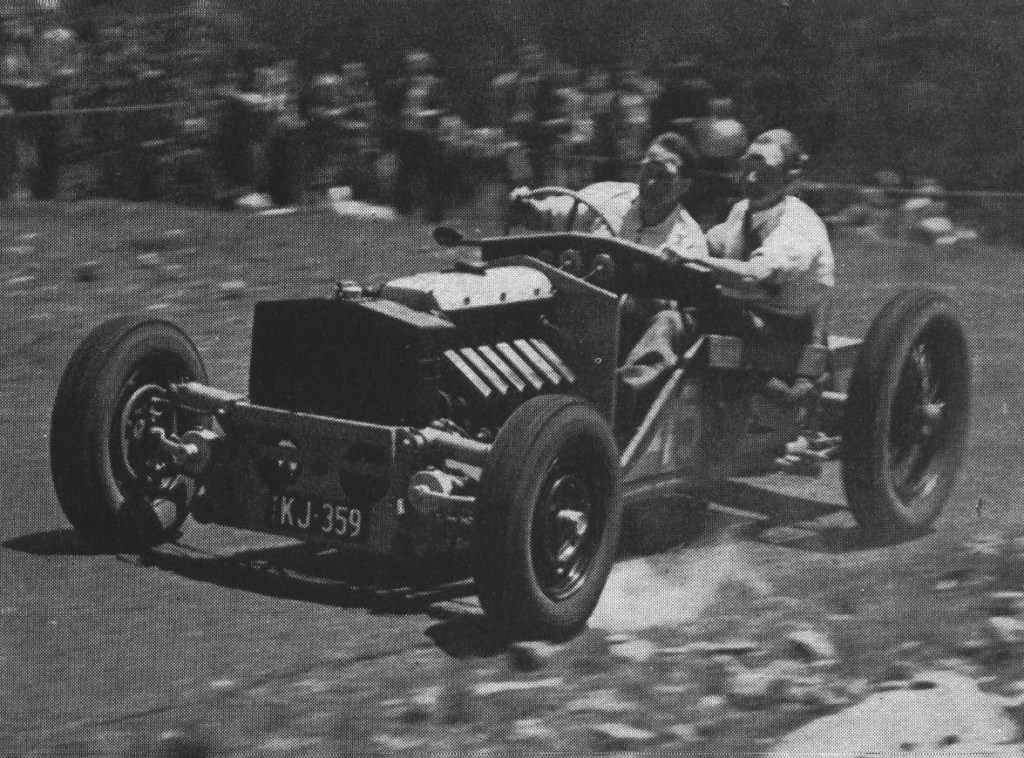
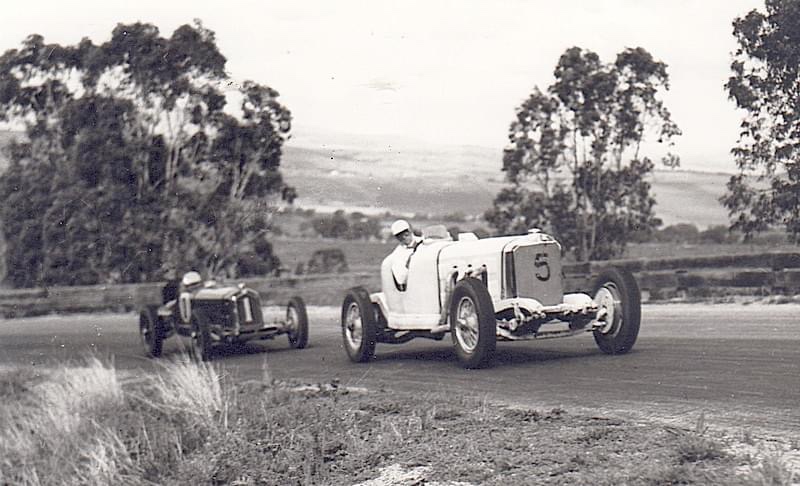
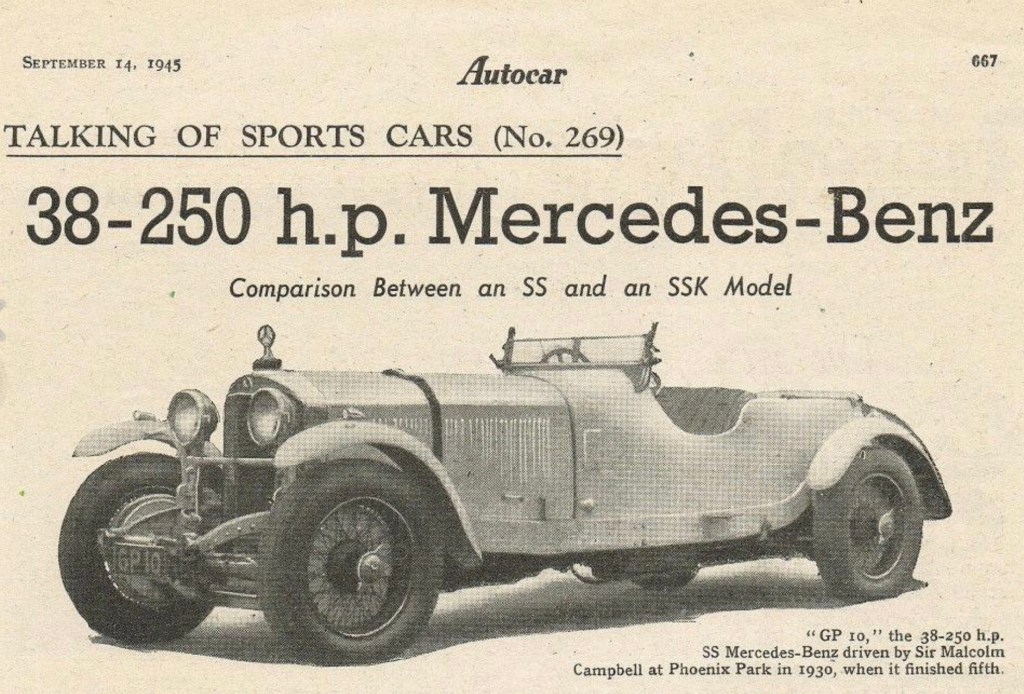
Lex Davison and passenger – probably Lyndon Duckett – at Fishermans Bend, Melbourne, unleashing all of the power and torque of his 7.1-litre supercharged, straight-six 1929 Mercedes Benz 38/250 SSK, chassis #77643. It’s March 13, 1949.
(unattributed but I’d love to know who?)
Davison raced the car from 1946-49 and is shown here in front of Alf Barrett’s Alfa Romeo 8C 2300 Monza through Quarry during his highly competitive run into third place in the 1947 Australian Grand Prix at Mount Panorama, Bathurst.
(Mercedes Benz)
Production numbers and Technical…
How Davison’s car came to Australia is still a bit of a mystery, but a West Australian, a Mr Everett imported it and sold it to Eric MacKay, more of this anon. #77643 was one of 33 SSKs, one model of four of this stunning series of S, SS, SSK and SSKL Mercedes Benz built between 1927 and 1933.
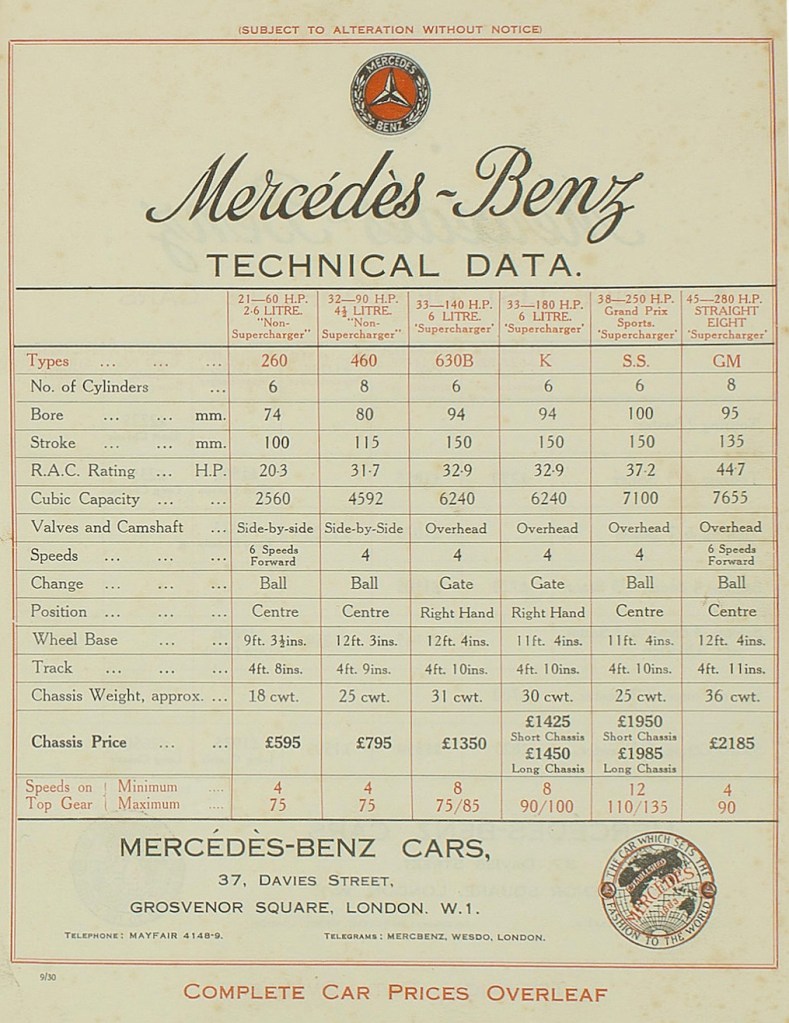
The production numbers according to Mercedes Benz were: S-Sport 146 units built until September 1928, SS-Super Sport 111 units until September 1933, SSK-Super Sport Kurtz (short – the wheelbase of theses cars is 2950mm) 33 units between 1928 and 1932.
The numbers of the SSKL-Super Sport Kurtz Licht (short light) cars produced is not quoted by Mercedes publicly, “it is extremely difficult to obtain a precise record of the production numbers, since, already at that time, chassis were being shortened and provided with different engines.” A perfect situation for fakers of course.
Racing triumphs of the cars include the 1927, 1928 and 1931 German Grand Prix, the Avus races in 1931-32, the Eifel race in 1931, the 1929 Tourist Trophy, the Irish Grand Prix in 1930, and Spa 24 Hours and Mille Miglia in 1931. Despite their size the cars were competitive in the hills too, winning the European Hill Climb Championships in 1930-31 and the ’32 German Alpine Championship…and plenty more.
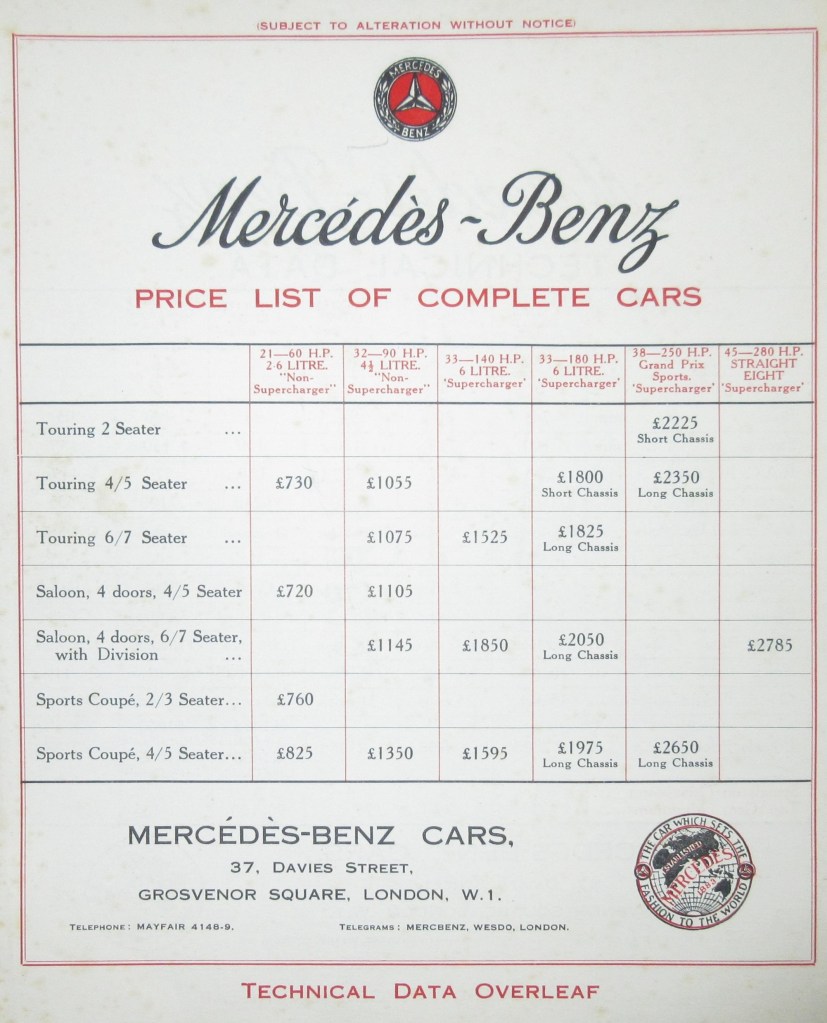
The U-section pressed-steel frame chassis cars were designed by Ferdinand Porsche who had succeeded Paul Daimler as chief engineer of Mercedes in 1923, three years before the company amalgamated with Benz. The six-cylinder SS 38/250 Mercedes-Benz debuted in 1928 as a 7.1-litre development of the 6.8-litre S model launched in 1927. It was both exclusive and expensive, the SS retailed at 35,000 Reichsmarks (£2350) with factory tourer bodywork.
(Mercedes Benz)(Mercedes Benz)
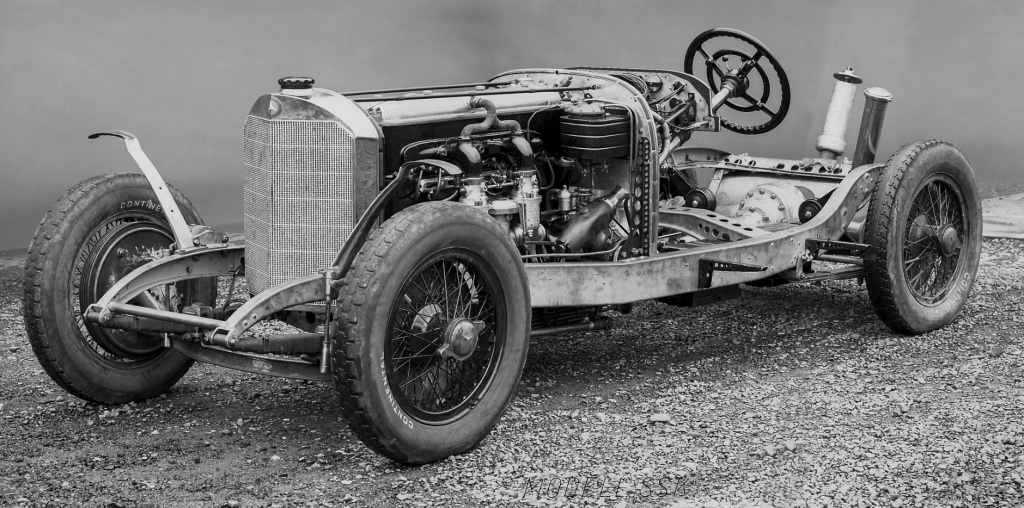
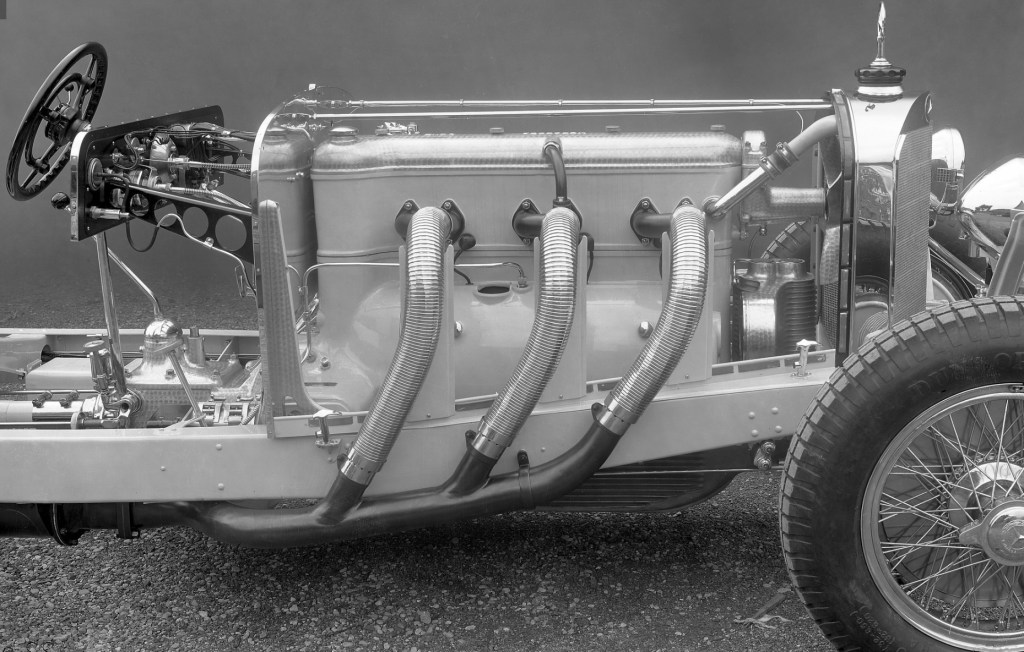
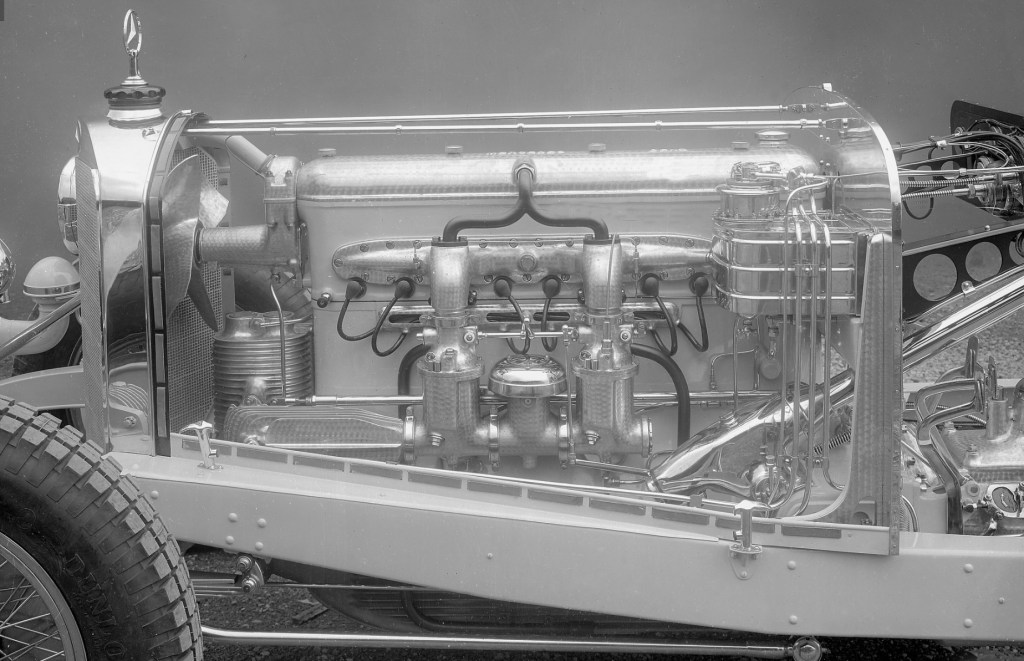
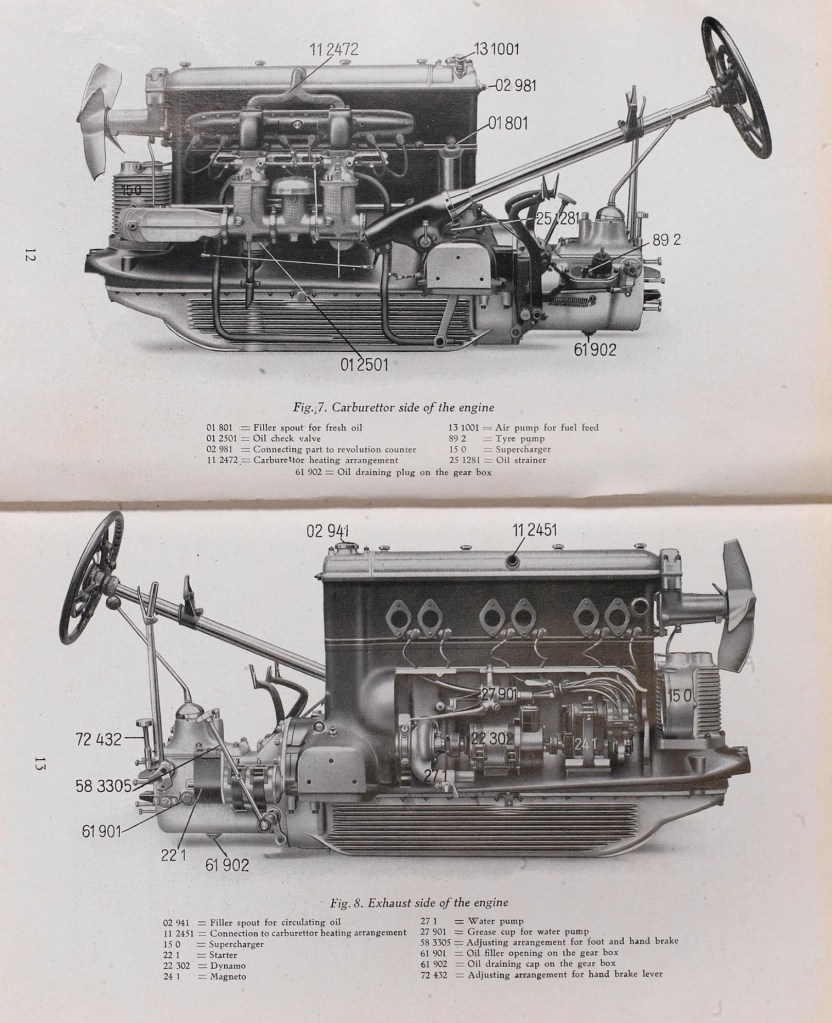
The Mercedes M06 7065cc engine was a long-stroke – 100mm bore, 150mm stroke – SOHC, two-valve, 225bhp @ 3300rpm straight six, fitted with twin-plug ignition: one plug was fired by the magneto and one by the battery.
The big, thirsty beast was fed by twin-Mercedes updraught annular-float carburettors and was Roots supercharged. Mercedes pioneered the fitting of superchargers to road cars using technology developed for its Great War aero-engines. While other marques developed permanently-engaged superchargers that the sucked fuel/ air mixture in through the carburettor, Mercedes employed a supercharger clutched in at full throttle to boost engine power by force-feeding air through the carburettors to cram fuel and air into the combustion chambers.
This method could only be used for a few seconds at a time to aid acceleration or hillclimbing and was accompanied by a distinctive banshee wail that Motor described as a “threatening high-pitched whine that is such a joy to spectators at racing events”.
The chassis was period-typical: rigid axles and semi-elliptical front and rear springs, worm and nut steering, mechanical drum brakes at both ends, wire-spoke wheels, with wheel size 6.5/7 inches wide and 20 inches in diameter. The gearbox had four speeds and a dry, quadruple plate clutch and three alternative final drive ratios giving a quoted top speed of 188-192km/h.
The SWB SSK wheelbase was 2950mm and had tracks of 1425mm front and rear. It was 4950mm long, 1700mm wide, 1725mm high and weighed 2000kg.
(Mercedes Benz)(Mercedes Benz)
Hailed by its makers as “an ideal high performance car for sporting owner drivers”, the SS Mercedes was claimed to be the fastest sports car in the world. Tested by Motor in 1931 a fully-equipped 7.1-litre Mercedes SS 38/250, not yet fully run in, clocked over 103 mph at Brooklands despite a slight head wind.
Mercedes Benz, “The ‘SSKL’ was the glittering highlight of the legendary S-Series, which was to decisively shape the image of the Mercedes-Benz brand. In 1934, three years after the ‘SSKL’ had made its debut, it was time for the product line up at Daimler-Benz to be reshuffled. From now on success on the racetrack was in the hands of the new Silver Arrows…From mid-1927 to the beginning of 1933, the S-Series models had fulfilled the roles of sportiness and elegance in equal measure, demonstrating their credentials as genuine all-rounders capable of sustained success on both fronts.”
Lex Davison’s interest in these big Deutschlanders commenced with this Dr Ferdinand Porsche designed 33/180 K-model Mercedes he acquired in late 1945 or early 1946.
The 6.2-litre, SOHC, six-cylinder supercharged giant was soon christened ‘Jumbo’ and is shown during a home event, literally. The Vintage Sports Car Club ran several sprint events at Killara Park, the Davison family, 500 acre farm which abutted the Yarra River at Lilydale, in the immediate post-war period.
Lex is shown competing in the first of these – his maiden competitive event – on January 13, 1946. The competitive life of this car was shortened when Davo wrong-slotted, selecting first, rather than third gear at a subsequent Killara Park meeting.
All was not lost though, as the young proprietor of the family shoe manufacturing business – Lex was appointed Governing Director of AA Davison Pty Ltd upon the death of his father, aged 22 in August 1945 – was dabbling in various cars: converting the family Alfa Romeo 6C 1500 into a biposto-racer, trading his Talbot 75 for a 4 1/2-litre Bentley, then a Bentley 4 1/2 Blower, and a 4 1/2-litre Delage Indianapolis car. Lex well and truly had the bug and the means to pursue it.
“The 38/250 Mercedes in an early rebuild while in the ownership of Alan Roberts,” wrote Troy Davey-Milne (Davey-Milne Collection)
SSK #77643…
Graham Howard records in his sensational biography of Lex, ‘Lex Davison : Larger Than Life’, that the Mercedes had been a tourer which was damaged when dropped onto the wharf from a cargo-sling. Perhaps that occurred at Port Melbourne when the car was shipped from Fremantle, West Australia to Victoria.
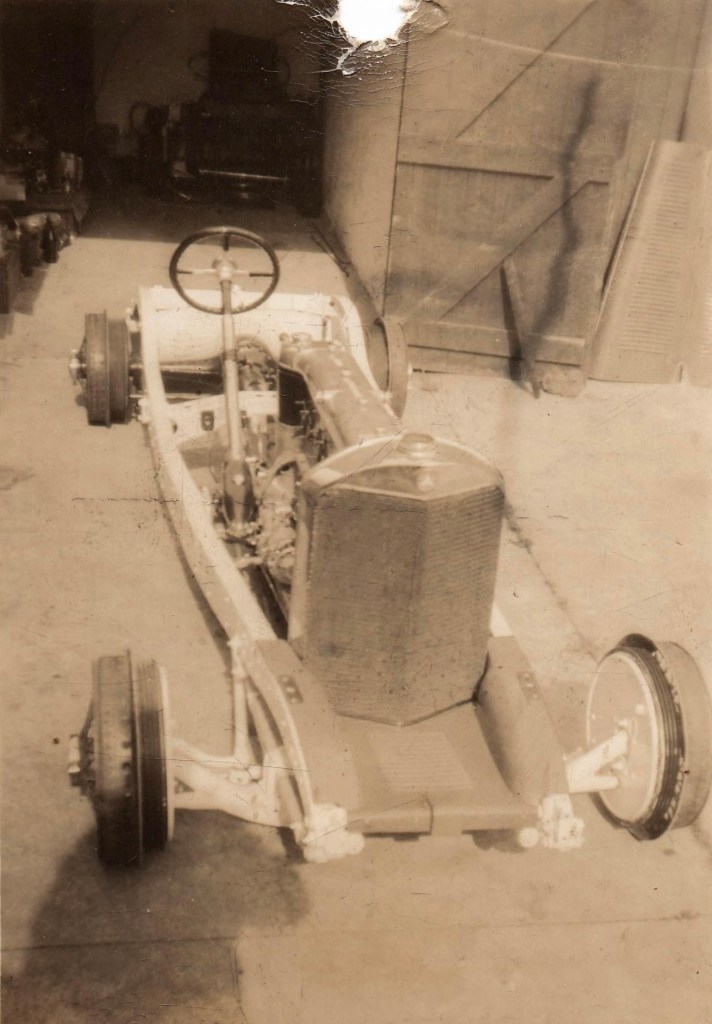
Whatever the case, the car was acquired by VSCC member Alan Roberts, he had been slowly restoring it. A visit from Lex to encourage Alan to retain the car turned 360-degrees when Lex bought it! Davison then placed it in the care of Reg Nutt, a very capable mechanic/engineer, racer and AGP winning riding mechanic in the Phillip Island days.
(L Sims Collection)
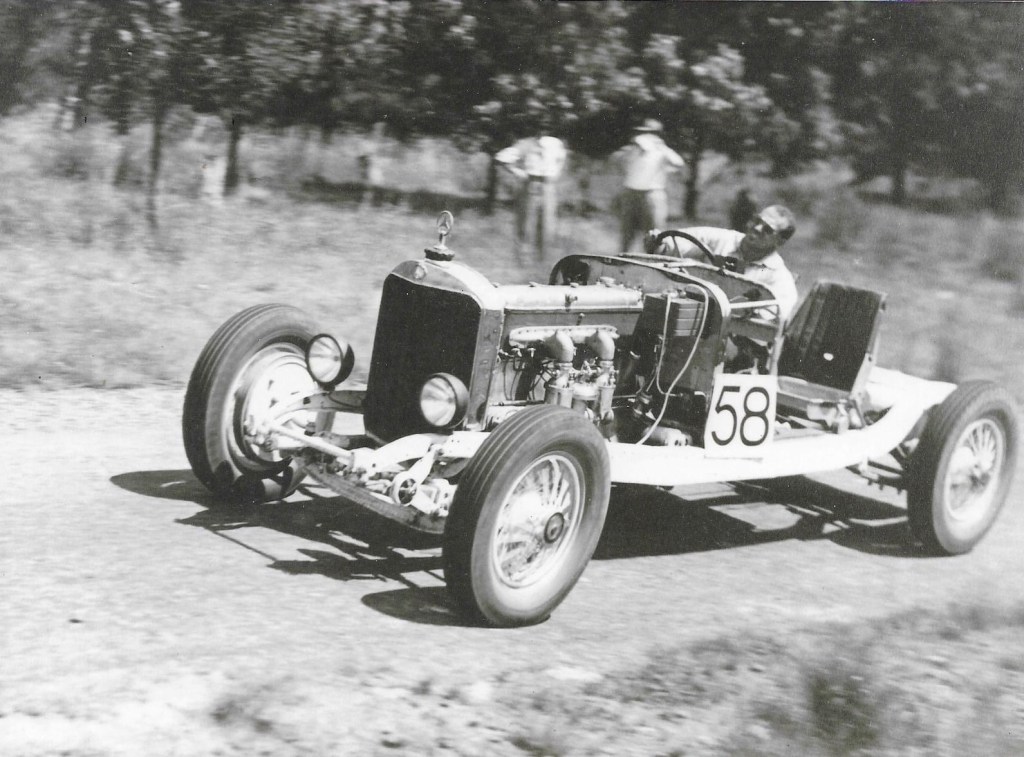
By September 1946 Nutt had the car ready to test at his Whiteman Street, South Melbourne premises. Lex first ran it in unbodied form at Rob Roy that December (above) where he won the Vintage class.
That same month he ran it in a VSCC trial, by the time the car was entered for the January 1947 race at Ballarat Airfield – Victoria’s first post-war – 77643 sported a short, boat-tailed two-seater body built by Bob Baker. Howard records that at that time Baker was working out-back of Nutt’s workshop and would later become the doyen of Victorian panel-bashers; the man of choice for single-seater and sportscar bodies.
Two of Lex’ fellow competitors for the next 15 years made their race debuts that weekend: Bib Stillwell and Bill Patterson, both racing MG TCs. Davison’s first circuit meeting had been aboard the Little Alfa – Lex’ fathers 6C 1500 Alfa which had been lightened and modified from a four-door sedan to two-seat sportscar – at the October 1946 Bathurst meeting where he impressed in the 20-year-old Alfa which had over 100,000 miles on-the-clock!
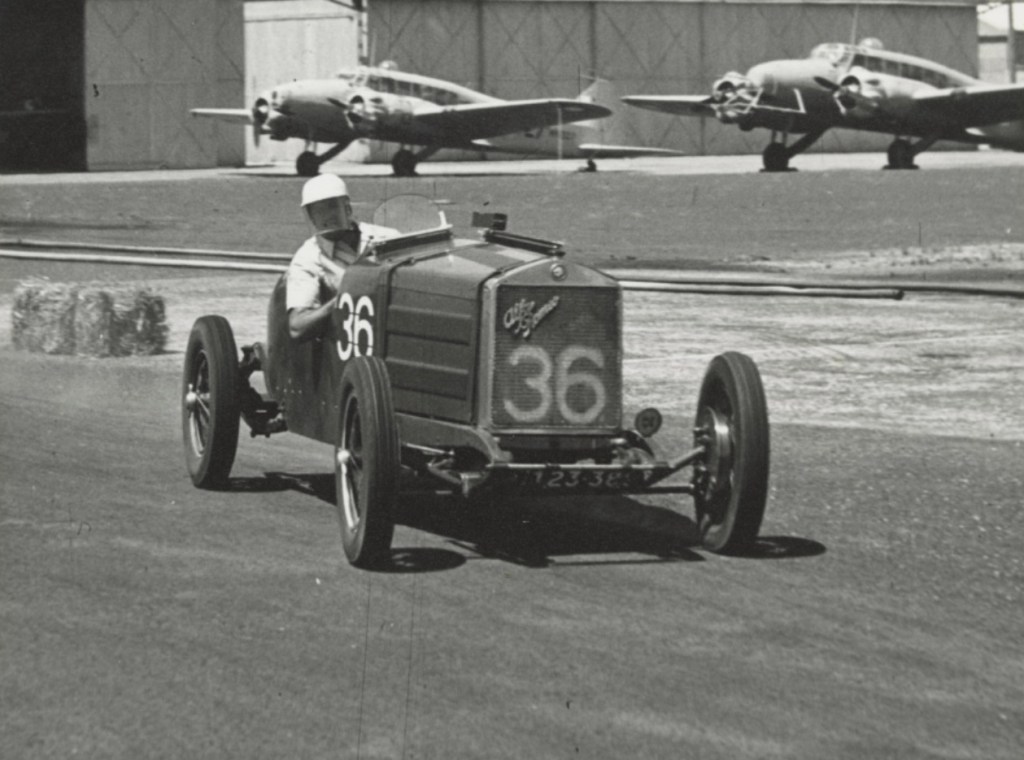
Lex ahead of the Avro Ansons at Ballarat airfield on January 27, 1947. Here in the Alfa 6C 1500 ‘Little Alfa’ and below in the Mercedes, running sans side-bonnets in the heat (G Thomas)(G Thomas)
30,000 spectators starved of entertainment watched the event with “the Mercedes a handful through the corners and still running too rich. The tachometer was reading low and the top came off one piston which meant the car did not start the main race of the day,” Howard wrote. “Even so, the sight of the massive white Mercedes almost matching Barrett’s Alfa (Alf Barrett and his Alfa Romeo 8C 2300 Monza were the Australian class-combo in the immediate pre and post-war years) for top speed caused something of a stir, as did the sharp scream of its throttle-operated supercharger.”
All wasn’t lost, the Little Alfa finished the handicap in ninth, but retired from its other race with fading oil-pressure.
Reg Nutt readied the car for the 1947 Championship of New South Wales to be held on the Nowra naval air base, on the coast south of Sydney, in June. The big-beast would have been suited to the 6.8km circuit as it incorporated two straights of over 2km, it really would have had a good gallop, but the rear axle failed in practice so the car didn’t race; Tom Lancey’s MG TC won the handicap 160km event in a field of good Gold Star depth.
#77643 at Rob Roy shortly after Bob Baker built its body (L Sims Collection)Isn’t it a big bit of real-estate?! #77643 at Bathurst in 1947 (D Flett)
Lex had the repairs to the Mercedes done by Rex Marshall’s Monza Motors – a business established by elite level racers John Snow and Jack Saywell immediately pre-war – in Darlinghurst, Sydney.
The October 6, 1947 Australian Grand Prix was to be held at Bathurst, fittingly, the last was conducted at Lobethal, South Australia in 1939; big-balls road circuits both.
The meeting marked the first anniversary of Lex’s racing career, his first too in an AGP, a race he almost made his own with victories in 1954, 1957-58 and 1961 aboard HWM Jaguar, Ferrari 500/625 twice, and a Cooper T51 Climax.
“The 24-year-old Lex Davison, at Bathurst in October 1947, would have been judged as not much more than an enthusiastic and well-heeled Victorian youngster with an unusual car: his career to this point comprised three race starts for two finishes in the 6C Alfa, and one race start and one practice appearance in the Mercedes with mechanical trouble intervening each time. He was keen enough, and undaunted by the big Mercedes; but it was too early to know what he might amount too.” Graham Howard wrote. Nonetheless, Lex could have won the 1947 AGP.”
Davison in front of Elliott Forbes-Robinson’s (yep, there were two of ’em) MG TC and the legendary Frank Kleinig aboard his evergreen, fast Kleinig Hudson Spl. One of the highlights of the weekend for the pundits was Davo’s wheel-to-wheel 10-lap dice with hardman, veteran Kleinig who never won an AGP but should have by any measure…(G Reed)
Davo was advantaged by a good handicap but that year was a bit of lottery with so many unknown combinations. Further, the handicappers, Graham wrote, didn’t believe Lex’s declared top speed of the car – 120mph, he was recorded at 119mph during the race – and the combo’s potential lap times.
Had it not been for blowback through the carburettor in top gear, which restricted the use of the supercharger to second and third gears, and a four-gallon splash-and-dash fuel stop later in the race Davison may well have won the race. Instead he was a fine third behind Bill Murray, MG TC and Dick Bland’s Mercury V8 Special. Critically, Lex’s result wasn’t due to a great handicap, it was his speed too, he did the fastest race-time and impressed all present with his skilful handling of a demanding heavy car car over 150 miles on one of the country’s most challenging circuits.
He had arrived, and with a cocktail of money, balls, brio and finesse, Lex would go far…
Diana Davison at Rob Roy in March 1948 (L Sims Collection)
With more than a sniff of an AGP chance, before too long Davison had done a deal to buy an Alfa Romeo P3/Tipo B from Arthur Wylie, racer/engineer and founder of Australian Motor Sports magazine. Arthur had sourced chassis #50003 ex-Scuderia Ferrari from Jock Finlayson in the UK, but was left holding-the-baby when his patron, Jack Day declared that at £1650 the car had to be trouble…
Davison hoped the 1934 Italian monoposto would be in Melbourne in time for the January 1948 AGP held at Point Cook, an RAAF airbase in the city’s inner-west, in the event it didn’t. Held in stifling over 100-degree heat, the 100 mile, 42 lap race was a killer of cars and men!
John Barraclough observed Davo from his MG NE Magnette, “From behind, I saw Davison, after a dreadful spasm of front axle tramp, barge straight through some hay bales without even trying to avoid them. He raised his arms in mock helplessness. You could see he just couldn’t be bothered slithering the Merc about in an effort to miss them – plumb out of muscle he was.”
After 16 laps Lex pitted and collapsed onto the steering wheel, Lyndon Duckett took the car out as Lex was carted off for resuscitation, but within a lap the Mercedes had boiled its fuel and was retired.
Perhaps the German did it to spite Davison, his new, red, Italian love arrived three days after the GP…As Lex got to grips with the faster, more sophisticated Alfa, the Mercedes was put to one side of the garage at Killara Park, having its final race in team hands driven by Lyndon Duckett at Fishermans Bend in March 1949. There the Davison Equipe: P3, 38/250 and MG TC was cared for by Bib Stillwell, now in partnership with Derry George in Cotham Road, Kew having previously worked, Graham Howard wrote, for Reg Nutt and A.F Hollins.
(J Montasell)
These three shots (above and the two below) are of the 38/250 at Fishermans Bend on March 13, 1949, the final meeting in Davison hands. Lyndon Duckett is the fellow with an asterisk above his head.
These shots bookend the first action shot in this article taken on the same weekend – I don’t doubt that Lex is at the wheel in that first shot, probably with Lyndon alongside – and allow us to see how the car was prepared in the day. While the heavy braking and slow corners of Fishos’ didn’t suit the Mercedes it still finished both of its races in Duckett’s hands.
(J Montasell)(J Montasell)Lyndon Duckett at the wheel during the March 1949 Fishos meeting (T Davey-Milne)(D White Collection via L Sims)
Post-Davo…
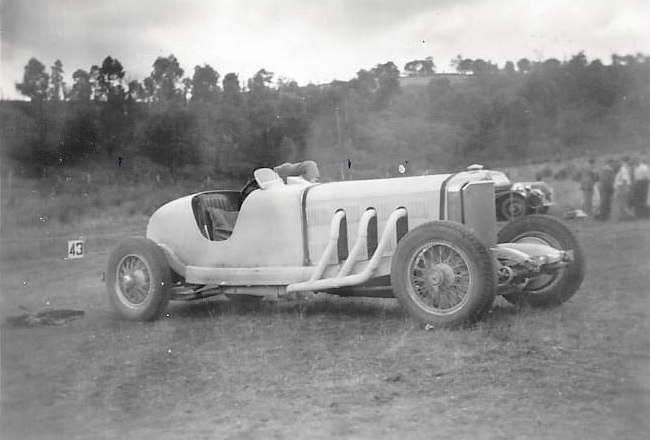
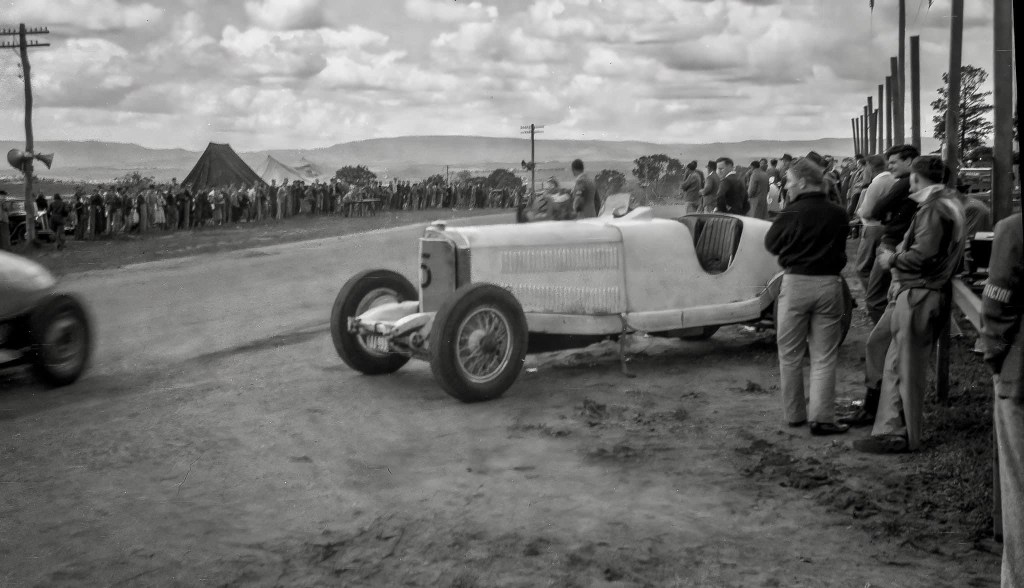
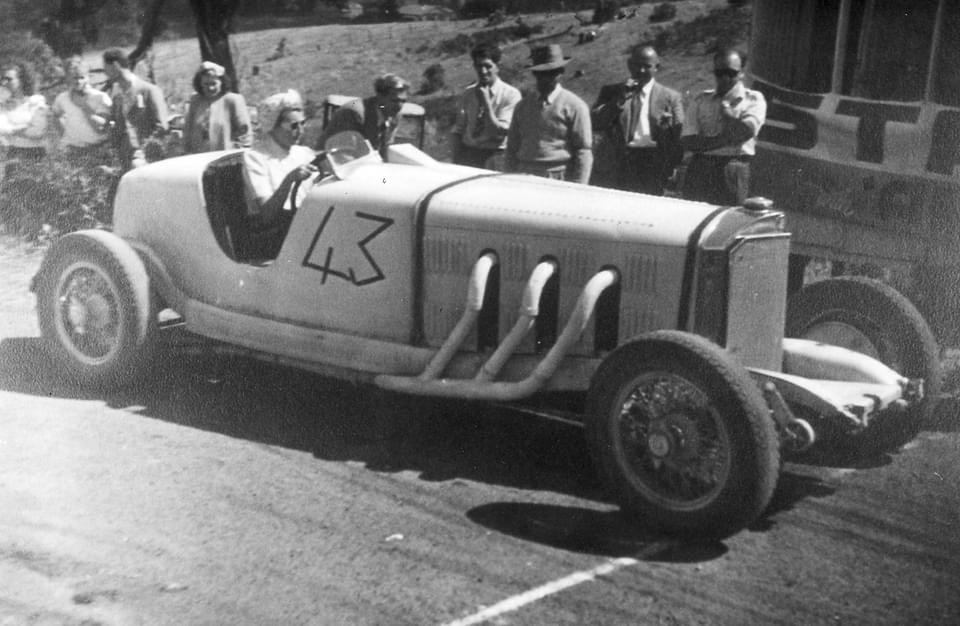
John Blanden in his ‘Historic Racing Cars in Australia’ recorded that little was heard of the Mercedes until it was advertised by a Mr Williams in the March 1951 issue of AMS. Ivo Robb was the buyer, he raced it at Ballarat in November 1951 but was unplaced.
Vin Devereaux offered the car for sale via AMS in January 1952 with Haig Hurst the buyer. He is shown above at Rob Roy in September 1955 where he was second to Ted Hider-Smith’s GN in the vintage class that weekend; note the Victorian road-rego JJ-933.
(G Edney Collection)
Hurst raced and ‘climbed it until 1955 when Laurie Rofe exchanged it for his Bentley Speed Six. Laurie used the car in full road trim as a fast tourer, and historic and vintage racer for about two years before selling it to Jeff Hoffert in late 1956 or early 1957.
(D Belford Collection via D Zeunert)
What an ignominious end for a racing car! From a near Australian Grand Prix winner to family chariot, what a chariot mind you! Every kid in the street wouldn’t have had as much cred as you did in the front seat of this thing.
David Zeunert circulated these photos of Jeff Hoffert family photos of the Mercedes Benz 38/250 at Hepburn Springs where Hoffert was a member of the organising committee of the Hepburn Springs Hill Climb, in the late 1950s.
(D Belford Collection via D Zeunert)(M Watson)
Hoffert sold the old stager to Len Southward in 1965, where it has been in his Paraparaumu, New Zealand museum since. The shot above shows it in recent times.
(M Watson)(Bonhams)
Etcetera…
(Bonhams)
Bonhams offered this rare sales brochure for sale in 2015.
Written in English, but printed in Germany in March 1930, it comprised 20 pages, Bonhams’ generosity did not extend, unsurprising, to reproduction of it in full! Many thanks to them for including the technical specifications page online.
The feature cover car, the “4-seater touring latest style,” is a 4.5-litre 32/90 perhaps.
(Bonhams)(Bonhams)
Credits…
VSCC Victoria Collection, mercedes-benz-publicarchive.com, ‘Historic Racing Cars in Australia’ John Blanden, George Thomas via State Library of Victoria, George Reed, Don Flett, Reg Nutt Collection via Greg Smith, David White Collection, David Belford Family Collection via David Zeunert, Michael Watson, James Montasell shots via the Leon Sims Collection, Bonhams, Graham Edney Collection, Stephen Dalton
Tailpieces…
(L Sims Collection)(SLV)
The First Lady of Australian motor racing, Diana Davison, launches the Mercedes off the line at Rob Roy #15, March 14, 1948.
Reg Hunt, Maserati 250F, on his way to winning the Victorian Trophy at Fishermans Bend on February 12, 1956
Context…
Australian motorsport’s governing body was the Sydney based Royal Automobile Club of Australia until 1953 when the Melbourne based Confederation of Australian Motor Sport took over. CAMS Ltd trading as Motorsport Australia (CAMS) still rules the roost today.
One of the CAMS’ rare acts of decision-making excellence was the creation of the Australian Drivers Championship – the Gold Star – from 1957.
Lex Davison, Ferrari 500/625 was the first recipient of the award for points gained in nine rounds spread across all states except Tasmania – remedied in 1958 – on an 8-5-3-2-1 points basis for first to fifth places in each round.
1956 Faux Gold Star Championship…
I’ve thought for a long while that it would be interesting to summarise our elite level Formule Libre racing results by seasons, if for no other reason than when I want to research one thing or another a summary of the competitor set exists. Why not, I thought, extend the idea to calculating notional Gold Star points?
Of course it’s a fucking stupid thing to do as it simply didn’t happen! In the words of that great Australian philosopher, ‘Sir’ Frank Gardner, “If yer’ Aunty had balls she’d be yer’ Uncle”. In other words, deal with what is/was, rather than what isn’t/wasn’t.
But of course CAMS run a who-gives-a-fuck-about-facts (WGAFAF, pronounced ‘woggafaff’) motor racing history model. They don’t recognise the January 1927 Australian Grand Prix at Goulburn as the first AGP, yet we have 1928 and 1937 Australian Grands Prix, apparently, neither of which actually took place then, as officialdom chooses to brand them now. So, in accordance with established Oz-racing fast-and-loose WGAFAF precedent, what follows is a summary of the 1956 Gold Star, Faux Division.
Officialdom awaits the ‘Champion of the Day’ of the 100 Miles Road Race at Phillip Island held on Saturday 31 March, 1928. Oopsie, sorry there were two 100 Mile Road Races that day. The morning one started at about 11am, oopsie again, sorry, B-Class started at about 11am, and D-Class at about 11.05am. The afternoon race, races really, started at about 2.25pm for A-Class and then C-Class at about 2.30pm. All ‘Akin to European GP practice’ is the favoured line of some
The readily apparent State-The-Obvious flaw in my Faux Gold Star award is that as there was no such championship, drivers didn’t enter meetings they may have otherwise if they aspired to win such a title. However, the rich/well-funded in every era raced far and wide beyond their local meetings, this was certainly the case for the 1956 motor trader front runners, so I’m not so sure the top-3 are impacted by this factor.
Some criteria points. I’ve basically followed the equivalent 1956 meetings that CAMS recognised in ’57, even though some of the races are too short, in my mind, to be of championship length. Where there were two Formula Libre races of ‘championship length’ – over 75 miles – at the one meeting, such as the Albert Park Moomba meeting, the longer, feature event prevails. Results are scratch based only. I’m only awarding points for first to fourth placings as those are the records I have. If someone has more comprehensive records, spreadsheet skills and OCD knock yer’ socks off and I’ll update this masterpiece.
Away we go.
Reg Hunt on Gnoo Blas’ Main Straight while the 4.05pm to Sydney gets ready to depart. Maserati 250F (GB.com)
Gnoo Blas, Orange, New South Wales (NSW) : South Pacific Championship : January 30, 1956
This season opening race meeting on the Gnoo Blas road circuit at Orange, 260 km west of Sydney had become Australia’s only international meeting in prior years. The Australian Sporting Car Club always managed to entice a few of the drivers doing a full southern summer season In New Zealand across-the-ditch to the Great Brown Land before they headed back to Europe. As an aside, the Kiwis were five years or so in front of us in the Big Race Stakes.
Our Jack was the only international in ’56 mind you. He raced the 2-litre Cooper T40 Bristol that he built for himself at Surbiton to make his championship GP debut at the British Grand Prix at Aintree in July 1955. Brabham brought the car home at the end of the year, winning the AGP with it at Port Wakefield after frontrunners, Stan Jones in Maybach 3 and Reg Hunt’s Maserati A6GCM/250 (a 2.5-litre 250F engined A6GCM 2-litre F2 car) had problems, then did the Kiwi season and would sell it to Reg Smith before heading back to the UK.
To rub in his advantage, Reg Hunt brought along both the Maserati he raced throughout 1955 and his new 250F on the long tow from Melbourne to Orange, then disappeared into the distance, winning the 27 lap, 100-mile race in the 250F from Brabham.
Stan Jones gave vigorous chase, but blew the 3.8-litre Maybach SOHC six fitted under the long bonnet of Maybach 3 sky-high on lap 22 when 39 seconds adrift of his fellow Melbourne motor trader.
That blow-up proved a defining moment in Australian Motor Racing History of that era as it marked the end of the Charlie Dean/Repco Research/Stan Jones/Maybach period. Repco’s stock of 3.8 and 4.2-litre Maybach cylinder blocks was at an end, so the car couldn’t easily be rebuilt. In any event, Stan realised he needed a Big Red Car to remain competitive, taking delivery of a 250F later in the season. Ern Seeliger created the very fast Maybach 4 Chev V8 of course, it proved to have a surprise or two in 1958-59, but the big-blue Maybach sixes were no more.
Kevin Neal was third in his Cooper T23 Bristol, then came Curley Brydon’s ex-Peter Whitehead – present at Gnoo Blas in the previous two years – Ferrari 166 and then Col James’s MG Special. Jack was a non-resident by then so he doesn’t get Gold Star points for his second place, so we have our top-four below.
1.Hunt Maserati 250F 8 points 2.Neal Cooper T23 Bristol 5 points 3.Brydon Ferrari 166 3 points 4.James MG Special 2 points
End of an era. Jones aboard Maybach 3 – very Mercedes W196’esque in appearance – before the engine let go, South Pacific Championship, Gnoo Blas in 1956 (GB.com)
Fishermans Bend (once Fishermen’s Bend) Melbourne : Victorian Trophy : February 11, 1956
Top guns entered for the 24 lap, 52.8 miles Formula Libre race included Hunt’s Maserati 250F, Lex Davison’s HWM Jaguar (“now with latest D-Type head and Weber carbs” according to AMS), Doug Whiteford’s Talbot-Lago T26C, Stan Jones’ Cooper T38 Jaguar sportscar, Brabham’s Cooper T40, Tom Hawkes Cooper T23 Bristol and Bill Craig’s Alta Holden.
While billed as on international meeting to attract some spillover visitors to New Zealand that summer, the only ‘internationals’ were Brabham from New South Wales and Craig from South Australia…
Hunt romped away, Whiteford’s old T-L, somewhat surprisingly, proved quicker than Davison’s ’54 AGP winning HWM Jag, then Davo spun, while broken throttle linkages accounted for Jones and Hawkes.
1. Hunt, Maserati 250F 8 points 2.Whiteford Talbot-Lago T26C 5 points 3. K Neal Cooper T23 Bristol 3 points 4.W Wilcox Ford Special 2 points
Albert Park, Melbourne : Moomba Meeting – Argus Trophy : March 18, 1956
Albert Park – promoted by the Light Car Club of Australia – hosted a pair of international two-weekend carnivals in ’56: the Moomba meeting in March and Olympic meeting in November/December.
The feature on March 11 was the Moomba Tourist Trophy for sportscars. Tony Gaze won that 150-miler in his HWM Jaguar VPA9, from Bib Stillwell’s brand-spankers Jaguar D-Type and Ron Phillips’ Austin Healey 100S.
F.A.O. Gaze DFC and Two Bars, OAM had decided to retire from racing and sold his HWM and ex-Ascari Ferrari 500/625 to his good mate, Lex Davison before the meeting. Tony had raced both cars in New Zealand that summer together with Peter Whitehead. Davison’s deal included racing the Ferrari in the Argus Trophy, the Formula Libre, 48-lap, 150-mile feature on the following weekend, March 18.
Davo had some serious opposition though, not least Hunt’s 250F and Melbourne haulier, Kevin Neal, who had bought Hunt’s immaculate A6GCM/250. Other expected front-runners included Hawkes’ Cooper Bristol, Stillwell’s D-Type, not to forget Arthur Griffiths, who had bought the ex-Moss HWM Jaguar just vacated by Davison, and Reg Smith in the Cooper Bristol similarly vacated by Jack Brabham.
Somewhat predictably, Reg Hunt won the race in his current model Maserati 250F – one of the great GP cars of any era – from Davison, with Neal, Hawkes and Stillwell third to fifth.
Lex’s old-bus dated back to 1952 – in 2-litre spec it was Alberto Ascari’s main weapon of choice in his triumphant 1952-53 World Championship years – but fitted with a 3-litre DOHC four-cylinder ‘Monza’ engine it proved for several years to have the measure of the fastest cars in the country thanks to a combination of Davo’s speed and almost peerless reliability. Tony Gaze had the Ferrari prepared by Alan Ashton and his AF Hollins crew in High Street, Armadale. He implored Lex to continue the relationship, Davo did so and it was key to his ongoing success with this car.
Reg Hunt from Lex Davison during the Argus Trophy at Albert Park, March 1956. Maserati 250F and Ferrari 500/625 (D Meale)
Port Wakefield, South Australia : Easter Saturday : March 31, 1956
Not all the serious boys spent Easter at the traditional Bathurst fixture, some contested the 50-lap, 65- miles Wakefield Trophy at Port Wakefield, South Australia: Tom Hawkes, Cooper T23 Bristol, Kevin Neale, ex-Hunt Maserati A6GCM/250, Ted Gray, Tornado 2 Ford, and Derek Jolly, Decca Mk1 Climax FWA Spl included.
The weekend feature was for the 20 fastest cars. Soon after the start, the race developed into a Cooper and Maserati duel a lap in front of the rest of the field. Hawkes, in a great performance in the slower of the two cars, won from Neal’s Maserati, Ron Phillips’ Austin Healey 100S and TE Stevens, MG TC Spl.
Interesting are the top speeds recorded on Century Straight (all mph): Gray Tornado Ford V8 110.5, Neal Maserati 2.5 108.5, Hawkes Cooper Bristol 2-litre 104.7, Eldred Norman in the legendary Norman Zephyr Spl s/c 102.5, Murray Trenberth, Vincent 1000, 100, and Eddie Perkins, VW Spl s/c 99.5
The 26-lap, 100-mile handicap, Bathurst 100 had a huge field, “more entries from interstate than Bathurst has seen for some time” wrote Australian Motor Sports. Stan Jones and Jack Brabham weren’t at the meeting, Maybach 3 was dead and Stan’s 250F hadn’t arrived, while Jack had returned to the UK.
The handicap was won by Davison from Hunt, Bib Stillwell, Jaguar D-Type, and Paul England’s Ausca Repco-Holden. To be consistent, Gold Star points are awarded for the scratch results: Hunt, Maserati 250F, Lex Davison Ferrari 500/625 3-litre, Stillwell D-Type, and Tom Sulman’s Aston Martin DB3S.
1.Hunt Maserati 250F 8 points 2.Davison Ferrari 50/625 5 points 3.Stillwell Jaguar D-Type 3 points 4.Sulman Aston Martin DB3S 2 points
Port Wakefield Road Races : South Australian Trophy : June 4, 1956
Stan Jones took delivery of his Maserati 250F in May, demonstrating it in an untimed run at the Geelong Sprints meeting on May 27, Port Wakefield was chassis #2520’s Australian baptism of fire.
Other fast cars which took the trip to the desolate, wind-swept permanent race track included Davison, Stillwell and brilliant, intuitive Adelaide engineer, Eldred Norman in his Norman Zephyr Spl s/c. Most significantly, Ted Gray was present in the Lou Abrahams owned, Gray/Mayberry Bros/Abrahams built Tornado 2 Ford. Tornado 1 Ford died a terrible death at the October ’55 Bathurst meeting, Tornado 2 was a new car using few of T1’s bits, amongst the exceptions were the Ford Ardun/Abrahams fuel injected OHV V8 and Ford truck ‘box. Ted was ok after a very long convalescence too.
At this point of 1956 the key machines of Australian Formula Libre racing from 1956-59 were in place: the two Maserati 250Fs, Davo’s Ferrari and Tornado 2…two-litre Coopers were still to come.
Held in a big rainstorm, the 30 lap South Australian Trophy race, early on was a close contest between Stillwell – pretty comfy in his Jag sportscar – with Stan all over him, but unable to pass and see…
Davo spun on lap 3, so too later in the race did Gray, although another column in AMS says Ted didn’t even start the race due to a broken CV joint… The race was won by Stillwell from Jones, Norman and ??
Somewhat prophetically, Bob Pritchett wrote in the July 1956 issue of Australian Motor Sports, “Who said Ted Gray’s Tornado Special doesn’t handle. Ted was, I think, the only high-powered operator who did not spin off in the meeting (the guy that wrote the race report sez otherwise!) and in winning the A-grade scratch race 6-lapper, held Stan’s Maserati for four laps until Stan spun off in the wet.”
In the same column, Pritchett reported that Tom Hawkes was considering a Maserati four to get more speed out of his Cooper T23 Bristol, that engine being at the end of its development potential; a Repco-Holden Grey shortly thereafter provided a potent and more cost-effective solution.
Similarly, he mused about the possibilities of Maybach 3, “by dropping in one of those 300-plus USA V8 monsters that are now available.” – the very path followed by Ern Seeliger, and Ted Gray with hot 283 Chev Corvette V8s being popped under the bonnets of Maybach and Tornado before too long.
Yes, the little-tacker in the lower shot is Alan Jones. He has recounted over the years his disappointment in finding Dad’s new, red Italian car was a Maserati and not a Ferrari! Bob Chamberlain at left Bob King thinksTed Gray from Stan Jones during their Port Wakefield scrap in June 1956. Tornado 2 Ford V8 and Maserati 250F; plenty of scraps to come from this pair from 1956-59. Gray’s experience went all the way back to giving Peter Whitehead and ERA R10B a run for their money at Aspendale and Rob Roy in 1938 aboard a speedway-midget
Lowood Airfield Queensland : Lowood Trophy : June 3, 1956
“Queensland Racing Drivers Club conducted this year’s ‘Lowood Trophy’ meeting in typical Queensland winter sunshine, before a crowd of about 6000. The 2.7-mile circuit was in good condition…34 entries was received, including eight from NSW…” recorded AMS.
Top guns included Arthur Griffiths’ ex-Davison HWM Jaguar, Ken Richardson’s ex-Whiteford Talbot-Lago T26C, Steve Ames aka Count Steve Ouvaroff ex-Davison Alfa Romeo P3, John Aldis’ ex-Whitehead/Jones Cooper T38 Jaguar and Arnold Glass’ Maserati 4CL; it wasn’t a great entry of modern cars.
The 12 lap, 32 miles Lowood Trophy results were as follows:
1.Griffiths HWM Jag 8 points 2. S Mossetter Austin Healey 100S 5 points 3.R Weintraub Healey Silverstone 3 points 4.J Johnson MG TC 2 points
Bathurst : NSW Road Racing Championships : September 30, 1956
A crowd of 8-10,000 people fronted up to cold, blustery conditions for the second traditional Bathurst meeting a year, October fixture.
While Stan Jones was present to sharpen his skills in advance of the Australian Grand Prix two months hence, Lex Davison and Reg Hunt were notable by their absence, ‘preserving the machinery’ or whatever.
Bill Pitt was there in the Geordie Anderson/Westco Motors Jaguar D-Type and Jack Myers in the WM Special, a much-modified (by Myers, a highly skilled Sydney mechanic-cum-engineer) Cooper T20 fitted with a Waggott-Holden twin-cam, two-valve circa 200bhp ‘Grey’ six-cylinder engine.
Handicaps were still prevalent, if not the norm in Australian racing, with the 26 lap NSW Road Racing Championship (Racing Cars) no exception. Jones set a new lap record of 2min 44sec without being hard pushed. While ‘J Archibald’ (who was he?) won the handicap classification in his MG Spl, the scratch results and Gold Star points allocations are as follows:
Fishermans Bend, Melbourne : Astor Trophy : October 14, 1956
You might think the Victorian Contingent would be out in force in advance of the rapidly approaching AGP, but not so. While Hunt, Whiteford, Neal and Gray were present, Davison and Jones were AWOL.
Then, having satisfied himself that his 250F was all tickety-boo in a 5-lapper, Reg Hunt didn’t take the start of the start of the 24-lap, 52.8-mile Astor Trophy feature.
While Kevin Neal’s Maserati A6GCM/250 was a far quicker car than Doug Whiteford’s – relatively new to him, but geriatric – Talbot-Lago T26C, there was no way Neal was going to beat the aggressive, cagey, vastly experienced triple AGP winner! Ted Gray and Owen Bailey were/are the other recipients of Gold Star points aboard Tornado 2 Ford and ex-Whiteford Talbot-Lago T26C respectively: third and fourth placings.
“Tell him, he’s dreamin…’ Count Stephen Ouvaroff aka Steve Ames offers his ex-Scuderia Ferrari/Davison Alfa Romeo P3 chassis #50003 for sale, £895 is the ask. In 2024 dollars that is $A32,700, the value of a P3 is, however, in the ‘your guess is as good as mine’ categoryMoss Mastery – high speed drift at Albert Park, Maserati 250F, AGP December 1956
1956 Australian Grand Prix : Albert Park : December 2, 1956
120,000 people watched 22 starters contest the ’56 AGP held in the afterglow of Melbourne’s staggeringly successful Olympic Games.
Furriners included a five-car squad from Officine Maserati: three 250Fs and a pair of 300S (sportscars for the Australian Tourist Trophy contested and won by Moss from Behra the week before) for works drivers Stirling Moss and Jean Behra, while Peter Whitehead and Reg Parnell raced their 3.4-litre Ferrari 555s.
Moss disappeared into the distance, winning the 80-lap 250-miles race in 2hr 36min 15.4sec, over two minutes ahead of Behra, then came Peter Whitehead.
The battle-within-the-battle was a local Melbourne Holden Dealer Derby – Davo’s farming and shoe making interests duly noted – between the 250Fs of Reg Hunt and Stan Jones, and Lex Davison’s Ferrari 500/625.
Graham Howard points out in his 1956 chapter of the ‘History of The Australian Grand Prix’ that “It was to be, surprisingly, the first encounter of the Hunt and Jones’ 250Fs, and Davison – at that stage the only driver to beat the Hunt 250F – was also there in his Ferrari.”
“Hunt and Jones had, to be strictly correct, lined up against each other the weekend before, in a short sprint race in the supporting program to the Tourist Trophy, but it had been inconclusive. With Hunt on pole position and Jones right beside him, the race had an explosive start as Jones – ‘jockeying for position’, as AMS discreetly termed it – hit the kerb and then a tree on Hunt’s side of the course within a hundred metres of the start. The car was fortunately not too badly damaged and was ready for the AGP the following weekend.”
At the start of the Grand Prix, Moss led from Behra, the Whitehead and Parnell Ferrari Super Squalo’s, then the Trident Trio: Hunt, Neal and Jones. Davison was slowed by engine maladies.
By lap 5 Jones was behind Hunt, and after two fast laps, passed him, where he stayed – with Hunt pacing himself behind – for 35 laps, “With both driving with a concentrated ferocity, which was almost tangible – no errors, no let- up, certainly no smiles.”
When Stan’s Maserati started to blow smoke from under the bonnet, he eased on lap 40, gifting his place to Hunt. Post-race the problem was disclosed as a broken breather.
The Gold Star points go to the fifth, sixth, seventh and eighth placed local finishers:
Reg Smith competing at Templestowe hillclimb outside Melbourne in May 1956. His Cooper T40 Bristol was Jack’s ’55 British GP car and AGP winner. He can’t have been enamoured of the Cooper, replacing it with one of Officine Maserati 300S sold at the end of the ’56 AGP weekend
Gold Star Championship Points and Observations…
Drum roll…the winner of the 1956 Australian Gold Star Faux Championship is Reg Hunt, Maserati 250F, with 40 points, well clear of Kevin Neal’s 21 points gained with Cooper T23 Bristol and Maserati A6GCM/250, then Stan Jones, third on 18 points in his new 250F. Fourth was Whiteford, Talbot-Lago T26C 15 points, then the Davison Ferrari 500/625 on 13 points with Bib Stillwell sixth, on 11.
What does it all prove? Absolutely sweet-f-all, but I enjoyed it, which is all that really matters here.
I wish I could show you a neato little points chart or a spreadsheet of results for the year but I don’t know how to do those, so this hand-job will have to do, a remedy with which many of you will be familiar. Since publishing this, Stuart Murray – bless him – has done the vastly better spreadsheet which appears further below.
In my mind I’ve long thought Reg Hunt was the rock-star in 1955-56 aided and abetted by having The Best Equipment in the country in those two years by far. I’ve not done this exercise for 1955 yet to further prove the point, I’ll get around to it some time.
Having ‘came, saw, and conquered’, Reg retired from racing at the end of the season, aged only 33, to focus on his family and in building a staggeringly successful motor-dealership empire centred on his ‘Golden Mile of Cars’ in Brighton, Melbourne. He returned to historic racing in the 1980s with a Maserati 300S and Talbot-Lago T26C and died just shy of 100 on August 22, 2022.
Fellow Melbourne motor trader and later four-time Gold Star champ, Bib Stillwell bought the Hunt 250F (chassis #2616) but couldn’t resist the temptation of a factory freshen-up, so didn’t see it for the best part of 12 months. It’s a long boat ride between Port Melbourne and Genoa and back, and Maserati had bigger fish-to-fry, not least a World Championship to win with JM Fangio at the wheel of factory 250F’s.
At the end of ’56 the stage was set, the key players in 1957 seemed likely to be Jones, Davison and Gray with a tight contest likely given all three were well-funded ‘pro-outfits’ by Australian standards of the day. In the end Davo’s Ferrari 500/625 crushed the opposition with five Gold Star wins in nine rounds, a story for another time…
Credits…
Australian Motor Sports all 1956 issues, ‘Bathurst: The Cradle of Australian Motor Racing’ John Medley, ‘The History of The Australian Grand Prix’ edited by Graham Howard, ‘A History of Australian Grand Prix 1928-1939’ John Blanden, VSCC Victoria Collection, David Meale-Collections Victoria, gnooblas.com, Paul Cummins/Cummins Archive, Stuart Murray
Tailpiece…
(Cummins Archive)
Champions cockpit…the 1958 one’s actually – Stan Jones’ Maserati 250F chassis #2520, not Hunt’s #2516.
Paul Cummins wrote, “On the back of the photo it reads – this is the cockpit of Victorian racing driver Stan Jones’ new 2 1/2 litre ‘250F’ model Maserati which he has just imported from Italy. When that revolution counter shows 7800rpm his engine is developing 270hp giving a speed in excess of 165mph. It is expected to be the fastest car in Australia. It cost £7,200, but with freight cost and spare parts (including a 3-litre 300S engine), the actual landed cost is expected to be nearly £12,000.”
“The Maserati which will be using Mobilgas Racing Fuel and Mobiloil exclusively was built in October last year (1955) and taken to South America for the Argentine Grand Prix Season, but it was never raced. Stan Jones will race it for the first time at Port Wakefield South Australia on 4 June.”
Veglia instruments, right-hand shift for the 5-speed transaxle, note the far-left clutch location given Stan sits astride the driveline tunnel – Jones has clearly specified a ‘conventional’ right-hand throttle and central brake setup.
Finally, while Maserati’s bullshit story to Stan may have been that #2520 was a new car, in fact it was slightly shop-soiled. It had been raced as a works-car by Froilan Gonzalez at Buenos Aires on 22 January 1956 (DNF) and by Pablo Guile at Mendoza on February 5 (eighth).
The nose of the car as landed in Australia in the earlier arrival photographs rather suggests the car was shipped straight from South America rather than via the Modena paint-shop. What is in no doubt is that 250F #2520 has one of the simplest, most straight-forward histories of all Maserati 250F’s, so too does #2516 for that matter.