Harry Beith Chrysler, from Jack Day, Day Special and Norm Hamilton or Les Murphy, MG P-Type during the early laps of the Benalla Centenary 100, Easter Monday, April 13, 1936.
Teaser for the little-known Benalla Centenary Hundred to be held by the Victorian Sporting Car Club.
The centenary being celebrated, was the European-settler establishment of the township of Benalla 210km northeast of Melbourne. There is bugger-all in the way of photographs of this meeting, I’m not helping solve the problem here either, but the firsthand report of the meeting is a start; photo contributions invited!
Jack O’Dea’s MG P-Type ahead of a Riley (E Trevithick-SLV)
The correct name of the winner is Vincent Aloysius Moloney, born 1902, later in life a resident of Murrumbeena, Melbourne, while the winning car is an MG Magna L-Type chassis #L0658.
The car was imported by Lanes Motors and lobbed at Port Melbourne in December 1933. It was locally bodied by Chas Aspinall, a common practice at the time to minimise the exposure to import duties levied by The Fiscal Fiend. Vin raced the car mainly in Victoria until 1936, after which the car was sold to a South Australian owner. The car has lived in New Zealand since 2014, click here for an interesting, comprehensive history of the car, scroll down to #L0658:https://www.mgclub.org.nz/download/167741/L%20Types%2C%2007%20October%202024%20V2.%20PDF.pdf
MG Historians are certain the VA Maloney (sic) who competed in four Australian Grands Prix: Nuiootpa 1950, Narrogin 1951, Bathurst 1952 and Albert Park in 1953 aboard a Head Brothers, Murrumbeena, Melbourne built MG TC Monoposto Special is our boy.
MG Magna L0658 in Adelaide in the 1940s, probably still with the Aspinall body. L0657 behind has an Aspinall pointed tail body (MG Register Australia)(SLV)
Jack Day punches his Ford V8-powered Day Special – Bugatti T39 Ford – out of one of the right-handers. That water tower will be a tip for a local as to the precise locale.
Credits…
The Car March 1936 via the Bob King Collection, Edward Trevithick-State Library of Victoria
Looks like a typical Australian country homestead, it’s even got a tow truck ready to do some heavy lifting if the local boyos come to grief after a heavy Saturday night on the turps.
Graham Hill exits Homestead at Warwick Farm during the February 1963 100 in the unique 4WD Ferguson P99 Coventry Climax FPF 2.5.
He was sixth in the race won by Jack Brabham, Brabham BT4, from John Surtees, Lola Mk4A and Bruce McLaren, Cooper T62. The first six home were all powered by Coventry Climax ‘Indy’ 2.7 litre engines, while poor Graham coped with 2.5-litre units for the duration of his Australasian Tour. It’s such a shame we didn’t see an apples-with-apples comparison. See here:https://primotipo.com/2015/01/30/ferguson-p99-climax-graham-hill-australian-grand-prix-1963/
(unattributed)
Who said the HDT started in 1969!?
The Holden Distributors Team Holden FJ crewed by Stan Jones, DK Thomson – yes, he of CAMS fame – and Ern Seeliger, placed sixth in the 1954 Round Australia Trial, aka the RedeX Trial, won by the Gelignite Jack Murray/Bill Murray 1948 Ford V8 from the Bill Patterson/Harry Russell Peugeot 203.
Lex Davison, Otto Stone and Peter Ward with their HDT mount (Australian Archives)Reg Nutt, Jack Joyce and Lou Molina (Reg Nutt Arc)
‘Stans car’ was entered, notwithstanding the HDT bonnet signage, by Melbourne Holden dealer, Preston Motors, and was the second Holden home, the ‘Duck’ Anderson/Tony Anthony/Vergel Zaccour FJ was third and first Holden home.
The other ‘works-HDT-Preston Motors entries’ were 30th – Reg Nutt/John Joyce/Lou Molina – and 56th – Lex Davison/Peter Ward/Otto Stone. Given the array of driving and mechanical talent deployed by the HDT this big-buck effort rather under-achieved.
(Partridge/Holly)
John Partridge, Lotus 11, leads Doug Hicks’ Mini Moke and a Lotus 23, Peter Larner perhaps, at Hume Weir in 1969.
Yes folks, the Mighty Moke was a sports car according to CAMS if certain modifications were made. What mods I wonder?!
Ad-man Doug Hicks ended up being pretty handy in a Brabham BT2 Toyota F3 car in the dawn of the 1970s and a major cog in the Bob Jane Organisation. What became of him?
(AMR)
Andrew Miedecke eases his Ralt RT4 Ford BDA into Torana/Holden/Whatever Corner on a frigid, wet Sandown day during the September 12, Gold Star meeting in 1982. He was second behind John Bowe’s similar RT4/81.
The fabulous thing about the first few years of Formula Atlantic/Pacific in Australia is that the front-running group all were reasonably to well funded: Alf Costanzo, John Bowe, John Smith, Andrew Miedecke, Bruce Allison and Charlie O’Brien. So we saw some fantastic battles.
The early to mid-life Formula Atlantic years were ones of great technical interest around the Ford BDA/Hewland FT200 package, with March, Lola, Chevron, Modus, Ralt and others winning races. Sadly, by the time Australia got our F5000/FPacific shit together, the class was Formula Ralt in much the same way that F5000 became Formula Lola…
Never mind, it was great for the first few years with Costanzo winning the Gold Star aboard Alan Hamilton’s Tigas in 1982-83, John Bowe in Ralt RT4s in 1984-85 and Graham Watson – the Oz Ralt importer – in another RT4 as the class waned in 1986.
(K Wright)
Jack Brabham, Cooper T53 Climax on the rise out of Newry during the March 1961 Longford Trophy. The victorious Roy Salvadori follows in one of Jack’s Cooper T51s.
Jack was out after 16 of the 24 laps with a broken driveshaft. Bill Patterson and John Youl were second and third in T51s. I did a feature on this meeting and Roy a while back:https://primotipo.com/2018/02/22/roy-salvadori/
(J Weekes)
Tim Joshua in his new Frazer Nash Gough 1.5 Monoposto, during the 1938 Australian Grand Prix weekend on the similarly new racetrack at Bathurst, on the local council’s new tourist road.
Another pommie car won that weekend, ERA R10B was steered by its owner, Peter Whitehead, to victory over 40 laps, 154 miles of the gravel track. Joshua was out with undisclosed problems.
(J Weekes)
Joshua raced it in the 1939 AGP at Lobethal (below), DNF and other major races at that time without great success. Post-war, the car was sold to ‘Racing Ron’ Edgerton, by then fitted with a Ford V8. In more recent times, the car is being restored by a fella up on the Murray. Who is it, and how is he going?
Tim Joshua showing fine judgement in this Norman Howard (?) shot of the handsome Frazer Nash during the January 2, 1939, Australian Grand Prix at Lobethal. DNF after only seven of the 17 laps covered by winner, Allan Tomlinson, MG TA Spl s/c (T Parkinson Archive)
Rennmax Repco V8s at rest during the October 28, 1979, Australian Tourist Trophy meeting at Winton, Benalla.
Paul Gibson won the 40 lap 58 mile race (start below) in car #3, the ex-Lionel Ayers 5-litre 740 Series powered car, then owned by Jim Phillips, with younger brother Grant third in the #11 2.5-litre and a bit 740 powered machine in third place. The interloper was Stuart Kostera, who slipped over from the west and finished second in the 5-litre Elfin MS7 Repco-Holden.
I was at this meeting either racing my Vee or going up for a look. It was a very happy, tear-jerking occasion as the Gibsons are local boys, an Oz racing multi-generation family with some tragedy thrown into the mix, so it was a wonderful result, the significance of which wasn’t lost on anyone present!
Grant Gibson’s Rennmax Repco V8 shares the ATT front row with Greg Doidge’s similarly Repco 2.5-litre V8 powered Elfin 360 (Gibson Family Arc)(K Devine Arc)
Don Collier in his Chrysler Special ‘Silverwings’, ahead of Allan Tomlinson MG TA Spl s/c – the victorious 1939 Australian GP combination – during what is said to be during the 1937 Albany Grand Prix.
The Bob Jane Racing Holden Torana SLR5000 L34 rounds Tin Shed at Calder in late 1974, I guess with Bob at the wheel. It was Frank’s first full year back at home, wasn’t it? So it could be he.
I loved Chequered Flag during the brief period that Barry Lake was involved, it was pretty much dunny-roll after that.
(J Stratmann)
Scuderia Stillwell at Mallala during the Advertiser Trophy weekend on October 8, 1962.
Rub-a-dub-dub, a bloke in a tub. Always loved Stonie’s – John Stoneham’s – work. Is he still with us?
I wonder if Jim Richards inspired the mechanic behind, not that Richo smoked…There he is below with his slightly second hand Murray Bunn built Ford Mustang 351 at Hume Weir circa-1976.
(I Smith)
Leo Geoghegan aboard the works Valiant Charger R/T E49, he shared with Peter Brown in the October 1, 1972 Bathurst 500. Q6 and fourth. Peter Brock won in a Holden Torana LJ GTR XU-1. See my Valiant Charger feature here:https://primotipo.com/2023/12/18/valiant-charger-r-t-1971-73/
The late, great, racer/restorer/historian/author Graham Howard asks KB what it was like out there on what appears to have been a happy occasion for the Curl Curl Kid, as Bill Tuckey anointed him.
Where and when, folks, it feels like 1971 or 1972 to me!?
Bartlett did look the goods for his third Gold Star, he was certainly the quickest of the F5000s but Max Stewart’s 2-litre Mildren Waggott TC-4V had the mix of reliability and speed the McLaren M10Bs of Bartlett, Matich and Hamilton lacked. See here:https://primotipo.com/2018/02/08/its-all-happening/
(I Smith)
Bob Ilich in his Brabham BT21B Cosworth SCB, no doubt on the way to another win at Wanneroo Park, Western Australia in 1971.
Ilich was one of the Brabham Racing Organisation’s very small team that won F1 World Championships for Jack, Denny, Motor Racing Developments and Repco Brabham Engines in 1966-67.
Bob ministering to his car at Wanneroo in 1970 (C Munday)Bob Ilich with BT21 at home in Perth, August 2024 (M Bisset)
He bought the car, #AM283, at mates’ rates from MRD, when he left to come home, and Jack gave him/or negotiated the gift of a rare 1.5-litre Cosworth SCB SOHC engine; a variant of Cosworth’s 1-litre SCA F2 engine.
Bob put the combo to very good use, winning a Western Australian Road Racing title or two, ultimately selling it. In recent times, he’s acquired and built up another BT21B to similar specs, I’m not sure if it’s run yet?
Cosworth SCB and Hewland ready for installation (M Bisset)(I Smith)
Look at the tyre distortion Ian Smith’s magic shot of the John Goss/Kevin Bartlett Ford Falcon GT Hardtop coming down the Dipper at Mount Panorama during their victorious Bathurst 1000 run in 1975.
Larry Perkins and Garrie Cooper smile for the dickie-bird with a brand spankers Elfin 620 Formula Ford, out front of Elfin Sports Cars, Conmurra Road, Edwardstown, circa-July 1972.
Larry Perkins, Elfin 600 FF, from Bob Skelton, Bowin P4A in the Warwick Farm Esses during the DTE round on September 5, 1971. He’s not even close to the Armco in this Lynton Hemer shot! Lynton has a couple closer but not with the heavy steel wheel in the air. Perkins won the DTE in 1971, Skelton in 1972 (L Hemer)
Elfins were kind to Larry – and Larry to Elfin – he won the 1971 TAA Formula Ford Driver to Europe Series (DTE) in one of Bib Stillwell’s Elfin 600s, then raced Garry Campbell’s Elfin 600B/E Lotus-Ford to victory in the 1972 Australian F2 Championship in between Holden Dealer Team commitments.
(Auto Action)
At the end of 1972, having gathered another season of experience, Larry took his DTE prize and did rather well in the Formula Ford Festival as the article above relates.
Perkins’s final ‘Elfin Championship’ was the four-round 1979 Rothmans International F5000 Series. He’s shown above at Oran Park in a works Ansett Team Elfin Elfin MR8C Chev in front of Warwick Brown’s VDS Racing, Lola T333/T332C Chev. Larry won the title, but not a round, from Alf Costanzo’s Lola T430 Chev (two wins) and Brown (one win).
John Surtees in the Sandown paddock during the February 1982 Australian Touring Car Championship meeting that had a fantastic ‘Tribute to The Champions’ that included Denny Hulme, Curly Brydon, Larry Perkins, Alan Hamilton and others.
BT19 was the Belle of the Ball during the 2026 AGP carnival; indeed, Brabham was the featured marque in the historic demonstrations this year.
In period – 1966-67 – chassis F1-1-65 was raced by Brabham, Denny Hulme and Frank Gardner. In those years Surtees raced for Ferrari, Cooper and Honda. The reason Surtees ran the Brabham is that the Honda he brought to Australia to demo, didn’t play ball!
(Pitt Family Archive)
Tom Sulman, Aston Martin DB3S, Doug Whiteford, Maserati 300S, Alan Jack, Cooper T39 Climax exiting Long Bridge at Longford during the 1960 Australian Tourist Trophy won by Derek Jolly’s Lotus 15 Climax.
This Elfin MS8 Clubman isn’t a racing car but I figured it may be of interest to some of you.
The shy retiring little minx weighs 875kg, even the poverty-level Sportster variant totes a 330bhp Chev Gen 3 5.7-litre V8.
I spotted this one – the only other MS8 I’ve seen on the road was Bryan Thompson’s Streamliner at a function at Alan Hamilton’s home not far away in Dromana – outside DOC, a popular restaurant in Main Street, Mornington between Christmas and the New Year.
Most Aussie enthusiasts will remember that Melbourne-born and educated Designer Mike Simcoe styled the car during his long ascent at General Motors, all the way from a graduate at GM Holden, Port Melbourne, to GM’s Vice President of Global Design at Detroit, Michigan.
(M Bisset)
I’m a fan of the genre, having owned an ASP Toyota 340 30 years ago, and a month or so ago, I took delivery of a 1999 3800-mile-old Caterham Super 7 Lightweight 1.6. That’s lively with 135bhp and 470kg, 330bhp plus and 875kg would certainly focus yer attention on a wet strop along the Great Ocean Road!
(M Bisset)
Credits…
Bob Williamson Archive, Ross Cammick, Kay Wright, John Partridge/Ed Holly Collection, Chequered Flag, Australian Motor Racing, Ian Smith, Ken Devine, Lynton Hemer, Jim Stratmann, Women’s Weekly, Ian Smith, Pitt Family Archive via Lawrie Pitt, Mark Bishop, Chris Munday
Tailpiece…
The Australian Women’s Weekly lead-up article to the 1948 Australian Grand Prix held at Point Cook in Melbourne’s west.
Not noted members of the Horsepower Press I’ll grant you, the cars shown are Tony Gaze’s Alta and Hope Bartlett’s MG , not to forget Mr and Mrs Davidson and their MG Ford V8
Andrew Miedecke, Galloway HG1 Ford BDA at Bay Park in front of David McMillan’s Ralt RT1 Ford BDA during the December 31, 1978, round of the 1979 New Zealand Formula Pacific Championship.
This article is one of my Dog’s Breakfasts. It started as two pics of the HG1 in one of my Australian Racing Random pieces and then grew like little topsy as I found and/or remembered more. So I just kept adding to it, but I can’t be farnarckled rewriting it into something more cohesive. Never mind, there is a lotta information about a remarkably talented Australian mechanic/engineer/designer/constructor in it if you persevere. If you can tell me more about Harry’s later years, email me at mark@bisset.com.au.
By the time Harry Galloway jumped on a 747 to chance his hand in Europe, he was already a very handy mechanic/fabricator-welder/designer with stints at Nota Engineering and Mawer Engineering on top of his self-built Hargal Clubman exploits.
Success at Ralt and Surtees F1 followed. Andrew Miedecke raced a March 763 Toyota in some 1977 British F3 events. Harry and Andrew kicked around ideas for a Formula Atlantic car that Galloway would build on his return to Australia to contest the 1978 New Zealand Formula Pacific Series.
(B Williamson Arc)(B Williamson)
Somewhat inevitably, the advanced monocoque, pullrod/rocker front, and outboard rear suspension Galloway HG1 ran late, so Andy popped a Ford BDA into the back of his March and ran that instead.
Salvation was at hand when David McKay put together a deal that involved John Smith providing a Steve Wiessner-prepared Ford Kent pushrod engine and Hewland Mk9 gearbox for Smithy, with McKay putting together a sponsorship deal with Mr Juicy and away they went.
Smith, having just won the 1977 Australian Formula Ford Driver to Europe Series in a Bowin P4A, was very much a man on a fast ascent at the time. He was the quickest, winningest bloke around in the first year of Australia’s 1.6-litre pushrod/SOHC F2 in 1978.
Bob Davis, Harry Galloway, Peter Tighe, Wally Hungerford and John Smith. No shortage of talent amongst that lot, such levels of presentation would still cut the mustard today (J Smith Collection)John Smith and Peter Larner hard at it at Winton in 1978. Note the Jim Hardman fabricated front wing on the Elfin 700 in the search of more front bite, grip (J Smith Collection)
Smith was blindingly fast, only Peter Larner in his similarly powered Elfin 700 served it up to the Sydneysider. I watched two blinders of meetings at Amaroo Park and Winton that year when the pair raced on a fair but take-no-prisoners basis. Magic stuff it was.
Had there been an Australian F2 title that year, Smith would have won it, but for some reason, there wasn’t. Perhaps CAMS thought that entry numbers would be poor in the first year of the new class.
Larner was victorious in the single race (Sandown) 1977 Australian F2 Championship – the last year of the twin-cam, two-valve era – then cranked out the Lotus-Ford twin cam engine from the rear A-frame of his F3 Elfin 700 and replaced it with a highly modified cast iron Ford Kent 711M five bearing, pushrod engine (Capri XL engine as used in FF and the block of the Ford BDA).
With all the good bits: steel crank and timing gears, roller valve gear, and Cosworth or other supplier of choice, pistons, rods and cam, all carefully built by Steve Wiessner or Paul England/Jack Godbehear, Smith and Larner were racing with circa 170-175bhp @8000rpm. I don’t think Peter was building his own engines at that stage, but that might not be correct?
Smithy saddles up at soggy Winton in 1978. Graham Engel’s Cheetah Mk6 Ford behind. Note the big rear wing, and small rear tyres compared with the wider ones used in F Pac spec in the shot below several months later The virgin white Galloway HG1 rolls out of its trailer at Bay Park in December 1978, the Miedecke team full of optimism for a more competitive run than in the March 763/76B the year before (unattributed)
At the end of a successful season, Smith removed his Ford pushrod engine and gearbox from the Galloway and sold them to Graham Engel to fit to his Cheetah Mk6, while Andrew Miedecke fitted his BDA and FT200 to the HG1 for use in the 1979 NZ Formula Pacific Series, which is when it all turned to custard.
In the first round at Bay Park on December 31, 1978, Miedecke was seventh and tenth in the two heats won by Teo Fabi’s works March 782 Ford BDA, before heading to Pukekohe for the New Zealand Grand Prix meeting on January 6.
There, Miedecke had the mother and father of accidents after a tyre slipped over the bead of a slightly undersized wheel that had come as part of a sponsorship deal. He hit the Pukekohe real estate at over 200kmh, breaking both of his legs and destroying the car in the process.
The HG1 was returned to Sydney in Harry’s care with thoughts of an update-type-rebuild, but the ground-effect-revolution put paid to those initial thoughts…
Auto Action August 1979, drawing by Malcolm Oastler
Then Harry thought, why not have a crack at using the hardware of the first HG1 that was still fit and healthy into a new HG1-GE (my descriptor, the car is usually described as a Galloway HG1). In the late August 1979 issue of Auto Action, a rendering of the new car by one Malcolm Oastler, a Sydney University engineering student at the time, was published.
When the completed car appeared in Andrew Miedecke’s hands at the May 4, 1980 Gold Star round at Oran Park, it stole the show with its dazzling Lotus 79-esque looks and features: skinny aluminium monocoque chassis allowing plenty of space for ground effect tunnels, rocker-suspension front and rear.
A rear upright broke, but the car was blindingly fast out of the blocks; Mad Andy was on pole in the state-of-the-art 1.6-litre car in front of four F5000s driven by Messrs Costanzo, Bowe, Wright, and Middleton. Lola T430, Elfin MR8C, Lola T400 and Elfin MR8C, all Chev powered.
Galloway HG1-GE Ford BDA, Peter Williamson. Adelaide International, July 26, 1981 (J Brewer)
Peter Williamson took over the wheel at Lakeside on July 20, finishing second to Jon Davison’s Lola T332 Chev. It was an impressive performance, given Willos’ previous open-wheeler stint was about 15 years before!
Williamson missed Sandown, but qualified seventh of 12 starters in the Rose City Trophy at Winton, a circuit at which the machine should have shone, but didn’t start with engine dramas. Smithy was the class of the Formula Pacific field in his Ralt RT1 at this juncture.
The best of the FPacs in the 1980 F5000/F1 AGP won by Alan Jones’ works-Williams FW07B Cosworth DFV was the Smith RT1 in Q11. Willo was Q17, down the back, and was out with overheating on 27 of the 95 laps. Smithy only did one lap.
John Bowe, Elfin MR8-C Chev, Col Trengove, Lola T332 Chev, then Peter Williamson, Galloway HG1 Ford BDA and Garrie Cooper, Elfin MR9 Chev; 11th, 8th, DNF overheating, and 7th respectively in the November 16, 1980 AGP at Calder won by Alan Jones’ Williams FW07B Ford Cosworth DFV
As CAMS fumbled and bumbled between F5000 and FPac as our next Australian National F1, the 1981 Gold Star was held one last time for F5000, while the four-round renegade National Panasonic Formula Pacific Championship was held throughout July and August and was won by Bruce Allison in a new Ralt RT4 Ford BDA. Williamson was DNS universal joint and fifth at Lakeside, ninth and DNS engine at Adelaide International, ninth and DNS fire extinguisher at Calder and ninth and retired in the final August 23, Oran Park round.
The way forward was shown on November 8, at the Australian Grand Prix, with a grid ‘full’ of Ralt RT4s. Mike Quinn took over the Galloway, then didn’t start due to gearbox input shaft failure, while Williamson’s race was only slightly less grim after an accident on lap 41 aboard his new Toleman TA860 Toyota 2TG.
Ron Tauranac’s Ralt RT4s subsequently did to Formula Pacific what Eric Broadley’s Lola T330/T332 did to F5000 a decade before…
Quinn raced the Galloway GE in the opening round of the 1982 Gold Star at Oran Park for Q12, eighth in the first heat after a one-minute penalty, and a DNF in the second heat…and that seemed to be it for the car. Glenn Moulds has found reports of Joe Macare driving the HG1-GE in an Amaroo Park meeting and saw it at a meeting in Queensland when he was racing his Vee in the following year or so. Where is it now, folks?
Bruce Connolly won one of the two Australian FF DTE rounds at Sandown in 1983, here at Torana Corner. Note the inboard rocker front suspension and outboard rear. Neat, pretty, strong, fast…Wally Storey, Bruce Connolly in the Galloway FF, and Chris Davison at Amaroo Park in 1982 or 1983 with Malcolm Oastler’s Bowin P6F in the car behind (C Davison Collection)
By 1982, Harry’s attention was focused on the challenges of building a competitive Formula Ford. Sydney’s Bruce Connolly was looking for a competitive mount to go head to head with the growing tide of Reynards, Lolas, Van Diemens, Elwyns (Bickley) and increasingly geriatric Elfin 620s and Bowin P4/P6Fs
By mid 1982, the car was on the grid and was good enough to finish second at Calder in August, while the following year Connolly won the Driver to Europe Series with four wins in the eight rounds; three in the Galloway, one in a Van Diemen. Malcolm Oastler was second with three victories aboard an old P6F Bowin skilfully engineered and driven by Oastler. Victorian, Phil Marrinon has raced the car successfully in State level and Historic FF for a couple of decades or so.
David Medley in the Amaroo paddock aboard the Hargal Mk1: Toyota Corolla engine and cut down Volvo gearbox
Harry Galloway…
More from racer Paul Hamilton about Harry, via The Nostalgia Forum.
‘I think Harry’s first car was the blue, BMC B-series-engined clubman, which was road registered, and I suspect he may still have. David Medley’s Hargal would have been next built during Harry’s time with Nota at Parramatta in the late 1960s.’
‘One of Harry’s jobs at Nota was a skilfull repair of the chassis of my Turner after I backed it through the Warwick Farm pit counter in 1969. Guy Buckingham underquoted the repair and took the job on without consulting Harry, who has never forgiven me, as he says the chassis should have been trashed and replaced completely!!’
‘Harry left Nota to go to the UK where he worked for Surtees. His job at Nota was taken by Dave Mawer who then left to set up Mawer Engineering, initially in his dad’s back yard at Ashfield, then at Lapish Avenue, Ashfield and eventually in Ford Street, Greenacre where Harry joined him on his return from the UK around 1973.’
Ray Winter in the immortal Yellow Submarine – Mildren Hart-Ford 416B 1.6 – during the Adelaide International AF2 Championship round in October 1974. A splendid third behind Bob Muir’s Birrana 273 and John Leffler’s Bowin P8 all similarly powered (Motor Action Photography)
‘While at Ford St with Dave, Harry was responsible for the re-engineering of the ‘Yellow Submarine’ Mildren for Ray Winter’s use in F2, replacing the rear half of the monocoque with a March-style detachable space frame structure.
‘He was also heavily involved in the construction of the Mawer 004 Formula Ford and teamed up with Paul Bernasconi to run the car with great success (Bernasconi was fourth in the 1973 DTE in the Bowin P4A Galloway rebuilt, fourth again in the Mawer 004 in 1974 and won it in 1975). Paul also worked at Mawer Engineering, so it was a real team effort. The Galloway Formula Atlantic car came after the Mawer Engineering period.’
David Medley comments about his photograph above of the Hargal, Mawer 004 FF and Mildren Yellow Submarine at Amaroo Park in, looking at the liveries, 1974.
‘Interestingly, these three cars have a hell of a lot of Harry Galloway design input. The Hargal that Harry designed and built, the Green Car Mawer F/Ford that Dave Mawer and Harry were responsible for designing and building. And finally, the Submarine changed to F2 for the Van Heusen series for that great human being and driver, the ever-smiling Ray Winter. Harry redesigned the rear of the Sub and hung the Twin Cam in a more modern manner. The shot is at Amaroo, a test session where Paul and Ray drove a Clubman for the first time. You can see Paul on the left getting ready to drive the car. A memorable day from many years ago with a remarkable bunch of motor racing achievers.’
Paul Bernasconi, Mawer 004 FF, from 1974 DTE Champion, Terry Perkins, Elfin 620 and Peter Finlay, Palliser WDF2 at Amaroo Park in July 1974. Paul won from Andrew Miedecke’s Birrana F73 and Perkins. Where did you finish, Peter Finlay? (Motor Action)
Etcetera…
Geoff Medley, ‘Harry Galloway’s and David Medley’s Hargal Mk1 …The EJ belongs to David Medley…the chassis is still alive hanging on the wall at the house?’
David Medley, ‘Designed and built by the talented Harry Galloway when he lived at Woolgoolga. He used the Hall’s antiquated old lathe to machine everything. well thought out with a few carry overs that were not particularly effective.’
‘G McClintock bought the car in 1980 and, in partnership with Harry Galloway, changed the necessary parts in suspension and elsewhere to make it into the weapon that it was in the 1980’s. A credit to Harry and Graeme.’
Paul Bernasconi testing Hargal Mk1 Toyota at Amaroo Park in 1974The McLintock family owned Galloway during one of the Seaforth Grands Prix
David Medley again, ‘The Galloway was the result of GBMcClintock having a very large accident at Lakeside when a front ball joint broke. A new chassis with a longer wheelbase and different pickup points and a Watts linkage rear end was built, and the Galloway came into being.’
‘It should be noted that Graeme and Harry had been playing around with improvements to the rear end of the Hargal prior to this and had tried four rear trailing arm suspension and then a Watts Linkage and this was all incorporated in the new chassis and had been incorporated in the original Hargal. A remarkable effort and wonderfully successful car by the very talented Harry Galloway and Graeme McClintock.’
Peter Jones, Cheetah Toyota Clubman, Calder circa-1979 (I Smith)
On Clubman racing at the time.
Michael Elliott, ‘Peter Jones, the foreman at Brian Sampson’s Motor Improvements, had the quickest Clubman (Cheetah Clubman) in Victoria for some time, it had the same 1298cc Corolla motor as Brian Sampson and Brian Shead ran in their Aust championship winning Cheetah F3s (note there was no such F3 championship at the time but the point that the works-Cheetahs were dominant is true).’
David Medley in response. ‘Michael, I think that in the Clubman ranks of the time, there is absolutely no doubt that PJ dominated 1300 Clubmans firstly with the Farrell and then with the Cheetah. Several things should be noted: that Peter was part of Motor Improvements, and he had John Delahunty helping him. It was a most professional equipe. It also helped that Peter ran almost every weekend and had the eye in with constant cockpit time. A dominant period, no matter what state you lived in.’
(J Smith Collection)
This shot of Smithy racing the Galloway at Amaroo in 1978 reminds me of attending an FF Driver to Europe Meeting later in 1977 all those years ago.
I skivvied out of my Monash Uni Bachelor of Economics commitments to ‘help’ my mate Alan Bisset – he of A&M Raceparts and Reynard FF84 fame – run his Bowin P4X FF in the FF Driver To Europe round, his first interstate race in the ex-Bob Beasley Jack Brabham Ford/John Davis car. Where is it now, I wonder?
Two things I remember from that meeting were Bob Hinrichs’ new Kaditcha Cosworth Chev Vega 2-litre sports car, what a horny-looking and sounding machine, and the belle of the ball, the first Ralt RT1 Ford BDA in the country.
Chassis RT1/77-91 was to be driven in the upcoming New Zealand Formula Pacific Series by Larry Perkins, who built the car at Ralts together with Doug Grant, tested it at Goodwood, then shipped it to its owners, Sydney prestige panel beater/racer, Graham Watson, who had secured the Australian Ralt franchise, and David McKay.
Larry Perkins in Ralt RT1/77-91 Ford BDA during the 1978 NZ F Pac Series, in which he won two of the ten rounds and finished second in the championship behind Keke Rosberg and in front of Bobby Rahal and Danny Sullivan in third and fourth places (R Cammick)
I don’t recall the RT1 running that Amaroo day, it was a static exhibit as David McKay, and others, gradually increased the pressure on CAMS to ditch F5000 and adopt Formula Pacific.
There is a Harry Galloway connection to this tangent. After Larry raced the car to second place in New Zealand behind the victorious Keke Rosberg aboard a Fred Opert Chevron B39 Ford BDA, John Smith bought the Ralt and raced it in both 1600 ANF2 and 1600 BDA, Formula Pacific spec, with Harry, a critically important member of the team who maintained and modified the car.
Smith, ‘When we ran in Formula 2, we had a Weissner-built pushrod Ford. It had about 170bhp at 8,000 revs. When we ran in Formula Pacific, we swapped the pushrod for a Ford BDA, which had 215bhp at 9,500. That Ralt RT1 was incredibly versatile.’
Smithy was immediately impressive in the car, finishing sixth in the NZ F Pac Championship in 1979, and seventh the following year, taking two round wins against some of the best up-and-comers in the world.
He was fifth in the ‘79 ANF2 Championship, second to Richard Davison’s Hardman JH1 Ford in 1980, then won it in 1981 with Davo second as the ground effect competition wound up.
While the ‘81 Gold Star was for F5000 cars, the de-facto Oz F Pac Championship was the National Panasonic Series in which Smithy was a close third in his trusty RT1 behind Bruce Allison and Andrew Miedecke’s ground-effect Ralt RT4s.
Teo Fabi’s victorious works March 782 Ford BDA alongside Smithy’s ex-Perkins Ralt RT1 BDA at Pukekohe in January 1979 (R Cammick)Larry Perkins, Teo Fabi, Jeff Wood and John Smith, 1979 NZ F Pac Series in which Larry raced Colin Giltraps’ March 77B BDA
Some years back, I asked Smithy what he thought of the Galloway in comparison with his Ralt RT1.
‘That’s a good question, Harry’s car was brand new and had very little development. The RT1, on the other hand, was a very well-sorted car. It had been raced very successfully in NZ by Larry and Bruce Cary, so it needed just a little tweaking to get it right on the pace.’
‘The RT1 turned in much better and this gave you more time to get on the gas. The build quality of the Harry car was way ahead of the Ralt which after all was a production based car. Overall I enjoyed them both but the Ralt was my best friend.’
Smith exiting Dandenong Road at Sandown in the Ralt RT1 Ford in ANF2 spec after the chassis modifications in 1980 or 1981 (I Smith)
‘We were very busy those days, juggling FP and F2. Following some chassis damage in NZ early 1980, we got Harry to do a new, stronger tub. We were able to move the driver’s seat forward some 33cm and put the fuel tank behind the seat. We could then do away with the deformable crash panels on the outer side of the tub, saving some weight. By moving the driver forward, we cured a lot of the mid-corner understeer that the car had. Harry also changed the engine mount system, giving it a much more rigid engine bay.’
‘As an F2 car, we changed the wheels, rejigged the ratios and reset the suspension. The Steve Wiessner engine had about 170bhp and revved to 8000. The BDA, which had 212bhp, went to 9300. In F2 trim, the car was a bit heavy because of the FT200 gearbox. All of these mods substantially improved the car and made it very competitive. The pushrod Ford was a good engine, but was way behind Graham Watson’s Ralt RT3 Judd VW, which had 190bhp.’
Credits…
Ross Cammick, John Smith Collection, David Medley, Viv Ireland, Ian Smith, Chris Davison Collection, Focal Photography, Motor Action Photography, John Brewer, House Brothers, The Nostalgia Forum
I love this shot of Ken Ward’s Morgan Ford – Series IV 4/4 aluminium bodied Ford 1498cc – at Warwick Farm during the December 1969 meeting, taken by Stephen Fryer. A little later after this, the roll bar regs ruined such a pucka-racy look!
Several years ago, talented racer/car builder/historian/photographer Peter Houston very kindly gave me a copy of his photo archive, which I’ve finally got around to having a serious look at! Thanks so much, Wirra!
(S Fryer)
Some of Stephen Fryer’s shots, almost entirely at Warwick Farm, caught my eye, so I thought I’d start there. I’m sure Peter will give us Stephen’s CV once he spots this post. I’m guessing this is our man shortly after obtaining his licence and putting his P’s on a Cooper S. Not a bad first car at all!
(S Fryer)
I suspect this bunch of photographs was taken during the RAC Trophy meeting at the Farm over the May 3, 1970 weekend.
It was the second round of that year’s Australian Sports Car Championship (ASCC) won by Niel Allen’s Elfin ME5 Chev 5-litre (below) from Frank Matich’s dominant Matich SR4 Repco 760 5-litre (above), with Phil Moore’s Elfin 300C Lotus-Ford third. Dennis Uhrane follows in his Elfin 300 Lotus-Ford 1.5.
(S Fryer)
There is no way Niel beat FM on equal terms that day; Matich must have had mechanical problems with the car that toasted the opposition in the 1969 ASCC. SR4 was famously built to contest the 1968 Can-Am Cup, but the chassis, body and engine all ran late, so the car never made it stateside and instead became king of the kids at home. It was somewhat akin to taking an AK47 to a fight where the rest of the crew were armed with 303s.
Stephen’s overhead shot above, taken from the steps of the Dunlop Bridge, I suspect, shows Garrie Cooper’s edgy-wedgy for 1969 body design. This monocoque chassis big sporty had quite a short wheelbase and needed an elite-level driver such as Allen to get the best out of it.
He didn’t race it for long. With the onward march of F5000, he had Peter Molloy crank the Bartz Chevy outta the Elfin and into a ‘spankers McLaren M10B. ME5 co-design/contribution credits to Tony Alcock and John Webb.
Matich, SR4 (S Fryer)(S Fryer)
On May 2, 1971, there was a 100-lapper for Series Production cars; the Castrol Trophy was the second of five rounds of the Australian Manufacturers’ Championship.
The shot above shows three very capable long-time steerers: Bob Forbes in a Fiat 1600 Coupe, Allan Moffat’s works Ford Falcon GTHO, and Don Holland’s Holden Torana LC Torana GTR XU-1, the latter duo fighting for outright honours.
(S Fryer)
Moffat and Holland are monstering an Escort Twin-Cam this time, on the Northern Crossing (of the horse racing track underneath). Stephen’s panoramas of a circuit I love, despite never having been there, are fantastic, and help in my understanding of the place!
Lynton Hemer tells us that ‘The race started at 11.30am and lasted just over three hours, the longest race ever held at the Farm, a race distance never to be repeated there. The Holden Dealer Team Toranas of Colin Bond and Peter Brock were the only cars to go the distance, taking first and second, 30 seconds apart, with Moffat in third place, a lap down.’
Finally, Rob Bartholomaeus’ research shows the shots above are actually of the 1971 South Pacific Touring Cars race held during the Farm’s Tasman round on February 14. ‘The outright results of the 1971 South Pacific Touring Series race at Warwick Farm were Colin Bond from Don Holland and Digby Cooke, all in Holden Torana GTR XU-1s. Moffat was third in Class E, and Forbes placed second in Class C,’ Rob wrote.
(S Fryer)
Thankfully, the Australian G & G F’cd attitude prevails even in these, homogenised, pasteurised, sanitised and purified days. Warwick Farm c-1971.
I reckon Stephen waited for Chummy to get bored up on his fabulous perch, then jumped up and took the shot below, which appears to be the start/warm-up lap of the 1971 Warwick Farm 100 Tasman round.
That’s Frank Gardner’s works Lola T192 Chev #31 peeling out on this side with Frank Matich’s McLaren M10B Repco-Holden on pole. #25 is Chris Amon’s Lotus 70 Ford, and the splash of yellow is Kevin Bartlett’s Mildren Chev. Gardner won the 45 lap 100 mile race from Amon and Bartlett. See here:https://primotipo.com/2025/06/15/warwick-farm-100-1971/
(S Fryer)(S Fryer)
Another of Stephen Fryer’s high shots, again from the Dunlop Bridge (?) this time a bunch of battling Cooper ‘Esses’.
I thought it was an improved tourer race at first glance, but the presence of John Leffler’s blue-white works sports-racing-closed/sports sedan Cooper S Lwt tells me it’s a mixed grid. Peter Manton is up the front, but who are the blue and red cars, circa-1970, how about the May 3, ’70 meeting?
(S Fryer)
It could be the same race, but Stephen has swapped lenses. This time it’s Jim McKeown’s Porsche 911S 2.4 improved tourer and below Pete Geoghegan’s immortal John Sheppard built Ford Mustang 302 carrying #1 as the reigning (1969) Australian Touring Car Champion in 1970.
(S Fryer)
And how ’bout Marvin the Marvel in the same race? Were the Minilites on that shagadelic thing in 1970? Allan Moffat, Kar-Kraft Boss 302.
(S Fryer)(S Fryer)
Lets change the pace a bit. Frank Matich giving the punters a wave during his very first race meeting with his brand new McLaren M10A Chev, again at Warwick Farm, in September 1969.
The period of Matich dominance, if not absolute domination of Australian F5000 racing started right here. It’s still two years until the class became Australia’s National F1 ‘ANF1’ but the 1970 Tasman Cup was run for Tasman 2.5s and F5000 and FM was in on the ground floor. Rothmans Team Matich wasn’t far away, soo too Repco’s F5000 program with Holden, of which FM became the works driver.
For the moment, the focus of just arrived from the UK, Derek Kneller, Peter Mabey and FM was making this car as fast as the new McLaren M10B. That’s Derek’s recently fabricated rear engine cover-wing, the Traco Chev is on Webers but was injected by the Tasman’s commencement. It’s all here:https://primotipo.com/2023/06/25/matichs-mclaren-m10c-repco-holden-v8/
(S Fryer)
Stephen has caught Jochen Rindt sliding his way around the Farm during the terribly wet February 6, 1969 Warwick Farm 100 aboard his works Lotus 49B Ford DFW 2.5. He was on another planet that dreary day providing yet another reminder to just minted teammate F1 World Champion Graham Hill that it was game-on! in ’69.
That’s Frank Gardner in Alec Mildren’s Mildren Alfa Romeo T33 2.5 V8 – soon to be dubbed the Yellow Submarine – below, while the following photo is Graham Hill, sans goggles, I think, about to gather up Niel Allen’s ex-Piers Courage McLaren M4A Ford FVA F2.
The Allan Moffat and John French works Ford Falcon GTHO Phase 2s lead away at the start of the Rothmans 3 Hour race for Series Production cars at Mount Panorama on Easter Monday, April 12, 1971.
They were first and second in the 65 lap race – the first heat in the 1971 Australian Manufacturers Championship – from the HDT LC XU1s of Peter Brock and Colin Bond.
Stephen only took only the one shot it seems, new girlfriend to attend to is my guess as to poor prioritisation…
(S Fryer)
Its got a bit of a 1969 feel about it to me…
Bob Jane, Pete Geoghegan and Peter Manton, then AN Other in the Warwick Farm Esses: Shelby Mustang, Sheppo Mustang and Skinny Cooper S.
That’s Chris Brauer in the ex-Jane ‘390 Mustang’below, he did pretty well in it until the car’s death in the Lakeside July 1970 ATCC round, so therefore he is at the Farm before then…see here:https://primotipo.com/2020/01/03/jano/
(S Fryer)
Credits…
Stephen Fryer photographs via Peter Houston, Lynton Hemer
Tailpiece…
(S Fryer)
Let’s finish with a shot from the same race as the first one.
This time, Merv Newby’s Jaguar XK150S FHC. ‘He raced that Jaguar at Bathurst. Merv had an automotive/smash repair business in Sydney’s western suburbs’, wrote Paul Newby.
It’s much too nice a car to race, much better to be taking the babe to Palmy or Bowral, surely?
Spencer Martin in the Scuderia Veloce Ferrari 250LM, looking for an outside run on Wally Mitchell’s RM1 Climax FPF 2.5 into the Viaduct, you can see the dark, looming Water Tower at the top of the photograph, during the 1966 Australian Tourist Trophy.
This photograph, taken by Peter Duckworth from the Viaduct spectator area on the railway line, shows the sheer majesty and scale of Australia’s long-lost – 1968 was the final race meeting – Longford road circuit that ducked and dived over 4.5 miles through the local environs in and around the northern Tasmania rural hamlet southwest of Launceston.
Some of the photos taken by Peter, posted on the excellent Historic Racing Car Club of Tasmania Facebook page some years back, I retro-fitted into articles I’d already done, but I was looking through that site for the first time in a while and thought they really deserved a piece all of their own to let them breathe.
As I’ve admitted many times before, I’m completely captivated by Longford despite never visiting during the day, but I’ve made up for it since! I covered Jackie Stewart’s victory in the South Pacific Trophy nearly sixty years ago on March 7, 1966 aboard a 1.9-litre BRM P261 V8 in this piece:https://primotipo.com/2016/05/19/jackies-66-longford/
(HRCCT)
The perils of this part of Tassie and the inferior aerodynamics of the Elfin 400 are revealed in this shot of Globe Products’s Noel Hurd-driven Elfin 400 Ford 289 V8 (#BB661), which took flight at or near the top of the rise shown in the photo above, beyond the start-finish straight, the following year, 1967.
The two championship feature events of the weekend were the South Pacific Trophy and the Australian Tourist Trophy won by Frank Matich in his Elfin 400 Oldsmobile V8, a car entered by Frank as the Traco Oldsmobile for the twelve months he raced it. Otherwise, it was called by most of its owners an Elfin 400, given the car was built by Garrie Cooper’s Edwardstown, Adelaide firm, and left said establishment in late 1965 with an Elfin badge on the nose and Elfin chassis plate on the dash.
(P Duckworth)
The flag drops at the start of the 1966 Australian Tourist Trophy at Longford on March 7.
The front row cars took the podium places, poleman Frank Matich won the 23-lap 103-mile race in his two or so meetings old Elfin 400 Oldsmobile V8, by 7 seconds from Alan Hamilton’s similar vintage to him Porsche Distributors’ Porsche 904 Spyder 2-litre flat-six and then Spencer Martin in the Scuderia Veloce/David McKay Ferrari 250LM 3.3-litre V12. another 28.5 seconds further back.
That’s Lionel Ayers’ white fourth-place Lotus 23B Lotus-Ford behind Hammo. Another Lotus 23, I’m not sure which of the other three that started, while Kevin Bartlett’s white Alec Mildren Alfa Romeo GTA stands load and proud (DNF head gasket).
Frank Matich’s Laurie O’Neill funded Elfin 400 Oldsmobile – the Traco Olds in FM speak – at Longford in 1966. The blokes are, perhaps, Bruce Richardson leaning over the bonnet, Bob Holden in the sunnies, FM in the cap, and Laurie O’Neil next to Matich (P Duckworth) Alan Hamilton’s ex-works Porsche 904/8 ‘Kanguruh’ chassis #906-007 in the Longford paddock; the first of his three Porsche sports racers to be blessed with that chassis number…(P Duckworth)
Other notables in the race were Dick Thurston, who was fifth in the ex-Stillwell Cooper T49 Monaco, by then Buick V8-powered; the redoubtable local crowd pleaser, Kerry Cox, who was seventh in the Paramount Jaguar. Bob Holden was ninth in the Lolita BMC, and Alan Ling was a splendid 10th in a Lotus Super 7. Paul Bolton, Frank Demuth and Steve Holland – all the way from Hong Kong – raced 23Bs, surely one of Colin Chapman’s finest ever production racing cars?
Also worthy of note is Ross Ambrose, later co-founder of Van Diemen Racing Cars with Ralph Firman and father of Marcos, local sports car perennial, who was 17th in his Elfin Streamliner Ford, Bob Wright in a Tasma 1500 18th, and Max Brunninghausen who was classified 19th in his Alfa Romeo TZ1 despite head gasket failure. A fantastic Australian sports car grid of the era in every respect.
Longford pre-start. Jackie Stewart #3 and Graham Hill aboard BRM’s exquisite 1.9-litre P261s and Jim Clark’s Lotus 39 Climax FPF, which has resided in Tasmania for quite some while. Note the different heads fitted to Bourne’s finest (P Duckworth)
As written above, Jackie Stewart won for BRM at Longford in 1966 and also popped the Tasman Cup into his CV. While the 1964 BARC British F3 Championship was his first series win, the ’66 Tasman was his first international series triumph; a respected one at the time, given the strength of the competition and therefore the degree of difficulty in winning it!
Spencer Martin’s Scuderia Veloce Brabham BT11A Climax FPF #IC-4-64, soon to become Spencer Martin’s Bob Jane Racing car in which he won the 1966-67 Australian Drivers’ Championships. The ‘divorce’ was handled elegantly by all parties if you believe what you read; that Shell was the mutual sponsor was helpful in relation thereto (P Duckworth)
That year was a turning point, the season in which the Coventry Climax 2.5-litre FPF four-cylinder engine, which provided a key, probably the key, foundation piece, in establishing the 2.5 Tasman formula, was supplanted by V8s. The BRM V8s – 1.9-litre variants of BRM’s successful P56/P60 1.5-litre F1 engines – showed the future path to win the trophy, while Repco’s new Repco-Brabham 2.5-litre 620 V8 also showed promise.
Jack Brabham raced BT19 #F1-1-65 at Sandown and Longford powered by 2.5-litre variants of the RBE V8 on a development path that saw its first F1 win (3-litres) in the International Trophy at Silverstone on May 14, first championship win at Reims, in the French Grand Prix on July 3, and the World Drivers and International Cup for Manufacturers championships wrapped up at Monza on September 4.
Jack, BT19 2.5 620 V8 and Jack’s longtime local manager, Reg Thompson (thanks, Stephen Dalton!). Longford 1966, the car’s third race: the South African GP January 1 DNF and the Sandown Park Cup Feb 27 DNF, being the first two (P Duckworth)
Not a bad result against the might of Ferrari, Lotus, BRM, Cooper et al for a company that commenced in 1961 – Motor Racing Developments – and not bad for a company that had never built an engine before – Repco!
This weekend, during the 2026 Australian Grand Prix carnival, on Thursday, BT19 was inducted into the Australian Motorsport Hall of Fame. It’s the 100th member, the first, and probably the last ‘non-person’ to be accorded that honour.
BT19 at Albert Park yesterday after induction into the Australian Motorsport Hall of Fame. That’s David and Sam Brabham in the white/white and black shirts (M Bisset)
If memory serves, Repco restored the car with a team of Repco/ex-Repco Brabham Engines artisans led by the late Don Halpin in time for the 1978 ‘Fangio Meeting’; the ’78 AGP at Sandown where Jack ‘duelled’ in BT19 with JMF’s Mercedes Benz W196 in several events.
So the car is a familiar face for many of us, with the car pressed into regular service since Repco became the V8 Supercars Championship sponsor in recent years. A national treasure, it would be intriguing to know the sum for which it’s insured!
Etcetera…
(P Duckworth)
Rob Bartholomaeus tells me this Bolwell Mk5 Holden lookalike is Bruno Carosi’s Carosi B-Type special, resplendent, no doubt, in one of the Bolwell Brothers’ lovely bodies. Red Falcon Hardtop at left, and blue Valiant and Ross Ambrose’s Elfin Streamliner Ford to the rear.
Credits…
Photography by Peter Duckworth courtesy of the Historic Racing Car Club of Tasmania, oldracingcars.com, Google, Graham Howard
Tailpiece…
Didn’t Alan Hamilton get the jump in his Porsche! From Matich, Dick Thurston, Cooper Monaco Buick, Spencer Martin 250LM, a swarm of Lotus 23Bs: Frank Demuth #5, Paul Bolton #3 and Lionel Ayers #11 with Wally Mitchell’s RM1 Climax at left and Max Brunninghausen’s Alfa Romeo TZ1 at right, and the rest…
David and Andrew Hewison catch Neill Murdoch at the wheel of the family Lombard AL3 1.1-litre DOHC, supercharged Voiturette in North Warrandyte in Melbourne’s outer east on November 22, 2025
The occasion was a photoshoot of the uber-rare French car for an article I wrote, published in the March issue of The Automobile, which is in-store in the UK right now. Please buy it! https://www.theautomobile.co.uk
(M Bisset)(The Automobile)(B King Collection)
Bill Lowe and John Cleaver on the way to third place in Lombard AL3 #334 in the 1929 Australian Grand Prix at Phillip Island on March 18. That’s John Bernadou’s Bugatti T23 following; that pair were fifth in the race won by Arthur Terdich’s Bugatti T37A.
Lowe, a Melbourne engineer and industralist of note, raced a Metallurgique in the 100 Miles Road Race, later named an Australian Grand Prix, the year before and was after a more competitive mount for ’29; he raced the new Lombard AL3 and secured an agency for the eponymous marque founded by Andre Lombard, which was already, in its infancy, in financial strife.
The main man, Andre Lombard, in the Brooklands paddock, tending to his Salmson during the October 22, 1921 meeting in which he won the Light Car Derby. He made his name competing in the engineering of the Billancourt-based marque.
Chassis #334’s whole life has been in Australia, in Melbourne, actually! The Murdoch family – not Rupert’s mob – bought the car at auction in 2002 and have since very sensitively maintained the car as it was. This centenarian has never been the subject of a ‘restoration’ or ‘full rebuild’ but, rather, is an Oily Rag car that has been continually repaired over its very long life.
The small roster of owners includes Lowe into the 1950’s, Bill Leech for a similarly long stretch – many of us saw Bill race the car in historic events – and ‘Wild Bill’ Evans of Datsun touring car fame.
The article is my favourite type to do. A mix of marque and key people’s history, the CV of the individual chassis concerned since birth, and driving impressions. Believe me, the latter is easily the best bit!
I’ve done a few of them now: David and Pat Mottram’s Lotus Elite Super 95, Bob King’s AC Ace Bristol, Richard Stanley’s Sunbeam 20/60, Rob Alsop’s Bugatti T23, Hyundai Australia’s i20N, and i30N on both Hobart’s road and track (Baskerville), Adam Berryman’s Bugatti T37A, and the Murdoch’s Alta 21S 1100 s/c, Alta 55S 2-litre s/c and now Lombard. Oh, to be doing it every week, wouldn’t that be grand!
(Hewison/The Automobile)Neill Murdoch, AL3 North Warrandyte (Hewison/The Automobile)
I was talking to an enthusiast last week about how long the whole process takes; it’s about six months from pitching the idea to the article appearing on the printed page. Longer if the little minx concerned has a meltdown of some sort.
The research on this topic was a real challenge as the Murdochs didn’t have the mountain of material on Lombard that they have on Altas. My library is skinny on the topic, too, so my circle of mates dug deep. Phil Schudmak’s library of French stuff is strong, so Google Translate was set to work. Bob King, Stephen Dalton and Tony Johns all pitched in. Chris Beach came up with some fabulous period shots that eluded me on the internet, and he tidied up the fantastic AL3 drawing below, first published in the January 16, 1953 issue of Autosport. It didn’t make the cut, but here ’tis…
The perfect world with a car like this would be to trailer it to Deans Marsh, then unload it, saddle up and do Benwerrin, then Lorne to Apollo Bay on the Great Ocean Road, inclusive of shots. Then Skenes Creek, Forrest and back to Deans Marsh. But that ain’t ever going to happen!
In essence, the location of the car dictates the test/photo route. The AL3 lives at Neill’s place at present, in Melbourne’s inner east, very close to me. So I recce’d roads very familiar to me in Melbourne’s outer east: Warrandyte, Kangaroo Ground, Christmas Hills, with Sugarloaf Reservoir – very close to Rob Roy Hillclimb, where the little AL3 competed in the hands of all of its owners – the end point.
While I know the roads, I’m carefully choosing photo locations on the recce, static and on the move, so everybody’s use of time on the day is efficient. David Hewison, the photographer, makes the final calls on the day on the fly. I met Neill at his place at 8.30, Geoff, his brother, had the chase-car, and we went back there, having bought the client a relaxed el-cheapo meal in Eltham at about 4-ish. So, it’s a full day. In this case, Geoff trailered the car home, not that it needed it.
It’s fun. I never do any of the writing before the drive, even the corporate stuff, somehow I like the flavour of the car in my mind when I do the scribbling. There is no logic to that, just personal preference.
(Hewison/The Automobile)
No more than ten-five Neill. Scribbler and co-owner Neill Murdoch.
The cockpit is tight but comfy enough for a weekend rally. ‘Box is a four-speed crash with the shifter centrally mounted. The pedals are conventionally located, too, so the driving isn’t too challenging for an old curmudgeon, whose daily motoring is behind the wheel of manuals.
Credits…
M Bisset, Bob King Collection, David and Andrew Hewison photographers
Tailpieces…
(Hewison/The Automobile)(Hewison/The Automobile)
It was a day of smiles. Terrific photos by David Hewison and his 16-year-old son Andrew, whom I managed to leave off the credits in the magazine. Sorry, pal, my fuck up!
Thanks again, Neill and Geoff Murdoch, it’s such fun to work with you guys!
Neill Murdoch, Andrew and David Hewison, and of course the star of the show (M Bisset)
Roberto Moreno enroute to third place during the August 3, 1987 Brands Hatch, International Formula 3000 Championship round. Ralt RT21/87 Honda.
March had a mortgage on the early years of F3000, winning three titles on the trot for Christian Danner, March 85B Ford Cosworth in 1985, Ivan Capelli, 86B Ford Cosworth in ’86 and Stefano Modena – you guessed it – aboard an 87B Ford Cosworth in 1987.
There was some serious talent contesting the ’87 title in addition to the pair of factory Ralt pilots, Moreno and Mauricio Gugelmin: Jacques Villeneuve Snr, Eliseo Salazar, Pierluigi Martini, Paolo Barilla, Olivier Grouillard, Luis Perez-Sala, Yannick Dalmas, Mark Blundell, Michele Ferte, Andy Wallace, Julian Bailey, Lamberto Leoni, Gabriele Tarquini, Beppe Gabbiani, Stefano Modena and many others.
Honda commissioned a fleet of 12 3-litre F3000 engines from John Judd; the Judd-Honda BV was supplied exclusively to Ralt in 1986-87. More on John Judd’s Engine Deelopments business here: https://www.motorsport.com/f1/news/how-to-be-an-ace-engineer-engine-designer-john-judd/10554927/Ron Tauranac, Mauricio Gugelmin and Roberto Moreno during 1987, circuit folks? The matching team attire is impressive (MotorSport)
The Honda V8 powered Ralts had plenty of pace that year. Moreno was on pole in four of the ten rounds and Gugelmin in two of them but that qualifying pace yielded only a win apiece, Gugelmin in the opening round at Silverstone and Moreno at Enna-Pergusa. Championship winner, Sefano Modena, March 87B Cosworth won three races and Perez-Sala and Dalmas two.
The plucky Moreno was rewarded with end of season F1 drives of the AGS JH22 Cosworth DFZ in Japan and Australia, five years after a couple of abortive qualifying attempts with Lotus in 1982. His many Australian fans – he won three AGPs at Calder aboard Ralt RT4s in the 1981-84 Formula Pacific era – cheered Roberto on to a wonderful seventh in the AGP in Adelaide, a race of great attrition, which became a point-scoring sixth after Ayrton Senna’s McLaren was disqualified from second place for oversized brake ducts.
Moreno, AGS JH22 Ford from Ivan Capelli’s March 871 Ford, AGP Adelaide 1987 (MotorSport)Roberto Moreno at the start of the Pau GP in 1988; race winner in his Reynard 88D Ford Cosworth (LAT)
The Ralt perennial, in desperate need to break into F1 with a good team full-time, Moreno raced a Bromley Motorsport Reynard 88D Ford Cosworth engineered by Gary Anderson to four wins and the F3000 title in a ‘penniless’ campaign.
This was a pretty big spin of the roulette wheel given the 88D was Reynard’s first F3000 design, Australia’s Malcolm Oastler was responsible for the carbon-fibre machine which also won the ’88 Japanese and ’89 British F3000 championships.
The F3000 win led Moreno to a Ferrari test contract, then a Ferrari influenced Coloni F1 drive, and finally a ride with Benetton in 1990 after poor Sandro Nannini’s helicopter crash almost cost him a hand. Then Michael Schumacher came along…CART success followed for Moreno in the US, particularly in 2000-01.
John Smith, Ralt RT21 Holden, notwithstanding the Lexcen promotion, Phillip Island circa 1989
In a Ralt RT21 (and RT20) postscript, these aluminium monocoque cars formed a decent chunk of the front of Australian Formula Holden – the Australian Drivers Championship/Gold Star category – for grids from the inception of the Holden V6 3.8-litre powered formula in 1989.
Rohan Onslow won the inaugural ’89 Australian Gold Star (Formula Holden) title in an RT20, and Simon Kane the 1990 championship aboard an RT21.
Credits…
MotorSport Images, LAT Photographic, an1images.com/Graeme Neander
Tailpiece…
(LAT)
Roberto Moreno, Team El Charro AGS JH22 Ford during the 1987 Japanese GP weekend at Suzuka. DNF engine failure from last on the grid, the winner was Gerhard Berger, Ferrari F187.
Fantastic Seven Mile Beach panorama at Gerringong – Gerroa – New South Wales, circa-1930, when beach racing at the seaside playground south of Sydney was very popular.
It’s the north end of the beach with Crooked River in the foreground, an often impenetrable barrier for competitors trying to get to the track on the sand; ‘tide management’ was a big issue as shown below! That’s Professors Burkitt’s – thrice AGP winner, Bill Thompson’s patron – big, white Mercedes K-Type centre pic.
(NLA)
‘Gerringong Speedway’, as it was called in the day, was in use from Saturday, May 9,1925, until the mid-1950s, for motorcycle use, with many deeds of derring-do taking place there. Don Harkness was the first in Australia to break the 100mph barrier in a 150hp Hispano Suiza Minerva V8 Spl at an average of 107.14mph set on October 17, 1925.
Don Harkness, aboard FG Colbert’s – chairman of the Penrith Speedway Co Ltd – Hispano Suiza Minerva V8 at Gerringong in 1925 (PDavis-A Half Century of Speed)Southern Cross, a Fokker FVllb/3M, on Seven Mile Beach in 1933 (Kiama Library)
No less than the great Charles Kingsford-Smith made the first commercial flight from Australia to New Zealand from Gerringong Beach aboard Southern Cross his Fokker monoplane, on January 11, 1933.
I’ve had a pretty good crack at Gerringong a couple of times before, but the pair of Gerringong panorama shots here got me looking again for other photographs – without success – but some Troving revealed a couple of great articles worth reproducing about the first meeting on the beach in 1925.
The diapason of the heavy rolling surf along the seven-mile beach at Gerringong mingled with the harsh scream or roar of racing motor engines yesterday. The white horses of Neptune flung their manes high, till, one after another, the big blue billows smashed in white foam on the beach, encroaching on the speedway which nature has made for the sport of car-racing. A storm spoiled the spectators’ sport, and many a smart car was bogged in the clay roads on the way back from the beach race track.
Reg G Potts – above and below – in the JAS Jones owned Lea Francis during the Fifty Mile Handicap during the May 1930 meeting (W Skimmings)(NLA)
ALL day at the big carnival of the Royal Automobile Club, it was a battle between the cars and the tide. Big creamy rollers flung carpets of boiling surf right onto the great semi-circle of beach which formed the speed track. Inch by inch, the sea encroached, and when a stiff wind blew straight inshore late in the afternoon, it sent clouds of spray often right over the speeding cars.
But there were plenty of thrills for those who motored down through the torturous ravines around Kiama to see the racing. In fact, Kiama buzzed with excitement over the event. A couple of hundred cars thundered down its chief streets. In the morning, the little bays around Kiama, with their fingers of crinkly surf and golden sand, were bathed in brilliant sunshine. But great banks of black clouds that came bowling over the bronze-green bluffs that rise above Gerringong, in an hour turned a day of turquoise into one of drab, ash grey.
The right crowd and no crowding is the feel!? It all seems a bit unbelievable today, but life was run to Formule Libre back then
Then, lashed by the wind, the rollers became most angry. They tossed their milky crests onto the beach so fiercely that they seemed intent on swooping the motor invaders from their domain. More than one car floundered heavily in the wash, and one or two sank inches into the sodden sand.
When the motor invasion began at noon, the bronze-green walls of ti-tree and furze, which dip down to the sea, flung back the echoes of the thundering engines in a deafening way. The moan of the surf was smothered in the crackle of the cars. It was altogether a remarkable picture. Before the speed demons stretched one of the finest beaches in Australia, hard as concrete, and with just that gentle incline that motorists relish. It swings away in a great crescent to a bold headland clothed in scrub.
Wizard Smith with Don Harkness alongside, on the Anzac Rolls Royce V12 breaking the Australasian Land Speed Record at 148mph, Gerringong, December 1, 1929. The car is heading south towards Shoalhaven Heads; the return trip was the other way (NLA)
Like a Crackle of Thunderclap
They are lined up — the drivers’ grim faces with goggled eyes glued to the track in front of them, twelve ears like twelve huge tin cigars shining in the fitful sunlight. Under them, the engines thunder. The yellowish, damp track hurls itself beneath those winged tyres down past the speckled black and white flags.
They race with a crackle like thunderclaps. There is an advantage on the run closest to the sea to the man who works into that position and clings to the fringe of boiling surf with the greatest grimness. Midway, they must sweep round the gentle turn in the crescent of the beach. They do it with a biting, gritty slide of those back wheels on the wet, glistening sand that was swept by the incoming surge a moment earlier. There is a sudden puff of blue smoke, a flash of flame from straining machines, and they charge down the long, straight carpet of sand with the speed of a high explosive shell.
A couple of (rough-looking) Knights in Shining Armour attend to the ladies’ needs (NLA)
You can’t see the whole of any race at Gerringong. In fact, unless you race alongside in a car, you cannot see anything but the dazzling finishes. In a few seconds, they diminish to the size of a black beetle careering along the sand. Often, the smoke of the surf drifts across and blots them out altogether. Then they emerge smaller than tiny beetles against the background of the beach. Their roar has dwindled to a faint purr, and then they are lost to view five miles away on the same beach. But before you have time to realise it, those speed men have turned in a sirocco of sand, and they are racing back again.
It is an exhilarating spectacle. In the most novel surroundings. Round they roar with a flying of wheels, a pumping of oil, a screeching of gears, and a crunching of track grit. A trail or petrol smoke lasts like a blue mist against the green wall of scrub. Then, as they bound on towards those deciding flags, the track gets smokier, and the grim faces oilier.
The crowd – and it was a large one on the sand yesterday – bursts into a cheer, and the race is won – you come away with a feeling of awe of tho men who have such wrists, and are able to use them as they can.
Bugs galore: AV Turner, T30-4087, S Lee T23-2566 and G Meredith in an unidentified Brescia (B King Arc)
An attempt was to have been made to see if any of the cars could reach a speed of 100 miles an hour. That was to have been the main attraction of the carnival, but the drivers decided that the tide had made the beach too sodden to reach anything like that speed with their machines.
Likewise, the race between an aeroplane and a speed car was also cut out. A ‘plane circled over the beach, and made one or two flights along the semi-circular track, but because of heavy going none of the 40 cars that took part in the racing was pitted against it.Last night half a hundred speed men fought their way through the mud into Kiama. All were thrilled with the day’s work. The driving rain caused the final of the 12 miles handicap to be abandoned.
A summary of the results is as follows. The winner of the Three Miles Handicap was Boyd Edkins, Vauvhall, the Six Miles Scratch went to AV Turner’s Bugatti, the 24 Miles Scratch Race was won by HR Clarke’s Vauxhall, the two Twelve Miles Handicaps were won by RK Hormann’s Rollin, while ‘The final was abandoned owing to rain.’
It was the first time the elements intervened in Gerringong’s proceedings, but far from the last!
Hope Bartlett and passenger in his GP Sunbeam (B King Collection)
In the beginning…
When did it all end? Good question! Denis Foreman wrote on Bob Williamson’s Old Australian Motor Racing Photographs that, ‘I raced on 7 Mile Beach in 1953 with Bankstown Wiley Park Motorcycle Club,’ which must be towards the end of the Gerringong Speedway? Can anyone tell me when the ‘final race meeting’ on Gerringong beach took place?
This article was published in the Sydney Sportsman, on April 28, 1925 and seems to indicate that the first meeting on Gerringong Speedway was the one covered in the article above, on Saturday, May 9, 2025.
MOTOR RACING IN THE BOOM: Ideal Beach at Gerringong: ATTRACTING OVERSEAS CHAMPIONS
WITH the building of motordromes in various centres, and the holding of reliability trials, the boom in motoring has extended to car racing under the auspices of the Royal Automobile Club on Gerringong Beach near Kiama, on Saturday, May 9. On Sunday, May 17, the Sydney Bicycle and Motor Club will follow with events for both cars and motorcycles over a similar course.
On Gerringong Beach.
To Mr H. R. Hodgeon, the patrol officer of the Royal Automobile Club, belongs the honour of introducing motor car racing on one of its States famous benches. Mr Hodgson, who is a barrister and presides over the Railway Appeal Court, has made an exhaustive study of the beaches from a racing point of view. He has witnessed contests on Sellicks Beach (South Australia) and Muriwai Beach near Auckland. (Hodgson had years of experience as an ‘organiser of most of the biggest reliability contests in the state’).
Mr Hodgson believes that Gerringong is in the fortunate position of having the greatest beach in the world from a racing point of view, and in this respect, he is supported by Boyd Edkins and H. R. Clarke.
Hope Bartlett this time aboard his Bugatti T43-169, one of the fastest cars in Australia, flat chat with passenger on Seven Mile Beach (B King Arc)
The seven-mile beach at Gerringong is 88 1/2 miles distant from Sydney by road. At low water, a stretch of sand nearly 100 yards wide, with a straight drive of five miles, is available. The surface is remarkably solid and hard, there being no bumps of any kind, and is capable of holding together at any speed in absolute safety.
A month ago some fine performances were achieved on the beach by stock touring model, machines, with full complement of passengers. Speeds over 80 miles per hour were recorded.
As a means of helping to popularise this class of sport, a suitable trophy (£50 cup) has been offered for the first competitor driving a car at 100 miles per hour or faster over a flying mile.
Speed Only.
Several other events are to be decided. Entries for the 25-mile handicap and races for touring cars will close with the R.A.C.A. on May 4. The races will be decided on speed only. Entrants must be members of the club, but need not be the owners of the cars they nominate. One event will be a race between L Tyler’s DH 6 aeroplane and a motor car.
Credits…
National Library of Australia, Fairfax Archive, Kiama Library, Pedr Davis and Ors ‘A Half Century of Speed’, Warren Skimmings Collection, The Sun Sydney Sunday, May 10, 1925, Sydney Sportsman, April 28, 1925
Tailpiece…
(B King Arc)
Such an evocative shot from Bob King’s collection.
He reckons its Geoff Meredith in Bugatti Type 30 chassis #4087, the ex-AV Turner car in which the great man met his maker, and the car aboard which Meredith won the first Australian Grand Prix at Goulburn in January 1927.
Pop McLaren and another helper about to bump-start Bruce’s Cooper T45 Climax FPF 2.5 at the Wigram RNZAF track on the January 23, 1960 weekend.
That’s Ian Burgess’ third-placed Cooper T51 Climax behind, then Pat Hoare’s Ferrari 256 V12 a little further back; he was fifth. Jack Brabham won the race in a T51 2.5-FPF with David Piper’s Lotus 16 Climax FPF 2.5 second. Bruce was fourth in the Lycoming Special; more of that soon.
New Zealand’s Summer Internationals commenced with the NZ GP, then held on the Ardmore Airfield circuit outside Auckland, with the Lady Wigram Trophy the other round most visiting internationals did. Sometimes they also entered the Dunedin Road Race and Teretonga International, held on a permanent racetrack near Invercargill, both venues on the South Island.
That year the visitors were headlined by Stirling Moss, twice-on-the-trot World Champion Brabham, and Burgess, Piper, while the Australian contingent included Bib Stillwell and Stan Jones in Cooper T51s, and Len Lukey in a T45. Similarly mounted was Kiwi youngsters Denny Hulme and George Lawton, both Driver to Europe exports; Lawton’s a sad one…
(T Marshall)
Coopers to the fore on the first lap at of the New Zealand GP at Ardmore: McLaren, Moss, Brabham, #6 Australian Bib Stillwell and then Ian Burgess. One T45 and four T51s. In the middle of the road is David Pipers Lotus 16 Climax, car #17 Johnny Mansel’s Maserati 250F, while #88 is Ron Roycroft’s positively historic but very well driven ex-Ascari Ferrari 375 4.5-litre V12. Behind Mansel is perhaps Pat Hoare, Ferrari 256 V12 – a Dino 246 fitted with a 3-litre V12 – then Arnold Glass in his Maserati 250F #12. Close to the oil drum is 1954 NZ GP winner Stan Jones, Cooper T51 Climax, and finally the big front-engined car is Ted Gray in his last drive of Australian Land Speed record holder, Ted Gray in Tornado 2 Chev V8.
At this time of technological change, it was certainly a grid lacking variety! Coopers were of course right up there: Brabham and McLaren finished one-two in their 2.5-litre FPF-powered cars from the 2.2s of Stillwell and Jones. The best placed front-engined cars were the pair of 2.5-litre six-cylinder Maserati 250Fs raced by Kiwi Johnny Mansel and Aussie Arnold Glass.
Stirling, Bruce and Jack all ears during the Ardmore drivers briefing – not necessarily in 1960 mind you (R Stuart)Brabham on the way to victory at Wigram in 1960, Cooper T51 Climax (T Marshall)
That summer, Jack Brabham won both the NZ GP and Wigram, while Syd Jensen’s nimble Cooper T45 Climax 1.5 won on the Dunedin city roads, and Ian Burgess triumphed at Teretonga, Cooper T51 Climax FPF 2.2-litre.
On the other side of The Ditch Brabham won at Longford and Phillip Island against local opposition; it was a great summer for him. It wasn’t until 1961 – and really 1962 – that the Australians had the tracks to cut it with the Kiwis to attract the internationals with the first Tasman Cup held and won by Bruce McLaren’s Cooper T70 Climax in 1964.
(G Woods Collection)McLaren, with ‘nomex’ jumper and long sleeved shirt on to deal with the summer chill, Burgess and Pat Hoare’s Ferrari 256 V12 (R Stuart)
While Bruce McLaren started the Lady Wigram Trophy in his Cooper, he retired the car and then took over the famous aircraft-engined Lycoming Special, finishing the race in fourth place (below).
Jim Clark did a few laps in one of the Kiwis’ most loved specials during practice during the Tasman Series a couple of years later.
Bruce McLaren in the Lycoming here and below (M Knowles)(BMcL Trust)(M Fistonic)
McLaren ran out of brakes in the Lycoming during the race; the car ran four-wheel drums sourced from an Austin road car. Bruce found the car’s handling so forgiving that he was able to make up for the lack of stoppers, in part, by throwing the it sideways into the corners.
Never one to forget a favour, when he returned to England, Bruce sent a set of Dunlop rotors and calipers to New Zealand, the Lycoming raced on so equipped!
The shot above shows the Lycoming in the Levin paddock in January 1960. Note the road-rego and Michelin radial tyres. Clearly, (pic above) Bruce raced it on Dunlop racing tyres, but the 4.7-litre four cylinder engines car was originally built by oh-so-talented Kiwi engineer Ralph Watson as a road-going racer. At the time Bruce borrowed the car, it was being raced by Malcolm Gill and later Jim Boyd, happily it is extant, alive and well.
(Nat Lib NZ)
Ian Burgess’s Cooper T51 Climax at Wigram above, and the 2.5-litre Climax in Stirling Moss’ car being fettled in the Ardmore paddock below.
(Nat Lib NZ)
David Piper (below) pushing his Lotus 16 Climax 2.5 #368 to the start line at Dunedin on January 30, where he withdrew with gearbox problems after 22 of the 36 laps.
Piper coaxed local boy Arnold Stafford into the hot-seat of his 1.5-litre FPF-engined Lotus 16 #353 ‘renter’ at Wigram (below), but Stafford thought the better of it after a big-spin in practice, having not raced for three years and didn’t start.
(K Brown)(unattributed)
Both cars weren’t particularly old in years but were technically passé by early 1960, even in the colonies where Coopers had been rather popular from the early 1950s.
Lotus 16 Climax cutaway (Lofthouse)(R Stuart)
Etcetera…
McLaren at Wigram in 1962, where he was fourth in his 2.7-litre Cooper T53 behind Stirling Moss’ Rob Walker Lotus 21 Climax 2.5 and the 2.7-powered Coopers of Brabham, T55, and John Surtees, T53…Happy Patty below.
(R Stuart)(R Stuart)
Pop McLaren and who folks?
Credits…
Rosalie Stuart, Graham Woods Collection, Merv Knowles, Bruce McLaren Trust via Jim Bennett, Kelvin Brown, Milan Fistonic, National Library of New Zealand
Master Mechanic Geoff Smedley made a pretty fine part-time photographer while fettling racing cars for the likes of John and Gavin Youl.
The 1963 South Pacific Championship has just got underway at Longford on March 4. Bruce McLaren is on pole in his Cooper T62 Climax at left with Bib Stillwell’s new Brabham BT4 Climax in the middle and Lex Davison’s Cooper T53 Climax on the right.
McLaren won the race comfortably from Bib Stillwell after Bruce’s dice with Jack Brabham’s leading BT4 Climax 2.7 ended with engine failure on lap 14 John Youl was third in his Cooper T55
Bruce McLaren on his way to winning the 1962 Australian GP, Caversham, Western Australia, Cooper T62 Climax (K Devine)Jack Brabham debuts the BT4 Climax, Caversham AGP, November 1962. BT4 #IC-1-62 was the first in a long line of very successful, profitable ‘Intercontinental’ Brabhams from Ron Tauranac
Context…
The Cooper vs Brabham Australasian summer was set during the 1962 Australian Grand Prix, November 18 weekend at Caversham, outside Perth, when McLaren’s new Cooper T62 Climax and Jack Brabham’s equally new Brabham BT4 Climax faced off for the first time. A fantastic dice between Bruce and Jack that day was resolved in McLaren’s favour after a passing he-zigged-when-I-zagged manoeuvre between Brabham and Arnold Glass’s BRM P48 Buick V8 went awry.
Both machines were inspired by their Coventry Climax FWMV 1.5-litre V8-powered Grand Prix siblings: the Cooper T60 and Brabham BT3. By the time the eight-race Tasman Circus travelled to Warwick Farm, round five, the weight of numbers favoured Jack Brabham and Ron Tauranac’s Motor Racing Developments business with BT4s in the hands of Brabham, David McKay, who had bought Jack’s ’62 AGP car’, and Bib Stillwell, who had acquired a newie.
McLaren and the business end of his Cooper T62 FPF, Caversham 1962, with David McKay, Cooper racer/writer/later Scuderia Veloce supremo, showing more than cursory interest in the car given his pending car update considerations (T Walker)BT4 Tim Wall, Jack Brabham and Repco Indy 2.7 in the Sandown paddock. By then, Repco’s Michael Gasking was preparing Jack’s Tasman FPFs, and Repco was or were soon to be the Australian importer/distributor of Coventry Climax spares (Repco)
Bruce won two of the four Kiwi rounds at Wigram and Teretonga with his Cooper T62, while John Surtees won the NZ GP at Ardmore in an ex-F1 Lola Mk4A Climax 2.7, with Jack taking a Levin win in his BT4.
The additional power and torque from 2.7-litre Coventry Climax FPF Indy four-cylinder engines were causing a great deal of driveline stress to gearboxes, clutches and driveshafts.
At Warwick Farm, Brabham won in his new BT4-IC-2-62 from Surtees’ Lola Mk4A, McLaren and McKay in his first race of the ex-Jack BT4-IC-1-62 with Stilwell fifth in his new BT4-IC-1-63; all cars powered by Indy 2.7s.
At Lakeside on February 17, Surtees won from Graham Hill’s Ferguson P99 Climax 2.5 FPF and Stillwell. It was a great shame that the Ferguson went home at this point, we Victorians and Taswegians didn’t get to see it. McLaren spun and could’t restart while Jack was a no-show. It was an even greater shame the Fergy didn’t arrive in New Zealand with a pair of 2.7-litre FPFs…
Then Bruce won at Longford and at Sandown Park on March 10, so McLaren and Cooper won the 1963 Faux Tasman Cup. Jack was a DNF with engine failure with Tony Maggs in the other Bowmaker Racing Lola Mk4A Climax 2.7 second and McKay third.
Lex Davison turns into the exit of Long Bridge, closely followed by John Youl, Coopers T53 and T55. Lin Gigney, the snapper of many of these shots, was a flaggie right here… (L Gigney)
Longford…
Down in the South Island Lex Davison was having a whale of a time in the Cooper T53 John Surtees used to win at Longford in 1962! He won both the Saturday 45-mile Formula Libre preliminaries, the first from Bib Stillwell and John Youl after Bruce McLaren retired from the leadership of the race with a broken universal joint.
The second Saturday race also fell to Melbourne’s famous cobbler, from Chris Amon, Cooper T53 Climax 2.5 and John Youl, Cooper T55 Climax 2.5. McLaren didn’t start this race; Brabham did, but then had carburettor problems during lap two that caused his retirement.
Lex Davison, Ford Galaxie – what a massive bit of real estate! – from Ern Abbott Chrysler Valiant on Long Bridge (L Gigney)
On top of that, the staunch traditionalist continued his flirtation with touring cars, finishing second in the 45-mile Touring Cars Championship aboard Len Lukey’s Ford Galaxie behind Bob Jane’s then-dominant Jaguar Mk2 3.9, with Ern Abbott’s Chrysler Valiant 3.9 in third.
The Jag was timed at 142mph on The Flying Mile, the Galaxie did 141mph in an experience Davison told Autosport reporter FGN Ewence as ‘Like Driving a Haystack.’ Ewence wrote that ‘It came out of corners as though they were launching pads, but its braking and handling let it down.’
Frank Matich, Lotus 19 Climax, having just exited Kings Bridge and passed the irrigation water pumphouse (B Wright)
Bigger FPFs were fitted to Australian sports cars as well, notably Bib Stillwell’s Cooper T Monaco and Frank Matich’s Lotus 19, with FM winning the 45-mile Sports and GT Cars Championship from Stillwell and Bob Jane’s Jaguar E-Type.
Matich pushed his own lap record up to 108mph and was chuffed enough about the pace of his Lotus two-seater that he entered it in the Formula Libre feature.
Friday qualifying comprised two sessions, one in the morning and another in the afternoon. The quicks were McLaren on 2:23.3, McKay 2:27.0, Davison on 2:27.3. Of Davo, Ewence recorded that ‘Alan Ashton, got the 2.7 Climax to its bellowing best, and his wider wishbones had improved the car’s stability, and he had the brakes to a pitch which enabled Davison to rush up on his opponents as they approached corners.
Youl did a 2:27.4. Ewence noted that John’s Cooper ‘was handling much better following extensive modifications to the suspension, including widening of the track.’ Geoff Smedley was the engineer/mechanic involved.
Jack Brabham lines up his BT4 for the very strong timber Long Bridge exit clipping point! (L Gigney)
Brabham didn’t arrive from London, then Sydney, and on to Launceston until after 11am on the Friday morning and then spent most of the day chasing engine problems. Refer to the Climax twin-plug note in Etcetera.
The top three grid slots from times recorded in Saturday’s two races noted above were McLaren, Stillwell and Davison. Then came Maggs, McKay and Brabham, then Youl, Chris Amon, Jim Palmer, and the rest. The only starters from this race still alive are, I believe, Bob Holden, who raced his 1.5-litre Lynx Peugeot Formula Junior from grid 15, and Jim Palmer.
The Race…
Raceday at Longford was always on the Monday Labour Day holiday. There was no racing on the Sunday, giving plenty of time for dramas to be sorted: Jack’s engine, McLaren’s uni and driveshaft, Gardner’s clutch, Magg’s engine mount, etc. Bruce McLaren noted in his March 15, 1963 ‘From The Cockpit’ Autosport column how busy Repco Launceston and Merv Gray’s engineering shop were over that weekend.
(HRCCT)
The rear of the grid (above) before the South Pacific Championship, showing #87 Frank Matich Lotus 19 Climax, #13 Bob Holden Lynx Peugeot 1.5, on the next row is Frank Gardner’s Brabham BT2 Ford FJ, which is sandwiched by Tony Shelley’s Lotus 18/21 Climax against the pits and Peter Boyd-Squires Cooper T45 Climax. The white #9 Cooper T51 is Bill Patterson, and alongside him is the #3 Cooper T53 of Jim Palmer. Then Chris Amon in the red Cooper T51 #14 with John Youl alongside, Cooper T55 Climax and an obscured Jack Brabham in his BT4. On the second row is David McKay’s Brabham BT4 Climax and an obscured Tony Maggs’ Lola Mk4 Climax with Davison, Stillwell and obscured McLaren up the front.
(unattributed)
South Pacific Championship 3-2-3 grid, 14 starters, Longford, Monday, March 4, 1963.
Bruce McLaren Cooper T62 2.7, Bib Stillwell, Brabham BT4 2.7 and Lex Davison, Cooper T53 2.5, then on row two, Tony Maggs, Lola Mk4 2.7 and David McKay, Brabham BT4, on the third row, we can get a glimpse of Chris Amon’s Cooper T53 2.5 near the fence, and #5 John Youl’s Cooper T55 2.5 alongside.
All of the engines were Coventry Climax FPF, whether John Youl was using his Geoff Smedley-developed twin-plug, twin-Magneto 2.5, I don’t know.
David McKay, Brabham BT4 from Tony Maggs, Lola Mk4, Long Bridge (L Gigney)
F.G.N Ewence reported that it was a great first lap for the Brabham marque with the three of them leading in line astern across Long Bridge. David McKay’s run was short-lived with leaking cylinder head sealing rings; he only compltetd the first lap.
Brabham sat behind McLaren then he took the lead on lap 10, with Bib Stillwell third, but four laps later Jack’s run came to nought with the BT4 puffing plumes blue smoke of increasing volume on The Flying Mile, then through Mountford and into the pits. The ‘manifold leak’ caused a pit fire which was quickly extinguished with Jack leaving an oily calling card at Mountford that caused others some grief.
Brabham from McLaren on Kings Bridge, circa laps 10-14. The Viaduct is some way behind them, beyond the trees, with Longford village in front (Bob Wright)
Bruce took the lead back, having done the fastest lap of the race at 114mph on lap 13 in pursuit of Jack. He then modulated his pace to keep ahead of Bib Stillwell and John Youl. Bill Patterson was fifth behind Jim Palmer’s Cooper T53, and Tony Maggs demonstrated his professionalism by bringing the Lola home sixth despite being liberally coated with engine oil that escaped from a crack in the chassis tube, which conveyed the slippery stuff to and from engine and radiator.
(P Longley)
This scrap between Kiwi, Jim Palmer, Cooper T53 Climax and local boy, John Youl, Cooper T55 Climax was over third place, an argument resolved in Youl’s favour.
Palmer was a multiple Kiwi Gold Star Champion, a Tasman Cup perennial whose best placings were fourth in 1966, ex-Clark Lotus 32B Climax and equal fourth with Phil Hill in 1965, Brabham BT7A Climax. Youl was ‘one who got away’, the incredibly gifted driver was fourth in that old T55 in the ‘ 64 Tasman before taking up family farming responsibilities at their Symmons Plains property, not too far from Longford.
(R Bell)
Bruce McLaren receives the plaudits of the Longford crowd from atop the Viaduct, he had a good summer in his Cooper T62 Climax, winning the 1963 Faux Tasman Cup, then came back in ‘64 and won the real one!
The views of experienced outsiders is always an interesting perspective. Here is Ewence’s race report Postscript in full.
‘Postscript: Despite the fact that the Longford Motor Association has no paid officials, it is limited by a lack of population. The whole State of Tasmania has only 350,000 inhabitants. To get 30,000 of them to a meeting is equivalent to an attendance of some four million at a British meeting! This makes the £20,000 budget something of a nightmare for the L.M.R.A. The two previous years’ operations had resulted in losses after necessary capital expenditure was met. This year, the hats went in the air when Treasurer Geoff Hudson’s casting of accounts revealed a small profit. Longford will be on again next year, and State Premier Reece seemed so upset about an interruption caused by a passenger train at the level crossing in Longford township that those on the inside believe that the trains will be very strictly controlled in the future.’
Etcetera…
(oldracephotos.com)
The start of one of the 45-lap preliminaries with Lex Davison on this side, then John Youl, and Tony Maggs in the yellow helmet. Davo won them both.
(Andrew Lamont)(W ‘i anson)
Bruce McLaren’s unpainted Cooper T62 Climax at Goodwood for a test session on September 26, 1962 not long before the car was shipped to Fremantle, Western Australia for the 1962 Australian GP at Caversham.
McLaren’s T62 – #CTA/BM/2 – was built on Cooper’s T60 1961-63 jig by Tommy Atkins’ team at his Chessington workshop. Harry Pearce and Wally Willmott were the artisans who built the car. The rear was designed to take a BRM P56 1.5-litre F1 V8; Bruce planned to contest the non-championship F1 races that Coopers chose to ignore. When that engine ran late, Atkins and McLaren decided to convert the car to Climax Tasman spec, gearbox, and a Colotti T32 five-speed.
Tommy Aktins, Harry Pearce, partially beheaded Wally Willmott and completed T62 at Coopers in Hollyfield Rd, Surbiton (W i’ anson))Geoff Smedley’s Coventry Climax 2.5 FPF twin-plug on the Repco Research dyno in November 1963 (G Smedley)
Bruce McLaren (Eoin Young ghosting Bruce) wrote in ‘From The Cockpit’, ‘Brabham’s car was the centre of interest, sporting an 8-plug head. This was a very impressive looking set-up, but it must have been firing the right plug at the wrong time or the wrong plug at the right time, because he had a lot of trouble getting it to run right.’
‘That was Friday. The Saturday morning practice was kind to most of us except poor Jack again. The Brabham was smoking a lot more than a young car should, and he had to rush back to Launceston to take the engine out and fit his spare 2.7 Climax for the races in the afternoon..
Those with a keen memory may recall that Geoff Smedley developed a race-winning 2.5-litre Coventry Climax twin-plug in Tasmania for John Youl. That engine, with the necessary sparks provided by twin-magnetos, was first raced by Youl fitted to his winning Cooper T55 in the October 14 1963, Gold Star round at Mallala. The engine was then used in the ’64 Tasman, in which Youl finished fourth in that ageing Cooper behind Bruce’s new Cooper T70, Brabham’s new BT7A and Hulme’s year old BT4. Youl and Smedley’s was a mighty effort!
In it, Geoff recalled that ‘Frank Hallam at Repco Research had been playing around with a twin-plug head for one of Brabham’s engines, using two distributors driven from the rear of each cam bank and couldn’t make it work through an inaccurate spark which was put down to windup in the camshafts in the high rev range.’
So it seems the Repco FPF twin-plug was tested over the Longford ’63 weekend. I wonder whether Jack tried it elsewhere? Does anybody know what became of that pair of twin-plug heads?
Credits…
Geoff Smedley, Bob Wright via Kay Wright, Andrew ‘Slim’ Lamont Collection, Historic Racing Car Club Tasmania, Ray Bell, Terry Walker, Ken Devine, Repco. The detail in this article is via Paul Cummin’s archive, specifically F.G.N Ewence meeting report and Bruce McLaren’s ‘From The Cockpit’ column published in Autosport, March 15, 1963, Willian i’anson Ltd, Geoff Smedley, Stephen Dalton
Tailpiece…
(E French)
One of the men of the weekend, Lex Davison, had gear-selector problems on his sixth lap with his Cooper T53 and is shown bumming a ride from Bruce McLaren, who is just starting the Newry ascent. Ewence reported that Davo ‘Broke down near the pub, where last year he had so spectacularly lost his first 2.7 Cooper in a 130 m.p.h skid. “Why hello, Mr Davison, back again?’ remarked the landlord’s wife as he entered the portals.’
Davo famously wore his cloth helmet under his real one throughout his career. Lex turned 40 on February 12, 1963, and was still mighty fast indeed!


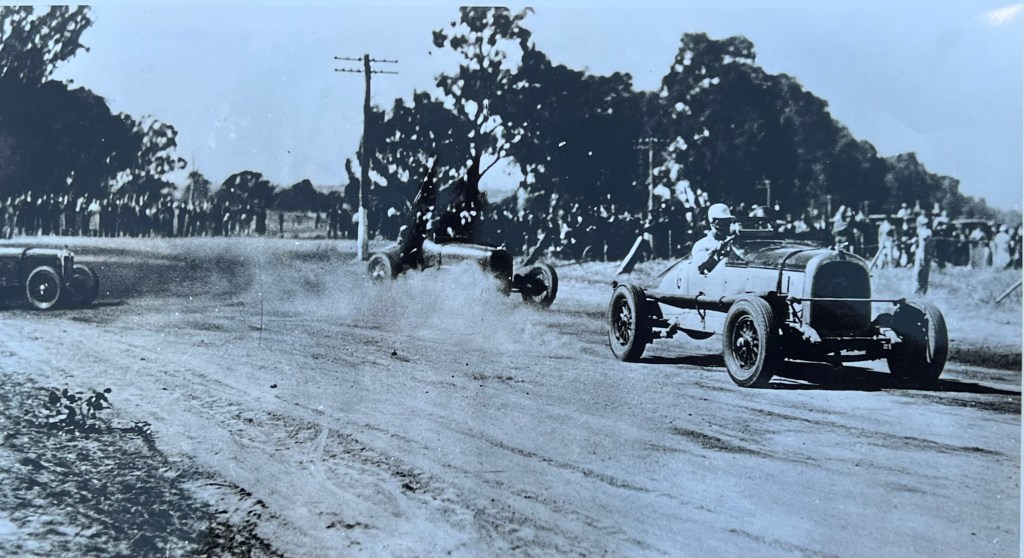
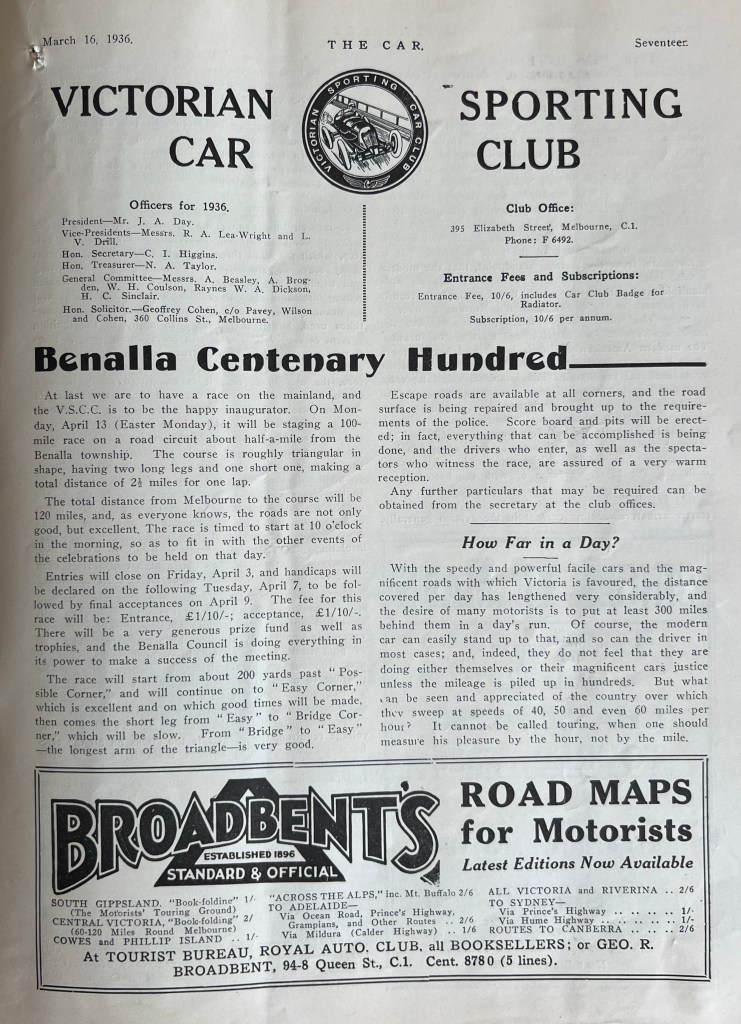
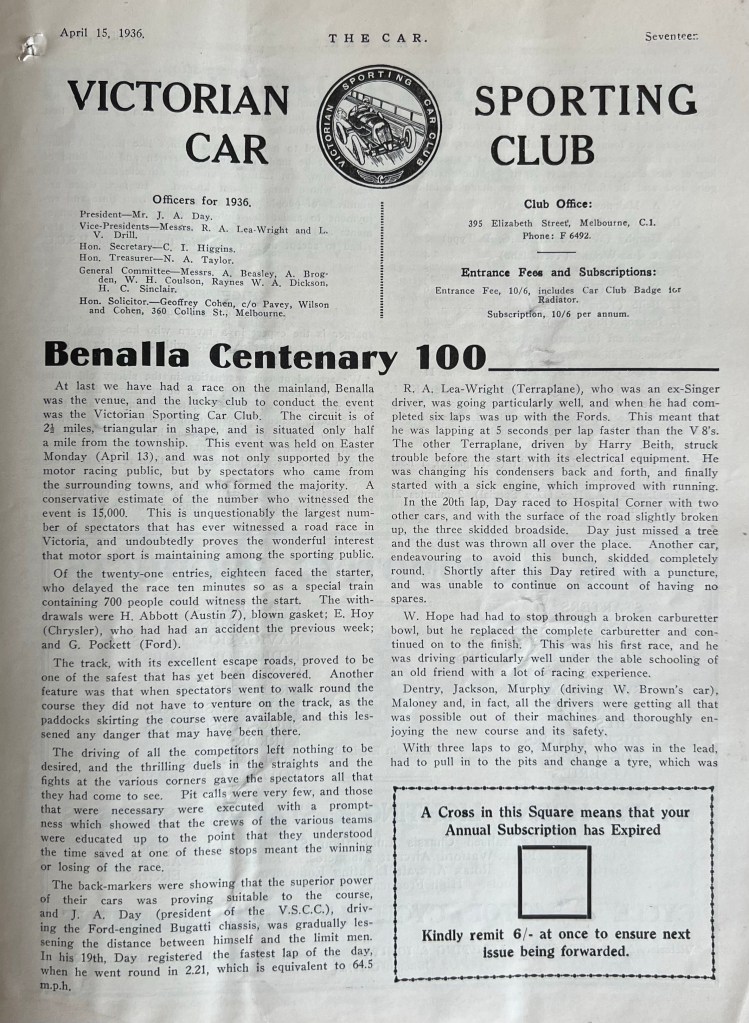
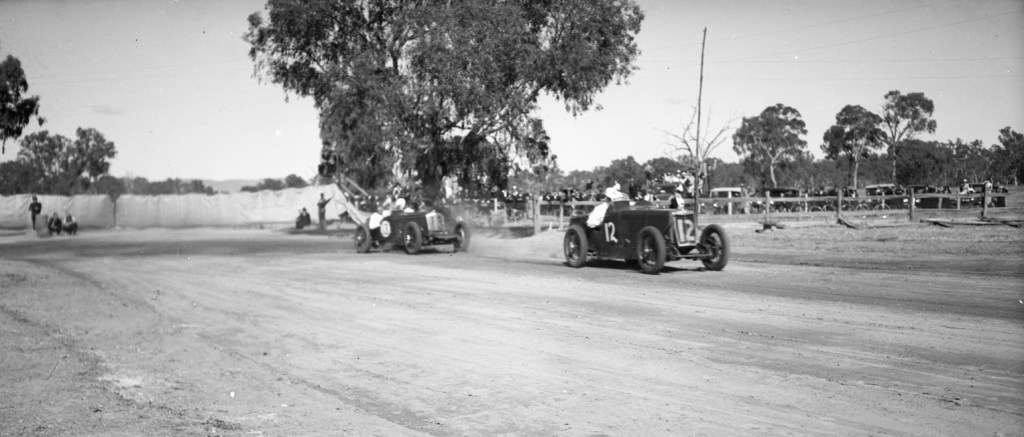
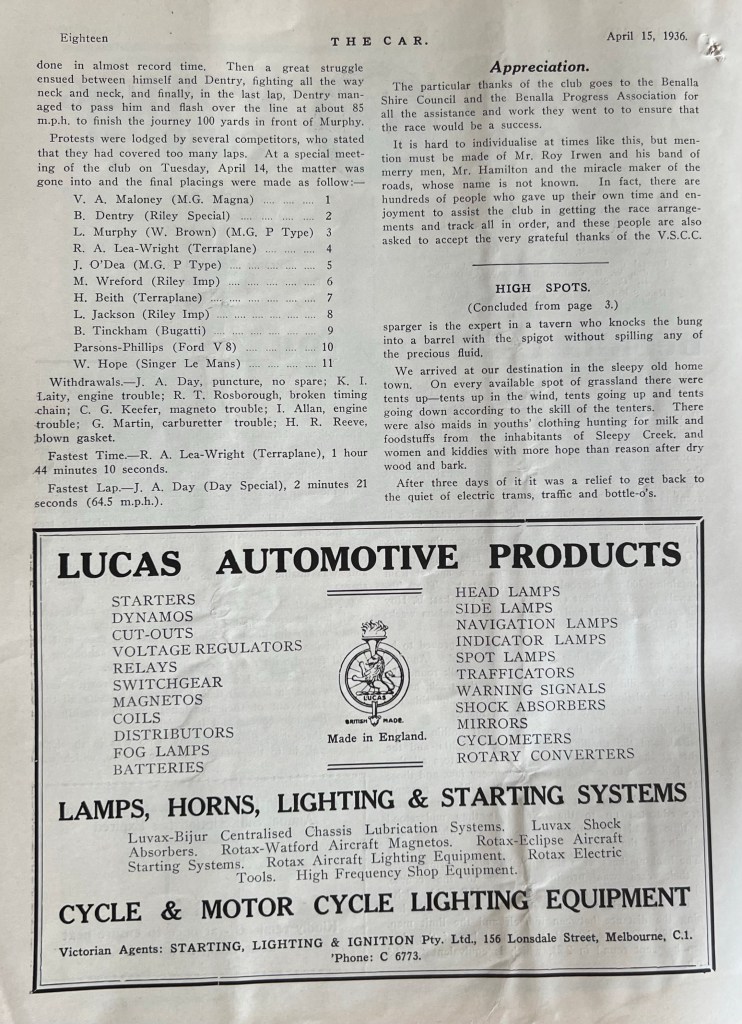
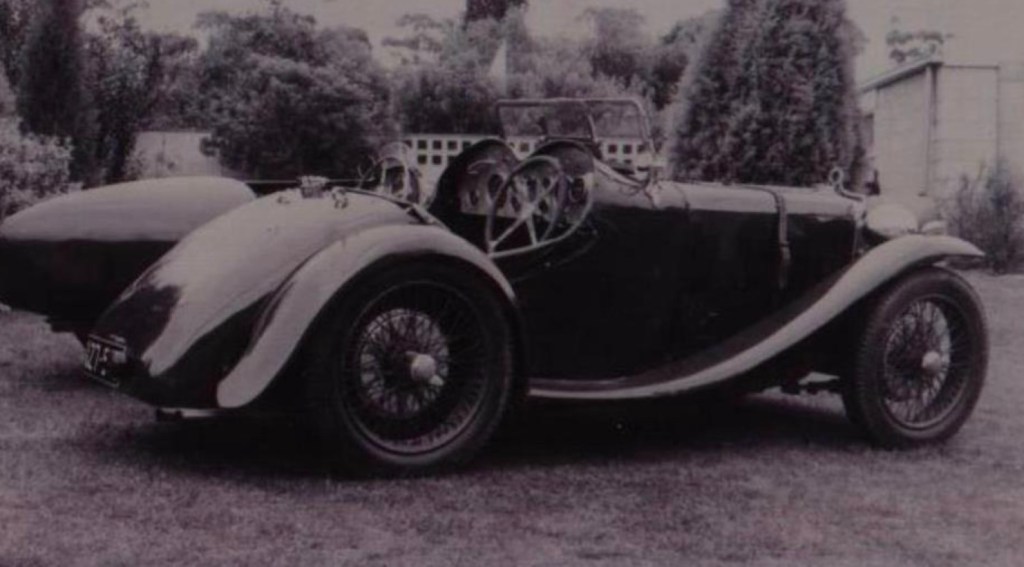
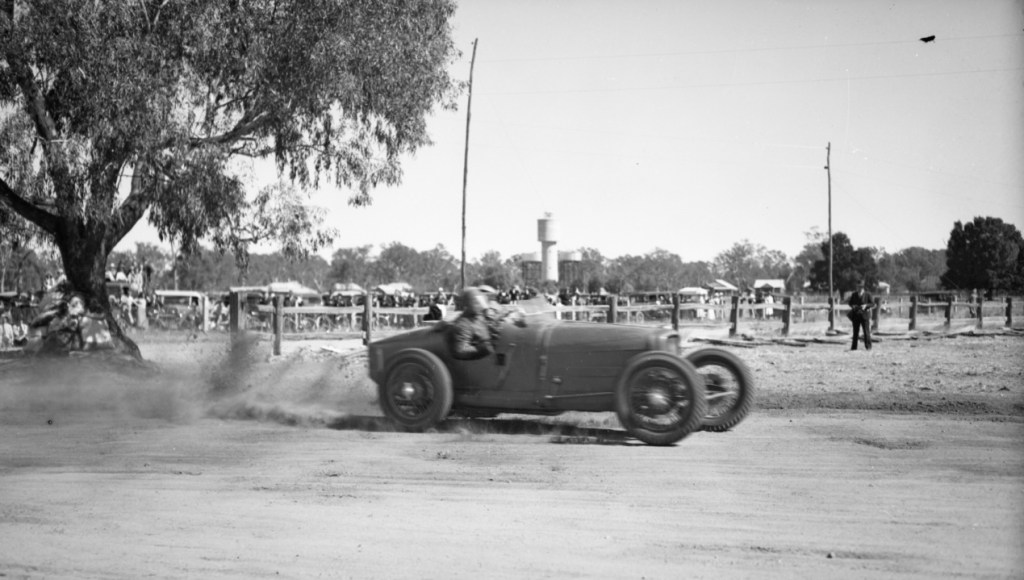
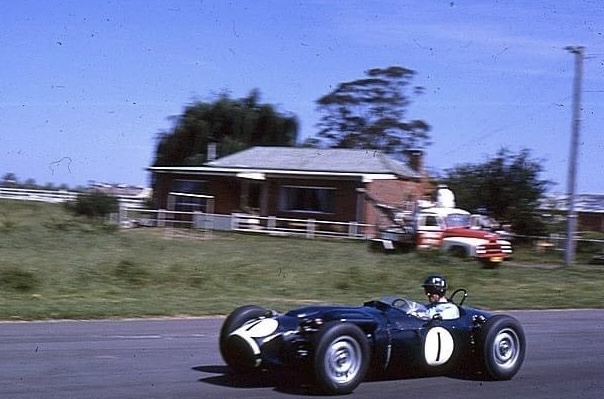
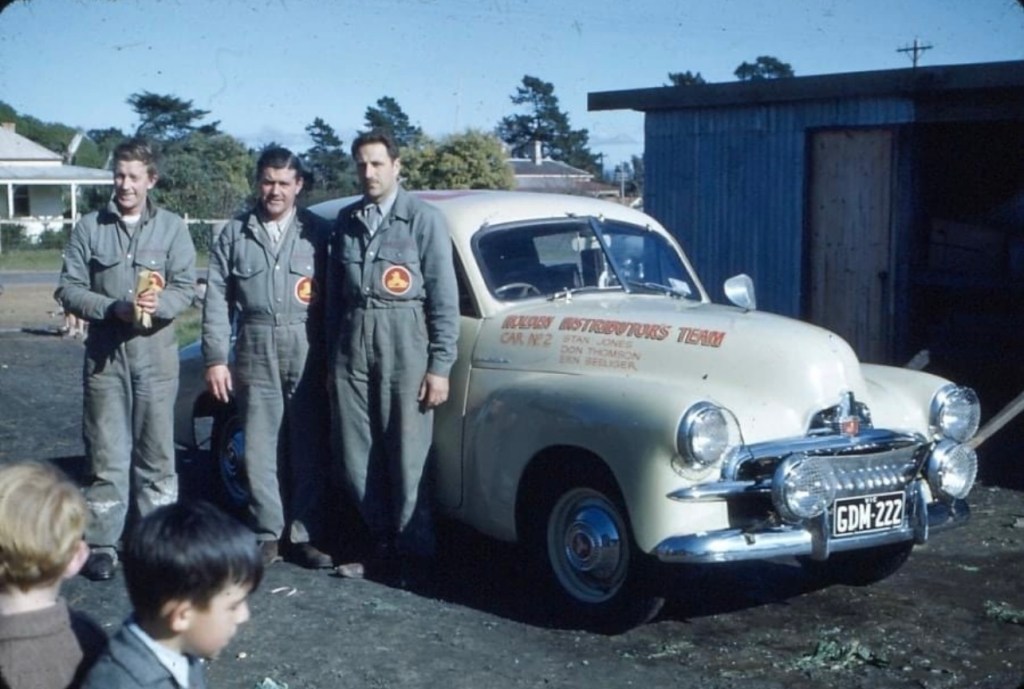
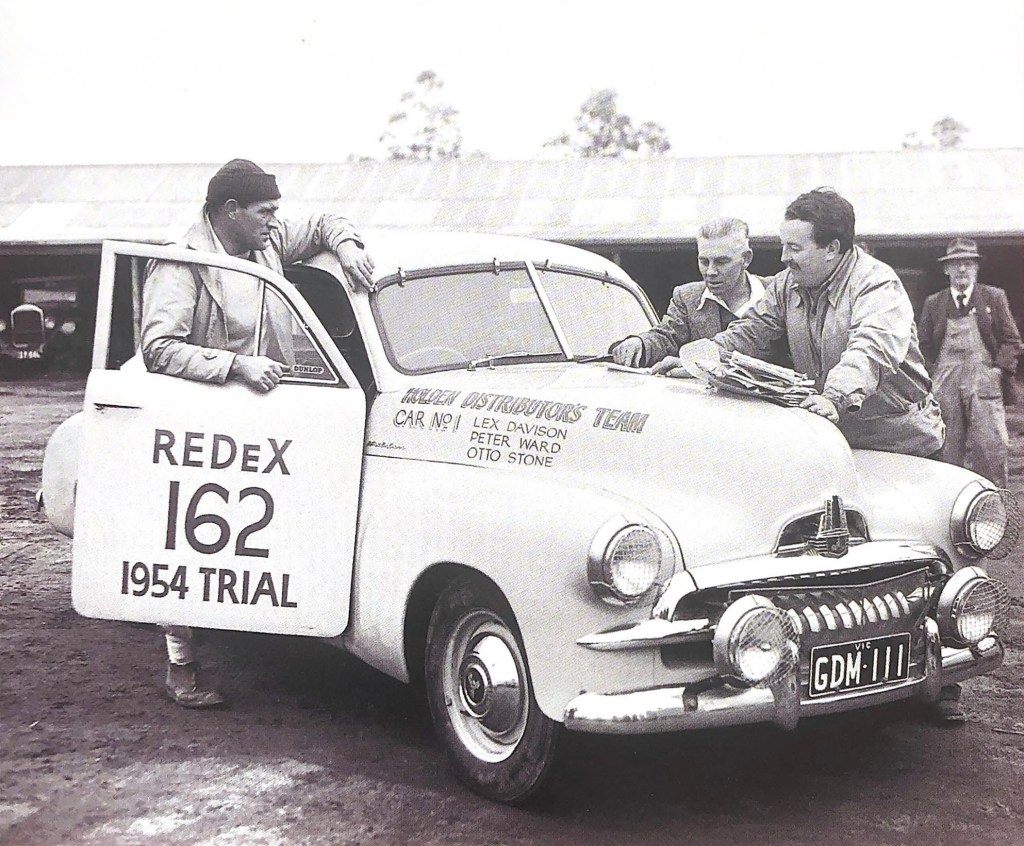
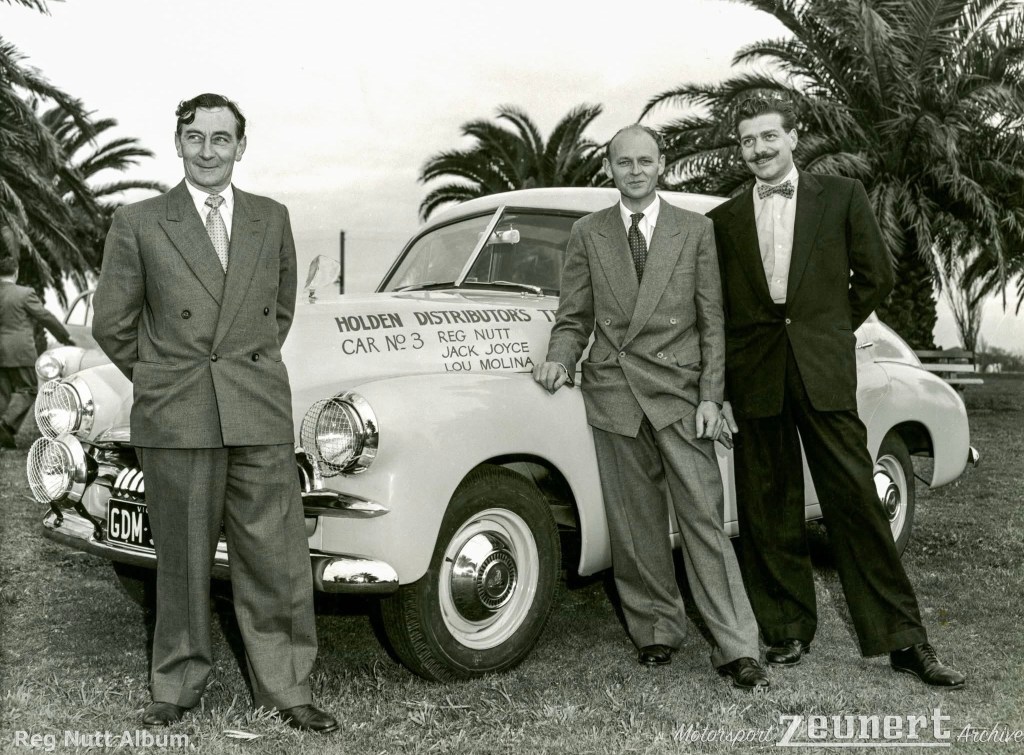
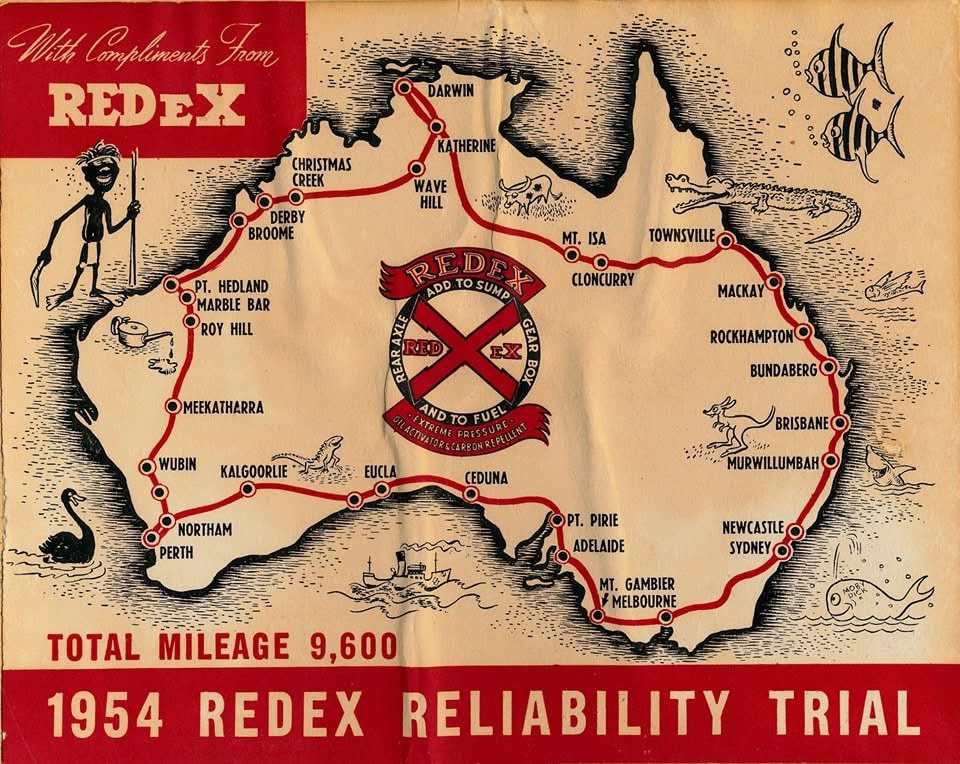
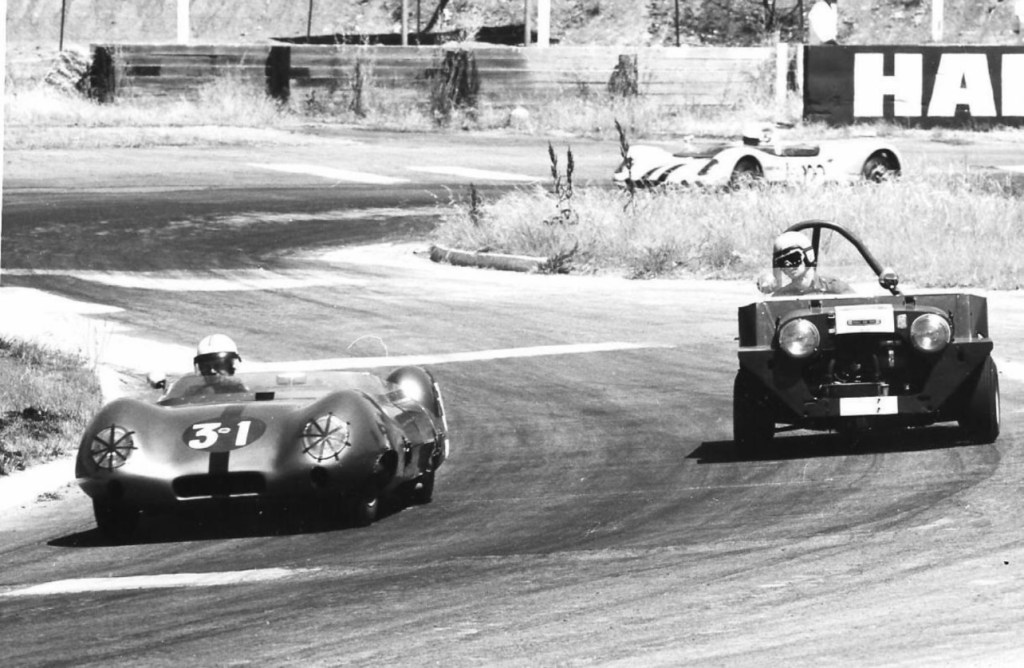
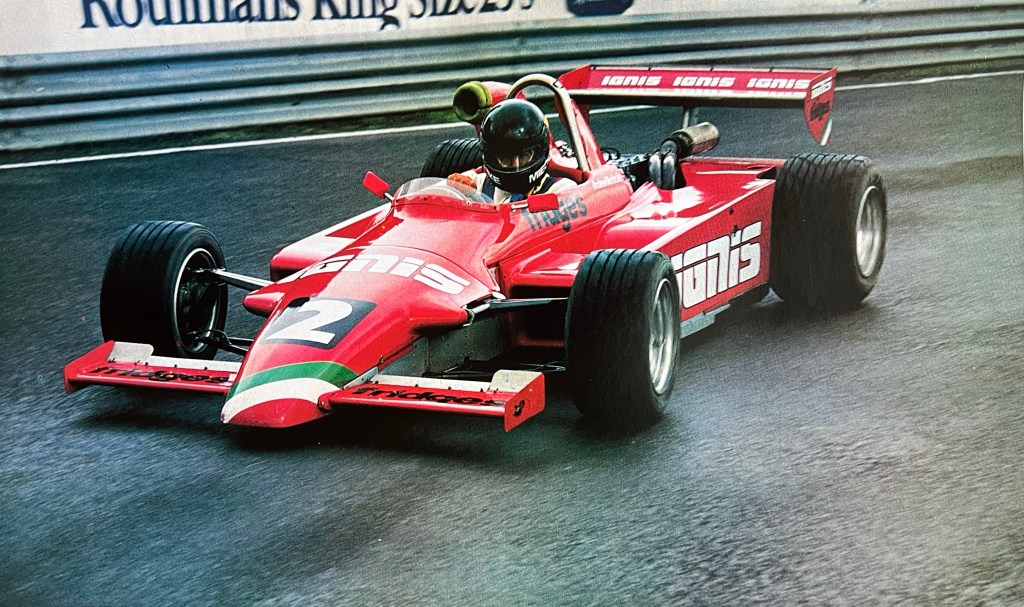
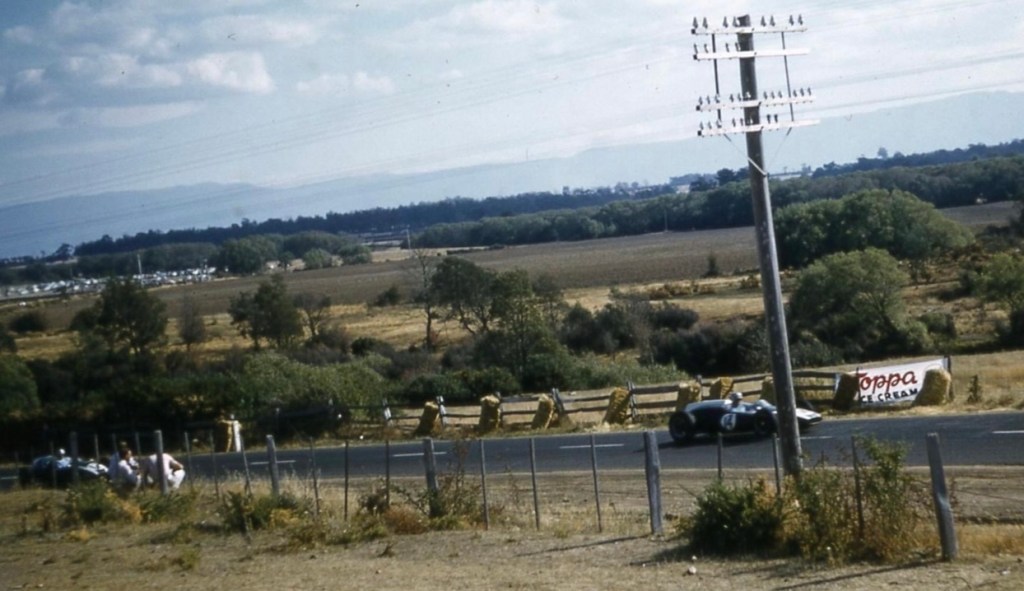
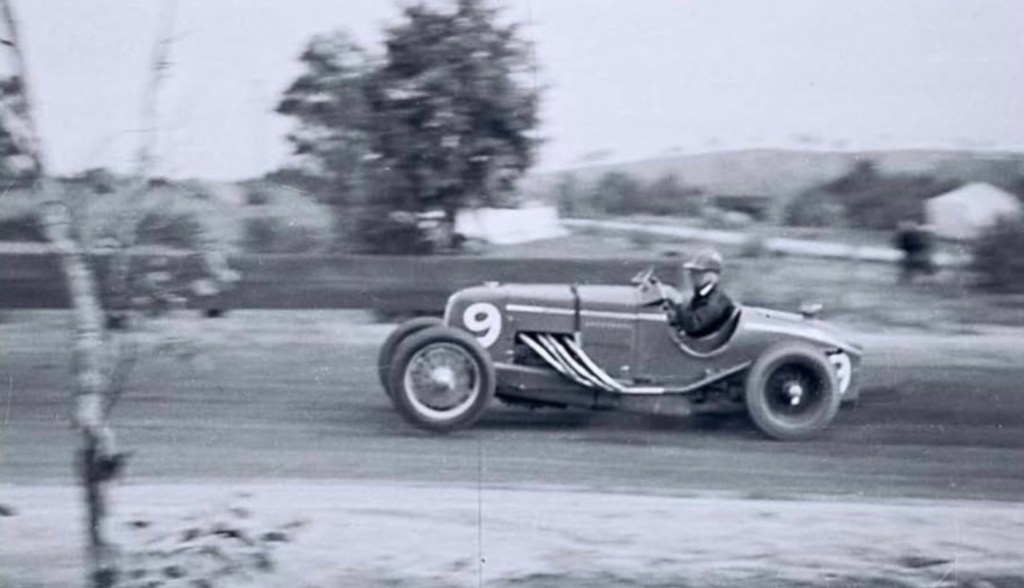
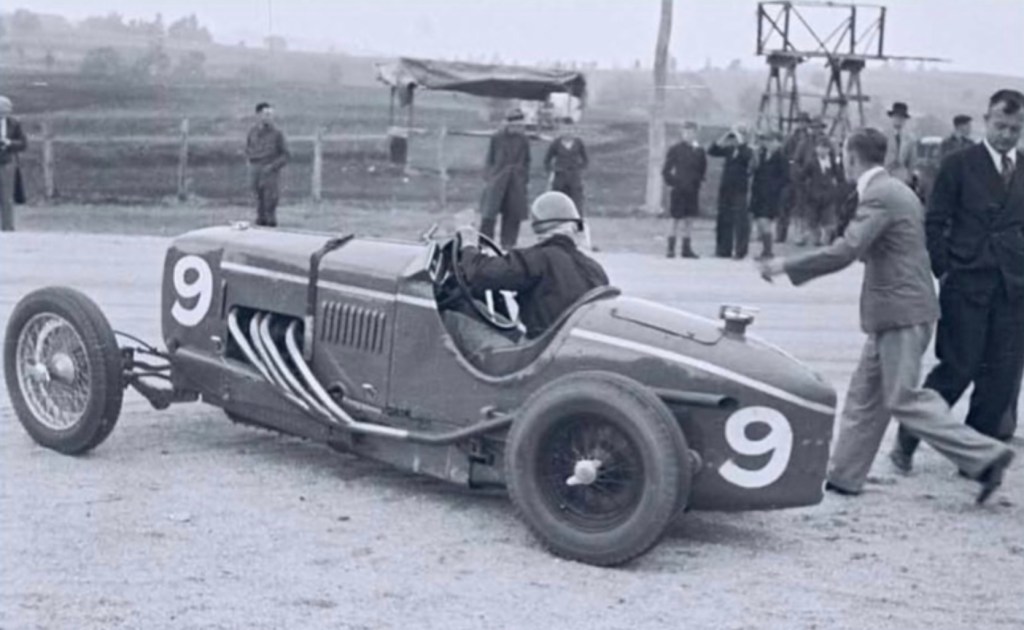
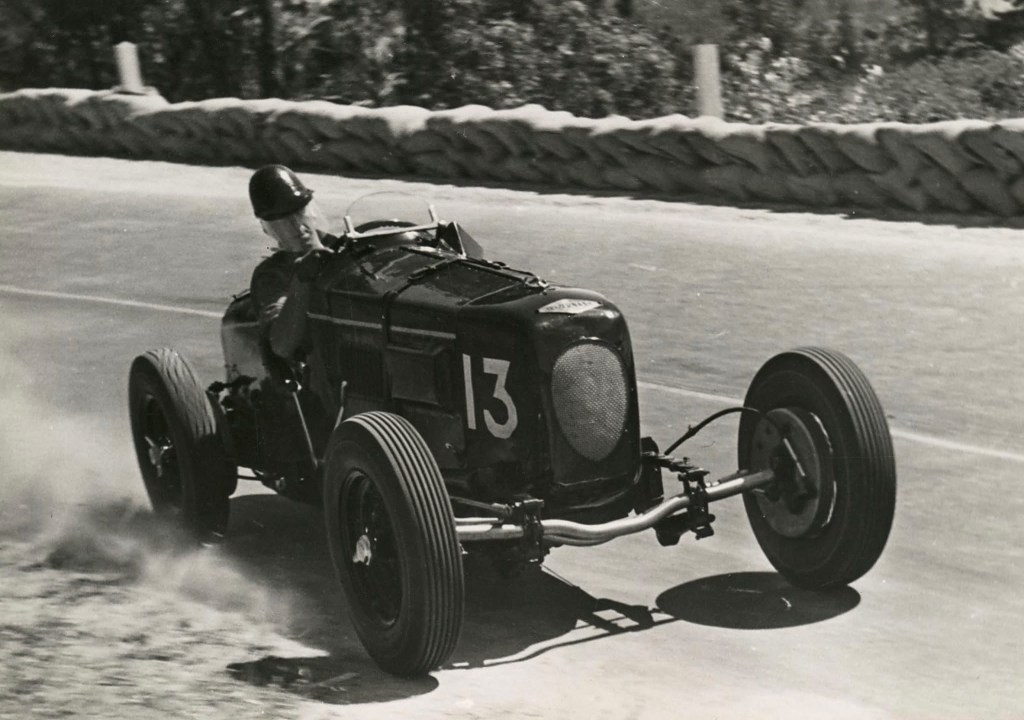
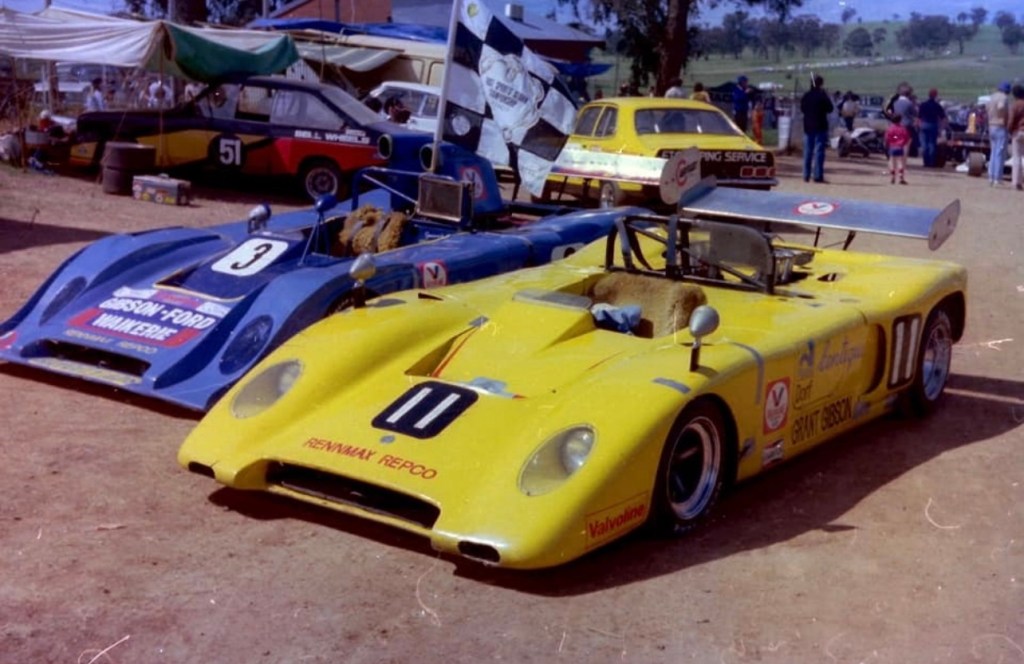
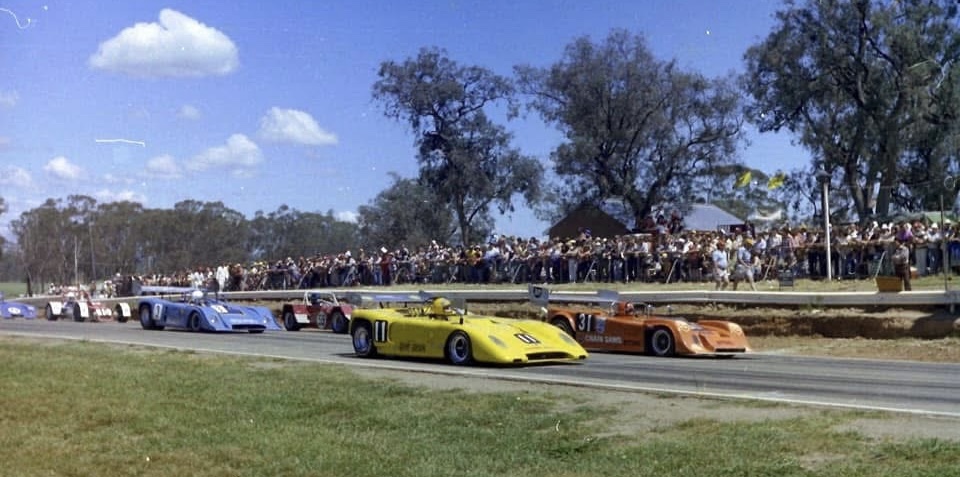
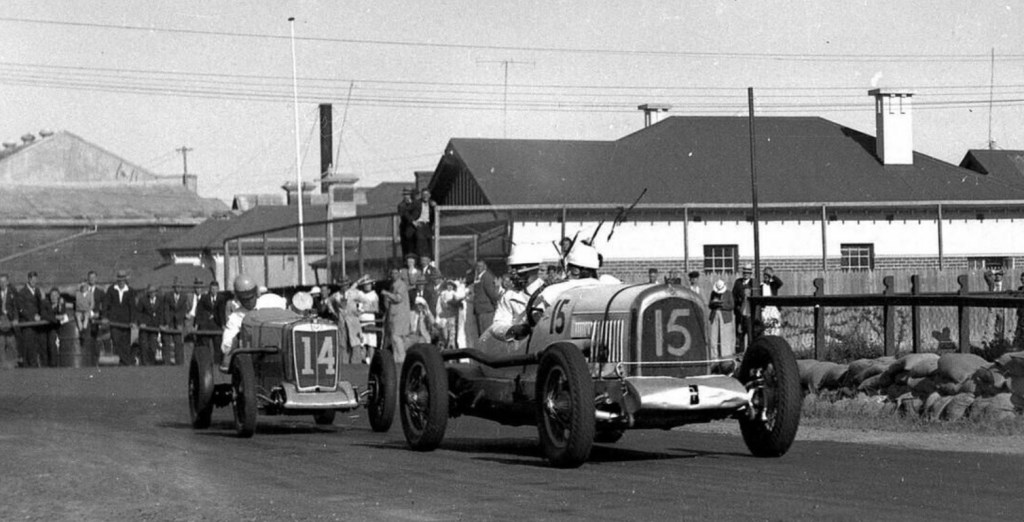
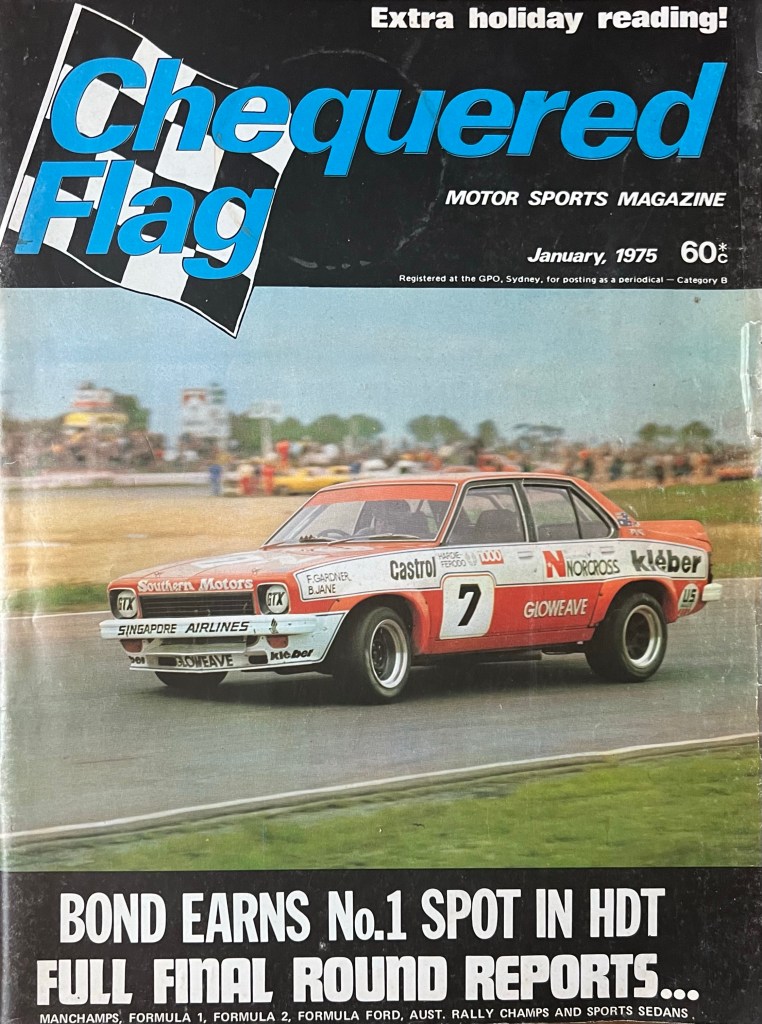
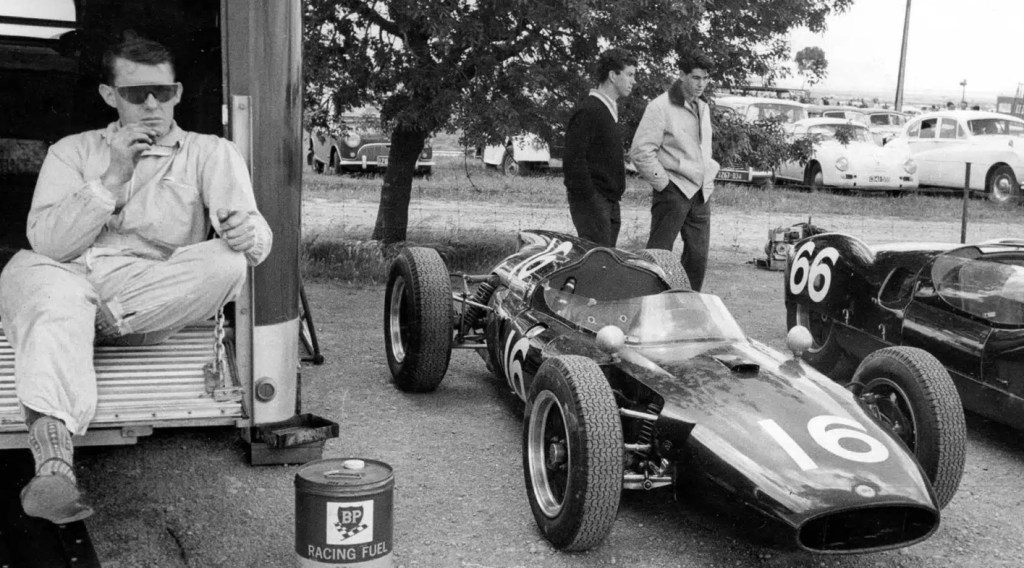
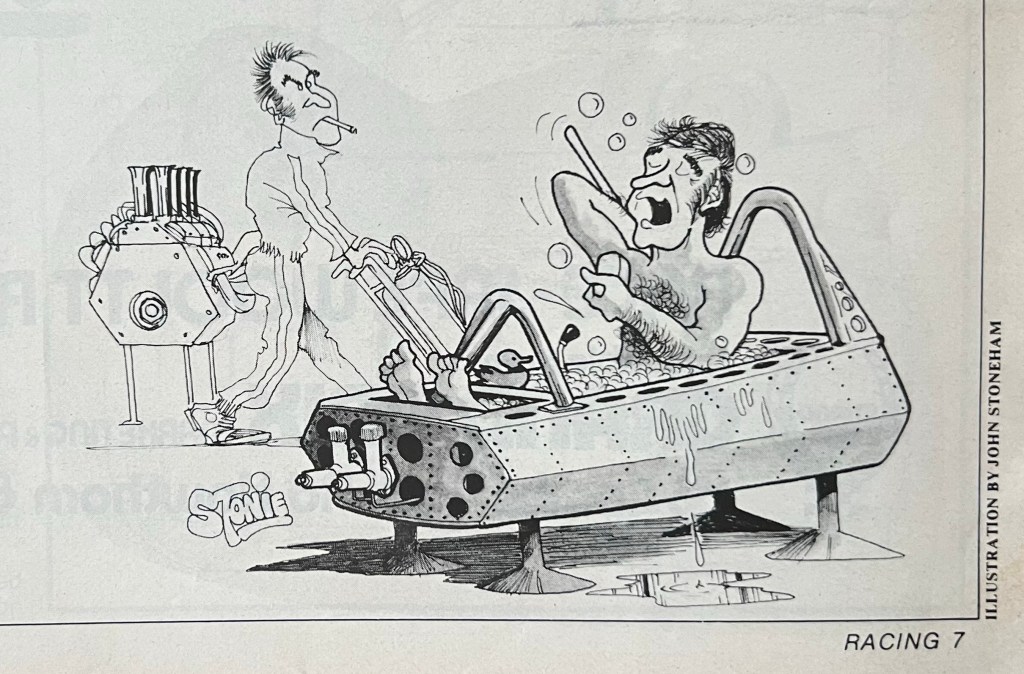
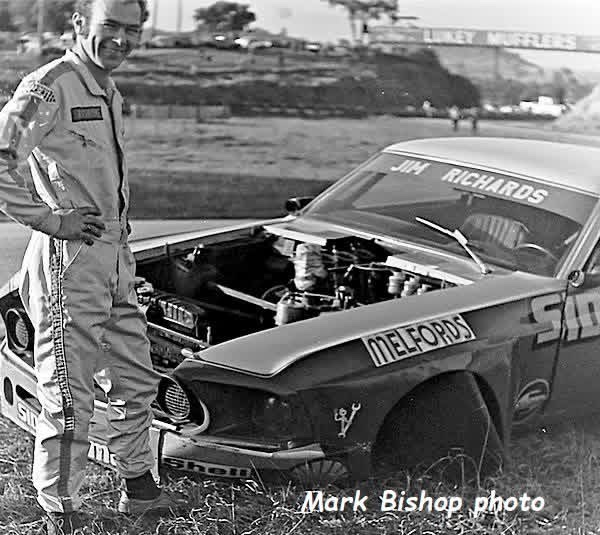
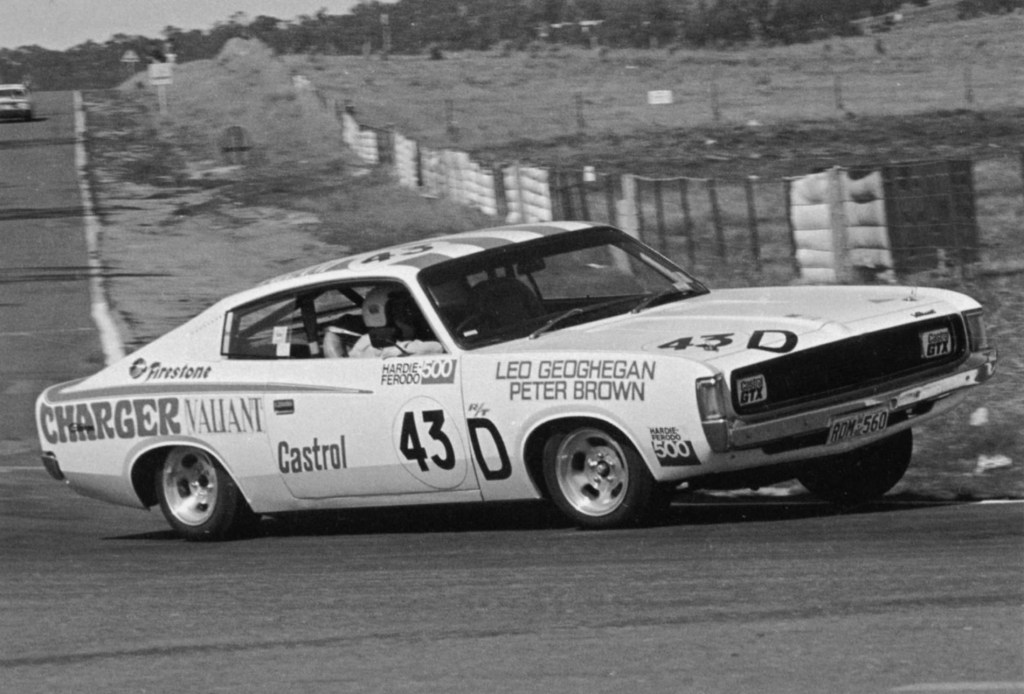
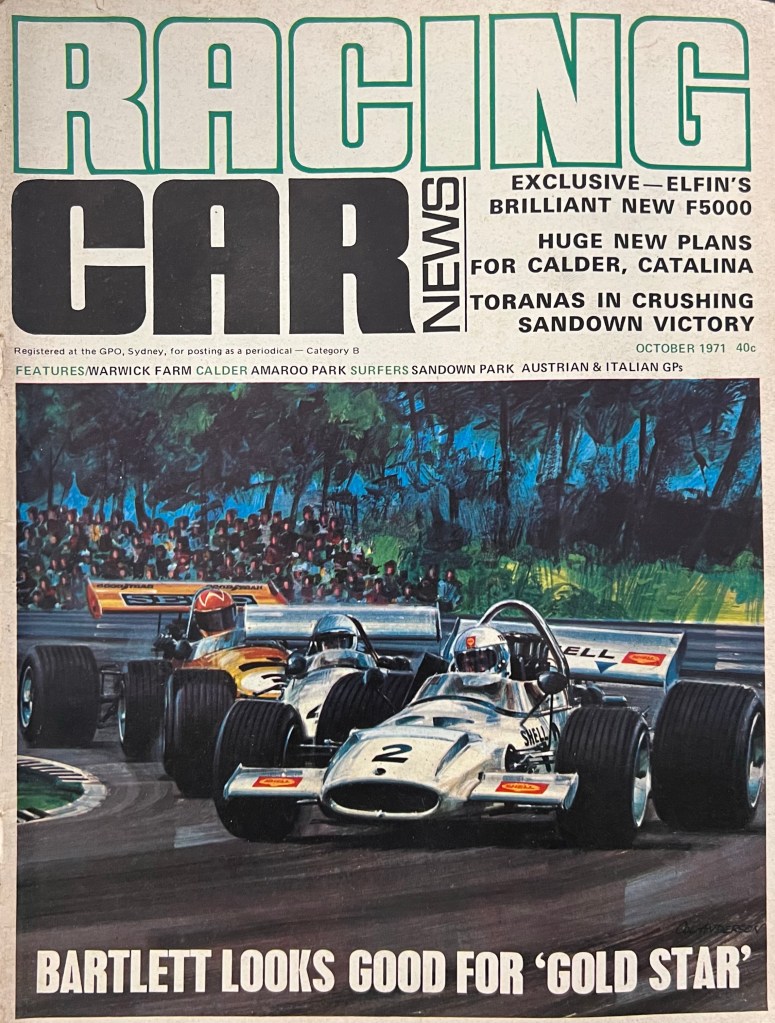
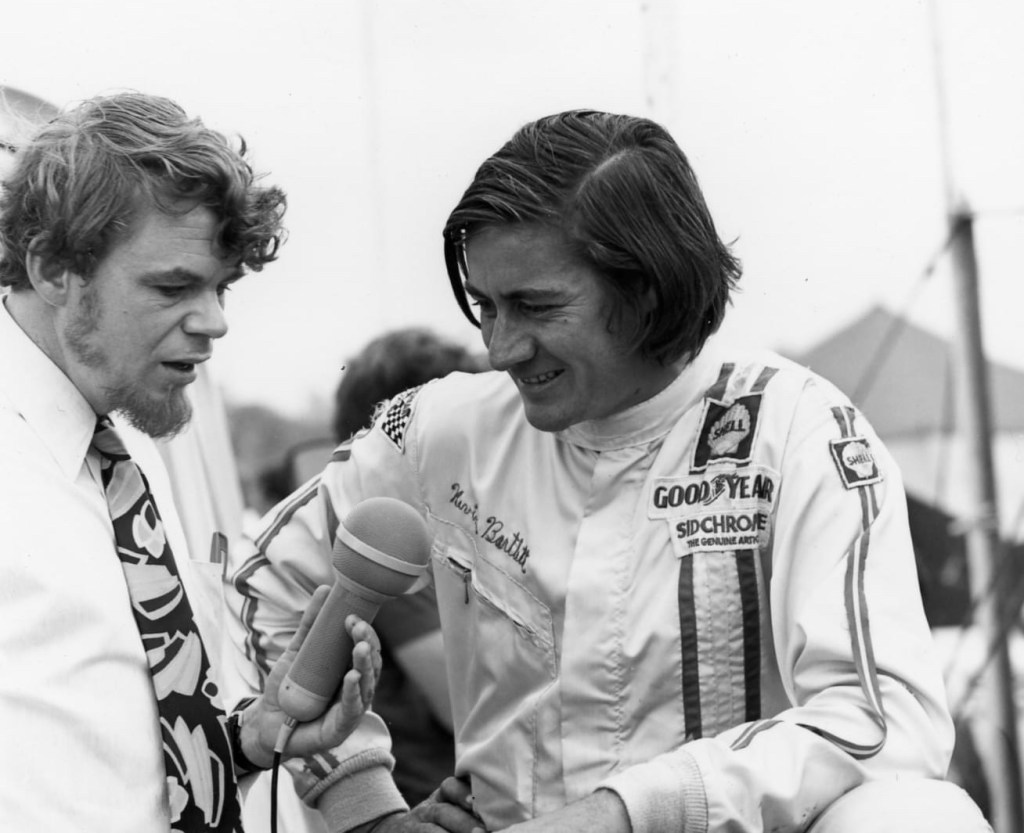
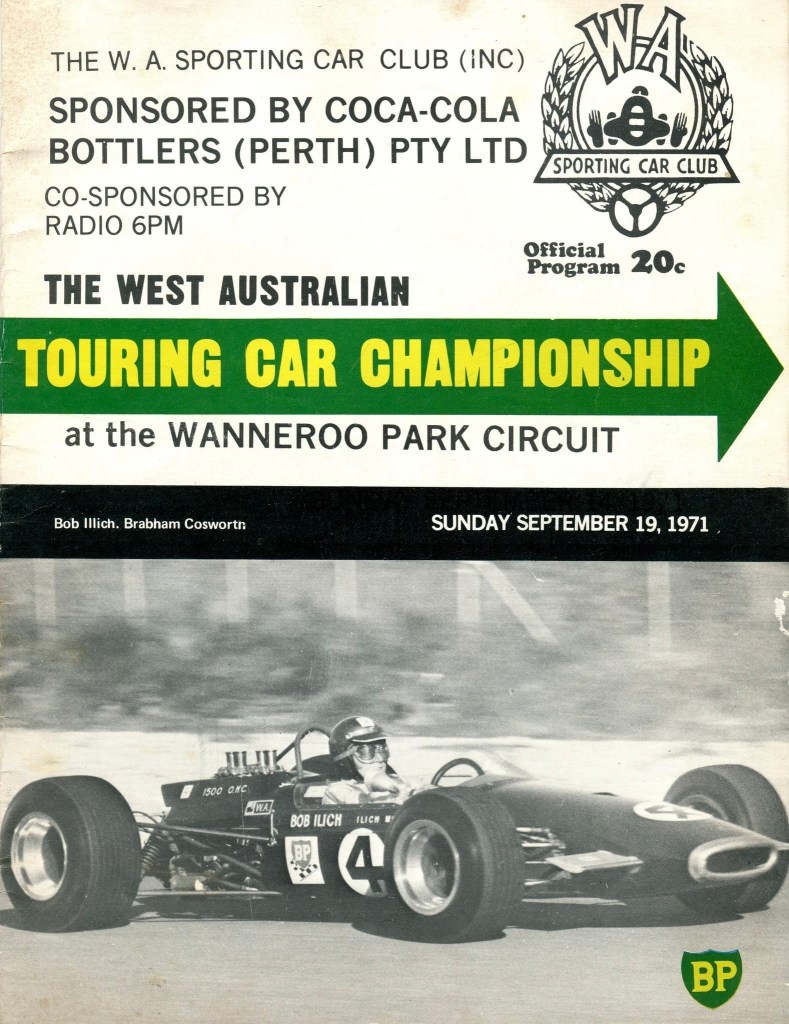
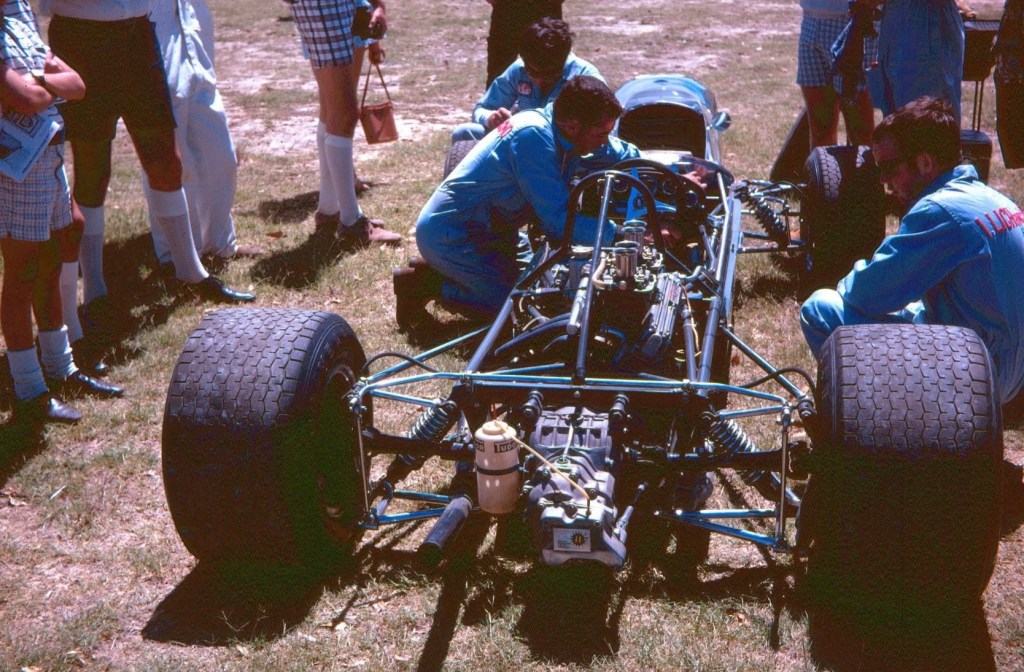
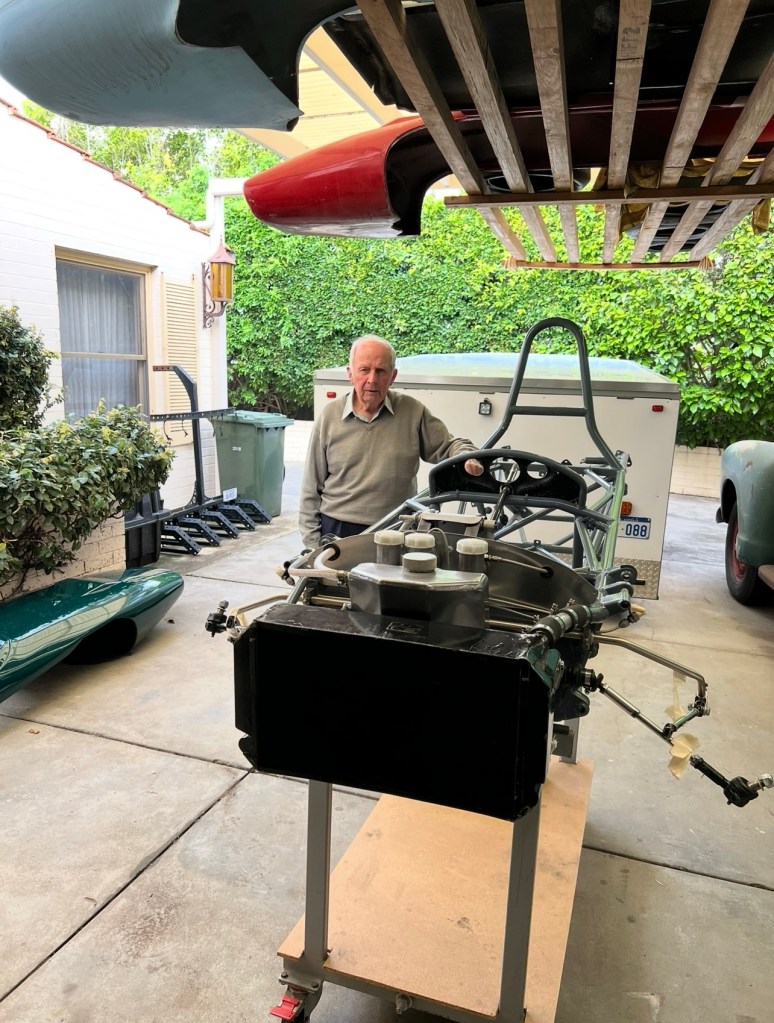
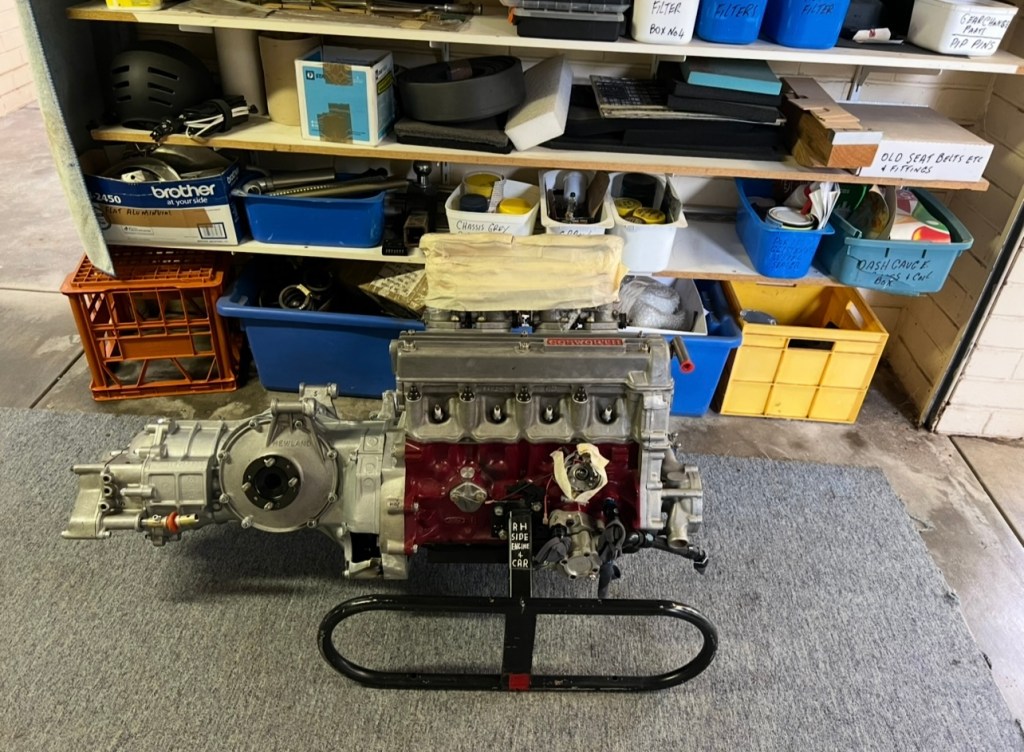
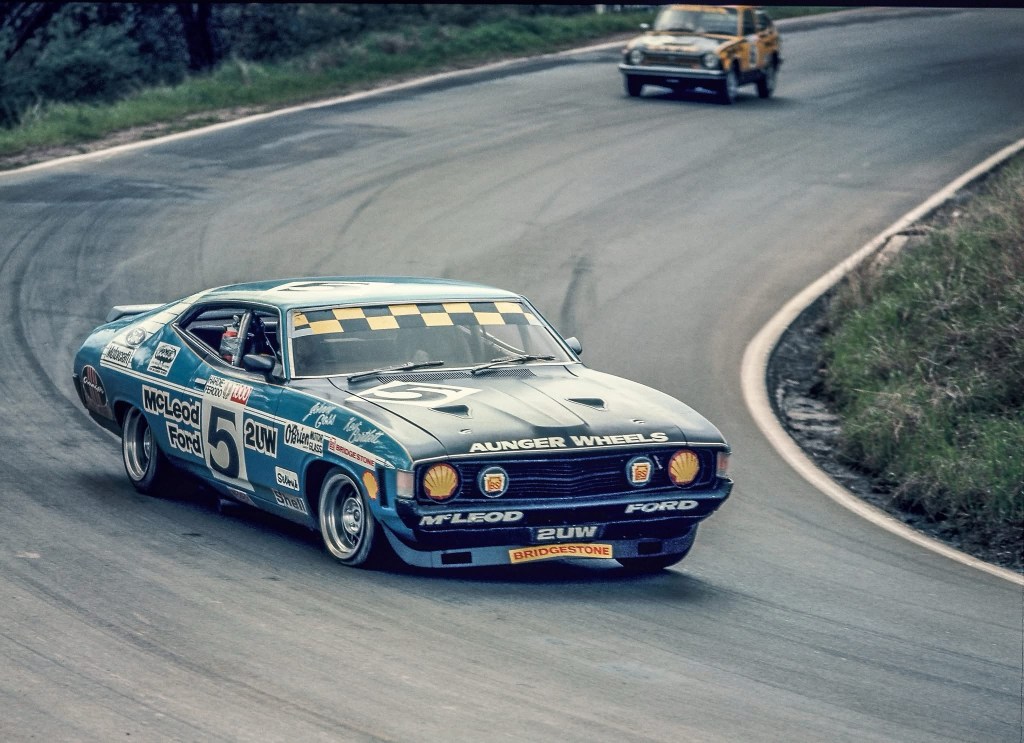
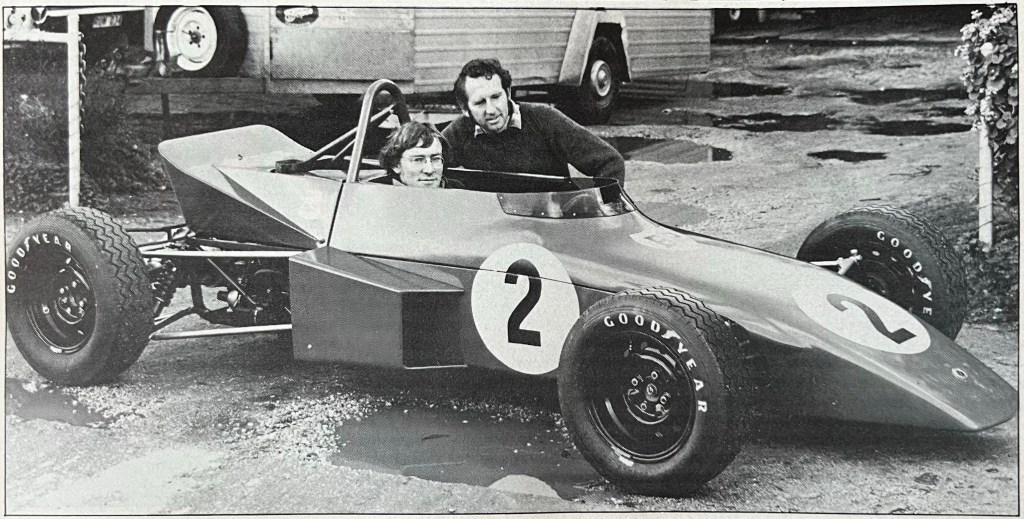
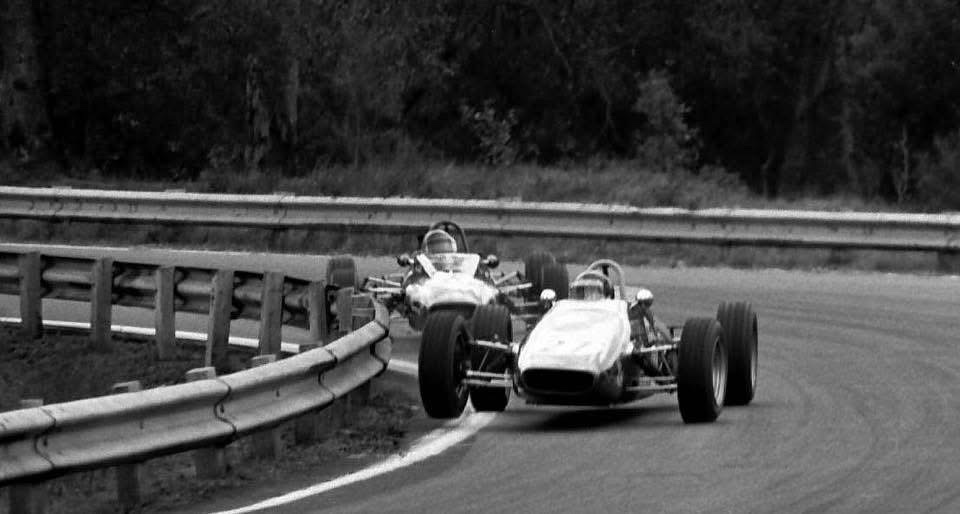
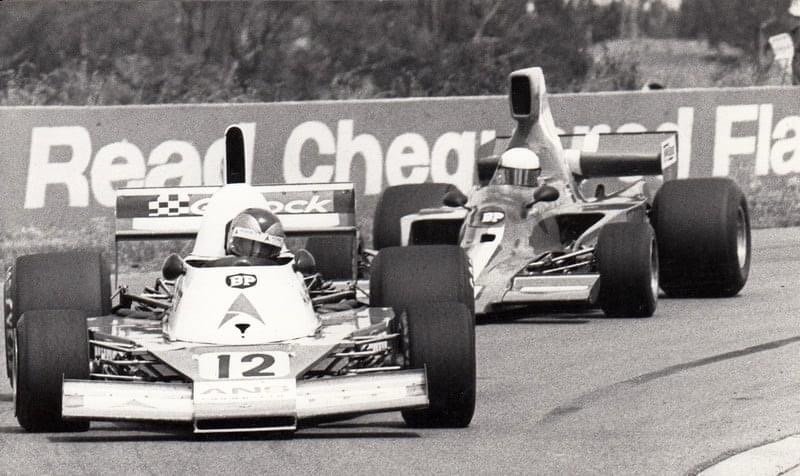
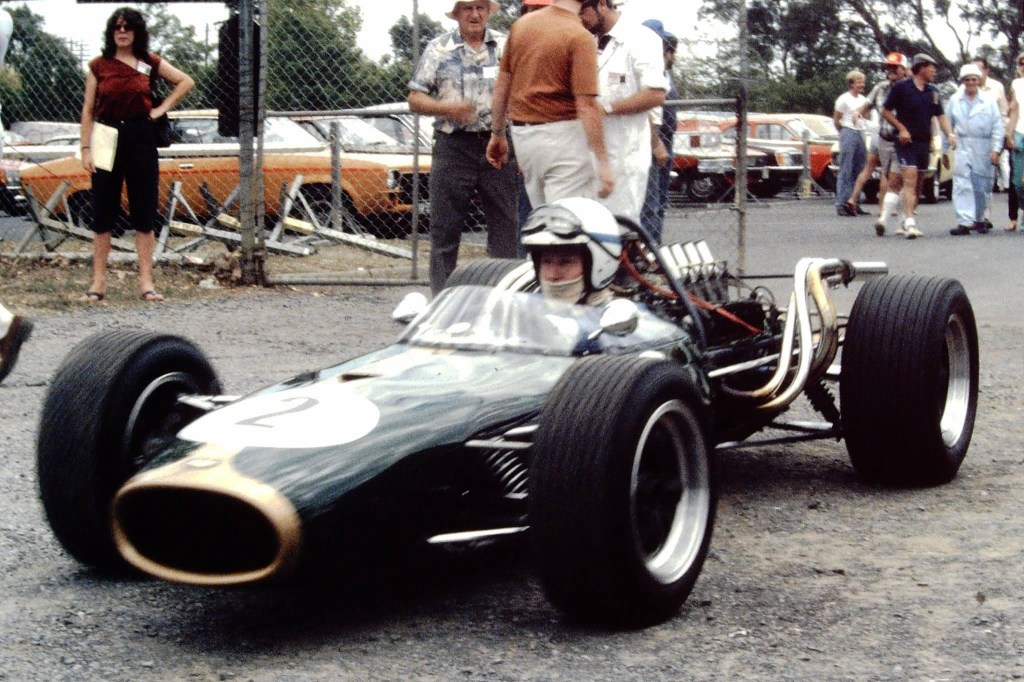
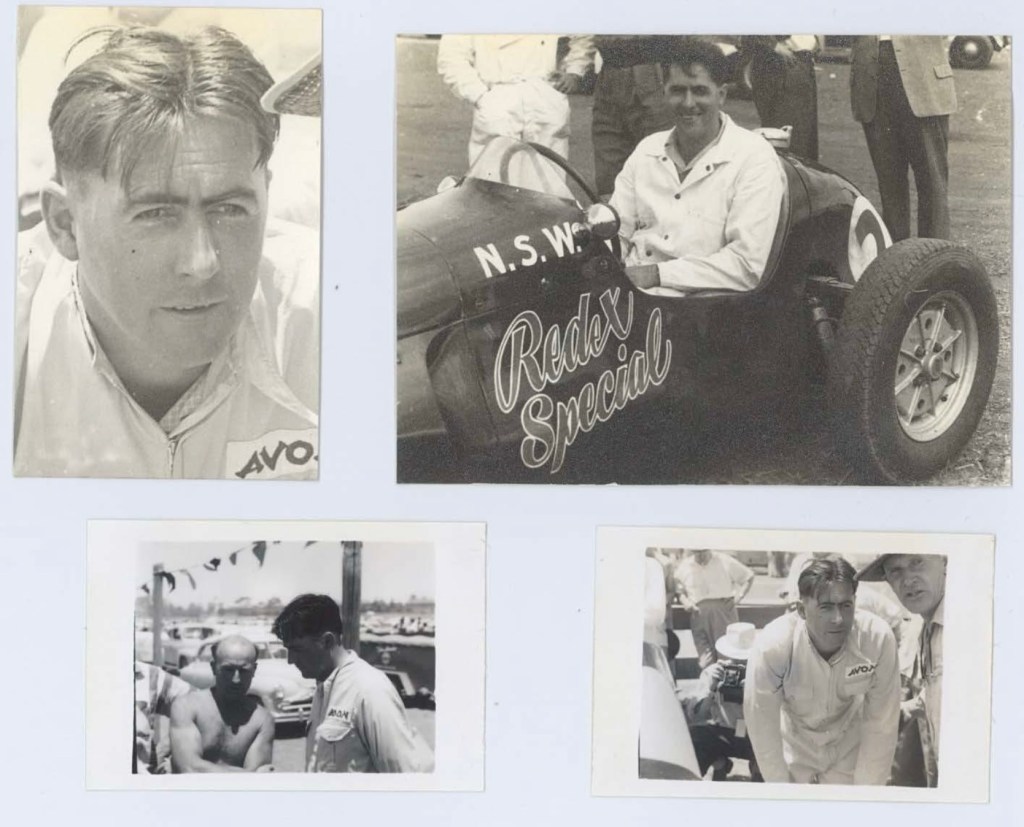
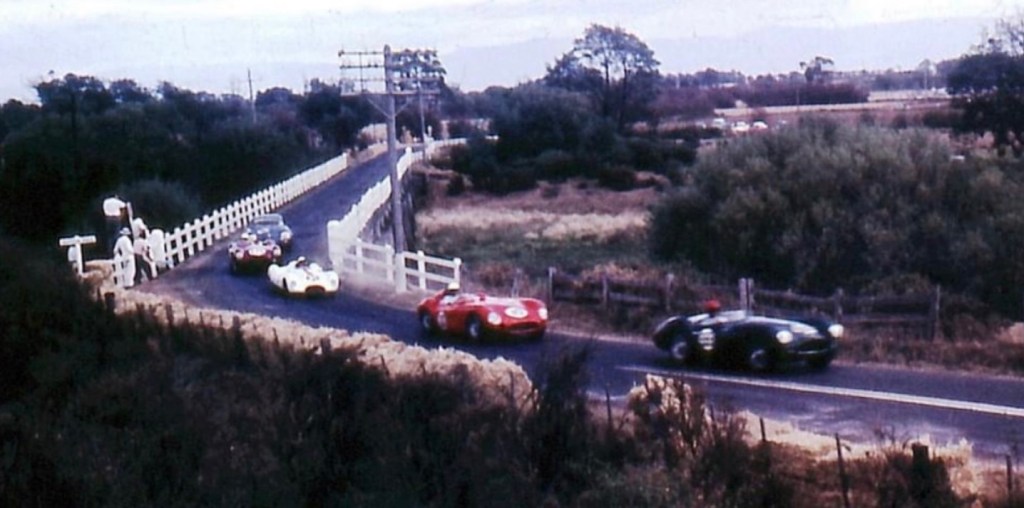
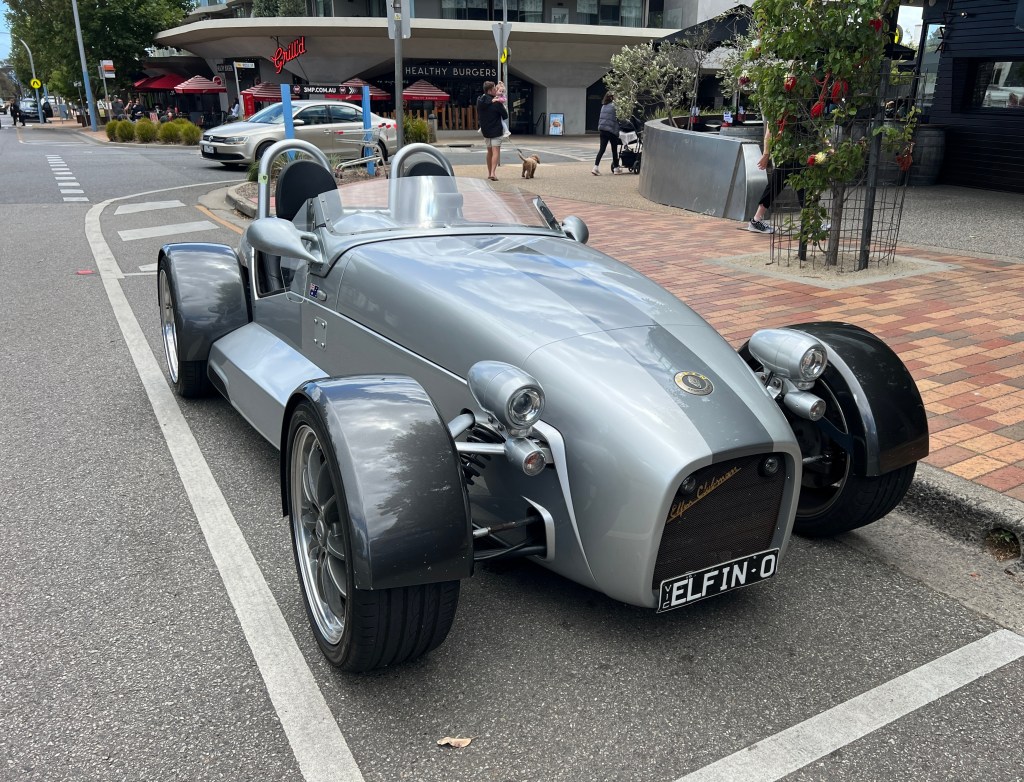
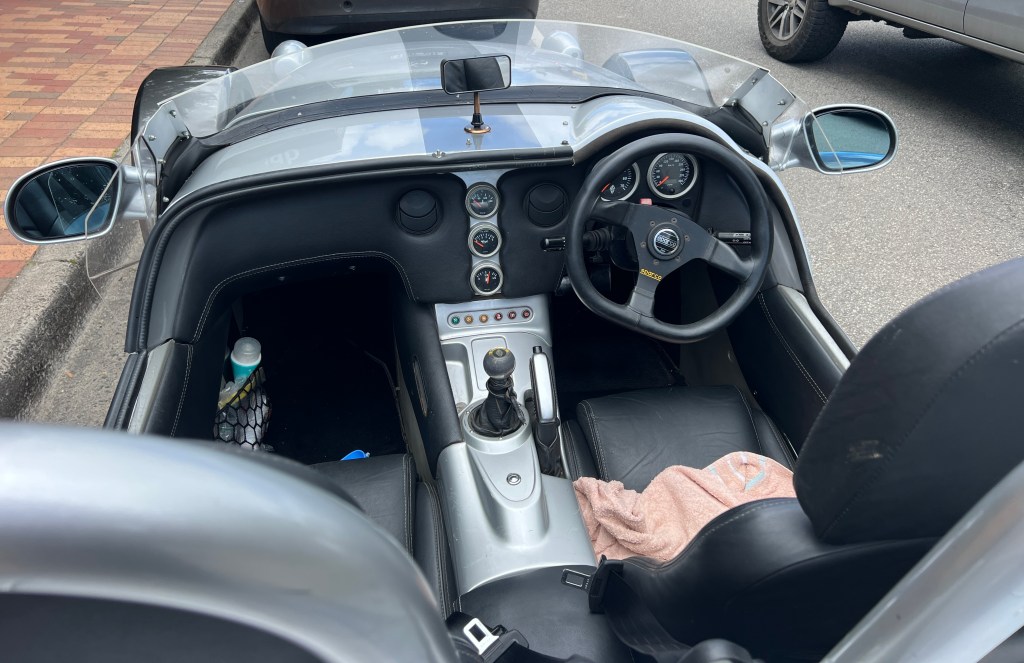
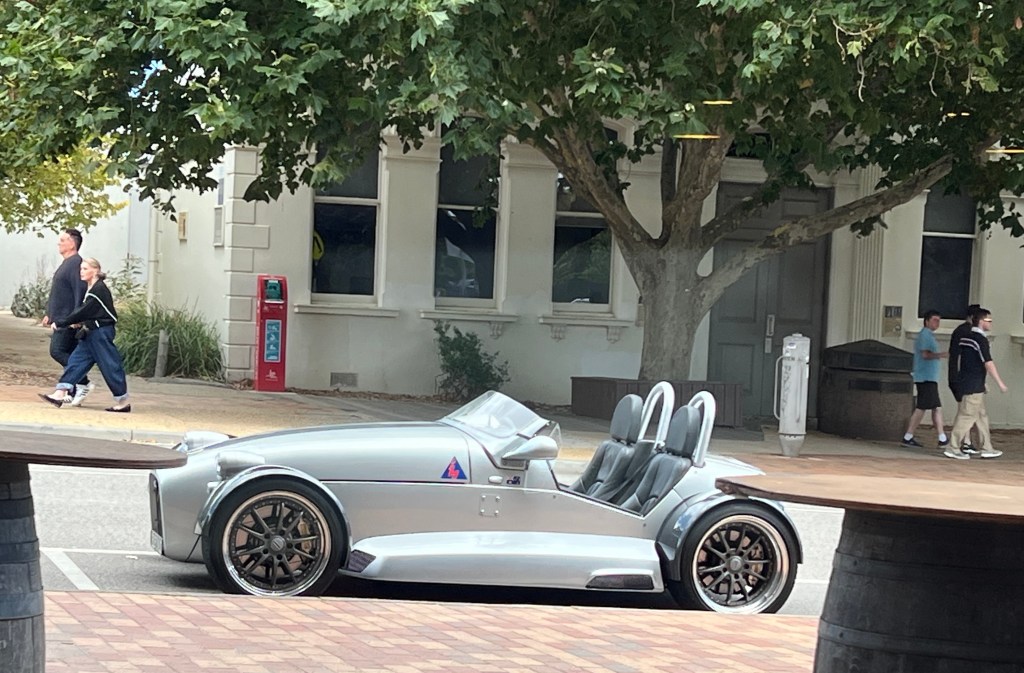
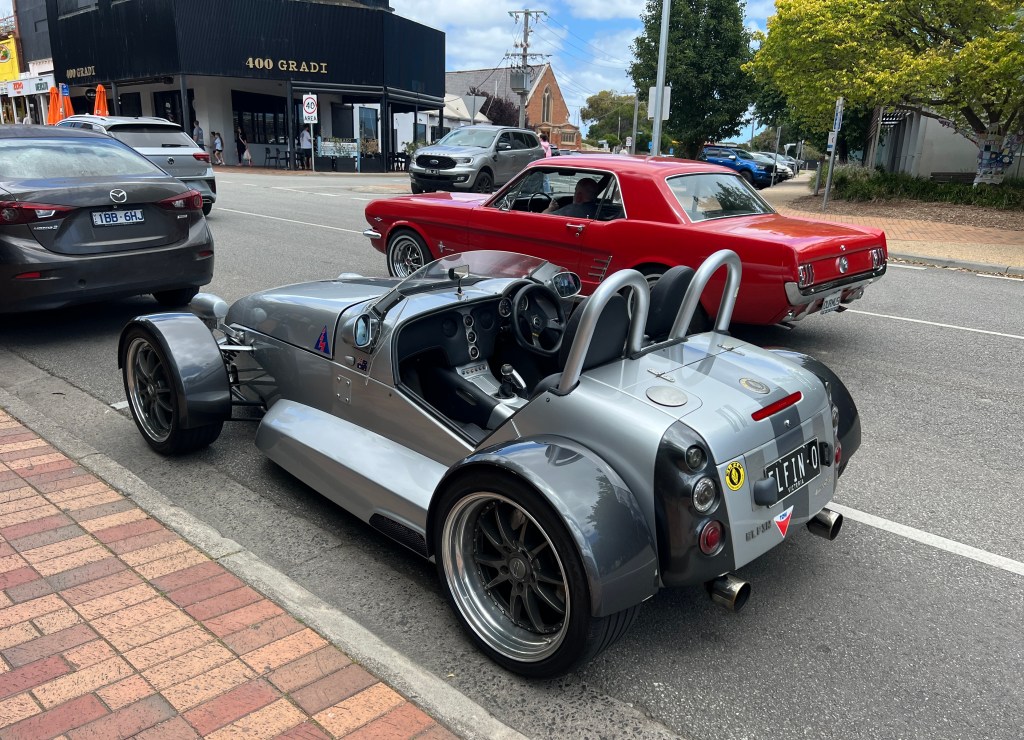
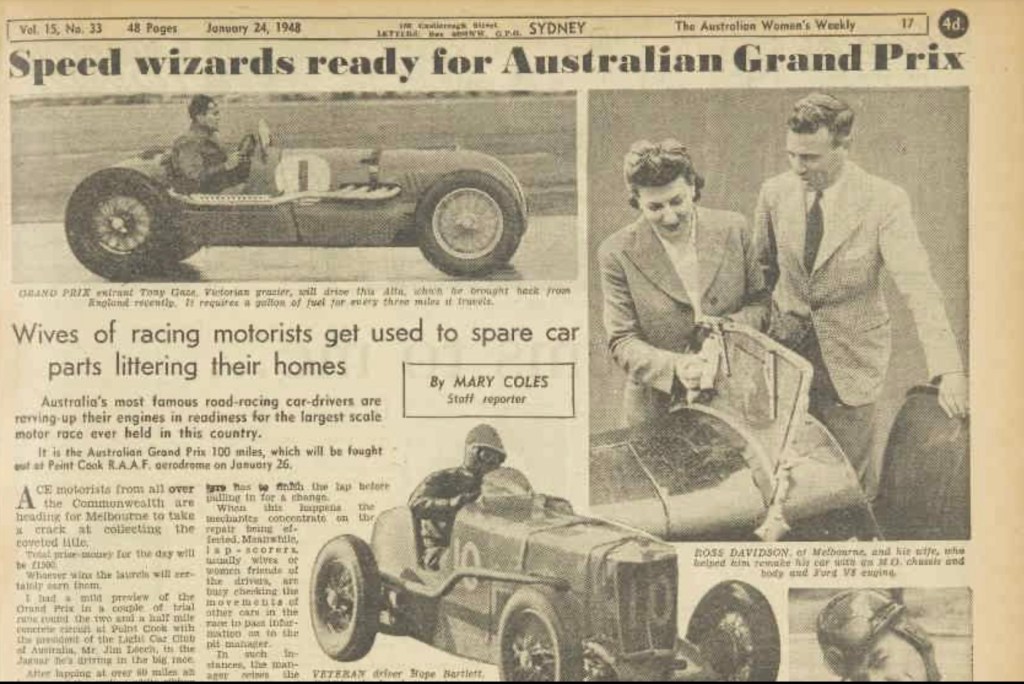
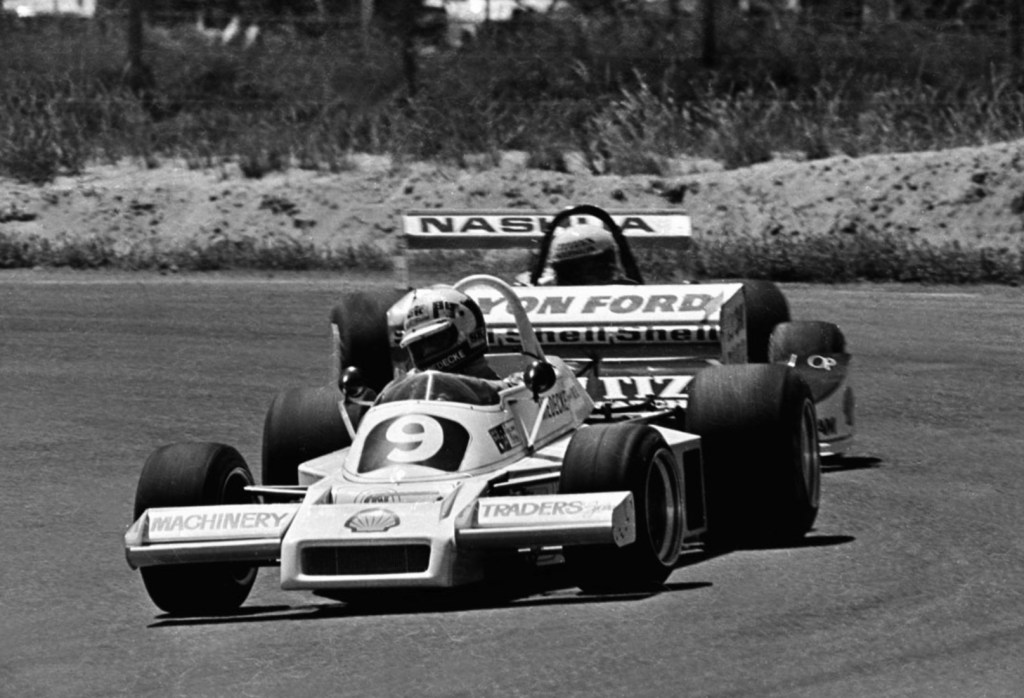
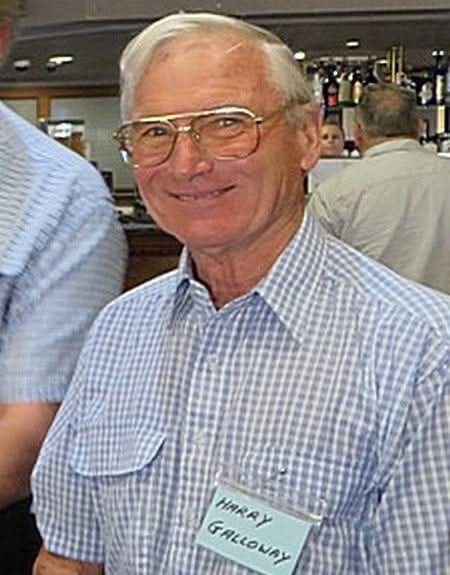
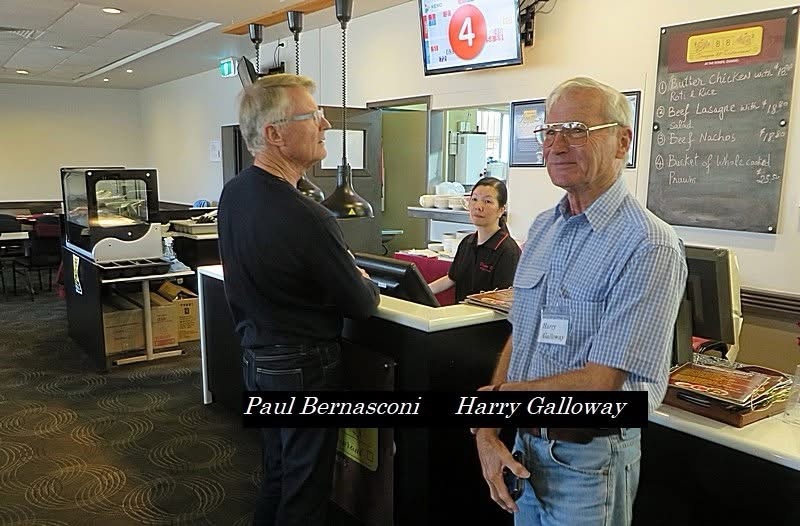
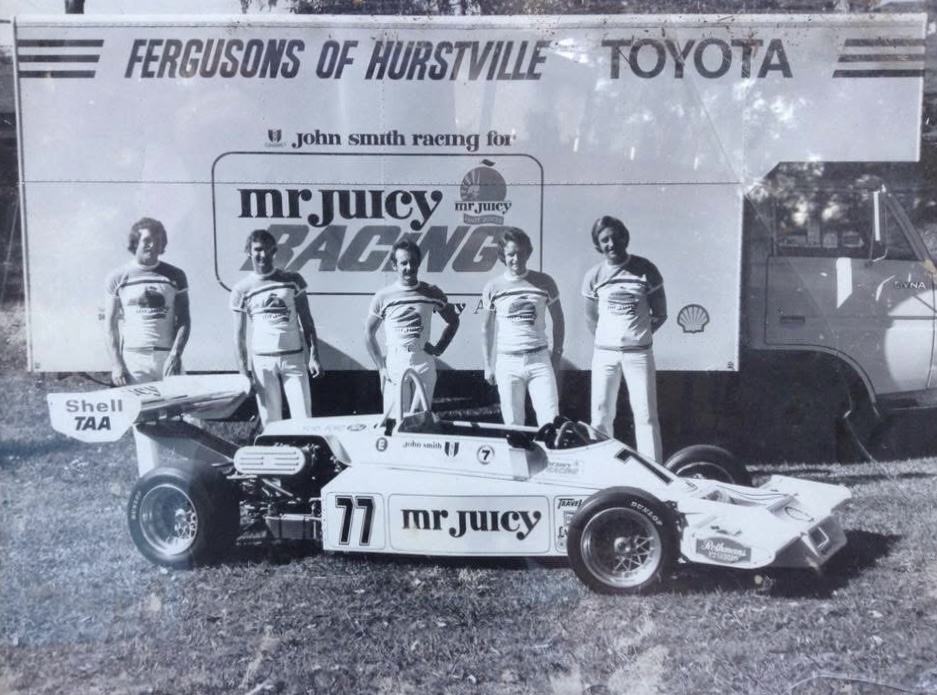
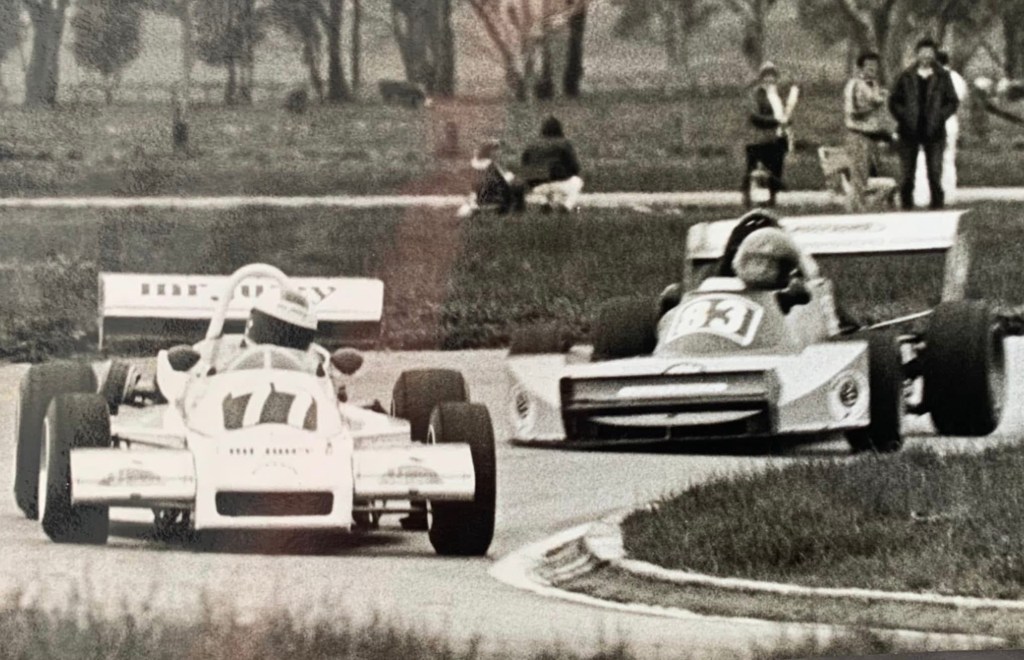
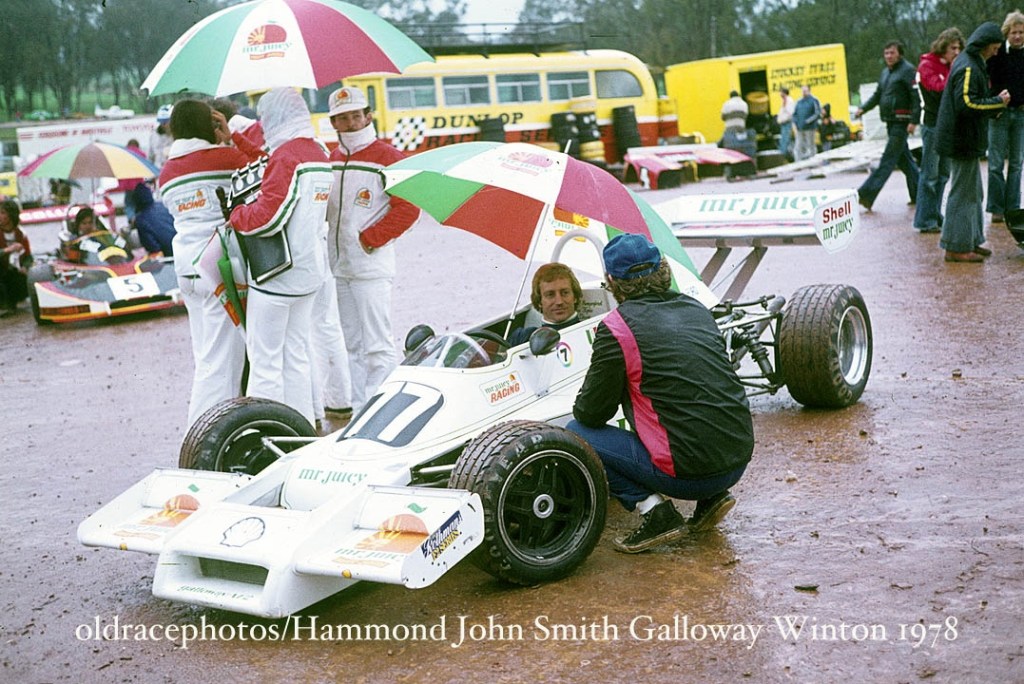
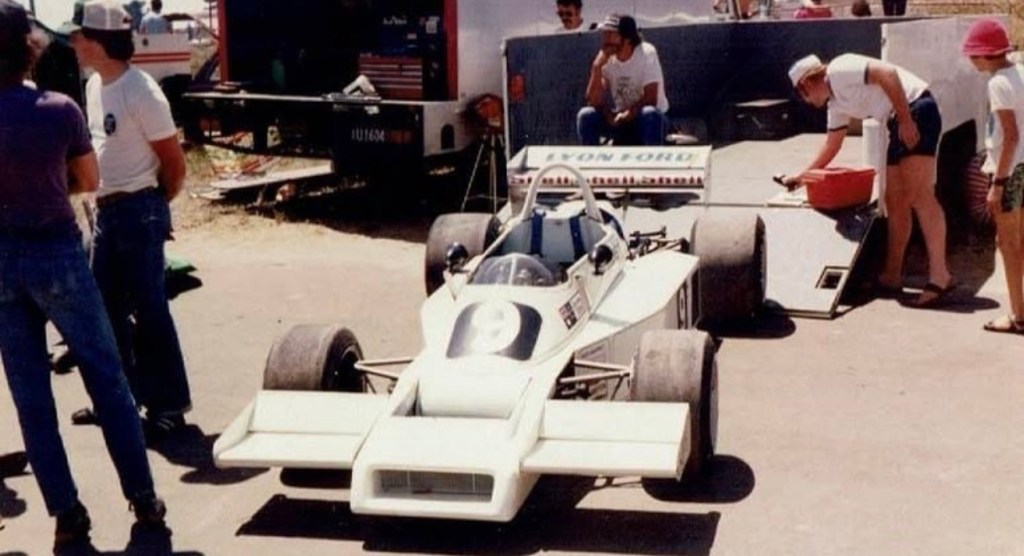
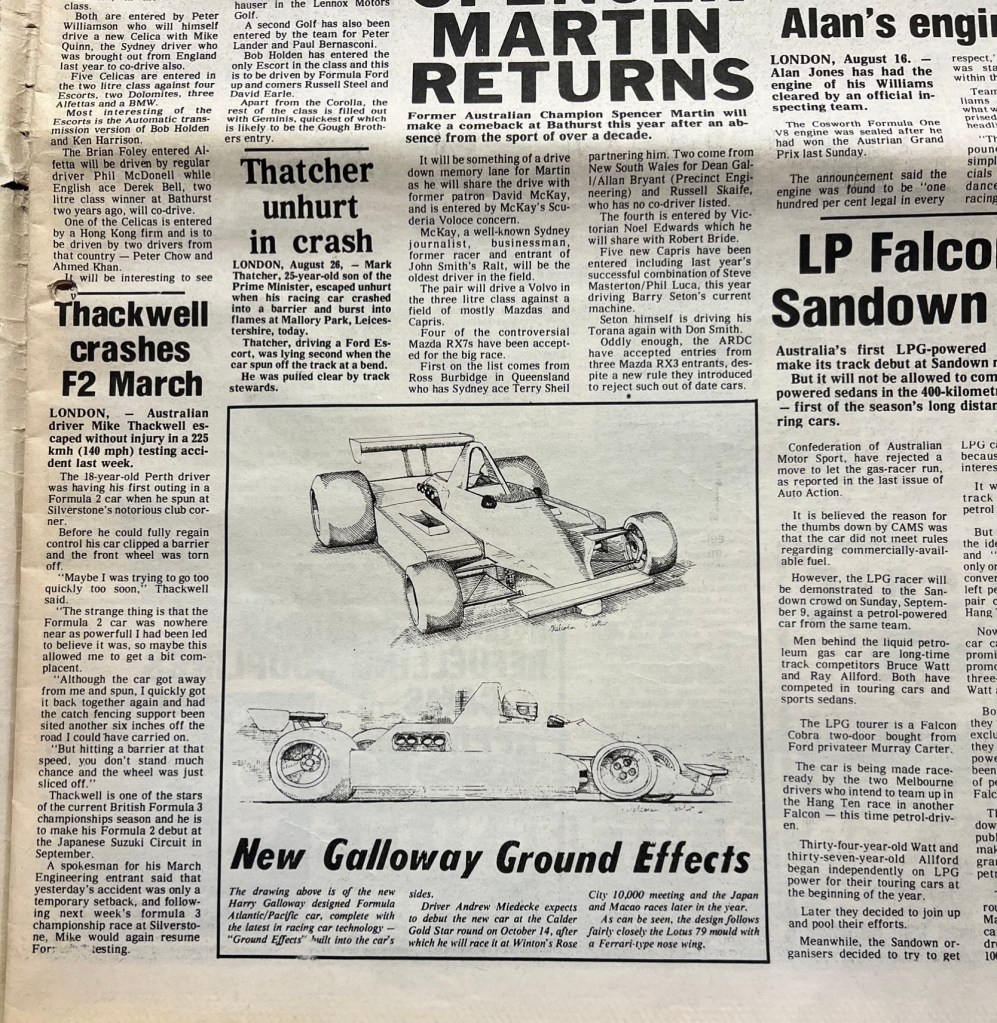
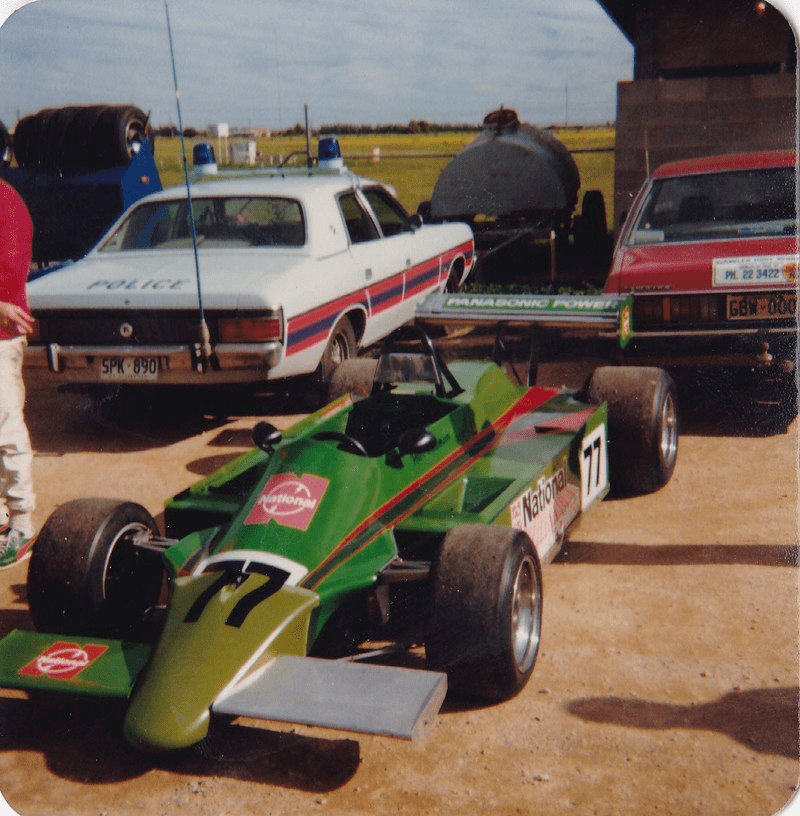
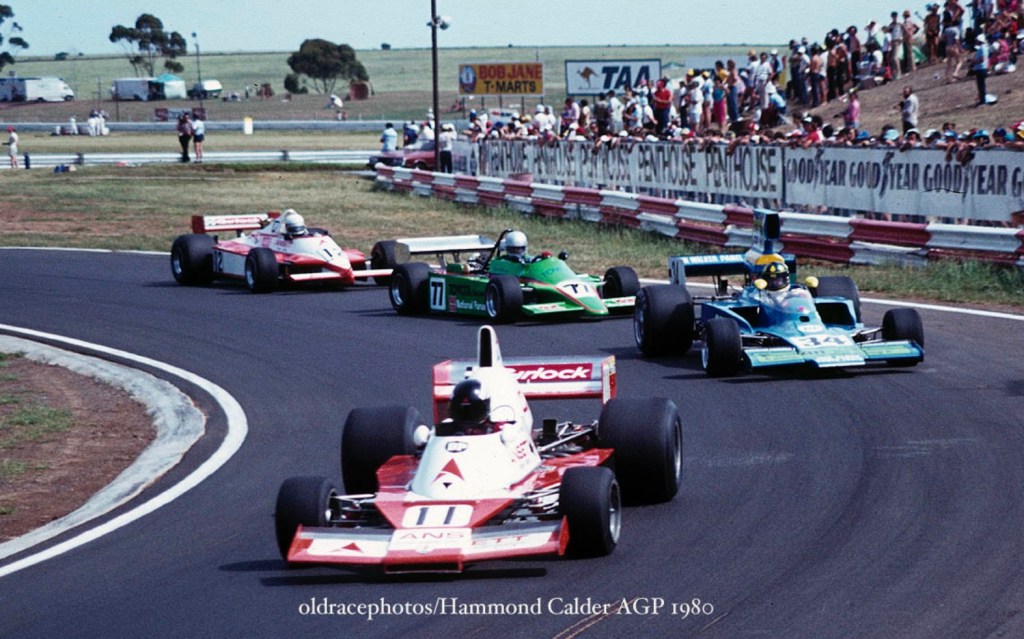
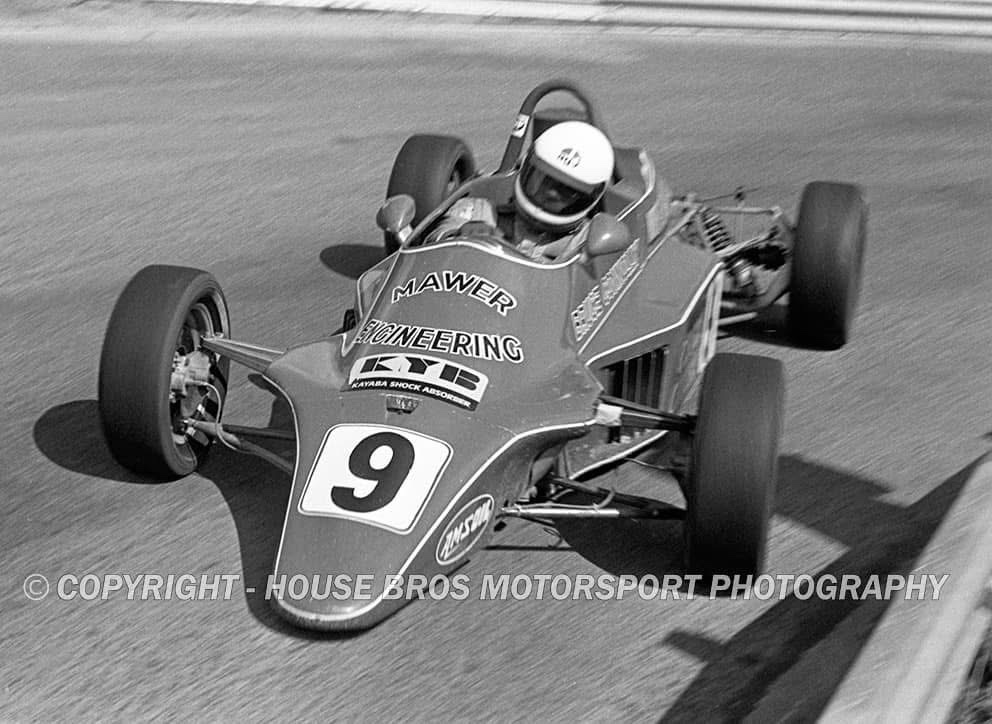
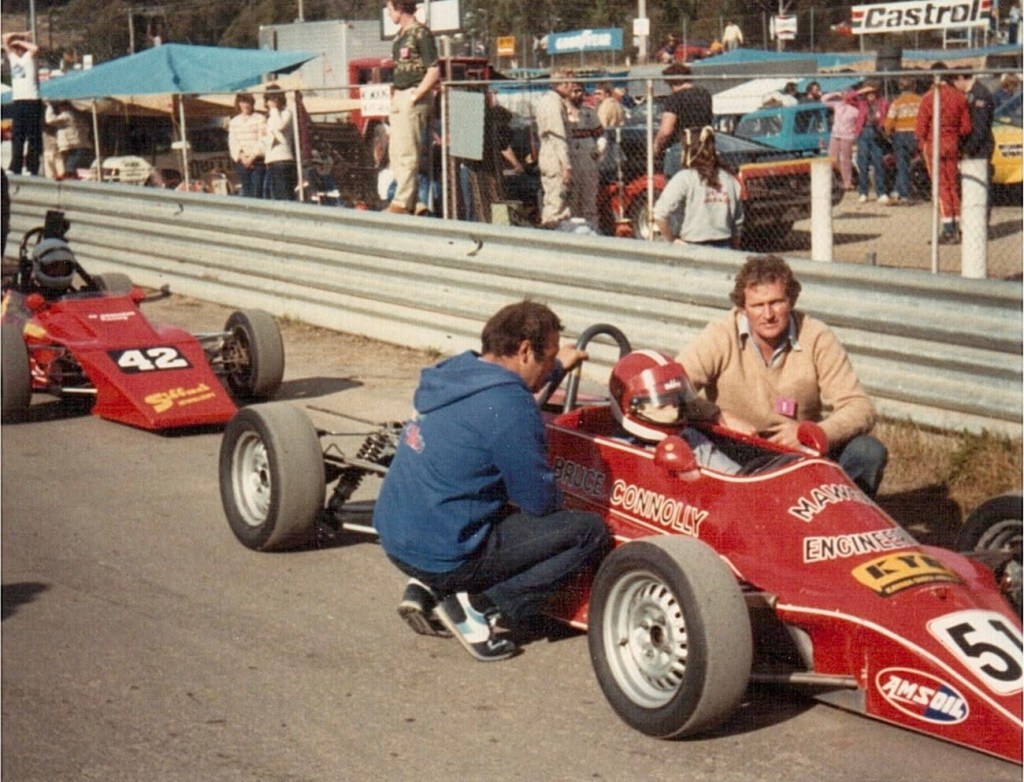
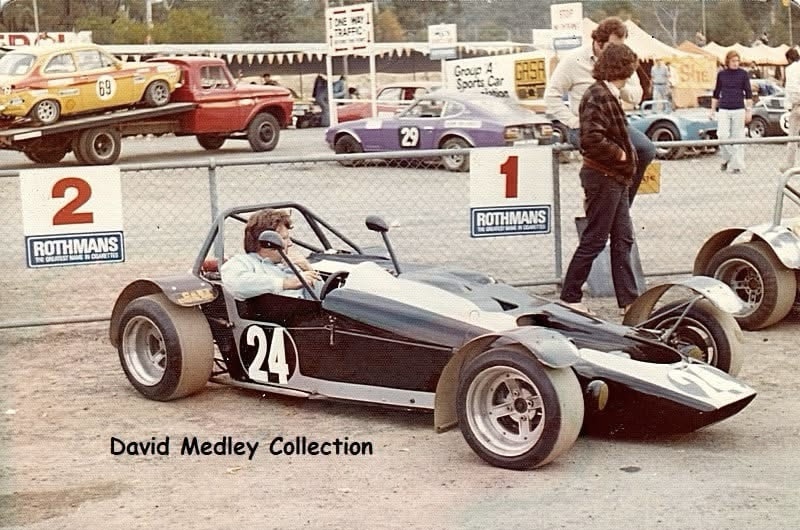
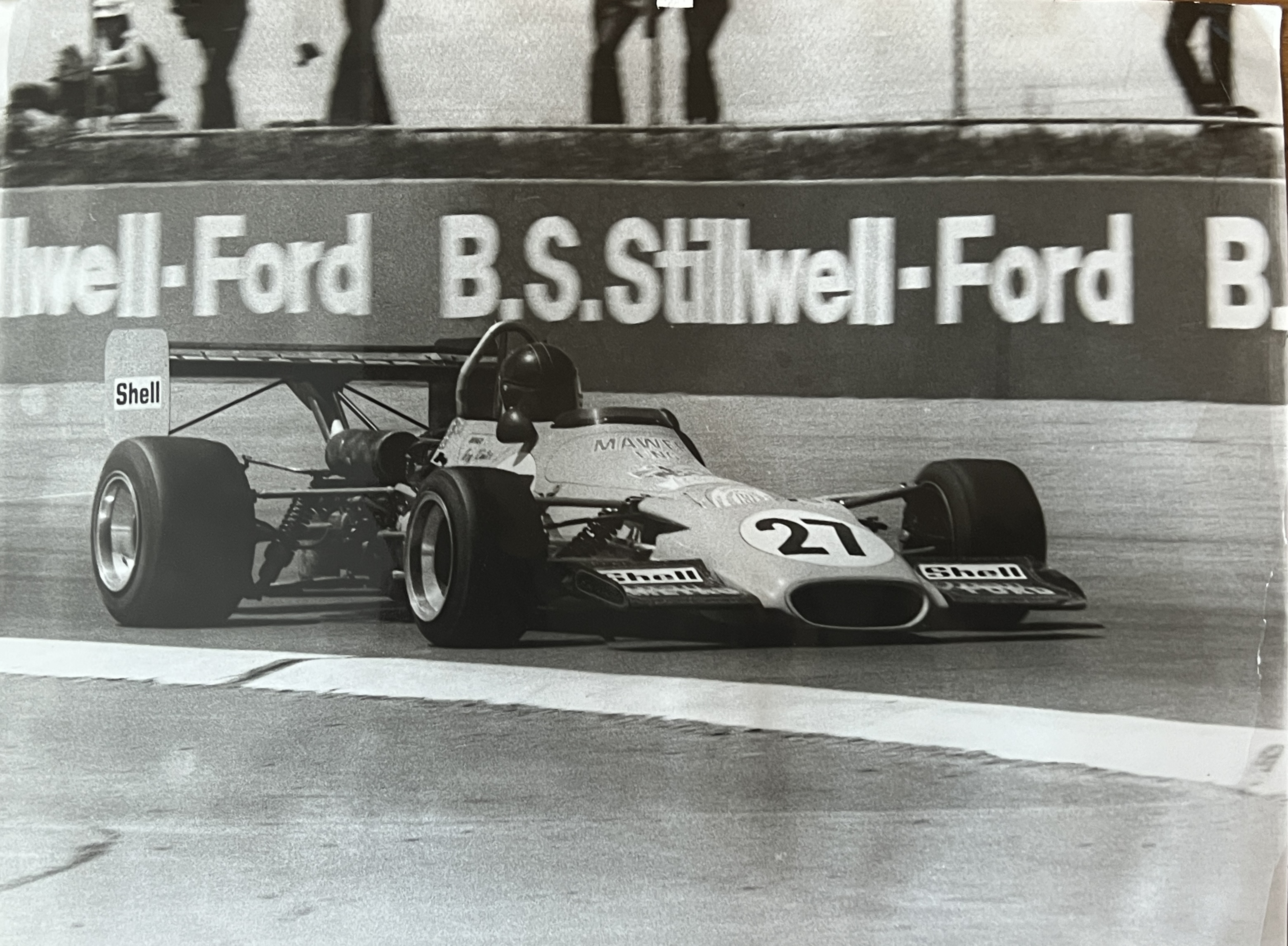
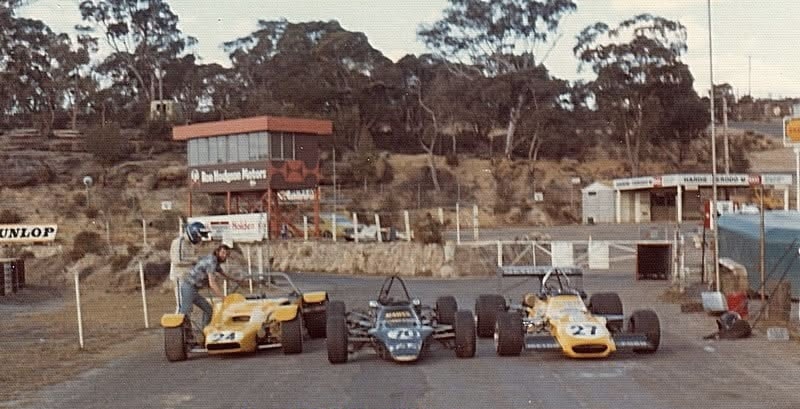
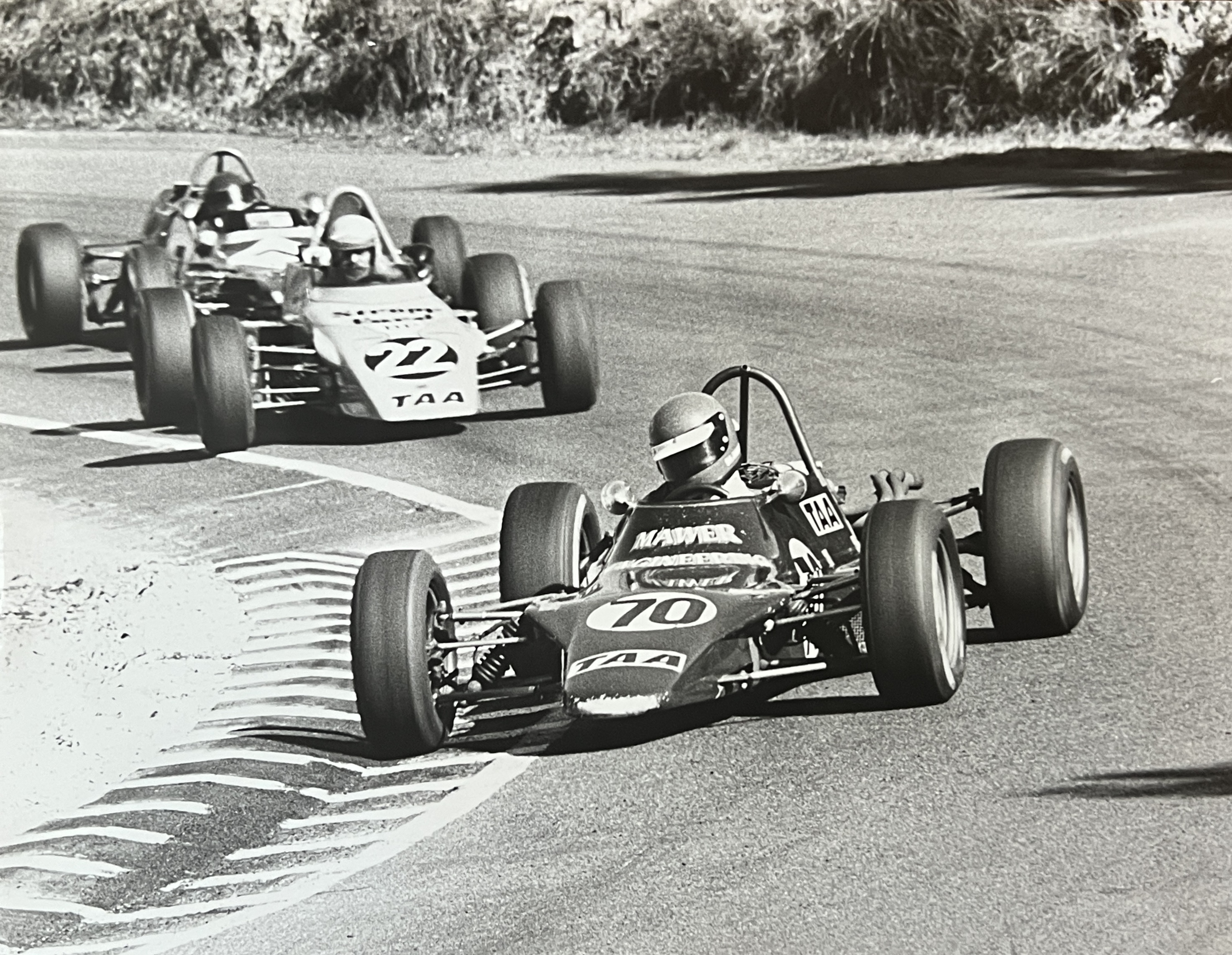
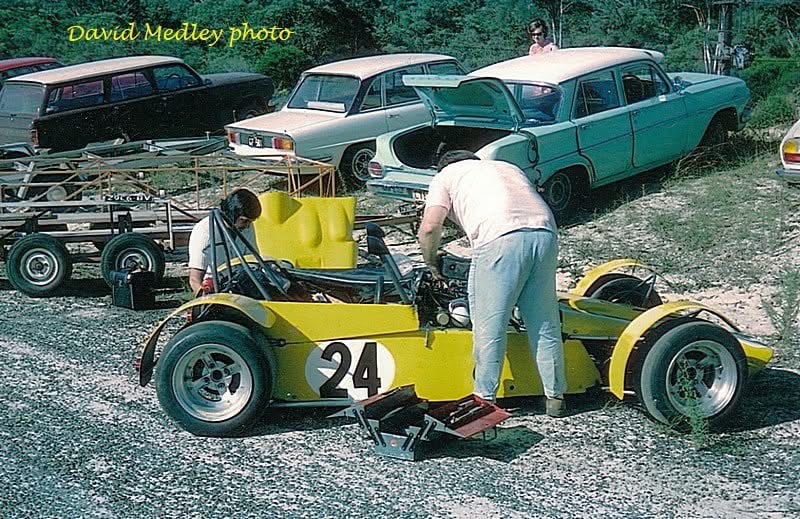
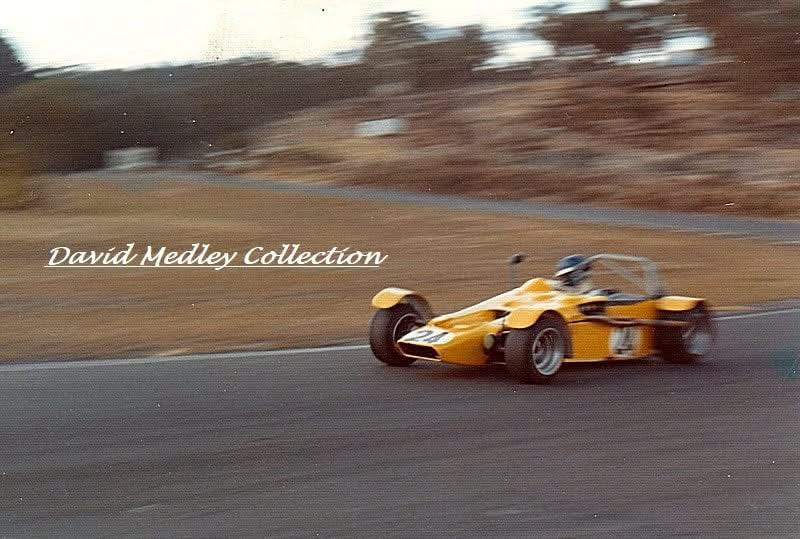
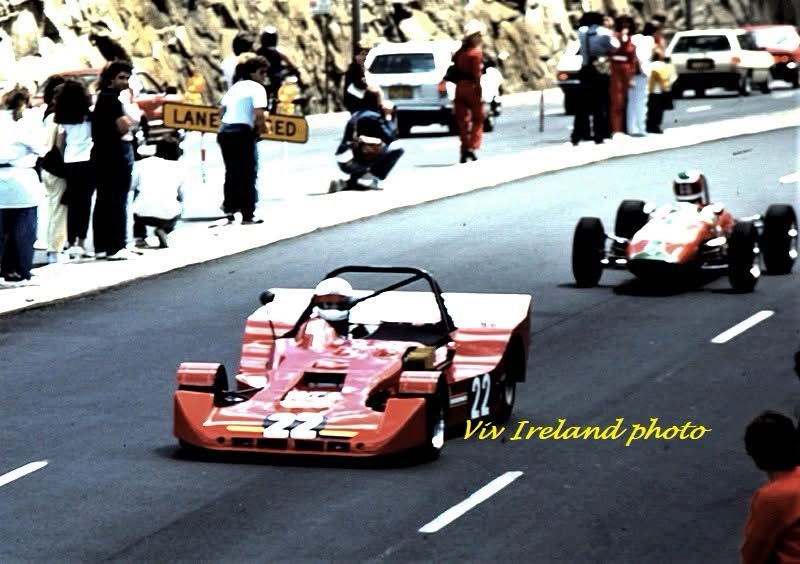
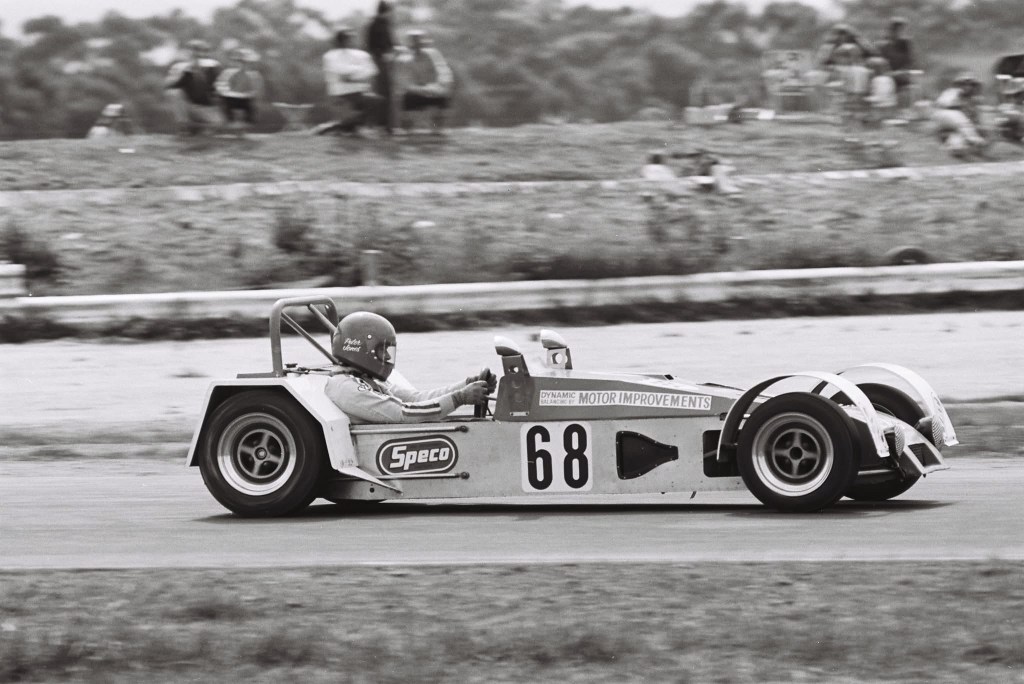
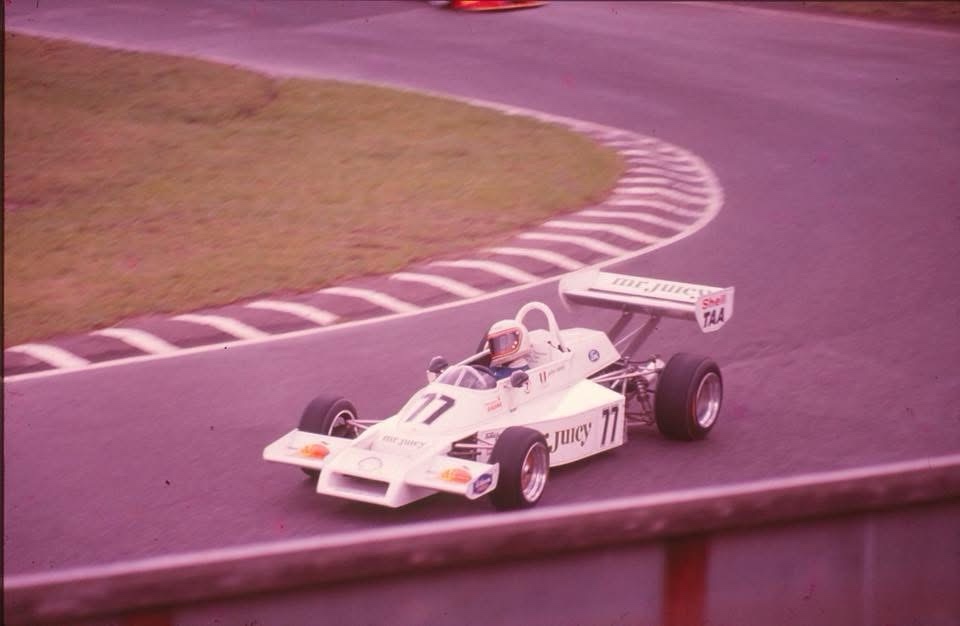
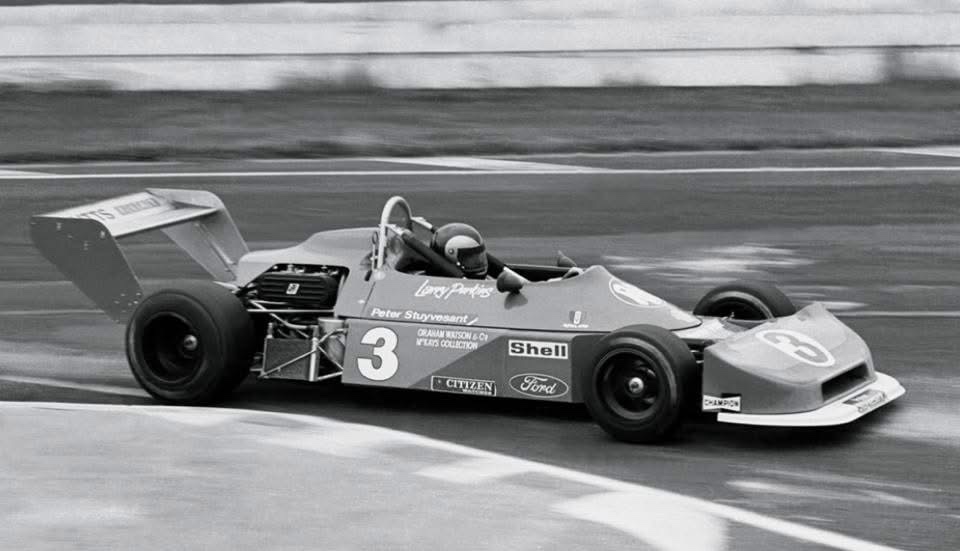
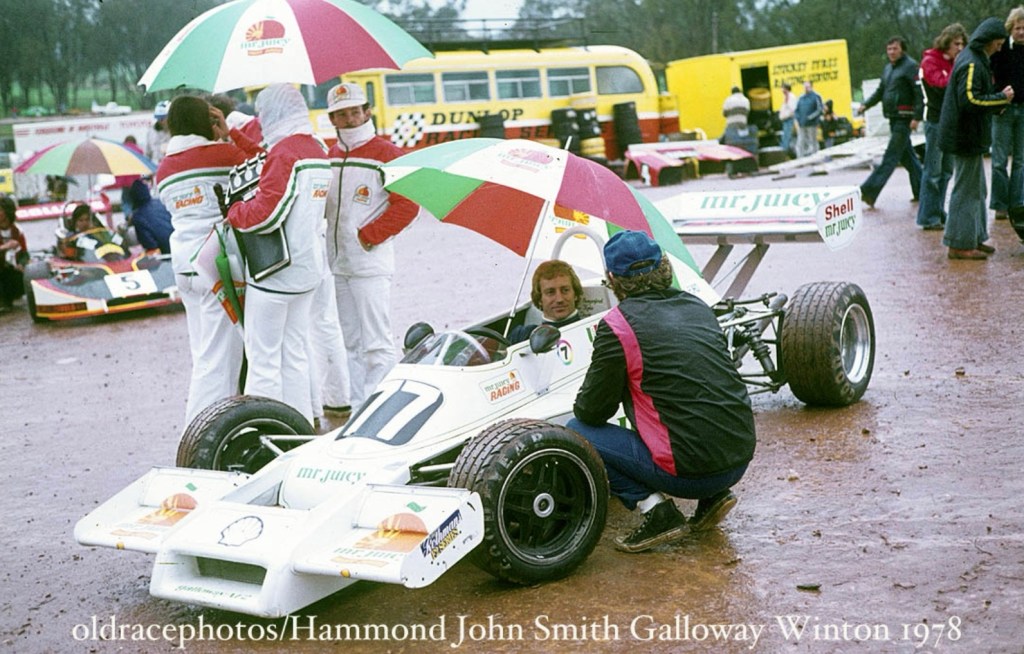
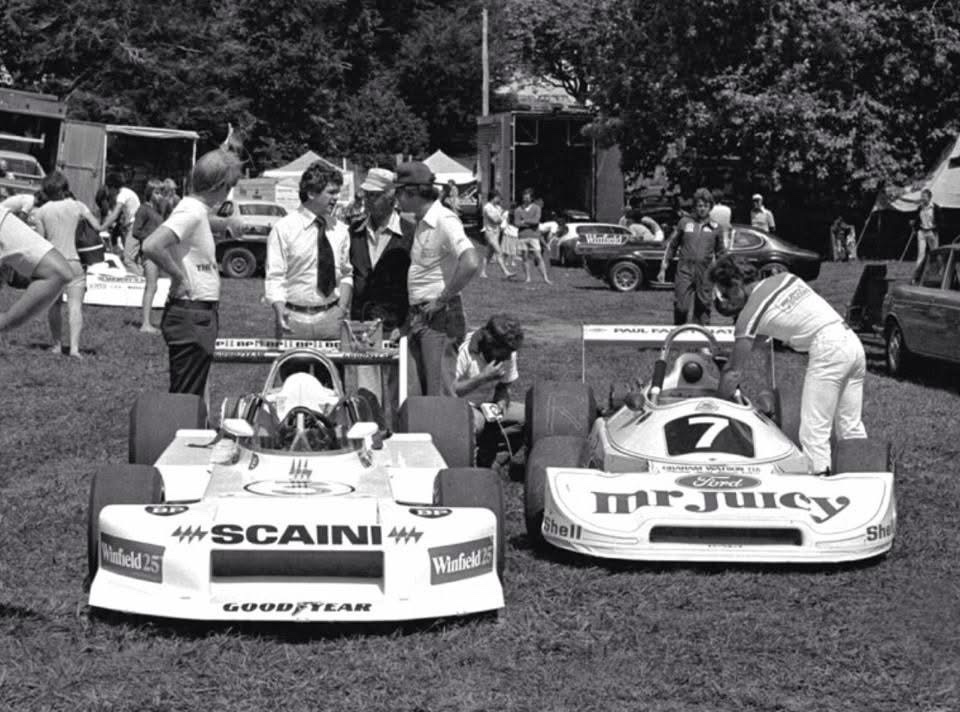
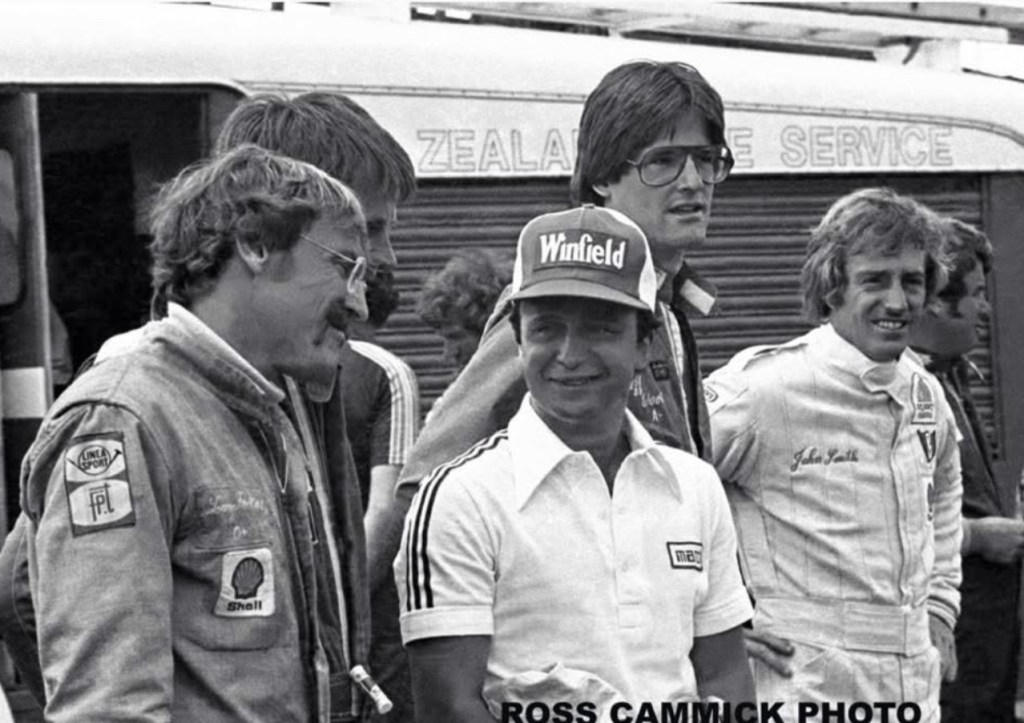
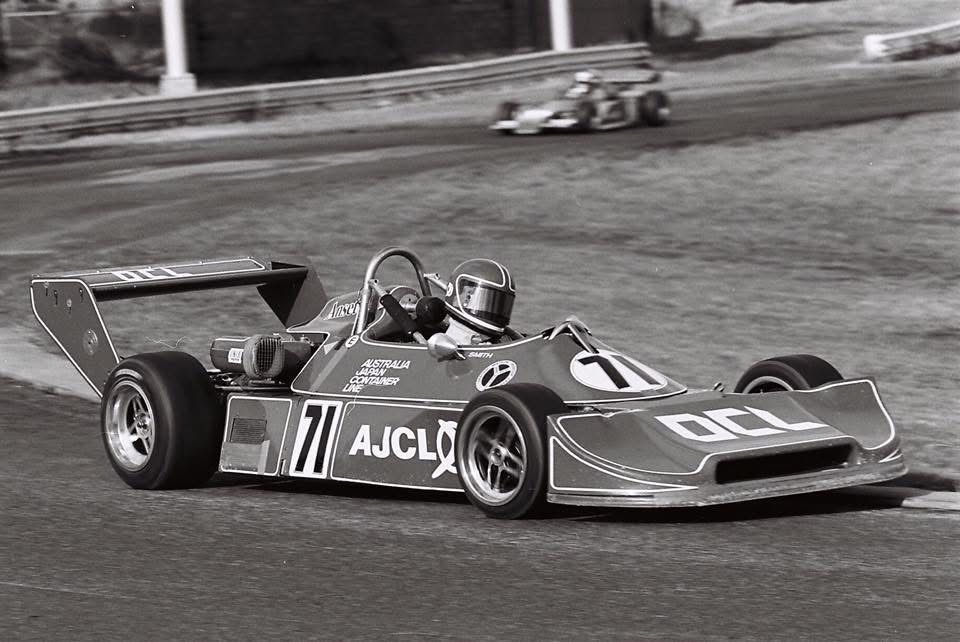
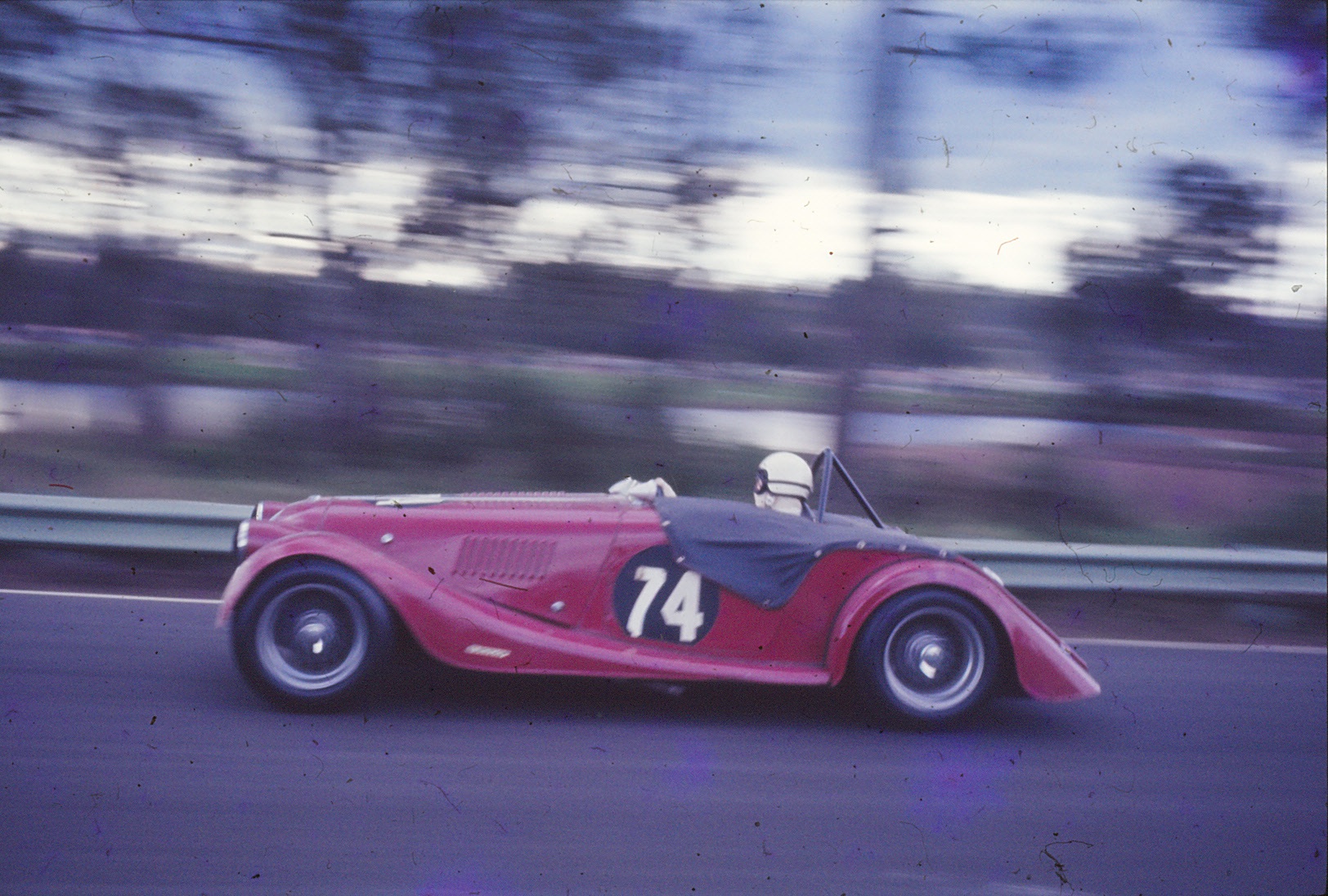


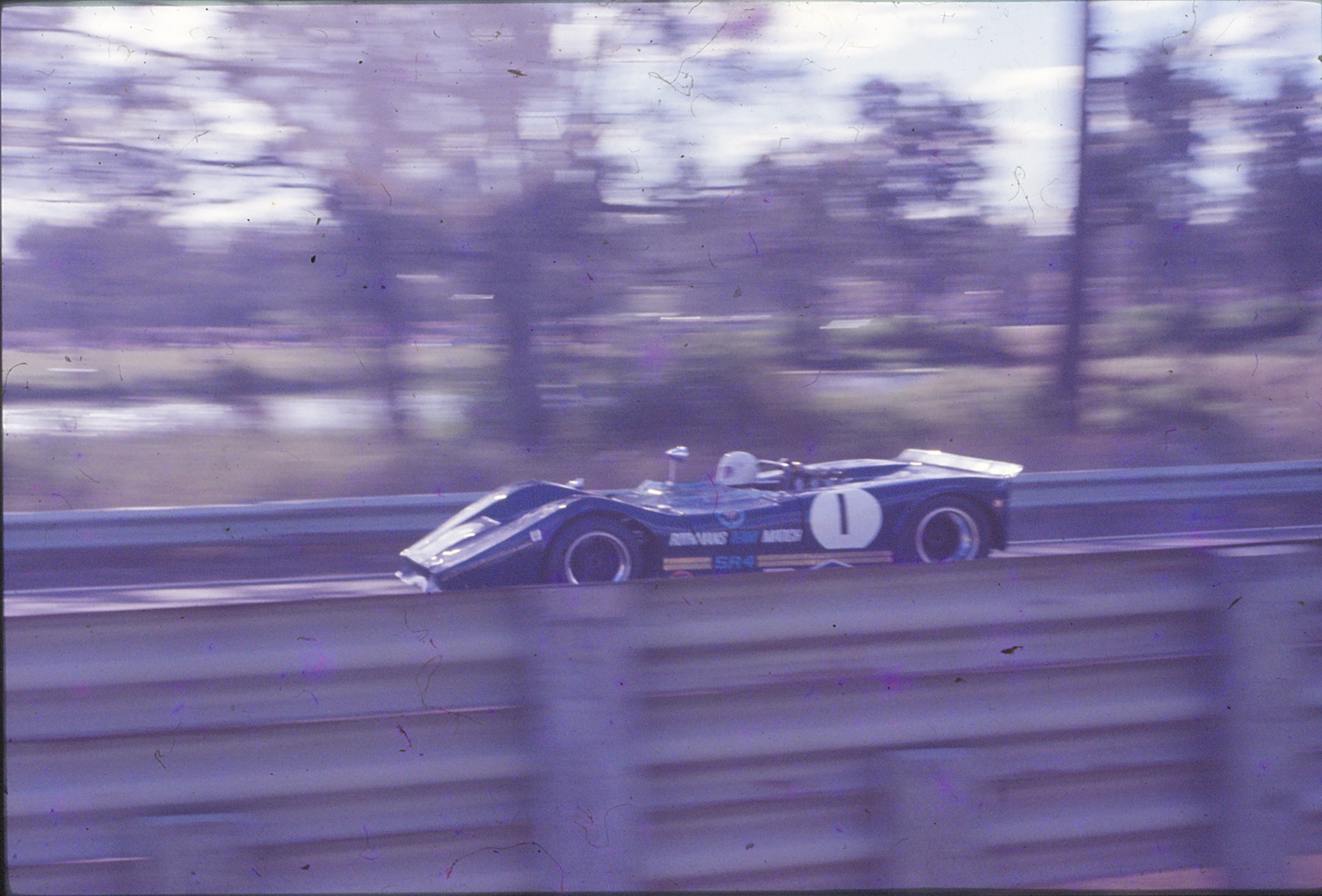
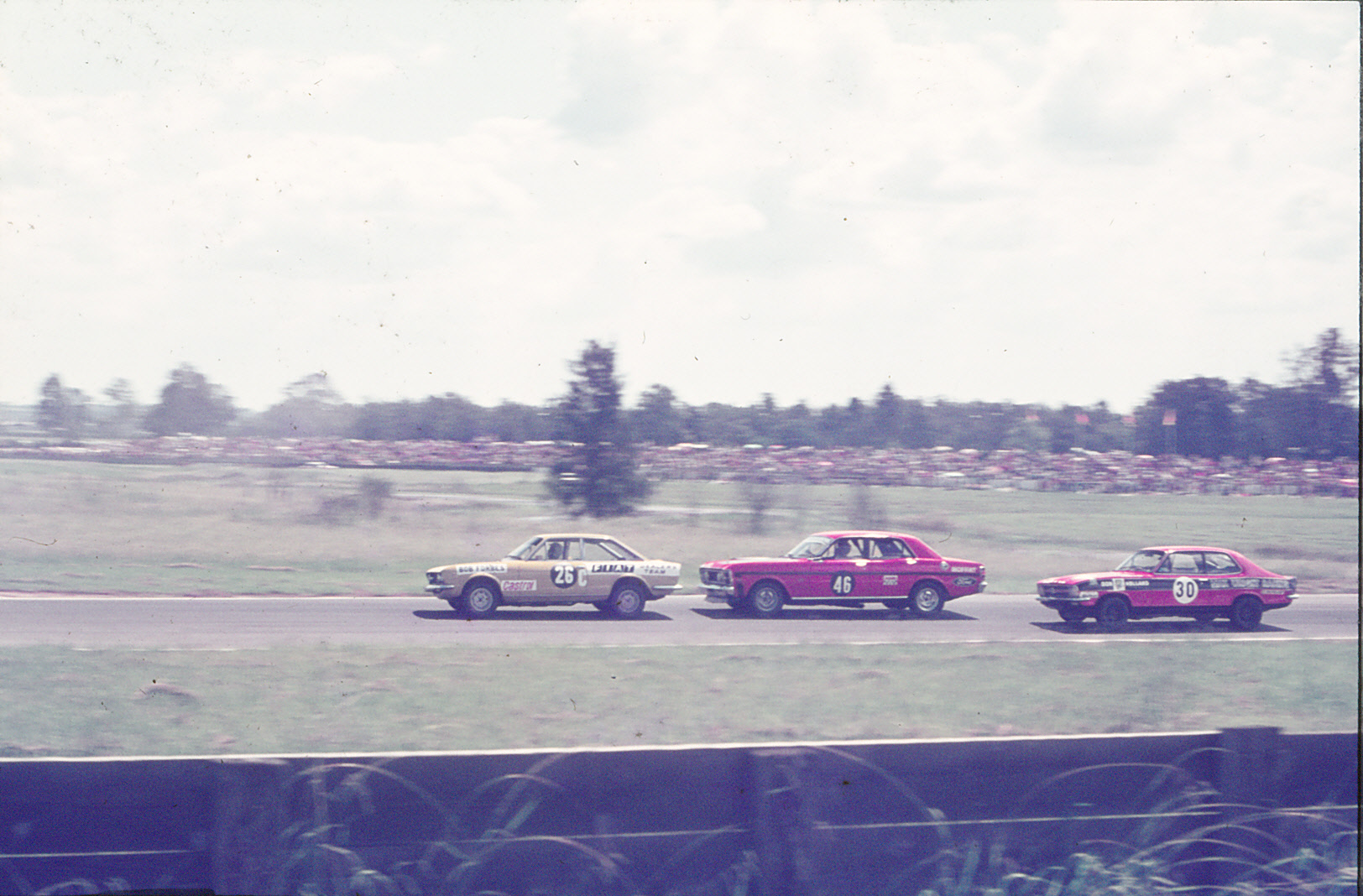


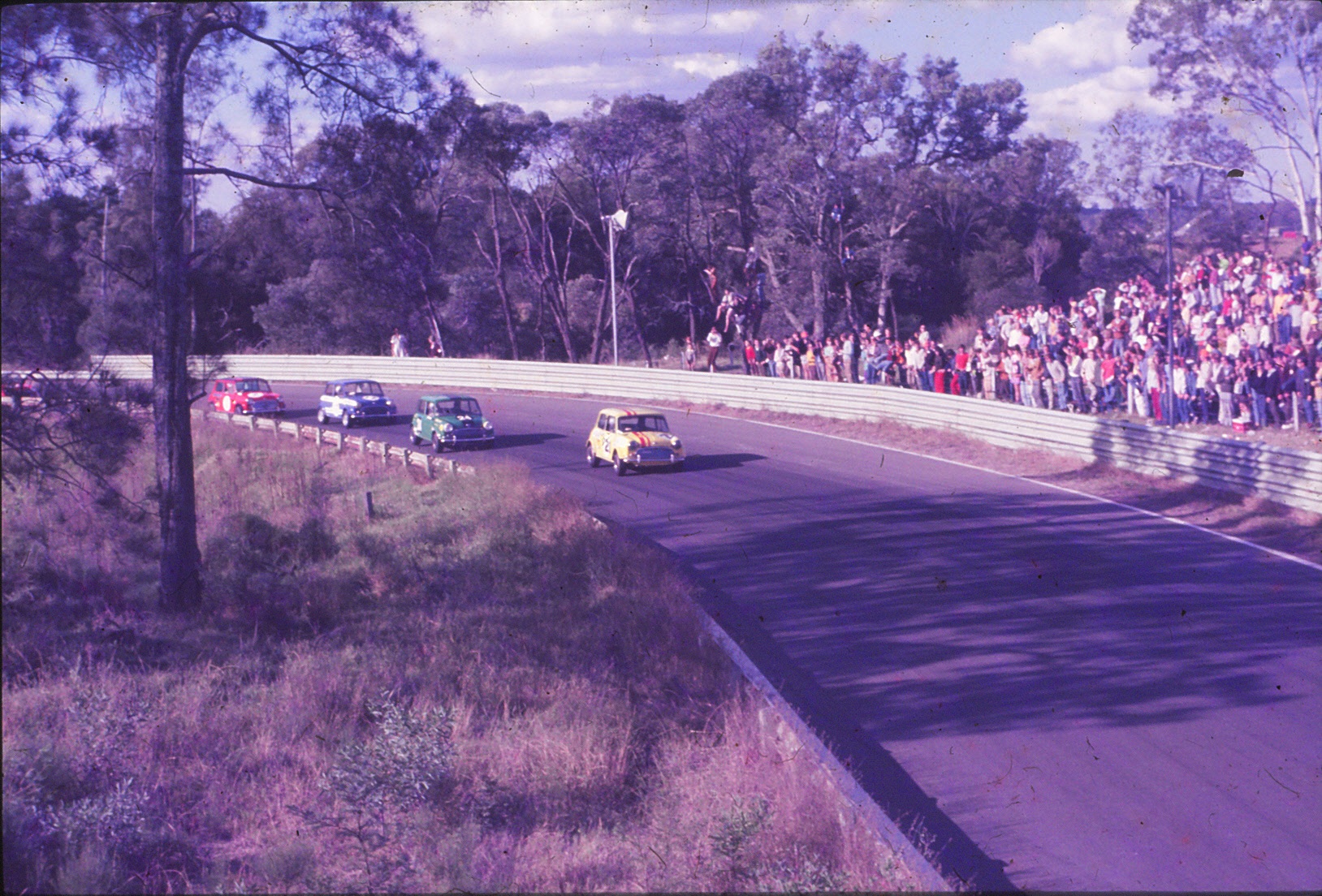


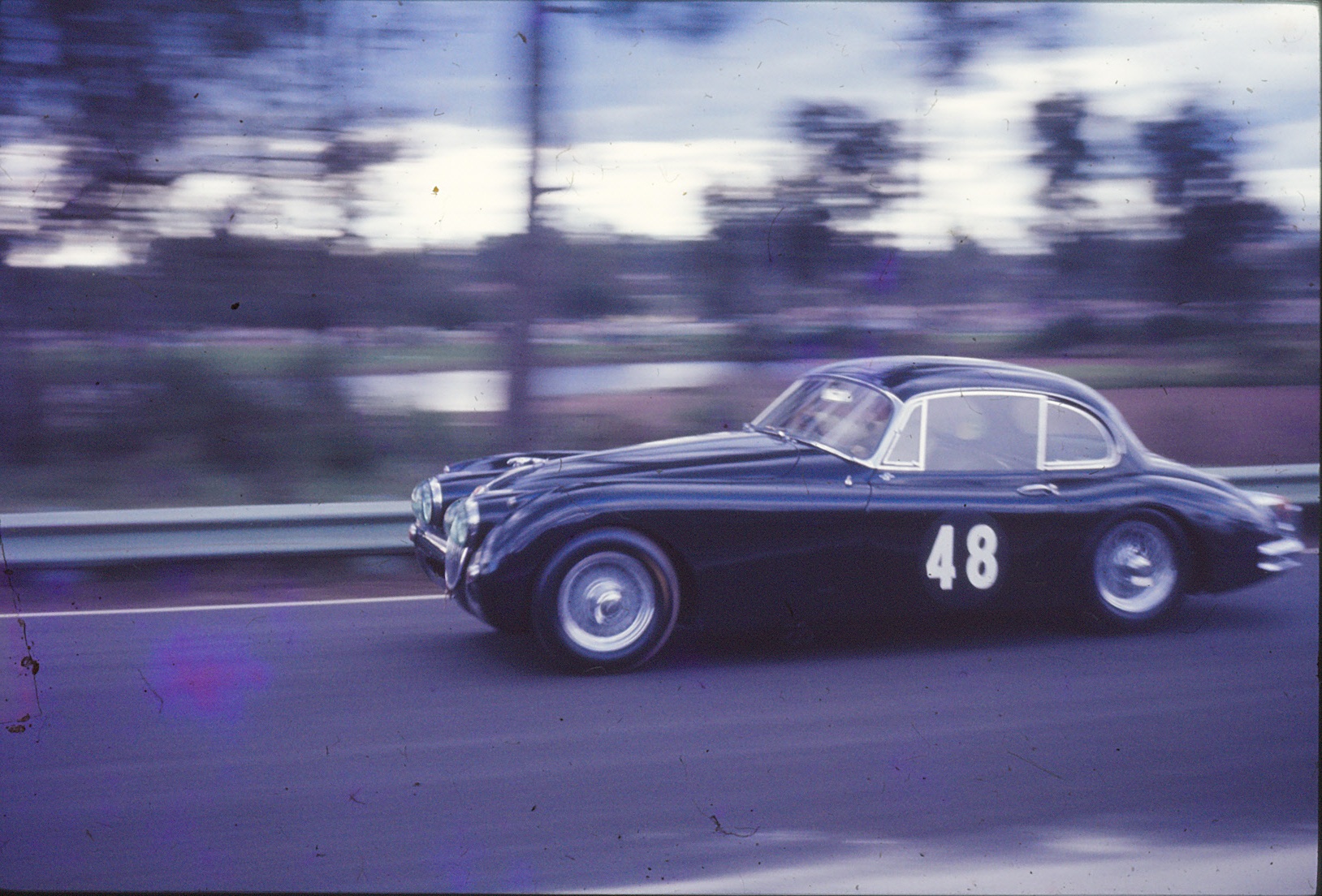
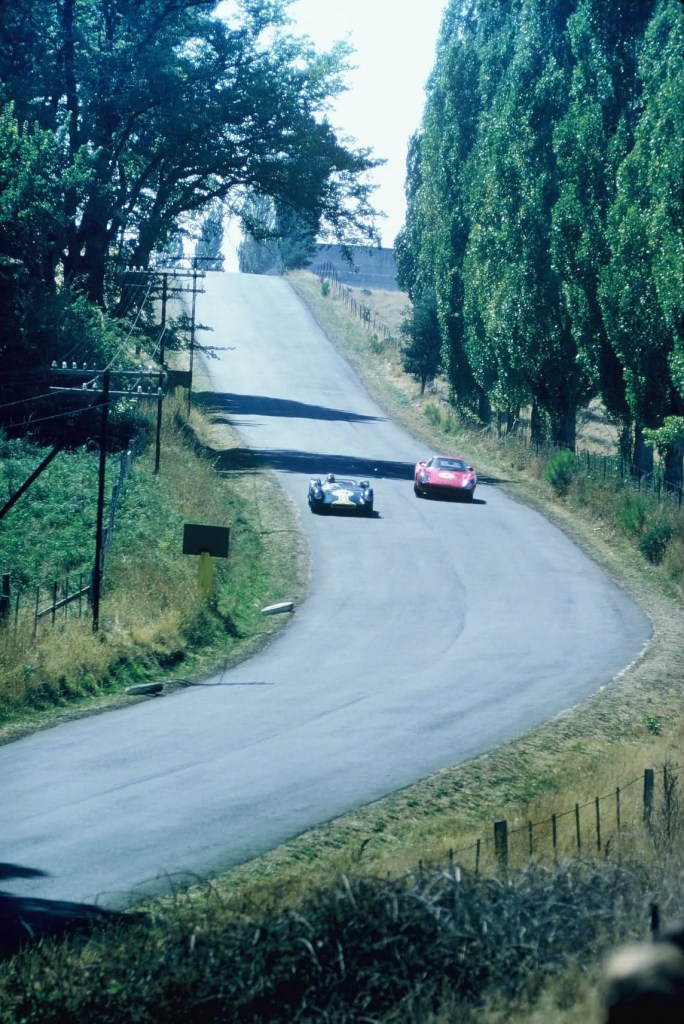
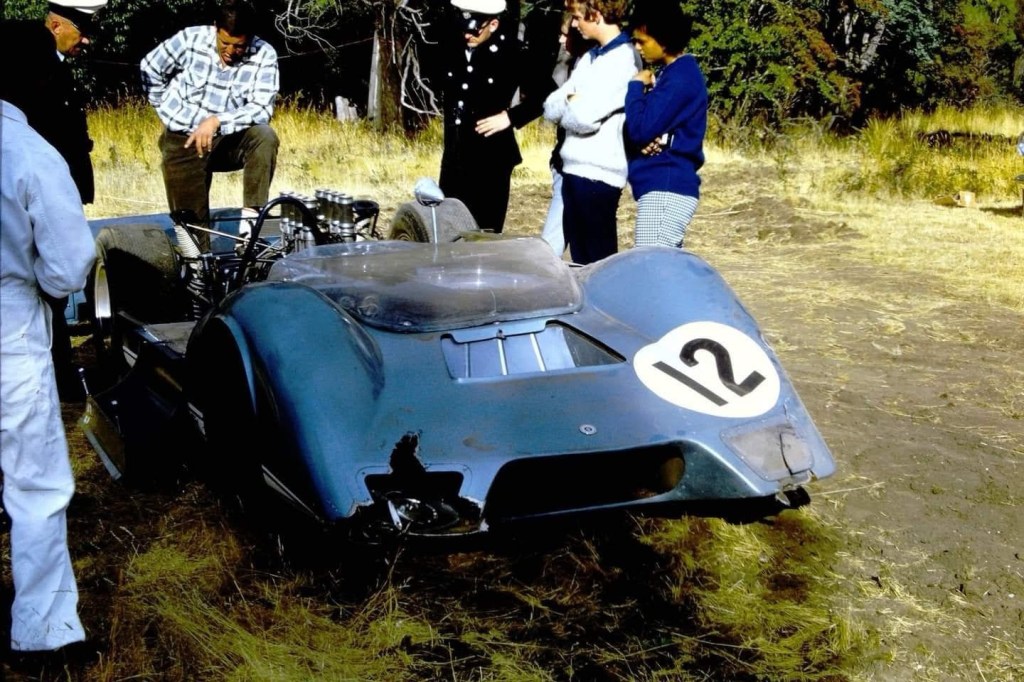
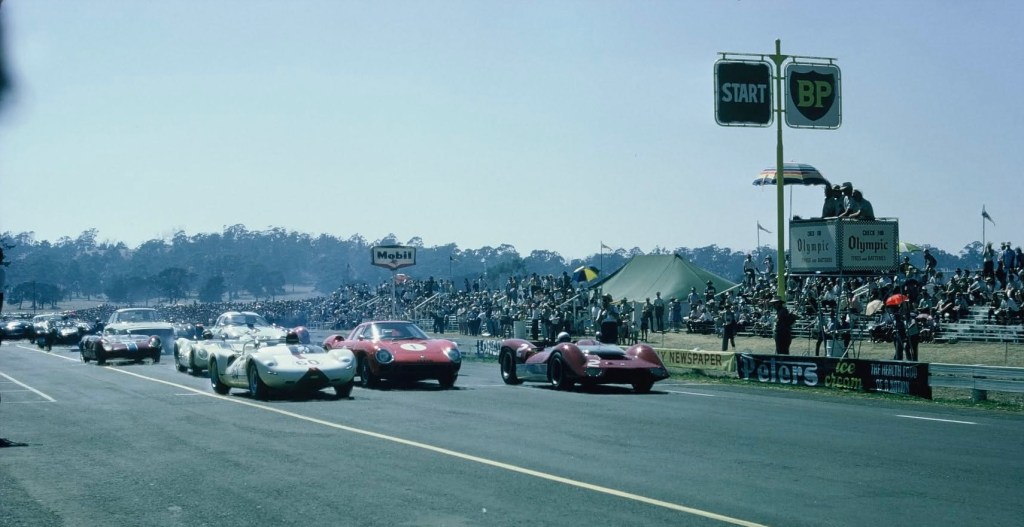
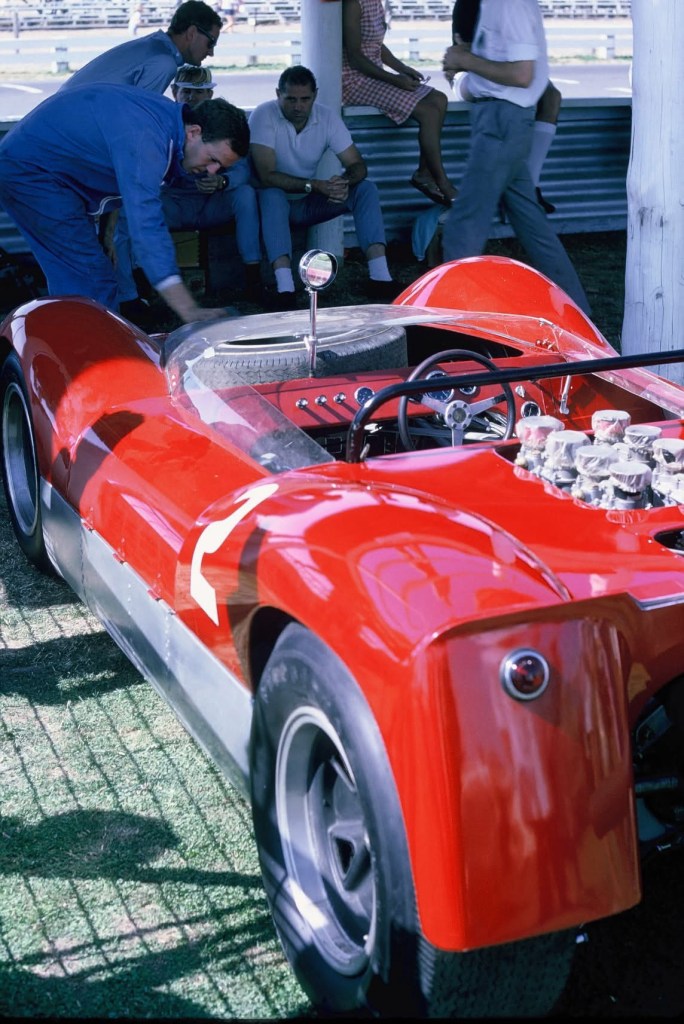
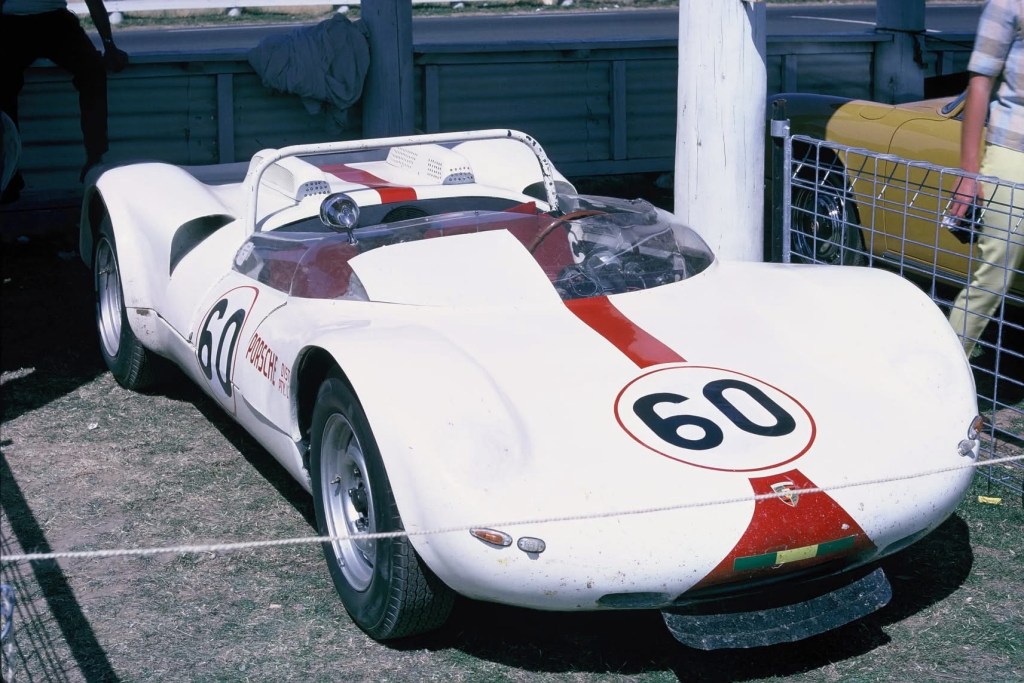
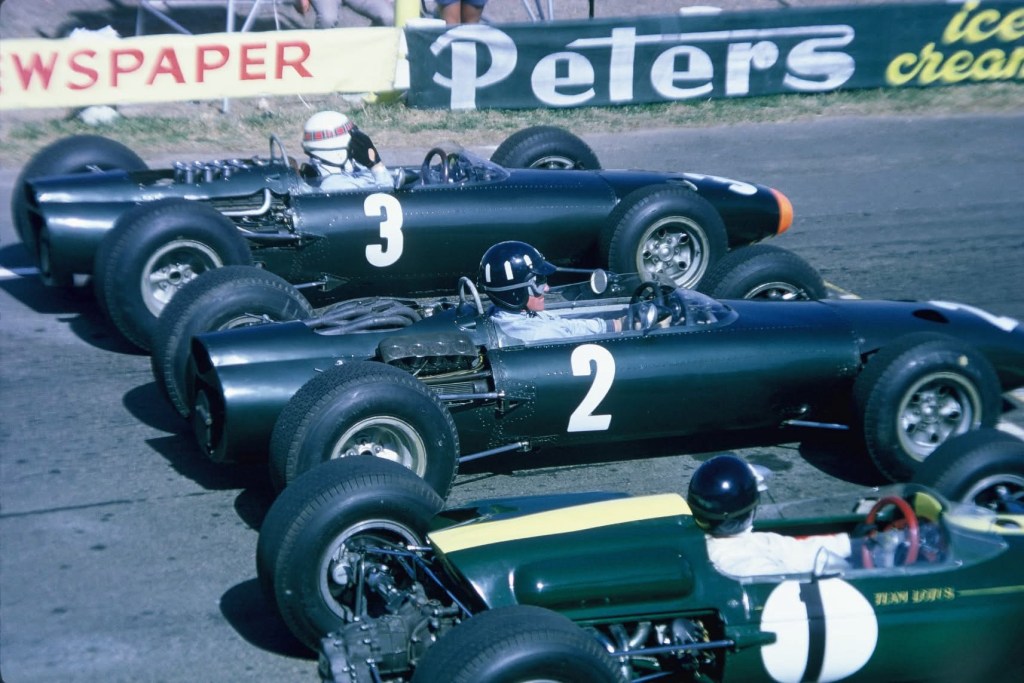
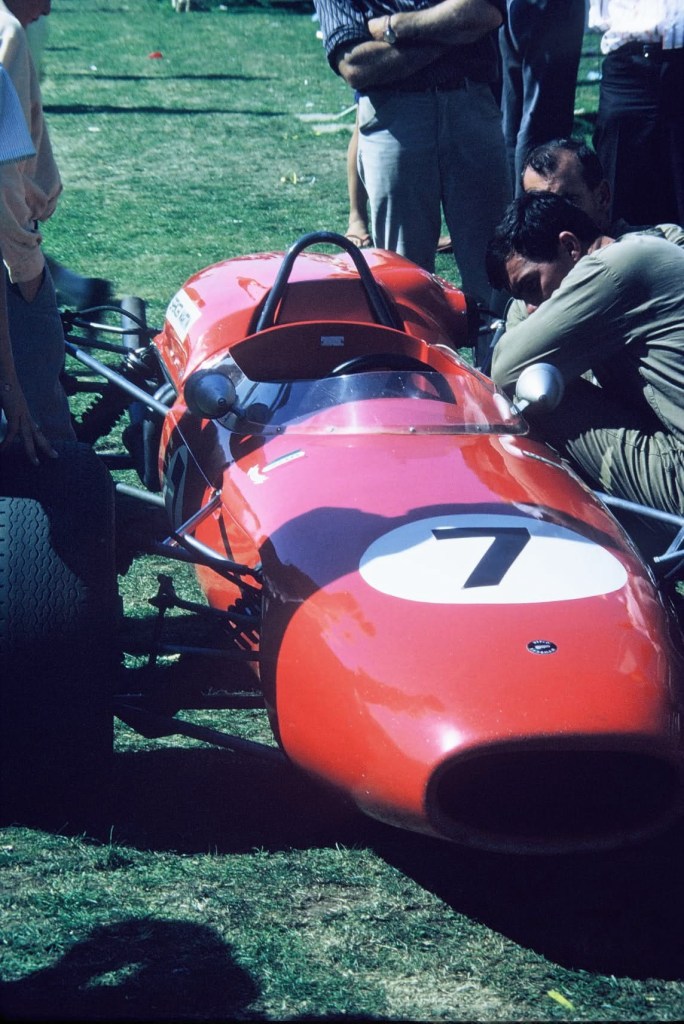
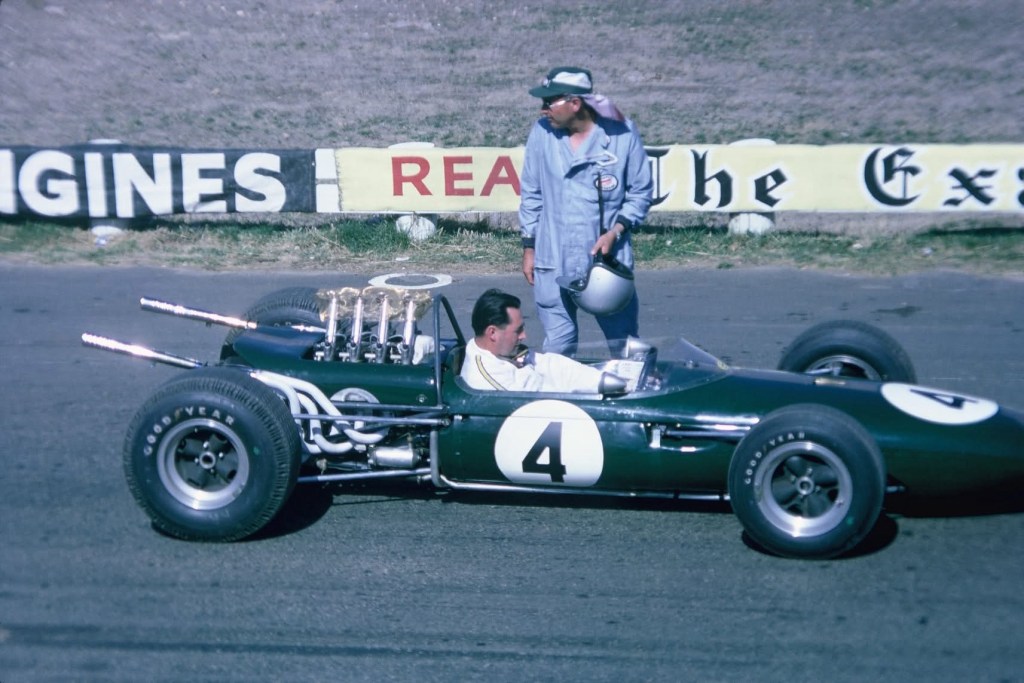
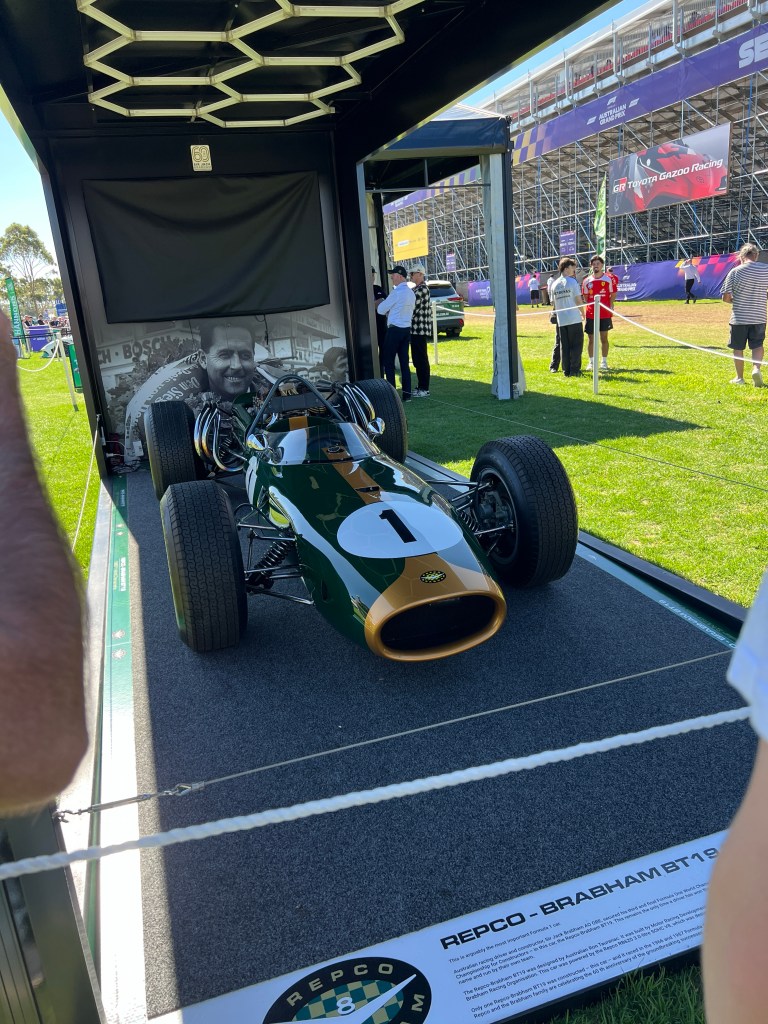
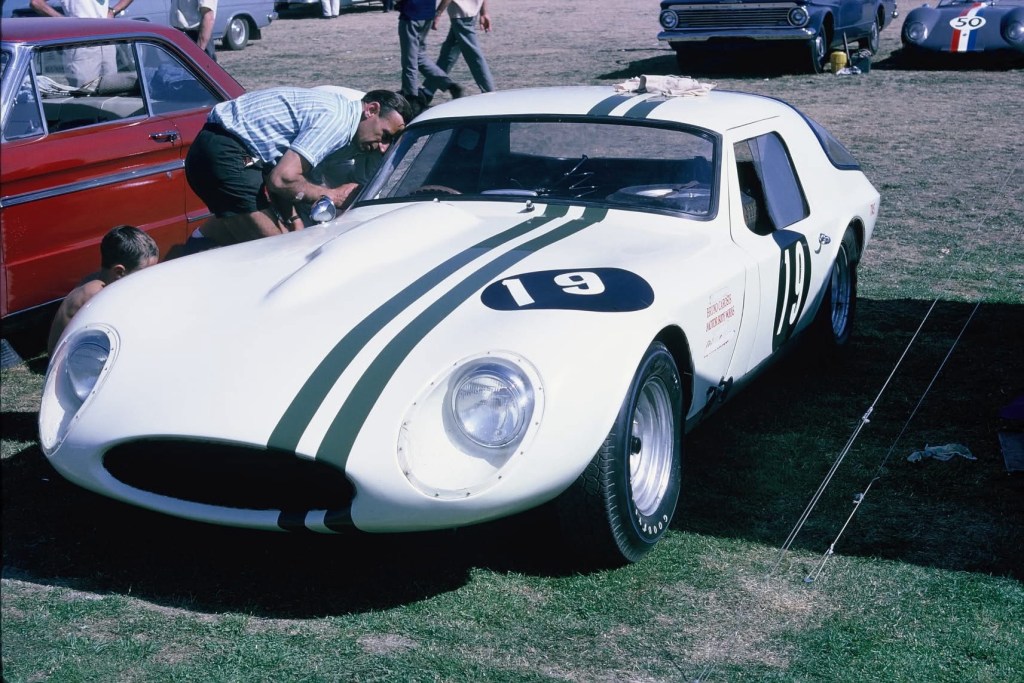
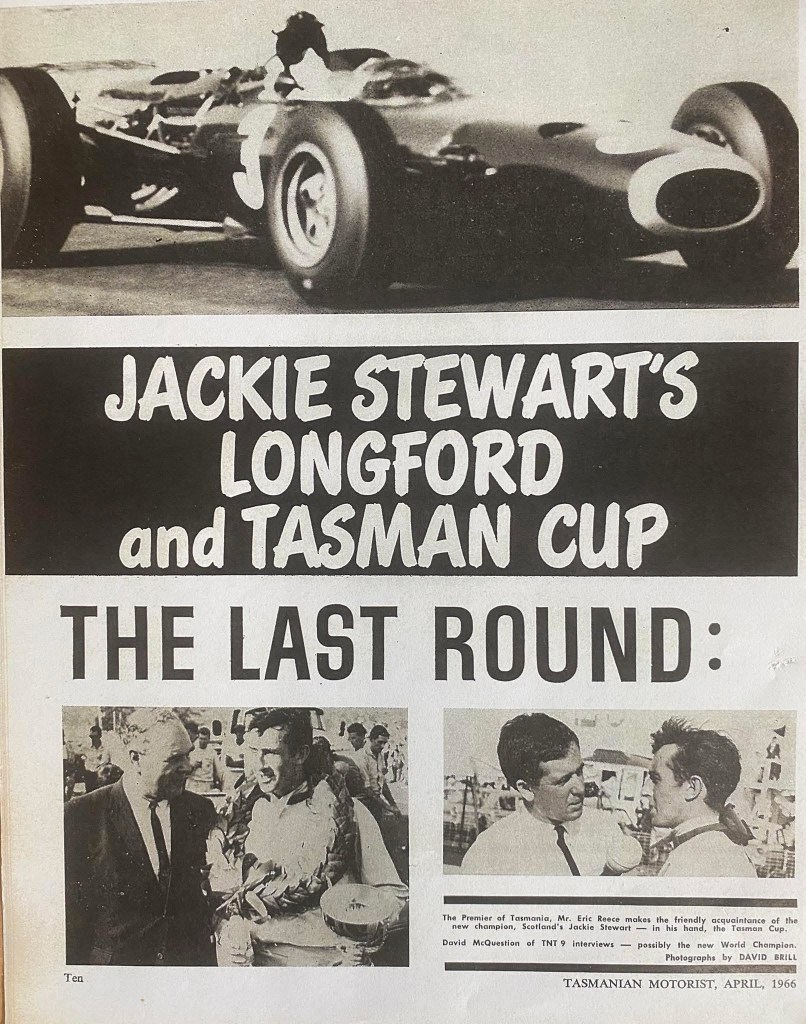
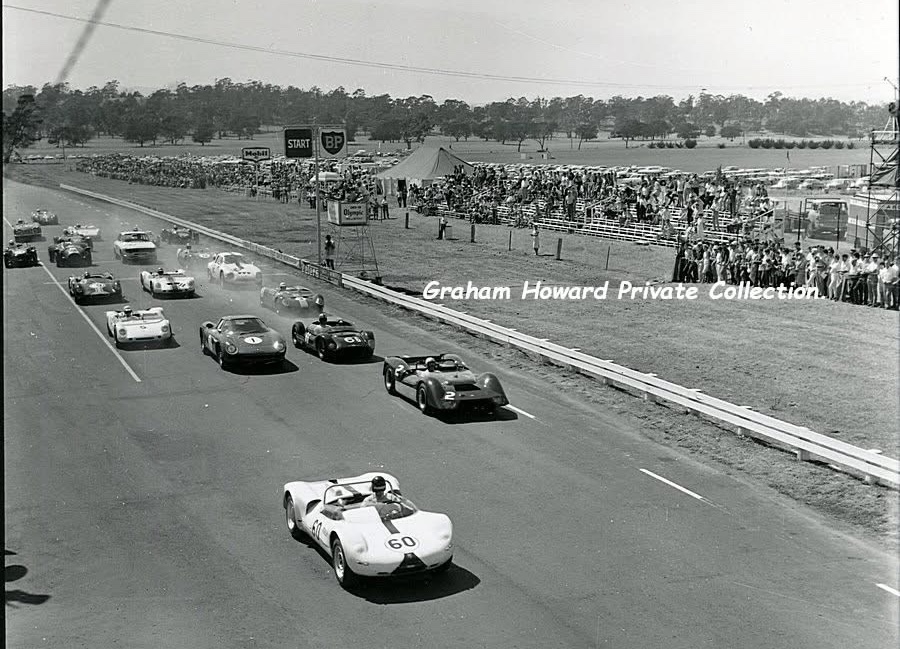
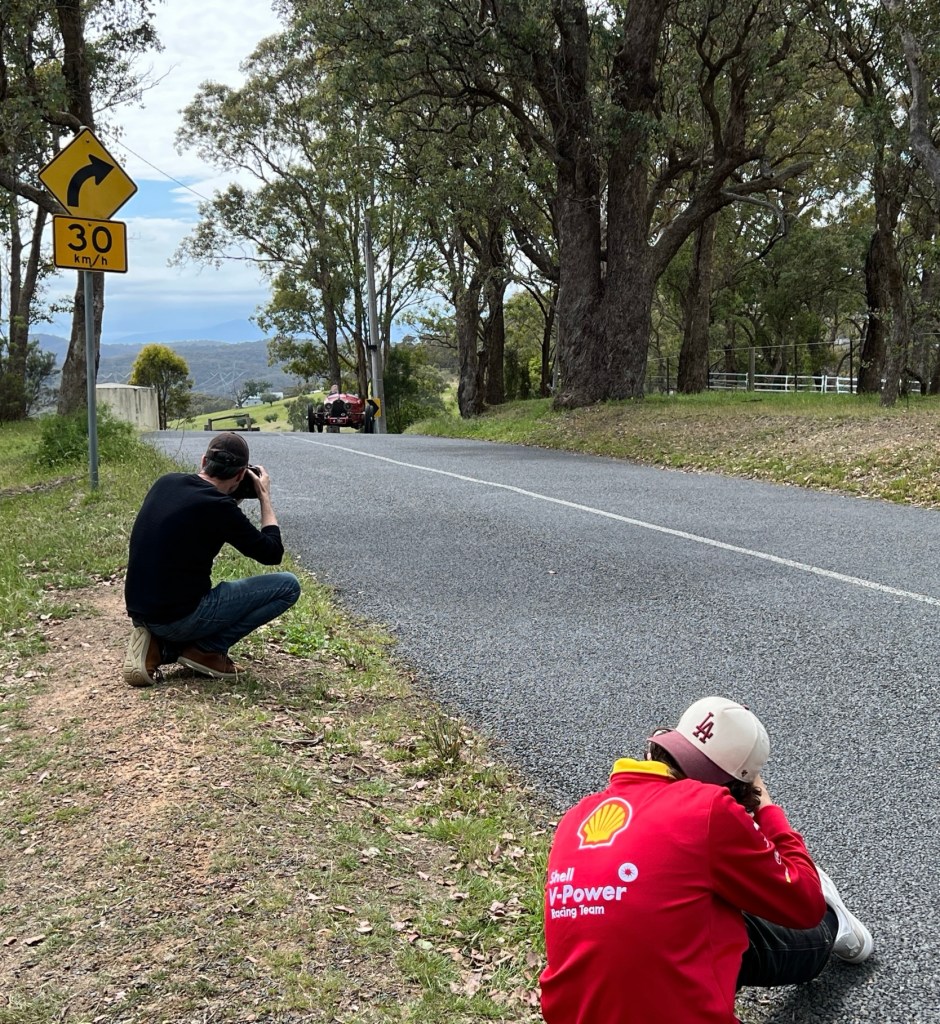
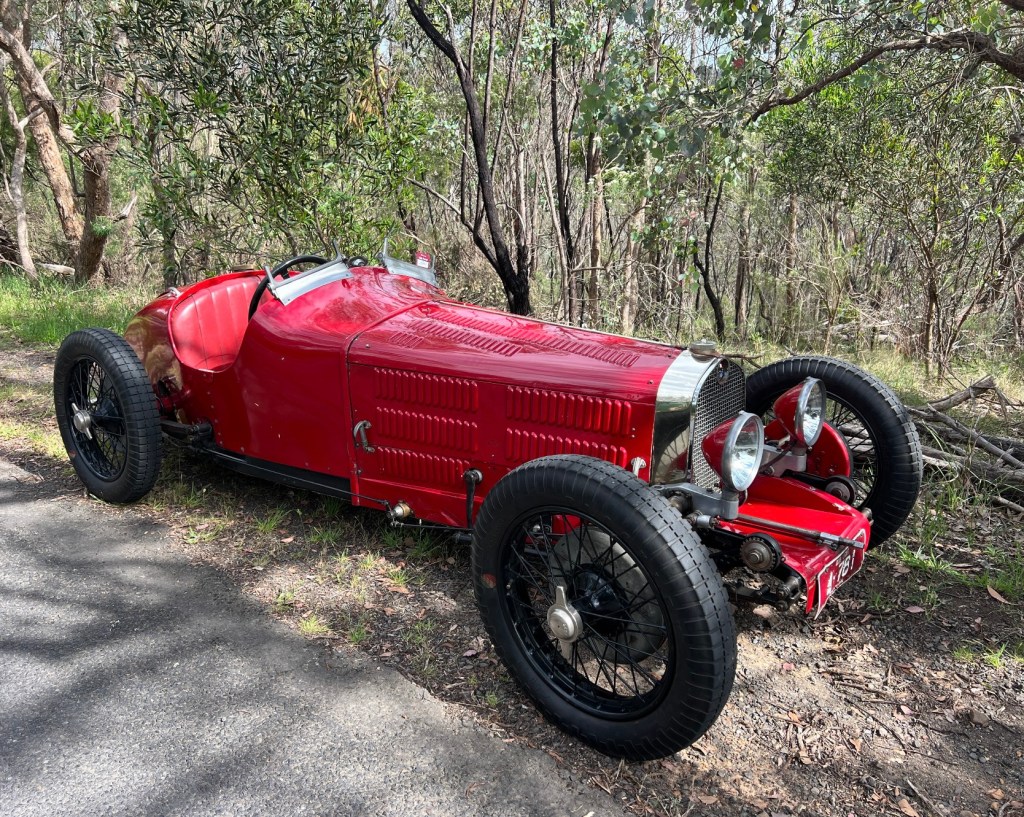
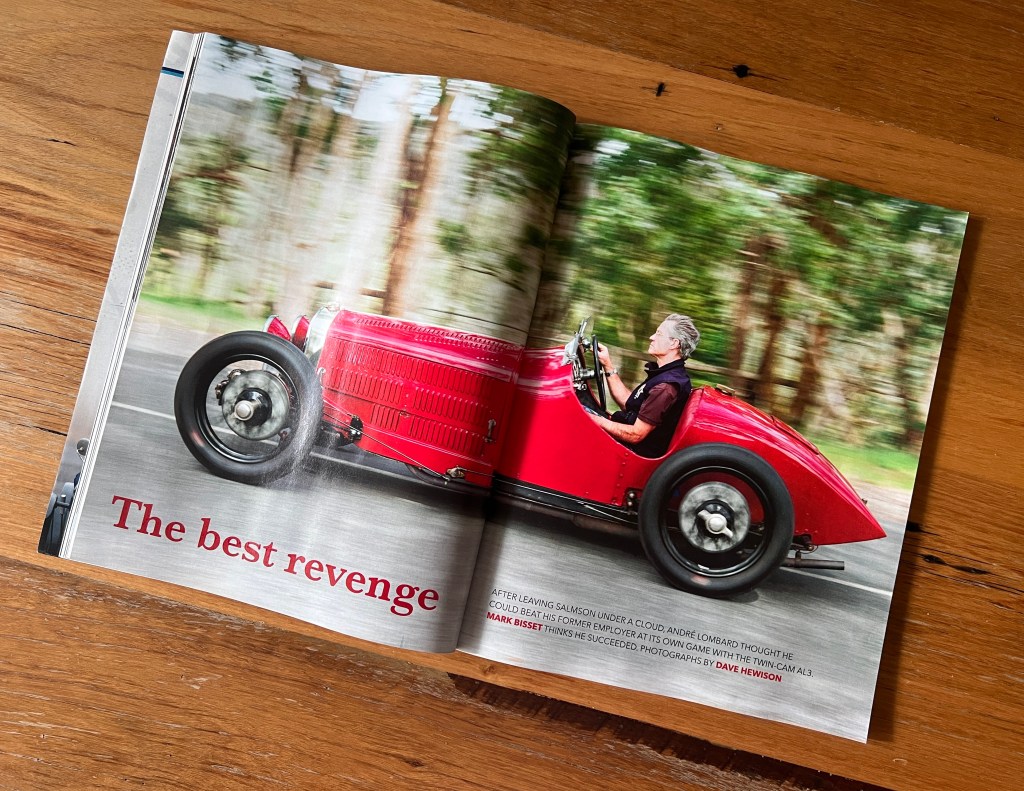
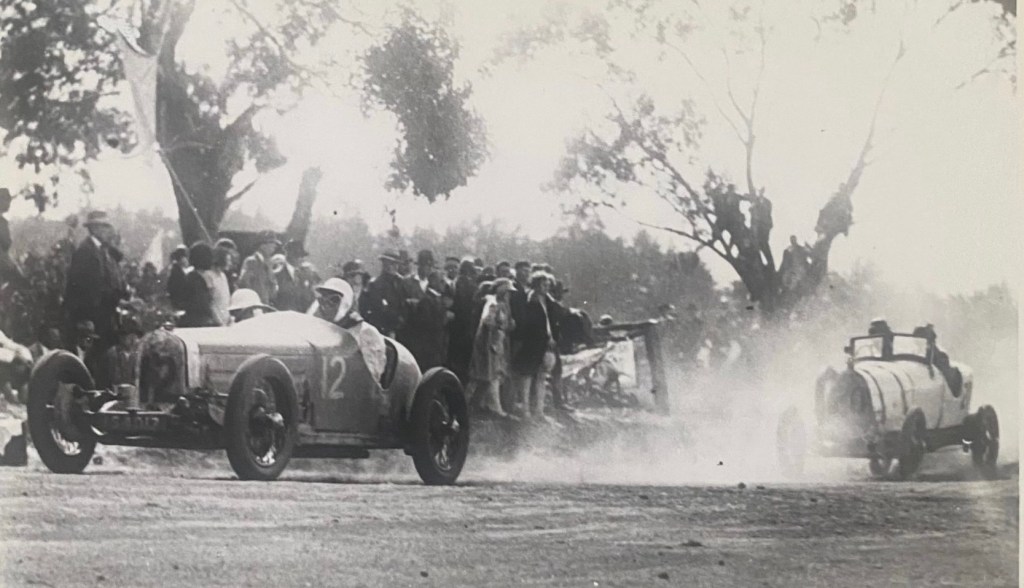
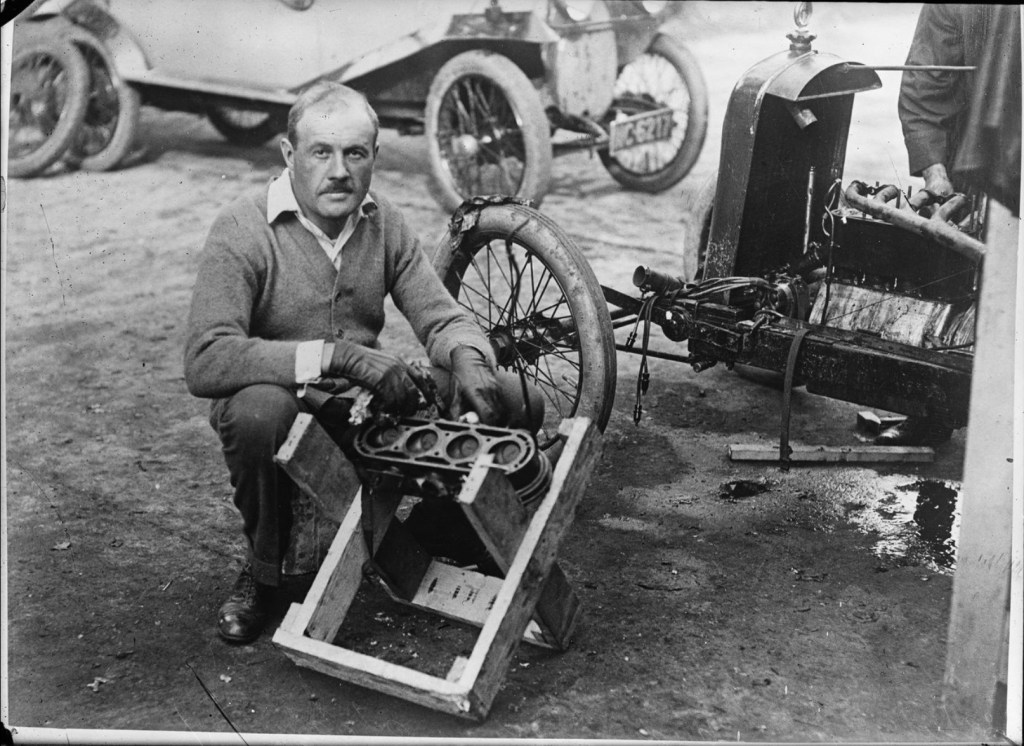
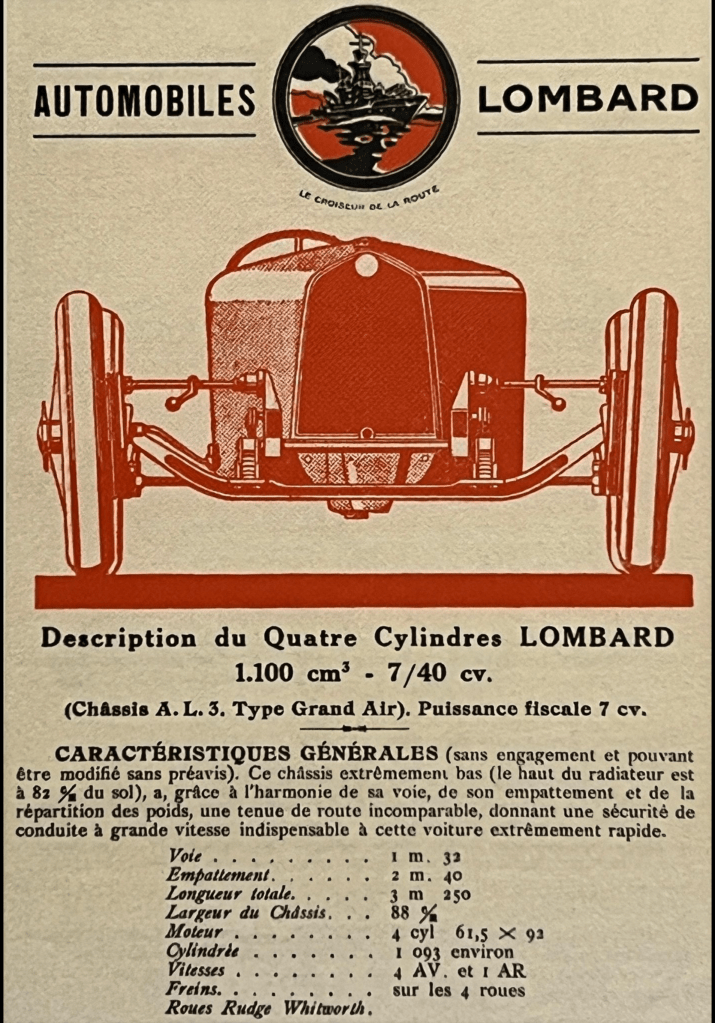
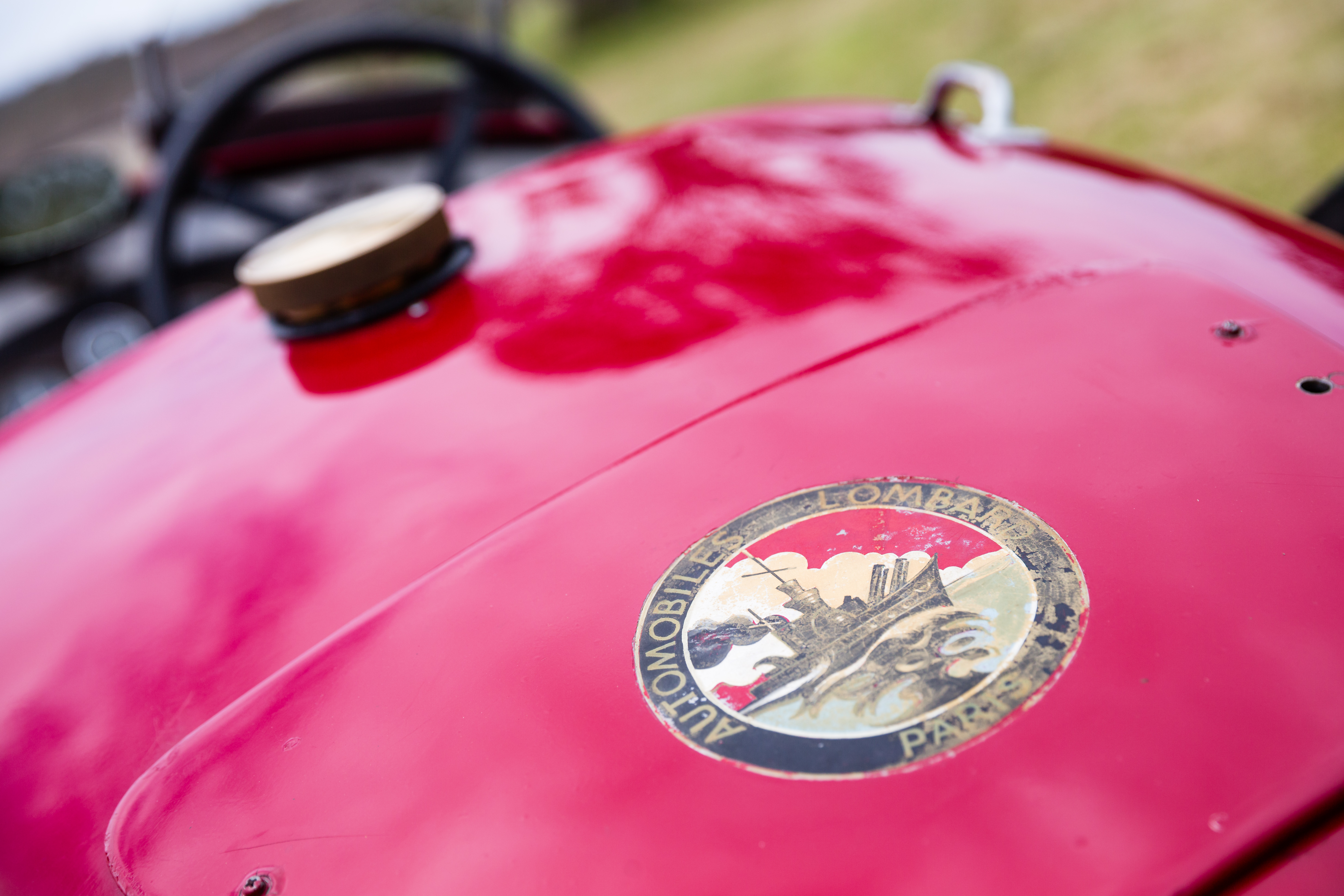
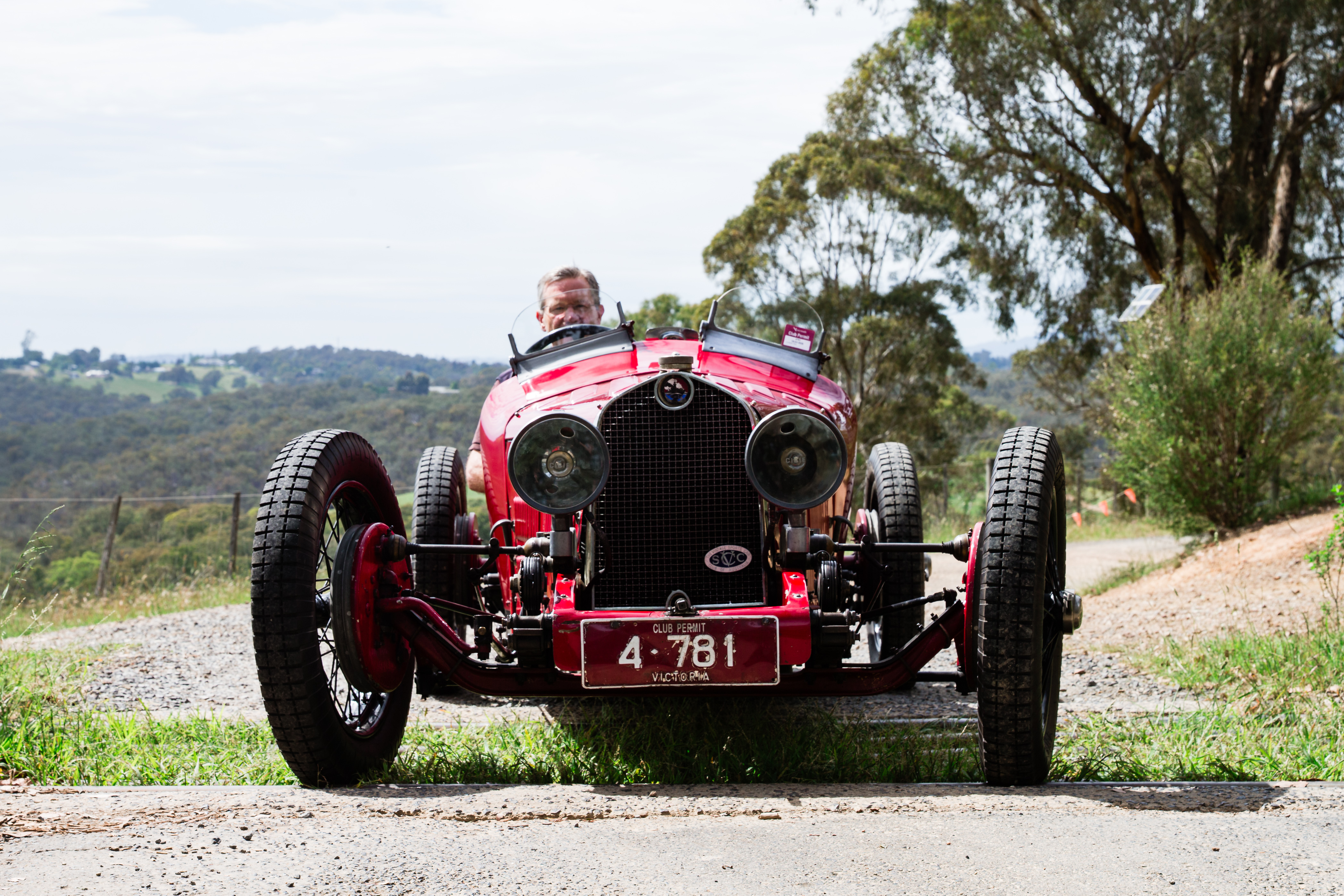
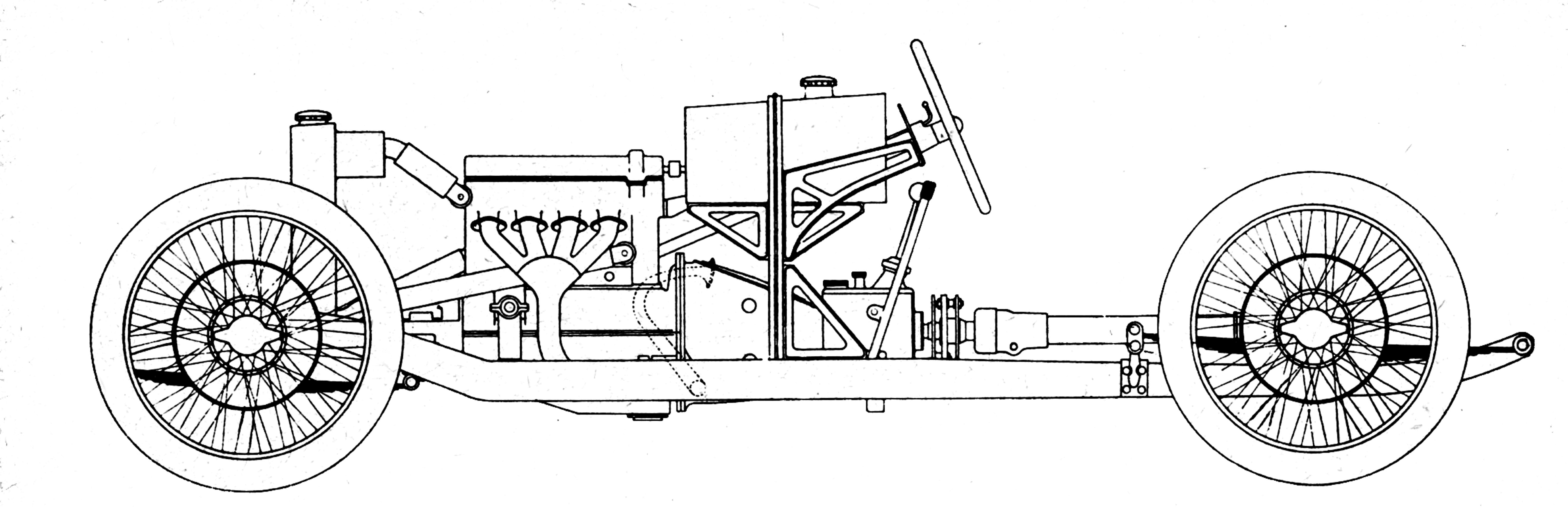
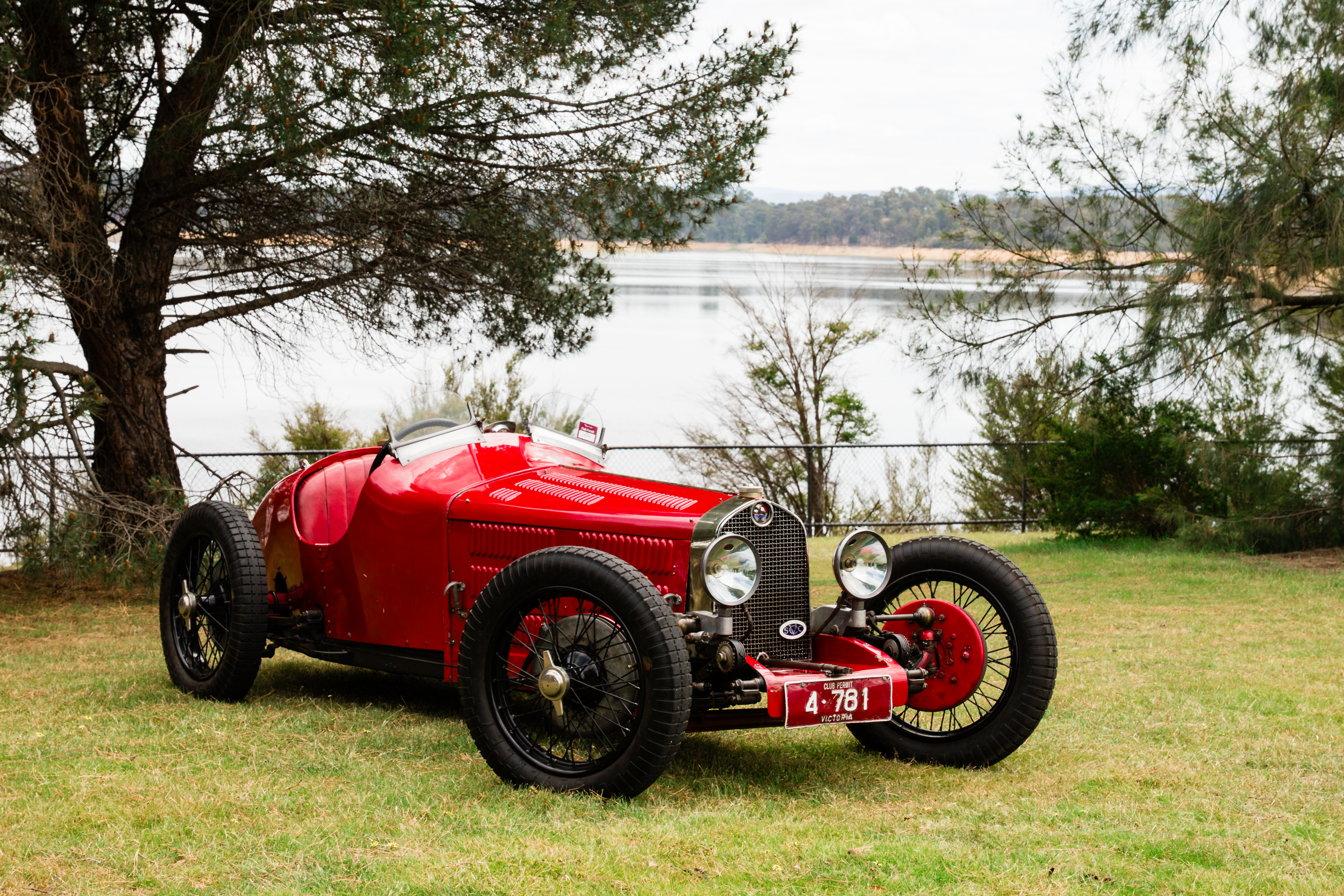
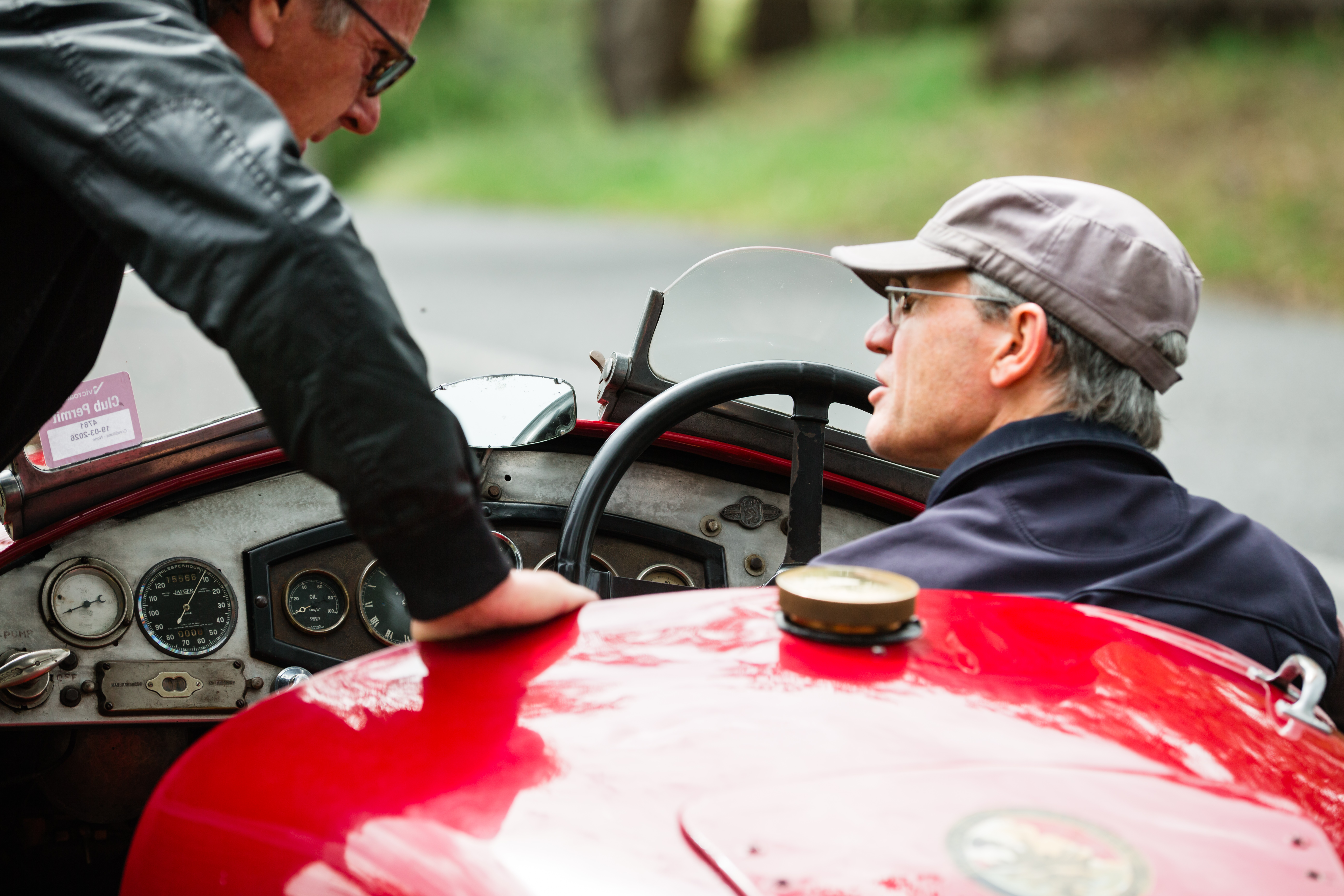
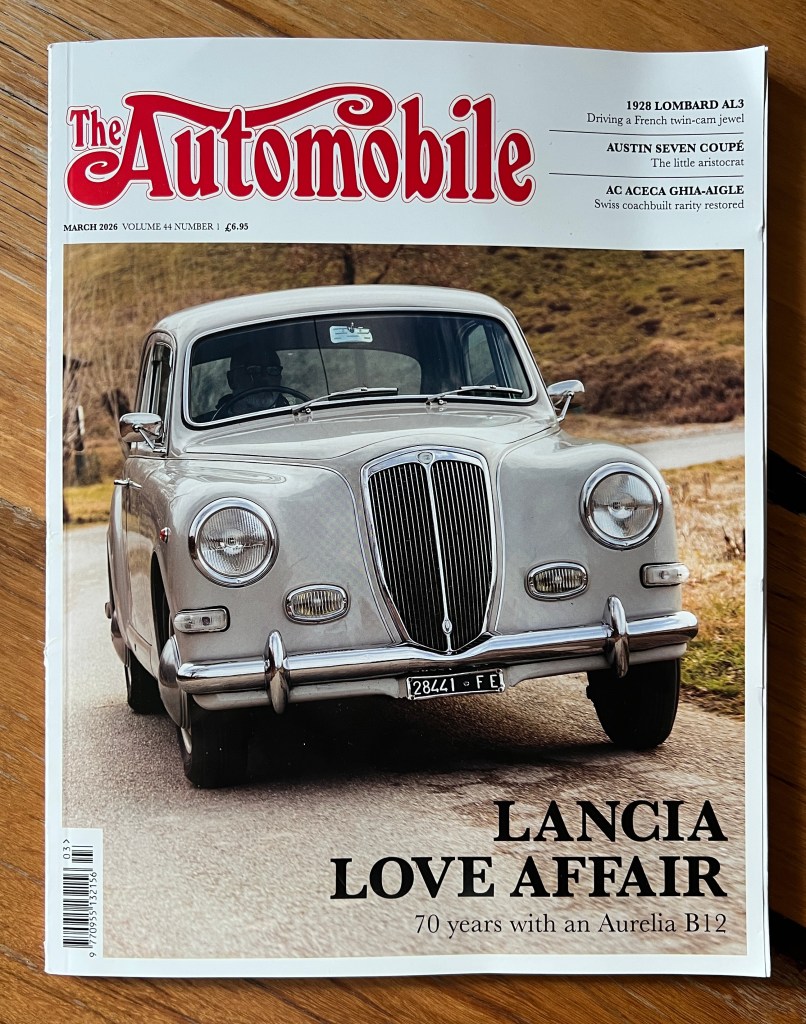
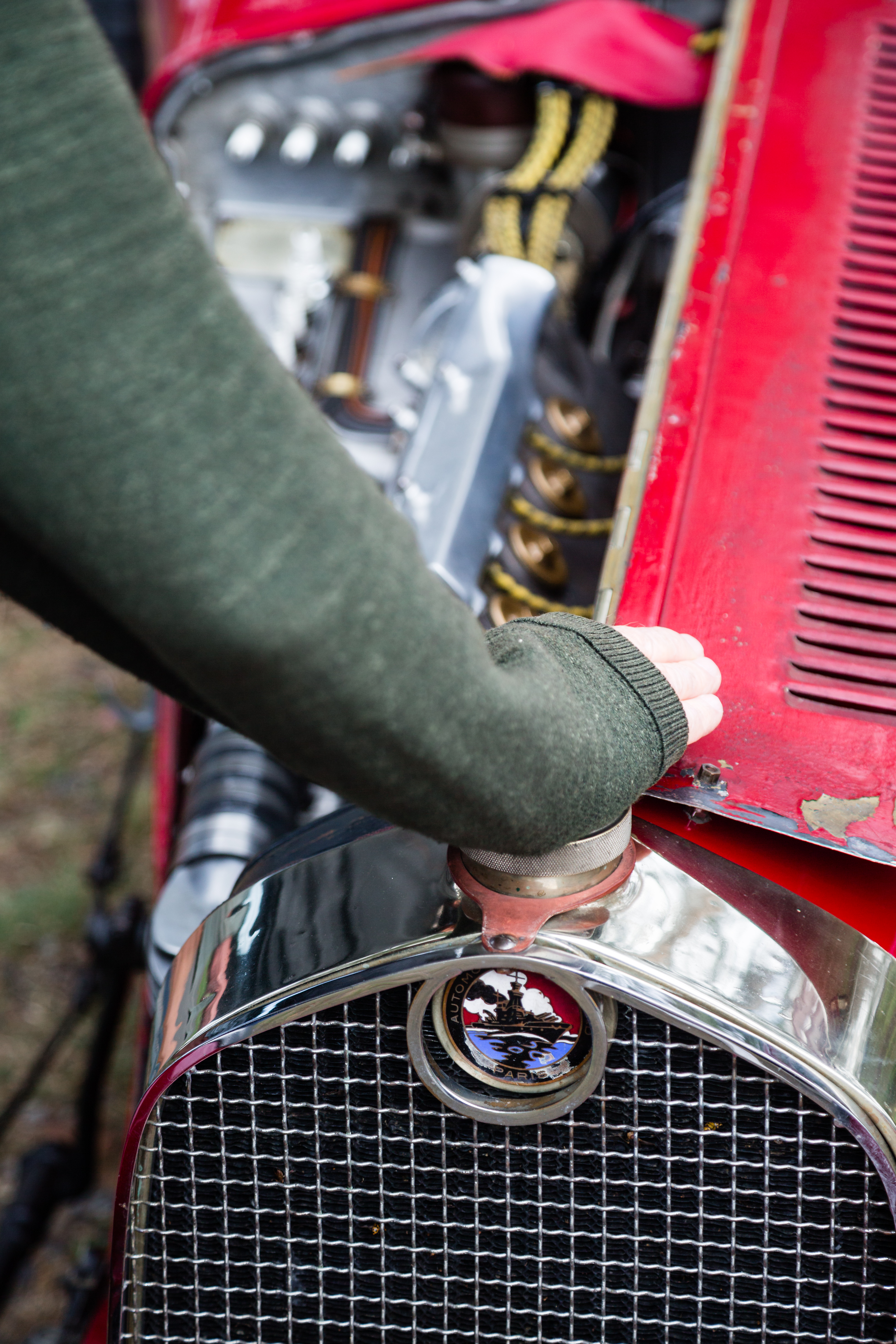
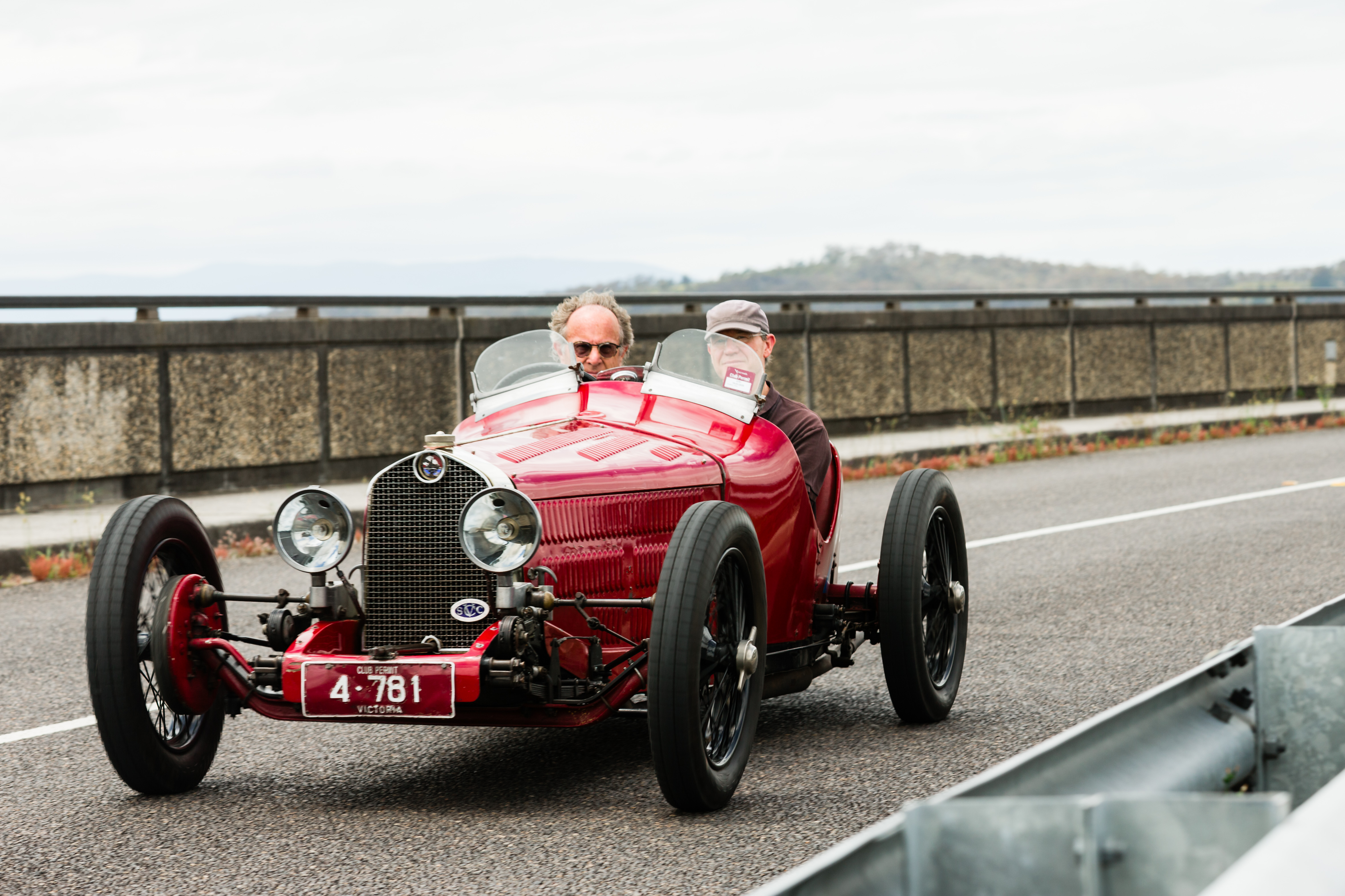
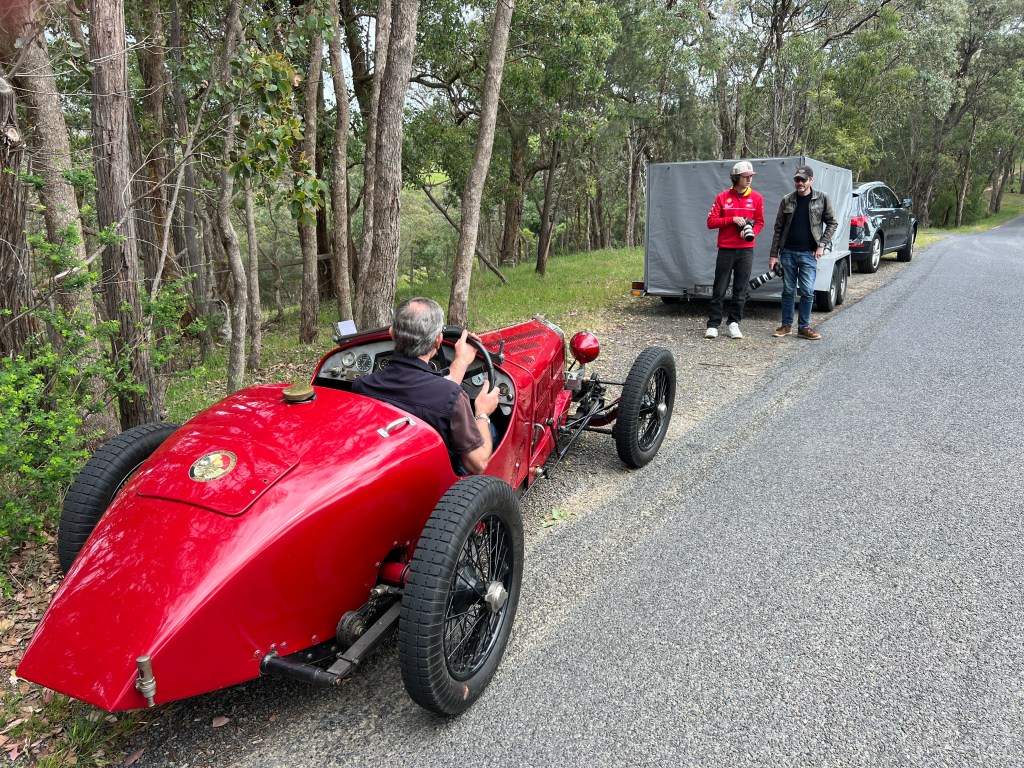
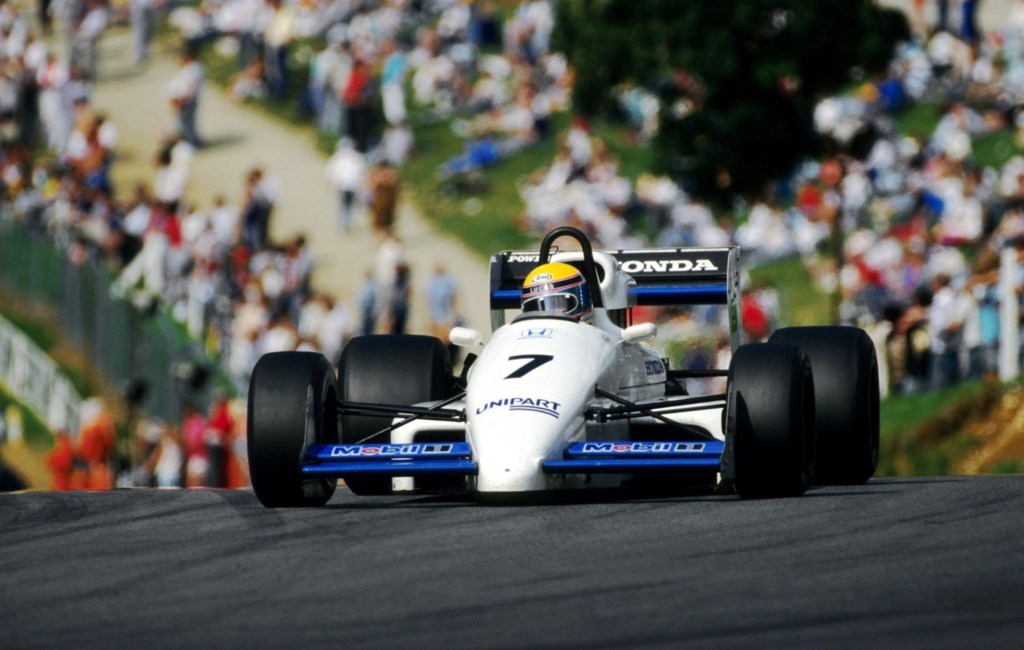
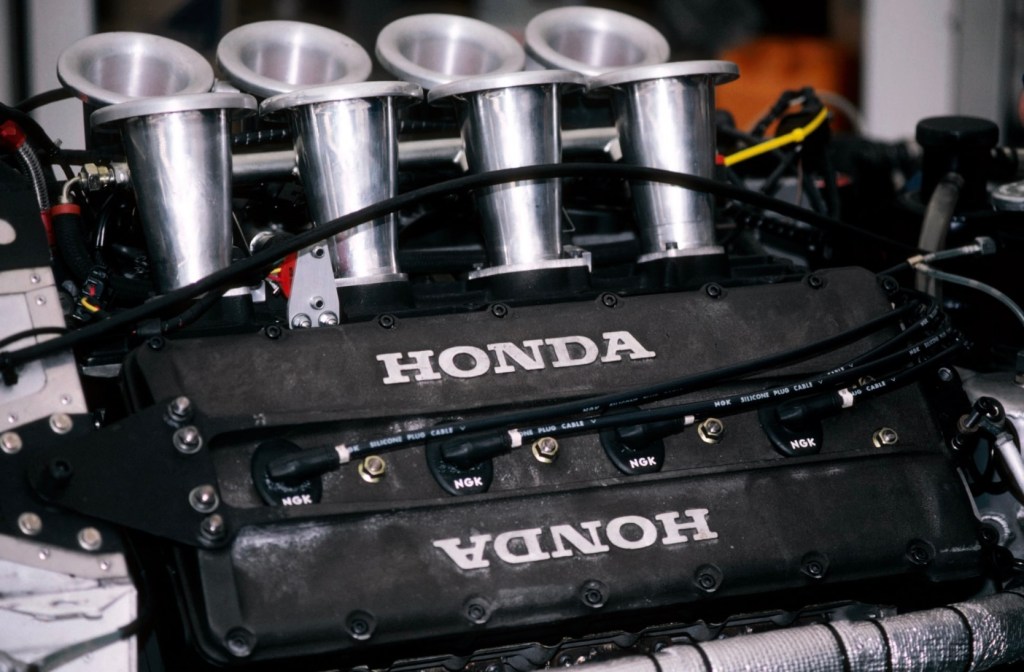
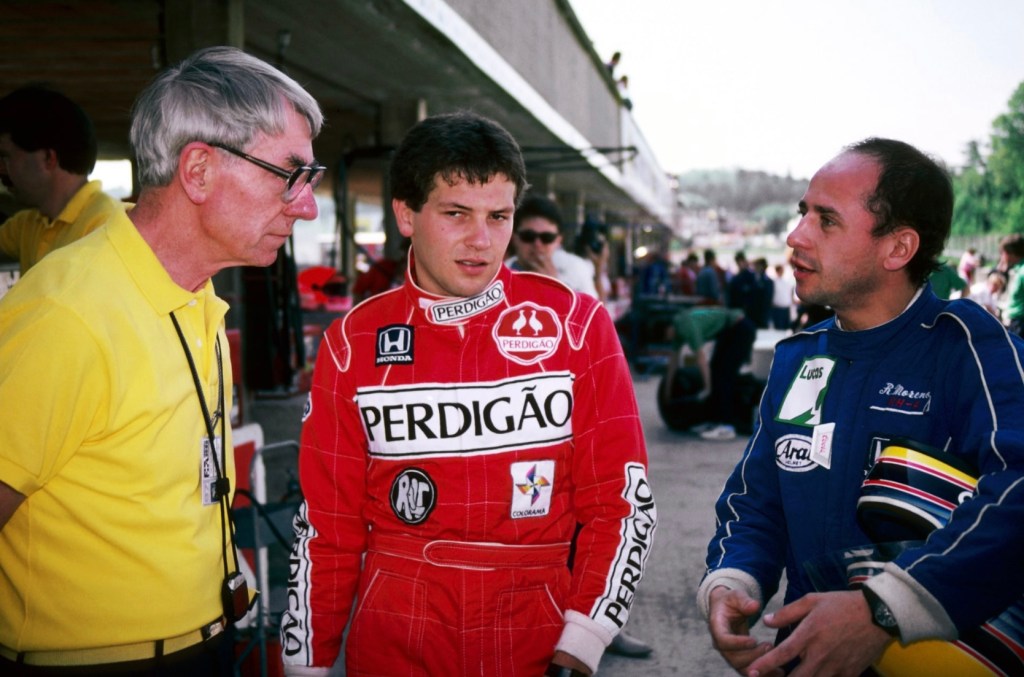
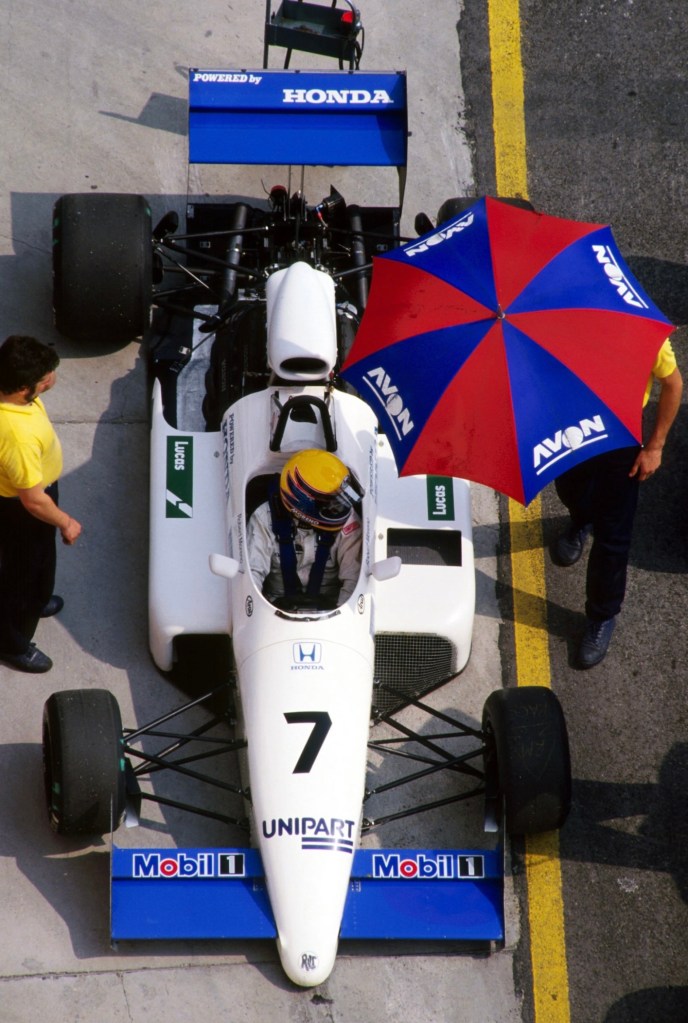
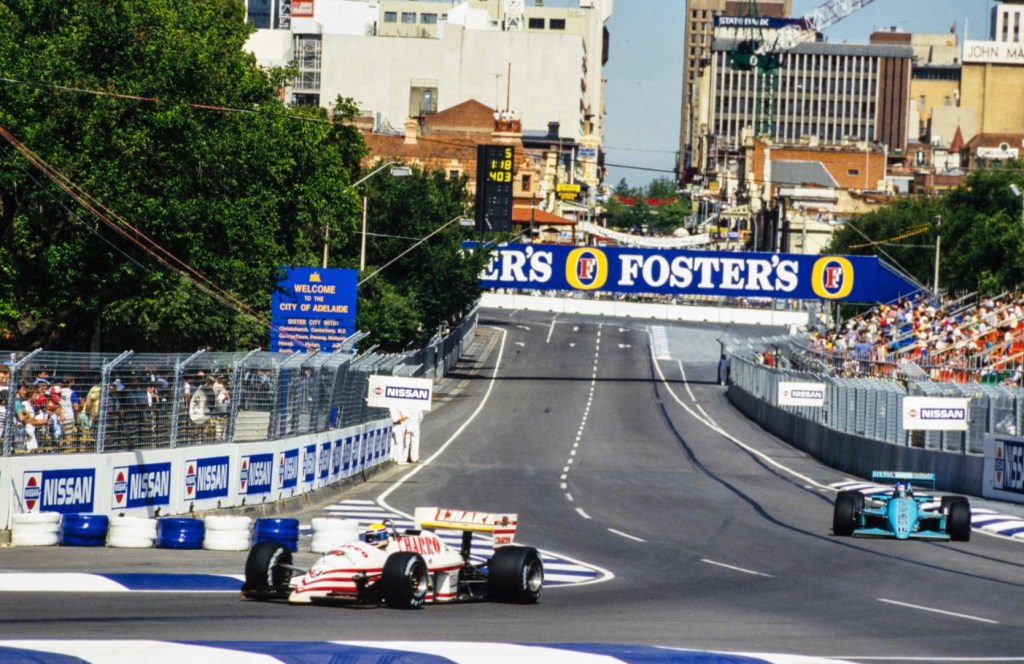
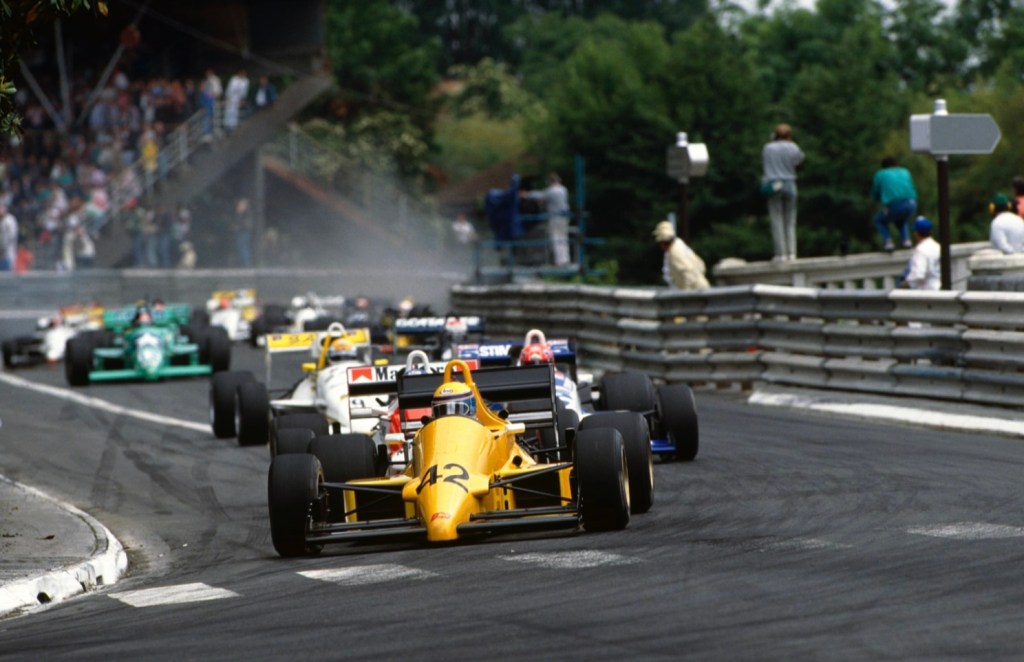
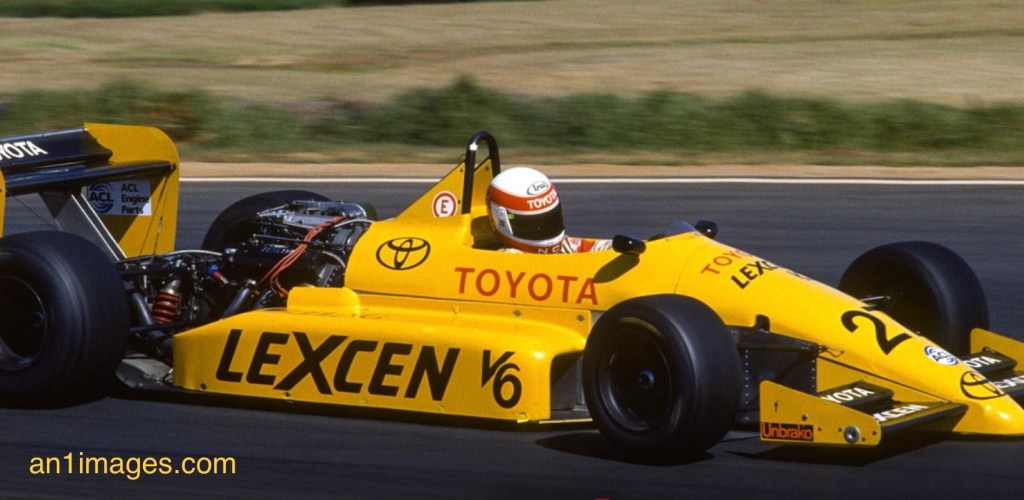
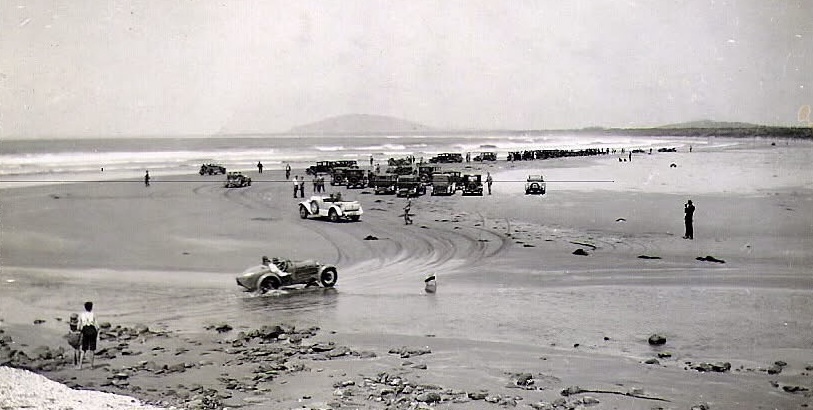
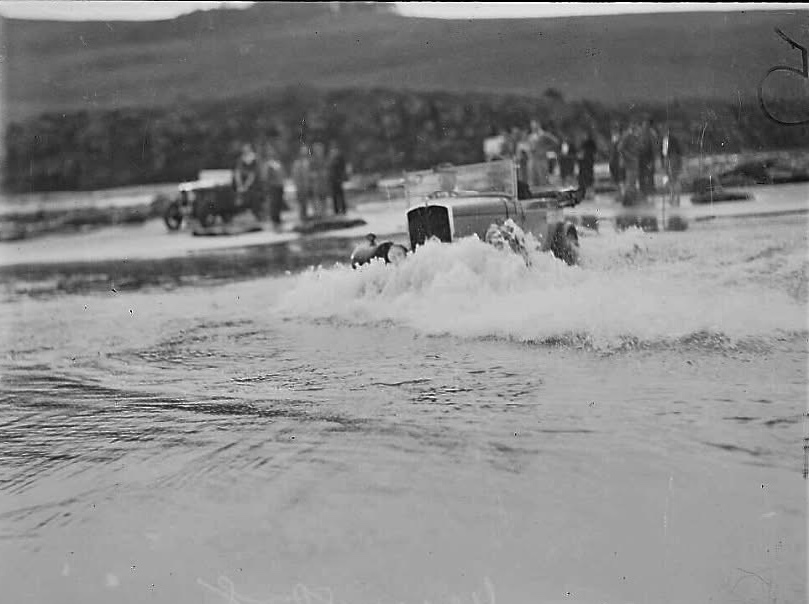
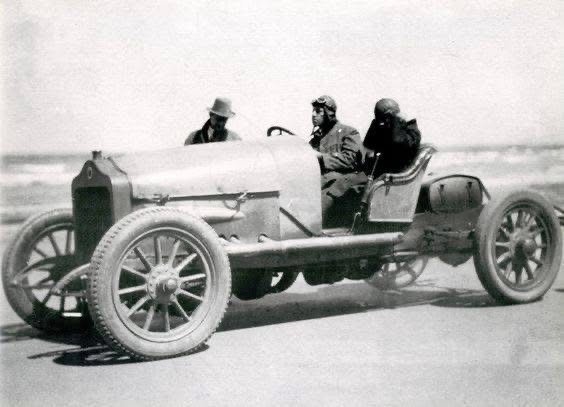
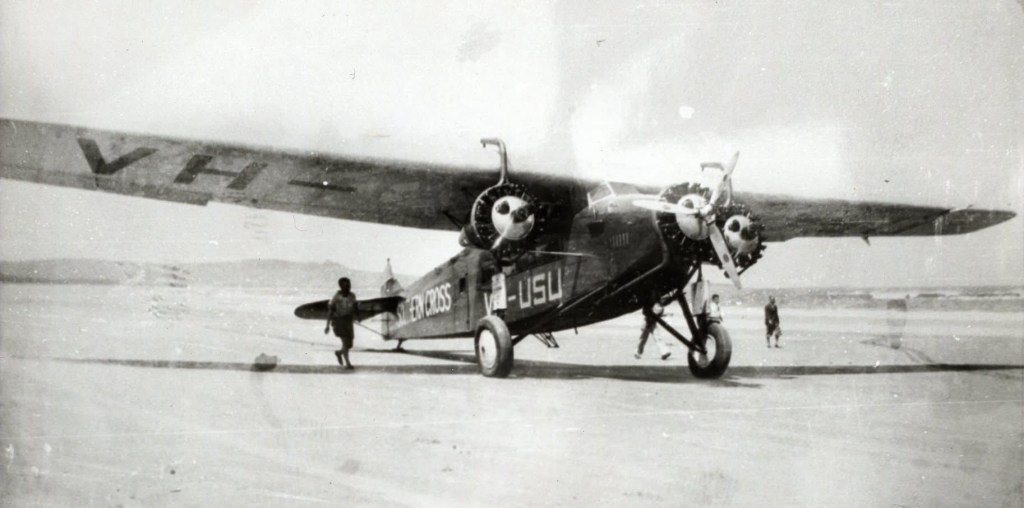
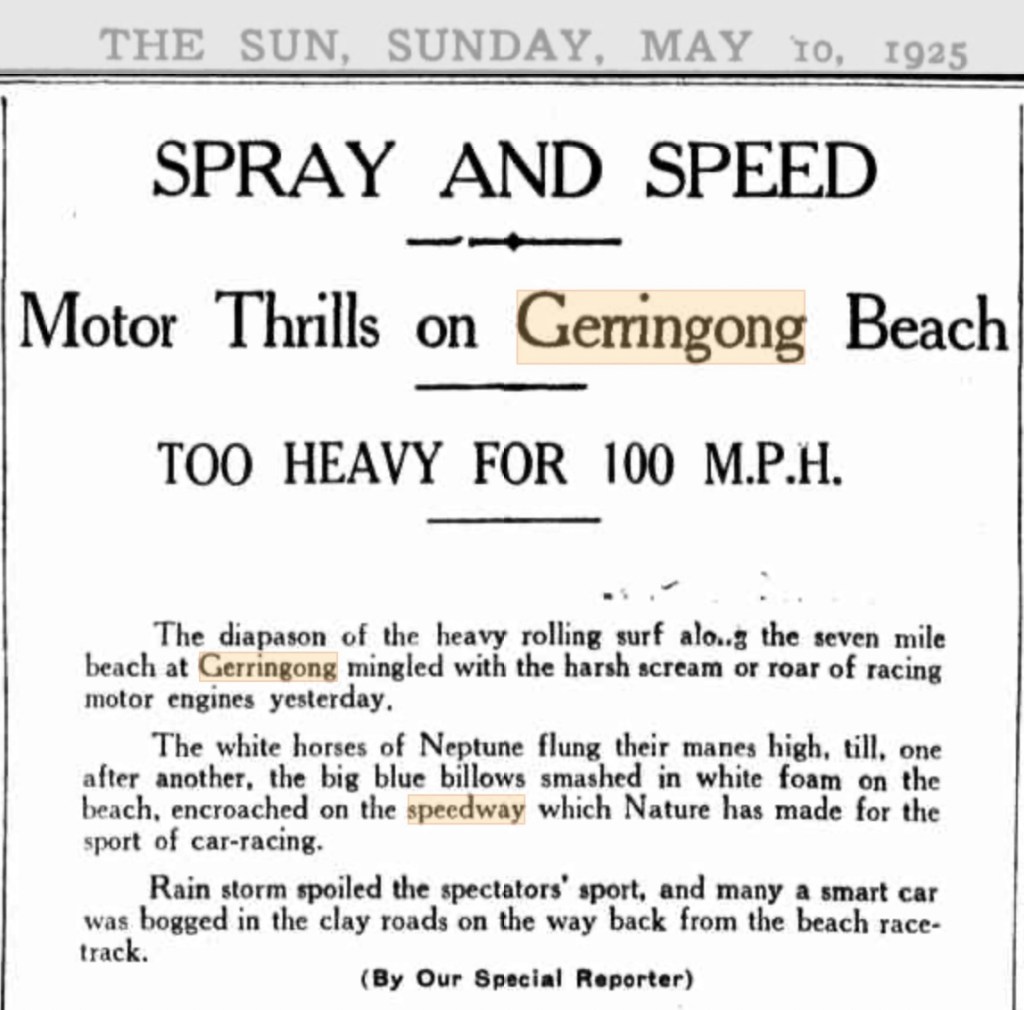
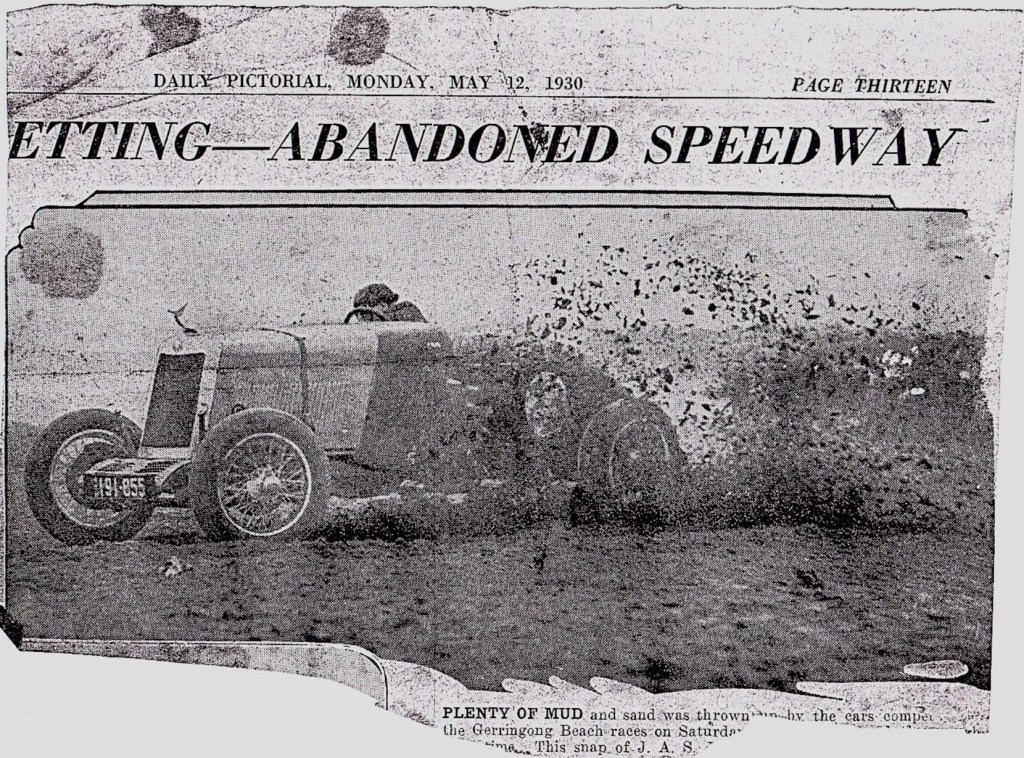
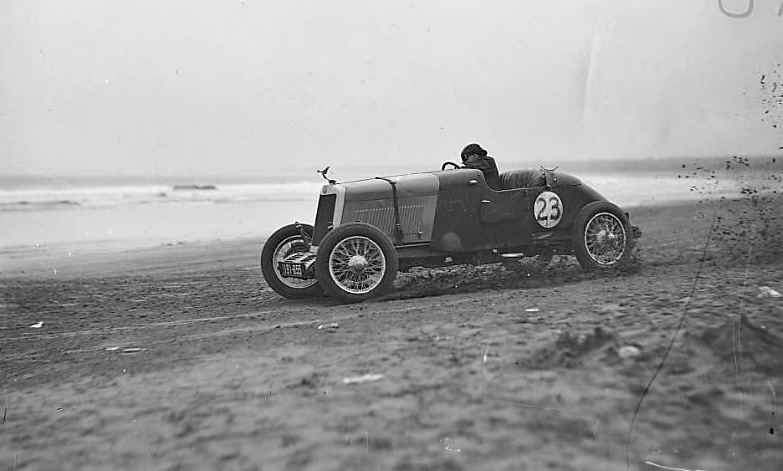
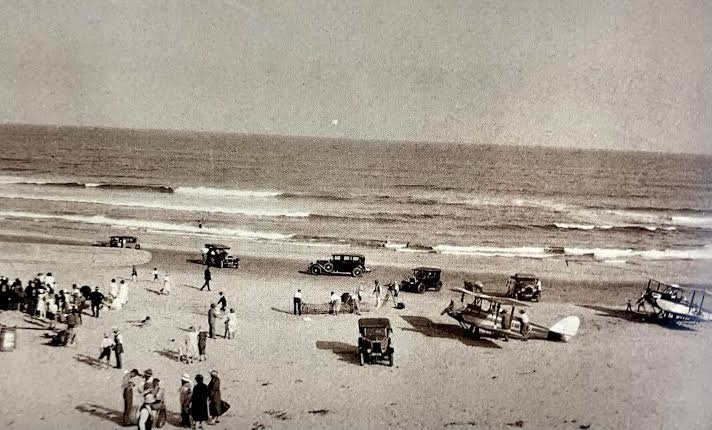
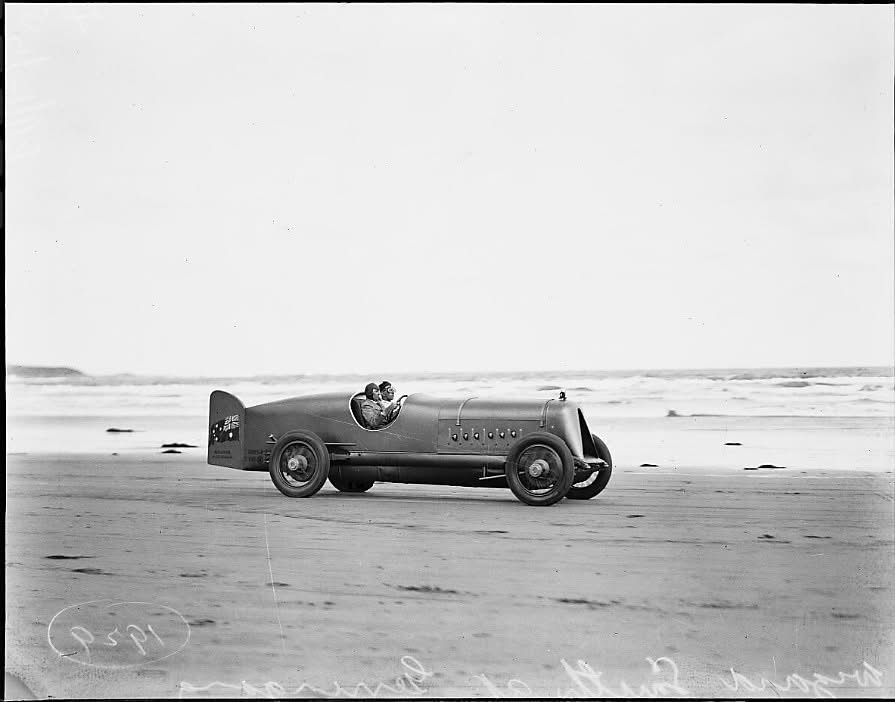
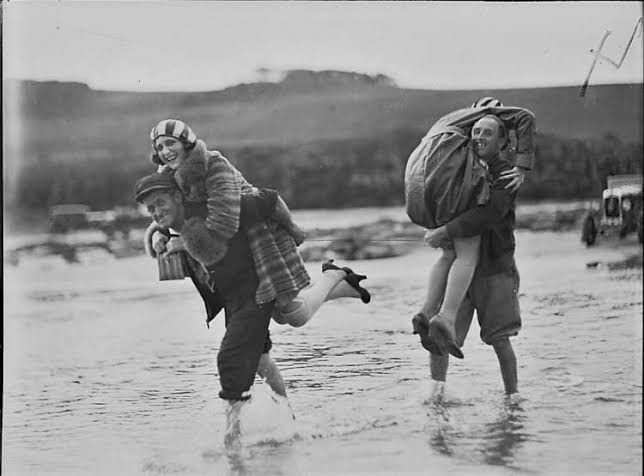
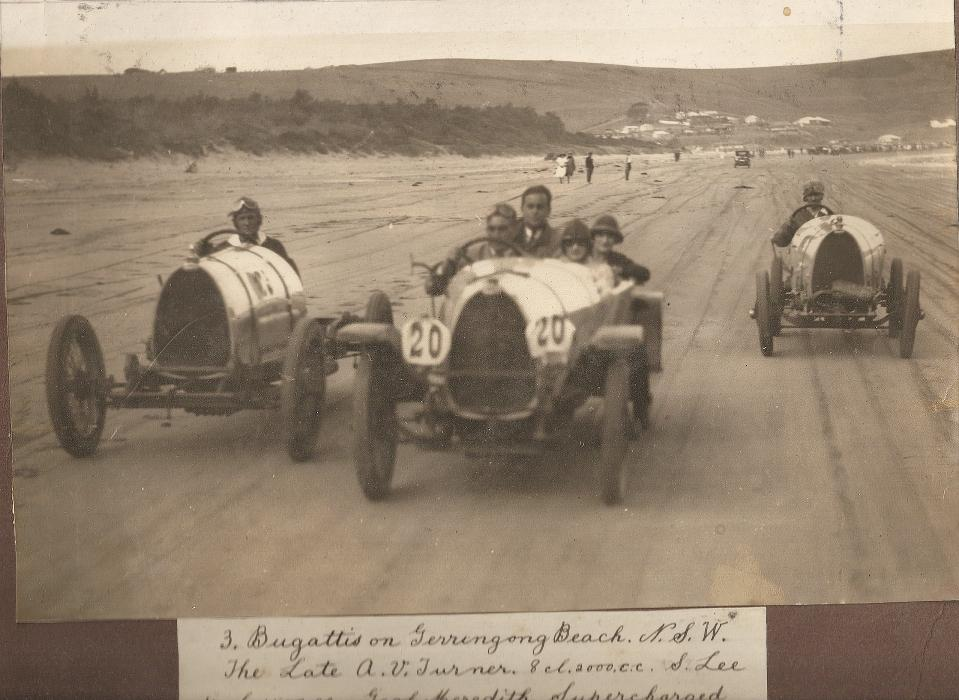
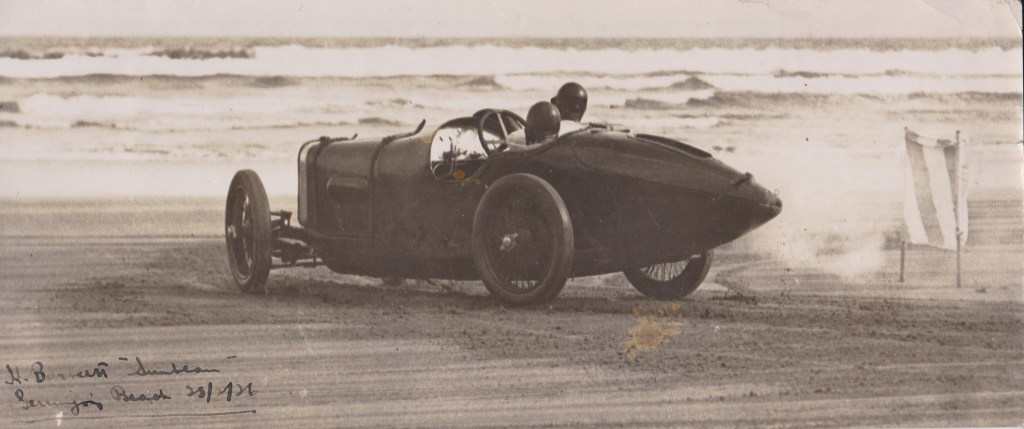
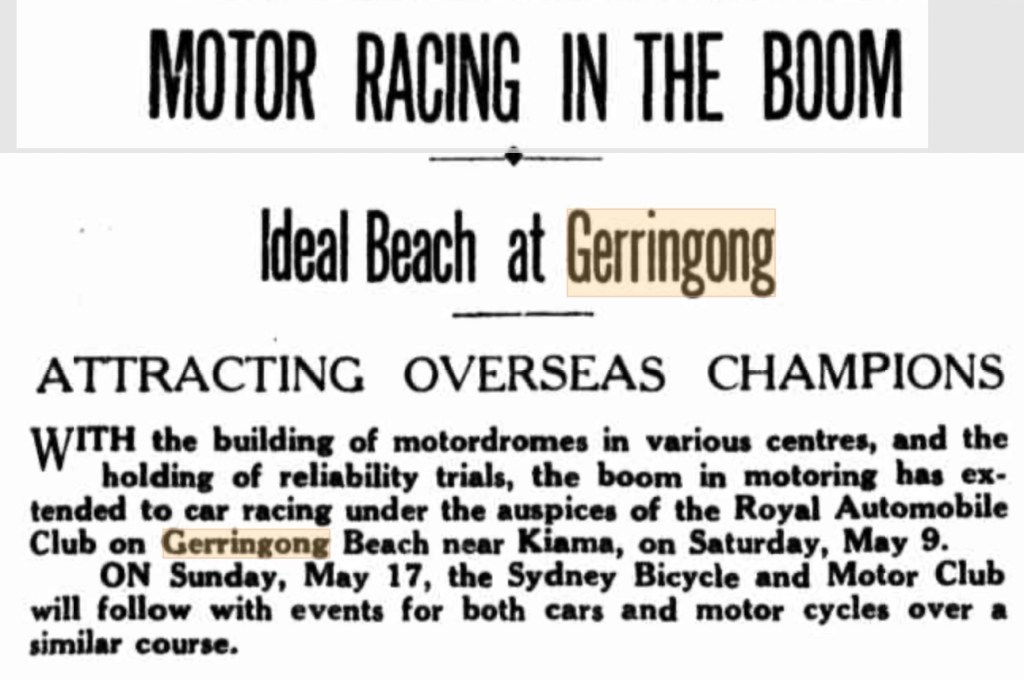
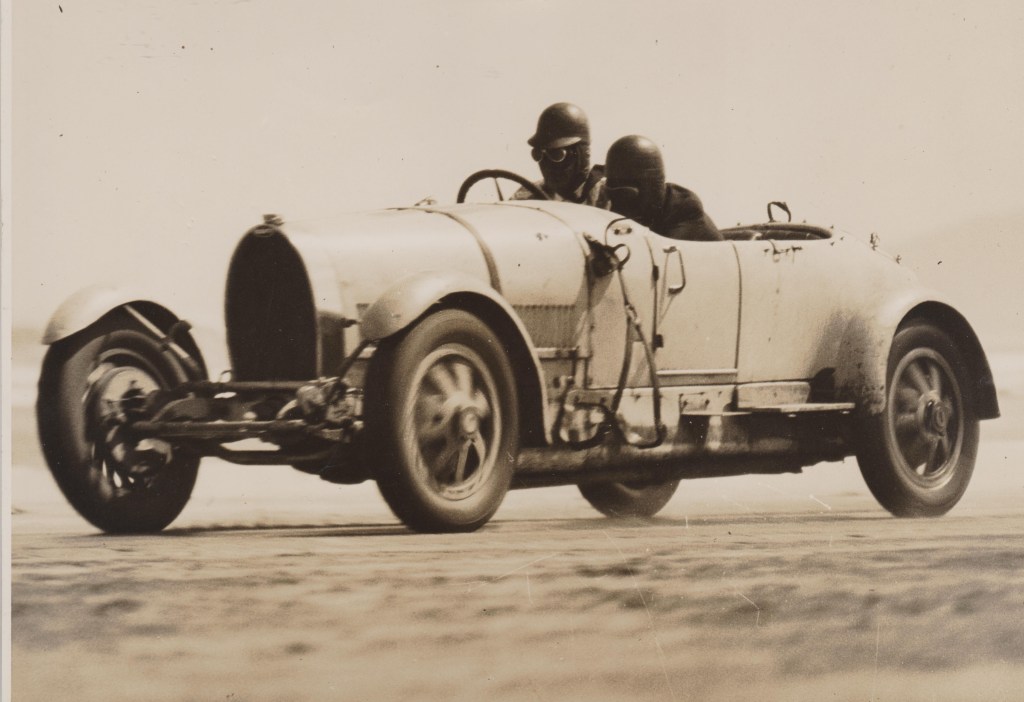
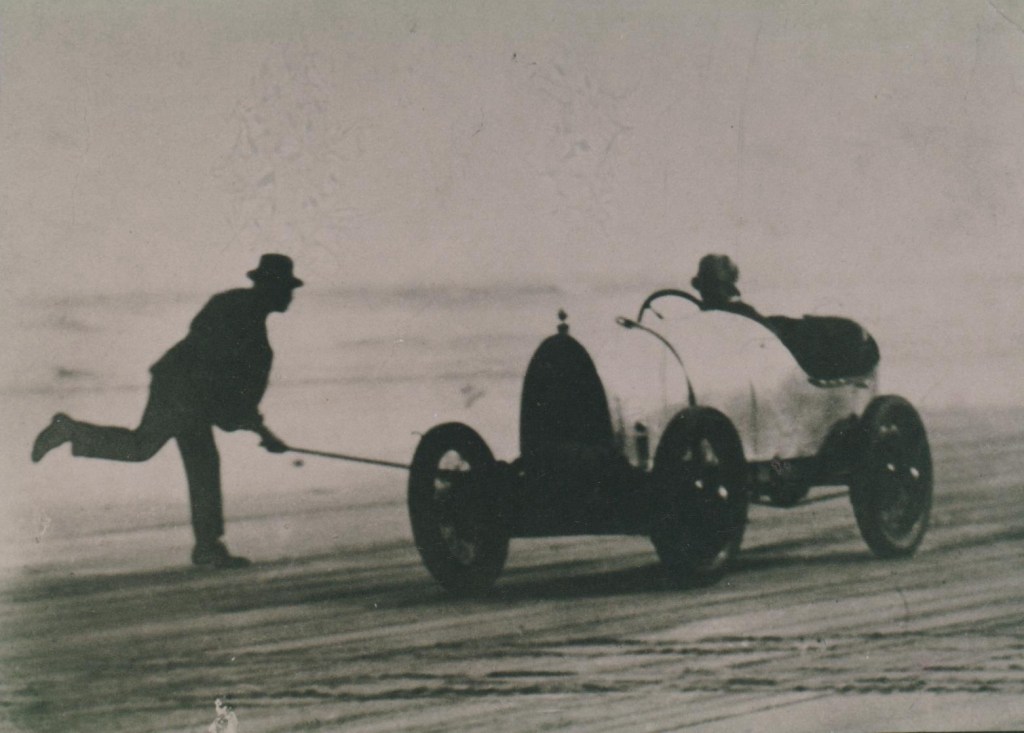
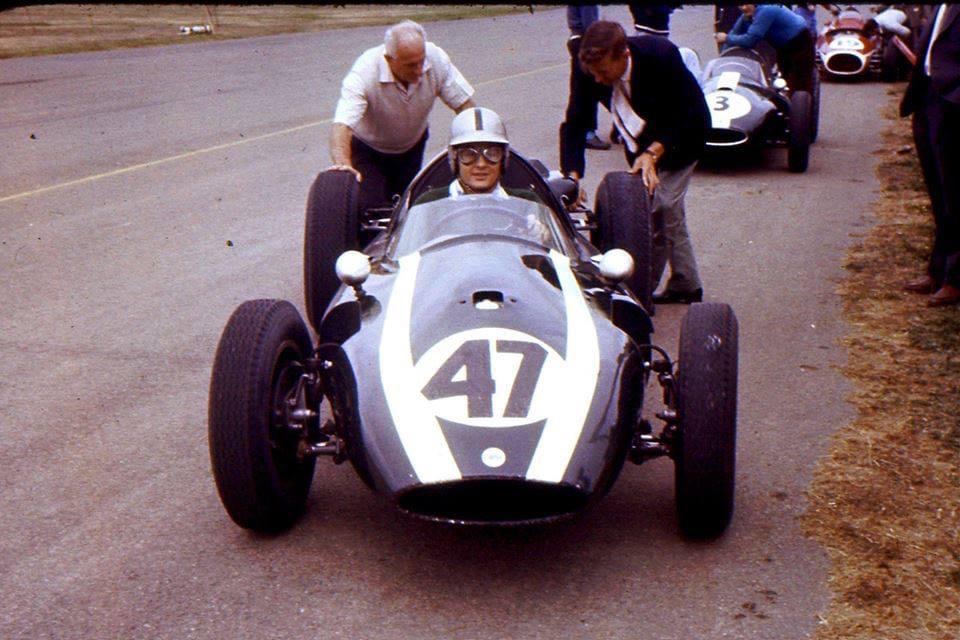
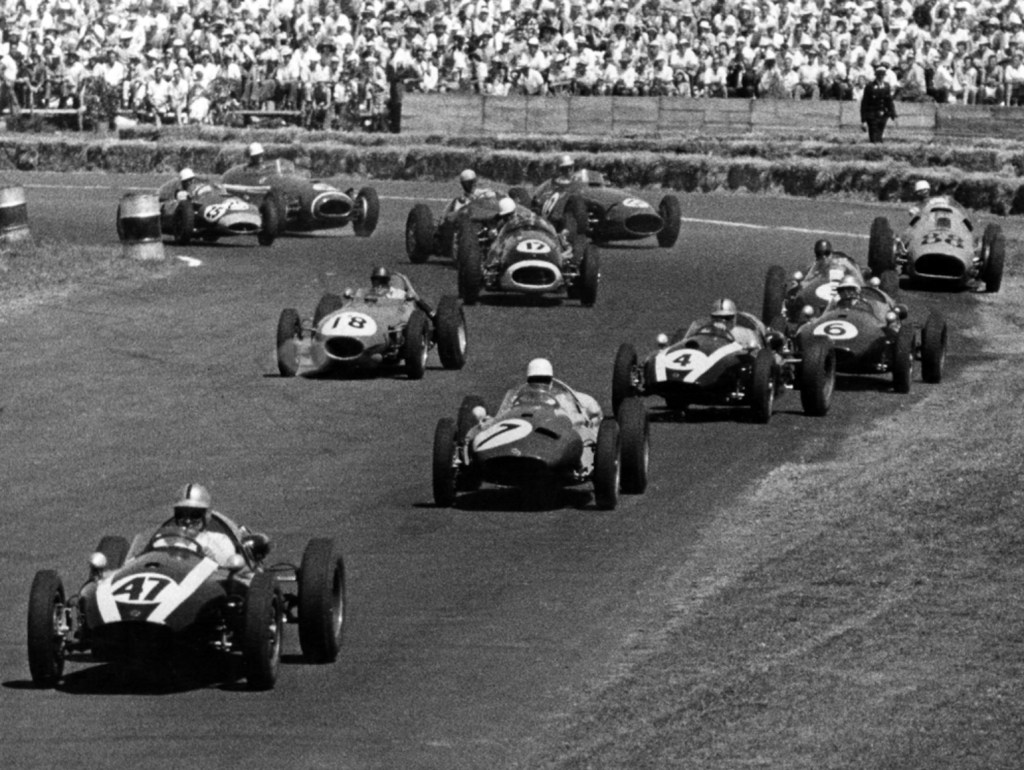
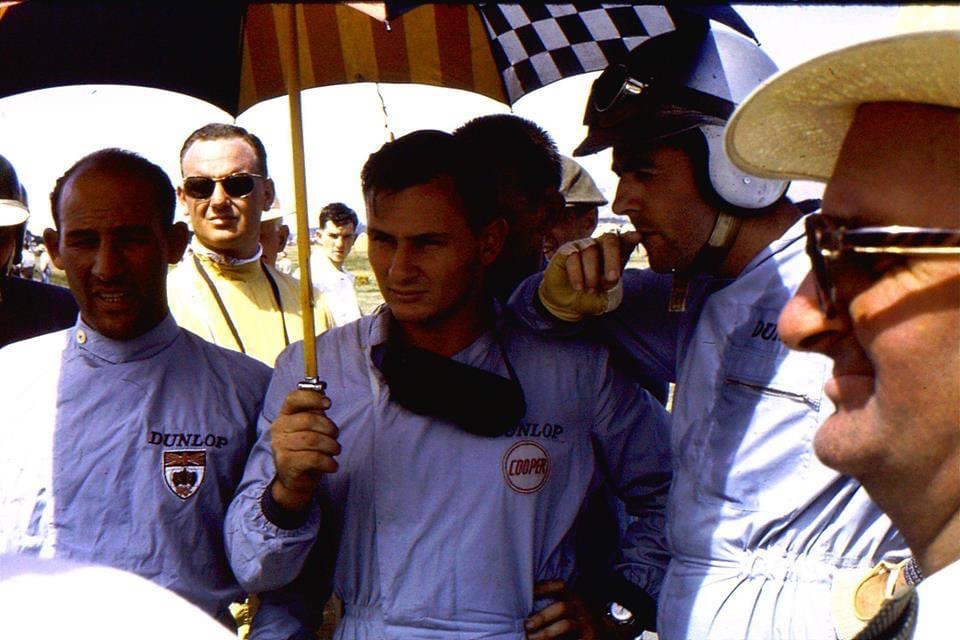
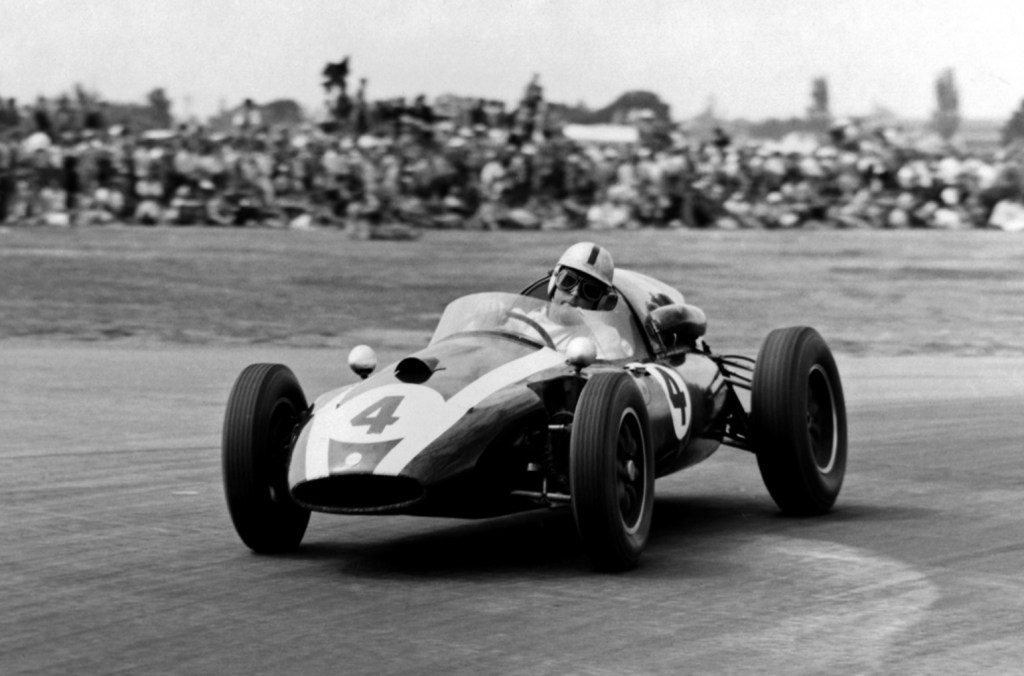
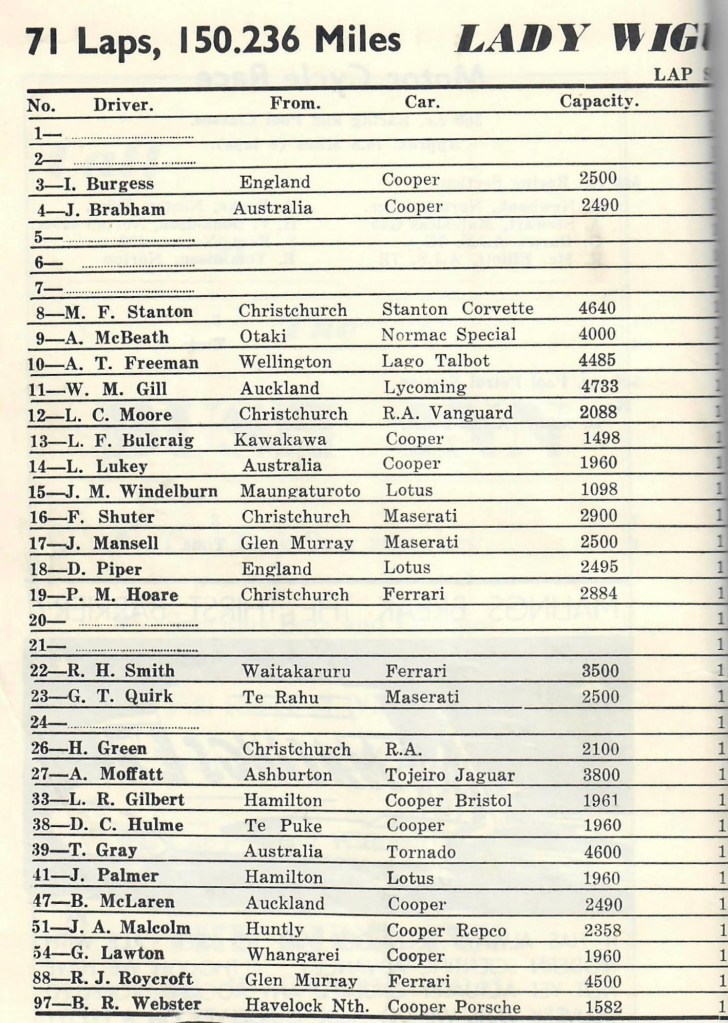

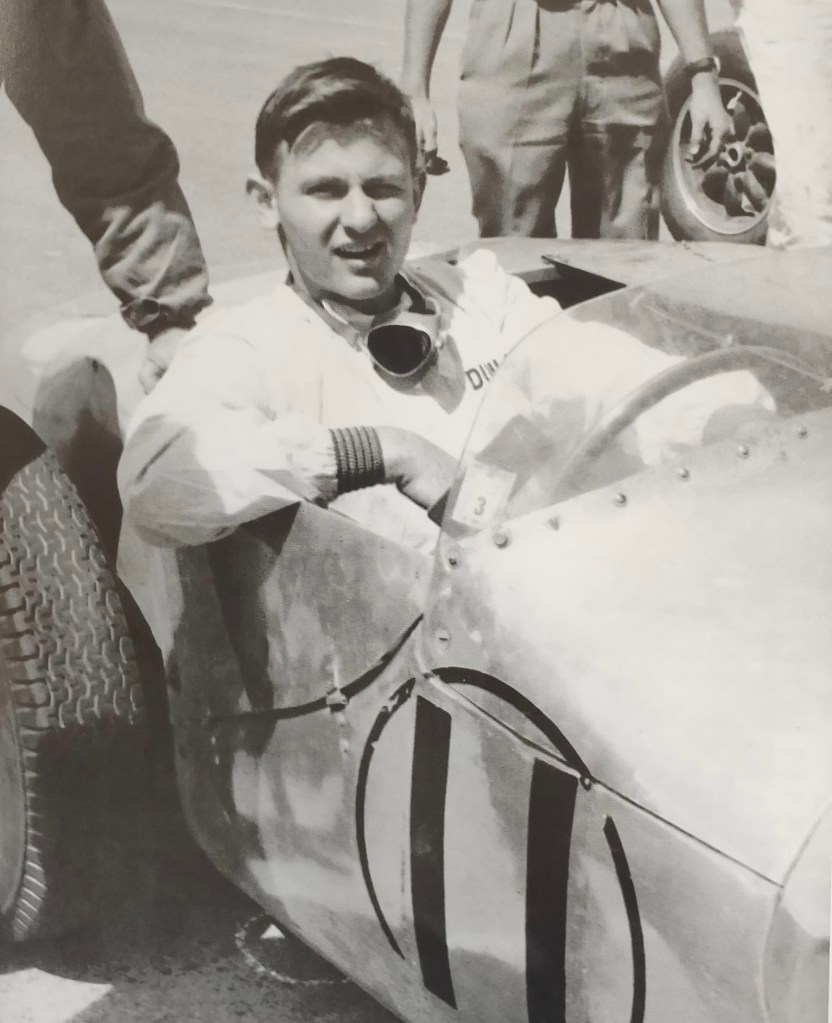
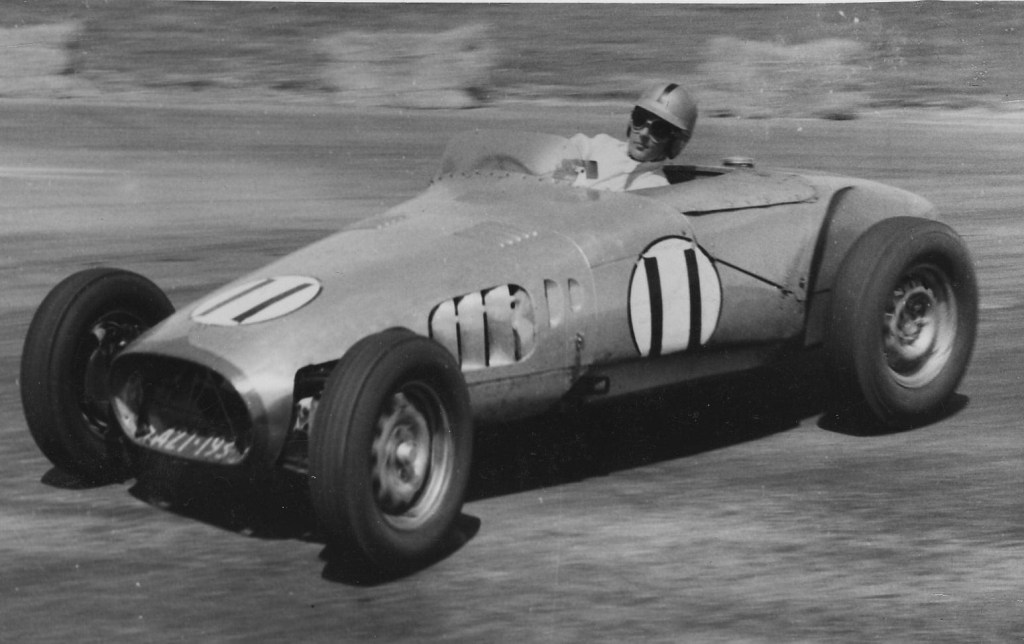
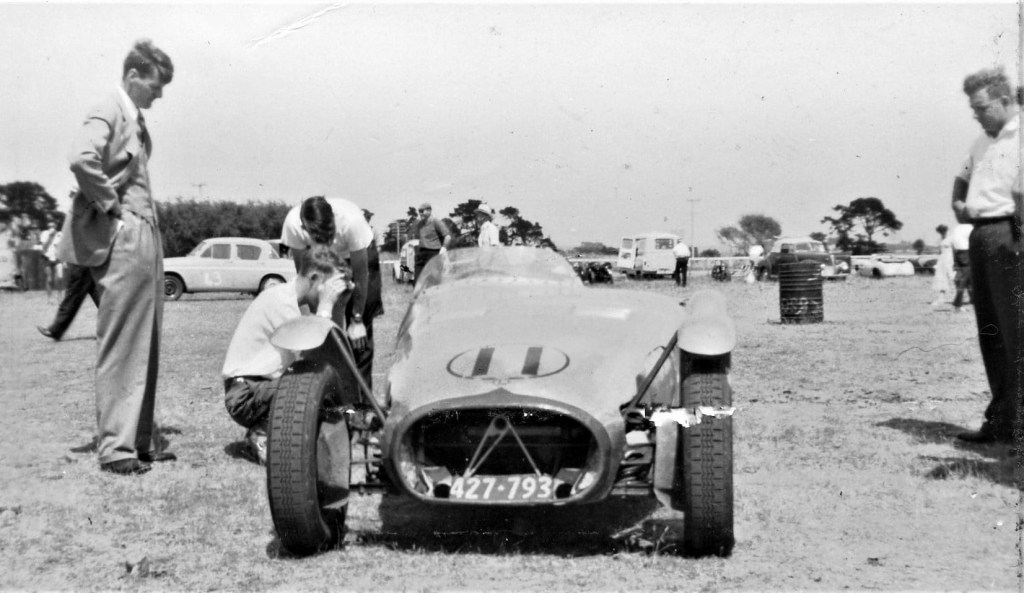
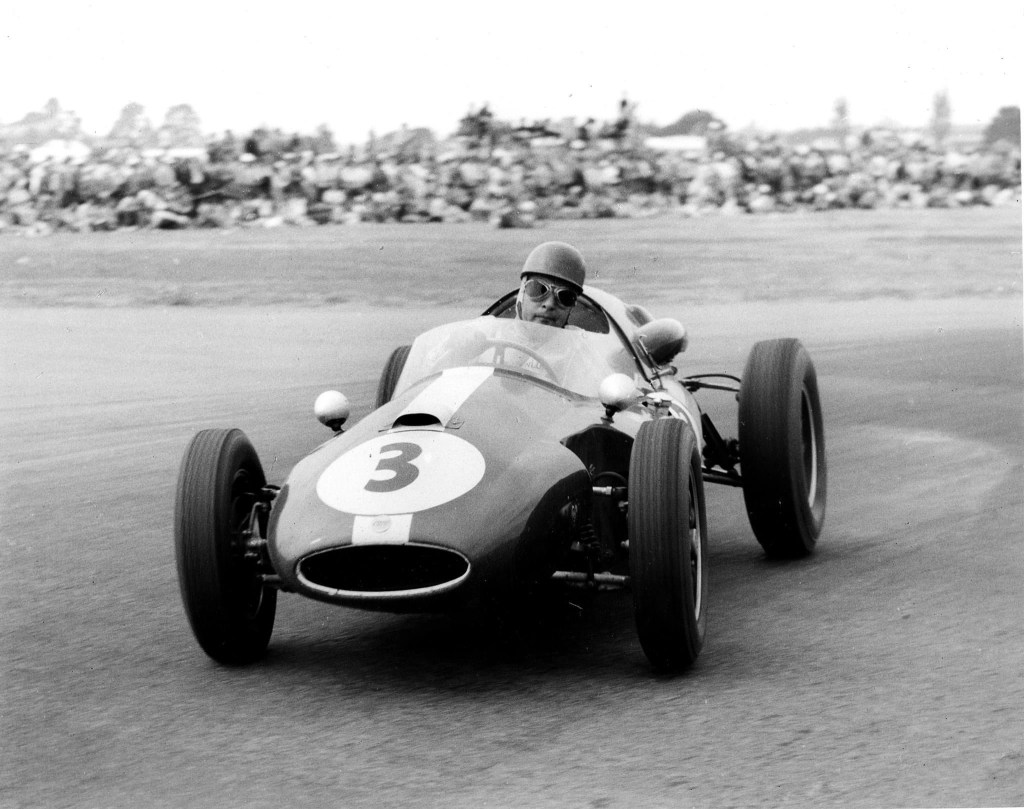
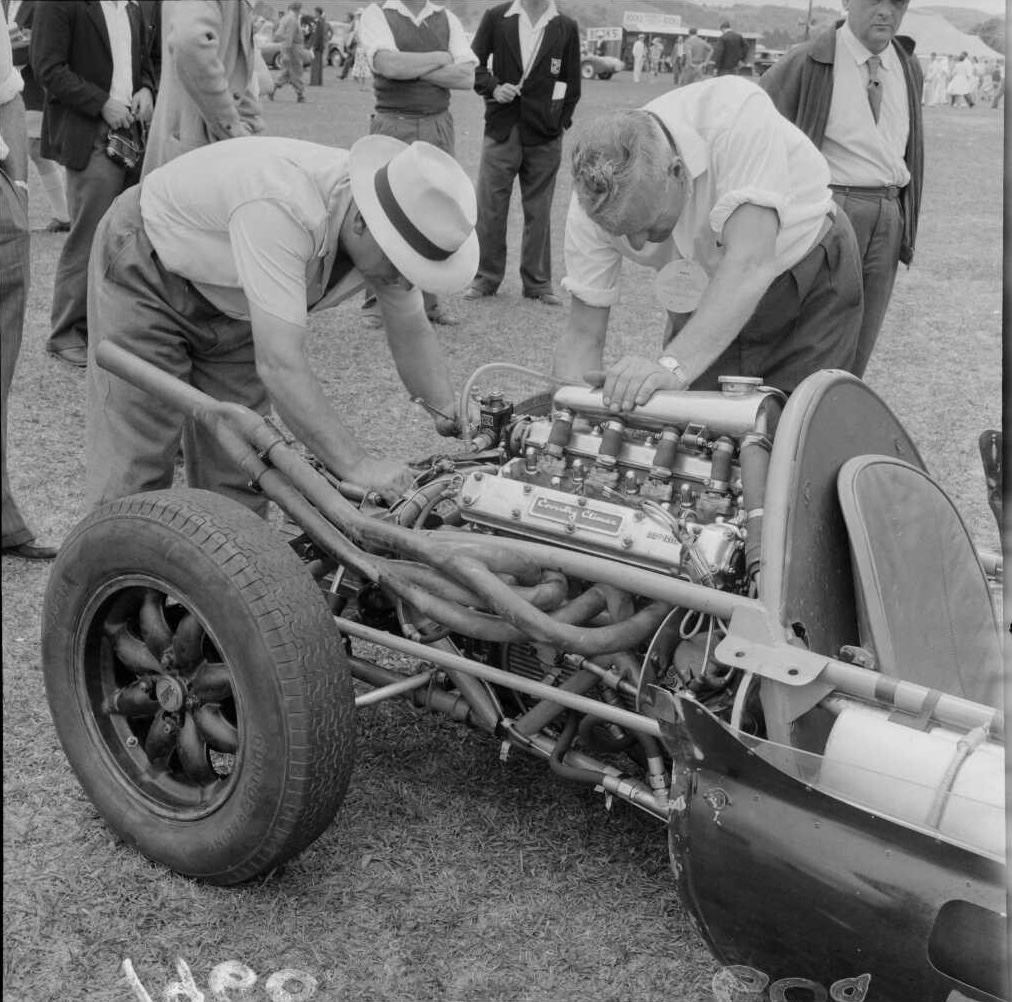
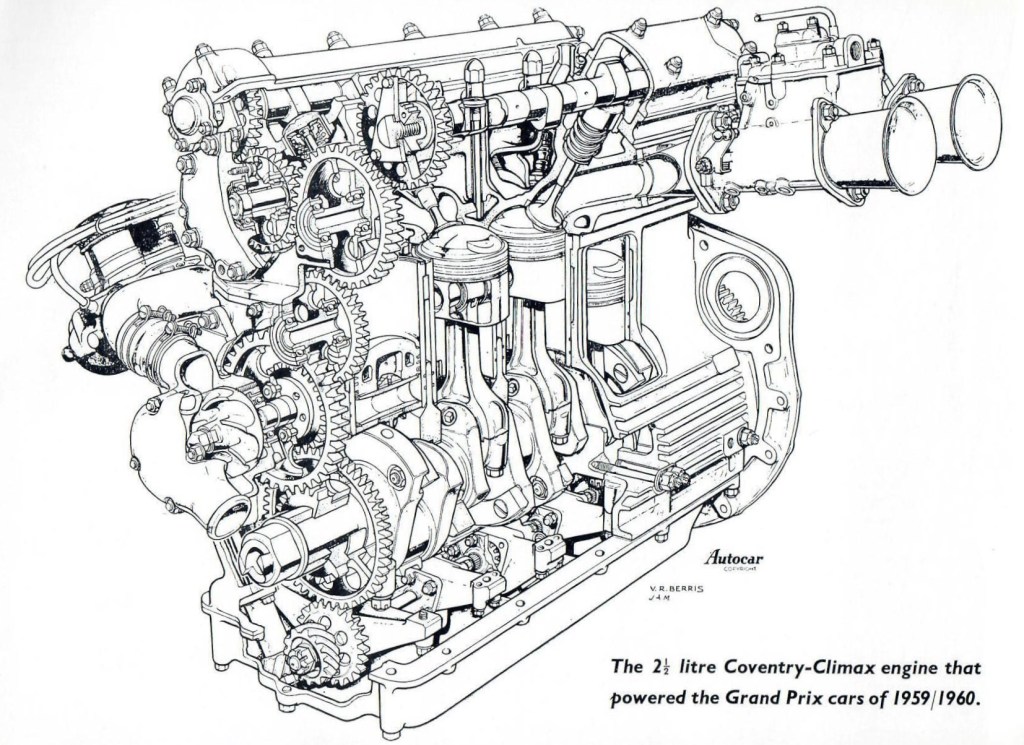
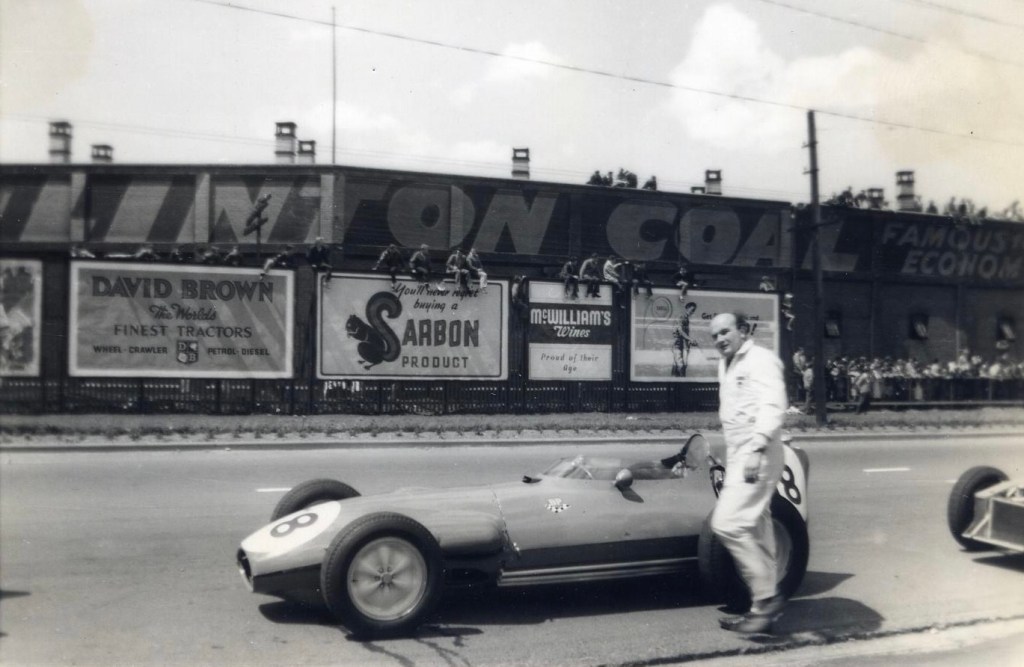
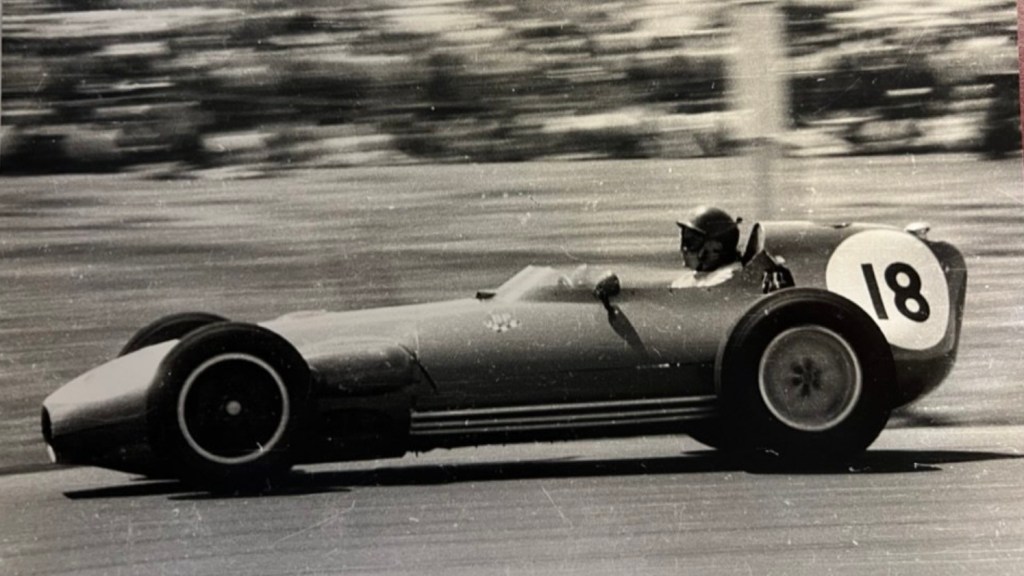
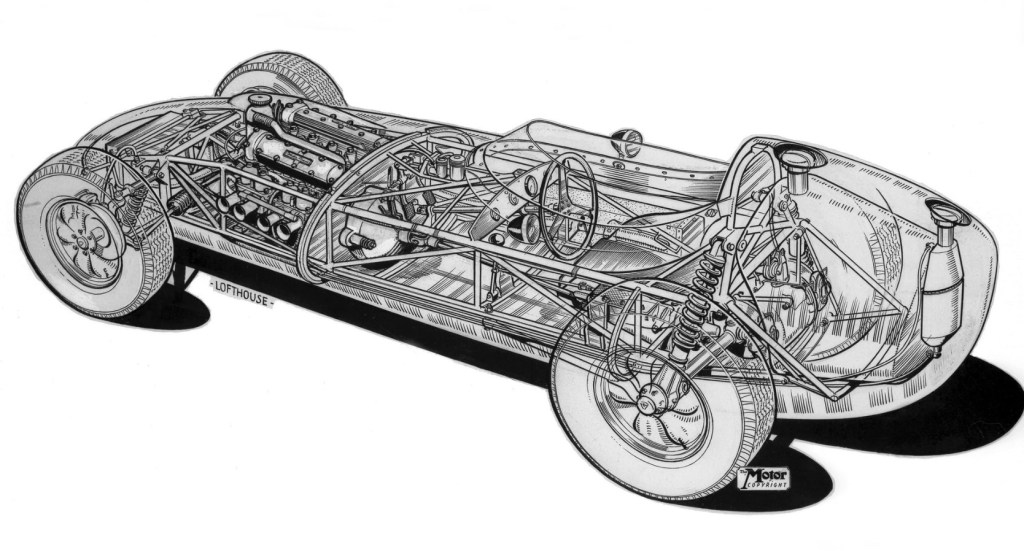
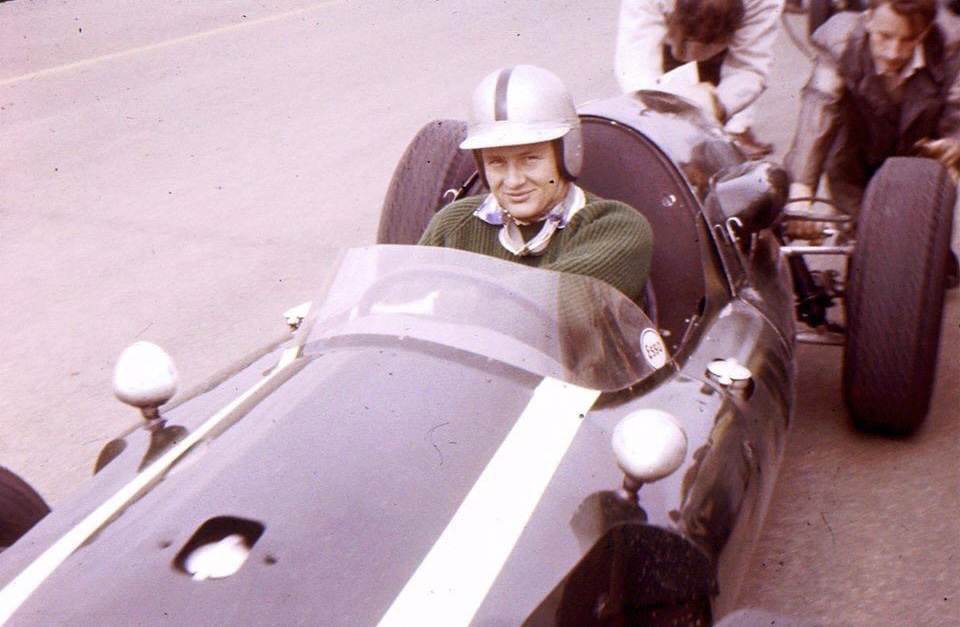
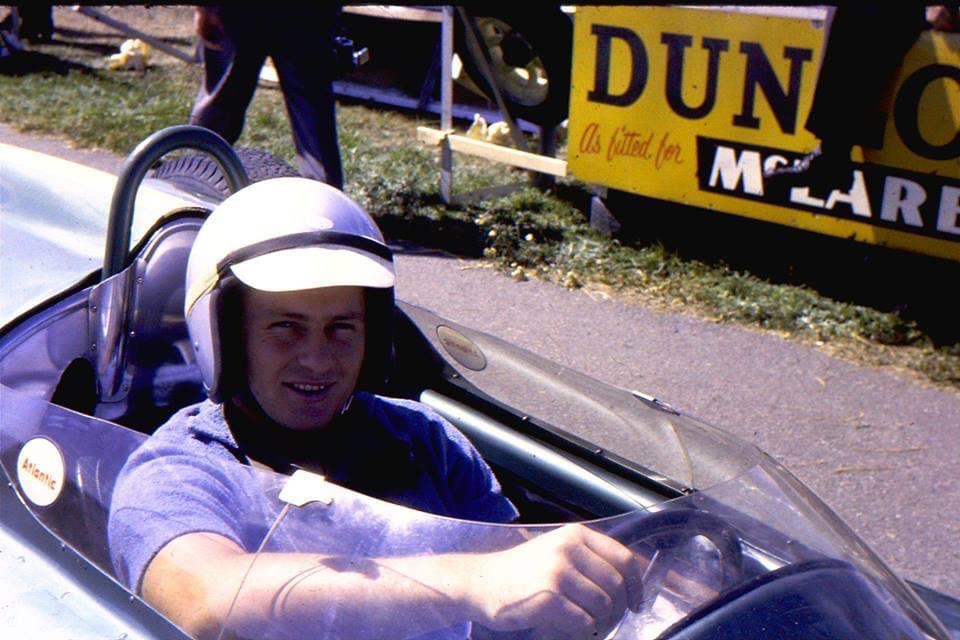
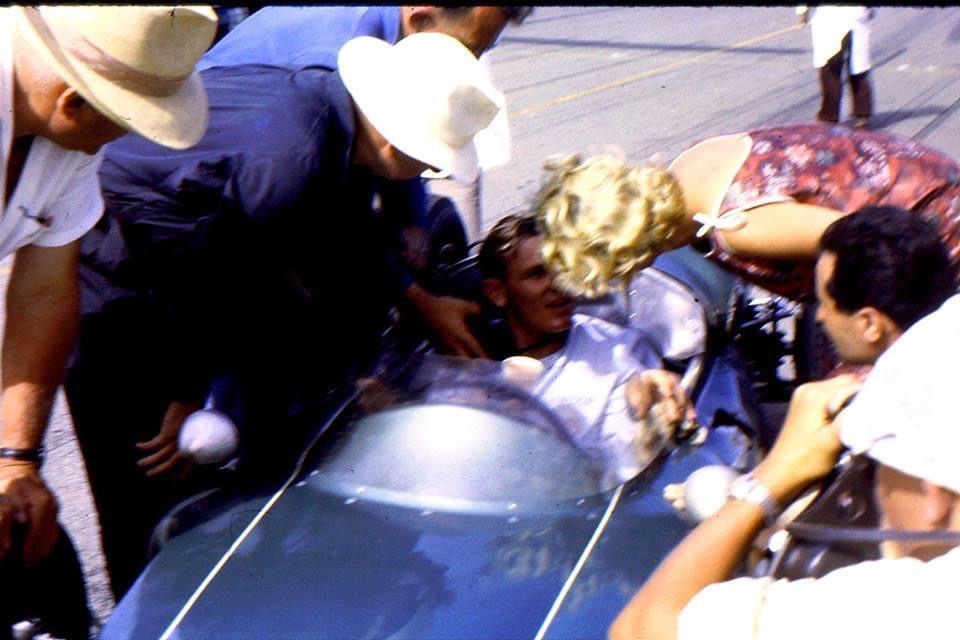
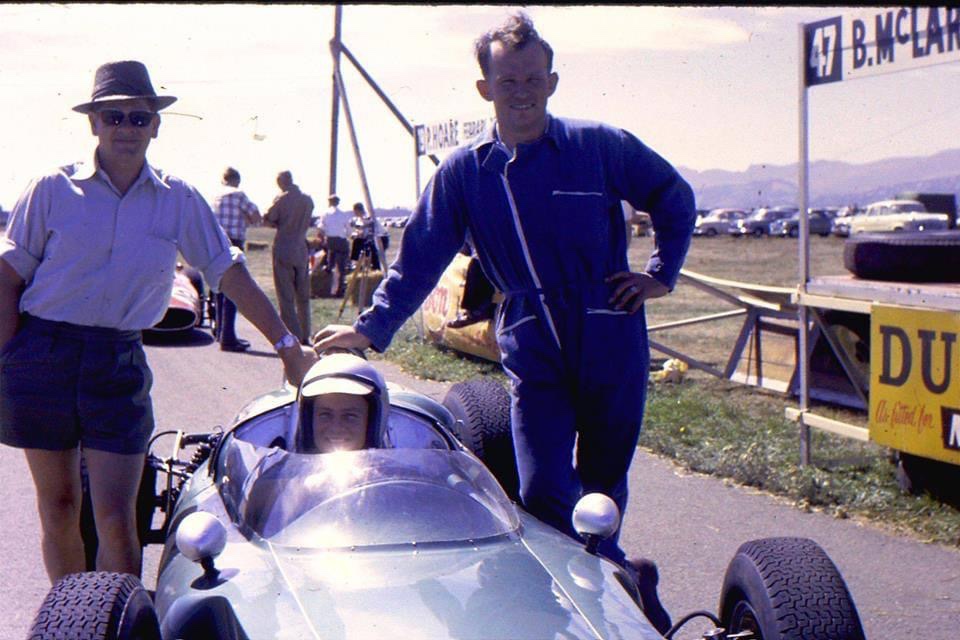
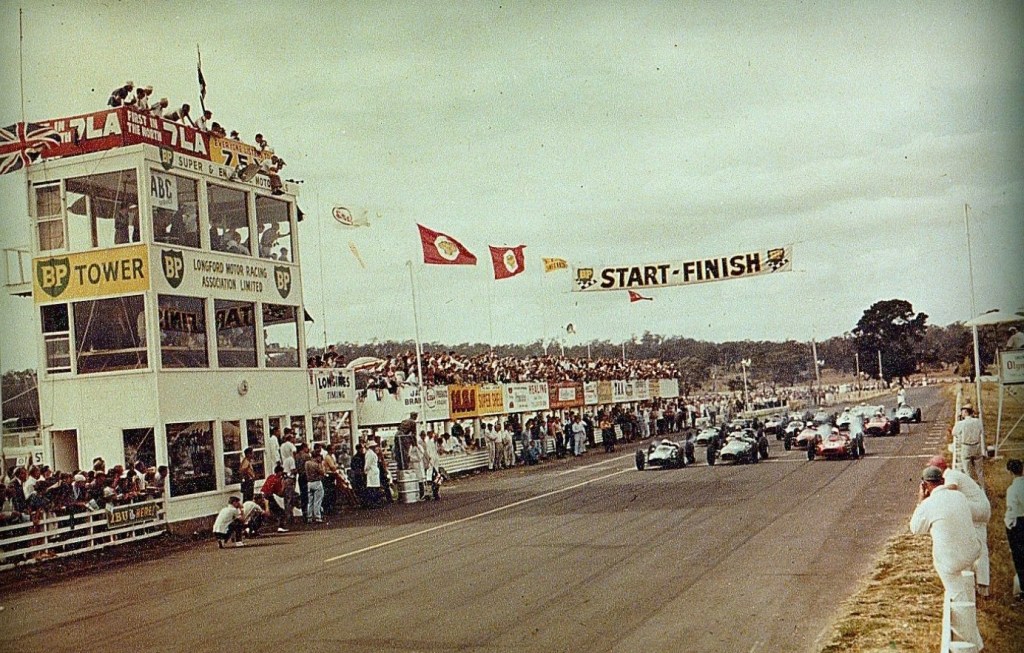
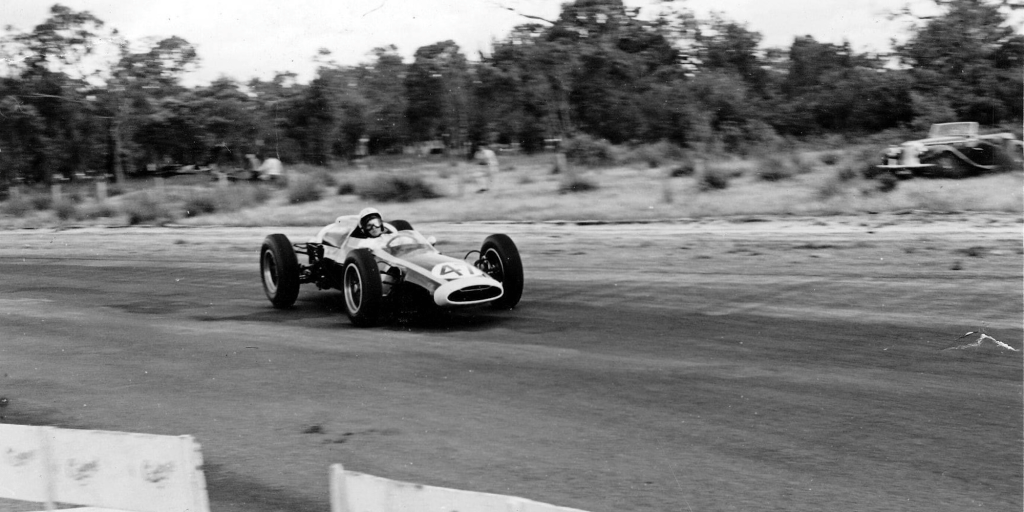
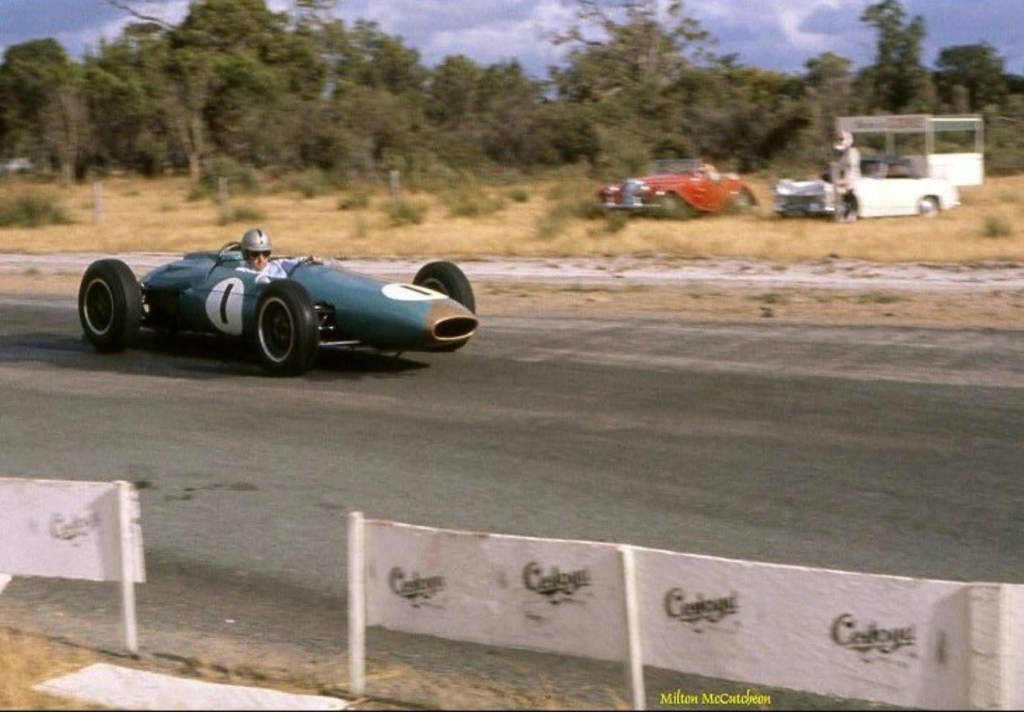
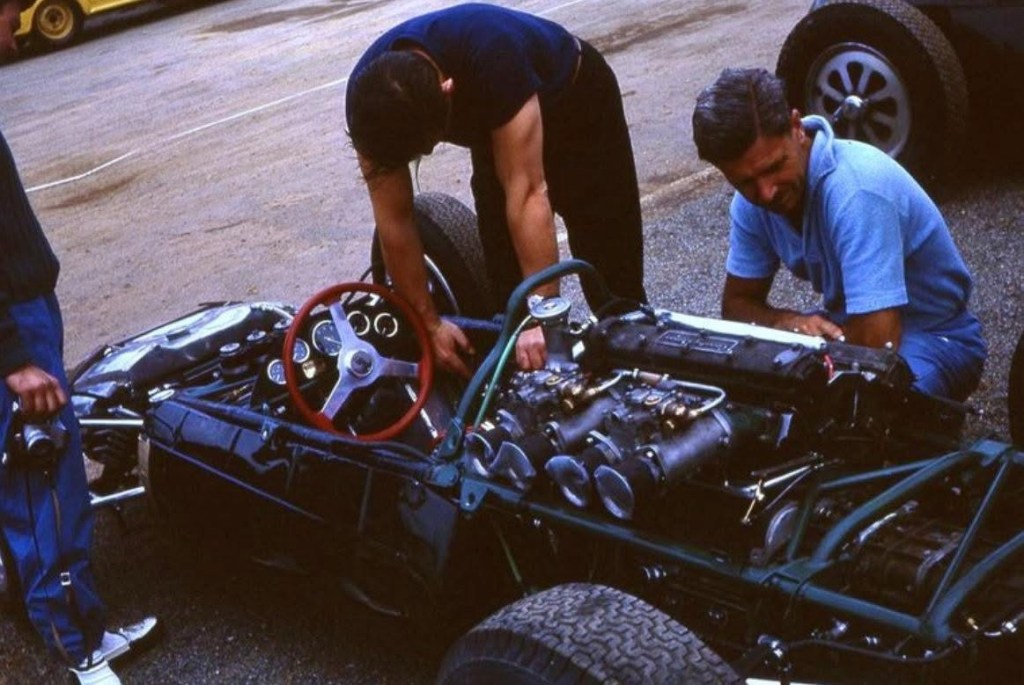
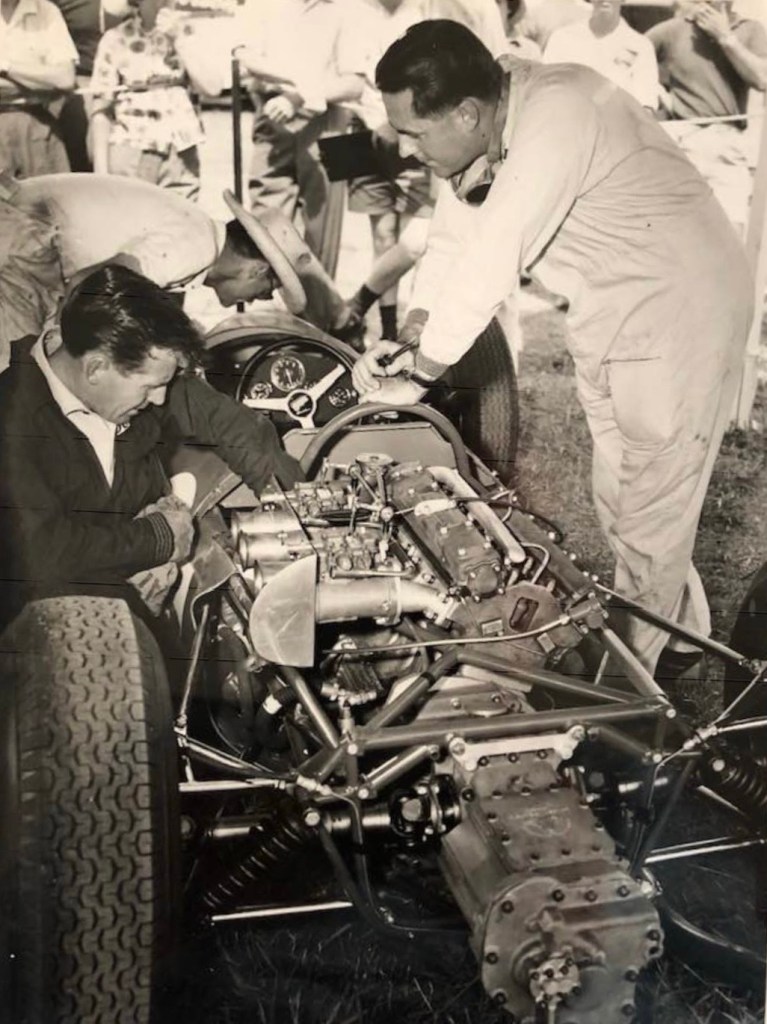
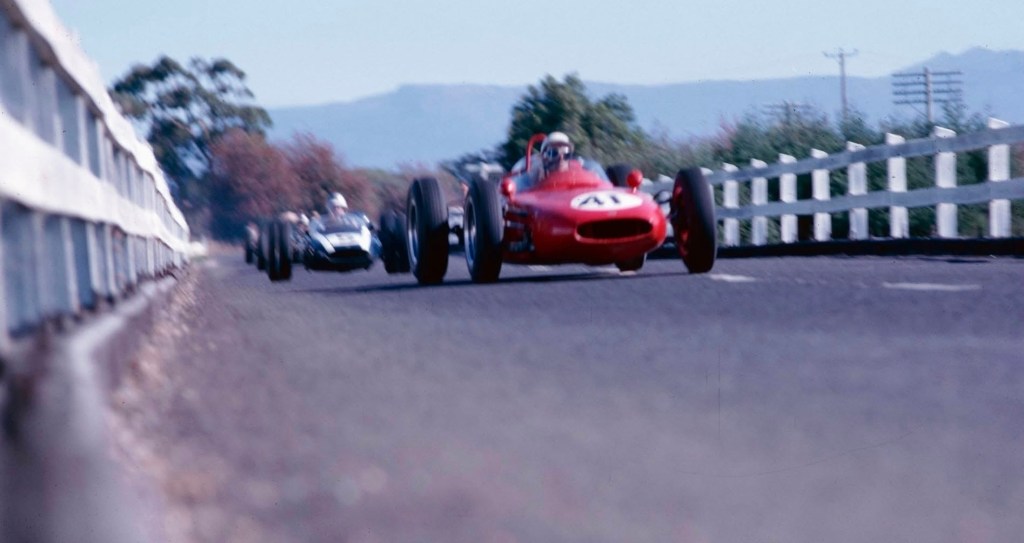
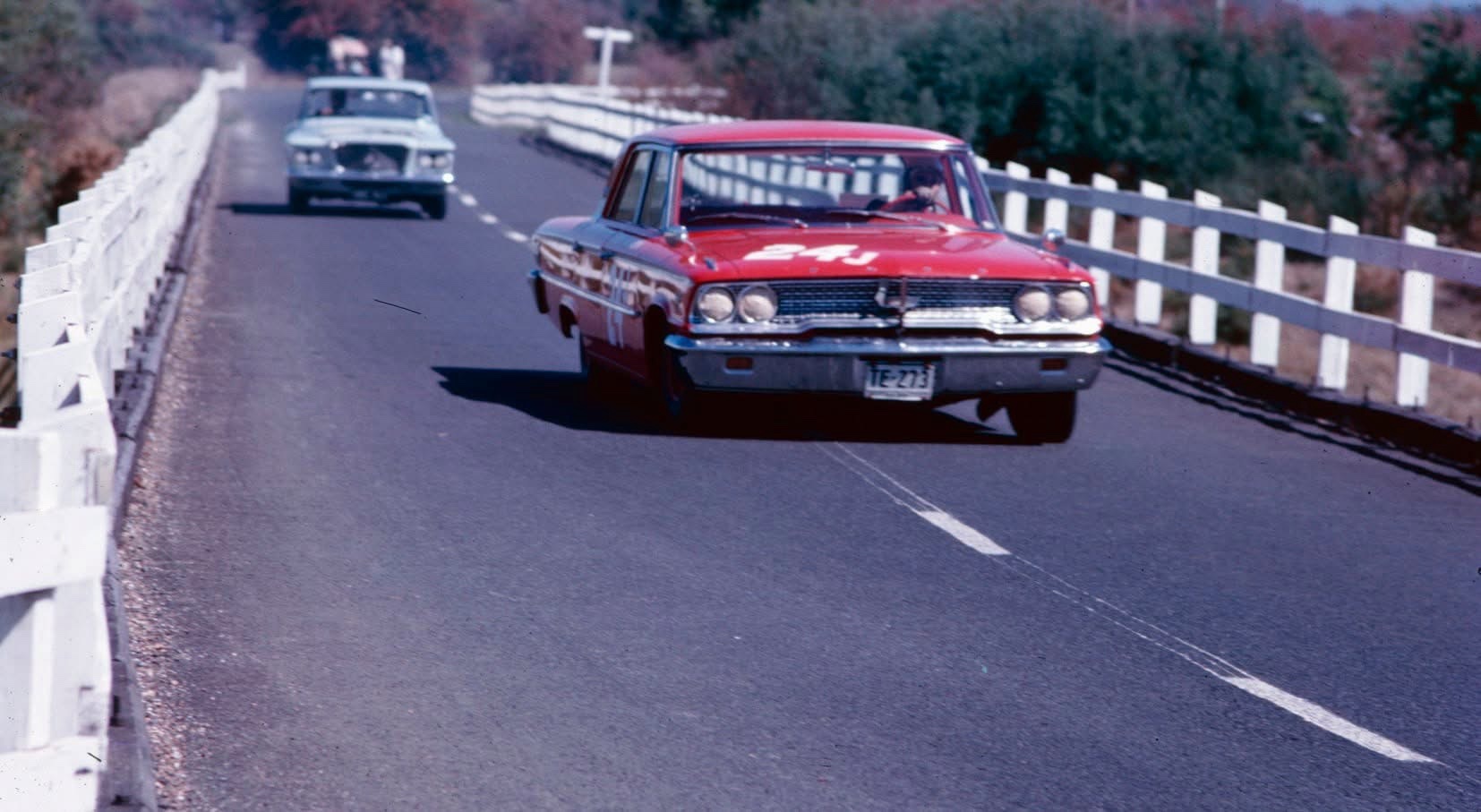
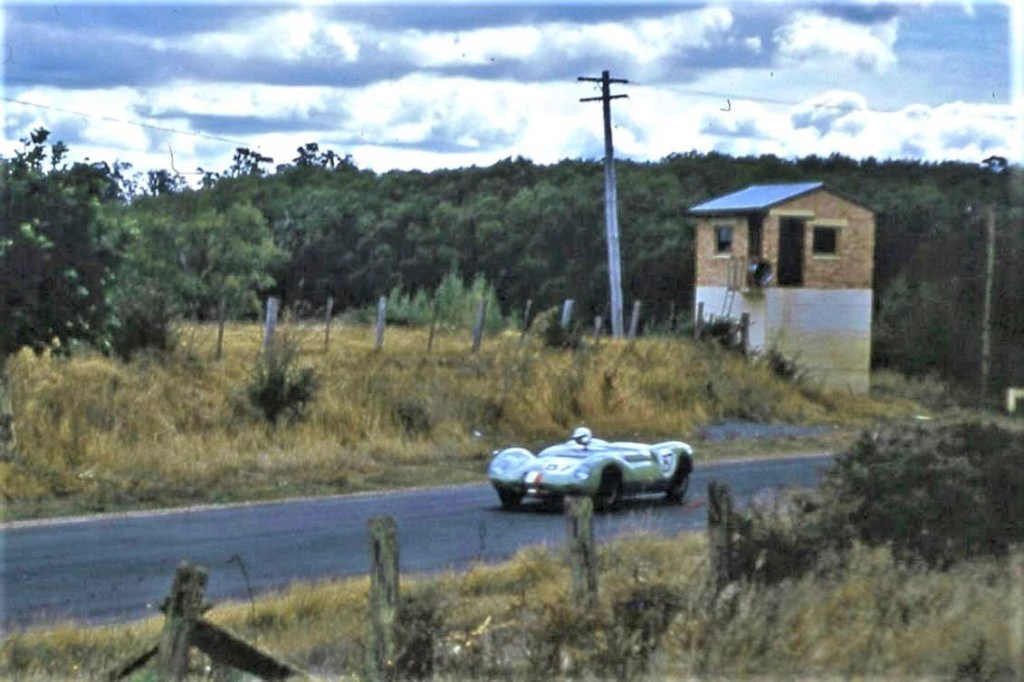
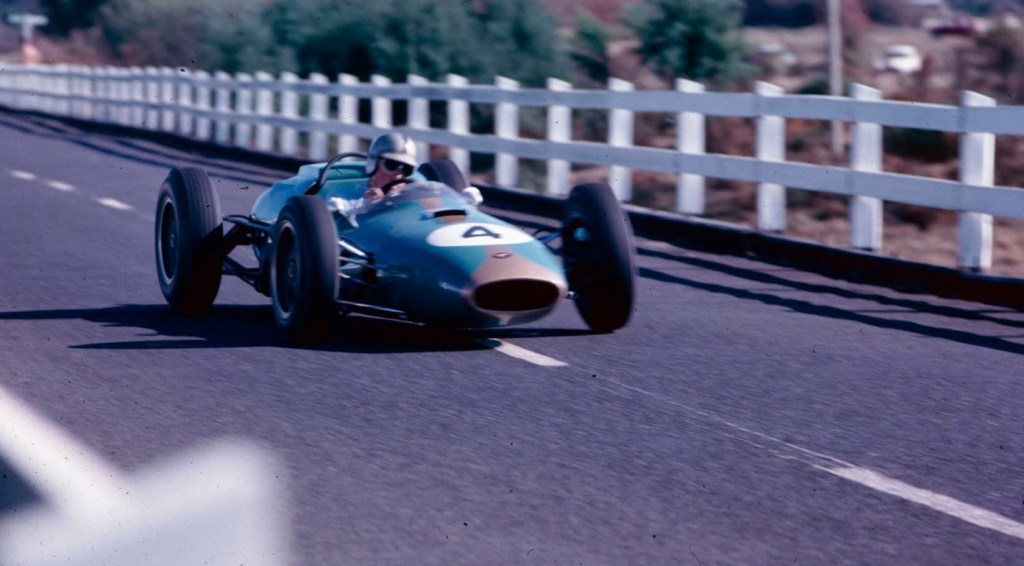
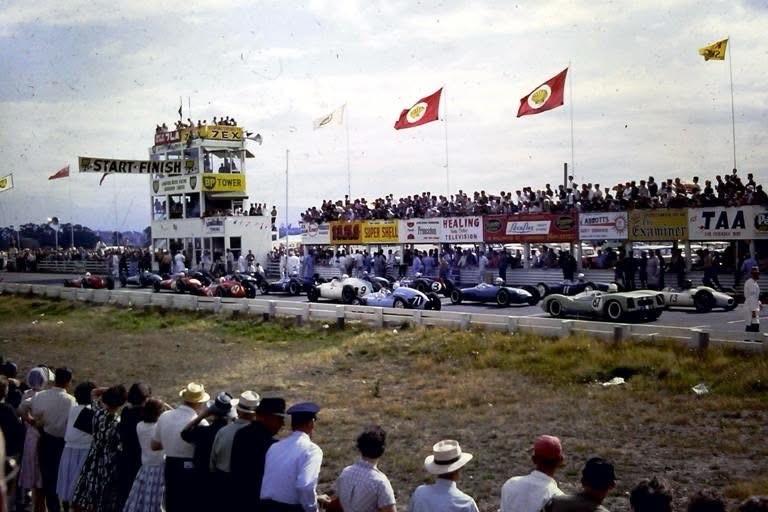
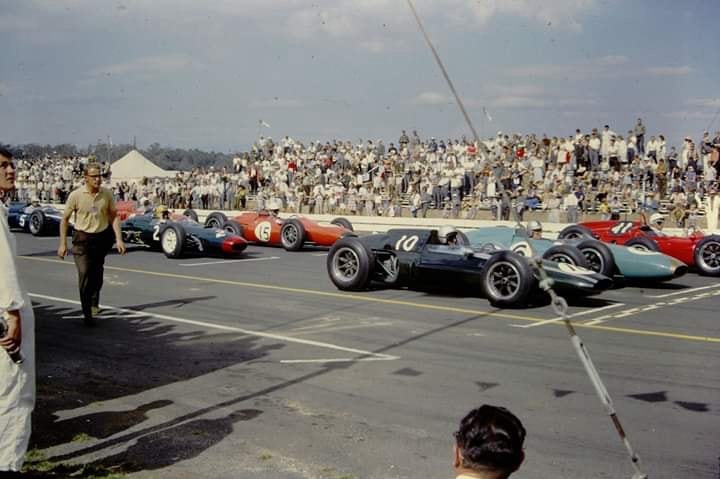
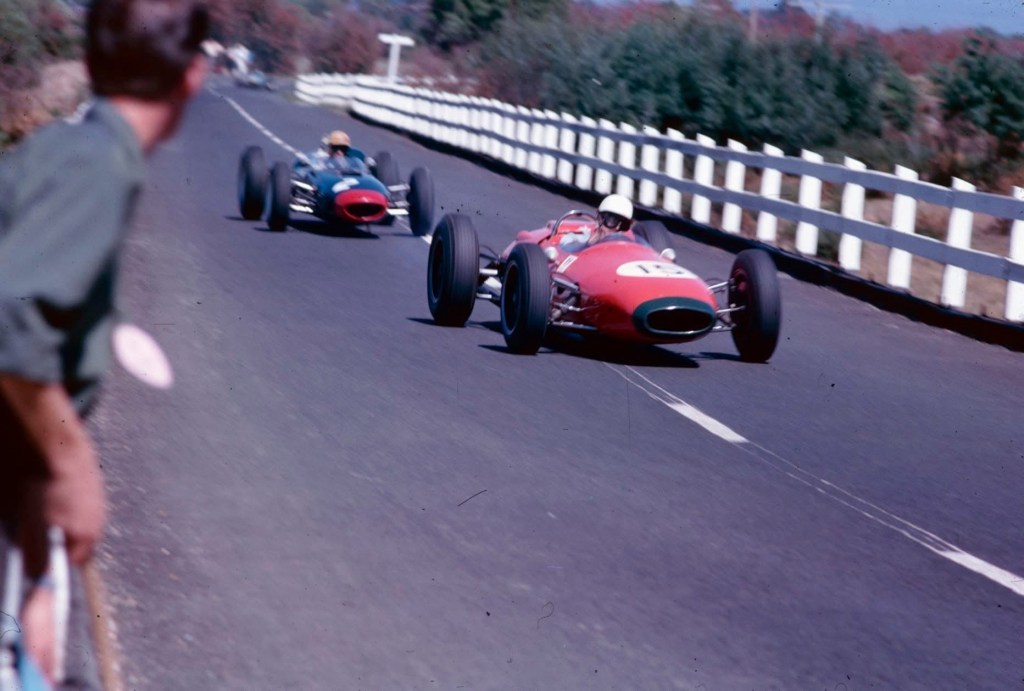
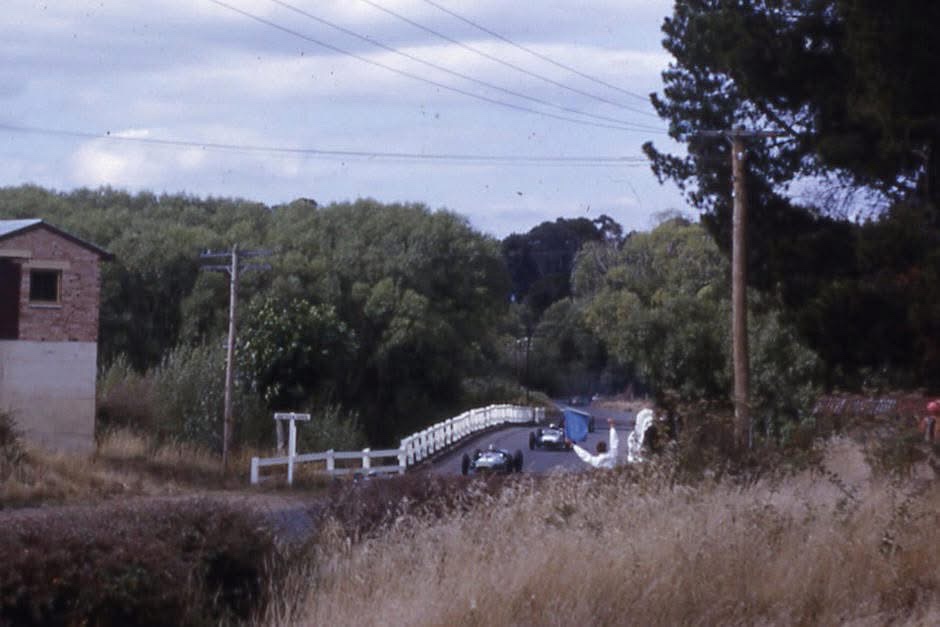
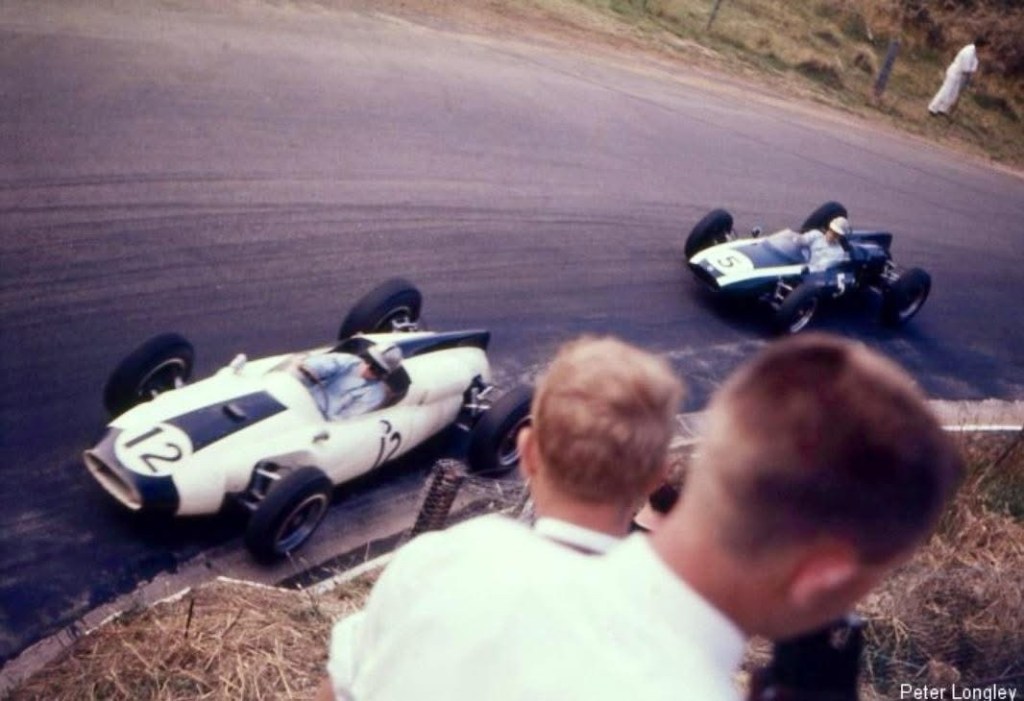
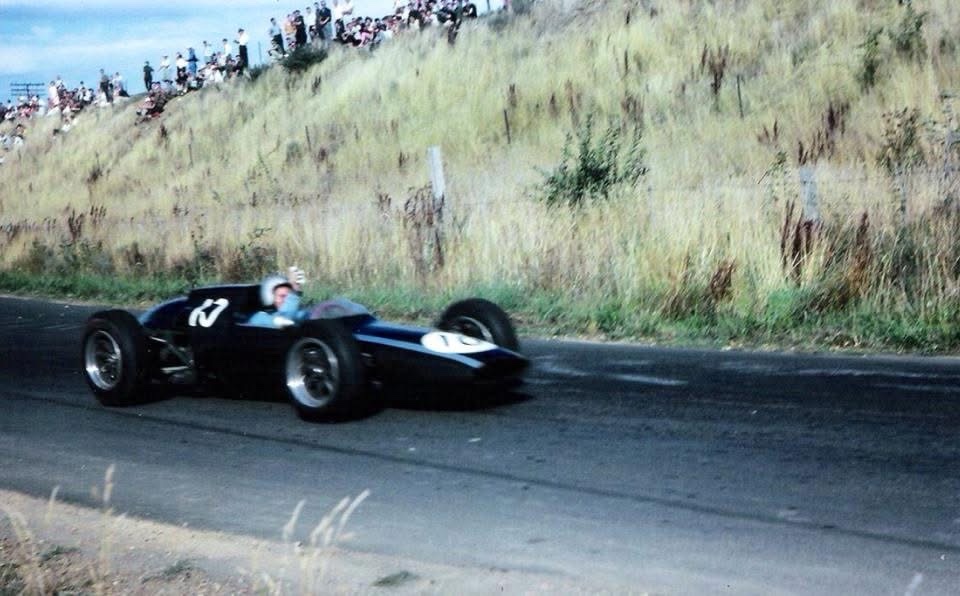
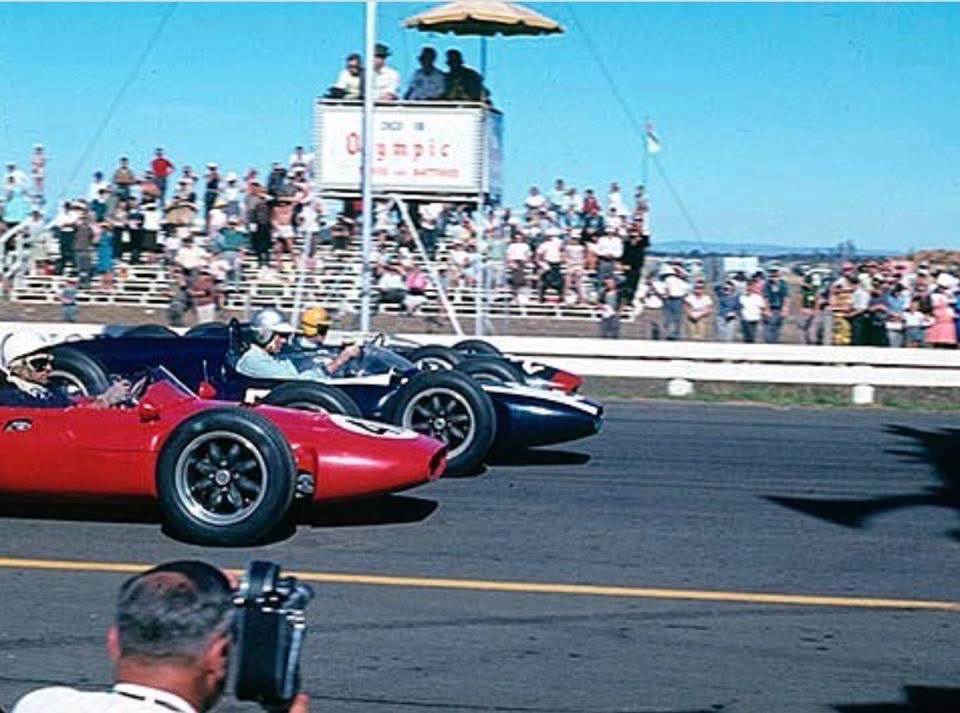

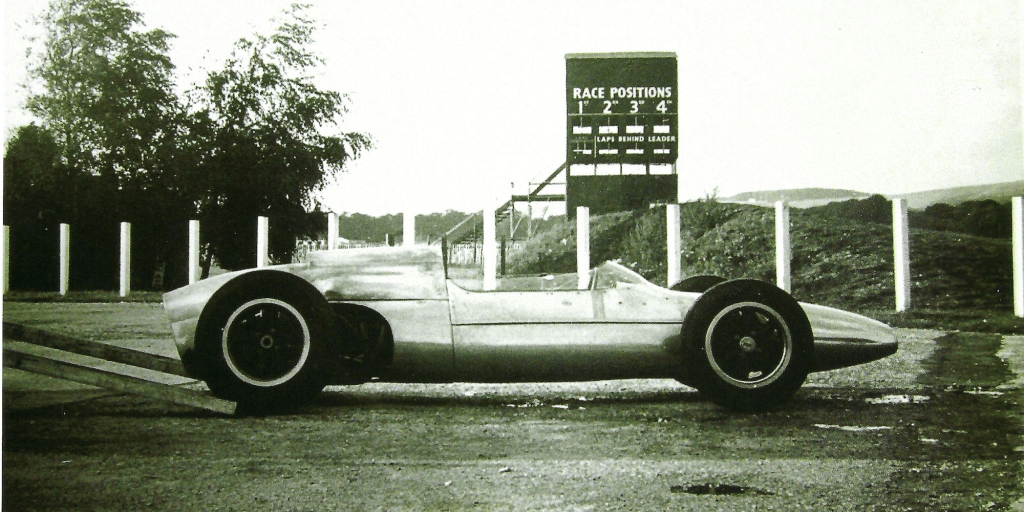
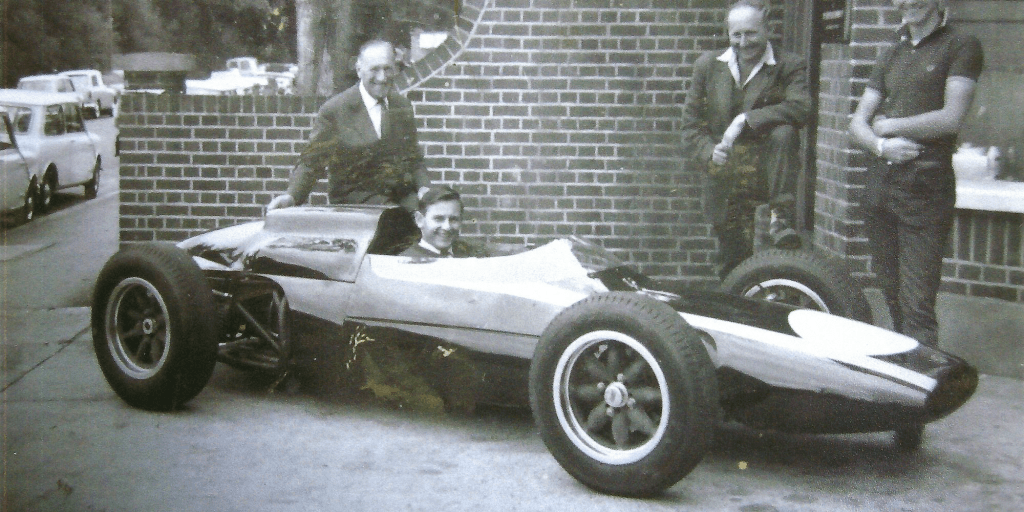
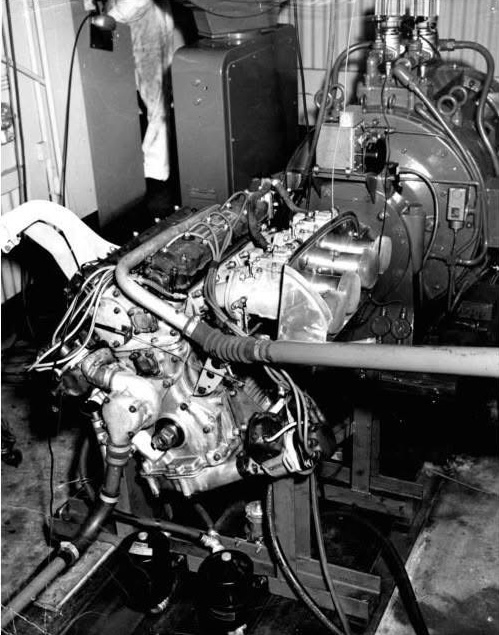
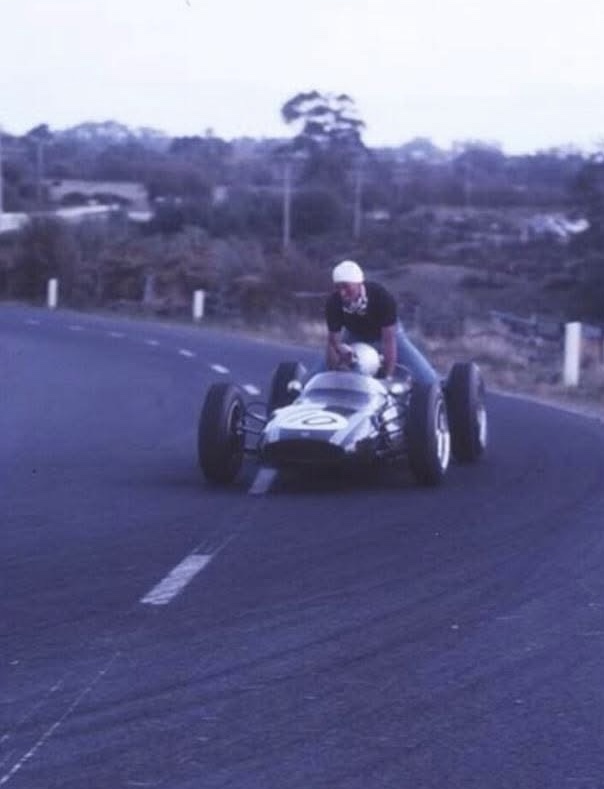
 primotipo...