Archive for the ‘Features’ Category

image

(John Ellacott)

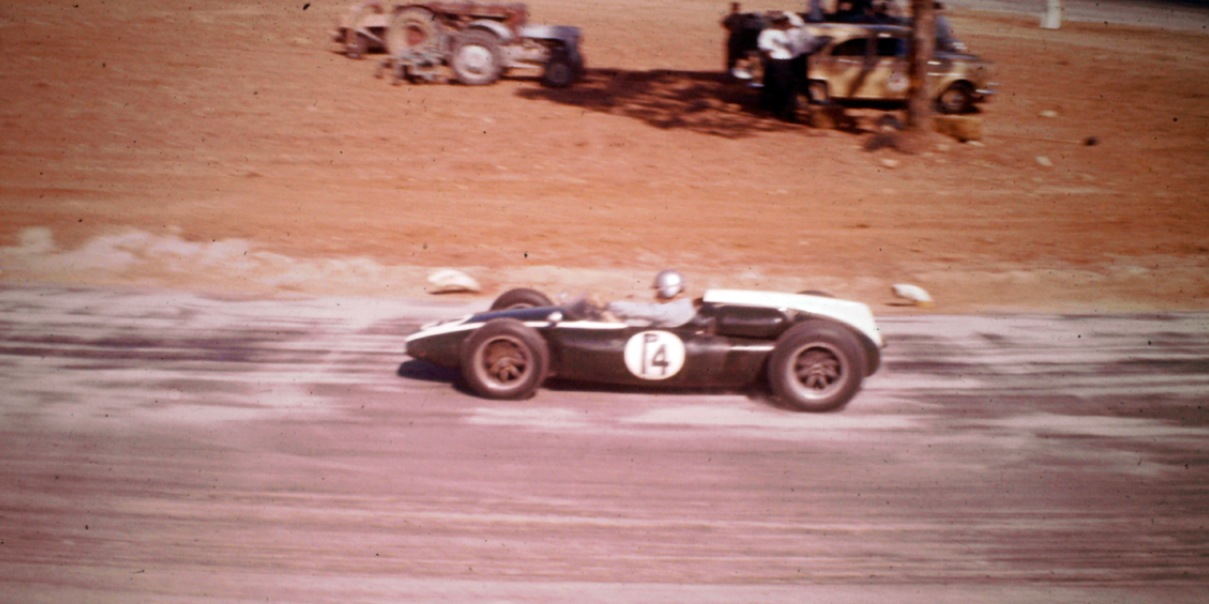
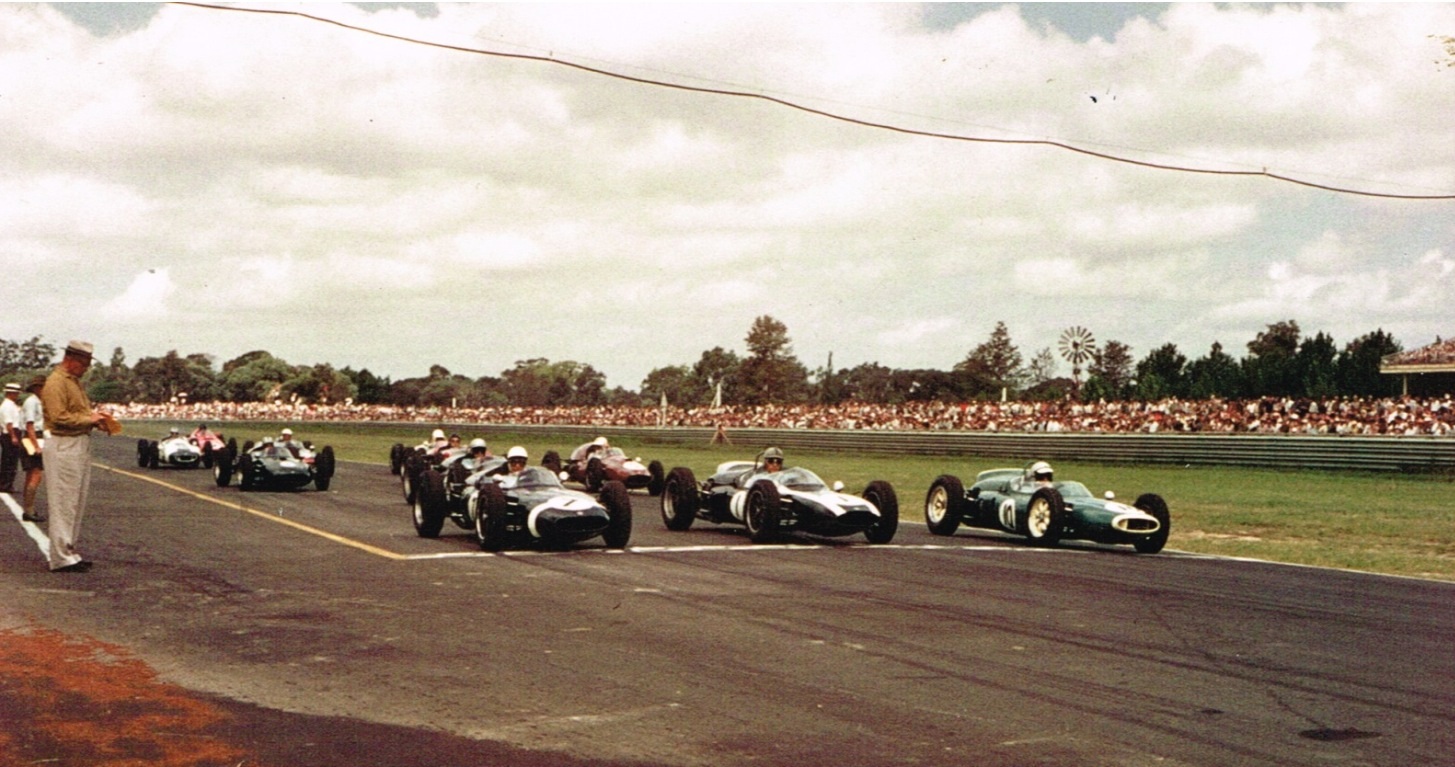
Lex Davison #4 lights up his Dunlops with Bib Stillwell and David McKay on the front row of the ‘Victorian Trophy’ grid, Calder Raceway on 13 March 1963…

They finished in this order, Lex’ ex-McLaren Cooper T62 the winner from the Stillwell and McKay Brabham BT4 Climaxes. David’s was a ‘little’ 2.5 litre FPF, the other two were toting big ‘Indy’ 2.7 litre engines.

In a season of consistency Stillwell won his second Gold Star, Taswegian John Youl won at Warwick Farm and Mallala, Davo won at Calder, Bathurst and Sandown but only Sandown was a championship round so the Melbourne motor dealer took the second of 4 Gold Stars on the trot, 1962-1965.

image

Calder Victorian Trophy grid 1963 from the front, Davo, Stillwell and McKay (John Ellacott)

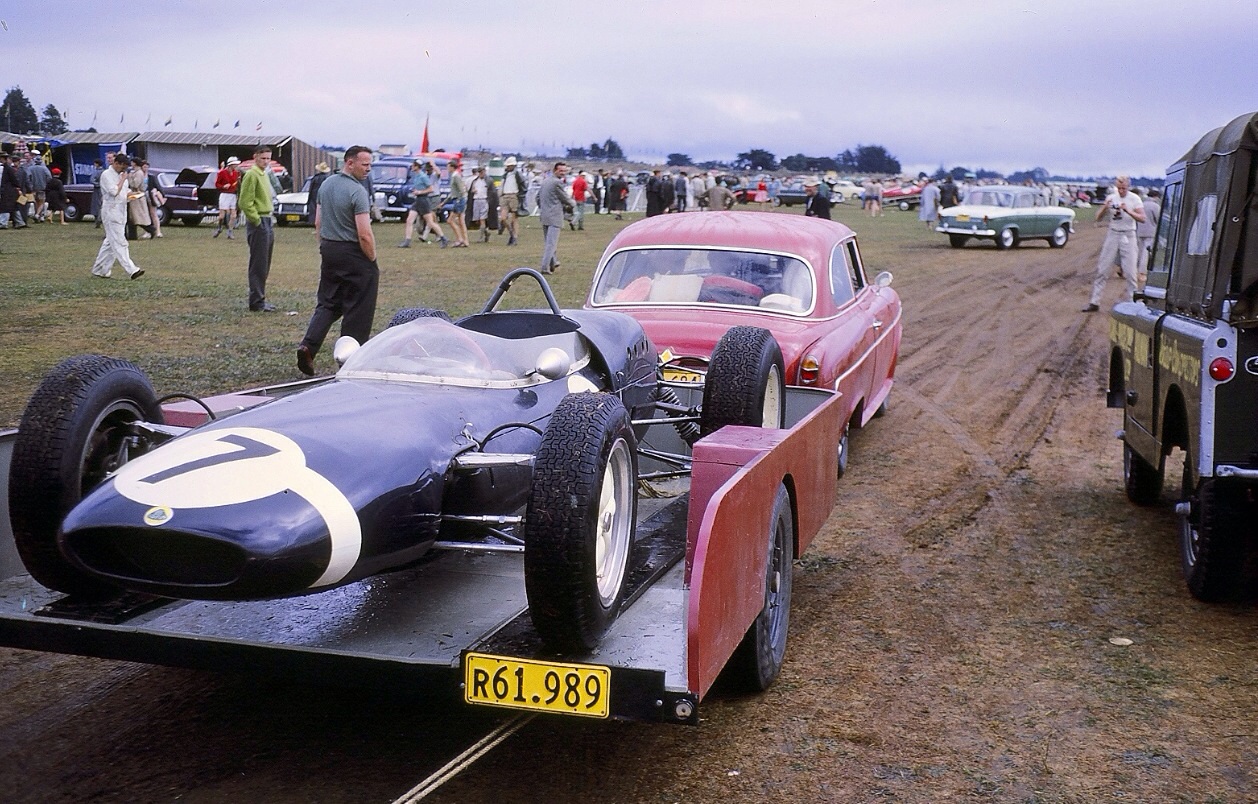
Tale of the Cooper T62 #’CTA/BM/2’…

It’s a sad tale too. This car was successful, winning races in the hands of both Bruce Mclaren for whom it was built and for Lex Davison who raced it next. But for those around the car there was much tragedy, so its an interesting tale if not a happy one. Rocky Tresise died at its wheel, not much has been written about the young Melburnian, Davo’s protégé. The point of the article is largely to right that a little, if you can add more to Rocky’s story I am interested to hear from you to flesh it out further.

Perth hosted the Commonwealth Games in 1962…

The Lord Mayor, like so many before and after him globally saw the games as a way of putting his city on the map and expediting the development of much needed infrastructure.

The event was tiny by the standards of Commonwealth and Olympic games today; 35 countries sent 863 athletes to compete in 9 sports but the event was huge in the context of the cities small population of around 500,000 people.

image

The games were the first to have an athletes village, till then competitors had been housed in hotels and billeted in private homes. As a fan of Perth’s City Beach I was astounded to learn the area was largely bushland until 65 acres were developed for the village in advance of the games. Now it’s a great place to live beachside and an easy train ride into town.

At the time the Australian Grand Prix didn’t have a permanent home, the event was rotated around the countries six states. This was good and bad.

Good in the sense that spectators/competitors had a chance to see/participate in their home race every few years but bad in the sense that no one circuit owner/promoter could set up ‘infrastructure’ knowing they had one or two big events they could plan their revenues and therefore capital outlays around. This ‘sharing arrangement’ applied until the first F1 AGP in Adelaide in 1985, which became Albert Park when the nasty Victorians ‘nicked the race’ from SA.

image

image

Perth circa 1964 (unattributed)

It made good sense to have the AGP in Perth at the time of the games to get along a decent crowd of locals and overseas visitors.

The ‘Games, held from 22 November-1 December were noted for ‘heat, dust and glory’. The opening ceremony was 105 degrees fahrenheit, (40.5 centigrade) the heat continued throughout the competition. The army were pressed into service ferrying constant supplies of water to parched competitors.

image

image

The 18 November 1962 AGP was held at Caversham, an ex-military airfield circuit in Perth’s Swan Valley, 20 km north-east of the city centre and was also scorching hot.

The circuit hosted two AGP’s in 1962 and 1957, that race was won somewhat controversially by Lex Davison’s Ferrari 500/625, co-driven by Bill Patterson, again in scorching heat. To this day many pundits believe the race was won by Stan Jones Maser 250F who took the chequered flag but subsequently the win was given to his great friend and Melbourne rival after ‘lap countbacks’ and protests

In order to secure some world class competitors Brabham and McLaren were paid to attend, both brought cars intended to compete in the Antipodean summer internationals which traditionally commenced in New Zealand early in the new year.

The Brabham BT4 and Cooper T62 were variants of the respective marques 1962 F1 cars, the BT3 and T60, both powered in that application by the Coventry Climax 1.5 litre FWMV V8.

For ‘Tasman’ use, actually Formula Libre at the time, both cars were fitted with 2.7 litre Coventry Climax FPF 4 cylinder engines, CC’s 2.5 litre very successful 1959/60 World Championship winning engine taken out to 2.7 litres. These ‘Indy’ engines were originally developed for Jack’s first Cooper mounted Indianapolis appearance in the Memorial Day classic.

brab mac

Brabham and Stillwell take to the Caversham track, AGP weekend 1962. Brabham BT4 and Cooper T53 (Terry Walker)

‘The History of The Australian Grand Prix’ relevant chapter was written by Graham Howard. He records that Jack and Bruce started the race very evenly matched; Jack ‘popped’ his 2.7 Climax in practice, Bruce lent him his 2.5 spare, indicative of the great friendship between two guys who were also fierce competitors particularly on ‘their home turf’ during the annual Tasman races.

For McLaren’s part, Bruce had his Cooper handling beautifully having tested the car at Goodwood prior to his trip but then John Cooper grabbed the springs fitted to it for Monza F1 use leaving Bruce with a skittish, twitchier chassis than was his optimum.

So, Bruce had a bit more ‘puff’ than Jack, the alcohol fuelled 2.7 FPF giving around 260bhp to Jack’s 230 but Jack had the sweeter handling car- the scene was set for a fascinating contest.

Whilst the entry was ‘skinny’ the race promised to be a close one and so it was.

Other entries included the Coopers of Davison T53, John Youl T55, Bib Stillwell T53 and Bill Patterson, the latter somewhat hamstrung by driving an older T51.

agp bib

Stillwells Cooper T53 cruising the Caversham paddock (oldracephotos.com)

Local enthusiasts who raced were Syd Negus’ Cooper T23 Holden, E Edwards TS Spl and Jeff Dunkerton’s Lotus 7.

cav start

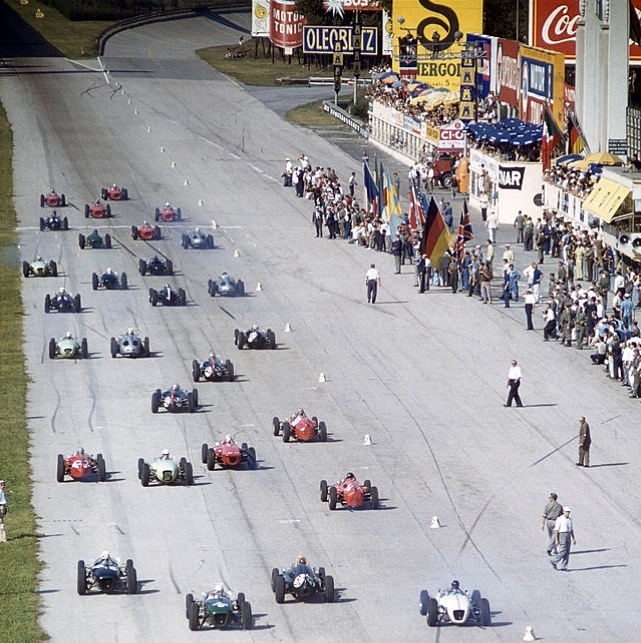
Small field shown in this start shot, fortunately the torrid duel between Brabham and McLaren made up for the paucity of competitors. Brabham then dark green Coopers, Patterson’s white one, Davo’s red Cooper and similar colored BRM P48 Olds of Arnold Glass, then the front engined Cooper T23 Holden of Negus, green TS Spl of Ted Edwards and finally the green Lotus Super 7 of Jeff Dunkerton, the last sports car to start an AGP. Note the State Governor’s Roller in the foreground (Lyn Morgan/Terry Walker)

The race only had 10 starters, Perth is a long way from the east coast where most of the Gold Star contenders were based. The balance of the field was made up of WA competitors. Indicative of the change in the nature of AGP fields is that this race was the last for a front engined car (the appearance of the Ferguson in 1963 excepted), the last for an air-cooled and Holden engined cars.

cav brabham

Brabham’s brand new BT4 Climax at Caversham, this car the first of many very successful ‘Intercontinental’ Brabhams; the Coventry Climax powered BT4/7A/11A won a lot of races in Australasia (Milton McCutcheon)

Even though the field was small the race settled into an absorbing battle between McLaren and Brabham at the front. The thrust and parry continued for over 40 laps, the gap varying between 2 and 8 seconds as attack and counter-attack was staged.

agp lex

Lex with a big smile for the cameras! Cooper T53 Climax 2.7 ‘Lowline’ . The T53 was the works only ’60 GP car and sold to customers for ’61 (oldracephotos.com)

The race went on with Jack unable to get past Bruce but opportunity arose when Bruce ran wide lapping Arnold Glass for the second time.

Jack focused on Bruce, Glass took his line for the next corner, he and Brabhamcollided, the latter racing an ex-Scarab aluminium Buick V8 powered BRM P48. Arnold finished but JB was out on lap 50 leaving Bruce to take a popular win.
cav mac win

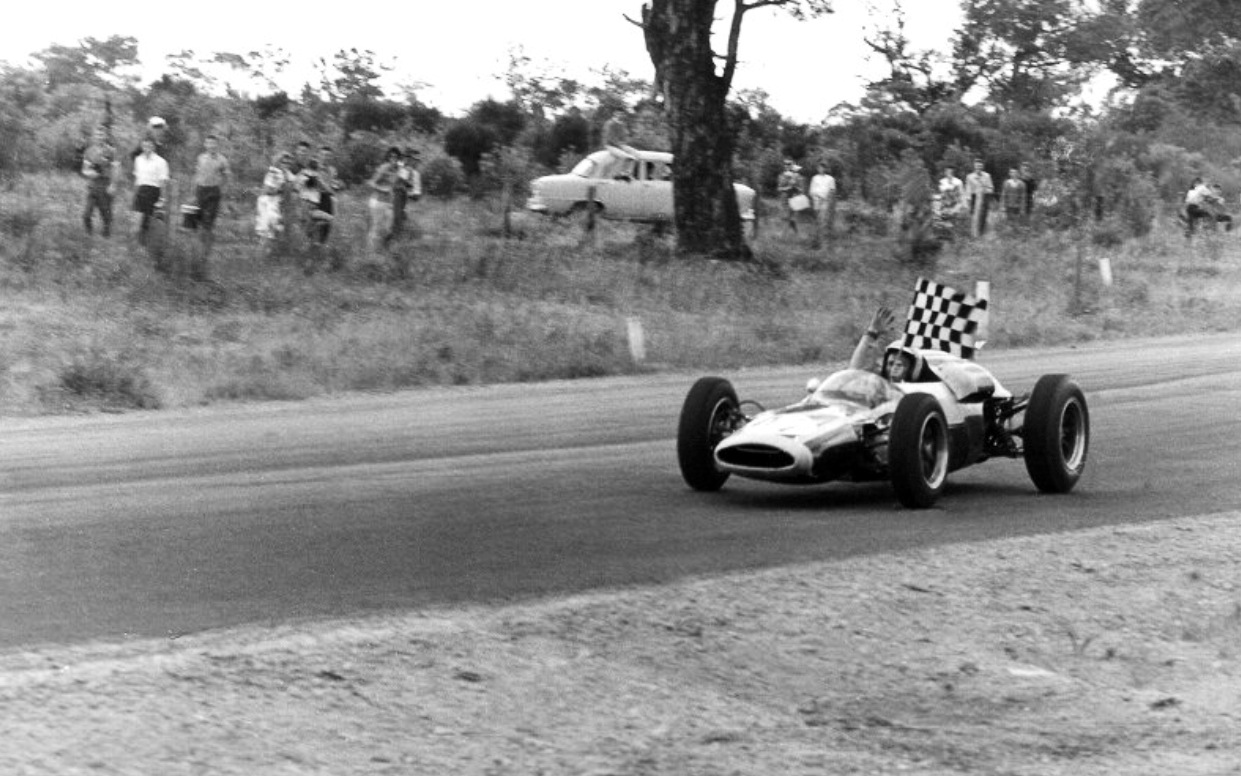
McLaren takes the plaudits of the crowd on his victory lap, Caversham 1962 (Terry Walker)

Youl was 2nd after an interesting battle with Stillwell 3rd, 4 seconds behind, Patterson 4th, then Glass in the BRM and Negus the first of the locals in the Cooper T23 Holden.

cav gov

McLaren takes the plaudits of the crowd and the Governor, McLaren manager/journalist Eoin Young is the ‘blood nut’ in glasses behind the governor (Terry Walker)

With that Bruce and Jack returned to Europe for the finish of the season and then returned in January to race the cars in the annual Australasian summer series of races.

t 62 front

Bruce McLaren shows racer/journo/team owner David McKay his new T62 toy, McKay could not race having damaged his ex-McLaren Cooper T55, famously demolishing a marshalls ‘dunny’ after an off into Warwick Farm’s infield. Front wishbone suspension, Alford & Alder uprights, big oil reservoir for the CC FPF and aluminium side fuel tanks all clear (Peter Longley/Terry Walker)

Cooper T62 Climax…

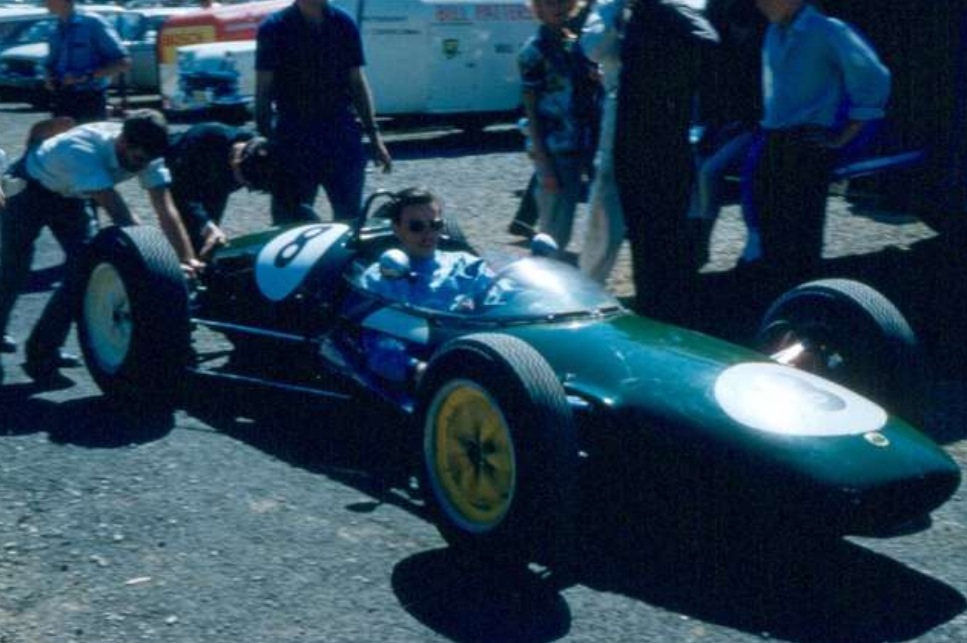
The Cooper was conventional for its day the T60 F1 chassis was laid out by Owen Maddocks after discussion with Bruce and John Cooper.

The T62 was built on the T60 jig by Tommy Atkins team at his Chessington ‘shop, Harry Pearce and Wally Willmott did the work. The rear frame was designed to take a P56 BRM 1.5 litre V8, the plan was for Bruce to drive it in non-championship F1 races Cooper themselves were not interested to contest.

When the engine was late, Atkins shelved the project and instead modified its frame to accept a 2.7 litre ‘Indy’ Coventry Climax FPF engine and Colotti T32 5 speed transaxle for ‘Tasman’ use.

t62 rear

Bruce and David again, rear frame detail and big 58DCO Weber fed 2.7 litre CC FPF engine, circa 260bhp on alcohol (Terry Walker)

Suspension was upper and lower wishbones and coil spring/shocks at the front and rear. There were adjustable roll bars front and rear, rack and pinion steering and disc brakes all round clamped by Girling BR/AR calipers front/rear. Wheel diameter was 15 inches.

coop bruce

#10 McLaren Cooper T62, Tony Maggs Lola Mk4 and Davison Cooper T53 on the ’63 Longford grid preliminary race (Ellis French)

McLaren raced the car that summer in the Antipodean Internationals

He took Kiwi wins at Wigram and Teretonga in January and then Sandown and Longford in Oz.

He was third at Warwick Farm and retired at Pukekohe, Levin and Lakeside. Bruce then sold the car, which had won five of its nine starts to Lex and headed back to Europe.

coop agp

1963 AGP at Warwick Farm 10 February 1963; #2 Surtees Lola Mk4a 2nd #5 David McKay Brabham BT4 4th #10 McLaren Cooper T62 3rd, Brabham won the race in his BT4 (Howard)

1963 Internationals and Gold Star…

As stated in the first paragraphs of this article, Bib Stillwell won the second of his four Gold Stars with consistent performances in his Brabham BT4 all year. Lex showed plenty of speed in the T62 winning the Victorian Trophy at Calder and Bathurst 100 but neither were Gold Star rounds that year. Sandown was another T62 win, a hometown one and a championship round in September.

Jack Brabham won the AGP at Warwick Farm, the race held on 10 February whilst the ‘Tasman’ drivers were in the country, a pattern which continued for years, making the race much harder, and prized, to win by locals. Bruce was 3rd in the T62 with John Surtees 2nd in his Lola Mk4A.

McLaren won, as stated in the T62 at Longford and Sandown before selling the car to Lex and John Youl took two great wins in his Geoff Smedley fettled Cooper T55 at Mallala and Warwick Farm, the final 2 races of the Gold Star championship.

t62 bath

Davison with ‘Bathurst 100’ victory laurels 15 April 1963, the Cooper T62 looks superb, his cars always beautifully presented and prepared by Alan Ashton and the rest of the crew (John Ellacott)


calder

Lex T62 ahead of Stillwell’s Brabham BT4 during the Victorian Trophy, Calder 11 April 1963 (‘stan patterson’)

Lex had 1963 Gold Star speed if not reliability. In the ’64 Tasman Series, he contested  the Sandown, Warwick Farm and Longford rounds for DNF/8th/6th  in the T62.

Bruce returned to the Antipodes with a 2 car team in 1964, the so-called ‘first McLarens’ were Cooper T70’s designed by Bruce, albeit built in the Cooper ‘shop. Bruce took 3 wins, Brabham 3 as well in his new BT7A but greater consistency gave Bruce the title.

Denny Hulme was Jack’s teammate in the Brabham BT4 Jack used the previous year, the car Davison would later purchase at the series conclusion.Tim Mayer showed great speed and promise in the other T70 but sadly lost his life in an accident at Longford.

davo sandown

oopsie! Lex having a moment in the T62 at Sandowns turn 1 or Shell Corner, in front is Frank Matich  and behind Jack Brabham both in Brabham BT7A Climaxes. AGP which Brabham won, 9 February 1964, the other two both DNF (Howard)

Lex joined the ‘circus’ for his home race, the AGP at Sandown on 9 February but was out with piston failure in the T62 on lap 29, Jack won the race.

Davo was 8th and 2nd local home behind Stillwell at Warwick Farm, Brabham again taking the win.

He didn’t contest the ‘Lakeside 99’ in Queensland but was 6th a little closer to home at Longford in early March, this time Graham Hill won in a Brabham, David McKay’s Scuderia Veloce BT4.

image

Longford ‘South Pacific Trophy’ grid 2 March 1964; #2 Brabham BT7A, Hill in the red winning BT4 and Matich in the pale BT7A, then Stillwell on row 2 in the dark BT4 with Lex alongside in the red T62 and the rest (Geoff Smedley)

Lex started the ’64 Gold Star series in the Cooper but soon ‘got with the strength’ and bought one of Ron Tauranac’s ‘Intercontinental’ Brabhams, the marque pretty much had a stranglehold on the domestic competition from this point for the next few years. From 1963-68 to be precise.
coop and brab

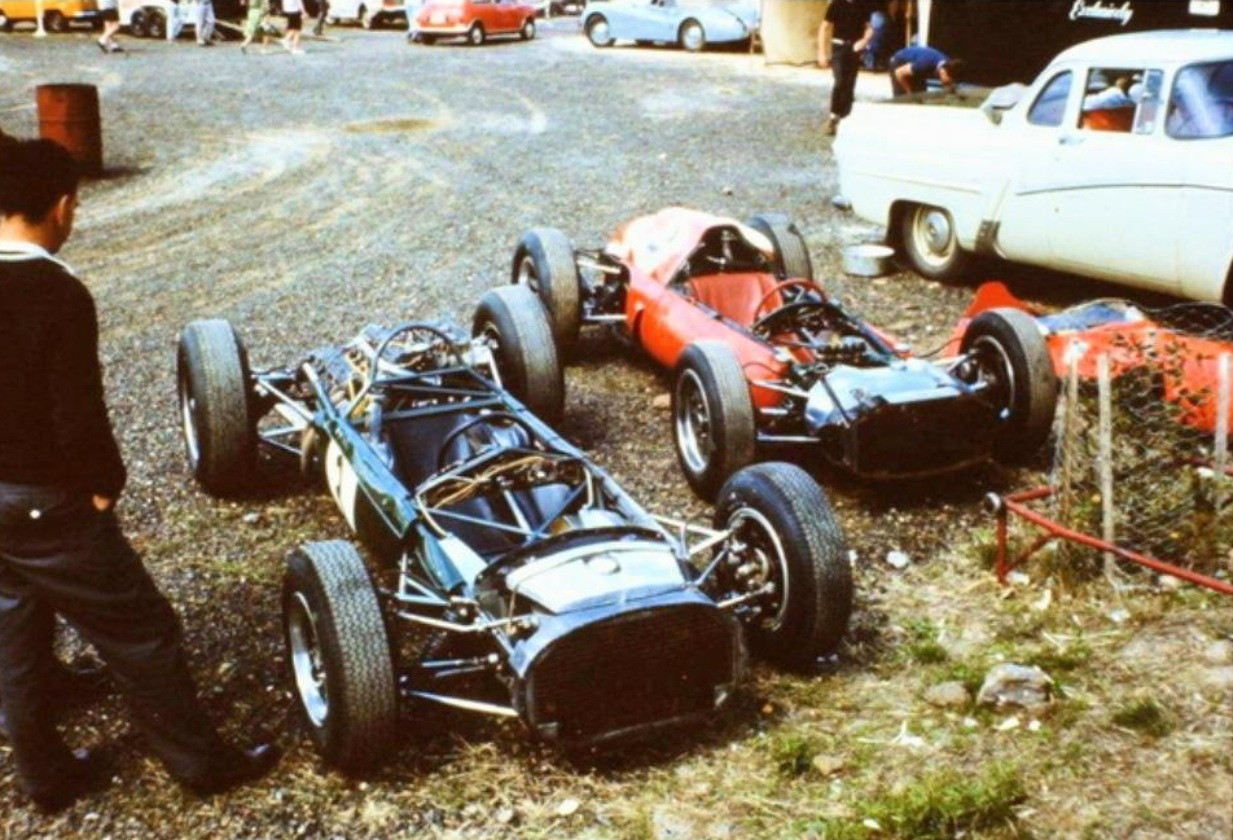
Cooper T62 (right) and new Brabham BT4 with Davison team engineer Alan Ashton’s Ford Mainline ute towcar. ‘The BT4 was JB’s works car then Denny Hulme’s winning the AGP and Tasman Champs then to Davo and later John McCormack’s first ANF1 car. This is the BT4’s first run at Calder by Davison still in factory colors, after this meeting ’twas painted red (Terry Walker/Denis Lupton)

Stillwell again won the Gold Star, his well developed and beautifully prepared Brabham BT4, the national championship now run to the Tasman 2.5 litre formula.

He was more than quick enough to take the title with a win at Lakeside and strong placings elsewhere including an excellent 2nd to Brabham at Sandown in the AGP contested by the internationals on 4 February.

Lex won at Mallala in his new Brabham BT4 with Rocky Tresise finishing third at Warwick Farm in Lex’ Cooper T62, the nearly 1 hour race great preparation for the internationals Tresise was to contest that summer. The quicker 2.5’s of Matich and Stillwell didn’t finish the race but Rocky finished in front of Lex who was 4th. Leo Geoghegan and Greg Cusack were 1st and 2nd in Ford/Lotus 1.5 powered Lotus 32 and Elfin FJ respectively

Rocky Tresise…

Davo raced the Brabham from the 13 September Lakeside round giving Rocky Tresise, an up-and-comer and neighbour some races in the now second-string T62 during 1964.

Rocky’s first exposure to motor racing was as a 15 year old Melbourne Grammar schoolboy attending a Fishermans Bend meeting in 1958 with a mate whose family knew David McKay. The Scuderia Veloce chief was racing his Aston DB3S at the meeting.

Tresise was hooked ‘the noise, the smell and the excitement really got me in and from then on I bought every motor magazine I could get to try to learn more about motor racing’ he said in an AMS article about him in June 1964.

rocky

Rocky Tresise in 1964 aged 21 (AMS)

Rocky worked as a ‘servo’ pump attendant and on a farm in his school holidays to get together sufficient money to buy a car when he turned 18, his MGA contested 52 races at Sandown and Calder in 1962 having started in sprints and hillclimbs.

In 1961 the Davisons moved to Clendon Road, Toorak, one of the best streets in Melbourne, the Tresise family were the neighbours.

Chris Davison, Lex’ son and a racer himself recalls; ‘We grew up at Killara Park, the farm at Lilydale my grandfather established, dad used to commute into Collingwood each day where the shoe factory was. (Paragon Shoes) As we got older and needed to be closer to Burke Hall (Xavier Junior School) in Kew dad bought a house at 81 Clendon Road, Toorak just over the road from St Johns Toorak’.

‘Rocky had obviously heard via the grapevine we were moving in and on the very first night, the first night as we sat down to dinner there was a helluva racket, an engine being blipped and revved next door. Dad said ‘what the hell is that?’ and went next door to investigate, so they literally met the first night we moved into Clendon Road! Rocky’s furious blipping and revving of the engine was to let dad know there was a racer next door’

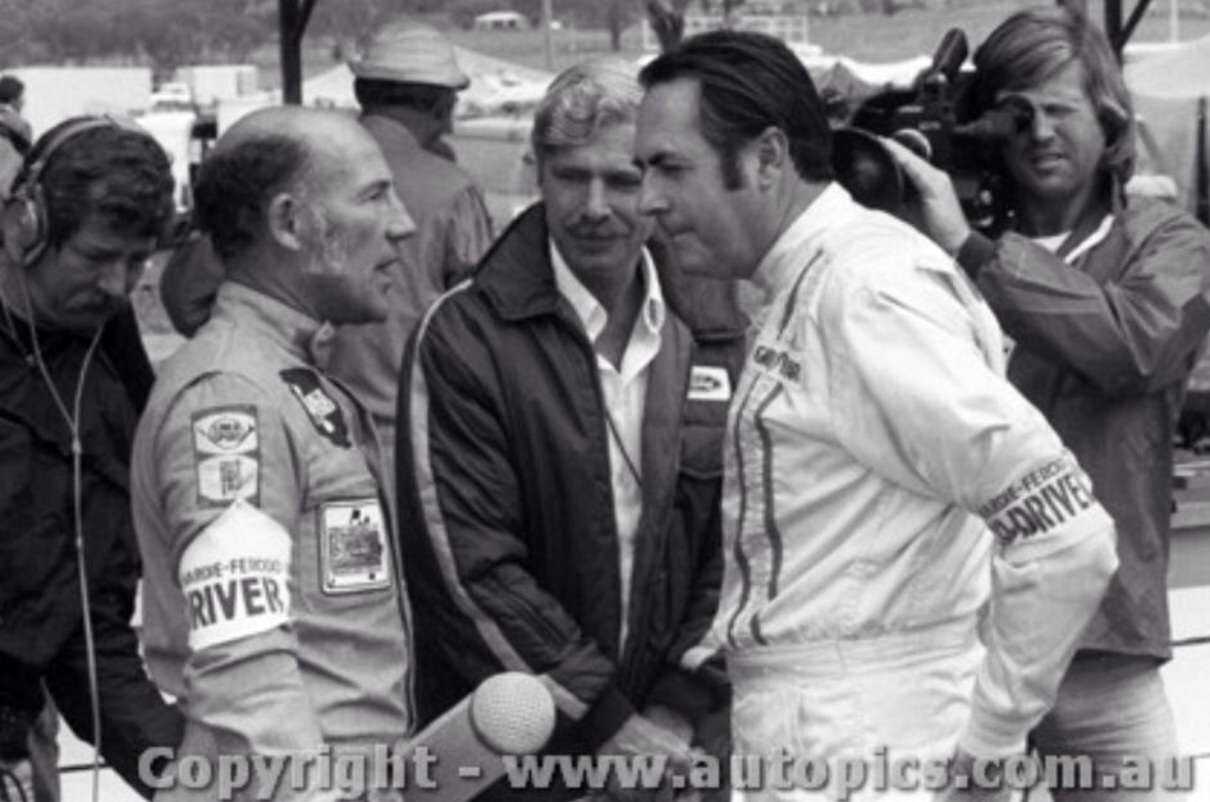
‘Rocky was a terrific bloke, i was 13/14 and liked him a lot. I often travelled with he and his girlfriend Robyn Atherton between race meetings. Rocky’s dad died some years back and Lex quickly became someone Rocky looked up to. A bit of a father figure and as time went on dad spoke of Rocky as his protege. Dad was famous for his Dame Nellie Melba (Australian opera singer) like retirements and comebacks but he knew his time to retire wasn’t too far off. The one of these i remember most was during one of the Albert Park meetings when we had Stirling Moss staying with us, we spent the whole weekend on a boat in the middle of Albert Park Lake so dad wouldn’t be tempted to get involved!’.

tres tri

Tresise scoots thru The Esses in the Triumph 2000 Mk1 he shared with Lex at Bathurst in 1964 (autopics)

Rocky, having gained useful experience, but not winning any races in his stock car, realised he would not be competitive without extensive and expensive modifications to the MGA.

RT had met Jack Hunnam racing a Morris 850 in the same team during the 1962 Armstrong 500 at Phillip Island, Hunnam sold Rocky his Lotus 18 Ford FJ, Hunnam was moving up to an Elfin.

The MG was sold, his road car an A Model Ford, his goal of an open-wheeler the important next step was a choice made with Davo’s advice. Rocky’s first race in the car was at Calder in January 1963, he didn’t exactly cover himself in glory touching wheels with another and having it aviate over the top of his Lotus.

In another race a rear suspension failure resulted in a spin, these mechanical problems were typical of his 1963 but he worked hard at night at Hunnams to better prepare the car whilst Lex assisted with advice on race craft, lines and so on. His first success, a 3rd in the 1963 Australian FJ championship. Tim Schenken later bought the Lotus which was an important part of his ascension.

After that success Rocky managed 4 wins and a 2nd from 5 starts in FJ events. By this stage he was working fulltime as a hardware salesman for the family business. Chris Davison did some research and identified WP Tresise & Co Pty. Ltd. with outlets in Flinders Lane, Melbourne and Lower Malvern Road, East Malvern as the family company.

On April 9 1964 Tresise (real name Rodney) was given the ultimate 21st birthday present when Lex gave him an Ecurie Australie pocket emblem as a welcome to the team, he was to drive the Cooper T62 at the 19 April Victorian Trophy Sandown meeting.

‘Dad wasn’t an easy bloke, he was a stickler and a tough disciplinarian so he would have had Rocky under a tight rein and insisting on him doing as he was asked. The famous occasion was when Rocky ran off at the bottom of Conrod at Bathurst during the 500 and arrived back at the pits…’what about getting the car son!’ was dads response!’

lex

During lunchtime on the Friday before the April Victorian Trophy meeting Lex drove the circuit with Rocky in his DB4 Aston. They stopped at various points to discuss lines, gear change and braking points and then played ‘follow the leader’, Lex in the Brabham, Rocky the Cooper.

Tresise got his times down to mid 14’s, the lap record then was Brabham/McLaren’s 1:8.1. Tresise  ‘I thought I’d be frightened of the car, but I wasn’t. Even when it’s sitting still you know it’s tremendously fast, everything is so functional but the biggest thing about it is it’s fantastic acceleration’ he quipped.

Spencer Martin was having his second start in the Scuderia Veloce Brabham Climax both of the young drivers performed well albeit Rocky fluffed a gear off the grid causing engine failure later in the race.

In the 15 lap feature he was last into Shell Corner, having botched a change but got his times down to the mid 12’s, up to 5th by lap 4 and on lap 10 3rd behind Stillwell and Lex after Frank Matich retired from the lead. On lap 13 the engine popped but 1:12.3 was good after only half an hour behind the wheel of what was one of the fastest single-seaters on the planet at the time. These 2.7 litre FPF Climax engined cars were quicker than the 1.5 litre F1’s of the day.

Lex Davison had this to say of Tresise in his AMS column; ‘…he has had over 60 starts. This is more than Bib Stillwell, Bill Patterson, Doug Whiteford, Stan Jones or myself had in our first 10 years of racing. His driving has improved gradually and after the usual errors of youth, over-confidence and inexperience he has developed a businesslike and earnest approach to driving racing cars’.

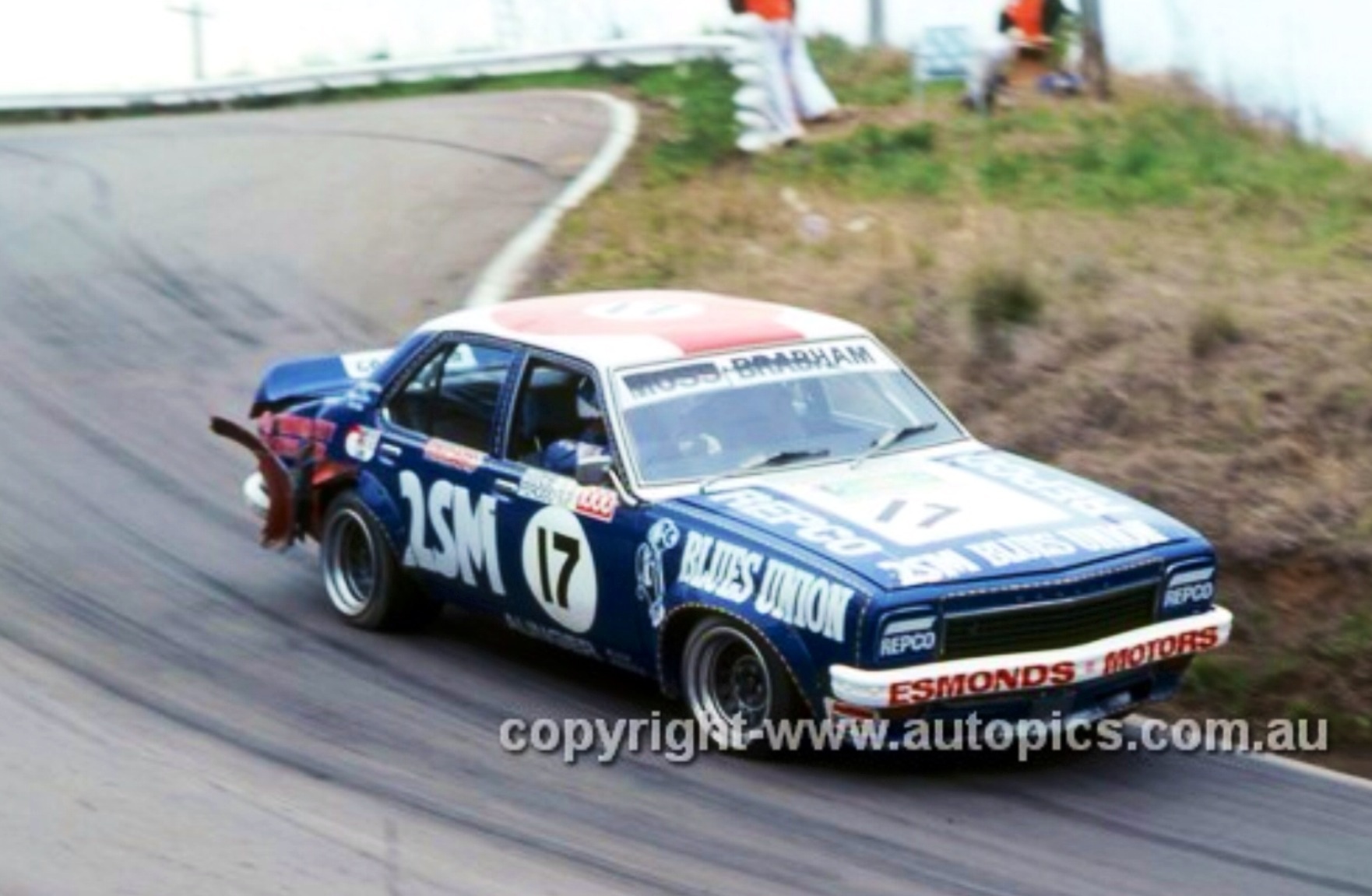
During 1964 Davison and Tresise shared a Triumph 2000 in the Bathurst 500 finishing 8th in class D, the race was won by the Bob Jane/Harry Firth Ford Cortina Mk1 GT.

In November 1964 Tresise borrowed Ian Kaufman’s ex-works Frank Matich driven Elfin for the Victorian 1500cc Championship, the final of five rounds of the Lucas/Davison Trophy Series. Rocky was 4th outright and won the 1100cc class in the race taking out the 1100cc championship, the car prepared by Lou Russo ‘in such good shape that some of the 1500cc cars couldn’t get near it’, the Australian Motor Sports race report said.

Hunnam won the series from Leo Geoghegan’s Lotus 27, Tresise was 5th in the pitscore and Lex presented Geoghegan and Rocky their trophies. Interestingly AMS records Alan Jones racing Stan’s Cooper T51 Climax in a special handicap race ‘Alan handled the big car well to come 2nd’ to Bib Stillwell’s Cooper Monaco Buick.

Ecurie Australie December 1964

Ecurie Australie in the Warwick Farm paddock during the Hordern Trophy weekend, December 1964. L>R Jon Davo, Lou Russo, Lex, Alan Ashton, Rocky, Peter Davo and Warwick Cumming, Brabham BT4 left and Cooper T62 right (Chris Davison Collection)

As stated earlier Tresise contested the ‘Hordern Trophy’ at Warwick Farm over the weekend of 5/6 December 1964.

Rocky finished third in the Cooper T62, the nearly 1 hour race great preparation for the internationals Tresise was to contest that summer. The quicker 2.5’s of Matich and Stillwell didn’t finish the race but Rocky finished in front of Lex who was 4th. Leo Geoghegan and Greg Cusack were 1st and 2nd in Ford/Lotus 1.5 powered Lotus 32 and Elfin FJ respectively.

17

Rocky in the T62 at Warwick Farm during the ‘Hordern Trophy’ 1964 (Bruce Wells)
 

davo nz

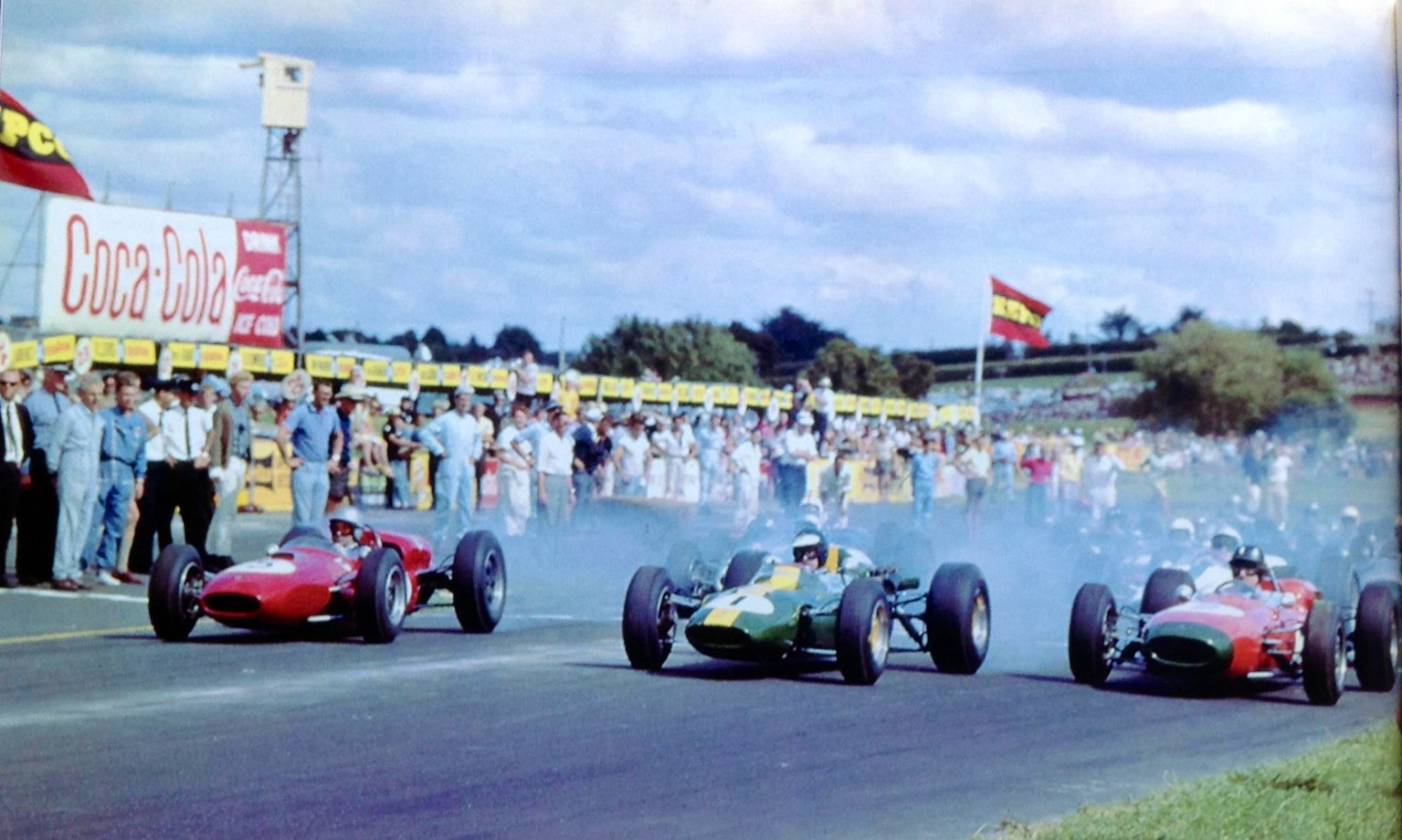
He may not have been the youngest driver in the field but Davo could still make a car dance; here left on the front row in Brabham BT4 alongside Clark’s Lotus 32B and Hills Brabham BT11A, NZGP Pukekohe 1965 (Jack Brabham with Doug Nye)

1965 Tasman Series…

The ’65 Tasman was won convincingly by Jim Clark’s Lotus 32B Climax, who started his amazing 1965 season with a bang. That year he won the Tasman, Indy and his second F1 World Championship.

Lex raced his Brabham BT4 in the season opening NZ GP at Pukekohe starting off the front row and proving their was very much still ‘life in the old dog’ starting alongside Hill and Clark and ahead of all the rest including Brabham, Gardner, McLaren, Phil Hill and others. It was an amazing performance which deserved better than a DNF with overheating on lap 33.

He chose not to race the remaining Kiwi rounds, shipping the car back to Oz, direct to Sydney where Ecurie Australie, Lex in BT4 and Rocky in T62 contested the ‘Warwick Farm 100’ on 14 February.

wf roc

Rocky has the Cooper T62 on tippy-toes as he finesses the big,powerful car around the technically challenging ‘Farm circuit 14 February 1965 (Bruce Wells)

Clark won the race, Rocky was 9th, 3 laps behind Clark with Lex withdrawing on lap 3 with a broken steering wheel, not the first time that had happened to him! Rocky’s was a good performance, he was behind the 1.5’s of Roly Levis and Leo Geoghegan but he still lacked miles in the car.

wf roc and bib

Tresise ahead of Bib Stillwell during the Tasman ‘Warwick Farm 100’, Cooper T62 and Brabham BT11A, Bib first resident local home in 4th 14 Feb 1965 (Bruce Wells)

Racing in this company and finishing was a fillip to his confidence. It was only his third meeting in the car. The top 6 were Clark, Brabham, Matich, Stillwell, Hill G and Jim Palmer, drivers of vast experience and calibre…

wf lex

Lex in the Brabham BT4 at Warwick Farm during his last race, a broken steering wheel the cause. Thats the Ecurie Australie badge to the right of the mirror. He died at Sandown 6 days later (Bruce Wells)

Sandown Tasman Meeting, 20 February 1965…

The teams then pointed their trucks south down the Hume Highway, from Sydneys western outskirts horse racing venue to Melbournes eastern outskirts horse racing facility, Sandown Park.

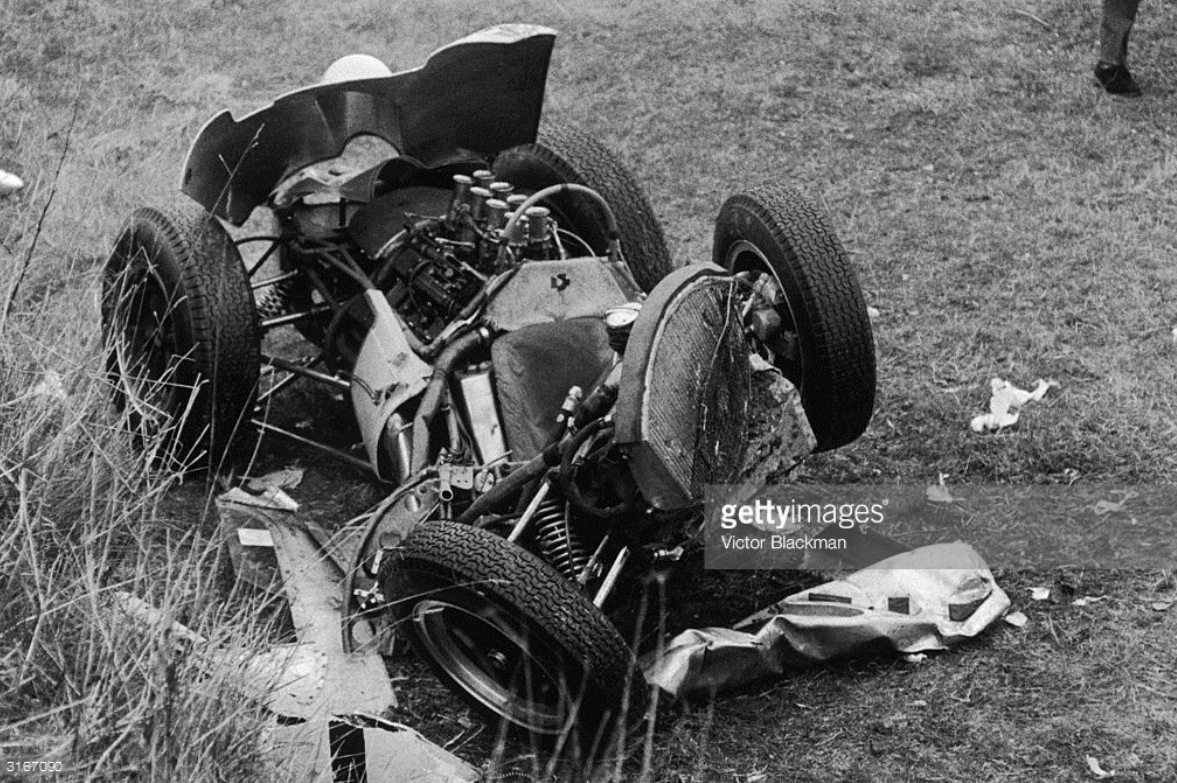
During that tragic weekend Lex Davison died when his Brabham left the circuit on a Saturday practice session in an undemanding part of the track, the gentle right hand kink on the back straight, he went over a culvert and hit the horse racing perimeter fence coming to rest some distance further on in the circuit infield.

Chris Davison, a racer himself; ‘Dad had done a few ‘Nellie Melba’s’, retired and come back. He’d had some warnings about his heart from the doctor. What is probable is that something happened to his heart, maybe not an attack as such but he may have momentarily blacked out, the car following him, Glynn Scott, said the car turned inexplicably left and we lost him as a consequence of the collision itself. Days later his badly damaged helmet was delivered home to Clendon Road by a couple of policemen, I’m still not sure where it is now after all these years’.

I don’t propose to go into this further, the salient facts above are sufficient.

The result was that one of Australian motor racings greatest, a titan since the 1940’s was lost.

Rocky’s Cooper was of course, withdrawn from the meeting.

photo (25)

Chris Davison; ‘I really like this photo with all the Davo clan and a young Rocky. Taken at the Vic Trophy Race at Calder in 1963. That’s me wearing Dad’s cap and Richard with Rocky at the back wheel’ Cooper T62 (autopics)

The impact of Davison’s death cannot be overstated in Melbourne at the time…

Lex was a four time AGP and the inaugural Gold Star title winner, a well known sportsman in a city obsessed with sport. He was a successful, respected businessman, Paragon Shoes, the business his father started was an employer of a large number of people. A good looking athletic bloke, his wife Diana was an attractive woman so they cut a fine figure as a couple in Melbourne at a time it was small. It was big, very sad news for the broader populace let alone the Davison family and extended network.

Enthusiasts of a particular age remember what they were doing when they heard the news on 20 February 1965, it was one of ‘those’ events in ones lifetime.

Aussie GP driver Tim Schenken, a Melburnian provided a personal perspective in a MotorSport interview ‘…in 1964 Rocky Tresise was selling his Lotus 18 because he was joining Lex Davison’s team. I borrowed the money from my dad to get it. Now I was in a proper racing car started attracting a bit of attention at Calder, Winton, Tarrawingee and Sandown…’

‘Then out of the blue Lex Davison called. He was a major figure of course and a real hero of mine. He told me he was going to retire and Rocky Tresise was going to take over his big single-seaters. He’d watched me in the Lotus 18 and wanted to put me in his Elfin. (Lex had paid a deposit on a new Elfin 100 ‘Mono’ 1.5 Ford) It was unbelievable for me’. Barely a week after Lex’ conversation with Tim, Lex died at Sandown and then Rocky the weekend after that at Longford.

‘Because of Lex’s status in Australia, there were hundreds of people at his funeral in Melbourne’s St Patricks Cathedral including Jack Brabham and Bruce McLaren. I’d never been to a funeral before and it was dreadful. On the coffin was a chequered flag his helmet and gloves. I didn’t know anyone, I just hung around on the edge of it, very muddled about it all’.

‘It was terrible, Lex and Rocky dying on consecutive weekends. It just stunned everybody. The thing was the weekend after Rocky’s crash I was due to run for the first time under the Ecurie Australie banner at Calder in my Lotus 18. The newspapers got hold of it and were speculating about whether it would be three fatal crashes in 3 weekends. I went to see Diana Davison and she pleaded with me not to race at Calder. I was under a lot of pressure not to drive; I felt I couldn’t talk to my parents about it but all I wanted to do was to go racing. I was a very confused boy’, Tim raced the Lotus at Calder entered in his own name, the transmission broke on the startline.

Matich Rocky Tresize Warwick farm 1964

Frank Matich, left and Rocky at Warwick Farm during the Hordern Trophy meeting in December 1964 (autopics)

Australian Grand Prix, Longford 1 March 1965…

Chris Davison ‘Longford was usually one of ‘my’ races as a kid so i knew the place well. A few days after dads funeral which was huge, it was like a State funeral so many people attended, the city was brought to a standstill, i was still numb just trying as a kid to absorb what had happened. It was like looking outside watching people going about their daily lives and wondering why they didn’t see what you are going through, that things weren’t the same at all’.

‘Rocky and dads team; Alan Ashton, Lou Russo and Warwick Cumming came to the house to see the family and find out if they should race the car the following weekend at Longford. To go or not to go was the call we had to make. Over all these years when this question comes up i ask people what you would do, what would you have decided was the right thing? Most say ‘race on in Lex’s honor’ which is of course what we decided’.

And so the scene was set. Ecurie Australie crossed Bass Straight on the overnight ‘Princess of Tasmania’ voyage. After berthing in Devonport the team took the short drive to Longford, a picturesque village 25km from Launceston, Tasmania’s ‘northern capital’ in the Apple Isles northern midlands.

The race was always held on a long weekend and was well supported by non-motor racing type Taswegians as a major sporting event on their calendar, over 30000 attended the ’65 event.

This 1964 documentary footage captures the essence of the place and its inherent dangers in a modestly powered sedan, let alone a GP car, click here to see and enjoy it;

Overseas visitors to Oz doing a ‘motor racing tour’ should include Longford amongst your ‘must visit’ circuits. Other circuits/ex-circuits whilst itinerary planning are Phillip Island and Albert Park in Victoria, Mount Panorama at Bathurst NSW, and the Lobethal and Nuriootpa road courses in SA’s Barossa Valley. Lobethal is amazing. Checkout the Adelaide GP street circuit whilst you are in town of course.

longford rocky

Middle of the grid before the ‘Examiner Trophy’ preliminary race. Stillwell #6 Brabham BT11A, Matich BT7A and Frank Gardner in the yellow Mildren BT11A with Rocky in the red Cooper T62 in the row behind (Stephen Dalton)

Rocky hadn’t raced on the demanding, dangerous, fast, over 100mph average speed and technical road circuit before. Lex wasn’t there to guide him. Its intriguing to know who looked after him in terms of getting his head around the circuit and his approach to it that weekend with all of the tragedy of the week before at the forefront of his mind. He was a very brave young fella of great character to race.

He practiced and started the preliminary race ‘The Examiner Road Racing Championship’ without incident. Bruce won from Jack and Graham Hill, Rocky was 10th.

He had misgivings about contesting the main race ‘The South Pacific Trophy’ on the Monday though.

‘Racing Car News’ and ‘History of The Australian GP’ journalist Ray Bell recalled on The Nostalgia Forum in 2015 ‘Rocky did have some serious misgivings about driving in the race. He’d been talking to (Tasmanian racer) Lynn Archer earlier in the day. Lynn told him if he didn’t feel like driving he should tell the team and pack the car away, but it was his decision and nobody else could make it for him’.

coop tres

The Ecurie Australie Cooper T62 is pushed onto the grid for its last fateful race in Rocky’s hands 1 March 1965 (oldracephotos.com)


long

Start of the AGP Longford 1965. Graham Hill BT11A on the right gets away well with Brabham BT11A in the middle and winner McLaren Cooper T79 at left. #8 is Clark’s Lotus 32B, #7 Gardner’s Brabham BT11A, #11 is Phil Hills Cooper T70, #3 Matich BT7A and Stillwell alongside Frank in the dark BT11A, Tresise in #12 T62 is to Bibs left with Bob Jane in the light colored Elfin Mono Ford 1.5 beside and behind Rocky #15 is Jack Hobden’s Cooper T51 and #9 Bill Patterson’s light coloured Cooper T51 (Howard)

In terms of the Grand Prix itself, Bell summarised it thus; ‘ It was a stinking hot day, we saw the greatest race I ever saw. A contest that had four World Champions (Phil and Graham Hill, Jack Brabham, Jim Clark) and a multi-times second placegetter (not to mention Tasman Champion, Bruce McLaren) at each others throats for the whole distance…Phil Hill had his last open-wheeler race, it was more than that to him. It was the best race he ever drove in his opinion and when I reflect on what I saw that day it certainly was a great drive’.
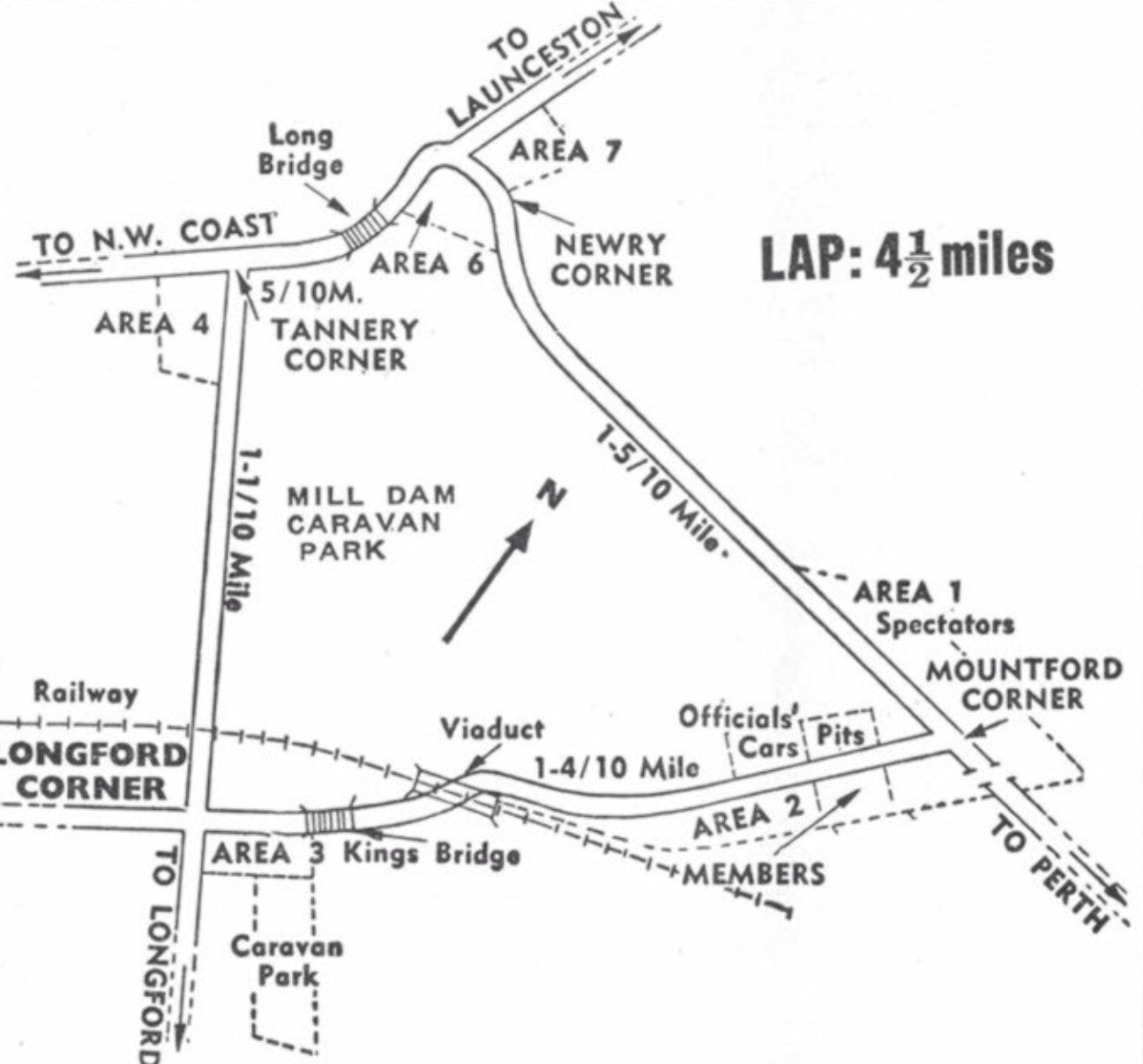
longford map

The road narrows beyond Mountford Corner as the cars pass the end of the pits which is where the accident ocurred. You can see from the start shot above how wide the circuit is in that start/finish/pits area of the track

Rocky‘…had trouble all weekend getting first gear out of Mountford. The first time he got it right (that is selected and used 1st gear from the tight corner) was at the end of that first lap, then he came boiling out of the hairpin passing 1.5 cars one after the other. Tragically that’s why he ran out of room (where the circuit narrows). I’d met Robin d’ Abrera just a few weeks earlier, he was with Peter Bakalor whom I’d known for a year or two. He was really enjoying being with the other photographers and following this important series for Autosport.’

‘So for Anthony Davison, the family representative that day, a young man, (17)  after running across to the crash site and learning of Rocky’s death, he had that to deal with before, an hour or so later, having to present the new trophy named in his fathers honour to Bruce McLaren’ the race winner in his Cooper T79. Jack was next, 3 seconds behind in his BT11A and Phil Hill a further second back in Bruce’ Cooper T70.

longford bruce

Bruce McLaren won the tragic ’65 AGP in a great drive, Cooper T79 Climax. Two motorcyclists also perished at Longford that weekend, an incredibly black one for the sport (Howard)

The Davison family ordeal was far from over though, Bell; ‘The night of the race Anthony, Peter and Jon (Davison) flew back to Essendon Airport, Melbourne and went straight to the Tresise home. There Rocky’s older brother and sister were waiting to hear what happened to their brother. The older brother asked Jon (a decade later a leading F5000 racer) ‘He kept his foot down when he should have backed off’ said Jon. It was that simple. The road has narrowed as he ranged alongside Glynn Scott (Lotus 27 Ford 1.5), with two wheels in the dirt the car lost traction, skewed sideways and started the crazy flight that took the lives of Rocky and Robin d’Abrera’.

Chris Davison; ‘I didnt go to Tasmania that year in all the circumstances of course but i can still recall arriving home from rowing practice on the Monday evening (of the South Pacific Trophy in which Tresise died) and a friend of the family giving me the news about Rocky’s accident. I was devastated, the team, dad, Rocky dead. It was just too much for a kid to absorb, tragic on so many levels. Rocky had two other brothers, one was an army officer, David, Ian the other brother was at the races decades later when David Purley raced here in the LEC sponsored Lola T330 F5000, he had some sort of connection with that company. Rocky was special, he was kind and generous to me, gave me space that was sometimes hard to get with my older brothers dominating the space’.

As to the future of the Tresise family little is known, Chris; ‘Rocky’s mother was Val Tresise, she married some years after Rocky was killed…a man from Western Victoria, or Penola in South Australia, i think his name was Arch de Garris. Rocky’s fiancé was Robyn Atherton and sadly I have no idea what happened to Robyn after Rocky was killed. I guess I was too young to really understand what was happening in those difficult years after both Lex and Rocky were killed, and by the time I was 17, I just wanted to get on with my own life, so I went bush as a jackaroo at Hay and lost contact with many people. The person who was all knowledgeable on these matters was my mother and sadly she has taken all this knowledge with her’.

Anything i say at this point would be trite or superfluous. I am very thankful to Chris for discussing and sharing his recollections of this quite extraordinary fortnight in the lives of the Davison and  Tresise families.

The remains of the Ecurie Australie Brabham and Cooper were advertised and bought by Victorian racer Wally Mitchell who used some of the components to build the ‘RM1 Climax’ sportscar.

Mitchell crashed the car at Symmons Plains on 12 March 1967 suffering burns which claimed him, he died on 18 April, to make the story even more macabre.

Prior to his demise historian Stephen Dalton advises his uncle, John Dalton had done a deal with Mitchell to acquire the T62 bits, these components passed to John after delicate discussions with his distraught widow.

Dalton; ‘I remember it under my uncles house at Olinda during the September school holidays of 1978, I was earning some money tidying things up to put more MG stuff under there! I was 13 and didn’t know the sad history of the car at the time’.

‘The car remained a crumpled wreck until the mid to late eighties when a new chassis was built by Charlie Singleton, the car was displayed in chassis form at one of Paul Sabine’s Classic Car Shows in the late 80’s/early 90’s. Things went pear shaped financially and John sold it in the early 1990’s. By the time it was displayed Roger James had ownership and perhaps Richard Bendell was involved. I think Gary Dubois built the body for it’.

The car was sold to the ‘States in the early 1990’s and has been sold a couple of times since when I saw it at Sandown Historics in 2014, but I’m not sure who owns it’, but it seems the car is now owned by an American enthusiast.
bruce

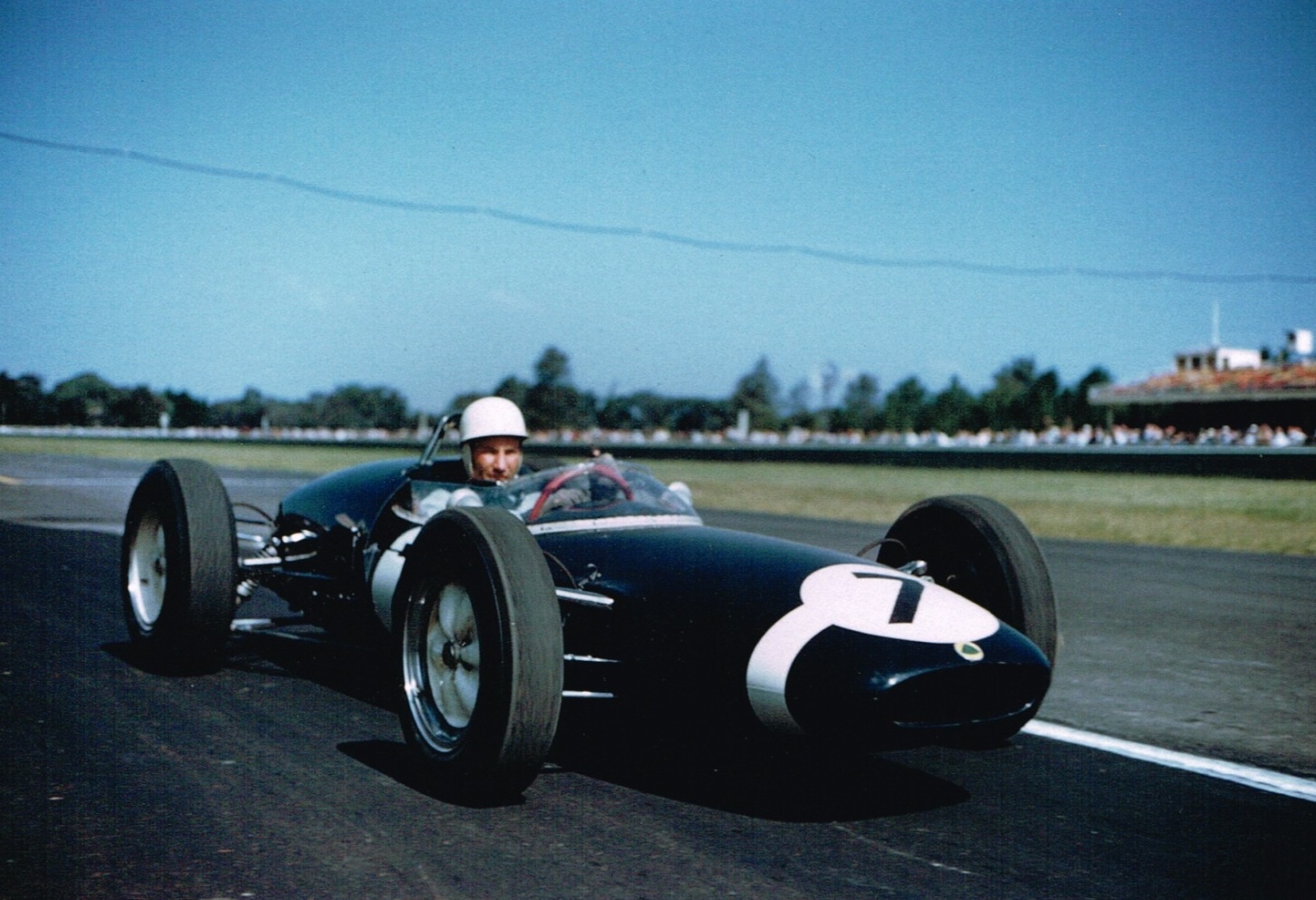
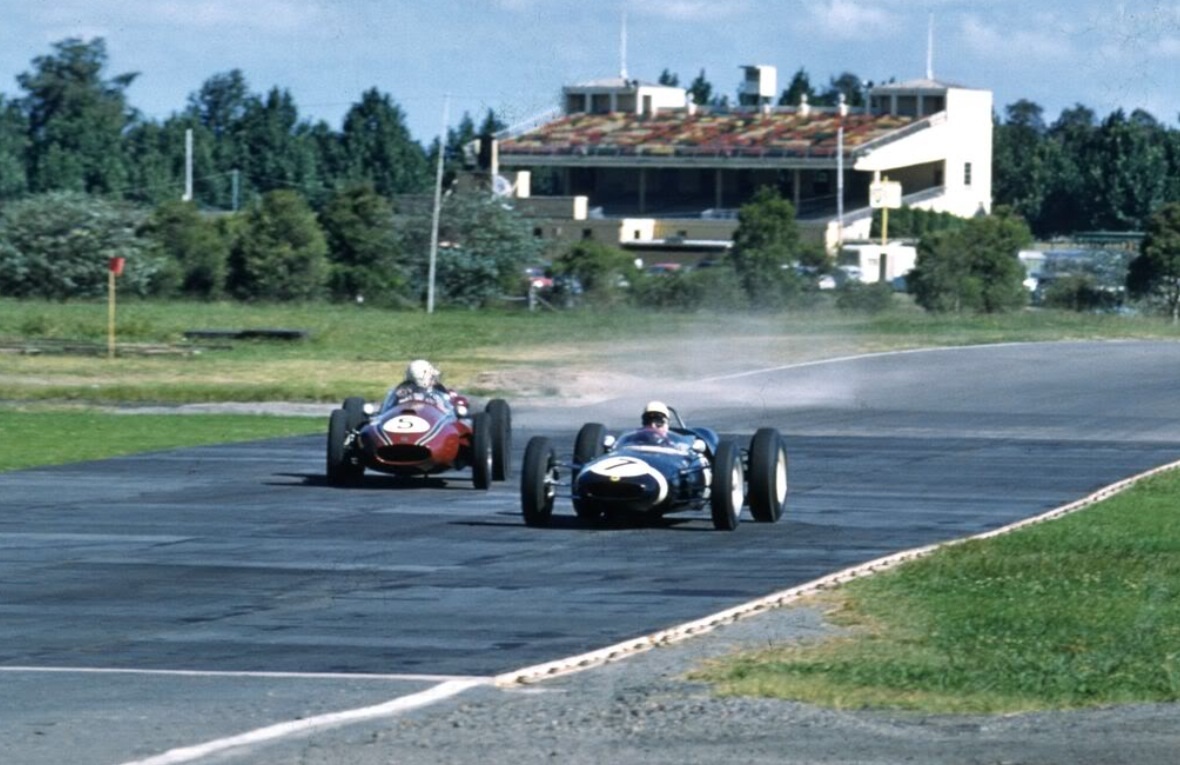
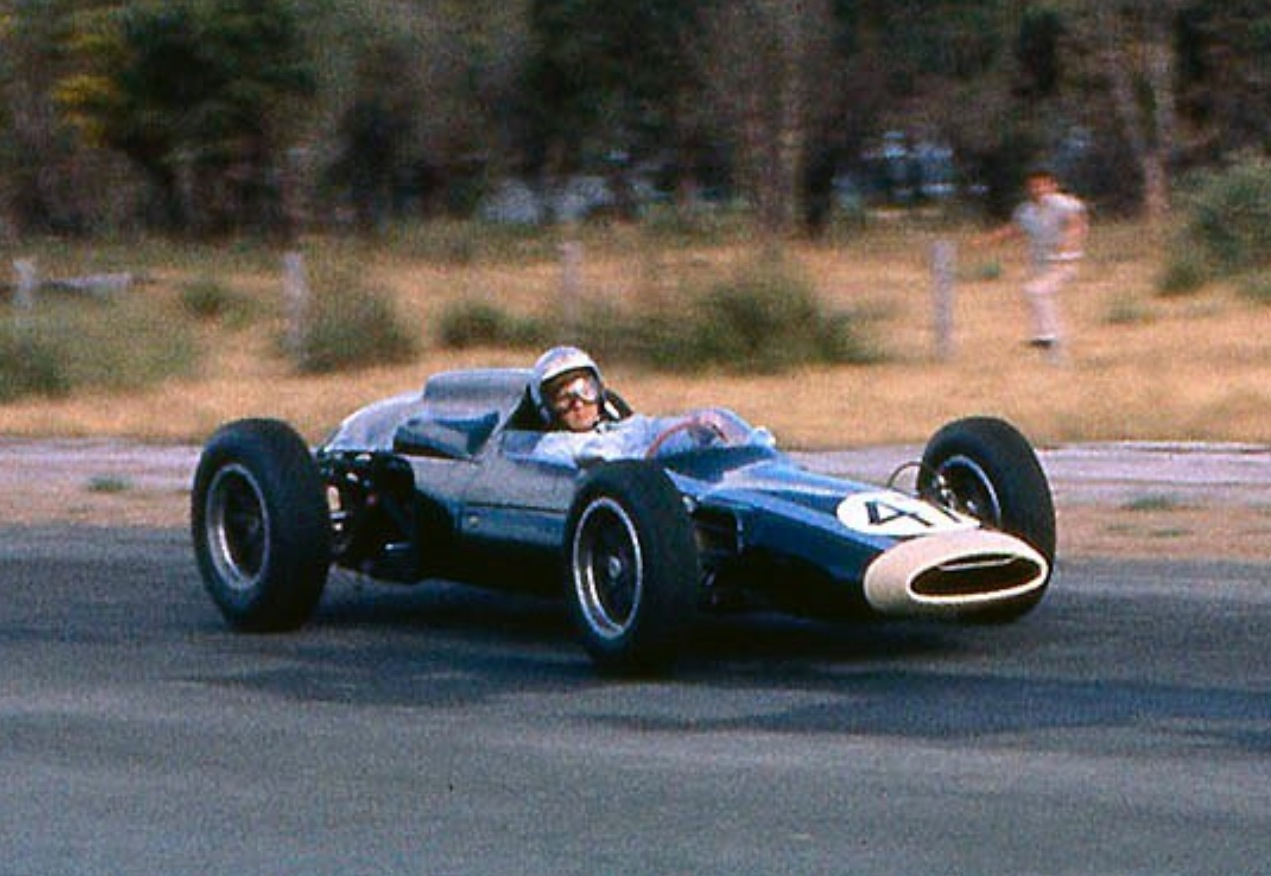
Bruce McLaren winning the 1962 AGP at Caversham in the Cooper T62 Climax (oldracephotos.com)

The Cursed Car?…

Its a fact that a whole swag of people closely associated with the Cooper T62 died before their time, not just the obvious four; McLaren, Davison, Tresise and Wally Mitchell. Later owners or part owners John Dalton and Roger James died early, so too Paul Higgins a respected Melbourne journalist ‘attached’ to the Davison team who was murdered along with his wife in gruesome circumstances twenty years ago.

The above are facts not the stuff of a fictional thriller. For those of us a little superstitious the reality is that some cars shouldn’t be rebuilt, but buried. Perhaps this is one such car…

Etcetera…
coop fac

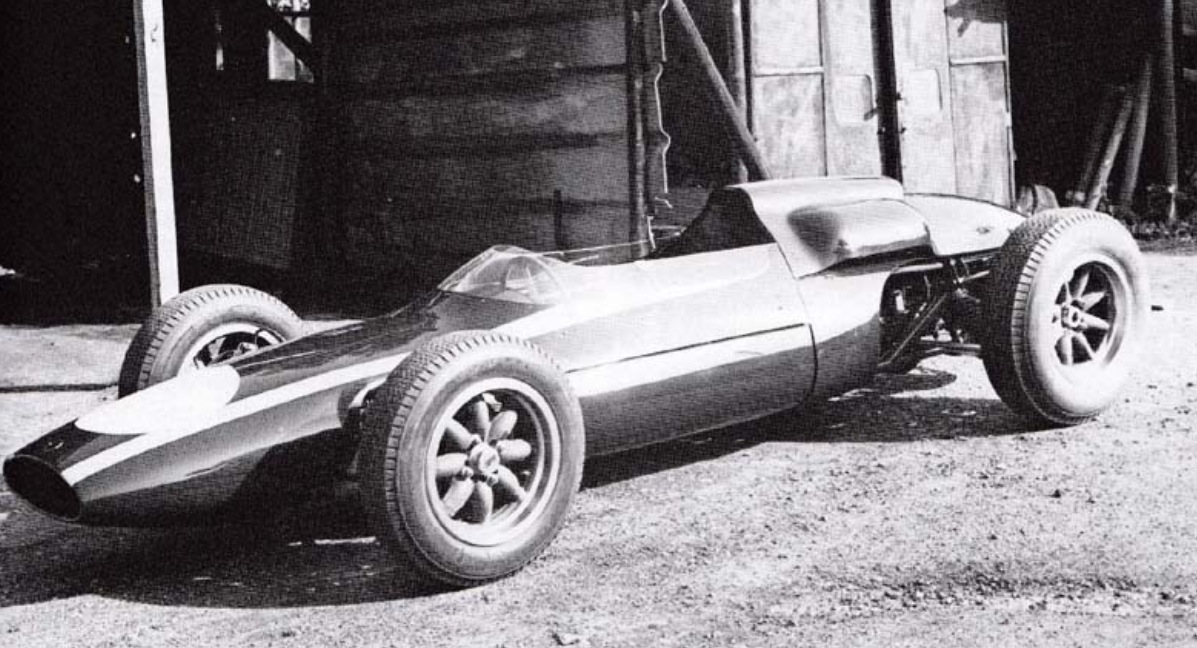
Cooper T62 upon completion at an early Goodwood test in late 1962 prior to shipment to Fremantle, WA (Mike Lawrence)


McLaren in the Lakeside paddock in early 1963, Tony Shelly behind (B Williamson)
 

coop mallala

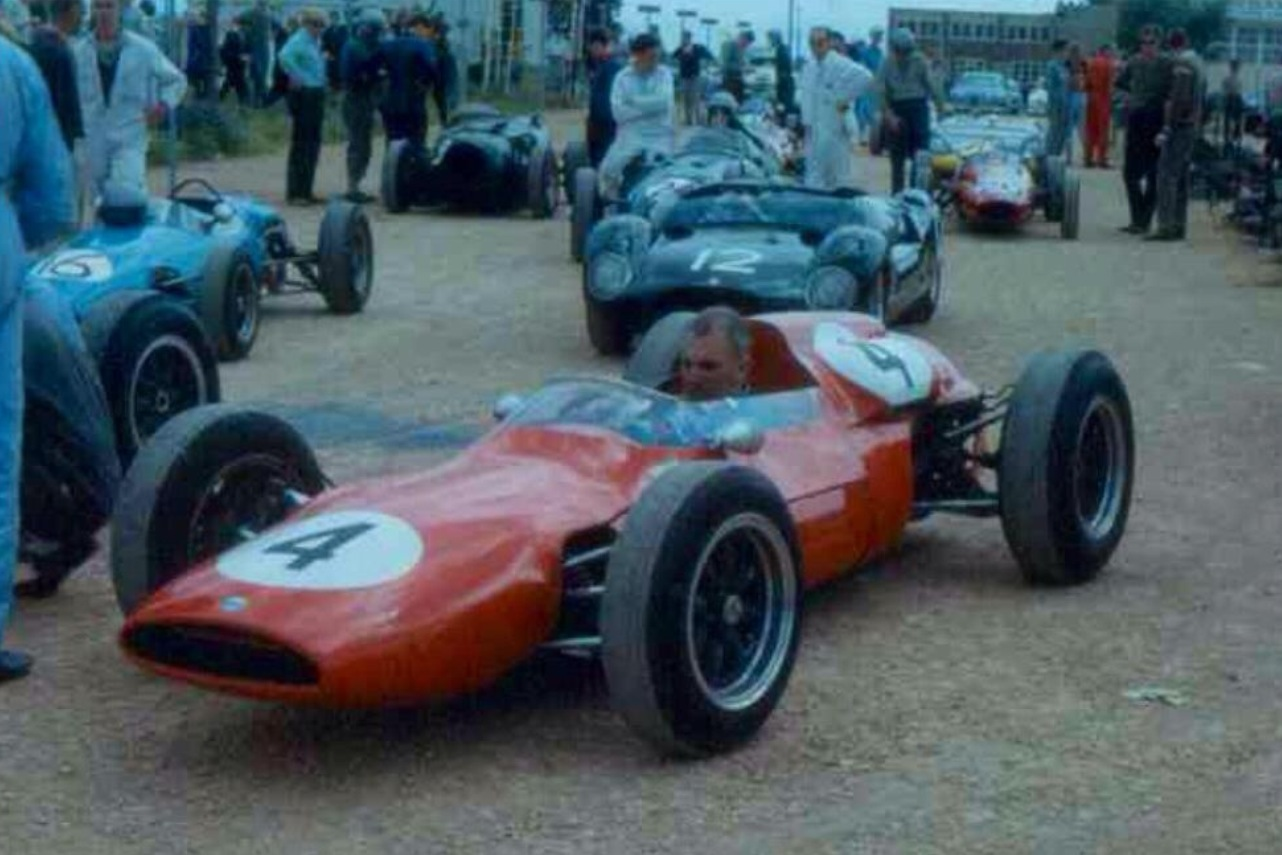
Alan Ashton aboard Lex’ T62 at Mallala, Gold Star round 14 October 1963. Behind is Stillwell’s Cooper Monaco and Pat Hawthorn’s Aston Martin DBR4, blue #16 is Mel McEwin’s Elfin FJ Ford. John Youl won this race in a Cooper T55 (Kevin Drage)


cav ad

Credits and Bibliography…

Chris Davison who was very generous with his time and insights into a very difficult part of his life as a young teenager

‘History of The AGP’ by Graham Howard and Ors in particular the 1962 and 1965 chapters written by Howard and Des White

‘The Nostalgia Forum’ threads in relation to Lex and Rocky in particular the contributions/insights of Ray Bell and Stephen Dalton

‘Australian Motor Sports’ June 1964 issue, the Melbourne ‘Age’ newspaper 20 February 1965

‘MotorSport’ interview with Tim Schenken

Stephen Dalton Collection, Chris Davison Collection John Ellacott, Terry Walker, oldracephotos.com, Milton McCutcheon, Peter Longley, Ellis French, Geoff Smedley, Ron Lambert Collection, Denis Lupton, Geoff Smedley, autopics.com.au, Murray Lord, Bob Williamson

Tailpiece: Davo in the best of company: Graham Hill’s Brabham BT4, Davison’s Cooper T62 and the white nose of Jim Palmer’s Cooper T53 Climax, Longford 1964
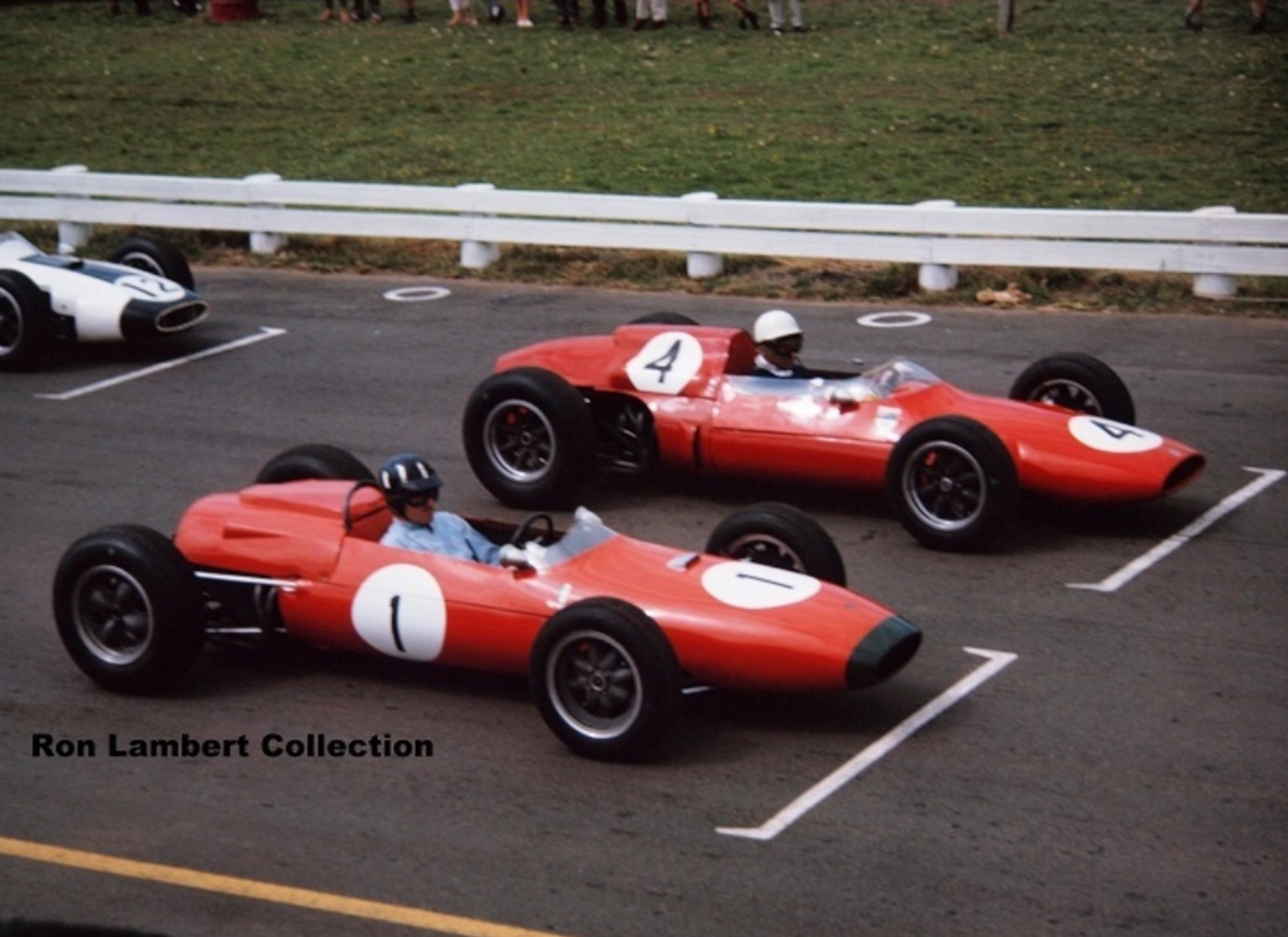
coop lex

(Ron Lambert Collection)

Finito…

arr ric sa

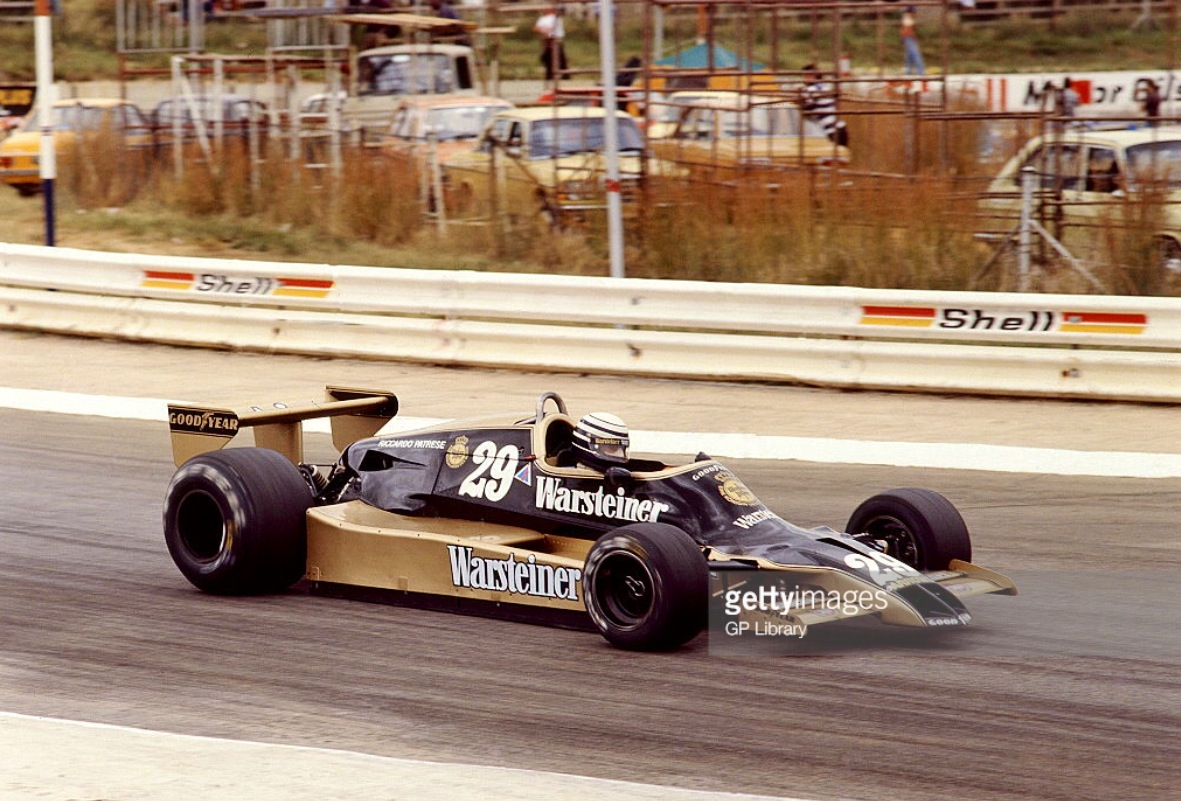
Patrese debuts Arrows A1-06 Ford at Kyalami, South African GP 1979. Q8 and 11th in the race won by Gilles Villeneuve’ Ferrari 312T4 (Schlegelmilch)

What’s it like livin’ and lovin’ the most successful race engine ever built?…

Our ‘Racers Retreat’, Peter Brennan owns and cares for ‘DFV250’. I have decided in fact he is a ‘perick’! Not only can he drive ‘big cars’ very quickly but he can  also reconstruct, rebuild and maintain the things which makes him a multi-talented ‘perick!

OLYMPUS DIGITAL CAMERA

Pete Brennan in the Arrows at Phillip Island, Paul Faulkner’s ex-Jones ’81 Williams FW07 behind (Brennan)

image

Villeneuve and Patrese, 7th and 5th in the 1979 Belgian GP at Zolder. Ferrari 312 T4 and Arrows A1 ’06’ May 1979 (unattributed)

‘DFV250’ sits in the back of his Arrows A1-‘06’. It was Ricardo Patrese’s car for the early season races in ’79 before Arrows switched to the more advanced but unsuccessful A2 which was not Tony Southgate’s best work. A1-06 was then sold for Aurora Series and Historic F1 use, eventually ending up in the Al Copeland Collection from whom Pierre acquired it after Copeland’s passing.

We will get to restoration of the Arrows and the Ford DFV which was at the ‘dismantle, crack-test and reassemble’ end of the spectrum rather than the ‘reconstruct around the monocoque bulkheads, four corners and ‘box’ huge task which Lola T330 ‘HU18’ represented, soon. Click on this link for a series of articles on that mammoth job which shows Peter’s talents.

https://primotipo.com/2014/06/24/lellas-lola-restoration-of-the-ex-lella-lombardi-lola-t330-chev-hu18-episode-1/

For now I just want to focus on the care and maintenance of a DFV race to race which I expect is rather more involved than that of my ‘Peter Larner Engines’ 105bhp Formula Ford ‘Kent’ moteur?

image

Clark on the way to the DFV and Lotus 49’s first win, Dutch GP, Zandvoort 4 June 1967. Clark leads Brabham Brabham BT19 Repco 2nd, Rindt Cooper T81B Maserati DNF and Hulme Brabham BT20 Repco 3rd (Schlegelmilch)


Why the DFV you ask?…

Keith Duckworth’s Ford sponsored 1967 3 litre, 4 valve, fuel injected, 2993cc V8 is both the most successful grand prix engine of all time with 155 championship GP wins from 1967-1983 but also part of the winningest ‘family’ of engines. The DFV spun off the 3.9 litre Le Mans winning endurance racing ‘DFL’ and single turbo-charged 2.65 litre ‘DFX’ Indy victor.

image

Theo Page cutaway of the Ford Cosworth DFV in 1967. All the key elements referred to in the text covered in this superb drawing

Phil Reilly Engineering…

Brennan has tackled all manner of race engines over the years including lots of Chevs, Repco Holden F5000, Repco Brabham V8’s and various Coventry Climax FPF’s, but the DFV was new to him. His ‘guru’, a source of advice from afar and the fellow to whom he sent the his heads was Phil Reilly who has forgotten more about these engines than most people ever knew. His ‘shop, well known to American enthusiasts is in Corte Madera, California. Reilly Engineerings ‘Care and Feeding Your Cosworth DFV’ and Peters practices in looking after ‘250’ form the basis of this article.

dfv lotus

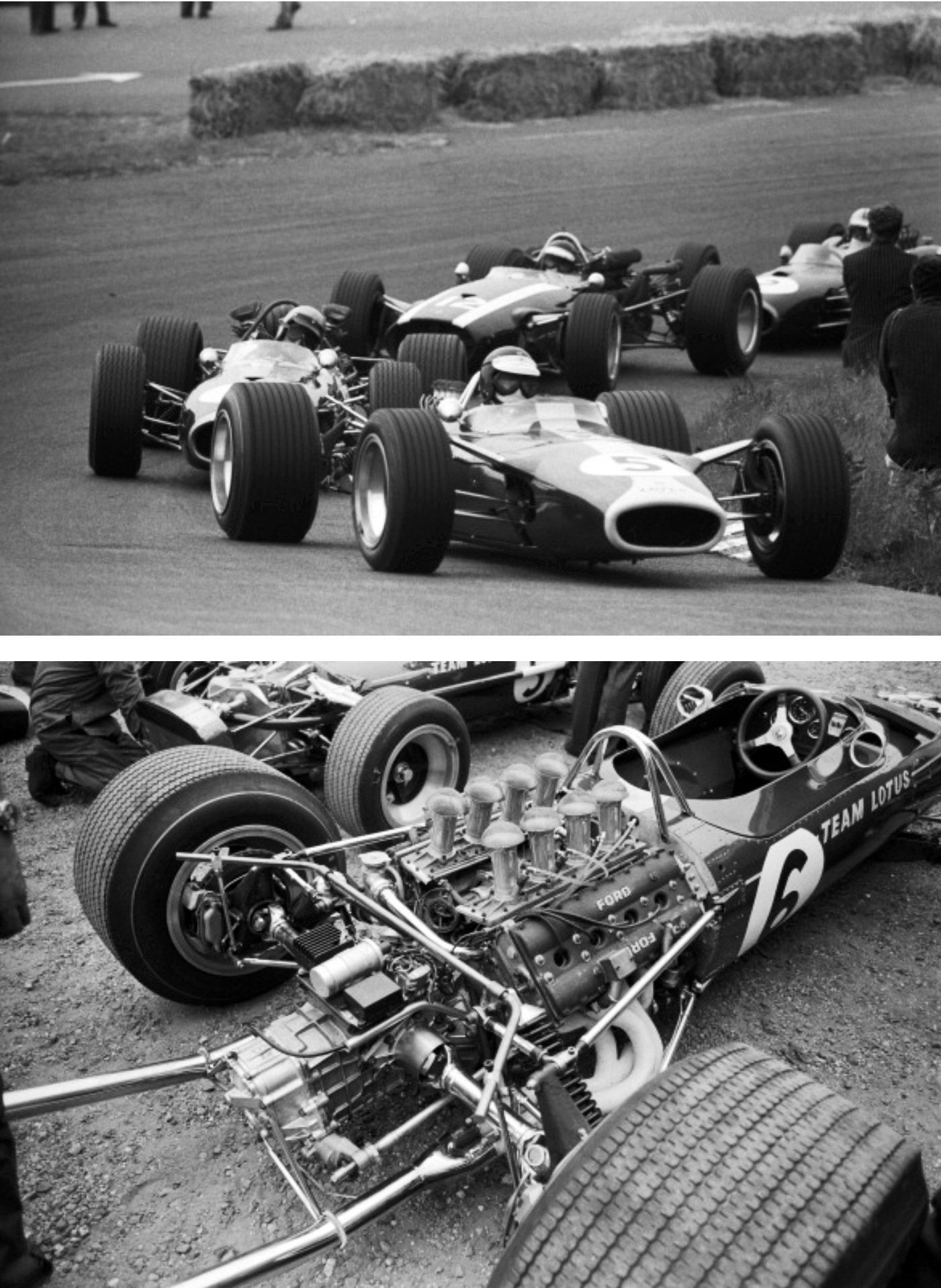
Butt shot of one of the Lotus 49’s upon debut at Zandvoort 1967, ZF 5 speed ‘box, the ratios of which could not easily be changed about to be swapped. Shot shows the brilliant packaging of the DFV. Lotus’ Chapman prescribed a stress bearing V8 to Keith Duckworth inclusive of the way he wanted to attach the engine to the chassis at the bulkhead aft of the driver. Note the tubular brackets either side of the Borg and Beck clutch to which the suspension mounts. Their is no tubular frame or monocoque structure aft the driver, the engine itself forms the function of being the bit to which other bits are attached! Part of the brilliance of the DFV is its combination of power, weight, reliability and cost, the other aspect is the way it integrates with the chassis (Schlegelmilch)

DFV’s and DFV’s…

The development of these engines has effectively never stopped, you can still buy the bits from Cosworth Engineering, inclusive of a new engine should you buzz it to 15000rpm on an errant downchange and pop a rod or three thru its slender aluminium or magnesium flanks.

The DFV in Jim Clark’s winning Lotus 49 at Zandvoort on 4 June 1967 gave a smidge over 405bhp, its power delivery in the early days quite ferocious, coming in with a bang all up top, making it a bit of a challenge for Messrs Clark and Hill. A long stroke, same as Jims, engine like DFV250 gave around 470bhp and 260 lbs/foot of torque at 10500/9000rpm respectively whilst being thrashed to within an inch of its life by Patrese in early 1979.

A wrong turn of phrase really as the talented Italian multiple GP winner was both mechanically sympathetic and great test driver.

ickx

Jacky Ickx, Ensign N177 Ford, Monaco GP 1977, 10th in the race won by Scheckter’s Wolf WR1 Ford (unattributed)

dfv dfv

All go and no show Cosworth Engineering. Subtle stamping of engine number in the engines valley (Brennan)

In fact when ‘250’ was first born it was a Cosworth lease engine used by Team Ensign and supplied to them on December 3 1976.

It was fitted to the N177 chassis’ driven by Jacky Ickx and Clay Regazzoni, multi GP winners both, during 1977.  Without the teams records its not possible to know into which chassis ‘250’ was installed race by race.

image

Launch of the Arrows A1 at Silverstone in late 1977, maybe they figured the white body against the white snow would disguise its similarity to the new Shadow DN9, the design drawings of which Southgate erroneously thought were his! Patrese in car, Jack Oliver behind left and Tony Southgate at right. The High Court writ was shortly ‘in the mail’ (unattributed)

The engine was then bought by Arrows when the team spun out of Shadow. Jackie Oliver, Alan Rees, Tony Southgate and Dave Wass all felt they could ‘build a better mousetrap’ and left Don Nichols outfit at the end of 1977. The High Court legal stoush about ‘IP infringement’ which followed is a story for another time; in some ways Nichols had the last laugh as Shadow won a GP, the 1977 Austrian when Alan Jones took his first win in an a DN8 Cosworth, whereas Arrows never did win one albeit the business lasted a lot longer than Shadow…

OLYMPUS DIGITAL CAMERA

(Brennan)

The Calm Before The Storm…

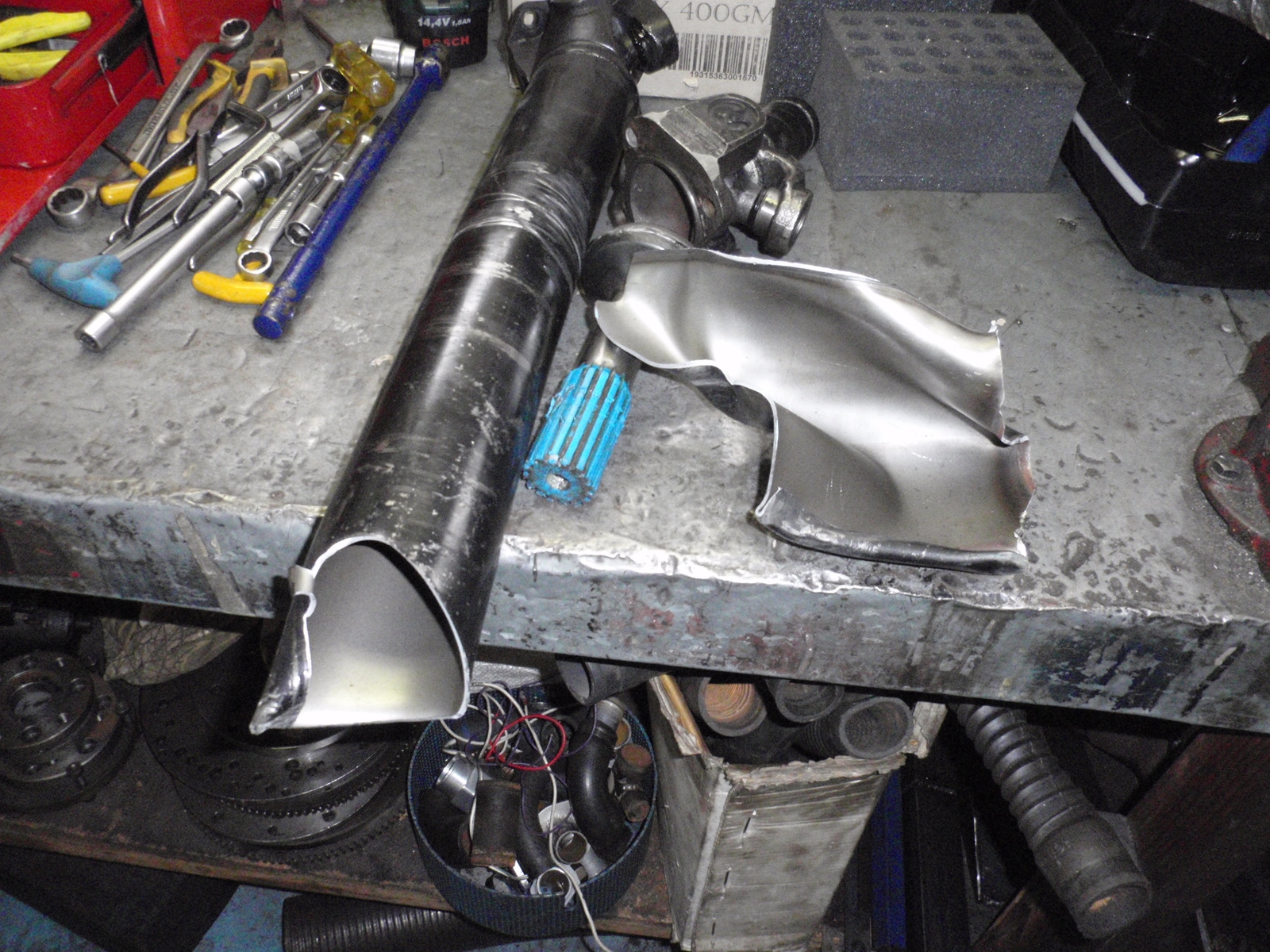
Here is ‘250’ all ready to rock on Peter’s dyno; ‘It takes about a day to plumb the thing up, its godda be done very carefully of course. Cosworth prescribe very fully how to do it (see below) Having gotten thru all the preliminary stages of running it in, i gave the thing ‘a tug’. All was okey-dokey for a bit and then all hell broke loose, a huge bang and then schrapnel everywhere!’

‘Thank christ it wasn’t the engine itself. The DFV’s vibrate so much it broke the dyno driveshaft @ 9200 rpm precisely! I have had all manner of donks on that dyno, over 500bhp Chevs etc but nothing has done that before. Having had that happen i still haven’t given it a full power run on the dyno anyway!’

But we are getting ahead of ourselves, the rebuild of the engine itself we will cover in an article about the car.

OLYMPUS DIGITAL CAMERA

Brennan’s dyno driveshaft after Cosworth assault @ 9200rpm (Brennan)

dfv run in

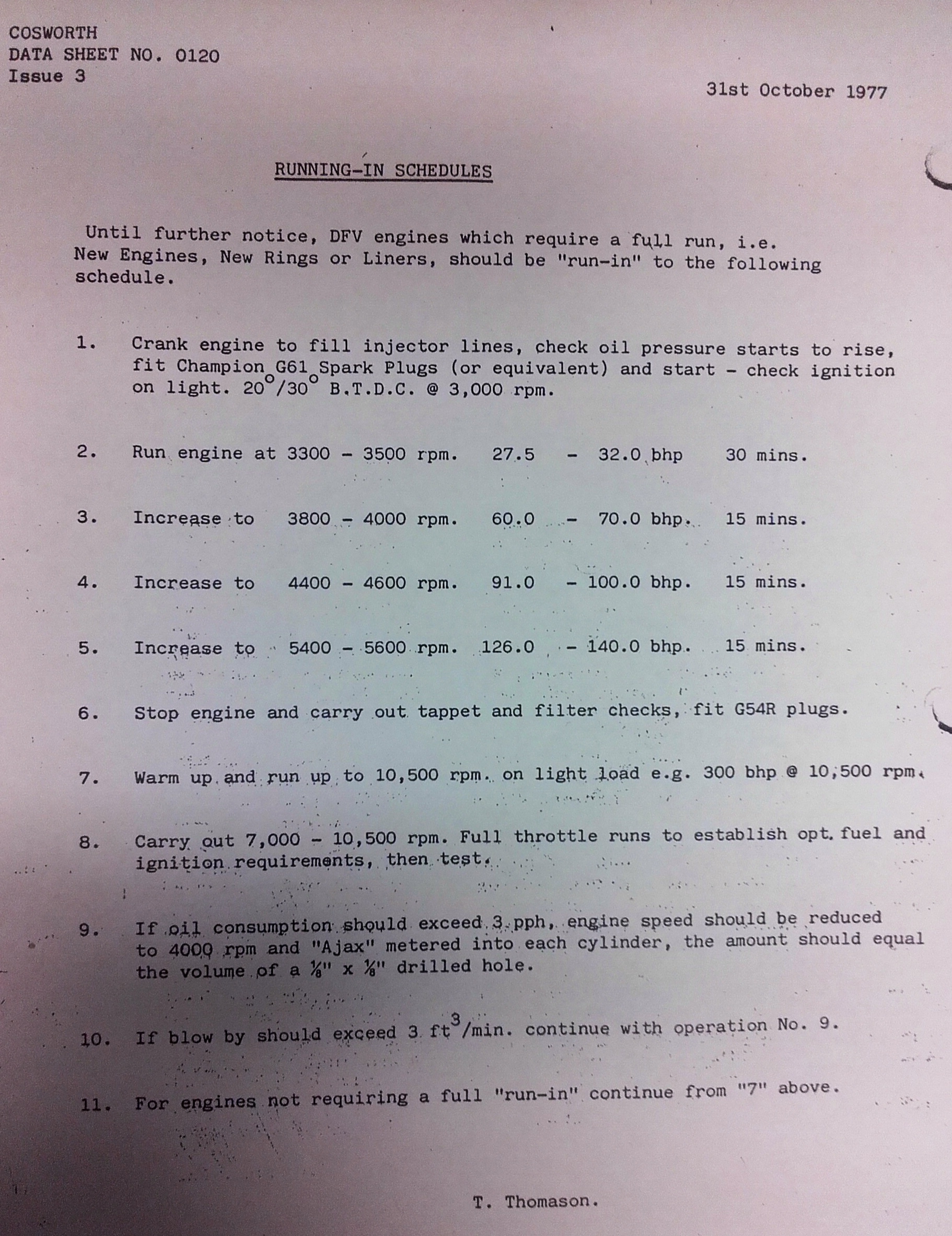
Cosworth’s dyno running in procedures dated 31 October 1977 (Cosworth)

DFV use in Modern Times…

Phil Reilly; ‘If you rev the engine to 10800/11000rpm as Messrs Hunt, Fittipaldi and Jones did you will get the sort of engine bills Messrs Mayer, Fittipaldi and Williams paid!’

‘The DFV with an 11000rpm rev limit is a 3-4 hour motor…which will blow up big-time every now and then…needing an injection of $10-15K of parts and lots of (expensive) TLC…for vintage events use 10000rpm as a normal shift point. Doing this keeps the engine well below its stress point yet still provides enough power to test any drivers skills…the bonus is the engine will live 15-20 hours between rebuilds’.

Geoff Richardson Engineering have been looking after the engines since their heyday, James Claridge provided their perspective; ‘The routine rebuild interval for an engine limited to 10000rpm is approximately 1000 miles’.

‘This would comprise of us stripping it down, crack testing components, inspection of all parts, followed by re-assembly and dyno testing. Replacement of valve springs happens every time.Possible replacement of pistons depending on condition, if they were re-used they would certainly be replaced at 2000 miles. The same applies to all of the valves, they are taken on condition. New con-rod bolts are fitted, all new bearings, a new set of piston rings, and all new seals and O-rings are fitted. Nearly all the other parts are taken on condition and replaced accordingly’.

‘An engine with no issues or catastrophes that we knew the history of and is well looked after might cost somewhere in the region of £12-15000.00 to completely refresh’.

Peter Brennan provides the drivers perspective; ‘ The DFV has three quite distinct phases of power, one bangs in at 5500rpm, the next at 7000, then it goes ballistic at 9000 and all you do is chase gears with the tach going bananas…’ ‘Its not that difficult to get off the line, it obviously doesn’t have 500 plus foot pounds of torque like an F5000, sliding the foot sideways off the throttle at around 8000 rpm and then modulating it to match wheelspin with circuit grip soon has you motoring in the direction of tomorrow pretty smartly!’

Click on this footage of Brennan in the Arrows at the Adelaide Motorfest in 2014, the event uses part of the Adelaide GP circuit and some other streets.

‘The howl of the thing at 10000rpm as it yelps its way from cog to cog along the main straight at Phillip Island; with a 22/24 top fitted, fifth is 183 mph @ 10000rpm is unbelievable and Patrese would probably take it flat! Its not to be believed and relished every time you do it, Southern Loop comes up all too soon, its not the seagulls you are focused on as you turn the thing in believe me’.

allison

Bruce Allison in the March 771/781 Ford, Thruxton or Oulton Park in 1978 (Allison)

Bruce Allison raced Cosworth powered March’s in the Aurora Series in 1978 ‘The record of the engine speaks for itself, it will still be popular in historic racing in 50 years! The engine was powerful, smooth and reliable the cars of course handled better with far less weight at the back than the F5000’s i was used to. The 781 March may have been the 782 with a DFV shoved in it but it was a beautiful handling car, the 761 chassis i used early in the season was not as good but the engines were always great, beautiful to drive’.

Lookin’ After Cossie: These things are like a mistress, stunning to look at but always wanting attention, never happy and a constant sap of cash…

dfv ball

Brennan’s sense of humor never too far from the surface! ’06’ at Sandown historics 2014. Dissertation on the chassis and suspension i will save for the article on the car itself. Shot included to show just how much the engines compact size, packaging and stress bearing nature assists the chassis designer. Compare how Tony Southgate mounts his suspension to the engine via these fabricated aluminium plates compared with Chapman’s tubular structures in the Lotus 49 of 1967. Note back of sparkbox in the Vee, ‘two towers’ behind that to connect with air scoop to cool inboard mounted rear discs, rear suspension outta the airsteam and clear of G/E tunnels, single support for gold rear wing, oil cooler and black painted starter motor with drive going forward (Bisset)

Storage and Fuel System.

The engine needs to be turned over by hand one revolution each week. Turn on the fuel pump as well, this will ensure no two valve springs remain fully compressed for too long and will circulate fuel through the metering unit to prevent corrosion and keep all the seals from sticking in one place.

The fuel filter needs to be changed every 500-700 miles, the engines have a high pressure pump to start and a mechanical one for normal on circuit running. The engine won’t run below 2000 rpm on the mechanical one, the electric one is needed for starting, fuel pressure of 120psi needs to be maintained at all time, at least 95 psi is needed to fire her up.

OLYMPUS DIGITAL CAMERA

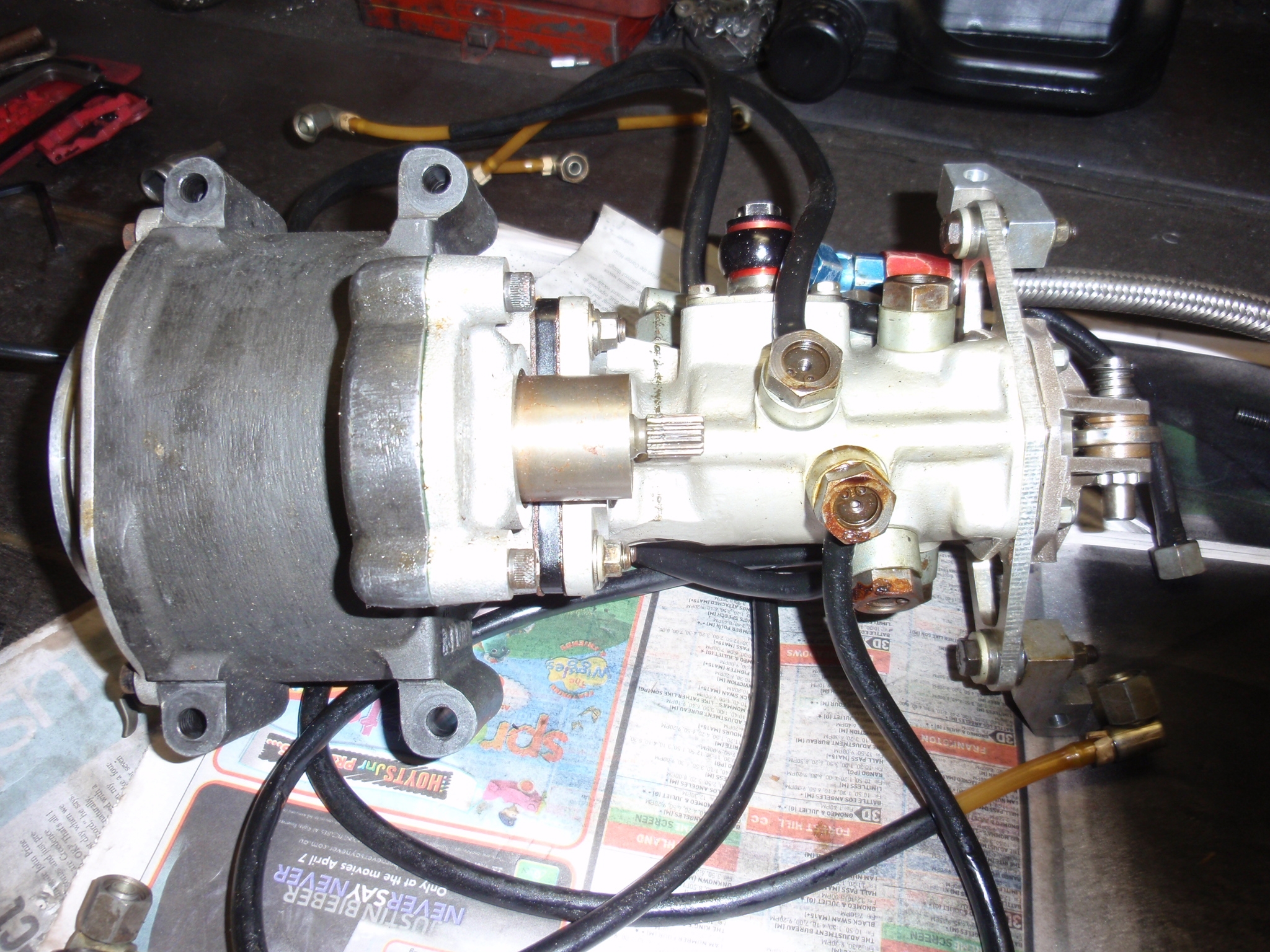
‘250’ ‘right bank’ showing both the auxiliary drive belt housing (right) and the super clever oil scavenge/de-aerator pump at left and one of the water pumps in between. The black coupling between oil and water pumps is called an ‘oldham drive’, a flexible joint (Brennan)

Olio.

A more critical liquid than fuel is oil. The engine must be plumbed to Cosworth specs…its data sheet DA0626 for ‘DFV250’ and the like. Its critical the engine never sucks air, at high revs bearing failure will result. At 10000rpm the engine is rotating at 166 times plus per second.

Peter; ‘I use Kendall 20/50 mineral oil, which has a high zinc content which is great for the cams and followers’. The Cosworth oil filter (Part #PP0404) needs to be changed every 300 miles, the oil level needs to be checked religiously as the engine uses as much as 4 quarts every 100 miles.

Oil temperature should be 90-100 degrees centigrade measured at the inlet to the pressure pump. 7000rpm should not be exceeded before the oil is at least 50 degrees centigrade.

OLYMPUS DIGITAL CAMERA

‘250’ ready to be refitted to ’06’ in Brennans eastern Melbourne workshop. Note spark box between the Vee and behind it the fuel metering unit below the ‘aeroquip’ lines, Lucas injection of slide as against butterfly type. ‘Knurled wheel’ beside rear LH injector sets mixture, ‘behind’ this is the drive for the mechanical tach. Line at far right is cable drive for electro-mechanical fuel pump. The more you look the more elegant the packaging of it all is (Brennan)

Spark.

‘250’ has the Lucas ‘Opus’ system which has a pickup on the crank which fires the Opus at 38-40 degrees BTDC. The Opus also has a retard mechanism which is set for starting at 12 degrees BTDC.

The DFV has an alternator which provides sufficient power as long as the electrical  fuel pump is switched off, DFV pilots need to remember this as they zap away from pitlane. ‘Pump Off’ was a familiar pit signal for decades!

Ignition timing is set on the dyno and is usually impossible to change in the chassis. Opus runs at 38-40 degrees BTDC, the sytem needs to be mounted in a cool place, the stock Cosworth mounting between the injection trumpets is usually fine.

The engine must be connected to negative earth with rev limiters set to 10400rpm.

The plugs are 10mm Bosch surface discharge to special order. Warm up plugs aren’t required, with plug life 3-4 race weekends. The plug wells need to be blown out, the HT leads removed with pliers. Plugs are tensioned to 9-10 foot pounds having been coated with ‘Copaslip’ first.

Spark boxes are delicate devices, you will kill them by voltage spikes caused by breaking the earth, so be clear on shut down procedures.

dfv throttle

Throttle linkage of Brennans Arrows at Sandown 2014, ’06’ about to fired up. Note the ‘Opus’ spark box between the injection trumpets and black electro-mechnical fuel pump atop the centrally mounted, between driver and engine, fuel cell. Note radiator header tank and cap, bottom right is roll bar support bracket (Bisset)

Mechanical Installation.

The valve cover engine mounting bolts are 5/16 inch UNF and should be tightened to 16-18 ft pounds, be careful not to over-tighten to avoid cracking or deforming the magnesium casting.

The engine throttle slides have four over-centre return springs at the rear, these are a unique Cosworth invention which both reduces pedal pressure and ensures the slides close fully when you lift your foot. But they are not the throttle return springs which sould be well designed and of the ‘compression type’.

OLYMPUS DIGITAL CAMERA

‘The Bomb’; Distributor cap missing at left, alternator in the middle and fuel metering unit at right, This is driven by a quill shaft off the complex gear set (shaft is only 6mm in diameter and designed to snap in cold weather rather the metering unit itself!) (Brennan)

The system needs to be cleaned and lubed regularly. The metering unit fuel cam should be flushed with aerosol ‘brake clean’ and carefully lubricated with a dab of ‘Copaslip’ before each event. If the fuel cam mechanism is gummy it will cause the throttle to seem to stick on.

OLYMPUS DIGITAL CAMERA

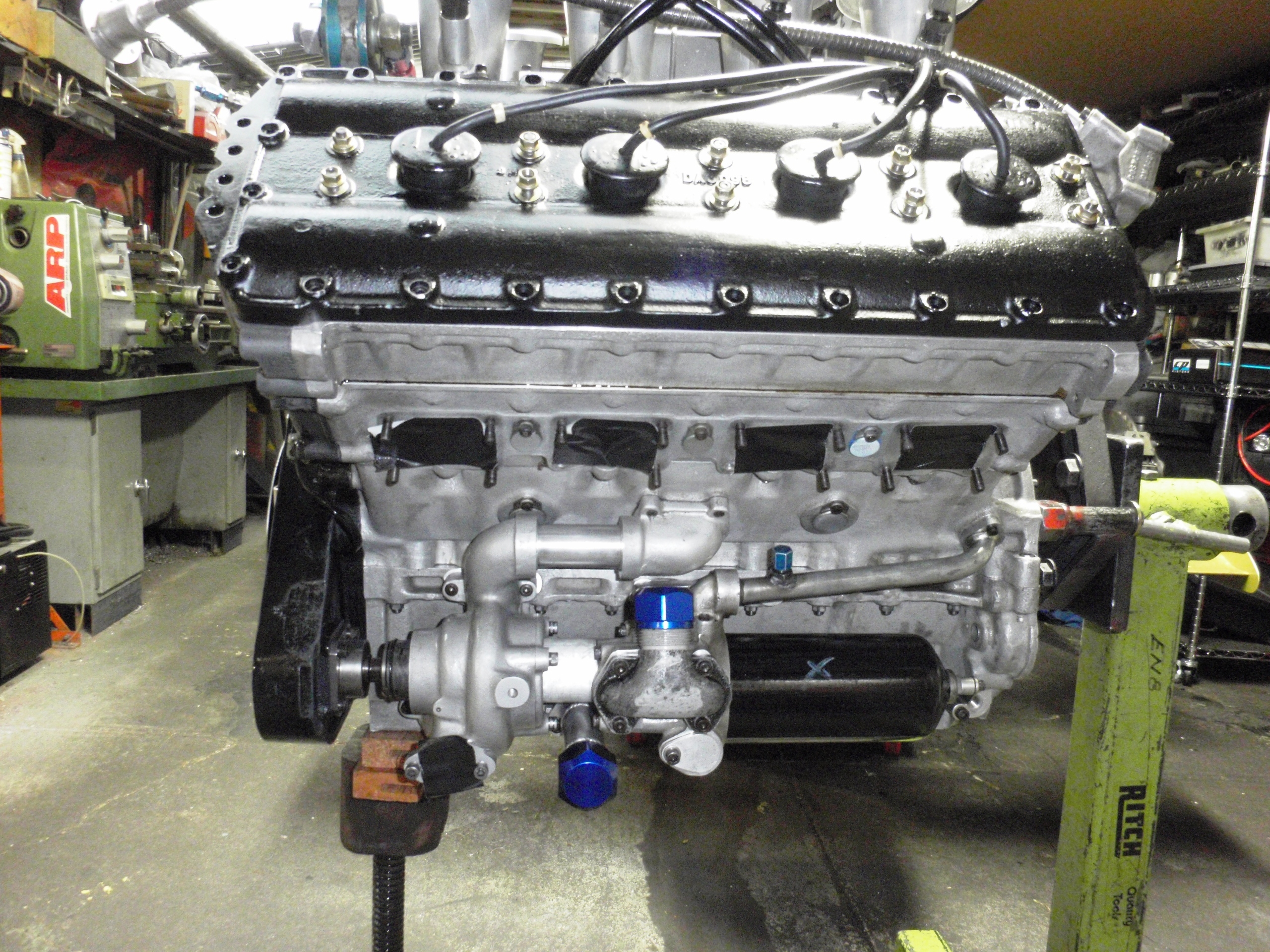
‘250’ this time showing the ‘left side’ of the engine with combined water pump and oil pressure pump/filter assy. 250 engine a ‘twin water pump long stroke engine’ as against later ‘slim line’ from circa 1980 which only had one water/oil pump to maximise the space available for ground effects tunnels (Brennan)

The cooling system must not trap air, use bleeds as required, the system uses a 15-20psi cap. A 50/50 mix of water/glycol keeps corrosion in check and lubricates the water pump. Temperature strips should be used to monitor ‘real’ engine temperatures. The water outlet temps at the back of the heads should be 90-110 degrees centigrade and inlet temps 70-80 degrees.

OLYMPUS DIGITAL CAMERA

‘250’ during its disassembly. Complex gear train to drive 32 valves, with degree plate to record engine valve timing during disassembly as a matter of record (Brennan)

Fuel & Fuel System.

Peter uses 100 octane avgas. Light engine oil is always added to the fuel to increase the life of the metering unit, fuel pumps and valve guides/seats. 20/50 Kendall is used, the ratio 2 ounces to 5 gallons of fuel.

The Lucas system needs 120psi to operate properly. Individual injector nozzles should seal at 50-65psi and thus not leak when the electrical pump is switched on, some leakage at 100psi plus is not unusual but it shouldn’t be pissin out…

The metering unit cam is set to run at specific clearances, typical DFV settings are .006 inch idle and .078inch wide open, these settings are 1 notch from full lean. These settings will be on the engine build sheet, check them periodically.

The mechanical fuel pump seal should be lubricated every 500 miles

dfv_parts

Cosworth DFV and its constituent parts (unattributed)

Trivial Pursuit Question?

The firing order is; 1-8-3-6-4-5-2-7

Cold Weather Operation.

Clearances in the metering unit are so tight that in cold weather the quill drive or the metering unit drive will break. Not a good idea.

In weather below 45 degrees fahrenheit the engine shouldn’t be spun over before warming the metering unit with either a hair dryer or judicious amounts of boiling water being poured over it.

Firing Her Up: The Good Bit.

Warm up plugs and oil heaters aren’t needed, so some of the theatre of a bygone era is lost!

Make sure Arrows isn’t in gear!

Set the fuel cam datum pin to full rich

Switch on the electric fuel pump

100psi of fuel pressure should be present

Crank the engine over for 8-10 seconds with the throttle full open

Then prime each injection trumpet with a delicate squirt of fuel

Hit the Opus system retard switch (switch back across for on circuit work)

Switch on the ignition

Hold the throttle open about 25%, start the engine, but don’t race it as it fires. Hold her steady above 2300rpm, savouring the beautiful music it plays, settle the revs wherever the mechanical chatter is minimised but @ around 2300rpm

Its important not to run the engine below 2000rpm as the cams are not properly lubricated below that

Once the engine settles down with a little temperature switch off the electric fuel pump.

As the engine warms, the engine should be leaned one datum pin down, one notch at a time. With each notch it will spit and crackle a bit until it warms to it.

Engines are set normally to run one notch from full lean, they will be ‘grumpy’ at low speed which is normal.

Oil pressure should be 40-60 psi, make sure your driver has a look every now and then on circuit!

Unsurprisingly running a DFV is more complex than its Ford ‘Kent’ little brother! If the maintenance regime is followed and the driver keeps the engine in its optimum band and doesn’t buzz it on the down-changes, something Ricardo did during his Arrows days according to Tony Southgate then ‘DFV250’ will last around 1700-2000 miles  between rebuilds…

DFV Engine in the Ground Effect Era…

Credits & Bibliography…

Peter Brennan many thanks

Phil Reilly Engineering, Geoff Richardson Engineering

Dossier on Arrows A1-06 written by Alan Henry for oldracingcars.com

Rainer Schlegelmilch

Tailpiece…

arr sticker


jane

(Bryan Liersch)

Bob Jane leading his champion driver, Spencer Martin onto the Hume Weir dummy grid for his first race in ‘Bob’s baby’, his Elfin 400 Repco 4.4 V8, June Queens Birthday weekend 1967…

Martin was by then the reigning national Gold Star Champion. In fact he was half way through a year in which he won his second title on the trot, and then having achieved his motor racing aims retired from the sport at elite level’.

#85 in the background is the ex-Bib Stillwell, Tony Osborne owned Cooper Monaco Olds V8 driven by Ian Cook.

Click here for an interesting article on Spencer; https://primotipo.com/?s=spencer+martin

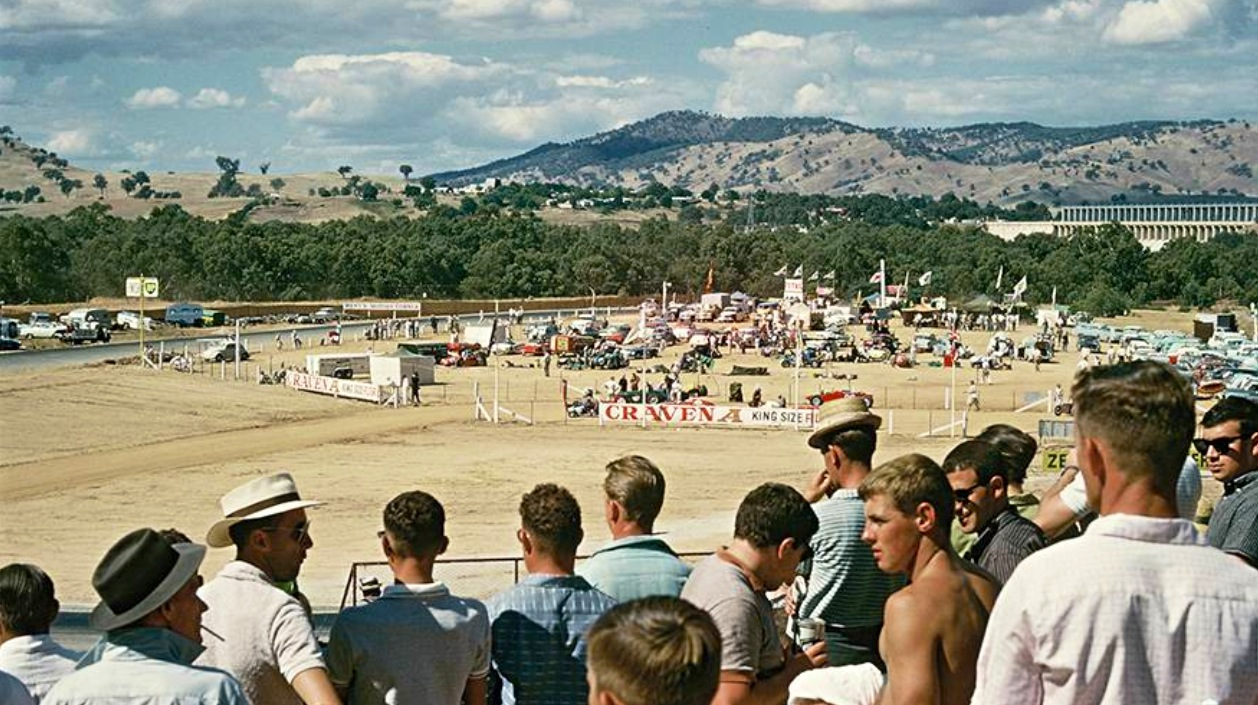
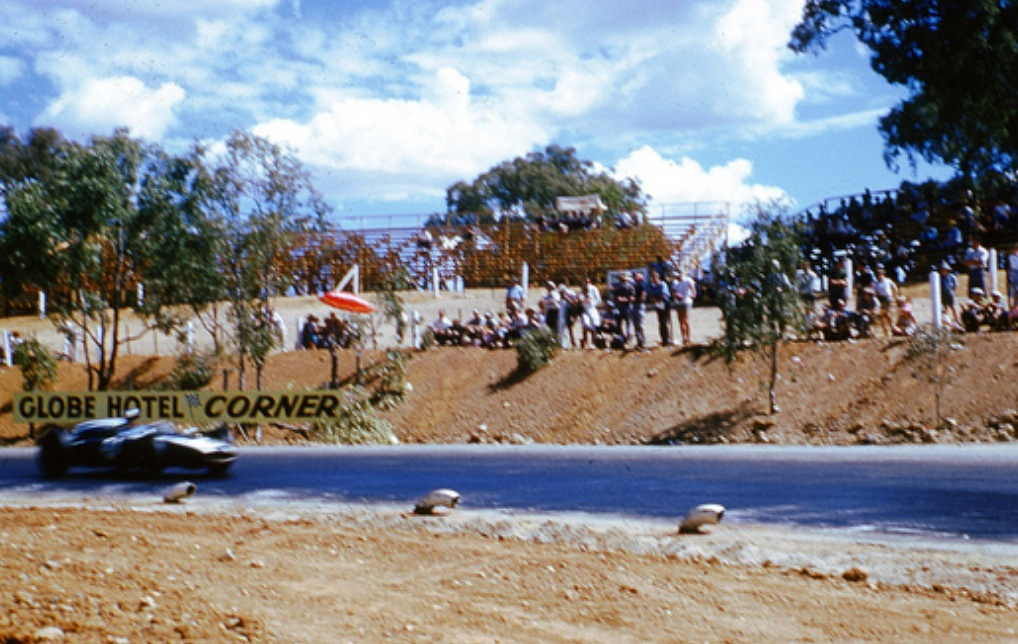
The inspiration for this article are a number of great shots of the Hume Weir circuit near the mighty Murray River and border of New South Wales and Victoria. The circuit, closed in 1977 won’t be on the radar of international enthusiasts although Jack Brabham and Roy Salvadori raced there during the Australian International races in the summer of ’61.

Brabham 1961, Cooper T53 Climax (C McQuellin)


hum jb

Jack Brabham wins the ‘Craven A International’ in his Cooper T53 Climax in March 1961, love the ‘Fergy’ in the background, Hume Weir  (unattributed)


JB post one of his wins with booty, ours is a parched brown land (C McQuellin)

I knew the circuit, i just missed racing there, it was closed by 1979 when in bought my first Formula Vee, was built in a disused quarry which provided construction stone and gravel material to build the Hume Dam, particularly its retaining wall. Although a Victorian i am a Thredbo skier, a legacy of 9 years working in Sydney and for years summer and winter have driven from Melbourne along the stretch of road from Ebden to Tallangatta with Lake Hume to my left. From Khancoban where the Alpine Way starts is a phenomenal drive to Thredbo Village. This drive, in fact the whole journey from Albury through Corryong, Khancoban, Geehi and Dead Horse Gap to Thredbo is one of Australia’s great drives.

Watch the ‘coppers’ though they police it furiously, the area near Scammells Lookout, a must stop, is an area to stick to the limits in particular!

For years i have driven for miles with Hume Dam on my left and wondered about the Hume Weir project and researched it, some old shots i found are too good not to share.

So, this masterpiece comprises a piece about the building of the Hume Dam, the birth of its Hume Weir Circuit ‘love-child’, the history and some shots of the circuit and a bit about Bob Jane’s Elfin 400 the photos of which at Hume Weir inspired the article.

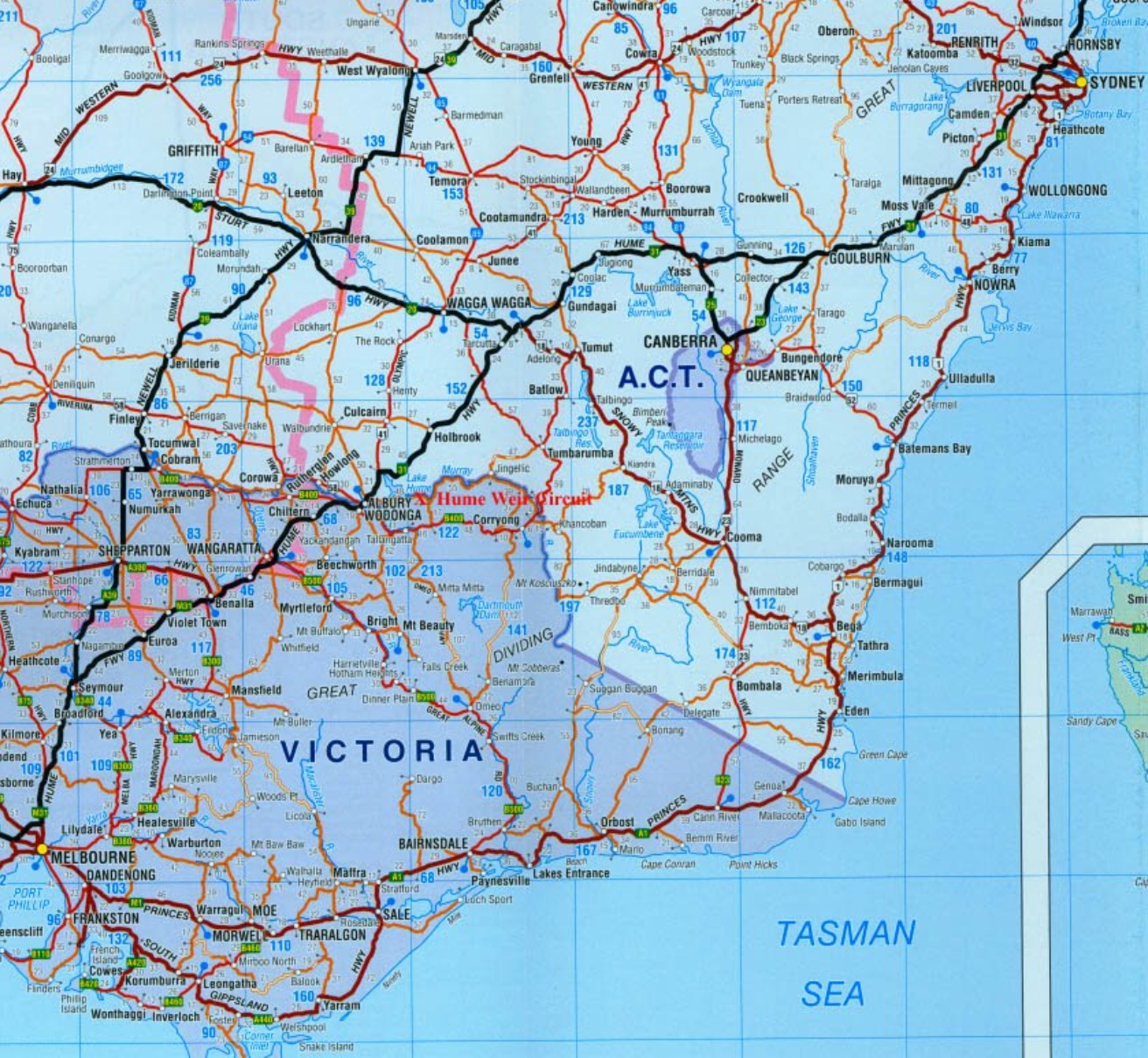
For my international friends, the ‘where the hell is he talking about?’ question is addressed by the map below, ‘Hume Weir Circuit’ is in red, the road to Thredbo is also there.

hum map

hum circ air

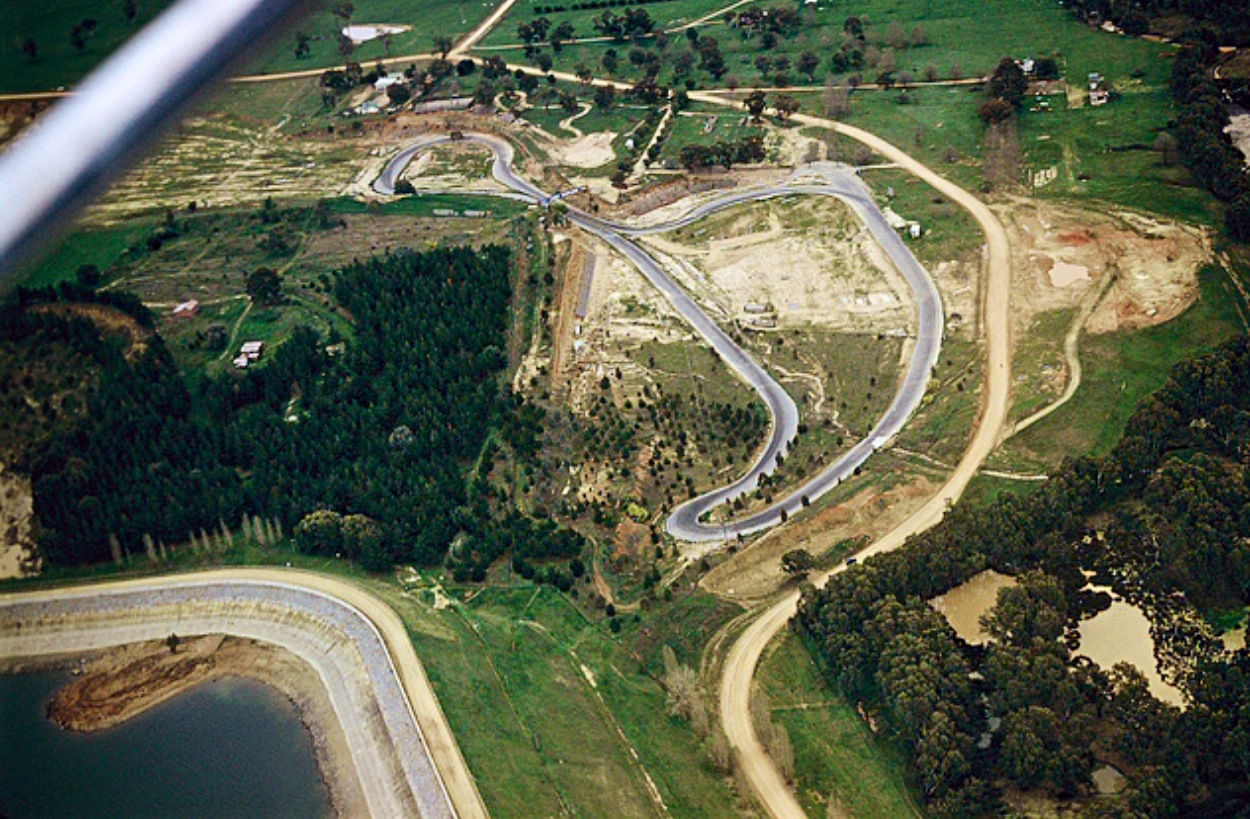
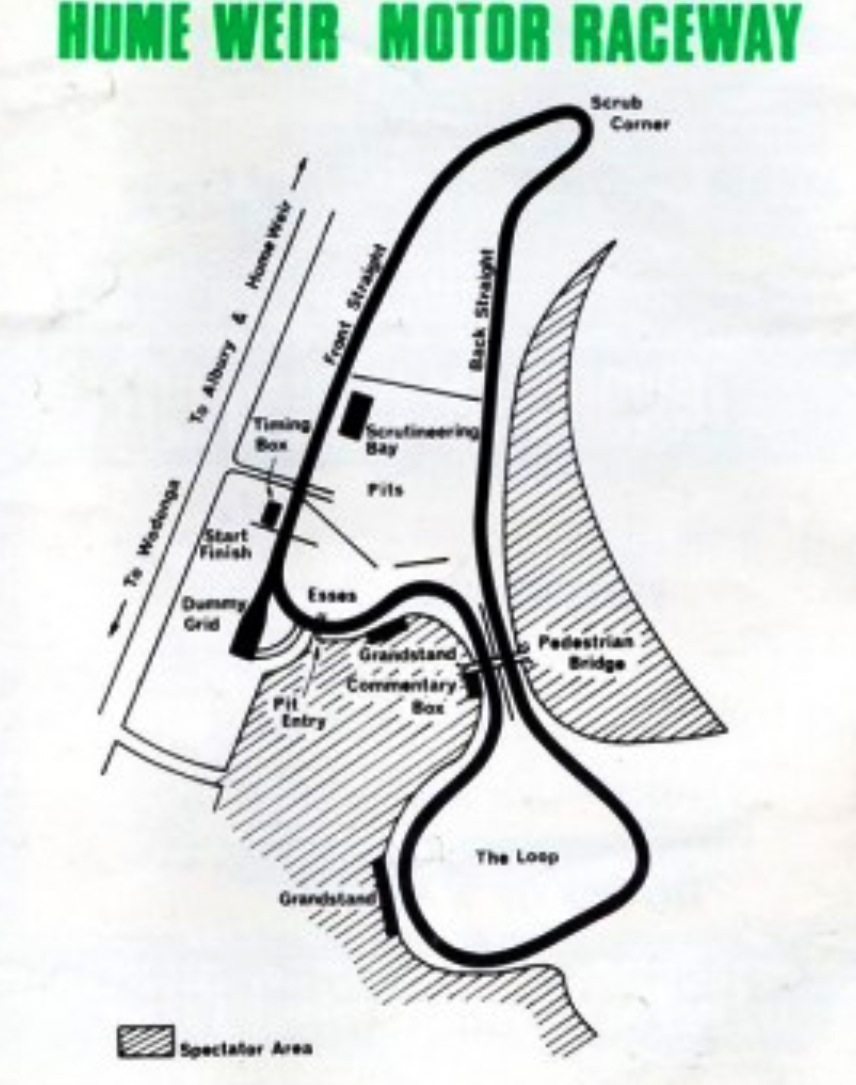
1960’s aerial shot of Hume Weir circuit, dam and dam wall. At the bottom of the shot is ‘Scrub Corner’, the tightest hairpin in the country, then heading ‘up’ is the ‘Back Straight’ into the combination of corners called ‘The Loop’, then left (going down the page again) into ‘The Esses’ past the pit entry and onto the ‘Front Straight’, the start/finish line is at the start of which (Dallinger)


dam dean st

Dean Street, Albury 1920’s (Dallinger)

Australia is the driest continent on the planet, as a consequence there have been some major infrastructure projects since Federation in 1901 to provide water for irrigation of crops and/or power. The Hume Dam is one, on much bigger scales are the Ord River Scheme in WA and most impressively and significantly the post-war Snowy Mountains Scheme in NSW.

Travelling the roads mentioned above gives some insights into the ‘Snowy the scale of this nation building post-war project, its one of the civil engineering wonders of the world, can only be experienced on the ground, its un-Australian not to experience it at some point in your life!

Explorers Hume and Hovell trekked through the area in 1824, Albury was first settled by Europeans in the 1840’s.

As early as 1863, it was clear that water management was needed to ease the boom and bust flows of the rivers. Lochs and weirs were advocated but when representatives of the three colonies impacted, NSW, Victoria and South Australia met in Melbourne, the talks came to nothing. Not much different to today really, when the Premiers meet. Difficulties with border customs, bridge and punt tolls, along with self interest made necessary compromises between the parties impossible.

dam beth

Albury/Bethanga Bridge construction 1920’s (Dallinger)

After Federation (when the colonies joined to form a country) in 1901 a more global view of national priorities was capable of being made and after consideration of 25 sites the present one was chosen.

The factual material which follows is a truncated version of a paper by Joe Wooding for the ‘Albury & District Historical Society’ on construction of Hume Dam.

To build a reservoir, lots of land is needed, in this case, prime river frontage. 15,582 acres in NSW  and 87,268 in Victoria. Not everyone was pleased with the compensation offered, the lawyers were happy though as the courts were ‘chockers’ with disputes for over a decade.

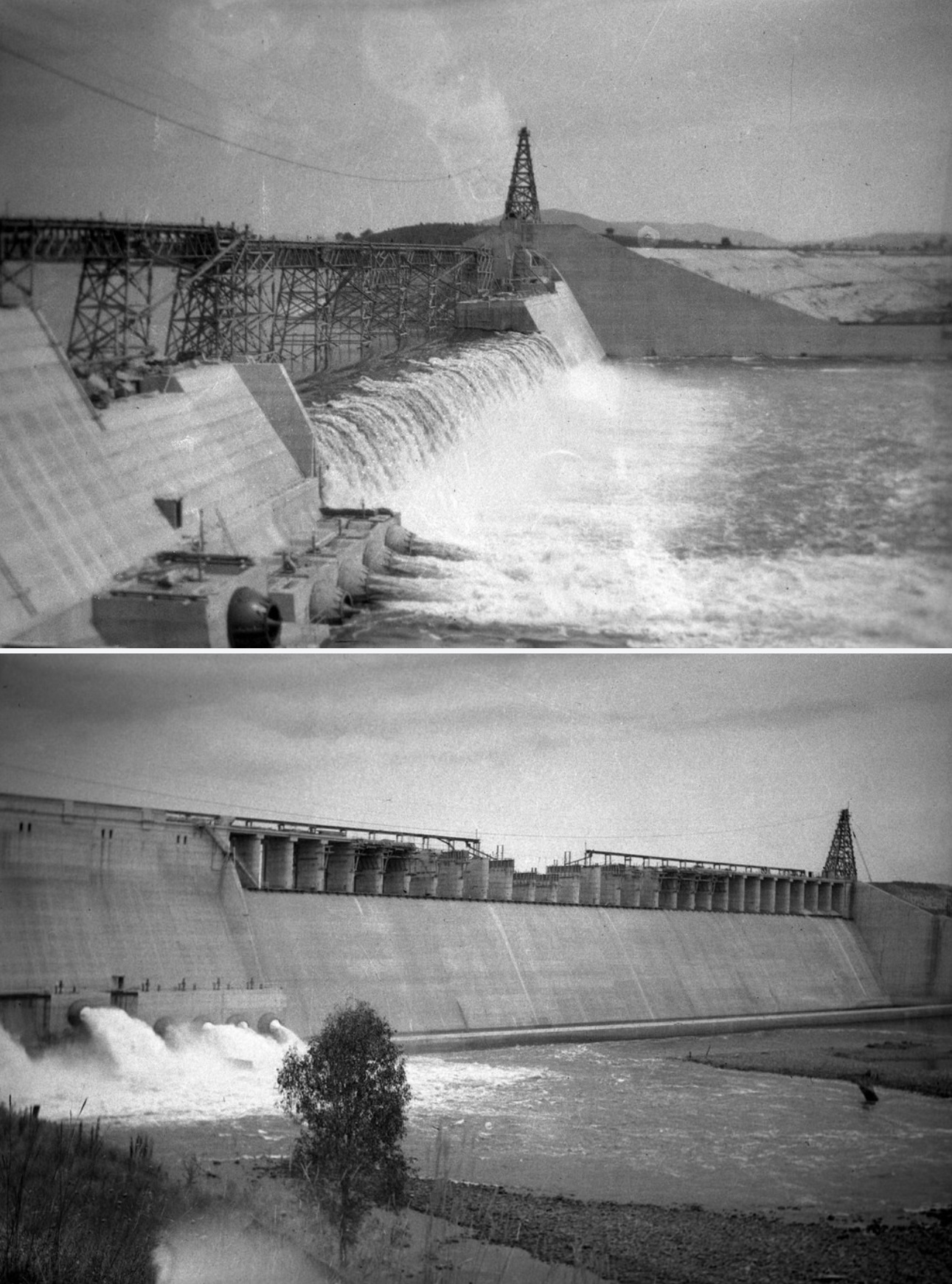
Construction commenced in November 1919, soon tent cities sprang up on both sides of the river. More permanent buildings were soon erected. On the Victorian side, the hamlet of Mitta Junction, became known as Ebden Weir and the site for operations.The higher ground in NSW was called Hume Weir, started from nothing. In 1920, the title Hume Weir was officially bestowed on the whole project in honour of the explorer.
dam early

Relatively early works, 1920’s (Dallinger)

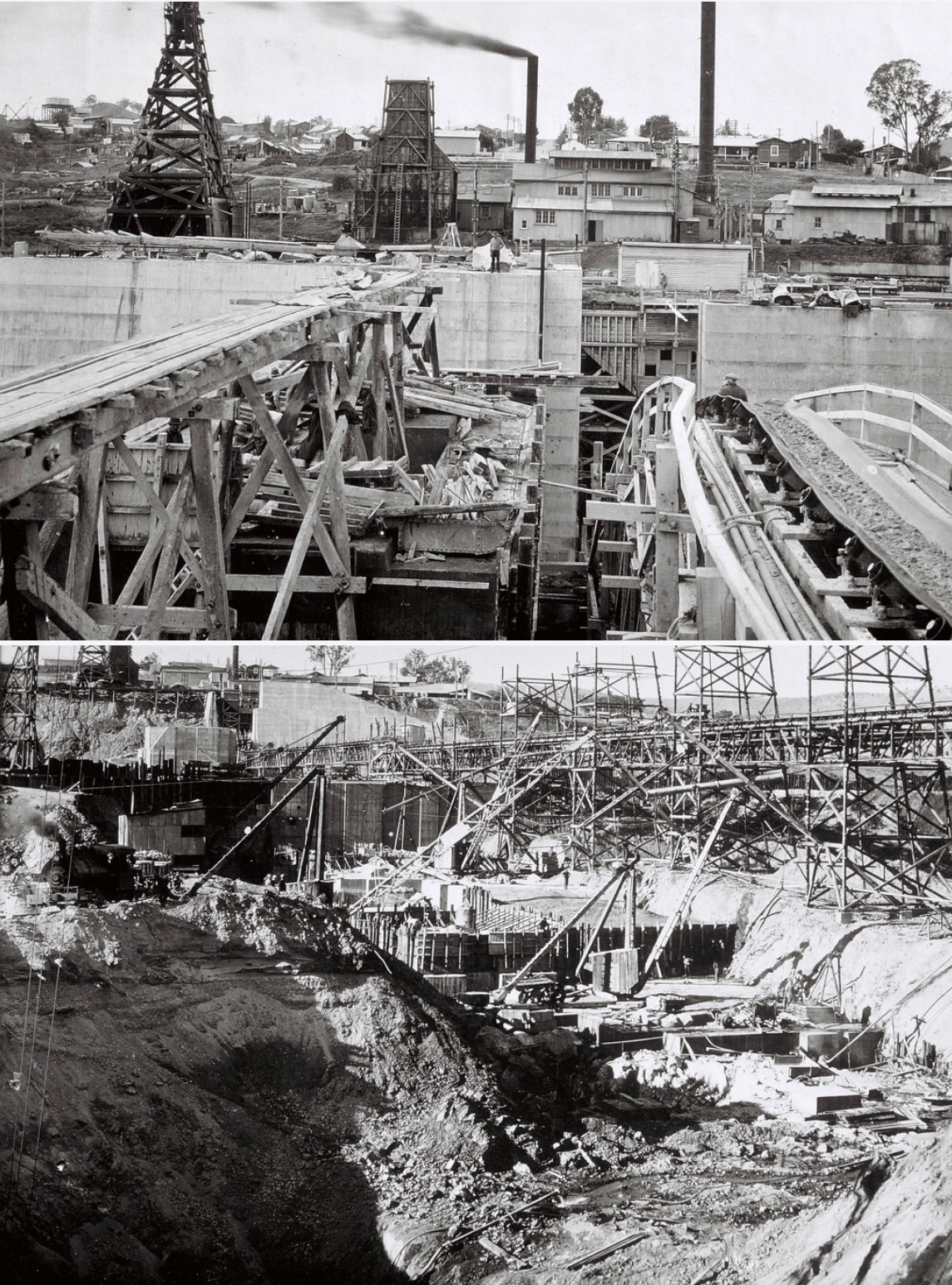
Massive amounts of infrastructure were needed. I must admit to always being amazed at what was built with the equipment available in earlier times. (noting the Pyramids scale of achievement!)
A metalled road from the main road at Wirlinga, now Old Sydney Road was built to the site. A Hume Weir rail siding was established from which vast amounts of stores, equipment and cement were conveyed to the NSW work site by a fleet of 10 solid rubber tyred Thornycroft motor lorries. In Victoria, a branch from the Wodonga to Cudgewa rail line was laid to Mitta Junction. A road bridge to link the two villages spanned the Murray just below the work site.
Two quarries were established. The one in Victoria provided earth fill and clay for the embankment and later the site for the Hume Weir circuit. Originally, 2 steam locos were used to haul trucks along the earthen bank, 8 were added later. The rail tracks were constantly re-laid as the bank grew. Two steam grab cranes were used in early excavation work at the quarry. Two ‘navvies’ were deployed, steam cranes which ran on the rail system. Much of this equipment was brought from Nagambie and Eildon. Over 500 horses were  used to haul monkey-tailed scoops and drays.
dam horse

Horses still had a role despite modern construction techniques of the day (Dallinger)

In NSW the stone quarry is on Hawksview Hill. Four steam locos and numerous trucks were brought from Burrinjuck. The rail system was extensive, rails ran to and from the quarry and the Bethanga Bridge site. Rail was also used inside the coffer dam to service the spillway foundation excavations.

Steam power was widely used, some of the machinery was extraordinary. In NSW two huge cement mixers capable of producing 900 cubic yards per day were operated. The crusher was a 30 ton Hadfield made in Sheffield, England. It was unloaded at the weir rail siding and with great difficulty, transported to the quarry by 2 large steam traction engines.
dam steel

(unattributed)

A flying fox spanned the river from east to west with a large steel cable 400m long. The cables were attached in such a way allowing coverage of almost the entire work site. 300 tons of concrete blocks were used as ballast on the mobile pylon. A trolley was attached to the cable, enabling loads of up to 10 tons to be placed almost anywhere on the work site. The Bucyrus steam shovel was capable of lifting 3½ cubic yards and the only machine on site using caterpillar tracks.
dam train

(Dallinger)

‘The process of using crushed rock rather than smooth river gravel and adding large rock individually, produces ‘cyclopean concrete’. A 750mm wide concave rubberized conveyor belt carried the concrete, which could be retrieved at any point, by concrete shutes, for placement at the work site. Belts were pressure cleaned for their return journey. The huge rocks, some weighing up to 10 tons, called ‘plums,’ were cleaned with a high pressure hose before being individually craned into the wet concrete. Some were completely buried, but many were left half exposed to ‘key in’ the next batch of concrete. Steel reinforcing was only used near the top of the spillway. The structure is about 17% rock. At its base, the wall is 32m thick and double that if you take in the dissipater wall’.

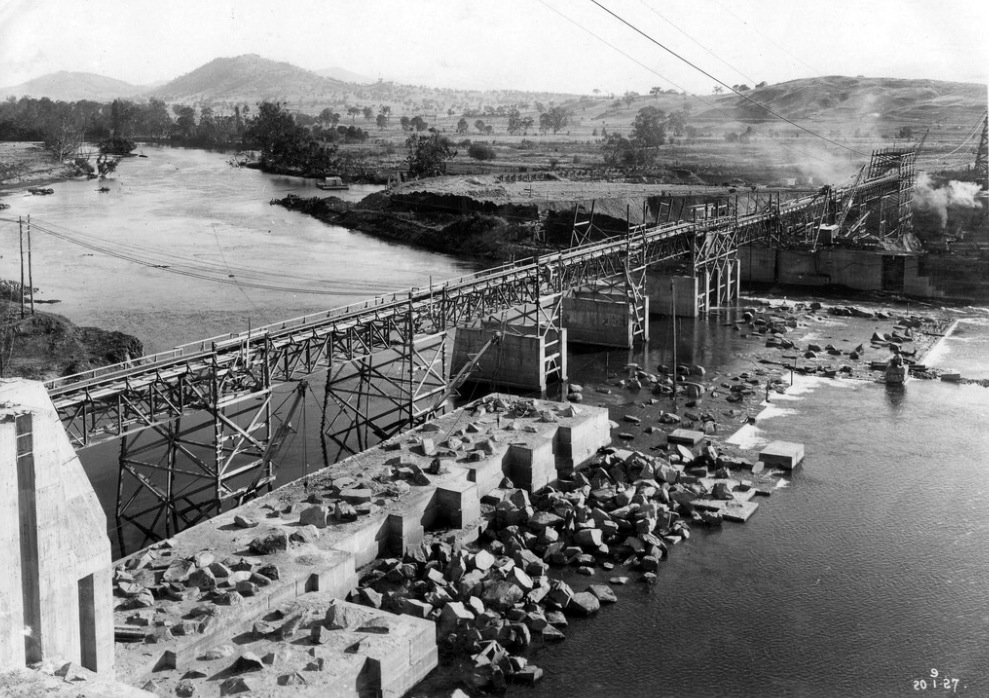
dam wall 1927

Dam wall 1927, looking at the Murray upstream (unattributed)

‘As well as road works in the villages, other amenities were provided. Residences, barracks, stores, recreation halls, a post office and police presence were established. Electricity was installed for lighting only and turned off at 11pm. A Church of England was transported in. A casualty ward, a doctor with a phone and car were provided. Dances and pictures, obviously silent, as ‘talkies’ were not seen in Albury until 1928. The school had 66 pupils in 1921. The baker, milkman, greengrocer and butcher called regularly as did the ice man. Sport attracted many of course’.

dam end 1

Dam wall work progression (unattributed)

Manual labour was harsh with a 48 hour week, later reduced to 44 hours. Picks, shovels and
bare hands were often the only method of filling drays. Returned soldiers from the Great War
were given preference for employment, followed by married men. Estimated numbers of
workmen employed varies greatly with about 1000 cited. At the peak of construction around 1927, numbers given were Victoria 355, NSW 650, Bethanga Bridge 89. With a large workforce and dangerous working conditions, accidents were a reality, with total fatalities estimated at 6-9 people.
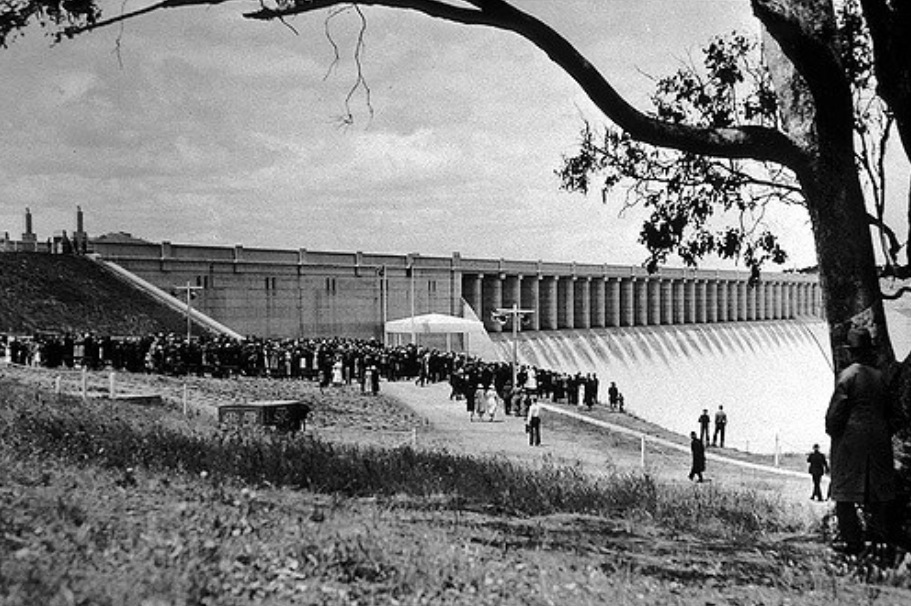
The Weir was officially opened by the Governor-General, Lord Gowrie, on November 21 1936
 ‘by closing an electric valve control circuit which released the water through two giant needle valves…the greatest irrigation work in the Southern Hemisphere and one of the most important in the world. It cost £5,550,000 to construct, and is located nine miles from Albury’ The Albury Banner’ said.
dam ope

Dam opening ceremony in 1936 (Dallinger)

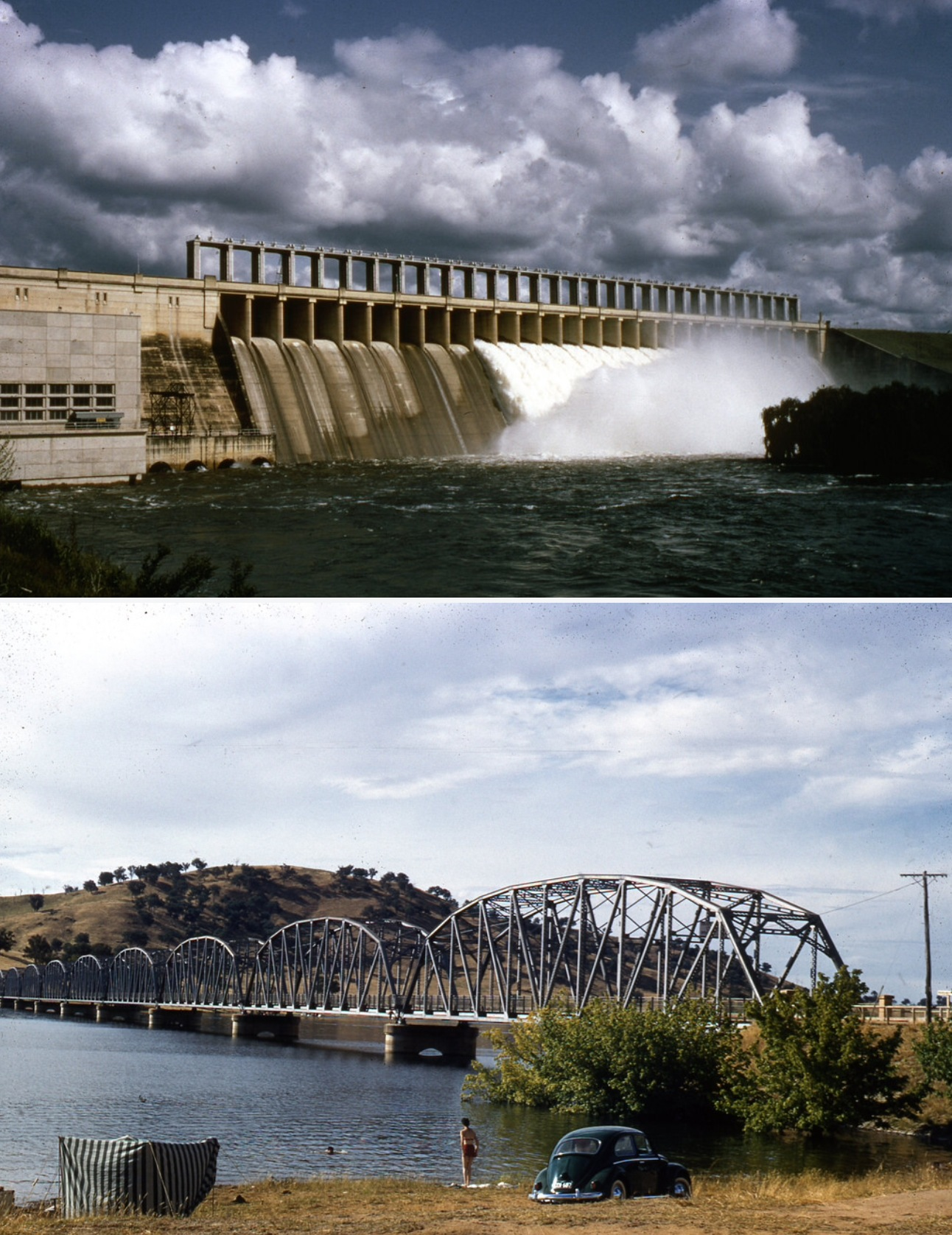
In 1957, the Power Station was completed with 2 turbines now capable of producing 58 Mw which is not large in the electricity industry. As a comparison, Albury’s peak demand for summe of 2013 was 110 Mw.

dam end
The 1960s saw a large increase in the weir’s pondage necessitating additional works on the
dam. One aspect was to open the old stone quarry and supply thousands of tons of granite to
stabilize the clay bank of the earthen wall.
dam sail
dam car
Wirlinga…

Hume Weir wasn’t the first circuit in the Albury area, Wirlinga was.

A public roads layout of 6.79K, roughly rectangular shape using Thurgoona, St Johns and Bowna Roads as well as the Riverina Highway was used. 14km  from the centre of Albury, the track was used several times before WW2. Rather than get lost in that tangent now, tempting though it is, we will come back to Wirlinga another time.

wir 1

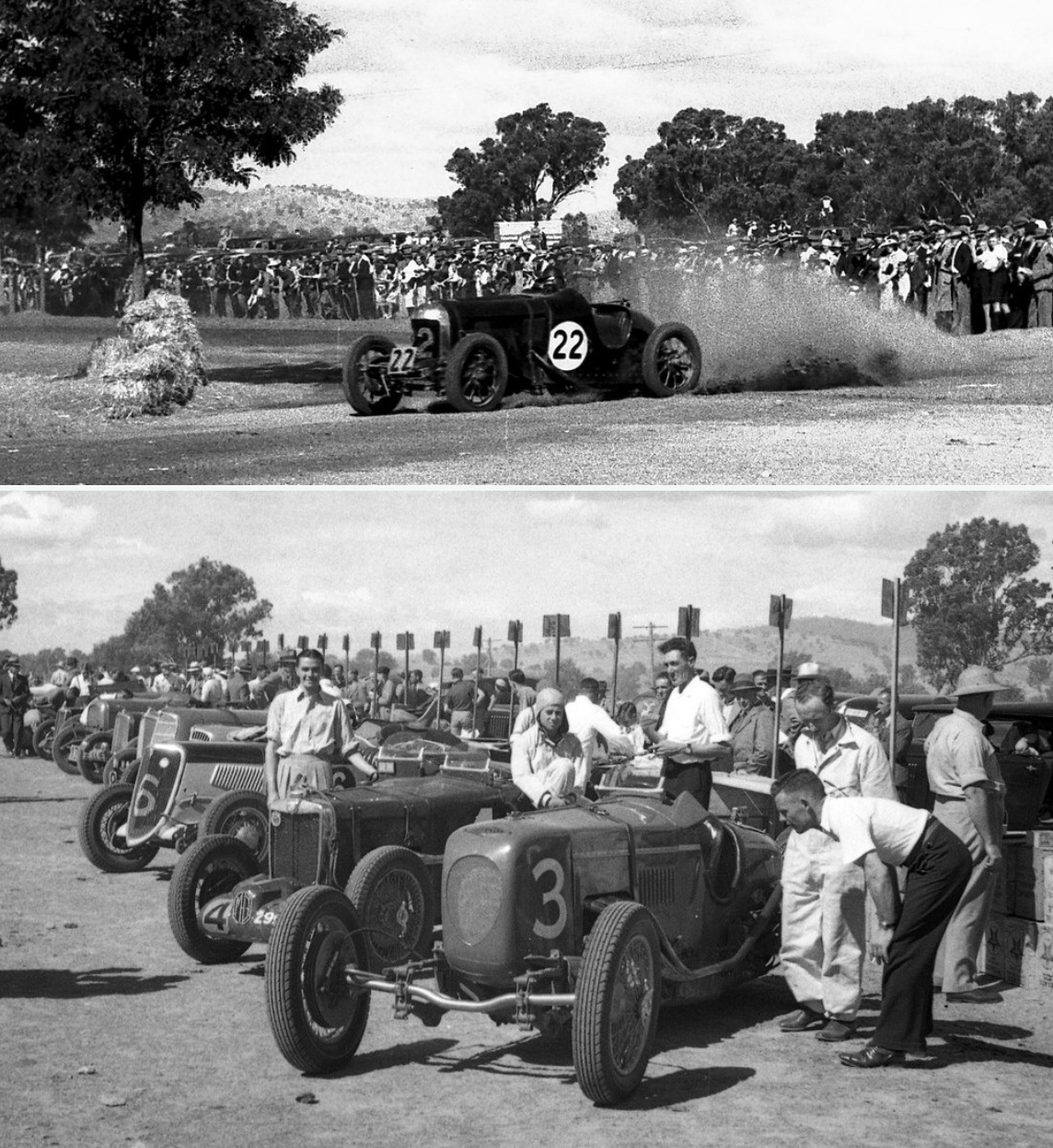
Car #22 is Alf Barrett’s Morris Bullnose Spl. #3 Tim Joshua’s Frazer Nash TT Replica, #4 Hope Bartlett’s MG Q Type,  #6 Jack Phillips winning Ford V8 Spl, Wirlinga 1938 (Dallinger)

The 150 mile ‘Interstate Grand Prix’ (called the ‘Albury Grand Prix’ in the Sydney Morning Herald report of the 1939 race) was run on 19 March 1938. The ‘Albury and Interstate Gold Cup’ was run on 12 June 1939. Both handicap races were won by local Wangaratta boy, Jack Phillips Ford V8 Spl. The track wasn’t used post war.

wir 2

The lower pic shows Les Murphy in the O’Dea MG P Type from Colin Dunne’s similar car and George Bonser’s Terraplane Spl, help wanted in relation to the cars in the upper shot  Wirlinga 1938 (Dallinger)


hum wir

‘Sydney Morning Herald’ 13 June 1939


hum summer

Typically parched Australian summer, 1970’s. Hume Weir wall middle right and Great Dividing Range clear  (unattributed)

Hume Weir Circuit…

Hume Weir was enormously popular in the immediate area, in fact depending upon the year the locals were served by Tarrawingee, Winton outside Benalla and the ‘Weir.

When the circuit was leased from the Hume Dam authority by the Albury and District Car Club the members initially established an unsurfaced layout which was first raced on 2 November 1959. It was lengthened to 1.1 miles during the year, first used sealed for the Christmas meeting on December 12 1959.

hum dirt

Cars race at one of the earlier meetings on the original dirt layout, Hume Weir 1959 (unattributed)

The financial support of Gold Star champion Len Lukey’s and his ‘Lukey Mufflers’ business allowed the amenities to be improved sufficiently to hold the 1961 international event. The ‘weir only got the gig, historian Stephen Dalton records as negotiations with PIARC to use Phillip Island fell over.

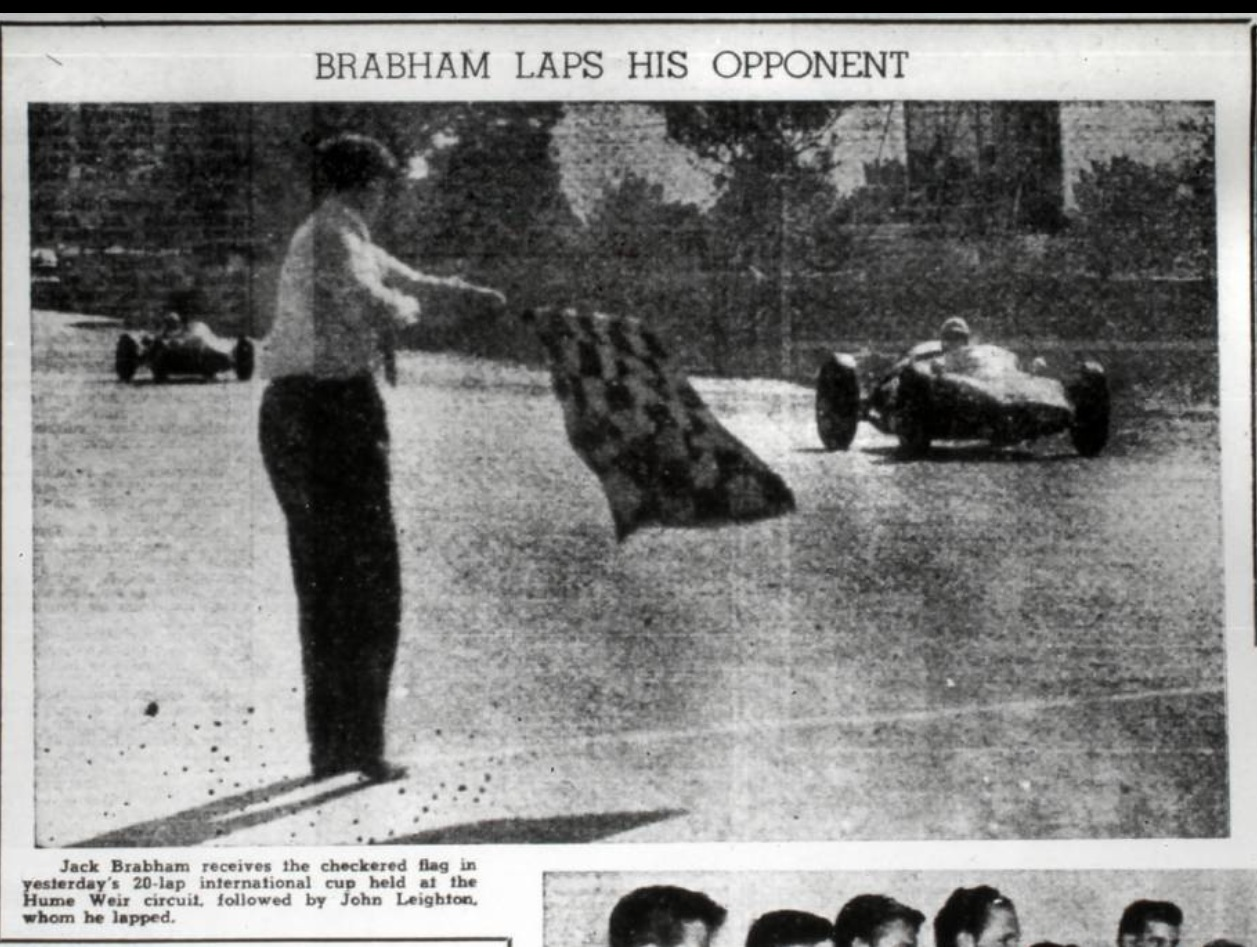
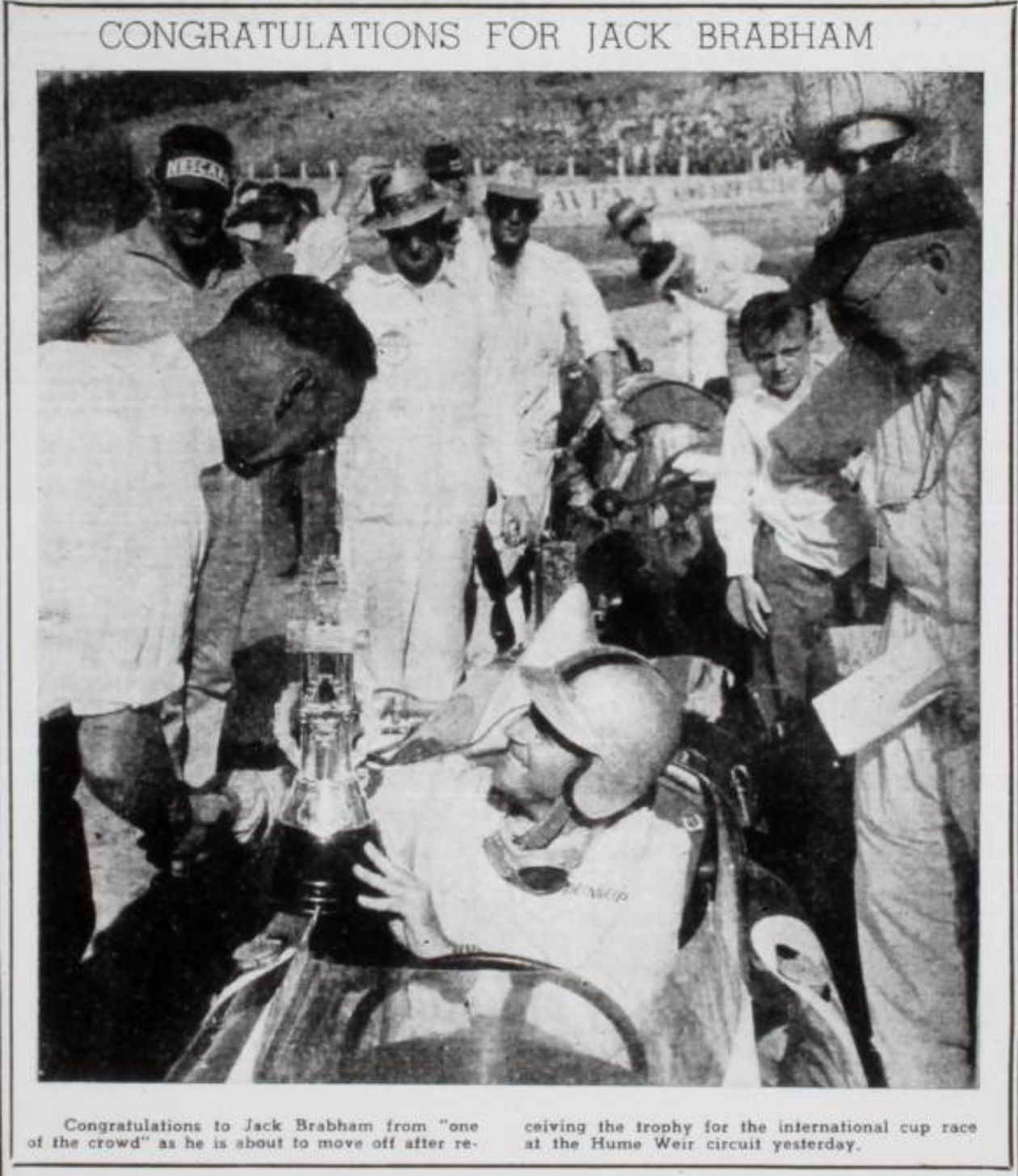
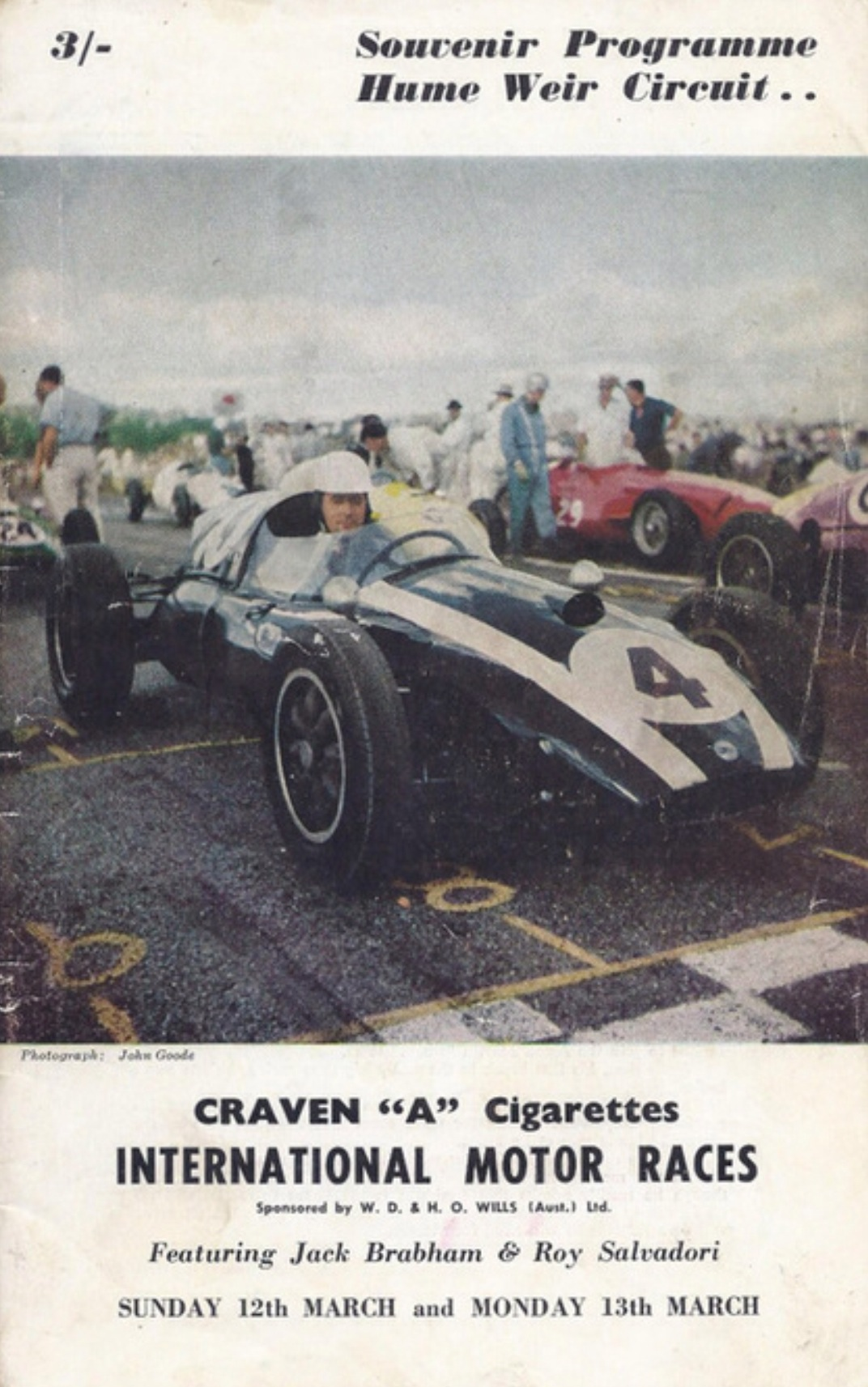
The 1961 program comprised an ambitious 21 events held on the Sunday and Monday 12 and 13 March, they were mainly short races with the feature ‘Craven A International’s 20 lappers on each day.

The meeting was contested by Brabham, Salvadori, Bib Stillwell, Bill Patterson, Austin Miller and Jon Leighton. It wasn’t a big field; Moss had long since left the country, as had the BRM drivers Hill, Gurney and Ron Flockhart and his Cooper.

hum split

This shot shows the two sections of the track separated by a narrow strip of concrete, March 1961 meeting perhaps (unattributed)

Brabham.

The Internationals that summer were raced at Warwick Farm, Ballarat Airfield in Victoria and Longford and won by Moss Lotus 18 Climax, Gurney BRM P48 and Roy Salvadori’s Cooper T51 Climax respectively.

The Longford meeting was on March 5, Brabham and Salvadori travelled back to Melbourne from Tasmania, the Coopers were towed up the Hume Highway, the main Melbourne/Sydney artery to contest the ‘Craven A Internatioanals’ at Hume Weir on 12 and 13 March. No doubt it gave Jack an opportunity to catch up with his family in Sydney.

hum brabs servo

Brabham’s Cooper T53 Climax out front of its Albury digs, Gabriel Motors.  (Border Mail)

It was all fairly casual, Jack’s car was accompanied by his mechanic and a driver for the towcar, an FC Holden Station Wagon which was maintained at a local Esso servo/workshop.

hum brabs color

Brabham’s Cooper T53 during his victorious March 1961 weekend (unattributed)

Jack won the race on the Sunday by just 0.9 sec from Patterson, the reigning Gold Star champion and Bib Stillwell’s Cooper T51’s in his T53.’The last 3 laps saw the leaders in the esses together and the crowd was wild with excitement as it was still anybody’s race but Jack Brabham showed championship form and held off the challenge to win’ said the Border Mails report.

hum brabs cheq

(Border Mail)


hum miller

Austin Miller’s distinctive yellow Cooper T51 Climax perhaps chasing Jon Leighton’s Cooper T45 and Roy Salvadori’s T51 during the Sunday race in which they were 4/5/6th (unattributed)


Roy Salvadori sussing the size of the cheque- ‘Can you make it in pounds sterling matey?’ (C McQuellin)


Brabham, Cooper T53 Climax (unattributed)


Brabham from Salvadori- Cooper T53 from T51 (unattributed)


Salvadori, Cooper T51 (unattributed)

On Monday ‘Brabham streeted the field in the international cup race and set a lap record of 51.2 seconds, a time equated to 147kmh’. ‘Twas again a Cooper 1-3, JB winning from Stillwell and Jon Leighton in Cooper T51 and T45 respectively.

With that both internationals jumped on a plane for the UK, their first event the Lombank Trophy at Snetterton which Jack won in his Cooper T53, Roy was 5th in a similar car.

hum brabs

Brabham T53 just in front of Patterson T51 in Sunday’s race closing stages (unattributed)


hum brabs in car

(Border Mail)


hum jack

hum circ map

The short nature of the circuit perhaps mitigated against its use for championship events having said that it hosted a round of the Australian F2 Championship from 1973-76…

Later multiple Gold Star winner Alfredo Costanzo set the all-time lap record in a Birrana 274 Hart 1.6 F2 car on 15 June 1975, in 1976 the circuit also held a round of the Australian Sports Car Championship, fundamentally though it is a circuit which is fondly remembered by club racers of both bikes and cars and spectators of course.

The circuit was essentially ‘killed-off’ by CAMS with ever increasing and more difficult safety requirements which the owner/promoters couldn’t afford. There was a section where the cars passed each other separated by a concrete wall which was of particular concern.

The last race meeting was held on 27 March 1977 although the track was used as part of the Alpine Rally which was run out of Bright, not too far away. Every now and again a ‘comp sec’ of a car club convinced CAMS to issue a permit for a ‘sprint event’ but essentially another circuit was lost, a real shame as the usual causes; noise in a built up area or urban encroachment which simply made the entreaties of property developers irresistible to circuit owners didn’t apply in this rural area.

hum air

(Dallinger)

The photo above nicely juxtaposes the Dam with the circuit which is clear to see above the dam wall in the middle of the picture, plenty of water about in this shot! At present it is as dry as!

Molina Monza Holden Spl.

hum monza

You get a sense of just what a magnificent natural ampitheatre the circuit was, most of but not all of the circuit could be seen from one place. This is the Molina Monza Holden Spl, the shot isn’t dated so not sure who the driver is. The car’s specifications are outlined in this article amongst other Oz cars; https://primotipo.com/2015/05/13/shifting-gear-design-innovation-and-the-australian-car-exhibition-national-gallery-of-victoria-by-stephen-dalton-mark-bisset/

Perkins.

hum perk

(Dick Simpson)

Larry Perkins in the ‘boonies’ at ‘Scrub Corner’ on 28 December 1969 early in his career, car is characteristically a Perkins Vee. He is looking for a marshall to help him back to terra firma.

He was in F1 in a private Ensign nee Boro in 1975. This is early days tho, his early break was to get one of Bib Stillwell’s Elfin 600FF seats in 1971 taking the ‘Driver to Europe’ series. He stayed in Oz for ’72 and raced an Elfin 600B/E Ford to win the national F2 title. He then took Garrie Cooper’s first Elfin 620FF to the Formula Ford Festival at Snetterton at the end of the year, contesting the Festival with a few other Aussies and then stayed in the UK. F3 in 1973 and the rest is history…

Brock.

hum brock

Peter Brock ahead of Lynn Brown’s Cooper S, these are ‘Sports Sedans’, anything goes sedans with Brock and Brown two of the sports finest pracitioners of the art. Brocky is young and made his Holden ‘Red’ 6 cylinder engined A30 sing, his performances in it resulted in Harry Firth, fine judge of talent picking him up as a Holden Dealer Team driver. Brock took his first Bathurst win in 1972.

hum brock bir

Brock, Birrana 273 Ford, Hume Weir 22 April 1973 (Robert Davies)

‘Peter Perfect’ only did one fullish season in single-seaters in this ex-works Birrana 272 Ford, its the very first of Tony Alcock’s monocoque cars. A good car but it didn’t have a Hart Ford engine, and the competition was hot in 1973-5 in F2, Brocky quickly went back to Holdens. A great pity, a natural driver of great smoothness, finesse and throttle control; oh to have seen Brock in a Repco Holden engined F5000 in the 1970’s!

Hansford.

hum hans

(P Hall)

Greg Hansford blasts onto the main straight 1977. Kawasaki KR750 water-cooled 2 stroke.

Beechey.

hun beech

(Bowdens)

Beechey changed from Holden to Ford running this ex-works Series Production Ford Falcon GTHO Ph3 with some cash from Ford in 1972. Here he is in April, DNF with clutch failure. Ford apparently then changed their minds wanting Norm to return the car and money they paid him, Norm telling them unsurprisingly to ‘jam it’.

Bartlett.

hum bart

(Bruce Wells)

Kevin Bartlett in polo-shirt at the wheel of the works Lynx BMC, the Curl-Curl  kid was on his way! Lotus 20 behind i think. Year anyone?

Bikes.

hun bikes

(John Small)

Jim Budd and Roger Hayes Team Avon Kawasaki’s lead the 1 hour production race at the ‘weir in November 1977. Third is Jeff Parkin and then Alan Hales both on Suzuki’s. Hot work in the heat.

Jane.

jane mustand

(oldracephotos.com)

Bob giving his factory Shelby built Mustang Trans-Am plenty during the 1970 Christmas ‘Weir meeting. His new Chevy Camaro 427 cannot be too far away, Norm Beechey took the 1970 ATCC in his Holden Monaro GTS350 but Jano won it in 1971/2 in the same car with a 427 in ’71 and ‘tiddly’ 350 small block in 1972.

jane torana

(Dick Simpson)

Bob was back with another new toy in 1971, one of his finest, the John Sheppard built Holden Torana into which was slotted one of the 4.4 litre SOHC ‘620 Series’ Repco V8’s once fitted to the Elfin 400 pictured below. CAMS didn’t allow it to compete with the wing for long, check out the Vees in the Weir ‘form up’ or dummy grid area in the background. This car was mainly raced by John Harvey, in ’71 Bob focused on the Camaro and winning the ATCC. The car is still around albeit Chev engined and in need of restoration.

jane elf

(oldracephotos.com)

Bob Jane didn’t race his Elfin 400 too much, it was mainly driven by his drivers; Spencer Martin, Ian Cook and Bevan Gibson.

Here in early 1968 at Hume Weir Jane is ahead of a Lotus 11, Meyers Manx beach buggy! and, is it an Elva Courier. These big Elfins are sensational cars, i wrote a long article about them a while back, click here to read it;

Elfin 400/Traco Olds: Frank Matich, Niel Allen and Garrie Cooper…

400 rear

It’s interesting to see racing cars in the context of their day to gauge the impact they had on people, how ‘other worldly’ and fast they looked. Seeing them at historic race meetings is not the way the populace saw them at the time.

This shot does that in spades and the fair citizens of Conmurra Avenue, Edwardstown, an Adelaide suburb had seen plenty of cars leave the Elfin factory in their street. This one clearly captured their attention all the same.

That WOW! factor we all still experience at the sight of something really special, mind you, these days it’s usually the ‘WOW! Ugly as a Hatful of Arseholes’ impact rather than ‘WOW! Beautiful’. Such is the impact of cad-cam and the aerodynamicists ‘art’ on free flowing curvaceous forms.

The Mini 850 and Holden ‘EH’ on the typically Aussie outer suburban street nicely juxtapose the body of Elfins first ‘big-banger’ sports car with contemporary ‘roadies’ of the day.

WOW! indeed.

400 side

Elfin built four Elfin 400’s, all with different engines, the first completed was the Frank Matich Elfin 400/ Traco Olds featured in the article link above.

This car is about to be delivered to Bob Jane Racing in Melbourne in early 1967 in time for the sports car events which were a part of each years Tasman rounds.

It’s the first 4.4litre Repco ‘620 Series’ V8 fitted to a car, the engine developed in parallel with the 1966 Championship winning 3 litre variant of the same engine, victorious in Jack Brabhams hands that year.

In fact it is the first customer Repco engine sold, the first fitted to a sports car and the first fitted to a car built in Australia, Brabhams were built in the UK. So, significant in Repco’s’ history.

400 front

The SOHC 2 valve, Olds block, Lucas injected engine produced around 400bhp@8000rpm, enough in Australia, but not elsewhere in the world at the time, where big Chevs were dominant. In 1965/66 the Lola T70 was the ‘ducks guts’ in Group 7 sports car racing but the McLaren M6A appeared in 1967, from that moment the record books were attacked by the McLaren steamroller until the end of 1971 when Porsche ‘rained on their parade’ with the 917/10 and 917/30 turbo’ cars.

As stated above this car was raced by Jane himself, Ian Cook and Bevan Gibson. Unfortunately it was the car in which Bevan flipped on Conrod Straight, Bathurst at the Easter 1969 meeting, killing the promising young driver instantly.

Frank Matich was dominant in his range of sports cars in Australia into 1967, pickings at championship level were slim when FM was present. Matich’s Elfin 400 Traco Olds delivered its promise and his own SR3’s were almost identical in terms of chassis to the Elfin 400 if not the body.

The ex-Jane 400 is now restored and owned by Elfins’ Bill Hemming.

bevan

Hamilton Porsche 906 Spyder, Spencer Martin Elfin 400 Repco and Bevan Gibson Lotus 15 Climax, Hume Weir, Queens Birthday weekend 1967. Somewhat poignant shot given Bevan is to die in the car beside him 2 years later. Gibson made the families Lotus 15 Climax absolutely sing, it was his drives in this old car which earned him the Bob Jane drive (Bryan Liersch)

Bibliography…

Joe Wooding ‘Albury & District Historical Society’ paper on construction of Hume Weir

‘Elfin Sports and Racing Cars’ John Blanden and Barry Catford, Elfin Sports Cars Facebook page

(P Hawthorn)

Photo Credits…

Bryan Liersch, Bob Mills Collection, Dick Simpson, John Small, oldracephotos.com, Bowdens, Bruce Wells Collection, Robert Davies, Bowdens, Christopher McQuellin, Phil Hall, Terry Kelly Collection, Pat Hawthorn Collection

John J Dallinger’s stunning collection of Albury photographs

Tailpieces: Family, fun day out at the Weir…

hum humpy

(unattributed)


Terry Kelly, Ryleford, Hume Weir circa 1960 (T Kelly)


hun humpy 2

Hume Weir humpy Holden mayhem (Dick Simpson)

Finito…

sing mal

Birrana Engineering chief Malcolm Ramsay in his Birrana 273 ‘010’ Ford Hart during the 1973 Singapore Grand Prix, the last until the F1 era commenced in 2008…

I have been meaning to write about Birrana’s jewels of cars for a while. I tripped over this shot of Ramsay researching the Leo Geoghegan Lotus 39 article a while back, Leo was Birrana’s works driver from mid-’72 to the end of 1974.

This article started as a ‘quickie’ stimulated by the shot above, but segued into a longer piece when I found heaps of photos of the ’73 Singapore GP in the Singapore Government Archives. Too good to waste, low-res shots but still great to circulate. Bonuses were finding an existing article about the pre-F1 Singapore GP history and a contemporary ’73 race report. The basis of something interesting. Bewdy!

I need to a write a bit about Birrana Cars too though.

I don’t for Australian readers but that’s only 15% of you. So I have written what should be treated as ‘An Introduction to Birranas’, Part 2 ‘Birrana In Detail’ to come soon. Hopefully there is enough to explain how important the cars were to those who haven’t heard of the marque whilst being clear to Birrana enthusiasts, and there are plenty of us in Oz, that there is more to come.

sing leo amaroo

The photos above and below are ‘compare and contrasts’; top of Leo G in his 274 at Oran Park, the bottom of Bob Muir in his 273/4 at Symmons Plains, Tasmania. Bob’s car is 273 ‘009’ with 274 nose and rear wing. Compare with ‘standard spec’ 273 shots in the Singapore GP 1973 part of this article (unattributed)

Leo won the Australian F2 Championship in 1973/4 with a 273 and then 274 model cars, powered by 1.6 litre Brian Hart Ford ‘416B’ injected 205/210bhp variants of the venerable Lotus/Ford twin-cam four cylinder engine first used in the Elan in 1963.

bir muir

Bob Muir, Birrana 273 Ford ‘009’, Symmons Plains 22 September 1974. Bob took the win from RayWinter’s Mildren ‘Yellow Sub’ Ford and Sonny Rajah’s March 712M/732 Ford (unattributed)

The F3/F2 Birrana’s were typical, orthodox aluminium monocoque chassis, outboard suspension cars of the period but built to a very high standard of design, construction and finish with particularly careful attention to aerodynamics. ‘Boxes were Hewland Mk9/FT200 for ANF3/2 use respectively.

Twenty-one cars were built, (FF 4, F3 4, F2 11, F Atlantic 1 and Speedway! 1) the first car was the F71 FF built in Sydney by Alcock before he joined forces with Ramsay in Adelaide, their home town. The last ‘A78’ Ramsay built for his own use in 1978 after the factory had closed in terms of ‘volume production’.

sing a78

Graeme Lawrence’ Rothmans March 76B alongside the very last built ‘Golden Churn’ sponsored Birrana A78. Graeme is the guy far right of his car and Ramsay the dude in the beard behind his. Selangor GP, Batu Tiga circuit 24 September 1978. Nose of Steve Millen’s Chevron behind. F Pac race, all cars Ford Cosworth BDD 1.6 powered. Of interest to Birrana historians; car was entirely new based on 273 tub design with forward braced roll bars as required then by FIA regs, and upper body panel, 274 nose with bottom lip added, bigger than 72-4 rear wing, no rear engine cover; the 272 and 273 did not have rear covers the 374/274’s did (Choong H Fu)

The pick of the cars, given driver feedback seems to be the 273, although the evolved 274 was built in larger numbers and won F2 titles for Leo G ‘015’ in ’74 and Geoff Brabham ‘018’ in 1975.

Visually though the F3 374 was a gorgeous bit of kit…if not as successful as the ‘works’ Cheetah Mk5/6 Toyota’s of ‘The Two Brians’ Shead and Sampson. Shead built the cars in his Mordialloc shop and Sambo the engines in his ‘Motor Improvements’ emporium in St Kilda Road, Elsternwick. All three of the 374’s were fitted initially with Sambo’s (ANF3 1300cc) Corolla based engines.

bir hosking

Dean Hosking in the John Blanden owned 374 Toyota ahead of the similar Lew Wade owned, Paul King driven car at Adelaide International in August 1974. Little jewels of things  (Robert Davies)

Our ‘Racers Retreat’, click on the link atop the page for earlier articles, Peter Brennan was the mechanic on Paul Kings ‘Lew Wade Fiat’ owned Birrana 374 in 1974.

‘Lew had sponsored Paul King in an Elfin F Vee for a couple of years in Victoria, he was a really quick driver, so Lew decided to take the step up and buy an F3 car for Paul. He was a Fiat dealer in Cheltenham (in Melbourne’s bayside south), he figured the way to beat Sambo and Shead was a different chassis and a race prepped Fiat 128SL SOHC engine. The car was then new, the engine more advanced than the pushrod Corolla and he could cross-promote the sales of his Fiats.

Soon boatloads of lire were being sent to ‘Luigi The Unbelievable’ in Italy, when the engine finally arrived, late of course, we put it on the Challenge Motors dyno, it barely pulled 110bhp, not enough to pull the top off a rice-custard, the MI Corollas made a genuine 130/135bhp, even the customer engines’.

‘Lew had been serving it up to the Brians, who were both closeby in bayside Melbourne about how the Fiat engine would give them a belting and then had to eat big doses of humble pie and buy one of their donks!’

‘The day came to pick up the Birrana, so Paul and i were despatched to Adelaide in Lew’s big, lumbering Chev Impala and trailer. I don’t remember much about the factory other than it was small. Back in Melbourne, we soon had the thing plumbed and completed, Paul tested it at Calder and was immediately ‘on the pace’, he was a very quick driver but beating the Cheetah twins was another matter.’

bir 374

A little bit of biffo in this 1974 Calder combined F3/FF race. As best as i can work out its Peter (brother of Larry) Perkins Elfin 620 from Paul King’s Birrana 374, with 2 Elfin 620’s outside him, one ‘yumping’. #68 is a Wren FF with another FF beside him and on the very outside you can just make out the light covered rear engine cowl of Dean Hosking’s 374 (unattributed)

image

Paul King’s 374 ahead of Brians Shead and Sampson in this Winton promotional poster circa 1974/5 (Paul King Collection)

In those days FF’s and F3’s often raced together, there was no national F3 Championship, the quicker F3’s raced against the F2’s in their championship races (which from 73-75 in particular was well supported, comparative car specs; FF 1600 circa 105bhp, no wings or slicks. F3 1300 SOHC or OHV circa 135bhp wings, slicks, 5 speed box. F2 1600 DOHC 2 valve circa 205bhp, wings, slicks, 5 speed box)

‘The car itself was beautifully built and engineered, the only problem we had during that year was leaking fuel tanks, we had to take the car back to the factory to have them re-sealed, its before the days of bag-tanks in these cars. The car was easy to work on, the Toyota engine was bullet proof, and the Hewland Mk9, which was also new gave no problems with only 135bhp tearing away at it.'(these boxes sometimes fitted to 205bhp Ford Cosworth BDD engines, not particularly reliable all the time mind!)

The Mk5 Cheetah was a top car in both the hands of the ‘factory’ drivers and also as a customer car ‘the Birrana was a better engineered and finished car’ but Shead and Sambo had evolved the cars over the years into very quick devices and both of them were experienced, fast competitive drivers. Sampson won the Bathurst 1000 with Peter Brock in 1975 and only stopped racing, in his mid-seventies, in the last few years.

‘Whilst Paul was an F3 front runner Lew started to lose interest when he wasn’t winning all the time, Pauls marriage was also going down the blurter, the car was sold and that was that. Paul drifted from the scene and Lew crashed his Tiger Moth and killed himself some years later’.

Allison895_017

Bruce Allison’s 274 ‘017’ in the Lakeside pits, the Queenslander was 3rd in his home race,during the 1974 AF2 Championship, an 8 race series in 5 states. Workmanship and finish of these cars absolutely world class (Allison)

All of the F2 Birrana’s were fitted initially with Lotus/Ford/Hart twin-cams built by a raft of preparation outfits. During the period we are looking at Peter Nightingale was the designated factory engine and gearbox bloke, he also prepared, from memory (always dangerous) Geoff Brabham’s 274 ‘018’ in his ’75 AF2 Championship winning year so that makes Peter the most successful ‘Hart fettler’ of the day. He still looks after a few cars in his Adelaide home town.

Later, various of the F3/2 cars were fitted with a variety of 1.6 litre SOHC engines when the ANF2 rules were stupidly changed.

Some of the F2 cars had the Ford Cosworth 1.6 litre BDD’s later fitted for F Atlantic/Pacific. The Birranas were too long in the tooth as F Pacs in the mid/late ‘70’s in NZ when they adopted the class, but Bob Muir was competitive in the UK in mildly updated 273’s in 1975.

bir muir uk

Bob Muir, Birrana 273 Ford BDD, Mallory Park, British F Atlantic Championship, Bank Holiday meeting August 1975 (Alan Cox)

The 273 derived European 2 litre F2 Ford BDG engined ‘Minos’ was a slug and optimistic in the extreme given the competitiveness of that class at the time with factory BMW and Renault V6 engines in March/Martini/Alpine chassis. More about ‘Minos’ in the later Birrana article.

One chassis was raced late in its life with a Waggott 2 litre DOHC 4 valve engine, which is the car I would personally like to own! However I am getting ahead of myself and starting to write the article I said at the outset I would do at another time. So, back a step.

By the middle of 1974 Ramsay and Tony Alcock his designer/partner in Birrana, decided it wasn’t commercially feasible to build cars profitably as they wanted to in Oz.

bir muir 2

Bob Muir, Birrana 273 BDD ‘009’ at Mallory Park 24 August 1975, DNF with fuel surge, Jim Crawford’s Chevron B29 won. Later GP drivers Gunnar Nilsson and Tony Brise were also in this race (Alan Cox)

Tony travelled to the UK and initially ran the two Bob and Marj Brown owned 273’s for Aussie Bob Muir in the 1975 British F Atlantic Championship before he joined Graham Hills team. Unfortunately he was on ‘that flight’ which ended tragically at Elstree Airport, the whole team perished on that sad trip in difficult conditions.

Ramsay then focussed on his engineering business servicing the mining industry in Adelaide, where all but the first Birrana was built.

He very successfully applied his organisational and management skills by getting back involved in motor racing and winning multiple Gold Stars for other drivers in the Formula Holden era. His stable included Mark Webber, Paul Stokell, Jason Bright, Simon Wills and Rick Kelly. In addition, for a time he ‘turned to the dark side’ and ran V8 Supercars.

6687_T_GBrab_75-med

Geoff Brabham at Oran Park in his 274 ‘018’ the last built car originally sold to Neil Rear in WA but bought only slightly ‘shop soiled’ by the Brabham family for Geoff’s second full season in racing, he raced a Bowin P6F successfully in the Australian FF Championship in 1974. Brabham comfortably won the ’75 AF2 title but Alfredo Costanzo in Leo Geoghegan’s ’74 championship winning chassis kept him honest, Brabham’s the better prepared car. Their was no championship AF2 round at OP in 1975, so not sure when this is, clearly a Friday tho, only a few folks in attendance! Brabs was off to British F3 in ’76 (oldracephotos.com)

Without thinking too hard about it, the rollcall of drivers who ‘parked their arses’ in Birranas in the short period the cars were built is impressive…

Later Bathurst and AGP winner John Goss raced F71, Alcock’s first car, an FF whilst he was making his name in the McLeod Ford GTHO Falcon in 1971. Jumping from the nimble, responsive FF into the ‘big powerful barge’ of a Falcon at the same meeting must have been a challenge. And test of versatility. JG was one of a relatively small number of Aussies who were awesomely quick in both ‘taxis’ and single-seaters. Frank Gardner, Kevin Bartlett, John Bowe, Mark Skaife and Craid Lowndes spring readily to mind as some of the others. Click on the link at the bottom of this article to read about ‘Gossy’.

Andrew Miedecke, Richard Carter and Gary Brabham, the latter long after the car was built, (1982) raced F73, a superb FF built for Miedecke’s ’73 national ‘Driver to Europe’ championship FF assault. Carter won the ’76 DTE series in this chassis, Birrana’s only Australian FF Championship victory.

bir winton

Bucolic Winton, Central Victoria, FF action in 1978. Steve Moody’s Birrana F72 from Gerry Witenden’s F71-the first Birrana built. Then, i think, obscured David Earle’s Elfin and Ron Barnacle’s (or Don Bretland’s maybe?) Van Diemen RF77. Lots of sideways action, Aussie FF’s raced on Bridgestone RD102 road-radials in this period which made them wild to drive having driven my share of laps at the time! A funny bi-product of this was that older chassis, which were designed around radials when the class first started, came to the fore. Witenden, a terrific bloke from Goulburn way, came within a point of winning the ’78 title in this 7 year old Birrana. He went to the UK too, did a few FF2000 races, maybe with Delta if any Brit enthusiasts remember him. Steve Moody is still around historic FF, Barnacle also won an Oz FF title (unattributed)

Drivers of the Birrana F2’s included Leo G, Bob Muir, Bruce Allison, Alfredo Costanzo and touring car ace Peter Brock who did his only single-seater season in 272 ‘006’ in 1973.

Allison very much showed ‘he had what it takes’ in 274 ‘017’ in the very competitive 1974 ANF2 Championship. He jumped up to F5000 in an ex-Bartlett, well sorted Lola T332 Chev in ’75, ‘rattling the established F5000 order’ as the category’s ‘enfant terrible’ in much the same way Warwick Brown did in ’72.

Bruce recalls the Birrana and that ’74 season with a lot of fondness; ‘I’d started racing an Escort Twin-Cam against the best of the guys in Series Production and realised how hard it would be to get an ‘equal car’ so we decided to buy an open-wheeler. Dad organised an Elfin 600FF from Garrie Cooper, the car we got was one that was coming back from South Africa or something, it hadn’t been paid for. Picking it up from the Brisbane docks is not something we looked forward to but a few slabs of beer my dad had brought along did the trick, we were soon on our way!’

‘I did well in that at Surfers and Lakeside then we got Garries 600D F2 (this car is pictured later in this article) which was a good car. Dad got Ivan Tighe to drive its first meeting at Oran Park, but he crashed it, not a big one, it was soon repaired and away we went but by that time the category was getting more competitive. A few people said we should get a Bowin P6 which looked sensational, we painted that car in the black ‘Hobby & Toyland’, Dads business’s colors. It had rising rate suspension but it was an absolute pig. We couldn’t get our heads around the thing, i know John Leffler and Bob Skelton did but i got rid of it after only about 6 months. In fact i boofed the car at Surfers after we had sold it and had to take a big chunk off the price.’

Birrana 274 at Lakeside

Bruce Allison hustles his 274 ‘017’ around, fast, demanding Lakeside, Qld, rear engine cover removed in deference to the summer heat.He was 3rd, the race won by Ray Winter’ old but fast Mildren ‘Yellow Sub’ from Geoghegans 274. Bruce’ results got more consistent and better as the season wore on (Allison)

‘By then it was clear we had to have a Birrana to run with the top guys. Dad did a deal with Malcolm Ramsay, both he and Tony (Alcock) were great to deal with and gave us all the help we needed that year. The car handled well, was forgiving and put its power down nicely. We had good engines, Harts which i think Ivan Tighe looked after, the car itself was maintained in a Hobby & Toyland workshop at Castles Road’.

‘I was 20, very brash and thought i was unbeatable. Leo was smooth, quick and had all of our measure, the grids were great, there were always 6 or 7 blokes scrapping at the front. For outright speed though Bob Muir was an absolute demon in that car. It was the previous years 273, but updated. Bob and Marj Brown who owned the car were wealthy Adelaide people who had a business which made oven glass, heated windscreens and the like. For a ‘part timer’ Bob was bloody good, he went to the UK with the Browns of course’

‘I was never the greatest at setting a car up, Peter Molloy (the very experienced engineer who looked after Bruce in his F5000 years) always rated my speed though and i did get quicker and more consistent that year as the season rolled along and proved it with my results. It was time to move up. The Birrana was important as it proved i could cut it in a competitive car, the 274 was the first of those i had’.

Bruce was soon off to European and US success with annual summer visits back to Oz to remind us of his skill. He won the Grovewood Award and raced in the British national F1 Series but didn’t get the ‘real’ F1 seat his talent and results warranted.

(Bruce lost most of the photos of his career in a fire some years back, these are the only two he has of the Birrana for example, if any of you have photos of Bruce in any of his cars, you are prepared to share with him please email them to me at mark@bisset.com.au and i will forward them on, Mark)

sing muir

Bob Muir’s Rennmax Ford ahead of Garrie Cooper’s Elfin 600D Ford (the car Bruce Allison raced after Garrie) and a March 722 during the 1972 Singapore GP. Help welcome as to which corner and driver of the March (NAS)

Bob Muir was a seasoned professional by the time he jumped into the Brown family’s 273’s in 1974. Bob and fellow Sydney motor trader Geoghegan had an almighty battle for the AF2 title that year. If 1973 had an element of ‘cruise and collect’ for Leo, ’74 was the exact opposite with fields of depth rarely seen in Australian single-seater racing outside FF. The F2 grids that year had all of the local aces racing ‘down’ from F5000 in F2 as well as all of the ‘comingmen’ contesting a well sponsored series.

Bob had done two years in F5000 in 1972 and 1973, the latter in the US L&M Championship before jumping into the Browns cars after the first couple of ’74 rounds. After his Oz F2 season he then raced the 273’s in F Atlantic spec in the UK in 1975. After the F2 ‘Mino’s nee Birrana ‘bombed’ he was impressively fast in a Ford BDX engined Chevron B35 Derek Kneller built and prepared for the team. In ’76 he was 37 though, if only he was in Europe 10 years before. Like so many competitors of his period, his business funded his racing for much of his career, he wasn’t a ‘spoon-fed’ prat of the type we see so often today.

I digress, as usual. Suffice it to say, plenty of great steerers were attracted to Birrana’s. More of the above in ‘Birrana 2’.

sing official

The official party prior to the 1964 Malaysian GP at the Thomson Road circuit

Keying ‘1973 Singapore GP’ to Google inevitably led to lots of tangents and some good information to go with these shots which are a bit scrappy, but still worth circulating and are from the Singapore Government archives

The balance of this article is a heavily truncated ‘cut and shut’ with a reasonable addition of my own words of two articles; one written by Eli Solomon in the March 2006 edition of MotorSport and the other a race report by (the) Peter Collins published in Australia’s ‘Racing Car News’ and posted on ‘The Nostalgia Forum’ by ex-RCN journalist Ray Bell.

Eli has his own magazine, ‘Rewind’ which has great South East Asia current and historical content. You can either subscribe (pay) or access some of his material via Facebook, just click ‘Rewind’ into the FB search engine.

bikes

Not long after the start of the 60 lap 1964 Malaysian bike GP. Thomson Road circuit, #79 Shershall from Perry, Sang and Dingle (MCI)

The first Singapore Grand Prix was the 1961 ‘Orient Year Grand Prix’, held on a stretch of Upper Thomson Road.

In 1962 the race was renamed the Malaysian GP, until Singapore gained independence in 1965. Singapore ran its own event from ’66 while Malaysia held two events, one around the Singapore race near Easter, called the ‘Malaysian GP’ and another in September labelled the ‘Selangor GP’.

The racing season in Asia began at Macau in November, moved to Australia and New Zealand with the Tasman Cup, and returned to South East Asia with back-to-back races in Singapore, Johore, Selangor and Penang, followed by Japan.

sing food stand

Food vendors 1971 Thomson Road circuit style (NAS)

sing gta

Alfa GTA, Albert Poon? winning the 1971 Touring Car race, start/finish is on ‘The Thomson Mile’ (NAS)

From 1966 to 1973 the Singapore Grand Prix became the main racing event on the local calendar each Easter. The 3.023-mile street circuit was a challenge, its narrow 24ft width offered little run-off area in a sport that was increasingly seeing faster speeds.

sing circuit

(Gel Motorsport)

Australian Vern Schuppan and British-born Hong Kong man John Macdonald both loved it. Never one to mince his words, Macdonald describes the track:

‘Flowing? In places, but hairpins were not exactly flowing. Dangerous? In those days no more so than expected and certainly safer by far than Macau. Monsoon drains? Yes. Bus stops? One after that lovely curve on the straight and a few lamp posts. None of these things got in the way and I did not go looking for them!’

The start-finish line was on the main straight, on a normal day the two lane black-top served as a major trunk road, on the right were fruit plantations and on the left new housing estates and industrial parks.

The bend halfway down the straight was ‘The Hump’, this had a false apex which sat on the turn-in that lifted cars off the road; it was this section that Frank Matich got wrong during 1970 practice, his McLaren M10A Chev F5000 hit a bus stop and was out for the weekend.

After ‘The Hump’ was ‘Sembawang Circus’ or ‘The Hairpin’, dangerous as cars approached it ‘flat’ until it was ‘chicaned’ in 1969 to preserve spectators generally and Singapores Cabinet sitting in VIP stands!

sing cooper

Garrie Cooper Elfin 600D Ford ahead of Vern Schuppan’s March 722 on ‘the Thomson Mile’, 1972 GP (NAS)

‘The Esses’ comprised several sections; ‘The Snakes’, four bends, then ‘Devils’ a rounded off v-bend which caught many out, then ‘Long Loop’, a right hander.

Then came ‘Peak Bend’, where TV and radio stations located themselves. The circuit then went down right to ‘Range Hairpin’ and then ‘Signal Pits with pit entry after ‘Range Hairpin’.

Then it was left onto ‘The Thomson Mile’ a fast undulating one mile stretch on what was then the start of Nee Soon Road and back to the start/finish line, a lap was circa 24 gear changes dependent upon type of car and ‘box of course.

It was not until 1968 that Australian constructors started to venture to South-East Asia. Garrie Cooper of Elfin Cars won the Grand Prix that year in his very first Elfin 600, powered by a Ford Twin Cam. ‘Nobody had ever heard of Elfins,’ said Aussie racer/constructor Frank Matich.

Cooper had also suggested that the Singapore GP be confined to racing cars, for qualifying times to limit the number of entrants and for a reduction in the number of laps from 60 to 50. Subsequent years saw the main race run as two heats of 20 and 40 laps over different days.

Local racers were increasingly sidelined by foreigners, 1967 the last year a local won the GP. In 1969 Kiwi Graeme Lawrence won in his McLaren-FVA M4A amid some very powerful machinery including Cooper’s Elfin 600C Repco 2.5 V8, which the locals thought was an F1 car.

sing 600

Mal Ramsay in the Thomson Rd paddock 1970. Elfin 600C Repco 2.5 V8 4th place in the race won by Graeme Lawrence’s Ferrari 246T (Rewind)

For the 1970 race Matich arrived in ‘Rothmans’ team livery with his McLaren M10A Chev F5000 that had recently won the NZ GP, while the Australian Alec Mildren ‘juggernaut’ consisted of Kevin Bartlett in his Mildren ‘Yellow Submarine’ (the Alfa V8-powered  Len Bailey designed, Alan Mann Racing built monocoque racer which Frank Gardner debuted in the ’69 Tasman Series and was then handed over to KB upon Gardner’s return to Europe and in which KB won the ’69 Macau GP and Australian Gold Star Series).

Max Stewart raced the 2-litre Rennmax Mildren-Waggott, and Malcolm Ramsay the ex-Cooper Elfin 600C Repco. Mildren was there to supervise, as was Merv Waggott, designer/builder of the Waggott engines. Not to be outdone, Poon had the ex-Piers Courage Brabham-FVA BT30. While Matich wrecked his M10 in practice doing 160mph on the Thomson Straight, Lawrence went on to take his first win in Singapore in the ex-Amon Ferrari Dino 246T in which he also won the 1970 Tasman Series.

Lawrence made it two out of two in 1971 with his Brabham-FVC BT29 against formidable competition.

The big change was that the single-seaters now had to follow Australian F2/Formula B rules to ensure decent sized fields. So FVAs and BDAs were out. The new rules meant that single-seater racing would become the domain of the professional and semi-professional.

sing max

Stewart’s Mildren Waggott from Geoghegan’s, Graeme Lawrence owned, Brabham Ford in the 1972 GP  here on ‘The Thomson Mile’ (NAS)

Max Stewart arrived in the Mildren-Waggott in 1972 — not only would it be the first time he finished a race in Asia, he would win it as well. By that stage the Mildren Tean had disbanded but Max bought his car off Mildren and promptly ‘nicked’ the ’71 Gold Star by a point with consistent performances from close mate Bartlett who won twice, Max took one race, but was more consistent in the 2 litre DOHC, 4 valve Waggott engine car than  KB’s McLaren M10B Chev.

By 1972 the carnival had grown to 15 events, there were 430 competitor entries from around the globe, 146 ‘bikes and 284 cars.

The 1972 Singapore GP field included Bartlett, Schuppan and Macdonald, who had the ex-Rondel Racing Graham Hill Brabham BT36. Sonny Rajah raced the ex-Ronnie Peterson March 712M. Rajah was the local hero and looked the part with his long hair and Zapata moustache.

sing sonny

Sonny Rajah in the ex Petersen March 712M Euro F2 champ car, 4th in the ’72 Singapore GP (NAS)

But to gain admittance into a country where long hair was associated with drugs, he had resorted to using a short-hair wig! A fellow competitor once remarked: ‘He had brilliant car control but someone other than bullshit artists had to take him in hand! Natural talent and character to boot. Rajah was a very popular addition to the 1974 Australian F2 series when he raced the updated March that year.

sing vern

Singapore’s last pre-F1 GP was held in 1973 and was won by Schuppan in a March-Ford 722 (above)…

Schuppan vividly remembers the monsoon drains on the circuit: ‘It was a fast, flowing circuit, a lovely race track. No one talked about lack of run-off area because we were so young then.’ Of Schuppan, Macdonald said: ‘Vern, of course, got to the top but probably never reached the absolute top because he’s too darned straightforward, nice, honest and all those other good things that come up all too rarely.’

mac

John MacDonald’s new Brabham BT40 Ford ahead Steve Millen’s Elden Formula Fords(NAS)

Macdonald was another favourite and had a brand new Brabham BT40 delivered to him in Singapore ahead of the race. Macdonald said the BT40 was a ‘magic car with a big ‘but…’ The team had a terrible time of it with fuel pick-up problems. A letter to Bernie Ecclestone, Brabham’s owner, resulted in a PR reply to say he was behind them all the way! Once sorted, the car was a prolific winner in Asia.

sing gra

Lawrence’ Surtees ahead of Kiwi Steve Millen’s Elden Mk8 FF. Millen later a champion F Pac driver (NAS)

Schuppan, Kiwi Kenny Smith and Sonny Rajah were in March 722’s. Vern’s car was interesting in that the March had been modified by Canadian aerodynamicist Denis Falconer who developed a package of changes from Robin Herd’s original design. There were 5 (!) body configurations depending upon circuit type. The car also had a narrow track suspension set-up for faster circuits.

Graeme Lawrence raced the Surtees TS15 which first broke cover in that summers Tasman Series powered by a 2 litre Ford Cosworth BDG. Ramsay ‘010’ and Geoghegan ‘007’ were Birrana 273 mounted. Poon had a Brabham similar to MacDonald’s.

Tony Stewart’s Paul England owned ‘Dolphin’, a Brabham BT30 or 36 copy was powered by one of Englands very powerful twin-cams. Jack Godbehear built mighty-fine FF and F2 engines re-building many of the Hart 416B’s which were plentiful in Oz as the 1.6 litre AF2 flourished from 1972-5. (the ANF2 1.6 litre twin cam, 2 valve formula applied from 1971 to 1977 which cost effectively, and sensibly mandated variants of the Lotus/Ford t/c engine)

sing stew

Tony Stewart in the Paul England owned Dolphin Ford a Brabham BT30/36 replica. Both John Leffler and Andrew Miedecke had one-off drives of this car in Australia (NAS)

Max Stewart’s Rennmax, twin-cam powered was faster than it had been with the more powerful Alfa GTAm engine the year before. Chain was in a Lotus 69, Bussell a Palliser WDB4, Wiano a GRD 272.

The cars had, by the way, come from Selangor where they had run in the Malaysian Grand Prix. Macdonald had won this from Canadian Brian Robertson and Poon, all drove BT40s. The Selangor GP was held later in the year.

buss

Jan Bussell’s Palliser WDB4 Ford (NAS)

Starting Grid…

V Schuppan (1:57.3)______G Lawrence (1:57.1)
K Smith (1:59.1________L Geoghegan (1:57.8)
M Ramsay (1:59.5)______J Macdonald (1:59.1)
A Stewart (2:01.5)________M Stewart (2:01.3)
A Poon (2:04.0)____________S Rajah (2:02.6)
P Chain (2:07.5)_____________M Hall (2:04.0)
H Wiano (2:08.9)__________J Bussell (2:07.6)

Further back were: Kiyoshi Misaka (BT36 Toyota), Steve Millen (Elden FF), Harvey Simon (Elfin 600B ), John Green (Chevron B20), Dave Hayward (Hawke FF) and Chong Boon Seng (Brabham BT30) a very slow 2:49.1.

sing leu 2

Geoghegan’s Birrana 273, Leo set the all-time lap record in his catch-up drive; 1.54.9 (NAS)

The Race…

Leo Geoghegan passed early leader Lawrence on the sixth lap. Schuppan’s March was third at this stage, but was under pressure from Ramsay, then Macdonald clear of Tony Stewart, Smith, Max Stewart and Rajah.

For fifteen laps Geoghegan’s Birrana 273 stormed away, but then had to pit when the engine began to stutter. The master switch on the roll-over bar had failed, it was shorted out to enable him to continue.

image

Geoghegan ahead of Lawrence in their great dice early in the race (NAS)

At the same time, Schuppan showered Ramsay’s 273 with rocks when he ran wide on a fast corner. One rock punctured the fuel tank, Ramsay’s car trailed flames for a couple of laps and then stopped. Another report of this incident had it; ‘Malcolm soldiered on until the pain of the petrol burning his balls forced him to retire.’ So, Ramsay’s retirement was due to either a burning car or burning balls!

And while Geoghegan was heading for the pits, Lawrence’s Surtees lost the use of its mechanical fuel pump, and whether this slowed him as he switched on the electric one or it meant the engine lost power, the net result was that Schuppan’s March swept into the lead.

Geoghegan’s return saw the lap record (Bartlett’s from 1970’s preliminary race) under threat as he carved his way through the backmarkers trying to regain as much of the two laps he lost as possible. He had to pit again later, but the record was his and he completed 41 laps for ninth place. Leo was razor sharp, his Birrana beautifully set-up given the intensity of the competition at home.

smith

Kiwi star Ken Smith, in his youth. In his 70’s he is still a formidable F5000 pedaller! March 722 Ford, note the differences in his standard spec body and Schuppan’s modified 722 (NAS)

Rajah’s March was out at 25 laps with the battery dragging behind the car and Smith, March, struck problems to lose contact with the Stewarts, big Max passing young Tony as this happened for fourth. Tony Stewart, now there is a lost talent! If memory serves he raced a Birrana 273 for a while before leaving the sport and later making his fortune in ‘Car City’ on Ringwood’s Maroondah Highway in Melbourne’s outer east.

Both leaders had problems. Schuppan’s airbox was falling off, but that wasn’t as bad as the battery losing charge in Lawrence’s car and causing his engine to run roughly. The race ran out like this.

Results (50 laps – 150 miles)

1. Singapore Airlines: Vern Schuppan (March Hart 722) 1h 38:58.3 (1:56.8)
2. Singapore Airlines: Graeme Lawrence (Surtees TS15) 1h 39:36.8
3. Cathay Pacific Air: John Macdonald (Brabham BT40 Hart) 49 laps
4. Singapore Airlines: Max Stewart (Rennmax England t/c) 49 laps
5. Paul England Engineering: Tony Stewart (Dolphin England t/c) 49 laps
6. Air New Zealand: Ken Smith (March 722 Hart) 47 laps
7. Team Rothmans: Jan Bussell (Palliser BRM t/c) 47 laps
8. Air New Zealand: Steve Millen (Elden Mk 8) 43 laps
9. Grace Bros Race Team: Leo Geoghegan (Birrana 273 Hart t/c) 41 laps
10. Camel Melinda: Harvey Simon (Elfin 600B) 40 laps

Fastest lap and new outright record: Geoghegan, 1:54.9.

sing rear

A gaggle of cars in the ’72 GP passes a group of flaggies doing their best to say out of the tropical heat, car at the rear perhaps Leo Geoghegan’s Brabham (NAS)

The demise of racing in Singapore was somewhat sudden given the level of publicity and government backing the race received. The social and economic issues (the oil shock and terrifyingly rapid infrastructure growth) that the country was facing may have contributed to this.

The government claimed that the GP promoted dangerous driving in its citizens, these were the very successful times of the ‘paternalistic democratically elected despot’ Prime Minister Lee Kuan Yew. The government acknowledged it would be impossible to implement adequate safety measures for the Thomson Road circuit. Although a permanent track was proposed which  included an all-sports complex, this never materialised.

Over time the view of the government eased with the Malaysian GP at Sepang growing in stature, the ban on motor racing was reconsidered and dropped in 2005.

The Macau Grand Prix, of course, thrived through this period, but after 13 years 1973 was the end for Singapore’s big race’, until the F1 era of course, a story for another time.

Etcetera…

sing bike

Field before the start of the 1971 bike GP, help welcome on competitors/bikes. What a wild, fast, narrow place! (NAS)

sing perry

Kiwi, Geoff Perry winning the bike GP on a Suzuki 500 (NAS)

sing bmw

’73 Touring car race, help with cars/drivers welcome! (NAS)

Bibliography…

Eli Solomon Singapore GP article in MotorSport March 2006, Peter Collins race report published in ‘Racing Car News’, oldracingcars.com

Photo and Other Credits…

A very big thanks to Peter Brennan and Bruce Allison for their recollections

National Archive of Singapore, Bruce Allison Collection, oldracephotos.com, Alan Cox, Rewind Magazine, MCI, Choong H Fong, Robert Davies, Paul King Collection

Tailpiece: Kiwi Geoff Perry hustles his Suzuki 500 thru ‘The Snakes’ on the way to ’72 GP victory, the exciting perils of 50 Thomson Circuit laps evident…

geoff

(NAS)


image

There are no details as to identification of these blokes in this magnificent period shot. You can feel the atmosphere of the day. Reg Nutt, perhaps at left, contributions from Australian enthusiasts welcome as to identities! (Dacre Stubbs)

A couple of Jack Day’s helpers fettle his Talbot Darracq 700 chassis #3 in the wide open parklands of Albert Park during practice for the 19-21 November, 1953 Australian Grand Prix…

The highly sophisticated 1.5 litre straight-8 1926/7 GP car was raced for him by Reg Nutt, like Day an ‘old stager’ whose racing pedigree extended back to the early days at Phillip Island where the first AGP’s were held in the 1920’s.

Nutt was the riding mechanic for Carl Junker’s successful 1931 Bugatti T39 win.

Day imported the car after its European career was well over in 1949. The racer was also outclassed in Australia by then although ‘a relation’, the Talbot Lago T26C of Doug Whiteford won this 1953 race, Whiteford took the third and last of his AGP wins.

ap gp

AGP ’53 front row #3 Lex Davison’s HWM Jag DNF, #2 Stan Jones Maybach DNF and Doug Whiteford’s winning Talbot Lago T26C at right, #11 is Ted Gray’s Alta Ford V8 (Dacre Stubbs)

Nutt retired the car on lap 14 of the 200 mile, 64 lap event, the first race meeting at Albert Park. Depending upon the race report the car either dropped a valve or threw a rod or both perhaps! Second to Whiteford was Curley Brydon’s MG TC Spl and third Andy Brown’s MG K3, both cars illustrate the potential of the TD to finish further up the field that day had it run reliably.

td race

AGP ’53. Stan Jones # 2 Maybach DNF about to gobble up Bill Wilcox’ Ford Spl DNF and #24 Nutt in the TD (Arnold Terdich)

There were plenty of handicap events in Australia at the time so the car was still a racer which could provide a great spectacle for spectators but the car was not raced extensively and then the complex engine was mortally damaged, the car effectively not seeing the light of day until 1988. Its superb restoration then took a further 20 years! This is the story of that car.

td engine

TD #3 in the ’53 Albert Park paddock, specifications as per text (Arnold Terdich)

Current custodian Noel Cunningham, below, at Rob Roy Hillclimb, in outer Melbourne’s Christmas Hills in 2015, thankfully the car is still in Australia.

Talbot Darracq 2015 VSCC Rob Roy 02 MB

VSCC Rob Roy Hillclimb 2015, Noel Cunningham in TD 700 #3 (Stephen Dalton)

Sunbeam-Talbot-Darracq-‘STD’…

I must admit to being confused by the relationships between these companies before embarking on this article. The corporate story is this; in 1919 British marques Sunbeam and Talbot merged, in 1920 they in turn merged with French company, Darracq, based in the Paris suburb of Suresnes.

The engineering genius from whose guidance some fantastic cars emanated was Louis Coatalen, a Frenchman who emigrated to Britain in 1901, joining Sunbeam in 1907. He worked on both automotive and aviation engines contributing enormously to Sunbeam’s success, the merger with Darracq allowed his return to France.

The very successful series of racing cars which followed comprise various cars, my confusion arising from their ‘badging’. The 1921 3 litre Sunbeams raced as both Sunbeams and Darracq’s. In 1922 2 litre DOHC 6 cylinder cars were built to the prevailing GP formula, these Fiat 404 clones were referred to as ‘Fiats in green paint’ in period! The Fiat 804 cars won the 1922 French GP and, supercharged, won again in 1923 badged as Sunbeams. The 1923 4 cylinder 1.5 litre TD voiturettes preceded the TD 700 design for the new 1.5 litre GP formula for 1926-8.

The latter category provided for cars of 1500cc supercharged with a minimum weight limit of 600Kg, and then 700Kg dry from 1927. Riding mechanics were barred but a mechanics seat was mandatory, the minimum cockpit width was 80cm.

td drawing

AMS’ Bob Shepherd did some wonderful drawings of cars he wrote about over the years, hard to get the ‘repro’ spot on tho! TD 700 (Bob Shepherd)

The Talbot-Darracq 700 is one of the most advanced Grand Prix designs of the early ‘tween-wars period.

Designed by two ex-Fiat engineers who left Italy for political reasons, fascism on the rise, to say the least at the time, Vincenzo Bertarione and Walter Becchia left the country and joined the TD Suresnes factory in 1922.

Of the relationship between the Fiat and TD designs Leonard Setright observed; ‘Both (the Delage and Talbot)…could be said to cling to the fashion originally dictated by Fiat some years earlier, the most significant change being the exploitation of the mechanics absence…In the case of the Talbot…it had been designed by Bertarione, who had now been joined by Becchia, another member of the original Fiat design team. The cars were produced at the Talbot works in Suresnes in Paris, but for Bertarione this was no more than an internal posting within the STD combine.’

The TD 700’s conceptual design approach was that of an offset single-seater, ultra low-slung, using a form of fabricated deep-section ladder-frame chassis, powered by an advanced straight-eight, supercharged engine.

td eng 1

Exhaust side of the beautiful straight 8. 2 valves per cylinder set at  90 degrees to the centre line operated by fingers via DOHC. Each cam ran in 5 roller bearings and was driven by gears from the rear of the crank. Valve clearances adjustment was via thimbles, each valve had 3 springs, ports are rectangular in shape. 2 magnetos were driven by the centre gear of the cam train, each one fired 4 cylinders. The contact breakers protruded into the cockpit Bugatti style (Bisset)

The engine reflected previous STD experience incorporating gear-driven DOHC operating two valves per cylinder, a Roots-type supercharger and roller-bearing crankshaft. The 1485cc engine produced circa 145-160 bhp at a then very high 7,000 rpm. To minimise internal friction loss the engine had many intricate roller-bearings.

td eng 2

Engine induction side. Steering box and drop link in shot. Note relief valve, modern air cleaner to carb which is bolted directly to the Roots type supercharger, driven thru a laminated spring coupling, carb standard choke 49mm. Comp ratio 6.5:1, later 7:1, power 140 and later 145bhp @ 6500 rpm. The water pump and plunger pump for for fuel air pressure was also driven by the front gear train. Lubrication by dry sump with pressure and scavenge pumps, 4 gallon oil tank under the cockpit (Bisset)

The chassis took advantage of the new no riding mechanics rule; the entire engine/transmission line was offset across to the left of the chassis’ longitudinal centreline, the first car to do so. This placed the engine and prop shaft slightly left of centre. Drive passed through a double-reduction final drive permitting a low driving position. The pilots seat cushion rested on the chassis underpan.

td cockpit

Shot clearly shows the offset driveline as per text and 4 speed ‘box (Bisset)

The front axle was formed from two tapering tubular halves, abutting centrally in flanges which were bolted together, the semi-elliptic suspension leaf-springs passed through forged eyes. The rear semi-elliptic springs were underslung.

td fs l

Semi elliptic springs, friction shocks, front axle tubular made in 2 sections joined in the centre by flanges and a ring of bolts, axle of hollow vee shape (Bisset)

The nose-mounted radiator was raked steeply back, and the finished car’s clean, flat-sided bodywork tapered inwards to a neat tail. It was one of the lowest and most striking-looking front-engined Grand Prix cars ever built.

t d front

TD #3 at Phillip Island, as are all these detail shots, March 2016 (Bisset)

Setright, in his eloquent prose said; ‘As for the car, it was an immediate descendant of the immensely successful 1 1/2 litre voiturette with which Talbot had campaigned in the subordinate class during the immediate preceding years, a car in which Bertarione had continued to redefine the work that he had begun so much earlier in Turin and continued in Wolverhampton. The bore/stroke ratio had dropped somewhat to 1.35 in the quest for higher crankshaft rates, contributing to an output of about 145bhp at 6500rpm with a further 500rpm safely available beyond’.

‘The chassis of the Talbot was altogether more refreshing, its pressed side members being agreeably slender but impressively deep at mid-wheelbase, tapering to the front and rear in recognition of those beam-building properties that Bugatti had already endorsed in his type 35 chassis. Indeed the same principles had been applied to the beam front axle, which displayed a progressive reduction in diameter away from its centre. The whole car was quite meritorious, but it was doomed to enjoy but little success due to the chill penury of STD suppressing what might have been a noble rage’ (!) More of the ‘chill penury’ later!

A more detailed analysis of the cars engine and chassis published in veloce.com, developed together with Stuart Anderson, then owner and restorer of TD 700 #3, the subject of this piece, is at the end the article.

td segrave

Segrave prior to the start of the 1926 Brooklands JCC 200 Mile race which he won. Note the branding of the TD 700 in England, cars painted green for their UK events some reports say. Nice close-up shot of the cars body in its original form (unattributed)

The TD 700’s made their delayed racing debut in the 1926 English Grand Prix at Brooklands on August 7.

The cars did not start the first 3 Grands Prix of the year but Albert Divo and Henry Segrave led the British race from Robert Benoist’s straight-eight Delage 155B. Divo pitted the leading Talbot after 7 laps with an engine misfire, the ‘plugs were changed. Segrave led Benoist’s Delage until a pit stop for fresh rear tyres. Divo and Segrave demonstrated the new Talbots’ impressive speed, Segrave took the fastest lap, but brake and ignition problems sidelined the new, underdeveloped cars.

On 7 September at the Arpajon Records Day Divo set new records in the International 1500cc class for the Flying Kilometre and Flying Mile.

At the Brooklands JCC 200 Miles on 25 September Segrave and Divo drove to a convincing a 1-2 victory, but the dominant supercharged straight-eight Delages were not present, so it was somewhat of a hollow victory.

On October 17 the Talbot Darracqs were 1st-3rd, Divo, Segrave and Moriceau in the Grand Prix du Salon at Montlhéry, France.

The AICR manufacturers championship was won by Bugatti, the championship Grands’ Prix won by the Bugatti T39A (French, GP d’Europe, Italian) the Delage 155B (RAC British GP) and a Miller at Indianapolis.

mont

Divo TD 700 from the #6 Dubonnet Bugatti T35C, ( it doesn’t look remotely like a Bugatti, some help here would be good!), #12 Williams Sunbeam Course de Formula Libre 2 July 1927, Montlhery (unattributed)


mont 1

Albert Divo, TD 700 Montlhery 2 July 1927 (unattributed)

For 1927 Bertarione and Becchia improved their design; they transferred the oil cooler to the front of the car mounting it beneath the radiator. Large wire mesh openings were substituted for bonnet louvres and the front spring shackles were moved to the front ends of the springs. 1927 cars also had wider frames. In essence though the cars still lacked ‘race development’.

The first race entered was the GP de Provence at Miramas on 27 March where Moriceau and Williams were 1/2 in their heat but the cars were withdrawn from the final after a dispute, the subject of which is not disclosed.

The race program for the Suresnes concern was savaged as the group was in great financial trouble. One car shared by Williams/Moriceau was 4th in the French Grand Prix at Montlhéry on 3 July, the race won by Benoist’s Delage 155B while Divo won the Formule Libre supporting event on 2 July.

Delage won the 1927 AICR Manufacturers championship with Benioist’s 155B dominant, winning the French, Spanish, Italian and British GP’s. Duesenberg won at Indy, the other championship round.

Divo set a new record for the flying mile on 4 September during the Arpajon Records Day but after that the STD board closed its racing program, the 3 700’s were sold to Italian privateer Emilio Materassi.

Emilio offered his services to Bugatti as driver/team manager, after Ettore declined he created his own team, ‘Scuderia Materassi’. The straight-8 Talbots were delivered to Materassi’s workshop and modified.

The team made its ‘Talbot debut’ in the 1928 Tripoli Grand Prix at Mellaha, Libya, at that time an Italian colonial province. Materassi’s cars were disqualified after a protest over car weights by Nuvolari who then won the race.

td mater

Materassi, TD700 and team, date and place unknown (unattributed)

Back in Italy Materassi contested the Circuito di Alessandria on 23 April. Emilio was 4th, Nuvolari won again. Driving one of the modified Talbots, Luigi Arcangeli won the Circuito di Cremona, with Materassi 3rd.

Emilio Materassi won his local Circuito del Mugello event for the third time on 3 June.

Emilio was 3rd behind Chirons and Brilli-Peri’s Bugatti T35C’s on the 10 June Premio Reale di Roma at the Circuito Tre Fontana, Arcangeli won the Circuito di Cremona on 24 June from Nuvolari’s Bug T35C, Materassi was 3rd.

In the Coppa Acerbo on 4 August at Pescara, Materassi retired. Team mate Arcangeli received facial injuries from a flying stone, Materassi replaced him, eventually finishing 2nd behind winner Campari’s Alfa Romeo P2.

Materassi took a Circuito del Montenero win at Livorno. He beat Nuvolari (Bugatti T35C) and Giuseppe Campari (Alfa Romeo 6C1500).

Then on to the terrible Italian Grand Prix at Monza on 9 September 1928.

Materassi started from grid  3 but was forced to make two early pit stops. Whilst trying to regain lost time that he crashed, killing himself and 23 spectators on lap 17.

The car slid to the left in a straight line, just after ‘the Parabolica’ when he tried to overtake Giulio Foresti’s Bugatti T35C, after this sharp change of direction the Talbot crossed the track, went through the fence and into the crowd. The cause, perhaps mechanical failure, has never been determined. The other team cars of Arcangeli, Brilli-Peri and Comotti were withdrawn.

mat monza

Aftermath of the Materassi Monza accident (Ullstein bild)

Materassi’s surviving team members continued to race the cars in 1929.

Brilli-Peri won the Tripoli GP in March, and Circuit di Mugello in June. In April Arcangeli and Brilli-Peri  entered the Circuito di Alessandria, Gastone was 13th.

On 26 May Arcangeli won the 1500cc class and was 4th outright in the Premio Reale di Roma. Brilli-Peri won the Circuito di Mugello on 9 June from Morandi’s OM 665. Arcangeli was 4th in the Coppa Ciano at the Montenero on 21 July.

At the Monza GP on 15th September, Tazio Nuvolari’s TD 700 was 2nd in his heat behind Arcangeli  in a sister car and 2nd again in the final, this time behind Varzi’s Alfa P2. A fortnight later on 29 September Arcangeli was 4th at the Circuit de Cremona, Brilli-Peri won in an Alfa P2.

td monaco

Clemente Biondetti in his Scuderia Materassi TD 700 ahead of Louis Chiron’s 2nd placed Bugatti T35C in the 6 April Monaco 1930 GP. Dreyfus won in another T35C, Biondetti DNF with undisclosed mechanical dramas on lap 13 (unattributed)

The cars raced on into 1930, when Count Gastone Brilli-Peri, who led the team, crashed fatally during practice of the Tripoli Grand Prix on 23 March. Teammate Clemente Biondetti won the 1500cc Voiturette class heat and was 3rd in the final.

On April 6 Biondetti failed to finish the Monaco GP on 6 April. Biondetti was 4th in the Premio Reale di Roma at Tre Fontana on 25 May, the race won by Arcangeli’s Maserati 8C2500.

At the Coppa Acerbo, Pescara on 17 August Brivio was 4th with Biondetti DNF. At Monza for the GP di Monza on 7 September Biondetti was 5th in his heat, both he and Brivio failed to qualify for the final.

In October 1930 the cars were sold to Milanese engineer/owner-driver Enrico Platé.

Plate raced them in further modified form and from 1931 re-assembled two of them, probably the two crashed Monza/Tripoli cars, around entirely redesigned, stiffer frames made by Meroni SA of Turin.

The Meroni chassis were slightly narrower, but picked up the unchanged Talbot engines, transmission and drivelines. Platé also converted the braking system, the mechanical Perrot system replaced by an early version of Lockheed-Wagner hydraulic brakes. An early Weber carburettor was also incorporated.

Enrico ran the cars mainly in Italian domestic events, drivers included Ermini, Pratesi and Vismara racing in Voiturette events.

In 1936 Platé sold the two Meroni chassis cars. One went to Dr ‘Mario’ Massacurati’s Eagle racing team, the other, chassis # 3 to British amateur gentleman-driver, Antony Powys-Lybbe.

td brook

Powys-Lybbe at Brooklands, date unknown (unattributed)

Dick Seaman’s 9 year old straight-eight Delage, the TD’s foe in 1926/7 dominated Voiturette racing during 1936. Powys-Lybbe was advised by Brooklands preparation specialists Thomson & Taylor that the Talbot Darracq 700 being sold by Platé could be as competitive as Seaman’s amazing, modified Delage.

The car wasn’t delivered to Harwich until February 1937 after bureaucratic banking and customs issues. Powys-Lybbe, who spent half the cost of the car again on customs duties decided he wanted to spend little more on it, instructing Thomson & Taylor just to ‘get it going’. The complex car needed much greater attention than this and with wrong plugs, wrong fuel and wrong timing he had little success with it.

image

TD 700 being fettled, probably in Thomson and Taylors workshop, Brooklands 1 March 1938 (Fox Photos)

He drove it in a few Brooklands events, raced it at Cork, Ireland, then sold it on the basis that as an army reserve officer he was likely to be called up, World War 2 was imminent.

Graham Radford bought it and retained it throughout the war. Postwar he drove it several times, at Shelsley Walsh and Gransden Lodge in 1947 and Luton Hoo in 1948 before selling it to Jack Day, on a trip to the UK to buy a car for Australian events.

By that time the successful veteran had sold his ‘Day Special’, a Bugatti T39 with a Ford V8 engine and gearbox, he wanted a car in which he could have some fun, and in more serious events enter it for other drivers.

td house

Jack Day settles the TD 700 into its new home in suburban Melbourne, May 1949 (Blanden Collection)

Day’s Talbot arrived in Melbourne, Victoria, in May 1949 following considerable pre-publicity. Over the next five years it ran in all kinds of events, initially with some success. towed on a trailer behind his Phantom I Rolls-Royce!

Talbot Darracq AMS cover

td ams race

The TD’s first Australian event was at Fishermans Bend, Melbourne as above, the weekend a scorcher somewhat akin to the 1948 AGP meeting at nearby Point Cook according to the AMS meeting report. The car was driven by Cec Warren to 2nd in the under 1500cc scratch race. 1st and 3rd were the Bill Patterson and Lex Davison supercharged MG TC Spls. Stan Jones was 4th in his HRG 1500. All three were later Australian Gold Star champions.

Of the TD AMS said ; Jack Day’s TD looked and sounded grand, finishing 2nd in the Under 1500 scratch. Warren started to have axle tramp as he braked for corners, it caused a handbrake cable to foul a spring shackle and lock one brake partly on’

AMS mischievously mused ‘it is interesting, but unprofitable to note how the Ken Wylie Austin A40 Spl s/c and Patterson’s TC would have fared in 1926 1 1/2 litre GP racing’.

Cec Warren drove it to a Balcombe, on Melbourne’s Mornington Peninsula, heat win on 12 June 1950, the meeting held on the Kings Birthday weekend. In November Warren again drove it in the 2 day meeting at Ballarat finishing 6th in the ‘A Grade’ 6 lapper on the Saturday.

At Bathurst in October 1951 it was timed at 113.20mph over the ‘Flying Quarter’ and a month later was 9th in the Victorian Trophy at Ballarat’s airfield circuit.

In 1952 Reg Nutt raced the car at Fishermans Bend at the LCCA/Harley Club meeting.

In a lead up to the 1953 Australian Grand Prix Nutt raced it at Fishermans Bend again on October 3.  Clearly the engine would have required a major rebuild if it threw a rod at the Albert Park, AGP meeting, damage less severe depending upon the havoc caused if it dropped a valve.

Blanden records ‘Day tried to replace the roller big end bearings with white metal however at a Phillip Island event in the early 1960’s when driven by Des O’Brien it threw a rod in a vintage event’.

Day then rebuilt the engine to roller bearing spec and discarded the original 4 speed manual ‘box, replacing it with an ENV pre-selector transmission which because of its small size was completely inadequate. The gearbox change was made shortly before he died.

TD 700 #3 then passed to Evelyn Porter, Days partner, the car was stored at one of Jack’s properties at Mount Martha, beachside, on the Mornington Peninsula. The car slumbered for some 20 years forgotten by most, Porter rejected all offers to sell until it Stuart Anderson bought it in 1988.

td discovery

TD 700 #3 as repatriated from the Mt Martha garage of Day’s partner in 1988, it looks pretty good in all the circumstances. Tricolour, badge at top of rad is ‘Light Car Club of Australia’ (Anderson)

He first saw the car as a teenager on its arrival in Australia in 1949. In an oh-so-familiar pattern the car he was so impressed in his youth; its design, engineering, supercharged engine, its sight and sound, he ultimately acquired. It was ‘forlorn and derelict, but substantially complete’.

‘The car was in scruffy condition and was rescued from a shed locked up like Fort Knox. It was buried under junk and festooned with creepers, but amazingly nothing was broken’ said Anderson.

Restoration occupied some twenty years plus much fine engineering capability and skill, contributed by a number of specialists.

TD #3 retains the Enrico Platé/Meroni SA replacement chassis. It was completely dismantled, extraneous holes welded, the whole lot sand-blasted and repainted.

The engine was painstakingly restored. A new crankcase re-cast in LM25 hardened alloy and machined to original specifications was carried out by Billmans Foundry at Castlemaine, in Victoria’s Central Goldfields. Castlemaine is a centre of the Australian Hot Rod world and is full of specialist artisans capable of doing all sorts of design, fabrication, welding, casting and so on.

The crankcase contains a new set of four two-cylinder blocks, each one CNC cut from a solid billet of EN36A steel with all new sheet-steel water jackets and valve support plates. A new crankshaft was made using the original as the pattern, cut from two solid billets by Leaney Engineering in Bayswater, an outer eastern Melbourne suburb

New valves and guides were made with much of the machining, crank and engine work done by Crankshaft Rebuilders, at Blackburn again in Melbourne’s east.

A new gearbox to the original drawings was made by the highly talented Barry Linger in the UK.

In terms of the cars body Anderson’s choices were to restore the Plate built body on the car noting it retains its Meroni chassis fitted at the same time, or construct a body in the same style as the original to fit to the Meroni chassis.

Stuart chose the latter option, to restore the car to its original 1920s style by specialist coachbuilder/racer Richard Stanley Coach Craft, again based in Melbourne’s east, the finished car looks an absolute treat! It made its track debut in 2008.

Anderson used the car for a while before sending it to the UK for auction by Bonhams, fortunately it didn’t sell and returned to Australia. Noel Cunningham of Victoria acquired it, its in the ‘right hands’ and always attracts the attention a car of its pedigree deserves whenever he runs it, my photos were taken at the Phillip Island historic meeting a short time ago, March 2016.

In fact the car is about to travel to the UK with Noel for Goodwood, so a good few of you will get the chance to see and hear it.

Talbot Darracq Bonhams ad

Technical Specifications…

This section of the article borrows and truncates several articles on these wonderful cars by velocetoday.com written together with Stuart Anderson. Checkout this website if you have not discovered it;

http://www.velocetoday.com/

td rear

Springs semi elliptic and small friction shocks, back axle, like the front passed thru the chassis side members. Prop shaft from ‘box was tubular. Brakes originally mechanical, later updated as per text to hydraulic operation (Bisset)

Chassis..

After purchase of the three cars from Materassi in 1931, Gigi Plate ‘re-chassied’ two of them with new channel section frames, made by Meroni S.A. of Torino.

They were much more conventional than the STD pressed steel lattice girder chassis, their dimensions such that axles, engines and transmissions could be swapped over without modification. Says Anderson, ‘It is much stiffer up front than the original and obviated the front axle tramp under heavy braking and high speed steering wander which was a problem with the torsionally flexible lattice girder chassis. This problem also affected the Delage opposition it seems, for in both cases the overall length of the gearbox-engine-blower was enormous, with too much unbraced chassis over that length.’

Engine..

‘…the (cars) piece de resistance was the straight-eight roller bearing DOHC supercharged engine…and its close relationship with the powerful Fiat 404/405′.

‘Vincenzo Bertarione and Walter Becchia, fresh from Fiat, came to work for STD… The two designers created the firm’s immensely successful Sunbeam DOHC six and a 1500cc four, based on existing Fiat engines’…’Louis Coatalen then asked the two Italians to draw up a new engine for the 1926 Grand Prix formula; that it would again be similar to the Fiats they had helped design was taken for granted’.

td blocks

(Anderson/velocetoday.com)

Cylinder Head..

‘Taking it from the top, both engines reverted to a two valve combustion chamber after using four valves per cylinder, but with a significantly larger intake valve (by some 20 percent). The valve angle for the Fiat was 102 degrees, the Talbot 90 degrees. Both used roller bearings and finger type cam followers.

‘So far, very similar. But as Griff Borgeson wrote in his classic book, The Classic Twin Cam Engine, ‘A really major difference existed in the methods of driving the camshafts’. ‘A highly original Y shaped arrangement of three beveled shafts was used for the Fiat and a classical spur gear train in the Sunbeam.’ We know that the TD 1500 carried on the same spur gear arrangement’.

‘The technique used to weld the heads to the forged steel cylinder dated from the 1900s, but the DOHC concept made it a challenge. Borgeson published a rare photo of a cutaway section of the Fiat 404/405 cylinder and head, and we are able to compare it to the Talbot cylinder/head construction. Here the similarities are more than striking’.

‘Both engines made use of full length camshaft boxes that were bolted to the four sets of welded heads which were in turn fitted with the combustion chambers/piston cylinders. Obviously, the Fiat influence was very clear.’

‘Camshafts are hollow, and each cam lobe drilled so that there is a good supply of oil to the valve gear. Surplus oil spills down through drains front and rear, lubricating the cam drive gears at the rear, and the train of gears for water pump and other ancillaries at front. Valves are operated by finger-type cam followers, each individually mounted, so that they can be withdrawn individually for adjustments without disturbing all the rest of the gear and valve clearance adjustments are made using hardened steel lash-caps of varying thickness’.

td crankcase

Complex crankcase casting, upper half on left, lower on the right (Anderson/velocetoday.com)

Crankcase, sump and crankshaft

‘The great complexity of the crankcase casting was very similar to that of the rival Delage.

Split roller bearings were relatively new, and used by STD instead of the normal one-piece roller bearings which necessitating a multi-piece crankshaft to accommodate the roller cages. Long through-bolts held the whole lot together, with threaded ends projecting through the upper surface of the upper half to act as locating and holding-down bolts for the 4 cylinder blocks. When assembled, there is virtually a solid cast wall and a bearing each side of each crank throw – almost like eight single cylinder engines in a row’.

td crank

Original crank (Anderson/velocetoday.com)

‘The crankshaft is actually two four cylinder crankshafts, joined at 90 degrees to each other, giving a firing order of: 1,5,3,7,4,8,2,6. There are 10 main bearings, the one at the front being a large ball bearing acting as a thrust, the other 9 are all split cage roller bearings, the rear two straddling the crankshaft gear which drives the oil pumps below, and the cam drive above’.

‘STD did a lot of work on the engine in the winter of 1926-27, changing manifold pressures, diameters and temperatures, but Anderson thinks that problems may have been with the Solex carburetors. The Australian crew also eliminated cold start reluctance when fuel droplets can tend to fall out of suspension over the long manifold length, by fitting a Kigass pump and pipework. ‘It is very long and tortuous but in main, works well,’ said Anderson’.

td carbs

You can’t see much of the air cleaner in the earlier shot, but see the carb bolted to the supercharger. Water pump and plunger pump for fuel air pressure also driven off the front gear train. Note throttle linkage and two return springs, standard of workmanship in Anderson’s restoration outstanding (Bisset)

TD 700 Engine Specifications

Straight eight, 56mm bore X 75.5mm stroke, 1485cc.

Construction comprises four welded steel blocks consisting of two cylinders each integral with cylinder block

Crankcase: two piece cast light alloy split on crankshaft centerline, with shallow oil sump below acting as collector for scavenge pump of dry sump oiling system
Two piece crankshaft, split in middle joined by a large circular flange on each piece, fitting neatly into a step on the other, and secured by a ring of 12 very tight-fitting bolts.
Rod big ends split roller

DOHC heads, valve angle 90 degrees, of steel welded construction integral with cylinders
Domed pistons, 7:1 compression ratio, valve gear triple coil valve springs
Camshaft case 10 roller bearings, Cam drive, gears driven from rear of engine

Roots Supercharger, front driven with Solex Carb
Magneto ignition, Bosch

Power 160 bhp at 7200 rpm (contemporary reports say 140/145 @ 6500)

Bibliography…

G Howard & Ors ‘History of The Australian GP’, J Blanden ‘Historic Racing Cars in Australia’, veloce.com article by Pete Vack and Stuart Anderson, The Nostalgia Forum, Bonhams auction catalogue, LJK Setright ‘The Grand Prix’, Stephen Dalton Collection, TD article by Bob Shepherd in ‘Australian Motor Sports’ October 1951

Photo Credits…

Martin Stubbs, Dacre Stubbs Collection, Stephen Dalton, Arnold Terdich Collection, Stuart Anderson

Tailpiece: Gastone Brilli-Peri TD700 place and date unknown…

brilli

Finito…


fishermans bend

Luvverly poster/program to promote the October 1955 race meeting at Fishermans Bend, 6 Km west of Melbourne’s CBD…

My guess is that the ‘artists car’ is Lex Davison’s Ferrari 500/625 and the bike an MV Agusta 4…

fishos buildings

Fishermans Bend Aerodrome was located near the emergence of the Yarra River with Port Phillip Bay. The area was a vast swamp owned by the Commonwealth Government. In the early 1930s, a primitive airstrip was built there which was used by gliding and light aircraft enthusiasts.

In 1935 the Government built the Commonwealth Aircraft Corporation (CAC) factory, together with a long sealed airstrip. CAC is the best known of the Australian aircraft manufacturers of the Word War 2 and post war era’s. It began as a private company founded by Lawrence Wackett, a captain with the Australian Flying Corps known for his engineering ingenuity. After World War I, Wackett began design and manufacture of civil aircraft.

‘The CAC was conceived in 1935 by Essington Lewis then managing director of BHP. It was a private company formed by a consortium including BHP and GMH (Holden) to manufacture military aircraft with the intention of providing Australia with the tools to fight the modern war that was looming’.

‘Land was selected adjoining the recently completed GMH (General Motors Holden, 191 Salmon Street) factory at Fishermans Bend.

The factory manufactured a modified US designed advanced trainer under licence which became known as the Wirraway. Other wartime aircraft built included the Wackett elementary trainer, the P51 Mustang and the Boomerang, a fighter aircraft conceived, designed and manufactured in little over three months’.

fishos planes

Bristol Beaufort Mk VIII being built at Fishermans Bend in 1943 (unattributed)

‘Fishermans Bend became a centre of the wartime aircraft industry with the adjacent Department of Aircraft Production factories and the Aeronautical Research Laboratories. During the war CAC produced two interesting prototypes which sadly never made it into production. The Woomera, the first was a three seater medium bomber that had remotely operated turrets in the rear engine nacelles. The other was an interceptor, the CA-15 or Kangaroo, it was a 721 km/h fast fighter with a range of 4000 Km’.

‘After the war the CAC Sabre, one of the ultimate Sabres of the type was built. With a more powerful Avon turbojet and twin 30mm cannons the (American) frame was 60% redesigned. Post WW2 the facilities continued manufacturing and assembling aircraft’.

aerial with airfield

Aerial view of Yarra River, Newport and Fishermans Bend circa 1940-50. The smoke is coming from the Newport Power Station. To its right is the exit of the Yarra River into Port Phillip Bay. The straight road which ends at the Yarra near the berthed ship is Williamstown Road, there was a car ferry to cross the Yarra, the Westgate Bridge was opened in the mid-70’s. In the middle of the shot are the runways of the airfield used for racing. Shot also shows the Dept of Aircraft Production, Commonwealth Aircraft Corporation and the GMH Holden factory on the right or ‘above’ the runways. Melbourne CBD is lost in the haze at the top of shot but not far away as the crow fly’s (Francis Hodgson)

For the aviation history buffs click on this link to a very detailed publication about Fishermans Bend’s 60 year role in Australian Aviation…

Its a government document of value. Therefore a global rarity.

Click to access a274981.pdf

The Aerodrome was also used for car and motorcycle racing from 1949 to 1966, using the main airstrip and the 3 km perimeter road.

The Commonwealth Aircraft Corporation was taken over in 1986 and the majority of its buildings demolished in 2003-04.

fishos start

Flavour of the era. Love this Fishermans Bend shot; ‘Victoria Trophy’ meeting February 1958 with the front engined cars of Ted Gray, Tornado 2 Chev and Stan Jones Maserati 250F up the front. Policeman and his horse oblivious to the cacophony, note the ‘safety’ fence. Industrial heartland of inner western Melbourne in the background (Geoff Green)

‘Westgate Park’ now occupies part of former CAC land. The aerodrome’s runway became Todd Road, the taxi runway became Wharf Road. A legacy of the past is found the names of some of the nearby streets; Sabre Drive, Wirraway Drive and Canberra Drive. The railway line which serviced industry in the area remains but is no longer used and isn’t connected to the contemporary rail system.

The former CAC factory, at 344-370 Lorimer Street and 231-249 Todd Road Port Melbourne, was constructed from 1937 to manufacture military aircraft.

The only remaining buildings of the extensive factories are a section of ‘saw-tooth’ factory to the west (now part of Hawker de Havilland/Boeing) and four hangars at the eastern end of the former factory at the corner of Lorimer Street and Todd Road. These hangars, dating from WW2 comprise one US made ‘Butler’ and three British designed ‘Bellman’ hangars.

jolly fishos

Fishermans Bend sports car race October 1958. #16 Derek Jolly’s Lotus 15 Climax, various Austin Healey 100’s and a Lotus 11 behind Jolly. To the far right is the Coad Bros Vauxhall Holden Repco Spl which the family still owns (Kevin Drage)

Motor Racing at Fishermans Bend…

Airfield circuits popped up post World War 2 globally; in Australia at Point Cook, Fishermans Bend, Leyburn, Caversham, Mallala and Lowood.

The infrastructure was available, people were looking for things to do postwar and governments sought ways of creating economic activity locally.

fishos scene

Fishos’ paddock, 10 February 1957. It would have been hot but at least it was sealed, unlike all but airfield circuits at the time! #49 the Graham Hoinville MG TC, which the prominent competitor, engineer and CAMS official still owns! (unattributed)

These photos are not to show a particular race meeting but rather are selected to ‘taste’ the flavour of the place; typically airfield flat and featureless, desolate, industrial backdrops and devoid of much in the way of amenities or safety considerations.

blue car at f bend

Greg McEwin’s HRG 1500 from South Australia. The body of this car, styled on the Healey Silverstone was built by Ray Manser in Adelaide, it first raced at Port Wakefield in September 1951.Note the aircraft factory backdrop, October 1953 meeting (SLV)

The Light Car Club of Australia and the Harley Motor Cycle Club were the circuits promoters on behalf of the Air Force Association, meetings were run to raise money for a variety of disparate charities over the years.

The pent up demand for entertainment post war is shown by a Melbourne ‘The Age’ newspaper  article dated 31 October 1949 which estimated crowd numbers at 70000 people for a program of car and ‘bike events! Staggering really. Crowds of over 30000 were common, by 1952 ‘The Age’ pointing out the demand for motor sport should the quality of venues be improved.

download

A Cooper Bristol and Maybach 3 (or 4 Chev) , Fishermans Bend. I found this shot in the SLV archive, i’m certain about the cars, thats the easy bit! Perhaps its Tom Hawkes CB leading Stan Jones in Maybach, but it could be another CB and could be Ern Seeliger in Maybach. Stan retained Maybach after he acquired his 250F. Ern modified the car with Chev engine and mainly raced it but Stan used the car right up to 1959 on occasion. Interested to get a view from Aussie enthusiasts as to who and when (SLV/Reg Fulford Collection)

‘Fishos’ was used up until 1960 for road racing, as the surface deteriorated the government was unwilling to resurface it just for the sake of motor-racing.

The last road-race meeting was organised by the LCCA on 14 February and the last sprint meeting by the Victorian Amateur Drivers Club on May 5, 1960.

The airstrip was then used as a drag racing venue until 1966, ‘Riverside Raceway’ played an important part in the formative stages of Drag Racing in Australia…

drag

(Ray Sprague Collection)


Early sixties wonderful Fishos scene (T Beyer)


ash

Unmistakable Fishermans Bend backdrop. The ‘Rails’ of Ash Marshall (near) and ‘Fizzball’ Collins at Riverside in 1965 (moondog.net.au)


Drag racers view- cars lined up date unknown (T Beyer)

Random Fishos’ Shots…

austin healey 100's

Ron Phillips and Doug Whiteford in Austin Healey 100S’ 14 October 1956. Dougs #’3907′ a little more understeering than Phillips #’3906′ (unattributed)


lukey bristol

Len Lukey in his Lukey/Cooper Bristol after finishing 2nd in the October 1958 Victorian Road racing Championship, Derek Jolly in brown congratulating him. Ted Gray won this race in the Tornado i wrote about a while ago (Kevin Drage)


vrrc 1

After the finish of the Victorian Road Racing Championship October 1958. Winner is Ted Gray in the dark blue Tornado 2 Chev V8, light blue car Ern Seeliger in Maybach 4 Chev V8 and the yellow Cooper T41 Climax of Austin Miller . Note how flat and featureless the place is, circuit in classic period style bordered by hay bales (David Van Dal)


lap scoring

Lap charting Fishos 1949 style. Wonderful evocative shot from Martin Stubbs archive. Male at left in bright, white shirt Bib Stillwell 4 time Gold Star champion in the 60’s, beefy guy is Peter Ward and elegant lady with the ‘big’ lapchart is Diana Davison, Lex’ wife (Dacre Stubbs Archive)


2 red cars @ f bend

Part of the nose of the blue McEwin HRG, O’Donohue’s Jim Gullan built Ballot Olds and Otto Stone’s MG K3, October 1953 meeting (SLV)


ausca

Paul England in the Ausca Holden from Doug Whiteford’s Maser 300S, Otto Stone in the Norman Hamilton owned Porsche 550 Spyder and Ron Phillips Austin Healey 100S 10 February 1957 (unattributed)


bob jane 300s

Bob Jane on the Fishermans Bend grid October 1958. Ex-works Maserati 300S, his debut in the car in which he was ‘wild and wooly’! He got the hang of the racing caper, dual Australian Touring Car Champion in 1971 and 1972 (Kevin Drage)


wylie and jb fb vic trophy 54

Ken Wylie and Jack Brabham Wylie Javelin and Cooper T23 Bristol. 22 March 1954 Victoria Trophy (SLV)


lex, vic trophy march 54

Lex Davison, HWM Jaguar, Victoria Trophy 1954. Davison won the 1954 AGP at Southport on Queenslands Gold Coast in this car (SLV)

Credits…

progcovers.com, australiaforeveryone.com, Greg Smith, Francis Hodgson, Kevin Drage, David Van Dal, Dacre Stubbs Archive, Geoff Green, State Library of Victoria, Reg Fulford Collection, Ray Sprague Collection, moondog.net.au

Thanks to Pat Ryan, Stephen Dalton and Shane Bowden for helping ID some of the cars in the SLV shots

Tailpiece: ‘Circuit Maps’…

(O Plada)


aerial 2


(O Plada)

Finito…
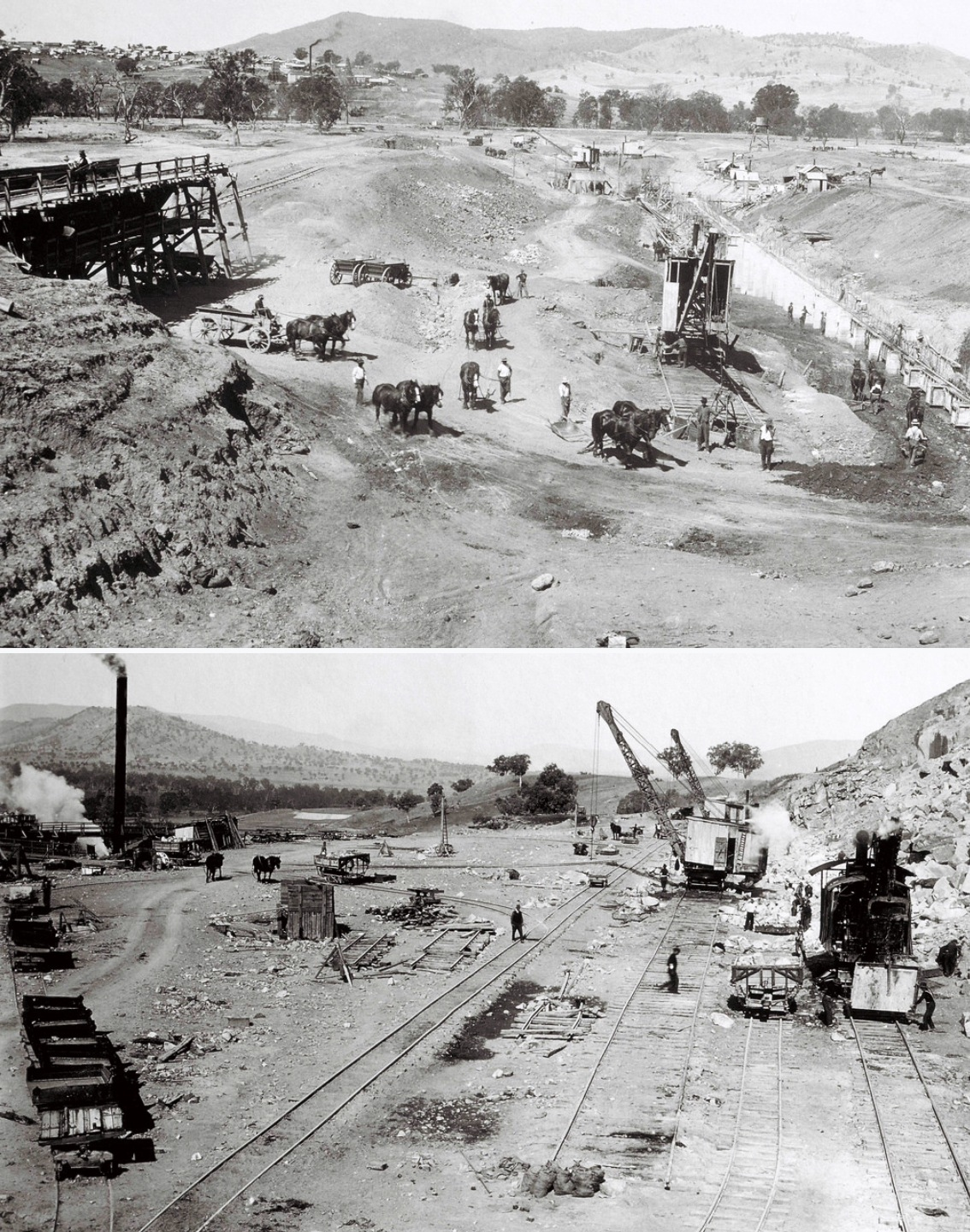
image

I was lookin’ for shots of chicks and cars as I do a fortnightly post of a babe with a car. When I spotted this image ’twas the lady who initially caught my eye…

But we ‘anoraks’ are so into chassis numbers right?

‘935’ on the engine cover stood out, a Lotus 18 number I thought- a quick google and no less an authority than DC Nye identified the car as a Lotus 21 delivered to Rob Walker, its locale Monza, lets come back to that.

Stirling Moss raced ‘935’ in the Australasian summer ‘Tasman’ races in early 1962.

Here it is below after its victorious run in the very wet, Ardmore, New Zealand Grand Prix. I love the way the gent ‘touches the greatness of Moss’ by giving the Lotus an affectionate pat! ‘Red cap’, a more technical type of bloke is sussing the rear suspension of the 21 compared with the Lotus 18s from the year before.

image

(Stephen Page)

Lotus 21: The Forgotten Chapman GP Car?…

When you think about it Colin Chapman peaked early as an F1 designer.

His 1956 Vanwall, or rather his chassis design and choice of Frank Costin as it’s body designer/aerodynamicist was a GP winner, not too many fellas have done that with their first car.

image

Press launch of the Lotus 12 Climax F2 car in 1956, note the extraordinary smallness of the car, the 12 and 16 remarkable bits of front-engined GP kit. Cliff Allison did 167mph in a Coventry Climax 2207cc FPF engined 12 on Masta Straight, Spa in 1958, with much of his small body outside the cockpit! He was fourth but famously could have won the race had it gone another lap as the first 3 cars all failed to complete the cool-down lap (John Ross)

His first Lotus GP design was the 16, Chapman always referred to the 12, which competed in Grands’ Prix from Monaco 1958, as an F2 car, the design was originally used in 1.5 litre racing before being fitted with Coventry Climax 1960cc and 2207cc engines for F1 use.

One of the things which intrigues me given his subsequent record as the designer/design inspiration for so many epochal cars is why Chapman didn’t design a mid-engined car for 1959? Cooper blazed that trail, GP winners from Argentina 1958, Moss of course taking that win in a Rob Walker Cooper T43 Climax.

image

Allison, tenth in the Lotus 16 Climax, Nurburgring 1958. Brooks won in a Vanwall, Lotus 16 famously the ‘Mini-Vanwall’, both Chapman chassis designs  (Klemantaski)

Whilst the front engined 12 is understandable, it appeared in late 1956 and was quite the smallest front engined ‘F1 car’ ever, the 16 shoulda’ been mid-engined?

The 16 was quick mind you, but fragile in both chassis and it’s ‘queerbox’, Lotus’ own gearbox which was unreliable largely due to one small set of dogs trying to pick up every gear. The 16 also didn’t receive a 2.5litre Climax FPF until later in the piece. But if Chapman set trends, and he did, he was a slowish adopter of the mid-engined trend.

image

Works Lotus 18 Climax, Zandvoort, Dutch GP 1960. Chapman was quick to refine the mid-engined paradigm! 2.5 litre CC FPF, 5 speed Lotus ‘box, rear suspension notable for lack of a top-link, the fixed length driveshafts performed locational duties as well as motive ones. This is Alan Stacey’s car, DNF gearbox on lap 57 from Q8. Ireland’s car was second from Q3, quick cars 18’s! Brabham won in his Cooper T53 Climax (Dave Friedman)

His first such design, the 18 was an immensely successful car in FJ, F2 and F1 specification.

Despite its ‘chubster, biscuit shaped’ looks it was the fastest 2.5 Litre F1 car of 1960 if not the most robust or reliable. No less than Moss himself had strong views on Chapman’s ‘marginal engineering’ of key components the failure of same caused some massive accidents.

image

Ireland, works Lotus 18 Climax, Monaco 1960, 9th in the race won by Moss’ similar car. Lotus’ first GP win (Dave Friedman)

Roll on into 1961, the first year of the 1.5 litre F1, the Brits were faced without a suitable engine as their ‘racing mafia’ were convinced the CSI, in the end, would not make the change to the smaller engines. They did, Ferrari the beneficiary with their 156, a car developed in F1/2 in 1960, click here for a story on that wonderful conveyance;

Ferrari’s first mid-engined Car: The 1960 Dino 246P…

Whilst BRM and Coventry Climax worked hard to get their V8’s completed all of the British firms persevered with Mk2 versions of the 1.5 litre Coventry Climax FPF- in 2.5 litre form the championship winning engine of 1959/60.

Chapman and his team had the dimensions of the coming Coventry Climax FWMV V8 when they set to work on the 21, their 1961 contender, but they knew initially the little, underpowered FPF would be used.

So, light weight and aerodynamic efficiency were key design tenets of the new Lotus 21.

These aims were achieved by lying the driver down in the cockpit, Chapman went further in 1962 with his 24/25 designs, but the trend was set by the 21. The car was notably small in size, low in frontal area, the body enveloping the chassis all the way to the casing of its ZF gearbox, specially made for the car. Have a look at a 21 beside a 156 and see just how ‘butch’ in size the Fazz is by comparison.

Chapman used a top rocker and lower wishbone for the cars front suspension, getting the spring/shocks outta the airstream, thus further adding to top speed. At the rear the suspension was outboard- single top link, inverted lower wishbone and coil spring/damper unit with twin radius rods for location.

image

Lotus 21 Climax FPF cutaway, specifications as per text (James Allington)

Lotus Components built eleven of the 21 chassis’ during the year, which otherwise in specification were leaders of the mid-engined paradigm- multi-tubular spaceframe chassis, Chapman the high priest of chassis design. Rack and pinion steering, discs on all four wheels, magnesium alloy (Lotus ‘wobbly web’) wheels, Ferrari still used heavy Borrani wires till 1963. The CC 1495cc, DOHC, 2 valve, all alloy, Weber carbed 4 cylinder engine gave circa 155bhp, the Lotus weighed 990lb, had an 89 inch wheelbase and a track of 53 inches front and rear.

The prototype was built from scratch in six weeks, just missing the Aintree 200 meeting but was tested at Silverstone two days later, the car made its debut at Monaco in May. The works cars in 1961 were steered by two Scots- Innes Ireland, the seasoned professional and up and coming Jim Clark who graduated from the works Lotus 18 FJ he raced in 1960.

Fitted with the new Coventry Climax V8 the Lotus 21 was a winning car in Moss’ hands if not Ireland’s or Clark’s.  But as it was Chapman didn’t get his hands on an FWMV in 1961 due at least in part to the spat he was having with Climax’ MD Leonard Lee about the quality of the CC FWE engines supplied for his Elite road cars- the engines weren’t the Elites only reliability problems mind you!

In the event the 21 won only one championship GP at Watkins Glen, Innes Ireland broke through for both Team Lotus and his first win that October.

image

Ireland’s winning Lotus 21 leads Gurney’s second placed Porsche 718 and Graham Hill’s fifth placed BRM P48/57 Climax, US GP Watkins Glen, 8 October 1961 (unattributed)

The cars chances of more wins were missed by Chapman’s decision not to sell Rob Walker his latest car, as he had with the 18 the year before. Moss’ two wins in 1961, remarkable ones, were in the Walker 18 at Monaco and 18/21 hybrid at the Nurburgring. Armed with a new 21 all year he may, praps have taken one or two wins off Ferrari despite the car’s relative ‘lack of puff’.

The 21 took wins in non-championship 1961 events- the Solitude GP for Ireland in July, the Flugplatzrennen at Zeltweg again for Ireland in September, and the Rand, Natal and South African Grands’ Prix in Jim Clark’s ‘African Tour’ in December 1961. As written here Moss did well in Australasia in early 1962.

The Lotus 21 should be remembered as both a GP winner and the progenitor of the design maxims Chapman’s ever creative mind evolved with the 1962 spaceframe  Lotus 24 and it’s revolutionary monocoque sibling, the 25.

image

Love the atmospherics of this 1961 Italian GP, Monza paddock shot. #10 is Brabham’s Cooper T58 CC V8, contrast it with McLaren’s #12 CC FPF powered T55 behind. #38 and 36 are the Ireland/Clark Lotus 21 CC FPF’s before the ‘jiggery pokery’ with the chassis swap between Innes and Stirling. The pale green painted ‘T’car is UDT-Laystall’s spare, the Cooper T51 is Jack Lewis’ (Hutton Archive)

Moss’ first drive of a Lotus 21 was his steer of  Innes Ireland’s works car at Monza on 10 September.

That weekend was infamous for the tragic race collision between Jim Clark’s Lotus 21 and Taffy von Trips Ferrari 156 which resulted in von Trips death as well as that of 15 innocent spectators.

Moss took Lotus’ first ever GP win at Monaco in May. Whilst Chapman was eternally grateful he wasn’t inclined to give Moss or Walker too much of a ‘free-kick’ by selling them his latest car, the 21, given his primary aim was works car wins. In fact its probably Esso we have to blame as they were Lotus’ fuel supplier, BP were the sponsor of Rob Walker/Moss, both companies had their commercial positions to protect.

image

Moss and Ireland swapping notes at Monza, Italian GP, September 1961 (GP Photo)

The Monza weekend was also significant for the first race appearance of the new 1.5 litre BRM P56 V8 and the further appearance of the Coventry Climax FWMV V8 first raced by Jack Brabham at the Nurburgring the month before.

Jack qualified his new Cooper T58 on grid 2 in the Eifel Mountains but crashed on lap 1 with a sticking throttle so the engine hadn’t been race-tested.

The P56 V8’s were fitted to modified BRM P48/57 chassis, the CC V8 to Jack’s Cooper and a specially modified Lotus 18/21 built up by the Walker Team. Team Lotus were unable to secure an engine as noted earlier, so appeared in 21’s powered by the 1.5 litre 4 cylinder FPF Mk2 used by the British teams, including BRM that year.

BRM tested their new engines with no intention to race them, Brabham raced his Cooper despite problems in practice.

Moss was sportingly offered Ireland’s factory 21 FPF, chassis ‘933’. Chapman and Ireland reasoned that Moss would have a better chance of success in a 21 rather than the tired Walker 18/21. Moss was the only Lotus driver with a vague (very) chance at the World Championship, Ireland raced the Walker 18/21 FPF engined car. In Denis Jenkinson’s race account he writes about the ‘cloak and dagger’ stuff behind closed garages to make the necessary change of chassis and body work between Moss and Ireland, the secretive stuff was doubtless so as not to upset the trade supporters of both teams.

Which brings us back to ‘ole 935’ and the photo at this articles outset.

The two works Lotus Monza chassis according to Nye’s ‘Theme Lotus’ were ‘933’ and ‘934’. If ‘935’ was at Monza there was no point making the chassis and bodywork changes between the Moss/Ireland cars both Jenkinson and Nye report took place. If ‘935’ were at Monza either as a works spare or delivered to the Walker Team Moss would have raced it and Ireland his regular works 21 rather than the inferior Walker 18/21.

So, whats the explanation of the photo then?

Either it isn’t Monza, although i am inclined to believe Nye who has been there once or twice! The probable story is that the engine cover of the new ‘935’ was ‘borrowed’ and fitted to one of the works Lotus 21’s for the weekend. The first race entry for ‘935’ i can find, looking at non-championship and championship Grands’ Prix results later in 1961 seems be its races in New Zealand in early 1962-the 1962 NZ GP report by sergent.com describes ‘935’ as unraced before that event on 6 January.

image

Moss and Alf Francis confer during Monza practice, by the look of it neither are ‘happy campers’, the Lotus 18/21 CC FWMV  chassis #’906′ was always a handful (GP Library)

The Moss 18/21 was modified to fit the FWMV V8 with the assistance of Ferguson Research.

The rear of the 18 chassis aft of the drivers seat was ‘chopped off’ and replaced with a frame to suit the width and mounting needs of the new engine. 21 rear suspension was incorporated comprising new 21 uprights which were located at the top by a link to the chassis thus relieving the half shafts of the suspension loads the solid ‘shafts of the 18 performed- the new components had Hardy Spicer splined shafts to accommodate ‘plunge and droop’.

A Colotti Type 32 gearbox was used. The rear framework was a complete assembly which attached to the main frame by large bolts screwed into the ends of the tubes, which had been plugged and tapped. The structure was made from small diameter tubing which had to be detached completely before the engine and gearbox could be removed. The car was finished in a big hurry so the old Lotus engine cover was retained with a bulge to clear the four downdraft Webers.

Whilst no-doubt well engineered it doesn’t all add up to the levels of torsional stiffness no doubt required to put all of the new engines power to the ground effectively.

During the race the tragic accident between Clark and von Trips occurred on the first lap, the German and hapless spectators killed, the race continued whilst the carnage was attended to.

Moss retired on lap 36 with wheel bearing failure, Ireland on lap 5 with chassis problems and Brabham’s FWMV failed on lap 8 due to overheating problems- shortcomings sorted over the winter off-season.

Phil Hill’s Ferrari 156 won the race and  1961 title from Gurney’s Porsche 718 and McLaren’s Cooper T55 FPF.

image

The Walker Lotus 18/21 CC V8 during 1961 Monza practice (GP Library)


image

Italian GP ’61 start with a swag of 5 Ferrari’s up front, leading green car at left is probably Hill G’s BRM Climax, Clark is between Hill and a Ferrari, thats Gurney’s Porsche 718 on the right from grid 12, the carnage took place shortly thereafter (Klemantaski)


image

Moss in the Walker bodied works Lotus 21 CC FPF during the race, dicing with Gurney’s 2nd placed Porsche 718 (GP Library)

New Zealand…

Over that 1962 European winter Coventry Climax worked on the reliability of the FWMV and BRM their P56 V8 and the P578 chassis to carry it. At Cheshunt Colin Chapman was building the spaceframe 24 and its epochal monocoque sibling, the Lotus 25.

Both marques were the key players in an amazing 1962 season which in the main didn’t feature Stirling Moss, whose Glover Trophy career ending accident took place on Easter Monday 23 April 1962 in the Walker Lotus 18/21 Climax V8 ‘906’ described above.

The Walker Team would make do with their 18/21 in GP’s, later in the season they raced two Lotus 24 FWMV’s but by the time they were ready Moss’ career was finito.

image

Moss looking after the fans, Kiwi kiddies drawn to the great Brit, Ardmore NZGP meeting. Car is 21 ‘935’ (Stephen Page)

For Moss, in the meantime there were the annual summer internationals to contest in Australasia.

Whilst Stirling loved the speed of his Lotus he revelled in the forgiving ‘chuckability’ and robustness of Coopers. Robust is not an apt adjective to describe the Lotus single-seaters of the period. So, hedging his bets for his 1962 Australasian Tour he had Rob Walker ship both ‘935’ as well as a Cooper T55 ‘F1-7-61’  on the long voyage south. Both cars were Coventry Climax FPF powered- engines of both 2.5 and 2.7 litres capacity were used, our International Series was run to Formula Libre in its pre-Tasman Cup formula days.

image

Moss and second placed Surtees on the Ardmore victory dais (Stephen Page)

Moss raced the Lotus to an NZ GP win at Ardmore on 6 January and at the Wigram Airfield circuit event fitted with 2.5 litre FPF’s. At Levin and Teretonga he was second in the Cooper powered by a 2.7 FPF, Brabham won at Levin and McLaren at Teretonga- so Moss’ campaign had started well.

image

Borgward Isabella and 21 off to the next round of the NZ Internationals at Levin. Shot shows the inboard front suspension, the top rocker actuating inboard mounted spring/shock. At the rear is a single top link, reversed lower wishbone, outboard spring/shock and twin radius rods. Extreme lowness clear as is the slippery nature of the body and reduction in driver space which advanced as a trend over the following decades!  (Stephen Page)

The NZ Internationals were contested by Moss, Surtees, McLaren and Salvadori, the latter three drivers in Cooper T53 Climaxes, Bandini in a Cooper T53 Maserati, Brabham a Cooper T55 Climax and Ron Flockhart, a Lotus 18 Climax.

Chris Amon made his first international appearances that summer in the ex-BRM/Brabham Maser 250F, other ‘local heroes’ were Pat Hoare Ferrari 246/256 V12, Angus Hyslop, Cooper T53 Climax and Aussies Bib Stillwell, Aston Martin DBR4/250, David McKay, Cooper T51 Climax and Arnold Glass’ in a BRM P48.

Moss ‘brained’ the NZGP field in an awful, wet race- he lapped the field winning from Surtees, McLaren and Salvadori.

Australia…

image

Beautiful shot of Moss in the Walker Lotus 21 Climax 2.5 ‘935’ on Warwick Farm’s pit straight, he practised the car but raced the more ‘chuckable’ Cooper (Mal Simpson)

The cars were then shipped to Sydney, the first race of the Australian leg was the ‘Warwick Farm 100’ on the testing, technical outer western Sydney circuit on 4 February.

Moss practised both cars but elected to race the Cooper to a race win from McLaren and Stillwell.

image

Moss in his Lotus 21 passes John Youl sneaking a peek over his shoulder, Cooper T51 Climax during WF practice. Youl DNF in the 2.2 litre car with clutch problems in the race, the Taswegian a very quick steerer (John Ellacott)


image

WF 100 front row, 4 February 1962- Moss, Brabham, McLaren in Coopers T53, T55, T53 (Mal Simpson)

Moss missed the Lakeside event won by Brabham’s T55 Cooper and Longford’s ‘South Pacific Championship’ race won by Surtees Cooper T53 Climax but raced ‘935’ fitted with a 2.7 litre FPF at the Australian Grand Prix, Sandown’s inaugural meeting on 12 March.

Jack Brabham won the race in his 2.7 engined Cooper from Surtees, McLaren and Chuck Daigh in the very interesting Scarab RE Buick V8, the cars only race- read my Chuck Daigh article for that cars interesting story.

image

Moss cruises the Sandown paddock in the 2.7 ‘Indy’ FPF engined Lotus ‘935’, March 1962. The man absolutely the best and fastest driver in the world at the time (Kevin Drage)

In between these Australian events, reinforcing the regularity and intensity of his racing schedule, Moss raced in the Daytona 3 Hours, finishing fourth in a Ferrari 250 GT SWB on 11 February.

After Sandown he returned to the US to contest the Sebring 3 Hours and Sebring 24 Hours on 23/24 March finishing third in an Austin Healey Sprite and DNF in a NART Ferrari Dino 248SP respectively.

image

Moss, AH Sprite, Sebring 3 Hour 1962 (Tom Bigelow)


image

Moss, maidens, Sebring 1962. That he was in such great physical shape no doubt a factor in his attraction to the babes but it  also stood him in good stead in surviving the horrific Goodwood shunt, surgery and month long coma (Tom Bigelow)

Moss then returned to Europe for the 1 April GP of Brussels and Lombank Trophy at Snetterton on 14 April yielding second and seventh in the Walker Lotus 18/21 FWMV V8 ‘906’ before that fateful day at Goodwood on 23 April.

image

Moss, Goodwood, Lotus 18/21 ‘906’ not long before the prang, Easter Monday 1962 (Doug Nye)


image

It took over an hour to cut Stirling free from the mortally wounded Lotus. One of the things I have learned and detest in researching various pieces is the vast number of gruesome images of racing crashes on the internet- you won’t ever see them here, I am all for ‘freedom of the press’ but believe there is a place for censorship of said images (Victor Blackman)

Moss was an enormously popular visitor to Australia from the mid-fifties, sadly his Goodwood 1962 accident was not too far away during his early 1962 tour.

His Antipodean fans never forgot him though.

We turned out in droves to see his ‘comeback’ drive in a Holden Torana L34 V8 at Bathurst in 1976, he shared the car with Jack Brabham. The all-star combination had a shocker of a race when Jack copped a Triumph Dolomite ‘up the arse’ on the startline thanks to his Holden’s clutch failure.

Brabham was stranded as the rest of the field moved post-haste towards Hell Corner, the unsighted Dolly was an innocent victim of Black-Jacks misfortune, the car was patched up but Jack and Stirling failed to finish, a great shame!

Moss, a great man, ’tis wonderful he remains one of our sports great ambassadors.

image

Brabham/ Moss, Holden Torana L34, Bathurst 1976 (Autopics)


image

Moss and Brabham at Bathurst in ’76, that’s Scuderia Veloce’s David McKay in between (autopics.com)

Bibliography…

Automobile Year, MotorSport 1961 Italian GP race report by Denis Jenkinson, Doug Nye ‘Theme Lotus’, William Taylor ‘The Lotus Book’, oldracingcars.com, GP Encyclopaedia, silhouet.com, Team Dan

Photo Credits…

GP Library, James Allington, Mal Simpson, Kevin Drage, Stephen Page, John Ellacott, Klemantaski Collection, John Ross Motor Racing Archive, Dave Friedman Collection, autopics.com, Victor Blackman, Doug Nye, Tom Bigelow

Tailpiece: The future. Jim Clark at Sandown, Lotus 21 Climax ‘933’, World Champion in the new, epochal monocoque Lotus 25 within two years and a GP winner within months. Here with the lower sidepanel removed due to Melbourne summer heat…

image

(Kevin Drage)

Finito…
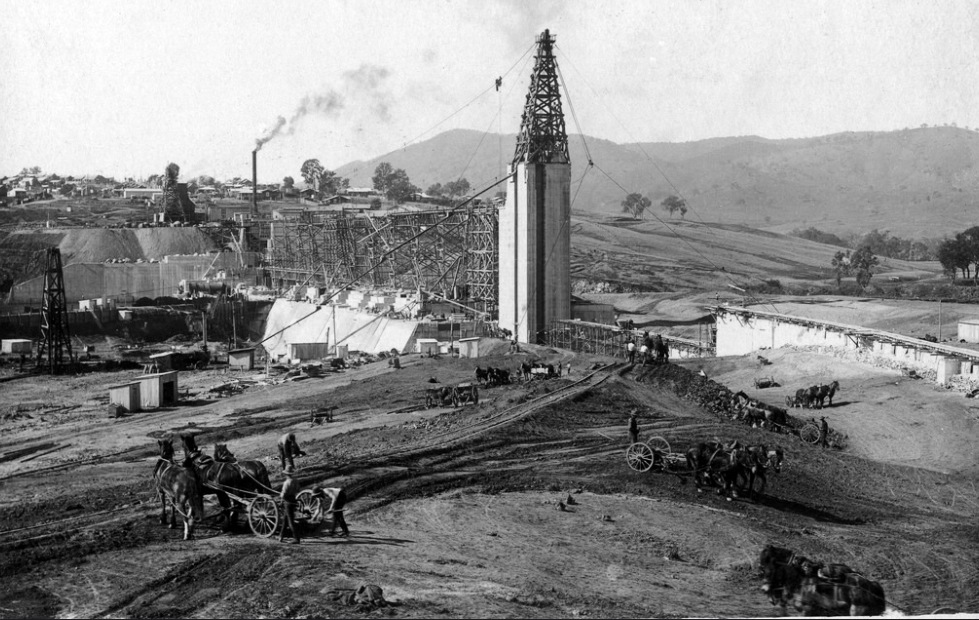


image

One of the most glamorous, charismatic pre-war drivers was the Bentley-Baronet, Sir Henry ‘Tim’ Birkin. Here taking to Brooklands on 11 March 1930 in his new 4.5 litre supercharged Bentley Single-Seater…
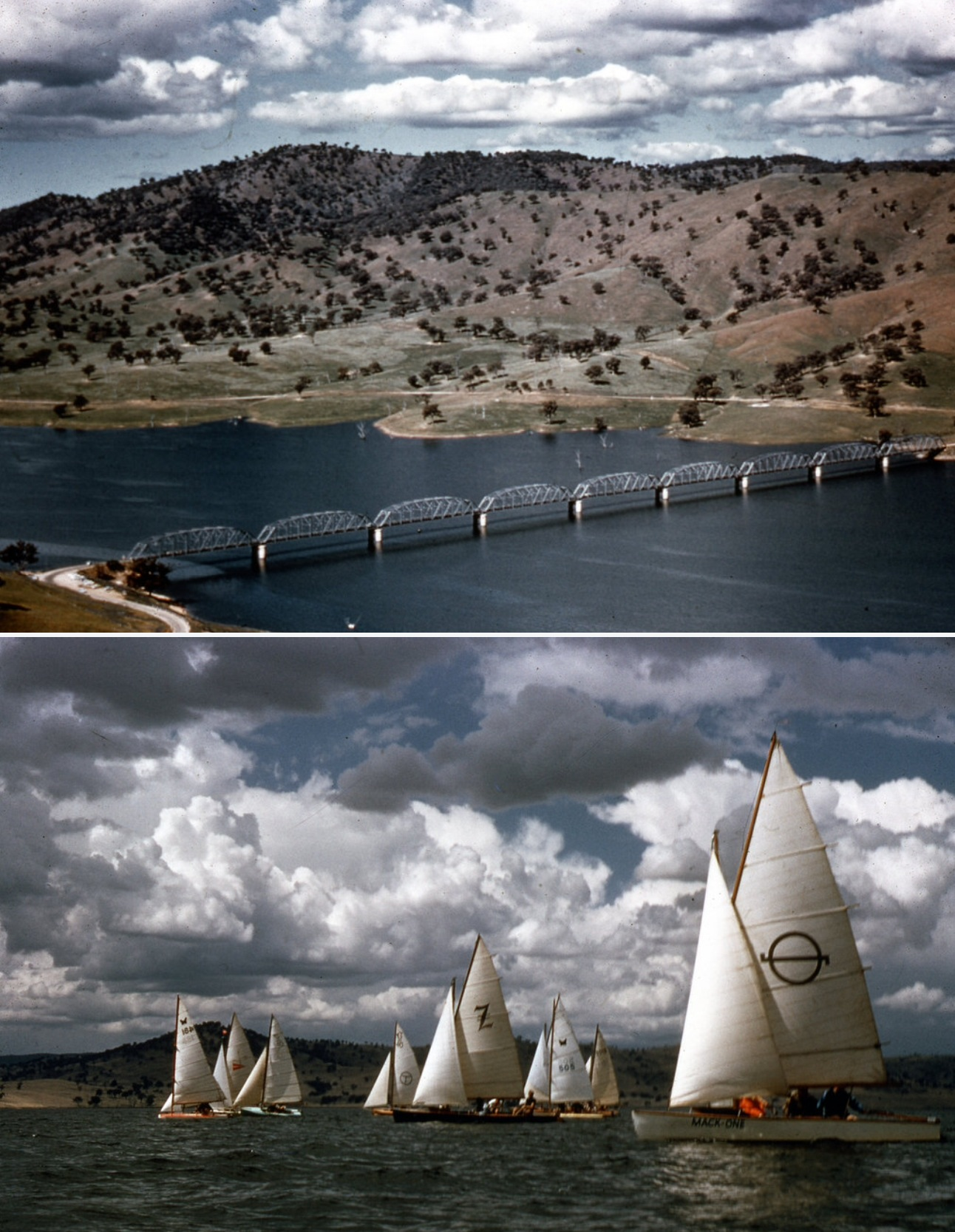
image

Birkin, Spa 1933 (unattributed)

His ‘Bentley Boy’ high-society image was combined with fearless driving talent. For a generation of British racing enthusiasts, ‘Tiger Tim’s’ moustachioed, goggled figure, in wind cap, usually with a polka-dot scarf fluttering in the slipstream personified an English ideal.

image

4.5 litre, SOHC 16 valve engine fitted with Amherst Villiers Roots Type 4 supercharger, 182bhp@3900rpm with 10 pounds of boost (Fox Photos)

With fellow enthusiast/racer Mike Couper, ‘Birkin & Couper Ltd’ was established at Welwyn where the prototype 4.5 litre Blower Bentley was produced in the summer of 1929. W.O. recalled: ‘They would lack in their preparation all the experience we had built up in (our own) racing department over 10 years. I feared the worst and looked forward to their first appearance with anxiety’.

image

This is the car/chassis which was transformed into the Birkin single-seater, chassis # HB3402 (unattributed)

Birkin ran his prototype tourer-bodied car, later rebuilt as the single-seater special in the Brooklands 6-Hour race on June 29,1929, it retired. At Dublin’s Phoenix Park race two weeks later the two supercharged Bentleys finished 3rd and 8th. In the RAC Tourist Trophy at Ards, Ulster, Bernard Rubin’s ‘Blower’ overturned while Birkin, who had challenged W.O. to act as his riding mechanic (the marque’s founder accepting), placed second overall and won his class. The third ‘Blower’ broke its engine.

image

4.5 blower build, chassis number unknown, March 22 1930. Ample! girder chassis, mechanical drum brakes all clear (Fox Photos)

Birkin then retired from the Brooklands 500-Miles and the entire team retired from the Double-Twelve race at Brooklands in May 1930.

bentley brook

Birkin practices a Bentley 4.5 blower for the 1930 Brooklands ‘Double 12 Hour’ race 8 May 1930 (Popperfoto)

double 12

Pit scene before the 1930 ‘Double Twelve’ at Brooklands, race won by the Barnato Bentley, 7 May 1930 (Fox Photos)

W.O. embittered by the collapse of his company, summed it up as follows; ‘The supercharged 4.5 never won a race, suffered a never-ending series of mechanical failures, brought the marque Bentley disrepute and incidentally cost Dorothy Paget a large sum before she decided to withdraw her support in October 1930…’ W.O. added the sting in the tail: ‘Tim managed to persuade Barnato to allow him to enter a team in the 1930 Le Mans (in which none survived) and we were obliged, in order to meet the regulations, to construct no less than fifty of these machines for sale to the public….

W.O’s. assertion that the ‘Blower’ Bentley ‘never won a race’ is wrong. The car featured here is the exception, it not only became a multiple Brooklands race winner but also holder of the Outer Circuit lap record there.

image

Gearbox 4 speed ‘D type close ratio, front and rear suspension beam axles with leaf springs with Bentley and Draper shocks (Fox Photos)

Birkin, disappointed by his failure at Le Mans in 1929 decided during the summer to make a firm entry for the BRDC 500-Mile race at Brooklands, using a car with the potential to break the Outer Circuit lap record there.

Bentley Motors had been wobbling in The Great Depression as sales of expensive cars plummetted when Tim Birkin became determined to supercharge the 4.5 litre Bentley.

image

Birkin’s normally aspirated Bentley 4.5 during the 1928 Le Mans, he finished 5th sharing with Jean Chassange. Car being passed is the Samuelson/King 2 litre Lagonda. Barnato/Rubin won in another Bentley (Heritage Images)


These were the great years of Bentley success with consecutive victories at Le Mans in 1927-30. Tim wanted more power and speed as W.O. explained: ‘Tim had a constant urge to do the dramatic thing, a characteristic which I suppose had originally brought him into racing. His gaily vivid, restless personality seemed to be always driving him on to something new and spectacular, and unfortunately our 4.5 litre car was one of his targets… Tim used all his charm and persuasion to induce first Amherst Villiers to build a special blower for his 4.5, next Woolf Barnato’ – company financier as well as leading team driver – ‘to give it his blessing, and finally the Hon. Dorothy Paget to put up the money for a works at Welwyn just north of London – ‘and to buy and modify the chassis’.
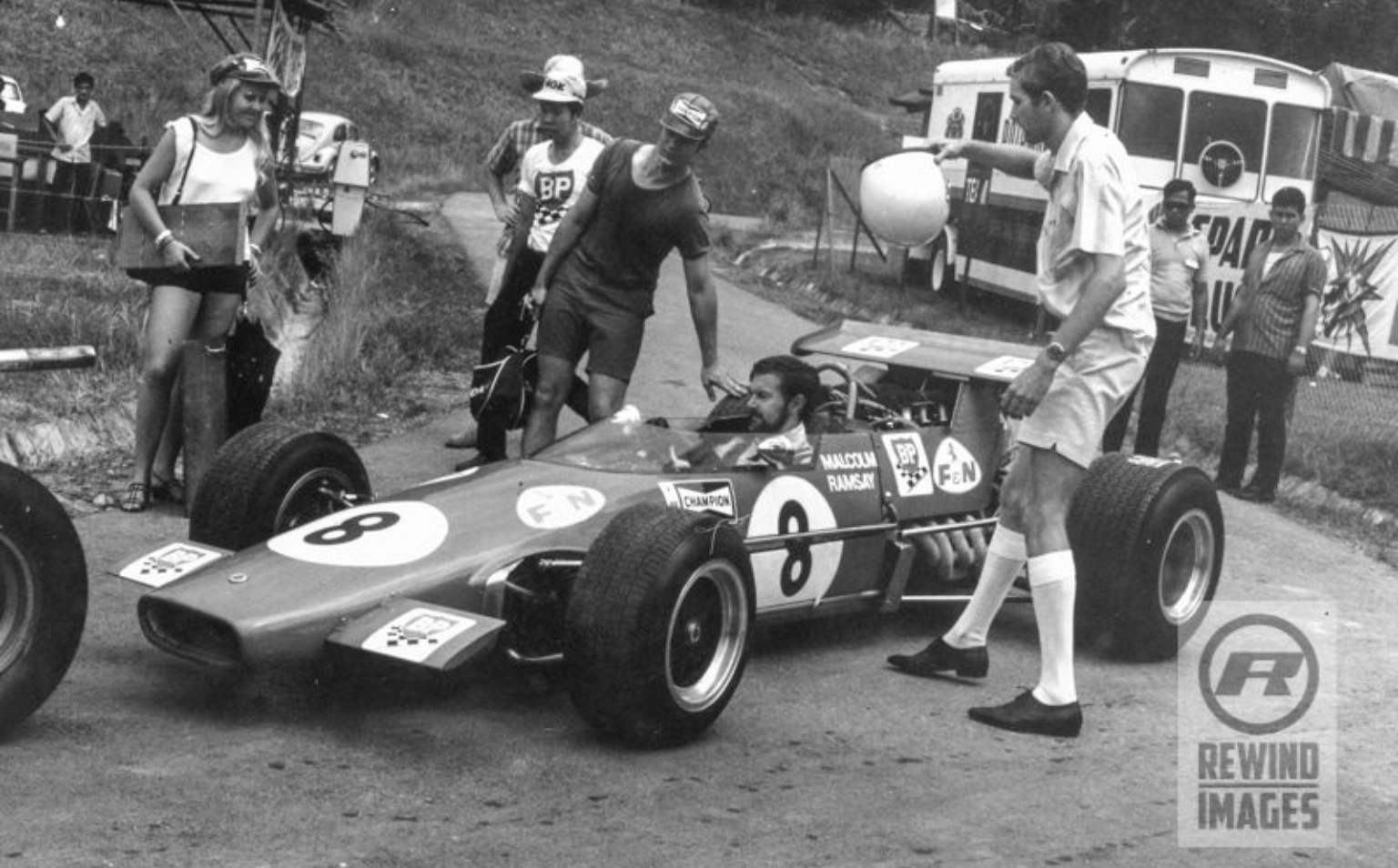
image

At Welwyn, this special track-racing ‘Blower’ Bentley was developed alongside the road-racing endurance sports cars (above). Captain, later Lt. Colonel, Clive Gallop was largely responsible for the new track-racing car. Working under his direction were foreman E.A. Jennings, Walter Whitcombe, Birkin’s riding mechanic, Messrs Logan and Newcombe, who were successively Bentley’s chief engine fitters; Mr Browning, the chief chassis fitter and Billy Rockell, the works’ supercharger fitter.

The Bentley chassis was of 10 feet 10 inches in wheelbase, it was chassis number ‘HB 3402’, the selected engine was ‘SM 3901’.

image

(Bonhams)

image

(Bonhams)

Amherst Villiers designed the supercharger and its configuration. The engine’s enlarged-diameter crankshaft, with 90mm journals and and special rods were detailed by Villiers’ chief draughtsman, Tom Murray Jamieson of later racing Austin and ERA fame.

The Villiers Roots-type supercharger used a standard casing as on the sports cars, but had larger rotors to increase boost. Otherwise, according to Clive Gallop at the time, the engine was the normal 4-cylinder with four overhead valves per cylinder actuated by a single-overhead camshaft.

The ports were highly polished as was as much of the cylinder head as possible, but not re-machined.

image

The body initially fitted was of ‘1½-seater’ form, with fabric skin stretched over a spring-steel lattice framework. The radiator was exposed whilst the supercharger, dumb-irons and carburettors were all partially cowled. The body was painted in a rich mid-blue.

image

‘Fill ‘er up matey’ Birkin, Brooklands 1930 (Popperfoto)

The Outer Circuit was a great challenge in 1929. The old concrete bankings and straights were frost-heaved, patched and bumpy. Given the pounding the track meted out a fuel tank design adapted from the 42-gallon Le Mans 24-Hour race type was mounted by means of a Le Mans-style cross-tube at the back which passed through the tank and which was carried within a rubber-lined trunnion on each of the two main frame rails. A third mounting point using a plate shaped to the match the front end of the tank, carrying a nickel-steel pin that accommodated the spider of a Hardy-Spicer universal joint was also used.

A structure rising from the chassis then carried another spider which coupled to that on the tank, thus providing a flexible forward mounting.

During practice on the eve the 1929 500-Mile race, the nickel-steel pin attached to the tank sheared due to embrittlement. Gallop drove the car back from Brooklands to Welwyn for repair without mudguards, lamps and starting handle and with a police car following him right into the factory yard!

A short term fix was a normal steel strap packed with rubber and felt placed round the front of the tank and then attached to the chassis by reinforced angle plates, welded into place.

Just after dawn on race day, Clive Gallop drove the car back to Brooklands doing 120mph along the Barnet Bypass road. The car was delivered just in time for the race start.

Gallop found the car so tractable on the road that eventually a Welwyn-Brooklands route was selected which included London suburban traffic. If a spark plug oiled up, Gallop’s standard procedure was to stop on the hill at Putney Vale, on the stretch passing the KLG spark plug factory where he would fit a fresh plug and then roll-start down the remainder of the gradient there.

When the big cars were finally flagged away in 1929 BRDC 500-Miles race, Birkin immediately set the pace, lapping at over 121mph. A great duel ensued between the ‘Blower’ Bentley and Kaye Don’s V12-cylinder Sunbeam. The blue Bentley began to spray a thin mist of engine oil from its bonnet louvres, the droplets coating the aero screen, cockpit coaming and driver’s head and shoulders. Birkin soon found his hands slipping on the steering wheel rim, and his vision impaired so he tore into the pits to clean up.

The Clive Dunfee/’Sammy’ Davis Speed Six Bentley took over the lead on scratch, while on handicap small-capacity Amilcars and Austin Sevens held the advantage. By 90 laps George Eyston’s Sunbeam ‘Cub’ was up into to second place and after 108 laps it led overall. Dudley Froy, partnering Kaye Don in the big Sunbeam, also led before retiring with a broken back spring – the Brooklands bumps offering no mercy – and Eyston’s Sunbeam would also break a spring.

Having rejoined Birkin then had further trouble, a hole in the exhaust system caused flame which blasted onto the fabric body skin and set it alight. Birkin returned to the pits trailing flame and smoke, the fire was quickly doused, but his race was over.

image

For 1930, Birkin then decided to attack track racing seriously with the single-seater. In its 1930 form with Villiers supercharger driven from the crankshaft nose and inhaling through two huge horizontal SU carburettors, the engine developed circa 240bhp on alcohol fuel mix. This was 65bhp more than a standard ‘Blower’ Bentley on petrol. Its rear axle featured a new nose piece housing a special pinion which provided a final-drive ratio of 2.8:1. Fuel flow at full throttle was quoted as being approximately one gallon every 74 seconds!

Reid Railton was commissioned to design a new (fire proof!) aluminium body to replace the fabric original, it was hand made for the car by A.P. Compton & Co of Merton. The regulation Brooklands silencer on the car’s nearside now bolted directly to the exhaust manifold. Front-wheel brakes were deleted and the car rode on 32-inch x 6.50 Dunlop Racing tyres.

image

The first Brooklands Meeting of 1930 saw Birkin battling against his starting penalty, taking second place in the three-lap Kent Short Handicap race despite a slipping clutch and with supercharger casing cracks hastily plugged just before the start, using plasticene. His flying lap was still clocked at 123.89mph. He then contested the meeting’s Surrey Short Handicap, setting fastest lap at 124.51mph.

In the four-lap Kent Long Handicap, Birkin then had the chance to overcome his penalty, winning by one second at 119.13mph average and setting fastest lap at 126.73mph.

This was the first race victory ever achieved by a ‘Blower’ Bentley. While Sir Henry, car owner the Hon. Dorothy Paget and their supporters were delighted, W.O. Bentley, whose distaste for supercharging was often declared had mixed feelings.

Birkin won the Brooklands Easter meeting Bedford Short Handicap before a 20,000 crowd, winning at 117.81mph and lapping at 134.24!

image

Birkin’s big beast leaves the ground on the Members Banking hump where the track crosses the River Wey, circa 1932 (Heritage Images)


As the late Bill Boddy recalled in his definitive ‘History of Brooklands Motor Course 1906-1940’ – ‘Plug troubles foiled Birkin’s hopes in the Dorset Lightning Short Handicap but he turned out again for a 3-lap match race against Dunfee’s GP Sunbeam. Sadly Dunfee’s car had thrown a rod, so Birkin came out alone, to attempt to beat Kaye Don’s lap record. The Bentley was in grand trim, roaring very high round the Byfleet banking, dropping to the Fork in a puff of dust, clipping the verge by the Vickers’ sheds and going onto the Members’ banking each time with that characteristic and disturbing little snake that those who saw the car in action are not likely to forget. From the notorious bump” – where the Hennebique Bridge near the end of the Member’s Banking had subsided slightly into the River Wey  ‘… it leapt some 70 feet, clear of the Track, onto the Railway Straight. It was a grand sight, Birkin’s scarf flirting with the fairing behind his head as he held the car to its course. The ‘Blower’ Bentley certainly provided as great a thrill for the onlookers of the 1930s as had the V12 Sunbeam and the ‘Chittys’ for the 1920s…’.

image

Birkin contesting the 1930 French GP at Pau in his sports Bentley 4.5 blower (unattributed)


‘Tiger Tim’s heroic driving that resulted in a lap in 1 minute 13.4 seconds, 135.33mph, beating Don’s existing outright record by 0.73mph. On its standing lap the Single-Seater lapped at 133.88mph, then completed its succeeding three laps at 134.60, 134.60 and finally the new record 135.33mph.

Birkin’s Blower Bentley single-seater was clearly Great Britain’s fastest track racing car of the time. After that day’s racing he flew back to Le Touquet to claim the dinner that ‘Babe’ Barnato had promised him that morning if he could break the Outer Circuit lap record.

Kaye Don first equaled the new Birkin Bentley record in his V12 Sunbeam at Brooklands’ Whitsun Meeting and then shattered it by lapping at 137.58mph, a 2.25mph improvement.

image

4.5 blower engine in the Welwyn test cell (unattributed)

The Hon. Dorothy Paget entered Birkin to drive the Single-Seater again in the Brooklands August Bank Holiday meeting, only for the fuel tank to split causing his retirement from the feature ‘Gold Star’ Handicap.

High winds and the threat of rain made high speeds impossible in the Brooklands Autumn meeting, but Birkin and the Single-Seater reappeared for the BRDC 500-Miles on October 4. A front tyre burst at top speed during practice which both car and driver survived despite ‘some astonishing subsequent gyrations’. Birkin shared the drive with George Duller but the car ran badly and neither enjoyed the experience, their car ‘sounding like a motor cycle’ and finishing ninth. The 1930 Brooklands season closed with Kaye Don and his V12 Sunbeam holding the Outer Circuit lap record.

The Hon. Dorothy Paget loved being involved with competition but only if she was on the winning side! That winter she withdrew her backing from the ‘Blower’ Bentley endurance racing team, but retained the successful Single-Seater.

The BARC Whitsun Meeting in 1931 saw the great car’s return to Brooklands, but Birkin’s best efforts with it were overshadowed, lapping at a best of 128.69mph in the Gold Star Handicap, then 131.06 in the Somerset Senior Long before retiring.

image

1931 Belgian Grand Prix Spa. Birkin was 4th in his Alfa 8C2300 #16. #6 Divo/Bouriat Bugatti T51 DNF, #4 Grover-Williams Bug T51 1st, #2 Minoia Alfa 8C2300 3rd, #12 Varzi/Chiron Bug T51 DNF, #18 Wimille/Gaupillat Bug T51 7th #8 Stoffel/Ivanowski Mercedes SSK 5th (unattributed)


Birkin consulted George Eyston and at his suggestion fitted a PowerPlus vane-type supercharger in place of the Villiers’ Roots-Type. The Single-Seater returned to the historic track in August, but a gusty wind hampered attempts by Birkin and Gwenda Stewart in the 2-litre Derby Miller to attack the Kaye Don lap record. Birkin’s best attempt running alone as part of a special record attempt feature within that August meeting was clocked at 134.97mph, but later that afternoon in the London Lightning Long Handicap race he clocked an improved 136.45mph despite the wind

Tim’s great friend and fellow ‘Bentley Boy’ Dr J.D. Benjafield was entrusted with the Single-Seater for the 1931 BRDC 500-Miles, only for its engine to break. Birkin wrote: ‘The few days before this race were not without their thrills…when I was coming off the Byfleet Banking at about 130, the auxiliary petrol tank caught fire and flames began to lick the legs of my overalls….the cockpit certainly did become rather hot. So I switched off the engine and put on the brakes; but before the car stopped, I had to climb out of the seat and, perched on the back of the car, steer as best I could from a crouching position. I jumped off once it was safe and put out the fire. But the cockpit and my hands were both burnt…’. The original Villiers supercharger then replaced the PowerPlus.

At that year’s Autumn Meeting, in the Cumberland Senior Long Handicap Birkin finished third after starting from scratch, after which he continued for two extra laps to attack Don’s 137mph lap record, yet again falling just short at 136.82mph.

image

For 1932, the Single-Seater was repainted red and its engine bored to 100.5mm, a capacity of 4,442cc.

The season opened on Easter Monday, four days prior to the meeting Birkin attacked the Kay Don Outer Circuit lap record and broke it at last, at 137.96mph.

In the subsequent Easter meeting, John Cobb’s V12 Delage just edged out the now re-handicapped Lap Record-holding Single-Seater to win by 0.2 sec from Birkin, whose best lap was at 134.24mph compared to Cobb’s best of only 128.36.

In the Norfolk Lightning Long Handicap, Birkin nearly lost control on his second lap, skidding viciously under the gusty wind as it shot out from beneath the Members’ Bridge. Birkin and the Bentley then won for their third time at Brooklands, averaging 122.07mph and lapping at 134.26.

The BRDC later held a 100-mile Outer Circuit race. Birkin held the advantage in his heat until the Single-Seater’s right-front tyre stripped and he made a pit stop, finishing fourth. He led the Final at half-distance but only until ‘…the long red car came round misfiring and spluttering, took on water, boiled and retired a lap later with the cylinder block cracked’. Another retirement was then posted in the 1932 Whitsun Meeting,

At a special Brooklands day organised in aid of Guy’s Hospital, Birkin won the Gala Long Handicap and equaled his former lap record of 137.96mph. In the six-lap Duke of York’s race the Bentley threw the tread from its right-rear tyre which flailed high over the heads of spectators round the Members’ Banking!

image

(Bonhams)


The threat of rain at the August Meeting saw Birkin not run the Single-Seater in one race, but in the 3-lap invitation event for 100 Sovereigns, Birkin confronted John Cobb’s V12 Delage. The French car was the faster starter, leading by 3.8 seconds completing the opening lap. But on lap 2 Tim lapped at 135.70mph and was just 1.2 seconds off Cobb’s tail.

Bill Boddy: ‘The crowd was on its toes… And round they came, the Bentley gaining, yard by yard, on the Delage. As Birkin hurtled off the banking the ‘bump’ shot his car well clear of the Track and the padded rest on the fairing behind his head came adrift, to fly, a small dark object, high into the air. In a supreme effort, Birkin caught Cobb and drew ahead, winning one of Brooklands’ most intense races by a mere one-fifth of a second, or about 25 yards. He averaged 125.14mph and that glorious last lap was run at 137.58mph (0.28mph below the record).’ Out again in the Hereford Lightning Long Handicap, Birkin swept around at 136.45mph, being classified second at the finish.’

image

Brooklands , Birkin 16 April 1930 (Popperfoto)

Despite his Brooklands heroics, in 1932, Birkin wrote of the Motor Course: ‘I think that it is, without exception, the most out-of-date, inadequate and dangerous track in the world…Brooklands was built for speeds of no greater than 120mph, and for anyone to go over 130, without knowing the track better than his own self, is to court disaster… The surface is abominable. There are bumps which jolt the driver up and down in his seat and make the car leave the road and travel through the air’. He concluded this onslaught with the line ‘If I could find anything true to shed an attractive blur over all Brooklands’ diseases, I would make use of it at once; but there is nothing at all…’ He was a brave man, then, to unleash this ‘Blower’ Bentley Single-Seater there as fearlessly as he did.

In the sports-racing ‘Blower’ Bentleys, Sir Henry had already set a record-breaking pace at Le Mans in 1930, and that same year ran his ‘Blower’ in the French Grand Prix at Pau in southern France, describing it as akin to ‘a large Sealyham surrounded by greyhounds’, yet finishing an astonishing second overall.

But by 1931 Bentley Motors and the ‘Blower’ project were in collapse and Sir Henry was racing private Alfa Romeo 8C-2300s shared with Earl Howe, winning Le Mans for the Italian marque (below).

image


Tragically, early in 1933 ‘Tiger Tim’ burned his arm at Tripoli in Libya while running a Maserati 8C in the Lottery Grand Prix. Already ailing with recurrent malaria, first contracted during World War 1 , this British hero was quickly overwhelmed by septicaemia. Despite tremendous efforts to save him by his friend and loyal supporter Dr Benjafield Sir Henry died in a London hospital three weeks after the Libyan incident, on June 22, 1933, aged just 36.

Paget, retained the Single-Seater, unused until 1939. Bentley enthusiast Peter Robertson-Rodger blew-up the engine of his ex-Birkin French GP ‘Blower’ Bentley at Donington Park, and convinced Paget into selling him the track car, to use its engine. Then came World War 2, the number one ‘Blower’ engine was returned to the single-seater, which Robertson-Rodger converted into a two-seat roadster.

Bentley mechanic Bill Short did the conversion work during the war, the project finally completed in the late 1940s using a two-seat body designed by Robertson-Rodger built by Chalmers of Redhill. This new body retained the single-seater’s appearance in side profile, complete with pointed tail. Bentley specialist and VSCC luminary John Morley subsequently worked on the car, and when Robertson-Rodger died in 1958 he bequeathed the Single-Seater in his will to Morley.

ss

Birkin at Brooklands, the caption says ‘taking part in the 500 Mile Race at Brooklands’ but it looks more like a test day, picture dated 1 January 1931 (Central Press)

Boyhood Birkin fan and Bentley enthusiast ‘Rusty’ Russ-Turner had been a long-term admirer of the car. He recalled: ‘I had never lost my fascination for that car and one day I was at the Bentley Drivers’ Club Hendon driving tests meeting when a fellow member mentioned rumours that the Birkin single-seater was going to be sold to America. I went to see John Morley who said that nobody in England seemed to want it. After long negotiations we came to an agreement in 1964. It had the 2-seat body but Morley also sold me the original track body. When I climbed behind the wheel it was the realization of a dream. I was wearing a white silk shirt and by the time I got home I was soaked in oil from head to foot!’

The car’s bearings were badly worn and its dry-sump system scavenge pump on the nose of the supercharger had been re-piped to feed an oil-cooler under such pressure that the excess oil squirted everywhere. He painstakingly rebuilt the car and ran it for several years with its Robertson-Rodger 2-seat body in place whilst the single-seater aluminium shell sat on the floor of his garage.

‘Its cockpit was just too tight for me…and one day I climbed into it, there on the floor, and couldn’t get out, I had to stand up, wearing the thing like a skirt. Eventually we found that by making a minor modification and cutting out just one spar behind the seat we could gain about four inches, and that was just enough for me to squeeze in’.

With this unobtrusively modified original body remounted on the famous old chassis, front wheel brakes replaced by Robertson-Rodger and some other minor concessions to road equipment, the Birkin single-seater emerged as ‘a long-legged vintage motor car of the most colossal distinction’.

‘Rusty’ Russ-Turner found the pedals demandingly confined with the centre throttle and right-side brake, while cockpit heat was always high as hot air wafted back from the engine compartment. The aluminium body paneling ‘…warms up nicely in sympathy with the massive exhaust and Brooklands silencer along the left-hand side. He found the brakes excellent although ‘…one does have to make arrangements when approaching a corner’. The car was absolutely at home at anything above 70mph at which it became ‘delightfully stable’.

The standard D-Type Bentley gearbox he rated as being ‘as good as any’ while he also owned the original track-racing gearbox which he found contained the ’rounded-off straight-cut gears preferred by Birkin…’. ‘Tiger Tim’ either could not or would not double de-clutch and he liked to snatch the gears straight through. ‘They called them Mangle Gears and this explains the fantastic background gear noise which was so characteristic of the car when it was being raced’, he explained.

Gearing was 36mph per 1,000rpm, the rev limit was set at 4,000rpm.. ‘…although it can get very expensive around there’, he warned.

‘Rusty’ Russ-Turner suffered a fatal heart attack at Silverstone while racing the car, it was acquired by George Daniels and then later sold again.

image

Bibliography…

Bonhams; sold the car several years ago, this article is a truncated and edited version of their documentation of the cars history.

Photo Credits…

Getty Images, Heritage Photos, Popperfoto, Fox Photos, Getty Images, Bonhams

Tailpiece: 16 April 1930…

image


image

(The Enthusiast Network)

Frank Kurtis, Wally Parks and Ray Brock inspect the ‘D-A Lubricants’ Teams new Kurtis 500H Offy 255 to be driven by Johnny Thompson at Kurtis’ Glendale, California factory on March 24, 1958 …

image

(The Enthusiast Network)

Notable is the independent front suspension which Kurtis believed “although heavier than a tube axle, will provide better traction on the corners and give better control and less tyre wear”. In fact 500H chassis #715 was the only one of Kurtis’ Indycars fitted with Dubonnet trailing arm independent suspension.

This later model Kurtis Roadster also has a ‘full-laydown’ and ‘offset’ 255cid 360bhp Offy to lower the cars profile and put more weight to the inside of the car, trends Kurtis started in 1952. The 500H was radical for its day and was widely reported upon in various magazines as here in Motoring Life.

k 500h

Frank initially laid down the Cummins diesel in 1952, tilting the Offys fitted to the other two roadsters that year by 36-degrees from being straight in the frames.

Although he wanted the Offy ‘flatter’, Meyer Drake didn’t make the internal changes to the engine to allow that logical change. This feat was achieved by George Salih, a former Meyer Drake employee who built and modified an engine with Meyer Drake’s assistance which was fitted to a Quinn Epperly built chassis to suit in 1957, setting a new trend.

The 1958 500 was won by Jimmy Bryan’s Salih Offy, Johnson’s Kurtis Offy (in color below) started from grid 21 completing only 52 laps.

Thomson, one of the best drivers of the era, was innocently involved in a massive 15-car lap one crash which killed Pat O’Connor. He continued with bent front suspension, but tyre wear and handling and steering problems forced his retirement in a tragic race.

Chassis #715 raced at Indy in 1959 driven by Duane Carter and in 1960 by Don Freeland for seventh place and a withdrawal respectively. Smokey Yunick bought and entered the car for Carter, converting it to a conventional beam front axle setup. ‘Twas a pity as the IFS was never really sorted, appropriate testing and development never really gave the car the chance it deserved in its original form. The car still exists, albeit in beam axle spec, it was restored in 2007.

image

(unattributed)

Thomson had a very successful 1958 season, he won four of the thirteen championship races at Springfield, DuQuoin, Syracuse and Sacramento, all were in the team’s Kuzma Offy on dirt. He was third in the USAC Championship behind Tony Bettenhausen and George Amick.

Johnny was killed in a sprintcar race at Allentown , Pennysylvania in September 1960, his car crashed and flipped into Allentown Fairgrounds infield.

kurtis

Factory 1948 Kurtis 1000 chassis #316 Offy which was ninth in the 1948 Indy 500 driven by Tommy Hinnerschitz, the Eastern Sprintcar champion. Fantastic shot of the well back, aluminium crankcase, iron block, 500 pound Offy 270cid/325bhp @ 5500rpm engine, spaceframe chassis, its 1948 remember. Made of ‘4130’ chrome-moly steel tube, beam front axle not so pretty from a road-racing perspective, but these were dual purpose dirt and pavement cars, drum brakes and fuel all carried up the back. Quite a thing of beauty (Offenhauser)

Frank Kurtis is best remembered for his all-conquering midget and Indy racers, but he also built sprint cars, sportscars, quarter midgets and karts…

The United States boomed in the late 1940s after recovery from the Great Depression and World War II. The racing world reflected better economic times, in 1942 the Indy 500 was canceled after the government banned motor racing. Restored after lack of use, the first postwar Indy in 1946 was a box-office-smash. Many new and innovative cars took to the track, among them Kurtis racers, the first of which appeared in the mid 1930’s.

image

Undated shot of a staged Kurtis Midget production line, for a time he was building a car a day! Kurtis built more of the things than any other manufacturer (Frank Curtis Collection)

image

Huge field of Midgets on lap one of a race at Mineola Fairgrounds, Nassau County, New York on 23 August 1948. This venue used from 1925 to 1949 (Racing One)

Frank Kurtis, a native of Crested Butte, Colorado was born on January 25, 1908. He moved with his Croatian born family – his real name was Kuretich – he was one of eight children, to Los Angeles in 1922. He began building cars as a youngster at his father’s blacksmith shop in Pueblo, Colorado which repaired cars and horse-drawn buggies. It was Frank’s talented father who instilled precision craftsmanship into the youths psychy.

His first car was a T-Model Ford to which he added a special body. In the early 1920’s Kurtis began his car making apprenticeship with Don Lee Coach and Body Works, the local Cadillac dealer, broadcaster and racer nut who built custom cars for Hollywood stars. Father and son both worked at Lee’s, Frank improved his welding and metal shaping skills building some quite exotic car bodies.

image

The beautiful rail-frame midget on the right, known as the Jewel Box was built by Kurtis for Charlie Allen and driven, and later by owned, Roy Sherman. The guy between the two frame-rail midgets being built is Kurtis’ Ted Halibrand, later famous for his alloy wheels (unattributed)

Kurtis’ first work on a racing car seems to be the construction of a one-off radiator shell for a roadster run at Jeffries Ranch, a half-mile dirt track at Burbank, California. Work on the Atlas Chrome Special and Stagger Valve Fronty Ford followed.

Frank’s first complete Midget was built for Tommy Lee, Don’s son in 1936. A succession of cars followed including the Jewel Box Offy and other Midgets for Charley Allen, Lou Fageol, Rex Mays, Bob Swanson, Roy Sherman, Ted Halibrand and others.

image

Bill Schindler’s Mike Caruso owned Kurtis Black Deuce Offy won 53 races in 1947 and 1948, taking the American Drivers Club title in 1948. Kurtis set a styling trend which continued for decades if not today (Racing One)

Post war, by 1946, he was building an assembly line of Offy engined midgets. Watching pre-war midgets bucking and bouncing through the turns, he thought their centre of gravity was too high and suspensions too stiff, his racers points of difference addressed these ills.

Frank’s chassis were stiff spaceframes made of ‘4130’ chrome-moly tube rather than the sheet steel rail-frames of his earlier cars and those of most of the competition. The suspension used torsion bars which reduced unsprung weight and allowed better road holding. He used Dzus fasteners which allowed the body to be removed in minutes, which meant the Offy could be serviced more quickly between events. The cars were lower and more softly sprung which made his chassis easier to handle and gave superior traction so the powerful Offy’s could put all their horses to the dirt. He built hundreds of them.

The Midget craze was dying by 1948, race fans were losing interest in the smaller cars, being attracted by bigger Champ Cars and Kurtis was there to service that market…

image

Walt Faulkner in his JC Agajanian Grant Piston Rings 1948 Kurtis 2000 Offy 220 at the California State Fairgrounds on 15 October 1950. He is contesting an AAA Sprint/Champcar race, note the difference in size compared with the various Midget photos (Racing One)

image

Johnny Parson’s Kurtis Offy 270 1950 Indy winning chassis. The car had no type designation but was built in 1948/9 and called Kurtis Kraft Spl . Parsons was second the year before in the same car (unattributed)

In 1949 a Kurtis-Kraft dirt car won the AAA title, in 1950 the same chassis driven by Johnny Parsons – the Wynns Oil Spl – won the Indy 500.

In this period Frank built a one of a kind Buick and a production sportscar which was later to become the Muntz Road jet in 1950. More of the sportscars later in the article.

image

The 1951 Indy 500 was won by a stretched-midget built from Kurtis parts supplied to Meyer Drake, the Offy engine manufacturers.

It was allocated chassis # 327-49. Originally powered by an experimental centrifugal-supercharged Offy Midget engine with a capacity of 106.81cid, weighing 280 pounds. So fast was the car, that their customers complained about unfair competition, so Meyer Drake sold it to Murrell Belanger.

It won the 1951 500 in Lee Wallard’s hands with a slightly-undersized 241cid Offy. The engine was a combination 270 block and 220 crank which they managed to squeeze into the chassis designed for the much smaller 107cid blown Midget engine.

image

1951 Indy front row;  Jack McGrath KK 3000 Offy, winner #99 Lee Wallard K Offy and#18 Duke Nalon Kurtis Novi  V8 (unattributed)

image

Lee Wallard Kurtis Offy 241 1951 winner. Stretched-Midget built by Meyer Drake from Kurtis parts (unattributed)

image

Popular Mechanics May 1952 article about the upcoming Indy 500, pic shows the low build of the Kurtis 1952 roadsters

In 1952 Kurtis built three pioneering roadsters (500 Series) with elongated wheelbases and lowered bodywork and centre of gravity.

Popular Mechanics reported that the cars weighed 1500 pounds, the frames were of chrome moly elliptical section tube plus a nine inch deep aluminium sheet box that also served as part of the skin. To save weight, the cowl and firewall were designed as structural parts of the frame. The front suspension system comprised two torsion bars mounted in a crisscross fashion instead of parallel to the frame.

Joe Scalzo, “They showed up at the speedway looking like freaks among all the high bodied dirt track cars and antediluvian front-wheel drives.”

The cars fates varied. The Cummins Diesel was out early with a broken supercharger but its huge, tall 401cid straight-six, with the engine laid on its side, plonked it on pole despite weighing 2150 pounds dry. In so doing Frank Kurtis built the first laydown-chassis Indycar.

The Auto Shippers, an upright roadster (type 500A) didn’t start, but oilman Howard Brighton Keck’s Offy 270 powered Fuel Injection Spl’\ driven by national midget champion, Bill Vukovich, dominated the race before a steering pin failure resulted in a kiss of the wall with 20 miles to run.

Vukovich won in the Kurtis 500A ‘Fuel Injection Spl’ in 1953/4.

image

Vukovich, Jim Travers and Frank Coon after their 1953 500 win, Kurtis Kraft 500A Offy 270. The Offy 270 gave circa 345bhp @ 5500rpm in 1952 on methanol. Fuel rules at Indy were not strictly enforced then, a dose of ‘pop’ – nitro-methane – in qualifying for four or so laps was good for another 40bhp! (unattributed)

Scalzo related the changes needed to make the car competitive. “Arriving…late for its debut, it was immediately hailed a disaster by Howard Keck’s longtime mechanics Jim Travers and Frank Coon…the ‘Toonerville Trolley’ had torsion bars behind the rear axle and in front of the front axle and the anchor points were wrong. It had a vertical steering shaft holding the two steering arms together and its steering geometry was off…the track surface made the out of balance Fuel Inj Spl a flexing spastic. Travers and Coon rescued it with remedial repairs…Jim and Frank were rich in racing savvy and were veterans of weekly Midget brawls at Gilmore Stadium and Culver City Speedway, they were used to tricking out Keck’s stable of 110cid Offys.”

“To overcome the flaws of the Fuel Inj Spl they fell back on old speedway racing habits. Among other things they ‘jacked-weight’ across its rear end, and by deliberately misaligning its 270cid Meyer-Drake by one-bolt and 36-degrees to the bell-housing, wedged hundreds of static pounds to the FI Spl’s left…All this worked like a charm…Additionally, they and colleague Stu Hilborn had a reputation for…making Offy horsepower,” Scalzo said.

image

Vukovich sets off after a pitstop in his victorious Kurtis 500A Offy 1953 run. He won in 1954 but died in the ’55 500 in an accident not of his making (Racing One)

Kurtis cars won the 500 in 1953, 1954 and 1955. For the next eight seasons through to 1963, when Kurtis made his ‘model 500L for lemon-Scalzo’, (the bulbous American Rubber 73 missed the cut) upwards of 60 KK’s raced at Indianapolis. Production numbers of the cars appears as follows; 11 in ’53, 10 in ’54, 6 in ’55, 5 in ’56, 16 in ’57 and 7 between 1958 and 1962.

Scalzo, “The end of Frank Kurtis was sad. A disgruntled and embittered FK turned into an awful grouch pigeonholing Kuzma, Epperly, Lesovsky and especially AJ Watson as thieves who stole all his roadster ideas and became heroes at his expense.”

image

George Bignotti beside his 1960 Indy entry, the Kurtis Seal Fast Spl driven by AJ Foyt, DNF clutch. The ultimate expressions of the roadster trend started by Kurtis were full-lay-downs built by Salih, Epperly, Kurtis and others. Also Watson’s ‘offsets’ built with ‘short-tower’ lower block Offys than the 270’s taken back to 255cid used by others; the regs demanded a 4.2-litre unsupercharged limit from 1957. This car was built as a Kurtis, but for 1960 had an Epperly chassis, body and front end. Offy engine a 255 cid four cylinder, five bearing, monobloc, DOHC four valve, Hilborn injected unit giving circa 350/360bhp @ 6200rpm on methanol, weight 452lbs (The Enthusiast Network)

Frank Kurtis’ Indy track record is to be envied in the extreme. His Offy powered cars sat on the Indy pole eight times, he won five times; in 1950 (Parsons), 1951 (Wallard), 1953/4 (Vukovich,) and 1955 (Sweikert). His cars were also fourth in 1947, third in 1948 and second in 1949 and 1952. Fifteen of the top 20 cars at Indy in 1953 were Kurtis chassis!

The last Kurtis chassis victory in a National Championship event was Van Johnson’s victory at Langhorne on June 14, 1959 in Kurtis Kraft 4000 chassis #368-53.

image

Champion Ad promoting Bob Sweikert’s 1955 Kurtis 500D Offy Indy win

One of the most famous and bizarre Kurtis appearances was Rodger Ward’s entry of a Kurtis Offy Midget in the inaugural F1 US Grand Prix at Sebring in 1959…

Promoter Alec Ullman was chasing bums-on-seats, the entry of Ward, the 1959 Indy champ made commercial sense. Ward had had some road racing success, racing his Midget against sports cars, notably at a Lime Rock meeting during a Formula Libre race.

kurtis ward

Rodger Ward’s Kurtis Offy Midget chasing, and soon passing George Constantine’s Aston Martin DBR2 at Lime Rock, a twisty ‘right hand’ road course on 25 July 1959. Ward beat some of the best sports racers in the country in this F Libre race (Offenhauser)

For the Grand Prix though, his two-speed gearbox, two-speed rear axle, hand braked, supercharged 1.7-litre Offy was at a severe disadvantage to the other front engined F1 cars, let alone the revolutionary Coopers. The Kurtis was chassis #O-10-46, yes folks it was built in 1946! The car raced on 12-inch wheels and Firestone slicks pre-dating their reappearance in F1 in 1971!

Ward qualified last and DNF with clutch failure after 20 laps in the race won by Bruce McLaren’s Cooper T51 Climax after Jack Brabham ran out of fuel on the last lap. His fourth place, pushing the Cooper over the line, gave him the title.

image

Rodger Ward contesting the 1959 USGP at Sebring in his supercharged Kurtis Offy Midget. He won the Indy 500 that year in a Watson Offy 255 Roadster (Louis Galanos)

While the focus of this article is the Indy cars, Kurtis also built some fantastic sports cars…

In 1949 he built the Kurtis Sports Car which featured on the cover of the very first Motor Trend magazine in October 1949. Kit prices started at $1495, inflation drove costs up so much that only 17 kits were sold, Kurtis sold the rights to Earl Muntz in the early 1950’s. Almost 400 of these steel bodied, Caddy/Lincoln engined Muntz Jet’s were built.

In 1953 Kurtis built the 500S, the chassis and suspension of which took its cues from the 500A Indy Roadster. The chassis was a ladder-frame, drilled for lightness, the solid front axle was tubular suspended by trailing arms and torsion bars. A live axle was also used at the rear, again suspended by torsion bars.

The 500S could be supplied as a kit or complete ex-factory, the body was aluminium, and with cycle-guards was aggressively handsome. The complete car sold for $4986 less engine and ‘box. It’s estimated that 30 500S cars/kits were sold from 1953-5.

Bill Stroppe’s short-wheelbase, 282cid ‘flathead’ Mercury V8 powered car was the most successful racer, achieving many wins in 1953/4.

image

Kurtis 500S, 1955 Sebring 12 Hour. The Jack Emsley/Jim Rathman car was out on lap three with Cadillac engine failure. The race was won by the Hawthorn/Phil Walters Jag D-Type (unattributed)

The 500X followed, it was an evolution of the earlier car but with a much nicer spacefame chassis. Although live-axle suspension remained, the rear axle incorporated a Halibrand quick-change unit. Between six and 12 were built (quite a range!) the cars were clothed in a very attractive aluminium body.

The 500M was designed for smaller engines, used a fibreglass body, and the Kurtis 500KK kit chassis pictured below, 18-20 cars were built.

image

In the early 1960’s Kurtis laid down three machines which were essentially widened Indy Roadster chassis. One of these, Jack Lufkin’s 1964 Bonneville Streamliner, was the fastest Kurtis ever, topping 245mph in 1968. Several other racers were built, including a ’62 Bonneville A-Model pickup, a pair of dragsters and a Saab powered H-Modifed car also in 1962.

Kurtis designed and built the start-carts for the Lockheed Corporations SR71 Blackbird, a project which continued into the 1980’s.

Frank Kurtis retired in 1968, but his son Arlen continued the business which diversified into high performance drag racing and water skiing. In more recent times he has built “limited productions of a few models of cars and parts his dad once built.”

Etcetera…

image

The factory Kurtis Kraft ‘1000’ Offy’, 1948 Series Champcar. Powered by ‘270’ Offy. Cutaway from a photo original  (John Wickhart)

image

The 1951 Meyer Drake built stretched-midget built from Kurtis parts is sometimes allocated chassis # ‘327-49’ . Won ’51 Indy fitted with Offy ‘241’ cid engine (unattributed)

image

image

I love this shot as it gives great human-scale to these Midgets and 91 or 110cid Offys. The Kurtis was raced by Don Lowe at left, fettling the car with owner Miles Spickler on June 2, 1949. The upcoming meeting is at Lakeside Speedway, Denver. Offy Midget engines were 100/102 and 110cid in the 1960’s. Iron block, aluminium crankcase, three bearing monobloc – the block and head one unit – DOHC, two-valve, circa 237lbs in weight. Post-war they were fitted with two 1.5 inch Riley carbs and later, Hilborn continuous fuel injection. By 1947 the engine produced 120bhp @ 6000rpm on alcohol and in 1950 injected form 143bhp @ 8000rpm on alcohol (The Denver Post)

image

Kurtis Kraft Offy Speedcar, not sure of date or model. Hilborn injected 110cid engine  (David Kimble)

image

Vukovich, Kurtis Kraft 500A Offy 270, 1954 Indy winner. Vukovich used the same chassis #353-52 in his 1952-54 races (unattributed)

image

Vukovich leads the 1953 Indy 500, Kurtis 500A Offy (Max Staub)

offy 270

Leo Goossen’s factory drawing of the Offy 270 which was the supreme engine in championship racing from 1947-56. This is a later injected version. When the capacity limit was reduced to 4.2-litres the engine capacity was reduced from 274 to 255cid, Meyer Drake simply reduced the internal dimensions of the engine a smidge (Leo Goossens)

image

Bibliography…

Joe Scalzo ‘Indianapolis Roadsters 1952-64’, Popular Mechanics May 1952, Don Capps on The Nostalgia Forum, Gordon Eliot White ‘Offenhauser’

Photo Credits…

The Enthusiast Network, Racing One, David Kimble, John Wickhart, Frank Kurtis Collection, Louis Galanos, Max Staub

Tailpiece…

image

jersey pit

Jersey Maserati line up of ; #1 Chiron 4CL, #2 Pagani 4C, #3 Sommer 4CL, #4 Bira 4C…

‘MotorSport’ announced the first British post-war international race at St Helier, Jersey on 8 May in its April 1947 issue…

‘The course embraces 1.5 miles of the St Helier promenade and measures 3.5 miles per lap, the race is a scratch contest over 160 miles, under Formula Rules ie; supercharged 1.5 litre and unsupercharged cars of 4.5 litres. There are no fuel restrictions and lady drivers are barred…Already everyone in the country seems to be booking accommodation…for the Jersey Road race will attract immense crowds of spectators’ MotorSport said.

Saint Helier is the capital of Jersey, the largest of the North Sea Channel Islands which had been liberated from the Germans less than two years before. The race was the first of five held on the island (1947-1950 and 1952), Brooklands having been bomb damaged during the war and there were problems with the authorities using a circuit on the mainland…

jersey ray era workshop

Raymond Mays supervising the preparation of his ERA D Type ‘R4D’ on 1 April 1947. The workshop shot is of interest as is the girder chassis of the car, 6 cylinder supercharged engine awaits installation on the bench (Getty)

Starved of racing opportunities the race was well supported by British entrants and was also the first meeting supported by drivers from the continent; Maserati 4CL’s were entered for Reg Parnell, Louis Chiron and Raymond Sommer, 4C’s for Bira, Ian Connell, Nello Pagani and Robert Ansell.

chiron

Louis Chiron surrounded by his team and well-wishers on race-day. Maser 4CL 2nd but probable winner of the race…(Bert Hardy)

A swag of ERA’s were entered; George Abecassis and Joe Ashmore in A Type’s, B Types for John Bolster, Bob Gerard, Peter Walker, Cuth Harrison and Billy Cotton/Wilkie Wilkinson, a D Type for Raymond Mays and E Type for Peter Whitehead.

Other notable entrants were Pierre Levegh’s Delage D6.70 these cars also entered for Henri Louveau and Jean Achard. Leslie Johnson was entered in a Talbot T150C.

jersey parnell

Victor Reg Parnell’s Maserati 4CL (Bert Hardy)


mays color

Raymond Mays ready to practice his ERA at St Heliers on 4 June 1947 (Getty/Popperfoto)

Bira set the quickest time during practice on the Tuesday and Wednesday evenings at 2.6.6 but all three Scuderia Milano Maserati’s; Sommer, Chiron and Pagani were under 2.10.

bira in pits

Bira Maser mirror adjustment in the pits, fastest by some way in practice (Bert Hardy)

Melted pistons in several of the blown cars was a problem causing MotorSport to speculate about the impact of missing fuel company expert technicians. Whitehead ran well until a split fuel tank in the ERA E Type dumped its contents on the road, the tank was repaired for the race, not well as it turned out!

maser mechanics

Maser mechanics fetting (Bert Hardy)

Johnson did a good time of 2.17 in the sports Talbot, the ‘Ecurie Delsac’ Delages of Louveau, Levegh and Achard slower.

The front row comprised Bira on pole from Pagani, Chiron and Sommer with Mays, Gerard and Ansell on row two and Whitehead, Parnell, Walker and Dixon on row three.

parnell grid

Parnells Maser being pushed onto the grid (Bert Hardy)


chiron grid

Chiron’s Maser 4CL being pushed onto the grid (Bert Hardy)


jersey start

’47 Jersey Road race just prior to the start. The front row L>R Sommer, Chiron, Pagani with Bira on pole all in Maserati’s (Jersey Evening Post)

MotorSport reported ‘The start was quite colossal…the entire field hurtled off with a crash. Impressions were difficult to analyse during the first mad rush, with the howl of the engines rising to a scream and the confusion of the blurring colours. Pagani took a slight lead from teammates Chiron and Sommer while Whitehead’s ERA hung slightly on getaway so that the Talbot and two Delages of Johnson, Levegh and Achard closed up like a released rubber band’.

‘After about 90 seconds of silence the leaders dived out of the Bayview Hotel corner, brakes on and slowed for the pedestrian like hairpin, Sommer in the lead from Bira 2 seconds back then Pagani and Parnell. There was an appreciable gap…to Mays, Ansell and Whitehead’ the latter retired the ERA E Type with a recurrence of the split aluminium fuel tank.

jersey bira

Bira correcting a slide in his Maser 4CL on the harbour front road (Klemantaski)

Bira got in front of Sommer before lap 5 but the Frenchman got the lead back but couldn’t hold it, Bira pitted on lap 10 to change a wheel having boofed a kerb.

bira racing

Bira Maser 4C from Sommer Maser 4CL early in the race at Bel Royal corner (Jersey Evening Post)

The Thai Prince lost only around 24 seconds but Derby’s Reg Parnell was in front by 45 seconds, a lead he never lost.

Sommer set a lap record of 2.6.2, 91.28mph on this road circuit before retiring with a ‘worn engine’.

chiron

Chiron’s Maserati 4CL Klemantaski)

There was considerable confusion about race positions the scoreboard and broadcast announcer at odds ‘It was not until 3 laps from the end that Parnell was shown as the leader with Chiron 2nd …Certainly (Parnell) was driving as if he thought he was 2nd, unlike Chiron who was driving as if he was sure he was 1st’.

jersey spectators

Spectators as confused about race positions as the drivers and their crews? The scoreboard says its #7 Parnell from #4 Bira and #18 Gerard on Lap 15 (Bert Hardy)


jersey chiron pitstop

Chiron pistop for fuel (Bert Hardy)

Further back ‘Mays drove as he has seldom before, climbing ruthlessly up the ruck to 3rd place once he got the car running on all six’.

gilby

Sam Gilby in his Maserati 6CM ‘Went well indeed but he should remember that in his first race, style, driving manners and a complete lack of baulking are are more important than dicing hard. Style and correctness are still the first things to learn’ MotorSport noted! (Klemantaski)

‘Johnson, playing a waiting game behind Louveau’s Delage…lost top gear, just when his pit signalled him to take Loueveau during the last third of the race’.

parnell race

Parnell (Bert Hardy)

‘Final placings after all the protests and shouting had died down were’;

Parnell Maser 4CL from Louis Chiron Maser 4CL, Mays 3rd in ERA D Type then Ashmore’s ERA A Type, Henri Louveau Delage D6.70 and Leslie Johnson Talbot T150C.

Picture Post…

jersey pic post

For the winner the spoils; Reg Parnell on the ‘Picture Post’ 24 May 1947 cover (Bert Hardy)

The inspiration for this article is the amazing work of Bert Hardy who was the principal photographer for the ‘Picture Post’, Britains most influential news-pictorial magazine, who took many of the shots used in this piece.

The magazine’s life spans around 30 years from 1938 to 1957, very quickly achieving sales of 1.7 million copies per month. What took my breath away is the sheer breadth of coverage of Hardy’s work, pretty much the progress, daily lives, sport, politics, contemporary culture and all of the conflicts in which the UK became enmeshed is shown in the archive. If you are a Brit take the time to have a look at the work. The disadvantage of the Getty Images (who now own the archive) format is that the low res scans don’t have the details of each shot unless you click on them and it ‘kicks you out’ after every 5 0r 6 clicks but its worth persevering.

Here is a link to the images;

http://www.gettyimages.com.au/photos/bert-hardy?sort=mostpopular&excludenudity=true&mediatype=photography&phrase=bert%20hardy

And here is a long but very interesting article about Bert Hardy, as an Aussie i have never heard of the man but he was truly an amazing photo-journalist;

http://www.photohistories.com/Photo-Histories/50/the-life-and-times-of-albert-hardy-1913-1995

Etcetera…

bira gridding

Bira preparing for the off , Maser 4C (Bert Hardy)


jersey gay ray

The top shot is Parnell’s Maserati 4CL being refuelled, the lower one Ray May’s, preoccupied but looking after the autograph needs of young fans (Bert Hardy)


crowd

Car #15 the Leslie Brooke ERA B Type passes the pits DNF engine failure (Bert Hardy)

Bibliography…

Motorsport April and June 1947

Photo Credits…

Bert Hardy, Louis Klemantaski, Jersey Evening Post, Getty Images

Tailpiece: Ray Mays ERA D Type independent  front suspension detail…

ray smiling

22 April 1947

Finito…