Archive for the ‘Fotos’ Category

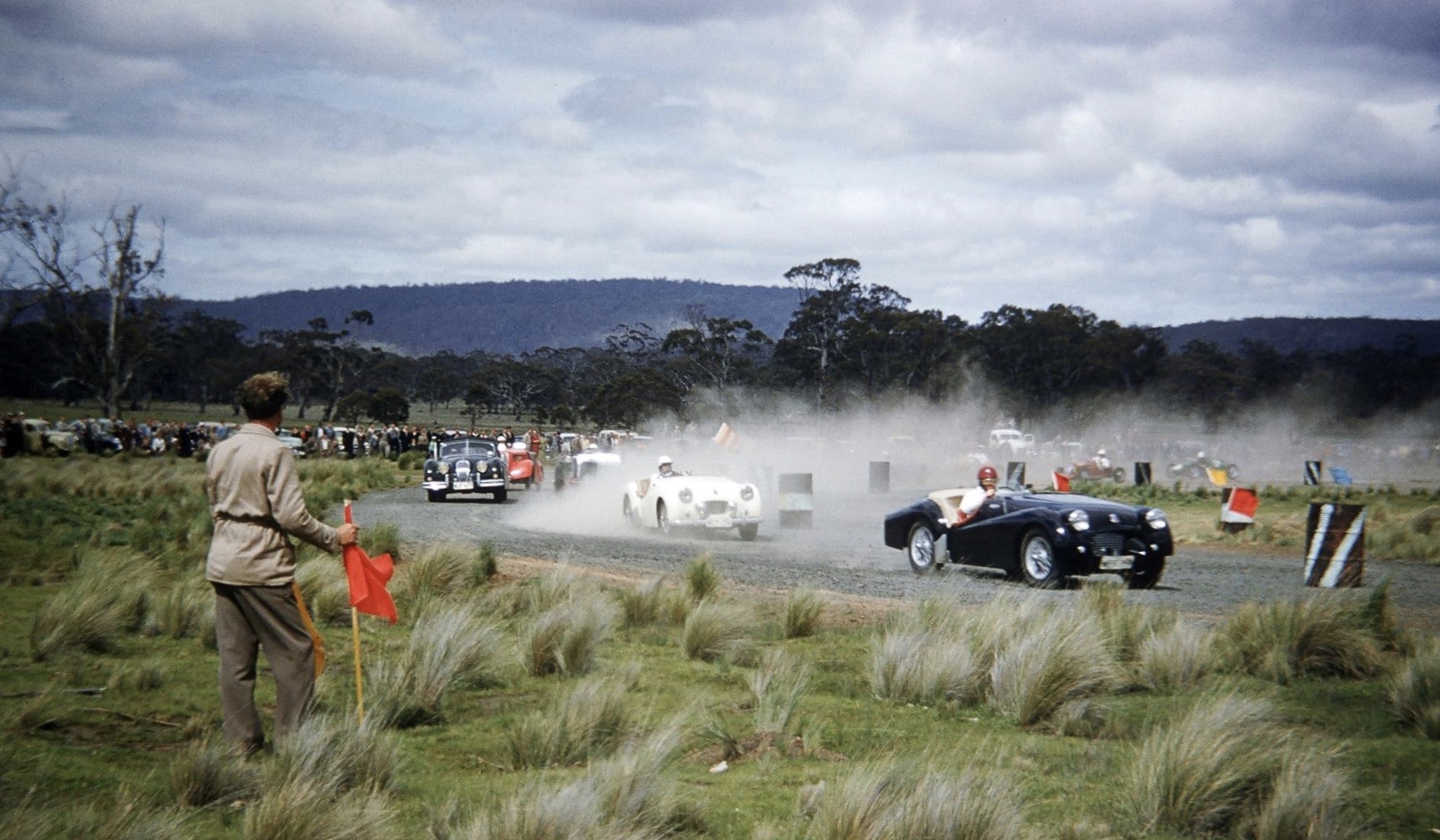
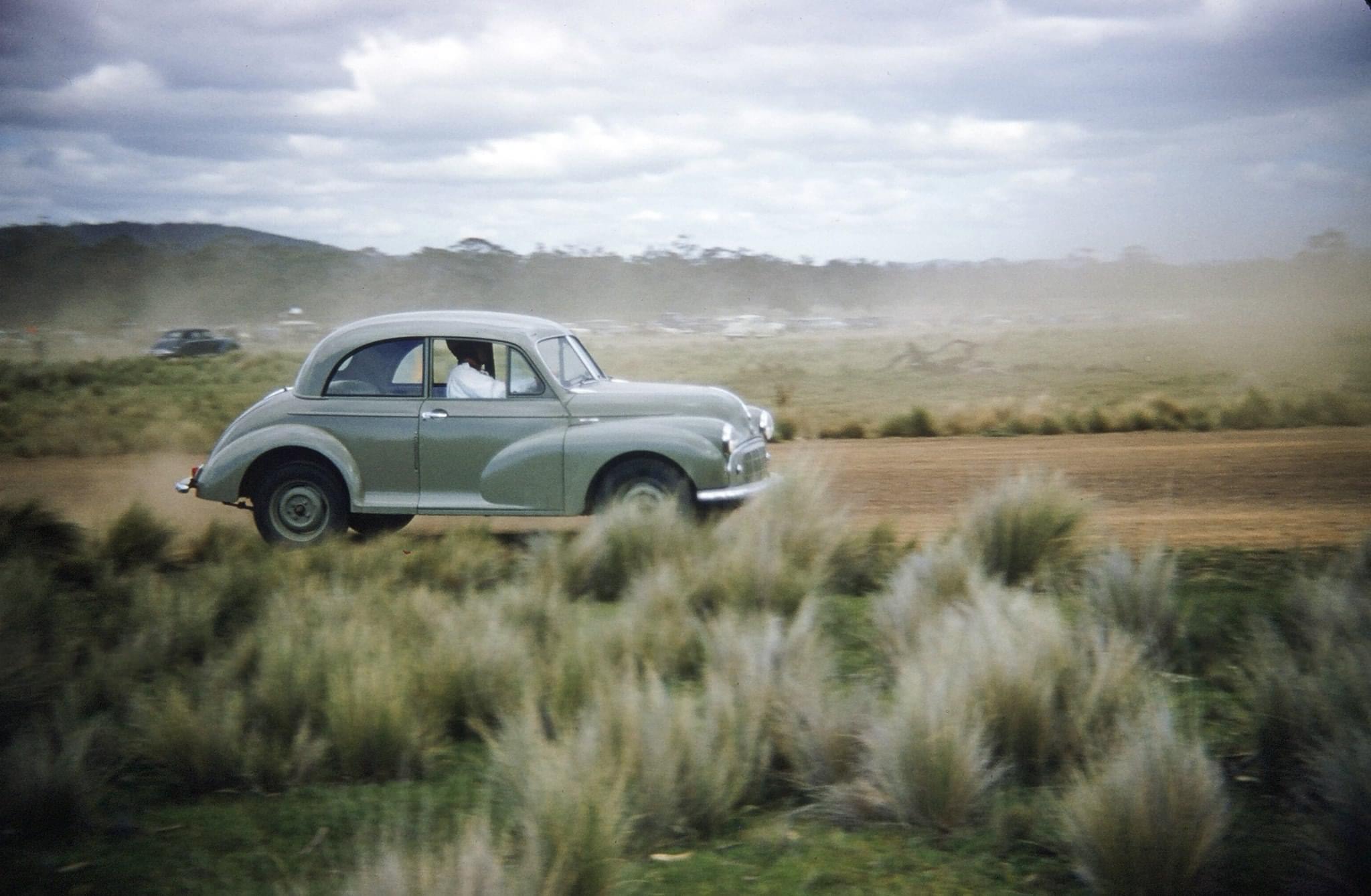
The white TR, is heading in the correct direction- the blue Healey has overshot his braking point (B Young)

Motorsport venues in Tasmania were a tad skinny in number prior to the opening of Baskerville near Hobart, and Launceston’s Symmons Plains circa 1960. Longford was great but it was a once a year deal over the March Labour Day long weekend.

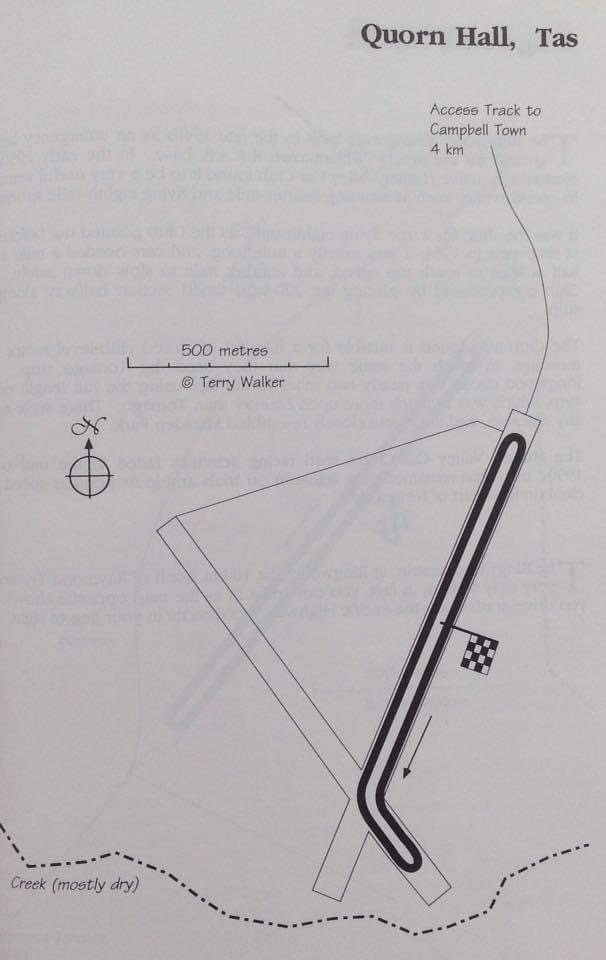
So Quorn Hall, an ex-World War 2 airfield located on TC Clarke’s sheep grazing property was pressed into service. The 7,300 hectares, farmed by the same family since 1846 is on Lake Leake Road, Campbell Town 15km south of Launceston.

1952 (V Gee)


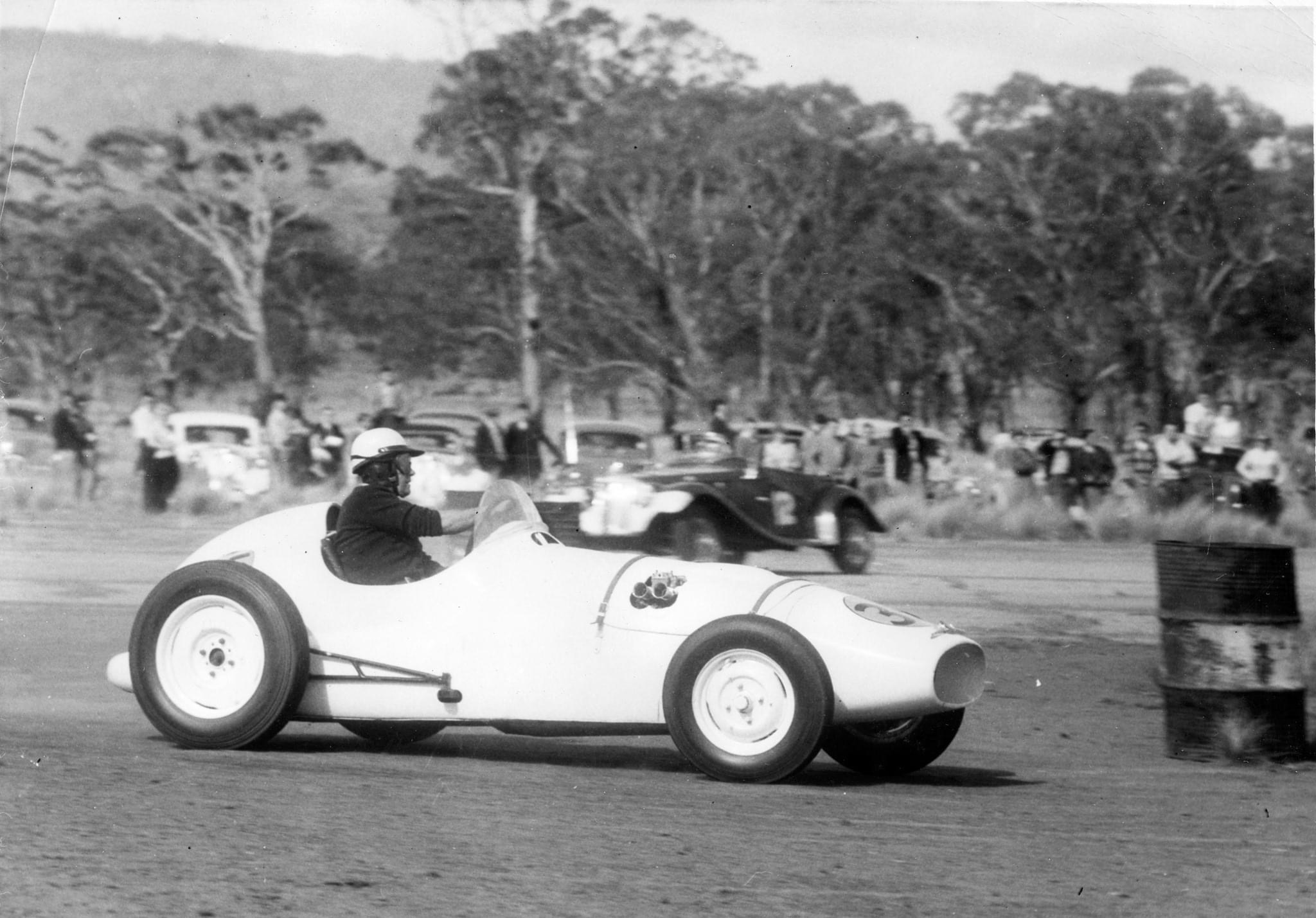
Jock Walkem’s #6 Norton or Vincent powered special going bush suspects Garry Simkin (B Young)

The ever interesting Historic Racing Car Club of Tasmania Facebook page notes that ‘Quorn Hall Airfield was developed during WW2 to house the huge American bombers if the need to fall back to Tasmania occurred during an invasion of the mainland’, or the ‘North Island’ as the Tassies like to call the rest of us!

‘The runway is several kilometres long and about 50 metres wide. After the war (from November 1952) it was used for motorsport, essentially putting 44 gallon drums out and racing around them. The runway and access roads were used. Usage dropped off after the purpose made circuits opened, but it was still used for club events – standing quarter-miles etc until the end of the 1960s.’

It seems, as usual, the entrepreneurial motorcyclists beat us car dudes to the punch. The Tasmanian Motor Cycle Club organised a picnic ride to Quorn Hall in 1946 during which some races were run. ‘While the straw bales down the middle of the runway and use of oiled gravel access roads in a J-pattern may have been basic, unlike beach racing, you didn’t have to wait for the tide to go out and most of the 1 1/2 miles was sealed’ recorded Bike Australia.

2,000 people attended a combined car and bike meeting in 1951 organised by the Southern Motor Cycle Club and the Light Car Club. It was the first occasion on which ‘racing was officially noted.’

The Tasmanian Tourist Trophy was held there for the first time November 1952 with most of the national ‘bike stars of the day’ competing. The car racing was more club than national level, those honours went quite rightly to Longford.

Start of the Senior TT in 1952. Col #49 and Max #74 Stephens getting away smartly (Bike Australia)


Tasmanian Aero Club, Western Junction, date unknown (unattributed)

In fact the history of the site is a significant one in Tasmanian aviation.

The Tasmanian Aero Club was formed there site in 1927, the Western Junction Aerodrome (now Launceston Airport) was officially opened in 1929. The first passenger facility on the Apple Isle operated from there until August 1940 when the Royal Australian Air Force took over the place to house the ‘7 Elementary Flying Training School. Extra local ‘strips were built at Nile, Annandale, Valleyfield and Quorn Hall.

As the name suggests, 7 Elementary Flying Training School provided an introductory twelve-week flying course to those who had graduated from one of the RAAF’s initial training schools. It was the only RAAF base in Tasmania then. Flying ceased there in December 1944 with the school disbanded in August 1945.

Etcetera…

Western Junction Aerodrome in 1933.

These colour photographs are wonderful, unique. If any of you can help identifying cars/drivers please give me a yell and i will update the captions accordingly.

(HRCCT)

Bruce Gowans and John McCormack during a Historic Racing Car Club day out to Quorn Hall and Valleyfield (at Epping Forest) in 2016. They are standing on the Quorn Hall runway-circuit.

(HRCCT)


VW and Fiat 1100 (B Young)


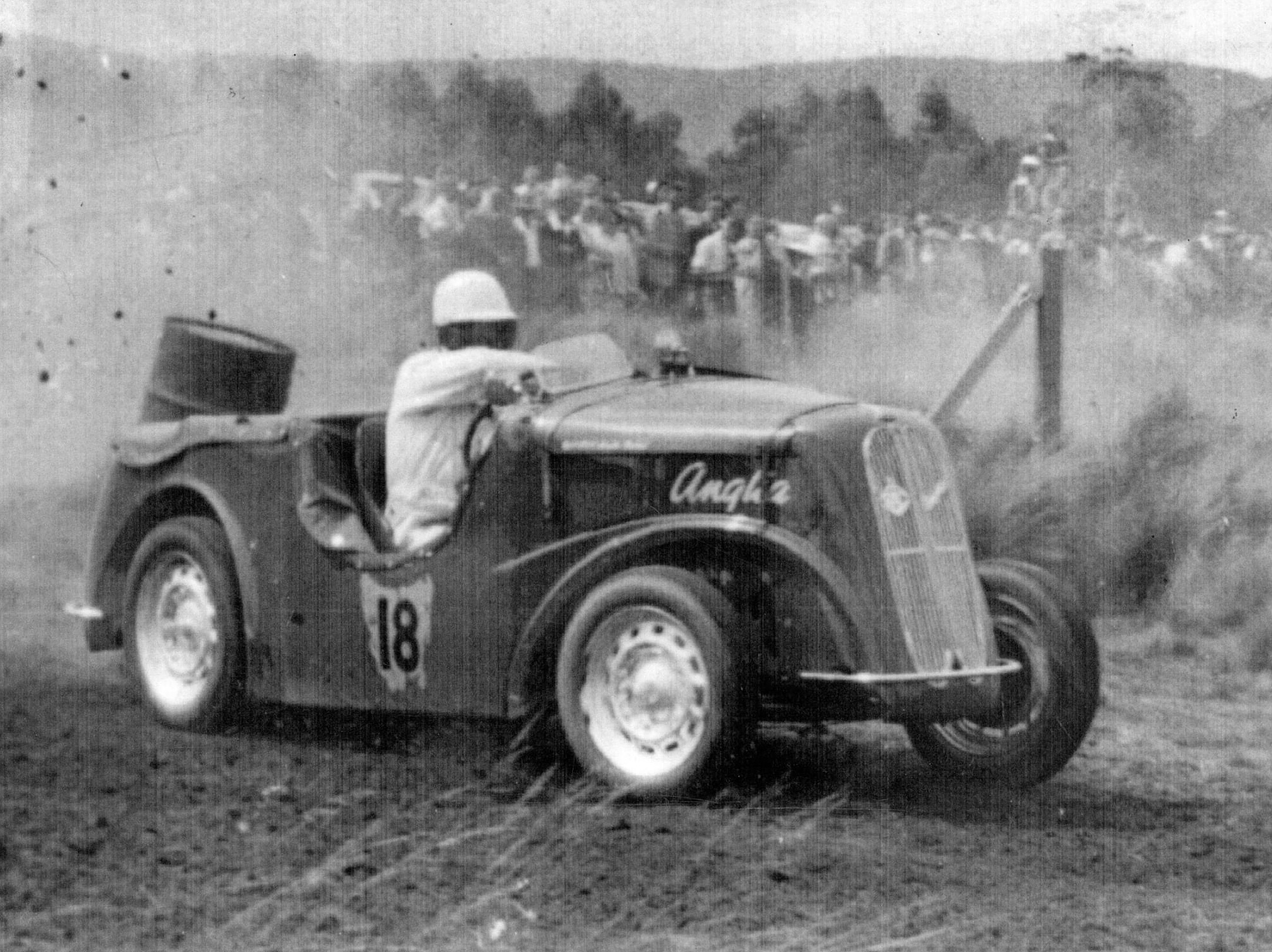
Mick Watt competing in the first ‘Half-Hour’ race at QH in 1953 in Ford Anglia. This little car, nicknamed the ‘Magic Goat’ won 64 races.


(B Young)

What a magic panorama. Brian Higgins believes the competitors are Jack Petts and Geoff Smedley in Triumph TRs, Boyce Youl in the Jaguar XK and Mick Watt’s Ford Anglia.


(B Young)


MG. Love the dudes in the background  (V Gee)


(B Young)


(D Elliott)

Don Elliott, Holden Special at QH in the late-fifties.

This attractive little car was a mix of Skoda and Holden components, the engine used a Repco Hi-Power hhead fed by a side-draft twin-choke Weber.

Our friend in the Fiat again (B Young)


A couple of RAAF cub ‘flyboys’ with their Tiger Moths at Western Junction circa-1940.


(M Watt)

This shot is of Stan Jones in Maybach 1.

It is from Mick Watt’s Collection, no doubt taken on a day he was also competing. Stephen Dalton thinks the shot is probably closeby to QH at Valleyfield, one of the four airstrips mentioned above. He and fellow Victorian, John Nind (Cooper) raced there on November 4 and 5 1951. It’s only a short time after Jones acquired the car from it’s builder, the great Charlie Dean. The pair and sponsor Repco would have much success together in the ensuing years.


(T McGrath)

Alan Stephenson, Cooper Mk5 JAP Cooper misjudgement and consequences, not too bad.

(T McGrath)

Etcetera…


The above are scans from ‘Country Houses of Tasmania’.

Photo and other Credits…

Bob Young Collection via the Historic Racing Car Club of Tasmania, Vicki Gee, Don Elliott Collection, Mick Watt Collection, Terry McGrath from the Graham Howard Collection, Garry Simkin

Bibliography…

speedwayroadracehistory, ‘Tracks In Time: Quorn Hall’ Bike Australia July 2018, Terry Walker, Bike Australia, ‘Country Houses of Tasmania’ Alice Bennett and Georgia Warner

Tailpiece…

(B Young)

‘Holy ‘snappin rissoles’. That’s the swing-axle shit the motor magazines are rabbiting on about.

Finito…

(G Gauld)

‘Its like a rocket Jack’. ‘It should be, you put it together champ’, the boss responded.

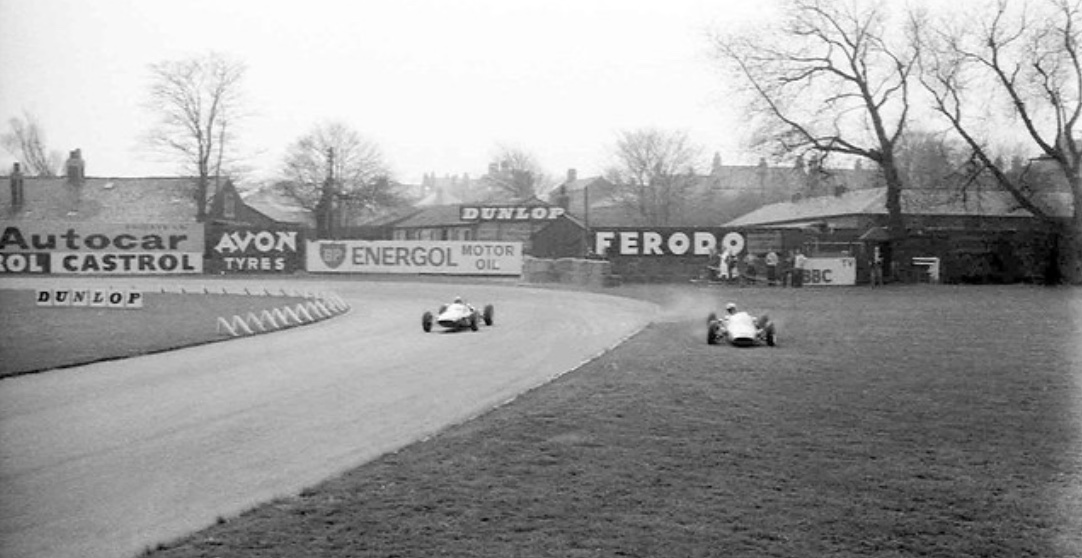
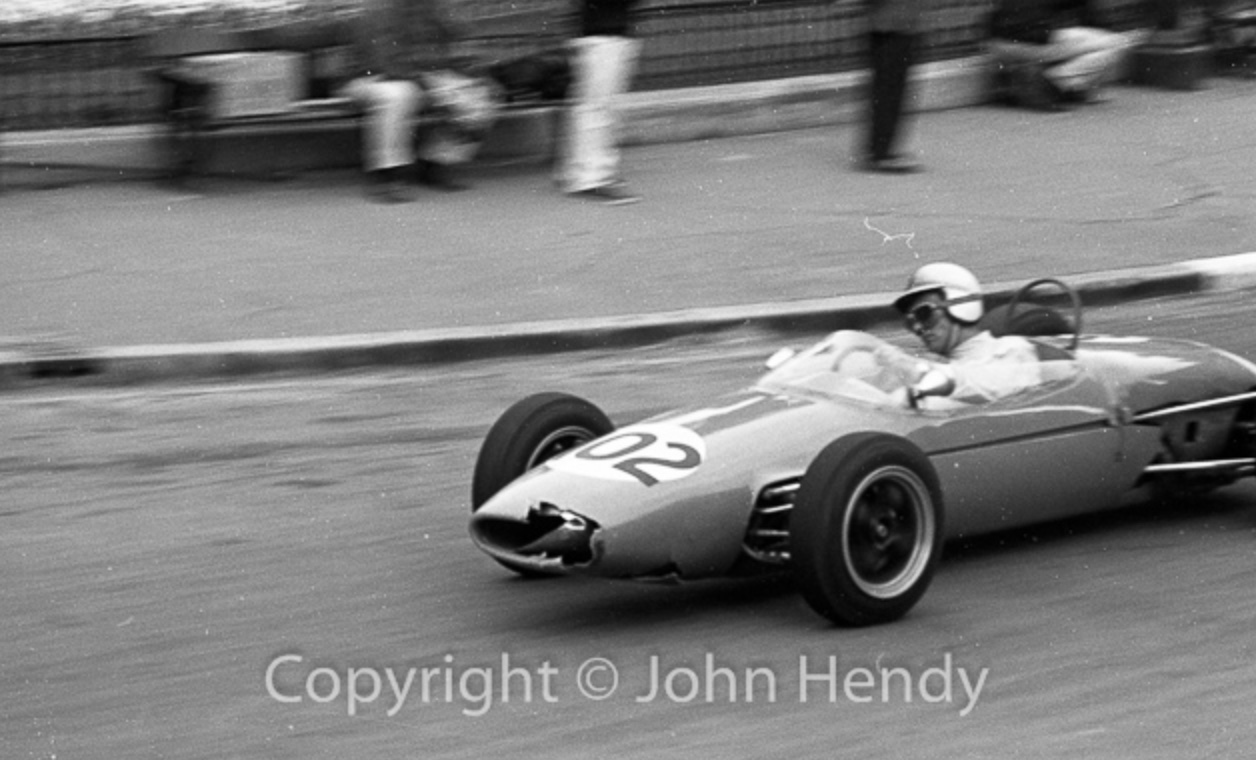
Frank Gardner and Brabham BT2 Ford on the BARC 200 Formula Junior pole at Aintree on April 28, 1962. John Bolster is hovering behind contemplating putting the bite on Jack for a track-test.

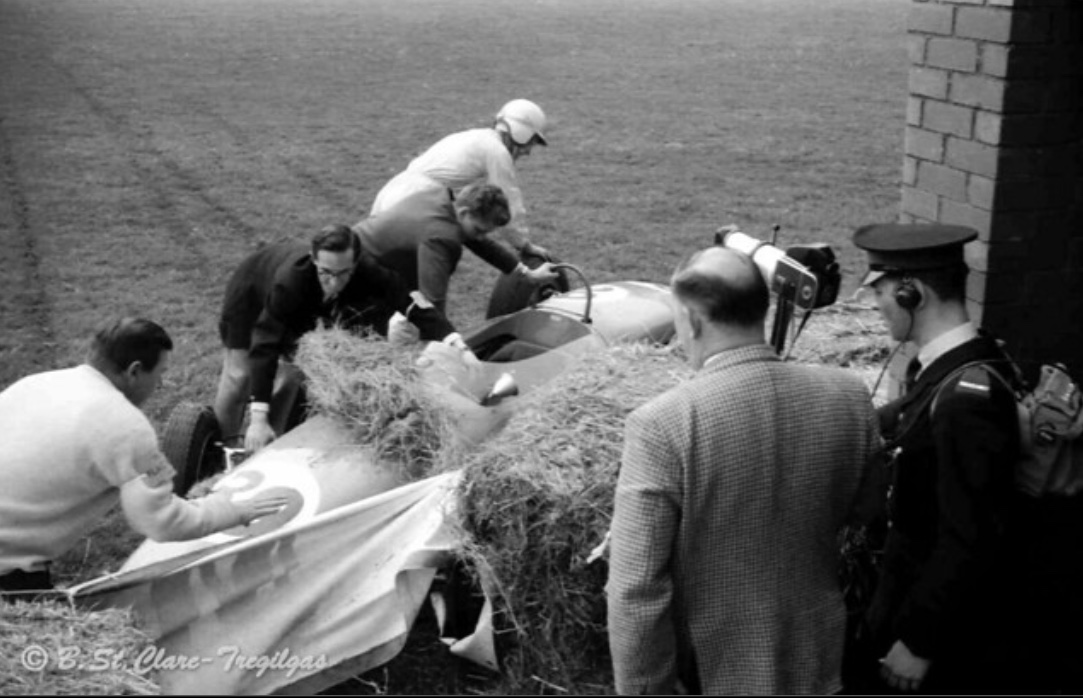
The lanky, laconic Aussie didn’t do quite so well with (perhaps) ‘FJ-2-62’ in the race. He ran out of road at Tatts Corner after 7 of the 17 laps ending up amongst the hay-bales close enough to the Pits for Jack to wander over just as he was recovering the car.

(B St Clare-Tregilgas)


Jack didn’t have a great day either. He raced Lotus 21 and 24 whilst Ron Tauranac toiled away on the first F1 Brabham, the BT3 Climax FWMV V8. The gears on his Lotus 21 Climax FPF stripped, the race was won by Jim Clark’s Lotus 24 Climax from Bruce McLaren’s Cooer T55 Climax.

The FJ race was won by Peter Arundell’s Lotus 22 Ford in a classy field which included Tony Maggs, John Love, Mike Spence, Richard Attwood, Denny Hulme and Alan Rees.

Etcetera…

(J Hendy)

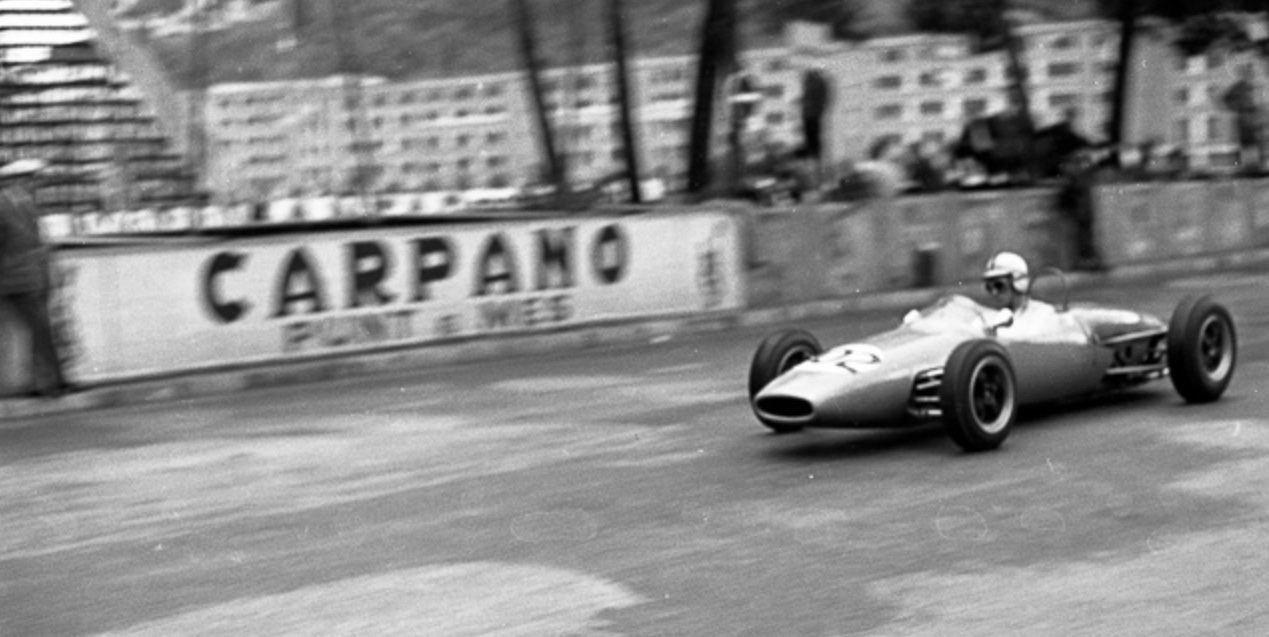
It’s amazing to think of FG as a budding ‘young driver’ contesting Formula Junior races at Monaco in 1962. He was 31 when he lined up that May, a veritable geriatric by today’s standards when F3 pilots are barely shaving. He was racing a D Type before he left Australia. None of that counted for much when he landed in the UK of course. Sometimes you have to go down to go up, so to speak.

Frank was fourth in the first heat won by Peter Arundell’s works Lotus 22 Ford and failed to finish the final with clutch failure. Up front it was Lotus 22 Fords in first to third – Arundell from Mike Spence and Bob Anderson. All progressed to GP racing, as did Frank of course.

Aintree program in relation to Brabham (and Ausper) FJs (S Dalton)

Another shot of FG below, this time in BT2’s close relation BT6. Not at Aintree, but another horse-racing track, ‘God’s Acre of Motor Racing’, Warwick Farm in Australia.

Gardner had the system beaten. He did his thing in Europe each year and then had summer in the sun back home in Australia where he raced for Alec Mildren.

In 1964 he raced this chassis, ‘FJ-9-63’, Denny’s 1963 works FJ mount, by then fitted with a Lotus-Ford 1.5 twin-cam in the Australian Tasman Cup rounds.

(E Holly Collection)

His best result in the four races was fourth in the Lakeside 99, meritorious amongst the 2.5 FPF Climax powered opposition. Twelve months later he raced Alec’s BT11A FPF in an assault on all of the eight rounds. Frank used BT11As in 1965 and 1966, the shot below is again at Warwick Farm where Gardner was third behind Jim Clark’s Lotus 39 Climax and Graham Hill’s BRM P261.

(unattributed)

Photo Credits…

Graham Gauld, Brian St Clare-Tregilgas, John Hendy, Ed Holly Collection, Stephen Dalton Collection

Tailpiece…

Tattersalls Corner, where FG came to grief, is at bottom right.

Finito…

Ian Mountain and his mates with his self-built, very clever IKM Peugeot Special on the AGP grid at Southport on Queensland’s Gold Coast, November 7, 1954.

Ian gives the photographer a big grin, it’s none other than champion racer Reg Hunt, who is sharing his previously unpublished shots with us via his friend and confidant, Melbourne enthusiast/historian David Zeunert.

The young Montclair Avenue, Gardenvale (now Brighton) engineer first came to prominence racing the MYF (Mountain Young Ford) Special he built together with fellow Royal Melbourne Institute of Technology civil engineering student, Bruce Young.

In the finest traditions of the day, this Ford 4.2 litre V8 two-seater provided day to day transport and a multi-purpose racer including a mount for the 1952 AGP at Mount Panorama. Up front Doug Whiteford won in his Talbot-Lago T26C, while Ian retired after 24 of the 38 laps.

Ian awaits the off in the MYF Ford Spl at Rob Roy circa 1952 (L Hatch)


IKM Spl. Chassis, engine and suspension detail as per text (AMS)

Despite his training, Ian was up to his armpits in all things automotive. He was employed as a Peugeot salesman by Canada Cycle and Motor Co in Latrobe Street, Melbourne. It was to them he turned for components for his next car, the IKM (Ian Keith Mountain) Peugeot Special.

The machine’s chassis was of typical ladder frame type, longerons were of 16 gauge 2 3/4 inches diameter steel tube with four cross members – one at the front, one behind the engine then two at the back, in front of and behind the final drive unit.

Front suspension used Peugeot 203 transverse front springs and stub axles with fabricated top wishbones and telescopic shocks. Steering was 203 rack and pinion, as was the steering wheel.

Rear suspension was de Dion. The bowed tube picked up the hub-carriers and a 1946 Ford V8 diff housing mounted on the frame. This had specially cast side-plates with Dodge pot-type universal joints at each end of the driveshafts. Semi-elliptic springs, radius rods and telescopic shocks completed the package.

The hydraulic brakes use MG TC backplates and shoes with Alfin drums. The wheels were Holden FJ ‘laced’ onto ‘TC hubs- 5 inches x15 in front and 5.5 x 15 at the back, whilst the heart of the matter was a modified 203 crossflow engine.

IKM engine and front suspension. Peugeot suspension and steering components with fabricated top wishbones, MG TC/Alfin brakes. Peugeot engine 1490cc- 80.5mm bore and 73mm stroke, big Wade blower and SU carb (AMS)


IKM ally fuel tank and rear suspension detail- de Dion tube, radius rod and shock mount (AMS)

The standard Peugeot four-cylinder OHV 1290cc unit was bored to 1490cc using custom made Rolloy pistons and sleeves. A big Wade R020 blower fed by a 55mm SU carb giving about 6 pounds of boost was mounted on a frame ahead of the front suspension and chain-driven from the front of the crank. Extractors were fabricated, a Scintilla Vertex magneto gave the sparks, Peugeot provided a competition fuel pump and exhaust valves. Inlets and valve springs were standard but the valve gear was lightened and polished as were the rods and crankshaft before balancing. The compression ratio was 6:1.

The engine was mounted to the left in the frame to allow a driveline left of centre and therefore a nice, low seating position. An MG TC gearbox mated to the bellhousing easily, 22 gallons of fuel were carried in a rear mounted tank.

Neil Coleman’s ‘shop in North Melbourne built the light aluminium body with the light, low purposeful car beautifully built and finished. IKM weighed 9cwt, had a wheelbase of 7′ 6″, front track of 4′ 2″ and a rear track of 4’, ‘so the car is not really a small one, belying its looks’ AMS reported.

After testing in the quiet(!) of the Geelong Road Ian ran the machine at the Beveridge and Templestowe Hillclimbs in chassis form, and then at Fisherman’s Bend with its body fitted. He finished two races despite fuel feed problems caused by shortcomings in the manifold design.

Ian married Laurel Duguid in the Scotch College Chapel at Hawthorn on November 2, 1954 then the couple set off for Southport and the 1954 AGP, what a honeymoon! Lex Davison won in his HWM Jaguar with the IKM retiring after 11 laps. Ian’s radiator drain tap was opened slightly by vibration of the body panels which allowed the water to escape, the travails of new cars.

Peugeot 203 and IKM Spl ready for the long Melbourne-Gold Coast November 1954 AGP trip, Gardenvale to Southport is 1,725km each way (L Hatch)


Ian looking around for his crew at Gnoo Blas, long, low lines of the innovative IKM Pug clear (K Devine)

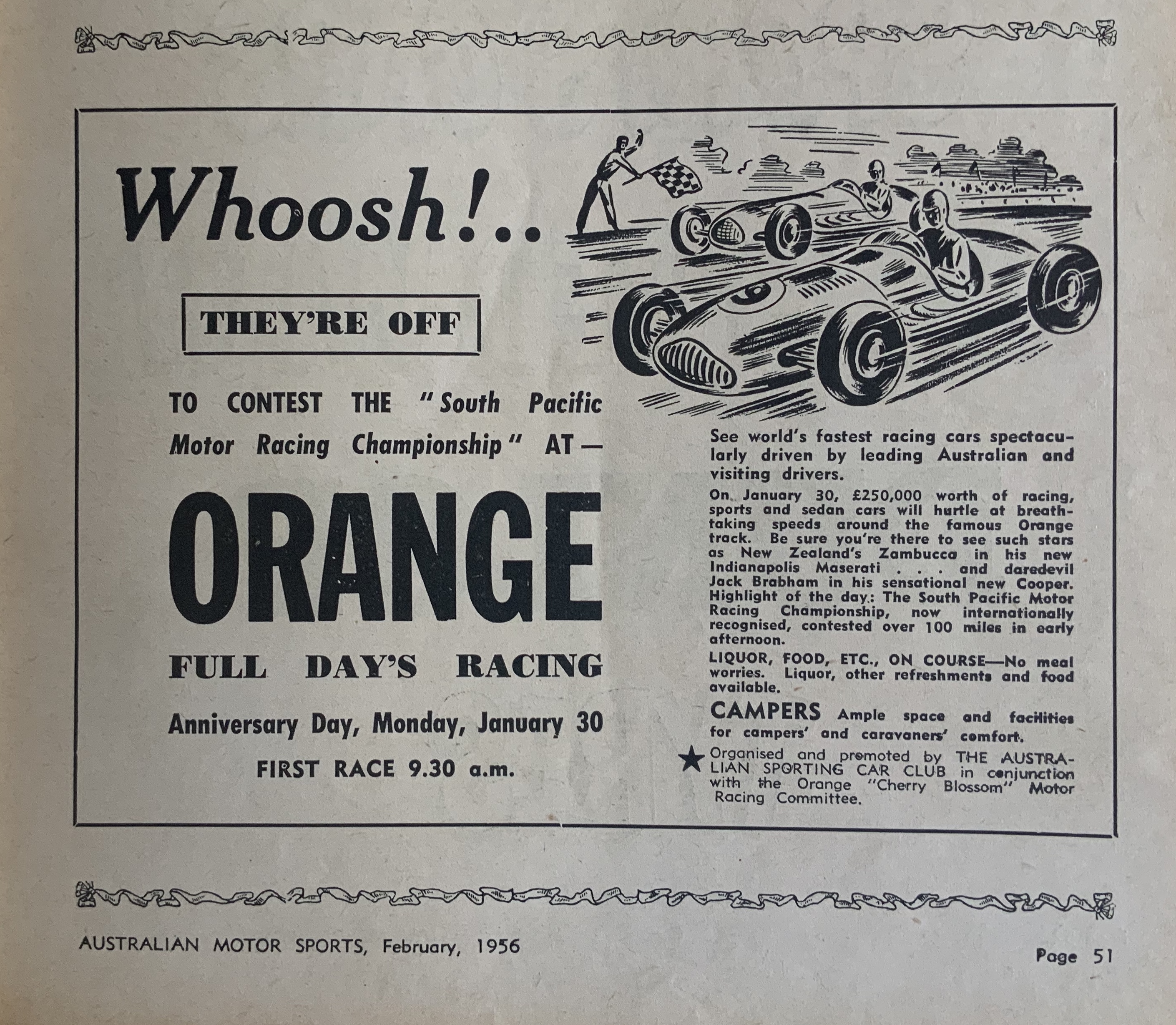
After a relaxing Port Phillip Bay Christmas/New Year the newlyweds set off from Melbourne for the South Pacific Trophy at Gnoo Blas, Orange, New South Wales over the January 31, 1955 weekend.

Australia’s first FIA listed international meeting featured the Ferrari 500/625s of Peter Whitehead and Tony Gaze, Jack Brabham’s Cooper T23 Bristol, Dick Cobden’s Ferrari 125 and Bira’s Maserati 250F and Osca V12 amongst others.

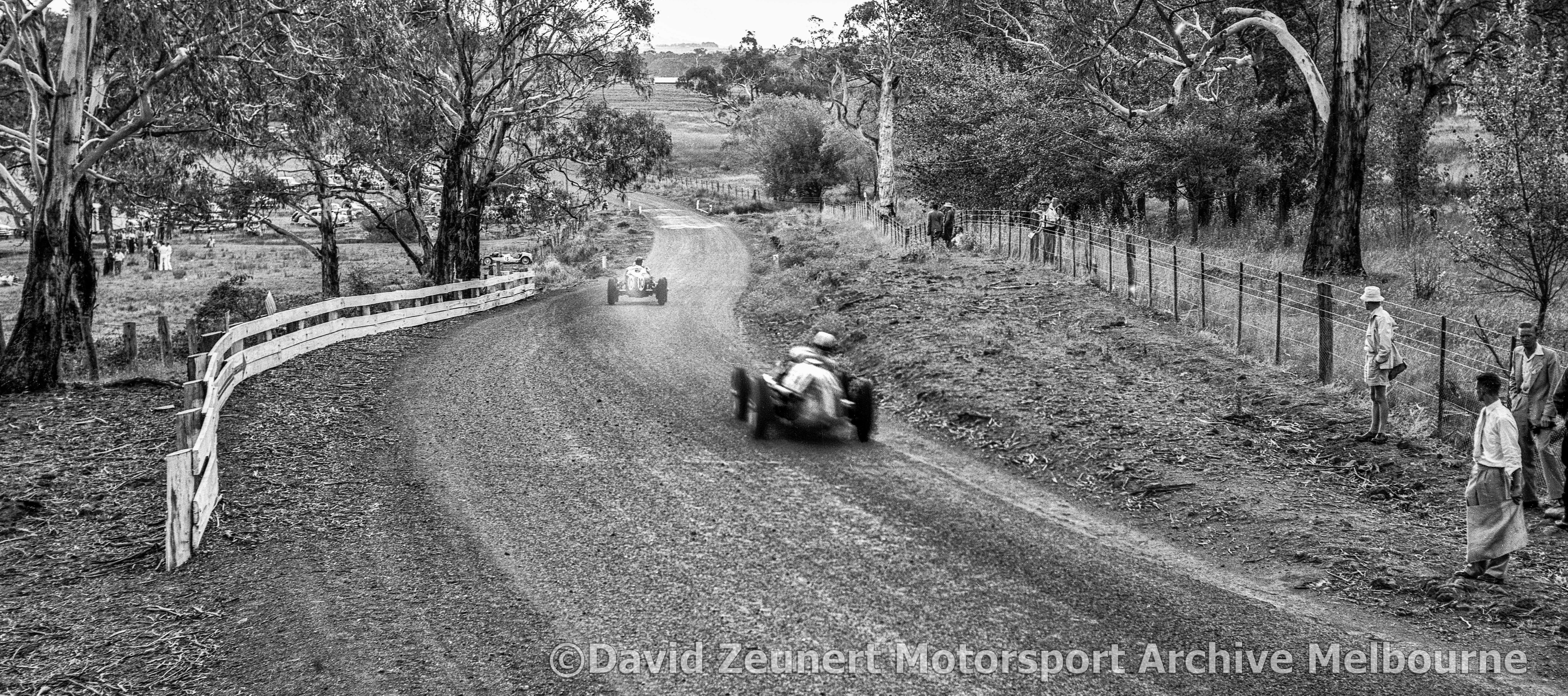
Two cars in Connaghan’s Corner after the right-hand Mrs Mutton’s Corner and then the downhill The Dip. Ian has lost adhesion and left the circuit on the outside, his crashed car is visible with officials well away on the left as, perhaps, the South Pacific Trophy takes place. Superb, rare angle of this section of this road circuit whilst noting the sad scene Reg Hunt reveals


Sadly, oil which spewed from Bira’s Osca V12 probably led to the awful accident which cost 25 year old Ian and a young spectator in a prohibited area their lives on the fast, downhill run out of Connaghan’s Corner, see here for a feature on this meeting; https://primotipo.com/2020/04/09/1955-south-pacific-championship-gnoo-blas/

Reg Hunt’s Maserati A6GCM 2.5 litre was entered for the meeting but necessary spares were late arriving from Italy so he prowled the circuit with his camera instead.

Laurel remarried in 1960, the IKM remains passed to Ian’s brother Ken who later sold them to Harry Firth. Ian Tate, who admired the car in the day, later acquired it and is in the gradual process of restoration.

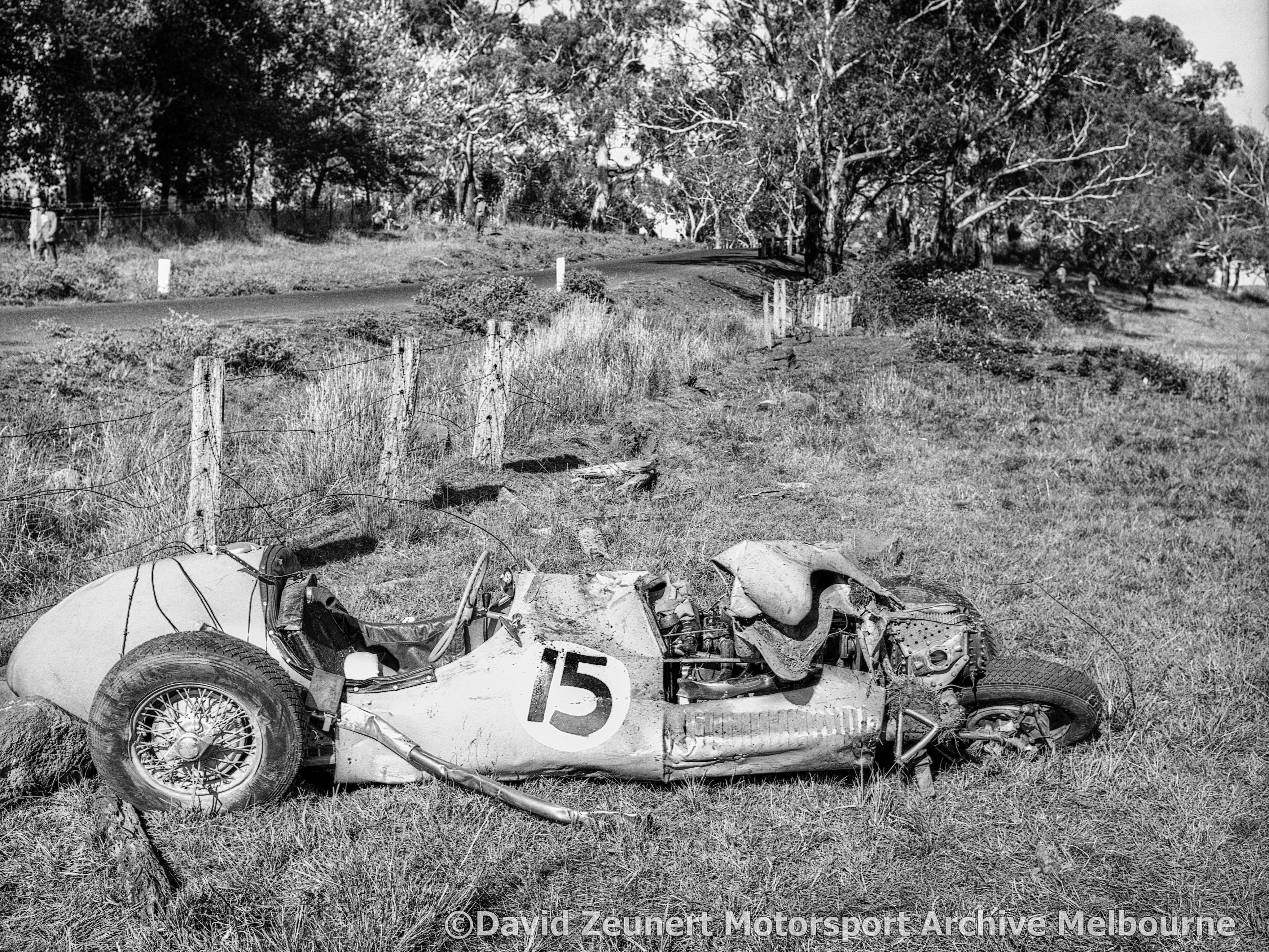
Path of the car clear through the fence from the previous shot from up the hill towards Connaghan’s Corner.

Whilst components off the crashed machine have been placed on the wreck and in the cockpit the barbed wire fence, wrapped around IKM Spl, which provided some of Ian’s fatal wounds is clear. When the worst happened on those tracks in those days, lady luck either was, or was not present. Unseen by Ian that day sadly

Stunning, most significant photographs, many thanks Reg, David.

Credits…

Australian Motor Sports, December 1954, ‘Ian Mountain: Potential Unfulfilled’ Paul Watson, Reg Hunt photographs via David Zeunert Archive, Ken Devine Collection, Gnoo Blas Classic Car Club

Tailpiece…

Finito…

(J Dallinger)

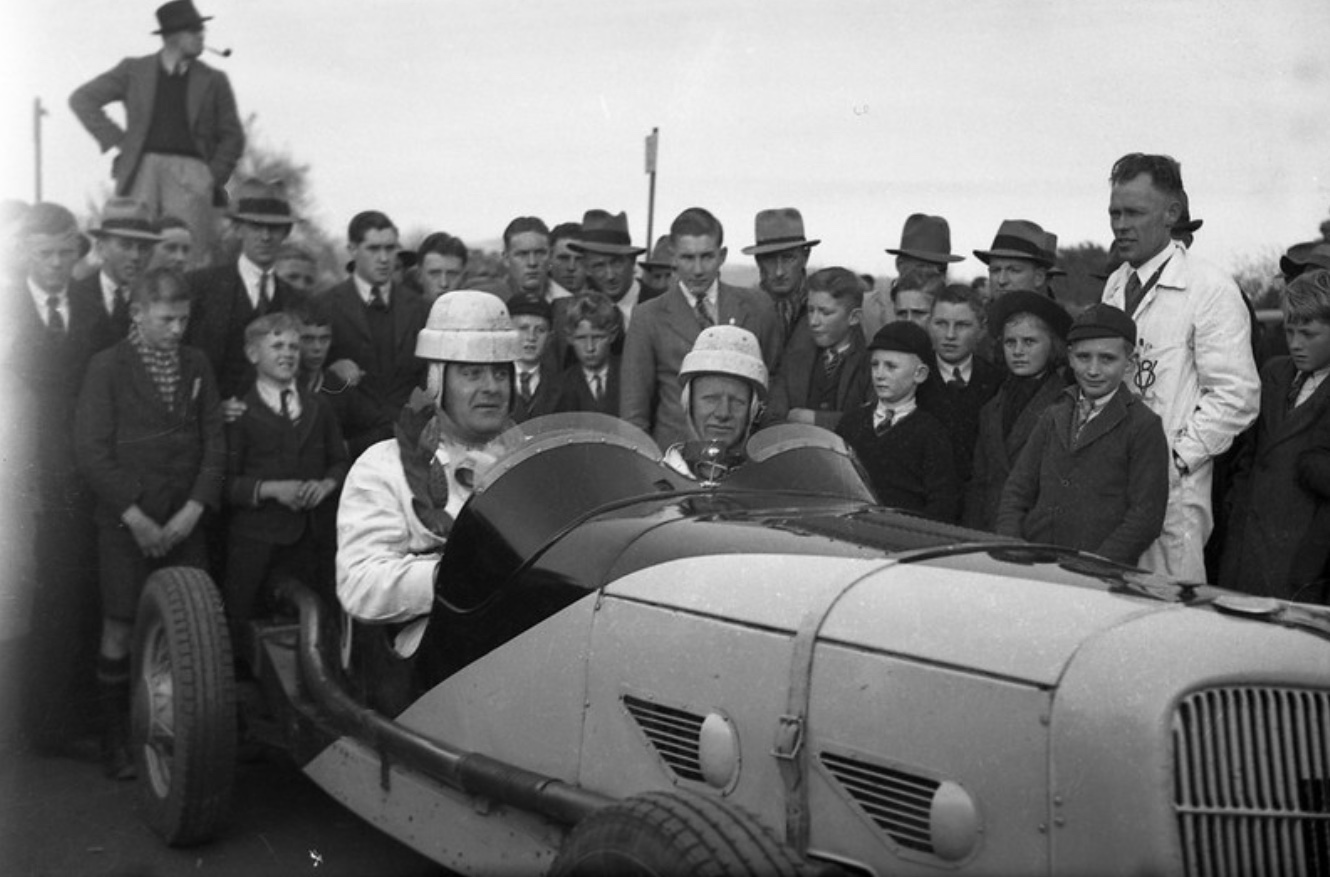
Jack Phillips and Ted Parsons looking happy with themselves aboard their Ford V8 Special having won the Interstate Grand Prix at Wirlinga, Albury on 19 March 1938.

The Ford V8 found its way into all kinds of Australian specials both pre and post war, this was one of the most beautifully built and successful of them all. See here for a piece on this race; https://primotipo.com/2019/01/11/interstate-grand-prix-wirlinga-albury-1938/

These two mates were business partners in a motor dealership in Wangaratta which distributed Ford and other brands. I wonder if one of the admiring, capped kids is Jack’s son Ron Phillips who was a star in an Austin Healey 100S and Cooper T38 Jaguar in the mid-fifties to early sixties?

It’s pretty boring writing about familiar stuff, the journey of discovery is far more engaging. I think a lot about racing in the context of the times, how people lived, what they did with their leisure hours but it’s not necessarily easy to find the right photographs.

Not so this time, John J ‘Jack’ Dallinger ran a photography business, which still exists in Albury. Along the way, he and his staff recorded the daily lives of the citizens of the border city and surrounds, I’ve chosen some images of typical life justaposed with racing shots. All of the photographs were taken by Dallinger and his team in Albury in the thirties, unless attributed otherwise.

Locomotive’3623’ leaves Albury Station during the thirties. Obviously some sort of special occasion for the train to be decorated as it is


Albury Show wood-chopping competition, takes me back to watching the O’Toole brothers on Channel 7’s Sunday ‘World of Sport’ in the sixties


Motorcycle racing blazed the trail for cars in just about every sphere of competition in Australia, speedways included.

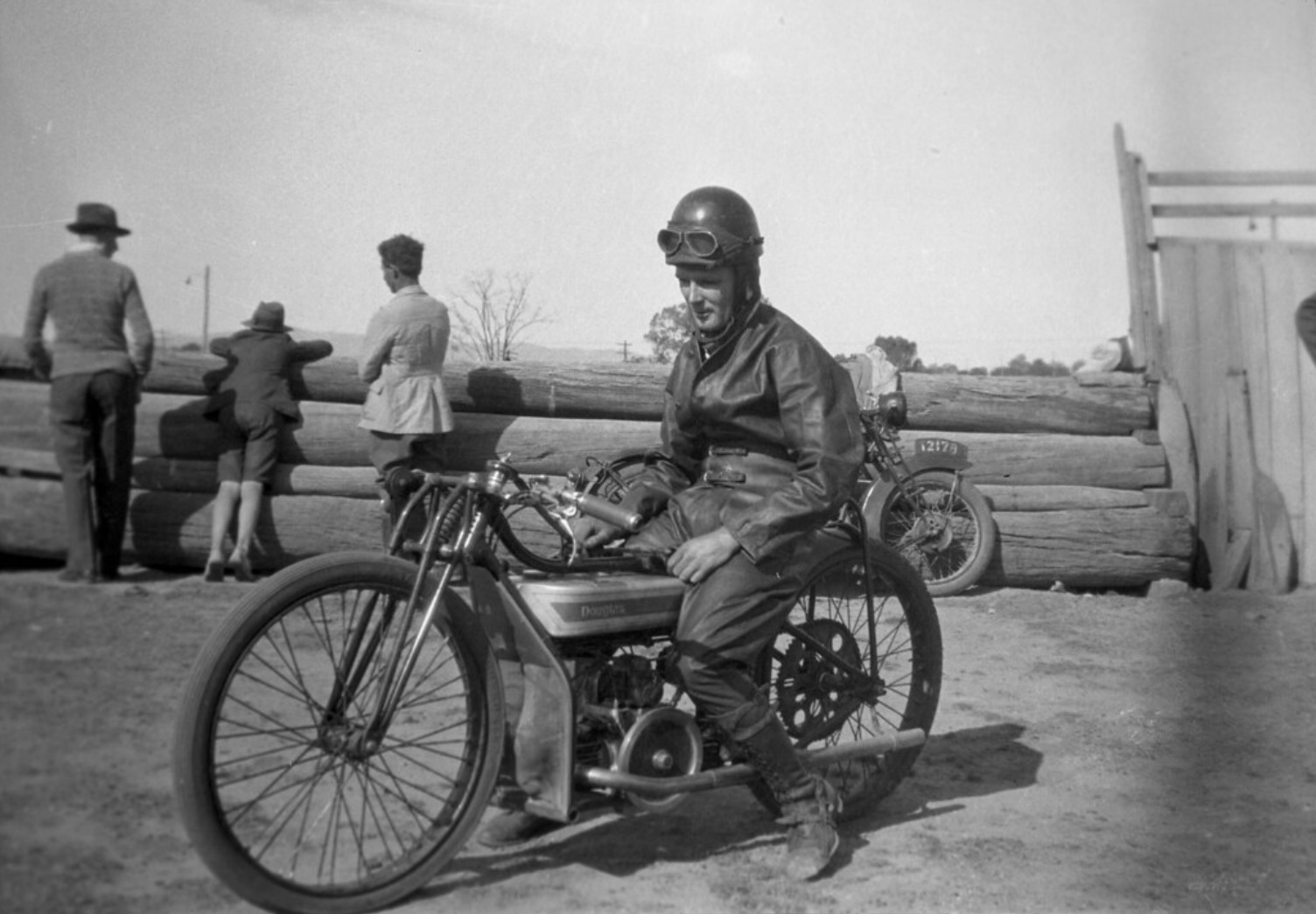
This is Aub Boyton aboard a Douglas, perhaps a 500cc DT5 or DT6- Douglas being one of the most popular and successful speedway bikes of the era.


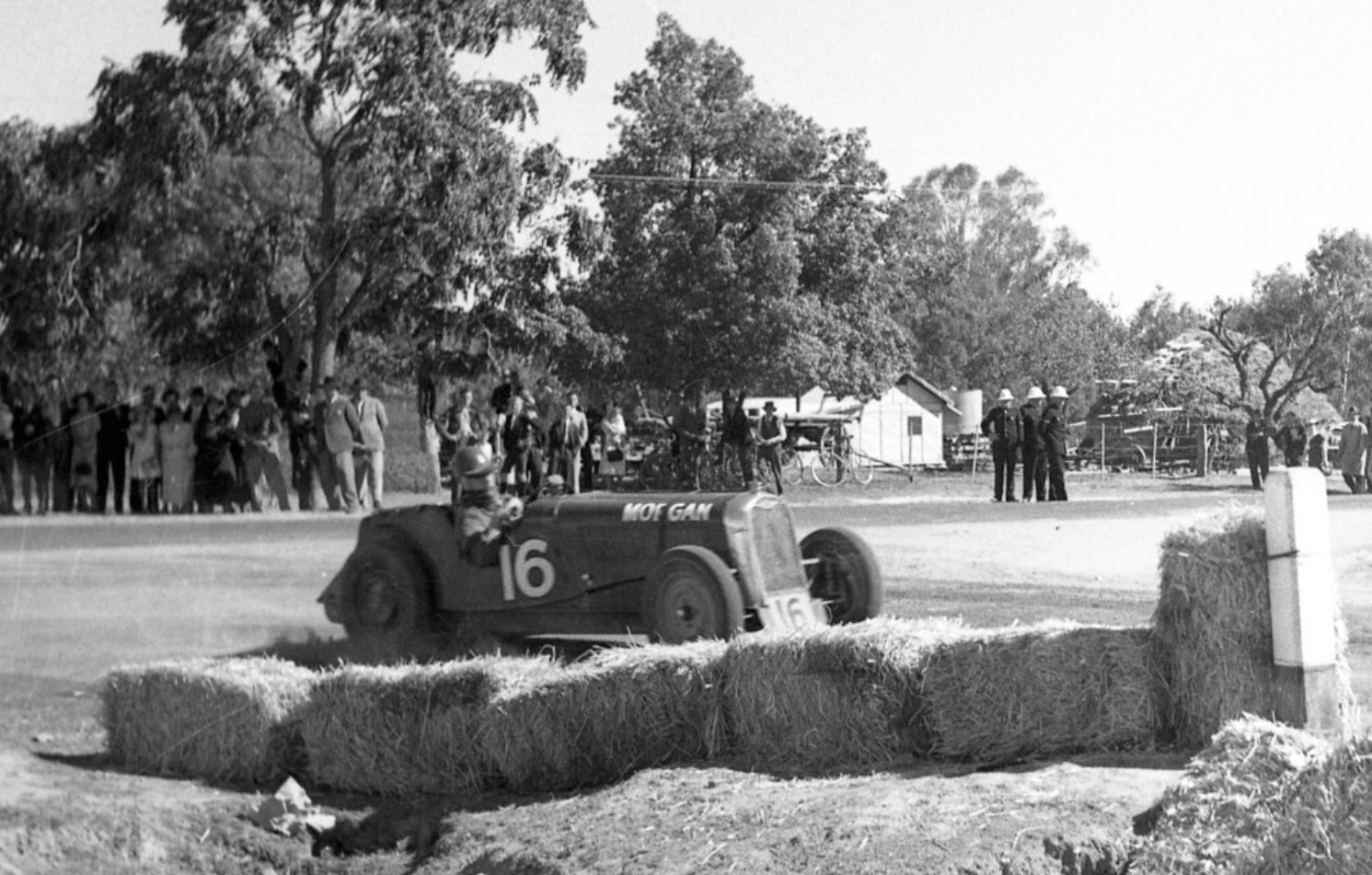
Jim Boughton, Morgan at Wirlinga in 1938.

A year later this car had morphed into a single-seater in time for the Australian Grand Prix at Lobethal the following January, he failed to finish the race won by Allan Tomlinson’s MG TA Spl s/c. Better still, the Morgan remains extant.

Boating on Lake Hume, 1940s


Out and about in an Austin 7, this one is fitted with a James Flood built two seater sports body.

Of all steel and ash construction, the machine used a factory supplied radiator cowling forward of which was a fairing covering dummy dumb irons onto which was painted the registration number. The running gear comprised a production Austin chassis and mechanicals with a raked steering column.

Large flowing wings kept the elements from the occupants. ‘As was fashionable with many Australian models of this period, fixed split front windscreens were mounted on the scuttle with no provision of any weather protection’, many thanks to Tony Johns on this little Austin.

Keen spectators taking a look at competitors in the Wirlinga paddock prior to the 1938 Interstate Grand Prix.

Car #3 is Tim Joshua’s Frazer Nash, not too far from being restored, alongside is former Maroubra ace Hope Bartlett’s MG Q Type and then car #6, the winning Ford V8 Spl of Phillips/Parsons.

Cricket match near Tallangatta


Billycart race in Pemberton Street, Albury 1940s.

Too much roll stiffness? is that right front taking some air. I wonder if either of these two young tyros progressed to motorised competition?

I’m sure one of you will be able to help with the Dodge Ute model year, 1930s, i’m also intrigued to know the address of Albury Motors Pty. Ltd.

The CA Williamson Chrysler ahead of G Winton, AC and L Evans Vauxhall, Wirlinga 1938.


Waterskiing on Lake Hume


Golden Arrow on display in Albury, a bit on the machine here; https://primotipo.com/2019/06/04/wot-the-bloody-ell-is-that/

Bill Boddy, in MotorSport, wrote that after an exhibition tour of Australia the car returned to England, that line is written in such a way which implies the car made the trip here after setting the Land Speed Record at Daytona at 231.446 mph on 13 March 1929. So, its later in 1929, the machine was owned by the Wakefield Company, clearly a lot of Castrol lubricants were sold here at the time.

Sir Henry Segrave was later killed aboard ‘Miss England II’ on 13 June 1930 after raising the Water Speed Record to 98.76 mph at Lake Windemere.

Tony John’s sent in a snippet from the April Fools Day edition of the 1931 ‘Bulletin’. “Drag” wrote ‘It is not often that one finds a car that has travelled 43,000 miles without an overhaul, and a racing car at that…the late Segrave’s Golden Arrow…left England on February 6 for the Buenos Aires exhibition after having made a tour of the Dominions. All its journeying has been done on board a ship, with the result that it has covered, by this means, over 1,000 times the distance it has done under its own power.’

Albury Gift finish 1939


‘NBN man’ on the road- make, model and year folks?

Credits…

John J Dallinger, Tony Johns Collection, Terdich Collection-VSCC scanned by Graham Miller and shared by his son David via Tony Johns

Etcetera…

(Terdich Collection via VSCC and Graeme and David Miller)

After upload our friend Tony Johns got in touch with these photos, ‘Having read your post i now understand the origin of these two photos in the Arthur Terdich Collection (winner of 1929 AGP @ Phillip Island). I was not aware the Golden Arrow ever came to Australia’ nor was I.

Some quick work on Trove reveals the car did a comprehensive tour of Australia in April-May 1930 taking in the west, and eastern seaboard, with over 70,000 people reported as seeing the car in Sydney’s showgrounds.

23.9 litre Napier Lion VIIA W-12 engine produced 930bhp @ 3,400rpm. Designed by John Samuel Irving and built at Kenelm Lee Guinness’ Robinhood Engineering Works Ltd, at Putney Vale, in 1928. First run in January 1929, LSR of 231.362mph at Daytona on March 11, 1929.

Terdich was a Melburnian so the above photograph was probably taken at the Royal Exhibition Buildings in the first week of May, ‘Motorclassica’ is held there these days, car shows continue at the marvellous old venue.

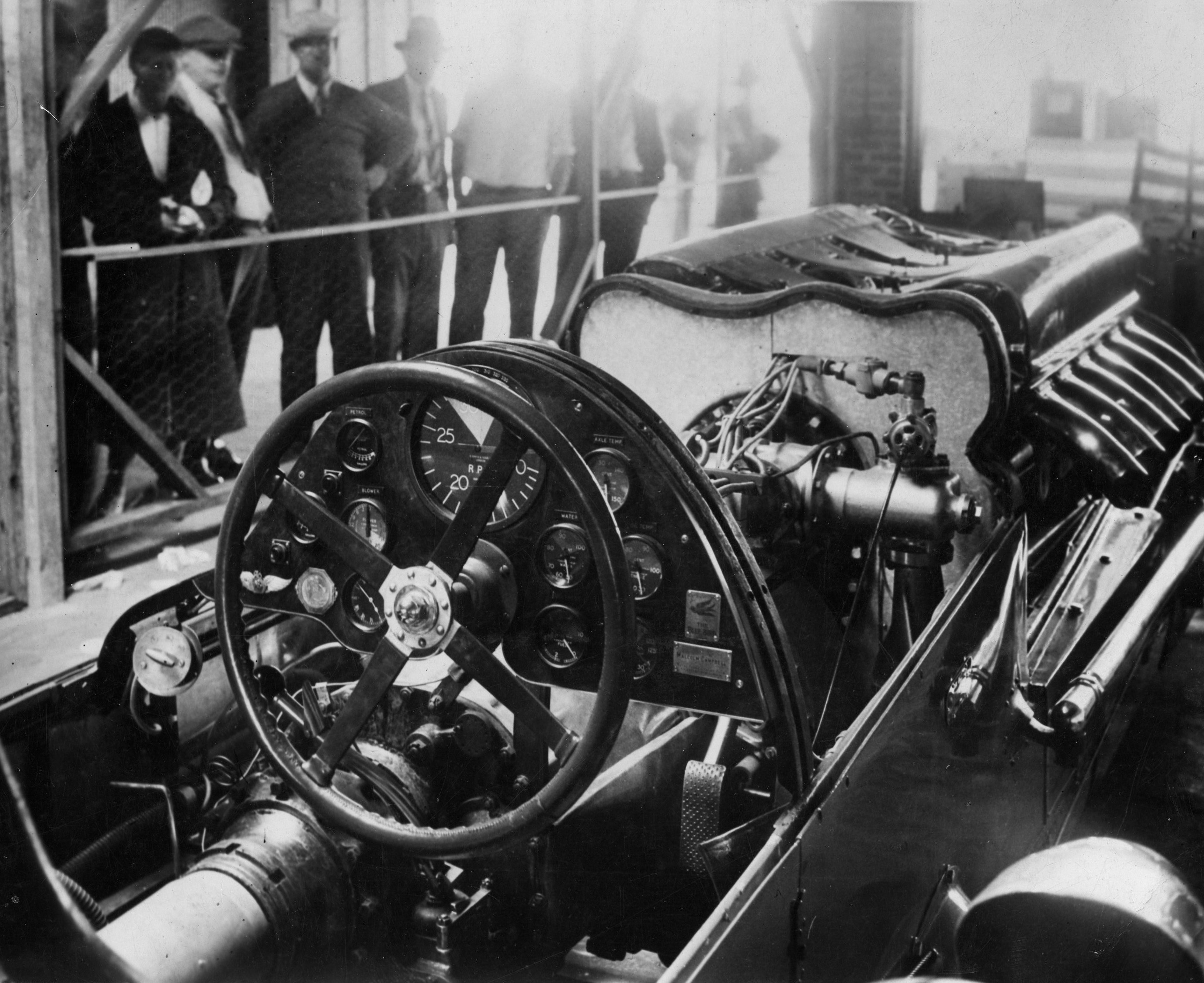
Checkout the rare, period cockpit shot of Bluebird below, it is not clear if Bluebird was touring at the same time as Golden Arrow.

‘Not sure that a current F1 driver would have time to read all the instruments’ Tony wryly observes. There are ten gauges to take in whilst travelling over 200mph- tach, petrol, blower (pressure or temps?) , one obscured, a clock!, then to the left are a car club and St Christopher badges?, then an adjustable knob on the chassis rail itself. On the right are axle temp, water, another temp gauge with another two at the bottom, plus Malcolm Campbell Ltd and Blue Bird brass plates.

(Terdich Collection via VSCC and Graeme and David Miller)

Tailpiece: Albury Sports Ground 1930s…

Finito…


(B Henderson)

Peter Macrow, McLaren M4A Ford FVA leads Kevin Bartlett, Mildren Alfa Romeo 1.6 four-valve, Glynn Scott, Bowin P3 Ford FVA and Brian Page, Brabham BT2 Ford twin-cam, across The Causeway at Warwick Farm on 8 September 1968.

24,000 people were at the ‘farm that Sunday, Pete Geoghegan delivered to expectations by winning the one race, 34 lap, 76 miles Australian Touring Car Championship from Darrel King’s Cooper S and Alan Hamilton’s just ‘orf the boat Porsche 911S/T. Peter Wherrett’s ‘Racing Car News’ race report reveals one of the best tussles of the day was the 15 lapper for racing cars.

The Four Valve Assemblage was not quite complete, the fourth member of the growing group of 1.6 litre Euro F2 cars in Australia, Niel Allen, didn’t race his ex-Piers Courage McLaren M4A FVA. A bumma, because that would have added to the show.

KB settles himself into the Mildren Alfa, note spoilers, ‘new.uw’ is local 2UW radio station (B Henderson)


Lovely portrait of Glynn Scott, Niel Allen is telling Glynn how much more expensive the FVA is to maintain compared with the 5 litre Chev in his Elfin 400…(B Henderson)

Macrow was the ‘newbie’ to the front rank having shown great form in Tony Osborne’s Argo Chev sportscar since taking over its wheel early in the year after Ian Cook accepted Bob Jane’s offer to drive his Elfin 400 Repco and crossed town from Brunswick to East Malvern.

Osborne realised that the limits of the Cooper T53 based Argo had been reached, and acquired Kiwi, Jim Palmer’s McLaren M4A after Allen beat him to the punch to buy Courage’s quick 1968 Tasman mount. Palmer’s car was Bruce McLaren’s own machine, chassis ‘M4A-1’, the first of the breed raced by the chief throughout the 1967 European F2 Championship. Piers was ‘well represented’ on this grid, Glynn Scott’s motor was Courage’ Tasman Cup spare.

Kevin Bartlett was the ace present, but the Mildren Alfa, built on Bob Britton/Rennmax Engineering’s Brabham BT23 jig, was ‘spankers and unsorted. Mildrens dynoed the Alfa Romeo 1.6 litre, four-valve, Spica/Lucas injected engine at 197 bhp @ 8,500 rpm, whereas about 210/215 bhp was claimed for a decent FVA, so it promised to be a good race with Bartlett on pole from Macrow and Scott.

Mildren Alfa, KB. Copy Brabham BT23 spaceframe, Hewland FT200 5-speed transaxle. Alfa Romeo 1598 cc four-valve, alloy block, injected Euro F2 engine. At 280 pounds the Italian engine is lighter than a Lotus-Ford twin-cam? It sits taller in the frame? (B Henderson)


Bartlett at the end of Pit Straight turning into Paddock (B Henderson)


(B Henderson)

Peter got the jump, which was impressive in Bartlett’s backyard, from KB and Glynn and then a gap to to the 1.5 litre cars led by Brian Page, Brabham BT2 Ford, Clive Millis, Elfin Mono Ford, Maurie Quincey, Elfin 600B Ford, Ray Cary, Elfin Ford and the rest.

On lap 2 KB had a crack at Macrow going into Creek but spun on oil on the inside of the track, KB recovered and chased Peter and Glynn in the spectacular tail-out style which was his hallmark. By lap 8 he was up Glynn’s clacker and passed him but further progress was impeded by the chassis undertray coming loose, Scott took back second place.

Scott chased Macrow hard but the Victorian held on to take the biggest win of his career to that point from Scott and Bartlett, Tony Osbornes’s Argo Racing Equipe delighted with a well earned victory.

Credits…

Bryan Henderson took all the wonderful photographs. ‘Racing Car News’ October 1968

Tailpiece…

(B Henderson)

Nice portrait of 28 years old Kevin Bartlett getting his head sorted on the Warwick Farm dummy grid before the off. It was a great year for the Sydneysider, he won his first Gold Star at the wheel of Mildren’s Brabham BT23D Alfa Tipo 33 2.5 V8.

This chassis did not use the Alfa engine for long, Max Stewart raced it from 1969 fitted with Waggott TC-4V 1600 cc, 1760 cc and 2 litre motors with great success.

Finito…

(Brabham Family)

Brabham’s Cooper T23 Bristol was billed as the fastest car of its type in the world as a Jack’s ongoing development of it with Frank Ashby’s advice and mentoring off to the side.

These images from the Brabham Family Collection were taken at Mount Panorama during the Easter 1954 meeting, the start of the A-Grade scratch race.

Jack’s T23 being tended by Keith Holland in the white overalls and Arthur Gray of Belshaw Foundry in the blazer (Brabham Family)

I’ve done Cooper Bristols and Jack’s T23 chassis ‘CB/1/53’ to death, here; https://primotipo.com/2017/02/24/the-cooper-t23-its-bristolbmw-engine-and-spaceframe-chassis/ and here; https://primotipo.com/2016/06/24/jacks-altona-grand-prix-and-cooper-t23-bristol/

The other two photos are at Mount Druitt, Stephen Dalton reckons June 27 1954 or 8 August 1954, thanks to Stephen and John Medley for photo IDs.

Credits…

Brabham Family Collection, ‘The Jack Brabham Story’ Jack Brabham with Doug Nye, Stephen Dalton, John Medley

Tailpiece…

(Brabham Family)

Finito…

I’ve been lovin’ these S5000 retro F5000 digital imaging of the Ligier JS-F3 S5000 Ford chassis, its been a great way to keep S5000 in the public eye whilst we package up the Covid 19 Dim Sims and send them back to those Wet Market pricks in Choina so we get back to normality.

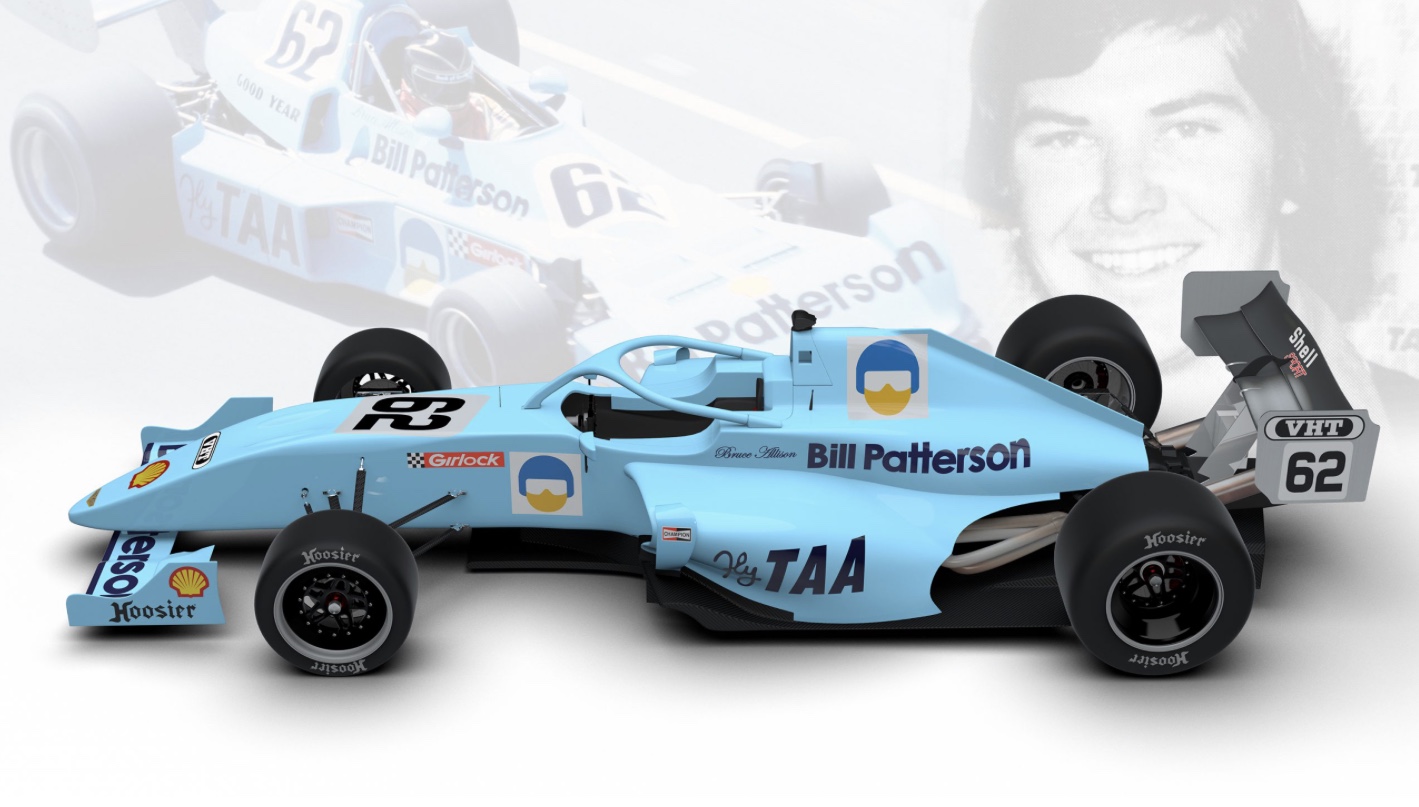
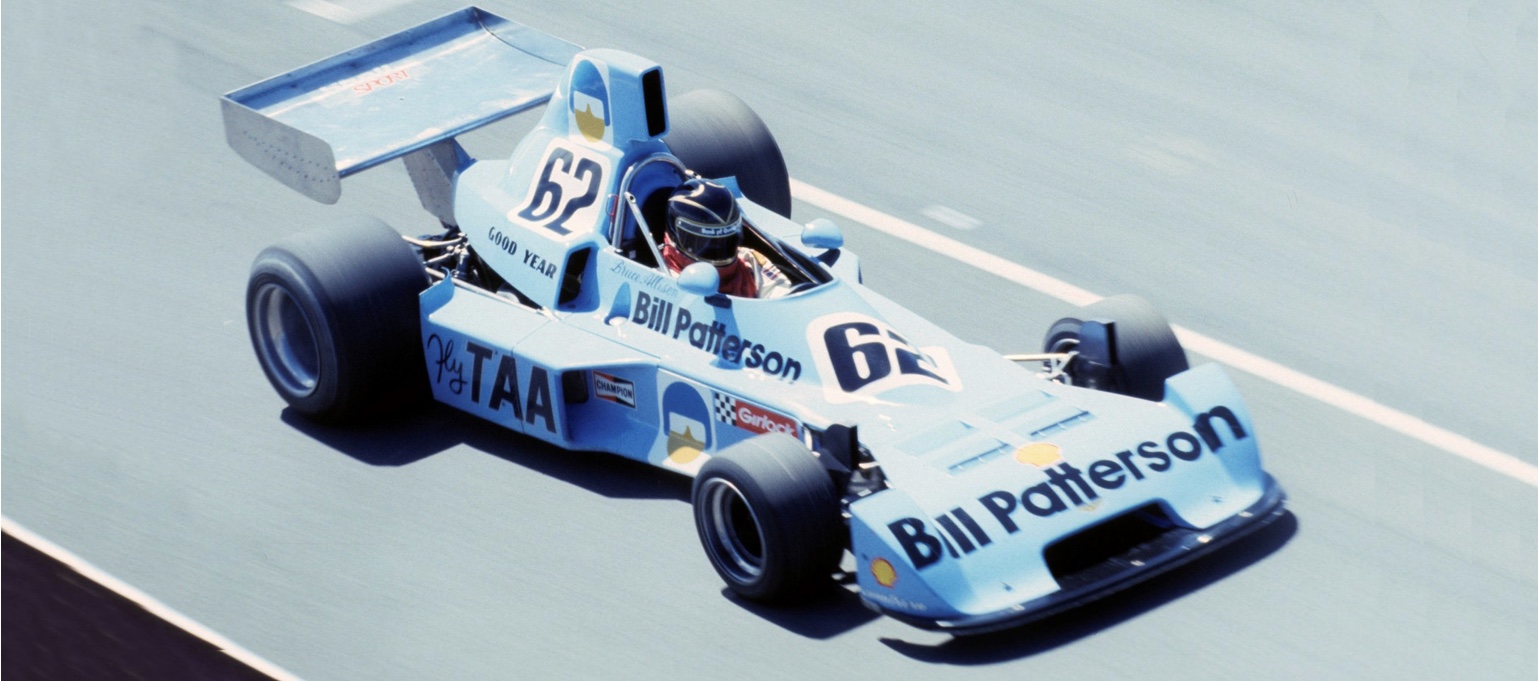
Finally, they’ve got to Bruce Allison, and what do they dish up? Not the worlds best rip-off of JPS black, but the poofhouse baby-blue hue applied to his Bill Patterson supported Chevron B37 Chev in the summer of ’78. W.T.F. dudes!?

Allison, Chevron B37 Chev, Surfers Paradise 1978, started from the front row but out after 40 laps with lost oil pressure. Brown won in a Lola T333/332 (S5000)


Satanic, sinfully sexy black ‘n gold pin-striped Lola T332 Chev @ ‘Torana’ Sandown circa 1976 (I Smith)

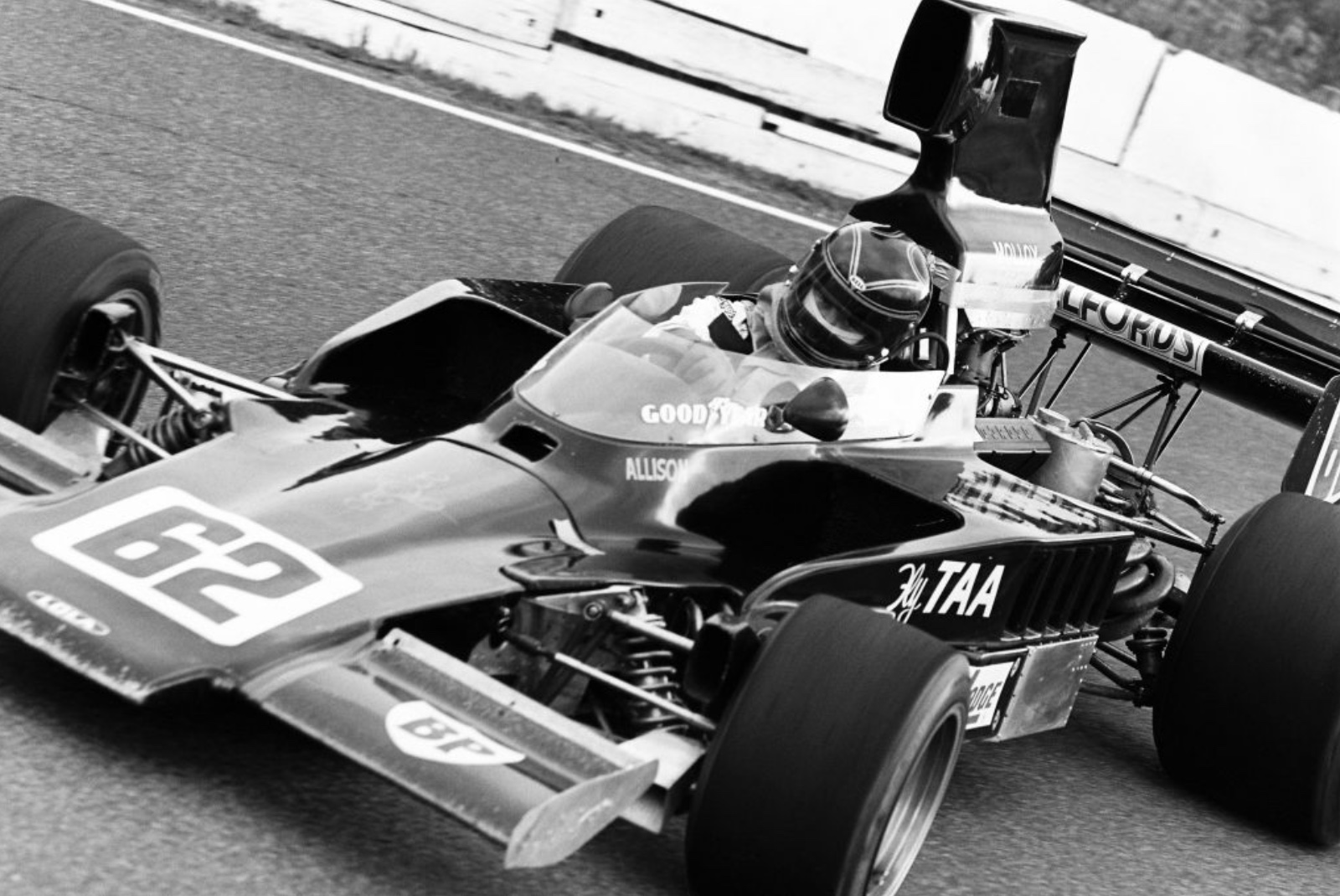
My tongue practically stuck to the grass, sick unit that i am, when i spotted Bruce’s favourite (sic) car, the ANF2 Bowin P6 Ford-Hart in the Surfers Paradise paddock so equipped in September 1973. His subsequent Birrana 274, Lola T332 and Ralt RT4 all got a squirt from the same paint can, gold stripes and all, and didn’t they look grouse! Maybe its comin’…

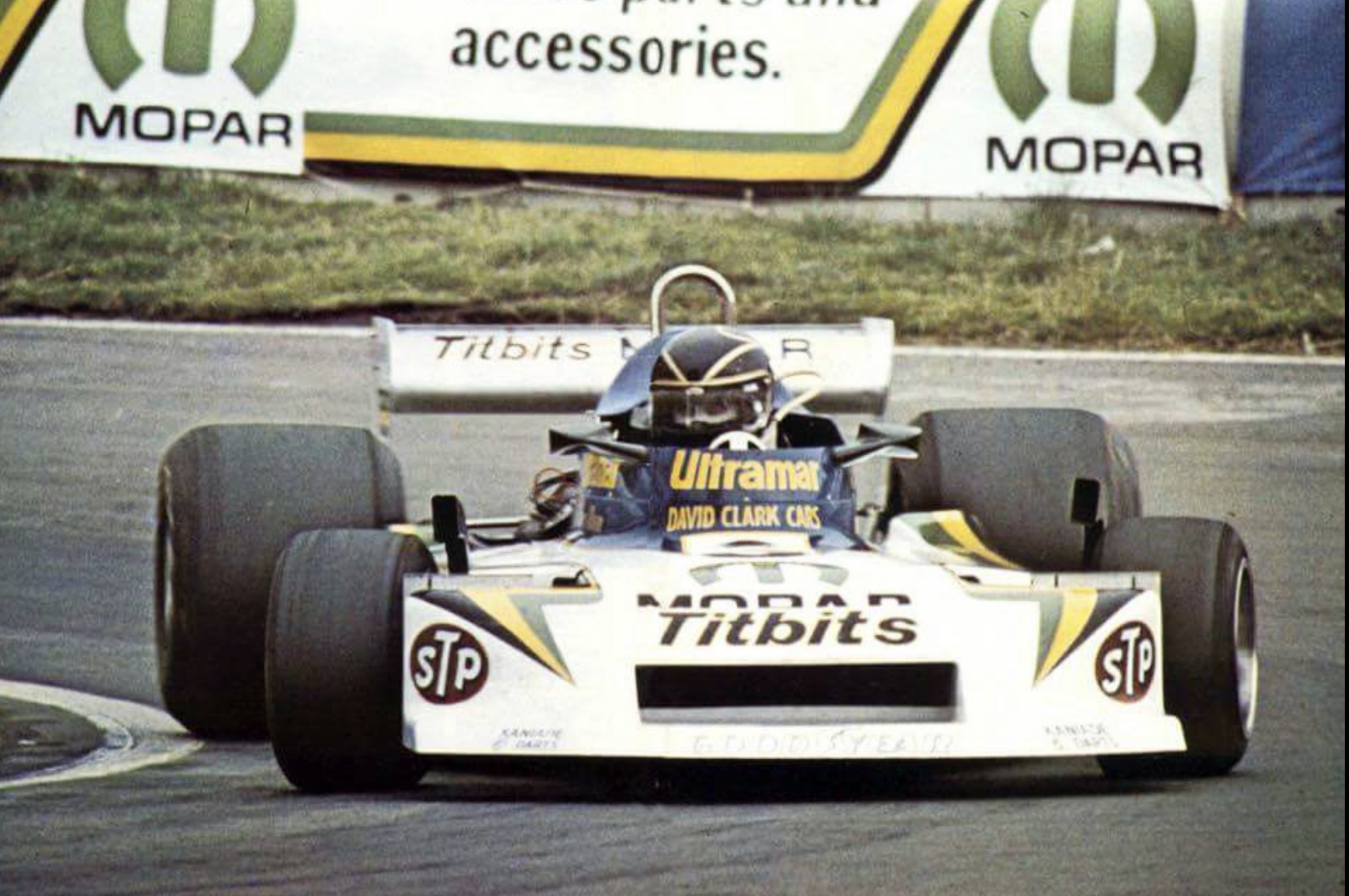
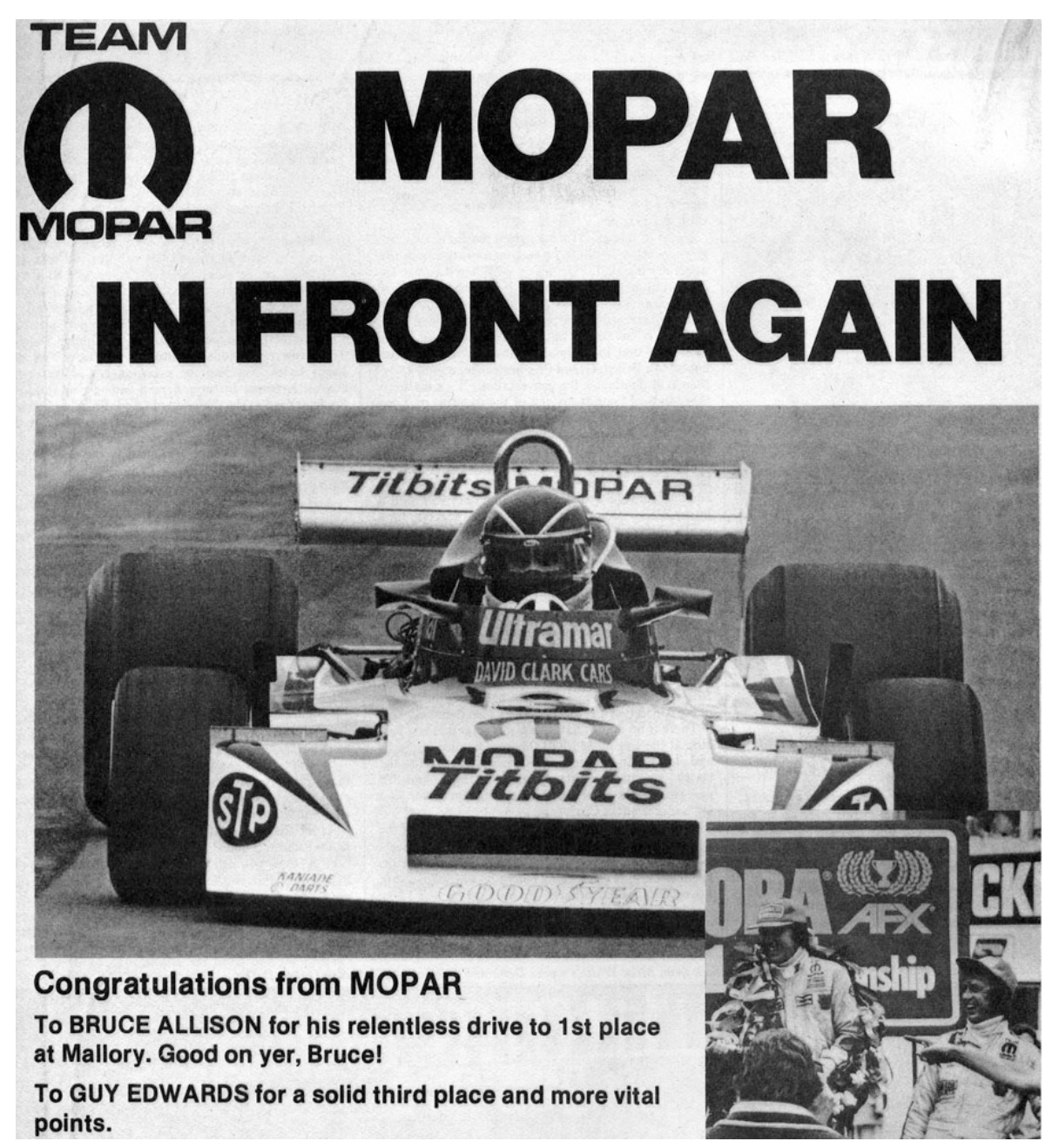
Anyway, its been a while since i had a Brucie Google and some good stuff popped up, shots of the 1978 Aurora British F1 Championship, he initially ran a RAM Racing March 751 Ford but copped a much better March 781 chassis mid-season and achieved some good results including a win at Mallory Park in July, holding out eventual champion, Tony Trimmer, in the process.

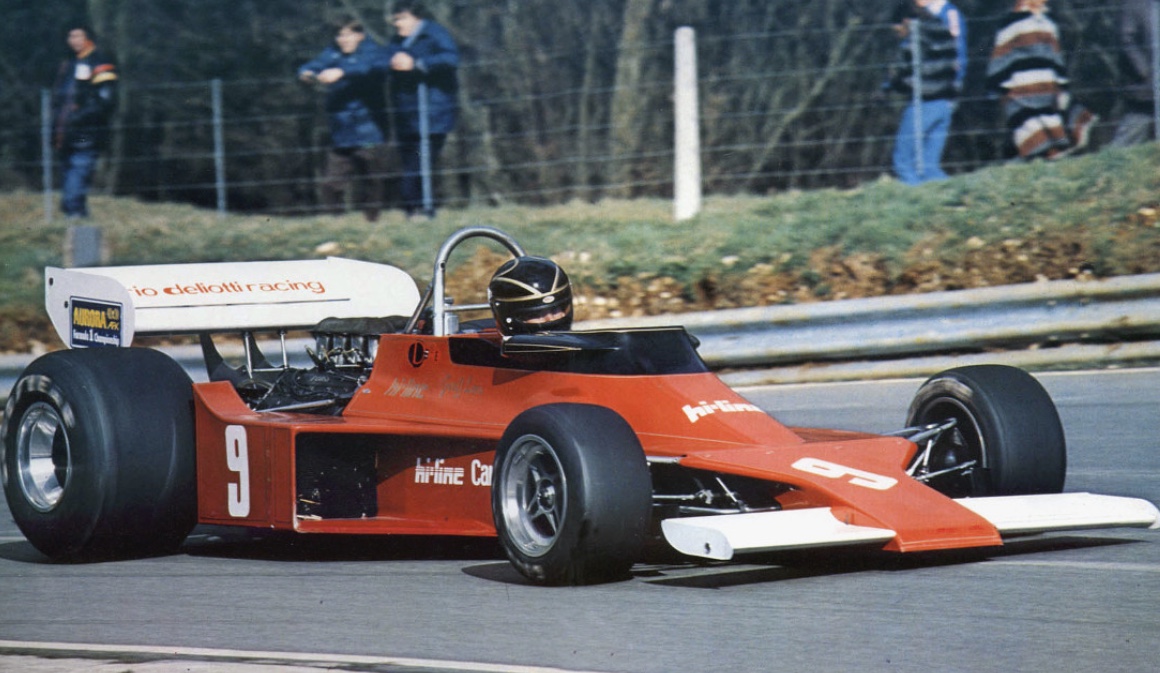
This one is rare as rocking horse shite, Allison in Mario Deliotti’s Ensign N175 Ford in practice, he didn’t start the Evening News Trophy at Brands on 27 March which is a pity as he qualified third behind Trimmer and Lees.

Tony Trimmer’s McLaren M23 won from Geoff Lees, Ensign N175 and Emilio Villota’s McLaren M25 Ford.


Oulton Park F1 Trophy, held on June 24, March 751 Ford, he qualified fourth and finished second behind Guy Edwards’ March 781 Ford.


These two are at Donington during the May 21 ‘Formula 1 Trophy’.

Practice shots, DNF without completing a lap, March 751 Ford, Giancarlo Martini won in a Ensign N175 Ford from Edwards’ March 781 and Bob Evans’ Surtees TS19 Ford.


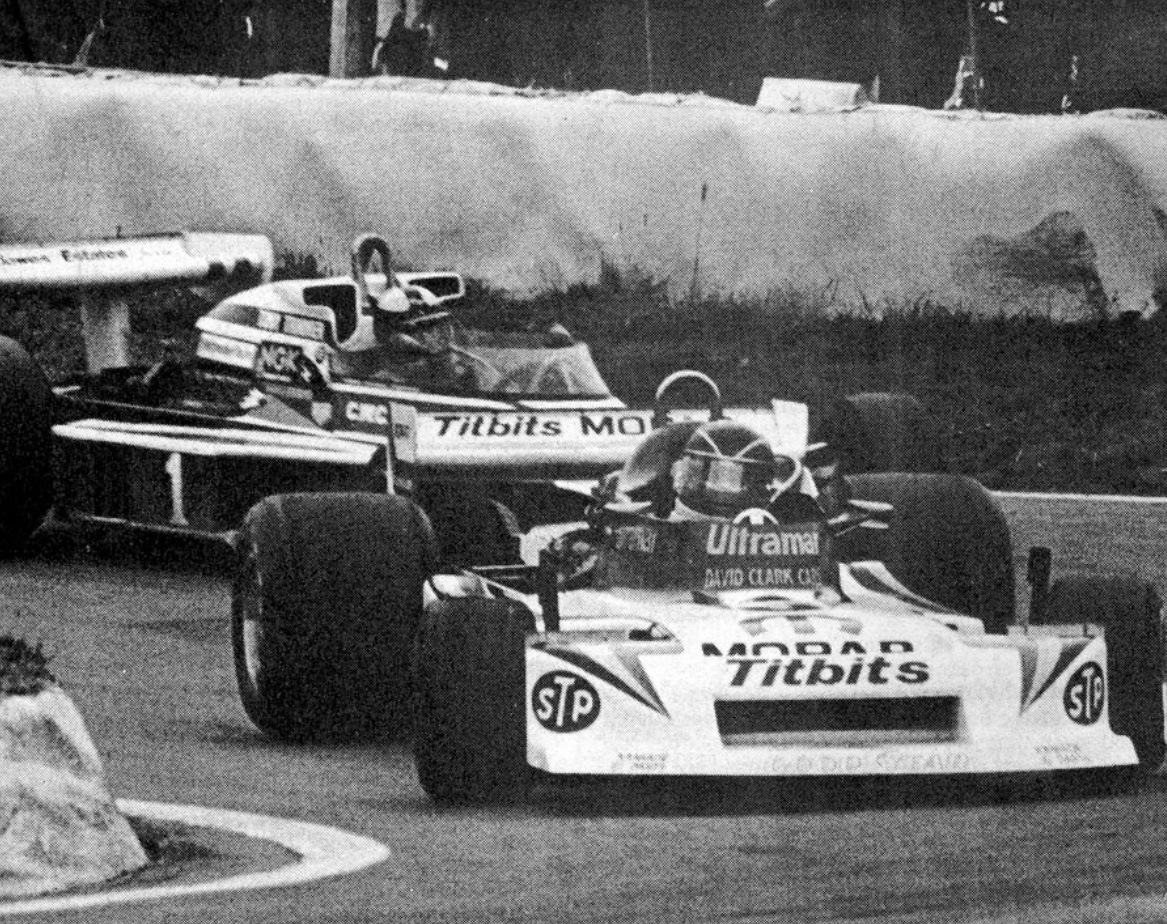
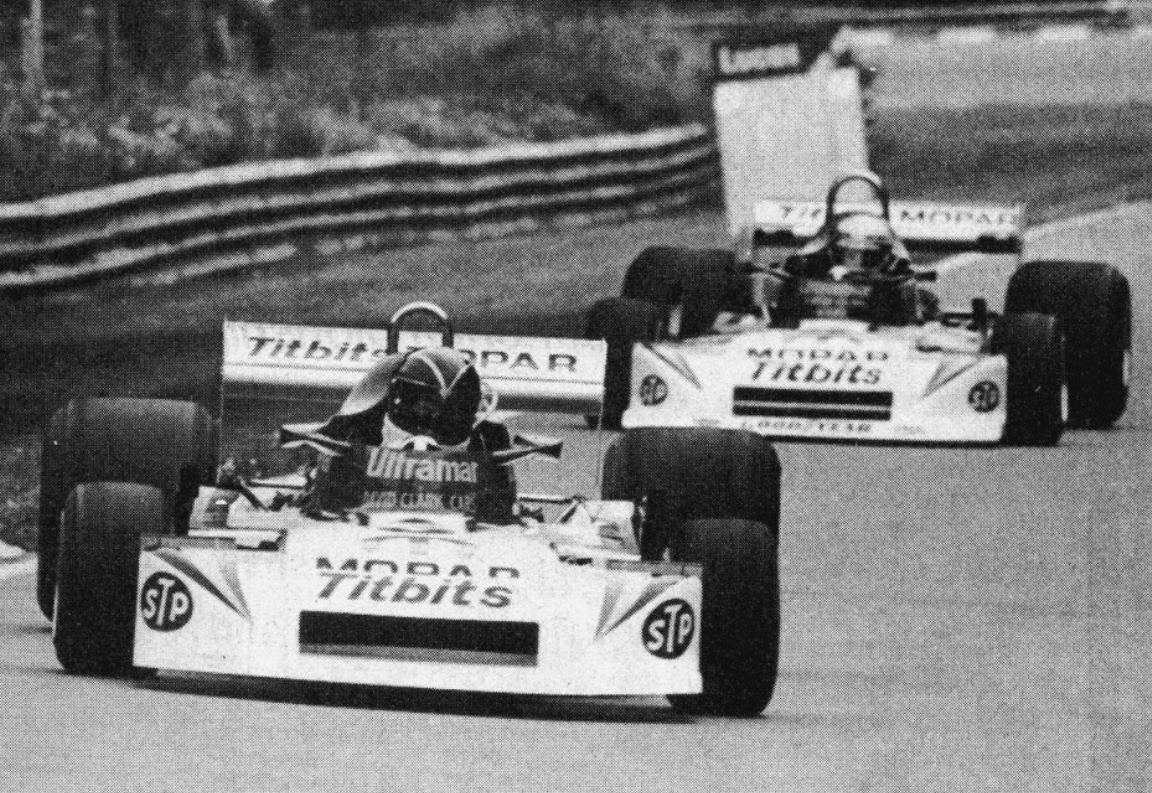
At Mallory on 30 July Bruce put his new March to good use with Trimmer’s McLaren up his chuff for much of the 75 lap race, he finished ahead of Tony and teammate Guy Edwards in the other RAM 781.

Looks like the photographers all share a beer together at the hairpin, Allison from Trimmer.


The Brands Hatch Trophy was on August 28, the tenth round, Stephen South stirred things up by popping his March 782 Ford on pole, five cars failed to finish the first lap- South, Teddy Pilette’s BRM P207 (poor bastard), Adrian Russell’s March 762 Ford, Brett Riley’s similar car and Bruce, what happened folks?

The shot below is Bruce and Edwards’ 781s in practice.


The Budweiser Trophy at Snetterton on September 24 was the last round of the season, Emilio de Villota McLaren M23 was on pole from Bruce, David Kennedy won in the Theodore Racing Wolf WR3 Ford we saw him race in Australia, from Trimmer and Allison.

The shot below is Allison from Trimmer and one of the Hesketh 308Es.

The title was Trimmers, 50 points ahead of Bob Evans, De Villota, Edwards, Lees and Allison.

Etcetera…

(J Payne)

The first and last of the Allison black beauties.

At Amaroo Park in August 1973 in the ANF2 Bowin P6 Ford-Hart, the rising-rate suspension beauty was not his favourite car, out of the points that weekend, Bruce did far better with a Birrana 274 in 1974.

Having retired too young Allison did a Nellie Melba and contested the first season of Formula Pacific in this Ralt RT4 Ford BDA, winning the 1981 National Panasonic Series, this shot is at Calder in August, he was second and fifth in the two races.

(P Weaver)

Credits…

S5000, autopassion.net, MotorSport, Rich Harman, Ian Smith, Scuderia57, J Payne, Peter Weaver

Tailpiece…

(I Smith)

Love this shot, Bruce tipping the B37 into Shell at Sandown during the 1978 Rothmans round. Grid 5 but DNS with timing chain failure, Warwick Brown’s Lola T333/332 took both the round and the series.

The car did look great in this livery but nowhere near as good as it would have in Allison/JPS black ‘n gold!

Finito…


(R Herrick)

Ken Wharton’s BRM P15 is pushed onto the Ardmore grid during the January 1954 New Zealand Grand Prix weekend.

He had the race in the bag until a silly problem caused by a bit of road grit ruined his race, see this article for a feature story on this machines trip south to the Ardmore and Wigram meetings that summer; https://primotipo.com/2019/11/18/ken-wharton-and-brms-grand-turismo-south-in-1954/

(R Herrick)

It was this rare photograph of the unclothed rear of P15 chassis ‘2’ which caught my eye. Note the chassis, beefy de Dion tube, big Exide battery mounted nice and low, no lightweight aircraft Varley batteries in those days. The Dunlop brake calipers- one of the edgy aspects of the design can be seen and the oil tank at the extreme rear, the big fuel tank is behind the driver but within the machines wheelbase.

I know the car was bonkers, was it Doug Nye who described its design and construction as being akin to a group of Victorians attempting a moon landing?  In any event, the thing is endlessly fascinating in terms of the projects politics, personalities, extraordinary engineering and innumerable ‘what if’s’.

(M Millar)

Credits…

Roger Herrick, Max Millar

(R Herrick)

Ardmore paddock, interest in the rear of the car indicates that things up-front ok, even if for a brief period of time! Love the Lucas mans service vehicle, probably the busiest service man in New Zealand…

Finito…
(B Henderson)

Cripes! Move. My clutch! My water temperature!

Look a bit closer, the Formula 3 car caught in the 1969 Monaco GP traffic is being towed by the Simca in front. I love the creativity of Bryan Henderson’s shot, a Scot who emigrated to Sydney. Peter Houston tells me he was a Formula Vee racer in the mid-1970s; he plies his trade as Scanpix.

Bryan recalls, ‘The 1969 Monaco GP was my first F1 race. I had just arrived to pursue a career as a freelance photographer and jumped on a train down to the south of France to catch the race. I remember taking a photo of the car in traffic. I was waiting to cross the road, and there was the open-wheeler in my way! I was able to get the shot as it drove away.’

So, who is it?

F2 Index to the rescue. My guess as to the number is 50, 52, 58 or 59! #50 was Bernard Plaisance, who raced for Ecurie Tecno France, Tecno 69 Ford, DNQ. Car 52 did not arrive, so let’s cross him off. #58 was Peter Hanson’s Chevron B15 Ford DNQ, and #59 was Roger Keele, EMC F3 Ford; he was eighth in the race won by Ronnie Peterson’s Tecno 69 Ford. I’m going for Bernard, he’s French, the other two blokes are British, so would probably have a Pommie registered tow car…

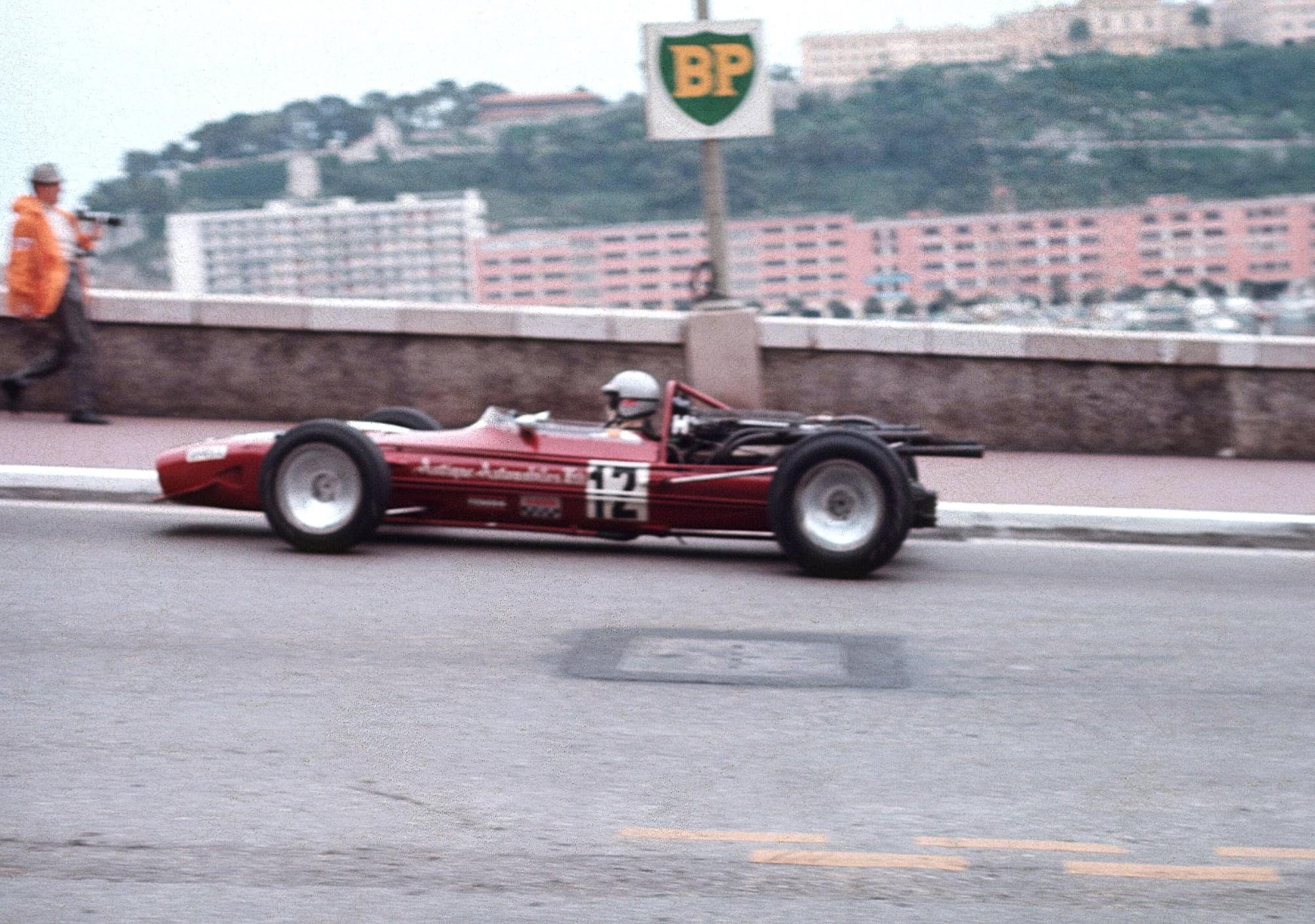
I’ve chosen a few other Henderson shots, which are a bit different from the average. The first is Vic Elford heading up the hill from Ste Devote in his Cooper T86B Maserati. Q16 and seventh place in the race won by Graham Hill’s Lotus 49B Ford from Piers Courage’s Frank Williams Brabham BT26A Ford and Jo Siffert’s Rob Walker Lotus 49B Ford.

(B Henderson)
(B Henderson)

The next one is Jackie and Helen Stewart walking down the hill towards Ste Devote, JYS even has a bag-man, who is the guy, he looks familiar? Is it Andy Granatelli?

How great it would have been to have attended the race then, plenty of challenges too that weekend, high wings were banned after the Thursday session by the CSI, so the shot of Jo Siffert’s Rob Walker Lotus 49B Ford sans wings is probably on the Friday, by Saturday front wings were back.

(B Henderson)

Credits…

Bryan Henderson at Scanpix.com.au

Tailpiece…

(B Henderson)

Denny Hulme’s (sixth) McLaren M7A Ford on Pit Straight, perhaps a Matra ahead, classic Monaco shot with that home-made fence in the foreground!

Finito…

Terence James Trowell was an incredibly talented writer and graphic designer/illustrator.
‘Jet Black, Racing Driver’ was one of his many accomplishments, its excellence made easy for him as a lifetime car nut and race fan.
Google is such a tricky little minx, sometimes you can give her a tickle and get the result anticipated, on other occasions you nibble her ears much the same way you did a couple of days before and she surprises you with her secrets, this is one of those happy occasions.
I’d never heard of Terry Trowell until Tuesday night. His was a shortish but full, fascinating life. Many thanks to Kevin Patrick, this article is the GTAm ‘allegerita-modificato’ version of his Trowell profile in Comics Down Under of March 12, 2010.
Born in Katanning, in Western Australia’s south-west on September 4 1918, Trowell’s formative childhood years were in Malaya where his father was a mining engineer in Ipoh, Perak. He returned to Australia in 1926, boarding at Perth’s Guildford Grammar. At 20, after studying journalism at the UWA he returned to Malaya as a journalist on The Straits Times.

Having returned home in 1940, Trowell enlisted in the Australian Army in July 1942, where his unique skills as an artist with personal experience and knowledge of the Asia-Pacific region, earmarked him for military service with such specialised branches as Operational Intelligence, the Allied Intelligence Bureau and Z-Force, a special operations commando unit which undertook dangerous missions behind Japanese lines. Trowell’s duties included topography, map-making and interrogating prisoners of war in Malaya at the end of hostilities.

Discharged with the rank of corporal in July 1946, Terry travelled to England where he studied art before going to France where he worked as a freelance artist. He returned to Perth in 1948, via the United States. Back home he created a series of murals for several hospitals, hotels and commercial buildings and was then commissioned to illustrate a series of social studies books documenting Western Australian history, the first volume, Early Days of W.A. Towns, was published in 1949.

The following year, he moved to Melbourne with his wife, Patricia Powell, a school teacher studying music and training to be a concert pianist. This was the beginning of his involvement in Australia’s then-booming comic book industry. During 1950/1951 he was a freelance writer and illustrator for Atlas Publications, a Melbourne company which scored early commercial success with the superhero comic Captain Atom.

Trowell’s first series for them was The Grey Domino, a masked vigilante described as “the hooded nemesis of crime”, which debuted in 1951. His storylines were set in exotic locales and featured glamourous women and implacable rogues and were illustrated with great skill – a creative combination for success.

For his next series, Terry inherited a cowboy comic titled The Ghost Rider, a wandering cowboy who
dons a black mask to become ‘The Ghost Rider’, whenever trouble looms. Trowell’s work on The Ghost Rider marked a significant advance in his ability as a comic book storyteller.

In 1952 Terry returned to Perth where he established an art studio, but he continued to work as a freelancer for Atlas Publications on The Grey Domino, The Ghost Rider and Rhino Beresford, released by Atlas in 1957. Accompanied by his loyal aide and ‘gun-boy’, M’Bolo, (in most politically incorrect fashion for this day and age), the phlegmatic British hunter, Major Beresford, is known and respected throughout French Equatorial Africa as ‘Bwana Kifaru’ (‘Master Rhino’), able to best any man or beast in the jungle.

Trowell was appointed Art Director of Modern Motor in 1956, published by Modern Magazines Pty. Ltd., a company which also produced Modern Boating and Australian Cricket. Capitalising on his new employers size, he re-entered the comic book market, creating Jet Black – Racing Driver (11 issues), which took its bow in 1958.

Jet Black was a former World War II fighter pilot, who is now the number one driver for the Cougar Racing Team, managed by his wartime colleague, George Faversham. Accompanied by Jet’s girlfriend, Rusty Redd, the trio became entangled in foreign intrigue wherever they went on the racing circuit.

Terry seems to have taken his inspiration from the real ‘JB’ who had not long before joined Cooper Racing, although Cougar Racing was in decline, which Cooper most certainly was not at that stage anyway!

‘Drama is maintained and racing interrupted with a steady stream of villains and beautiful female Interpol agents while a good pair of fists is as useful as a four-wheel drift’ observed ‘Repco 22’ on The Nostalgia Forum.

Modern Magazines was keen to align Jet Black with its racing publication. Trowell’s richly painted covers were adorned with the blurb, ‘Modern Motor presents Jet Black’, while the comic featured text stories and photos taken from Modern Motor, profiling contemporary racing drivers and their cars.

‘The inside back covers offered photos and news of current happenings in the real racing world and there were board games featuring famous circuits on the back page’ Repco 22 adds. It was ‘Altogether a delightful package. A pity it only ran to thirteen issues but American comics were being dumped cheaply on the Australian market and our (comics) industry drew to a sudden halt.’

In 1956/7, despite being in Sydney, Terry and his brother John were on the Western Australian Sporting Car Club organising committee of the 1957 AGP held at Caversham that March. His skill as a graphic designer is shown in the suite of material he created for the race which extended to signage, tickets, the program and promotional material.

Trowell also designed a series of full-colour ‘Famous Racers’ posters and ‘Race Games’, depicting well-known circuits which were printed on the comic’s back covers. Each issue of Jet Black was endorsed by the publisher as “an original story, based on authentically drawn scenes and cars, which is both entertaining and educational for readers of all ages.”

At this stage Terry also produced three issues of the True Western comic book series for Modern Magazines. These comics, titled Truth about Jesse James, Truth about Custer’s Last Stand and Killer Marshal – Truth about Wyatt Earp, were factual accounts of famous figures from America’s ‘Wild West’ era.
‘Trowell’s other major comic for Modern Magazines was the offbeat, one-shot title, Purple People Eater. Taking its name from the popular song recorded by Sheb Wooley in 1958, Purple People Eater was a freewheeling romp of a comic, full of space aliens, a hip-swivelling Elvis look-alike, beatniks and a spear-wielding witchdoctor that not only defied description, but mirrored some of the best satirical comic strips then appearing in America’s famous Mad Magazine.’

Lindsay Ross ‘Kerry Cox lights up the retreads on the Paramount Ford out of Newry Corner, Longford 1965 (oldracephotos.com)

Aha! A sidebar. So the nickname of the ‘Krazy Kerry’ Cox famous Paramount Jaguar Spl aka ‘Purple Petrol Eater’, was nicked from either the pop song or Terry’s comic!
Cox was an immensely popular driver amongst his peers and spectators alike, his sportscar was one of Tasmania’s most iconic sixties racing cars.
In 1960 Terry returned to Western Australia, to establish ‘Trowell Purdon Advertising’. He entered the television industry in 1960, working for the Australian Broadcasting Commission for whom he appeared in a children’s television program to use puppets for on-air drawing lessons. He joined J. Gibney & Sons Art Studio as chief illustrator and designer in 1962.
Sadly, his life was cut short on 23 October 1964, when he died from a war-related medical condition. ‘While the history of Australian comics is all the poorer for his untimely death, Terry Trowell nonetheless left behind a significant body of work which entertained countless readers and enriched the comic book medium.’

(Cox Family)

Cox built the Paramount Ford together with Norm Nott. The machines’ chassis was based on the tubular chassis of a Paramount Ford, a British low volume car of the early to mid-1950s.
Rather than the puny Ford Consul 1508cc four, power was provided by a Ford Customline V8 with ‘mechanical bits donated from more than a dozen makes,’ wrote Ellis French. The body, constructed mainly of fibreglass was laid out and formed over chicken wire, as shown in the photograph above. The little dude to the left is Tasmanian entrepreneur/enthusiast/historian Rob Knott.

(Reg Dalwood via HRCCT)

Great shot of Cox blasting the Paramount Ford away from Longford village, he is about to jump the railway line and then charge along Tannery Straight. The shot below is more like Kerry, a very fast driver of great exuberance and skill at Symmons Plains circa 1965. Perhaps John Pooley’s VW based Pooley Special on the inside?

(HRCCT)

Ellis French tells us that once Kerry moved on to the Le Mans Jaguar, the Petrol Eater was sold to Ralph Terry before ultimately ending up on the northwest coast of Tassie, perhaps East Devonport, with a replica appearing at Symmons Plains circa 2010.
Credits…
Tailpiece…
Finito…