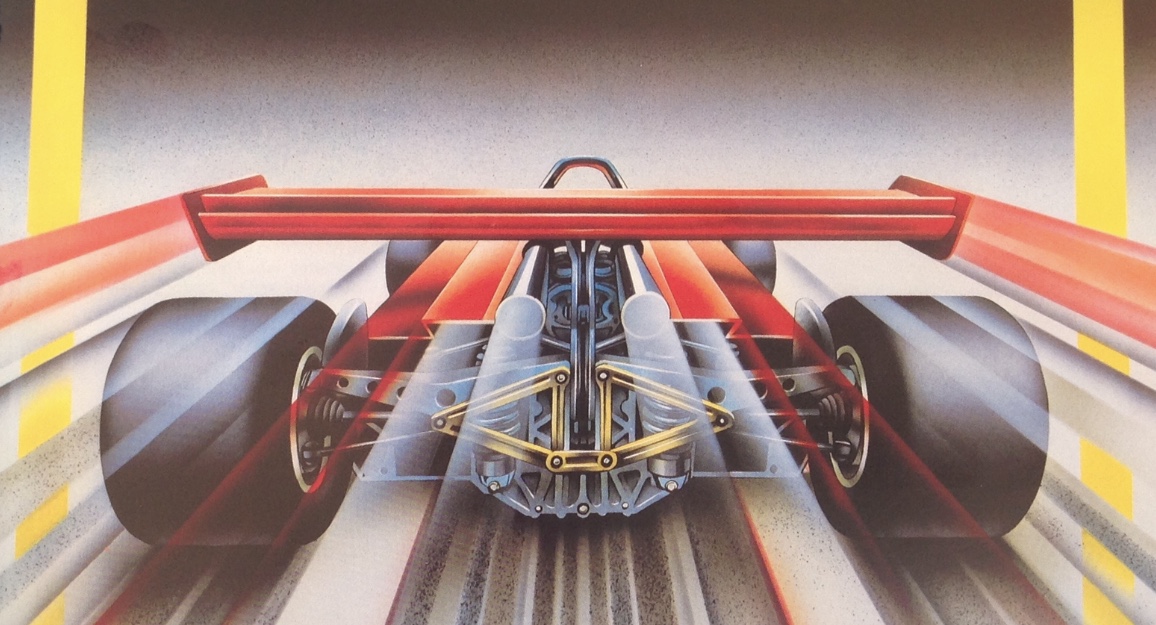
An impressionist’s perspective of the Ferrari 126C4 or thereabouts.
I cropped it off an AGIP ad of the period, I rather like it…
These turbo-charged Ferraris were an evocative series of Gee Pee cars for those of us in Australia who saw our first F1 machines ‘in the metal’ in the early Adelaide years.
Dangerous cars, high powered, towards 900 bhp depending upon the specs, aluminium monocoque chassis early on and then carbon fibre from the 1982 Harvey Postlethwaite designed 126C2.
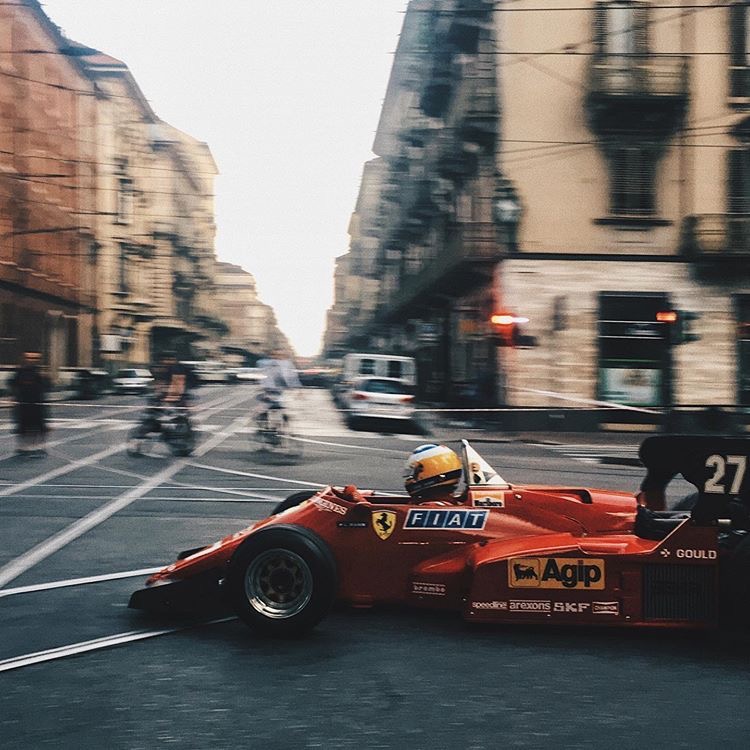
Alboreto off to the shops in Turin- 126C4 in 1984 (unattributed)
Carbon fibre and kevlar monocoque chassis, disc brakes all round, rack and pinion steering. Pull rod and twin wishbone suspension front and rear. 1496 cc DOHC, 4-valve, twin-turbo charged 120 degree V6- 660bhp @ 11000 rpm. 5 speed manual transaxle (unattributed)
Gilles Villeneuve died in one at Zolder in 1982 and Didier Pironi had a huge career ending shunt at Hockenheim six races later.
Some talented fellas raced the cars to ten wins from 1981 through 1984- the roster included Villeneuve, Pironi, Andretti, Tambay, Arnoux and Alboreto. All won at least one race except Mario who had only two starts- at Monza and Las Vegas in late 1983.
(Getty)
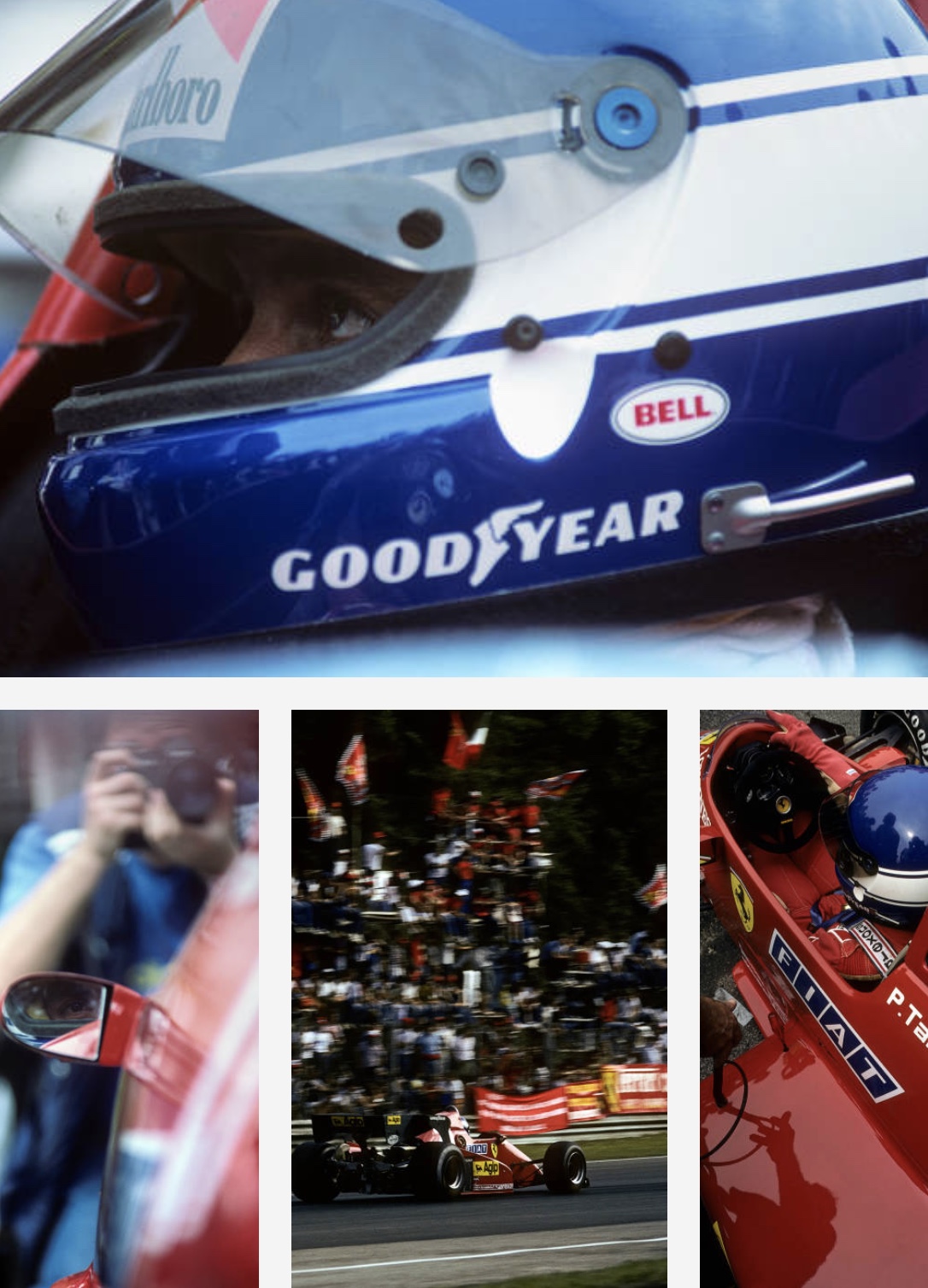
Patrick Tambay 126C3 montage from 1983, above, and Michele Alboreto in a C4 at Monaco in 1984 below.
Tambay took two 126 wins at Hockenheim and San Marino in 1982 and 1983 respectively, whilst Michele won at Zolder in 1984.
Credits…
AGIP, Getty Images, Paul-Henri Cahier, LAT Images
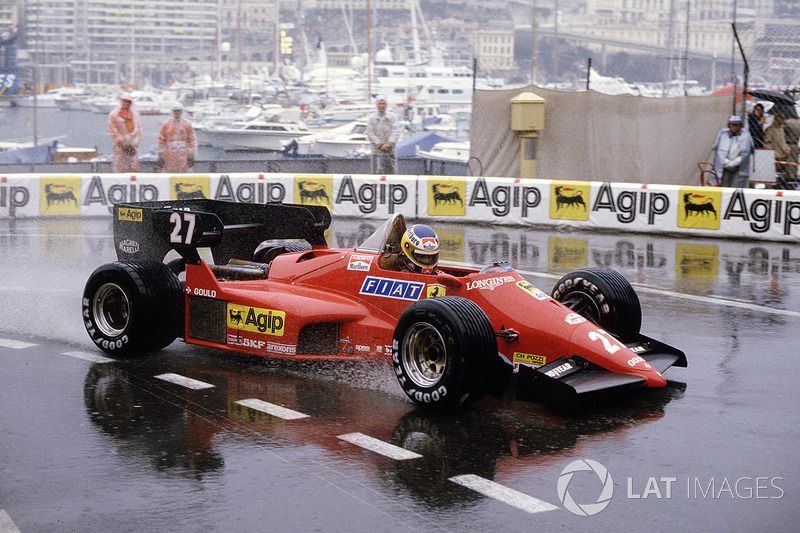
Tailpiece: Ferrari 126C4, Monaco June 1984…
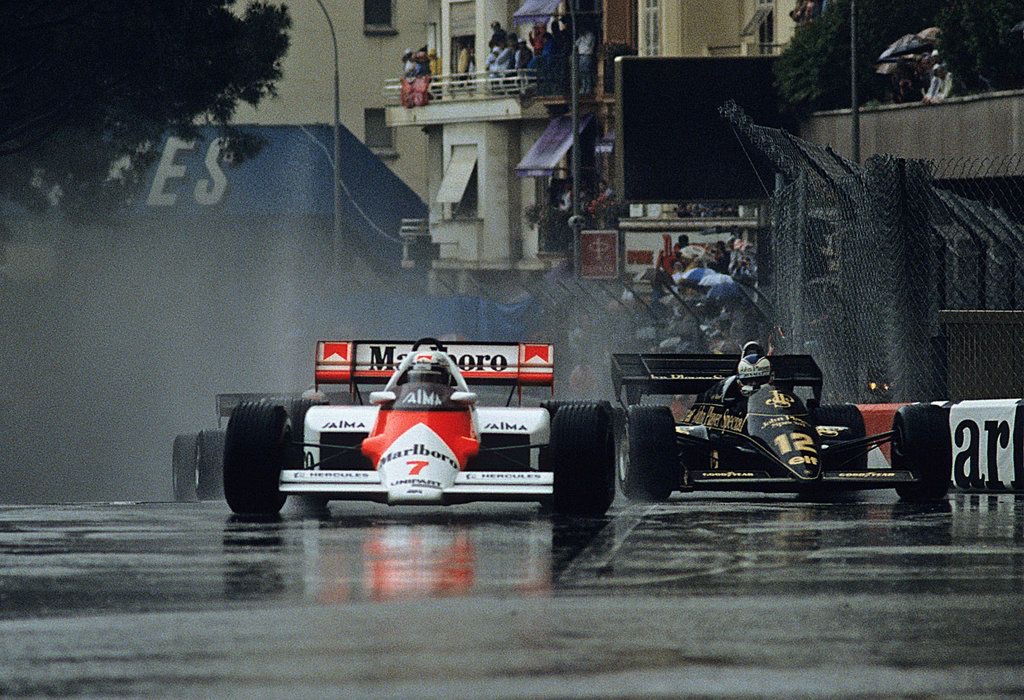
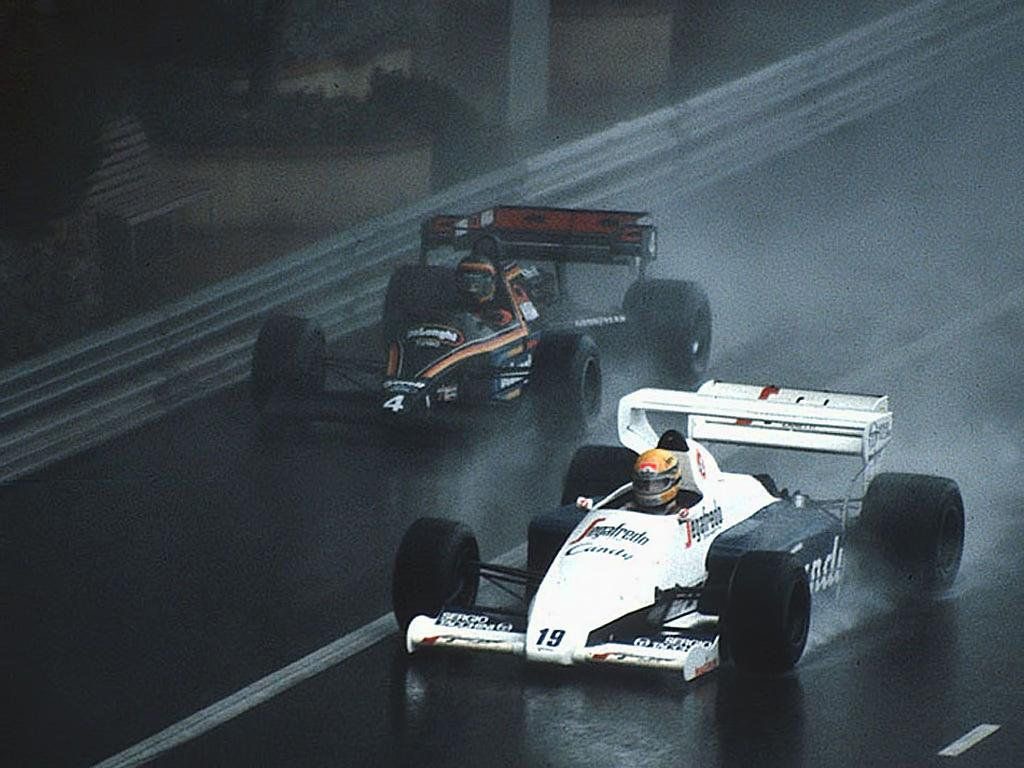
Arnoux and Alboreto were third and sixth at Monaco in 1984, Alain Prost won the race in a McLaren MP4 TAG- Porsche from Ayrton Senna’s rapidly closing Toleman Hart.
Only the early red flagging of the race- because of the awful wet conditions prevented the precociously talented Brazilian taking his first F1 victory.
Prost, McLaren MP4-2 TAG Porsche from Mansell, Lotus 95T Renault early in the race- Mansell lost it on lap 16- and we saw it all from the in-car footage. Monaco in the wet with 800 bhp or thereabouts to tame (unattributed)
Factory Porsche 956 driver Jacky Ickx was the Clerk of The Course, he took the decision to red flag the race in favour of the TAG-Porsche engined McLaren, at a time the rain had eased somewhat- without recourse to the race stewards.
Mind you, it’s said that Senna’s car had damaged suspension and would not have lasted too many more laps- and then there is Stefan Bellof, Tyrrell Ford mounted who was catching them both hand over fist, he too was disqualified later for weight restrictions broken by Tyrrell…
(unattributed)
Senna, Toleman T184 Hart 415T and Bellof, Tyrrell Ford DFY with Ayrton pulling away, but Stefan surged back to third later in the race- and was threatening Senna and Prost.
Speed, drama, excitement, politics- all the elements that make GP racing great.
Ron Tauranac’s two Brabham BT5 Lotus-Ford twin-cams’s were built in 1963…
The Ian Walker Racing ‘SC-1-63′ achieved plenty of success in the hands of both Frank Gardner and Paul Hawkins.
The car used a typical Tauranac multi-tubular spaceframe chassis with upper and lower wishbones at the front and lower links, inverted top wishbone and two radius rods- coil spring/shocks front and rear. Rack and pionion steering, disc brakes all around, a Hewland 4-speed gearbox and a Cosworth tuned Lotus-Ford Twin-Cam of 1596cc giving circa 140 bhp completed the package.
The photograph below is a BT5 test session at Goodwood early in 1963 with the Aussies out in force, oh, and a Kiwi.
From left in the nice, warm ‘jumper’ is Paul Hawkins, lanky Frank Gardner, the Guvnor and Denny Hulme. All rather handy at the wheel of a motorcar- and on the end of a ‘spanner’.
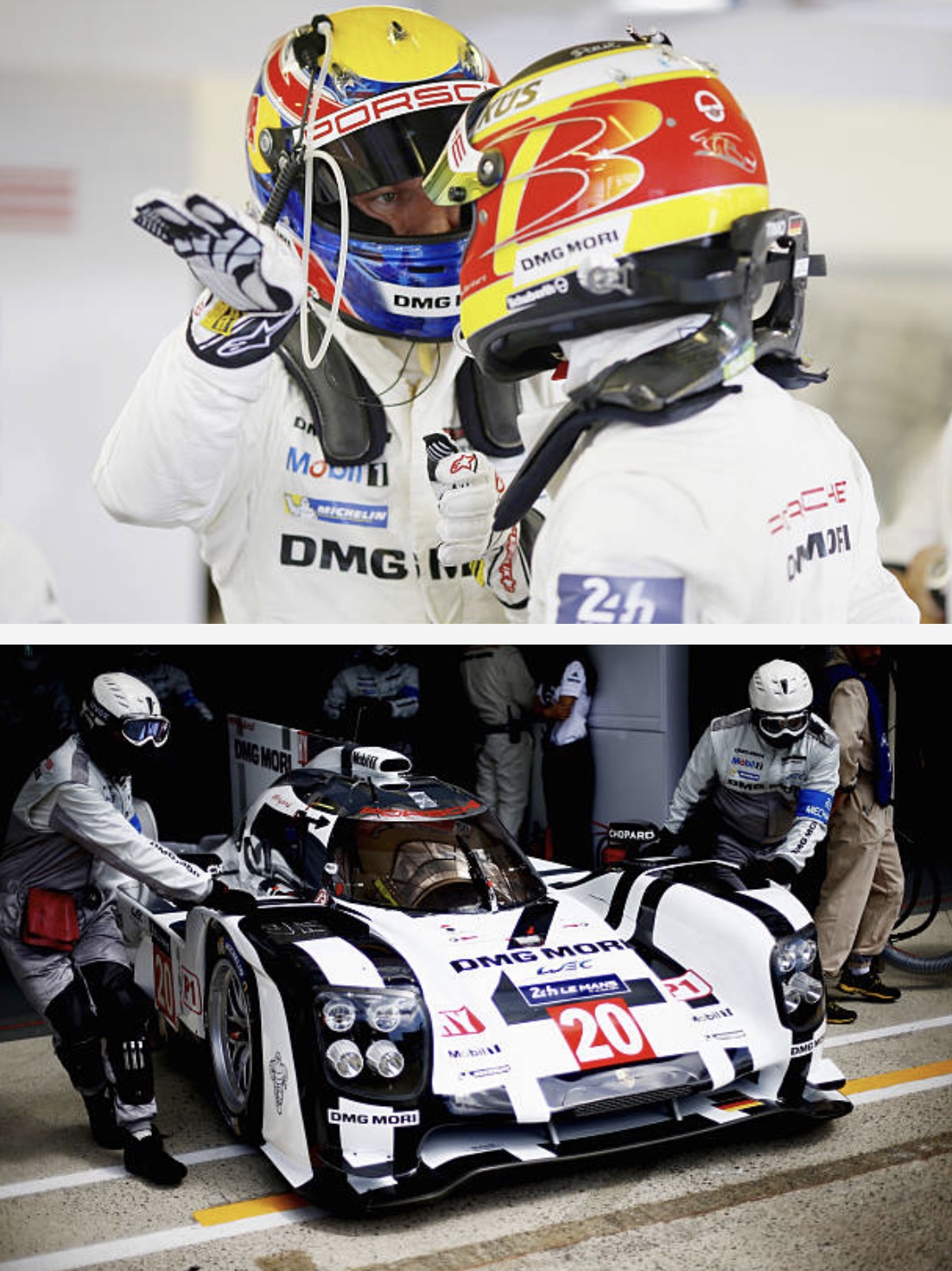
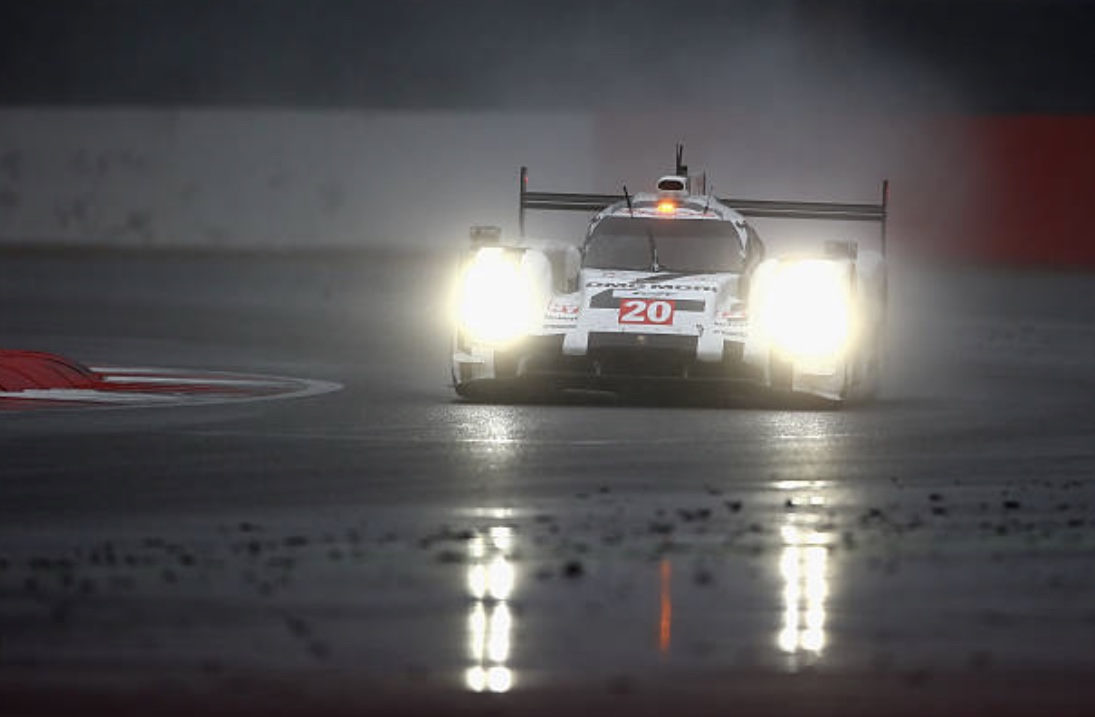
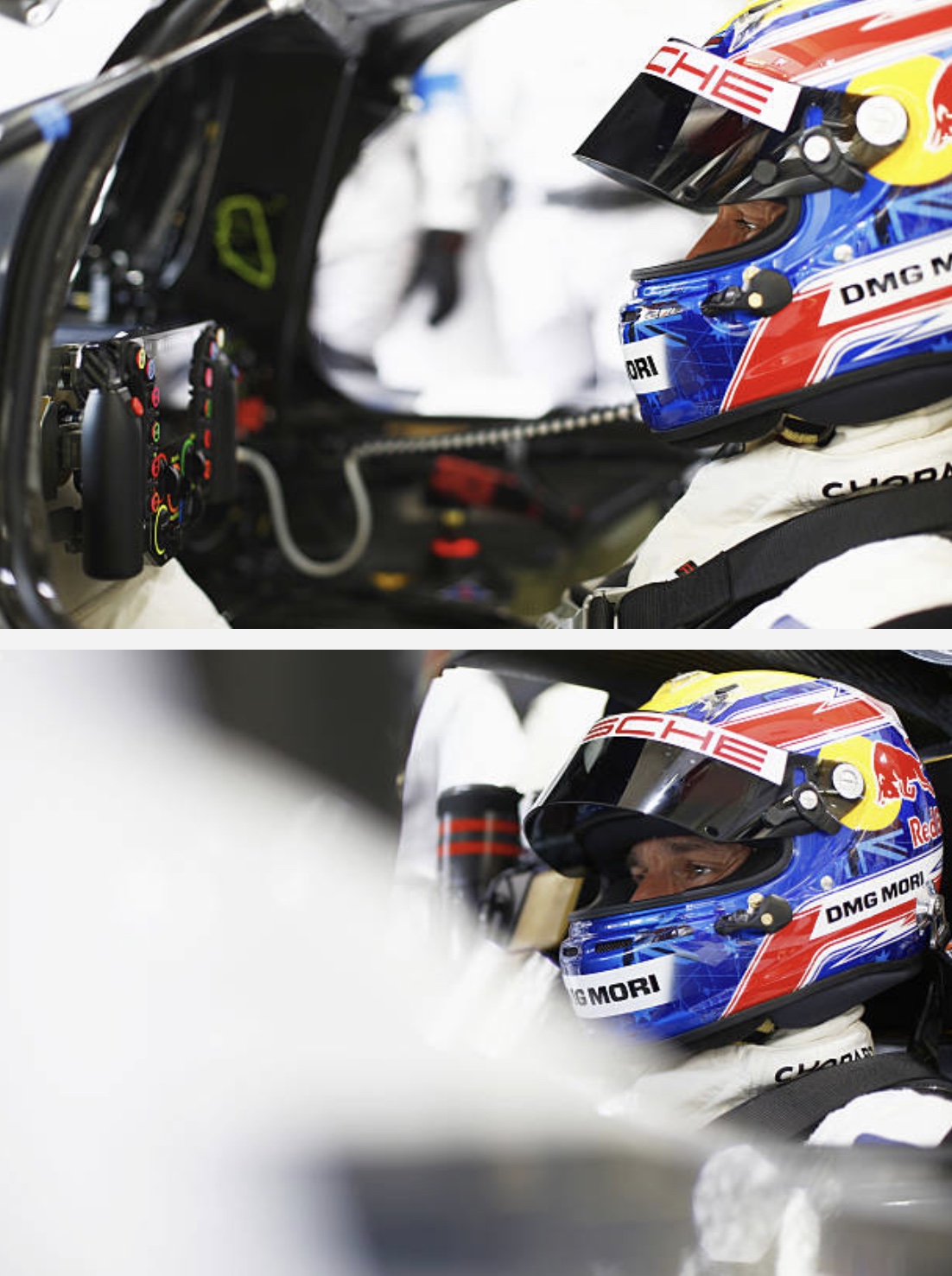
Mark Webbers Porsche 919 looking somewhat alien-like during the June 2014 running of the Le Mans 24 Hour classic…
He shared the car with Timo Bernhard and Brendon Hartley, the trio led the race a couple of times, as late as during the twenty-first hour but a broken roll bar forced them into the pits at that point and the car was retired.
Ultimately the Andre Lotterer/Marcel Fassler/Benoit Treluyer Audi R18 e-tron 4 litre turbo-diesel V6 won from the similar car of Tom Kristenson/Marc Gene/Lucas di Grassi with the Toyota TS040 Hybrid 3.7 litre V8- its crew Anthony Davidson/Sebastien Buemi/Nicolas Lapierre, third.
The best placed Porker was in eleventh- Marc Lieb/Romain Dumas/Neel Jani aboard the 2 litre turbo-V4 919 Hybrid. Webber and Co completed 346 laps but were non-classified, the winners did 379.
Most of you will recall Mark Webber left Formula 1 for Endurance Racing at the end of 2013 doing three seasons with Porsche before his retirement at the end of 2016.
He won the World Endurance Drivers Championship together with Hartley and Bernhard in 2015, the trio took eight wins over the three years they raced together helping Porsche win the Manufacturers Championship In 2015 and 2016.
Getty Images is an orgy of photography, regular readers will be well aware of the value of the resource to me, do have a look- key ‘Le Mans’ into the search engine and the 62,351 images which pop up will keep you busy for a while.
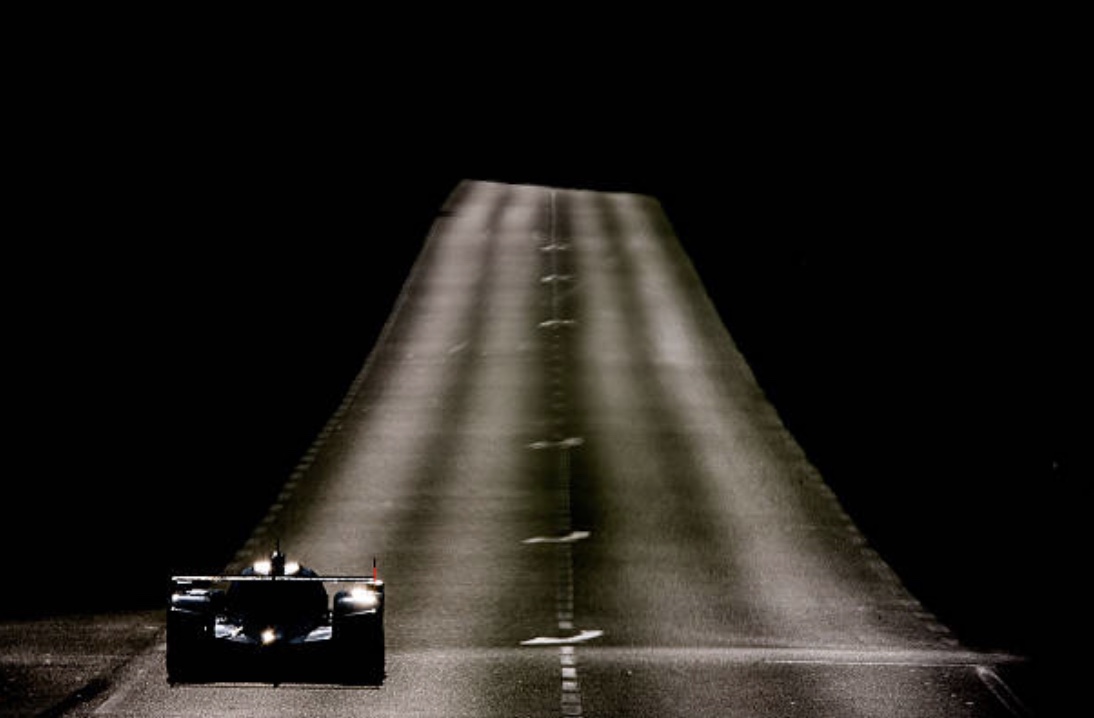
This piece is visual, with a focus on the more creative of Getty’s Mark Webber 2014 ‘Lee Manz’, as Larry Perkins calls it, shots. More on the Porsche 919; https://primotipo.com/2016/02/10/testing-testing/
My posts may be a bit hap-hazard over the next three weeks, I am on safari in England and Italy for a bit.
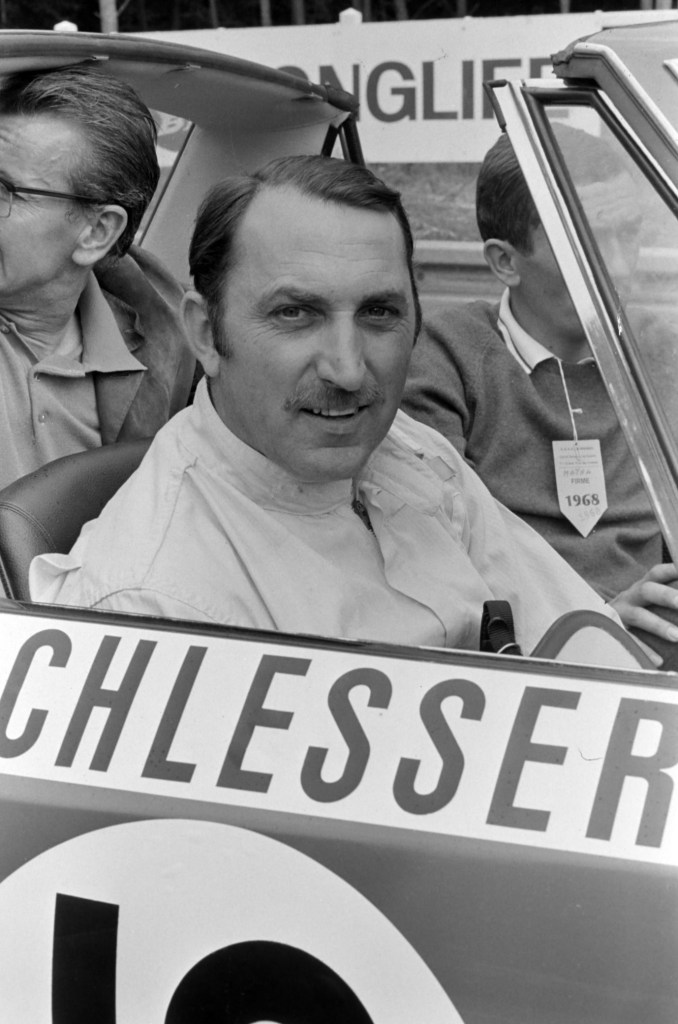
It has the feel of final practice/qualifying about it doesn’t it? The wing in the foreground is either Jacky Ickx’ winning Ferrari 312 or Chris Amon’s sister car.
Graham Hill stands patiently at left whilst the mechanics make adjustments to his car with Lotus boss Colin Chapman leaving the boys to it, resting against the pit counter.
At far left, obscured, Jack Brabham is being tended to in his Brabham BT26 Repco 860 V8. Jochen Rindt popped his BT26 on pole proving the car had heaps of speed if not reliability from its new 32-valve, DOHC V8. The speedy Austrian took two poles with it that year.
The dude in the blue helmet is Jackie Oliver who is about to have the mother and father of high speed accidents when wing support failure saw him pinging his way through the French countryside, clobbering a set of chateau gates and dispensing aluminium shrapnel liberally about the place at around 125 mph. He survived intact – shaken but not stirred you might say. It wasn’t the last of his career ‘big ones’ either. Click here; https://primotipo.com/2017/01/13/ollies-trolley/
In the distance is Goodyear blue and white striped, jacket wearing Tyler Alexander so there must be a couple of McLaren M7As down that way.
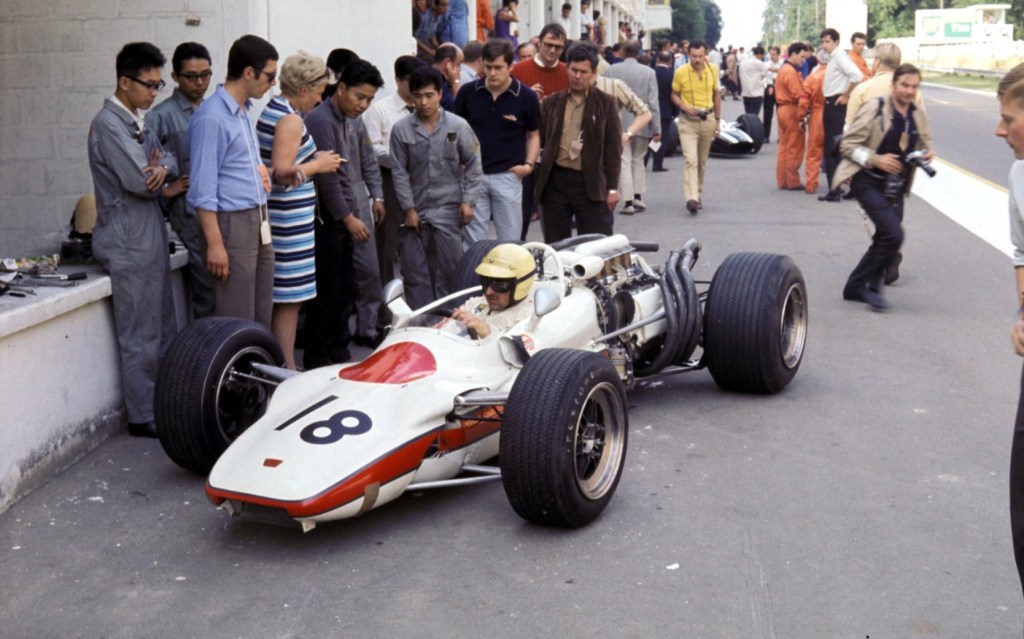
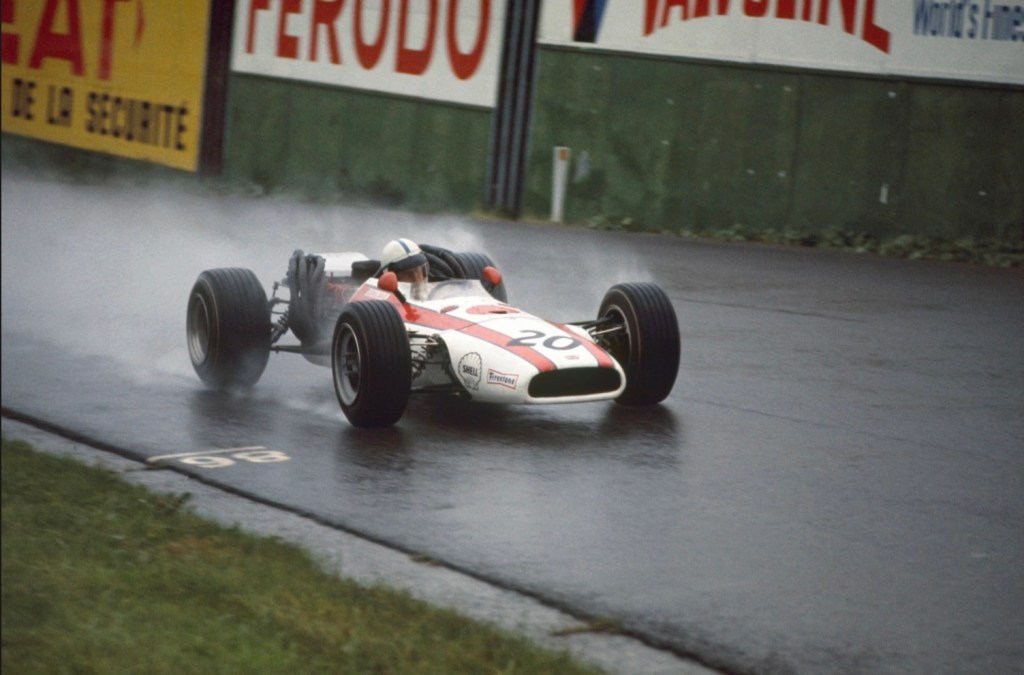
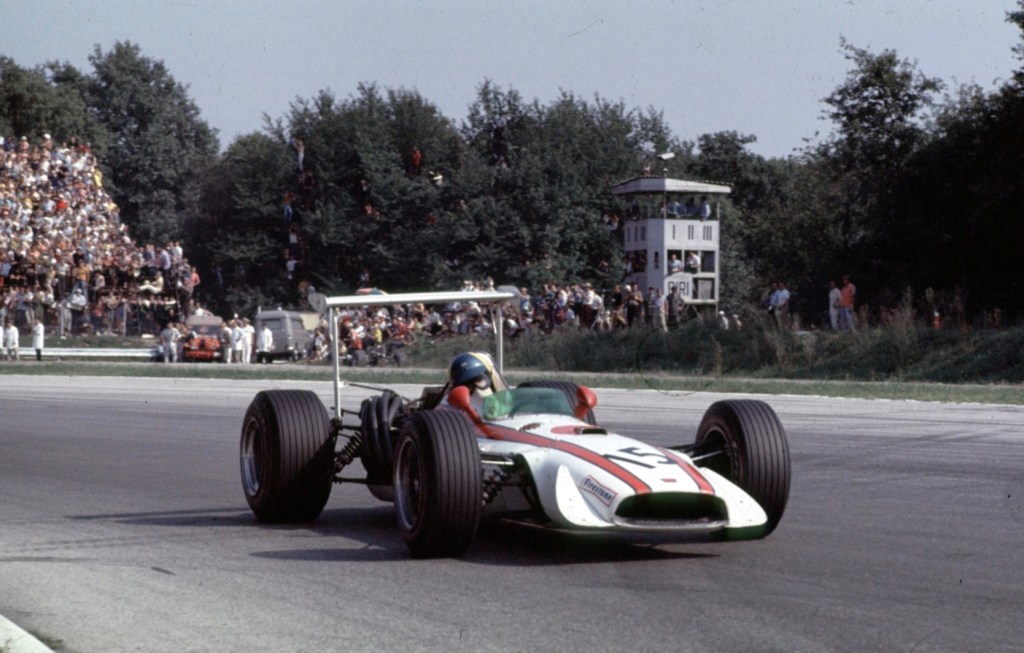
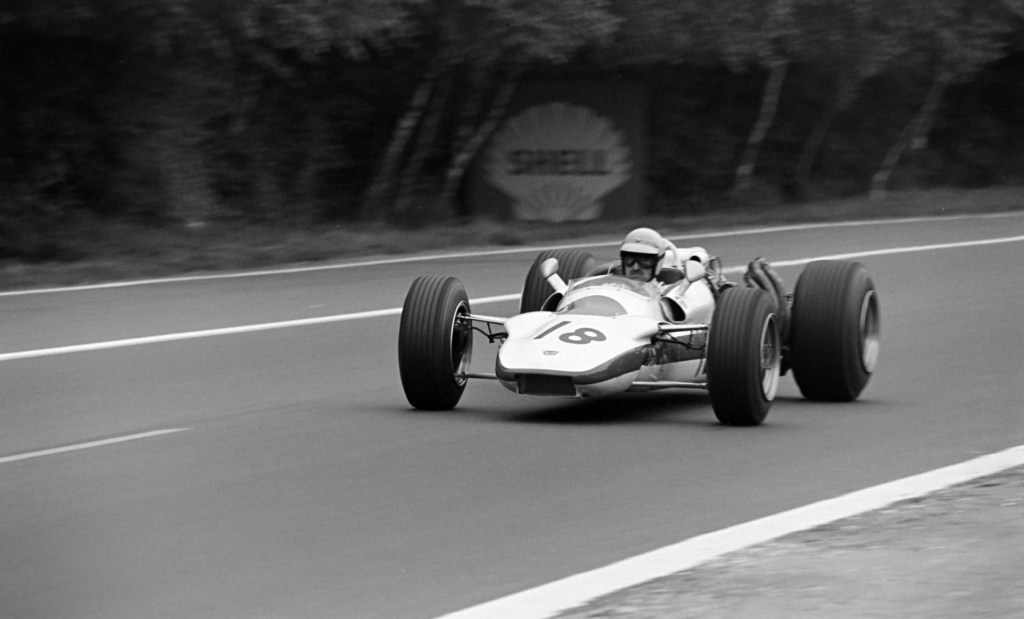
Ickx won a tragic wet race in which French racer Jo Schlesser died on lap two when he lost control of the unsorted Honda RA302 in the fast swoops past the pits, burned alive in the upturned car, it was a grisly death. Ickx’ first GP win, no doubt was memorable for the Belgian for all of the wrong reasons. He won from John Surtees, below, in the conventional Honda RA301 V12 and Jackie Stewart’s Matra MS10 Ford.
Surtees did not have a great Honda season retiring in eight of the twelve GPs, his second place at Rouen and third at Watkins Glen were the two high points of the season.
Honda withdrew from GP racing at the end of the year “to concentrate their energies on developing on new road cars (S360, T360 and S500), having cemented the Honda name in the motorsport hall of fame.” A racing company to its core, its interesting how Honda still use racing past and present to differentiate themselves from other lesser marques: https://www.honda.co.uk/cars/world-of-honda/past/racing.html
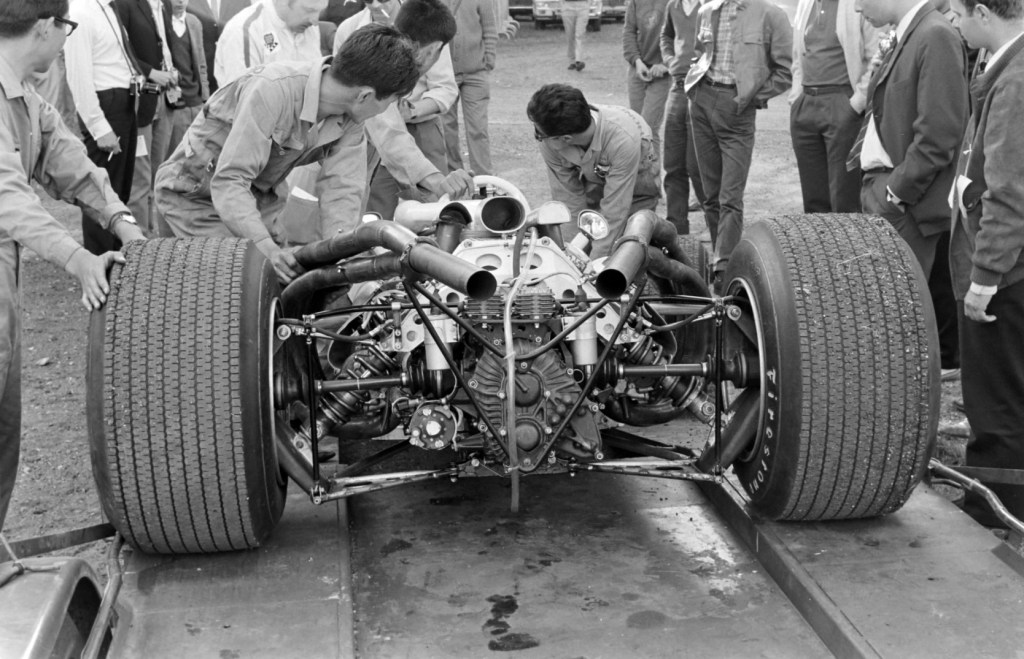
The offer of a works car (Honda RA302 #in your home Grand Prix, however badly your vastly experienced team leader felt about the radical magnesium chassis, 3-litre (88mm x 61.4 mm bore/stroke, four-valves per cylinder -torsion bar sprung – 2987cc) 120-degree air-cooled V8 machine would have been too much to resist?
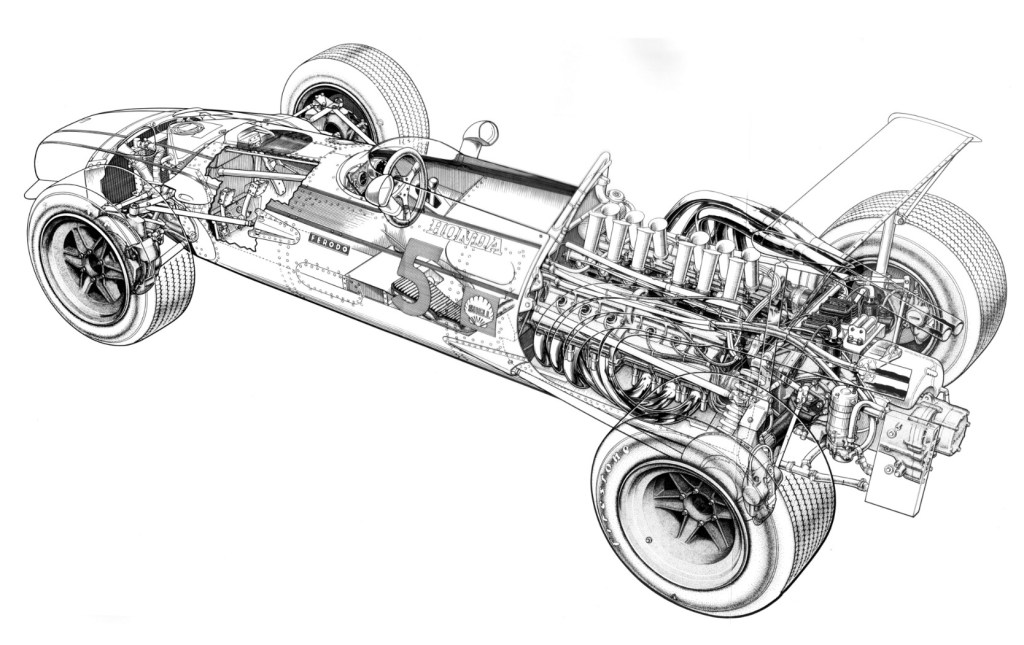
The new car bristled with innovation, including the mounting of the engine, which was in part located via a top-boom extension of the monocoque aft of the rear bulkhead. This approach was adopted by the Mauro Forghieri led team which designed the Ferrari ‘Boxer’ 312B in 1969, one of the most successful 1970 F1 machines.
And so it was that poor, forty years old, Jo Schlesser died having a red hot go after completing only 12km of the race.
Denis Jenkinson looks on, above, as Schlesser prepares for the off during practice, the look on the great journalists face says everything about his interest in this new technical direction. The car behind is Richard Atwood’s seventh placed BRM P126 V12.
Douglas Armstrong wrote of the Honda RA302 as follows in his review of the 1968 Grand Prix season published in Automobile Year 16. “Although it was ill-fated the car was immediately recognised as a new and formidable approach to Formula-1 racing.”
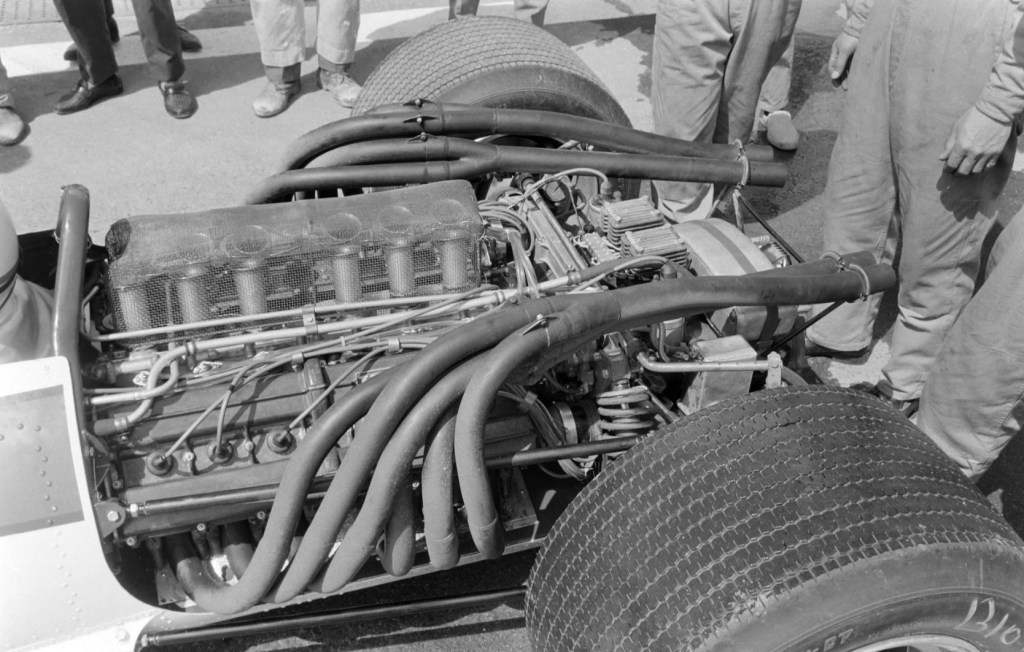
“Taking a leaf from the Porsche air-cooling technique, Honda had mounted a large oil-tank behind the right of the driver, and this was meant to dissipate much of the engine heat. On each cockpit side was a light-alloy scoop to convey air to the engine, and the sparking plugs were also duct enclosed for cooling. To the left of the drivers head another scoop took cooling air into the crankcase where it became involved with oil mist and was then drawn out by a de-aerator which retained the oil but expelled the air from a vent on top of the magnesium backbone.”
(MotorSport)(unattributed)
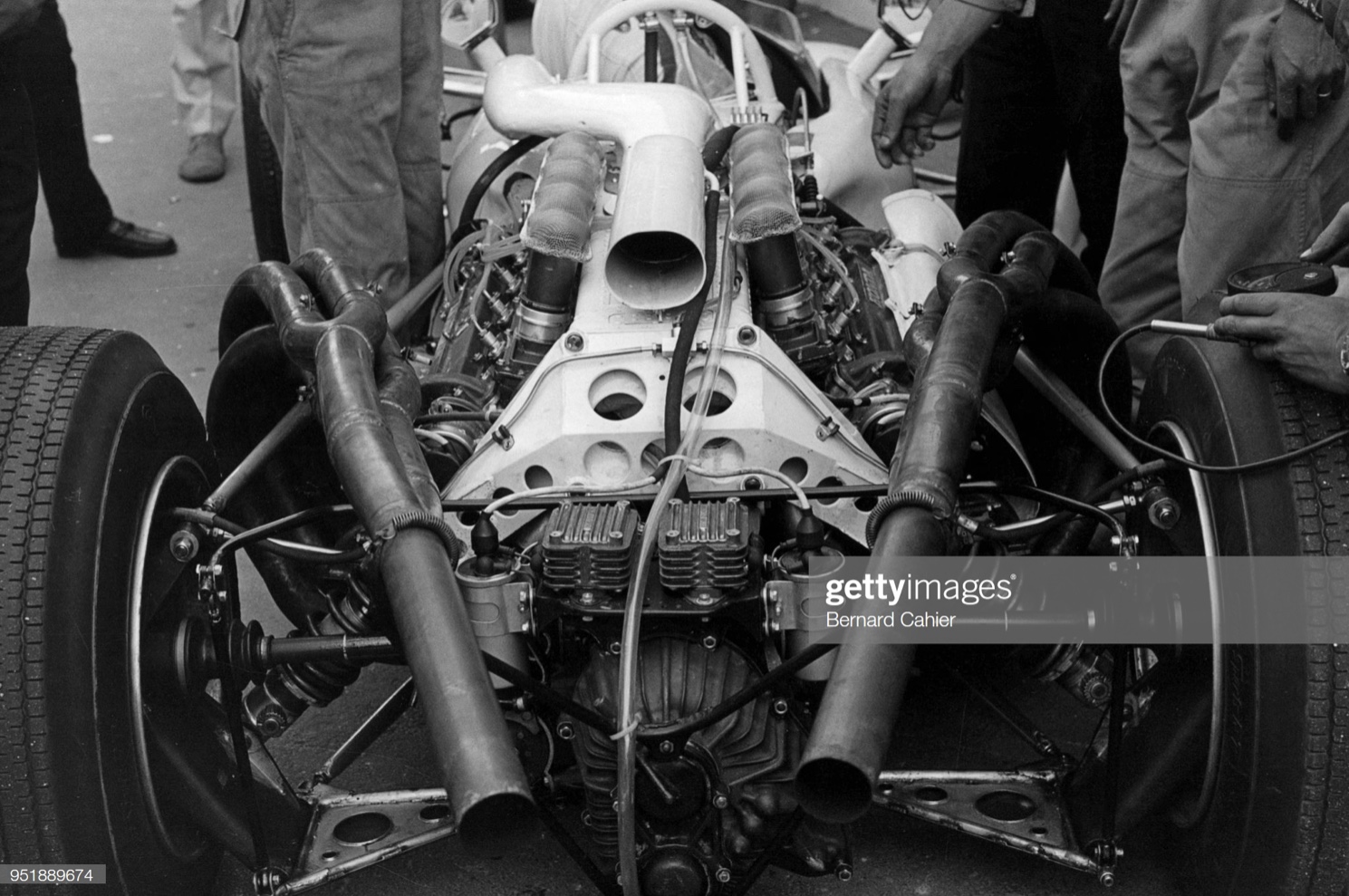
A magnesium monocoque chassis supported the unstressed, fuel injected V8 which is variously quoted at between 380-430bhp at this early stage of its development, I am more at the conservative end of that range.
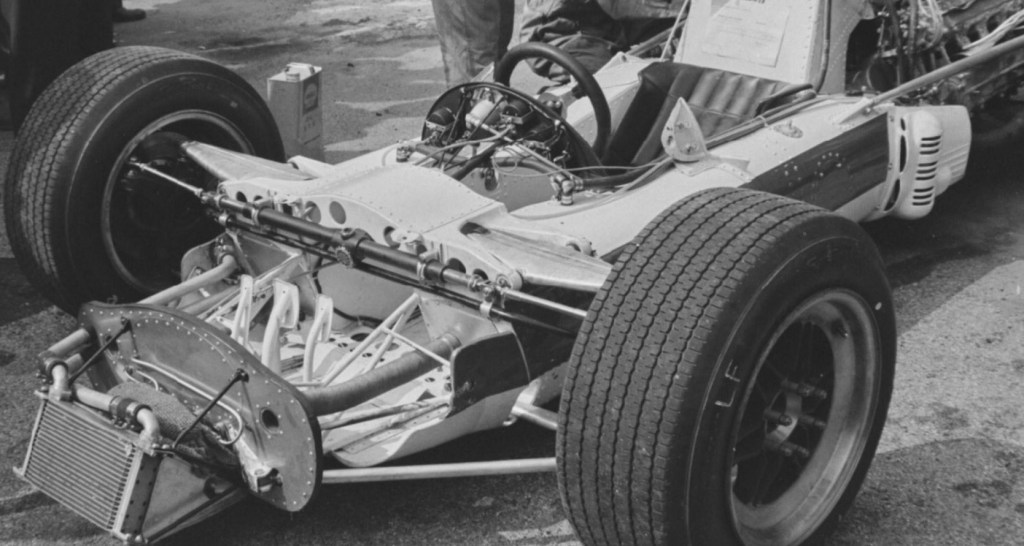
Inboard rocker front suspension and outboard at the rear, note the ‘boxed’ inboard lower inverted wishbones, single top link and two radius rods. As Doug Nye noted, “The suspension was the only conventional part of this wholly Japanese designed and built new comer.”
All the attention to weight saving and compactness – the Lotus 49 Ford DFV would have been very much top-of-mind in Japan – resulted in a car “reportedly weighing close to the minimum requirement of 1102lb.”
Politics and priorities…
John Surtees tested another RA302 (chassis #F-802 remains part of the Honda Collection) during the Italian GP weekend at Monza in September but declined to race the car, that chassis still exists. Instead Il Grande John put his RA301 V12 on pole!
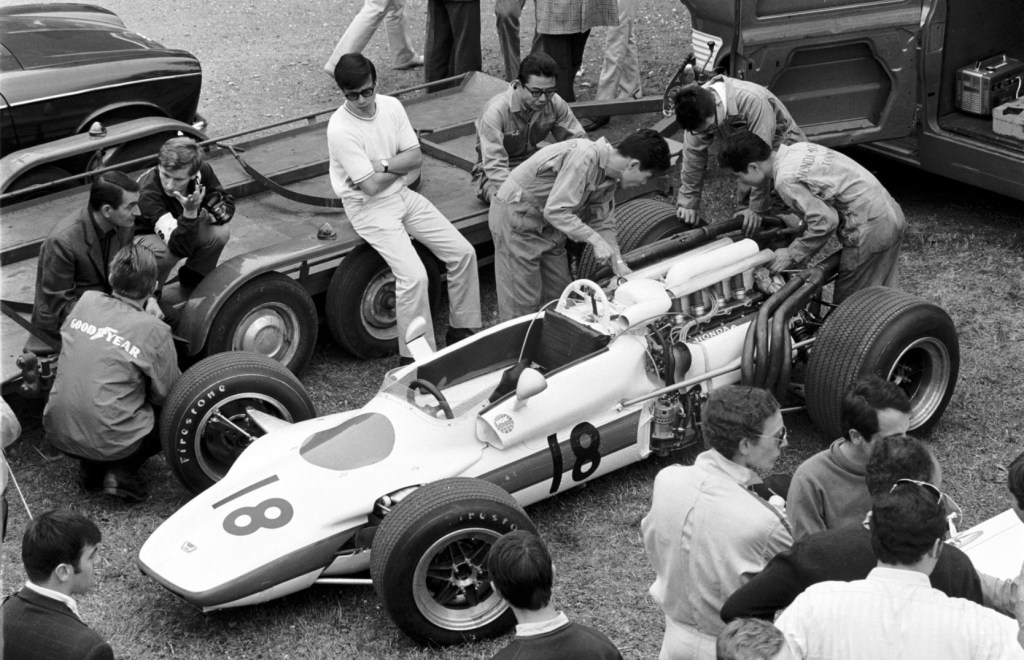
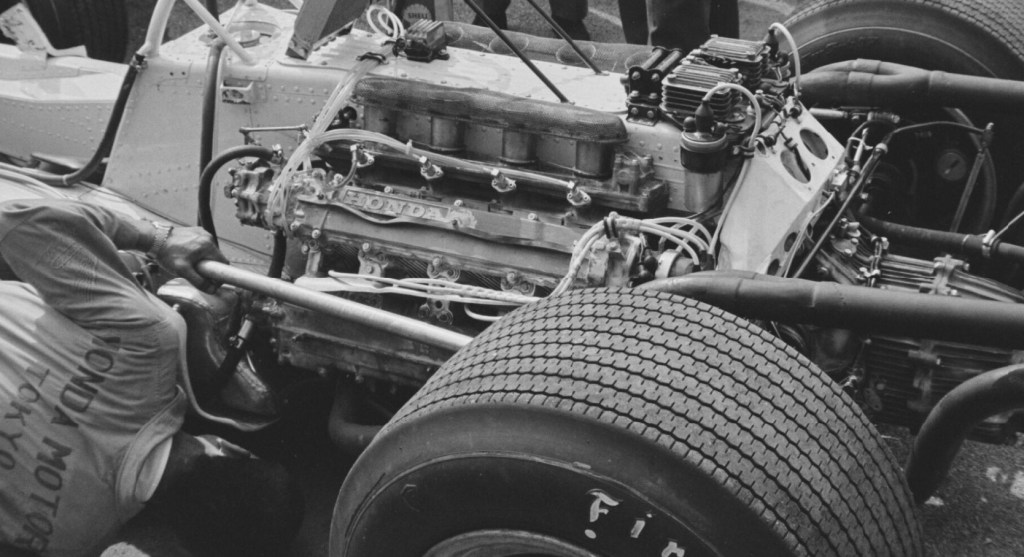
Lola’s Derrick White developed an evolution of the ’67 Honda RA300 for 1968, the lighter, but still 649kg, RA301 was blessed with a 430bhp Honda V12. Let’s not forget these Hondolas spun out of, or off Lola’s very successful 1966 T90 ‘Indycar’.
A careful review of the year reveals a better performing car than the results suggest. Surtees was second at Rouen, third at Watkins Glen and fifth in the British GP at Brands Hatch despite a broken rear wing. Elsewhere, he ran well in Spain and at Monaco until the gearbox failed, then led at Spa and set fastest lap before a rear wishbone mount broke. At Zandvoort he was delayed by wet ignition, then alternator trouble ended his run. In a notable wet season, he was impacted by wet ignition and then overheating caused by a long delay before the start. Surttes started from pole at Monza, then led, and crashed…He was up-there in Canada until gearbox failure , then led after the start in Mexico before falling back and retiring with overheating.
Surtees, RA301, Spa June 1968 DNF (MotorSport)Honda RA301 cutaway (unattributed)Business end of Surtees Hondola RA301 in Spain 1968. 3-litre quad-cam, central power take-off V12 (MotorSport)
MotorSport wrote that the the ill-fated debut of the Honda RA302 took place against a background of strong opposition from Surtees. He had been expecting an improved V12 for the RA301 – a lighter 490bhp V12 with conventional power take-off at the rear of the engine – and was therefore surprised when the all-new RA302 was delivered to Honda’s UK base at Slough. Its 120-degree air-cooled V8 was a mobile test bed to showcase the technology Soichiro Honda was to use in his new road cars; remember the sensational air-cooled Honda 7 and 9 Coupes of the early 1970s for example?
“I tried it at Silverstone,” recalls Surtees. “You’d drive out of the pits and it would feel quite sharp, but it was impossible to drive any distance with it performing as it should. Mr Nakamura told Japan we could not take this to a race.”
During that Silverstone test, the car ran for only two laps before the oil blew out, even after modifications it still wouldn’t go far because the engine overheated rapidly. John refused to race it – not unreasonably given the pace of the RA301 – before further tests could proved its speed and endurance. In addition Surtees suggested they build an aluminium version to replace the flammable magnesium chassis machine.
Jo Schlesser during practice, Rouen 1968 (MotorSport)RA302 far forward driving position and distribution of weight, contrary to the trend of most teams then. Small oil radiator, steering rack, front bulkhead and rocker/wishbone front suspension clear (unattributed)With the cooling duct removed, look closely at lower left and you can see the cooling fins on the block. Fuel metering unit actuated by the inlet camshaft (unattributed)
When Honda arrived at the French GP in 1968, the French arm of Honda urged the team to race the new RA302 to promote its small but growing range of cars. Soichiro Honda was in France on a trade mission that week and, doubtless influenced by his local representatives, he decided to enter the RA302 under the Honda France banner, with Schlesser as the driver.
Surtees, and even team boss Nakamura, didn’t know of the plan until 7.30am on the Thursday, the first day of practice. “It was not run by the existing Honda team,” says John, “but people who’d previously worked with us were brought over from Japan. They worked as a totally separate unit” to the guys looking after Surtees V12 engined RA301.
Surtees shed no light as to the cause of Schlesser’s crash, but acknowledges the circuit is tricky at the site of the accident, describing it as “the sort of place on the circuit where you were fully occupied”.
It is thought a misfire or complete engine cut-out caused Schlesser to lose control. Honda acquired film showing him getting into a ‘tank-slapper’ before going off – but there were never any official conclusions. Engine designer and future Honda boss Nobuhiko Kawamoto was in Japan that weekend. “I thought the cause may have been a transmission seizure,” he says. “After three months, the residuals came back, small amounts of steel parts, the engine and transmission, but we found it was really clean. The cause was not revealed.”
Surtees in the Monza pitlane in September 1968, RA302. Note the additional oil cooler mounted atop the chassis boom not present at Rouen (unattributed)Rouen. Aren’t the spring/shock units mounted high on the uprights and relatively horizontally (unattributed)David Hobbs aboard the other Honda RA301 at Monza in 1968 (MotorSport)
Surtees would briefly drive a second RA302 in practice at Monza, but by then it was academic.
With Soichiro Honda present, Surtees refused to race it and the popular 40 year old, very experienced single seater and sportscar driver, was appointed to drive the new car. Unfortunately, Surtees’ doubts were proven true, when Schlesser lost control of the car in the downhill sweepers and crashed. The car overturned and caught fire. The full fuel tank and magnesium chassis burned so intensely that nothing could be done to save Schlesser. He became the fourth F1 driver to die that season (after Jim Clark, Mike Spence and Lodovico Scarfiotti).
“The episode of that car and the accident brought Honda’s whole Formula One programme to an end,” says John. “The fact that it didn’t work meant there weren’t the resources to go back to what we were originally going to do.”
Rouen paddock. Engine cover all-enveloping with all ducts in place. Ex -Ferrari team manager by then journalist, Franco Lini is the focus of Goodyear man and AN Other at left, is that Rolf Stommelen in the driving suit and glasses in the group at the right? (MotorSport)Monza. Good shot of the monocoque structure and top mount of the engine. Fuel metering unit at the front of the inlet cam, distributor at the rear. Note two coils and electronic spark-units at the rear of the top monocoque boom (unattributed)
“When you add up how far we progressed (in 1968) on a very limited budget we didn’t do too badly. If you add up how competitive we were and of we hadn’t had the silly problems, we could have been champions that year,” Surtees said to David Tremayne.
“Derrick White had drawn up a good chassis and Nobohiko Kawamoto had promised us a new lightweight 490bhp V12engine and gearbox for 1969.” The increasing focus on emissions and the road cars obliged Honda to cut their budget, and the F1 project was cancelled.
Surtees, “I understood why of course, but I really believe that Honda’s later situation in Formula 1 could have come sooner. The 301 was the right car, and with the new engine and gearbox it would have been shorter and much lighter…Instead it was a case of what might have been…”
Tremayne wrote, “Many years later when Honda were winning championships with Williams, Honda Motor Company boss Tadashi Kume – who had been a senior engineer on the RA301 in 1968 – sent Surtees a telegram which said in part, “None of this would have been possible without your investment.”
Credits…
Getty Images, oldracingcars.com, ‘History of The Grand Prix Car 1966-85’ Doug Nye, MotorSport, David Tremayne ‘Honda’s First F1 Chapter’ in hondanews.eu
Nice bit of promotional artwork, I wonder what car is being characterised though?…
The image is a crop from a London Midland & Scottish Railway poster to promote the Crystal Palace 21 May 1938 meeting. The Sydenham Trophy, the car feature event of the day, was won by the John HT Smith, MG at an average speed of 52 mph.
It seems possible the inspiration is the Alfa Romeo 308C, although the bodywork is not an exact fit, mind you maybe its a stylised Mercedes W125 or an Alfa 8C-35 or perhaps something else?
(forix.com)
The image above is of Manfred Von Brauchitsch taking some air on the Melbourne Rise during the October 2 1937 Donington Grand Prix weekend.
Bernd Rosemeyer won in an Auto Union B Type from the Mercedes W125’s of Von Brauchitsch and Rudy Caracciola, perhaps the artist, a ‘Mr Light’ attended the weekend with his art an impressionist interpretation of the car, but in red?
(Getty)
Mechanics attend to one of the W125’s in an unidentified paddock. Click here for an article about this great car;
Four of these Colombo engineered cars, with independent front suspension and 2991 cc versions of Vittorio Jano’s long-lived straight-8 were built and first raced by Tazio Nuvolari at Pau in 1938. A leaking fuel saddle-tank caused the accident which was the catalyst for the great Mantuan to leave Alfa.
(unattributed)
Raymond Sommer, above Alfa Romeo 308C during the July 1939 French Grand Prix.
Sommer and Chinetti in two of the machines were fifth and eighth. The race was won by Herman Muller from George Meier, both aboard 3 litre V12 Auto Union Type D’s- third was a Talbot MD 4.5 litre straight-6, the driver Rene Le Begue.
It is possible Mr Light used these cars as inspiration but the two vents either side of the radiator aperture are missing.
(unattributed)
Qsqui Jarillo advises ‘The photo was taken in Buenos Aires city in 1949 and is probably the car being moved in front of the Automobile Club of Argentina building. In the background is the ‘Bosque de Palermo’ park, the place where pre-F1 age Grand Prix cars were raced.’
‘The car is the 1938 Alfa Romeo 308 Tipo C, chassis number 50017, engine 80017 and raced by local driver Oscar Galvez, now displayed in the Fangio Museum.’
Etcetera: 1938 Sydenham Trophy…
Credit…
Light, Fox Photos, forix.com, ‘Alfa Romeo’ in kolumbus.f1
Tailpiece: Alfa Romeo 8C-35 perhaps?…
Light’s car could be I guess, the Alfa 8C-35- the donor chassis for the four Alfa 308C’s were ‘old 8C-35/12-C36 tubular chassis used with only minor updates’.
The car above is the Hans Ruesch Alfa Romeo 8C-35 cruising through the Brooklands paddock past the Clubhouse and about to be tested by wealthy Australian John Snow in 1938.
John Medley in ‘John Snow: Classic Motor Racer’ wrote that after the Brooklands test Snow hired the car for meetings at Crystal Palace, Donington, Brooklands and Cork. Unfortunately the car, with Buddy Featherstonhaugh at the wheel crashed badly during practice at Donington and was then sent back to the factory for repair.
In a sidebar of Australian motor racing history Snow brought another of Ruesch’s cars to Australia, the Alfa P3/2900 Tipo B #5002 which he sold to his friend Jack Saywell.
It’s possible Mr Light saw the 3822 cc car in the UK and liked it so much he used it as a base for his poster? The 8C-35 was Alfa’s post Tipo B response to the Silver Arrows onslaught.
(unattributed)
Hans Ruesch in his Alfa Romeo 8C-35 during the 1937 Monaco Grand Prix.
He was seventh, five laps adrift of the three W125’s at the head of the field raced by Von Brauchitsch, Caracciola and Christian Kautz. Three of the four 8C-35’s contested the event and finished line astern from sixth to eighth places- Giuseppe Farina, Sommer and Ruesch, ‘best of the rest’ behind five German cars…
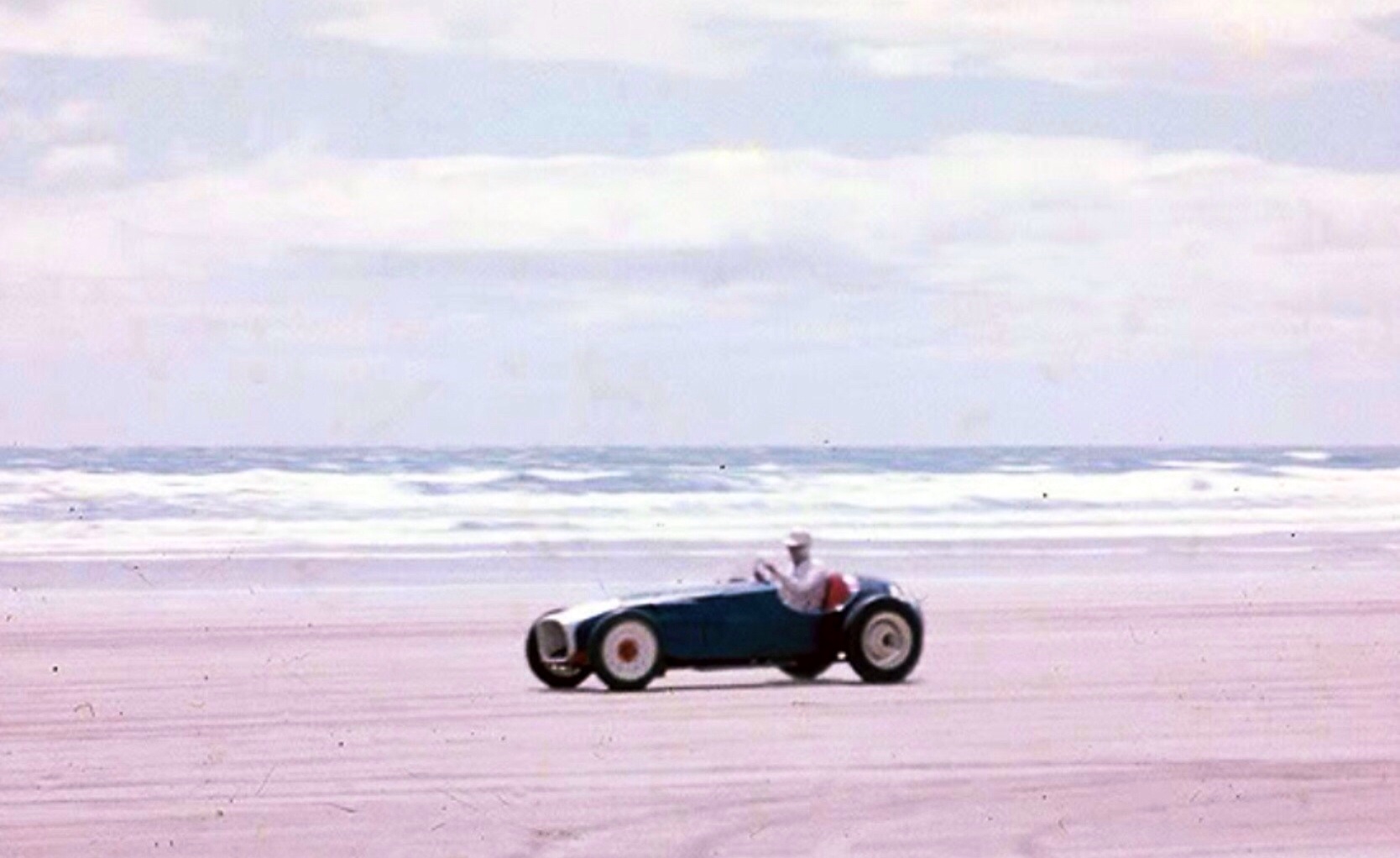
Bevan Wylie flat out in the Fiat Special at Brickmakers Beach, North Western Tasmania in 1959…
It appears both Bevan and Stan Allen ran the car at the beach on that particular day. The car raced widely in Tasmania at all of the local venues including Longford in 1958 and Baskerville as well as Tasmanian ‘climbs- I wonder if it still exists?
Wylie raced a number of cars including a Ford 10 Special in the late fifties, the FBW Special in the early seventies and an Elfin 600 into the late seventies.
The North-West Motor Cycle Club ran many events at Brickmakers, 209 km from Launceston, the ‘capital’ of North Tasmania on a then isolated stretch of coast near Stanley and close to Cowrie from at least 1946 into the fifties.
The events comprised contests, both open and handicap over distances from a quarter mile to five miles.
Car racing is more intriguing- or is it some sort of speed record attempt?
Fantastic cover of Australian Motor Manual’s Yearbook Number 2, 1952…
An article inside features the Autocrat Special, a Ford flathead V8 engined racer which ace engineer/body builder Terry Cornelius advises was bought by his father, Arthur, from Ken Cox in Benalla, Victoria, and raced at Wahgunyah and other ‘outlaw’ (non CAMS certified) tracks until it was sold to a couple of fellas near Albury and never seen again.
Before Arthur took possession of the machine it had passed through the hands of the Stilo brothers and was fitted with a Holden ‘Grey’ six bolted to a Lancia four speed ‘box.
As the page above indicates the car was originally built for Jim Skinner, the chassis made by Melbourne’s Eddie Thomas of ‘Speed Shop’ fame with motive power originally a by way of a Willys Jeep engine which was later replaced by a Ford 60 V8.
See the ‘Border Morning Mail’ article and images of the 1 November 1959 dirt circuit meeting at Hume Weir below.
(C McQuillen)
I had completed the article as above but not uploaded it when Adelaide enthusiast Dean Donovan posted both the magazine cover online and some photos of cars featured in the magazine, including the ‘TS Special’, a superb Australian Special i shared garage space with at Phillip Island in March.
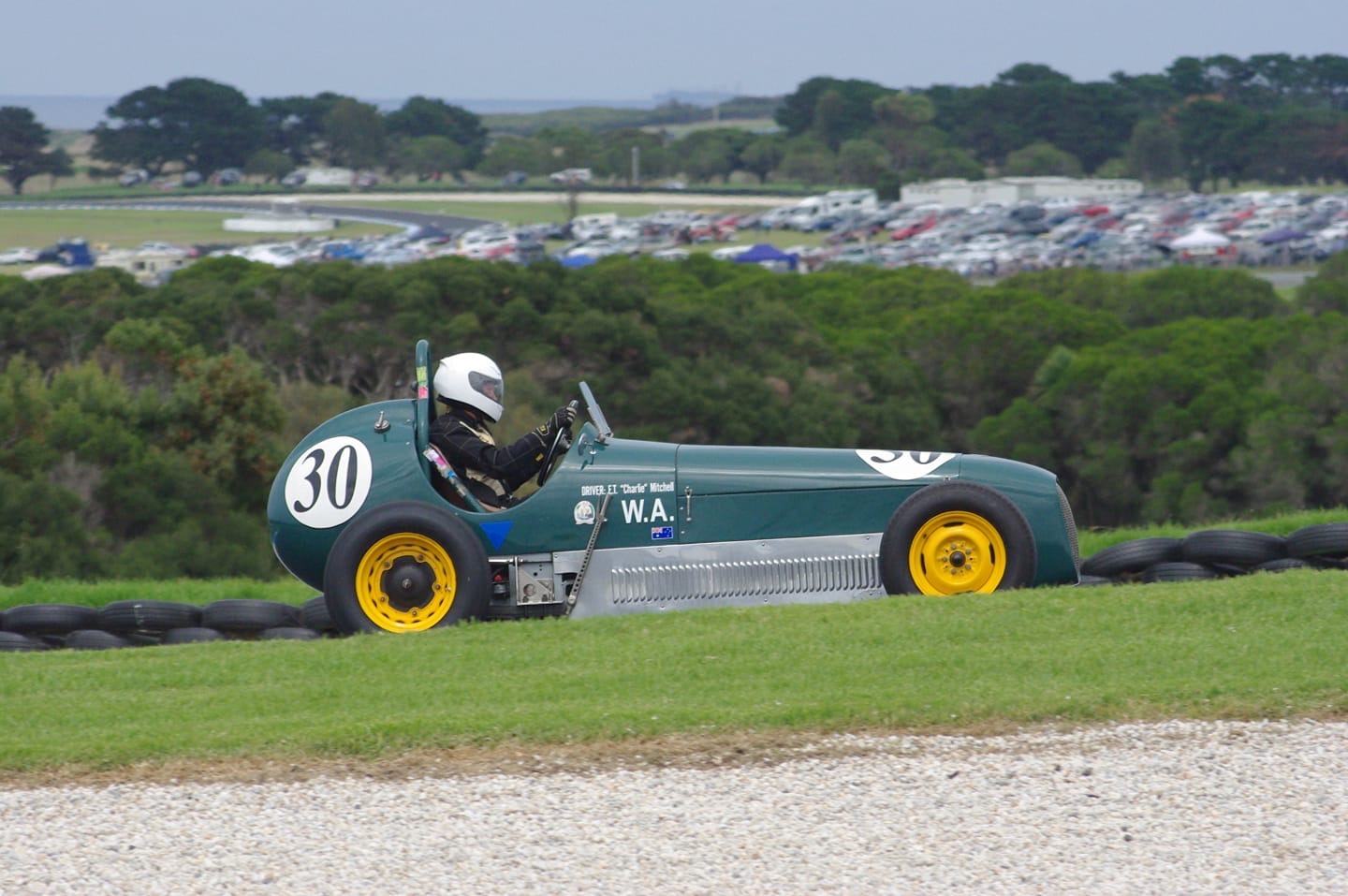
Charlie Mitchell in the TS Special GMC at Phillip Island, he is heading up the rise before the drop into MG (M Williams)
Whilst originally built by the Styles Brothers in Western Australia- Rod Styles was an instructor at the old Carlisle Technical College in Perth, for Syd Taylor and now owned by Sandgroper Charlie Mitchell- it resides in Victoria for the first time in its long life spent in the west. Pat Ryan’s bus depot houses the car with Charlie making regular trips east to race it.
TS Special with original body and Dodge powered, probably Syd Taylor at the wheel (Motor Manual)
Noted West Australian racing historian Ken Devine advises that the car was rebuilt in 1952 taking on the appearance it has now, Ken’s photo below is of Taylor on the Bunbury ‘Round The Houses’ road course in 1960. I wrote an article about Bunbury a while back;
The TS Special is now fitted with a highly modified 6 cylinder GMC truck engine- I was speaking to the car’s young engine builder at the Island, I wish I had taken notes!, it has a steel crank, roller cam and highly modified cylinder head. Mitchell and his offsider prepare the car beautifully, and Charlie, who has owned it for some years, drives it very well.
Credits…
Leon Sims, Terry Cornelius Collection, Chris McQuillen, Dean Donovan, Ken Devine, Max Williams
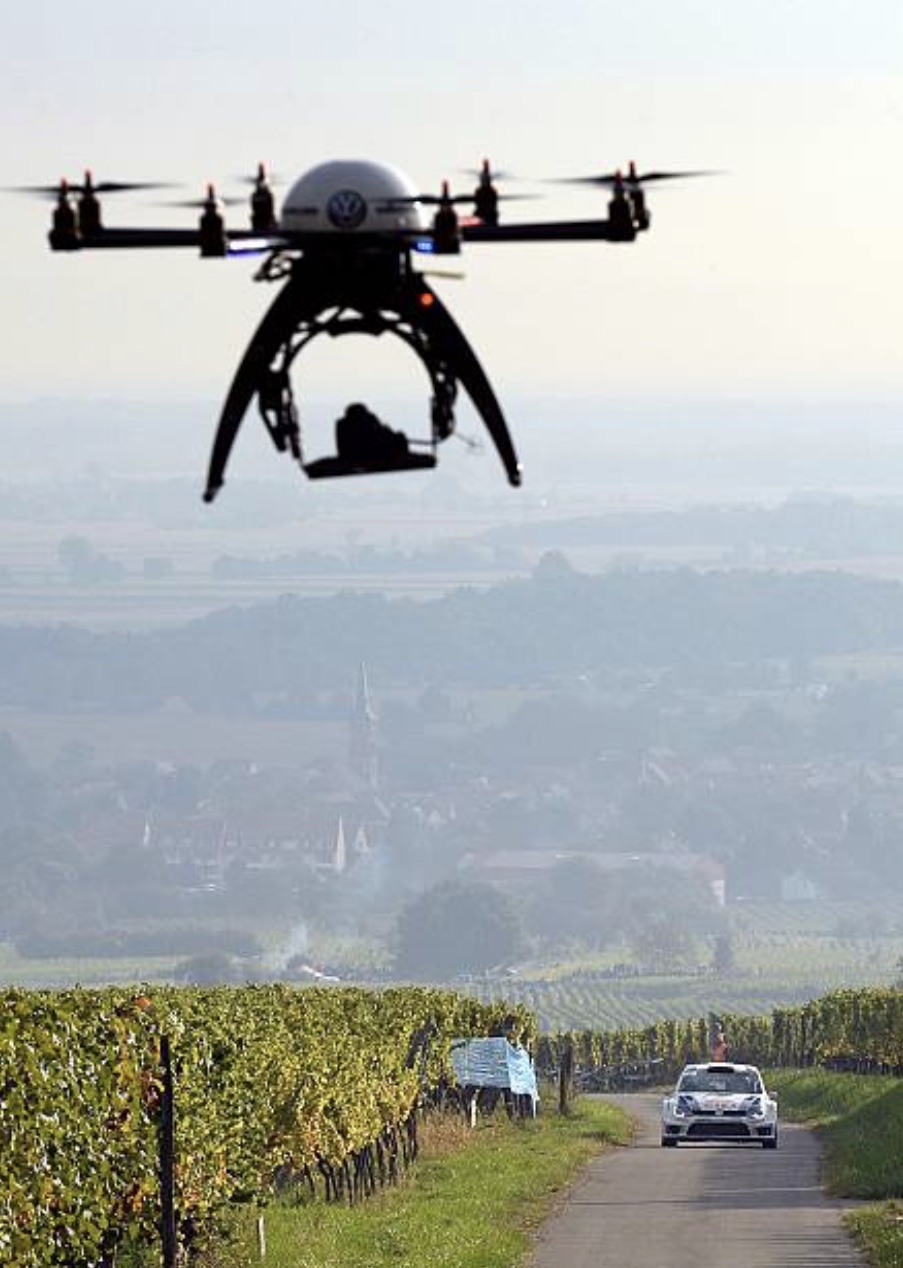
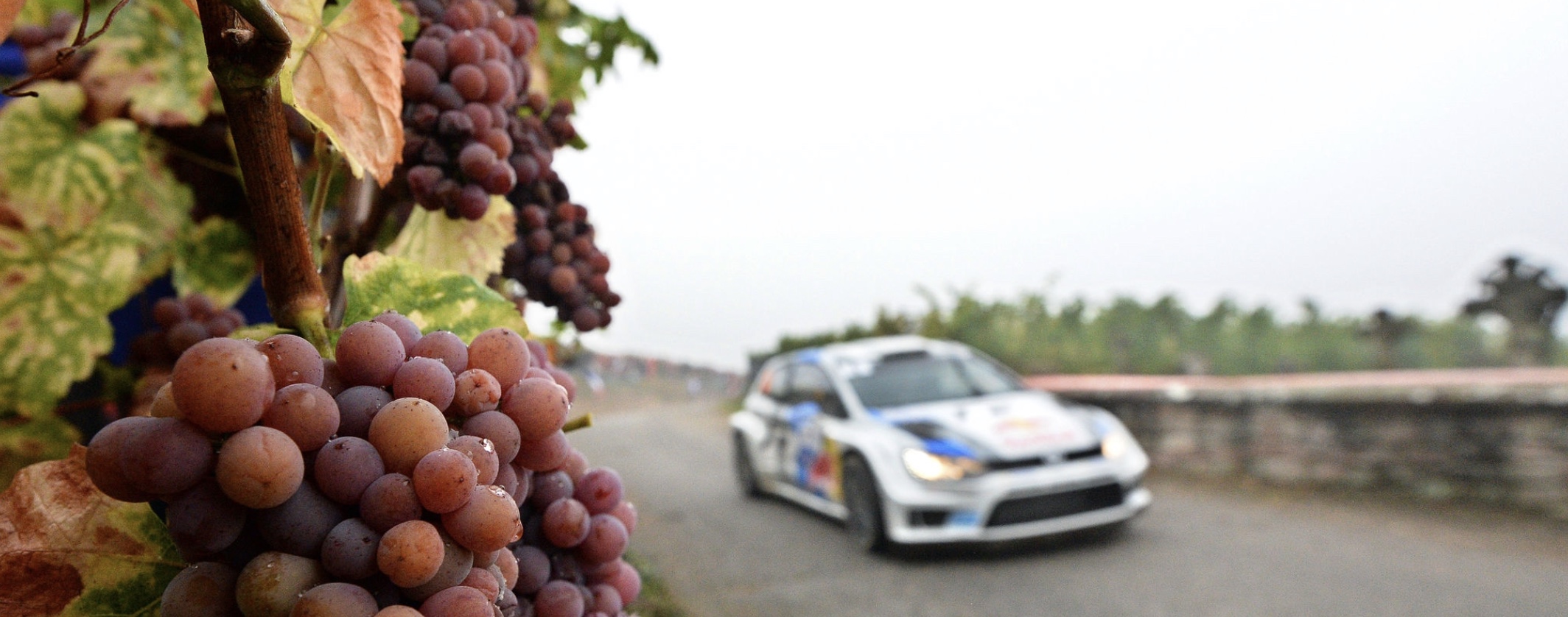
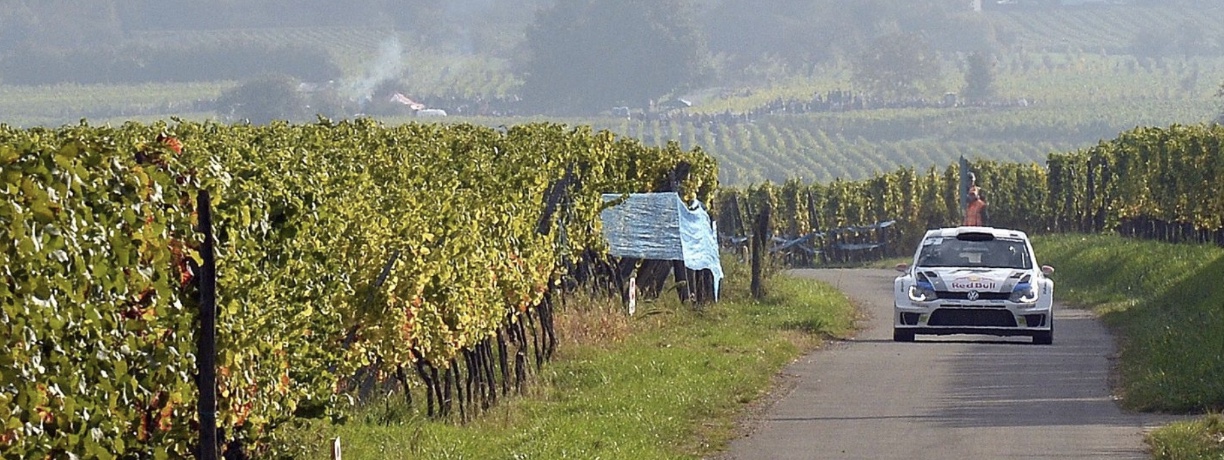
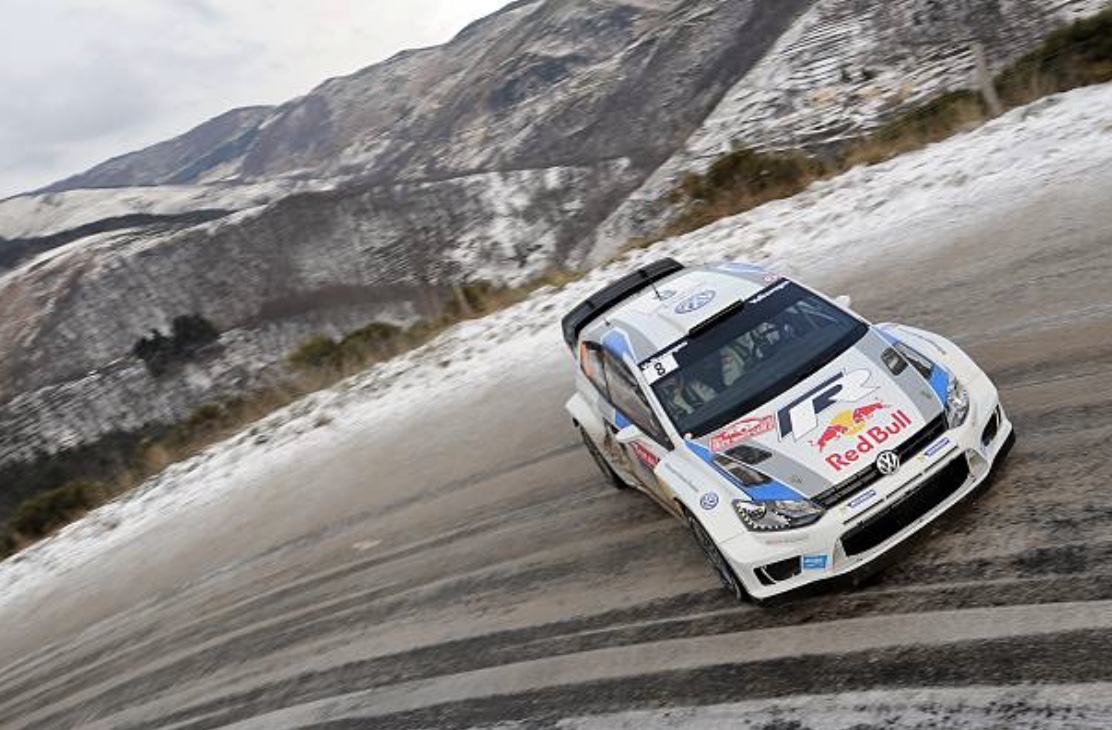
Finland’s Jari-Matti Latvala and co-driver Miikka Anttila blast through a French vineyard in their VW Polo R WRC during the October 2013 Rallye de France…
They are in the Heiligenstein, Alsace area of Eastern France.
Photographer Patrick Hertzog has brilliantly framed his shot to capture the drone in the foreround to give it that ‘Out Of This World’ factor!
Rally Australia, Coffs Harbour, November 2016, the Ogier/Julien Ingrassia Polo R WRC on day 1. The pair won the event and again in 2013, 2014 and 2015 with the Andreas Mikkelsen/Anders Jaeger winners in another Polo R WRC in 2016 (M Bettiol)
VW first contested the WRC to the ‘second generation’ of World Rally Car rules in 2013 although the Polo WRC was launched in May 2011 and tested extensively for eighteen months by Carlos Sainz, Sebastien Ogier and VW’s test and development driver Dieter Depping evolving a very quick, reliable package before it was blooded in battle.
The four wheel drive 1.6 litre, DOHC, turbocharged four cylinder engined car developed circa 318 bhp @ 6250 rpm through its regulation 33mm air restrictor finally made its competition debut at the 2013 Monte Carlo Rally where Ogier was second.
He won in Sweden, Mexico, Portugal, Sardinia, Finland, Australia, and in France- he took the title from Thierry Neuville in the event pictured in this articles opening shot. He was also victorious late in the year in Spain and Great Britain, taking the first of four titles on the trot in the car in 2013.
(P Hertzog)
Hi-res version of the opening shot- same pair above on the hop (P Hertzog)
Ogier won again in 2014 and entered 2015 with a second generation Polo R WRC, changes comprised a new VW 6 speed sequential manual ‘box with front and rear multi-plate slippery diffs, revised hydraulics system, larger rear wing and a big decrease in weight.
The cars were again dominant in 2015 and 2016, Ogier winning in both years thereby becoming one of four drivers to win four championships, the others are Juha Kankkunen, Tommi Makinen and Sebastian Loeb.
VW developed a new car to meet the changed technical regulations which commenced for 2017 but withdrew from the sport in November 2016.
The Polo R WRC CV includes winning 43 of the 53 rallies it entered and four consecutive WRC’s for drivers and manufacturers- not bad.
J-P Clatot/AFP/Getty)
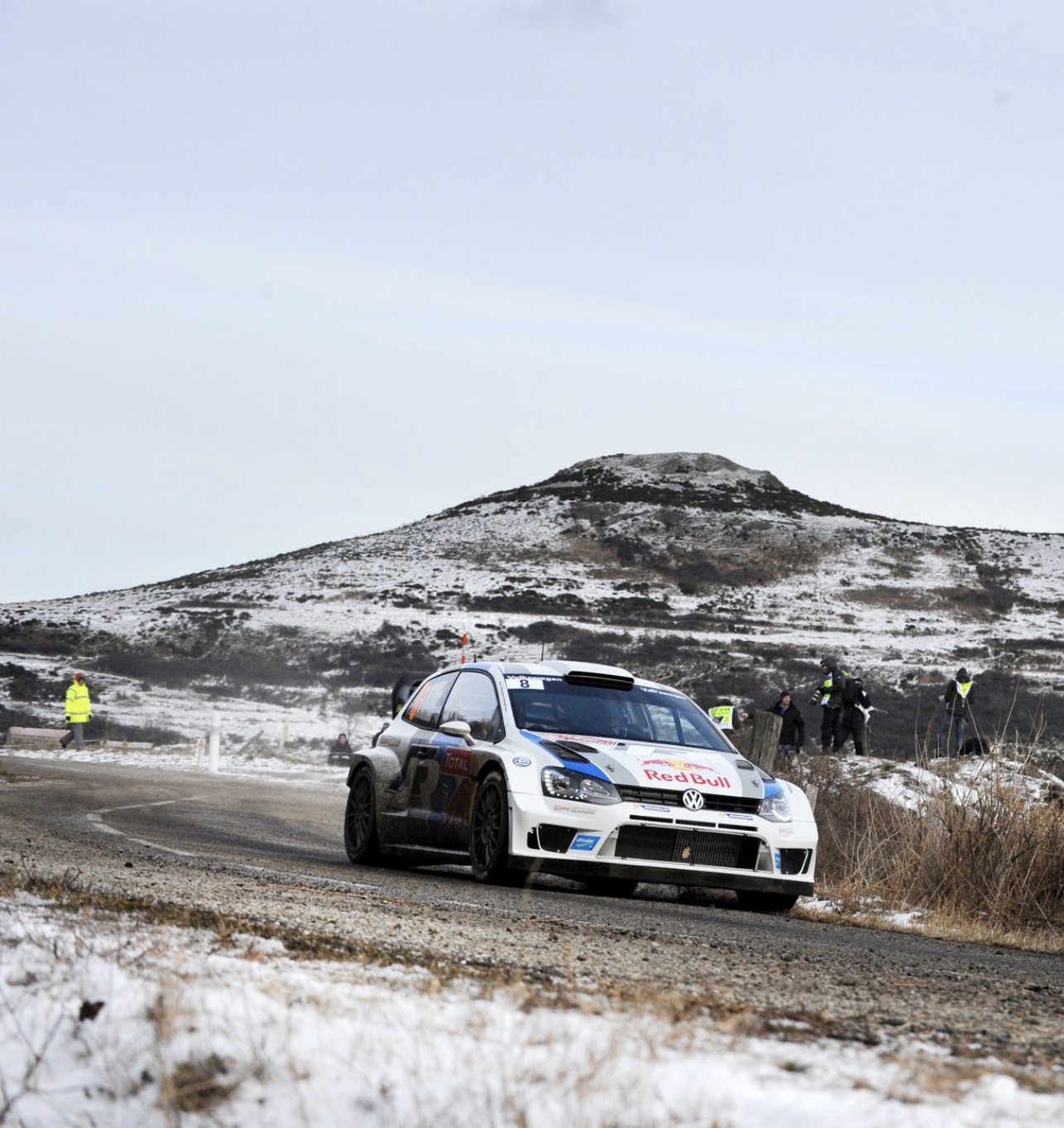
VW Polo R WRC competition debut in the 2013 Monte Carlo Rally- photos above and below.
Ogier and are Ingrassia are shown on stage 3, Col de la Fayolle, between Le Moulinon and Antraigues.
Seb Loeb/Daniel Elena won the event in a Citroen DS3 WRC by two seconds from Ogier/Ingrassia with another Citroen DS3 third crewed by the Daniel Sordo/Carlos del Barrio combination.
Ogier/Ingrassia took the first Polo WRC win a month later in Rally Sweden.
(Getty)
Credits…
Patrick Hertzog, Massimo Bettiol, Jean-Pierre Clatot
Tailpiece…
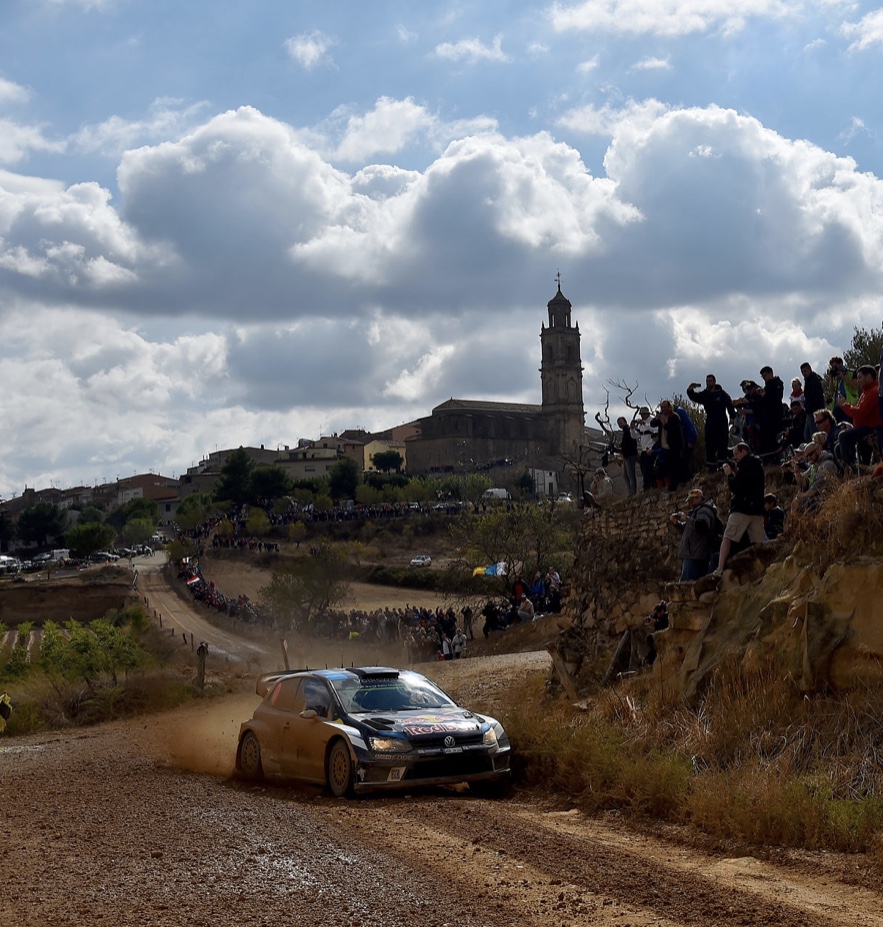
Rally Championship of Spain, Rally Catalunya, Salou, October 2016. Anders Mikkelsen and Anders Jaeger, VW Polo R WRC- the Ogier/Ingrassia combination won with Mikkelsen unplaced (M Bettiol)
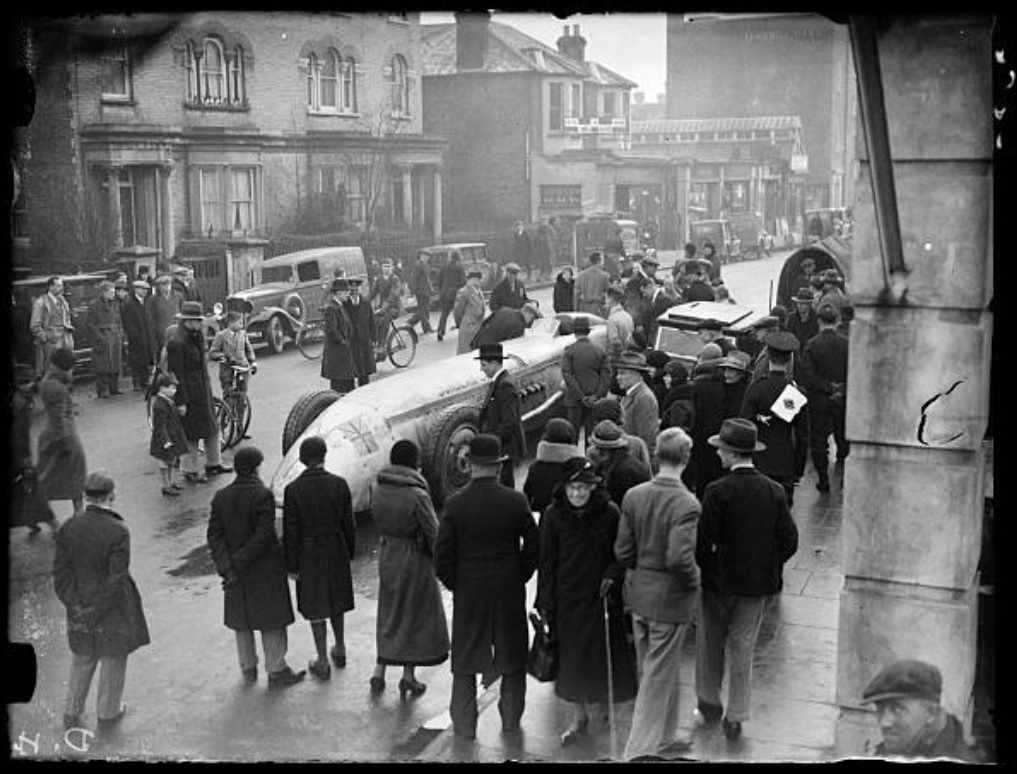
Kaye Don’s Sunbeam ‘Silver Bullet’ in the UK on 8 January 1934…
Photographer ‘Malindine’ took this wonderful shot after an unsuccessful Land Speed Record attempt at Daytona Beach- ‘despite its streamlined shape and powerful engine, the car only managed a disappointing 190 mph’ the Daily Herald caption records.
The record Don sought to break was that of Malcolm Campbell who set a mark of 272.46 mph in Campbell-Railton Bluebird- 36.7 litres of Rolls Royce supercharged aero V12 provided the power.
One of the things which always intrigues me is the juxtaposition of racing cars- in this case a LSR car, with the more mundane road transport of the day and amongst normal citizenry street scenes rather than at a race track.
How ‘other worldly’ the Silver Bullet must have seemed to the good folks of whatever town or village in which the photo was taken- does anybody happen to know the locale?
Kaye Don aboard the completed car at Sunbeam prior to its trip to Daytona (unattributed)
Silver Bullet in build- two compact 50 degree V12’s clear as is the centrifugal supercharger housing (unattributed)
Don’s steed was the final attempt on the LSR by Sunbeam- key team members were Louis Coatalen, Designer, Mr Kay, Draftsman and Hugh Rose the Production Manager created a car which was powered by two specially built 24 litre 50 degree V12 supercharged engines- these featured light alloy construction, roller bearing cranks, DOHC and four valves per cylinder using an oversquare layout, the motors developed a total of about 4000 horsepower ‘but delivering 920 bhp to the road wheels’.
The gearbox used three speeds, the power was delivered to a semi-elliptic sprung rear axle by splayed drive-shafts. Four wheel Lockheed hydraulic drum brakes were fitted- the machine, its body tested in the Vickers wind-tunnel, was 31 ft long and weighed 6 tons 14 cwt.
Only two engines were built, the car was beset by problems at Daytona, the fundamental issue amongst hundreds was a design one- ‘the very long induction pipes that fed the engines from the rear mounted supercharger were heating up the mixture before reaching the inlet valves, the resultant back-firing damaged the supercharger casing. This was a virtually incurable defect’ wrote Sunbeam historian Anthony S Heal.
After eighteen unsuccessful runs and much work on the car at Daytona the attempt was abandoned- the car arrived back in the UK on 28 April. Checkout Heal’s fascinating detailed account of the car here;
Sunbeam went into receivership in 1935, so the opening photograph is not too long before that- I wonder what the public occasion was for the shot?
The equally frigid looking April 1929 photo below is of ‘Major Henry Segrave’s ‘Golden Arrow’ being taken through the streets to Selfridges department store, London on returning from Daytona, after breaking the World Land Speed Record’ on 11 March at 231.362 mph.
(Fox Photos)
The Irving-Napier Special (the cars designer was former Sunbeam Engineer Capt JS Irving) ‘Golden Arrow’ was aero-engined, a Napier-Lion supercharged W12 of 23.9 litres provided the thrust- circa 925 bhp, the car weighed 3.5 tonnes.
120,000 spectators watched Segrave, who did only one practice run, before setting the new benchmark by 23.894 mph over that of Ray Keech in ‘White Triplex’.
Segrave returned to the UK and was knighted for his many motor racing, land and water speed achievements whilst Golden Arrow is preserved in the National Motor Museum with ‘only 18.74 miles on the clock’!
(unattributed)
Credits…
Malindine/Daily Herald, Fox Photos, Tom Pennington, Getty Images, Anthony S Heal article in the April 1976 issue of Motorsport magazine
Tailpiece: Red Bull F1 Rally-Car…
(Tom Pennington)
With the advent of the commercialisation of motor racing came the need for mass media coverage of ones sponsorship dollar, a big promotional splash became an imperative of the flotilla of ad and marketing men.
The contrived justaposition by the Red Bull publicity machine of ride ’em cowboy and the Red Bull RB Renault on a Johnson City cattle-ranch outside Austin, Texas in August 2011 was fun and visually potent if totally naff.
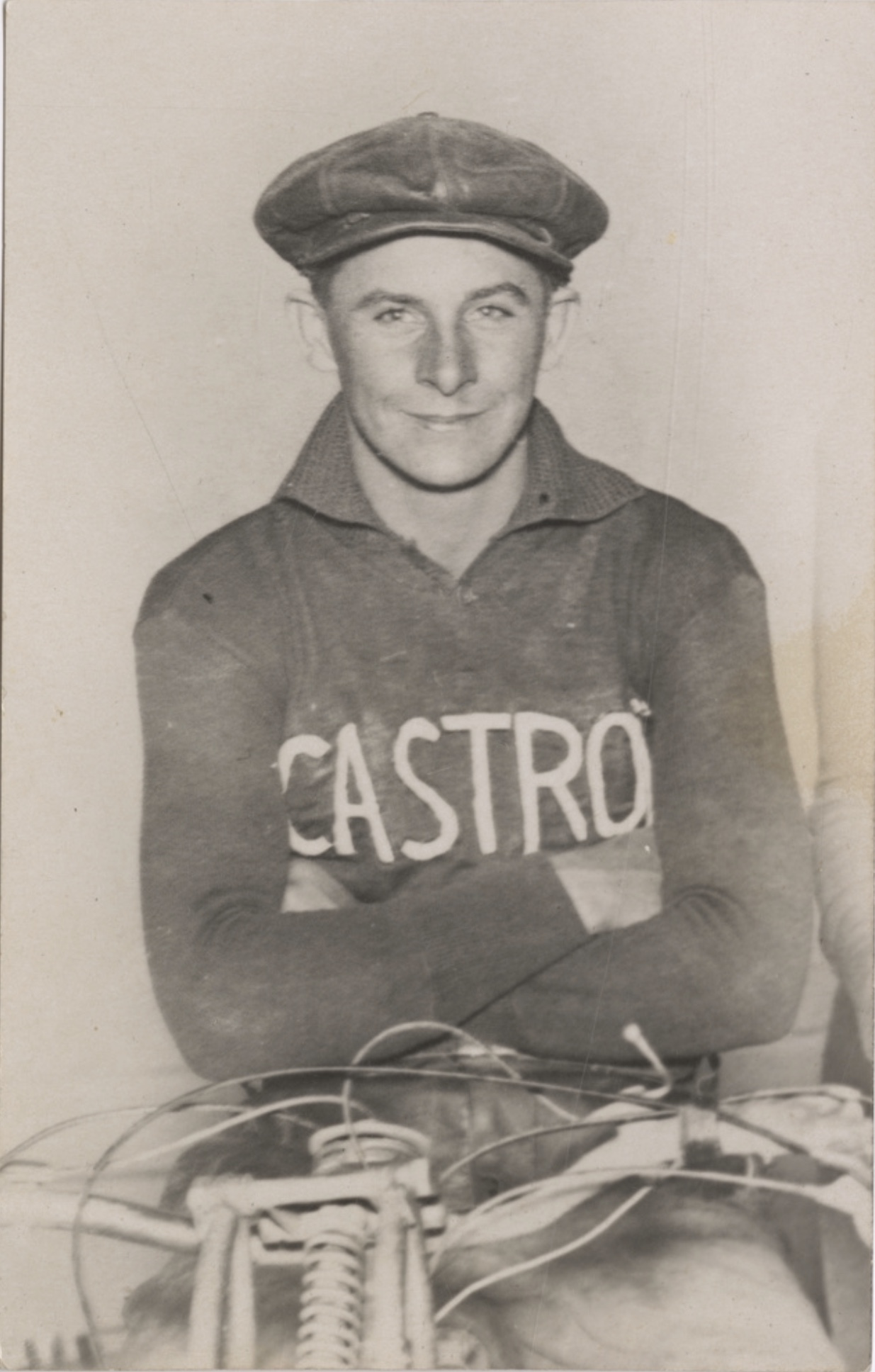
Australian Champion Speedway Rider Vic Huxley astride his Rudge JAP before the off, Wimbledon, 1933…
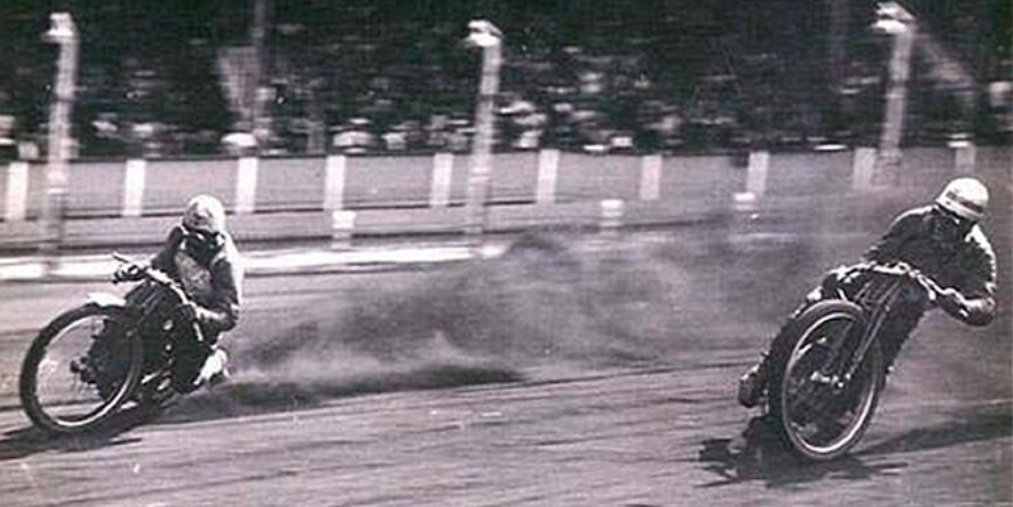
The caption notes Huxley as one of ‘the greatest exponents of broad-sliding around the track’.
‘Victor Nelson (Vic) Huxley (1906-1982) was born on 23 September 1906 at Wooloowin, Brisbane and attended Fortitude Valley and Kelvin Grove state schools.
Employed as a battery mechanic, he had been riding motorcycles for three years when a major bike speedway competition was introduced at the Brisbane Exhibition Ground in October 1926- he won the first event on the program, the One-Mile Handicap, and soon became one of the `broadsiding’ stars of the inaugural night races. He also won events at the Toowoomba Showground and Brisbane’s Davies Park.’
22 year old Vic Huxley at Wayville Showgrounds, Adelaide in 1928 (SLSA)
‘It was in these early stages of his career that he was bequeathed the nickname`Broadside’ by his growing number of fans. After success in Australia, including a stint at Adelaide’s Wayville Showground, he left for England in 1928 with a group of other leading speedway riders, including Frank Arthur to introduce the new Australian sport of `dirt-track racing’.
‘Speedway was a huge success in England and at one stage it was the second most popular sport, after horse-racing in the country. For many years London was its heart, and Australians—especially Huxley—were nearly always winners.’
‘To celebrate his victories, the Ogden’s branch of the Imperial Tobacco Co. (of Great Britain & Ireland) Ltd issued a `Vic Huxley’ cigarette card in their 1929 set of `Famous Dirt-Track Riders’. On the card, he was portrayed in his characteristic `broad-siding’ manoeuvre on the track. That year he was the subject of one of a series of articles on `Daredevils of the Speedway’ published in the magazine Modern Boy’.
Billy Lamont and Vic Huxley, Wimbledon, date uncertain (J Chaplin)
‘In June 1930 Huxley led an Australian team to victory in the first official speedway Test match against England. Unbeaten at this meeting, he was to become the most successful rider in Tests in the early 1930s. Captain of the ‘Harringay’ and then the ‘Wimbledon’ speedway teams, he won the Star Championship (forerunner of the world championship) in 1930 and next year became the British open champion.’
’He was almost unbeatable: he broke speedway records all over England; won eight major championships and also set and broke lap records at speedway tracks in Australia and New Zealand. His earnings were over £5000 per year, making him then one of the highest-paid sportsmen in the world. Members of the royal family and T. E. Lawrence were among those who congregated around Huxley’s team at the speedway.’
The two captains- Australia’s Vic Huxley and England’s Harold ‘Tiger’ Stevenson before the First Test at Wembley in June 1933 (Getty)
‘On 23 October 1931 at the register office, St Marylebone, London, Huxley married Sheila Alice Katherine King. He featured in numerous speedway magazine articles and books on speedway riding in England and Australia. When the British Broadcasting Corporation interviewed him in 1934 for its `In Town Tonight’ program, he became the first speedway rider to broadcast on radio. In the same year he won the Australian solo championship after being placed first in every event he entered.’
‘In his eleven years as a speedway rider on a range of different manufacturers’ machines, Huxley had only one serious accident.’
‘He left speedway racing in 1937 and opened the British Motorcycle Co. in Brisbane. Mobilised in the Militia as a lieutenant on 5 August 1941 he trained motorcycle dispatch riders. He was de-mobbed on 5 February 1945 and returned to his motorcycle business, retiring in 1957.’
’He kept few trophies and never sought any publicity. Despite being `bigger than Bradman’ in his day, Huxley remained throughout his life a modest and simple man. Three months after the death of his wife, he died on 24 June 1982 at Kangaroo Point, he was survived by a son.’
Huxley was a major sports celebrity in the UK with plenty of interest from the general press. Here he is cycling with his pooch ‘Raggles’, a Sealeyham Terrier, near his home, Wimbledon, May 1935
Etcetera…
(Getty)
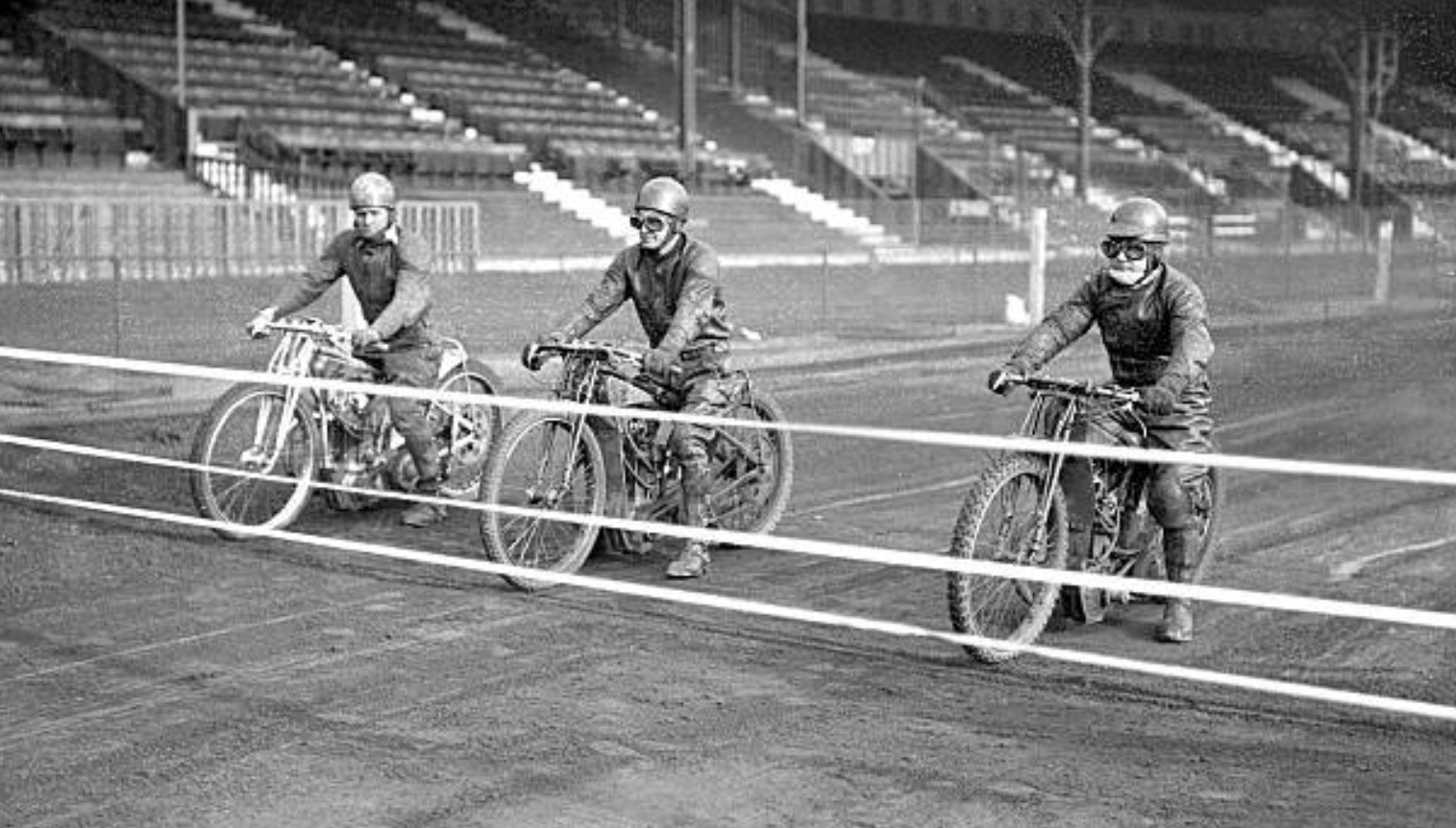
Bill Sharp, Vic Huxley and Gus Kuhn before the start of a practice lap at Wimbledon in March 1935. ‘Huxley was testing his foot was in good enough condition after fracturing it last season’ the photo caption advises.
(Getty)
Vic Martin presents a silver Belisha Beacon to Vic at West Ham Speedway in May 1935. He has just covered a lap at 45 mph beating Tommy Coombs and Tiger Stevenson to the trophy.
For we colonials, a Belisha Beacon is an amber-coloured lamp globe atop a tall black and white pole which marks pedestrian crossing in the UK. Goddit!
(Getty)
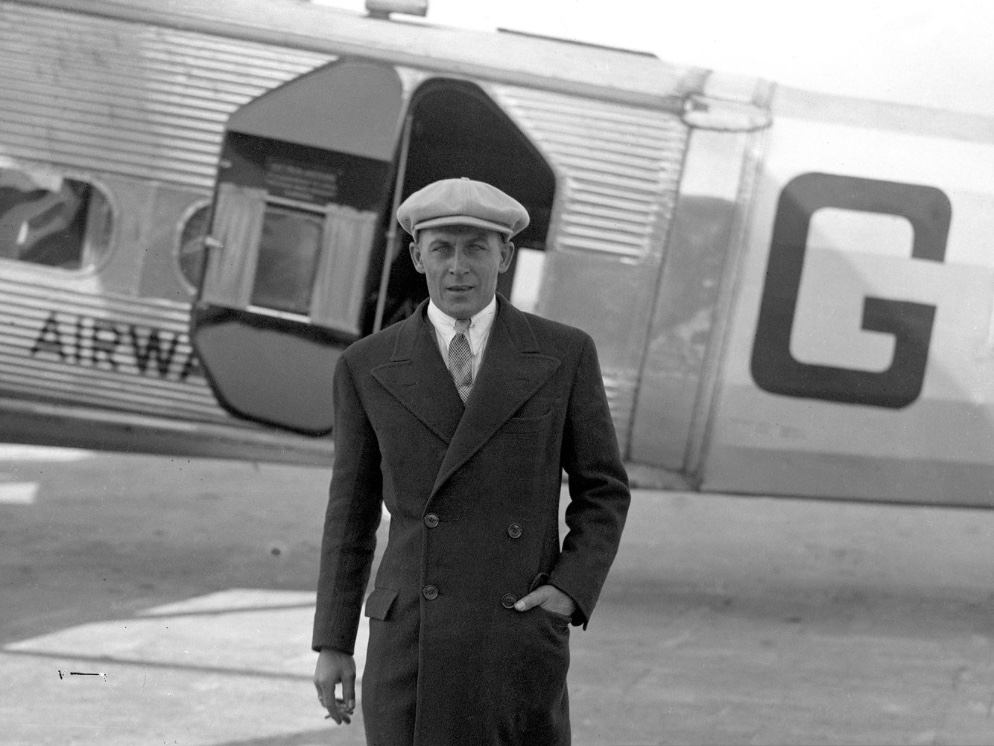
Looking quite the man about town- Huxley arrives at Croydon Airport in time for the opening of the 1933 speedway season that April. The caption records travel travails before the age of the Dreamliner- by the liner Otranto from Australia before flying from Toulon to London.
Reference…
All of this article, with the exception of the photographs/captions is sourced from an ‘Australian Dictionary of Biography’ entry about Huxley written by Jonathon Richards and comprises either direct quotes or truncated elements of his prose.
Photo Credits…
Getty Images, John Chaplin Collection, State Library of South Australia





























 primotipo...