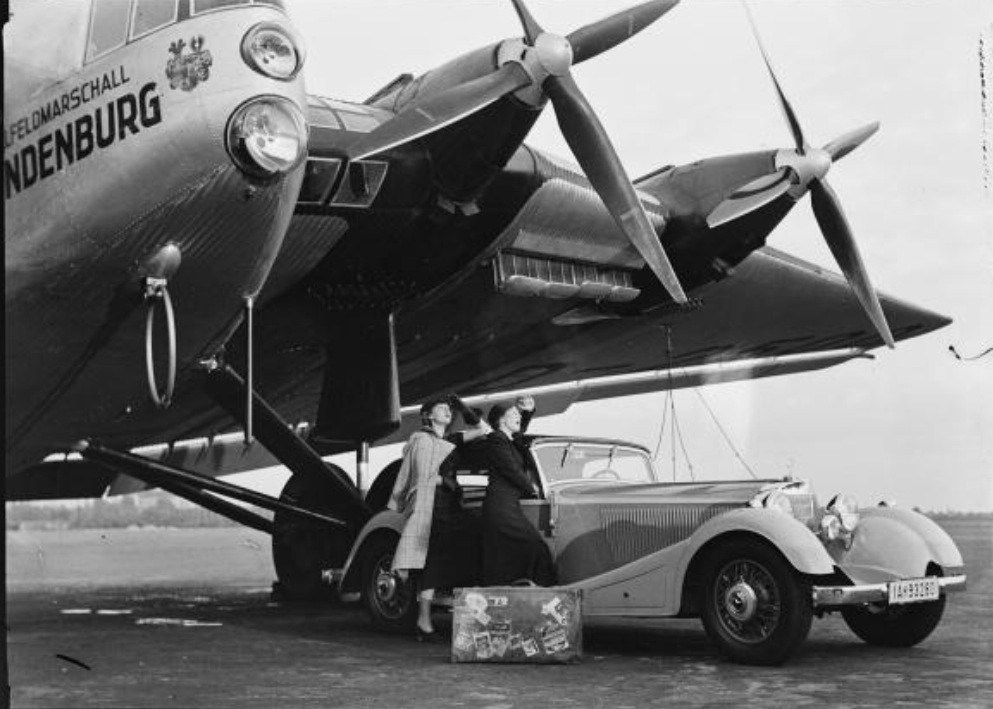
Promotional shoot for the ‘General von Hindenburg’ Junkers G.38 transport aircraft or perhaps the Mercedes Benz i wonder, circa 1934…
Any idea what model it is folks? The car I mean.
Credit…
Zoltan Glass

Finito…
 | Rob on Benalla Centenary 100, 19… |
| Rob on Bib Stillwell: Cooper T49… |
| Crocodile Rock: Audi… on Crocodile Audi R8… | |
 | r7eb2339c739912 on Benalla Centenary 100, 19… |
| Rob on Bib Stillwell: Cooper T49… |
Promotional shoot for the ‘General von Hindenburg’ Junkers G.38 transport aircraft or perhaps the Mercedes Benz i wonder, circa 1934…
Any idea what model it is folks? The car I mean.
Credit…
Zoltan Glass
Finito…

(oldracephotos/DKeep)
What do you do when you have already overdosed on Longford?…
Have some more of course! There is no such thing as too much of a good thing.
Lindsay Ross has popped a swag of oldracephotos.com.au photographs on The Nostalgia Forum recently- his focus with this batch of shots was just on The Viaduct section of this challenging circuit. See here for a lap of the place to orientate yourself; https://primotipo.com/2018/07/05/longford-lap/
One of the things I love is the mix of shots, and do checkout the website, Lindsay has been ridiculously kind with his support of me since starting primotipo, without doubt there are more photographs from the ORP archive than any other. Lets support those that support us ; http://oldracephotos.com/content/home/ The cars vary from the sublime- Jackie Stewart’s BRM P261, to the more realistic end of the enthusiast spectrum- Formula Vee, and pretty much everything in between.
The opening photograph is of Graham Cullen’s CMS Vee, and he has a playmate in the undergrowth too- who is it? No he doesn’t, its just that his bodywork has become separated from the chassis on his trip through the undergrowth. The driver of car #71 zipping past the long-suffering marshalls is Garry Nielsen in a Tasman- I wonder who built these cars?

(M Hickey)

CMS is short for ‘Cullen Marine Services’ Graham Cullen’s primary business, he built about twelve of these ladder framed cars in the early Australian Vee years in the mid to late sixties.
By the time I had driver/engineer Peter Ward look after my Venom Mk2 FV circa 1979- he was building CMS’s of a totally different kind- very quick spaceframe cars raced by he and David Eyre-Walker and one or two others.
Like every man and his dog Wardy had an Elfin NG Vee copy he named ‘Spectre’, of which he built plenty in his Ross Street, Balwyn, Melbourne backyard workshop. I never worked out why Elfin Chief Garrie Cooper didn’t take to the cleaners all the pericks who knocked off that great design! Still, often the last thing to be found in a court of law is justice.
(oldracephotos/DKeep)
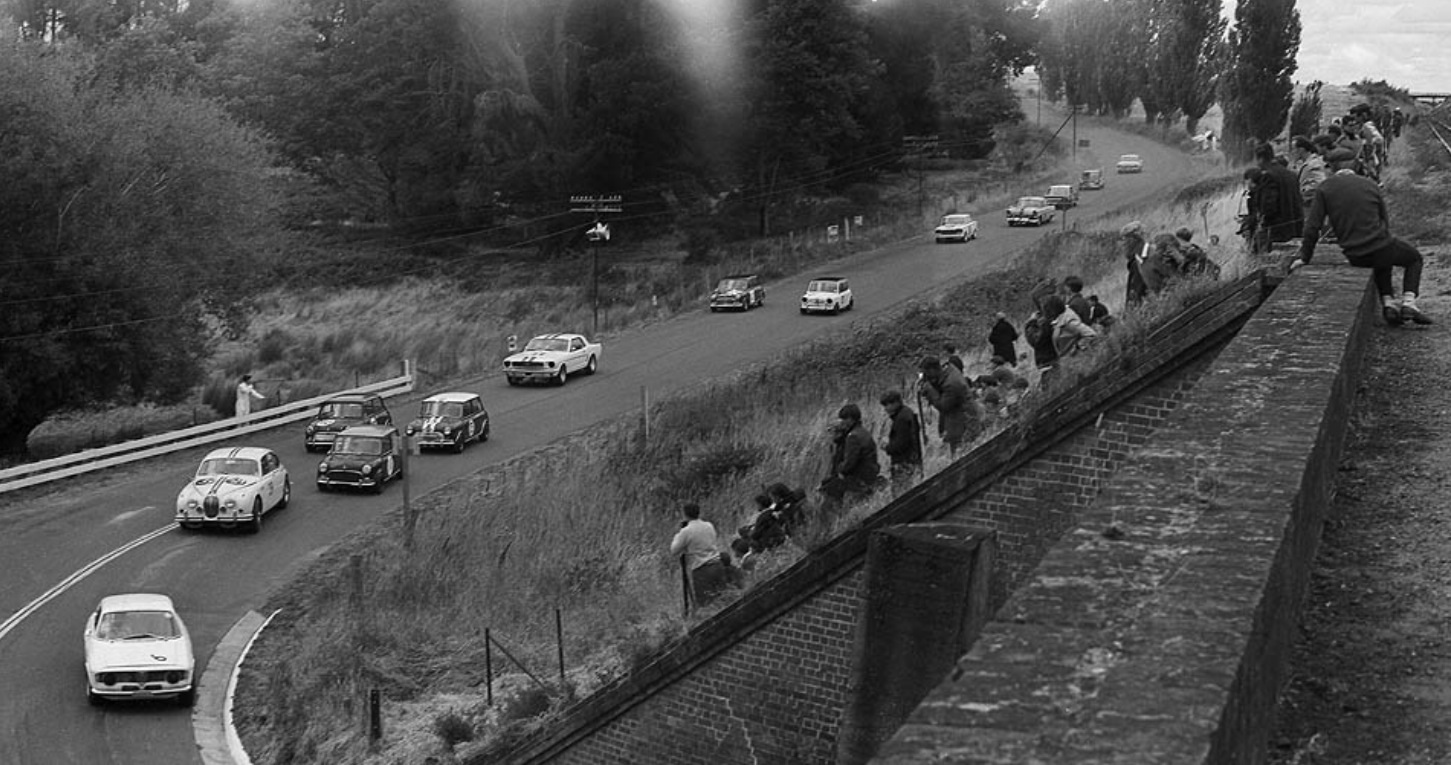
This panoramic shot of Frank Gardner leading the Touring Car pack down the hill into the Viaduct gives us some perspective- what a mega spot for spectators, blow the photo up and you can see the train line. I’ll take advice on the drivers too folks, but I guess its Bruno Carosi in the Jag Mk2 and Robin Pare in Don Elliott’s white Mustang. Rob Bartholomaeus and Bill Hollingsworth have Bob Holden in the ‘striped’ Cooper S, Gene Cooke in the Fiat 1500 and Rob Boote in the Holden EH. The year is 1967.
Have a look at this article on the Alec Mildren Racing Alfa GTA’s and their pilots; https://primotipo.com/2014/11/27/the-master-of-opposite-lock-kevin-bartlett-alfa-romeo-gta/

(oldracephotos/DKeep)
Then lets have a look at JYS in his BRM at ground level, at about the point Frank is turning in and pretty much the car at the same point from above, peering down into the cockpit.
Jackie looks as ‘snug as a bug in a rug’ inside that tight cocoon- unbelted as he is.
The shot above is of P261 ‘2614’ in 1966, he won the race from Graham Hill’s similar car and Jack Brabham’s Brabham BT19 Repco. Look closely, the engine is a crossflow 1930cc P60 V8- inlets within the Vee and exhausts outside. Check out this article on the BRM P56/P60 V8; https://primotipo.com/2016/02/05/motori-porno-stackpipe-brm-v8/

(oldracephotos/Keep)
Whereas the photo above is in 1967, again the car is ‘2614’ albeit this time powered by a P60 V8 of a different configuration- see the exhausts between the Vee, and its of 2070cc in capacity.
Jackie DNF with gearbox problems- which was the weak link of the BRM’s that season, the power and torque of the larger engine was beyond the design limits of a gearbox first built for engines of 1.5 litres- the GP formula of the time.
Brabham won that day in BT23A Repco ‘740’ from Clark’s Lotus 33 Climax FWMV 2 litre V8- the Tasman Championship winning combo that year. It too was a stretched, in terms of engine, 1.5 litre F1 car. Here is a piece about the 1967 Tasman and the fortunes of Stewart, Clark and Hulme; https://primotipo.com/2014/11/24/1967-hulme-stewart-and-clark-levin-new-zealand-tasman-and-beyond/
(oldracephotos/DKeep)
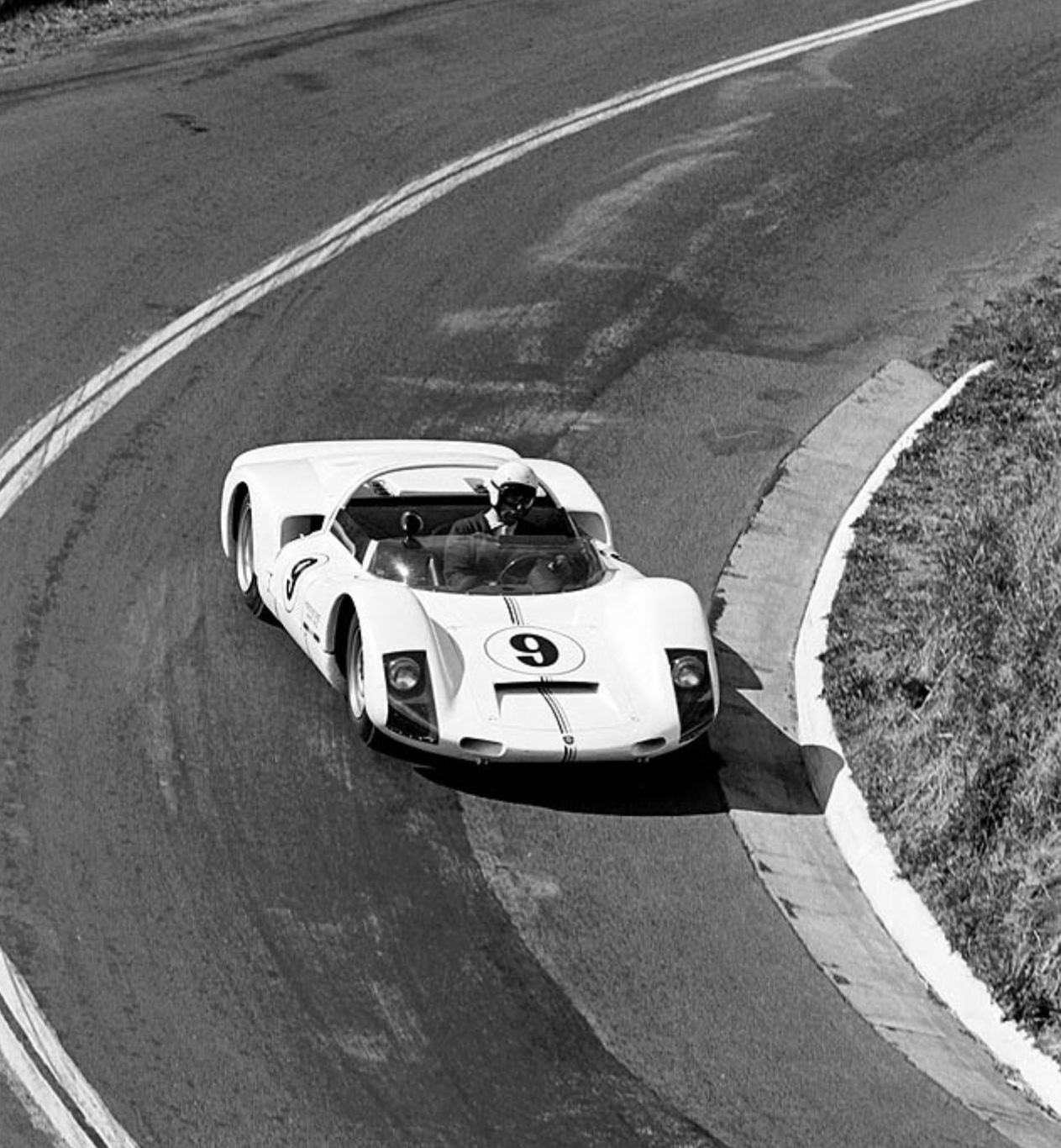
Similar turn-in shot for Alan Hamilton who has his Porsche 906 Spyder beautifully cocked up in a delicate little slide- these cars were great, forgiving, customer machines.
Here is a bit more about them- Alan and his 906’s; https://primotipo.com/2015/08/20/alan-hamilton-his-porsche-9048-and-two-906s/
(oldracehotos/DKeep)
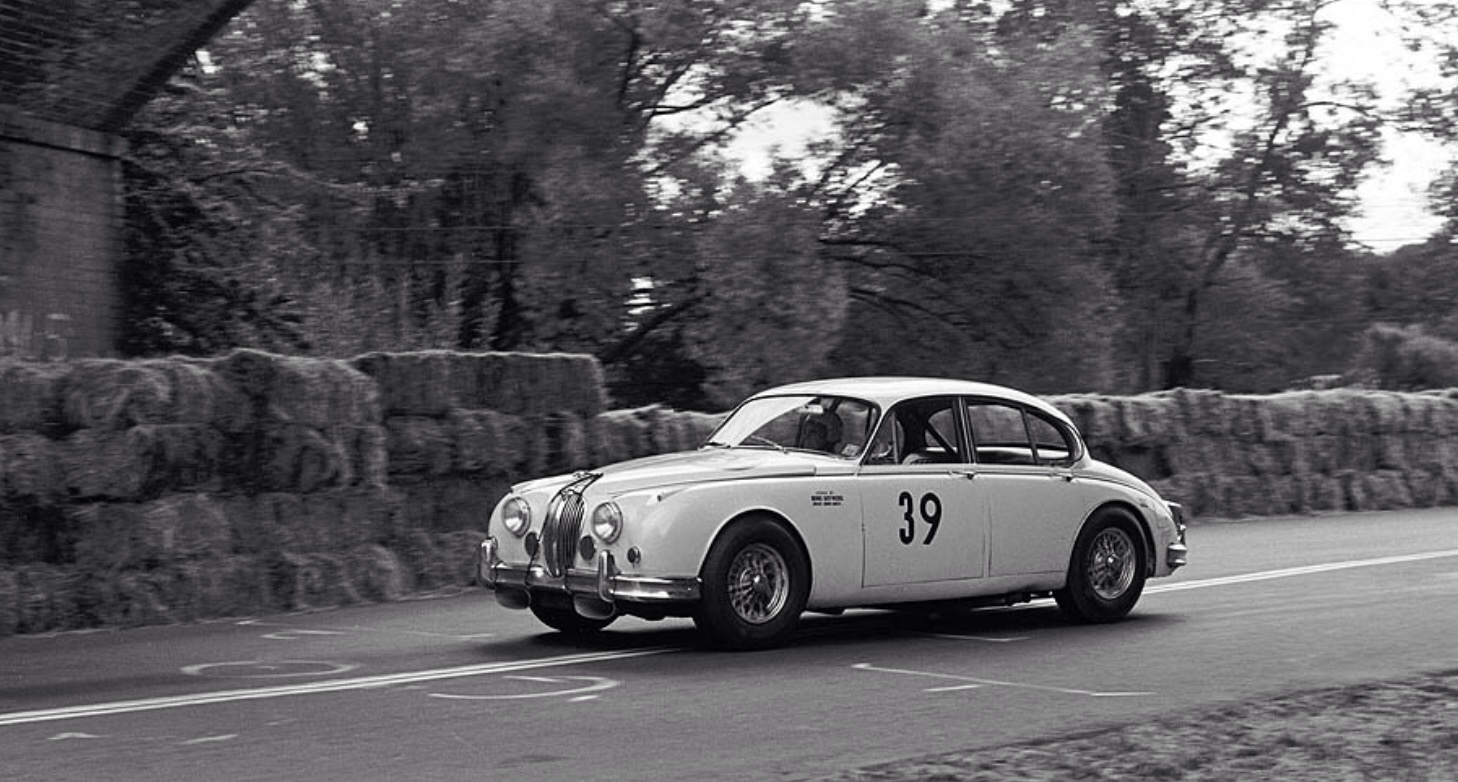
Bruno Carosi in the ex-Bob Jane Jaguar Mk2 is under the Viaduct in 1967, whilst the shot below is of Doug Whiteford’s Maserati 300S just as he enters the light- by the look of that number on his cars nose its during the 1959 Australian Grand Prix meeting in which Dicer Doug failed to finish having driveshaft failure on the first lap- Stan Jones won the event in his Maserati 250F.
That race is covered here; https://primotipo.com/2016/01/08/stan-jones-agp-longford-gold-star-series-1959/

(oldracephotos/DSaward)

(oldracephotos/DKeep)
David Keep has a really unusual and interesting view of Pete Geoghegan chasing Frank Gardner away from the Viaduct and towards Kings Bridge, its 1967 again.
Who won the Taxi races?, my money is on Pete despite the more nimble attributes of the GTA. See here; https://primotipo.com/2017/10/17/he-came-he-saw-he-conquered/
(oldracephotos/Harrisson)
Things went wrong of course.
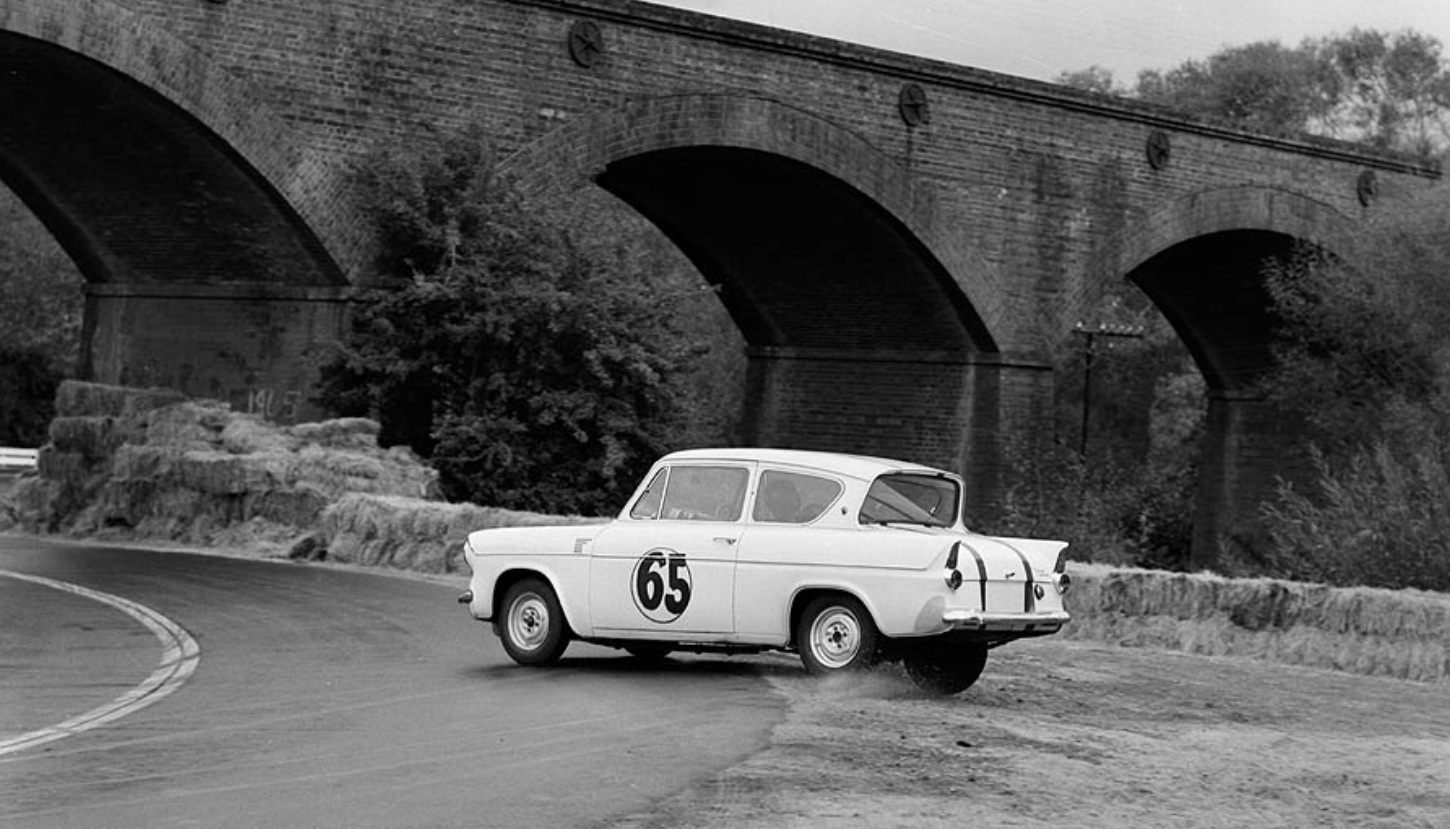
The Viaduct had a fast approach- downhill, a tricky turn-in and bugger-all in the way of run-orf areas to capture the steed which has just gotten away from you, should that particular situation occur.
Which of course it did, as in this series of happy snaps!

(oldracephotos/Harrisson)
Phil Brooke looks fairly happy with himself so presumably he has not done too much damage to his pride and joy on that greasy race-day in 1968, we can’t see the rear of the little Angle-box mind you.

(oldracephotos/Harrisson)
Bruno has painted his Jag between the 1967 and 1968 meetings, he is just about to alight the machine being very careful where he pops his feet. Still, too much action about the place for the snakes to show interest I guess. They do have snakes down there I think?- just Googled, they do, copperheads, tigers and white-lipped, none particularly friendly or good for you.
(oldracephotos/Harrisson)
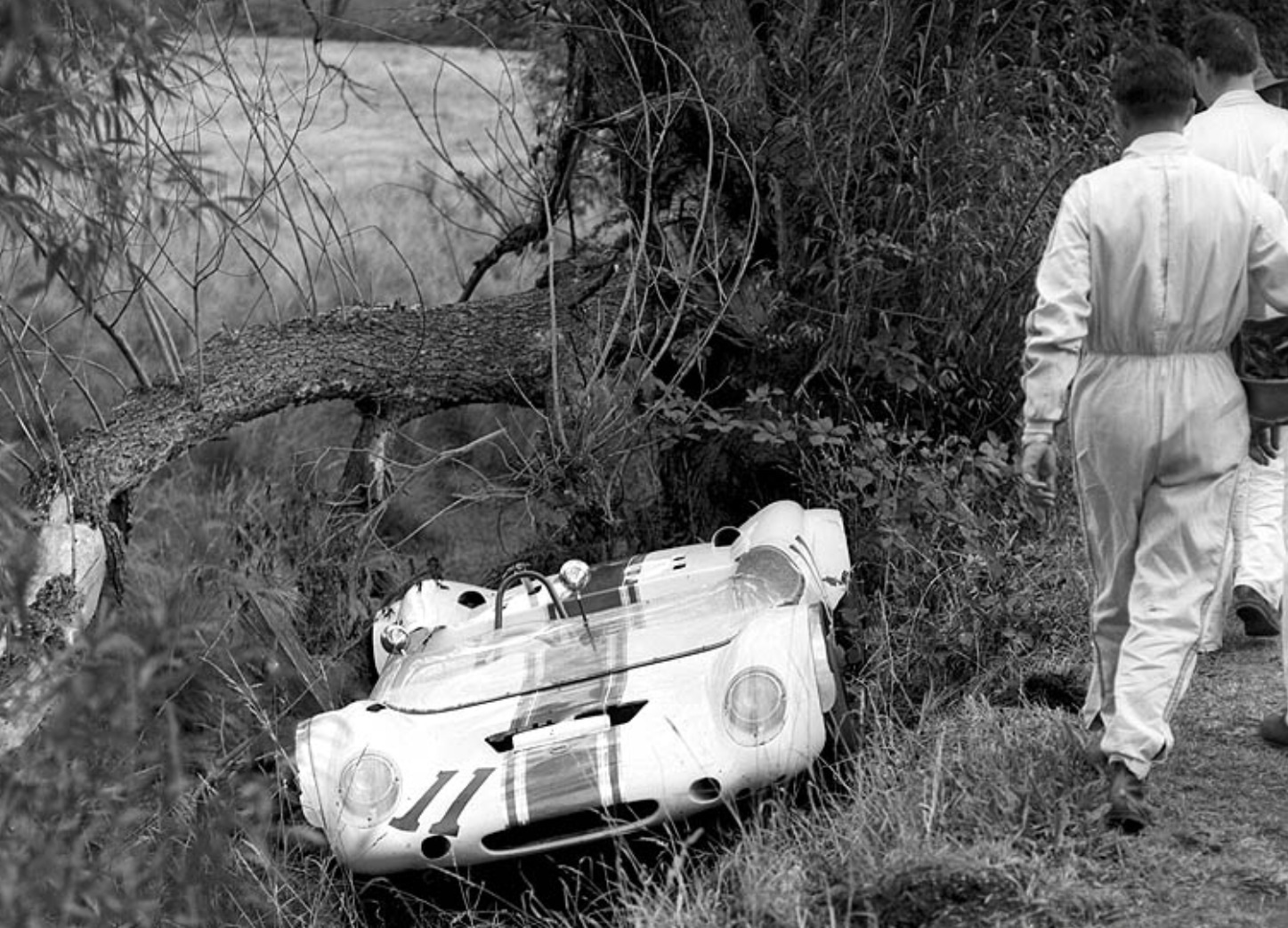
Lionel Ayers Rennmax built MRC Lotus 23B Ford looks as though it is suspended in a tree but its probably on solid’ish ground. It will may need a wheel alignment before tomorrow’s race all the same. Its 1968.

(oldracephotos/Harrisson)
Daryl Wilcox looks as though he has had a moment on the way into the corner and is perched precariously half on and half off the road. Just looked again it might be on the exit? Phil Brook’e youthful face I can just make out to the left of the copper’s head- clearly both chappies have left the island on the notoriously wet last day of racing ever at Longford on Monday 4th of March1968.
Credits…
oldracephotos.com.au and in particular the work of David Keep who is for sure one of the Longford photographic gods, not to forget Mr Harrisson as well. Michael Hickey Collection
Tailpiece: Up The Escape Road…

(oldracephotos/DKeep)
To get the entry to the escape road right takes real skill under pressure- so maybe Darryl O’Toole bailed real early in his Humpy. Its not a back road to Longford mind you- he is about to run out of gravel soonish.

(KBY191)
This November 2018 photograph by KBY191 shows that ‘The Viaduct and railway are still there, however nothing remains of the old track running down to The Viaduct since reconstruction of Illawarra Road which also bisects Tannery Straight with a round-about’.
Finito…

(Klemantaski)
The geography of racetracks prior to the seventies highlights the need for accuracy to avoid damage to the local scenery let alone car and driver…
It’s Le Mans 1966, the 18/19 June weekend. The Ecurie Francorchamps Ferrari 365P2 of Pierre Dumay and Jean Blaton starts the long run along the Mulsanne Straight ahead of a factory Ford Mk2 and Pedro Rodriguez in the NART Ferrari 365 P3 ‘0846’ he shared with Richie Ginther.
I’m not sure which Ford it is but the two Ferrari’s failed to finish- the Francorchamp’s car with engine dramas and the NART machine with gearbox failure.
Bruce McLaren and Chris Amon won in a Ford Mk2, click here for a short article about the race; https://primotipo.com/2016/06/27/le-mans-1966-ford-mk2-andrettibianchi/
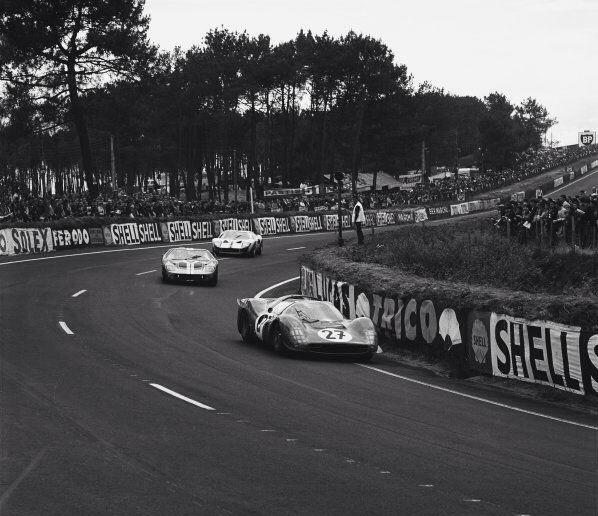
The Ginther/Rodriguez Ferrari P3 ‘0846’ ahead of a couple of Ford GT40’s at Le Mans in 1966 (LAT)
‘0846’ was the first of the Ferrari P3’s built and was the official press car.
Built as a Spyder, the 4 litre, 420 bhp, 24 valve, Lucas injected V12 machine raced throughout 1966-at Sebring, Targa and Le Mans- all DNF’s. At the end of the year it was converted to P4 specifications for 1967- becoming one of four factory P4’s raced that season in the International Championship for Sports Prototypes and Sportscars.
At the 1967 opening round- the Daytona 24 Hour, Chris Amon and Lorenzo Bandini shared the drive and won the race in it.

Two Ferrari at Daytona in 1967- the winning Amon/Bandini P4 ahead of the third placed Mike Parkes/Jean Guichet 412P (unattributed)
Entered at Le Mans, Chris Amon and Nino Vaccarella qualified the car in twelfth position amongst a sea of Ford GT40’s and Mk2’s.
On lap 106 Chris Amon encountered a puncture and tried to change a Firestone out on the circuit but the hammer he was wielding broke so he then sought to drive the stricken P4 back to the pits.
During this trip the shredded tyre somehow ignited a fire and as a consequence the car was severely burned- and subsequently thought by most historians to be destroyed.
(unattributed)
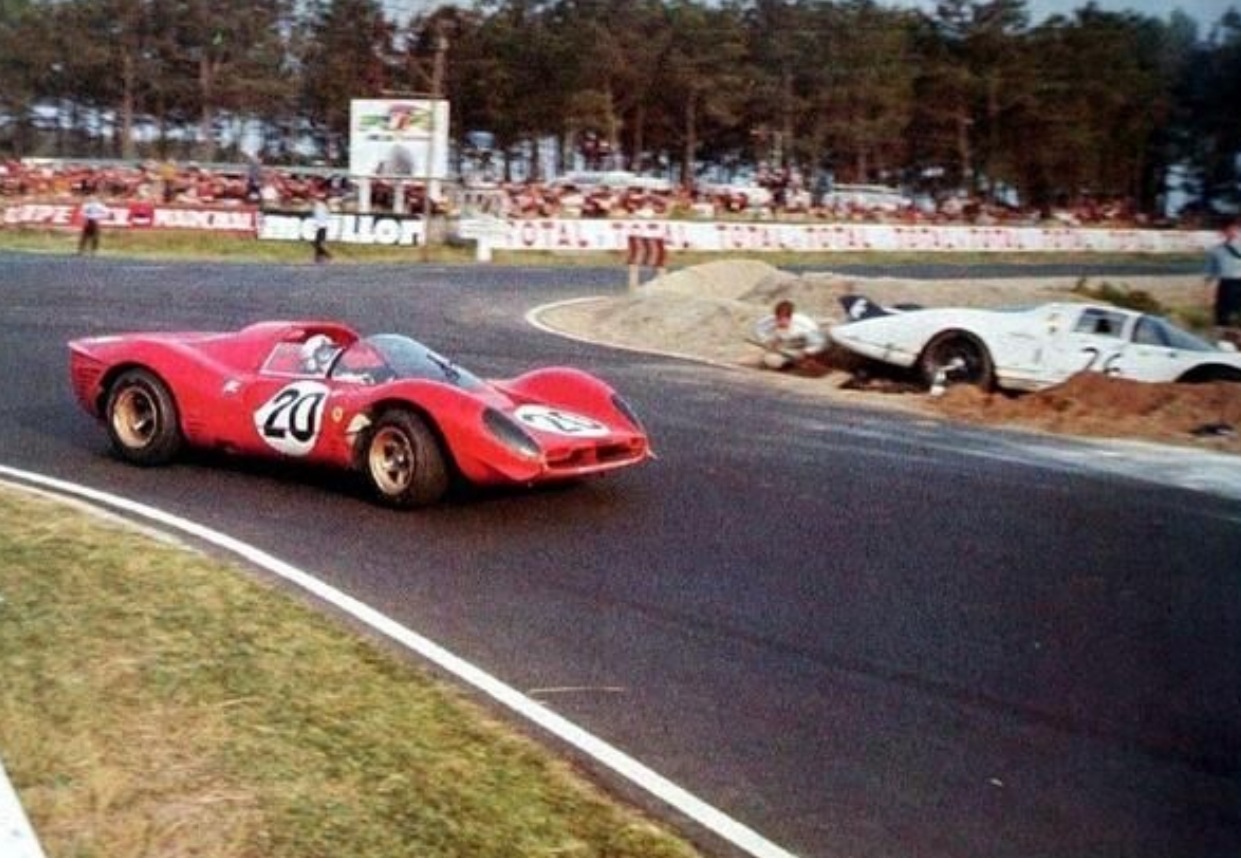
Amon lapping early in the ’67 Le Mans 24 Hour- the beached car is the NART entered Ferrari 365 P2 shared by Chuck Parsons and Ricardo Rodriguez which retired after completing 30 laps during the race’s fourth hour- Chuck is wielding the shovel.

(unattributed)
Incapable of economic repair, the P4 ‘0846’ chassis was discarded into the Ferrari scrapyard after inspection back at Maranello.
In recent times it has been confirmed, by Mauro Forghieri, that the repaired remains of the ‘0846’ chassis form the basis of the James Glickenhaus’ owned P4. Somewhat contentious, and the subject of much discussion on various Ferrari internet forums about the place, and ‘The Nostalgia Forum’ for more than a decade, some of you will have seen the car in the US or Europe.
Click here for an article about the Ferrari P4, and P3 in passing, and towards its end a link to the TNF debate about the restoration of ‘0846’; https://primotipo.com/2015/04/02/ferrari-p4canam-350-0858/
‘Veloce Todays’ bullshit-free summary of the car is here; https://www.velocetoday.com/cars/cars_69.php

Glickenhaus Ferrari P4 (unattributed)
Forghieri’s letter to Glickenhaus in relation to the chassis of the car, in full, dated 23 February 2016 is as follows;
‘Dear Mr Glickenhaus,
I am submitting my expertise regarding your Ferrari P4. It is based on the documentation that’s been made available to date and, to avoid any misunderstanding, I am submitting it in both English and Italian, the binding version being the Italian one.
1. The P3/4 denomination was never used in Ferrari and it is therefore deemed as incorrect. (Cars were either called P3 or P4)
2. The P4 chassis was almost identical to the P3’s, which were therefore routinely modified to produce P4 chassis.
3. The chassis I examined bears signs of modifications which are different from what was done in Ferrari as current practice. My opinion is that they were done by some other outfit after the accident of Le Mans 1967. The car involved was a P4 built upon a P3 chassis bearing the SN#0846, SN which was carried over as practice and regulations mandated. The car itself was seriously damaged in the 1967 accident and never repaired. The chassis, also damaged by fire, was returned to the Ferrari “scrapyard”.
4. It is my opinion that original parts of that chassis (as modified by some outfit; see above) are currently mounted on the P4 vehicle owned by you.
5. In spite of point 4 above, however, and as indicated in the factory statement that Ferrari sent you, it must be concluded that, for all legal purposes, SN #0846 has ceased to exist. Your car cannot be designated as “#0846”.
6. I can nonetheless state that your car, albeit containing non-standard modifications, is indeed a Ferrari P4.
Best Regards,
Mauro Forghieri
Modena, February 23 2016’

Chris Amon settles himself into ‘0846’ before the 1967 Le Mans classic in 1967. Injection trumpets clear as is the MoMo steering wheel, it looks pretty comfy in there.
Credit…
Klemantaski Collection, LAT Images
Tailpiece: Nino Vaccarella during the 1966 Targa Florio…

(unattributed)
P3 ‘0846’ was shared by Nino Vaccarella and Lorenzo Bandini in Sicily during the May 1966 Targa Florio.
The hometown team had completed 6 laps before Bandini crashed the car having misunderstood the intentions of the hand signals provided by the driver of a privateer Ferrari he was seeking to pass.
The race was won by the Filipinetti/Works Willy Mairesse/Herbert Muller Porsche 906.
Finito…

Lex Davison boots his Tasman Formula ex-Bruce McLaren Cooper T62 Climax off the line at Mount Tarrengower Hillclimb, Maldon, in Victoria’s Goldfields, 25 October 1964…
Davo just loved to compete- anywhere and everywhere. Apart from his four AGP wins he was adept on the dirt in Redex Round Australia Trials competition and in the hills. He won the Australian Hillclimb Championship thrice on the trot from 1955-1957 at Toowoomba, Bathurst and Albany respectively, in all cases aboard the Cooper Mk4 Vincent/Irving.

This non-championship event was an easy one for the great man. Toorak to Maldon is a nice 150 km drive up the Calder Highway so would have represented a nice weekend away with the car and no doubt a few of his kids.
Having said that Tarrengower is still a very fast, dangerous place especially with a car of the performance envelope of Davo’s GP machine. This T62 chassis was Bruce McLaren’s 1962 Caversham AGP winner before its sale to Lex, and is a car I’ve written a feature about, click here to read it; https://primotipo.com/2016/05/20/bruce-lex-and-rockys-cooper-t62-climax/
The internet gives and gives in terms of photos seeing the light of day after decades hidden in boxes. This wonderful batch were taken by a friend of Max Williams, he posted them on Bob Williamson’s amazing Facebook ‘Old Motor Racing Photographs-Australia’ page. In amongst hundreds of recycled touring car photos are some jewels, including this lot!

Bob King attended that day, it was ‘..the second hillclimb of the new era, the venue revived by the Vintage Sports Car Club of Victoria, with the event held on 25 October 1964’.
‘Graeme Thomson raced the ex-Whiteford Talbot Lago T26C but ‘Doug was there and advanced the magneto by about half a turn and then did an electric run. In those days the finish was right at the top, and having finished my run i was privileged to see Whiteford sideways across the finish line at about 100 mph. Davo was pretty exciting also taking the FTD with a 50.34 seconds run’.

Ron Simmonds picked the ex-Whitehead/Jones/Phillips Cooper T38 Jaguar (above) as probably driven by John Ampt at Monks Corner, Templestowe Hillclimb, again in Victoria.
Enthusiast Les Hughes said of the car ‘One of three, the first and shown without body at the Paris Show. It was bought by Peter Whitehead and raced by he and his brother Graham at Le Mans and Dundrod in 1955. He sold it to Jones in New Zealand who made his Australian race debut in it at Albert Park’.

Pictured is the car below at Le Mans ‘…coming through The Esses and about to be passed by the ill-fated Pierre Levegh (Mercedes Benz 300SLR) who would die on this lap. The Cooper Jag retired’.

Another Templestowe shot below , the corner at the end of Banana Straight, the wide loop hairpin onto The Shelf which then led up to The Wall.
Who is it and what is it though?

Credits…
Max Williams, Bob King, Les Hughes, Ron Simmonds, Greg Manderson
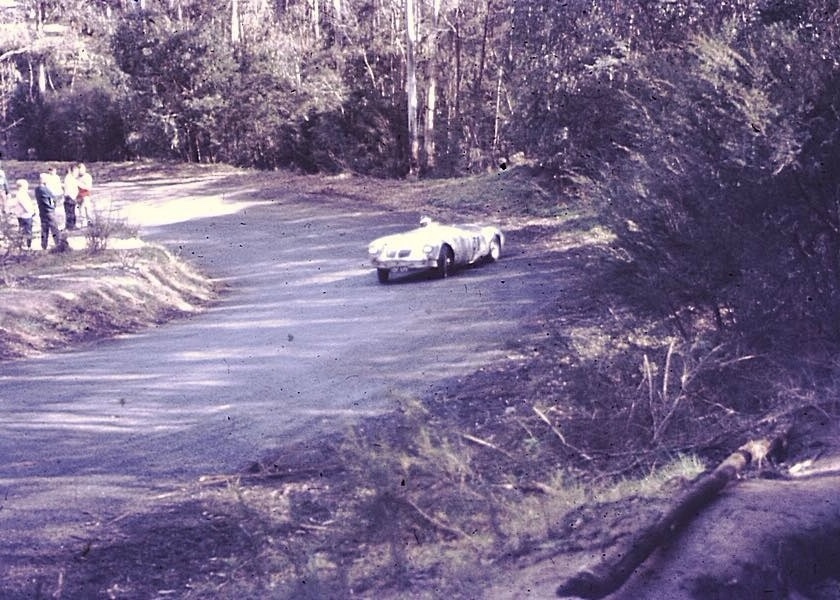
Tailpiece: MGA coming out of Monks and onto The Shelf at Templestowe…
Finito…
(Kiama)
I wrote an article about beach racing at Gerringong Beach near Kiama on the New South Wales Illawarra Coast a while back…
The article focused on a race meeting in May 1930, I had too many photos for that piece, the purpose of this article is to share them here.
They cover a diversity of Gerringong related topics- the May 1930 meeting, three land speed record attempts and Sir Charles Kingsford-Smith. The history of Gerringong Beach aka Gerringong Speedway is in that earlier article, click here to read it; https://primotipo.com/2018/10/26/gerringong-beach-races-1930-bill-thompson/
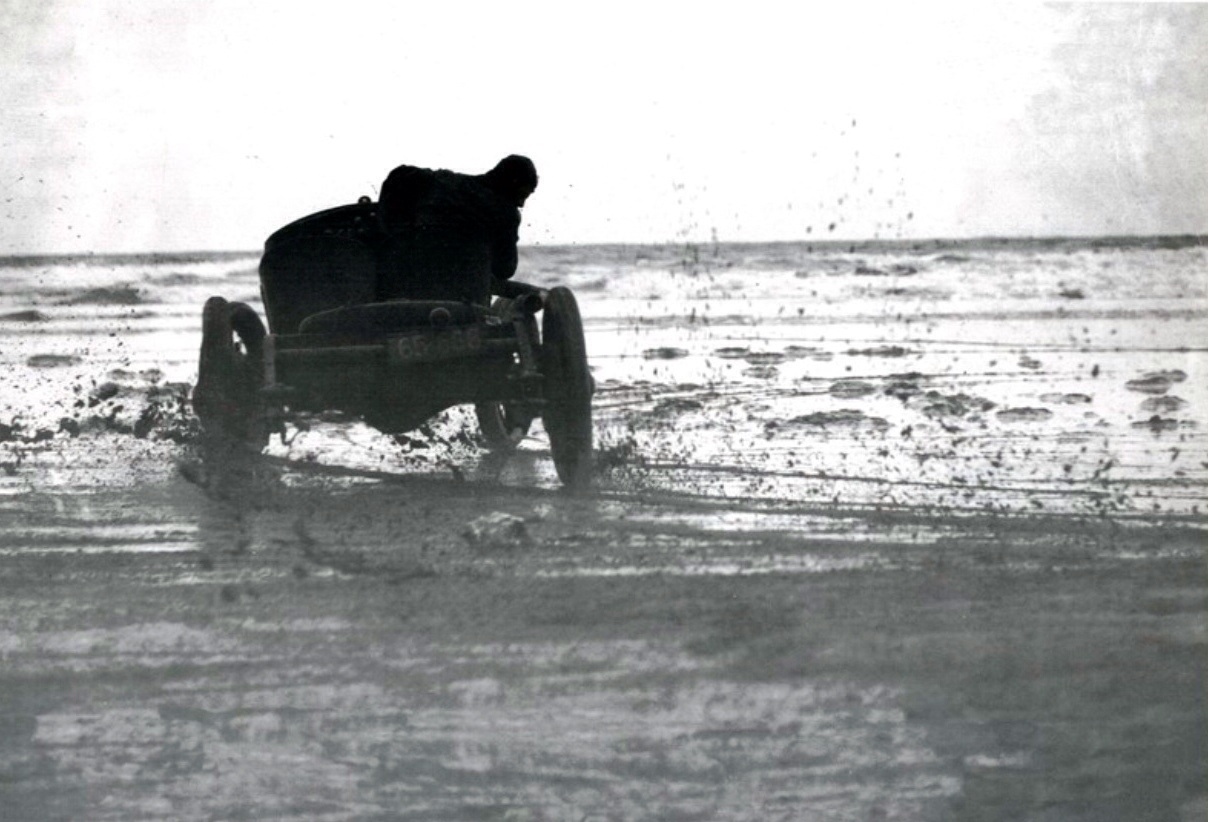
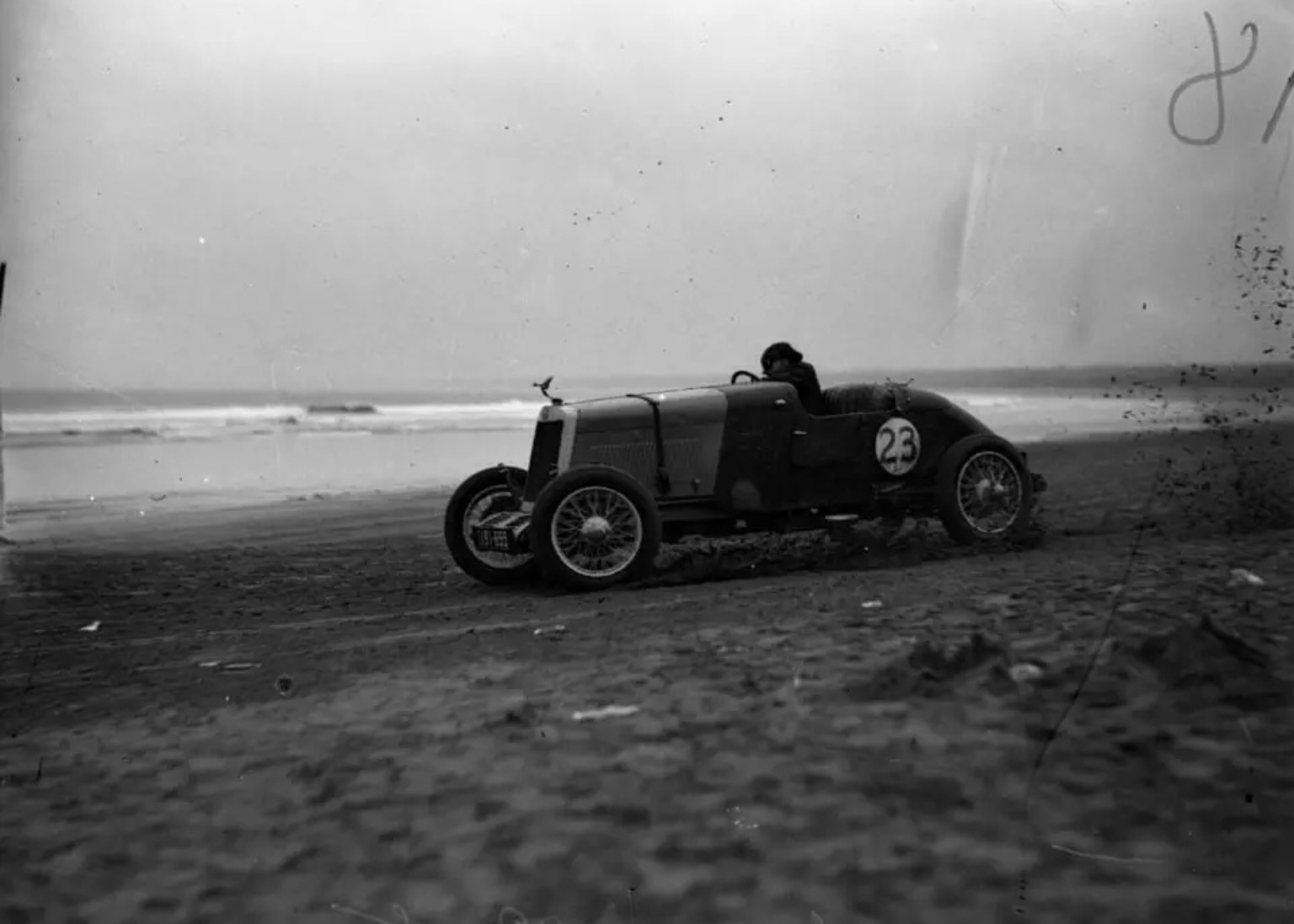
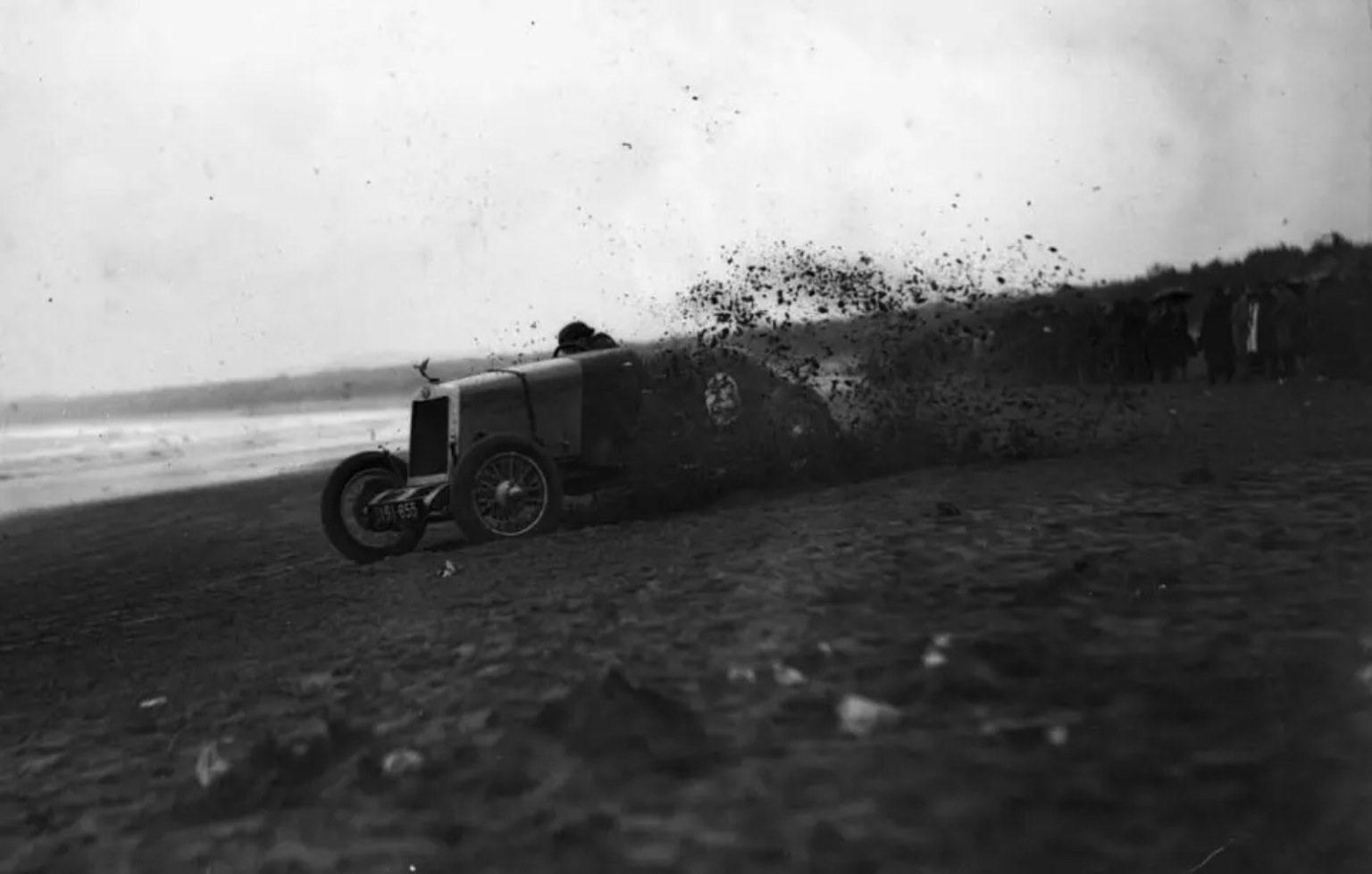
I’ve no idea who the driver or car above is but just love the silhouette of machine and driver against the backdrop of the Pacific Ocean. Its taken during the May 1930 meeting as the ‘track’ fights a losing battle with the tide.
(Kiama)
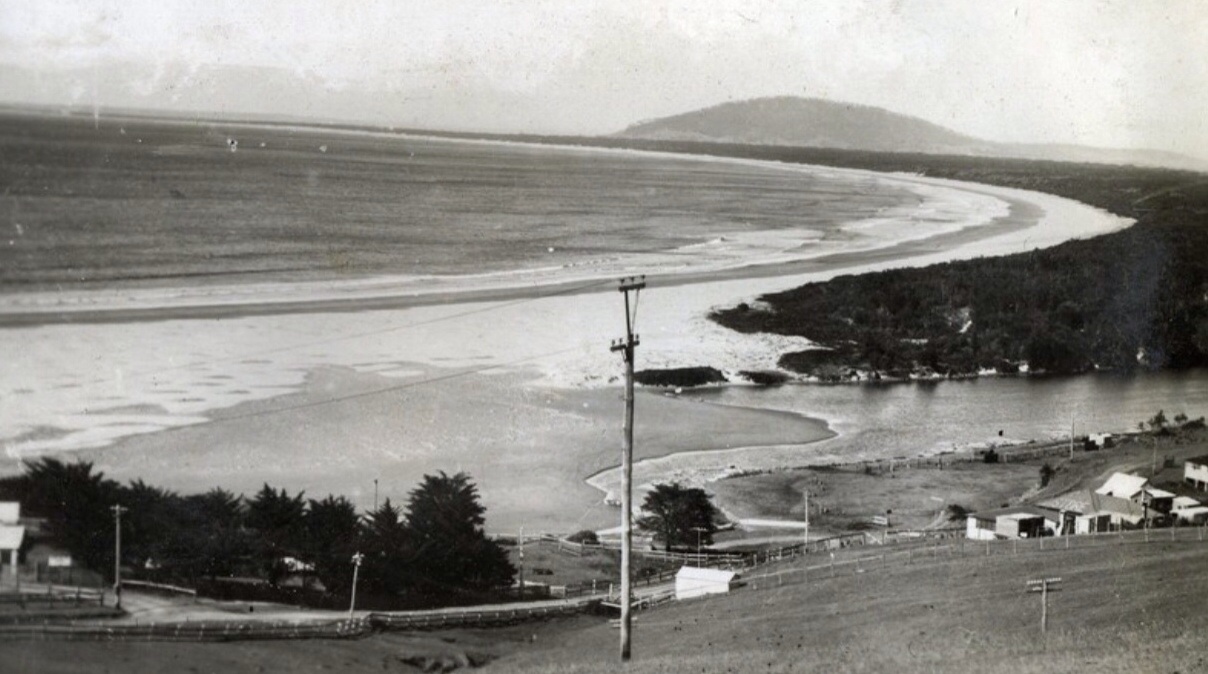
The photo above is of Seven Mile Beach and the little Gerroa settlement, it gives a sense of just how relatively quiet a place Gerringong was at the time. Gerroa River mouth at Gerringong.
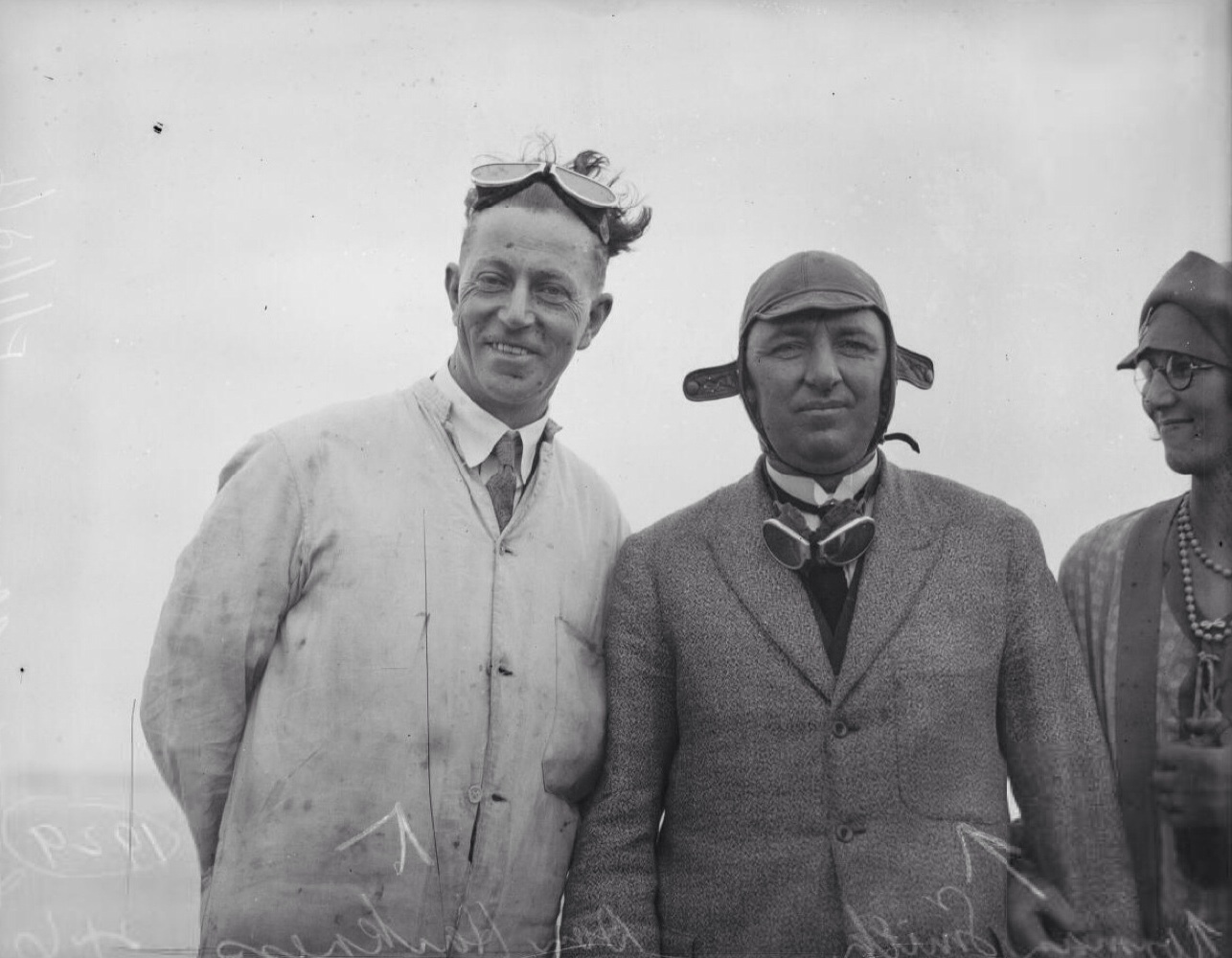
Don Harkness and ‘Wizard’ Smith on Gerringong Beach in December 1929 (Fairfax)
Don Harkness: Minerva Hispano Suiza Australian LSR October 1925…
Upon leaving school Don Harkness became an apprentice in general engineering, aged 20 he was employed by JC Hilliers at Drummonye Sydney, by 1922 Harkness and Hillier Pty. Ltd. was formed.
Don developed an interest in motor racing and imported a Willys Overland which was highly modified- ‘Whitey’ as the car was nicknamed won over 50 races at venues as diverse as the Maroubra concrete saucer speedway, the Penrith dirt speedway and on the beach at Gerringong.
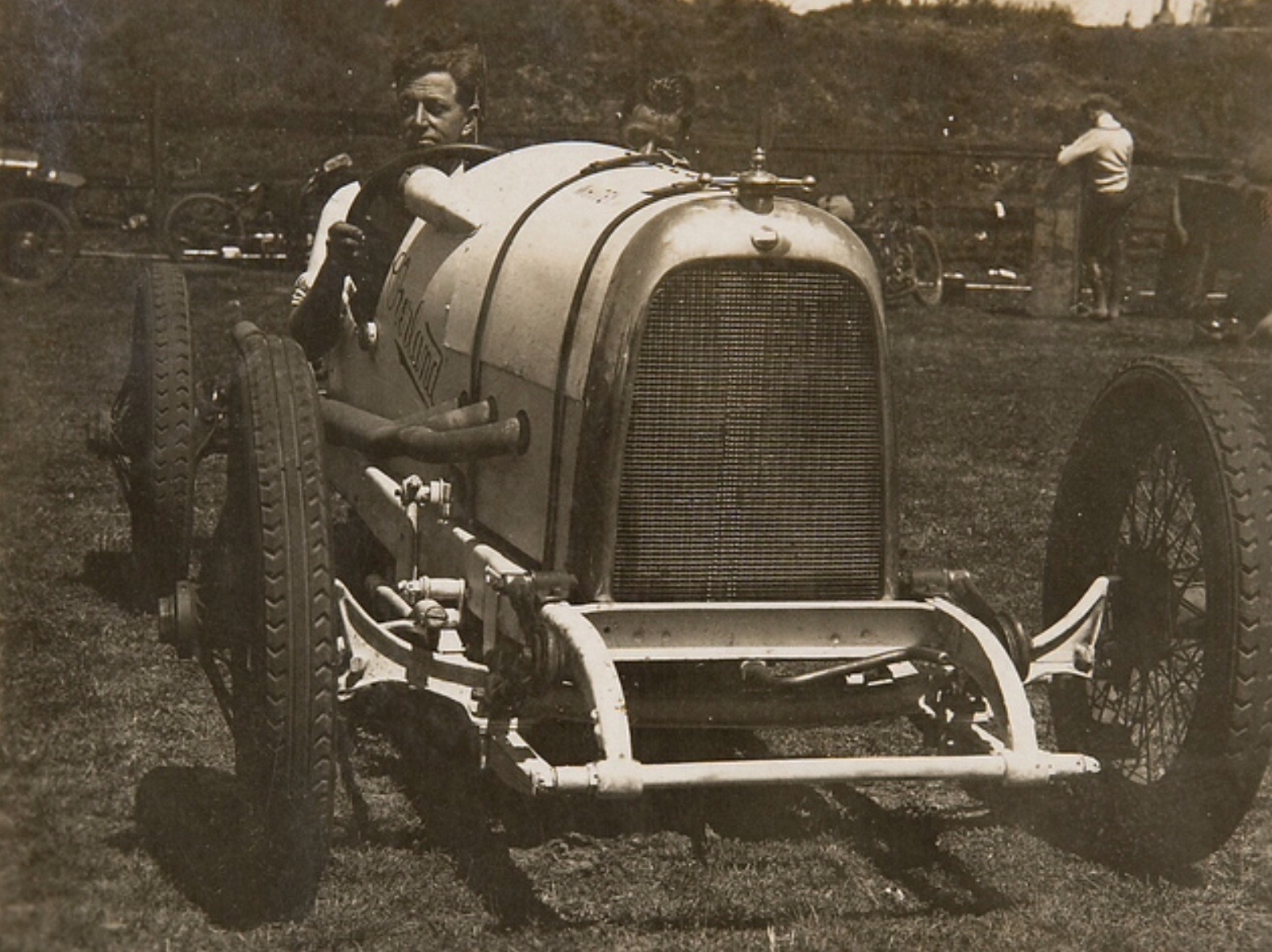
Harkness aboard the Overland ‘Whitey’ date and place unknown (DHA)
An offer of a fifty pound trophy to the first person to exceed 100 mph in Australia over the measured mile by the Daily Guardian newspaper led to Harkness’ use of FR Colbert’s Minerva chassis powered by a Hispano aero V8 engine- the car below won the trophy on 17 October 1925 at a speed of 108 mph.
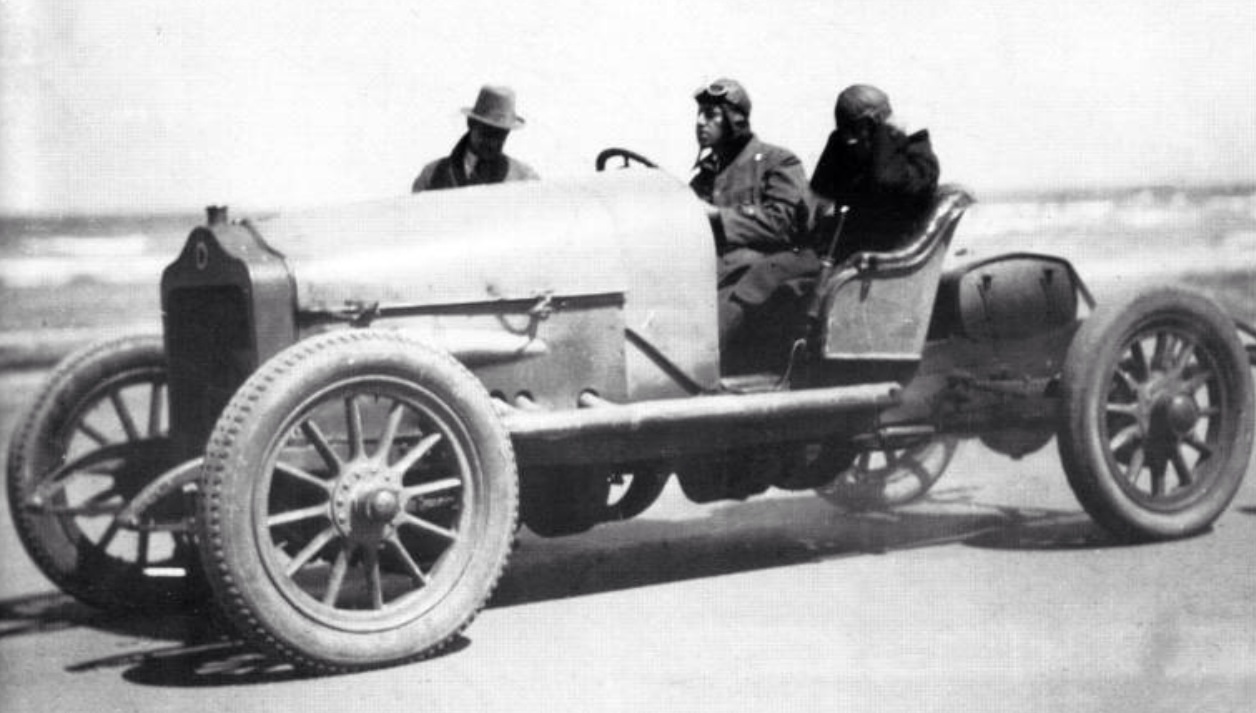
(unattributed)
Anzac Rolls Royce: Wizard Smith and Don Harkness, Australian Land Speed Record December 1929…
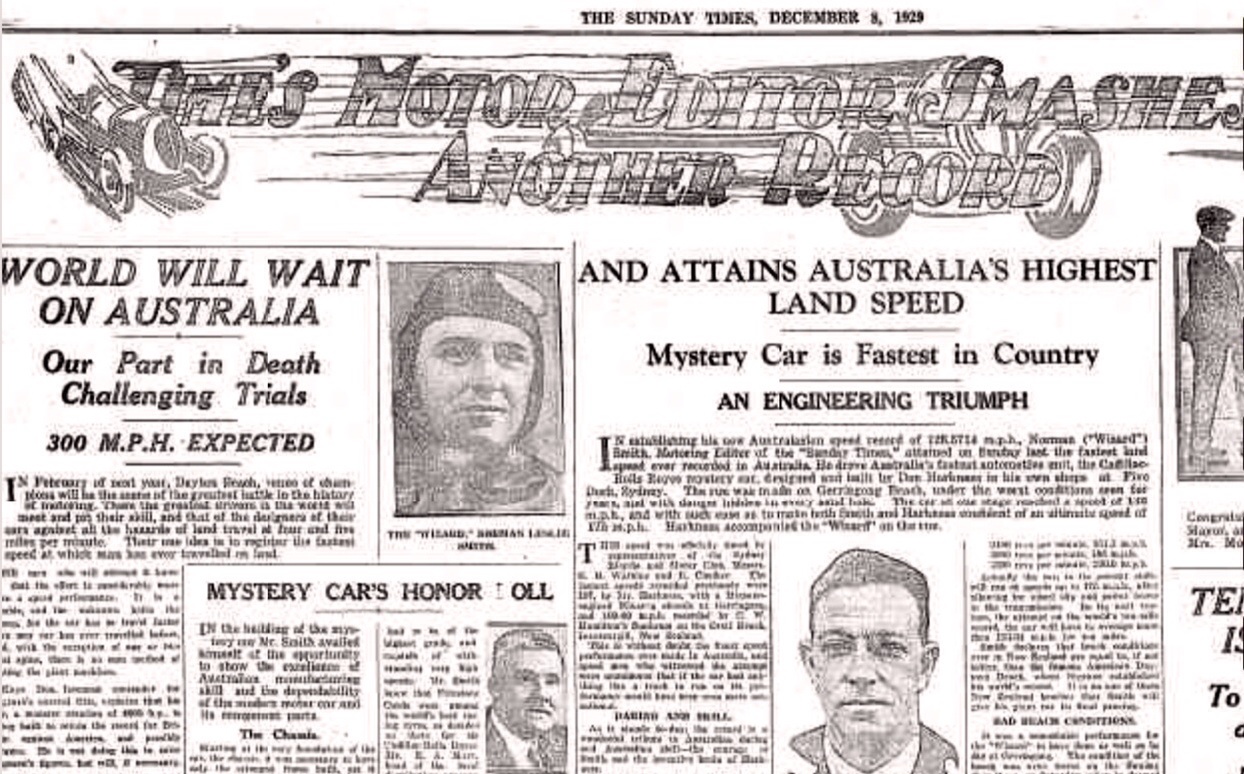
‘The run was made under the worst of conditions seen for years with danger hidden in every sand hole. The car at one stage reached a speed of 142 mph and with such ease as make both Smith and Harkness confident of an ultimate speed of 175 mph’ the Sunday Times reported.
Don Harkness was approached by Norman Leslie ‘Wizard’ Smith and the former Lord Mayor of Sydney, Jack Mostyn to design and build a car to attempt the Australasian one mile and ten mile records.
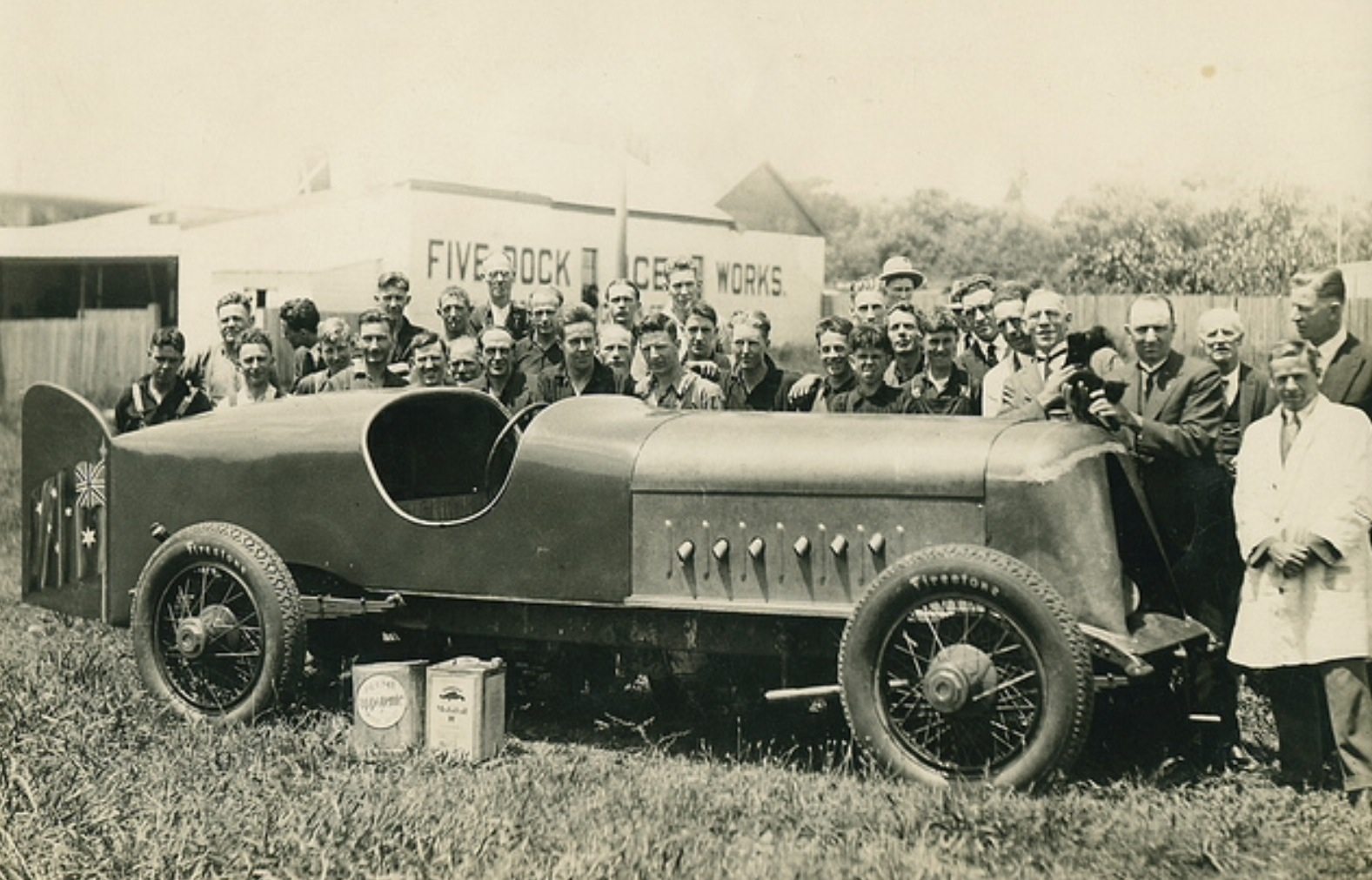
The proud Harkness & Hiller workforce of artisans with the Anzac Rolls Royce, Parramatta Road, Five Dock, Sydney in November 1929 (DHA)
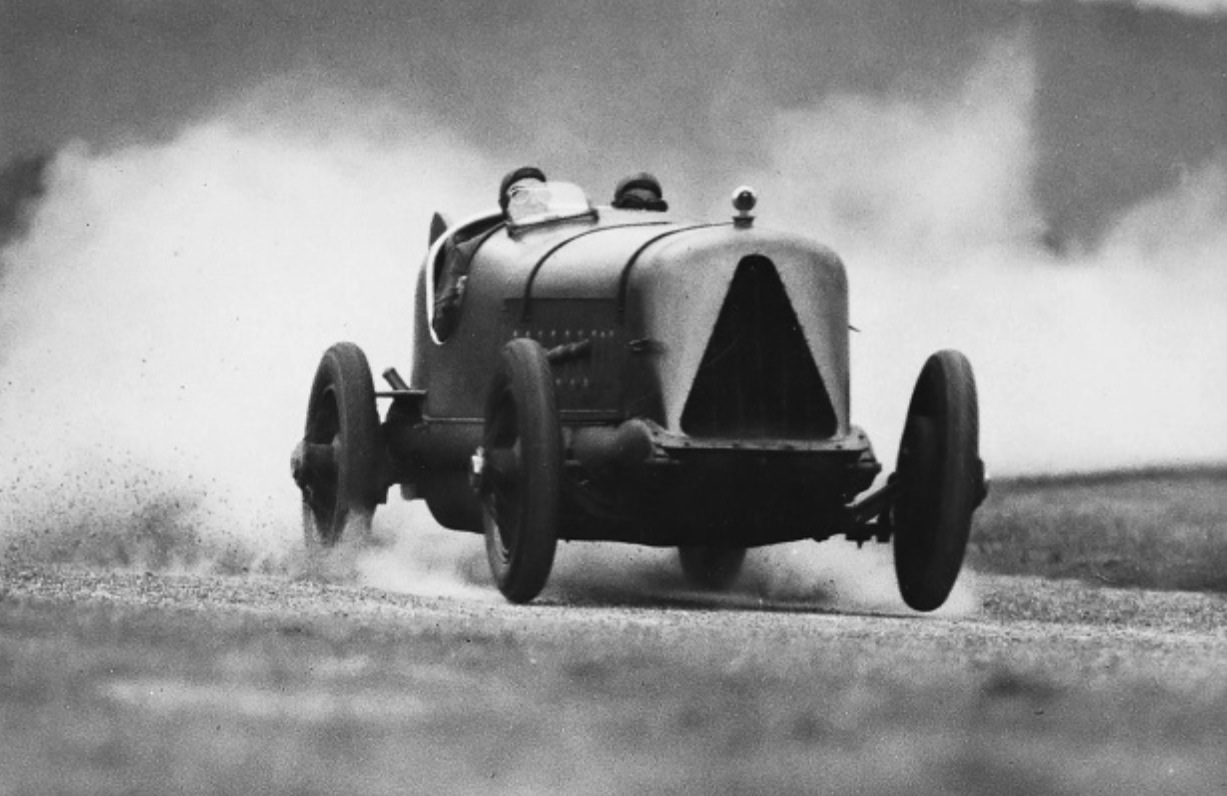
Smith and Harkness in an early test of the Anzac Rolls Royce with one and a bit wheels off the deck. Mention is made of a test run at Richmond, NSW, I wonder if that is the place, late 1929 (unattributed)
The result was the ‘Anzac’, a Cadillac chassis into which was inserted a Rolls Royce aero engine- as one does.
The liaison between Australian Speed Ace Smith- of intercity and circuit racing fame and financier Mostyn came about by chance when Smith came to Mostyn’s aid with a car breakdown. A series of discussions resulted in a determination to initially take Australasian Records and then with a second, more powerful machine, to take on the world.
Harkness was well known for his engineering and driving prowess to Wizard- Harkness had an amazing track record by then in both automotive and aero engineering which is a great story in itself, so it was a natural he turn to the Harkness and Hillier concern to design and build the first car, christened ‘Anzac’ in memory of the Australians and New Zealanders who lost their lives in the Great War.
The basis of Harkness’ design was a modified and strengthened Cadillac chassis- ‘Harkness chose a Cadillac and found the stock material so good, that he retained the frame, the (3 speed) gearbox assembly, the wheels, final drive, radiator and strengthened the steering by fitting a special chrome steel drag link in one piece’.
The Cadillac chassis details are unclear, but in 1928/9 they were made in two wheelbases- 140 and 152 inches, the former the standard and the latter the ‘semi-commercial’ lenghth for hearses and ambulance use, both had the same track of 56/58 inches front/rear. The standard engine was a 341cid side-valve, cast iron V8, the gearbox was a 3 speeder, brakes mechanical and rear axle fully floating with spiral bevel drive.
The frame was reinforced where necessary with special supports carrying the longer, lighter Rolls engine. New gears were cut from higher grade steel, then finished in the Harkness shop. ‘An overdrive gearbox was used to step up the revolutions of the wheels- the final drive ratio was 1.5:1. A new flywheel housing (bellhousing) was designed, patterned and cast, together with a new gearbox assembly. (this of course contradicts the earlier sentence- I suspect what happened is that new, stronger gears were cut and fitted to both the Cadillac ‘box and diff)
Wheels were ‘ordinary stock 33 by 5 inch high pressure cords’, ‘on the trial run at Richmond they stood up to 121 mph’ with race tyres to be used in New Zealand with its higher expected speeds.

The Wizard of Anzac (Fairfax)
The beast was about 20 feet long, had a wheelbase of 11 feet and a track of 4 feet 8 inches.
The motor (variously described as both an Eagle series 8 and 9) was the last in a line which first saw use in 1915- the 320-360 bhp, SOHC, twin-plug, 20 litre, 60 degree, twin Claudel-Hobson carbed V12 engine was acquired as war surplus from the RAAF.
Harkness modified it to be able to run at higher revs of 3000 rpm rather than the usual 1800-2200 rpm. The engine had a bore / stroke of 4 1/2 / 6 1/2 inches – 1239 CID or 20.32 litres.
The car was constructed in the Harkness and Hillier, Parramatta Road, Five Dock, Sydney workshops with local firm Prophets making the ‘streamlined’ body, which no doubt in style was a nod in the direction of other LSR cars in existence at the time.
The LSR in 1929 was held by Henry Segrave’s 930 hp Napier Lion engined ‘Golden Arrow’ at 231.362 mph- well out of reach of Anzac’s maxima of circa 175 mph- but the machine was still good for local record hunting and as a ‘proof of concept’ to build the next car designed to achieve the world record.
The radiator was at the front, the cockpit cowled around the driver ‘who was insulated from engine heat, flames and fumes’ by steel bulkheads and flooring. The mechanic was left well in the breeze, the body then tapered in towards the rear and had a neat stabilising tail at the very back. The fuel tank was aft of the driver and the oil tank behind the rear axle. The car no doubt looked stunning in its gold, lacquer paint.
The Australasian Record attempt was to take place at the Ninety Mile Beach in New Zealand in early 1930, but first the car had an Australian Record to set, and needed to prove it was fit for purpose before being shipped ‘across the ditch’ (Tasman Sea) from Australia to New Zealand.
Anzac was taken by trailer from Five Dock to Gerringong where the team set up camp in late November 1929.
‘Conditions were so bad on the Saturday that Smith postponed his attempt but were even worse on Sunday. Heavy seas had pounded the beach for days and water rose as far back as the trees, 200 yards from the normal waterline. This had the effect of bringing thousands of tons of loosely, badly-knit sand on to the part of the beach used for racing. The line was covered with seaweed and ruts and hollows along the course and made the driving dangerous.
On the Sunday, the Wizard and Harkness looked over the beach at dead low tide and decided to give the car a trial. There was but a tiny stretch of the surface good enough for racing, just about three quarters of a mile long’.
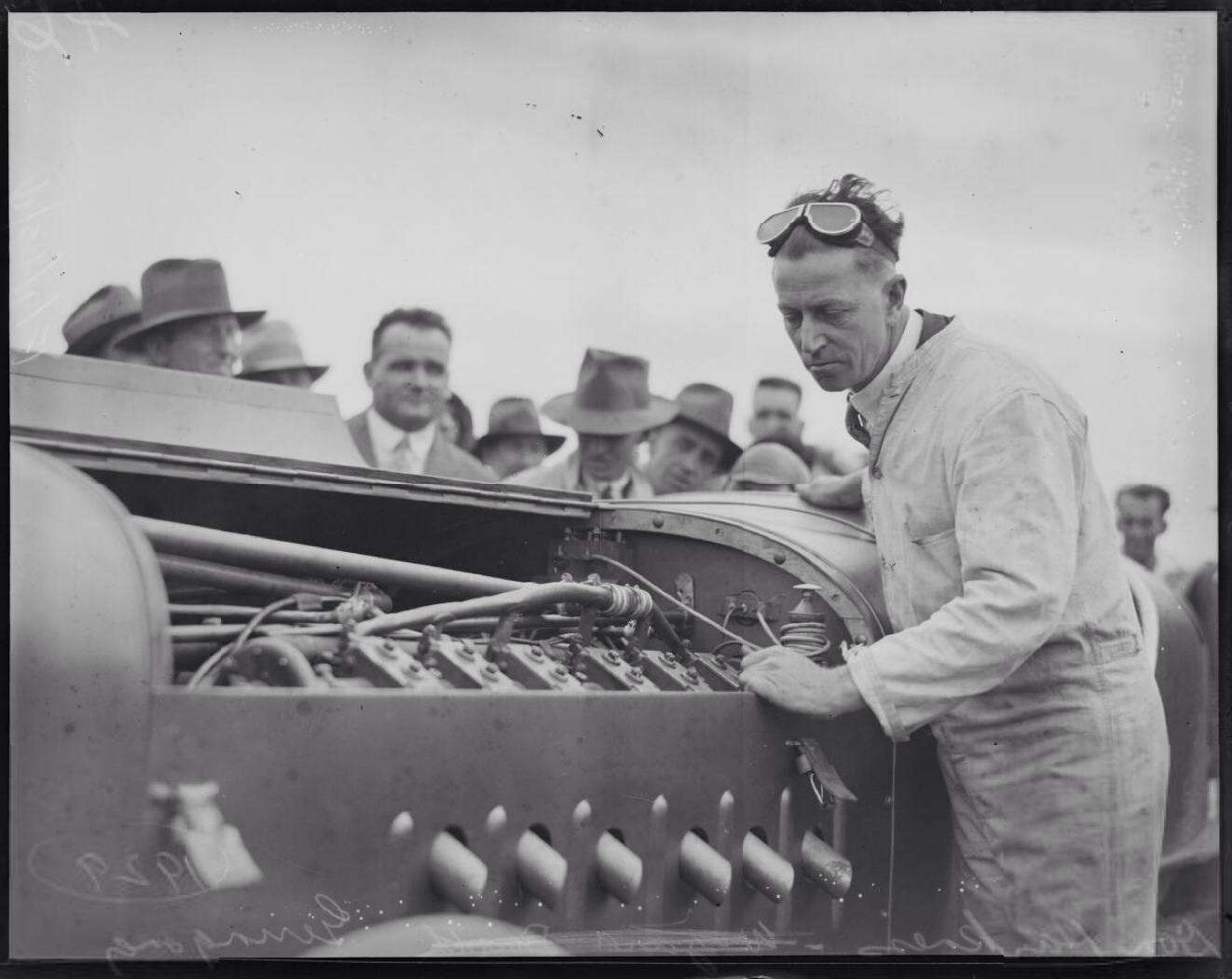
All set- Don Harkness has one last check of the engine- hard plugs now fitted to the Rolls V12- time for the off, Gerringong Beach December 1929 (Fairfax)
After being carefully made ready the Rolls engine was fitted with soft plugs for a warm-up run of the engine after which 24 race, or hard plugs were fitted. The car was fuelled, checked over for the umpteenth time and then Smith and Harkness jumped aboard.
‘The final quarter mile was marked off, and the car took a run of only 800 yards before entering the timing strip. “From the start we accelerated to 110 mph where we hit the starting line” said Wizard. “Just before we did nearly 3000 revs in second gear, and I changed a few yards in front of the line. We were doing just about 110 mph then, and in the next few yards I could feel her winding up. She surprised me. I’m convinced Don has built me the fastest car in Australia. The old bus will beat all the Wapitis that overflew. I’ll guarantee that she has more speed than anything else in Australia, or a plane”.
Don Harkness is more than pleased. He is delighted for the car has done more than he expected, and that more with so little effort that he doesn’t think of what it will ultimately achieve.’
Harkness said ‘After Sunday’s run…I’ll guarantee 150 mph in New Zealand and we’ll get her moving at 175 mph when we will have the very best of conditions and the car has the power, Norman will do the rest’
The team created an Australian record at Gerringong of 128.571 mph (206.909 kph). Harkness reported that with the gear ratios fitted the car was capable of the following speeds/rpm;
1000 rpm 63 mph, 1500 rpm 94.5 mph, 1800 rpm 113.4 mph, 2100 rpm 151.2 mph, 3000 rpm 188 mph, 3200 rpm 200.6 mph

Harkness on this side of the car is leaning well forward- I wonder if that is due to his seat or trying to get a better fix on the perilous nature of the beach?

Both set back in their seats in this shot, quite a functional handsome weapon
Suppliers cited as providing components for the car were AH Prophet, the body, Vacuum Oil Co the fuel and lubricant- ‘Plume Spirit’ and Mobiloil B.
EA Marr provided the Firestone tyres with Harry Taylor of Advanx Ltd having them ‘treated and scientifically trimmed and balanced for speed’. WT Adams of Motor Ignition Ltd supplied an ‘Ajax’ battery to start the giant motor and F Reed supplied Personne-Reed double-acting hydraulic shock absorbers.
‘The beautiful finish in gold’, was supplied by Bergers Ltd, using the famous ‘Opex’ lacquer. John McGrath Ltd, agents for Cadillac provided the chassis.
Taken to the Ninety Mile (Kaitaia) Beach Smith and Harkness achieved a two-way average of 144.037 mph on 11 January 1930. Days later they attempted the 10 Mile Average achieving a one way speed of 148.637 mph- better than the record then held by Leon Duray’s Voisin of 135.333 mph and were told that because of the distance a return run was not necessary. This was subsequently established to be not the case with the record being unrecognised given the lack of a return run and the antiquated equipment used to time it.
Anzac never ran again- Smith became preoccupied with the Fred H Stewart Enterprise, a new Harkness/Smith 1450 hp LSR machine, which is a sad story of the breakdown in the relationship of the two men for another time…

(Fairfax)
May 1930 ‘Fifty Mile Championship’ Race Meeting…
It was a very soggy raceday for both the racers and the specators, only about 300 hardy well rugged up spectators turned up to see Bill Thompson win the ‘Fifty Mile Handicap’ feature race in his Bugatti T37A, a car he had used to win the Australian Grand Prix not so long before.
The grid above comprises two Chryslers to the left- the #72 E Patterson and HJ Beith Chrysler Sports with Charlie East’s Bugatti T37 on the right.

(SMH)
E Patterson’s 4 litre Chrysler on the turn around the flags which mark out each end of the course. Fine touring cars in their day.
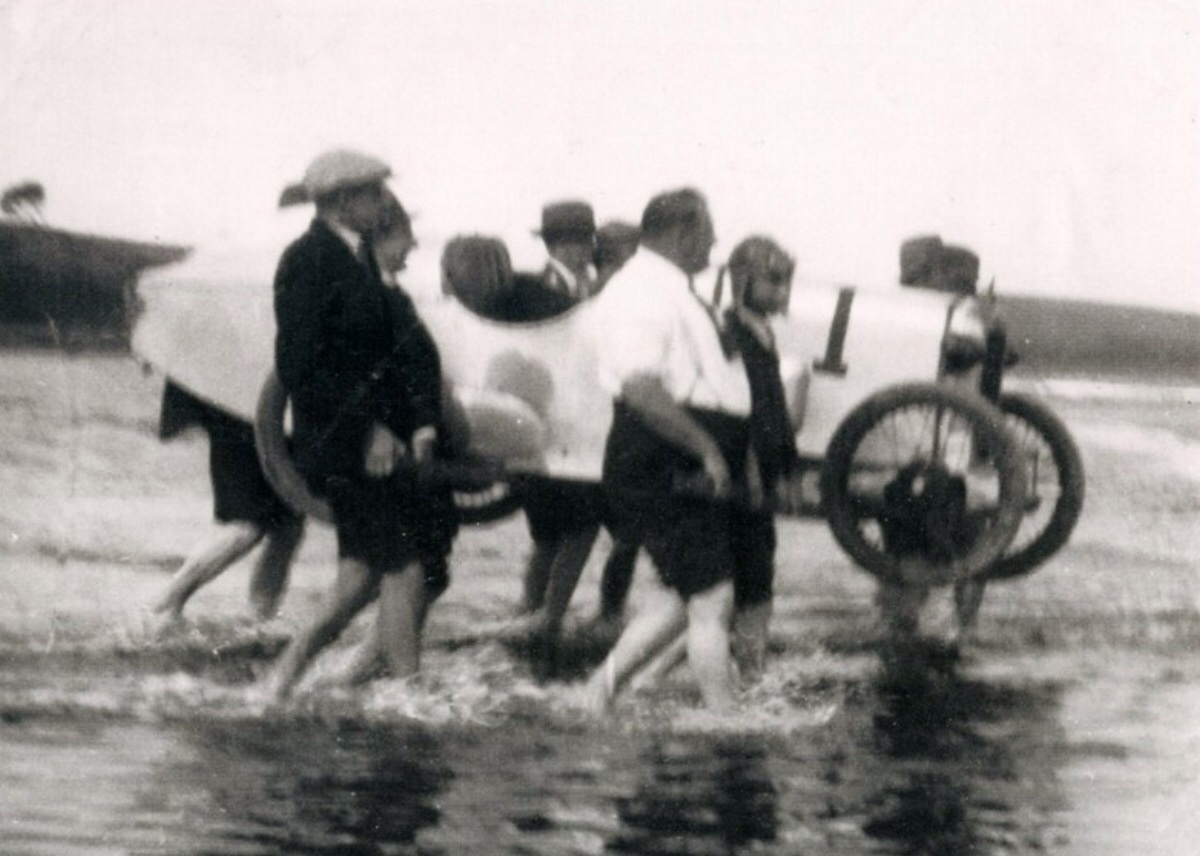
(Kiama)
The light weight of this Austin 7 Gordon England Brooklands Super Sport made rescue from the rising waters a good deal easier than more conventional and heavier machines!
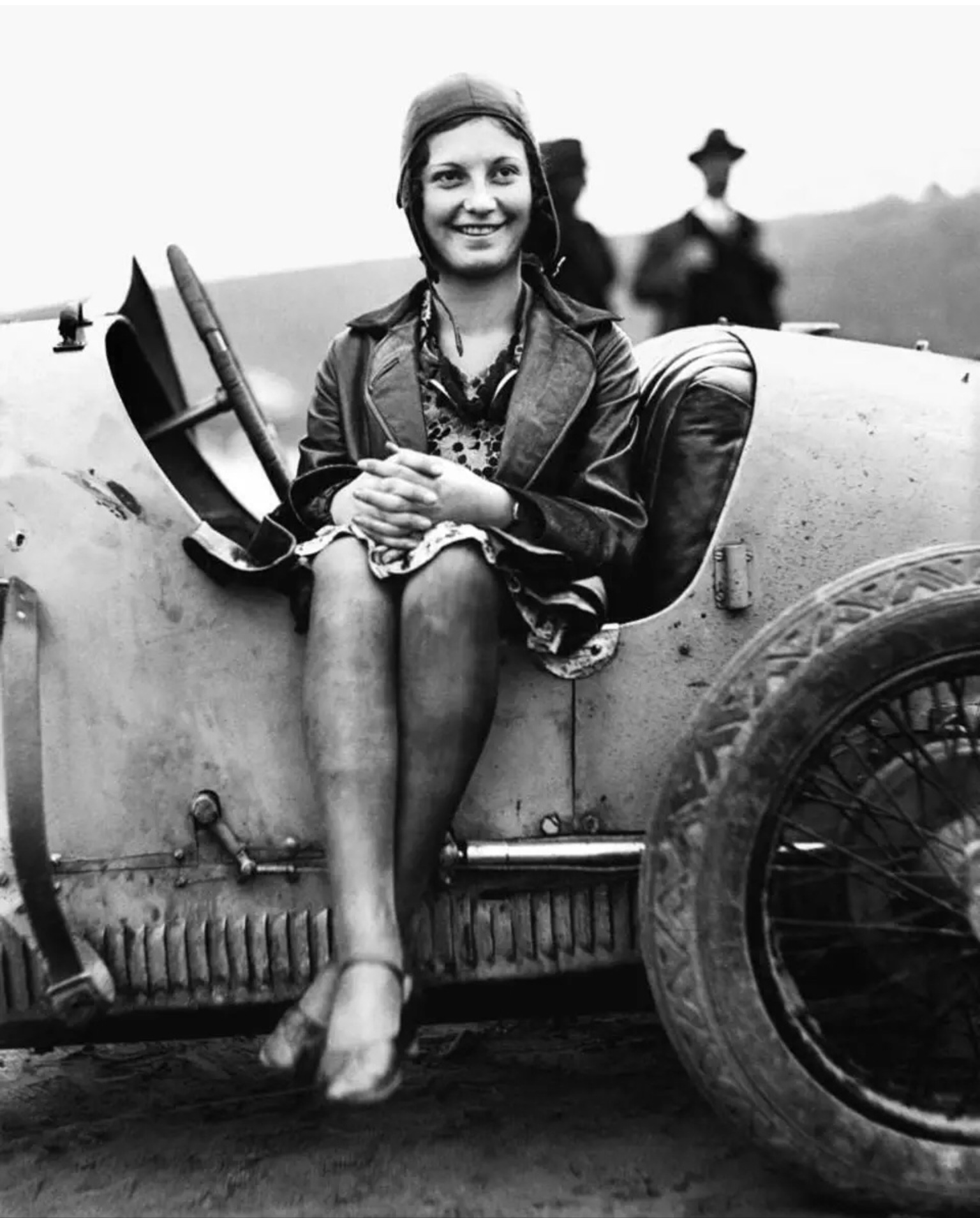
Young filly aboard one of the Bugatti T37’s, Thomson’s T37A I suspect (SMH)
The race meetings were as much social, society occasions as they were motor racing so there were never any shortage of ladies about. The May meeting is well served by photographs given the presence of a staff photographer from the Fairfax/Sydney Morning Herald.

(SMH)
Lea-Francis was entered by Mrs JAS Jones and raced by RG Potts in the 50 Mile Handicap.
(SMH)
(SMH)
Speaking of Mrs Jones, here she is with riding mechanic aboard her rather peachy Alfa Romeo 6C1750 Zagato, one of Vittorio Jano’s finest, I wrote a feature about this wonderful machine a while back.
She didn’t have a great meeting after winging’ a mechanic who strayed into her path having crossed the finishing line in one of the events- breaking his leg.

(SMH)
In amongst all the fun there was some serious motor racing for the top-liners of the day.
Three time Australian Grand Prix winner- and just back from Phillip Island having won the 1930 race, Bill Thomson raced the same Bugatti T37A and won the feature event of the weekend, the Fifty Mile Handicap.
In the photo below his mechanic is readying his mount- that is a Light Car Club of Victoria badge on the radiator.

(SMH)
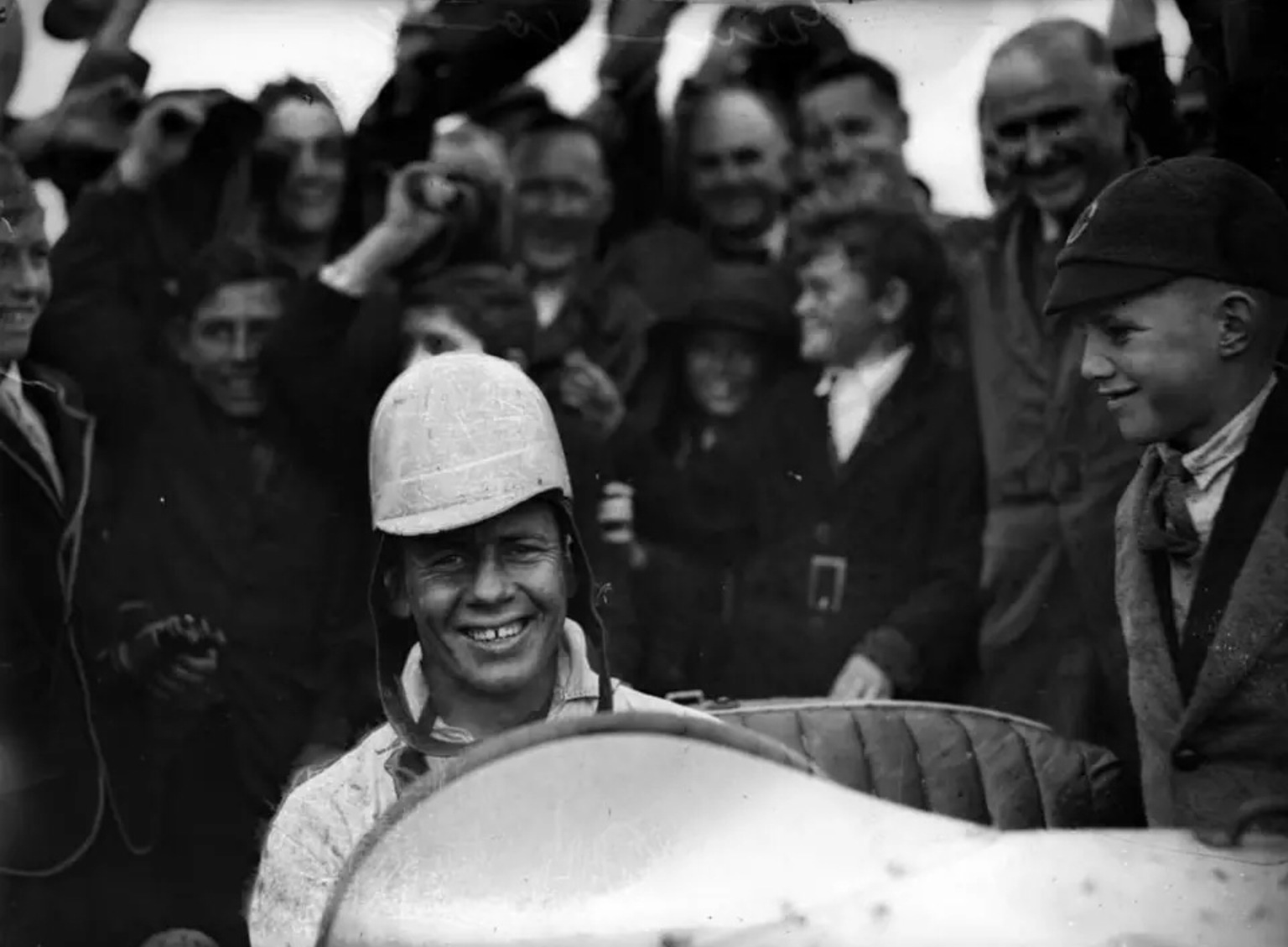
Thomson was every schoolboys idol of the day as this photograph below shows- the look of adoration and joy on the little, capped dudes face is priceless. No doubt Bill has just won the feature event.
(SMH)
Simply amazing shot below of Bill’s T37A passing a Chrysler at speed- this photograph is the cover shot of Kent Patrick’s biography on the great man, a work I must acquire.

(SMH)
The impressive line up of cars before the Fifty Mile Handicap race includes, from the left, the Percy Hunter driven JAS Jones owned Alfa 6C1750 Zagato, the obscured Bill Thomson Bugatti T37A and two Chrysler 4 litre machines of E Patterson and #72/14 Herb Beith.

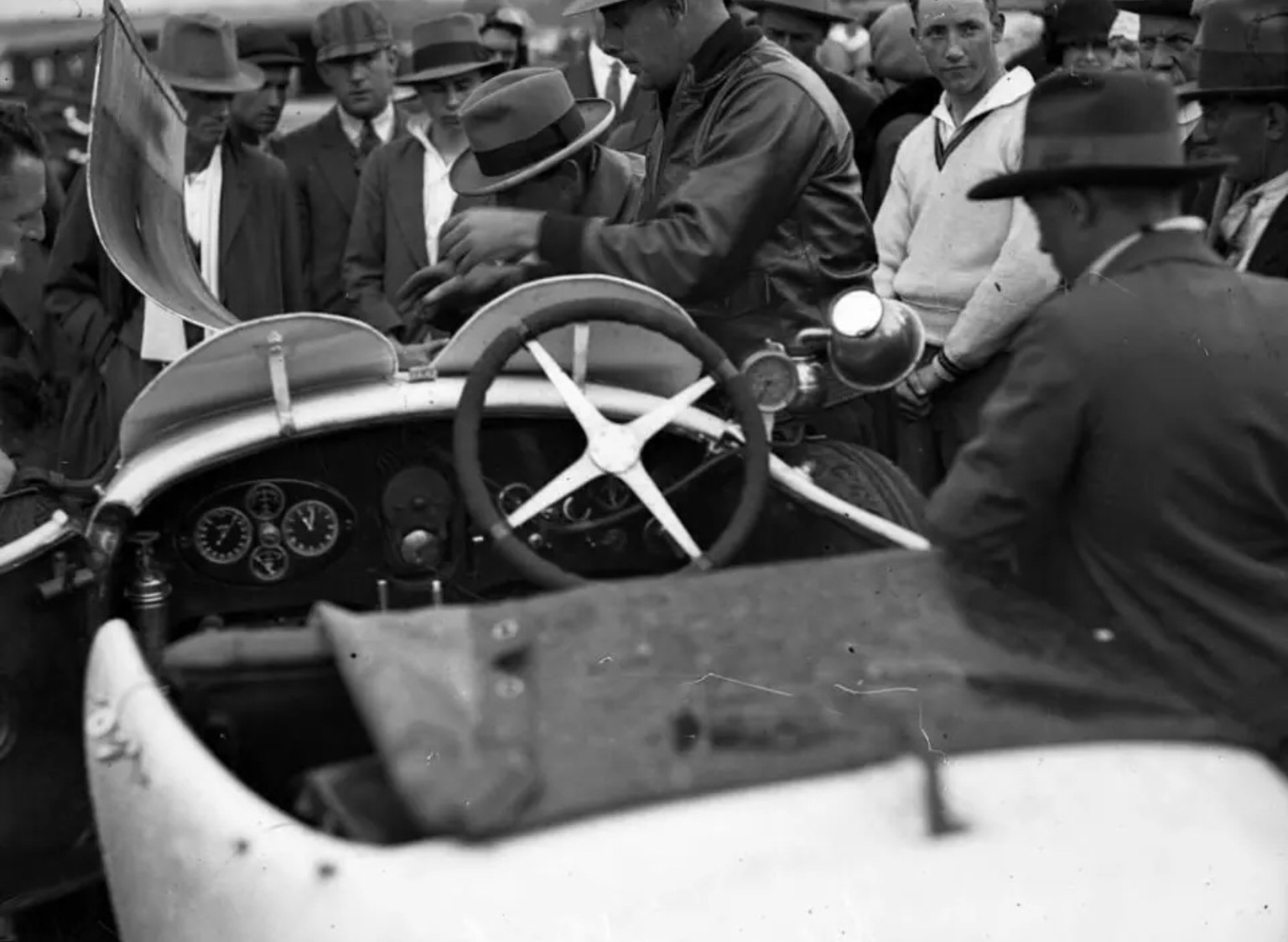
Any idea what the car below is folks, I thought for a bit it might have been Charlie East’s Bugatti T37 ‘37104’ in the paddock, or more specifically, on the beach- but it isn’t! Any clues?
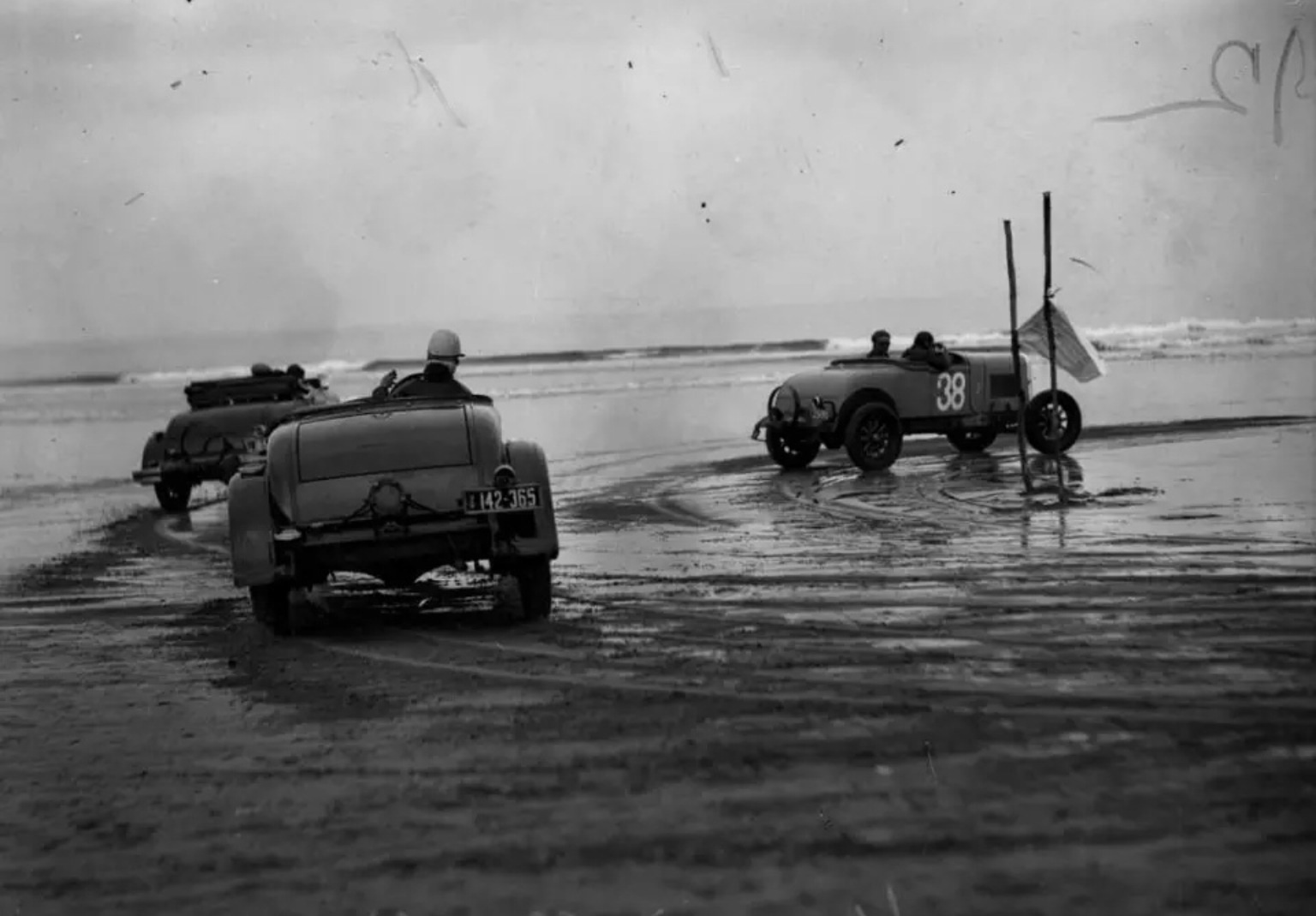
You can see from the gaggle of cars below going around one of the markers which defines one of the extremities of the ‘track’ that the tide is rapidly marching in. No idea of the cars, assistance invited.
(SMH)
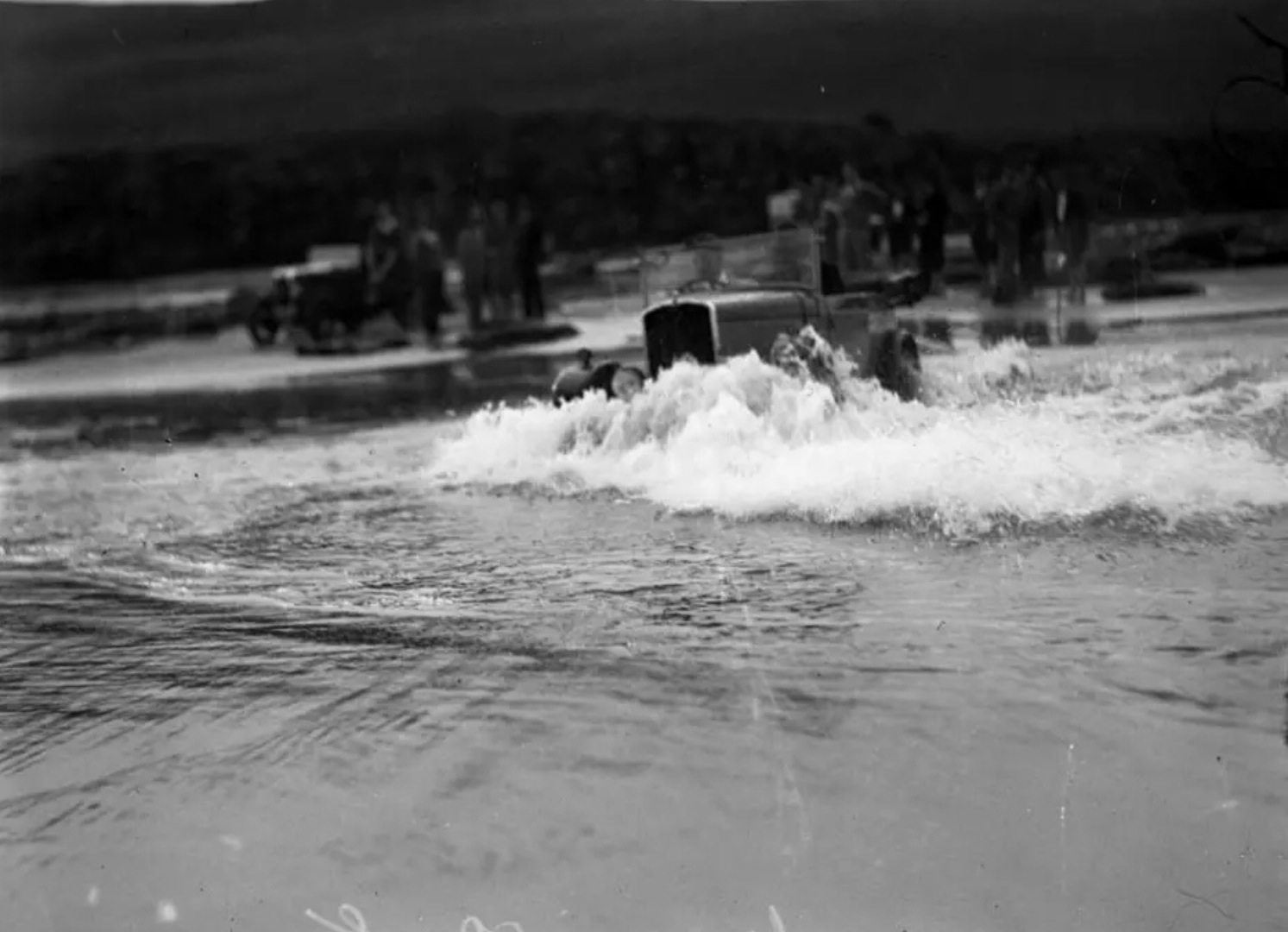
The masked avenger below appears to be another lady racer but I’ve no idea as to name or mount. Evocative shot, the mask is protection from the sea gales and sand but reminds me of the first use of Nomex masks circa 1967.

And I thought wet Winton in May can be a pain in the arse!
(SMH)
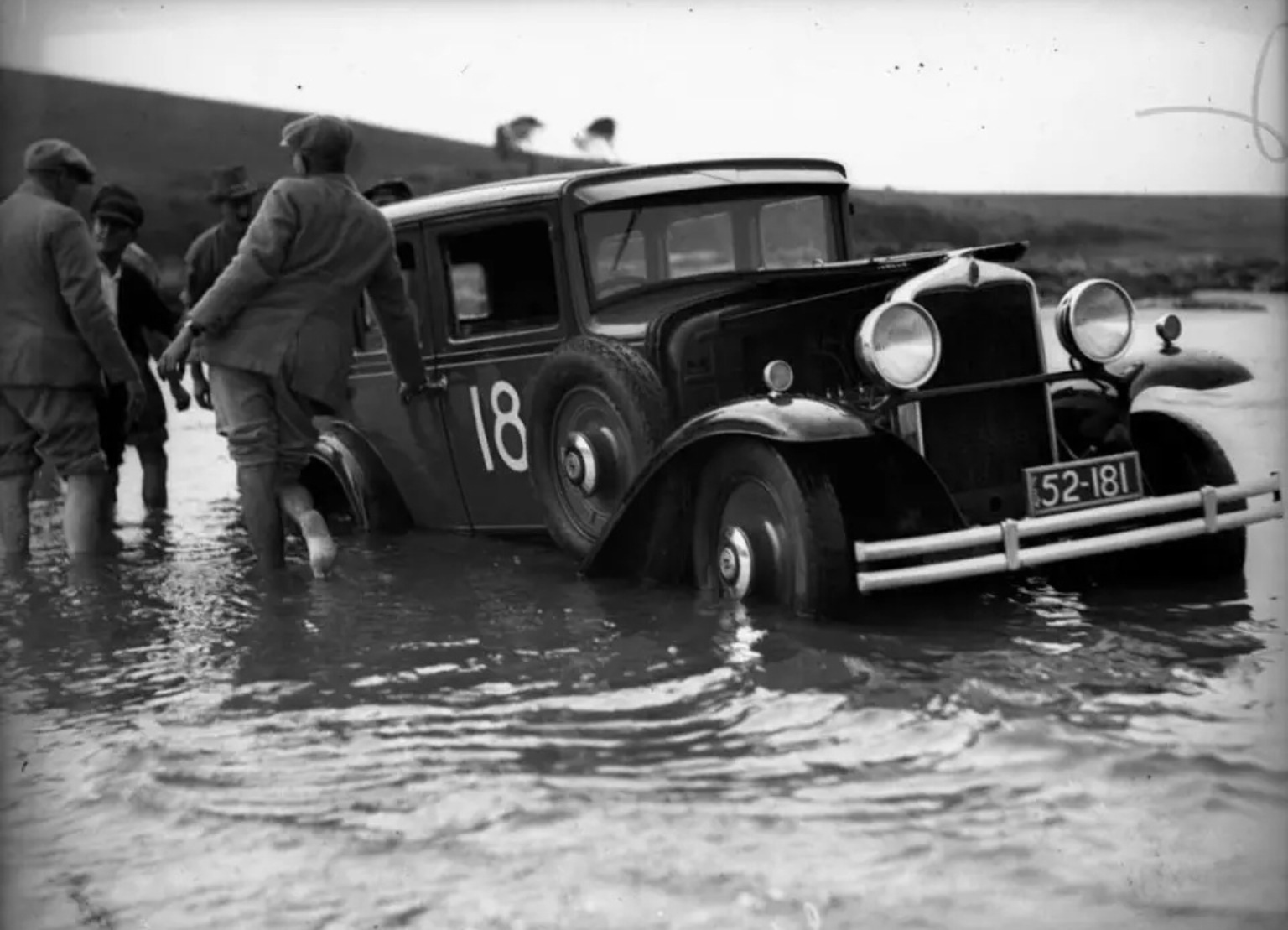
Definitely time for a few bevvies by this stage of the day. Car make and model?
(SMH)

(Kiama)
Kingsford-Smith: Australia-New Zealand Flight 1933…
Charles Kingsford-Smith used the beach at Gerringong to fly to New Zealand, above the ‘Southern Cross’ has just landed.
Seven Mile Beach was used as the runway for the first commercial flight between Australia and New Zealand.
The historic journey by legendary pilot Air Commodore (and later) Sir Charles Kingsford Smith took place in the early hours of January 11 1933, he landed more than fourteen hours later at New Plymouth on New Zealand’s North Island.
Gerringong Beach was chosen, for this, his second flight across the Tasman, because of its length which allowed plenty of distance to get the heavily laden plane off the deck- on board was 660 gallons of fuel and 30 gallons of oil as well as a crew of four.

Look at that crowd! (SMH)
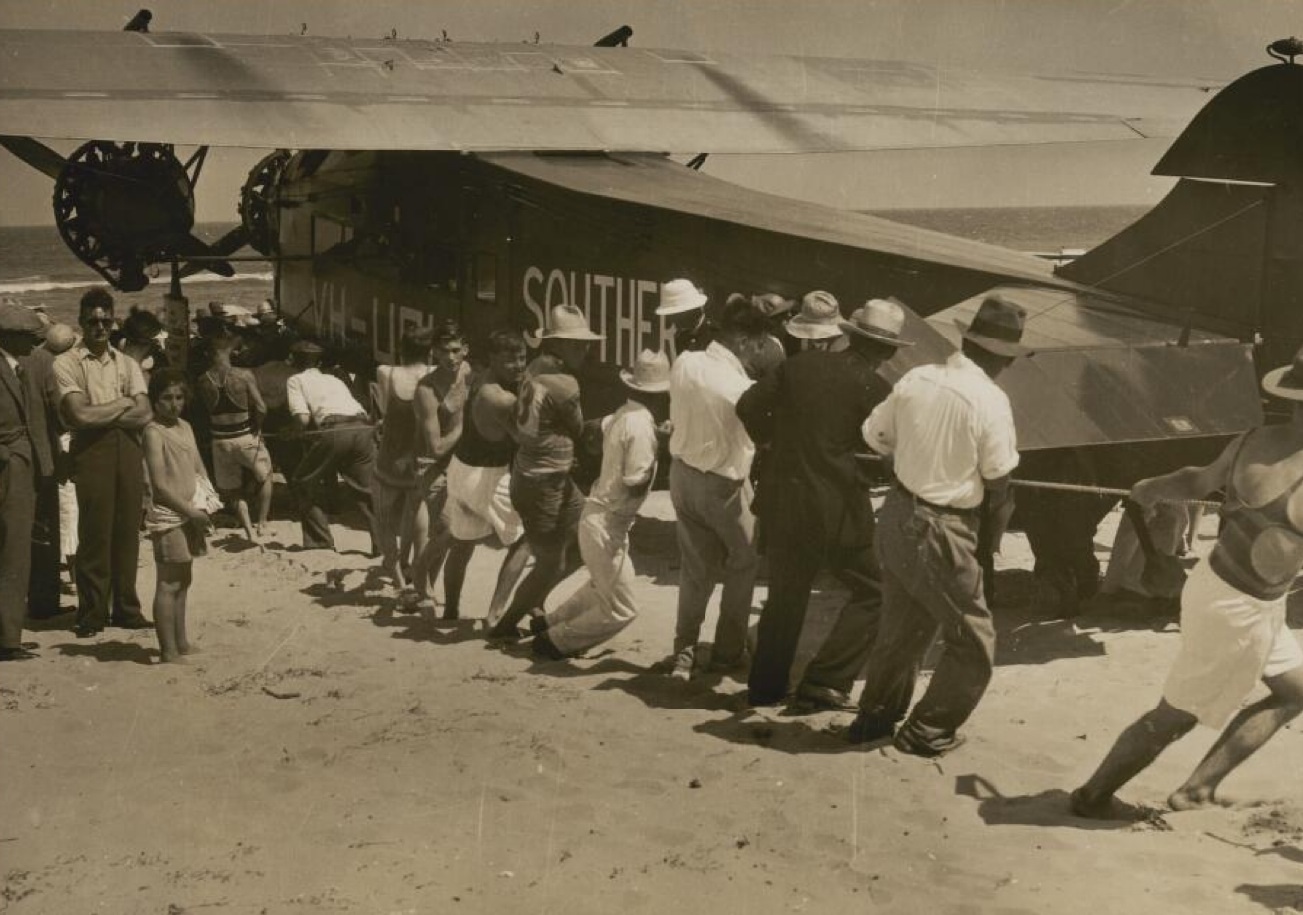
Hauling the plane clear of the rising tide (SMH)
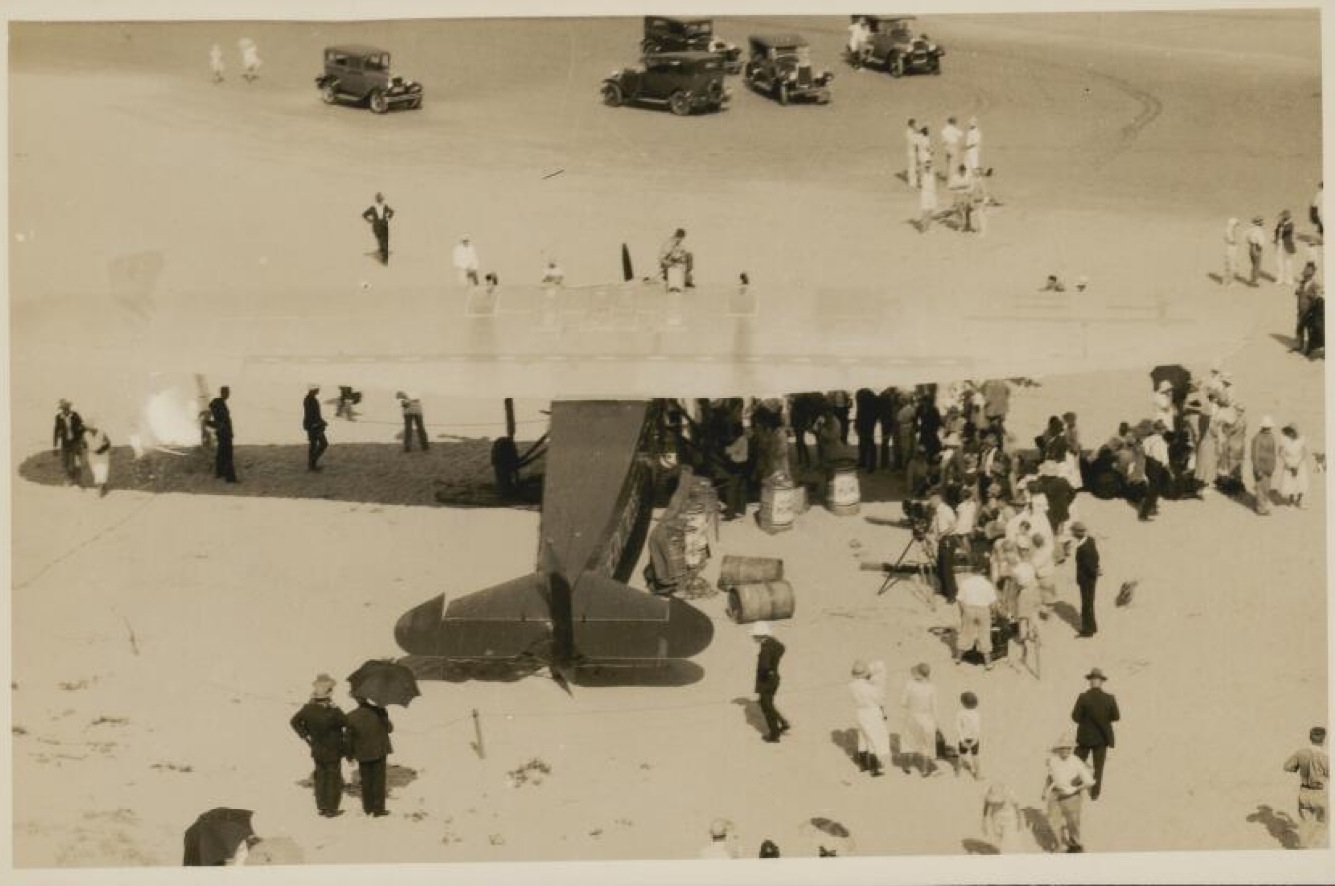
In position, being fuelled and made ready (SMH)
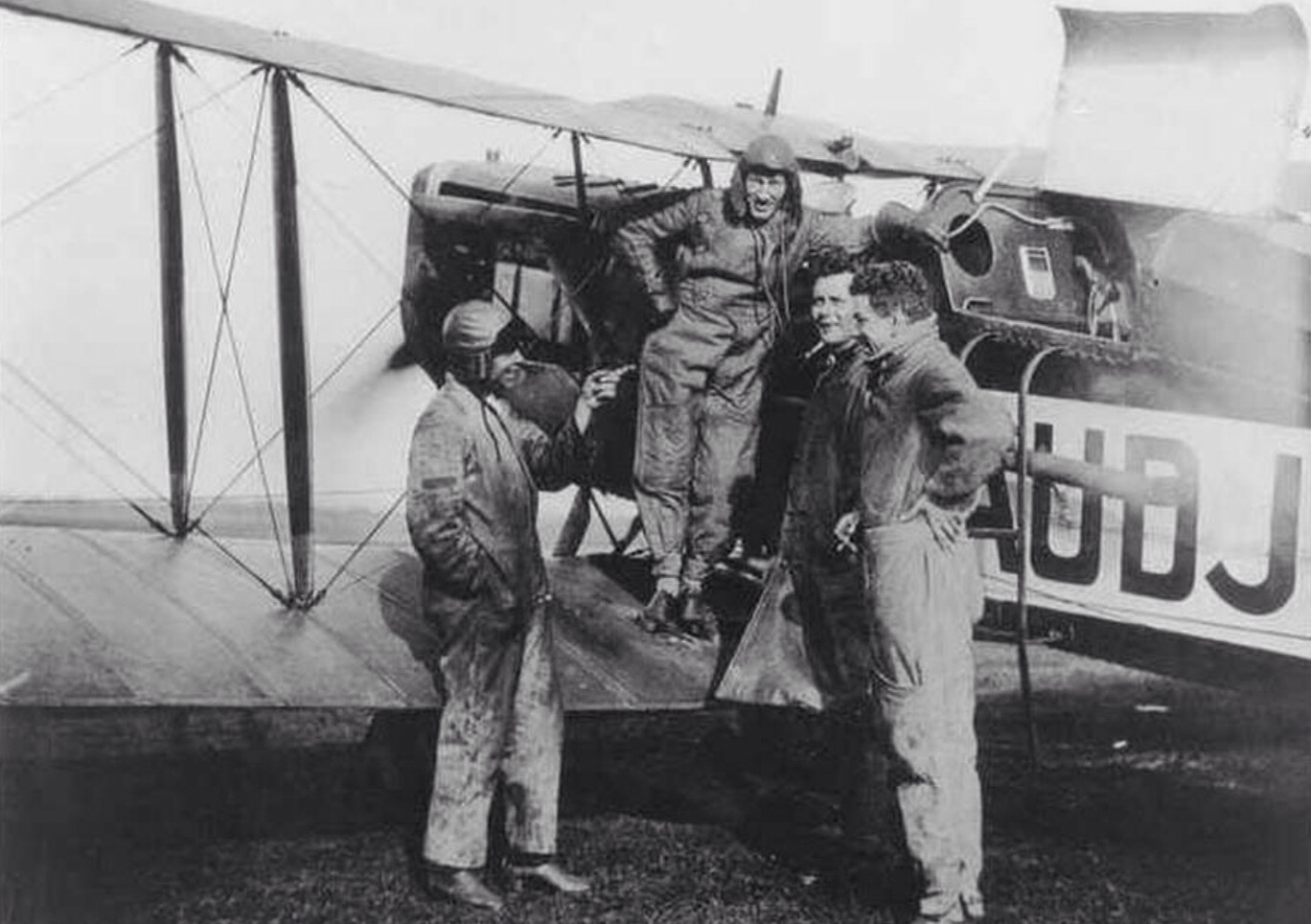
(unattributed)
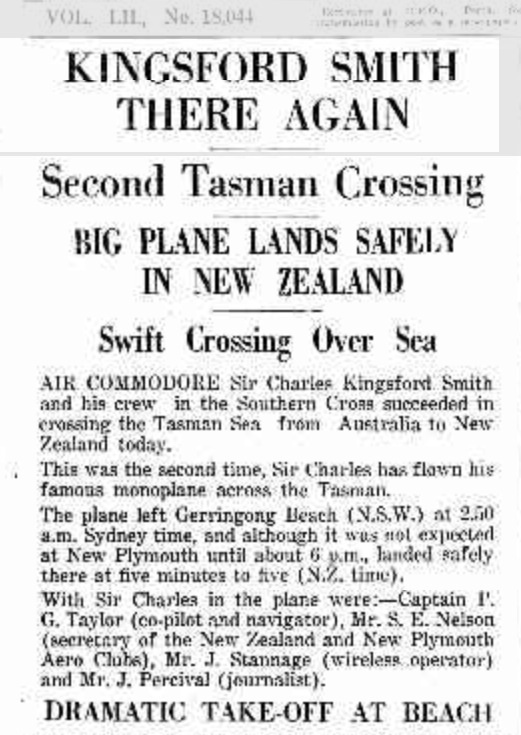
‘The Daily News’ Perth 11 January 1933
The famous aviators flight log describes the trip as a joyriding tour, his crew comprised co-piot and navigator PG ‘Bill’ Taylor, wireless operator John Stannery and SE Nelson, secretary of the New Zealand and New Plymouth Aero Clubs.
The aircraft was flown down from Mascot Airfield, Sydney on January 10 averaging 115 mph for the trip. Once on the ground the plane was pronounced fit and the engines were covered to prevent ingestion of air blown sand, it was refuelled with chamois leather providing the filter!
Flares were lit early on the beach to mark a runway with several thousand people making the trip from Sydney to witness the historic 2.50 am takeoff- turning on their headlights to provide the aviators with extra illumination. The motorists were requested to keep their headlights on for 15 minutes after departure with Smith firing some rockets or flares to signal all was well once the ‘Old Bus’- the Fokker Trimotor VH-USU ‘Southern Cross’ was aloft.
‘Smithy’s last flight was aboard a Lockheed Altair which disappeared in the dark, tropical heat off Burma in November 1935.
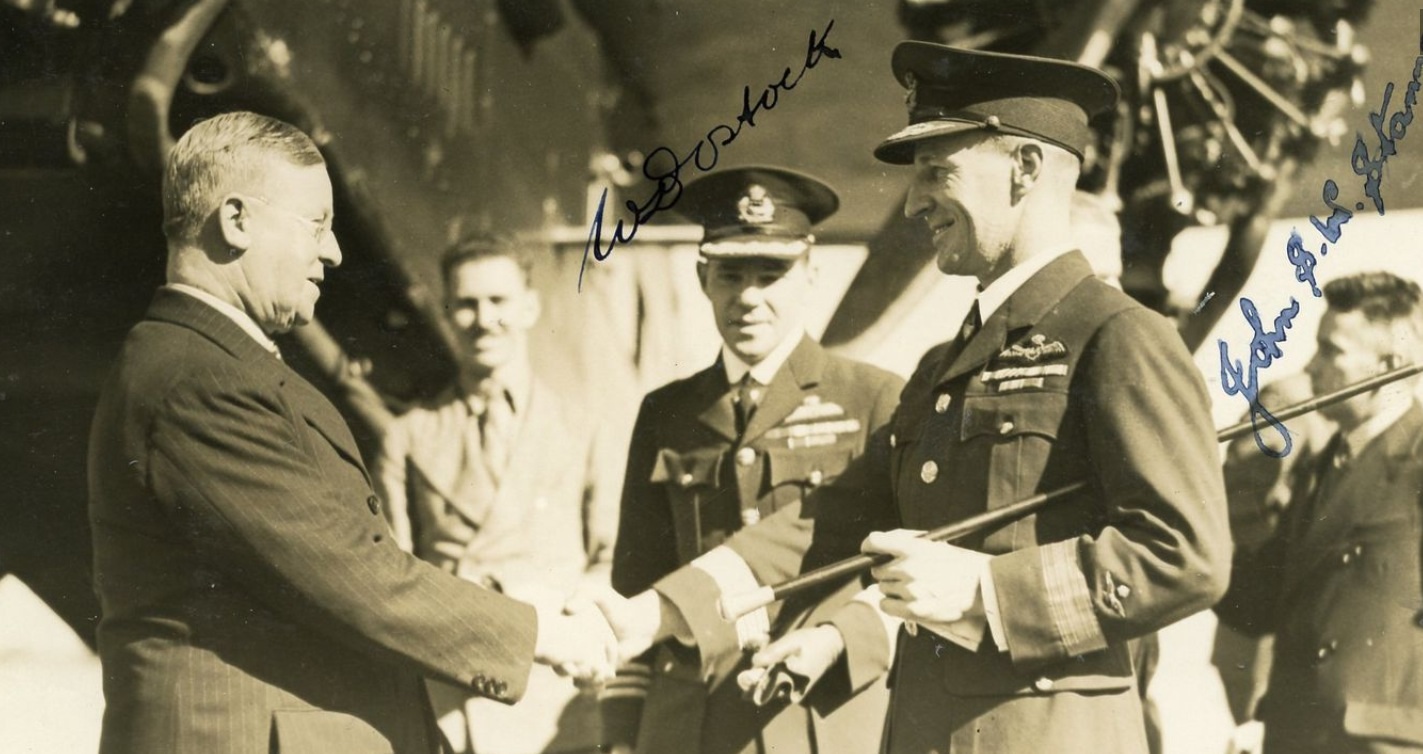
Australian Minister of Defence handing over the ‘Southern Cross’ to Kingsford-Smith at Richmond RAAF base, New South Wales in 1935 (MAAS)
Peter Whitehead ERA R10B: LSR attempt 10 November 1938…
Peter Whitehead raced his ERA R10B extensively around Australia in 1938 most notably winning the Australian Grand Prix at Bathurst over the Easter long weekend and the Australian Hillclimb Championship at Rob Roy in outer Melbourne’s Christmas Hills later in the year.

(The Sun)
He found time for a little record-breaking though- his attempt on the Australian Mile started with a 133 mph pass at Gerringong but on the return leg a piston failed bringing an early end to his day. \
Here ‘the boys’ are hauling the car off the beach through thick sand.

(The Sun)
Credits…
‘Kiama’ – kiama.nsw.gov, monumentsaustralia.org.au, ‘Sunday Times’ 8 December 1929 and various other newspapers via Trove, ‘MAAS’- Museum of Applied Arts and Sciences, ‘DHA’- Don Harkness Archive, The Sun, Fairfax/Sydney Morning Herald
Tailpiece That May 1930 meeting really was soggy…
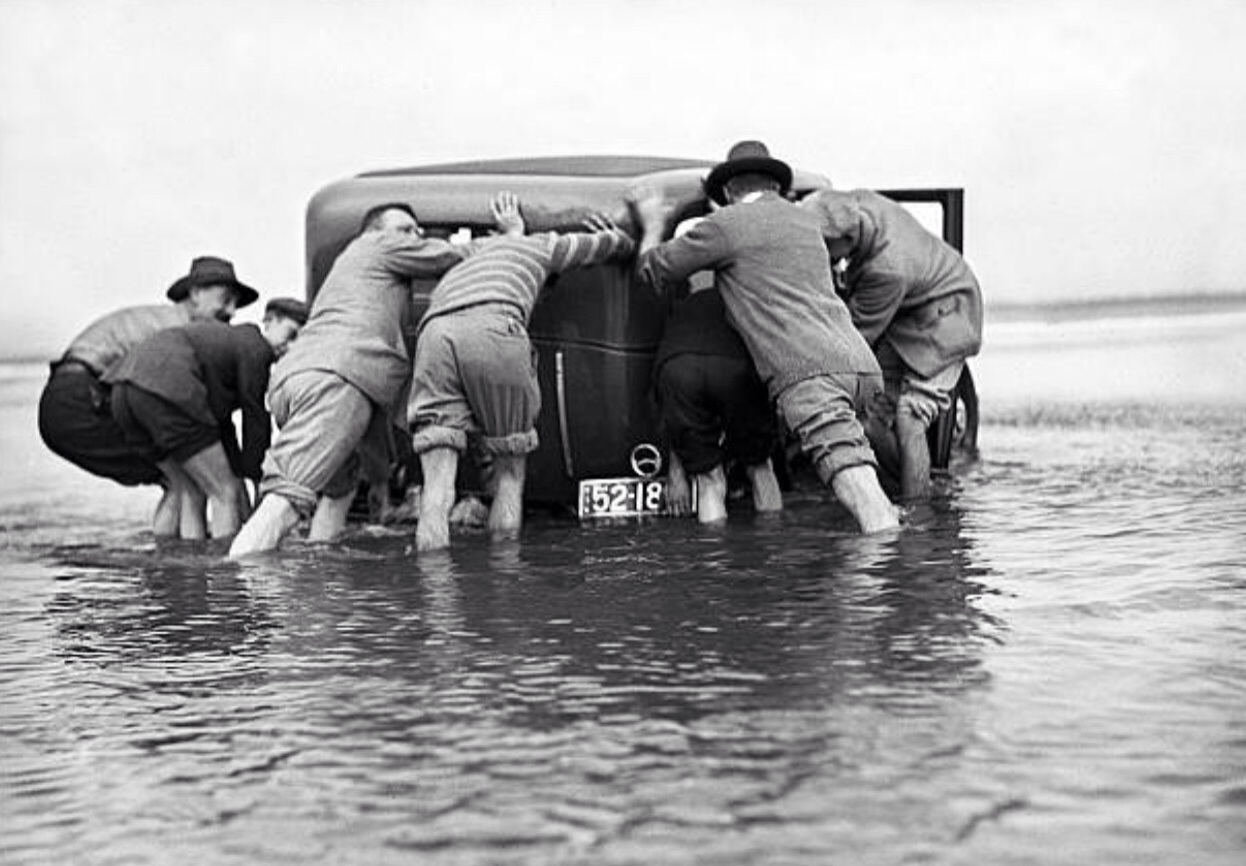
(Kiama)
These dudes have well and truly lost the battle with the Pacific Ocean tide! It is a competitors car too, #18 in an earlier shot.
Finito…

A patriotic kiddo prepares his very aerodynamic ‘Spitfire’ for a run down Cross Road, Fullarton, Adelaide in the Winter of 1941…
We all start to race somewhere, I ‘progressed’ from billycarts! I wonder if this dude took steps beyond the Unley Soap Box Derby to bigger and better automotive things in the years to come? Love the schoolkids formal cold weather attire- caps, cloaks, coats and ties very much to the fore.
The run down Cross Road, from ‘the old gum tree’ to Fullarton Road attracted a crowd of 15,000! people to watch 100 competitors achieve speeds of up to 70 km/h. The crowd is indicative, I guess, of just how starved people were of any form of entertainment during the long, bleak, difficult war years.
Photo Credit…
State Library of South Australia
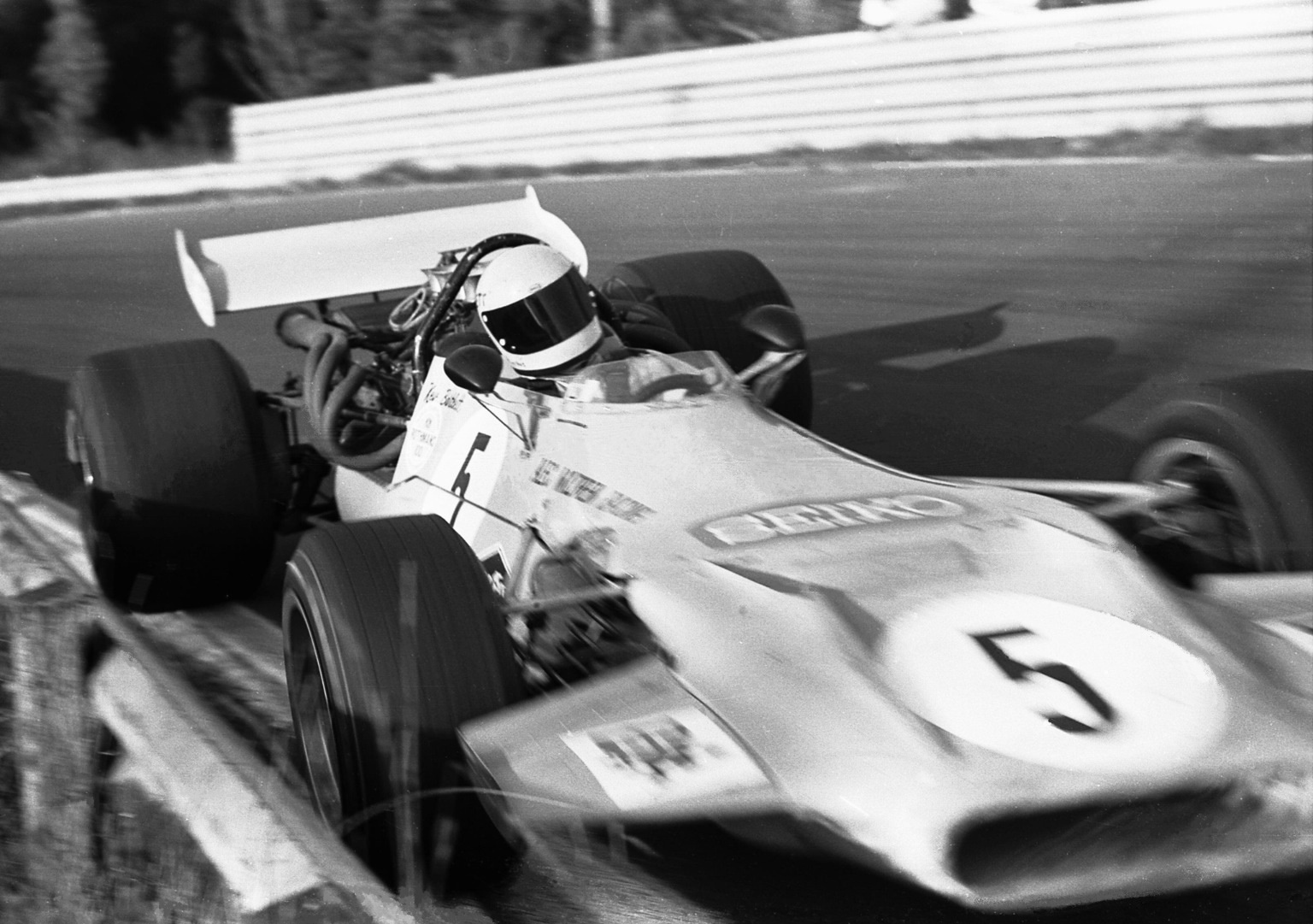
Rod MacKenzie captures Kevin Bartlett shaving The Esses Armco during the 1971 Warwick Farm 100, Tasman round on 14 January 1971…
The car is the Franklen/Palliser/Mildren/Wortmeyer F5000- a car designed by Len Bailey and built by Frank Gardner’s business as detailed in Allen Brown’s oldracingcars.com article here; https://www.oldracingcars.com/f5000/franklen/
Alec bought the car off the back of the prodigious speed of the Mildren Alfa/Waggott ‘Yellow Submarine’ also designed by Bailey and raced initially by Frank Gardner in the 1969 Tasman Series and then with great success by Bartlett in 1969/70 Gold Star/Tasman Championships.
The thrust of Bartlett’s 1970 was racing in the US (which we should talk to him about)- he contested the Symmons and Lakeside Gold Star rounds for third and a DNF and then missed Oran Park, Warwick Farm, Sandown and Mallala.
When he returned to Oz his beautiful Mildren Yellow Submarine had been sold to Bob Muir, the F5000 Mildren Chev was his new mount for the November 1970 AGP at Warwick Farm and beyond.

KB decamps from the Mildren Chev during the 1970 AGP. Glenn Abbey hands on hips at left, not sure of the other crewman- Alec Mildren back to us at far right
In a performance which flattered to deceive KB popped the car fifth on the grid but failed to finish with electrics problems after completing 21 laps. Frank Matich triumphed that day in his McLaren M10B Repco from Niel Allen’s similar Chev engined car (the chassis KB bought after Allen’s retirement) with Graeme Lawrence third in the little Ferrari Dino 246T which had been so fast in his and Chris Amon’s hands since 1968.
KB didn’t have a great run in the Mildren, his best finishes in the seven 1971 Tasman rounds was third at Warwick Farm and fourth at Teretonga- niggles elsewhere included a broken wishbone at Levin, coil at Wigram, engine failure at Sandown and a crash which precluded the speedy Sydneysider starting the final round at Surfers.
That was pretty much the end of Mildren Racing, sadly. Bartlett bought one of Niel Allen’s McLaren M10B’s shortly thereafter and was immediately a front-runner in one of the great production F5000’s.
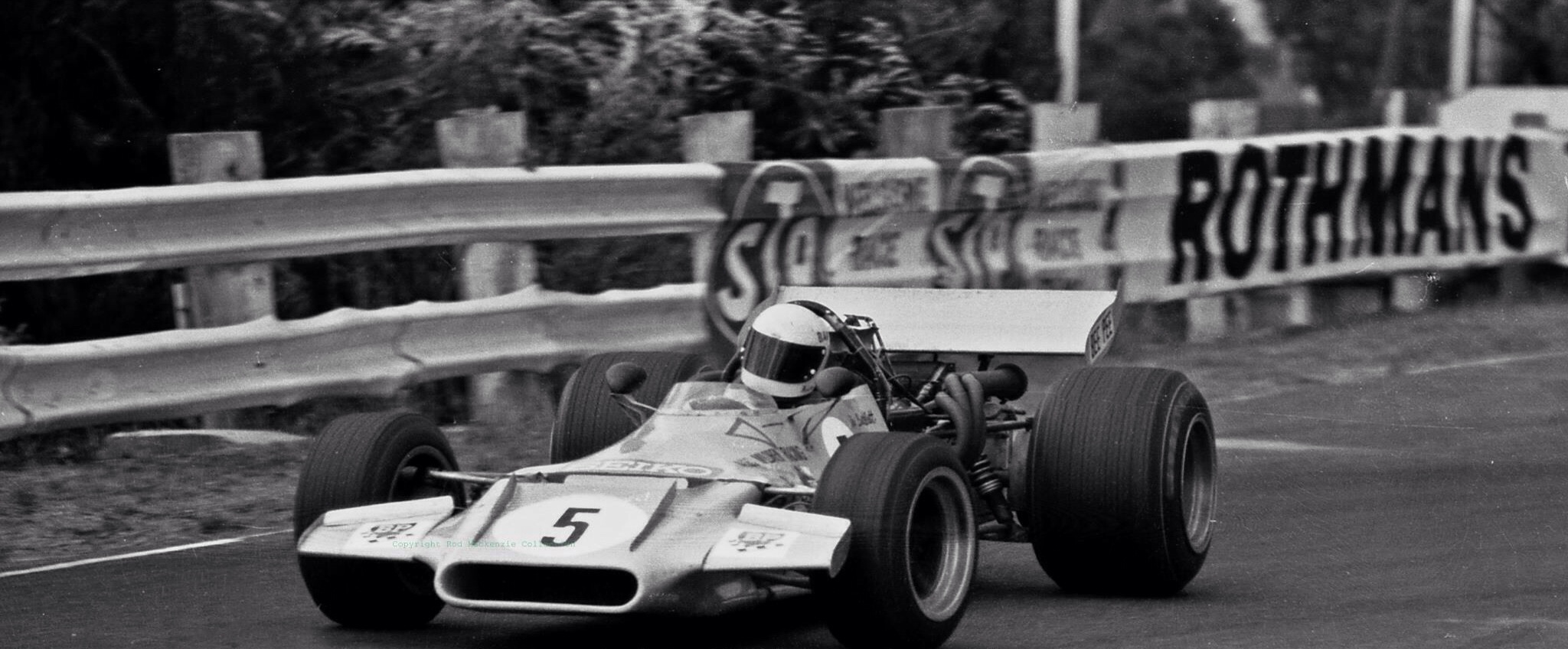
(R MacKenzie)
KB’ boots the Mildren out of Peters Corner at Sandown and unleashes 500 or so neddies up Sandowns longish back straight and the left-right high speed kink and plunge into Dandenong Road.
Upon the sale of the Mildren Racing assets the car was bought by Jack Wortmeyer and re-named Wortmeyer SC/SC5 Chev and driven by hillclimb ace Erol Richardson, he made two Tasman appearances at Warwick Farm in 1973 and Oran Park in 1974. The car never left Wortmeyer’s hands- it was acquired after his death by the ACT’s Matt Veal who has completed, almost, the machines restoration.

Erol Richardson, Wortmeyer SC5 Chev, aka Mildren Chev at Hume Weir in December 1972. Uber rare for an F5000 to compete at the tight, twisty border circuit (B Keys)
This article is written in memory of great Australian photographer Rod MacKenzie who died in the last few days, on 1 February…
In fact it was looking at Rod’s archive for other photos of this car in addition to the lead one which he sent to me some months back that I became aware of his passing.
He was a man of great talent, check out his website if you have not done so and this article we did together in September which explains his ethos or creative approach.
Some of you will be familiar with his work via ‘The Tasman Cup 1964-1975’ book published two years ago whereas many of us first saw his art in ‘Racing Car News’ in its heyday.
and; http://www.rodmackenziecollection.com/

(R MacKenzie)
The photo above is of Rod on a fantastic trip to Scotland last 7 April 2018 to attend the Jim Clark Exhibition in Chirnside to commemorate the fiftieth anniversary of the Scot’s death at Hockenheim.
Some of Rod’s wonderful work- photos taken at Longford in 1968 formed part of the display.
RIP Rod MacKenzie
Credits…
Rod MacKenzie, Bruce Keys, oldracingcars.com, Fairfax Archive
Tailpiece: Bartlett, Peters/Torana Corner, Sandown Tasman 1971…

Great spot for photographers to get up cockpit close and intimate. Engine an Al Bartz injected Chevy.
Finito…

Jim Clark having some pre-race fun aboard a Lotus 25 in the Monza paddock, 4 September 1966…
I wonder if the neat little machine is pedal, battery or petrol powered?! In the race Clark raced a much more butch Lotus 43 BRM H16 from grid 3 to a gearbox induced DNF after completing 58 laps- the race was won by Ludovico Scarfiotti’s Ferrari 312 from his teammate Mike Parkes, a happy day indeed for the Tifosi- and Denny Hulme’s Brabham BT20 Repco in third.
(B Cahier)

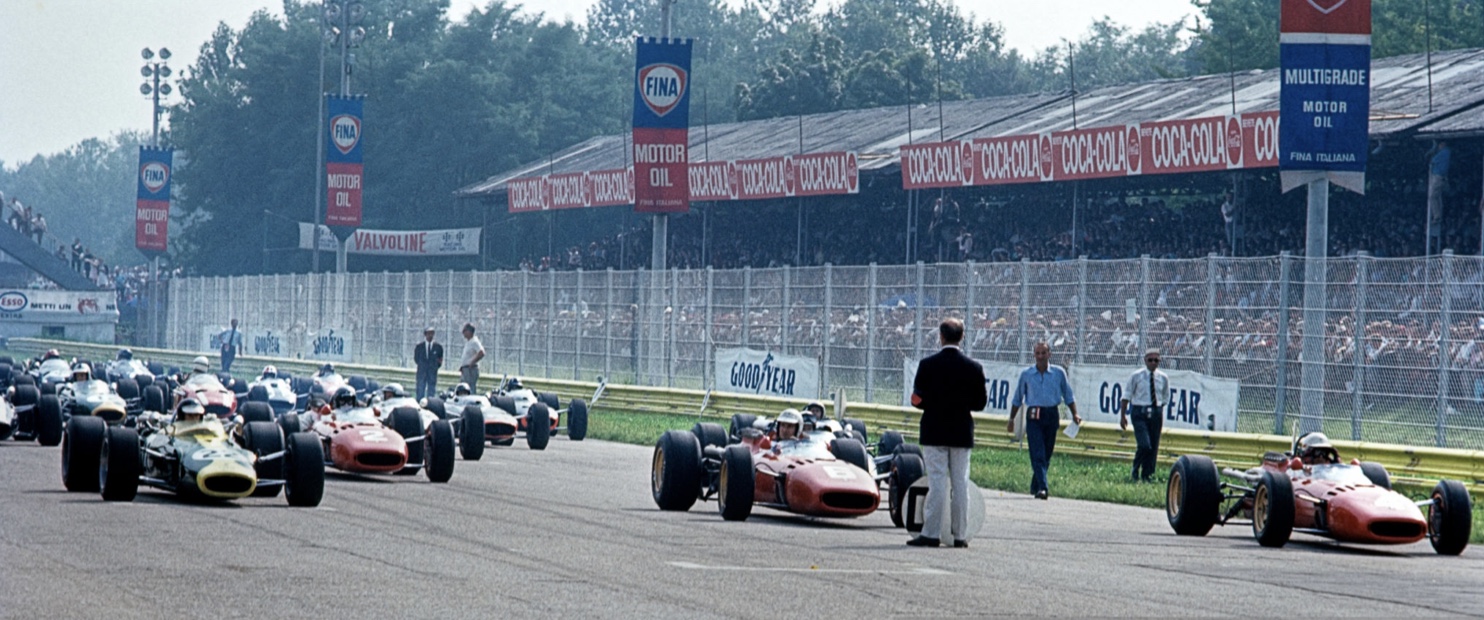
Monza 1966 front row- Clark Lotus 43 BRM, Ludovico Scarfiotti and Mike Parkes on the far side, Ferrari 312’s pole (R Schlegelmilch)
I’ve done the 1966 Grand Prix season to death in my series of Repco Brabham articles, click here to read about that wonderful season from an era now so far away! https://primotipo.com/2014/11/13/winning-the-1966-world-f1-championships-rodways-repco-recollections-episode-3/ , and here for the 1966 Ferrari 312 https://primotipo.com/2017/10/26/surtees-ferrari-312-modena-1966/ , and here for the Lotus 43 BRM https://primotipo.com/2015/02/17/jim-clark-taking-a-deep-breath-lotus-43-brm/
Ferrari usually rise to the occasion at home and so it was that Mike Parkes popped his 312 on pole from Scarfiotti, aided by a bit more power. Clark was on grid 3 with John Surtees, by then firmly esconced at Cooper Maserati having started the season with Ferrari- but decamping after a series of spats within the team, on grid 4 and Lorenzo Bandini in another 312 in position 5.
Parkes below is looking fairly relaxed with a post-pole cuppa tea!

(unattributed)
In the early stages of the race Scarfiotti and Parkes led but were soon passed by Bandini before the end of lap 1- Clark was back in tenth. Bandini pitted on lap 2 with a fuel pipe problem with Stewart’s BRM P83 H16 soon out with similar dramas.
Scarfiotti led from Hulme, Parkes and Surtees- Surtees pitted on lap 32 with a fuel leak. Jack Brabham, out of the race, won the Drivers Championship as Surtees was the only driver capable of taking the championship from him. Ludovico retained his lead finishing six seconds clear of Parkes, Denny Hulme and then Jochen Rindt, Cooper T81 Maserati.

Scarfiotti from Parkes (unattributed)
Credits…
Rainer Schlegelmilch
Tailpiece: And what a tail it is! The big, fat, beefy BRM arse of the wonderful Lotus 43- the only H16 engined GP winner in the end of season US GP @ Watkins Glen…

(unattributed)
Finito…
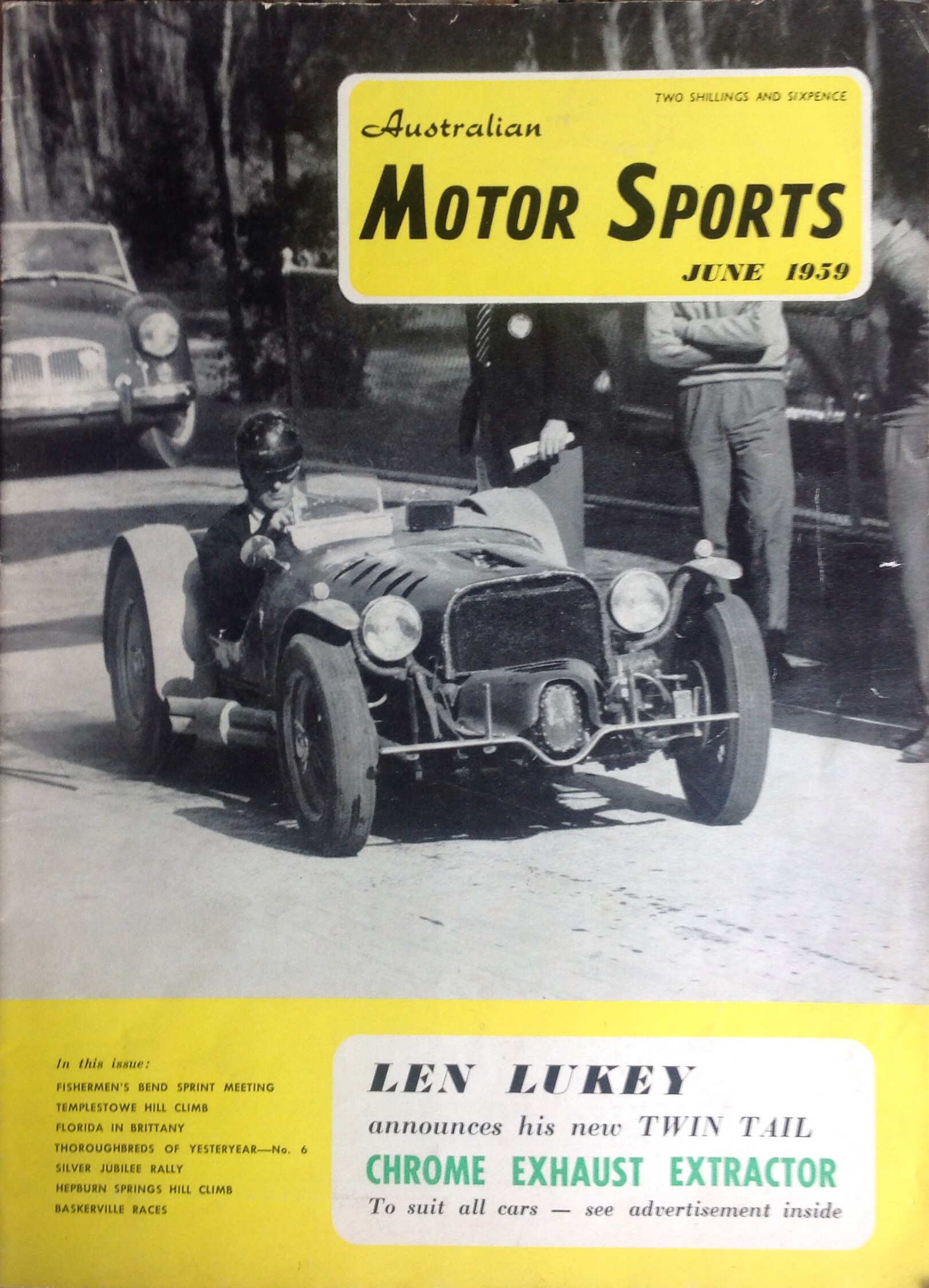
Harry Firth, MG TC Spl, Templestowe Hillclimb, outer Melbourne in 1959…
Long before his well known period as head of the Holden Dealer Team in the late sixties/early seventies Firth was a formidable car builder/preparer/driver in sports cars and sedans on tarmac and dirt.
He won the Armstong 500 three times- twice at Phillip Island and once at Bathurst partnered with Bob Jane- in 1961 they won in a Mercedes Benz 220SE, in 1962 aboard a works Ford Falcon XL, Firth prepared the works Fords at his famous garage in Queens Avenue Auburn, out of these modest premises did some great cars emerge.
He was also victorious in 1963 in a self-prepped works Ford Cortina GT and again as the event morphed into the Bathurst (Gallaher) 500, once, partnering Fred Gibson in a works XR Falcon GT in 1967.

The Bob Jane/Harry Firth Ford Falcon XK (above) DNF leading the John/Caldecoat MGA, Hell Corner, Bathurst 6 Hour, 30 September 1962. Race ‘won’ by the Geoghegan Brothers Daimler SP250, who were first across the line in a race technically of classes with no ‘outright winner’.
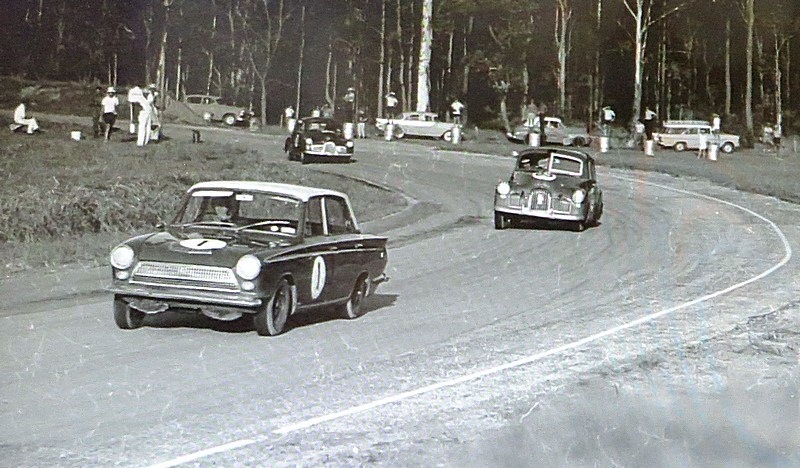
On Allan Moffat’s recommendation he was engaged to co-drive a Lotus Cortina with Moffat in endurance races at Green Valley and Riverside in 1966.
Ford were keen for him to stay but he had to return home to honour a Ford Australia rally commitment, duly winning the first Southern Cross Rally.
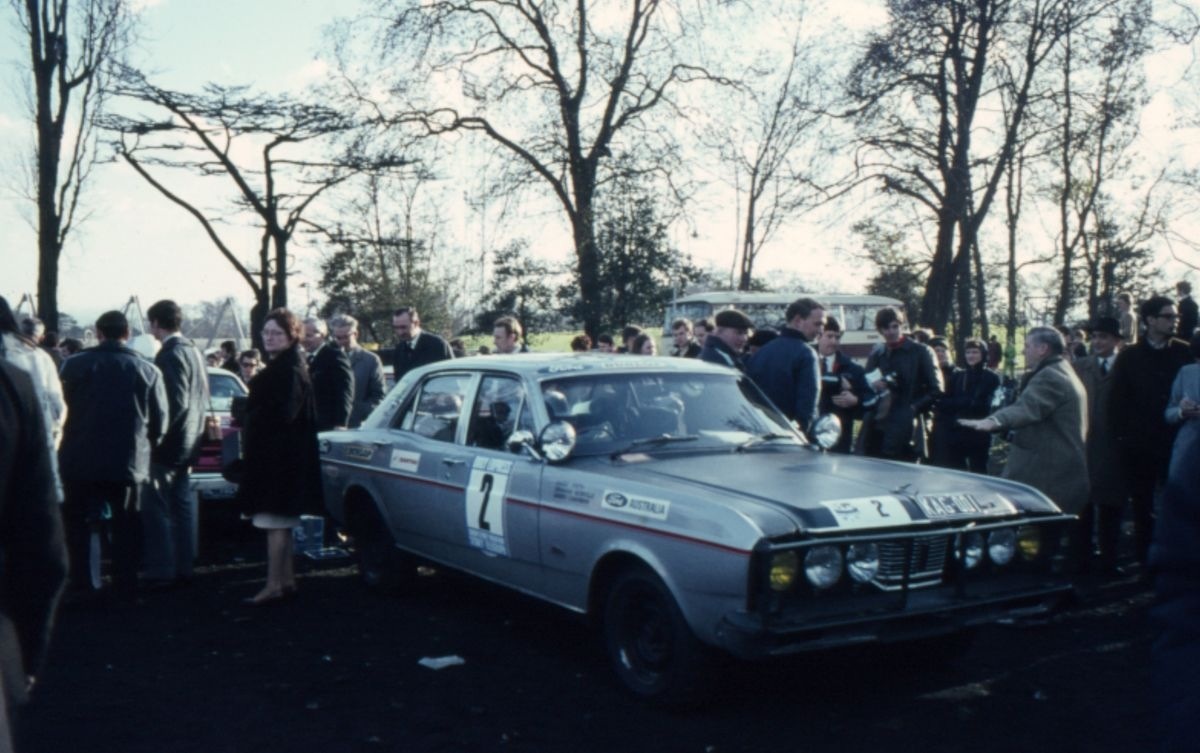
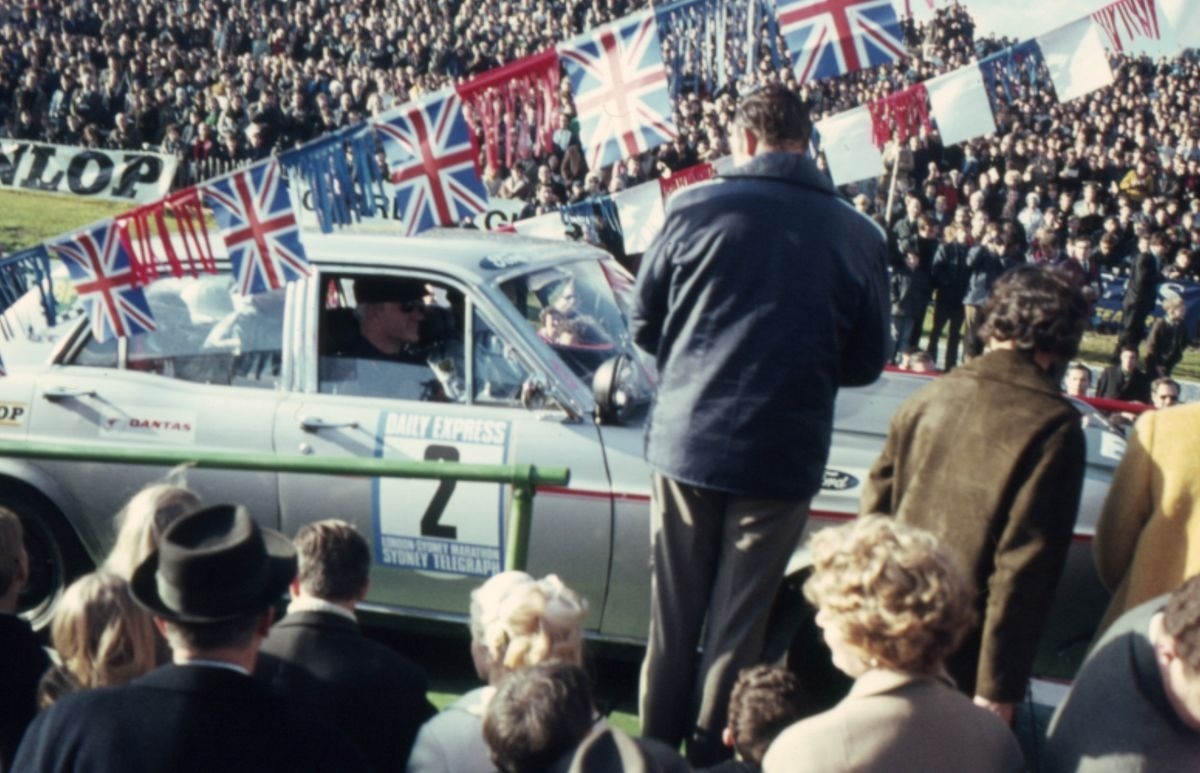
In 1968 he won the inaugural Australian Rally Championship driving a Lotus Cortina, another doyen of the sport, Graham Hoinville was his navigator.
Firth and Ken Harper also prepared the Ford Australia Falcon GT ‘XT’ London-Sydney Marathon entries.
These 302 CID V8 engined sedans won the teams prize with Harry behind the wheel of the eighth placed car with his usual friend and navigator, Hoinville. The Vaughan/Forsyth car was third and Hodgson/Rutherford GT sixth.
The two photos above are at the Crystal Palace, London start on 24 November.

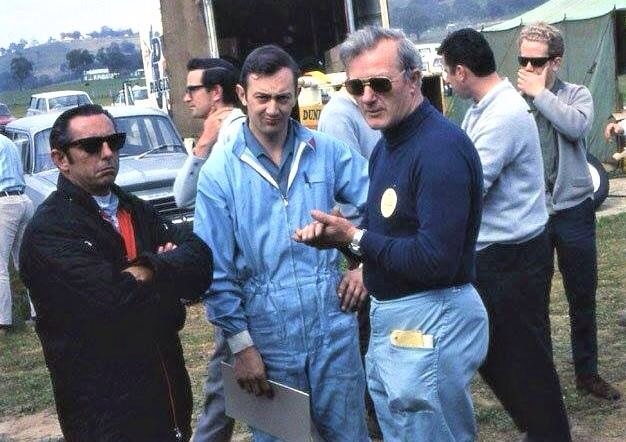
This unique blend of skills and experience is what bagged him, even as a ‘Ford guy’, passed over as team manager by Al Turner as ‘too old’ – the HDT job. He held this management role until 59 years of age, in 1977 when John Sheppard succeeded him.
Let’s get back to the MG, this short article does not do Harry’s career justice, I am not attempting to do so- I am getting off point!
The MG Special, chassis ‘TC4723’ commenced construction in 1951, the chassis was much modified and lightened. The engine was also heavily adapted for the demands of racing, exactly how is not disclosed in my reference sources, but included fitment of a Wade supercharger running at 22 pounds of boost which mounted in front of the radiator. If any of you have details of the full specification, ever evolving as it was, drop me a note, I will pop the details into the article.
The bodywork was ‘functional’ rather than attractive as many of the ‘single-seater’ MG specials in Australia at the time were. Its bluff nature mitigated against top speed but perhaps the cars primary purposes were hillclimbs and trials rather than top speed on Conrod Straight, Bathurst and the like.
The MG was successful on the circuits, sprints and hillclimbs only slipping down the order as more modern Coventry Climax engined cars started to appear in the second half of the fifties.
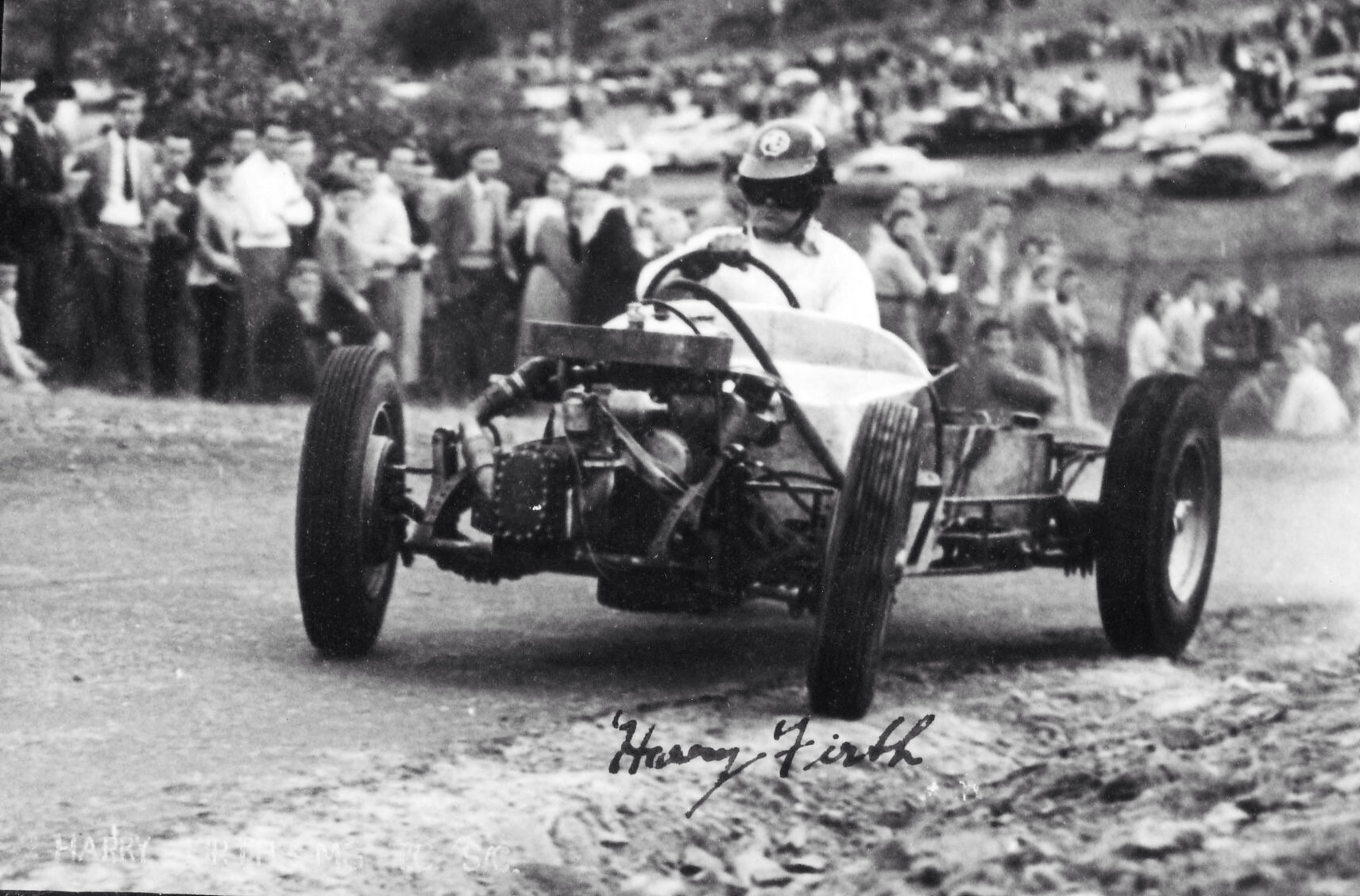
Harry eventually replaced the MG with a Triumph TR2, which was equally effective and functional until endowed with an Ausca (Maserati A6GCS) clone body but he retained the car which was stored out the back of his ‘Marne Garage’ on the corner of Burke and Toorak Roads, Camberwell.
My grandparents and uncle had the newsagent on the opposite north-east corner of that intersection in the late fifties/early sixties, Harry was famous for sipping a cup of tea and working his way through the motor magazines, never buying any of course!
Firth eventually sold the site to the Confederation of Australian Motor Sport to construct their headquarters. At that point, when he had to remove the car, it was sold to Jack Schumacher in Murray Bridge, South Australia, he didn’t use it much and resisted Harry’s regular entreaties to buy the car back until 1977.
Harry restored it and occasionally used it in Historic events, I’ve lost track of it in recent years. Firth died in 2014 aged 96.
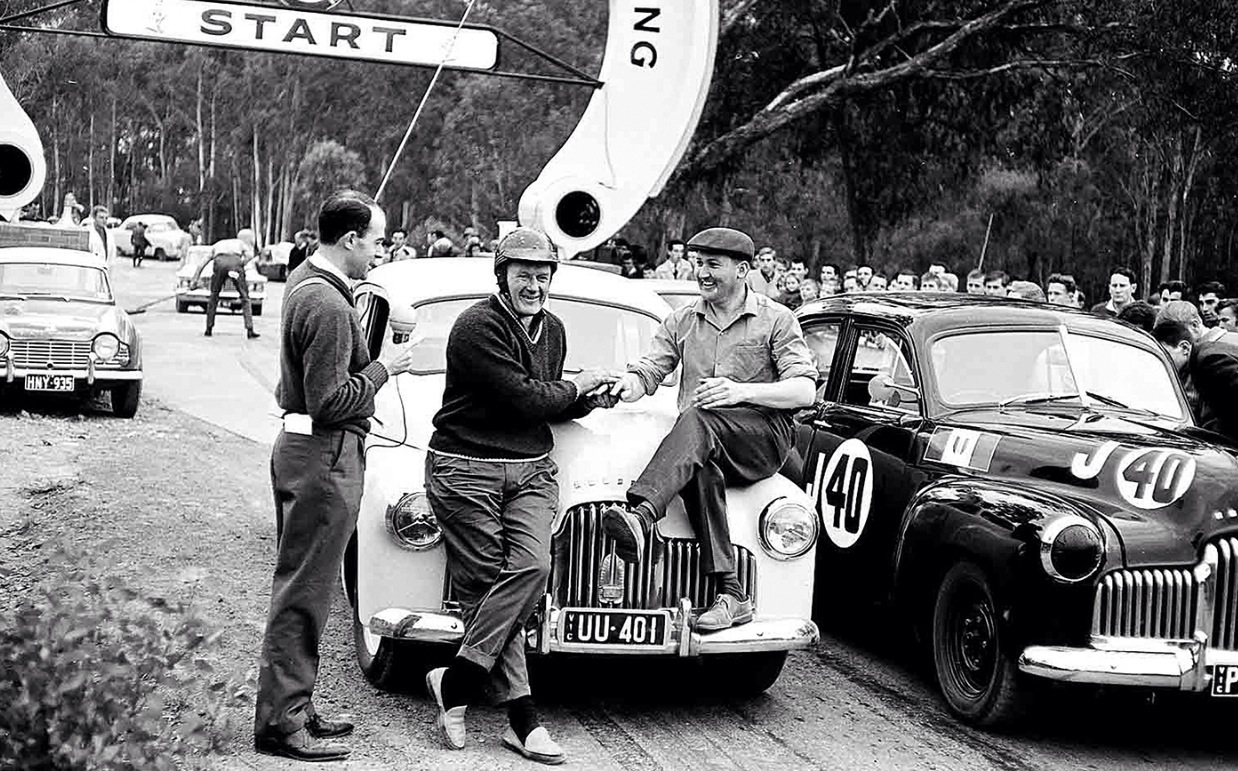

The photo above is a decade or so later than the one at Templestowe and shows Harry driving a Holden Dealer Team Holden Monaro GTS350- perhaps one of the circuit racing cars pensioned off for much tougher duties in 1969- Calder Rallycross.
I wonder if this was Firth’s last competition appearance as a driver prior to his Historic Racing period a bit later on?

Harry with all of his booty in 1964.

Firth with the two Holden Dealer Team LJ XU1s of Peter Brock and Colin Bond in 1972- I think it’s brake fluid he is playing with for the camera or flogging.
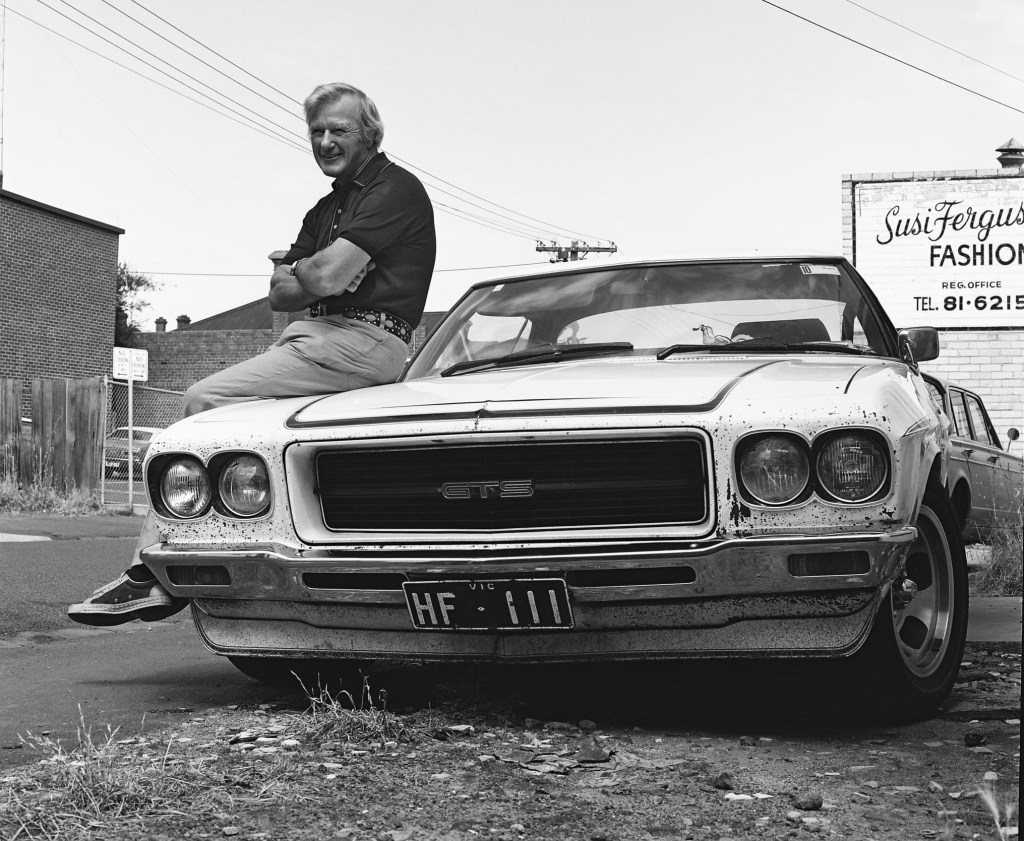
Relaxed in front of Ian Smith’s camera out front of Firth’s Queens Avenue, Auburn, Melbourne Holden Dealer Team workshop. Special build Holden Monaro GTS 308 circa 1974.
Bibliography…
‘Historic Racing Cars in Australia’ John Blanden, Leon Sims, autopics.com.au, Stephen Dalton
Photo Credits…
State Library of South Australia, Australian Motor Sports, Leon Sims Collection, Bob Williamson, David Wilson, John ‘Archie’ Hall, Ian Smith
Tailpiece…

Harry Firth and Graham Hoinville on the way to winning the June 1964 Ampol Trial, works Ford Cortina GT. 101 cars including five works teams entered the event which was held over 7000 miles in Queensland, New South Wales and Victoria, start and finish at Bondi Beach
Finito…
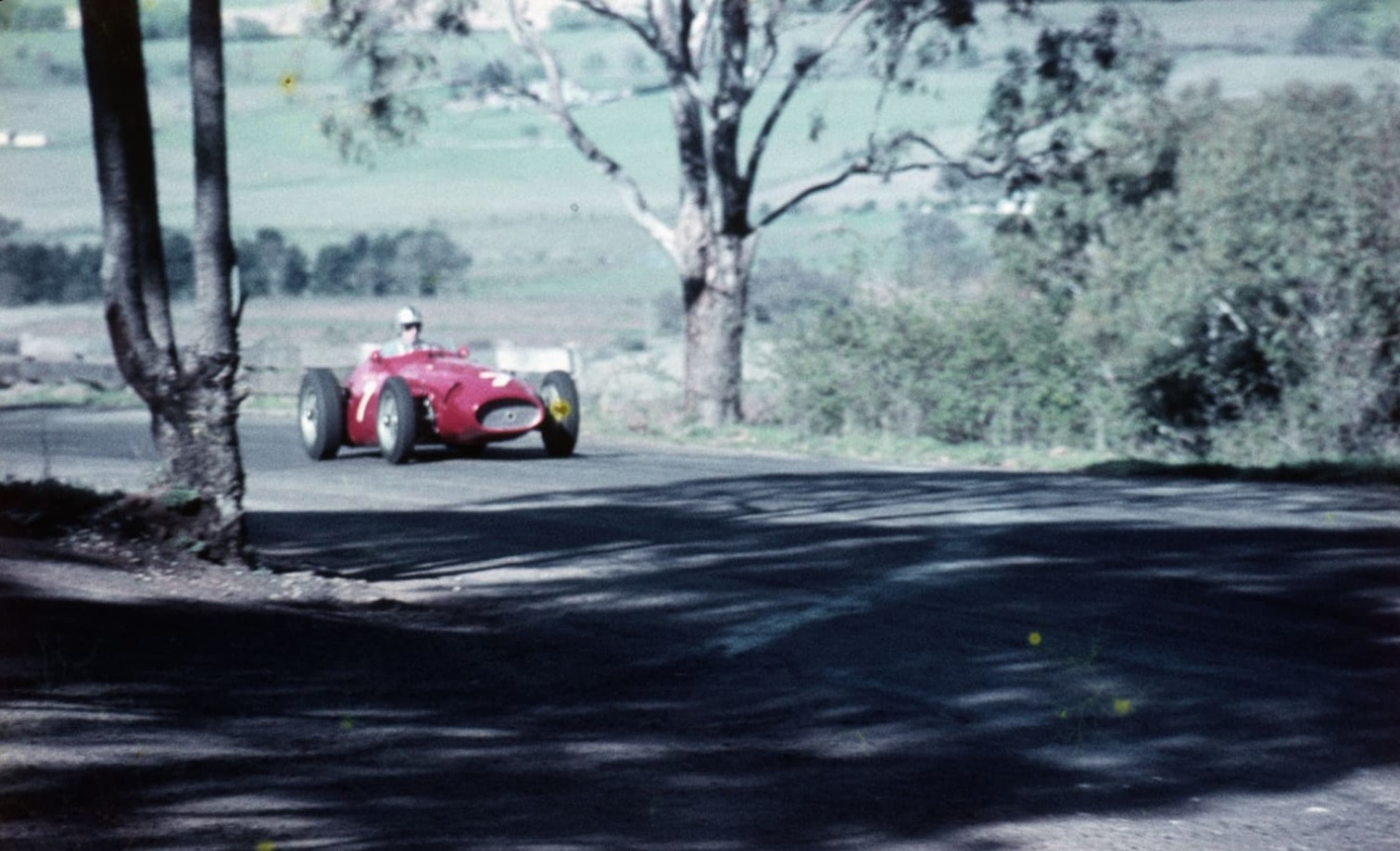
(B Miles)
Arnold Glass blasts his Maserati 250F out of Quarry Bend, Bathurst, Easter 1960…
The Sydney motor dealer and later Datsun importer loved this machine and its forgiving nature. Arguably it was the car with which he achieved his best results even if it was becoming a little passe by the time he got his hands on it in 1959.
He finished second in the ‘Bathurst 100’ Gold Star round behind Alec Mildren’s Cooper T51 Maserati and ahead of Bill Patterson in another Coventry Climax engined T51.
I’ve written a story about Arnold, click here to read it; https://primotipo.com/2015/08/25/arnold-glass-ferrari-555-super-squalo-bathurst-1958/
This machine, chassis ‘2516’ was Jean Behra’s works car throughout 1955 before being imported to Australia by Reg Hunt as a replacement for the 250F engined A6GCM Maserati with which he achieved much in 1955. Hunt didn’t race the 250F for long before retirement at a way too an young age to take on his family responsibilities and a growing automotive empire based in Melbourne’s Elsternwick. Here is a piece about the A6GCM; https://primotipo.com/2017/12/12/hunts-gp-maser-a6gcm-2038/
and Reg; https://primotipo.com/2014/07/19/reg-hunt-australian-ace-of-the-1950s/
Bib Stillwell raced ‘2516’ in 1957 on his inexorable rise to the top of Australian racing and then Arnold acquired it competing into ‘into the Cooper era’ when he too acquired a T51. ‘2516’ inevitably, sadly, ended up back in Europe, none of ‘our’ Maser 250F’s survived here into the modern era
Credits…
Bill Miles, Rob Hartnett
Tailpiece: Bathurst pits, warming her up…
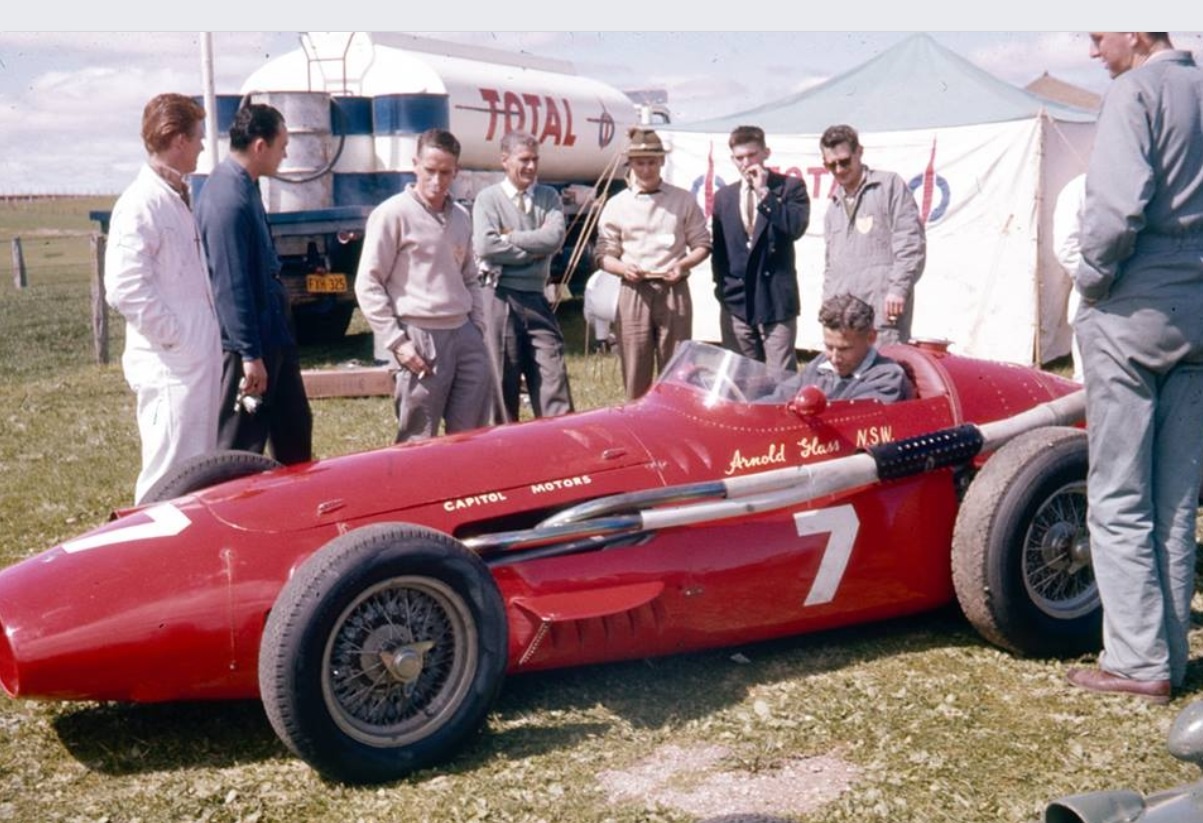
(Rob Hartnett)
Finito…
 primotipo...