I don’t think of Mike Hawthorn as a Lotus driver but here he is with Graham Hill, rather similar in age, they were both born in 1929…
Amazing really, grafter Hill worked hard to get into motor racing, his GP career started not long before Hawthorn’s finished and went well into the 1970’s, not to forget Graham’s Le Mans and Indy wins of course. Mike’s racing entree was smoothed by his fathers wealth, it’s intriguing to guess what he may have achieved had he raced on into the 1960’s and applied his considerable skills to Chapman’s works of Lotus art.
Both Hill and Hawthorn are English to the core albeit completely different charcters. And personalities they certainly were. It’s a wonderful shot.
Hawthorn, Lotus 11 Climax, Oulton Park, Cheshire April 1955 (Popperfoto)
The event or reason for the Hill/Hawthorn shot is unrecorded but dated 12 April 1956 as is the photo of Hawthorn with Stirling Moss below. Its dated 11 May 1953, i am interested if anybody can assist with the places and occasions…
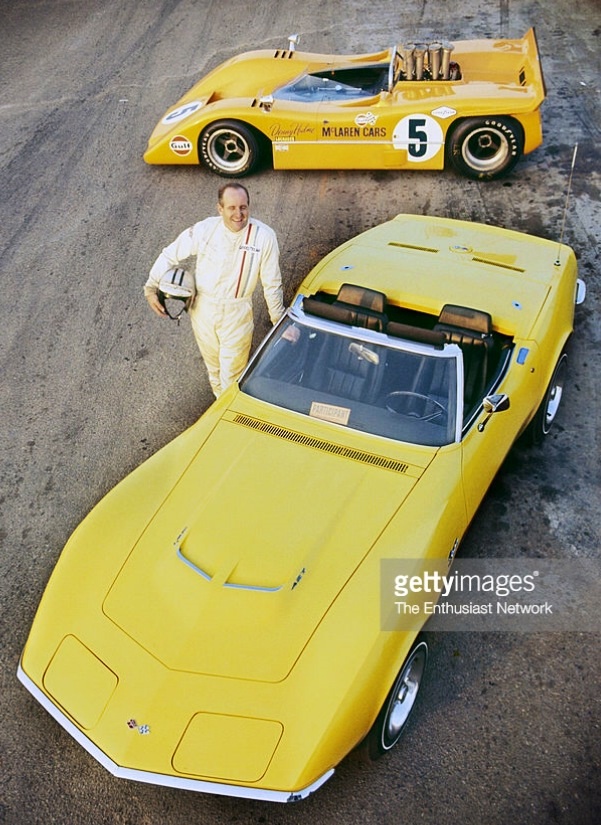
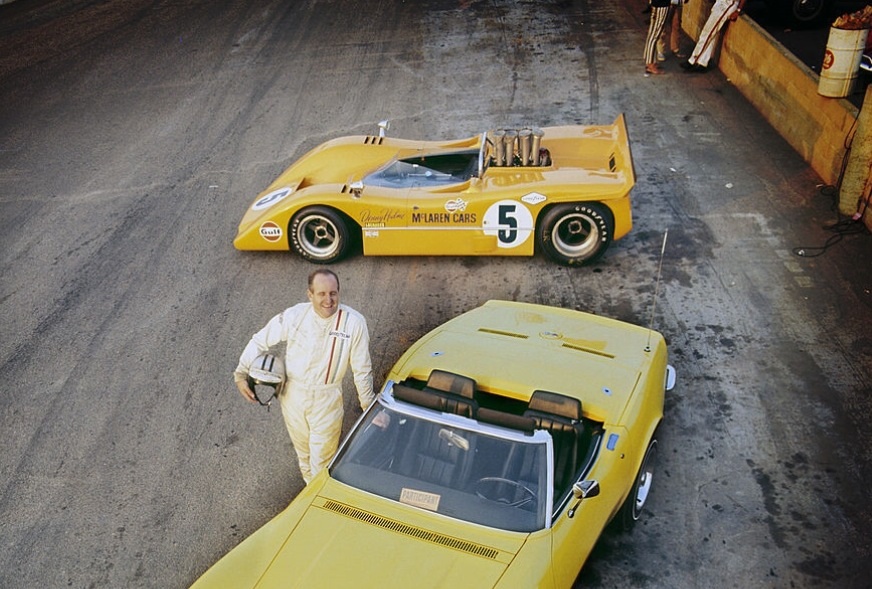
Denny Hulme stands with ‘his’ two Chev ZL1 aluminium-blocked cars at the Riverside Times Grand Prix in 1968…
Both mighty fine cars, an M8A McLaren would be far rarer than an ‘ally-block Corvette but i bet the factory didn’t sell too many of them. You could option the engine in a Camaro for a while as well, here in Australia Bob Jane won an Australian Touring Car Championship with one so equipped in 1971.
The M8A’s were dominant in Bruce and Denny’s hands in 1968…
Siffert, Pedro chillin’, Redman and Kinnunen- JW squad 1970 (Schlegelmilch)
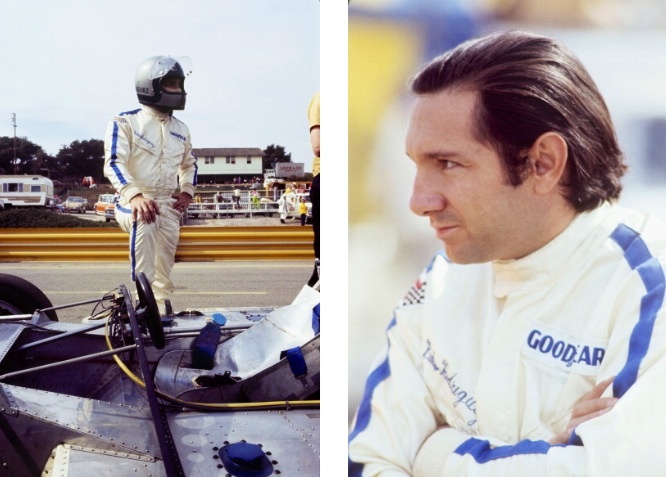
The JW Gulf boys relax before the off, the winning duo were Pedro Rodriguez and Leo Kinnunen…
There was only one Porsche 917 amongst the first nine cars home at the duration of the Monza endurance classic on 25 April but the German flat-12 was first, Pedro Rodriguez and Leo Kinnunen were happy winners.
Three Ferrari 512S followed them home, the Ignazio Giunti/Nino Vaccarella/Chris Amon Spyder 1.5 minutes adrift of the John Wyer Porsche.
It wasn’t a happy season for Ferrari in sportscars. Supremely competitive in F1 with the first of its flat-12 engined cars, the 312B, the 5 litre V12 512S really didn’t receive the development it needed to knock off the Porsches.
The German cars mainly raced at 4.5 litres in capacity that year but it was still more than enough. A win at Sebring in the second round of the Manufacturers Championship was Ferrari’s best result, and the flat-8 3 litre, nimble, light Porsche 908/3 mopped up on the tight, twisty circuits unsuited to the 917. The dudes from Stuttgart had the game well covered.
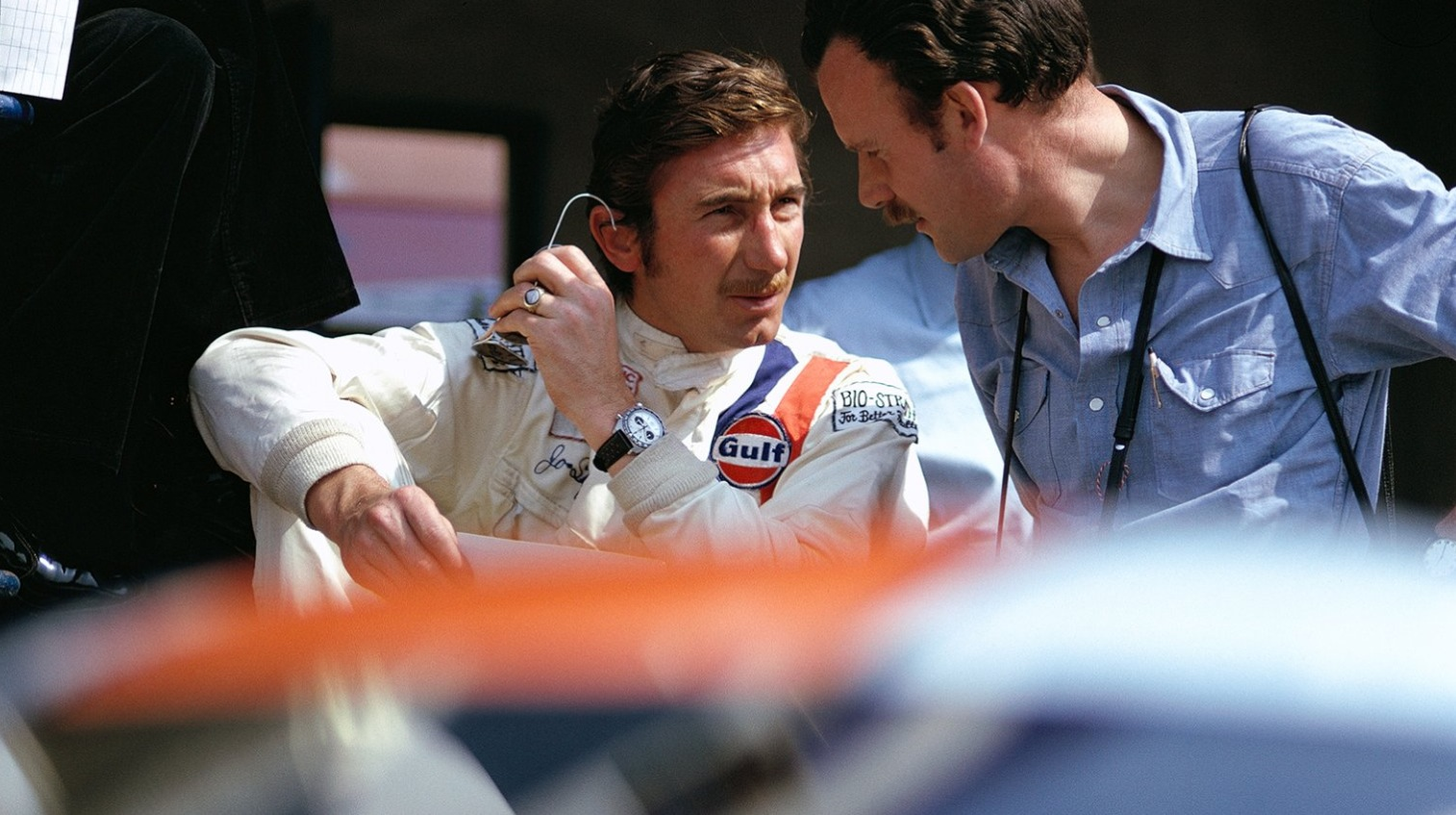
Seppi in conversation, and for the horologists he is sporting a nice Heuer Autavia chronograph (Schlegelmilch)
The speed of Ferrari’s evolved 512S, the 512M was clear at the Osterreichring 1000 Km in October, so 1971 looked to be a great battle of two amazing 5 litre cars but effectively the Scuderia waved a white surrender flag before the seasons commencement.
They chose to race a new 3 litre flat-12 engined prototype, the 312P in 1971 with an eye to the rule change to cars of that capacity in 1972, rather than the factory race the 512M.
The Ferrari privateers did their best against the Panzers but it was ineffective, the speed of the beautifully prepared and superbly Mark Donohue driven Penske 512M duly noted. The 1971 endurance season could have been the greatest ever had Scuderia Ferrari raced those cars!
Pedro drives, Leo and the boys ride
Back to Monza 1970. The other ‘works’ Porsches were well back- the JW 917K of Jo Siffert and Brian Redman finished 12th, the Porsche Salzburg 917K’s of Vic Elford/Kurt Ahrens DNF with puncture damage after 92 laps and the 1970 Le Mans winning combo of Hans Hermann and Richard Attwood were out with engine failure on lap 63.
Still there was strength in numbers, Pedro and Leo were there at the end, in front…
Credits…
Rainer Schlegelmich
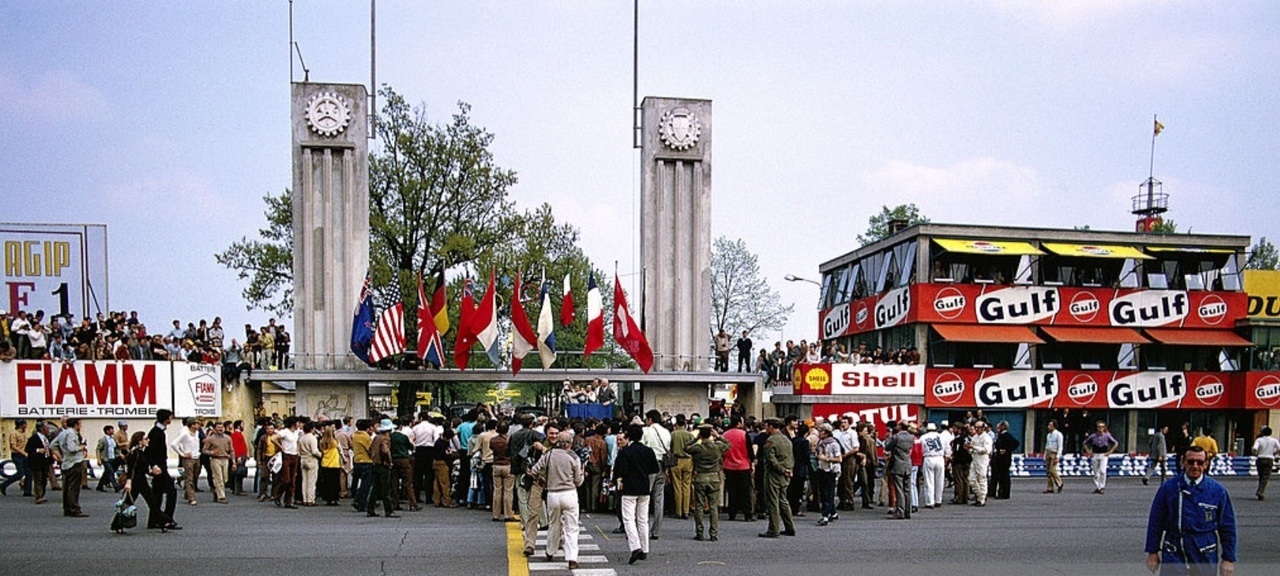
Tailpiece: Tifosi @ Monza, not as many as if a 512S won…
The winning Tony Rolt/Duncan Hamilton Jaguar C Type ahead of the Phil Walters/ John Fitch Cunningham C5R Chrysler and Alberto Ascari/Gigi Villoresi Ferrari 375MM at Le Mans 13/14 June 1953…
Early in the race it was clear the Jaguar C Types, Ferrari’s 340/375MM and Alfa Romeo 6C/3000CM were the cars in the hunt for outright victory, the Lancia D20’s and Talbot T26GS were outclassed.
Moss, the initial hare from the start in a works C Type had a misfire in his 3441cc DOHC straight-six, which set in after 20 laps putting him back to 21st and out of contention. Worse for Hawthorn and Farina was disqualification of their 4.1 litre V12 340MM Ferrari after brake fluid was added before the requisite 28 laps were completed. Fangio’s Alfa was out with engine dramas in his 3.5 litre, DOHC straight-six, the car shared with his countryman, Onofre Marimon, at about 6pm
As darkness fell the Ferrari/Jag battle intensified between the Ascari/Villoresi 375MM and Rolt/Hamilton C Type with the Alfas not too far back. Rolt and Hamilton led, the best placed Fazz was hampered by a sticking clutch and a thirst for water.
At dawn the same two cars led, with Moss up to 3rd in the car he shared with Peter Walker, as the mist cleared they still led. By 9am the lead Ferrari had dropped back to 5th, retiring at 11am. The works Paolo Marzotto/Giannino Marzotto Ferrari 340MM challenged the lead Jags and Cunningham finishing 5th behind the winning car driven to the finish by Duncan Hamilton with Moss/Walker 4 laps back with the Phil Walters John Fitch Cunningham C5-R Chrysler 5.4 litre V8 a lap further adrift in 3rd. The third works Jag C Type of Peter Whitehead and Ian Stewart was another 2 laps back having driven a pace to finish throughout.
Tony Rolt and Duncan Hamilton chew the fat, Silverstone 6 May 1955, the car is Rolt’s works D Type ‘XKC 403’…
Love this carefully posed shot, perhaps used to promote the meeting the following day. Its practice for the 7 May ‘Silverstone International’ sportscar race, a 190Km event won by Reg Parnell from Roy Salvadori, both aboard works Aston DB3S’, then came Rolt, Hamilton and Mike Hawthorn in works D Types. Mike started from pole and set the fastest lap.
Pierre Levegh relaxed during the 1953 Le Mans weekend beside the Talbot Lago T26GS he drove to 8th place together with Charles Pozzi…
He famously came within an ace, an hour in fact, of winning the race solo in a similar car the year before.
Levegh led the race from about 2am, during his long hours at the wheel the engine developed a vibration, which he felt he could nurse better than his co-pilot given he was in synch with the cars rhythm.
But an hour from the end of the classic the car coasted to a halt at Maison Blanche, about a mile from the pits. The Talbot was mortally wounded, either a conrod let go after a big over rev or a bolt holding the central crankshaft bearing came loose. What was never clear, Pierre was driving with a broken rev-counter, is whether the engine succumbed to the malady present for much of the race or whether in his exhausted state the driver missed a gear.
The Frenchman’s real name was Pierre Bouillin, his racing pseudonym Of Levegh was the surname of an uncle who was a pioneer driver who died in 1904. Alfred Levegh was a leading member of the Mors racing team at the turn of the century. Pierre assumed his uncle’s surname in 1938 but when he commenced racing in a Bugatti 57T in 1937 raced using his own name.
The wealthy Parisian brush company owner was a talented sportsman, being a world class tennis and ice hockey player in addition to his talents behind the wheel, a career he started pre-War in his early thirties but did not flourish until after the cessation of global hostilities.
Pierre, driving a factory Mercedes Benz 300SLR was an unwitting and innocent part of the tragic sequence of events which took his life, and those of 83 others at Le Mans in 1955. Not a subject I care to explore and an incredibly sad and inappropriate epitaph for a driver who was a journeyman in Grand Prix cars but good enough in Sports Cars to be invited into a team containing Moss and Fangio…
Levegh, Talbot Lago T26GS during his heroic but ultimately unsuccessful 1952 Le Mans drive (unattributed)
Credits…
Stanley Sherman, Klemantaski Collection, oldracingcars.com
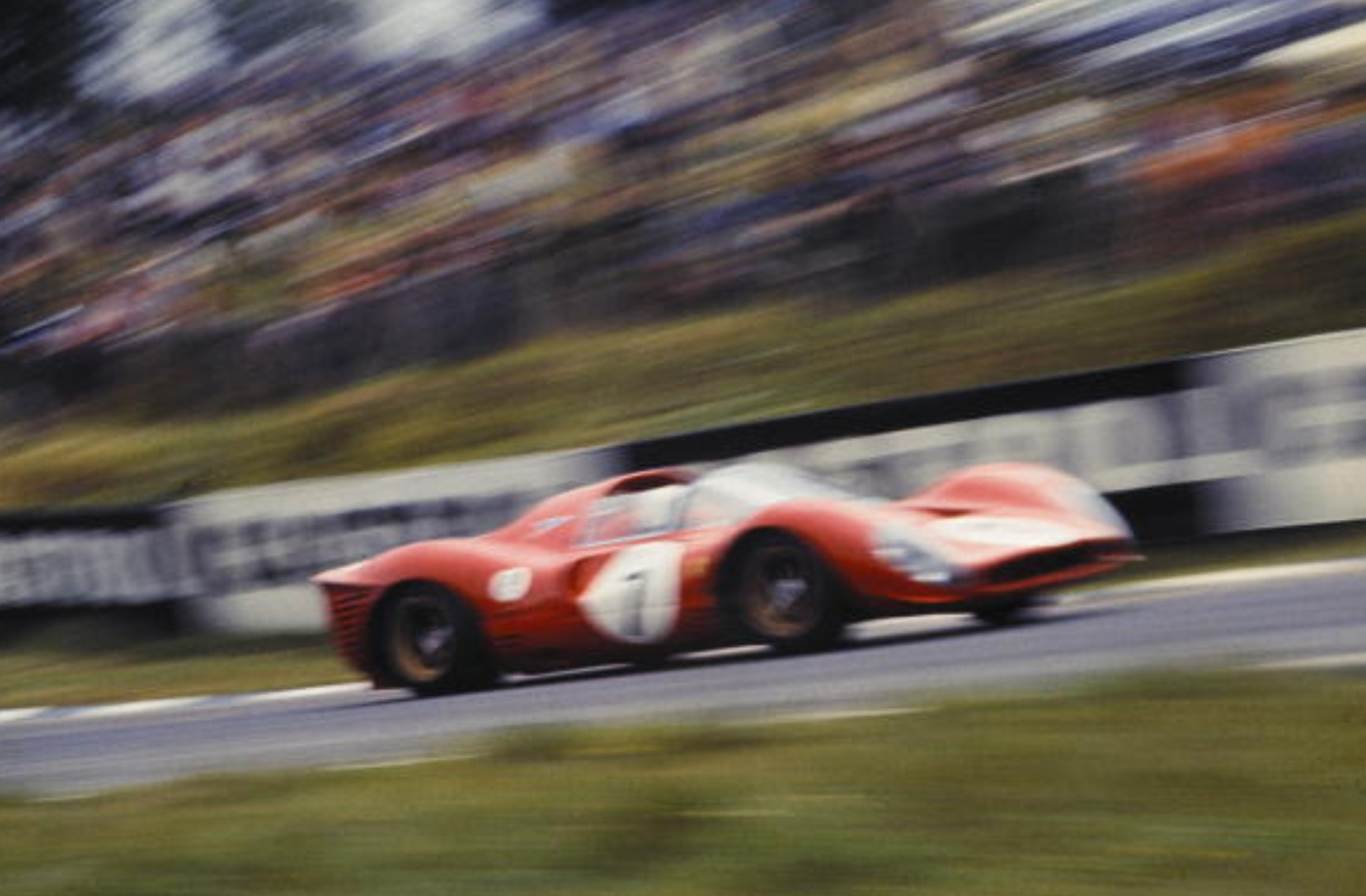
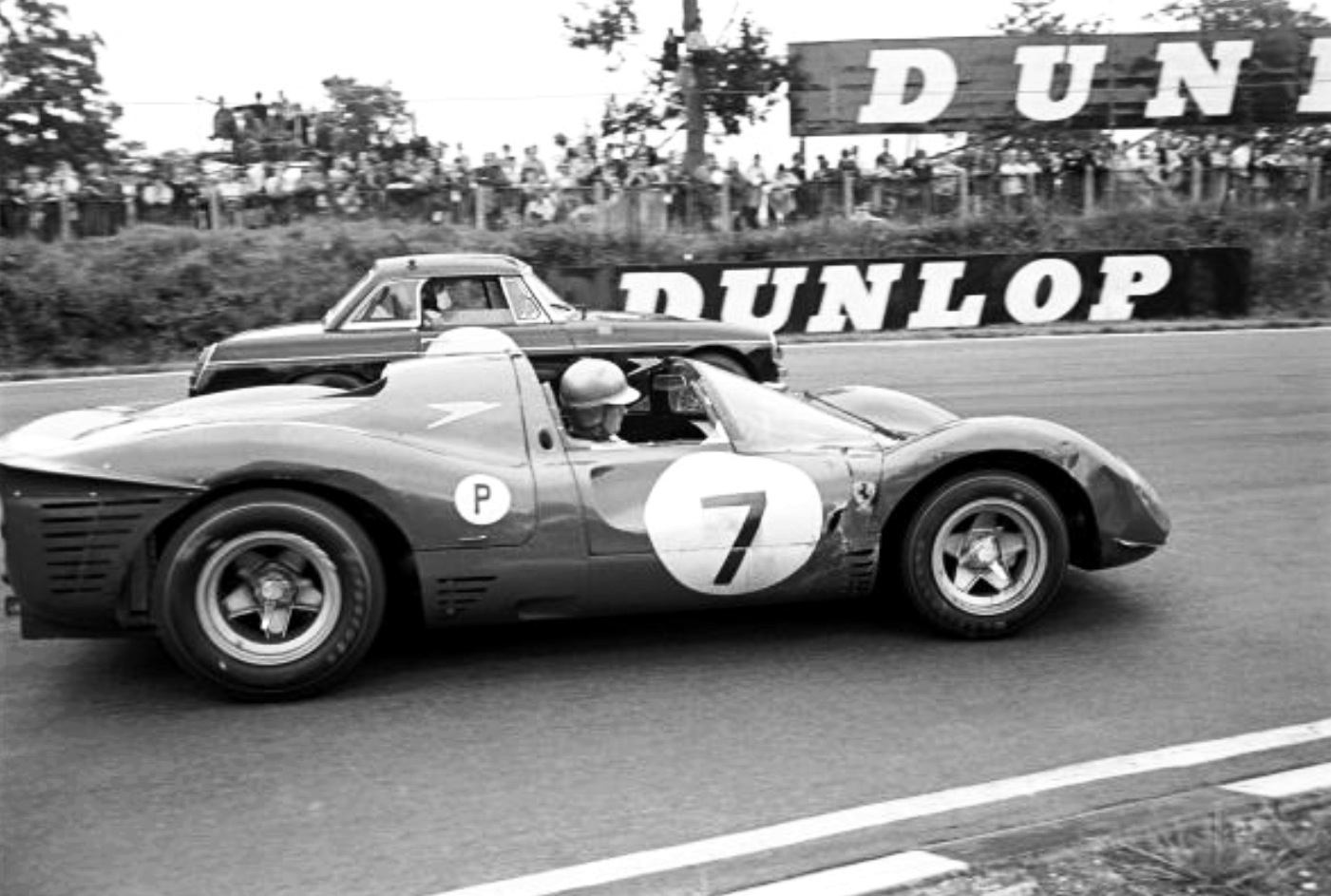
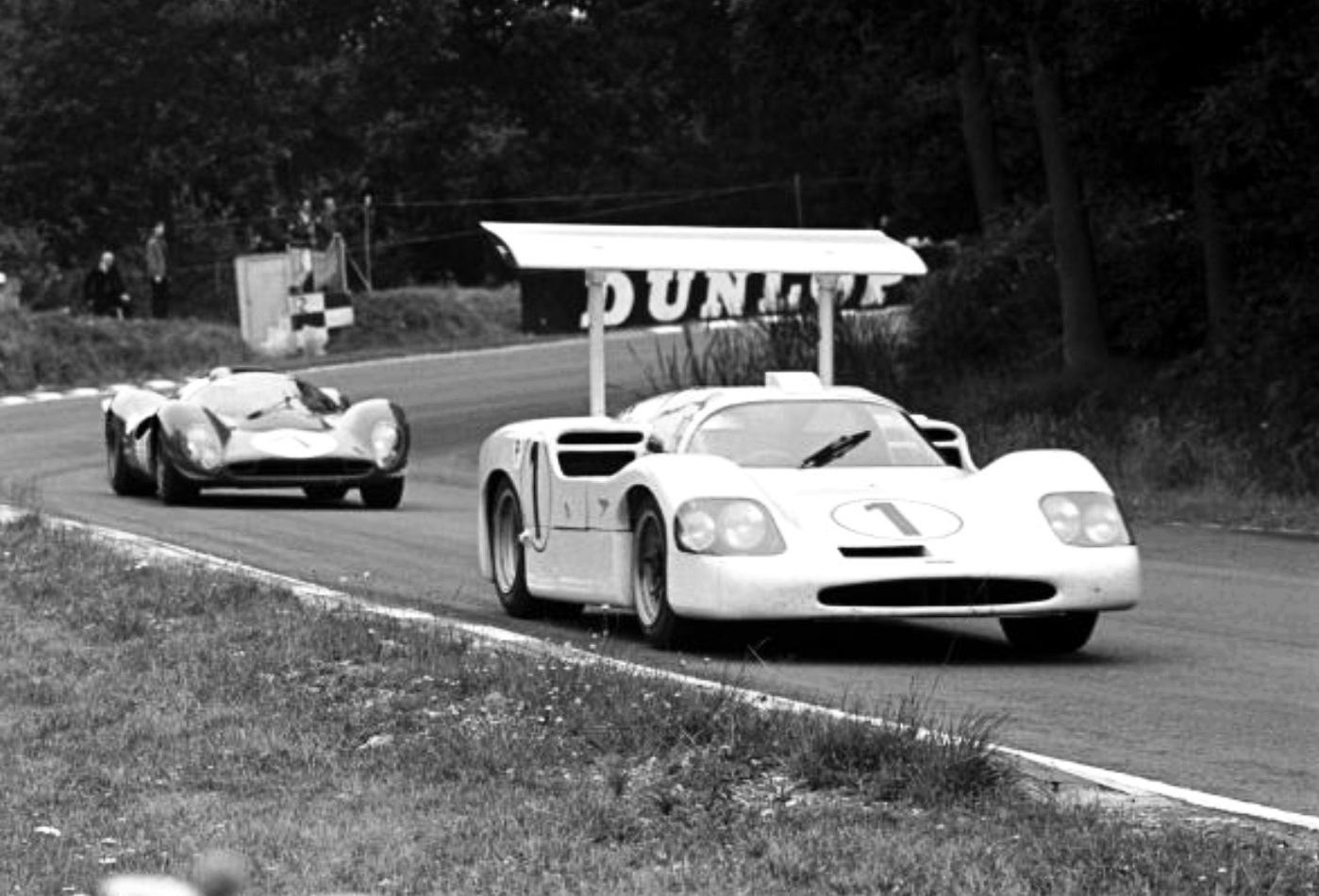
The Ludovico Scarfiotti/Peter Sutcliffe factory Ferrari P4 during the 1967 Brands Hatch 6 Hour held on 30 July…
Louis Klemantaski’s creative shot beautifully captures and ‘distresses’ the 5th placed car, Phil Hill and Mike Spence won the race in a Chaparral 2F Chev from the P4 of Chris Amon and Jackie Stewart.
Sutcliffe dives the P4 inside the Enever/Polle MGB (Klemantsaki)
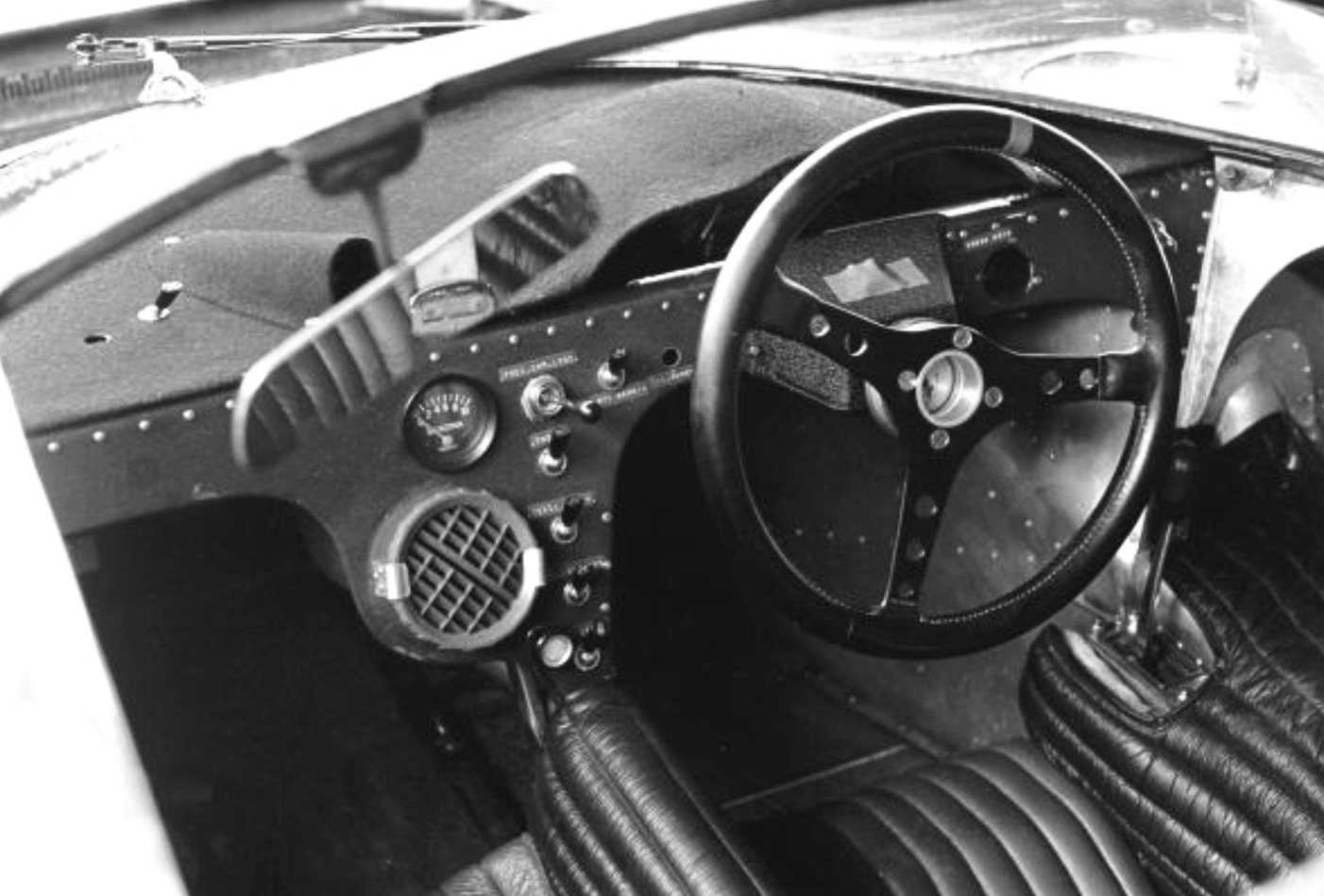
P4 Ferrari cockpit at Brands ’67. Of the period ‘innit? Momo wheel, Veglia Borletti instruments, right-hand 5 speed change, car a spaceframe chassis with riveted on aluminium panels to add stiffness, beautifully trimmed for a racer-added to driver comfort over longer distances (Klemantaski)
I wrote articles about the Ferrari P4/CanAm 350, Chaparral 2F and 1967 Le Mans which may be of interest if you are into these cars and this great era of ‘unlimited’ endurance racing, check out;
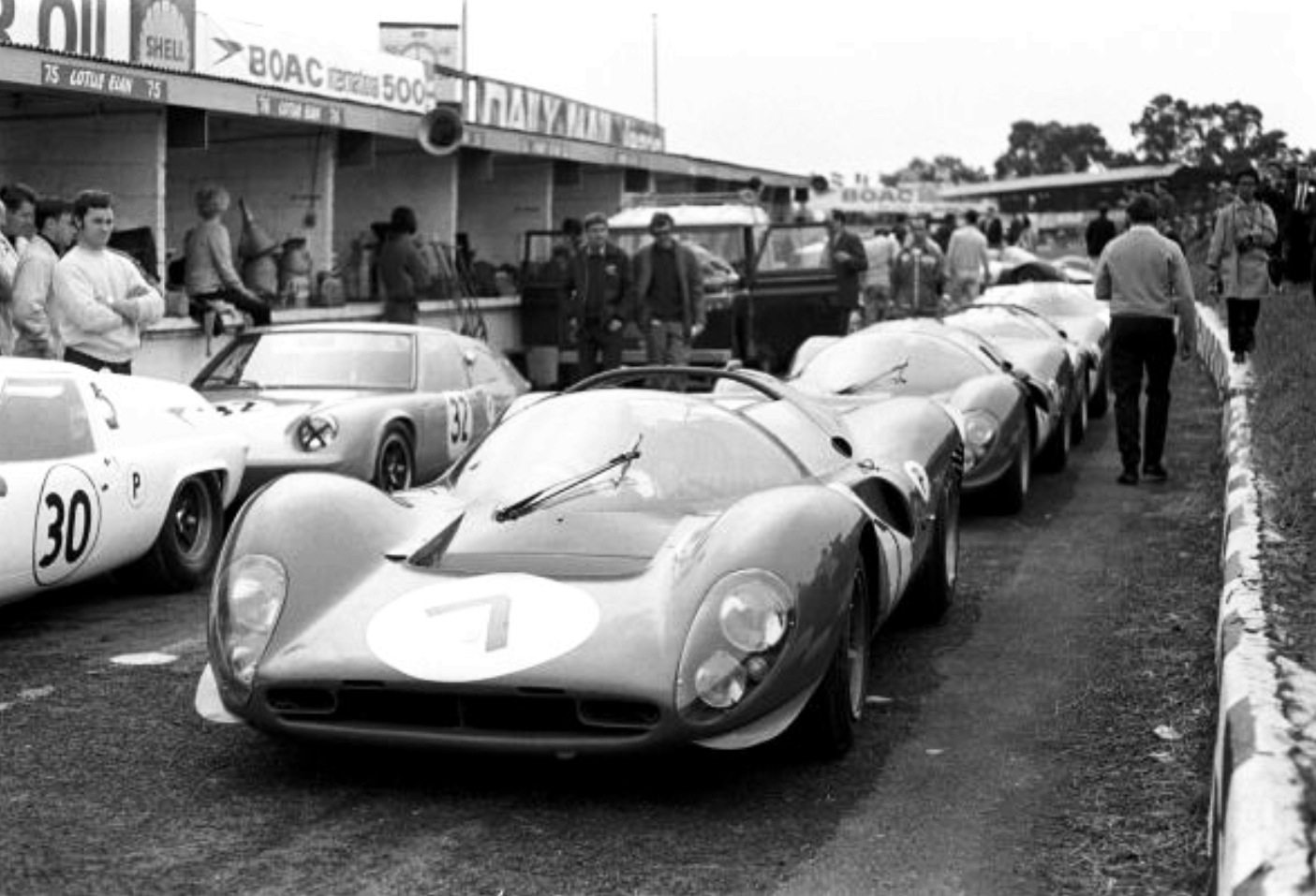
Brands pits, 6 Hours ’67; the 3 factory P4’s in line astern with the Scarfiotti/Sutcliffe car ahead of the other two crewed by Amon/Stewart 2nd and Paul Hawkins/Jonathon Williams 6th. # 30 and 32 Lotus 47 Fords are Taylor/Preston 19th and Hine/Green DNF (Klemantaski)
Credit…
Klemantaski Collection
Tailpiece: Phil Hill in the winning Chaparral 2F Chev from the Scarfiotti/Sutcliffe Ferrari P4…
George Follmer eases his oh-so-powerful Porsche 917/10 around the demanding swoops of Watkins Glen, New York State, 23 July 1972…
Follmer won the Can Am that year after taking over the drive vacated by Mark Donohue who had a disastrous second round practice crash at Road Atlanta, Georgia in July. Follmer was a wise choice by Roger Penske, the right mix of speed, engineering nouse and mechanical sympathy to deliver the goods at short notice. Watkins Glen was Follmer’s first race in the challenging 917/10, he was 5th, the hitherto dominant McLaren’s of Denny Hulme and Peter Revson were first and second- it was the last race win for the McLaren works team in the Can Am…
I must admit I have always been in two minds about these beasties. On the one hand they are very clever bits of engineering in adapting an existing race winning design made redundant into an altogether different and equally successful bit of kit. On the other, their dominance effectively, along with some silly SCCA rule decisions, destroyed the best ‘Formula Libre’ racing category on the planet. Make that the best racing category on the planet.
Porsche had of course competed in the Can Am before 1972, the decision to get serious was effectively made on its behalf by the FIA in making redundant the Group 5, 5 litre Porsche 917 and Ferrari 512S cars which provided two of the best ever seasons of sportscar endurance racing in 1970 and 1971.
Zuffenhausen’s existing 3 litre 908 was unlikely to be competitive with the Grand Prix engined designs of Ferrari and Matra, a completely new 3 litre engine would have been required under the new endurance racing rules.
So Porsche planned to spend its racing budget on winning the Can Am in its most important single market- using the existing 917 package of engineering goodies as rather a sound base.
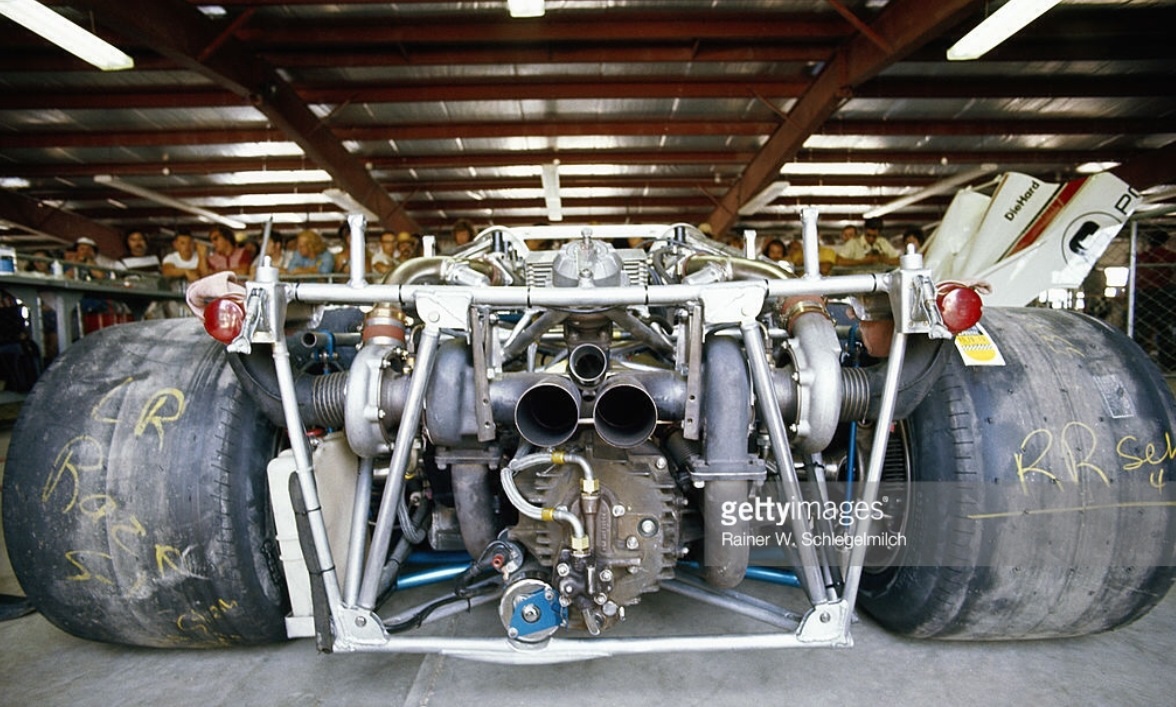
Follmers 917/10 Watkins Glen 23 July 1972. Donohue’s crash destroyed the only super lighweight titanium spaceframe chassis, this is the heavy! aluminium one. Two massive Eberspacher turbo’s, see the wastegate above the exhaust outlet pipes, new 4 speed transaxle developed for the 917/10 (Rainer Schlegelmilch)
Early Design and Development…
After the 1971 Le Mans classic was won by the Gijs Van Lennep/Helmut Marko Porsche Salzburg 917K a new open ‘Spyder’ designated the 917/10 was built based on the learnings of the open cars raced by Porsche in the Can Am in 1969 and 1970.
Jo Siffert raced the new car in four 1971 Can Am meetings before his untimely demise in his F1 BRM P160 in the Brands Hatch Victory Race.
Jo took two 2nds at Mid Ohio and Road America, 3rd at Watkins Glen and a 5th at Donnybrooke in the series won again by the dominant papaya McLarens, this time by Peter Revson in an M8F Chev.
Private owners of 917 Coupes were given the opportunity to convert their cars to Group 7 specification inclusive of a 5.4 litre version of the big Flat-12, a change achieved by increasing the bore to 90mm. The ultimate power increase was not as appreciable as the jump in torque as the valve sizes and timing were as per the original 4.5 litre lump.
Seppi leads Denny in turn 9 at Laguna Seca on 17 October 1971- Porsche 917/10 and McLaren M8F Chev. Jo died at Brands Hatch a week later. The earliest evolution of the 917/10 body clear in this shot. Revson won at Laguna with Hulme 3rd and Jo 5th (Manor)
At about this time the commercial arrangements between Porsche and Penske Racing were concluded for 1972(see tailpiece) so most of the development efforts went into the turbo-charged 917/10 to be raced by Mark Donohue.
The ‘development efforts’ required were truly stunning to take the existing spaceframe design and evolve it to cope with circa 900bhp rather than the 450bhp 4.5 litre flat-12 engine first fitted to the chassis in 1969. Then there are the aerodynamics and the small matter of an engine with sufficiently good throttle response for road circuits, not something achieved before by a turbo engine.
After the contracts were signed Donohue, Penske and Senior Engineer Don Cox travelled to Germany to meet the Piechs, Helmut Flegl ‘who was to be our only contact with the Porsche factory. He and no-one else was to make decisions at their end’ Mark Donohue says in his ‘The Unfair Advantage’, the superb book written by him together with Paul Van Valkenburgh.
During that first visit the Americans were stunned by facilities which Donohue likened to Chevrolet R&D albeit on a much smaller scale ‘We were truly impressed. We reckoned all we had to do was put the operation in the proper gear, push it forward and we would have unlimited success’ said Mark. It was to be not quite that easy.
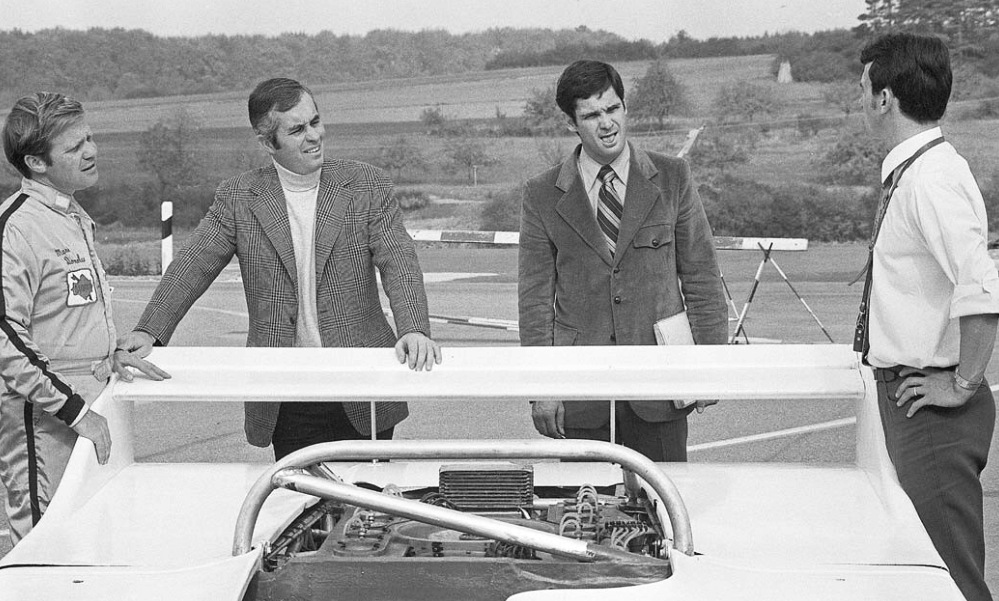
Donohue, Penske, Don Cox and Helmut Flegl at Weissach with the normally aspirated test 917/10 at Weissach on that first trip to Germany as related in the text. Note the ‘sissy’ rear wing compared to the big, butch muvva developed by Donohue and the Penske lads in the ‘States pictured elsewhere (Porsche)
An amusing anecdote of that first trip to Germany was Donohue being asked to do some laps in the test carwhich had about 1500 miles under its belt in the hands of Willy Kauhsen under Flegl’s supervision. Donohue had endured a couple of long boozy nights with his new colleagues and a big lunch but he figured the request for some action shots, in a car he had never sat in before, would be ok.
He did some laps ‘It was ‘hunting’ back and forth on the straight as though it had an inch of toe-out. I had to jamb my legs against the steering wheel to keep it in a straight line at 150mph. And I couldn’t shift it well because the gears were in odd locations and there weren’t any definite gates’.
When Donohue stopped Flegl told him he had done a time of 53 seconds against the lap record of 51.5…he was expected to better it!
Donohue played for time, asking for the pedals to be adjusted and went out again, improving a smidge. He stopped and Flegl asked him ‘What do you think of it now?’. Donohue asked the German (remember that Mark was a degree qualified engineer) about toe, camber, steering geometry, spring rates and wing angles- everything. ‘It was basically an understeering car, but it was oversteering in the high speed bends. And it had instability in the straights…I said I think it will be better if we stiffen the rear anti-roll bar, increase the wing angle and reduce the toe-in at the front. Flegl became very angry. He said ‘You tell the mechanics what to do, but you don’t tell me what the car does! What is my job? Obviously, you don’t need me’. I had made a political mistake already. His bosses were standing around watching while I appeared to be doing his job. They were all used to the concept of separating the driver, the engineer, and the mechanics. They weren’t prepared for a driver to have some engineering knowledge’.
Donohue then jumped into the car and got below the record; all were pleased except Flegl and Kauhsen who had put 1500 miles on it only to have Donohue go quicker having not sat in the car before, hung over, all in the space of about three hours! ‘Flegl figured I had gotten him fired. But because Cox and I had already done a good job (in the days earlier) convincing him of our combined forces approach, we were able to keep the relationship from falling apart’, said Mark.
Donohue intended to devote three days to chassis testing but stayed in Germany for three weeks!, working with Flegl on every variable, using the test track and two skid pads- one with a 100, and one with a 400 foot radius.
They started with the suspension and then worked on aerodynamics. The Germans were not convinced about Donohue’s tried and true technique of test pad before heading to the test track but Flegl stuck up for them ‘The two of us could discuss the situation in engineering terms and reach a stronger conclusion than either of us working alone. It was much easier on me as I could concentrate more on my driving. Flegl constantly kept elaborate records of precisely everything we did, and how it affected the car’.
Where did I drop the bloody thing?! Mechanic at work on the #59 Brumos ‘customer’ 917/10, 4.5 litre, during the Watkins Glen Can Am 23 July 1972 (Rainer Schlegelmilch)
‘We tested springs, bars, shocks, ride heights, wings and all possible variations in suspension alignment…It became obvious that all of their suspension geometry was wrong. I could tell by looking that the front was wrong, because it had such a short swing-arm radius. That’s why it was hunting so badly on the straightaway’.
‘At the rear the problem was apparent in tyre wear. The inside two inches of the tyre would wear out immediately…they agreed it was obviously wrong…As we got to the end of our tests, we started looking at the engineering drawings, and computer curves of the geometry. It became apparent that the rear roll centre was too low…When the original chassis was built (in 1969) they hadn’t anticipated all the aerodynamic downforce that could be generated. Now, in a turn, cornering forces were causing the rear suspension to fall, causing too much camber change and wearing the tyres out wrong. I couldn’t convince them of the seriousness of the problem (noting the 917 had just won its second Le Mans!), but i knew that once we had the car at our own shops (in the US) we could modify the geometry ourselves. We could run an A-B test, and let them know how it turned out. I also tried to convince them we needed a locked differential (a Donohue fetish used successfully on most of his cars!), and they fought that too. I figured the sooner we got the car to America, the better’.
‘We never went back to their test track until the last day I was there. After all that work the car was half a second faster. I was tremendously disappointed. I expected it to be two seconds better. It was a great victory for Flegl though. He stuck to our way of doing things, and he showed everyone that it was better. Without making any design changes to the vehicle, we had produced a new lap record…’
Follmer’s 917/10 at Watkins Glen on 23 July 1972. Note the beautifully triangulated aluminium spaceframe, steering rack above the drivers knees, big ventilated discs, beefy left foot brace and battery location on the cars floor. Decent view of the rear wing detail too at left (Schlegelmilch)
The cars chassis had to be slightly redesigned to accommodate the turbo installation and the wheelbase increased by 5/8 inch to allow the more rearward position of the driveshafts.
Very stiff titanium springs and roll bars were fitted with lateral accelerations of greater than 1.6g measured on the Weissach steering test pad.
917/10’s sold to private owners had aluminium frames, the weight only increased marginally to 60Kg with additional reinforcements made necessary by the engines colossal output. Amazing really. The magnesium development frame had done more than 3500Km practising and racing at Le Mans, a magnesium framed car was one of the two supplied to Penske for the ’72 season.
Paul Frere records that the magnesium frames were so difficult to weld that only two specialists at the factory could ‘fizz’ the things together. The mag frame saved 32lbs over the ‘ally ones, total weight of it circa 100lbs with all attachment brackets.
Engine Development…
The pioneering work on turbo-charged racing engines was done in the ‘States in the mid-sixties to keep the venerable Offenhauser 4 cylinder engine competitive against the new, sophisticated DOHC Ford ‘Indy’ V8.
Stu Hilborn, the fuel injection expert, engineer Herb Porter and Bob DeBisschop of Garrett AirResearch, a manufacturer of turbo’s for Diesel engines most notably contributed.
With a standard Garrett TE06 diesel turbo unit running up to 100,000rpm, and capable of delivering 1.7 bar of pressure- the Offy gave 625bhp at 1.2 bar of pressure, any more than that and the modified 168cid blocks were in mortal danger. This was 150bhp more then the fuel injected 255cid Offy it replaced.
With development this grew to 800bhp by 1971, as power grew throttle response diminished and this of course was the big engineering challenge Porsche had to meet. It was one thing racing open-wheelers in top gear on long corners of constant radius, another thing entirely in road racing where instant throttle response was everything.
Further inspiration for Porsche came from BMW who won the European Touring Car Championship in 1968. Swiss engineer, Michael May, the same guy who pioneered wings on racing cars, developed a blown version of BMW’s 2 litre engine which gave 270bhp on 1.1 bar of boost. Despite detonation dramas the car won 4 races before turbo’s were banned in touring car racing.
At this point, 1970, Porsche started playing with a turbo-charged 2 litre 910 engine, then switched to a 4.5 litre 917 engine using Eberspacher turbos.
Fundamental reserves of Porsche engines are something easily understood once yerv had a chance to own one- I have in mind my over 225000Km ’85 Carrera 3.2, a 15 year old car when I bought it, and a daily driver for 7 years. The engineering of the things is superb and so it was for the 917 engine which was not significantly altered despite the 950bhp developed by the 5 litre turbo compared with the 580bhp claimed for the 4.5 litre normally aspirated motors, around which the original design work was done.
The compression ratio was lowered from 10.5:1 to 6.5:1 by changing the pistons. Inlet valve lift and valve overlap were reduced by substituting an exhaust camshaft for the inlet one and then making an inlet manifold to feed the exhaust gases to the turbine and another to take the compressed air to the intakes via a pressure balancing plenum chamber over each bank. Valentine Schaffer was in charge of engine development.
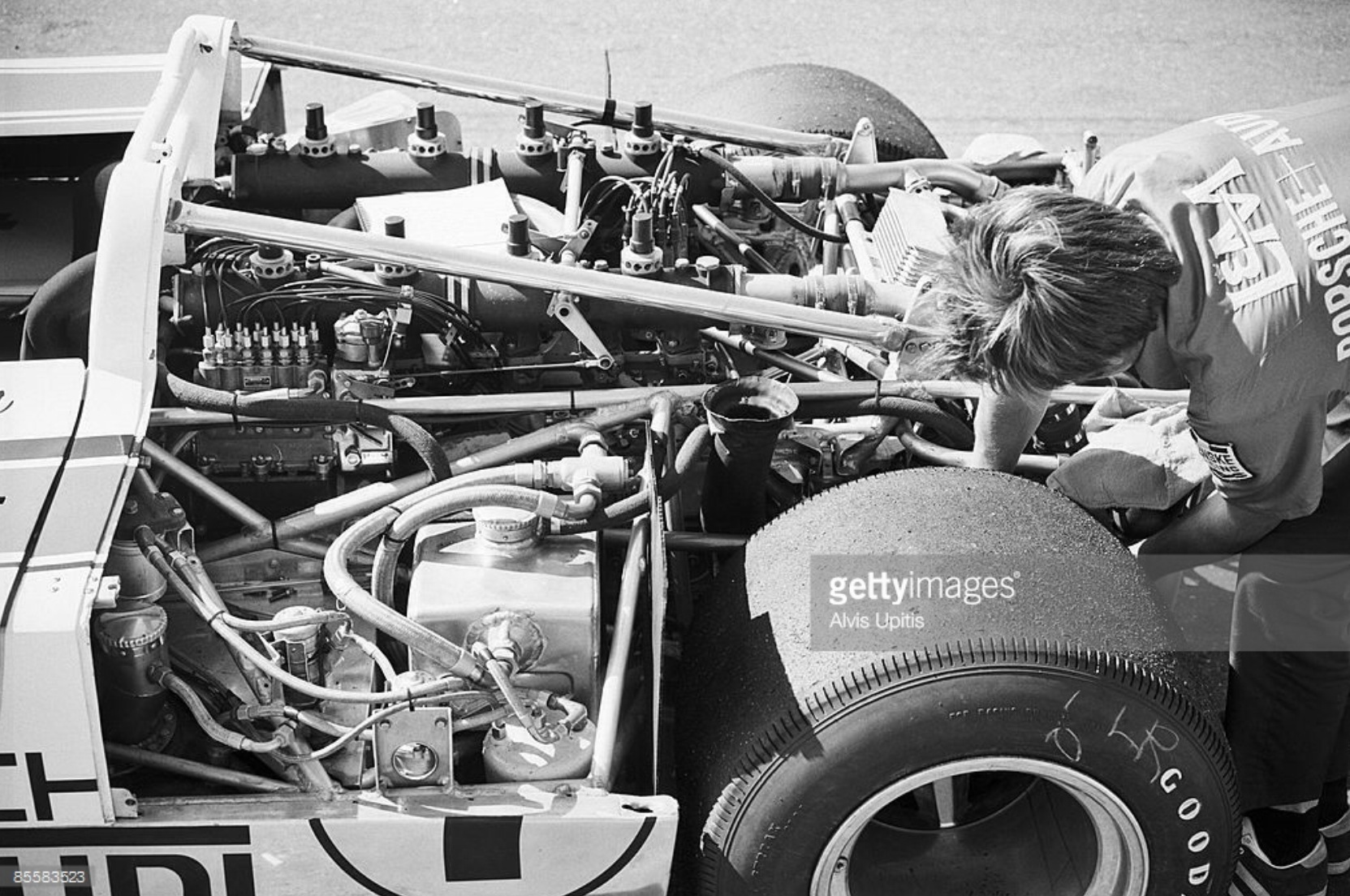
There is a lot going on, have you ever seen so much complexity, not exactly an owner-drivers car! Note the spaceframe chassis, dry sump and oil system foreground centre, to its left fuel pumps above one tank, to the dry sumps right a duct for the rear brakes. See the distributor and throttle linkage centre, Bosch injection pump to its left and blow off valves on top of the inlet manifold. Donnybrooke, Minnesota 17 September 1972 (Upitis)
When Hans Mezger’s team did initial drawings for the 917 Turbo engine amongst key design tenets was the decision to use two turbo’s, one per bank of cylinders for the simple reason that two small turbo’s would ‘spool up’ quicker than a big single one offering better throttle response.
The chosen Eberspacher Turbo’s were adapted from industrial diesel units. They ran up to 90,000 rpm on ball bearings and delivered 0.55 of charge per second at a temperature of 150 degrees centigrade, the exhaust temperature went as high as 850 degrees. To withstand such heat the housing was aluminium but the turbine was made of steel.
The induction system was simple- log type manifolds were used for each bank of six cylinders with each turbo feeding one of the simple plenum chambers driven by the exhaust system. The two induction systems shared a common wastegate with a crossover pipe to equalise pressure on each side.
A Garrett wastegate was used and operated as it did in Indy racing. It had a diaphragm valve controlled by an adjustable-tension set spring which allowed the valve to open once the boost pressure was high enough to overcome the set tension. The idea was not to obtain maximum boost, but to obtain steady boost over a workable power band.
Early development problems included exhaust valves seizing in the guides, the heads were unmodified with the reduction in compression ratio and inlet cam profiles noted earlier. By mid 1971 Schaffer had improved durability such that a 4.5 litre engine survived an 8 hour full power run ‘something which reportedly could not be said for the dyno to which it was bolted’!!
The real dramas though were on the test track though where the drivability, read engine response was impossible, and even then after difficulties in just getting the engines to fire, to start. Part of the problem was an engine test cell fire which cost 3 months development time in mid 1971.
The first test ‘victim’ was Willy Kauhsen who tested chassis 917/10-001 at Weissach early in the summer of 1971, Ian Bamsey reports a ‘traumatic experience for the Porsche test driver…at first it took an hour or two to start! And when it eventually stated it went slowly , then suddenly exploded, there was nothing in the middle of the power band. And there was long, long turbo lag – ‘unacceptable’ he quotes Helmut Flegl as saying.
By the end of the year Kauhsen had his time on the Weissach test track to 49.1 seconds, two tenths quicker than Donohue in the same chassis but with a normally aspirated engine. Jo Siffert had the same difficulties driving the car at Weissach and Hockenheim.
The cooling fan size was retained although the speed was increased to 1.2 times engine speed. By now the engine timing had been fixed at 22 degrees B.T.D.C. To stop the engine running on, the injectors had been positioned lower down and close to new butterfly throttles- fuel had been spilling even after the pump supply had been cut. The fuel injection system was the usual Bosch unit used on the 917 throughout and required lots of tweaking during early 1972 to get the engine race ready.
Back in the USA…
Penske were delivered a car which was identical to the chassis Flegl and Donouhue had optimised at Weissach.
Initial modifications centred around bigger and better rear wings. ‘We built two new wings, one the same shape as Porsche’s, only twice as big and one with a modern split flap design. I figured if the drag was too much with them, we could always level them out for the same downforce.’
Whilst waiting for a replacement engine, the team blew one having run it with insufficient oil ‘…Woody prepared an alternate front suspension, which incorporated the long swing-arm…It wasn’t exactly what I wanted, but it was the best we could do within the structural limits of what we had. The rear roll centre was still too low…We could look to the rear after we got the front suspension working right’. At Atlanta the car was immediately one second a lap quicker with the new front suspension, Donouhe telexed Flegl, the changes were made to the chassis at Weissach, taking the approach even further and producing exactly what Donohue wanted.
Back again at Road Atlanta, with the changed suspension geometry, altered springs and bars and with the split-flap rear wing the car was five-tenths under the circuit record. At that stage Donohue writes he was not convinced the team needed the turbo engine, with Penske assuring him the twists of Atlanta were different to the demands of a power circuit like Riverside. A test at Riverside proved they had enough downforce at the rear, the difficulty was trimming it at the front, where the various profiles tried never achieved the downforce needed.
Donohue’s first introduction to turbo road racing was at Road Atlanta in late January 1972, the latest iteration of the engine was installed in the Penske team’s test spyder, 9117/10-003. Mark found the task impossible, after towing the car to start it, he had the same driving experience as Kauhsen and the late Jo.
‘Once it started we couldn’t keep it running…I tried to drive it for a few laps and discovered that the throttle worked like an ignition switch-it was either wide open power, or off…After a banzai effort I got down to about the same lap time as the non-turbo engine with about 300 more horsepower…Towards the end of the test the blower failed, scattering parts into a cylinder and ruining the engine. We sent it back to Germany with a long dissertation on the problem and possible solutions they could try’.
After another test in March, again at Road Am, and this time with the press present after which Mark returned to Weissach with the Porsche engineers. ‘I decided it was foolish to spend any more time in the states…I told Flegl I’d go to Germany to work with their engine men personally’. With Penske watching he struggled to to do a lap of 49.7 seconds at Weissach. At that stage both men thought the early Can Am rounds should be missed until the engine was driveable.
Follmer’s 917/10 from the rear showing the huge, carefully developed rear wing, Watkins Glen 1972 (Upitis)
Back to the dyno the turbo went, this time with its injection pump fitted with an additional control element dependent upon boost pressure. Flegl ‘…with a normally aspirated car the injection system had responded to revs and throttle position…now we had a third parameter we had to learn to work with. Right from the first moment the setting of the pump for high boost, intermediate boost, low boost had been incorrect. We had to run different settings on the dyno, then all the knowledge had to be put into the injection pump. It took two or three months to produce a completely new system, with the pump about right’.
Donohue then easily took ‘001’ around the test track in the record time of 48.9 seconds, other than the addition of extra valving the engine was ready to race; one more butterfly valve on each manifold, linked to the throttle and designed to bleed air out when the throttle was closed and four suction operated valves were located on top of each manifold log to ensue there wasn’t a vacuum in the system while the turbos were spooling up.
The decision was taken to use 5 litre engines (4.5’s for Interserie) in the Can Am, the three engines provided to Penske in 1972 had power ranges of between 894-918 BHP dependent upon boost of between 1.3-1.4 bar. Maximum boost chipped in between 5000-5500rpm. The turbo-4.5 litre variant customer engines gave 850bhp.
Whilst the engine was butch enough to cope with the additional loads imposed upon it the transaxle was not…
Torque produced by the engines was in excess of 700lb/foot so a completely new gearbox was designed and built, 4 speeds being determined as sufficient given the big, fat band of torque. Lubricant was circulated within and pumped through a radiator located above the ‘box. Titanium half shafts were reinforced and splined joints deleted in favour of massive rubber ‘donuts’. Stub axles, uprights and brake disc bells were all titanium as they were for earlier 917’s.
Porsche also developed their own heavily ribbed aluminium brake calipers for the car.
Race Record 1972 and 1973…
Follmer at Watkins Glen 1972 (Getty)
The rout of the Can Am by the Penske and customer Porsche 917/10 and ’73 917/30 is well known, this article is more about the engineering of the cars, but the race summary goes something like this.
Donohue popped the car on pole at the 1972 Mosport first round but Denny Hulme took the win for the McLaren M20 Chev.
In the Road Atlanta round Mark had a huge accident destroying the magnesium chassis when a rear bodywork locating pin was not secured properly, the departing body and loss of downforce caused the prang from which he was lucky to escape- but Mark did not return until the Edmonton round. George Follmer stepped in, no pressure!, and won from Q2.
At Watkins Glen he was 3rd behind Denny and Revvie- The Empire Strikes Back!
But that was it, George then dialled in to the car and won at Mid Ohio and Road America before Tyrrell F1 driver Francois Cevert, proving his versatility, won in an ex-works M8F Chev at Donnybrooke with George 4th.
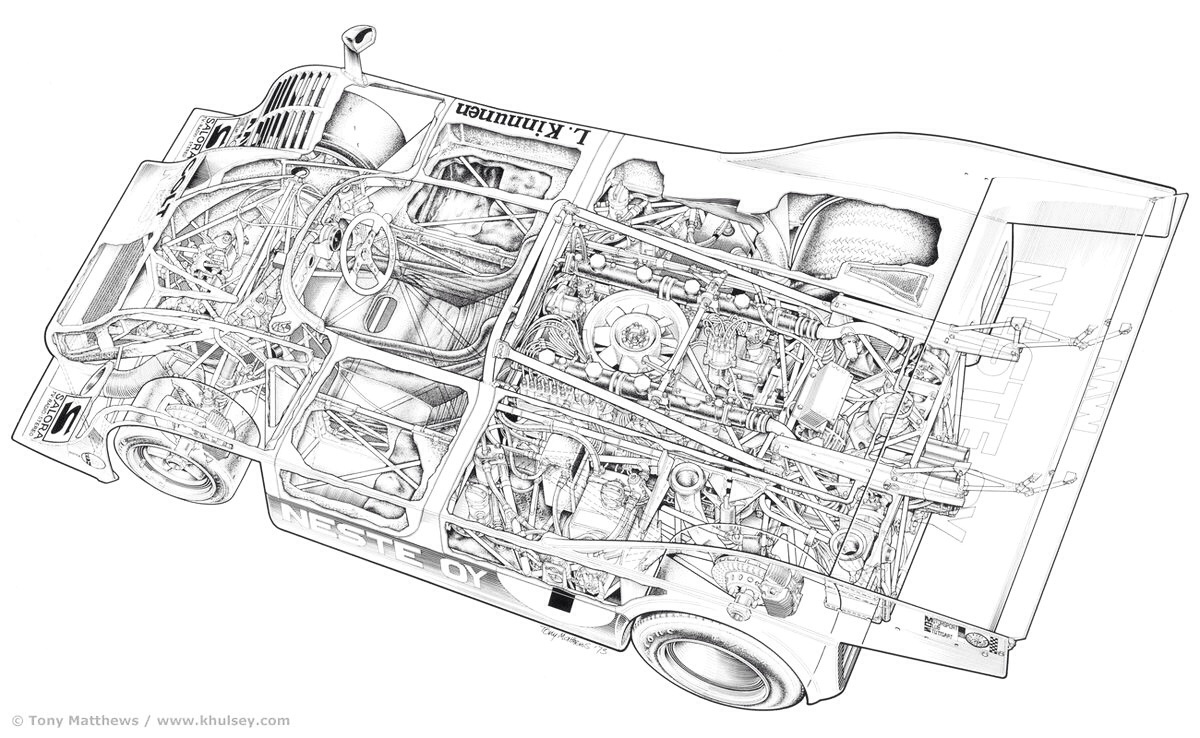
Porsche 917/10 cutaway drawing (Tony Matthews)
Donohue won at Edmonton proving he had not lost his mojo upon his return to racing with George winning in California at both Laguna Seca and Riverside and the drivers title, the manufacturers of course going to Porsche.
Hulme halved George’s points haul, the Kiwi on 65 with Milt Minter in a normally aspirated 917/10 3rd and Mark 4th despite missing 60% of the rounds.
In 1973 it took a couple of rounds to get the evolved 917/30 right with Charlie Kemp and George winning in customer 917/10’s at Mosport and Road Atlanta. From then on though Donohue took the lot, winning six rounds from pole, the drivers title and again the manufacturers championship for Zuffenhausen.
McLaren withdrew from the series at the end of ’72, Porsche in ’73- the Can Am, mortally wounded by rule changes which drove away Chaparral at the end of 1970, and now with the departure of McLaren and Porsche limped on but as a shadow, very sadly, of his former self. Shadows of 1974/5 duly noted. Nothing is forever of course, but what a show the Can Am was whilst it lasted…
Bibliography…
‘The Porsche 917’ by Paul Frere in ‘Cars In Profile’, ‘Porsche 917: The Ultimate Weapon’ Ian Bamsey, ‘Mark Donohue: The Unfair Advantage’ Paul Van Vandenburgh with Mark Donohue
Donohue ‘Our program with Porsche began at Le Mans in 1971, while we were there with the Ferrari (512M)…Mrs Piech and her sons Michael and Ferdinand asked to see Roger Penske for lunch…At that meeting the Piechs expressed a desire to go racing in the Can Am…Roger followed it up by flying to Grrmany four or five times and eventually they began to hammer out a contract…because of the dollars involved we couldn’t work from a handshake’.
Porsche’s commercial arrangements with Penske were similar to those with John Wyer. The actual preparation and racing of the cars was Penske’s responsibility, with 5 litre engines were delivered straight from the Porsche Experimental and Racing Department and tended at race meetings by factory engineers. Engine development work was done by the Porsche based upon feedback from the drivers and team as well as the engineers in the field.
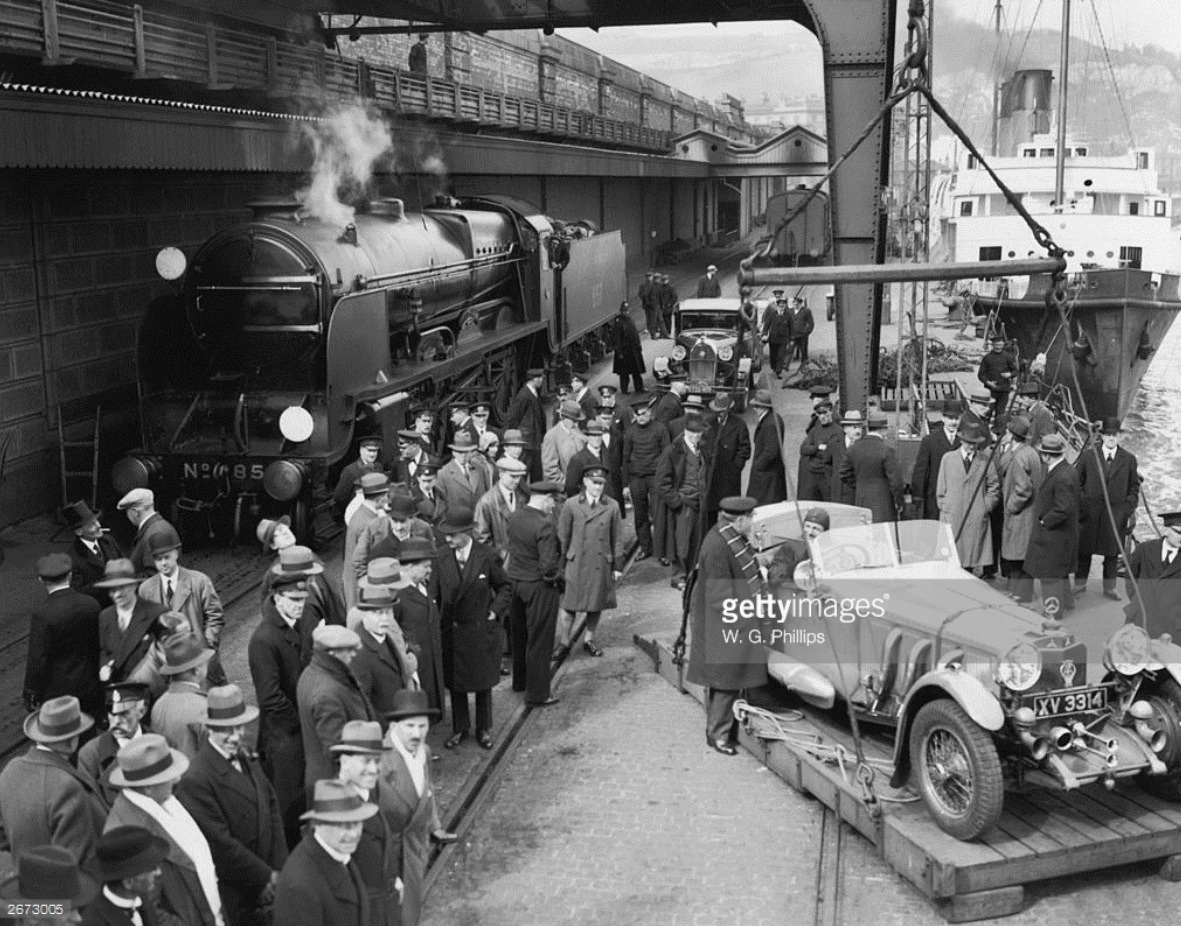
Lord Howe in the process of loading his Mercedes 38/250 SS onto ‘Southern Railways’ cross-channel steamer ‘Autocarrier’ cross channel ferry on 30 March 1931…
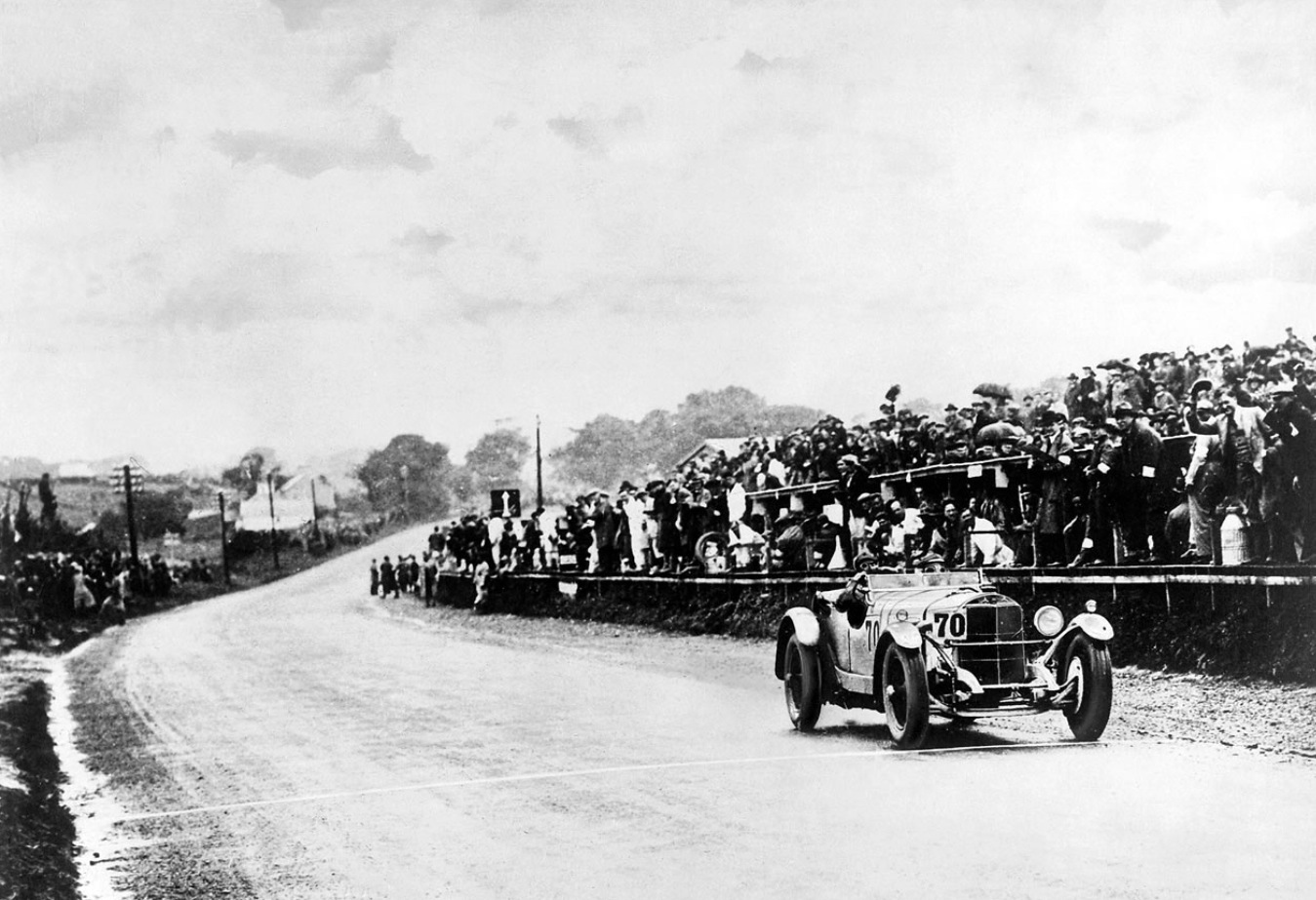
AF Rivers-Fletcher in a letter to MotorSport in February 1976 relates his experiences with this car which Howe acquired after Rudy Caracciola’s victory in the 1929 TT at Ards, Northern Ireland. The great German won the 30 lap race with a 5 lap handicap in a rain storm.
Fletcher wrote the letter in response to Bill Boddy’s article some months before comparing the Bentleys and Mercedes in the 1920’s and 1930’s. Fletcher ‘having been at different times, closely involved with both camps, Bentleys and Campbell/Howe Mercedes, found his allegiance torn’. His impressions and recollections make very interesting reading.
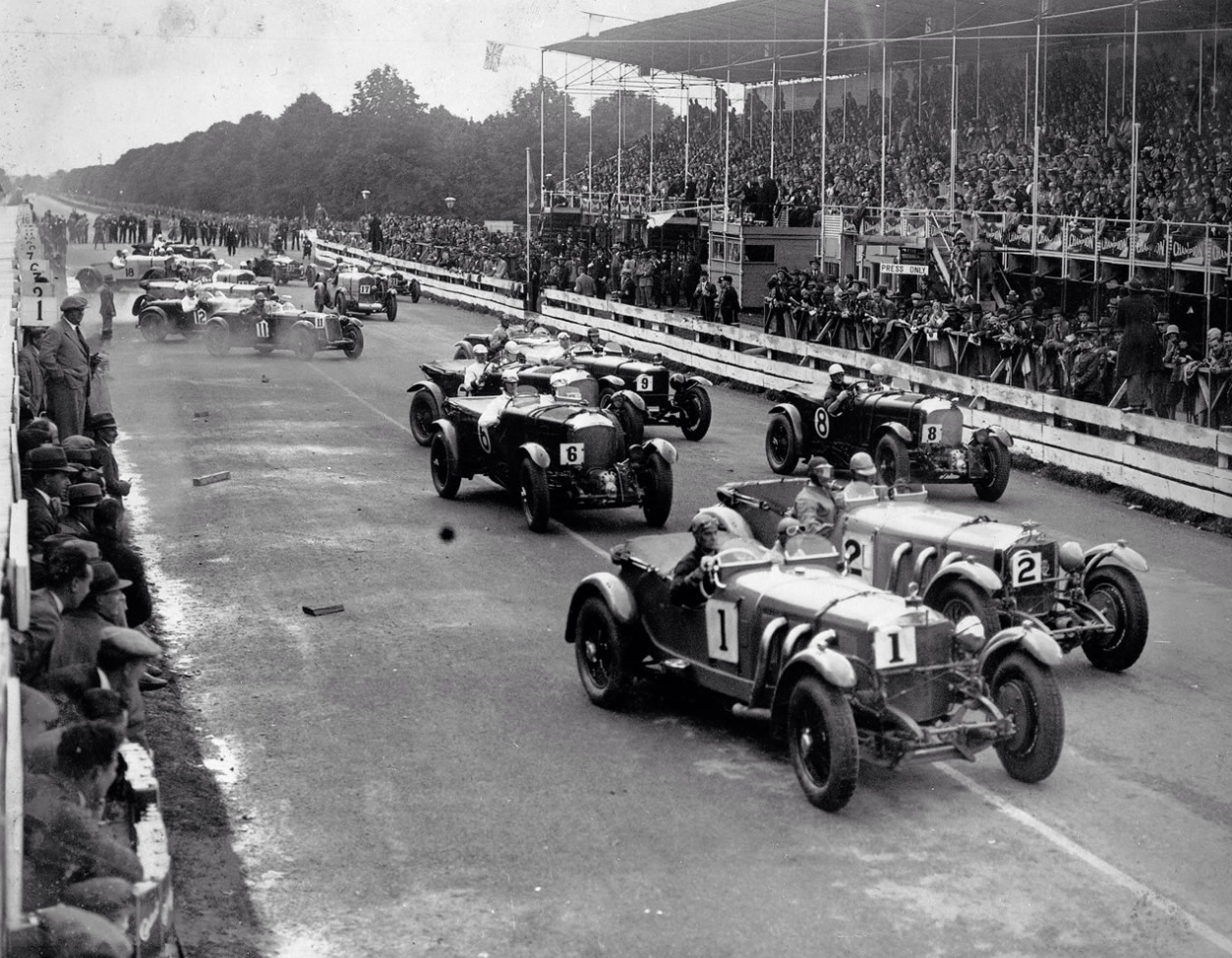
1930 Irish GP/Eireann Cup start, 19 July 1930 #1 Campbell Merc SSK from #2 Howe Merc SSK, #6 Jean Chassagne Bentley Blower, #8 Birkin Bentley Blower, #9 ?, #10 Giulio Ramponi O.M. and the rest (Mercedes Benz)
‘I first drove some of the cars-Le Mans 6 1/2 litre Bentleys and Earl Howe Mercedes more than 40 years ago..’and in more recent times. ‘Even more revealing was being driven by Barnato, Birkin, Campbell and Howe in the very cars at the time of their racing success. Regretfully, however i never rode as a mechanic in the Mercedes or Bentleys…watching as an apprentice with pangs of enyy during practice for the Brooklands Double Twelve as Wally (Hassan) jumped down into Barnato’s Speed Six Bentley to ride with him as a mechanic’.
Fletcher; ‘After Caracciola’s epic victory with the 38/250 Mercedes SS in the 1929 TT, Lord Howe bought the car and raced it for several seasons. I drove it several times, once on quite a long run with Leslie Callingham of Shell…it must be remembered that Malcolm Campbell and Lord Howe ran their Mercedes in sprints and hillclimbs as well (as long distance races). They were very successful in spite of the brakes, the ‘achilles’ heel of the racing Mercedes.’.
‘…i always thought one of the best performances of Lord Howe’s Mercedes was its run in the 1933 Mille Miglia. Driven by Penn-Hughes and Percy Thomas (Lord Howe’s excellent mechanic) the Mercedes was in fact acting as the tender car to the ‘old mans’ successful MG Magnette team. It was loaded with MG spare parts under the tonneau’.
1930 Irish GP/ Eireann Cup: Rudy Caracciola Merc SSK from the Howe SSK (Mercedes Benz)
Fletcher then compared the Benz with the Bentleys of the day;‘The Bentleys particularly the 6 1/2, felt a good deal bigger than the Mercedes, perhaps because you sat so much higher in the Bentleys. Comparing the cars is very difficult because they felt so entirely different. Despite the record i still feel the Mercedes was pre-eminently a sprint machine with ‘bottom-end’ performance. The very light steering, terrific getaway aided by the unique blower installation and the compact feel of the car all made the Mercedes an ideal car for tight circuits and the hills-despite those brakes’.
‘The Bentley was a long distance car with ‘top-end’ performance. With its heavier steering it felt incredible sure footed. It needed more thought in deciding on a line through a corner, but was, i believe, quicker on the faster swerves than a Mercedes. The getaway from rest and from tight corners was slower than the Mercedes, but it made up for this by having tremendous torque in the middle and upper ranges. The ‘big 6 Bentley’ really accelerated between 70-100 where the Mercedes lagged a bit unless the supercharger was used all the time, which was seldom a proposition for long periods. The Bentley brakes were always excellent, with SO little fade, despite the considerable weight’.
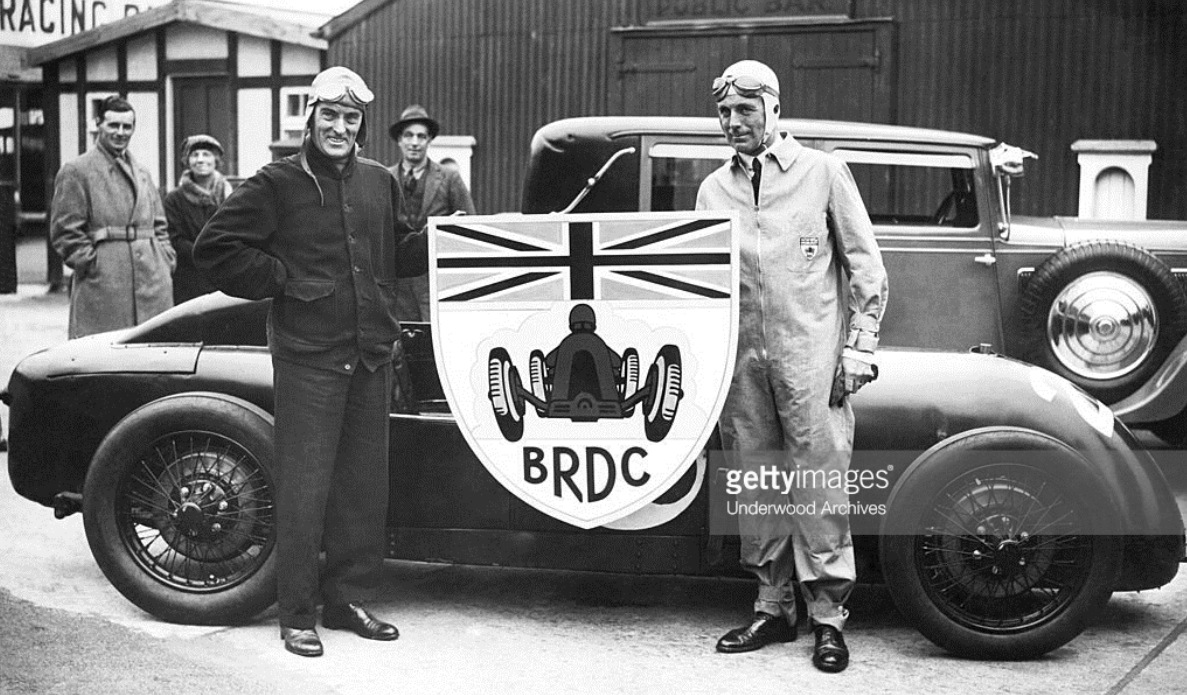
Malcolm Campbell and Earl Howe at Brooklands upon the unveiling of the new BRDC, and still thankfully current! logo, 9 September 1931. What are the cars tho? (Underwood)
Fletcher, in a fascinating letter, his impressions of driving the cars ‘in period’ of vastly greater relevance than any modern ‘comparative tests’ concluded the correspondence with a comment ‘As to the drivers-Campbell, Howe, Barnato and Birkin(one could write of any of the Bentley team, but Birkin and Barnato come to mind as they were most involved with ‘Mercedes baiting’)- it would need to be a complete article, or even a book, to compare them. All were thrilling to ride with, Barnato seemed the safest and Lord Howe the most frightening. Suffice it to say that in many ways Campbell, Howe and Barnato were rather like their cars and Birkin was more like a Mercedes! Don’t you think?’
1930 Irish Grand Prix…
The Irish Grand Prix format from 1929-1932 comprised two handicap, 300 mile races each year with a formula determining the overall winner of the GP. The ‘Saorstat Cup’ was run for cars under 1500cc on the Friday of race weekend and the ‘Eireann Cup’ for the over 1500cc ‘heavy metal’ on the Saturday. Phoenix Park, the venue is just west of Dublin’s City Centre, the circuit was first used for racing in 1903 and was 6.8 Km long at the time. The 1930 races were won by Victor Gillow’s Riley 9 Brooklands with Rudy Caracciola’s Benz SSK taking out the over 1500cc event and awarded the GP itself.
Of interest to Australian enthusiasts is Adelaide born, but British domiciled Arthur Waite’s 3rd place in the ‘Saorstat Cup’ aboard his Austin, Captain Waite was the winner of the second Australian Grand Prix at Phillip Island in 1928. Caracciola’s margin was 8 minutes from Giuseppe Campari’s works Alfa 6C 1750 GS with Howe 3 minutes further back in his SSK- then Birkin’s Bentley Blower circa 35 seconds adrift of the SSK.
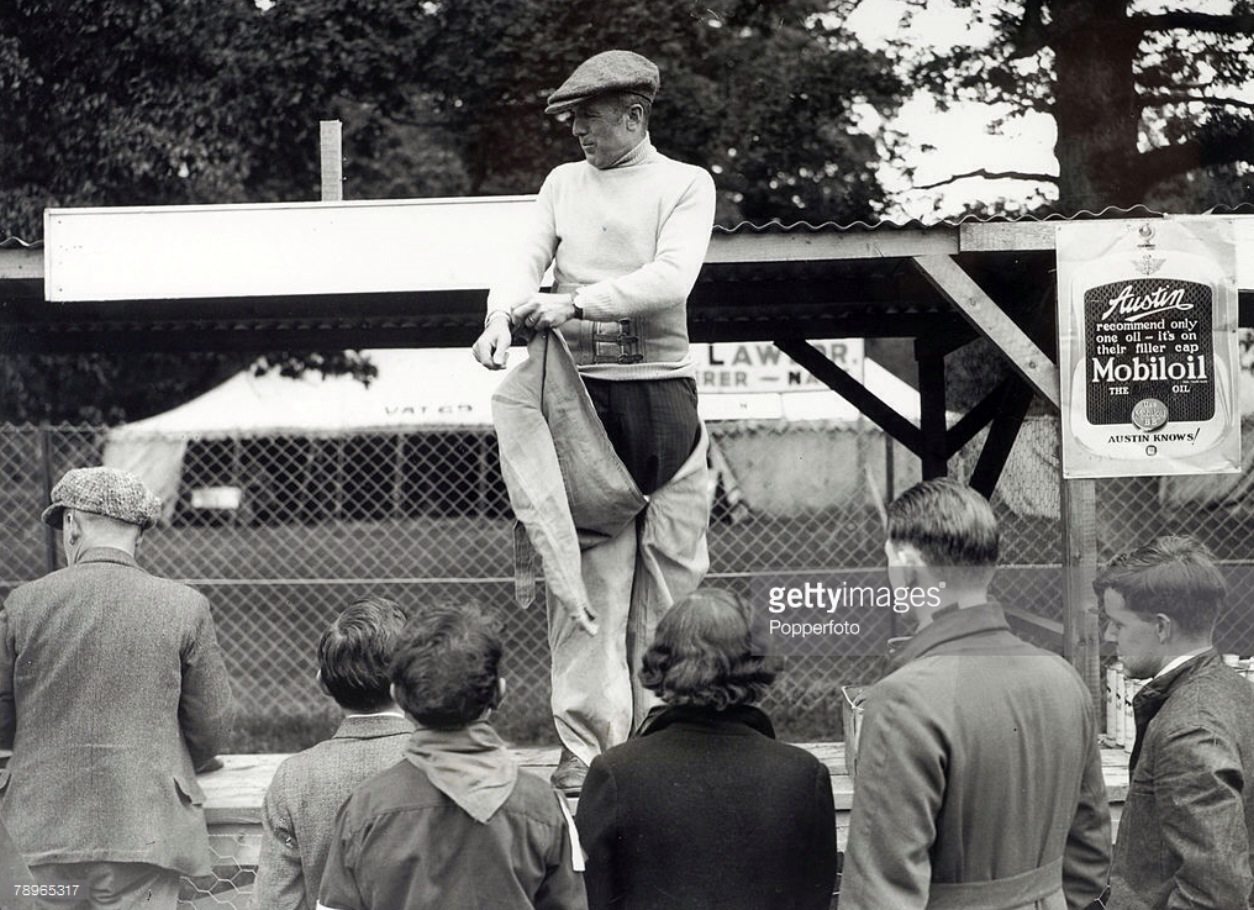
Lord Howe togs up for the 1931 Irish GP/ Eireann Cup in which he was 5th and set fastest lap in his Mercedes Benz SS.The winner was Sir Henry Birkin’s Alfa Romeo 8C2300. An amusing sidebar is this snippet from the Adelaide Advertiser’s report of the race in its 9 June 1931 edition ‘…Birkin’s car, made in Italy, was turned out for the race only by the intervention of Mussolini, who said that, as an Englishman had honoured Italy by ordering an Italian car for an English race, the Alfa Romeo company should provide a double-shift to complete the job. These shifts were necessary because this company is making also the engines for the Italian Schneider Cup planes’, the report concludes. Alfa went to great lengths to get the car to the race in time, factory race mechanic Alessandro Gaboardi accompanying Clive Gallop, a member of Birkin’s team in driving Vittorio Jano’s brilliant 8C2300 from Portello to Phoenix Park and then sat alongside Birkin during the race.
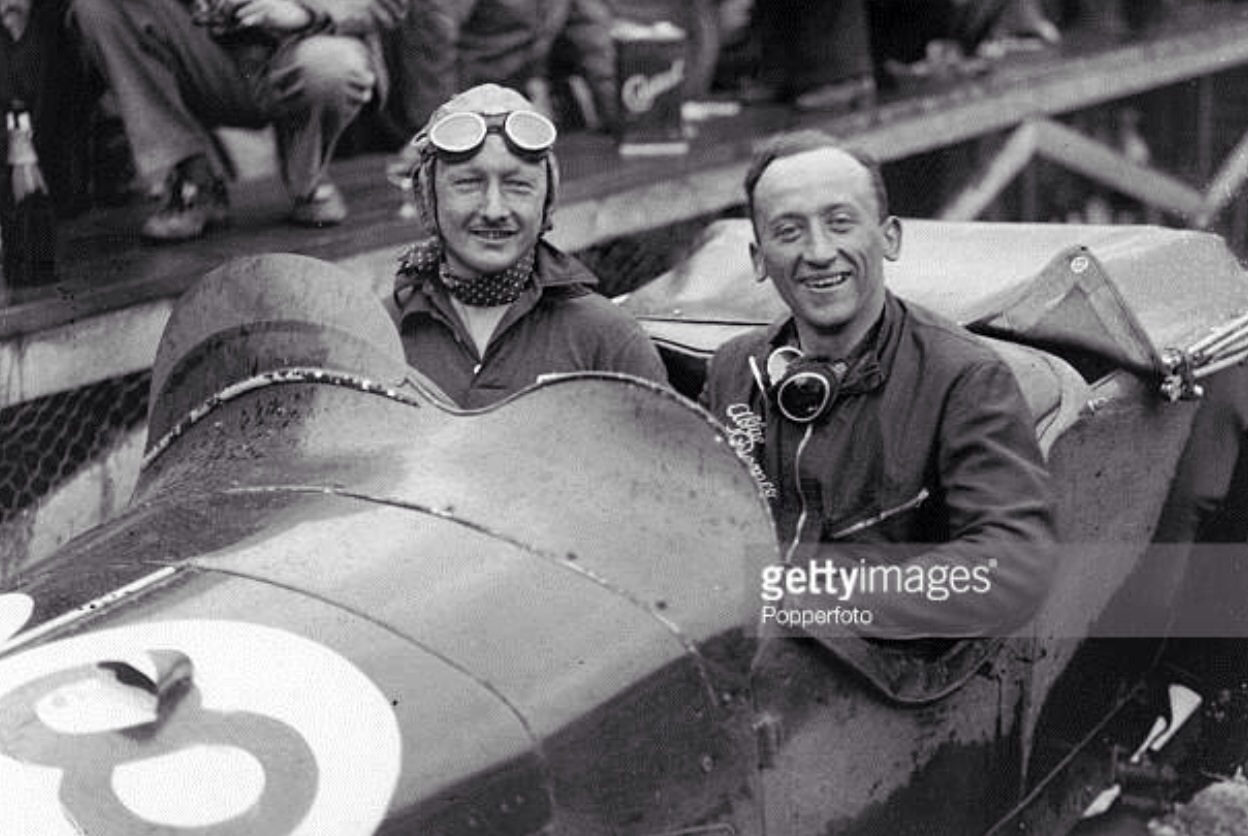
Birkin, Gaboardi and Alfa 8C2300 after their 1931 Eireann Cup win, Phoenix Park, Dublin (Popperfoto)
Mercedes S, SS, SSKL 1926-33…
Click here for a link to the factory site and a summary of these magnificent cars;
WG Phillips, Rivers Fletcher letter to MotorSport February 1976, Mercedes Benz
Tailpiece: ‘Carach’ on the way to winning the 836.9 Km 1929 RAC TT at Ards in the works Mercedes Benz SS, on 17 August…
(Mercedes Benz)
The RAC International Tourist Trophy, a race for ‘production sports cars’ was held from 1928 to 1936 on a 13.67 mile road course on the outskirts of Belfast at Ards, eight spectator fatalities after a car crashed into the crowd in 1936 caused the events demise.
‘yer don’t tend to think of Rodriguez as a Can-Am driver but he contested many races over the years without ever doing a full season’s program. A pity, as his fearless, blinding speed aboard big hairy V8’s would have been worth travelling a mile or three to see…
Here Pedro is with the 7.4 litre BRM P154 Chev during the Monterey Grand Prix weekend at Laguna Seca on 18 October 1970.
BRM built the P154 Chev to contest the 1970 Can-Am with George Eaton as its driver, the car was one of two brand new cars by Bourne’s just joined designer, Tony Southgate.
The immensely talented BRM Chief Engineer, team manager and designer Tony Rudd fettling his nemesis, the complicated, heavy and recalcitrant! BRM P83 ‘H16’, Monza, Italian GP practice in 1966 (GP Library)
BRM had two terrible years by their lofty standards in 1968 and into 1969.The BRM H16 engine was finally made reliable-ish in 1967 but it’s corpulence, it was well over 300 pounds in excess of it’s designed weight made the cars power to weight ratio poor whatever the chassis designers did to take weight out of the rest of the bolide.
The replacement P101 2 valve 3 litre V12, first raced by Bruce McLaren in his McLaren M5B at the Canadian GP in late 1967 was concepted as a sports car engine. Whilst light it wasn’t a match for the Ford Cosworth DFV’s power, torque, fuel efficiency or reliability, the same problems being confronted by Ferrari and Matra with their own V12’s. Into 1968 the DFV was being raced in numbers; by Lotus, McLaren, and Ken Tyrrell’s Matra International team.
As the Bourne engineers focussed on engines they lost their way with chassis direction, a strength prior to this. As a consequence Tony Rudd, who had masterminded BRM’s rise and consistency for over a decade left in mid-1969 to join Colin Chapman at Lotus.
British GP practice, Silverstone 1969 with Surtees telling the boss just how shite things really are! Sir Alfred Owen, the immensely successful industrialist listens carefully and acts, with ‘generational change’ at Bourne. Allan Challis is the BRM mech in orange (Rainer Schlegelmilch)
’69 BRM driver, John Surtees was having a shocker of a season on both sides of the Atlantic,Jim Hall’s conceptually brilliant but flawed Chaparral 2H CanAm car was an even bigger ‘sheissen-box’ than his BRM F1 P139 BRM. Time was ticking in terms of his own driving career, he was 35 and had managed to land in the wrong team at the wrong time, twice in the same year when time was very much a precious commodity!
Surtees in the BRM P138 in Monaco 1969 practice. The cars all raced raced sans wings due to a CSI overnight safety decree severely limiting them. Surtees Q6 and DNF after Jack Brabham ran up his clacker when his gearbox failed, no injury to either driver (Rainer Schlegelmilch)
With BRM owner Sir Alfred Owen’s consent Surtees approached Tony Southgate, with whom he had worked at Lola on the T70 Can Am and T100 F2 cars and more recently designed competitive cars for Dan Gurneys ‘All American Racers’ in Santa Anna, California.
Southgate’s Eagle 210 Offy won the 500 in Bobby Unsers hands in 1968, he also designed a successful Formula A car and a stillborn ’68 F1 car design, elements of which were picked up in the Indy and ‘A Car’.
George Eaton at Monaco in 1970 in Tony Southgate’s brand new, BRG BRM P153 V12. Compare the ‘old and new’ P138 Monaco ’69 with P153 Monaco ’70 (The GP Library)
Southgate’s brief when he joined BRM was twofold; ‘do what you can now to get the P139 competitive and design a new car for 1970’…
The Brit quickly decided their was little he could do with the P139 so pressed on with the design of the P153, it and the evolved for ’71 P160 were front running, GP winning (4 wins) cars.
Whilst in the middle of the P153 design the chaotic BRM ‘decision making process’ determined that a Can Am challenger for 1970 was a good idea. It was a good earn after all. In a way it was a good decision as Southgate had Can Am experience at Lola and AAR but at the time focus on the ‘main F1 game’ would have been the more prudent course, but racers to the core the BRM outfit were!
Tony Southgate’s quarter-scale layout drawing of the BRM P154 (Tony Southgate)
Given the designation P154, the car was very much a wedge-shaped device, developed at quarter scale in the Imperial College wind tunnel, then in MIRA’s full-size tunnel when it was completed.
Southgate recalled testing the car at MIRA (Motor Industry Research Association test facility); ‘MIRA has a large test track, with high banked corners to enable high average speeds to be maintained…the one and only Jaguar XJ13 was there for a filming run…an hour or two later whilst in the wind tunnel we heard a load bang. The XJ13 crashed violently at 125mph when a rear wheel collapsed, it rolled four times, I’m glad to say Norman Dewis, Jag’s legendary test driver was only bruised’.
‘By comparison with the 1965 prototype Le Mans car, certainly pretty but what then seemed like old technology, basically it looked like an E Type with an engine in the middle, very round in section with low drag the clear priority. By comparison the P154 was very aggressive looking, wedge-shaped with square sections and downforce was written all over it.’
‘The P154 model in the Imperial College wind tunnel. There was no moving floor in those days so the wheels were fixed with a small 1mm gap between them and the floor. The model was covered in chalk and paraffin so that when it dried the chalk left a surface air flow pattern for studying.’ (Tony Southgate)
The P154 had a neat lightweight monocoque chassis, the front suspension was similar to the P153 with a single upper link, lower wishbones, coil spring/Koni shocks and an adjustable roll bar. But the rear suspension was quite different as Southgate sought to run the exhaust low down, locating the exhaust primaries below the rear suspension lower wishbones, the aim was to lower the CG. ‘The end result looked good’. The suspension itself was conventional, single upper link, lower wishbones, twin radius rods for forward and lateral location and coil spring/Koni shocks and adjustable roll bar.
‘The prototype BRM P154/01 being assembled at Bourne. I am showing (TS left) the Castrol USA representative (sponsor) around whilst Tim Parnell (team manager at right) looks on. The monocoque was quite neat and full-length, finishing at the gearbox. The engine is a Chevy developed by BRM, the gearbox a Hewland LG500.’ (Tony Southgate)
Designed for super wide 19inch wide Firestones which never appeared, the car always looked ‘over bodied’ with the 17’s the car raced with. This contributed to the handling dramas attributed to the beast.
The engine was built in-house at BRM and seemed competitive; Chev ZL1 aluminium blocked 7.4 litre, Lucas injected, magneto ignited, dry sump V8 developing circa 650 BHP. The gearbox was one of Mike Hewland’s LG500’s.
The car had little testing, ‘it was thrown together and sent to America for the mechanics to sort out on the hoof” Southgate quipped in a MotorSport interview. The poor unfortunates sent to the US with the car were Roger Bailey and Mike Underwood!
The car sorely needed testing as BRM’s first Can Am machine and the cars driver, Canadian George Eaton didn’t have the experience of big sports cars of both other 1970 BRM F1 drivers, Pedro Rodriguez and Jackie Oliver. ‘It was a low budget operation and the results reflected that. For me, it was a distraction at the time from the real thing-Formula One’ said Southgate.
‘The completed P154 outside the Bourne workshop in 1970. Note the paintwork was not complete when this photo was taken. In this shot you can see the undersized tyres front and rear, which proved a problem on the circuit (Tony Southgate)
Racing the P154: George Eaton 1970…
George Eaton with the BRM P154 Chev, 11 June 1970 (Dick Darrell)
Eaton was far from devoid of ‘Big Car’ experience, however.
He raced a McLaren M10A Chev Formula A, 5 litre chassis successfully in North America in 1969 and had raced customer McLarens in the Can Am since 1967.
He was a very strong performer in his beautifully prepared McLaren M12 Chev in the 1969 Can Am consistently qualifying in the top 6 in a field with great depth of talent. His best results were in Texas 2nd, Edmonton 3rd, Watkins Glen 4th and Mid Ohio 6th. He was a bright young spark in these, big, demanding cars.
‘An early race for the P154, George Eaton, Eatons distant 3rd at St Jovite Canada being a rare highlight’ (Tony Southgate)
So George knew what a good, sorted McLaren was all about and how to drive it figuring a bespoke BRM works car would be a very good thing. Which it was not! The lack of development miles told in the early part of the season.
He qualified 7th at Mosport and 3rd at St Jovite for a DNF with oil and transmission problems and a strong 3rd place. At Watkins Glen he had brake failure, Edmonton a wheel bearing failure and at Mid Ohio fuel pressure problems having qualified 13th, 6th and 25th. At Road Atlanta an engine blew having qualified 5th.
Pedro Rodriguez joined the series from Donnybrooke in September where he was 9th, ‘it didn’t go well in Eaton’s hands so we put Pedro in a car’ was Southgate’s quip, it rather implied the problem was George, which it was not. The Mexican finished 5th at Laguna and 3rd at Riverside but was out qualified at each round by George. Frustrating for Eaton was Pedro’s results given the hard yards he had put in. He had rocker failure at Donnybrooke and crashes at both Laguna and Riverside, in the latter event a practice shunt which prevented him taking the start.
No way did Eaton have Pedro’s speed in a GP BRM but he was certainly mighty quick in a Can Am car. Southgate ‘Pedro wasn’t a technical driver , he’d just get in and drive his heart out’, clearly Eaton was quick, Pedro was Top 5 in the world at the time, Top 7 anyway! One rather suspects the P154 needed testing miles with a development driver to both stress componentry, the role Eaton played in races early in the season and to re-engineer or tweak the package to make it behave. Southgate says the suspension geometry, designed for 19inch wide tyres didn’t work well with 17’s.
Best results for the P154 in a season dominated again by the papaya McLarens, the M8D in 1970, were George’s qualifying performances at Road Atlanta and Donnybrooke, his 3rd place at St Jovite, Pedro’s 3rd at Riverside and 5th at Laguna.
In essence Eaton did a very good job with an under-developed, evil handling car, one of the best in the world also struggled with it…
Eaton P154/01 Chev, Laguna Seca (The Enthusiast Network)
Development of the P154: Pedro raced the car later in the season and afterwards ‘came to see me in my office in Bourne to talk about the experience and told me in its present form the car was horrible to drive’ said Southgate.
‘I had great admiration for Pedro, so I knew it must be really bad. I was very embarrassed and immediately set about re-engineering it and fixing all the problems. The revised car, the P167 went on to be very good in 1971 but it was still a low budget operation’.
This is an interesting drawing of mine because it shows the wind tunnel development shapes that were produced to arrive at the distinctive ‘shovel’ nose on both the P154 and P167. The heavy line indicates the final shape.’ (Tony Southgate)
Modifications to make the car competitive comprised a large rear wing, widening the front and rear tracks to get the outsides of the wheels out to the most extreme width which the proposed for 1970 19 inch wheels were supposed to achieve. The front to rear balance was achieved with a shovel-type concave nose section. ‘It was the same design theory I arrived at in the wind-tunnel for the nose of the P160 ’71 F1 car.’
The 1971 BRM P167 was a P154 extensively modified.’…A new shovel nose section was added, new rear bodywork created and a rear wing fitted. The tracks, front and rear were widened.’ (Tony Southgate)
In fact when Howden Ganley, the talented Kiwi mechanic, engineer, racer and test driver drove the 1971 evolved car, the ‘P167’ at Goodwood the nose ‘grounded’ under brakes as so much downforce was being created. The fix was making the nose mounts more rigid.
Said Tony, ‘This was my first experience of very large aerodynamic loads deflecting the structure. The phenomenon was the visual interpretation to my understanding the sheer power of aerodynamics which could be produced on a modern car’.
‘The BRM developed Chevy V8 performed well and was quite reliable, the trouble was we had no spare available. The car ran without bodywork between the wheels as shown here.’ 1971 P167 (Tony Southgate)
‘The rear view of the P167 shows the exhaust system, which was unusual for a US V8 engined car. I liked it because of the lower CofG’ Note the rear suspension; single upper links, lower wishbones, coil spring/Koni alloy body dampers and roll bar. Inboard discs, LG500 Hewland ‘box with oil cooler above and magneto above it again. Note ‘stays’ to locate ‘mudguards’ above lower wishbones and monster wing compared with wingless P154 (Tony Southgate)
In a very limited Group 7 program by BRM in 1971 Pedro first raced the P167 in the European Interserie at Zolder in June, for Q7 and a DNF with a cylinder liner problem. He missed the next couple of rounds and then came the fateful Norisring round at which he lost his life, more of that below.
In September Brian Redman drove the P167 to a win at Imola and then in early October at Hockenheim against good fields, not Can Am quality mind you. The car was entered by Sid Taylor Racing, that year also running Brian in European F5000 events in a McLaren M18 Chev.
Buoyed by those results the Bourne hierarchy shipped the car to North America to contest the last two Can Am rounds in California. The car was raced again by Sid Taylor with his team providing the support. Jerry Entin and engine man George Bolthoff were with the team at both US races.
At Laguna Seca, Brian was Q6 and a strong 4th, and Howden Ganley raced the car at Riverside, Redman stayed in Europe to attend Jo Siffert’s funeral. The poor Swiss perished at the wheel of a BRM P160 at the end of season, 24 October, Brands Hatch ‘Victory Race’ after a tyre failure, the tyre moved on the rim and suddenly deflated, causing him to veer off the track and roll in the dip before Hawthorn Bend. He was almost uninjured but perished in a horrible fire. The plucky Swiss started the race from ‘equal pole’ with Peter Gethin, it demonstrated his competitiveness right to the very end of his career.
The talented Kiwi, Ganley a BRM F1 driver that season qualified 9th and finished 3rd behind the dominant McLaren M8F’s in the P167.
Howden Ganley at The Times Grand Prix, Riverside, P167/01 in 1971 definitive form, 4th (The Enthusiast Network)
‘Alcan Team BRM’ ran the car as a works entry in the 1972 Interserie with Ganley scoring wins at the Nurburgring and Zeltweg amongst a swag of DNF’s for the P167. Mike Pilbeam engineered the car with Reg Richardson, principally an engine man, the cars mechanic. Once the Porsche 917/10 appeared in Europe the going got much tougher for the V8 brigade, Leo Kinnunen took the title, Porsche mounted in ’72.
In an unfortunate and bizarre sequence of events the P167 led to Pedro’s death, Southgate again; ‘During 1971 when the P167 was showing promise, Pedro decided he wanted to race it in Europe. So the car was entered for the big Interserie race on the Norisring street circuit in Nuremberg’
‘Part of the preparation was to re-run the engine on the Bourne dyno, hoping to find a few more horsepower. Tragically, as it transpired, the engine was damaged and we had no spare so we cancelled our entry’.
Pedro ‘phoned me that evening to see how the cars preparation was going, only to be told as far as we were concerned the race was off. I told him I was sorry for letting him down. ‘Never mind he said, I have been offered a drive in a Ferrari (512M) for good money-£1500′. I wished him luck in the race. Little did I know this would be the last time that I ever spoke to Pedro. He was killed driving that Ferrari’.
Pedro and P167/01 in still evolving aero form, first race, Zolder, June 1971 (unattributed)
Tony Southgate has very fond memories of the great Mexican; ‘Pedro was extremely popular with everyone and I admired him both as a person and driver. He was a charismatic character with a particular aura about him, always appearing immaculate to the outside world, sleeking back his hair and wiping his brow after driving before he would talk to anyone. Actually he was a very private and quiet man…He never was a balls out qualifier; he preferred to save his efforts for the race. When his grid position was not as near the front as we would have liked, he would tell us that he would simply overtake a few cars on the first lap, which he often did. He was easy to work with, not a technical driver, but naturally talented and brave. Very brave…’
Bibliography…
‘Tony Southgate: From Drawing Board to Chequered Flag’ Tony Southgate, MotorSport interview by Simon Taylor, Jerry Entin on ‘The Nostalgia Forum’, classiccars.com
Credits…
The Enthusiast Network, Southgate biography as above, Getty Images
Pedro, P154/02 1970, Can Am circuit unknown (unattributed)
Build Numbers…
British racer and former twice national hillclimb champion David Hepworth bought all of the chassis’, patterns, drawings and moulds when BRM dropped the Can Am program, his best Interserie result was 5th at Silverstone in 1972.
It appears there were 5 chassis built: the two P154’s raced by Eaton and Rodriguez in 1970- P154/01 and P154/02. P154/02 was reduced, it’s parts donated to the P167 program, in recent years the car has been rebuilt/reassembled.
There was one P154/167 and two P167’s. The P154/167 ‘bastard car’ combined the P154 short wheelbase with P167 suspension geometry- this car does not appear to have been raced upon perusal of published records.
Rodriguez, Redman and Ganley raced the definitive P167/01 in 1971 in both the Interserie and Can Am.
Ganley raced P167/01 in the 1972 Interserie, Vern Schuppan practiced the same chassis but did not race it at the Nurburgring after engine failure in practice. Hepworth raced P154/01 in 1972 and in the 1973 Interserie, P167/01.
P167/02 was assembled later from spares acquired in the ‘job lot’ acquisition of cars and parts from BRM in 1972- it appears, entered for Hepworth, at the Nurburgring Interserie in 1974.
For many years the Hepworth family owned four of the five cars. I’m not sure of the present status of said racers but wouldn’t P167/01 be a nice thing to have?- ex-Rodriguez, Redman, Ganley, Schuppan and Hepworth…
Tailpiece: Racers Racer…
Pedro, Laguna Seca and P154/02 1970 (The Enthusiast Network)
Brian Redman looking pretty relaxed prior to the start of the Monza 1000 Km on 25 April 1972…
It was a happy weekend (and year) for Ferrari, the Ickx/ Regazzoni 312PB won from the Jost/Schuler Porsche 908/3 with the sister SEFAC Fazz of the two great mates Petersen/Schenken third. Brian’s car was out on lap 32, the car was co-driven by Arturo Merzario.
Redman had a good year though, he won at Spa, a supreme test of high speed finesse, with ‘Little Art’ and at the Zeltweg 1000 Km paired with Ickx. Merzario took another win as well, Targa a big challenge, this time of speed and accuracy on the unforgiving, difficult to learn ‘Little Madonie’, in the singleton Ferrari entry he shared with rally ace Sandro Munari.
Ickx, Peterson and Redman lead away, Ferrari 312PB’s, gloomy Monza 1000Km 1972 (unattributed)
The only race of significance they didn’t win, didn’t enter for that matter was the one which mattered most, Le Mans. Ferrari chose not to enter due to the difficulty the team had in making its 3 litre F1 adapted flat-12 last 24 hours, a problem Matra didn’t have with its far less successful in F1, V12! Graham Hill and Henri Pescarolo won Le Mans in a Matra MS670, Matra breaking through for a long awaited French win at Le Mans. The fact that arch rivals Ferrari were absent made the win no less satisfying…