Archive for the ‘Who,What,Where & When…?’ Category

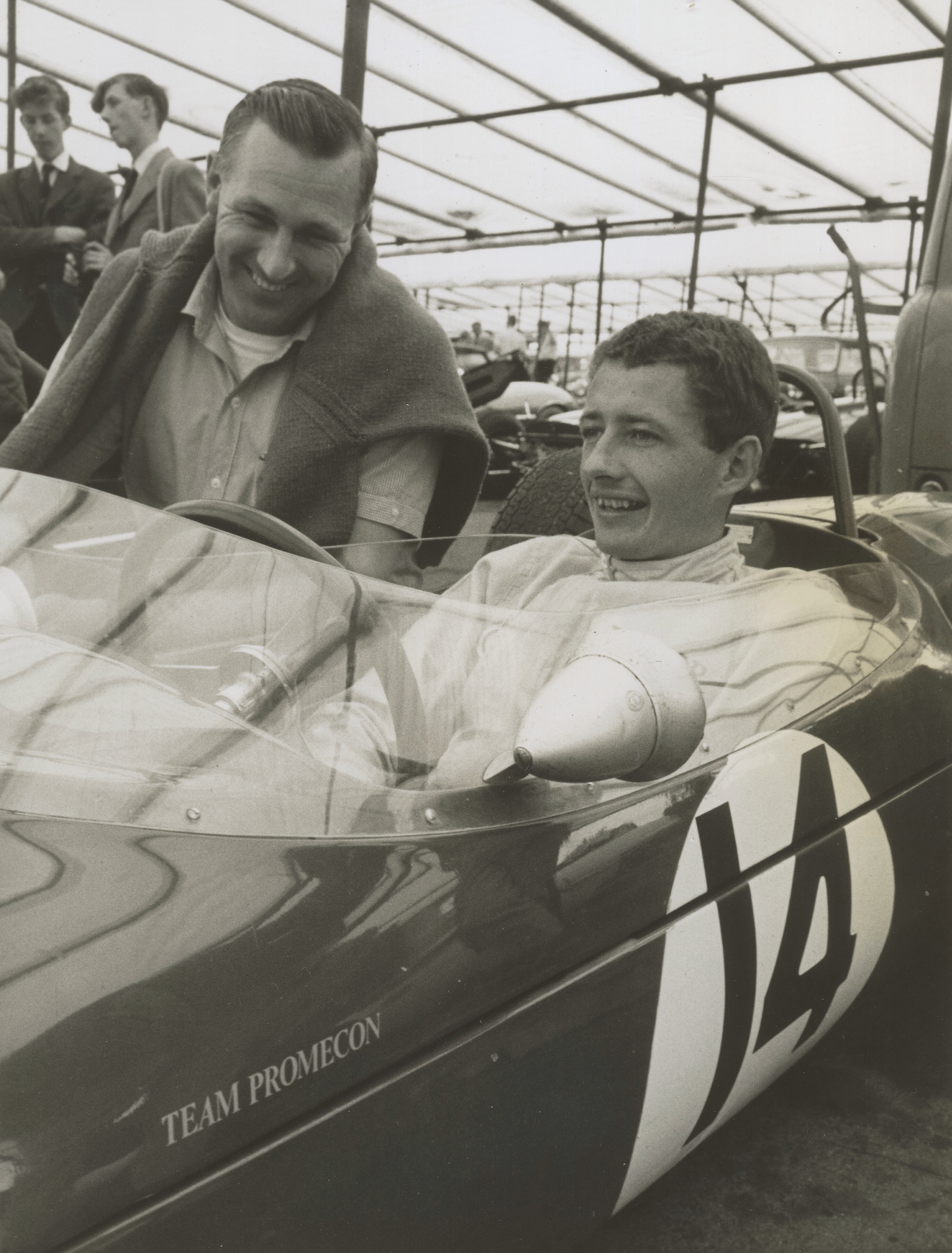
David Sandelson sits happily in Ron Tauranac’s 1965 F3 contender, the Brabham BT15…

The venue is London Olympia, its the Sixth Annual Racing Car show which took place between 22-30 January 1965.

Whether David can stump up the £1400 for the car I am not so sure. In addition he is up for a Cosworth MAE at circa £600 or a Holbay R65 motor at £625. The specification sheet lists the car as having a wheelbase of 90 inches, a front track of 50 and a rear track of 51 inches. The tyres were 500 x 13 up front and 600 x 13 at the back, the weight of the machine 400 Kg.

The car was very similar to the 1965-66 Formula Libre BT14 and 1966 F2 BT16. The exact number built- construction of chassis was outsourced to the famous Arch Motors concern, is estimated variously from 26 to 58 cars with oldracingcars Allen Brown writing that ’26 were built in 1965 but Brabham records say that another 32 were built in 1966. This may well be an error, with the 32 1966 BT18A F3 cars being double counted.’

The BT15, Brabham’s second F3 machine (after the 1964 BT9) made the companies name in F3 – almost identical to the F2 BT16 it had a spaceframe chassis with conventional outboard suspension – when powered with Cosworth engines the car took a hatful of victories’ according to f3history.co.uk.

The little machine was a simple, chuckable, fast, easy to prepare and set-up car which won lots of friends and set the Brabham marque trend for the balance of the sixties.

In terms of the BT15 roll call of 1965 national European F3 championships, Tony Dean won the BRSCC British title in a BT15 and Roy Pike the BARC title in a BT16. Andrea de Adamich was victorious in Italy with a BT15, also using a Lola T53 whilst Picko Troberg won the Swedish, and Jorgen Elleker the Danish title gathering some points with a Lotus 22 early in the season.

‘Australian F3 Gypsy’, Jim Sullivan gets the feel of his brand-spankers Brabham BT15 Ford Holbay R65 ‘F3-3-65’ at Motor Racing Developments in February 1965…

He was the winner of the Australian Automobile Racing Club/Smiths Instruments Scholarship to Europe awarded for his performance in both an Austin Healey Sprite and a later Mk2A in 1963.

‘The scheme is in effect an opportunity to help rather than to provide all that is required for a complete and grandiose ‘Driver to Europe’ but it was essential for the selected driver to be a good ambassador for Australia with a pleasing personality, quite apart from being a skilful, enterprising and successful competitor in this country.’

The press release about the prize award notes that the ‘AARC has full reciprocal rights with the British Automobile Racing Club…He will be assured of full trade support from the Smiths Organisation in respect of Lodge and KLG, and had it not been for the untimely death of Reg Parnell, he too, would have been on hand to advise and guide him in his endeavours.’

It’s interesting that the judges chose a driver of a production sportscar rather than an open-wheeler pilot for this award but perhaps that is just my perception that the prize would be devoted to a practitioner of the purest form of the sport…

Jim jumped into the deepest of pools and went very well in one of the most intensely competitive championships on the planet.

The British F3 fields in 1965 included the likes of Piers Courage, Roy Pike, Tony Lanfranchi, Harry Stiller, Derek Bell, Jonathon Williams, Peter Gethin, John Miles, Brian Hart, Alan Rollinson, Mo Nunn, Chris Irwin, Tony Dean and others.

These days the marvellous ‘F2 Index’ seems to have lost some of the results for the minor British race meetings but Jim contested at least twelve meetings in 1965. His bests were a win at a BRSCC Rufforth on 17 July and second places at BARC Silverstone on 19 June and at the AMOC Martini Meeting on 24 July behind Piers Courage and in front of Pike, Irwin, Gethin and Stiller.

Also noteworthy was a sixth at the Silverstone British GP meeting in July behind, amongst others, Pike, Gethin and Dean. In a year of consistency, seven of his twelve meetings were top six finishes with only one DNF at Silverstone in the second meeting he seems to have contested at Silverstone on 20 March- for the record his first event appears to be on 13 March at Goodwood for sixth.

Jim raced on into 1966 in a Team Promecom Brabham BT18, but again without the all important Cosworth MAE engine. He did eight meetings in April and May his best result a win in a Castle Combe clubby on 23 April. Three thirds at Brands, Goodwood and Snetterton from 24 April to 1 May was impressive- and with that it seems he returned home to Australia to a few Bathurst 500 appearances into the early seventies.

Of interest (maybe!?) is that Dave Walker had his first (?) steer in a car in the UK at the 19 June 1966 Les Leston round in a Team Promecom BT16 – a DNF.

Another couple of Australians lobbed late in 1966 too, Wal Donnelly was immediately on the pace with a Team Promecom BT18 whilst Barry Collerson made do with a Cooper T76 Ford Holbay, not exactly the best bit of kit perhaps…but he was there. I must buy his book too.

Clearly Jim Sullivan did enough to attract some factory support but as we know F3 is and always was an intensely competitive class where the cream rises to the top but not necessarily the cream which most deserves to.

When Sullivan returned to Australia he worked in public relations, newspapers and magazines as a writer.

It appears that his final appearances in motor racing were as a co-driver during the annual Bathurst production car enduros in 1968, 1971 and 1974.

Whilst in 1968 Bathurst was the year of the Holden Monaro- GTS327’s were the first three cars home, Sullivan shared a much less exotic Holden Kingswood 186S with Sib Petralia, the duo finished in 28th place. The other car in the photo below is the Japanese crewed Datsun 1600 of Talahashi/Sunago which finished in 21st place.

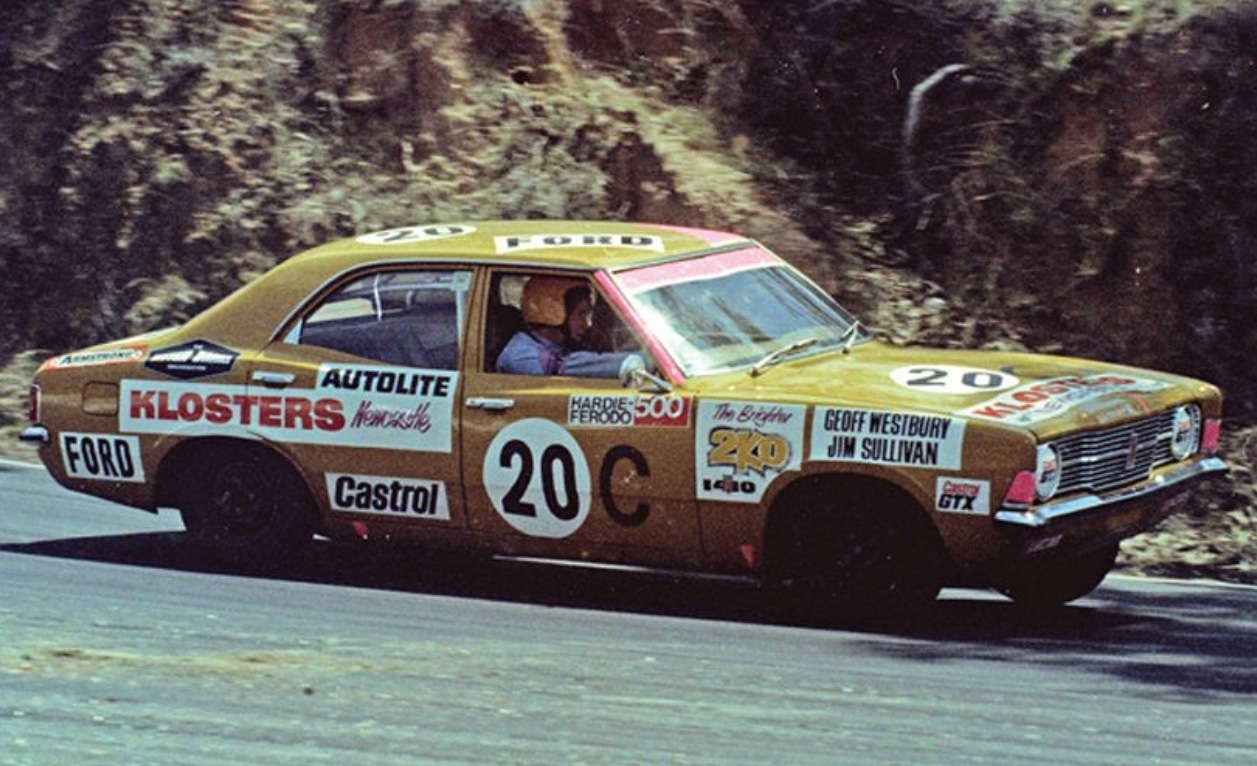
Whilst the Ford Cortina Mk1’s were at the front of the field at Bathurst from 1963 to 1965, Sullivan had the honour of co-driving the last Cortina (below) to compete in the Bathurst 500 sharing a TC Cortina L 2 litre with Geoff Westbury to 35th place in 1971.

Sullivan’s final Bathurst outing was sharing a Klosters Ford, Newcastle, sponsored Ford Escort Mk1 Twin-Cam to 16th place with Ian White in 1974- they were fifth in the 1300-2000cc class.

Jim was also involved in rallying a Klosters sponsored Escort Twin-Cam in the 1970’s together with Murray Finley- an NBN newsreader colleague of Sullivan.

Sullivan was hired by NBN TV (Nine Network) Newcastle, New South Wales as a reporter in 1977 covering a range of stories and producing a number of documentaries including the Logie winning (Australian National annual TV awards) ‘A Day In Jail’ aimed at young offenders.

He was appointed News Director in 1985 and is credited with expanding NBN’s Hunter Valley news service into the Northern NSW market from the Hawkesbury to the Gold Coast and as far west as Lightning Ridge.

Whilst responsible for all aspects of the NBN News service his main personal focus was, unsurprisingly, on motoring journalism which was reflected in ‘Drive Alive’, a driver safety initiative and ‘Project Restart’ promoting cardio-pulmonary resuscitation.

He retired from NBN in 2007 and these days is an independent writing and editing professional living near Lake Macquarie

He has been in the news in recent years taking on a local issues- the pollution left by the former Pasminco lead and zinc smelting operation at Boolaroo which has caused soil contamination in northern Lake Macquarie.

Brabham BT15 F3-3-65…

Brabham racer/historian Denis Lupton’s notes have it that Jim Sullivan raced the car in 1965 and Dave Walker in 1966, it then passed to Geoff Oliver and Fred Opert and thence to Joe Bosworth in the US circa 1970.

Joe Bosworth wrote via Denis Lupton that ‘Sullivan ran under the umbrella of the Jim Balfour owned ‘Team Promecon’, the car’s build sheets show it was constructed from February 7 to 25 1965′, so it most definitely is not the car at the Racing Car Show!

‘Back in 1970 I bought ‘F3-3-65’…from Fred Opert, who….seemed to handle most of the Brabhams to enter the US in those days. I have a memory of asking Fred where the car came from and he said France.’

Bosworth converted the car to FF spec and ran it as such in FF’s early days in the US…’thereafter (with a Quicksilver professionally built rather than home built engine) the BT15 was as good as any FF in the US until the side-radiator cars started to come in…’

The car was sold by Bosworth to Graham Dell in Australia in 2011- who owns it now?

Click here to oldracingcars.com Allen Brown’s Brabham cars type number- click into the BT15 link for the mysteries of individual chassis histories; https://www.oldracingcars.com/brabham/

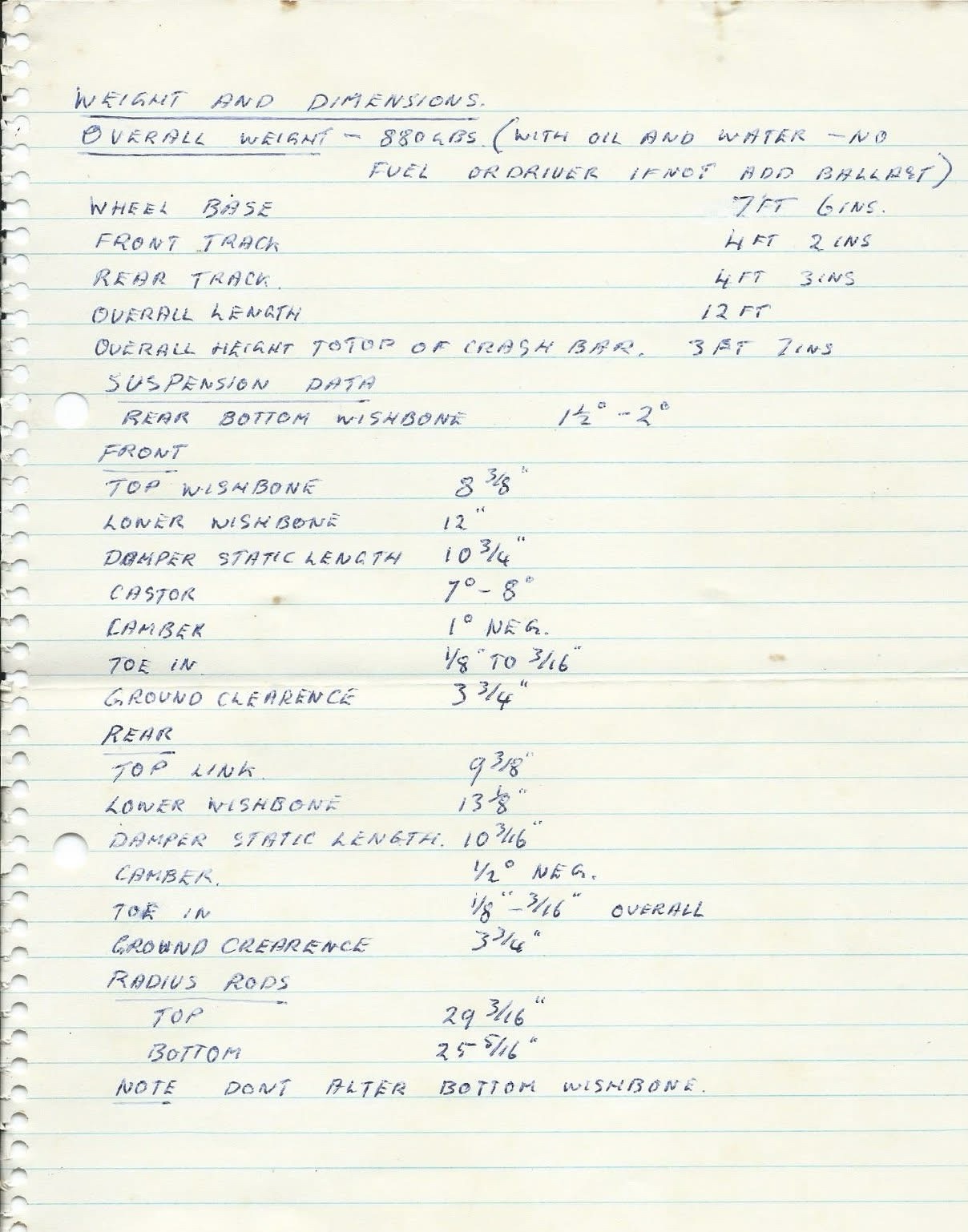
BT15 chassis data and set-up, Cosworth Ford MAE specifications…

In June 2020 Malcolm Roach posted these carefully prepared notes made by his Uncle Allan Barbour ‘who sailed to England on the Fairstar in 1965 to spanner Jim Sullivan’s Formula 3 Brabham. These are his hand written notes I found while cleaning out a cupboard.’

Many thanks to Malcolm and Bob Williamson’s Old Motor Racing Photographs – Australia Facebook page. I love this kinda ‘I was there’ stuff!

Cosworth Ford MAE…

Credits…

Getty Images, Jim Sullivan Collection, F2 Index, Denis Lupton, Ten-Tenths Brabham BT15 thread, NBN TV, Malcolm Roach and Allan Barbour

Tailpiece: Sullivan’s Brabham being assaulted at Castle Combe, date unknown…

Am intrigued to know the name of the aviator, his craft and the date of the meeting.

Finito…

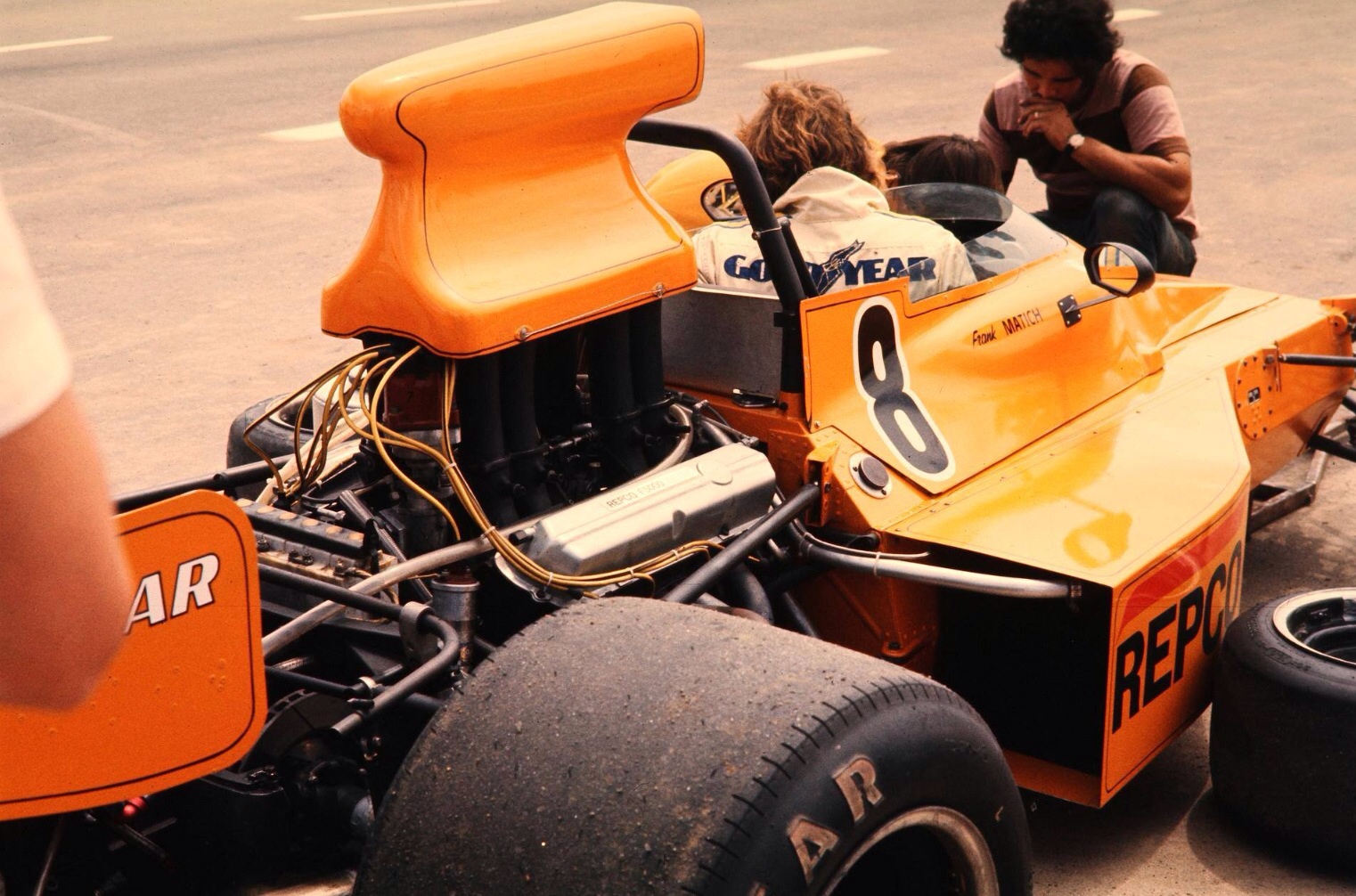
Matich A53 ‘007’ front suspension detail- upper and lower wishbones, coil springs and luvverly double-adjustable alloy bodied Koni’s- de-rigueur in F1 and F5000 at the time. Cast magnesium uprights, Melmag wheels, Lockheed calipers grabbing Repco disc rotors. Note the tubular steel subframe which mounts to the aluminium Matich designed but Commonwealth Aircraft Corporation fabricated monocoque chassis- they also cast the Matich steering rack. Pretty lady behind the car on Goodyear duty is unknown, sadly. Derek Kneller is working on the left front, guy with ‘builders cleavage’ is Grant O’Neill. Around the left-rear is Peter Hughes in the white T-Shirt with ‘Lugsy’ Graham Adams in the yellow polo shirt (T Glenn)

Bob Muir settles himself into the cockpit of the new Matich A53 Repco on Friday 1 February, prior to its debut race, the Oran Park Tasman round on 3 February 1974…

Frank and his team had finished the car before the Tasman but Matich was badly hurt in a boating accident the week before the meeting in which he was electrocuted and injured badly.

Bob was chosen by Frank to race the car after he tested it- against doctors orders and satisfied himself that the rigours of a full race weekend, inclusive of the 90 lap race in summer heat were beyond him at that early stage stage of his recovery.

As things transpired Muir raced the A53 only the once at Oran Park before Frank returned to the cockpit at Surfers Paradise a week later- FM did the last three Tasman rounds and soon after retired from racing for good.

Frank Matich tests the A53 early on that Friday before OP- I wonder how many laps he did and how long the task list was after his first test laps?! (D Harvey)

The 1974 Tasman was a beauty.

By the time of the fifth round at Oran Park, there had been four different winners in New Zealand.

John Walker took the opener at Levin on 5 January in his one-of-a-kind Lola T330 Repco Holden, Peter Gethin won at Pukekohe the following weekend in his VDS Chevron B24 Chev- then John McCormack was victorious in the somewhat geriatric, but continually developed Elfin MR5 Repco at Wigram- that year the New Zealand Grand Prix. Max Stewart won the Teretonga round in his mighty fast Lola T330 Chev ‘HU-1’ the very first of the breed, Frank Gardner’s development or prototype car in fact.

Muir aboard at OP. Repco Holden F5000 engine- car fitted with the ‘ultimate spec’ flat-plane crank unit giving circa 520bhp and not losing the mountain of torque for which these units were known in the quest for more power. Note the ‘Varley’ battery behind the Lucas injection unit and coil- no doubt now very well insulated from the ‘good vibrations’ of the engine which ‘shook the shitter’ out of the battery and cost the one race only A52 victory of the Glynn Scott Memorial Trophy, Gold Star race at Surfers Paradise on 2 September 1973 (T Glenn)

I wrote at length about Frank and his Formula 5000 designs a while back, click on this link for a comprehensive story and analysis of these wonderful machines, with A53 ‘007’ the last and best; https://primotipo.com/2015/09/11/frank-matich-matich-f5000-cars-etcetera/

This article is about the development of the Repco-Holden F5000 V8; https://primotipo.com/2018/05/03/repco-holden-f5000-v8/

(D Kneller)

The photo above is of Matich Chief Mechanic Derek Kneller and Bob Muir consulting during practice at Oran Park, the one below is a fortnight later at Sandown- its FM exiting Peters/Torana Corner and blasting up the back straight in a new ‘small-window’ Bell Star.

Bell together with Goodyear were two of the racing brands for which Matich held the local commercial rights. The helmet is a “Bell 120 (Degree) Full Face Helmet- they retailed at $79.90 at the time…”, quipped Matich employee Rob McDonald.

So, by Oran Park the Matich lads were up against it with their new car- the opposition were race ready off the back of the first four intensely Tasman fought rounds. Mind you, it is fair to say that the A53 was a slightly tidied up and evolved version of the short-lived A52 which met its maker when Muir had a testing shunt in it at Warwick Farm in late September 1973.

(unattributed)

Generally the designers original intent is its most pure, don’t you think?

If i’m critical of the look of the car, a machine which to me was a real honey of a thing, maybe the only element which is not aesthetically pleasing is the way the A50-52 cockpit surround doesn’t integrate well with the nosecone.

The thing was a jet right outta the box mind you- so who gives a shit what I think!

Repco’s Ken Symes and Derek Kneller push FM’s A53 from the Sandown fork up area or dummy grid into pitlane, Shell Corner or more boringly ‘Turn One’ behind. Note the engine oil sump on near side aft of the radiator. Note brake air-scoops since OP (P Weaver)

The A53’s was first completed and wheel-aligned on the ground on 11 January 1974- ‘by that stage the Tasman was already underway but we could have had the car finished easily in time for Pukekohe. Repco didn’t want us to go given the fuel shortage dramas they expected in New Zealand’ recalled Derek Kneller. The first OPEC Oil Embargo or crisis began in October 1973 with New Zealand particularly impacted given 80% of their crude oil needs were provided by Middle Eastern countries.

With hindsight Repco over-reacted, but the net effect of their decision (despite well before renewing Matich’s annual August to August sponsorship agreement through to the end of August 1974) was that Team Matich didn’t race in New Zealand- so the final build of the car was done in relatively relaxed fashion rather than with the pressure of the 5 January first round in mind.

‘Mind you, Frank sent me to the Pukekohe first round race weekend to scout around and report back on the Tasman field on latest developments and what everybody was up’ Derek recalled. No doubt the new Warwick Brown and Graeme Lawrence Lola T332’s were of particular interest.

When back in Sydney the crew completed the car- the team at that stage comprised FM, DK, Peter Hughes, Grant O’Neill and Leon Jarvis.

A53 was first tested at Oran Park on 24 January, the driving chores shared by Matich and Enno Buesselmann.

Enno had come out of FV and FF and had a strong 1973 driving the Bob and Marj Brown owned ANF2 Birrana 273 Ford-Hart- he was third in the championship that year behind Leo Geoghegan’s dominant, similar, works car. Matich decided to give him some laps in the car.

‘Enno did two stints of 10 laps apiece’ recalls Derek. ‘We didn’t time the first ten given it was his first time in a big car but he got down to a best of 47 seconds dead in the second of his two sessions. With the same setup as Enno FM did a 44.6- and then later in the day a best of 43.6 seconds after some changes were made to the car’.

The team then left the circuit with a decent job list before the Oran Park Tasman round.

‘Frank had a visitor from Repco in Sydney- one of the senior guys, he planned to take him out in his boat, Frank had a home and boat slipway at Clareville. The boat wouldn’t start- the battery was flat. He grabbed a Honda generator and the leads for a battery charger and mistakenly pushed the lead into the 240 volt, rather than 12 volt plug- he then got a big shock from the alligator clip which attached itself to the fleshy part of his hand, burning it badly. Simultaneously he fell forward downwards and over the battery, burning his chest and losing consciousness’.

‘Kris saw some of this from the wharf and jumped into a skiff to help his Dad- who motioned not to come near the live boat- the generator stalled ending the ordeal. Frank had burns to the fleshy piece of his right hand between the thumb and forefinger and chest.’ In addition there was the mental shock related to the whole incident. Most of you are aware the gearshift in a racing car is usually on the right so FM had a considerable challenge in managing 100 miles at Oran Park a few days hence.

Despite the accident Matich had not lost his sense of humour, team machinist/fabricator Peter Hughes recalls Frank saying to him ‘that when he lost consciousness and came around again “I could hear the generator running and thought I’ve died and gone to hell and they have Honda generators here!”, He also told me that he couldn’t grasp the round knob to turn it off and pushed the choke lever up to stall it. Sense of humour and thinking all the time’ concluded Peter.

Despite that setback Matich, heavily bandaged, and no doubt against his medical advice did ten laps of Oran Park on the Friday before the meeting getting down to a best of 42.4 seconds.

The team had dramas in practice at OP, typical teething problems, including  the engine, which meant that Bob started off the back of the grid, his best according to Team Matich records was a 42.8- the result in the race was a DNF after fuel-pump failure.

Max Stewart’s T330 won the ‘Oran Park 100’ race that day, but Peter Gethin again finished- its was his fifth in a row finish, this time in fifth place, ultimately he would win the title with an eight out of eight 1974 Tasman finishing record.

Derek, ‘On the Wednesday (6 February) after the race we went back to Oran Park for some further testing.’

‘We had fitted a new rear suspension crossbeam and also cured the fuel pump problem. During the Oran Park race Frank walked to several corners to observe the A53 on track, and after the race he checked his rear suspension drawing and come up with a new spec for the rear crossbeam, he stood the spring/shock unit more upright by a couple of degrees. After the Wednesday test he was pleased with the change.’

Frank drove 27 laps in total and Bob Muir drove 12. The majority of Frank’s were in the 42’s with a quickest of 41.0. Bob’s furst stint was also in the 42’s and his second stint reeled off 5 laps- 41.3, 41.1, 41.3, 41.0 and 41.0. Pole for the race was 39.9. From my working with FM i know there would have been at least 1 second being held back in testing when FM was fighting fit let alone suffering from the injuries from the accident. After this test we were given another work list to complete before setting off for Surfers on Thursday afternoon’ Kneller concluded.

Team Matich then trucked the mighty quick car up to the Gold Coast where Matich was so fast in the A52 not so many months before during the September 1973 Gold Star round.

His time was good enough for fourth on the grid, despite it being his first real go in the car and coping with a broken throttle cable and too much oversteer- he finished third behind the Teddy Pillette and Gethin VDS Chevron B24’s despite knocking off a front wing on lap 15.

FM’s was a mighty fine display of speed amongst all those highly developed cars- not to say personal grit and determination in all the circumstances.

Sandown is a power circuit, Matich put his flat-plane crank 520bhp Repco engine to good use qualifying second on the grid behind Gethin. A crowd of over 20,000 people saw Matich lead for 15 laps before water pump problems- apparent from lap 5, the resultant cooked motor ended his day.

Gethin took the win from Graham McRae’s McRae GM2 Chev- the disappointment of the series in terms of results if not in absolute pace and Walker’s T330 Repco.

A53 at rest in the Adelaide International paddock (C Bond)


Matich during his final race appearance- the ‘Adelaide 100’ at Adelaide International on 24 February 1974. FM fourth behind Warwick Brown, Peter Gethin and Graeme Lawrence- Lola T332, Chevron B24 and Lola T332, all Chev powered (D Mellonie)

And so to the final Tasman round, Adelaide International, and as it turned out FM’s final race.

Frank again popped the car second on the grid, the car was fitted with a fresh engine, a tenth shy of Stewart’s T330.

In the race he was running second before spinning on some oil and again worked his way up to second- and challenging Brown hard in the final stages, before he spun four laps from the end when his engine momentarily cut out. He finished fourth, 27 seconds behind winner Warwick Brown.

WB had the honour of taking the very first win for the Lola T332- the first of hundreds of victories for the T332/T332C/T332CS/T333 F5000/Single-Seat Can-Am family of cars! Warwick’s car, or his patron, Pat Burke’s to be more precise, chassis ‘HU-27′, was the very first of the T332’s.

The A53 was a great bit of kit- it won the the 1976 Australian Grand Prix in John Goss’ hands (in chassis A51/3 ‘005’) a couple of years after it’s birth.

If only FM had gone to the US in 1974. It would have been fascinating to see how a 520 bhp, flat-plane-crank Repco V8 powered A53 would have fared amongst a plethora of Lola T332 Chevs. With the lessons learned during the unsuccessful 1973 L&M Series campaign for sure they would have put up quite a fight…

Derek Kneller and Ken Symes fettle the A53 in the Sandown Park paddock (A Radley)

Lets come back to Frank’s retirement, Derek Kneller again picks up the story.

‘We were set up beautifully for 1974.

Repco had renewed the sponsorship arrangement in August 1973, they had allocated us four engines which were powerful, as displayed during the Tasman races we did- and the new car was quick.

Consulting with the Matich Red Books (FM used a series of red hard cover foolscap books as data logs), when he got out of the car at Adelaide he dictated a long job list for the car, all to be done before the next race. Car too low/too much brake on the rear/too much wing?/steering vibration/more roll stiffness at rear/stay with banana wing (Matich at the time had the ‘original Matich wing’ and an ‘American banana’ style)/check bump steer and shocks/rear springs harder/new brake ducts/tyre pressures too high.

When he got out of the car and we left Adelaide he planned to race on.’

Frank and Joan Matich in the Warwick Farm form up area poor to the 1973 Tasman round- Matich A50 Repco ‘001’. Note the neck brace Joan is wearing

‘In Adelaide he spun twice, once on oil and the second time he couldn’t work out why. He had constant ringing in the ears as a result of the boating incident and just felt at 39 he could not concentrate as he had always been able to before so he felt it was perhaps time. At the same time FM’s wife Joan was having severe ongoing problems with her neck including surgery. So it was a combination of factors as a consequence of the accident and the need to focus on Joan and the rest of the family that led to the decision to retire, sell the racing cars but otherwise remain in business including the racing franchises such as Goodyear and Bell’ Kneller said.

No doubt Matich indicating he wanted to retire made the decision for Repco to withdraw from racing easier given the global competitive pressures upon them in the increasingly difficult economic situation of the time- oil shocks, the progressive lowering of Australian Tariffs and global ‘stagflation’.

Derek Kneller returned to the UK (there are some great stories there to be told when his book is finished!, c’mon Derek lots of us are waiting for that little baby!) with Peter Hughes the last of the race team to leave, he ‘worked with Tony Simmons for a while then when John Goss finally bought the A53 I worked with John and Grant O’Neill until 1975- the 1975 Tasman was the last series with John before marrying and travelling around Australia for two years.’

(M Bisset Collection)

Etcetera: The closely related Matich A52 Repco ‘006’…

During 1973, as related in one of the linked articles above, Matich took two A51’s to the US to contest the American F5000 Championship, the ‘L&M Series’, the cars used were chassis ‘005’ and ‘006’- ‘005’ was tested for a day at Warwick Farm before shipping to the states, ‘006’ was not.

The team who travelled to the US were, FM, DK, Chief Mechanic, Chris Miles, Team Manager, Bob Riley, Draftsman and engineering of the car, John Anderson and Leon Jarvis, Mechanics and Ken Symes looking after four Repco V8’s

Derek Kneller recalls ‘The cars did not perform as expected we had a handling problem on the latest spec Goodyear’s and the bumpy nature of the US circuits. The tyres weren’t identical to those we tested before going to the US. FM wasn’t the only driver testing the F5000 tyres, the final production tyres we were presented were different, so we were playing catch-up. The cars were still as fast as any at the Riverside first round mind you’.

‘The biggest problem was engine related. The higher cornering speeds of the US circuits threw up a scavenge problem in the Repco engines, this seemed to get worse as the season went on and at Watkins Glen the crankshaft bearings were damaged in both cars during practice and both were withdrawn from the race after discussion with Repco management in Maidstone the night before the race. This meeting was the first at which we ran the flat-plane crank engines.’

‘If Frank had qualified on the time he did on the Friday we would have been on the front two rows at the Glen. By then Matich had the car sorted on the tyres- this involved changes to shocks/camber and toe to get the loading right. We also moved the battery to the front to load the car up front a bit more.’

‘At the start of the season the A51 was as competitive as the T330 but its development accelerated with so many drivers and teams running and experimenting with the T330’s’.

‘Straight after the race weekend at Watkins Glen chassis ‘006’ was flown back to Sydney with me so that the handling and engine problems could be sorted. Chassis ‘005’ was left in the States with the rest of the team.’

Matich A51 ‘006’ and A51 ‘005’ in the Watkins Glen pitlane, June 1973- A51 ‘006’ rebuilt as an A52 using the same ‘006’ chassis as per text (D Kneller)

‘On returning to Sydney the engine problem was overcome, an additional scavenge pump was added to scavenge oil from above the camshaft. Oil was being retained in the valley above the camshaft in the longer fast corners causing oil starvation in the oil tank, leading to bearing failure.’

After the engine problem was sorted it was decided to redesign the chassis to overcome the handling deficiencies, hence the A52 design…The A52 was built using the A51 ‘006’ chassis and rear end but with a longer engine/gearbox adaptor (bellhousing) giving a 2inch longer (50mm) wheelbase than the A51, this was in line with the Lola T330′.

‘The radiators were moved to the sides of the chassis along with modifications to the engine water pump so that each radiator cooled the opposite side cylinder head and were shrouded with aluminum ductings’.

‘The oil tank was repositioned behind the left-hand radiator (from beside the cars gearbox, outside its wheelbase) and the battery moved from the front of the car to above the bellhousing’.

At the front of the chassis the steering rack was moved from the chassis itself to a heavily redesigned front subframe. The top pick up point for the shock absorber/spring assembly was raised approx 1 1/4 inch (30mm) along with a redesigned lower wishbone and new front uprights. These mods gave an increase in front suspension movement’.

‘To complete the design a chisel shaped nose made from fibre glass was added, the complete car was about 10 Kg lighter than the A51’.

‘The A52 was tested extensively by Frank at Warwick Farm during late July/early August 1973 with a hope of returning to the US series, but a problem with the sponsors in the US prevented this happening’.

FM Matich A52 Repco, ahead of Max Stewart’s Lola T330 Chev, Glynn Scott Memorial Trophy, September 1973 (K Payne)

‘We had hoped to be back by Atlanta but we had problems with Carroll Smith and the Earley’s who owed us money. They were a father/son combination who were chiropodists operating their business and workshop in Dover, Ohio. Smith went AWOL at the Glen- non-one could get hold of him, he was bluing with the Earley’s too and then turned up a couple of races later with Graham McRae’ recalled Derek.

‘Frank sent me back to bring all of the cars, spares- the lot, Ken and Ando were still there whilst the other three had already come back to Australia.

FM side aspect at Surfers, similarity to A53 clear albeit A53 sidepods were bigger and longer to cover the fuel cells meet the new for 1974 deformable structure regulations (K Payne)


Matich off to the side of the circuit at Surfers trying to diagnose his problem- a destroyed battery internals (K Payne)

‘The A52’s only race was the Gold Star race, the ‘Glynn Scott Memorial Trophy’ at Surfers Paradise on 2 Sepember 1973 when fitted with a flat plane crank Repco F5000 engine. This gave over 520hp and sounded like a Cosworth DFV on steroids! (the best of the two-plane Repco engines gave circa 495bhp@7000rpm)

‘FM was quick straight away- he knew what the tyres needed, he led the race setting fastest lap before retiring with battery failure, the high frequency vibration from the engine shook the internals of the Varley battery apart.’

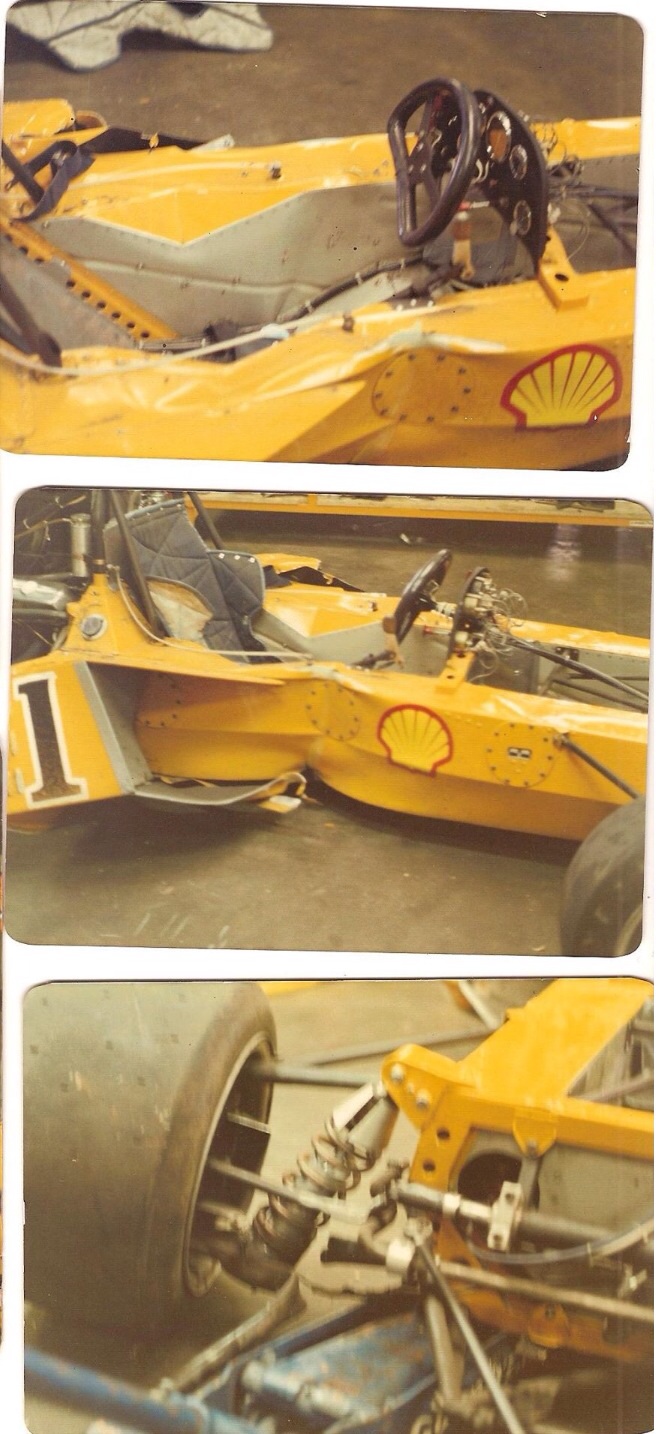
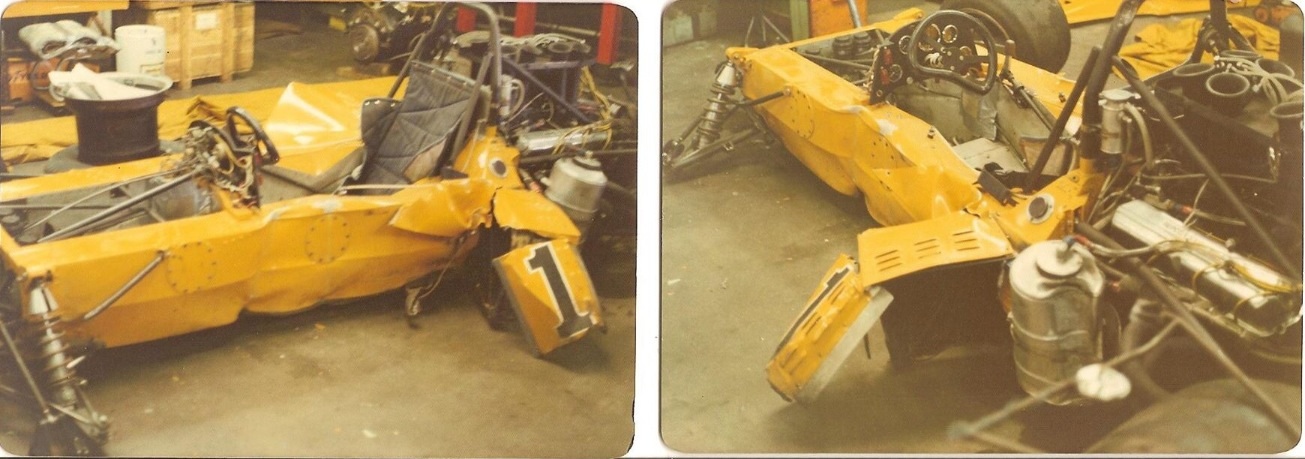
‘The car was comprehensively destroyed in a test session at Warwick Farm in late September whilst driven by Bob Muir. The chassis was beyond repair, both the outer and inner skins were damaged. The photos show damage from the car hitting the water-sprinkler system at Warwick Farm, 50mm diameter steel pipes- at great speed’.

‘Frank was not happy as he had just left the circuit after a successful session to visit his wife Joan, who was in hospital- and had let Bob have a steer to get another drivers opinion of the car, Bob had been driving a Lola T330 Chev in the US’.

As a consequence of the death of A52, A53 was born using the last remaining Commonwealth Aircraft Corporation constructed chassis.

(D Kneller)

Photos of the comprehensively damaged A52 ‘006’ back at the Matich workshop in September 1973.

‘The ‘006’ remains stayed at the Matich Military Road workshop and were then moved to the warehouse in Aartarmon and then later Darley Road and were finally junked a week or two before I rejoined Matich in 1989′ said Derek.

‘Frank knew I would want to repair and restore the car which he didn’t want to do so he got rid of it not long before I arrived back to run his Headway Helmets business- I shipped a Mondiale Formula Ford out for Kris (Matich) when I came back to Australia too’ Derek recalled.

(D Kneller)

Photo and Other Credits…

Tony Glenn, Derek Kneller, Peter Hughes, Peter Weaver, David Mellonie, Dale Harvey, Peter Weaver, Alan Radley, Ken Payne via John Payne, Curt Bond, oldracingcars.com, ‘Australian Competition Yearbook’ 1975 Edition.

Click here for Allen Brown’s great summary of the Matich F5000 cars;

https://www.oldracingcars.com/f5000/matich/

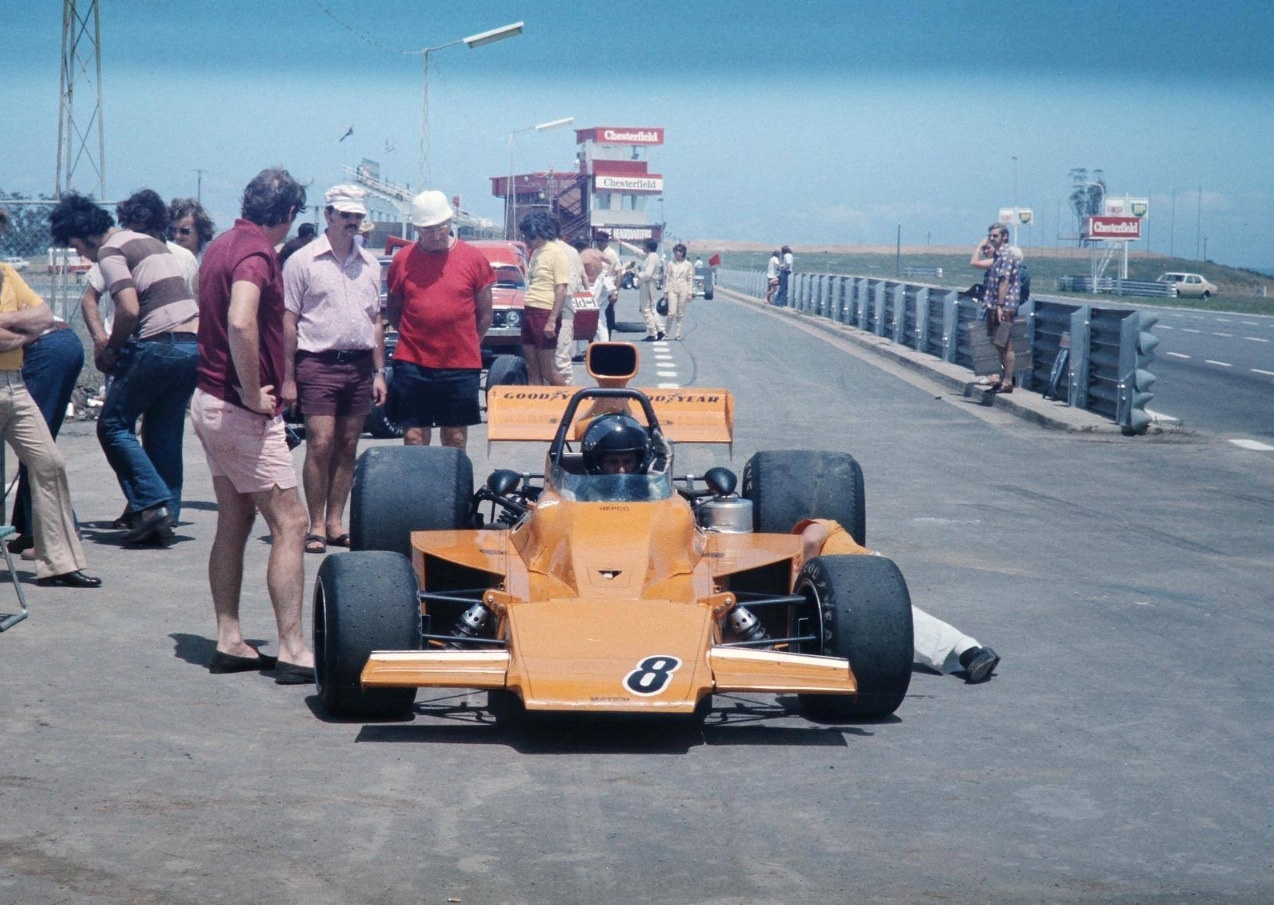
Tailpiece: Muir, ready to rock n’ roll, Oran Park pit lane 1 February 1974…

(T Glenn)

Its all happening above, its the Friday before the meeting.

An obscured Bowin P6F Formula Ford is between the Matich and Brian Foley’s ‘Chesterfield Racing’ XA or XB Ford Falcon Panel Van.

The shapely form in the driving suit holding the helmet in the middle of the shot is Christine Cole/Gibson who ran a Group C ‘105 Series’ Alfa 2000 GTV from 1973 to 1975 in many races including the 1975 Australian Touring Car Championship (which she gave a really good shake!) and Manufacturers Championship- its probably Foley to the left of Cole?

The more you look, the more you see…

Finito…

(D Willis)

Bill Cuncliffe, 22 years of age guides his ex-Snow Sefton Strathpine Ford V8 Spl around the wide open spaces of Lowood in 1956…

Dick Willis shared these wonderful, evocative photographs of Cuncliffe at the ex-RAAF Airfield circuit in Queensland’s Somerset Region 70 Km west of Brisbane.

The mountains (you would call them hills in Europe or North America) are the Great Dividing Range which runs down the east coast of Australia from ‘top to bottom’.

Cuncliffe poses at home after purchase from Sefton, note Dad’s Morrie Minor (D Willis)

The 4.2 litre Ford V8 powered device was quite a formidable machine for a young driver- Bill continued to race into the sixties, he finished eighth in the 1963 Bathurst 500 touring car classic aboard a Ford Cortina GT shared with fellow Queenslander Barry Broomhall.

Built by Snow Sefton at his Lawnton Motors garage in Gympie Road, Strathpine, the Ford V8 Spl contested both the 1949 Leyburn and 1954 Southport Australian Grands Prix.

Sefton on the Leyburn AGP grid 1949. From L>R- #22 George Pearse MG TB Spl, #18 Garry Coghlan MG TC Spl, #17 Dick Cobden MG TC Spl, #7 Alan Larsen Cadillac Spl V8 (Willis/Thallon)

At Leyburn Sefton raced this car, his more conventional ‘Strathpine Spl’ V8 racer ‘having competed elsewhere in Queensland with a Ford V8/Jeep hybrid which allowed a choice of either front drive or four- wheel drive’ Graham Howard wrote in ‘The History of The Australian Grand Prix’.

At Southport, Sefton raced ‘basically the same car he had run in the 1949 AGP at Leyburn’ retiring after completing 21 of the 27 lap scratch race won by Lex Davison’s HWM Jaguar.

Ray Bell reports that the special was fitted with a more powerful and reliable ohv Cadillac V8 by the end of the fifties.

Snow Sefton in the Strathpine Ford V8 Spl in Gympie Road Strathpine in the late 1940’s, out front of his garage perhaps. Awesome if somewhat noisy road car (B Pritchard)

Sefton was the proprietor of the Lawnton Motors for more than thirty years, he competed at all of the Queensland venues post-war. ‘Snow was always the crowd favourite at the Exhibition Speedway every Saturday night in Brisbane with his black and white 1936 Ford (the No 36). Snow’s sponsorship deal for the 1936 Ford is a classic story in itself and involved some of Brisbane’s biggest Holden Dealers! He was also famous for thrilling country crowds with his staunt driving at shows all over Queensland up until the early 1960’s’ said the CHACC.

Etcetera…

The photographs below are of Bill Cuncliffe during the 1957-1958 period.

(Willis/Thallon)

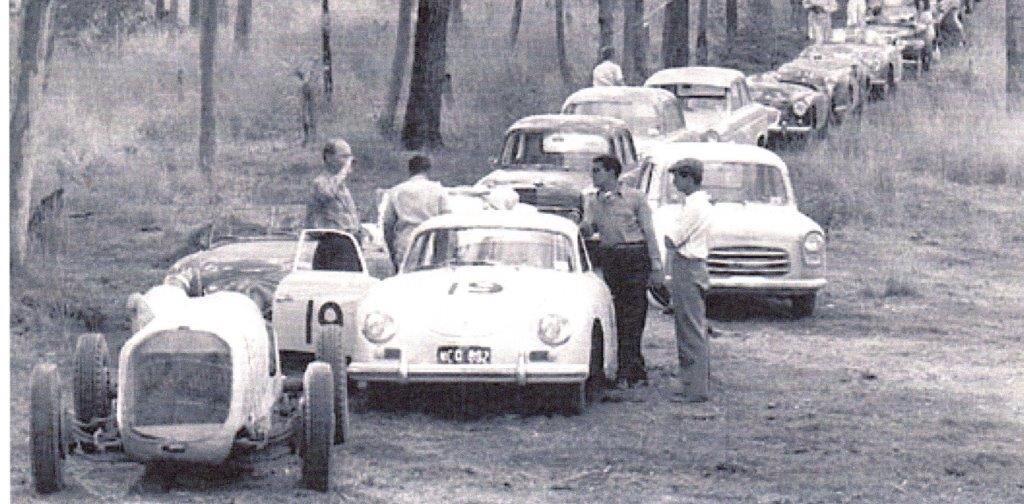
Cuncliffe at the Samsonvale Hillclimb where he was second fastest time of the day. Samsonvale is 35 Km north of Brisbane. Looks like a wild place, the rugged special well suited to dirt surface.

Assistance with the owner/drivers lined up below welcome. Sid Sakzewski Porsche 356?

(Willis/Thallon)

The photographs below are at the Strathpine Airfield circuit.

That location is 25 Km from Brisbane to the north and was a major Queensland motorsport venue from the end of the war until the opening of Lakeside in 1961.

Snow Sefton is credited as one of the driving forces in establishing Strathpine, he and fellow enthusiasts ‘borrowed the Pine Rivers Shire Council road making machinery’ to finish the track for the first meeting on 11 August 1946.

‘They worked like beavers all weekend, returned the equipment before dark on Sunday night, then wired the fence back up. (Most of the councillors were farmers who lived out of town and would not have heard the racket)’ the CHACC reported.

The color shots just ooze the atmosphere and vibe of the times, we are uncertain of the meeting dates- quite probably more than one meeting, note the missing radiator cowl in one image.

(Willis/Thallon)

Cuncliffe getting some encouragement from his mates before the off by the look of it! Below the radiator cowl is missing- hors de combat or removed for additional cooling I wonder?

(Willis/Thallon)

Photos above and below are taken on the same Strathpine day it seems, sans radiator cowling, Quentin Miles thinks his father Bill took the photo below in 1957.

(B and Q Miles)

It really is a most agreeable looking race venue isn’t it, got a real picnic hamper feel to it?

(Willis/Thallon)

Credits…

Dick Willis Collection, Don Thallon Collection, Ray Bell, Bill Miles via Quentin Miles, ‘The History of The Australian Grand Prix’ Graham Howard and Others, ‘CHACC’- Classic and Historic Automobile Club of Caboolture magazine article in September 2005

Tailpiece: Cuncliffe, Lowood 1956…

(D Willis)

Finito…

(I Liddell)

Earl Davey-Milne lines up his Bugatti Type 37 Chev ‘37104’ at Alexandra, Victorian Quarter Mile Sprint Championship, 24 November 1963…

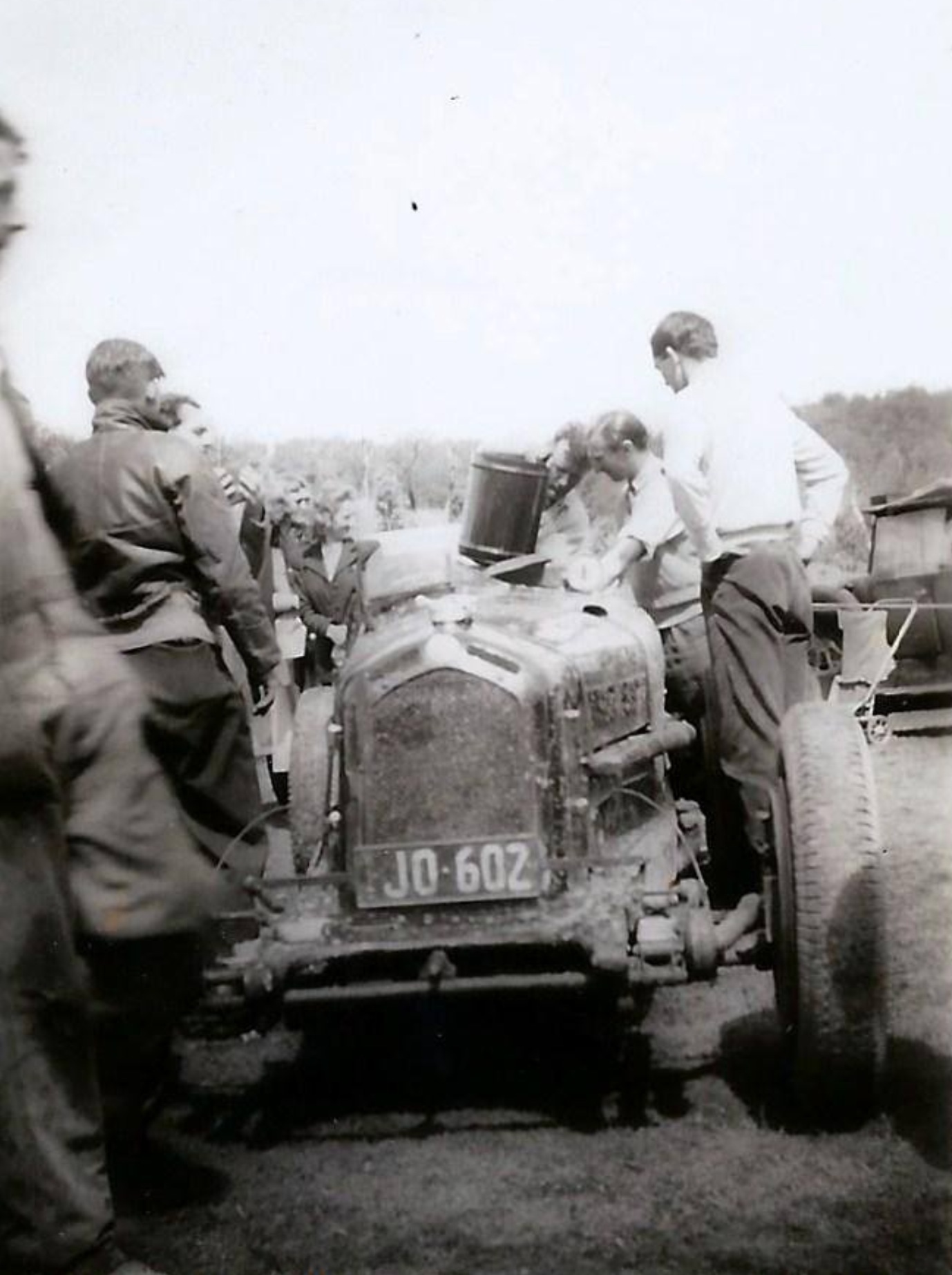
The car started life as a 1926 model Type 37 four-cylinder Grand Prix Bugatti car which raced on New South Wales speedways and in several Phillip Island Australian Grands Prix before being fitted with a Hudson straight-eight engine- and later a 283 CID Chev V8 after Earl blew the Hudson motor at this very event in 1957.

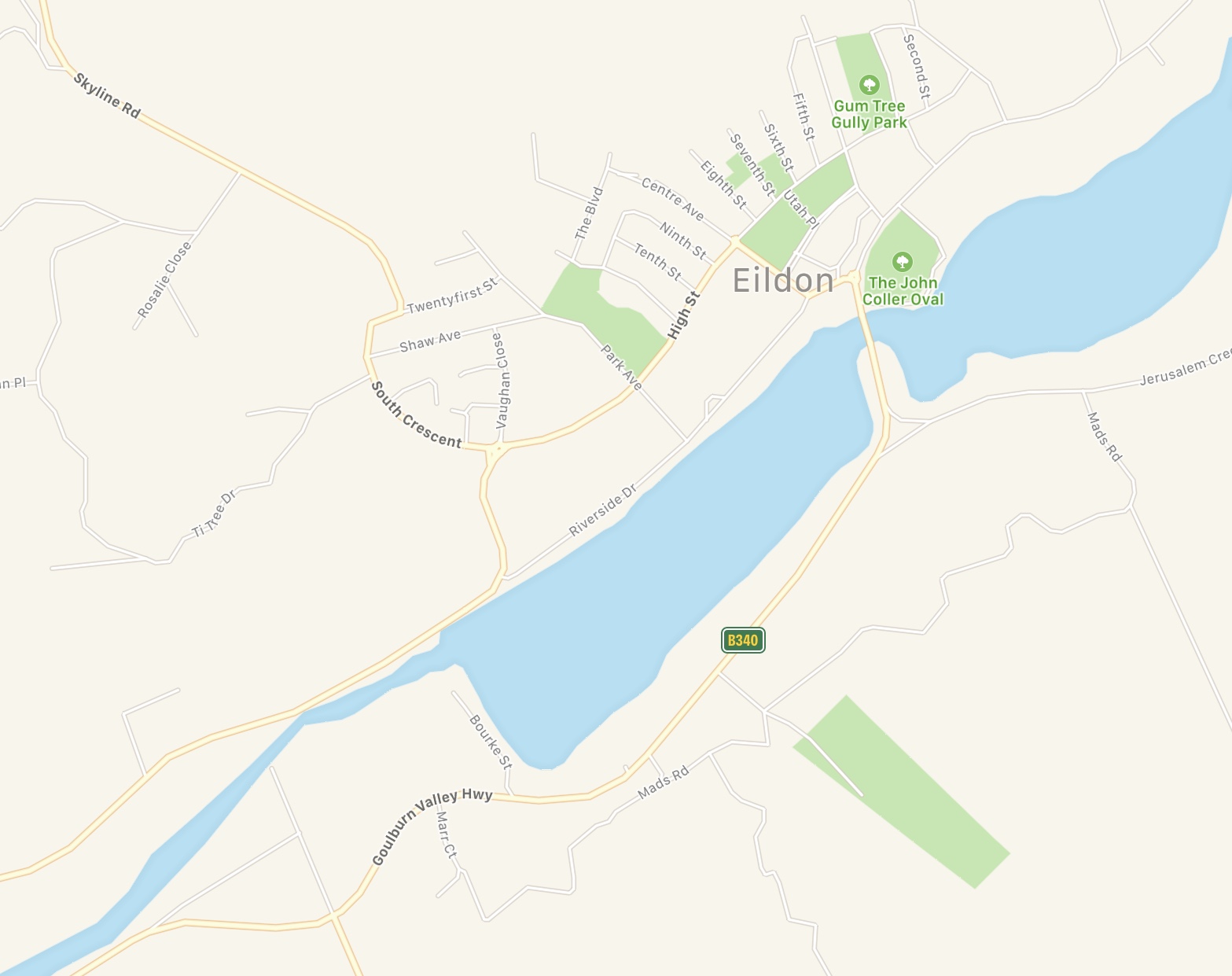
The Alexandra Branch of the Victorian Sporting Car Club ran meetings here, near Eildon Weir for about a decade. Alex, 130 kilometres north-east of Melbourne is well known to skiers as a gateway town to Victoria’s high country and to the boating set who use Lake Eildon. It is otherwise a quiet farming community and home to around 2600 people.

(C Hyams)

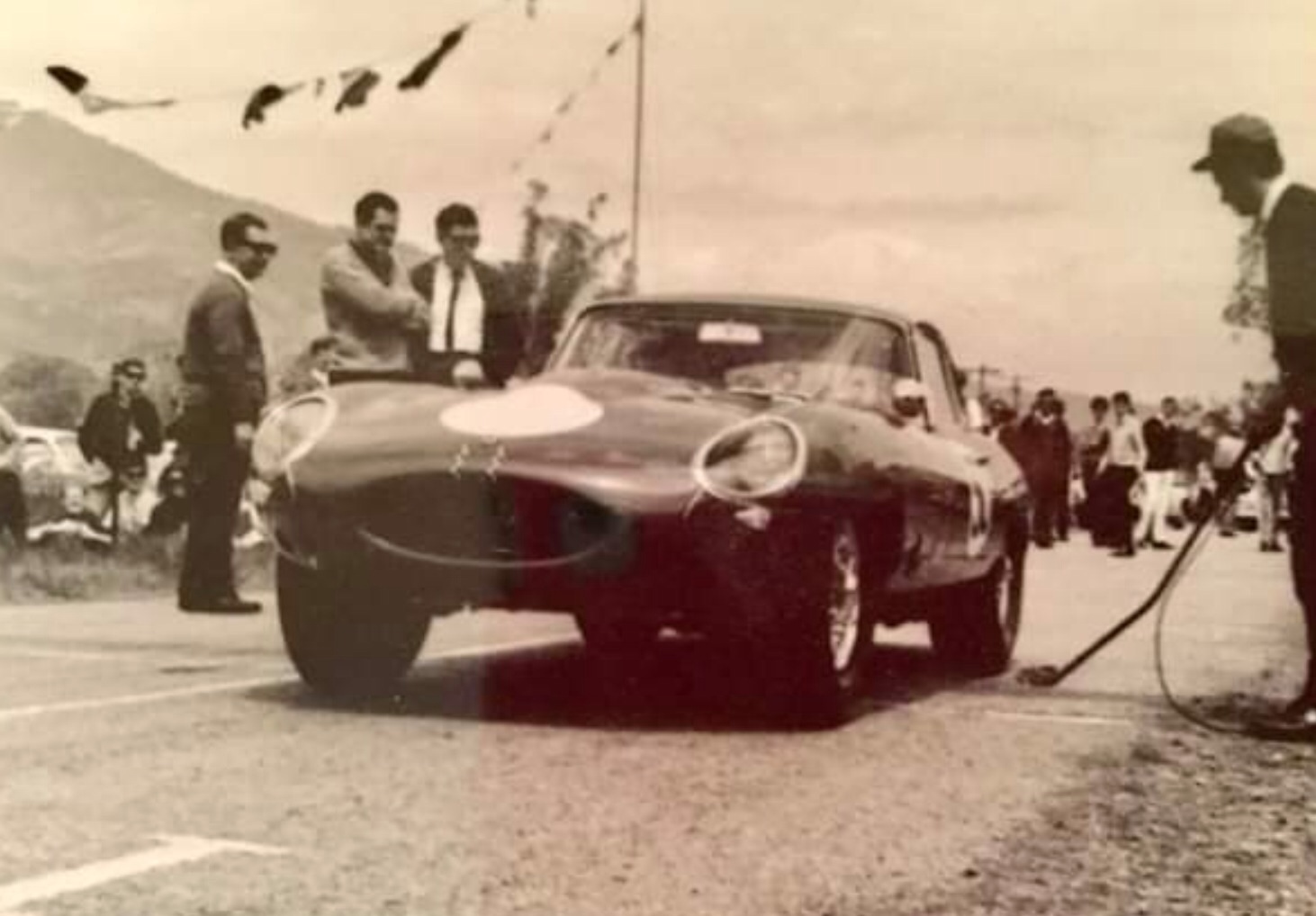
Colin Hyams, Jaguar E Type and Norm Beechey’s Chev Impala 409, which was also shared by Dick Thurston on the day.

Colin ruefully recalled that ‘the meeting was the morning after the assassination of JFK.’ The President’s death at the hands of assailants unknown was on 22 November 1963, which makes the ’63 meeting date Sunday 24 November.

(C Hyams)


Bugatti T37 ‘37104’…

Whilst the Brescia and Type 30 were widely used in Australian motorsport ‘…it is the Type 37 that is indelibly linked in the older enthusiasts mind with Bugatti racing success here’ wrote Bob King.

‘The association is entirely justified as these 4 cylinder versions of the Grand Prix Bugatti were to win three of the first five Australian Grands Prix with a further victory falling to the visually identical Type 39 of Carl Junker’.

‘It is fortunate and remarkable that these splendid cars had such a high survival rate’ including the much raced ‘37104’.

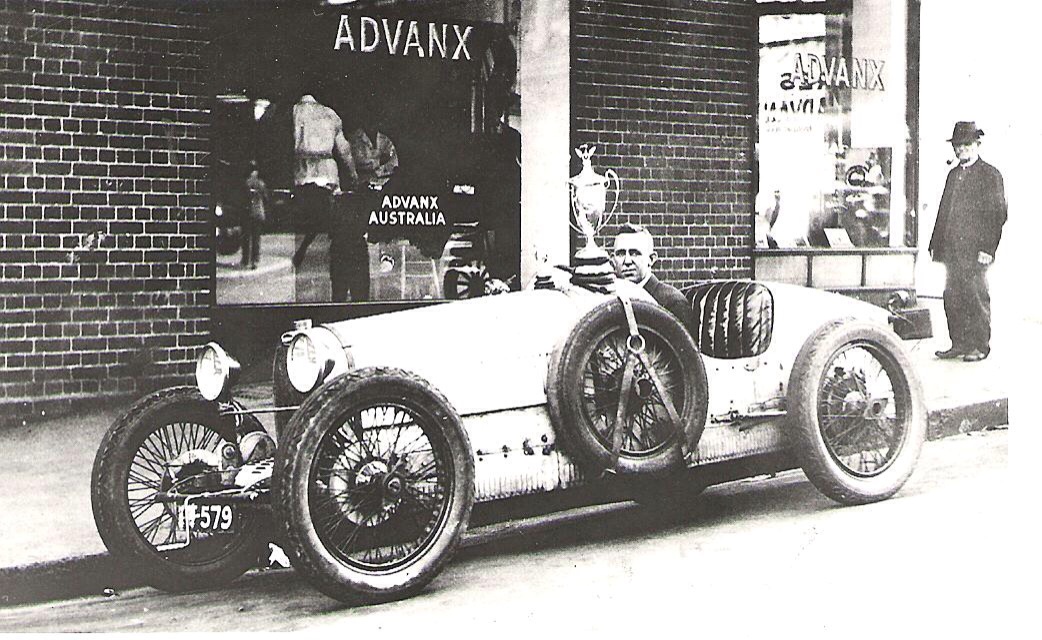
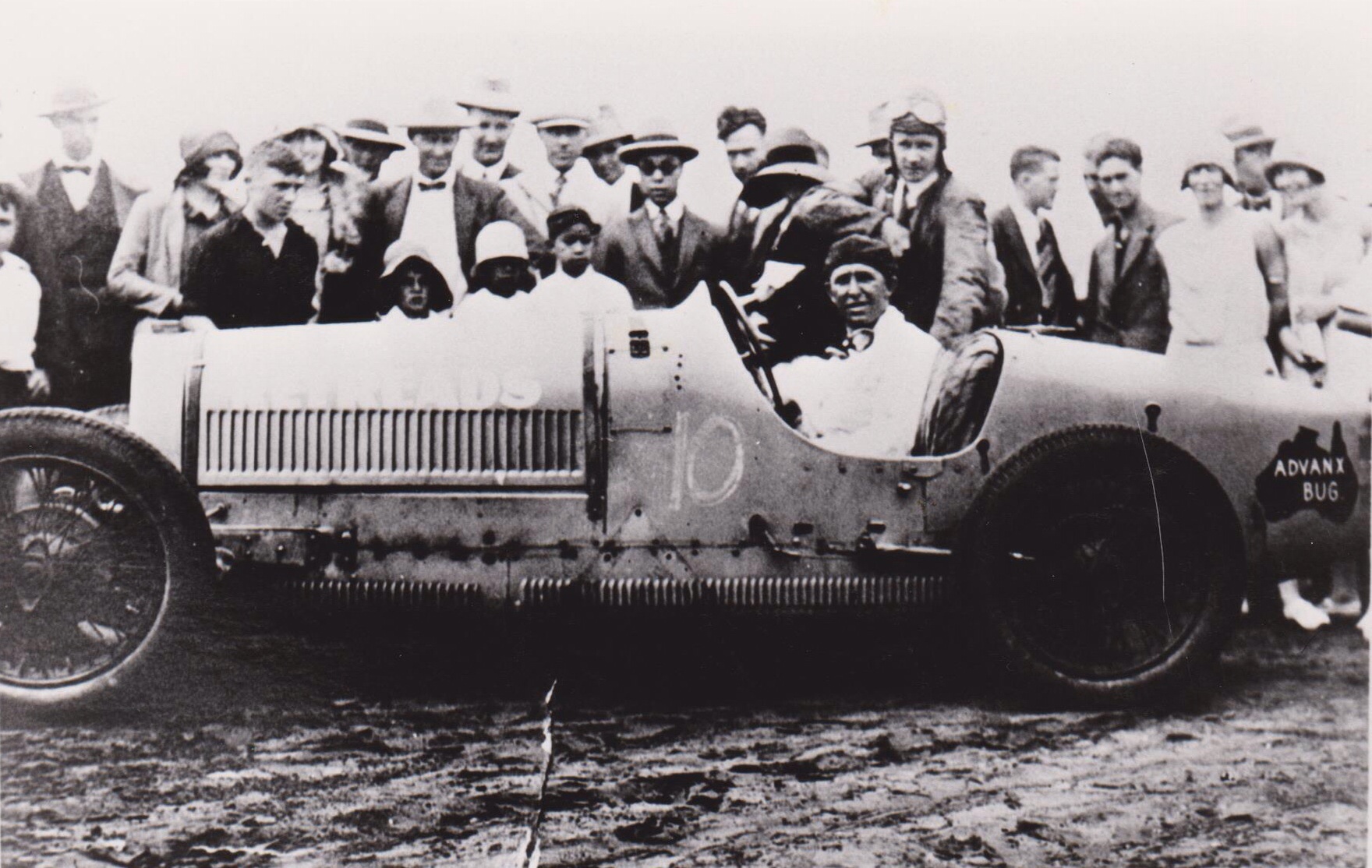
The car was the fourth T37 built according to King and came to Australia to the order of Russell Taylor who, together with former Australian multiple Olympic medallist swimmer, Frank Beaurepaire, had an international tyre business ‘Advanx Tyres’ based in Sydney.

Whilst owned by Taylor the car was raced for him by Charlie East who had made a name for himself as a tuning wizard whilst apprenticed to, and employed by Phizackerley’s in 1904 at the same time as AV Turner, who later held the Sydney Bugatti franchise.

East evolved from tuning the cars to running in car trials, funding provided by his car hire business- his career in track racing followed.

Charlie East and ‘37104’ outside Advanx headquarters in Sydney with one of his many trophies. Note the road registration, what a supreme road car the Type 37 was, is! (B King)


Charlie East at Gerringong Beach, on the New South Wales South Coast circa 1930 (B King)


East with a pair of T37’s place unknown. East is leaning against ‘37104’, registered ‘1903’, a plate he used on several cars- the other T37 is Bill Thompson’s 1929 AGP entry ‘37209’. East tuned Thompson’s 1930 AGP winning Type 37A ‘37358’ (B King)

East’s battles with Hope Bartlett in his Bugatti Brescia become a major spectator drawcard for the venue. Charlie had many successes there although Bob notes that by 1927 ‘the handicappers seemed to have the measure of him’. The car was also raced at Penrith- East won the October 1930 ‘World Championship’ for under 1500cc cars on dirt, at Gerringong Beach and in New Zealand during 1929- by that stage owned by East who acquired it from Taylor for the modest sum of 150 pounds. Mates rates indeed!

Whilst East could earn 75 pounds a night at Maroubra, ‘he tired of hurtling around the track and started entering grass hillclimbs with his wife as passenger. He established records at Robertson, Prospect and Kurrajong…’ wrote King.

He sold the car for 500 pounds to Keith Macmeikin of Malvern, Melbourne in in 1933 with King rebutting claims made for a Sydney-Melbourne record time claimed by racer Cec Warren and Clive Smith during the delivery drive south.

The duo claimed a time of 11 hours and 10 minutes for the 575 mile journey ‘but a time of 10 hours 5 minutes had already been recorded by Don Robertson’s Graham Paige in 1930. Nor was it a Light Car Class record which was then held by Jack Clements and Wal Warneford with a Type 30 in 10 hours 53 minutes’ King wrote.

‘37104’ the Sydney-Melbourne record holder, not! Photo believed taken in the rear yard of Sporting Cars, City Road, Melbourne (B King)

The much used racer contested AGP’s at Phillip Island in the hands of Cec Warren in 1933, DNF big-end bolt, JO McCutcheon in 1934, DNF with oiled plugs after making a dash back to Melbourne on the night before the race due to engine trouble in practice.

McCutcheon raced the car quite a lot at the Island including the 1935 AGP where big-end failure intervened. ‘…the car was still highly fancied, being fourth car off in the twelve minute bracket…it’s disappointing performances in the Australian Grand Prix came to an end’ wrote Bob.

It does make you wonder why Taylor and East did not contest some of the earliest AGP’s given Charlie’s skill and the national nature of the Advanx Tyres business and resultant promotional opportunities of any success they may have had.

The Macmeikin clan with the car- Trevor third from the right, Andy at the wheel, place unknown- (A Macmeikin via B King)

David Macmeikin, who bought the car from his brother in 1934, hill climbed it at Rob Roy in 1938, selling to Jim McDonnell of East Kew in July 1939.

He contested the Interstate Cup or Grand Prix at Albury in 1940, one of the last racing events held in Australia in wartime- the motor blew, Jim died of injuries during the conflict.

(B King)

Ron Edgerton was the next owner, buying the car in 1941- the racer was still in Victoria, Glen Iris, here he is at the wheel, probably during Nar Nar Goon Speed Trials at the local racecourse. Who is alongside him I wonder?

There were a number of meetings organised by the Light Car Club of Australia, and other car clubs on a grass course outside the little village in the thirties and forties.

Nar Nar Goon is an aboriginal expression meaning ‘native bear’ and is on the Gippsland railway line 65 kilometres east of Melbourne.

(B King)

Edgerton at Rob Roy Hillclimb in outer Melbourne’s Christmas Hills with ‘37104’ still, seemingly Bugatti engined, perhaps one of you Rob Roy experts can tell us the probable date of this meeting. By the end of its competitive career the car would have been able to ascend the climb on its own given the number of times it raced there.

There is an article to be written on ‘Racing Ron’ given the truly vast number of racing and high performance cars the man owned in a lifetime of competition. I’ve a list somewhere!

Not the least of his racers is the ex-Alf Barrett Alfa Romeo Monza I wrote about some years ago which Ron sold to Earl Davey-Milne in 1951- another car the family retains albeit in unrestored, but complete, original state.


(B King)

A damp, soggy road event for the occupants- Edgerton and passenger probably during a Melbourne-Geelong Road speed trial- note the missing headlight.

‘Geelong Road’ events official- run ‘just off the Geelong Road (where exactly?) were run by the Australian Motor Sports Club and unofficial events went on for decades, most of us of a certain age may have done a top-speed run in a car or two in the very early hours of the morning along the Geelong Road whilst Mr Plod was hopefully tucked up in his Werribee bed!

I would love to know what is going on here! It’s Aspendale Speedway in Melbourne’s bayside- probably a promotional ‘race’ to extol the virtues of the ‘Males Gas Producer’- so we are immediately before or perhaps just after the start of WW2. What are the other two cars with Edgerton’s T37?- Ron McCallum thinks the big car is possibly an American ‘REO’ and Bob King suggests the open tourer is a Terraplane? From 1938 to 1940 these gas producers cost between 45 to 70 pounds per unit at a time the new price of small Austin was 250 pounds and a big Buick 525 pounds- these ‘Producer Gas’ units were a response to wartime petrol rationing. For those with a technical interest in the topic, see the fascinating article link at this pieces duration (B King)

After the engine was blown again during speed trials in Tooronga Park, opposite Scotch College, Hawthorn, Melborne Edgerton fitted a Hudson eight cylinder motor having failed in attempts to weld the delicate Bug block which had distorted from extensive competition use and previous repairs.

William Sinclair of St Kilda owned it in 1941-1942, nothing is known of his use of the old stager.

Speedway racer ‘Stud’ Beasley, who, together with father Arthur or ‘Pop’, and brother Alf were the ‘first family’ of speedway racing into the late fifties- then acquired the car in 1942, fitting the Willys ‘Winfield’ speedcar motor from his Midget after the Hudson continually boiled using the standard Bugatti radiator. It would be intriguing to know where Beasley raced the car.

Bugatti T37 Hudson, note the Ford radiator and ‘Davey Milne Special’ badge (Dacre Stubbs)


Note the chrome ‘up and over’ exhausts, fuel tanks are ex-Liberator bomber as are the seats, cable brakes still fitted (Dacre Stubbs)

Davey-Milne bought it in January 1943, sans Willys motor and soon re-fitted the Hudson 8 which was fed by Amal carburettors, mating it to a Lancia Lambda gearbox. It would be interesting to know the artisans who worked on the car.

The car was always notable for its immaculate preparation and presentation, first appearing- as it always did, in chassis only form at a Cape Schanck Hillclimb on the Victorian Mornington Peninsula in September 1946 where it set fastest time of the day. The car then competed regularly at hillclimbs and sprints well into the early seventies.

At the 1957 Alexandra meeting Earl had completed a 16 second pass only to have two connecting rods protrude through the side of the Hudson block in a most un-welcome fashion. Whilst the Hudson 8 was a cost-effective ‘specials’ motor a decade before the equivalent then was the small-block Chev V8 which had not so long before made its appearance in the Corvette.

(Dacre Stubbs)

After fitting the Chev V8 the car recorded a standing quarter time of 12.06 seconds which won him the Victorian Sprint Championship at Alex in 1964.

Other significant performances at the time were a class win during the Australian Hillclimb Championship at Silverdale, New South Wales and the Horsham, Victoria, Speed Trials in 1963 at 12 seconds.

Note that after fitting the Chev engine, Bob King wrote that the Bugatti steering box was replaced with one from an Alvis 12/50 due to lack of space.

Charlie East had reset the front axle to suit the particular needs of Maroubra’s banking in the twenties with Cec Warren replacing that original fitment with a hollow axle in 1933. Earl’s sprint demands bent that axle under braking at Geelong’s Eastern Beach Sprints in 1965- a Type 35C unit was fitted in 1966.

King notes ‘37104’s gearbox is now fitted to ‘37145’ and the sump of the original engine, number ’15’, is in Dean Smoker’s Type 37A replica.

(Dacre Stubbs)

In Chev engined form the car achieved 25 fastest times of the day from 34 starts- not bad in 1970 for a car which started its life at Molsheim in 1926.

The photographs above are of the car outside its Toorak home, the sight of Earl squirting the car around Melbourne’s most twee suburb startling the local squires and matrons would have been amusing. I am reliably informed that these occasional Toorak test sessions still take place, I must ask Troy Davey-Milne for an invitation to one of these early morning pre-Rob Roy blasts!

The fuel tanks started life as water tanks in a Liberator Bomber, the not particularly comfy looking seats are from the same source.

Eastern Beach, Geelong- best time there 13 seconds, on that occasion bested only by Lex Davison’s Formula Libre Brabham BT4 Climax 2.7 FPF, 1964? (Dacre Stubbs)


We have lift off. Earl grabs second gear at Geelong‘s Eastern Beach in 1964 (Davey-Milne)


An Earl fried tyre and wire wheel detail (B King)


Calder 1970, note the Bugatti badge on the dash (B King)

The car is a most significant Australian racer in its various forms with a continuous competition history from 1926 to the early-seventies. Earl is still alive, the Davey-Milne’s still own the car, I’ve a feeling it’s last outing was during the 2000 AGP meeting at Albert Park when Lindon D-M gave it a gallop- an awesome sight it was too!

Etcetera: 1964 Alexandra Sprint Meeting Program Excerpts…


Bibliography…

‘Bugattis in Australasia’ Bob King, ‘Historic Racing Cars in Australia’ John Blanden, Ron Simmonds, Dick Denvil

Wartime ‘Producer Gas’ powered cars…

Click to access Producer%20Gas%20&%20the%20Aussie%20Motorist%201939-45.pdf

Photo and Research Credits…

Ian Liddell, Davey-Milne Collection, Dacre-Stubbs Archive, Colin Hyams Collection via Stephen Dalton, Graham Edney Collection, Bob King Collection

Whereizzit?…

The sprint site stretch of road will only be of interest to we Victorians I guess.

Dick Denvil picks up the locale, ‘The track was a leftover piece of road created when the Eildon Weir pondage dam wall was put in.’

‘It was the continuation of the original road straight north-east towards the cross bridge into Eildon (from the bottom left corner- the side road which ends at a T-intersection and which then ran on to Bourke Street) The main road as seen above, then moved east away from the Goulburn River course to higher ground.’

Dick Simmonds lived in the area for a while, ‘You can still see part of the track which is now on a private property just past Thornton going towards Eildon…I looked at running a revival meeting, the owners of the land were ok, but the O,H & S issues got in the way of it…if only!?’

Dick concludes ‘The honour boards of the Victorian Sporting Car Club Alexandra Branch are in a building used by the Lapidiary Club within the Alexandra Railway Yards’ if you are passing by and want to have a look.

Tailpiece: Rob Roy, 24 July 1960…

(G Edney)

Lets finish as we started, with a rare colour photograph of this marvellous Australian Special- the first competition outing of the Bugatti in its Chev engined form- note the dual rear wheels.

Earl won his class that cool Victorian day with a run of 29.73 seconds from a Lancia-Austin on 30.41 secs.

Finito…

(D Lupton)

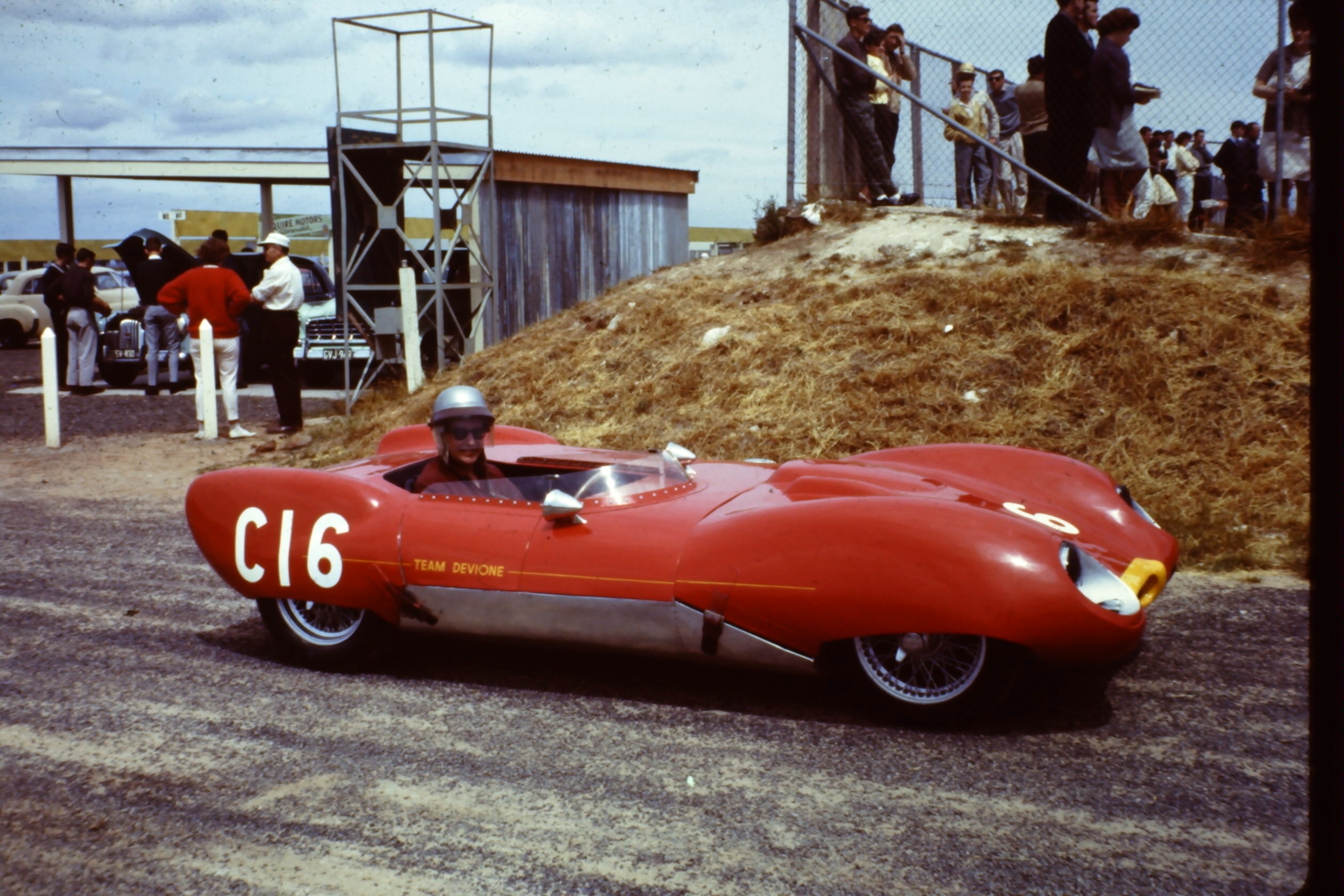
Denis Lupton’s ‘Team Devione’ Lotus 11 Ford Rep at Calder, ‘whilst the circuit was still being built, marked on the slide is 1960’…

Racer, engineer and mechanic Lupton and ace welder Hedley Thompson met at the Australian Motor Sports Club and soon developed a strong friendship.

Thompson was a foreman in aircraft maintenance at TAA – Trans Australian Airlines – was one of two large domestic Australian airlines, Ansett the other. He was regarded by many, including Reg Hunt, as one of the finest, if not the best welder in Australia.

Regular trips to the likes of Boeing kept him up to speed with the latest aviation techniques which of course flowed through to his motor racing sideline. Pat Ryan mused that ‘it would be interesting to know how many cars came out of the nightshift at TAA?!’

Lupton and Thompson saw an opportunity to build some Lotus 11 replicas, the ex-Jon Leighton Lotus 11 Series 1 (chassis 198) provided the car from which to create a jig and working drawings when the pair rebuilt it.

(D Lupton)

Brian Devlin’s genuine Lotus 11, ex-Jon Leighton with Denis Lupton at the wheel, above, Fishermans Bend, Melbourne in 1959.

Little is known of the car’s early history other than that it was bought to Australia when Leighton emigrated here in 1958- first competing at the Hepburn Springs Hillclimb in November 1958, for a class win, Brian Devlin acquired it in 1960.

Between Thompson and Lupton the pair had the requisite skills to build racing cars. The little machine was stripped in the workshop behind Thompson’s home in Melbourne’s inner eastern suburb of Deepdene, (‘down the drop in Whitehorse Road from Burke Road till when it flattens and then in on the left’). When it was a bare chassis Denis took all the measurements and made a set of drawings.

Denis and Hedley made the chassis whilst the aluminium work was done by close friend of Lupton’s and noted racer Ian Cook and Frank Esposito. Whilst the standard Lotus bodies were aluminium, a buck/moulds were taken from the Devlin car with painter Jim Jewitt producing fibreglass bodywork.

Word travelled quickly of course that some beautifully built cars were coming together and the orders quickly flowed in.

This article is very much a ‘work in progress’ from Denis records of the cars, if you can help with the history of an individual chassis please get in touch.

Histories of the cars…

Don Ashton, Hepburn Springs Hillclimb in Victoria’s Goldfields or Spa Country (D Lupton)

No.1 Don Ashton, Gnat  BMC 750cc. ‘A’ type sleeved down

John Partridge, 1100cc BMC A type

Warwick De Rose, 1100cc BMC A type

Ken Hastings,  Atom, 1100cc BMC S/C

???

John Lambert, Current owner

Don Ashton in front of his Ballan, Victoria, garage (D Lupton)

No.2 Alan Coleman, Ford 105E Anglia engine

Shifted from Melbourne to Perth

Stuart Campbell, Car finished off and competed in Perth.

Bruce Campbell, Perth.

No.3 Jim Jewitt,

Julian Coker

Dick O’Keefe,  BMC ‘A’ type S/C, currently  active in Historic Racing

Dennis at Calder (D Lupton)

No. 4 Denis Lupton, Ford 100E with Elva cylinder head

Then fitted with 1500cc Cortina GT engine, close ratio gearbox,  disc brakes and wide wheels.

Dr. Les Mendel

Steve Gifford

Colin Dane, Current owner

No.5 Bellair Brothers- Mike & Terry

Lindsay Urquhart

Alistair Scholl                                          Graham Hail

Chris Ralph                                              Gavin Sala

Bruce McGeehan                                   Rowan Carter

Joe Farmer                                              John Blackburn (Qld)

Ian McDonald all crossed up- ‘exiting The Hairpin the fast way’ at Hepburn Springs, Victoria in 1962-Tarquin (I McDonald Collection)

No.6 Ian McDonald,  Tarquin TC

Ian McDonald picks up the story of his car ‘…this car was the first of the Hedley Thompson Specials to be completed and raced and was the most successful.’

‘Hedley built the chassis in 1959-60, Jim Jewitt made the body and then the hard work really started in my garage at home in Camberwell assisted by two friends, one a good welder.’

The MG TC engine, complete with Laystall head and gearbox came from the ex-Franz Bird, Jewett bodied MG TC Special.

‘I first raced it in 1960, campaigned it solidly for three years and sold it to Wes Nalder in late 1963.’

The name had me intrigued- Ian McDonald ‘The name Tarquin derives from Tarquinius King of Rome but it was also the name of my wife Helen’s family dog in the fifties and we have a dog named Tarquin now!! We just liked the name.’

Wes Nalder, of Horsham  fitted the car with 1500cc Hillman Minx engine. In the historic era Alex Reid owned it, the car raced for him by Bernie Bisselling during the 1980s. More recently Terry Cornelius of Seaspray bought it, with his son Rowan the current owner in Longford, Tas

(I McDonald Collection)

No.7 Geoff Aarons, Hillman Minx engine

R.Slaney, Sebring Motors, 123 Bridge Rd, Richmond.

???

No.8 Nev McKay, BMC ‘A’ type  S/C

???

Russell McKenzie,   Ballarat,  current owner.  C/o Redan Motors, Ballarat

No.9 Neville Ham, Ford Consul  engine

????

No.10 Ian Munro, Ford 100E engine

???

Ed Flannery as it was with Alan Bail with Climax FWB motor (D Lupton)

No.11 Ed Flannery, MG TC engine and Gearbox

Syd Fisher, fitted Alfa Romeo engine and gearbox, then Peugeot engine.

Alan Bail, fitted 1500cc FWB Climax, very successful.

Graham Vaughan, Queensland, current owner.

No.12 Hedley Thompson, Lola Mk 1 copy.

Ford 1500cc engine.

Geoff Robbins

Ian Wells

???

Bruce Polain

Ray Kenny, NSW,   to Barry Bates   QLD  current owner 2019.

David McKay raced his Lola Mk1 Climax at the Ballarat International meeting in February 1961. During the meeting a radius rod mount pulled out, Hedley was engaged to repair the car, again a jig was made and drawings of the chassis taken.

Long time racer David Crabtree was the first to drive the Lola ‘around Deepdene after we finished the car.’ ‘In one of those “I thought you did moments” between us we hadn’t filled the diff with oil, so I took it back to my parents house in Malvern, and cobbled together a repair with all the Austin A30 bits I had.’

These days Crabby has a large successful aircraft maintenance business at Melbourne’s Essendon Airport, back then he was a young TAA apprentice, ‘I used to catch the tram up Glenferrie Road from Malvern and Hedley would scoop me up on the Cotham Road corner, not too far from his place and he would drive me out to the airport. He was a terrific bloke, immensely talented, he taught me how to weld. I did help in the build of the little Lola’.

Postscript…

Within a couple of hours of uploading this article my friend and historian Stephen Dalton raided his collection of magazines and emailed ‘…the history of Lotus 11 Replicas may have been somewhat different had Jon Leighton sold his Scuderia Birchwood Lotus in England. The 13 June 1958 Autosport ran his advert ”Scuderia Birchwood’s Lotus XI Sports, full 1172 trim, extras, enthusiast maintained, very fast, engine now dismantled, £850 ono – Twyford 5 (evenings)”.

Devione, the name?…

Denis advises the background to the names of his cars- ‘My lady wife is a Francophile, she says “Devione” is French for a “variation from a main theme” and I know better than to argue with her!’

‘So my cars were called ‘Devione’, and I built a few more for people, so we hoped to all race as a team so “Team Devione” was suggested. But people got married, or went sailing or found aircraft, or whatever, so it never got off the ground, pity!’

Credits…

Denis Lupton, ‘Historic Racing Cars in Australia’ John Blanden, David Crabtree, Doug Eagar, Stephen Dalton Collection, Ian McDonald Collection

(D Eagar)

Etcetera: Denis Lupton, Devione LC2 Ford, Calder circa 1970…

Denis is rather a modest fellow, the next Devione piece will be about the Brabham BT23 inspired Devione LC2 Ford Twin-Cam 1.6 ANF2 car built by Denis- the ‘L’ and Ian Cook- the ‘C’, and raced successfully by the pair from 1969 to 1972. A car owned and being restored by Grant Twining in Hobart.

Finito…


The Benowa/Southport road circuit taking in 5.7 miles of Gold Coast hinterland was shortlived…

The November 1954 Formula Libre Australian Grand Prix for cars was run and won there by Lex Davison in an HWM Jaguar after Stan Jones massive accident due to chassis failure of Maybach 2 gifted his fellow Melburnian the win.

1954 Australian Grand Prix, Southport, Qld…


The Oz Motorcycle Tourist Trophy was contested on the 16 October weekend in 1955 and won by Eric Hinton, see here for a summary of his career; https://amcn.com.au/editorial/erichinton1/

These two photos are uber-rare colour shots of the circuit and capture the nature and flavour of the place marvellously.

The ‘bike is an AJS 7R, the name the rider is D Fletcher from WA- a long journey from WA to Queensland’s Gold Coast then- thanks to enthusiast Peter Shannon for providing the competitor details. Checkout the scene- plenty of ciggies, hats and trousers which date the photograph- whereas colourful white hatted ‘cool dude’ in centre shot would fit right in at Burleigh Heads now. Similarly, the fellow in the dark T-Shirt, perhaps one of the riders, looks contemporary.

Hazell and Moore (the truck) were importers and distributors of motorcycles and operated their business in most of the Australian States, what company were they absorbed into I wonder?


Shannon advises the race start above appears to be the Australian Senior TT race.

Number 25 is R Richardson Norton 500 (NSW), #26 Edwards on his AJS, #1 J Godfrey AJS 359 (NSW), #2 is Hinton on the winning Norton 500. Number 5 is B Hodgkinson, Norton 500 (NSW) Peter points out is listed in the race program as #4 and #5 in the Junior TT with his assumption that the rider didn’t change numbers between the races.

Benowa was soon replaced as Queensland’s main racetrack by the Lowood Airfield- you can still drive the Benowa/Southport roads but the built-up urban nature of the Gold Coast, now a major growth corridor, bares absolutely no resemblance to these scenes. Mind you, it was sixty plus years ago.

There is a bit about Lowood towards the end of this article; https://primotipo.com/2016/03/18/lowood-courier-mail-tt-1957-jaguar-d-type-xkd526-and-bill-pitt/


Right hander near the Nerang River with the Golf Course entrance on the left. Perils of the road track readily apparent (Fisher/Pearson)


Credits…

I’ve managed to lose the photo credits in my excitement, perhaps one of you citizens of Bob Williamson’s Old Australian Race Photos Facebook page can set me straight. Peter Shannon for getting in touch with competitor details.  Speedway and Road Race History, Alec Fisher/Maurice Pearson Collection


Tailpiece: Morry Minor, Miss Coolangatta Glenys Wood and Eric Hinton on 1955 victory parade lap…


(Fisher/Pearson)


Finito…


(oldracephotos/DKeep)

What do you do when you have already overdosed on Longford?…

Have some more of course! There is no such thing as too much of a good thing.

Lindsay Ross has popped a swag of oldracephotos.com.au photographs on The Nostalgia Forum recently- his focus with this batch of shots was just on The Viaduct section of this challenging circuit. See here for a lap of the place to orientate yourself; https://primotipo.com/2018/07/05/longford-lap/

One of the things I love is the mix of shots, and do checkout the website, Lindsay has been ridiculously kind with his support of me since starting primotipo, without doubt there are more photographs from the ORP archive than any other. Lets support those that support us ; http://oldracephotos.com/content/home/ The cars vary from the sublime- Jackie Stewart’s BRM P261, to the more realistic end of the enthusiast spectrum- Formula Vee, and pretty much everything in between.

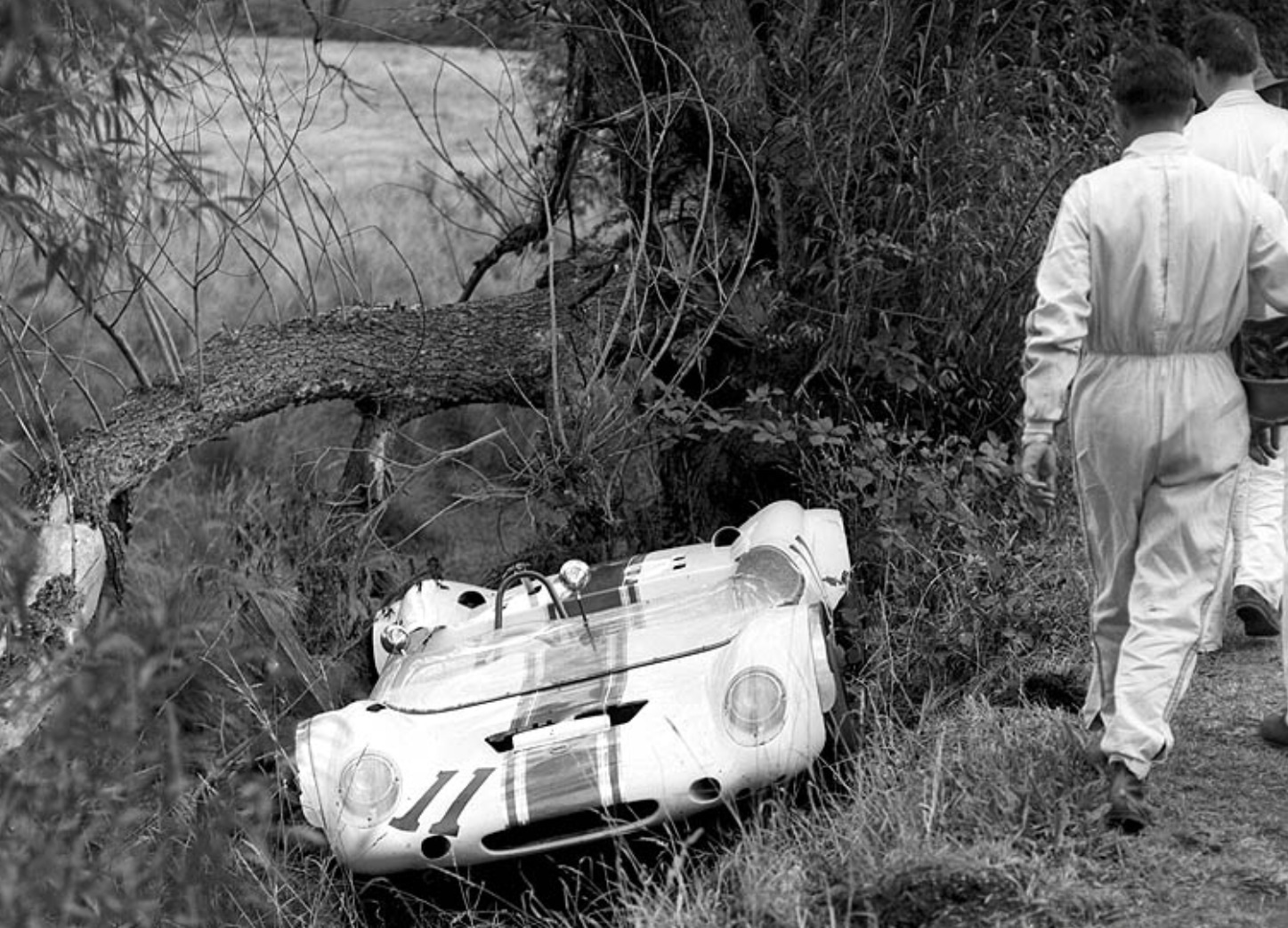
The opening photograph is of Graham Cullen’s CMS Vee, and he has a playmate in the undergrowth too- who is it? No he doesn’t, its just that his bodywork has become separated from the chassis on his trip through the undergrowth. The driver of car #71 zipping past the long-suffering marshalls is Garry Nielsen in a Tasman- I wonder who built these cars?


(M Hickey)


CMS is short for ‘Cullen Marine Services’ Graham Cullen’s primary business, he built about twelve of these ladder framed cars in the early Australian Vee years in the mid to late sixties.

By the time I had driver/engineer Peter Ward look after my Venom Mk2 FV circa 1979- he was building CMS’s of a totally different kind- very quick spaceframe cars raced by he and David Eyre-Walker and one or two others.

Like every man and his dog Wardy had an Elfin NG Vee copy he named ‘Spectre’, of which he built plenty in his Ross Street, Balwyn, Melbourne backyard workshop. I never worked out why Elfin Chief Garrie Cooper didn’t take to the cleaners all the pericks who knocked off that great design! Still, often the last thing to be found in a court of law is justice.


(oldracephotos/DKeep)


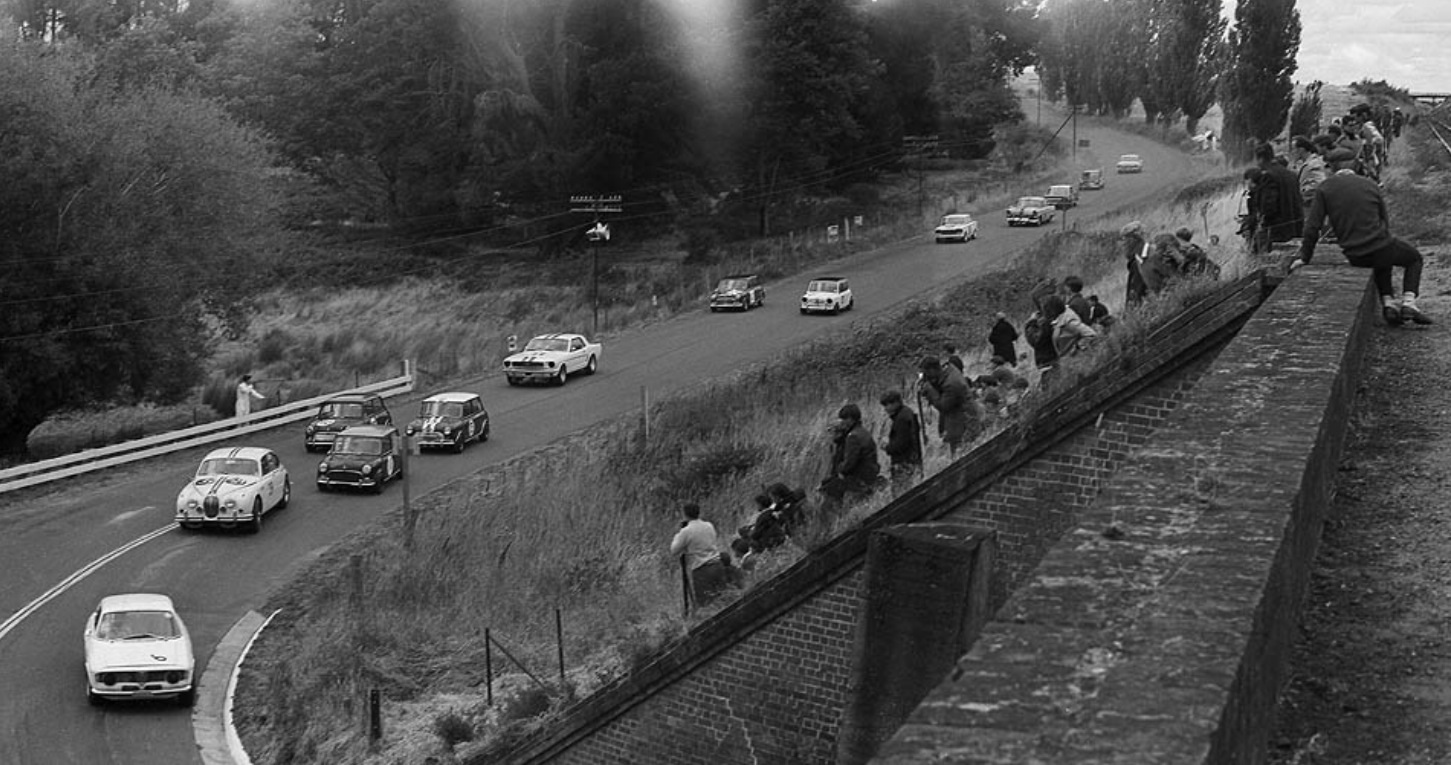
This panoramic shot of Frank Gardner leading the Touring Car pack down the hill into the Viaduct gives us some perspective- what a mega spot for spectators, blow the photo up and you can see the train line. I’ll take advice on the drivers too folks, but I guess its Bruno Carosi in the Jag Mk2 and Robin Pare in Don Elliott’s white Mustang. Rob Bartholomaeus and Bill Hollingsworth have Bob Holden in the ‘striped’ Cooper S, Gene Cooke in the Fiat 1500 and Rob Boote in the Holden EH. The year is 1967.

Have a look at this article on the Alec Mildren Racing Alfa GTA’s and their pilots; https://primotipo.com/2014/11/27/the-master-of-opposite-lock-kevin-bartlett-alfa-romeo-gta/


(oldracephotos/DKeep)


Then lets have a look at JYS in his BRM at ground level, at about the point Frank is turning in and pretty much the car at the same point from above, peering down into the cockpit.

Jackie looks as ‘snug as a bug in a rug’ inside that tight cocoon- unbelted as he is.

The shot above is of P261 ‘2614’ in 1966, he won the race from Graham Hill’s similar car and Jack Brabham’s Brabham BT19 Repco. Look closely, the engine is a crossflow 1930cc P60 V8- inlets within the Vee and exhausts outside. Check out this article on the BRM P56/P60 V8; https://primotipo.com/2016/02/05/motori-porno-stackpipe-brm-v8/


(oldracephotos/Keep)


Whereas the photo above is in 1967, again the car is ‘2614’ albeit this time powered by a P60 V8 of a different configuration- see the exhausts between the Vee, and its of 2070cc in capacity.

Jackie DNF with gearbox problems- which was the weak link of the BRM’s that season, the power and torque of the larger engine was beyond the design limits of a gearbox first built for engines of 1.5 litres- the GP formula of the time.

Brabham won that day in BT23A Repco ‘740’ from Clark’s Lotus 33 Climax FWMV 2 litre V8- the Tasman Championship winning combo that year. It too was a stretched, in terms of engine, 1.5 litre F1 car. Here is a piece about the 1967 Tasman and the fortunes of Stewart, Clark and Hulme; https://primotipo.com/2014/11/24/1967-hulme-stewart-and-clark-levin-new-zealand-tasman-and-beyond/


(oldracephotos/DKeep)


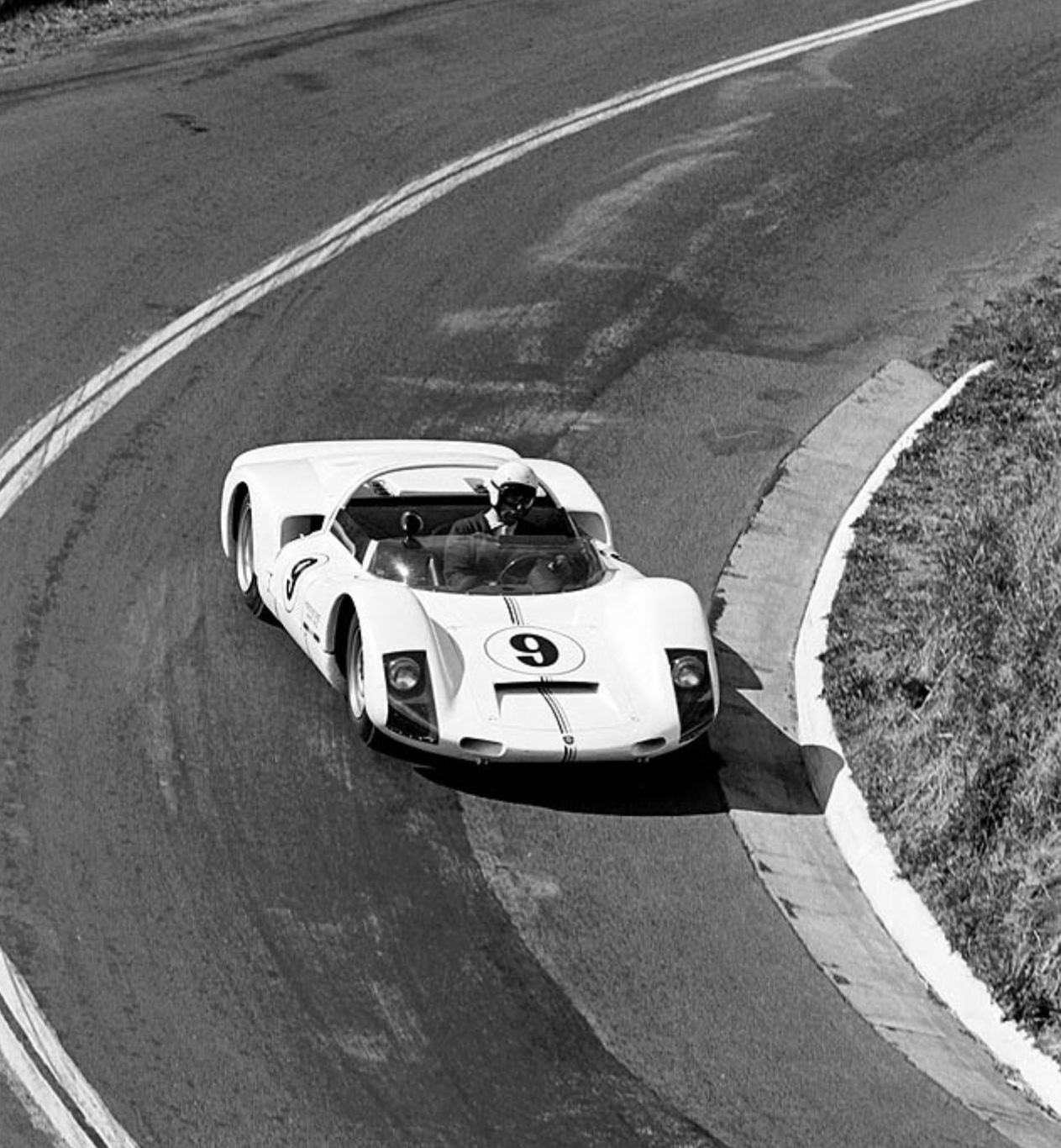
Similar turn-in shot for Alan Hamilton who has his Porsche 906 Spyder beautifully cocked up in a delicate little slide- these cars were great, forgiving, customer machines.

Here is a bit more about them- Alan and his 906’s; https://primotipo.com/2015/08/20/alan-hamilton-his-porsche-9048-and-two-906s/


(oldracehotos/DKeep)


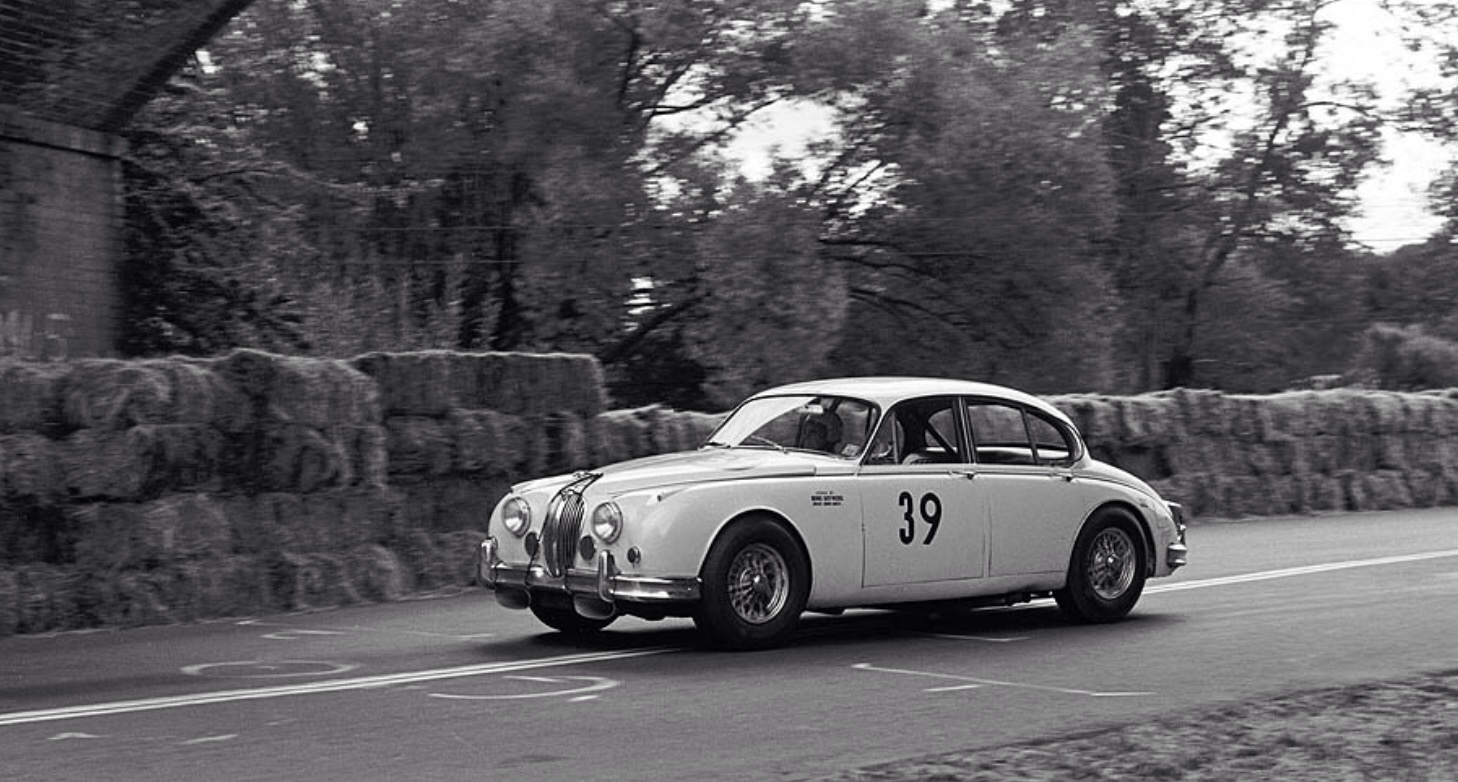
Bruno Carosi in the ex-Bob Jane Jaguar Mk2 is under the Viaduct in 1967, whilst the shot below is of Doug Whiteford’s Maserati 300S just as he enters the light- by the look of that number on his cars nose its during the 1959 Australian Grand Prix meeting in which Dicer Doug failed to finish having driveshaft failure on the first lap- Stan Jones won the event in his Maserati 250F.

That race is covered here; https://primotipo.com/2016/01/08/stan-jones-agp-longford-gold-star-series-1959/


(oldracephotos/DSaward)


(oldracephotos/DKeep)


David Keep has a really unusual and interesting view of Pete Geoghegan chasing Frank Gardner away from the Viaduct and towards Kings Bridge, its 1967 again.

Who won the Taxi races?, my money is on Pete despite the more nimble attributes of the GTA. See here; https://primotipo.com/2017/10/17/he-came-he-saw-he-conquered/


(oldracephotos/Harrisson)


Things went wrong of course.

The Viaduct had a fast approach- downhill, a tricky turn-in and bugger-all in the way of run-orf areas to capture the steed which has just gotten away from you, should that particular situation occur.

Which of course it did, as in this series of happy snaps!


(oldracephotos/Harrisson)


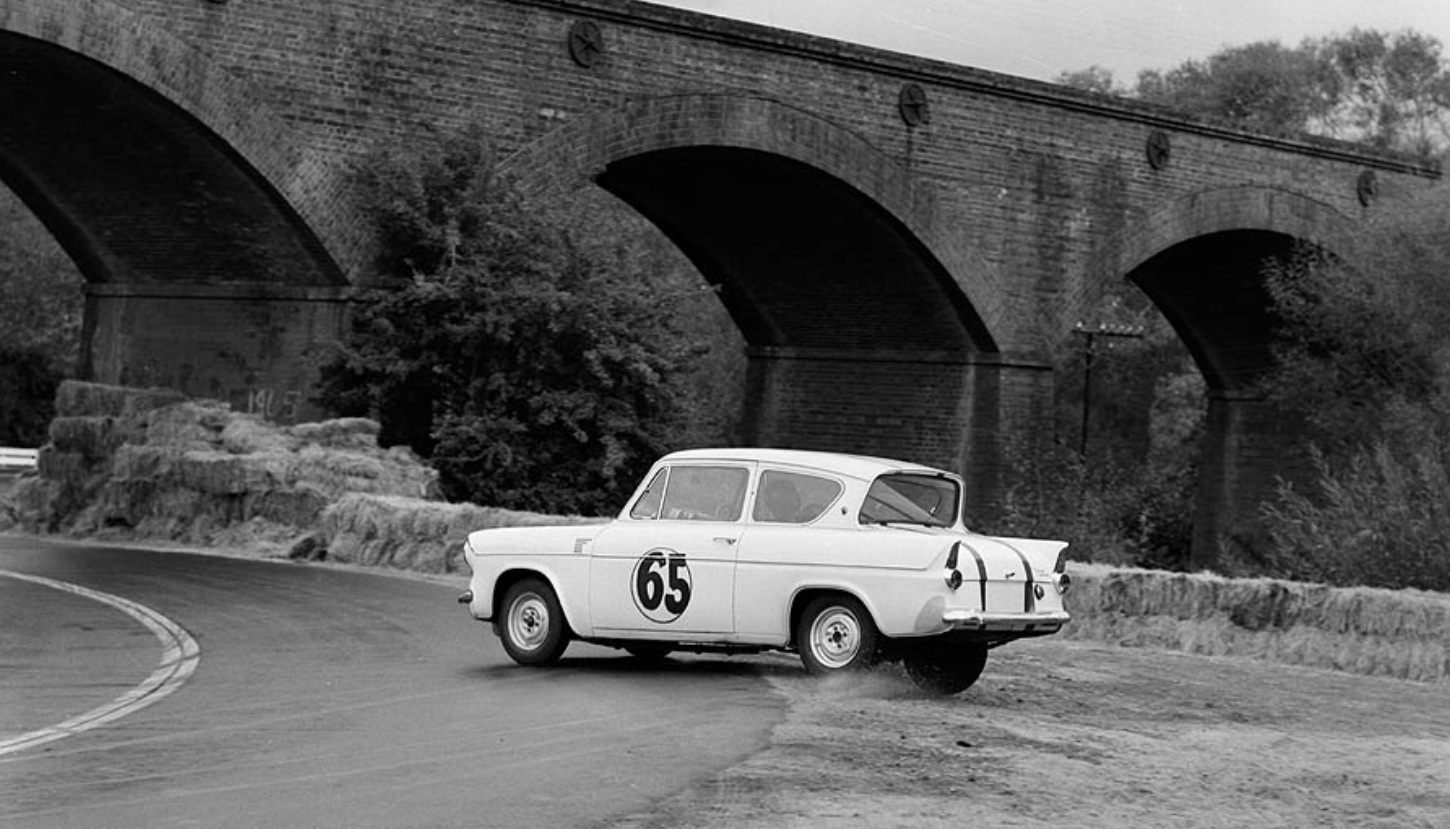
Phil Brooke looks fairly happy with himself so presumably he has not done too much damage to his pride and joy on that greasy race-day in 1968, we can’t see the rear of the little Angle-box mind you.


(oldracephotos/Harrisson)


Bruno has painted his Jag between the 1967 and 1968 meetings, he is just about to alight the machine being very careful where he pops his feet. Still, too much action about the place for the snakes to show interest I guess. They do have snakes down there I think?- just Googled, they do, copperheads, tigers and white-lipped, none particularly friendly or good for you.


(oldracephotos/Harrisson)


Lionel Ayers Rennmax built MRC Lotus 23B Ford looks as though it is suspended in a tree but its probably on solid’ish ground. It will may need a wheel alignment before tomorrow’s race all the same. Its 1968.


(oldracephotos/Harrisson)


Daryl Wilcox looks as though he has had a moment on the way into the corner and is perched precariously half on and half off the road. Just looked again it might be on the exit? Phil Brook’e youthful face I can just make out to the left of the copper’s head- clearly both chappies have left the island on the notoriously wet last day of racing ever at Longford on Monday 4th of March1968.


Credits…

oldracephotos.com.au and in particular the work of David Keep who is for sure one of the Longford photographic gods, not to forget Mr Harrisson as well. Michael Hickey Collection


Tailpiece: Up The Escape Road…

(oldracephotos/DKeep)


To get the entry to the escape road right takes real skill under pressure- so maybe Darryl O’Toole bailed real early in his Humpy. Its not a back road to Longford mind you- he is about to run out of gravel soonish.


(KBY191)


This November 2018 photograph by KBY191 shows that ‘The Viaduct and railway are still there, however nothing remains of the old track running down to The Viaduct since reconstruction of Illawarra Road which also bisects Tannery Straight with a round-about’.


Finito…

1953 AGP grid. Front row L>R Davison HWM Jag, Jones Maybach 1, Whiteford Talbot-Lago T26C, car 11 on row 2 is Ted Gray Alta Ford V8 (Dacre Stubbs)

The allocation of the 1953 Australian Grand Prix to Albert Park was the result of over two decades of work by the Light Car Club of Australia…

I live 800 metres from Albert Park Lake, I awoke this morning to F1 music at 7.05 AM- the sound of two-seater Minardi V10 engined cars ferrying their lucky cargo around gods motor racing country at high speed. The dawn of the 2019 race seems an apt time to upload this article on the 1953 event- the first Albert Park AGP.

Barry Green in his wonderful book ‘Glory Days’, writes that there was a strong push to race at Albert Park in 1934. The Light Car Club of Australia, (LCCA) the promoter of race meetings at Phillip Island were aware of the ‘Islands growing unsuitability given its loose gravel surface as speeds increased.’ Extensive negotiations secured Albert Park as the venue for a race meeting to celebrate the Centenary of Victoria in 1935.

The ‘Sun News Pictorial’ one of the Melbourne daily tabloids, and then as now a good thing in which to wrap ones fish n’ chips, announced the event on June 4 1934.

In doing so the ‘paper lit the fuse of naysayers who brought about the events cancellation, but not before racers Arthur Terdich, Bill Lowe, Barney Dentry, and Cyril Dickason in Bugatti, Lombard, and Austins respectively, lapped the track with mufflers fitted to prove noise wasn’t the issue.’

Stan Jones at speed in Maybach 1, Albert Park 1953, DNF. Stan made this series of cars sing, Maybach 1 won the ’54 NZ GP at Ardmore but none of the Maybachs- 1,2,3 or 4 won an AGP, such a shame! If the Chamberlain 8 is Australia’s most brilliant and innovative special surely the Maybachs are the greatest? Hopeless bias declared! (R Fulford /SLV)

Post war things were little different, but a partnership between the LCCA, the Australian Army- who had a facility at Albert Park, and Victorian Labor Senator Pat Kennelly was more successful.

The three groups/people provided the combination of race organisation, promotional ability, logistical capability- the Army being able to ‘man’ Albert Park, a site of some 570 acres, and political power and influence.

For all, the ability to raise funds in the aftermath of World War 2 was important. For the army, it was money for war widows and orphans, for Kennelly to finance much needed improvements to the park for to upgrade the local amenity, and for the LCCA, the betterment of motor racing.

The parties all were aware they needed to be very careful with the use of the facility so the event was a one day affair, with practice in the morning, racing in the afternoon with the roads open to the public in between. Total time absorbed by the racing activities was less than seven hours!

And so, the 1953 Australian Grand Prix, held at Albert Park over 64 laps, 200 miles in total, on Saturday 21 November, was won by Doug Whiteford in a Lago-Talbot, the last AGP win for ‘French Racing Blue’.

Doug Whiteford’s Talbot Lago T26C passes the abandoned MG Spl of Jack O’Dea on the way to victory. Writing on the side of the car is a list of race wins. Whiteford owned two TL26C’s- this one, 1948-ex Louis Chiron chassis ‘110007’ and later, an earlier but higher spec car, chassis ‘110002’. Vern Schuppan is the current owner of ‘110002’. Crowd right to the edge of the track (R Fulford/SLV)

Entry…

The entry list was headed by local Melbourne businessmen Doug Whiteford, Stan Jones and Lex Davison.

Whiteford was perhaps the form driver, he won the AGP at Mount Panorama the year before in the same Talbot-Lago T26C. Doug was a tough grafter who owned an automotive repair and sales business a drop kick from the shores of Albert Park Lake in Carlisle Street, St Kilda.

The preparation and presentation of all of his racers was legendary. His career stretched back well pre-war to motor cycles circa 1932. He raced Norman Hamilton’s blown Ford. V8 Spl at Phillip Island circa 1935, an MG Magnette and a supercharged Ford Roadster before building the Ford Ute based ‘Black Bess’ his 1950 AGP winner.

A racer to the core, he competed all the way through into the early to mid seventies, after his long time at elite level, as a works driver for the Datsun Racing Team in small sedans and sportscars.

What a shot! Not at Albert Park I hasten to add, Fishermans Bend is my guess. Whiteford changing plugs on his TL T26C. A mechanic by trade, he toiled on his own cars, his race record, standard of preparation and presentation legendary. Date unknown (R Fulford/SLV)

On the up was Stanley Jones, another tough nugget from Warrandyte, rapidly building an automotive retailing empire which would fund an impressive array of racers over the decade to come- all of which would come tumbling down in the credit squeeze of 1961. Jones had thrown in his lot with Charlie Dean and Repco a year or so before- Jones bought Maybach from Dean with Charlie and his team at Repco Research in Brunswick continuing to maintain and develop it. Jones was as forceful as Whiteford was stylish- both were impressively fast.

Also on the rise was Lex Davison, native of St Kilda but then a resident of Lilydale and fast building the shoe manufacture, importing and retailing business he inherited from his father.

Lex by this stage had learned his craft on a varied mix of cars, most recently an Alfa Romeo Tipo B/P3 GP car. He had just bought an ex-Moss/Gaze F2 HWM to which he fitted a Jaguar 3.4 litre six-cylinder DOHC engine to ‘C Type’ specs and gearbox, this clever combination took his first AGP win at Southport, Queensland in 1954- a race Jones had a mortgage on until the chassis failure of Maybach 2 at very high speed.

Elite Racers All: L>R Jack Brabham Cooper T23 Bristo, third in this group, #3 Lex Davison HWM Jag and #8 Ted Gray Alta Ford V8. Shot included to show the HWM and Alta- Victoria Trophy Fishermans Bend 22 March 1954. Lex is soon to win the ’54 AGP, Jack is soon to travel to the UK and Gray is soon to get a competitive mount in Tornado 1 Ford! (VHRR)

Lex was an urbane man of considerable wit, bearing and charm- but he could and did go toe to toe with racers of Whiteford and Jones ilk and beat them. His career, which had far from peaked in 1953 stretched all the way to early 1965 when he shared the front row of the NZ GP grid with Clark and Hill, a couple of fellas ‘still in short pants’ in 1953.

Frank Kleinig and his Kleinig-Hudson straight-8 Spl could not be discounted nor could the Ted Gray driven Alta Ford V8 Spl- much more would be seen of this outstanding pre-war driver who cut his teeth on the country speedways of Victoria in the years to 1960 with the Lou Abrahams owned Tornados 1 and 2.

Oh to have seen this bloke drive at his best!- as here at Rob Roy Hillclimb, 2 November 1947. Frank Kleinig, Kleinig Hudson 8 Spl, a remarkable marriage of MG chassis, Hudson mechanicals and various other donor parts continuously developed over a couple of decades. A car which shoulda won at least one AGP. Kleinig another driver/mechanic ace (G Thomas)

Kleinig should have won an AGP or two, or three.

The Sydney driver was one of the very quickest immediately pre and post war but times had changed. The AGP was now a scratch race, not a handicap and Frank’s machine, development of which never stopped simply wasn’t quick enough to win outright whatever the undoubted skills of the bloke behind the wheel.

Ted and Frank both needed the ‘guns’ up front to retire and have a dose of reliability themselves for the long 200 mile race to win.

The Reg Nutt, Talbot Darracq 700, DNF dropped valve on lap 14 (Dacre Stubbs)

The balance of the entry was a swag of MG Specials, pre-war GP cars, sports cars and a sprinkling of Coopers including several new fangled JAP mid-engined cars.

Above and below. Davison, Jones and Whiteford. Further back #11 Gray, his Ford V8 creating the smokescreen, #7 Kleinig, #10 Hayes Ford V8 Spl #6 Vennermark/Warren Maser 4CL (unattributed)

Practice and the Race…

Practice commenced early at 8.30 AM and before too long their was drama aplenty amongst the topliners.

Davison’s HWM suffered bearing problems in practice, the session started at 8.30am, the team linished them as best they could prior to the race start at 2.30 pm, but the same affliction stopped the car during the race.

Another top driver I didn’t mention above was Sydney ex-speedway star Jack Brabham but his new Cooper T23 Bristol succumbed in the morning session, like Davison, to bearing problems. The ace engineer/mechanic did of course turn this car into rather a formidable weapon- one which inspired him to try his hand in England a year or so hence.

Also having practice dramas was Whiteford, who had a lose, the car was quickly loaded up and trailered back to Doug’s ‘shop closeby ‘…where the front suspension was stripped. Jim Hawker used the table of a mill as a surface plate and found a bent stub axle he straightened in a press. The Lago also needed a new flexible hose; without a word Whiteford took a pair of side-cutters, walked across to the pre-War Triumph his nephew Doug McLean was rebuilding and liberated precisely the correct hose. This was fitted, the brakes were bled…’ wrote Graham Howard.

The Jones Maybach in for the pitstop which changed the race, albeit the car retired in any event. Passing is the Jag XK120 of Frank Lobb (Dacre Stubbs)

From atop a double-decker bus race officials and a crowd estimated by local newspapers variously at between 50,000 and 70,000 people saw Whiteford, Jones and Davison form the front row with Lex’ HWM leading into the first corner under heavy, muggy skies.

The start was fraught and chaotic as several crews were still with their driver and car as the flag dropped!

Davo’s lead was shortlived, Stanley passed him on the first lap and then drew away. McKinnon was a lap 1 casualty when he nosed the hay-bales but got going again, Arthur Wylie spun the Jowett Javelin Spl at Jaguar Corner but he too got going.

Early in the race Jones led Whiteford, Davison, Arthur Wylie’s Jowett powered Wylie Javelin and Curley Brydon’s  ex-Bill Patterson MG TC Spl.

Davo was out on lap 3, he watched the balance of the event from Stan’s pit.

Bob Pritchett in Australian Motor Sports (AMS) wrote that ‘The trouble with the HWM was that the oil pressure relief valve was cockeyed on its seat allowing all the oil to rush right back into the sump through bypass: most surprisingly, the XK120 oil pressure gauge is so hooked in that, under such circumstances, full pressure was still indicated. Lex’s boys did their best with emery strip and managed to have the car on the line for the GP, but it was of no avail.’

Same scene as above from a different angle- Charlie Dean at bottom right (unattributed)

By half distance Stan still had a good lead over Whiteford, but on lap 40 he pitted for fuel and with his Maybach straight-six engine overheating- the car also needed a water pump drive belt.

His crew were not expecting him and in the confusion Stan was bathed in methanol fuel which necessitated a speedy dismount and then being doused in water before returning to the fray.

Whiteford could not believe his luck.

He perhaps lacked the pace to win, although Pritchett observed on the other hand that he didn’t think ‘Doug was unduly worried…Every few laps he would come up from his half-minute or so back and have a a look at the Maybach and then fall back into line again, so he must have had something up his sleeve’? Stan always pushed hard and was said to lack mechanical sympathy, something Doug had in spades. Jones retired Maybach on lap 56 with clutch failure.

Whiteford’s right rear separates from the Talbot Lago on the exit of Dunlop Corner (AMS)

It was not an easy win though.

Melbourne weather is capricious, the skies darkened and rain tumbled down and cars spun- Wal Gillespie’s HRG (shared with Thompson) amongst others. Spectators added to the challenge with ‘suicidal disregard for their own safety…John Calvert rammed a strawbale…when he had to take avoiding action. I suppose they just can’t understand that towards the end of the straight, the quick drivers are covering the best part of fifty yards each second…’ Pritchett mused.

Whiteford slows the TL 26C at the pits to change wheels having lost his right rear tyre. Fortunately the separation happened close to the pits and his efficient crew (Fairfax)

Two laps from home the right-rear tyre of the T26C came off its rim, fortunately only 300 metres from the pits.

After a stop of 30 seconds to change the wheel, with a huge gap to his pursuers, the local lad was on his way to win the race ‘in a Largo Talbot by 5 laps at an average speed of 82 mph for the 200 miles’ The Melbourne Sun, with its characteristic great attention to motor racing reporting detail, recorded in its 22 November account of the race.

Curley Brydon, a member of the RAAF’s crack 78 fighter squadron during the war, was second in his MG TC Spl 5 laps adrift and South Australian Andy Brown third in an MG K3 Magnette. Then came former AGP winner Les Murphy, MG Q Type and Lou Molina in the MM Holden Spl sportscar

Third placed Andy Brown’s very pre-war MG K3 in for a pitstop. K3 ‘030’ still in Oz- ex-Bira/Snow/Dunne/Davison/Brown and many others! (Dacre Stubbs)

Graham Howard in his ‘History of The Australian Grand Prix’ (HAGP) account of the race reports on some post race controversy which reader and owner of the Curley Brydon TC, Richard Townley develops further in his note below this article.

Howard wrote ‘…Curley Brydon, who had provisionally been placed third, protested that too many people had assisted with Whiteford’s tyre change, and indeed it was suggested one of the helpers was no more than a gate-crashing spectator; but it was agreed that Whiteford could have changed the wheel single-handed and still had time to win, and Brydon’s protest was withdrawn.

Curley Brydon, in the 2nd placed MG TC Spl s/c leads the 16th placed John Nind MG TB Spl (K Wheeler)

Whiteford is quoted in the Sydney Morning Herald (SMH) as saying ‘Our pit was very congested and there were more spectators around than mechanics. Evidently someone we didn’t know tried to help.’ Note that the SMH report states the protests were heard on Sunday 22 November, the day after the race.

As Richard Townley relates in his comments post publication of this article, Phil Irving wrote in his autobiography that Whiteford ‘…was not immediately declared the winner, through an unofficial report that he had been helped by a bystander to get the Talbot back on course after over-shooting a corner. Not having the use of a telephone, the marshal on the corner concerned wrote out a report to be delivered to the Clerk of The Course, who did not receive it until long after after the race had ended.’

‘Doug, who knew the rule book by heart was aware that the official report of the incident had not been lodged within the stipulated half-hour of the race finish, and shrewdly claimed that it was ultra vires and could not form the basis of a protest. This view being upheld by the stewards, Doug was awarded his third AGP, but it was not a very popular victory’ Irving wrote.

Let’s come back to this after dealing with the balance of the protests.

Howard continues ‘However, he (Brydon) also protested Andy Brown’s second placing, and after investigation it was agreed Brydon was second: Murphy protested Brown as well, claiming to have passed him on the last lap, but this was not upheld.’

‘Fifth was Lou Molina first time out in the neat little Holden-engined MM Special, and the first AGP finish for a Holden engine, Sixth was Jim Leech, a nice reward for his part in securing Albert Park for the race.’

‘Seventh, with a plug lead off, with only first and fourth gears useable and with his seat belt broken, was Frank Kleinig; from six AGP starts, going back 15 years to 1938, it was the cars first finish, and very popular. Nonetheless, the days of 15-year old AGP cars could not last much longer’ Howard concluded.

No doubt Kleinig was well pleased with the result as Pritchett wrote that he left Sydney very late for the meeting with trade-plates affixed to the racer to run it in on the Hume Highway!- when that process was complete the car took its place on the trailer for the balance of the trip south.

So what do we make of Phil Irving’s claims of Whiteford receiving outside assistance?

I can find no record of this in any of the published information I have access to. It is not mentioned in any of the contemporary newspaper reports of the meeting- not in Howard’s AGP account in HAGP, Howard’s ‘Lex Davison: Larger Than Life’, Barry Green’s superb long piece on the meeting in ‘Albert Park Glory Days’ or in the November or December 1953 issues of Australian Motor Sports.

Lets not forget that the protests were heard and decided, according to the SMH, on the day after the race- Sunday 22 November. The Stewards of the meeting, given all of the circumstances, and I have in mind the logistics of communication at the meeting, could choose to admit as evidence what they saw as appropriate- and call witnesses. By that I mean the Marshal concerned could have been called, and no doubt others who were stationed on the corner at the time to give their account of what Irving wrote occurred, to the Stewards, and for them to then make a determination accordingly. So, on balance, and in the absence of other accounts which agree with Irving’s I don’t believe his version of events to be the correct one. I am happy to alter that position if other proof, a photograph or first-hand spectators recollection, for example can be made available.

I wonder if Phil, writing his book years later- it was published after his death in 1992, is somehow linking DW’s Saturday morning practice spin with the Saturday post-event protests? Irving makes no mention in his book of the other protests addressed by Howard, Green and the SMH in their reports. Intriguing isn’t it?

(Fairfax)

Winners are Grinners: ‘Dicer Doug’ has won his third and last AGP.

His birthdate is a bit of a mystery but a consensus seems to be during 1914, so it makes him 39, still a young man albeit a racing veteran of not far short of 20 years then.

A great shame to me was his purchase of a 300S Maserati when the factory lobbed with five cars- three 250F’s and two 300S for the 1956 AGP right here at Albert Park- those machines were driven by Messrs Moss and Behra.

I mean it’s a shame in that, if he had bought and raced a 250F he would have been right in amongst Jones, Davison, Reg Hunt and Ted Gray with an equal car. He made the 300S sing but a 250F would have been a more appropriate car methinks

Things go better with Melbourne Bitter- Coke in this case for ‘Dicer Doug’ (Fairfax)

’53 AGP Australian Motor Racing Context…

This excerpt from the 1953-54 LCCA Annual Report is self explanatory and whilst it is self-serving does provided valuable information about the positive impact of the event in terms of the public’s perception of motor racing.

‘When your committee finally obtained permission to conduct the Australian Grand Prix on Albert Park circuit the victory was only half won.

To overcome public prejudice has been the major bugbear of organised racing on public roads and any incompetent handling of this delicate situation could easily have touched off an explosion of indignation.

That we did not receive even one complaint can be attributed to good fortune and untiring organisation of directors and officials. As it can be said that enthusiasts will make the best of the most adverse conditions, our achievements at Albert Park was the greater in having gratified both the general public and the competitors.

In justifying the faith which the Albert Park Trust, inexperienced in motor racing, was prepared to place in our ability, we have broken down one of the few remaining barriers to a more general acceptance of motor racing as one of the national sports.’

Etcetera…

Whereizzit?! Whiteford sneaks a peek at what he already knows- his pit is close and he has 5 laps in hand, but still a heart in the mouth moment.

Bob King recalls the moment ‘My memory says I saw Doug on the bare rim at Melford Corner, but this must be wrong. This photo is probably taken on the way from Jaguar Corner (which is still there if you look for it) and the pits. After all, I was only 15 and it was my first motor race: A life changing event.’

(S Wills)

Ted McKinnon’s 15th placed Maserati 6CM1500. An ex-works car, this machine first raced in Australia at the 1951 AGP at Narrogin, WA, raced by visiting Englishman Colin Murray.

Car #57 alongside is not entered in the AGP (Dacre Stubbs)

(Dacre Stubbs)

(D Elms)

Lou Molina’s fifth placed Molina Monza Holden Special and then Les Murphy, MG Q Type fourth, about to be rounded up at speed by Stan Jones in Maybach 1- an unusual angle of Albert Park at its south end.

(D Zeunert Collection)

Cec Warren at the wheel of his Maserati 4CL #1579, he shared the drive with Peter Vennermark but the intrepid duo retired after 41 laps. Poor Cec died twelve months later. He was racing the car at Fishermans Bend in March 1954 and pulled into the pits for adjustments, he collapsed and died shortly thereafter.

(R Townley)

Bibliography…

‘History of The Australian Grand Prix’ Graham Howard and ors, ‘Lex Davison: Larger Than Life’ Graham Howard, ‘Phil Irving: An Autobiography’, ‘Glory Days’ Barry Green, Australian Motor Sports December 1953,

Melbourne Sun 22 November 1953, Sydney Morning Herald 23 November 1953

Photo Credits…

Dacre Stubbs Collection-Martin Stubbs, R Fulford Collection, State Library of Victoria, VHRR Collection, Fairfax Media, Ken Wheeler via Richard Townley Collection, Spencer Wills via Bob King Collection, David Zeunert Collection

Tailpiece: Whiteford on the way to victory, Talbot-Lago T26C…

(R Fulford/SLV)

Finito…

The #26 Ron Ward sixth placed MG TB, #32 Alby Johnson DNF MG TC and a distant Gordon Stewart DNF, MG Magna L-Type, during the 16 June 1947, Championship of New South Wales meeting at RAAF Nowra airbase…

This event was to have been the New South Wales Grand Prix until the intervention of the Australian Automobile Association, the governing body of motorsport in Australia at the time, a week before. They deemed the Grand Prix title as one reserved exclusively for the Australian Grand Prix. Contemporary newspaper reports of the day indicate the confusion about the name of the race, variously describing it as The Grand Prix, Grand Prix Speedcar Championship of New South Wales, the official title seems to be the 1947 Championship of New South Wales.

The 110 mile handicap was conducted over 25 laps of a 4.35 mile course laid out on runways and connecting taxiways of what, over the years, was variously named RAAF Nowra, HMS Nabbington and in more recent times HMAS Albatross. The airfield also hosted a race in 1952, on that occasion using taxiways, hard-stands and aprons for a shorter lap distance of 1.6 miles.

Luvvit! Alf Barrett’s road registered Alfa Monza at Rob Roy circa 1949. The fastest combo in Australia in the immediate pre and post war years (J Montasell)

The event organisers, the Australian Sporting Car Club, secured all of the aces of the day: Alf Barrett in his Alfa Monza, Frank Kleinig’s Hudson Spl, John Crouch in the Delahaye 135CS imported by John Snow pre-war, and the latter in his Dixon Riley.

Some past, present and future racers entered a variety of MGs including Curley Brydon, Alf Najar, Bib Stillwell, Bill Patterson, Hope Bartlett, John Barraclough and Ron Edgerton. Other notables included Lex Davison, Mercedes 38/250 s/c, Tom Sulman in the immortal Sulman Singer, Ted Gray in the ex-Mrs JAS Jones Alfa 6C1750 SS by then fitted with a flat-head Ford V8, ‘Wild Bill’ Murray, Hudson, Alec Mildren, AGM Ford V8 Spl and others.

(J Hunter)

The Nowra grid ready for the off. From left to right: #5 Jack Murray MacKellar Ford V8 s/c,  #3 John Crouch Delahaye 135CS, #14 Alec Mildren, AGM Ford V8 Special, #4 Frank Kleinig, Hudson Spl and #1 Alf Barrett’s Alfa Romeo Monza.

Frank Kleinig didn’t take the start with piston failure so perhaps this an earlier event. I am intrigued to know.

John Crouch on the way to Australian Grand Prix victory in the John Snow imported Delahaye 135CS at the Leyburn Airfield circuit in 1949 (unattributed)

There were 38 entries in all, from New South Wales, Queensland and Victoria which reflected the pent up demand for racing in the early post-war years.

Crowd estimates vary between 15,000 to 25,000 people. They saw Manly, Sydney driver Tom Lancey’s MG TC win the race from a field of 30 who took the starters flag.

Lancey had raced for three years before the conflict in an MG NE Magnette and spent six years with the RAAF during the war so it was a nice bit of symmetry for an RAAF bloke to take the win at an RAAF base. He was off a handicap of 21 minutes 30 seconds, the Barrett Alfa raced off scratch.

Second and third places were also taken by MGs: Bill MacLachlan in an MG TA monoposto off 14:30 and Curley Brydon aboard an MG TC, 21:30 with Dick Bland’s Ford V8 Spl off 11:00 fourth.

John Medley wrote, ‘Tom Lancey packed his wife and young daughter into his fully equipped, road registered MG TC at his Manly home- drove to Nowra, unpacked, removed the screen and hood, started in the NSW GP as an early marker- and won it…’ Then he did the whole process in reverse. The simplicity of it all is wonderful.

I was thrilled to find this shot which is captioned as the ’47 Nowra NSW GP/Championship, but is, according to John Medley, Hell Corner, Bathurst during the October 1939 meeting. #5 is the ‘Salmon Special’ McIntyre Hudson of Kevin Salmon, #6 is the Edison Waters Jaguar SS100, #1 Alf Barrett’s Alfa Monza, #4 John Crouch Delahaye 135CS and #9 John Barraclough, Alvis Terraplane (Fairfax)

The race favourite was Australia’s immediate pre and post war ace, Alf Barrett, in his beautifully prepared and presented Alfa Romeo 8C2300 Monza which ‘is considered the fastest car in Australia’.

Alf and John Snow in the Dixon Riley ‘were fighting a fierce duel from the back mark’ (Snow raced off a 2 minute handicap) but Alf lost time with a tyre change earlier in the race and engine problems later on- he was ninth and set the fastest race lap. Snow retired with magneto or spark plug problems on lap 18.

The newspaper reports focused on Barrett’s top speed of 120 miles per hour which provides perspective on the average performance levels of commuter bolides of the time.

Barrett’s day was not altogether lost, with a win in the Over 1500cc Championship scratch in which the thoroughbred straight-eight Grand Prix Alfa prevailed over Frank Kleinig’s self built and developed Kleinig Hudson Spl and John Snow’s Dixon Riley.

There are plenty of photos of ‘Dirt Track Charlie’ Frank Kleinig aboard his Kleinig Hudson Spl because he raced the ever developing steed for so long, but this is my favourite. He is re-taking the Rob Roy Hill record he first set in the car in 1939, in November 1948 setting a mark of 28.72 secs- his last trip to the Christmas Hills. You can see and feel the energy and effort going into the big, powerful car, as was always the case with this very fast, if somewhat, it’s said, inconsistent driver (G Thomas)

Kleinig’s amazing machine, competitive over a couple of decades, was an amalgam of many parts but particularly an MG L-Type chassis and very highly developed Hudson 4186cc straight-eight engine. He finished the race 14 seconds adrift of Barrett. It was subsequently found that a piston broke, fouling the oil system, running a rear big end bearing and ruining the crankshaft in the process.

One of the great pre and post war ‘what ifs’ is Kleinig in a thoroughbred car, not that his commitment, brio, engineering nouse and application was in any way lacking in his endeavours with his special! Kleinig in Snow’s Delahaye or Barrett’s Alfa would have been a sight to see. End of digression!

Amongst the long list of Nowra DNFs was 1960 AGP and Gold Star winner Alec Mildren’s attractive and fast, self-built AGM Ford V8 Spl. The big beast, off a handicap of 12 minutes, overheated, with Alec retiring on lap 14, a common affliction of these engines in modified form (Mildren)

Pre-war Maroubra Speedway ace, Hope Bartlett won the Under 1500cc championship in his MG TA s/c after a race long battle with Alf Najar’s MG TB s/c. Gordon Stewart in an MG Magna L Type was well in the lead of the Under 1100cc title- and then, having to coast to the finishing line after a last lap fuel blockage, was passed by Tom Sulman in his self-built Sulman Singer and Bruce Myers’ Riley Imp in the final stages.

Some excitement was added to the meeting ‘when a privately owned plane landed on the strip which was being used for the car racing. Service and local police ordered the pilot to remain until after the meeting’!

WW2 shot of RAAF Nowra (RAAF)

Postscript: The state of Australian circuits in 1947…

A sign of the times and the use of a venue such as Nowra was the September 1947 meeting of the Australian Automobile Association in Perth during which the allocations of the AGP was announced for the next few years: NSW 1947, Victoria 1948, Queensland 1949, South Australia 1950 and Western Australia 1951. It was noted that ‘Victoria had not a suitable circuit for the Grand Prix at present but it was hoped that such property could be secured on Phillip Island’.

Of course Phillip Island was reinstated as the racing venue we know and love but not until December 1956, the Albert Park Lake facility ended up being the ‘in period’ AGP Victorian venue in 1953 and 1956.

In fact the race allocations went ahead as planned: in NSW, 1947 at Bathurst, 1948 at Point Cook just outside Melbourne, 1949 at Leyburn, 200 km from Brisbane, 1950 at Nuriootpa in SA’s Barossa Valley and 1951 at Narrogin south of Perth in WA’s wheatbelt.

Nowra, Point Cook, Mount Druitt and Leyburn were all current or past RAAF bases with Narrogin a ‘Round the Houses’ venue used on numerous occasions whilst the Nuriootpa road circuit was not used for motor racing after its time in the sun as a one off AGP venue. The search and challenge of finding permanent road-racing venues was on throughout Australia in earnest.

At the time of the Australian Automobile Association meeting Mr J Austin Patterson said that ‘the greatest desire (of the AAA) was to help the sporting bodies and the sport generally. At present motor sports were up against police opposition. This could not be overcome unless it could be shown that meetings could be held without danger and undue inconvenience to the public.’

In a similar vein, the NSW Light Car Club put a proposal to the Blue Mountains Chamber of Commerce for the establishment of a race track at Katoomba in October 1947, it took a while but Catalina Park opened in February 1961.

Of course the ‘floodgates’ of circuits opened in the mid to late 1950s and early 1960s with Port Wakefield, Warwick Farm, Lakeside, Sandown, Calder, Mallala and others opening, but such numbers of permanent facilities were a long time coming.

Car rally from Canberra to Nowra in recent times, one flat airfield looks pretty much the same as another really! (unattributed)

Bibliography and Photo Credits…

The Sydney Morning Herald 17 June 1947, Fairfax Media, John Hunter, The Telegraph Brisbane 22 July 1947, J Montasell, George Thomas, Alec Mildren Collection, ‘Bathurst: Cradle of Australian Motor Racing’ John Medley

Finito…

(M Williams)

Lex Davison boots his Tasman Formula ex-Bruce McLaren Cooper T62 Climax off the line at Mount Tarrengower Hillclimb, Maldon, in Victoria’s Goldfields, 25 October 1964…

Davo just loved to compete- anywhere and everywhere. Apart from his four AGP wins he was adept on the dirt in Redex Round Australia Trials competition and in the hills. He won the Australian Hillclimb Championship thrice on the trot from 1955-1957 at Toowoomba, Bathurst and Albany respectively, in all cases aboard the Cooper Mk4 Vincent/Irving.

(M Williams)

This non-championship event was an easy one for the great man. Toorak to Maldon is a nice 150 km drive up the Calder Highway so would have represented a nice weekend away with the car and no doubt a few of his kids.

Having said that Tarrengower is still a very fast, dangerous place especially with a car of the performance envelope of Davo’s GP machine. This T62 chassis was Bruce McLaren’s 1962 Caversham AGP winner before its sale to Lex, and is a car I’ve written a feature about, click here to read it; https://primotipo.com/2016/05/20/bruce-lex-and-rockys-cooper-t62-climax/

The internet gives and gives in terms of photos seeing the light of day after decades hidden in boxes. This wonderful batch were taken by a friend of Max Williams, he posted them on Bob Williamson’s amazing Facebook ‘Old Motor Racing Photographs-Australia’ page. In amongst hundreds of recycled touring car photos are some jewels, including this lot!

(M Williams)

Bob King attended that day, it was ‘..the second hillclimb of the new era, the venue revived by the Vintage Sports Car Club of Victoria, with the event held on 25 October 1964’.

‘Graeme Thomson raced the ex-Whiteford Talbot Lago T26C but ‘Doug was there and advanced the magneto by about half a turn and then did an electric run. In those days the finish was right at the top, and having finished my run i was privileged to see Whiteford sideways across the finish line at about 100 mph. Davo was pretty exciting also taking the FTD with a 50.34 seconds run’.

(M Williams)

Ron Simmonds picked the ex-Whitehead/Jones/Phillips Cooper T38 Jaguar (above) as probably driven by John Ampt at Monks Corner, Templestowe Hillclimb, again in Victoria.

Enthusiast Les Hughes said of the car ‘One of three, the first and shown without body at the Paris Show. It was bought by Peter Whitehead and raced by he and his brother Graham at Le Mans and Dundrod in 1955. He sold it to Jones in New Zealand who made his Australian race debut in it at Albert Park’.

Pictured is the car below at Le Mans ‘…coming through The Esses and about to be passed by the ill-fated Pierre Levegh (Mercedes Benz 300SLR) who would die on this lap. The Cooper Jag retired’.

Another Templestowe shot below , the corner at the end of Banana Straight, the wide loop hairpin onto The Shelf which then led up to The Wall.

Who is it and what is it though?

( M Williams)

Credits…

Max Williams, Bob King, Les Hughes, Ron Simmonds, Greg Manderson

Tailpiece: MGA coming out of Monks and onto The Shelf at Templestowe…

(M Williams)

Finito…