Archive for the ‘Who,What,Where & When…?’ Category

image

(David Van Dal)

Morry Maurice competing in the the ‘Goomalling Speed Classic’ 7 June 1954, HRG 1500. Goomalling, Western Australia…

The two wonderful color photographs in this article are by David Van Dal of Morry Maurice’ HRG 1500 at Goomalling and Narrogin. Both are towns in Western Australia’s wheatbelt around 200km southeast of Perth. The  shot above is quintessential Australian country town, even today. The beautiful blue racing car and upright, stylish driver a contrast to the drab coloured background buildings and gum trees.

‘Round The Houses’ Racing in Western Australia…

WA has a rich history of ‘Round the Houses’ racing, such events were held on street circuits in many country towns there in the 1930’s, 40’s and 50’s. The first of these was held at Albany in 1936 and planned to emulate the style of racing common in Europe at the time.

The towns of Pingelly, Bunbury, Dowerin, Northam, Goomalling and Narrogin all held meetings with Narrogin hosting the Australian Grand Prix in March 1951. That event held in very hot conditions was watched by 35,000 people a long way from Perth, and won by Warwick Pratley in the Ford V8 powered ‘George Reed Special’.

maurice

Maurice at Northam, WA in 1954, HRG 1500. ‘Northam Flying 50’ 19 April 1954 (Ken Devine)

Maurice’ HRG was originally bought to Australia in 1949, it was one of an initial shipment of three chassis imported by Brown and Dureau, the Melbourne based distributors of the marque. The bodies for the cars were built locally. Like so many cars in Australia it was constantly modified in an effort to keep it competitive throughout the 1950’s as technology rapidly advanced. Click on this link for a good summary of the life and times of the 1948 HRG 1500 chassis #174 aka 1958 HRG Buchanan Holden ‘Godfrey Spl’;

http://www.buchananmotorcompany.com/HRG%20Buchanan%20Holden.htm

Goomalling…

Racing at Goomalling took place between 1949 and 1961. It was a prominent motorsport venue in the postwar years, taking over from Dowerin as one of the WA wheatbelt’s motorsport hubs. Motor racing was a reason for creation of the circuit but so was fundraising to pay for a new swimming pool in the town. Its scorching during the long, hot, dry summer months there!

Three racing mad returned servicemen; Milton Royal, Ted Nicholson and Charlie Dent were behind the track, the trio originally formed the Goomalling Sporting Car Club in 1939. That year the club held a small event at the abandoned Goomalling horse racing track before its three founders were called away to fight for their country over the skies of Europe, all were Air Force Officers. It wasn’t until 1949 that motorsport returned to Goomalling, the last ‘in period’ meeting the 1961 ‘Flying Fifty’.

image

(David van Dal)

Maurice’ HRG 1500 again, this time at Narrogin in ‘The Great Southern Fifty’ meeting on 2 March 1953…

My brother lives in Perth, WA, I spend a lot of time there and in the Margaret River region down south, this topography and soil is so WA. The parched earth, brown grass and green eucalypts are so Oz and WA in particular. I can feel the summer heat just looking at this shot! It looks like an outer suburban street scene, love the ‘International’? truck in the background and cream brick house.

Bibliography…

‘Goomalling Classic Racers’ by Graeme Cocks, Ken Devine and Ray Bell on ‘The Nostalgia Forum’, terrywalkersplace.com-great site for all things WA motor racing history, ‘Around The Houses’ by Terry Walker

Credits…

David van Dal via Ken Devine and ‘Repco 22’ on The Nostalgia Forum for the photos. David Van Dal was a West Australian racer, who between events in his Morgan took some amazing photographs, many in color, so rare for the period and therefore to be savoured for the lifelike time capsules they are.

Tailpiece: Goomalling Speed Classic summary and circuit…

goomalling

(‘Around The Houses’ Terry Walkers )


image

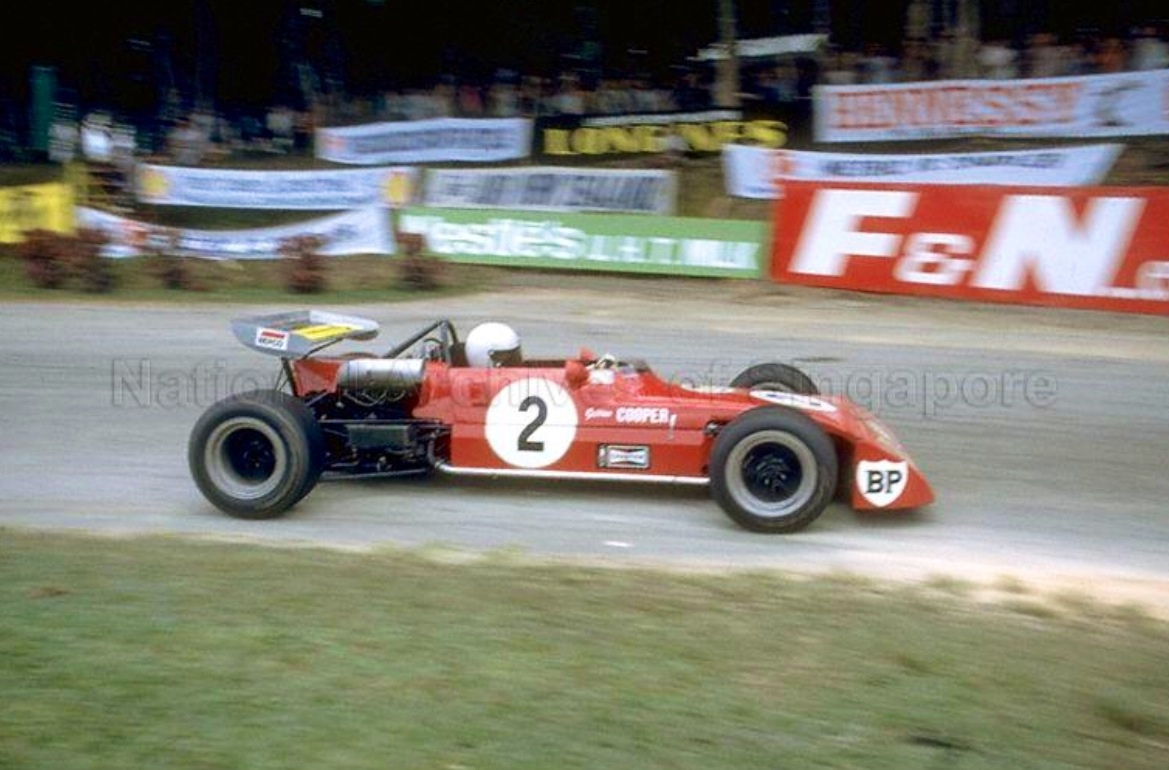
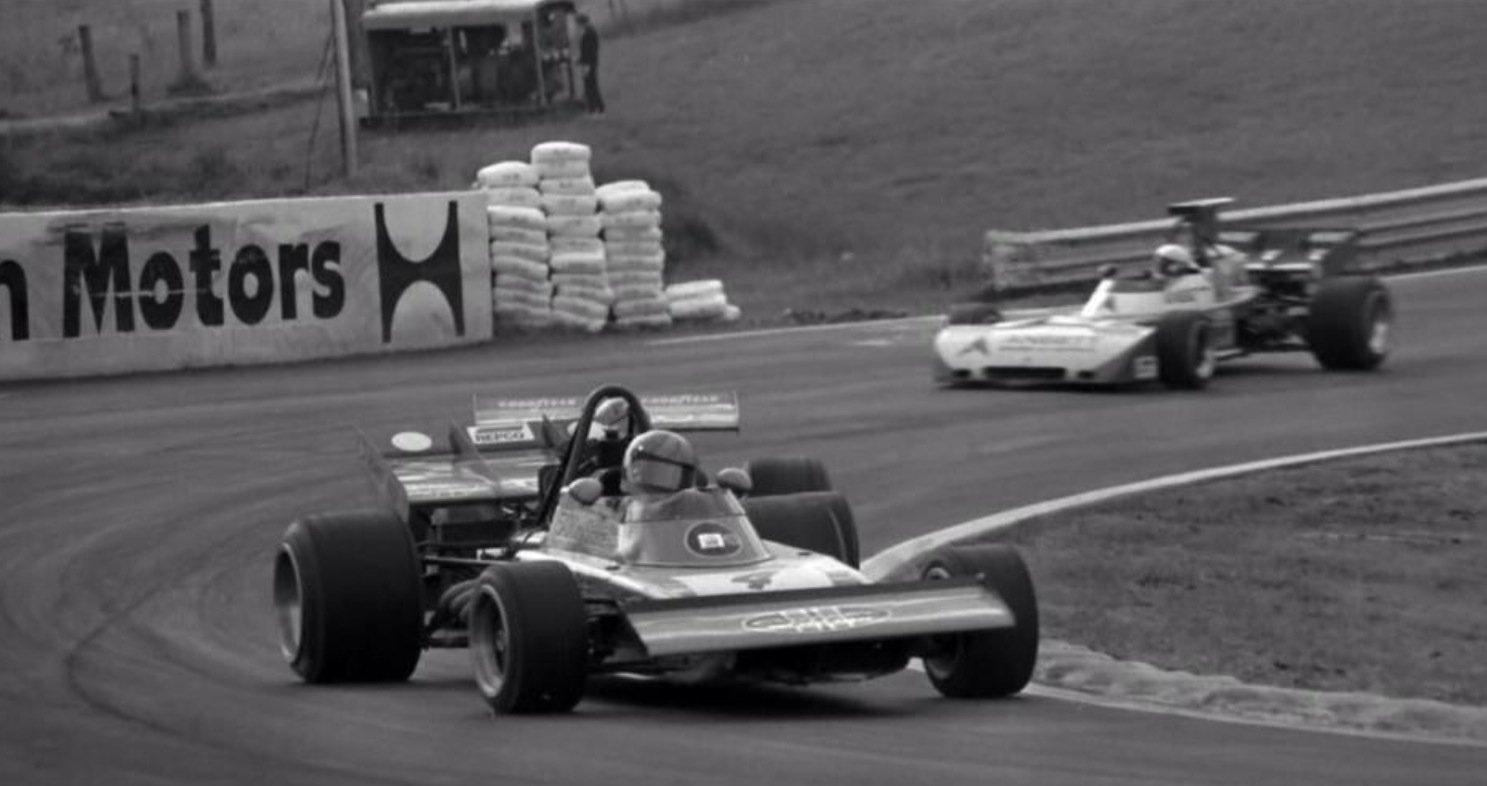
Garrie Cooper’s Elfin 600D Ford leads Vern Schuppan’s March 722 Ford through the fast swoops of the challenging Thomson Road circuit and into the hot, dense, green, steamy forests of the island city state during the 1972 Singapore Grand Prix…

Vern was 2nd in his March 722, a good result as he boofed the car early in the 30 March-2 April race weekend. ‘I crashed in qualifying when something broke in the rear suspension – the car was absolutely brand new. Luckily I hadn’t hit anything too solid and so we were able to cobble something together and I started from the back’. This chassis was the same one which, with modifications by Brian Falconer, he raced to victory in Singapore in 1973. Garrie didn’t finish the ’72 race he won in the very first Elfin 600 in 1968. I wrote an article a while back about the 1973 race, the last until the modern era, click here to read it;

‘Birrana Cars’ and the 1973 Singapore GP…

max-from-leo

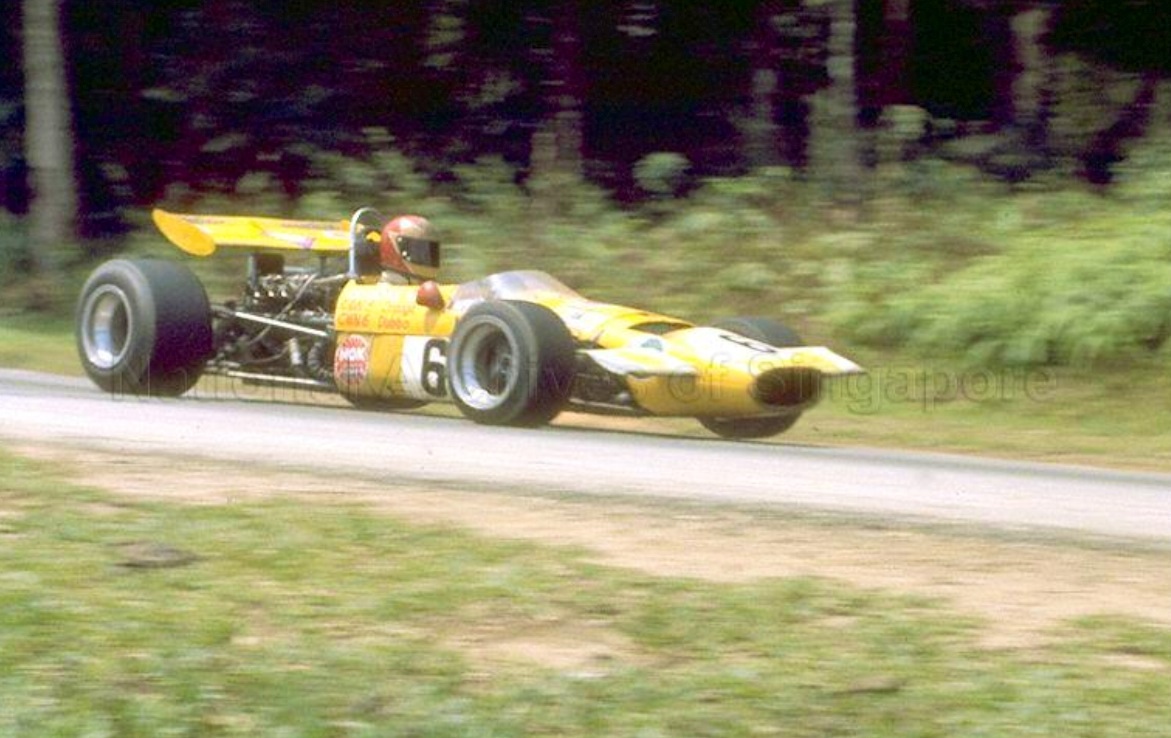
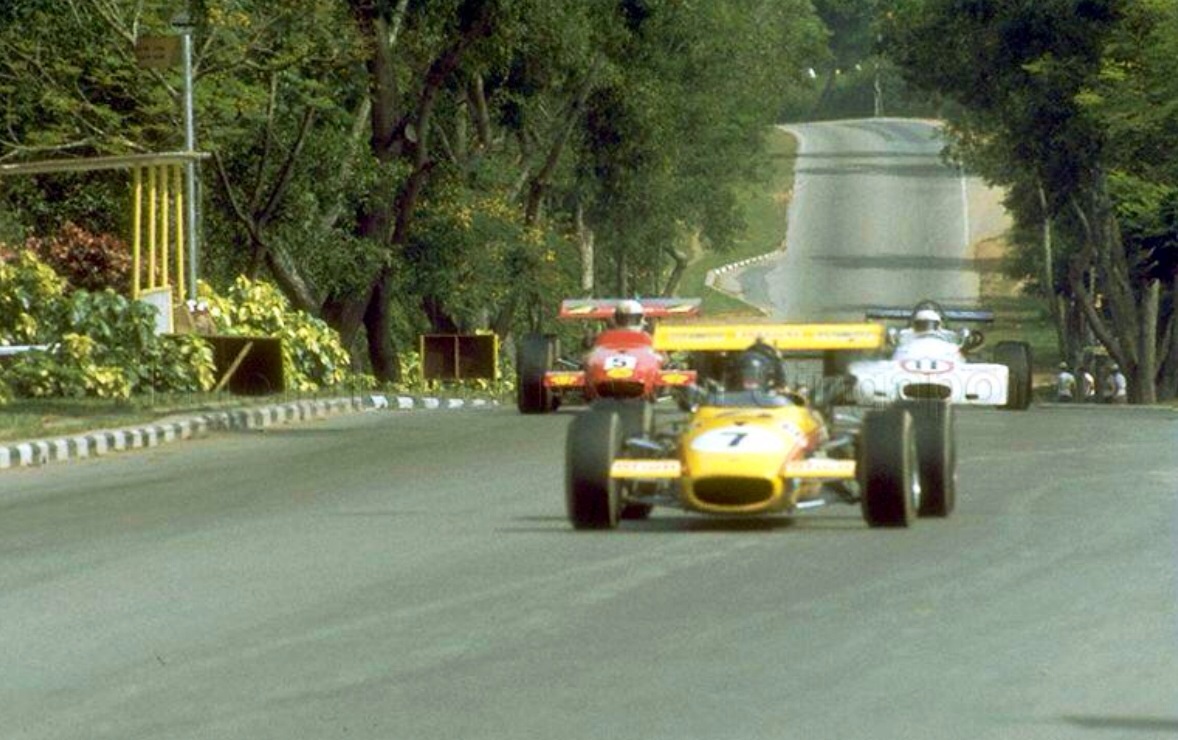
Winner of the ’72 Singapore GP Max Stewart’s Mildren Waggott Ford with Leo Geoghegan’s Brabham Brabham BT30 Ford right up his chuff and Bob Muir’s yellow Rennmax BN3 Ford in the distance (AOS)

I remember as a kid thinking Asia was a very exotic place…

Australia had, believe it or not, ‘The White Australia Policy’ (progressively dismantled from 1949-73) which kept non-whiteys, Asians included out of the joint, so back then you didn’t see ‘em on the streets. The place was bland, populated as it was by lotsa similar looking Anglos. Thankfully all that is a thing of the long distant past. People from countries to our immediate north have added hugely to the wonderful, disparate melting pot of race, creed and color we have enjoyed here, especially post World War 2.

To me as a kid though, Asia was exotic, different, but not far away like Europe. I read with great interest of the success of Kevin Bartlett in Macau and Leo Geoghegan at Fuji in 1969 when i flicked through the 1970 ‘Australian Motor Racing Annual’, my first road-racing magazine purchase, and marvelled at the circuits.

Two decades later, in 1989-91 I was regularly in Kuala Lumpur and Singapore on business. Even though I had it in my mind then to walk as much of the Thomson Road Circuit as I could, I never did make the easy 12 kilometre excursion from central Singapore to do so, it was always too hot to walk the place. Dammit!, its such a wild looking track…

image

Garrie Cooper, Elfin 600D Ford ‘7012’, Singapore GP 1972 (AOS)

Cooper was a popular Singapore visitor having won the race in 1968 in the very first Elfin 600 built. Garrie’s 1972 Singapore car is to me the ‘definitive ultimate’ Elfin 600; chassis 600D ‘7012’ was built as Cooper’s own, works, 2.5 litre Tasman Formula car powered by the ‘definitive’ Repco Tasman engine, the gorgeous little ‘830 Series’, SOHC, 2 valve, Lucas injected ‘short block’ V8. Mind you, in that form it didn’t have the ‘fugly’ Tyrrell type nosecone it wears here.

image

Garrie Cooper during the 28 June 1970 Gold Star round at Oran Park, 3rd in Elfin 600D Repco ‘7012’. Max Stewart won in the Mildren Waggott from Leo Geoghegan’s similarly engined car, Leo won the Gold Star that year (oldracephotos.com)

The Tasman 2.5 Formula was over as Australia’s ANF1 at the end of 1970 so the Repco in ‘7012’s frame was removed and fitted into an Elfin 360 sportscar. An injected Lotus/Ford twin-cam was then inserted into the spaceframe chassis for ANF2 racing. And for events in South East Asia which changed to a ‘twin-cam, 2 valve’ formula, effectively mandating the venerable, wonderful Lotus/Ford engine which was a mainstay of motor racing globally for the best part of 20 years.

image

Cooper leads the rest of the 1968 GP grid on lap 1 into the Thomson Mile chicane, Elfin 600 Ford. Advice on following car ID’s gratefully accepted (AOS)

I’m in the middle of drafting an article on the Repco engined Elfin 600’s at the moment, all three of them, so will leave that topic for now. ‘7012’ was bought by Col Allison for his lad Bruce at the end of Garrie’s Asian tour, the speedy Queenslander was showing promise in a 600FF back home, steering ‘7012’ around Lakeside and Surfers Paradise was another step in Bruce’s rise to prominence and success overseas.

image

Lovely side profile shot of Max Stewart and his winning Mildren in 1972 (AOS)

The winner of the 1972 GP was Max Stewart who took his final big win in the Mildren Waggott which had given him so much success over the years.

The big, ultimately fast, country-boy from Orange in New South Wales literally knew every nut and bolt in this long-lived cars frame. His most recent success in it was the 1971 Australian Gold Star series when he ‘nicked’ the title from his great mate Kevin Bartlett. KB’s F5000 McLaren M10B Chev had the speed in the first year the Gold Star was run to F5000, but Max had enough speed, better handling and much more reliability from his Waggott 2 litre, DOHC, 4 valve, circa 275bhp motor.

image

Stewart from Geoghegan in the Circus Hairpin (AOS)

Max was racing an F5000 Elfin MR5 Repco in 1972 Tasman and Gold Star events, but no doubt victorious transition back to the little Mildren was as easy and sweet as a ‘booty call’ with a recent girlfriend!

image


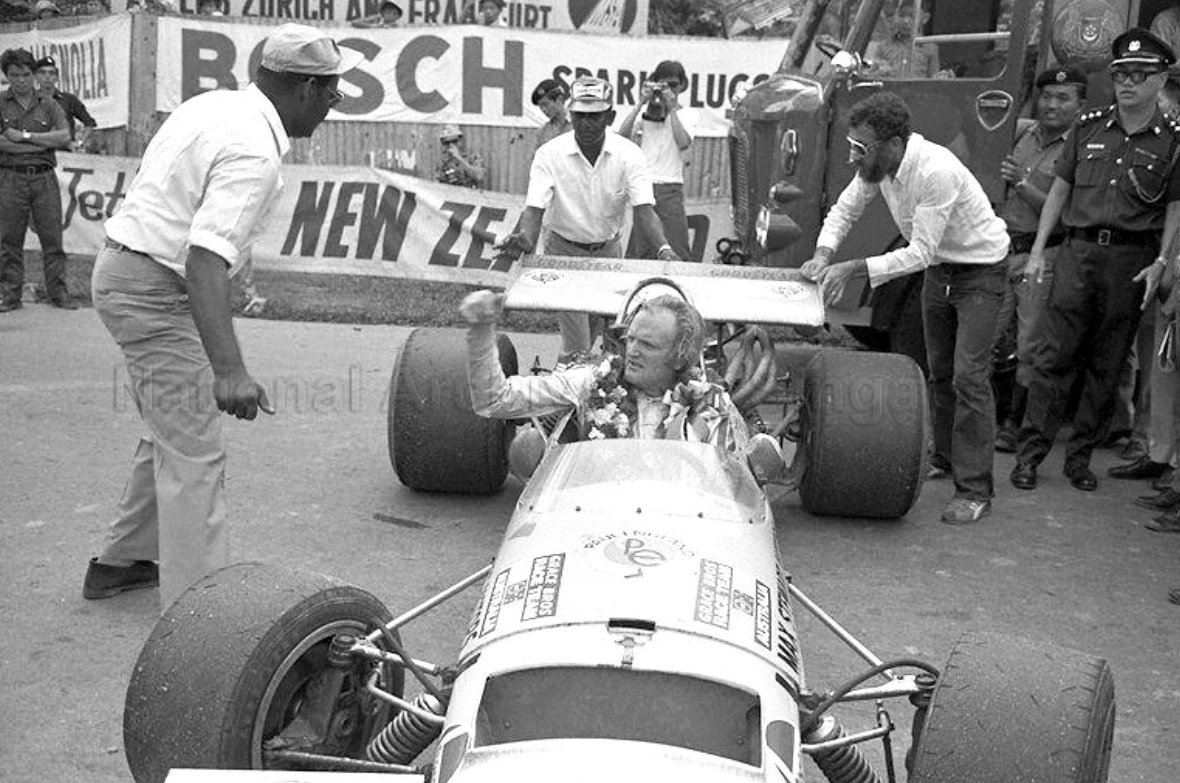
Max accepts his trophy. Neat scoreboard; #6 Stewart Mildren Ford, #129 Schuppan March 722 Ford, #7 Muir Rennmax BN3 Ford and #1 Rajah March 712M Ford (AOS)


max-plaudits

MS garlanded in the victorious Mildren Waggott. For this race it was fitted with 1.6 litre Lotus/Ford twin cam on Webers rather than the Waggott DOHC, 4 valve, injected engines of 1600/1860/2000cc capacity with which the car mainly raced over its long life. Brabham magnesium uprights clear in shot, interesting are the rubber bushed type spherical joints used. This very successful car was restored by Greg Smith in Elwood, Melbourne some years back with further work done in more recent times by Max Pearson who owns and keeps it, and Max’ 1972 Elfin MR5 Repco F5000, in amazingly fine fettle. Both are familiar cars to historic racing enthusiasts in Oz (AOS)

Missing from the ’72 Singapore GP grid was three times (1969-71) winner, Kiwi champion Graeme Lawrence…

Who had an horrific shunt during the opening lap of the 1972 New Zealand Grand Prix at Pukekohe in January which destroyed his brand new Lola T300, badly injured himself and killed Bryan Falloon, whose Rennmax/Stanton Porsche, Graeme collided with.

image

Geoghegan, Brabham BT30 (AOS)

One of Lawrence’s many Australian friends Leo Geoghegan raced Graeme’s Brabham BT30, the 1970 Australian Gold Star champion failed to finish after colliding with Hengkie Iriawan’s Palliser- Hengkie pulled to the left to avoid traffic without realising Leo was there, both were heading for the pits at the time.

image

Leo Geoghegan in Graeme Lawrence’s Brabham BT30 Ford, advice gratefully received on what part of the circuit many of these photos are, and a race report if anyone has one (AOS)

Ostensibly retired from open-wheeler competition, Leo was lured back in 1972 by Birrana Engineering boss Malcolm Ramsay, Malcolm a South East Asia regular competitor. The exploits of these two are well covered in the ’73 Singapore GP article referenced above.

image

Vern tested the BRM P153B, the P153 the Bourne concerns 1970 challenger, during Belgian GP practice at Nivelles in 1972, the car was raced by Helmut Marko to 10th. Emerson Fittipaldi won in a Lotus 72D Ford (unattributed)

Vern would see a lot of his countrymen in the years to come in F5000 competition but it was the first time he had raced against Cooper, Stewart, Geoghegan, Muir, Bartlett and Kiwi, Lawrence.

Schuppan left South Australia’s Flinders Ranges town, Booleroo Centre, with some karting experience in Australia and via Formula Ford success in the UK, won the first British F Atlantic title in 1971 in a works Palliser.

He was very much a coming-man at the time of the Singapore GP, having a BRM contract in his pocket for 1972. BRM had more drivers than hot dinners that season, the Aussies only races were the non-championship May, Oulton Park ‘Gold Cup’ and October, Brands Hatch ‘Victory Race’ in which he finished 4th and 5th respectively.

Despite that, he impressed BRM boss Lou Stanley enough and signed a contract to drive alongside temporary Ferrari escapee Clay Regazzoni in 1973. Stanley’s hiring of Jean-Pierre Beltoise and Niki Lauda’s schillings sidelined him. ‘I knew that I had to be in F1 with a good team by the time I was 30 – and so I thought I’d cracked it. But when I arrived back in Australia for Christmas and picked up a Daily Express at the airport, there it was: Lauda Signs for BRM. I attended races with the team and did a lot of testing, something I always enjoyed – but it was a disappointment’ said Vern in a recent MotorSport interview.

image

Sonny Rajah (above) was a Malaysian character who won a lot of friends in Australia in 1974… 

He contested our Van Heusen Australian F2 Championship. Sonny raced all of the eight round championship with the exception of the first race at Hume Weir for a best place of third at Symmons Plains.

He used the same March chassis albeit fitted with a later nose- the ex-Ronnie Petersen 1971 European F2 Championship winning 712M, he drove to 4th place in Singapore, the misfiring March finished between Schuppan and Geoghegan.

image

Muir from Cooper and Schuppan at Circus Hairpin (AOS)

Rennmax BN3 Ford: Kevin Bartlett and Bob Muir…

Amongst the most numerous cars from one marque were Rennmax BN3’s, these cars raced by Stewart (nee Mildren) as well as his F5000 buddies Kevin Bartlett and Bob ‘Skinny’ Muir.

Regular readers may recall that these cars were built by Sydney’s Bob Britton on the Brabham BT23 jig he created to repair Denny Hulme’s works BT23 damaged in New Zealand during the ’68 Tasman Series. Bob Muir’s car was, I think, Ken Goodwin’s chassis raced by Bob in Australia during 1971, notably at the Hordern Trophy meeting at Warwick Farm. Muir had a very competitive run in Singapore finishing 3rd in the yellow car.

KB leased Sydney driver Doug Heasman’s car and recalls the weekend well‘…unfortunately I had a DNF result after an off, due to slight damage to the suspension. Fire marshalls had inexplicably placed a fire hose across the road on a blind corner to douse a crashed car, I bounced off the road when the wheels hit it. There was no flag signal of the situation at the flag point before, which caused the problem’ recalled KB recently.

image

Kevin Bartlett typically sideways, Rennmax BN3 Ford (AOS)

As to the Thomson Road circuit he related that ‘I quite liked the layout as a real road circuit. It had jungle like bush in many parts, with huge drainage ditches to one side in many places and virtually nil runoffs, certainly it was a challenging place.’

‘I remember leading for all but the last few laps one year (1970) from Graeme Lawrence’s Ferrari’ (ex-Amon 1969 Tasman winning Ferrari Dino 246T in which Graeme also won the 1970 Tasman) with a DNF in the Mildren Alfa V8 ‘Yellow Sub’ the car in which KB won the 1969 Macau Grand Prix and Australian Gold Star Series.

image

(AOS)

Kevin Bartlett and Graeme Lawrence (above) on the front row of the grid for the 1970 Singapore GP, start/finish straight- relatively narrow.

KB #5 in Alec Mildren’s Len Bailey designed, Alan Mann Racing built Mildren ‘Yellow Submarine’ Alfa Romeo, here in its ‘definitive’ Alfa Tipo 33 2.5 litre V8 form, as it was originally designed.

It was quicker when fitted with the 2 litre Waggott but always ‘sexier’ with the Alfa engine- for me it defines everything that was great about the Tasman 2.5 Formula. GL is in his equally lustworthy, and victorious, ex-Amon Ferrari 246T. #66 is Albert Poon’s Brabham BT30 FVA, the car alongside, I think is John McDonald’s Brabham BT23 FVA.

image

(AOS)

Bartlett (above) leads the field on lap 1 of the 1970 GP into the Thomson Road chicane, Graeme Lawrence is almost obscured he is so close to KB’s FT200 Hewland.

Then its Stewart in the Mildren Waggott #6 and McDonald’s Brabham BT23 FVA #16 and the rest.

Bartlett won the preliminary 20 lapper on Friday and led the 40 lap GP, in a very spirited close race with Lawrence until lap 37 when a valve spring in the little V8 broke, dropping an inlet valve, KB recalls. The field was small, only 10 cars due to mechanical mishaps in the preliminary, 12 cars took to the grid in the GP but 2 crashed on the warm up lap! so 10 started.

image

(AOS)

Muir (above) ahead of Bartlett’s red Rennmax BN3 on the Thomson Mile with John McDonald’s ex-Rondel Racing white Brabham BT36 Ford.

Back home these two Sydneysiders raced Lola T300’s in the domestic Gold Star Series with Muir immediately on the pace when he started racing F5000 during the 1972 Australian Tasman rounds.

KB was the driver who well and truly served it up to Matich when he took delivery of his T300 during the ’72 Gold Star, which Frank won in his A50 Repco

image

(AOS)

Garrie Cooper (above) in his brand new Elfin at the Circus Hairpin, Singapore GP 1968.

Great looking cars the Elfin 600’s, the only marginal change to the body over its production life of 1968 to 1972, which made the things even sweeter was a ‘wedgier’ element or shape to the radiator cowl, you can see it in the shot earlier of Cooper’s 600D Repco at Oran Park up earlier in the article

Singapore GP 1968, Garrie Cooper and Elfin 600 ‘6801’…

Garrie’s win in the Elfin 600 prototype ‘6801’ was pretty handy commercially for the likable, talented South Aussie and his band of gifted artisans at Edwardstown, an inner south-western Adelaide suburb.

Elfin 600’s won in FF, F3, F2 and ANF1; no other car in Australia (the world?) ever had that ‘bandwidth’.

Critically the car was built in relatively large numbers and exported providing valuable cashflow, the lifeblood of any business especially a small one financed, as they are typically in Oz, by a mortgage over the business owners home.

600’s were cars which helped launched a swag of careers not least Larry Perkins who won Australian titles in FF and F2 aboard a 600FF and 600B/E.

The following, less successful model, the 620/2/3 (FF/F2/F3) were evolutions of the 600 spaceframe design and also sold well. By then the level of local competition had increased with the likes of Bowin and Birrana building cars in number and as well the propensity of locals to buy imports increased especially in F2.

image

‘6801’ in the Thomson Road paddock 1968, mechanical details as per text. The caption notes driver and shortly Elfin 600 customer Henkie Iriawan seated at far left with the car being fettled by the Elfin boys and Loh Yap Ting in white. So impressed was Iriawan that he bought ‘6801’ at the end of the race meeting, and later a 600B to which he fitted a Ford FVA engine. Local ‘shops who looked after the visiting teams were Federated Motors and Borneo Motors, both the preferred facilities (AOS)

Cooper and his team finished ‘6801’, raced it at Calder, Victoria in March and then shipped it to South East Asia. These shots show the beautifully fabricated steel spaceframe chassis, Lotus/Ford Weber fed, DOHC engine, a good 1600 twinc good for circa 170bhp at the time. Gearbox here is a Hewland HD5, production cars usually used Hewland Mk8/9 or FT200 dependent upon application.

The cars first race on its Asian tour was the Selangor GP at Shah Alam, Malaysia on the 6/7 April weekend, Garrie didn’t complete his heat with a broken crown wheel and pinion.

In the Singapore GP, Allan Grice had the gearbox problem, the case of the ex-Mildren/Gardner/Bartlett Brabham BT11A’s Hewland ‘box split causing the end of a good dice between Cooper and Grice. Jan Bussell’s Brabham BT14 Ford was 2nd and Steve Holland’s Lotus 47 Ford sportscar, the event was run to Formula Libre, was 3rd.

‘6801’ was still giving a good account of itself in ANF2 in 1973/4 in Paul Hamilton’s hands amongst all the modern Birrana, March and Bowin monocoques and is still raced by him in historic racing. It always brings a smile to my face whenever I see the little red, immaculate machine given its Elfin historic significance.

image

Cooper accelerates out of Circus Hairpin on the way to his ’68 GP win. He is ahead of Allan Grice, later Australian Touring Car ace in a Brabham BT11A Climax and Albert Poon’s Brabham BT21 Alfa. Garrie led from lap 5, Poon retired on lap 10 with a damaged wheel (AOS)

Etcetera…

cooper-nose

(AOS)

Cooper (above) in the 600D Ford ‘7012’, Singapore 1972. He really did make a beautiful car as ‘ugly as a hat full of arseholes’ didn’t he?, no doubt it was effective though. Tyrrell started this F1 trend at the ’71 French GP.

These Elfin 600D experiments flowed directly into the modified noses of the MR5 F5000 cars which Cooper fitted to his, and John McCormack’s car during the Australian Tasman rounds in 1972. See photo below.

Those noses became the ‘definitive spec’ MR5’s- in detail they evolved over the following seasons, the treatment was also applied to the subsequent MR6 F5000. It was only at the very end of the MR5’s long life that Garrie tried a ‘chisel nose’ and side radiators on his MR5 when he was assessing the body shape and profiles to be fitted to his 1976 MR8 F5000- those too a very successful series of, this time, Chevrolet engined cars.

cooper-mr5

(Hemer)

This 1972 Oran Park shot above shows the MR5 ‘before and after’.

John Walker’s car in front with the original 1971 ‘blade’ front wing and Cooper’s car further back with the ‘Tyrrell’ type nose, both MR5’s are Repco powered.

That’s Max Stewart’s Mildren Waggott’s nose shoved up John’s clacker by the way. Interesting that he was racing the little 2 litre car rather than his MR5 at this meeting. What meeting is it folks, its not a Gold Star round, one of you Sydneysiders will know?

leo-nose

(AOS)

Leo has had an argument with the local geography and lost, ‘sorry Graeme, it was like this…’, no damage to the rest of the little BT30 mind you.

Bibliography…

MotorSport ‘The Forgotten Singapore Grands Prix’ by Paul Fearnley September 2016, The Nostalgia Forum, Kevin Bartlett

Photo Credits…

National Archive of Singapore (AOS), Lynton Hemer

Tailpiece: Cooper accepts the plaudits of the crowd and the victors garland in 1968, neat rear cowl of the  Elfin 600 clear and a feature on all the production cars…

image

(AOS)

Finito…
 

image

(Adelaide Advertiser)

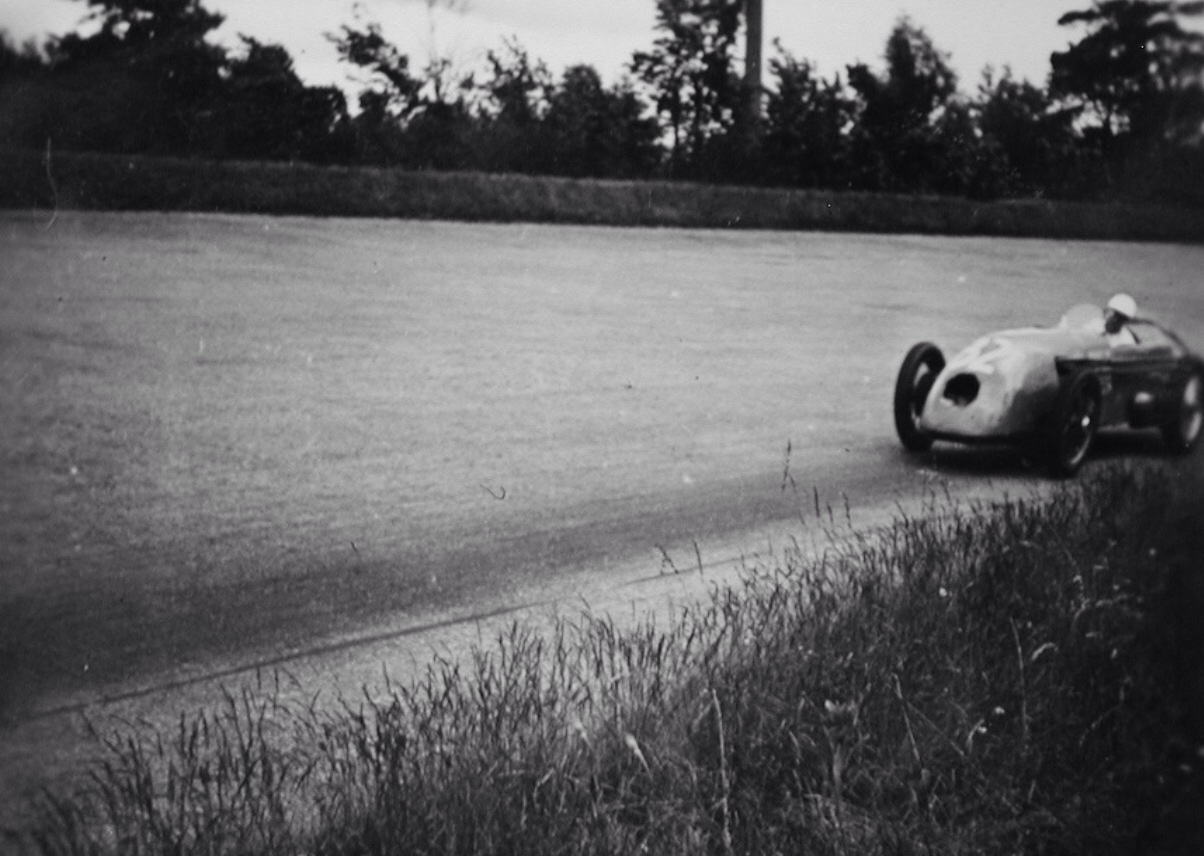
Jim Gullan dealing with a delicate slide on turn-in to Kayannie Corner , Ballot Oldsmobile. He is on the way to winning the 12 lap 105 Mile Road Race on the fearsome, Lobethal, Adelaide Hills circuit…

The race was held on New Years Day, 1 January 1948, the Victorian won from Granton Harrison’s Phillips Ford V8 Spl and Ron Egerton’s MG TC Spl which is in shot behind Gullan above.

Amongst the 21 ‘South Australian 100’ entries were later champion drivers Tony Gaze, Bill Patterson, Doug Whiteford and Ern Seeliger as well as then current fast-man John Barraclough.

Tony Gaze, HRG Aerodynamic, DNF after completing 11 laps (N Howard)

Gaze’s HRG Aerodynamic in Lobethal village, functional rather than pretty (Lobethal Museum)

The limit man was D Howard’s MG PA with a handicap of 16.5 minutes, Jim Gullan’s Ballot was away at the 7.05 mark, Doug Whiteford off 2.5 minutes with the scratch car Denneston’s Itala Mercury Spl.

Whiteford stunned onlookers with an 85mph standing lap, Ern Seeliger was an early retirement after being badly baulked at over 110mph, assaulting two trees in the process. The car was destroyed, the owner presented the rooted chassis and body to a local farmer! Ernie suffered only a bruised wrist and severe shaking and lived to be a formidable engineer and competitor until late in the 1950’s.

Doug Whiteford, Black Bess, DNF after 3 laps (N Howard)

Bess at rest, Lobethal 1948 (Lobethal Museum)

By lap 4 the positions on handicap were the Harrison Ford Spl from Ron Edgerton’s MG TC and Whitefords Ford Spl, the latter on a path, at the speed he was going, to win the race before a rear tyre threw a tread. With no spare the Melbourne driver was out.

By lap 7 Gullan led from local driver Harrison in the ex-Phillips Ford V8 from Skinner in the Ballot Ford and Andrews Austin 6 in 4th. Barraclough withdrew due to low oil pressure on lap 9 and Bill Patterson was out of fuel on the same lap.

On the last lap Gullan still lead by several hundred metres from Harrison and Edgerton’s MG TC. Harrison did the races fastest time and Whiteford its fastest lap at 6 min 7 seconds, 88mph and won the Lobethal 50, the final event of the program.

R Hamilton, MG TC , 4th (N Howard)

Ballot Oldsmobile…

ballot

Jim Gullan, #21 Ballot Olds, an MG then the Dennis Curran Curran Ford V8 Spl DNF Australian Grand Prix, in the Nuriootpa paddock, Barossa Valley, South Australia 1950. Gullan 3rd outright and 1st on handicap (State Library of SA)

Jim Gullan replaced his Ballot Ford in 1944 with a 2 litre Ballot bought nearby to his families garage in South Melbourne, a chassis for the car was designed and built by Gullan styled on the ERA, the racer was fitted with an Oldsmobile engine and gearbox.

Noted journalist and historian Ray Bell; ‘Jim Gullan’s Ballot will always rank as one of those cars that looks the part of an Australian Special. The raked nose, the heavily drilled chassis, steering wheel close to the chest and mandatory straps over the bonnet, its wire wheels carried a car that mixed European and American as well as any other’.

Gullan’s book, ‘As Long As It Has Wheels,’ is a fascinating account of a drivers career which evolved from road racer pre-war, to racing an Alta in Europe after hostilities ceased, through being a pioneer of drag-racing in Oz in the 1960’s and finally as a club racer in his dotage living on Queensland’s Gold Coast. Amazing. Jims book covers the Ballot in detail.

Gullan’s Ford V8 powered Indianapolis Ballot, his new acquisition was a 2 litre with sohc engine and knock-on wire wheels, it had a poor body and as inspection proved, the chassis was in even worse shape.

image

Gullan, AGP, Nuriootpa 1950, 3rd place outright and 1st on handicap, Ballot Olds. Doug Whiteford won in his Ford V8 Spl, ‘Black Bess’ (unattributed)

Ballot Olds in the Lobethal paddock during the 1948 SA 100 meeting (Lobethal Museum)

Soon after buying it a workmate offered money for the engine, gearbox and radiator to fit into a Bugatti chassis. Said Gullan, ‘It seemed a dubious exercise but I suppose any engine was better than none.’  Having just the chassis left, he was reluctant to go for another Ford engine having had bad experiences with the V8, so an ad for an Oldsmobile unit and ‘box (unused spares purchased for a taxi) overcame his problems. It was to have triple Ford carbies and extractors.

A chassis was made styled on the ERA but lower in profile, and used nothing from the Ballot chassis such was its parlous condition. ‘By the time the Ballot Olds was completed, about the only parts left of the original Ballot were the wheel hubs. The only reason the Ballot name was retained was for (ease of) registration purposes’ wrote Gullan.

It new chassis was 760mm shorter and 230mm narrower than the Ballot, designed to be ‘strong in the middle,’ boxed and drilled liberally ‘as on the SSK’ for lightness. ‘To lower the car new, new springs and hangers were made to sit outside the chassis rails. To stop front axle movement and to assist steering geometry, the spring shackles were located at the front of the spring instead of at the rear, this also assisted the brake reaction cables to keep the axle from turning whilst braking. Wheels were built to suit the wider, smaller diameter, modern tyres.’

With new cross members the engine and gearbox were installed into the chassis and the body shape was outlined using welding rods and strands of string.

Bob Baker lived only a few doors away from Gullan and built the body round an angle iron frame, which was screwed to the chassis with small reject aircraft bolts. A deliberate effort was made to reduce frontal area, hence the car’s low appearance. Quick-fill petrol and radiator caps were fabricated by Jim and the instruments (like the carbies) came from army disposals.

jim-rob-roy

Gullan at 16th Rob Roy, 2/5/1948 Ballot Olds. Superb looking body built by Bob Baker, the first of many racing cars he built bodies for. Gullan’s design was ingenious in its amalgam of parts and a consequence of his vast experience with previous cars (Thomas)

With Baker’s assistance a 3 carb inlet manifold and extractor exhaust system was made and a Ford radiator shell reworked to look like an ERA, the gorgeous little car was painted blue with silver wheels. Finned alloy drums off a spare 2-litre Ballot Jim bought and sold were the first of many modifications over the years.

image

Ballot Olds cockpit shot taken at the SA Grand Prix 70 year celebration at Lobethal in 2008 (Veloce)

The Ballot’s first meeting was at Greensborough Hillclimb in 1945 (see below), teething problems were limited to the throttle linkage bending and as a consequence full power could not be applied. The rear axle ratio was made taller, the drawings for the 3.5:1 ratio done by Gullan.

The first post-war race was at Ballarat at the beginning of 1947. Gullan had a good meeting including winning the Ballarat Cup, after this meeting the cars braking system was converted to hydraulic operation.

The next race was the Lobethal 100 covered at the articles outset, ‘The main reason for my quick times was my familiarity with the track. I had driven there in 1938 and 1939…in handicap racing it was our policy (Jim and his time-keeper wife Christine) and although the handicappers kept putting us up the field, we just made the car quicker’.

Gullan was a close friend of and in business with Doug Whiteford. When Doug imported an Edelbrock cam and heads (he’d melted a pair of alloy heads at Lobethal in 1940!) Bruce Rehn copied the cam profile and lift for the Olds.

By the time of the Point Cook AGP (1948) ‘…at a Dutch auction at the Light Car Club before the race, the Ballot was selected as the car most likely to win, a bad omen as far as i was concerned’,  quipped Gullan.

For the AGP there was yet another higher lift cam lifting rpm’s to 6000 and special ratios in the gearbox. As a result of the intense heat at Point Cook, with the Olds running so cool and well, the engine was subsequently bored by 5mm and also fitted with an enlarged sump with cooling tubes. Gullan had tyre problems in practice, but retired the car in the extreme heat after 15 laps. ‘I finished up sitting next to Alf Barrett, in the back of a van getting cooling down treatment’.

At Fishermans Bends first meeting Gullan won the Victorian TT, but the stop-start nature of the airfield circuit made it clear the cars brakes needed development. Jack Pearce at Repco PBR supplied some light commercial brake drums and made appropriate shoes with aluminium backing plates. ‘…They were so powerful they were bending the chassis making the car almost unsteerable when braking on the rough roads. The only thing to do was to apply them gently’.

ballot olds 1946

Gullan, 10th Rob Roy 17/6/1946, the bucolic Christmas Hills are pretty much the same today (Thomas)

In the months leading up to the 1950 Australian Grand Prix at Nuriootpa the Ballot was run in various minor events to get it sorted. Jim started 21st of 43 starters. The race was billed as a handicap race, Gullan won the handicap but not the Grand Prix which was awarded to Doug Whiteford in Black Bess. Jim was not happy about the result and emphasis given to the ‘fastest time’ as against the ‘handicap winner’, the AGP having been run as a handicap since it’s start at Phillip Island.

‘Normally the car would run 130 miles on a tank of fuel, but with the car developing more power, it was decided that if i was far enough in the lead i would pull in for a quick stop to add 10 litres. This i did and drove over the line to win what i thought was the Australian Grand Prix. There were still 20 litres of fuel left in the tank at the end of the race’ and therefore he could have completed the race without a stop.

‘The Adelaide Advertiser ran a big headline ‘Big Car Handicap to J Gullan’, the article didn’t even mention that Doug Whiteford had finished in 5th place. At the presesntation i got the wreath, the trophy and the prize money, Doug received equal money for fastest time. Once again i had driven a copybook race, but was later disappointed it would not be recorded as a Grand Prix win. Sometimes i wish i had just gone for broke…’

A counterpoint to Gullan’s viewpoint is contained in ‘The History of The AGP’ which makes it clear, quoting the Australian Motor Sports contemporary magazine coverage of the race. It says, that consistent with the 1949 policy of the Australian Automobile Association, from 1949 the AGP would be a scratch title,’The Australian Grand Prix will be run as a handicap but the Grand Prix winner will be the competitor finishing with the fastest time for the race’, that is, Doug Whiteford in his Ford V8 Special Black Bess.

Gullan raced the car one last time at Fishermans Bend before selling it.

Interestingly the two great mates, Whiteford and Gullan who had developed their clever specials together drove one anothers cars one evening at Albert Park ‘Dougs impression of the Ballot; very smooth high revving engine, steering and brakes too sensitive, difficult to drive!’ wrote Gullan. Albert Park is a public park, it would have been interesting to be going for a post-dinner walk and seen two Grand Prix cars being driven at high speed around the sleepy confines of Albert Park, the first GP there was still several years away at the time!

image

Love this shot for its vibe, Fishermans Bend, October 1953. Greg McEwin HRG left, O’Donohue’s now red Ballot Oldsmobile and Otto Stone’s MG K3 (SLV)

It was now 1950, the Ballot had reached the end of its development, and Jim decided to race in Europe, an interesting story for another time. Alan Watson and John Cummins (the latter very sadly died only last weekend) bought the car for 850 pounds.

Ray Bell, a writer of the ‘History of The Australian Grand Prix’ puts Gullan’s wonderful car and his design and development skills in context ‘The car was Gullan’s expression of all he’d learned from observing racing and running his own Salmson, Wolseley, Austin and Ballot V8′.

‘Considering just how it came together – the bits that just happened to be there, the chance acquisitions – it worked very well. Gullan was a handicap specialist, with his wife Christine timekeeping and acting as strategist, and they beat the handicaps with monotonous regularity. He comments that he just had to keep on making the car quicker to keep on beating them, so it was well developed when sold to Alan Watson.’

‘He mentions getting airborne over the top of the hill approaching Lobethal at 110mph, touching 116mph on the straight and holding it flat all the way from Lobethal to within sight of the pits at that early stage of its development. By the time it won the handicap section of the 1950 AGP it must have been a fairly quick car’.

The car passed through many hands over the next 20 years, raced as late as 1963 at Calder, Victoria. It has been used since 1970 in historic events, and is still alive today in Frank Moore’s Collection of Australian Specials in Queensland.

image

Jim Gullan, Ballot Olds, Greensborough Hillclimb. Crowd control and safety barriers well to the fore! (Thomas)

Greensborough Hillclimb…

Its interesting this internet thingy, data and images are being uploaded all the time. When I wrote the article about the Lobethal AGP 1950 12 months or so ago some of the images in this article weren’t there, but information is being continually shared through this wonderful medium.

The shot above is of Jim’s car at the second Greensborough Hillclimb on 7 October 1945, an Australian Motorsport article describes the casual nature and speed at which a new venue could be created all those years ago!

The Australian Motor Sports Club sought the use of the LCCA’s Rob Roy Hillclimb to run its first post war event. When the LCCA refused the club permission they sought other venues. Every alternative ‘smooth enough and close to Melbourne’ failed until the club secretary George Beecham fluked on a market gardner, an ex-motorcycle rider…His property had a very stiff hill. It was decided at the club meeting on the Thursday night before the Sunday scheduled for the climb to hold it at Greensborough on the market gardners hill. The owner of the property Bill Halliburton, did everything in his power to knock the hill into shape for the club…to get the hill right in time’.

Try getting a hillclimb built and certified by the FIA/CAMS in two days today, different times weren’t they!

Jim Gullan recalls the event in his book, he was Vice President and Doug Whiteford President of the AMSC. The two great mates loaded up a utility filled with reject concrete slabs from the Hume Pipe Company, for whom they worked and set off for ‘Orchard Farm’ to lay out a starting grid, completing the exercise in pouring rain.

image

A couple of young-bloods take to the Greensborough Hill to get a better vantage point, marshalling/start area below. Public address system you can just see to the bottom left, crowd numbers would be interesting to know in immediate post war-starved of entertainment, Melbourne (Thomas)

So much rain fell on the Saturday the event looked to be a washout but the can-do attitude of the members, starved of competition during the war years prevailed and after the track dried competition took place with FTD going to Ern Seeliger’s Ford V8 Spl. (the car destroyed in the SA 100 event in 1948 described at this articles outset)  It was the union of an Itala chassis, with large drum brakes, a 3:1 diff ratio powered by a modified ’38 Ford V8 modified with high compression heads and a Vertex magneto providing the spark. The engine was mounted low in the chassis, the car raced in chassis form devoid of body.

‘Greensborough No 2 was just as well organised and ran as smoothly as the No 1 event was bad. Everything seemed to go right, even the Melbourne weather! The hill had been prepared at some very substantial cost to the club and was as smooth as a table-a good table too’, you will note from the photographs that the surface was gravel.

The AMS report notes the pace got hotter as the day progressed with several cars leaving the track, notably an elderly Morris Spl, a Vauxhall, Stud Beasley’s Speedcar and Ted Gray’s Ford V8 powered Alfa Romeo 6C1750, Ted broke the diff of the car in the process.

Ken Wylie set fastest time of the day in his Speedcar but ‘in doing so rushed through a fence after he had completed his climb, cleaned up half a dozen push-bikes leaning against said fence, bowling over a gum tree and ended up in a ditch…’.

Gullan notes ‘…luckily we had plenty of money to be able to compensate the cycle owners…We were not prepared for the huge crowd that turned up. The narrow country road was blocked for kilometres, many never reached the entry gate. The entry fee was a ten shilling note, to get his share the farmer stood at the gate and stuffed his shirt full of banknotes (not much different to BC Ecclestone today really). By the time the hundreds of spectators had left, the place was in a shambles, the irate farmer said “never again”, but we figured a shirt full of banknotes more than made up for it!’

wolseley

Unknown Wolseley and driver, Greensborough (Thomas)

Doug Whiteford fitted dual rear wheels to his Ford V8 engined 1950 AGP winning special ‘Black Bess’ but struggled to get traction, as did Ern Seeliger’s car the AMS report noted. That report concludes by listing other competitors cars; Ken Hume’s 8/60 Buick engined Talbot, Tom Hollindrake’s MG s/c, Les Phillips Austin Spl. Gullan’s Ballot Olds only had two runs, as the event organiser he was preoccupied, Bob Chamberlain’s Chamberlain 8 and Stud Beasley’s Willys 77 Speedcar also competed.

What is interesting is the way a large number of hillclimbs relative to the population of Melbourne at the time, popped up in an arc on the cities outskirts from the north-east to the east of the city; Greensborough is 23 km from town, Templestowe 19, ‘Rob Roy’ at Christmas Hills 43Km and the two climbs at Lilydale, the Davisons ‘Killara Park’ property and Ern Abbott’s ‘Lakeland’ circa 45 Km from Melbourne. They weren’t all running concurrently mind you, some were. I suppose the reasons are availability of the right terrain and proximity to the city for competitors.

image

Frank Moore, who still owns the Ballot Olds, at the Lobethal carnival in 2008, lines of Gullan’s car still look great don’t they? The ERA influence clear (Veloce)

Bibliography…

‘As Long As It Has Wheels’ James Gullan, ‘History of The Australian GP’ G Howard and Ors

Ray Bell on The Nostalgia Forum, ‘Australian Motor Sports’ February 1946

Jim Gullan, MG K3, Albert Park 1956 (J Millard)

Credits…

Adelaide Advertiser, George Thomas, Veloce Magazine, John Millard, Norman Howard

Tailpiece: Gullan and Ballot Olds, Geelong Road, Australian Motor Sports Club, sprints, 4 August 1946…

jim-geelong

(Thomas)

image

(oldracephotos.com)

Few drivers knew Warwick Farm like Frank Matich and Kevin Bartlett…

They raced at the track from its earliest days, it’s first meeting in 1960 I wonder?, and certainly the last international meeting, sadly the 1973 Tasman round run 12 months after the photos here were taken, Steve Thomson won that very wet race in a Chevron B24 Chev.

Here the two Sydneysiders are attacking The Esses during the 1972 F5000 Tasman round, the ‘Warwick Farm 100’ on 13 February. Matich was 1st in his Matich A50 Repco and KB 3rd in his McLaren M10B Chev, not really a front-line tool by that stage but still quick enough in Kevin’s highly skilled hands to win at Teretonga, the final ’72 Kiwi round, a fortnight before.

image

Bartlett and original owner Niel Allen had a lot of success in this McLaren M10B ‘400-02’, car now in the tender, loving hands of Alan Hamilton, also a former Australian champion .KB here during the ’72 Tasman race. A Lola T300 would replace the car in time for the domestic Gold Star Series (unattributed)

Matich didn’t have a good Tasman, the A50 was quick enough to win the series but FM didn’t have a lot of luck, the championship was convincingly won by Kiwi arch driver/constructor rival Graham McRae in the Leda/McRae GM1 Chev penned by Len Terry.

Click here for an article on the Matich F5000 cars including the 1972 Tasman Series:

Frank Matich: Matich F5000 Cars etcetera…

Credits…

oldracephotos.com, Bob Williamson Collection

Tailpiece: The Lola T300 was ‘a chick’ with a great arse and hips, visually arresting…

image

Frank Gardner and Lola T300 Chev ahead of Frank Matich in the ’72 WF pitlane for tweaks. FG won the ’72 NZ GP in this T300 at Pukekohe, his last single-seater win, I think (Bob Williamson)


Frank Gardner split Matich and Bartlett, he was second at Warwick Farm in the factory T300. Frank was not exactly unfamiliar with WF either, mind you no-one would have done more laps around it than Matich, Frank tested tyres for Firestone, and later Goodyear and his cars a lot!

Between Gardner and Bob Marston they concepted a small F5000 based on Lola’s F2 tub. By placing the big water radiators, you needed plenty of coolant to look after the needs of a big Chev, at the cars hips they gave the car, and the T330/332 which followed it their most distinctive and attractive feature. Effective too in terms of aerodynamics and centralising weight, an article on the T300 is one for another time…

Finito…

image

This amazing 1931 poster advertising the Fiat 514 caught my eye, as its designer intended…‘Its of ‘monumental style design’, the 514 likened to a statue on a plinth, beaming out light into the darkness’.

The 514 was built between 1929 and 1932 in sedan, cabriolet and spyder bodies. The engine was a 1438cc 4 cylinder sidevalve with power outputs ranging from 28-37bhp for the 514A/MM performance variant.

Although Fiat stopped racing in the early 1930s, concentrating on road cars in the twenties they produced cars of sporting intent. Its most successful design was the Tipo 509, which dominated the Italian small-car market. The 509 was powered by a four-cylinder 990cc OHC engine.

image

1932 Mille Miglia; the #9 37th place Fiat 514MM of ‘Frate Ignoto’-Arturo Mercanti/Francani ahead of the Bettinazi brothers 35th placed Fiat 514 CA Spider in the Montalcino/Radicofani area near Siena. the race was won by the Borzacchini/Bignami Alfa 8C2300 Spider Touring (Guerrini)

The 1929 514, its replacement was introduced into much tougher economic times and used a simpler 1.5-litre sidevalve four. The 514 was conventional; it had semi-elliptic springing all round, a 4 speed gearbox and 4 wheel mechanical brakes, adoption of hydraulic brakes part way through the cars production cycle being the models most important development.

Together with the standard cars Fiat introduced a trio of sporting roadsters; the 514S, 514MM and 514CA, ‘MM’ signifying Mille Miglia and ‘CA’ Coppa del Alpi (Alpine Cup). The 514S and 514CA used the standard (2,555mm) wheelbase whilst the MM used the longer (2,770mm) chassis shared with the 514 van. All used tuned engines; the 514S had 34.5bhp, the MM and CA had engines developing 37bhp. Top speed of these cars was circa 112km/h (70mph).

Credit…

Hutton Archive, Bruno Guerrini, Bonhams

Tailpiece: 1930 514 Roadster…

image


image

Who is the Coolest Cat?! 

Freddie Agabashian lookin’ a million bucks with his lean build, fag, Ray Bans and GI-Joe haircut. He is aboard his Kurtis Offy Champcar at the San Jose Fairgrounds Speedway, meeting date uncertain but the photo post is dated 1 January 1950…

Of more technical note is the Offy 255 or 270′ cid, four cylinder, DOHC, two-valve, twin side-draft Riley carbed 300-350bhp engine, hand brake and rear suspension of his Kurtis Kraft chassis.

Northern California Racing Association Champion in 1937, against drivers such as Duane Carter, Lynn Desister and Paul Swedberg. Post war Freddie took 3 Bay City Racing Association Midget titles from 1946-48 driving for Jack London and George Bignotti from 1947. He then turned his attention to Indycars.

image

Troy Ruttman left and Freddie at the California State Fairgrounds, Sacramento, in Kurtis Offy Champcars, October 30 1949. Aga won this AAA event with Troy third (Racing One)

Born in Modesto, California, Frederik was the son of a genious Armenian mathematician who began racing in his teens. He won in Champ cars and Stock cars as well which earned him a ride at Indianapolis for the 1947 race.

He competed at Indy from 1947-57 and is best remembered for his pole winning effort in 1952 in the unique Kurtis Kraft Cummins Diesel. Frank Kurtis’ revolutionary first Roadster chassis carried the equally innovative 400cid, alloy headed, magnesium sumped but still very heavy cast iron blocked 360 bhp turbo-diesel engine. The oil burner was tipped onto its side five-degrees from horizontal to lower the engine and as a consequence its bodywork and aerodynamic drag.

image

(Steve McKelvie)

Despite the cars bulk, it weighed over 3100 pounds Freddie and his team knew they had a fast car.

They ‘sandbagged’ in practice, never putting together a full quick lap in the month of May being fearful of the rulemakers changing the equivalence formula if the cars speed were clear. At the time the capacity limits were 6.6-litre diesels, 4.5-litre ‘petrol’ normally aspirated and 3-litre supercharged engines.

But come Pole Day at 5.45 with 15 minutes to go Agabashian gave the big heavy beast its head and popped it on pole! The race was not so happy, the turbo air intake became jammed with rubber and other track-borne ‘shite on lap 71 causing the interesting cars withdrawal, but the promotional aims for Cummins were well and truly achieved.

image

Agabashian and team during Indy practice, Kurtis Cummins 1952 (unattributed)

Freddie’s best finish at Indianapolis was in 1953 when he placed fourth in another KK roadster, this time a more conventional Offy powered 500B chassis.

After he retired from racing Freddie was an Indy special comments broadcaster, he died in 1979.

image

Agabashian at Daytona in 1978 during his broadcasting days (Racing One)

image

I like this close up shot which shows the build, fabrication, panel fit and finish quality of these Kurtis cars, Agajanian again in ’52. Cripes it’s big! (Racing One)

Check out this YouTube footage about the unique, pole winning, the only time a diesel engine did it, Kurtis Cummins 1952 car;

image

1952 Indy start; Agajanian in red from #4 Jack McGrath Kurtis Kraft 3000 Offy (Racing One )

image

Credit…

Racing One, Historic Racing, Steve McKelvie

Tailpiece: Just watch me go fellas! Freddie, Kurtis Cummins, Indy ’52…

image

(Racing One)

image

The trouble with so many shots of Maria Teresa de Filippis is that many were shot by non-racing photographers so are devoid of the detail we want!…

‘Maria Teresa with racing car’ is about as precise as it often gets, it gives we amateur historians a research challenge I guess. Having trawled through the ‘F2 Register’ Formula Junior Archive as best I can (although the listing for this event does not include competitor numbers) this is the ‘Confronto Nord-Sud’ contested at Vallelunga on 1 November 1958. Lucio de Sanctis won the final in his own de Santis Fiat with Maria Teresa 4th in the first heat and 6th in the final. I wrote a short article after de Filippis died last year, click here to read it;

Maria Teresa de Filippis…

The car behind Maria Teresa is another Stanguellini, unfortunately the mid-engined car has been largely cropped out of the shot, ‘twould be interesting to know what it is if any of you FJ experts can identify the machine.

image

MTdF in her Stanguellini at Vallelunga in 1958 (Popperfoto)

Formula Junior had 11 events in 1958, 9 of them in Italy, the category’s champion was Count Giovanni Lurani an Italian who saw the need for a relatively inexpensive entry-level single-seater class. The category was for cars with engines of 1100cc and a minimum weight of 440Kg (their was a 1000cc class as well with a lower weight limit) exploded in 1959 with meetings all over Europe, the UK from mid-year and a couple towards the end of the year in the US.

image

Count Giovanni ‘Johnny’ Lurani, here in the mid-30’s, was an Italian auto engineer, driver and journalist who raced Salmson, Derby, Alfa and Maserati’s after graduating in engineering at the Politecnico di Milano. He won his class in the Mille Miglia thrice and founded Scuderia Ambrosiana in 1937. Post WW2 he worked with the FIA, his credits include the creation of FJ in ’59 and the GT Class in ’49. He also designed record breaking motorcycles and was president of the FIM in a life of achievement (ISC Images)

The category was immensely successful largely due to a progressively more buoyant post-war global economy, improving personal incomes and the arrival of consumer credit which meant young aspirants to Fangio’s world crown could buy a car.

There was plenty of choice of weapon too as builders of chassis and related componentry popped up all over the joint from Australia to Russia. An article on FJ and its incredible growth is an interesting one for another time!

image

Stanguellini factory in Modena with a swag of FJ’s lines up out front in 1959 (stanguellini.it)

Stanguellini were beautifully placed to build cars for Formula Junior given their rich history of racers based on the Fiat parts bin…

That glib phrase does not do the heritage of this firm justice however, click on this link to the marques website which provides a great summary of their cars and engines since the 1930’s, the photographic archive is also rich, take the time to cruise through it; http://www.stanguellini.it/en/100-years-of-history-stanguellini-car/

The ‘Stang’ is often often said to be a mini-250F but its as much Vanwall or Lotus 16, either way those comparisons don’t do justice to a car which has a beauty all of its own.

image

Stanguellini Fiat FJ cutaway drawing, all the key elements of the car clear and as described in the text (unattributed)

Vittorio Stanguellini engaged Alberto Massimino who was very clever in his design approach; its not innovative in terms of its ladder frame chassis, or choice of front-engined layout although the first cars appeared in late ’57 or ‘early ’58, the ‘Cooper Revolution’ wasn’t necessarily clear at that exact moment in time. A year later the mid-engined trend was, but the Stang with its circa 80bhp, twin Webered 1098cc pushrod engine was the most competitive thing around in 1958 and 1959.

In part it was due to a clever layout which provided the driver a low driving position, getting the weight down by the use of an offset drive line, the Fiat 4 speed gearbox kinked to the right, the driver to the left. The cars had conventional upper and lower wishbone front suspension and a Fiat live axle nicely located with parallel trailing arms and sprung by coils, co-axial shocks were used front and rear. The ‘look’ was completed by the use of Borrani 12 inch wire-wheels, brakes were finned Fiat 9.8 inch drums front and rear. The wheelbase was 79 inches, front and rear track 48 inches.

image

Snug cockpit of Norm Falkiners Stanguellini FJ in late 2015, offset transmission to get the driver down nice and low clear . Engine and ‘box Fiat 4 speed (Bisset)

None of these Stanguellini’s raced in Australia ‘in period’ but Melbourne driver Norm Falkiner imported one a decade or so ago. I happened to be testing my Van Dieman RF86 Historic Formula Ford at Calder when its restoration was just completed by Jim Hardman, who still fettles it. These mixed track days are interesting to see how different cars do their stuff (or not!) up close, I can still recall how nice the thing put its power down and how much punch it seemed to have, I could hear the little Fiat engine buzzing to circa 7500rpm each time I ranged up near it. It was less impressive under brakes, but chances are they were still being sorted.

Maria-Teresa’s views on the ‘Stang relative to the GP machines she was piloting at the time would be interesting!

image

de Filippis in her 250F at Spa in 1958, 11th in the Belgian GP won by Tony Brooks Vanwall VW57 (unattributed)

Robert Lippi won the Italian Championship in 1958 and Michel May won both the ’59 Monaco FJ GP and ‘Auto Italiana International Championship for Drivers’ and Stanguellini the ‘Quattroroute International Championship of Makes’. The ‘Campionato Italiano’ went to Stanguellini driver Raffaele Cammarota.

In 1960 things got tougher. The Brits ran their first championships for the class, Chapman’s mid-engined Lotus 18 was just as quick with an 1100 Ford bolted into the back of it as a 2.5 litre Coventry Climax FPF. It and the Cooper T52 BMC made the pickings tougher for the ‘front-engined brigade the best of which that year was perhaps the Lola Mk2.

image

The GP Icecar, Cortina 17/18 January 1959. In Italy racing on ice was a novelty, circuit at Monti Pallidi, contestants line up for the first heat. L>R Stanguellini Fiat’s of Crivellari, Zanarotti and De Carli. At right the VW based Mathe VW of Otto Mathe. The final was won by Manfredini’s Wainer Fiat (Stangullini)

In 1960 Colin Davis Osca Fiat won the ‘Campionato A.N.P.E.C/ Auto Italiana d’ Europa’ from Jacques Cales Stanguellini Fiat, Denny Hulme in a Cooper T52 BMC and Lorenzo Bandini, Stang Fiat.

image

Beautiful period shot; Michel May lines up his #33 Stang Fiat FJ on the front row of the second heat of the Trofeo Vigorelli, Monza on 24 April 1960, which he won. 2nd in the ‘final 2’ . Car #57 alongside is Rob Slotemaker’s Cooper T52 DKW (stanguellini.it)

That FJ was nurturing drivers of great talent is shown by the fields of the 1960 championship which included Henry Taylor, Giancarlo Baghetti, John Love, Gerhard Mitter, ‘Geki’ Russo, Kurt Ahrens, Trevor Taylor, Jo Siffert, Peter Arundell, Ludovico Scarfiotti and Jim Clark, to name a diverse global few!

Clark won the ‘BRDC/Motor Racing’, ‘British FJ Championship’ and ‘John Davey British FJ Championship’ aboard his works Lotus 18 Ford and Peter Arundell the ‘BARC Championship’ in the other works 18.

image

Jim Clark happy after winning the ‘Kentish 100 Trophy’ at Brands Hatch 27 August 1960, Lotus 18 Ford (Lee)


Stanguellini rose to the mid-engined challenge, building the multi-tubular chassis Delfino FJ. Again Fiat engined, but inclined at 45 degrees, it had a very distinctive high mounted exhaust. By 1962 Cosworth modified Ford engines were well out of the Fiat’s reach, the car had little success, with Stanguellini losing interest in the class.

image

Colin Davis testing the Stanguellini Delfino Fiat at Modena in winter 1962, distinctive exhaust system clear. ‘Sharknose’ styling modelled on Carlo Chiti’s 1961/2 Ferrari 156 F1 machine (stanguellini.it)


Credits…

Botti, Popperfoto, Lee, Stanguellini.it, F2 Register, ISC Images

Tailpiece: Maria-Teresa helping get her Stanguellini into position at Vallelunga, car behind a 250F. I’ve a feeling the ‘ogling fans in the background are focused on the lines of the lady not her car…

image

(Popperfoto)


image

I’ve been to the ‘States but never done a ‘motor racing tour’, when I do so Road America, Elkhart Lake will be one of the ‘musts’…

I first saw the place in books on the CanAm Series as a teenager and was taken by its undulating terrain, challenging layout and wooded setting in Wisconsin’s Kettle Moraine.

These photos of Sebastien Bourdais in the 2007 Champcar round there seemed worth sharing.

image

Bourdais reflection in the pits, Road America 2003 (Ingham)

The Le Mans born second generation racer burst from French karting and junior formulae and vaulted from European Formula 3000 success in 2002 to Indycars in 2003. He became the series dominant driver taking the title from 2004-2007 before jumping to F1 with Toro Rosso in 2008 and into 2009.

Bourdais won the Road America ‘Generac Grand Prix’ from pole extracting all the mandated Panoz DP01 2.65 litre single-turbo Cosworth V8 had to offer. His Newman Haas entered car won from Dan Clarke and Graham Rahal.

image

Bourdais remains a competitive racer in Sportscars and Indycars having won a ‘Chevrolet Dual in Detroit’ race at Belle Isle Park in this years (2016) series.

image

Credits…

All images Darrell Ingham

Tailpiece:Bourdais Panoz DP01, Road America 2003…

image


bmw 328 11 rob roy 1946

The year is 1946, it isn’t Germany!…

Many thanks to Stephen Dalton for identifying the car and driver who are famous in the pantheon of Australian motor racing indeed. Frank Pratt drove this 328 to victory in the Australian Grand Prix at Point Cook, not too far away from Rob Roy in January 1948. The event featured is the 11th Rob Roy on 24 November 1946, one of Pratt’s first drives in the car.

This much raced 328, chassis #85136, was imported to Oz by Sydney driver/businessman John Snow on one of his trips to Europe. He bought it from a German General in 1937, Snow acquired it on behalf of George Martin, president of the Light Car Club, Melbourne.

Martin raced it in the ’38 AGP at Bathurst won by Peter Whitehead’s ERA R10B, then unfortunately lost his life in the car on the return trip to Melbourne in an accident near Wagga Wagga.

image

George Martin in the 328 at left 15th, and John Crouch MG TA 5th, 1938 AGP at Bathurst, some of the challenges of the gravel track obvious in this shot (Dave Sullivan)

Repaired, by 1946 the car passed into the hands of Geelong motor cycle racer/dealer Frank Pratt who famously won his first circuit race in it; the 1948 Australian Grand Prix, at Point Cook airforce base west of Melbourne.

As a very successful motor cycle racer he was not new to competition and racecraft. He also had a favourable handicap, the AGP was run to F Libre and handicapped for many years. Pratt scored a lucky win with high speed consistency, the car prepared by racer/engineer Harry Firth.

Dalton adds; ‘..Les Murphy (was) mentioned as a possible driver of the car, because Pratt was injured at a Ballarat Motorcycle meeting. But not car preparation, Harry Firth said he did the brakes, chassis and gearbox on the BMW. Mick Scott did the engine. Harry also mentions preparing the Gaze HRG 1500, but wasn’t allowed to do the Alta’ which Gaze retired after 5 laps.

In a race run in horrid, stifling hot summer conditions which took their toll on both cars and their pilots especially the highly strung single-seaters and racing cars, Frank triumphed.

image

Pratt on his way to victory on a horrible Melbourne summers day, AGP, Point Cook, January 26 1948, BMW 328 (George Thomas)

Click here for an interesting article about Frank Pratt, little has been written about him. ‘Pratt and Osborne’ still exists as a motor-cycle dealership in Geelong, a port city 75 Km from Melbourne on Port Phillip Bay. http://www.smcc.com.au/docs/Leonard%20Frank%20Pratt.pdf

The BMW was later raced by Peter McKenna all over Australia; at Fishermans Bend, Ballarat Airfield and Albert Park in Victoria and as far afield as Southport’s 1954 Australian Grand Prix. The car passed through various custodians hands in Oz before leaving the country in the 1990’s.

image

The BMW in the Nuriootpa paddock, Australian GP meeting 1950, Peter McKenna (SLSA)

Credits…

‘Historic Racing Cars in Australia’ John Blanden’, George Thomas, Stephen Dalton, Dave Sullivan, State Library of South Australia

jac 1

Jacques Laffitte and Tico Martini swapping notes as the old mates catch up in 1977…

This shot is dated 1 June 1977, note the presence of Didier Pironi’s ’77 Monaco F3 GP winning Mk 21. There are a few cars being assembled in the Magny Cours ‘shop, by the looks of the brakes on the monocoque in the foreground it’s probably a Mk22 F2 chassis.

image

Jacques at Paul Ricard in 1971, Alpine Formula Renault

Jacques first sprung to prominence with a win in the ’72 French Formula Renault championship aboard a Martini Mk8 and proved his inherent speed with Monaco F3 GP and French F3 championship wins in a Martini Mk12 Ford in 1973. He was also 4th in the British Championship in the same car. His Martini pedigree went back further though, to 1969 when he started to put together some good results in the F3 MW4, he was not an overnight success mind you, doing plenty of time in the junior formulae  before his ultimate progression.

Tico Martini built his first racing car, a hillclimber in Jersey in 1962. At the Boulay Bay hillclimb he met Bill Knight, who was running the Jim Russell Racing School at Magny Cours. The following year Martini moved to Magny Cours to look after the school cars and prepare a fleet of its F3 cars which he also raced.

In 1965 the Knights acquired the school and renamed it ‘Winfield’. In 1968 Martini built the MW3 F3 car (MW-Martini Winfield) F3 car. And so a firm which went all the way to F1 with Rene Arnoux in the Mk23 Ford DFV in 1978 was born, the full history of the marque a feature for another time.

image

Laffitte, Williams FW04 Ford on his way to 2nd place to Reutemann’s Brabham BT44B Ford at the Nurburgring in 1975. German GP (Schlegelmilch)

Jacques jumped up to F2 in 1974 initially with a March BMW, he switched to Tico’s Mk16 BMW in 1975 winning the title in emphatic fashion with six round wins; Estoril, Thruxton, Nurburgring, the Pau GP, Hockenheim and Enna. Michele Leclere and Patrick Tambay completed a French sweep of the placegetters in March 752 BMW’s.

image

Pau 1975, Jacques first in the fifth round of the Euro F2 Championship in ’75. Martini Mk16 BMW. March had the works BMW engines and their distribution rights, Jacque’s engines Schnitzer BMW M12, DOHC 4 valve, injected 2-litre circa 300bhp units (unattributed)

Mind you, by ’75 Jacques had made his F1 debut the year before, in one of Frank Williams Iso Fords.

Martini’s 1977 F2 car was the Mk22 Renault which convincingly won the European F2 title in Rene Arnoux’ hands from Eddie Cheever’s Ralt RT1 BMW and Didi Pironi in the other works Martini.

image

Pau GP 1977, Brian Henton, Boxer PR276 Hart, Didi Pironi on the inside in his Martini Mk22 Renault DNF and Michele Leclere in the Kauhsen nee Jabouille 2J Renault DNF. Rene Arnoux won in a Martini Mk22 (unattributed)

Tico took the journey with Arnoux to F1 in 1978, a tough year to do so with Lotus 79 ground effects dominance. The Ford DFV powered MK23 with backing from Elf, RMO and Silver Match was uncompetitive. The team failed to qualify at Kyalami and Monaco but Rene made the field and finished 9th in the Belgian, Austrian and US GP’s and 14th in France. He retired in Holland and Canada, lack of sponsorship caused the teams withdrawal from F1 at seasons end.

image

French GP, Paul Ricard, July 1978. Rene Arnoux Martini Mk23 Ford 14th leads a mid field gaggle including Clay Regazzoni Shadow DN9 Ford, Vittorio Brambilla Surtees TS20 Ford, Hans Stuck Shadow  DN9 Ford, Bruno Giacomelli McLaren M26 Ford and Rupert Keegan Surtees TS20 Ford (Schlegelmilch)


image

Rene Arnoux, Martini Mk23 Ford  during Monaco 1978 pre-qualifying, he was 27th of 30 and didn’t make the cut, the race won by Patrick Depailler’s Tyrrell 008 Ford (Schlegelmilch)

Martini bounced back with Alain Prost’s success in the 1979 European F3 Championship, he won 7 of the 11 races in a Martini MK27 Toyota.

The company continued to win in F3 right through the 1980s and returned to F2 in 1983-84. Tico continued to build Formula Renault chassis with much success until 2004 when he sold the company to Guy Ligier and a new assault began on Formula 3.

The car beside Tico and Jacques, Pironi’s Monaco winner is a Toyota powered Mk21 chassis, behind him at Monaco was Elio De Angelis’ Chevron B38 and Anders Oloffsson’s Ralt RT1, the ‘Class of  1977′.

The Martini chassis were period typical aluminium monocoques with upper and lower wishbone front suspension and single top link, twin parallel lower links and twin radius rods for fore and aft location with outboard coil spring/shocks and roll bars at the rear. We are a couple of years before the ground effect era and its knock on impacts on chassis design and aerodynamics.

image

Didi Pironi Martini Mk21 Toyota 1st from Elio de Angelis Chevron B38 Toyota 2nd Monaco F3 GP 21 May 1977 (Schlegelmilch)

The gearboxes were Mike Hewland’s ubiquitous, reliable 5 speed transaxles; the Mk9 and FT200 for F3 and F2 use respectively. Both classes specified 2 litre engines, the F3 rules inlet restrictions limiting the 4 valve, fuel injected 4 cylinder Toyota unit to circa 190bhp. Francois Castaing’s gorgeous ‘CH’ Renault Gordini 90 degree, 4 valve, fuel injected 1997cc V6 gave around 300bhp @ 10500rpm. It won Euro 2 litre sportscar and F2 titles and spawned Renault’s successful turbo-charged Le Mans and GP winners, stories for other times.

jac 2

There is a great book about Tico and his cars, inevitably its only published in French, which is a bumma for me at least!

Credits…

Benjamin Auger, Gerard Rouxel, Rainer Schlegelmilch

Tailpiece: Jacques in his ‘Winfield Racing’ F3 Martini MW4 Ford, ‘Coupe de Salon’ Montlhery October 4 1969…

image

He didn’t finish the race won by Emerson Fittipaldi’s Lotus 59 Ford from Francois Mazet and Jean-Pierre Jaussaud both in Tecno 69 Fords. The field included Depailler, Brambilla, Jarier, Jabouille, Wisell, Schenken and Peterson in a sea of talent!

Finito…