Archive for the ‘Who,What,Where & When…?’ Category

lex davo rob roy

This fine George Thomas shot of Lex Davisons’ Alfa Romeo P3 ‘50003’ is undated but is in the mid-fifties, its become exposed over time which adds to its patina and drama of the occasion…

This wonderful Grand Prix car had to ‘sing for its supper’ in Australia, events were few and far between in the early post-war years. Davison was a keen competitor who raced his cars far and wide in trials, rallies, circuit races and hillclimbs like this one at the ‘Christmas Hills’ in Melbourne’s outer east.

The venue is still used by the MG Car Club, perhaps one of their historians can help date the shot.

Photo Credit…

George Thomas

stan jones
(Pat Smith/oldracephotos.com)

Stan muscling his big Maserati 250F around Longford in 1959 en-route to his one and only Australian Grand Prix win…

The win was timely, he was monstered all the way by Len Lukey’s Cooper T43 2-litre, the way of the future of course. ‘Twas the last AGP win for a front engined car, mind you Lex Davison came within metres of winning in an Aston Martin DBR4 at Lowood, Queensland in 1960.

Stan’s was a well deserved victory, he and his team, led by Otto Stone had a car which was consistently and reliably fast. Perhaps his driving now had a more measured approach to match the fire and pace which was never in doubt. The Stan Jones story is an interesting one, click here to read it; https://primotipo.com/2014/12/26/stan-jones-australian-and-new-zealand-grand-prix-and-gold-star-winner/

stan
Jones at the wheel of his Maser, 1956 AGP Albert Park. Lovely portrait of the guy and looking quite the pro driver he was! (unattributed)

Jones gave his Gold Star defence a red hot go in 1959 having won the title in 1958, he raced four cars in his quest.

He didn’t race in the season opening event in Orange, NSW. Jack Brabham won in a Cooper T51, but he wheeled out his Maybach for Fishermans Bend’s Victoria Trophy on 22 February. He finished second to Alec Mildren’s Cooper T43.

Stan hadn’t raced the Maybach for years but had retained it. His friend and fellow racer Ern Seeliger evolved the car by replacing the Maybach engines which had been at the core of Maybach’s 1-3 with a Chev Corvette 283cid V8. The car also had a de Dion rear end and other clever modifications.

He swapped back into the Maser, winning the AGP at Longford on 2 March.

maybach
Stan in the big, now blue Maybach 4 Chev beside Alec Mildren’s Cooper T43 Climax at fairly desolate Port Wakefield, SA, March 1959 (Kevin Drage)

He switched back to the Maybach for the SA Trophy at Port Wakefield on March 28, winning the race. Crazily, the next round of the title was at Bathurst on 30 March, two days later. Very hard for contestants to make that trip from SA to Central NSW now, let alone with the road system of 1959!

Stan flew to Bathurst to drive the Maser. Whilst he won his heat he had engine dramas in the final and failed to finish, victory was taken by Kiwi Ross Jensen in another Maserati 250F.

He used the Maybach again at Lowood on June 14, he was third, then swapped back to the Maser for the next round, again at Lowood on 30 August, hitting a strawbale and failed to finish.

The reasons for the choice of car at each meeting would be interesting to know but are probably a function of vehicle availability and suitability. Which was the primary and which was the secondary factor meeting to meeting no doubt varies…

Mid-engined inevitability was clear though despite none of the Australian Cooper exponents being able to secure a full 2.5-litre FPF Coventry Climax engine…yet. The ‘mechanical mice’, as Lex Davison christened the Coopers, were only going to get quicker.

Whilst his fellow competitors were back at Port Wakefield for the 12 October meeting Stan was doing a deal with Bib Stillwell to buy his Cooper T51 2.2 FPF, chassis ‘F2-20-59’, the first of several T51’s Stan raced.

stan
Stan Jones, Cooper T51 Climax, Caversham, WA October 24, 1959 (Dave Sullivan Album)

He soon got the hang of the car, after all he had been an air-cooled Cooper exponent earlier in the decade, finishing second to Len Lukey’s Cooper at Caversham, WA.

jones and lukey
The Jones #3 Cooper T51 beside Len Lukey’s earlier model T43, Caversham August 1959. Lukey was the Gold Star winner in 1959 driving both Cooper T43 and T23 Bristol (Dave Sullivan Album)

The final rounds of Australia’s longest ever Gold Star series were Phillip Island’s Westernport Cup and Phillip Island Trophy races on 22 November and 13 December respectively.

Jones brought his ‘roster of cars’ to four for the year when he drove Ern Tadgell’s Sabakat (Lotus 12 Climax) after damaging his Cooper in a collision with Lukey. The Cooper was too badly damaged to start, as was Lukey’s, but Stan, very sportingly was lent the Sabakat by Tadgell.

Lukey won the 1959 title from Alec Mildren by two points with Jones a distant third. Mildren’s time would come in 1960 with fabulous AGP and Gold Star wins in a new Cooper T51 Maserati he and his team built over the summer.

Sadly it was the last full-blown Gold Star campaign for Jones, economic pressures from 1960 meant he did a few title rounds but was not a serious title contender, although still a tough competitor in any individual race he entered.

jones cooper
Stan settles into his Cooper T51 at Caversham (Dave Sullivan Album)

Photo Credits…

Pat Smith/Oldracephotos;  http://www.oldracephotos.com/content/home/, Dave Sullivan Album, Kevin Drage

Tailpiece…

equipe stan
Equipe Jones at Albert Park during the 1956 AGP won by Moss’ 250F. International truck and the Rice Trailer, were the ‘ducks guts’, still a few of these around and highly prized (unattributed)

Finito…

vukovich

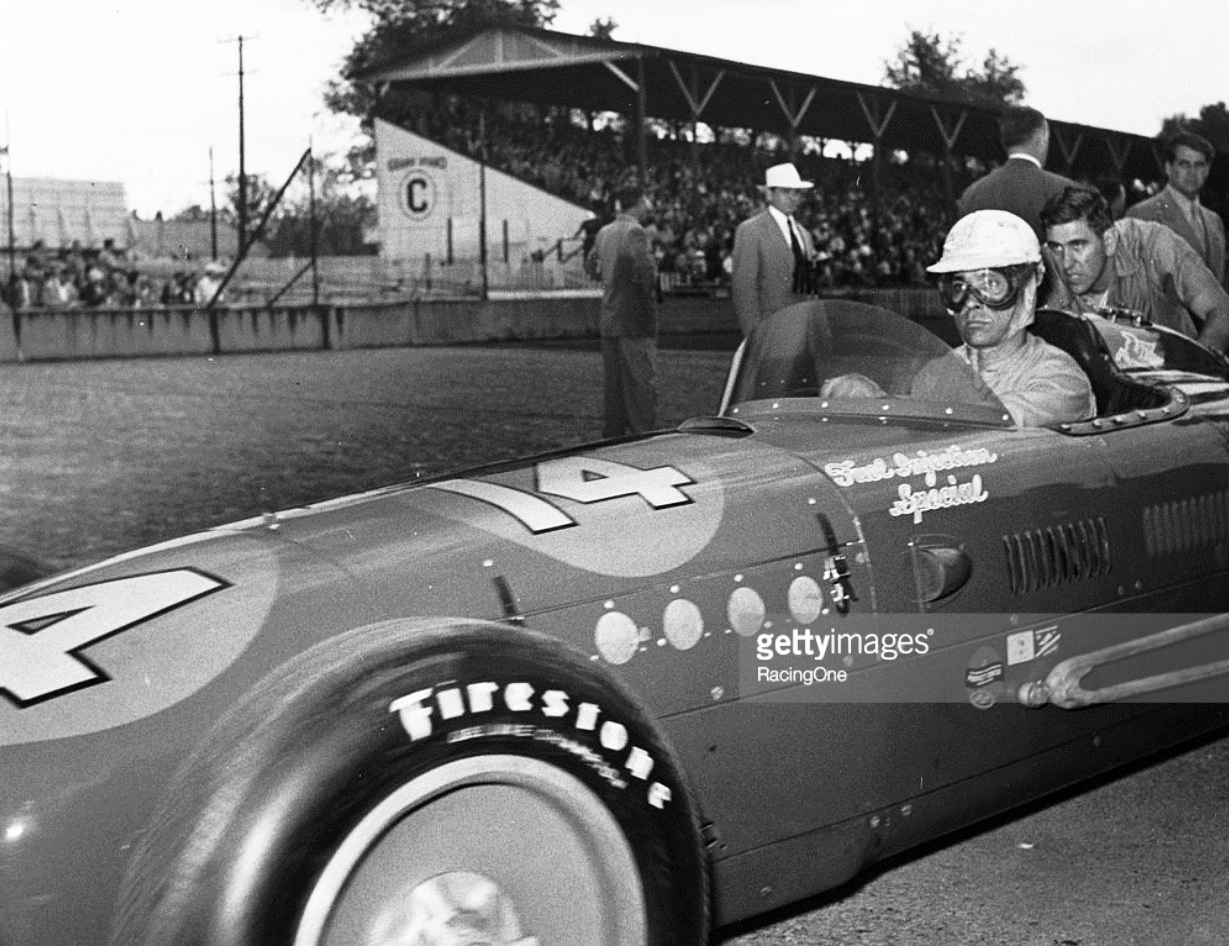
Billy Vukovich leading the Indy 500 in his Kurtis Kraft Offy, he won the race from the similar cars of Art Cross and Sam Hanks…

Vukovich dipped out on victory in 1952 with a steering gear failure several laps from the end, in ’53 he led from lap 1 and 195 of the 200 laps in total. The event was run in searing heat which required the use of 16 relief drivers, Billy drove the race himself in a tough, gritty display.

32 of the starters used the DOHC 4 cylinder Meyer-Drake ‘Offy’, the other engine the famous Novi V8, finally Kurtis Kraft supplied 22 of the 33 chassis which contested the race.

Credits…

Max Staub, Racing One

image

Vukovich rejoins the race after a pitstop, Kurtis Kraft, Indy 1953 (Racing One)


racing car show

(David Lawson)

Lotus stand at the ’69 Racing Car Show, sports-racer Type 47 and F3 Type 59 to the fore…

Both models are Loti i always had a hankering for, there were several 47’s which raced for years in Australia in  a variety of classes and a 59 won the Australian Drivers Championship, the ‘Gold Star’ in 1970.

fittipaldi

Emerson Fittipaldi contesting the 1969 Guards Int Trophy at Brands Hatch on 1 Sept 1969. His Jim Russell Lotus 59 Ford was 3rd to Reine Wisell Chevron B15 Ford and Tim Schenken BT28 Ford, all racing in F1 in 1971- Emerson and Reine for GLT Lotus, Tim for Brabham (unattributed)

Back to the UK in 1969, the works ‘Gold Leaf Team Lotus’ 59’s were raced by American Roy Pike and Brit Mo Nunn (later Ensign F1 designer/supremo) with Aussie Dave Walker in a ‘Lotus Components’ entry (the constructor of Lotus customer racing cars).

Emerson Fittipaldi raced a Jim Russell Lotus 59 entry winning the 1969 British championship and making his GP debut at Brands Hatch in 1970.

dave walker monaco

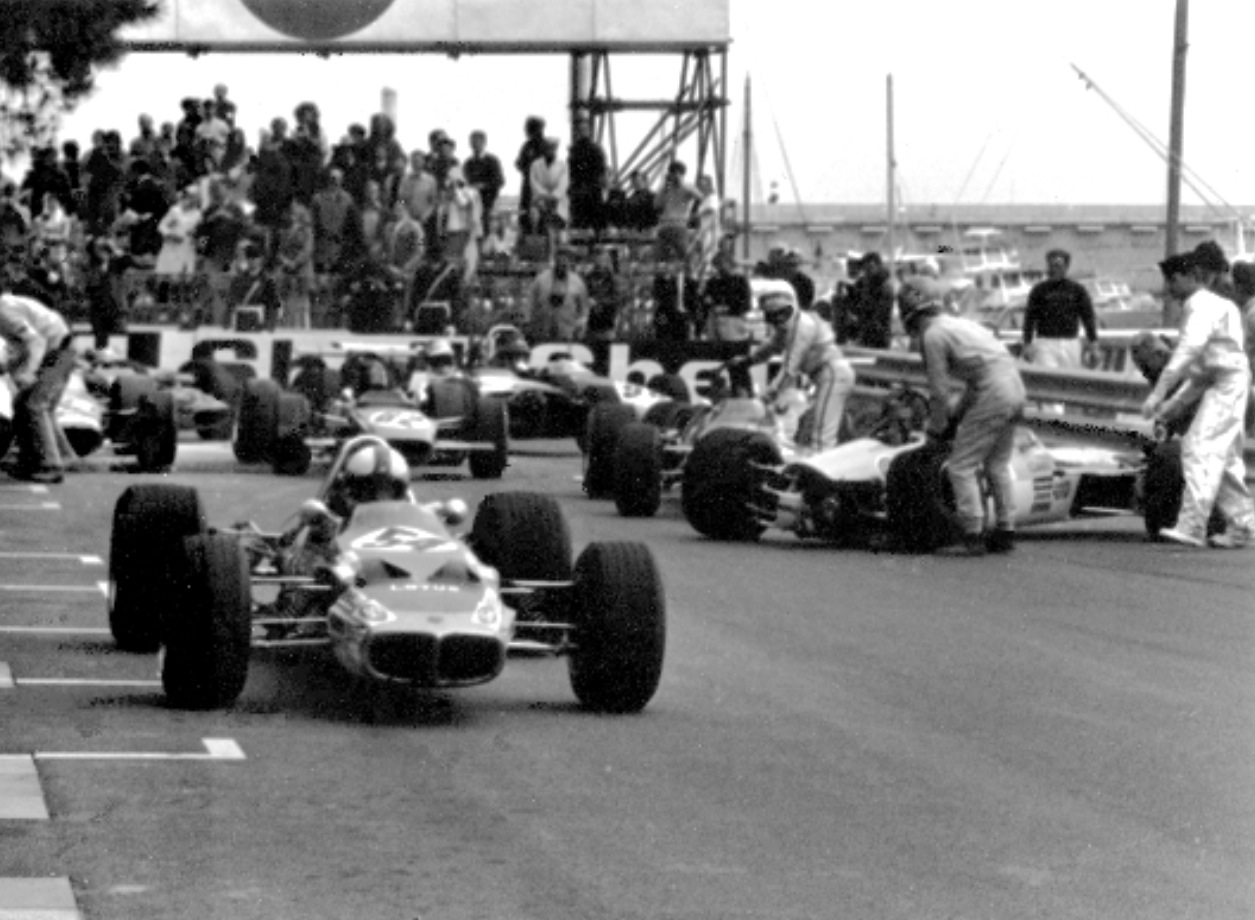
Dave Walker in the GLTL Lotus 59 during the 1970 Monaco F3 GP, 9 May. He is threading his 8th placed car thru typical Monaco carnage. Tony Trimmer won in a Brabham BT28 Ford, Walker dominated F3 in 1971 including a GLTL Lotus 69 Ford Monaco F3 GP win (Simon Lewis)


47 paintinfg

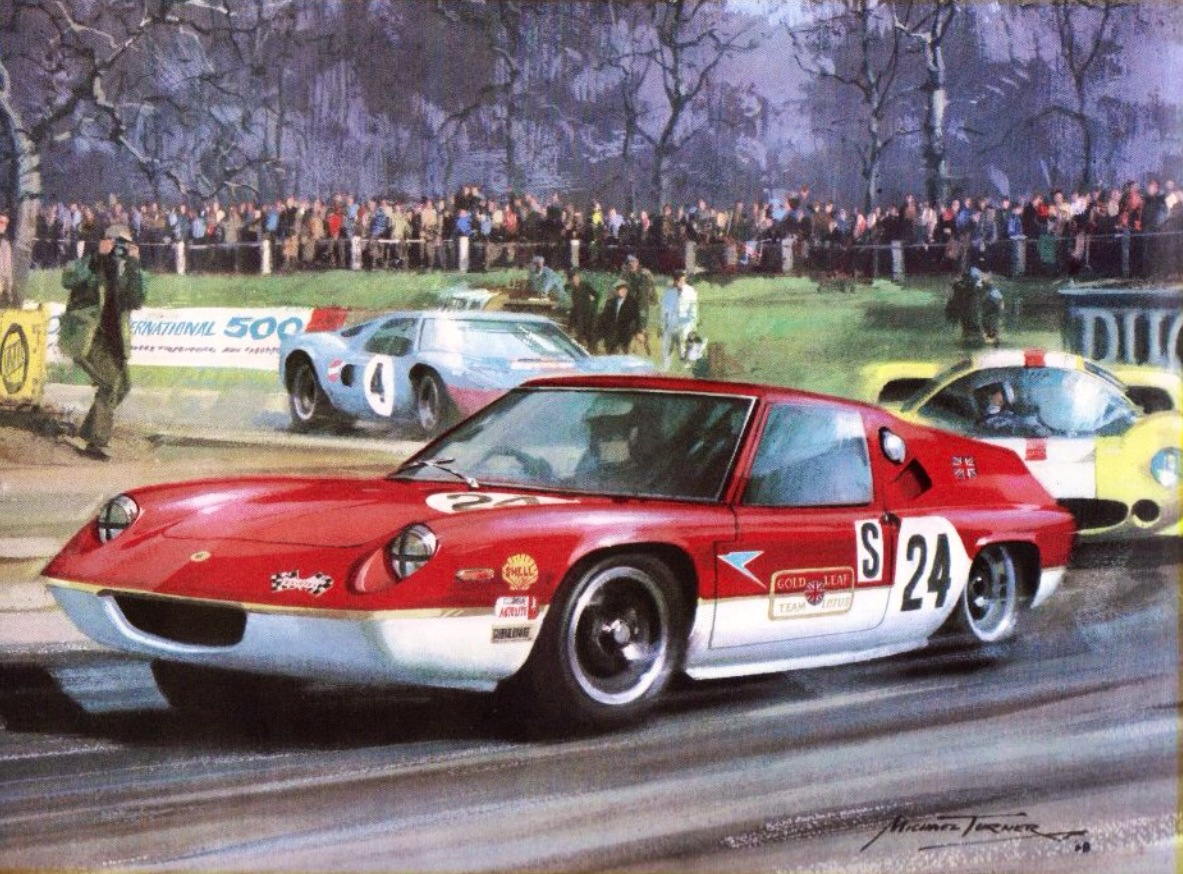
The Oliver/Miles GLTL Lotus 47 is depicted ahead of the Bonnier/Sten Axelsson Lola T70 Mk3 Chev 6th and winning Ickx/Redman Ford GT40, Brands 6 Hour, 7 April 1968, the day of Jim Clark’s death (Michael Turner)

The 47 was raced in the 1968 Brands Hatch 6 Hours in GLTL colors by Jackie Oliver and John Miles finishing in tenth place in the race won by the Ickx/Redman Ford GT40.

In 1969 the works team raced the Lotus 62 with the GM derived Vauxhall/Lotus LV220 DOHC 4 valve engine, the 47 powered by the venerable Ford/Lotus twin-cam, a Hewland FT200 gearbox used in place of the standard Renault unit.

Whilst the 62 looked a bit like the 47 it shared a few body panels only; its spaceframe chassis was bespoke (2 built) and engines as noted above totally different.

47 silvers

John Miles Lotus 47.  ‘Silverstone Players Trophy’ meeting 27 April 1968 (Simon Lewis)


lotus 47 cutaway

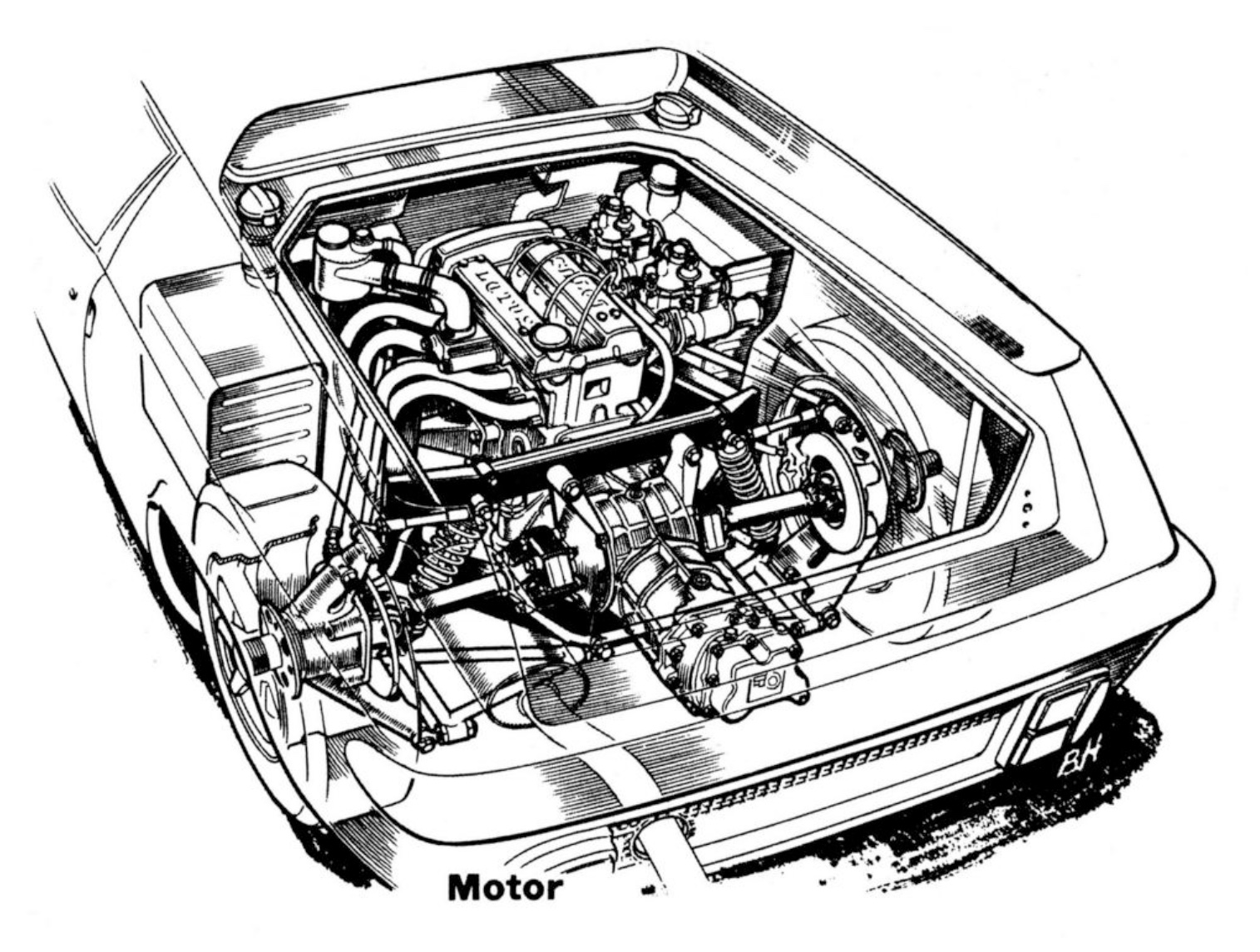
Lotus 47 cutaway; backbone chassis, front suspension upper and lower wishbones and coil spring/damper units. Rear suspension top link, lower wishbone and radius rods. Engine Ford/Lotus twin cam 2 valve, power depending on spec from 160-190bhp. Gearbox Hewland FT200 5 speed , Brakes ventilated disc all round (unattributed)


Lotus 47 engine, gearbox and suspension detail (B Hayton)

Geoghegan’s Sporty Cars 47…

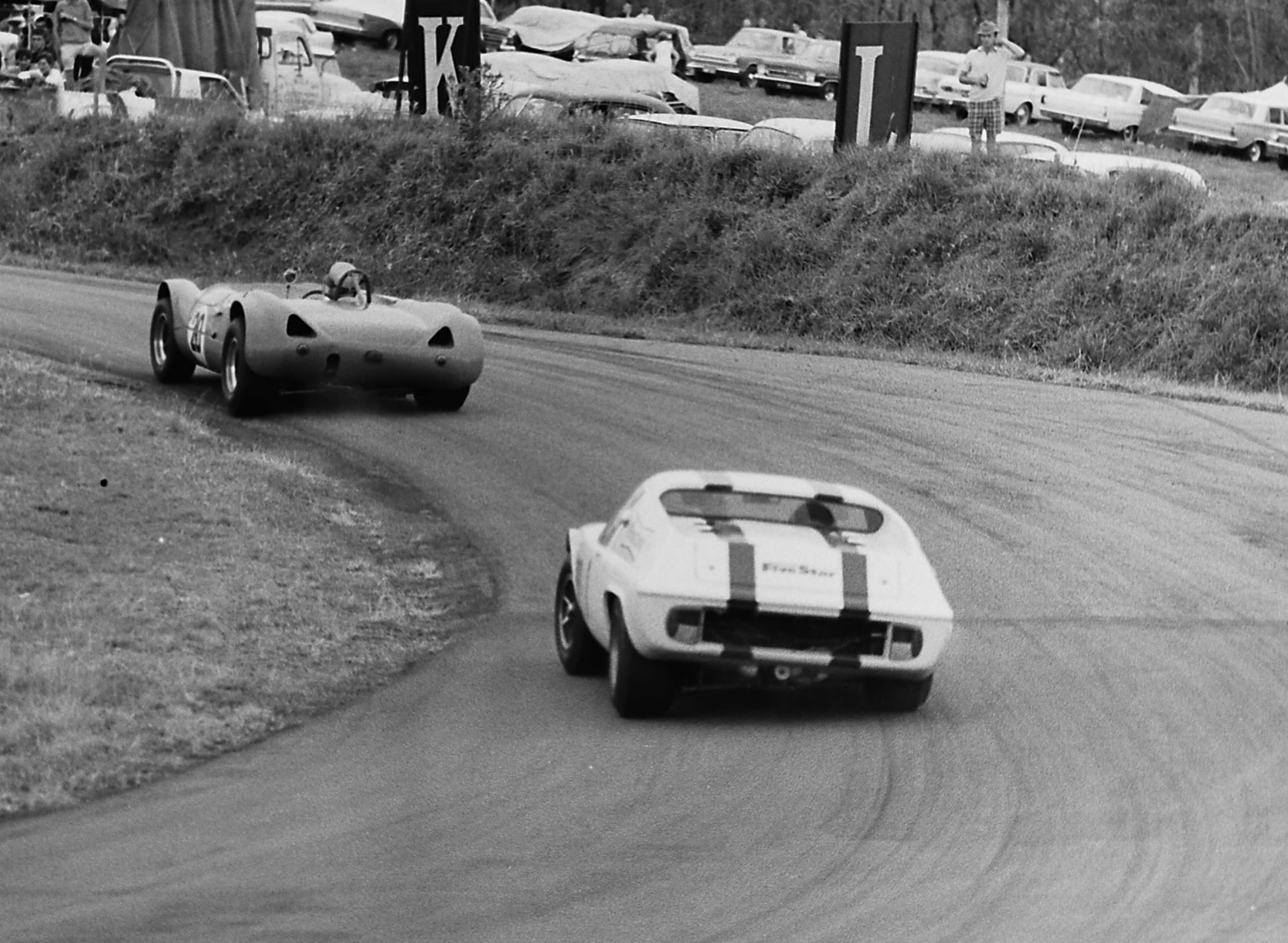
It was inevitable that the Geoghegan brothers would import a Lotus 47 to Australia albeit the cars didn’t fit neatly into our sportscar class structure where the majority of races were short sprints rather than the longer events for which the cars were really designed.

(C Haigh)

The point is illustrated by Leo’s challenge in keeping up with the Lotus 23B Ford at Lakeside above circa 1968, whilst the gorgeous silhouette of the car is shown in the shot below at Hell Corner, Bathurst where he is trying to hold off his old Elan 26R being driven by Niel Allen.

(C Haigh)


(C Haigh)

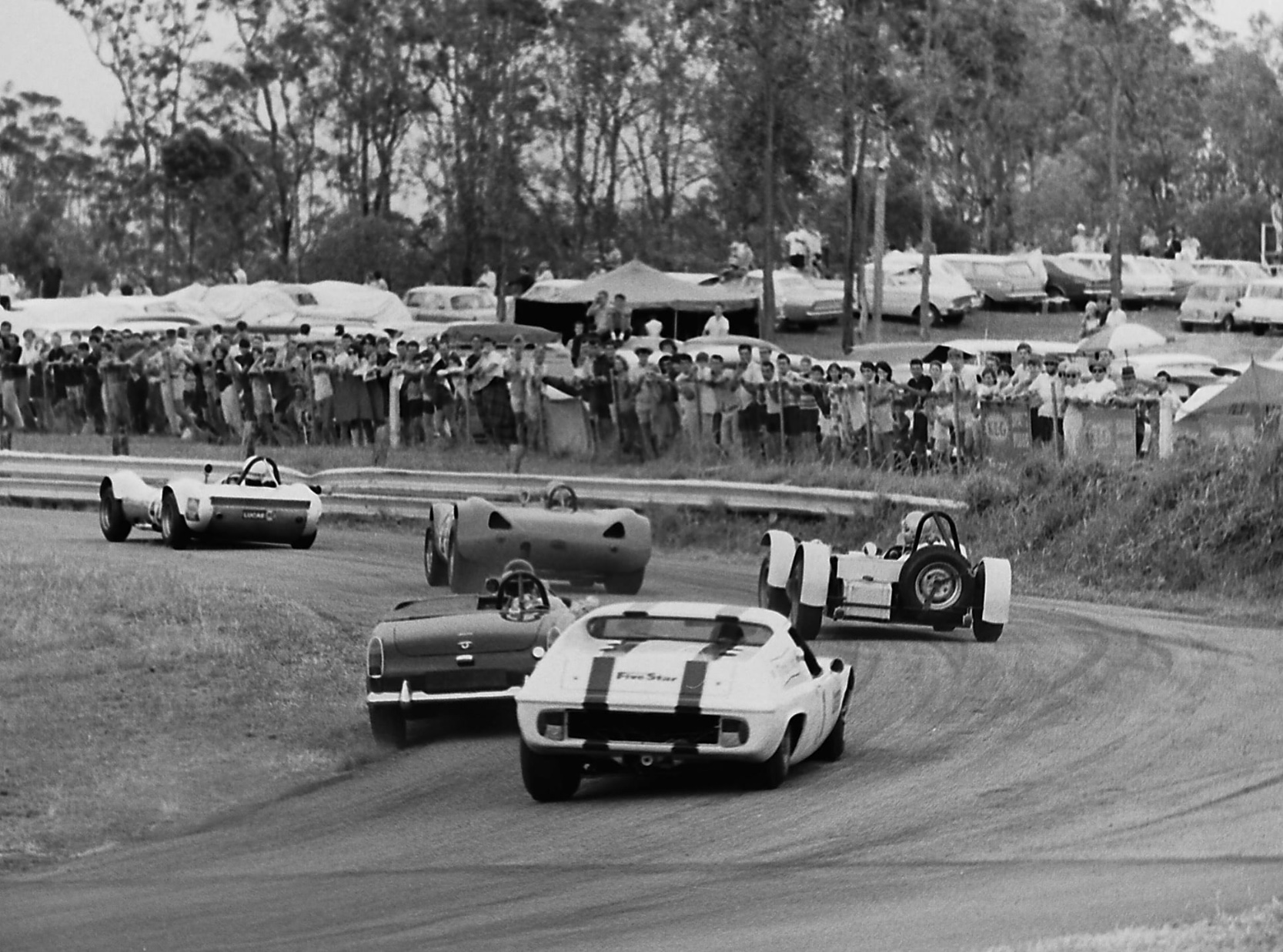
The last two shots are at Lakeside, the one above is Leo and the 23B lapping slower machines- get in touch if you can identify the cars/drivers.

(C Haigh)

Photo Credits…

David Lawson, Simon Lewis, Chris Haigh

Finito…


brabham op circuit

(R Rice)

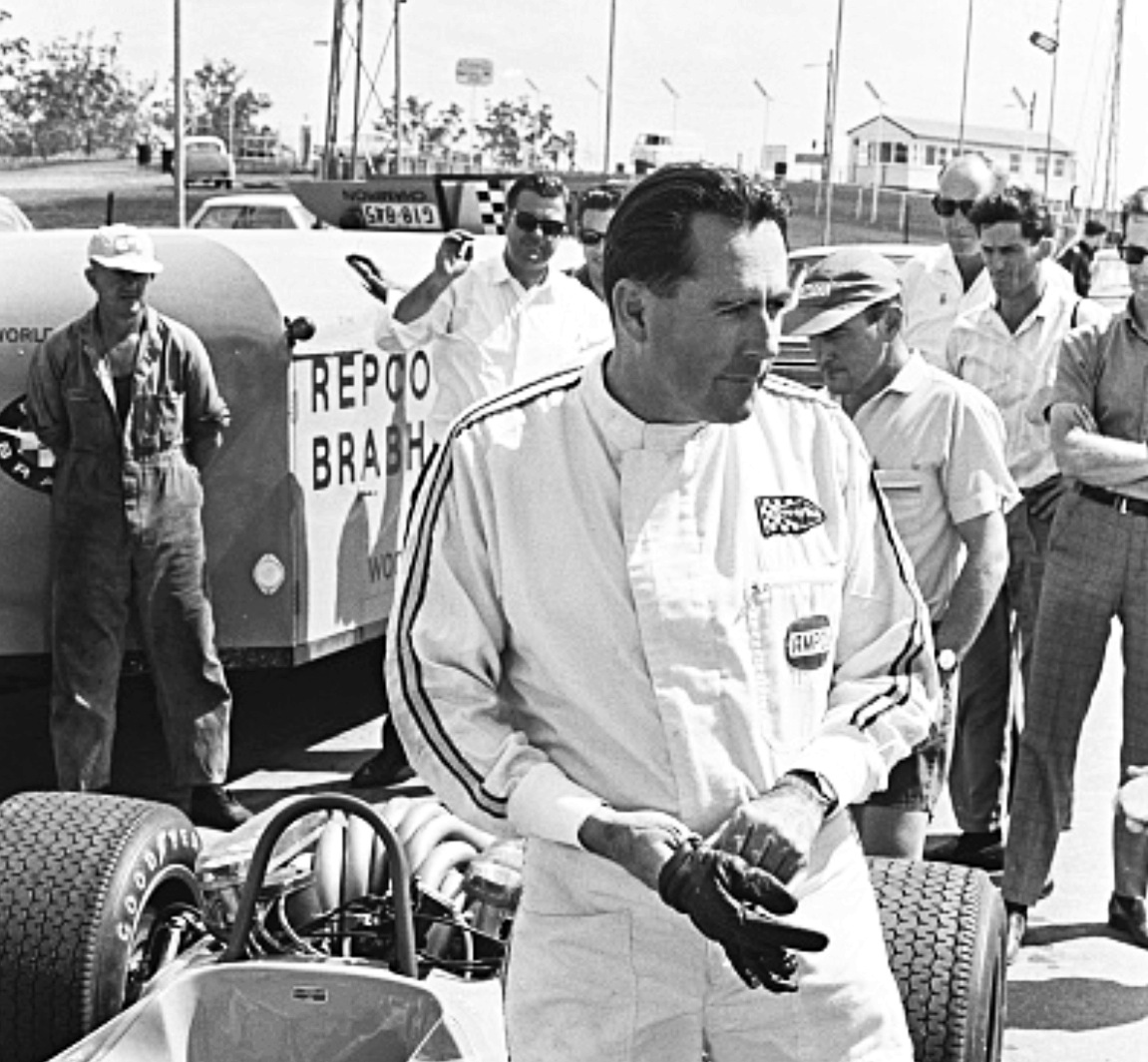
Jack Brabham shakes down his 1968 Tasman contender the Brabham BT23E Repco for Sydney’s media at Oran Park, 14 February 1968…

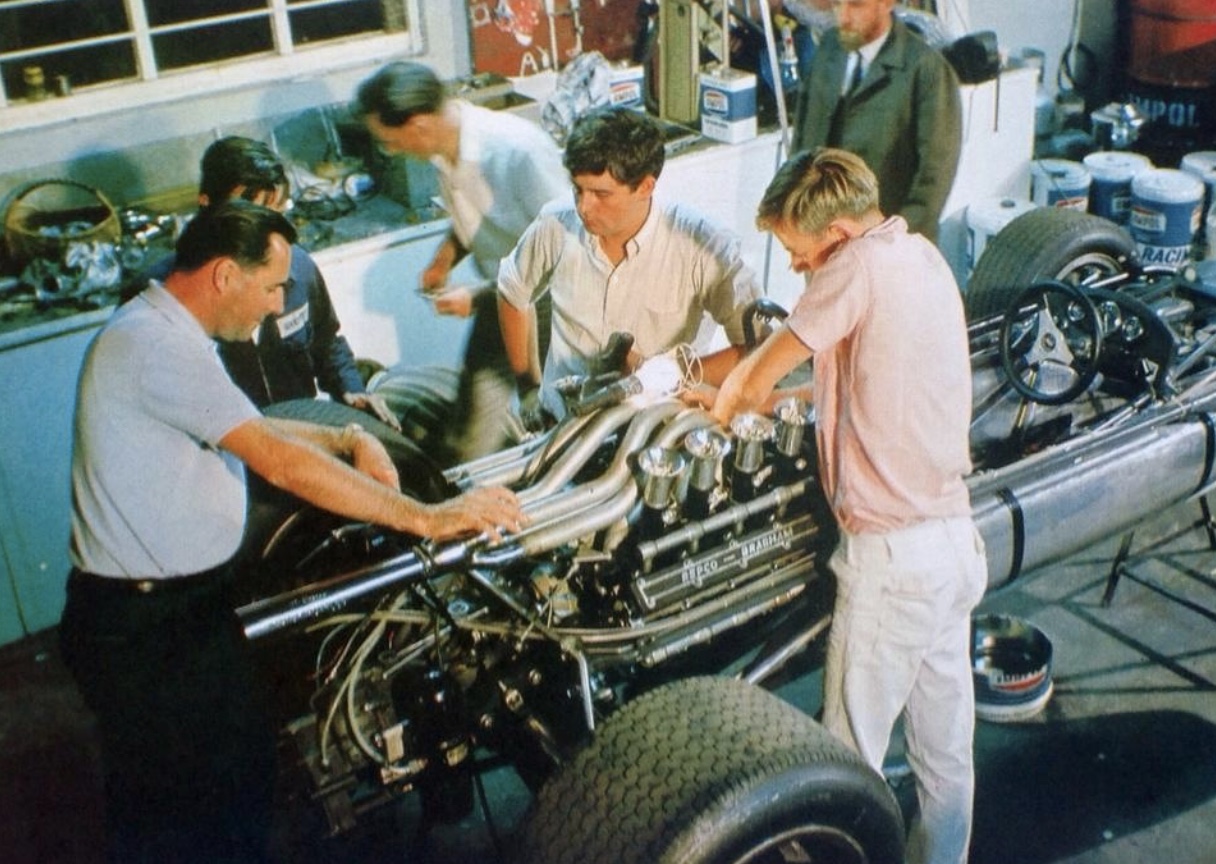
Nestled in the back is Repco’s latest ‘RB740’ 275bhp 2.5 litre V8, the Tasman variant of Brabham’s successful 1967 F1 3 litre (330bhp) engine. Denny Hulme took the drivers title from Jack in a BT24, with Brabham Repco winning the constructors championship for the second year on the trot.

jack, op

Brabham in the OP pitlane February 1968 (R Rice)


barbham op

Jack Brabham at Oran Park, Sydney 1968. He might have raced a Holden touring car there in the mid-seventies but didn’t in his ‘heyday’. Built in the 1960’s 60Km west of Sydney near Camden, OP was extended in 1974 hosting the F5000 1974 and 1977 AGP’s. Subsumed by Sydney’s western sprawl ‘Oran Park Town’ will house around 25,000 people (R Rice)


BT23E being fettled probably in Sydney during the Warwick Farm weekend, Jack hands on as ever,  RBE740 2.5 V8, Hewland FT200 gearbox (unattributed)

The Brabham BT23E/1was again built on Ron Tauranac’s BT23 F2 jig and powered by a 2.5-litre Repco V8- as it was for the BT23A he campaigned in the 1967 Tasman before its sale to David McKay’s Scuderia Veloce- BT23A used RBE640’s throughout the 1967 Tasman whereas BT23E used both RBE740 and a new design- the RBE830 (short F1 block and between the Vee crossflow, SOHC, two valve heads) on raceday at Sandown.

Jack Brabham made limited appearances in the 1968 Tasman series, he raced the BT23E twice, at Warwick Farm and Sandown Park in February.

bt 23e wf

(Brian McInerney)

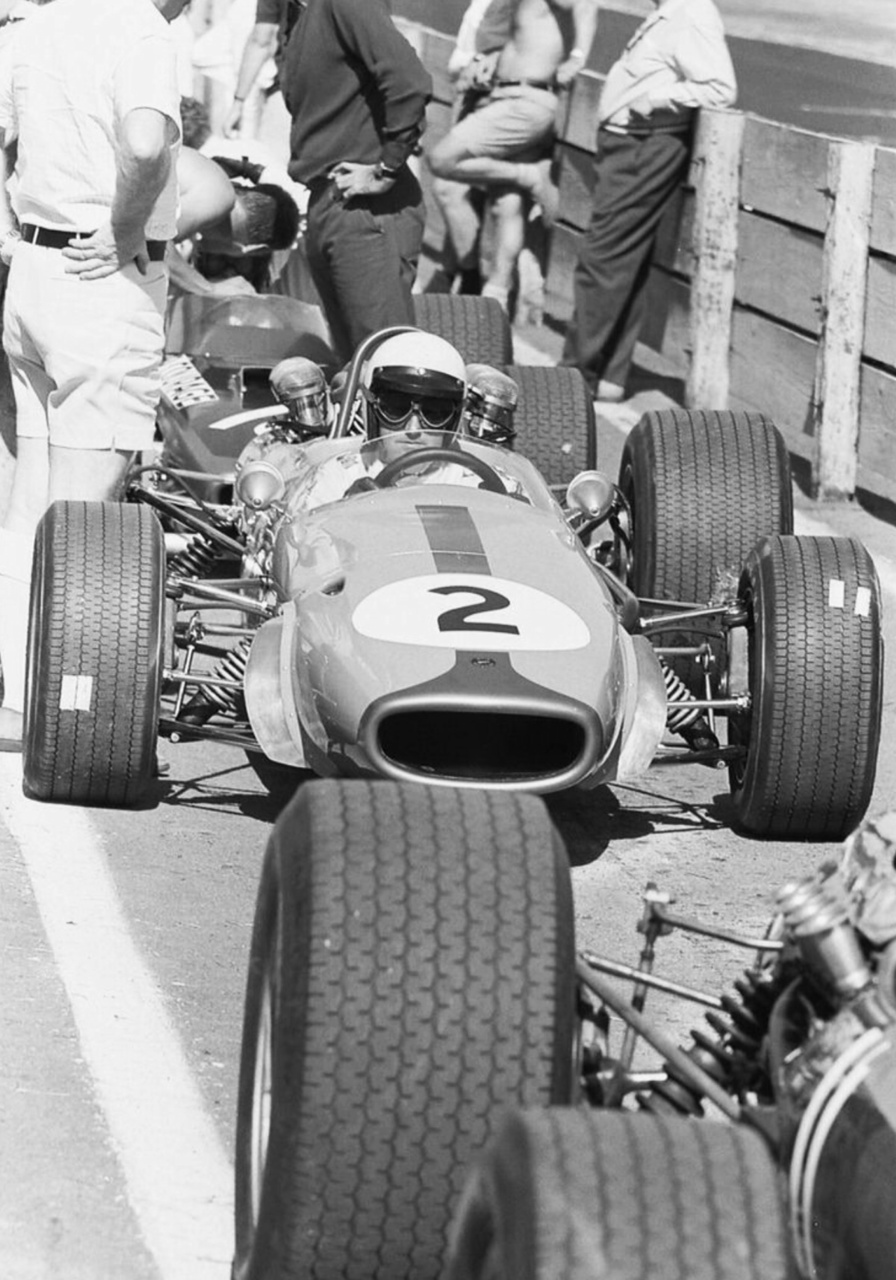
Brabham in BT23E in the Warwick Farm pitlane several days after the cars Oran Park shakedown.

The car in front of Jack’s is Pedro Rodriguez’ BRM P261, behind him is the nose of Piers Courage’s McLaren M4A Ford FVA F2 car, third in the race. Jack was seventh in the ‘Warwick Farm 100’ on 18 February, Jim Clark ran away with the race from teammate Graham Hill’s identical Lotus 49 Ford DFW. Click here for an article on this meeting;

‘Warwick Farm 100’ Tasman Series 1968…

At Sandown on 25 February Clark again won the race and the title, Jack’s new Repco ‘830’ engine failed. It was a bit of a portent of the F1 year he and Jochen Rindt were to experience with the Repco engines.

The Ford Cosworth DFV, in its second year, challenged the new quad-cam 32 valve Repco RB860 V8, its fragility was as problematic as its RB620 and 740 brothers had been reliable…

Sandown AGP 1968. Clark, Lotus 49 Ford DFW, Chris Amon, Ferrari Dino 246T and Jack in BT23E/1. Row 2 is Graham Hill and Leo Geoghegan in Lotus 49 Ford DFW and Lotus 39 Repco 740 respectively. The other glimpse of a car beside the fence is Frank Gardner’s Brabham BT23D Alfa. Jim won in a thriller diller of a race by a ‘bees-dick’ from Chris (HAGP)


RBE830 engine cobbled together to fit in the BT23E frame- the blocks were different, note oil cooler and breather arrangements (R MacKenzie)

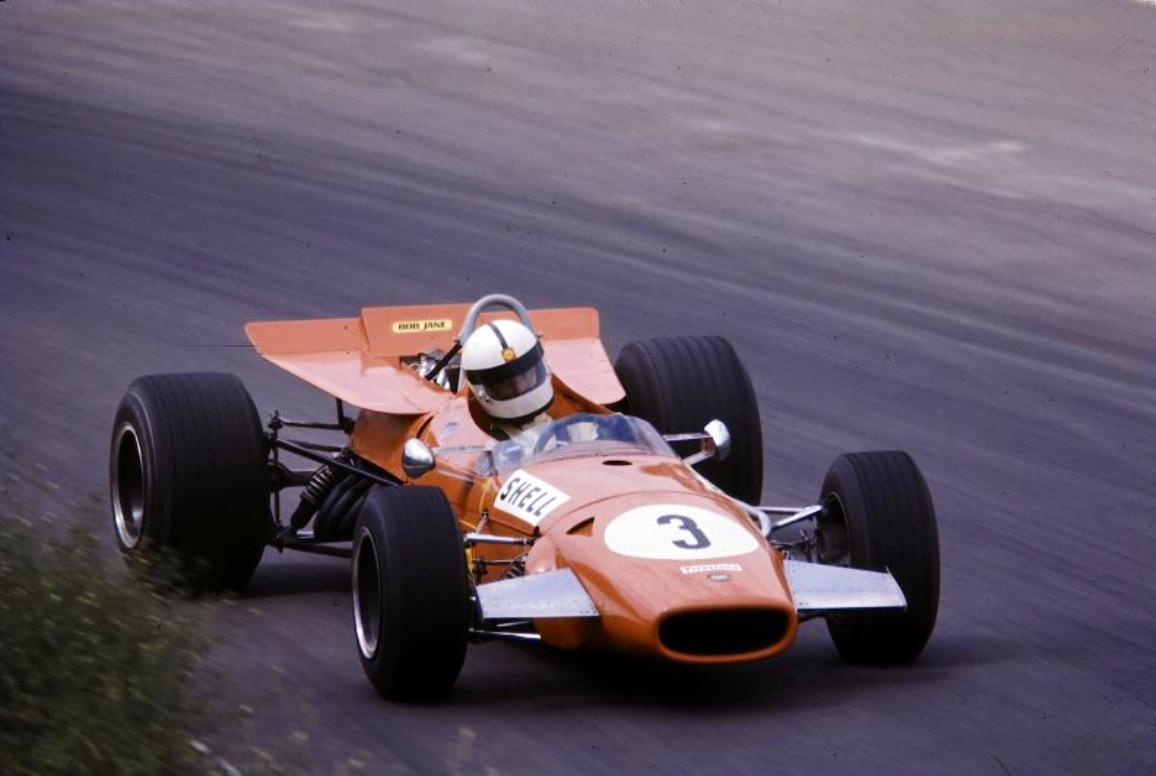
The car was then sold to Bob Jane Racing and driven by John Harvey, but he was injured in a massive accident in practice on his first outing in the car at Bathurst during the Gold Star meeting.

It was repaired before Harvey recovered from the life threatening accident, which was a bumma for John but also in terms of the ’68 Gold Star competition, it would have been great to have Harves give Kevin Bartlett, who won that year in Alec Mildren’s Brabham BT23D Alfa Romeo Tipo V8 a run for his money- Leo raced his ex-Clark Lotus 39 Repco.

Bob Jane gave Ian Cook a run in the car at Lakeside in July and then by Allan Moffat at Sandown Park in August, Moffatt crashed it again and it was out of action until the 1969 Tasman series. Moffat had returned to Australia after making a strong name for himself in the US in the two years before in Lotus Cortinas, a Ford Mercury Cougar in late 1967 and sharing a works Shelby Mustang at Daytona and Sebring in the first quarter of 1968.

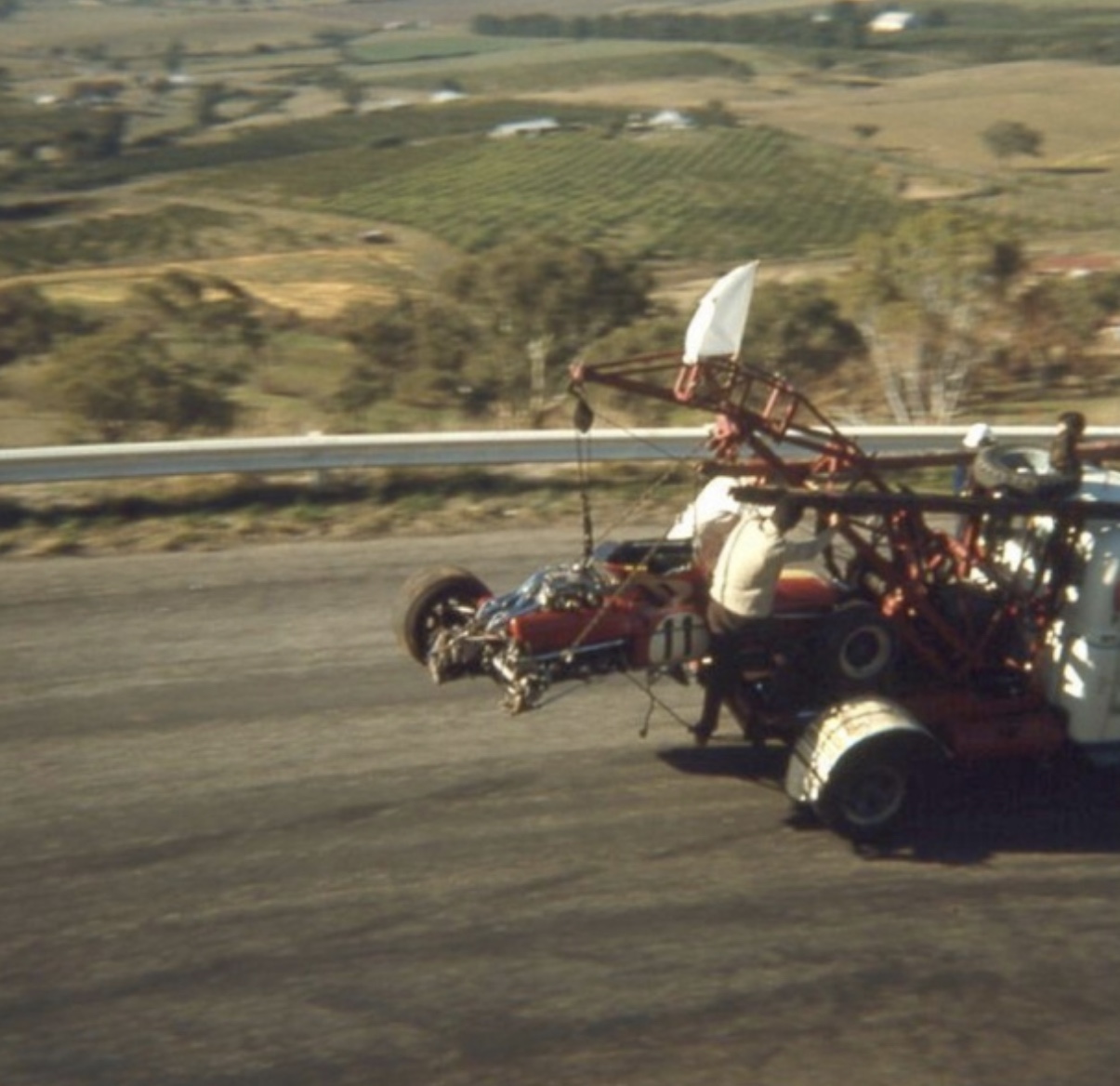
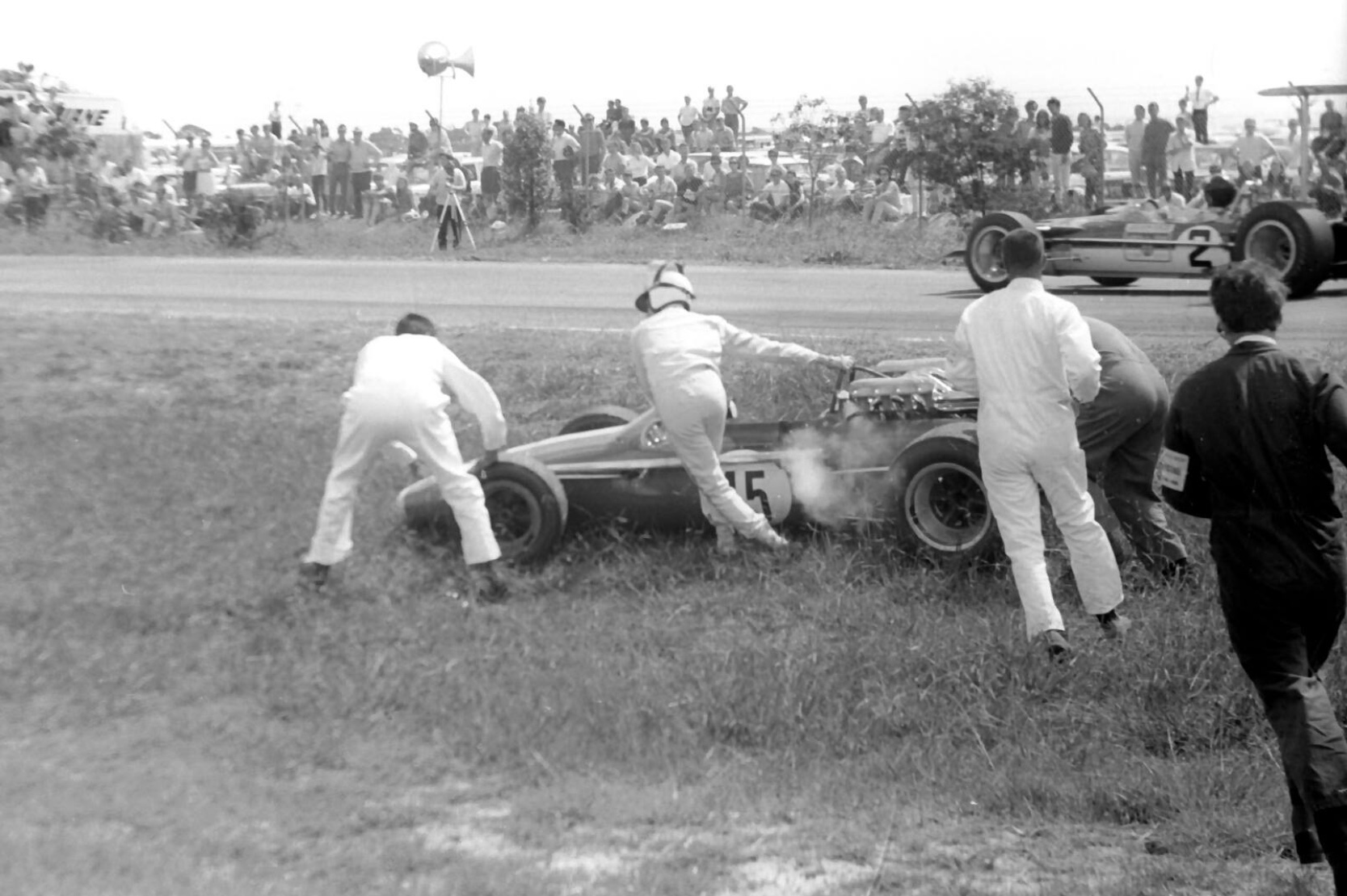
Harvey in the bi-winged Brabham BT23E 740 at Bathurst Easter 1969 before the big accident caused by upright failure, the mangled mess is shown below. The car was run in this form only once (oldracephotos.com)


(J Davis)


(D Harvey)


Harvey and the marshalls push BT23E 740 to the inside on the run out of Dandenong Road at Sandown in February 1969- Jochen Rindt’s Lotus 49B Ford DFV sings past (R MacKenzie)

When John and the car were ready to race again he contested Bob Jane Racing’s home race at Sandown but failed to finish after having engine problems.

Harvey raced it through the 1969 Australian Gold Star series, winning at Sandown in September and finishing second at Bathurst at Easter but retired from four races- due to oil pressure at Symmons Plains, undisclosed engine problems at Mallala, a cam-follower at Surfers Paradise and an accident in practice at Warwick Farm. Kevin Bartlett won his second Gold Star in 1969 aboard the Mildren ‘Yellow Submarine’ Alfa from Leo Geoghegan’s Lotus 39 Repco and Max Stewart in the other Alec Mildren entry, the Mildren Waggott TC-4V 1.9 litre.

During this period the car evolved in look a lot- constant experimentation with wings and engine- Bob Jane acquired the latest circa 300bhp RBE830 series V8 prior to the commencement of the Gold Star, the team yielded a performance dividend but not a reliability one. Repco Brabham Engines’ Rodway Wolfe recalls being instructed to give the two works RBE830 engines used by Jack Brabham in his little raced 1969 Tasman campaigner, the Brabham BT31 to Jane after Jack’s last event with that car- a win in the 1969 Easter Bathurst Gold Star round, so Bob/Harvey should have had the best of Repco Tasman V8s.

Harvey, BT23E, Warwick Farm 1970 (R Thorncraft)


Harvey, BT23E 830, Warwick Farm 100 Tasman round 1970. That neatly integrated engine cover/cowling wing assembly was fabricated by ex-Repco man John Brookfield in Melbourne (D Simpson)

Formula 5000 cars were eligible to enter the 1970 Tasman Series but despite that a good 2.5, or 2.4 litre car in fact won the championship- Graeme Lawrence won in the same V6 Ferrari Dino 246T chassis Chris Amon used to win in 1969. Bob Jane Racing entered only the Warwick Farm and Sandown rounds- Harves was a good fifth at the Farm where KB won in the Sub 2 litre Waggott powered whereas at Sandown he had an oil leak and retired the car- Niel Allen won ina McLaren M10B Chev.

He raced BT23E in the first round of the 1970 Gold Star series, winning at Symmons Plains in March from Leo Geoghegan and Kevin Bartlett but from the following round at Lakeside the teams front line tool became the Jane-Repco 830 V8- a machine built on Bob Britton’s Brabham BT23 jig but optimised to suit the latest generation of Firestone tyres- with more reliability Harvey had the speed to win the Gold Star that year. The story of that year is told here; https://primotipo.com/2019/07/05/oran-park-diamond-trophy-gold-star-1970/

After the sale of the car by Bob Jane it was converted to an F2 car with a Ford twin-cam engine and raced by Woody Curran in Tasmania from 1970-1977, it was sold to Bill Marshall who restored and historic raced passing via Ray Delaney into the hands of Art Valdez in the United States, and then a consortium in the UK in 2017, in more recent times it was acquired by Australian racer/restorer Aaron Lewis who has rebuilt it in RBE830 engined form.

Symmons Gold Star round 1970. From left Leo Geoghegan, Lotus 39 Repco 730, Kevin Bartlett, Mildren ‘Sub’ Waggott TC-4V 2 litre- Max Stewart on the row behind in the Mildren Waggott TC-4V 2 litre and John Harvey, Brabham BT23E Repco 830. Harvey won from Geoghegan, Bartlett and Stewart (H Ellis)

The last few races for the BT23E in its Repco heyday seem to be the 1970 Symmons Plains Gold Star round (above) on 2 March 1970, the ANF1 races during the Easter Bathurst meeting (no longer a Gold Star round due to safety issues) and finally the ANF1 races held during the RAC Trophy sportscar championship meeting (below) at Warwick Farm on May 3 1970

Harvey, BT23E 830 in its final front-line Repco engine race at Warwick Farm on 3 May 1970 (R MacKenzie)


(M Bisset)


(M Bisset)

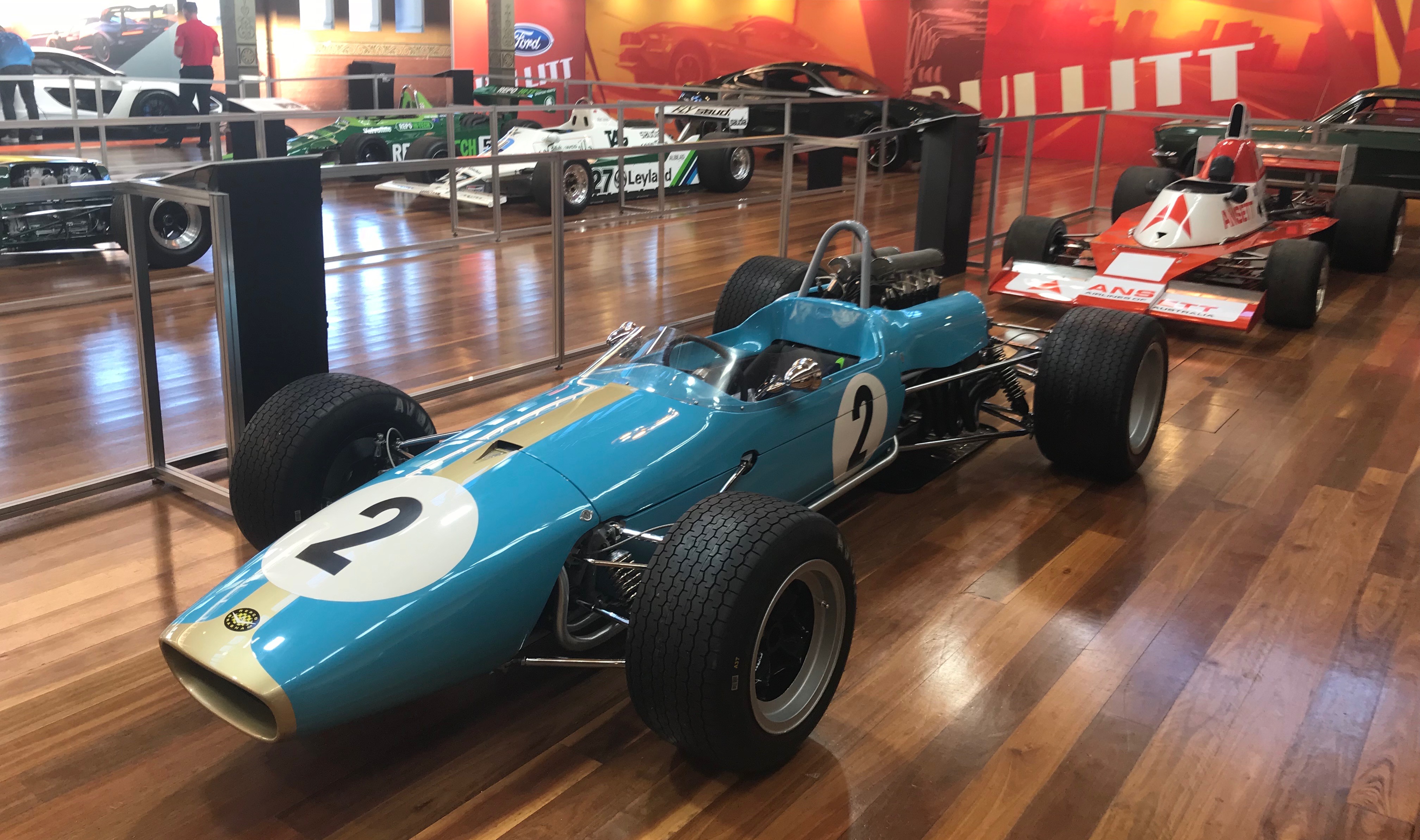
Aaron Lewis’ restoration of the car is superb, as shown it is fitted with an RBE830 2.5 litre V8 and sans wings- that is the specification in which it raced in the 1968 Sandown AGP. This is the Melbourne Exhibition Buildings in Carlton during ‘Motorclassica’ in October 2018.

Surrounding cars include the ex-Alan Jones Williams FW07 Ford, the green ex-Nelson Piquet 1981 AGP Ralt RT4 Ford BDA, ‘Ansett’ Elfin MR8 Chev F5000 and red Allan Hamilton owned McLaren M10B F5000.

Etcetera…

(oldracephotos.com

Bob Jane Racing Council of War at Symmons Plains in March 1970, I guess that weekend they may have run the Shelby Mustang, Brabham, McLaren M6B Repco sporty and a series-production Monaro GTS350 perhaps.

Bob, Harvey, Pat Purcell, an obscured fellow and John Sawyer at right. Harvey is sitting on the rear tyre of the BT23E.

(R MacKenzie)

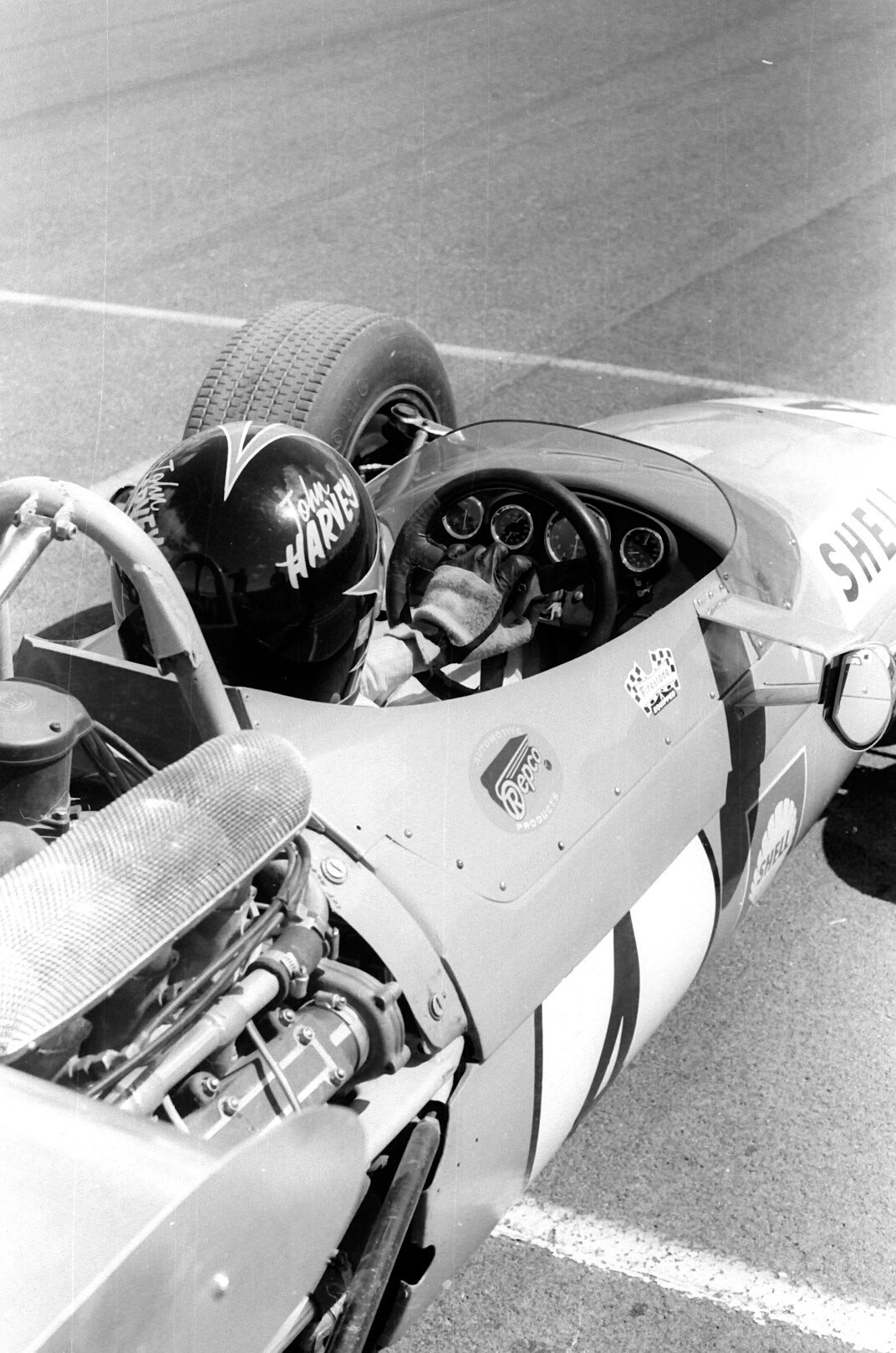
Three photographs of John Harvey at Bathurst in 1970- this was the famous meeting/event at which Niel Allen set a lap record for Mount Panorama in his McLaren M10B Chev F5000, which stood for a couple of decades .

Note that in the shot above at Easter the car has a separate wing rather than the integrated engine cover cowling and wing- cowling at Symmons in on 3 March, separate wing above on 27-30 March and back to the cowling fot that final meeting at Warwick Farm in May 1970- perhaps they were testing a different wing for the pending Jane V8?

Note the tyre going flat in the closeup shot below on the way down the mountain.

(Wirra)


Bathurst Easter 1970 grid (R MacKenzie)


(P Townsend)

Photograph in the Warwick Farm paddock during the May 1970 RAC Trophy meeting. That near engine over/wing does have a 1969 F1 Matra MS80 touch about it.

Credits:

R Rice, Brian McInerney, Wirra, Rod MacKenzie, Peter Townsend, Dale Harvey, oldracingcars.com, Harold Ellis, Dick Simpson, ‘History of the AGP’ G Howard and ors, M Bisset, Jeff Davis

Tailpiece: Jack’s BT23E cruisin’ the Warwick Farm paddock…

brabham bt 23e

(Wirra)

Brabham, Brabham BT23E Repco 740, Warwick Farm Tasman meeting 1968, all gorgeous in its turquoise/gold stripe livery.

Finito…


efr

Elliot Forbes-Robinson’s Spyder NF-11 Chev chases Jacky Ickx’ Lola T333CS Chev, Round 1 of the 1979 Can-Am Championship on May 6…

Terry Capps terrific shots capture the essence of this challenging Braselton, Georgia circuit and all of the ‘fun of the fair’ from a spectators perspective in watching and hearing these 5 litre beasties around the courses undulations.

ra 1

Keke Rosberg winner at Road Atlanta 1979. Spyder NF-11 Chev (Terry Capps)

Keke Rosberg won the race in another of Paul Newman’s Lola T333 based Spyders with Ickx and EFR second and third. Keke took pole in 8 of the 10 races but had poor reliability and a couple of shunts; Ickx took the title that year in the ‘factory’ Haas Lola.

ra 3

Jacky Ickx in Carl Haas’ Lola T333CS Chev. Road Atlanta ’79 (Terry Capps)

ra efr

Elliott Forbes-Robinson in the other Newman-Freeman Spyder NF-11 Chev. Road Atlanta ’79. (Terry Capps)

Tailpiece: A Spyder Departs…

ra 4

Road Atlanta 1979 (Terry Capps)

Photo Credits…Terry Capps


tarrant 2

(Algernon Darge/SLV)

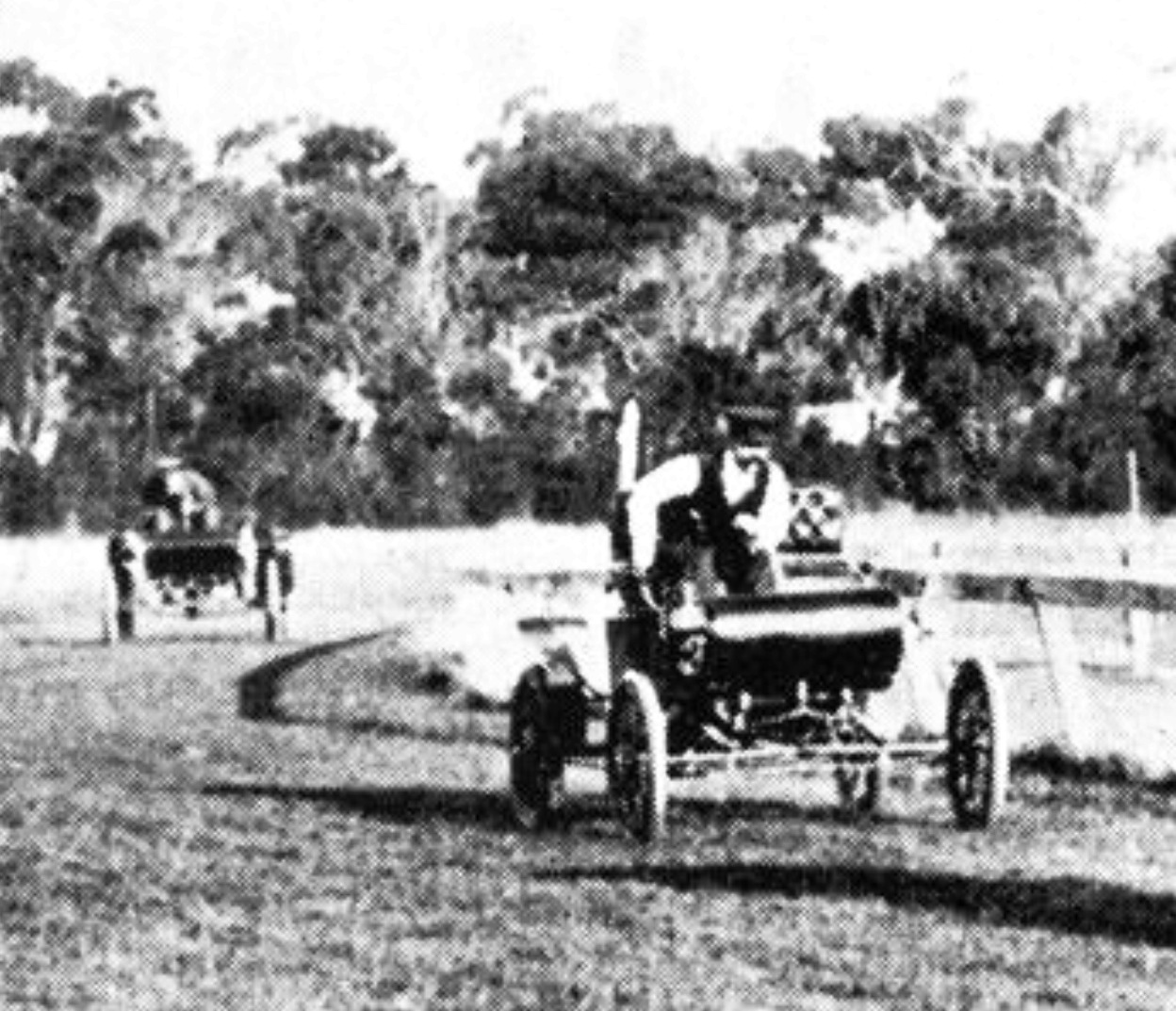
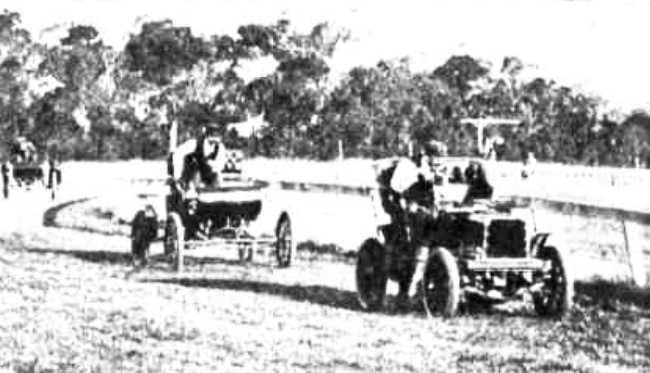
Harley Tarrant ‘tears’ down Sandown Racecourse’ back straight in his Argyll to win the 3 mile race ‘for heavy automobiles’ on 12 March 1904…

Runner-up of the event organised by The Automobile Club of Victoria was Tom Rand’s Decauville, Tarrant’s average speed, 26mph for the 3 miles in a time of 6 minutes 55 seconds.

tarrant

Harley Tarrant left, Argyll 10HP and Tom Rand Decauville 16HP 2nd. Sandown Racecourse, 12 March 1904 (Algernon Darge/SLV)

the ozzie

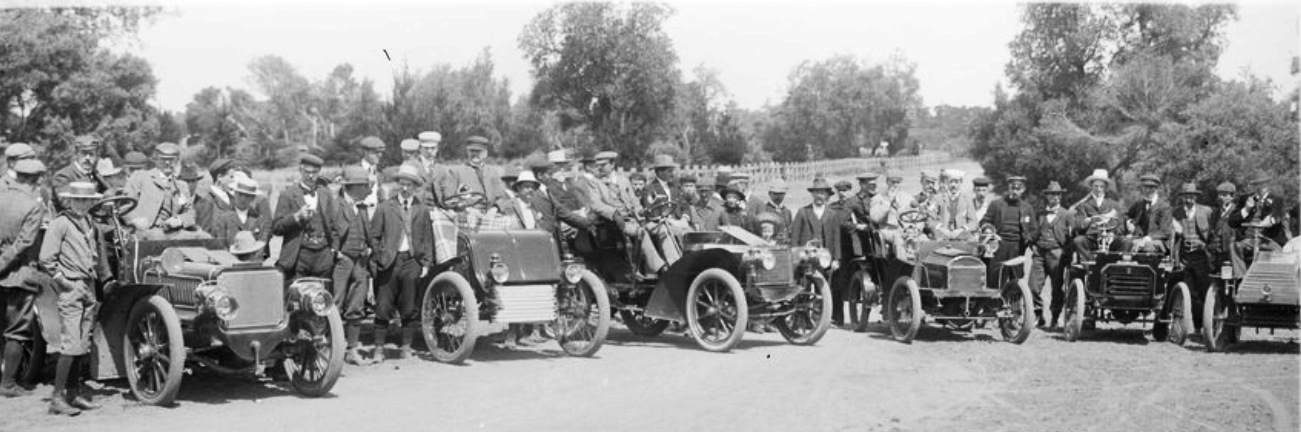
Three motor contests were run at the ‘Commercial Travellers Association’ annual picnic at Sandown Racecourse on 12 March 1904…

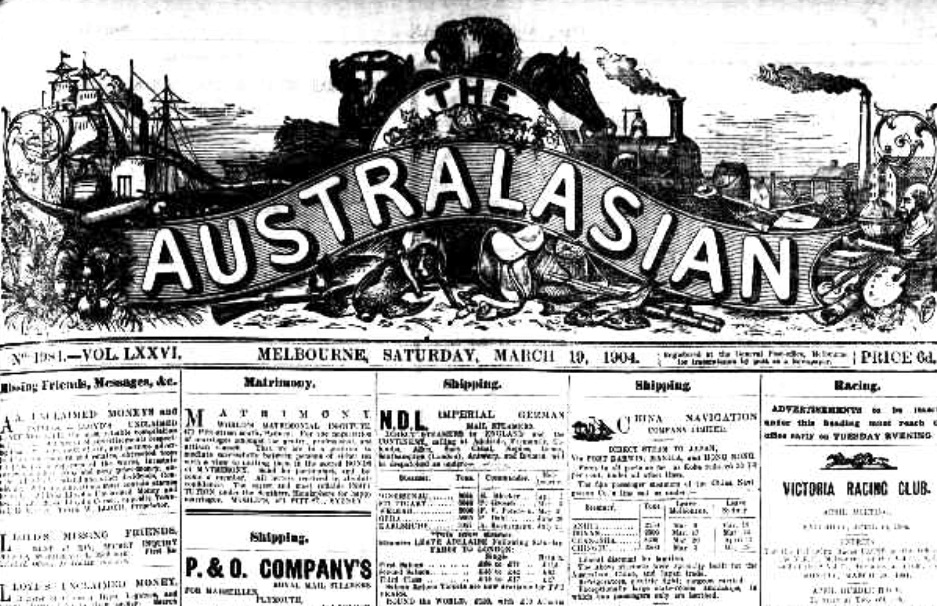
Melbourne weekly ‘The Australasian’ reported the event in its 19 March 1904 issue in the formal and amusing language of the day;

‘The Automobile Club of Victoria’ had another good turnout last Saturday in response to an invitation from the Commercial Travellers Association to be present at their annual picnic on the Sandown Park Racecourse’. Around 1400 people attended in total.

sandown blokes

Sandown racecourse 1904. ‘Curved dash’ Oldsmobiles (Algernon Darge/SLV)

‘Upwards of 25 cars left Alexandra Avenue (South Yarra, a distance of about 25Km) and proceeded at a leisurely pace via St Kilda, Caulfield, Oakleigh and Springvale. During the afternoon the number of cars swelled to 85, while there were more motor cycles as well. The road was in a terribly dusty state.

At the course the conditions were more enjoyable. The three motor contests were watched with interest by the picnickers, the ladies especially evincing much enthusiasm.


sandown scene

Sandown Racecourse 1904. 1400 attended, most arrived by train, here alighting at Dandenong Station. Car make and model unknown (The Australasian)

The presence of a neat electric car in which were seated 2 ladies, one of whom handled the motor with the skill of an expert, aroused the admiration of the gentlemen and the envy of the ladies. It was indeed a novel sight and will go a long way to removing the impression existing that an automobile is difficult to manage.

It may now be confidently stated that automobilism has caught on, and it will be found that with such persistent and persevering advocates as women-folk can be when they desire anything, their gentlemen friends will capitulate and procure cars. (very delicately put, cars and anything else!)

After the races were over the cars were rushed by all the ladies; all wanted a ride around the course and the drivers had a busy time for an hour or more’

results

‘The Australasian’ does not report the order in which the contests were held, but ‘The Age’ does, it was as above so James Robert Crooke won the first four wheel motor contest/race in Victoria and Australia…

‘Nine out of 16 entries faced the starter in the Voiturette race. There was some delay owing to a false start but an interesting race resulted. Receiving a 500 yards start, Crooke was first in 3 min 55.5 seconds from Kellow from the 50 yard mark in 4 mins 2.5 seconds’.

jr crooke

James Crooke pictured in 1915. Winner of the first motor car race in Australia, 12 March 1904, Sandown Racecourse (hyperracer.com)

Crooke is a notable motoring and motor racing pioneer himself, he established the Aspendale Racecourse, the horse racing facility later modified to accomodate a Speedway.

The main threads of this article are the 1904 Sandown event, the early history of the car in Australia until The Great Depression and Harley Tarrant and his cars.

An article about Crooke the ‘bushranger, master marksman, champion jockey, race promoter, track owner and racing driver’ as his descendants website describe the man is a fascinating topic for another time!

crooke

J R Crooke leading the first car motor race in Australia, the Voiturette event, first of 3 races on the day, 12 March 1904 , Sandown racecourse (unattributed)

Unfortunately all of the published pictures of Crooke on the day are ‘ropey’ and hence i have not led with a shot of Crooke’s winning Locomobile, a 41/2 HP 2 cylinder steam engined conveyance built in Bridgeport, Connecticut. Second was the 5HP, single cylinder, petrol engined Humberette ‘raced’ by CB Kellow. Humber built these cars at a factory in Beeston, Nottingham, UK.

algy

Another shot of the Voiturette Race; looks like JR Crooke in the 2nd placed car here, but on his way forward in the short 1.5 mile race (The Australasian)

Some modern reports have it that Harley drove one of his own Tarrant’s but ‘The Australasian’ and ‘The Age’ results say the victorious car was an Argyll, a 10HP, 2 cylinder petrol engined car made in Bridgton, Glasgow, Scotland. It is one of the makes for which Tarrant’s business ‘Tarrant Motor and Engineering Co’ held the franchise, others included F.I.A.T, Sunbeam, FN and De Dion. Their premises were in Russell Street, Melbourne and later Queensbridge Street, South Melbourne.

download(1)

Colonel Tarrant in Argyll 10HP, winner of the first ‘Dunlop Reliability Trial’ between Melbourne and Sydney, February 1905. (Algernon Darge)

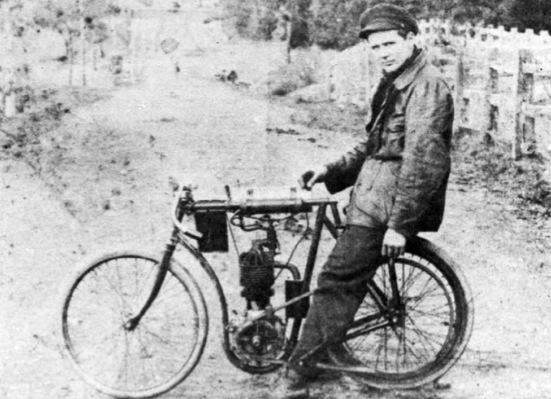
‘The Age’ reported that the times were ‘nothing sensational owing to the heavy nature of the going’, the ‘roadster motorcycle race excited the most sensational interest. The machines were sent around at terrific speed-over 30 miles an hour’, the winner C Mayman from HB James and AE Sutton, make of machines not disclosed!
mayman

Charlie Mayman aboard his 7th ‘Beauchamp’ machine, the ‘Track Racer’ built in December 1902. ‘Motor built by Beauchamp’s a single of about 4HP, machine weighs 120Lb. 26 inch wheels and Dunlop tyres’ (Serpolettes Tricycle)

A little bit of research suggests that the first 2 bikes in the race of Charlie Mayman and Harry James were ‘Beauchamps’ built by Mayman at Edward Beauchamp’s cycle works in The Arcade, Chapel Street Prahran, an inner Melbourne suburb.

James was Dunlop’s Advertising Manager, Mayman built 2 bikes to James’ order for Dunlop. It may also be that Arthur Sutton’s machine, he was a friend of Mayman’s, was also a Beauchamp.

Mayman built 9 machines before his short life ended after a tyre blew on a machine he was riding at Eaglehawk’s Canterbury Park, near Bendigo in Victoria’s ‘Goldfields’ area on Boxing Day 1904. Just 24, he was an amazing engineer, he built himself a car in 1903/4 and a gifted rider with the world at his feet.

mayman

Charlie Mayman in the car he built himself, inclusive of engine. ‘Shows the prominent racing motorcyclist in his home manufactured car in St Kilda Road, Melbourne in 1903’ is the photographers note (Algernon Darge/SLV)

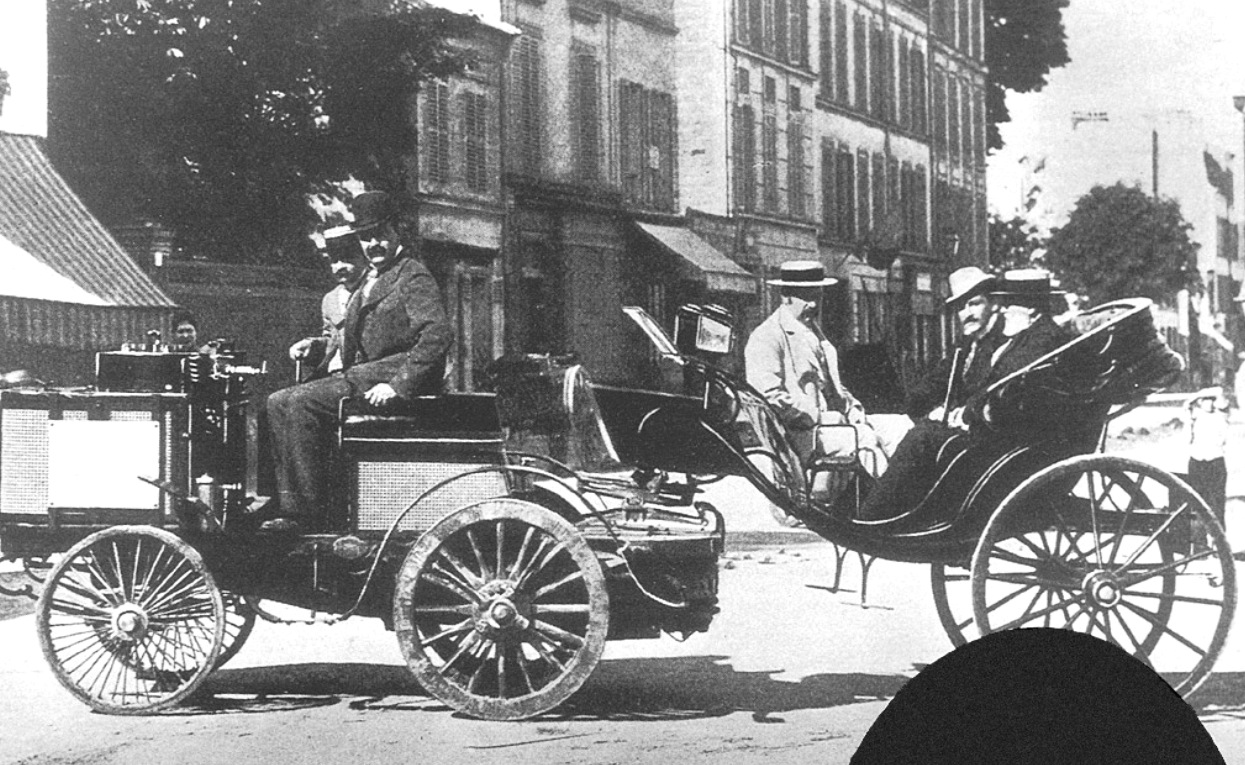
Motor racing started in France, the first ‘motoring contest’ took place on July 22, 1894. Organised by a Paris newspaper, the Paris-Rouen Rally was a 126 km journey. Count Jules Albert de Dion was first into Rouen in 6 hours 48 minutes, an average speed of 19 km/h (12 mph). The official winners were Peugeot and Panhard as cars were judged on their speed, handling and safety characteristics. De Dion’s steam car needed a stoker which the judges deemed to be outside their objectives…

rouen

Jules Albert, Count de Dion was first into Rouen in this team powered De Dion towing ‘une Caleche’. Among the passengers are Count de Dion, Baron Etienne van Zuylen van Nyevelt-Rothschild and write Emile Driant (unattributed)

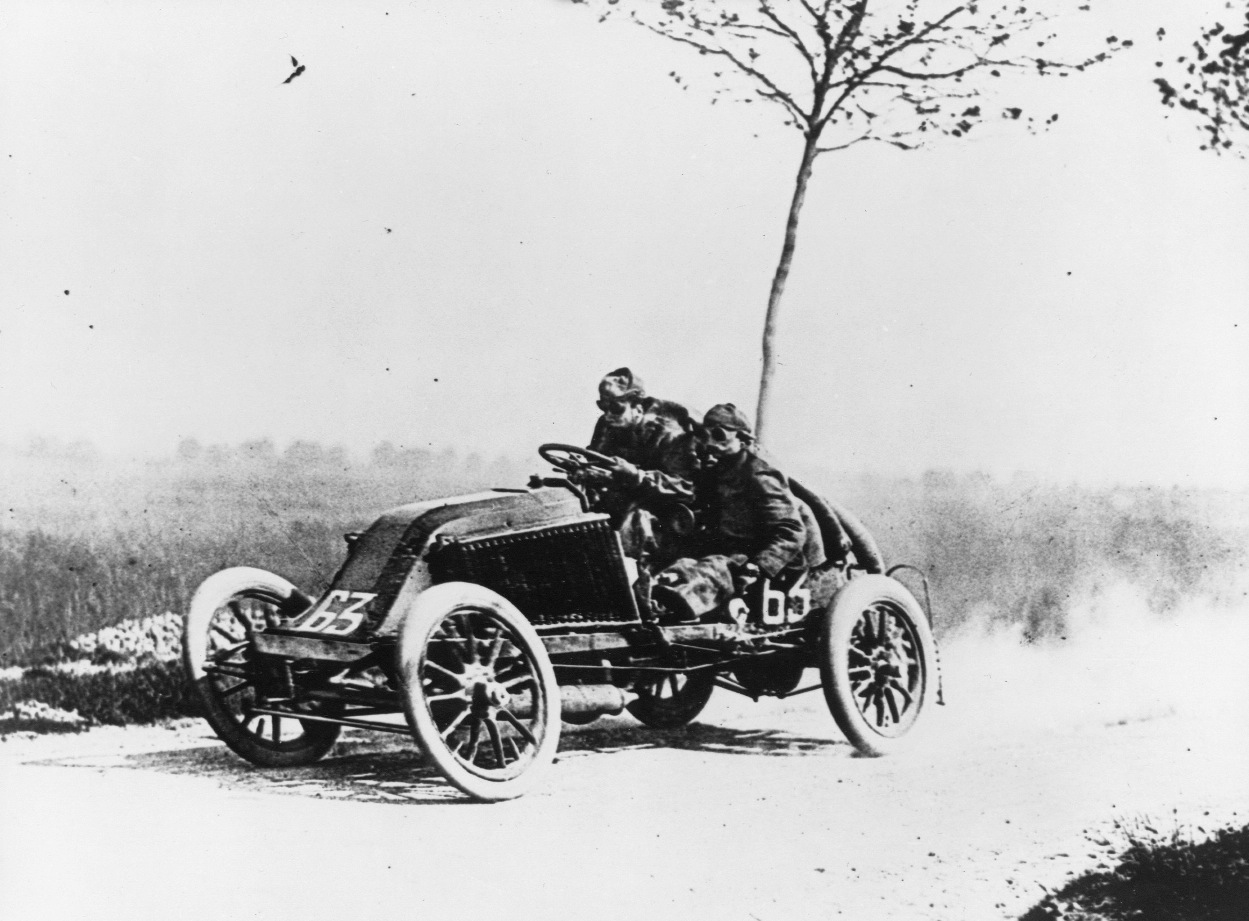
And so commenced a period of racing unregulated cars on open roads between cities in Europe. This evolved after many deaths, from racing on open to closed road circuits. During the Paris-Madrid road race in 1903 a number of people, both drivers and pedestrians – including Marcel Renault were killed, the race was stopped by French authorities at Bordeaux.

Further road based events of this type were banned.

reanault

Marcel Renault, Renault, before his fatal accident on the 24 May 1903 ‘Paris-Madrid Trail’ . He crashed near the town of Couhe Verac and died 48 hours later without regaining consciousness . The event was won by Fernand Gabriel’s Mors from Louis Renault and Jacques Salleron in Renault and Mors respectively (unattributed)

By Sandown’s 1904 event motor racing was already 10 years old but the impact of the competition on the 1400 present to see the deeds of Melbourne’s pioneering motorists was significant and must be seen in the context of the time in Australia.

There were less than 300 cars in Victoria in 1904, the population of the state was 1.3 million people. The rarity, novelty value and impact of the noisy, fast by the standards of the time, technological wonders cannot be overstated.

There are now around 4.55 million cars and 5.9 million people in Victoria, 1 car for every 3300 people in 1904 compared with 1 car for every 1.23 people now.

Whilst motoring was in its pioneering years the car was getting plenty of press about its impact, expected benefits, as well as perceived negatives about changes to existing paradigms. The local papers were full of commentary about the draft British ‘Motor Car Bill’ to regulate the use of cars for the first time in the UK and Melbourne was ‘abuzz’ with the new technology.

sandown kids

Sandown Racecourse 1904 (SLV)

lunar

Astronaut James Irwin, Apollo 15 mission, 1 August 1971 with the ‘Lunar Roving Vehicle’ at Hadley-Apennine, The Moon (NASA)

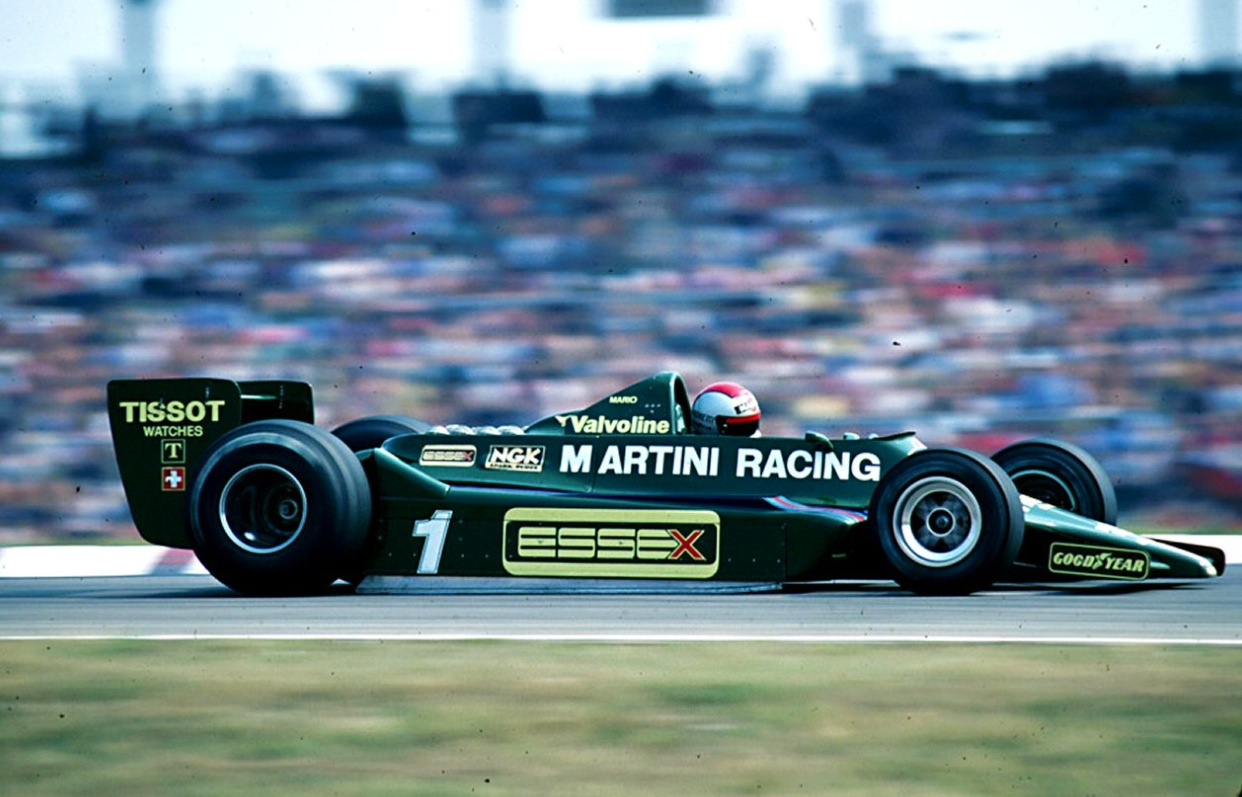
It is sobering and amazing to look at the 10 years olds in the Sandown picture above and imagine their reflections as 80 year olds looking at the Moon Vehicle during the 1971 Apollo 15 mission. Or as a 90 year old being blown away by the outrageous looks and speed of Mario Andretti’s ‘ground effect’ Lotus 79 in 1978. The Wright brothers first ‘heavier than air’ human flight took place only a few months before the Sandown meeting at Kill Devil Hills, North Carolina on 17 December 1903.

All in those childrens lifetimes.

The other worldly nature of the Moon Vehicle and Lotus 79 would have been as impactful at the end of the car enthusiasts lives as the Edwardian conveyances competing at Sandown all those years before were at the start of their time in an amazing century of technological progress if not peace on our planet…

1979

Andretti, Lotus 79 Ford, 1979 German GP, Hockenheim, car not as good in ’79 as ’78. It raced on when the ‘wingless Lotus 80 bombed that year (unattributed)

The Car in Australia; Early Years…

An Australian Government publication ‘Linking a Nation’ forms the basis of this summary of our early years of motoring.

The motor age began in Australia, as elsewhere in the world, at the beginning of the twentieth century. The first Australian experiments in car construction were in the late 1890s involving both steam and internal combustion engines, both of which were successful.

It soon became clear that for purposes such a cars, internal combustion had advantages over steam. Steam remained favoured for early buses, trucks and mobile machinery.

tmomson

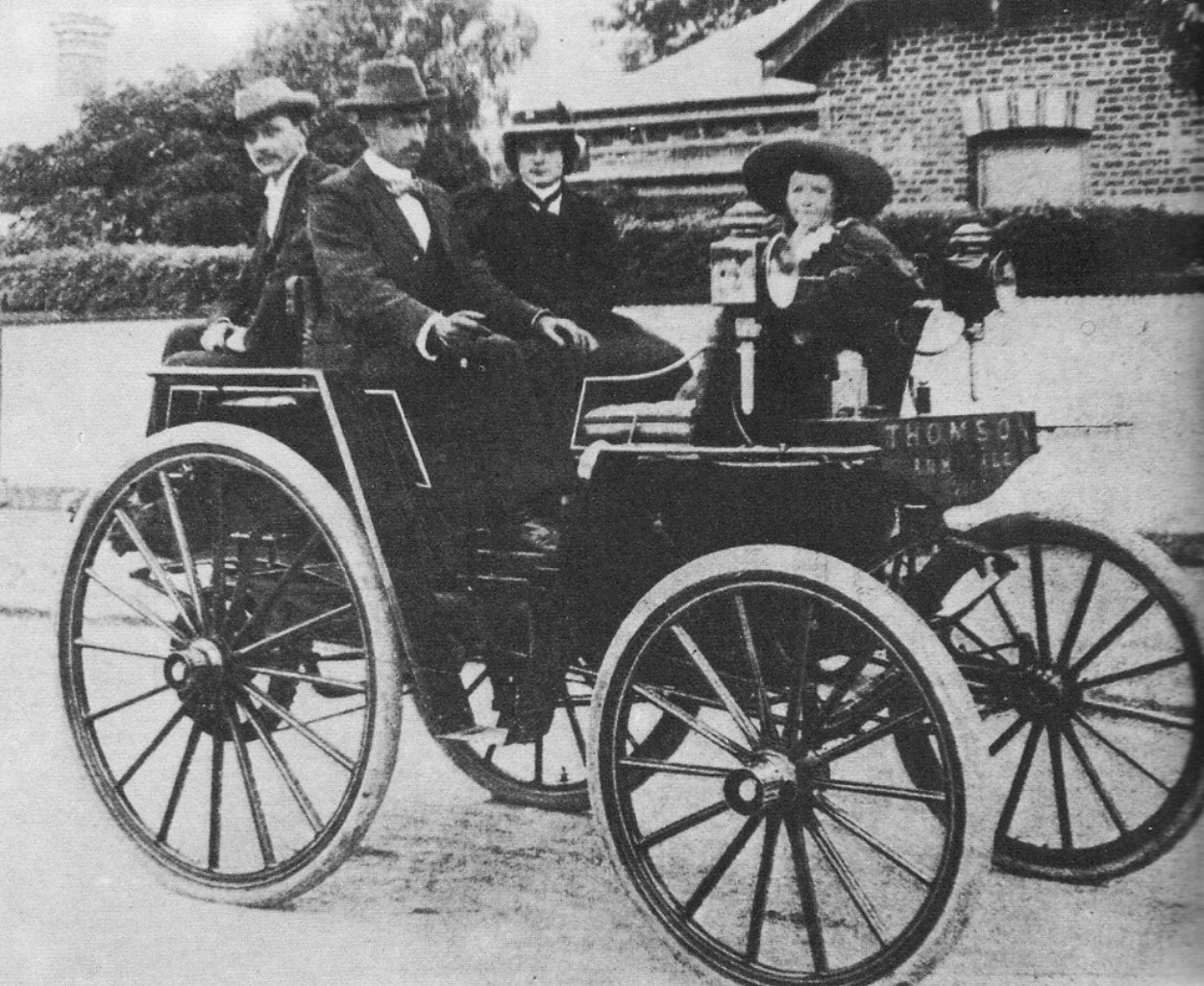
Thomson Motor Phaeton in 1900. Designed and built by Herbert Thomson and his cousin Edward Holmes in Armadale Victoria. They took the car to Sydney by boat for the 1900 Sydney Royal Easter Show and drove to Bathurst to the local show and then back to Melbourne on what passed for the roads of the day, getting frequently bogged. Trip took 10 days at 8.72 mph for the circa 500 mile journey. First car in Oz to be fitted with Dunlop pneumatic tyres, which were purpose built for it. Steam powered, 12 built, 1 exists today in the Museum of Victoria (unattributed)

Australia’s first petrol car (the first steam car was made by Herbert Thomson and made its debut at the Malvern Cricket Ground, Melbourne in June 1898) was made in Melbourne by Colonel Harry Tarrant in 1897. It was experimental but Tarrant learnt enough to begin production on a commercial basis in 1901. He was joined in the business by a Melbourne bicycle maker, Howard Lewis.

By 1909 Tarrant was a manufacturer, importer and distributor, building his own cars as well as acquiring the Ford franchise. This was the year Henry Ford began production of his famous T Model, the world’s first mass-produced car, so it was an astute business move on Tarrant’s part. Tarrant also had the Melbourne dealership for more exotic marques such as Rover, Sunbeam and Mercedes. A short biography of Tarrant and some photos of his cars is included at the end of this article.

perier

The Perier family; Albert at the tiller, Jessie, Pauline and Norman, prepare for an outing in 1903. Car the first de Dion Voiturette imported to NSW by WJC Elliott in 1900 (AJ Perier/SLNSW)

Public reaction to the car was far from universally favourable. Conservative people tended to dislike them. ‘Young men with money loved the speed and freedom it gave and of course were resented by other elements in society for their selfish pleasures’.

Doctors soon found cars superior to horses and their early extensive use of cars to make house calls did much to make cars respectable. ‘Doctors on duty could not be considered maniacs selfishly out on a spree frightening horses and old ladies’….

bike

Motor bikes, both solos and sidecars grew in number exponentially given the attractions of freedom and cost. Here an Indian sidecar at the Blue Lake, Mount Gambier, SA in 1914. Retention of the gents bowler hat at speed no doubt a challenge (SLSA)

Speed enabled people to lead more productive lives. The railway and the tram already had proved that, but since they were for public use, they seemed less self-indulgent than the car which was very much the preserve of the rich in its early years. The list of motoring attendees at the Sandown 1904 event is like an entry from the ‘society pages’ of the day.

Even though car numbers were low in the first decade of the twentieth century their impact was great.

The Australian Constitution (Australia as a country commenced on 1 January 1901, until then the colonies were separate) framed just before the motor age was silent on the topic of regulation so regulatory responsibility lay with the states.

The state with the most emphasis on moral improvement, South Australia first regulated the car in 1904. The South Australian parliament legislated for the registration of cars and speed limits in towns and cities varying between four and twelve miles per hour (6 and 19km/h). These reflected the rules under which trains travelled along Adelaide, ‘The City of Churchs’ streets.

adelaide

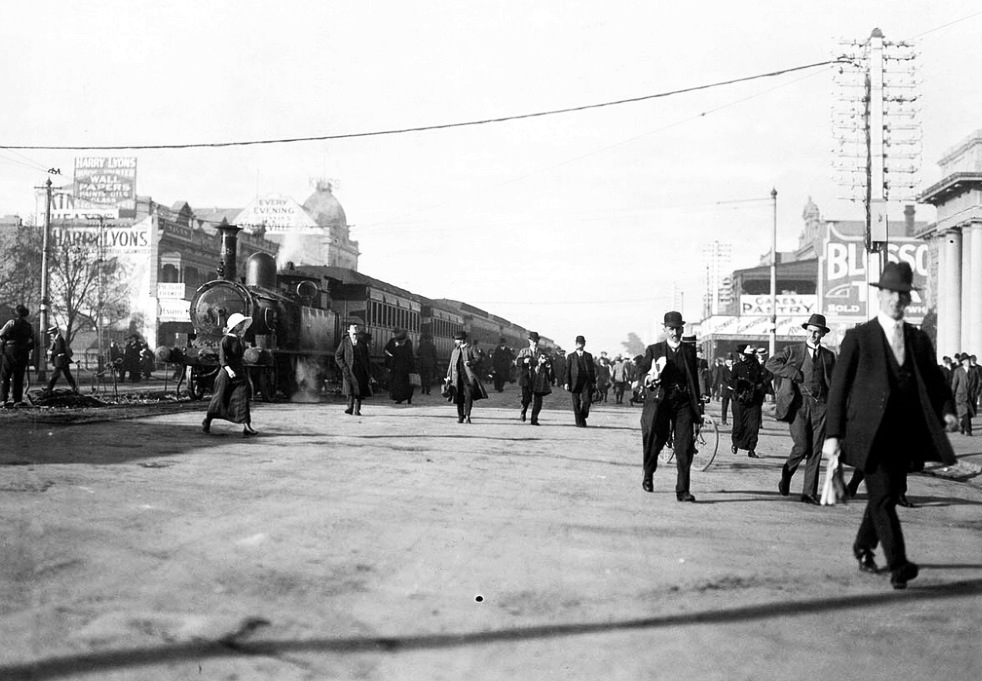
King William Street, Adelaide’s ‘main drag’ on 31 May1914, the last day the Adelaide-Glenelg train came into the city centre. Now a tram makes the same journey. Not a car to be seen (SLSA)

In other states initial regulation was by local councils which imposed a wide range of speed limits; Sydney 8mph, in Parramatta 6mph and in Hunter’s Hill 10mph.

Very early in motoring history, Australian police regularly fined motorists for excessive speed. The police tended to ignore the local limits and instead rely on an old common-law charge which applied to horse drawn vehicles of ‘furious driving’. This infuriated motorists as it was arbitrary.

In New South Wales, the Motor Traffic Act of 1909 removed these anomalies and laid the foundation for statewide regulation, licensing of drivers and registration of vehicles (for a fee), and standardised speed limits at 15mph within five miles of Sydney’s GPO.

The principles it enshrined remain the basis of traffic regulation in Australia today.

houdini

Symbolic of the relentless pace of technological progress at the time was Harry Houdini’s  flights in Australia. He made 3 flights at Diggers Rest, 35 Km north of Melbourne on 18 March 1910. Voisin bi-plane. He made the second or third powered flights in Oz, Colin Defries the first at Victoria Park Racecourse, Sydney on 9 December 1909 in a Wright Model A  (Marcel Poupe/SLNSW)

‘Seeing their pleasures threatened by moral improvers, motorists began to organise. Led by Sydney theatrical entrepreneur Harry Skinner, they established the Australian Motoring Association in 1903, later the Automobile Club of Australia and from 1920 the Royal Automobile Club of Australia. This was a national body from the beginning with New South Wales, Victorian and South Australian branches. The flashy Skinner was all too typical of early motorists and was just the kind of person moral improvers wanted kept in his place!’

vauxhall

Vauxhall ‘Prince Henry’ ‘possibly being prepared for an Adelaide-Melbourne record run in 1913’. Such ‘events’ not unusual or legal at the time (SLSA)

The new Commonwealth Parliament was soon aware of the importance new automotive technology and in 1902 imposed customs duties on imported motor bodies to encourage local manufacture.

At the time and until the introduction of the Ford Model T all cars were handmade and most motor bodies were built by firms which also built horse-drawn vehicles. This meant that carriage builders could easily adapt to the new technology which to them was not new. Only the means of traction and the details of design had changed. Most chassis continued to be imported.

This prompted a short-lived revival of the carriage-making trade which had gone into decline in the 1890s with the popularity of the ‘sulky’ which needed no body. In 1917 the government banned motor-body imports, a year later eased to a restriction of one import allowed per two local bodies built.

The following decade was the heyday of the medium-sized motor-body builder, mostly former horse carriage builders, or firms like Smith and Waddington in Sydney who also built timber trams and railway carriages.

Motor body production reached about 90,000 by 1926. Of these, some 36,171 were produced by one firm, Holden Motor Body Builders, founded in 1920 by the Adelaide carriage builders, Holden and Frost. They produced their first motor body in 1917 and by the mid 1920s dominated the Australian motor-body industry.

sydney

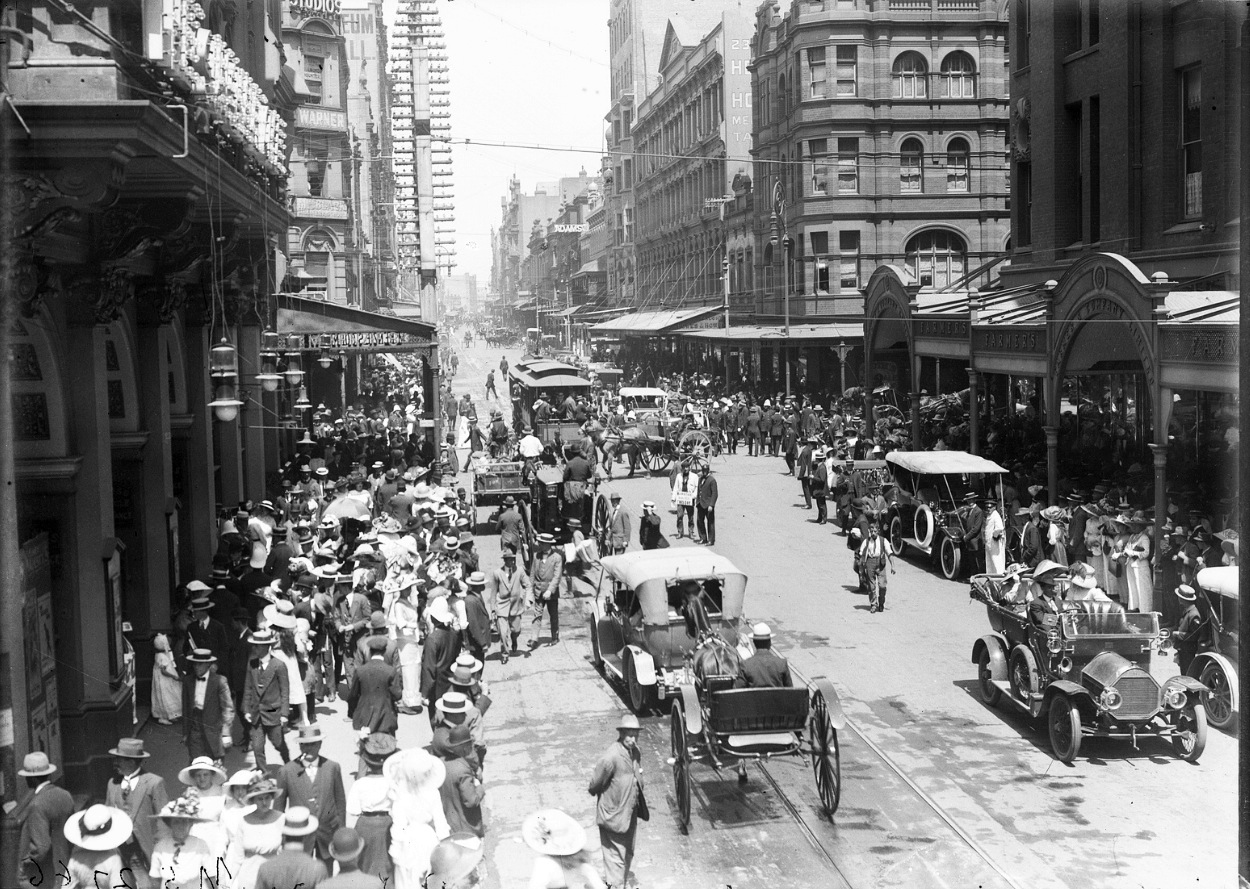
Its all happening in Pitt Street, Sydney 1915, as it still does. This is near the Market Street corner, in what is now the (pedestrian only) Pitt Street Mall. Cars, cabs, buggies, trams and still very much present, horse drawn transport (SLNSW)

Car numbers, though, remained small. There were only 3,978 motor vehicles in all of New South Wales as late as 1911, just as the flood of Model Ts began to surge. They quickly replaced the horse-drawn carriage as the preferred means of city transport of the urban elite. The saddle horse quickly disappeared from city streets. It had always been an affectation of the wealthy urban male, a car was an excellent substitute.

Horsepower remained preferred for deliveries and short-distance cabs. Hansom cabs remained part of the scene in Australian cities right up till the 1930s. In 1911 there were just three motor vans in Sydney, compared with 1,303 horse vans. A decade later horses still predominated, with 1,603 horse vans and just 376 motor vans. By 1927, though, these proportions were just about reversed, with 2,016 motor vans but only 379 horse vans. A survey of Sydney traffic in July 1923 revealed that 39.2 percent of vehicle movements were by horse-drawn vehicles, 33.8 percent by car and 27 percent by motor van or lorry.  On that day most people out and about in Sydney were travelling on trams.

model t

Ford Model T. Overland adventurer Francis Birtles and Rex ‘the Wonder Dog’ in the back seat did 5600 Km from the Gulf of Carpentaria in the Northern Territory to Port Phillip Bay in Victoria in 1913. They camped along the way, catching ‘bush tucker’ and using fuel left by Ford, who sponsored the adventure at special dumps along the route . Here outside Tarrant Motors in Melbourne circa 1910 (Powerhouse Museum/SLV)

The introduction of the Model T Ford and the rapid improvement of engine technology during World War I led to the explosion of  car use. From 1911 to 1916 motor vehicle numbers in Australia almost quadrupled. They then more than doubled in the next five years (when markets were interrupted by the War) and quadrupled again to 1926.

American imports dominated the market. In 1917, the very worse year of the War, there were 15,000 cars imported; 10,000 Model T Fords, 2,300 Dodges, 1,500 Buicks and 1,200 other makes.

The Model T was designed with US conditions in mind, these were not so different from Australia’s with muddy or dusty roads and long distances. The Model T had simple, robust components, an austere, sturdy body and high clearances ideal for rural conditions in both countries.

With the growth of the Australian car market, and given high duties on imports, big manufacturers decided to establish plants in Australia during the mid 1920s.

holdens

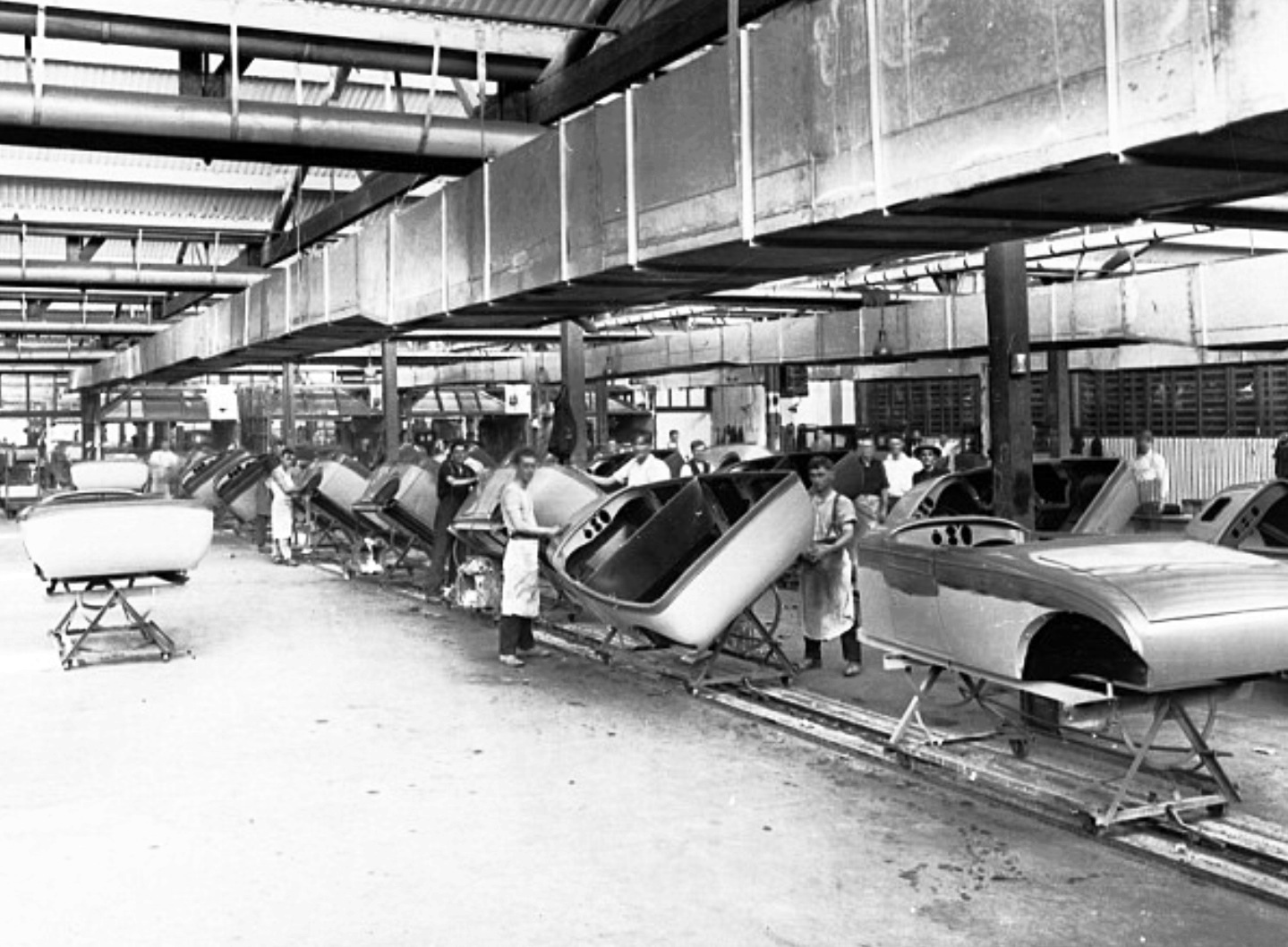
Holden motor body works, Woodville, SA 1928 (State Library of SA)

Ford set up a factory at Geelong in 1925. In 1926 General Motors also established itself in Victoria, at Fishermen’s Bend near Melbourne. General Motors made this a joint venture with Holden’s of Adelaide, thus establishing the distinctively Australian, long-lived marque of General Motors Holden (GMH).

Both Ford and GMH assembled imported chassis at the works and built local bodies to fit on them. Almost immediately, the old timber carriage-building tradition began to die out, as these factories had metal presses. Body designs changed rapidly as metal bodies requiring steel pressings became the norm. Timber was still used for some features but in 1937 the first all-steel car was produced, anticipating the shape of the post-war industry.

glenelg

Glenelg, a suburban Adelaide Beach, 1922. People came by tram, horse, buggy, bus or car. Suit de riguer, ‘Proclamation Day’ holiday. Driving your car onto the beach is still a weird SA thing to do on some Fleurieu Peninsula beaches (State Library of SA)

During the 1920s, the motor became a feature of everyday life for a large proportion of the population for the first time. In 1920 there was one car for every 55 people in Australia; by 1929 this had increased to one for every eleven people, compared with one car for about every four people in the 1970s and one for every two in 2015.

The figures indicate that in 1920 a car was a rare luxury, but that a decade later it had penetrated most middle class households and was quite widespread. By 1970, most people in Australia who wanted a car enough could have one, although a quarter of all households continued to choose not to have one.

During the crucial decade of the 1920s, car prices fell sharply while wages were rising. A new Chevrolet cost 545 pounds in 1920 but only 210 pounds in 1926. The cars were constantly getting better too; more comfortable and safer – with pneumatic tyres, all-wheel brakes and enclosed bodies making them far more convenient than early models which were only marginally more comfortable than a buggy.

wentworth

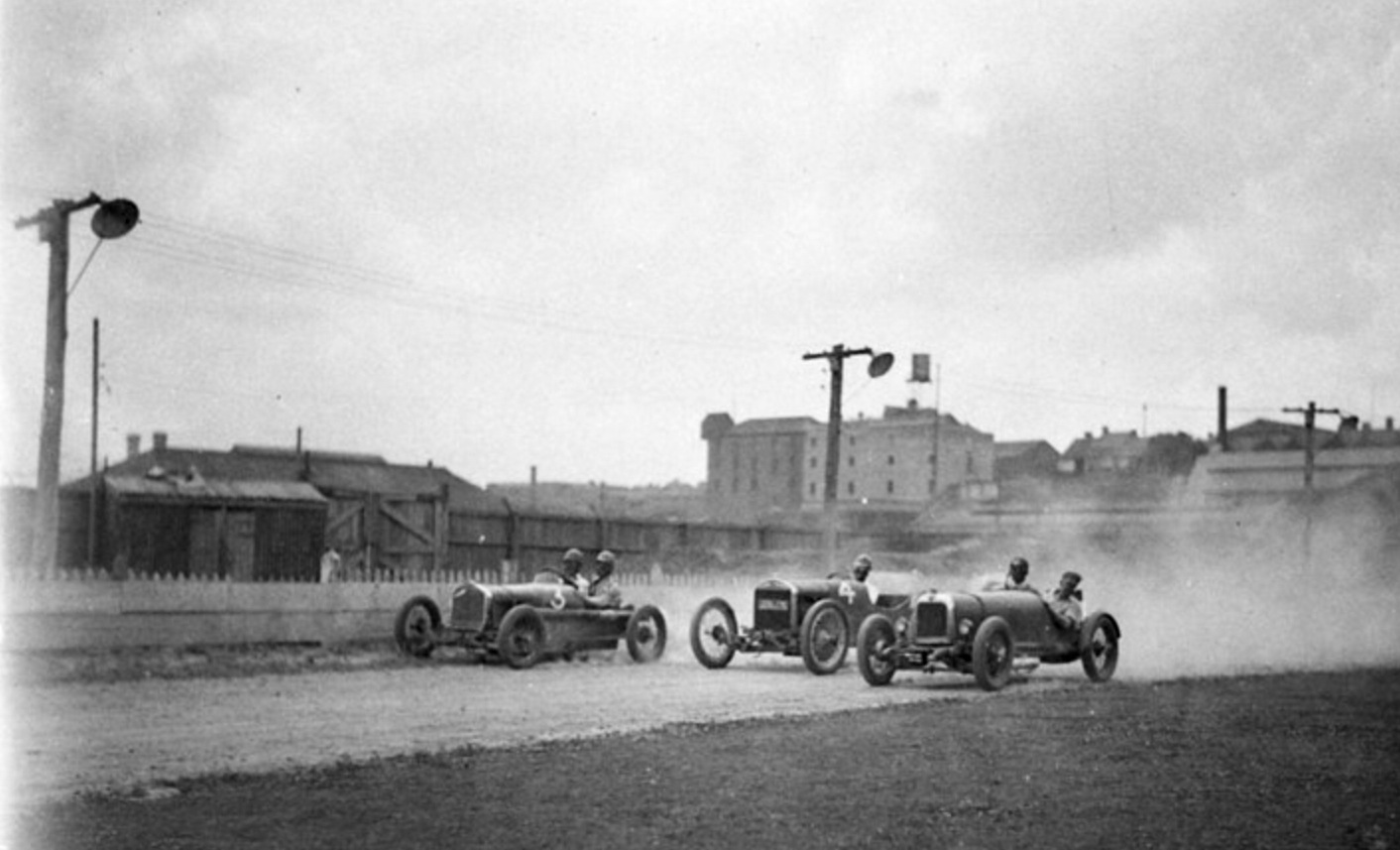
Wentworth Autodrome, Sydney November 1933. L>R #3 Don Shorten, Rajo Ford Spl, #4 Charlie Spurgeon, Fronty Ford Spl and Fred Braitling, Alvis (Ted Hood/State Library of NSW)

‘The twenties saw the growth of motor sport, with speedways mushrooming all over the country and motorists’ organisations running all sorts of bizarre races and trials including ‘top-gear’ trials, where the aim was to go as far as possible without changing out of top gear.

With these activities the car really was starting to replace the horse, not just for transport but in the imagination and human psyche as well. As with the horse (especially the saddle horse), car ownership was an opportunity to demonstrate taste and its absence, affluence and masculinity, while having the practical mobility advantage’.

agp

Photo-montage of the ‘100 Miles Road Race’, the second Australian Grand Prix at Phillip Island in March 1928. Winner Capt Arthur Waite in an Austin 7 s/c top left shot three wheeling, #25 Cyril Dickason’s Austin 12 3rd and the Bugatti in the middle the T40 of Arthur Terdich 4th. Bottom right is Bill Williamson’s Riley 9 12th (The Australasian)

This increased use of cars of course required improved roads. Early motorists were rich, influential and had political clout. It soon became clear that motor transport was more than a hobby but an effective means of transport and the roads of the day needed to cater for cars and motorbikes.

bool

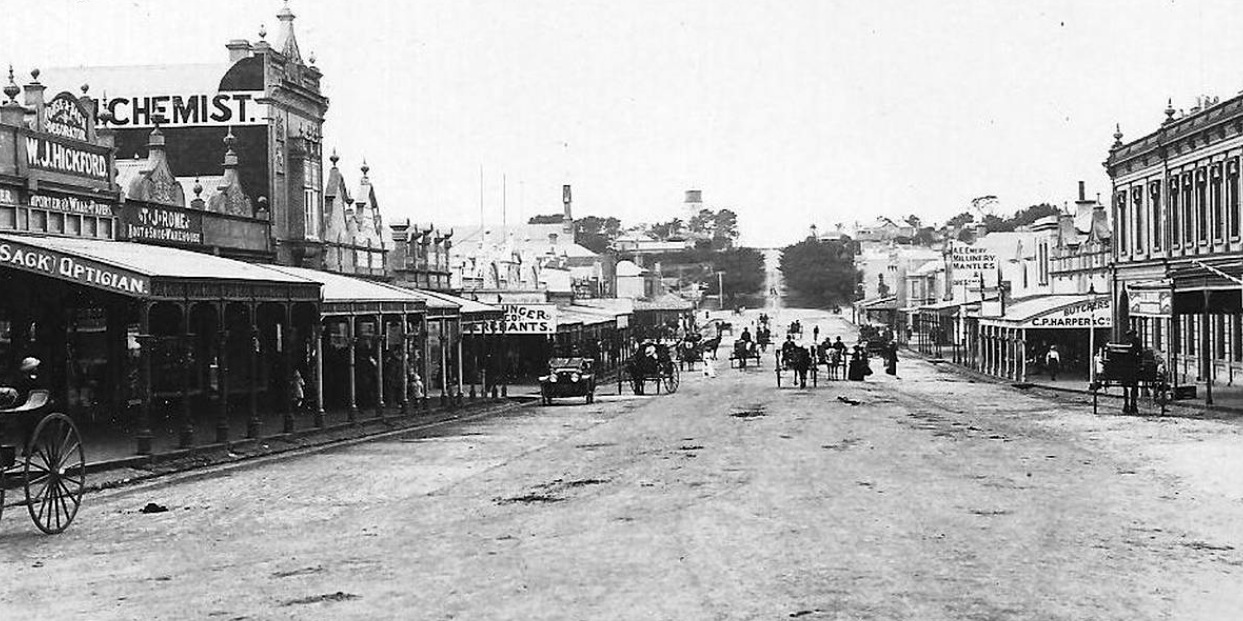
Country road, country town road anyway! Liebig Street, Warrnambool, Victoria 1910. (Warrnambool Historical Society)

Most of Australia’s rural roads were in poor shape in the early twentieth century. The best were in New South Wales but even there earthworks were limited and surfaces rough. Victoria, the richest state with the best railways had the worst roads relative to its population and wealth because so much had been invested in its railways. Rural roads’ main transport functions were confined to local needs such as taking produce to the nearest railway station or port.

The beginnings of the motor age changed all that dramatically.

The motor age itself was anticipated by a decade by a new form of transportation which had similar, but more modest requirements than the car. This was the bicycle, which came to Australia in the 1870s and was extremely popular from the 1890. Early bicycles were not cheap, although prices quickly reduced, but they were almost free to run and sufficiently simple for their owners to maintain.

These were big advantages compared to horses. In cities, a bike could be put in a shed needing none of the space, feed and attention required by a horse…

bikes

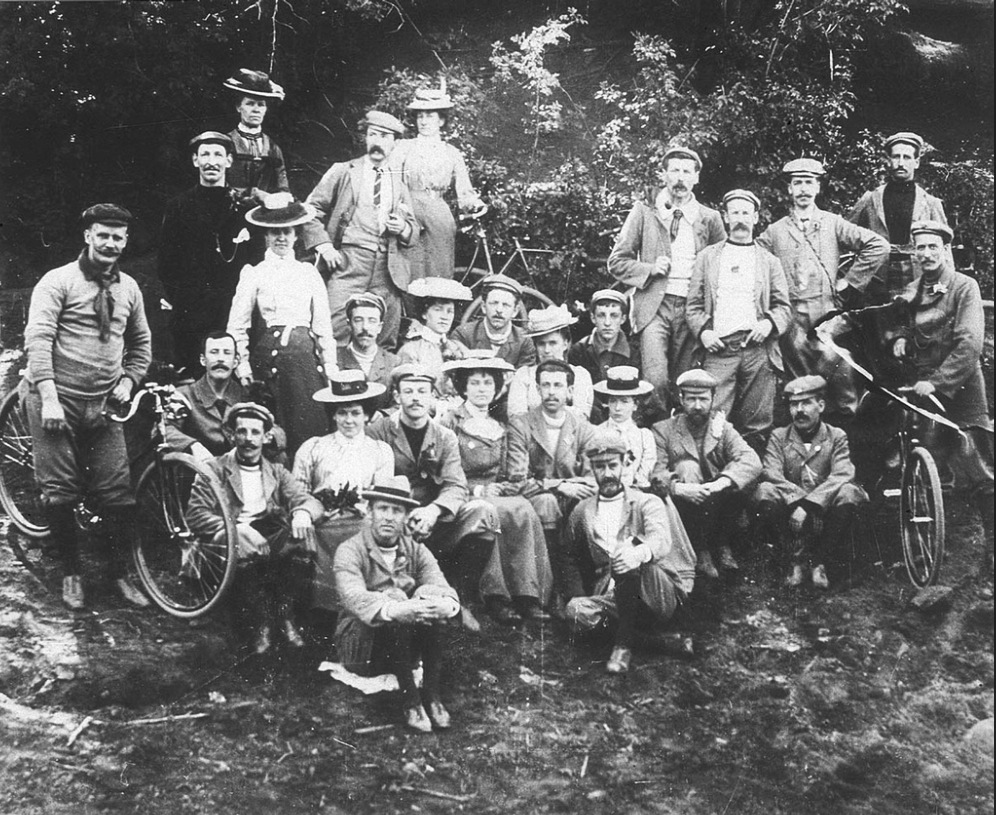
‘Waratah Rovers Bicycle Club’ in tour, Picton NSW October 1900 (SLNSW)

Bikes had two disadvantages over the horse; they demanded human effort and needed good, smooth roads. The human effort factor was and is an advantage. The popularity of cycling increased the pressure on councils to improve the quality of streets, especially in the suburbs where cycling was most popular. At that time, most suburban roads were as bad as rural roads. Most were dusty in dry weather and muddy in wet, many degenerating into quagmires in prolonged wet periods.

Early bikes were cumbersome ‘penny-farthings’, which were harder to mount and every bit as nasty as a horse from which to fall. The development of the safety cycle, essentially the modern design with equal-sized wheels and a chain drive, made cycling safer than riding a saddle horse and far more accessible to women.

‘Cyclists were numerous enough to have political clout and their demands for improved street paving were vociferous and hence the standard of roads especially in the suburbs began to improve’, the ‘Linking the Nation’ report said.

chamberlain

As the Great Depression approached some outrageous innovation was taking place in Australia. The Chamberlain ‘Beetle’ here in Indian engined original form circa 1932 was a spaceframe chassis, FWD, independent front and rear suspension, 2 stroke, 4 cylinder 8 piston supercharged racing car! I wrote about it a while back (Chamberlain Family)

The Great Depression, which seems a good time to end this truncated history of early motoring in Australia, and then World war II affected motoring as much as other activities in the economy. 

The fall in car registrations shows that the Australian middle class felt the impact of the Depression and had to cut back on luxuries, cars an example.

Car registrations in New South Wales fell from a pre-Depression 1929 peak of 170,039 to 144,749 in 1931. Thereafter they recovered, passing the 1929 level in 1935 and peaking again at 207,446 in 1940. Registrations fell again to 172,028 in 1942, and were still at only 188,412 in 1945.

Petrol rationing through the 1940s kept car demand low and as late as 1950 there were still only 269,250 cars on New South Wales roads, less than 100,000 more than the 1929 figure. So, for the twenty years after 1929, the impact of the motor car was actually quite limited’.

That would all change post 1950 as the shackles of the War Years were removed, our economy surged on booming global demand for our products and crops and the availability of consumer credit increased but that is a story for another time…

tarrant

First successful petrol driven Tarrant, built 1898, sold to DW Chandler in 1899. Top speed circa 30/35 mph. Picture in front of ‘first factory of the company, Bridge Road, South Melbourne’, no such address exists today. Only one of the 16 Tarrants built exists, owned by the Royal Automobile Club of Victoria (W Stuart Ross)

Harley Tarrant was one of the pioneers of the early Australian Motor Industry…

This summary of his life, slightly truncated, is from the ‘Australian Dictionary of Biography’.

Harley Tarrant (1860-1949), businessman, was born on 6 April 1860 at Clunes, Victoria, son of Joseph Tarrant, miner, and his wife Caroline, née Brownlow, both from Oxford, England. His father owned the Clunes Gazette and later the St Kilda Chronicle and Prahran Chronicle.

After attending Clunes Grammar School, Harley was articled to a firm of civil engineers; he worked as a surveyor on the Nullarbor Plain and from 1884 for the New South Wales Department of Lands. In 1888 he set up his own surveying business in Melbourne and undertook commissions for the Melbourne and Metropolitan Board of Works.

His interest in motoring began in this period. In 1897-98, basing his account primarily on overseas journals, he helped to publicize the new motor car in the cycling monthly Austral Wheel. His rural background and surveying experience had made him aware of its potential value in a country of immense distances and relatively few railway lines.

In August 1897 he patented an engine powered by kerosene, a fuel which he declared to be safe, cheap and readily available, whereas electric motors needed recharging stations and steam-driven machines were dangerous and ‘too heavy for rough country roads’. Although his first car was a failure, its kerosene motor proved suitable for such stationary work as pumping water to farm houses. By 1899 he sold his engines as far afield as Western Australia. With larger premises, he also imported cars, beginning in February 1900 with a Benz.

tarrant

Harley Tarrant at the wheel beside his daughter and wife at the rear. Tarrant 2cyl 8HP won the November 1905, second Melbourne-Sydney ‘Dunlop Reliability Trial’. Car priced at 375 pounds (W Stuart Ross)

Business boomed and the profits enabled Tarrant and his partner in Tarrant Motor & Engineering Co. WH Lewis, to build one of the earliest Australian-made, petrol-driven cars: completed in 1901, it had an imported Benz engine.

Two years later their next machine was 90 per cent locally made, including the engine, and became the prototype for at least eight others, all built—to suit Australian conditions—for endurance rather than speed.

Tarrant’s victory in the two Dunlop reliability trials of 1905 and the success of a Tarrant car in 1906 helped to develop confidence in local manufacturing, but he could not compete with imports produced in larger numbers for a bigger market, especially after Tarrant Motors Pty Ltd acquired the Victorian franchise for Ford in 1907.

tarrant 2

Sir Russell Grimwade’s Tarrant 4 cyl 16HP car pictured in the 1906 ‘Dunlop Reliability Trial’ held over 1000 miles in Victoria. Class winner (W Stuart Ross)

Nevertheless, the firm made three aero engines for the military in 1915 and continued to manufacture motor bodies which, being bulky, were expensive to import. During World War I the company began assembling chassis from imported components; by this time it also had a thriving spare parts, accessories and repair business.

Tarrant played an important role in local motoring affairs. He lobbied on behalf of the Motor Importers’ Association for better traffic regulations and served in 1906-10 on the governing committee of the Automobile Club of Victoria, helping to demonstrate the capabilities of the motor car by organizing and participating in the club’s competitions and tours. In 1904 he had won his event in the club’s first motor race meeting, averaging 26 miles (42 km) per hour.

In 1908 Tarrant had become first commanding officer of the Victorian branch of the part-time Australian Volunteer Automobile Corps and from September 1914, with the rank of colonel, was in charge of Commonwealth military motor transport. The magnitude and urgency of wartime needs made mistakes inevitable. A 1918 royal commission report charged his administration with inefficiency and waste, alleging that the public had been misled by the extent to which Tarrant Motors was favoured with repair contracts. Harley accepted responsibility by resigning, but in 1920 was appointed an M.B.E. (‘Member British Empire’, an order of the British Empire)

After the war Tarrant retired from the business, sufficiently wealthy not to need to work, he freely indulged his passion for camping and overseas travel. In 1932 he came out of retirement to take over production supervision at Ruskin Motor Bodies Pty Ltd, an affiliate of the Tarrant company.

A tall, dignified man with a bushy moustache, he had done much to pioneer and consolidate the first phase of the Australian motor industry. Tarrant died on 25 February 1949 at his Toorak home.

The company was sold in 1950 to the Austin Motor Co (British Motor Corporation).

Photo Credits…

Algernon Darge,  W Stuart Ross, State Library Archives of Victoria, New South Wales, and South Australia, NASA, Marcel Poupe, Ted Hood, hyperracer.com, Chamberlain Family, Serpolette’s Tricycle

Bibliography…

Australian Dictionary of Biography, ‘Linking a Nation: Australia’s Transport and Communications 1788-1970’ Australian Government Dept of the Environment, ‘The Age’ 14 March 1904, ‘The Argus’ 14 March 1904, ‘The Australasian’ 19 March 1904, 7 April 1928, Serpolette’s Tricycle

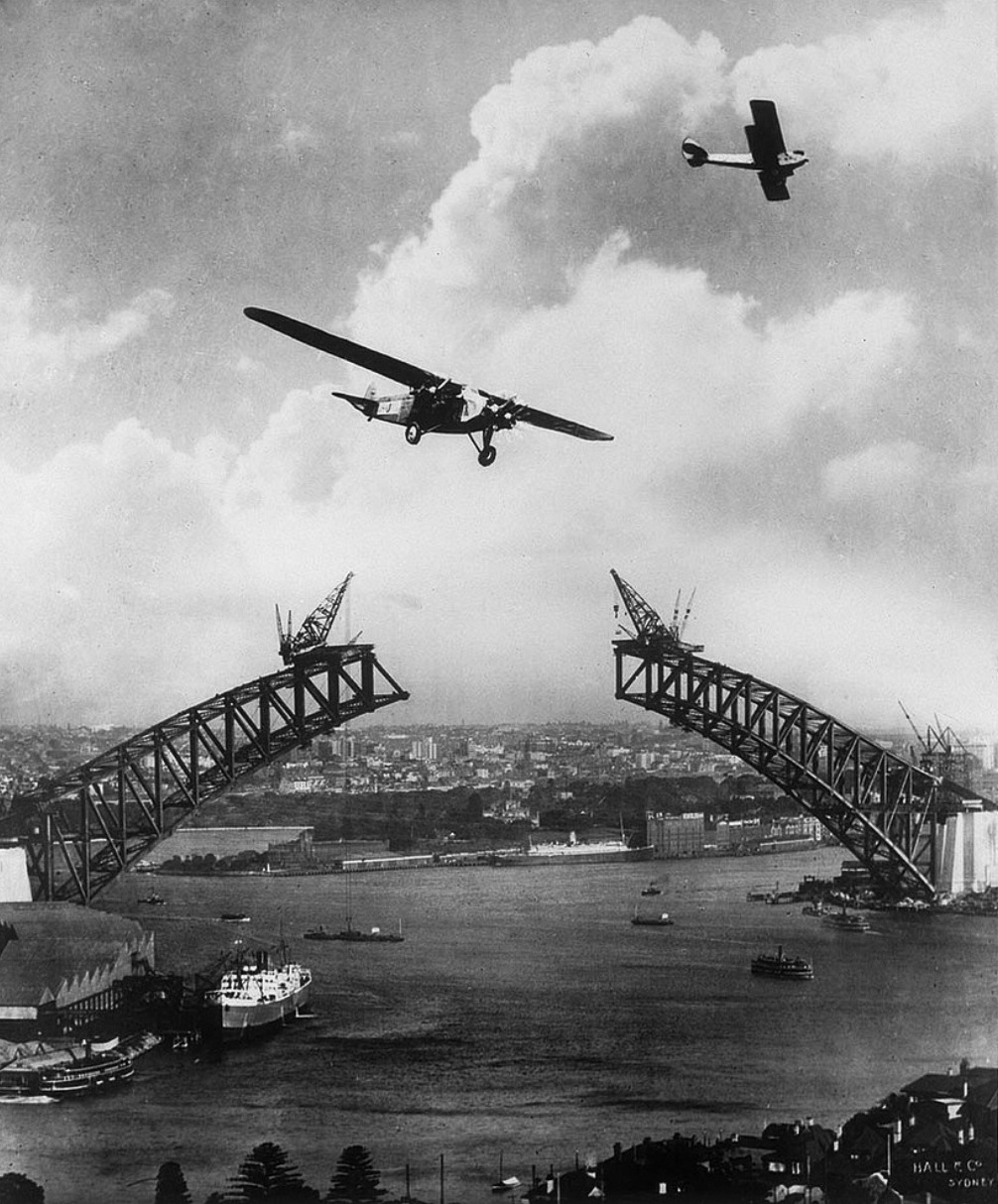
Tailpiece: Symbolic of the Technology and Progress of the time, Sydney Harbour Bridge nearing completion in 1930…

bridge plane

The 2 planes Charles Ulm’s ‘Southern Sun’ and a Gypsy Moth were added later (Edward Searl/SLNSW)

Finito…

hoare

(Allan Dick)

Pat Hoare’s Ferrari has 4 wheels ‘off the deck’ at Dunedin, New Zealand in 1961, Shell ‘Servo’ and Vanguard in the background of this road circuit…

Allan Dick ‘You might find it interesting to see what road circuits were like in NZ…its Pat Hoare in the Ferrari that Phil Hill won the Italian GP at Monza in 1960 (in 246 Dino guise). It was fitted with a 3 litre V12 Testa Rossa engine, the noise it made gave grown men erections.’

‘Is there a single wheel on the deck here? After 2 seasons Hoare was going to buy a Shark Nose Ferrari 156 F1 car and power it with a 2.3 litre V6 engine. The deal was done, but he couldn’t sell this car and eventually converted it into an awful looking road going GT’.

The 8th Dunedin Road Race was contested on 28 January 1961 and won by coming star Denny Hulme’s Cooper T51 Climax from Hoare and Angus Hyslop who was also Cooper mounted, a T45 Climax but 2 litre as compared with the 2.5/3 litre engines of Hulme/Hoare.

Click here for an earlier post on this amazing car; https://primotipo.com/2015/04/26/fazz-on-tight-shell-be-jake-matey/

ferrari butt

Another shot of the Fazz’ tight little Italian rear. Love the big exhausts for the Testa Rossa 3 litre V12, delicate aluminium reliefs to allow the exit of air, most fuel in ’60 spec cars in pannier tanks amidships, rather than rear tank to centralise weight distribution. Koni shocks. ’60 spec rear suspension independent by upper and lower wishbones rather than De Dion fitted originally to Dinos. Propshaft low on the right of the cockpit. Ohakea NZ 1961. (Barry McBride Collection/The Roaring Season)

dunedin circuit map

Dunedin Oval Circuit. (silhouet.com)

hill, monza

Italian GP grid Monza, September 1960. Phil Hill closest to camera in the winning Ferrari 246 Dino ‘0007/0788’. #18 is Richie Ginther 2nd and Willy Mairesse 3rd in similar cars. Ferrari routed the opposition, the Brits boycotted the event on ‘safety ground’ when the Italians chose the combined road/banked circuit to maximise the chance of a Ferrari win, the powerful engines of the Scuderia’s cars their trump as they struggled against the nimble Coopers and Loti’. The last front-engined GP win. (Archie Smith)

Full Race Record of Ferrari Dino 246/256 ‘0007/0788’…

http://www.barchetta.cc/english/all.ferraris/detail/formula/0007.246.60.htm

Words and Photo…Allan Dick, additional photo Barrie McBride Collection/The Roaring Season, silhouet.com circuit map, Archie Smith

Bibliography…

Doug Nye ‘History of The GP Car 1965-85’, barchetta.cc

keke 1

(Terry Marshall/The Roaring Season)

Terry Marshall’s shots capture the zesty, attacking style which made Keke Rosberg a crowd favourite throughout his career. Here in his Chevron B39 Ford at Pukekohe during the New Zealand Grand Prix on January 7 1978…

The Kiwi’s changed their national formula from F5000 to Formula Atlantic/Pacific from the 1977 International Series whilst we Aussies persevered with the big V8’s.

Rosberg won the 1977 Series in a Fred Opert Chevron B34 from American Tom Gloy in a Tui BH2 and Aussie Grovewood Award Winner, Bruce Allison’s Ralt RT1.

He returned again in an Opert Chevron B39 in 1978 and took that championship as well; 6 wins of 10 races, 1 at Bay Park, both NZ GP rounds at Pukekohe and 1 apiece at Manfield, Teretonga and Wigram.

Aussie ex-F1 driver Larry Perkins was 2nd in a ‘Scuderia Veloce’ Ralt RT1, Bobby Rahal was 3rd in the other Opert Chevron entry and Danny Sullivan 4th in a ‘March Cars’ March 77B.

The fields were of great depth and included Kiwi Internationals Ken Smith March 76B, Brett Riley March 77B, Steve Millen Chevron B42 and David McMillan Ralt RT1.

Later in 1978 Rosberg contested many European F2 rounds in another Opert Chevron, a B42 Hart 420R 2 litre and critically his Grand Prix career commenced…

His first race was the South African Grand Prix in a Theodore TR01 Ford on March 4, he qualified 24th of 30 entrants and retired with a range of maladies.

The car was a clunker (an F2 Ralt acquired by Yip into which a Ford Cosworth DFV was bolted) with many non-prequalifications to follow later in the season, but things came together nicely a fortnight after Kyalami for his first F1 win, a stunning wet weather drive in the non-championship ‘BRDC International Trophy’ at Silverstone on 19 March.

Whilst many fell off in the streaming conditions Keke drove a fast, consistent race to win from from Emerson Fittipaldi in one of his own Fittipaldi F5A Ford’s and Tony Trimmer, McLaren M23 Ford. The field included Peterson, Andretti, Ickx, Hunt, Regazzoni, Lauda, Depailler, Mass and Arnoux.

theodore

Rosberg winning the ‘International trophy’ at Silverstone in March 1978. Theodore TR01 Ford. (unattributed)

Later in the season he had some drives in Wolfs’ WR3 and WR4 acquired by Teddy Yip given the lack of pace of their own Theodore. 10th in the German GP at Hockenheim in one of these cars was his best result of the year.

He also drove an ATS Ford in 5 events and whilst still not a competitive car he showed what he could do, and the rest as they say is history, Keke achieved ‘ a toehold in F1’ with Fittipaldi in 1980!

For sure his Antipodean Formula Pacific wins against strong competition enhanced his reputation by beating his peers in equivalent cars and made him ‘race fit’ by the time he returned to Europe.

keke 2

Rosberg on the Wigram grid, 29 January 1978. Chevron B39. (Terry Marshall/The Roaring Season)

Terry Marshall said of this shot; ‘Keke Rosberg what a star, always goofing around.

Here on the grid at Wigram. He had just pulled me down into the cockpit to tell me if i came to Germany with him he would jack me up a job as a magazine photographer there. I had a lovely wife and two kids, so i had to say no.’

keke 3

Rosberg, Chevron B39 Ford, Bay Park, NZ. 2 January 1978. 1st place. (Terry Marshall/ The Roaring Season)


keke 4

Rosberg relaxing in the Teretonga paddock, 22 January 1978. ‘Motoring News’ maybe?! Beautiful all enveloping body of the B39 helped it slip thru the air nicely. (Kevin Thomson Collection/The Roaring Season)

Chevron B39 Ford and Formula Atlantic/Pacific…

The Chevron B39 was Derek Bennett’s 1977 Formula Atlantic car, 11 were built, Keke’s Fred Opert Racing (the US importer of the cars) chassis was # ’39-77-08′.

Typical of the period, we are just before the ‘ground effects’ era remember, the car used an aluminium monocoque chassis, independent front suspension with upper and lower wishbones and coil spring/Koni shocks. Adjustable roll bars were fitted front and rear. Rear suspension comprised a single upper link, two lower links, two radius rods for lateral location, and coil spring/Koni shocks.

Steering was rack and pinion and brakes disc all round, inboard at the rear beside the ubiquitous Hewland 5 speed FT200 transaxle.

keke 5

Rosberg’s B39 being prepared for the Bay Park round of the series on January 2 1978. (Mike Feisst Collection/The Roaring Season)

The engine was the Ford Cosworth BDA, originally homologated for rally use in Ford’s Escort RS1600 to replace the ageing Lotus Twin Cam, which was also based on a Ford block. Other engines were eligible for Formula Atlantic, the class ‘morphed’ out of the SCCA’s 1600 Formula B which commenced in 1965, but the BDA soon became the engine of choice. Formula Atlantic/Pacific soon became a truly global class which was contested in North America, UK, Australasia and South Africa.

bda cutaway

Ford Cosworth BDA engine cutaway. Engine designed by Mike Hall, the original 1969 variant spawned engines successful in Rallies, F2, F Atlantic/Pacific and much more. (unattributed)

The ‘BDA’ had many variants, all were successful, the Formula Atlantic kit was called the ‘BDD’ and like many of the ‘BDA’s was based on the Ford Cortina/Formula Ford ‘711M’, 5 bearing cast iron block.

The head was DOHC the 4 valves per cylinder driven by a toothed rubber belt, one of the the first race engines to do so and one of the first production engines so specified as well. The engine was fed, as mandated by the class rules, by carburettors, usually 48DCOE Webers. The 1590cc BDD developed a reliable 205bhp plus @9000 rpm, one of lifes true pleasures is to drive one of these cars powered by this engine.

Rosberg’s performances were meritorius as, arguably, the B39 was not quite as quick a car as the contemporary Ralt RT1 or March 76/77B, but the dude behind the wheel more than made up for whatever the chassis gave away.

(Peter Brennan Collection)

Credits…

Terry Marshall, Kevin Thomson, Mike Feisst/The Roaring Season. Click on this link to take you into TRS, all three collections are well worth trawling through for all sots of cars.

http://www.theroaringseason.com/showthread.php?863-Photos-The-Terry-Marshall-Collection

oldracingcars.com, Peter Brennan Collection

Finito…
oliver pan

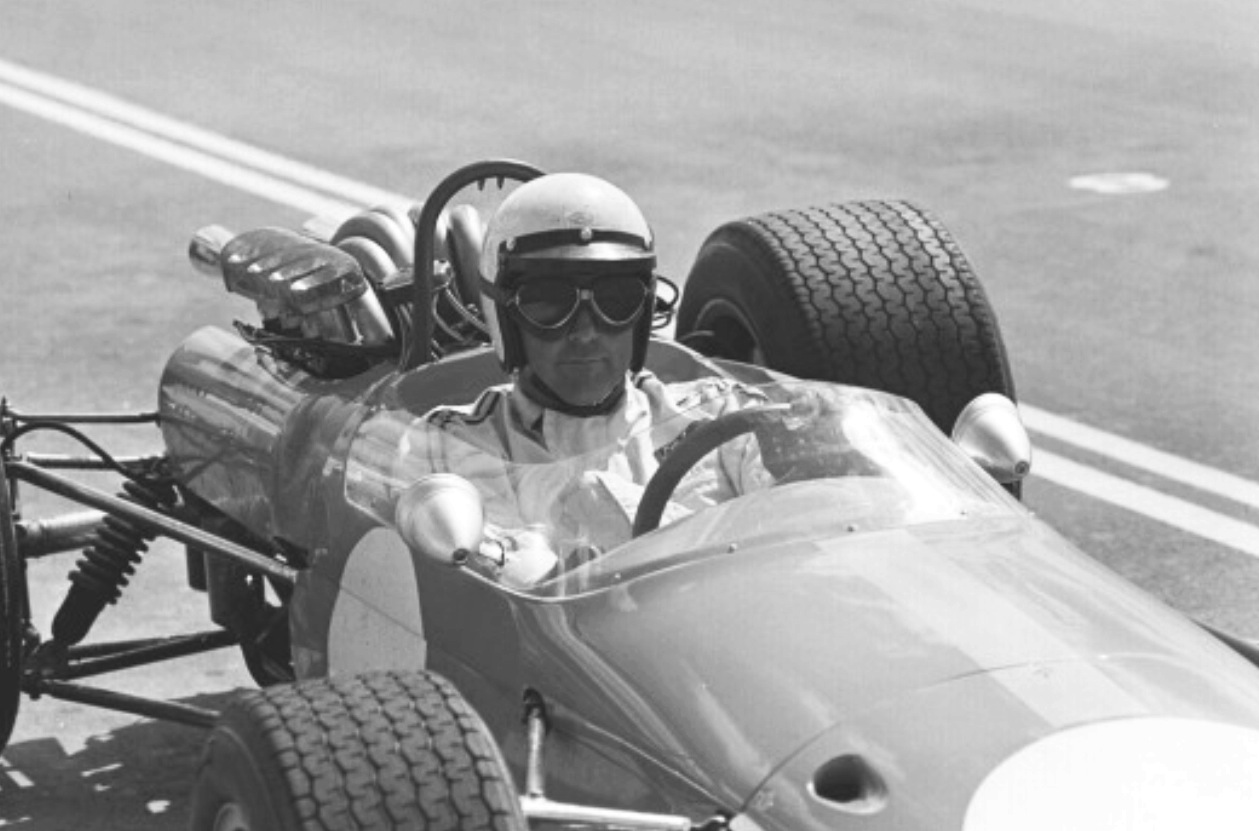
Jackie Oliver’s Shadow DN6 Chev on its way to 2nd place, Road America, 27 July 1975. (Richard Dening Jr)

ollie 2

Exactly 12 months later Oliver goes one better in the Dodge engined DN6B, winning the Road America race on July 25 1976. (Richard Dening Jr)

Jackie Oliver takes an historic win in his Shadow DN6B Dodge at Road America on 25 July 1976…
Chev engines won every championship F5000 race in the US from Riverside on 25 April 1971 when Frank Matich took a Repco Holden win in his McLaren M10B through until Oliver’s long overdue Shadow victory, the Lola T332 Chevs of Al Unser and Vern Schuppan were second and third.

Whilst the Dodge was more powerful than a Chev it was also heavier making the packaging of the car and its big cast iron V8 a challenge for designer Tony Southgate.

The Lola T332 was their 1974 production F5000 but was continually developed, the subsequent Lola T400 and T430 not quicker cars, a good 332 was as quick as an F1 car on the common circuits upon which both categories raced in North America. ‘Twas a remarkably good, very fast racing car the Shadow was competing against driven by the likes of Brian Redman, Mario Andretti, Alan Jones, Al Unser and others…

shadow nude

Shadow DN6 Chev. Car based on Tony Southgate’s very quick DN5 1975 F1 contender. Aluminium monocoque chassis. Front suspension lower wishbone and top rocker actuating inboard mounted coil spring/damper. Rear single top link, lower twin parallel links, two radius rods and coil spring/dampers. Adjustable roll bars front and rear. 5 litre cast iron OHV Chev here, Dodge V8 from the Road Atlanta round in August 1975 , Hewlands TL200 gearbox, developed as an endurance racing tranny used rather than the F5000 standard, the ‘brittle’ DG300. Road America July 1975. (Richard Dening Jr)

dodge engine

5 litre cast iron, mechanical fuel injected, OHV Chev V8 engine developed circa 530bhp@7800rpm. Rocker covers removed here for Road America July 1975 prep, one rocker missing. Magneto, its yellow ignition leads and fuel metering unit all visible. (Richard Dening Jr)

The Shadow DN6 was based on Tony Southgate’s very competitive DN5 F1 design and was first raced in 1975 powered by the ubiquitous Chev V8. Oliver took 4th place in the championship won by Redman’s T332, the car raced well at both Watkins Glen and Road America.

Gordon Kirby in his 1975 season review in Automobile Year said; ‘Almost immediately the Shadow proved to be competitive and in the last part of the season (the last 4 races) it became even more of a threat when after a long development program the team switched to Dodge engines, based on the same powerplant used in NASCAR by Richard Petty’. (in 1975 the Grand National Stockers were compelled by a carburetion ruling to use 355 cubic inch or 5.8 litre engines). The Dodge developed some 30 bhp more than the Chevys’ but was much heavier. The Shadows were not completely tuned and set up and did not win a single race. The whole of the 9 races were taken by the Lola Chevrolets.’

jpj

Jean-Pierre Jarier lines up on the Watkins Glen grid with Brian Redman 13 July 1975. Shadow DN6 Chev and Lola T332 Chev. JPJ DNF with a broken oil line, Brian was 1st, Oliver in the other Shadow also DNF with a blown Chevy. (Gary Gudinkas)

F1 drivers Jean Pierre Jarier, Tom Pryce and Jody Scheckter each raced a second car in three rounds at Watkins Glen, Long Beach and Riverside respectively.

All three qualified in the top 5 but retired with mechanical maladies.

shadow mechanic

Business end of the Shadow DN6 Chev. Engine magneto and fuel metering unit, Hewland TL200 gearbox to which the wing is mounted, neat duct for inboard disc and additional oil cooler all visible. Road America July 1975. (Richard Dening Jr)

1976 Season…

The following Shadow press release written by Rob Buller prior to the Mosport round, the second of the 1976 season, reproduced on the My Formula 5000 website outlines changes to the car and program over the 1975/6Winter.

Development work on the DN6 5000 car has continued over the winter under the direction of Chief Mechanic Ed Stone and Engine builder Lee Muir.

Stone joined the 5000 effort late in 1975 and immediately set about making chassis and suspension changes.’Basically the 1975 season progressed with little development, there wasn’t much time.’ Stone said in a recent telephone interview, ‘I was asked to make some suspension changes and the car was more competitive at the last 1975 race at Riverside with Jody Scheckter driving.

ollie 3

Oliver in the Road America pitlane, July 1976. Shadow DN6B Dodge. (Richard Dening Jr)

‘But the heart of the Shadow development is the new Chrysler power-plant, a joint venture between Shadow and Chrysler’s Plymouth Division. The engine starts life as a 340 cu. in. stock block that is down-stroked to 305 cu. inches. It is fitted with the same injection system that is used on Richard Petty’s NASCAR Dodge.

Chrysler, which is heavily involved in NASCAR and Drag Racing, is new to F5000 racing, a class that has been dominated by the rugged Chevrolet 5 litre engine. As a part of their new kit-car package now under development, Chrysler has contracted with Shadow to do the engine development and sorting.

They supply the engine components to Shadow engine expert Lee Muir, who then hand builds and dyno tests each engine. Chrysler also helps with technical information and advice to Muir, who came to Shadow from McLaren’s engine department.

dodge

Race debut of the Dodge engined Shadow DN6 chassis ‘2A’ at Road Atlanta 31 August 1975. Oliver 4 th, race won by Al Unser’s Lola T332 Chev. Specs; Dodge 340cid V8 taken back to 305cid by reducing the engines stroke. 5 litre cast iron, OHV, mechanical fuel injected V8. Bore/stroke 4.04 inches/2.96 inches, power circa 550bhp@7800rpm. Hewland TL200 ‘box. (unattributed)

‘The first outing in 1976 for the Shadow Dodge DN6 was at Pocono, Pennsylvania for the Series opener. Although they weren’t quite ready for the Pocono race, they were very encouraged with the results. Oliver was lying third in his qualifying heat when a connecting rod developed terminal stretch. As they only had one dyno’d engine a spare practice unit was installed for the feature. However, a fuel pump seal split on the grid and  it took 5 laps to change. By the time he joined the fray Oliver was hopelessly behind but by charging hard he was able to run with the leaders.

With that encouraging performance Stone and Muir returned to Phoenix Racing headquarters in Chicago and started preparation of the Shadow for the Mosport race. Further chassis mods have been made utilizing new springs, roll bars and revised suspension settings. To help weight distribution, the water rads have been moved forward a la McLaren Indy car. Muir will have three completely dyno’d engines ready for Mosport’.

don

‘Sponsorship for the F5000 effort is a problem for Shadow. Since the departure of UOP, Nichols has been unable to get the full 5000 program underwritten. Various sponsors are now supporting the Formula One effort on a per race basis while only Goodyear, Valvoline and, of course, Chrysler are behind the 5000 effort. Thus Shadow must watch their budget closely and this, the team feels, will restrict the amount of development they can attempt. Nonetheless the 5000 effort has Don Nichols full support and he won’t field cars unless he can be competitive. And with the driver, new engine and chassis changes he plans to be competitive’.

Oliver lead at Mosport but was held up by a backmarker, Alan Jones snaffling the win, inevitably in a Lola T332 Chev.

Three weeks later he lead at Watkins Glen but a cracked sump ended his race, the Shadow finally won at Road America, Elkhart lake, Wisconsin. It was a good win as Ollie had to overcome diff and flat tyre problems in his heat which meant he started 14th on the grid of the final.

ollie 1

Oliver on the way to victory, Road America July 1976. Shadow DN6B Dodge. Behind is Al Unser’s 2nd placed Lola T332 Chev. (Richard Dening Jr)

After 16 laps he was 3rd, within 3 laps he was past the Lolas of Al Unser and Brian Redman and took a strong win for the team.

ollie mid ohio

Oliver took 2nd place at Mid Ohio on 8 August 1976, Shadow DN6B Dodge. 1976 champ Brian Redman won in a Lola T332C Chev. (Richard Dening Jr)

Two second places at Mid Ohio and Watkins Glen secured third place in the championship again won by Redman’s Haas/Hall Lola T332.

With the demise of F5000 in the US at the end of 1976 and its evolution into 5 litre central seat Can Am from 1977 the Shadow’s raced on into 1977 and 1978 but without success, Lola’s T332/T333 the dominant cars in the early years of the class.

oliver and helmet

Jack Oliver ready to go Road America 1975. CanAm Champ for Shadow in 1974. (Richard Dening Jr)

road am vista

Road America pitlane on a beautiful July 1975, Wisconsin day. Redmans Lola T332 at front. (Richard Dening Jr)

Etcetera…

comparo

Comparison of the specs of the F1 Shadow DN5/7 and F5000 DN6 from the 1975 Long Beach GP race program. (Fred Bernius)

Tailpiece…

popsie

Jackie Oliver Fan Club President? Road America July 1975. (Richard Dening Jr)

Photo and other Credits…Richard Dening Jr, Gary Gudinkas, Fred Bernius, My Formula 5000 website,   http://www.myf5000.com/index.html, Peter Brennan and Glenn Snyder for research assistance

Other F5000 Articles…

Elfin MR8 Chev & James Hunt.

James Hunt: ‘Rose City 10000’, Winton Raceway, Australia,1978: Elfin MR8 Chev…

Frank Matich and his F5000 cars.

Frank Matich: Matich F5000 Cars etcetera…

Finito…