Stefan was out on the 1st lap, he ran up the chuff of Bergers Bennetton BMW when the engine misfired…Prost won in a McLaren MP4 Honda
Stefan Johanssons’ Ferrari 156-85 twin-turbos lighting up some unburnt fuel in its diffusers…Monaco 1985, sensational Rainer Schlegelmilch shot…
Schlegelmilch picks up the story in’Automobile Year 44’…’For the first practice session of the Monaco Grand Prix in 1985, I took up the same position as I had the year before, at the Rascasse corner. I had my Nikon F3 and a little 43-86mm zoom lens, and as I waited for the cars to come I noted that they would be passing under full acceleration within a metre of my chosen spot beside the guardrail.’
‘I therefore chose a slow shutter speed, around 1/15th or 1/30th of a second, and closed the aperture down in order to achieve the effect I wanted, with the car relatively sharp and the background blurred to accentuate the feeling of speed. I wanted the drivers’ helmet to be the sharpest point, so that identification was easy, and since I wanted to move the zoom during the exposure to add to the blurred effect, I knew that the helmet had to be in the centre of the viewfinder. I was doing all this when Stefan Johannsons’ Ferrari burst into view. Everything worked, and by good luck- or sheer chance- at the very millisecond I pressed the button the Ferraris’ exhausts belched sheets of flame!’
Stefan, McLaren MP4/3 TAG Porsche in 1987 (The Cahier Archive)
Johannson heads into Druids Hill bend, Brands Hatch, European GP 1983. Spirit 201 Honda . Finished 14th 2 laps down after qualifying 19th. (unattributed)
Honda returned to Grand Prix racing via F2 and Ralt...Ron Tauranac and Jack Brabham formed a successful partnership with Honda winning the European Championship in 1966, so they gave Ron a call when they wanted to return, achieving quick success, initially winning the European F32 Championship with Geoff Lees in a Ralt RH6 Honda in 1981.
Ron was never going back to F1 though, so they teamed up with Spirit, who had also used their 2 litre V6 in F2. The F1 turbo-charged 1.5 litre V6 was explosive in its power delivery giving Spirit plenty of engineering challenges to what was essentially its F2 chassis. Johannson cut his F1 teeth with the team and Honda signed with Williams for 1984…
Not so pretty from the side…in search of downforce and somewhere to mount the ancillaries!
Stefans’ route to F1 was via the British F3 Championship which he won with a Project 4…(Ron Dennis) run March 803 Toyota. Like Ron he was off to F1 but a couple of starts with Shadow didn’t launch his career which was via Spirit after some F2 promise in 1982.
He raced for Tyrrell and Toleman in 1984, picking up a Ferrari drive after Rene Arnoux was sacked early in the season for unspecified misdemeanours.
La Source hairpin Spa 1986, Belgian GP. Ferrari F1/86, 1.5 litre twin turbo V6. Stefan drove well finishing 3rd behind the winning Williams FW11 Honda of Nigel mnasell and Ayrton Sennas’ Lotus 98T Renault .(unattributed)
In 1985 and 1986 he was often quicker than team leader Alboreto and in the lead more than once but he was shown the door at the end of’86, McLaren picking him up.
He finished sixth in the drivers championship but was really keeping the seat warm for Ayrton Senna who was under contract to Lotus until the end of 1987, still winless but a frontish-runner, he failed to get the second seat at Williams Riccardo Patrese bagged and steadily slipped down the totem pole in mid-field teams…Ligier in ’88, Onyx in ’89/90, and AGS and Footwork in 1991.
He placed second four times, very unlucky not to win, after 1992 he moved to CART, Sportscars and driver management.
Johannson, Adelaide, AGP 1985. Ferrari F156-85. Qualified 15th and finished 5th, Rosberg won in his Williams Renault (unattributed)
Pitstop at Monza in 1985, Ferrari 156/85. Q 10 and 5th in the race won by Alain Prosts’ McLaren MP4/2B TAG. (unattributed)
Last drive in a competitive car was with McLaren MP4/3 Porsche chassis in 1987. Here in Austria he qualified 14th and finished 7th after a big fright in practice having hit a deer! and cracking a rib in the ensuing accident. Nigel Mansell won in a Williams FW11B Honda. (unattributed)
I wrote an article a while back about Reg Hunt…a little known Australian Champion Driver of the 1950’s and a very successful business man subsequently. At the time i was searching for ‘that shot’ to go with the article but my own library of 50’s stuff is a bit skinny and ‘google’ wasn’t friendly either, so i went with what i had.
I enjoy country drives with ‘der Fuhrer’ for a whole lotta reasons not the least of which are the places in the country with some automobilia, i do that whilst the chief looks at retro-dresses, art and other such chick stuff.
Throw in a nice meal, a bottle of vino and everybody is happy, a temporary state i grant you!
One of our favourite day trips from Melbourne takes in Kyneton/Daylesford/Maldon and return, a run up Mount Tarrengower hillclimb at Maldon is a plus. Overseas readers should add these locales to your Victorian travel agenda, essentially the villages are in the old Victorian Goldfields,
‘Junked Restoration’…at Kyneton has become a stopover on these jaunts, it has rather a nice gallery/design studio as well as the car stuff so the ‘mutual satisfaction’ criteria above are met.
At the weekend i approached the magazine racks and there staring me in the face was Reg in his Maser 250F, on the cover of ‘Sports Cars and Specials’ October 1956, its not even a local magazine i had heard of.
Even more bizarre is the article on the cover comparing Reg Hunt, Stan (father of Alan) Jones and Lex Davison…it just so happens i was in the process of completing the article on Stan, i uploaded two weeks ago, about whom little has been written.
Stan was an interesting character and successful driver, i had been searching the blogosphere for some contemporary information on where he ‘sits in the pantheon of Australian champion drivers’ of the day and found nothing.
What are the chances of finding that!?
I would rather have won ‘Lotto’ of course but its still an amazing bit of chance, i literally didn’t move a magazine, it was just there waiting for me to pick it up, ’twas meant to be.
The magazines’ writers include Ian Fraser, decades later the editor and ultimately owner of English magazine ‘Car’, the best road car magazine in the world…so not only did the article fall into my lap but its also credible.
Some days yer can be lucky!
Mind you, i did get ‘pinged’ for speeding on the return trip to Melbourne!
‘Junked Restoration’ is at 98a Piper Street, Kyneton, there are many top spots for food and wine on this street…then do Daylesford/Castlemaine/Maldon and come back thru tiny Blackwood which has a good pub…The Daylesford Market, open every Sunday is also a good place for automobilia hunting, whilst i am playing tour guide!
Spectacular start of the tragic Le Mans 24 Hour Race, June 1969, the last with the traditonal driver sprint to the cars…
The Porsche 917 was a tricky, somewhat under-developed beast in its original specification even for experienced professionals. British privateer John Woolfe lost control of his on the very first lap of the race perishing in the subsequent accident.
Despite that, a 917 took pole and led the race for twenty hours, maybe it has been somewhat maligned in its formative year?
Groups 4, 6 and the regulator…
By 1967 the Commission Sportive Internationale (CSI) were concerned about the growing speeds of the unlimited ‘pushrod production’ 7 litre Ford GT Mk4 and Chaparral 2F Chev and the 4 litre ‘racing engine’ Ferrari P4 and therefore banned them- it did so by increasing the required number of cars to be built and lowered the engine capacity limits for homologation or admission of cars into both classes.
For 1969 there were no minimum production numbers to qualify in Group 6 ‘3 litre Prototypes’ and a minimum of twenty-five cars to be built for homologation into Group 4 ‘5 litre Sports Cars’.
Effectively the changes in 1968 allowed the existing Mark 1 Ford GT40 and Lola T70 Mk3B cars to remain eligible to keep grid sizes up in Group 4, but with the hope or intent that 3 litre prototypes would be built in large numbers to bolster Group 6, Formula 1 having the same capacity limit at the time.
Porsche would not have had the 908 ready to race in 1968 had they not anticipated the rule changes for 1968 which were announced late by the CSI- in October 1967. Fifty cars were required to be built to qualify for Group 4 in 1968, but that was reduced, as stated above, to twenty-five for 1969, which rather left the door ajar for Porsche…
The FIA, as the governing body then was, had another crack at rewriting the rules to encourage 3 litre prototypes with effect 1 January 1972, given the speed of the 5 litre or thereabouts Porsche 917 and 5 litre Ferrari 512S in 1970 and 1971 but that is another story- lets not get ahead of ourselves.
Porsche had come close to Le Mans victory with their 3 litre 908LH ‘class cars’ in 1968 and wanted to go one better, to win outright, to do so they audaciously and at great cost built twenty-five 4.5 litre air-cooled Flat 12 engined cars- the 917 in 1969.
With the gauntlet thrown down, Enzo Ferrari, his coffers full of Fiat money having sold his road car division to them in 1969, built twenty-five 5 litre V12 512S’ to go head to head with Porsche in perhaps the two best years of sports car racing ever in 1970 and 1971.
(Porsche AG)
On 12 March 1969 a 917 was displayed at the Geneva Motor show with a price tag of DM140,000 a fraction of the cars development costs- a couple of weeks later in late March Rolf Stommelen ran a 917 at the Le Mans test weekend, its quickest time was three seconds a lap quicker than the Group 6 Matra 630/650 V12 of Johnny Servoz-Gavin, but its seeming dominance was not assured as the thing wandered all over the road, somewhat alarming at over 200mph…
The cars above were displayed for inspection at the factory before CSI representatives on 22 April, Ferdinand Piech cheekily offered them the opportunity to drive any of the machines to prove they were complete and running, said offer was declined!
Twenty-five Porsche 917’s lined up at Zuffenhausen awaiting the CSI chassis count for homologation into Group 4, 22 April 1969. Imagine what a chill that image must have sent down the spine of Enzo Ferrari!
Lets have a look at the design, development and competition record of the 917 with a focus on 1969, the 908/02 also gets rather a good look-in given its dominance of the year with twelve months of intense competition under its belt.
Design…
Sales brochure for the 917, a snip at DM140,000 in 1969
Engineer Ferry Piech said that Porsche would not have built the 3 litre 908 had they known the CSI’s intent in relation to the 5 litre group.
At the time they built the 908- a Group 6 car, the minimum production number for homologation into Group 5 was fifty cars not twenty-five, so he can be somewhat forgiven for not being able to read the minds of the rule-makers, then as now unpredictable. The regime of rules was not about encouraging 5 litre cars with ‘racing’ as against ‘production’ based engines.
So Porsche surprised everyone- until then they had built class contenders rather than outright cars and even then it was not thought possible to build a 5 litre air-cooled engine, to that time a Porsche specialty- water cooled Porsches were not to appear for nearly a decade.
Work started on the design of the 917 in July 1968 with Ferdinand Piech entrusting Chief Engineer Hans Mezger with the task of leading the project. Porsche describe the choice of the ‘917’ type number as follows ‘The 912 engine designation comes from more recent Porsche race car nomenclature, whereby the number of cylinders in that particular car’s engine is also included ie. 904, 906, 908, however the vehicle as a whole with a 5-speed transmission, is given the 917 designation.’
Porsche were convinced they could build a car down to the class minimum weight limit of 800 Kg based on the 908 which was 300 pounds lighter than their Alfa, Matra and Ferrari 3 litre rivals. The aluminium spaceframe chassis of that car was a guide and shifting the cockpit and drivers seat forward ensured the 908 wheelbase of 2300mm was kept despite the 12 cylinder engine being considerably longer than its little brothers eight. 908 practice was also applied in that the fibreglass body was bonded to the chassis. A design maxim from the start was a car of exceptionally low drag, top speed is important on the Mulsanne with two bodies for ‘slow’ and ‘fast’ tracks always intended to be homologated.
Cutaway shot by Vic Berris of the aircooled, flat-12, SOHC 2 valve, fuel injected engine. Capacities/power 1969 4494cc/580bhp@8400rpm, 1970 4907cc/600bhp@8400rpm, 1971 4998cc/630bhp@8300rpm. Torque 376, 415, and 425 lb ft respectively. More than enough to see off the 512S/M Ferraris’…cooling fan absorbed around 17bhp @ maximum revs, far less than that absorbed by a water radiator @ equivalent speeds (Vic Berris)
To speed up the development of the 917 engine the same reciprocating parts, bore, stroke, valve and port sizes of the 908 engine were used giving a capacity of 4494cc with a bore and stroke of 85 x 66mm. Porsche believed, initially at least, it wouldn’t be necessary to build a car to the full 5 litre limit to dominate.
All the fuel injection and valve timing settings were taken over from the 908 albeit the valve angle differed to allow cooling air passages between the valves- four valves per cylinder was never an option for this reason, apart from that, the flat-12 is an entirely different engine to the 3 litre flat-8.
A long crankshaft did not allow anything other than a central power take off to avoid catastrophic torsional vibrations. The long crank hence became effectively two shorter cranks joined together at their flywheels, which were just a gear in mesh with another on the output shaft running parallel to, and under the crankshaft, which ran on eight main bearings.
Gerhard Kuechle and Valentin Schaeffer assemble a 917 engine, note central power take-off gears on the crank in 1969 (Porsche AG)
917 engine on the dyno in 1969 (GP Library)
The power output shaft drove the triple gear type oil pump with four additional small oil pumps driven by the exhaust camshafts. Another shaft running symmetrically with the crank drove the two distributors of the electronic ignition, the Bosch fuel injection pump being driven off the left hand exhaust camshaft.
The engine had few steel or iron parts- the crankcase, cam covers and timing gear case were magnesium. The heads and cylinders were aluminium with titanium used for conrods, auxiliary drive shafts, the main output shaft and later in the engines development, valves and valve springs. The cooling blower and most of the air ducts were plastic.
The 4.5 litre engine weighed 528lb in its original form and developed 542bhp on its first dyno run, this rose to 580bhp @ 8400rpm by the time the car arrived at Le Mans in 1969.
A new gearbox was built to take 376lb ft of torque- the case was magnesium, used Porsche synchromesh and had a wet sump incorporating a ZF ‘slippery diff’ with 75% locking factor.
Cross section of the incredibly complex 917 engine, each of which took 200 hours to assemble. Magnesium crankcase is split along its centreline, the power takeoff is by pinion between the two middle main bearings, eight main bearings in total. DOHC per bank, two valves per cylinder sodium filled and two plugs per cylinder. Not winning was not an option! (Porsche AG)
All hands on deck…homologation and timeline pressures created surely one of the most amazing production lines ever!? Werk 1, Zuffenhausen (Porsche AG)
The spaceframe chassis was of welded aluminium tube and largely that of the 908 but suitably reinforced. Note that later in the program three chassis’ were built of magnesium, the wheelbase was 90 inches and track in 1969 58.8 inches at the front and 60.4 inches at the rear.
As with all Porsche racing cars the frame had to withstand 600 miles of hard driving on the Weissach ‘Destruction Course’ but even so a tyre valve was incorporated into the 103lb frame to allow it to be ‘inflated’, a loss of pressure indicative of chassis cracks- sub-optimal in a car of this performance!
Again, magnesium, aluminium and titanium parts were widely used for the running gear- titanium for spherical joints, hubs, springs, the gear lever and steering column. Magnesium was used for the uprights and wheels and aluminium for the steering rack, this obsessive approach to weight saving ensured the car tipped the scales at less than 800kg.
Porsches’ obsession with weight extended to the chassis which was welded aluminium tube. Total weight 103lbs. The one on the right is unfinished. Strong and light…both 917 and 512S Ferrari were spaceframe chassis’, hardly state of the art in 1969/70 but effective all the same. Porsche did not build an aluminium monocoque racing car till the 956 in 1983 (Porsche AG)
The suspension geometry was the same as the 908 but incorporated anti dive geometry, this was achieved by angling the upper and lower wishbone pivots to each other. Wishbones were used at the front with coil spring/damper units and an adjustable sway bar. At the rear a single top link and lower inverted wishbone was used, radius rods provided fore and aft location and again coil spring/damper units were used and an adjustable sway bar- Bilstein provided the shock absorbers.
Initially 9×15 inch front, and 12×15 inch rear, magnesium alloy wheels were used, with a single centre aluminium lock nut- the same as the 908, inside these big wheels the brake package in 1969 comprised ATE aluminium calipers clamping cast iron, ventilated rotors/discs.
Once ready to test, the suspension was largely set up at the Nurburgring- long suspension travel, plenty of camber change and tyres of a rounded tread section were necessary for performance there. This did not translate well at other circuits where the car was ‘under-tyred’ and the geometry thought unsuitable as well- more of this later in the article.
Factory rear suspension drawing- upper top link, inverted lower wishbone and progressive rate coil spring/damper unit. Titanium driveshafts with ‘rubber donut’. Magnesium uprights with titanium hubs, ATE aluminium brake calipers clamped ventilated iron discs. Wheels in mag alloy with aluminium lock nut (Porsche AG)
The bodies were developed in the wind tunnel…
The 917 body was developed in the Porsche Design Department, a plasticine model was created at 1:5 scale and shortly thereafter a 1:1 model which was used for wind-tunnel testing at the Research Institute of Automotive Engineering and Vehicle Engines at the University of Stuttgart. Additional support for testing the aerodynamic development was provided by Charles Deutsch’s Pars based Societe d’etudes et de Realisations Automobiles (SERA), although this was later in the program, not at its outset in 1968.
Both short and long tails were interchangeable, fitted with the latter 236mph on the Mulsanne Straight was achieved in 1969- the bodies were fibreglass, bonded to the chassis, as already outlined and incorporated two seats and doors in accordance with the regulations.
Stability of the cars was critical, front spoilers were fitted and an ingenious setup of mobile rear flaps connected to the rear suspension in such a way that if the suspension was compressed the flaps would create an aerodynamic force to raise the tail whilst if the suspension was extended, the flaps would angle up to push the tail down.
In 1969 these appendages caused major dramas- only two weeks before Le Mans, during the Monaco Grand Prix weekend, the FIA banned ‘moveable aerodynamic devices’ on all racing cars, a consequence of the many wing failures in F1 throughout 1968 and into early 1969- the ‘straw which broke the camels back’ was the breakage of Colin Chapman’s fragile high wings fitted to the Jochen Rindt/Graham Hill Lotus 49 Fords and consequent accidents a lap apart during the Spanish Grand Prix weekend at Montjuich Park- Jochen was lucky to survive that one.
As the 917 was almost undriveable without the flaps with which it was designed and homologated, the cars were allowed to race at Le Mans but the devices had to removed thereafter. Twenty-five sets had been made to comply with homologation requirements but only two or three were used!
Porsche factory drawing showing how suspension deflections actuated the rear wing flaps, from full to no downforce. Movable aero devices banned by the FIA from the end of Le Mans ’69. Changes to bodywork design obviated the need for the flaps in both short and longtailed forms in 1970/71 (Porsche AG)
’69 spec long and short tail comparisons (Porsche AG)
Construction…
From the outset Piech was determined to exhibit the 917 at the Geneva Motor Show in March 1969 to both maximise publicity and to use that timeline to ensure construction of sufficient machines to allow homologation before Le Mans- construction commenced in December 1968.
To meet the target Porsche created thirteen working groups into which 45 race mechanics were inserted to assemble the cars in the testing and race department at Werk 1 (Plant 1) in Zuffenhausen with 10 other mechanics taking cars of component pre-assembly.
Chassis construction was sub-contracted to Baur in Stuttgart and the fibreglass bodies to Waggonfabrik Rastatt. By this stage the first of Mezger’s engines had been tested and run.
917-001 after completion before loading for Geneva, outside Werk 1 Zuffenhausen (Porsche AG)
(Porsche AG)
With a little over two months to run the team were working around the clock to meet the deadline, with only a brief break for Christmas. Baur delivered the first chassis to Waggonfabrik Rastatt at the end of 1969, then, on 1 March 1969 the first chassis- 917-001 arrived at Zuffenhausen for final assembly, it was completed on 10 March 1969, the evening before its despatch to Geneva. At 3pm on 12 March the worlds motoring media gathered around the stunning new machine on the Geneva Show official press day.
Back at Werk 1 assembly continued, the 917 was accepted for technical inspection on 20 March but not all the cars were in running order so the CSI ordered a further inspection a month later ‘…the day finally arrived on 21 April 1969, the English FIA delegate, Dean Delamont, and the German ONS representative, Herbert Schmitz arrived at Werk 1 to examine the regulation compliant roadworthy units.’. The next day the Porsche Press Department declared that “The Porsche 917 is homologated as a sports car from 1 May 1969 and is expected to make its debut appearance at the 1000 kilometres of Spa-Francorchamps on 11 May”.
Porsche 917 homologation document dated 19 April 1969
Racing the 917…
The traditional Le Mans test weekend took place on 29/30 March 1969, there the 917 made its public circuit debut.
Proceedings were dominated by the gruesome death of Lucien Bianchi in the new Autodelta Group 6 Alfa Romeo Tipo 33 3 litre V8 which crashed after a component failure befell the co-winner of the race the year before, going over the hump on the Mulsanne Straight.
Rolf Stommelen drove the car (below) and achieved a speed quicker then the 908LH, (LH is ‘Langheck’ or Long Tail), 3 minutes 30.7 seconds, over 3 seconds clear of Johnny Servoz-Gavin in a Group 6 Matra MS630/650. Whilst ‘on paper’ the car had potential the handling and levels of stability from the drivers seat were frightening.
(unattributed)
(unattributed)
Fettling the 917 at the Le Mans test weekend.
No amount of ‘at the track fixes’ would deal with the high speed instability the drivers were experiencing- body is fibre glass and bonded to the aluminium spaceframe chassis.
By that stage of the sportscar season the first two championship rounds in North America had been run and won in February and March- the Daytona 24 Hour was won by Roger Penske’s Lola T70 Mk3b Chev driven by Mark Donohue and Chuck Parsons whilst the Sebring 12 Hour went to another 5 litre pushrod American V8- this time a JW Automotive Ford GT40 crewed by Jacky Ickx and Jackie Oliver- the season was wide open at this stage with Porsche still to get an outright win on the board.
The next two rounds at Brands Hatch in late April, and Targa in early May started to redress the balance though- both the Brands and Monza 1000km fell to the 908/02 combination of Jo Siffert and Brian Redman.
Gerhard Mitter and Udo Schutz won in Sicily, the Targa Florio on 4 May was a 908 rout- Vic Elford/Umberto Maglioli and Rolf Stommelen/Hans Hermann were second and third with another factory car of Willy Kauhsen/Von Wendt in fourth. ‘Porsche System Engineering Ltd’ entered six cars!, only the Lins/Larrousse and Attwood/Redman 908/02’s failed to finish. No 917’s were entered on a circuit totally unsuited to them.
First race apperance for the 917, Spa 1969. Gerhard Mitter and Udo Schutz shared the car but an engine failure early in the race meant only Mitter got a race drive (unattributed)
After little testing, two 917’s, in addition to a ‘fleet’ of 908s were entered for the Spa 1000Km on 11 May.
Jo Siffert and Brian Redman practiced their 917 but Jo made the call to race a 908, the duo won the event from Pedro Rodriguez and David Piper in a Group 6 Ferrari 312P and Vic Elford/Kurt Ahrens third in another 908 with the Stommelen/Herrmann crew fourth.
Gerhard Mitter started his 917, having qualified it eighth but retired with engine failure on lap 1 having possibly over-revved the motor at the start- the 917’s continued to exhibit high speed instability, the very reason Siffert elected to race a 908LH. It was a good call from a championship perspective with another win on the board.
On the Spa grid- drivers immediately behind the 917? Kurt Ahrens in the anorak to the right aft of car (Porsche AG)
(unattributed)
Gerhard Mitter wrestles his 917 around Spa’s La Source hairpin above, early aero with adjustable wings at the rear and no winglets up front- compare the front of the 917 at the Osterreichring in the photos to follow below. 1969 cars exhausts exited from both the rear and aft of the doors.
Porsche entered six cars at Monza- four Group 6 3 litre 908LHs for Elford/Ahrens, Stommelen/Herrmann, Siffert/Redman and Mitter-Schutz and two Group 4 4.5 litre 917’s for the last two named pairs who could make a choice between 908/917 as they/the team saw fit.
Frank Gardner and David Piper brought the 917 home for its first race finish at the Nurburgring 1000Km (unattributed)
For Porsche’s home event, the Nurburgring 1000Km on 1 June they hired two hardened sports car professionals in Frank Gardner and David Piper to ‘bring the thing home’- that they did in eighth place having wrestled the unruly beast, chassis 917-004, around 44 laps of the ‘Green Hell’ for six hours and twenty minutes.
Gardner was a noted test and development driver, Porsche were keen to get his views on the changes he considered necessary to make the car competitive. The race was won again by the Siffert/Redman combination in a 3 litre 908/02 ahead of four other 908’s- Herrmann/Stommelen, Ahrens/Elford, Rudy Lins/Attwood and Kauhsen/Karl von Wendt- what domination, the first five cars on the grid were all 908/02s.
Gardner/Piper 917 ahead of the Hobbs/Hailwood Mirage M2/300 BRM DNF and Ortner/van Lennep Abarth 2000SP NC (Schelgelmilch)
Le Mans 1969…
Other than more power- 580bhp, and with the anti-dive geometry of the suspension reduced from a factor of 50% to 5%, the 917 arrived at Le Mans as designed. Fortunately, as described above the cars were able to race with their adjustable rear wings, common-sense prevailed from a safety perspective.
At Le Mans Porsche famously, very narrowly lost the race by about 100 metres, the Hans Herrmann/Gerard Larrouse 908LH was just beaten by the Ford GT40 of the ‘two Jackys’- Jacky Ickx and Jackie Oliver, won in GT40 chassis ‘1075’ the same JW Automotive GT40 which was victorious the year before in the hands of Pedro Rodriguez and Lucien Bianchi.
’69 Le Mans start. Jo Siffert #20 908/2, Elford #12 917LH, Schutz 908LH, #7 Hobbs Ford GT40, #2 Bonnier Lola T70Mk3b Chev, #64 Hermann 908LH, #22 Lins 908LH…and the rest. (Porsche AG)
The pole winning Stommelen/Ahrens 917LH retires on lap 148 with an oil leak, the car was hard driven, it was the teams ‘hare’ (unattributed)
Rolf Stommelen put his 917 on pole, outlining the cars potential but the car failed on lap 148 with an oil leak. Vic Elford qualified his second co-driven by Richard Attwood, the car led the race for twenty hours and did 327 laps- enough for ninth place but the car was not running at the finish having withdrawn with a cracked bellhousing.
Elford recalled ‘The engine was running like clockwork until that point. No problems whatsoever’ whilst Hans Mezger noted, upon returning from his lunch break at the time that ‘When I returned to the pit I could tell straight away that something wasn’t right.’
John Woolfe’s car was destroyed in his fatal lap 1 accident, the car having qualified ninth in the hands of factory driver Herbert Linge- car owner Woolfe started the race rather than the far better credentialled Linge.
Vic Elford in the car he qualified 2nd. He shared the car with Richard Attwood, they led the race for 20 hours, DNF after 327 laps with a cracked gearbox bellhousing (unattributed)
Ickx wins from Hermann…the GT40 margin from the 908LH, 2 seconds after 24 hours of racing and despite losing 20 minutes in a long pitstop for the crew of the 908 to replace a front wheel bearing (unattributed)
The first 917 win, Osterreichring 1000Km 1969…
Porsche did not take a 917 to the 12 July Watkins Glen 6 Hour but were victorious again all the same, Siffert and Redman again won in a 908/02 from the Elford/Attwood and Jo Buzzetta/Rudy Lins Porsche Austria pairing- the non-Porsche class-winner was the screaming V12 Group 6 Matra MS650 raced by Pedro Rodriguez and Johnny Sevoz-Gavin to fourth.
‘More intensive testing and test drives were carried out before the last race of the year, the Austrian Grand Prix in Zeltweg…A scheme to improve driving stability is instigated by race engineer Peter Falk, is one of the first tests to be tested at the South Loop of the Nürburgring. Further tests are later conducted on the skid-pad in Weissach and at Hockenheim. Adjustments to the aluminium frame and modifications to the body are intended to enhance the characteristics of the 917’ Porsche wrote, confident in advance of the meeting.
Starting grid Osterreichring 1000Km 1969. #29 Siffert/Ahrens winning 917, #33 Bonnier/Muller Lola T70 Mk3b Chev (2nd) #9Ickx/Oliver MirageM3 Ford (DNF). The 3rd placed Attwood/Redman 917 in white is behind Siffert. #42 Matra is Servoz-Gavin/Rodriguez (DNF) and the rest (unattributed)
The Seventh Austrian Grand Prix/Zeltweg 1000km/Austrian 1000km (take your pick) on the new 5.911km Osterreichring was the last round of the Manufacturers Championship in 1969 and is a fast track, circa 130 mph average and therefore well suited to the 917’s qualities.
And so it was that a 917 entered by Karl F von Wendt driven by Jo Siffert and Kurt Ahrens beat the Jo Bonnier/Herbie Muller Lola T70Mk3b Chev from the Richard Attwood and Brian Redman in the David Piper Racing Ltd 917K with Masten Gregory and Richard Brostrom fourth in the first of the 908/02s.
The Von Wendt/Piper 917 entries were made on the basis that both had options to buy the cars at a later date, Porsche having 25 of the things to sell, less those required for works use as you will recall…It wasn’t the strongest round of the year in terms of depth of entry but it was a win all the same!
(unattributed)
The Osterreichring winning Porsche 917K of Jo Siffert and Kurt Ahrens above.
Fitted with a 4.5 litre Flat-12 at this stage with the early rear aero treatment clear in this Shell promotional shot. In its first two races at Spa and the Nurburgring the car raced with a small fixed rear spoiler. Compare this photograph with the shot in ‘Etcetera’ below of the 1970 917K tail.
Jo Siffert (below) leads Jacky Ickx- the 4.5 litre Porsche 917 ahead of the 3 litre Mirage M3 Ford Cosworth DFV. JW Engineering, the entrant of the Mirage would be contracted by Porsche to race and develop the 917’s in 1970 and 1971, becoming the dominant team of that wonderful two year period…Le Mans excepted, where their luck did not hold!
(unattributed)
Race development, secret testing and the 917PA…
Jo Siffert Porsche 917PA, Bridgehampton Can-Am 1969. The race was won by Denny Hulme, McLaren M8B Chev, Jo finished third (unattributed)
Whilst a short tail 917K won the Austrian 1000Km race against weak opposition, other than at Le Mans the cars were still uncompetitive.
A critical test took place at Zeltweg which changed everything. Representatives of Porsche including experienced engineers Peter Falk and Helmut Flegl and from JW Automotive- David Yorke, Team Manger and Chief Engineer, John Horsman, attended the test which took place at the Osterreichring between 14 and 17 October 1969.
Two 917’s were made available- 917-006, a Le Mans practice car and 917-008 which led the race until it retired during the twenty-first hour. The target time for drivers Redman and Ahrens was the 1:46.6 the Gulf Mirage M3 Ford had done in August, by the end of the second day, the 15th, the best they had done was a 1:48.2.
During a pitstop John Horsman noticed the lack of dirt and bugs-gnats, on the rear bodywork which indicated to him the air was not following the contours of the bodywork and therefore the problems with the car were aerodynamic rather than suspension geometry or tyres. Note that the Porsche duo have claimed that they saw exactly what Horsman did at the same time he did so take your choice as to who was responsible for the key observation or whether the credit should be shared.
‘I knew immediately that we had to raise the rear deck and then attach small adjustable spoilers to the trailing edge. It was obvious to me that if the whole body was in the airstream it would be able to exert some downforce’ recalled Horsman.
Together with the JW mechanics- Ermanno Cuoghi and Peter Davies they quickly fashioned changes to the rear bodywork of 917-008 with aluminium sheet, rivets and tape, the work was finished after the circuit had closed. Brian Redman, sceptical, went out to test the car the following morning, 16th October and stayed out for 7 laps he was enjoying the car so much!
The changes were then made to 917-006 as well. Then, working between the cars on further alterations to both the body and suspension including springs and bars, no changes were made to the suspension geometry- and using wider wheels and Firestone tyres with whom JW were contracted (Porsche used Dunlops), resulted in a time of 1:43.2 set by Kurt Ahrens.
The John Horsman suggested changes to the rear deck of a 917 at ‘the Zeltweg test’ in October 1969 (J Horsman)
Less is more- you can see how the deck evolved over those couple of fateful days with more angle and bigger spoilers (K Ludvigsen)
(K Ludvigsen)
The Porsche design team, led by Eugen Kolb then had the task of ‘productionising’ the changes which involved the tail shape including redesign of the rear window, creating a tunnel in the upward sweeping tail to provide rear vision for the drivers and re-routing the exhausts to the open area behind the rear wheels. New side pods were also needed as they no longer housed the exhausts for the forward cylinders of the big flat-12. The nose profile was to be finalised too, with larger ducts for the brakes and fender vents for brake cooling.
The engine was largely left as was- whilst noting the exhaust changes, the Fichtel and Sachs clutch was replaced by a triple-plate Borg and Beck item whilst the gearbox and clutch housing were reinforced to avoid the failures experienced at Le Mans.
The pressure on Porsche was immense as a follow up test of what was by then referred to as the 917K was scheduled at Daytona only a month hence, on November 19 and 20 1969- it was another secret test with even Speedway employees refused admission to the grandstands and infield.
On hand were a squadron of technicians as well as drivers Siffert, Ahrens, Rodriguez and David Hobbs. In addition to the short tail, Porsche also brought along a new longtail, about which the drivers were not enthusiastic so the focus was on the ‘K’ and comprised Goodyear/Firestone tyre comparisons with simulated races and endurance runs.
Hobbs buzzed an engine on day 2 when he muffed an up-shift and bagged second instead of fourth gear and with it went his chance of perhaps partnering Pedro- the Porsche factory paid combination for 1970 was Siffert/Redman whilst the JW pairing, paid by them, ended up being Rodriguez and Leo Kinnunen- Ickx went to Ferrari for both F1 and sportscars in 1970 and so was no longer available to John Wyer.
Further changes to the cars made as a consequence of the test included re-routing the oil lines through dedicated plumbing rather than the chassis tubes to reduce cockpit heat, creation of the ‘D shaped’ windscreen to improve driver vision on the banking, bringing the steering wheel closer to the driver (when wanted), detail changes to the steering rack and transmission and a new front upright design due to concerns about brake pad taper wear and stability under brakes.
Whilst there are no photographs from Daytona, 917-011 was sent immediately upon its return from Florida to the University of Stuttgart for wind tunnel testing, the shots show how the car looked. The tests confirmed acceptable drag and downforce readings so no further changes were made to the body prior to Daytona several months hence with the exception of a roof window.
917-011 in the Uni of Stuttgart wind tunnel in November 1969 (Porsche AG)
(Porsche AG)
Lets not forget than an open car was built- designated the 917PA (PA ‘Porsche Audi’ the US importer of Porsche) for Jo Siffert to drive in the 1969 Can-Am series late that year.
The 917PA competed in six races with its best results a second and a third, the car was ‘blown away’ by the 7 and 8 litre Chevs, Bruce McLaren and Denny Hulme were dominant in their McLaren M8B Chevs. Valuable experience was gained for both the 1970 Manufacturers Championship and for another tilt at the Can-Am series. This information would prove useful for Porsche’s successful assault on the Can-Am championship in 1972 and 1973 with the awesome, turbo-charged 917/10 and 917/30.
Porsche had a fantastic 1969 season winning all but Le Mans. They won at Brands Hatch, Monza, Targa Florio, Spa, the Nürburgring, Watkins Glen and the Osterreichring to win the Manufacturers’ Championship and the GT Trophy as well as ‘blooding’ the 917 to set up its dominance for the next four years- two years in endurance racing and another two years at the Can-Am.
For 1970/1971 Porsche changed their approach to racing the cars, the factory continued to develop them but the race organisation was contracted to JW Automotive and Porsche-Salzburg, those seasons of success are another story- the seeds of dominance were sown in 1969…
(unattributed)
Porsche media day in late 1969 at Hockenheim.
Porsche 917PA Can-Am car and 917K in shot. Brian Redman, Jo Siffert, Pedro Rodriguez and Rico Steinemann are in attendance. You can see the refinements to the rear bodywork of the 917K, reputedly ‘cribbed’ off the Lola T70Mk3b and also on the #23 1970 Le Mans winning car below.
Etcetera…
Porsche 917-001 (Porsche AG)
(Porsche AG)
Assembly in Werk 1 Zuffenhausen early 1969.
(Porsche AG)
The first car completed, chassis 917-001, was a show car and beauty queen in a variety of configurations right throughout its life, it was restored to its original 1969 917 LH specifications a few years ago.
(Porsche AG)
Ferdinand Piech with the CSI inspection crew at Zuffenhausen in April 1969, can’t have been a difficult task, they only had to count to 25!
The process took two bites of the cherry, the cars were not complete on the first visit so the team rocked up again a month later to ensure alles wast kosher allowing the formal homologation of the 917 into Group 4 to take effect in time for Le Mans.
(unattributed)
Porsche kaleidescope of colour, 908 and 917 wings at Le Mans in 1969.
See the text for the operation of these rear wing flaps, 25 sets made for homologation but only 3 or so actually used! Flaps banned post Le Mans.
(unattributed)
The original 1969 917 body in all its glory.
#15 is the Herbert Linge/Brian Redman/Rudy Lins car which tested but did not race at Le Mans. It is a 917LH spec note front trim wings but lack of adjustable wing flaps at the rear.
(Klemantaski)
The Elford/Attwood 917LH at Arnage during Le Mans 1969.
Note the extreme length of the tail, side exhaust, front winglet and flaps at the back, allowed as per the earlier text for Le Mans only.
917-001 cockpit post restoration in modern times (Porsche AG)
(Geoff Goddard)
Porsche racing cockpits have always been about function.
‘Momo’ steering wheel, lever for 5 speed synchro (sometimes 4) gearbox to the right. Aluminium tube frames on floor visible, six point harness and minimal instrumentation.
(unattributed)
Bata ‘Scouts’ were the go in cool footwear for twelve year olds in 1969, clearly the Bata ‘Jacky Ickx’ was aimed at a slightly older market!
Jo Siffert at Spa during practice, again note in particular the aerodynamic treatment of this 917K- Jo elected to race a 908 and won together with Brian Redman.
(unattributed)
Jo Siffert, Porsche 917PA being chased at the Laguna Seca Can-Am round by Denny Hulme’s McLaren M8B Chev, the dominant car of 1969- Bruce McLaren won the race from Hulme with Jo fifth.
Compare and contrast the bodywork of the 917PA above on 12 October and that of the car a fortnight later on 26 October below during the LA Times Grand Prix at Riverside.
There the car has a much ‘wedgier’ nose in search of greater front bite and top speed. Siffert was Q11 and DNF with an oil leak, Denny the winner in his M8B Chev- Bruce McLaren won the championship that year from Denny and Chuck Parson’s Lola T163 Chev.
(unattributed)
Quintessential 917K (short tail) 1970 spec car- here the Porsche Salzburg Le Mans winning car driven by Hans Hermann and Richard Attwood car.
The shot included to show the changes made to the car’s bodywork very late in 1969- different door line, no exhaust exits aft of the doors, wedge shape and Lola T70 Mk3b inspired rear deck.
(unattributed)
For the sake of completeness the 1969 917LH evolved into this bodywork in 1970.
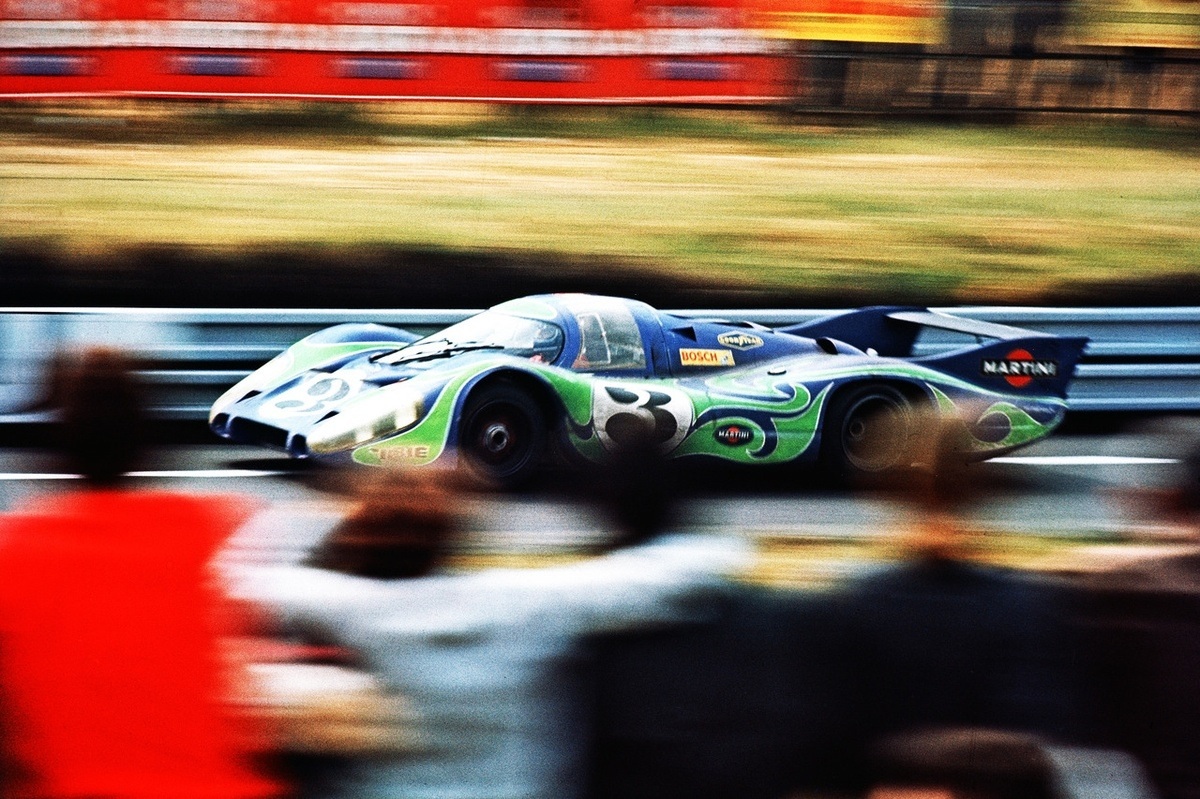
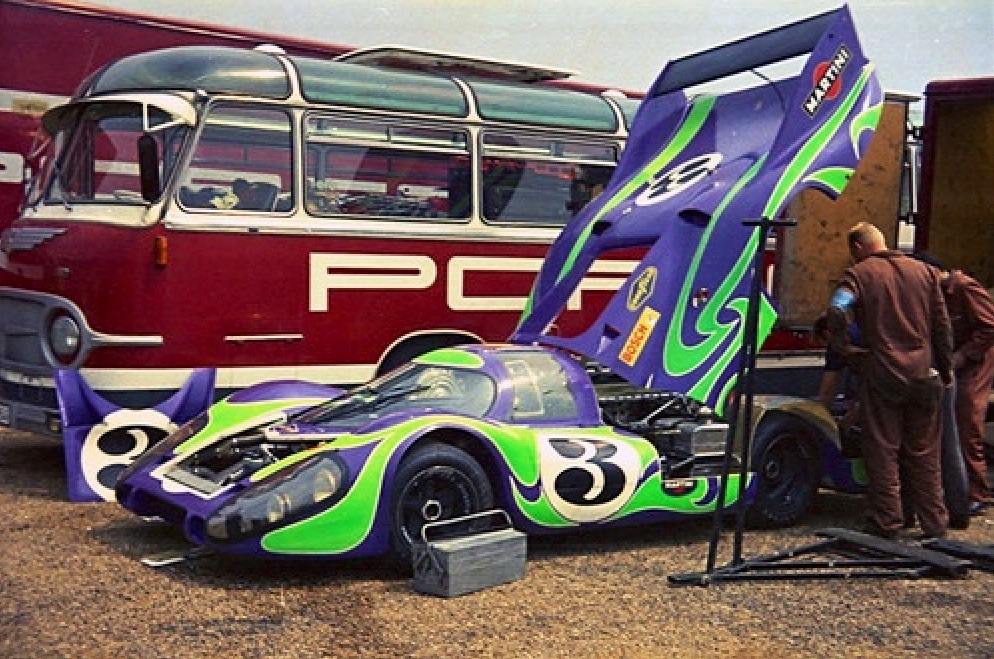
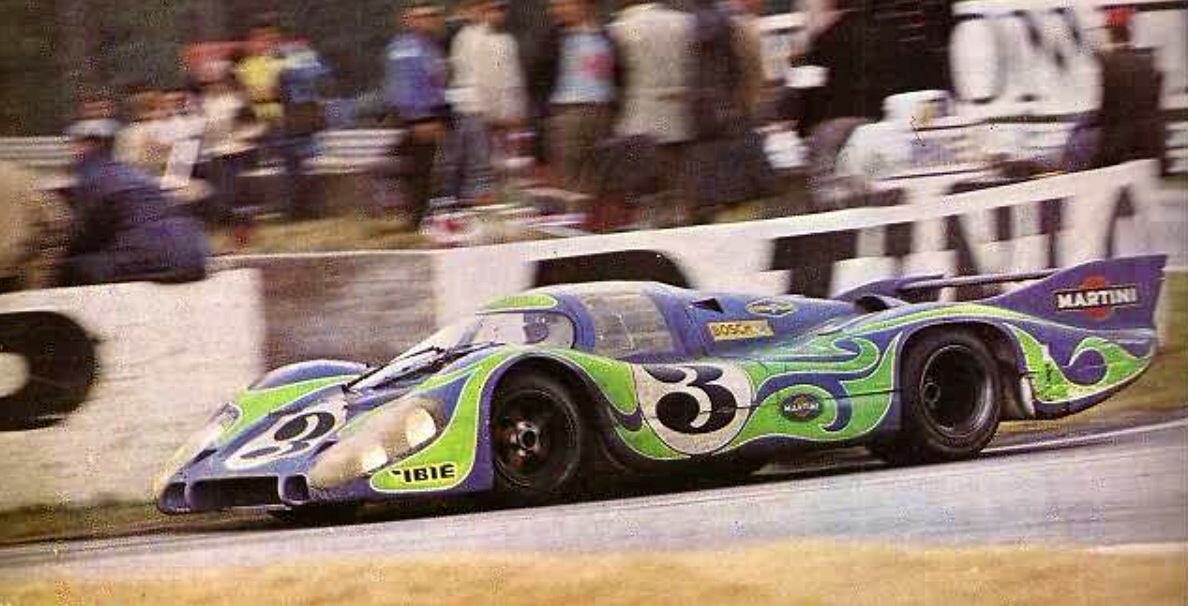
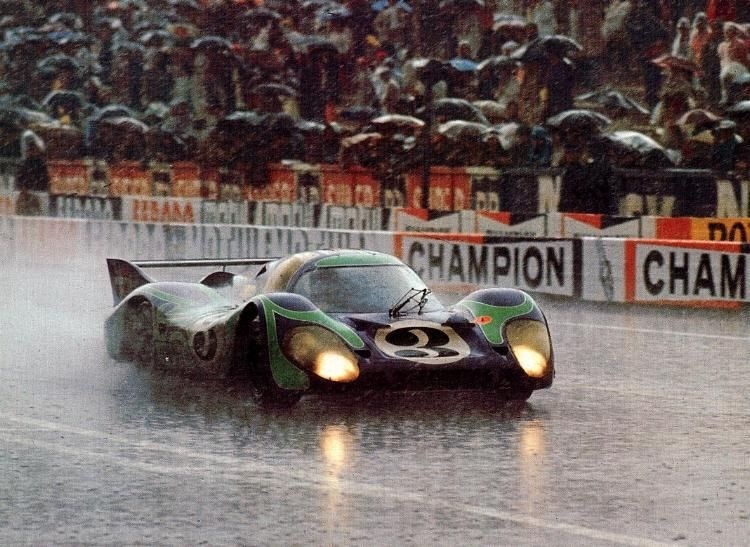
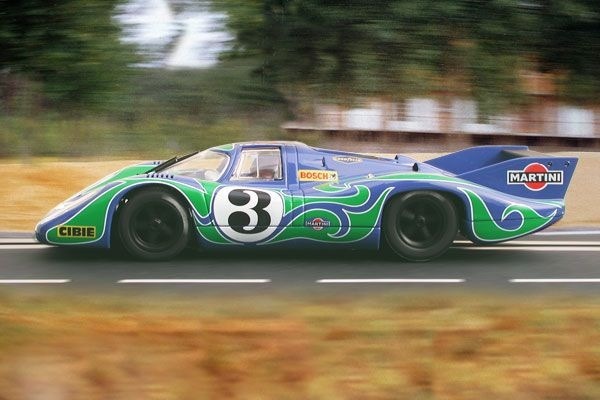
Here is the marvellous Martini Racing Team ‘Hippy Car’ of Gerard Larrousse/Willie Kauhsen which was second at Le Mans 1970- compare and contrast the swoopy, curvaceous long tail body with the 1970 917K #23 immediately above.
Reference and Photo Credits…
Vic Berris cutaway drawing, Porsche AG, ‘Cars in Profile Collection 1’ article by Paul Frere, ‘Testing at Zeltweg’ article by Karl Ludvigsen in ‘Drivetribe’, International Motor Racing Research Center article ‘A truly Secret Track Test of The Porsche 917’, Vic Berris, Geoff Goddard, Rainer Schlegelmilch, Klemantaski Collection, John Horsman Collection
Tailpiece: No time to admire the scenery for Frank Gardner! 917/004 during Nurburgring 1000 Km practice in June 1969…
The halycon days of politically incorrect advertising, doncha’ miss-em!?
That is Jacky Ickx under that fine femine form. Ickx arrived from Ferrari at Brabham at the end of’ ’68 and left to go back at the end of ’69 but not before winning two Grands’ Prix in the BT26, its fortunes transformed by the replacement of the troublesome 4 cam, 32 valve Repco ‘860 Series’ 3 litre V8 used in 1968, with the ubiquitous 4 cam, 32 valve 3 litre Ford Cosworth DFV V8 for 1969.
One of Grand Prix Racings’ interesting historic footnotes would have been to see if Repco could sort the problems of the ‘860’ to determine if the engine could match the world championship winning pedigree of the Repco ‘620 Series’ and ‘740 Series’ engines which won titles for Brabham and Hulme in 1966 and 1967 respectively…
Ickx won at the Nurburgring and Mosport Park, Canada in the BT26.
The return to Ferrari worked for him, he narrowly missed out on the 1970 title won posthumously by Jochen Rindt, mind you Brabhams’ 1970 car, the BT33 was every bit as competitive as his Ferrari that year.
As to the Castrol missy, Brabhams’ oil company was Gulf in 1969, so not quite sure where she fits in, but who cares!?
Jacky Ickx Brabham BT26 Ford winning the German GP at the Nurburgring from pole and achieving fastest lap, Ickx an acknowledged ‘Ring-Meister’. Jackie Stewart was 2nd and Bruce McLaren 3rd, Matra MS80 Ford and McLaren M7 Ford respectively. (Sutton)
Wonderful shot of Stan Jones winning the 1959 Australian Grand Prix. Tannery Corner, Longford, Tasmania. Maserati 250F (B Dunstan via Ellis French)
The Ascaris, Jones, Hills and Villeneuves…
When Alan Jones won the 1980 Australian Grand Prix at Calder, he and his father Stan joined the Ascaris as the only father/son combination to win their home Grands’ Prix.
Antonio Ascari won the 1924 Italian Grand Prix in an Alfa and his son Alberto won it in 1949, 1951 and 1952 for Ferrari.
Stan won the 1959 AGP at Longford in his Maserati 250F, the last AGP won by a front engined car.
Graham and Damon Hill both contested the British Grand Prix, Damon winning in 1994 aboard a Williams Renault, whilst Graham came close he never had a hometown win. His luck in the UK was as bad as it was good in Monaco where he won five times!
Similarly, Gilles and Jacques Villeneuve both contested the Canadian Grand Prix but only Gilles took a win, for Ferrari in 1978.
Sadly, all four fathers had one thing in common, they all died before their sons achieved Grand Prix success. Alberto and Gilles in testing/race accidents, Graham in the light aircraft he was piloting, together with his team, and Stan of natural causes at the very young age of 49.
Foreword…
Like so many of my articles, this one on Stan started with a photograph, the one above at Longford. I figured the article would be short but the more I dug, and there is not a lot of information available on Jones, the more interested I became in him and the series of Maybach cars which were such an important part of his career.
So, it’s ended up rather long but I hope of interest.
I leaned heavily for information on the Maybach phase on Malcolm Preston’s great book ‘From Maybach to Holden’, sadly, Malcolm died a month or so ago. He was very kind and helpful to me with the article on the John McCormack McLaren M23, that article in many ways was the inspiration for starting this blog, so I dedicate this article to him. RIP Malcolm Preston.
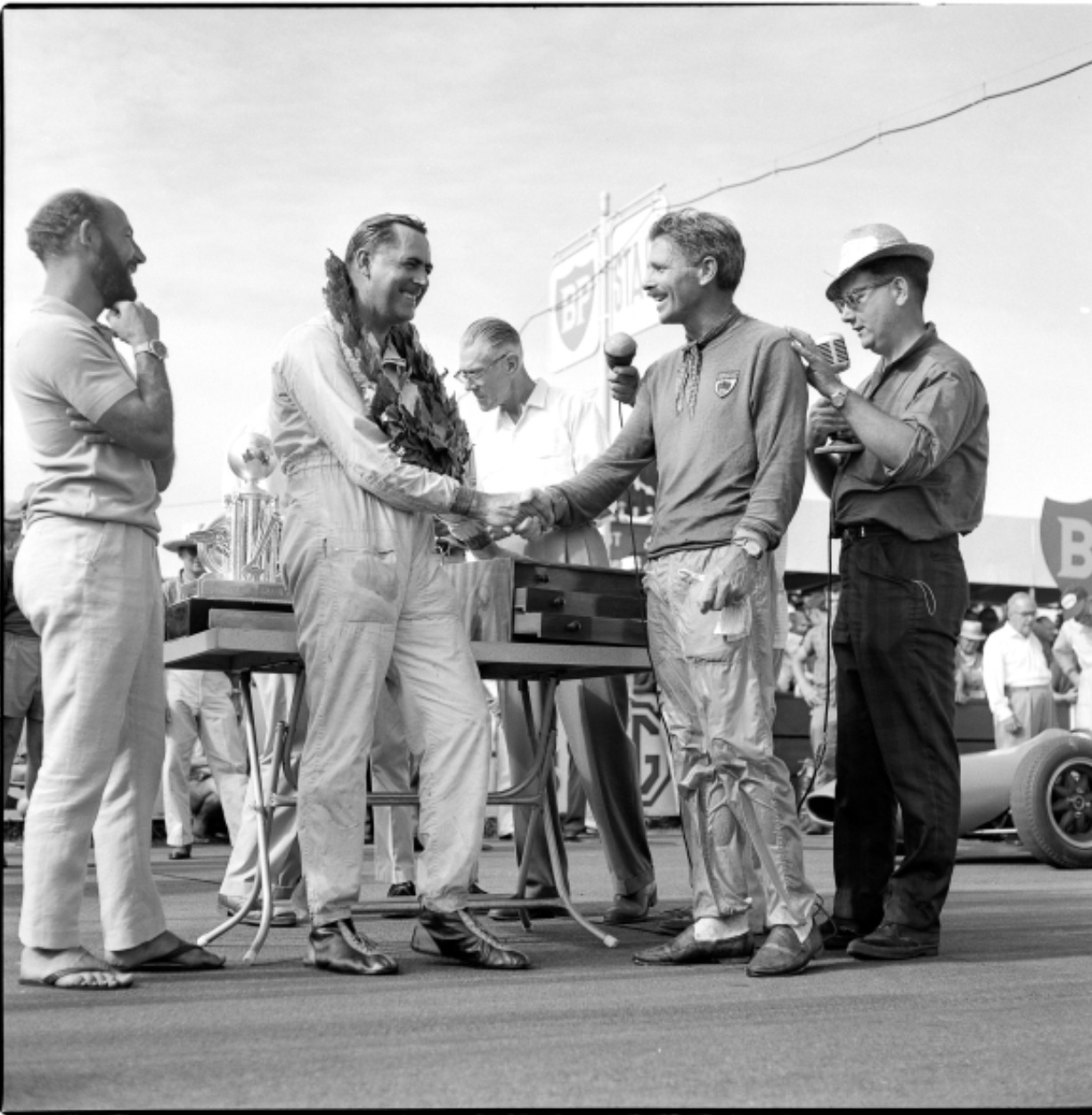
Famous shot of Stan Jones shaking hands with Otto Stone, his engineer after the 1959 Longford AGP victory in his Maserati 250F. Alan is 12, John Sawyer, the other technician wears the flat cap…Stan a justifiably happy-chappy after so many years trying to win this event! (unattributed)
Stan Jones…
Much has been written about Alan of course, but not so much about Stan, one of the great drivers and characters of Australian motor racing in the immediate post war years until the dawn of the 1960s.
He was raised in Warrandyte, then a rural hamlet 24km north-east of Melbourne and still semi-rural now, by his mother and grandfather. He served in the Australian Armed Forces based in Darwin during World War 2. He married Alma O’Brien circa 1940, Alan was born on November 2 1946.
Stan commenced motorsport after being encouraged by Otto Stone, a racer and engineer who would later make a great contribution to his success as an elite driver. He competed in his MGTC at Rob Roy Hillclimb, at Christmas Hills, not far from where he grew up in 1948.
Stan was soon a keen competitor in all forms of the sport including trials, twice winning the Cohen Trophy awarded to the best trials driver of the year by the Light Car Club of Australia.
His MGTC was supercharged, as so many of them were, his first circuit meeting was at Fishermans Bend, Melbourne in late 1949. He did well, finishing seventh against more experienced opposition.
In need for more speed, he bought an HRG chassis to which a local monoposto body was fitted, achieving success with the car in 1949 and 1950. His first road racing event was at Woodside, in the Adelaide Hills, he finished second in the Onkaparinga Class handicap in November 1949. Australian Motor Sports reported that it was the first appearance of one of the new production monoposto racing HRG 1500’s.’ In 1951 he also bought an Allard J2.
These faster cars were funded by Superior Cars, a dealership he opened in Richmond: yards in Coburg and South Yarra followed, northern and inner eastern Melbourne suburbs respectively.
Jones Allard J2 in the Bathurst paddock, 1951. (Ray Eldershaw Collection)Charlie testing Maybach circa 1950 on the road, in the grounds of ‘Willsmere’ the hospital for mental illnesses in Kew not far from Charlie’s home. His other testing venue was Princes Park Drive behind the Melbourne General Cemetery in North Carlton. This ‘track’ was conveniently close to Repco Research in Sydney Road, Brunswick. What a super car it was/is! (Dacre Stubbs Collection)
Charlie Dean, Repco and Maybach…
The turning point in Stan’s career was the association with Charlie Dean, the ‘Maybach’ racers which Dean built and the ‘Skunkworks’ at Repco Research, which continued to develop the car and its successors after Jones acquired it/them.
Charlie’s business, named ‘Replex’, manufactured large industrial transformers. He became involved in the Australian Motorsports Club and using his wartime knowledge of sophisticated German engines, sought a suitable motor to form the basis of a special.
A friend who operated a war surplus wrecking yard was briefed and Charlie was soon the owner of a ‘Demag’ half-track armoured personnel carrier. Critically, it was powered by a Maybach six cylinder 3.8 litre SOHC, crossflow engine. The block was cast-iron, the head aluminium, the crank ran on eight main bearings. In standard form the engine produced 100bhp at 2800rpm, but the engine’s performance potential was clear to Dean.
Initial modifications involved fitment of twin Amal carbs to a fabricated manifold, increasing the compression ratio to 8:1 by planing the head, fitment of a Vertex Magneto and a re-ground cam to increase valve lift and duration.
At about the time Dean started to build Maybach 1, he sold his business to Repco, being retained to run it, this gave him both time for his hobby and access to Repco resources.
The engine was fitted into a tubular chassis, the basis of which was two 4 inch diameter 10 guage mild steel tubes to the front of which was mounted suspension mounting framework. Front suspension comprised a transverse leaf spring with suspension arms and stub axles from a 1937 Studebaker Commander. Rear suspension was of conventional semi-elliptic leaf springs, Luvax lever-arm shocks were used. A Fiat 525 gearbox drove an open prop-shaft to a Lancia Lambda seventh series rear axle. A Jeep steering box was used. Standard Studebaker brakes and wheels were deployed at the front and Lancia brakes, hubs and wheels at the rear.
It was a quick sports car and was soon developed further for competition use, Charlie debuting it at Rob Roy Hillclimb in 1947.
The car was clothed in a metal body built by fellow Repco Engineer Frank Hallam. It was made from surplus metal Kittyhawk aircraft fuel belly-tanks. (made by Ford)
Charlie raced the car in the 1948 AGP at Point Cook, an ex-RAAF base in Melbourne’s inner West. He retired on lap 12 from magneto failure in a race of attrition in searing heat, victory going to Frank Pratt’s BMW 328. In those days the AGP was Formule Libre and handicaps were applied.
Charlie Dean with Jack Joyce as ballast competing at Rob Roy Hillclimb, Christmas Hills, outer Melbourne in March 1949. Maybach 1 Evolution B in the car’s never ending developmental cycle (Dacre Stubbs Collection)
The development of Maybach was constant and ongoing, the ‘program’ having strong Repco support due to its promotional value and the development of its engineers. In 1950 Dean was appointed to head up a Research centre for the Repco Group, located at the ex-Replex premises at 50 Sydney Road, Brunswick…from acorns do great oaks grow.
In June 1951 Jones, looking for an outright class winning car, bought the car for a nominal sum. Repco involvement continued with the car’s preparation, development and use by Repco for product development and testing. The car was engineered at Repco Research.
Dean’s business and family commitments had made ongoing motor sport participation difficult. Jones lived in the Melbourne eastern suburb of Balwyn, in Yongala Road, not far from Dean’s home in Kew so communication was easy despite the lack of email and iPhones.
By the time Stan bought ‘Maybach 1 Series 3’ the body was still a two-seater. Three feet of rear chassis rails had been removed from the original, it had rear axle mounted trailing quarter elliptics with radius rods.
The engine was 4.2 litres and used three 2 3/16 inch SU carbs, had a compression ratio of 9:1 and a reliable (sic) Lucas magneto. After the SUs were fitted the engine developed 200bhp @ 5000rpm. Tyres were 16×6.50 touring type.
A 1922 American truck Power Lock ‘slippery diff was adapted in the Lancia housing which was modified to suit. The brakes had also been changed substantially using 16 inch/ 14 inch drums front/rear.
Doug Whiteford, Lago Talbot leads Jones in Maybach 1 onto the main straight at Woodside in October 1951, Whiteford won the race, Stan second. Just look at the nature of this road circuit: telephone poles, fence posts, railway crossing etc. A tragic accident in a motor-cycle handicap race where an early starter completed his first lap before the scratchmen had gotten away, killing two people in the starting area caused a ban on racing on public roads in South Australia (Clem Smith via Ray Bell)
Racing Maybach…
Stan’s first race in the car was at Gawler, South Australia, the main scratch race setting the pattern for the season with Jones and Doug Whiteford in the Lago Talbot fierce rivals, the two cars passing and repassing before Whiteford won the event.
Jones then raced the car at Bathurst in October 1951, winning a 3 lap scratch race but finishing second to Whiteford’s Talbot-Lago in the 50 lap handicap. The following week Jones again finished second to Whiteford at Woodside, a road circuit in the Onkaparinga Valley of the Adelaide Hills.
Stan’s Maybach chasing Ron Tauranac’s Ralt Jap through Parramatta Park, Sydney on 28 January 1952. You can see the energy being expended by the drivers in getting everything from the two, dissimilar cars (unattributed)
He adapted to the car quickly, and well, having progressed from a low powered road going TC to one of the fastest cars in the country in less than three years, his money allowed it but he still had to extract all the car had to offer, which he did from the start.
He next raced the car at the Ballarat Airstrip in rural Victoria, winning both the Victorian and Ballarat Trophies from Lex Davison’s aristocratic pre-war Grand Prix Alfa Romeo P3.
Maybach 1 at rest. Rob Roy Hillclimb early 1950s (unattributed)
As Stan became used to the car he became quicker and quicker, it was a considerable step up for him in terms of the performance of his preceding cars. He was the favourite to win the AGP at Bathurst in 1952 but excessive tyre wear resulted in a victory for Whitefords’ Lago.
Stan finished second having stopped six times to replace rear tyres, the six-ply touring tyres used on the 16 inch wheels, running hotter than four-ply racing tyres. The racing Pirellis on order had failed to arrive on time, it’s interesting to reflect on supply-lines in those far off days between Australia and Europe.
Maybach at Bathurst, October 1951, exiting Hell Corner and heading up Mountain Straight (Malcolm Preston)
The car won three Victorian Trophies – the big race on the Victorian calendar – two at Fishermans Bend, another airfield circuit in Melbourne’s inner West, the first was in 1952 at Ballarat Airfield, the car beating Whiteford with specially made four-ply tyres for Maybach.
In 1952 Stan also raced a newly acquired Cooper Mk 4 Jap 1100, successfully on both the circuits and the hills.
On New Years weekend 1953 the new Port Wakefield circuit opened with Jones taking another win. He had been unbeaten in all but a couple of minor handicap races since the 1952 AGP, the sensation of the weekend was the blowout of a tyre on Davison’s Alfa and the multiple rollover which followed.
Lex was a lucky boy as only days later Davo, Jones and Tony Gaze set off to Europe to compete in the 1953 Monte Carlo Rally. The racers were competitive, finishing sixty-fourth, at one stage having been in the top ten amongst much faster cars in a field of 440 far more experienced teams in a Repco prepared Holden 48-215.
Graham Howard describes this as ‘one of the great feats of Australian motoring, this trio clean-sheeted from Glasgow to Monaco and then finished 64th after minimal reconnaissance, in the final elimination, with Jones working stopwatches while sitting sideways across the front bench seat so he could use his feet to brace Davison behind the wheel’.
Jones/Davison/Gaze Holden FX,somewhere in Europe…Monte Carlo Rally 1953 (unattributed)
Stan led the 1953 AGP at Albert Park…
Its inaugural meeting, by lap ten he was ahead of Whiteford by thirty seconds, by lap fourteen he and Whiteford had lapped the field, which was indicative of both their pace and dearth of outright contenders in Australian racing at the time.
The Maybach needed fuel and a replacement water pump drive belt. Jones then had to vacate the cockpit when he was splashed by methanol, sluiced with water he rejoined the race only for clutch failure to end a brave run, Doug Whiteford won in his Lago Talbot.
Some compensation for Jones was fastest lap at 2 mins 03 seconds, an average of 91.46mph. Imagine that Victorians who can remember the ‘circuit’ in its pre-modern era format.
L>R front row: Davison HWM Jag, Jones Maybach, Whiteford Lago Talbot, start of the 1953 AGP at Albert Park, its first meeting. Cec Warren #6 Maser 4CLT, Frank Kleinig #7 Kleinig Hudson, W Hayes #10 Ford V8 Spl and a smoking Ted Gray #11 Alta Ford V8 (Peter D’Abbs)Profile of Maybach 2 during the ’53 race (unattributed)The tension on the faces of his team is palpable as Jones fires up the engine after the monumental job in rebuilding it onernight. 10.30AM Sunday January 9 1954, Shorter Bros workshop in Auckland. Team is Don Busche, Dean in tie!, Bib Stillwell and Jack Joyce (Malcolm Preston)
New Zealand Grand Prix victory 1954…
Stan was said to be hard on his cars, but he also had poor luck. Everything finally came together for Jones and Maybach with a win in the first NZGP at Ardmore in 1954.
He beat a class field which included Ken Wharton in the BRM P15 V16, Peter Whitehead’s Ferrari 125, Horace Gould and Jack Brabham in Cooper Bristols and Lex Davison and Tony Gaze, both driving HWMs.
It was a triumph over adversity as the car threw a rod in practice, punching a sizeable hole in the crankcase and damaging a cylinder bore. Dean ‘phoned Australia for spares which could not be delivered in time. Undeterred, the team comprising Dean, Otto Stone, Jack Joyce, Bib Stillwell and Don Busch scoured town, patched the crankcase and machined both a GMC rod whose weight was carefully matched to the original, and a new cylinder liner.
The engine was running by 10.30AM on Sunday morning, with Stan catching some beauty sleep to be race-ready. The event’s duration was 2 hours and 45 minutes, the patched Maybach and Jones doing justice to the ingenuity and resilience of their small team.
The spoils of victory for Jones, winner of the 1954 NZGP. Close up shot showing the quality of fabrication and build of the car. Maybach 1 in its ultimate form (KE Niven & Co)Stan, Maybach 2 and Charlie Dean, venue unrecorded, but early 1954. Big drums were by Patons Brakes, a Repco Subsidiary, big ‘Lago’ SU’s, exhaust not fitted in this shot (Unattributed)
Maybach 2…
When they returned from NZ the team began work on a new monoposto.
The chassis was similar in layout to Maybach 1 but adapted for the narrower and lower body. The rear axle was of ‘speedway type’ which allowed a lower propshaft and the easier changing of gear ratios. Front suspension used Chev upper control arms. The new rear axle was attached to quarter elliptic springs but with revised control arms, a Panhard rod with Monroe Wylie tubular shocks used. Les Tepper built the chassis, Brian Burnett and Bob Baker the body. Great attention was paid to reducing weight, aluminium was used for the body, as a consequence the cars’ weight was reduced from 19.5 to 16cwt.
The engine was rebuilt with a capacity increase to 4250cc by increasing the bore to 91mm. Power was 257bhp @ 5200rpm and torque 288lb ft @ 3000rpm. The compression ratio was 11:1 and the 110 octane fuel was an intoxicating brew of 60% methanol, 20% benzol and 20% av-gas. The fuel tank fabricated by Burnett held 25 gallons.
The same brakes were used with the addition of air scoops to the front backing plates and a dual master cylinder supplied by Repco subsidiary, Patons Brakes. Peugeot rack and pinion steering replaced the earlier Jeep cam and roller setup.
The first race for Maybach 2 was the Victorian Trophy at Fishermans Bend in March 1954 which Jones duly won, lapping the entire field with Brabham’s Cooper T23 Bristol three miles behind!
Jones victorious Maybach 2 in the Victorian Trophy at Fishermans Bend, an airfield circuit in Melbourne’s inner industrial west. March 1954 (VHRR Archive)
Further preparation for the AGP was the Bathurst 100 at Easter.
18,000 spectators attended the event, one of the ‘most successful meetings ever stage at the circuit’ according to The Sydney Morning Herald. Jones won a preliminary race on the Saturday but broke the gearbox in a handicap event late in the day. W Clark’s HRG won the handicap ‘100’ from Brabham’s Cooper Bristol and Stan. Jones won a 3 lap scratch race in the morning during which Maybach was timed at 132.6 mph over the flying quarter-mile. Not a bad reward for the mechanic who drove back to Melbourne overnight to collect a spare ‘box!
Maybach 2 was also raced at Altona twice, and again at Fishermans Bend in October in the lead up to the AGP, achieving success in the first of the two Altona meetings in May. He lost to Brabham’s Cooper T23 Bristol in the handicap at Altona in June and had gearbox failure at Fishermans Bend in October.
Demonstrating his versatility as a driver, Stan competed in the 1954 Redex Round Australia Trial in the Repco ‘prepped Holden FJ navigated by CAMS co-founder, Don Thomson, finishing equal fifth.
He also continued to compete in the Cooper with at least three wins on the circuits and again success in the hills, including lowering the Rob Roy record which had stood for three years.
Stan Jones drives Maybach 2 onto the main straight at Southport 1954 AGP, early in the race. A road course and a very rough one at that. These are now well paved roads can still be driven (Malcolm Preston)
1954 AGP…
The 1954 AGP was held on public roads at Southport on the Gold Coast not far from Surfers Paradise.
The roads were bumpy, were recently sealed, having loose gravel shoulders, some humps and two defined ‘no-passing’! sections. The crcuit was 5.7 miles long with a race distance of 155 miles or 27 laps. It promised to be a tough event.
Jones lead from the start, initially from Davison’s HWM Jag and Brabham’s Cooper. Malcolm Preston in his fantastic book ‘From Maybach to Holden’ records ‘…Jones was reportedly maintaining a furious pace and consistently lifting all four wheels off the ground over one of the humps…On lap 14, whilst negotiating the S bends the Maybach ran onto the gravel. As Jones endeavoured to steer the car back onto the road it spun and careered backwards into the roadside trees at an estimated 100mph…passing between two large trees, one tree caught the side of the engine, ripping the carburettors and front suspension from the car, whilst the body containing Jones continued a little further on its side. Jones emerged uninjured from the wreckage apart from a small cut on his lip’.
Their are mixed accounts as to the cause of the accident, those sympathetic to Repco suggest that failure of a front suspension frame weld did not occur and that Stan made a driving error. Graham Howard in his book, ‘The History of The Australian Grand Prix’ concludes, drawing on contemporary sources, that a weld failure caused the accident.
Brian Burnett who built the chassis at Repco ‘explained that the two main chassis rails, of 4 inch 16g chrome molybdenum alloy steel, passed through holes in the diaphragm-type front crossmember and were completely electrically welded into position. These welds crystallised and cracked, and in the course of the Grand Prix one chassis tube eventually broke away and touched the ground. It was a problem as simple, as enormous, as unfamiliarity with new materials and techniques,’ Howards book says.
Jones was tight lipped at the time, and it was a gentler age when journalism did not go hard at a large corporate such as Repco. From Stan’s perspective it made no sense to bite the hand which fed him and be forthcoming in a manner damaging to Repco.
The race continued and was won by Davison’s HWM, the first of his four AGP wins, from Curly Brydon and Ken Richardson in MG Spl and Ford V8 Spl respectively.
Brian Burnett, Maybach’s body builder, Preston records, told Jones at the team debrief at the Chevron Hotel that ‘he had driven too fast and recklessly’, Jones responded by flooring him with one punch! Out of character for a bloke who was generally the life of the party and a favourite with the ‘babes’, but perhaps reflecting Jones’ view that the destroyed car was not his fault.
Jones was awarded the ‘Australian Driver of The Year’ in 1954 for his NZGP, Victorian Trophy, Bathurst 100 and Victorian Hillclimb Championship wins.
Maybach 2 on the trailer for the trip back to Melbourne. The car was destroyed by the voyage backwards through the Southport trees at high speed Main frame members clear, front suspension torn from the car. Mechanical failure or driver error? (‘History of The AGP’ G Howard)
Maybach 3…
Shortly after returning from Southport, Charlie Dean hired Phil Irving, already a famous engineer for his work on Vincent motorcycles, and later the designer of the Repco Brabham RB620 Series V8 which won Jack Brabham’s 1966 World Drivers/Manufacturers Championships.
Whilst Maybach 3 was being built, Stan bought Jack Brabham’s ‘Redex Special’ Cooper T23 Bristol when Jack left for the UK, his businesses continuing to prosper and funding some wonderful cars.
At Fishermans Bend in February he qualified the Cooper on pole but finished third behind Davison’s HWM and Hunt’s Maserati. He ran the car again in the Argus Trophy at Albert Park in March finishing second to the Hunt’s Maser and the Whiteford Lago.
He also raced the Cooper 1100 and a Cooper T38 Jaguar in sports car events, winning in the latter at Fishermans Bend in February and also racing it on the hills.
Jones added a Cooper T38 Jag to his stable winning in it on both the circuits and in hillclimbs (motorsportarchive.com)
Early in 1955 construction of the new Maybach commenced.
To lower the bodywork the engine was canted at 60-degrees, offsetting the engine and driveshaft to the right allowing a driving position left of centre. New rear axle housings and steel gearbox housings were built to Irving’s design.
The remaining stock of 110mm stroke cranks were cracked, so a 100mm one was used. With a 90mm bore the engine capacity was 3800cc. The special SU carbs could not be readily replaced so six Stromberg side-draft carbs were used, the engine developing 240bhp @ 5000rpm.
A similar suspension layout to Maybach 2 was used. Brakes were made from flat plate steel rolled into circles and then welded at the ends, the drums were machined internally and externally for attachment to the hubs. Brian Burnett again built the body which was inspired by the contemporary Mercedes Benz W196 GP car.
The car was finished in April 1955 and entered for the Bathurst 100 at Easter.
It was timed at 145mph but had severe handling problems causing a spectacular spin and finishing second to Hunt’s Maserati A6GCM. The car also had a severe flat spot so was not run in the ‘100’, Stan winning the Group B Scratch race in his Cooper 1100.
It was found that the front cross member was flexing under braking, affecting the steering. Irving rectified the flatspot by devising a fuel injection system using the Stromberg throttle bodies, part throttle flow was regulated by a Lucas ignition distributor, with fuel delivered by an aircraft fuel pump; when dynoed the engine produced 250bhp.
Dean tested the car at Templestowe Hillclimb and Jones won the A.M.R.C Trophy at Altona, Melbourne in May from Ern Seeliger’s Cooper Bristol.
Jones raced the Cooper Bristol at Mount Druitt, western Sydney in August, losing a wheel in practice but winning the preliminary race only to have the car’s chassis snap in the 50 mile main race, fortunately bringing it to a halt without hurting himself.
Start of the race with Hunt’s Maser A6GCM and Stan in Maybach 3 alongside, front row. Jack Brabham and Doug Whiteford are on the second row in Cooper T40 Bristol ‘Bobtail’ and Lago-Talbot (Malcolm Preston)
1955 Australian Grand Prix, Port Wakefield, South Australia…
The car was fully rebuilt prior to the October 10 race and run in a preliminary event at Fishermans Bend the week before, Jones, whilst second to Hunt was happy with the car’s performance.
Jack Brabham was racing a Cooper Bristol T40 he built himself (to race in the 1955 British GP) and although hitherto fairly unreliable, he won the race from Hunt, who had led in his Maser A6GCM before breaking a rocker, and Jones whose clutch failed. Doug Whiteford was third in his Lago.
Stan competing at Gnoo Blas, Orange in the South Pacific Championship. Maybach DNF with a broken conrod in the race won by Hunt’s Maser 250F from the Brabham and Neal Cooper Bristols (Gnoo Blas Classic Car Club)
Maybach was next raced at Gnoo Blas, Orange, in January 1956 in the South Pacific Road Racing Championship meeting. Hunt took the lead by a small margin, Jones was second having lapped the field, then Brabham a distant third. On lap 23 the Maybach broke a conrod, locking the wheels and sending the car spinning down the road, Hunt won from Brabham.
Upon examination, the block and crank were badly damaged, there was little of Dean’s original cache of spares left and in any event the more modern cars from Europe, readily available at a price, meant it was increasingly difficult to develop the Maybach to the required levels of competitiveness.
After all those years Dean and Stan decided the cars elite racing days were over.
Stan Jones applying some gentle correction to his Maserati 250F #2520, AGP Caversham, WA 1957 (David Van Dal)
Maserati 250F…
Maybach 3 was never really competitive and Reg Hunt upped-the-local-ante when he imported an ex-works Maserati A6GCM in late 1954. Lex Davison followed suit with his ex-Ascari/Gaze Ferrari Tipo 500/625 3-litre. Stan, having the resources, invested £10,000 to acquire a Maserati 250F, chassis #2520 and a spare 3-litre 300S engine.
Stan despatched Charlie to Modena to do the deal. 2520 was built in late 1955 to 1956 spec and used by Frolian Gonzalez and Pablo Gulle in the 1956 Argentinian and Buenos Aires GPs respectively, (DNF and eighth) before being shipped to Melbourne, arriving on the SS Neptunia on April 22 1956.
In a 1981 issue of MotorSport Alan Jones describes his joy in ‘unwrapping the car’ at Port Melbourne but also his disappointment as a 9-year old that the car was a Maserati, real Italian racing cars being Ferraris…
In any event, Stan had the ‘ducks guts’, the most competitive customer Grand Prix car of the period, a tool with which he would demonstrate his mastery over the following three years.
Jones raced the car for the first time at Port Wakefield, coming second in the wet to Stillwell’s D-Type in the SA Trophy. He raced the car again in September at Bathurst winning both the three lap curtain raiser and NSW Road Racing Championship later in the day, setting a lap record in the process.
Jones’ 250F in the foreground and Owen Bailey’s ex-Whiteford/Chiron six-plug Lago-Talbot @ rear of the Albert Park Paddock, AGP 1956. The uoung mechanic in the brown overalls is noted Australian engineer/fettler Ian Tate (Rob Bailey Collection)
Australian Grand Prix, Albert Park 1956…
Melbourne hosted the Olympic Games in 1956. The AGP at Albert Park that November is still regarded as one of the greatest ever, certainly the best to that point in the race’s long history. It is the event which changed the face of motorsport in Australia, such was the calibre and competitiveness of the entry and scale of the event.
The meeting was a double-header featuring the Australian Tourist Trophy for sportscars on the first weekend and the AGP the following one, with support races of course, the AGP is still famous for those!
The overseas entry was headed by the factory Maserati team which brought five cars, three 250Fs and two 300S sports cars for Stirling Moss and Jean Behra. They based themselves at the Esplanade Hotel nearby in St Kilda, (still there, the ‘Espy is a great pub and band venue) the cars themselves were housed in Maserati driver and local Holden dealer Reg Hunt’s premises on the Nepean Highway in Elsternwick, close to the circuit.
Moss heads out to practice the spare 250F…three chassis came to Oz, two of the latest spec cars with offset driveline, lower seating position and revised bodywork, and this earlier car. Hunt tested it in practice and Brabham was entered to race it but ran his Cooper T39 Climax instead (unattributed)
So close that the 300S were driven to and from the track, adding to the cosmopolitan atmosphere. The large local Italian community, many of whom migrated post-war turned out in force to support the big red cars.
Other Maserati 250Fs were entered by Ken Wharton, Stan and Reg Hunt with Kevin Neal in Hunt’s old A6GCM. Ferraris were entered for Peter Whitehead and Reg Parnell: 555 Super Squalos’ with 860 Monza 3.5-litre four cylinder engines.
The strong field would test the local talent who were in cars of more or less equal performance to the vistors: Jones and Hunt in their 250Fs, Davison in his venerable 3-litre Ferrari Tipo 500, Whiteford’s Lago was long in the tooth but he ran his 12-plug T26C as did Owen Bailey in Doug’s old, successful car.
Jean Behra, Stirling Moss and cuppa tea! Albert Park pits AGP 1956 (unattributed)
Moss disappeared into the distance from Behra with local interest centred on the battle of the Melbourne drivers: Jones, Hunt and Davison. Moss initially led Behra, Whitehead, Parnell, Davison, Hunt, Neal and Jones. Bailey’s half shaft failed on the line. Jones was fast early, passing Hunt, with Wharton, Parnell and Davison dropping back.
Rain started to fall with the Jones/ Hunt dice continuing until Jones eased with smoke coming from under the Maser’s long bonnet. Post-race this was found to be a broken crankcase breather pipe leaking onto the exhaust. Rain started to fall heavily with 10 laps to go, Neal crashing the A6GCM into a tree and breaking both of his legs and those of the official he collected in the process. Moss won by nearly a lap from Behra, Whitehead, Hunt, Jones, Parnell and Davison.
The duel between Hunt and Jones was the first and last in similar cars, Hunt shortly thereafter retired from racing, neither Stillwell nor Glass were as competitive in the car subsequently.
Jones continued to also compete in rallies finishing second in the Experts Trial and getting hopelessly bogged in the wastes of North Queensland in the Mobilgas Trial co-driven by Lou Molina, legendary Melbourne racer, restauranteur and raconteur.
Jones and Hunt during their spirited early AGP race 250F dice. Such a shame Hunt retired shortly thereafter, the battles between Jones, Hunt, Davison and Ted Gray in the Tornado Chev would have been mega. The other ‘maybe’ would have been Doug Whiteford in an ex-factory 250F rather than the ex-factory 300S he bought from the Maserati team immediately after the meeting…Bob Jane bought the other 300S and sadly all three 250F’s left the country (unattributed)
1957 Australian Gold Star Series…
Stan shipped the Maserati to NZ for the Grand Prix at Ardmore in January hoping to repeat his earlier success, the race included internationals Reg Parnell, Peter Whitehead and Jack Brabham. Stan qualified well and in a tough 240 mile race of 3 hours 7 minutes, finished third in a typically gritty drive from Parnell and Whitehead in Ferrari Super Squalo 555s.
The Maserati also gave Stan a lot of unreliability grief, his fortunes in it changed when Otto Stone took over its preparation after the 1957 AGP held in searing 104 degree heat at Caversham in WA.
Jones was initially awarded victory after a stunning drive, but on a lap count back two days later, Davison got the win albeit with Bill Patterson as his co-driver. Tough-nut Stan drove the distance on his own. Alec Mildren also thought he (Mildren) had won the race.
Stan Jones in practice, AGP Caversham WA 1957. Superb David Van Dal shot makes the car look very long and low – Maserati 250F. Davison’s year 1957, winning the AGP, Gold Star and Victorian Trophy in his Ferrari Tipo 500 (David Van Dal)
Lex Davison won five rounds of the championship that year winning the Gold Star from Tom Hawkes’ Cooper T23 Holden and Stan. Jones only Gold Star win for the year was in Queensland, winning the Lowood Trophy in August. At Bathurst a UJ broke, at Lowood a spur gear, and back at Bathurst the clutch failed.
Stan entered the Maser in the Victorian Trophy meetings, over two consecutive weekends at Albert Park in March, winning a preliminary event from the Davison Ferrari 500/625 and Brabham’s F2 Cooper T41 Climax, but his engine let go in a big way in the 100 mile Trophy race whilst chasing and catching Davison in the lead. A conrod broke, carving the block in half after setting fastest race lap on this big-balls circuit. Davison won from Brabham and Hawkes.
Stan’s businesses continued to expand, he was awarded a Holden franchise, Stan Jones Motors was located at 408 Victoria Street, Richmond/Abbotsford. Many of his fellow ‘elite racers’ were also motor-traders including Bib Stillwell, Lex Davison, Bill Patterson, Alec Mildren, Arnold Glass, Stan Coffey and Reg Hunt.
Wet practice session for the Maser, Victorian Trophy at Albert Park in March 1957 (Rodway Wolfe Collection)
Australian Gold Star Champion 1958…
Stan won at the Victorian Tourist Trophy meeting at Fishermans Bend in February 1958 from Arnold Glass in a Ferrari Super Squalo and Doug Whiteford in an ex-works Maserati 300S sports car acquired from the Maserati team after the 1956 AGP.
In a consistent year with the now well prepared and reliable Maserati, Stan also won the final round of the championship, the Phillip Island Trophy race and scored second places at Gnoo-Blas, (Orange NSW), Longford and Lowood, Queensland. He won the title from Alec Mildren and Len Lukey in Coopers T43 Climax and T23 Bristol respectively.
Jones leads Ted Gray across the top of Mount Panorama, AGP 1958. Maser 250F from Tornado Chev (Alan Stewart Collection)
Davo took the AGP at Bathurst in October 1958 in a thriller of a race, Jones led for the first 17 laps with Davo in close company until the 250F clutch failed, and several laps later the engine. Ern Seeliger finished second in Maybach 4 (see below for specifications) with Tom Hawkes third in his Cooper T23 Bristol.
Start of the 1958 GP’s preliminary race: Ted Gray’s Tornado from Davison # 12 Ferrari Tipo 500/625 and Stan (Bernie Rubens)
In a year of relative consistency Stan amassed enough points to win the CAMS coveted Gold Star for Australian Champion driver of the year.
It was a fitting reward for one who had contributed so much to the sport and been a drawcard from the moment he first stepped into Maybach 1.
Grid of the 1958 AGP Mount Panorama, Bathurst. Front row L>R Davison #12 Ferrari Tipo 500/625, Tom Clark Ferrari 555 Super Squalo, Ted Gray blue Tornado, row 2 L>R, Alec Mildren Cooper T43 Climax, Merv Neil Cooper T45 Climax and Curley Brydon Ferrari Chev, Tornado red clad crew well to the fore. (David Van Dal)Jones, Hell Corner, Bathurst AGP 1958, this shot taken from the inside of the corner, the following one from the outside. These shots show the truly challenging nature of the place in the 1950s in 250bhp plus GP cars (Ed Holly Collection)Jones wheels his 250F into Hell Corner Bathurst 1958 AGP (Bernie Rubens)
The Australian Grand Prix win he had strived for for so long was finally his with a victory on the power circuit of Longford in Tasmania 1959.
Stan’s 250F was at its peak, lovingly and skilfully prepared by Otto Stone, Stan beat Len Lukey’s Cooper T43 Climax at just the right moment. The day of the front engined GP car was over in Australia, a bit later than in Europe.
Stan was fortunate that there were no 2.5-litre Coventry Climax engined Coopers in Australia at that stage. Lukey’s little 2-litre did not quite have the ‘mumbo’ to do the job on Longford’s long straights, but if anyone deserved some luck Stan certainly did!
Stan being pushed to the start in front of Arnold Glass in the ex-Hunt/Stillwell 250F. Otto Stone beside Stan, fair haired Sawyer pushing Maser’s pert rear…(Walkem Family/Ellis French)
Jones led from the start followed by Lukey and Whiteford, Whiteford’s Maser 300S did not survive the landing off the railway line spraying copious amounts of oil over Lukey.
Ellis French shot as the flag has dropped catches all the ‘fun of the fair’ of country Tasmania in much simpler times…Jones from Lukey, Glass and Whiteford in the 300S. Blue coloured sports car at rear is Ron Phillips’ Cooper T38 Jag. Formula Libre event (Ellis French)
The lap record was taken by Jones, Lukey and Glass. Lukey lead for six laps, Jones regained the lead, tapping Lukey’s Cooper up the chuff whilst going past the Prince of Wales Hotel. Glass made a bid for the lead, getting right up to Jones, but had to use the escape road at Mountford Corner, his brakes locking. He recovered, joining the circuit still in third in front of Mildren’s Cooper.
Jones worked his away back to the front again, and built a small lead over Lukey, winning by 2.2 seconds from Lukey, with Glass 2.5 minutes behind them and Mildren 39 seconds behind Glass. Ted Gray’s Tornado, the other outright contender had troubles in the qualifying heats, he ran a bearing in the fabulous Lou Abrahams built Chev V8 engined Australian special on lap 4.
Amazing shot of Jones and Lukey ‘yumping’ their cars over the railway line towards Tannery Corner on the outskirts of Longford township (Charles Rice)Stan Jones and Len Lukey in their epic 1959 AGP Longford dice, the cars touched here on lap 9 (oldracephotos-ed steet)
Stan contested the Gold Star Series again in 1959, winning at Port Wakefield in Maybach 4. The car, still owned by Jones, was modified by Stan’s friend Ern Seeliger by fitment of a Chev Corvette 283cid V8, de Dion rear suspension, a 30 gallon fuel tank and less weight. The dry-sumped Chev was fitted with 2 four barrel Carter carbs and developed 274bhp at 6000rpm and 300ft.lbs of torque. The last victory for the car was that race at Port Wakefield, in March, in back to back wins with his AGP triumph.
Stan in Maybach 4 Chev alongside Alec Mildren’s Cooper T43 Climax. Stan won the Gold Star round at Port Wakefield in March 1959, mixing drives in the Maser and Maybach that year. Relative size of the ‘old and new’ apparent, Mildren’s Cooper is tiny in comparison! (Kaydee)
The 1959 Gold Star Series was very long at twelve rounds, Len Lukey winning it in Coopers T23 and T43 Climax from Alec Mildren in Coopers T43 and T45 Climax, and Stan.
Alan and Stan Jones, Phillip Island circa 1959. Car is Maybach 4 Chev, still owned by Stan but modified by fitment of the Corvette V8, fettled and mainly raced by Jones’ mate Ern Seeliger. PI track surface not quite what it is today…(Fan.one)
Coopers…
The Maserati 250F was advertised for sale at £4500 (selling some years later for circa £2000), Maybach 4 was pressed into service at the AGP held in 1960 at Lowood, Queensland in June. The Chev engine failed after four laps, Alec Mildren took a fantastic win by less than a second after a race long dice with Lex Davison’s Aston DBR4/300.
Mildren’s car was a clever combination of Cooper T51 chassis and Maserati 250S engine taken out to 2.9 litres, deservedly, he finally won the Gold Star that year and then retired, forming a race team and over the following decade putting far more back into the sport than he ever took from it.
The mid-engined way forward was clear. Stan’s new Cooper T51 2.2 Climax arrived in time for the NZ Grand Prix at Ardmore in early January 1960. Stan’s practice times were fifth quickest of a grid which included Stirling Moss, David Piper, Denny Hulme and Len Lukey, all driving Coopers.
Jones finished fourth behind Brabham and McLaren in works Cooper T51 and T45 Climax 2.5s, and Stillwell, like Stan in a new Cooper T51 but 2.2 Climax engined.
Stan contested the Craven A International at Bathurst in October 1960. He retired the car in a lap one accident, the race was won by Jack Brabham’s T51.
Merv Bunyan photo50,000 people turned up to see Jack Brabham win the Craven A International at Bathurst in 1960. Front row L>R Jones, Mildren, Brabham. The red car on row two is Stillwell, the yellow behind is Austin Miller, the white one behind him Patterson..all in Cooper T51 Climax. The Glass 250F is clear, third row outside (Australian Motor Racing Museum)
Grand Prix Racing changed from a 2.5 to 1.5 litre Formula in 1961 but many internationals contested our summer races…bringing 2.5-litre ex-GP cars, the ‘Tasman Series’ was still three years away. Stirling Moss, Innes Ireland, Dan Gurney, Graham Hill, Ron Flockhart as well as our Jack raced in Australia that summer.
Stan missed the opening Gold Star round at Warwick Farm but was the fastest of the locals, making a particularly big impact on Dan Gurney at the Victorian Trophy meeting held at Ballarat Airfield in mid February. He was fourth, bested only by Gurney and Hill in their BRM P48s and Ron Flockhart’s Cooper T51 Climax 2.5. Jones led home the locals Stillwell, Mildren, Glass and Miller all in Cooper T51’s.
The oldracingcars.com commentary of the 1961 season asserts that Jones was the quickest of the Australians at the start of ’61 but only won later in the year at Lakeside in July.
At the Longford Trophy in March he had a DNF on lap four, the race won by Roy Salvadori’s Cooper T51 Climax. At the Queensland Centenary Road Racing Championships at Lowood in June he finished third behind Bill Patterson and Mildren, both Cooper T51 mounted.
In April he contested the Craven-A Gold Star event at Bathurst finishing second to Patterson’s winning Cooper T51. Pattos’ Cooper and the four cars behind Jones 2.3 Climax, all 2.5-litres in capacity or bigger.
Stan in his Cooper T51 Climax alongside Bib Stillwell in Aston DBR4/300. Stans’ BRDC badge proudly displayed on the Coopers side. Longford practice, March 1961 (Ron Lambert Collection)
But for Stan difficult times had begun…
In 1961 there was a credit squeeze in Australia as the Menzies Government tightened monetary policy to control inflation with the usual brutally fast consequences of an instant drop in consumer demand, cars included.
Sales on Jones’ multiple sites dropped and continued to decrease as consumers kept their wallets in their pockets or could not obtain consumer credit, which was nowhere near as sophisticated or as common as it is today. Superior Motors was sold in 1960. If you were highly geared, as Stan’s businesses were, you were in trouble, his assets were progressively sold as his cashflow could not keep up with creditors demands.
Jones initially raced on and won the Lakeside Libre Race in the Cooper in July, ahead of Arnold Glass’ Cooper T51 Maser and the Lotus 18 Ford FJ of Bruce Coventry.
He didn’t start the 1961 AGP at Mallala, South Australia, the race was won by Lex Davison in a Cooper T51 borrowed from Bib Stillwell. David Mckay was penalised for a jumped start and lost a race many believe he should have won, Davos’ AGP luck was legendary!
The Gold Star was won by Patterson from Davison, with Jones equal third with Bib Stillwell despite not competing at most rounds and having his mind on much bigger issues, his financial survival.
That unfortunately was the end of Jones’ racing career, he simply no longer had the financial means to compete, the fastest Australian at the start of 1961 was effectively retired twelve months later.
Stan Jones, John Sawyer and Otto Stone with the Cooper, Calder 1962. A drive of the car at this stage was no doubt some relief from the financial issues Jones was dealing with (autopics)
Jones retained the Cooper, racing it at local Calder, Victoria, events several times into 1962. Whilst for sale, the 250F had not sold, Stan ran the car in an historic demonstration event at Sandown in November 1963, which seems to have been his last competition outing. By 1965 the car was sold and running in historic events in the UK.
Stan was ‘a player’, his marriage to Alma ended in divorce. Stan gained custody of Alan and moved to The Boulevard in Ivanhoe, a more salubrious address than Yongala Street, Balwyn. By the mid-1960s all of Stan’s businesses had been sold and he was struggling to find an income; all of this tumultuous for Alan, by then in his late teens.
Stan and Jack McDonald in Maybach 1, mid 1960s in the Calder or Sandown paddocks. Fit and well at this point pre-strokes (Graham Thompson Collection)
Jones suffered two debilitating strokes in the mid-1960s. Alan, after an initial trip in 1967, moved to the UK to pursue a racing career in 1969, Stan moved there to live with Alan and Beverley, AJ’s first wife.
He died in a London hospital in March 1973 just short of his fiftieth birthday. He was a shadow of his former self but a family friend who visited the Jones family in London spoke on the ‘blogosphere’ of Stan using two walking sticks but still looking dapper and smart.
Sad as this was, he would have been proud of Alan as 1973 was his breakthrough year in the UK. He had been competing in F3 for several years, winning a lot of races in a GRD 373 in 1973 and finally broke free of F3, getting his first F1 drive in the Harry Stiller owned Hesketh in 1975.
Champion Racers both, Stan and Alan…and in elite company with Antonio and Alberto Ascari.
Stan Jones Cooper T51 Climax Bathurst Gold Star, March 1961 (John Ellacott)
Where Does Stan Jones rate in the pantheon of local Australian drivers of the period?…
It’s much harder to rate the drivers of the period as they raced mainly cars of different performance. It isn’t like today when drivers come through controlled junior formulae and into controlled senior formulae including F1! telemetry and the like making the job of picking who is fastest easier.
The competitor set includes Doug Whiteford, Lex Davison, Jack Brabham, (whom I have excluded from this analysis given he went overseas) Reg Hunt, Ted Gray, Alec Mildren and Len Lukey. Guys like Bib Stillwell peaked later and David McKay wasn’t in single seaters until the very end of Stan’s career so lets say that is the ‘elite group’, based either on results or speed – Ted Gray an example of the latter.
Whilst their is some chatter about the merits of Jones on the blogosphere, of more relevance are contemporary reports of those there in the day, assessing the drivers of the day in the context of the day.
Australian Motorsport Yearbook 1958/9 refers to Jones ‘two most important overseas appearances have done more to put Australia on the map than many other drivers’. His ‘finest achievement must still be driving an Australian Special against International drivers in works cars in the first NZ International GP.’ ‘On the results of these experiences (the other being the Monte Carlo Rally) Jones should then have spent one season overseas; his potential as a racing driver, was superior, at the time to Jack Brabham’.
This did not happen primarily due to his family and business commitments so ‘..it is therefore not surprising that when he has recently driven against overseas drivers, he has been unable to match their skill…’
‘It has been suggested Stan is a car killer. This is not true. Jones is the first to admit that when he began motor racing he had little knowledge of what went on under the bonnet, but on the credit side he has the ability to give the mechanics details of incorrect symptoms…’
‘It must be admitted Jones is a hard driver…This determination to win has been one of the most important factors contributing to Jones’ success…his record shows he has rarely been unplaced when completing a race.’
‘Jones has been a complete all rounder…He is not temperamental and like many similar drivers his easy friendliness off the track is only matched by his determination once a race has started.’
Stans adaptability is mentioned above, that was not unique at the time as circuit events were not as common as now so drivers with the means had to be prepared to travel interstate and to do trials, rallies and hillclimbs to get their ‘racing fix’.
Jones had the financial means to race, but so too did the competitor set above, who were all sucessful businessmen/racers with the wherewithal to match their skill.
As the oldracingcars.com analysis earlier states, Stan was the quickest local driver in 1961…Dan Gurney stating after racing against him at Ballarat Airfield, ‘wow he is some driver that Stan Jones’. He successfully made the change from front to mid-engined cars, he was as adept in his Cooper Climax as Maybach 4, both entirely different beasts raced successfully in the same year.
Ray Bell, noted Australian motor racing journalist and Racing Car News contributor talks about Jones on ‘The Nostalgia Forum’ as ‘..the dominant figure of his day. He probably won the 1957 AGP at Caversham denied by poor lap-charting by the organisers. He stood out amongst drivers of the fifties, Brabham shot off to the UK to really make an impact’. ‘At Albert Park in 1956 only two drivers took Golf Links Bend flat, Moss and Jones’
Was he our fastest of the period? Probably.
It’s a pity Whiteford bought a 300S rather than a 250F from the visiting Maserati factory team after the 1956 Albert Park GP, equally it’s a shame Hunt retired, those battles would have been interesting and perhaps conclusive.
Was he the best in the period? Possibly.
Perhaps mechanical sympathy, important at the time was a slight negative.
Lex Davison is the other ‘best’ contender and an honorable mention should be made of Hunt who really wasn’t around long enough in outright cars to call it, he definitely had a car advantage when the A6GCM arrived, raising the bar and forcing others to buy Red Cars.
The final word goes to John Medley, another racer/enthusiast/historian of the period also writing on ‘TNForum’. He said of Stan, ‘He was an impressive operator, a determined and at times exuberant driver and usually with good equipment. Alan Jones was not the only goer in the Jones family. Stan was a serious goer full of fire and brimstone.’
Jones returns to the pits, final victory in Maybach 4 Chev, Port Wakefield, SA Gold Star round March 1959 (Kevin Drage)
Etcetera…
Charlie Dean…
Repco PR shot of Charlie Dean circa 1972 (Malcolm Preston)
The importance of the Research & Development ‘Skunkworks’ Dean created at Repco post-war is important to recognise.
Its existence and focus on development by racing attracted an incredible number of talented engineers who graduated from the ‘Repco University’ and achieved much within Repco, or more often outside it.
Repco engineering alumnus include Ivan Tighe, Paul England, Peter Holinger, Nigel Tait, Michael Gasking, George Wade, Don Halpin, Frank Duggan, John Brookfield, John Judd, John Mepstead, David Nash, Ian Stockings, Ken Syme, Brian and Norm Wilson and many others. Phil Irving is not on this list as he was already of world renown when he joined Repco.
This unit within the company led to the Coventry Climax FPF maintenance program in the early 1960s, this and the capabilities of the engineers made possible taking on the Jack Brabham request to design and build the 1966-67 World Championship winning RB620 and 740 Series of engines, a program supported and sponsored by Dean, by that time a Repco Board member.
Board membership was a considerable achievement in Dean’s career as Repco were for many years an Australian Stock Exchange Top 200 company. Even though by then he wore a suit, by thought, word and deed he was a racer to his core and a fine engineer to boot.
As a Repco Director he retired compulsorily at 60 in 1973, then doing a variety of engineering projects, and some property refurbishment work. He died suddenly in 1984 after suffering a fatal blood clot following surgery after a fall moving a concrete slab at his home.
To my knowledge his story has not been fully told but it is well covered in Malcolm Preston’s great book referred to in the bibliography.
Charlie Dean, Maybach 1, Rob Roy 1948 (George Thomas)
Etcetera…
Tony Gaze, Lex Davison and Stan Jones with their Holden, Monaco quayside, Monte Carlo Rally 1953 (unattributed)1958 AGP, Mount Panorama, Bathurst…Stan in his 250F from Ted Gray’s Tornado Chev and Davison in the Ferrari 500/625, first lap. Hell Corner from the inside, beginning the run up the mountain…(Peter Wherrett Collection)Jones and 250F at Phillip Island circa 1959 (Peter D’Abbs)Ern Seeliger and Stan after the latter won the 1953 Victorian Trophy at Fishermans Band in Maybach 1 prepared by Ernie (The Age)
Bibliography…
Barry Green ‘Glory Days’, Malcolm Preston ‘Maybach to Holden’, Graham Howard ‘History of The Australian Grand Prix’, ‘Australian Motorsport Yearbook 1958/9’, ‘The Nostalgia Forum’
Photo Credits…
David Van Dal, John Ellacott, Ron Lambert, oldracephotos.com, Rodway Wolfe Collection, Merv Bunyan Collection, Bernie Rubens, John Ellacott, Charles Rice, Ellis French, B Dunstan, Ed Steet, Walkem Family, KE Niven & Co, Peter Wherrett Collection, Australian Motor Racing Museum, Rob Bailey Collection, Kevin Drage, Dacre Stubbs Collection, motorsportarchive.com, Graham Thompson Collection, Ray Eldershaw Collection, Alan Stewart Collection, Ed Holly Collection, fan.one, George Thomas, VHRR Archive, Pter D’Abbs, Historic Racing Car Club of Tasmania, The Age
Tailpiece…
(HRCCTas)
Happy Stan, no doubt a relieved Stan, in the Longford paddock post 1959 AGP win, Maserati 250F…
When I started this blog in May I hadn’t thought about the global nature of the thing, I figured I would be writing for an Australian audience. I started it to give myself something to do during the week ‘with all that useless information in your head’ as my partner so delicately put it, as I live in Melbourne but work in Adelaide, an hours flight away. I have some time on my hands.
So, I understand that many of you in some parts of the world don’t celebrate Christmas but seasonal salutations to you all. I hope wherever you live the period is an enjoyable family one and time to reflect and relax a bit.
In Australia it’s also our summer holiday so pretty much the ‘whole joint’ closes down for January and goes to the beach. It’s a time to watch the comatose excitement of cricket, a most peculiar activity, a ‘Test’ takes longer to complete than a Grand Prix weekend, and even then there is sometimes no victory. Only the English could have invented the game, bless ’em.
At Christmas my mind always turns to the Ferrari Dino 246GT, still my favourite road car.
The book which piqued my interest in motor racing was ‘Automobile Year 18’, the 1970 season review. I can pretty much remember every page, I used to borrow the book from the school library over and over again. Its no surprise that some of my favourite racing cars are from that season; the Lotus 72 F1, Ferrari 512S Sports Car and McLaren M8D CanAm being three of them.
These photos of the Dino and a road test featured large in the book, I fell for the cars perfect, pert Pininfarina lines well before I saw my first one in the metal.
Every year since 1971 I have asked good ‘ole Santa for a Dino in ‘Fly Yellow’, clearly I have been a naughty boy as said Italian temptress has never appeared. Still, many of my automotive and racing dreams have been realised although the # 1 seat at Ferrari seems to have passed me by.
May your dreams and aspirations for 2015 be realised.
A happy, healthy, wealthy and wise year to you all.
Phil Hill and Ricardo Rodriguez, 1962 Belgian Grand Prix, Spa. You can hear the crowd and smell the Ferraris’ in these magnificent John Ross shots…
Ferrari ‘stole the march’ on the competition in 1961, they were ready with a squadron of 156’s, whilst the British teams laboured with their 1.5 litre Coventry Climax FPF four cylinder engines until the BRM P56, and Coventry Climax FWMV V8’s were ready…
Only Stirling Moss provided much in the way of opposition to the Ferraris’ in 1961, Phil Hill winning the title. By 1962 the 156’s were as uncompetitive as they had been the class of the field the prior year.
Colin Chapmans monocoque Lotus 25 made its debut at Zandvoort in 1962, and Coventry Climax and BRM V8’s were plentiful, Graham Hill winning the title in his BRM P57, Clarks 25 suffering unreliability it was not to have in succeeding years…
Hill and Rodriguez duelled throughout the race, Hill pipping the Mexican by a tenth of a second from Clark and Hill, first and second!
Hill and Rodriguez into the downhill plunge before Eau Rouge during their long duel (John Ross)
Phil Hill #9, and Willy Mairesse #10 156’s arrive from Maranello atop the Fiat transporter, a third car is underneath, Ferrari entered cars for Ricardo Rodriguez and Giancarlo Baghetti as well, we may well need 4 car teams in 2015 to swell the diminishing list of solvent entrants in GP racing! (unattributed)
Peter Collins photographed by Louis Klemantaski aboard their Ferrari 335S during the ill-fated 1957 Mille Miglia…
This stunning, evocative shot, one of motor racing’s most famous, was taken by acclaimed photographer Louis Klementaski who navigated for Collins capturing the essence of the event and times which seem so long ago.
Klemantaski picks up the story in Automobile Year 44…’In the fateful Mille Miglia of 1957 I was in the Ferrari Team in the car driven by Peter Collins, a 335 Sport. This model was the ultimate achievement of Ferrari’s creativity of that period. Peter said it was the best handling sports-racing Ferrari he had driven so far. It was certainly the most powerful and I had to adjust my course notes accordingly’.
‘This photograph was taken as we went through a series of hairpin bends in the Abruzzi Mountains on the way to l’Aquila and Rome. There were no trees around and Peter could see the whole road for quite a way ahead, so I was able to take some time off from giving him signals as to the severity of the next corner and take some shots of the cockpit and him in action. As the G-forces were considerable, I had to make the exposure on the right-hand corner, so that I would be thrown outwards and away from him. We had no seat belts in those days and it was very difficult not to impede Peter on occasion. In those very tight corners, first on one lock and then the other, Peter could cope without changing the position of his hands on the wheel, which was just as well, as the corners came up with remarkable rapidity. This is my favourite Ferrari photograph because it was of a Ferrari in action, taken from a Ferrari cockpit – and how much closer to the spirit of these wonderful cars can you get?’
The view at speed…somewhere in Italy! Klemantaski shot from the Collins 335S (Louis Klemantaski)
Scuderia Ferrari entered five cars in the 1957 event: 315S models for Piero Taruffi (his car was fitted with a 335 engine) and Count Wolfgang ‘Taffy’ von Trips, and the latest 4-litre quad-cam 335S models for Collins/ Klemantaski and Marquis ‘Fon’ de Portago and Ed Nelson. Finally, a 250LWB was entered for Olivier Gendebien and his navigator M Washer.
Taruffi won the race and then retired, Von Trips was second. The Collins car retired at the 5 hour 3 minute mark with a broken driveshaft. Sadly, and infamously, De Portago/ Nelson perished in a gruesome accident which also took the lives of nine spectators – five children – in the village of Guidizzolo, Lombardy, 110km east of Milan.
Some reports say De Portago should have changed his tyres earlier, a blowout was the cause of the accident. The race was banned as a consequence, and so ended a tradition which commenced in 1927, the event was run 24 times from then until 1957.
1957 Mille Miglia course
The Mile Miglia was started by Count Aymo Maggi and Franco Mazzotti…after the Italian Grand Prix was moved from their home town of Brescia to Monza. They chose a race from Brescia to Rome and back, a figure-eight course of 1500km or 1000 Roman Miles.
Various courses were used over the years with many of the greats of the day winning. Tazio Nuvolari, Alfa 6C 1750 in 1930 and 8C 2300 in 1933, Rudy Caracciola in a Benz SSK 1931, Achille Varzi, Alfa Monza in 1934 and Alberto Ascari in a Lancia B24 in 1954 included.
Over the years Italians won the race the most. From 1953 to 1957 the event was a round of the World Sports Car Championship, Stirling Moss famously winning navigated by Motor Sport‘s Denis Jenkinson, the pair setting the fastest ever time of 10 hours 7 min 48 secs.
The duo covered six reconnaisance laps, Jenkinson making pace notes on a scroll of paper contained in an aluminium housing. Dennis called the corners and the stunning ability of Moss resulted in an emphatic, famous 1955 victory in their Mercedes Benz 300SLR.
Fon de Portago/Ed Nelson in their Ferrari 335S go thru the Futa Pass on their fateful ’57 Mille run. (Yves Debraine)The Collins/P Hill Ferrari 335S at Le Mans 1957, DNF engine failure on lap two (unattributed)
The 1957 Ferrari 335S…
The machine was a development of the 1956 860 Monza and 290 MM sports-racers.
A tubular steel chassis frame was fitted with independent unequal length wishbones, coil springs and hydraulic shocks at the front. A de Dion rear axle located by twin radius arms, transverse leaf spring and hydraulic shocks was fitted at the rear.
Drum brakes were used all round, steering was by worm and sector. A strong four-speed transaxle took all the torque of the big V12 with 6X16 inch and 7X 16 inch tyres fitted front/rear, the whole lot weighing a relatively light 880kg dry.
The 335 Sport was the height of development of Ferrari’s complex but powerful four-cam, two-valve front-engined sports cars which won the World Sports Car Championship in 1957, defeating arch rivals Maserati in the process.
4-litre V12 engine of the Collins 335S during a Mille Miglia pitstop (Louis Klemantaski)
The engines of the 290, 315 and 335S were primarily designed by Vittorio Bellantani. The ex-Maserati engineer received assistance from Vittorio Jano, some elements of the engine having a passing design relationship to Jano’s fabulous 1954-55 Grand Prix D50 Lancia V8. Jano of course came across to Ferrari from Lancia in the deal which saved-Ferrari’s-bacon, devoid as it was of a competitive Grand Prix car at the time.
The 60-degree all aluminium V12 displaced 4023cc with a bore/stroke of 77 X 72mm. Four overhead camshafts were deployed with two-valves per cylinder. Six Weber 44DCN carbs fed the engine with twin plugs and four coils taking care of the spark. Maximum power was quoted at 390bhp @ 7400rpm.
The Klemantaski Archive quotes Phil Hill as saying ‘the 335S was the best front-engined car ever built by Ferrari and certainly the fastest.’
Cockpit of restored 335S #0764. Four speed rear mounted transaxle, worm and sector steering (unattributed)Side profile of the Hawthorn Ferrari 335S on the exit of Tetre Rouge corner Le Mans 1957. He shared the car with Luigi Musso, and again DNF due to engine failure (Louis Klemantaski)
Etcetera…
(unattributed)
Scuderia Ferrari in Brescia before the 1957 MM start. #534 Collins/Klemantaski, #531 de Portago/Nelson, #417 Gendebien/Washer, #532 Von Trips and the privately entered Ferrari 500 Testa Rossa of Gino Munaron.
(unattributed)
Piero Taruffi in the winning 335 engined Ferrari 315S, MM 1957. This very successful driver retired after winning the event then writing The Technique of Motor Racing, a rather good book!
(Louis Klementaski)
Fon de Portago and Peter Collins, in coloured beanie, before the MM start. Louise Collins is wearing the striped blouse at the rear.
(Louis Klemantaski)
De Portago and Nelson leave the Rome control in fourth place.
Photo Credits…
Louis Klemantaski Archive, Yves Debraine, G Cavara cutaway drawing
Tailpiece…
(unattributed)
An equally stunning shot as the one at the article’s outset.
It reflects the fanatical Italian crowd and their proximity to the cars. It’s poignant for that reason as one of the last shots of Fon de Portago before the fatal accident which took his and ten others lives. Ferrari 335S 0676 Mille Miglia 1957.
Frolander and Lundstrom jumping their Austin Healey 100-6 in the 1956 Swedish ‘Rally to The Midnight Sun’…
The rally was first held in 1950 and is the antecedent event of ‘Rally Sweden’, since 1973 a round of the World Rally Championship, the ’56 event was won by Harry Bengttsson in a VW.
The big Healeys were effective rally tools, never European or British Championship winners mind you but an Austin Healey Sprite won the RAC British Rally Championship in 1959 in the hands of John Sprinzel and Stuart Turner.
Richie Ginther in search of the La Source Hairpin apex, with photographer’s assistance, Honda RA272, Belgian Grand Prix, Spa 1965…
Soichiro Honda was a talented engineer who created the largest motorcycle manufacturing company in the world, it could be said that he helped mobilise the masses in many Third World countries. He was a passionate racer and in the early 1960s challenged the dominance of the European motorcycle marques, notably MV Agusta, on the circuits of the world.
Soichiro and Benjiro Honda with their supercharged Ford powered ‘Curtiss Special’. Both were injured when they crashed and were thrown out of the car during the First Japan Auto Race at Tamagawa in 1936 (unattributed)Aussie Tom Phillis broke thru for Honda’s maiden GP win in the 1961 Spanish 125cc GP. Honda entered all the 125/250cc events from 1960 and won both titles that year. They entered 500cc racing in 1966 and took 138 wins in its first sortie to the World Championships, before taking a break in 1967 (unattributed)Honda about to test his Cooper T53 Climax #F1-19-61 circa 1962 (unattributed)
By that time Honda R&D already had a 2.5-litre Cooper T53 Climax F1 car to tinker with (above) and study, they announced their entry into Grand Prix Racing in 1964, a sensational 1.5-litre transversely mounted V12 stressed-skin chassis car their weapon of choice.
Honda had already started building road cars – the S600 and S800 sports cars – and by 1972 built their first Civic, a car which didn’t revolutionise the class but brought amazing standards of refinement and performance into the market for the time. It was the first of many outstanding mass market cars which would define the marque as the Japanese BMW in the eyes of many.
Honda were on a climb and motor racing was part of the plan to develop innovative technology, resilient engineers and promote and build the Honda brand.
Soichiro Honda watching the performance of one of his ‘bikes at close quarters! during the 1960 Isle of Man TT (unattributed)
Honda RA271…
The chief engineer of the project was Yoshio Nakamura, later to become Honda’s CEO.
The initial prototype, the RA270F was a spaceframe car, derivative of the Cooper, and was tested extensively at Arakawa on 6 February 1964 and then Suzuka, by many including Jack Brabham. Brabham and his partner, Ron Tauranac were to race Honda 1-litre, four cylinder engines in their F2 Brabhams, winning the ‘European F2 Championship’ – there wasn’t an official one until 1967 – in 1966.
In fact Honda had decided to be an F1 engine manufacturer, not the builder of their own chassis and had entered into a partnership with Lotus, but problems with Lotuses existing Ford agreements precluded contract execution by Lotus…so Honda built the chassis after all.
Soichiro Honda with the RA270F prototype spaceframe F1 car in 1964, he was one of many who tested the car (Honda International)
The definitive RA271 used a stressed skin monocoque chassis which ended at the rear of the cockpit to which was mounted the transverse 60 degree 1495cc V12. A tubular subframe picked up the rear suspension assembly which could be unbolted and wheeled away.
The engine was DOHC, four-valves per cylinder and was fed initially by six Keihin carburettors mounted across the frame behind the cockpit. Fuel injection was being developed and was soon adapted to the engine. Power takeoff was by spur gears from the centre of the crankshaft driving directly into a transverse shaft six-speed transaxle.
Honda RA271 at Monza in 1964 where the fuel injected version of the engine appeared for the first time. It developed circa 220bhp @ 11000rpm in 1964, more than that claimed for the BRM and Coventry Climax V8s and about what Ferrari claimed for their championship winning V8 (unattributed)
Front suspension was by top rocker operating inboard mounted coil spring damper units and a lower wishbone. The rear was by way of reversed lower wishbone, single top link with outboard mounted coil spring damper units and two radius rods providing lateral location. Sway bars were adjustable front and rear. Dunlop disc brakes were used and Goodyear tyres, Honda and Brabham were the first users of Goodyears in F1.
Things Go Better With Coke… cheap oil catch tank! RA271 rear end showing upper and lower wishbones, coil spring damper units. Rear mounted battery and alloy casing of the six-speed Honda transaxle mounted aft of the engine where it was parallel with and driven from the centre of the crankshaft. Rear Dunlop discs inboard (unattributed)A Honda mechanic, Yoshio Nakamura and Ronnie Bucknum working things out upon the RA271 race debut…Nurburgring pit apron 1964. None of the flash surroundings for mechanics of the modern era (B Cahier)
Ronnie Bucknum…
Somewhat bizarrely, the Japanese, as if to emphasise the experimental nature of the program, chose Bucknum, a little known American sportscar driver with single-seater experience, to pilot the car. His family owned a Honda dealership in the US and he raced an S600 at home, these days a Superlicence would not have been issued!
He tested the car extensively in Japan before the car’s first race in the German GP, at the Nurburgring. What a baptism of fire for car and driver in August 1964!
Bucknum qualified the RA271 slowest, no disgrace in that, and then drove a steady race in the wet, the power curve of the engine was somewhat peaky, he was in 11th place when a steering problem caused him to crash out of the race.
Ronnie Bucknum during the 1964 German GP upon Honda’s debut. He drove the RA271 sensibly in difficult, wet conditions, crashing out after steering problems (Honda International)Ginther in the RA272, wet Spa 1965, not for the faint hearted! (unattributed)
The team missed the Austrian GP but returned with the definitive fuel injected version of the engine at Monza, qualifying mid-grid and racing in fifth before overheating problems intervened. In the US he retired with a blown head gasket to finish the teams truncated first season.
1965, the final year of the 1.5-litre Formula…
Honda were more serious about its 1965 campaign, building a new car, the RA272 and signing Richie Ginther ex-BRM and Ferrari, and a noted test and development driver to lead the team, retaining Bucknum for a second year. The team were based in Amsterdam, the centre of Honda’s distribution operation in Europe.
The power of the engine was increased from circa 220bhp @ 11000rpm to 230bhp @ 12000rpm with chassis weight reduced by 30kg. Minimising heat build up became key as the engines lost power significantly as the races wore on, Ginthers ‘banzai’ starts came to nought as the engines lost grunt.
The cars appeared at Monaco, qualifying up the back and both dropped out, Richie with a UJ failure and Ronnie with gear change maladies.
Ginther’s RA272 Monaco 1965, DNF with a driveshaft failure in the race won by Hill’s BRM P261. Note the evolution of the car’s rear suspension compared with the RA271 above. Much neater and conventional single top link and inverted lower wishbone (unattributed)The sheer majesty of Spa…treacherous wet ’65 race won by Clark’s Lotus 33 Climax. From the start it’s Hill and Stewart in BRM P261s, Ginther, Honda RA272, Siffert, Brabham BT11 BRM, Surtees, Ferrari 158, Dan Gurney, Brabham BT11 Climax, Bruce McLaren, Cooper T77 Climax, Jo Bonnier, Brabham BT7 Climax and the rest…(unattributed)
The Belgian GP was typically wet, Ginther qualified fourth and finished sixth while Bucknum’s transaxle failed. Both cars failed to finish at the French GP with ignition problems although Richie qualified seventh.
The Honda was well suited to the wide open spaces of ex-RAF airfield Silverstone, one car was entered for Ginther which he duly qualified third and led from the start, the Honda yowling its way out front. He ran third for much of the race but again ignition problems ended his race.
British GP, Silverstone 1965. Ginther is third on the grid, Clark is on pole in his Lotus 33 Climax, Hill alongside in BRM P261, then Ginther’s RA272 and on the outside Jackie Stewart’s #4 BRM P261. The Ferrari 1512 #1 is John Surtees (unattributed)
Ginther again qualified third at Zandvoort and led the race but then spun twice and finished sixth. Honda missed the Nurburgring, but reappeared at Monza with engines mounted lower and using sleeker bodywork, Bucknum qualified sixth and Richie 17th after various dramas. Both popped engines again failing to finish. Both cars finished for the first time at Watkins Glen in the US Grand Prix, Bucknum an uninspired 13th and Richie seventh having again qualified third.
And so, onto the last race of the season and of the 1.5-litre formula. The Magdalena Mixhuca circuit at Mexico City was the venue for the Mexican Grand Prix, famous for the difficulties caused to engines at a height 7500 feet above sea level.
Ginther again! qualified third and Bucknum tenth. At the drop of the flag Richie simply took the lead and ran off into the distance, the little jewel of an engine never missing a beat and scoring Honda’s, Goodyear’s and Ginther’s first Grand Prix victories. Bucknum was a strong fifth. Hondas fuel injection system, problematic at times was one of the reasons for the Mexican success, thriving at the higher altitude.
And so Honda won a famous and well deserved win and would be back late in 1966 with a heavy but powerful 3-litre V12 engined car, the RA273…
Richie Ginther led the Mexican GP in 1965 from start to finish, heat and altitude notwithstanding. He is swinging his RA272 into Horquila Corner, the hairpin (B Cahier)Soichiro Honda (unattributed)
As an enthusiast I love those marques which have racing as part of their DNA, for that Honda have their founder to thank. Soichiro Honda gave the following press conference speech after the Mexico win, I love the insights it provides into his thinking about how racing improves the breed.
He said, ‘Ever since we first decided to build cars we have worked hard and been willing to take the most difficult path. Now we must study the reasons why we lose, and do the same when we win, so that we can use that knowledge to improve the quality of our cars and make them safer for our customers. That’s our duty. Once we had established our goal, we decided to choose the most difficult path to get there. This is why we entered the Grand Prix series. We will therefore not be content with this victory alone. We will study why we won and aggressively apply those technologies to new cars’.
Honda RA272 cutaway drawing by Yoshiro Inomoto
Etcetera…
Honda unload their RA271 at the Nurburgring upon their GP debut, German GP 1964 (unattributed)Graham Hill and Richie Ginther dicing at Zandvoort, Dutch GP 1965. Hill fourth in his BRM P261 and Richie sixth in his Honda RA272 in the race won by Clark’s Lotus 33 Climax, Clark was the ’65 Champ (unattributed)Honda RA272 engine. 1495cc 60-degree, transversely mounted, DOHC, four-valve, fuel injected V12. Circa 230bhp @ 13000rpm in 1965 (B Cahier)Honda RA272 cockpit (unattributed)
Sources…
Doug Nye ‘The History of The Grand Prix Car 1945-65’, Honda International, Bernard Cahier, Yoshiro Inomoto
Tailpiece…
Ginther and engineer Nakamura celebrate their 1965 Mexican GP victory (unattributed)