Alfa Sprint Veloce Sebring...

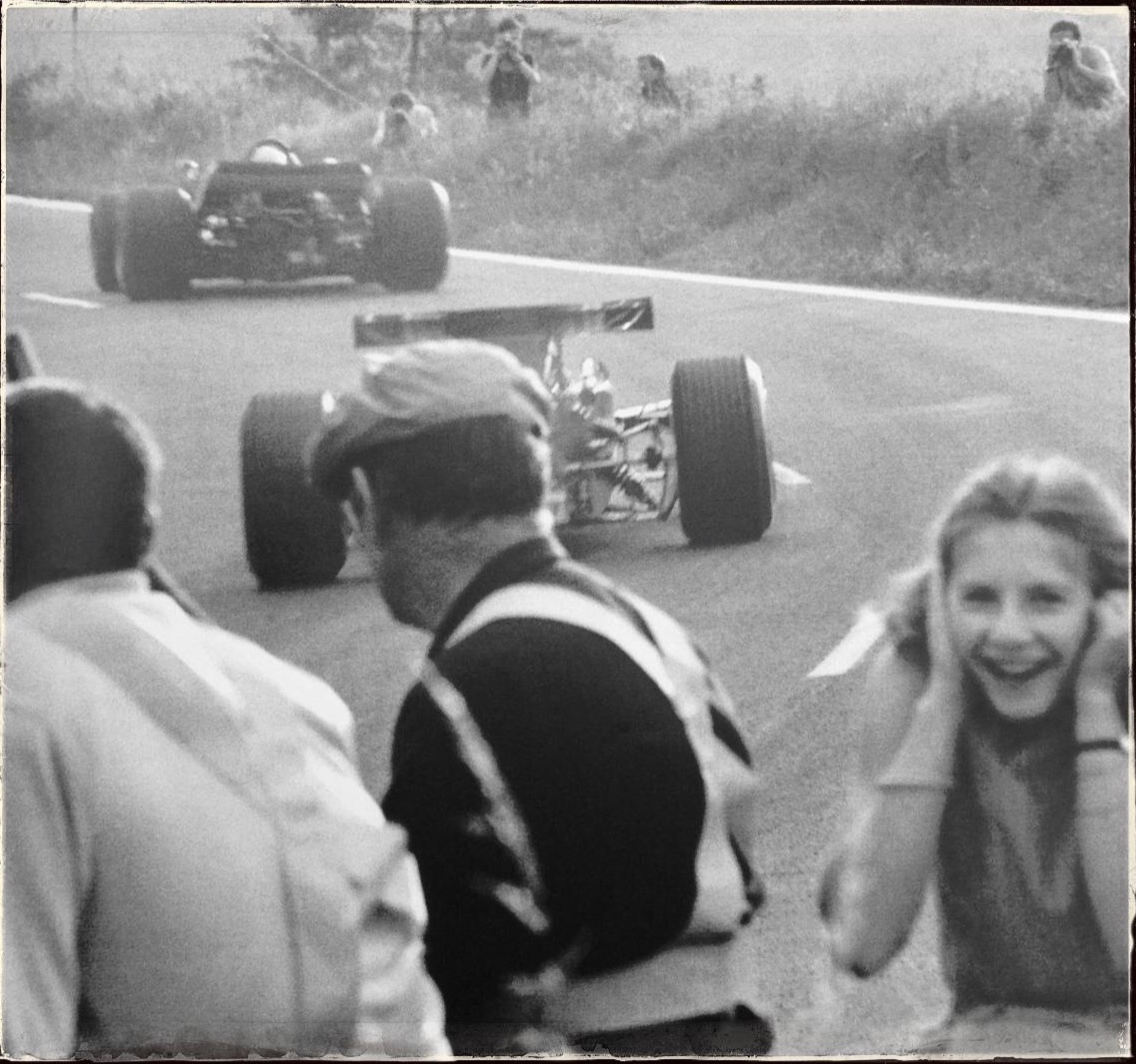
Todd Treat’s fantastic, evocative, fun shots of a very happy Alfa driver and his mechanics, doing his best to maintain focus under extreme pressure…

The shot was taken at the Harewood Acres, Ontario, Canada circuit. Whilst I am uncertain if the Giulietta is ‘750’ or ‘101’ Series I am positive the young temptress is ’36/24/36′.

Alfa Giulietta Spyder Veloce

Gone but not forgotten i suspect.

Such a ‘pit crew’ as this is not conducive to quick lap times, mind you if one had support such as this lap times may not be the top race weekend priority. Wonderful shots…

Alfa Giulietta…

Giulietta

A comprehensive article on the Giulietta and an interesting website is below:

http://www.automania.be/en/cars/alfa-romeo/alfa-romeo-history/1954-2004-the-giulietta-sprint-is-50.html

Photos…Todd Treat

image

Jock Walkem and his mate ponder changes to their Cooper and it’s moody Jap ‘V-twin’ engine before the next run…another of those ‘just so period’ shots…

Lots of interesting details to grab the eye…the gear lever for the ‘positive stop’ motor cyle ‘box, mirror mounted on the transverse leaf, equipe logo on the cars side, i wonder whose it is? Relaxed look and feel of the event and the formal clothing of the kids on a Tasmanian Sunday compared with today…

Penguin is a tiny village on the North-West Coast of Tasmania, the Hillclimb still holds race meetings.

Cooper MkV/41/51 is significant in the pantheon of the many air-cooled Coopers which came to Australia in the 1950’s. Perhaps the most successful, it was owned and raced by Tom Hawkes and ‘Gold Star’ (Australias’ national drivers championship) winners Stan Jones and Bill Patterson earlier in their careers.

An interesting article about this particular car is in the magazine ‘Loose Fillings’, which specialises in these air-cooled racers.

Click to access LooseFillings-44Print.pdf

F3 racing in the UK provided both the training ground for some of Britains Champions of the 1950’s…Stirling Moss, Peter Collins, Stuart Lewis-Evans being good examples, and also for engineers. The class also accelerated the growth of the infrastructure of subcontractors which formed one of the bases of Britains global dominance as a manufacturer of racing cars which continues today.

500cc Clubs

Those with an interest in these cars should check out the ‘500 Owners Association’

http://www.500race.org/index.htm

Technical details…

Cooper Mk5 cutaway

Chassis is box-sections, with transverse leaf springs and wishbones front and rear. Burman steering, Lockheed hydraulic drums front and rear provide the stopping power. Chain drive. Circa 520Lb in weight. Cast alloy wheels 4 or 5 X 15 inch diameter wheels. (Vic Berris)

Cooper Mk5 sales ad

JAP 8 80 drawing

The Walkem MkV was fitted with a ‘JAP’ 8/80 V Twin, 996cc, pushrod OHV, engine. Circa 76.5 bhp@6300rpm. The 500cc ‘ JAP’ single produced around 40bhp, both engines used compression ratios of 14:1 and used alcohol fuel provided by Amal carb(s)

Etcetera…

Cooper Mk5 Motorsport article

Photo Credits…

Check out the archive of oldracephotos

http://www.oldracephotos.com/content/home/

Vic Berris cutaway drawing, MotorSport Magazine

Finito…

Watson McLaren MP4 Ford Silverstone 1981

John Watson wins the 1981 British Grand Prix at Silverstone…a confluence of events lead to the first carbon-composite chassis Grand Prix car, the McLaren MP4 Ford…

Ron Dennis commenced his Grand Prix career at 18 as a mechanic with Cooper…he was immediately recognised as a man with talent, star driver Jochen Rindt taking him from Cooper to Brabham in 1968. When Jochen decamped to Lotus at the end of the year Ron remained and was Chief Mechanic for Jack in his final year, 1970, Brabham a competitive race winner in the BT33 that season.

Brabham and Dennis 1970

Brabham Racing Organisation council of war around the BT33 in 1970, Jack and Ron Dennis to the fore.(unattributed)

Dennis and Neil Trundle formed ‘Rondel Racing’ to run customer Brabham F2 cars in 1971, Ron Tauranac cutting a deal which provided for payment of the teams BT36’s at the end of the season, after they had been sold. Projects 3 and 4 were also racing teams running customer cars in F3 and F2 throughout the 1970’s, including drivers sponsored by Marlboro, one of his customers in 1980 was Marlboro sponsored Andrea de Cesaris, for whom they ran a March BMW.

Over at McLaren things were not going so well, they won world titles with Emerson Fittipaldi and James Hunt in 1974 and 1976 with the long-lived M23 but had achieved minimal success with their M26 and even less with the cars which followed.

Colin Chapman made life complex for all other designers circa 1978 with his ground-effect concepts and his Lotus 78/79 race-winners. In those days understanding aerodynamic concepts and successfully applying them was part science and part ‘black-art’ and experience, McLaren were not alone in struggling…

The team had been sponsored by Marlboro since 1974. By 1979, John Hogan, the enthusiast and executive responsible for the sponsorship program was getting decidedly ‘toey’ at the lack of success despite McLarens’ generous budget.

Watson, Zandvoort 1979

John Watson leads teammate Patrick Tambay, Dutch GP , Zandvoort 1979. The Mclaren M29 Ford ‘ looked the goods’ but was far from the best Lotus 79 ‘copy’ that year. The Williams FW07 was, albeit the Ferrari 312T4 won the title in Scheckters’ hands. (unattributed)

Dennis’ own programs had been successful commercially, he had built all but one of the M1 ‘Procars’ for BMW in a very short period, he was keen to take the next step to F1 and fulfil a dream which commenced with his Motul F1 car in 1973, a project sold to others and raced as the Token in 1974 when the fuel crisis hit and Motul withdrew their sponsorship.

Dennis asked Patrick Head, Frank Williams design partner in Williams Grand Prix Engineering, for suggestions of a potential designer for his proposed car and F1 program. Head suggested John Barnard whom he had met at Lola and had most recently designed the ground-effect 1980 Indy 500 winning Chaparral 2K Cosworth DFX for Jim Hall.

Chaparrall 2K

‘Lone Star JR’ Johnny Rutherford during his victorious run during the 1980 Indy 500. The ever innovative Jim Hall/ Chaparral team built John Barnards’ ground effect design. 2K had teething problems in ’79 but came good in 1980, by ’81 the bigger teams jumped onto the ground effect bandwagon and the little team was over-run. Beautiful looking car, the looks did not deceive. Rutherford also won the USAC Championship that year, winning at Ontario and Indianapolis. (unattributed)

When Dennis met Barnard he was staggered to learn that Barnard wanted to build the first carbon-fibre F1 car.

At the time the biggest F1 design challenge was to build an aluminium monocoque chassis, which was light but also torsionally stiff enough to withstand the considerable forces generated by the new generation of ground effect cars. Ground effect tunnels were all important to the success of these cars but as the tunnels grew wider, the chassis became narrower and sufficient torsional rigidity, using the aluminium alloy construction material and techniques of the day, was a big challenge.

Barnard saw a chassis of carbon-composite as the solution.

It was a big risk for Dennis as it hadn’t been done before, carbon was being used for wing-endplates and the like but not a chassis…and their were many including Colin Chapman, himself building a car, the twin-chassis Lotus 88 partially of carbon-composite but not wholly of the material as he was convinced that it would not be strong enough in a major accident.

Dennis and Barnard pitched the MP4 ‘Marlboro Project 4’ design to Hogan, initially on the basis that Marlboro dump McLaren and provide the funds to them to build the MP4. Hogan, impressed, to his credit chose not to ‘shoot McLaren’ in whom they had much invested, but with little to lose, engineered a ‘shot gun wedding’ of Dennis/Barnard with McLaren in September 1980.

Teddy Mayers shareholding in McLaren was watered down to 50/50 with he and Dennis appointed Joint Managing Directors. Barnard received some of the equity from Dennis who didn’t have the cash to pay him….Within a year Dennis took control of the team when Mayer said ‘this isn’t working’, Ron paid him out with an advance on his fees from Marlboro.

But that was all in the future, they needed to build the car, and the carbon-composite capability did not exist in the UK.

McLaren International launch

Marlboro PR shot at the launch of ‘McLaren International’, Barnard, Mayer and Dennis pose with the scale model of the ‘Marlboro Project 4’…they may be ‘McLaren Project 4’ now but thats not the way it started! (unattributed)

Hercules Aerospace, Utah…

MP4 chassis nude

Mclaren MP4 Ford…Hercules chassis in all its naked glory…its 1981 and not so different from what we see now, all current GP tubs were born here…with apologies to the Lotus 25. (unattributed)

Whilst carbon-composites were in use in the aero industry in the UK, their was no company with the capability to build a car. A contact of Barnards’ from his Indycar days pointed him in the direction of the Hercules Corporation in Utah. The company had an R&D facility, Barnard jumped on a plane with the quarter scale model of MP4 shown above, and together they worked out how to build it.

Hercules were contracted to design and build the cars chassis with input from Barnard.

They lacked the technology to create curved pieces so the first monocoque was formed with five major components, each with flat surfaces. The internal front suspension bulkhead was aluminium but otherwise the chassis was carbon-composite, McLaren themselves describe it as a bit ‘rough and wrinkled’, but by any standards it was a stunning bit of kit.

The rest of the car was the ‘ground-effect’ Cosworth paradigm of the day; Ford Cosworth 3 litre DFV V8 engine, Hewland FGA five-speed gearbox and inboard suspension front and rear to maximise the flow of air into and out of the cars GE tunnels.

MP4 monocoque launch

Its all about the chassis…MP4 Ford laid bare for the media. The flat surfaces referred to in the text clear. Front suspension comprised wide based lower wishbone and top rocker actuating coil spring/ damper units inside the carbon tub. (unattributed)

Racing the McLaren MP4…

In the last race of 1980, the US GP, McLarens star recruit, 1980 F1 ‘newbee’ Alain Prost had a massive accident blaming it on suspension failure, Mayer cited driver error and Alain left for Renault…he would be back mind you, but for the moment an important element of Dennis’ immediate plans had been lost by Mayers’ inept management. The error didn’t help Teddys’ failing stocks with Marlboro either.

McLaren signed Andrea de Cesaris, whom Ron had run in F2 the year before, and who had the support of Marlboro Italy, and John Watson entering his fourth season with the team and in need of a win, he had been pretty much ‘blown off’ by Prost in 1980.

Dennis, Barnard and Watson

Dennis, John Barnard and John Watson wrestling with a knotty problem by the look . Watsons faith in Dennis and Barnard not to be understated, it was a brave new world, had MP4 not withstood the impact of Watties’ Monza 1981 shunt the outcome may have been different…as it was he proved the ‘shuntability’ of the material by having one big prang bigger than de Cesaris’ many smaller ones that season. (unattributed)

The team started the season with the M29, now in C spec, but no quicker than the year before…

In the first two races, the sole MP4 was raced by Watson qualifying 11th and 7th and finishing 10th in the San Marino GP.

At Zolder he qualified 5th and ran 4th until gearbox  dramas dropped him back to 7th. He qualifed 10th at Monaco and was up to 4th when the DFV went ‘bang’.

Then things started to improve. 4th on the Spanish grid and a 3rd place finish. From the front row in France he finished a strong second behind Prosts’ Renault, his first GP win, and then Wattie won the British GP …

British GP Arnoux and Watson 1981

Arnoux lead Watson for 30 laps, and the Regies’ engine lost its edge…letting John thru for the first carbon-composite chassis victory, Silverstone 1981 (unattributed)

The Renaults’ of Prost and Arnoux lead, Wattie held up by a prang involving de Cesaris, Jones and Villeneuve. Then Watson ‘tigered’, Prost dropped out with a burnt valve, Watson was second to Arnoux, things stayed that way for 30 laps, Arnoux’ engine note changed, the car slowed and Watson took the lead on lap 61 and the win.

The first for carbon-fibre and McLarens first since Fuji in 1977.

The competitiveness of the car was now not in doubt but there were still concerns about the materials abilty to absorb major impacts, although de Cesaris was doing his best to dispel these.

The car had a tendency to ‘porpoise’, as airflow through the GE tunnels ‘stalled’, the aero far from resolved and whilst quick, MP4 was a reasonably unforgiving chassis, which was ok for a relative veteran such as Watson but much more of a challenge for Andrea, who proceeded to have a lot of accidents.

‘de Crasheris’ a nickname which stuck. In 1981 he had 5 accidents in races, 2 spins into retirement and in Holland the team withdrew his entry from the race after an almighty prang in practice.

Having said that, the ‘big one of the year’ was Watsons Italian GP shunt at Monza when he went off at high speed in the Lesmos’ corners, running wide on a kerb at the corners exit at over 140mph, backing the car into the armco and carving it in half, the engine, ‘box and rear suspension, torn from the car but leaving the tub itself intact, with John in it.

Much to Murray and James delight he jumped out unharmed…Barnards’ faith in the material, and his engineering of it was vindiacted, the doubters were silenced as they realised a new paradigm was upon them.

Nelson Piquet won the World Championship for Brabham in his BT49 Cosworth from the Williams duo of Carlos Reutemann and Alan Jones, scrapping with each other and denying them both, and the team the titles which were theirs to take with more aggressive team management.

‘Wattie’ finished sixth in the MP4s’ debut year, the cars success forcing all to build their own cars of the new material.

MP4 was, in the modern idiom, a ‘game changer’.

Into 1982 Niki Lauda, bored with retirement and needing money,  joined the team, replacing de Cesaris and bringing his strong testing abilities to extract the best from the chassis, but that is another story…

Watson Monza 1981

Watsons MP4 Monza 1981…destroyed in a big accident the following day…the chassis forward finished beside the armco where Watson jumped out of it, the engine, box and rear suspension being partially collected by Alboretos’ Tyrrell on circuit…(John Shingleton)

McLaren MP4/1 Ford Legacy…

When you look back on it, the idea of the ‘carbon car’ was audacious, Dennis had not run an F1 Team before nor had Barnard designed a GP car. But they had nothing to lose, nor did Marlboro who needed wins quickly.

Whilst the plan was audacious the execution of it was outstanding in a way the GP world was to come to expect from Ron Dennis.

From a drivers safety perspective the development of carbon-composites as THE chassis material for all but the junior classes means fewer lives have been lost than in any previous era, since 1981.

The advent of the modern aluminium monocoque in 1962 by Lotus, the mandated use of safety belts, on-board extinguishers and ‘bag’ fuel tanks were all postive safety steps but surely no single change in any era of motor racing has made as big a safety impact as Barnards’ pioneering use of the material in MP4?

For that we should all be thankful.

McLaren MP4 cutaway

Cutaway drawing of McLaren MP4/1B, the 1982 car driven by Watson/Lauda. Essential elements the same as MP4/1 as the first car was called retrospectively. Carbon fibre honeycomb chassis, Ford Cosworth 3 litre DFV V8, circa 490bhp@10750rpm in 1981. Hewland FGA400 gearbox. Front suspension inboard, top rocker actuating coil spring damper units and wide based lower wishbone. Rear wishbones actuating inboard mounted coil spring/damper units. Steel discs (they experimented with carbon in 1982), rack and pinion steering, circa 585kg in weight. (Bruno Baratto)

McLaren MP4 Ford profile

Credits…

McLaren International, John Shingleton, Bruno Baratto

Finito…

Wesley

Alfa Club of Victoria Concorso…300 Alfa Romeos’ dropping olio onto the Wesley First XI Turf…

The Alfa Romeo Owners Club of Victorias’ annual Concourse and preceding dinner… has become ‘Bigger Than Ben Hur’ in terms of quality of organisation, cars, location, attendance and guest speakers.

This years concourse was held at Wesley College, St Kilda Road, Melbourne on 30 November, the guest speakers at the nearby Parkview Hotel dinner the evening before were former Australian Racing Champions Kevin Bartlett and Alfredo Costanzo.

The ‘dialogue’ with the drivers was ably conducted by Melbourne longtime Alfista and racer John Emery, it wasn’t ‘hard core’ given the audience, too many road car types present for that sadly!, but the following are a few snippets from their comments or quick chats with each of them separately.

Parkview Hotel St Kilda Road

Crappy iPhone shot of Kevin Bartlett left, and Alf Costanzo, right being ‘interviewed’ by John Emery, Parkview Hotel 29 November

I covered KB’s early history in the Alfa GTA article of last week, see https://primotipo.wordpress.com/wp-admin/post.php?post=1037&action=edit …he spoke fondly of his mentor Alec Mildren and the way Alec extracted the best from him which was around advice and encouragement, not actually how to drive, Mildren himself was the Australian Gold Star winner in 1960.

‘I was really lucky he gave me the chance to test, Glenn Abbey gave me the call, I don’t even remember the circuit but there were three or four other guys who also had similar credentials. But I guess they saw potential and a willingness to work hard and learn’.

Bartlett spoke of the evolution of the Lola F5000 cars from the T240 F2 based, twitchy, torsionally floppy T300 through to the T400 and ultimate variant of the T332, the 332C and what a competitive car it was. Costanzo chipped in about that cars understeer and said he, having also owned a T332, preferred the ‘twitchy and slightly more nervous’ T430, the ex-VDS/Brown car Alfie raced for Alan Hamilton so successfully in 1979/80.

Both noted that Warwick Brown happily went back to a T332 after the 430’s were sold despite his success in that model. (Rothmans Series 1977).

Bartlett related a funny anecdote about building a twin-turbo Jaguar XJS for Australian media magnate, the late Kerry Packer.

Kerry wanted to drive the ‘weapon’ from Sydney to Canberra, KB confessed that the gearbox whilst up for sprint meetings wouldn’t survive that journey…so Packer had his ‘chopper shadow the car on the trip, as you do!

Inevitably the car ‘cacked itself’ near Bowral, the chopper scooping up the legendary KP and delivering him to the capital on time. KB organising for his most wealthy clients car to be returned to Sydney…the silver lining in this relationship the very successful ‘Nine Network’ sponsorship of Bartlett’s Camaro in Touring Car Racing after his second F5000 ‘Big One’ when his Brabham BT43’s rear wheel failed at Sandown in 1979 made continued single seater racing not such a good idea.

Bartlett Sandown 1979 Brabham BT43 Chev

Bartlett in the Sandown pitlane 8 September 1979. Saturday practice, the following day KB had a rear wheel failure cause another big accident going thru ‘The Causeway’ breaking his legs, hospitalising him, destroying the car and ending his cherished single seater career…there were, however, touring cars to conquer. Car now has rear/side, rather than front mounted water rads’, Lola airbox, a variant of the nosecone used on KB’s T400 Lola and later rear wing. Jim Hardman in black anorak listening to KB’s issues and together working out the necessary tweaks! (Mark Bisset)

I asked KB whether Alec considered commercial sponsorship of his team to assist with the budget, as an alternative to ‘Alec Mildren Racing’ withdrawal from the sport but ‘it simply wasn’t his style’ so KB and Max Stewart were ‘on their own’ from 1971 both continuing to be successful but clearly the ‘Mildren Family Team’ was special in every way not least it’s competitiveness and influence on the professional teams which followed its lead.

Bartlett and Alfie are 3 years apart in age, KB born in 1940, Alf 1943. Their careers have ‘reverse parallels’ in some ways, KB a paid professional at 25, and on his own at 30, Alf on his own until 1979, when at 36 he became a paid professional…Unsurprisingly the ‘sweet spots’ in their careers were as paid professionals able to focus on just the driving rather than the more difficult commercial and organisational elements necessary in running your own team.

KB had an opportunity to test F1 for Brabham in 1970, ‘yes we should give him a run’ Ron Tauranac said but the fee was $60000 even then, as KB said, ‘I didn’t have $6k let alone $60k back then’ it’s a shame as the BT33 was a rocket in 1970 and still ok in 1971.

Bartlett Oran Park 1978

Bartlett in the one of a kind Brabham BT43 Chev ahead of Alf and John Walker at Oran Park , Rothmans Series 1978, both in Lola T332’s, Walker in KB’s old car. Warwick Brown won in another T332C, or rather a T333 Single-Seat CanAm car converted to F5000 for our Series before returning to the US whence it was converted back. See this shot of the Brabham in its original form here, mind you the nose had already been changed at this point…with the car in its final form above. (Glenn Moulds)

Two blokes who took to F5000 in Australia, having come out of smaller single-seaters like ‘ducks to water’ were Alf and Bruce Allison, immediately competitive…and both in Lola T332’s, Allison in the car KB sold to buy his T400, ‘HU22’. (KB’s T330 ‘HU22′ rebuilt after its Pukekohe early ’74 shunt around a 332 tub)

Not everybody who drove these animals of cars, mastered them…’it always focussed my mind the day before wherever I raced these cars because they could always bite you’, said KB.

One wag at the Parkview Hotel after listening to Alf speak, very amusing he was too, and who watched many of his early racing efforts said that ‘he bounced that Mono (Elfin Mono) off every fence in Victoria, he didn’t even book overnight accommodation at the country circuits as he never expected to race on Sunday!’

By 1975 he had the car in which to strut his stuff finishing second in the AF2 Championship that year in the Birrana 274 Ford Leo Geoghegan drove to the series win in 1974. Geoff Brabham won the title in a similar 274.

‘At the end of the year I sold the car and bought the ex-Bob Evans 1974 European F5000 Championship winning T332 ‘HU36′ for a lot less than I sold the Birrana! Brian McGuire had a good season in it in the UK in 1975 and was to race it again and then the Brits admitted F1 cars to their series so he bought one of those and sold the Lola cheap, all race prepared and ready to go. I even won a couple of KLM tickets late in the season so got a trip to the UK as well’

In a sad ending for Aussie McGuire, he died in the Williams FW04 he bought instead due to a component failure at Brands in 1977.

‘The T332 was a great car, I did well in it but I preferred the T430 which was a bit more nervous, the turn in was better. The McLaren was better again, no quicker than the Lola in a straight line but it put its power down much better, it was quicker through the corners.’

Costanzo, McLaren M26 Chev Sandown 1981

Costanzo at the old Sandown pit counter 1981. Mclaren M26 Chev, Jim Hardman in the white top. A talented engineer, his self designed and built Hardman JH1 Ford victorious in the 1980 AF2 Championship in Richard Davisons’ hands. Car @ rear is the Bryan Thomson owned Mercedes Fowler/Chev sports sedan then driven by John Bowe.

The McLaren Costanzo spoke of was the M26 F1 car converted to ground effect F5000 specification by Tiga Cars and raced by Alan Hamiltons’ Porsche Cars Australia Team in the dying days of F5000 in Australia.

These are a few vignettes in two phenomenal careers, it was a pleasure to meet them both and watch them work an audience in the same way they used to work the spectators on race day!

Racers both and great blokes to boot…

TZ1 and 6C 1750

All the fun of the fair..big crowds, this is early in the day. Alfa TZ1 Replica beside 6C 1750 Zagato. ‘Lola Limper’ Bartlett checking out the cars in brown shirt and cap.

Lawson and Little Alfa

John Lawsons’ Alfa 6C 2300 Spl left, with the ex-Lex Davison ‘Little Alfa’, shortened 6C1750 ‘Normale’ chassis’ , supercharged. Successful and famous Aussie special raced by Davo from circa 1946 to 1952. car originally Davisons’ fathers road car.

St Kilda Road

Giuliettas’, St Kilda Road buildings at rear

Park scene Wesley

Swag of ‘105’s…a very pleasant Concourse location, Wesley College, Melbourne…

Photo Credits…

oldracephotos.com, Glenn Moulds

image John Surtees clipping the apex in Mexico in his North American Racing Team ‘NART’, factory, Ferrari 158. Ferrari was in dispute with the Italian national automobile club over its refusal to homologate his 250LM sportscar into Group 5 despite having not built the minimum number of cars to do so…the hissy-fit reflected in the cars being entered in the blue/white of Luigi Chinettis’ American NART rather than Italian national red…(Bernard Cahier)

John Surtees pilots his ‘NART’ Ferrari 158 to second place in the 1964 Mexican Grand Prix, clinching the drivers World Championship for him and the Constructors Championship for Ferrari…

On the day that Lewis Hamilton won the 2014 Championship i was flicking through some old magazines and reflected on the remarkably diverse career and achievements of Surtees.

In similar fashion to 2014 the 1964 title was also decided at the last race, in Mexico that year.

Graham Hill, Jim Clark and Surtees were all winners depending upon who finished where. In a race of changing fortunes Clark lead from the start, and was on track for the race win and his second title when his Climax engine started to lose oil and seized seven laps from the end. Surtees’ engine misfired early but sorted itself, teammate Bandini allowed him into second and the points he needed to defeat Hill, who had been given a ‘tap up the chuff’ by Bandini earlier in the race, causing a pitstop and damaged exhausts ruining his chance.

Mexico 1964, Surtees and Bandini Surtees in his Fazz 158 ahead of teammate Bandini in the flat-12 1512 early in the Mexican GP (unattributed)

Dan Gurney won the race in his Brabham BT7 Climax and Surtees the title. He was to win only six Championship GP’s throughout his long career, 1960-1972, not reflective of his talent but indicative of team choice, he wasn’t always in the right place at the right time.

Drivers Mexico 1964 Gurney, Clark, Surtees, pensive as always and Phil Hill prior to the ’64 Mexican GP. Looks like Brabhams’ haircut behind Clark? (Bernard Cahier)

Famously the only driver to win World Championships on two wheels and four…

He was born into a motor-cycling family and progressed from his fathers’ sidecar to solos and many Norton victories, before too long signed by Count Agusta to MV.

image Surtees bump starts his MV350 prior to the start of his run around the daunting Isle of Man, Senior TT 1957 (unattributed)

The departure of Gilera and Moto Guzzi allowed Surtees and MV to dominate the bigger classes, he won 350cc titles in 1958/9/60 and 500cc championships in 1956/8/9/60.

Before too long he wanted to race cars, making his GP debut for Team Lotus at Monaco in 1960, he mixed cars and bikes that year his best result second in the British GP.

Surtees on the road Riverside 1960 Surtees being blown off by a Ford Fairlane…on the way back from Riverside, USGP practice 1960. Lotus 18 Climax. 2.5 FPF Climax an incredibly tractable engine! (Bernard Cahier)
Surtees Portuguese GP 1960 Surtees made his F1 debut with Lotus at Monaco 1960, mixing a season of F1 with winning the 350 & 500 titles on bikes…here at Oporto in the Portuguese GP, he retired on lap 36 having qualified on pole on this challenging road course. Lotus 18 Climax (Bernard Cahier)

He drove a Reg Parnell/Bowmaker racing Cooper in 1961 and a Parnell/Bowmaker Lola in 1962 commencing a relationship with Eric Broadley’s marque which continued for most of his career in categories outside F1…although the F1 Honda of 1967 was famously a ‘Hondola’, being the marriage of in essence the Lola T80/90 chassis with the big, powerful 3 litre Honda V12.

Surtees AGP WF 1963 John in the Lola Mk4A Climax enroute to 2nd behind Jack Brabhams’ Brabham BT4, both 2.7 Coventry Climax FPF powered. Australian GP, Warwick Farm, Sydney 1963 (John Ellacott)

The most productive phase of his career was with Ferrari from 1963 to mid 1966, winning in both sports cars and in F1…

The Palace Coup and Purge of key Ferrari staff in late 1962 gave Surtees his Ferrari chance, joining them in early 1963. Arguably he was a good bet for the 1966 Championship won by Jack Brabham but inept, political management by team-manager Eugenio Dragoni resulted in his departure from the team mid season, his talents rewarded with two wins for Cooper that season, he then moved to Honda.

Its ironic that Ferrari intrigue gave him his Ferrari chance, and Ferrari intigue got the better of his sense of fairness in the end, read the MotorSport article below for Surtees’ own version of these events.

Surtees and Hill Monaco 1963 Surtees (4th) leads Graham Hill (1st) at Monaco 1963, Ferrari T56 and BRM P57 respectively (unattributed)
Forghieri and Surtees Ferrari 1512 Surtees looks typically concerned, there are not too many smiley shots of ‘Big John’, this was a serious business and all too often he was far from happy with his mount! Mauro Forghieri adjusts his ‘wedding tackle’. Ferrari 1512 1965, Nurburgring…look at all those coils trying to spark the high revving 1.5 litre flat 12. Technically interesting car with the 180 degree flat-12 used as a stressed member, years before the much touted Lotus 43/49 deployed the technique in 1966/7 respectively. Look closely and you can see the engine attachment point to the cast rear chassis bulkhead. Chassis still semi-monocoque tho. And lovely V12 still a 2 valve engine, rev limit and higher-frictional losses of the 12 and power developed  did not outweigh its complexity and higher fuel consumption relative to the 158 V8 in 1964. By the end of 1965 Surtees considered the car to have a decisive advantage over any other car but time had run out…Ferrari expected the 1.5 F1 to continue on, this engine needed to peak 12 months earlier than it did. Ferrari won no GP’s in 1965, Lotus and BRM had the edge that year. (unattributed)
Ferrari 158 cutaway Surtees 1964 championship winning Ferrari 158. Chassis semi-monocoque, aluminium panels welded to tubular steel frame. IFS front by top rocker, lower wishbone and coil/spring shock unit. Rear by single top link, inverted lower wishbone, twin radius rods and coil spring/damper units.Adjustable roll-bars front and rear. Dunlop disc brakes , 468 Kg total. Engine ‘Tipo 205B’ 1489cc 90 degree all alloy V8. Chain driven DOHC, 2 valves per cylinder. Twin plugs fired by Marelli coils (4) and distributor. Bosch direct fuel injection, 10.5:1 compression ratio, circa 220bhp @ 11000rpm. 5 speed transaxle with ratios to choice,’slippery diff’ (Bruno Betti)
Surtees Spa 1966 John avoided the multiple spins and accidents caused by the lap 1 deluge of the Belgian GP at Spa in 1966, winning the race. He was shortly to walk out of the team and with that action ended his, and Ferraris’ hopes of a World Championship that year. Camera crew handily placed on the Eau Rouge apex… (unattributed)
Surtees Ferrari 312 Monza 1966 Happy JS testing his F1 Ferrari 312 at Monza in 1966 before the Monza 1000Km race. Cars behind are Ferraris’; Dino 206S and P3. The event was in April ’66, Surtees had a win in a P3 partnered by Mike Parkes…Bandini in the drivers overalls and brown sweater ? (unattributed)

1966 was capped with a dominant win in the first CanAm Championship in his self-run Team Surtees Lola T70Mk2 Chev, defeating Mark Donohue in a similar car and Bruce McLarens’ own M1B Chev, the McLaren CanAm steamroller commenced the following year.

Las Vegas Can Am 1966 John Surtees in his Lola T70 Mk2 Chev leads the field into turn 1 at ‘Stardust International Raceway’, Las Vegas 1966. The hi-winged Chaparral 2E Chev’s of Jim Hall and Phil Hill stand out. #98 is Parnelli Jones, #18 behind Hill George Follmer, #43 Jackie Stewart and #6 Mark Donohue are all in Lola T70 Chevs. #4, 5 , 88 are McLaren, Amon and Masten Gregory all driving McLaren M1B Chevs…Surtees victorious that year in a field of great depth (unattributed)

The Honda RA273 was a big heavy car, the marriage of Lola chassis and Honda engine, the RA300, was more competitive winning Surtees his sixth and final Championship Grand Prix victory at Monza in 1967, just pipping Jack Brabham in a last corner tactical battle/sprint to the line.

Surtees South Africa 1967 Surtees in his Honda RA300, the big V12 ahead of Graham Hills’ Lotus 49 Ford. Clarks’ Lotus 49 won the race, his last GP victory. Surtees 8th, Hill 2nd Kyalami , South Africa 1968 (unattributed)

Honda withdrew from F1 to reappear in the 1980’s, Surtees F1 season with BRM in 1969 was a poor one, the Tony Southgate designed BRM P153/180 were competitive cars but John was a season too early, his timing again was not quite right.

Surtees BRM 1969 Spanish GP JS 5th in the 1969 Spanish GP but 6 laps behind winner Stewarts’ Matra Ford in a debacle of a race when Rindt/Hill Lotus 49’s lost their rear wings…hi-wings banned at Monaco several weeks later. BRM P138. (unattributed)
Chaparral 2H Laguna 1969 The truly wild Chaparral 2H Chev 1969, Surtees wrestling with the beast at Laguna Seca. An article in itself deserved on this car, composite chassis, low, low driving position, raised at Surtees insistence, De Dion rear suspension and more…here in search of downforce with what, even by Jim Halls’ standards, is a BIG WING! (unattributed)

His 1969 Chapparral CanAm season was even worse.

Jim Halls 2H Chev was an extraordinary car of immense innovation, but was totally uncompetitive, despite the best efforts of development of both Hall and Surtees. The 2J ‘ground effect sucker car’ of 1970 was even more avant garde and competitive but Jim Hall and Surtees was not ‘a marriage made in heaven’, a second season was not going to happen.

Jim Hall and Surtees Can Am 1969 Communication breakdown…Jim Hall and Surtees, Edmonton Can Am 1969, John in the seat of the recalcitrant, avant garde Chaparral 2H Chev. Franz Weis looks on (unattributed)
Surteees Nurburgring 1970 Ferrari 512S All is forgiven…back in Scuderia Ferrari in the 1970 512S squad…here at the Nurburgring in front of the much more nimble and victorious Porsche 908/3 of  Elford/Ahrens. John was teamed with Niño Vaccarella, they finished 3rd. (unattributed)

It was time to control his own destiny, build his own cars which he started to do with the Len Terry designed TS5 F5000 car in 1969…the Surtees TS7 Ford F1 machine made its debut in Johns’ hands in 1970.

Surtees Cars won the European F2 Championship with the works TS10 Ford driven by Mike Hailwood and the 1972 British/European F5000 Championship, Gijs van Lennep driving a TS11 Chev.

john surtess Surtees in his own TS8 Chev F5000 car Australian GP 1971, Warwick Farm. He was running second behind Frank Matich’ winning Matich A50 Repco, then had a puncture DNF. Here he is leading Max Stewart’s 2 litre Mildren Waggott DNF engine. (Dick Simpson)

In F1 the cars were competitive over the years, the TS19 ‘Durex franger’ sponsored chassis of 1976-7 perhaps the pick of them albeit results were still not great, John finally gave up due to the difficulty in funding in 1978.

Surtees retired from F1 as a driver after the Italian GP, Monza 1972, fitting as it was the scene of his final championship F1 victory in 1967.

He was competitive to the end winning two F2 races in his Surtees TS10 Ford that year. He continued to test the F1 cars, much to the annoyance of some of his drivers who would have preferred the ‘seat time’ themselves…

He is now 80 years old, happy in retirement and still a respected commentator on the current scene…

Surtees Italian GP 1972 John Surtees contesting his final GP, Monza 1972 is his TS14 Ford. He retired on lap 7 with fuel vaporisation problems, teammate and fellow ex-motor cycle champion Mike Hailwood finished second in his Surtees TS9B Ford..his and the marques best ever championship result. Emerson Fittipaldi won the race and the Championship in his Lotus 72 Ford (unattributed)

Etcetera…

Motor Sport

Read this fantastic article, John Surtees on working with the ‘Italian Racing Aristocrats’, Count Agusta and Commendatore Ferrari…

http://www.motorsportmagazine.com/archive/article/august-2009/46/count-and-commendatore

Read this fantastic article on the Surtees Racing Car marque…

http://www.motorsportmagazine.com/halloffame/john-surtees/keeping-the-name-alive/

Surtees and Count Agusta Signing on the dotted line for MV, a very youthful JS, 22 years old, with Count Agusta 1956 (unattributed)
Surtees Longford Winning the ‘South Pacific International’, Longford, Tasmania, Australia March 1962. The ‘Yeoman Credit’ Cooper T53 Climax 2.7 is exiting the Viaduct. He beat Jack Brabham and Bib Stillwell also in Coopers (Keverell Thompson)
Enzo, Surtees and Ferrari 158 Modena Enzo Ferrari, John Surtees with crossed arms in the driving suit behind him. Surtees grumpy, perhaps early tests of the 158 at Modena are not going well…(Bernard Cahier)
Surtees and Bandini Monaco 1965 Love this shot of Surtees in his Ferrari 158 chasing teammate Bandini in a 1512 in the 1965 Monaco GP. Bandini 2nd, Surtees 4th and out of fuel, Hill victorious in his BRM P261 (Rainer Schlegelmilch)
Surtees pits Can Am 1966 Team Surtees 1966 CanAm Champions…the way it was. Racer, truck, mechanics, driver, ‘works car’ and a series win! Surtees supervising @ rear, circuit anyone? (unattributed)
Surtees and McLaren Can Am 1966 John Surtees ahead of Bruce McLaren, Lola T70 Mk 2 and McLaren M1B, both Chev powered. St Jovite Can Am Canada 1966 (unattributed)
Lola T100 Surtees Testing ! the Lola T100 Ford FVA F2 car at the Nurburgring, 1967 (Alexandre Willerding)
Surtees TS7 Ford cutaway drawing Surtees TS7 Ford, JS 1970 & 1971 F1 contender. A well executed ‘Cosworth kit car’ of the period, general layout by JS, detail design by Peter Connew and Shabab Ahmed. Aluminium monocoque chassis, Ford Cosworth DFV 3 litre V8, circa 430bhp @ 10200rpm in 1970. Hewland DG 300 5 speed ‘box. IFS front by top rocker, lower wishbone and coil spring/ damper units and rear by single top link, single top radius rod, twin parallel lower links and coil spring/damper units, F5000 TS8 of the time a variant of this chassis. The car won some championship points and the Non-Championship Oulton Park Gold Cup in 1970 (cutaway by Bill Bennett)

Photo and Other Credits…

The Cahier Archive, Alexandre Willerding, Keverell Thompson Collection, John Ellacott, Dick Simpson, Bruno Betti, Bill Bennett, Rainer Schlegelmilch

Finito…


bartlett
Mildren ‘LHD’ GTA, Kevin Bartlett, Lakeside, Queensland 1966 (J Stanley)

Kevin Bartlett explores and exploits the laws of physics in the Alec Mildren Racing Alfa Romeo GTA , Lakeside, Queensland, Australia circa 1966…

Some years later American F5000 driver, Sam Posey while competing in the Tasman Series and observing KB’s Lola  at close quarters described Bartlett as the ‘master of opposite lock’. It was an aspect of his driving which worked for him and we spectators throughout his career regardless of the cars he drove – sedans, sports cars or single seaters.

mildren 2
Team Mildren Warwick Farm 1966, not 1967 I think…big professional team 60’s Style! Cars are Mildren LHD GTA, TZ2 and  the Brabham BT2/6 Ford raced by Bartlett at that stage. WF Tasman Meeting 13 February 1966 (Allegerita)

Alec Mildren Racing and Kevin Bartlett…

AMR was one of Australia’s first professional teams, the basis of the team was formed around a nucleus of talented people who fettled Alec Mildren’s cars during his own single seater campaigns. He won the Australian Gold Star Championship and Australian Grand Prix in a Cooper T51 Maserati in 1960.

Shortly thereafter Mildren retired from driving to concentrate on his business interests which primarily involved the retail car trade. He was the first Alfa Romeo dealer/distributor in New South Wales and his race team employed great drivers including Frank Gardner, Kevin Bartlett and Max Stewart.

Mildren’s passion was single-seaters but the team also raced Alfas, notably two GTAs, a TZ2 and later 105 Series coupes of various capacities in Series Production events as those grew in stature in the late 1960s.

team mildren
Alec Mildren Racing and the laid back nature of the Tasman series circa 1967. Bartlett is sitting on the wheel of his Brabham BT11A Climax 2.5 Tasman car. The Alfa is the prototype TZ2 referred to in the shot above. The smiley chap at right rear is young Fred Gibson, then racing a Lotus Elan 26R. Warwick Farm, New South Wales (P Windsor)

Kevin Bartlett started racing in his mother’s Morris Minor and very quickly the young mechanic made a name for himself as a fast driver with strong mechnical knowledge and sympathy. By 1965 he was driving an Elfin Imp FJ owned by the McGuire family and an Austin Healey Sprite and TVR for others. He recalls that ‘Alec and Glenn Abbey (Mildren’s engineer/mechanic) were always on the lookout for talent, Ralph Sach and Charles Smith who drove for them at the time were getting older and I performed well against them in cars with much less capacity. They also took into account that I could drive different types of cars and do as well as I could’.

‘ I got to race the Alfas’ and then the little Brabham BT2/6 which was powered by a pushrod Ford engine, and in mid-1965 the Mildren Maserati, which was the first really powerful car I drove, racing it at Lowood and then winning the 1965 Victorian Sportscar Championship in it at Sandown’.

The Mildren Maserati was built by Bob Britton of Rennmax Engineering, essentially a Lotus 19 clone, it used some of the running gear from Alec Mildren’s 1960 Gold Star Championship winning Cooper T51 Maserati, particularly the gearbox and 2.9-litre 250S Maser engine.

KB made his presence felt in that ’65 Victorian championship race beating Bib Stillwell’s Cooper Monaco Buick V8 and Spencer Martin’s Scuderia Veloce Ferrari 250LM amongst others. He had well and truly arrived…

viaduct
Bartlett in ‘LHD’ entering the Viaduct at Longford leading Allan Moffat’s Lotus Cortina in March 1966 (E French)

Mildren GTAs…

There were two, first a LHD and later a RHD car, Bartlett drove both in their competitive heyday and both ended up racing in Western Australia.

leger
Bartlett at it again…Leger Corner , Warwick Farm 1966 ‘RHD’ Mildren GTA (autopics)
autodelta works
The Autodelta factory, Milan circa 1967, car is a GTA Stradale – road spec GTA (Pinterest)

Autodelta…

The original step-front Alfa Giulia Sprint GT was penned by Giorgetto Giugiaro at Bertone and has to be one of the most beautifully balanced, delicate designs of the 1960s.

Autodelta was the factory Alfa racing subsidiary formed by famed ex-Ferrari engineer, Carlo Chiti, and Ludovico Chizzola in 1963 after the closure of ATS, the Grand Prix team formed by ex-Ferrari staff after a purge by the Commendatore in 1961. In 1964 Alfa acquired Autodelta and moved it to Milan, near its HQ.

The Giulia sedan was race developed and did well in Australia winning the Sandown 6 Hour in 1964, but it was too heavy against the Lotus Cortinas so development started on the Giulia Sprint GT coupe in 1964.

This ‘GTA’ was built to compete in sedan racing globally, in Group 2 under FIA rules, which boomed in the 60s. On 18 February 1965 the first Giulia Sprint GTA was unveiled at the Autosalon in Amsterdam, it was followed by the GTA Junior 1300 in 1968 and later the 1750/2000 GTAm.

interior
Interior of Australian owned GTA Stradale (M Bisset)

GTA 1600 Tipo 105.32 specifications…

The car featured lightweight bodies utilising Peraluman 25, a light alloy comprising aluminium, magnesium, manganese, copper and zinc. The superstructure remained steel, including the sill panels. The roof, bonnet, boot lid, rear inner support panel and spare wheel well, dash, parcel shelf support panels and rear seat support were all made from P25. The lightening continued with minimal sound deadening, Perspex side and rear windows on Corsa (race) cars. The GTA lost 205kg compared to the Giulia Sprint GT, for a total weight of 820kg.

Alfa had to build 1000 cars to qualify for the FIA’s Group 2 Touring Car regulations, the Stradale (road) version helped, being built on Alfa’s normal, Arese production line. Race prepared cars were taken after completion at Arese, to Autodelta, the exact specifications of each car was built customer order.

The car’s engine was a twin-plug, highly tuned version of Alfa’s famous DOHC engine. The head was ported and polished, higher compression pistons, high lift cams and lightened flywheel were fitted. All reciprocating parts were balanced,  increasing power to in excess of 175bhp. An oil cooler and deeper sump aided reliability.

donk
The engine/bay of the ‘RHD Mildren GTA’ as restored, Philip Island 2013 (Flickr)

A limited slip diff and sliding-block rear axle locating system was fitted. The standard five-speed gearbox had a greater range of ratio choices, similarly the diff ratio was to choice from homologated alternatives. The front suspension was modified with adjustable top arms to allow negative camber to driver’s choice.

The cars were immediately and immensely successful winning the first round of the European Touring Car Challenge in March 1966. Andrea de Adamich won the Division 2 Drivers Title and Alfa the European Manufacturers title. In the US, Jochen Rindt won the SCCA Trans American Sedan Championship race at Sebring, many championships followed throughout the world. The GTAm won Alfa’s last championship for the 105, the ETCC Manufacturers Championship in 1971, the cars were competitive for a long time with ongoing development.

Arnaldo Tonti, Autodela mechanic attributed the success of the car in Octane magazine to ‘… a perfect balance between a very good chassis, with a very low centre of gravity, and a very strong, powerful and reliable engine. The Autodelta sliding block for the rear suspension was a work of art lowering the car and making it quicker and more stable through the corners and giving its characteristic raised front wheel. The engines were capable of 6800/7000rpm…’

aug
Bruce Wells’ shot of Kevin Bartlett at Warwick Farm in 1966, in LHD Mildren GTA

In Australia Mildren’s LHD car landed in mid-1965…

The car was raced in the Sandown 6 Hour race in November 1965 by Alfa factory driver Roberto Businello and Ralph Sach. Businello tested the car at Balacco before it was shipped to Australia, it was a trick-GTA, very light having the aluminium floor relatively few had.

It led at Sandown until lap 99, with victory going to Bartlett and Gardner in the Mildren Giulia Super Ti which was also victorious the year before.

Businello Sandown 1965
Businello in the GTA, Sandown 6 Hour 1965 (cooper997collection)

Gardner and Bartlett then raced it in supporting events during the 1966 Tasman Series, Gardner winning outright at Warwick Farm and Sandown with Bartlett first in class at Longford.

‘It was a pleasant car to drive, KB recalled recently. We ran the car at Bathurst, had a win there against Bob Janes’ Mustang on that power circuit. I preferred the LHD car (to the RHD car) as it had the right-hand change which was what I was most familiar with given the sports-car and single-seaters I was racing. There was not much difference in the performance of the two cars, although the LHD was a semi-works spec car. We could knock off the big cars at Warwick Farm but it was much harder at Sandown and the like’.

‘The under 1600cc closest competitors to the GTA were the Mini Coopers who were giving away capacity to us, they were great handling and very quick with the right guys such as Brian Foley and Peter Manton at the wheel. The LHD was sold as it was getting a little long in the tooth in terms of miles, Alec sold it to a guy named Stephenson in WA.’

longford 2
Kevin Bartlett coming off Long Bridge, Longford in early 1966 (E French)

Used mainly in State level events the car also contested the one-race Australian Touring Car Championship in 1966. Held at the Easter Bathurst meeting, Bartlett did well to finish third to the big V8s of Pete Geoghegan and Norm Beechey aboard Ford Mustang and Chevy Nova respectively. Run over 20 laps – 75 miles – of Mount Panorama, what the GTA lacked in top speed up and down the mountain was largely made up across the top and under brakes.

KB was victorious at Warwick Farm in May and that month also won the Queensland Production Touring Car Championship at Surfers Paradise. He took a race win at Lowood, Queensland in June before  the car was sold to Frank Cecchele, a Perth Alfa dealer and raced for him by Gordon Stephenson. It was rolled at Caversham in 1967.

caversham 2
Wonderful, evocative Caversham shot in 1968. Stephenson in the ‘LHD Mildren GTA’, gridding up with Kitz Kohout and Jeff Dunkerton in Porsche 911S and Mini Cooper S respectively, the rest of the field are moving forward and out of shot. This was the last year for Caversham before it was closed for racing (P Boxsell)

‘LHD’ competed regularly in WA state events and the annual 6 Hour race held at Caversham ; ’67 DNF Stephenson, ’68 DNF Stephenson, and at Wanneroo Park ’69 DNF Stephenson/ Cooper,  ’70 seventh Ricciardello/Zampatti, ’71 DNF and finally in 1972 fourth outright and first in the 1600 class for Ricciardello/Cooper.

The car was all but destroyed at Mt Brown Hillclimb, from the remains, Ricciardello built a V8 engined sports sedan, initially Ford 302, and later Chev 350 powered. Cooper bought the ‘RHD’ Mildren Alfa, which he later owned in partnership with Ricciardello. Current ownership is unknown.

hillclimb
‘LHD’ in 1966 at Mount Brown hillclimb out of York where it was in later years all but written off, this was the end of the car in its original form (Allegerita)
cavers1
LHD at Caversham in 1967 when raced by Gordon Stephenson (Allegerita)
fg
Brian Foley’s Cooper S chasing Frank Gardner’s new ‘RHD’ Mildren GTA at Warwick Farm in early 1967. Foley acquired the car six years later. This shot a wonderful example of oversteer and understeer respectively! (B Wells)
surgers
RHD in the Surfers Paradise 12 Hours in 1967. DNF, KB driving with Doug Chivas, KB has passed the Munyard/Crawford/Calvert Holden 48-215!, at rear the winning Scuderia Veloce Ferrari 250LM of Bill Brown/Greg Cusack approaches (R Bell)

The Mildren RHD GTA, chassis # 752 561…

The LHD chassis number is lost in the mists of time, but RHD was built in July 1965 and first raced by Gardner at Warwick Farm in December 1966. He then raced the car in numerous ’67 Tasman supporting events, winning at Warwick Farm and Longford. Bartlett then took the car over and had wins at Bathurst and Surfers Paradise.

Bartlett again contested the ATCC, this time a one race event held at Lakeside, another power circuit in 1967. Pete Geoghegan’s Mustang won again, this time second and third places were secured by the Cooper S’ of Brian Foley and Peter Manton.

The car was sold to John French in Queensland in 1968 who raced the car and continued to develop it until it was bought by Brian Foley in 1972.

atcc
Bartlett fourth in the 1967 ATCC held at Lakeside, Pete Geoghegan was victorious in the one race event (Graham Howard History of the ATCC)
ad
Racing Car News ad for the sale of the RHD GTA, March 1968 edition. The Brabham Intercontinental is a Brabham BT11A Climax, the prices are right! (Racing Car News)
french
The Mildren RHD GTA was further developed by John French in terms of wheel/tyres, roll bar and engine (unattributed)

Foley had raced an Alfa GTAm in 1971 in the ATCC and in 1972 as a sports sedan.He converted the car from LHD to RHD and fitted with an Alfa Tipo 33 2.5 litre V8 into the engine bay which had previously housed the 2-litre, twin-plug DOHC, Lucas injected four cylinder engine fitted by the factory.

The T33 V8 was left-over from Mildren’s Brabham and Mildren ‘Yellow Submarine’ single seater program raced by Gardner and Bartlett. I will write about the GTAm separately. The GTAm was a pork-chop compared with the GTA, as it lacked the earlier cars aluminium panels, it was around 200kg heavier.

Foley, a Sydney Alfa dealer reasoned that a more competitive 1973 mount would be a lightened and modified GTA, so off to Bowin Designs in Brookvale, Sydney the car went for major surgery by John Joyce to its suspension, structure, brakes, engine mounting etc. When completed, the car was powered by a 16-valve 2-litre Alfa engine developing 225bhp and weighed 636kg.

See the Bowin Website for P9 the Foley GTA Project; http://www.bowincars.org/mediawiki-1.6.12/index.php?title=%28P9%29

GTA Lwt at Oran Park circa 1973 with Foley watching the action at far right (unattributed)
bowin
Brian Foley in the RHD Mildren GTA – now further developed and lightened by Bowin Designs – and raced as a Sports Sedan in 1973. It’s very easy to confuse this car with Foley’s GTAm which raced in the same livery, and was converted from LHD to RHD when the Tipo 33 2.5 V8 was fitted. The eight injection trumpets protruding through a hole in the bonnet is an easy way to pick the two cars apart (autopics)

The car was fast but V8s were coming into the category in increasing numbers, so after a prang at Oran Park in late 1973 the car was sold to Peter Brown in Canberra. Foley essentially retired from racing after a fine career.

Brown, an Alfa racer from way back, fitted a Mazda Rotary engine then sold it to Neville Cooper in Western Australia, where all exotic Alfas seem to end up! The ‘LHD’ Mildren GTA having been damaged too much in race accidents to continue. A Ford V8 was fitted, then the car was sold to Peter Gillon who raced it for two years before being acquired by Ricciardello and Cooper in partnership.

It was raced very successfully including a win by Cooper in the 1979 Wanneroo 300km race, the car was always competitive in WA Sports Sedan competition during this period.

cooper 2

Ultimately the much raced GTA was acquired by a Sydney enthusiast who had owned GTAs before and was aware of the car’s provenance, a long restoration followed, the car is now a regular entry in historic events across Australia.

p island

For the Sake of Completeness…

It appears there were two other GTAs which raced in Australia in period. The ‘MW Motors GTA’ was raced by Syd Fisher and Frank Porter for MW who were the Victorian Alfa distributor and Melbourne dealer. Sold to Mario Marasco, he raced the car as a Sports Sedan and wrote it off at Hume Weir, it is presumed lost.

The ‘Gulson RHD GTA’ chassis #75247 was restored from a fire-wreck in Western Australia, Vin Sharp, long time Alfisti and owner of the ex-Foley GTAm last had contact with the owner in Scotland about ten years ago.

The MW Motors GTA in the Longford paddock 1968, Alan Hamilton raced it that weekend. It reappeared, restored in 2019 after a ‘barn find’ (P Drury)
porter
Frank Porter driving the MW Motors GTA at Sandown, Melbourne for a successful challenge on a 12 hour national record attempt in 1968 (Allegerita)

homologation
Copy of the first page of the long homologation papers for the GTA (Allegerita)

Etcetera…

cutaway
autu
Autodelta factory 1965, GTAs and a Giulia Super Ti on the line. Completed cars were delivered from Alfa’s Arese production line and then modified to customer order (Pinterest)
balacco
Alfa’s test track at Balacco, circa 1966. TZ2s and GTAs, drivers unknown (Pinterest)

Etcetera ‘LHD’…

busy
Roberto Businello in Pit Straight Sandown in November 1965. The car led the Sandown 6 Hour for 2.5 hours, retiring at 99 laps (Allegerita)
longford 5
The start at Longford 1966. Pete Geoghegan Mustang, Bartlett in ‘LHD’ and Allan Moffat in the Lotus Cortina (E French)
cavers
‘LHD’ at Caversham, WA 1967 (Allegerita)

Etcetera ‘RHD’…

bartlett wf rod mackenzie
Kevin Bartlett in ‘RHD’, Warwick Farm 1966 (Roderick MacKenzie)
sandown
‘RHD’ in Mildren ownership, the old Sandown Paddock circa 1967 (Flickr)
french 2
John French at Lakeside early in his ownership in 1968 (unattributed)
lakeside 1
John French in ‘RHD’, Lakeside 1970 sandwiched by two Torana GTR XU1s, Dick Johnson in his formative Holden days on the nearside (Alfa Bulletin Board)
oran park
Brian Foley in ‘RHD’, Oran Park 1973. This is post the Bowin modifications, car has later single headlight 1.6 Junior front clip rather than early Stepfront. Very easy to confuse the car with the ex-Foley GTAm which by this stage was in Perth (Dale Harvey)
cooper
‘RHD’ in Neville Cooper’s hands, WA (Wells/Neville Cooper)
autodelta lolgo

Special thanks to Kevin Bartlett

For his recollections of the two cars

Sources and Photo Credits…

The Nostalgia Forum, Alfa Bulletin Board, John Stanley, autopics, Bruce Wells Collection, The Roaring Season, Howard/Wilson ‘History of The ATCC’, peterwindsor.com, Paul Boxsell, Roderick MacKenzie, Neville Cooper Collection, Yen Yoshikawa cutaway, Dale Harvey, Ellis French, Ray Bell, ‘Allegerita’ by Tony Adriaensens, Vin Sharp, Perry Drury

Finito…


Denny Hulme and Jackie Stewart, Levin NZ Tasman 1967 (Digby Paape)

Denny Hulme Brabham BT22 Repco and Jackie Stewart BRM P261, the natty tartan attire of the BRM Equipe a contrast with the more casual Australian approach…Hulmes’ engine is Repco ‘640 Series’ 2.5 litre; original ’66 series Olds ‘600 Series’ block with the ’67 F1 Championship winning ’40 Series’, exhaust within the Vee, heads. Definitive Repco 1967 F1 Championship winning variant is the ‘740 Series’, Repco’s own ‘700 Series’ block and aforementioned ’40 Series’ heads. Early and very important 1967 F1 testing days for Repco, engine making its debut the weekend before at Pukekohe (Digby Paape)

Denny Hulme and Jackie Stewart awaiting adjustments to their cars setup, Levin, New Zealand, Tasman Series 13 January 1967…

Digby Paape took these fantastic, evocative shots of Stewart, Hulme and Jim Clark-‘I was 22 at the time, my father had been president of Motor Sport NZ, and though I was unknown on the North Island I felt I could go anywhere with my Contax, i was masquerading as a journo for the ‘Hutt Valley Motoring Club’. I took all the shots @ F8 @ 250th of a second. Each car only had a couple of mechanics, it was hard to know what was being said. Later on I was the Radio NZ and TVNZ commentator for these and other events, Levin was always hot and the action was close. Close enough for good shots without a telephoto lens’.

Stewart beat Clark in the first Tasman round at Pukekohe the previous week, winning the NZ Grand Prix, the two drivers were the class of the field at Levin as well, despite intense pressure Clark won the 50 mile ‘Levin International’ by less than a second from Stewart’s BRM. Richard Attwood was third in another BRM P261 and Frank Gardner finished fourth in the first of the four cylinder cars, a Brabham BT16 Climax. Denny Hulme retired with ignition problems.

It’s interesting to reflect upon the year to come for each of the drivers…

Denny Hulme, Brabham BT22 Repco, 1967 NZ Tasman, Levin

Denny Hulme, Brabham BT22 Repco, Levin NZ, 1967 (Digby Paape)

It was a tough Tasman for Denny and his team leader Jack Brabham…

They had great unreliability from the new, exhaust between the Vee Repco ‘640 Series’ engines, mainly centred around fuel injection and ignition dramas, but the primary object of the exercise was really to get the engines raceworthy for the 1967 GP season in any event. Jack did have a good win at Longford in his BT23A, the power circuit in Tasmania and last round of the series.

Repco sorted the problems, the new Repco (as against the 1966 Oldsmobile blocked ‘620 Series’) blocked ‘740 Series’ engines were reliable early in the GP season.

Denny broke through for his first GP win at Monaco, 620 engined, but there was no joy in the victory as Lorenzo Bandini perished aboard his Ferrari 312 in a gruesome, fiery accident, which finally helped galvanise action to improve safety standards on the world’s circuits.

In a season when five different drivers won a Grand Prix, his consistency paid off, he won the title with two wins, the Nurburgring the other, from Jack with Jim Clark third in the epochal Lotus 49 Ford Cosworth DFV.

image

Hulme en route to his first Grand Prix victory, Monaco 1967 in his Brabham BT20, still fitted with the ’66 series ‘RB620’ engine. Jacks car was fitted with the new ‘740 Series’ the engine blew early in the race. Hill and Amon second and third in Lotus 33 BRM and Ferrari 312 respectively (unattributed)


1967 CanAm Road America

Can-Am Road America 1967 parade lap: #4 Bruce McLaren, Hulme alongside in the other McLaren M6A Chev, Dan Gurney Lola T70 Ford behind Bruce, Jim Halls’ winged Chaparral 2G Chev easy to pick…and the rest maybe some of you can help me with the caption? Denny won the race from Mark Donohue and John Surtees , both in Lola T70 Mk3B Chevs (unattributed)

In a full season, Hulme was recruited by his compatriot Bruce McLaren as his teammate in the Can-Am series. Robin Herd’s McLaren M6A Chev was a stunning car, concepted by he and Bruce, and started the teams domination of the series which finally ended when Porsche joined the series, and ruined it! with its 917/10 in 1972.

Denny narrowly lost the series to McLaren but the relationship started a commitment to the team by Denny which endured to the end of his career and saw him race the team’s F1, Can-Am and Indy Cars through to the end of 1974, when he finally returned to NZ.

Jim Clark, Lotus 33 Climax, NZ Tasman, Levin 1967

Jim Clark, Lotus 33 Climax, Levin 1967. ‘R14’ was the last of the trendsetting Lotus 25/33 series built, the first ‘modern-monocoque’ which made its debut in Holland 1962. Clarks 2 litre V8 was giving away some power to most of his serious competition, the 2.1 litre BRM’s and 2.5 litre Repco’s but his driving abilities were more than up to closing the deficit (Digby Paape)

Clarks Lotus 33 ‘R14’ was a chassis which had been kind to him…

He first raced it at Brands Hatch in July, and, fitted with the super trick 2 litre version of the Coventry Climax FWMV V8 had served him well in 1966, he drove the car when the heavy BRM ‘H16’ engined Lotus 43 was unsuited to the circuit or circumstances- his best result against the new 3 Litre F1’s was a strong third in Holland.

He won the Tasman series in ‘R14’, assisted greatly by the unreliability of the Brabham Repcos and the BRM P261’s, the latter so dominant the year before. The two 2 litre FWMV V8’s were shipped to the Antipodes, the Mk8 1976cc engine was created by using the big 72.39mm bore of the 1964/5 Mk4-7 engines with the 1961/2 Mk1-2 60mm longest stroke to create a circa 245bhp motor. With the ‘R14’/2 litre FWMV combination Clark won five of the eight Tasman Series 100 mile races, three- at Wigram, Lakeside and Sandown were Tasman Cup championship events, the other two at Levin and Teretonga were non-championship races.

Clark raced a Lotus 43 BRM in South Africa, the first GP of 1967, then ‘R14’ for the last time at Monaco, finally getting his hands on the Lotus 49 at Zandvoort. By that time he was a British tax exile so the first time the Scot saw the car was when he drove it in Holland, he hadn’t even tested the thing, those duties had been faithfully carried out by Graham Hill.

Jim Clark, Lotus 49 Ford, Dutch GP June 1967

Jim Clark on his way to a debut win with the Lotus 49 Ford, Dutch GP, Zandvoort June 4 1967…both engine and chassis changed the face of GP racing in an instant (unattributed)

The car was ‘right’ from the start, he won on its debut and then a further four 1967 races, but Dennys’ consistency got him over the line that year in the equally new Brabham BT24, lets not forget that it, too, was cleansheet in terms of chassis and engine that year. Click here for a piece on the Brabham BT24; https://primotipo.com/2017/12/28/give-us-a-cuddle-sweetie/

The Lotus 49 package was dominant in 1968, but sadly Clark’s 1968 South African GP triumph, off the back of his third Tasman Cup win, was his last, he died tragically in a Lotus 48 Ford FVA  as a consequence of probable tyre failure in the during the ‘Deutschland Trophae’ Hockenheim F2 race on 7 April.

The king of the 1.5 litre formula proved he was also king of the 3 litre formula in 1967, and anything else he drove!

Graham Hill heroically galvanised the Team Lotus after Clark’s death, winning the title in 1968 and provided leadership Chapman initially did not, grieving for Clark as he understandably was.

Jackie Stewart took two Tasman Cup wins…

Mechanical woes, particularly weaknesses in the BRM P261’s transmission crown wheel and pinion cost him victories, but his speed was apparent and close to Clark’s- the two races he won were biggies too- the NZ GP at Pukekohe and AGP at Warwick Farm. Unlike Jim, who had the F1 Lotus 49 to look forward to, BRM persevered with the heavy, complex and slow ‘H16’ engined BRM P83/115 in 1967.

It was to be a long, character building year, a second and third in Belgium and France respectively but retirement in all eight of the other championship rounds awaited the young Scot.

He had won his first Grand Prix in the lithe, nimble P261 in Italy in 1965 but it was then a ‘long time between drinks’ in F1, his undoubted speed was finally reflected in wins when he departed to Team Tyrrell which started running Ford DFV engined Matras in 1968, his first title came in 1969 aboard the glorious MS80. Click here for an article on that Matra; https://primotipo.com/2016/07/01/matra-ms80-ford/

Jackie Stewart, BRM P83, Nurburgring 1967

Jackie Stewwart wrestling his big BRM P115 ‘H16’ BRM, Nurburgring 1967. He was running fourth when the transmission failed, ‘yumping’ hard on the ‘tranny at the ‘Ring! Hulme won the race in his light, nimble Brabham BT24 Repco (unattributed)


image

Team Tyrrell ran Matra F2 cars in 1967, Jacky Ickx taking the Euoropean F2 title, and Jackie Stewart, pictured here in an MS7 FVA at ‘Oulton Park’ took one championship win…and critically the team took the view the cars would be successful in F1 (Eddie Whitham)

What duels there may have been as Stewart matured as a driver and took on his friend and countryman Clark- mind you we saw it in the 1967 Tasman as they were in essentially cars of equal performance, albeit JYS’ BRM often did not run for long enough for the duels to run their course…

As Digby Paape says ‘how lucky we were to see the international drivers in current F1 cars as we did in those wonderful 2.5 Tasman years, the equivalent of seeing Schumacher in that years winning Ferrari’. Indeed it was.

Photo Credits…

Digby Paape, Eddie Whitham, Doug Shaw Collection

Tailpiece: Pukekohe 1967…

Love the hats on the gals at the motor racing!

Clearly they have a penchant for ‘Rice Trailers’- it seems said equipment made the trip across the Tasman as well as the two cars, not the happiest of Tasmans for the Repco-Brabham crew despite an ‘all out’ effort to take the Tasman Cup.

Finito…

Senna Mc Laren lambo
(Sutton)

Ayrton Senna testing the McLaren MP4/8B Lamborghini at Estoril, 27-29 September 1993…

By Senna’s standards 1993 had not been a successful year. He won five races in his McLaren Ford as a customer Cosworth user, Schumacher’s Benetton with the more powerful factory Ford Cosworth engines only won a single event. Even worse, arch rival Alain Prost won the title for Williams Renault.

Scrambling to find an engine deal to keep its star driver happy and with the team for 1994, Ron Dennis signed a test contract with Chrysler who then owned Lamborghini.

McLaren modified one of its MP4/8 Ford chassis to take the jewel like little 3.5-litre V12.

Lamborghini 3.5 litre V12 F1 engine

The Mauro Forghieri designed Type 3512 Lambo V12 was first used in F1 in 1989. Larrousse, Lotus and Minardi used the engines in the following years. A new engine for 1993 was the smallest, lightest V12 ever, it gave circa 750bhp @ 14500rpm without pneumatic valves, more than the Cosworth V8 of the day.

Senna tested the car initially at Pembrey, at Silverstone twice, and later at Estoril. He wanted to race it in the three final races of the year at Portugal, Japan and in Australia but Dennis wouldn’t allow it given the contractual arrangements already, and in the process of being put in place with sponsors and the like.

Senna suggested to the engines designer, Ferrari legend Mauro Forghieri, that the V12 would be better with a less brutal top end and more mid range torque, these changes were made, the engine producing around 750bhp.

Mika Hakkinen was the team’s test driver that year, Senna’s race teammate was Michael Andretti until Mika took over the race seat from the Portuguese GP. Hakkinen was 1.5 seconds faster at Silverstone in the Lambo powered MP4/8B than the Ford engined MP4/8 had been during the ’93 British GP weekend.

McLaren MP4 8 Lamborghini Silverstone 1993
Senna, Estoril (Sutton)
Hakkinen at Estoril (MotorSport)

Adrian Burgess was a member of McLaren’s test team in 1993 and was one of three mechanics who worked on the MP4/8B and spoke about his experiences to Which Car? magazine.

“I remember going to Estoril the day after the Grand Prix (it was a three day test, September 27-29, 1993 involving Senna and Hakkinen) Ayrton loved the engine. Within half a day we were 4.9 seconds quicker than the Larrousse LH93 was the day before with the same engine.” Philippe Alliot and Eric Comas were 10th and 11th in their Larrousse Lamborghinis in the race won by Michael Schumacher’s Benetton B193 Ford.

“The problem with it was that by the time it was warm it normally had hand-grenaded itself. I think the furthest we went was 19 laps before all of a sudden you could look down through the inlet trumpets and actually see out the bottom! It hand-grenaded itself in the most magnificent ways. It was like Scalextric car dragging con-rods down the front straight at Estoril. The thing just blew up.”

(Sutton)

As the balance of the 1993 season played out, Prost resigned, Senna won the last two races in Australia and Japan in his MP4/8 Ford. McLaren did a deal with Peugeot and Senna went to Williams for 1994…and the rest as they say is history, a sad one at that.

Photo Credits…

Sutton Images, Autosprint

Tailpieces…

Finito…

bartlett torana

My First Race Meeting…Sandown Tasman F5000 Meeting February 20 1972…

We can all recall the meeting or event which hooked us on the sport, right?

For me it was the 1972 Sandown Tasman Meeting, the Australian Grand Prix no less, contested by Formula 5000 cars.

I was up for it mind you, one of my friends, Simon Roberts’ father Ron worked for Castrol and amongst his responsibilities was the racing budget in some shape or form.

Critically, he went to race meetings and gave me Castrols’ copy of ‘Racing Car News’ each month after it had done the rounds of their execs. It was always a month or so outta date and well thumbed by the time I got it, but I lapped up every word.

Finally i was invited to my first meeting.

We cruised out to Sandown from North Balwyn in Rons’ metallic brown Valiant with the big ‘265 Hemi’…not a bad ‘Dad Car’ at the time. The Val joined the endless stream of weekend traffic on Warrigal and Dandenong Roads, my excitement building seeing lots of performance cars of the day; GTR’s, XU1’s, GT’s, GTV’s, Monaro’s and plenty of souped up EH’s and HR’s ‘chromies’ gleaming in the sun amongst the other weekend warriors heading to a Mornington Peninsula beach on that hot summers day.

Reading RCN didn’t prepare me for the sheer visceral thrill, excitement, speed and ground shaking, gutterall thunder of the 5 Litre 500 BHP V8’s.

In those days the paddock was in the infield, inside Shell Corner, or turn 1 and extended across the track to the inside of Peters or Torana Corner, now turn 3, or the Corner onto the back straight. It was lower than the surrounding infield and was like a private little Mecca for racers and enthusiasts alike.

I recall 2 things vividly from that weekend all these years later.

The first was walking from the carpark behind the grandstand, the excitement building hearing cars being warmed up in the distance and crossing the track into the dusty, gravel paddock area and seeing Bob Muirs beautiful, exotic, automotively erotic, concours, gleaming blue Lola T300 just about to enter the scrutineering bay.

muir sandown

I was stunned, gob-smacked. I couldn’t move I was so awed by its amazing combination of wedge shape, curves, fibre-glass, chrome tipped exhausts, scoops, ducts, wings and oh-so-wide tyres! It was immaculate, yellow pinstriping contrasting the blue bodywork, the finish of the racer a ‘Von Dutch’ work of art.

Lola was as curvaceous as Raquel Welch who adorned my bedroom wall. Her appeal was far more carnal, but the compound curvature of both car and screen siren was undeniable.

Fairly soon a poster of Lola was alongside Raquel. Dad related to Raquels’ charms, more than once we compared and contrasted her ‘on screen’ attributes with Sophia Loren but to me she was too old, I took his point all the same. He did find the car thing more of a challenge than babes.

Eventually I regained my senses and did a slow lap of  Lola taking in every bit of it. ‘Drinking’ visually every feature. The T300 was a new design, none of my old RCN’s had pictured it. Most racing cars then were still cigar shaped, Lola took her cues from the radical 1970 F1 Lotus 72, not the cars of the 60’s.

raquel

We wandered off to the Castrol tent meeting Peter Brock and Colin Bond and whilst the Touring Cars were of interest they didn’t really float my boat. Moffat’s Mustang raced that weekend, it was and still is impressive. Surely the best looking ‘taxi’ of all time?. With an honorable mention to Brian Foley’s Alfa GTAm.

The beauty of the old Sandown setup was that you could see most of what you wanted within a 500 metre walk. Watch the cars coming down the main straight and into Shell Corner on either the inside or outside of the track. This was a great spot to watch braking manoeuvres and hear and work out the best practitioners of the ‘heel’n toe art’.

old Sandown circuit map

My other favourite spot was coming into or exiting Torana/Peters from the inside of the circuit. This was the place to watch and hear the cars accelerate away from you, always impressive to watch an F5000 doing that on its own bellowing up through the gears on it’s way up towards ‘Marlboro Country’, the fast combination of corners into ‘Dandy Road’, it was and still is a great part of the track to drive.

Access and egress from the Paddock was via a pit pass or jumping the fence for the impecunious. The Light Car Club guys always turned a blind eye to this teenage activity, proper chaps those blokes.

My preferred locale though, was in the paddock. You could wander around seeing as much as you liked, talk to the drivers and get an autograph if you picked your moment, watch the cars form up on the dummy grid, see them take off, and watch them from the pit counter, on circuit until told to ‘piss-orf matey’ by the ever polite LCCA officials.

It was from that pit counter that the second indelible memory of the weekend took place.

bartlett in pits

We watched the cars grumble, crackle, spit back through their intake trumpets and ‘pig-root’ their way past us… down the pitlane, the exotic sound of Hewland gear whine audible and onto the circuit, the pack disappearing in one massive rumble of fuel injected thunder as they accelerated up to The Rise and down into Dandenong Road.

The first car to approach us exiting Shell was yellow.

It was Kevin Bartlett in his McLaren M10B, he kicked the car sideways…teasing the thing on the throttle, the engine note changing minutely but perceptibly as he balanced the beasts sticky, wide Goodyears with throttle and steering. I was stunned, it looked and sounded so fast and spectacular and easy. It wasn’t of course, but he did it lap after lap in this third gear corner. To see the thing accelerating hard past us and then almost as quickly the wonderful sound of the big Chev on the down-change into ‘Torana’ all too much.

I was in sensory overload, Raquel did that to me as well mind you, but in a different kinda way.

But I was hooked as a Bartlett, F5000 and race fan for life.

I don’t remember too much of the race itself but Graham McRae in his own car (Leda aka McRae GM1 designed by the recently deceased Len Terry) won the AGP from Frank Gardner’s Lola T300 and David Hobbs in a McLaren M22. KB and Bob Muir were both retirements with gearbox and engine maladies respectively.

But the race didn’t matter to me, i lived that wonderful weekend for months, I had found my lifelong interest and passion, it’s been my sport as a competitor and fan ever since.

muir sandown 2

Etcetera…From my scrapbook all those years ago

babe and lola
sandown 3
sandown psoter

Photo Credits…

Thanks to Chris Parker and his archive for some of the shots, Stupix

Finito…

image

Jim Clark explores the limits of adhesion of his Cortina during the Sebring 3 Hour Enduro in March 1964, he finished first in class…

MotorSport magazine road test of the car from January 1964, this Bill Boddy road test of the car ‘in period’ well worth the read.

‘A £1,100 competition saloon which is also a very practical road car, possessing extremely usable acceleration, very powerful Girling brakes, a top speed of over 100 m.p.h. and good handling qualities.

Soon after that man Chapman had been signed on by British Ford, Dagenham announced the Lotus-Cortina, which was to have a 1 1/2-litre twin-cam 105 b.h.p. engine in a Consul Cortina 2-door saloon body-shell using light-alloy doors, bonnet top and boot-lid, a close-ratio gearbox, modified suspension with a properly-located back axle with aluminium differential housing sprung on Chapman coil-spring struts, Corsair-size servo-assisted front disc brakes, larger tyres and other modifications to improve performance and handling. This Lotus-Cortina was announced enthusiastically in Motor Sport last February, when I remarked that it sounded like the most exciting British car since the Jaguar E-type.

Team Lotus were to run a trio of these Fords in saloon-car races, but the project was a long time coming to fruition, probably because the twin-cam engines were needed for Lotus Elans before they found a place in Cortina body-shells. And competition work with these exciting new cars, for which a top speed of 115 m.p.h. and 0-100 m.p.h. in around 30 sec. is still hinted at in Ford publicity material, was not possible until they had been homologated, which meant that at least 1,000 had to be built. Ford Dealers, promised these fast Cortinas, grew restive, the Ford Board wrathful, but gradually these outwardly normal-looking Cortinas with the colour-flash along the bodyside began to appear on the roads and, occasionally, by the date of Oulton Park’s Gold Cup meeting, on the circuits, while Henry Taylor drove one in the recent R.A.C. Rally.

image

(James Allington)

At last, late in November, a test car was placed at our disposal for a brief period, and let me say right away that we were not disappointed! The Lotus-Cortina is a very commendable all-round car of truly excellent performance, the acceleration being an outstanding feature, very usable from the low speeds at which the average motorist drives, and going on and on most impressively as upward gear changes are made, so that overtaking is rendered not only safe but a positive pleasure!

This Ford is not a 100 m.p.h. car in the sense that the “ton” can be attained almost anywhere, but it achieves an easy 85-90 m.p.h. on give-and-take roads and certainly has a three-figure top speed. Such performance will leave behind, say, a Porsche 1600 Super or Mini-Cooper S or Alfa Romeo Giulia T1, and it is accomplished without sense of fuss or stress, merely that nice “hard” sound of busy but efficient machinery associated with a twin o.h.e. engine. However, although the r.p.m. limit is set between 6,500 and 8,000 r.p.m., the engine in the test car would not go beyond the first of these figures.

Road-holding is another strong feature of Colin Chapman’s modified Cortina, the standard being extremely satisfactory, remembering that the basis of the exercise is a low-priced family saloon. The back suspension creaks a bit but the combination of coil springs, tying up the axle and reducing its weight has transformed the mediocre handling of the bread and margarine Cortina.

Cornering is mainly neutral, with a tendency to understeer. probably accentuated by the small-diameter wood-rimmed steering wheel, which makes the steering ratio seem rather low geared on acute corners; in fact, the wheel calls for 3 1/2 turns, lock-to-lock, including some sponge not noticeable when on the move. On normal bends the gearing feels just right and the steering very accurate and positive. Roll on fast corners is very moderate. The front-end feels softly sprung if sudden changes of direction or a heavy application of the brakes are made, when the weight of the twin-cam engine tends to be noticeable, but even over bad surfaces the front wheels retain firm adhesion with the road and the ride is comfortable. Even at 80 m.p.h. over a bad road the ride is very reasonable and the car in full control. At high speed there is a slight weaving action, accentuated by rough going, as if the back axle resents the restraint Colin Chapman has wisely put on it, but this does not develop into anything serious. Round fast, wide-radius bends the Lotus-Cortina holds the desired line most commendably, even with the inner wheels running along a rough verge, while the car goes exactly where it is directed when tucking in quickly after overtaking. There is some lost movement in the transmission, probably another product of restricting rear axle movement, just as the absence of a propeller shaft accentuates harshness of take-up in rear-engined cars. Had Chapman been allowed to instal i.r.s. this tendency to weave, and transmission of noise from the road wheels, might have been eliminated. As it is, there is very little judder through the rigid Cortina body shell but the axle does build up some shudder or mild vibration, which releases a number of body rattles. Reverberations from the engine can be cured by using the two lower gears when pulling away from low speeds.

image

The clutch of the Lotus-Cortina is extremely heavy, but engages progressively. The short remote gear lever is splendidly placed, and has a neat wooden knob. It controls a gearbox with the most commendably closely spaced and high ratios I have used for a long time, bottom gear being as high as 9.75 to 1. Chapman has clearly designed this gearbox for enthusiasts and doesn’t intend you to use a Lotus-Cortina for towing a caravan up Porlock.

The gear change is very quick and positive but the action is notchy and the synchromesh can be beaten if very rapid changes are attempted or the clutch not fully depressed. I rate this a good but not a superlative gear change. Reverse is easily engaged by lifting the lever beyond the 2nd gear position and the gears are quiet, but at certain speeds the lever rattles. The synchromesh bottom gear is as easy to engage as the rest of those in the box, which enables quick use to be made of the lowest ratio to keep the revs. up on sharp corners and steep hills.

The Girling brakes, 9 1/2 in. disc at the front, 9 in. drums at the back, with a suction servo on the n/s of the engine, are just the job for a car with Lotus-Cortina urge. They are light to apply, yet not too light and never sudden, and stop the car very powerfully and progressively with no vices, except for a tendency to pull to the right under heavy applications, on the test car. The hand brake is a normal Ford pull-out and twist affair. The combination of speed, acceleration particularly, road-clinging and powerful retardation possessed by this remarkable Ford enables 60 m.p.h. averages to be achieved on British roads effortlessly and safely, the Lotus-Cortina being easy to drive, no special techniques being called for, while its only notable disadvantages are some rather tiring engine noise and an uncomfortable back seat.

However, the outstanding impression imparted by this excellent saloon car is of willing, purposeful acceleration, which goes on and on with no trace of hesitation or flat-spot. For this I feel quite certain the two twin-choke, side draught Weber 40DCOE18 Carburetters deserve most of the credit. The performance does not come up to the publicity estimates, as our figures show, but even so the Lotus-Cortina is a very rapid vehicle by 1.6-litre standards, quite apart from the fact that it is a 4-seater saloon! Because bottom gear can be held to nearly 50 m.p.h. and because acceleration commences to be really effective from around 3,000 r.p.m., a snick into 2nd gear produces extremely useful acceleration that leaves loiterers far and cleanly behind! Especially when it is realised that the rev.-counter needle only just touches the red mark at 70 m.p.h. in this gear, or at over 90 in 3rd gear!

clark, lotus at the wheel

The ‘light hands’ of Jim Clark at the wheel of a Lotus Cortina (unattributed)

In spite of its racing-type engine this Ford is perfectly docile in traffic, although if you motor through the thick of the rush-hour it is seemly to use 1st and 2nd more frequently than the 3rd and top gears, the water temperature will rise to 90˚ C but will stay at that, and your clutch leg may get rather tired. Starting from cold presents no problems.

I have dealt with the performance and controllability aspects of the Lotus-Cortina first, instead of commencing, as I do usually, with details of controls, instruments and decor. This is because anyone contemplating this particular and so very acceptable version of the popular Ford Consul Cortina sill regard these aspects as of major importance, and also because in general layout the car is like the normal, staid Cortina.

The separate front seats are comfortable and offer good support; they adjust in two planes, forward and upwards, in one movement. Upholstery is in matt black p.v.c., with a light roof lining. The dials are on a neat hooded panel before the driver, as on the latest Cortina GT models, but the instruments are better contrived, and in this case the background simulates metal instead of grained wood. The 110 m.p.h. speedometer has trip with decimal and total milometers, the tachometer is marked in red between 6,500 and 8,000 r.p.m., although the engine peaks at 5,500 r.p.m. The small fuel gauge is properly calibrated but shows a very definite zero some 30 miles or more before the 8-gallon tank empties. There is a combined oil-pressure gauge and water thermometer matching the fuel gauge in size; the oil pressure reading shows barely 40 lb./sq. in. at normal engine speeds, and falls to a depressing 5 lb./sq. in. at idling revs., although the green warning light does not show. In view of the fact that the twin-cans Harry Mundy-designed head has been grafted onto a standard Ford engine-base, this low pressure may prove disturbing to sensitive-minded engineers. No doubt proprietory oil-coolers will soon be offered to owners of these cars! Normal water temperature is 80˚ C. The two main dials are notable for steady-reading needles, white against a black background and moving in the same plane, which, with the steady-reading small dials and black interior trim, imparts an air of luxury, not found in lesser Fords. The usual Ford fixed r.h. stalk carries lamps and winker switches, the lamps control faired off, unlike that on other Cortina models. This makes it even less easy to use. That no lamps flasher is fitted is a serious omission; the horn push on the wheel, which is inoperative, might well be employed as such, enabling the push on the stalk-extremity to be used as a lamps-flasher.

image

On this Ford the screen-washers knob is adjacent to the starter-key, and the wipers knob, on the other side of the dash, pulls out to start the single-speed wipers. There is the usual choke knob. The bonnet is opened from outside the car and has to be propped up, although the self-locking boot-lid is self-supporting. The bonnet opens to reveal the neat twin-cam engine, with those big Webers on the o/s and a 4-branch exhaust system dropping away efficiently on the n/s. The ignition distributor is inaccessible beneath the carburetters. The latter have a cold air box led through a flexible pipe from a filter in the grille. The dip-stick is close to the dynamo bracket, but accessible. Blue cam-box covers signify the 105 b.h.p. version of this 1,558 c.c. Ford engine, but for competition purposes the “red” 140 b.h.p. engine is available.

This “blue” engine has a 9.5-to-1 c.r., so 100 octane petrol is called for. On a last run from Hampshire to Somerset and back this was consumed at the rate of exactly 25 m.p.g. The absolute range on a tankful, which holds within 1/20th of a gallon what the makers specify, was 200 miles. The horizontal filler pipe is unsuited to refuelling from a can.

The Lucas 60/45 watt sealed-beam headlamps enable most of the Lotus-Cortina’s performance to be used after dark and the illumination provided in the dipped position is to be highly commended. There is nothing else to mention that distinguishes the car from its less powerful brethren, except that the spare wheel lies on the boot floor, the battery and two strengthening struts are found in the boot, the boss or the 15 in. racing-type steering wheel and the gear-lever knob are endowed with Lotus badges, which are repeated on the radiator grille and on each rear quarter of the body, and that the 6 in.-section Dunlop tyres look imposing.

We obtained the following performance figures, two-up, using an electric speedometer on the test track (average of several runs, best time in parenthesis, best Cortina GT acceleration times within square brackets):—

If these figures disappoint anyone, there is the Cheshunt-built 140 h.h.p. race-tuned 1,594 c.c. Lotus-Cortina to bring smiles of satisfaction – if you can afford £1,725 or get your hands on one of the 30 to be constructed! But for all practical purposes the ordinary Ford Lotus-Cortina (or the 125 b.h.p. Special Equipment version) should provide amply sufficient speed and acceleration and, with its good road manners, will soon be giving joy and rapid travel to many discerning sportsmen. It is a much better car than I had dared to hope and there is something very pleasing in the knowledge that Lotus racing “know-how” has been handed on to this outwardly sober Ford saloon, which goes so well, is such great fun and so safe to drive, and which enjoys the widespread Ford spares and servicing facilities. Under the circumstances this Ford Lotus-Cortina is a good car to buy for £1,100 3s. 1d., or £9 10s. extra if front-seat safety belts are specified. (Other extras are a 4.1 to 1 back axle and a reversing light).

Time will show just how reliable this combination of Ford and Lotus components proves but in 600 hard-driven miles the only failures were the Smiths tachometer, which just couldn’t believe the engines high rev.-limit, and a loose bolt holding the carburetters intake box in place. The rubber fell off the clutch pedal. Twin-cam engines are sometimes thought to consume oil but none was used by the Lotus power unit in 600 miles.

In conclusion, I approve very strongly of Colin Chapman’s idea of a British Giulietta, which Ford sells at a price poor men can afford! As for the race-tuned version…!! – W. B.’

Melburnian Peter Coffey brought the first Lotus Cortina to Australia, after a secondment at Ford, Dagenham, in July 1963. The car was soon sold to Victorian Jim McKeown who turned it, over the following years into one of the worlds fastest Lotus Cortina racers

Credits…

James Allington, MotorSport January 1964

Finito…