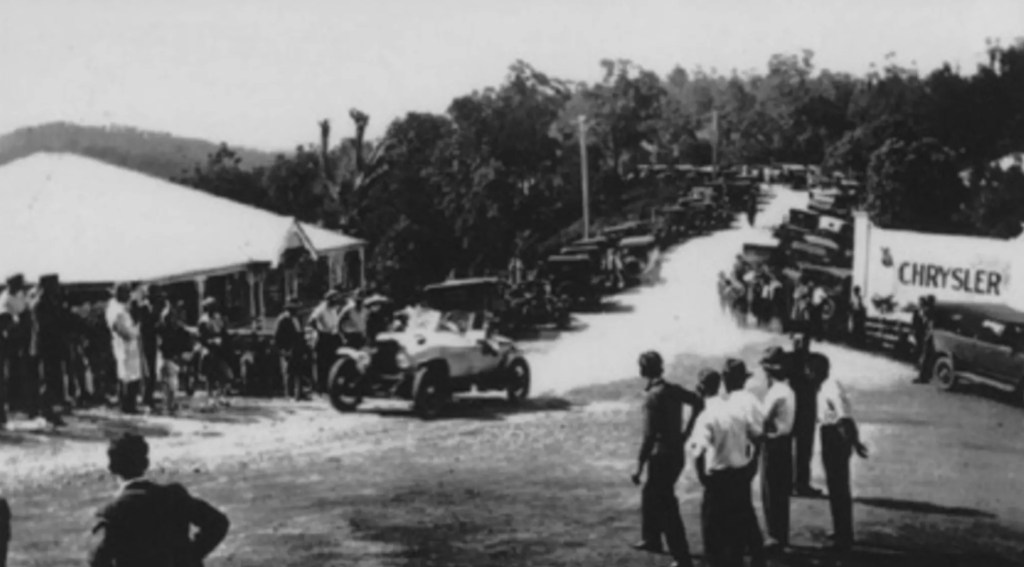
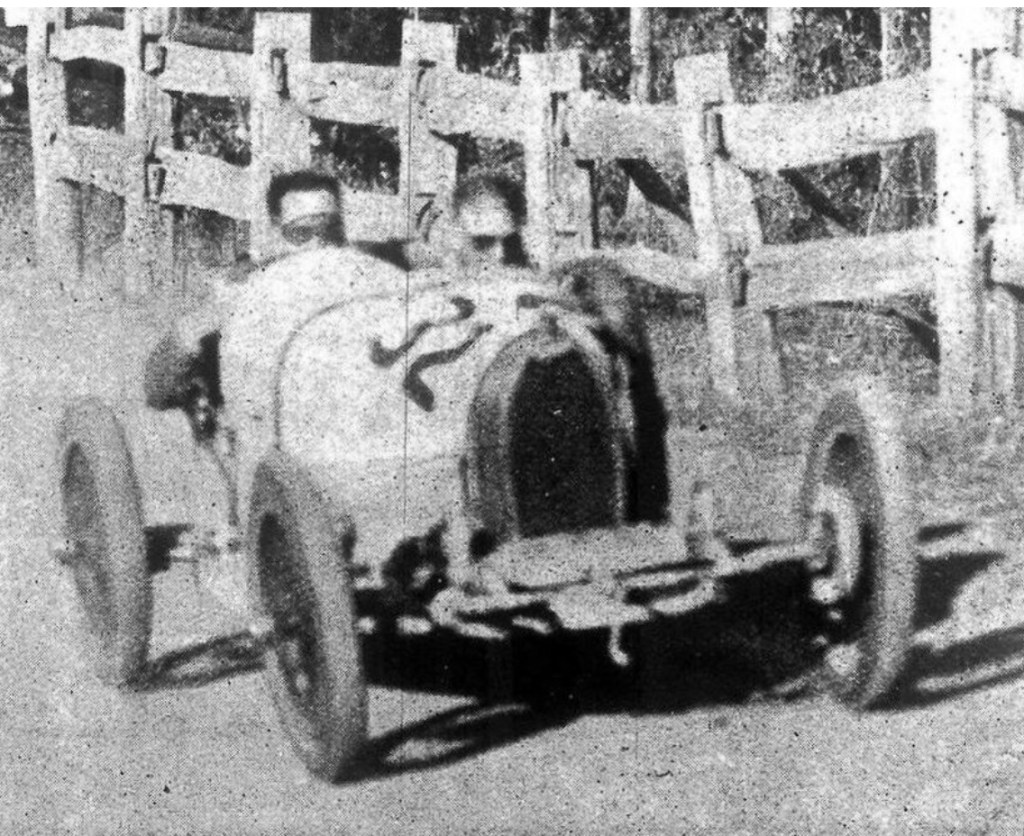
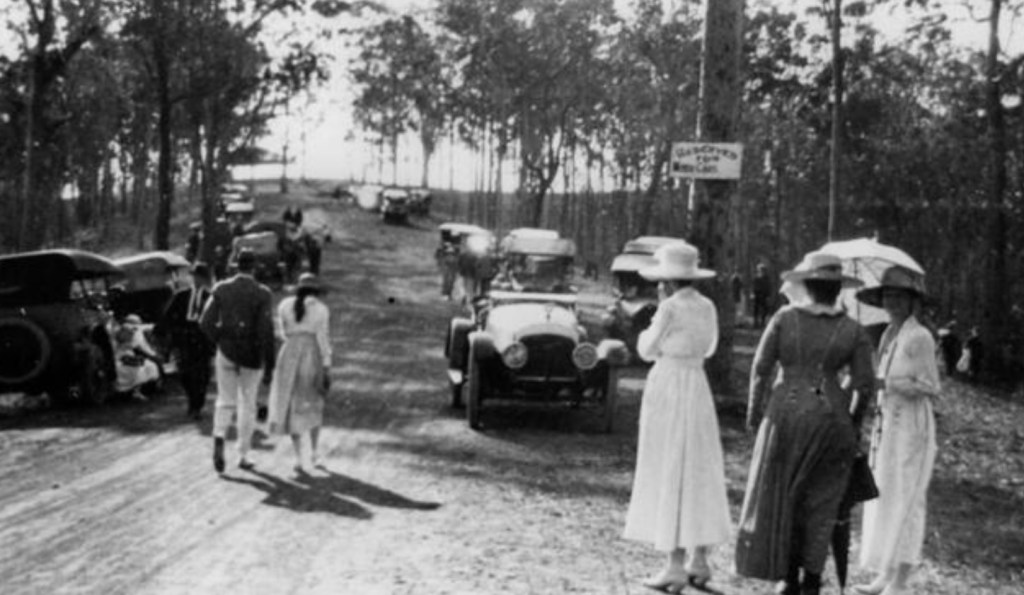
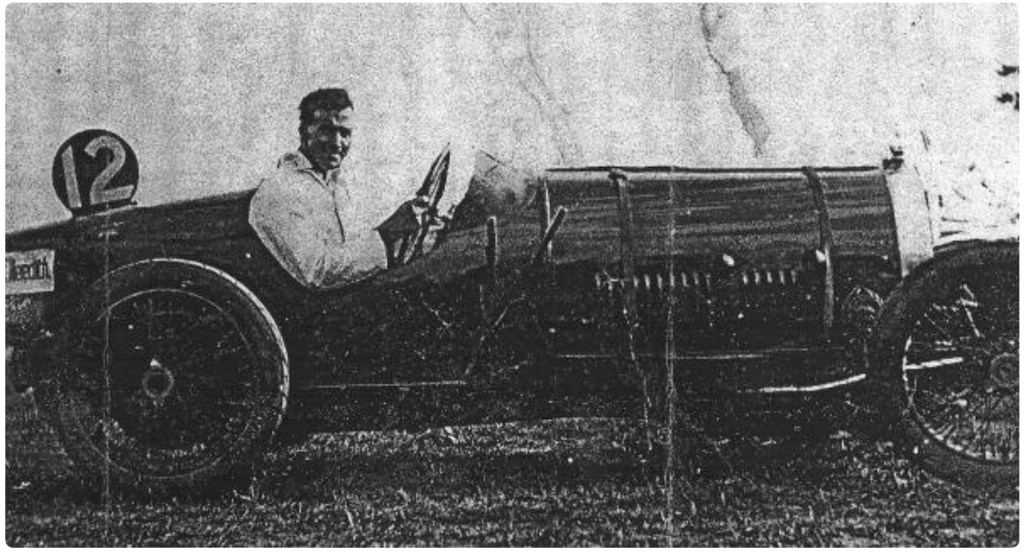
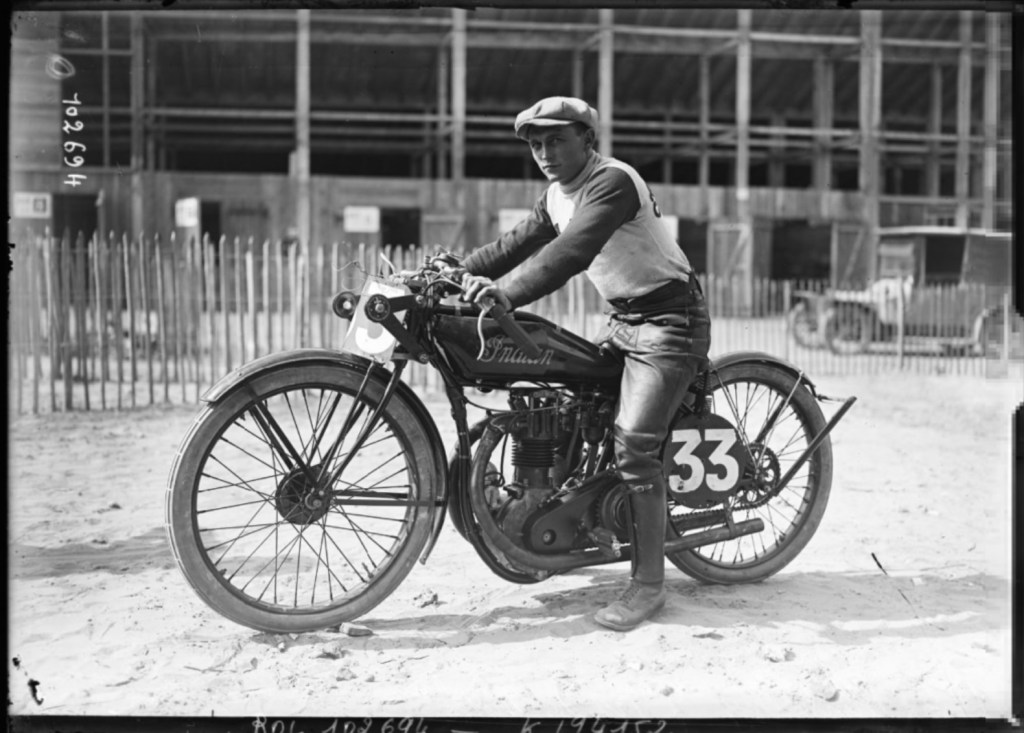
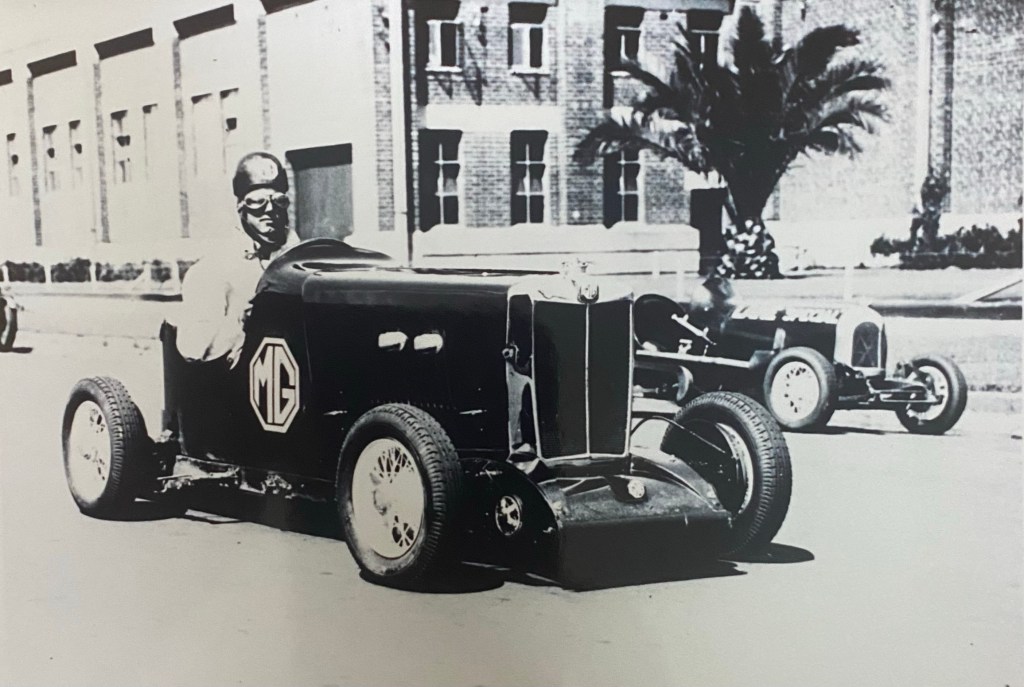
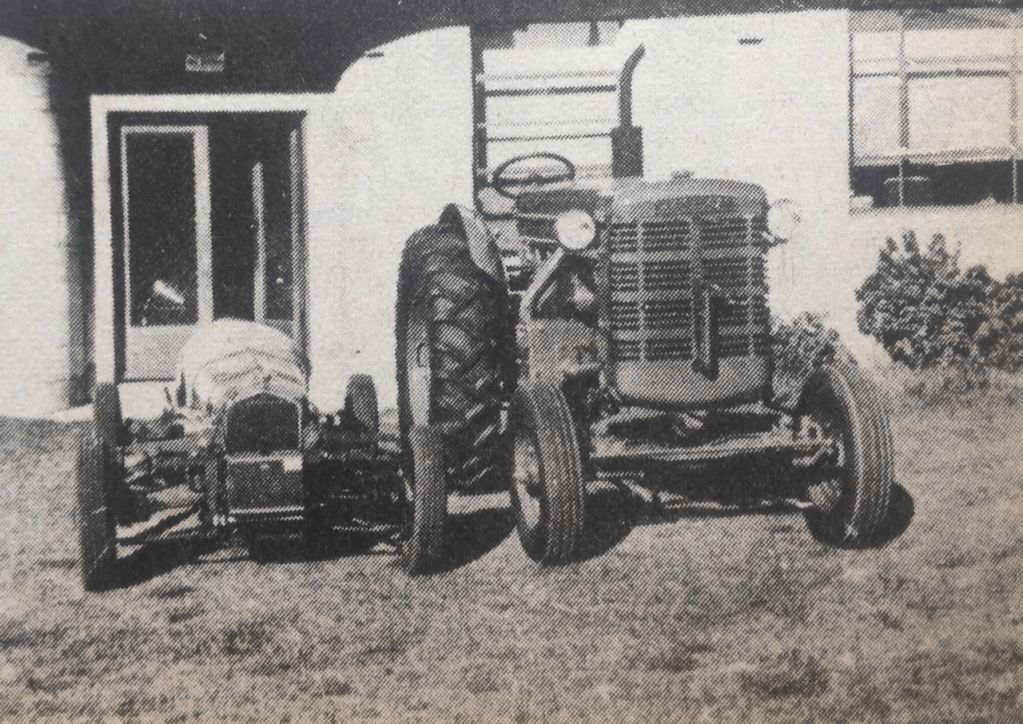
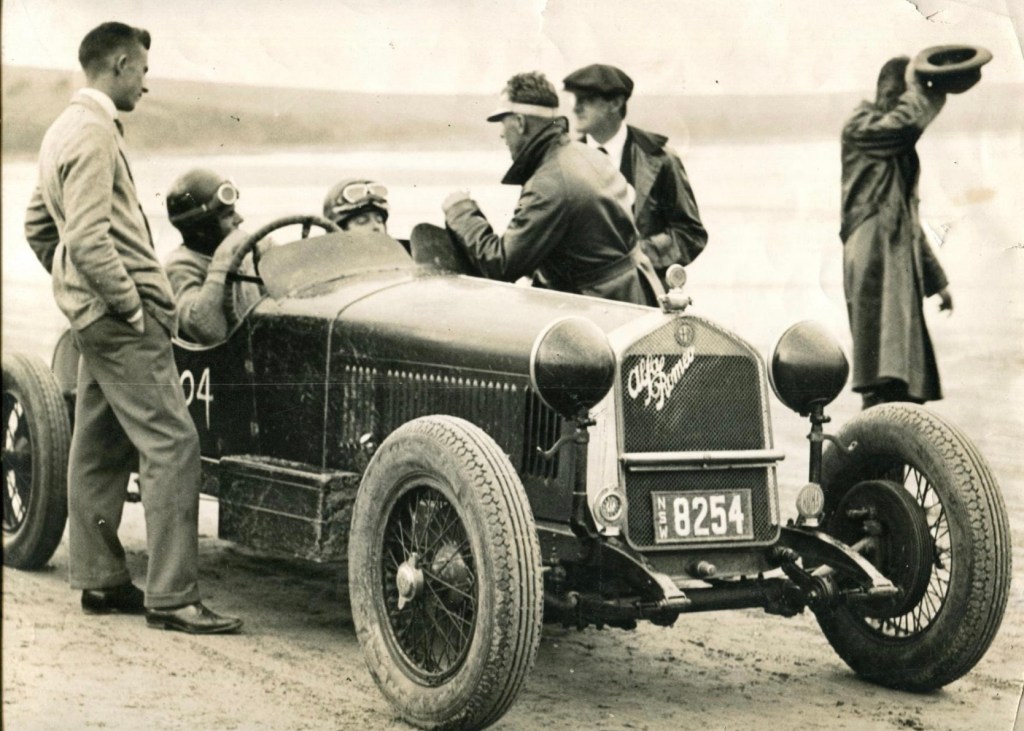
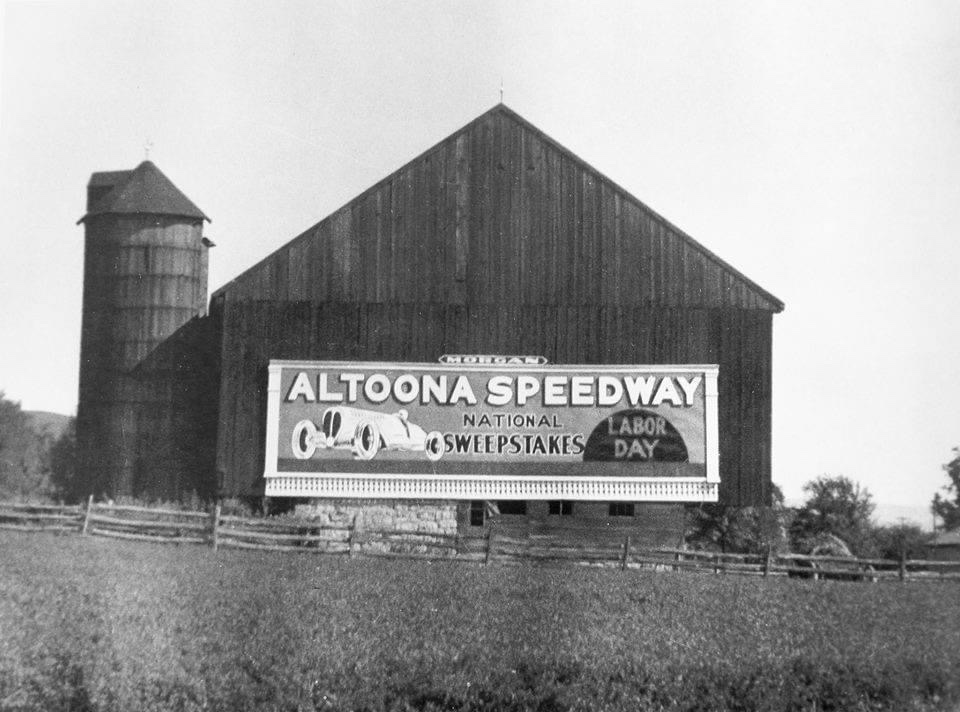
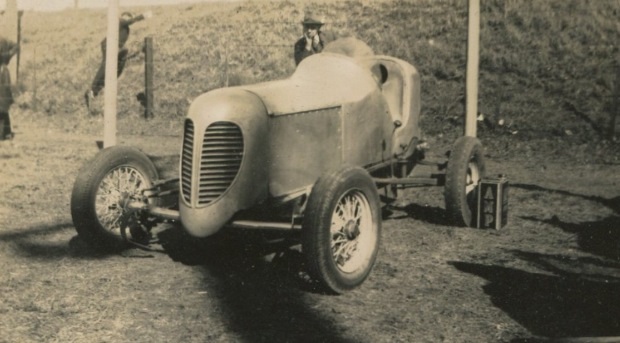
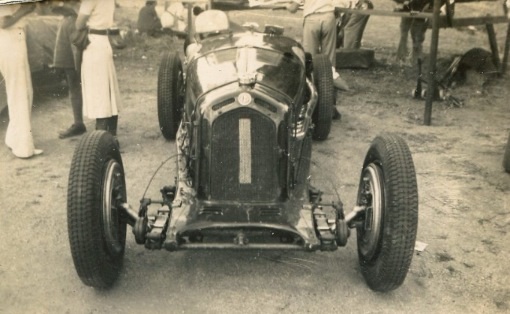
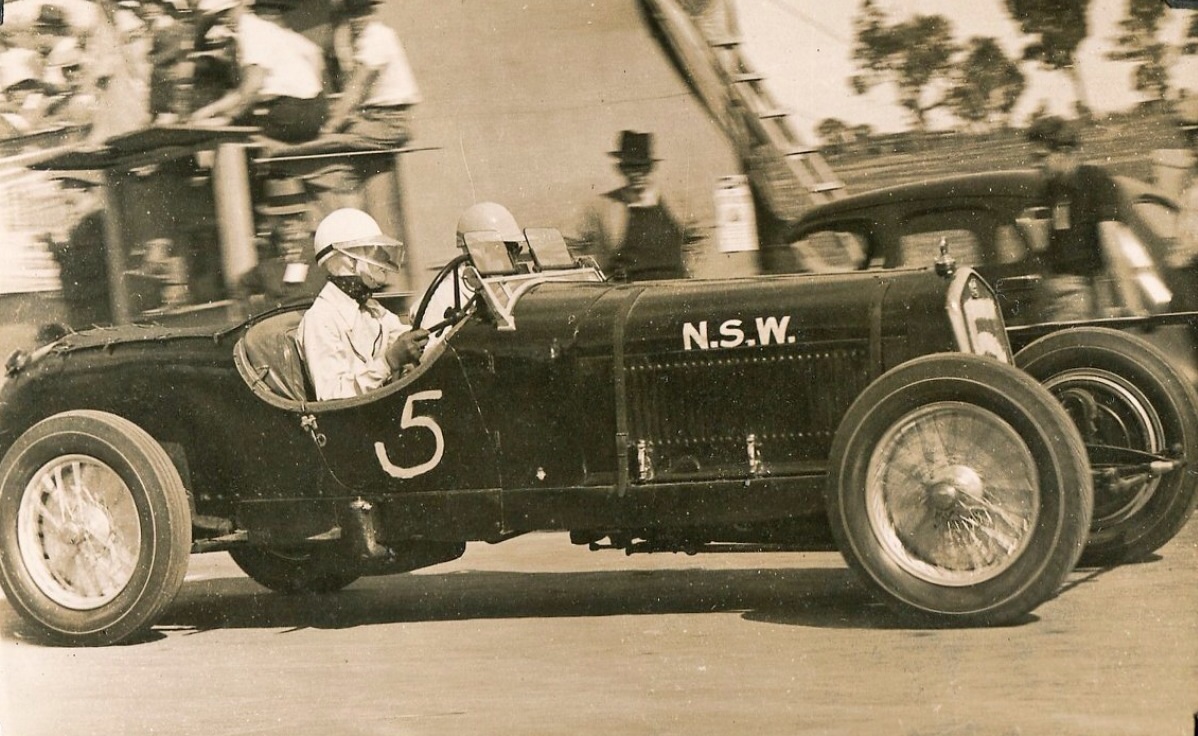
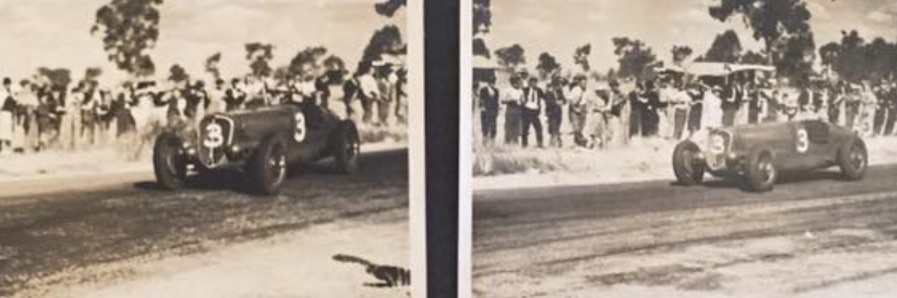
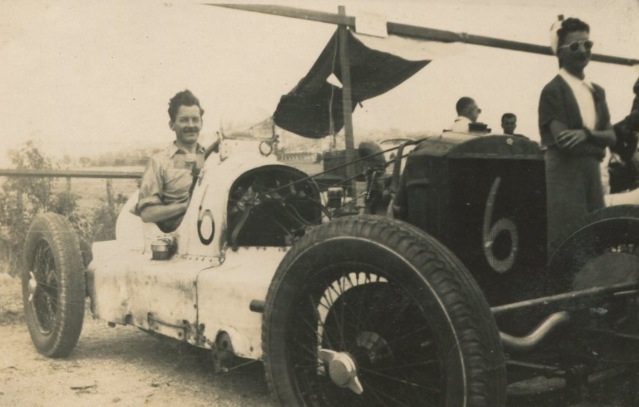
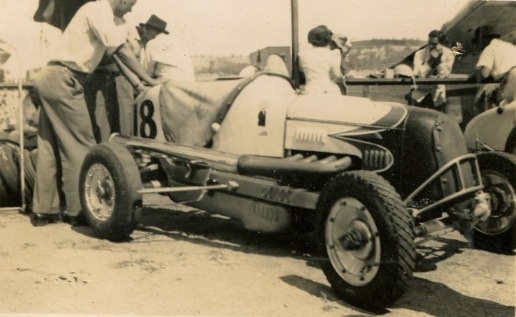
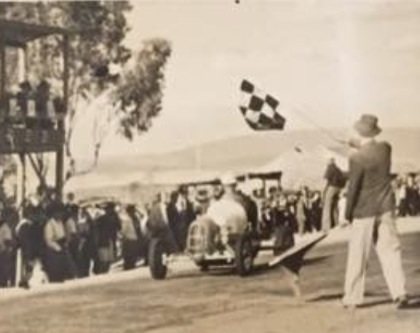
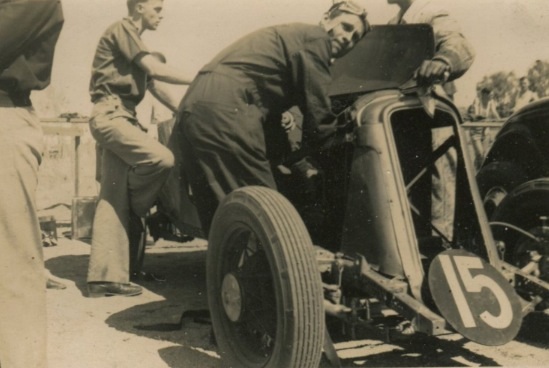
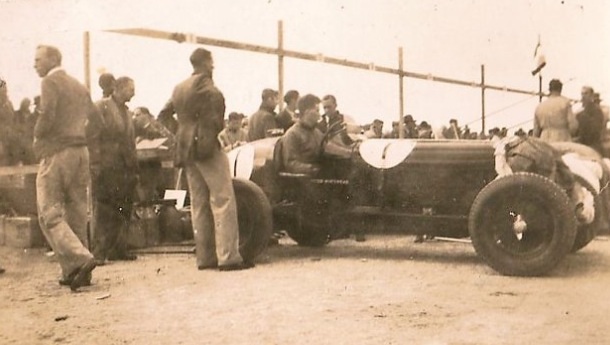
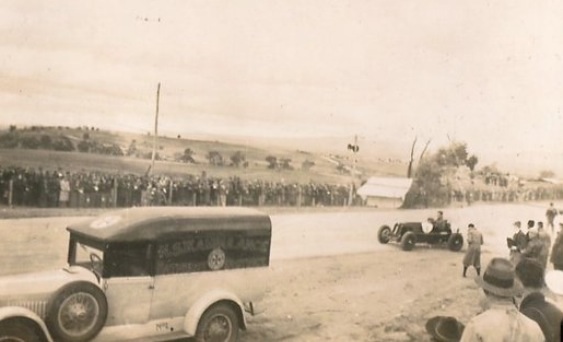
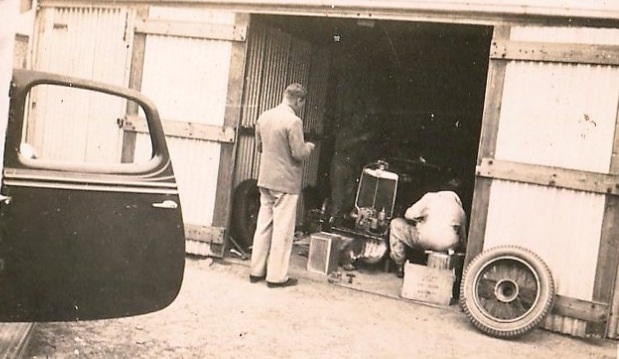
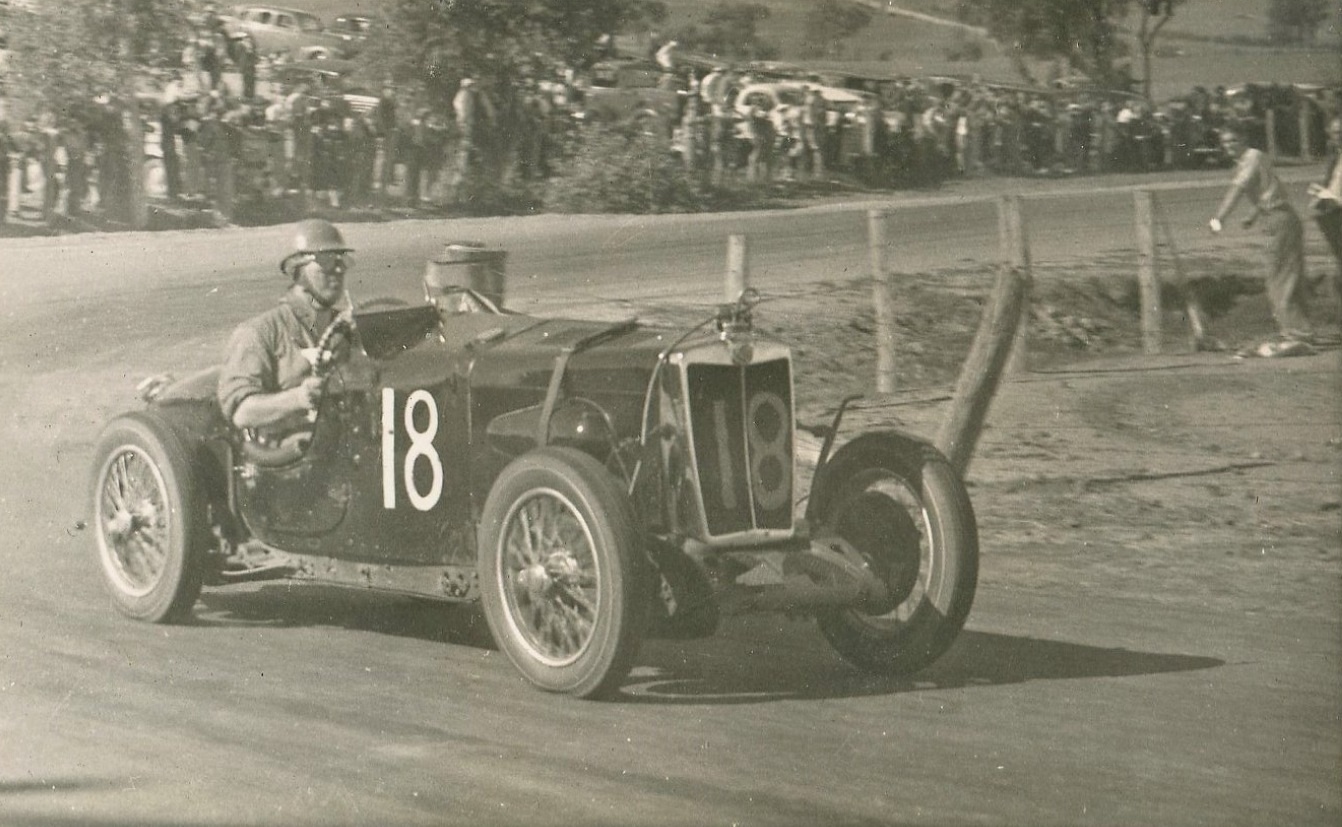
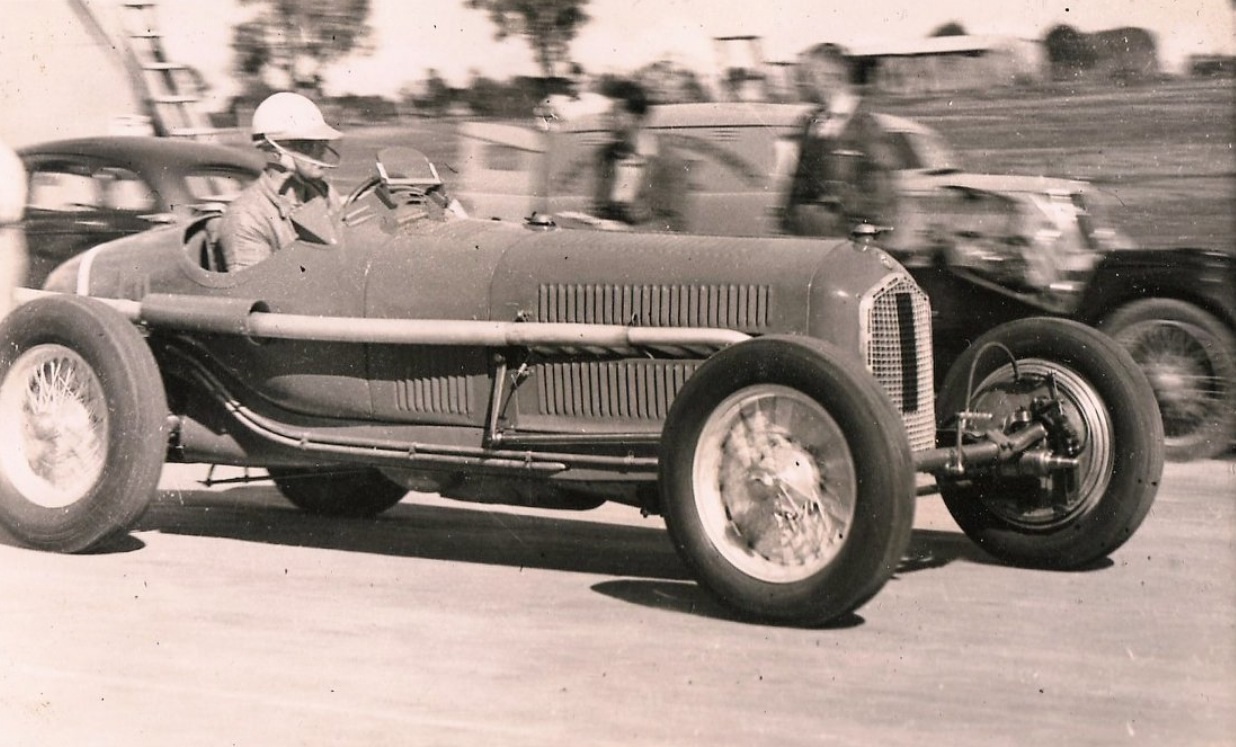
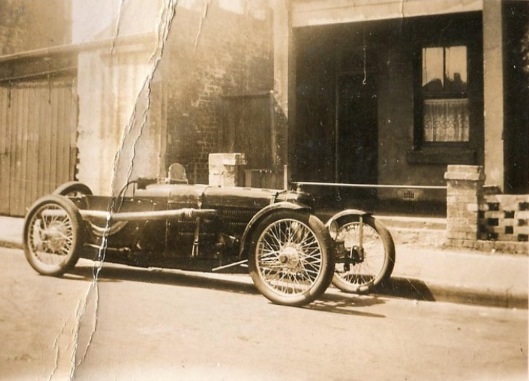
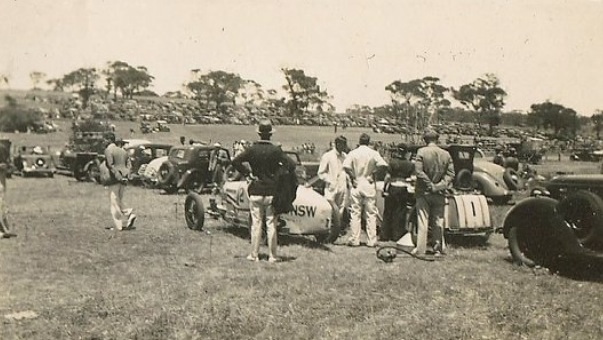
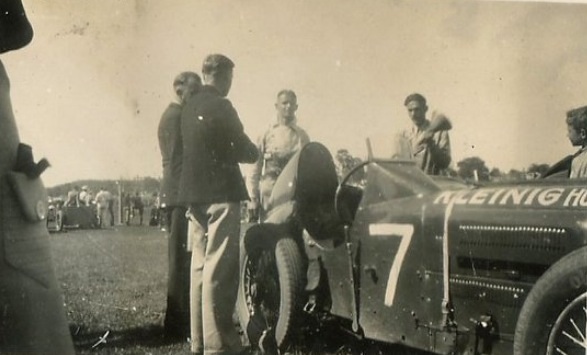
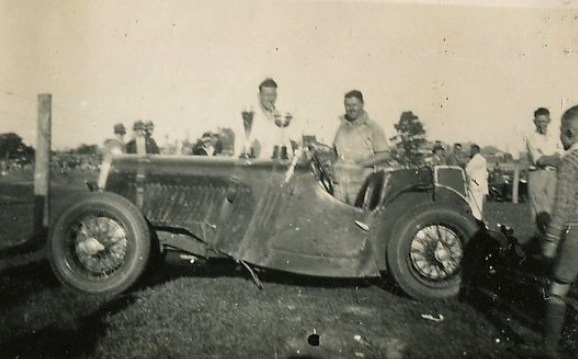
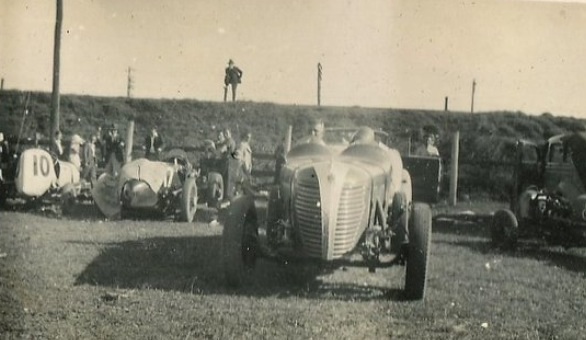
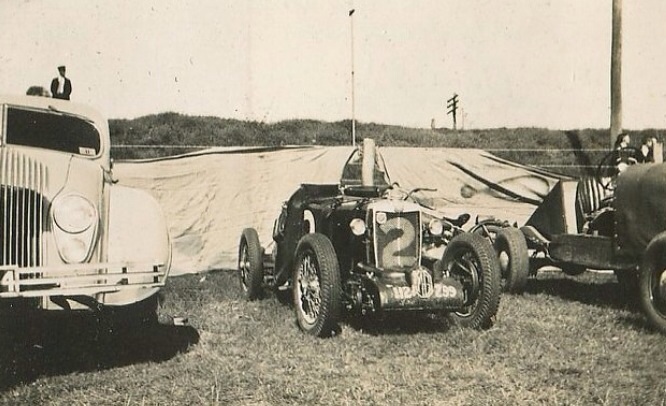
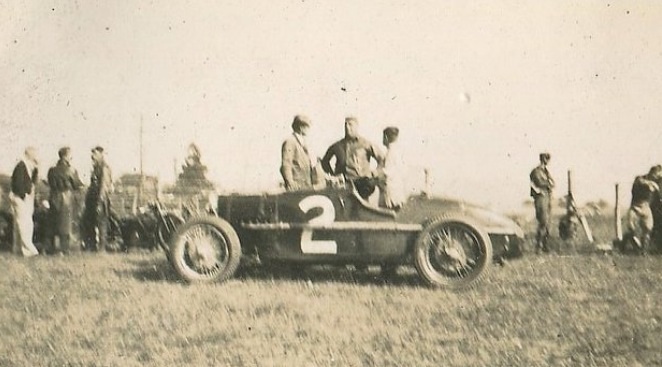
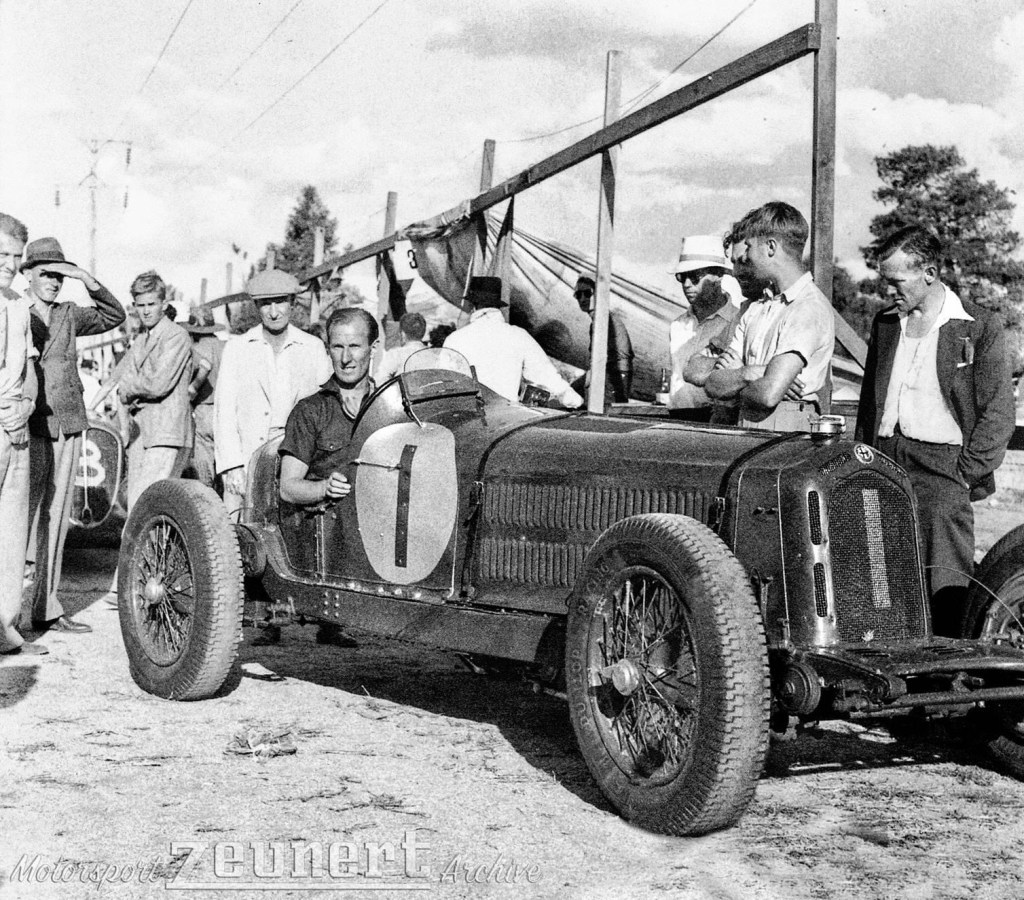
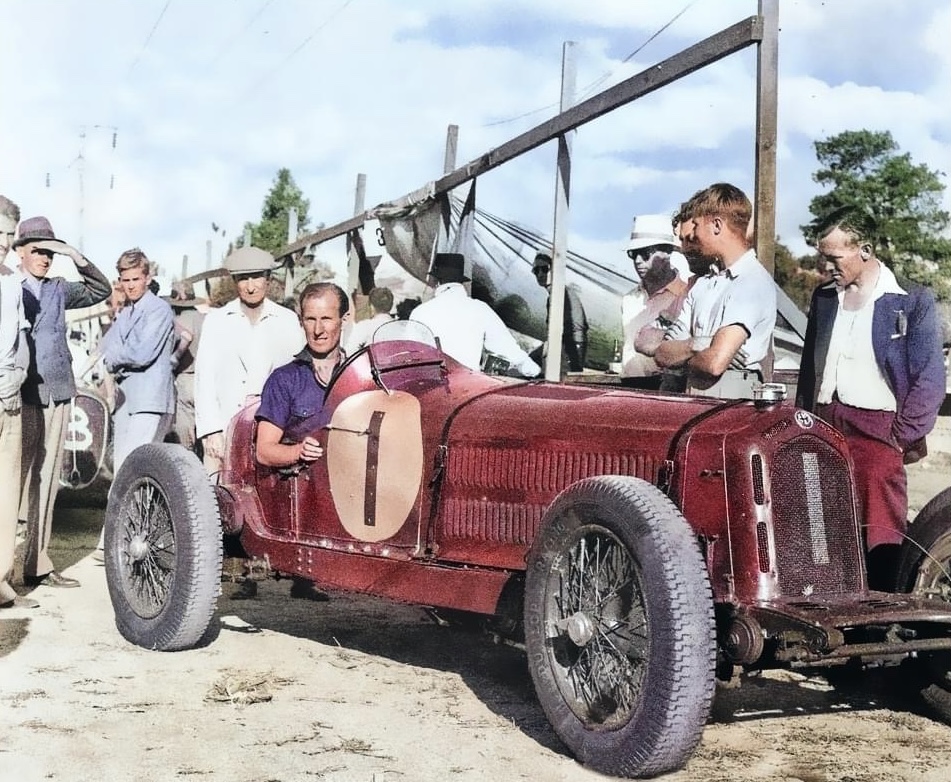
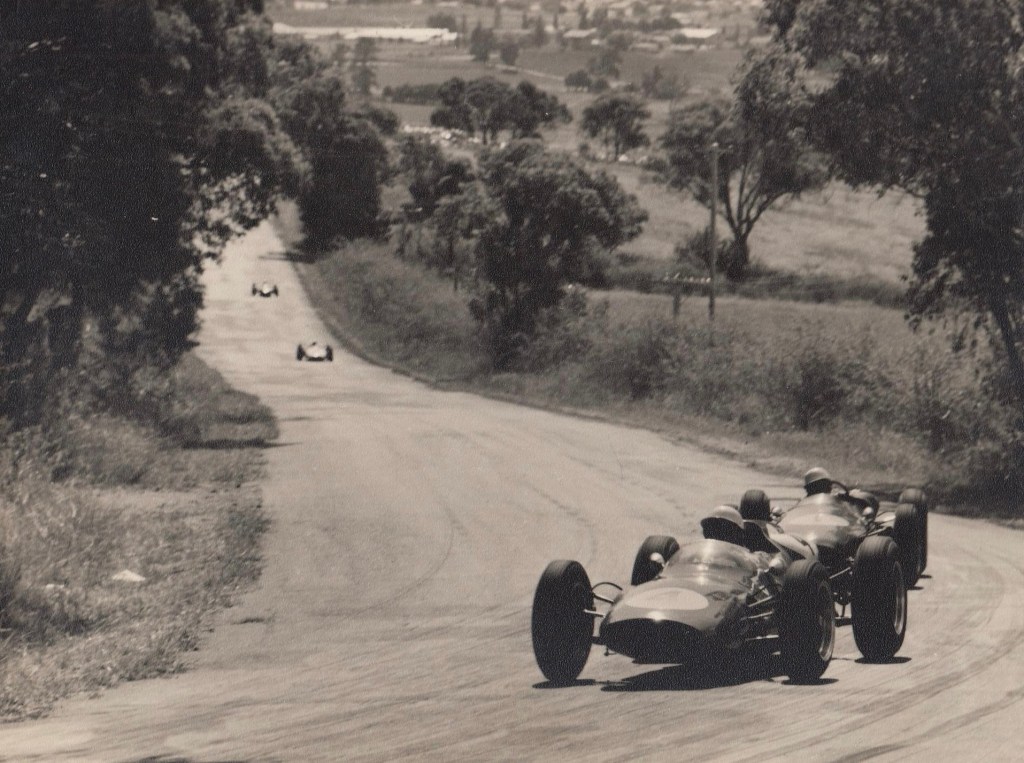
Competitor (who and what?) in the 1918 Coot-tha Classic (Brisbane Times)
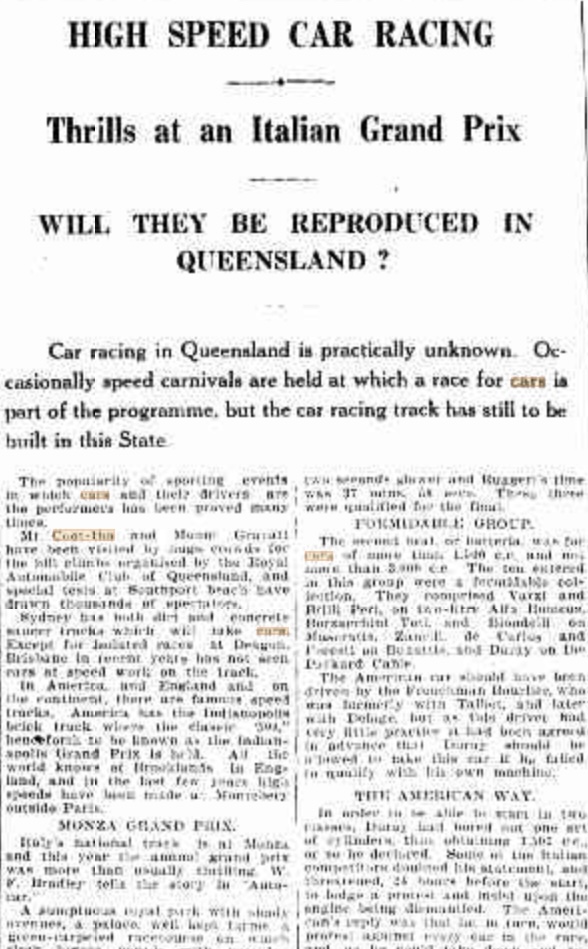
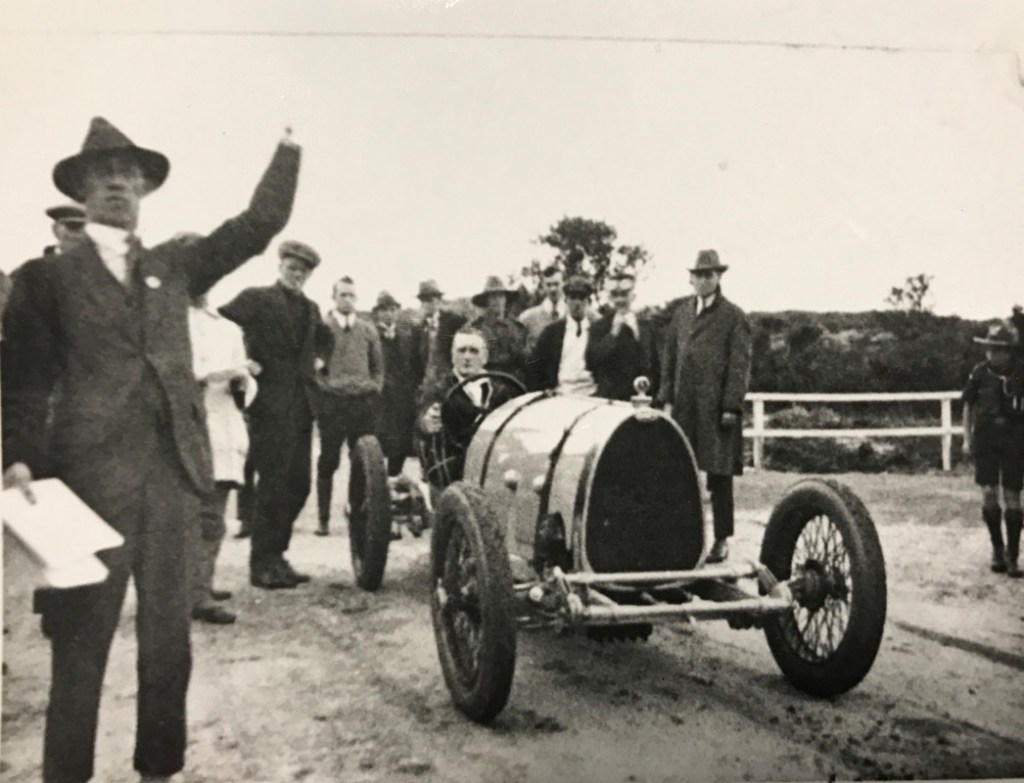
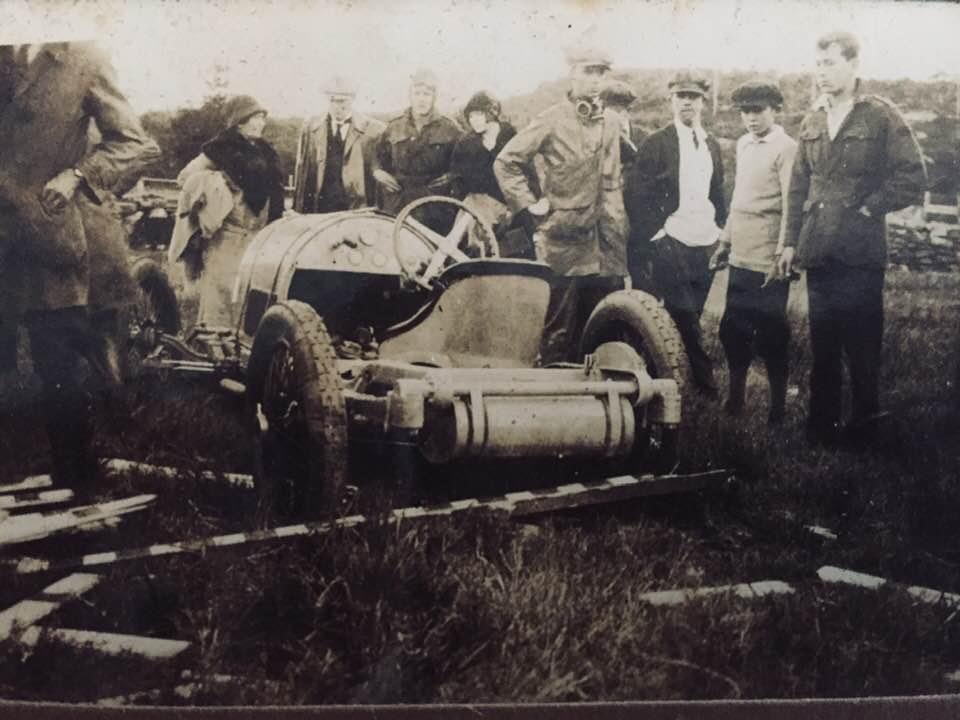
“Car racing in Queensland is practically unknown. Occasionally speed carnivals are held at which a race for cars is part of the programme, but the car racing track has still to be built in this state,” said the motoring reporter of Brisbane’s The Telegraph on November 5, 1929.
“The popularity of sporting events at which cars and their drivers are the performers has been proved many times.”
“Mount Coot-tha and Mount Gravatt (8 km and 10 km from Brisbane’s CBD) have been visited by huge crowds for the hillclimbs organised by the Royal Automobile Club of Queensland, and special tests on Southport Beach (on the Gold Coast) have drawn thousands of spectators.”
Henry Horstman and Maldwyn Davies – Queensland Bugatti importer – on the way to FTD in the RACQ hillclimb at Mount Coot-tha on April 1, 1928, Bugatti T37. His time of 1 min 20 sec was eight seconds clear of the rest of the field (speedwayandroadracehistory.com)Folks take in the Mount Coot-the sun, circa 1920 (alamy)
“Sydney has dirt and concrete saucer tracks which will take cars. Except for isolated races (for cars) at Deagon (Speedway 20km north of) Brisbane in recent years has not seen cars at speed work on the track.”
“In America, and England, and on the continent, there are famous speed tracks. America has the Indianapolis brick track where the classic ‘500’, henceforth to be known as the Indianapolis Grand Prix is held. All the world knows of Brooklands. In England, and in the past few years high speeds have been made at Montlhery, outside Paris.”
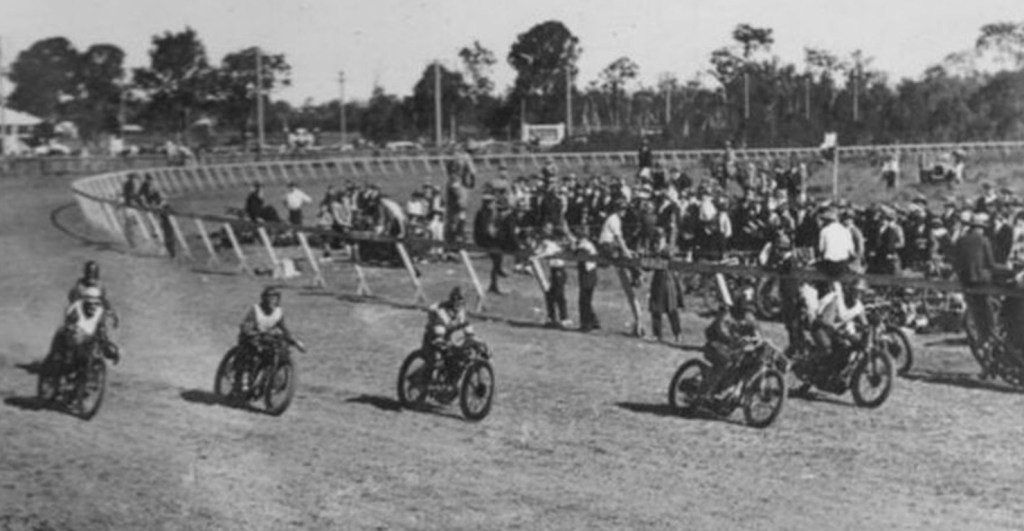
(The Telegraph, Brisbane, November 5, 1929)Motorcycle racing at Deagon in 1926 (T Webb Collection)
Some context of motor racing progress elsewhere in Australia is that the Aspendale Park Speedway opened in outer Melbourne in 1906, the Olympia Motor Speedway at Maroubra, Sydney in 1925. The first Australian Grand Prix was held at the Goulburn Racecourse (Neddies), 200 km south of Sydney in 1927, and the first AGP on a road-course at Phillip Island in 1928. Viz; 1928 100 Miles Road Race, Phillip Island… | primotipo…
Geoff Meredith aboard the Bugatti T30 in which he won the speedway style 1927 AGP at the Goulburn Racecourse (Goulburn Post)
Given the relative population of Queensland to Victoria and New South Wales, the banana-benders (Queenslanders) weren’t lagging behind too much. What is interesting is the popular press ‘pushing’ for creation of a local venue. It wasn’t until 1949 that an AGP was held in the Sunshine State, at Leyburn, a former Royal Australian Air Force base. See Aspendale here; Werrangourt Archive 11: DFP ‘The Greyhound of France’ by Bob King… | primotipo… and Leyburn here; 1949 Australian Grand Prix, Leyburn… | primotipo…
(ABC via M Hubbard)
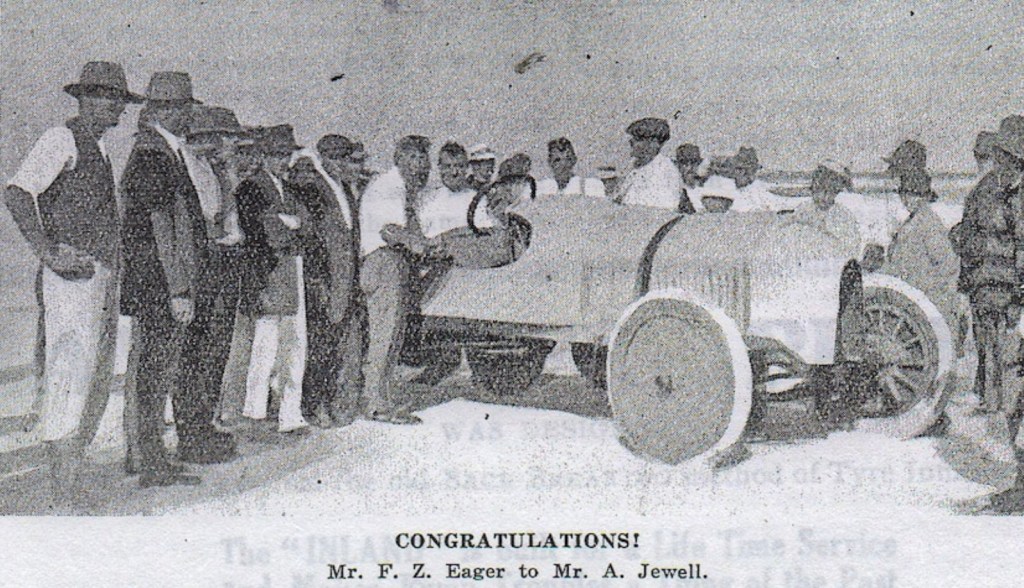
Alec Jewell aboard the Willys Overland which won “Australia’s first land speed record” in a competition with a Studebaker Six driven by Fred Eager on the Surfers Paradise sand, Christmas Day, December 25, 1916.
The cars had a number of runs, Jewell’s best was a time of 21.4 seconds between the measured marks, 84.5mph as adjudged by Automobile Club of Queensland officialdom.
Etcetera…
Deagon was established as a horse-racing venue in the early 1880s. It was first used for motorised events with ‘The Great Motor Cycle Carnival’ in November 1921. The card that day included 3 and 20 mile races for solos and a 5-miler for sidecars. 24 meetings were held from 1921-1931 including 14 state, and six Australian/Australasian Championships. Cars were never the mainstay of racing at Deagon, but were occasional guests on the bike’s-card.
Credits…
Brisbane Times, The Telegraph, Brisbane, November 5, 1929, Old Bike July 2015, Alamy, Goulburn Post, speedwayand roadracehistory.com, Tony Webb Collection, ABC via Murray Hubbard, Bob King
Tailpiece…
(T Webb Collection)
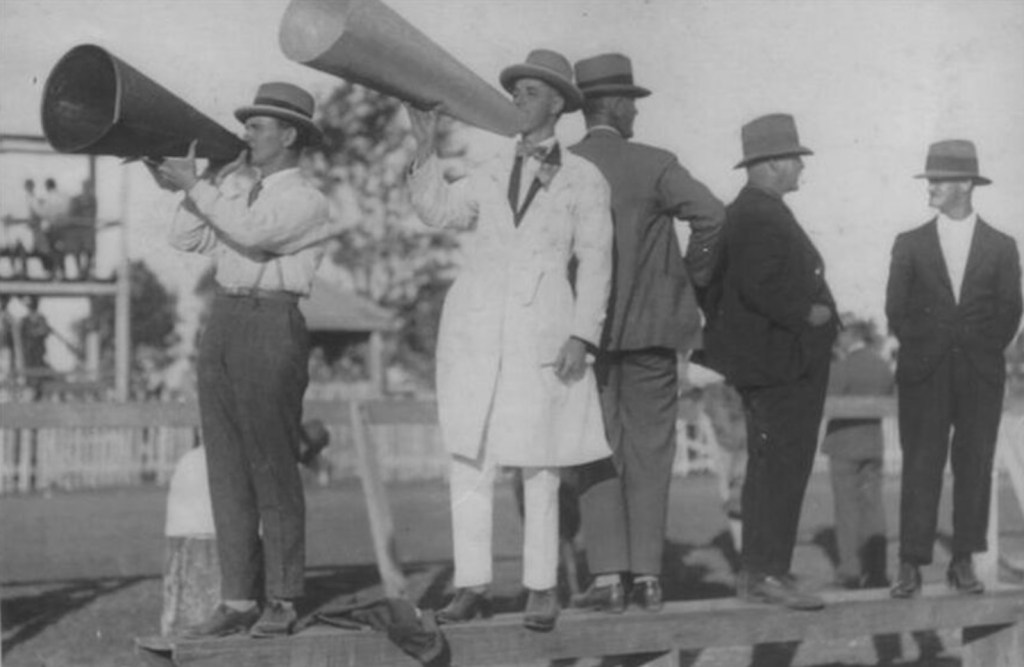
Deagon Speedway commentators doing it the hard way in the mid-1920s. I wonder if hats will ever make a comeback?
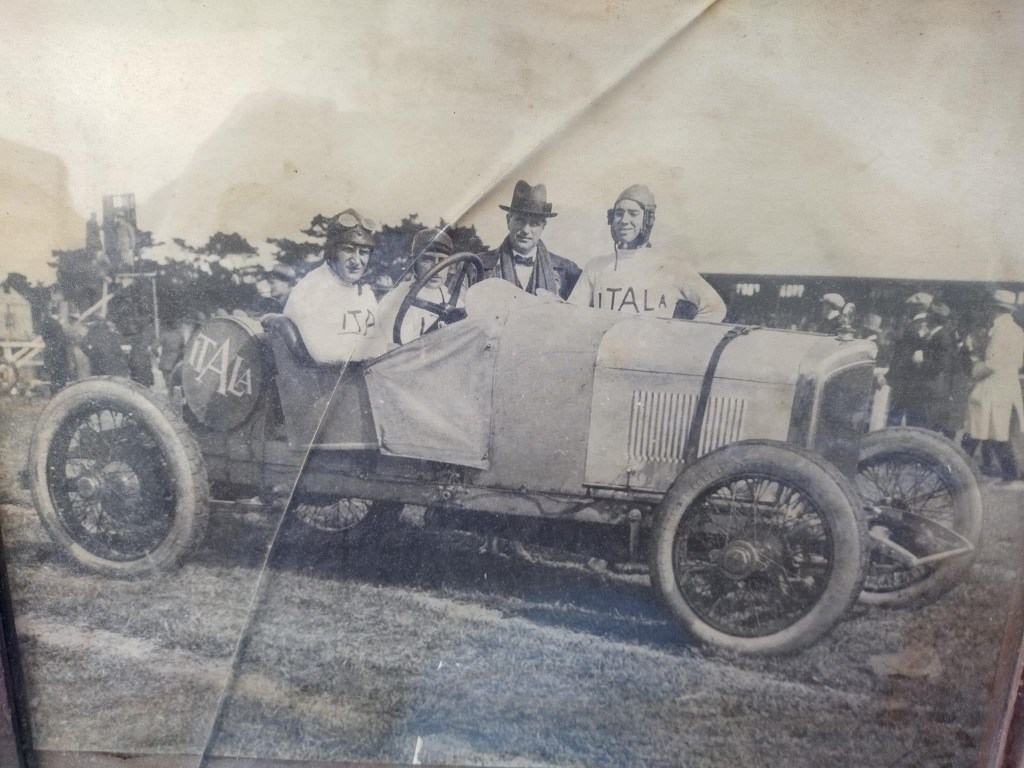
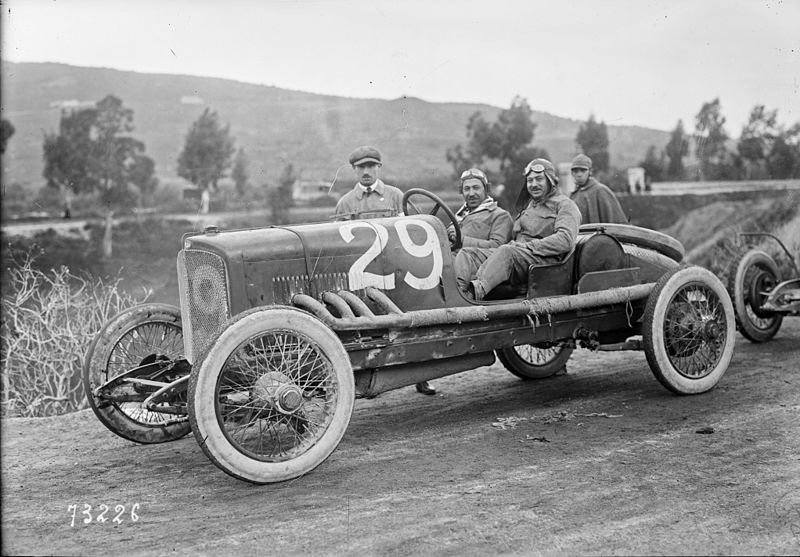
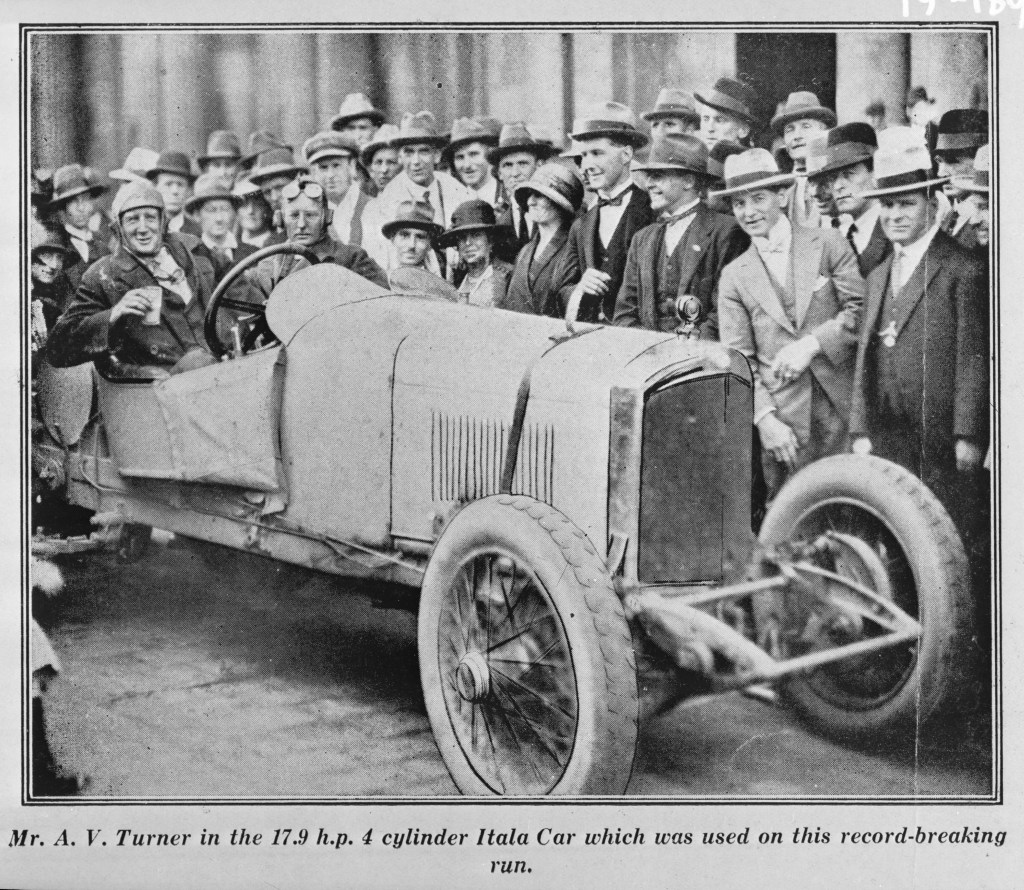
Albert Valentine ‘Archie’ or ‘Bert’ Turner and A ‘Ossie’ O’Connor, Itala, before the start of their record breaking circa-560 miles Sydney-Melbourne run on Sunday February 24, 1924. Corner of Macquarie and Bridge Streets.
Regarded in-the-day as one of Australia’s best drivers, Turner and O’Connor left the Sydney GPO at 5.15am and arrived at the Melbourne equivalent at 5.49pm. The 12 hours 34 minutes journey equated to an average of 47mph, and knocked 25 minutes off the existing record held by Norman ‘Wizard’ Smith’s Essex.
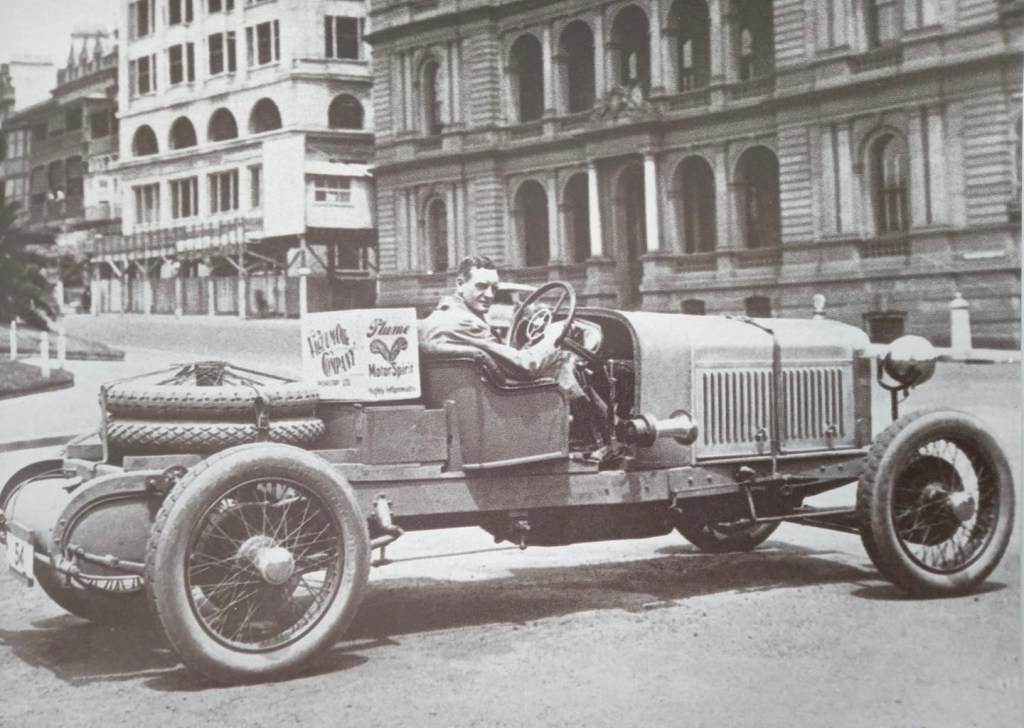
It was the third occasion within 15-months Turner had taken the record, in tit-for-tat fashion with his competitors, on the two previous runs in 1923 he drove a Delage C02.
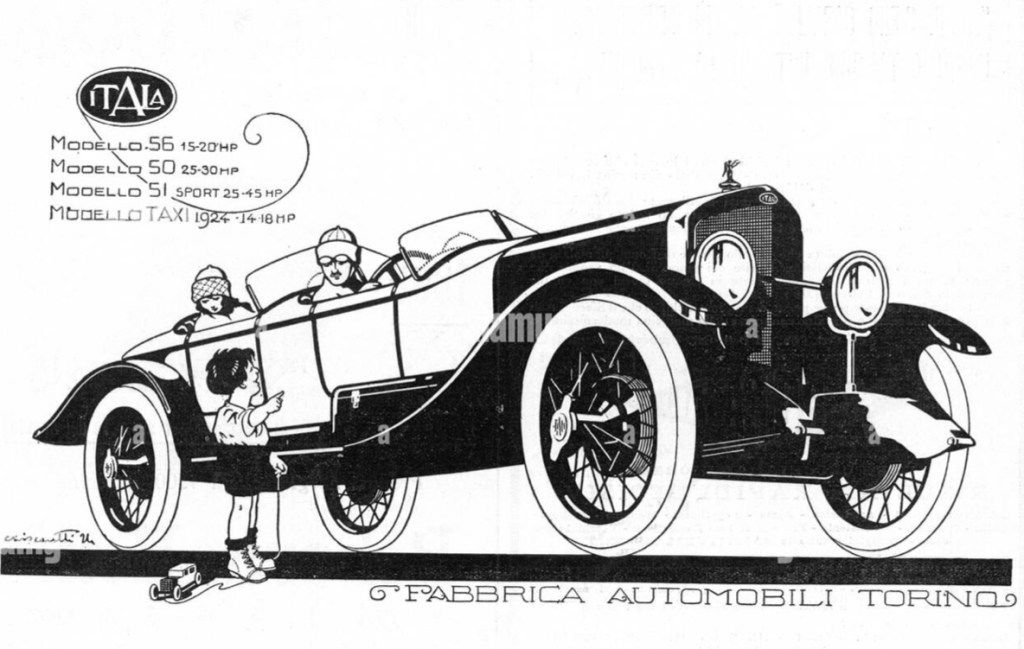
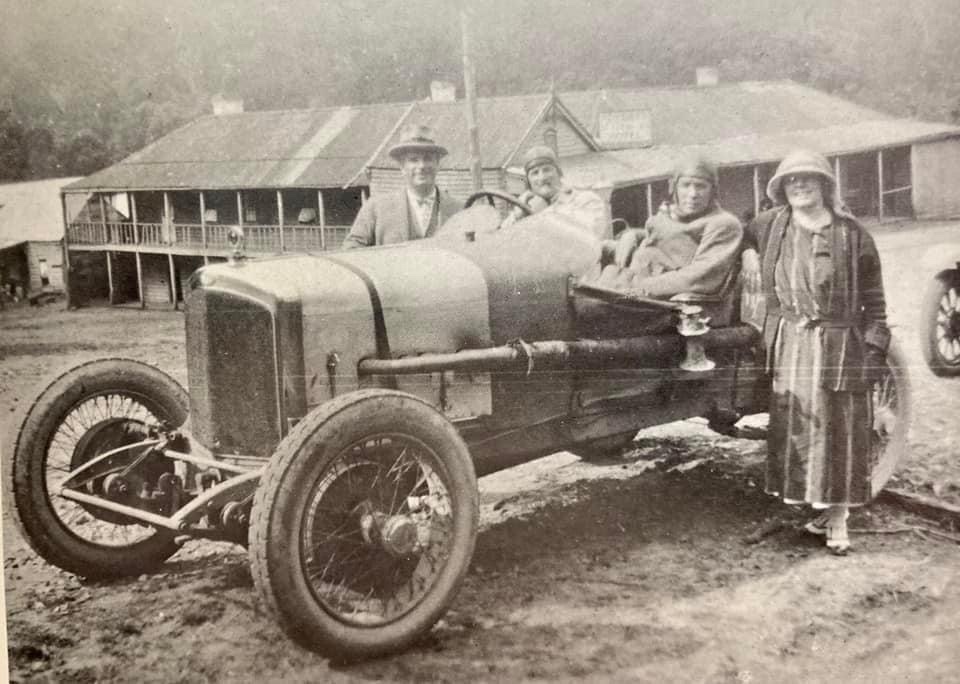
Turner aboard a Delage CO2 4.5-litre OHV six cylinder, before breaking the Sydney-Melbourne record in February 1923 – 16 hours 47 min. Chassis number folks, does it currently exist? Was he flogging Delages at the time or were the drives paid ones? The sponsor is Plume Motor Spirit! (C Blundell Collection)James Flood and his wife alongside AV Turner’s “record setting Itala”, here (where??) with Albert Vernon at the wheel in 1921. I note the car – if it is the same Itala – is now fitted with four-wheel brakes, rather than the two in the opening shot. Not so sure about the year quoted (James Flood via C Nicholes)The Luigi Lopez works Itala Tipo 51S before the start of the 1922 Targa Florio. Five of these 2.8-litre four cylinder racers were entered, the best placed was Antonio Moriondo’s 12th placed machine, albeit he was second in the 2-3 litre class. Lopez was 25th and last, the winner was Giulio Masetti’s 1914 Mercedes 4.5-litre 18/100 GP car. I’m not suggesting Turner’s car was an ex-works machine, but rather including it for the sake of completeness and begging the question as to what, exactly, AVT’s car was… (Bibliotheque nationale de France)
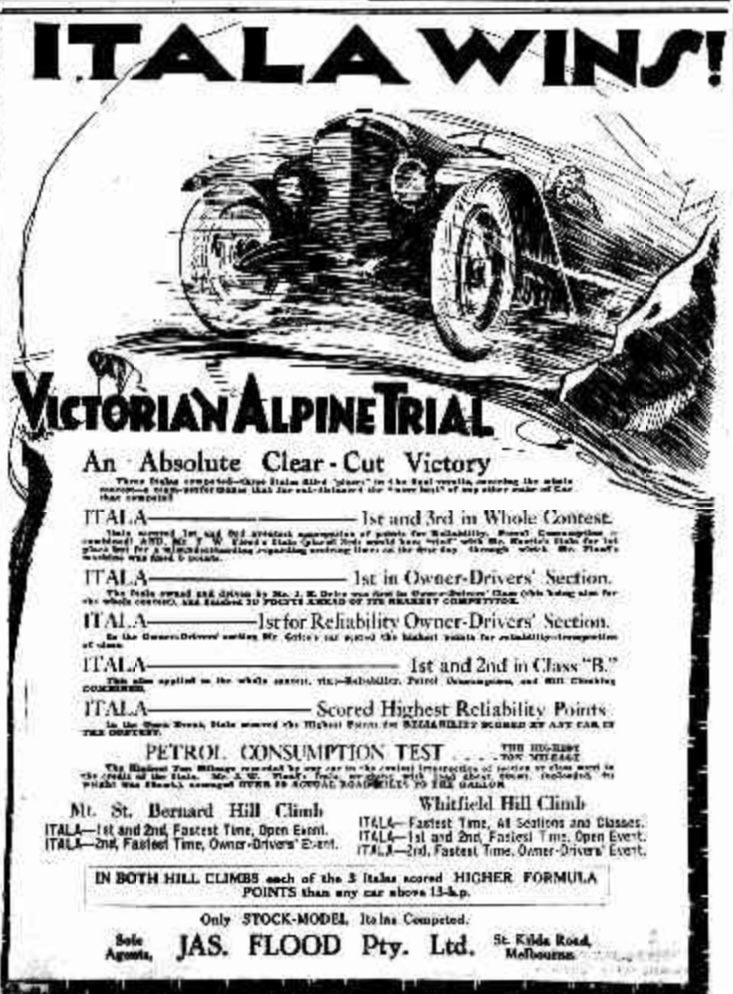
The Turner Itala is variously described in contemporary newspaper reports as a 17.9hp or 15hp Floria (sic), it’s perhaps a 2.8-litre, four cylinder 55bhp @ 3200rpm engined Type 51 Sport with a Targa Florio style body, built by James Flood in Melbourne. Details of the car from a marque expert appreciated, inclusive of present whereabouts.
Turner was then the New South Wales agent for Itala and Bugatti operating from large premises in Castlereagh Street. He promoted both marques via competition, a medium at which he rather shone.
The Sydney Sunday Times reported that “The average speed of 47mph, fast as it sounds (the main road, between Sydney and Melbourne then was little more than an unmade goat-track), included all stops for supplies and refreshments, the running time average was about 50mph.”
“During the journey the exhaust pipe broke, blowing stupefying exhaust gases into the faces of driver and passenger. Mr O’Connor was rendered well-nigh unconscious by the fumes and arrived in Melbourne much the worse for the experience.”
“Mr Turner’s throat was so sore from the same cause, that he could hardly speak audibly. At one stage of the trip he was compelled to drive for several hundred miles on the hand throttle alone.”
“Speeds in excess of his latest accomplishment are unlikely, in view of the present state of the roads, which he states precludes the reasonable possibility of a higher average being maintained. Mr Turner has many successes to his name, but his latest ranks among the highest,” the Sunday Times concluded in the wonderful narrative style of the day.
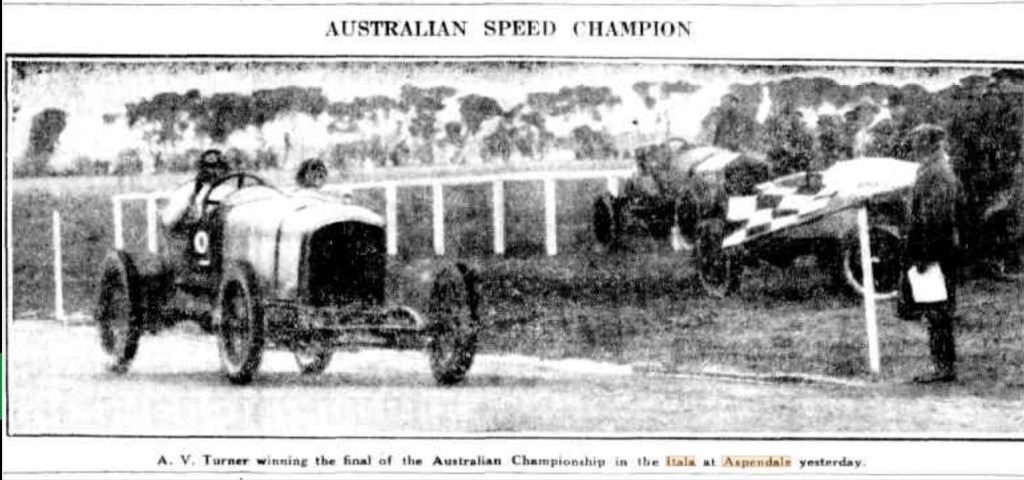
AV Turner at Aspendale, Melbourne, a banked dirt track, on the way to winning the “blue riband 25-miles Australian Championship” from Carlo Massola’s Diatto on April 21, over the Easter 1924 long weekend (hyperracer.com)(SLV)Turner and somewhat energetic crew – perhaps that fella has had enough? – during their victorious 1921 Alpine Trial run. Itala Tipo 51 tourer powered by a 2.8-litre, two side-valve 50bhp @ 3000rpm four cylinder engine. Four speed ‘box (melbournecircle.net)
Turner had plenty of success on Italas in all kinds of events, including a win in the first RACV 1000 Miles Alpine Trial/Victorian Reliability Contest – aka The Alpine Rally – in 1921. This caused much consternation among the Victorian blue-blazer-clad RACV mob as he was the only New South Wales driver in the tough event contested over the difficult Alpine terrain of north-eastern Victoria. He was second in 1922 aboard the same Itala Co Australia owned car (entered by a Mr A Hoette), his arch-rival Wizard Smith triumphed that year on an Essex.
By 1924, Itala (Itala Fabbrica Automobili), founded by Matteo Ceirano and five partners at Via Guastalla, Turin in 1903, was in receivership. Ex-Fiat general manager Giulio Cappa was appointed by the Italian Government’s Istituto per la Ricostruzione Industriale. This entity took control of insolvent Italian businesses deemed too-large-to-fail from 1933 to 2000, Alfa Romeo is a case in point. After his rein, an interesting story in itself, the company was bought by truck maker Officine Metallurgiche di Tortona (OM) in 1929, and the remains sold to Fiat in 1935.
Poor Turner died from injuries sustained contesting an inconsequential hill-climb in North Curl Curl, quite close to his Darley Road, Manly, home. He interrupted a tennis game to run his (later 1927 Australian Grand Prix winning) Bugatti Type 30 #4087 on May 15, 1926 and died in Manly Cottage Hospital later that day. I’ve a feature article 95% complete on that car and its in period-piloti, Messrs Turner, Geoff Meredith and Jack Clements, I really must finish it.
Turner was quite a driver…
(The Argus, Melbourne, December 1921)Turner winning the ‘Australian Championship’ at Aspendale, Easter 1924 (The Herald, Melbourne)
Credits…
Angela Wootton Family Collection, Colin Blundell Collection, Bibliotheque nationale de France, melbournecircle.net, Sydney Sunday Times March 2 1924, James Flood Book of Early Motoring via the Chris Nicholes Collection, various newspapers via Trove, John Medley, Ray Bell, manlylocalstudies.blogspot.com, Pedr Davis Collection via the Murdoch Family Collection-Neill Murdoch, Colin Wade, State Library of Victoria
AVT ready for the off, Bugatti T30 #4087, North Curl Curl, May 15, 1926 (P Davis Collection via N Murdoch)
Etcetera…
The hillclimb in which Turner died – above, immediately prior to the fatal run – was a circa 700 yard straight run up (now) Harbord Road from about the corner of Abbott Road, North Curl Curl. The finish line was on or about the corner of Harbord Road and Brighton Street, North Manly, with Turner’s crash site on that corner or “the vicinity of ” 151 Harbord Road, Freshwater. It was on this corner, or this property, on, or just after the finish line, where AVT came to grief as below.
(C Wade Collection)
Tailpiece…
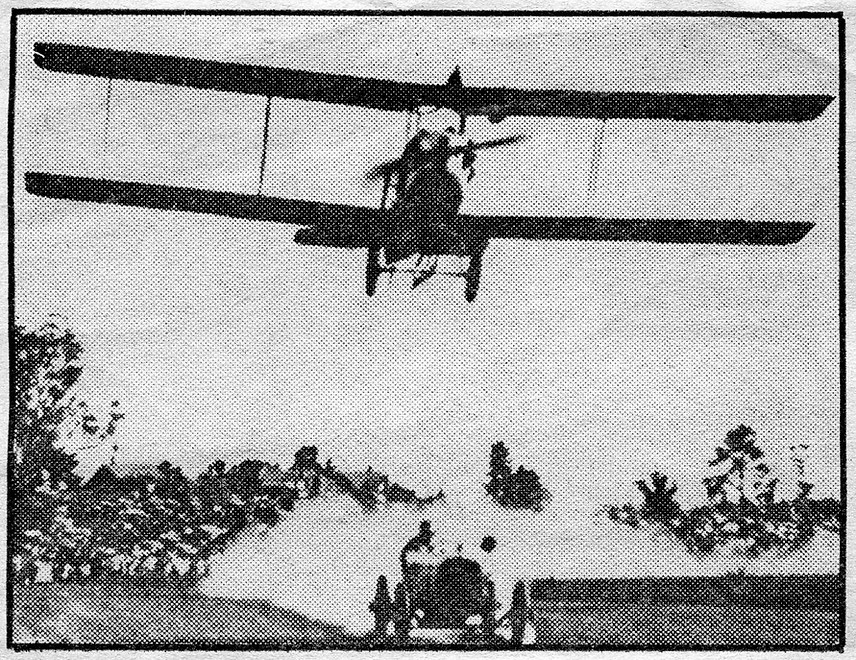
Turner’s Itala racing a Farman bi-plane, probably piloted by Major Harry Shaw – a prominent racer himself – at Aspendale circa 1921, it was a dead-heat apparently. Exact date appreciated.
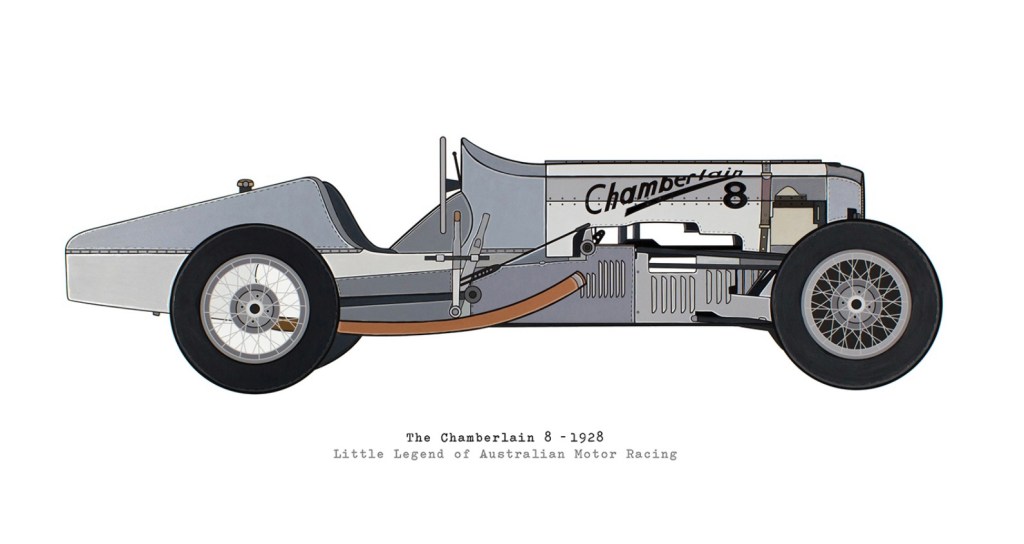
Chamberlain 8 painting – as it is currently sans-engine – in the Birdwood Mill Museum, South Australia (artomobile.com.au)
The Chamberlain Eight’s four cylinder, eight piston, supercharged, twin-crank, two stroke engine left an unforgettable, ear-splitting impression on all who saw it at the 1978 50-year anniversary of the 1928 100 Miles Road Race aka Australian Grand Prix at Phillip Island.
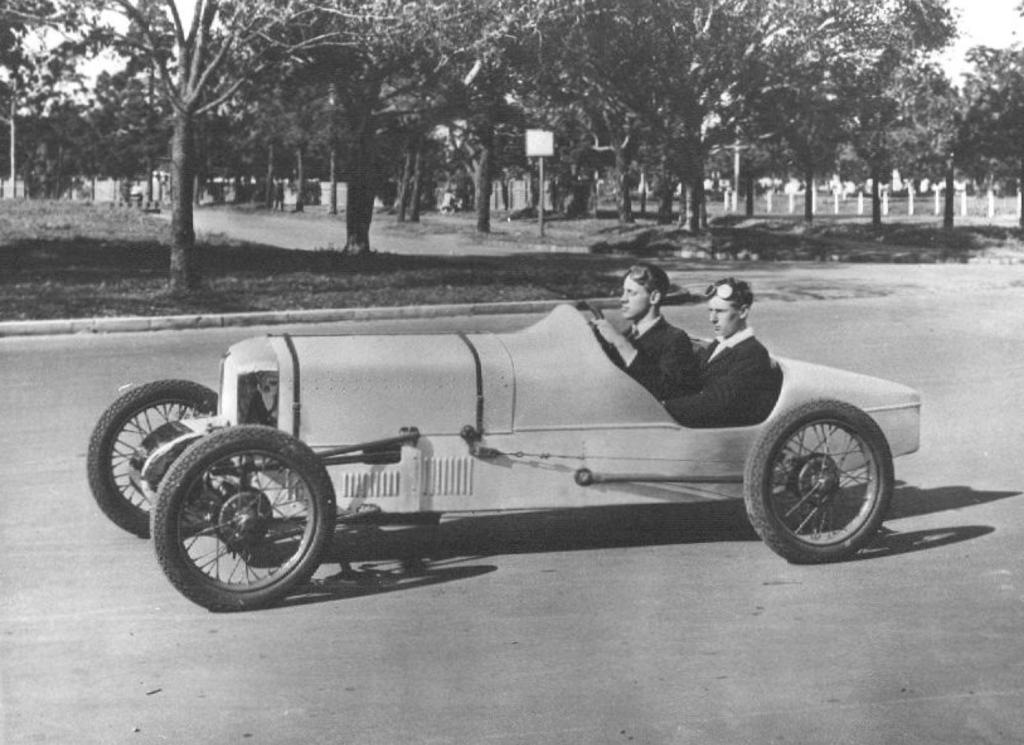
What I hadn’t fully appreciated in fulsome fascination for a car which was at the cutting edge in its engine, chassis, suspension and front wheel drive – all of which were out-there in 1929 – was the length of time it was first fitted with Indian motorcycle engines. It first saw the light of day with a Daytona unit and then an Altoona. It was only when Bob Chamberlain travelled overseas that he handed the car to his brother Bill, who built and fitted the Chamberlain engine circa 1934-35.
Bob Chamberlain at the wheel of The Beetle as the family called the car, Chamberlain Indian, circa 1929 (Chamberlain Australian Innovator)The ex-Chamberlain Indian, Altoona Indian-Norton engine during the period it was installed in Bill Thompson’s ‘Lane Special’ speedway midget (Fred Pearse)
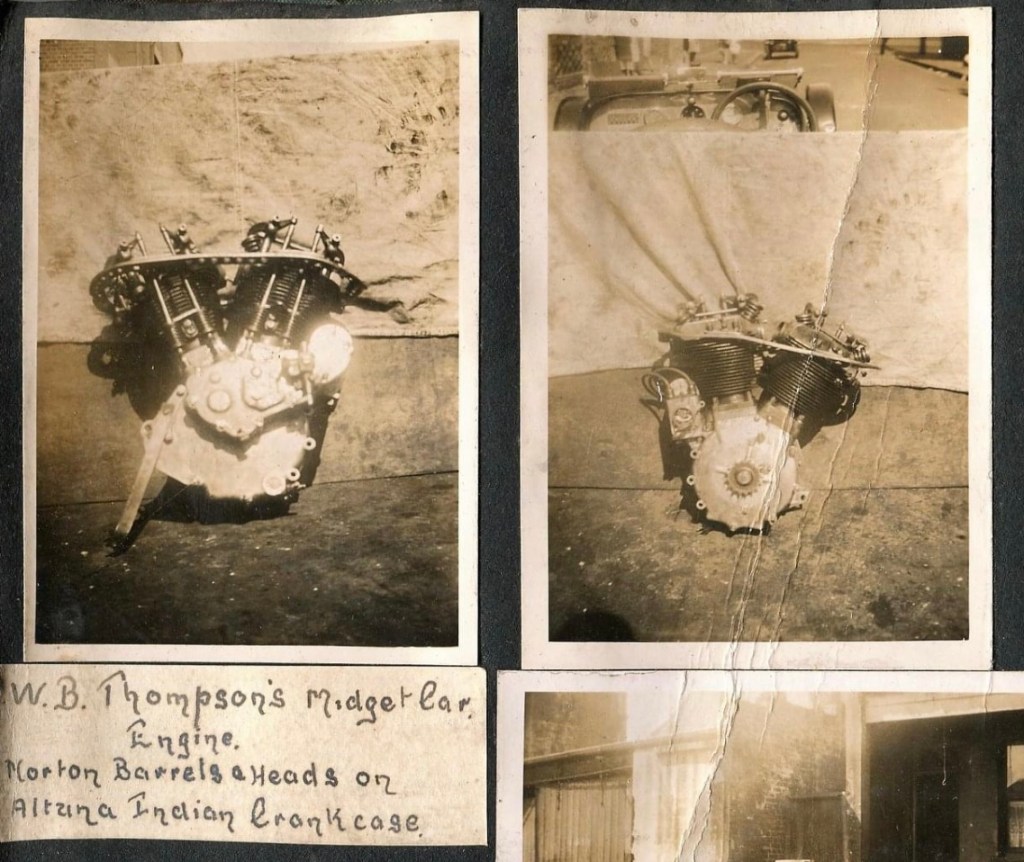
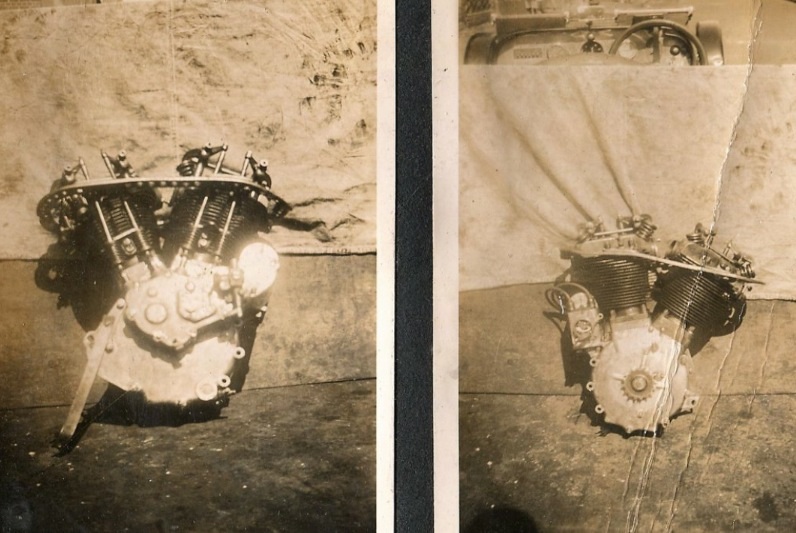
The publication of a good photograph of the Altoona racing engine taken by mechanic Fred Pearse, and published on Bob Williamson’s Old Australian Motor Racing Photographs Facebook page by Peter Reynell, piqued my interest.
It’s unsurprising that the Chamberlains chose an Indian engine for their beloved Beetle, from the businesses incarnation Indian was innovative and used motorsport to develop the product and build their name, they finished 1-2-3 at the Isle of Man TT in 1911.
John Medley picks up the story (in the article linked above) “The car’s first engine was a big-valve Daytona Indian motor cycle unit. In this form, the road registered car covered thousands of miles but trouble was experienced with the valve gear.”
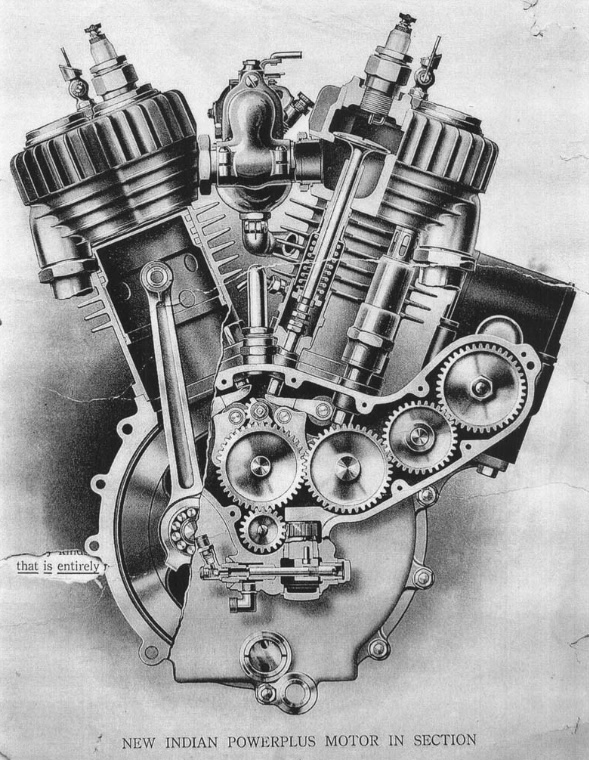
In April 1920 a 998cc side-valve, Vee-twin Indian Powerplus ridden by James McBride achieved a top speed of 99.25mph on the Daytona Beach course. The race versions of the Powerplus motor subsequently became known as the Daytona, throughout the 1920s various configurations of factory racers were built around this record setting engine.
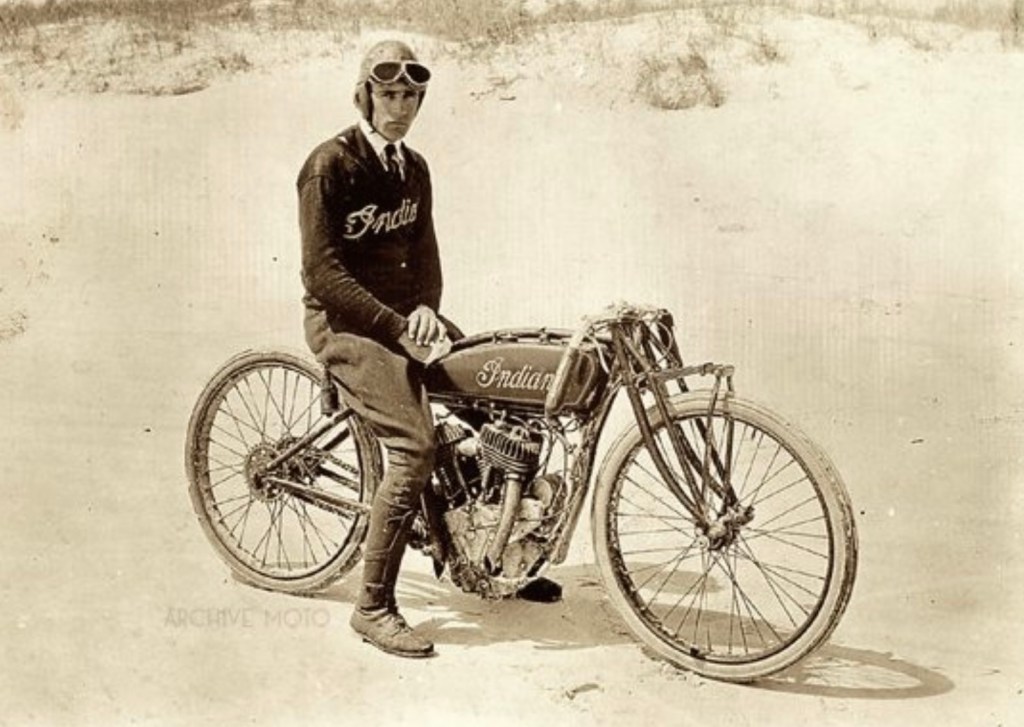
Gene Walker on a factory Indian Powerplus 61cid, at Ormond Beach, Daytona in April 1920. Walker and fellow rider Herbert McBride collected 24 US and international records on this sortie to the Daytona speed coast. “Walker performed so well onboard his newly configured side-valve machine – with its distinctive finned exhaust ports seen in this photo – that the setup became known as the ‘Daytona’ motor, a legend in American racing circles” wrote (archivemoto.com)Indian Powerplus 1-litre side-valve Vee-twin cutaway. Designed by Charles Gustafson and refined and developed by Charles Franklin (unattributed)
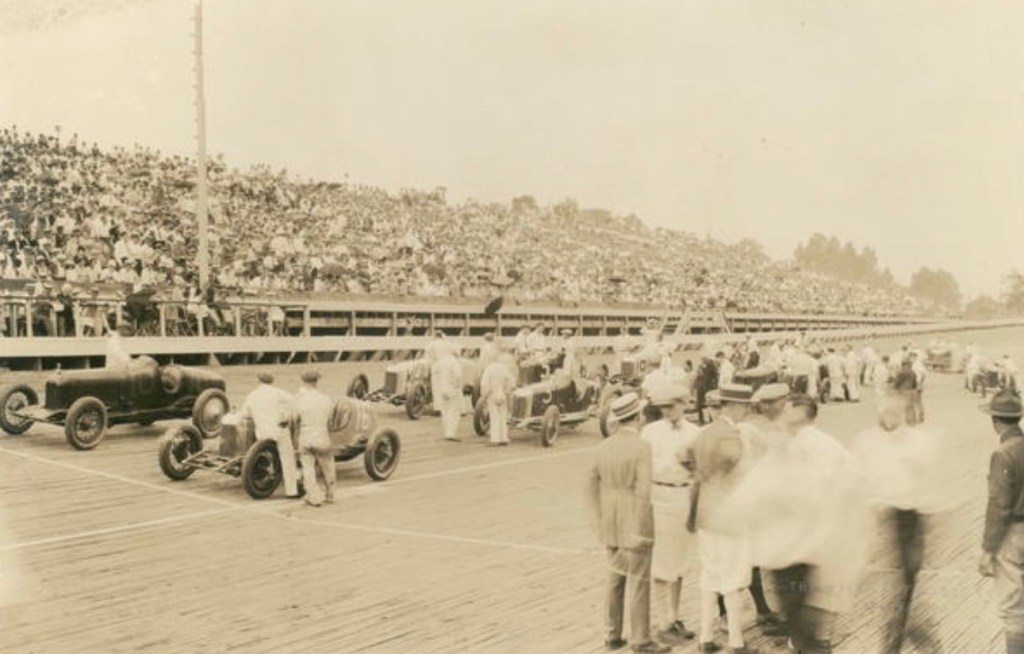
The Altoona Speedway was a 1.25 mile board track at Tipton, near Altoona, Pennysylvania which was home to the national championships in the 1920s, winning there was a big deal.
Indian’s designer, Charles Franklin – Irish road-racer and Brooklands tuner who discovered the ‘squish-effect’ in combustion chambers 10 years before Harry Ricardo – inherited a new 61cid side-valve engine from his predecessor, Charles Gustafson, which he turned into a race engine (there were also eight valve and 45cid variants) to take on the best at Altoona. The engine incorporated timing gears and crank carried on self-aligning ball-bearings, two oil pumps, removable heads and twin up-draught Zenith racing carbs.
With the new engine – still mounted in a 1920 spec board-racing frame – Curley Fredericks lapped Altoona at 114mph in a July 1926 race, the highest speed ever recorded on a circular board track. On Hampshire’s 1.25 mile board track that August he did 120.3mph, the fastest speed ever recorded on the boards. These unique race venues vanished soon after when the sanctioning bodies and manufacturers withdrew their support given safety and maintenance issues, so Frederick’s record still stands.
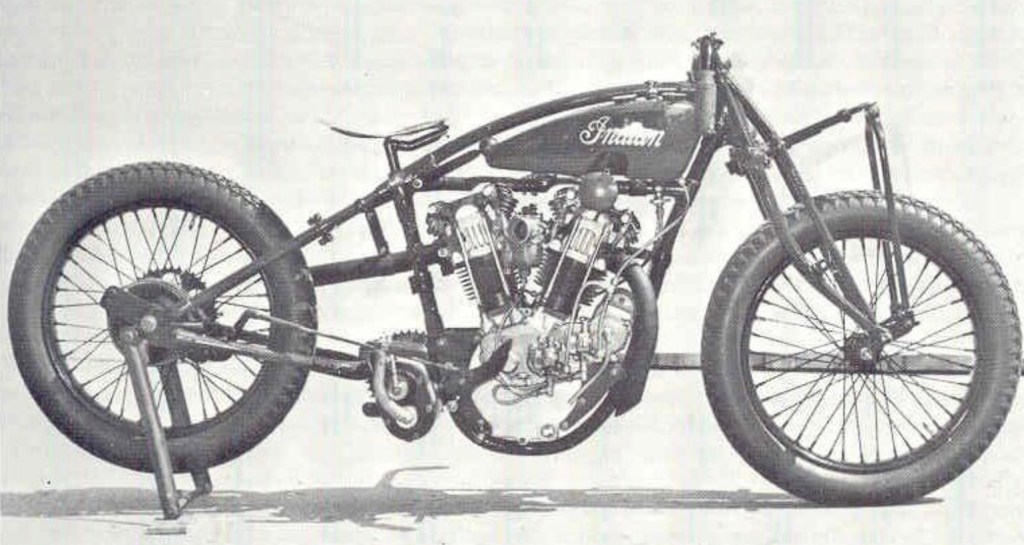
Of course it wasn’t long before Indian applied the Altoona name to its 1926-28 factory side-valve racers. The engines were used in disciplines other than board racing, including hillclimbs and drag racing
Indian Altoona 8-valve racer (unattributed)Altoona Speedway, grid of the Fall Classic in September 1924. Front left Ernie Ansterburg, Duesenberg, #16 Ray Cariens, Miller and #3 Bennet Mill in another Miller. Four Indy winners contested this race – look at that crowd! – Tommy Milton, Jimmy Murphy (who won the Classic), Joe Boyer and Peter DePaolo (Paul Sheedy Collection via firstsuperspeedway.com)Indian factory rider, Paul Anderson (who raced in Australia over the 1924-25 summer) aboard a 500cc, four-valve, single-cylinder 1924 road racer at Montlhery in 1925. Frame is “a full-loop design like Indian’s board-track racers, and a front brake 3 years before other Indians got them,” wrote The Vintagent (Bibliotheque Nationale de France)
To promote the opening meeting of John Wren’s Melbourne Motordrome (aka The Murder Drome and Suicide Saucer on the Olympic Pool/Collingwood FC site) in November 1924 the promoters imported four top US stars and their bikes; Paul Anderson and Johnny Seymour on eight-valve Indians and Ralph Hepburn and Jim Davis on Harleys.
Ultimately the Harley duo rode borrowed Douglas twins when their machines failed to arrive on time. In the solo-final Seymour and Hepburn dead-heated. The Indian riders had a successful tour albeit Seymour (later an Indy racer) broke a leg at one meeting. Among his successes, Anderson won the 10-Mile Solo under-500cc NSW Championship in January 1925, and did a record-breaking 125mph over a half mile on Adelaide’s Sellicks Beach. Anderson won so many scratch races on the Melbourne Motordrome that the promoters abandoned scratch events and ran handicaps!
When the Chamberlains were looking for greater performance they turned to “A motor (500cc, eight-valve, V-twin) of novel design, using an Altoona Indian crankcase, originally used by the famous American, Paul Anderson,” The Sun, Sydney reported.
“The cylinders were scrapped and 588cc overhead valve Norton cylinders and cam gears and two carburettors were fitted, and the compression ratio raised to 10:1.”
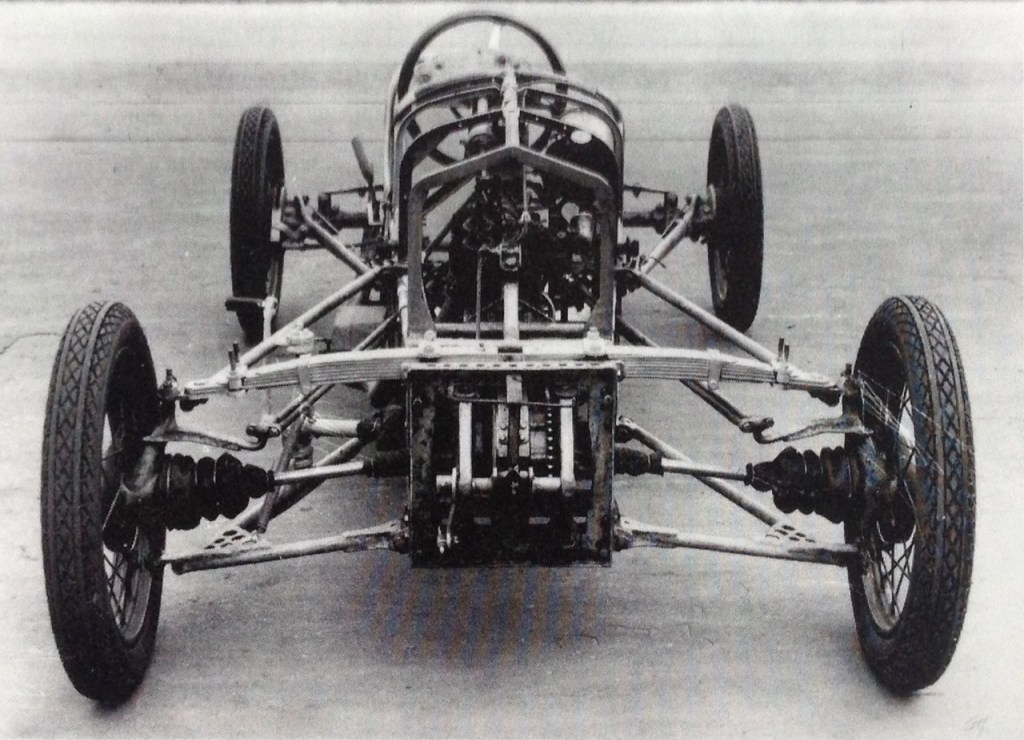
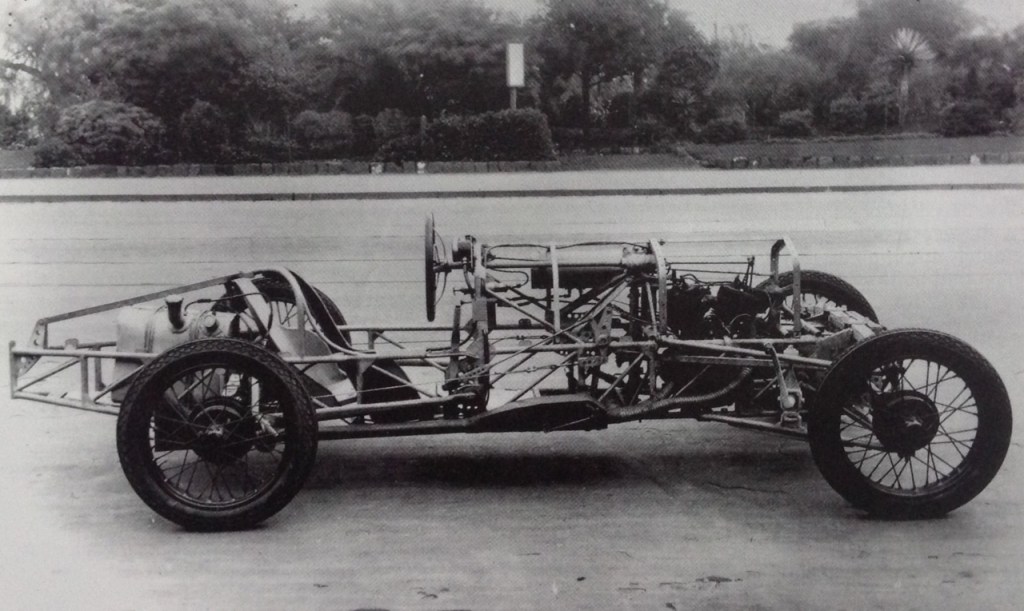
Chamberlain Indian front shot shows front-wheel drive, with CV joints made in-house. IFS by top leaf spring with locating radius-rods, wide based lower wishbones. Hartford friction dampers not fitted in this shot. Gearbox (in house) and chain-drive clear as is the tiny size of the car. Brakes are inboard drums (The Chamberlain)Chamberlain Indian circa 1929, light multi-tubular spaceframe chassis as per later 1950s and onwards practice…(The Chamberlain)
John Medley continues, “The car now became quite competitive, particularly in sprint events, easily holding the Wheelers Hill (in outer Eastern Melbourne) record for example. It ran in the numerous sprint events run by the Light Car Club of Australia, Junior Car Club and the Royal Automobile Club in Victoria during the period, as well as circuit races at Aspendale (inner Melbourne bayside suburb) and Safety Beach (holiday destination on Melbourne’s Port Phillip Bay).”
“Entered three times for the AGP at Phillip Island, the car was not successful. At the first attempt (1931) a piston seized due to the alloy being unsatisfactory, so the car did not start. By the following year the Chamberlains had made their own pistons from ‘Y’ alloy and the car completed practice without any troubles. In the race it only lasted 3 laps, when a crankpin broke.”
“Bob had trouble recalling a third attempt at the Island but checked his records and found that the car was indeed entered and listed as supercharged, although he is sure the car did not actually race in this form. Bob says that the blower was fitted to the Indian motorcycle engine and the compression lowered in the hope of improving big-end bearing life. It didn’t work out that well but this two-cylinder supercharged engine powered the car at several meetings at Melbourne’s Aspendale Speedway as well as a number of hillclimbs, with some success.”
“Then, in 1934, in Bob Chamberlain’s first attempt at Mount Tarrengower, the car crashed not too far from the site of (Australian Hillclimb Champion) Peter Holinger’s Holinger Repco V8 1977 accident. It has been said of Mount Tarrengower that if you make a mistake you have to fight for airspace with the pigeons. Bob Chamberlain was saved from that battle by a stout tree, which he scored at top speed just beyond the finishing line.”
It is at that point that Bob Chamberlain departed overseas and Bill Chamberlain set to work on construction of the Chamberlain 8 that Bill Thompson enters the picture.
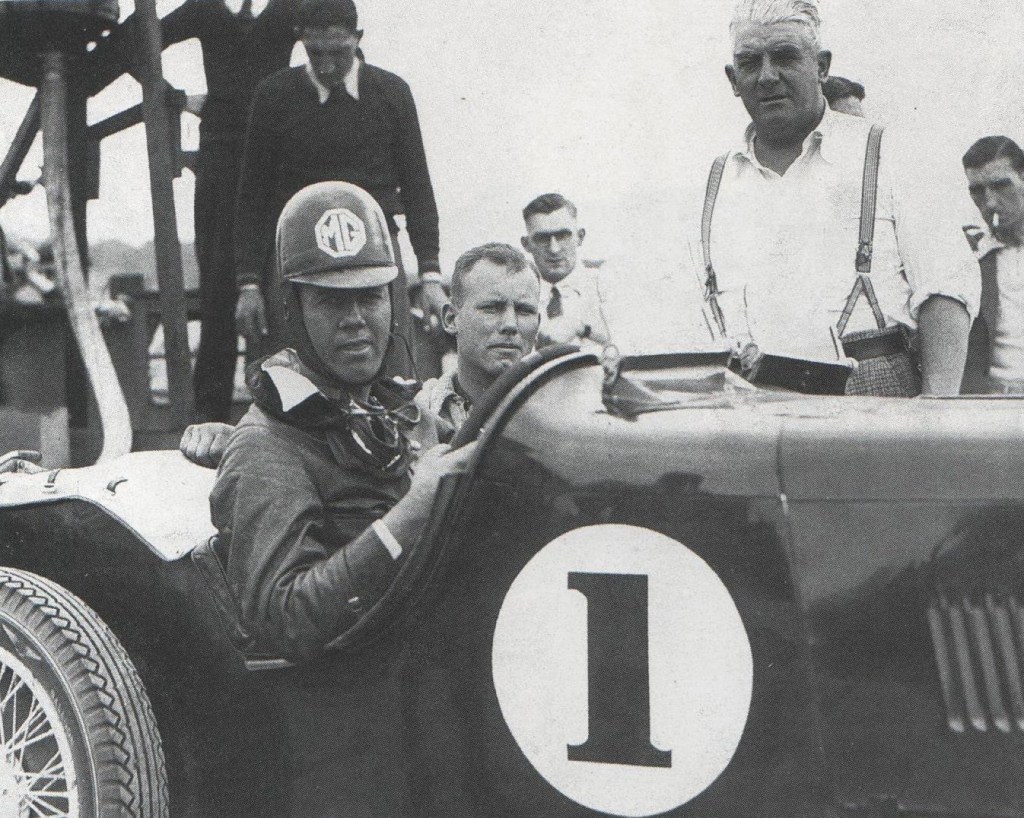
Bill Thompson and Bill Balgarnie in the Lanes Motors MG K3 during the 1935 AGP weekend at Phillip Island. The pair finished a close second off scratch in the handicap race (B Thompson Collection via B King)
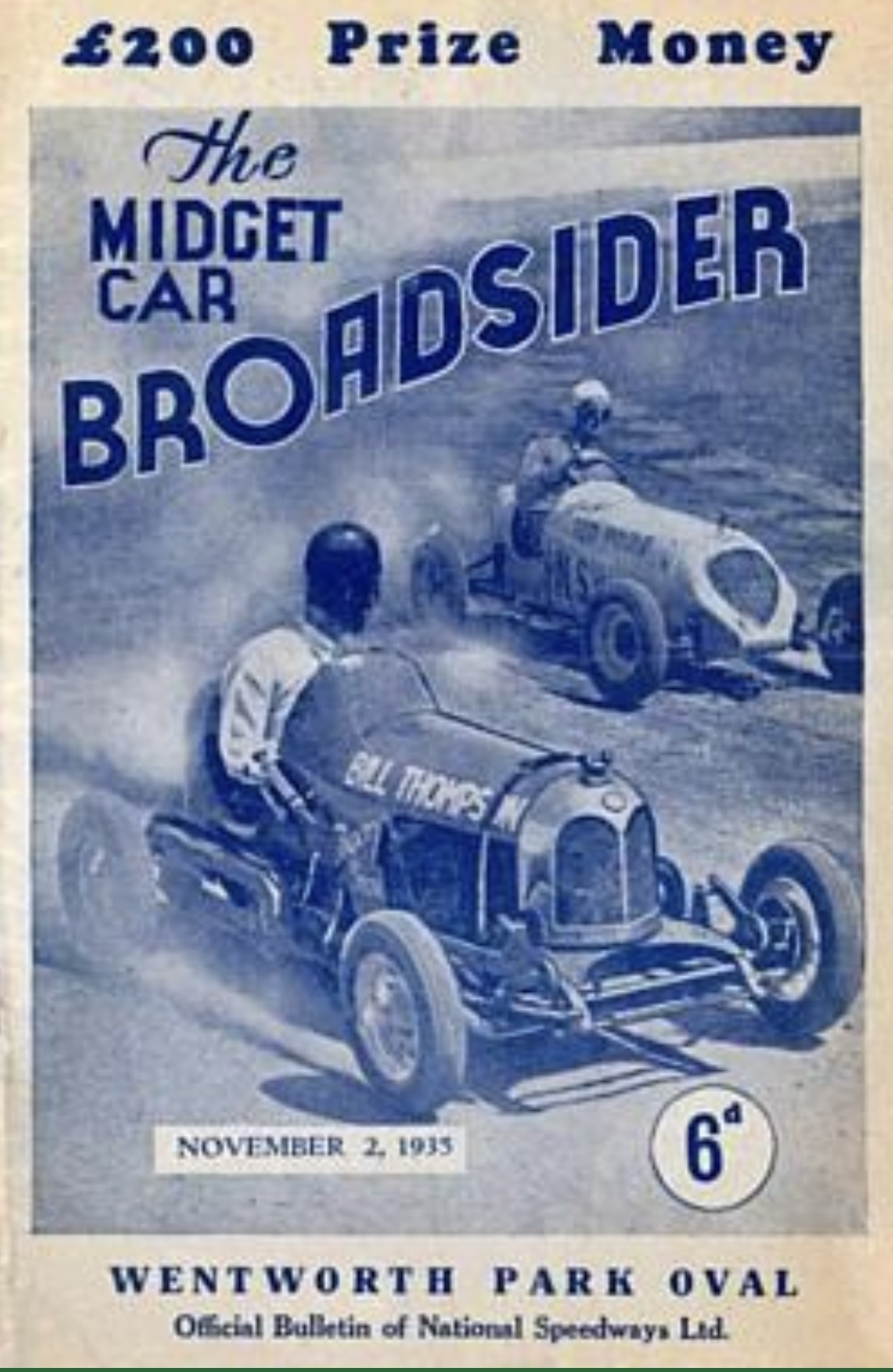
Thompson had won the Australian Grand Prix thrice, aboard the same Bugatti T37A in 1930 and 1932 and racing a Brooklands Riley in 1933. He was regarded as the best of his generation. By 1935 he had retired from road racing, but was perennially short of cash so decided to compete in the nascent sport of midget speedway racing, an activity which dovetailed nicely with his recent appointment as managing director of National Speedways Ltd.
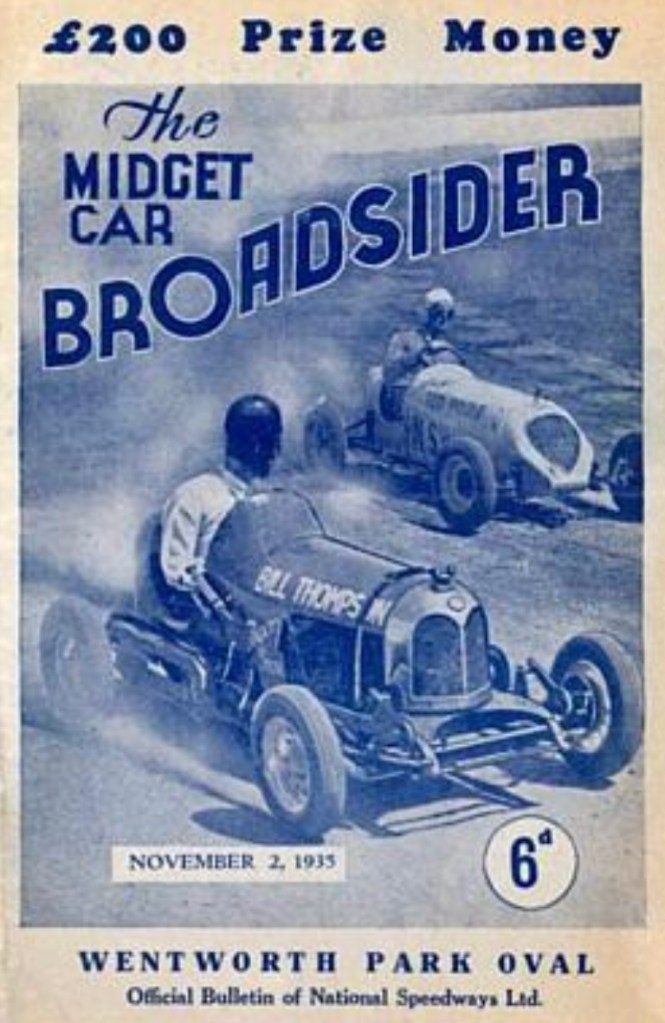
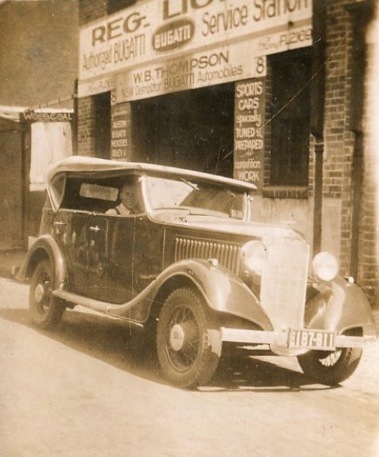
In need of a car, Thompson convinced Lanes Motors – Melbourne dealers of Morris and MG amongst others – where he was head of the MG department, that midget racing would provide great exposure for their products on tracks at Sydney’s Showgrounds and Wentworth Park, Penrith, Newcastle and the Olympic Park Melbourne.
He concepted his ‘No 1’ machine, the Altoona Indian powered Lane Special to be powered by the light, potent, proven Altoona Indian-Norton engine. Built in Lanes’ racing department in South Melbourne the car “has a clutch and speed (sic) gear box and the chassis, steering axles, brakes etc built up from Morris Minor and MG parts,” The Sun recorded.
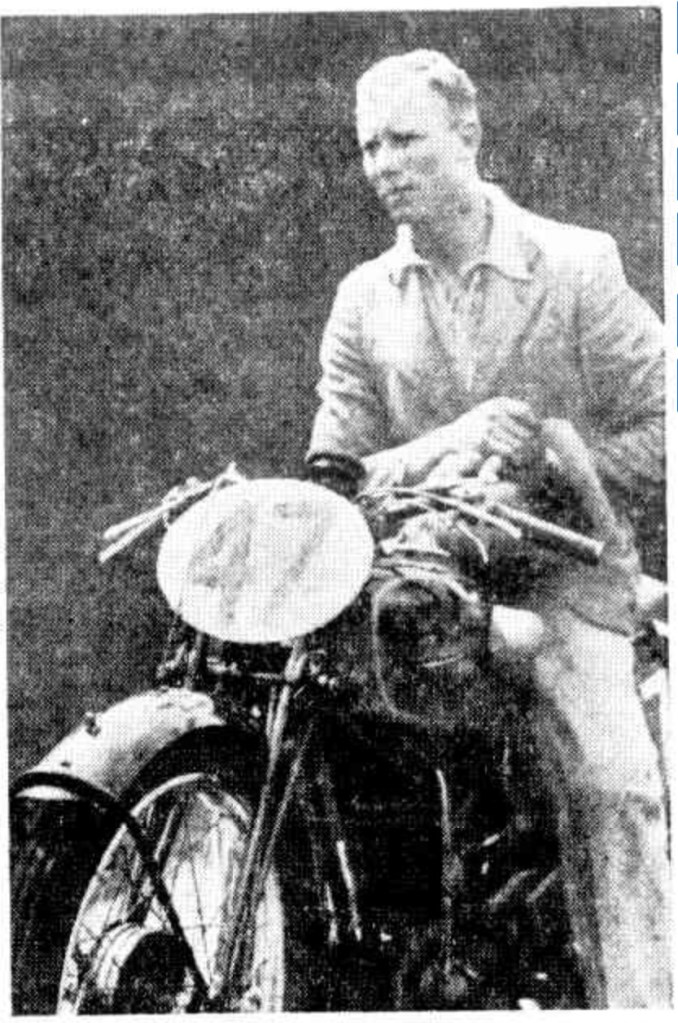
Australian international motorcyclist/master mechanic, Wilfred ‘Bill’ Balgarnie – who had represented Australia at the Isle of Man aged 22 in 1934, finishing 13th on a Velocette 350 in both Junior and Senior TTs – was also involved in the construction of the car. Balgarnie accompanied Thompson as riding mechanic in two of his AGP wins and in many of his major races.
Balgarnie worked on Bill’s car and on a P-Type MG which was to be adapted for midget competition and raced by him. The 845cc engine was retained and modified, while the body was streamlined and lightened, the engine/transmission lowered, and mandatory 12-inch by 4-inch wheels fitted.
The Bill Balgarnie modified MG P-Type Midget – there cannot have been too many MGs raced globally as dedicated dirt speedway machines?! – with Bill Thompson up, chassis number folks? Note the Lane Special at rear. Given the backdrop, Wentworth Park, Sydney I think (B Thompson Collection via B King) Bill Thompson, Lane Spl Indian Altoona, and Ted Poole at Wentworth Park, Sydney in 1935 (vintagespeedway.com)
By August ’35 Thompson’s equipe also included Bob Findlay’s Midget. Balgarnie had performed so well in the P-Type Spl that Thompson acquired a better car for him, with which he was formidable throughout 1936-37.
The Sun reported in November 1935 that Thompson had a successful season (February to May) in Victoria but “has been disappointed with the Lane Special’s performance since its arrival in Sydney.” Thompson consulted with “famous speed merchant Ron MacKellar (Sydney Ford dealer and racer/engineer)” to dismantle the Altoona Indian engine to recondition it to find the 70bhp of which the motor is capable.”
When fitted to the Chamberlain “it has been credited with lapping Phillip Island at 78mph, “only 6mph below the official lap record. It was timed over the mile there at 103mph.”
While Thompson’s speedway record is said to be ‘undistinguished’, I’d like to record his results if any of you have ready access to Kent Patrick’s biography of Thompson. Time I bought it.
Finally, what became of that rather special engine I wonder…
Bill Balgarnie aboard his works-Velocette “waits to hand in his gear on the eve of the Isle of Man event” in 1934 (Western Mail)
Etcetera: Bill Balgarnie…
I was aware of Bill Balgarnie as a talented mechanic/riding mechanic but not his own record as a racer on two wheels and four.
Some Troving (Trove is an Australian newspaper digital archive) reveals that Bill was as much of an ace in a car as he was on ‘bikes, including countless midget wins, victory in the 1937 NSW State Midget Championship in front of 25000 spectators at Penrith and much more.
A Western Mail, Perth article about him published in March 1951 helps fill in the gaps, I’ve paraphrased it and added some other tidbits.
Born of parents who lived in Bowral, he first became interested in motorcycle racing when he left school in Sydney, competing in road races around Sydney and at Bathurst.
By 1934 he was one of the leading riders in NSW and was chosen to represent Australia at the Isle of Man. When he arrived in the UK, Velocette made a 350cc bike available for the races contested by 80 riders including the champions of England, Germany, Spain and France.
While the going was tough, the bike performed faultlessly and he averaged 74mph to finish 13th, and first visiting rider home. In so doing he won The Motorcycle Visitors Cup and received a replica of the Senior TT Trophy for recording one of the races’ fastest times.
The Junior TT was held the following day, “A terrible day, very foggy and wet and on parts of the course, visibility was very limited. I must confess I was pretty anxious about that ride, but again the machine went without a hitch and averaged about the 70 mark.” He was again 13th on the 350.
Afterwards he toured England for several months and for a period received specialist training at MG. He visited Brooklands and did a trial lap on a borrowed bike at 97mph, just missing out on the Gold Star awarded for laps of 100mph and over.
Then it was off to the Belfast TT, then France for an “international car race”, and finally Milan for a tour of Alfa Romeo before returning home to Australia late in 1934.
Balgarnie was immediately back in the fray, using his tuition at Abingdon to prepare and act as riding mechanic aboard Bill Thompson’s Lanes Motors entered MG K3 Magnette in the Centenary 300 at Phillip Island, the longest race for “purely racing cars” in Australia in January 1935.
In a winning position from scratch, and on-the-hop, Thompson sought to pass another competitor on the outside at Heaven Corner on lap 12, slid, then ran out of road as he corrected, crashed into a scoreboard and rolled. Thompson escaped with facial injuries but Balgarnie’s chest was crushed, “which kept him from work for several weeks.” The perils and stupidity of allowing riding mechanics…
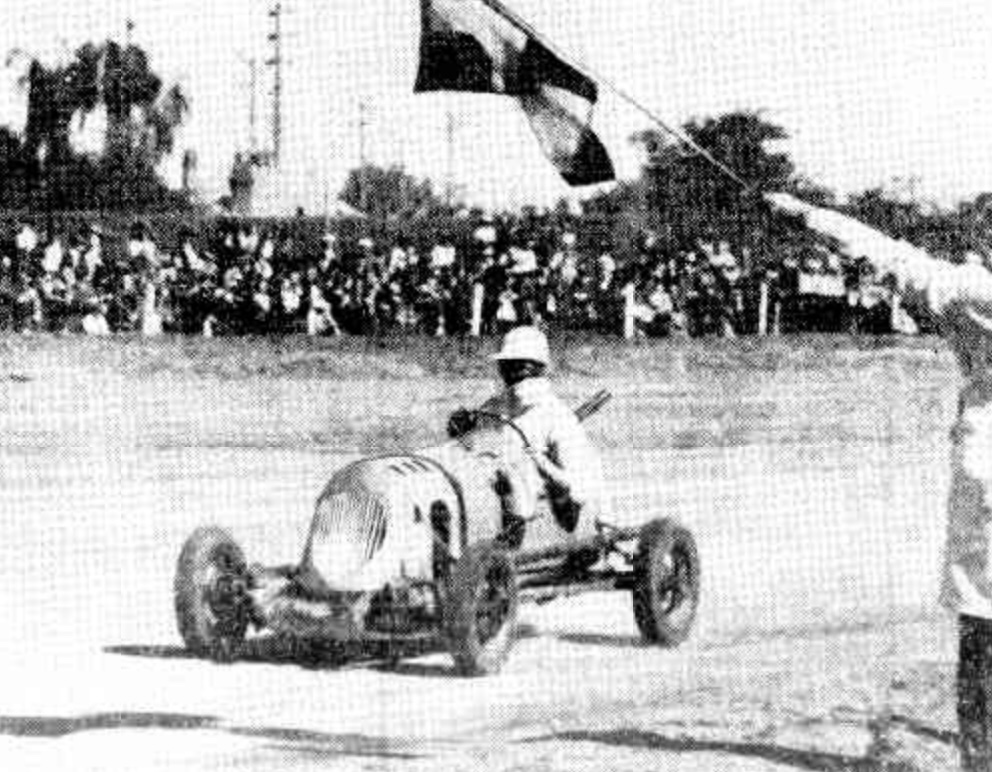
Balgarnie takes the chequered flag to win the 1937 Australian Midget Championship at Penrith New South Wales. Make of chassis and engine would be a bonus? (Western Mail)
By 1936 Balgarnie was back in Sydney to race and running a servo in Rushcutters Bay, in addition to “dabbling in wrestling to develop his strength”!
The Australian Midget Car Championship and Five Miles Amateur Car Championships followed at Penrith in April 1937, and shortly thereafter a major accident when a fellow competitor stalled right in front of him at the Sydney Showgrounds. “It was too late to avoid him, I crashed into his back axle, looped the loop and turned over three times. After that I can’t remember a thing, I was out to it for three days.” He recovered quickly despite a cracked skull, broken arm and injured thumb.
Showing that he wasn’t at all phased by the accident Balgarnie won his class driving Ron MacKellar’s MacKellar Spl s/c at Waterfall Hillclimb in late August.
In February 1940 he married Pauline Laidley at Double Bay, the bride was given away by Ron Mackellar in a large wedding. In the early 1940s he joined the armed services but returned to competition with a couple of hill-climb drives aboard the Chamberlain 8 in 1946.
By then employed by the Chamberlains, Balgarnie was promoted to the position of works manager for Chamberlain Tractors whose manufacturing facility was in Perth. At the time of the Western Mail interview he lived in Dalkeith Road, Nedlands.
The Chamberlain 8 with the first of the Chamberlain tractors in 1946 (Cars and Drivers)
Balgarnie Snippets…
In the 1930s, the Midget racing season ran from November to May
Balgarnie rebuilt the Jack Jones/Mrs JAS Jones Alfa Romeo 6C 1750 Zagato SS after it was “completely burned out” in 1933. “Used as a hack for many years,” Jack Jones set second fastest time of the day in the May 1937 Canberra Speed Trials at 102.2mph over the standing quarter mile, “Which speaks well for the skill of the mechanic who rebuilt the car and was mainly responsible for its performance in Canberra,” the Sydney Referee reported. Frank Kleinig’s supercharged Miller powered Kirby Deering Special was quickest at 116.9mph.
In December 1935 Balgarnies speedway midget was reported to be equipped with “BSA overgear and an Altoona crankcase.”
In a 15 August 1935 Sydney Referee news item about the upcoming 1935-36 “season in Melbourne there will be at least 24 drivers available when the Olympic Park track reopens again” with the “big shots” among them “Bill Thompson, Bob Findlay, Bill Wilcox, Barney Dentry, George Beavis, Les Gough, Ern Day, Fred Curtis, Joe Parmeley, Bill Allan, Bill Balgarnie, Arch Tuckett, Arthur Higgs and Sid Gowar.”
Percy Hunter with JAS Jones aboard the Jones family Alfa Romeo 6C1750 SS Zagato at Gerringong Beach New South Wales in 1930 (A Patterson)
Credits…
artomobile.com.au, ‘The Chamberlain’ John Hazelden, ‘Chamberlain Australian Innovator’ Bruce Lindsay, thevintagent.com, The Sun Sydney November 1, 1935, various 1934- newspapers via Trove, The Vintagent, Bibliotheque Nationale de France, archivemoto.com, Paul Sheedy Collection via firstsuperspeedway.com, Bill Thompson Collection via Bob King, Cars and Drivers, vintagespeedway.com, Adrian Patterson Collection, Daniel Statnekov Collection, Getty Images, silhouet.com
Tailpieces…
(D Statnekov Collection)
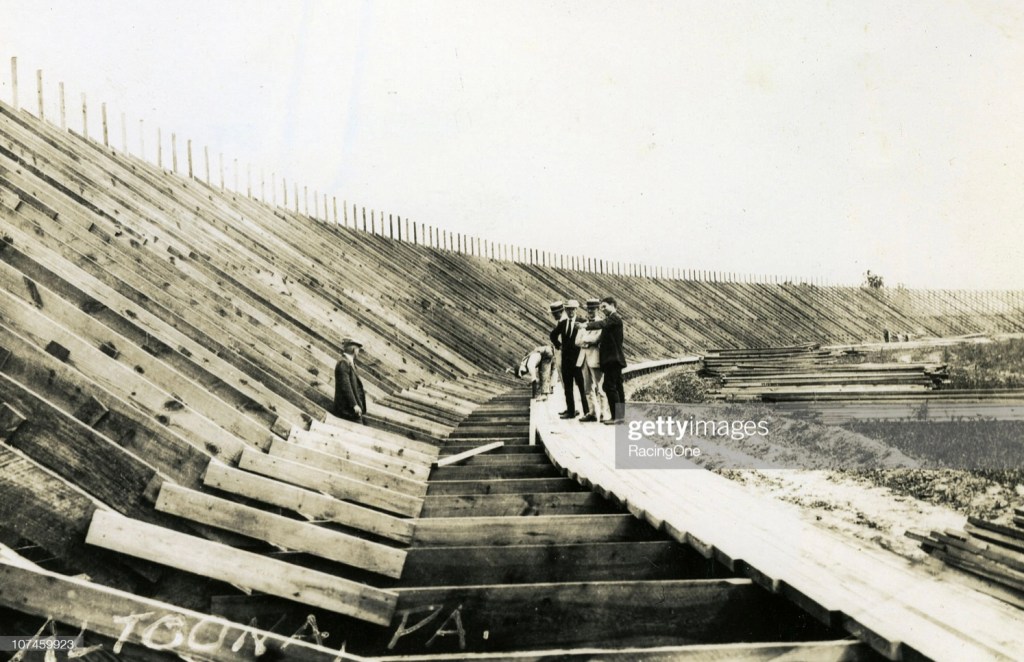
Now, where did I put my hammer? The engineering and construction challenge, and ongoing maintenance, were considerable! Dated by Getty as 1950, but lets call it 1922.
Altoona Speedway was built at Tipton, 20km north of Altoona, Pennysylvania as a 1.25-mile timber-oval with corners banked at 32-degrees, by entrepreneurs Jack Prince and Art Pillsbury.
It operated between September 4, 1923 and September 7, 1931, then was destroyed by fire in May 1936. In 1935 an oiled-dirt oval was built on the site, then post-war, a quarter-mile track opened on the infield, it held meetings until 1952. Industrial buildings now occupy the site.
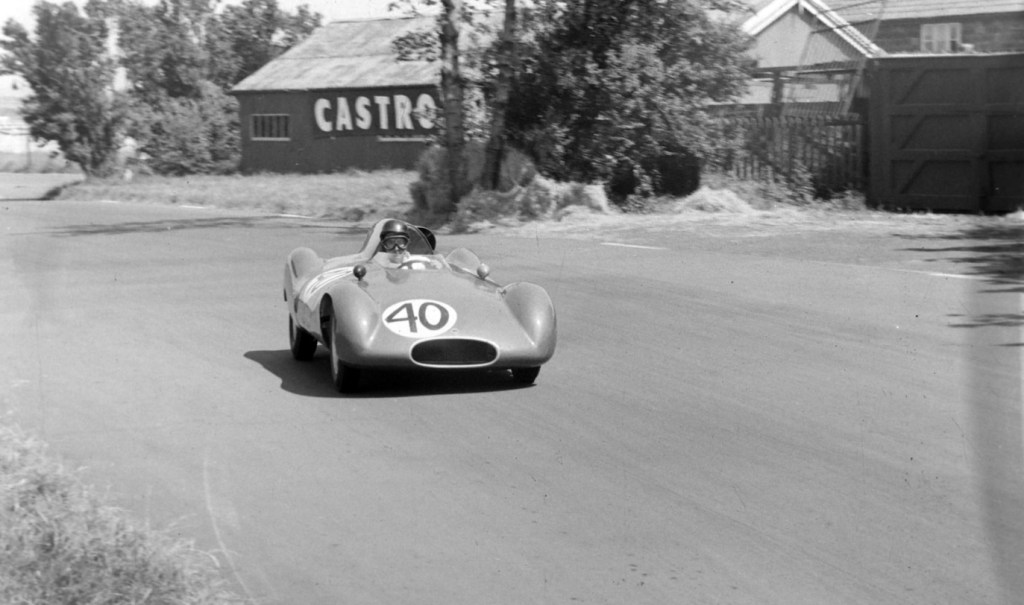
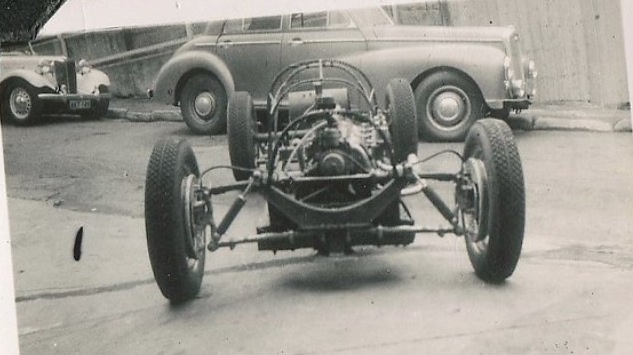
So, with John’s support, he helped himself to the stock of components on the Surbiton shelves and built himself a 50mm longer-wheelbase GP Cooper. It was only 2-litres, despite the oft-quoted 2.2-litres, so Jack was giving away a half-litre in capacity to the more sophisticated twin-cam, 2.5-litre opposition.
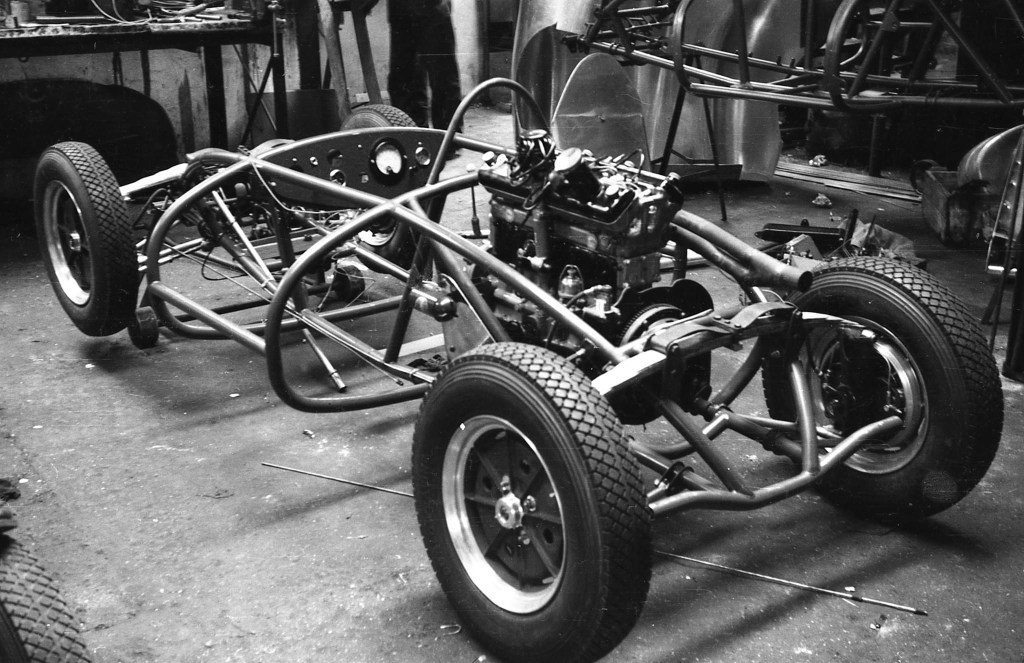
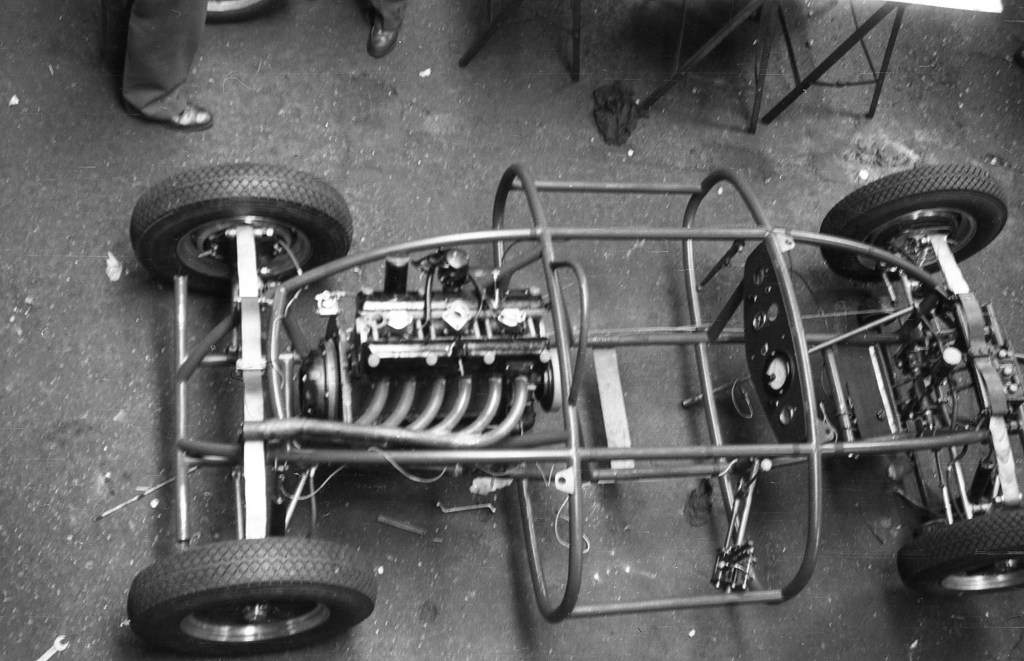
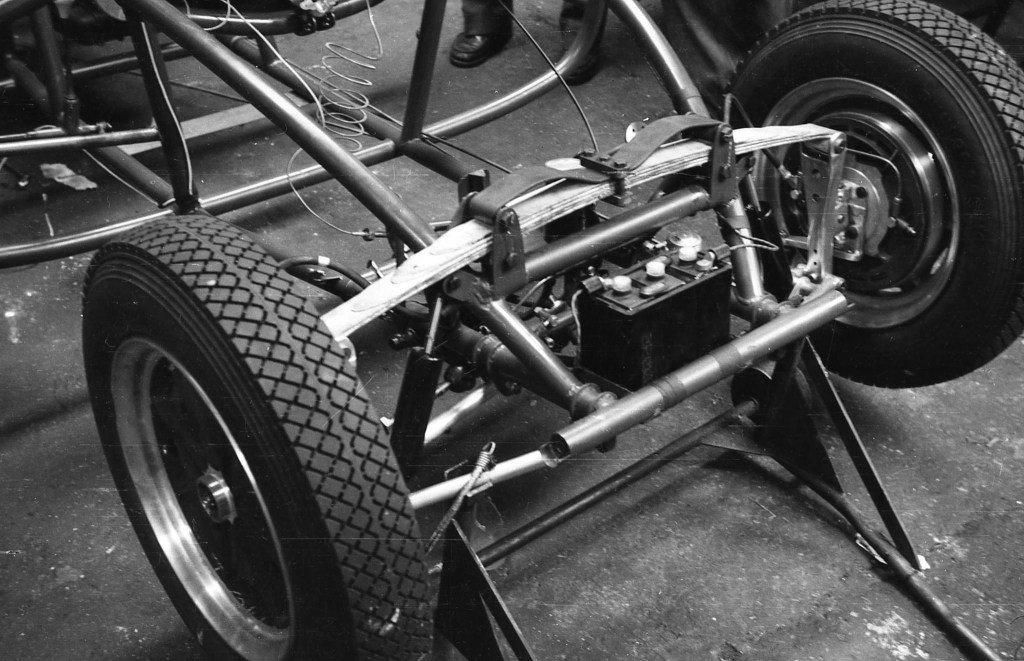
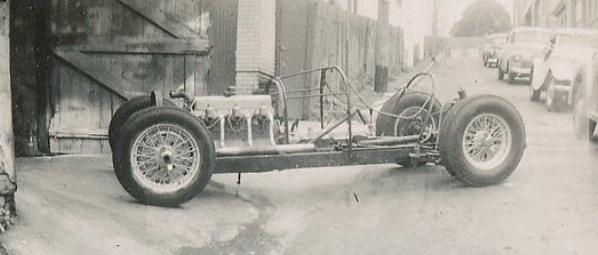
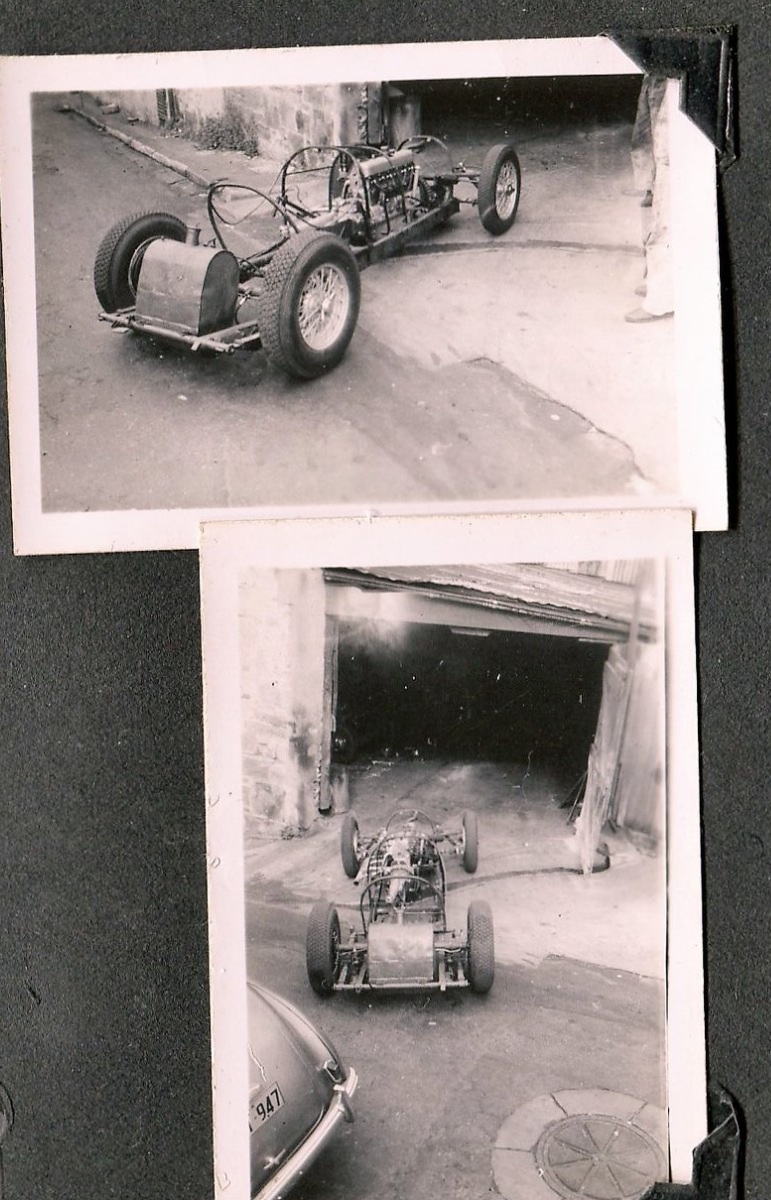
The key elements of the car are shown by three photographs taken by Australian mechanic, Fred Pearse, who spent that summer in Europe tending Aussie, Dick Cobden’s ex-Peter Whitehead Ferrari 125. I wonder if Fred helped Jack with the build of the Cooper, christened Type 40?
(F Pearse)
No way was Cooper designer Owen Maddock’s hula-hoop chassis drawn from his Kingston Technical College engineering course, but was more likely inspired by the organic forms of brilliant Catalan architect/designer Antoni Gaudi. Remember, you read it here first: La Sagrada Cooper has a nice ring to it, n’est-ce pas?
(F Pearse)
Technical specifications of the Cooper T40 as per the feature article linked above. I know the engine isn’t plumbed and still awaits its Citroen-ERSA transaxle, but the sheer economy of a moteur mounted mid-ship is readily apparent.
(F Pearse)
Unsurprisingly the car ran late, so Jack had no time to test it before Aintree. He qualified at the back of the grid and failed to finish after clutch problems in the race memorably won by Stirling Moss. It was his first championship GP victory, aboard a Mercedes Benz W196.
The ’55 British was the only F1 GP the Cooper contested, but Brabham took in a number of non-championship F1 races in the UK before the car was shipped to Australia where it won the that year’s Formula Libre Australian Grand Prix at Port Wakefield, South Australia.
The works-machine first contested the London Trophy at Crystal Palace on July 30 where Brabham was third in his heat behind Harry Schell’s Vanwall and Paul Emery’s Emeryson Alta, but didn’t start the final.
Then it was off to Charterhall in Scotland for the August 6 Daily Record Trophy. Jack was fourth on the grid, fourth in his heat, and, you guessed it, fourth in the final, behind the Maserati 250Fs of Bob Gerard, Horace Gould and Louis Rosier.
(F Pearse)
With time for one more event before shipment to Sydney, the Cooper was entered for the 25-lap RedeX Trophy at Snetterton (above) on August 13. Jack was way back on the grid, but again finished fourth behind the Vanwalls of Harry Schell and Ken Wharton and poleman, Stirling Moss, aboard the family Maserati 250F. Despite giving away plenty of power, T40 #CB-1-55 was plenty quick, Jack was out fumbled by Moss but finished ahead of three Maseratis – two 250Fs and an A6GCM – as well as a swag of Connaughts.
There seemed to be as promising a future for water-cooled, mid-engined Coopers as their air-cooled mid-engined siblings…
Credits…
Fred Pearse photographs via Peter Reynell, MotorSport Images, gnooblas.com
Tailpiece…
(gnooblas.com)
On the grid of the 27-lap, 100-mile, January 1956, South Pacific Championship at Gnoo Blas, Orange, New South Wales.
The little Cooper was again blown-off by a Maserati 250F, this time Anglo-Australian Reg Hunt’s machine, Brabham was second, with Kevin Neal’s Cooper T23 Bristol in third place.
One of the amazing things about the internet is the manner in which information is shared, not least photographs from collections which would otherwise never have seen the light of day…
Fred Pearse is one such person who was “an insider enthusiast, a decent man who spannered cleverly for over two decades, here and overseas,” according to Australian racer/historian John Medley.
In the photo above Fred is fettling Dick Cobden’s ex-Peter Whitehead Ferrari 125 V12 s/c prior to the South Pacific Championship at Gnoo Blas, Orange in January 1955.
Peter Whitehead won on that particular weekend driving a Ferrari 500/625. See this feature article, largely containing Fred’s photographs, which should be treated as Fred Pearse Collection 1; 1955 South Pacific Championship, Gnoo Blas… | primotipo…
Peter Reynell was left Fred’s photo albums upon his death having looked after him for the last years of his life. “Fred told me quite a bit, it was all a long time ago, but I clearly recall his pride in Col James’ MG Special, he was involved in that,” Peter recalls.
“Don’t forget his involvement in motorsport administration too. He was Clerk of Course at Bathurst and Amaroo Park, was a member of both the Australian Racing Drivers Club and CAMS NSW Boards.”
Peter has posted photos from Fred’s albums progressively on Bob Williamson’s Australian Motor Racing Photos Facebook page which has become an amazing historic resource given the paucity of photographs on so many Australian racing topics. Thanks to Fred and Lee Pearse, and Peter Reynell.
(Reg Light’s 1934 Vauxhall)
While some of the scans aren’t flash, I don’t want rare photos to disappear without trace into the bowels of FB. In some cases I’m not sure of the car/driver/location but with some input from you lot we should be able to solve the puzzles. Please get in touch if you can assist!
The article is primarily snippets, and more substantively about the 1936 Australian Tourist Trophy at Phillip Island and the 1940 Bathurst GP. In the latter case I’ve drawn upon the race report from Medley’s seminal ‘Bathurst: Cradle of Australian Motor Racing’. In addition to these two meetings there are photos on all manner of topics.
John Medley picks up the threads, “Fred Pearse directly or indirectly was involved with many of Australia’s significant racing cars, ask yourself for example about the Altoona Indian with Norton barrels pictures…probable links back to the original Chamberlain earlier with Altoona Indian power, later vertically opposed four-cylinder eight-piston, supercharged two-stroke (in a front wheel drive inboard-braked spaceframe chassis in 1932.” See here; Chamberlain 8: by John Medley and Mark Bisset… | primotipo…
“WB Thompson’s (below) Midget car engine. Norton barrels and heads on a (1926-28) Indian Altoona crankcase.” (F Pearse)
Bill Thompson and Ted Poole at Wentworth Park, Sydney in 1935 (vintagespeedway.com)
“When speedway was starting in Australia with multiple AGP winner Bill Thomson involved, plus Bill Bargarnie (who did the superchargers on Jack Borretto’s weekes Ford V8 pre-war) and forward to Jack Brabham’s twin-cylinder and Ron Wards’s speedway cars.”
Bob King draws the connections too, “Bill Balgarnie was a Chamberlain employee who later set up the tractor factory in Western Australia for them. He was also Bill Thompson’s riding mechanic and a TT motorcyclist. It makes a lot of sense if the Chamberlain Special Altoona Indian motor found its way into Thompson’s speedway car.”
John Medley again, “Fred Pearse was involved with many of them, as a Reg Light employee and later Peco partner (with Bob Pritchett) and probably in the John Snow/Jack Saywell preparation business (Monza Service in East Sydney) prewar where imported expert ‘Jock’ Finlayson ruined the Saywell Alfa Tipo-B engine – so in time it was lost when war broke out.”
“To extend my previous observations re the Altoona Indian Norton; Jim McMahon was another Sydney-sider who probably looked at Bill Thompson’s/Bill Bargarnie’s work, did several cars himself on speedway and road, produced a Peoples Car postwar (ran the prototype at Bathurst) starred in a film or two and built a side-valve Ford V8 into an OHV motor using motorcycle heads on a Ford block, which, I suspect ended up in the USA in a Lincoln, Nebraska Museum.” wrote Medley.
There are some fragments here rather worthy of follow up with Mr Medley in due course!
(F Pearse)
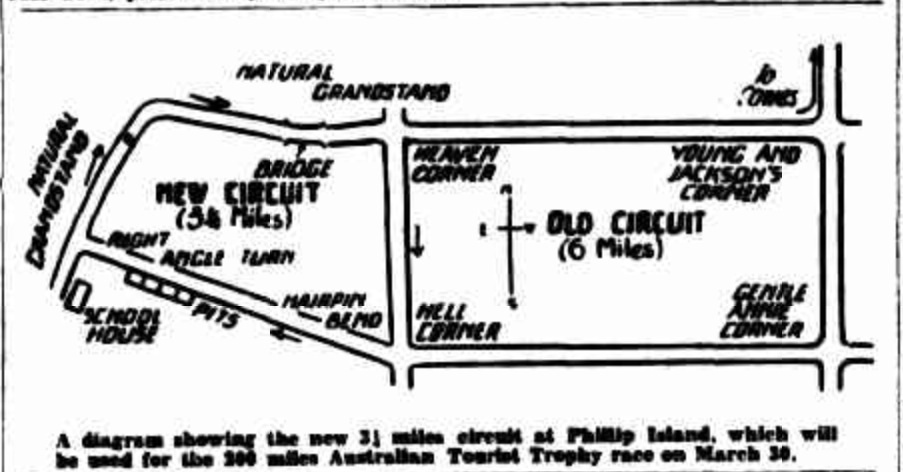
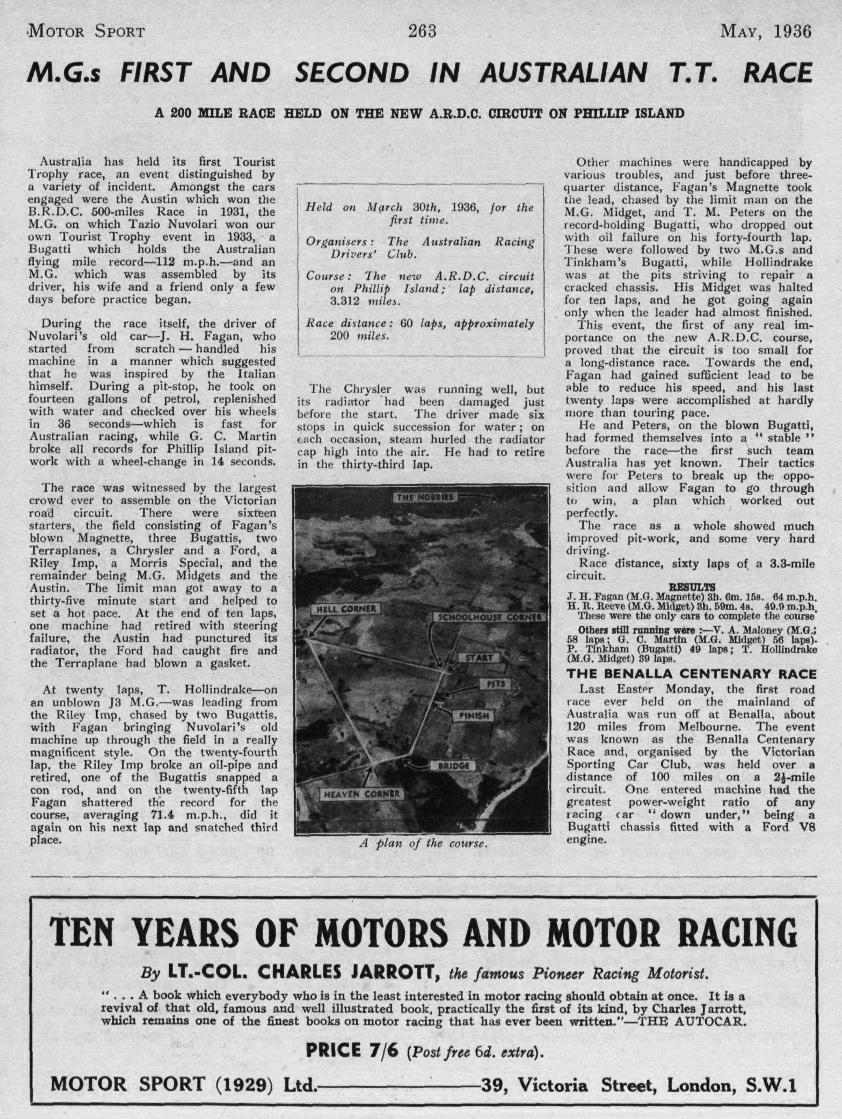
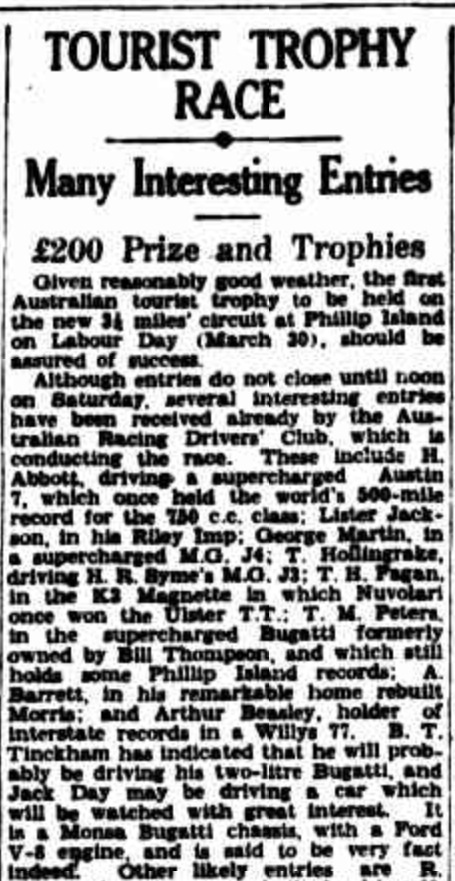
1936 Australian Tourist Trophy, Phillip Island…
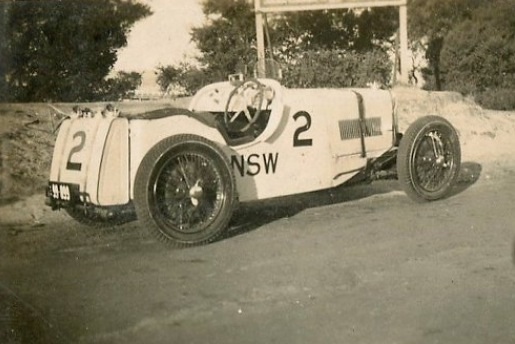
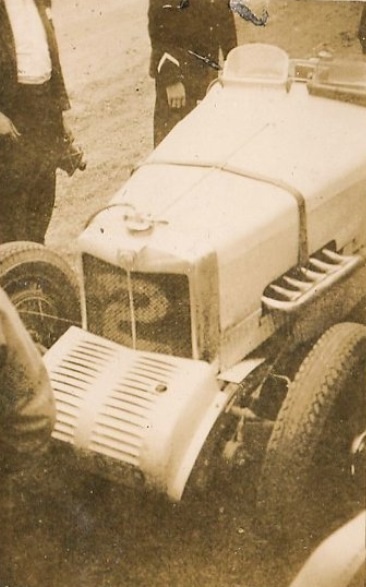
This 200-mile race was held on March 30 and won by Jack Fagan (#2) who also set the fastest time, 3 hours 6 min 15 seconds, or 64mph. Supercharged MG K3 Magnette.
HR Reeve was second in an MG P-Type, with all of the other 15 starters either non-classified or DNFs!
(F Pearse) The caption reads ‘A diagram showing the new 3 1/2 mile circuit at Phillip Island which will be used for the 200 miles Australian Tourist Trophy on March 30’- the map also shows the original circuit since the 1928 100 Miles road race, aka the Australian Grand Prix. Fagan MG K3 (F Pearse)
Fagan MG K3 (F Pearse) (F Pearse)
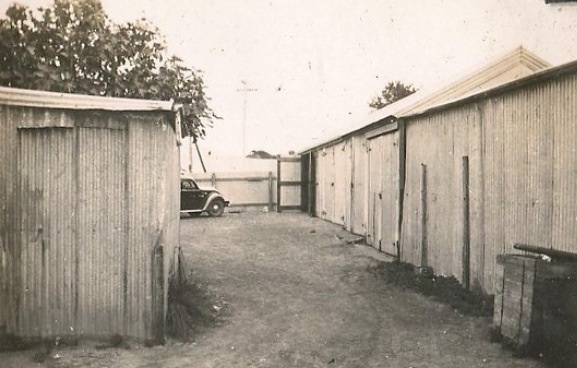
At a guess this is the accommodation for motorcars behind the Isle of Wight Hotel, site now vacant.
Bill Thompson Bugatti T37A (F Pearse) If the shot was taken during the ’36 TT weekend it was riven by Tom Peters
“Supercharged Bugatti, holder of New South Wales Light Car Clubs speed record at 112mph, Canberra 1935, driver WB Thompson,” wrote Fred in 1936.
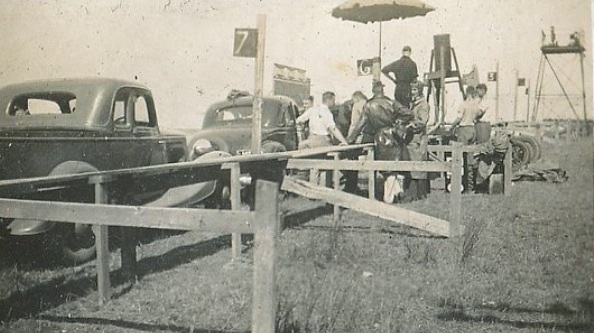
Pit setup for K3 and Bugatti (F Pearse) (F Pearse)
The annual Easter meeting was the last until 1946 with the war now six months old, several of the entrants including John Snow, Delahaye , Charlie Whatmore and Arthur Wylie had joined the military with others to follow so the meeting for many at Applecross, Perth in November 1940 duly noted, was the last hurrah.
L-R: John Barraclough, MG NE Magnette, John Snow, Delahaye 135CS, perhaps Tom Lancey’s MG NE Magnette, and Alf Barrett’s winning Alfa Romeo Monza (F Pearse) Paul Swedberg’s Offy (F Pearse)
The meeting attracted huge crowds despite one of the worst droughts in Australia’s history, petrol shortages and a war which continued to involve greater numbers of Australians.
There were 40 minutes between the backmarker, Alf Barrett, Alfa Monza and limit-man Jolley’s Singer 9 who led the first five laps. An MG T Series battle ensued between French and Nind. Barraclough’s MG NE had a slow opening lap so the faster black similar car of Lancey led the battle but he was ovetaken before the end.
Alf Barrett’s Alfa Monza at rest (F Pearse)
Finally the Barrett Alfa roared away with 150 miles in front of him. Frank Kleinig, Kleinig Hudson Spl was slowed all afternoon by carburettor trouble, Bill Reynolds did well early until his Ford V8 overheated, that engines common affliction.
Crowd interest was provided by Paul Swedberg’s Offy with only a two-speed gearbox and two-wheel (hand) braked who was outgunned on the straights and under brakes but was very quick uphill and under acceleration. Early in the race Swedberg and Snow passed and re-passed one-another but the red and blue Offy passed the Delahaye up Mountain Straight.
Barrett continued to close, “the Alfa Romeo markedly quicker than any other competitor sliding and shuddering on the corners and spraying gravel as Barrett hurled this classic car on those long smooth lines he was to become famous for.”
John Crouch in the Alfa 8C2300 imported by John Snow, not Bathurst 1940 though where he carried number 7 (F Pearse) Snow, Delahaye 135CS (F Pearse) Alta in Ford V8 trim “having been driven lightless and unregistered by Bill Reynolds from Melbourne” and “no doubt barely an eyelid was batted!” – Nathan Tasca and John Medley (F Pearse)
By mid-race, Harold Monday, Ford V8 and Crouch Alfa 8C2300, had lost time with pitstops, McMahon’s Willys was about to fail with engine trouble and Burrows Hudson dream run ended in timing sprocket failure. Lancey had dramas too and slipped down the field.
Whatmore led from Kleinig, Snow and Barrett with Swedberg heading for the pits with plug trouble.
Barrett took the lead from Whatmore on lap 31 with Snow passing Whatmore a lap later for second. Jack Phillips withdrew with back trouble (having crashed the car earlier in the week and spending several days in hospital) and climbed out of the car collapsing in agony with Parsons taking over, dropping three places but finishing ninth.
Barrett crossed the line in the fastest time to win from Snow and Whatmore – then George Reed Ford V8 Spl, the John Crouch Alfa, Frank Kleinig, Paul Swedberg, John Barraclough, and Jack Phillips/Parsons Ford V8 Spl. Barrett set a lap record during the race at 3 minutes 4 seconds. Click here for a lengthy feature on Barrett and his Alfa; Alf Barrett, ‘The Maestro’, Alfa Romeo 8C2300 Monza… | primotipo…
Exhaust side of Swedberg’s Offy Midget (F Pearse) Swedberg’s Offy over the line (F Pearse) Jim McMahaon’s Willys Special (F Pearse)
Jack Saywell, Alfa Romeo Tipo B/P3 at Bathurst in 1939
Etcetera…
Jim Brace, Frontenac Ford (F Pearse) (F Pearse)
Victor Harbor paddock, December 26, 1936, South Australian Centenary Grand Prix/1936 AGP.
Jim Fagan’s #1 MG K3 and Tom Peters Bugatti T37A- both failed to finish as did Frank Kleinig in Bill McIntyre’s Hudson Spl. Les Murphy’s MG P Type took the win that weekend.
Frank Kleinig’s famous and still existing Kleinig Hudson Spl, an amazing and constantly developed concoction of MG chassis, straight-eight Hudson engine and many other components. Click here for a feature on this car; Frank Kleinig, Kleinig Hudson Special… | primotipo…
(F Pearse)
Its fuzzy but has to be Bob Lea-Wright’s Singer Nine with silverware after the 1934 Australian Grand Prix won in splendid fashion from Bill Thompson’s MG K3 Magnette.
(F Pearse)
Absolutely no idea with this one, but the background appears to be the same for this photograph and the several which follow. Car above front and centre is a Terraplane Special.
Peter Whitehead at Parramatta Park, Sydney in November 1938.
He is aboard ERA R10B during his successful 1938 Australian Tour, not that this event was a successful one for anybody involved, aborted as it was on the evening before the race due to NSW Police concerns about spectator safety. See here; Parramatta Park Circuit… | primotipo…
(unattributed)
Bill Clark’s (?) HRG at Mount Druitt (?) in the mid-1950’s.
Chassis W179 was imported by Tony Gaze and fitted locally with this ‘Bathurst’ monoposto body. It was later purchased by Jack Pryer and Clive Adam: Pryer and Adams – PRAD – and formed the basis of the car below.
(F Pearse)
This group of photos (the two above and the three below) are of Prad 4 being converted from open-wheeler spec to Prad 5 sportscar configuration, engine is a Holden Grey- six fed by three SU carbs. Car for many years owned and raced by Shane Bowden.
(F Pearse)
The photos were taken outside Clive Adams, Lane Cove, Sydney workshop.
(F Pearse)
Photo Credits…
Fred Pearse Collection courtesy of Peter Reynell, vintagespeedway.com
Photo Identification and Comments…
John Medley, Bob King, Nahan Tasca, Shane Bowden
Tailpiece…
(F Pearse)
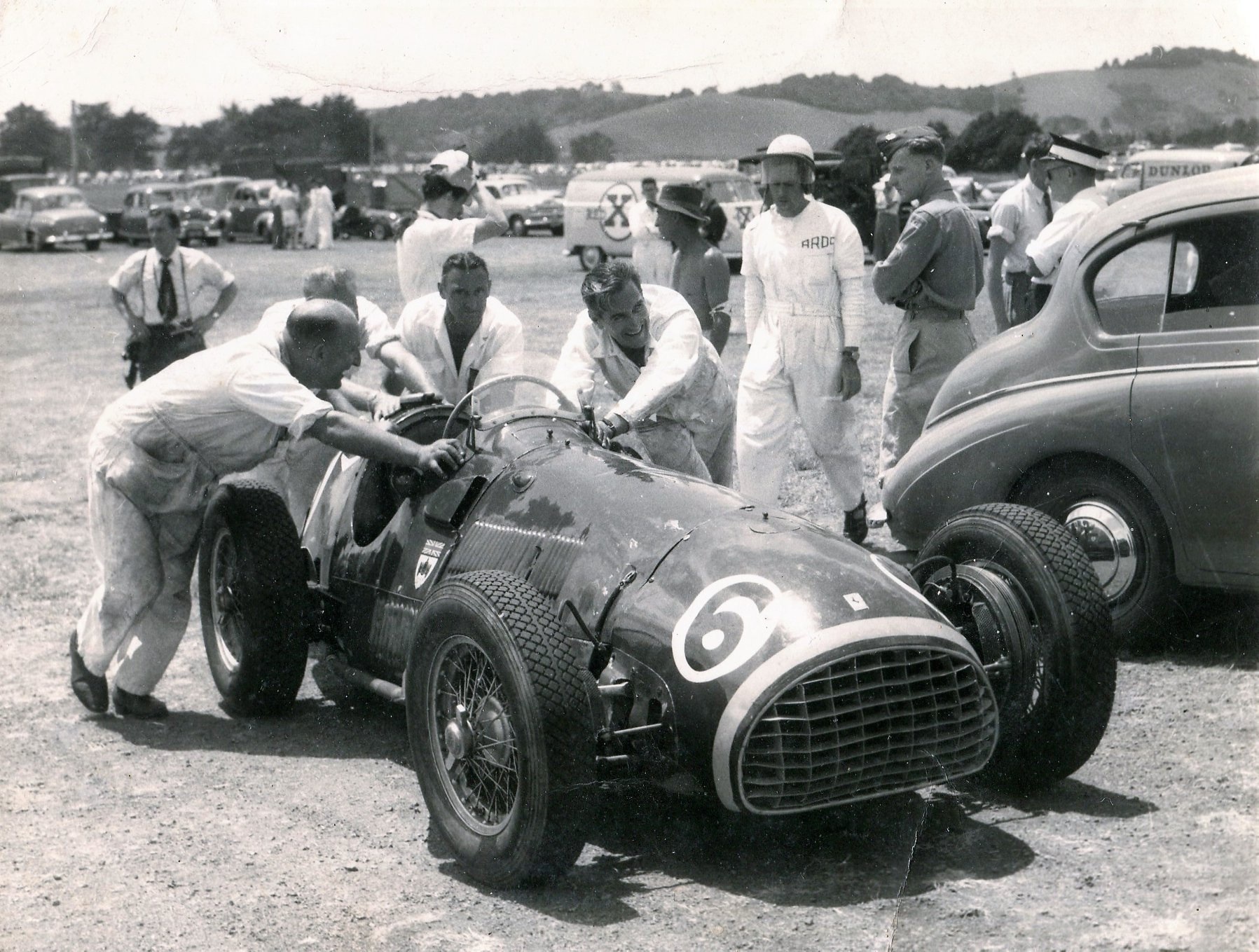
Dick Cobden’s Ferrari 125 being pushed through the Gnoo Blas paddock during the January 1955 South Pacific Trophy weekend. The youthful driver behind with the Persil whiter-than-white overalls is JA Brabham in search of his Cooper T23 Bristol.
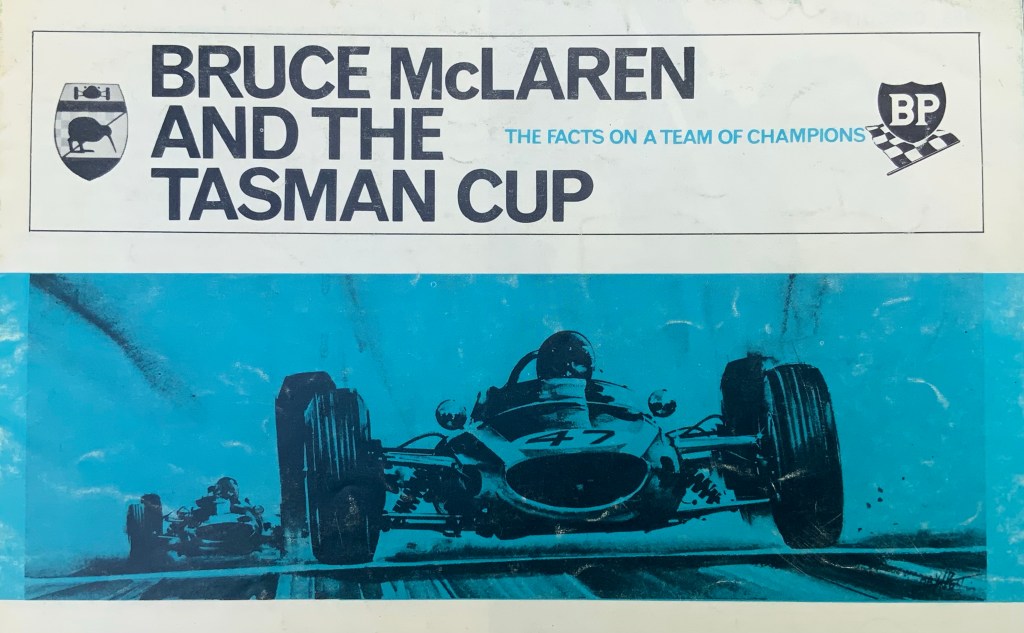
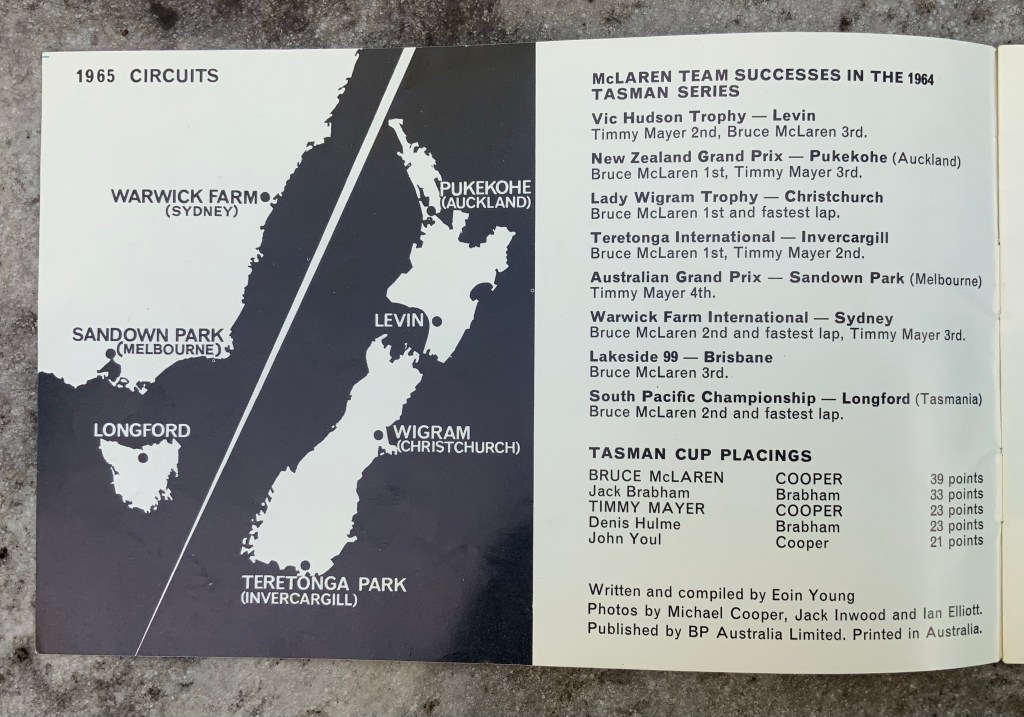
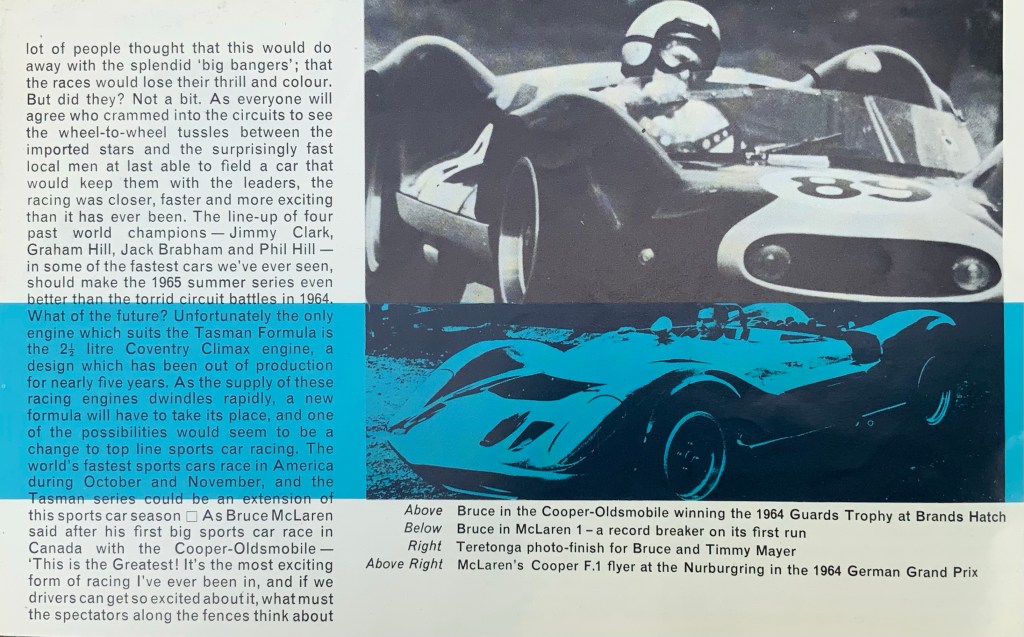
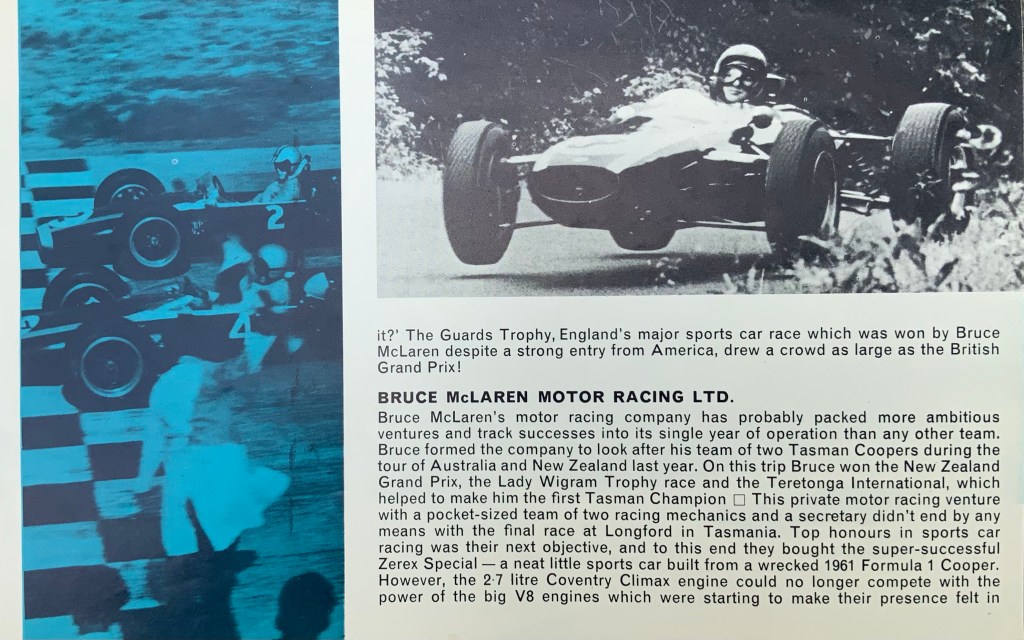
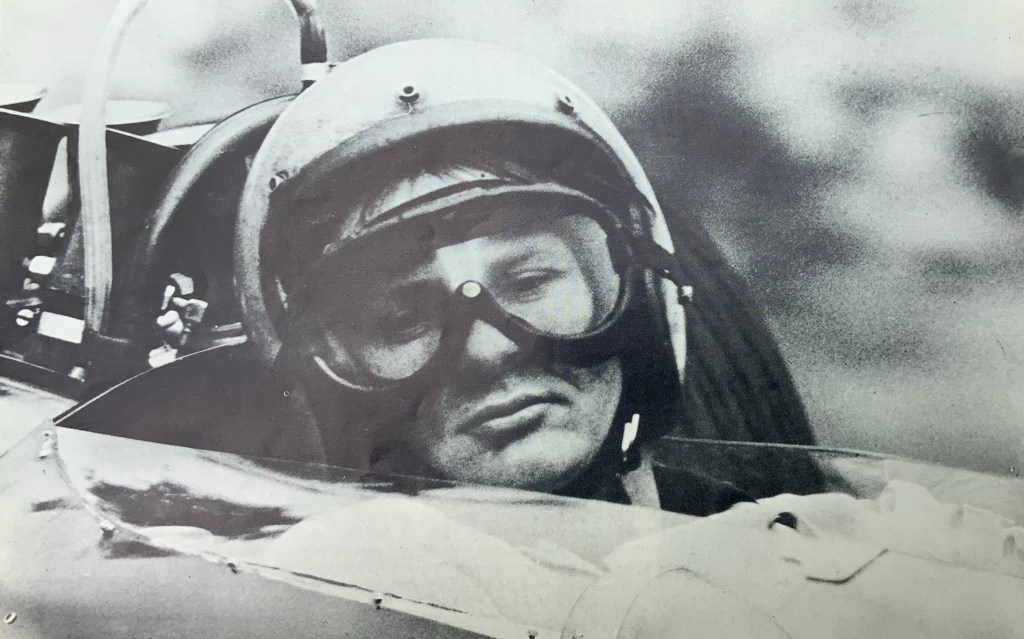
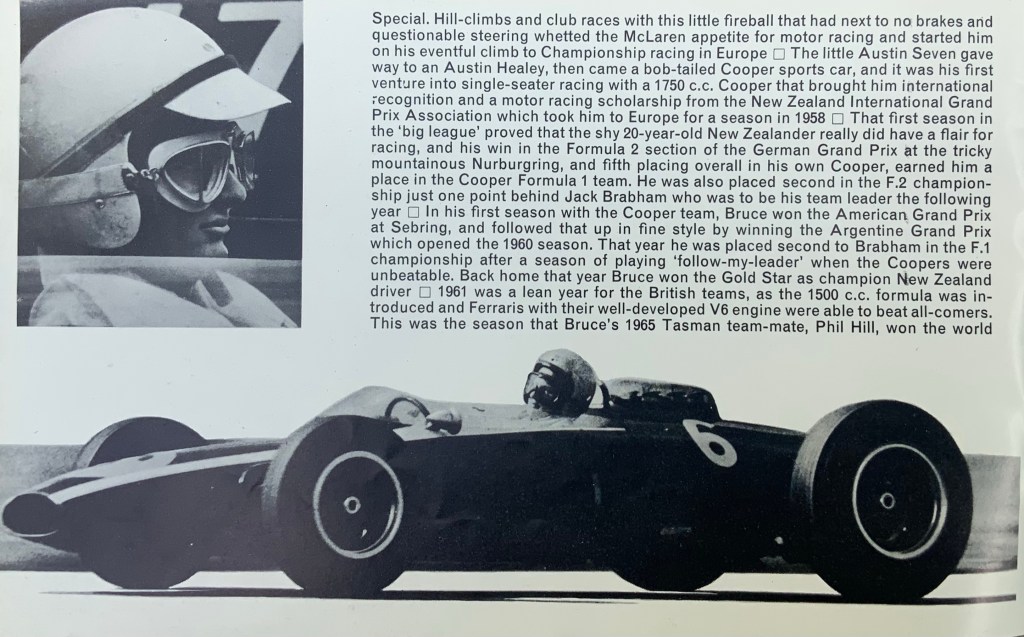
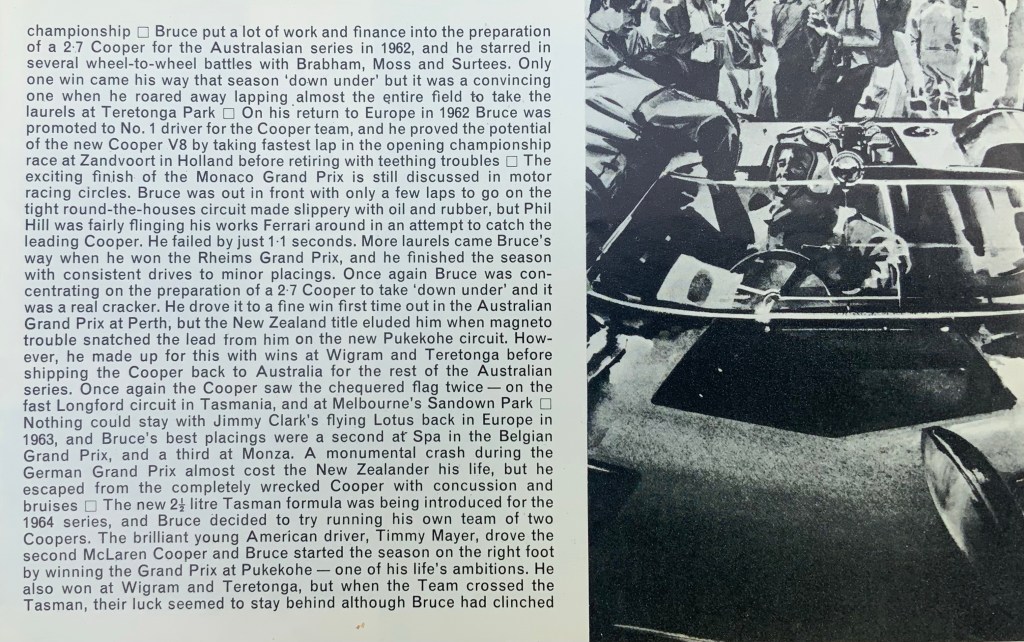
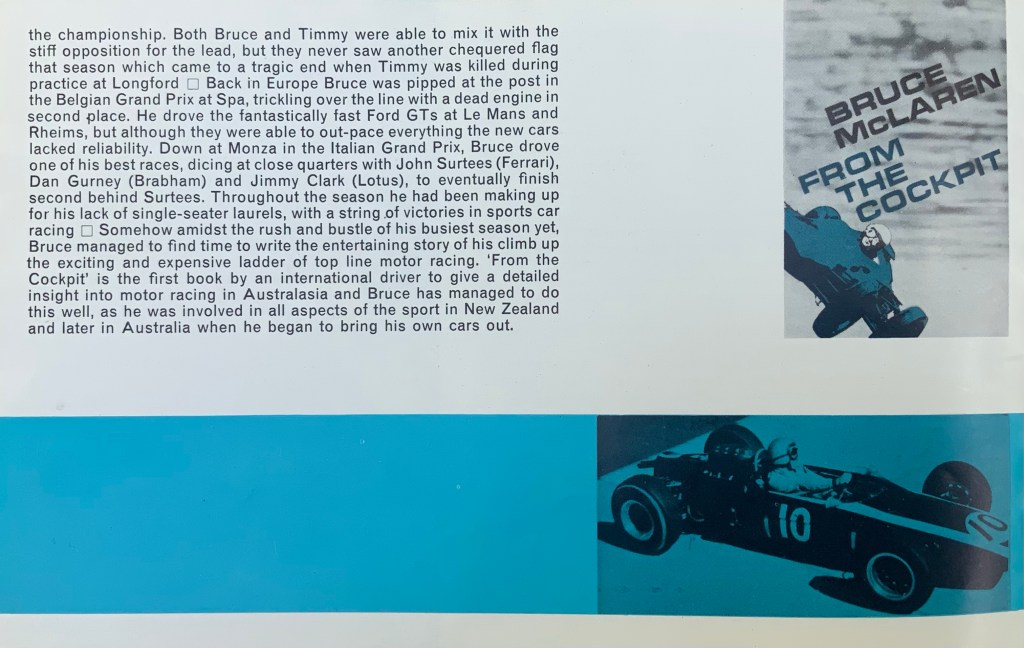
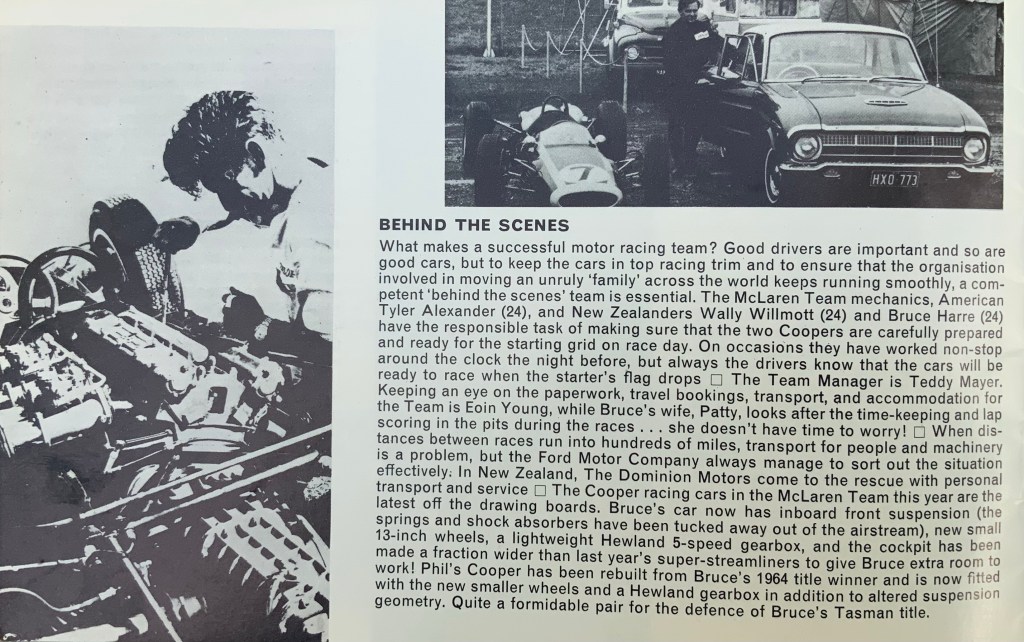
Bruce McLaren won the first Tasman Cup/Series in 1964 aboard the first ‘real McLaren’, a 2.5-litre Cooper T70 Climax FPF.
Two of these machines were designed and built by McLaren and his friend/confidant/mechanic and fellow Kiwi, Wally Willmott, at Coopers in late 1963.
The nascent Bruce McLaren Motor Racing Team cars were raced by the boss and young, very talented American thruster, Tim Mayer. That years Tasman was a triumph for McLaren, he won three of the seven rounds, but it was also disastrous as Mayer lost his life in the final round at Longford.
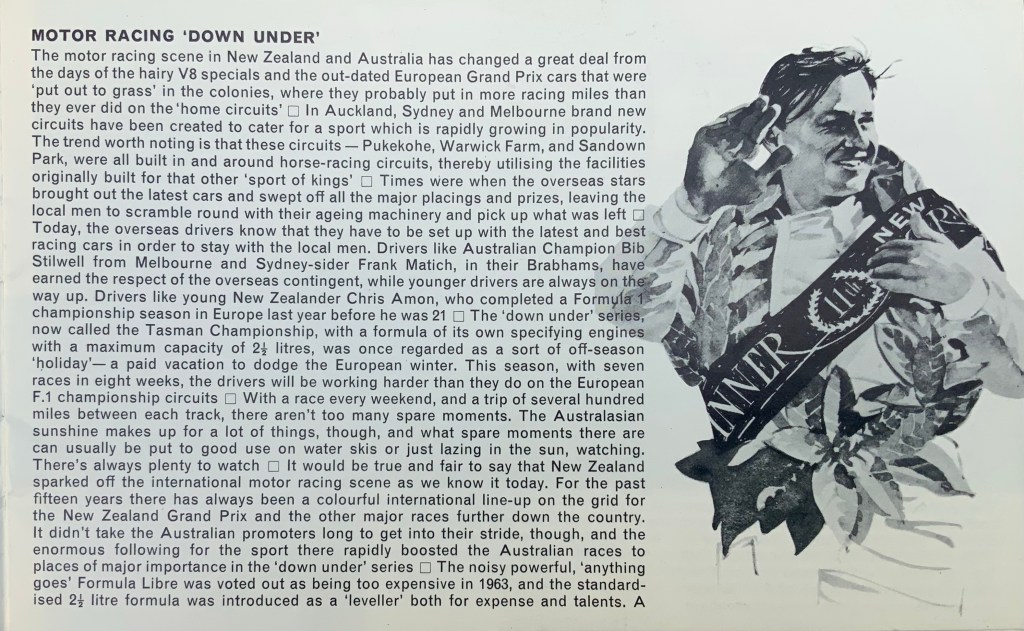
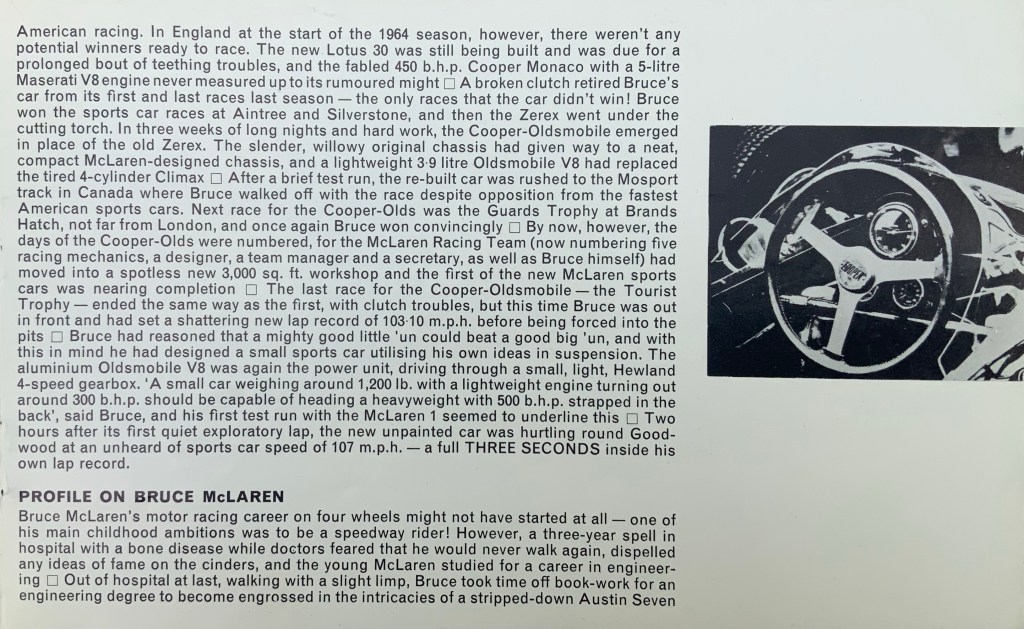
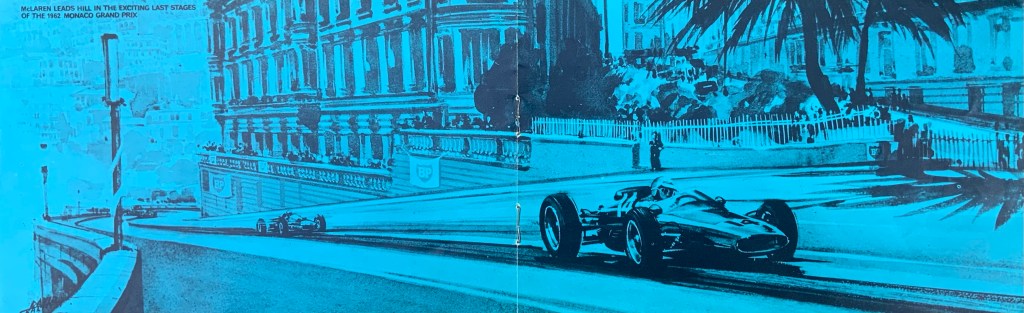
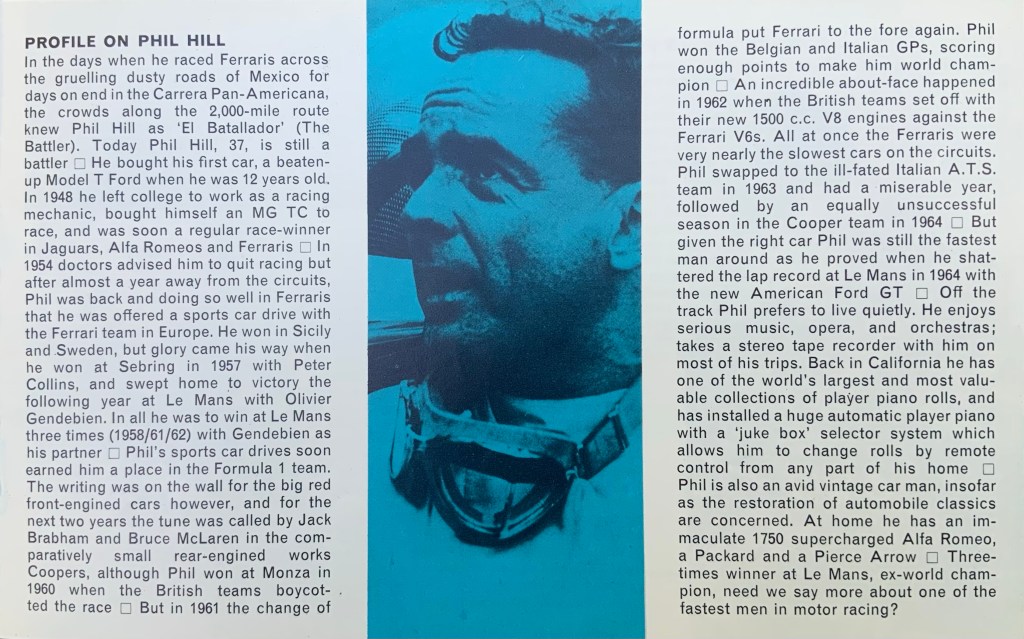
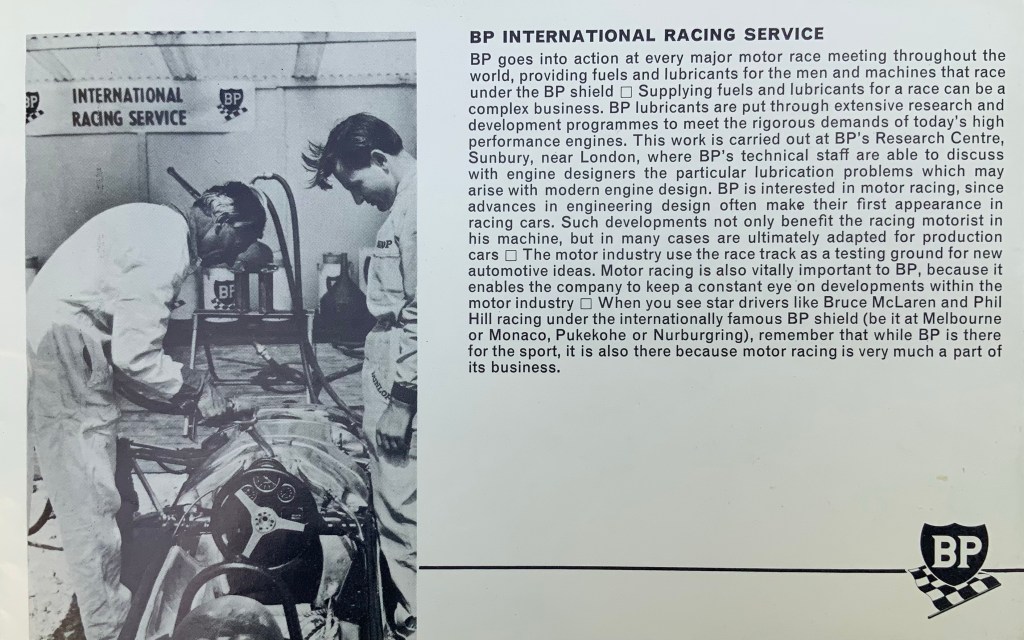
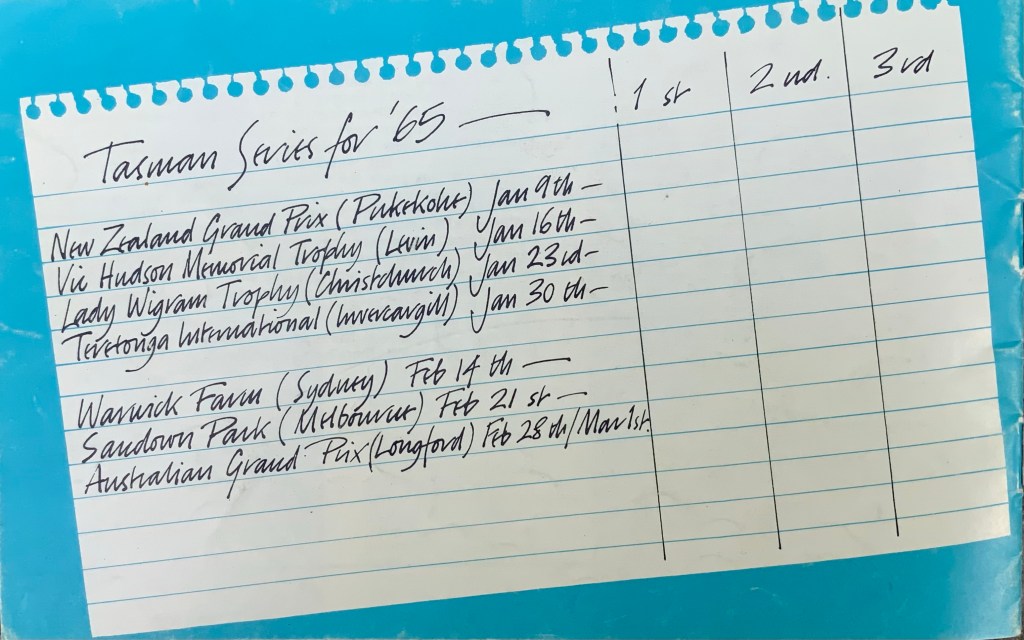
This brochure was produced by BP as a handout during the ’65 Tasman, and is wonderful, I just-gotta share it with you.
Ex-Repco Brabham Engines senior technician Michael Gasking has become a good friend. He’s been in Melbourne (from Adelaide) this weekend to catch up with family and take in Motorclassica. He is also helping me with a new project, amongst all of his mega-collection of memorabilia and photographs was this little brochure I’ve never seen before.
Credits…
Michael Gasking Collection
Tailpiece…
Jim Clark won the ’65 Tasman aboard a works Lotus 32B Climax, winning four of the seven rounds. Bruce won the Australian Grand Prix at Longford and was second overall aboard a Cooper T79, a new car akin to Cooper’s contemporary T77 and T75 F1/F2 designs.
Jack Brabham was third racing a new BT11A, with Phil Hill equal fourth in the surviving T70, together with Jim Palmer and Frank Gardner in Brabhams BT7A and BT11A respectively.
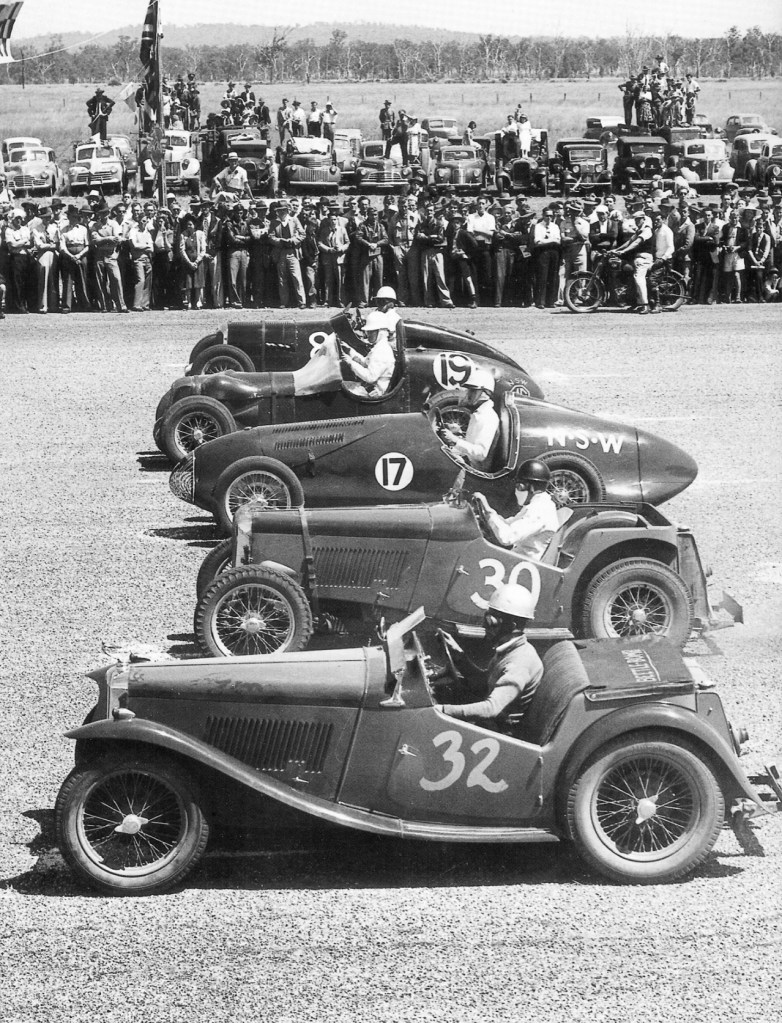
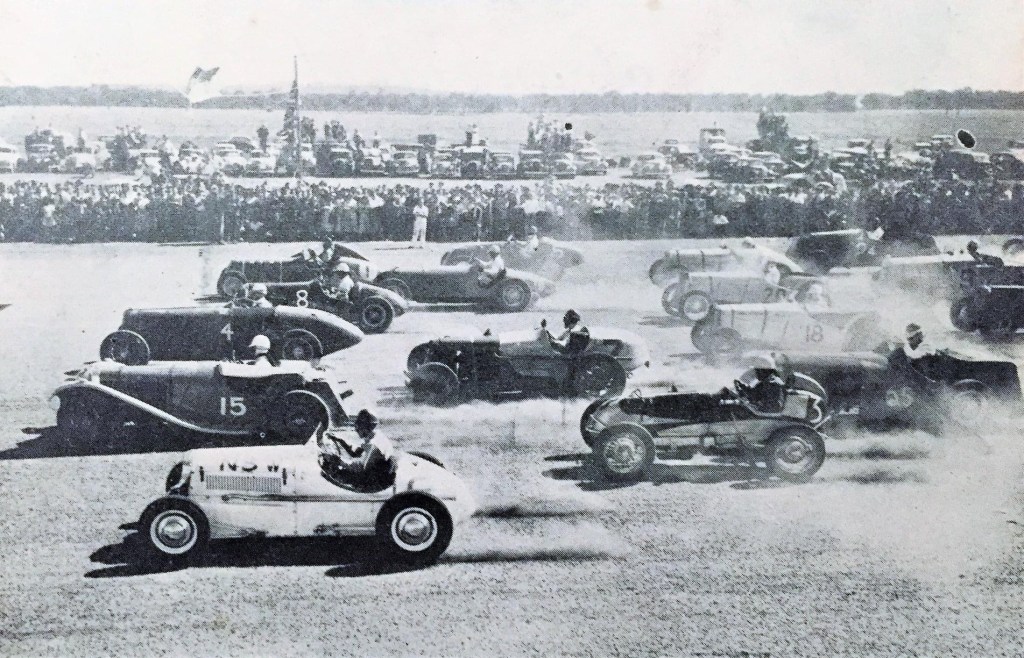
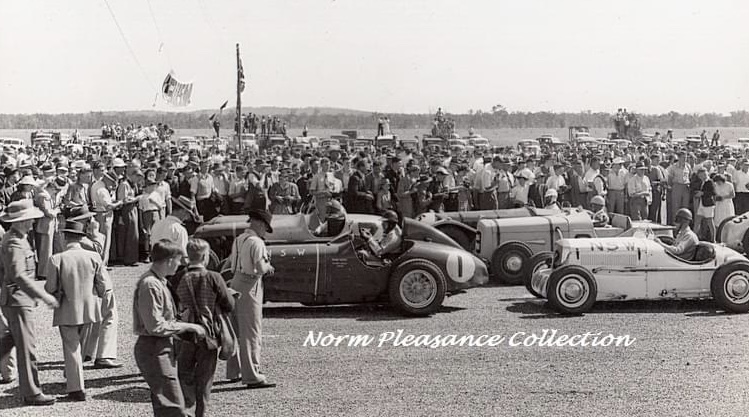
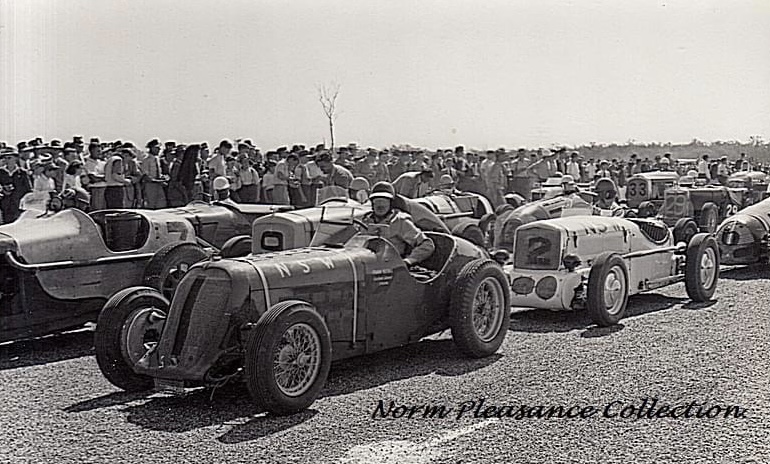
One row of the 28 starters of the 35 lap, 150 mile, 1949 Australian Grand Prix – or more likely the supporting F2 race – at Leyburn, Queensland, await the drop of the flag on September 18.
The first two cars are MG TCs, Col Robinson’s #32, and J Hillhouse in #30. #17 is the more focused TC Spl of Dick Cobden, then Peter Critchley’s fourth placed ex-Alf Najar MG TB Spl, and on the far side, Arthur Rizzo’s Riley Spl, who finished third on the RAAF airfield track
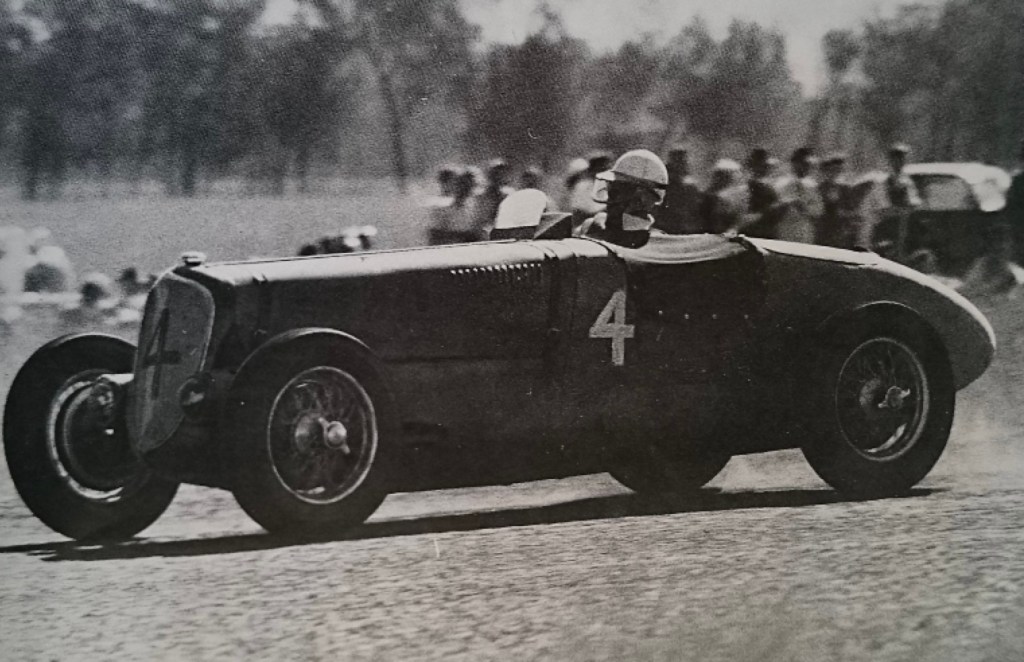
A race day crowd estimated at 30,000 people saw John Crouch’s Delahaye 135S win from Ray Gordon’s TC Spl.
The front row, away from the start is Alan Larsen, Cadillac Special ‘SoCal’, #15 Keith Thallon, Jaguar SS100, #4 the winning Crouch Delahaye 135S, #8 Arthur Rizzo’s third place Riley Special, and on the far side, Frank Kleinig, Hudson Special. The next row includes #3 Arthur Bowes’ Hudson Spl, #2 Dick Bland, George Reed Special, #25 Doug McDonald, Bugatti Dodge and #18 Garry Coglan, MG TC Spl.
(Wiki unattributed)
John Snow imported the 1936 3.6-litre, six-cylinder Delahaye (chassis # 47190) from France to Australia in time for the 1939 AGP at Lobethal, with the talented Crouch finally realising its potential.
(Wiki unattributed)
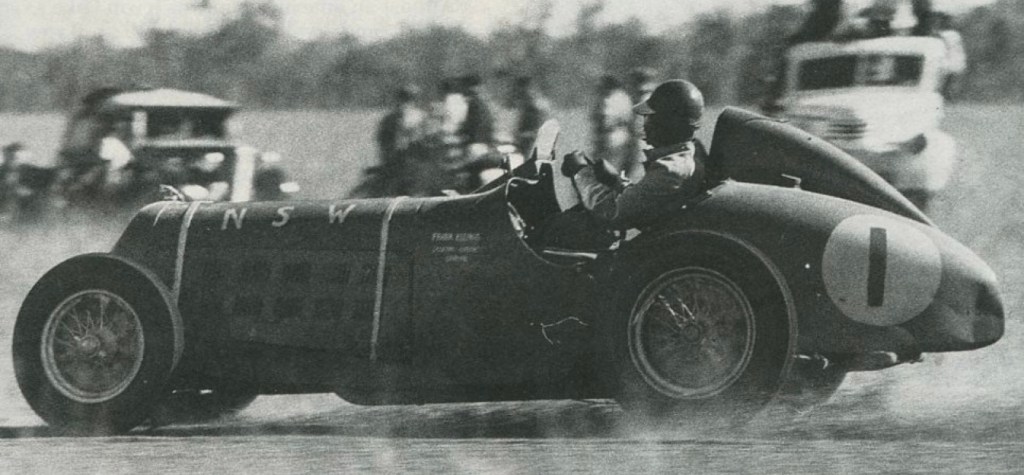
For so long the fire-and-brimstone Frank Kleinig had been an AGP favourite. 1949 was really his last chance to do well as the quality of our fields improved and his oh-so-fast Kleinig Hudson Spl slipped down the grids. Its development potential by then having pretty-much peaked.
Kleinig led Crouch for seven laps – they shared the fastest lap of the race 2’52 seconds/90mph – but then had the first of three pitstops which led to his retirement after completing only 21 laps.
Dick Cobden’s shapely, quick, Gordon Stewart built, Bob Baker bodied, 1946 MG TC (#3306) ‘Red Cigar’ single-seater (below) was out early after only six laps with undisclosed dramas.
Kleinig in his faithful Hudson Special, behind is Alan Larsen, Cadillac Spl and alongside him, car #9 is Keith Saunders’ Cadillac Spl(Brisbane Telegraph)
The Brisbane Telegraph caption of this pre-AGP promo piece reads, “Teamwork counts and here are seen NSW motorists, Alf Najar (left) who will be relief driver of Peter Critchley’s (ex-Najar 1946 NSW Grand Prix winning) MG TB Spl (second from right) the winner of the 1948 NSW Grand Prix (at Bathurst), Arthur Rizzo, and their mechanics.”
Kleinig again, #2 Dick Bland in the George Reed Ford V8 Special, #7 Alan Larsen, Cadillac Spl and the rest – #29 Brydon’s MG TC Spl and #33 at the very back is the Ford V8 Spl raced by Jack Wright.
Credits…
Wikipedia, racerviews.com, Rob Bartholomaeus, Stephen Dalton, Dick Willis, Brisbane Telegraph, Norm Pleasance Collection-Warwick Daily News via Daniel Kleinig
Tailpiece…
(D Willis)
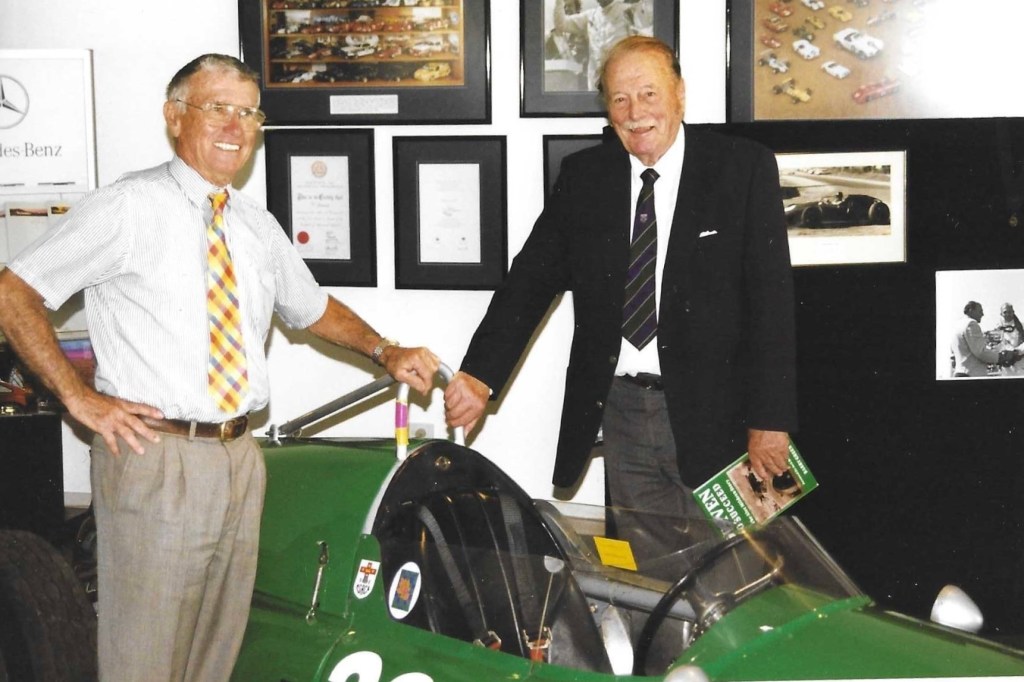
Racers both: Charlie Smith and John Crouch at the launch of Alec Mildren’s biography at Frank Gardner’s Norwell, Gold Coast facility on April 18, 1999.
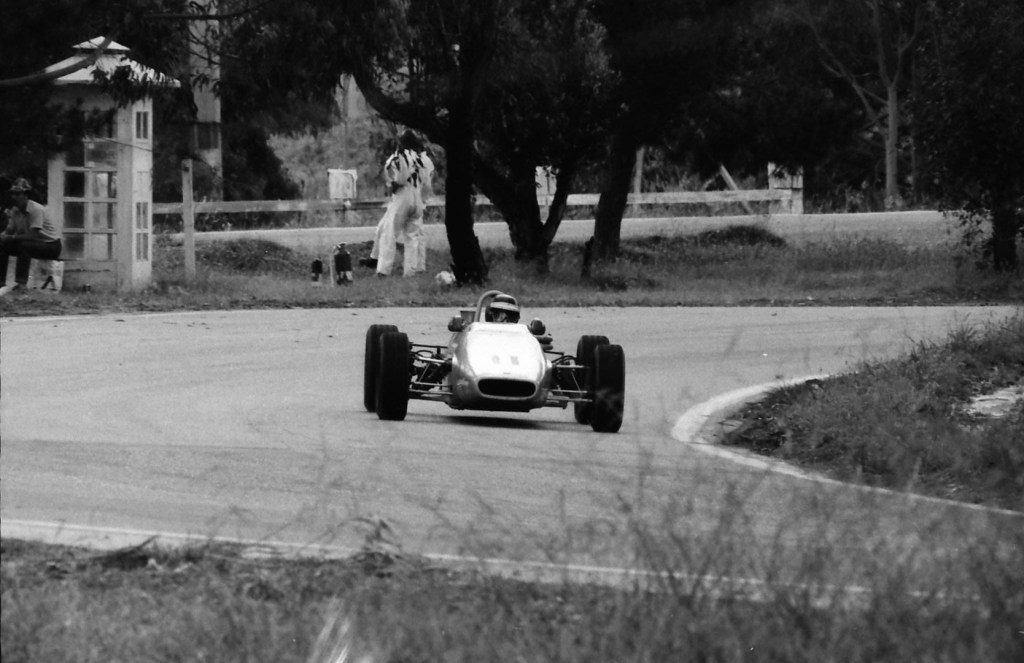
This Dr Who-esque shot was taken by Peter Houston at Hume Weir on the 1971 Boxing Day weekend.
It’s later F2 front runner Enno Buesselmann in his Formula Ford days, an Elfin 600. Click here for more on Australian FF formative days.
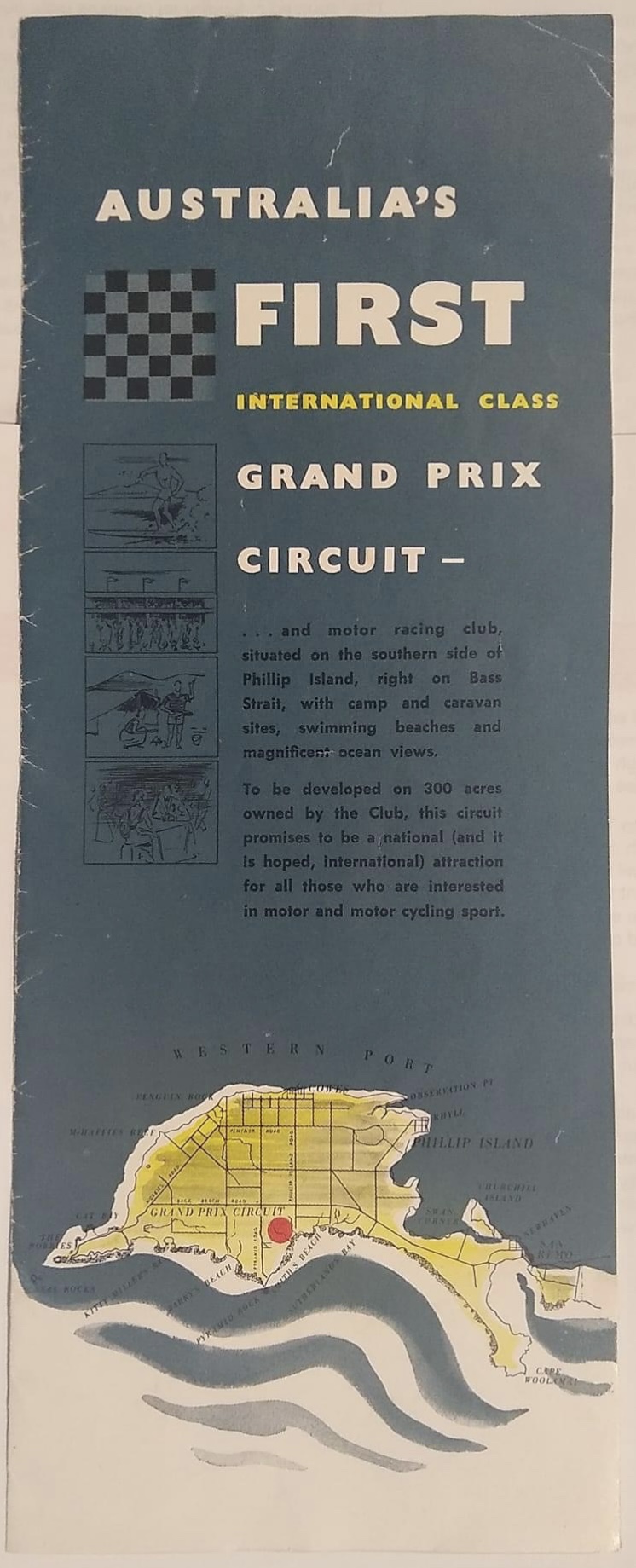
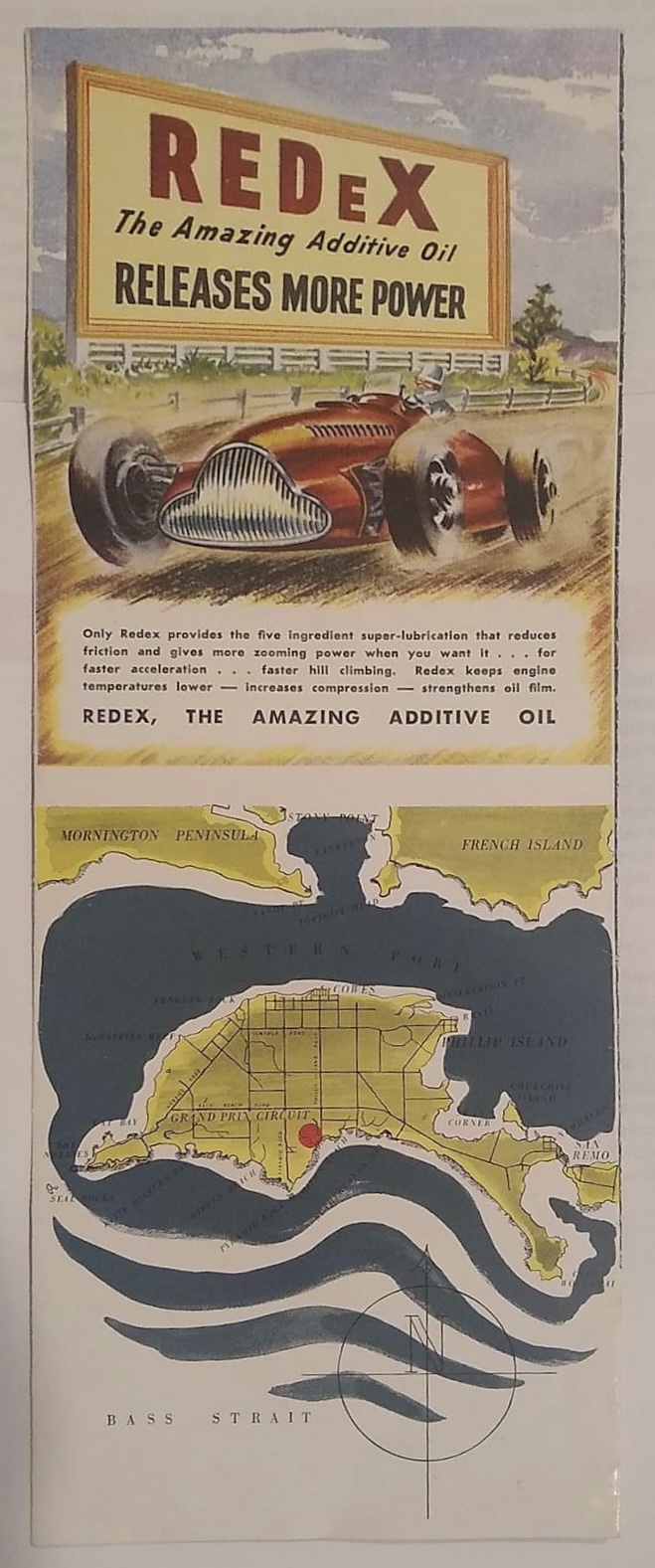
These couple of pages from a mid-1950s brochure about the Phillip Island circuit have me intrigued.
Is it a Claytons-prospectus touting for capital to build the place or part of a promotional document created after its completion? Dunno, but I’d like to know.
(P Mahon Collection)
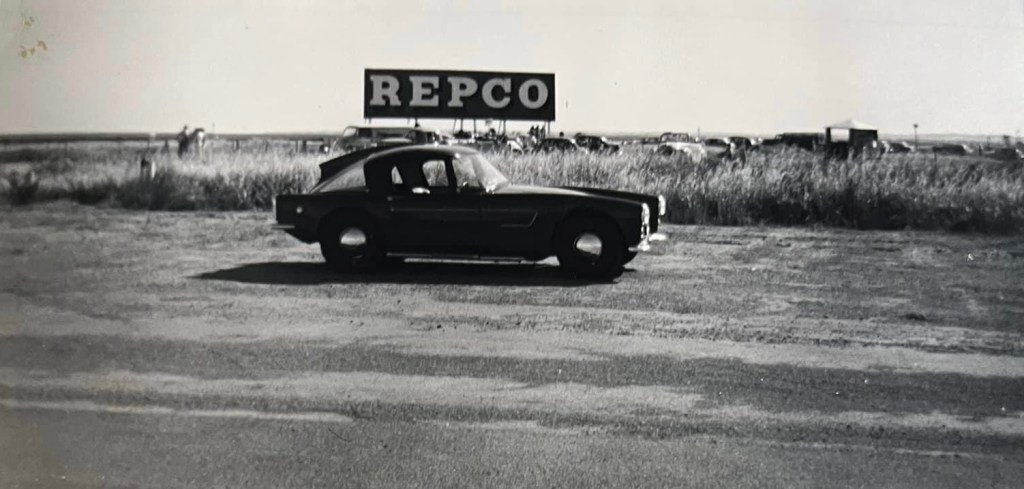
The Repco Record is shown above at Port Wakefield circuit in South Australia in the late-1950s.
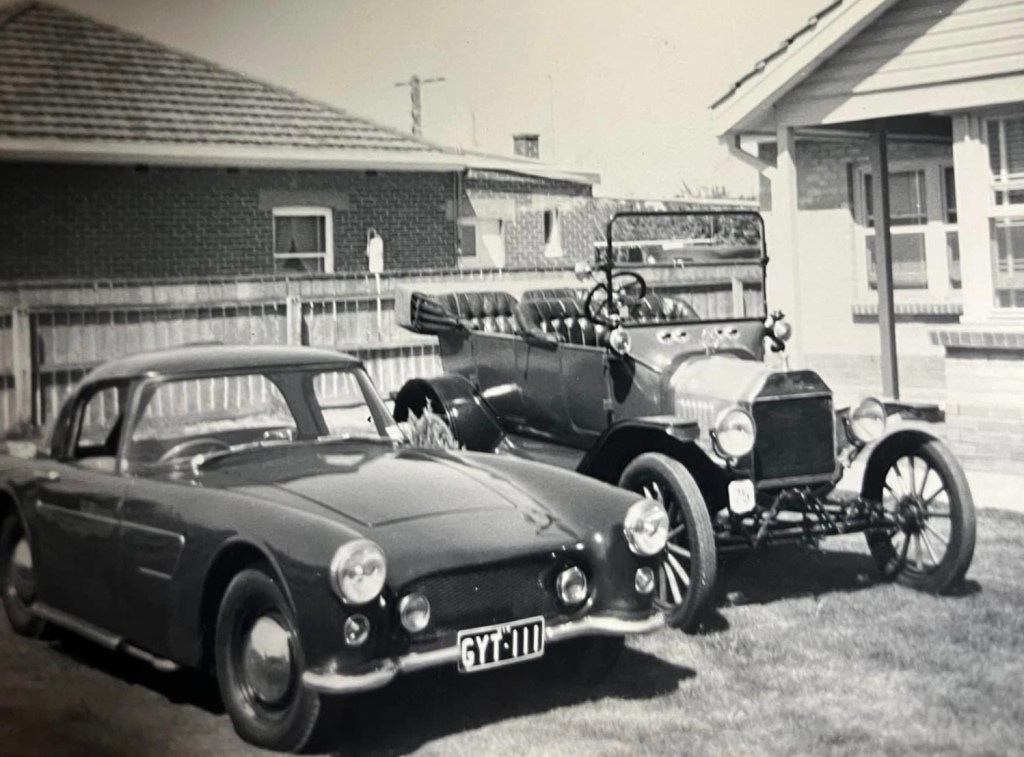
The Holden Hi-power six-cylinder engined R&D and display car was in Phil’s father’s care while away from its Repco Research home near Dandenong, Victoria.
The shot below is of the car in the family front-yard together with a Ford T-model they still own. Nice!
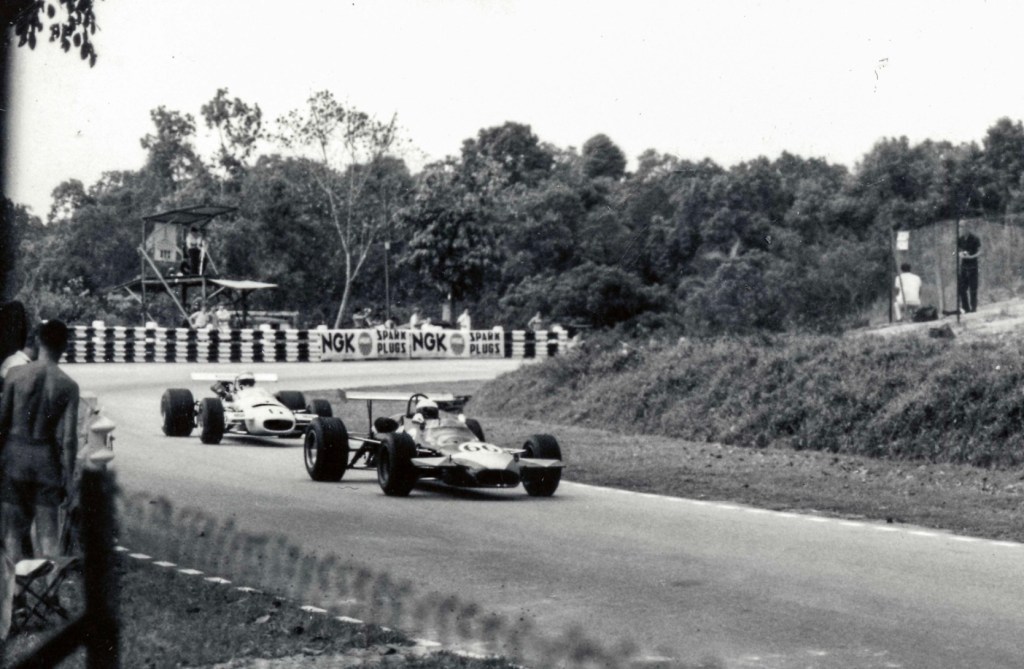
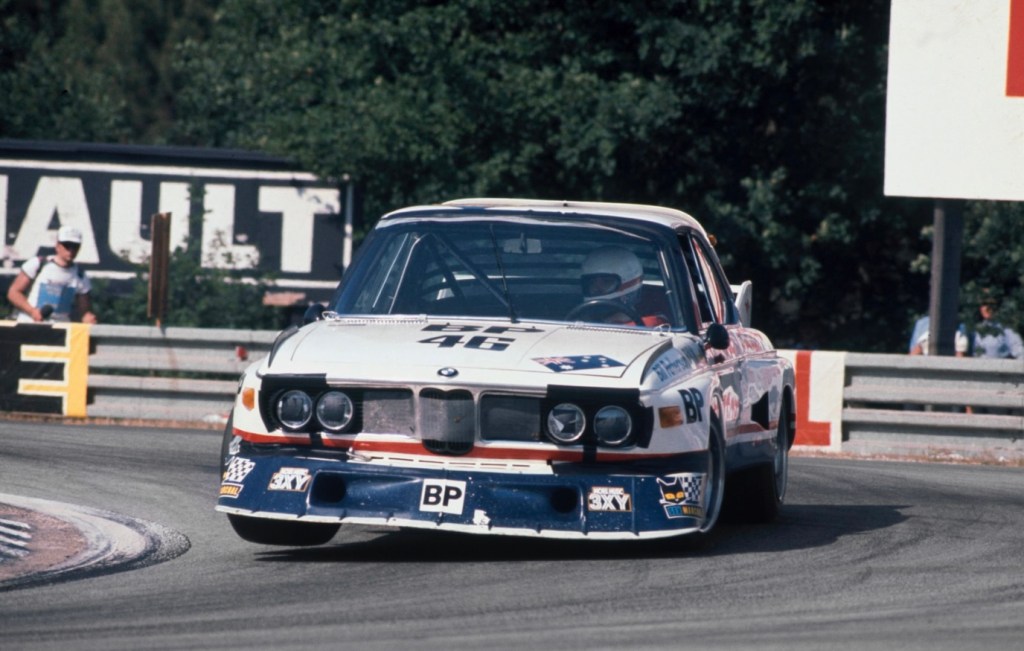
Mind you, it might be Brian Muir or Jean-Claude Aubriet, his co-drivers at the wheel. Doubtless the taxi-perves among you can set me straight on that particular helmet. Their Team Brock BMW 3.5 CSL, was out with gearbox failure after completing 156 laps, in the 19th hour, Le Mans in 1976.
The race was won by the Jacky Ickx/Gijs van Lennep Porsche 936, the Group 5 class-winner was the works Porsche 935 crewed by Rolf Stommelen/Manfred Schurti, Brock returned to Le Mans of course.
The most formidable combination in Australia immediately before, and after the war, Alf Barrett and his Alfa Romeo Monza
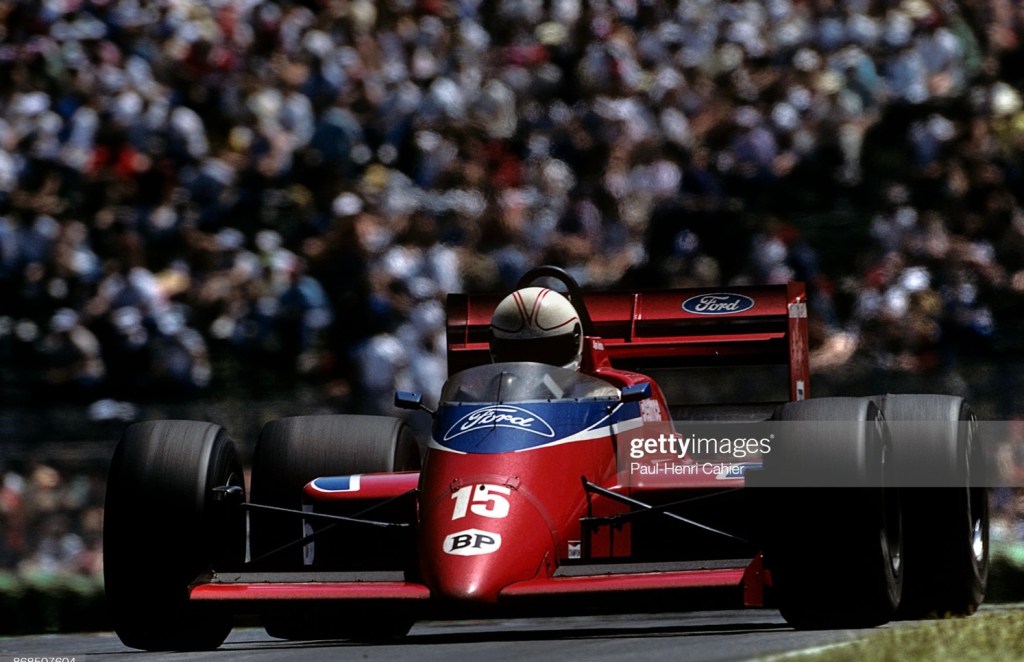
Alan Jones, Lola THL2 Ford during the 1986 Canadian GP on the 2.74 mile Ile Notre-Dame track in Montreal, Quebec.
All the ingredients for success were in this mix but the ultimate pace of the car, in large part due to a lack of power from the Cosworth 1.5-litre, twin-turbo V6, meant it never achieved much despite the best efforts on The Jones Boy and Patrick Tambay. See here for a piece on the car; Lola THL2 Ford | primotipo…
Jones finished 10th, five laps adrift of Nigel Mansell’s winning Williams FW11 Honda.
(rewindmedia.com)
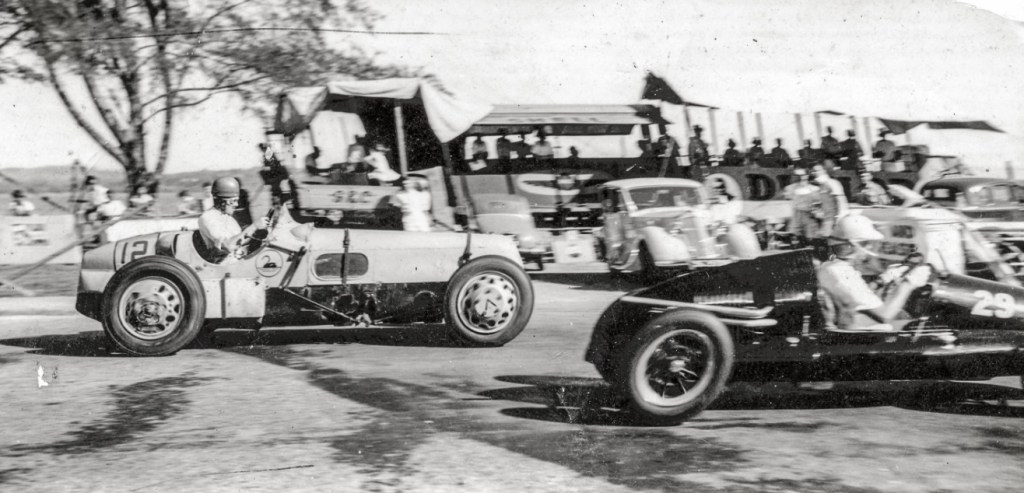
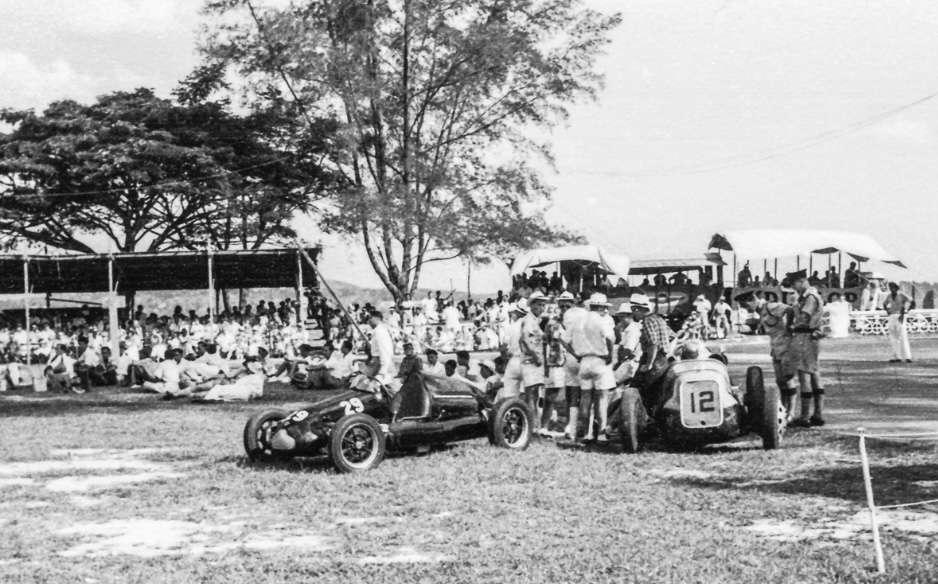
Perth’s Syd Anderson, Double Ford V8, and LC Chan’s Cooper 1100 at the start of the August 2, 1953 Johore Grand Prix in Malaya.
Anderson led for the first 19 laps of the race held on the Thomson Road course, but was out with engine and clutch problems. The incredible twin-Ford V8 engined beastie was as famous for its unreliability as its speed. Chan did the fastest lap at 63.25mph but he too failed to finish with engine problems.
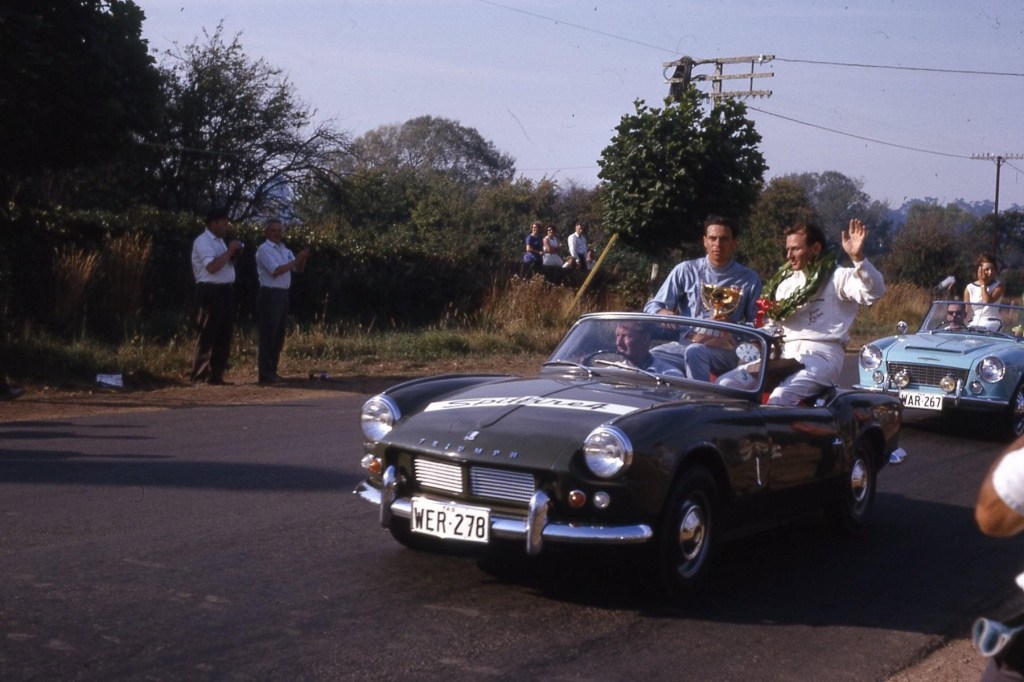
Bruce McLaren, winner of the 1965 Australian GP at Longford on his lap of honour.
McLaren won aboard one of his ‘first McLarens’, a Cooper T70 Climax. Jim Clark holds the Tasman Cup he has just won, he was victorious in four of the seven rounds in a works Lotus 32B Climax. See here for an article on this race; Longford 1965… | primotipo… and Cooper T70; ‘Levin International’ New Zealand 1965… | primotipo…
The Triumph Spitfire’s pilot is the Longford Motor Racing Association supremo, Ron MacKinnon.
(M Fistonic)
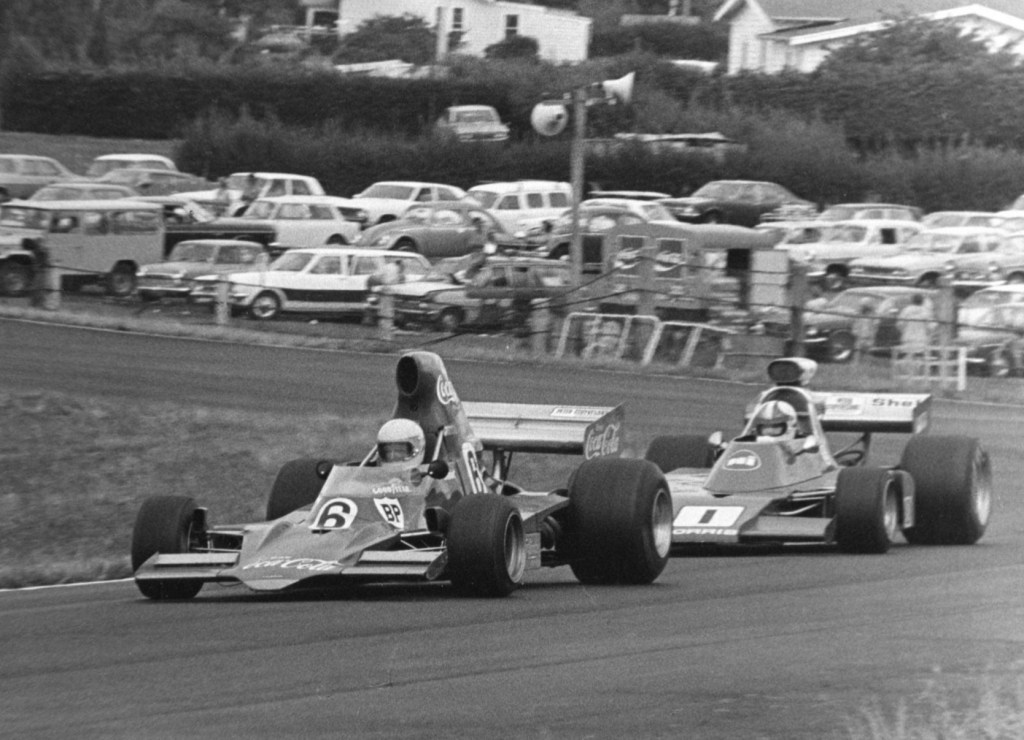
Max Stewart’s Lola T400 Chev ahead of Chris Amon’s Talon MR1 Chev at Pukekohe during the 1975 NZ GP.
They finished seventh and eighth with Chris in front. Amon was consistently quick throughout the ‘75 Tasman Series – won by Warwick Brown’s Lola T332 Chev – winning the Teretonga round. Stewart was held back by the Lola T400 which at that stage of its development was inferior to his old T330. Brown won the NZ GP. More on the McRae GM2/Talon MR1 here; Amon’s Talon, McRae’s GM2… | primotipo…
(B Williamson Collection)
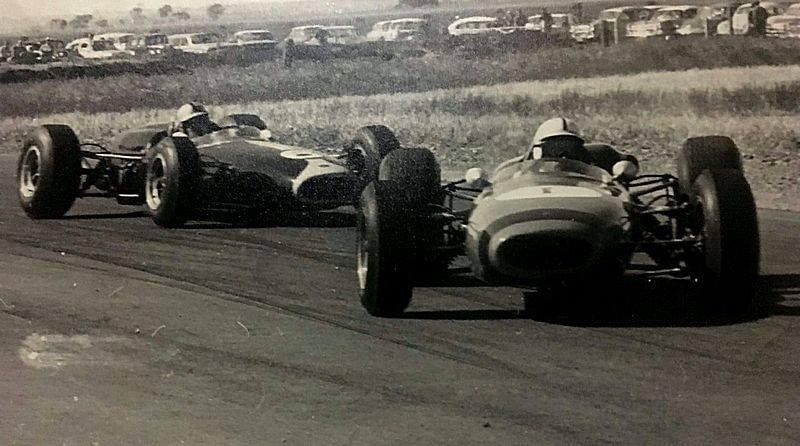
Lex Davison, Cooper T62 Climax FPF 2.7 ahead of David McKay, Brabham BT4 Climax FPF 2.7 during the April 1963 Easter Bathurst Gold Star round.
Davison won the Bathurst 100 from pole with Kiwi, Tony Shelly second aboard Davison’s Cooper T53, and Charlie Smith’s Elfin Junior 1.5 Ford third. McKay was out after only 9 of the 26 laps with overheating.
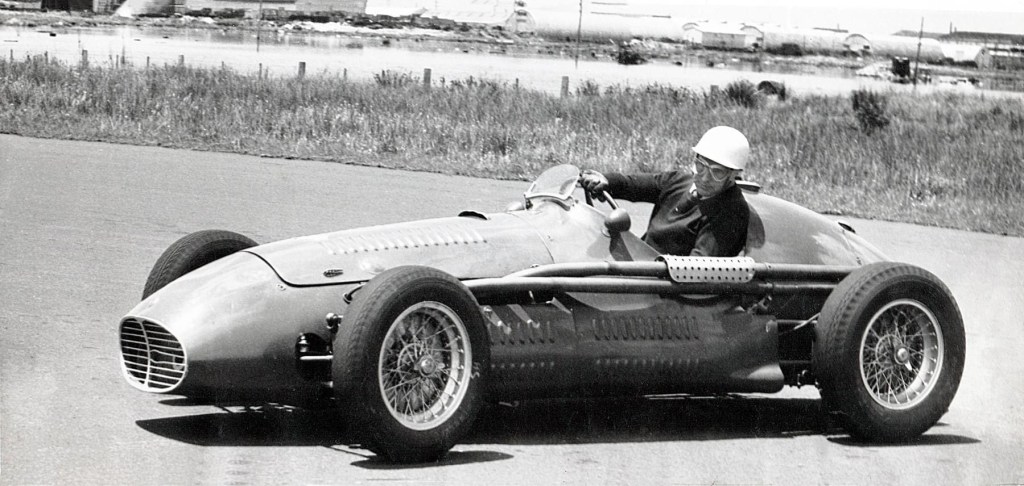
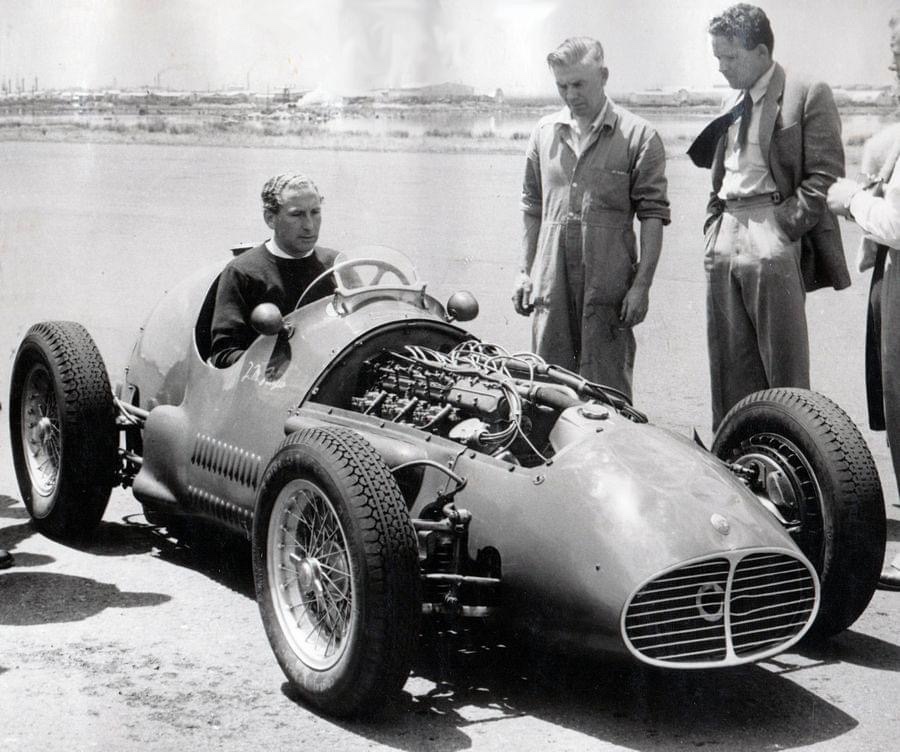
Reg Hunt during the first test of his just arrived Maserati A6GCM at Fishermans Bend in December 1954.
This was the car – only just superseded by the 250F – which reset the competitive bar in Australia. To run at the front of scratch races, rather than the hitherto usual handicaps, elite level Formula Libre competitors had to have a modern, Italian! car.
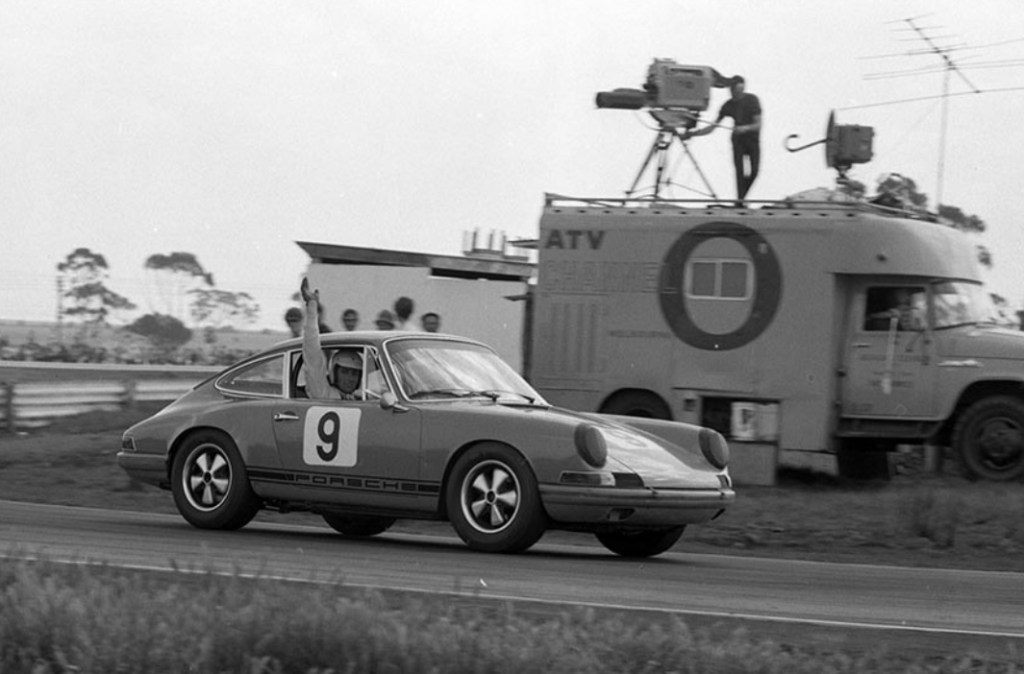
Love the ATV Channel-O outside broadcast van on the inside of Tin Shed corner, do you think they covered the meeting with one camera?
(AGP Corp)
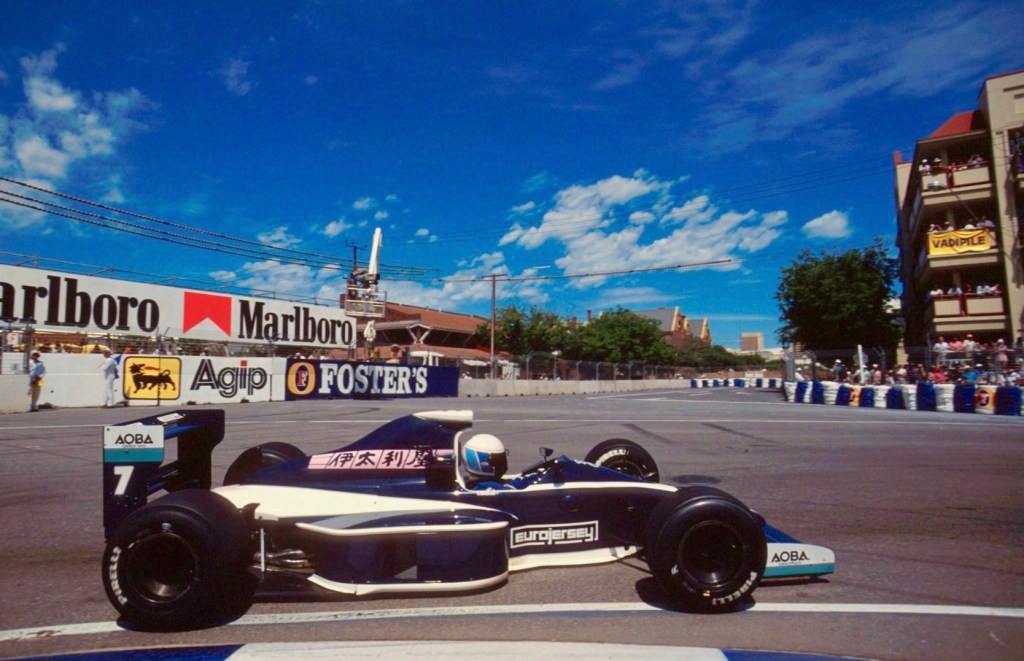
David Brabham on the East Terrace section of the Adelaide street circuit in 1990.
He qualified his Brabham BT59 Judd 25th but spun and couldn’t get going after 19 laps of the race won by Nelson Piquet’s Benetton B190 Ford. More about David here; Brabhams and Adelaide… | primotipo…
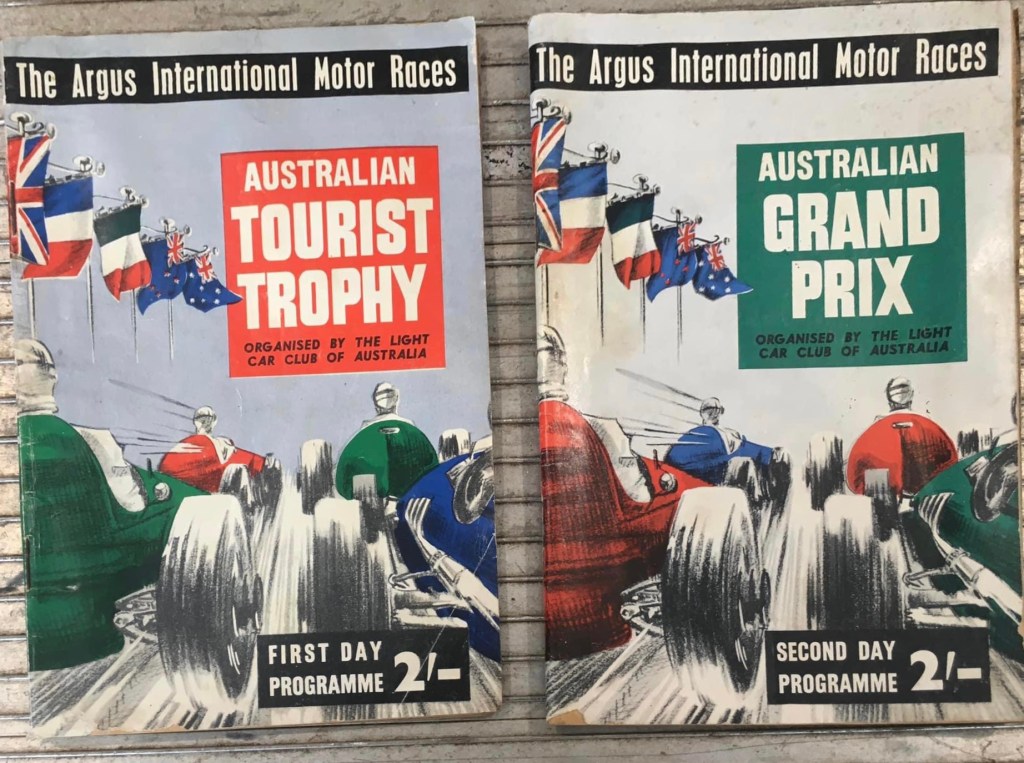
What a double header! The Australian Tourist Trophy and Australian Grand Prix were held at Albert Park a week apart on the weekends of November 26, and December 2, 1956.
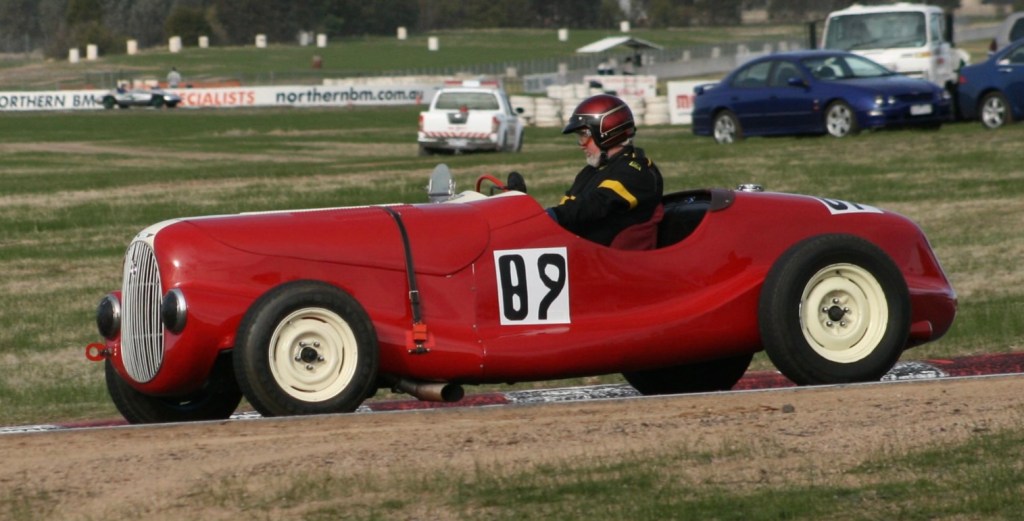
Jack Hedley on the Milthorpe Special at Albert Park in 1956.
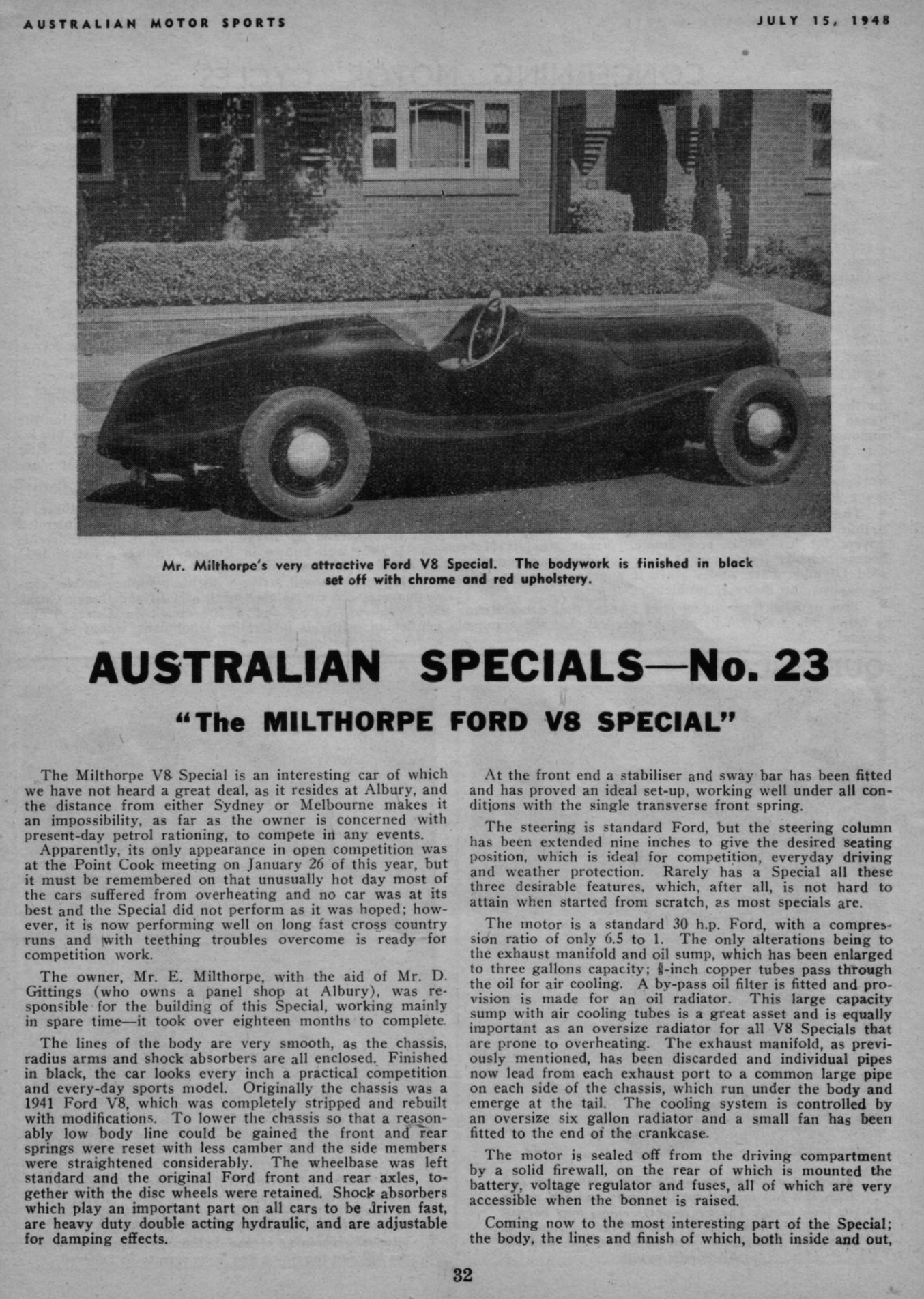
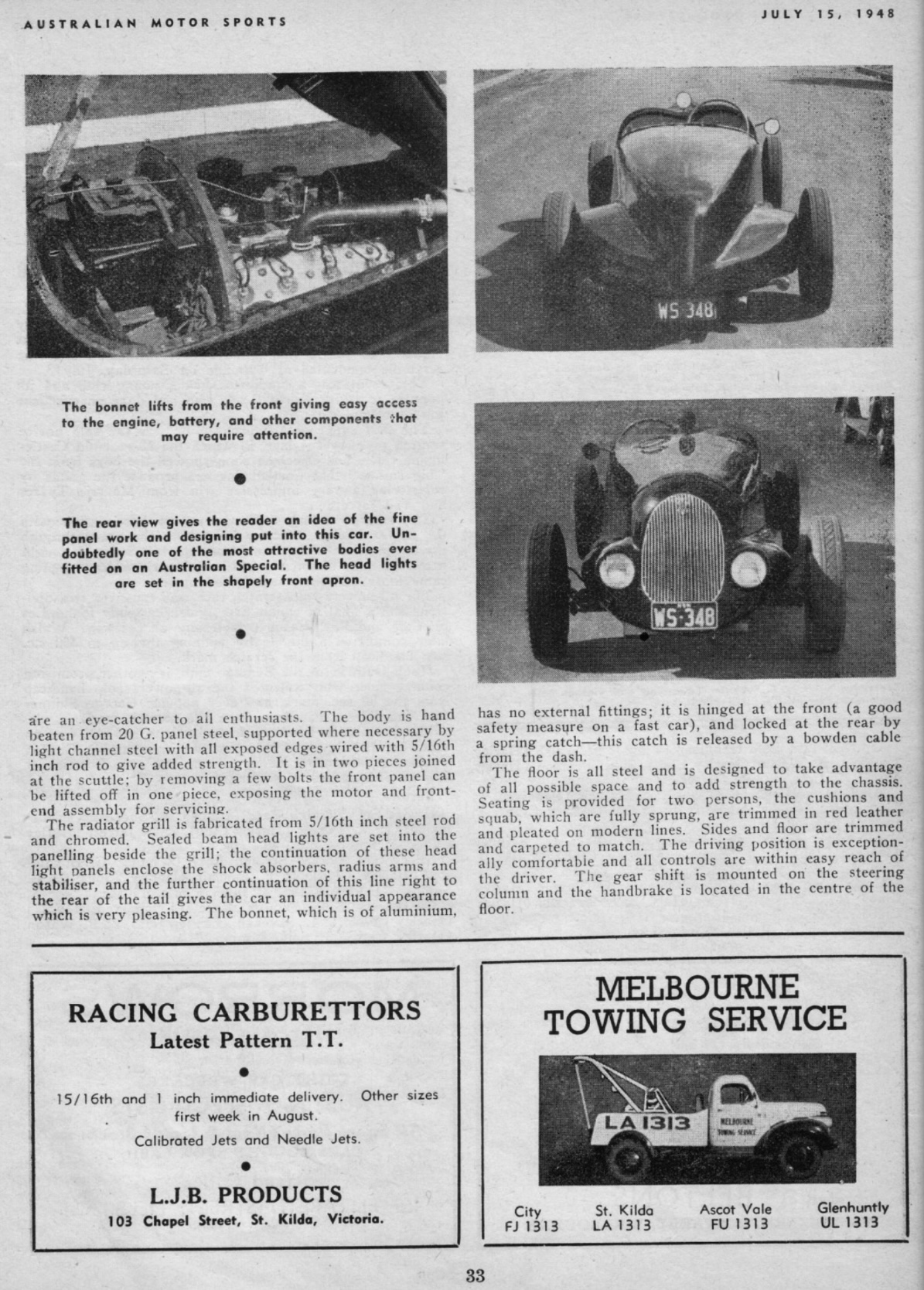
Built by Albury man, Charlie Milthorpe in 1947-48, the car was based on an ex-army 1941 Ford ute chassis and fitted with an amalgam of FoMoCo bits; ’39 gearbox, ’40 front axle, ’35 rear end and a ’51 side-valve V8 fitted with a Stromberg 97 carb, brakes were Customline.
(unattributed)(Draper Family Collection)
Here showing the ravages of a busy racing campaign in the hands of – probably, thanks John Medley – John Spanbroek, giving it plenty of welly at Hume Weir circa 1961.
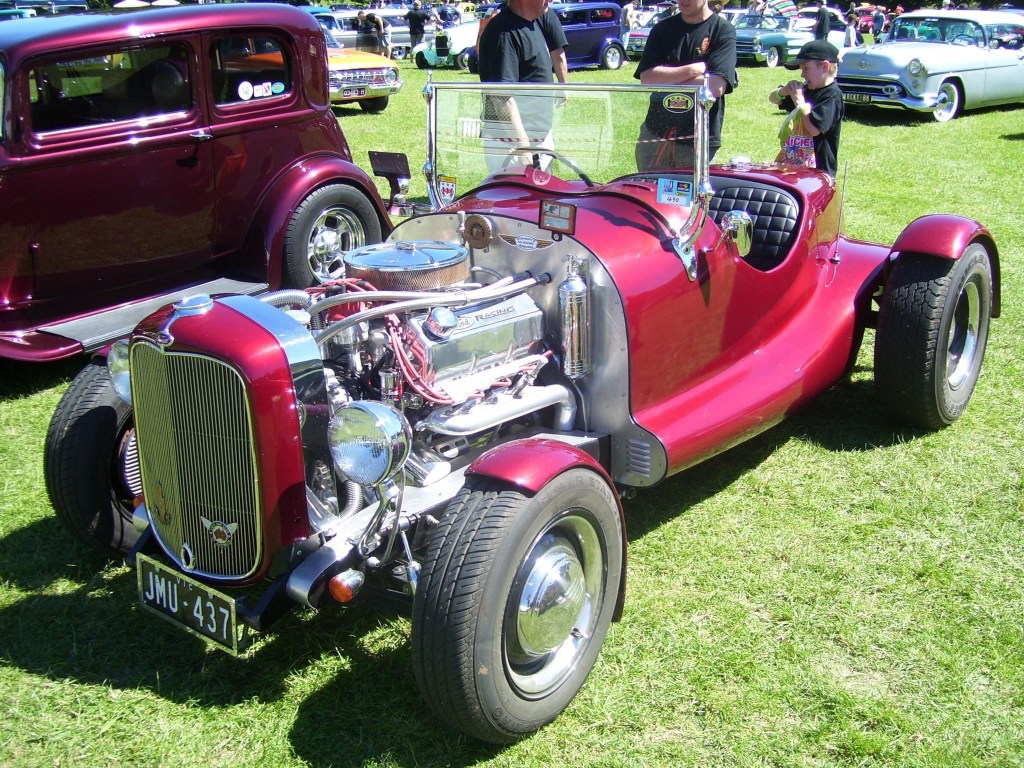
These days the attractive racer is an ugly hot rod which resides in Tasmania, but an attractive replica racer has also been built.
(J Cox)Milthorpe Ford Replica at Winton in recent years. Meeting date and driver folks? (Jason Pratt)(B Williamson Collection)
Spencer Martin from Bib Stillwell both aboard Brabham BT11A Climaxes during the Mallala Gold Star round in October 1965.
Stillwell won from Martin in a season where Bib won three of the six Gold Star rounds. It was his final of four on-the-trot Gold Stars before retiring to a stellar – or rather continuing – business career, not to forget his return to historic competition for the final decade or so of his life.
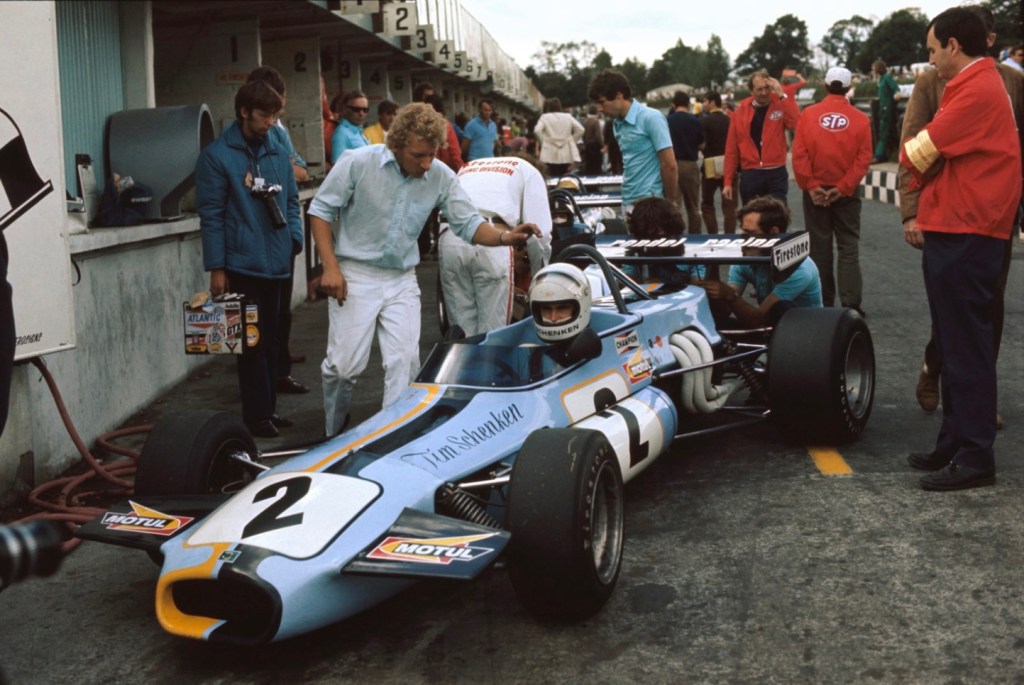
Tim Schenken in the Rondel Racing Brabham BT36 Ford during the Rothmans International Trophy meeting at Brands Hatch in August 1971.
Tim’s race was over early, he had fuel metering unit failure after only three laps. He did a full F2 Championship season, winning at Crystal Palace and placing second at Mantorp Park and Albi. He was fourth in the championship won by his mate, Ronnie Peterson’s March 712M Ford, Ronnie won at Brands that day too. More on Tim here; Tim Schenken… | primotipo…
(gnooblas)
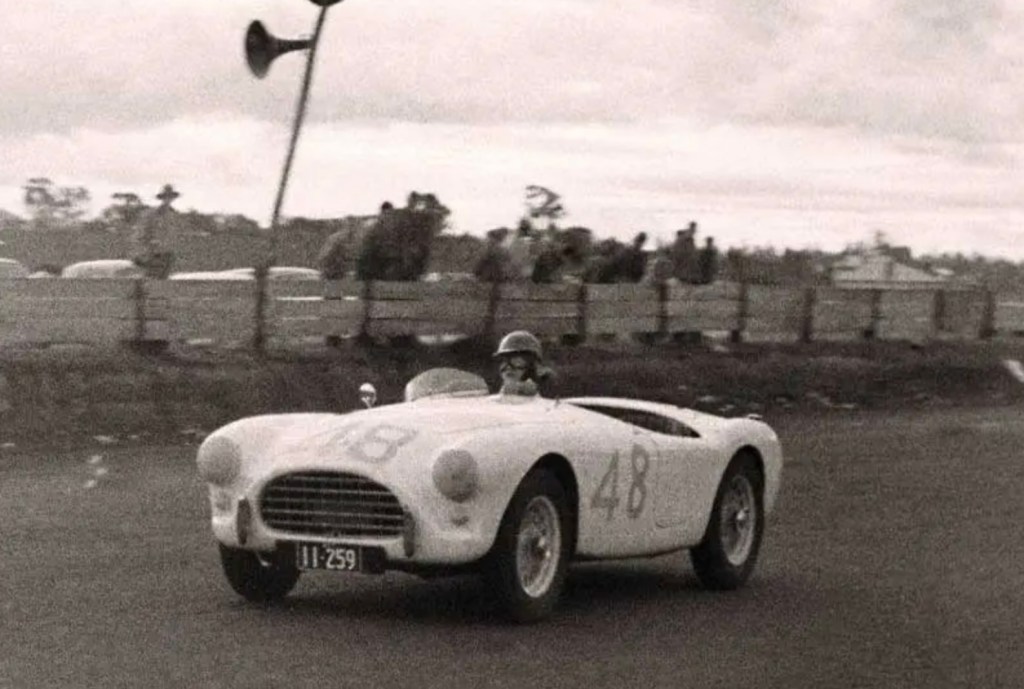
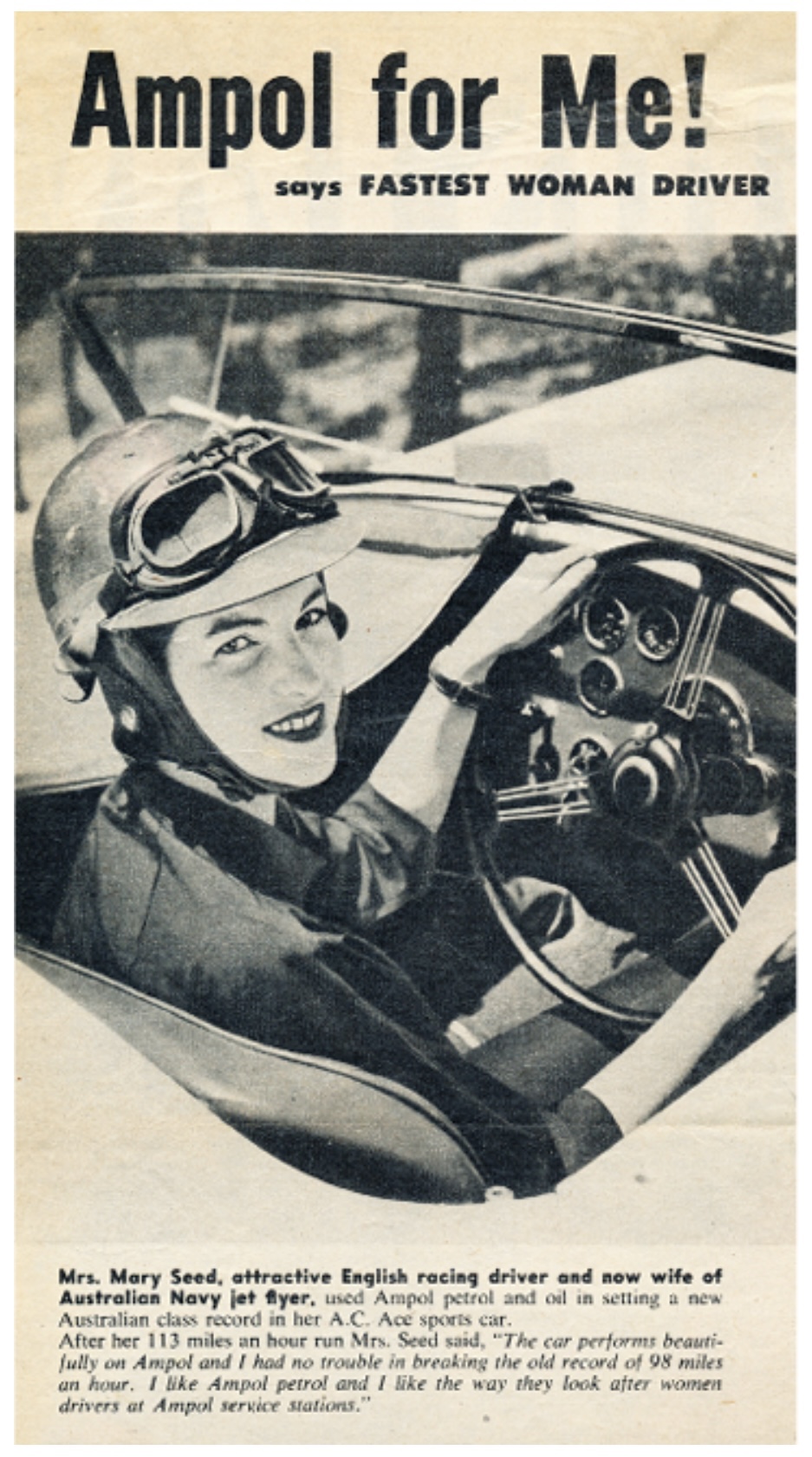
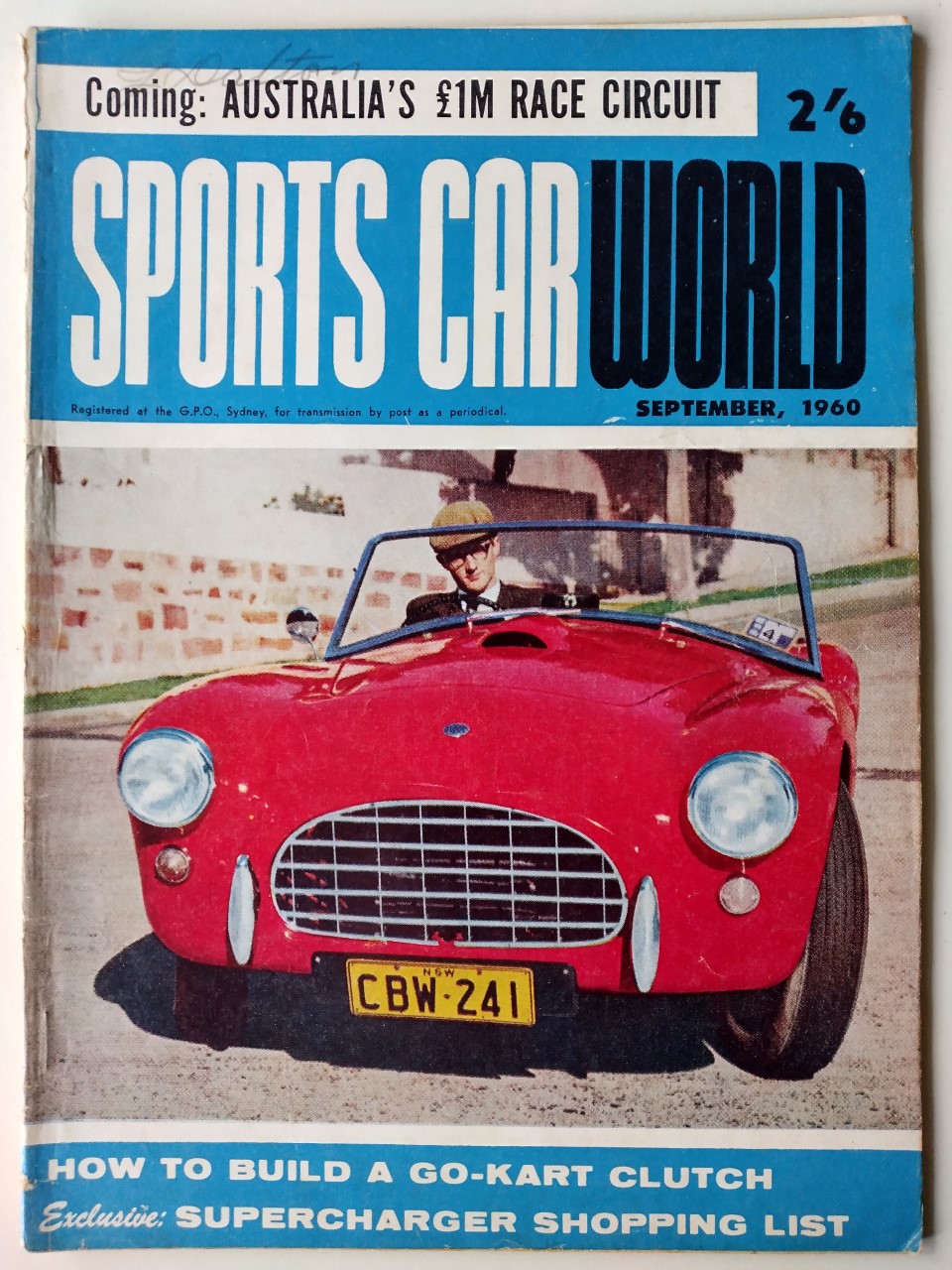
Mary Seed, AC Ace Bristol at Gnoo Blas in June 1958.
The young British socialite had met and married HMAS Melbourne Venom Squadron Leader Lieutenant-Commander Peter Seed in the UK. He gave his bride (née Morton) the car as a wedding gift, before coming to Australia in 1956.
Seed had raced an Austin Healey in the UK in 1955 and raced the AC in Australia from 1956 to 1959, including setting an Australian Land Speed Record for women at 113.3mph at Carrathool in 1957.
When the couple returned to the UK, the car, chassis #BE167, stayed in Australia, and was then raced by Ray Hogwood and Ron Marshall until 1962. Restored by Geoff Dowdle in the early 1980s, hopefully it’s still in Australia.
Doug Blain road testing the ex-Seed AC Ace Bristol BE167 for SCW (B King Collection)
Credits…
Peter Houston, Phil Mahon Collection, LAT, Zeunert Motorsport Archive, rewindmedia.com, Getty Images, John Cox, Bob Williamson Collection, MotorSport Images, Cummins Family Collection, gnooblas.com, Ken Starkey, Bob King Collection, Jason Pratt, Draper Family Collection
Tailpiece…
(K Starkey)
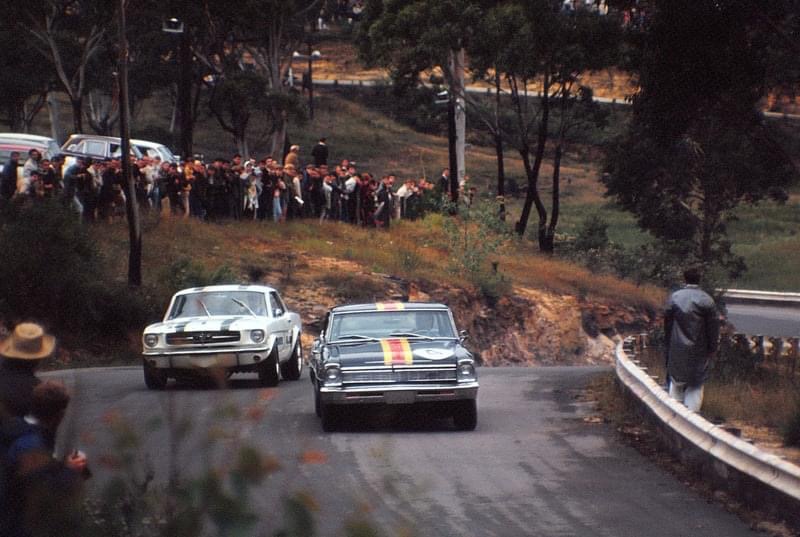
Norm Beechey, Chev Nova from Pete Geoghegan, Ford Mustang at Catalina Park in the Blue Mountains, perhaps, Neil Stratton thinks, during the January 1967 meeting. See here for a bit more; Norm, Jim and Pete… | primotipo…
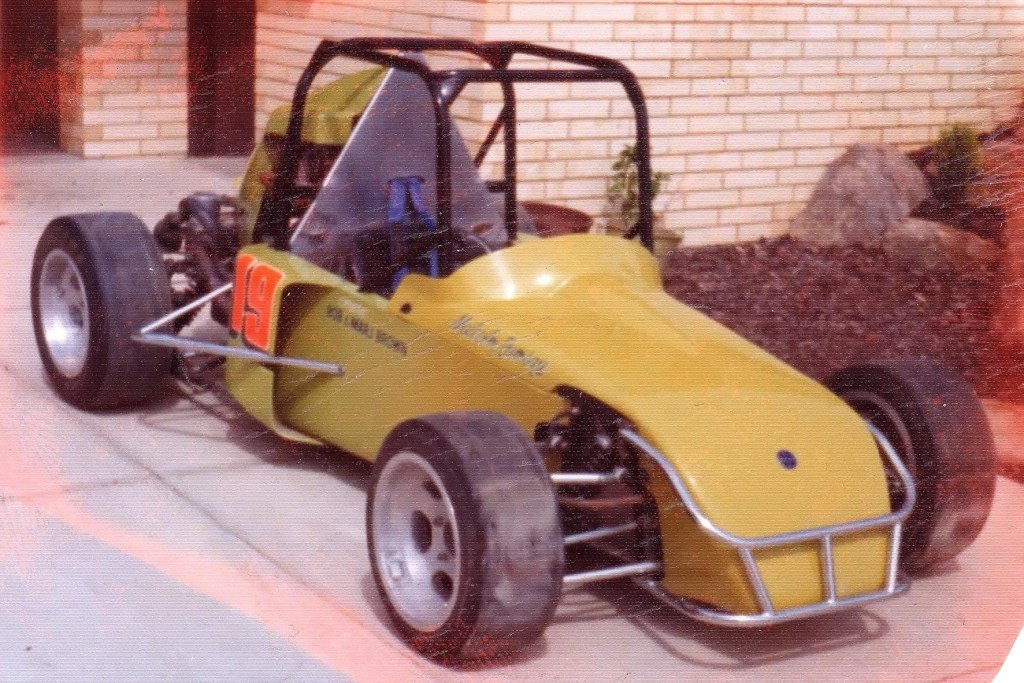
Malcom Ramsay and Tony Alcock built a swag of championship/race winning Formula Ford, F3, F2 and Formula Atlantic single-seaters from 1971 to 1978.
And this mid-engined, supercharged VW powered speedcar.
The project was funded by Bob and Marj Brown, a successful Adelaide business-couple who aided and abetted the careers of Birrana pilots Enno Buesselmann and Bob Muir from 1973-76.
Alcock’s revolutionary spaceframe design was tested by Ramsay on the dirt at Rowley Park, and at Adelaide International’s half-mile, banked, bitumen oval in 1974, it was immediately quick.
It was a step way too far for the conservative controlling body who suggested that “You circuit racing wally-woofdas can take your changes elsewhere!” Or as Ann-Maree Ramsay put it more delicately, the car “was banned due to perceived different handling characteristics compared with the front-engined Sesco and Offy cars of the time.”
The VW engine was a supercharged 1.6-litre flat-four mated to a Holinger modified VW transaxle.
By 1975 the Browns were in England chasing Formula Atlantic fame together with Muir and a pair of modified Birrana 273s.
Ramsay advertised the car in Auto Action, outlining that the S74 was the only car of its type “permitted to race for 18-months on a bitumen-oval, in this very restricted form of the sport.”
Yes, I know it’s a shit-photo, but it seems to be the only one there is, let’s record our history anyway. If you have a better one, please send it to me. The shot is out front of the Ramsay home in Adelaide. If memory serves, it now resides in the Holmes Collection in Brisbane.
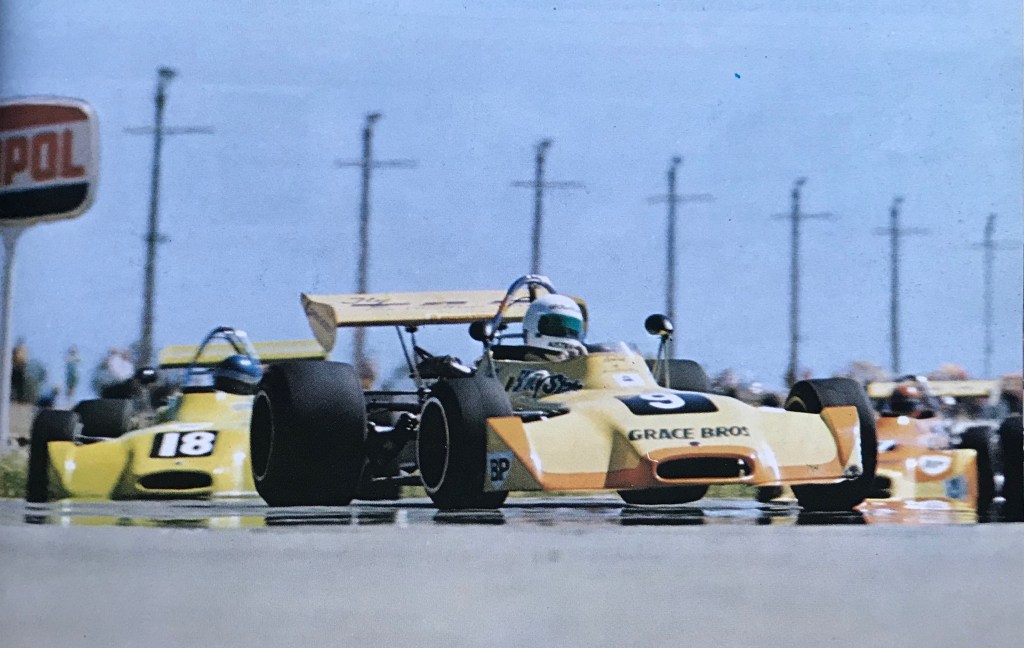
Leo Geoghegan and Enno Buesselmann in Birrana 273 Hart-Fords during the 1973 ANF2 Adelaide International round
John Harvey’s 2.5-litre Repco V8 powered Brabham BT11A shrieks it’s way around Warwick Farm on 18 February 1968…
Looks a treat doesn’t it? Nose up out of Leger Corner onto Pit Straight, it was first meeting for the car with its Repco engine.
By 1968 IC-4-64 was an old-girl, albeit a very successful one. It was raced by Graham Hill in the 1965 Tasman Series for David McKay’s Scuderia Veloce, winning the 1965 NZ GP at Pukekohe on its race debut.
Hill won the ’65 NZGP at Pukekohe on 9 January 1965 from Frank Gardner’s similar BT11A and Jim Palmer’s earlier model BT7A, all 2.5 Coventry Climax FPF powered (sergent.com)
The 2.5-litre Coventry Climax FPF four cylinder engine was struggling against the V8’s by then, so Bob bought a 740 Series Repco 2.5-litre V8 to plonk in the back of the BT11A.
John Harvey, Martin’s successor at Bob Jane Racing, contested the Australian rounds of the 1968 Tasman Series so powered. Jim Clark’s works Lotus 49 Ford DFW won the Tasman that year, it was the final championship he won before his untimely death at Hockenheim that April.
740 Series Repco 2.5 Tasman V8 engine. 700 Series Repco block and 40 Series ‘between the Vee’ heads’, the ’67 World Championship winning SOHC, two-valve engine in 2.5-litre Tasman spec as against its 3-litre F1 capacity. Repco claimed 275bhp @ 8,500rpm for the 2.5, and 330bhp @ 8,400 rpm for the 3-litre variant. Lucas injection trumpets, Bosch distributor and plenty of chrome and cadminium plating in shot (P Houston) Harvey in the BT11A Repco at Longford, 1968. The attention Bob Jane placed on the presentation of his cars is clear. Note the seatbelt, six-point? (oldracephotos.com-H Ellis)
Harves’ did three Australian rounds, only finishing the wet, final Longford event. By the start of the Gold Star series he slipped into Jane’s new Brabham BT23E which had been Jack’s 1968 Tasman mount.
Harvey raced the final round of the 1967 Gold Star Series in IC-4-64 after Martin announced his retirement. He was already well familiar with Repco power, the 740 Series Repco had been shoe-horned into his Ron Phillips owned BT14 F2 Brabham.
Third place at Sandown was his only finish in the car. John commented in a Facebook exchange about this car “…On handling, Peter Molloy and I were still developing the chassis setup, however in the Diamond Trophy race in 1967 (pictured below) at Oran Park I set a new outright record on the last lap”, so they were improving the car.
The engine and Hewland ‘box was removed from the BT14 which Jane acquired, and popped into the BT11A which it was figured would better cope with the power than the BT14 F2 frame and related hardware.
IC-4-64 is still alive and well, as part of the Bob Jane Estate, in FPF engined form.
Harvey in the WF pitlane, Tasman meeting ’68. The BT11A has a vestigial spoiler and a few ducts the it didn’t have when CC FPF powered. Jewels of things these ‘Intercontinental’ Brabhams, very successful ones at that (B Williamson) At the Warwick Farm Tasman meeting again (J Stanley) Competitor view of the BT11A and its luvverly Repco RB 740 2.5-litre 275 bhp V8 (P Houston)
Credits…
autopics.com.au-Richard Austin, John Stanley, Peter Houston, sergent.com, Bob Williamson, oldracephotos.com-Dick Simpson, Harold Ellis and Harrisson, oldracingcars.com, Stephen Dalton Collection
The shot of Harvey in the Ron Phillips owned Brabham referred to above, on the way to victory in the Diamond Trophy at Oran Park.
John made his name in speedway and transitioned into road racing in an Austin/Morris Cooper S, and then into open-wheelers in this ex-Bib Stillwell car. The Brabham received progressively bigger Lotus-Ford twin-cams, with Harvey going quicker and quicker, before the machine copped its Repco V8 Birthday between the 1967 Tasman and Gold Star Series. Rennmax’ Bob Britton performed the surgery to pop the Repco into the BT14 frame, creating a BT14 jig in the process.
It wasn’t that successful in Repco form; DNF/DNS at Lakeside, Surfers, Mallala and Symmons Plains, third place in the Sandown Gold Star round in September was the car’s best, behind Leo Geoghegan’s Lotus 39 Repco and Spencer Martin aboard BT11A IC-4-64.
Harvey during the Diamond Trophy meeting at Oran Park (oldracephotos.com-Dick Simpson)
Harvey’s Bob Jane drive commenced aboard IC-4-64 in the final Gold Star round, the Hordern Trophy, at Warwick Farm in December 1967.
So…Harvey in 12 or 14 months drove quite a few different Brabham/engine combinations! BT 14 Ford, BT14 Repco, BT11A Climax, BT11A Repco, and then BT23E Repco for the ’68 Gold Star Series. Mind you he missed the ’68 Gold Star.
The ‘noice new Brabham crashed after a rear suspension upright failed in practice for the opening Bathurst round. Harvey’s big accident and subsequent recovery kept him away from racing for the rest of the year.
Harvey aboard the Jane Racing Brabham BT23E Repco 830, during the Symmons Plains Gold Star round in March 1970, at the end of its competitive life. He won the race from Leo Geoghegan’s Lotus 39 Repco and Kevin Bartlett’s Mildren Waggott (oldracephotos.com-Harrisson)
Tailpiece…
(S Dalton Collection)
The July 1965 Oran Park meeting program shows Harvey’s Austin Cooper S ahead of George Garth’s Ford Cortina GT during the OP May 1965 meeting.