Posts Tagged ‘Australian Motor Racing History’

RH Michell’s Citroen Special dates from 1938, the young constructor built it in Woodville, Adelaide…

And that’s about all I know of this little racer.

Did Michell survive the war, did it ever race, if so was it a quick car?

Woodville was the site of some ‘bike and car racing through its streets after the War- I wonder if the car contested an event or two at the place of its birth. It didn’t race in any of the Australian Grands Prix held in South Australia around this time- Victor Harbour in 1936, Lobethal in 1939 nor Nuriootpa in 1950. Mind you, it may have contested a support event.

Intrigued to know anything about this car i tripped over by happenstance…

Photo Credit…

State Library of South Australia

(J Lineham)

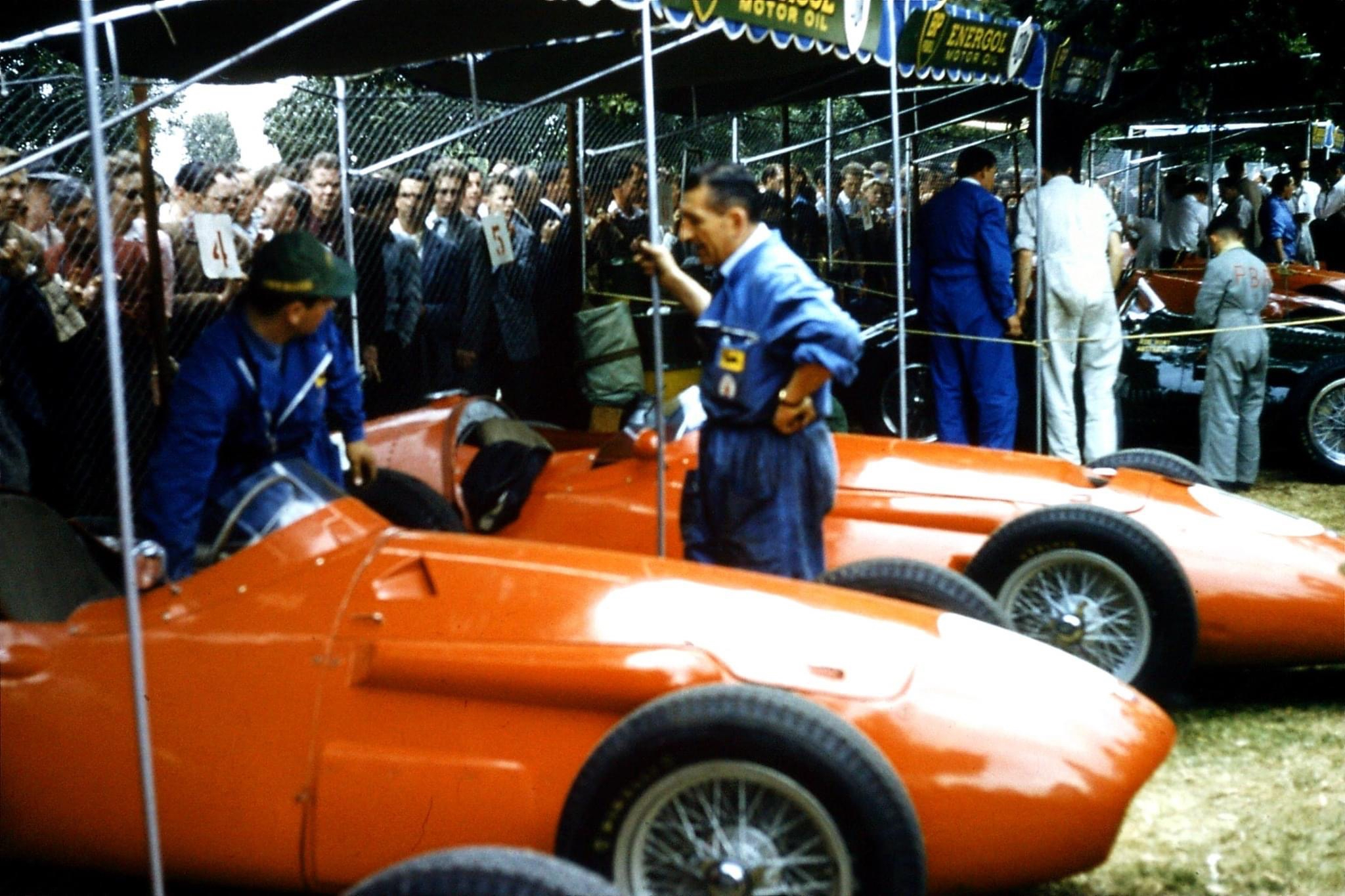
Reg Hunt #5 and Guerino Bertocchi #7 in Maserati 250Fs prior to Saturday practice, Albert Park, Australian Grand Prix, 1 December 1956…

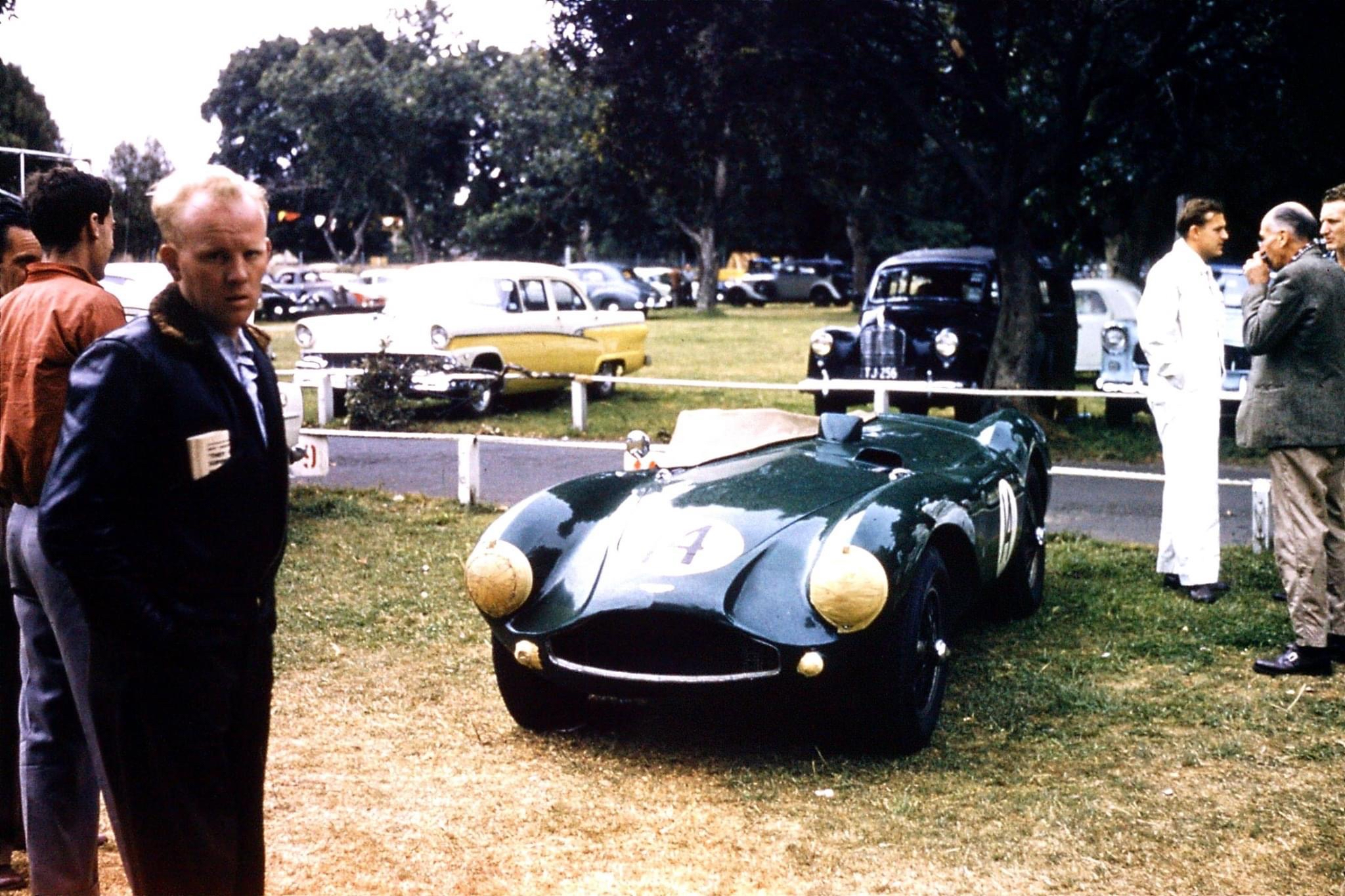
Hunt looks pretty happy with himself whilst Maserati’s legendary tester/mechanic Bertocchi wonders if everything is AOK with the Moss #2501. To the left of Hunt’s car is Tom Sulman’s Aston Martin DB3S.

James Lineham had a fantastic day at the ‘Park, the sun shone making it ideal for spectators, especially those with cameras. He used his expensive colour film wisely in the paddock, his camera wasn’t sophisticated, so best to take snaps of stationary or slow moving cars. Then he shot off some monochrome action work whilst he walked Albert Park’s huge expanse.

Bib Stillwell’s Jag XKD perhaps, on Lakeside Drive looking to the south of Albert Park Lake (J Lineham)
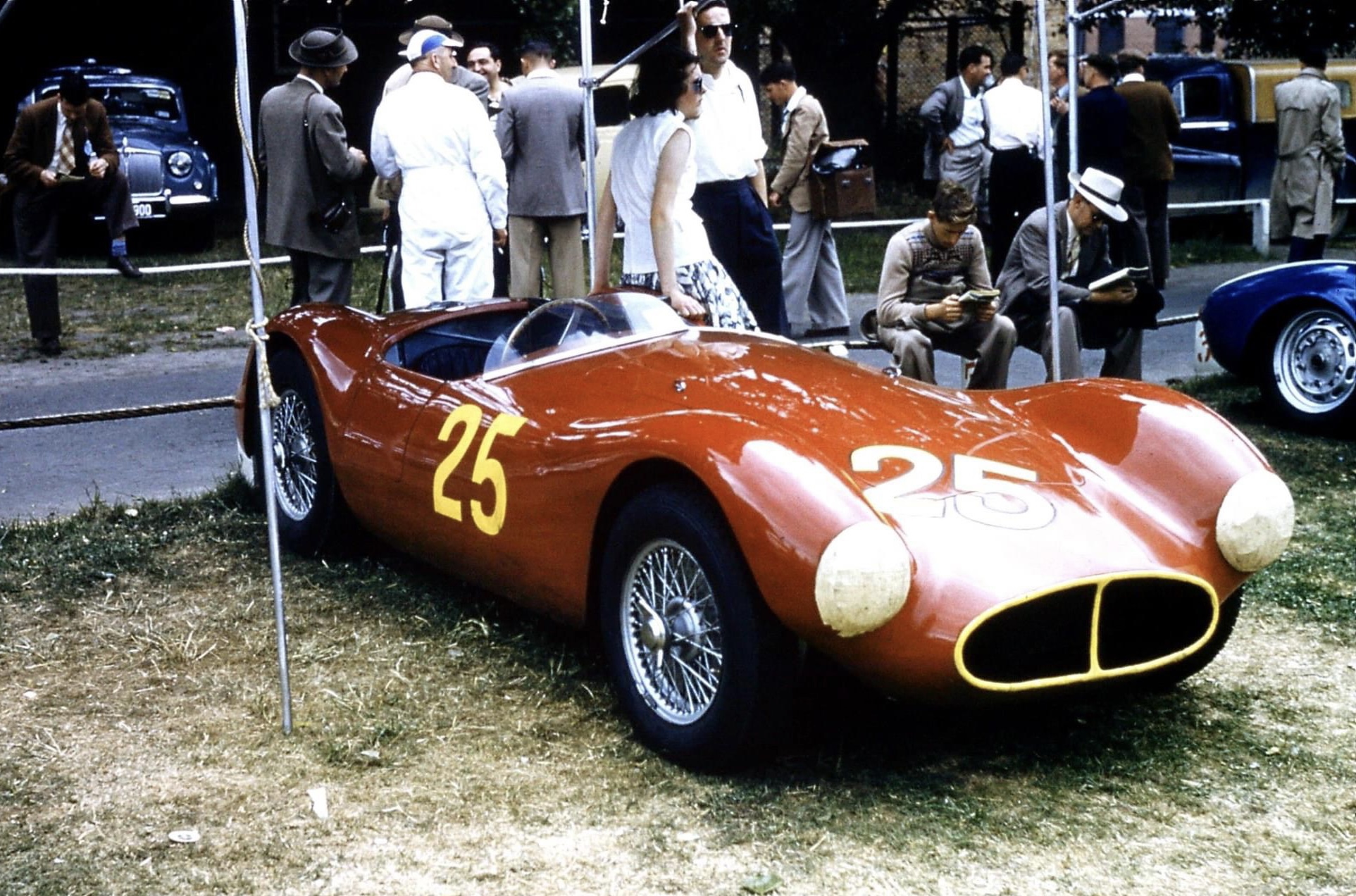
Paul England’s superb Ausca Holden-Repco, built after-hours by England at Repco Research (I Curwen-Walker)

James life spanned 1925 to 1997, he was a young enthusiast aged 31 when he attended this meeting. After his death his wife carefully went through all of his precious belongings, found these photographs and donated them to the State Library of Victoria for enthusiasts like you and I to see, in 2014.

Many thanks James and Catherine Lineham. Blurry though some of them are, they ooze atmosphere of a weekend spoken about in reverential terms by those fortunate enough to have attended. One of the journalists of the day, wrote of the weekend as ‘when Australian motor racing came of age’.

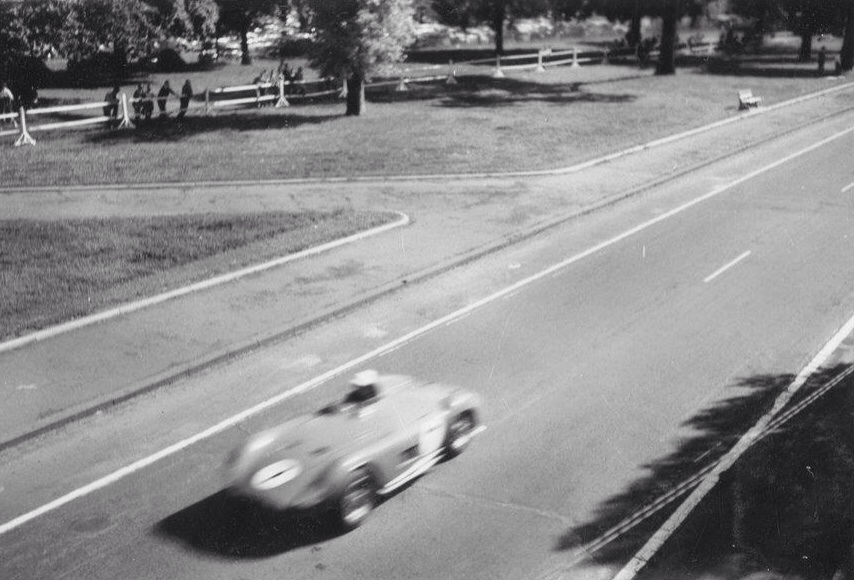
Moss or Behra Maser 300S on the pit or main straight, Aughtie Drive. Race direction these days the other direction, or clockwise (J Lineham)
Tom Sulman’s Aston Martin DB3S with Tom in the blazer at right (I Curwen-Walker)
Circuit map from the meeting program (G Dobie)

I’m obsessed with a few circuits in Australia in particular; Warwick Farm, Mount Panorama, Longford, Lobethal and Albert Park – Longford and the ‘Park especially. I live in Windsor 750 metres from Albert Park’s Austin Healey Corner/Turn 13, the Union Street/Queens Road second gear right-hander.

I run around it every other day, I think about the fellows who conquered it’s oh-so-quick unguarded challenges in the 1950s and do so in much more safety today. I feel its wonderful rhythm, vibe and sense of history all the time. These snaps gimme that vibe, Albert Park is a wonderful place to be even at 5.15am with only the park’s Daffy Ducks as company!

When originally posted, the article comprised James’ shots only, but the piece has grown over the years as other photographs have appeared online and I have plucked them from certain obscurity on FB.

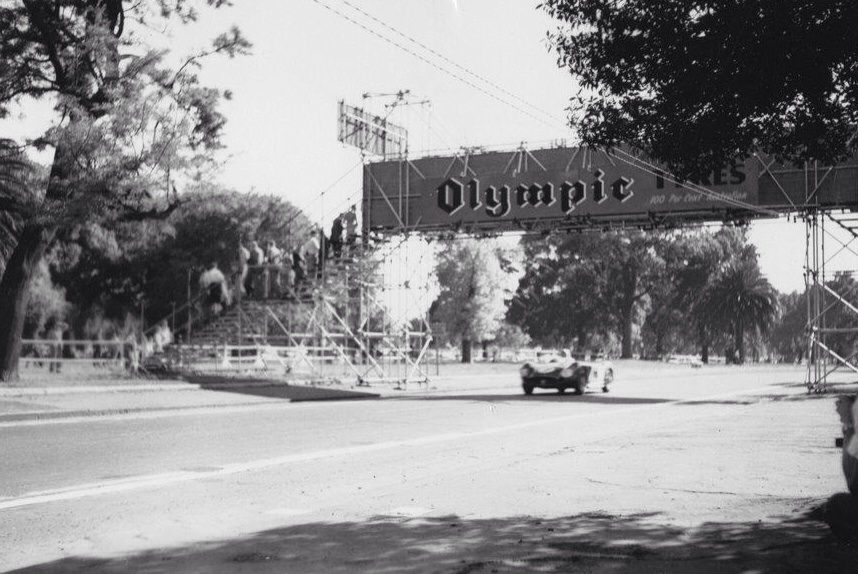
Vrrooom in a six-cylinder 3-litre, DOHC kinda-way. Moss Maser 300S. Aughtie Drive from the Olympic Tyres Bridge (J Lineham)
Reg Parnell’s Ferrari 555 Super Squalo with Peter Whitehead’s similar car at left (I Curwen-Walker)
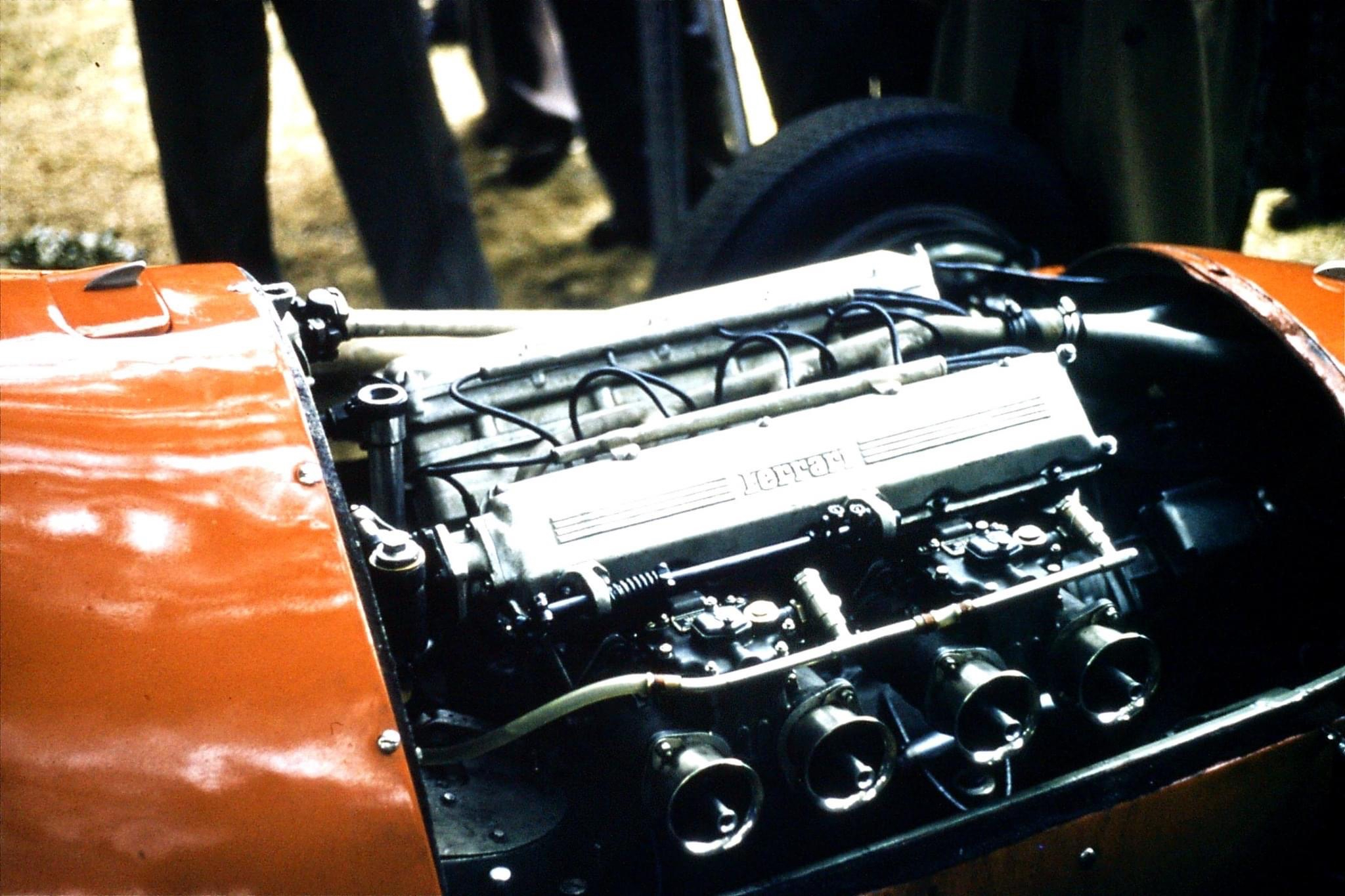
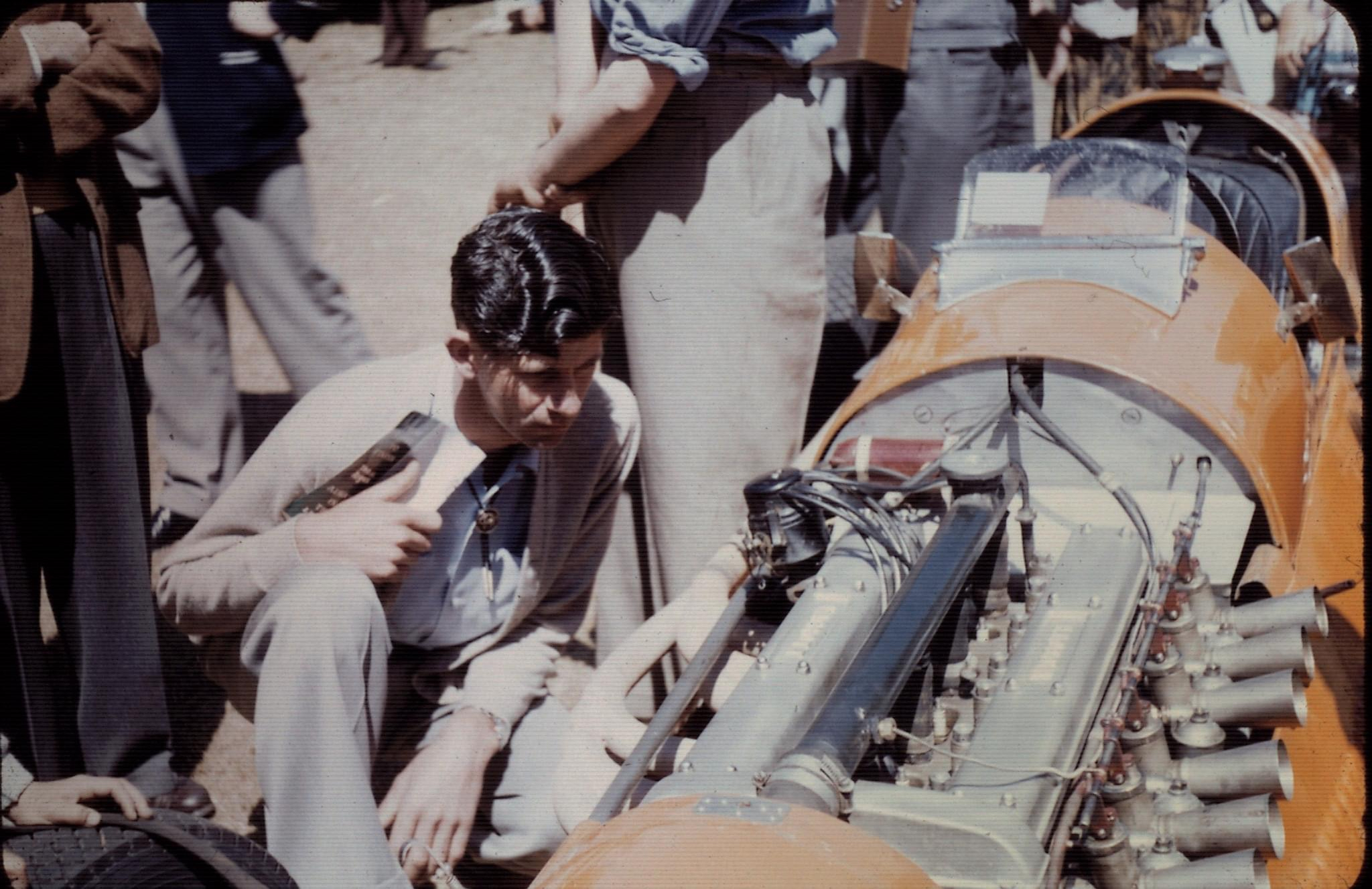
3.4-litre, DOHC, two-valve engine of Parnell’s car (I Curwen-Walker)

Attached are links to articles already written about this motor racing fortnight during the 1956 Melbourne Olympic Games which ‘put Melbourne, if not Australia on the map’.

In fact James had a big choice to make that day. He could have taken a vantage point on the men’s marathon course from Clayton to the Melbourne Cricket Ground. Algerian born Frenchman Alain Mimoun won it in 2:25.00 from Franjo Mihalic of Yugoslavia a minute and a half behind.

The Australian Tourist Trophy; https://primotipo.com/2016/01/29/1956-australian-tourist-trophy-albert-park/ and Australian Grand Prix; https://primotipo.com/2016/12/27/moss-at-albert-park/

Jean Behra, Maserati 250F (J Lineham)

The short story of the race is that Stirling Moss won the 80 lap, 250 mile event on 2 December 1956…

He did so by a lap from teammate Jean Behra, Peter Whitehead’s Ferrari 555 Super Squalo, Reg Hunt’s Maserati 250F and Stan Jones’ similar machine. It was a dominant display from the plucky Brit who was always, and still is immensely popular when he visits Australia.

International representation included the two works Officine Maserati drivers Moss and Behra (#1 above) who brought no less than five Masers with them. They shipped three 250Fs, two of the latest specification and an earlier chassis, and two 300S sportscars both of which remained in Australia post event. The cars were based at Reg Hunt’s Holden Dealership just up St Kilda Road on the Nepean Highway in Elsternwick a few kilometres from the circuit, the 300S’ being famously driven between workshop and racetrack.

Stirling Moss enroute to victory in his Maserati 250F (Melbourne Argus)
Prince Bira and Jean Behra in the Albert Park paddock (S Landrigan)

Jean didn’t have a great year, being comprehensively bested by one of the most gifted drivers in the world, but third places at Buenos Aires, Monaco, Reims, Silverstone and at the Nurburgring is hardly shabby. Over the two weekend Australian carnival it was Moss winning both the AGP and the Australian Tourist Trophy held the weekend before.

Moss raced #7 250F chassis number 2501 and Behra #1 2522. The spare car – 2507 – was driven by both Moss and Hunt during practice. At one point it was thought Jack Brabham may race it, not having an AGP ride that year, but it was not to be. A pity, by that stage Jack had two seasons of racing in Europe behind him so would have given all but Moss and Behra a good-go.

Two of the three Officine Maserati works 250Fs, chassis numbers as per text. #1 is Behra’s machine (I Curwen-Walker)

Scuderia Ambrosiana entered two Ferrari 555 Super Squalos powered by 3.4-litre 860 Monza four cylinder engines.

The AGP at this time was run to Formula Libre rules, the cars above were driven by #2 Reg Parnell, chassis number FL9002 and #3 Peter Whitehead, chassis FL9001. Whitehead was a regular visitor to Australia dealing with the family wool business and had won the Australian Grand Prix way back in 1938 aboard his ERA chassis R10B, when he was 24, in 1956 he was 42 years of age.

Whitehead started the carnival well winning the Bryson Industries Cup support event to the Australian Tourist Trophy the week before, ahead of Hunt and Kevin Neal, Maserati A6GCM.

Whitehead and Parnell were unlikely to be on the pace of the works Masers but would be good bets as best of the rest, as indeed they were, Peter was third and Reg sixth. The Parnell car remained in Australia, click here to read about it;

Car #9 in the background of the photo above is Lex Davison’s Ferrari 500/625, Alberto Ascari’s 1952/3 dual World F1 Championship winning chassis #0005, iconic in Australia and winner of the 1957 and 1958 AGP’s at Caversham and Bathurst respectively. The 3-litre car, which then carried chassis number #0480 was seventh, five laps behind Moss with various problems.

Behra and Moss at the driver’s briefing (S Landrigan)
(J Lineham)

Ken Wharton was a well credentialled Brit in both single-seaters and sportscars, but his ‘Ecurie Du Puy’ (John Du Puy was an American resident in Switzerland) silver Maserati 250F was said to be, and looked, tired.

Chassis #2521 had been Behra’s works machine – a new car that season – and raced in eight events earlier in the year before being sold to Du Puy. But it looked in-need-of-a-birthday before leaving Europe, it was the latest bit of kit, properly prepared the car was a top-three contender.

Ken retired the car on lap 19 and then journeyed on to race the Maserati and his Ferrari Monza in New Zealand that summer, unfortunately dying in a tragic accident aboard the Monza on 12 January 1957 at Ardmore during the NZ GP weekend.

The best prepared and equipped of the locals were the well-heeled Victorian motor dealers, Reg Hunt and Stan Jones in Maserati 250Fs of similar specification and cobbler Lex Davison, who owned a shoe manufacturing and distribution business.

Lex’ Ferrari was older than the 250Fs but was quick with its 3-litre four cylinder, DOHC engine and was beautifully prepared by Alan Ashton at AF Hollins motor engineers just up the road from the ‘Park in Armadale. In fact all three of these cars lived close to the circuit. Hunt was fourth, and best of the locals, Jones fifth and Davison seventh.

(J Lineham)

Doug Whiteford was another local – very – his dealership/workshop was in Carlisle Street St Kilda, a drop-kick from Albert Park.

Whiteford’s first Talbot-Lago T26C, chassis #110007 was an astute purchase, the robust, simple design was well suited to Australian events. It was beautifully prepared and driven by ‘Dicer Doug’ who won two of his three AGPs in it, at Bathurst in 1952 and at Albert Park in 1953. Click here for a piece on Doug’s TLs;

The purchase of the second T26C (photo above) wasn’t quite so smart though. An earlier chassis #110002 but later spec mechanically than #110007 sounded ok but the game in Oz had moved on. He needed something more modern and competitive.

Whiteford was a consistent third in the ’55 AGP at Port Wakefield behind Brabham and Hunt but by ’56 the old Talbot Lago was simply not on the pace. Still, his bankroll was more modest at the top level than most. A shame, as Doug, 42 then and as vastly experienced and tough as they come didn’t give a yard to any of the locals. Whiteford in a 250F or something of that performance envelope would have been worth travelling a few miles to see. It’s a shame he bought a 300S off Maserati after this meeting rather than a 250F.

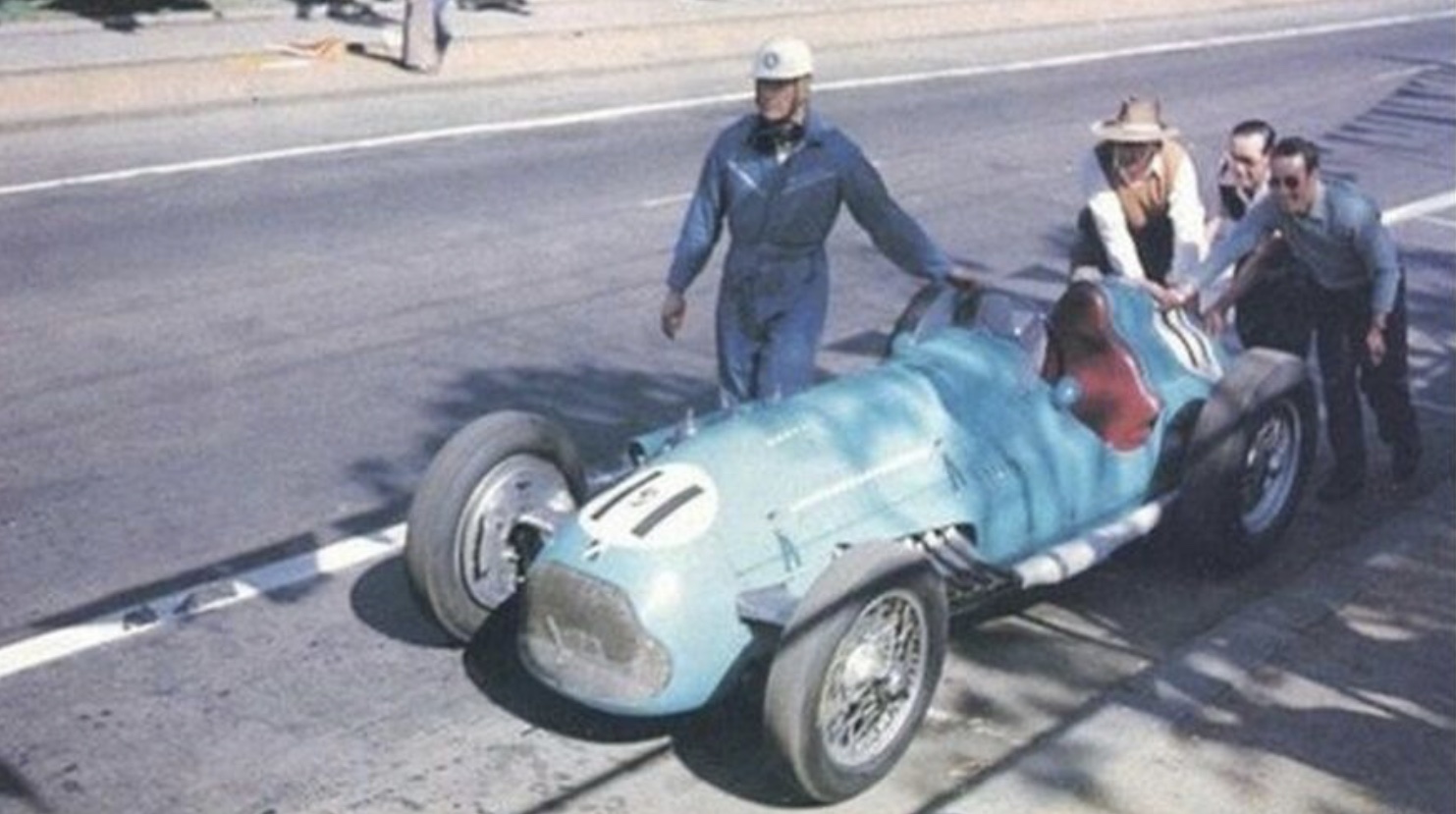
The Whiteford Talbot Lago T26C in the paddock, and below being pushed by Doug and the crew towards the start (I Curwen-Walker)
(unattributed)
Kevin Neal, Maserati A6GCM 2.5-litre (J Lineham)

Reg Hunt made everybody take notice in his ‘Flying Bedstead’ Hunt JAP Spl in hillclimbs and on the circuits in the late 1940s/early 1950s and then refined his craft with a season racing a 500 F3 Cooper machine in the UK in 1954.

On his way back to Oz he acquired a superb Maserati 250F engined Maserati A6GCM chassis #2038 (above with Kevin Neal at the wheel) with which he belted the locals in 1955. Only mechanical failure kept him from the ’55 AGP won by Brabham’s Cooper T40 Bristol. Hunt ordered a 250F for ’56, he was allocated a rebuilt 1955 works machine chassis 2516 with Melbourne haulier Kevin Neal – who had also raced an ex-Hunt Cooper T53 Bristol – the purchaser of the A6GCM.

Neal had a shocker of an AGP, bending the car severely and injuring himself late in the race when he lost the car in the greasy conditions. I wrote a long feature about the A6GCM;

Stan Coffey’s Ferrari 750 Monza sportscar below. He raced the car in the Australian TT, DNF in the classic won by Moss from Behra and Ken Wharton’s Ferrari Monza.

It’s a rare, clear shot of the man, now whatever became of him? There is an obscure article topic, he raced a few interesting cars too, Cooper Bristol etc…

(J Lineham)

Entry List…

(B Moyle)

Etcetera…

(J Hunting)

The photograph above is in the AF Hollins Pty.Ltd workshop in 604 Hight Street, Armadale (the building still exists as a tyre fitter/retailer). Julian ‘Gib’ Barrett’s #19 Alta GP-2 1.5 s/c alongside Lex Davison’s Ferrari 500/625. Behind are the two Ferrari 555s, Reg Parnell’s partially obscured on the left and #3 Peter Whitehead on the right. The other car we can just see at far left is the Wharton silver Maserati 250F.

(Gray Family)

Reg Parnell’s Ferrari Super Squalo, Lex Davison’s Ferrari 500/625, looking smaller in comparison, and the dark coloured Kevin Neal Maserati A6GCM which did not look quite so pristine at the end of the weekend.

(I Curwen-Walker)

Quite what is going on here I’m not sure, it’s most certainly not the start of the touring car race!

(I Curwen-Walker)

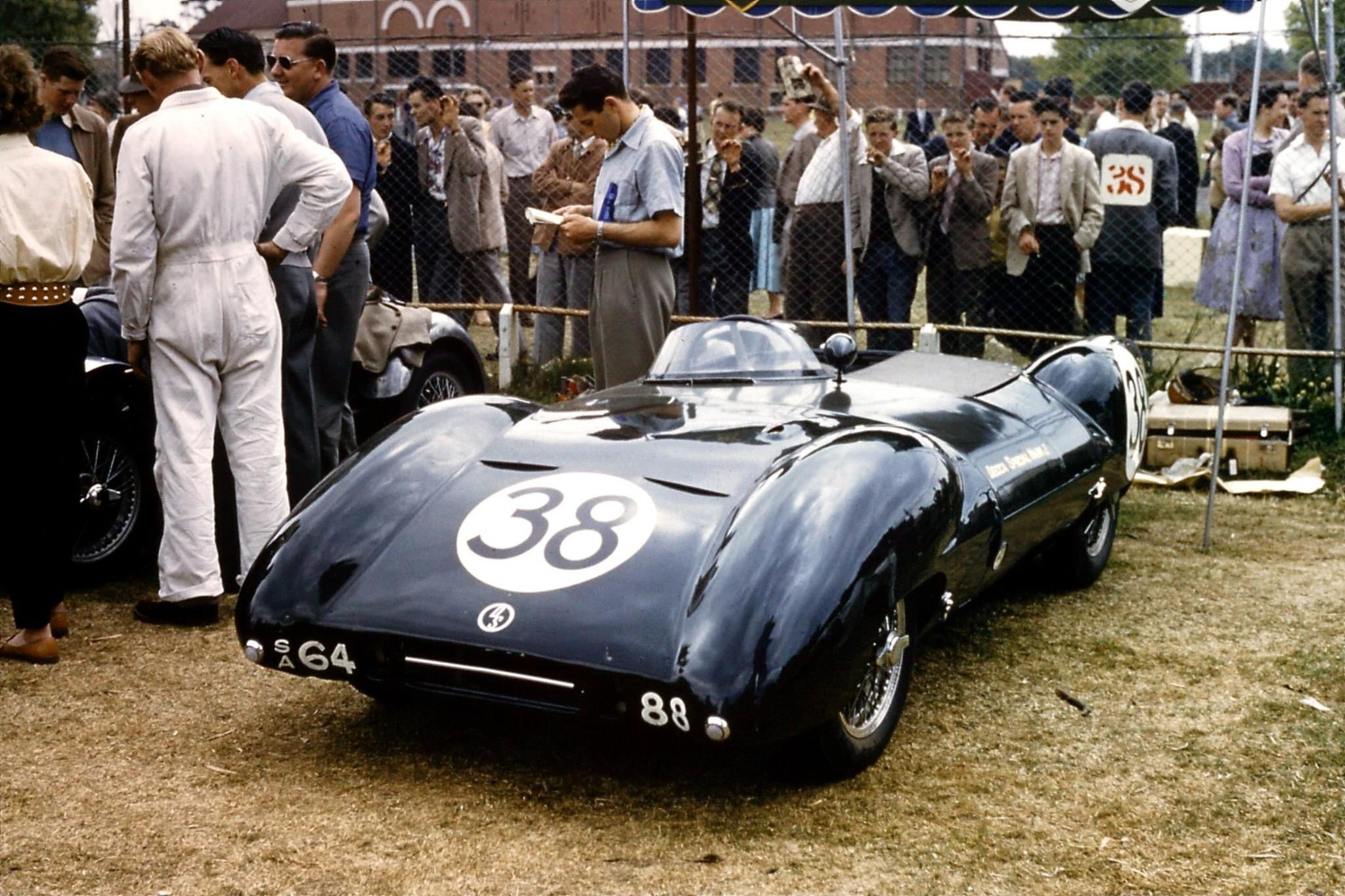
Derek Jolly’s very successful Lotus 11-esque Decca Mk2 Climax. 13th outright and first in class in the Australian Tourist Trophy won by the Moss Maserati 300S. See here for more on Derek and his cars; https://primotipo.com/2017/11/09/dereks-deccas-and-lotus-15s/

(R Jackson)

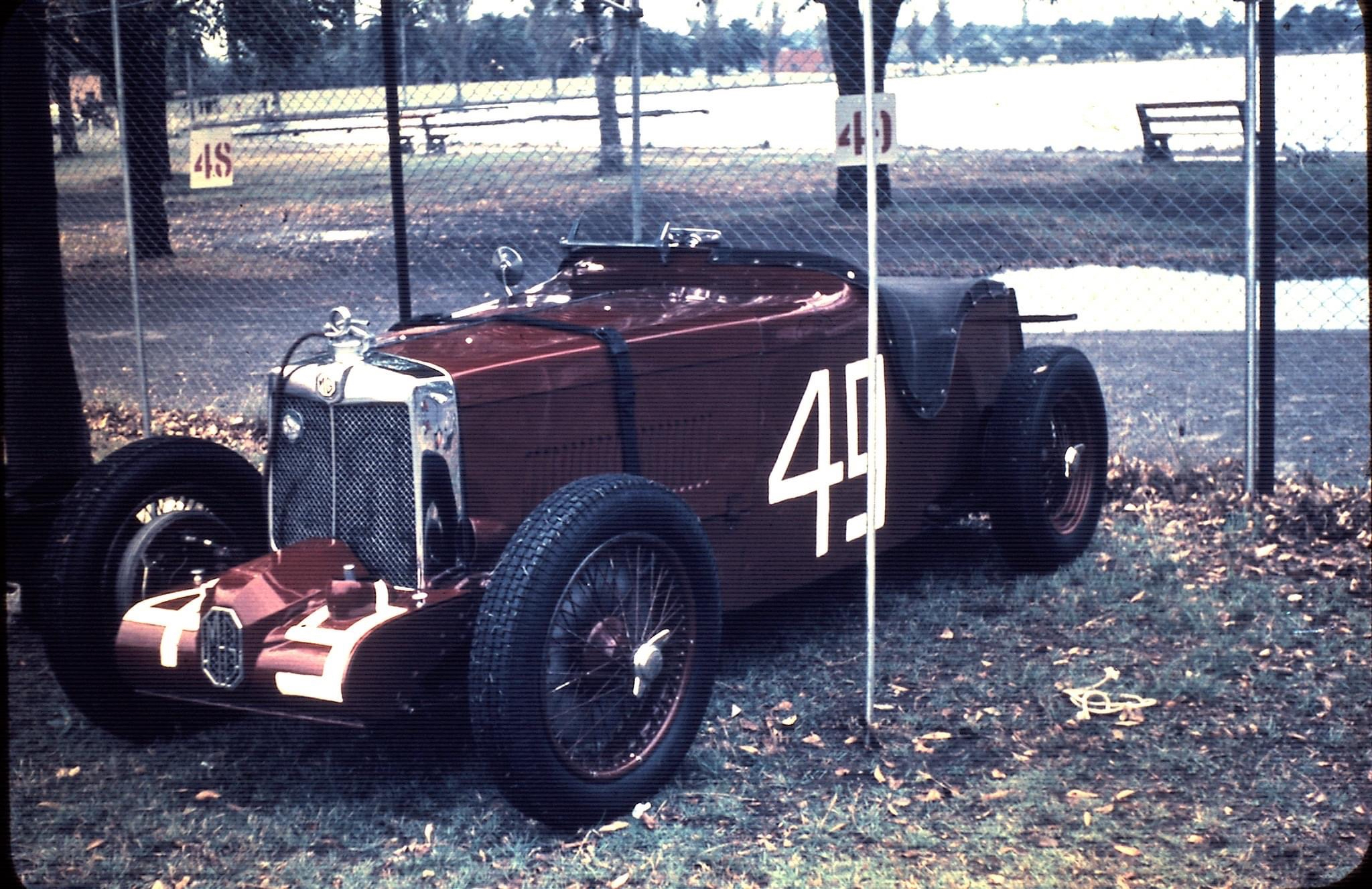
Otto Stone’s MG K3 looking very lonely in the seemingly deserted Albert Park paddock.

Stone was a legendary driver/engineer who fettled all manner of exotic machinery not least Stan Jones’ Maserati 250F during Stan’s glory years including his 1958 Gold Star and 1959 AGP Longford campaigns.

Stone placed second in the curtain raiser, opening event on the first weekend of the carnival, the 16 lap Argus Cup handicap for racing cars. Neil Charge won aboard the Charge brothers MG Special with the C Martyr Sunbeam third.

(R Jackson)

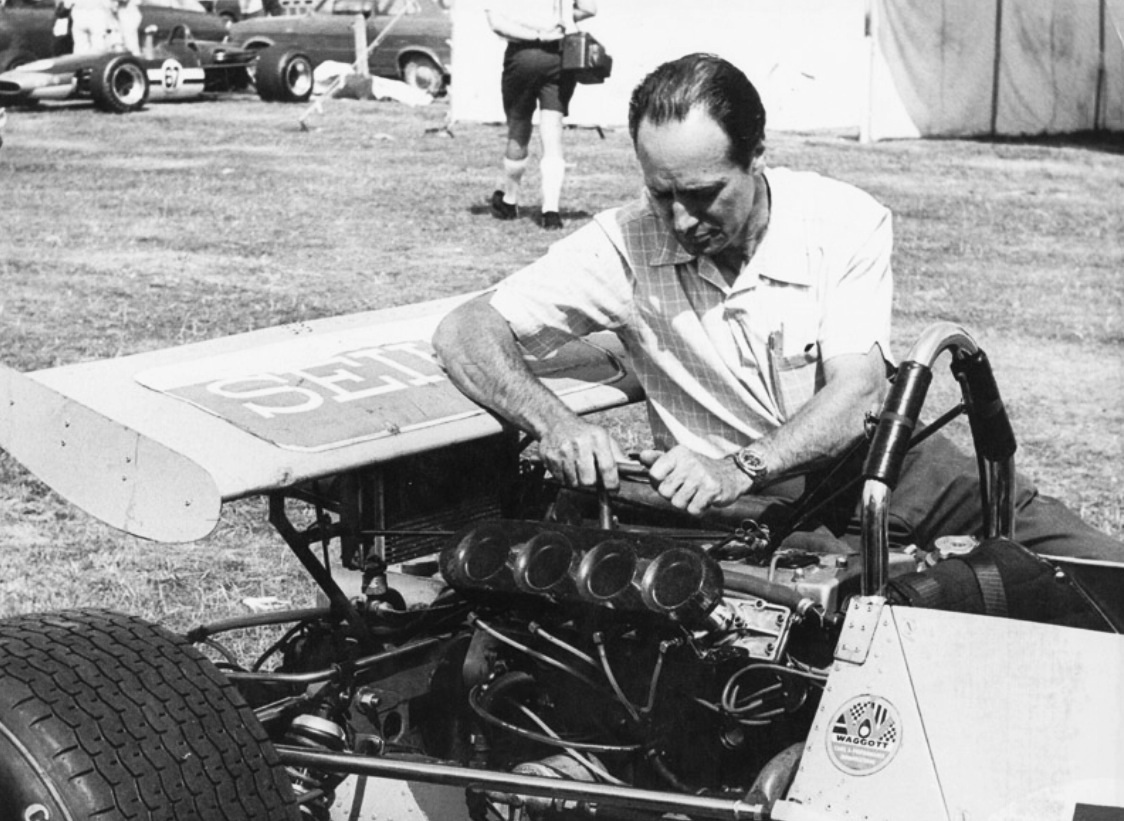
Our engineering oriented friend is taking a good, hard look at Jack Myers’ Cooper T20 Waggott-Holden aka WM Holden. The 2.4-litre Waggott twin-cam head, six-Amal fed Holden Grey six-cylinder engined Cooper placed 12th and last in the AGP. The story of the car and its amazing driver/engineer is here; https://primotipo.com/2015/02/10/stirling-moss-cumberland-park-speedway-sydney-cooper-t20-wm-holden-1956/

(O Plada)

Bibliography…

 8W.forix.com on Maserati 250F chassis numbers, oldracingcars.com

Photo Credits…

James Lineham, State Library of Victoria, Simon Landrigan, Brian Moyle Collection, Gordon Dobie Collection, Oscar Plada, John Hunting, Gray Family Collection, Ian Curwen-Walker, Melbourne Argus, Ron Jackson

Tailpiece…

(I Curwen-Walker)

The Maserati corner of the Albert Park paddock, how good would that have been! The factory spare and Behra’s race-car in shot with Kevin Neal’s 2.5-lite A6GCM behind being looked after by the short-arse mechanic.

Finito…


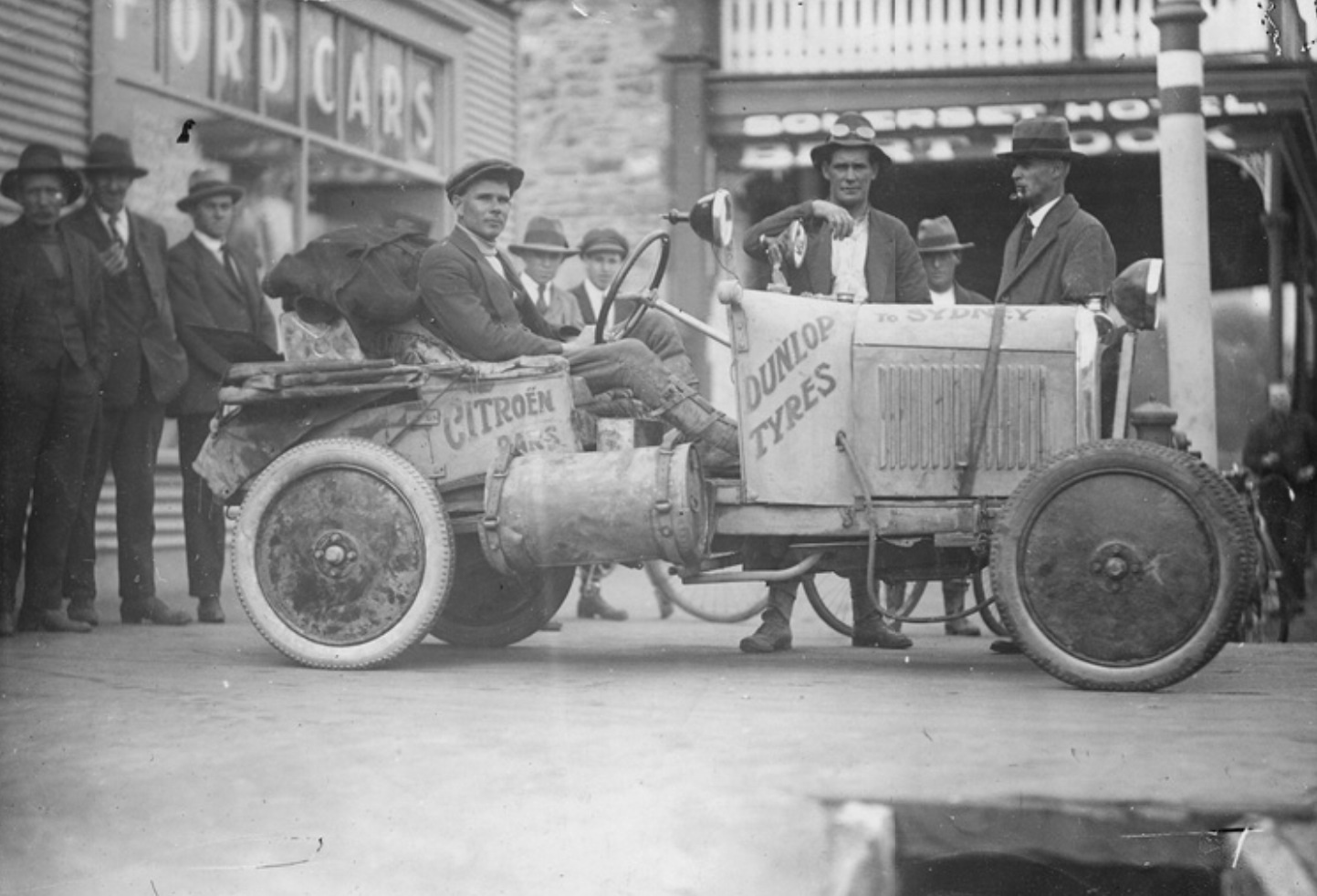
WJ Phipps and J Seery drove this 7 hp Citroen Type C from Fremantle, Western Australia to Adelaide, South Australia, Melbourne, Victoria in May 1923, and on to Sydney New South Wales, a  journey of about 3,180 miles…

The West Australian pair left Freo in the 856cc, 4 cylinder, 3 speed small car on 1 May. Phipps originally intended to make the trip on a motor cycle and sidecar but received an offer from the Citroen agents to use the small car instead, he then invited Seery to accompany him. In various reports described as a planned as an attempt on the Fremantle-Sydney transcontinental record, or to prove a small light car could make the challenging journey, the trip became a ‘more leisurely touring drive’ after the loss of four days due to hub damage.

Phipps quipped that ‘When we left Perth we were the laughing stock of all motorists because no-one dreamed we would be able to get through’. Even the cars agents were somewhat dubious about their prospects. The intrepid adventurers travelled all day and night, one sleeping whilst the other drove.

The route chosen took them from Fremantle to Kalgoorlie (WA) Port Augusta to Adelaide (SA) Melbourne and then on to Sydney (Victoria and NSW respectively).

The Perth ‘Daily News’ reported that ‘Despite the fact the whole outfit with luggage weighed 18 cwt, (including 23 gallons of petroleum benzine and 8 gallons of water) the little car had no difficulty in negotiating this heavy route’. For hundreds of miles, the pair followed the transcontinental railway line as much as possible, there was no track at all, with large limestone boulders having to be moved before they could proceed.

The car was delayed by four days near Naretha, 180 miles from Kalgoorlie on the transcontinental railway line, ‘owing to one of the wheels crashing into an obscured stump’ the Citroens hub was broken necessitating a spare to be delivered by rail from Perth. Apart from that mishap they ‘never had a spanner on the car’.

The most challenging part of the trip were the Yardu Sandhills in central WA where the Citroen got through unaided, taking five hours to go 12 miles. Other heavier cars on previous trips having to be hauled through by bullock teams.

Adelaide was reached in 157 driving hours on 11 May, this section of the trip was 1,769 miles. Behrens and Marshall (another report says Maugham-Thiem Motor Works) were the Citroen agents in Adelaide, the photograph of the car is out front of their Flinders Street showrooms.

The car then set off for the 571 miles to Melbourne at 2pm that afternoon 11 May. The other most difficult leg of the trip was the section near Kurow Lake, there, instead of being axle deep in sand, they were axle deep in mud. They arrived in Melbourne at 8 am on 14 May.

After a days rest Phipps and Seery then set of for the 594 mile Sydney leg at 10.45 pm on 16 May via the Hume Highway route. They stopped for a night in Gundagai, wet and cold from exposure and set off again on Saturday arriving that evening, 19 May ‘…in Martin Place with West Australian air’ a quip referring to the fact that the tyres had not been pumped up at any time on the journey. The car was shod with Dunlop ‘Railroad’ tyres, averaged 38-44 miles per gallon, used 1.5 gallons of lubricant with the average speed for the entire trip 16.5 mph.

In a parting shot Phipps said ‘We are on a holiday trip…we will return in the car…we intend on the way back to the West to have some dingo shooting on the Nullarbor Plain’.

I wonder if this significant Citroen survived?

Credits…

WS Smith/State Library of South Australia. ‘The Daily News Perth’ 2 June 1923, ‘Perth Sunday Times’ 20 May 1923, ‘The Express’ Adelaide 11 May 1923

(Eldougo)

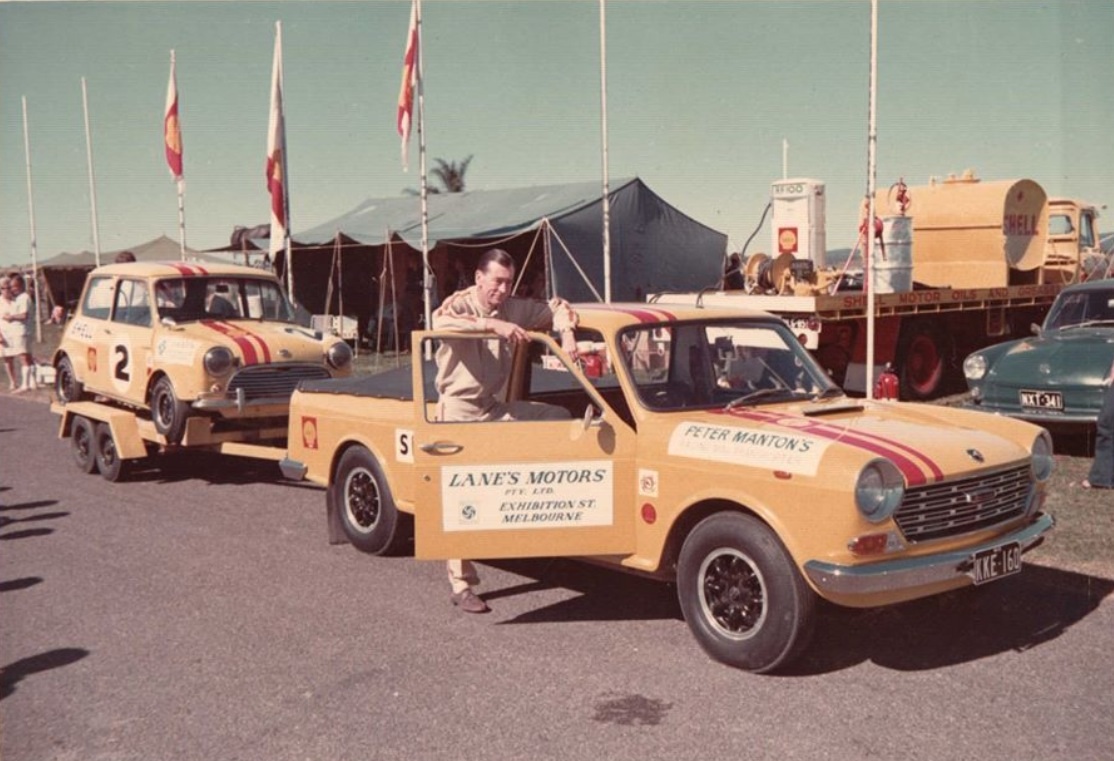
Peter Manton, Austin 1800 tow car and his ‘Improved Production Touring’ Cooper S, perhaps at Surfers Paradise in 1970…

Manton is long way from home, the Gold Coast is 1720 kilometres from Melbourne, the Mini aces home base. That cut down Austin 1800 is a really nice rig but I don’t fancy towing that Mini with that car, even if it has a couple of SU’s bolted to the side of the ‘B Series’ head. It lacks the ‘mumbo’ needed for such long tows across our big, brown, parched continent. Nice thing to ponce around Surfers Paradise in mind you.

By 1970 Peter was winding down a long career in the sport which dated back to the thirties. Born in 1922, Gerald Peter ‘Skinny’ Manton began racing at 16 in his mothers Austin 16.

In his formative years he worked at the Commonwealth Aircraft Corporation, Fishermans Bend in product engineering leaving to work for John Ould Motors and later Monaro Motors, of which he later became a partner.

Monaro Motors sold MG’s and developed performance parts for the marque. They were agents for Wade superchargers and became sole distributors in Victoria for SU carburettors. ‘Skinny’ progressed to design and research developing many twin-carb manifolds and other bits.

Mac/Manton works MGB ‘HBL129D’, Sebring 1966 (unattributed)

Manton’s reputation amongst the BMC UK hierarchy was such that he was chosen to partner Roger Mac in a works MGB at Sebring in March 1966, it was a successful weekend too, the pair were seventeenth overall in the 12 hour classic and first in the GT 2 litre class- the race was won by the Ken Miles/Lloyd Ruby Shelby American Ford GT40 X-I Roadster.

In a busy weekend Manton also contested the four hour Governor’s Cup for sedans the day before the 12 Hour. He shared a Cooper S with Paddy Hopkirk but the pair’s 1293cc S was outted with a broken timing chain after only 33 laps- Jochen Rindt won in a works Alfa Romeo GTA shared with Roberto Businello. Businello, well known in Australia after his Alfa Giulia TI Super Sandown 6 Hour win with Ralph Sach in 1964, blotted his copybook in all but destroying the car in practice.

Hopkirk/Manton Cooper S during the Four Hour Governor’s Trophy, Sebring 1966 (Friedman)

As the Issigonis front wheel drive BMC products swept the market Manton was in on the ground floor.

In 1962 BMC released the Morris Cooper in Australia but in August 1961 Manton was one of those behind the ‘Morris 850 Sports’, the little brick was fitted with twin-SU carbs and a set of extractors. The car was sold through Peter Manton Motors in Melbourne and P&R Williams in Sydney, whilst a ‘dealership special model’ the cars had the backing of BMC inclusive of the factory warranty.

In terms of his racing Manton swapped his Marshall-blown Morris Major for a succession of Cooper S’ with which he became synonomous. Manton Motors was a well known destination for a generation or so of Melbourne BMC and racing enthusiasts

Was the Mini King of Oz Peter Manton or Brian Foley? Are the honours equally split?, without doubt they were the Mini Kings of Victoria and New South Wales respectively throughout the sixties in any event!

Manton from Bob Holden, Ford Escort Twin-Cam and Brian Foley in Warwick Farm’s Esses 1970 (R Thorncraft)

Etcetera: Sebring 1966…

(Friedman)

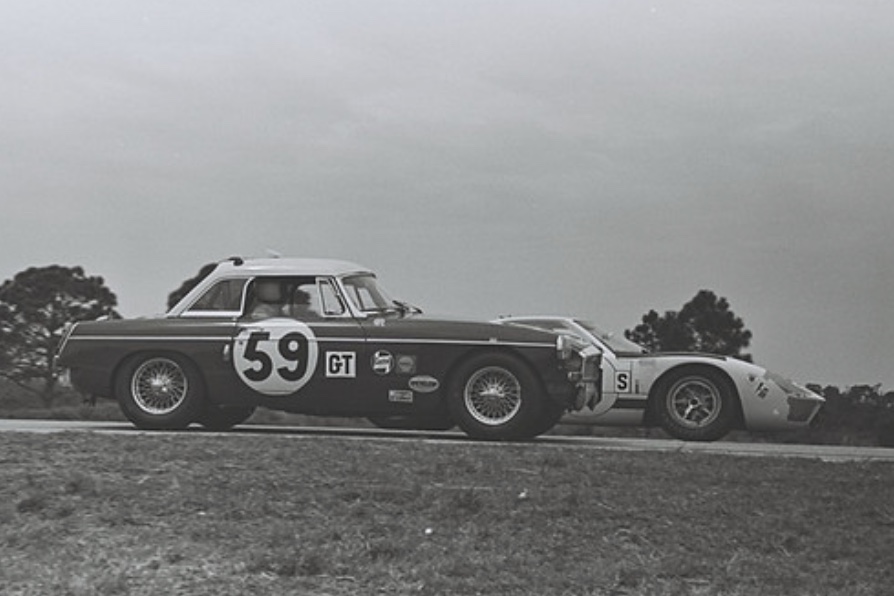
Sebring main straight vista with the Mac/Manton MGB to the left and back.

#57 Porsche 904GTS of Ripley/Wetanson in front, MGB of West/Charles, one of the Porsche 906’s to the right and alongside the Shelby GT350 Mustang of Kohler/Reina/Biddle and on his own behind that group of three the Porsche 911 of Ryan/Coleman.

(Friedman)

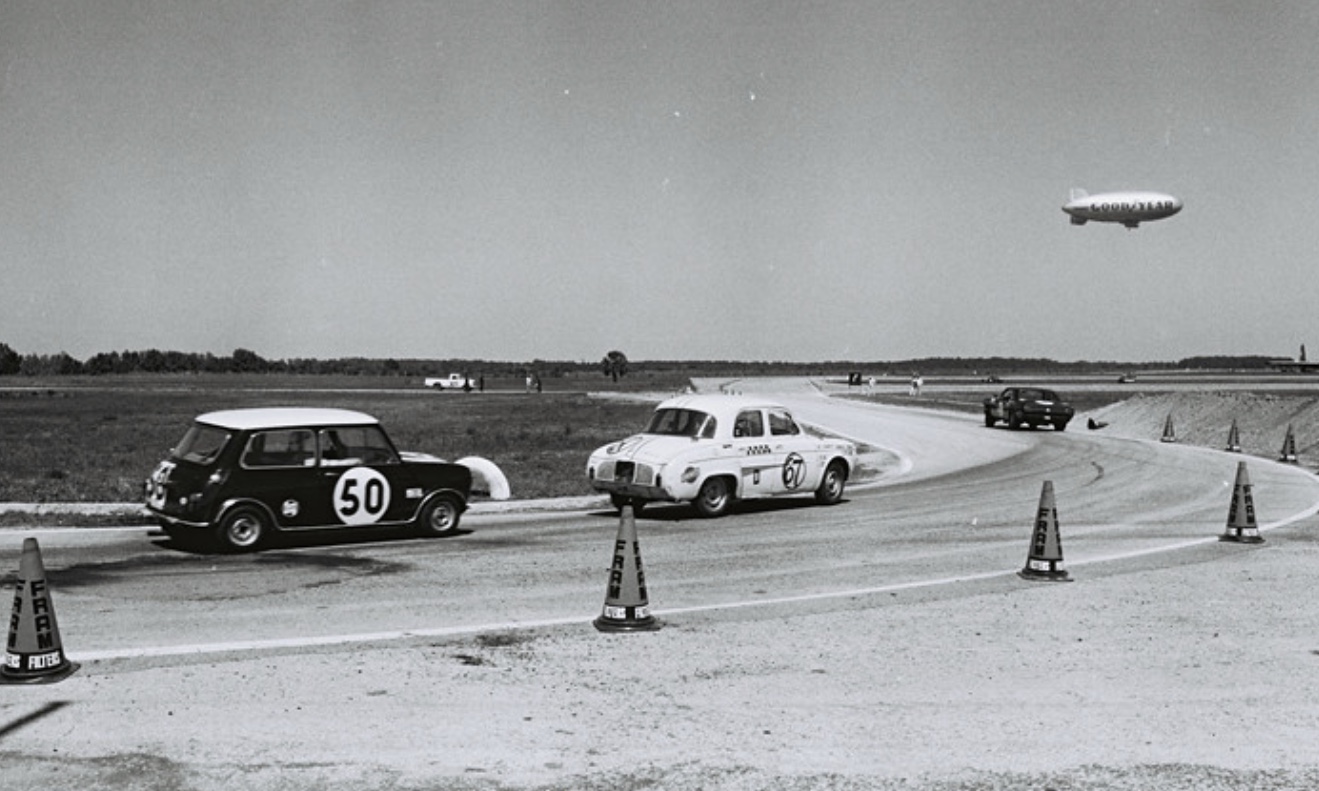
Hopkirk/Manton chasing the Renault Dauphine of Porath/Van Hoozier, ever present Goodyear blimp up above.

(Friedman)

The Shelby Mustang GT350 of Kohler/Reina/Biddle from Mac/Manton- and below the MGB being monstered by one of the 7 litre Ford GT Mk2’s, no doubt Peter Manton spent as much time looking in his mirrors as he did out the B’s windscreen on the wide expanses of the airfield circuit.

(Friedman)

Flying trio.

Mac/Manton MGB from the similar West/Charles entry and then the Ryan/Coleman Porsche 911. Dave Friedman’s photographic archive is wide, rich and deep.

Photo and Reference Credits…

Eldougo, Dick Simpson, Russell Thorncraft, David Knowles, Dave Westerman, article by Craig Watson in uniquecars.com.au, David Friedman Archive, Peter Longley

Tailpieces: Manton’s Cooper S being monstered by Shell teammate and 1970 ATCC champion Norm Beechey’s Holden HG Monaro GTS350 at Calder…

(Simpson)


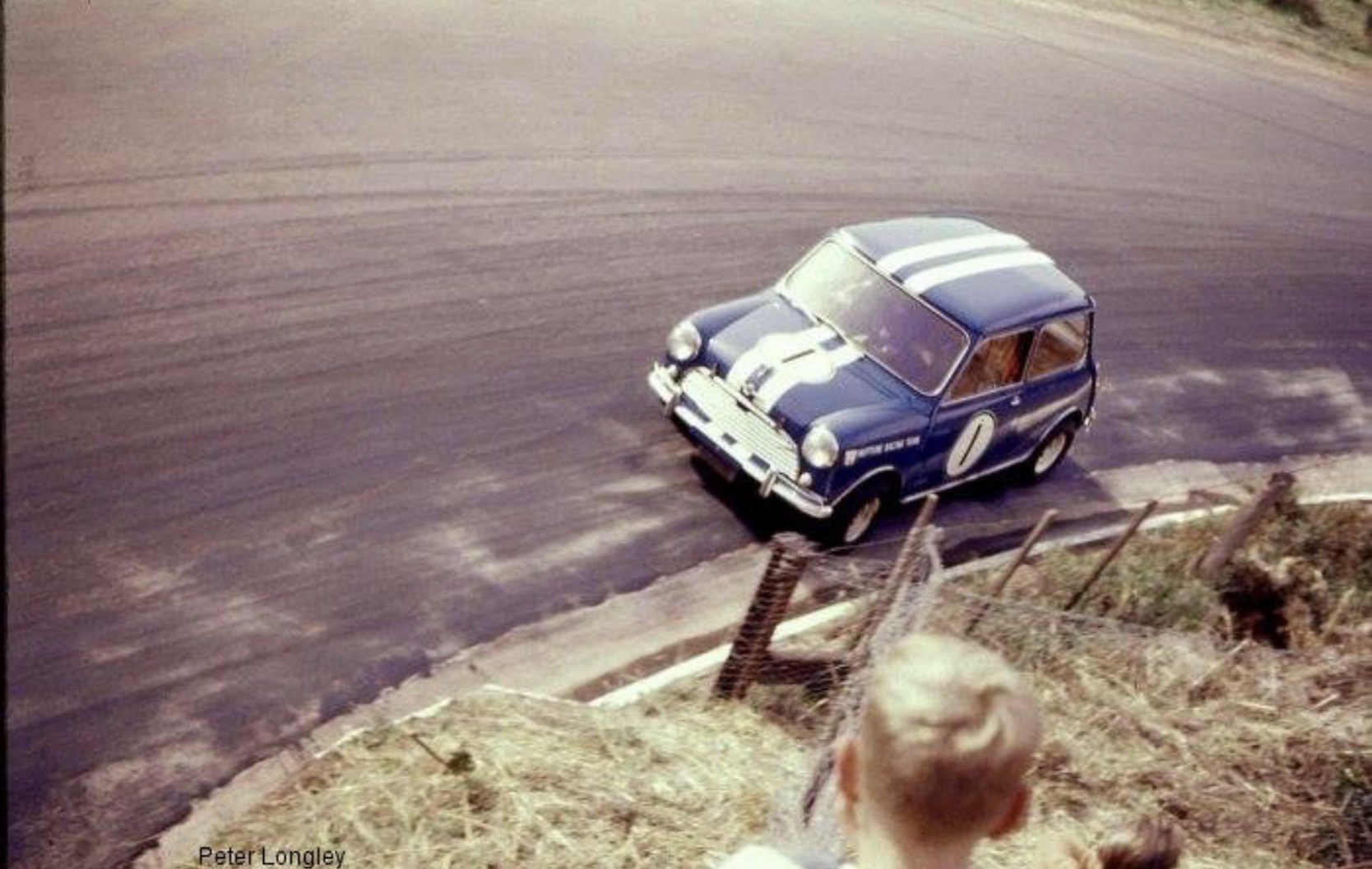
Peter Longley’s great shot of Manton turning in to Longford’s Viaduct circa 1965.

Finito…

(Rod MacKenzie)

…in the words of Maxwell Smart, for you aficionados of Mel Brooks’ wonderful sixties TV show ‘Get Smart’.

Kevin Bartlett with an inside wheel off the deck demonstrating the millimetre precision for which he was famous aboard the Mildren ‘Yellow Submarine’ Alfa in Warwick Farm’s Esses, September 1969. Rod MacKenzie has opened his shutter at precisely the right moment.

Another inch or so and the talented Sydneysider would have ripped an expensive corner off the front of a car which was so kind to him. I’m not sure of the racer behinds identity. A Lotus 27 or 32 perhaps?

Bartlett inherited the Len Bailey designed, Alan Mann Racing built, Alec Mildren owned car after Frank Gardner raced it in the 1969 Tasman Series. KB used it to great effect in that years Australian Gold Star Series winning three rounds and the title in it- Symmons Plains, Surfers Paradise and in Bartlett’s Warwick Farm backyard in December.  During a busy season KB and the Sub also won the Macau Grand Prix on 16 November and contested the JAF Japanese Grand Prix at Fuji.

Every inch a GP car of its day isn’t it, just magnificent. Mildren Alfa in its ‘Alfa ultimate form’. Lynton Hemer’s shot captures the car at WF on Hume Straight in July 1970- interesting shot as the Alfa engine is back in the car long after its first Waggott engined race (L Hemer)

It wasn’t the ‘same car’ by the end of the year though as the Alfa Romeo Tipo 33 2.5 litre V8 engines with which the chassis was originally designed and built were put to one side and replaced by Merv Waggott’s Sydney built, 2 litre all alloy, DOHC, 4 valve, Lucas injected 275 bhp engine.

The history of my favourite ‘Australian’ racing car is one for another time- it’s a long story as this jewel of a car’s ‘in period’ history starts with 1969 Alfa V8 wins, continues with Waggott engined victories and ends with 1.6 litre Hart 416B success in Australian National F2 form in 1974/5. A fellow named Ray Winter was campaigning this famous car by then.

(Bill Pottinger)

High Speed Precision too…

Bartlett was famous for his tail out style, he was ‘the absolute master of opposite lock’ as Sam Posey described him having raced against KB during the 1973 Tasman Series and in the ‘L&M F5000 Championship’ in the ‘States in 1972/3.

This shot of the car is in ‘neutral to very subtle oversteer’ attitude, a very high speed, delicate drift- was taken by Bill Pottinger whilst Kevin traversed Teretonga’s ‘loop’.

The 1970 Tasman was tough in a 2 litre car, it was the first year of the Tasman F5000 Formula. KB was still quick enough to take 5th at Pukekohe and Teretonga- a second at Surfers Paradise, very much a power circuit was amazing and first at Warwick Farm brilliant but understandable. Bartlett, Matich and Leo Geoghegan were surely the quickest blokes around ‘Gods Own Acre of Motor Racing ‘ out Liverpool way?!

A mighty fine car and a mighty fine driver- thankfully both are still alive and well in Australia, Queensland to be precise…

(Bill Pottinger)

Merv Waggott fettles…

Sydney’s engineering genius Merv Waggott doing a plug change in ‘The Sub’ during the 1970 Teretonga weekend. Alec Mildren had been using Merv’s talents for years and specifically the smaller variants of Waggott’s engines in his other car, the Rennmax Engineering built Brabham BT23 copy ‘Mildren Waggott’ raced by Max Stewart.

When Merv decided to build a bespoke aluminium block to allow a capacity of 2 litres, something the Ford Cortina blocks used hitherto could not, it was an easy decision for Alec to go the more cost effective route with the local engine rather than the 2.5 litre Alfa V8.

The Alfa unit had received no development since first fitted to Mildren’s Brabham BT23D chassis in late 1967. Alfa were focussed on 3 litre engines for both their Tipo 33 Sportscar program and F1. Two litre Waggotts won Australian Gold Stars for Leo Geoghegan in 1970 (Lotus 59B) and Max Stewart in 1971 (Mildren Waggott)

(H Ellis)

Etcetera: Australian Competitor Set 1970…

Startline of the first round of the 1970 Gold Star Series at Symmons Plains, Tasmania in March 1970.

John Harvey’s #2 Bob Jane Racing Brabham BT23E Repco on pole alongside KB in the Mildren ‘Yellow Sub’ Waggott with Leo Geogheagn’s Lotus 39 Repco on the outside, and behind him in the other yellow Mildren Racing entry is Max Stewart in the Mildren Waggott spaceframe Bob Britton/Rennmax built car. Harvey won a top race from Leo and KB.

In a season of change it was Leo’s last championship race in the venerable ex-Clark Lotus, Harves was about to switch to the Britton/Rennmax built Jane Repco V8- yet another car, like the Mildren Waggott built on Britton’s Brabham BT23 jig whilst KB spent much of 1970 racing in the US so did not defend his Gold Star title. It was also the last year of the Tasman 2.5 Gold Star Formula- Geoghegan taking the title in a new Lotus 59B Waggott 2 litre as noted above.

KB gets a shove during the 1970 Tasman meeting- he won in front of the F5000’s. Glen Abbey, Ian Gordon and another fella. Stewart’s Mildren Waggott in the paddock behind (unattributed)

Photo Credits…

Roderick MacKenzie, Bill Pottinger on The Roaring Season, Lynton Hemer, Russell Thorncraft, Harold Ellis

Tailpiece: Bartlett from Geoghegan, Warwick Farm Esses during 1969- Mildren Alfa from Lotus 39 Repco…

(R Thorncraft)

Finito…


(Adelaide Observer)

A couple of years ago I wrote a long piece about the first car race in Australia, the article asserts that momentous event took place at Sandown Park, Melbourne on 12 March 1904. I’m in a constant search to find an earlier race

Whilst not a car race but a ‘demonstration or parade’, what seems to be the first event of this type in Australia was held at Adelaide Oval on Saturday 11 October 1902. More interesting is that the first claimed motor-cycle race in Australia took place on the same day.

The Adelaide meeting was promoted by the ‘League of Wheelmen’ a cycling organisation at no less a temple of sport than the wonderful, picturesque Adelaide Oval, not at all a venue I would have considered as one at which ‘motor racing’ took place.

Located in North Adelaide, Adelaide Oval is the best sporting venue in Australia. That my friends is a huge statement for a Melburnian member of the Melbourne Cricket Club, our ground is the Melbourne Cricket Ground. We Melburnians reckon the MCG is the best bit of sporting dirt on the planet, but good ole Adelaide Oval is better. It doesn’t win in terms of seating capacity, but the location, surroundings, vibe, the hill and scoreboard, the vista of trees towards St Peters Cathedral cannot be matched. And having seen a few stadiums around the world its ‘up there’ with the best globally in character and comfort if not capacity.

That Saturday the League of Wheelmen hosted a day of racing- cycling, motor car demonstrations and the new ‘sport of kings and millionaires’ as the Adelaide Advertiser put it- motor racing. The motor-cycle racing 5 mile event event was ‘the first motor race in Australia’ the paper reported.

The hallowed turf primarily used for cricket and football (Australian Rules) then incorporated a steeply banked track at its outer perimeter which was ideal for cycle racing and ‘admirably adapted for contests between motor cycles and for the establishment of records’ if not so great for motor car racing.

The days program was dominated by cycling events with many interstate competitors taking part. In addition there were 13 contestants of the motor-cycle races in the afternoon with ‘the final’- my god, a championship! to be held the following week, on 18 October.

An interesting part of the program ‘to indicate the growth of the (motor) industry’ was a parade of cars, motor-cycles, quadri-cycles, cycles and velocipedes, the organisers showing a keen sense of history of transport with a focus on the previous thirty or forty years.

The Adelaide Observer reported that the display created a favourable impression. ‘The big cars whirred around the track with surprising velocity, and so easy were they to control and so graceful in their evolutions that their popularity is assured’. It seems fair to say that the success of the demonstration of cars on that October day, and the following weekend provided some type of impetus for the first car race in Australia at Sandown and the first car race in South Australia, at Morphettville two years later.
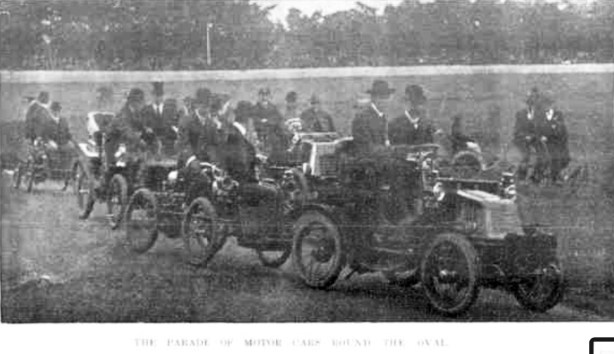
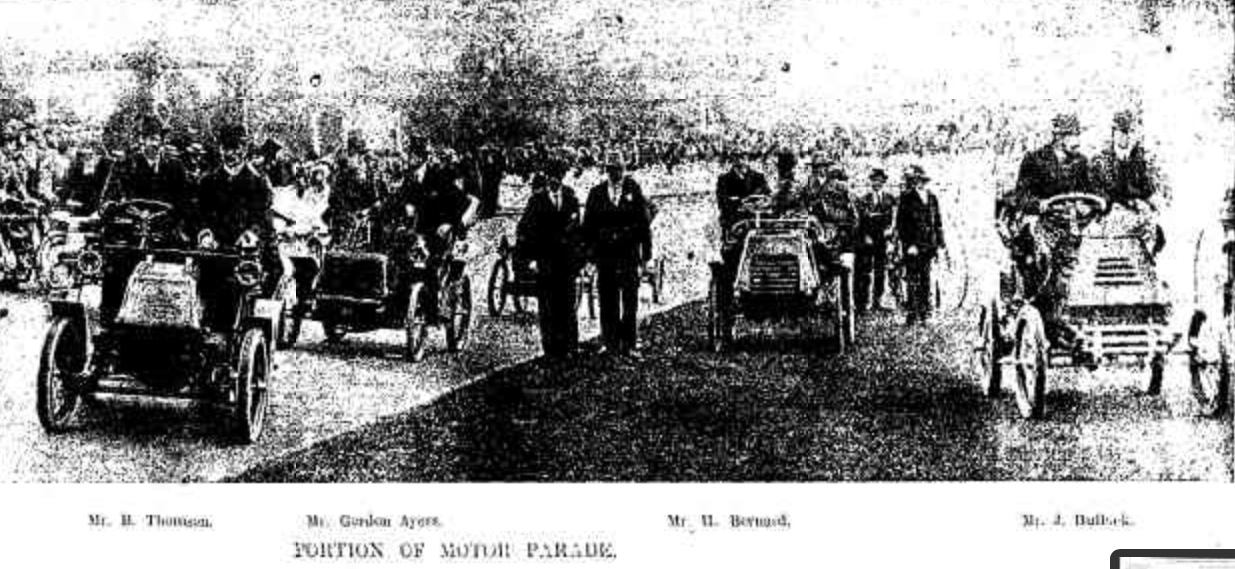
Parade of motor cars at Adelaide Oval on 11 October 1902 (Observer)

Context is Everything in History?…

We forget sometimes just how far we have come.

The Adelaide Observer of 18 October 1902, in an article entitled ‘How The World Moves’ comments upon how the dreams of Jules Verne were coming true. At the time the voyage to America from the UK had been cut to 124 hours, ‘with only 70 hours at sea’. ‘In rather less than 400 years the record of Magellan in circumnavigation of the globe has been cut from three years to between 50 and sixty days’.

The article addresses ‘The Age of the Engineer’ and notes that the cheaply constructed great Siberian railway being eventually destined to be recognised as one of the great wonders of the railway world, with ‘the Era of the Canals’ taking 1000 miles out of  global journeys. ‘Many ancient landmarks are threatened and many time honoured routes promise to become ways of the past, interesting as the grass grown coach roads of England, but no more frequented by the conveyances one so familiar.’

In addition to the above more macro view of progress, this extract from the Adelaide ‘Chronicle’ of the same day very concisely places the development of the bicycle, motorcycle and motor car in the context of the up till then omnipotent form of personal transport, the horse…

‘The opening day of the League of Wheelman’s October race meeting marked an interesting epoch in the history of cycling. One of the events on the programme was a motor cycle race- the first held in the Southern Hemisphere, and it was to be the introduction of this novelty and an exhibition of motor cars that the large attendance was due’.

The cycling world is one of rapid evolution. Forty years ago velocipedes equal to a speed of six or seven miles an hour were a favourite means of locomotion. They gradually developed into the ordinary high machine, with which it was possible on a good track to ride a mile in three minutes. It is only a little more than a decade since the ‘safety’ chain-driven machine, with pneumatic tyres, made its appearance in the streets of Adelaide, and the ‘ordinary’ disappeared before its more stylish and faster rival.’

‘From the early nineties the safety revolutionised cycle racing, and record succeeded record at a bewildering rate, until it became common for a cyclist behind pace to eclipse the times of the best racehorses the world has ever produced’.

‘The popularity of the sport developed…the League of Wheelmen…at one time promised to become a very wealthy body…but two or three years later the absence of crack riders from the other side of the world and the lack of variety in the sport, coupled with unfavourable weather conditions, resulted in unprofitable meetings’.

‘Now the motor has come to play its part in the sport, and its advent was enthusiastically welcomed on Saturday…the gate receipts…and next Saturdays takings…will all be profit.’
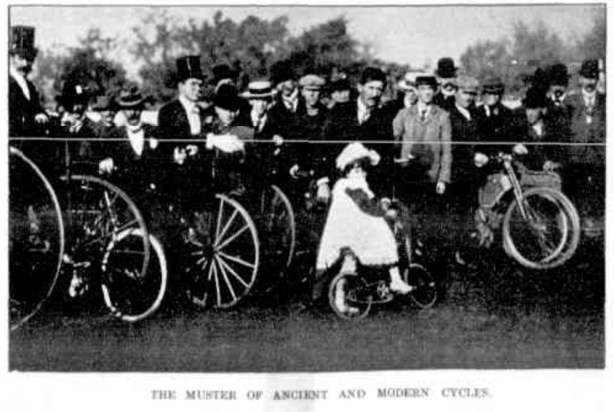
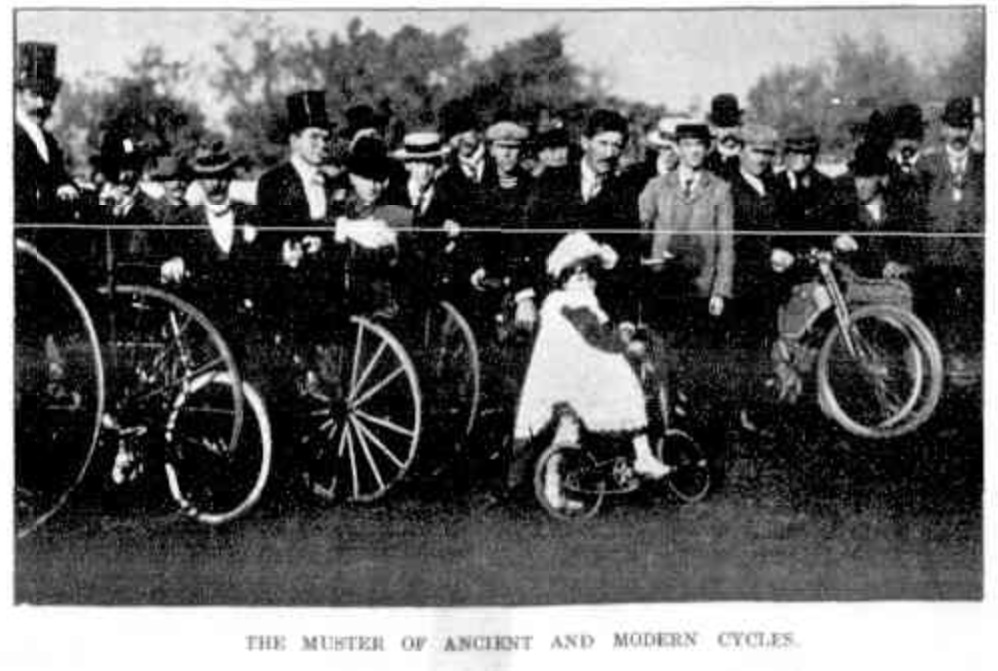
Mix of old and new cycles, Adelaide Oval 11 October 1902 (Observer)

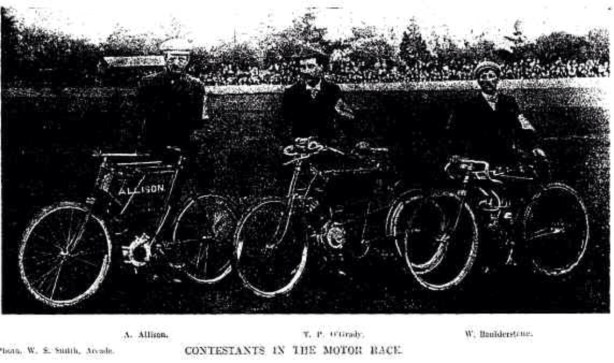
‘The story of the evolution of the motor car was admirably told on Saturday in the exhibition of ancients and modern methods of locomotion…the early form of the bicycle was illustrated by old wooden velocipedes…40 years old…ridden in the old fashioned costume of top hats and black suits with flying coat-tails…Alongside of these were motorcycles ridden by Messrs TP O’Grady, A Allison, W Baulderstone, W Courtney, R Davis, HM Aunger, RW Lewis, FR Burden, EA Gowan, D Bruce and EF Wilksch were shown.’

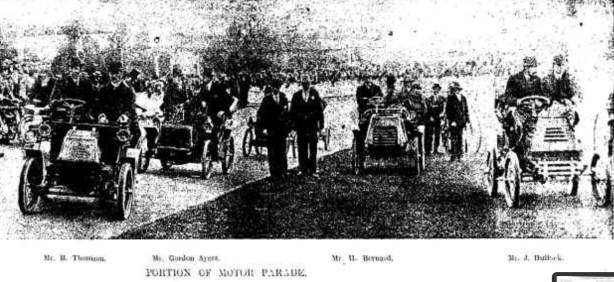
‘Most interest was shown in the motor cars, of which four were shown. Mr Gordon Ayres brought his car, a very handsome one…but it could not be taken onto the track…with an old set of tyres one of which blew out. Mr H Thomson’s ‘Swift’, which he has just imported attracted considerable notice. The other two cars which raced around the oval were both locally manufactured. One was shown by Mr V Lewis, and driven by Mr H Bernard, and the other was exhibited and driven by Mr J Bullock. In addition to these Messrs J Bullock, H Bernard and the representative of the Massey- Harris Company had motor quadricycles on the track. With all these machines careering round the oval at their best pace the spectacle was in the highest degree interesting. The exhibition was the success of the day, and when the officials of the league saw the impression it made on the spectators they at once resolved to repeat it next Saturday. Mr Ayers car will then be shown in action with all the others.’
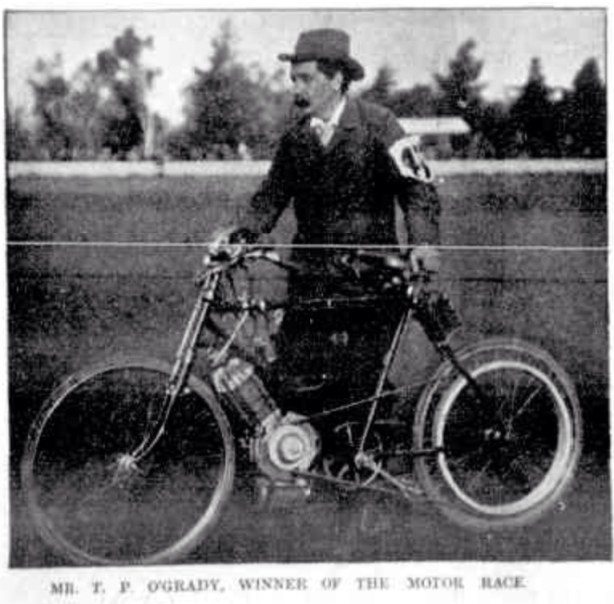
TP O’Grady with his ‘works’ Lewis motor-cycle- winner of the first motorbike race in Australia 11 October 1902 (Observer)

‘The other novelty of the meeting was the motor cycle race of 5 miles’. Originally their were 13 entries with the race divided into two heats, with two machines withdrawing from the first heat.

‘TP O’Grady was off scratch, W Courtney 30 seconds, A Allison 50 and W Baulderstone 1 min 5 sec. Baulderstone was away well and had almost completed a lap when O’ Grady was pushed off. Courtney retired early with a mechanical problem. O’ Grady’s machine took a while to get going, but when it did it was soon seen to be the fastest machine on the track. It lapped the others three times in the 15 laps and covered some of the circuits in 32 and 33 seconds. Its fastest pace was at the rate of 1 min 32 sec for the mile, or 30 miles per hour. O’ Grady an old time racing man, who constructed the motor himself at Mr V Lewis cycle works, was loudly cheered as he finished his five miles journey in 9 min 10 secs. Just after he crossed the line the belt of his motor broke. There was an interesting run for second place between Allison and Baulderstone. The latters machine lost the pace with which it started, and Allison was able to keep ahead’.

A story about Vivian Lewis and his nascent cycle, motor-cycle and car company is a story in itself, O’Grady was Works Manager, Works Rider/Driver! and a shareholder in Vivian Lewis Ltd.

The Adelaide Observer had this to say about O’Grady’s performance. Thomas Patrick ‘Tom’ O’Grady ‘carried off the honours’ covering the 5 miles in a time of 9 minutes 10 seconds ‘at times he travelled at the rate of 39 miles an hour’. Some of the laps of 612 yards were covered in 33.25 seconds with one mile timed at 1min 33 seconds. It was the first occasion on which the machine had been tested, it was not completed until the Saturday morning, the average of 1min 50 seconds per mile ‘must be considered gratifying, particularly as a strong wind had to be contended with’.

There were six starters in the second heat which was run at a lower pace with interest being lost when R Davis’ belt broke with 3 laps to go when he was overhauling the leaders. J Bullock won from FH Burden, RW Lewis, EF Wilksch and Davis. ‘The final between the first three in each heat will be run next Saturday’.

In a full program of bicycle racing many of the motorised racers jumped onto their normal racing cycles.

The Chronicle concluded its report by commenting favourably on the performance of ‘The Locomotive Band’, which gave a fine rendition of the march ‘Colonels Parade’, that there were no accidents during the day which ‘was well managed in every respect’.

In keeping with the mood of the week a novel race on the road was also advised, this comprised, ‘…a contest between B Thompson’s 4.5 hp car and the Broken Hill Express train ‘in a scamper to the Burra, the chauffeur and the engine driver to shake hands at the Adelaide Railway Station before starting’! Logistically this would have been easy as Adelaide Station is only several hundred metres from Adelaide Oval.

So. What do we take from all of the wonderful prose about the days activities on 11 October?…

Firstly, the claim that the first motor-cycle race in the Southern Hemisphere was run at Adelaide Oval on 11 October 1902 and won by TP O’Grady on a local Lewis machine.

It seems clear the first motor-cycle racers were graduates of bicycle racing.It makes sense doesn’t it in terms of the balance, competitiveness and the need for more speed required!

It also seems the case that the ‘League of Wheelmen’ saw motor cycle racing- and especially car competition which appears from the report to be the most popular event or motorised display on that October day, keys to future commercial success. To turn around their flagging gates.

Of course the bike and car racers would soon go their own separate ways probably when a greater number of venues became available to them both on public roads and specialist, speedway, closed circuits. But for the moment the would be motorised racers needed venues and the cyclists had them, and ‘in good nick’ too.
(Observer)

The 18 October meeting was run in splendid Adelaide spring weather with much expected from the motorised events but mechanical mayhem somewhat ruined the motor-cycle racing program…

The organisers changed the spectator amenities during the week by allowing better viewing of the cars, perhaps by allowing the punters to get closer to the action. His Excellency the Lieutenant-Governor conferred his patronage to the carnival. ‘Visiting officers of the Australian Squadron have accepted the Leagues invitation to be present’ the Evening Journal notes in an article published on the day of the race. Its interesting in these modern times to see what was regarded as relevant then but now is very much ‘who gives a rats’ stuff. Similarly the language of the day is wonderful in its eloquence, the prose of times gone by I enjoy I must admit. Long-winded sometimes but enjoyable nonetheless!

O’Grady’s ‘brilliant run’ of the week before stamped him as a certainty for the final, with many returning spectators expecting him to lap the field twice aboard his Lewis over the five mile duration of the final.

The contemporary newspapers reported upon the riders but not the machines, sadly. So, in the main, we don’t have details of the bikes ridden on that important occasion. The final was a race between five competitors with TP O’Grady off scratch, A Allison 50 seconds, VR Burden and W Baulderstone off 1 minute 5 seconds and the limit-man J Bullock on 1 minute 20 seconds.

A warm up for the bikes was provided during the cycle and motor parade which was also a feature of that days events. The competitors for the race had a trouble free run during this morning event.

During the later stages of the afternoon, just before the feature cycling event ‘The Australasian Ten Miles’, won by Victorian DJ ‘Don’ Walker, the ‘Motor Race’ commenced.

Bullock, Baulderstone, Burden and Allison completed a lap before O’Grady was pushed off from the start. There was general disappointment as the locally built Lewis bike was pulled onto the grass by its driver, the engine not firing properly. With 7 laps to go Burden passed the stationary O’ Grady, his ‘machine going splendidly’.

2 laps later Burden lapped Allison and with 4 to go caught Baulderstone again, with whom he had started. With 2 laps to run Burden passed Allison and finished an easy winner in 9 minutes 15 seconds. His time was 5 seconds slower than O’Grady’s over the same distance the week before. Bullock was 2nd in 9 mins 34 seconds and Baulderstone 3rd in 10 min 23 secs. Prize money for the race was ten, three and two pounds from first to third places.

The distance between Adelaide Oval and the fringe of Victoria Park, site of the first Formula One Australian Grand Prix in 1985 is small, 1.5 Km, but the performance difference between the cars displayed and Keke Rosberg’s victorious 900bhp Williams FW10 Honda is immense. In their wildest dreams, a spectator present on that glorious October 1902 day who also attended the AGP on a similarly wonderful, hot day in November 1985 could not have conceived of cars of such vastly different performance and sophistication within their own lifetime?

The Adelaide built Lewis car number 1, the first car built in South Australia on display/parade at Adelaide Oval on 11 October 1902, driver H Bernard. In 1902 form the car was powered by a water cooled 5HP, petrol, single-cylinder engine with ‘electric ignition’. The transmission had belt drive to a countershaft behind the rear axle from where spur gears drove the wheels. The Adelaide Oval event was one of the last public appearances of the first Lewis- motor car design was progressing rapidly and the 2 year old car was becoming dated. Lewis did build a few more cars but the future for the company was importing rather than manufacture, within a few years the business was distributing Napier, de Dion, Talbot and Star brands (unattributed)

Photo Credits…

 State Library of South Australia, Adelaide Advertiser, Adelaide Observer

 Bibliography…

Adelaide Advertiser 11, 17, 20 October 1902, The Daily Telegraph Sydney 13 October 1902, Adelaide Observer 18, 25 October 1902, The Adelaide Register 20 October 1902, earlymotor.com

Tailpiece: Be There on 18 October 1902…


image001

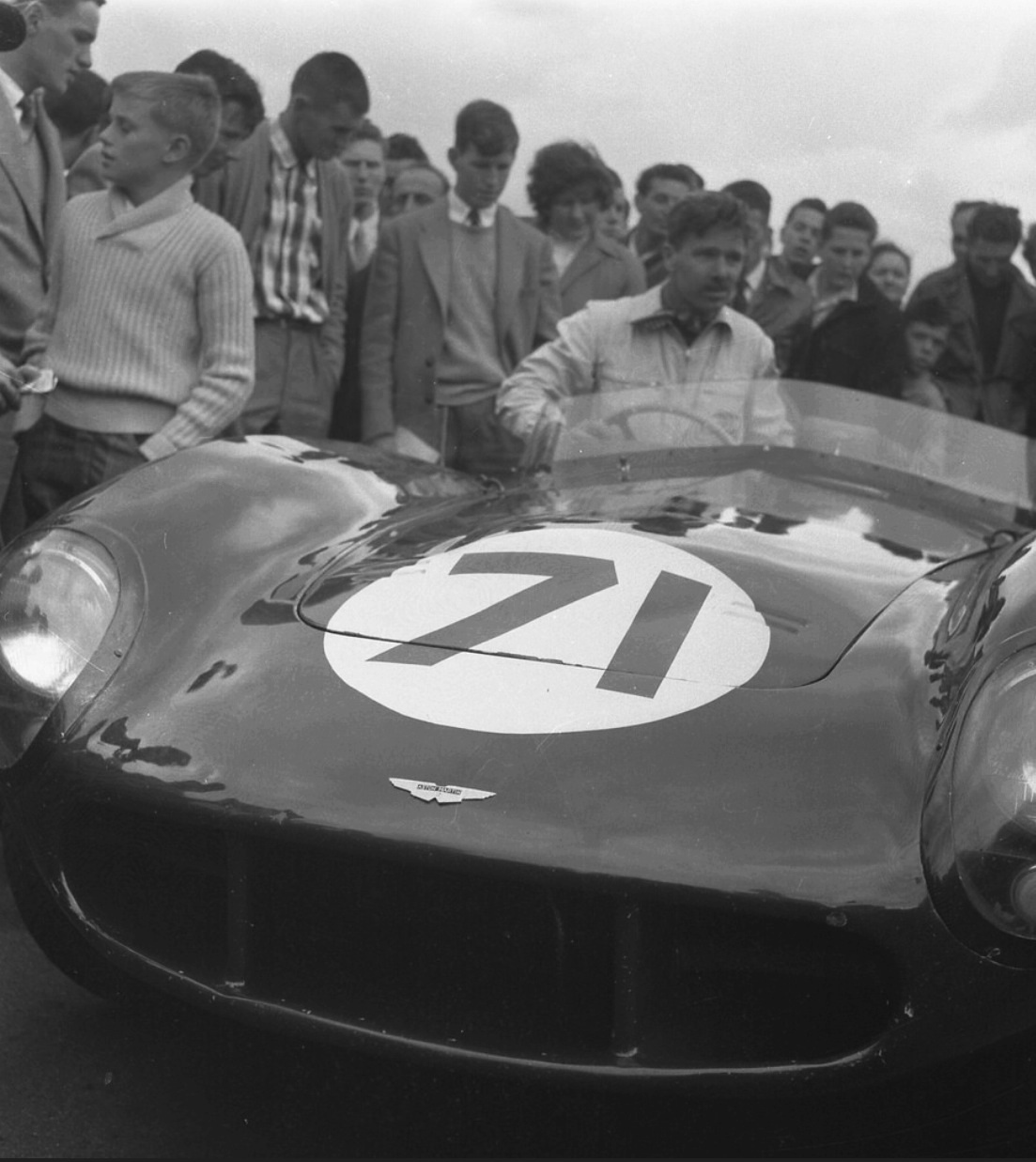
Looks of wonderment and amazement at the voluptuous lines of the Aston’s Frank Feeley penned body.  The ‘Wow Factor’ of contemporary racing cars never changes whatever the era does it?!…

Here it’s a Melbourne crowd on February 28 1958. Its the end of the long hot Australian summer but the crowd are well rugged up, Melbourne is notoriously ‘four seasons in one day’ sometimes and Fishermans Bend is an exposed windswept place at the best of times. At the wheel of the road-registered, ex-works Aston Martin DB3S chassis DB3S/9 is a youthful David McKay.

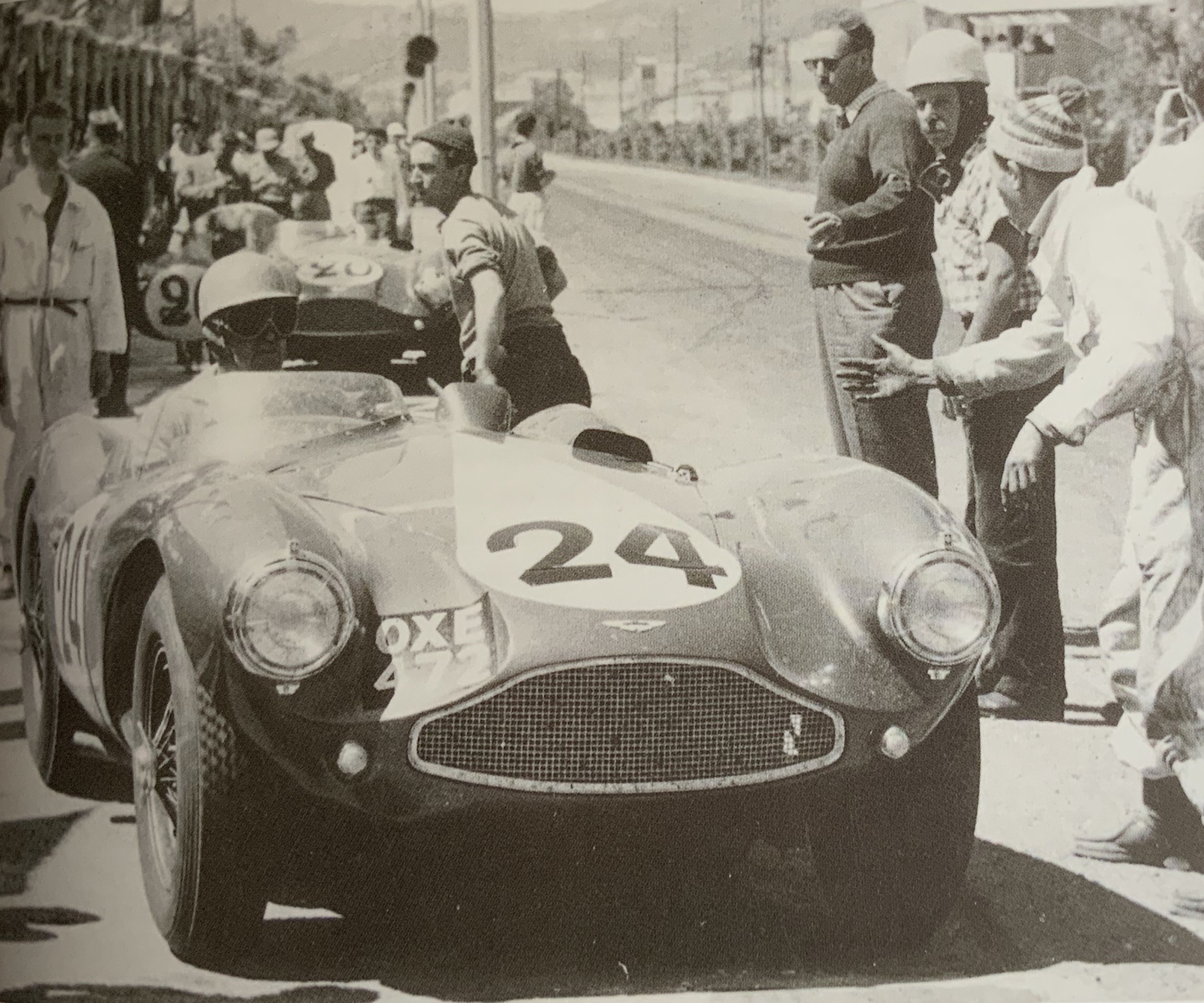
McKay aboard DB3S/9 at Fishermans Bend in February 1958. Nose of the car showing minor scars of battle, perspex headlight covers fitted to this car from its birth. First race the ’56 Rouen GP in May, then 2nd @ Le Mans ’56 driven by Moss/Collins, Salvadori was 2nd at Goodwood in September- car retained by Astons into 1957, the DBR1 the front line weapon that year with Brooks racing DBS3/9 at Easter Goodwood for 3rd. It was then used by the works for the last occasions as a practice car at Silverstone for the British Empire Trophy and for the Nurburgring 1000Km before sold by John Wyer to McKay with funds provided by Ampol (Westaway)

At the time he was ascending the driving ranks having cut his racing teeth in MG’s. He made it into the elite group too- let’s not forget were it not for a ropey jumped start call he would have won the 1961 Australian Grand Prix at Mallala aboard a Cooper T51 Climax. David would soon be known as much as a journalist, successful businessman and entrant-entrepreneur via his business ‘Scuderia Veloce’ as a driver though.

McKay raced this car to wins in the sportscar races that Fishermans Bend weekend, and was very successful in it throughout the country, taking 8 wins from 9 starts.

His only defeat, 2nd place was at the hands of Doug Whiteford’s ex-works Maser 300S in the Tasmanian Tourist Trophy at Longford in early 1958 during the Gold Star meeting.

McKay and passenger, Baskerville 1958 (HRCCT)

After Longford McKay and his crew took the car south to Hobart racing it at the new Baskerville circuit (above) in April and taking a comfortable win, and setting a new outright circuit record from Lyn Archer’s Cooper 1100 but churning through more of his diminishing stock of racing Avons due to the abrasive nature of the surface.

An amusing side-story is that the officer in charge of the old SS Taroona ship between Devonport and Port Melbourne took exception to the oversized trailer and refused to load it until David made representations to the Captain who graciously allowed the equipe aboard ensuring that important commitments to sponsors could be met.

db 3 s engine

Engine of the ex-works/McKay DB3S/9, raced at Albert Park, November 1958 by Stan Jones. 6 cylinder 2922cc DOHC 2 valve, twin plug all alloy engine fed by 45DCO Weber carburettors. Circa 225bhp @ 6000 rpm (Kevin Drage)

His last race in the car was successful, he took an Australian Tourist Trophy victory at Mount Panorama, Bathurst in October 1958 in what McKay described as ‘the faithful old ex-works Aston’s…greatest Antipodean win’.

The race was not an easy one. Initially Bill Pitt’s Jaguar XKD led and then Doug Whiteford, the formidable, forceful three-time AGP winner took the lead from McKay with Pitt 3rd. On lap 10 Doug had an enormous accident when the Maser was caught by a sudden gust of wind after coming over the second Conrod Straight hump threw the car out of control with the Maser spinning and hitting the right hand fence three times. Whiteford was almost flung from the car as it skidded backwards down the escape road and into another fence. Fortunately the St Kilda racer was only bruised by the wild ride.

McKay then led with an intermittent engine miss from Derek Jolly’s Lotus 15 Climax, a light rain shower adding to the degree of difficulty towards the end of the race. McKay won from Jolly, Ron Phillips and Frank Matich- Aston DB3S, Lotus 15 Climax, Cooper Jaguar and Jaguar XKC.

The weekend was a brilliant one for the Sydneysider as his new Jaguar Mk1 3.4, just imported for him by Ampol trounced the hitherto dominant Repco headed Holden sedans of John French and Leo Geoghegan in the sedan car handicap, to start the ‘Jaguar Era’ of Australian Touring Car racing.

After the Tourist Trophy win Stan Jones bought the racer but wasn’t really happy with it. The wonderful Le Mans second placed 1956 car then passed into Ray Barfield’s hands in Western Australia where its contemporary racing history ended in the early sixties. A summary of the cars history is in this article, rather than repeat myself;

‘Bunbury Flying 50’, Allan Tomlinson, Ferrari Tipo 500 et al…

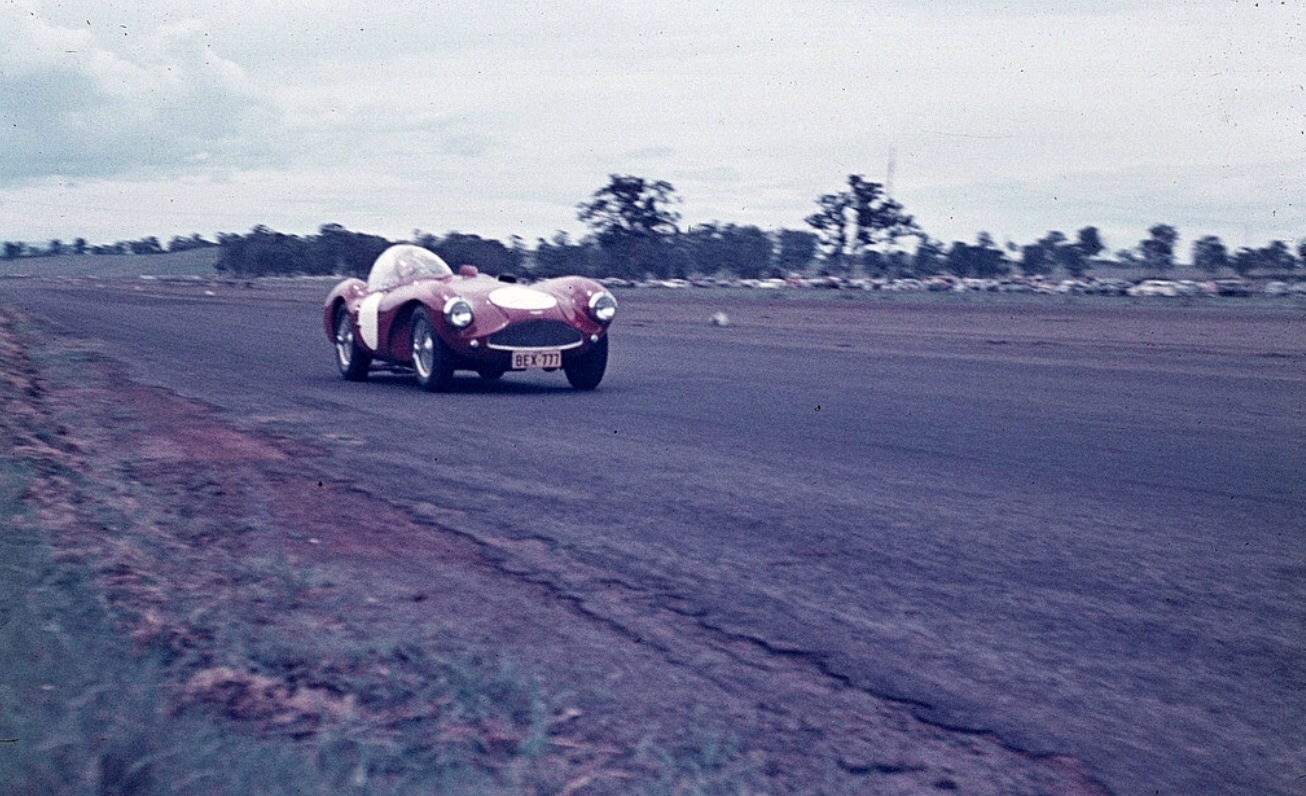
McKay’s first Aston, a production DB3S chassis #102 in the Carrathool paddock during its Australian LSR record breaking weekend in February 1957. Interesting to know who crafted the aero pod beneath which McKay sat and cooked! (Jek)

McKay was a very dab hand at the wheel of Aston’s by the time he bought his ex-Moss car…

He was part of the trio of privately run DB3S,  ‘Kangaroo Stable’ of cars raced by Australians Tony Gaze, Jack Brabham, Les Cosh, Dick Cobden, Tom Sulman and McKay in Europe in 1955.

McKays car, initially delivered to Tony Gaze, chassis DB3S/102 took the best result of the tour cut short by the cancellation of many sportscar races in Europe after the Le Mans disaster- McKay and Gaze were second in the 29 May Hyeres 12 Hour behind the winning Ferrari 750 Monza driven by Canonica/Munaron

At the end of the European Safari which included Oporto (Gaze 8th) and Goodwood (McKay/Gaze DNF distributor drive) David shipped the car straight to New Zealand for a number of races there including the Formula Libre NZ GP in January 1956,he retired from the Ardmore event won convincingly by Stirling Moss in a Maserati 250F.

The engine of the car was shipped back to the UK for a rebuild after a major failure during a race at Invercargill. From May 1956 production DB3S’ were fitted with twin-plug 210 bhp engines, it was in this form the engine was rebuilt and delivered from Feltham back to Sydney. The beautiful car was again race ready by early 1957.

Tony Gaze about to rejoin the May 1955 Hyeres 12 Hour, he shared the car with David McKay- car #20 behind is the Graham and Peter Whitehead DB3S DNF (CAMS)

The stunning colour photographs were taken of ‘102’ in February 1957 at Carrathool a tiny village 680 Km west of Sydney between Narrandera and Hay in New South Wale western Riverina.

The main automotive attribute of the town was a long, straight stretch of road between Carrathool and Gunbar which was ideal for record setting, and so it was that various Ampol sponsored cars sought to break some Australian speed records. The then current Australian LSR was the 136.4 mph set by Jack Saywell’s 2.9 litre Alfa Romeo Tipo B/P3 at South Australia’s Coorong in 1939.

After plenty of careful preparation inclusive of incorporating the beautifully made perspex fairing onto his Aston, McKay broke the record setting a time over the Flying Kilometre of 143.19 mph on the morning of 19 February 1957. The ‘Canberra Times’ reported that McKay made two full speed runs on the course, ‘during one run he skidded on a patch of loose dirt at 140 mph’.

This speed was soon eclipsed by other cars but the DB3S held the class record for some years.

David McKay at speed during the Ampol sponsored record-breaking weekend in early 1957. Carrathool a tiny hamlet with now around 300 inhabitants. A straight, flat road with a decent surface a long way from major population centres was ideal record breaking territory! (Jek)

The car was first raced in Australia at Easter Bathurst in April 1957, he was 2nd in the sportscar handicap and won the sedan and sportcar handicap from Paul England’s Repco headed Ausca, passing the very fast special built at Repco Research by England ‘running up to 139.3 mph to do so and clocking fastest quater mile time for the day’.

But the car saw little further use as the quicker ex-works machine arrived in Sydney in September 1957. DBS/9’s first race was the October 1957 13 lap NSW Sportscar Championship at Bathurst, an event the combination won comfortably with McKay taking the lap record despite using only 5200 of the Aston’s available 6000 rpm. Bill Pitt’s Jaguar D Type was timed at 144 mph on Conrod Straight with McKay at 136 mph using his self imposed rev limit.

Both of these extremely valuable cars still exist but sadly left Australia many years ago. Those of you with collections of Australian ‘Sports Car World’ magazine should have a fossick through them as McKay wrote two sensational articles about the ownership of his two Aston’s in the seventies, or maybe the eighties!..

Technical specifications as per text (Tony Matthews)

Aston DB3S Technical Specifications…

The Aston Martin DB3S was built from 1953 to 1957, 32 were constructed excluding the single-seater variant ‘DP155/1′ raced by Reg Parnell in New Zealand in 1956.

Fundamentally Willie Watson’s design was a shorter, lighter and stiffer car than Eberan Eborhorst’s Aston DB3. The car evolved over just four months making its debut in Reg Parnell’s hands at Charterhall on 23 May 1953.

The cars were designed around a period typical ladder frame chassis which was 7 feet 3 inches long- 6 inches shorter than DB3. The frame comprised twin tubular members of 4 inch 16 gauge chrome molybdenum steel and three 14 gauge four, and five inch cross-members. The shorter chassis made the car nimbler than its predecessor if somewhat skittish on bumpy surfaces. The track was reduced from 4′ 3″ to 4’ 1″.

Frank Feeley designed the very stylish body, as sexy as the DB3 was dowdy. More than a nod had been given in the direction of the contemporary Maserati A6GCS it seemed. Overall the car was shorter, narrower and lighter than the DB3 and importantly it ‘looked right’ straight out of the box.

Front suspension was independent by trailing links, torsion bars, piston type dampers and a roll bar. A De-Dion rear axle was used sprung by a torsion bar and located by trailing links and a Panhard rod, again with piston type shocks.

Naturally a David Brown gearbox was fitted, the S430 ‘box a 4 speeder with reverse, final drive was by spiral bevel in a light alloy casing with a ZF slippery diff usually fitted. Brakes initially were two-leading shoe Alfin drums- 13 inches in diameter at the front and 12 inches at the rear. From 1955 Girling disc bakes were specified, the rotors were 11.5 inches in diameter front and rear. Precise rack and pinion steering was fitted, two turns were required lock to lock.

A 2922cc all alloy DOHC, 2 valve, 6 cylinder engine provided the cars heart. It had 4 main bearings and wet cylinder liners with the valves disposed at an included angle of 60 degrees. Initially fitted with 35DCO Weber carburettors the engine gave 182 bhp @ 5500 rpm and 182 lb/ft of torque at 3800 rpm on a compression ration of 8.5:1.

The cars were of course developed extensively throughout their racing life with the works cars fitted with twin-plug heads and 45DCO Webers from May 1954 giving 225bhp @ 6000 rpm.

The ‘Kangaroo Stable Cars’ (DB3S/102 Gaze-McKay, DB3S/103 Sulman, DB3S/104 Cosh) delivered in early 1955 all had the 200 bhp Weber 40 DCO engine- when announced at Earls Court in October 1954 the production cars had a feeble and uncompetitive 180 bhp on triple SU’s.

For the sake of completeness special works engines included a supercharged 240 bhp car raced at Le Mans in 1954 and a 2992cc normally aspirated variant raced at Dundrod in 1955.

In an era of unlimited sportscars the production based 3 litre DB3S was rarely an outright contender, the big guns, depending upon the year were the Benz 300SLR, XKD Jags and Ferrari V12’s of varying capacity. But with a change to 3 litres for the manufacturers championship and a more uncompromising approach the DB3S’ younger brother triumphed at Le Mans in 1959 and won the manufacturers title to boot. The path to that success was in part via the DB3S journey…

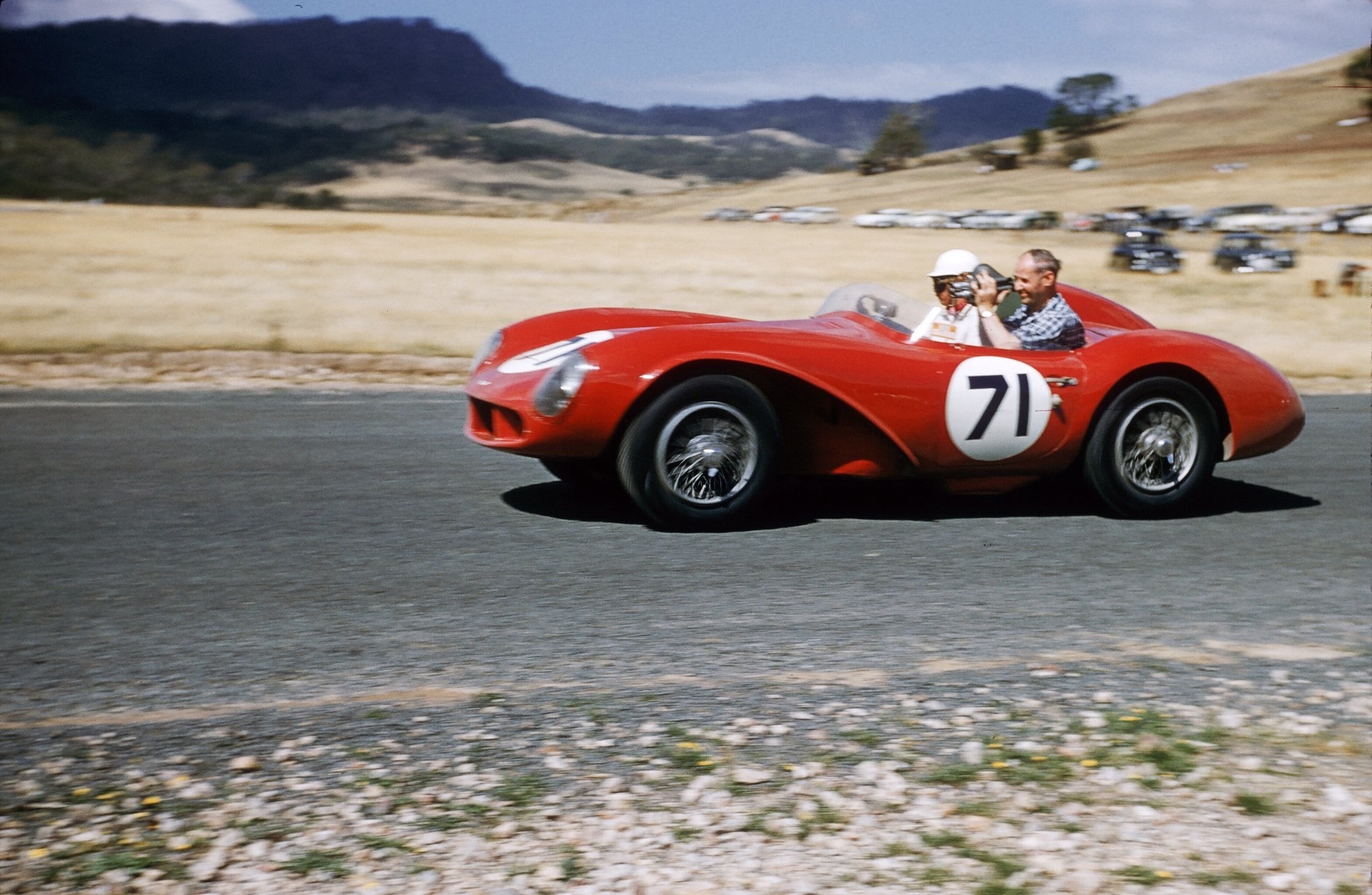
David McKay and passenger doing some camera work at the then new Baskerville circuit, Tasmania in early 1958 (HRCCT)

Etcetera…

(unattributed)

McKay on the left and Doug Whiteford, Maserati 300S with Bill Patterson’s Cooper Climax Bobtail behind?

Its Longford before the startline was moved from here- towards the end of The Flying Mile, before Mountford Corner to what became Pit Straight- the stretch after Mountford.

(unattributed)

Perhaps an Ampol publicity shot- ‘Rice’ trailer? Nice rig.

Bibliography…

‘Historic Racing Cars in Australia’ John Blanden, ‘David McKay’s Scuderia Veloce’ David McKay, ‘Aston Martin: A Racing History’ Anthony Pritchard, ‘Bathurst: Cradle of Australian Motor Racing’ John Medley, ‘The Canberra Times’ 20 February 1957

Photo Credits…

Don Westaway, Kevin Drage, Ampol, Sharaz Jek, Tony Matthews, HRCCT- Historic Racing Car Club of Tasmania, CAMS

Tailpiece: McKay at high speed in DB3S/102 during a practice run at Carrathool, in New South Wales western Riverina in April 1957…

(Ampol)

Finito…


(SLSA)

AG Bungey’s or GB Woodman’s Humberette 5HP on the startline of the Magill to Norton Summit Hillclimb, Adelaide, Saturday 16 December 1905…

The first of these events run by the Automobile Club of South Australia (ACSA) was held a year before, on 17 December 1904. I was terribly excited at finding a shot of a competitor in the first hillclimb in SA, but upon further research it appears the superb photograph is from the 1905 event, the second of three, the final in-period event being held in 1906.

The photo took my breath away, there is so much going on. I find fascinating the clothing and attire of the drivers, officials, kids and teenagers. Love the deer-stalker hat and pipe of the dude on the left. The officials with writing pads are HR Harley and HR Hammer- do let me know if any of you are related to them. The Steward at the start line is the Club Secretary RJ Hancock, perhaps he is the fella to the right of the car?

The competition was held in ideal Adelaide summer weather with what slight wind there was, blowing down the hills, perhaps impacting times slightly.

Bungey’s time for the 4 mile journey from the East Torrens Hotel at Magill (corner of what is now East Street and Magill Road) up into the Adelaide Hills finishing line at the White Gate, Norton Summit, was 42 ½ minutes which suggests he was either incredibly slow or had some type of mechanical drama. Woodman completed the distance in 30 min 7 seconds. Fastest time of the day, to use modern phraseology, was recorded by ES Rymill’s Darracq 15HP who did a time of 9 minutes 10 seconds. So keen was Rymill to win the event that his car was rebuilt, ‘like many cars it had been dismantled for the occasion’. Great to see the competitive spirit from motor racing’s most formative stages in South Australia!

Pictured below are the Rymill brothers, notable pioneering South Australian motorists, aboard their fast Darracq at the top of Belair Hill on the way to Victor Harbor during the ACSA Reliability Trial held during Easter 1905, 21 and 22 April. These type of reliability events were very popular in Australia in the early years of motoring with this one the first organised by the ACSA.

Adelaide’s ‘The Advertiser’ newspaper characterised communal views on the car at the time: ‘The average citizen considers that the principal characteristic of a motor car is its fickleness. In his opinion it will go sometimes, but often it will not go. To disabuse people of this erroneous idea the club inaugurated the trial, which has had the effect of proving that as a general rule the motor car is reliable, and, considering the distance covered at a high speed was 228 miles, there were comparatively few mishaps, and all of those were of a trivial nature. Of the 14 cars which competed seven (including the Rymill Darracq) succeeded in accomplishing the entire 228 miles, constituting a very severe test, within schedule time, and gained the full number of marks’.

(SLSA)

This trial comprised two legs, the first of 120 miles on Good Friday from Mitcham, an Adelaide suburb to Victor Harbour, site of the 1936 South Australian Centenary Grand Prix aka ‘1937’ Australian Grand Prix held in December 1936 on the Fleurieu Peninsula. On the Saturday, 108 miles were covered from Adelaide to Mannum.

Twenty one cars and five motor cycles contested the Norton Summit Hillclimb with the competitors arranged in classes according to their quoted power ‘and sent away at different times to obviate passing each other’ with ‘officials stationed at all the sharp curves on the road’. The quickest bike was N Jackson’s 2.5HP water-cooled Lewis, his time was 10 minutes 6 seconds.

The Advertiser’s report notes ‘There was not one breakdown or mishap, which speaks volumes for the excellence of the cars owned by South Australia’.

Just a brief note to put these early, formative motor sporting contests into the broader framework of motoring competition in Australia at the time. When I wrote about Australia’s first ‘Motor Car Race’ at Melbourne’s Sandown Racecourse on 12 March 1904, (link below) respected Australian motor racing historian/author/racer John Medley said ‘that was brave!’ meaning the topic is somewhat contentious. It would be great to hear from others who may feel an event other than the Sandown contest was the first.When was the first ‘race’ in New South Wales for example?

Australias First ‘Motor Car Race’: Sandown Racecourse, Victoria, March 1904…

In South Australia, for the record, it appears the first hillclimb, legal one anyway!, was the 17 December Norton Summit event on Saturday 17 December 1904 and the first ‘car race’, ‘where motor cars take the place of horses, and race in competition at their top speed’, was held at Morphettville Racecourse, 10 Km from Adelaide on Saturday 12 November 1904. This meeting was also promoted by the Automobile Club of South Australia.

FS Rymill had earned the nickname from Adelaide tram and cab-drivers of ‘The Flying Dutchman’ for his fast driving exploits in traffic. He and his Darracq 15HP were the stars of the show that Morphettville November day winning the 3 mile ‘Tourist Car Race’ from scratch, in this race a full complement of passengers were carried averaging at least 10 stone or over in weight. Rymill then won heat 1 of the ‘Starting Competition’ (starting the car by handle and then racing) and finally the 3 mile ‘Heavy Car Race’. Perhaps the latter was the premier event of the day, where Rymill again won off scratch from the De Dion 12HP of A Allison and De Dion 8HP of Dr Gault.

Bibliography…

‘The Advertiser’ Adelaide 20, 22 and 24 April, and 22 December 1905, ‘Chronicle 12 November 1904, ‘Adelaide Observer’ 19 November 1904

Photo Credits…

State Library of South Australia


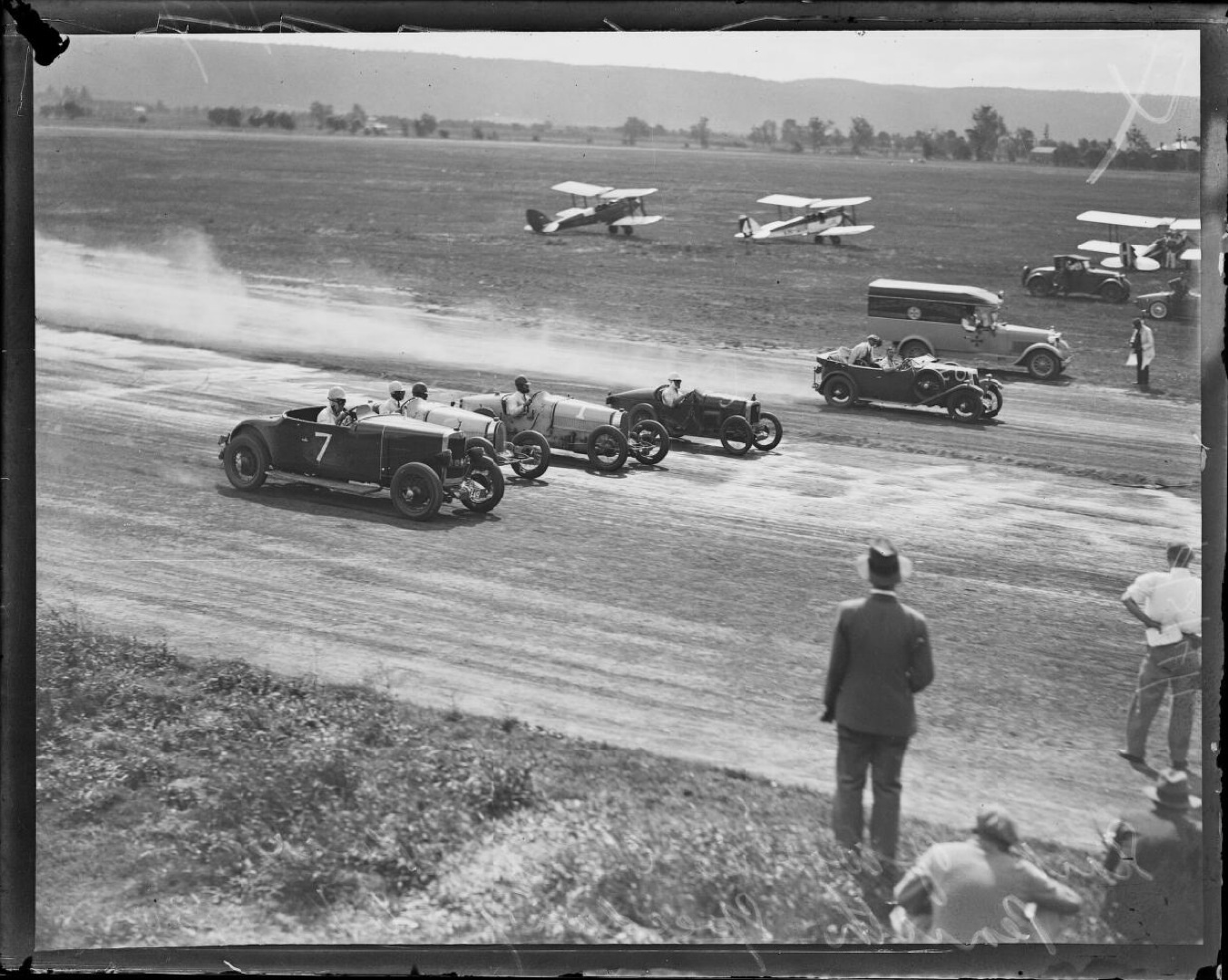
The finalists are off to a flying start in the 6 October 1930 ‘World Championship’ for under 1500cc cars on dirt, Penrith Speedway, Sydney…

The glass plate negative, wonderful monochrome photograph creates such an evocative feel apart from the scene itself. From the outside is John Sherwood’s cumbersome looking Lea Francis O-Type, then the Sam Aggett and Charlie East driven Bugatti T37’s and on the inside Tom Lord’s, Geoff Lowe owned Austin 7 Brooklands. On the very inside verge is Jack Field’s supercharged Lea Francis S-Type Hyper tourer slowing having paced the competitors for a lap before the championships 3 lap journey, East was the winner in his Bugatti.

Event and Competitors…

A record entry of 79 cars was received for the meeting. The winner of the feature event, Charlie East, described as an ‘old hand track and competition driver’, was proclaimed World Champion for cars under 1500cc on dirt tracks.

The 6 entries for this 3 lap race were all rather local notwithstanding the grandiose title of the Light Car Club of New South Wales promoted event, not that there is anything new in promoters ‘puff’ to put bums on seats!

The Nepean Times reported that the race was ‘No mere crow attracting stunt, but a legitimate worlds championship event’. The ‘International Racing Organisation…specified certain electrical timing apparatus, this to be controlled by officials sanctioned by the leading motor body of the state’. The event was supervised by the Royal Automobile Club of Australia, the Confederation of Australian Motor Sport was not formed until the 1950’s.

The Sydney Morning Herald noted Mr TF Lord’s supercharged Austin 7 Brooklands was a new car with Messrs Charlie East and Sam Aggett entering 1496cc (T37) Bugatti’s. Tom Sulman had a career which went all the way from the early 1920’s in the UK to his unfortunate death in a Lotus 11 Climax at Bathurst in 1970, was entered in a 1096cc Salmson.

John Sherwood was a luminary as a driver, businessman, motoring and motorsport administrator down the decades, he entered a 1496cc Meadows 4ED twin-carb powered Lea Francis O-Type. Sherwood was the driving force of the NSW Light Car Club as well as the key individual who created the Mount Panorama track at Bathurst. From a pioneering motoring family, he was a formidable competitor and later, as a Director of Empire Speedways, was a big contributor to the growth of Speedway Racing in Australia.

WH Northam was the final entry in another 748cc Austin, a combination which had many wins at Penrith and who later raced to 6th place in the 1932 Australian Grand Prix aboard this car. Bill Northam had an extraordinary life of achievement in commerce, sport and as a charity fund raiser. Long after he stopped motor racing he took up yachting in his mid-forties making the Australian Olympic Team and winning the Gold Medal in the 5.5 metre class at the Tokyo 1964 games. He was knighted in 1976 and died, aged 83, in 1988.

Other races on the ‘Eight Hour Day’ Monday public holiday card were an all powers handicap over 5 miles, a handicap for under 850cc cars over 3 miles, a four mile scratch race and finally the NSW LCC handicap over 3 miles.

The Championship Race…

Four starters took the flag with Sulman and Northam knocked out in eliminations conducted over 1 lap, a mile, with each car having a flying start. Aggett was the fastest qualifier at 66.91 mph from East, Lord, Sherwood, Sulman and Northam the slowest on 60mph.

The racers were given a rolling start behind JA Fields Lea Francis, then East immediately took the lead in his Bugatti from Lord’s Austin, then Aggett’s Type 37 and Sherwood’s Lea Francis ‘handicapped by a cumbersome body’, ‘Sherwood’s Lea Francis could not be opened up except in the back stretch’ in 4th. East drew away to a lead he never relinquished, and led Aggett by 100 yards from Lord. East’s lead stabilised at about 400 yards from Aggett, who was handicapped by an oiled plug, Lord was 100 yards further back and then Sherwood last.

In the final quarter of a mile Lord and his little supercharged Austin seized an opening through the dust, coming alongside Aggett’s Bugatti in 2nd. ‘Aggett swung a trifle wide on the last turn onto the home stretch, and, straightening up, cut down to the inner edge of the racing course. The two cars touched with the Austin spinning wildly. ‘Lord’s car spun on its side, dragging the driver, who was half out, and half in the Austin. Lord sustained abrasions to his legs and face. Charlie East one of the Maroubra stars, won in a time of 2 minutes 33 seconds at 70.58 mph by 100 yards with a wheel, literally, between Aggett and Lord in 2nd and 3rd. Sherwood’s Lea Francis was last car home.

The excitement was far from over though. ‘With Lord in the hands of the ambulance people, the stewards took prompt action. They disqualified Aggett and ‘sent him out’ (banned him from competition) for six months’. ‘The Referee’s’ report of the race then pointed out the unfairness of this process which was so speedy, their was no call for full evidence and Aggett appealed. I’m uncertain of the response of officialdom to this request.

Aggett and Lord make contact, the accident attributed to the Bugatti T37 driver rather than Lord aboard the tipping Austin 7 Brooklands (Fairfax)

John Sherwood’s Lea Francis  won the final of the open class ‘Widgery Cup’ Handicap, the ‘Clyde Battery Cup’ handicap for cars under 850cc final was won by CB Tye’s Austin 748cc and the All Powers Scratch Race final by CO Spurgeon’s Rajo Ford with the Club Handicap for under 2000cc cars won also by Tye’s Austin. In a day of interesting racing a special match race between Captain Hammond’s Gypsy Moth aircraft was won by the plane over J McCutcheon’s Morris Midget by a few lengths, the distance a flying mile, pun intended!

Penrith held the international spotlight for a week during the 2000 Sydney Olympic Games, the town is 50Km west of Sydney on the Nepean River, it was the site of the whitewater rafting and rowing competitions. But the hype about the Penrith 1930 World Championship race inclusive of its title were not indicative of the events true local nature.

The competitors were all from New South Wales, a notable absentee was Bill Thompson, three time winner of the Australian Grand Prix and in sparkling form in 1930. Earlier in the year he won his first AGP at Phillip Island and had swept the board in the same AGP winning Bugatti T37A during the Gerringong Beach racing carnival on NSW’s Illawarra Coast in May. Thompson was reported to be entered at Penrith but did not race, his entry was received ‘out of time’ and so was refused. Talk about a promoter putting due process in front of ‘the show’! ‘The Referee’ report noted the ‘the field was unworthy of a world championship. Without entries from Thompson, Drake-Richmond and Terdich, to mention but three of the missing cracks, the field was not even truly representative of Australia’. Both Harold Drake-Richmond and Terdich were Victorian stars, Arthur winner of the 1929 AGP at Phillip Island aboard a Bugatti Type 37A.

Charlie East, all smiles aboard the winning Bugatti T37, Penrith, October 1930 (Sydney Morning Herald)

Not that the quality of the final lacked talent in the context of Australian Motor racing, very much nascent at the time…

The Australian Grand Prix was held for the first time on an oval dirt layout around the showgrounds at Goulburn, New South Wales in 1927. The 1928 AGP, ‘The 100 Miles Road Race’ at Phillip Island, the first proper race in Australia on a road, run on a large, rectangular, gravel course was more indicative than Goulburn of the direction Australian racing would take and was indeed the race which started the tradition of road racing in Australia.

At the time Australian motor racing was largely amateur, a ‘run what you brung’ approach prevailed with most competing cars driven to and from the track. The sport evolved from hillclimbs, sprints and races on horse-tracks, the province of the gentry pre-War, to hillclimbs at Waterfall Gully, Kurrajong, Mount Coot-tha and Belgrave, beach racing at Gerringong and Sellicks to venues such as Aspendale, Maroubra and Penrith Speedways. Racing on Sydney’s banked, concrete  Maroubra Speedway track was very professional. Maroubra was owned by a commercial enterprise, not a car club, there was prize money to be won, the approach of the top competitors was consistent with that- the importation of cars and preparation thereof with a view to commercial success prevailed.

Some brave kids watching a competing car at Kurrajong Hillclimb, 75Km northwest of Sydney in the lower slopes of the Blue Mountains, October 1920, the competitor has the two outside wheels in the dirt on turn in! Hillclimbs were incredibly popular forms of motorsport in Australia at the time either as stand alone events or as part of trials which were events mixing navigation and speed events, usually sprints and hillclimbs. Between 1915 and 1926 there were at least 50! different hillclimb venues used across the country (Michael Terry)

John Medley wrote that ‘it was some time before other groups followed (the Light Car Club of Victoria’s Phillip Island) road racing direction, preferring the simpler expedient of running trials with speed sections included (rather like modern rallies) or contests on simple dirt speedways- both of these being more easily controlled by the organisers and also less accessible to the long arm of the law. One consequence was that their was very much a casual air to the whole occasion, with ‘chop picnics, family gatherings and exuberant overnight parties.’

I have not used the term speedway racing as the ‘forked road’ the sport took in later years had not yet occurred, competitors contested a variety of events as above. In addition solo intercity record-breaking attempts were also important with Graham Howard recording that ‘…intercity records…were the most consistent form of competitive motoring in Australia until the late 1920’s, and produced our first household-name drivers…’

A little snippet in the ‘Nepean Times’ article is a reminder of the important co-existence, with the motorcycle dudes the leaders, of ‘bikes and cars racing at the same meetings. The article notes that the Penrith meeting was ‘the only all car one in New South Wales for about five years’. It is also reported in terms of contemporary competitor numbers (79) that the meeting had ‘a record entry for a car race meeting for any part of Australia’. Also amusing, the ‘Times notes, ‘Women are barred, (from entering the championship race) which means that Mrs J.A.S Jones will not be driving her supercharged Alfa Romeo (6C1750). But it is hoped this fine car will race even with a mere male at the wheel’!!

Stunning image by of WE Hart in his Bristol Boxkite biplane in 1912. A Parramatta dentist, Hart bought the Boxkite (frame number 10) from Joseph Hammond, demonstration pilot of the British & Colonial Aeroplane Co and became Australia’s first qualified pilot on 5 December 1911 (SLNSW)

Penrith Speedway ‘was formerly the first recognised airfield in Australia situated in Belmore Park and is now the village of Thornton’ wrote Peter Finlay, former racer and aviation writer.

‘William Ewart Hart was the first Australian to fly from there in 1911 in his Bristol Boxkite after demonstration flights by JJ Hammond in the Bristol. Hart established a flying school there before moving to Hart Common, now RAAF Richmond. Races between cars and aircraft were held at the speedway. Frank Kleinig Snr was a regular competitor and Sir Charles Kingsford Smith operated the ‘Southern Cross’ from the field at times. There is a spectacular memorial featuring a stylised Bristol Boxkite at the entrance to the oval’, Peter wrote.

The first car race meeting was held over the April 1924 Easter weekend- the track morphed through lap distances of 1 mile 80 yards to the 1 mile course used in 1930. The track was touted by international competitors who raced there as ‘The Worlds Greatest Dirt Track’ but its life was relatively short-lived. The Commonwealth Defence Department compulsorily acquired the land in 1941 and the circuit was consumed in that process.

RG Potts racing the Mrs JAS Jones owned Lea Francis on Gerringong’s Seven Mile Beach, 50 Mile Handicap on 10 May 1930. You can just see the pole at left which Potts is turning around to head back the other way on this beach near Kiama, 130 kilometres to Sydney’s south. There was no road racing in NSW at the time so racers did ‘the lot’- sprints, the hillclimbs which were often part of the trials conducted by local car clubs, the speedway at Penrith, and here upon Gerringong Beach. Sellicks Beach on Adelaide’s Fleurieu Peninsula was also used by ‘bikes and cars to race (Fairfax)

The six ‘World Championship’ entrants were all experienced New South Wales competitors with Sherwood and Sulman later entrants in Australian Grands’ Prix. Sherwood’s car appears to be a Lea Francis ‘Hyper’, a competition variant of the marque successful in the UK at the time and powered by a supercharged 1496cc 4 cylinder engine.

I can find no details of Sulman’s Salmson and am keen to hear from any of who may know about his car. Tom Sulman is revered in Australia as a doyen of racers who simply never stopped until the sport eventually took his life. I was at Winton a fortnight ago and looked again at the Sulman Singer, the amazing self-constructed dirt car Tom built and raced in England in the 1920’s before his return to Australia. It was a constant in Australian motor racing in both contemporary circuit events, and later from the mid-seventies, in historic racing when driven by Ron Reid. Upon his death not so long ago, his sons continue to race a car which must have done more racing miles than any other on the planet!.

Somewhat bizarre is that the ex-Charlie East Bugatti T37, chassis  ‘37104’ sits in Earl Davey-Milne’s garage in Toorak, Melbourne one kilometre from where I am writing this article right now! Chassis ‘37104’ was the fourth T37 built and shipped to Sydney’s  Russell Taylor, the prosperous owner of the Advanx Tyre company. It was raced for him by Charlie East, a driver whose stature was growing at the time.

East was a Maroubra regular, one of its stars having first raced there in 1926 and subsequently lapping at over 96mph and on one occasion his lap was timed at over 116mph. Davey-Milne bought the car in 1943, it remains in the Chev Corvette V8 engined, open chassis form Earl rebuilt it to in the late 1950’s. East didn’t race the car in an AGP but ‘37104’ was raced in the 1933/4/5 events at the ‘Island driven by Cec Warren in 1933 and John McCutcheon in ‘34/5.

It isn’t clear if either or both the East and Aggett Bugatti T37’s were normally aspirated or to T37A, supercharged specifications. I can find no references as to which particular Bugatti Aggett raced and am keen to hear from any Bugatistes who can help with the identity and specification of the car and the drivers background. Similarly, whilst Lord’s Austin 7 is reported to be of blown Brooklands specification I have no details of the Northam Austin 7. All details again gratefully received. These snippets of history are all interesting i think!

In this case the photo which inspired the research and the resultant article popped up on that internet thingy when I was messing around looking for shots of Bill Thompson after reader Rob Bartholomaeus corrected the caption of an article I’d written about Thompson and his Bug T37A. Its funny how one thing can lead to another!…

Intercity record breaking was a popular form of solo road competition in Australia until outlawed in 1935 due to accidents. Here is the 25.5hp Th.Schneider with Arthur Barnes at the wheel and mechanic Bill McCulloch alongside- they have just taken the Broken Hill, NSW to Adelaide, SA record covering the 533 kilometres of unmade roads in 8 hours 3 minutes. The car is parked out front of Booth’s Garage, 411 King William Street in Adelaide’s CBD. 12 August 1925 (WS Smith)

YouTube Footage of Penrith…

Makes clear the speed and danger of the place! I looked at the film enthralled but the danger was readily apparent before discovering other footage of a multiple fatality when a car crashed into spectators in 1938.

When ‘shit happens’ at speed, without protective barriers, its all over in the blink of an eye. Racing entry tickets still have the ‘Motor Racing is Dangerous’ message to this day, and so it was for all, spectators included until not so long ago!

Etcetera: WE Hart, Bristol Boxkite, Penrith circa 1912…

(SLNSW)

WE Hart biography in brief; http://adb.anu.edu.au/biography/hart-william-ewart-bill-6592

Bibliography…

‘Nepean Times’ 27 September 1930, ‘Sydney Morning Herald’ 30 September and 7 October 1930, ‘The Referee’ Sydney 8 October 1930

‘Bathurst: Cradle of Australian Motor Racing’, John Medley, ‘History of The Australian Grand Prix’ Graham Howard and Ors, ‘Historic Racing Cars in Australia’ John Blanden, Peter Finlay

Photo Credits…

Fairfax, Sydney Morning Herald, State Library of South Australia, Sir Hudson Fysh, WS Smith, Michael Terry

Finito…


image

Seeing this book by Bill Tuckey amongst the display collection Michael Gasking brought to the Repco Brabham Engines ex-employees get together brought a smile to my face…

I didn’t ever own it but it was one of a very small number of racing books in Camberwell Grammar School’s library when I started there, aged 12.  Having only recently become interested in racing I was like a sponge for information. What was significant about this tome is that it was written by a talented journalist, Bill Tuckey, who edited both ‘Wheels’ and ‘Sports Car World’ magazines, the latter became one of my monthly bibles along with ‘Racing Car News’. The book covered a very broad canvas comprising all the Australian Grands Prix, portraits of the champion drivers at the time (the early sixties) as well as our circuits and the round Australia epic trials of the fifties.

It was a great read and provided important historical context for my contemporary obsessions at the time which were F5000 in Oz and F1 ‘over there’. I must suss it on Ebay.

Anyway, I thought I would share the cover art, the circuit depicted is Sandown, the Cooper T70 like car is just hooking into Shell Corner or Turn One, its vanilla name these days.

Bill Tuckey died not so long ago, this obituary in ‘Wheels’ is a great tribute to a talented man;

https://www.wheelsmag.com.au/news/1605/obituary-bill-tuckey/

Credits…

Michael Gasking Collection/Bill Tuckey, cover art by Phil Belbin