Posts Tagged ‘Australian Motor Racing History’

(J Saward)

Longford’s Pit Straight- Illawarra Road from a Percival EP-9 at low altitude during the 1959 meeting…

We are indebted to Tasmanian enthusiast Rob Saward who left his, and his father, Jim’s photographic archive in the care of Lindsay Ross (oldracephotos.com.au) who periodically uploads tidbits of visual pleasure from his coterie of talented ‘snappers such as the aerial shots Jim took here.The perspective provided as a result, is gold.

My Longford obsession I’ve admitted a number of times. I suspect I have written more articles which involve this circuit than on any other single topic. The idea for this piece arose out of a swag of photos I’ve accumulated but not yet uploaded of the circuit, and the notion of a ‘photographic lap of Longford’ with the emphasis on more panoramic images taken from a distance to give us a feel for the flow of the place rather than close up shots of the cars and drivers themselves. Most of the photographs in this article I’ve not used in the many Longford pieces on this site thus far.

What also brings the article to life are the accounts of Longford from those who were there in period, these I have filched from The Nostalgia Forum ‘Longford: Reims of The South Pacific’ thread particularly the scribblings of Ray Bell, The Late Barry Lake, Stephen Dalton, ‘Longfordboy’, Lindsay Ross, Ellis French and others. I have quoted these fellas throughout.

Treat the article as Work In Progress though as the drivers perspective is largely missing. I am very keen to hear your views/recollections, many ex-Longford racers are readers, so it would be great to hear from you folk about the particular challenges this remarkable piece of Tasmanian real estate presented to racers of the time.

I’ve inserted a Longford circuit map to assist in understanding ‘where we are’, the reality is that the map is indicative rather than definitive, there are plenty of more nuanced twists and turns revealed by the photos which follow not reflected on a circuit map of this small scale.

Other essential homework before you read the article is to look several times at the in-car footage taken from Lex Davison’s Cooper T62 during the 1964 meeting. Many of you will have seen ‘Long Weekend At Longford’ already. After listending to and watching Davo’s great commentary (it starts at about the 2 minute 52 second mark) a couple of times turn the sound off and just focus on the circuit’s twists and turns, topography and changes in elevation.Then read the article having in part at least got into Longford’s rythmn…

The opening shot by Jim Saward is above Mountford Corner where the red sportscar is about to turn in.

The escape road from ‘The Flying Mile’ straight from whence our sportscar came is dead ahead of him- being the road to Perth (Tasmania not Western Australia- mind you, the direction is the same for both!) The racing pits are to the right of the white painted line on the tarmac and were moved there from the outside of the circuit on The Flying Mile in 1959- this change was made after consultation with leading drivers and officials after safety concerns. To the top left of Saward’s photo is the Water Tower which marks the turn in to the fast right-hand downhill pluge to The Viaduct,in the distance is Longford village.

Ray Bell ‘The road narrowed about 100 yards or so after the start, then there was clear paddock each side of the straight till some trees came up on the right as you go over the crest…’

Kerry Grant’s Brabham BT4 Climax off to the side of the road, he pulled up after Rocky Tresise’ fatal Cooper T62 accident and could not restart (oldracephotos/DKeep)

The shot above is the drivers eye view of the Water Tower approach.

Its Bruce McLaren’s white Cooper T79 Climax dicing with Jack Brabham’s Brabham BT11A Climax for the lead of the 1965 Australian Grand Prix with Jack looking for an inside run into McKinnons Hill on the run down into The Viaduct. Bruce won on that particular day, in very fine form from Jack about three seconds in arrears.

Bell ‘The poplars can clearly be seen down the hill, (below) the railway embankment was just clear… and here’s a point… the grass wasn’t usually green! It was late summer, mostly hot, bushfire season and all that when Longford was held. The trees had a gap on the right where there was a gate into the paddock just at the turn in point for The Viaduct, and there was a sort of run-off track straight ahead at this point. In 1965 this was just dirt, maybe grassed later.’

The Viaduct section of the circuit Bell refers to above is the bit Chris Amon is negotiating below.

Waaah-raaap-waaaahhh, you can just about hear that Ferrari V12 as he shifts down through the gears from fourth or fifth to second for the Viaduct left, then right Ess to head back up the hill into the trees then down towards the Kings Bridge and Longford village itself. But lets not get ahead of ourselves.

Stephen Dalton notes in his caption of this photo ‘The keen enthusiast set up their vantage point from the edge of the trainline, as Chris Amon goes past Longford Motor Racing Association President Ron McKinnon’s ‘Mountford’ property while attempting to make up the 2 laps he lost when the P4 was discovered to have a flat battery on the grid for the 12 lap Event 2 Sports Car Scratch Race’ (S Dalton)

Chris mainly cleaned up in David McKay’s P4/Can-Am 350 in the sportscar races the car famously doing 178 mph on ‘The Flying Mile’ that day in the wet! And 182 mph in the dry on the Saturday. Here the track is patchy wet, very tricky in this powerful car, its the Monday raceday ‘Longford Cup’ day, the famously wet race won by Piers Courage’ F2 McLaren M4 Ford FVA car from the 2.5 litre cars which were somewhat hampered in the wet conditions by an inability to put their power down.

‘It was an extraordinarily quick circuit’ recalled Chris in MotorSport. ‘It was basically a rectangle, and by the time you were halfway down the straight you were absolutely flat out. It was a wonderful circuit in the dry, but in the wet it had the potential to be bloody dangerous’ he said in somewhat masterful understatement! In the dry Saturday sportscar scratch Chris set what became the all-time lap record at 2:12.6 seconds, an average of 122.19 mph.

‘As far as steepness of the area of the track is concerned – “McKinnons Hill” as we used to call it is much steeper at the initial descent to just before the gateway (just up the hill a bit on the left from where Chris is shown) where it becomes a more gentle drop…In real life it was narrow, steep and the kink past McKinnon’s Gate was a nice sweeper if there was no traffic around (i.e. a racing line used in your road car) but the fast cars would be balancing braking and set up for The Viaduct. (the point referred to is exactly where Amon just apexed above) I don’t think this kink had a name other than McKinnon’s Gate…We could ride our bikes from The Viaduct up to just past the gateway but then had to get off and push. My drivers licence test with a local policeman was 1 lap of the circuit on my 17th birthday- Sunday 6 March 1966 with hay bales and braking markers in place!’ wrote ‘Longfordboy’.

Gaggle of cars heading into The Viaduct in 1961- Austin Miller Cooper T51 Climax chasing Lex Davison Aston DBR4/250 at the rear of the group- note the run-off area between the haybales and marshalls- limited mind you, a bit of dirt then bush and a steel drop into a culvert (S Dalton)

‘I think the fast cars were just about airborn as they started the descent as it dropped suddenly at first – i think Greg Cusack in an open wheeler had a big crash there (in the Scuderia Veloce Brabham BT23A Repco in 1968 ) when he did not land straight and spun off going down the hill before the gateway’…’In the lead up to the long weekend we would ride our bikes to The Viaduct at night to watch some local competitors practicing – with sentries to advise if anyone was coming so they could use all the road!’ Longfordboy added.

‘McKinnons Hill’ is the area of the main entrance of Ron McKinnon’s (Longford Motor Racing Association’s President & Chairman) ‘Mountford’ property. That ran all the way back to Mountford Corner and had the pit building on his property…The Viaduct and the land that runs down to the South Esk river is also on Mountford property…’wrote Stephen Dalton.

(oldracephotos/DKeep)

 The photo above during one of the 1966 Touring Car races is of the outside of The Viaduct and shows the Rob Boote Holden EH from Robin Pare’s Ford Mustang turning into the corner. Note the spectators to the side of the railway line as mentioned in the Amon shot above and stationary blue flag from the ‘flaggie’.

(oldracephotos/DKeep)

Whilst the colour shot above shows the run-off area into The Viaduct there was not too much space to play with as Spencer Martin demonstrates in his Scuderia Veloce Brabham BT11A Climax in 1966. The SV team got the car sorted though, Spencer was fifth in the Monday ‘South Pacific Trophy’ event- and won the first of his Gold Star national titles with this chassis that year.

(oldracephotos/DKeep)

Above is gaggle of cars the first of which is Frank Gardner’s Brabham BT23D Alfa heading under the bridge- then Leo Geoghegan Lotus 39 Repco, Richard Attwood BRM P126, Kevin Bartlett’s Brabham BT11A Climax, Pedro Rodriguez BRM P126 and the rest- the Saturday dry preliminary in 1968.

Whilst the view from the outside or exit of the corner below shows Bib Stillwell’s Cooper T51 Climax ahead of John Youl, Cooper T55 Climax during the 1963 South Pacific Championship race won by Bruce McLaren’s Cooper T62 Climax. It is a beautiful photograph, and not a bad vantage point for those who could cadge a pass into that area!

(oldracephotos)

After the cars have cleared the final right of the Viaduct combination the cars disappear up a slight rise into the Australian bush, you can smell the eucalypt’s in these next coupe of shots.

Bib Stillwell is literally lining his Cooper up for the left-right combination the cars below are traversing- clear in the shot is Austin Miller’s distinctive Cooper T51 in his trademark vivid, glorious yellow hue. Notice the drain culvert and quite dense nature of the bush- we call it bush in this part of the world rather than forest folks!

(oldracephotos)

So. Back to the map – we have cleared the railway line and are on the section of track between the Viaduct and Kings Bridge. Photos of this part of the track are as rare as rocking horse poop.

The photo below  shows the track to be quite narrow and rough at its edges, not a part of the track to pop a wheel into the dirt. ‘Trees were thick from The Viaduct to Kings Bridge, then stayed thick the other side on the left’ says Bell whose magic photo it is which shows Jim Clark’s Lotus 39 Climax leading Jack Brabham’s Brabham BT19 Repco through the bush in 1966 – it’s the same stretch of track in both photos taken from atop The Viaduct, the two photographers using lens of different focal length.

(R Bell)

Onto the photo below of Kings Bridge we are looking from the bridge back to the bushy section of the track the cars in the two photos above are heading towards, note the open approach to the bridge below is preceded by a left-hander the last car below is just completing.

After the drivers turn right above they go down the hill and across Kings Bridge – one of two crossings of the South Esk River – the shorter of the two bridges, it’s Jack Brabham here, Brabham BT4 mounted in 1963 ahead of Bruce McLaren’s Cooper T62 Climax.

Longfordboy ‘The pump house (brick building to the left of the photo) is the new pump house for the town that pumped water up to the reservoir (water tower). The old pump house was on the opposite side of the road and the old pump in a bit of a shed remained with a large wire cage around it…We used to water ski under the Kings Bridge – provided the water was low enough.’

‘Many farmers had their own small pump houses for their own irrigation systems. My father was a mechanic so i was brought up grinding in valves by hand with suction caps on wooden handles. Of interest in 1958 or ’59 Arnold Glass brought a Maserati 250F to race and it was housed in our large single car garage/workshop beside our house. The mechanics finished working on it around midnight – to start it dad towed it around the block (in Longford) it fired up half way round and sounded “magnificent”. Neighbours never complained – it was accepted that weekend.’ quipped Longfordboy.

Spencer Martin in the SV Ferrari 250LM chasing Brian (father of John) Bowe Lotus 11 Replica HEA Simca s/c Spl on, or more particularly off Kings Bridge, morning practice Saturday in 1965 (R Bell)
(oldracephotos)

John Surtees beside the Pumphouse just off Kings Bridge on the way to South Pacific Trophy victory in his Cooper T53 Climax FPF 2.7 in 1962- I guess for the great Brit Longford was ‘safe’ by the standards of some of the ‘bike racing circuits from whence he came!

Exiting Kings Bridge was fast, a top gear right hand open curve. Then there is a deceptively (in terms of the map) long straight stretch into the village of Longford itself – the approach to it is very fast and dangerous due to the presence of mature, solid Plane trees and ‘The Hump’ in the braking area.

The location and Longford Corner is much photographed with the Country Club Hotel (which happily is still there, do pay a visit and check out the racing memorabilia inside) a familiar backdrop. There was a Mobilgas Service Station opposite the pub which is shown in one of the following photos.

(oldracephotos)

The image above shows Graham Hill, Brabham BT11A Climax and Phil Hill’s Cooper T70 trying to set a lap record to stop Jack Brabham, behind him in a Brabham BT11A Climax catching his teammate- and eventual winner, Bruce McLaren during the 1965 AGP. They are in the braking area for Longford Corner- whilst the Union Street plane trees have been trimmed, their solidity is readily apparent.

With unguarded trees on both sides of the track and ‘The Hump’ in the braking area the take-off and landing of ones machine was critical- getting the car settled and straight before caressing the brake pedal firmly and progressively was important. This, and a wheel in the dirt caught out young American driver Tim Mayer who lost his life in a Bruce McLaren Motor Racing Cooper T70 Climax much like Bruce’s T79 above, against a tree in 1964. The hump was removed after this incident.

(E French)

In fact, in the words of Murray Walker, if I am not very much mistaken Jack Brabham’s Cooper T51 Climax above is just landing after ‘The Hump’ in 1960 above- checkout the shadow under his machine. Brabham won that day from the Mildren and Stillwell’s T51’s.

(G Smedley)

Shot above is a favourite, Geoff Smedley’s, of Clark, his obscured teammate Hill and Amon- Lotus 49 times two and Ferrari Dino 246T then Frank Gardner’s Brabham BT23D Alfa, and then, i think Kevin Bartlett, Brabham BT11A sandwiched between the two BRM’s of Richard Attwood and Pedro Rodriguez- Clark the winner in this Saturday 1968 preliminary. By the look of the nose of JC’s Lotus he has just started to brake into Longford- the hump is now gone and the tarmac appears smooth albeit the verges are to be kept clear of as are the ever present plane trees.

All of the photos in this article make clear the impossibility of keeping the flavour and character of the place and provide greater elements of safety for both drivers and spectators of the day. There simply was never the sort of budget in Tasmania which allowed the Nurburgring to be transformed in 1971 in a way which trod the straddle between the vistas and challenges of the past and present day safety requirements pretty well.

(oldracephotos/JSaward)

Saward’s photo of Austin Miller’s Cooper T51 above chasing a gaggle of similar Coopers and Lex Davison’s (second car in this group of five) Aston DBR4/250 is interesting as we can see both the immediate environs and also have a peek around Longford Corner and along the start of Tannery Straight. At the top of the rise in the road the first three cars are travelling towards is the railway crossing ‘jump’ which  is the subject of the next series of photographs coming shortly.

Len Lukey Cooper T45 Climax from Doug Whiteford Maser 300S during the 1959 AGP weekend (oldracephotos)

The photograph above is a classic ‘Pub Corner’ shot- the corner of Union Street and Wellington Streets in Longford village with the 1959 Australian Grand Prix combatants Len Lukey and Doug Whiteford  apexing the corner for the run along the start of Tannery Straight (along Wellington Street) and just up the road the jump over the railway line.

Stan Jones won that 1959 AGP, a long overdue win for the perennial frontrunner in his then ageing Maserati 250F.

(oldracephotos)

The photo above shows opposite locking Bob Jane’s Lotus Cortina chasing Sir Gawaine Baillie’s 7 litre Ford Galaxie, repaired after its near death experience against the Sandown Park, Peters Corner fence whilst driven by Lex Davison the previous November, on the exit of Longford Corner.

The Mobil Servo referred to earlier is clear as are more plane trees and an enthusiastic crowd ‘protected’ by lots of haybales and their own fast reactions! That Ford would have been mighty impressive bellowing and thundering along Longford’s long straights. The twiddly bits would not have been quite so impressive!

After exiting Longford/Pub Corner the cars accelerate through the gears including a ‘yump’ over the railway crossing along Tannery Straight.

Actually, for the most part after leaving Longford- that’s Doug Whiteford’s ex-works Maserati 300S coming in for a landing below, note the handily parked Austin!- its a long gentle curve, for a mile and a bit and then brake hard for Tannery Corner, a right hander.

Doug Whiteford Maser 300S, over the Tannery Straight (Wellington Street) railway crossing in 1959 (E French)

There was some technique required in addition to enjoying the ride! Kevin Bartlett recalls having to release the throttle for a fraction of a second so that the rear halfshaft donuts didn’t overstress on his Brabham BT11A, with Ellis French adding that ‘Humpy’ Holden crankshafts didn’t like the spot either. Geoff Smedley quipped ‘That crossing is the only place in the world where a race had to be paused to allow trains to pass through!’

Jaguar Mk1’s 1960- David McKay from Ron Hodgson (oldracephotos)
(E French)

Marvellous shot above of Ellis’ on the same day as his Whiteford one prior- its beauty is both literal and symbolic.

Literal in terms of the scene itself- the crossing, handily placed spectator’s Austin, watching, relaxed ‘coppers and of course the Maserati 250F and Cooper T45 Climax of Arnold Glass and Bill Patterson. Its practice for the 1959 AGP, Arnold was third and Bill failed to start, as mentioned earlier, the race was won by Stan Jones Maserati 250F.

Its the 250F that is the symbolic bit- the little mid-engined Coventry Climax FPF powered Cooper chasing down the thoroughbred Italian car. The first such locally domiciled car was Reg Hunts 250F engined A6GCM which arrived in early 1955. In the period which followed the 250F’s did well albeit Lex Davison’s older 3 litre Ferrari 500 pretty much always had their measure- what it may sometimes have lacked in outright pace to Hunt, Jones & Co being compensated for by strong reliability, especially on the big occasions. Whilst Stan Jones won the 1958 Gold Star Series and the 1959 AGP in his 250F the period of the big red cars was coming to an end, a smidge later in Australia than in Europe. In the ’59 Gold Star, twelve races were contested- mid-engined Cooper’s won nine of them with three going to the front-engines, and all of these wins were early in the year prior to 31 March. Jones and Kiwi Ross Jensen won in 250F’s at Longford and Bathurst with Stan rolling out the Ern Seeliger modified Maybach 4 Chev at Port Wakefield for a victory in South Australia. The days of mid-engined omnipotence had arrived.

Ray Bell’s shot below after the end of race proceedings in 1965 shows the gently curving nature of Tannery Straight- heading in the direction of Tannery Road from Longford. Its flat-knacker in top gear but clearly is not straight as is shown in pretty much all of the circuit maps available. Mind you, none of the modern maps will be from ‘source references’ but rather digital renditions of earlier work. Plenty of trees, bush and typical highway of the day with rough verges.

(R Bell)

‘The left of Tannery was like a huge hedge, the right was random trees growing thickly, with the odd track into the bush where lovers used to go and that sort of thing…

By the time they were looking for the brakes (the drivers not the lovers) they were well into clear paddock scenery, with a kind of flat and uninteresting (Windsor, Sydney after a flood kind of thing…) appearance for Tannery, where the road was built up and going off would mean dropping onto a lower level. The paddock straight ahead had a gate and driveway for convenient escape for late brakers’ Ray Bell recalled.

The image below of the Triumph TR3 and Lotus 11 is Tannery Corner, the T-intersection of Tannery Road and Bishopsbourne Road, the drivers have negotiated the corner and are heading towards Long Bridge and then Newry Corner, to the intersection with Pateena Road. Love that ‘Longford Motor Racing Circuit’ sign.

Owen Mortimer Triumph TR3 leads Allan Caelli Lotus 11 Climax out of Tannery in 1965 (oldracephotos/DKeep)

This photo below I have used before. Of all the thousands of photos i’ve seen and selected in the four years I have been writing primotipo this is one of my favourite ten- its Stan Jones’s Maser 250F negotiating Tannery Corner, the photo, from the outside of the corner is from the Dunstan Family Collection. Again, check out the terrain, flatness at this point, and don’t miss the dude standing at middle-right. Stan is heading for our next stop, the fast left-hander onto Long Bridge.

(Dunstan Family)
(R Bell)

Then follows another wild section of track including the flat out fast left-hand entry onto Long Bridge, again over the South Esk.

This part of the track is again much photographed with scuba divers strategically positioned in the event of a major mishap.

Ray Bell’s shot of Jim Clark’s Lotus 39 Climax leading Graham Hill, BRM P261 in 1966 is in large part included as his composition shows the prodigiously fast ‘flat’ entry onto the the bridge which must have been a big test of ‘wedding tackle’ size, not an issue with these blokes one can only surmise. The exit left was also very quick.

The image below in 1968 (Saturday) shows the order reversed, Hill from Clark’s Lotus 49 Ford DFW’s from Amon Ferrari Dino 246T, Gardner Brabham BT23D Alfa, Geoghegan Lotus 39 Repco, Attwood BRM P126, Bartlett Brabham BT11A Climax and Rodriguez BRM P126.

(R MacKenzie)

Barry Lake recalls being at this part of Longford with Jack Brabham in the early 1990s, doing a piece for a TV report. ‘There was no fence of any sort beside the road, although there was one down a very steep embankment. If you went off the road, you would have had to be almost at a standstill to drop sharply enough to hit the fence. With any speed at all, a car would easily have cleared the fence into the cow paddock. I seem to remember some mid-sized trees in there and could picture a car landing right in the top of one if it went off.’

I asked Jack, “Did it ever worry you at all, to know you would be coming through here virtually flat, with nothing to stop you flying out there?” He said, “I’ve never seen it before. I didn’t know what was out there. I only looked at the road… I didn’t ever intend to go off there anyway, so why would I need to know.”

(D Cox)

The shots above and below of Kerry Cox in the Paramount Jaguar having a huge, high speed moment on the bridge are as good a panorama as we will see inclusive of the fast, open approach to the left hander. David Cox wrote of his Dad’s incident in 1966 ‘…he did a 270 degree spin without touching either side! He told me he was in second place, had lifted slightly there the lap before , so this lap he was trying to hold it flat through the corner before the bridge and touched the barrier on the inside which put him into the spin down the bridge. He had to reverse up the bridge and turn around, and still came third in the race. When he got back to the pits there was a massive bit of wood stuck between the rim and the tyre, we have a pic of that somewhere too!’ The other car appears to be a Lotus 7, note the little dinghy riverside.

(D Cox)

Below is another of the Long Bridge panorama albeit its in 1958, the Gold Star round that year was won by the Ted Gray driven Tornado Chev- here Austin Miller’s Cooper T43 Climax is being pursued by Bill Patterson’s Cooper T39 Bobtail Climax. There is far more undergrowth a decade earlier than the shots above but the bridge looks the same. Note the haybales on exit and huge penalties for anyone getting their turn-in off the bridge wrong!

(oldracephotos)

In fact that 1958 Gold Star round was the race meeting that put Longford on the map from a car perspective. The motor cycle racing guys first used the circuit in 1953 with cars almost an afterthought. Sedans and sportscars raced on the ‘bike meeting cards but that all changed with the award of a round of the national drivers championship on the March Labour Day long weekend in ’58- which was always ‘Longford Weekend’.

Bruce Walton was multiple times Australian Hillclimb Champion when all the aces of the circuits chased this prize eagerly. He occasionally raced on the circuits and is here at the wheel of Australian Porsche importer Norman Hamilton’s Porsche 550 Spyder during that 1958 meeting- he was third in the Sportscar Trophy event. By all means suss the car but the shot is included to show the topography after the cars exited Long Bridge. Even today this is a typical Oz country road scene.

(oldracephotos)

Bob Jane howling towards Longford below in his Elfin 400 Repco ‘620’ 4.4 V8 in 1967, one of his earliest races in his new car. He is not long off Long Bridge with the South Esk River in the background- its hue a nice contrast to the parched paddocks and the fencing less visually pleasing than above but just as lethal as a decade before.

(oldracephotos/King)
(S Dalton)

The next corner after the section off the left-hand exit off Long Bridge is the Newry right hander into Pateena Road.

The climb out of there is quite sharp and a bit narrow between the edges of the embankments each side…ie not much shoulder for 50 yards or so, then evening out with crowd on the fence on the right.’ notes Bell. Above is the Elfin Mallala Climax FPF of Bryan Thomson during the 1964 meeting.

Rob Saward rated Newry Corner and Long Bridge as the best spectator viewing on the circuit adding that the steep exit was named by the locals ‘Newry Hill’ which then led on to The Flying Mile a straight about 1.5 miles in length- it was straight for the first quarter of a mile and then kinked to the left for the balance of the run into the Mountford Corner right hander- at the intersection of Pateena and Illawarra Roads.

(oldracephotos.com/JEllis)

This amazing and unusual shot by Jack Ellis shows the incline of ‘Newry Hill’ on a very blowy Saturday during the 1968 meeting- Jim Clark and Graham Hill in Lotus 49 Fords are being pursued by Frank Gardner in Alec Mildren’s Brabham BT23D Alfa Romeo V8. The trio are a smidge further up the road than the Elfin Mallala above.

(oldracephotos/DKeep)

I love this shot of evergreen, talented Tassie racer Barry Cassidy giving his ‘brand-spankers’ 1967 XR Ford Falcon GT plenty of FoMoCo 289 cid V8 wellie out of Newry during the 1968 meeting.

This was the very first of an immensely successful run of Ford Australia V8 engined ‘Pony Cars’ and apart from showing Cassidy’s deft touch with the throttle also clearly shows the rise out of Newry on exit before the road flattens for the fast blast along The Flying Mile- the car was stock but would have been good for just shy of 130 mph or thereabouts.

(R MacKenzie)

Queenslander Rod MacKenzie took some sensational Longford shots on his 1968 trip down south- this moody, foreboding one of Clark’s Lotus 49 exiting Newry is one of my favourite photographs and illustrates the elevation of the circuit at this point, and again, the rise upon exit until the circuit flattens a little further along The Flying Mile.

(S Dalton)

You can just about feel and hear the shrill scream of Spencer Martin’s 3.3 litre V12 @ 7500 rpm as the exotic, much loved Italian racer blasts along ‘The Flying Mile’ at around 165 mph frightening the life out of kangaroos and Tasmanians equally as much (above and below). I wonder what the speed limit on Pateena Road was at the time?! The sounds of the racing cars echoed off the surrounding hills across the brown paddocks of summer in rural northern Tasmania. The majesty of the place is one of the things that always takes my breath away- something which can only be achieved on long, open circuits in spectacular scenery on public roads.

(oldracephotos)
(R MacKenzie)

It wasn’t always sunny mind you. The Tasmanian weather could be capricious as it was during the 1968 meeting.

Jim Clark was belting down The Flying Mile in his Lotus 49 DFW on sunny Saturday for a win in the 12 lap preliminary- and a lap record he held for a few hours until Amon’s P4/CanAm 350 took it later in the day and then toiling hard to fifth place in the ‘pissin rain on South Pacific Trophy day- Monday. He finished behind Courage, Rodriguez, Gardner and Attwood that day but wrapped up the ’68 Tasman with four wins to Chris Amon’s two.

(E French)

After the flat out blast of ‘The Flying Mile’ we are back whence we started, the Mountford right-hander, the corner of Pateena and Illawarra Roads onto Pit Straight- Illawarra Road.

Stan Jones Maser 250F is chasing Len Lukey’s Cooper T45 Climax during their great 1959 AGP dice, the gents in the foreground providing almosphere enhanced by the huge, imposing and shady Mountford pine tree.

Pit Straight wasn’t always Pit Straight mind you, when the roads were first used as a race-track the Pits were located on The Flying Mile on Pateena Road, as noted early in the article, but safety concerns led to their relocation down the road and around the corner on the Illawarra Road section of track between Mountford and the Water Tower, from 1959.

Jim Saward’s photos below show the layout as it then was, these shots were taken from a Percival EP-9 aircraft which Rob Saward relates had a hatch in its bottom which was used to take quite a unique set of photographs. The landing strip for ‘planes was in the paddock behind The Flying Mile.

In the photo below you can see Pit Straight without the control tower and pit buildings which were built later and are shown in the various shots below. Note the ex-Launceston Tram Number 4, which, redundant in its initial role as public transport was relocated to provide officials with a building from which to operate- I wonder what became of it after Longford closed?

(oldracephotos/JSaward)

The photo below shows Pit Straight, Illawarra Road, checkout that tram at centre shot- at its end is Mountford Corner- left towards Newry Corner and the village of Pateena along Pateena Road and to the right is the road to Perth, several miles to Longfords east. The ‘capital’ of Tasmania’s north is Launceston, 25 Km away and Devonport where the then ‘Princess of Tasmania’ ferry disgorged its cargo of cars and racers from Port Melbourne is 95 Km from Longford.

(oldracephotos/JimSaward)

The two photographs below from Stephen Dalton’s Collection are undated, the cars will be a clue for some of you, look back towards Mountford on the inside of the circuit behind the tall poplar tree and you can see the Control Tower. ‘Over your right shoulder’ behind you on the upper shot is an incline and the Water Tower.

(S Dalton
(S Dalton)

Ellis French’s grid level shot of Doug Whiteford and Arnold Glass’ Maserati 300S and 250F is taken in 1959- its not the AGP but rather a heat, further back is the white Bill Patterson Cooper T45 Climax and his former Cooper Bobtail T39 Climax then owned by Alan Jack.  There is still no low-level grandstand on the outside of the circuit at that point.

(E French)

The facilities were still fairly basic below in 1960, I love the beach umbrella erected atop the control stand to afford the starter some shade to better fulfil his duties.

From the left of the grid it’s Brabham, Miller and Stillwell in Cooper T51’s with the Glass Maser 250F at far right. Jack won from Alec Mildren and Stillwell all in T51’s albeit Alec’s was Maserati 250S powered rather than by the Coventry Climax FPF’s in the rear of the other two chap’s machines.

(oldracephotos)

By 1963 it was ‘carnivale’ as this South Pacific Championship grid shot below shows the Control Tower and Pits building- together with all the advertising hoardings and bunting it looks fantastic.

The great big Mountford pine tree is there in the distance standing guard over the corner. On the front row its Bruce McLaren on pole in his Cooper T62 Climax, then Bib Stillwell’s Brabham BT4 Climax and Lex Davison, Cooper T53 Climax on the outside. The race was won by Bruce’ Cooper from Stillwell and John Youl’s T55.

(G Smedley)

The photo below is the same 1963 grid as above- just look at the atmosphere!

From the rear is the #87 Frank Matich Lotus 19B Climax and alongside the Bob Holden Lynx Peugeot 1.5, on the next row is Frank Gardner’s Brabham BT2 Ford FJ which is sandwiched by Tony Shelley’s Lotus 18/21 Climax against the pits and Peter Boyd-Squires Cooper T45 Climax. The white #9 Cooper T51 is Bill Patterson and alongside him is the #3 Cooper T53 of Jim Palmer. Then Chris Amon is in the red Cooper T51 #14 with John Youl alongside, Cooper T55 Climax and an obscured Brabham in his BT4. On the second row is David McKay’s Brabham BT4 Climax and an obscured Tony Maggs Lola Mk4 Climax with Davison, Stillwell and obscured McLaren up front.

(S Dalton)

This view is across the bonnet of Lex Davison’s Len Lukey owned Ford Galaxie in 1964, opposite the pits, with plenty of spectator viewing and easy access for them back to Mountford. Jag is Bob Jane’s very successful Mk2- Galaxie gave Lex quite a wild ride in Tasmania, the brakes in particular were wanting.

Lex Davison in Len Lukey’s Ford Galaxie in front of Bob Jane’s Jag Mk2 in 1964 (oldracephotos)

The Australian Tourist Trophy for sportscars below was the main, hotly contested support event run during the 1964 meeting.

The spectators on the outside of Pit Straight enjoy the start with Frank Gardner’s Alec Mildren owned Lotus 23 Ford leading from Bib Stillwell’s Cooper Monaco, Frank Matich in the Total owned Lotus 19B Climax and Bob Jane’s superb Jag E Lwt- Matich took the win after Bib was disqualified for a push-start at the races outset.

(olracephotos)

The 1966 panorama just after the start below emphasises the flat nature of the terrain at this point and the great brown land in which we live, distinctive also is the footbridge absent in the earlier images.

That’s Clark J’s Lotus 39 Climax from Frank Gardner’s Mildren Brabham BT11A Climax and Jackie Stewart’s BRM P261 out front. Jackie took the honours that year from his teammate Graham Hill and Jack Brabham aboard BT19 Repco- the chassis with which he won the 1966 F1 Drivers and Constructors Championships. It was the third race for the Repco Brabham ‘RB620’ V8.

Ever laconic Frank Gardner said of Longford in MotorSport ‘It was over railway lines, onto a bridge with a curve in it, with well-spaced wooden railings which you could force a car through. You were coming onto a strip of oily board over a river. That was the safety procedure! It made the Nurburgring look quite safe…’

(S Dalton)

The photo below shows ‘all the fun of the Longford fair’ with the Pit Straight facility at its zenith of development with control tower, footbridge and pit building complete with prized spectator viewing facilities. Looking away from Mountford in the direction of the Water Tower and beyond. Intrigued to know the year of this shot, circa 1966.

(oldracephotos)

Despite the uniquely challenging nature of the place with its bumpy bridges, slow Viaduct Esses with tight rise beyond, its level crossing jump and pre-1965 hump it was a FAST circuit. Chris Amon set the all-time lap record at 2:12.6 seconds, 122.19 mph in his Scuderia Veloce Ferrari P4/CanAm 350 during the 1968 dry, Saturday sportscar scratch race. Average speed folks. Imagine what it felt like on the narrowish Flying Mile in that car at 178 mph in the wet!

A confluence of events conspired to bring about the circuits closure.

Ticket sales were poor in wet 1968, the circuit was only used once per year thereby limiting the return on capital investment, local environmentalists were against permanent advertsing hoardings but most critically the Grand Prix cars of the day were becoming exponentially quicker due to the 3 litre formula introduced from 1966 (fast even when raced at Tasman 2.5 litres), tyre ‘alchemy’ or polymer chemistry was giving much greater levels of grip let alone the performance impact of wings which exploded after Longford’s final 1968 meeting. In essence the cars had outgrown the track and there was not the funding to make the necessary investment to keep the track intact but safe enough for changing times.

It was such a shame, it is not too much to think that the South Pacific Trophy could have been to Tasmania what the TT still is to the Isle of Man.

The Siffert/Redman John Wyer Porsche 917K lines up for The Viaduct during the 1970 Longford South Pacific Trophy 1000 Km. I wish!…

(woochoo)

Bibliography…

The Nostalgia Forum ‘Longford: Reims of The South Pacific’ thread-particularly the contributions of Ray Bell, The Late Barry Lake, Rob Saward, Lindsay Ross, Stephen Dalton, Ellis French, Wirra, oldracingcars.com

Photo Credits…

Lindsay Ross and his oldracephotos.com.au which provided the vast bulk of the images used in this article. I salute the work of David Keep in particular; http://oldracephotos.com/content/home/

Jim Saward, Stephen Dalton Collection, Ray Bell, Ellis French, Geoff Smedley, Rod MacKenzie, Dunstan Family Collection, Paul Geard Collection, Cox Family Collection

Etcetera…

(SCW)
Perhaps the culvert just out of The Viaduct. Mick Watt in the Prefect Ford Spl now owned by Ian Tate, mid-fifties (P Geard)

Tailpiece: Quintessential Longford 1960- Pub and Holden FJ…

(oldracephotos)

Longford was all about international racing cars and stars but equally it was motor racing mecca for Tasmanian and Australian racers with modest budgets and self prepared cars.

Endpiece: We started, and let’s finish with a Jim Saward shot at Mountford!…

(oldracephotos)

Lyn Archer’s Cooper T39 Bobtail Climax during the 1959 meeting. The shot’s composition is marvellous from the crowd involvement, the car- in the sun, just- clear of the Mountford pine’s shade and the view up the hill to the Water Tower which marks the fast right hand plunge down to The Viaduct.

Magic.

Finito…

(B Hickson)

Jim Clark stops his Lotus 39 to collect a celebratory beer after winning the 13 February 1966 ‘Warwick Farm 100’ Tasman round…

Clark won the Tasman Series in 1965, 1967 and 1968. His 1966 mount, whilst a good car, the 2.5 litre Coventry Climax four-cylinder engine was outgunned by the ex-F1 BRM P261, the capacity of which had been stretched from 1.5 to 1.9 litres with Jackie Stewart winning the championship taking four victories from eight rounds.

I wrote a feature article about this one-of-a-kind Lotus 39 a while back; https://primotipo.com/2016/02/12/jim-clark-and-leo-geoghegans-lotus-39/

JC and the lads looking fairly relaxed for this Thursday or Friday WF test of the 39, WF pitlane 1966 (ABC)

From the off at WF: Clark’s Lotus 39 scampers away from the Hill and Stewart BRM P261’s and Frank Gardner in Alec Mildren’s Brabham BT11A Climax #4 (WFFB)

Jim’s only 1966 Tasman win was in Sydney- Barry Hickson took this photograph whilst a flag marshall at Homestead Corner recalled that Dick MacArthur Onslow, the Homestead Sector Marshall promised Jim a ‘cold one’ if he won, here in the opening photo, the great Scot has pulled up to collect the promised cool beverage from Dick!

Benz 230SL to Clark’s liking, Homestead Corner fans happy to have JC back after his stop a short time before (B Hickson)

Clark and WF supremo Geoff Sykes swap notes after the 1966 win (WFFB)

Clark excelled at the technical, depending, outer Sydney track, he started from pole and won from Graham Hill, BRM P261 and Frank Gardner in Alec Mildren’s Brabham BT11A Climax with JYS fourth in the other P261.

In fact the ‘Farm was a very happy hunting ground for Jim, he raced there from 1965 to 1968 winning on three of his four visits aboard works Lotus machines- 1965 32B Climax FPF, 1966 39 FPF, and in 1968 aboard a 49 Ford DFW, the 2.5 litre variant of the 3 litre F1 Ford Cosworth DFV. In 1967 he fell short of the mark but not by much taking second to Jackie Stewart’s BRM P261, that Tasman Series the BRM V8’s were stretched to 2.1 litres in capacity. Jim’s 1967 car was an F1 Lotus 33 Coventry Climax FWMV 2 litre V8.

Victory for Clark at WF in 1966 aboard the Lotus 39- a car which would become iconic in Australia thereafter in Leo Geoghegan’s hands in both Coventry Climax and Repco V8 engined forms. And still resident in Oz (unattributed)

Credits…

Barry Hickson, Aust Broadcasting Corp, Warwick Farm Facebook page

Tailpiece: Clark on the way to his 1965 Warwick Farm 100 win, this time in his Lotus 32B Climax, Homestead Corner…

(B Hickson)

And the same 32B chassis in the WF paddock beside Jack Brabham’s Brabham BT11A Climax, with Roy Billington toiling on Jack’s car. Is that Ray Parsons behind the 32B? Who is the Repco clad bloke looking at Jim’s car who attended to Jack every year whilst he was in Oz?

(B Hickson)

Finito…
(Q Miles)

Doug Cavill or perhaps Bill Reynolds races his Austin Healey 100-6 based Prad Healey at Lowood, Queensland circa 1959…

The car was a new one on me, quite a wild, fantastic looking machine, the modifications to the body were made by Jack Pryer and Clive Adams- the Prad boys in Sydney whilst the engine was breathed upon by racer/mechanic Bill Reynolds. Cavill- the Surfers Paradise ‘main drag’ Cavill Avenue was named after his father Jim Cavill- was a successful estate agent and had the readies to fund this interesting car.

Quentin Miles has been progressively uploading some photographs taken by his late father on Bob Williamson’s ‘Old Motor Racing Photographs – Australia Facebook page- check it out, this is a beauty despite the ravages of time to the negative.

Patrick Quinn wrote an article about this interesting car published in the Victorian Austin Healey Owners Club magazine ‘Hundreds and Thousands’ in 2013 which is reproduced below. The ‘restoration’ of the car is a shame, tragic really.

Etcetera…

This shot by the Salter brothers is at Lakeside circa 1961-62.

Credits…

Quentin Miles, Patrick Quinn, ‘Hundreds and Thousands’, B & N Salter

Tailpiece…

Finito…
(Walkem)

Bruce Walton aboard Norman Hamilton’s Porsche 550 Spyder at Longford in March 1958…

The 1958 ‘Longford Trophy’ was the first Gold Star round held at what became the legendary Tasmanian road circuit that March long-weekend. Ted Gray was victorious in Lou Abrahams Tornado 2 Chev. Bruce Walton shared the beautiful Porsche 550 Spyder with its owner, Norman Hamilton. Here he is parked beside ‘The Flying Mile’ near the old startline towards the end of the ‘mile. In 1959 the start/finish line and pits were moved to a safer spot around the corner between Mountford and the Water Tower.

Porsche Spyder 550 chassis ‘550-0056’ was ordered on 2 June 1955 and arrived on the MV Sumbawa in October 1955. One of 91 cars built, it was the only 550 imported to Australia by Norman Hamilton, famously one of the first people awarded commercial rights to the then nascent marque way back in 1951.

The story of Norman’s ‘Porsche introduction’ is a well known in Australia, its an amusing one. The Melbourne pump manufacturer was rumbling up the Glossglockner Pass on the way from Austria to Switzerland to check out the latest in pump technology in an American beast- an Oldsmobile 88 when he was ’rounded up’ by a low slung, snarling silver bullet.

In a village further up the valley he came upon German racer and Porsche tester Richard von Frankenberg partaking of a refreshing beverage in an Inn. He interrupted his break from the arduous task of refining the cars chassis and showed Norman the weird little car. In a burst of entrepreneurial zeal Hamilton followed the German and the car back to the Porsche factory and on a handshake secured the Australian commercial rights- in so doing he became the second agent outside Europe after Max Hoffman in the US.

Looks nothing like my Aston old boy?! South Melbourne Town Hall 1 November 1951 (PCA)

Months later, on 1 November 1951 Hamilton held a cocktail party for Melbourne’s ‘great and good’ at South Melbourne Town Hall, not far from Albert Park, to launch the marque in Oz.

On show were a maroon coupe and a silver cabriolet- forty months after the first 356 Porsche received its road permit in Austria, the cars looked like ‘flying saucers’ compared with the British and American cars with which we were so familiar.

Shortly thereafter selected local motorsport people were invited to test the cars- around Albert Park Lake of course! Very soon after that the Porsche Australian motorsport debut took place with Hamilton family friend and experienced racer/constructor Ken Wylie running the coupe up the dusty Hurstbridge Hillclimb, northeast of Melbourne on 28 January 1952.

Ken Harper and Norman Hamilton with Porsche 356 before the 1953 Redex Round Oz (PCA)

Porsche had fallen into the very best of motorsport friendly hands in Australia. In the following decades Norman, and particularly his son Alan Hamilton, raced exotic Porsches in Australia and aided and abetted the careers of drivers such as Colin Bond, Alan Jones and especially Alfredo Costanzo in Porkers and F5000 and Formula Pacific single-seaters. That story is well covered here; https://primotipo.com/2015/08/20/alan-hamilton-his-porsche-9048-and-two-906s/

(Clarence La Tourette)

The 550-1500 RS Spyder was first exhibited at the 1953 Paris Salon, the sexy body hid Dr Ernst Fuhrmann’s ‘Type 547’ DOHC, 2 valve, air-cooled, 1498 cc (85X66 mm bore/stroke) horizontally opposed, twin-Solex fed four cylinder circa 110 bhp @ 6200 rpm engine. This motor provided the basis, as it was progressively modified, for the motive power of successive Porsche racers until 1961. Built from 1954-1955 the 550 design had ‘an integral body-frame with floor frame…the flat frame consisted of welded tubing’. The transaxle was 4 speed with a ‘slippery’ diff, drum brakes were fitted front and rear. With the machine weighing a feather-light 590 Kg, a top-speed of about 137 mph was achieved with levels of endurance and reliability which became key brand values.

When the 550 first arrived at Port Melbourne it was delivered the short distance to the Southern Cross Service Station on St Kilda Road, Melbourne where it was uncrated and checked over by engineer/mechanic/racer Otto Stone. Pronounced fit, veteran AGP winner Les Murphy gave the car it’s competition debut at Rob Roy on Melbourne Cup Day in November 1955.

Delivered to New Zealand for Stirling Moss to drive in the 1956 New Zealand Grand Prix meeting at Ardmore, the great Brit won the ‘Ardmore Handicap’ in the 550 and then jumped into his works Maserati 250F to win the NZ GP. The Spyder also participated in that Formula Libre GP- to ninth place driven by New South Wales ace Frank Kleinig.

One of the great shames of Australian Motor Racing is that Kleinig didn’t win an AGP in his wonderful (and still extant) Kleinig Hudson straight-8 Spl. It was apt that Hamilton gave Frank this ‘works’ drive. I’ve mused more than once about how many ‘big races’ Kleinig could have won had he raced a car equal to that of Bill Thompson, Alf Barrett and Lex Davison to name some drivers of equal calibre who spanned ‘the Kleinig decades’ but had much better rides.

Frank Kleinig and the 550 outside his Parrmatta Rd, Burwood, Sydney workshop in early 1956 (C Gibson)

The car was shipped back from New Zealand to Sydney in time for the South Pacific Championship meeting at Gnoo Blas, Orange on 30 January. Kleinig was to drive the Porsche but was barred from competing by CAMS, then a new organisation- the controlling body of motorsport in Australia. Frank had taken part in the ‘unofficial’, as in not sanctioned by CAMS, Mobilgas Economy Run and was punished for his crime by not being allowed to race.

Jack Brabham, who that weekend raced the Cooper T40 Bristol he drove to victory in the 1955 AGP at Port Wakefied to second in the Sou Pac feature race behind Reg Hunt’s Maser 250F- then drove the heavily handicapped Porsche to sixth in the last event of the day, a five lap racing car handicap.

Ron Phillips AH 100S approaches the looped Otto Stone in the 550 Spyder at Jaguar Corner during the Moomba TT, Albert Park in March 1956 (unattributed)

Otto Stone had a few steers of the 550 including meetings at Fishermans Bend and the 1956 Moomba TT in March (4th) and the November Australian TT both at Albert Park- the latter race famously won by Stirling Moss’ works Maserati 300S from Jean Behra’s similar car, both of which stayed in Australia and were then raced successfully by Doug Whiteford and Bob Jane. Otto failed to finish the race.

Into 1957 Stone contested a 15 lap club trophy race at Fishermans Bend (below) running with the quick guys including Paul England’s Ausca Holden Hi-Power and Doug Whiteford’s Maser 300S- following Stone is Ron Phillip’s Austin Healey 100S.

(unattributed)


Norman Hamilton, Fishermans Bend, June 1957 (autopics)

Walton won the Australian Hillclimb Championship from 1958 to 1963 at a diversity of venues across the country aboard his Walton Cooper in an era when the title ‘really mattered’ and attracted both large crowds and the best of the circuit racers, some of whom like Stan Jones and Lex Davison had cars in their equipes acquired and developed to suit the particular rigours of the ‘hill discipline.

Bruce Walton fettles his modified Cooper Mk8 in John Hartnett’s Melbourne workshop, date folks? (L Sims)


Bruce Walton does his thing at Rob Roy in Melbourne’s Christmas Hills, 1953. Walton Jap Spl (unattributed)

Whilst Bruce also circuit raced, he did not contest as many events as many enthusiasts would have liked- had he done so he was the calibre of racer who could have won a Gold Star or at least won a Gold Star round- he was that good.

Not much has been written about the great Bruce Walton who died not so long ago in 2017, this article in ‘Loose Fillings’ is a nice comprehensive piece about his hillclimb exploits. Click here to read Terry Wright’s work; https://loosefillings.com/2017/06/10/climbed-your-last-hill/

Walton, 550 mounted at Fishermans Bend in Feb 1958 (autopics)


Bruce Walton passes the Newry Pumphouse, Flying Mile, Longford, Porsche 550, Longford 1958

Walton raced the Porsche at Fishermans Bend in February 1958 which was a good means of getting the feel of the car before attacking the formidable Longford road circuit over the Labour Day long-weekend in March 1958.

In the 5 lapper on Saturday Norman Hamilton drove to second behind Bill Patterson and ahead of John Youl’s Porsche 356. In the feature sportscar race, the Tasmanian Tourist Trophy, Bruce drove to third behind Whiteford’s Maserati 300S and Royce Fullard.

The Marsh owned 550 Spyder at Templestowe Hillclimb in Melbourne’s east circa 1962 (unattributed)

In November 1959 the car was sold to Reg Smith, and sold again after the unfortunate motor dealer lost his life at Bathurst driving a 356 Coupe. Acquired by Victorian Lionel Marsh, it was raced extensively with great class success in Australian and Victorian Hillclimb Championships, Marsh raced it up until 1964 inclusive of hitting an earth bank at Lakeland Hillclimb to Melbourne’s outer east.

After changing hands on several occasions over the following twenty years, including into and out of Alan Hamilton’s hands once or twice, prominent Melbourne businessman Lindsay Fox acquired ‘0056’ in 1992. He tasked Brian Tanti to restore it, a job which took three years to complete.

The RS550 Spyder now resides in considerable comfort at the Fox Collection in Melbourne’s Docklands and is exercised every now and again attracting all the attention it deserves for a car with a roll call of prominent to great drivers including Stirling Moss, Jack Brabham, Les Murphy, Otto Stone, Frank Kleinig, Bruce Walton, Allan Williams, Ted Gray, Austin Miller, Ern Tadgell, Lionel Marsh and of course Norman Hamilton…

Albert Park paddock, 1958 Victorian Tourist Trophy, Ern Tadgell up that weekend (unattributed)

Credits…

porsche.com, oldracephotos.com.au, Walkem Family Collection, autopics.com.au, Clive Gibson, Porsche Cars Australia, Paul Geard Collection, Clarence La Tourette, ‘Historic Racing Cars in Australia’ John Blanden

Etcetera…

£1500, oh dear! Give Lionel a call, not far from my mums place actually!

 Tailpiece: Walton using all the road exiting Mountford Corner for the run up Pit Straight, Longford 1958…

(P Geard)

Finito…
(G Moulds)

Amaroo Park, Sydney May 1976, Formula 3. The Two Brians- Shead and Sampson lead Peter Macrow, all three aboard Cheetah Mk6 Toyotas from #4 Mal Brewster, Rennmax and then David Booth in a Birrana 374 Ford, Terry Finnigan, Cheetah and the rest- Elfin 600’s, 623 etcetera…

By 1972 the classes of single-seater racing in Australia comprised the following: Australian National Formula 1- F5000 at the pinnacle through ANF2- 1600, twin-cam, 2 valve, fuel injected which effectively meant the Lotus-Ford twin-cam the ultimate expression of which were Brian Hart’s alloy, injected 205 bhp’ish 416B motors. ANF3- SOHC, 2 valve, carbs with Toyota Corolla and Kent Fords the most common but there were Datsun and a smattering of other engines too. Formula Ford and Formula Vee require no explanation.

In Gold Star rounds some F2’s help bolster skinny F5000 fields, so too did F3 run with F2- which had a national championship whilst F3 did not. Combined F3 and FF races were common at State level with FF also having a national championship- ‘The Driver To Europe Series’ with FVee always racing on their lonesome but having a one-race ‘FV Nationals’ which was a de-facto national championship- very hotly contested it was too.

Sheady and Sambo ‘sambo: Shead and Sampson in Cheetah Mk4 Toyotas sandwich the F2 Birrana 273 Ford of Tony Stewart circa 1973 at Sandown. Mk4 the last of Shead’s spaceframe single-seaters- vestigial rear wing but no front. Maybe not the prettiest of Cheetahs but fast (B Jones)

Year in, year out the quickest F3 cars were the ‘works’ Cheetah Toyota’s fielded by the ‘Sheady and Sambo Show’- Shead built over fifty Cheetahs (F3, F2, F Pac, F Holden and Clubman) in a small workshop at Mordialloc and Sampson’s ‘Motor Improvements’ concern built the engines in the Nepean Highway, St Kilda, both southern bayside suburbs of Melbourne.

Both Shead’s Cheetah’s and Sampson’s circa 130 bhp Toyota Corolla motors were sold to customers but usually the two Brians had the answers with a combination of age and experience, finely set-up chassis’ and just a smidge more power than the customers got.

Shead and Sambo in the new, monocoque Cheetah Mk5 Toyota chased by Paul King’s Lew Wade owned Birrana 374 Toyota in the summer of 1975 at Hume Weir on the NSW/Victorian ‘Albury’ border. Who won this encounter Paul?? (B Jones)

For me the sexiest F3 machine of the period was the Birrana 374 Toyota with Paul King and Dean Hosking giving the two Brians something to think about particularly in 1974/5. The Elfin 700 was also a nice bit of kit but never did as well as the equally simple (spaceframe) Elfin 600 which preceded it, mind you the level of competition was stiffer in the mid-seventies than the late sixties.

Chassis of the F3 cars by that stage were aluminium monocoques pretty much universally with the Hewland Mk9 or Peter Holinger 5 speed ‘boxes the transmissions of choice.

I’ve no idea who won that Amaroo race but I’ve my money on one of the two Brians despite being away from home…

Credits…

Glenn Moulds, Brendan Jones Collection, Bruce Keys

Tailpiece: Sports Car World Birrana 374 track test…

If memory serves, always dangerous, Richard Steigler’s 374 (above) was the ex-John Blanden Adelaide owned Dean Hosking driven chassis. A fellow by the name of Adrian Van Loon useter to drive and write these SCW track test articles. Mighty fine bits of communication they were to a budding teenage enthusiast too, well and truly wetted the appetite he did. Died of cancer many years ago way too young sadly.

Finito…


Derek Jolly racing past the Country Club Hotel, Longford on his way to winning the 1960 Australian Tourist Trophy, 7 March 1960, Lotus 15 Climax FPF…

I wrote an article a while back about Derek and his career inclusive of a snippet about this win, but I had a swag of wonderful photos of the Longford meeting, too many for the earlier piece. So here they are courtesy of Kevin Drage, John Ellacott and Ellis French-some of Ellis’ shots are his own, some from the Walkem Family Collection and others from Brian Dunstan, hopefully I have the attributions correct.

Sportscar racing has waxed and waned in this country, I guess everything other than touring car racing has really. Mind you, GT racing is a strong class at present, interesting too such is its variety.

The Australian Tourist Trophy has some great names inscribed upon it including Stirling Moss, who won the classic aboard a works Maserati 300S in 1956, Bib Stillwell in 1961/2, Cooper Monaco, Pete Geoghegan drove a Lotus 23 Ford in 1963/5 and in 1977 won with Laurie O’Neill’s much more brutal Porsche 935. Frank Matich had a mortgage on the race for a while, he won in 1964, Lotus 19B Climax, 1966 with an Elfin 400 Olds and in 1967 in his self constructed Matich SR3 Olds and then again the following year in an SR3 this time Repco ‘620’ V8 powered. I saw Paul Gibson’s Rennmax Repco ‘740’ 5 litre V8 win at Winton in 1979, that too a memorable machine. After a period in which the title was not contested the ATT was reinstated in 2007 and usually awarded to the winner of designated events rather than a one-off race as in its earliest days.

In the distant past sportscar racing was up there with single-seaters, indeed in the days when the Australian Grand Prix was held to Formula Libre prior to 1964, but especially in the AGP’s handicap days and then before 1960 it was common for sportscars to contest the AGP.

One of the 1960 ATT strongest contenders, Doug Whiteford fitted into that category. The former thrice winner of the AGP entered his ex-works Maserati 300S in the AGP at Longford in 1959- he knew the tricky, demanding place like the back of his hand. Doug was a formidable competitor of vast experience, even though the Maser was not the latest bit of kit, with his driving skill and car preparation the combination could be expected to be there at the finish- at the front.

Frank Matich and Derek Jolly were both coming-men.

Matich was aboard the Leaton Motors Jaguar XKD ‘526’ first owned by the Anderson Family in Brisbane and raced with much success by Bill Pitt. Matich progressed through Healey’s then the Leaton Motors C and D Type Jaguars, proving his pace in all of them. The Sydneysider’s career as a professional of elite world class would extend all the way to early 1974. Let’s not forget the race winning sports and Formula 5000 cars he and his team built from 1966 to 1974 either.

Derek’s Lotus speed was proven in his earlier Lotus 15 despite it toting only an FPF Coventry Climax engine of 1475cc- this car met its maker at Albert Park in late 1958, probably due to component attachment failure. Derek raced his replacement Series 3 15 as a works entry at Le Mans in 1959 with Graham Hill, the engine blew with Derek at the wheel when the infamous Lotus ‘Queerbox’ jumped out of gear- the revs went sky high, then an errant rod  comprehensively carved the alloy block in half.

image
Jolly at left and Kevin Drage discuss the Lotus in the Longford paddock. Note the 1960cc Coventry Climax FPF fed by twin-throat SU carburettors (E French)

Jolly’s Lotus had only just arrived in Australia, equipped with a 1960cc Coventry Climax four-cylinder FPF engine it was the latest bit of 15 kit- in fact it was the most modern car in the field. Derek took a debut win in its first Australian meeting at Gnoo Blas, Orange, New South Wales in early February winning the ‘South Pacific Sportscar Championship’ from David Finch in a Jaguar D Type.

Finch also entered the Jag at Longford. ‘XKD520’ was first owned by Melbourne car dealer/racer Bib Stillwell and was a machine through which Frank Gardner progressed before his departure to Europe. When Frank decamped to the Old Dart Finch raced it with skill, mainly in New South Wales and Queensland, the car left Australia in 1967, the purchaser was none other than Grand Prix driver and later Le Mans winner Richard Attwood.

Tom Sulman, by then one of racings senior citizens, entered his Aston Martin DB3S, a car he had raced since its inclusion as a member of the three Aston ‘The Kangaroo Stable’ team in Europe in 1955. Sulman was a driver of vast experience in all kinds of cars and surfaces going back to his mid-twenties speedway days in both Australia and the United Kingdom. But his car was a winner only in the event of mechanical misfortune at the front of the field. Jim Wright entered another ex-Kangaroo Stable DB3S, he was stepping up from the Buchanan TR2 he had raced at Lowood in the ATT in mid 1959.


image
Ellis French Collection

The other outright contender was Wangaratta’s Ron Phillips in a Cooper T38 Jaguar.
Reg Parnell raced the attractive beast in the New Zealand Grand Prix in 1956, for car owner Peter Whitehead after which it was acquired by Stan Jones who sold it on quite quickly having raced it at Fishermans Bend and Albert Park. Passed through the hands of a couple of drivers, the cars return to competitiveness was the result of Phillip’s driving skill and the racers preparation by Melbourne driver/engineer Ern Seeliger.

Seeliger had looked after Phillips’ Healey 100S and was the fellow who created Maybach 4- the final iteration of that great series of Charlie Dean designed and built, (Repco Research team duly acknowledged) Stan Jones driven cars. Maybach 3 was modified by Ern by the fitment of a Chev Corvette V8 where six-cylinder Maybach motors previously existed- and some other mods by that clever chap too.

image
Ron Phillips enters The Viaduct, Cooper T33 Jaguar (HRCCT)

The Cooper Jag was a real chance with a mix of handling and grunt well suited to Longford’s nature, Ron had raced it at Longford the year before so knew his way around the place. Phillips was also ‘in form’ having won the ATT at Lowood, Queensland in June 1959 from Bill Pitt’s Jag D and Bob Jane’s Maser 300S- the sister works car to Whiteford’s which came to Oz during the 1956 Australian Grand Prix carnival. Phillips and Jolly had jousted regularly when Derek raced his Decca Mk2 Climax FWA in 1956-58 with Ron then racing his Austin Healey 100S, both drivers had stepped up to more powerful ‘outright’ cars.

The 22 car field was rounded out by smaller cars of which the John Ampt Decca Mk2 Climax, ex-Jolly, the Eddie Perkins (father of Larry) Porsche Super, Owen Basile Porsche Carrera and Alan Jack’s ex-Bill Patterson Cooper T39 Climax ‘Bobtail’ were the strongest.

Whiteford and Jolly were generally considered favourites for the race, but the ‘Australian Motor Racing Review’ report of the event states that there was confusion over practice lap times and as a consequence that pair and others were placed well back on the grid.

The Phillips’ Cooper Jag and the Matich D Type were on the front row, behind them were Alan Jack’s Cooper Climax 1.5 and David Finch’s D Type, then John Ampt in Decca Mk2. Tom Sulman’s Aston DB3S was on the next row with Jolly, then Whiteford’s Maser and one of the Porsche’s- and the rest of the field.

Phillips, Cooper Jag, #32 Ampt Decca Climax, #92 Finch Jag D, #8 Jack Cooper Climax- with the two Aston DB3S of #99 Sulman and #126 Wright in line astern behind Jack. Tail of Jolly Lotus 15 is behind Finch, the red of Whiteford’s Maser back a bit centre, Porsche Carrera Coupe is Eddie Perkins and the rest (B Dunstan)

(A Lamont Collection)
1960 Longford meeting program cover. The shot is of Stan Jones, Maserati 250F and Len Lukey, Cooper T45 Climax during the 1959 AGP at Longford won by Jones. The AGP referred to on the cover is the Oz Motor Cycle AGP, the unlimited event was won by Jack Ahearn (A Lamont Collection)

Race…

The ‘Australian Motor Racing Review’ report of the event follows.

‘With terrific acceleration at the start Derek Jolly moved through the field to the front and soon showed that the other 22 cars in the field would have a hard job trying to catch him.

Ron Phillips in second place, was fighting hard to keep ahead of Matich’s D Type and Whiteford was well behind in fourth place. On the sixth lap of the 24 lap race Whiteford began to increase his speed and on the seventh lap passed Matich to move into third place’.

‘On the ninth lap, Phillips, who was experiencing brake trouble, slowed and allowed Whiteford into second position 11 seconds behind Jolly. In the next lap Whiteford put in an amazing burst to reduce this lead by a further 2.5 seconds’.

‘Jolly, having been notified of this by his pit crew, increased his speed. On the fifteenth lap Phillips retired from the race with smoke steaming from his car. By the seventeenth lap Whiteford had closed to within 5 seconds of Jolly but the speed of the Lotus was again increased until, on lap 26, Whiteford had dropped back to 13 seconds behind.’


‘In the closing stages Whiteford seemed to have lost one or more of his lower gears and Jolly went on to win from him with Matich a long way behind in third place’. Another report has it that Whiteford’s problem was a slipping clutch. John Ampt was fourth in the 1100cc Climax FWA engined Decca Mk2- this little car had a wonderful track record in Australian Tourist Trophy races despite its modest capacity, it was fifth in 1958, fourth in 1959 as well as its fourth in March 1960. Tom Sulman was fifth in his Aston DB3S and then David Finch sixth in his Jaguar D Type.

Winners Are Grinners…

To the victor the spoils of success, well warranted and well deserved.

Derek had completed his apprenticeship having first started racing Austin 7’s in his native South Australia in 1948 and progressed through his Decca Climax FWA powered specials in the mid-fifties into the outright Lotus 15. The best if not the most powerful car in the field, and one he drove with great skill.

Lets not forget his winning Lotus 15 was a Team Lotus works entry at Le Mans in 1959, the drive shared with Graham Hill. He was no slouch. In many ways it is a shame business pressures forced Derek out of racing, he had not peaked, there was still more to come I think.

A great mighta-been is how he would have fared aboard a single-seater Lotus 18 or 21 FPF engined ‘Tasman’ car in the early sixties- he was the Australian Lotus distributor after all. His battles with Frank Matich, seen below congratulating Jolly from the cockpit of the Leaton Motors Jag, would been great to behold. So too those with other top-liners of the period such as Lex Davison, Stan Jones, Bib Stillwell and David McKay.

Etcetera: Other Longford ATT Photographs…

image
Doug Whiteford and Maserati yet again, on the grid for the Monday Light Car Club of Tas race- #120 is the very neat Zephyr Special of Jim Barrie (E French)
image
Doug Whiteford again, the photographers are drawn to these wonderful red cars! Maser 300S near the start line

Related Articles…

 Lotus 15

 Aston Martin DB3S

 Jaguar XKD

 Maserati 300S

Longford 1960

 Bibliography…

‘History of The Australian Grand Prix’ G Howard and Ors, Australian Motor Racing Review 1959/1960, Ellis French Collection

Photo Credits…

 John Ellacott, Kevin Drage, Ellis French, Walkem Family, Brian Dunstan, Keverall Thompson, oldracephotos.com.au, Ken Devine Collection, Andrew ‘Slim’ Lamont Collection

Arcane and Irrelevant: The Last Sportscar To Enter an Australian Grand Prix?…

I think it was Jeff Dunkerton’s Lotus Super 7 Ford 1.5 pushrod, above, which contested the ’62 AGP at Caversham- he was classified 9th having completed 46 of the 60 laps covered by the winner, Bruce McLaren’s Cooper T62 Climax 2.7 FPF.

In the days when full 2.5 litre Coventry Climax FPF’s were as rare as hens teeth in Australia- they were in the hands of F1 teams, Frank Matich’s Lotus 15 Climax 2.5 FPF was the last ‘competitive’ sportscar AGP contender, i reckon. His ex-Team Lotus car was delivered with a 2.5 FPF, much to the annoyance of the locals running single-seater Cooper T51’s who couldn’t get their hands on one.

FM failed to finish the 1960 Lowood AGP only completing 9 laps. The race was won by Alec Mildren’s Cooper T51 Maserati 2.5 by a ‘bees dick’ from Lex Davison’s glorious front engined 3 litre Aston Martin DBR4 GP car. I’m not saying Matich would have knocked off Alec and Lex but the 15 had the pace to finish 4th– in behind Bib Stillwell’s Cooper T51 Climax 2.2 FPF. He would have given Bib a run for his money too!

Anyway, its interesting how long sportscars were a part of our great race…

Tailpiece: Kevin Drage’s Longford paddock panorama in March 1960…

Finito…

The Vauxhall 30/98 was an iconic high performance, light touring car despite the relatively small number, circa 596, built.

Such was the build quality and the fact that ’old car people’ saw the intrinsic merit of the Laurence Pomeroy design a large proportion of those constructed between 1923 to 1927 still exist. They were popular in Australia, we have a lot of 30/98’s in Oz in relative terms, the cars are a very welcome and admired part of the historic car scene. This short article is about two Velox bodied fast tourers shipped to Australia in 1924, chassis numbers OE86 and OE100.

In some of my history of Australian motor racing articles i’ve mentioned the grip on the publics imagination transcontinental or city to city record breaking had in the formative motoring years of this great sun-bleached land. Vauxhalls featured heavily in these achievements in the hands of Boyd Edkins and others.

30/98 at the Queensland/Northern Territory border fence (unattributed)

John Balmer was the scion of a well to do Victorian family, his mother acquired 30/98 chassis number OE100 as a gift for him. He competed in various motorsport events with it, and together with co-driver Eddie Scott set the transcontinental Darwin to Adelaide, Fremantle (Perth) to Adelaide, and Adelaide to Melbourne records during 1936 in the car.

OE100 was somewhat bruised by this experience so its core components- 4224cc 112 bhp four cylinder engine, gearbox and front end wheel to wheel were fitted into OE86, another 30/98 owned by RS Robinson, a friend of Balmer’s from their Melbourne University and Citizen Air Force training days.

With sponsorship provided by Shell, Dunlop and Repco, Balmer and Richard Kent established a new 9326 mile circumnavigation of Australia record of 24 days, 11 hours and 58 minutes in 1938. The Repco advertisement at this articles outset recognises that remarkable achievement of grit and endurance.

Crossing the Katherine River in the Northern Territory (unattributed)

John Balmer was killed on a bombing mission over Berlin in 1944 but left his share of the car to Robinson’s wife Janet. The car was retained by the Robinson family in Victoria’s Warrnambool area, little used other than in occasional VSCC events until sold in 2016- and restored by Paul Chaleyer in Blackburn, Victoria.

Bibliography…

ausauto.com, MossGreen auctions

Tailpiece: The transcontinental adventurers, John Balmer and Richard Kent, ‘Boys Own’ stuff isn’t it? Blackall is in central Queensland…


Peter Brock in his Birrana 272 Ford at Winton in 1973…

Brocky was very hot property in 1973 having seized the public spotlight with the last solo Bathurst win aboard his Holden Dealer Team Torana GTR XU1 in October 1972. Every young bloke in Australia wanted to emulate him, and many women wanted to shag him, including Miss Australia as it transpired!

Purists were delighted when he bought 272-002, Tony Alcock’s first monocoque Birrana to contest the Australian F2 Championship, but sadly he didn’t race the car for long, soon returning to the touring car ranks.

Tony Alcock’s first Birrana, the F71 Formula Ford was built in Sydney and initially raced by one of Brock’s touring car sparring partners, John Goss. Then Tony returned to his Adelaide home town and started to build Birrana’s in numbers in partnership with Malcolm Ramsay, in 1972 building two F72 Formula Fords and 272-002. Their first ANF2 car was raced by Ramsay, dual Australian F2 champion Henk Woelders and Gold Star champion Leo Geoghegan before being sold to Brock.


PB raced it at Hume Weir, Winton and Oran Park to get his hand in prior to the start of the 1973 F2 Championship which commenced at Hume Weir in June.

Brock was second to that years champion Leo Geoghegan at Oran Park on 5 August and then sixth at Amaroo on 19 August, in a Birrana 273, chassis 273-008. He updated to the best car of the season, Geoghegan galloping to the title with wins in every round but one. Its not clear exactly how many meetings Brock did in the two cars but he certainly raced the 272 at Hume Weir, Winton, Calder and Oran Park and raced the 273 at Oran Park and Amaroo Park.

Running the Lotus Ford twin-cam engine was said to be a commercial barrier to the continuation of Brock’s F2 program given his Holden Dealer Team contract, but perhaps the reality of running his own car again with the assistance of his dad was just all too hard compared with being a works driver with all of its benefits. It was such a shame, Brock’s sublime skills deserved to be deployed in racing cars as well as the tourers of all sorts in which he excelled.

Brock’s talent was clear from the start aboard his Holden engined Austin A30, his aptitude very quickly accepted once others drove that car, none of those who raced it or track-tested it could work out how he did the times he did: not Ross Bond, Peter Wherrett or Rob Luck.

The little rocket was a mix of lightweight Austin stripped shell, highly modified Holden 179 6-cylinder ‘red motor’ giving circa 200bhp using triple two-inch SU carbs, Holden three, and later four speed ‘box, rear axle assembly wheel to wheel with a Holden front end and Triumph Herald steering rack with disc front brakes and drum rears.

During the early-mid seventies glory F5000 years it always seemed to me the union between Holden and Repco would see him aboard a big, powerful single-seater car at some point, but the closest that ever came to fruition was the Repco Holden F5000 V8 engined Torana sports-sedan The Beast, which was not exactly what I had in mind at all. Still, what was in that for Holden or Repco I guess? Holden sold sedans not racing cars, so they hardly needed PB racing one of those dangerous things and Repco’s works F5000 driver was Frank Matich. A guest drive in a Matich would have been nice all the same…


Steps in the right direction were his international drives at Le Mans in 1976 aboard a Bill Patterson supported BMW 3.5 CSL Group 5 machine paired with Aussie International Brian Muir. Now that would have been a career to emulate in terms of a mix of sedans and sportscars based in the UK?

Spa in a works Vauxhall Firenza Magnum 2300 paired with Gerry Marshall yielded an amazing second outright in the 24 Hour classic in 1977.

Brock’s status as one of the best Touring Car Drivers of them all was confirmed by MotorSport in 2005 who rated him the greatest in an article contributed to by an array of global commentators of the top-20 of all time.

The Bob Jane supported attempt on the 1984 24 Hours of Le Mans, with Brock partnered by Larry Perkins in a customer Porsche 956 captured all of our imaginations and to me was exactly where that pair belonged and deserved to be. Sadly the warm-up Silverstone 1000 Km and Le Mans was as far as it went. At Le Mans they retired after an LP mistake during the night.


If only Brock had raced the 1974 Australian F2 Championship in a good car amidst one of the best grids of any single-seater championship in Australia ever- with success his career direction may have encompassed racing cars as well as tourers, rallycross and rallies.

Not half versatile was he?

Etcetera…

It’s interesting to get Brocky’s initial impressions of driving the Birrana, here recorded in his Auto Action column published in the March 16, 1973.

Birrana Cars Feature…

Photo and Other Credits…

autopics.com.au, Robert Davies, Lynton Hemer, Getty Images, Dean Oliver, tentenths.com

Tailpiece…

Outta my way big guy. Sydney during the PR build up to Le Mans 1984, Porsche 956 chassis ‘110’…

Finito…
 

Repco Holden F5000 engine fitted to an Elfin MR5, date and place unknown, I suspect the wing has been airbrushed blue to obliterate the white/red Ansett logo which would have been there (Repco)

The progressive conclusion of the very successful business relationship between Repco and Jack Brabham throughout 1969 led to another race winning Repco program with General Motors Holden, an F5000 V8 which first raced in 1970…

Common elements of both programs were the Tasman 2.5 litre Formula and engineer Phil Irving.

Jack Brabham’s brainchild for a cost effective competitive engine to replace the ageing Coventry Climax FPF in 2.5 Tasman Formula racing- the General Motors F85 Oldsmobile based Repco Brabham RB620 V8 was designed and drawn by Phil Irving and then adapted for rather successful 3 litre F1 use.

The end of the Tasman 2.5 Formula, the need for Repco to replace the Repco Brabham Engines Pty. Ltd. program with another promotional tool, the selection of Formula 5000 as the new Australian National Formula 1, and Phil Irving’s talents led to the design of a very successful race engine using Holden’s then new, designed and made in Australia ‘308’ 5 litre V8.

But it’s not as simple as all that of course!

Australia’s change of our premier class over time- Australian National Formula One has usually been vexed in the extreme as those committed to and with an investment in the prevailing category hung on for grim death whilst those with an objective perspective could readily see the need for change.

Tasman ANF2.5 to F5000, F5000 to Formula Atlantic/Pacific, Formula Pacific to Formula Holden, Formula Holden to Formula 3 and the current push to modern F5000 ‘Thunder 5000’ are all cases in point. In fact the only agreeable change of ANF1 down the decades was the shift from Formula Libre, which had served us remarkably well since the dawn of time, to Tasman 2.5…

Pre-Tasman F Libre Longford 1961. Stan Jones looks our way from his Cooper T51 Climax whilst Bib Stillwell settles into his Aston Martin DBR4/250 (R Lambert)


Frank Matich’s Brabham BT7A Climax chases Graham Hill’s BT11A through Longford during the 1965 AGP, 2.5 FPF powered both. A local competing with the best in the world- a world class local BTW!  (HAGP)


Frank Hallam and Michael Gasking testing Weber carb jets on a Coventry Climax FPF engine at Repco, Richmond in the early sixties. Repco developed pistons, rings and bearings for these motors- which they eventually had a licence to build in full. RBE were still carrying and selling CC parts right thru the sixties (M Gasking)

The Tasman 2.5 Formula was immensely successful for Australasia…

The Formula neatly embraced the 2.5 litre Coventry Climax FPF engine, F1’s champion engine in 1959/60 and in so doing allowed the locals access to a cost-effective competitive engine. New chassis were available, particularly from Motor Racing Developments (Brabham) so drivers could buy a car and go head to head on more or less equal terms with the best drivers in the world.

Both aspirants and world champions came here every summer for some competitive racing and to escape the European winter. That started to change when the F1 season became longer, winter testing more common and driver deals became more lucrative as a consequence of advertising on cars from 1968- sponsorship increased. Driver contracts themselves became more restrictive of competition outside F1 as sponsors had investments in drivers to protect. In short if you didn’t need to do the series to make the money and your contract precluded it anyway you didn’t make the long trip south, better to spend the winter in Zurs with a pretty lady of choice.

The first five helmets and their cars- Attwood, BRM 126 V12, Gardner Brabham T23D Alfa V8, Piers Courage McLaren M4A Ford FVA 4 cylinder, then Brabham’s Brabham BT23E Repco V8 and then a BRM P261 V8 belonging to Pedro Rodriguez. Warwick Farm Tasman 1968 (B McInerney)

Arguably the high-water mark of Tasman 2.5 racing was the 1968 Series which provided a truly mouth watering mix of cars- Lotus 49 Ford DFW V8, Lotus 39 Repco V8, BRM P261 V8, BRM P126 V12, Ferrari Dino 246T V6, Brabham BT23D Alfa Romeo V8, Brabham BT23E Repco V8 various Ford FVA 1.6 four-cylinder F2’s and a good number of Repco V8 and Coventry Climax FPF engined Brabhams. Who needed an F1 GP when you had Clark, Hill, Rodriguez, McLaren, Amon, Brabham, Gardner and Attwood plus all the local hotshots ‘in town’ for eight consecutive weeks!?

The 2.5 Tasman Series provided the best motor racing Australasia has ever had. Full stop. But the domestic 2.5 championships, here the Australian Gold Star series was a different thing entirely.

To cut to the chase, the Australian motor racing economy, which banned other than trade support advertising on cars until 1968 simply could not or would not support enough 2.5 litre cars to create a grid of critical mass.

Why is this? It’s still the case now mind you, that is the inability to support an elite level single-seater category in this country. As much as we ‘purists’ dislike it, Australians like, make that love, touring car racing.

The tourers ascent started in the late fifties, accelerated in the sixties with an economy bubbling along well enough for drivers to be able to acquire and race interesting cars built in Europe and especially the US from the mid-sixties- and then we started building some sexy stuff ourselves. Throw in some charismatic characters and yerv gotta a pretty good show for both enthusiasts and ‘fringe people’ who could rock up to one of the short circuits popping up all over the place, take the babe, chomp on a burger and chips (they were chips pre-Maccas, not fries) and see how the blokes in ‘your’ Holden were going against the enemy in a Ford or Valiant.

Allan Moffat’s winning works Ford Falcon ‘XW’ GTHO Phase 2 leads a Holden Torana GTR XU1 and Ford Escort Twin-Cam through Murray’s Corner Bathurst during the 1970 500 (unattributed)

In comparison racing cars exited stage left.

Sweet spots were the teams of ex-drivers David McKay and Alec Mildren, Lex Davison’s death in early 1965 ended the Ecurie Australie team he was assembling after his intended retirement as a driver. And remember at this stage sponsorship was not allowed so the much higher costs of the cars relative to tourers could not be ameliorated or recovered.

So where did the available dollars and promoters go? With the touring car spectacle of course. It’s not quite that simple but it’s not much more complex either.

Hill, Amon, Clark, Lotus 49 Ford DFW, Ferrari Dino 246T and Lotus 49 Ford DFW. Front row of the grid for Saturday’s dry preliminary race Longford 1968, sadly the last. It rained cats and dogs on Monday, Piers Courage taking an historic win in his F2 McLaren M4A FVA (HRCCT)

Early in 1968 the Tasman 2.5 Formula was extended by the Confederation of Australian Motor Sport (CAMS) to the end of 1970 whilst a new formula was worked out- the battle for the new ANF1 was on in earnest.

The mathematical average grid size of a Gold Star event in 1968 was 16.8 cars, the average number of 2.5 litre cars on those grids was 3.83 cars, the balance was made up of ANF1.5 or ANF2 cars- the speed of which sometimes put the 2.5’s in less than desirable light. It was tragic really, until the 3 litre F1 of 1966 we were racing the fastest single-seater road racers on the planet- that period from 1961 to the end of 1965 when F1 was a 1.5 litre formula.

So, something had to change, our illustrious and much maligned (usually rightly) organising body, the CAMS led by long serving chief John Keefe and founder Donald Thomson started to consider the alternatives.

Formulae openly canvassed were Euro F2, a 2 litre racing engine category, F5000 or Formula A as it then was in the US and the extension of the ANF 2.5 formula, not that many thought the latter would be the case.

In June 1968 ‘Racing Car News’ (RCN), then Australia’s national monthly magazine bible of racing ran a feature article about the creation of Formula A in the US. The magazine played a great role of dissemination of information throughout the period in question.

Formula A started in the US in 1967 where the 5 litre machines ran with Formula B, a class for 1.6 litre twin-cams. Even into 1968 these cars were clunkers really- the spaceframe ‘ex-T70 parts bin special’ Lola T140 and monocoque Eagle Mk5’s etc were noisy, spectacular cars in a way but hardly cars to lust about compared with our sophisticated beloved ANF 2.5’s. 5 litre numbers advanced again in 1968, but I wouldn’t have bet on FA/F5000 in early 1968 as our new ANF1.

Both cutaway and program cover are John Cannon and his Eagle Mk5 Chev- a man who was to become an Australasian F5000 regular

The RCN July 1968 issue ran an article entitled ‘Tasman: Death of a Series’ written by Rob Luck. The (I’m truncating heavily) article pronounced the series dead as a consequence of;

.Longford’s cessation as a circuit, the organisers simply could not afford to continue without a significant increase in the level of Tasmanian State Government investment- and the granting of ‘Longford’s first weekend in March’ by the FIA to the South African GP.

.The poor financial state of Lakeside and Sandown which limited Warwick Farm’s ability to fund drivers ‘on its own’.

Pro-actively RCN proposed a package of changes it saw as an attractive one to promoters and the punters- going alone from the Kiwis, with four meetings and a $100k prize pool with a bill comprising an international sportscar race of 100-200 miles, ANF1 and two 50 mile races, an event of the promoters choice and a 50 mile Formula Vee race.

The article says that Can Am may have been limited to 5 litres at the time, which didn’t happen- but that 5 litre Formula A was growing and that ultimately ‘we would have to fall in line with an international formula’ – which of course we eventually did.

The article predicted only 2/3 top drivers for the 1969 Tasman and questioned ‘Do we stop it now or PROCEED WITH THE DISASTER’ (RCN’s bolds)

Hengkie Iriawan testing his Euro F2 Elfin 600C Ford FVA upon delivery to the Indonesian international at Mallala, South Australia in early 1969. She is literally brand new (R Lambert)

European F2, 1.6 litres from 1967 was going gang-busters (and going 2 litres from 1972- not that that had been determined in 1968). We had seen some of these cars in Oz- Hulme’s Brabham BT23, Hill’s Lotus 48 and Piers Courage’s McLaren M4A spring to mind, the speed of the cars and ready availability of engines and chassis was clear to all.

Pure racing engines of 2 litres had appeal with the speed of the 1.6 litre Euro F2’s indicative of likely pace of more powerful 2 litre engines.

So it’s interesting to look back at the way things moved in both Australia and globally in that short two years to see how CAMS landed on 2 litres, then recanted and admitted F5000 and 2 litres but only for a while whence ANF1 became F5000 alone…

I don’t purport to cover all of the ‘realpolitic’, much of that happened behind closed doors but all of the moving parts at this time are germane to the outcome.

Merv Waggott changes plugs in his 2 litre motor- its Alec Mildren’s Kevin Bartlett driven Mildren Waggott at Teretonga in early 1970. KB gave the F5000’s plenty to think about during that series which included a win at home at Warwick Farm (Bill Pottinger)

Merv Waggott built a simply brilliant engine in his small Sydney workshop during 1968.

This operation at Greenacre in Sydney’s south-west was a mecca for racers and had ‘bread and butter’ work which included camshafts and general machining but Merv had a very comprehensive workshop and small foundry onsite and in the late-fifties built a chain driven, DOHC, 2 valve aluminium head to suit the Holden six-cylinder pushrod OHV ‘grey motor’- the engine which motorised the masses in Oz post-war.

The Waggott Holden engines raced successfully in sedans and small sportscars before CAMS changed the sedan racing rules, rendering the motor ineligible at the stroke of a pen. So, Merv was not unaware of the sometimes capricious nature of the Confederation’s decision making processes. Its a digression, but the corporate governance processes of CAMS- witness the obscene ‘process’ (its obscene to describe the process as a process!) which resulted in more recent times in the choice of Formula 4 in this country- and fucking over Formula Ford and the businesses which supported the FF class in F4’s introduction show CAMS decision making processes are no more advanced now than they were in the organisations infancy.

Waggott Holden engine in John French’s Australian GT Championship winning Centaur Waggott in 1962 (unattributed)


Nice Waggott Engineering collage focussed around the Waggott Holden motor- in car is the Centaur Waggott (Waggott Engenieering)

Nonetheless, Merv could see the commercial opportunity of building an engine to take on the Ford FVA 1.6 litre motor, and did just that with the intention of supplying it locally and regionally. Waggott first put design pen to paper in June 1968, the engine was announced circa October 1968 with feature articles in both RCN and Australian Autosportman magazines at the time. It first raced in early 1969.

His 1.6 litre Waggott TC-4V, Lucas fuel injected motor was based on the good ole Ford Cortina block, as was the Cosworth FVA- initially found success in one of Alec Mildren’s chassis but was soon being built in 2 litre form with a bespoke block. It still blows my tiny mind to think of what Merv achieved with the resources he had, there has never been a more successful series of motors produced in Australia with so little money. The CAMS were well aware of what was going on in Sydney of course.

At the ‘big end of town’, and there is a bit of the usual Melbourne/Sydney rivalry in all of this, (CAMS were and are Melbourne based) Holden and Ford, both based in Melbourne were pushing their new V8 engines.

Whilst Australian’s talked V8’s they still bought what they could afford- 6 cylinder engines, but yer dad was ‘the big swingin dick’ in the local ‘hood if he drove a V8- the first local pony car and 1967 Bathurst winner was Ford’s Falcon XR GT four-door sedan, powered by FoMoCo’s 289 cid Windsor V8. So, Holden and Ford wanted F5000, it dovetailed in with their racing programs and marketing ends.

Barry Cassidy’s Ford Falcon GT ‘XR’ at Longford in 1968. XR GT the first in a long line of great road and racing cars (HRCCT)

The V8 Fever taking hold in Oz accelerated hard (sic) in 1968 with the build of the Ford Falcon XT GT 302 V8- and the release of the General Motors Holden Monaro, the 2 door coupe variant of Australia’s best selling four-door 6 cylinder car. The range topping Munro was powered by the Chev small-block 327 V8, there was also a 307 V8 version. Bang for buck these cars, and those which followed them over the next decade or so were phenomenal cars globally.

The GTS 327 won the Bathurst 500 in 1968 and Group E Series Production racing exploded with the availability of fast, locally built cars for which a driver had a halfway decent chance of attracting a bit of sponsorship from the local dealer to go racing.

The point here is that the promoters were getting plenty of bums on seats to see Series Production and Improved Production V8’s- the single-seater boys almost needed to compete on equal V8 terms to maintain their relevance. In the eyes of many, especially the promoters, a sophisticated, small, light, four-cylinder high revving engine simply wasn’t going to cut the mustard with the punters.

Repco Brabham RB860 3 litre V8 aboard a Brabham BT26 during the 1968 GP season. Cars were quick but unreliable, Rindt was on the front 2 rows on 3 occasions amongst all the DFV’s- 6 that year (Sutton)

Meanwhile over in Europe Repco were having a shocker of a season in Formula Uno.

There was nothing wrong with Ron Tauranac’s BT26 Brabham chassis but Repco’s new, complex, gear driven, four-valve, DOHC 3 litre ‘860’ V8 was late arriving as Repco persevered with the ‘850’ radial-valve engine for way too long- a call made by Frank Hallam well after his engineers pronounced the thing a dog, and an engine which would have been almost impossible to fit into a car in any event, given its exhaust system. Repco should not be criticised for pursuing an innovative approach, BMW were amongst others trying this cylinder head design at the time- but Repco’s hitherto pattern of building its new season engines early enough to test them in race conditions during the Tasman before the F1 season commenced had served them well in 1966 and 1967, and was to its cost in 1968.

I’ve not written about the 860 engine or ’68 F1 season yet, the point here is that Repco were enduring a season which would cause them, and Jack Brabham, to call time on their very successful partnership which stretched back to the dawn of the sixties development of Jack’s Coventry Climax FPF engines in Repco’s Richmond, Melbourne workshops.

Repco would soon be looking for a cost-effective promotional race program for 1969 and beyond, and a means to keep its highly experienced race engineers gainfully employed building and maintaining race engines.

I love this shot of two great mates- car owner Glynn Scott and his Bowin P3 Ford FVA with Leo Geoghegan loaded up for a race in Glynn’s new car, Oran Park 1968/9 (Bowin)

Throughout 1968 Sydney’s John Joyce, back from a several year stint at Lotus, was building the first Bowin- the P3 was an advanced monocoque chassis to which was fitted a Ford Cosworth FVA 1.6 engine owner/driver Glynn Scott acquired from Piers Courage at the end of of the ’68 Tasman. By the end of the year Scotty had a somewhat lucky Sandown Gold Star victory in the P3’s debut season.

Also on the Australian chassis front Garrie Cooper built the first of his Elfin 600 spaceframe cars in early 1968 and promptly won the Singapore Grand Prix in it- this series of cars raced and won in FF, F3, F2 and ANF2.5 V8 from 1968-71 and beyond. The 600 was another local car which was designed for 1.6-2 litre racing engines- the point that Australia’s Adelaide based ‘volume producer’ of racing cars had such a design in production was probably not lost on the Confederation.

Bob Britton’s Rennmax BN3 design, built on his Brabham BT23 jig, was another car to which 1.6-2.5 litre engines were suited.

Jochen Rindt on the way to a soggy, stunning ‘Warwick Farm 100’ Tasman win in 1969, Lotus 49 Ford DFW (D Simpson)

Despite the predictions of disaster about the 1969 Tasman Series by many, it ended up being a beauty!

Chris Amon brought back his factory Dino’s with Derek Bell this time driving a second car albeit running it  to a tighter rev-limit than Chris. Team Lotus entered Lotus 49 DFW’s for ’68 World Champ and new-signing Jochen Rindt who was a man on an awesome mission to prove he was the fastest fella on the planet. Piers Courage returned but this time with a Frank William’s owned Brabham BT24 Ford DFW, his performances in the Pacific that summer were a portent of speed in Williams ex-works Brabham BT26 Ford DFV that F1 season. Alec Mildren rose to the challenge with a new monocoque Alan Mann Racing built Mildren Alfa- it used the same Tipo 33 2.5 V8’s from the year before- perhaps the cars only shortfall was the lack of a wing package from the start of the series. Together with all of the locals it was a great Tasman- Amon was victorious in his Dino 246T with logistics taken care of by David McKay’s Scuderia Veloce.

At the start of 1969 Formula 5000 had been adopted in the UK and South Africa, it was also of course going ahead in leaps and bounds in the land of its birth. By way of example twelve 5 litre cars were entered at Laguna Seca’s October 1968 meeting with twenty-six cars at Mont-Tremblant, roughly 12 months later, in early September 1969.

Blonde haired George Eaton checks out the progress of his new McLaren M10A ‘300-02’, the first Trojan built customer car together with Paul Cooke in Toronto just before the first American FA championship round at Riverside in early 1969. Note the lovely ‘full’ monocoque chassis and beautiful quality of build and fabrication. First M10A was the McLaren built works car Peter Gethin drove to the first British Championship win that year (unattributed)

Bruce McLaren saw the commercial opportunity and adapted his M7 F1 design into the M10A F5000- the first 5 litre car that was the ‘real deal’- John Surtees’ Len Terry designed Surtees TS5 was another worthy F5000 of that year- the class very much had momentum.

In Melbourne motorsport entrepreneur Jim Abbott- he of Melbourne Motor Show, Lakeland Hillclimb and AutoSportsman magazine fame bought Alec Mildren’s Brabham BT23D- the car in which Kevin Bartlett had won the 1968 Gold Star and fitted a Trac0-Olds V8 and ZF gearbox so creating Australia’s first F5000 to give we locals an eyeful of what such machines looked like. Its another digression but Australia’s first F5000 was arguably Austin Miller’s Geoff Smedley modified Cooper T51 Chev Oz Land Speed Record holder but that too is a story for another time.

Pretty as a picture and just as fast. Max Stewart’s Mildren Waggott during the Sandown Tasman round, Pit Straight, in 1970 (D Simpson)

Over in Greenacre Merv Waggott had put the finishing touches to the first of his Waggott TC-4V 1.6 litre engines and supervised its installation into Alec Mildren’s Bob Britton built Mildren spaceframe machine which had originally been fitted with an Alfa Romeo F2 1.6 litre, four valve, injected motor in mid-1968.

Max raced the Waggott engined car in the opening round of the 1969 Gold Star championship at Symmons Plains in March- he qualified 5th amongst the 2.5’s and raced strongly until fuel metering unit problems intervened.

Throughout 1969 Waggott developed the 1.6 litre prototype engine, an 1850cc variant using the Ford block- it first competed at Surfers Paradise in October as well as a jewel of a 2 litre engine which was built around Waggott’s own bespoke aluminium block/cast iron crankcase- the first of these engines won the Gold Star season ending Hordern Trophy race at Warwick Farm in the hands of Kevin Bartlett. The then circa 260 bhp engine was fitted to the Mildren ‘Yellow Submarine’ monocoque racer originally built with the Alfa 2.5 V8 raced by Gardner in the ’69 Tasman.


In early 1969- March, we had four 1.6 litre 4 valve cars racing in Oz- the Stewart Mildren, Scott Bowin P3 and McLaren M4A’s raced by Niel Allen and Alf Costanzo (Tony Osborne’s car) with plenty of Waggott engines to come.

Whilst 5 litre momentum gathered, the 4 cylinder motors could not be denied- they were not ‘maybes’- they were out there racing and impressing with their speed. The pressure was well and truly on CAMS. Australia now had a local engine and plenty of alternative chassis into which it could be installed.

In April the much respected Peter Wherrett penned an RCN article ‘F5000: The Sound and Fury’ in which he revealed the views of many from within the sport- there was support by most interviewed, reservations generally were about the purported lower cost of F5000, which few saw as being likely.

Much respected Warwick Farm promoter Geoff Sykes saw F5000 as ‘…no real alternative anyway’ with Scuderia Veloce/journalist David McKay and the Holden Dealer Team’s Harry Firth all in the 5 litre push. Mind you, Firth was hardly independent of thought- he was paid to think as Holden thought.

Drivers Kevin Bartlett, Leo Geoghegan ‘expressed their reservations about F5000’…Geoghegan doubting it would be as relatively inexpensive as it’s promoters claimed….Garrie Cooper thought it a good thing but with the rider that it would be just as expensive as the 2.5 litre formula.

So, at this stage I know which way I would have been jumping had I been CAMS. With Ford, Holden, Repco, spectacle and local chassis manufacturers capable of building either class of car, and locals being able to take their cars and compete overseas I would have announced F5000 as the new ANF1.

But no!

In July 1969 the CAMS National Council (Board) met in Melbourne and announced 2 litre as the new ANF1. RCN got in behind the decision and proclaimed ‘…the 2 litre formula is here- and here to stay, and it will be the greatest success Formula ever in Australian motor racing history’.

The reaction to the decision was immense both from fans across the country and within the industry- it was a sport but even by that stage a business which employed thousands both directly and indirectly.

Frank Matich wanted- and bought an F5000! The speedy Sydneysider was back in a single-seater for the first time since early 1966, when he commenced his very successful sportscar period.

His McLaren M10A Chev arrived in early August 1969 just after CAMS made their 2 litre decision and first raced in Australia in September 1969. Frank knew just how the Americans rolled having competed in the ’67 Can Am with his SR3 Repco V8. He could see- and did compete in US F5000 with his own cars powered by the Repco Holden F5000 V8’s, his clarity of vision for what F5000 could mean for local competitors was 100% clear. That is, the ability to race at home and overseas in a global category on equal terms.

Frank Matich’s new McLaren M10A Chev before it’s first race at Warwick Farm in 1969. At this stage the car is powered by a Traco prepped Chevy on carbs (D Kneller)

In September RCN ran a ‘Formula Forum’ in which letters from interested parties put their view, the push for F5000 was strident both in RCN and across the sport talking to those who were around at the time.

Also at the big end of town, in St Kilda Road Melbourne to be precise were Repco. By that stage Repco Ltd Director, former AGP competitor and Maybach builder Charlie Dean was in full control of Repco Brabham Engines Pty Ltd. Dean was keen to both promote Repco’s engineering expertise and products and give the RBE boys something to do as the RBE V8 build and maintenance program progressively wound down.

Malcolm Preston wrote of Repco’s representations to adopt F5000 as follows, note that at what stage of the CAMS decision making deliberations the Repco Boardroom lunch described below took place is not stated.

‘CAMS were fence sitting. Charlie Dean hosted a private lunch with CAMS executive Donald Thomson and myself in the Repco directors dining room of the Repco Ltd head office, a magnificent period building situated at 630 St Kilda Road…Don Thomson was a co-founder of CAMS and a somewhat rebellious individual, who firmly believed that mototsport should be freely accessible to all competitors at all levels. He was opposed in principle to corporate bodies such as Repco and GMH gaining a controlling interest, or exercising undue influence on any sphere of motor sport. As a long time fellow participant with Charlie in ground level motor sport during the early post-war period, Donald eventually yielded to him in not opposing the introduction of F5000.’

Within two months of its initial 2 litre ANF1 announcement, in response to the punters and more powerful forces, CAMS rolled over and announced the new ANF1 would now include F5000 and free design 2 litre cars.

CAMS saw this as a compromise to keep all the factions happy, but it was rather a complete mess, the rollout in particular. It went like this;

.The 1970 Tasman Series was run to Tasman 2.5 (allowing 2 litre engines of course) and F5000

.The 1970 Gold Star was run to Tasman 2.5 regs (again allowing 2 litre engines) which meant those who owned an F5000 left it on the sidelines for a year, they were ineligible to race in Oz championship events. However, the November 1970 Australian Grand Prix- the AGP was normally part of the Gold Star admitted F5000 as well as ANF2.5’s. The AGP that year was not a Gold Star round. Confused?

.The 1971 Tasman and Gold Star were both run to F5000 and 2 litre categories, 2.5 Tasman cars were Tasman legal but not Gold Star eligible

.From 1 January 1972 F5000 was the Tasman and Gold Star formula albeit 2 litre cars did also score points

As is often the case compromises keep no-one really happy. That was the case-in which case the compromise could be said to be equally fair on everyone- all were pissed off!

Merv Waggott and his 2 litre engine, annoyed though he was, was a big winner. His engines were eligible and as it transpired won both the 1970 and 1971 Gold Star’s and made some of the F5000’s look like slugs in the 1970 Tasman Series. He built at least eleven of his TC-4V motors, many of which are still around with several running in historic racing. Had 2 litre not been allowed CAMS would have ‘hung Merv out to dry’, but they did not.

Its important to note that the Waggott 2 litre engines, with their bespoke block were not Euro F2 legal from 1972 to 1976, when, finally, ‘racing engines’ were admitted by the FIA. Renault wanted it, so the FIA, of course agreed. Ford solved its Euro F2 block problem by homologating the 2 litre BDG aluminium block by fitting enough of them into RS Escorts- the Ford cast-iron blocked BDA wouldn’t stretch happily beyond about 1850-1860cc as Merv knew so well. Waggott could not solve his homologation problems quite so easily as Ford. Merv’s 1.6 litre TC-4V was Euro F2 legal, using the homologated production Cortina block until the end of the 1971 season when the formula changed from 1.6 to 2 litres, but sadly no one ever raced one of the engines against the Europeans on their own turf.

The F5000 supporters were happy of course but in some ways the pickup of the category in Australia was slower than it might have been had F5000 been mandated on its own from 1 January 1971.

For example, Leo Geoghegan and Max Stewart went down the 2 litre Waggott route rather successfully- winners of the Gold Star in 1970 and 1971 (Lotus 59 and Mildren) whereas they would have to have gone down the F5000 route otherwise. As Australian enthusiasts know, Max did go F5000 in 1972 and Leo retired from open-wheelers- but only for a bit coming back to win two ANF2 titles with Birrana 272/3/4’s in 1973/4. The point is our competitors had a choice of alternatives rather than being forced down one path at the time of the change.

Into 1972 there was some momentum in F5000 numbers with FM’s Matich A50 Repco, Bartlett, Muir and Campbell in Lola T300’s and Cooper, McCormack, Stewart and Walker in Elfin MR5’s plus ‘occasionals’ like Don O’Sullivan and Stan Keen after he bought Walker’s MR5 when he jumped across to a Matich.

Politics and power is never pretty is it?!

With the category decision finally made, the race amongst competitors was on to find the money, chassis and engine to be competitive in the new class.

Holden and Repco F5000 Partnership…

Both Phil Irving and Malcolm Preston, Designer of the engine and General Manager of Redco Pty. Ltd. the Repco subsidiary which built them have sections of their books devoted to the design and development of the engine, much of the balance of this article comprises quotes from those books with some in-fill from me.

Irving’s material is in normal font and Preston’s in italics. Hopefully this is not too confusing, but it seems to me worthwhile- with such great firsthand information i am keen to use it verbatim rather than the dilution inevitable when one interprets others words.

The extensive race success of the engine will be a separate article, the focus here is on its design, construction and development.

As written earlier, I’ve not yet written about the 1968 F1 season and Repco’s windup of their Grand Prix program with Brabham. But in brief, in 1969 Repco competed at Indy with Brabham- Don Halpin looked after Jack at Indy together with Brabham mechanic Ian Lees. Repco continued to support Repco 2.5’s V8’s in Tasman and Gold Star competition- including an appearance by Brabham at Bathurst that Easter, and sponsored Frank Matich’s Matich SR4 5 litre ‘760’ V8 in the Australian Sportscar Championship- John Mepstead was given the task of looking after the engine and was based in the Matich Sydney north-shore workshops during the season.

There was also a race engine project for Pontiac, more of that another time and the build of a 5 litre ‘740’ V8 for Queensland sportscar racer Lionel Ayers, so there was more than enough to do to keep the RBE Maidstone team busy.

Charlie Dean put a proposal to the Repco Board that some of the RBE facilities and staff be retained to service existing customers. In essence the Repco Engine Development Company (Redco) was formed and inherited some of the existing RBE team, Maidstone space and facilities- which it shared with Repco Dynamics, a company also under Dean’s control which made wheel balancing equipment.

RBE and Redco was in the powerful, motor racing very friendly hands of Charlie Dean…

Dean appointed RBE Chief Engineer Norm Wilson to run Redco with Brian Heard as design draftsman, David Nash as workshop foreman and CNC programmer/machinist. Don Halpin was leading hand/fitter, John McVeigh machinist/fitter, John Mepstead machinist/fitter, John Brookfield machinist, David McCulloch apprentice and Rod Wolfe storeman. The balance of the RBE team were redeployed throughout the Repco Group or left the organisation.

At the same time as the ANF1 debate was proceeding Norm Wilson declined the opportunity to run Redco with Dean then offering the role to Malcolm Preston who had been employed by Holden and therefore ‘understood’ their ways- he accepted the position of General Manager in July 1969.

I had the opportunity to speak with Malcolm a number of times during the last 12 months of his life- John McCormack introduced me to him for input into the article I wrote on Mac’s McLaren M23 Repco Leyland. A delightfully understated, modest man he spoke of his inexperience in the design and build of racing engines, and that he saw his role was to get the best out of a team of people who had done it before. A role he did admirably!

‘Soon after my appointment Charlie Dean and I met with Holden’s Chief Engineer George Roberts and Fred James, who, together with Designer Ed Silins (known as ‘cylinder-ed’) had been largely responsible for the design of the new Holden V8 engine.’

‘Fred James proposed that if Repco undertook to use the Australian designed and manufactured Holden V8 engine as a basis for development in accordance with proposed Formula 5000 regulations, then Holden would supply engines and parts at cost price. Holden further agreed that they would give consideration to modification of parts supplied in line with requests by Repco, and in accordance with minor variants which might be feasible without disrupting production tooling. This was in the form of a gentleman’s agreement with no formal contract’.

Charlie Dean engaged Phil Irving as a consultant to lead the design of the new engine.

Repco aficionados will appreciate the irony of this- the return of the prodigal son who was banished, or walked out of Maidstone after the progressive breakdown in the relationship between he and his RBE Pty Ltd boss, General Manager Frank Hallam in early 1966.

With Charlie Dean in control of Redco and Frank Hallam a long way away on the other side of Melbourne at Repco Research in Dandenong the way was clear for Irving- who had first collaborated with Dean on Maybach 3 in the mid-fifties, then designed the Repco Hi-Power cylinder head for the Holden six-cylinder ‘Grey Motor’ and of course later still the 1966 World Championship winning ‘RBE620’ V8 to return to the fold.

Phil Irving at Adelaide International in 1974- he was there that weekend to oversee John McCormack’s Repco Leyland F5000 engine Elfin MR6- a story for another time (J Lemm)

Malcolm Preston wryly and affectionately observed in relation to P.E Irving, OBE’s return;

‘…With a degree of grumbling Phil eventually adjusted a drawing board and frame to his liking, and reviewed the drawings and components which GMH had supplied to Redco…Irving’s contract with Redco was on a relatively informal basis. He was expected to attend on most days, Monday to Friday, for as many hours as was convenient for him between the hours of 8 am and as late as he wished. At this time he had a new partner Edith Neilson, who managed to introduce a degree of orderly timing into his life, such that we generally had a good idea as to when and how long we could rely on his attendance, with a fair degree of probability. When he wasn’t about, work proceeded unabated, whilst when present his valuable advice was often sought by both design and workshop staff.’

I rather suspect Frank Hallam would have appreciated Edith Neilson’s presence in Phil’s life in 1965/6 in order that he also had a greater degree of predictabilty as to the great designers whereabouts!

The Formula 5000 regulations mandated that the block and cylinder head castings of the base engine must be used as well as push-rod valve actuation. Metal could be removed freely but ‘the addition of metal’ was not allowed.

Phil Irving on the process of design and construction of the motor- ‘We had a lot of Holden’s engine drawings and production V8 components to study while we worked out how to turn a mass-produced engine into some sort of a racer’.

Holden’s new family of Australian V8’s comprised 253 and 308 cid engines, both were considered as the base engine for the project.

‘The Holden 308 engine had a capacity of 5047cc, with a bore of 4 inches and stroke of 3.062 inches, whilst the smaller 253 cubic inch version (4146cc) had a bore of 3.625 inches with the same stroke. The 253 block could not be bored out further on account of its larger water passages. The options were thereby to retain the 4 inch bore and machine new crankshafts or retain the crankshaft size and alter the bore size.’

‘In order to achieve the specified engine capacity of less than 5 litres, it was initially planned to machine the nodular iron crankshaft castings, provided by GMH to a reduced stroke of 3 inches. This option proved to be prohibitively costly so it was decided to use a smaller bore size of 3.960 inches. To this end, part machined 308 cid cylinder blocks were obtained from GMH and machined at the Repco city (Melbourne) machine shop to a bore size of 3.960 inches, to achieve a capacity of 4990 cc. Technically this might have been seen as ‘adding material’, however since the castings were fairly generous in dimensions, no concerns were raised.’

Repco motor in Dave Powell’s Matich A50 ‘001/2’ in the mid-seventies, note the raised inlet ports (A Trowbridge)


(A Trowbridge)

‘The cast-iron block appeared to be reasonably rigid, and although it was not possible to cross-bolt the main bearing caps there was enough material in the main bearing panels to allow the intermediate main bearing caps  to be converted from two-bolt location to four-bolt.

For the racing engines we obtained blocks from Holden with the bores unmachined. This enabled us to reduce the bore by 1 mm from the production 101.6 mm, which then brought  the capacity to the 5 litre ceiling and allowed us to get the required finish on the bore surfaces.’

‘Repco workshop manager Tom Jarvis personally supervised the line boring and other operations on F5000 engine components which always met Redco’s exacting specifications.’

Irving wrote that ‘The only major change made to the Holden block was early in its racing life, after some problems with the rear main bearing oil seal. Holden told us the alteration would cost us the staggering sum of 1200 pounds, which Repco would have to pay. I replied that if they cared to actually examine their patterns they would find that the proposed changes would cost virtually nothing. They did look at the patterns and realised it was a simple thing to change and all the production Holden V8’s used the revised block after that’.

A case of racing improves the breed!

‘The crankshaft needed a lot of work. A specially manufactured racing crankshaft was ruled out as being too expensive, and we had to adapt the production Holden crank. I did not feel happy about its oilways and modified the big-end oil supply to be similar to that used on the Repco-Brabham V8’s. The basic Holden item was a nodular iron casting and quite high quality for a production engine. We arranged to have the finish grinding done at Repco, where we could apply racing standards of finish, and this also allowed us to use a larger fillet radius. Combined with careful balancing  and special heat-treating we were eventually able to get a racing life of around 16 hours from the essentially standard crankshaft- which was handling nearly double it’s production power and revs’.

Derek’s shot of Irving’s Repco valve gear on the move, technical details as per the text (D Kneller)

‘The rules for Formula 5000 obliged us to retain pushrod valve operation, but individual components could be redesigned or replaced. I drew new cam followers, with a curved contact surface, to replace the standard flat Holden follower, and designed new rockers which pivoted on needle-rollers and used eccentric bushes for valve clearance adjustment without needing the extra weight of the usual ball and locknut method. The pushrods were made up in the usual way using silver steel tubing, but we had some inexplicable breakages. I decided that if the pushrods were determined to break I might as well decide where the break was to take place. Accordingly, I redesigned them as two-piece pushrods, using an intermediate slider which in turn operated a short pushrod which worked the rocker.’

‘The sliders were made from mild steel, case hardened, and ran in the cylinder head pushrod tunnels, suitably bored out. This two-piece pushrod system never caused any problems and usefully increased the stiffness of the valve train.’

The Repco Holden engine, like all previous Repco racing engines, used cast pistons manufactured by Repco itself. Forged pistons were considered essential by many people who specialised in American-style V8’s, but my view was that Repco had the capacity to make a very good cast piston and, on average, I would say our cast pistons were more reliable than any of the forged ones’.

Malcolm Preston is also sanguine about forged pistons.

‘In practice many of the readily available forged pistons are a compromised design with deep, heavy crowns and extended gudgeon bosses, to suit a range of applications, without being optimum for any.’

‘The piston ring package was designated by Nigel Tait to provide good combustion sealing per the Dykes type top ring, together with minimum friction of the oil control rings through reduced spring loading on the scraper segments. The rings were chrome faced which necessitated particular care with cylinder honing to ensure bedding of the rings.’

‘Nigel also assisted in specification of the gudgeon pins along with engine bearings and sintered bushes, all of which were manufactured by (Repco subsidiaries) Russell Manufacturing and Repco Bearing Company’.

‘Phil designed fully machined connecting rods which were extremely expensive to manufacture. Rods were also machined from forgings supplied by Repco Forge Company which, whilst of adequate strength, were heavy and difficult to balance into sets especially when a replacement was required. The availability of suitable connecting rods remained a critical item throughout the F5000 engine project’ Preston notes.

Don Halpin in this Repco PR shot (Repco)

Irving- ‘The Holden V8 was broadly similar to the Chevrolet V8 which was the most popular alternative Formula 5000 engine, but the Holden engine was slightly more compact and slightly lighter. During the development of the engine for racing we took the opportunity to redesign some components, such as the valley cover, the slide-throttle housings and the elbows for the intake trumpets from magnesium. The special drive housing for the distributor and the fuel injection was made in aluminium, as were the drive pulleys at the front of the engine for the water pump  and the belt-driven dry-sump pumps.’ Malcolm Preston notes that Brian Heard designed the slide throttle (later replaced by butterflies) inlet manifolds and the auxiliary drive assembly on which to mount the Lucas fuel metering unit, high pressure fuel pump and distributor.

‘Ready for installation in a car, the Repco-Holden weighed 490 lbs’ Irving said.

Early slide injection Repco Holden V8, with these exhausts, its  probably destined for a boat (Repco)

The RCN February 1970 issue reported that ‘The Repco modified 253 (sic) Holden engine to be used by Frank Matich in the M10A McLaren went on the engine dyno on Saturday January 24. If everything checks out alright the engine will go straight into the car for the Australian rounds of the Tasman…Matich may have to resort to the so far very reliable Chev’ the report says which was always the plan, that is, to run the Chev that Tasman.

Irving- ‘The cast iron Holden heads were not ideal for maximum power, because the inlet ports were difficult to reshape and were laid out to suit the production inlet manifold. However, using about 11:1 compression ratio and a camshaft with 100 degrees of overlap, we obtained around 440 bhp at 6800 rpm by mid-1970’.

In fact the first engine was not tested in January but in February 1970 when ‘RGM1’ for ‘Repco General Motors’ burst into life on the GB490EH dyno cell in Maidstone.

‘The ignition timing and fuel had been set fairly conservatively, that is slightly retarded and rich…The engine was cranked over for a minute of two with the plugs removed…With plugs installed the engine eventually staggered, rather than sprang to life.’

‘The engine was run for an hour or so at around 4000 rpm, with a high loading to bed in the piston rings and also the cam followers to the camshaft…Variations of ignition timing and fuel metering settings were evaluated, along with alternative plug types and heat range. Valve lash clearances were established by hot checks and stroboscopic light observation. The injection timing had very little effect on power. It was later found in subsequent tests that mounting the injectors high in the trumpets was beneficial to both power and drivability, despite the fuel mist visible above the trumpets.’

‘Once optimum settings of ignition and fuel had been established, maximum power checks were conducted at 500 rpm intervals between 4000 and 7000 rpm. A maximum figure of around 425 bhp was achieved at 6500 rpm. To be competitive a minimum of 450 would be necessary, whilst our short term goal was 475 bhp and ultimately 500 plus, so there was much development ahead’.

‘A Morse Test was conducted by operating the engine at full load whilst progressively disconnecting the high tension leads from one cylinder at a time. The power loss for each cylinder was indicative of its efficiency.

It was later confirmed that the end cylinders produced slightly less power than those located near the centre of the heads, which did not relate to gas flow through the ports. The shape of the inlet passages and their entry to the combustion chambers of the cylinder heads is a slightly different configuration for the inner and outer cylinders with the Holden heads.’

Early dyno tests included evaluation of alternative inlet passage lengths, by means of alternative trumpets attached to the slide throttle body passages. Variations of exhaust pipe primary length were tried. Later on different megaphone taper and dimensions were tried. As a result of the uneven firing pulses of the conventional V8 crankshaft, the Holden engine was not as responsive to exhaust tuning as the purpose built RBE V8’s which used single plane crankshafts, with which the firing phases of each cylinder head are evenly spaced.

‘After about four hours testing, whilst running at moderate speed and load the engine suddenly haemorrhaged…with a connecting rod projecting through the cylinder block, amidst a profusion of oil and water…A gudgeon pin had become displaced on account of a dislodged circlip…The engine was rebuilt as RGM 1A, the pistons of which were fitted with tangless circlips, together with minimum end clearance of the fully floating gudgeon pins’.

During further testing the engine was responsive to inlet passage length changes, slightly more power was shown with shorter trumpets at high rpm. Major changes to the exhaust had little effect, as noted above, at a later stage a cross-over exhaust was tried to little effect. Any of you who remember Garrie Cooper’s Elfin Chev running in that configuration will recall how wild it sounded. The adoption of a flat plane crankshaft was the solution to unlock a big chunk of power and was adopted later in 1973.

As the time approached to track test the first engine Frank Matich was given a mock-up of the engine, by that stage he had bought a new McLaren M10B to replace his M10A, albeit this car had been modified to all intents and purposes to M10B specifications.

The engine had a 10 mm aluminium plate interposed between the water pump and timing cover for attachment to the McLaren aluminium monocoque. Frank’s team provided Redco with framework representing the McLaren’s rear bodywork which the Maidstone lads attached to another engine mock up which was then sent to Lukey Exhausts for construction of a system to all the prescribed lengths of primary and secondary pipes to fit within the confines of the McLaren’s chassis.

‘…RGM 1C…was tested with the (M10B) car exhaust system and with further tuning produced an output of 470 bhp @ 7500 rpm following which it was forwarded to Matich…he conducted extensive testing on Warwick Farm’s short circuit, some of which I attended with a Redco technician’.

The Repco Holden F5000’s first race was at Warwick Farm on 12 July 1970.

Frank got a poor start in the feature race but led by lap 9 ahead of Niel Allen’s McLaren M10B Chev. On lap 12 the torsional vibration damper of Niels Chev engine broke- and cut the cars brake lines whereupon Niel ploughed into Frank at Creek Corner outing both cars. It was a promising debut all the same. At Calder on 16 October Frank won an open racing car event against little opposition and established a new lap record of 42.6 seconds.

Development of both car and engine continued, it’s first major appearance the November 1970, Australian Grand Prix.

Frank’s car was fitted with engine RGM2 and Don O’Sullivan in Frank’s M10A with RGM4.

Six other F5000 cars- five with Chevrolet power and Aussie International David Walker’s Lotus 70 powered by a Ford- ran in this race along with cars using 2.5 litre engines- Garrie Cooper and John McCormack Elfin 600 Repco’s, Graeme Lawrence’ Ferrari Dino 246T, and 2 litre overhead camshaft engines- Leo Geoghegan and Max Stewart Lotus 59 and Mildren Waggott engined cars.

The Repco Holden McLaren took pole position, set fastest lap and won the race- it was very much mission accomplished and a triumph of design and development by the Repco team.

Matich slices his McLaren M10B Repco through the Warwick Farm Esses during his historic win of the 1970 ANF2.5, ANF F5000 and 2 litre AGP (unattributed)


Repco engine with its neat engine cover made the M10B a distinctively flowing F5000 to look at. And fast. 1970 WF AGP (N Foote)

‘Against considerably stronger opposition Matich ran well in the 1971 Tasman Series and might have won won the series if he had not run out of fuel when leading the Sandown race. As he coasted to the finish he was passed by two cars, and with only one race remaining in the series he had insufficient points to win.

Later in 1971 he took his McLaren to the United States and won one round of their Formula 5000 series and finished second in another. Later that year he used a Repco Holden engine in a new car he built himself (Matich A50 Repco), he again won the Australian Grand Prix.’ Phil Irving recalled.

Matich on Warwick Farm’s Hume Straight during the 1971 AGP weekend- first on debut for the Matich A50 Repco (unattributed)


Matich and bi-winged Matich A50 ‘001/2’ Warwick Farm 1972 (T Glenn)

The development of the engine was relentless and ongoing…

Looking after the demands of works driver Matich was one thing but by late 1971 the engines were fitted to four Elfin MR5’s as well- the cars of Garrie Cooper, John McCormack, Max Stewart and John Walker. Customer needs had to be accommodated, and were. Before too long the cars of McCormack and Walker- his Repco engines fitted later to a Matich A50 and his Lola T330/2 were running at the front of the field in addition to Matich.

Matich A50 Repco ‘001/002’, Adelaide International 1972 (V Hughes)

Frank Matich as works driver had a float of engines which alternated between his Cremorne, Sydney base and Repco in Maidstone. Repco were very much a beneficiary of the relentless testing regime FM conducted for Goodyear- whilst he was the distributor of the company’s race products in Australia he was also a contracted driver, his testing abilities valued greatly by the Akron giant.

Interestingly the photo of FM’s A50 ‘001’ above at Adelaide International in 1972 shows Repco at the time were playing with injection inlet trumpet length. The very sharp shot also shows the three top mounting points for the top radius rod as well as the aluminium monocoque chassis. The ‘A-frame’ from the rear chassis bulkhead aft, which helps locates the engine/gearbox is also clear.

BP PR shot perhaps- Matich with the wonderful SR4 Repco RBE760 5 litre powered machine in 1969 (T Caldersmith)


Matich had been supported by Repco since 1967 when he first acquired a customer RB620 4.4 litre V8 for his Matich SR3, a car he raced in the US Can Am. Repco sponsored the SR4 he raced, Repco 760 5 litre powered to the 1969 Australian Sportscar Championship, his Repco sponsorship then extended right throughout the F5000 period till FM’s retirement at the end of the 1974 Tasman Series. The relationship as a continuum was very much in part due to a union of professionals of like mind.

The engines slide throttles were difficult to repair in the field, often clogged with circuit detritus as they were, so Brian Heard was tasked to  design paired butterfly throttle manifolds in early 1972. These were initially 2 1/8 inch throat diameter, with testing a throat diameter of 2 3/8 inch was settled on as optimal. The injectors were generally timed to fire at about 30 degrees before the inlet valve opened.

If Only…Bob Jane’s John Harvey driven Bowin P8 Repco during a ‘Repco Birthday Series’ round at Calder in 1972. John Joyce’s design, it first raced in 1971, bristled with currency and innovation most notably the machines variable or rising rate suspension. The small, beautifully built and concepted car needed development which didn’t happen as Janey focused on his ‘taxis’, as sponsor Castrol wanted (unattributed)


Bowin P8 rear suspension and Repco Holden F5000 installation, gearbox is Hewland DG300. Oh for Matich’s car development skills to have been applied to that design! (Bowin)

‘Redco were handicapped…by lack of alternative cam profiles compatible with the radius end cam followers, especially since Wade Camshafts experienced difficulties in grinding camshafts to the required profiles…Phil revised the design to flat face followers which were free to rotate, and thereby simplified their installation. It was then possible to evaluate a variety of profiles, which, together with an increase in lift and valve diameter, provided a significant gain in power, together with with a higher operating speed and wider torque band…These were in part due to the development for Redco of computer designed cam profiles by Dr Harry Watson and Erik Millikens at Melbourne University , who also conducted load deflection and inertia measurements of the Holden F5000 valve operating components…To Phil’s pleasure no significant discrepancies were found. He designed lighter and stiffer two-piece pushrods to further enhance the operation. Mike Webb, a very clever GMH engineer, also generated some effective profiles for the F5000, along with other engine variants developed by Redco. George Wade later utilised Mike’s skills to design cams for him’.

The changes above were fitted to engines provided to Matich during mid-1972 and then progressively to customer engines as they were rebuilt.

Three Repco engines and Matich cars in FM’s Military Road, Cremorne Sydney ‘shop during the build of the two A51’s bound for the US L&M Series in early 1973. The very successful first A50 ‘001/002’ is in the far corner (D Kneller)

During 1973 Frank Matich raced two cars in the US L&M F5000 series with John Walker also contesting some races with his A50- Matich took 4 engines and Walker 2. Click here for an account of that adventure;

Frank Matich: Matich F5000 Cars etcetera…

In the ‘year of the Lola T330’ both drivers were competitive but neither achieved a podium with Matich experiencing lost power and oil pressure on long corners, on account of oil accumulating in the engine. Ken Symes, Redco’s technician looking after the engines in the US replaced the bearings in one of Matich’s engines due to excessive wear, fortunately the crankshaft itself was not damaged.

John Walker documented his L&M ‘on tour’ experience in a note to Malcolm- ‘The engine (RGM32) went ok for the races and the total miles were 1008. In that mileage we checked the bearings once and replaced the head gaskets once. The head gaskets were ok sealing perfectly, the bearings were not even marked, the engine power equal to most other chaps. The main thing with the cars was the front washing out all the time. I think the reason is the tracks over here are a lot faster and in Australia are more stop and go. The oil trouble with Frank’s car is the oil tank (smaller in the A51’s than Walker’s A50) but the trouble with oil staying in the engine should be fixed. Thanks for building me an A1 engine for the series’ the 1979 Gold Star and AGP winner concluded.

When Matich was back in Sydney Tony Wallis was despatched from Maidstone to Cremorne to investigate the oil-starvation Matich encountered on the long, high-G force corners of a type uncommon in Australasia.

To do so he jacked the car up on one side and ran the engine for a minute or so at 4000 rpm, after which the engine oil dry sump tank was empty.

‘When Tony came back to Melbourne an engine was mounted on the dynamometer, laid over at 45 degrees and run up to 7500 rpm, following which it was found that oil did not drain from the low side cylinder head back to the sump from where it was scavenged. Instead, it accumulated in the rocker cover, with a slight but measurable loss of power.’

‘The solution was to add an additional scavenge segment to the oil pump, which drew oil continuously from both cylinder heads for return to the oil reservoir. The oil pumps on all engines were from then on fitted with an additional scavenge segment’.

The great Garrie Cooper’s Elfin MR5 Repco at Surfers Paradise in 1972. All of the MR5’s were Repco powered as was his MS7 sportscar design (G Ruckert)


If Only 2: John McCormack’s Elfin MR6 was designed around the very light Leyland P76 V8, developed by Repco in partnership with Leyland Australia. Unfortunately the engine was unsuited to the rigours of racing – here Mac is at Teretonga in 1975 with Repco Holden engine fitted. He did eventually get the Leyland V8 to work, just, taking a Gold Star in his unique McLaren M23 Leyland (The Roaring Season)

In the constant quest for power, development on the engine continued with a new motor fitted with a flat plane crankshaft ground by Paul England’s Moonee Pond’s workshop- like George Wade, racer/constructor/engineer England had done his apprenticeship at Repco including time at Charlie Dean’s Repco Research ‘skunkworks’ in Sydney Road Brunswick. A lot of these fellas and their relationships went way back. With a specially tuned exhaust the engine produced 503 bhp at 7800 rpm. John McCormack had a similar crank made for him in England for his engine.

Matich fitted the flat-plane crank engine to his new, side radiator, chisel nosed A52 and disappeared into the distance with it in the Glynn Scott Memorial Trophy Gold Star round at Surfers Paradise in early September 1973.

In Surfers with the folks on holiday I well remember the Ford Cosworth DFV on steroids sound of the engine- wild, fantastic! and saw the cars withdrawal from the race- the intense high frequency vibrations caused by the crank literally shook the lightweight Varley racing battery internals to bits- McCormack won the race in his normal configuration Repco engined Elfin MR5. 

As we come towards this long articles conclusion it’s interesting to get the ‘users’ experience.

John McCormack recalls the Repco Holden engines with fondness

‘I used a customer engine in my first F5000 year in the MR5 but for the 1973 Tasman I leased a current spec Repco from Malcolm Preston and bought my Goodyears direct from the ‘States rather than via Matich in Sydney. We tested with the new tyres, and the engine, ‘RGM30′ at Adelaide International and thought we could do well in NZ.’

‘In the NZ GP at Pukekohe it was Matich, McRae, then me, Matich muffed the start, I lost 3rd gear on lap 7, Allan Rollinson in a McRae GM1 came up close but could not get ahead, I won from Rollinson, Thonpson and McRae.’

‘There is a lot of talk about power at the ‘horsepower hotel’ away from the track, in design terms the Chev had better ports but Repco persevered, it was never smooth and really angry to 5000 rpm with bags of torque the Chevs didn’t have. I was competitive at Wigram in the MR5 in 1974, going at it hammer and tongs with Warwick Brown’s new Lola T332- my car was the fastest on the straight, 185 mph at 8300 rpm. I used 7800 through the gears with maximum power @ 7600 rpm. The engine valve-gear would run to 9000 rpm although Repco did not tell us that!’

Derek Kneller’s time as FM’s right-hand and senior/chief mechanic coincides with FM’s F5000 period completely- from the McLaren M10A’s arrival in Sydney in 1969 to the sale of the Matich cars and equipment in mid-1974, he has this to say about his close association with the Repco Holden V8’s.

‘The Repco engines were bloody good, extremely good, the engineering precision was excellent. Everything was made by Repco, the rockers were forged steel, it had articulated pushrods to resist the bending motion which breaks them, it had cast magnesium rather than aluminium manifolds. It was just a beautifully engineered and built engine. We had about 460bhp at the start, that rose to about 480-490 by Tasman ’73 and the flat plane crank engines gave about 520bhp when they came on stream in the ‘States in early ’73. Other drivers didn’t believe the power we had such was the strength of the engines, they had strong torque characteristics.’

‘The problems with Repco were around fiddly things. For example, we were forever changing head gaskets in the field, gaskets lifed to 4 hours had 3 hours use on the dyno when an engine was delivered, meaning a change in the workshop or at a meeting. Checking of valve clearances with limited time before a session or race and then having them leak, that kind of thing.’

‘We always had a Repco engineer, often Ken Symes to look after the engines at race meetings. The engines were great, Repco’s ability to solve problems was excellent but some of their procedures were a bit nutty! Despite wanting dyno-sheets, and they produced them of course, we were never given them but the engines had plenty of power and torque.’

John Walker’s unique Lola T330 was unique powered as it was by Repco Holden V8’s- this shot peering into the car from Torana Corner at Sandown gives us a glimpse of the engine installation. The shot below is of the car as a T332 after the cars original chassis was boofed and replaced by the later tub (R Davies)


If Only 3: If John Walker won the Sandown Tasman the following day! Walker and Repco would have won the Tasman Cup, instead JW’s beautiful car was destroyed but he cheated the grim reaper in a shocker of an accident, Lola T332 Repco (R Davies)

As Kneller notes above the flat-plane crank Repco V8’s gave circa 520 bhp, it was with one of these engines that John Walker came close to winning the 1975 Tasman Series fitted to his Lola T332- a title Warwick Brown won in his Chev engined T332. Click here for an article about the 1975 Tasman;

The Mother and Father of Lucky Escapes…John Walker, Sandown Tasman 1975…

Repco Holden V8’s were successful right throughout the long (too long) F5000 ANF1 period in Australia long after the closure of Redco and the withdrawal from motor racing by Repco Ltd in early 1974.

The ‘perfect storm of events’ which resulted in this decision was;

.Charlie Dean’s retirement from Repco and his replacement by Bob Brown- who was no fan of motor racing

.The extreme softness of the Australian economy at the time, decline of the automotive sector in particular and as a consequence the financial fortunes of Repco Ltd led to the usual cost reviews with Redco drawing a good portion of the Groups’s marketing budget in the firing line

.Frank Matich’s decision to retire after the 1974 Tasman Series to look after his biggest supporter and fan- his wife Joan who was ill.

John Goss won the 1976 Australian Grand Prix in a Matich A51/3 Repco- there was more success to come but the race record of these wonderful engines is a story for another time.

The King is Dead, Long Live The King: John Goss bought FM’s best car, the A53 ‘007’ and immediately did justice to it, here, still in FM’s Repco livery, he is testing it at Oran Park in mid 1974. Gossy had raced a fast self built mid-engine Ford 6 cylinder powered sports racer, his Tornado Ford in Tasmania and the mainland after he moved to Sydney, his transition from the Falcon GT Group C cars he was then racing to F5000 was very smooth (T Glenn)

Etcetera…

Repco Holden Technical Specifications…

(Repco)

Repco F5000 engines were also sold for boat racing, here the Ramsay family Cheeta at Albert Park Lake, Melbourne in the mid-seventies…

During 1971 ski-boat manufacturer Les Ramsay bought a Repco F5000 engine- RGM3 which he fitted to his race boat ‘Cheeta.

(B Ramsay)

He had success immediately, winning the 300 cid open class race at Albert Park and other successes competing against boats fitted with much larger engines. As a result of the association Redco developed performance kits for the standard 308 for Ramsay Marine- the basic kit provided about 190 bhp and a higher performance one 320 bhp.

(B Ramsay)


(B Ramsay)

Bibliography…

‘Phil Irving- An Autobiography’, ‘From Maybach to Holden’ Malcolm Preston, ‘History of The Australian Grand Prix’ Graham Howard & Ors, various issues of Racing Car News magazine, Derek Kneller, John McCormack

Photo Credits…

Repco, Andrew Trowbridge, Sutton, Brian McInerney, Tony Glenn, Brett Ramsay, Vic Hughes, Derek Kneller, Dick Simpson, Robert Davies, Bowin Cars, Ron Lambert, Tony Caldersmith, Graham Ruckert, The Roaring Season, John Lemm, Nigel Foote

Tailpiece: Repco’s ‘Veggie Cart’ F5000…

The Repco lads mocked up their Maidstone chariot, an ex-Victoria Market veggie-cart as a ‘racer’- here an engine is on the way to the dyno house, out back of the main factory. Left > Right- uncertain, Ken Symes, John McVeigh, Don Halpin, Brian Slader.

Finito…
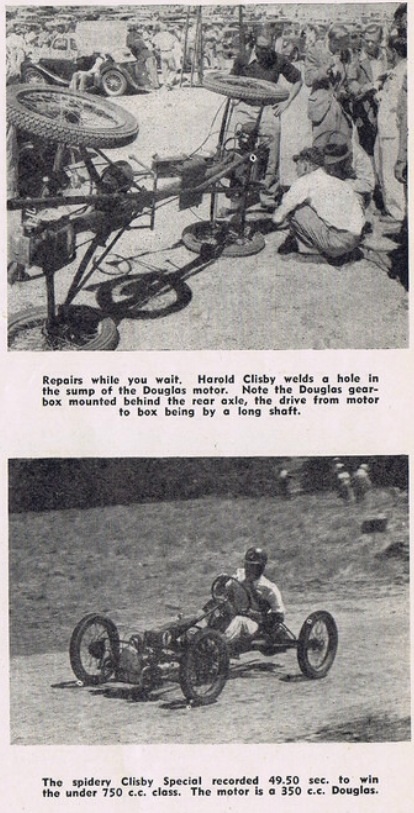
(Douglas Walker)

Quintessential Australian racer/engineer Tom Sulman loads his Maserati 4CM after the second ‘Lady Wigram Trophy’, Wigram Airbase, New Zealand 23 February 1952…
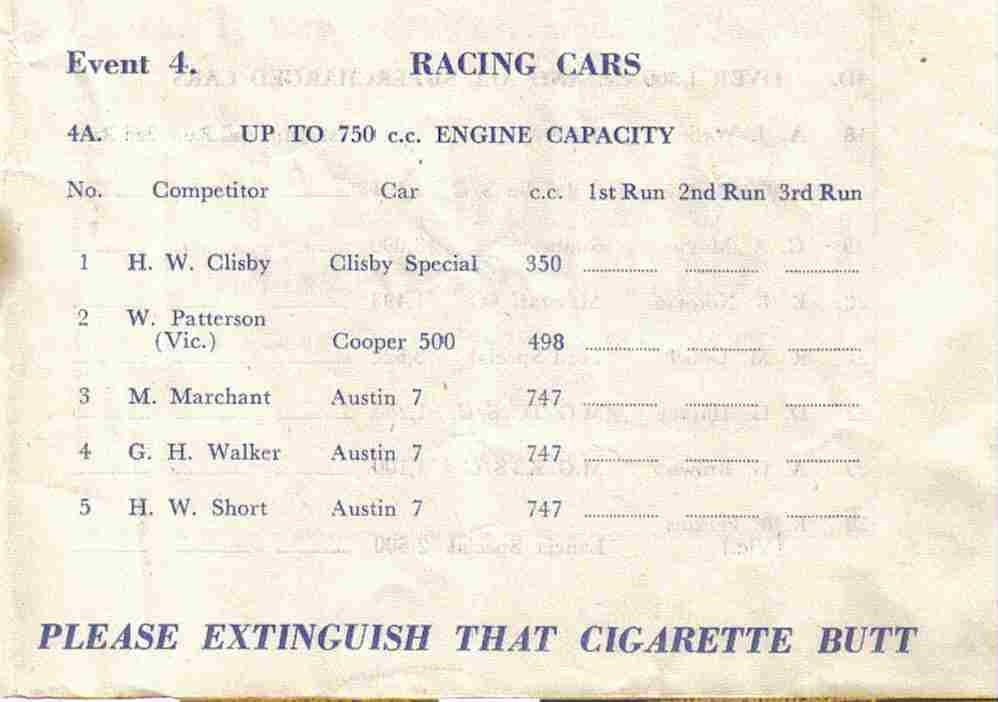
Tom Sulman was born in Sydney on 25 December 1899 and died in a tragic accident at Mount Panorama, Bathurst on 30 March 1970 aboard one of his Lotus 11 Climax’. He was the grand old, gently spoken man of Australian motor racing- a racer to the core, he competed all of his life inclusive of elite levels internationally.

Like most of my articles this one was stimulated by finding some photographs, and as is usually the case, doing so whilst looking for something else!

The shots of Tom and his Maserati 4CM in New Zealand in 1951 were simply too good- so evocative of the period not to do something with. The trouble is that his racing career was so long it’s a huge job to do it justice especially with information not readily available, so treat this as summary of his wonderful life with a bit of focus on the Maser, itself a car with an interesting provenance.

Sulman was the son of UK born and later immensely prominent and influential Sydney architect Sir John Sulman. Tom grew up in a rambling home at Turramurra, on Sydney’s upper North Shore. Unlike his formidable father, whose competitive spirit he undoubtedly had, he commenced a career in automotive engineering, very much an industry of growth at the time. In 1923 he built his first racer, the ‘Sulman Simplex’, a road-going cyclecar, which he raced at Sydney’s Victoria Park that year.

Tom Sulman and Fay Taylor with the Sulman Singer at West Ham, London in 1936

During the 1930’s depression Tom travelled to England looking for work and soon established a motor engineering business. His early motor sport endeavours began in 1931 and involved conversion of a Morgan 3 wheeler to a 4 wheeler! so that he could race ‘a car’ on dirt, which was very popular at the time. Later he built a car with a motor-cycle twin-cylinder engine and a ‘vaguely Salmson chassis’ which he raced at the early Crystal Palace meetings and at Greenford.

In fact Tom was right there at the start of organised car-only dirt track racing on motorcycle speedway lines. Outside the reach of the RAC, the first UK race of this type was held on Good Friday 30 March 1934, at Crystal Palace.

There were three teams of three riders and a reserve with ‘New South Wales Champion’ Tommy Sulman captaining the Wimbledon Park team driving a ‘Bitza Special’! During this period he raced at tracks such as Greenford, Crystal Palace, Hackney, Lea Bridge and Wimbledon. To provide some sense of the scale and level of interest in speedway racing at the time there were over 25 tracks in the London extended area alone. In addition to his motor engineering Tom was a professional driver earning money from his race competition.

He was approached by a Singer agent off the back of his performances and growing reputation to build a similar sprint and hillclimb special to his own car using Singer components. Core mechanicals were a Singer Le Mans engine and G.N. chain transmission. When the car was completed, it became the ‘Sulman Singer Special’ after the Singer agent went ‘bust’ leaving Sulman with the car! It soon became clear after the commencement of dirt track racing that the cut down sportscars predominantly used were unsuited to the tight, deep cindered UK tracks with short straights. Tom built the Sulman Singer as a dual purpose machine, but its very short wheelbase was a function of the development work by trial and error he and other leading racers had done to create a car ideal for the dirt.

Sulman raced it regularly in the UK and once in Holland in 1936. On 4 August 1936 Tom contested the very first Midget World Championships at Hackney, in inner London.

The winner with 7 points from his heats was Cordy Milne of the US- Tom was 6th with 3 points, he was 3rd, 2nd, and 2nd in his three heats. Another Australian, Dicky Case was 2nd with 6 points. An interesting sidebar is that Case, a star motorcycle solo-rider was invited into the competition as a fill-in driver due to a lack competitors- and came close to winning the thing! The program does not disclose the chassis the various competitors used.

Into 1937 the Sulman became obsolete, along with most of the rest of the fields with the advent of the ‘Skirrow Specials’. These revolutionary cars built by Harry Skirrow in Cumbria had chain drive to both front and rear axles harnessing the 80bhp produced by their bespoke 990cc twin-cylinder JAP engines rather effectively. As a consequence, Tom built a 4WD car of his own in an attempt to more effectively compete- he crashed badly at Coventry in August/September 1937 and elected then to end his midget racing career. The Sulman Singer, which had been put to one side, was then pressed back into service, Tom raced it at various hillclimbs.

Bathurst 1950, Hell Corner lap 1. Ron Ward MG TC from Sulman in the  #47 ‘Singer then Ron Edgerton #37 MG TC and Gordon Stewart #46 MG Magna (AussieHomestead)

At the end of World War 2 Sulman returned to Australia by signing on as a flight engineer on an aircraft, his very cost-effective way to take the long, expensive 12000 mile journey home was as a crew member of a Lancaster Bomber converted to carry people rather than a lethal payload. The Sulman Singer followed by ship, the car travelled sans bodywork to avoid import duty being imposed upon it by the Fiscal Fiend- the Australian Taxation Office!

Tom first raced the car in Australia at Nowra on the NSW south coast in June 1947, the combination took a win in the under 1100cc scratch race. As a road racer it competed in contemporary events up to and including the Australian Grand Prix, then a handicap event. He was 5th at Bathurst in 1947 and also contested the 1948 AGP race at Point Cook in Melbourne’s outer west, the little car succumbing to the extreme March summer heat like so many others on that day.

Sulman eventually sold the car when he acquired the Maserati, it raced regularly in various hands in the 1950’s but by the 1960’s was mainly used in historic events. The car was sold to AP North, then later to Monty South and finally Ron Reid on 6 November 1965 to start a long relationship of sympatico between driver and owner.

Moustachioed Ron Reid, red ‘kerchief flapping in the breeze with a big smile upon his face was an icon of Australian Historic Racing in the car which still races, after Ron’s demise in 1999, in the hands of Mal Reid, Rons son. Whenever I see this wonderful machine in the paddock it always brings a smile to my face. Drivers and cars come and go, but the Sulman Singer remains a constant in Australian motor racing and would be a finalist for the ‘longest continuously raced’ car on the planet.

Sulman competed in other cars as well though, including an 1100cc HRG sports car. By the late 1950’s, Tom, who had a workshop in the now very trendy inner-Sydney suburb of Surry Hills, had added to his stable the Maserati 4CM. This ex-Farina/Salvadori car, he bought from Australian resident Englishman David Chambers.

Sulman in the Maserati 4CM at Mt Druitt’s Hairpin, Sydney, date unknown (AussieHomestead)

Chassis # 1521, one of about twelve 1500cc 4CM’s, was first delivered to none other than Giuseppe Farina in August 1934, he won Voiturette races in it at Biella and Masaryk and then Modena and Turin. Gino Rovere, who probably owned the car when raced by Farina, raced it during 1935 and perhaps also Gigi Villoresi as part of Rovere’s ‘Scuderia Subalpina’. It then passed into the hands of several UK drivers including EK Rayson, Charles Mortimer and then formed an important part of the nascent racing career of Roy Salvadori post-war.

David Chambers acquired the car in England in 1949, raced it at Goodwood and then shipped it home and made his Australian debut at Rob Roy Hillclimb in outer Melbourne in 1950. Raced at Easter Bathurst 1950, the 500Kg, 1496cc, Roots-type supercharged, 4 cylinder 130bhp @ 6100 rpm car achieved 122mph through the traps on Conrod Straight in top- 4th gear in its Fiat derived gearbox.

New Zealand Hillclimb Championship 1951, winner in the Maser 4CM. Venue folks? (Walker)

Tom bought the car shortly after this meeting and campaigned it in both Australia and New Zealand over the next few years.

Among his New Zealand successes were the 1951 NZ Hillclimb Championship, on that tour he also contested circuit races- the Ohakea Trophy and Lady Wigram Trophy in March finishing 4th and taking fastest lap, and DNF at Wigram. NZ ‘heavy metal’ of the day included cars such as Les Moore’s Alfa Tipo B, Ronnie Moore’s Alfa 8C, Frank Shuter’s V8 Spl, Jack Tutton’s C Type, Ron Roycroft’s Jag XK120 and like Australia a swag of MG and Ford V8 powered specials as well as the early Coopers starting to appear.

Working on the engine of the Maser 4CM, NZ Hillclimb Championship 1951. Mechanical specifications as per text (Walker)

The Maser was period typical in having a channel section chassis, with rigid axle suspension at both ends and semi-elliptic springs front and rear. Sulman was unhappy with the cars handling so modified it by adding 3.5 inches into the front axle, increasing the front track from 3 foot 11.2 inches to about 4 feet 3.5 inches, widening the spring base and inverting the rear shackles. The rear track remained at 3 feet 11.2 inches. When completed he reported the car as extremely predictable and easier to handle.

During practice at Parramatta Park in January 1952 he nipped a brake coming into Rotunda Corner, spun, hit the kerb and rolled landing back on the Masers wheels. Damage was limited to a bent stub axle and minor body twisting. He repaired the car and returned to the Land of the Long White Cloud that summer of 1952, racing again at Wigram and Ohakea for 2nd off the front row and 4th.

Tom at Mount Panorama in the 4CM, date unknown- superb, rare colour shot (B Miles)

The car was shipped back to Australia in time for the April 1952 AGP at Mount Panorama- finishing 6th in the race won by Doug Whiteford’s Talbot Lago T26C taking the second of his three AGP wins.

Probably his best run in the thoroughbred single-seater was at Gnoo Blas, Orange, NSW in April 1953- his haul five race wins. Less happy was the car ‘chucking a rod’ through the block at Mount Druitt, Sydney in 1954.

Tom Sulman Aston DB3S, Doug Whiteford Maserati 300S and Bill Pitt Jaguar XKD on pole, Victorian Tourist Trophy, Albert Park 17 March 1957. Whiteford won the 100 mile racefrom Pitt, Tom DNF on lap 16 (unattributed)

Tom was invited to become a member of ‘The Kangaroo Stable’ which planned a long distance sportscar racing program in Europe in 1955 with three Aston Martin DB3S customer racers.

At that point the Maser was sold, it remained in Australia into the mid-sixties but left the country many years ago, living on in historic racing.

He acquired DB3S ’103’ new from the Aston, Feltham factory, the car was registered in NSW as ‘OXE-473’ and raced it in England-the Goodwood 9 Hours and at Aintree during the British GP meeting sportscar events, Portugal- the Lisbon GP, France, with the best result a 2-3-4 finish for The Kangaroo Stable behind a Ferrari in the Hyeres 12 Hour in the Provence-Cote d’Azur region of France-Tom was third. His co-driver was none other than Jack Brabham, then in his first year of a long and rather successful racing career in Europe. The Kangaroo Stable’s racing plans were to a large extent scuttled by the ’55 Le Mans disaster and the cancellation of many events in Europe as a consequence that year.

Tom returned to Oz, with the Aston his mount for years. Sportscar racing was especially healthy in Australia at the time with a mix of XKC and XKD Jags, Maser 300S, Aston DB3S, Cooper Jaguar, the Ausca Holden Repco, a swag of Austin Healey 100S and various Climax engined Lotus 11 and 15’s thrilling large crowds. The customer Astons were front third of the field cars. When David McKay’s ex-works DB3S car- DB3S/9 arrived it was the class of the field. Other quicks of the time Bill Pitt’s D Type, Frank Gardner’s C and D Types, Doug Whiteford’s ex-works Maserati 300S and the Derek Jolly and Frank Matich Lotus 15 FPF’s when they appeared later in the decade. Tom’s best results aboard ‘103’ were 2nd , 4th and 4th in the South Pacific Sportscar Championship at Longford in 1958, 1959 and 1960. He was 5th in the hotly contested 1960 Australian Tourist Trophy at Longford won by Jolly’s Lotus 15.

Tom Sulman takes his Aston DB3S onto the Longford grid during the 1960 Australian Tourist Trophy weekend. Only Whiteford’s #10 Maser 300S of this group of cars (in addition to Tom) contested the championship event- this is perhaps a preliminary or practice (J Ellacott)


Gnoo Blas, Orange 1 February 1960. Anniversary Championship for Sportscars. Derek Jolly Lotus 15, Ross Dalton Jag XKC, David Finch Jag XKD on pole, and on row 2 the Aston DB3S’ of Jim Wright ex-Warren Bloomfield and #58 Tom Sulman. Jolly won from Finch and Wright with Tom placed fourth (Aussie Homestead)


Stunning shot of Tom during the first ‘Southland Road Race’ at Ryal Bush in 1956. He appears to have had some involuntary oversteer on one of the road courses left handers! (J Manhire)


Tom at Lowood in 1960- Aston DB3S (B Thomas)

Tom took the car to New Zealand for their summer races in 1956 commencing with the NZ GP held at Ardmore, then Wigram, Dunedin, Ryal Bush and Ohakea, his best results in the five meeting two month stay was 6th and 7th at Ryal Bush and Ohakea Airfield.

At a time the Australian Grand Prix was still a Formula Libre race, with ‘outright’ sportscars regular entrants. Tom the took the Aston on the long trip, 3920 kilometres for you Europeans- you have to be keen!, from Sydney to Western Australia to contest the 1957 race held at Caversham in outer Perth. It was a long way to travel for a DNF, but many cars did not survive another AGP held in scorching hot Australian summer heat. Lex Davison took a famous, and fortunate win in that race co-driven by Bill Patterson. Fortunate in the sense that lap-timing confusion awarded the race to Lex rather than Stan Jones.

In addition to Jack Brabham driving the car, the Aston’s provenance was further enhanced when Stirling Moss took the wheel and gave a journalist the ride of his life during several practice laps at the 1961 Warwick Farm opening meeting.

Sulman, Lotus 11 Climax, Silverdale Hillclimb, NSW (Bruce Wells)

In the early 1960’s he bought a locally built Lynx Ford Formula Junior and in 1961 the first of two Lotus 11 Climax’.

Chassis ‘343’ was an S2 Le Mans spec car powered by several Coventry Climax FWA engines. The Aston was sold to Ron Thorp, it remained in Australia for some years before it too made its way to the UK. In 1963 he bought his other 11, a Climax FPF engined car, chassis ‘305/552’ which had originally been raced by Ron Flockhart and Roy Salvadori in the UK. This period is confusing for historians as it is not clear which car he raced where- and he raced them everywhere! At sprints, hillclimbs and circuit races.

Remember, by 1960, he was 61 and had been racing for the best part of 40 years. Tom’s racing was diverse though, he contested rallies, hillclimbs and sprints as well as circuit racing. His rally/reliability trial experience included the famous, legendary RedeX Round Australia Trials of the 1950’s including the first one in 1953 as a member of the Humber Super Snipe team. He entered touring car races too- as that aspect of the sport grew including the Mount Druitt 24 Hour race and the 1962 Bathurst Six Hour aboard a new-fangled Datsun Bluebird.

Tom in the ex-Abbott/Hamilton Porsche 904 Ford Cobra, Huntley Hillclimb, NSW 1 June 1969 (T Arts)


and again as above (Tony Arts)

Some of the cars he raced such as the ex-Alan Hamilton Ford Cobra powered Porsche 904 were very potent devices, he ran this car circa 1969. He contested the 1966 Surfers Paradise 12 Hour enduro as co-driver to Ron Thorp who by then was racing a booming AC Cobra, very much a crowd favourite, the duo won their class, that event won outright by Jackie Stewart and Andy Buchanan aboard the famous Scuderia Veloce Ferrari 250LM.

Lotus 11 Le Mans Climax FPF 1500, Lakeview Hillclimb, ACT date unknown (AussieHomestead)

In March 1970 Tom loaded the little Lotus 11 ‘343’ onto its trailer in Surry Hills and headed out of Sydney west towards the Bells Line of Road for the 200Km trip to Mount Panorama, goodness knows how many times he would have made that journey? He was off to the Easter Bathurst meeting, at that time there were two race meetings a year at the famous circuit, not just the annual touring car 500 miler.

Journalist Barry Lake recounts the events of Sulman’s final drive in the insignificant 6 lap ‘Sir Joseph Banks Trophy’ sportscar scratch race at Mount Panorama. ‘At the Easter Bathurst meeting on 30 March 1970 the quietly spoken Tom, now 70 years old and as keen to race as ever, moved slightly to the right and simultaneously slowed down between the two humps on Conrod Straight. Vincent Evans who was a short distance behind, could not avoid the impact of his left-front mudguard with the right rear bodywork of the Lotus 11 driven by Sulman. The Lotus 11 swerved to the left of the circuit (its inside) into the gravel on the verge and rolled into a locked (farmers) gateway, hitting the gatepost on the drivers side. Sulman’s head hit the post causing his instant death’.

‘Shortly before the accident there had been a ‘Tom Sulman Trophy’ race at Warwick Farm for historic cars to commemorate his very long racing career. At the age of 70, Sulman was one of the oldest racing drivers in activity at the time’ Lake’s tribute concludes.

It was a terrible case of being in the wrong place at the wrong time and hitting the fencepost when it could just as easily have been open space. Australian motor racing was rocked by another fatal accident at Bathurst twelve months after the last, Bevan Gibson’s Elfin 400 Repco became airborne on one of Bathurst’s humps at the same meeting a year before.

Sulman had lived a good life, a long full one despite its untimely end. He was one of those fellows who put more into the sport than he took out, and loved it to its core. A racer through and through right to the very end.

Tom Sulman at Lowood, circa 1959 (R Wittig)

Etcetera…

(Athol Yeomans)

Tom in the Maserati 4CM at Silverdale Hillclimb in June 1960.

Bibliography…

Obituary written by Barry Lake published on ‘Motorsport Memorial’, ‘Historic Racing Cars in Australia’ John Blanden, ‘Maserati: A Racing History’ Anthony Pritchard, Derek Bridgett on ‘Midget Car Panorama’. MotorSport magazine December 1936, ‘Bugattis Did It Too’ article in ‘Loose Fillings’ December 2015

Photo Credits…

Douglas Walker Collection, Aussie Homestead, Simon Lewis, Bruce Wells, Ron Wittig, Bruce Miles, John Ellacott, Tony Arts, John Manhire, Brier Thomas

Tailpiece: Sulman aboard his remarkably adaptable Sulman Singer at Kennel Corner, Shelsey Walsh in 1938. A rare UK shot of the car…

(Simon Lewis)

Finito…