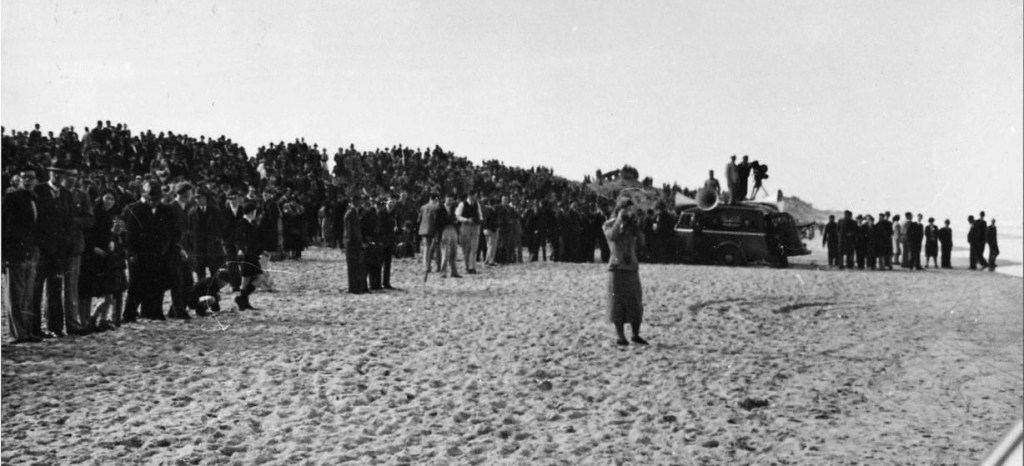
The Australian Land Speed Record session held at Woodside on the Ninety Mile Beach in Gippsland on September 4, 1938 was the first held in Victoria.
The Light Car Club of Australia promoted it, while the Yarram branch of the Royal Automobile Club of Victoria (RACV) ran the event which used you-beaut electrical timing apparatus accurate to one-hundredth of a second approved by the Australian Automobile Association.
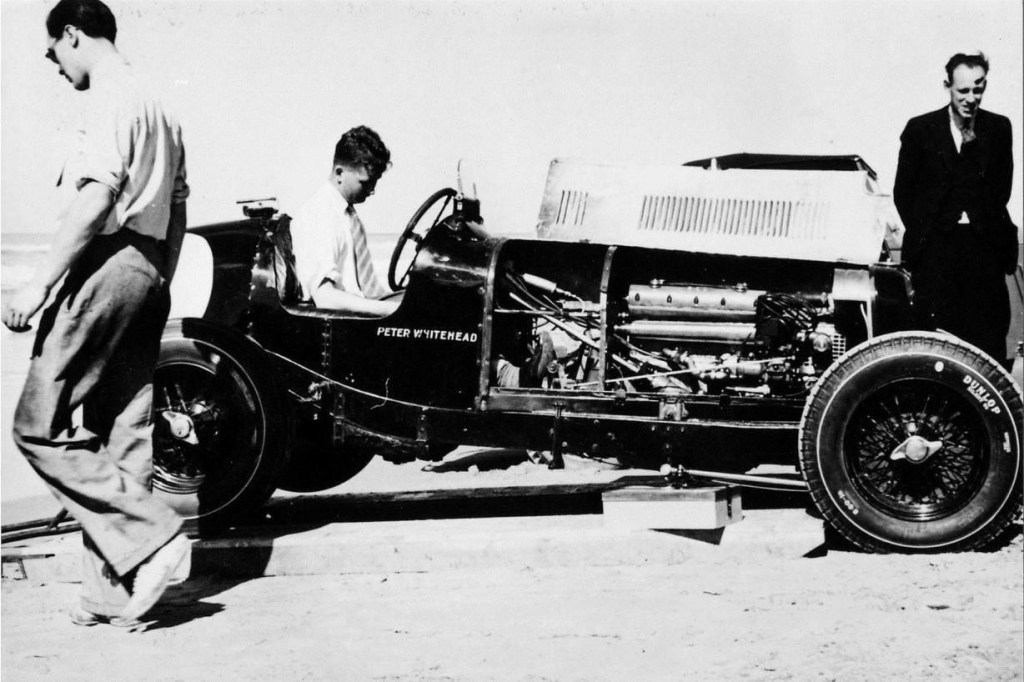
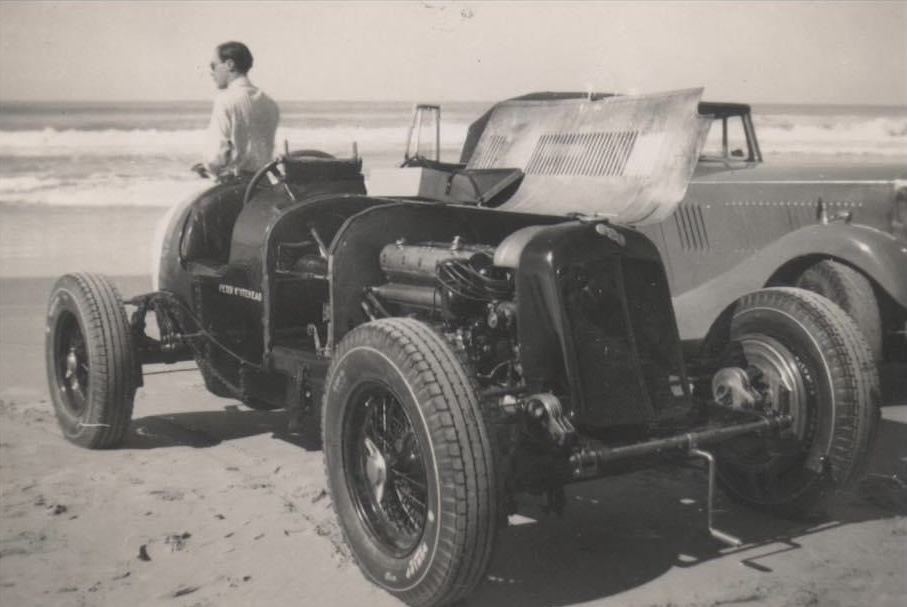
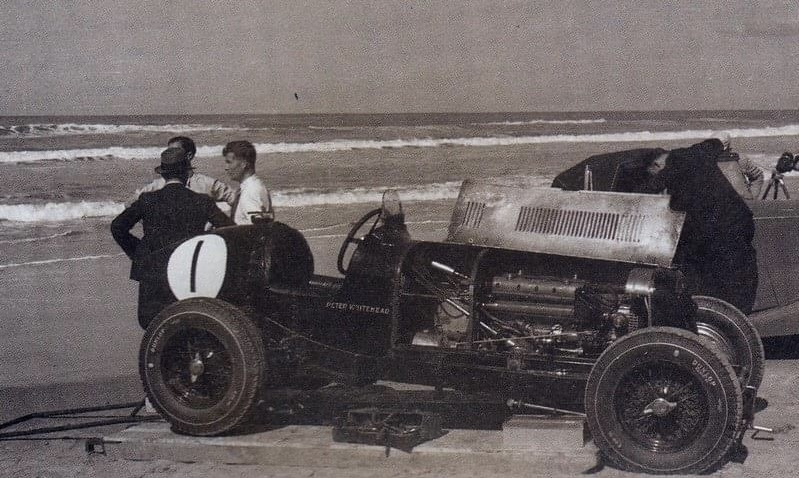
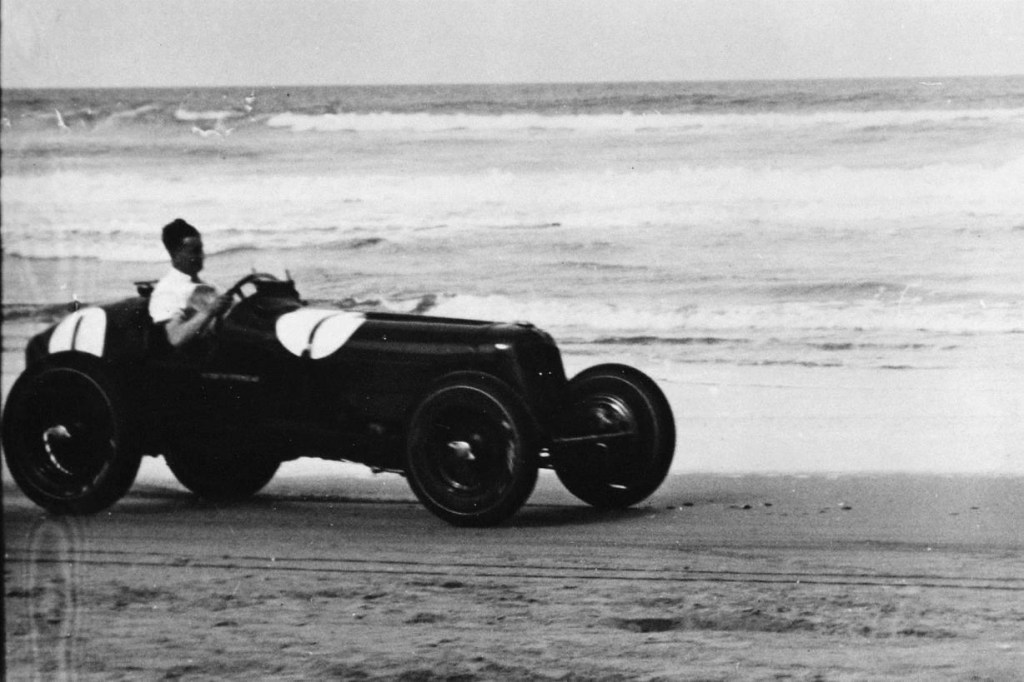
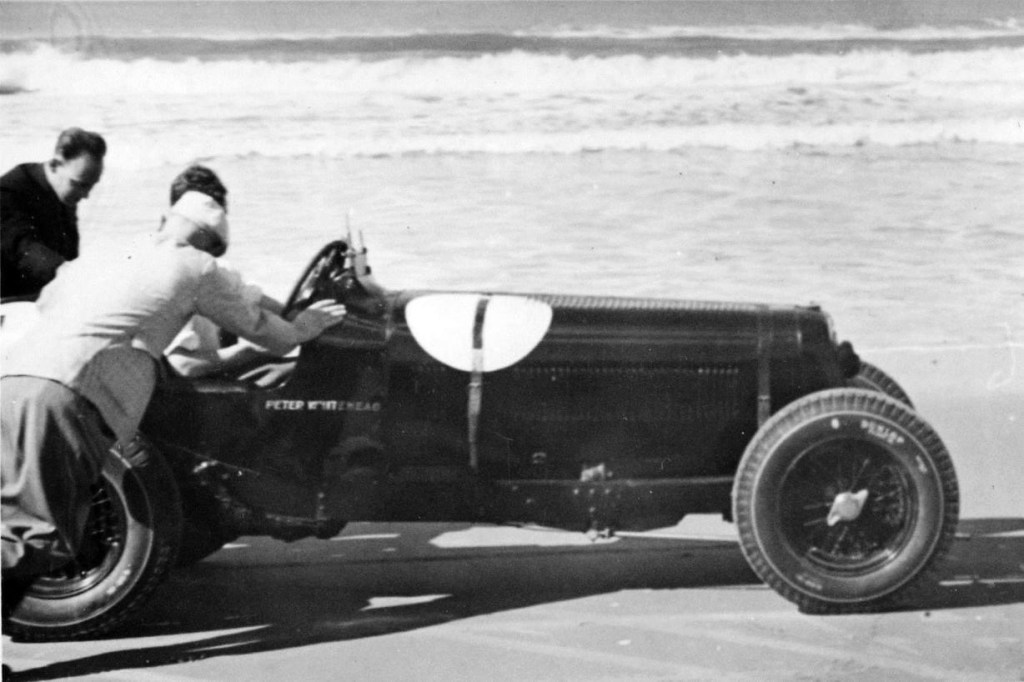
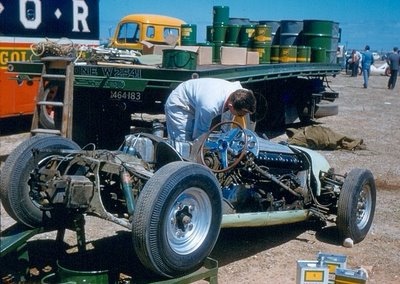
The drawcard was Peter Whitehead and his ERA B-Type R10B. The photograph above shows him warming the engine and transmission of the car at Woodside, collar, tie and all.
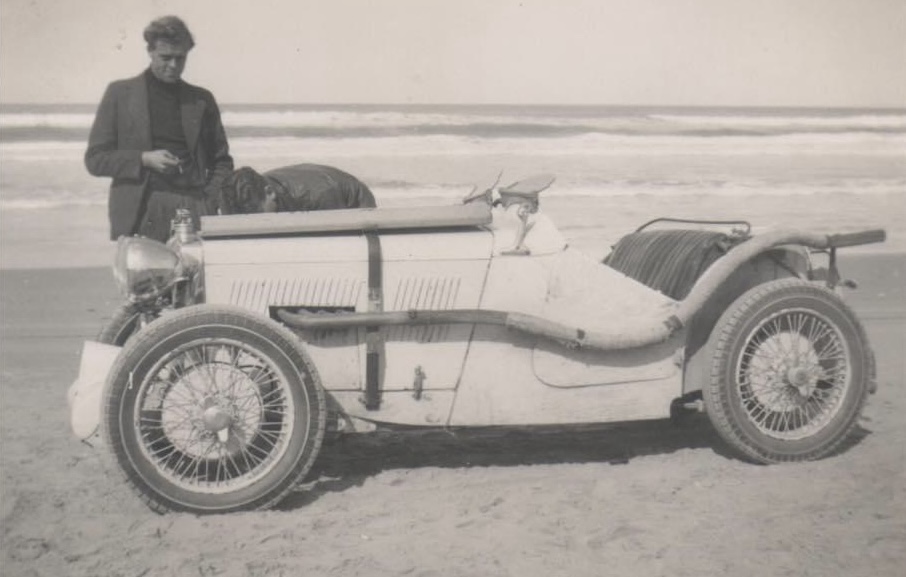
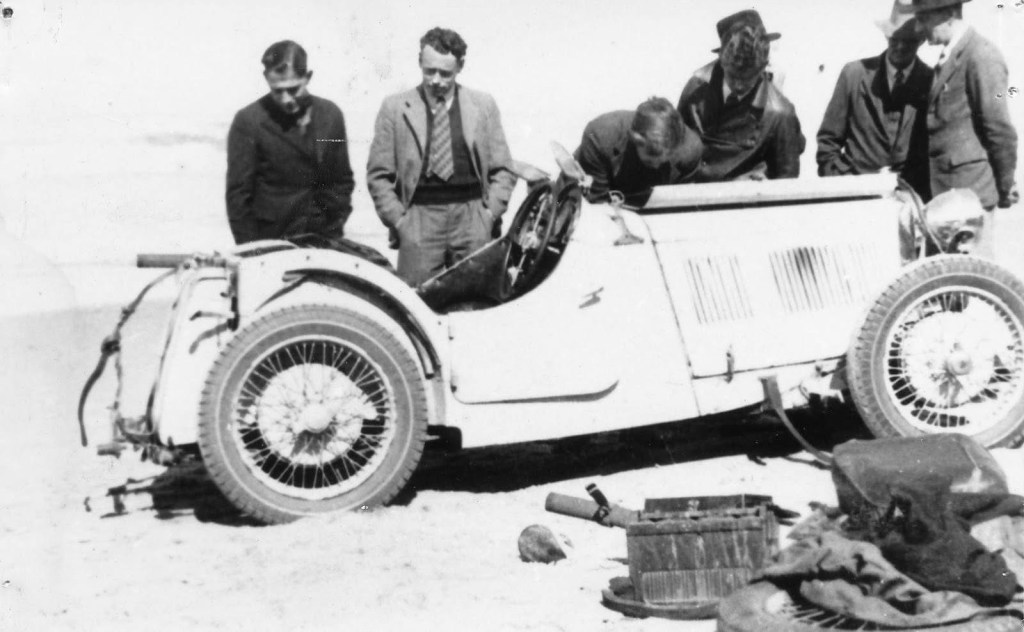
Other drivers granted permission to have a crack were the following: Class C 3-5-litres: RND Miller, Vauxhall 30-98 and AH Oliver, Lagonda Class D 1.5-2-litres: JN Derham, Vauxhall Class F 1-1.5-litres: JP ‘Jim’ Leech, Frazer Nash TT Replica and Class H 500-750cc: DM George MG J4 supercharged.
The stretch of beach chosen was four miles long and 60 feet wide, the existing outright record was held by three-times Australian Grand Prix winner Bill Thompson on a supercharged 1.5-litre Bugatti T37A.
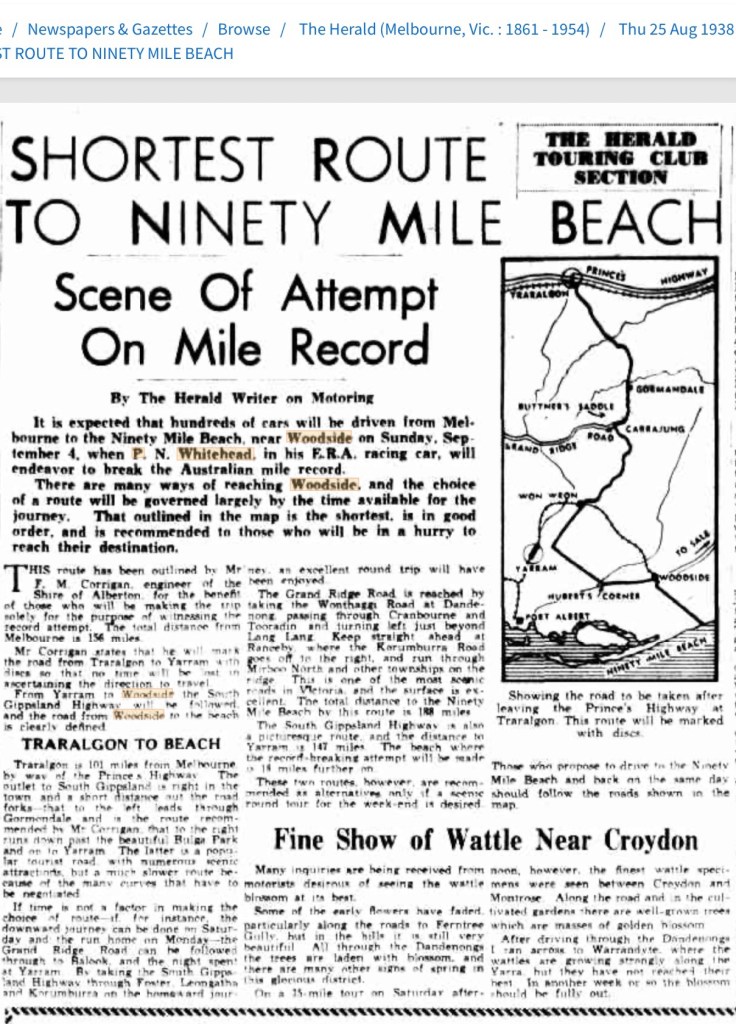
The 156 mile trip from Melbourne was quite a journey for the time. It’s amusing now to look at how much of the newspaper (the what?) coverage in the week before the event was devoted just to getting there, the three suggested routes were explored by the papers in some detail inclusive of maps. Different to the Google maps exercise on ‘yer iPhone today…
Peter Whitehead and Jim Leech aboard the latters Frazer Nash TT Rep #2134 at Rob Roy Hillclimb – where Peter had won the Australian Hillclimb Championship in R10B not long before – November 20, 1938. Whitehead did a 34.77 sec best (Davey Milne Archive)(unattributed)
Poor Jim Leech ran off the road on the way to the event in his Frazer Nash, but 6,000 others came from far and wide to see the spectacle before the fickle finger of weather fate ruined the day.
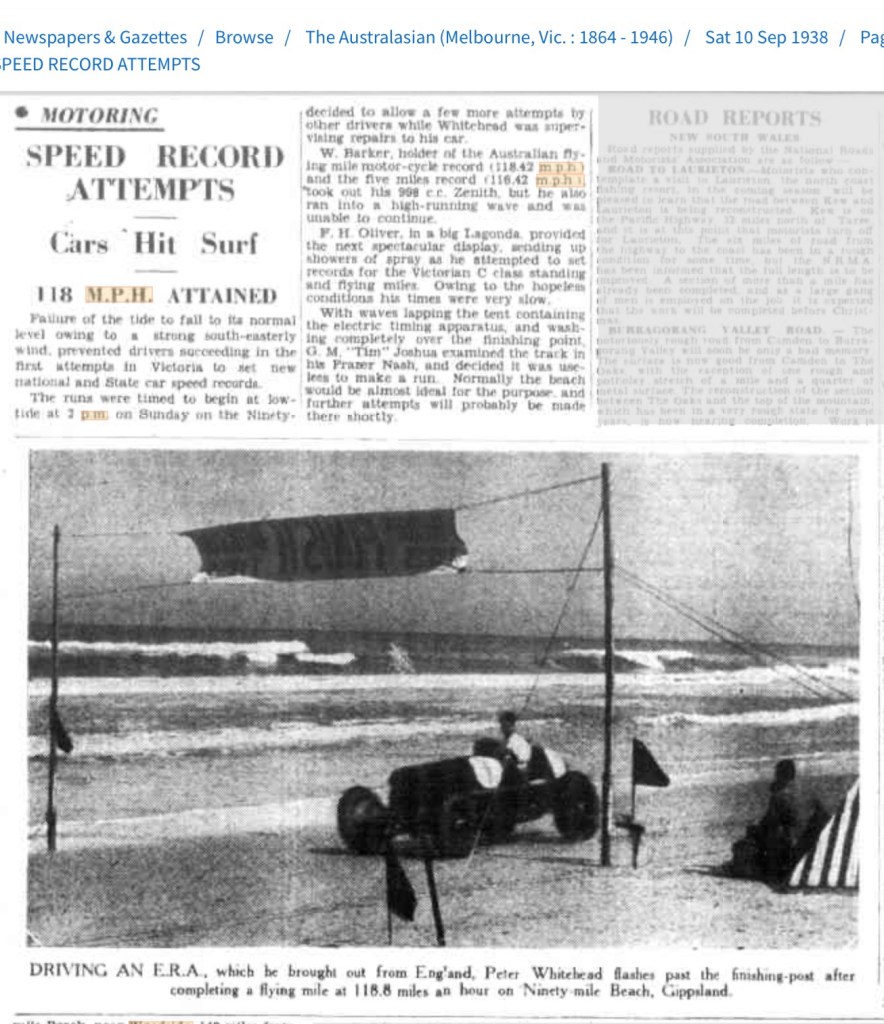
A strong south-easterly wind prevented the usual fall of the tide, ‘after the English driver Peter Whitehead had covered a flying-mile at an average of 118.8mph in his special 1500cc E.R.A. car the waves washed over the track and prevented any further serious attempts,’ recorded the Melbourne’s The Argus.
As Peter’s speed was set on one run, rather than the required each-way average of two, Thompson’s one-mile record of 112.5mph set in Canberra on May 11, 1935 still stood; Bugatti T37A.
No helmet for Whitehead, as at Bathurst when he won the AGP, proximity of Bass Straight clear and threatening (unattributed)
An estimated 2,000 cars conveyed the punters into the sand hummocks along the picturesque track many hours before the events were scheduled to begin.
‘Trials were impossible owing to the tide. With only a few yards of wet sand between the flags and the waves on the four mile course. Whitehead pluckily started up so as not to disappoint the crowd. He was obstructed by water on his first run, however, and although he averaged 118.8mph in his next run, his car plunged through the lip of a wave, tearing away apparatus for cooling the brakes, ripping off the oil filler cap, and partially flooding the crankcase with salt water.’
‘He maintained control, but it was evident that he had no chance of putting the record up to 135mph which was his hope.’
Derry George, MG J3 #3763 this shot and below (M Gallagher Collection)(unattributed)
The AAA, LCCA and RACV reps then met and decided to allow some attempts by other drivers while Whiethead and his crew effected repairs to R10B.
W Barker, holder of the flying-mile motorcycle record (118.42mph) and five miles record (116.42mph) took out his 998cc Zenith but he also clouted a wave and was unable to continue.
Next up was Big Bertha. F Oliver’s Lagonda provided a spectacular display sending up showers of spray in attempting to set Class C records but the conditions ensured his times were slow.
The AH Oliver Lagonda (M Gallagher Collection)Tim Joshua’s Frazer Nash Single Seater (what chassis number folks, ‘SS1’ is I think the chassis type, not the number?) at Lobethal during the 1938 South Australian GP weekend. Ron Edgerton at left, later owner of the FN, Joshua on the right alongside the MG K3s #3 Colin Dunne and #2 Lyster Jackson (Leon Sims Collection)
‘With waves lapping the tent containing the electric timing apparatus and washing completely over the finishing point, GM ‘Tim’ Joshua examined the track in his Frazer Nash and decided it was useless to make a run. Officials prevented any further attempts and there was a rush to get cars off the beach before the tide rose farther. The crowd had to lend willing hands to help several vehicles out of difficulties.’
‘Afterwards, the director of the trials, Mr JW Williamson, expressed supreme disappoint with the result. The crowd, who had enjoyed the outing in brilliant sunshine, took it in good part.’
‘It was the first attempt made in Victoria to set such records. Normally the beach would be almost ideal for the purpose, and further attempts will probably be made there shortly.’ The Argus concluded…
Not so, as it transpired.
(unattributed)
Etcetera…
(T Johns Collection)(T Johns Collection)
The Car was ‘the official organ of the Light Car Club of Australia’, so this is the way the organiser saw the day.
(T Johns Collection)
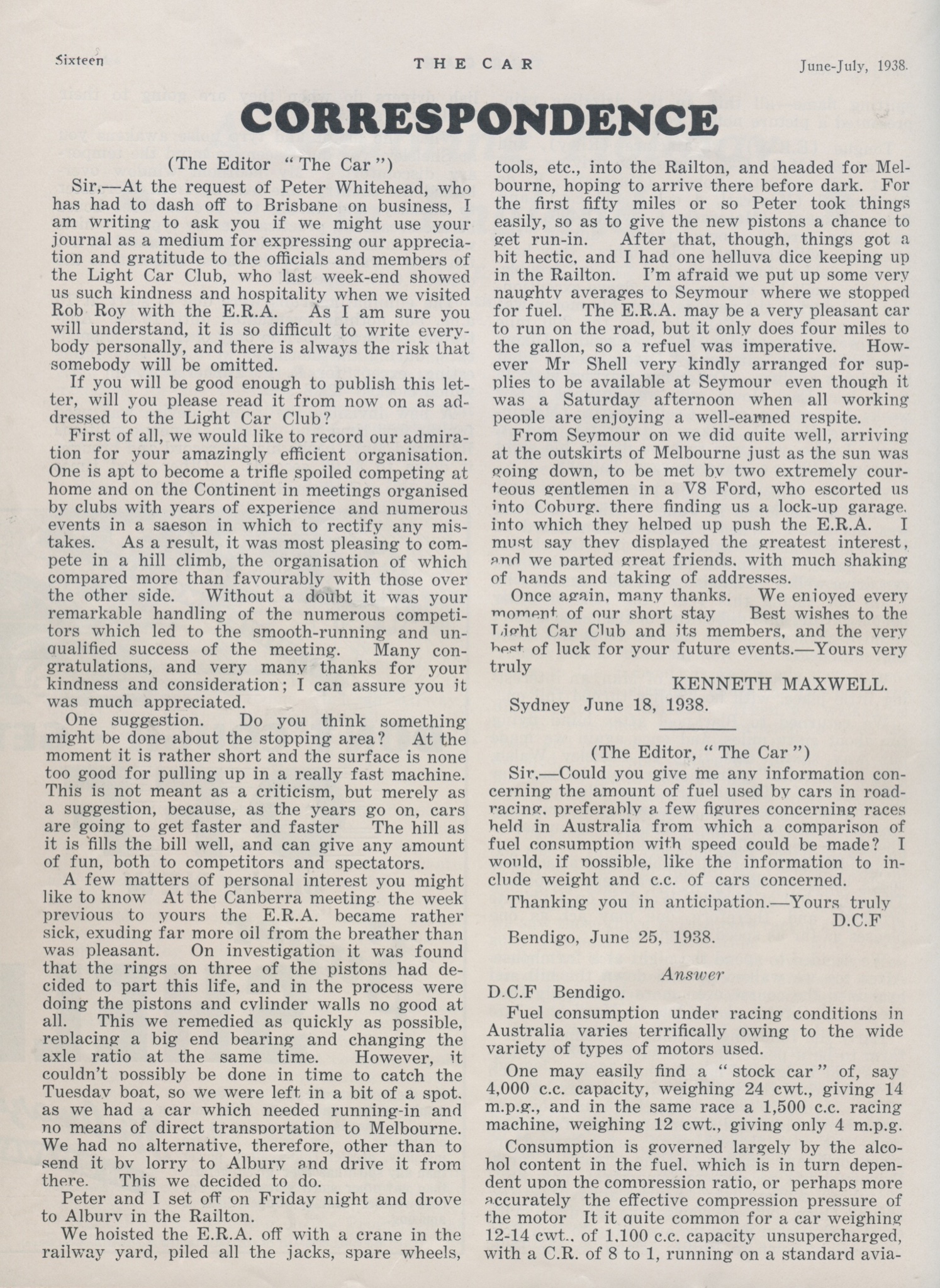
Kenneth Maxwell was a member of Whitehead’s ’38 Touring Party and wrote this letter to the editor of The Car about the equipe’s experiences early in the trip, published in the June-July issue.
The Car was the Light Car Club’s magazine, the trip to run-in the ERA between Albury and Melbourne sounds interesting!
The Fraser Nash TT Rep and Single Seater, MG J3 and the ERA are still alive and well, all but the latter remain in Australia.
Coincidentally, both the J3 and TT Rep were brought to Australia and first raced by George Martin, the Melbourne based Cunard White Star Line representative who died on the way home from the 1938 AGP at Bathurst. He and his wife crashed the BMW 328 in which George had finished 15th near Wagga Wagga.
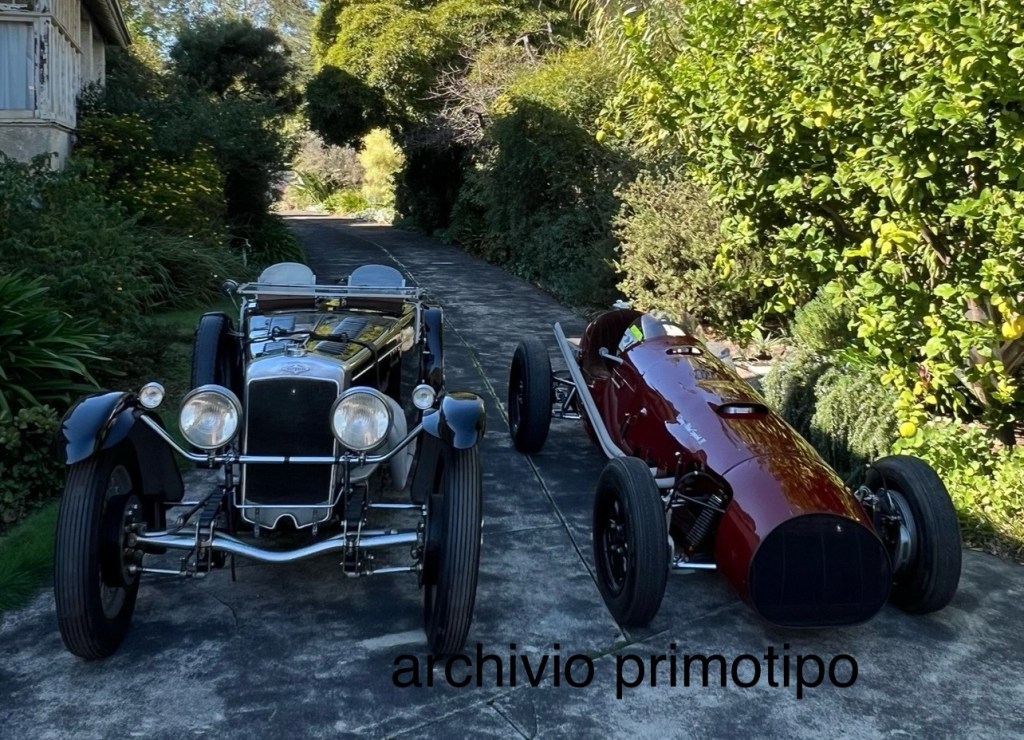
The shot above shows the Frazer Nash TT and ex-Brabham Cooper T23 Chev aka RedeX Special, at the Davey Milne home in April. The FN requires recommissioning but the Cooper is a runner, ask the neighbours!
Credits…
The Argus September 5, 1938, Martin Gallagher Collection, Davey Milne Archive, Leon Sims Collection, Tony Johns Collection
John Lemm’s fabulous portrait of five-star racer, engineer and industrialist Peter Holinger as he awaits a run at Collingrove Hillclimb in South Australia’s Barossa Valley during 1973. His machine is a self-built Holinger Repco RB620 4.4-litre V8.
Let’s not ponder fireproof racegear and six-point harnesses in Australian hillclimbing at the time…
Peter won the Australian Hillclimb Championship in 1976 at Bathurst, 1978 at Collingrove, 1979 at Mount Cotton, Queensland and finally, 1988, at Fairbairn Park, Canberra in another Repco V8 powered – 5-litre Repco 720 – Holinger Repco.
Holinger aboard the car below at Lakeland, Victoria in 1976.
When Peter’s great friend and Repco colleague, Rodway Wolfe, purchased Brabham BT31-1 Repco – Jack’s 1969 Tasman machine – from Repco in 1971, Holinger stored the car for Rod and took photographs and the dimensions of it with Wolfe’s blessing, the Holinger Repco was the result.
Peter in the Holinger Repco at Lakeland, Victoria in 1976 (Auto Action)(J Lemm)
Lemm’s perfectly focussed shot of Holinger at Collingrove ’73 with a ‘touch of the BRMs’ as the car was then configured. Lemm wrote that the single-rear-disc brake set up comprised a rotor and caliper donated by a Renault R8.
‘The 4.4-litre 620 series Repco had special camshafts made by Peter to give greater low end torque,’ wrote ex-Repco Brabham Engine Company engineer, Nigel Tait. ‘He started to make that engine not very long after we’d moved (Repco Brabham Engines) from Richmond to Maidstone. Apart from being a very clever guy, Peter was an absolutely delightful person,’ Nigel said. Everything you ever wanted to know about the RBE 620 V8: https://primotipo.com/2014/08/07/rb620-v8-building-the-1966-world-championship-winning-engine-rodways-repco-recollections-episode-2/
The very first firing of any Repco Ltd built complete engine, the 2.5-litre RB620 V8 E1 – use of the Oldsmobile F85 block in the 620 engines is duly noted – in cell four of the Repco Engine Laboratory Richmond, on its Heenan & Froude GB4 dyno, March 26, 1965. That’s Phil Irving at left with stereo-typical inch of ash on his ciggie, Bob Brown, the Repco Ltd director responsible for the Repco Engine Parts Manufacturing Group of which Repco Brabham Engines Pty Ltd was a part, Frank Hallam, RBE general manager, and Peter Holinger, then head machinist and technician. Those Webers were borrowed from Bib Stillwell up the road in Kew, the Lucas fuel injection system had not yet arrived. E1 was the only engine fitted with carbs, and not for long, all RBE V8s were Lucas injected…except an Indy Turbo R&D engine that never got closer to the track than the Maidstone dyno-house (Repco)
Holinger knew a thing or two about these engines having machined and assembled the very first 2.5-litre RB620-E1 V8 together with its designer, Phil Irving – Irving drew every single RBE620 design drawing – in February-March 1965. Indeed, Holinger was present in the Repco Engine Laboratory in Richmond when that engine was fired up for the very first time on March 26, 1965.
Peter was already hillclimbing another self built machine, the Holinger Vincent s/c during this period at Repco, and when he first went out on his own. The two shots below are both at Silverdale, NSW, in 1966 and 1969.
(K Power)(Australian Motor Racing Annual)
The ongoing evolution of the Holinger Vincent was also typical of Peter’s subsequent two hillclimbers, the shots below are of the Holinger Repco ‘BT31’ taken at the daunting, fast, Mount Tarrengower, Maldon, Victoria in 1978. The wings are the obvious change from the earlier shots, this car copped a 5-litre Repco 720 V8 at some point too.
(J Bowring)Rare colour shot of Peter and Holinger ‘BT31’ nose-up under power in second gear perhaps. Holden FB wagon in the background at the bottom of Tarrengower (G Williamson)
The good news is that the three Holinger hillclimbers are still with us. David Nash – a Repco colleague of Peter Holinger’s – wrote a while back that he was rebuilding engine E1 4.4 – the same engine built by Peter and Phil in 2.5-litre form in 1965 – to go back into the Holinger ‘BT31’.
The final Holinger Repco 5-litre (shots below) was rebuilt at Holinger Engineering after Peter’s death in 2009, and shifted to the premises of the Victorian Historic Racing Register in Box Hill, Melbourne, on long term display/loan in March 2017. It always warms the cockles of ‘me heart to see it…
Holinger aboard his final Holinger Repco 5-litre 720 at Morwell Hill, Victoria, circa 1988 (unattributed)(Holinger)(Holinger)
Etcetera…
(S Dalton Collection)
Holinger, very close to his Warrandyte home, on Templestowe hill, September 11, 1966 with Autosportsman reporting times of 54 and 53.9 seconds.
(D Willis)
Dick Willis’ amazing photograph of a posse of Australian Hillclimb Champions taken during the 1996 championship weekend, April 4-7 at Mount Panorama, Bathurst.
Left to right are Kym Rohrlach 1980/82/86/87, Stan Keen 1975/93, Peter Holinger 1976/78/79/88, Warren Brown 1984, Ivan Tighe 1964/85/91, John Davies 1992/95 and Roger Harrison 1983/94.
Arcane trivia is that – I think – the final in-period championship won by an RBE V8 anywhere in the world was Roger Harrison’s victory in the ’97 AHCC at Mount Leura, Camperdown, Victoria on October 16-19. His weapon was an ex-Alan Hamilton/Alf Costanzo Tiga FA83 Formula Pacific machine fitted with an RBE740 V8, capacity folks? Hamilton had Jim Hardman restore that car to RBE spec five or so years ago, it may have sold recently.
(Repco)
I love this Repco Brabham Engines family shot taken at the just-moved-into Maidstone premises in mid-late 1966. Back-Kevin Davies, Eric Gaynor, Tony Chamberlain, Fred Rudd, John Mepstead and Peter Holinger. Middle-Vic Mosby, Howard Ring and Norm Bence. Front-David Nash, Rod Wolfe and Don Butler.
Credits…
John Lemm, Auto Action, Repco Archive via Nigel Tait, Australian Motor Racing Annual 1970, Kerry Power, Geoff Williamson, John Bowring, Stephen Dalton
Alan Jones, Surtees TS19 Ford during the US GP West at Long Beach on March 28, 1976.
What caught my eye was John Surtees’ Franger-Mobile without the ads for Durex’ finest. Too much for American sensibilities or something? The BBC cracked-it too didn’t they, refused to cover F1 that season?
Anyway, having randomly lobbed on this photo, I kept going through the amazing Getty Images archive, this Jones homage is the result.
It seemed to me rather a cohesive design from the pens of Big John and Ken Sears, but its looks flattered to deceive a bit. Sadly.
Jones, Monaco Q19 and first lap collision, DNF
Jones’ best result in 16 races with the car was a brilliant second behind James Hunt’s McLaren M23 Ford in the non-championship Race of Champions at Brands Hatch in March. In Grands Prix he was fourth in the season-ending Japanese GP where Hunt won the title, and bagged a pair of fifths at Zolder and Brands Hatch.
After Alan decided he would rather race in the US than saddle up again with former World Champ Surtees, his countrymen, Larry Perkins and Vern Schuppan had a crack or two in TS19s in 1977 but they didn’t like the cars much either although.
Vittorio Brambilla’s best TS19 results in 1977 almost exactly matched Jones’ the year before, but by then Jones had returned to F1 with Shadow after the horrific death of Tom Pryce during the ’77 South African Grand Prix.
AJ found the Shadow DN8 Ford much more to his liking than the TS19, bagging points in six races including a first breakthrough F1 win at the Osterreichring, and third place at Monza.
TS19 in the pits at Long Beach in March 1976, where Alan was unclassified.
The pyramid type aluminium monocoque has more than a nod to Gordon Murray’s Brabham BT42-44s but has two angles to it. Front mounted radiators, pull-rod actuation of the front spring, fuel carried centrally aft of the driver, the usual Ford Cosworth DFV-Hewland FGA400 combo, rear springs are torsion bars (?), single top-links and wide based lower wishbones and one radius rod assisting fore-aft locational duties on each side. Interesting.
Race of Champions, Brands Hatch paddock in March 1976 where the Jones boy is catching up with what’s happening in Australia, Chequered Flag was a good publication at the time.
Jones, Lola T332 Chev ahead of Peter Gethin’s VDS Chevron B37 Chev on the run down to Dandenong Road during the February 1977 Sandown Park Cup. DNF for both, Max Stewart won in his Lola T400 Chev (I Smith)
He raced at home that summer for the first time since leaving for the UK circa-1968 – after the September 1968 Sandown Three Hour in which he co-drove a Holden Monaro HK GTS327 to second place – doing all four rounds of the February 1977 Rothmans International Series.
He brained everybody with his speed in the Sid Taylor/Theodore Racing Lola T332C Chev, taking one win, jumped the start of the AGP and got pinged at Oran Park, then boofed the car during practice at Surfers. Third place overall with his raw pace riveting to watch…
A couple of classic Nurburgring shots during the July 31, 1976 German GP weekend, above aviating at the Flugplatz and below the Karussel photograph shows the attractive lines of the TS19 to good effect.
AJ was tenth from Q14 of 26 on the disastrous weekend in which Niki Lauda came close to losing his life aboard a Ferrari 312 T2.
There is that double angle tub on display, doesn’t the bodywork enhance the flow of air onto the wing? Alternative front nose being tried during practice at the Nurburgring below.
Jones on the hop at Watkins Glen in October 1978, Williams FW06 Ford and looking on-it in the damp pitlane at the Osterreichring in August 1978 below.
When Jones joined Williams for a one-car attack in 1978 it didn’t necessarily look the best of moves, but Patrick Head’s first F1 car, the FW06 proved an excellent design which was well prepared as FW had an adequate budget for the very first time. Jones made the Saudi Airlines sponsored car fizz, finishing 9 of the 16 races he started with second, fourth and fifth his best results in the US, South Africa and France respectively.
With Frank Williams and the FW06 at Long Beach during the 1979 US GP West in October below.
‘The best’ of the non-ground effect cars in 1978, the FW06 was off the pace in 1979 amongst a more competitive grid, arguably, Jones would have won the 1979 title had the FW07 appeared earlier than it did; Woulda-coulda-shoulda…
(D Phipps)
Amongst the fastest ground-effect machines of the early 1980s was the Williams FW07 Ford in its various iterations, here with Jones in front one of one of the Renaults at the Osterreichring in August 1980 where he finished second in an FW07B.
Great shots of the fully extended sliding skirts of the FW07Bs of Carlos Reutemann #28 and Jones in the Watkins Glen paddock in October 1980, and below of the tunnel support structure at Hockenheim in 1979 where AJ won.
The FW07 was first raced at Jarama in April 1979 with Clay Regazzoni taking its first race win in the British Grand Prix at Silverstone in July, then Jones won four of the last six races that year as the FW07 hit its straps, and took the title in 1980 with victories in Argentina, France, Britain, Canada and the US.
Overhead shot at Monza in 1979 shows the critical elements of the car: inboard front suspension offering a clear flow of air into the ground-effect tunnels, the size of which is enhanced by a very slim aluminium honeycomb chassis, and centrally mounted fuel cell. Not to forget the 3-litre Ford Cosworth DFV engine.
Jones as snug as a bug in a rug at Brands Hatch in 1980.
I can’t quite read the FW07B chassis plate, but Allen Brown’s oldracingcars.com tells me he used FW07B/7 and FW07B/8 in practice, winning the race aboard FW07B/7.
Adelaide GP meeting in November 1991 aboard the BMW M3 Evolution he raced to fourth place in the Australian Touring Car Championship. Adelaide wasn’t part of the ATCC.
Credits…
Getty Images, Ian Smith
Tailpiece…
AJ during practice for the one and only Grand Prix Masters race at Kyalami on November 11-13 2005. His mount is a Reynard/Delta 2KI Cosworth XB.
The naturally aspirated 3.5-litre 80-degree V8s were built by Nicholson-McLaren and tuned to give 650bhp @10,400rpm and 320lb/ft of torque at 7,800rpm.
Jones practiced but didn’t start the race with neck soreness, Nigel Mansell won from Emerson Fittipaldi and Riccardo Patrese.
Sorta a great idea but there is a difference between old pro-golfers having a hit and old pro-racing drivers ‘having a hit’…the story is well told here: https://en.wikipedia.org/wiki/Grand_Prix_Masters
By 1957 Jack Brabham was getting the hang of this European racing caper, he was the winningest Formula 2 driver in in the winningest car that year.
Cooper’s Type 43 was powered by the brand-new 1475cc Coventry Climax twin-cam, two-valve FPF four-cylinder engine.
Coopers entered Jack in nine F2 races that year and he won five of them, most were blue-riband events too: the London Trophy at Crystal Palace, Prix de Paris, Montlhery, the Rochester Trophy at Brands and Oulton Park’s Gold Cup.
Motor Racing’s fantastic cover shot – very well-used down-the-decades and perhaps taken by Geoff Goddard – above was taken at Goodwood during the Woodcote Cup on September 28, where Jack’s teammate, Roy Salvadori triumphed in another works T43. Roy also won the BRDC International Trophy at Silverstone a fortnight before, other 1957 Cooper T43 winners were George Wicken and Tony Marsh.
The Haves in 1957 used a Cooper chassis and a Climax FPF engine, the rest made do with a Climax single-cam FWA or FWB engine and another chassis.
Funnily enough Lotus’ best ‘F2 result’ for the year was Tom Dickson’s victory at Snetterton on May 19 aboard a Lotus 11 FWA during a combined F2/sportscar race. The much vaunted, light, clever, gorgeous, front-engined, and fragile F2 Lotus 12 FPF (below) flattered to deceive: its best results were a second and a third placing for Cliff Allison in the Gold Cup, and Woodcote Cup respectively.
Lotus 12 Coventry Climax FPF to be precise
Other F2 winners in ’57 were Maurice Trintignant aboard a works Ferrari Dino 156 in the Coupe Internationale de Vitesse at Reims in July and Edgar Barth’s victory in the F2 race within a race, at the GermanGrand Prix at the Nurburgring in August aboard a Porsche 500RS.
That Dino spawned a series of V6 cars, race and rally engines that were still winning well into the mid-1970s.
By mid-1959 Brabham was looking a fairly complete professional…
Jack and (the works team) Cooper had just taken their first Grand Epreuve wins at Monaco on May 10, while Motor Racing’s cover above shows Jack on the way to victory in the BRDC International Trophy at Silverstone on May 2.
By then Brabham’s Cooper is a Type 51 and the engine a 2.5-litre FPF. The F2 youth of 1957 had grown into a dominant adult by 1959. It may have been a simple motor but it was oh-so-sweet.
Motor Racing magazine, as the covers note, was the official organ of the British Racing and Sports Car Club. It succeeded Iota and was published from January 1954 to February 1970…bloody good too!
Credits…
Motor Racing magazines – fantastic they are too – many thanks to Bob King
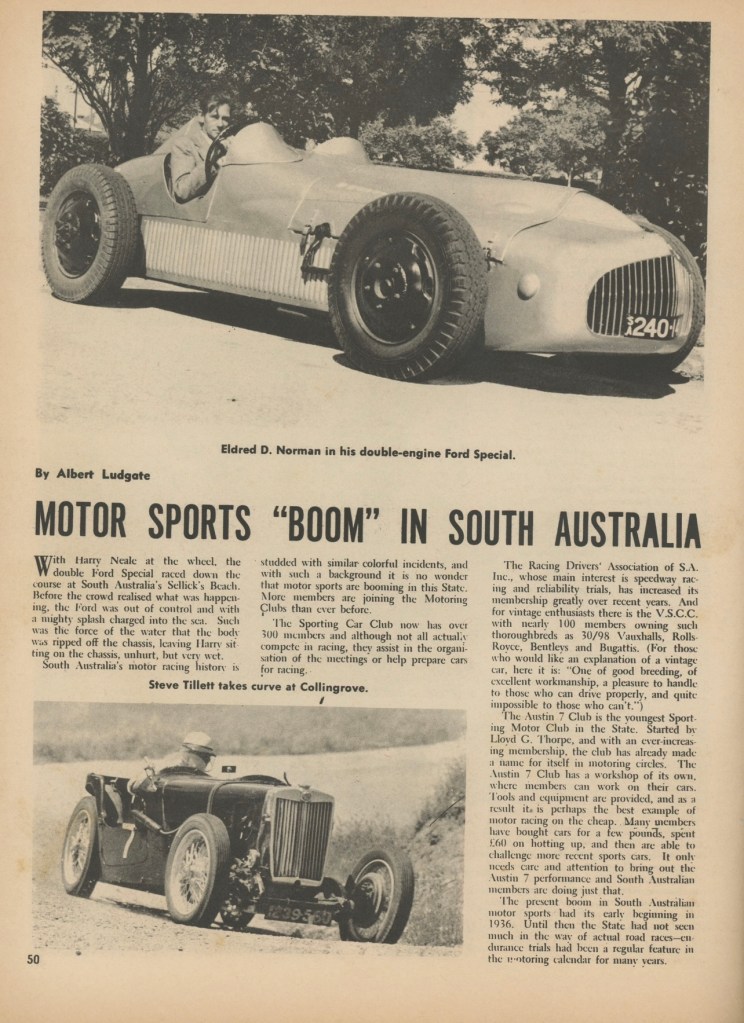
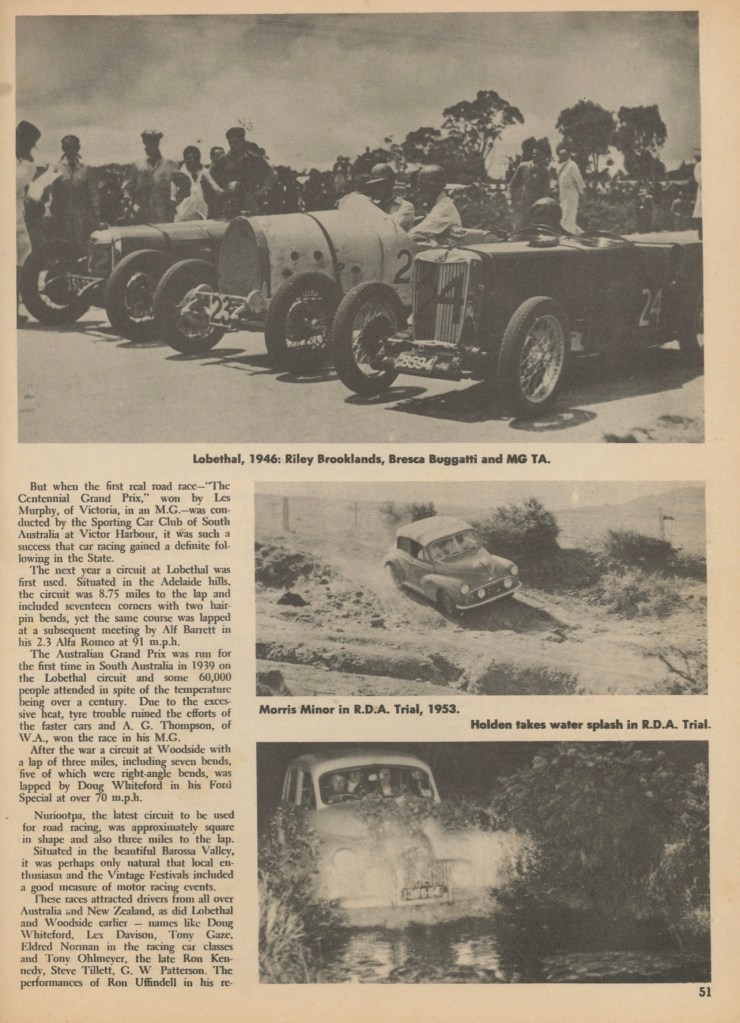
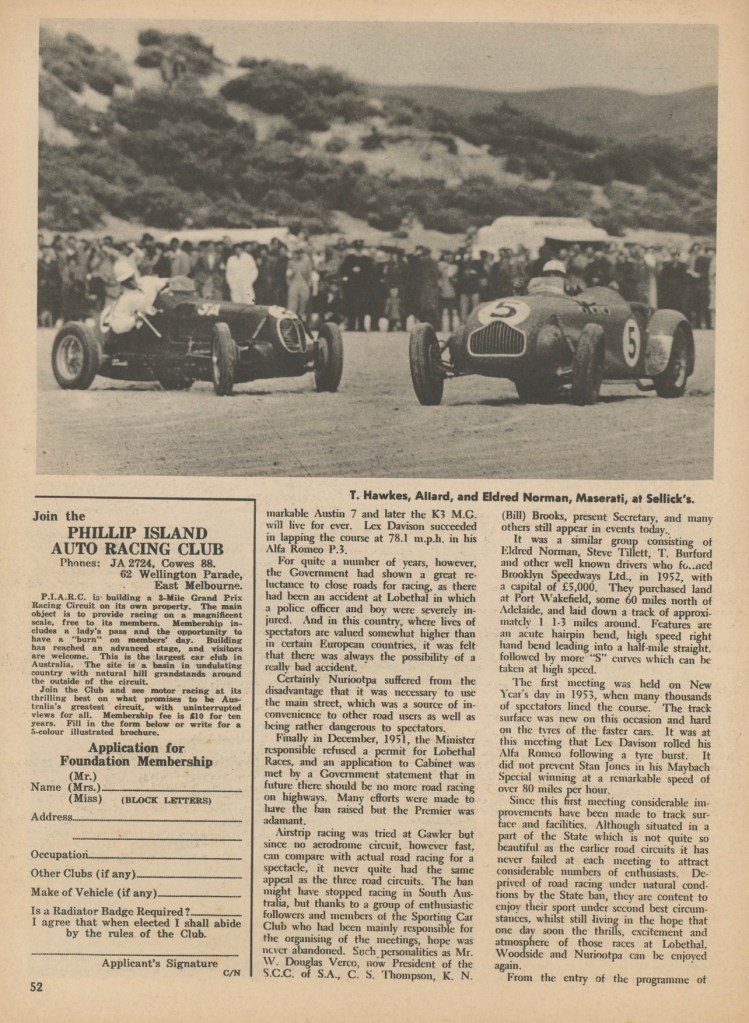
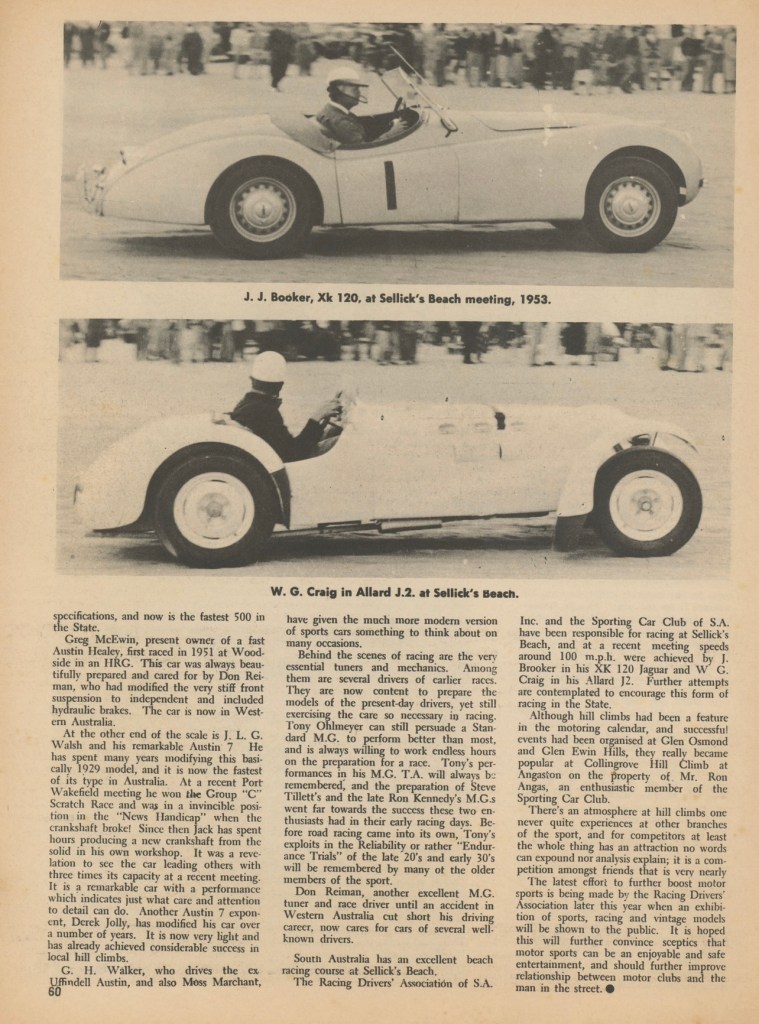
Tony Johns sent me this wonderful article about the motorsport state of play in South Australia in 1954, many thanks.
Cars appears to be a magazine from The Argus stable, a Melbourne daily newspaper published from June 1846 to January 1957. Cars publisher was Larry S Cleland, anybody know of Lazza? The Sydney advertising rep was JM Sturrock of King Street, Jock Sturrock of yachting fame I wonder?
The article was written by Albert Ludgate, Chief Engineer of Lea-Francis cars from 1946. He emigrated to Australia together his family and a 1926 Lea-Francis K-Type in 1953, more of Albert later.
Etcetera…
Australian Grand Prix historians will note that at the time of publication – September 1954 – the 1937 Australian Grand Prix hadn’t been invented. That is, the fuckwit(s) who decided that the December 26, 1936 South Australian Centennial Grand Prix should be the 1937 AGP, rather than the 1936 AGP hadn’t done his/their Fake Nooooz thing.
The South Australian Government’s banning of racing on roads, quite possibly brewing for some time as Albert wrote, was probably precipitated by two deaths in bizarre circumstances during a motorcycle race at Woodside in 1949.
Albert Ludgate in the glasses, and Ken Rose tickling one of their Lea-Francis 1.5-litre midget engines in the US in 1948-49 (LFOC)
Albert Ludgate…
Ludgate’s early history I am yet to discover, but he was Chief Engineer of Lea-Francis from 1946.
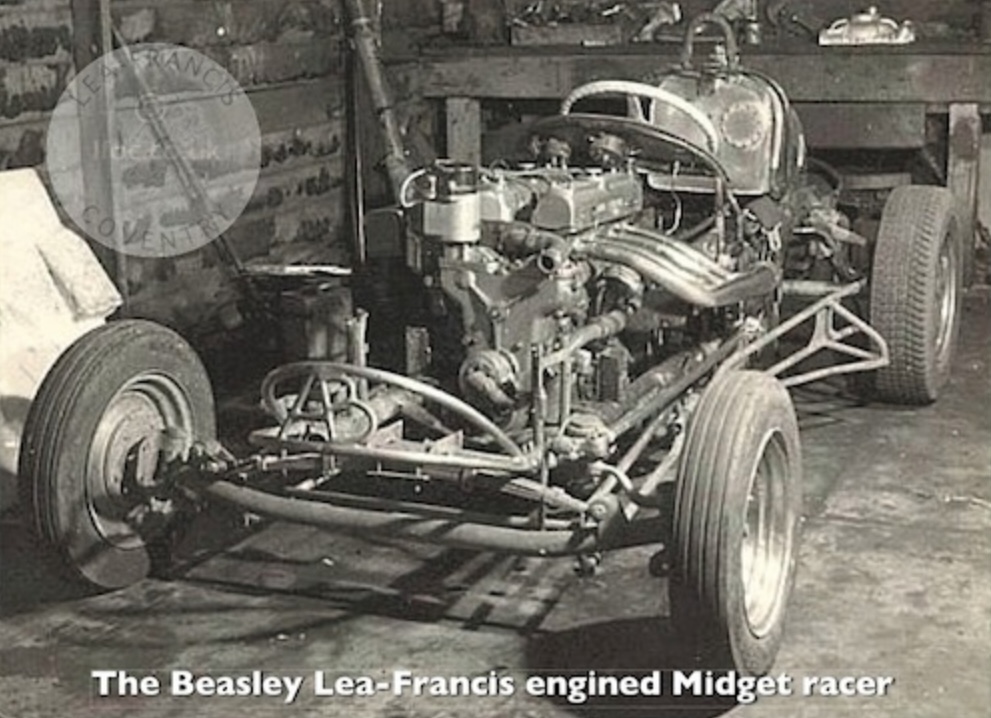
By February 1953 he was in Adelaide helping prepare one of his twin-high-cam ‘Leaf’ midget racing engines which had been fitted to Victorian ace, Alf Beasley’s speedcar for an international (SA Solo Championship) meeting at Rowley Park, Adelaide on Friday February 13, 1953.
These 1496cc, four-Amal or twin SU fed, dry-sump, gear-driven cam midget engines were aimed primarily at the large American market.
Bob Shimp won some heats in his Lea-Francis engined car at the Carpinteria Thunderbowl in South California on July 18, 1949, ‘then led the semi-main until the Lea-Francis engine in his midget failed’, wrote Kevin Triplett on his triplettracehistory.blogspot.com.
‘The 91-cubic inch Lea-Francis engine, purpose built in England for midget auto-racing featured dry-sump oiling, gear-driven double camshafts, four SU carburettors (sic), with a high compression ratio to run on alcohol. Record setting British driver, Dudley Froy, Lea-Francis designer Ken Rose and chief engineer Albert Ludgate made trips to the USA in 1948 and 1949 to show and sell samples of the engine.’
‘Besides Shimp, several US midget racers (including Woody Brown in Northern California) used the four cylinder “Leaf” engine but it never became popular (less than a dozen were built) given that its 120 horsepower could not match the power of the Offenhauser four-cylinder engine and it sometimes put connecting rods through the sides of the aluminium block.’
Contemporary Australian newspaper reports say that brothers Alf and Stud Beasley had a car each powered by a float of three of these trick Lea-Francis engines, and had some success with them. It makes one wonder where those engines are now…
Alf Beasley aboard his Lea Francis powered midget at Tracey’s Speedway, Melbourne
Into 1954 Ludgate was the technical representative of Simmonds Accessories and the publicity officer of the (speedway) Racing Drivers Association, while JA Lawton & Sons also retained Albert, not to forget his writing abilities.
Ludgate and his Racing Drivers Association made quite a splash in October ’54 with their ‘Speed and Sports Motor Show’. More than 150 racing, veteran and speedway cars and bikes were amongst the exhibits in the Centennial Hall at Wayville. It was the first time in South Australia’s history that such a show had been run.
Three-quarter-midgets – TQ cars were on the march – were front and centre with Ludgate’s Simmons Nut-Ridge Special one of five TQs on display. In addition he showed a 150cc half-scale midget racer built for his six-year-old son.
Ludgate was a strong advocate of TQs and was a member a three man Racing Drivers Association specifications committee tasked with developing specifications for the class…and in due course he would make some cars.
By December 1954 Ludgate was living in Reade Park, later he bought a house in Colonel Light Gardens. He was well on the way to embedding himself within the local motorsport and automotive industries, having addressed members of the Aeronautical and Automotive Engineers about American car racing and engine development in the Kerr Grant Lecture Theatre at Adelaide University.
Capricornia 1, John Plowman’s car circa 1956 (bollyblog.blogspot.com)Capricornia 3, later the Repco Ricardian, at Port Wakefield during the March 1959 meeting. With Buchanan couture, a great looking car (v8vantage.com)
In his small Colonel Light Gardens garage, Ludgate Automotive Developments built sportscars, TQ midgets and go-karts using the Capricornia and Ricardian brandnames.
The Capricornia sportscars – the name was taken from the Tropic of Capricorn region – used a multi tubular chassis with two main side-members, a wheelbase of 91 inches and used standard or modified Holden parts, including front and rear suspension, and weighed about 715kg depending upon specifications.
The first of the series, John Plowman’s car was commenced in 1955 and completed just in time for for the 1956 Easter meeting at Port Wakefield ten months later. Fitted with an English RGS/Shattock fibreglass body, and with experienced racer/engineer, John Cummins at the wheel the car performed well. A long job list proved racing improves the breed!
Capricornia 3, Collingrove circa-1958 (S Jones)
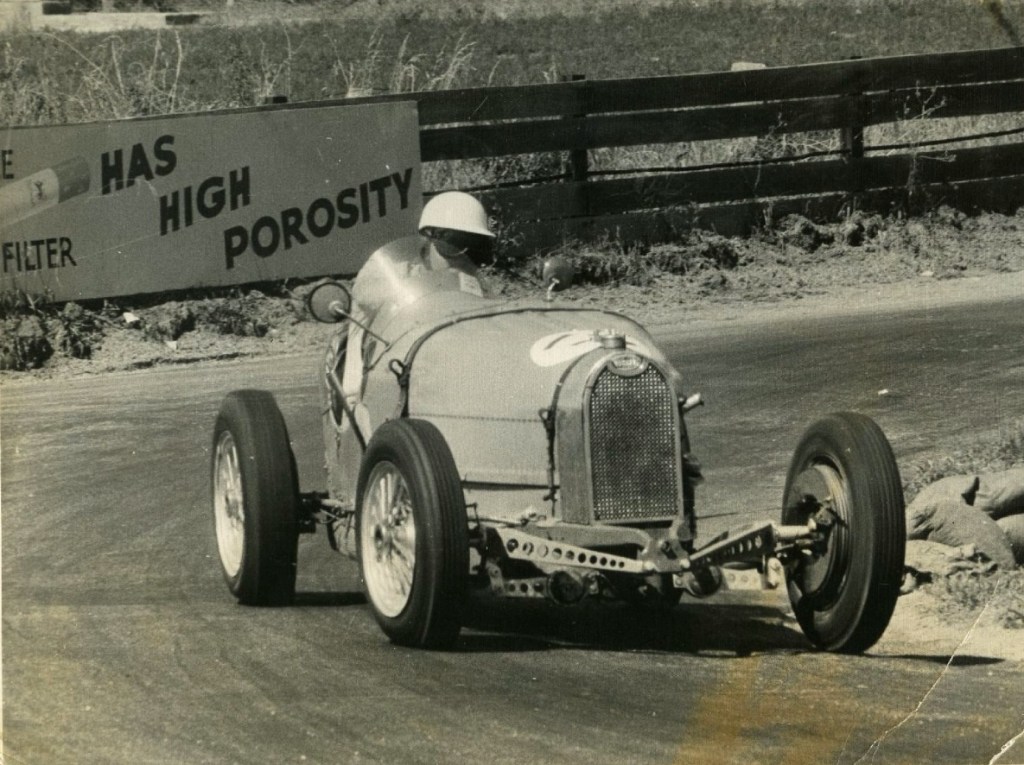
John Bruggerman’s very successful Capricornia 3 racing car had a Holden (later Repco-Holden) grey-six fitted and used a shortened Buchanan (NH Buchanan Motor Co) body.
Ludgate’s pioneering TQs – a poor-mans introduction to speedway racing – used Austin 7 chassis, suitably bent 7 axles, and a variety of 500cc motorcycle engine driving through a gutted Austin 7 gearbox using a dog-clutch for stop and go.
In the mid-1950s John Cummin’s met Ludgate in Adelaide in his capacity as a Perkins Diesel rep. Ludgate helped ‘with a lot of input’ in the early development of the Holden grey-six cylinder engine used in his Bugatti Holden. Cummins blazed the trail in Victoria with Holden engine development, his car is said to be the second Holden-powered racing car in the state, ‘Lou Molina’s, Silvio Massola built MM Holden Special being the first’.
‘The engine gave about 65 or 75 horsepower at 3500rpm’, Cummins recalled, ‘and it wasn’t worth two-bob at 4500! We fiddled with the needles in the triple 1 3/4″ SU carries and got 116 horsepower at 4500. Almost double the original Holden power output.’
John Cummins’ Bugatti T37A Holden at Bathurst in 1961. Note the Bellamy independent front suspension so characteristic of #37332 (unattributed)(B White)
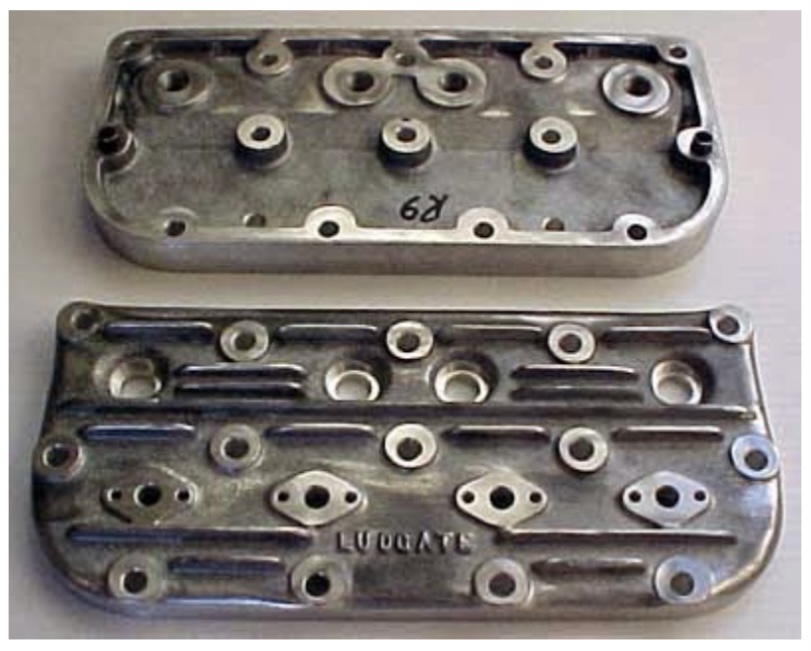
Ludgate also made Austin 7 cylinder heads for the Seven racing fraternity – think of Seven racing as the Formula Vee of the day – in the 1950s and early 1960s. The design featured sandwich construction with combustion chamber shape late-7. Enthusiasts often modified the shape to their own requirements. Ludgate built over 30 of the heads with many more built from his patterns after his death. They were used by many A7 racers in the day including Elfin’s Garrie Cooper during his formative years.
Amusingly, later, the street in which he lived was renamed Ludgate Circus which is surely indicative of the goings on at that address in the wee-small-hours and the fond regard in which Albert was held by his neighbours!
Ludgate retained his Lea-Francis for many years, using it daily to drop his son off at school and displaying it at the VSCC annual rally at Victor Harbor in 1961, by then he was described as a ‘well-known motoring personality’.
Late in his life the Australian Society of Automotive Engineers established and annually bestow the Albert Ludgate Award.
This summary of information about Albert Ludgate is the result of a days Troving and Googling, if anybody can add to the story please contact me: mark@bisset.com.au
Credits…
Cars via Tony Johns’ archive, Trove and other online research, News Adelaide, Victor Harbour Times, bollyblog.blogspot.com, v8vantage.com, triplettracehistory.blogspot.com, Lea-Francis Owners Club website, Paul Jaray on auto puzzles.com, Ron Burchett, Bruce White, Sports Cars and Specials September 1956, Tony Parkinson Collection, Steve Jones
Tailpiece…
(T Parkinson Collection)
Bill Pile or John Newmarch in the Ricardian Repco chasing Jim Goldfinch’s Austin Healey 100S at Port Wakefield circa 1959.
This is the very last time a racing car appeared in Repco colours. John Goss had just purchased and not yet repainted the Matich A53 Repco-Holden #A53-007 sold by FM on his retirement from the sport. So it’s still in its Repco livery.
I mean Real Repco, when it was a manufacturer of global significance rather than a High Street retailer.
‘Having his very first outing in a Formula 5000 race car (in the first round of the 1974 Gold Star at Oran Park on the August 4 weekend) touring car star John Goss took a sixth and a fourth in the two heats, bringing the Laurie O’Neill owned, Max McLeod sponsored Matich A53 home fourth on aggregate’ John Smailes wrote in Auto Action (#91 August 9, 1974).
‘Of the newcomers (Jon Davison and Phil Moore being the other two) John Goss was the most impressive and performed well beyond expectations in a car in which he had only done 25 laps before Saturday’s official practice began.’
By raceday Gossy had removed the Repco signage. Dunnit look great almost entirely denuded of ads? (Auto Action)
‘Goss finished the day ecstatic with both his own performance, the car, and the experience of F5000 racing. “The drivers are beautiful”, he said. “They agree they have been passed once you pull alongside.” ‘He said he was very pleased with the car and “the engineering genius of Frank Matich” and happy that he had completed the first round of the series without a single lose.’
“My only problem is adapting back to the (Falcon Hardtop) sports sedan after the open wheeler. It feels like a block of flats,” Goss said.’
Repco’s withdrawal from racing as an engine manufacturer…
Was a very big deal, Repco had made pistons, rings and bearings for racing cars way back in the 1930s. Its involvement was ongoing subsequently.
The Melbourne, April 26, 1974 announcement and related article above reads as follows, ‘Repco today announced that the company is to discontinue the manufacture of racing engines, including the Formula 5000 Holden and Leyland based units.’
‘Frank Matich, Repco’s number one representative for the past eight years is still under contract for the balance of this year while John Walker and John McCormack have engines on lease, and these deals will run out under the terms of the lease.’
‘The situation regarding servicing of the present units has not yet been finalised as all parties which it will affect have not yet been contacted and the Board of Directors will not make a decision until this has been done.’
‘Whilst Repco believe that they have benefitted richly in terms of development and pass-on advancement for general consumption products, they are well aware of the financial reward for the vast sums of money they have outlaid to become one of the most respected engine building companies in the world.’
‘The firm will now concentrate more of its energies on direct development of its domestic products, such as changeover engines.’
‘In terms of the racing fraternity they want to withdraw without hurting anyone, as they realise that there are people who have done so much for their advancement and worldwide reputation.’
‘Reactions to the news amongst users of Repco power units were surprisingly bland. John McCormack said,”I don’t think it will affect our operation.”
“We’ll continue to use Repco engines as spares are available as are drawings. Besides, many parts were made outside anyway and these can be supplied as before.
‘Replacement cylinder heads might be a problem, but it would be just a matter of matching existing units, although there would be a lot more work involved in getting them up to scratch.”
‘Ansett Team Elfin team manager, John Lanyon reiterated McCormack’s remarks, adding, “Of course we are disappointed, but we don’t believe Repco is about to leave everybody high and dry.”
John Walker, Lola T332 Repco-Holden during a fateful 1975 Tasman Cup finale at Sandown. He had a hand on the cup but a big crash on lap 1 wrecked his chances, with Warwick Brown the survivor and championship winner from the other contender, Graeme Lawrence. Lola T332 Chevs both (R Davies)John McCormack’s gutless Elfin MR6 Repco-Leyland leads John Goss, Matich A53 Repco-Holden during the August 1974 Oran Park Gold Star round
‘Asked about the future of the Leyland P76 project. Lanyon stated that he was “not too sure, but I think they will probably continue with it at present.”
‘Another long time user and associate of Repco Engines, is ex Australian Champion, Frank Matich. When we spoke to him in Sydney Frank showed very little concern at the company’s withdrawal.’
“It doesn’t affect any of my plans as I have sufficient engines and equipment at present. I can understand Repco’s reasoning however, with the increasingly high costs the industry has been facing. Repco’s policy has been one of support for all users of their engines, and over the past few years that has not been cheap.”
‘Long time Repco designer, and expert on racing engines, Phil Irving said he was not at all surprised about the news.’
“I think the company is faced with a big metalworker award very soon now and that is bound to cut deep into available funds. The general board of Repco has never really looked favorably on racing involvement, and it was mainly Charlie Dean who kept things going there.”
‘Mr. Dean retired from Repco some time ago. Unfortunately, Malcolm Preston, the Manager of Repco Engine Developments at the Maidstone plant was on leave when the news broke, and was therefore unavailable for comment.’
‘For our part, we feel that there are few grounds for real criticism of Repco for their withdrawal. Alone the company has acted as a mainstay of certain categories of racing over the years, during large amounts of money into the sport for little tangible reward.’
‘Publicity value, however, has been enormous, and we feel the lack of this in its racing connotation in the future, may have possibly deleterious effect, but only time will tell.’
‘Meanwhile we feel that existing users of Repco engines need have little fear with regard to parts in the immediate future.’
‘The last time Repco withdrew from the sport after building the old ohc 2.5 litre engines, parts continued to be available. Indeed, many parts for these units are still obtainable from the company.’
Repco-Holden users didn’t really suffer, albeit development of the engines stopped of course when Repco withdrew. Having said that, John Walker was only a car-crash from winning the 1975 Tasman Cup in his Lola T332 Repco-Holden. That car was fitted with a trick flat-plane crank engine built by Repco’s Don Halpin for the final Sandown round, Repco were still lurking!
Then John McCormack won the Gold Star aboard a Repco-Holden powered Elfin MR6 in 1975 and John Goss won the 1976 Australian Grand Prix at Sandown in a Matich A53 Repco-Holden #A51/53-005 after a great hustle with Vern Schuppan’s works-Elfin MR6 Chev.
That was pretty much it in terms of elite level F5000 success but the engines powered sports cars and sports sedans to many wins long after that. The Repco-Holden F5000 V8 story is here: https://primotipo.com/2018/05/03/repco-holden-f5000-v8/
Auto Action #88 Friday June 28, 1974
Repco-Leyland F5000 program…
Repco’s ‘partnership’ with Leyland Australia and Elfin Sports Cars to build the worlds lightest and best handling F5000 car – the Elfin MR6 – was conceptually brilliant but was doomed to failure because Repco’s development muscle wasn’t applied to an engine which fired its first shot in anger at Oran Park on January 30, 1974.
The all-aluminium 4.4-litre Leyland P76 V8 was as structurally weak as the cast-iron 5-litre Holden 308 was brutally strong. McCormack was in more-shit-than-a-Werribee Duck during 1974 being shy of 100bhp or so and reliability to go with it. It was only when the team said ‘enough!’ that they cranked Repco-Holden units into the back of the car that its performance turned around.
Johnny Mac doubled his bets though, he bought an F1 McLaren M23 into which he fitted Leyland V8s further developed together with Phil Irving and Comalco.
The press launch of the Elfin MR6 Repco-Leyland at Oran Park with John McCormack at the wheel on January 30, 1974. He wasn’t happy as it interrupted his Tasman Cup campaign…
Yes, it does look like Jackie’s 1973 Tyrell 005 Ford DFV F1 car. With a reliable 450bhp the MR6 would have been a jet, I’m sure Repco would have licked the development challenges, but time wasn’t on their side.
Repco’s sponsorship of the Oz Maxi-Taxi Championship is duly noted.
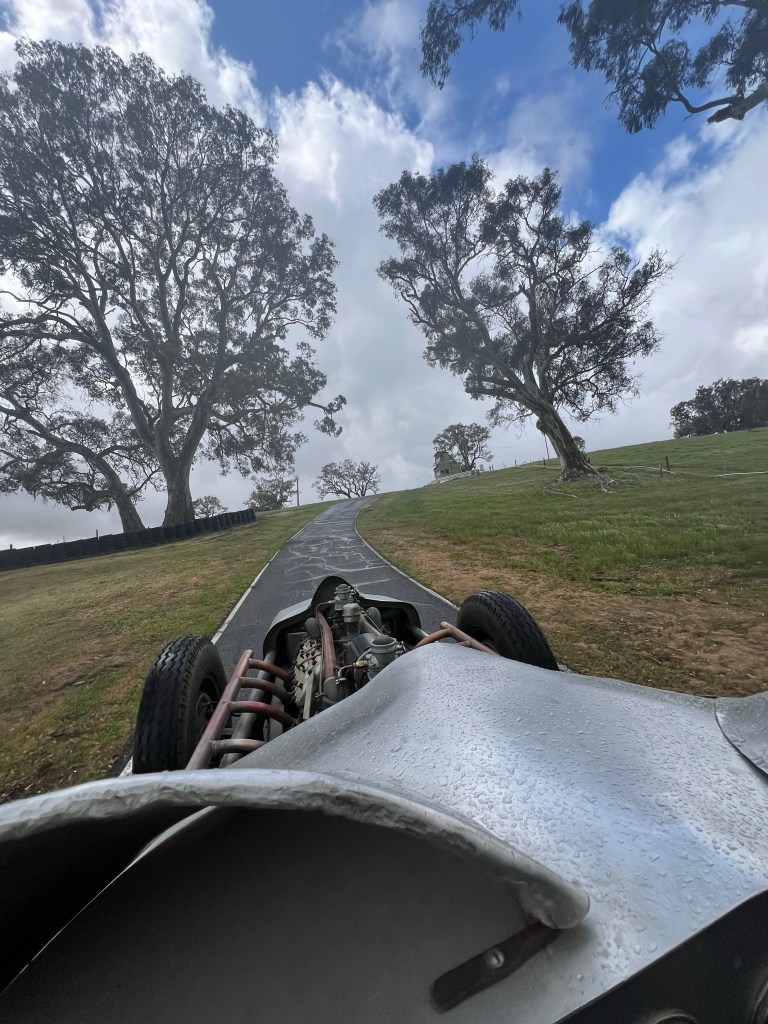
Darren Visser’s extraordinary Double Eight, a recreation of Eldred Norman’s 1947 and subsequent iterations racing car, pointing towards the first turn at Collingrove Hillclimb in South Australia’s Barossa Valley on Saturday October 5, 2024.
(M Bisset)
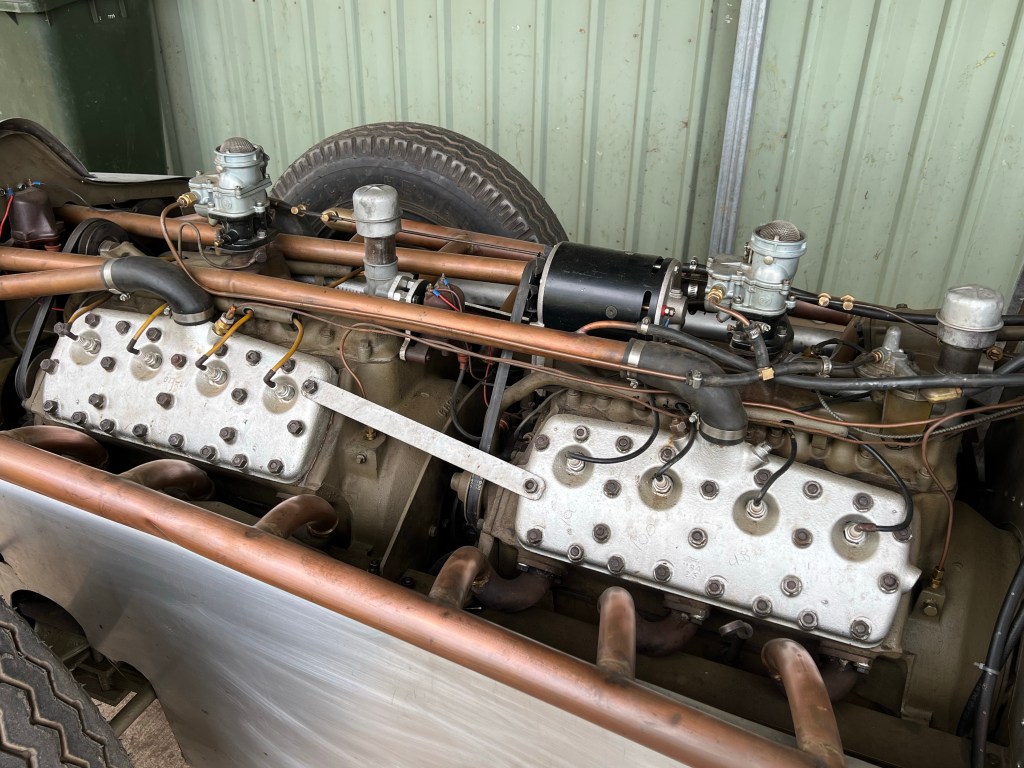
The key elements of this car comprise a WW2 Dodge Scout car chassis, two Ford Mercury 3.8-litre 110bhp V8s mounted one aft of the other, and a Ford truck four-speed gearbox feeding a Dodge rear axle and diff. Yep, they are truck wheel, tyres and brakes, and yes again, it’s quite a thrill to ride in it!
Ford Mercury V8s are fed each by a Stromberg 97 carb, but are otherwise rebuilt standard units; Darren reckons they are good for about 110bhp a pop (M Bisset)Chassis is Dodge Scout car, ‘box, a Ford truck four-speed unit. It all looks rough, very kosher actually, just as Eldred built and finished the original (M Bisset)
Eldred Norman lived in the Adelaide Hills where the car was connected. It was built at Norman’s 18 Halifax Street, Adelaide premises so the car was very much a local, feature article thereon coming very soon.
(M Bisset)
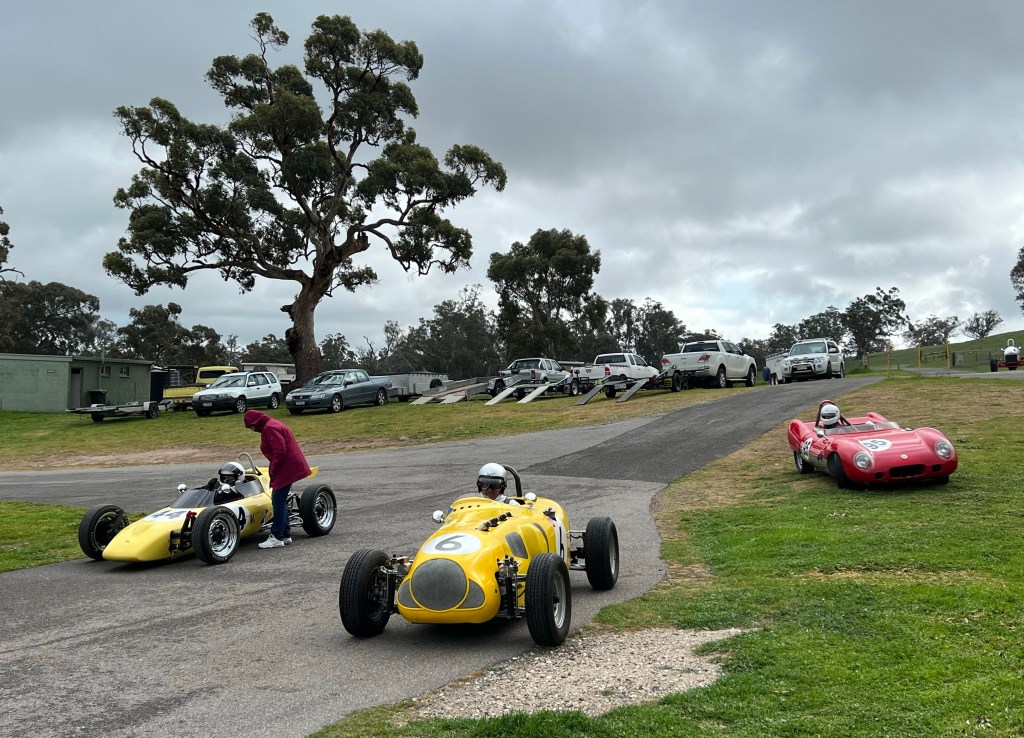
Sticking with the Eldred Norman theme, front and centre is Greg Snape, longtime custodian of Eldred’s Zephyr Special, in many ways just as revolutionary, if not as visually challenging as its older sibling.
That’s Frank Chessel’s lovely Stag Formula Vee at left and Daniel Jeffries’ Elfin Streamliner at right, both Adelaide built cars.
(M Bisset)
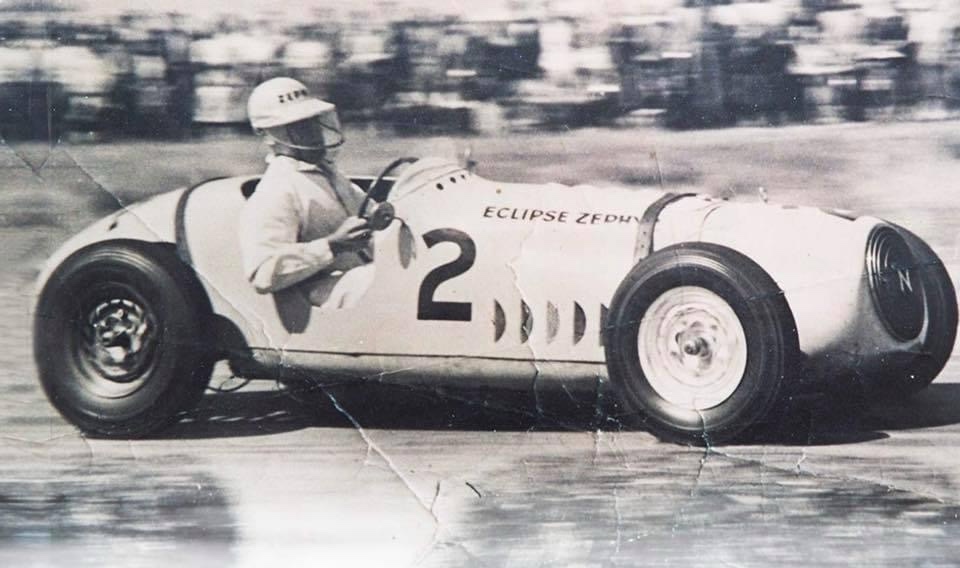
Eldred Norman during the 1955 Australian Grand Prix in the Eclipse Zephyr Special – Eclipse motors being a Ford dealer – at Port Wakefield, where he was eighth on debut.
Below is the semi-naked machine showing some of its secrets at Collingrove circa 1960.
The SU-fed, supercharged Ford Zephyr 2.3-litre overhead, two-valve straight-six – canted at 45 degrees from vertical – was a structural chassis element in that a piece of steel was milled to the shape of the engine’s timing cover and then a steel plate was welded to it that accepted the Holden FJ sourced independent front suspension crossmember assembly.
Norman borrowed from Vittorio Jano’s 1954-55 Lancia D50 playbook a decade before Mauro Forghieri did in 1964-65 (Ferrari 1512) and Colin Chapman in 1966-67 (Lotus 43 BRM and Lotus 49 Ford Cosworth DFV).
(S Jones)(S Jones)
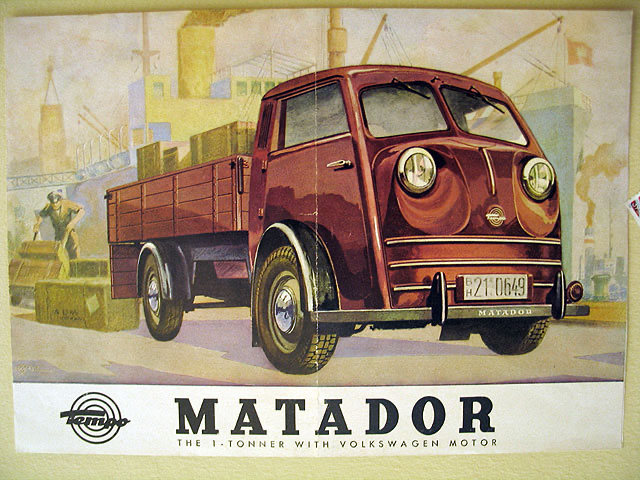
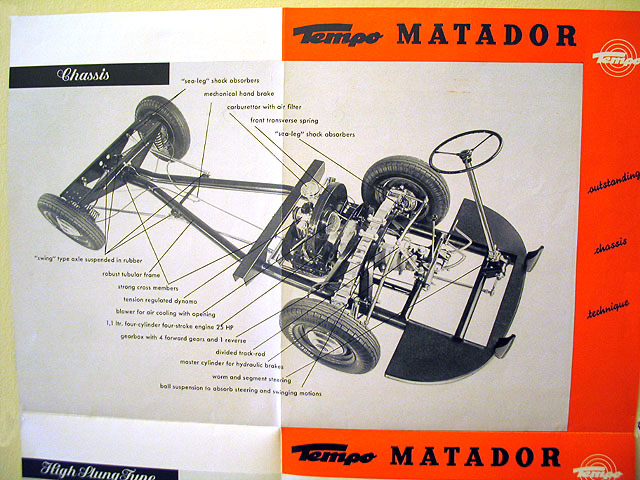
An eight or nine-inch diameter torque-tube connects the motor to a rear mounted clutch and Tempo Matador (VW powered truck) three speed transaxle, while the fabricated independent rear suspension was attached the transaxle with other major components such as the fuel tank, seat and body were bolted to the torque tube.
Yes, that is the petrol tank alongside the very fast Keith Rilstone in the shot above. The drum brakes are Holden with Vanguard internals to give twin leading-shoe operation.
(M Bisset)(M Bisset)
Fiona and Neill Murdoch’s Altas – two of the many visiting Victorians – created plenty of interest, that’s Fiona in the ex-Alan Sinclair/Ted Gray 1100cc s/c 21S above heading towards The Wall, and Neill in the 2-litre s/c 55S below.
(M Bisset)
Passengers were invitees during the Saturday track familiarisation session, so ‘everybody’ had a ride if they wanted.
(M Bisset)
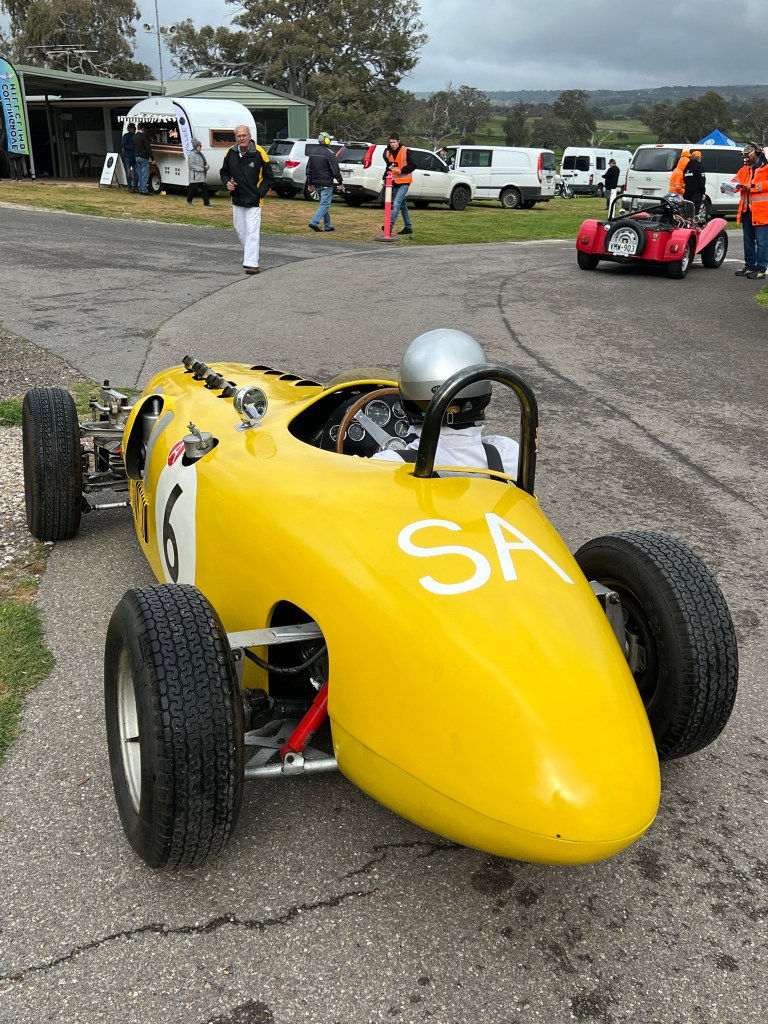
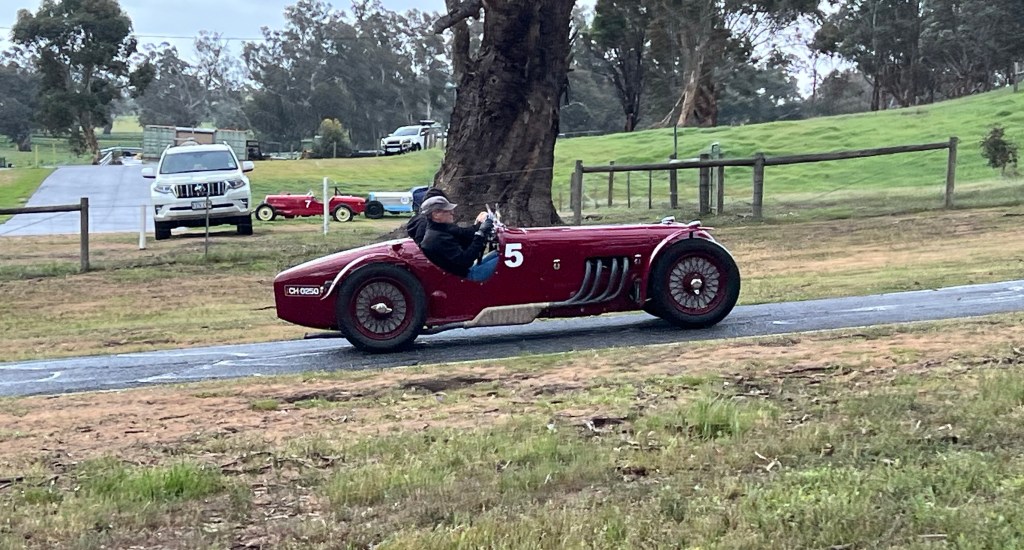
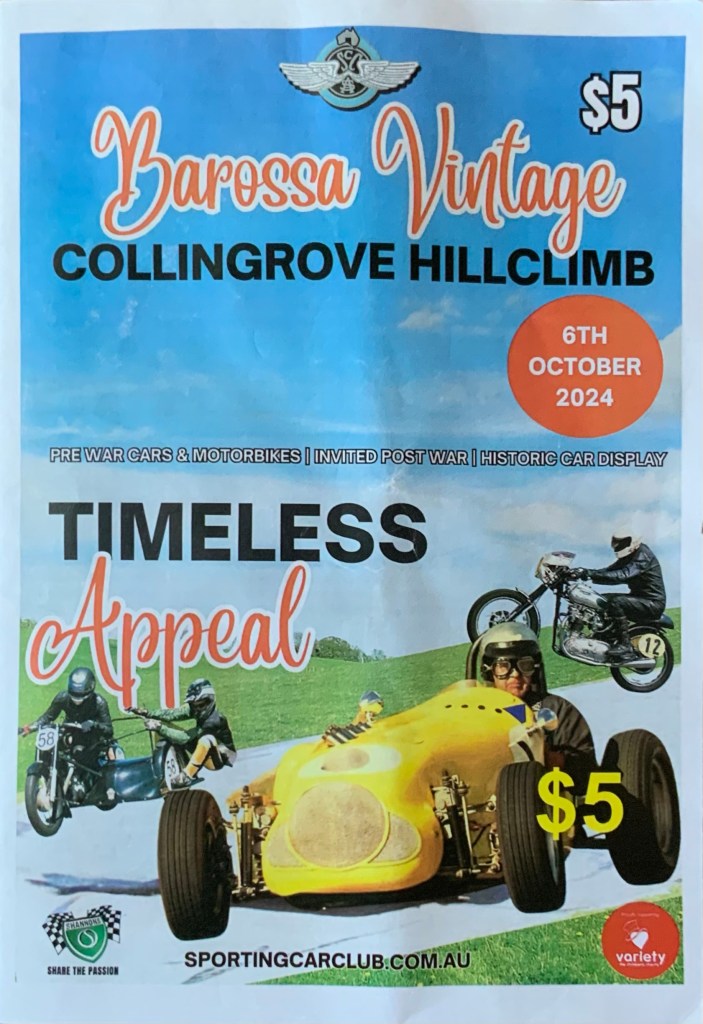
The October 5/6 Barossa Vintage Collingrove meeting was one of the Sporting Car Club of South Australia’s 90th birthday celebration events.
The SCCSA is THE blue-riband Oz car club having run and promoted fun and national championship events since 1934. I guess the 1936 South Australian Centenary Grand Prix – aka the 1936 Australian Grand Prix – was their first big national gig. They are an ‘efficiency with a friendly feel’ kinda mob which makes visits to their meetings at Collingrove, Mallala and their HQ in quite special.
Mark Alsop’s MG M-Type was deceptively quick for an 850cc sporty but appeared to be perfectly geared for the venue (M Bisset)
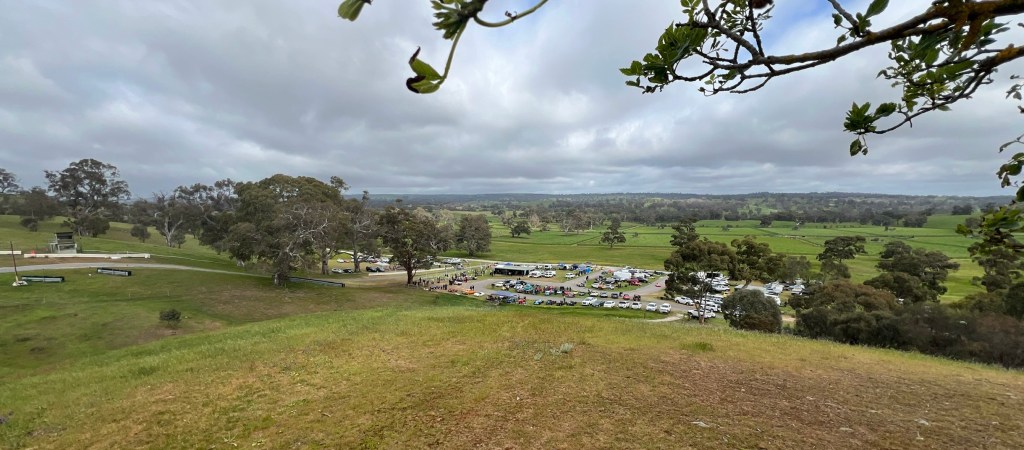
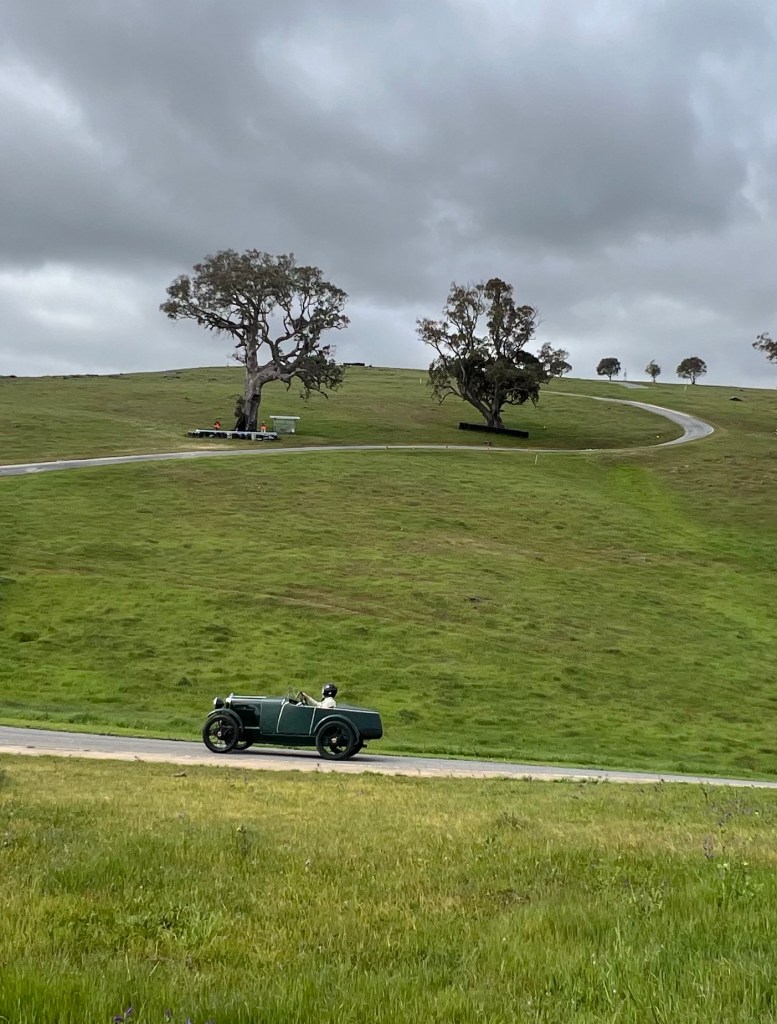
Collingrove is in the beautiful, leafy green, rolling hills of the Barossa Valley – Mount McKenzie to be precise – a notable wine growing region 80km north-east of Adelaide. First used in 1952, it’s 750 metres long, the climb is tight, up and down and has held the Australian hillclimb Championship 14 times in addition to rounds thereof when the title has been contested over more than one event.
(M Bisset)
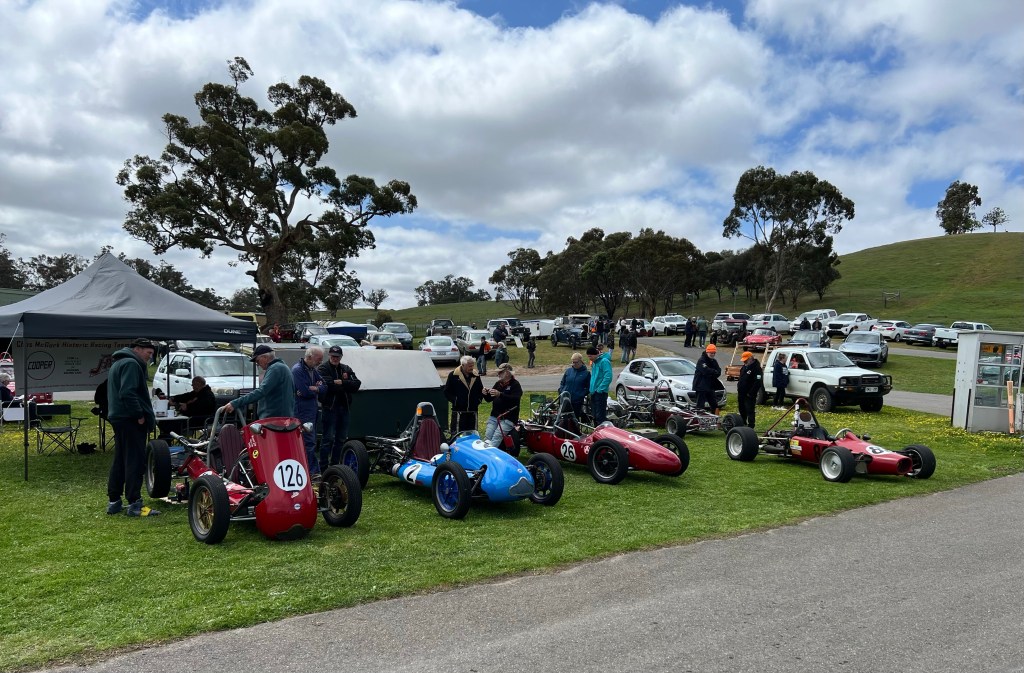
A line up of air-cooled’s: Peter Fagan’s Cooper Mk6 JAP 1100, Stephen Denner’s Cooper MkV JAP 1100, Brian Simpson’s Cooper Mk9 JAP 1100 – yes please to that car – and Mark Atkinson’s Falkenberg Jinx.
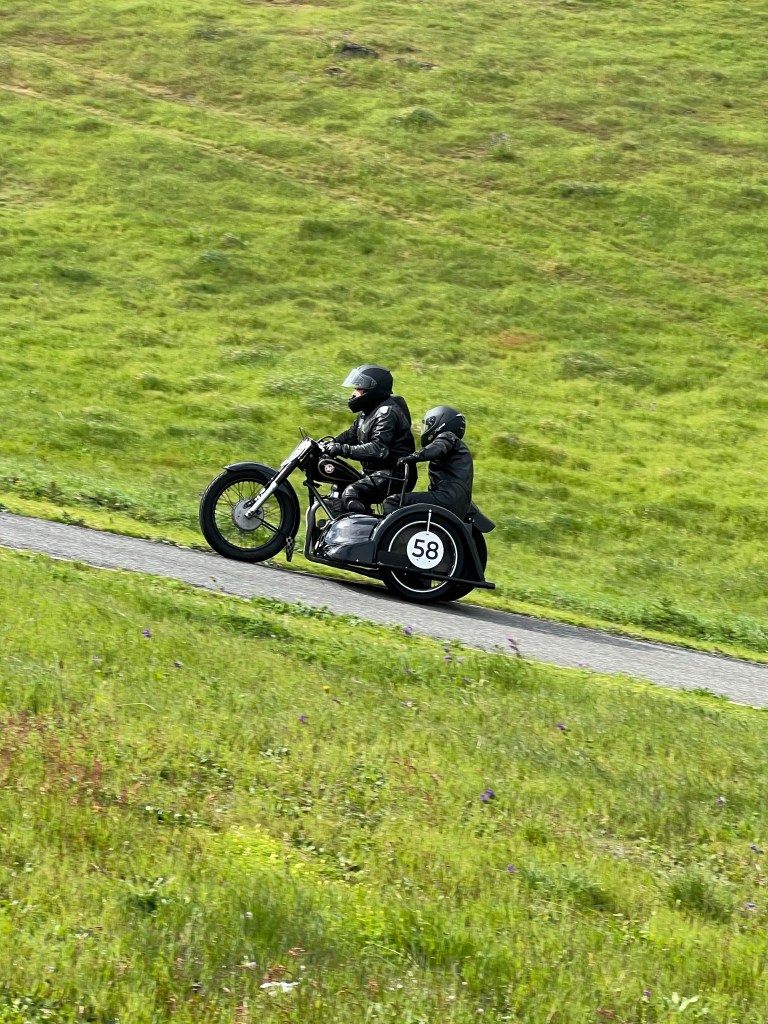
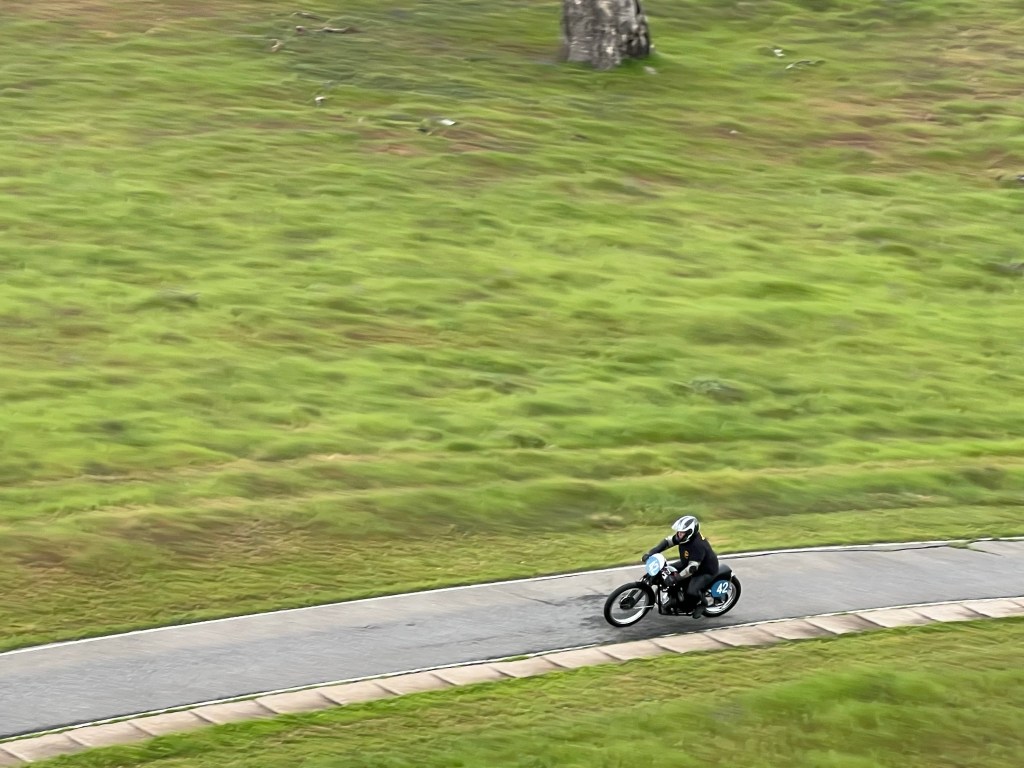
Speaking of air-cooled machines, ‘bikes were invited along too, about 15 of the 70 entries, and were spectacular to watch. It’s the first time I’ve seen motorcycles at a hillclimb, they were great.
Given the relatively small entry there was plenty of runs for all who wanted them.
The Bruce Davis/Emil Batar 1958 Matchless 600 outfit (M Bisset)Peter Walker and 1935 Velocette Mac (M Bisset)
I missed the best of the action, Bob King and I were given a guided tour of the Lobethal and Woodside road circuits, which are not too far from Collingrove, by Kent Patrick. A group of us did a Nuriootpa loop on Saturday morning as well, not to forget a (shambolic) lap or two of the Victor Harbor-Port Elliott track on Monday morning.
Fiona Murdoch in #21S coming down the access road back to the paddock.
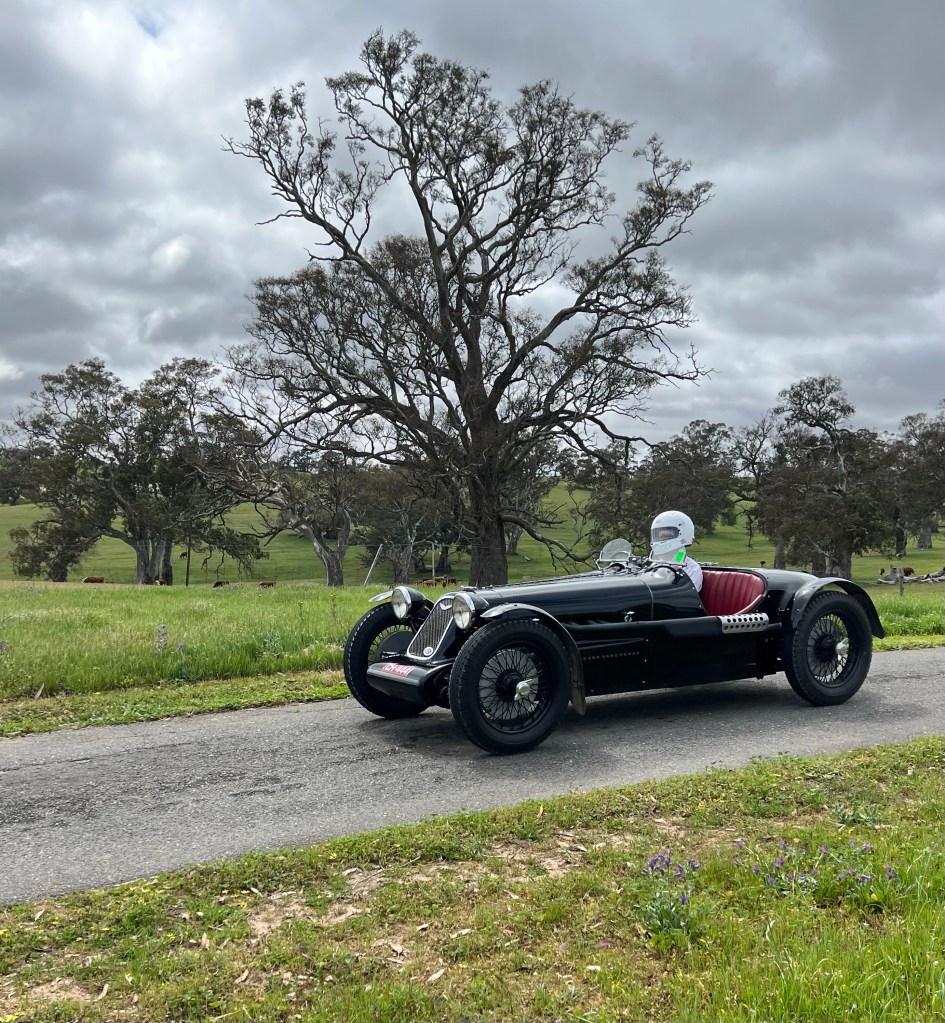
(M Bisset)The Anderson family Bugatti Type 44 – in Michael’s care – and Alsop M-Type lead this paddock line up (M Bisset)(M Bisset)
Brian Simpson’s Cooper awaits its familiarisation run while Montgomery leaves the line in the Little Alfa. Brian’s cars have always been beautifully prepared and presented, the Cooper is no exception.
(M Bisset)
David Beaumont’s Alfa Romeo Giulietta Spyder 1600 was a picture. Angus Mitchell was quick in both the family Amilcar Grand Sport s/c, below, and in his ASP Toyota Clubman; busy too as one of the key organisers. That big-arse under cover behind belongs to the Double Eight; pert and perky it is not!
(M Bisset)(M Bisset)
Graeme Jarrett’s Elfin Streamliner looked the goods with head-piece and very racing-correct varying hues of red. A favourite car.
(M Bisset)
Alta 55S pointed in the right-racing-direction at Nuriootpa, with Fiona and Neill Murdoch and then 21S behind.
While 55S is an Australian-johnny-come-lately – in the 1980s – MI5 Spy, part-time motor dealer and occasional racing driver, Alan Sinclair, brought 21S here just prior to the South Australian Grand Prix at Lobethal in January 1938. The car has been here ever since.
Here is the little 1100cc minx in monoposto form with our spook at the wheel in that January 1938 Lobethal race below.
I don’t think the car competed again in South Australia despite a competition life in the hands of Bill Reynolds, Ron Edgerton, Ted Gray and others that stretched into the early 1950s, but I’d love to be proved wrong.
Legend has it that Eldred Norman first called the Zephyr Special the Norholfordor given it was derived form Ford, Holden and Tempo Matador parts, but he figured that was a bit of a mouthful…
(bry3500)
Nice tail shot of the VW transaxle above, top transverse leaf spring and tubular shocker.
With about 280bhp on hand, depending on gear ratios, the wild, somewhat twitchy little SWB rocket was good for about 90mph in first, 130 in second and somewhere north of 160mph in top. Plenty quick.
(bry3500)
The undated Mallala paddock shot above shows the sheet steel engine/suspension mounting plate, single SU carb, and rough as guts standard of finish epitomised by the second hand fuel tank! All go, no show.
Norman was an acknowledged supercharger expert, his tricks learned getting more performance from tye recalcitrant Maserati 6CM that succeeded the Double Eight.
(M Bisset)
Greg Snape looking very snug at Collingrove.
Credits…
Norman Howard, Steve Jones, bry3500
Tailpiece…
(M Bisset)
What’s that Queen song? Fat Bottomed Girls. She’s loud and proud and sassy rather than nuanced, and all the better for it. Wait until Darren gets the thing fully sorted and fits it with a pair of a Hotrod Harry spec engines…
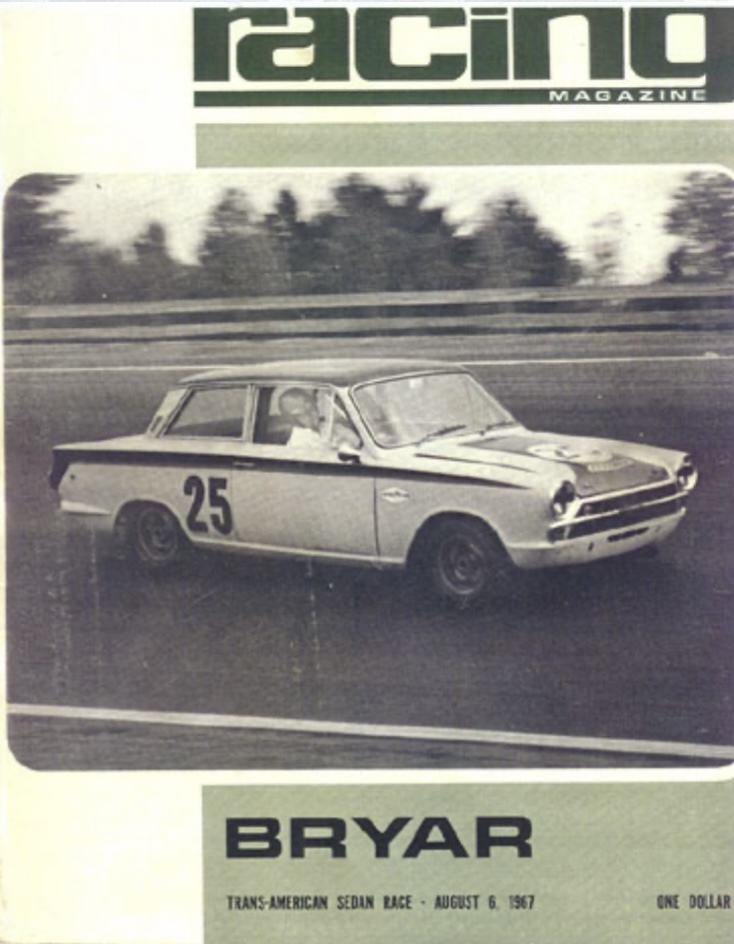
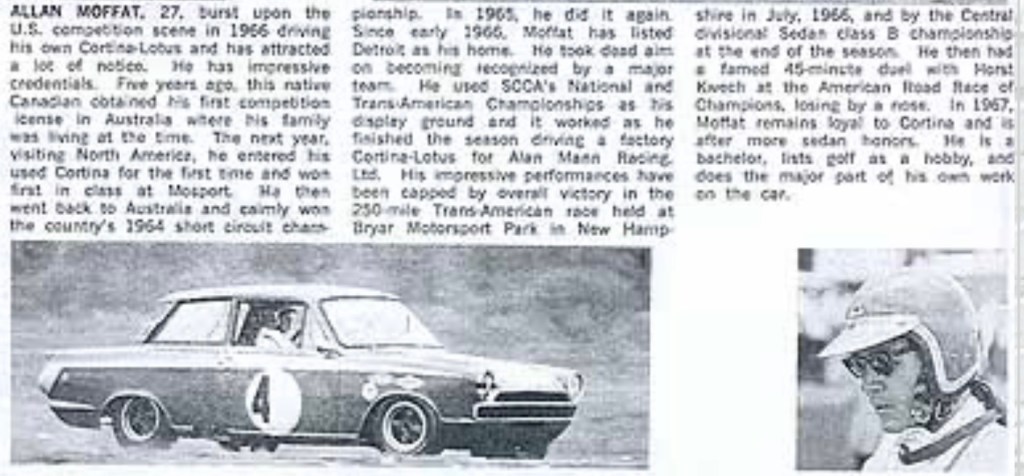
Racing Magazine, Vol 2 # 7 August 1967, cover shows Allan Moffat, probably that year (lotus-cortina.com)
It’s interesting to see how the Americans rated him in 1967.
‘Allan Moffat, 27 (born November 10,1939) burst upon the U.S. competition scene in 1965 driving his own Cortina Lotus and has attracted a lot of notice. He has impressive credentials. Five years ago, this native Canadian obtained his first competition license In Australia where his family was living at the time.’
‘The next year, visiting North America, he entered his used Cortina for the first time and won first in class at Mosport. He then went back to Australia and calmly won the country’s 1964 short circuit championship. In 1965 he did it again.’
‘Since early 1966, Moffat has listed Detroit as his home. He took dead aim at becoming recognized by a major team. He used SCCA’s National and Trans-American Championships as his display ground and it worked as he finished the season driving a factory Cortina-Lotus for Alan Mann Racing. His impressive performances have been capped by victory in the 250 mile Trans-American race held at Briar Motorsport Park in New Hampshire in July 1966 and by the central divisional Sedan B-class championship at the end of the season. He then had a famed 45 minute duel with Horst Kwech at the American Road Race of Champions, losing by a nose.’
‘In 1967 Moffat remains loyal to Cortina and is after more sedan honours. He is a bachelor, lists golf as a hobby, and does the major part of his own work on the car.’
The first motor race I attended was the Sandown Tasman round in 1972, the Australian Grand Prix that year. Despite being based in the Castrol tent surrounded by the HDT Torana XU-1s and works Chrysler Valiant Chargers there were only ‘two cars’ of interest to me that weekend: all of the single seaters and Moffat’s Mustang! The factory Falcon GTHO’s had as much presence as the Trans-Am but not its menace or sensual, muscular brutality.
With an Economics degree in my pocket I commenced working for a small chartered accounting firm in Toorak and used to see AM around and about there all the time. His workshop was for many years at 711 Malvern Road, Toorak, he lived in the area and I often saw him schmoozing clients at Topo Gigio and more often Romeo’s. While Topos has been gone for five years, Romeos is still there and Allan is an honoured long-standing guest when there with his wonderful minders; dementia sufferer as he is.
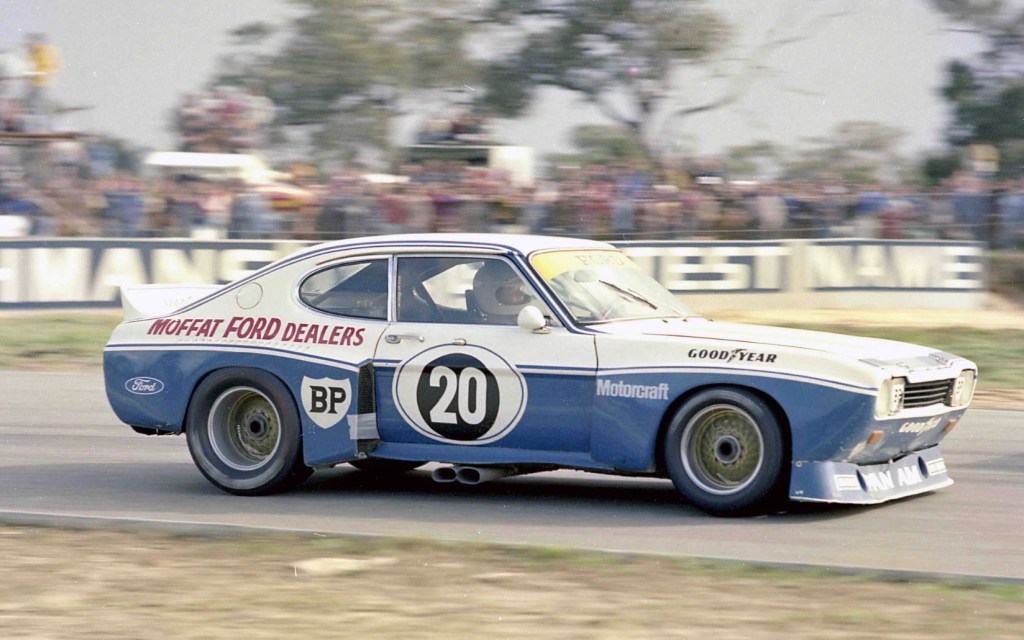
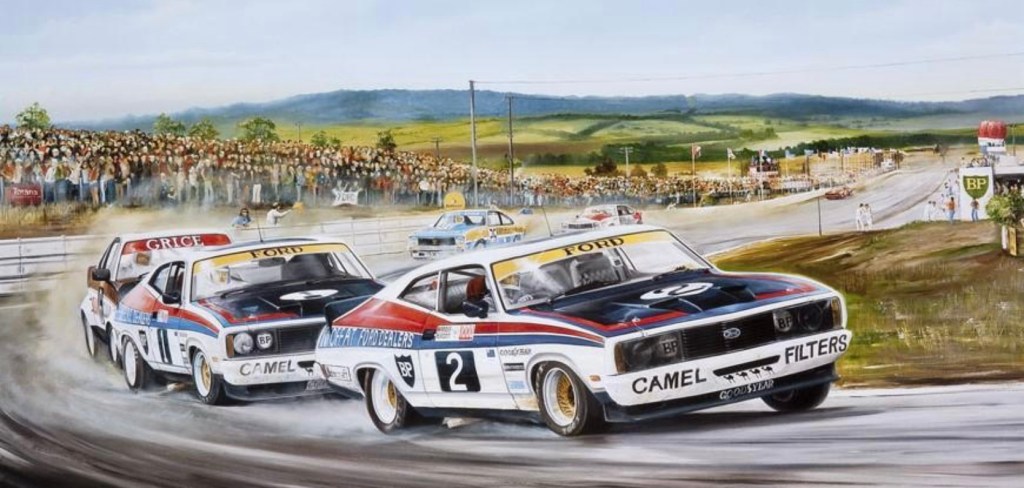
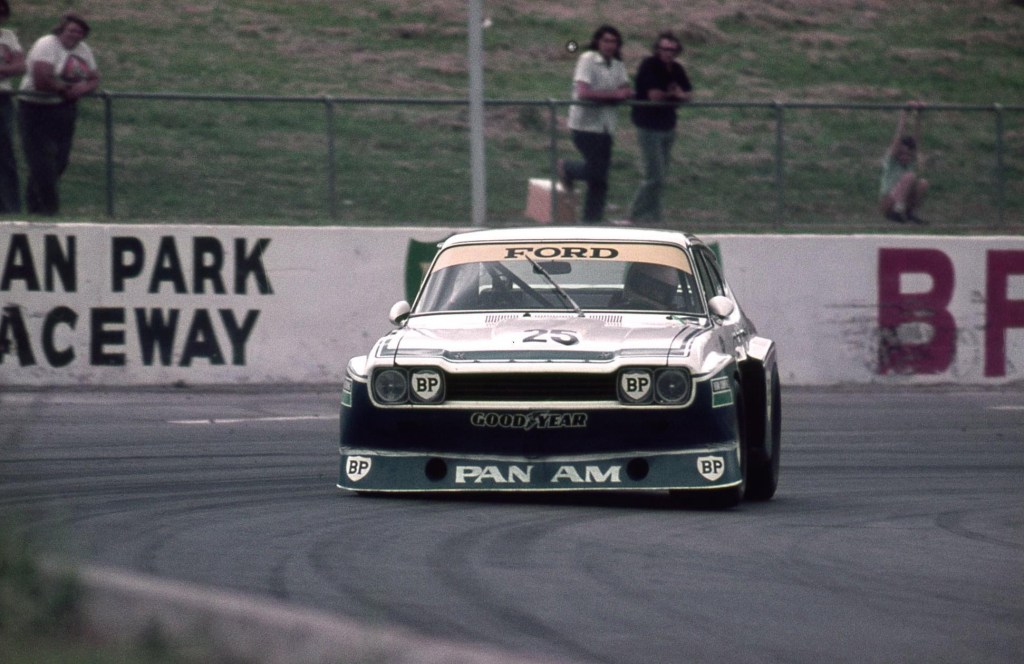
Moffat, ex-works Ford Capri RS3100, Wanneroo Park circa 1976 (autopics.com)That memorable Bathurst 1-2 in 1977: Colin Bond/Alan Hamilton from Allan Moffat/Jacky Ickx at Hell Corner, Ford XC Falcon GS500 Hardtops. The order was reversed at the end of course. That season was such a potent mix of Moffat, Bond, Carroll Smith and Peter Molloy all singing from the same hymn book (R Wilson)
As I got the hang of the working world a bit I developed a keen appreciation of Moff’s commercial skills in addition to his on-track prowess. He was very young when Ford US did a deal with him to run their surplus-to-requirements Lotus Cortinas in 1967. After his works-Ford Oz drives – 1969-73 plus bits and pieces subsequently – came to an end he did deals with Mazda, Holden, Porsche Cars Australia and others that kept him winning and in the public eye.
You have to figure he was trustworthy and gave value for money to his supporters and sponsors…I’m not saying there wasn’t a litigation blip or three along the way.
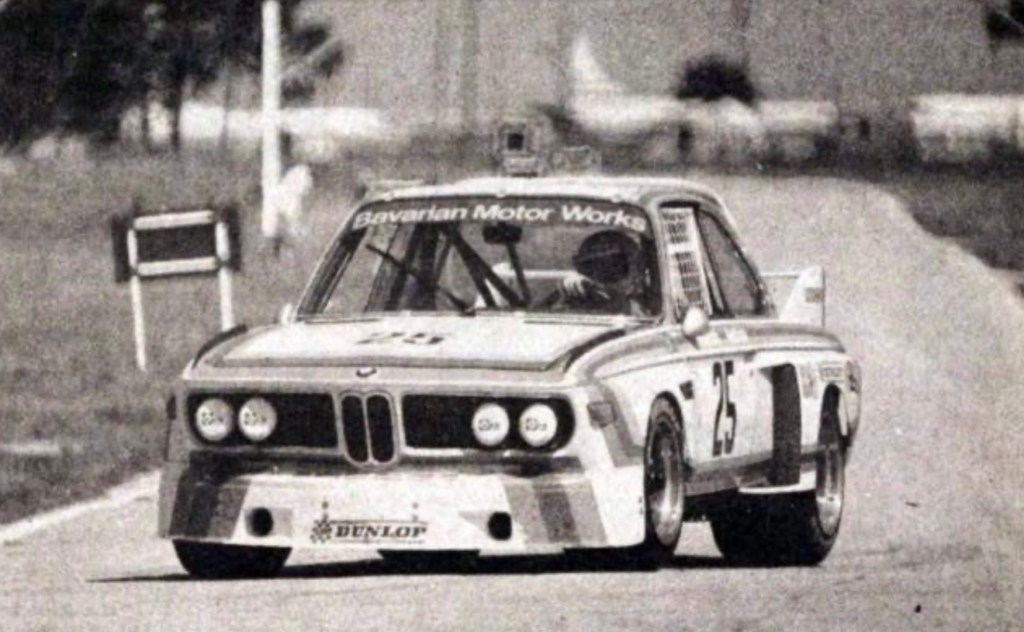
Moffat at the wheel of the 1975 Sebring winning BMW 3.0 CSL. This is a shit-shot, but it’s the only one I’ve seen where it’s definitely Moff at the wheel (Autoweek)
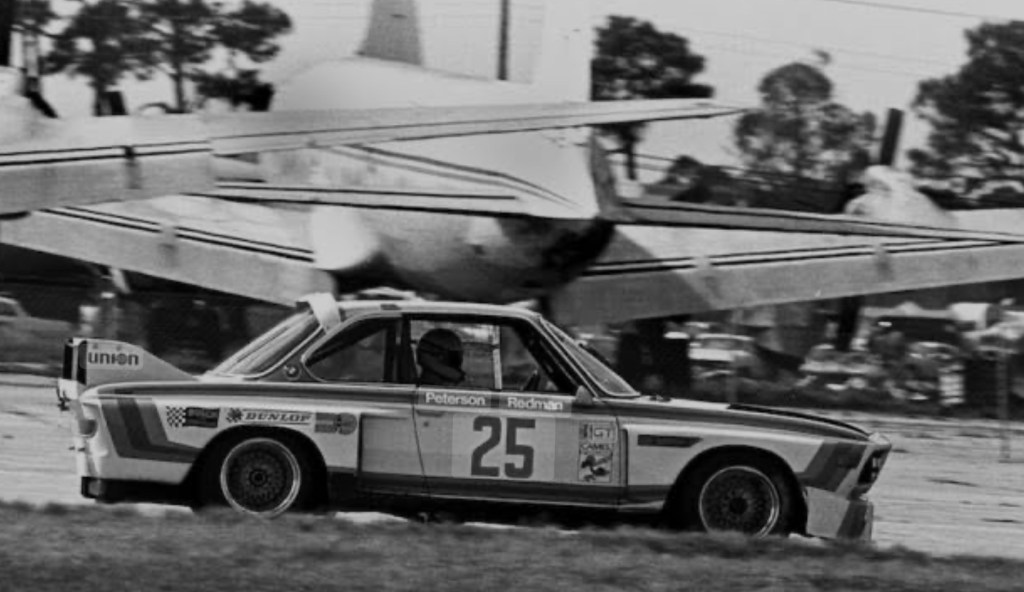
By early 1975 Allan Moffat had won the Australian Touring Car Championship, the Bathurst classic three times, and more long distance races than you can poke a stick at. So when the FIA wouldn’t let Ronnie Peterson contest (WTF?) the 1975 Sebring 12-Hours in a factory BMW 3-litre CSL there were enough folks in high places in the US who remembered Moffat to suggest him for the drive alongside the versatile and very quick Brian Redman. It was Moff’s first pro-drive of a make other than a Ford.
Moffat did an early stint then Redman took the wheel. Later, BMW’s pair-of-hares, Hans Stuck and Sam Posey joined in too after their car was sidelined; an oil leak led to a blown engine. Redman did about seven of the 12 hours, but it was a shared victory, a crucially important one for BMW too, it was their first big race win in America that gave their market presence and credibility a big lift.
Allan had a 911 SC roadie circa 1979, so the handling characteristics of a 911 Porsche – a triumph of engineering over physics – would not have been a huge surprise to him when Allan Hamilton entered him in a Porsche 934 in the 1980 Australian Sportscar Championship; he won three of the five rounds and the series handsomely.
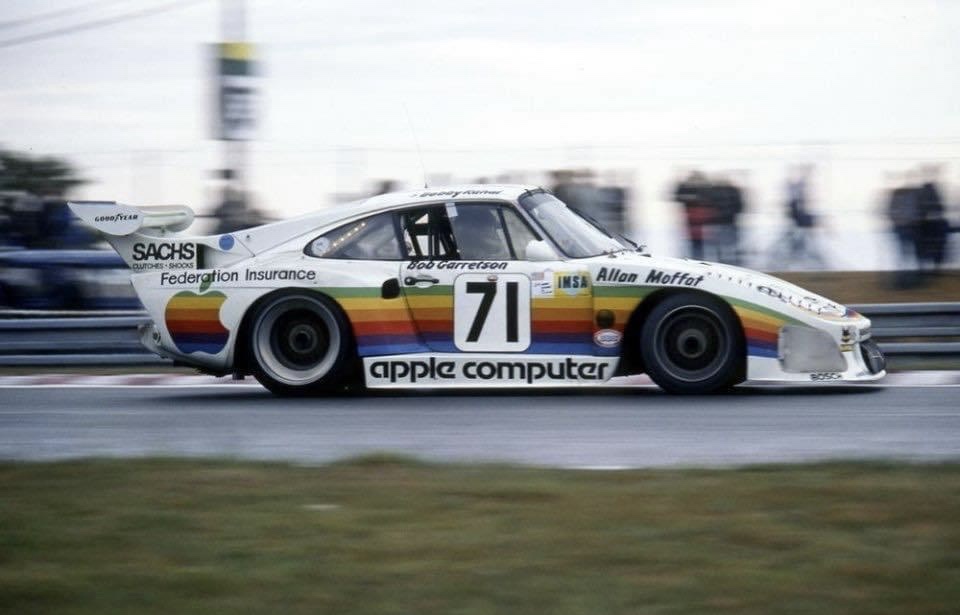
Doubtless the Dick Barbour Racing Porsche 935 K3 he raced with Bobby Rahal and Bob Garretson at Le Mans in 1980 was a thrill and challenge of a much higher order!
The result was a DNF after piston failure. The crew completed 134 laps, and retired in the 11th of the 24 hours. Dick Barbout entered three 935s, the only one that finished was the pole-car, raced by John Fitzpatrick, Brian Redman and Barbour himself to fifth place. Fitzpatrick, a familiar Bathurst winning name to Australian enthusiasts, put the 935 K3 1980 Kremer machine on pole.
(M Heurtault)Dekon Chev Monza, Sandown, July 4, 1976. Under brakes into Shell (R Davies)
One of the things I loved most about Al-Pal was his propensity to import cars and talent, rather than buy-local. That it drove most of the Taxi-Boganisti of this country nuts made it even better.
The Dekon Chev Monza is a case in point. The irony is that Aussie Export Horst Kwech was a key member of the team that developed and raced the cars in the Ewe-Ess-A. I was there the day he ran the 200 Year USA celebration livery at Sandown in 1976 but I’ve no idea if he won the Sports Sedan feature?
Imagine how lacking in colour Oz touring car racing would have been without Moffat’s imported Lotus Cortina, KarKraft Mustang, Cologne Capri, B52 Falcon Hardtop (sort of), Dekon Monza and the Mazdas. Moffat in a ‘fuckin Rice Burner’ was more than the fanatical Bathurst Fruit Loops could take…priceless it was!
(LAT)
Moffat’s powers of lobbying and schmoozing officialdom came to the fore in and around the racing of the Mazda RX7 in the Australian Touring Car, and Manufacturers Championships…but let’s not go there.
He won the first ATCC round for a Japanese car at Lakeside on April 3/4 1982, and then brought home the bacon by taking three of the five Australian Endurance Championship rounds in 1982, and the 1983 Australian Touring Car Championship, winning four of the eight rounds, taking both titles.
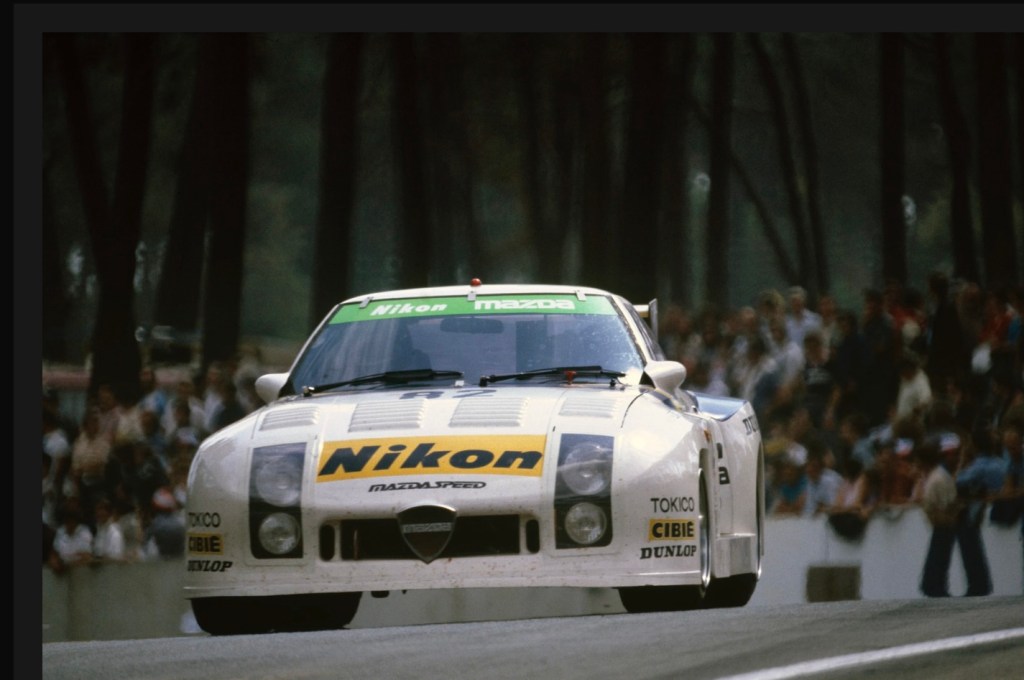
The century old, Hiroshima based multinational rewarded Moffat’s success with his final drive at Le Mans in 1982. He shared a Mazda RX-7 254i GTX IMSA class machine (above) to 14th place sharing the drive with Japanese racers, Yojiro Terada and Takashi Yorino.
Nobody who was around can forget the tragic self-immolation of Peter Brock in 1986-87 over ‘his Energy Polariser (magnetism and chrystal placement) that enhanced vehicle performance’ debacle.
But before that, .Brocky threw his mate and intense rival – thanks to the recommendation of John Harvey, Brock’s tight-hand-man and a personal friend of Moff – Moffat a motor racing lifeline in the form of a Holden ride for selected rounds of the ‘86 Euro Touring Car Championship and Oz long distance enduros.
Larry Perkins, already working for Brock, was of course the logical choice for the ride but he left Peter over the Polariser, as far as he was concerned Brocky was just jerkin’-the-gherkin.
When the combination of a particularly potent brew of Hurstbridge wacky-bakky, the influence of Witch-Doctor Eric Dowker, a Messiah Complex and whatever else got the better of Brock – a staggering Australian in every respect – General Motors Holden pulled the plug on him in February 1987; it was entirely the appropriate remedy for them of course.
Moffat told his biographer, John Smailes, ‘If I’d been in the position where I had General Motors in my hip-pocket, I would never, never, never have put myself above them. That’s not corporate cowardice; it’s just common sense. Peter could have lived to fight another day (if he backed down on the polariser fitment to the Commodore Director and subjected the car to GM’s homologation processes). Who knows? In some parallel universe he might even have got the polariser up.’
‘John Harvey, the last man standing, resigned, I went with him. There seemed nothing, really, to stay around for. Ten months later Peter won Bathurst again. Despite all that had gone down, he had accomplished a rise from the ashes that made my Project Phoenix all those years ago look paltry.’
Moffat at Monza in 1987, the nascent team had precious little in the way of spare parts, fortunately the new VL SS Group A behaved rather well (Garry Rogers)
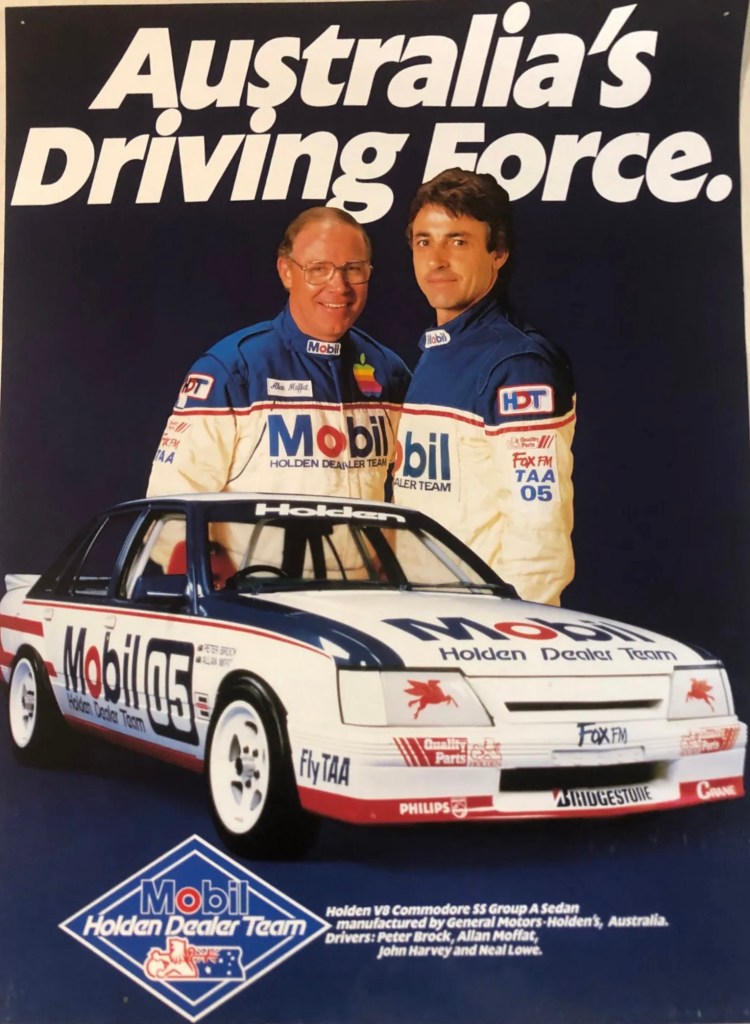
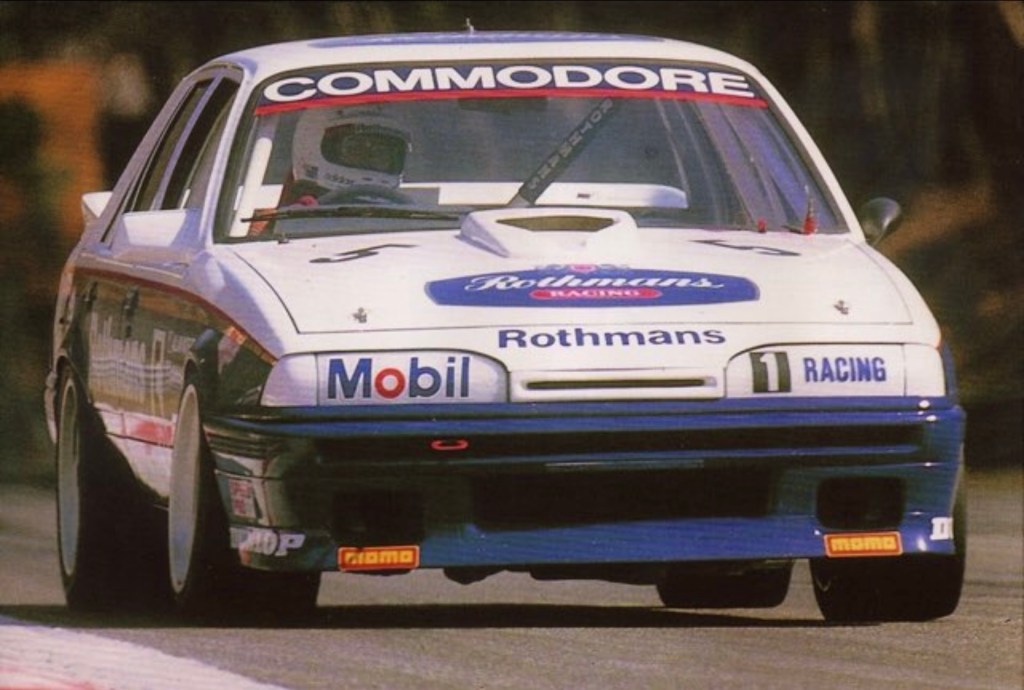
In the short term Brock had his creditors to deal with. Without a car, and still intent in contesting some of the 1987 World Touring Car Championship rounds – Brock and Moffat did four rounds in ’86 as preparation for ’87 – Moffat acquired, via an intermediary, Brock’s new, unraced 1987 05 car, a Holden VL Commodore SS Group A.
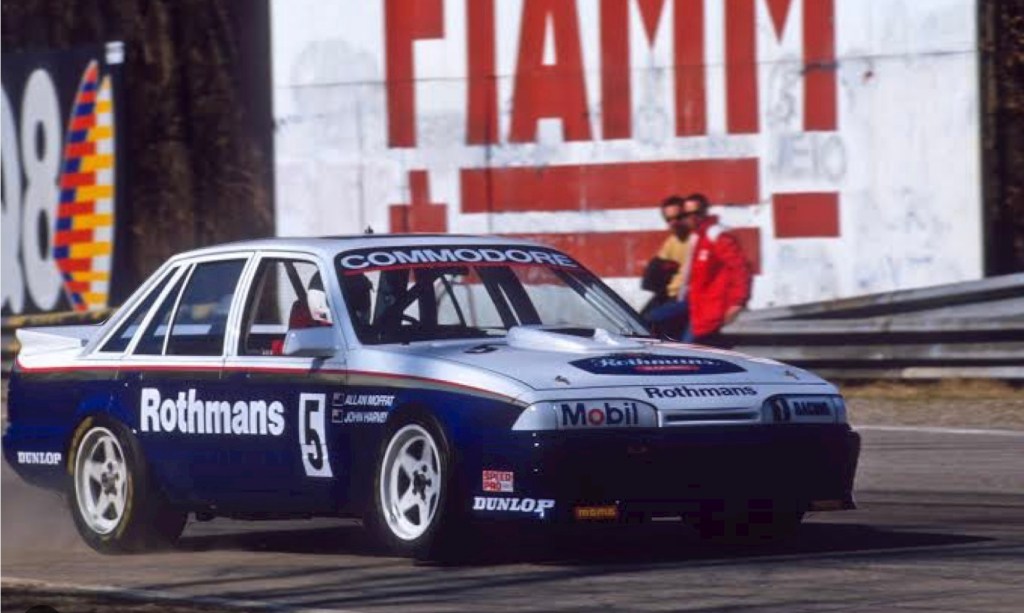
Showing his commercial skills again, Moff quickly, in not much more than a month, pulled together some sponsors, popped the Commodore on a plane and contested four rounds of the 1987 WTCC with John Harvey as co-driver. They sensationally and famously won the first round at Monza after the first six cars home – BMW M3s – were pinged for being illegally light on the evening after the race!
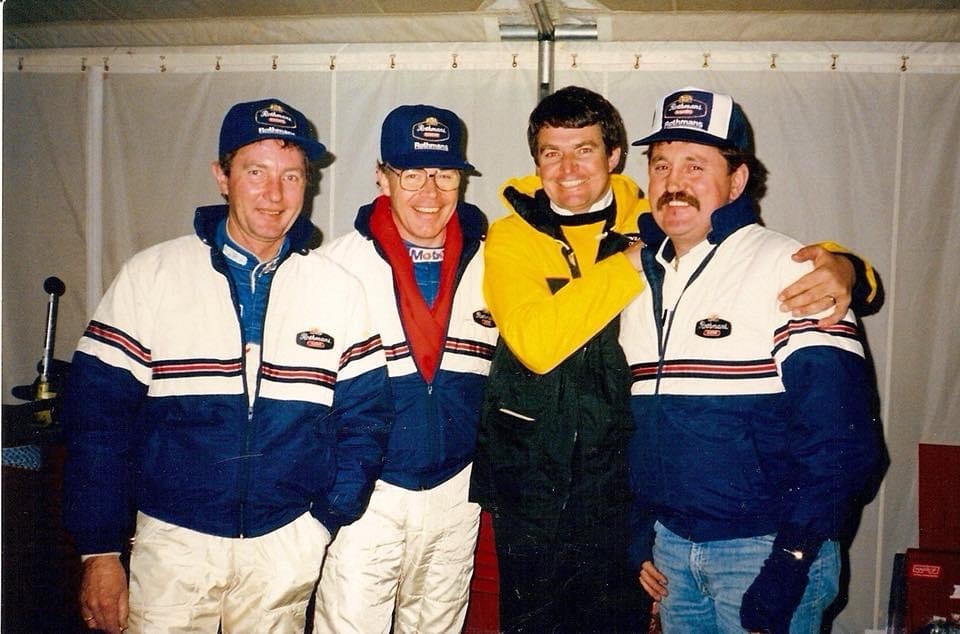
Harvey, Moffat, Dunlop Oz’s Russell Stuckey, and Mick Webb at Monza in 1987. Happy chappies indeed (R Stuckey Collection)I never thought the VL Commodore was a pretty car but it sure looked good in Rothmans livery! Monza ’87 (an1images.com)
Moffat’s 1987 European Safari results are as follows: 22/3/87 Monza 500km Q10 and first, 19/4 Jarama 4-Hours Q11 DNF lost wheel on lap 78, 10/5 500km de Bourgogne-Dijon Q10 DNF blown engine on lap 44, and 1-2/8 Spa 24-Hours Q18 fourth.
When Allan got home he had a Ford Sierra RS500 for Bathurst, while Brock had the winning car…
Etcetera…
(B Williamson Collection)
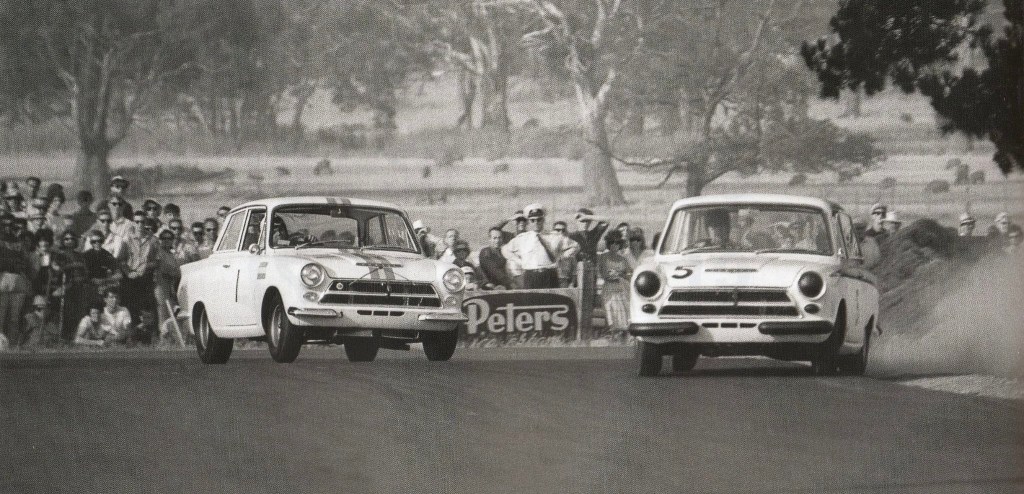
Al-Pal using all the road to stay ahead of Bob Jane on the exit of Mountford corner during the March 1965 Longford Tasman round; Lotus Cortinas both, Moff’s ex-works, Jano’s locally developed.
These blokes dooked it out on-circuit for years of course, I wonder at what meeting they first swapped-paint!?
(B Stratton)
Moffat in the Cologne Capri at Oran Park in 1976. If the sight of it didn’t move the erectile tissue the sound of it most certainly did.
The price was right of course – FoMoCo supplied – but otherwise the relatively heavy 3.4-litre, quad cam, four-valve, injected Cosworth Ford GAA powered long distance coupe lacked the cubes’-and-pubes’ – cubic inches and torque – for Australian Sports Sedan racing.
With a need for big V8 punch out of our predominantly point and squirt type of tracks the Capri was never going to be a consistent winner. And so it proved. So he bought the Monza, but then Ford cracked the shits so he put the Monza aside and jumped back into the ‘Crappy. I wonder how many meetings he did in both of these cars as a consequence of all of that?
Allan Moffat in America Facebook page, Mathieu Heurtault, Randall Wilson, Robert Davies, Autoweek, Brian Stratton, an1images.com, Bob Williamson Collection, Russell Stuckey Collection, ‘Climbing the Mountain’ Allan Moffat and John Smailes
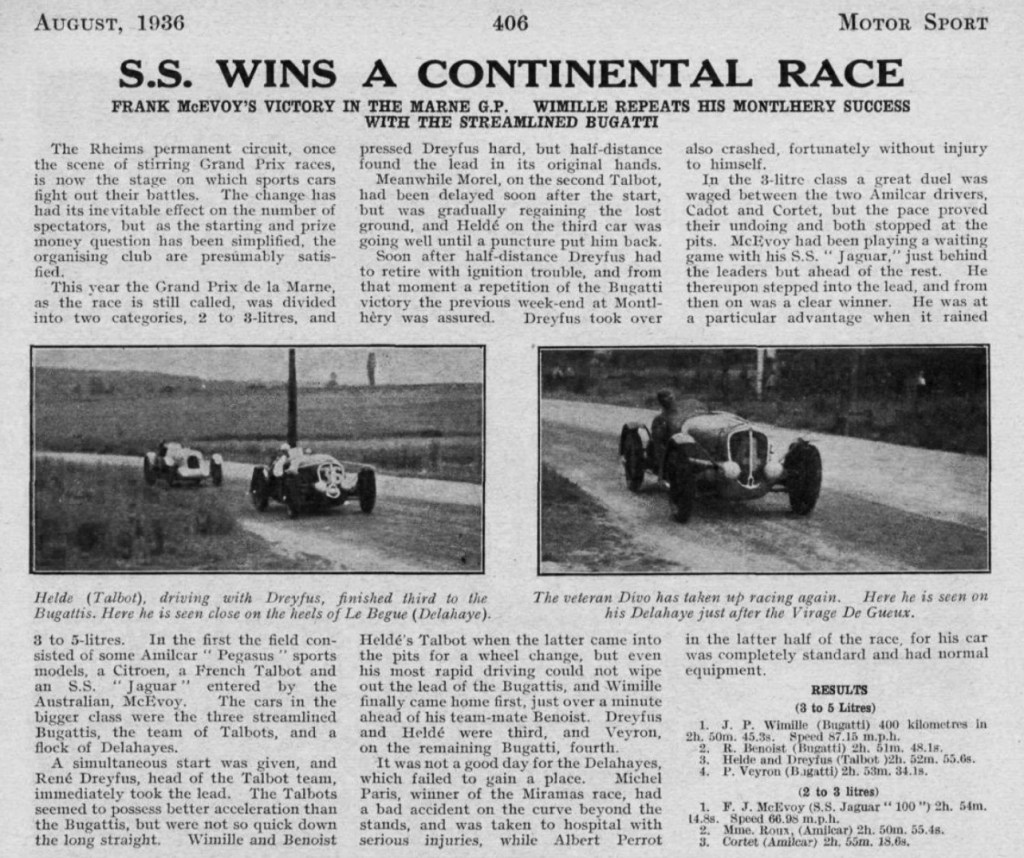
There is bit of overreach in this MotorSport claim for an SS 100 Jaguar win …
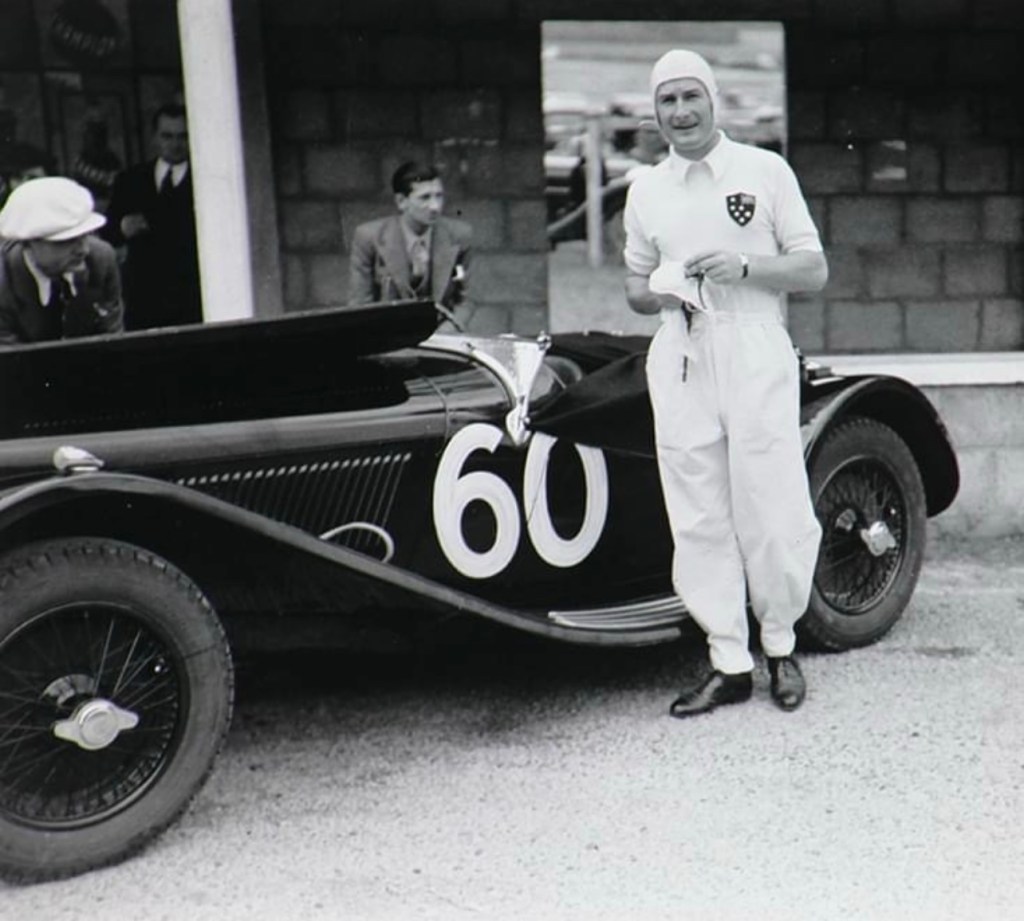
While the 11th Grand Prix de la Marne field was split into two classes as above, there seems little doubt that Australia’s cad, bon-vivant, gigolo, Olympian, and sometime occasional racing driver, Frederick Joseph McEvoy finished 15th of 21 starters in the July 5, 1936, 51 lap, 399km race.
McEvoy and 2663cc, OHV, six-cylinder SS 100 chassis #18007 (?) at Reims before the off. I wonder what club logo is on Freddy’s chest? (MotorSport Images)
I do find McEvoy a most interesting character, not long after I wrote this masterpiece: https://primotipo.com/tag/freddie-mcevoy/ a book was published about him. It’s worth a read albeit I cover McEvoy’s racing and alpine career more fulsomely than the book. By the way, McEvoy signed his name Freddy, not Freddie, so I’ll stick with that. It’s not Frank either…
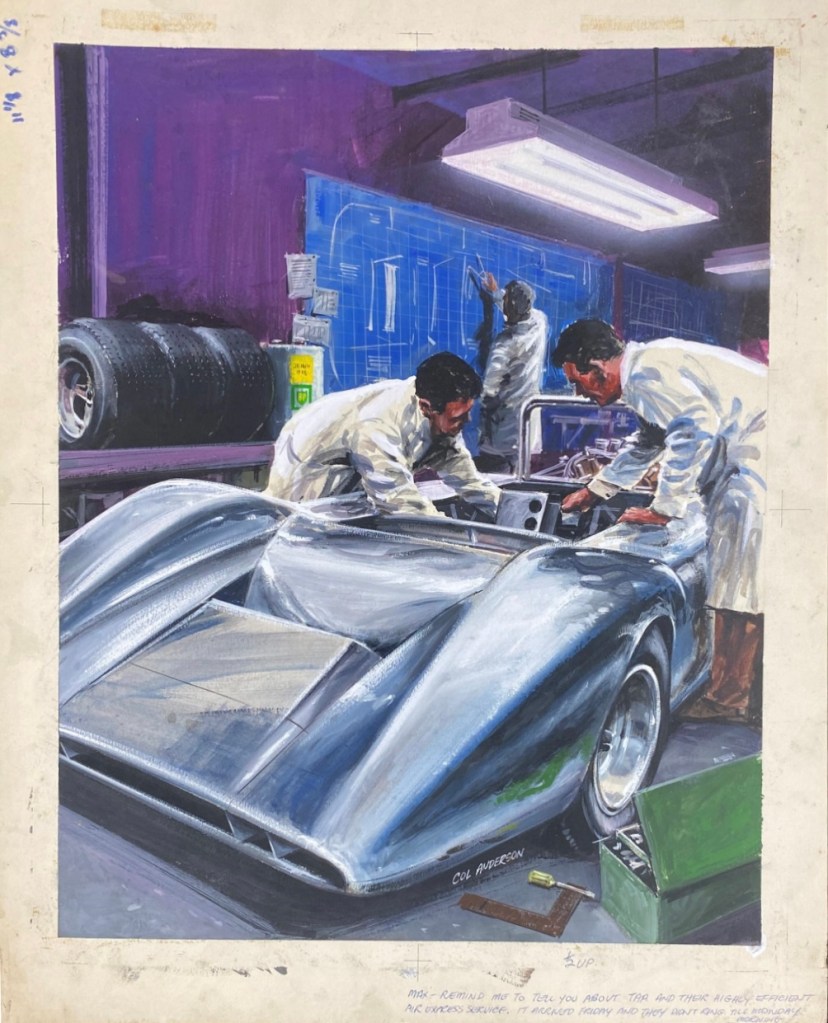
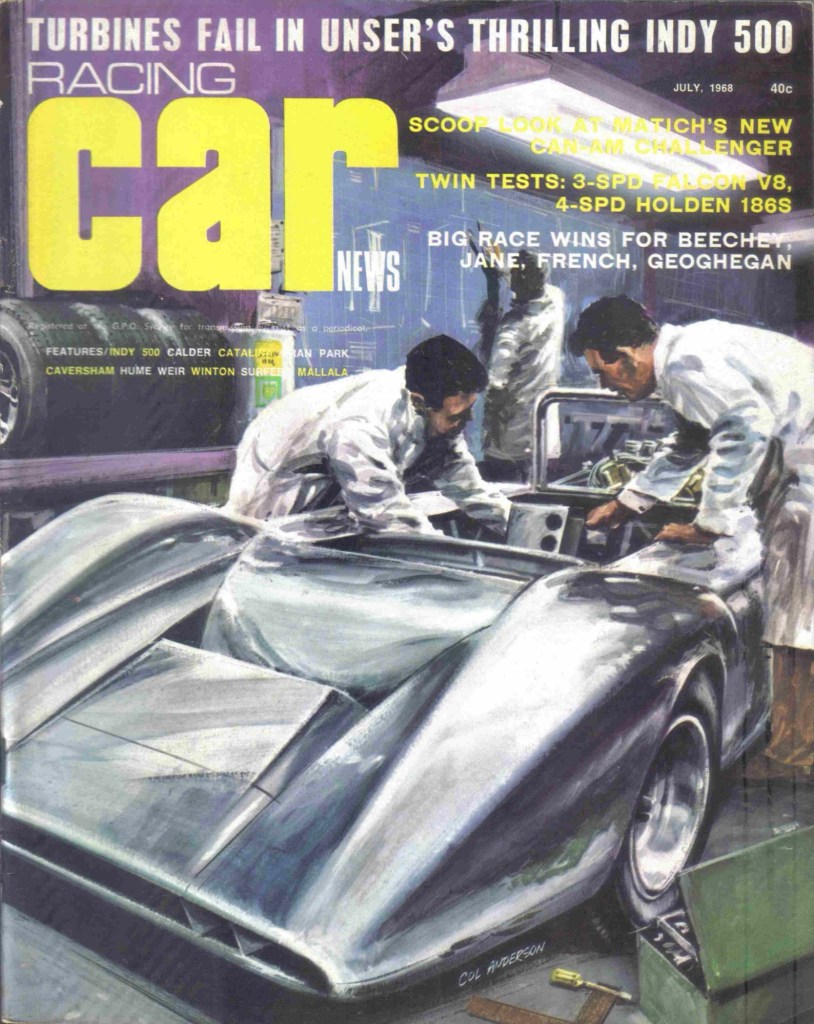
I’ve got Peter Finlay to thank for this piece. I was pondering the name of one of the artists who did the Racing Car News covers in the day on my Facebook page. I got the name right – Colin Anderson – and Peter included a link in his post that took me to this image, original artwork of the cover of the July 1968 issue, still some time away from the car’s first appearance I might say…
(S Dalton Collection)
Oh yes, the fine print on the bottom right of the artwork? Small-talk whinge from Col to RCN owner/publisher Max Stahl about TAA air-express and their shit service. Timelines being rather important and more complex in that pre-Internet age!!




























 primotipo...