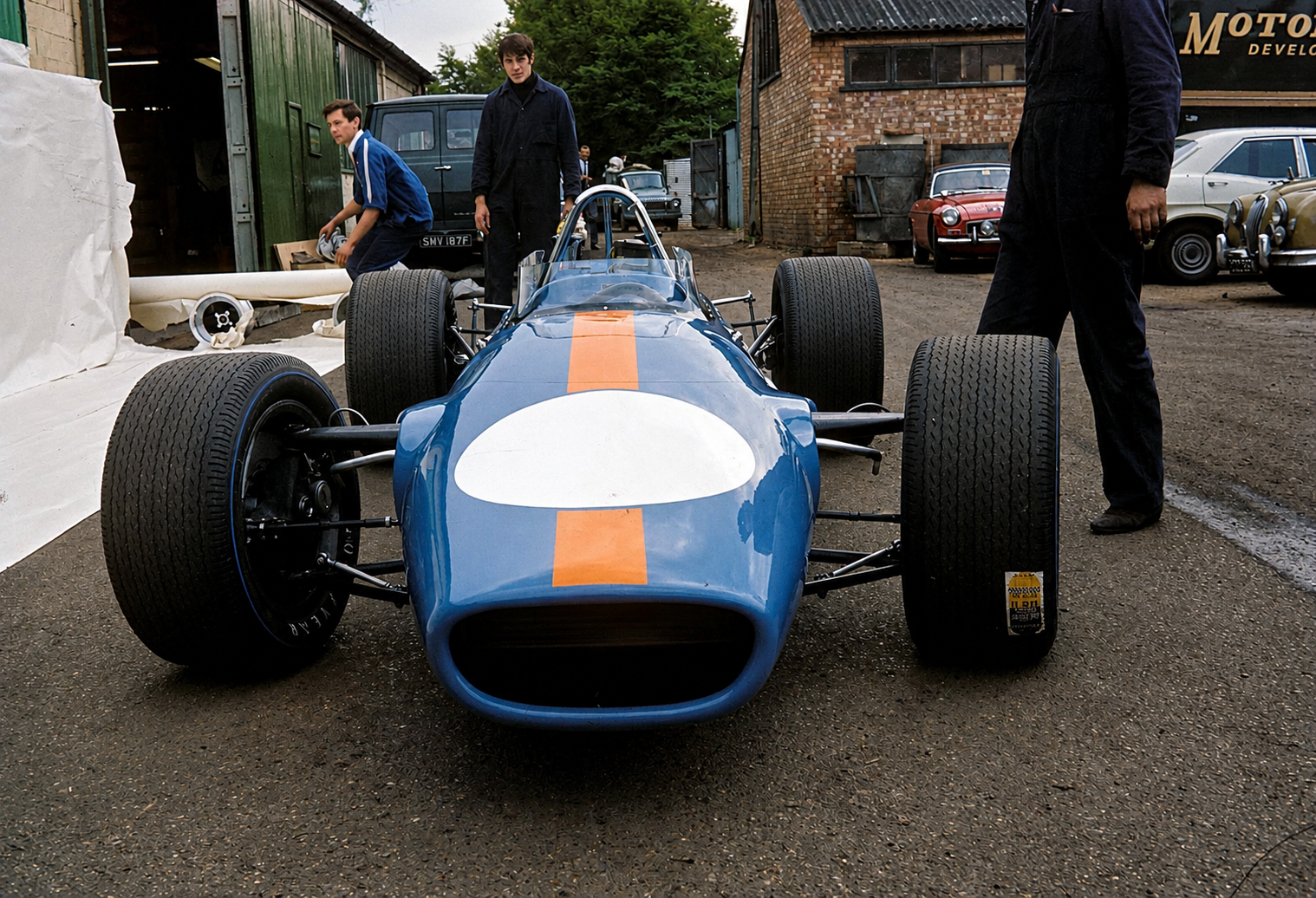
Motor Racing Developments’ first monocoque racing car, Brabham BT25-1 Repco Brabham 760 4.2-litre V8 Indianapolis 500 contender, breaks cover circa April 18- 22, 1968, not long before it was a-leavin’-on-a-jet-plane for Indianapolis.
The no-fuss press release comprised popping the car out front of the New Haw factory, backed by some enormous bits of paper (left), to ensure the photos ‘popped’ in MotorSport and Autosport. ‘Would you like a cup of tea, Mr Jenkinson, Mr Bolster? Don’t be too long, we’ve cars to prepare…’
While the first motor race won by a works-Brabham Repco was fitted with Repco Brabham Engines Pty Ltd’s simplest engine, the last was won by its most complex and publicly derided…
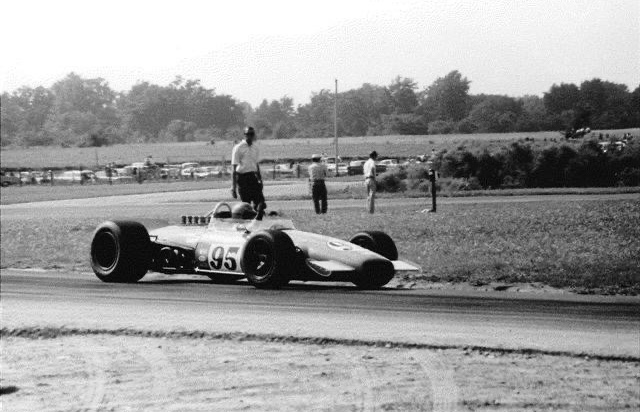
First and Last…
Peter Revson takes the plaudits of the crowd after winning the second heat of the Indy 200 in his Brabham BT25-2 Repco at Indy Racing Park in July 1969.
It was an important final win for the Motor Racing Developments, Brabham Racing Organisation and Repco Brabham Engines partnership which commenced five years earlier but had had a most troubled season in 1968 with both its 3-litre RBE860 F1 and 4.2-litre RBE760 Indy V8s.
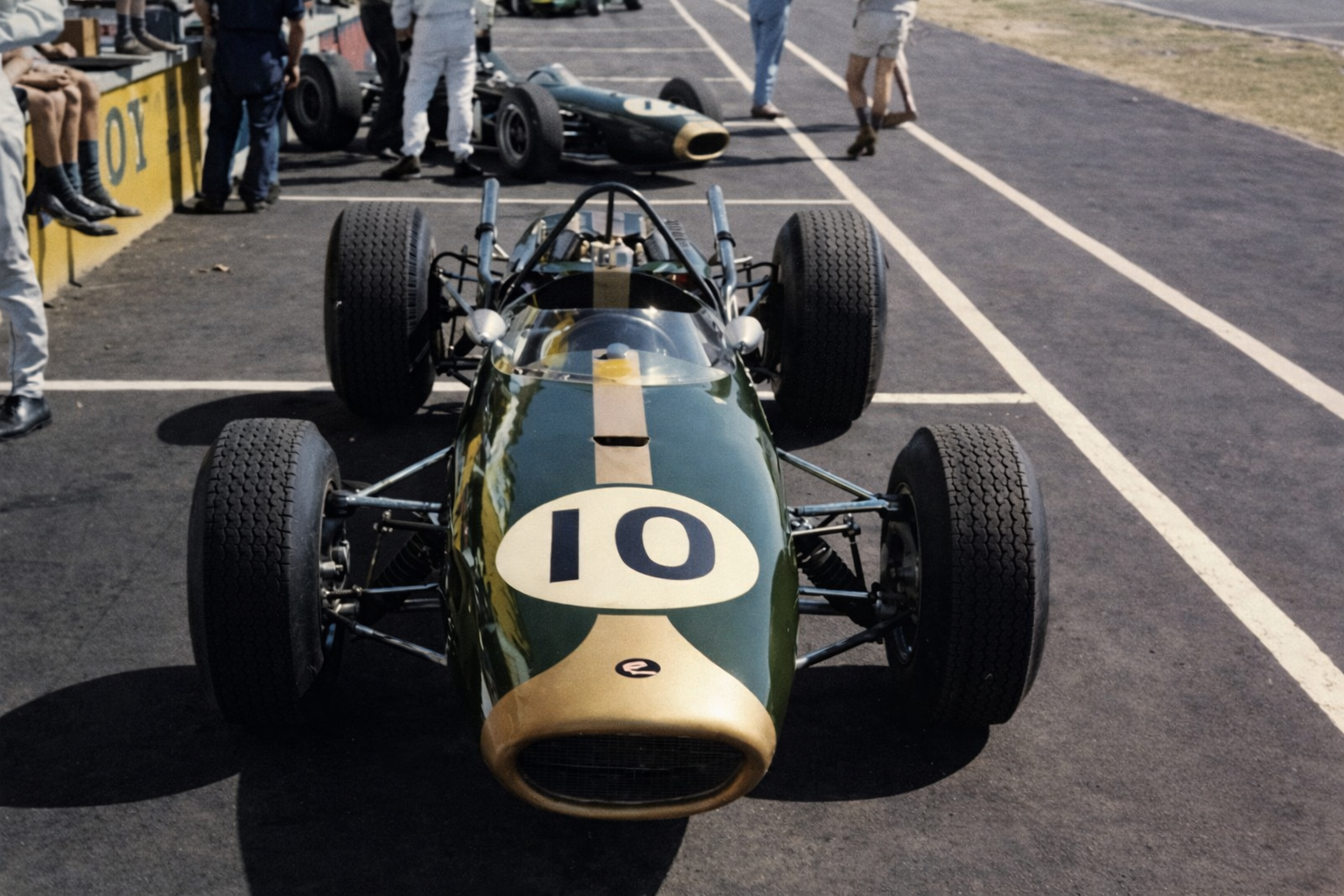
The first race in the partnership was with an RB620 3-litre engine designed by Phil Irving and built in Repco’s Richmond Engine Lab, then fitted aboard Brabham BT19-1, a chassis built over the winter of 1964-65 for the stillborn Coventry Climax FWMW 1.5-litre Flat-16 engine for the 1966 South African Grand Prix at East London.
Whilst a non-championship race it was an important step in blooding the engine before the first 1966 Championship race at Monaco in May.
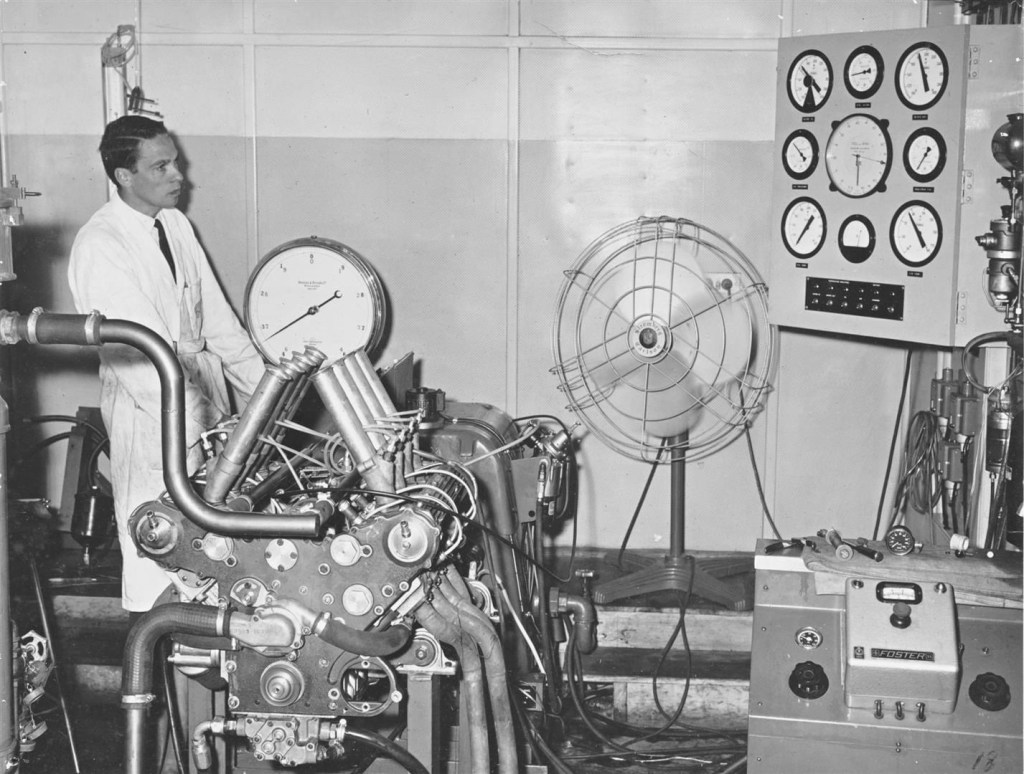
Ex-RBE engineer Nigel Tait checked the engine build sheets for E3, the 3-litre motor Jack used at Kyalami. Its first dyno runs were on November 12, 1965. Numerous tweaks were undertaken, the best tug being 279bhp @ 7,300rpm with the ignition set at 47 degrees BTDC.
The engine was air-freighted to England on November 16, then fitted to BT19 with exhausts made locally. Tested at Goodwood over 40 laps, Brabham’s best was a 1:17.3 compared to the existing lap record of 1:20.3.
BT19 was then shipped to South Africa, where Jack popped the car on pole and led by a good margin until nine laps from the end, when the metering unit cog belt came off; the lap record was encouraging! Phil Irving then redesigned the location of the metering unit to be within the engine’s Vee and driven from the rear of the jackshaft.
After Kyalami, BT19 was shipped to Melbourne, where the 2.5-litre 620 2.5-litre V8 engine E2 was fitted for the Sandown and Longford Tasman Cup events.
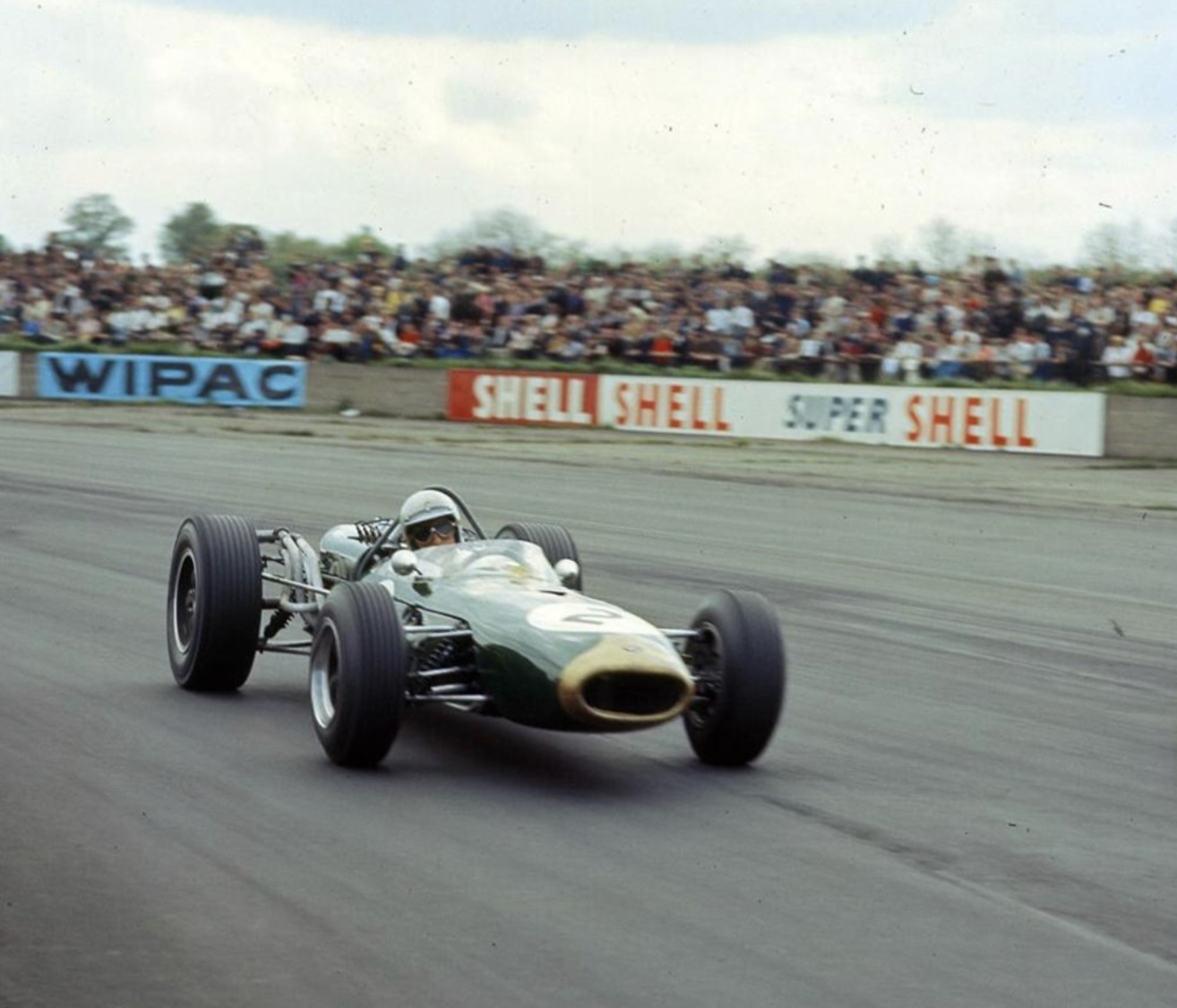
Then the busy chassis returned to the UK before heading to Italy for the non-championship race at Siracuse on April Fools’ Day, DNF after two laps, and then the BRDC International Trophy at Silverstone on May 14. Jack put BT19 on pole and won the 165 km race from the works Ferrari 312 of John Surtees and three Cooper T81 Maserati V12s. The rest of the F1 world was on notice despite a power output at the time that was 300 bhp at best…
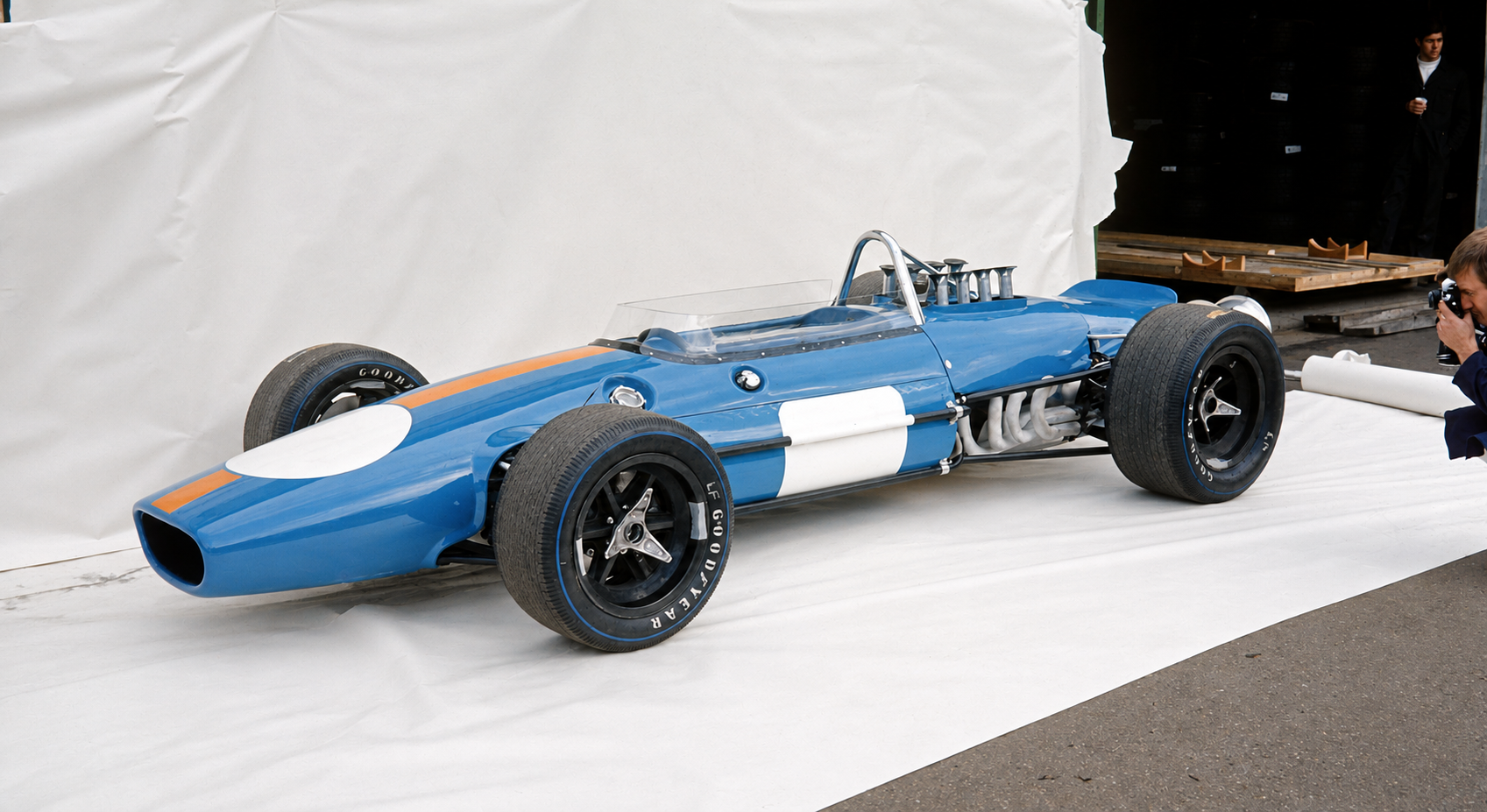
Brabham BT25 Repco 760 4.2 V8…
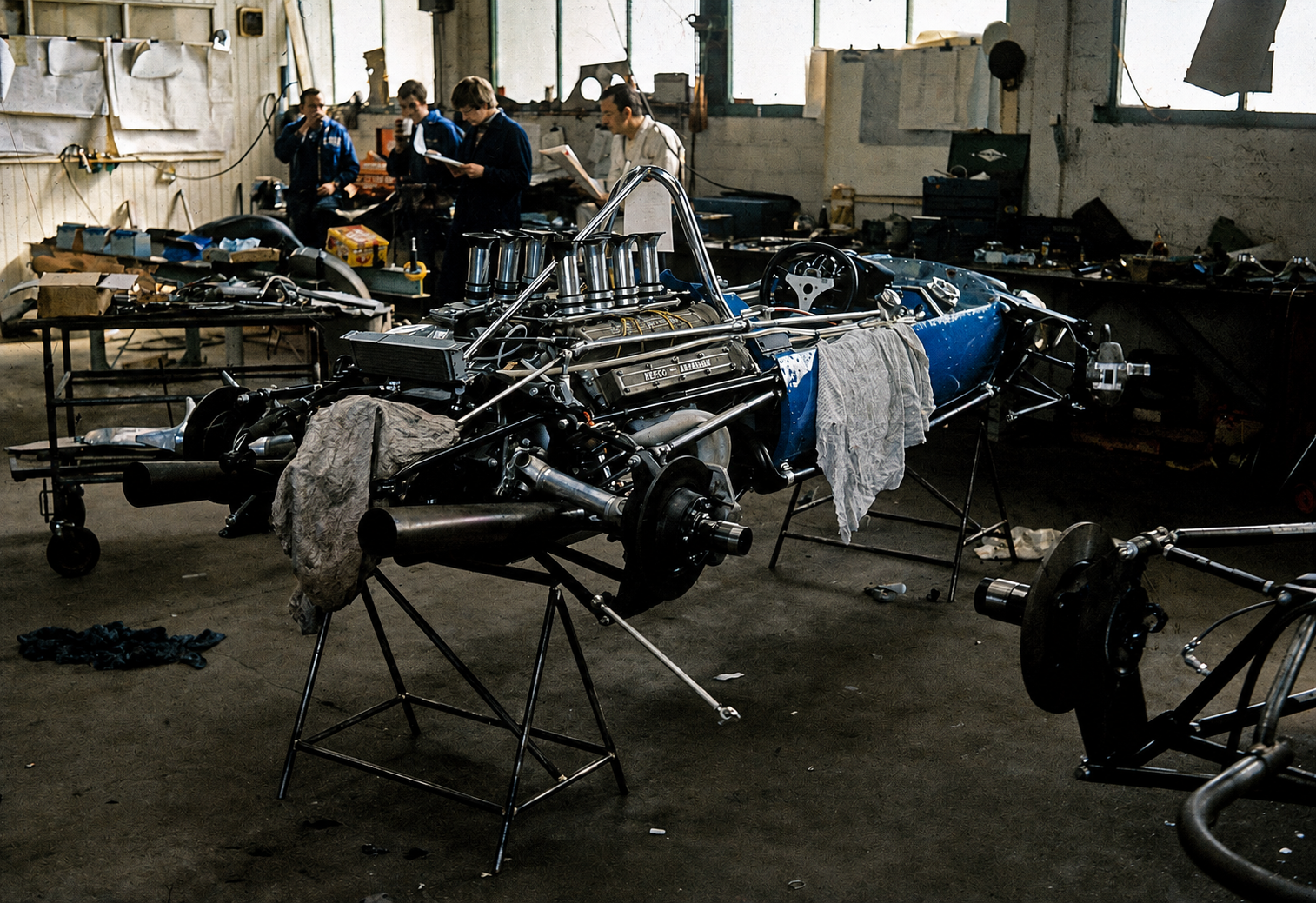
Motor Racing and Sportscar (MRS) wrote that the decision was made to build BT25 in April 1967, but that construction didn’t begin until that November.
The chassis of the car is notable as Ron Tauranac’s first monocoque design, as noted above. He built it to comply with USAC rules, which required bag-type fuel tanks enclosed within metal panelling. That was easier to package in an aluminium monocoque rather than one of his trusty spaceframes. Not that they were past their use-by date, Jackie Ickx won two Grands Prix in 1969 with the BT26 Ford DFV, which was so equipped.
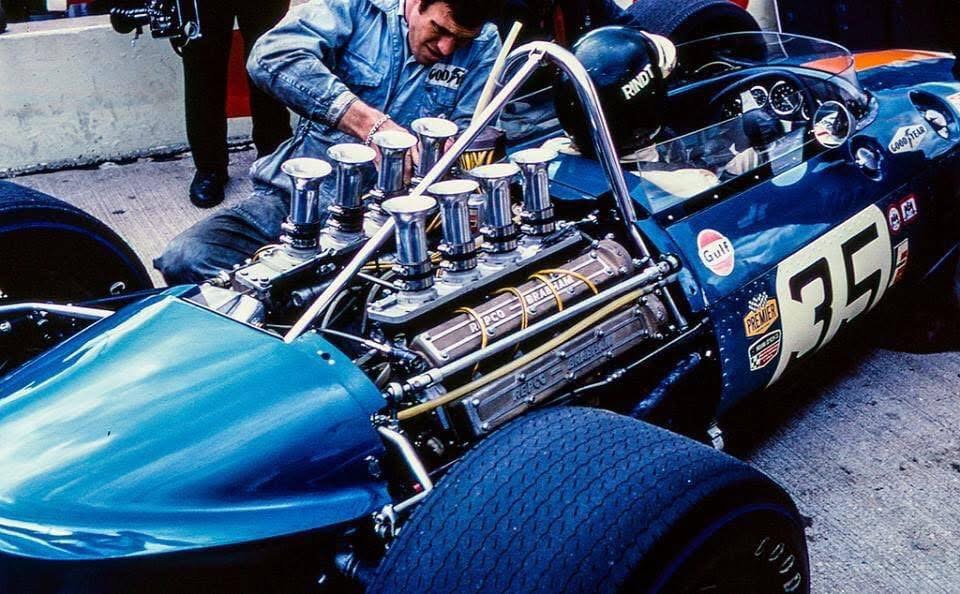
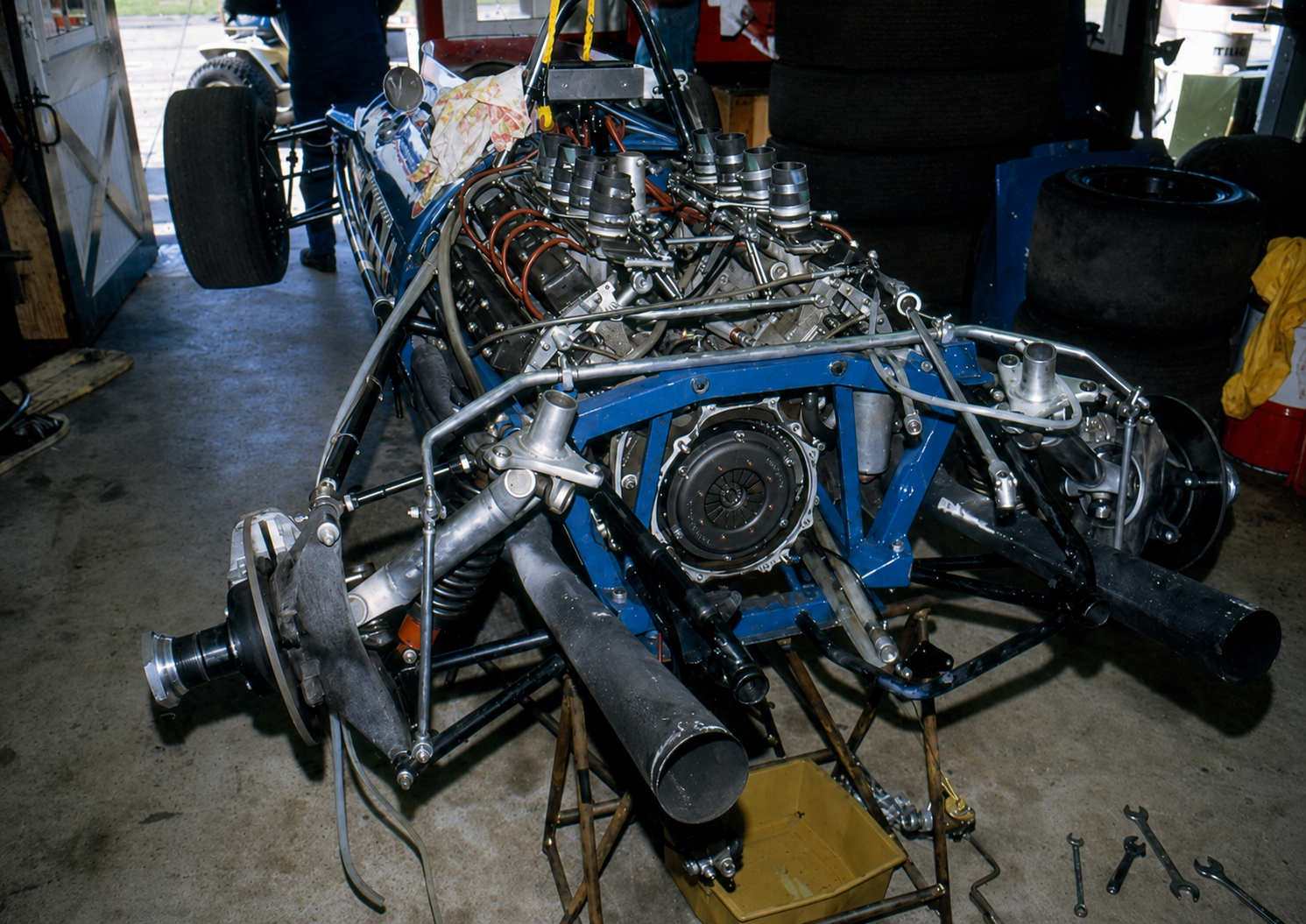
The engines are RBE760, that is, a combination of the 700 Series long block with 60 Series gear-driven, twin-cam, four-valve Lucas fuel-injected heads. The engine’s capacity was 4.2 litres, a bore of 96.2 mm and a stroke of 71.9 mm (4120 cc). Using methanol fuel, the engine’s output was quoted as circa 550 bhp @ 8,500 rpm. The gearbox was a Hewland LG600 five-speed transaxle.
Brabham and Cooper were the Indianapolis revolutionaries, of course. They tested one of their Grand Prix T53 Lowlines in October 1960, having been encouraged by Rodger Ward to do so during the 1959 US GP weekend at Sebring, and then returned with a bespoke Cooper T54 Climax the following May.
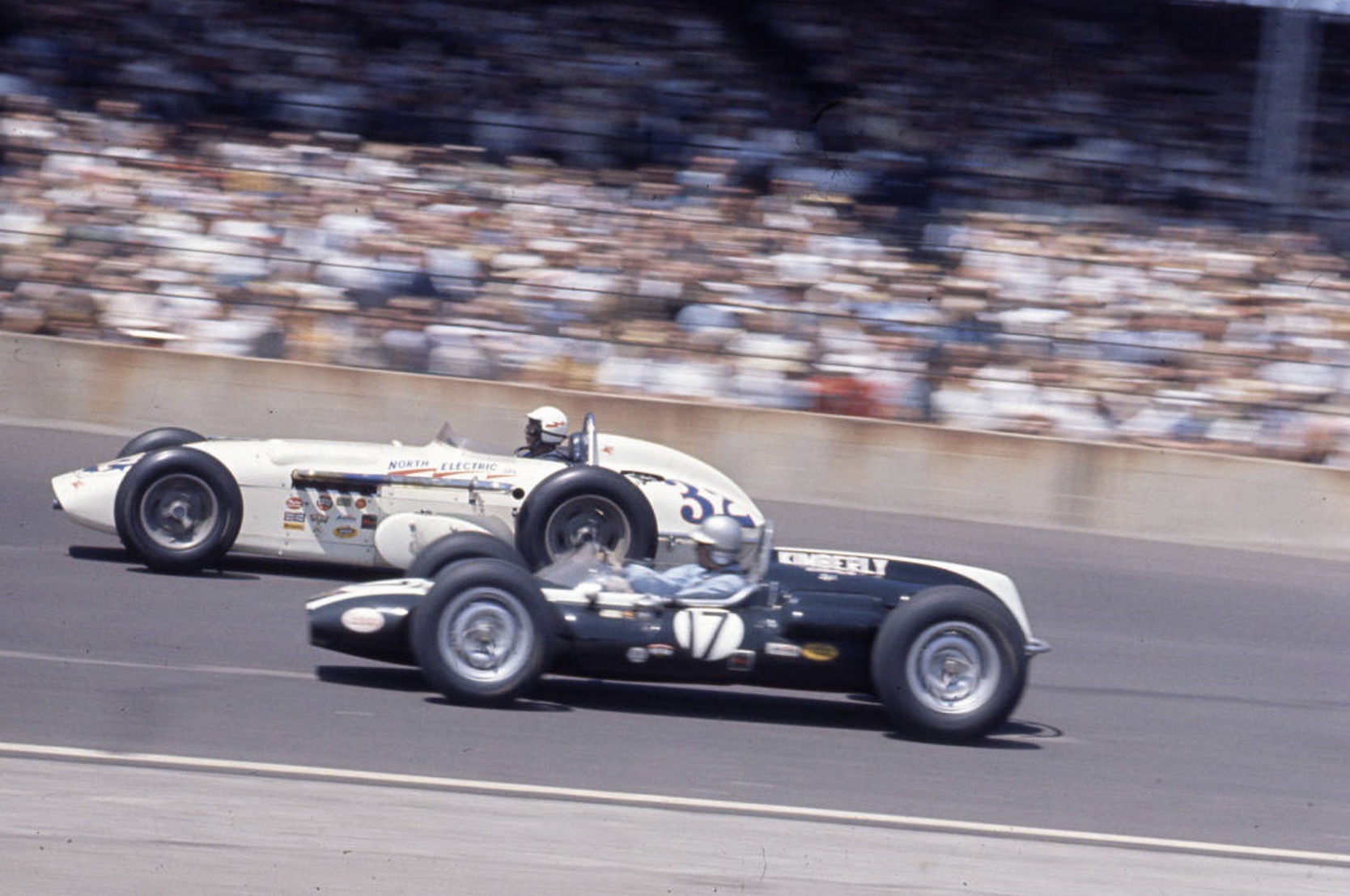
Leonard Lee was prevailed upon at Coventry Climax to build the biggest possible version of the FPF four-cylinder engine, which swept the F1 boards pretty much in 1959-60. By increasing the bore and stroke of the 2.5 FPF, they created a 251 bhp engine of 2.7 litres, well short of the 4.2 litre limit for normally aspirated engines; the Top Gun Offy of the day gave about 430 bhp.
Despite that, unsuitable Dunlops, and on a steep learning curve in every respect, including pitwork – one crewman cross-threaded a rear nut – Brabham finished ninth amongst the roadster leviathans and commenced the immediate trend to mid-engined cars. The 1964 Brabham BT12 Offy is hereby acknowledged, but is not a tangent for now, see here:https://primotipo.com/2022/12/10/brabham-bt12-offy/
Three RBE760 V8s were made for the Indy program: E34, E35 and E36. Rod Wolfe’s diary reveals that engine E34 came off the dyno on April 11, 1968. It seems reasonable to assume that the engine arrived at MRD on or about April 13-15, and that the car was tested at Goodwood about April 17-19, after which MRS reported that ‘Jack Brabham had fun testing the prototype at Goodwood before it was sent across the Atlantic, and found it exhilarating getting up to 170 mph half-way down the straight!’
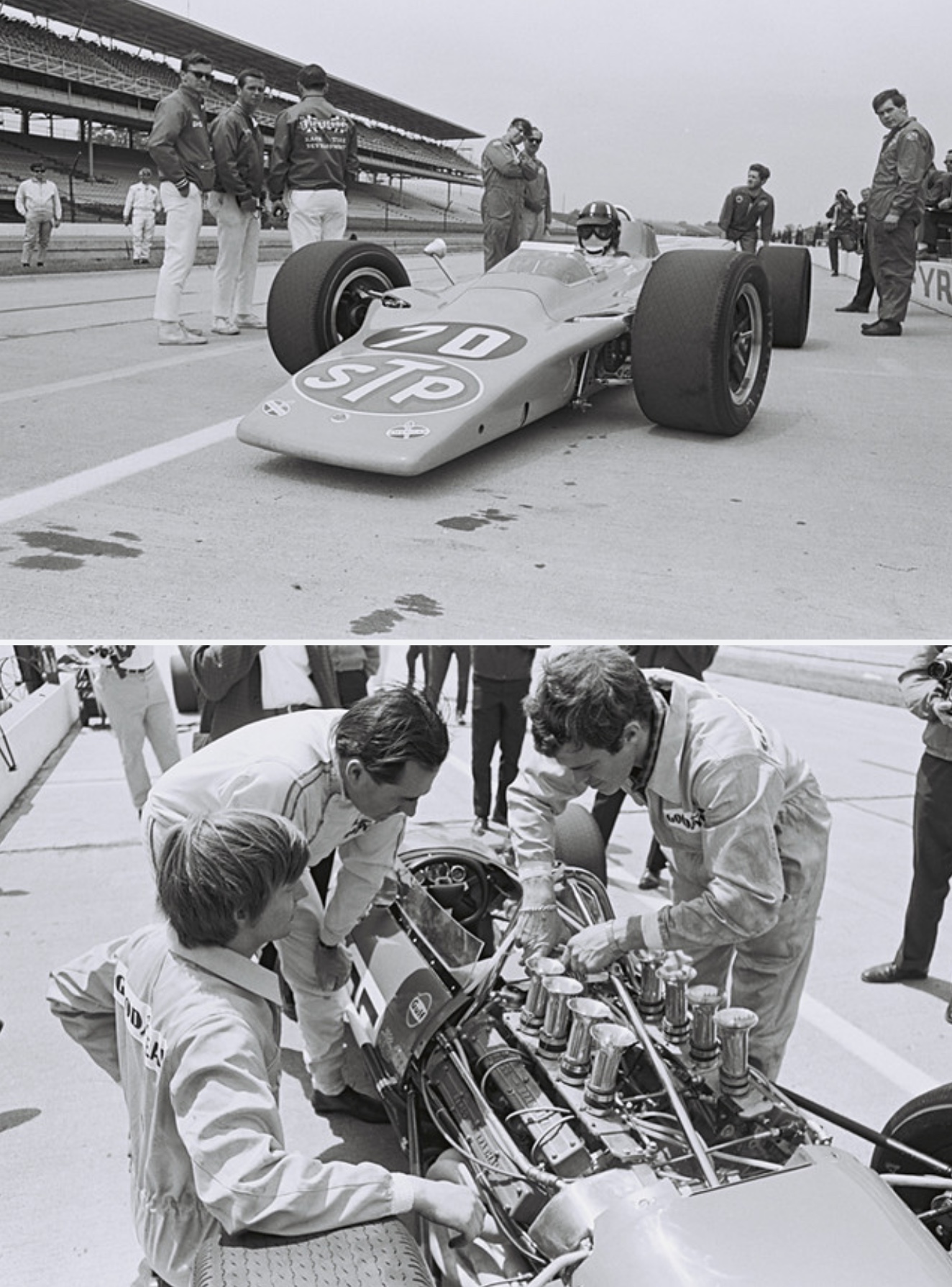
When Jack and Ron fronted up to the laborious month-long Indy carnival in May 1968, the abject engineering conservatism of 1961 had been replaced with some very edgy technology, the prime example of which was the outrageous Lotus 56 ‘wedge’ powered by a Pratt & Whitney gas turbine engine and putting its power to the road via all four driven wheels.
The utterly conventional Brabham/Repco Brabham Engines response was no disadvantage at all. Bobby Unser won in an Eagle powered by a 2.8-litre turbocharged Offenhauser DOHC four, the first win for a Turbo, whilst Dan Gurney was second in an Eagle 68 powered by a stock-block 5-litre Gurney-Weslake Ford V8, then came Mel Kenyon in a Gerhardt Offy t/c followed by Denny Hulme in the other works Eagle 68 powered by the Ford DOHC Indy 4.2-litre V8.
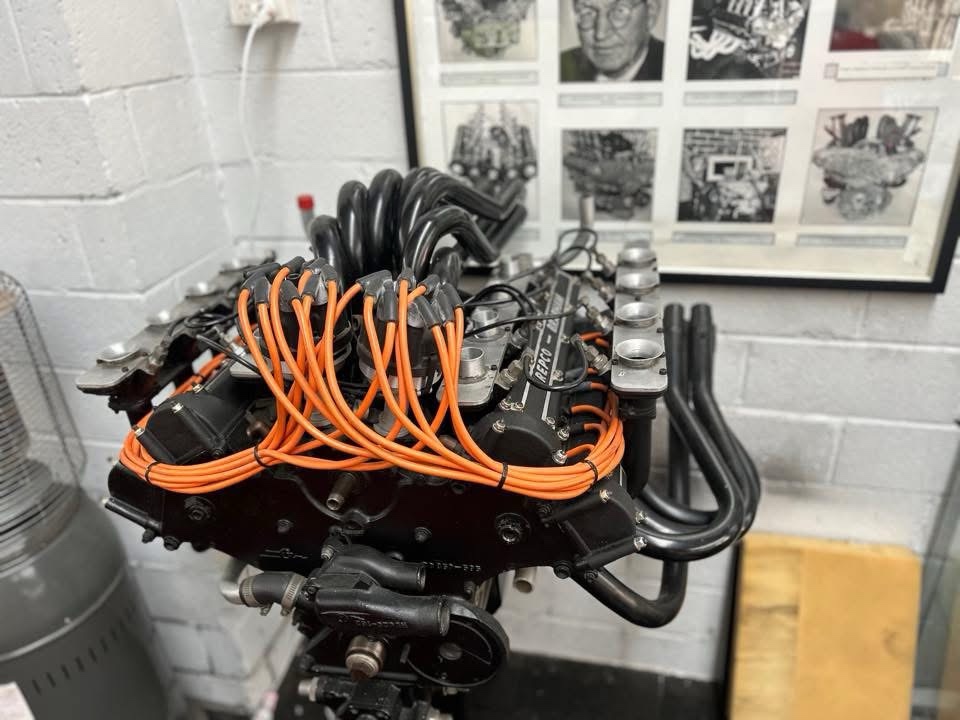
In search of the ‘Unfair Advantage’, with the new, powerful Ford Cosworth DFV V8 in his mind, RBE General Manager Frank Hallam sought to bridge the performance gap with a radial valve head design which used four diagonally opposed valves above each piston.
Way too much time was spent on this direction, Hallam pushed the 850 long after his Chief Engineer, Norman Wilson, told him he was flogging a dead horse. The motor simply did not make sufficient power wherever the plugs were placed and whatever timing was tried. And that, apart from the installation issues of inlets and exhaust pipes at all kinds of angles, presented a difficult challenge for chassis designer Tauranac, who had made his position clear to Hallam.
Finally, in November 1967, with time very much against them, RBE decided to use the conventional four-valve, crossflow ’60 Series heads’ drawn by John Judd with Wilson looking over his shoulders. For F1, 3-litre, use a shorter 800 Series block made from aluminium and magnesium alloy designed by Wilson as their 1968 F1 engine. The 4.2 Indy used the 700 block introduced by RBE in 1967.
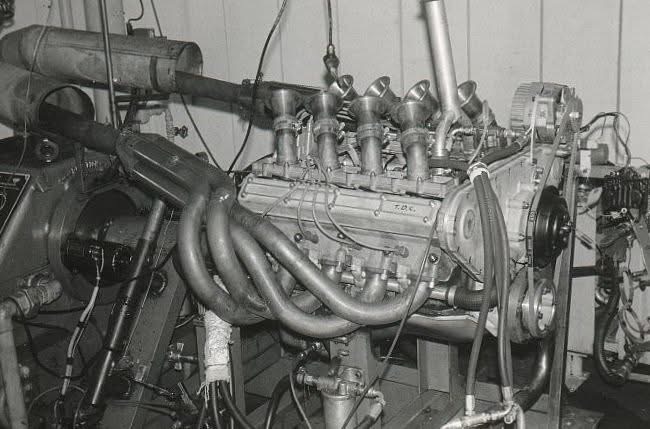
Loaves and Fishes…
Much time had been lost, too much time, and Repco were stretched ridiculously thin in 1968.
They had a one car Tasman Cup machine to power for Jack in the Australian rounds, a two car F1 program, two car Indy 500 commitment, Australian customer 2.5 and 4.4-litre engines to service, 4.8-litre and 5-litre sportscar engines to build for Frank Matich to race in the Can-Am Series, engine performance kits to construct for the Volvo 120 sedan and a contract with Pontiac to build five Trans-Am V8 prototype engines by 1 January 1969. All of this with a headcount of 59 in May 1968.
Hallam tried to serve too many masters as above, he, and/or the Director to whom he reported, Bob Brown, should have said ‘No Way’ to some of these opportunities. The decision to pursue the radial-valve 850 engine for too long came at the expense of sufficient dyno time for the 860, so the 1968 F1 program was a disaster in every respect.
860 engines went snap, crackle and pop all over Europe and North America, albeit Jochen Rindt proved the Brabham BT26 Repco ‘860’s speed with three front row starts, including one pole, Matich missed the Can-Am completely (not that the SR4 chassis was ready anyway), and Jochen Rindt’s Indy start in BT25-1 was over after five laps with piston failure due to fuel mixture issues and resultant detonation…
Jochen easily qualified with a lap of 164.144 mph set on Sunday, May 19, but he was well shy of Joe Leonard’s Lotus 56 P&W pole time of 171.6 mph.
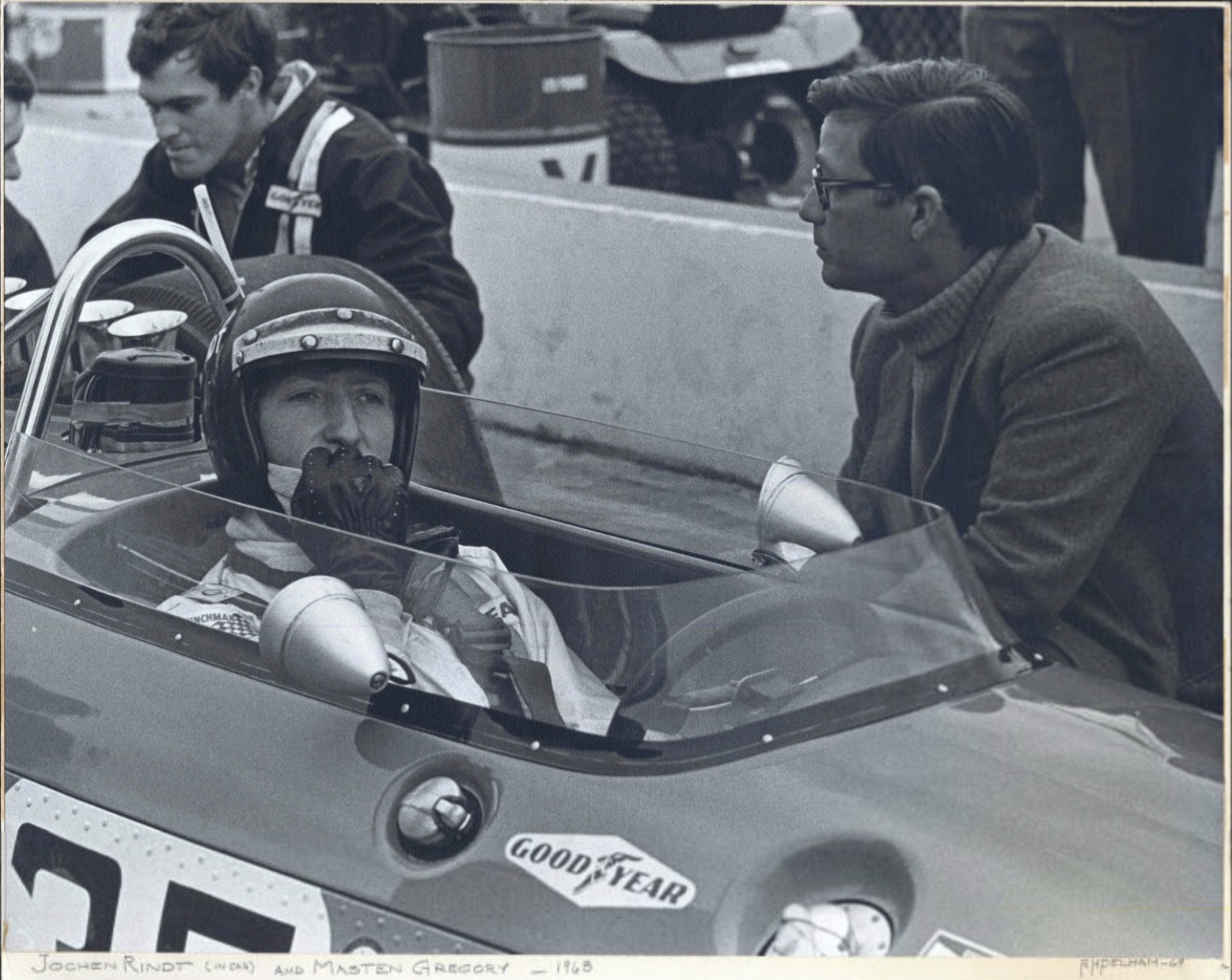
Jochen’s 1965 Le Mans teammate, Masten Gregory, the pair won the race in a Ferrari 250LM, didn’t make a qualifying attempt in BT25-2 as the car was late (it arrived on May 19) and not best placed to have a crack at that mighty challenge. Jack alternated between the two cars with his vastly experienced onboard computer diagnosing what the cars needed to improve.
No doubt Repco – and Goodyear, who sponsored Brabham’s Indy program – were more than miffed that Jack did not compete, given Indy was one of the ‘commitments which broke the camel’s back’ of the F1 program, which was far and away the most important to both BRO and Repco. Betty Brabham was well aware just how lethal the Indy 500 was at the time and ‘banned’ Jack from the race, albeit the wily character tested BT25 at Indy anyway…
In short, by mutual amicable agreement, the BRO/Repco F1 partnership ended after the 1968 F1 season. In 1969, the final events the two companies agreed to contest were an Australian Gold Star race at Mount Panorama that Easter – Brabham won it in Repco’s Brabham BT31 830 2.5 V8 – and three fixtures in the US: the Indianapolis 500 and the Indy 200 on the road course at Indianapolis, and the Rex Mays 300 at Riverside at end of the season.
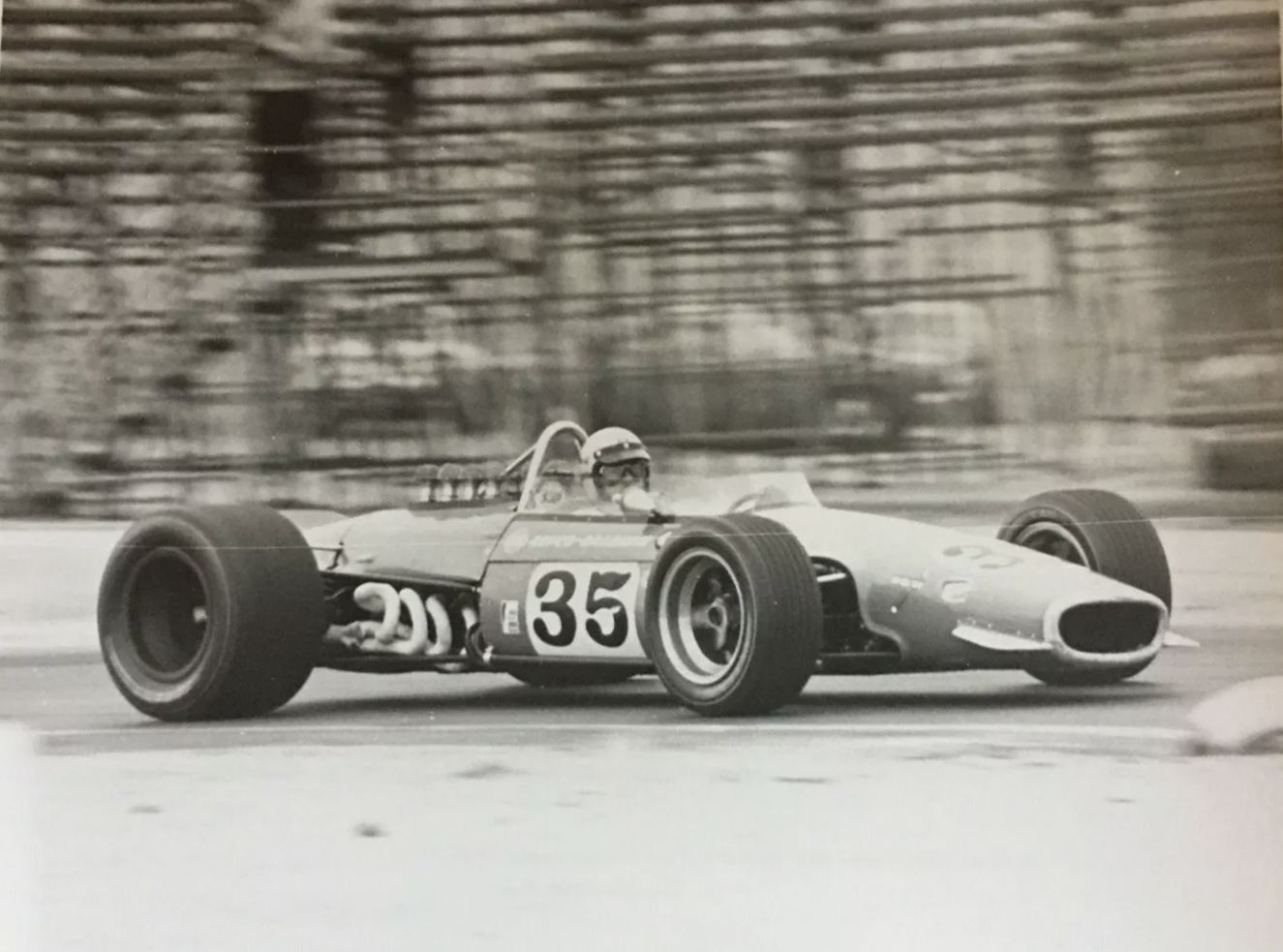
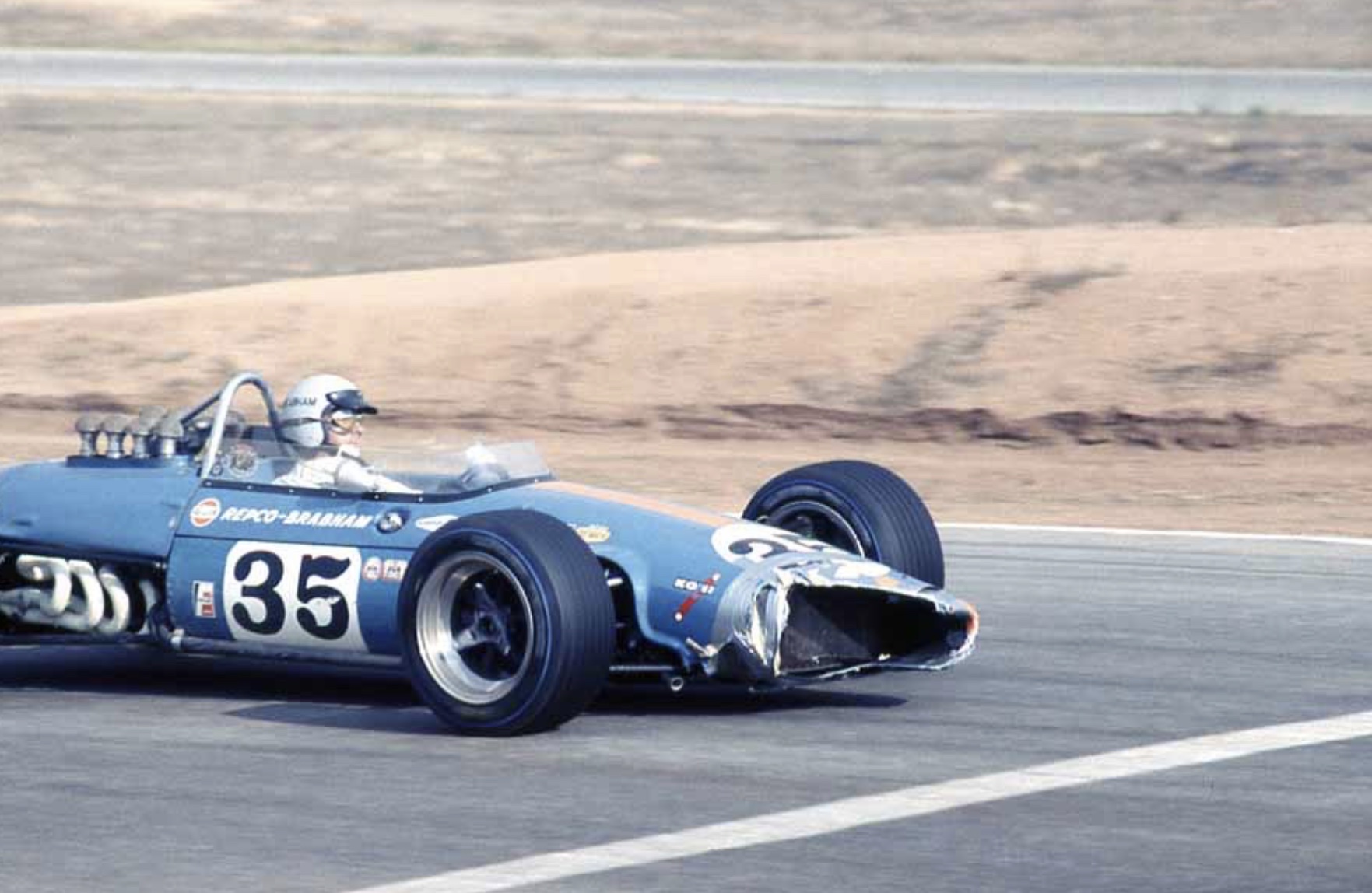
Perhaps with an eye to 1969, Brabham contested the very last ’68 USAC Champcar race, the Rex Mays 300 at Riverside, a road circuit he knew well.
He popped the car sixth on the grid and ran well, but smote another car or a bit of the real estate and withdrew due to an oil leak after completing 27 of the 116 laps. Dan Gurney was up front in an Eagle Ford.
In the Spring of ‘69…
Jack convinced Betty he should drive at Indianapolis in 1969, which would have been an interesting chat over the morning’s toast, Vegemite and Coco Pops, with Jack engaging Peter Revson to drive the other BT25. The two fixtures in the US were the Indianapolis 500 on 30 May and the Indy 200 at Indianapolis Raceway Park on 27 July.
At the time, the talented Revlon heir was putting in good performances in Can-Am and USAC cars but was still regarded as somewhat of a dilettante, but after his marvellous fifth place from the rear of the grid at Indianapolis, pit-pundits took note.
Plenty of development at Maidstone turned the under-developed ’68 525-535bhp @ 7600rpm 760 4.2 into a competitive 550-560bhp @ 7800rpm engine in 1969. The focus (see Bibliography) was primarily on four areas: induction and mixture distribution problems, head changes, lubrication and crank, and cooling.
The Indy inlet manifold had uneven runner lengths and uneven mixture distribution at high RPM, with cylinders 2 and 7 running lean at sustained high load. Repco addressed this by reworking the inlet tracts and improving injector placement. More stable combustion allowed more ignition advance, better throttle response and ensured the engine ran reliably at higher RPM.
The heads came in for attention, too. Valve springs had proved marginal over 7000rpm, and the cam profiles were conservative to look after the springs. Improved spring metallurgy allowed more aggressive cams, while revised head castings (from Clisby in Adelaide) incorporated improved oil-return galleries to address slow oil drainage from the heads.
Improved crankshaft counter-weights, revised main bearing oil feed and better torsional damping resulted in less bearing wear and smoother running which gave the drivers the confidence to run the engine harder.
The quad-cams generated more heat than the SOHC Repcos so oil temps crept up. The fix was a mix of oil pump capacity, oil gallery routing, scavenging efficiency and the cooler layout.
Ron didn’t let the grass grow under his feet in terms of BT25 chassis development either.
Wider – slightly – fuel tanks were incorporated, and internal baffling was improved to enhance fuel pickup. RT revised the upper nose profile a tad and improved radiator ducting within it. Structurally, the front bulkhead was stiffened to improve steering precision on the ovals.
Front and rear suspension geometry came in for attention, too. Up front, minor changes were made to the upper pick-up points to finesse anti-dive characteristics and afford better stability over bumps. Brabham had diagnosed some flex from the rear, the fixes comprised reinforced rear radius rod mounts and heavier-gauge tubing for the gearbox cradle
In July, he gridded up at Indy Racing Park with a fresh 760′ for the two 100-mile heats, the combined results of which, comprised the Indy 200.
He was third in the first heat behind Dan Gurney’s Eagle Ford and Al Unser in a Lola Ford and won the other from Mario Andretti in a Brawner Ford and George Follmer’s Cheetah Chev. Revvies’ performances were beauts, the field also included AJ Foyt, Gordon Johncock, Lloyd Ruby and Art Pollard, there was no shortage of depth in the field.
These results for the 760 engine in the United States and crushing performances against light opposition by Frank Matich’s 4.8-litre 760-engined Matich SR4 sports-racer in Australia in 1969 were hugely important to the RBE team as they vindicated an engine – the 3-litre 860 – dismissed as a failure.
860 failures documented by Frank Hallam include dropped valve inserts, fuel pump, broken camshaft, centre main bearing, gudgeon pin, conrod, cam-follower, lubrication system and most critically, torsional vibrations in the gear-train of the type Cosworth experienced with the early 3-litre Ford DFV V8s.
All of these problems could have been solved with development; indeed, the fact that Revson completed 500 miles at Indianapolis and another two races of 100 miles suggests the problems were solved. A 3-litre 860 indeed finished two races, both Rindt and Brabham finished at the Nurburgring, a wet race in which gentler throttle applications aided engine longevity.
Finally, some sources write that the 760 did not have torsional cam gear vibration because the engine wasn’t revved as hard as the 860, but the power quoted by Repco for each engine is 500 bhp (760 4.2 litre) and 400 bhp (860 3 litre), in both cases, the outputs were produced at 8,500 rpm…
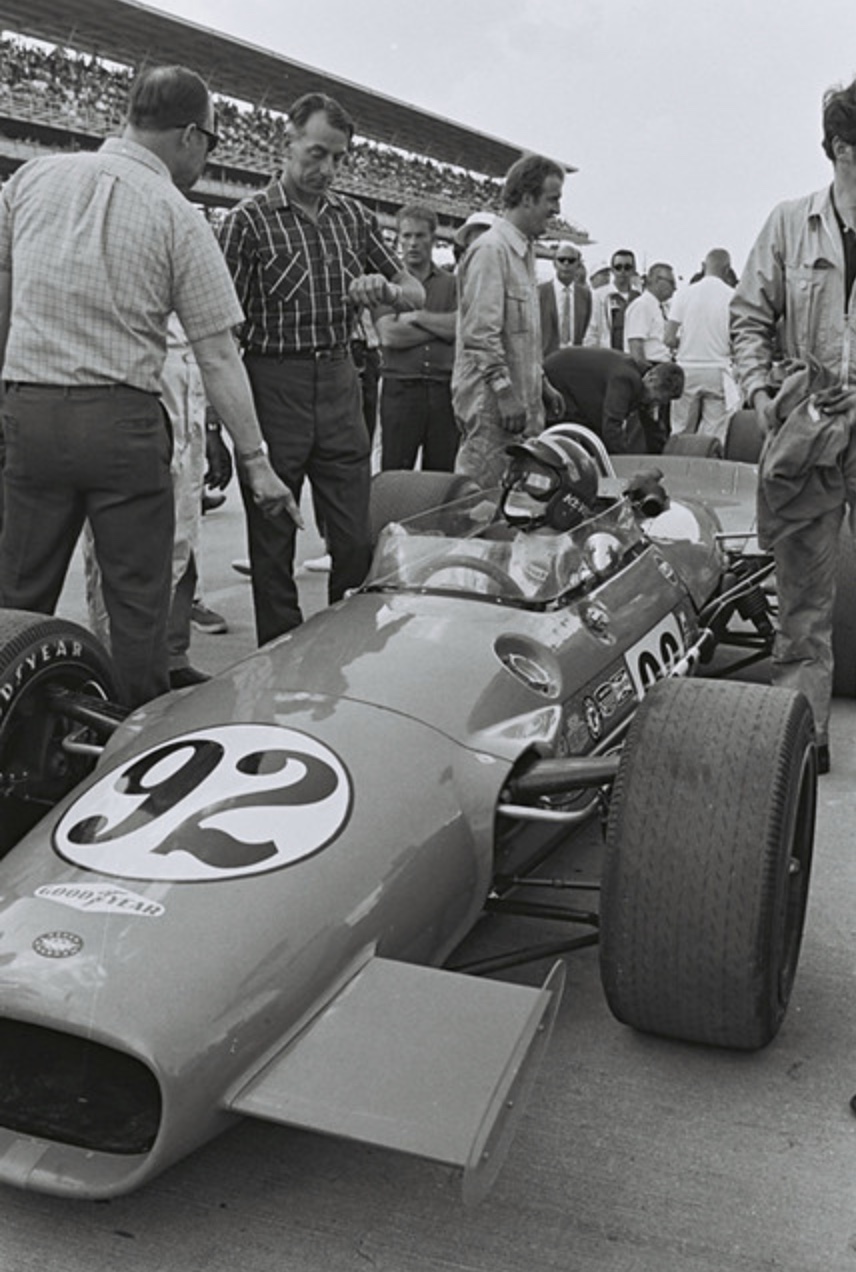
Ron Tauranac and Peter Revson in BT25-1. Note the differences in the nose of the 1969 cars compared with the year before.
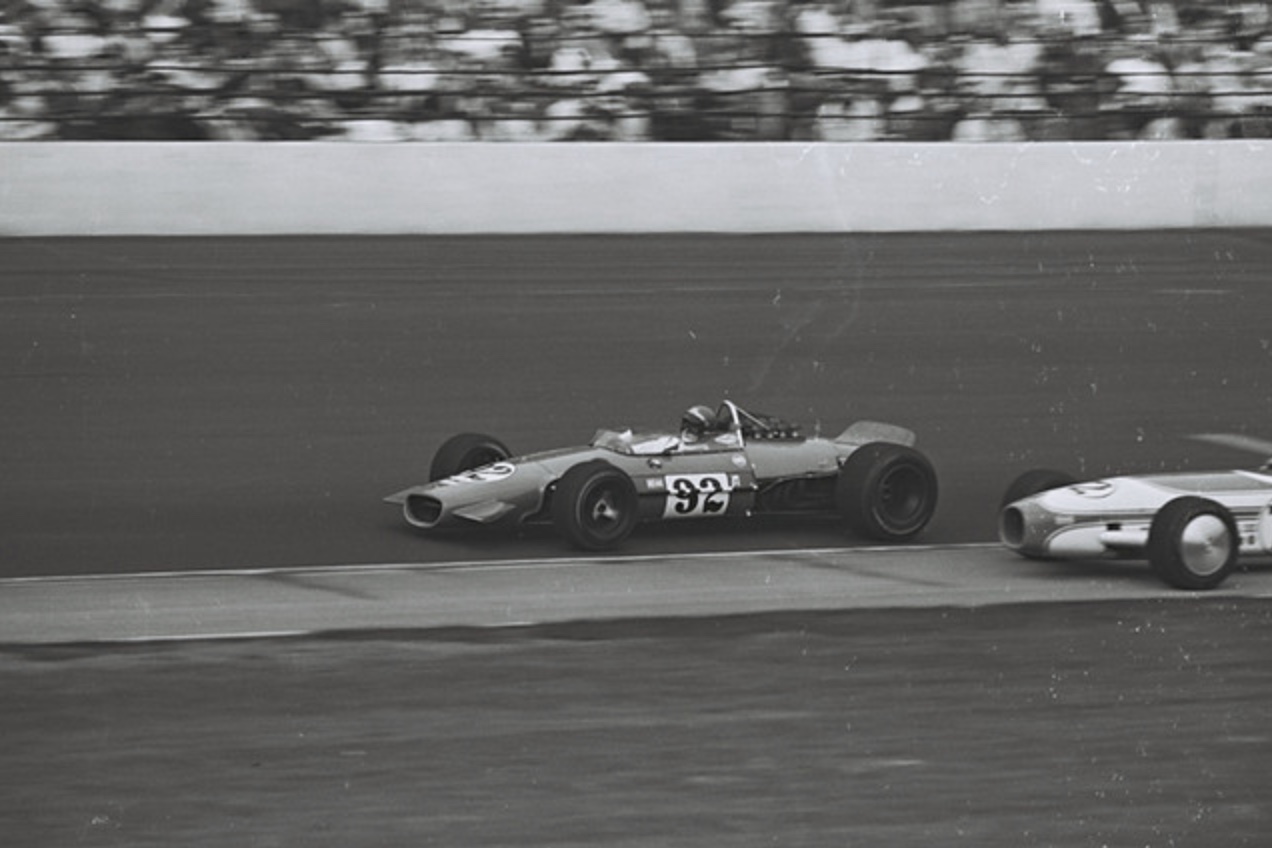
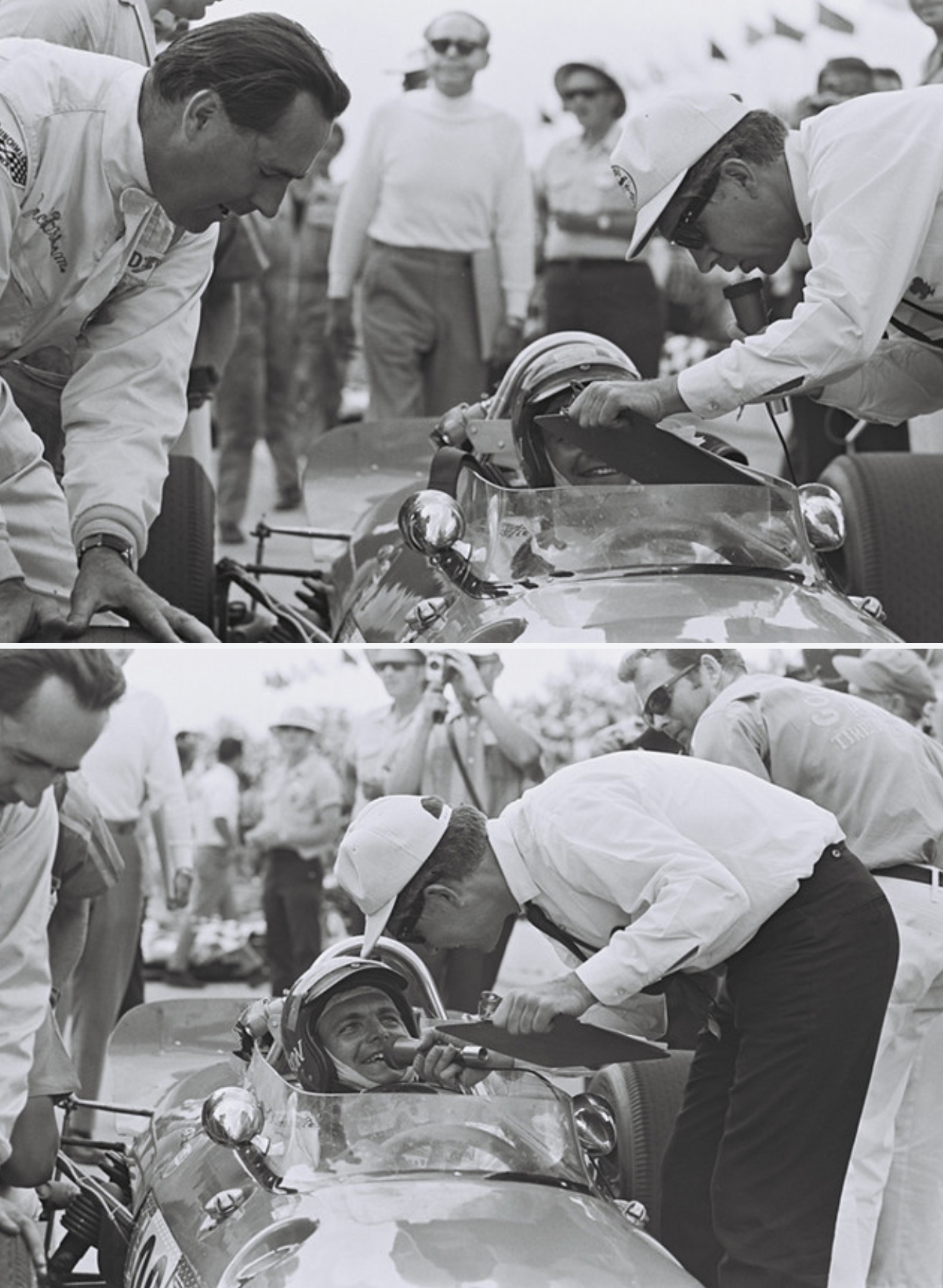
Allen Brown’s Old Racing Cars full chassis by chassis race record of the BT25s is here:https://www.oldracingcars.com/brabham/bt25/
Etcetera…
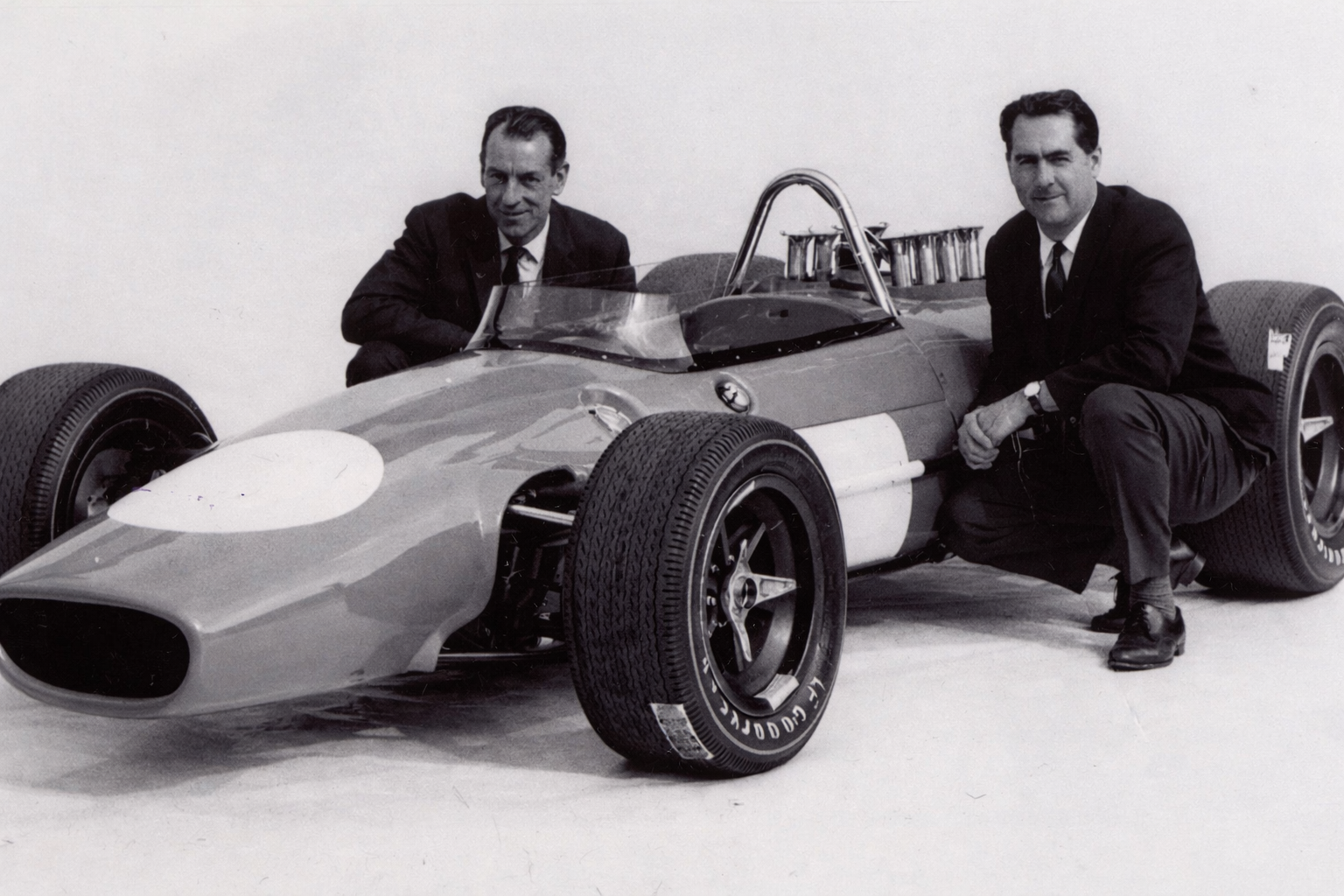
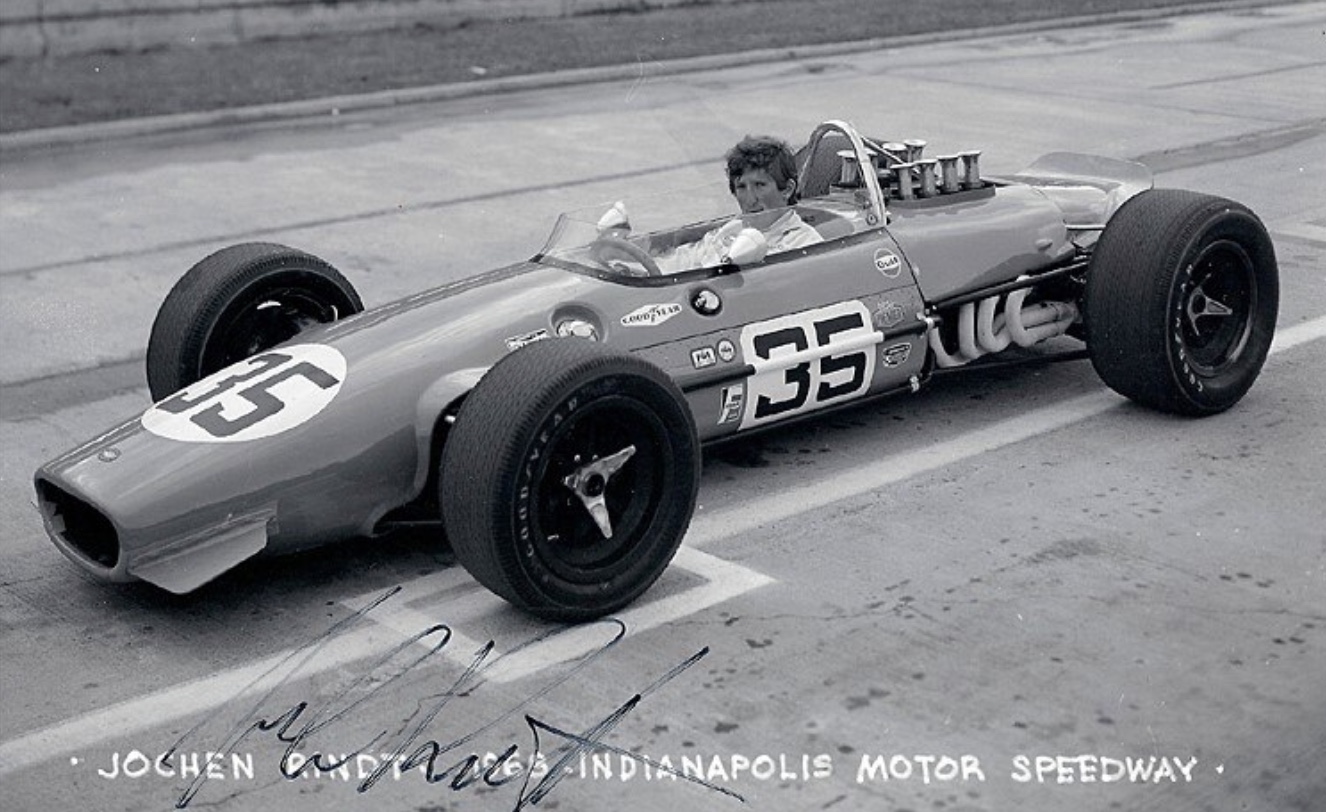
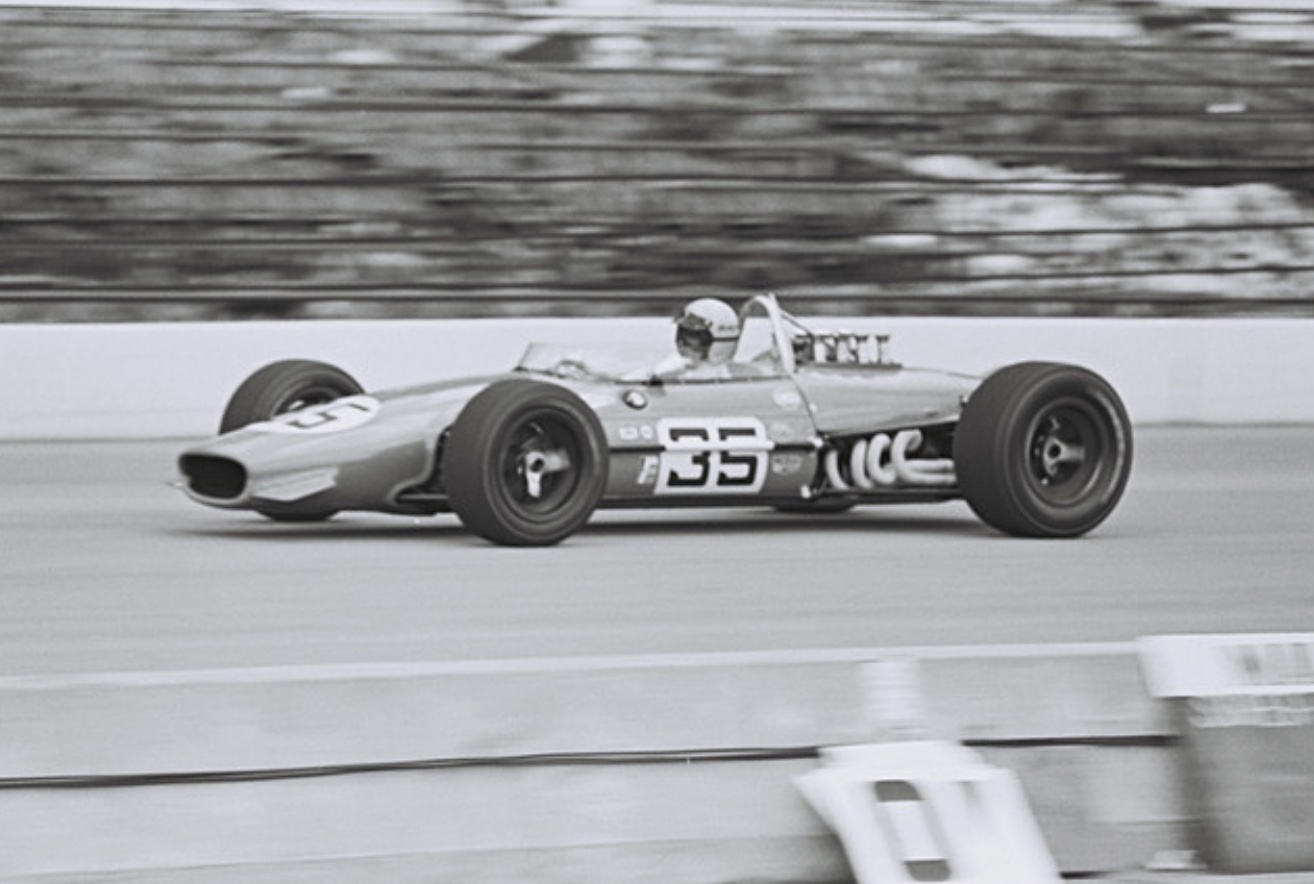
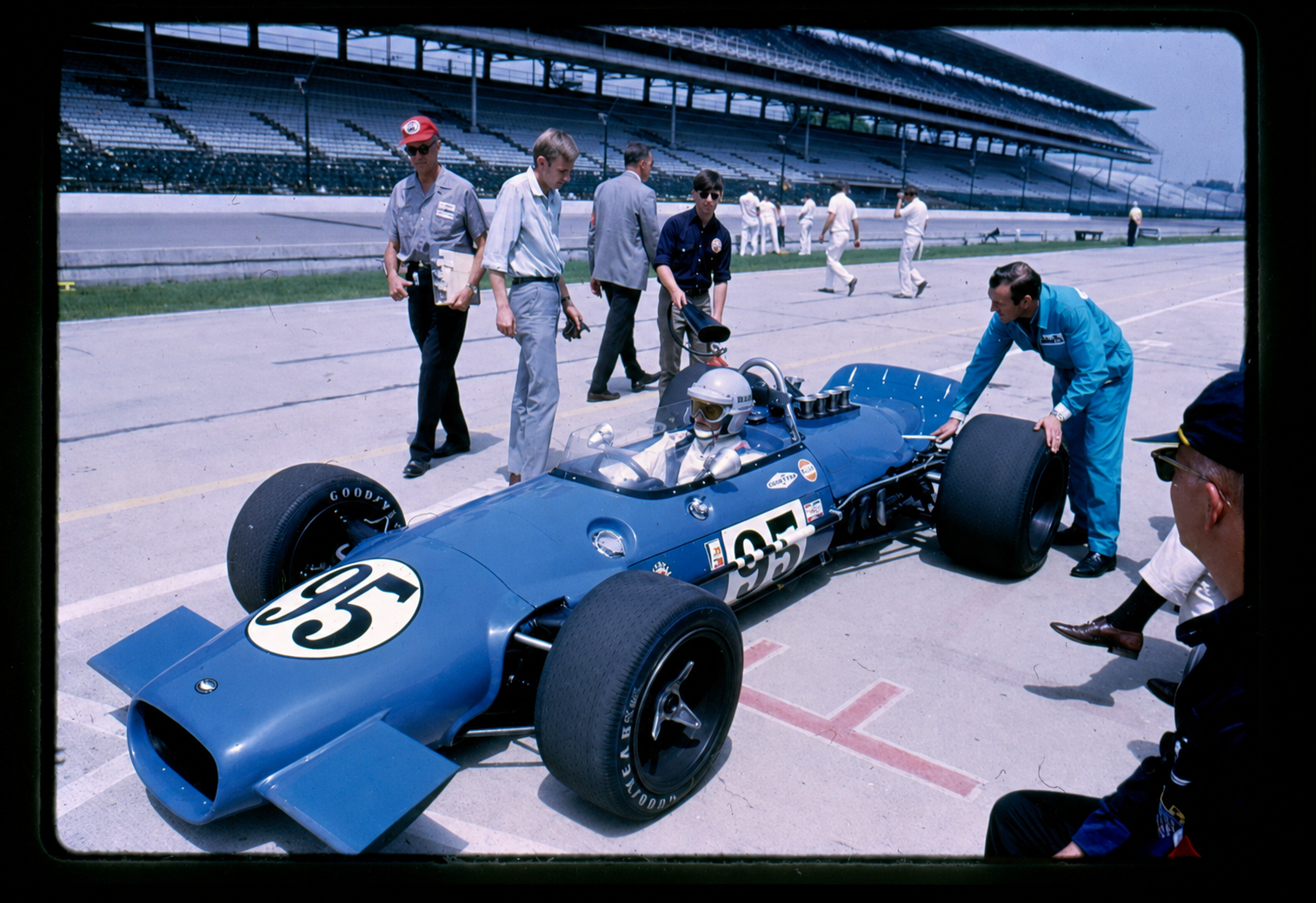
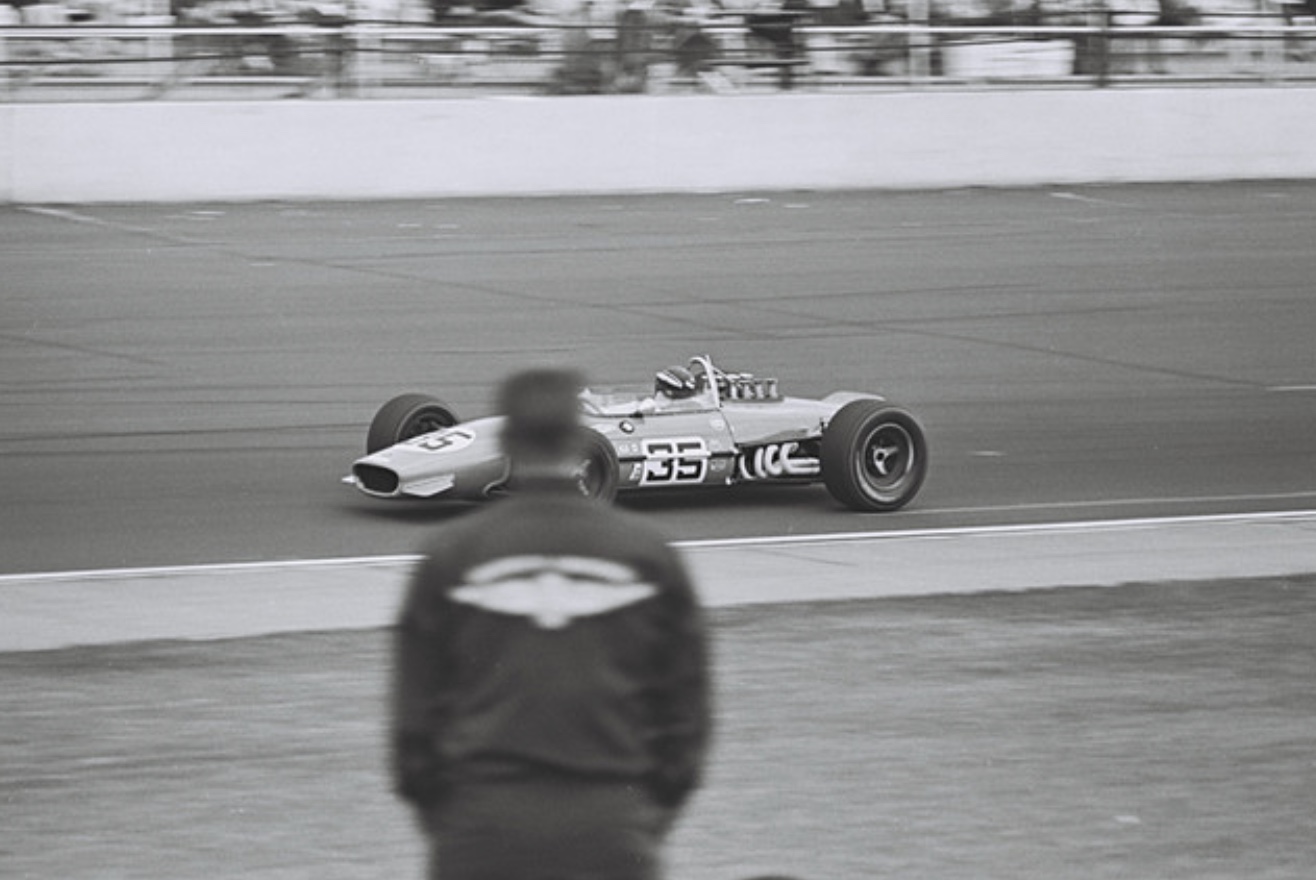
The BT34 was visually challenging, but otherwise Tauranac’s Brabhams were all handsome beasts. Jack during one of the interminable Indy test sessions, in Jochen’s car.
Note the front winglets and knock-on hubs which were also used on the 1970 BT33, MRD’s first F1 monocoque design.
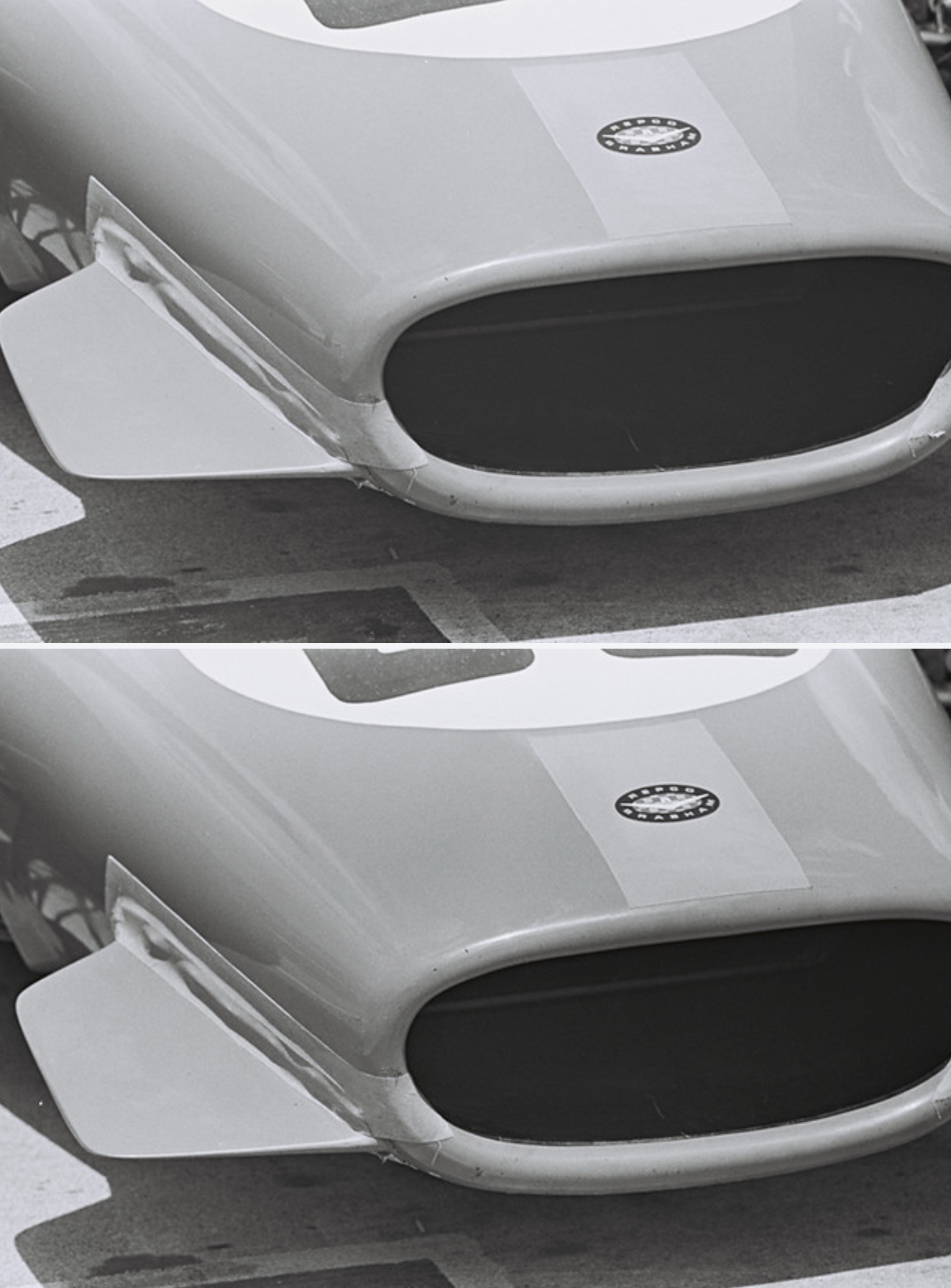
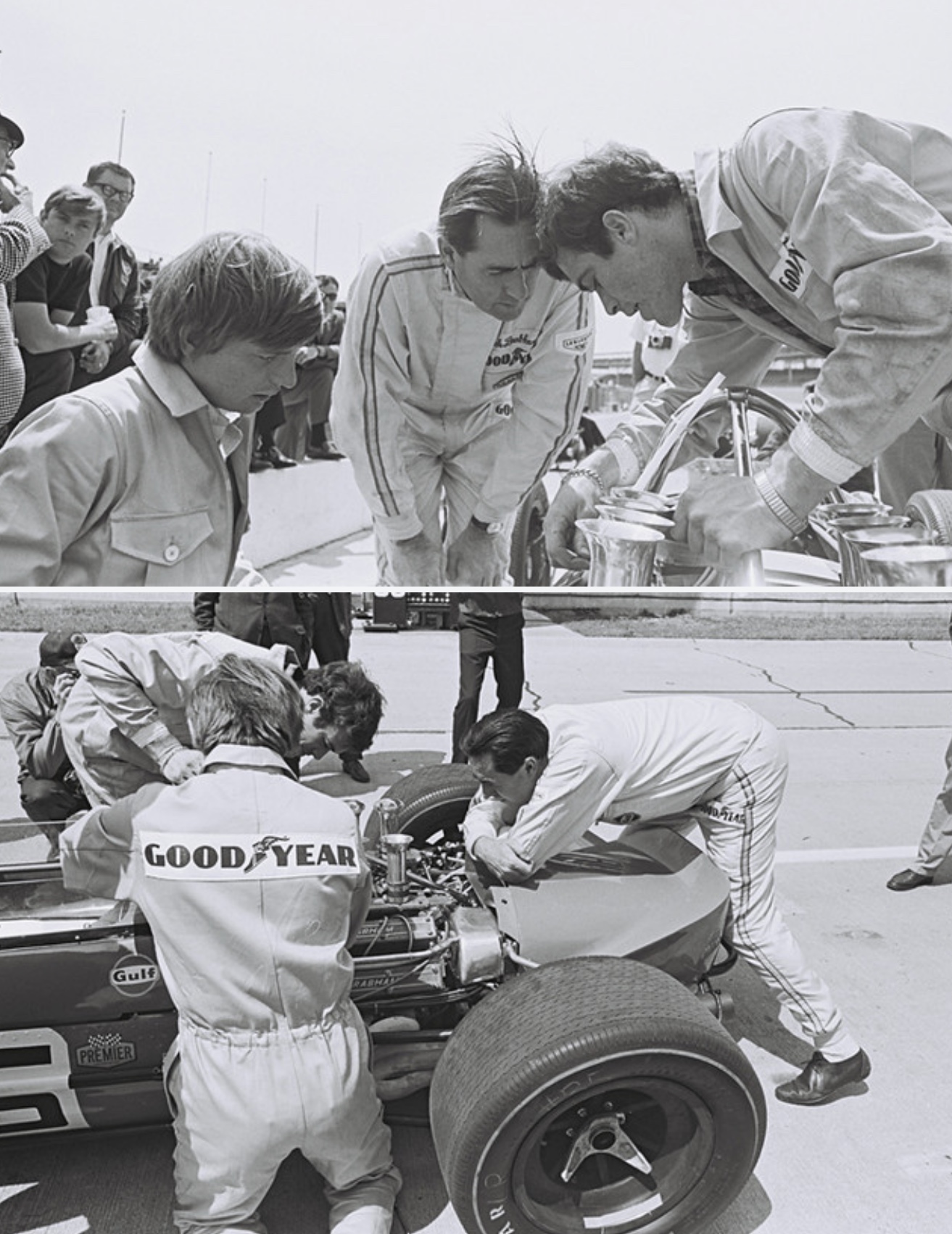
As you will have gathered from the narrative, a big part of the 1968 challenge was combustion, which seems to be reflected in many of Dave Friedman’s pit shots. The Champion man reads Jack’s plugs.
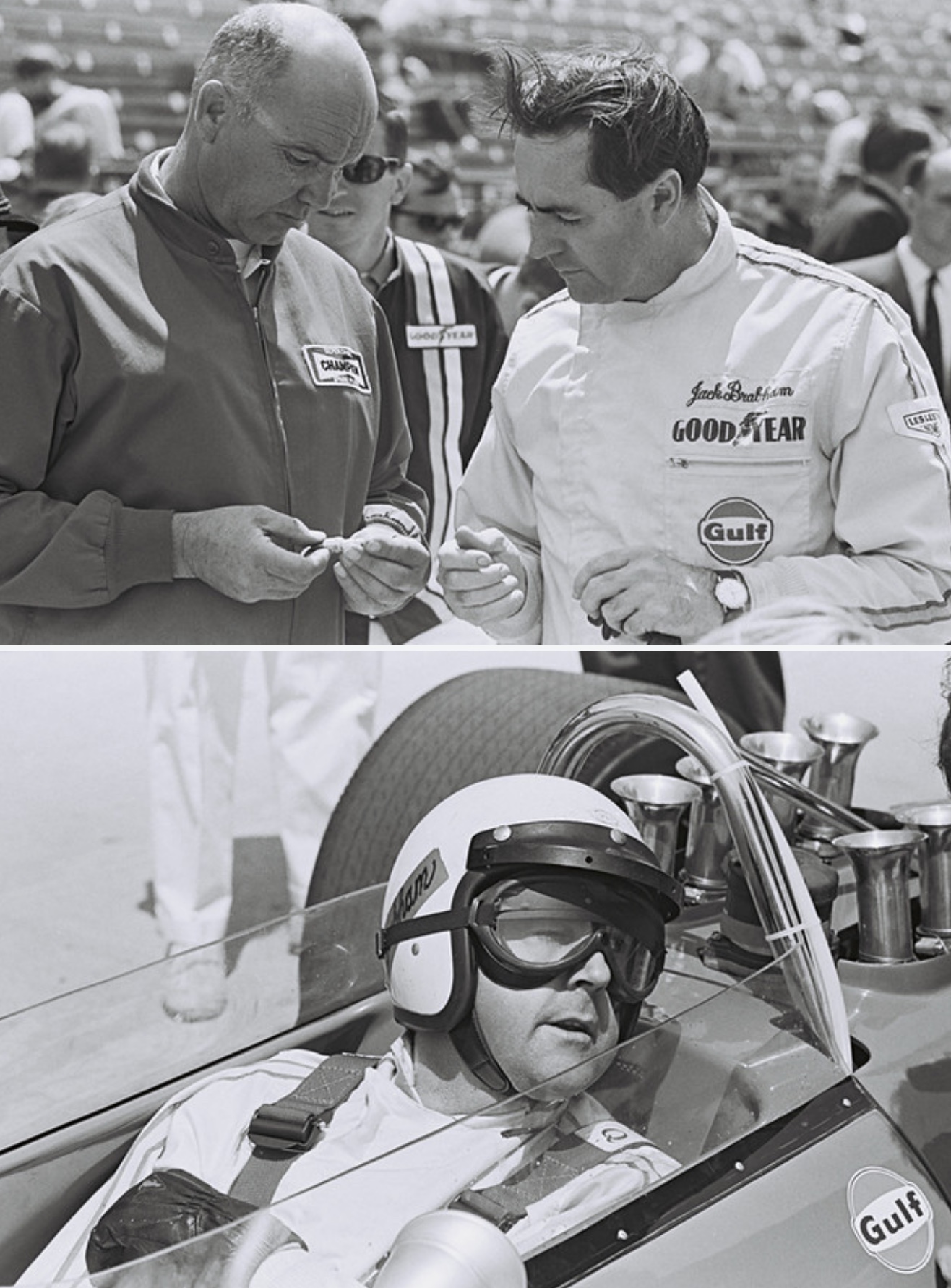
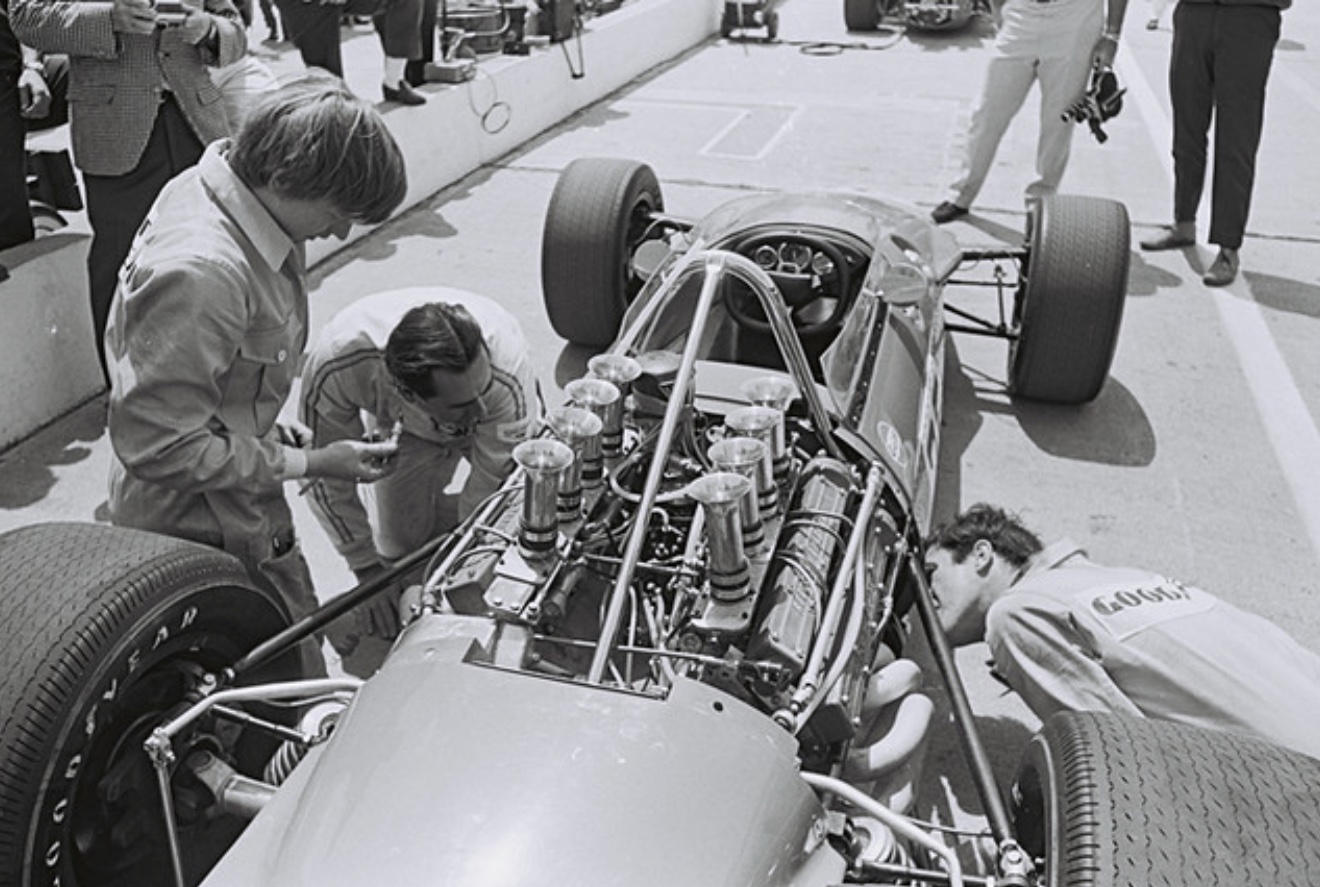
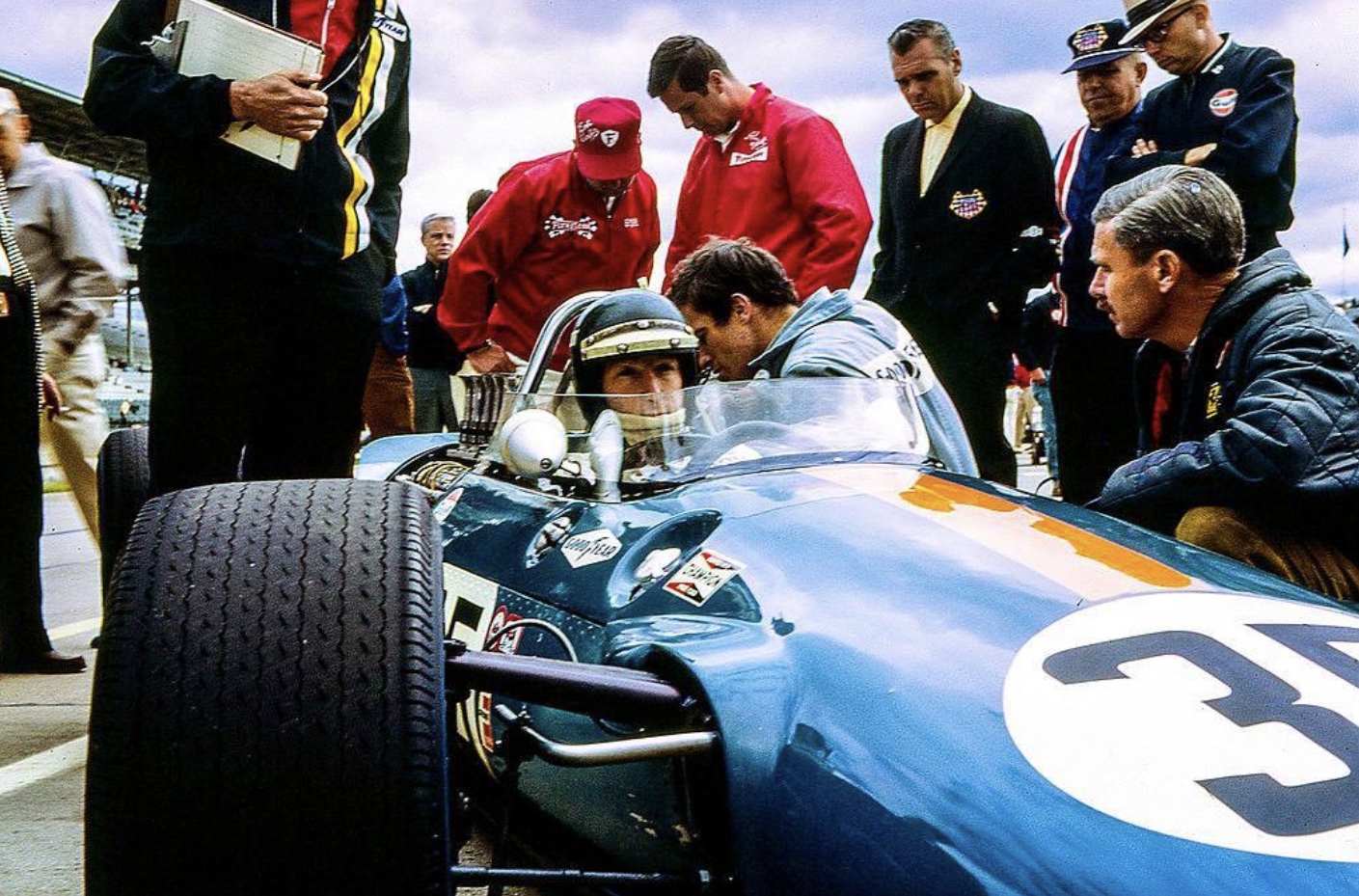
Jochen with Scuderia Veloce boss David McKay keeping a close eye on things, wearing his journo hat.
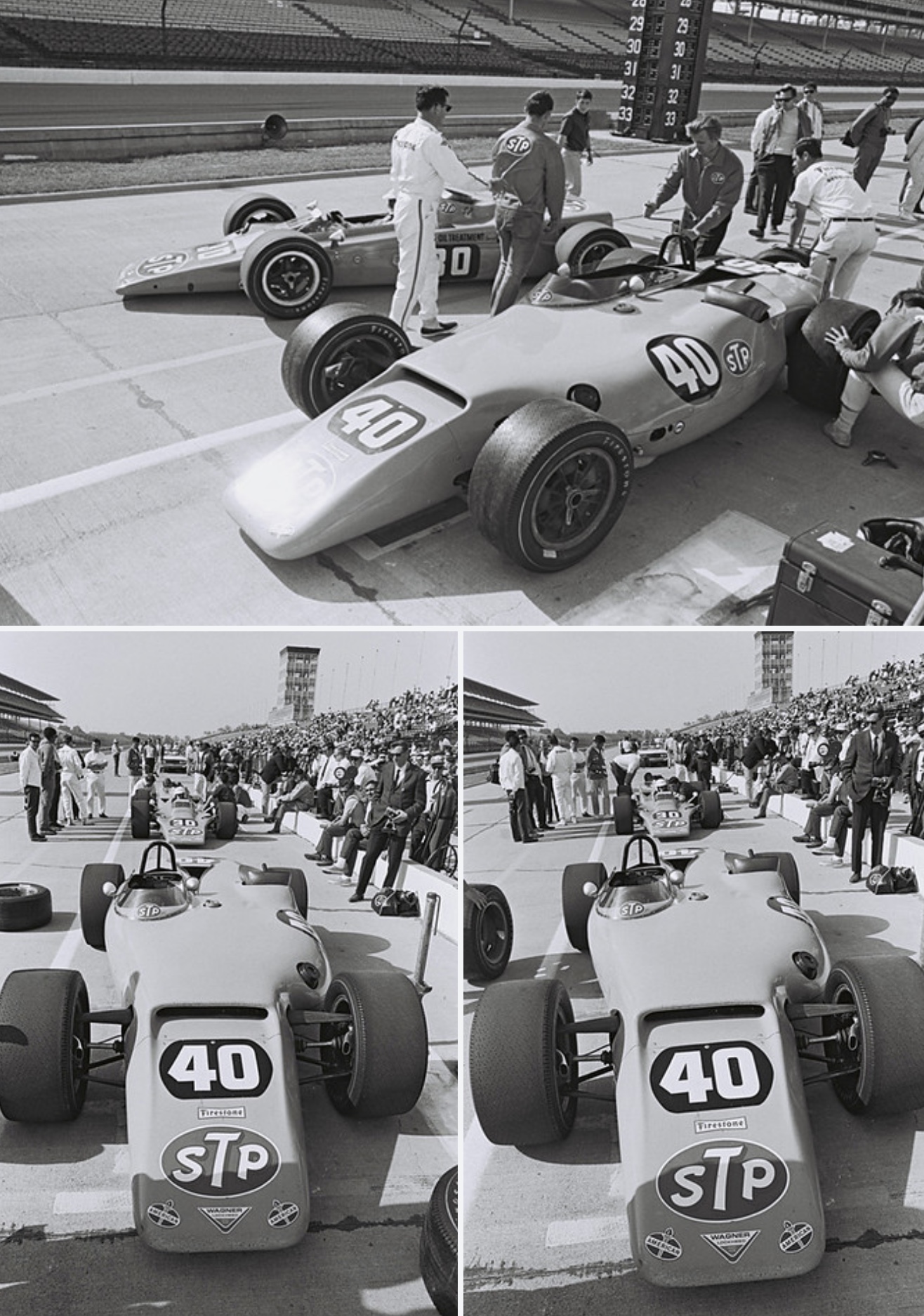
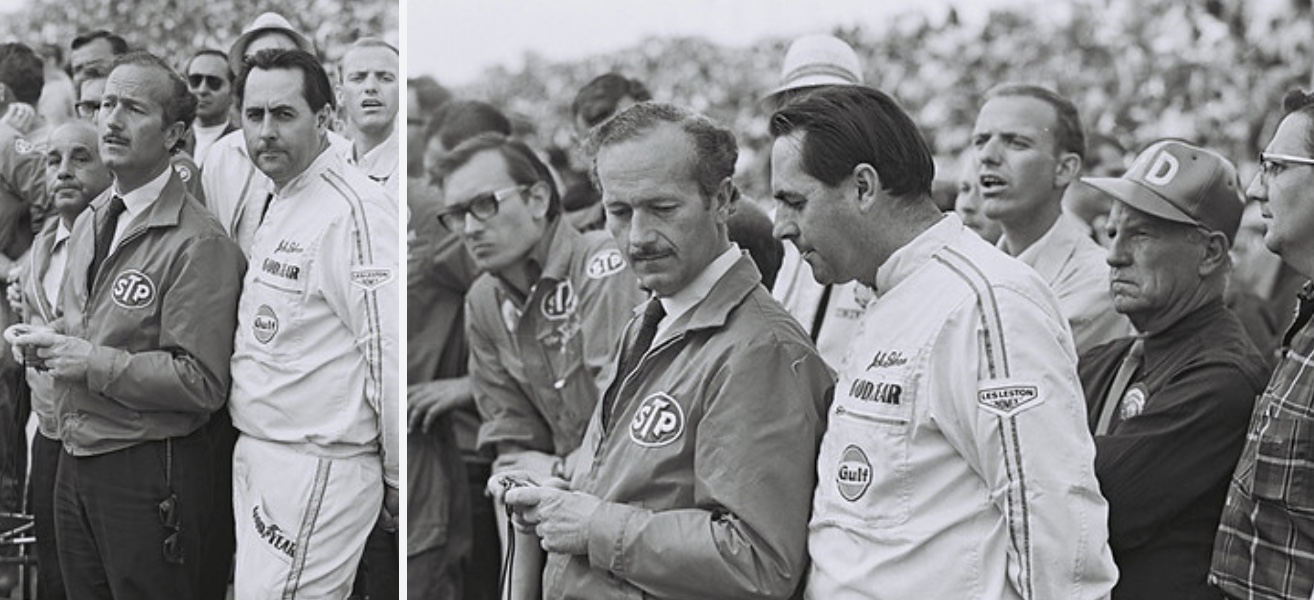
Colin Chapman and Jack in 1968. What a tragic and bitter Indy for Team Lotus; Mike Spence dead and Joe Leonard seemingly with the race in the bag, only to suffer a snapped fuel pump driveshaft with only eight laps of the 200 to run.
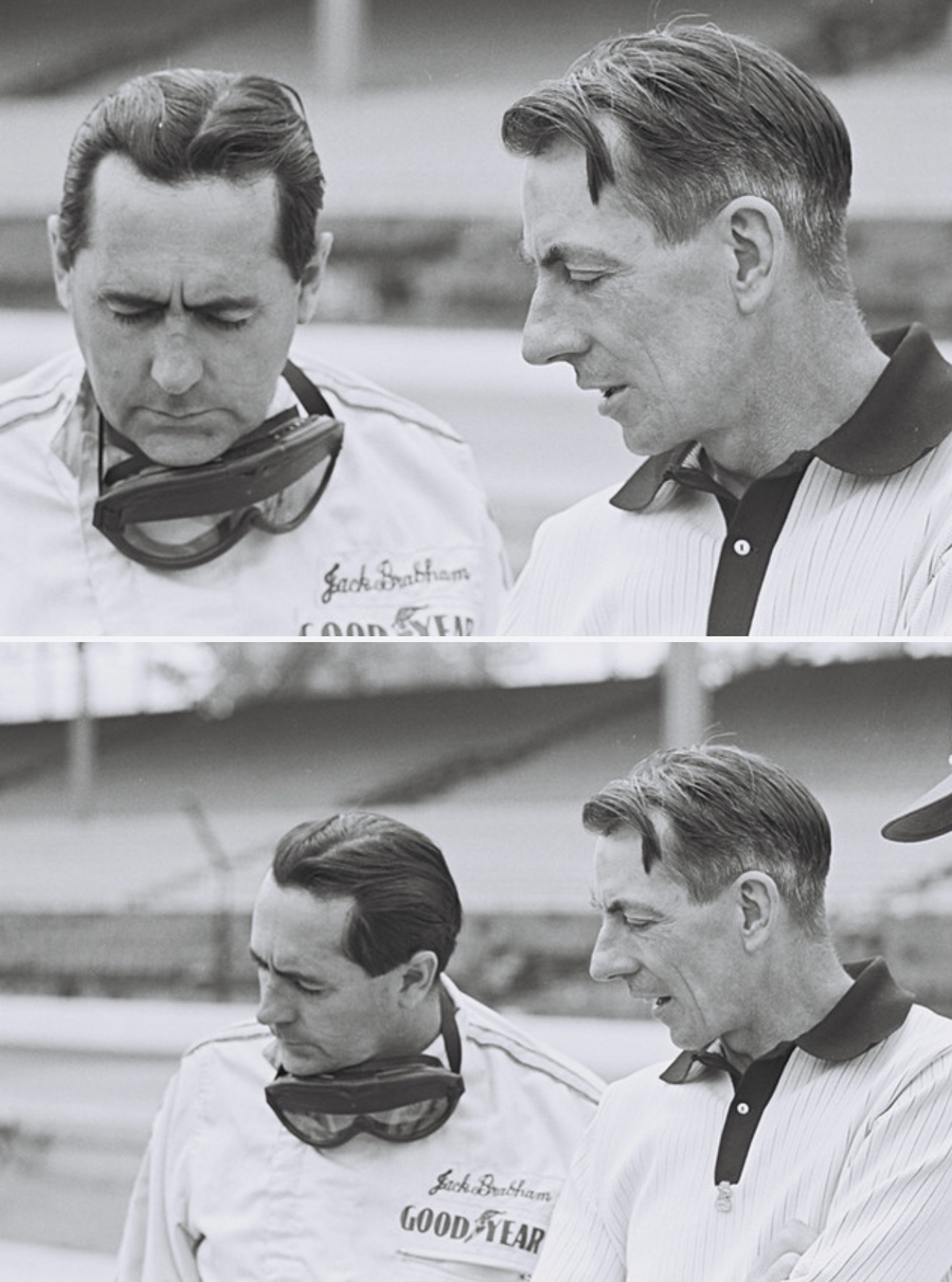
Rindt in 1968. JB and RT were men of few words, but one suspects those that were used counted…and to an extent their level of mutual respect and knowledge of one another perhaps ensured stating the obvious was superfluous.
Bibliography…
‘Mr Repco Brabham: Frank Hallam’ Simon Pinder, ‘The Jack Brabham Story’ Jack Brabham with Doug Nye, Nigel Tait, oldracingcars. Com
Copilot for engine development between 1968 and 1969 sourcing USAC Technical Bulletins which corroborate changes to cam profiles, the injection layout and oiling system revisions.
Publications include Autoweek, Road & Track, the Indianapolis Star, Repco Recollections (some of which I have published), MotorSport, Racecar Engineering. Repco technical summaries and SAE style reports by Frank Hallam, Norman Wilson and John Judd covered, inter alia, the mixture distribution problems on the early 760, valve gear and spring metallurgy updates, crankshaft balancing changes and dyno figures 1969/1969. These papers were referenced by Repco’s own 1980s historical technical review and Malcolm Preston’s ‘Maybach to Holden:Repco The Cars, People & Engines’
Other sources include Brabham team notes and interviews, Tauranac’s oral history sessions with the National Library of Australia (note to self to follow up)
Credits…
Alan Ould, Getty Images, Gary Hartman, P Pelham, Deviant Art, Twitter, Brian Heard, Gary Critcher Collection
‘Brabham Cars 1961-1970’
I’ve written a book on Jack’s and Ron’s Brabhams, MRD to BT33, the publishers tell me the imaginatively titled publication will be on the market by Fathers Day, Christmas is realistic at worst I figure, pre-order here:https://autoactionmagazine.myshopify.com/products/brabham-cars-1961-1970
Tailpiece…
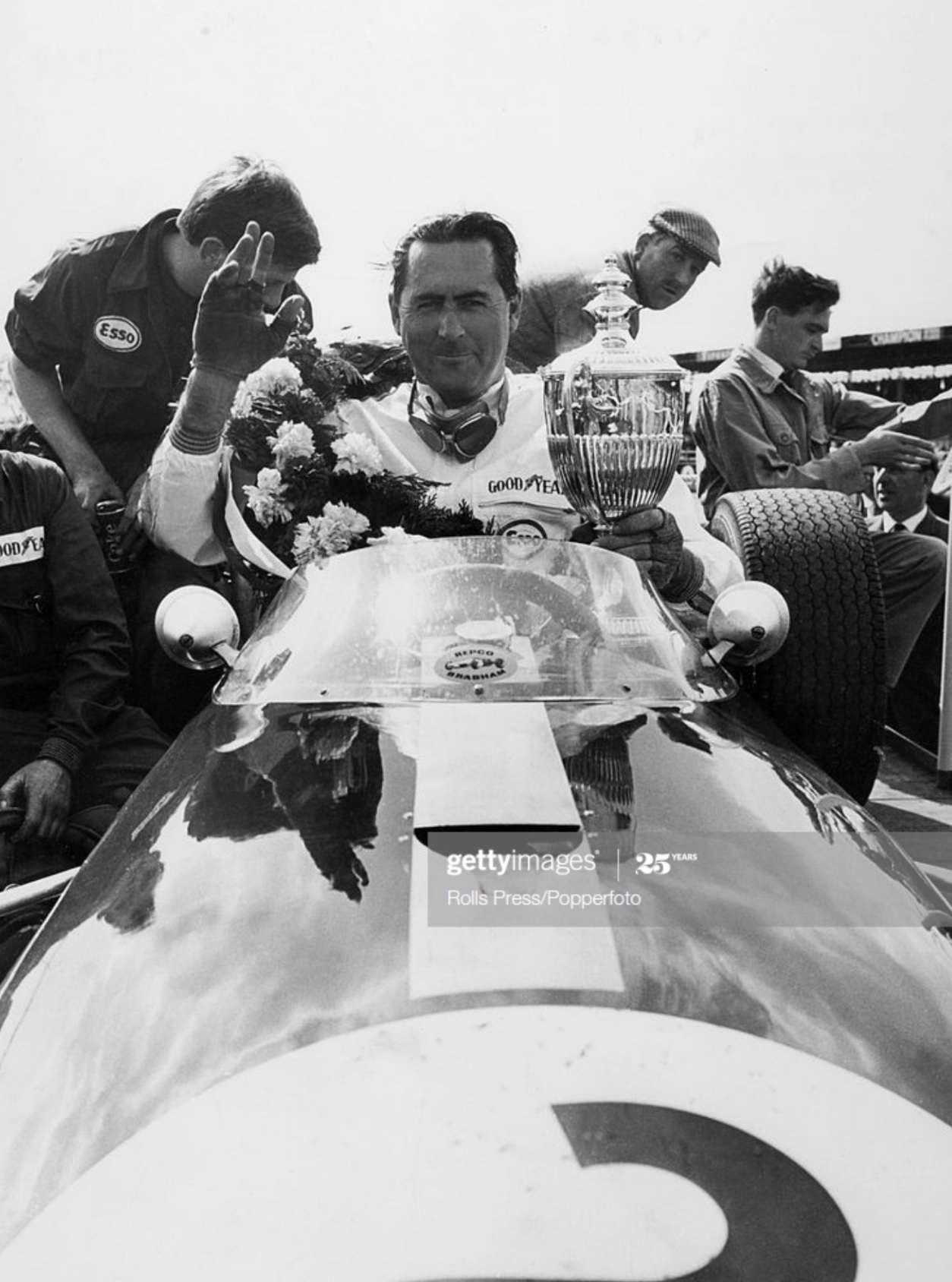
Brabham was full of joy and optimism after the first of many wins in the partnership between Motor Racing Developments, Brabham Racing Organisation and Repco Ltd. BRDC International Trophy, Silverstone 1966.
Finito…