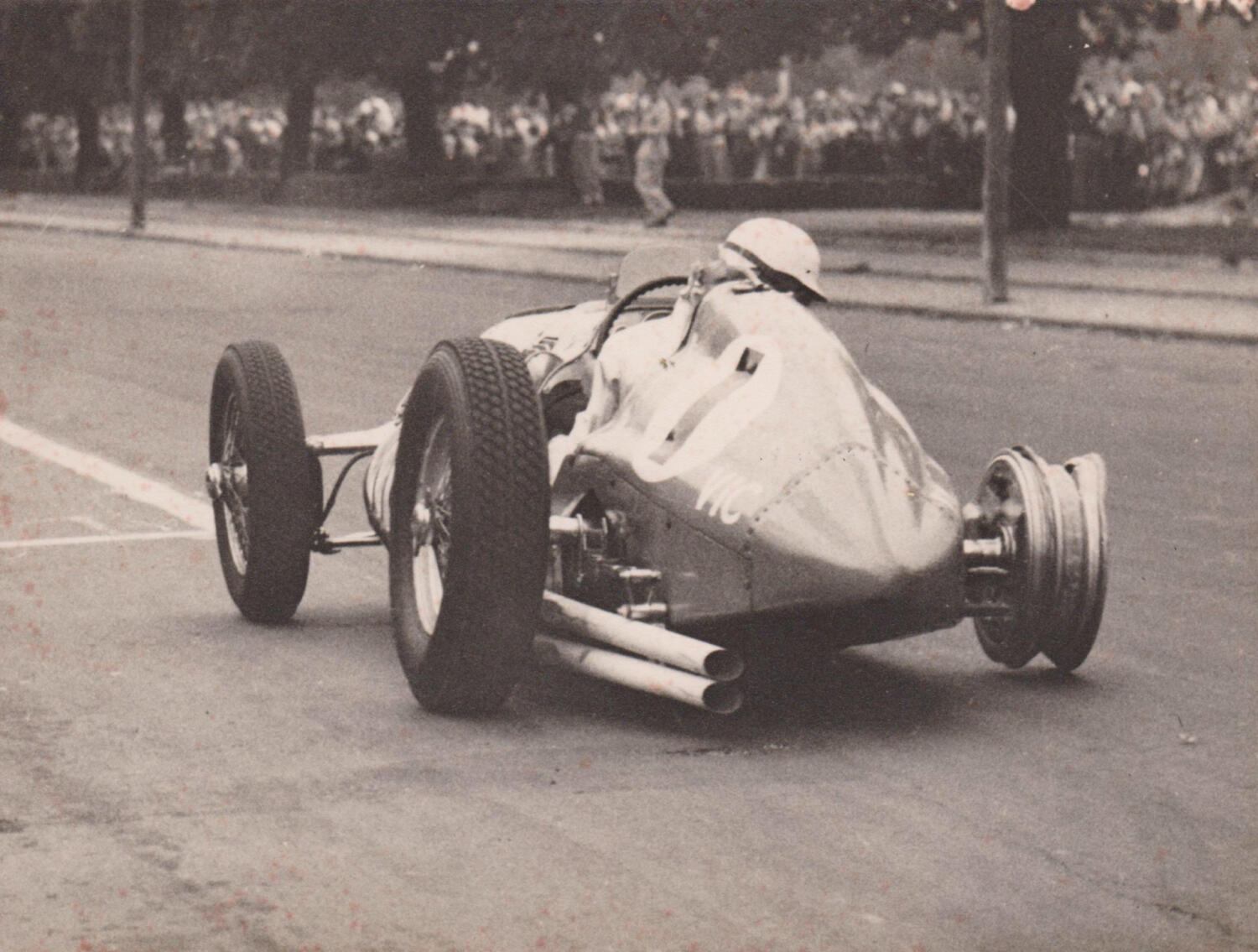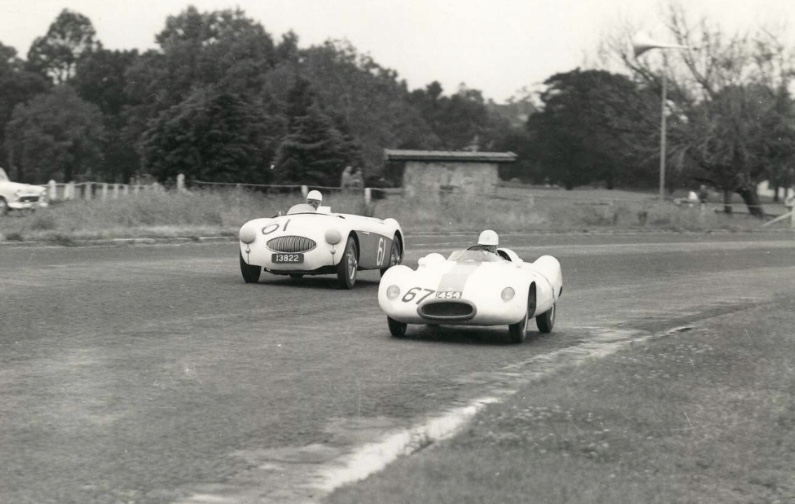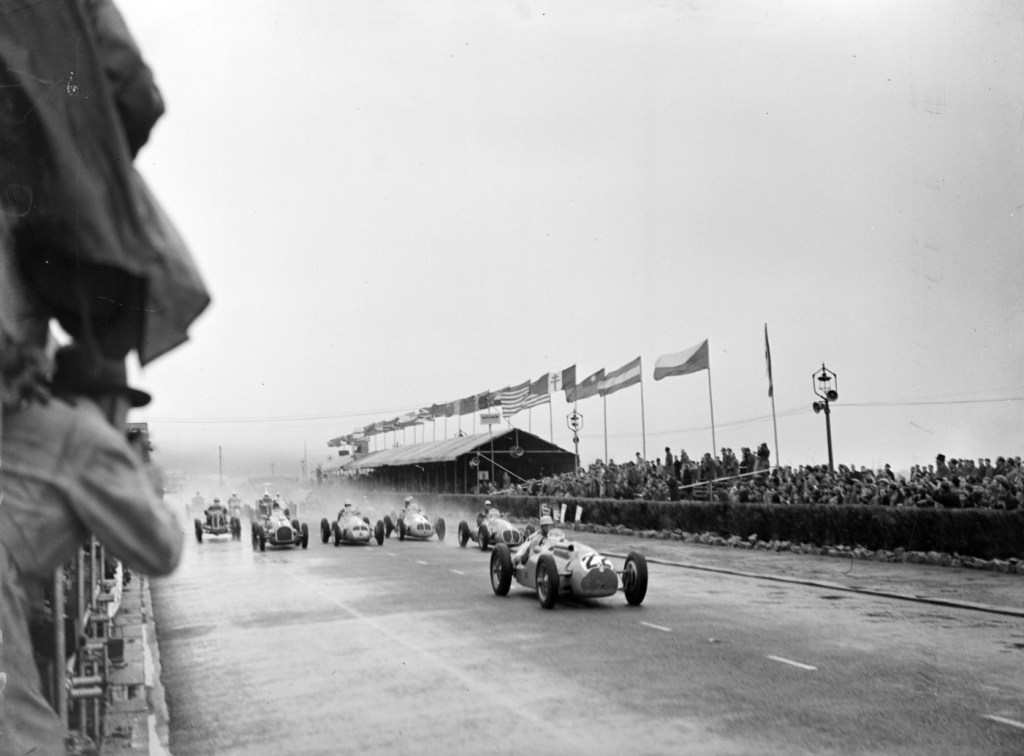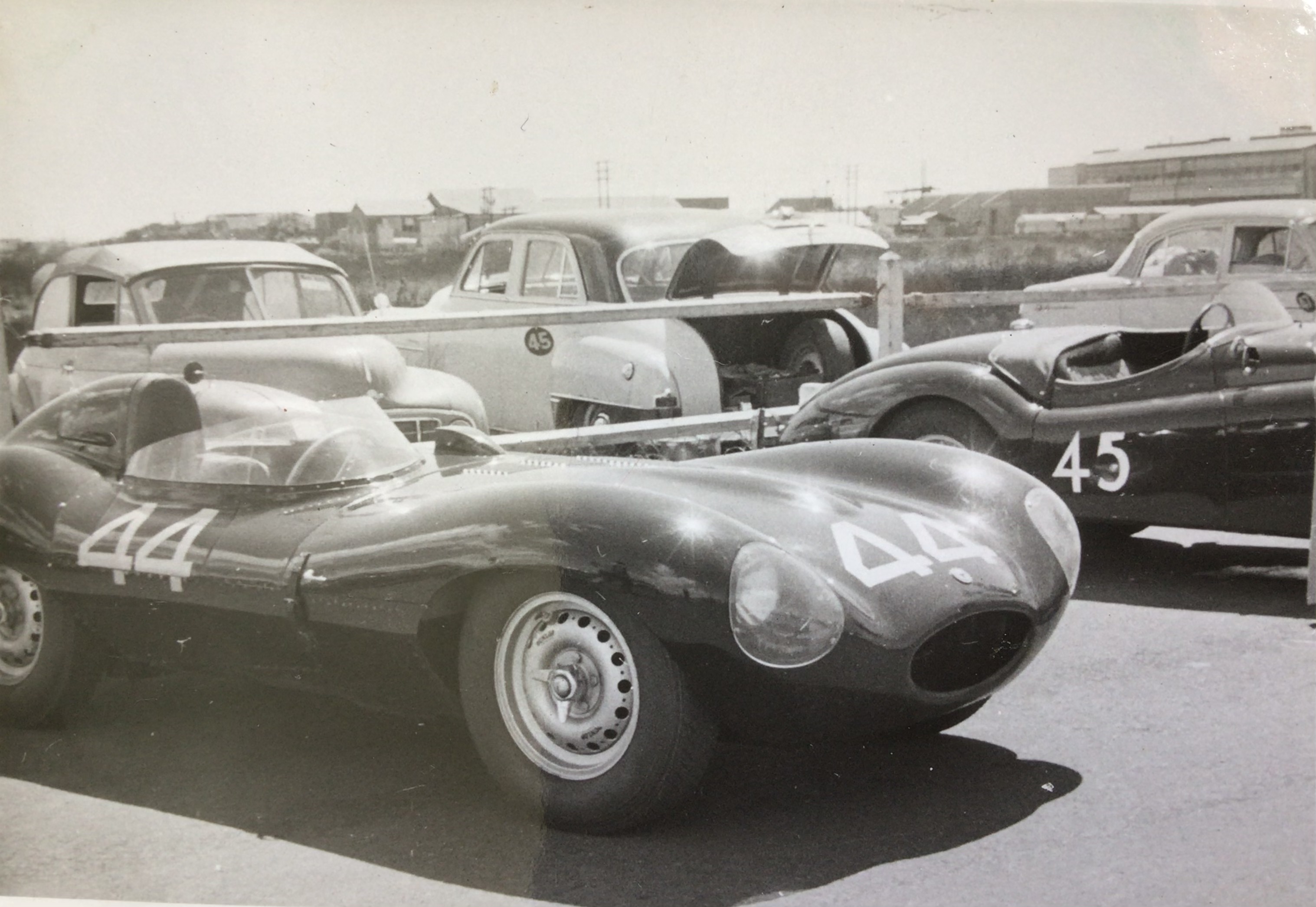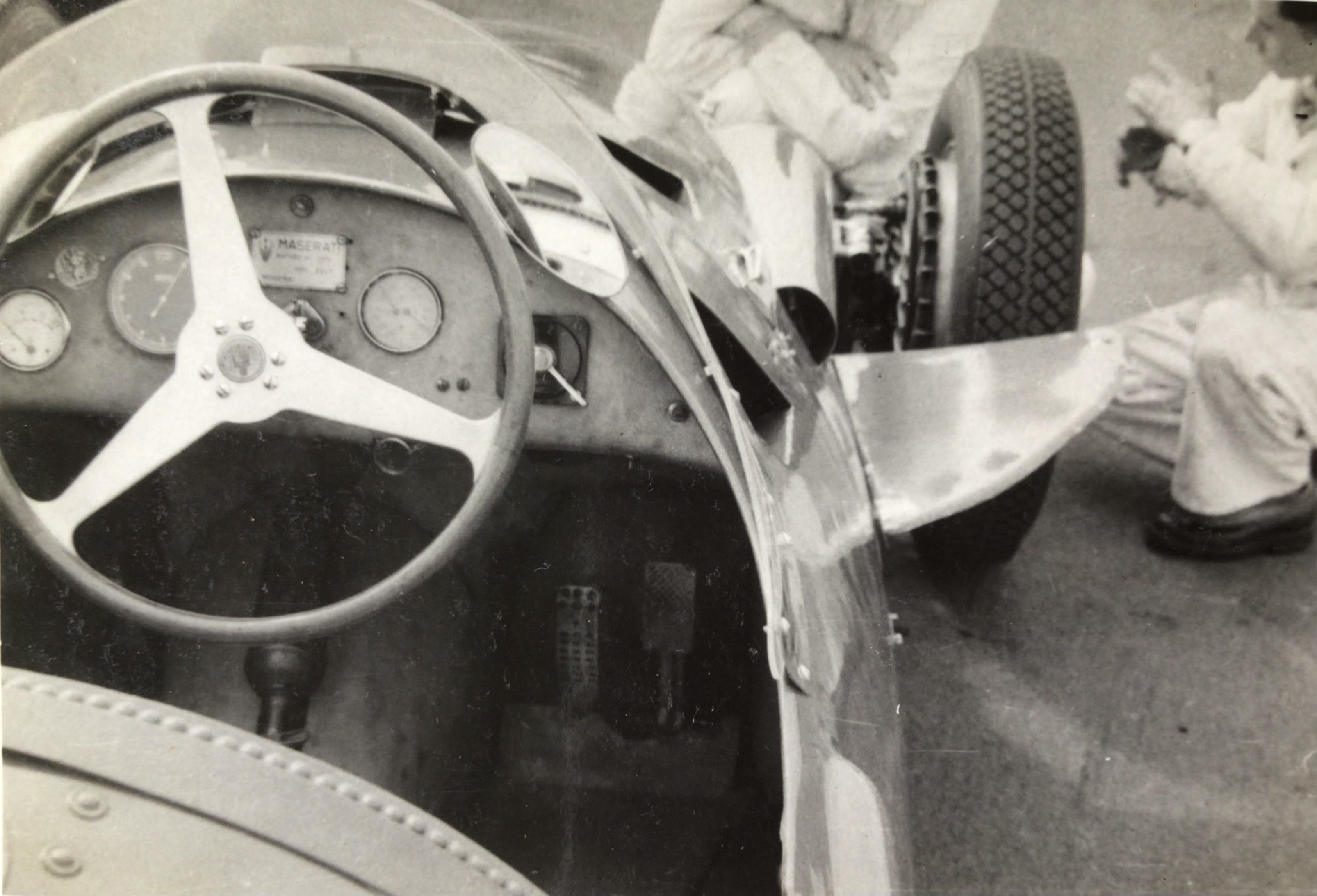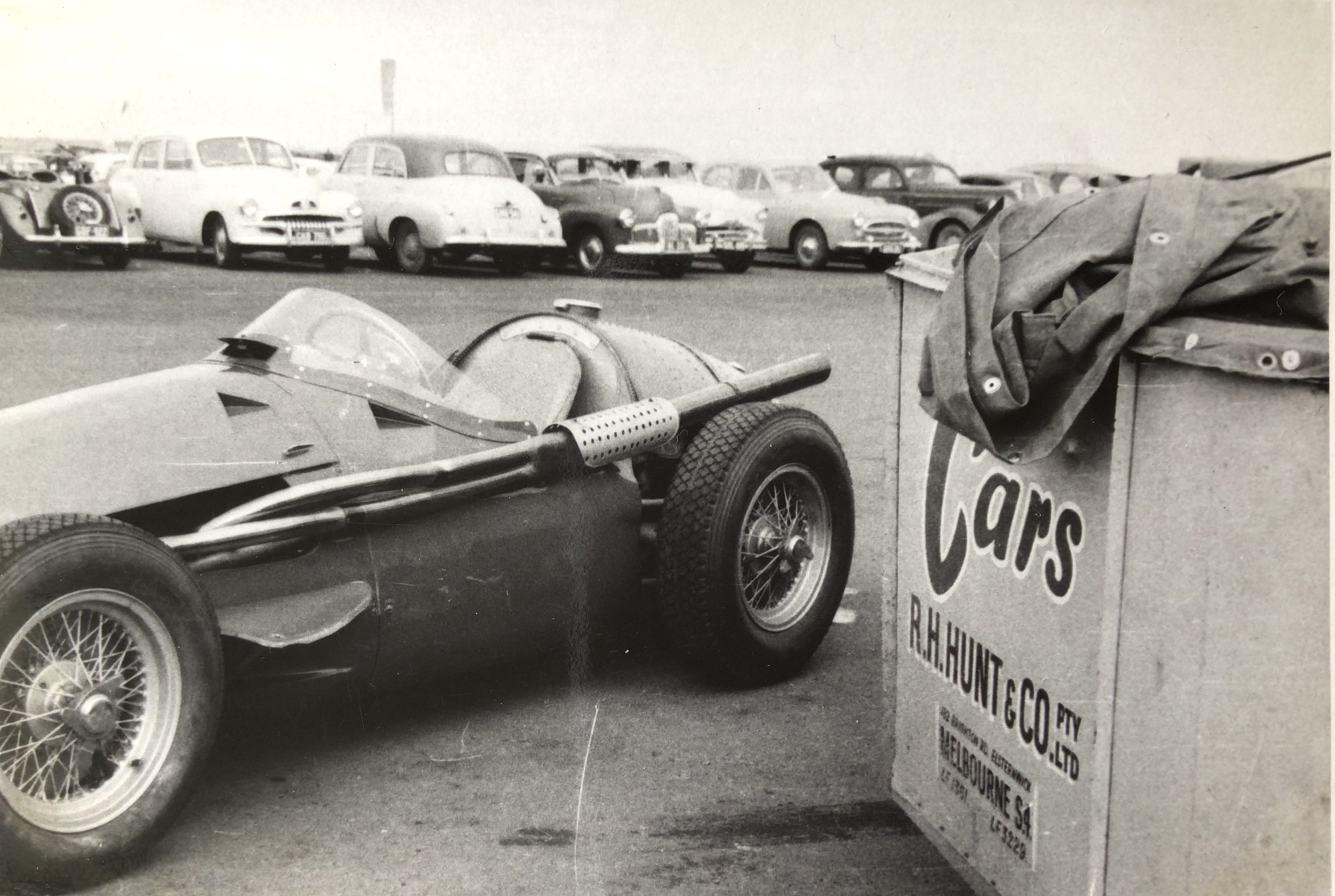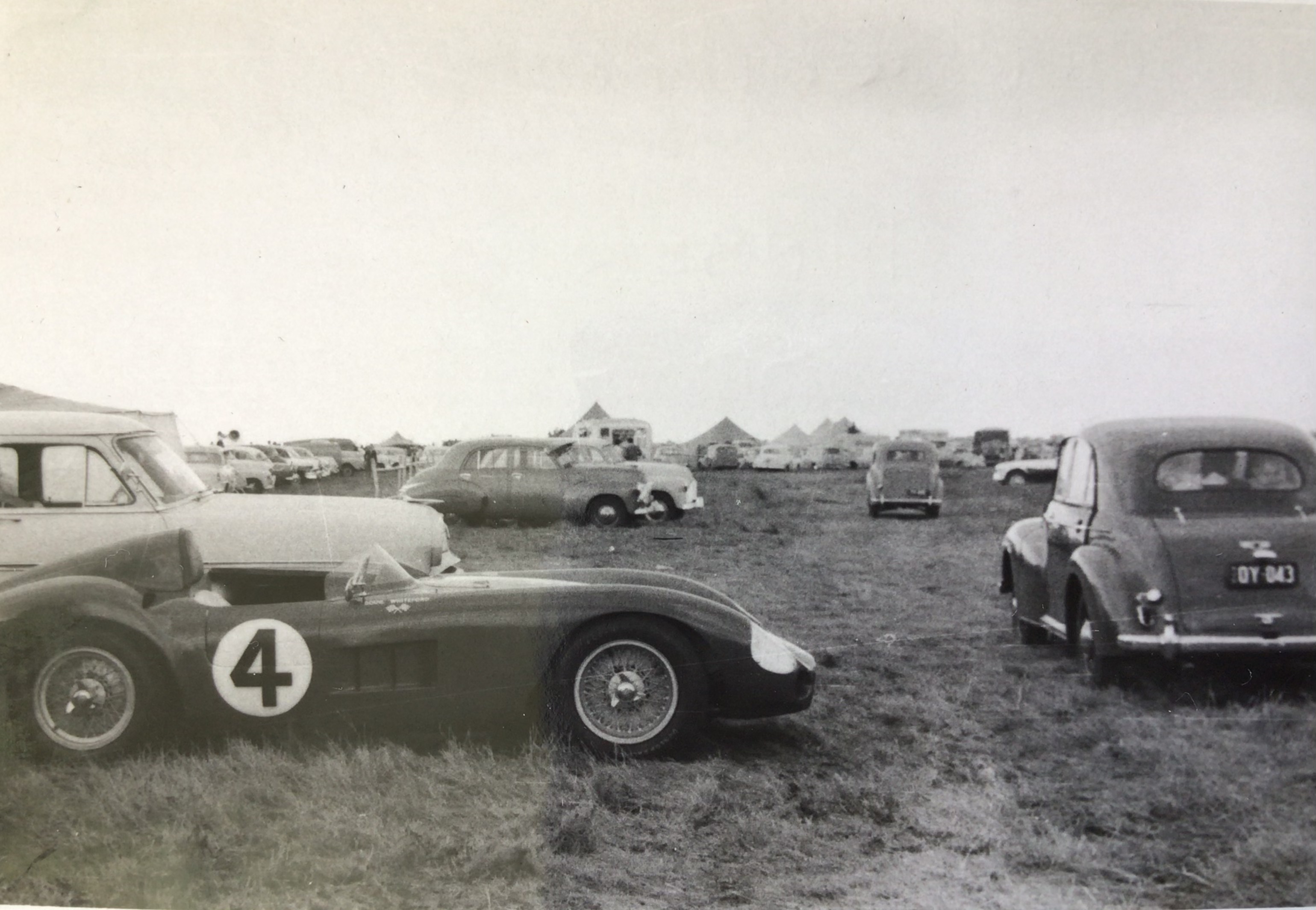
Posts Tagged ‘Doug Whiteford’

(G Thomas)

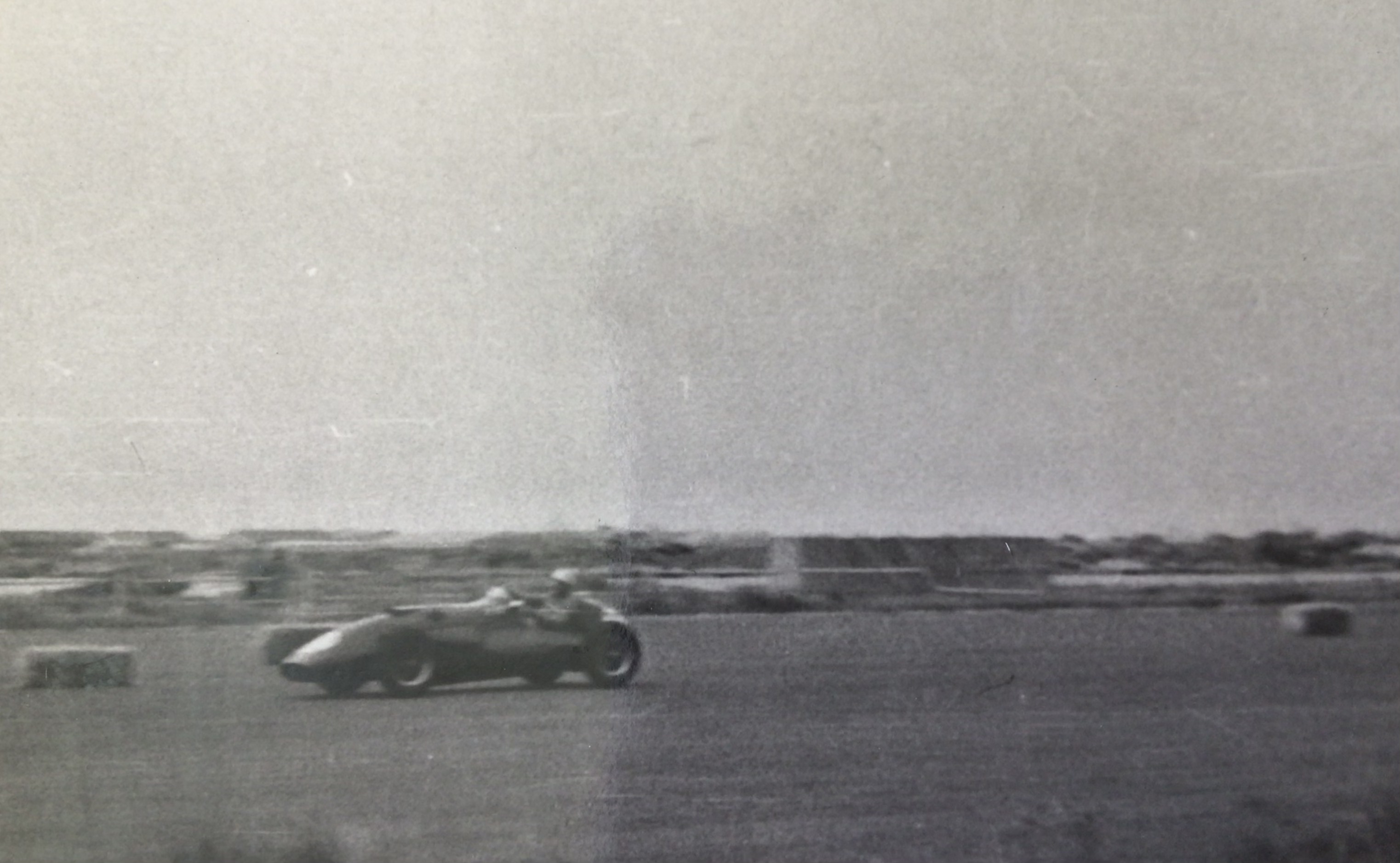
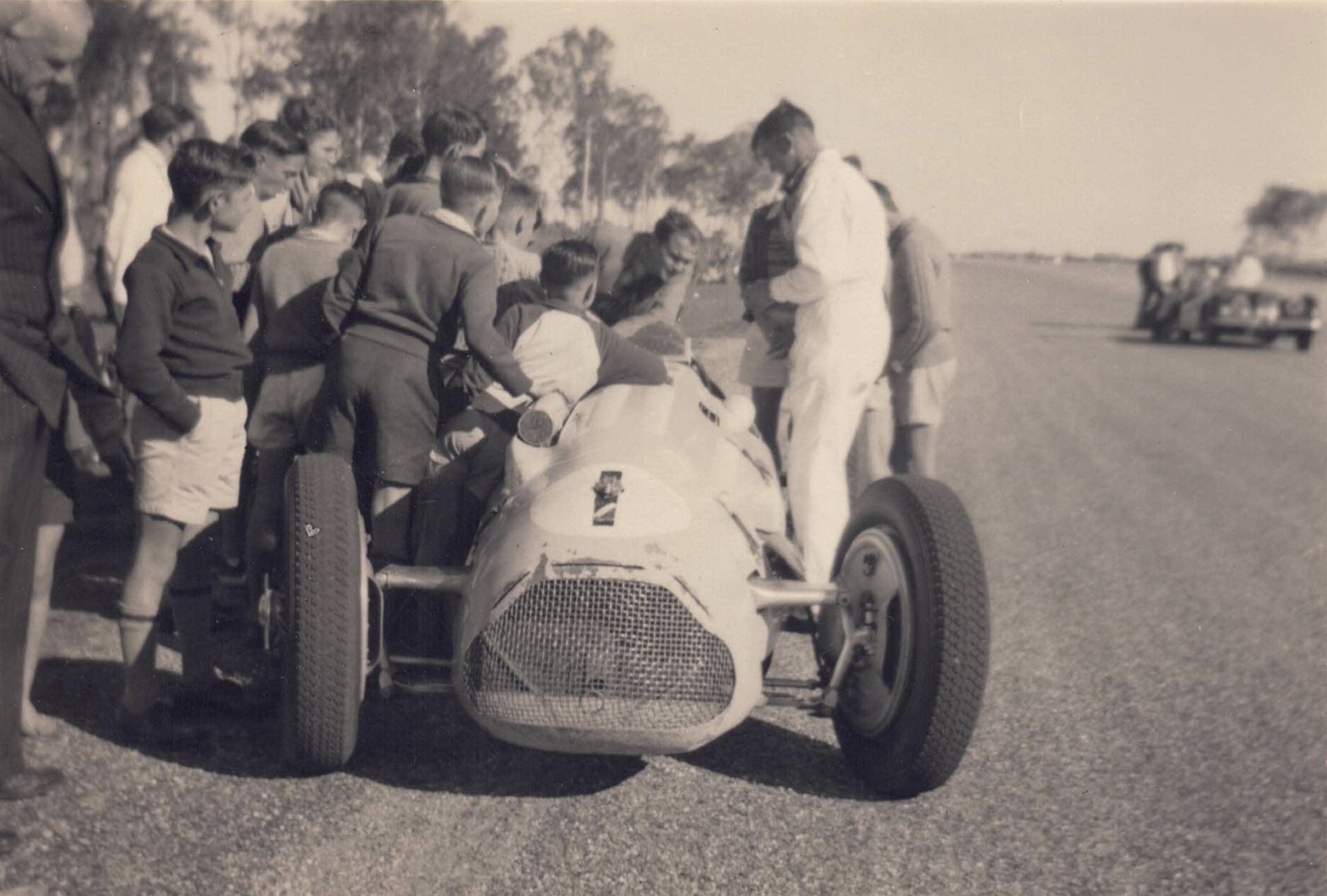
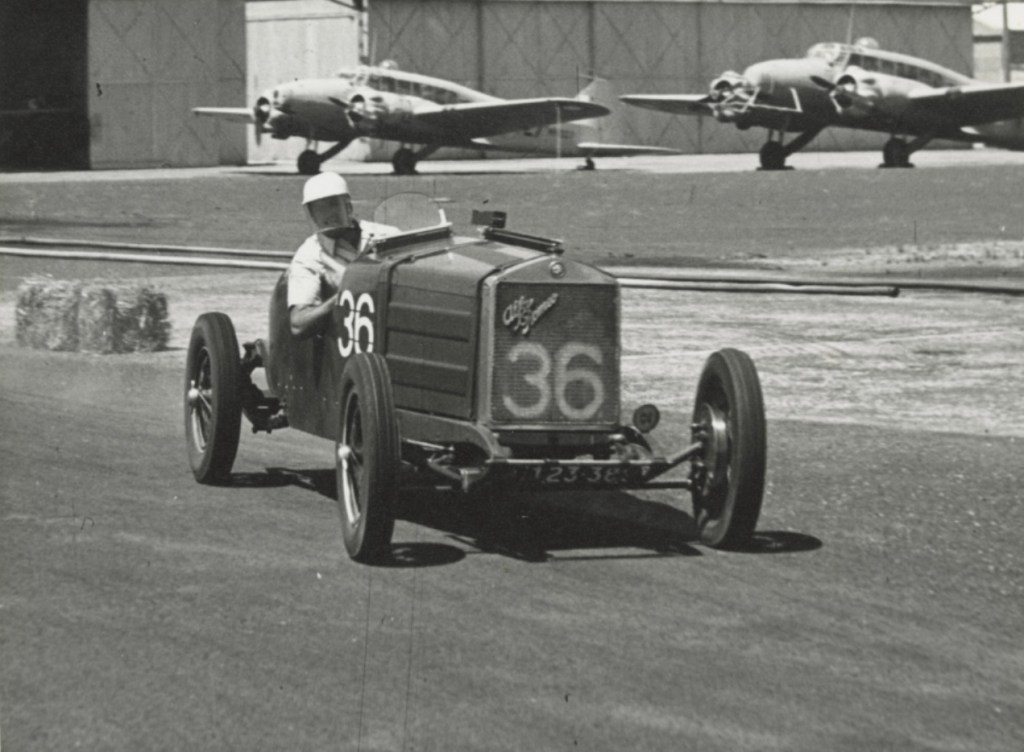
Lex Davison in the Little Alfa – Alfa Romeo 6C 1500 s/c Spl – at Ballarat Airfield with RAAF Avro Ansons in the background.

He is contesting the 75 mile Victoria Cup held on the Australia Day holiday, January 27, 1947.

The race was the first post-War ‘state level event’ held in Victoria and was promoted jointly by the Light Car Club of Australia and the Victorian Sporting Car Club.
(G Thomas)

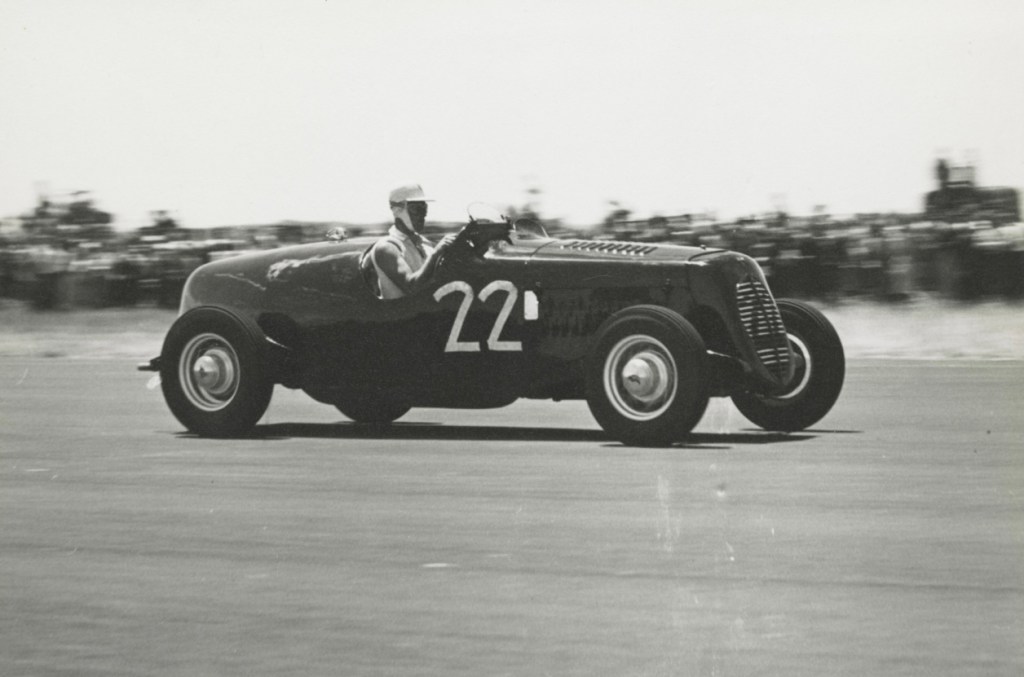
Doug Whiteford won the handicap race in Black Bess, his Ford V8 Special which was at the start of a long run of success.

See here for Black Bess: https://primotipo.com/2015/05/05/doug-whiteford-black-bess-woodside-south-australia-1949/ and here for the Little Alfa: https://primotipo.com/2015/01/22/race-around-the-barracks-balcombe-army-camp-davison-little-alfa/

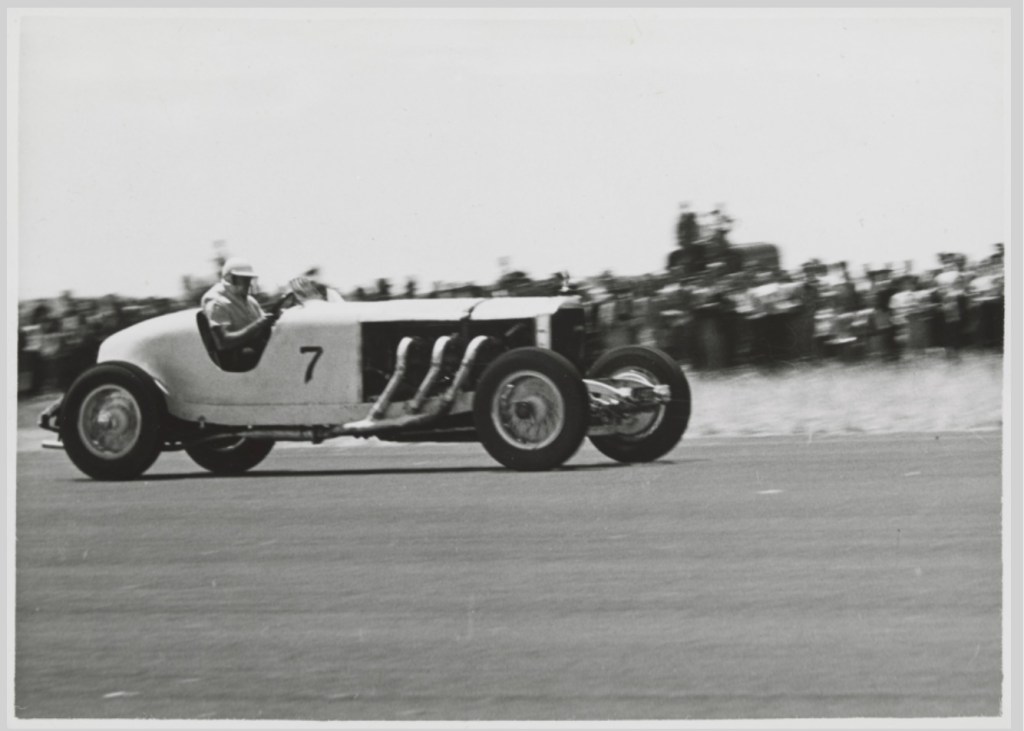
Davo also entered his rather imposing Mercedes Benz SSK, but the engine failed, see here: https://primotipo.com/2024/02/18/mercedes-38-250-ssk-lex-davison/
(G Thomas)
(SLV)

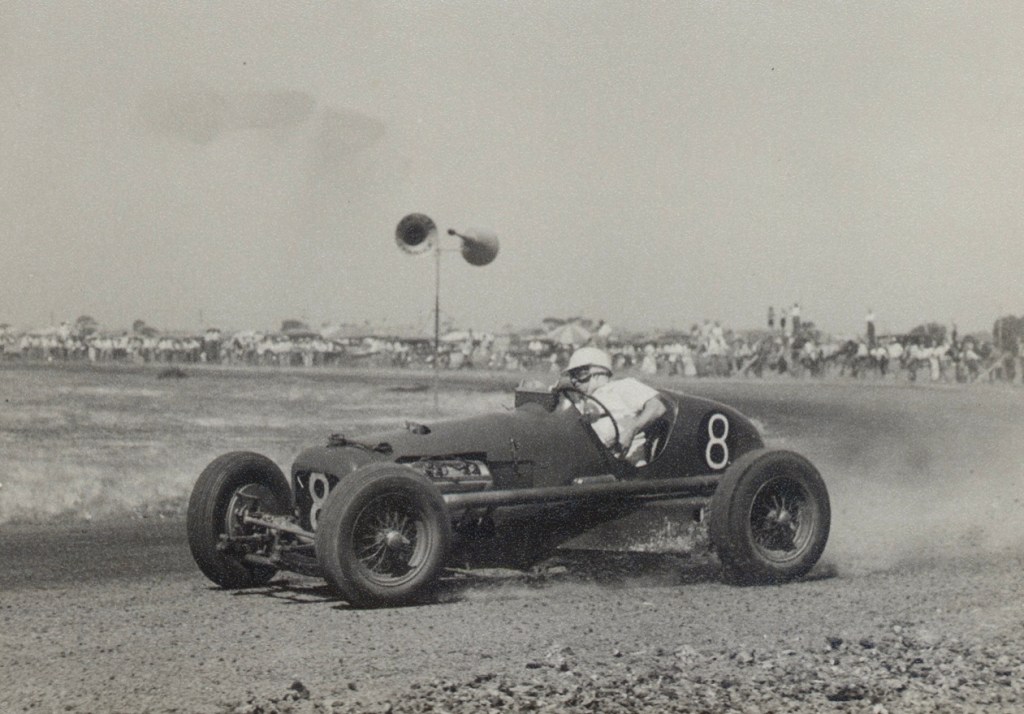
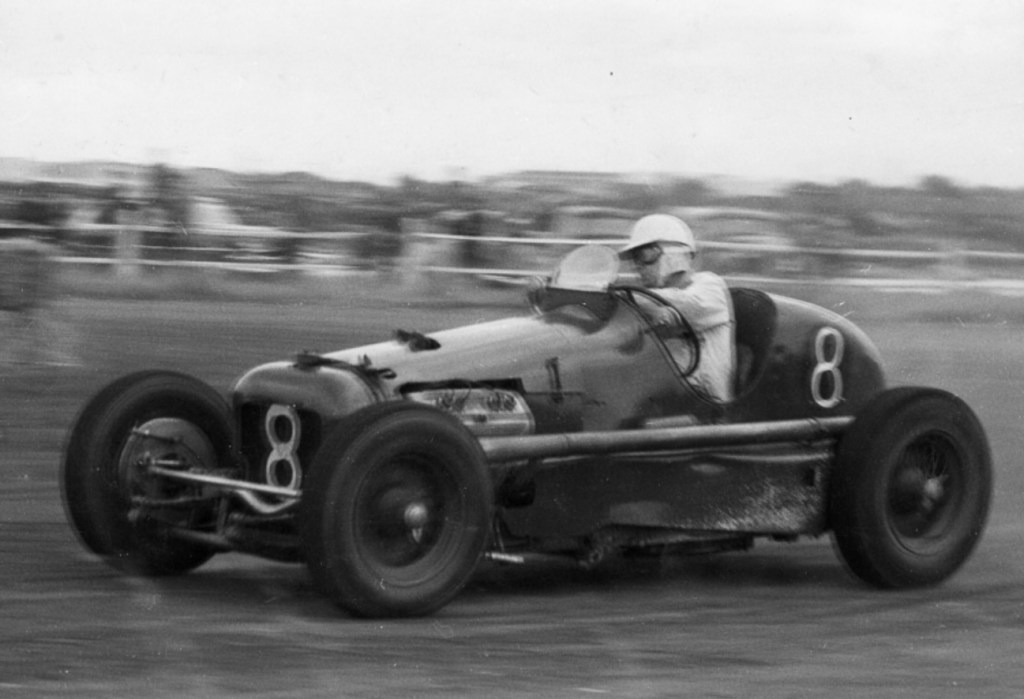
The caption says Fishermans Bend but it looks more like Altona to me, one for those with a programme collection. And below Ted again, Alta 21S Ford V8 Spl this time during the 1954 Victorian Trophy at the Bend on March 22, 1954.
(SLV)

This car, first brought to Australia by MI6 spook and sometime racing driver Allan Sinclair in 1938 is one of my obsessions, see here: https://primotipo.com/2018/11/08/the-spook-the-baron-and-the-1938-south-australian-gp-lobethal/

It’s alive and well too, restored by Graham Lowe several decades ago, it’s used regularly on road and track by current custodian, Fiona Murdoch. I’ve driven it too, in March 2023, for articles published in The Automobile and Benzina. And yes, it is sen-‘kin-sational.
(G Thomas)

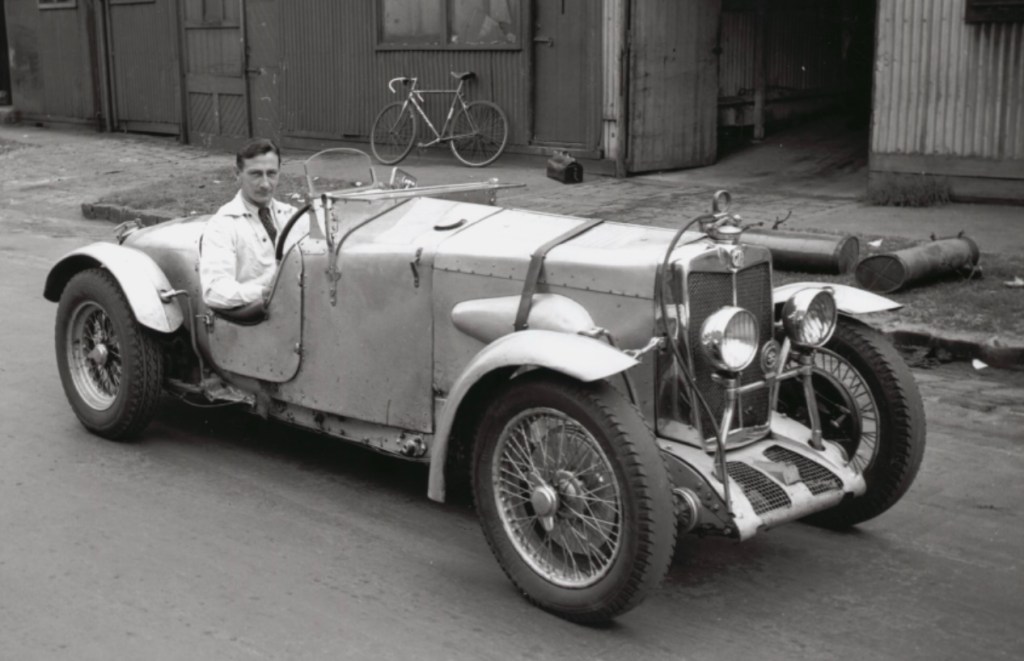
Reg Nutt aboard an MG NE Magnette Ulster, outside the Nutt/Jack Day premises in Whiteman Street, South Melbourne.

Greg Smith comments, ‘White street South Melbourne features to note : 16″ rear wheels, 18″ or 19″ front wheels, brakes still cable operated, door fitted to the original body maybe to comply with the CAMS draconian rule (what has changed since its inception in 1953 ? nothing!!) that “sports cars” must have a door of minimum dimensions.Tyres nearly bald. Expensive push bike leaning against the wall with the owners Gladstone bag on the footpath, maybe the photographer ?? Two fuel tanks out in the sun sweating the fumes out before solder repairs. The car was ex-Barraclough and very scruffy by this time.’

Nutt was both a master mechanic and driver with a pedigree going back to Phillip Island’s early days. He was Reg Brearley’s riding mechanic in 1929 when the pair placed second in a Bugatti T37A.

Better was to come when he won the race in 1931 alongside Carl Junker aboard a Bugatti T39 in 1931. T39-4907 is the very car shown below raced Jack Day’s Day Special (the car below) in the South Australian Grand Prix referred to above on daunting Lobethal, setting the fastest race time for that handicap race, and the following day did the fastest lap of the weekend…he could drive.

He got the bug early, recounting to Bob King memories of a Bugatti Brescia while doing his apprenticeship at Meaby’s Garage in Toorak Road, South Yarra.
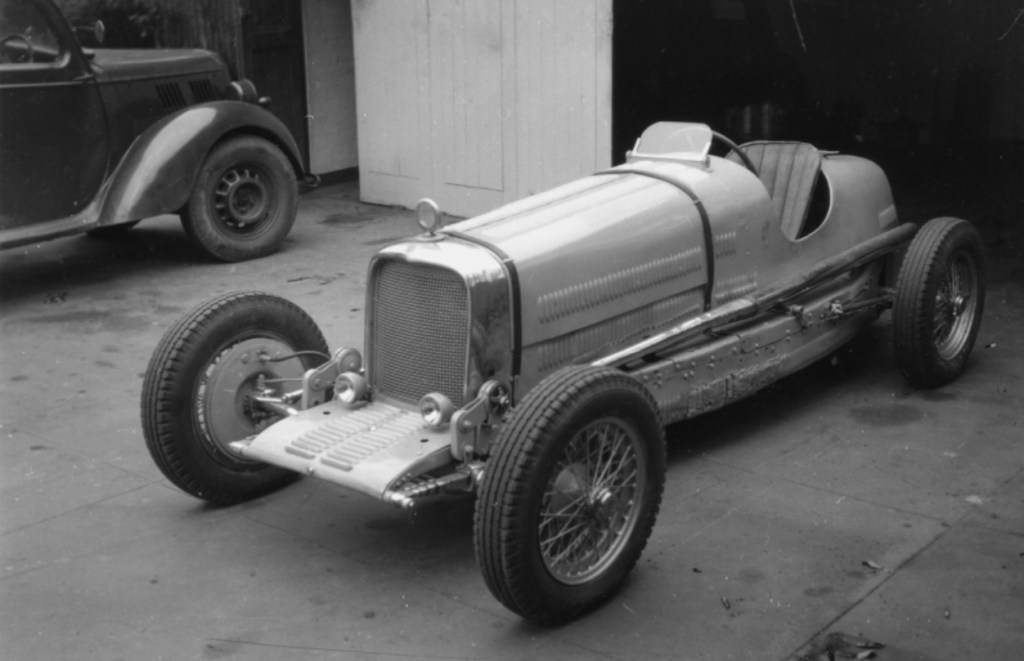
The Day Special was Bugatti T39-4607 fitted with a Ford V8 and other modifications (G Thomas)

Apart from his on-track exploits in this car, Nutt gave Norman Ellsworth the ride of his life, when towing Ellsworth’s just purchased Bugatti Brescia back from Adelaide to Melbourne.

The deal was that Reg would tow the car through the many country towns on the long trip as the Brescia was unregistered. But Reg ‘forgot’ about the Bugatti on the end of the tow rope and did several miles outside Dimboola at well over 100mph. Ellsworth’s reaction is unrecorded!

More about the Day Special here: https://primotipo.com/2021/06/11/werrangourt-archives-7-jack-day-and-his-superchargers-by-bob-king/
(SLV)

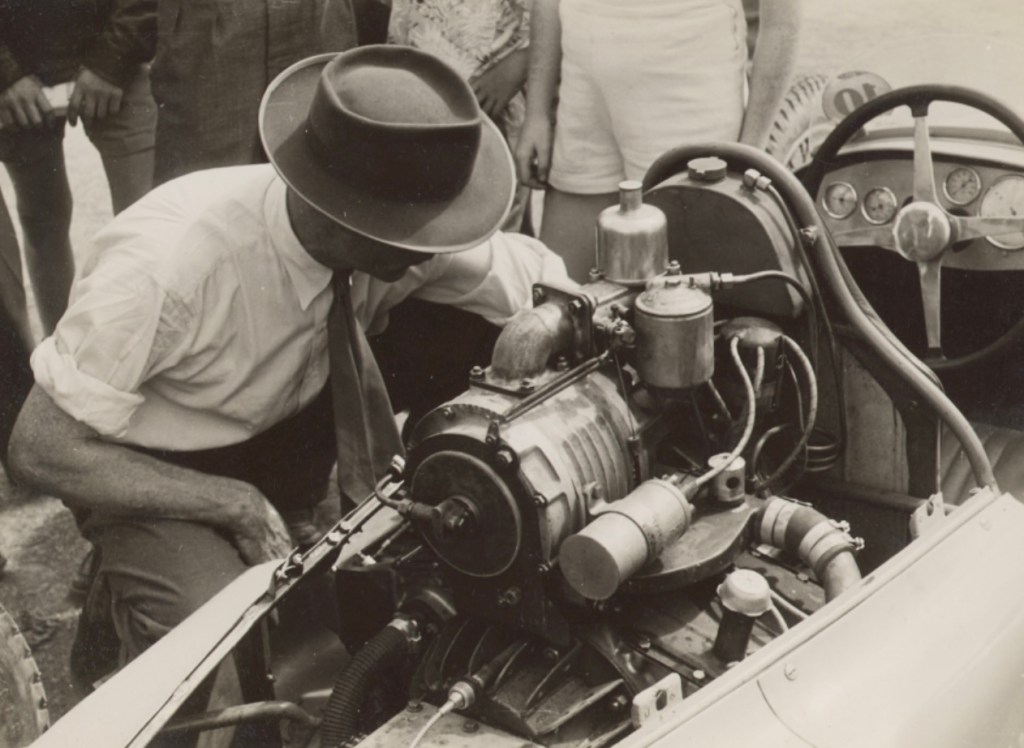
What an evocative shot of the business end of the brilliant Wylie Javelin Spl…

The gent in the Akubra makes the shot. Perhaps it’s the ’53 AGP weekend at Albert Park but that’s a guess. That looks like a rego-sticker on the windscreen! See this lengthy epic: https://primotipo.com/2018/09/14/the-wylies-javelin-special/
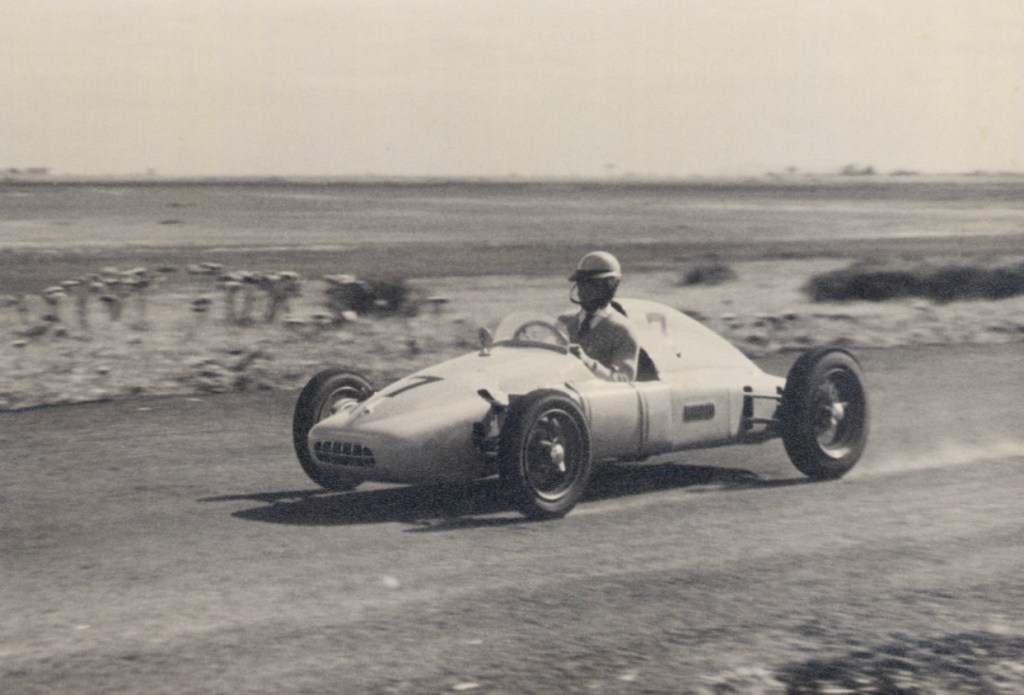
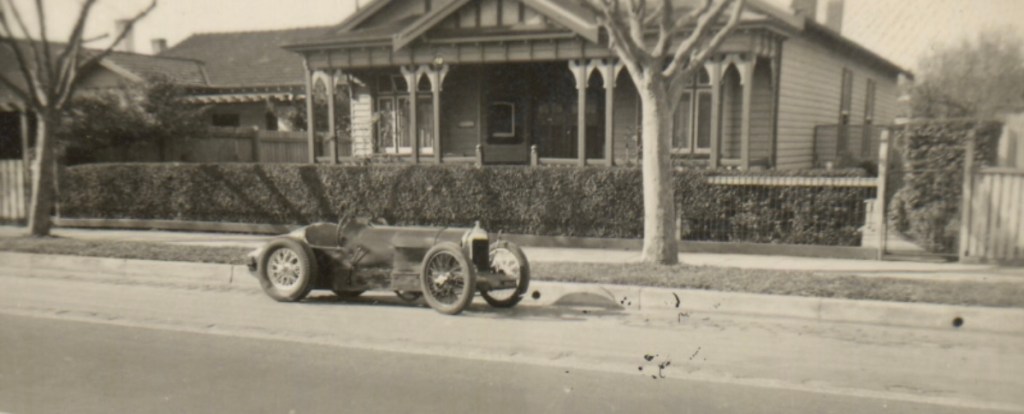
Arthur Wylie at Altona in 1954 (SLV)
(SLV)

A D.F.P. out front of a home, probably in Melbourne, chassis number and street address please!? It has a touch of the Elsternwicks about it but could be anywhere.

The marque were in on the ground floor of racing in Australia, Les Pound finished last in the 100 Mile Road Race run by the Victorian Light Car Club in March 1928, the second Australian Grand Prix.

See here for more on D.F.P.: https://primotipo.com/2021/10/01/werrangourt-archive-11-dfp-the-greyhound-of-france-by-bob-king/
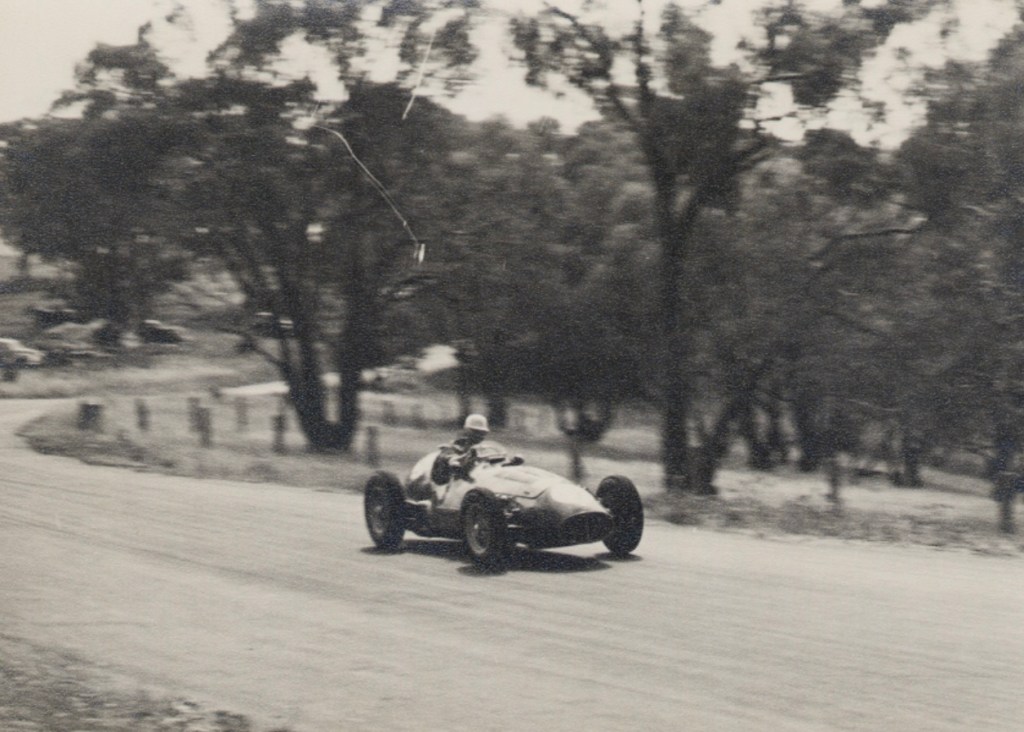
(SLV)

Reg Hunt enroute to winning the scratch-section of the Bathurst 100 during the 1955 Easter weekend at Mount Panorama, Maserati A6GCM-250.

Despite having only his short-diff fitted the Grand Prix car still did 145 mph down Conrod.

The handicap winner of the race was Curley Brydon in his new MG Special; a mix of the ex-Tomlinson ‘39 AGP winning chassis and the supercharged engine from Brydon’s ex-Patterson TC Spl.
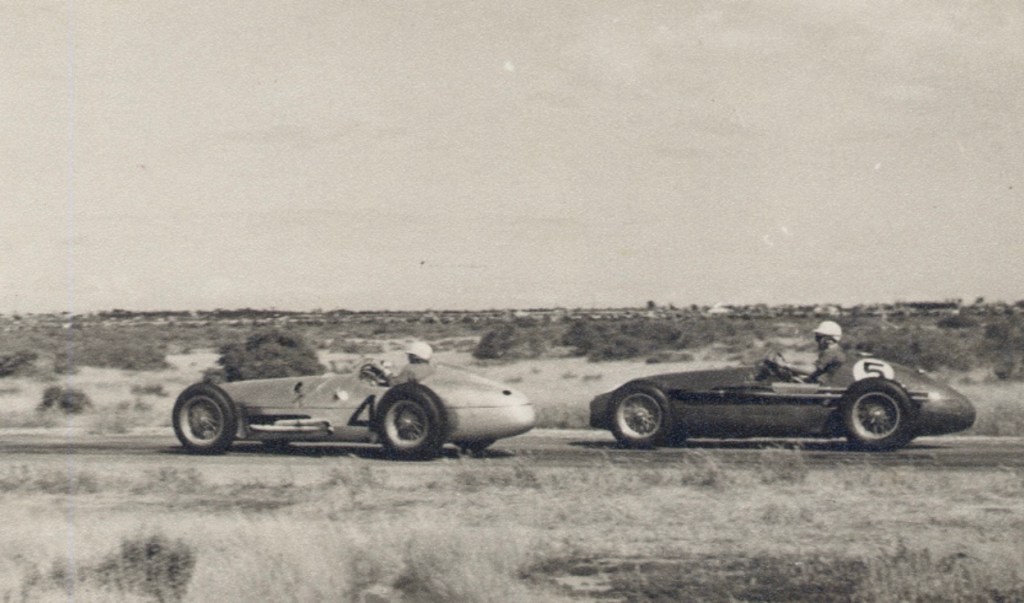
(SLV)

I’ve done chapter and verse on Australia’s fastest combination in 1955-56 – Reg Hunt and Maseratis A6GCM and 250F – but start with these two: https://primotipo.com/2017/12/12/hunts-gp-maser-a6gcm-2038/ and https://primotipo.com/2024/02/10/australian-gold-star-championship-1956/
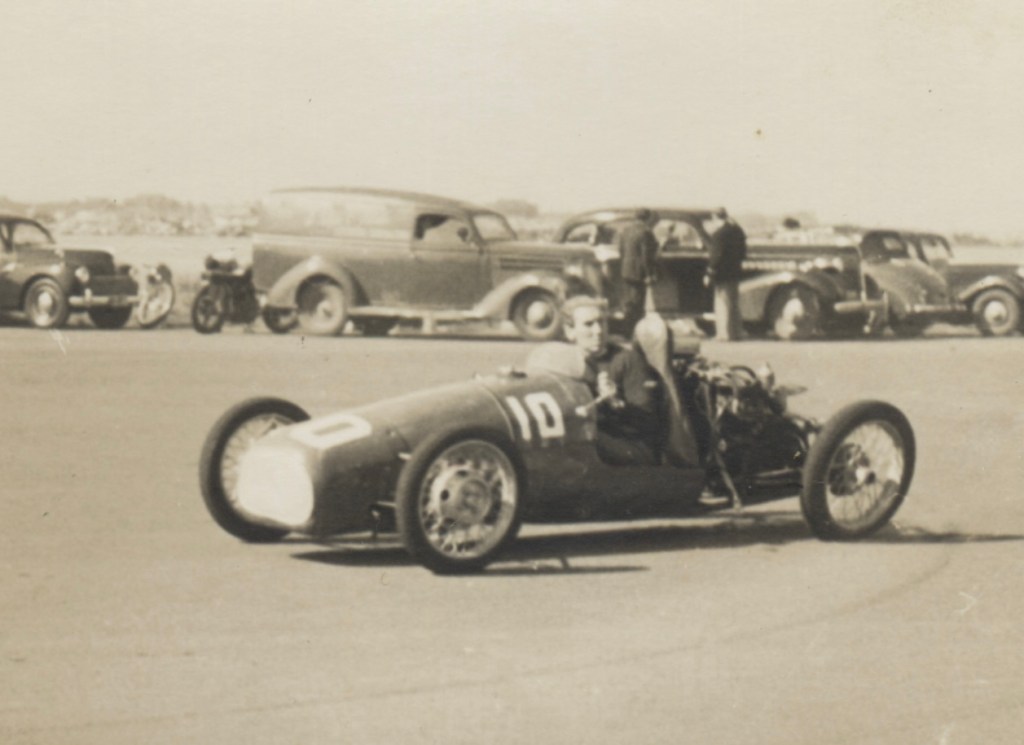
Manchester born Reg Hunt tootling through the Fishermans Bend paddock in his Hunt Spl aka The Flying Bedstead, date unknown but 1951 perhaps.

The Hunts arrived in Melbourne in May 1949 with Reg bringing with him various parts accumulated in the UK which he used to build this hillclimb /road racer affectionately known as the Flying Bedstead.

It was built between May-October 1949 by Hedley Thompson either in his Deepdene, Melbourne home garage or as a homer at Trans Australia Airlines, where Hedley was head of maintenance.

Thompson’s thoroughly modern chassis was a shallow multi-tubular spaceframe of welded steel construction. It had a light, tringulated front bulkhead and a more substantial rectangular one at the very rear of the car just aft of the gearbox.

Front suspension was modified Morgan pillar, and the rear comprised an upper transverse rear spring, swing axles and an underslung tubular shock absorber mounted at its top to the underside of the axle case and at its bottom to the chassis.

Bolt-on wire wheels were 3:25 inch x 18 at the front, and 3:50 inch x 19 at the rear. The ultra-light machine had hydraulic brakes with two leading shoes at the rear.

The engine was an Amal-fed 500cc J.A.P. (J.A. Prestwich) speedway engine with the power hitting the road via a Norton four-speed box.

The Flying Bedstead’s first outing was at Fishermans Bend in October 1949, where it was noticeably quicker and outclassed the numerous MG specials present. Some weeks later, at Rob Roy, it lowered the class record by nearly six seconds, to 31.4 seconds. In March 1950 he improved his time to 29.35 seconds.

Other successes followed, and soon a supercharged 998cc Vincent Black Lightning engine was fitted by Phil Irving, and the bodywork was improved; the form shown above.

‘First used in this guise at Bacchus Marsh in July 1951, at Bathurst in October it outpaced a Cooper Vincent in the first race and was pipped on the last lap in the second. The speed over the flying ¼ mile was reported at 134 mph.’ Really?!

When Hunt raced Cooper 500s in Europe in 1954, he made a side-trip to Italy on the way home and purchased the ex-works Maserati A6GCM shown above, so the Bedstead was set aside and later sold. Hunt repurchased it in 1978, and it was ultimately restored under his supervision, then later sold at auction and is extant.
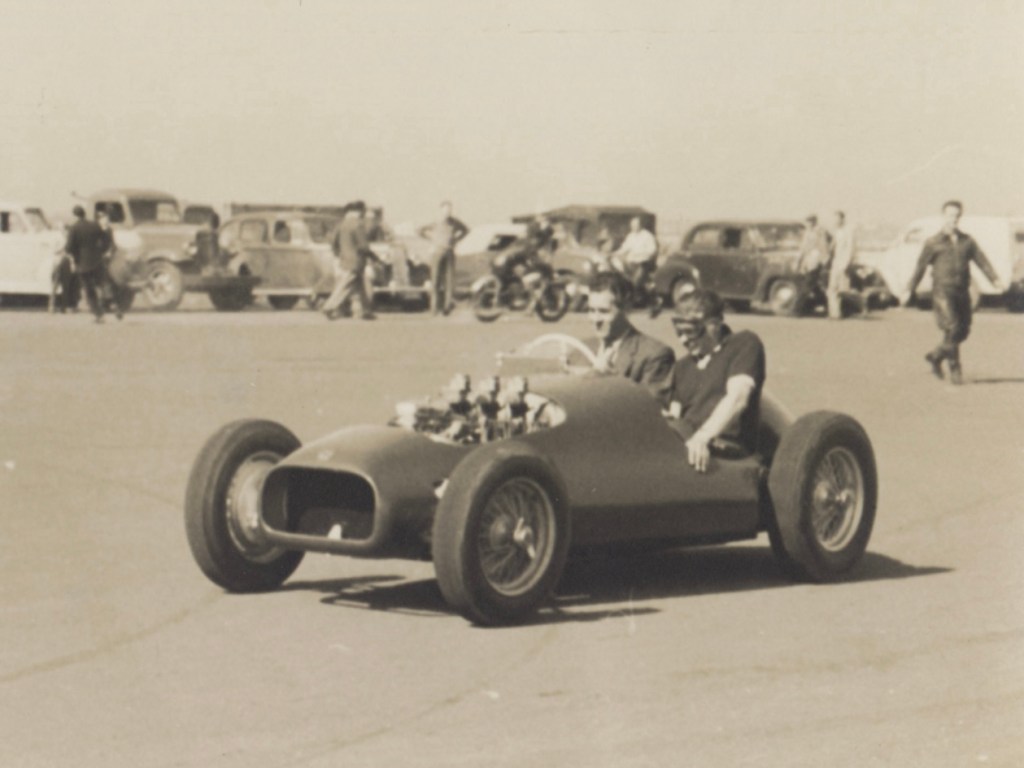
(SLV)

Conceived in Lou Molina’s Albert Park backyard the MM (Molina/Massola) Holden consisted of a Silvio Massola home-made chassis, Standard 12 front end, H.R.G differential and gearbox, Holden Grey six-cylinder engine and an attractive body made by Brian Burnett.

The MM had its first outing at Fishermans Bend on October 3, 1953, and I’m wondering if that’s when this photo of Lou and a Victim tootling around the paddock was taken?
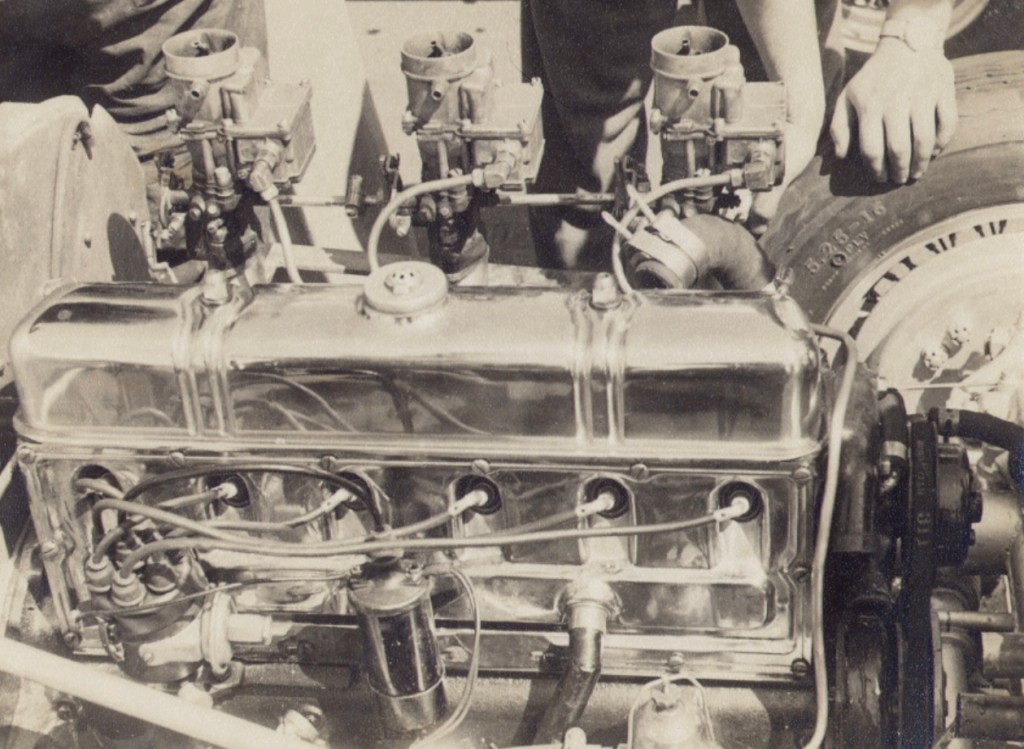
MM Holden was initially fitted with triple Stromberg carbs, later replaced by SUs (SLV)

Lou then contested the November 21 1953, Australian Grand Prix at Albert Park where he was an amazing fifth in the 64-lap 200-mile event won by Doug Whiteford’s Talbot-Lago T26C. The 2290cc MM Holden started from grid 30. The car appeared exactly as it is in the photograph above, sans bonnet and with triple-Strombergs pointing loud and proud at the sun.

The MM raced the following year at the January 1954 New Zealand Grand Prix with Molina competing alongside other Australians including Jack Brabham, Stan Jones, Tony Gaze and Alec Mildren. On this occasion, the MM was not successful, retiring early with mechanical problems. Stan Jones won the day of course in another rather famous Australian special

Amongst other notable runs, in 1956 the MM finished in the top six at the Argus Cup at Albert Park and clocked 15.3 seconds for the standing quarter mile at the Geelong Sprints.

Greg Smith has given me a shedload of material about this car from Lou’s Archive, I really must do something on the two Molina Specials soon.
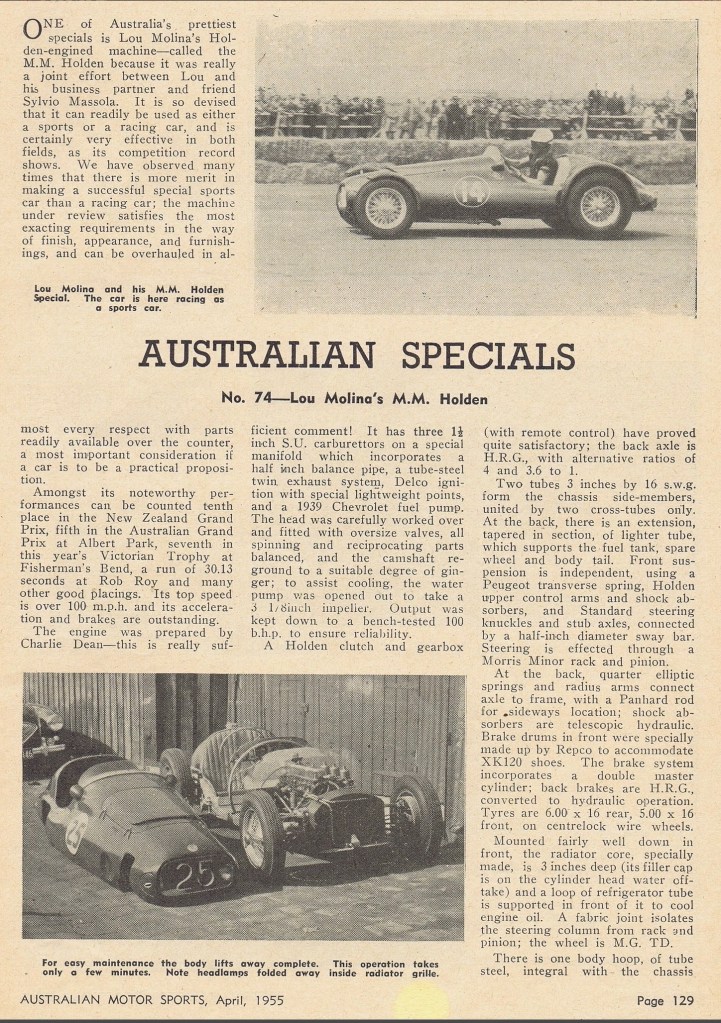
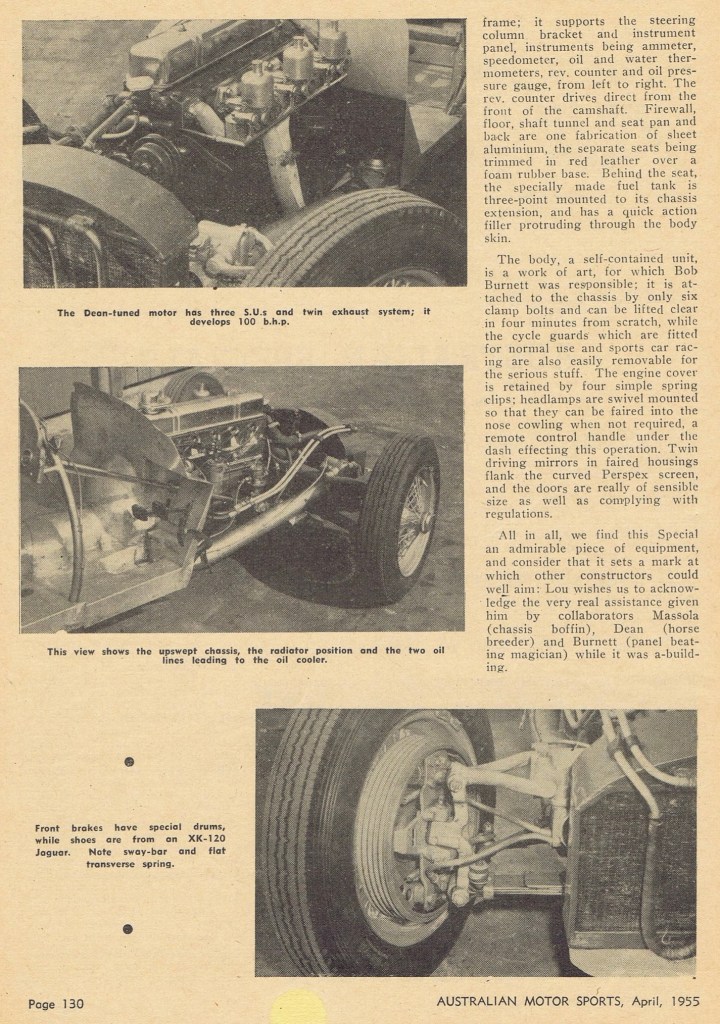
And below, the MM Holden and an MG?, before the off at Fishermans Bend.
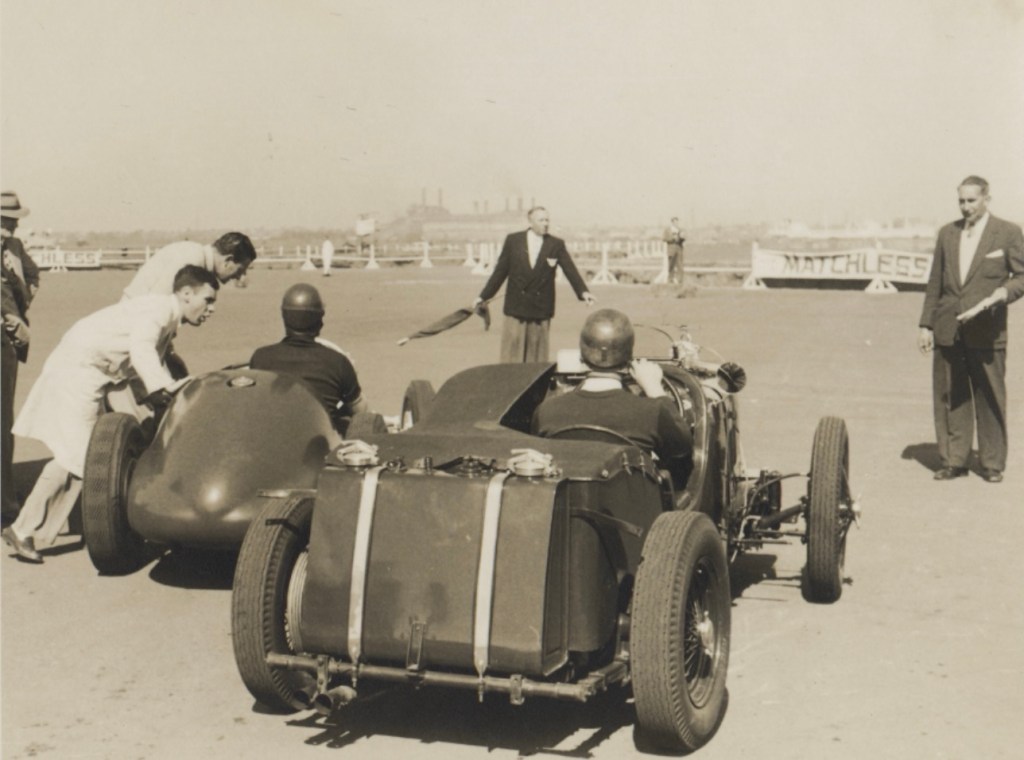
(SLV)
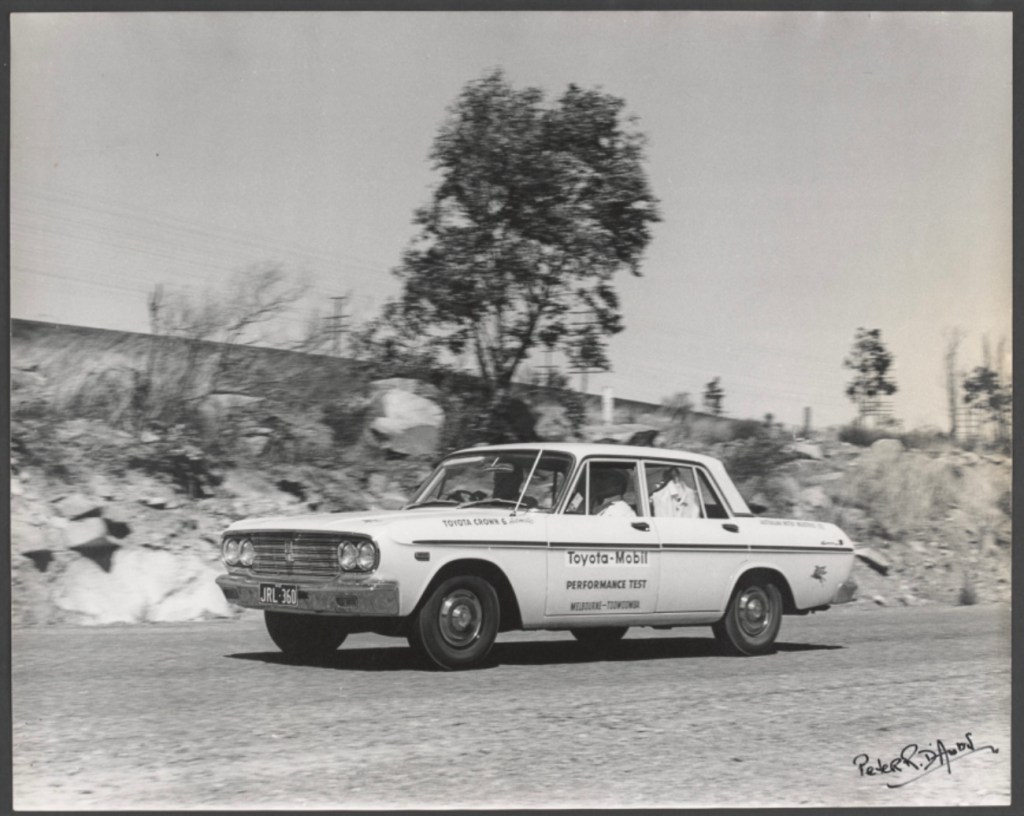
(Peter D’Abbs)

The Mobil sponsored Toyota Melbourne-Toowoomba Performance Test in 1966, Toyota Crown. It was still at the stage that ‘The Japs’ were convincing Aussies about the durability of their cars I guess, they succeeded rather well!
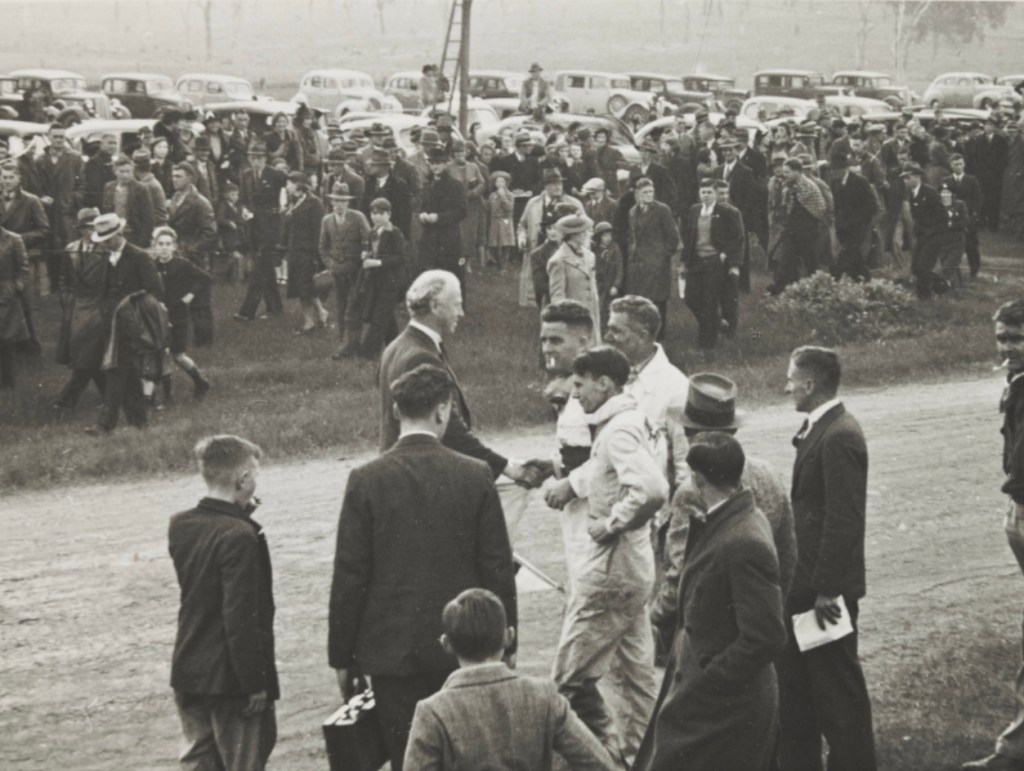
(H Coulson)

This looks awfully like Jack Phillips and Ted Parsons after one of their Interstate Grand Prix wins at Wirlinga, Albury in 1938 or 1939. Jack – with the post-race fag – still has his kidney-belt on.

Their mount was a Ford V8 Special, see here: https://primotipo.com/2023/03/07/jack-phillips-ted-parsons-ford-v8/
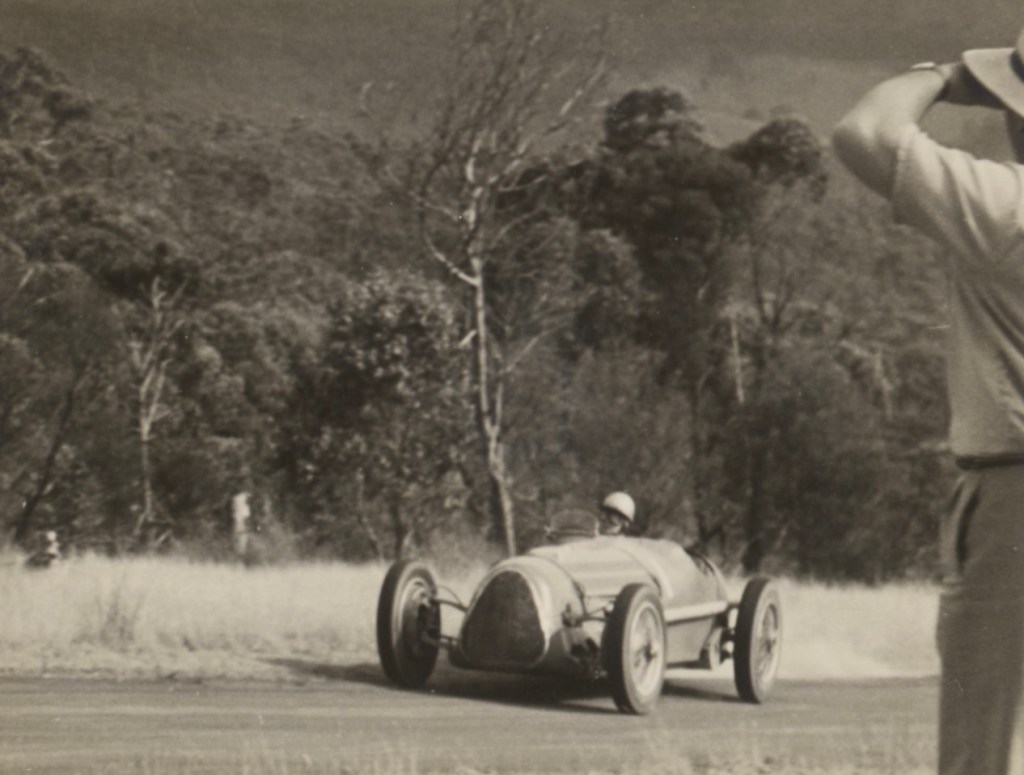
(SLV)

Charlie Dean well and truly on the gas during this ascent of Rob Roy in Maybach 1, date unknown. Right front on the track’s verge and right rear well and truly on the roadside.

Dean’s series of three Maybachs were labelled Maybachs 1, 2 and 3. M 3 was christened M 4 when that car/chassis was modified by fitment of a 283 Chev V8 in place of the Maybach SOHC six and other changes, mainly to the rear suspension. These cars were great crowd pleasers from their first appearances in 1948 until the last in-period races of Maybach 4 Chev in the hands of Ern Seeliger and Stan Jones in 1958-59.
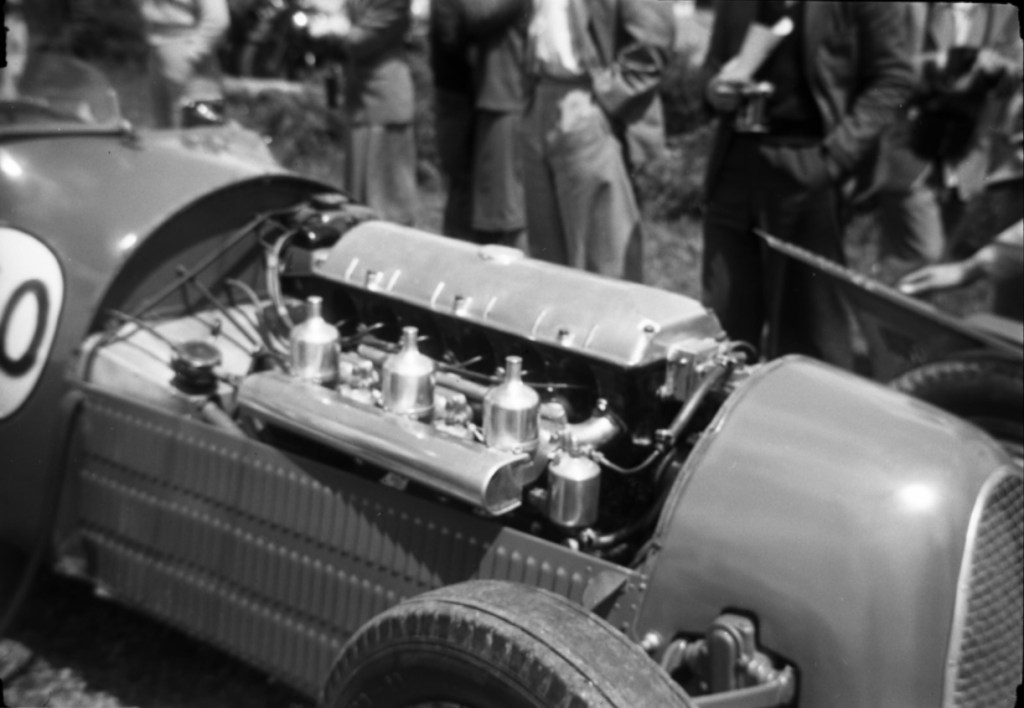
(SLV)

One of the great shames is that a Maybach never won an Australian GP, karma suggests that this shouldn’t be the case but shit-happened on those particular big days. Stan Jones’ 1954 NZ GP win – truly a great team effort – is duly acknowledged…More about Maybach 1 here: https://primotipo.com/2024/01/15/maybach-1-technical-specifications/
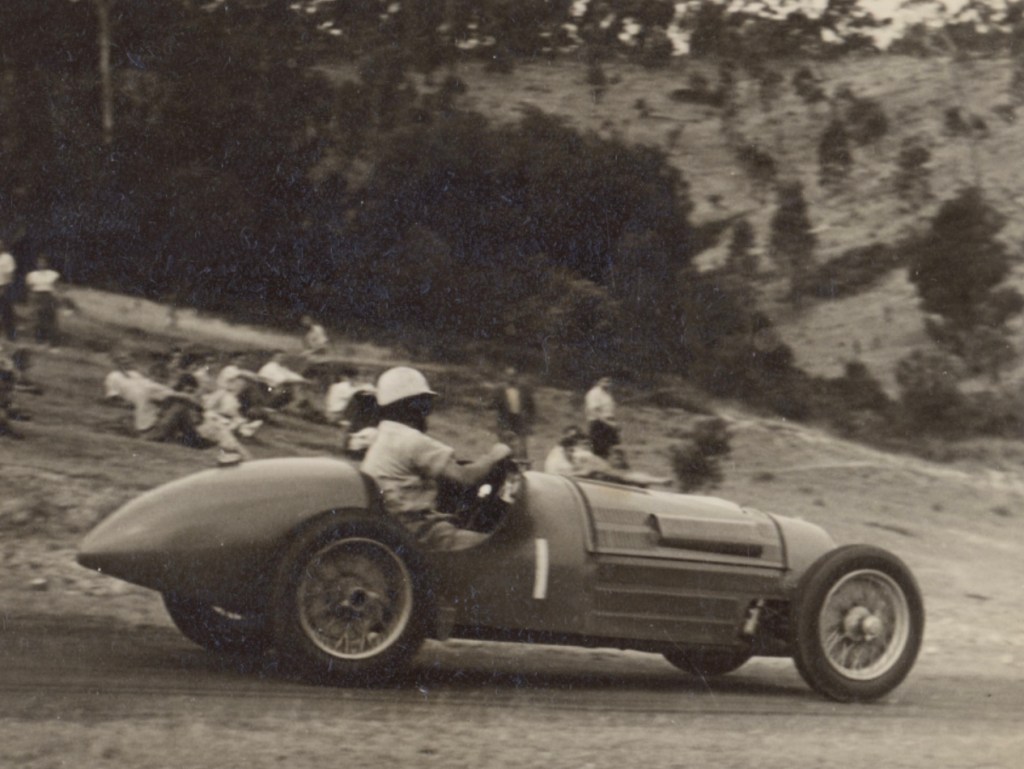
(SLV)
(G Thomas)

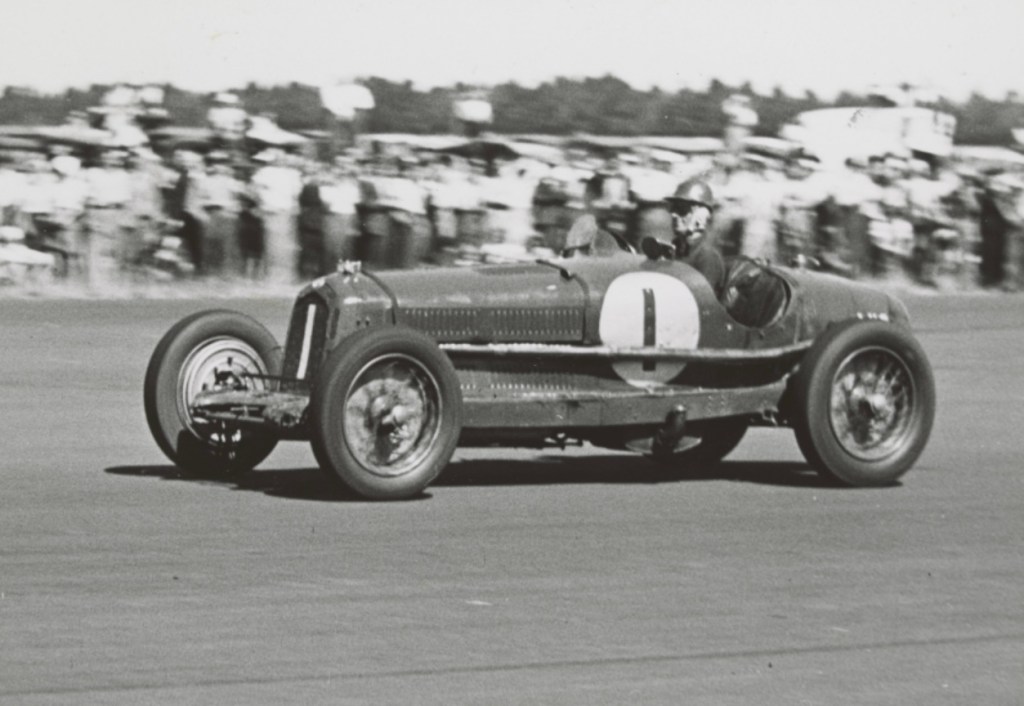
Alf Barrett at Ballarat aboard his superb, aristocratic Alfa Romeo 8C2300 Monza, during the 1947 Victoria Trophy.

This is another combination that shoulda-coulda-woulda but never did win an Australian GP. The fastest combination in the immediate pre- and post-war periods is the descriptor that would have to do.

The centenary of the first Australian Grand Prix takes place in 2027, good news is that the current custodians of this car: Grace, Troy and Lindon Davey-Milne have its restoration underway and with a bit of luck it will take its place in the on-track centenary celebrations or as a static exhibit at Goulburn and Phillip Island in 2027-28.

See here for more: https://primotipo.com/2015/02/20/alf-barrett-the-maestro-alfa-romeo-8c2300-monza/
(SLV)

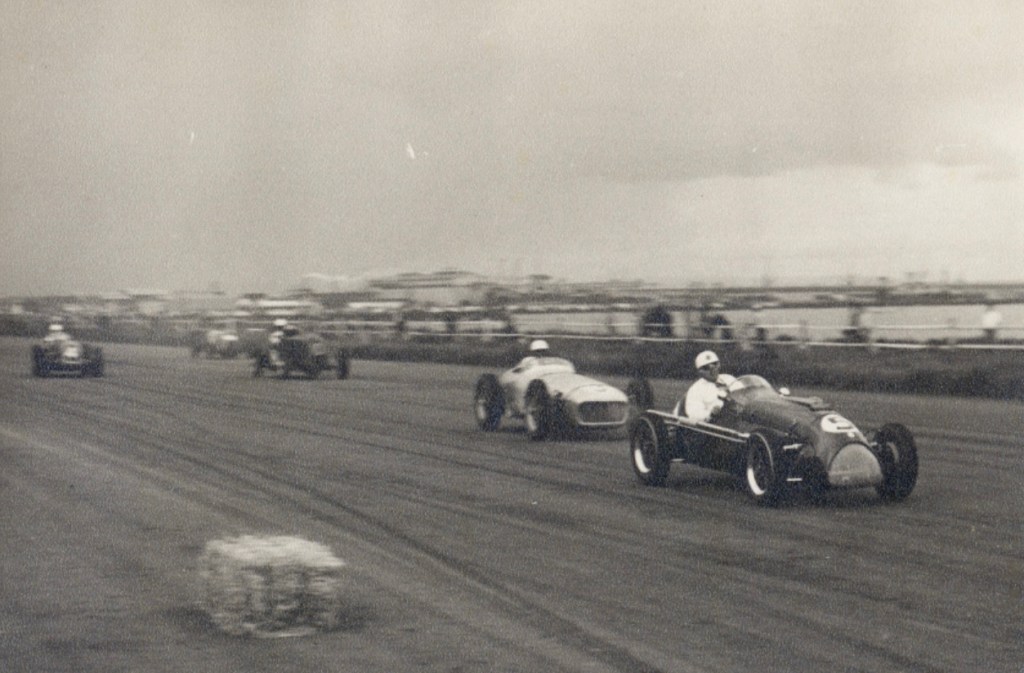
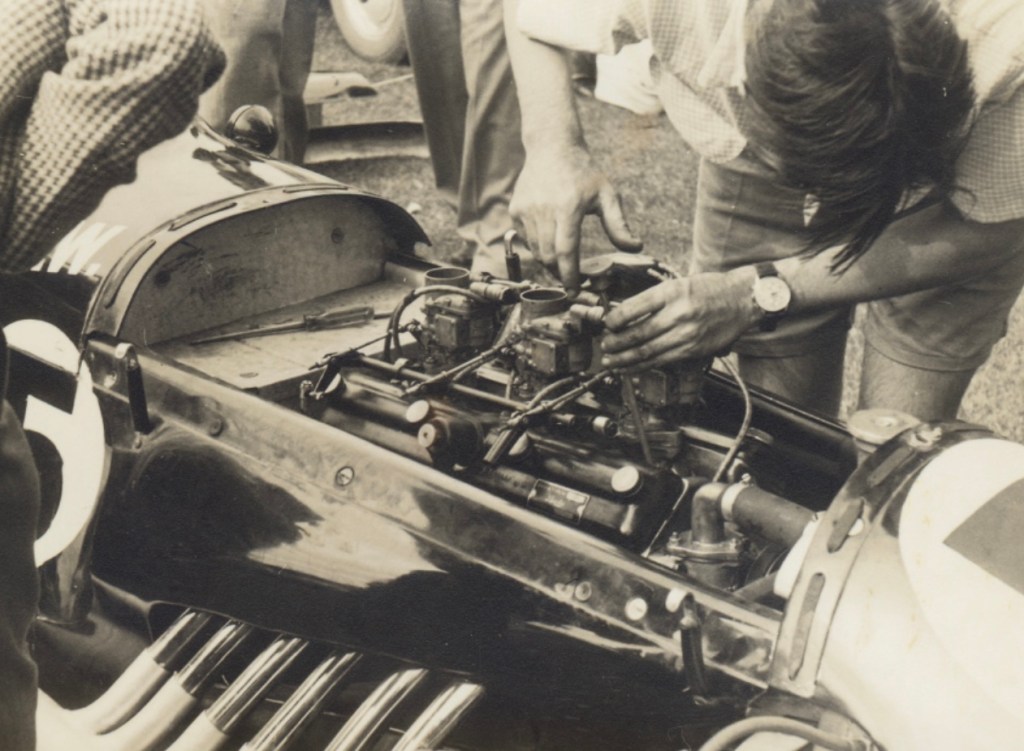
Len Lukey and Ern Seeliger – probably – dice at the front of a Fishermans Bend pack circa 1957. Cooper T23 Bristol and Maybach 4 Chev. The 2-litre, triple Zenith-fed six-cylinder Bristol engine of the Lukey Cooper is shown below. More about the T23 here: https://primotipo.com/2017/02/24/the-cooper-t23-its-bristolbmw-engine-and-spaceframe-chassis/
(SLV)
(G Moss)

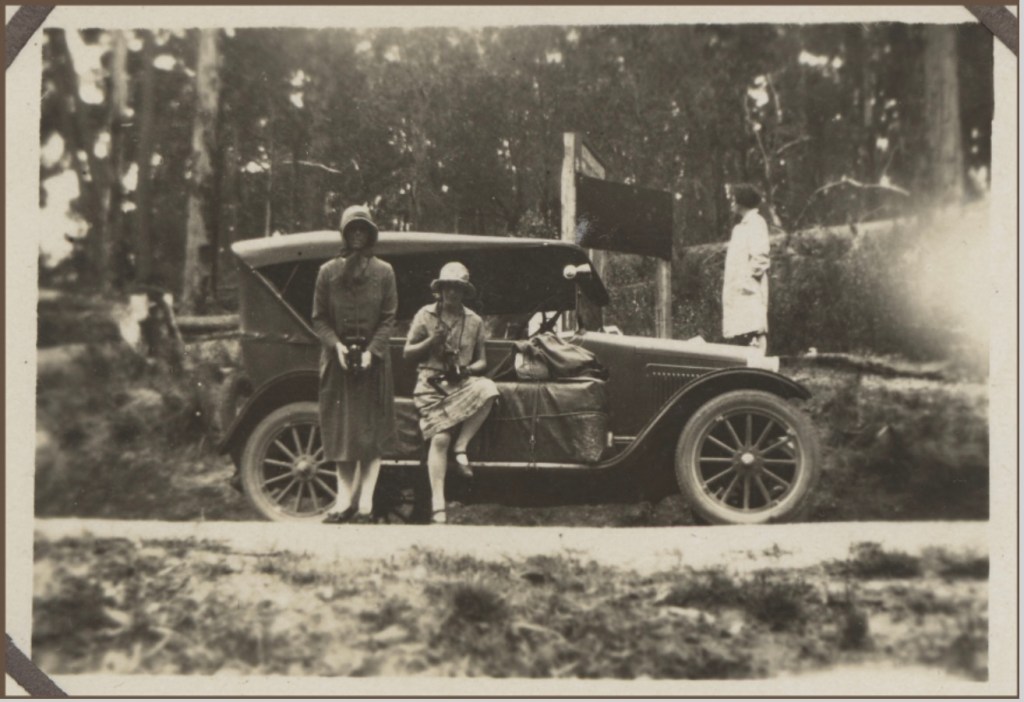
‘Sydney to Melbourne 750 miles by car in December 1927’, is the caption. Make of car folks? They certainly did it the long way, and the hard way no doubt.
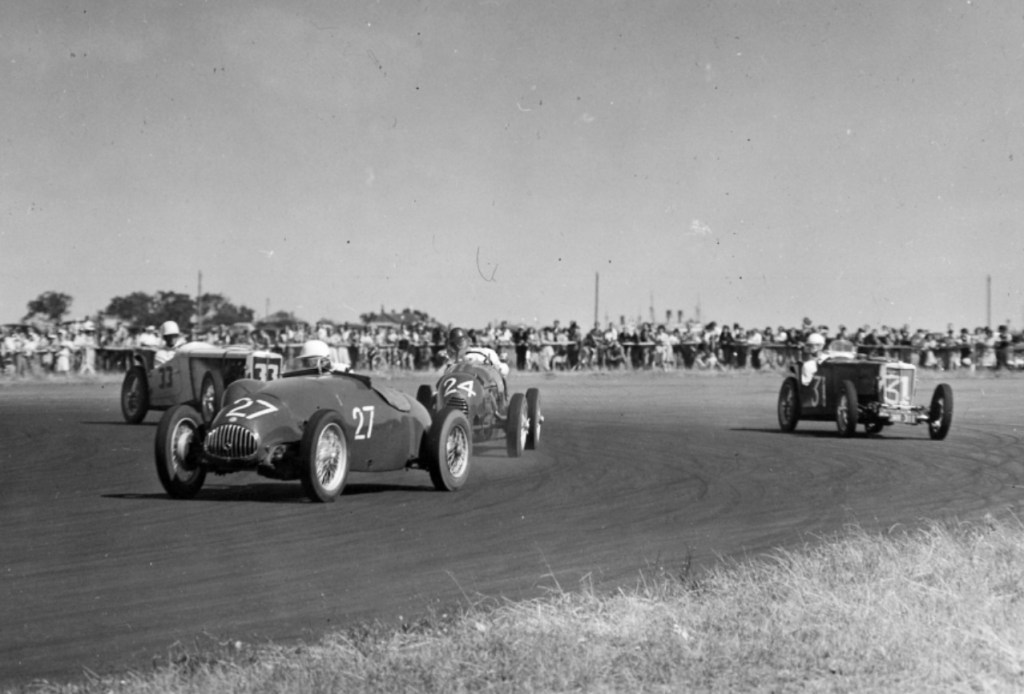
(J Read)

Stan Jones HRG #24 amongst a gaggle of MGs at Fishermans Bend in 1951 led by Lex Davison in the family TC Spl. I’ll take your advice on the rest. Article on the Davison TC Spl here: https://primotipo.com/2015/10/01/lex-davison-mg-tc-the-lobethal-stobie-pole-and-the-lucky-escape/

Credits…

State Library of Victoria and photographers George Thomas, ‘Bathurst : Cradle of Australian Motor Racing’ John Medley, Hal Coulson, Gladys E Moss, JP Read, Australian Motor Sports

Tailpiece…
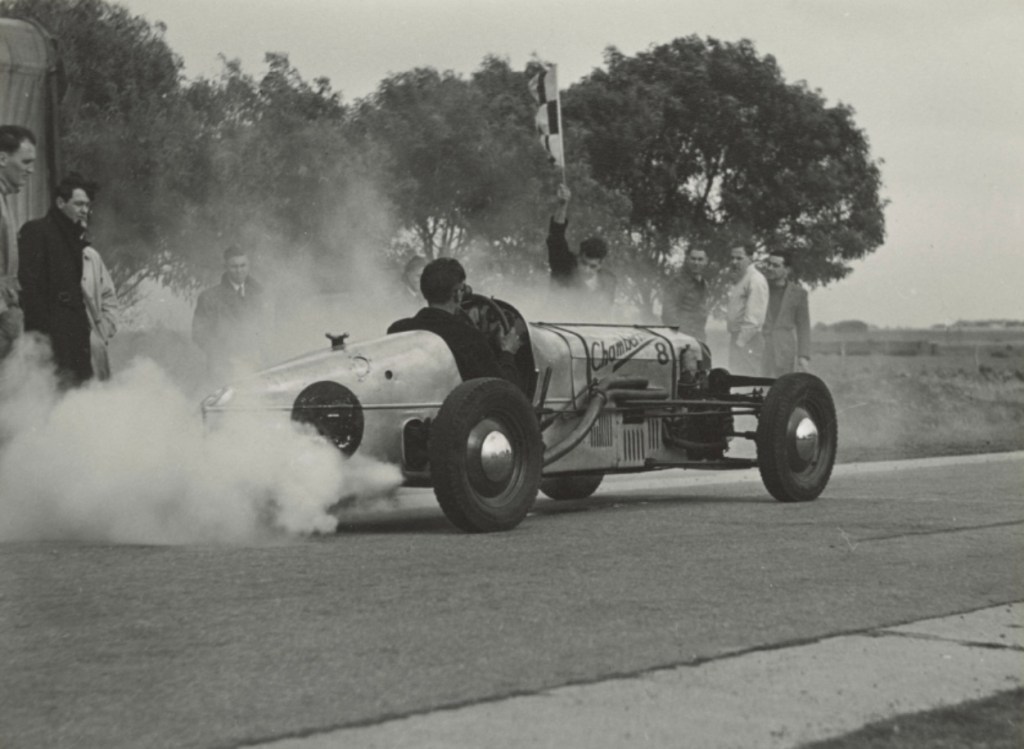
(G Thomas)

The starter drops the flag, can you see him among the clouds of two-stroke smoke!?, for Jim Hawker and the Chamberlain 8, VSCC Speed Trials, Geelong Road, June 1947; tree-huggers eat yer’ heart out.

The features of the Chamberlain brothers’ crazy-brave pre-war special included a small-tube spaceframe chassis, independent front and rear suspension, front wheel drive and eight-piston, two-stroke, supercharged 1.5-litre engine. See here: https://primotipo.com/2015/07/24/chamberlain-8-by-john-medley-and-mark-bisset/

Finito…

(Dacre Stubbs)

Doug Whiteford won the first Australian Grand Prix held at Albert Park in his Talbot Lago T26C 70 years ago today, November 21, 1953.

He won the Formula Libre race from Curley Brydon’s MG TC Spl and Andy Brown’s MG K3. 40 starters took on the challenge, racing in the opposite direction to today on a course that goes around the lake but is a bit different to the original.

I’d forgotten the anniversary. The Australian Grand Prix Corporation celebrated the occasion back in March during the F1 weekend. My mate, Auto Action publisher Bruce Williams called before to say they were going to post online the article I wrote back then for the pre-AGP Auto Action, see here: https://autoaction.com.au/2023/11/21/australian-grand-prix-at-albert-park-70-years-young-2

That front row above is Lex Davison in his ex-Moss F2 HWM, then fitted with a Jaguar C-Type spec 3.4-litre XK-six at left, Stan Jones’ Maybach 1 4.3-litre and Whiteford’s 4.5-litre Talbot-Lago at right.

(S Wills)

The bolter early was Stan Jones in Maybach 1, he led till the halfway mark but retired after completing 58 of the 64 lap, 250 mile journey. Whiteford lost a tyre off the rim with 10 laps to run, but he was close to his pit, and had a huge lead so the 30 second stop to change the wheel wasn’t a problem.

(The Age)

Whiteford looking modestly chuffed with his win. He took the same car to AGP victory at Mount Panorama, Bathurst the year before, and won at Nuriootpa in the Barossa Valley aboard his famous Ford V8 Ute based special, Black Bess, in 1950.

Dicer Doug was a formidable, aggressive driver who was also a master-mechanic. His preparation and presentation skills were legendary, so too his mechanical sympathy. He was the complete package.

See here: https://primotipo.com/2019/03/16/1953-australian-grand-prix-albert-park/ here: https://primotipo.com/2022/05/04/doug-whiteford-talbot-lago-t26c-take-3/ and here: https://primotipo.com/2022/11/19/maybach-1-take-3-or-4/

Credits…

Auto Action, The Age, Spencer Wills

Finito…

(C Charge)

Lou Molina, Molina Monza Holden leads Don H Swanton, Lotus 11 Climax and Alan Jack, Cooper T39 Bobtail Climax at Albert Park during the Victorian Tourist Trophy on 23 November, 1958…

It’s the first lap I suspect, with the lead bunch in front of Lou’s superb MM Holden s/c. The race was contested on the first Sunday of a double-header meeting, the feature race a week later was the Melbourne Grand Prix, won by Stirling Moss from Jack Brabham in similar 2.1 and 2.2-litre Cooper T45 Climaxes. Swanton’s car (a series 2, chassis # 303) was an ex-Team Lotus Peter Ashdown machine that Don bought in January 1958 and raced throughout the UK before being shipped home in time for this Albert Park meeting.

The TT had a good field of depth and breadth and was run over 100 miles/32 laps of the demanding Albert Park track; they raced anti-clockwise then, the opposite to the direction of today.

Unfortunately the political winds of change were blowing in Victoria. Some powerful voices on the conservative side of politics, aided and abetted by the editor of The Herald, one of the local fish ‘n chip wrappers, were against the use of the park for motor racing. And so it was that Albert Park was closed for racing, other than speedboats, until the modern era when the conservative side of politics, in the form of then Premier Jeff Kennett swung the pendulum back the other way and nicked the F1 GP from the South Australian conservative government; there is no love lost between thieves after all! All you needed to know about Albert Park politics but were too scared to ask; https://primotipo.com/2020/05/12/albert-park-lake-boats-and-politics/

Bob Jane about to be rounded up by the battling Whiteford and partially obscured Pitt Jag-D, with Lou Molina (DNF) on the inside, and a Healey 100S in the distance (E Steet)

Back to the Tourist Trophy, triple Australian Grand Prix winner – including a win at the ‘Park in 1953 – Doug Whiteford was the classiest, most experienced driver in the field and won the race in 65m47.2sec aboard an ex-works Maserati 300S (chassis 3055) he acquired from Officine Alfieri Maserati at the end of the 1956 Australian Tourist Trophy/Australian Grand Prix carnival that November-December: Stirling Moss won both these races aboard 300S and 250F respectively.

Bill Pitt put on a great show, leading the race for the first 12 laps in the Queensland Jaguar distributors, Westco Motors’ Jaguar D-Type (#XKD526) before Whiteford passed him on lap 13. Pitt, on his third trip to Albert Park, then hung onto Whitehead but nudged the hay bales on lap 26, pushing a rear ‘guard onto a wheel in the process. The ensuing pitstop cost 40 seconds and any chance of a race-win, third place was the result.

Ron Phillips placed second in the booming Cooper T38 Jaguar raced by Peter and Graham Whitehead throughout Europe, including Le Mans, in 1955. It was sold to Stan Jones by Peter Whitehead towards the end of his 1956 Australasian Ferrari 500/625 3-litre tour. But Stan wasn’t a fan of it, CJ/1/55 then passed through less competent hands until Phillips got hold of it. He got the best out of it too, a win in the Australian Tourist Trophy at Lowood in 1959 was his best result. Ron proved his intent and pace early in his time with the car that Albert Park weekend, sharing the fastest lap of the race with Whiteford: 2m01.2sec and 98mph.

Derek Jolly, a member of the family who owned Penfolds Wines, was fourth in an ex-works Lotus 15 Climax FPF 2-litre that had raced at Le Mans in 1958 (below). Derek first raced the car in the 1958 Australian Tourist Trophy that October at Bathurst, there he finished second to David McKay’s Aston Martin DB3S, the Lotus was at that stage fitted with a 1.5-litre Climax. See here for a long feature on Derek and various of his cars including his ‘two’ Lotus 15s; https://primotipo.com/2017/11/09/dereks-deccas-and-lotus-15s/

Derek in Lotus 15 #608, the car lost its life the following week during the closing laps of the Melbourne GP, see link above (R Hope)
(R Hope)

Bob Jane in Australia’s other ex-works 300S (#3059) was a rather second-hand fifth, and Eddie Perkins’ – Larry’s dad – Porsche 356 was sixth. ‘Jano’ became a very handy racing driver, particularly in touring cars – ATCC and Bathurst wins duly noted – but he was wayward when he first bought the Maser, the quickest thing he had raced to that point. So much so that Reg Hunt famously moved his boat out of harms way by mooring it further out into Albert Park Lake. See here; https://primotipo.com/2015/05/15/bob-jane-maserati-300s-albert-park-1958/

(Allan Quinn)

Jim Goldfinch’ ex-Ron Phillips Austin Healey 100S chassis #3906 from the ex-Derek Jolly Decca Climax Spl of Gavin Sandford-Morgan. A good run in the race with the 100S was thwarted by a black flag due to the exhaust system wriggling away from its mounts. There is a great website about this car chockers with photographs if you’ve not tripped over it; https://austinhealey100s.com.au/AHS-3906-1955-1

(unattributed)

Other Healey 100S were raced by John Roxburgh in the ex-Whiteford car (chassis 3907), and of great historical significance, later Australian sportscar and open-wheeler international, Paul Hawkins in Italo-Australian businessman Terry Valmorbida’s car.

The ‘rootin-‘tootin, rough-as-guts Reverend’s son is shown above in the Valmorbida (chassis 3909) Healey 100S #77 in front of a gaggle of cars comprising later Cooper S ace Peter Manton’s Austin Healey Sprite, the Goldfinch 100S and Jon Leighton’s Lotus 11 Willment-Ford. More on Hawkins here; https://primotipo.com/2020/09/25/hawkeye/

Austin Healey 100S by two: Goldfinch #61 and Paul Hawkins in #77 car (unattributed)
(J Goldfinch Collection)

Etcetera…

The Goldfinch 100S in the ‘Albert Park paddock 500 miles from home’ in Adelaide as Jim noted; Army barracks in the background.

(unattributed)

Alan Jack in the ex-Bill Patterson Cooper Climax goes inside the James Goldfinch Austin Healey 100S. More on many of the cars in this feature on the 1960 Australian Tourist Trophy here; https://primotipo.com/2018/05/17/1960-australian-tourist-trophy/

D Swanton, Lotus 11 Climax, Goodwood 1958 (D Swanton Collection)

Donald Swanton…

Don Swanton was born on March 3, 1930, grew up in Highton Grove, Balwyn and attended Camberwell Grammar School, which was over his back-fence.

His first car was an Amilcar Roadster, his first job allowed the purchase of a Singer 9 which he ‘climbed, and raced at Fishermans Bend. He sold a Cooper to fund a move to the UK in 1955 and soon landed a job at SU in Edgbaston where he worked in the experimental department.

He purchased the Lotus 11 and changed jobs many times in the UK to learn and advance his career then returned to Australia in late-1958, racing the Lotus successfully until he sold it to Tom Corcoran in early 1960.

Swanton married Lorraine in 1967, had a son and daughter, and had a diverse career in Melbourne and Sydney, finally moving into the McKenzie Aged Care Residence in Templestowe in 2020.

D Swanton, Lotus 11 Climax in the UK, Goodwood 1958 (D Swanton Collection)

Credits…

Chris Charge Collection, Edward Steet, Allan Quinn, Ron Hope, ‘Glory Days : Albert Park 1953-58’ Barry Green, Don Swanton Collection, David Syers, Stephen Dalton

Tailpiece…

(D Syers)

Let’s finish with a splash of colour, this group is lining up for one of the sportscar supports, the shot was taken by Austin Distributors salesman, David Syers. #72 is the Monaro Motors owned Peter Manton driven Austin Healey Sprite. “It had only been in the country for two months and Manton had already turfed out the A-Series for a 1100 Coventry Climax and new nose,” quipped Stephen Dalton.

#74 is the JR Phillips Healey. Brian Sampson’s #97 Morris Spl is at left, #90 the Austin Distributors/Brotherton Sprite, then the #73 Esquire Motors/Rod Murphy Sprite, the silver coloured Franz Bird MG Milano with aeroscreen, the #78 Calvert owned, Eddie Perkins driven Porsche 356. In the distance is the red Frank Elkins Triumph TR2.

Finito…

(The Age)

Doug Whiteford is as pleased-as-punch after winning the 1953 Australian Grand Prix at Albert Park aboard his self-prepared Talbot Lago T26C (Course).

It was too good to be true, he had won his second AGP at Bathurst 17 months before aboard the same machine. He took victory in the 250 miler in the park from Curley Brydon’s MG TC Spl s/c and Andy Brown’s MG K3. The dude with the fag at the far-left is Bill Wilcox who retired his Ford V8 Spl after 37 of the 64 laps.

I’ve written about this race before, the appearance of this high-resolution shot from The Age/Fairfax archive stimulated this reprise. 1953 Australian Grand Prix, Albert Park… | primotipo…

The photograph is so sharp you can see the instruments, quadrant for the four-speed Wilson pre-selector gearbox, chassis plate and front suspension.

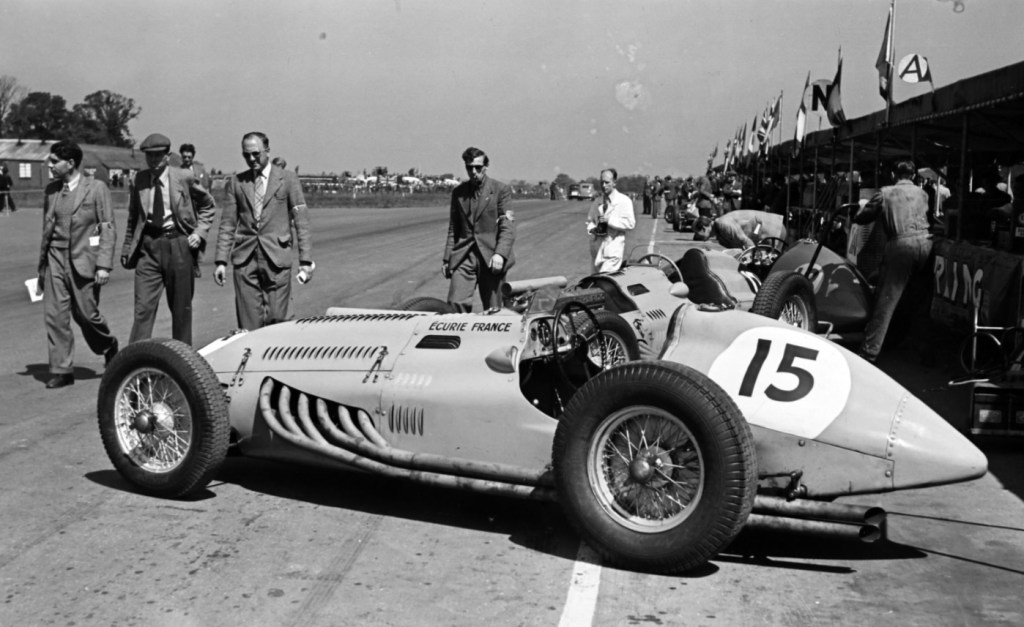
#110007 was part of Paul Vallee’s Ecurie France team between 1948-1950 before being sold, via Henry and Peter Dale, to Geelong’s Tom Hawkes in 1950 and shortly thereafter to Whiteford. See Bob King’s article on the Dales and their contribution to the number of European racers which came to Australia; ‘Words from Werrangourt’ 1, by Bob King… | primotipo…

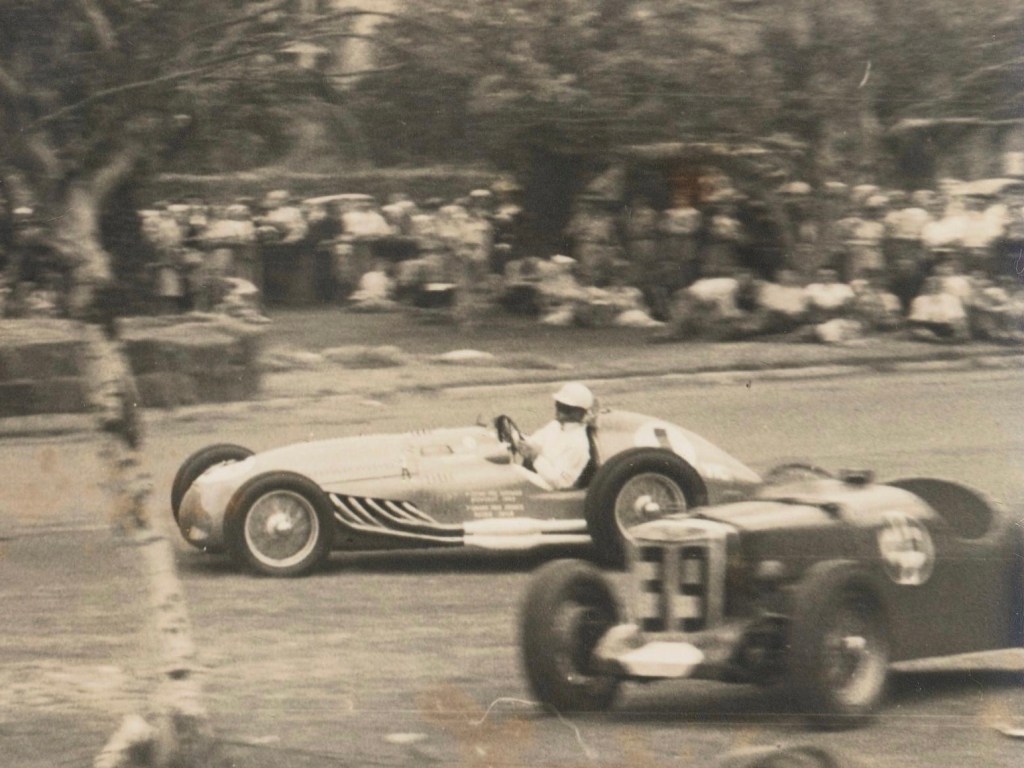
Louis Chiron jumps away from the rest of the field at the start of the April 1949 Jersey Road Race at St Helier aboard 110007. From the left, Raymond Mays’ ERA B-Type, Peter Whitehead’s Ferrari 125, and the Maserati 4CLT-48s of Gigi Villoresi, Bira and Emmanuel de Graffenried. Gerard won from De Graffenried and Mays Chiron DNF brakes (MotorSport)
110007 in the Silverstone pitlane during the July 1949 British GP meeting. Q15 and DNF universal joint for Chiron, up front De Graffenreid’s Maser 4CLT-48 won from Bob Gerard’s ERA B-Type and Louis Rosier’s T26C (MotorSport)

Strong results for 110007 before coming to Australia was Louis Chiron’s 1949 French GP victory and Harry Schell’s second place at the Coupe du Salon at Montlhery that October.

The car had chassis rails derived directly from Talbot sports car pattern. Front independent suspension was by lower transverse leaf spring and upper pressed steel rockers while at the rear a simple rigid axle was suspended by semi-elliptic leaf springs. Friction and hydraulic shocks were fitted as were Bendix cable operated brakes. A Wilson pre-selector gearbox was used.

The arrival of this modern straight-six cylinder 4482cc, 210bhp @ 4500rpm triple Zenith/Stromberg fed F1 car (4.5-litres unsupercharged, 1.5-litres supercharged) heralded the need for topline Australian competitors to have cars capable of outright wins as the sport evolved away from handicap events in our premier class.

Doug Whiteford passes the abandoned Jack O’Dea MG Spl aboard 110007 during his victorious ’53 AGP run at Albert Park (The Age)
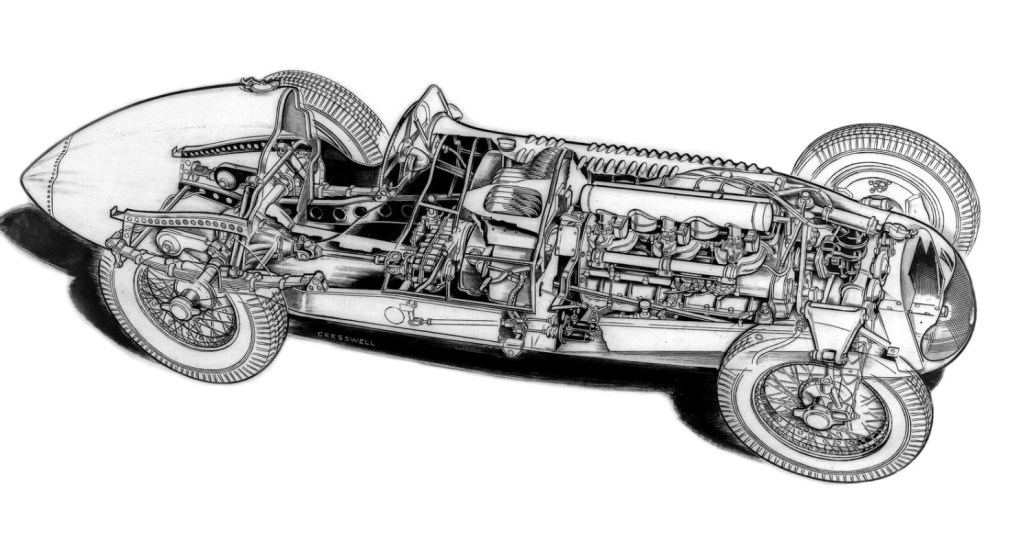
1949 Talbot Lago T26C cutaway by Leslie Cresswell

Technical Specifications…

The head and block of Walter Vecchia’s 4482cc six were of aluminium alloy. The engine was considerably undersquare with a bore/stroke of 93x110mm. Its two camshafts were located halfway up the block with short pushrods operating two valves per cylinder, the cost-effective design had some of the advantages of a more traditional twin-cam layout.

It produced circa 240bhp @ 4700rpm in the early stages of development, rising to 280bhp @ 5000rpm in 1950 when fitted with a twin-plug, twin-magneto cylinder head.

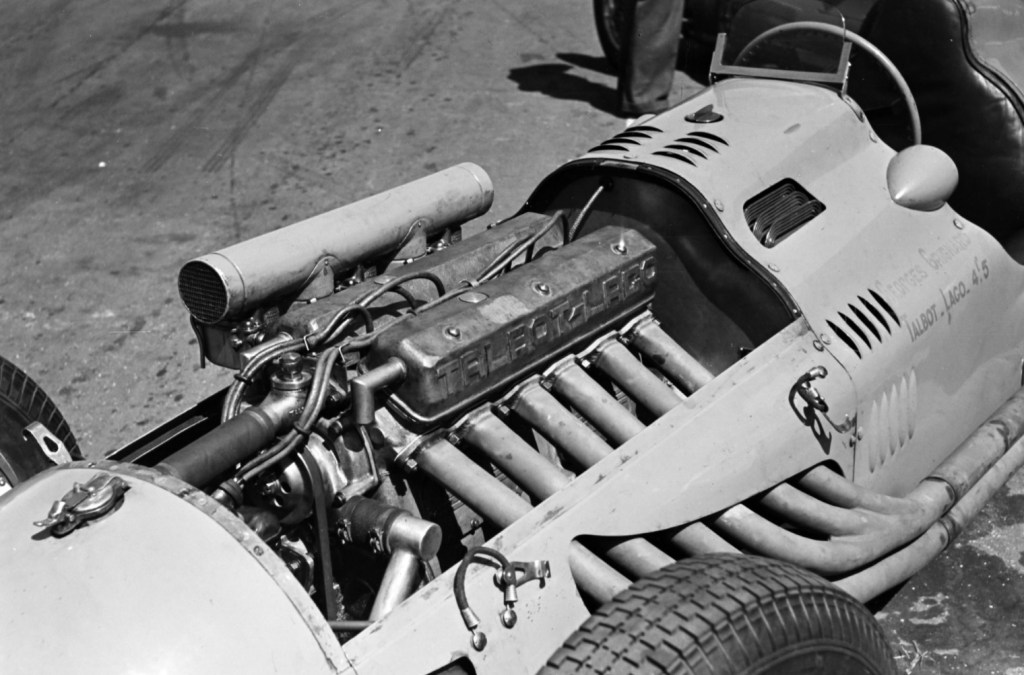
Carburation was by triple downdraught Zenith-Strombergs with two rocker covers proclaiming the name Talbot-Lago. A Scintilla magneto provided the spark, initially to one centrally located plug per cylinder.

Engine shot of Yves Giraud-Cabantous T26C #110006 in the 1949 Silverstone paddock. That motor swallowed a piston after 39 of the 100 laps (MotorSport)

A Wilson preselector gearbox was used, while heavy it was reliable and favoured by the drivers. The prop-shaft was offset to the right to allow a low seating position.

Front independent suspension incorporated top rockers, a lower transverse leaf spring and friction shock absorbers. The rear axle was suspended by good old fashioned semi-elliptic leaf springs, funds didn’t allow development of an independent design; the T26 was the last GP car to use semi-elliptic cart-springs.

Chiron watches while his car is readied at Silverstone in 1949 (MotorSport)

Credits…

The Age/Fairfax Archive, Peter Valentine’s Old Melbourne Town FB page, oldracingcars.com, Leslie Cresswell, Adam Gawliczek

Tailpieces…

(MotorSport)

A swarm of Talbot Lago T26Cs during the 1949 British GP.

‘Our’ 110007 in Chiron’s hands is at left, #17 is Yves Giraud-Cabantous machine (110006), DNF piston and Louis Rosier’s third placed machine #110001 at right.

In mid 1954 Whiteford sold the car after updating to the twin-plug headed T26C #110003. The car was raced by Rex Taylor, Ken Richardson, Owen Bailey and Barry Collerson in-period before becoming a historic racer. Bernard Charles Ecclestone has owned it since the early 1980s.

Whiteford heading up Mount Panorama on the way to victory in the 1952 AGP

Finito…

(P Jones)

Alec Mildren’s new, fifth-placed Cooper T43 Climax FPF 1.5 during the February 23, 1958 Gold Star weekend.

Stan Jones won the 28 lap, 50 mile ‘Victorian Trophy’ race in his Maserati 250F from Arnold Glass’ Ferrari 555 Super Squalo and Doug Whiteford’s Maserati 300S sportscar.

Many thanks to Melbourne enthusiast Peter Jones for sharing his photographs taken during a number of Fishos’ race meetings in the mid-fifties when he was in his mid to late teens. Thanks to Stephen Dalton for painstaking research post-publication to nail all the meeting dates.

Don’t Peter’s marvellous colour shots bring a drab airfield circuit to life? Many of the photographs were taken at this Victorian Trophy weekend, the second of nine Gold Star rounds, the title won by Stan Jones that year.

‘Patons Brake Replacements’ were omni-present at the time, a major trade supporter of our sport, they were ultimately absorbed within the Repco Ltd automotive manufacturing conglomerate. See this piece about the inner-suburban Melbourne airfield track; https://primotipo.com/2016/04/15/fishermans-bend-melbourne/

October 1957 (P Jones)

Tornado 2 Chev, the most successful form of the Lou Abrahams/Ted Gray/Jack and Bill Mayberry two racers. Bill and Lou are at far left.

Ted led the race early and was running in the top 4 when he pitted to address throttle linkage problems on lap 10. He rejoined and was third by lap 20 but the engine lost its edge, finally retiring after 26 laps.

Tornado won the Longford Trophy the following weekend. It was without doubt one of the fastest-if not the fastest car of 1958 together with Jones 250F, Ern Seeliger’s  Maybach 4 Chev and Lex Davison’s Ferrari 500/625 when it raced. It was not the most reliable though.

October 1957 (P Jones)

As regular readers will know I am a huge fan of everything and everyone to do with the Tornados. See here; https://primotipo.com/2015/11/27/the-longford-trophy-1958-the-tornados-ted-gray/ . Oh yep, a shorter one here too; https://primotipo.com/2018/02/20/teds-tornado-and-lens-cooper/

October 1956 (P Jones)


(P Jones)

Sabina Motors entered, Reg Nutt driven Cisitalia D46 Fiat 1,100, October 1957 meeting. Bailey’s Talbot-Lago T26C alongside.

This car was imported by Melbourne’s Dale Brothers in the early fifties but seems never to have been raced ‘really intensively’ in period. I recall it appearing at Sandown in the mid-seventies in one of the historic events which supported the annual taxi-enduro. At that stage it was part of the Leech Brothers Collection in Brighton, Melbourne. Long since departed our shores.

Such significant cars. Doug Nye credits Dante Giacosa’s 1946 design for Piero Dusio as the first modern customer spaceframe. ‘The production racing car trendsetter for an entire generation of designers’. Little bit about it here at the start of this Cooper Bristol piece; https://primotipo.com/2017/02/24/the-cooper-t23-its-bristolbmw-engine-and-spaceframe-chassis/

Reg Nutt is a story himself, he was a riding mechanic in the Phillip Island twenties GP years and then a racer of note.

(P Jones)

David McKay, Aston Martin DB3S during the February 1958 meeting.

David chose not to race in the Formula Libre Gold Star round, how did he do in the sportscar races folks?

This ex-works car, chassis ‘DB3S-9’ is the second of his two Aston Martin DB3S. Perhaps its biggest Oz win, in a field of some depth was the Australian Tourist Trophy at Mount Panorama that October. The customer ‘Kangaroo Stable’ machine was ‘DB3S-102’. See here; https://primotipo.com/2017/09/28/david-mckays-aston-martin-db3ss/ and here; https://primotipo.com/2017/10/31/yes-frank-i-love-it-magnificent-in-fact/

(P Jones)

Owen Bailey’s ex-works-Whiteford Talbot-Lago T26C from ace racer-engineer Otto Stone, MG K3.

The French machine won AGPs for ‘Dicer-Doug’ in 1952 and 1953 at Mount Panorama and Albert Park before it was replaced by an older and supposedly quicker machine.

Owen Bailey lined up for the start but transmission failure meant his race ended before it started. He did not have a great deal of luck racing this car.

See articles about T-Ls here; https://primotipo.com/2019/03/16/1953-australian-grand-prix-albert-park/ and here; https://primotipo.com/2015/06/09/fill-her-up-matey-lago-talbot-t26c-melbourne-1957/

(P Jones)


(P Jones)

Bib Stillwell’s Jaguar D Type.

The car first raced at the 1956 March Moomba meetings at Albert Park. Meeting date 13/14 October 1956, Jack Davey was the next owner in early 1957. See this feature for a full history of ‘XKD520’; https://primotipo.com/2020/04/17/stillwells-d-type/

(P Jones)


(P Jones)

Terry McGrath advises the XK120 #45 above is Murray Carter’s car.

(P Jones)

Poor Arnold Glass is stuck in the intake of his glorious ex-works-Reg Parnell Ferrari 555 Super Squalo ‘555-2’ during the ’58 Gold Star weekend. ‘It’s arrived not long ago from New Zealand, still has the NZ rego #495795 on the nose’ said Dalton.

Glass was second behind Jones’ 250F and in front of Whiteford’s 300S.

Australia’s ‘Big Red Car’ era ran from the arrival of Reg Hunt’s 2.5-litre Maserati A6GCM in 1954 and ended, say, after Stan Jones AGP win at Longford in March 1959. The little marauding Coopers were well on the march by then but not yet dominant.

The fans were excited by Lex Davison’s Ferrari 500/625, the 250Fs of Hunt, Jones, Bib Stillwell and Glass, the 300S of Doug Whiteford and Bob Jane and this car raced by Glass. It wasn’t the quickest thing around, he got on better with his ex-Hunt-Stillwell 250F but it was still a fast, spectacular car the very successful motor dealer drove capably.

See here; https://primotipo.com/2015/08/25/arnold-glass-ferrari-555-super-squalo-bathurst-1958/ and here; https://primotipo.com/2020/10/10/squalo-squadron/

October 1957 (P Jones)

Bib Stillwell discusses progress with a mechanic, ex-Hunt Maserati 250F chassis ‘2516’.

He ran well in the first couple of laps with Stan Jones but then pulled over at Matchless Corner with bent valves. Bib raced with his usual race number 6, these shots of the car the October 1957 Fishermans Bend meeting.

October 1957 (P Jones)


October 1957 (P Jones)

Stillwell’s preparation and presentation was five-star, it is intriguing why he has not re-painted Reg Hunts luvverly Rice Trailer in his own colours. Make and model of the American car folks?

Reg Hunt tested and acquired the machine at Modena in December 1955, first racing it in Australia at Gnoo Blas. He won the South Pacific Championship in it and ‘was the class of 1956’ behind it’s wood-rimmed wheel. Who can fault his choice of early retirement to focus on his growing dealership empire but our grids were robbed of a great competitor. See here; https://primotipo.com/2014/07/19/reg-hunt-australian-ace-of-the-1950s/

October 1957 (P Jones)

By this stage of his career Stillwell’s Kew Holden dealership and related enterprises were spitting off serious wads of cash, the quality of his racing cars reflected this.

An arch enthusiast, as well as an elite level racer- no driver other than Bob Jane had so many sensational racing cars ‘in period’ and later in his life when he returned to racing ‘historics’ globally.

(P Jones)

With a keen eye on the growing speed of Coopers, Bib bought the T43 Climax (above) Jack Brabham raced in the 1958 New Zealand Internationals and South Pacific Championship race at Gnoo Blas in January. Jack won the Levin International and the Soupac Championship in the 2.2-litre Climax FPF engined machine.

Bib practiced both the Cooper and Maserati at Fishos, he elected to race the 250F.

He entered the Cooper in the Bathurst Easter meeting where the 1.7-litre FPF engined car (presumably Jack took the 2.2 back to England) was very fast. In a 3 lap preliminary Bib started from pole but his new Cooper jumped out of gear. He quickly plucked it and set off amongst the mid-field bunch but touched wheels with Alec Mildren’s similar car (our opening shot machine) in the first turn- Hell Corner. The car somersaulted several times before landing back on its wheels. Bib was ok with facial cuts and abrasions but the Cooper was a tad worse for wear. After repair it was sold to Bill Patterson who raced it for the first time at Lowood in August.

Stillwell raced the 250F throughout the rest of 1958 and sold it to Arnold Glass in early 1959 after a good run to sixth in the Ardmore NZ GP. Carroll Shelby’s 250F was the best placed front-engined car that afternoon, two laps adrift of Stirling Moss winning 2-litre Cooper T45. It was very much time to sell, Arnold did very well with it in 1959-1960 all the same!

October 1956 (P Jones)

Paul England and Bill Hickey’s Ausca Holden-Repco is one of the sexiest and quickest of Australian sportscars of the period.

Ya can’t go wrong with styling nicked from the Maserati A6GCS! The ladder-frame chassis machine was built after-hours by Paul and Bill at Repco Research in Sydney Road Brunswick. It used a Holden front-end, rear axle and engine. It was the rolling test bed for the Repco Hi-Power Holden Grey-Six engine developments.

England’s skill at twiddling a wheel did the rest. Happy to have this little baby in my garage. Not sure of the meeting date.

October 1956 (P Jones)


October 1956 (P Jones)

Hedley Thompson’s Edelbrock Special.

Thompson, a highly skilled welder/fabricator employed by Trans-Australian Airlines operated from a workshop behind his home in Melbourne’s inner-eastern Deepdene. The car used a ladder frame chassis and Ford V8 with lots of Vic Edelbrock bits within- hence the name. The gearbox was also Ford, the rear end incorporated a quick-change Halibrand diff. A Delage donated the brake-drums which used Holden cylinders and Holden worm and roller steering.

The car made its debut sans-bodywork at Hepburn Springs in 1956 and later passed to Barry Stilo who made it sing. It exists today, a quite stunning car.

(P Jones)

Ern Seeliger’s Maybach 4 Chev in the ’58 Fishermans Bend paddock.

This thing was still quick in 1959, Stan Jones won the Port Wakefield Gold Star round in it.

Seeliger did a mighty fine job replacing the Maybach SOHC-six with a Chev Corvette V8. Additionally, considerable changes were made to the rear suspension and other refinements- Maybach 3 became Maybach 4.

Ern was like a rocket at the Bend! He hassled Stan early then passed he and Glass for the lead. The look on the face of the cars owner- Stan Jones would have been priceless! But it was not to be. Ern started the race with worn tyres, he was black-flagged when the stewards caught sight of white breaker-strips on the hard worn tyres!

See here; https://primotipo.com/2018/04/09/stan-ernie-and-maybach-4-chev/ and here; https://primotipo.com/2020/07/14/john-comber-collection/

October 1957 (P Jones)

Doug Whiteford’s Maserati 300S was one of the best prepared and presented racing cars- all of the work done by the three-times Australian Grand Prix winner himself.

Here is the ex-works Jean Behra 1956 Australian Tourist Trophy meeting car during the February 1958 meeting. Doug finished third in a typically speedy, reliable run. See 300S feature here; https://primotipo.com/2015/05/15/bob-jane-maserati-300s-albert-park-1958/

October 1957 (P Jones)


February 1958 (P Jones)


October 1957 (P Jones)


October 1957 (P Jones)


October 1957 (P Jones)


October 1957 (P Jones)

Bill Patterson’s Cooper T39 Climax, wouldn’t it have made an ideal road-car.

Patterson’s outer-east Melbourne Ringwood Holden dealership was not too far from Templestowe and Rob Roy hillclimbs, close enough for a bit of lunchtime practice or failing that a romp through the Dandenongs.

The plucky racer was one of the very fastest of his day, a Cooper man throughput after his formative MG stage. See here; https://primotipo.com/2017/02/02/patto-and-his-coopers/ Stephen reckons the side view of the car alongside the T39 above is Brian Sampson’s Morris Special- ‘Sambo’, was very close to the start of a long, diverse and successful career which was only finished by a road accident not so long ago.

He won the Gold Star in 1961 aboard a Cooper T51 Climax, the machine below is the T43 Climax FPF ex-Brabham-Stillwell #5 referred to above, perhaps in 1959.

(P Jones)

Note John Roxburgh standing at right and what looks a bit like Bib Stillwell in the cream jumper? Holden Ute and wonderful colour gives us a perspective on male fashion of the coolish day- October 1958 or February 1959 meeting.

(P Jones)

Len Lukey’s Cooper T23 Bristol, probably, ace Cooper historian Stephen Dalton thinks, during the October 1957 Fishos meeting where the car carried #33.

He surmises, based on AMS magazine reports, that Len’s team fitted the longer nose in an attempt to make the car more slippery before the Commonwealth Oil Refinery (C.O.R. later BP) sponsored speed-trials held at Coonabarabran, New South Wales in September 1957.

Two years hence Len would be aboard an ex-Brabham Cooper T45 Climax at the start of the longest Gold Star season. A successful one too, he won the Gold Star; https://primotipo.com/2019/12/26/len-lukey-australian-gold-star-champion/

Reg Hunt’s Maserati 250F below, it is chassis #2516 featured above, bodied as it was when Reg first imported it in early 1956, this probably the October 1956 meeting.

(P Jones)


Peter with a modern Yamaha, above leading Eric Debenham and Eric Hindle at Oran Park on the TR500 in 1970. With ‘mo’ after a win on the TR500 in 1970 (Old Bike Australasia)

After completing the piece to this point via to-and-fro emails I gave photographer Peter Jones a call to thank him and find out a bit about him. To my pleasant surprise I learned he was an Australian champion motor-cyclist in the sixties and seventies, so lets have a look at his career! What a fascinating journey Peter’s has been.

Born in 1942, he was raised in Melbourne’s Kew and then Beaumaris. Qualified as a fitter and turner he commenced his racing career aboard a a Yamaha YDS2 jumping in right at the deep end- his first meeting was at Bathurst in Easter 1964, third in the 250cc Production race was a good start on this most daunting of circuits!

He progressed through an Aermacchi Ala d’Oro 250 pushrod single as below. ‘Built 1963 or 1964, I bought it second hand from the distributor. It was a toss-up between this and a Yamaha TD1-A and I went with this. Great handling and brakes but in my ownership it was lacking in reliability, which in hindsight was a combination of me and the bike.’

‘The battery has a Yamaha logo on it, I knew the Yamahah importers well and had owned two Yamaha 250cc road bikes so when I needed batteries I went there. Back of the photo says Calder February 1965. That’s my Holden FC Ute behind.’

(P Jones)


(P Jones)

Peter then bought a Yamaha TD1-B which allowed him to demonstrate his talent and progress to B-Grade, the bike is shown exiting Griffins Bend at Mount Panorama in 1966 above.

‘I enjoyed this bike a lot, had some success with it while still learning my way. I had a very experienced racing mechanic, Les Gates of Murrumbeena, looking after me so reliability was not a problem. A great weekend was 4 or 5 riders working on our bikes in his backyard with us doing the simple things and Les the more complex. The machine was painted in standard Yamaha colours of white with a red stripe. My Cromwell jet-helmet was white, I painted it blue on each side. The emblem on the front of the helmet is the Sandringham Motorcycle Club- spoked wheel with wings, the club still exists today.’

Graham Laing at Melbourne Motorcycles invited him to assemble a batch of Suzukis which had arrived in December 1965. This led to a full-time gig and the offer to race a Suzuki TR250 production-racer in 1966, I looked after this bike. After a lot of work to improve the performance of the bike Peter hit the big time at the Bathurst  Easter meeting. He finished second to Bryan Hindle’s Yamaha TDC-1 in the B-Grade Junior and then second to Eric Debenham’s big Vincent in the B-Grade Unlimited. He was second behind Ron Toombs’ Yamaha in the Junior GP. Better still, a slow-starting Toombs gave Jones the break he needed to win the Lightweight GP in 1969.

The Auto Cycle Union of Victoria provided a grant for Peter to represent the state in the Australian Championships at Surfers Paradise- he was nominated in the 250, 350, and 500 races, all aboard the TR250. The young rider won the 250 and 350, and then the 500 as well. Ron Toombs led on the latter aboard his Matchless but then DNF’d.

(P Jones)

‘The shot above is my first meeting aboard the Suzuki TR250 at Mallala in January 1966. It must be during practice as the engine mounts cracked so I didn’t start. It’s the left-hander after the hairpin, the bike in front is a Kawasaki 250 production racer.’

Peter built up a 500 from a road-going T500 on which he won the Jack Ahearn Trophy at Amaroo Park. A promised TR500 which was due for early in 1970 finally arrived late in the year but without the rear wheel assembly including Ceriani rear brake. Suzuki sent it anyway! and Peter completed it with road parts.

Determined to race in Europe in 1971, Graham Laing agreed that Jones could take the TR500 with him. En-route to the UK Jones ordered and bought a TR250 from Ron Grant (which turned out to be a very poor replica which brings a twitch to my left eye when i think about it!) who was racing at Daytona. He also took his T20 roadie on which he learned the Isle of Man course in the week before the race!

Jones was awarded a Bronze Replica for his performance on the 250 and a Silver on the 500 but admitted, ‘for me, the races were sort of fast touring’. He also rode a Suzuki GB entered T350 in the Production Race.

Later in the season Peter and very-good British rider Keith Martin, aided by Australian mechanic Dave Hall rode the same machine to seventh in the 24 Hour classic at Montjuich Park, Barcelona. ‘Dave Hall was touring the UK and Europe on his BMW. We first met up at the IOM but he assisted in the meetings I raced including manning our Barcelona pit for the full 24-hours, an amazing effort. He later worked for the Suzuki GP team and sponsored riders on a 250cc production bike when he returned to Australia.’ Other non-championship internationals were at Hengalo, Holland and the Southern 100 at Brands Hatch.

In 500s ‘The only works team at the time was Ago and the MV’s, but even that was just a van and some mechanics. The biggest team was the Dutch Van Kreidler team in the 50cc class.’

‘On the 500’s the guys chasing Ago were Keith Turner, Robert Brom and Jack Findlay on his TR500 engined bike. I did the TT, the Swedish GP in torrential rain and the Spanish GP at Jarama where i got seventh in the 500 GP for four world-championship points. The shot below is at the Isle of Man in 1971 aboard my 1970 Suzuki TR500, it was a great bike, easy to ride, I enjoyed it a lot.’

(P Jones)

Back at home with new wife Lyn early in 1972 with the overseas racing bug out of the system, the TR250 and 500 were converted to run on methanol in an attempt to keep them competitive. Later a water-cooled TR500 was little better.

Peter contested the Amaroo Park Castrol 6-Hours in 1970 and 1972 but lap scoring which left a lot to be desired was no incentive to maintain his interest. Peter won the 1973 ‘King of The Weir’ at, you guessed it, Hume Weir.

Peter’s waning interest was piqued with the purchase of a fabulous Suzuki RG500 square-four in time for the infamous Laverton RAAF base February 1976 Australian Tourist Trophy meeting. This was headlined by Giacomo Agostini’s works MV Agusta 500-four.

Jones qualified second behind Ken Blake’s RG500, ahead of Ago on the 5.3km circuit. In the race he muffed the start and finished fourth behind the victorious Blake, then Agostini with Greg Johnson on another RG500 in third.

‘Below is the RG500, now that was a racing bike! Square-four, great power delivery and handling, everything you could ask for. Here braking for Laverton’s far-hairpin, we did a U-turn around the hay-bales and then back up the other side. My last racing motorcycle as I retired during 1976.’

(P Jones)

It was time to hang up the helmet for the Service Manager role at Melbourne Motorcycles. Senior executive roles followed at Suzuki Australia, Yamaha’s Milledge Brothers and Yamaha Motor Australia where Jones had a support role in the early 2000’s with the companies’ Australian Superbike and Moto GP rounds.

Retired in Sidmouth, Tasmania, Peter has his TR250 and air-cooled TR500 to restore and in more recent times has been carefully sorting rather a nice collection of his photographs…

Photo and other Credits…

Peter Jones- many thanks for sharing your story and photographs with us

Peter Jones Old Bike Australasia article by Jim Scaysbrook, Stephen Dalton, Terry McGrath

Tailpiece…

(P Jones)

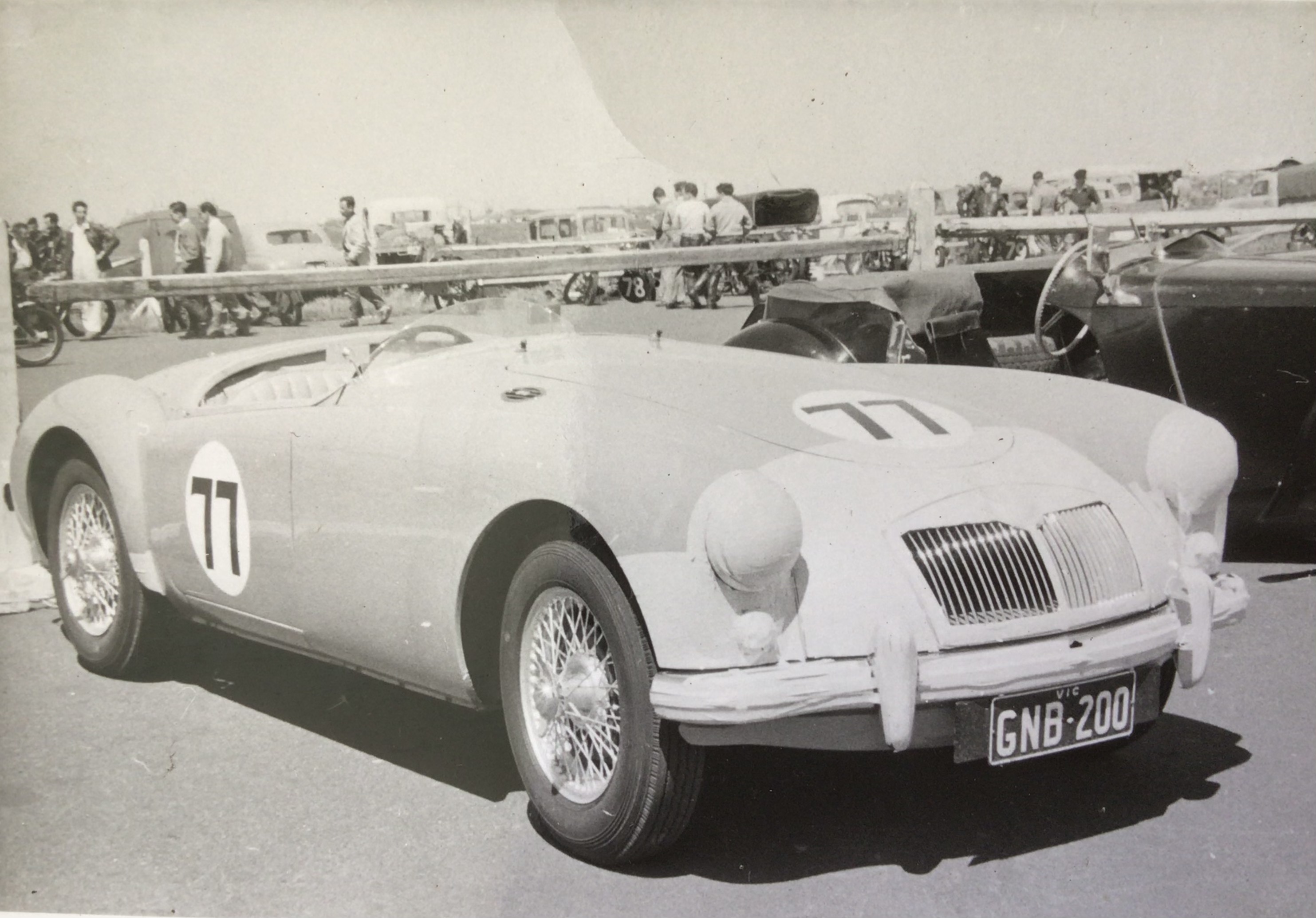
‘I obviously like the colour of it’ Peter quipped, there were quite a few shots of the same car. N Ronalds, MGA, during the October 1956 meeting.

Finito…
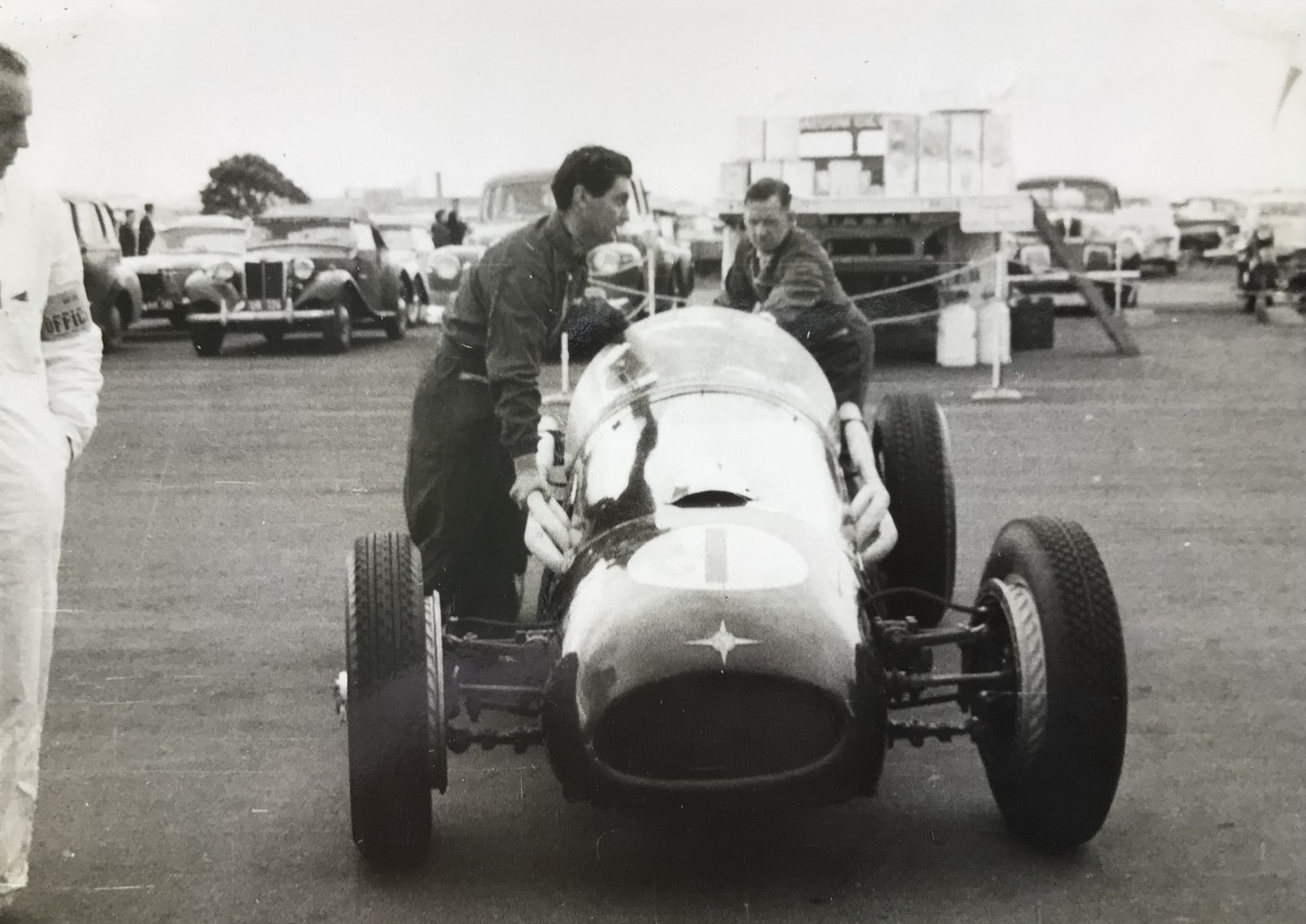
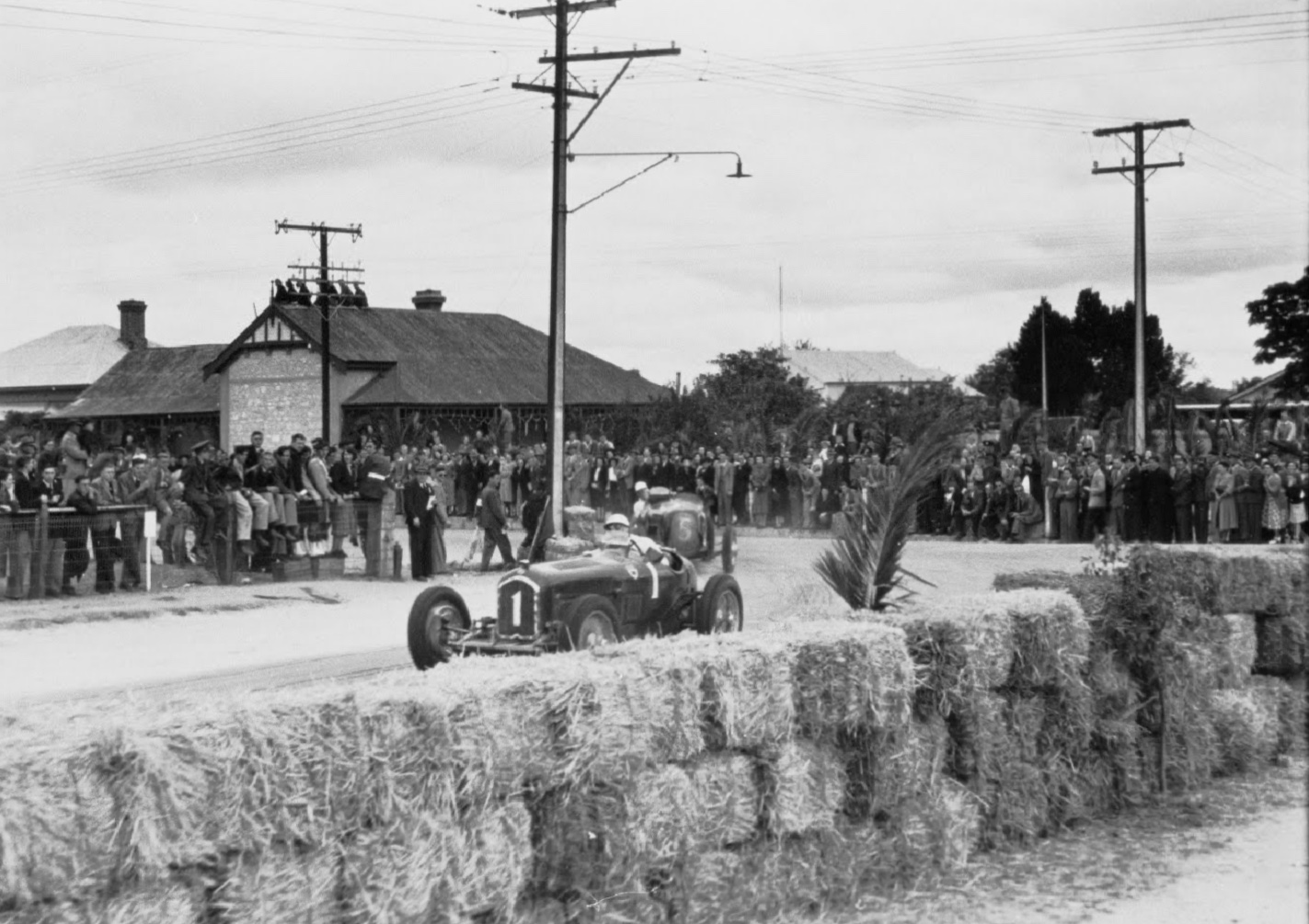
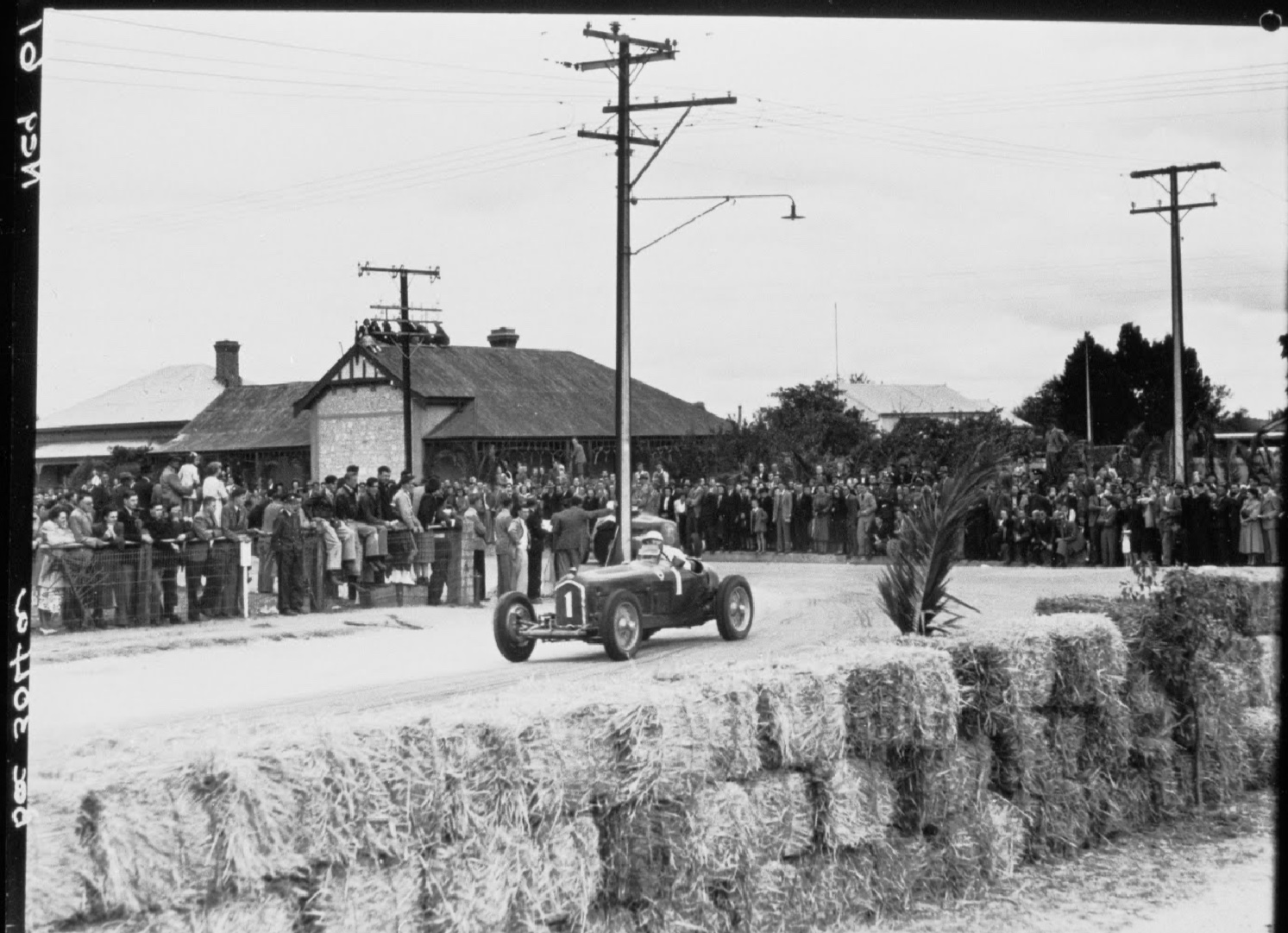
Doug Whiteford, Ford V8 Spl leads Lex Davison, Alfa Romeo P3 early in the Vintage Festival Championship, Nuriootpa April 1949 (SLSA)

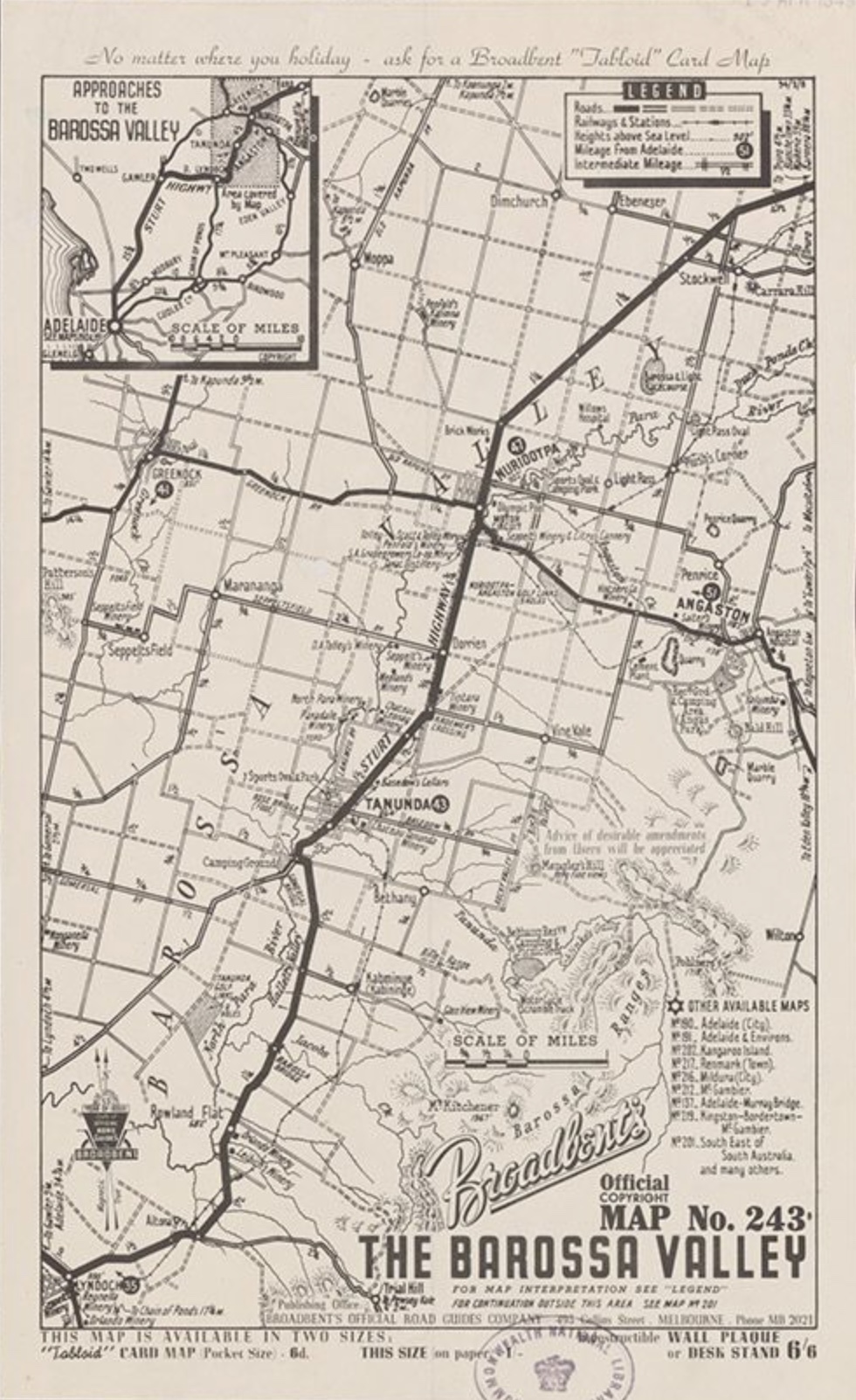
South Australia’s Barossa Valley, 75 km north of Adelaide is one of the states great wine producing areas.

32 km long and 8 km wide it includes the towns of Lyndoch, Tanunda, Greenock, Seppeltsfield, Angaston and just to its north-west, Nuriootpa.

Somewhat unique in Australia, large numbers of Germans settled in the Adelaide Hills and surrounding areas from the 1840s planting some of the earliest grapevines in the country.

By 1949 the Barossa had 22,000 acres of vines producing 60% of the total South Australian Vintage. Keen to maintain some of the cultural traditions of the old world, in 1947 community leaders organised a festival similar to those held in the Rhine Valley at vintage time, to foster a greater sense of community, raise funds for charitable causes and have fun!

The climax of the two day 22-23 April 1949 celebration was a carnival at Tanunda with dancing sideshows, a draught-horse derby and barbeques of three 600 pound bullocks! Not to forget motor racing…

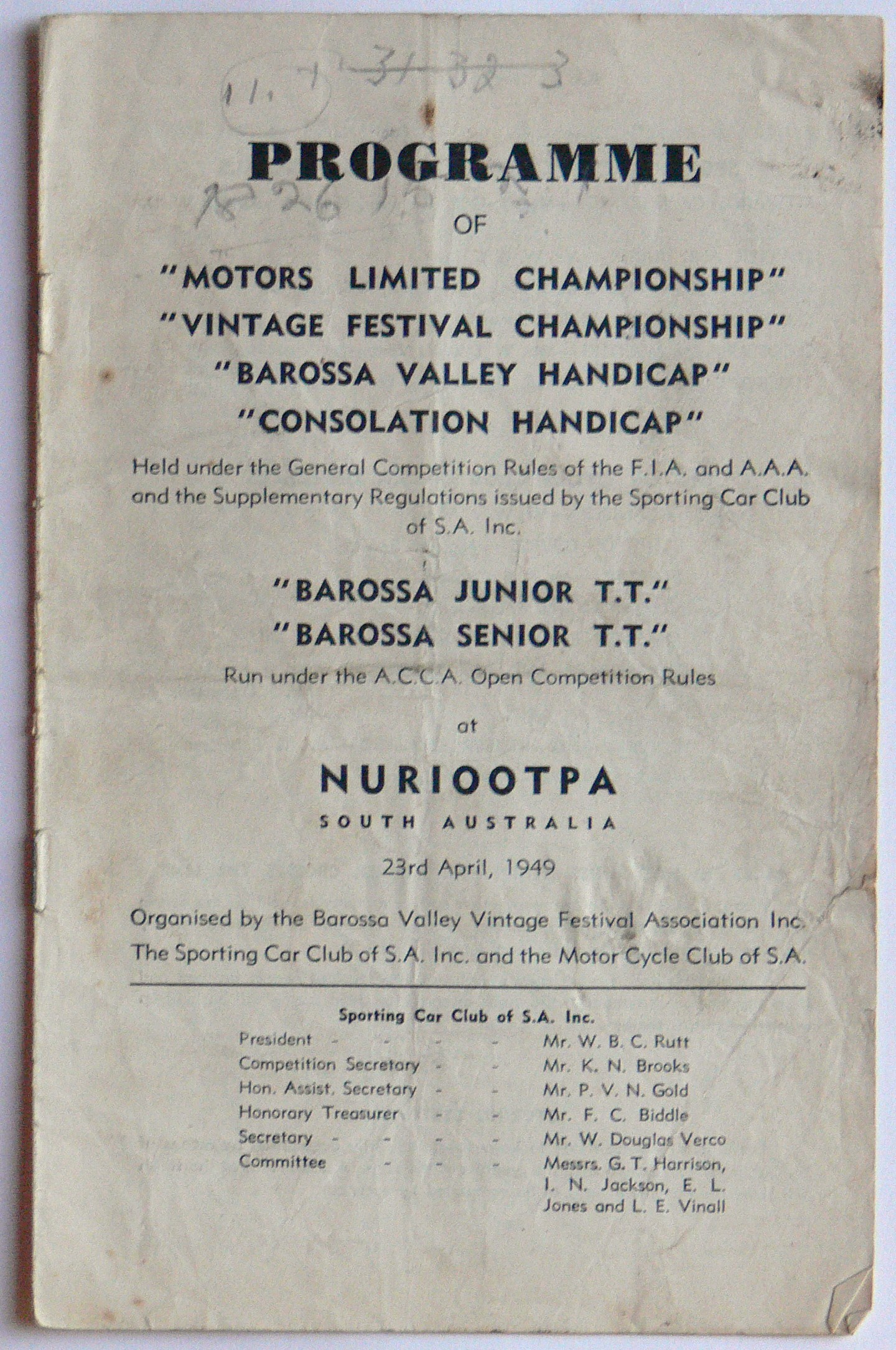
1949 Festival program
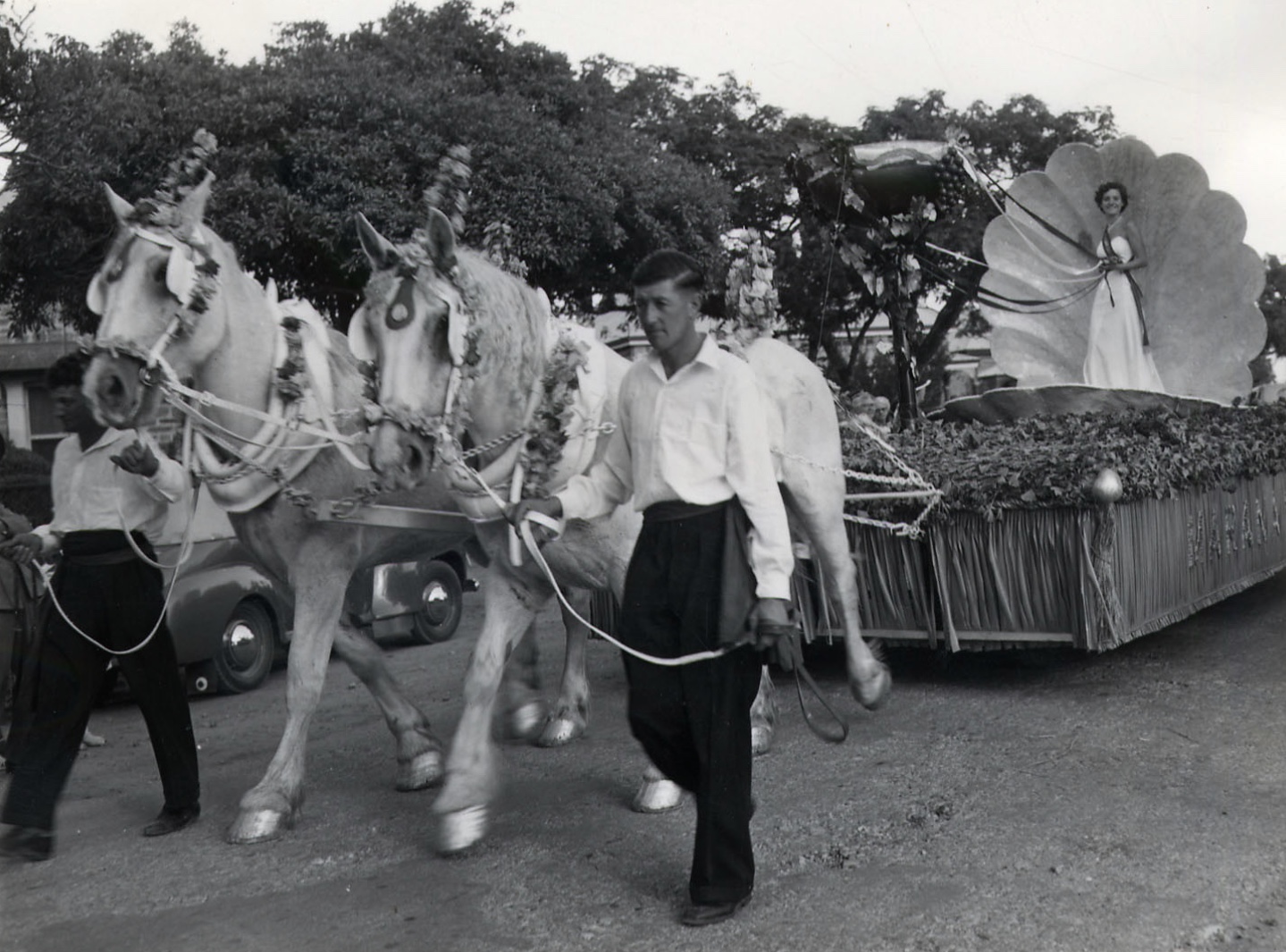
Greenock float heading past the Nuriootpa Community Hotel during the 1948 Festival (Advertiser)
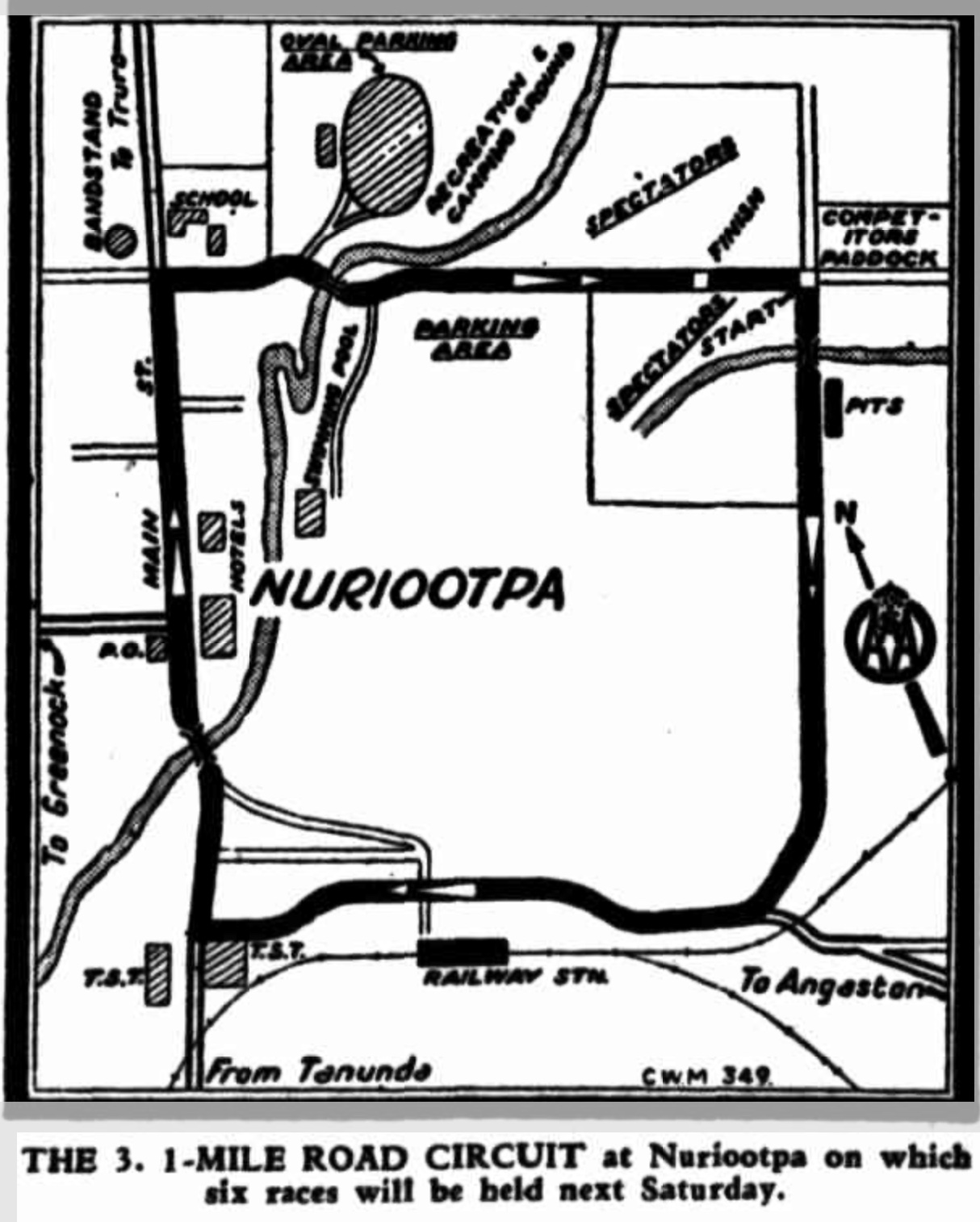
Nuriootpa circuit map. In terms of the narrative below, the start/finish is in the top right corner

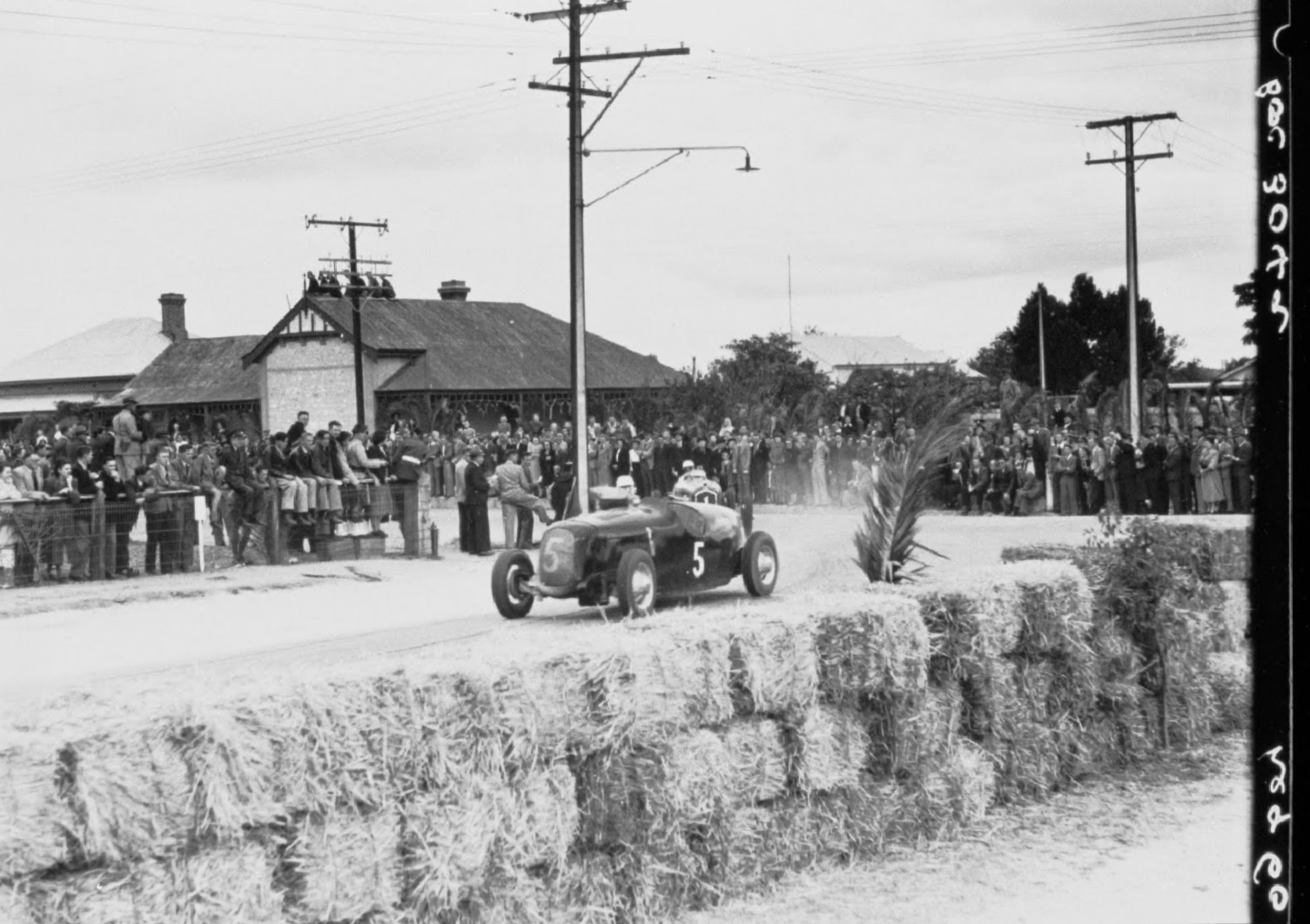
South Australia hosted Australian Grands Prix at coastal Victor Harbor (correct spelling) in December 1936 and on the daunting Adelaide Hills, Lobethal roller-coaster road course in January 1939, Nuriootpa was chosen as the 1950 venue.

In that sense the Vintage Festival race meeting was a ‘warm up’ for the organisers and racers alike- the Nuri road course was only used on those two occasions seven months apart.

Some maps make the track appear a simple square layout around the town but the more detailed drawing above shows the flat 3.1 mile/4.98 km course to be not quite so easy, whilst not on the same planet of difficulty as Lobethal.

The start line was on the Penrice Road/Research Road corner with cars heading clockwise- the top right corner of the map above, the paddock was on parkland on the outside of this corner.

Racers headed down the straight for a fast run into the double-right hand ‘Atze’s Corner’ and then onto Railway Terrace- gently to the right, then a short straight, then a quick left before another hard application of brakes for ‘Tolleys Corner’- the intersection of Railway Terrace and Nuriootpa’s main drag- Tanunda Road/Murray Street.

There the cars kicked away with parklands on the left, gently left over a wooden bridge to clear the North Para River before heading straight- going past the shops then more hard braking for another right-hander at the Penrice Road intersection.

Exiting, the cars gently curved left and gently right before another straight section past the finish line just before the Penrice Road/Research Road intersection and then another lap…

Bill Patterson, MG TC Spl s/c. Plod on this side, St Johns Ambos on the inside. Probably, as many of these shots are, the intersection of Murray Street and Penrice Road- Bill is entering Penrice for the run to the finish line (HTSA)
Harry Neale’s Ford V8 Spl at left and Jim Gullan, Ballot Oldsmobile on the right (HTSA)

34 cars and 46 motorcycles entered the meeting, no doubt the poor entry of cars was a function of the traditional Easter fixture at Mount Panorama which took place the weekend before.

Top guns at Bathurst were Lex Davison’s 1934 GP Alfa Romeo P3, Frank Kleinig’s legendary Kleinig Hudson Spl, Bill McLachlan’s Mackellar Spl (Bugatti T37A Ford V8) and Jack Murray’s Day Special (Bugatti T39 Ford V8). The feature event, the 25 lap All Powers Handicap, was won by Arthur Rizzo’s Riley Spl from Curley Brydon, MG TC and Kleinig.

Bathurst contestants who made the trip to South Australia included Davison, Tony Gaze, HRG and Bill Patterson, MG TC Spl s/c.

The Davison and Patterson crews had barely 24 hours to give their cars a tickle in Melbourne before loading up again for the 750 km trip on the Western Highway to the Barossa.

Tony Gaze had an amazing couple of weeks- he drove the HRG from Melbourne to Bathurst, raced it to fifth in the All Powers Handicap feature race won by Rizzo, then drove to Nuriootpa, raced it again for a couple of third places and finally drove it back to Melbourne!

Lex’ machine had misbehaved at Bathurst- he had braking problems, nor would the exotic 2.9 litre twin-cam straight-eight reach maximum revs. Patterson didn’t start his events at Mount Panorama so his boys in Ringwood no doubt had a busy night as well.

Other entries included plenty of MGs- John Nind’s TB Spl, plus four South Australians in TC’s of varying specification- David Harvey, Ron Kennedy, Steve Tillet and Harold Clisby- the prodigiously talented, intuitive, eccentric engineer of 1.5 litre Clisby V6 F1 race engine fame, and much, much more who was making his race debut.

John Crouch raced another HRG, Ken Wylie his clever, fast Austin A40 Spl s/c, Eldred Norman ran his Ford Double-8 Spl- which as the name suggests was powered by two Ford V8’s. Later driver of that car, Harry Neale entered his Ford V8 Spl and Les Robinson the ex-Segrave/Hope Bartlett 1922 GP Sunbeam Ford V8 Spl.

Jim Gullan brought from Melbourne his quick Ballot Oldsmobile Spl with close mate Doug Whiteford there to race his legendary Ford V8 Ute based special ‘Black Bess’- a combination which would win the AGP at Nuri seven months hence.

Lex’ Alfa landed in Australia in February 1948, he was still getting the hang of the car without too many circuits upon which to race it at the time. Theoretically it was the fastest car in the country- in reality Alf Barrett’s older Alfa Monza was the quicker combination but the Armadale blue-blood was at the end of his career at 38, ‘retiring’ in 1948 whereas the 26 year old Lilydale blue-blood was just at the start of his long, distinguished career.

Interestingly, Davo’s car was being looked after by later four-time Gold Star champion Bib Stillwell who, at 22, had commenced his first retail and repair automotive business in partnership with respected, experienced, ten years older than Bib, Derry George in January 1949.

‘Magnette Motors’, or more commonly ‘Stillwell & George’ operated from 121 Cotham Road, Kew, a building owned by Bib’s mother- it was the start of Stillwell’s motor businesses which occupied this and adjoining sites into the 2000s. George learned his craft with Reg Nutt and before that legendary outfit A.F Hollins in Armadale, who would ultimately prepare Lex’s cars with great success upon the recommendation of Tony Gaze.

Australian racing events were mainly run to handicaps at this stage. Bill Patterson’s marvellous Reg Nutt/Doug Whiteford built, Bob Baker bodied MG TC Spl s/c was half a chance. Whiteford’s ‘Black Bess’, continually developed by the talented and driven racer/engineer since it first appeared in 1939 was a well known combination to the handicappers, his challenge would be greater.

Jim Gullan commented about how little time there was to practice and had the opposite braking problem to Davison- his anchors were too good!

With the assistance of Jack Pearce at Paton Brake Replacements (P.B.R. later the Repco Brake Company) Jim and Doug Whiteford had been supplied with a new braking package which comprised light commercial drums, aluminium brake shoe castings copied from Jim’s Ballot, aluminium backing plates and large wire air-scoops which looked great and were no doubt a wonderful psyche!

Gullan found his new brakes so powerful that ‘they were bending the chassis, making the car almost unsteerable on the rough Nuriootpa roads. The only thing to do was to apply them gently.’

Jim Gullan, Ballot Olds in front of a group shortly after the start of the over 1500cc Vintage Festival Championship scratch- #2 Bill Wilcox, Dodge Spl, #11 Harry Neale, Ford V8 Spl then #2 folks and in the dust behind, Robinson’s GP Sunbeam Spl (J Gullan Collection)
Davison now in front of Whiteford in their Vintage Festival Championship tussle- from Murray Street and into Penrice Road (HTSA)

A crowd estimated at 30,000 people attended Sunday raceday, the final day of the carnival to see a six event program- it was fine and warm, good conditions for racing.

The lack of practice Gullan commented on was because practice was scheduled to start on raceday at 6 am but there were still revellers from the night before in Murray Street, so the circuit didn’t open until 6.40 am and was then made over to the bikies at 8 am.

The only incidents were spinners John Crouch and John Nind- who bent his front axle in the process.

Whilst the 48 mile, 8 lap Barossa Valley Handicap was nominally the feature event, the Vintage Festival Championship scratch race for the over 1500cc cars was probably the thriller of the day with a wonderful scrap between Davison and Whiteford.

Contrary to modern practice, the fastest cars started from the back of the grid. Whiteford’s Black Bess made the best start, then came Gullan, Ballot Olds, Davison’s P3 and Harry Neale in his Ford V8 Spl.

He was followed by Melburnian Bill Wilcox in the Gullan designed Dodge Special- a Dodge six-cylinder engine and Lancia gearbox clad in a sexy Bob Baker built body of Mercedes Benz GP style, and then Mount Gambier’s Les Robinson in the GP Sunbeam Ford V8.

During lap 2 Davo passed Gullan and ranged up behind Whiteford, Wilcox was close to Neale but behind Robinson.

It took Davison 3 laps to get past the hard driven Bess, which was not as quick in a straight line as the Alfa (Davo did 144 mph on Conrod aboard the P3 in 1949 whilst Doug did 121 mph in Bess in 1950) but stopped better and had Doug’s cornering brio- and then stay ahead of Whiteford. Positions then remained the same to the end of the race, Davison won from Whiteford, Gullan, Neale and Robinson.

Graham Howard wrote that Davison’s win was an important milestone, it was his first victory after only two and a half years racing, discounting a ‘club level’ win on the grass at Nar-Nar-Goon in Victoria.

Davison in front of Whiteford in Nuriootpa village- Murray Street into Penrice Road corner (HTSA)
Ken Wylie, Austin A40 Special s/c (1250cc) on the Murray/Penrice corner- note the ever present, cast iron/concrete ‘Stobie’ poles distinctive to South Australia. Lex Davison famously bent one of these whilst destroying wife Diana’s MG TC Spl at Lobethal in January 1948- and lived, a bit bruised, to tell the tale! (HTSA)

The car racing program opened with the Motors Ltd Championship under 1500cc scratch event over 8 laps, 24 miles.

Crouch’s HRG led for the first lap- Patterson spun with the Tillet and Harvey TCs, Gaze’ HRG and Ken Wylie, Austin A40 Spl coming through in a bunch.

Patterson worked through to the front, overcoming his spin and led from Crouch and Wylie- then Wylie passed Crouch and set the fastest lap of the race, and came to within 12 seconds of Patterson but the Wylies and Gaze cars faded with overheating, the latter having lost its fanbelt.

Patterson won from Crouch, Gaze, Wylie- then Tillett, Kennedy and Harvey having a ball in their TCs then R Head, Riley Spl and I Jackson, GN.

John Crouch had a good year, he won the 1949 Australian Grand Prix that September in his ex-John Snow Delahaye 135CS on the Leyburn ex-RAAF base runways in Queensland- he was 5 minutes ahead of the pursuers led by Ray Gordon’s MG TC Spl.

Tony Gaze would soon return to the UK, having had a distinguished flying career during the war, to say the least, for the ‘serious’ part of his racing career in Europe. Jim Gullan and his wife Christine joined Tony and Kaye Gaze for the early part of that trip, 1951- an interesting story for another time.

In the Barossa Valley Handicap 16 lap feature, Bill Patterson won off 4 minutes 25 seconds.

The cars initially ran in handicap order with Head, Clisby and Ravdell Ford A Model Spl s/c early retirements. After 8 laps Keith Rilstone led in a Morris Minor from the Howard Austin Ulster then the MGs of Tillett, Kennedy and Ohlmeyer (TA).

Patterson was past Crouch, Harvey and Wilcox whilst Davison passed the Ford Double-Eight driven by Eldred Norman- ‘…while Norman was out on the dirt passing Harvey, Davison was dancing from one side of the road to the other, behind them, shaking his fist in search of an opening, Nuvolari style’ AMS reported.

Jim Gullan passed Tony Gaze whose car was boiling, with Patterson taking the lead on lap 14- at this point Rilstone was second from Tillett, Kennedy and Howard.

With 2 of the 16 laps to run Patto had consolidated his lead whilst Tillett was within striking distance of the Rilstone Morris then Wilcox, Dodge and Howard, Austin.

Doug Whiteford only gets a mention towards the end of the AMS report but consistent laps in the 2 minute 30 second mark saw him finish fourth behind the top three- Patterson, Tillett and Wilcox. Kennedy’s TC was fifth, then Gullan, the Crouch HRG, Rilstone, Ohlmeyer’s TA, R Howard’s Austin Ulster, the Harvey TC, Harry Neale’s Ford V8 Spl and the Nind TB Spl.

Bill Patterson first raced a modified MG TC before switching to his new racer (below) which was built in late 1948- he first competed in it at Rob Roy in January 1949, so the Sports Car Club of South Australia handicappers did not have much to work with in the way of results, always handy!

25 year old Bill Patterson in the Nuriootpa paddock after his first big win- the Barossa Valley Handicap in the ‘Patterson’ MG TC Spl s/c’. His ascent as a driver was commensurate with better cars, itself a function of the growing success of his outer eastern Melbourne, Ringwood Holden/truck dealership. Won the Gold Star in a Cooper T51 Climax in 1961, his pace was apparent from the start of his career (R Townley Collection)
Stobie pole growing from the cockpit of the Patterson TC- fine lines, driven and developed further by Curley Brydon after its sale by Patto in 1950 (HTSA)

To qualify for the last event of the day, the Consolation Handicap 6 lapper, entrants had to have not won more than forty pounds in any of the previous races!

For the first 4 laps the lead was swapped between Rilstone and later Australian Tourist Trophy winner, Derek Jolly’s Austin 7 Spl with the race won by  Ron Kennedy from Steve Tillett both in MG TC’s and then John Crouch’s HRG which had a very consistent weekend, then came Gaze, Gullan, Wilcox and Davison who set the fastest race time and a lap record of 75 mph.

Then was Ohlmeyer, TA, Jolly, Austin 7 Spl, the Nind TB Spl, Harry Neale, Ford V8 Spl and the N Jackson GN.

Harold Clisby made the local papers after losing control of his MG TC and backing it into a fence. The Clisby family account is that ‘…he was leading the race until another car cut him off on a corner sending him careering over a bridge with only the fencing wires preventing him ending up at the bottom of a creek.’

Jim Gullan, Ballot Olds, the chassis rails of which have been copiously drilled for lightness, no doubt at the cost of torsional rigidity which probably was not great before he started. Which corner? Dunno. Stobie pole marks the apex (unattributed)

Etcetera…

Jim Gullan and Doug Whiteford were close friends, as noted above, in the best traditions of the day, after the 1950 Nuriootpa AGP ‘…we drove each others car around Albert Park one evening, both previously having driven the other’s car a short distance’ wrote Gullan.

‘My impression of the Ford was it had more power and torque than the Ballot, with a rougher engine. The brakes had a very hard pedal and poor retardation, the steering was light and spongy. The car was tail light, tending to wander at speed, difficult to drive at racing speeds.’

‘Doug’s impression of the Ballot, very smooth high revving (6000 rpm) engine, steering and brakes too sensitive, difficult to drive!’

Gullan, mused over the changes to ‘the scene’ in 1950 with drivers getting faster imported cars and ‘nearly half the field in the 1950 Grand Prix had been made up of MG’s, which made for interesting under 1500cc Scratch Races.’

He concluded that the Ballot had reached the limit of its development without a new chassis fitted with independent suspension.

By the time he returned to Australia after twelve months in Europe, in early 1952, air-cooled Coopers were plentiful, Stan Jones was racing Maybach 1, Doug Whiteford had his first Talbot-Lago T26C and much, much more- the times were changing with much of the evolution due to the growth of scratch racing, to win one needed the equipment to do so.

Yet one more shot of the Davison/Whiteford dice, Doug almost wholly obscured by Davo and the Stobie (HTSA)
(State Records SA)
(SLSA)

This is the only clear motorcycle shot I can find, John Medley identified the rider as South Australian, Les Diener, his machine is a Velocette 350 MkVIII KTT.

He had a great weekend, winning the 5 lap Barossa Junior TT and finished third in the Senior event despite giving away capacity to most other entrants.

Diener and Lloyd Hirst had a good go in the Junior event, Hirst leading for the first 2 laps, in the Senior TT Laurie Boulter’s Norton and Hirst’s Vincent-HRD finshed in front of Diener.

Check out this fascinating article about Les Diener- what a talented rider and engineer he was; https://www.shannons.com.au/club/bike-news/old-bikes-australasia-the-eldee-velocettes/

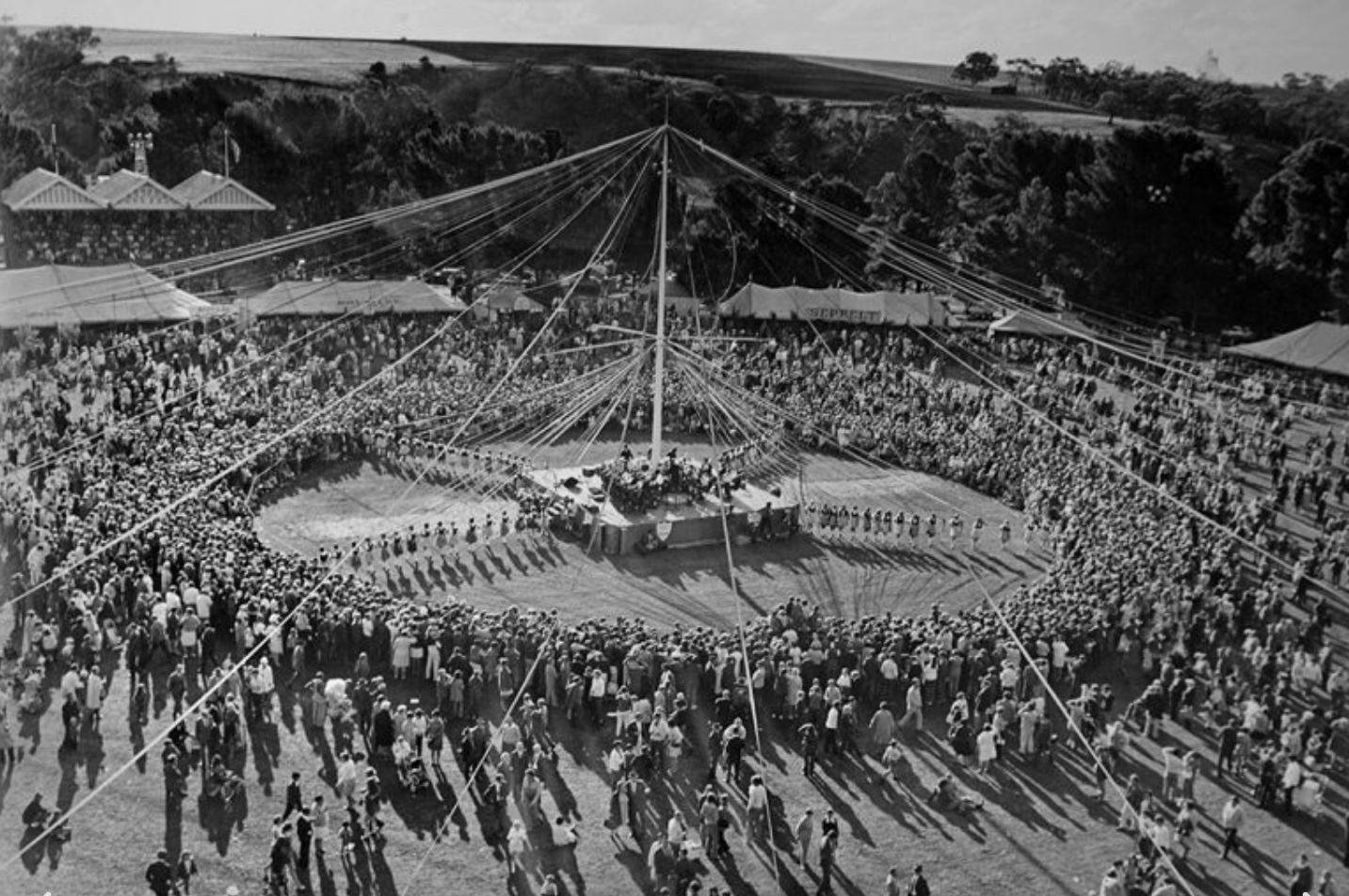
After the final race the crowd swarmed into Nuriootpa’s main street- Murray Street for the start of a procession of sixty decorated floats. At the end of the day 25,000 people converged on Tanunda Oval above, ‘to see the most lavish spectacle ever staged in a South Australian country town.’

The Barossa Vintage Festival is now held biannually with a week long calendar of events including wine workshops, heritage events and church services- the Barossa’s Lutheran leanings reflect its German heritage, which is about where we came in…

Otto Stone’s copy of the race program, programme I should say! from Stephen Dalton

Bibliography…

‘Lex Davison: Larger Than Life’ Graham Howard, ‘Bathurst: Cradle of Australian Motor Racing’ John Medley, ‘As Long As It Has Wheels’ James Gullan, ‘Harold William Clisby: The Life of a Restless Engineer’ on clisby.com, Australian Motor Sports 16 May 1949 via the Bob King Collection, Stephen Dalton Collection

Photo Credits…

‘HTSA’ History Trust of South Australia, State Records of South Australia, Adelaide Advertiser, State Library of South Australia, Richard Townley Collection

Tailpiece…

(State Records SA)

Grape pickers during the 1949 Festival- its seventy years ago my friends. Lots of happiness and optimism in those pretty smiling faces.

Finito…

(S5000)

Stan Jones in typical press-on style aboard his Maserati 250F #2520 during the 1958 Melbourne Grand Prix at Albert Park on 30 November- Stan The Man often wore these super short shirts when he raced, his tensed muscles were always a good indication that the cars of this era had a physicality about them the nimble mid-engined cars which followed did not quite so much.
A couple of those nimble machines were up front of this race- the Stirling Moss and Jack Brabham 2 litre Cooper T45 Climaxes finished first and second, Stan was a DNF after loss of oil pressure having completed 19 of the 32 laps- 100 miles in total.
The ‘John Comber Collection’ piece aroused plenty of interest- in particular from enthusiasts who remembered it racing at Sandown that November 1963 sans bonnet.
A volley of emails followed including this one from David Zeunert, a Melbourne Maserati enthusiast and historian – here ’tis for all to enjoy – and shortly thereafter, Stephen Dalton, Rob Bailey and Bob King chipped in with comments/and/or photographs. It was all great stuff which should be shared as there is some gold amongst the silver and bronze, where ‘the bronze’ is defined as stuff which is pretty well known amongst older Australian enthusiasts at least.
‘I was very fortunate to buy the Stan Jones Maserati cylinder head in a Jeff Dutton auction many years ago, from memory he had owned it for a long time, he held an auction in a large factory in Cremorne Street, Richmond, not his famous car store in Chapel Street, South Yarra. At the time he was closing this and moving to a new outlet in Cromwell Street, South Yarra, and was raising capital for that venture.’
‘There was spirited bidding and it got close to $1,000 but hey the money is forgotten later and it is a Very Special Maserati Memory of “Stan The Man”- I have seen other original 250F pieces around, once again I think when Stan sold out there were spares that Colin Crabbe, who bought the car, did not get hold of. When Bill Leech sold his Cisitalia and Maserati 300S to Steve Forristall (Texas Wheeler racing car dealer) in the late 1980s I am pretty sure he got a spare Maserati 3 litre engine as part of the deal. Forristall only had the Maserati 300S – chassis #3055/Behra’s car back in the USA a short time before he flogged it.

Stan Jones, 250F at Sandown, St Vincents Hospital charity historic meeting during practice- look carefully and you can see the bonnet does not appear to be seated properly on its leading edge- on Sunday raceday he ran sans bonnet as shown below where Melbourne’s cooler weather kicked in- note the natty v-neck jumper (J Comber)

(R Bell Collection)

‘The Maserati Team brought a heap of spares with them for the 1956 Australian Grand Prix and Tourist Trophy races. Being short of money, Team Manager Nello Ugolini sold the two 300S Maseratis soon after the race. Chassis #3059 went to Reg Smith – the father of Gary and Warren Smith – Melbourne car traders and much later a Maserati Bi-Turbo agent’s in Oakleigh. Chassis #3055 was sold to Doug Whiteford and then in the late 1950’s early 1960s to Bill Leech.’
‘I still have fond memories of Bill Leech driving the road registered 300S – WL333 – down at Pearcedale, Bill at this stage lived in Humphreys Road, Mt Eliza, I had the pleasure of visiting Bill and viewing his Bugatti, Cisitalia and Maserati 300S all together in his garage.’
‘Another piece of Maserati trivia, for years I believed the visiting Maserati Team (two mechanics – team manager – head mechanic plus Stirling Moss and Jean Behra) had stayed at the Esplanade Hotel in St Kilda but found this to be incorrect. I speak regularly with Adolfo Orsi in Modena, Adolfo is the grandson of the owner of Maserati from 1939 – 1968. I exchanged some rare photographs of the team in Melbourne and surprise-surprise, he told me he has receipts of their stay in Melbourne at The Brighton Club Hotel, then owned by the Sierakowski family, now Dan Murphys in Brighton just 300 metres from Reg Hunt’s garage where all the team’s racing cars, plus Hunt’s and Ken Wharton’s were fettled prior to Albert Park.’
Bob King, ‘Maserati Chief Mechanic and Test Driver, was, needless to say, Guerino Bertocchi, I think another was Ermanno Lotti, who later returned to Australia to look after Reg’s 300S and then worked for my mate Ron McCallum as a machinist, very good he was too. Ron, 96 today, re-metalled one big-end bearing on the Moss 250F, which involved pulling the engine down overnight.’
Zeunert, ‘As is well known, Bertocchi and the mechanics drove the cars along Brighton Road and the Nepean Highway from Reg’s workshop to Albert Park, exactly as they often did in Europe. I believe BP UK stumped up the money to enable the Maserati team – six people, five cars and a whole heap of spares, to come to Australia – BP’s local subsidiary was the Commonwealth Oil Refinery.’
‘Ken Wharton was a close friend of Reg Hunt and was the driver who suggested to Reg that he approach Maserati to buy a racing car – he ended up buying two from the Orsis in the 1950s (2.5-litre A6GCM and 250F) and the rest is history…Ken was killed in early 1957 in New Zealand’ racing a Ferrari Monza in a support sportscar event immediately prior to the NZ GP at Ardmore.

Albert Hunt admires his son’s new 250F, chassis #2516  prior to rolling it off the trailer in Elsternwick (B King Collection)

Leech 300S at Pearcedale on a Maserati Owners Club run circa 1988/9 (D Zeunert/B King Collection)

Maseratis as far as the eye can see! Reg Hunt’s Elsternwick garage- from left, a box of spares, Moss’ 300S #3059, Behra’s 300S #3055, team spare short nose 250F, Behra 250F long-nose #2521, Moss long nose 250F #?, Hunt’s short nose 250F #2516 with Hunt’s Cooper T23 Bristol at far right. DZ ‘Probably a BP PR shot, there was a cocktail party @ Hunts to welcome the team to Melbourne and one @ ‘Killara’ the Davison family farm near Lilydale- a traditional Aussie BBQ’ (R Hunt via D Zeunert Collection)

Adolfo also has the 1956 Australian Grand Prix cup awarded to Stirling Moss for his win in the 250F, I have asked him to email me pics, the Maserati 250F head is as light as a feather, the Italians were masters of the dark art of light weight foundry production, this goes right back to 1926 when Isotta Fraschini did all the special casting for the Maserati brothers for their emerging racing cars.’

‘Reg Hunt and his wife and son Graeme arrived in Australia circa 1948, Reg’s grandparents had been involved in the motor industry around Manchester in the 1890’s. I believe his grandmother raced motor bikes even back then, Reg was introduced to the family business, a motorcycle shop in Salford Road, Manchester, almost from birth running errands for pocket money before the 1930s, his parents taught him very early the good habits of thrift and saving for a rainy day.’

‘Reg was also involved in racing motor bikes however the second world war put an end to that. Reg told me he worked on tanks in England during this time of war, afterwards Reg was married with a son and was looking for a better place than the danky-cold Manchester where he grew up. He considered going to Canada but saw some motoring magazines from Australia and decided to bring the three of them ‘Down Under; no he was not a “Ten Pound Pom” to the best of my knowledge.’

‘He brought with him the bare bones of a special in suitcases to form the Hunt Special or “Flying Bedstead”, he then honed his skills and basically went on from there. I believe his parents came out after Reg settled here in Melbourne – Bert and Edna – his brother also made the journey and became an employee of Reg Hunt Motors.’

‘Reg  then bought some better race cars and eventually the two Maserati racing cars in 1954 and 1955 to race the following seasons here and in NZ, there are a million stories with Reg and I am gradually working thru his photographs and digitising them for all to see.’

‘In terms of his business, Reg started selling used cars from his first home in Noble Park, then a friend advised him to move closer to the city so he bought in Elsternwick and again did very well. He then thought he needed more exposure to the moving traffic so he rented the car park of the Church of England on the corner of the Nepean Highway and Glenhuntly Road, Elsternwick, it’s now a Zagame used car outlet.’
‘Reg being Reg, he decided, as time moved on to move further down the road and gradually bought up space to create the “Golden Mile of New and Used Cars” in the 1950s, Reg told me he knocked down over 300 houses to create his various dealerships there. He is an amazing man and still with us, my wife and I have dinner with he and his long term partner, Julia Hunt as often as we can – 97 years old this May just gone,’ David concluded.

Who is the pretty boy then!? Reg Hunt looking very cool and dapper with sports jacket, flat-hat and Raybans, near the old army drill hall where the swim/basketball stadium is today, Albert Park. DZ suspects this is a pre-event AGP PR shot by ‘The Argus’ newspaper (D Zeunert Collection)

Moss’ works Maserati 250F, 1956 AGP weekend at Albert Park with Guerino Bertocchi tending. Bob King thinks it may be Sil Massola by the car’s tail (B King)

Whiteford trailer after restoration by Kerry Manolas (R Bailey)

Stephen Dalton chips in, ‘Reg Smith was indeed Garry and Warren’s father. He originally had Smith’s Radios in Smith Street Fitzroy, but branched into the car trade as ‘Reno Auto Sales’, his race entries can be found with either of those business names as the entrant.’
‘Before the 300S he had a pair of air cooled Coopers and Jack Brabham’s 1955 AGP-winning Cooper Bristol T40 – the rear engine ‘Bobtail’ type car. He only had the 300S for about six months before trying to move it on. I’m (currently) aware of adverts in the July 1957 AMS and the June 1957 Rob Roy programme.  There was obviously no takers, until Bob Jane came along in late September/early October 1958. The sale is recorded in the 15 October 1958 Australian Motor News – a fortnightly late 1950s Auto Action type publication.’
‘Bob got the 300S after Reg had purchased a new Ford Thunderbird, then at the following weekend Jane ran the 300S at Fishermans Bend. Reg Smith was one of many to lose his life on Conrod Straight at Bathurst, driving a Porsche 356 during the October 1960 meeting. Graham Hoinville once stated to me that at Reg’s funeral there was talk of his generosity to the needy around his business area.’
‘My understanding is that the Leech brothers took over ownership of the Doug Whiteford 300S in or around August 1961. The car was run at the 27/8/61 Geelong Speed Trials by old and new owners. It’s recorded in the Nov 1961 AMS within the 10/9/61 Rob Roy report that Doug was having his second run in the 300S after the change of ownership.’
Now Rob Bailey, note that we all terribly biased Stan Jones fans here…’A long term family friend Don McDonald (Black Mac) who raced in the 1953 AGP at Albert Park always told me that Jones was the best racer of the period and would have made it overseas, Peter Brock even mentioned that Jones was one of the period drivers that “Straight lined” or “line drove”.
Regarding Rice trailers, Glenn Coad had in storage, up to a few years ago the Whiteford one all restored  sitting in a factory behind Izy Hertzog’s business in Port Melbourne, whilst the sister trailer was owned till his passing by that very fine gent John Best who would park it  around the corner from Barkers road Hawthorn East, his son Roy had it for sale several years ago.’
Derek Rice owned Rice trailers (no relation to the UK Rice trailers) was a man of taste who acquired  from Bernard Down the Rolls Royce Phantom #lll 3AZ158 the Gurney Nutting three position sedanca; for many the most magnificent  Rolls-Royce or Bentley to have ever reached these shores. Rice hit hard times in the 1960s. As a child I can remember being with my father going to his home in the Murrumbeena area when he purchased the Phantom…’
‘Its interesting how Walter Baumer’s Maserati 300S book notes that the Moss/Jane car #3059 was raced in the 1956 Mille Miglia by Taruffi for second place and the same years Targa Florio (Taruffi) and also won the 1956 1,000 km Nurburgring – such a wonderful reference book…’

Bob Jane 300S- where/when folks? (unattributed)

Etcetera…

(S Dalton Collection)

Australian Motor Sports piece on the occasion of the arrival of Stan Jones’ 250F in Australia and spare 3- litre 300S engine.
Moss exits Jaguar Corner on the way to a most impressive demonstration of high speed car control during the AGP.
Credits…
Many thanks to David Zeunert, Stephen Dalton, Rob Bailey and Bob King
S5000 Facebook page, Rob Bailey, David Zeunert Collection, Reg Hunt, Bob King Collection, Ray Bell Collection, John Comber, Bill Leech Collection
Tailpiece…

(B Leech/COR via D Zeunert Collection)

Stunning shot of the visting Officine Maserati team to Australia for the Melbourne Olympic Albert Park race meetings, again at Reg Hunt’s Elsternwick garage.
From the left-Nello Ugolini, Team Manager, Emmore Manni, Mechanic usually associated with JM Fangio, Guerino Bertocchi, Chief Mechanic and Test Driver, Jean Behra, Beppe Console, Mechanic and Stirling Moss. Then Dennis Druitt, BP UK head, funds from BP allowed the Maserati entourage to Australia in full force, Ken Wharton and Reg Hunt on the far right. The 250F is Jean’s #2521.
Finito…
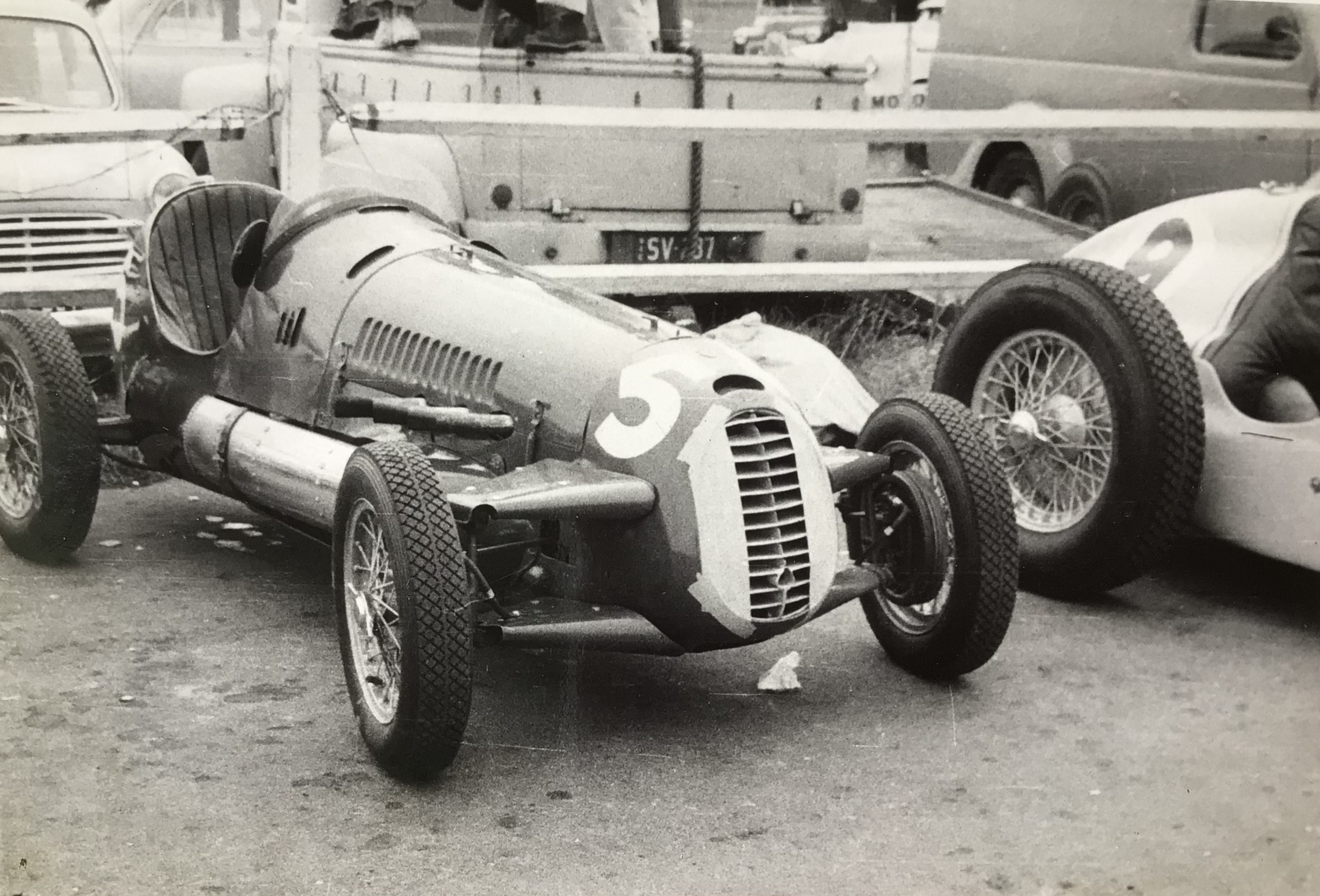
(M Tumby)

Talbot-Lago T26C with a swag of teenage fans surrounding it in Queensland we think …

There was a bit of  unresolved mystery about this shot when it was first posted by Mark Tumby on Bob Williamson’s Facebook page a month ago.

The discussion centred around whether it was Ralph Snodgrass in Whiteford’s second arriving in Australia but early chassis- ‘110002’ at Lowood but only if it was before 6 June 1957 when Snodgrass rolled it at Mount Druitt and then popped it under his house for twenty years, as Rob Bailey pointed out. Rob then mused as to whether it was his father, Owen Bailey in Whiteford’s first Lago, chassis ‘110007’ at Lowood, ‘that would make sense as he was running a family business in Noosa at the time’.

Interesting but still foggy at this point.

(M Tumby)

I circulated the first photograph to ‘wise owls’ Stephen Dalton, Bob King and Tony Johns yesterday- the boys quickly identified the car as the 1952 and 1953 AGP winner ‘110007’ by comparative analysis of windscreen and body slots around the grille.

As to the who and when questions, Stephen observed ‘Finding Queensland programs and entry lists is very hard for this era and it tends to be one ex-Bomber runway looking the same as the other. Here though, the trees tend to tell me not Lowood. I’m tending to think Strathpine which had a thin row of trees on each side.’

‘I’m not committing to stone, but i think its the Ken Richardson era, after Rex Taylor, so mid-55’ish. Then you get the problem of some Leyburn meetings in this timeframe too. Ken won a race at the 4 June 1955 Strathpine meeting, the August 1955 issue of ‘Modern Motor’ has a photo but no clear number…’

Stephen suggested a peek on Trove- which i have just done in brief, there are lots of entries for Taylor, tougher pickings for Richardson in the Talbot-Lago at least- plenty of mentions in his Cooper.

At this stage Rob Bailey did a bit more research- see his responses today, including a careful forage through the two volume Talbot-Lago books which reveals that it is Ken Richardson during a Leyburn sprint meeting in 1955.

Dalton, ‘Now that i’ve looked a little harder in my Leyburn file there was an event in July 1955 too, it was very briefly reported in ‘Wheels’ October 1955.’

’Richardson must have been a decent steerer. He was third behind Davison and Pitt’s nimble Coopers with the Lago at the September 1955 Australian Hillclimb Championship on narrow and tight Prince Henry Drive…’

As to all the young blokes in the shots- maybe a local boarding school outing on a Friday or weekend?

I don’t have ‘an article’ on the ‘Talbot-Lago T26C’ but key that into the primotipo search engine and four or five pieces with plenty of photos will pop up.

Credits…

Mark Tumby, Rob Bailey, Stephen Dalton, Bob King, Tony Johns

Tailpiece…

(S Dalton Collection)

Finito…

(oldracephotos/DKeep)

What do you do when you have already overdosed on Longford?…
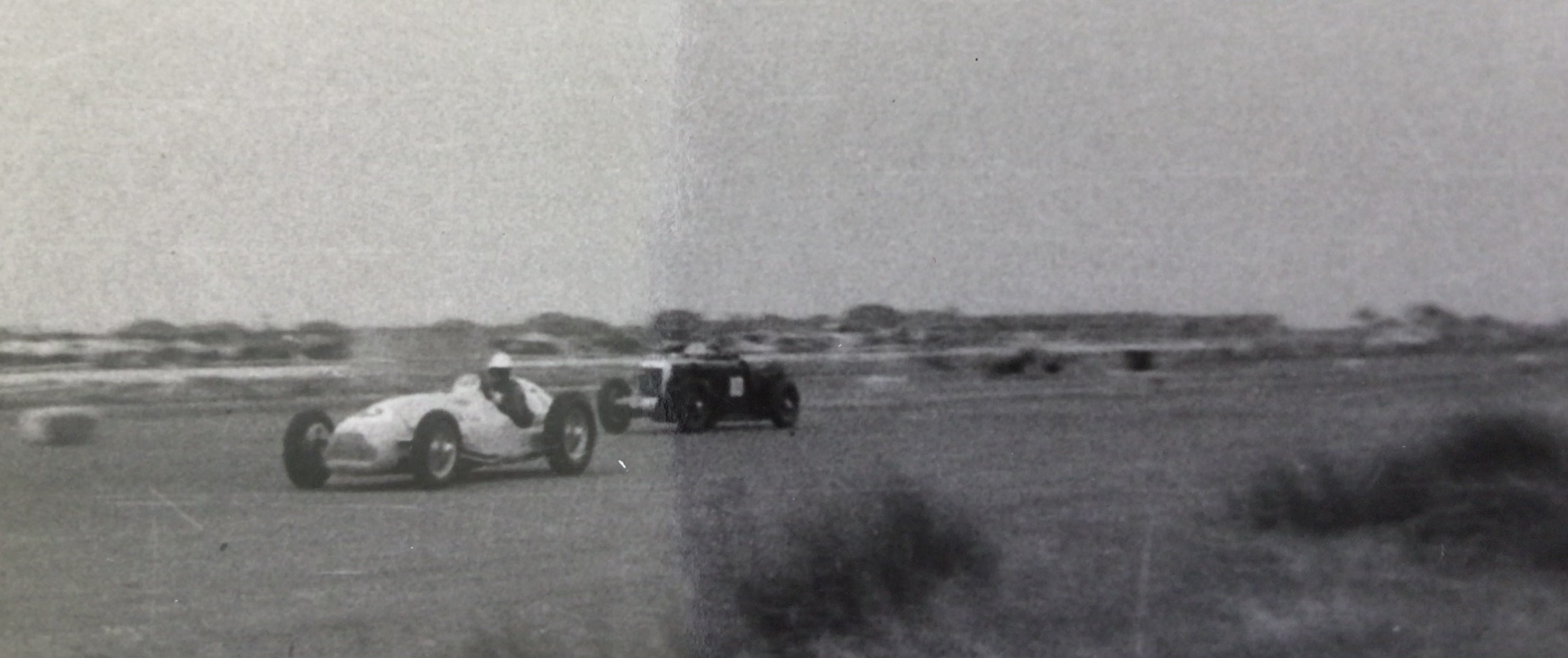
Have some more of course! There is no such thing as too much of a good thing.

Lindsay Ross has popped a swag of oldracephotos.com.au photographs on The Nostalgia Forum recently- his focus with this batch of shots was just on The Viaduct section of this challenging circuit. See here for a lap of the place to orientate yourself; https://primotipo.com/2018/07/05/longford-lap/

One of the things I love is the mix of shots, and do checkout the website, Lindsay has been ridiculously kind with his support of me since starting primotipo, without doubt there are more photographs from the ORP archive than any other. Lets support those that support us ; http://oldracephotos.com/content/home/ The cars vary from the sublime- Jackie Stewart’s BRM P261, to the more realistic end of the enthusiast spectrum- Formula Vee, and pretty much everything in between.

The opening photograph is of Graham Cullen’s CMS Vee, and he has a playmate in the undergrowth too- who is it? No he doesn’t, its just that his bodywork has become separated from the chassis on his trip through the undergrowth. The driver of car #71 zipping past the long-suffering marshalls is Garry Nielsen in a Tasman- I wonder who built these cars?


(M Hickey)


CMS is short for ‘Cullen Marine Services’ Graham Cullen’s primary business, he built about twelve of these ladder framed cars in the early Australian Vee years in the mid to late sixties.

By the time I had driver/engineer Peter Ward look after my Venom Mk2 FV circa 1979- he was building CMS’s of a totally different kind- very quick spaceframe cars raced by he and David Eyre-Walker and one or two others.

Like every man and his dog Wardy had an Elfin NG Vee copy he named ‘Spectre’, of which he built plenty in his Ross Street, Balwyn, Melbourne backyard workshop. I never worked out why Elfin Chief Garrie Cooper didn’t take to the cleaners all the pericks who knocked off that great design! Still, often the last thing to be found in a court of law is justice.


(oldracephotos/DKeep)


This panoramic shot of Frank Gardner leading the Touring Car pack down the hill into the Viaduct gives us some perspective- what a mega spot for spectators, blow the photo up and you can see the train line. I’ll take advice on the drivers too folks, but I guess its Bruno Carosi in the Jag Mk2 and Robin Pare in Don Elliott’s white Mustang. Rob Bartholomaeus and Bill Hollingsworth have Bob Holden in the ‘striped’ Cooper S, Gene Cooke in the Fiat 1500 and Rob Boote in the Holden EH. The year is 1967.

Have a look at this article on the Alec Mildren Racing Alfa GTA’s and their pilots; https://primotipo.com/2014/11/27/the-master-of-opposite-lock-kevin-bartlett-alfa-romeo-gta/


(oldracephotos/DKeep)


Then lets have a look at JYS in his BRM at ground level, at about the point Frank is turning in and pretty much the car at the same point from above, peering down into the cockpit.

Jackie looks as ‘snug as a bug in a rug’ inside that tight cocoon- unbelted as he is.

The shot above is of P261 ‘2614’ in 1966, he won the race from Graham Hill’s similar car and Jack Brabham’s Brabham BT19 Repco. Look closely, the engine is a crossflow 1930cc P60 V8- inlets within the Vee and exhausts outside. Check out this article on the BRM P56/P60 V8; https://primotipo.com/2016/02/05/motori-porno-stackpipe-brm-v8/


(oldracephotos/Keep)


Whereas the photo above is in 1967, again the car is ‘2614’ albeit this time powered by a P60 V8 of a different configuration- see the exhausts between the Vee, and its of 2070cc in capacity.

Jackie DNF with gearbox problems- which was the weak link of the BRM’s that season, the power and torque of the larger engine was beyond the design limits of a gearbox first built for engines of 1.5 litres- the GP formula of the time.

Brabham won that day in BT23A Repco ‘740’ from Clark’s Lotus 33 Climax FWMV 2 litre V8- the Tasman Championship winning combo that year. It too was a stretched, in terms of engine, 1.5 litre F1 car. Here is a piece about the 1967 Tasman and the fortunes of Stewart, Clark and Hulme; https://primotipo.com/2014/11/24/1967-hulme-stewart-and-clark-levin-new-zealand-tasman-and-beyond/


(oldracephotos/DKeep)


Similar turn-in shot for Alan Hamilton who has his Porsche 906 Spyder beautifully cocked up in a delicate little slide- these cars were great, forgiving, customer machines.

Here is a bit more about them- Alan and his 906’s; https://primotipo.com/2015/08/20/alan-hamilton-his-porsche-9048-and-two-906s/


(oldracehotos/DKeep)


Bruno Carosi in the ex-Bob Jane Jaguar Mk2 is under the Viaduct in 1967, whilst the shot below is of Doug Whiteford’s Maserati 300S just as he enters the light- by the look of that number on his cars nose its during the 1959 Australian Grand Prix meeting in which Dicer Doug failed to finish having driveshaft failure on the first lap- Stan Jones won the event in his Maserati 250F.

That race is covered here; https://primotipo.com/2016/01/08/stan-jones-agp-longford-gold-star-series-1959/


(oldracephotos/DSaward)


(oldracephotos/DKeep)


David Keep has a really unusual and interesting view of Pete Geoghegan chasing Frank Gardner away from the Viaduct and towards Kings Bridge, its 1967 again.

Who won the Taxi races?, my money is on Pete despite the more nimble attributes of the GTA. See here; https://primotipo.com/2017/10/17/he-came-he-saw-he-conquered/


(oldracephotos/Harrisson)


Things went wrong of course.

The Viaduct had a fast approach- downhill, a tricky turn-in and bugger-all in the way of run-orf areas to capture the steed which has just gotten away from you, should that particular situation occur.

Which of course it did, as in this series of happy snaps!


(oldracephotos/Harrisson)


Phil Brooke looks fairly happy with himself so presumably he has not done too much damage to his pride and joy on that greasy race-day in 1968, we can’t see the rear of the little Angle-box mind you.


(oldracephotos/Harrisson)


Bruno has painted his Jag between the 1967 and 1968 meetings, he is just about to alight the machine being very careful where he pops his feet. Still, too much action about the place for the snakes to show interest I guess. They do have snakes down there I think?- just Googled, they do, copperheads, tigers and white-lipped, none particularly friendly or good for you.


(oldracephotos/Harrisson)


Lionel Ayers Rennmax built MRC Lotus 23B Ford looks as though it is suspended in a tree but its probably on solid’ish ground. It will may need a wheel alignment before tomorrow’s race all the same. Its 1968.


(oldracephotos/Harrisson)


Daryl Wilcox looks as though he has had a moment on the way into the corner and is perched precariously half on and half off the road. Just looked again it might be on the exit? Phil Brook’e youthful face I can just make out to the left of the copper’s head- clearly both chappies have left the island on the notoriously wet last day of racing ever at Longford on Monday 4th of March1968.


Credits…

oldracephotos.com.au and in particular the work of David Keep who is for sure one of the Longford photographic gods, not to forget Mr Harrisson as well. Michael Hickey Collection


Tailpiece: Up The Escape Road…

(oldracephotos/DKeep)


To get the entry to the escape road right takes real skill under pressure- so maybe Darryl O’Toole bailed real early in his Humpy. Its not a back road to Longford mind you- he is about to run out of gravel soonish.


(KBY191)


This November 2018 photograph by KBY191 shows that ‘The Viaduct and railway are still there, however nothing remains of the old track running down to The Viaduct since reconstruction of Illawarra Road which also bisects Tannery Straight with a round-about’.


Finito…

1953 AGP grid. Front row L>R Davison HWM Jag, Jones Maybach 1, Whiteford Talbot-Lago T26C, car 11 on row 2 is Ted Gray Alta Ford V8 (Dacre Stubbs)

The allocation of the 1953 Australian Grand Prix to Albert Park was the result of over two decades of work by the Light Car Club of Australia…

I live 800 metres from Albert Park Lake, I awoke this morning to F1 music at 7.05 AM- the sound of two-seater Minardi V10 engined cars ferrying their lucky cargo around gods motor racing country at high speed. The dawn of the 2019 race seems an apt time to upload this article on the 1953 event- the first Albert Park AGP.

Barry Green in his wonderful book ‘Glory Days’, writes that there was a strong push to race at Albert Park in 1934. The Light Car Club of Australia, (LCCA) the promoter of race meetings at Phillip Island were aware of the ‘Islands growing unsuitability given its loose gravel surface as speeds increased.’ Extensive negotiations secured Albert Park as the venue for a race meeting to celebrate the Centenary of Victoria in 1935.

The ‘Sun News Pictorial’ one of the Melbourne daily tabloids, and then as now a good thing in which to wrap ones fish n’ chips, announced the event on June 4 1934.

In doing so the ‘paper lit the fuse of naysayers who brought about the events cancellation, but not before racers Arthur Terdich, Bill Lowe, Barney Dentry, and Cyril Dickason in Bugatti, Lombard, and Austins respectively, lapped the track with mufflers fitted to prove noise wasn’t the issue.’

Stan Jones at speed in Maybach 1, Albert Park 1953, DNF. Stan made this series of cars sing, Maybach 1 won the ’54 NZ GP at Ardmore but none of the Maybachs- 1,2,3 or 4 won an AGP, such a shame! If the Chamberlain 8 is Australia’s most brilliant and innovative special surely the Maybachs are the greatest? Hopeless bias declared! (R Fulford /SLV)

Post war things were little different, but a partnership between the LCCA, the Australian Army- who had a facility at Albert Park, and Victorian Labor Senator Pat Kennelly was more successful.

The three groups/people provided the combination of race organisation, promotional ability, logistical capability- the Army being able to ‘man’ Albert Park, a site of some 570 acres, and political power and influence.

For all, the ability to raise funds in the aftermath of World War 2 was important. For the army, it was money for war widows and orphans, for Kennelly to finance much needed improvements to the park for to upgrade the local amenity, and for the LCCA, the betterment of motor racing.

The parties all were aware they needed to be very careful with the use of the facility so the event was a one day affair, with practice in the morning, racing in the afternoon with the roads open to the public in between. Total time absorbed by the racing activities was less than seven hours!

And so, the 1953 Australian Grand Prix, held at Albert Park over 64 laps, 200 miles in total, on Saturday 21 November, was won by Doug Whiteford in a Lago-Talbot, the last AGP win for ‘French Racing Blue’.

Doug Whiteford’s Talbot Lago T26C passes the abandoned MG Spl of Jack O’Dea on the way to victory. Writing on the side of the car is a list of race wins. Whiteford owned two TL26C’s- this one, 1948-ex Louis Chiron chassis ‘110007’ and later, an earlier but higher spec car, chassis ‘110002’. Vern Schuppan is the current owner of ‘110002’. Crowd right to the edge of the track (R Fulford/SLV)

Entry…

The entry list was headed by local Melbourne businessmen Doug Whiteford, Stan Jones and Lex Davison.

Whiteford was perhaps the form driver, he won the AGP at Mount Panorama the year before in the same Talbot-Lago T26C. Doug was a tough grafter who owned an automotive repair and sales business a drop kick from the shores of Albert Park Lake in Carlisle Street, St Kilda.

The preparation and presentation of all of his racers was legendary. His career stretched back well pre-war to motor cycles circa 1932. He raced Norman Hamilton’s blown Ford. V8 Spl at Phillip Island circa 1935, an MG Magnette and a supercharged Ford Roadster before building the Ford Ute based ‘Black Bess’ his 1950 AGP winner.

A racer to the core, he competed all the way through into the early to mid seventies, after his long time at elite level, as a works driver for the Datsun Racing Team in small sedans and sportscars.

What a shot! Not at Albert Park I hasten to add, Fishermans Bend is my guess. Whiteford changing plugs on his TL T26C. A mechanic by trade, he toiled on his own cars, his race record, standard of preparation and presentation legendary. Date unknown (R Fulford/SLV)

On the up was Stanley Jones, another tough nugget from Warrandyte, rapidly building an automotive retailing empire which would fund an impressive array of racers over the decade to come- all of which would come tumbling down in the credit squeeze of 1961. Jones had thrown in his lot with Charlie Dean and Repco a year or so before- Jones bought Maybach from Dean with Charlie and his team at Repco Research in Brunswick continuing to maintain and develop it. Jones was as forceful as Whiteford was stylish- both were impressively fast.

Also on the rise was Lex Davison, native of St Kilda but then a resident of Lilydale and fast building the shoe manufacture, importing and retailing business he inherited from his father.

Lex by this stage had learned his craft on a varied mix of cars, most recently an Alfa Romeo Tipo B/P3 GP car. He had just bought an ex-Moss/Gaze F2 HWM to which he fitted a Jaguar 3.4 litre six-cylinder DOHC engine to ‘C Type’ specs and gearbox, this clever combination took his first AGP win at Southport, Queensland in 1954- a race Jones had a mortgage on until the chassis failure of Maybach 2 at very high speed.

Elite Racers All: L>R Jack Brabham Cooper T23 Bristo, third in this group, #3 Lex Davison HWM Jag and #8 Ted Gray Alta Ford V8. Shot included to show the HWM and Alta- Victoria Trophy Fishermans Bend 22 March 1954. Lex is soon to win the ’54 AGP, Jack is soon to travel to the UK and Gray is soon to get a competitive mount in Tornado 1 Ford! (VHRR)

Lex was an urbane man of considerable wit, bearing and charm- but he could and did go toe to toe with racers of Whiteford and Jones ilk and beat them. His career, which had far from peaked in 1953 stretched all the way to early 1965 when he shared the front row of the NZ GP grid with Clark and Hill, a couple of fellas ‘still in short pants’ in 1953.

Frank Kleinig and his Kleinig-Hudson straight-8 Spl could not be discounted nor could the Ted Gray driven Alta Ford V8 Spl- much more would be seen of this outstanding pre-war driver who cut his teeth on the country speedways of Victoria in the years to 1960 with the Lou Abrahams owned Tornados 1 and 2.

Oh to have seen this bloke drive at his best!- as here at Rob Roy Hillclimb, 2 November 1947. Frank Kleinig, Kleinig Hudson 8 Spl, a remarkable marriage of MG chassis, Hudson mechanicals and various other donor parts continuously developed over a couple of decades. A car which shoulda won at least one AGP. Kleinig another driver/mechanic ace (G Thomas)

Kleinig should have won an AGP or two, or three.

The Sydney driver was one of the very quickest immediately pre and post war but times had changed. The AGP was now a scratch race, not a handicap and Frank’s machine, development of which never stopped simply wasn’t quick enough to win outright whatever the undoubted skills of the bloke behind the wheel.

Ted and Frank both needed the ‘guns’ up front to retire and have a dose of reliability themselves for the long 200 mile race to win.

The Reg Nutt, Talbot Darracq 700, DNF dropped valve on lap 14 (Dacre Stubbs)

The balance of the entry was a swag of MG Specials, pre-war GP cars, sports cars and a sprinkling of Coopers including several new fangled JAP mid-engined cars.

Above and below. Davison, Jones and Whiteford. Further back #11 Gray, his Ford V8 creating the smokescreen, #7 Kleinig, #10 Hayes Ford V8 Spl #6 Vennermark/Warren Maser 4CL (unattributed)

Practice and the Race…

Practice commenced early at 8.30 AM and before too long their was drama aplenty amongst the topliners.

Davison’s HWM suffered bearing problems in practice, the session started at 8.30am, the team linished them as best they could prior to the race start at 2.30 pm, but the same affliction stopped the car during the race.

Another top driver I didn’t mention above was Sydney ex-speedway star Jack Brabham but his new Cooper T23 Bristol succumbed in the morning session, like Davison, to bearing problems. The ace engineer/mechanic did of course turn this car into rather a formidable weapon- one which inspired him to try his hand in England a year or so hence.

Also having practice dramas was Whiteford, who had a lose, the car was quickly loaded up and trailered back to Doug’s ‘shop closeby ‘…where the front suspension was stripped. Jim Hawker used the table of a mill as a surface plate and found a bent stub axle he straightened in a press. The Lago also needed a new flexible hose; without a word Whiteford took a pair of side-cutters, walked across to the pre-War Triumph his nephew Doug McLean was rebuilding and liberated precisely the correct hose. This was fitted, the brakes were bled…’ wrote Graham Howard.

The Jones Maybach in for the pitstop which changed the race, albeit the car retired in any event. Passing is the Jag XK120 of Frank Lobb (Dacre Stubbs)

From atop a double-decker bus race officials and a crowd estimated by local newspapers variously at between 50,000 and 70,000 people saw Whiteford, Jones and Davison form the front row with Lex’ HWM leading into the first corner under heavy, muggy skies.

The start was fraught and chaotic as several crews were still with their driver and car as the flag dropped!

Davo’s lead was shortlived, Stanley passed him on the first lap and then drew away. McKinnon was a lap 1 casualty when he nosed the hay-bales but got going again, Arthur Wylie spun the Jowett Javelin Spl at Jaguar Corner but he too got going.

Early in the race Jones led Whiteford, Davison, Arthur Wylie’s Jowett powered Wylie Javelin and Curley Brydon’s  ex-Bill Patterson MG TC Spl.

Davo was out on lap 3, he watched the balance of the event from Stan’s pit.

Bob Pritchett in Australian Motor Sports (AMS) wrote that ‘The trouble with the HWM was that the oil pressure relief valve was cockeyed on its seat allowing all the oil to rush right back into the sump through bypass: most surprisingly, the XK120 oil pressure gauge is so hooked in that, under such circumstances, full pressure was still indicated. Lex’s boys did their best with emery strip and managed to have the car on the line for the GP, but it was of no avail.’

Same scene as above from a different angle- Charlie Dean at bottom right (unattributed)

By half distance Stan still had a good lead over Whiteford, but on lap 40 he pitted for fuel and with his Maybach straight-six engine overheating- the car also needed a water pump drive belt.

His crew were not expecting him and in the confusion Stan was bathed in methanol fuel which necessitated a speedy dismount and then being doused in water before returning to the fray.

Whiteford could not believe his luck.

He perhaps lacked the pace to win, although Pritchett observed on the other hand that he didn’t think ‘Doug was unduly worried…Every few laps he would come up from his half-minute or so back and have a a look at the Maybach and then fall back into line again, so he must have had something up his sleeve’? Stan always pushed hard and was said to lack mechanical sympathy, something Doug had in spades. Jones retired Maybach on lap 56 with clutch failure.

Whiteford’s right rear separates from the Talbot Lago on the exit of Dunlop Corner (AMS)

It was not an easy win though.

Melbourne weather is capricious, the skies darkened and rain tumbled down and cars spun- Wal Gillespie’s HRG (shared with Thompson) amongst others. Spectators added to the challenge with ‘suicidal disregard for their own safety…John Calvert rammed a strawbale…when he had to take avoiding action. I suppose they just can’t understand that towards the end of the straight, the quick drivers are covering the best part of fifty yards each second…’ Pritchett mused.

Whiteford slows the TL 26C at the pits to change wheels having lost his right rear tyre. Fortunately the separation happened close to the pits and his efficient crew (Fairfax)

Two laps from home the right-rear tyre of the T26C came off its rim, fortunately only 300 metres from the pits.

After a stop of 30 seconds to change the wheel, with a huge gap to his pursuers, the local lad was on his way to win the race ‘in a Largo Talbot by 5 laps at an average speed of 82 mph for the 200 miles’ The Melbourne Sun, with its characteristic great attention to motor racing reporting detail, recorded in its 22 November account of the race.

Curley Brydon, a member of the RAAF’s crack 78 fighter squadron during the war, was second in his MG TC Spl 5 laps adrift and South Australian Andy Brown third in an MG K3 Magnette. Then came former AGP winner Les Murphy, MG Q Type and Lou Molina in the MM Holden Spl sportscar

Third placed Andy Brown’s very pre-war MG K3 in for a pitstop. K3 ‘030’ still in Oz- ex-Bira/Snow/Dunne/Davison/Brown and many others! (Dacre Stubbs)

Graham Howard in his ‘History of The Australian Grand Prix’ (HAGP) account of the race reports on some post race controversy which reader and owner of the Curley Brydon TC, Richard Townley develops further in his note below this article.

Howard wrote ‘…Curley Brydon, who had provisionally been placed third, protested that too many people had assisted with Whiteford’s tyre change, and indeed it was suggested one of the helpers was no more than a gate-crashing spectator; but it was agreed that Whiteford could have changed the wheel single-handed and still had time to win, and Brydon’s protest was withdrawn.

Curley Brydon, in the 2nd placed MG TC Spl s/c leads the 16th placed John Nind MG TB Spl (K Wheeler)

Whiteford is quoted in the Sydney Morning Herald (SMH) as saying ‘Our pit was very congested and there were more spectators around than mechanics. Evidently someone we didn’t know tried to help.’ Note that the SMH report states the protests were heard on Sunday 22 November, the day after the race.

As Richard Townley relates in his comments post publication of this article, Phil Irving wrote in his autobiography that Whiteford ‘…was not immediately declared the winner, through an unofficial report that he had been helped by a bystander to get the Talbot back on course after over-shooting a corner. Not having the use of a telephone, the marshal on the corner concerned wrote out a report to be delivered to the Clerk of The Course, who did not receive it until long after after the race had ended.’

‘Doug, who knew the rule book by heart was aware that the official report of the incident had not been lodged within the stipulated half-hour of the race finish, and shrewdly claimed that it was ultra vires and could not form the basis of a protest. This view being upheld by the stewards, Doug was awarded his third AGP, but it was not a very popular victory’ Irving wrote.

Let’s come back to this after dealing with the balance of the protests.

Howard continues ‘However, he (Brydon) also protested Andy Brown’s second placing, and after investigation it was agreed Brydon was second: Murphy protested Brown as well, claiming to have passed him on the last lap, but this was not upheld.’

‘Fifth was Lou Molina first time out in the neat little Holden-engined MM Special, and the first AGP finish for a Holden engine, Sixth was Jim Leech, a nice reward for his part in securing Albert Park for the race.’

‘Seventh, with a plug lead off, with only first and fourth gears useable and with his seat belt broken, was Frank Kleinig; from six AGP starts, going back 15 years to 1938, it was the cars first finish, and very popular. Nonetheless, the days of 15-year old AGP cars could not last much longer’ Howard concluded.

No doubt Kleinig was well pleased with the result as Pritchett wrote that he left Sydney very late for the meeting with trade-plates affixed to the racer to run it in on the Hume Highway!- when that process was complete the car took its place on the trailer for the balance of the trip south.

So what do we make of Phil Irving’s claims of Whiteford receiving outside assistance?

I can find no record of this in any of the published information I have access to. It is not mentioned in any of the contemporary newspaper reports of the meeting- not in Howard’s AGP account in HAGP, Howard’s ‘Lex Davison: Larger Than Life’, Barry Green’s superb long piece on the meeting in ‘Albert Park Glory Days’ or in the November or December 1953 issues of Australian Motor Sports.

Lets not forget that the protests were heard and decided, according to the SMH, on the day after the race- Sunday 22 November. The Stewards of the meeting, given all of the circumstances, and I have in mind the logistics of communication at the meeting, could choose to admit as evidence what they saw as appropriate- and call witnesses. By that I mean the Marshal concerned could have been called, and no doubt others who were stationed on the corner at the time to give their account of what Irving wrote occurred, to the Stewards, and for them to then make a determination accordingly. So, on balance, and in the absence of other accounts which agree with Irving’s I don’t believe his version of events to be the correct one. I am happy to alter that position if other proof, a photograph or first-hand spectators recollection, for example can be made available.

I wonder if Phil, writing his book years later- it was published after his death in 1992, is somehow linking DW’s Saturday morning practice spin with the Saturday post-event protests? Irving makes no mention in his book of the other protests addressed by Howard, Green and the SMH in their reports. Intriguing isn’t it?

(Fairfax)

Winners are Grinners: ‘Dicer Doug’ has won his third and last AGP.

His birthdate is a bit of a mystery but a consensus seems to be during 1914, so it makes him 39, still a young man albeit a racing veteran of not far short of 20 years then.

A great shame to me was his purchase of a 300S Maserati when the factory lobbed with five cars- three 250F’s and two 300S for the 1956 AGP right here at Albert Park- those machines were driven by Messrs Moss and Behra.

I mean it’s a shame in that, if he had bought and raced a 250F he would have been right in amongst Jones, Davison, Reg Hunt and Ted Gray with an equal car. He made the 300S sing but a 250F would have been a more appropriate car methinks

Things go better with Melbourne Bitter- Coke in this case for ‘Dicer Doug’ (Fairfax)

’53 AGP Australian Motor Racing Context…

This excerpt from the 1953-54 LCCA Annual Report is self explanatory and whilst it is self-serving does provided valuable information about the positive impact of the event in terms of the public’s perception of motor racing.

‘When your committee finally obtained permission to conduct the Australian Grand Prix on Albert Park circuit the victory was only half won.

To overcome public prejudice has been the major bugbear of organised racing on public roads and any incompetent handling of this delicate situation could easily have touched off an explosion of indignation.

That we did not receive even one complaint can be attributed to good fortune and untiring organisation of directors and officials. As it can be said that enthusiasts will make the best of the most adverse conditions, our achievements at Albert Park was the greater in having gratified both the general public and the competitors.

In justifying the faith which the Albert Park Trust, inexperienced in motor racing, was prepared to place in our ability, we have broken down one of the few remaining barriers to a more general acceptance of motor racing as one of the national sports.’

Etcetera…

Whereizzit?! Whiteford sneaks a peek at what he already knows- his pit is close and he has 5 laps in hand, but still a heart in the mouth moment.

Bob King recalls the moment ‘My memory says I saw Doug on the bare rim at Melford Corner, but this must be wrong. This photo is probably taken on the way from Jaguar Corner (which is still there if you look for it) and the pits. After all, I was only 15 and it was my first motor race: A life changing event.’

(S Wills)

Ted McKinnon’s 15th placed Maserati 6CM1500. An ex-works car, this machine first raced in Australia at the 1951 AGP at Narrogin, WA, raced by visiting Englishman Colin Murray.

Car #57 alongside is not entered in the AGP (Dacre Stubbs)

(Dacre Stubbs)

(D Elms)

Lou Molina’s fifth placed Molina Monza Holden Special and then Les Murphy, MG Q Type fourth, about to be rounded up at speed by Stan Jones in Maybach 1- an unusual angle of Albert Park at its south end.

(D Zeunert Collection)

Cec Warren at the wheel of his Maserati 4CL #1579, he shared the drive with Peter Vennermark but the intrepid duo retired after 41 laps. Poor Cec died twelve months later. He was racing the car at Fishermans Bend in March 1954 and pulled into the pits for adjustments, he collapsed and died shortly thereafter.

(R Townley)

Bibliography…

‘History of The Australian Grand Prix’ Graham Howard and ors, ‘Lex Davison: Larger Than Life’ Graham Howard, ‘Phil Irving: An Autobiography’, ‘Glory Days’ Barry Green, Australian Motor Sports December 1953,

Melbourne Sun 22 November 1953, Sydney Morning Herald 23 November 1953

Photo Credits…

Dacre Stubbs Collection-Martin Stubbs, R Fulford Collection, State Library of Victoria, VHRR Collection, Fairfax Media, Ken Wheeler via Richard Townley Collection, Spencer Wills via Bob King Collection, David Zeunert Collection

Tailpiece: Whiteford on the way to victory, Talbot-Lago T26C…

(R Fulford/SLV)

Finito…