Posts Tagged ‘Jack Brabham’

download(1)

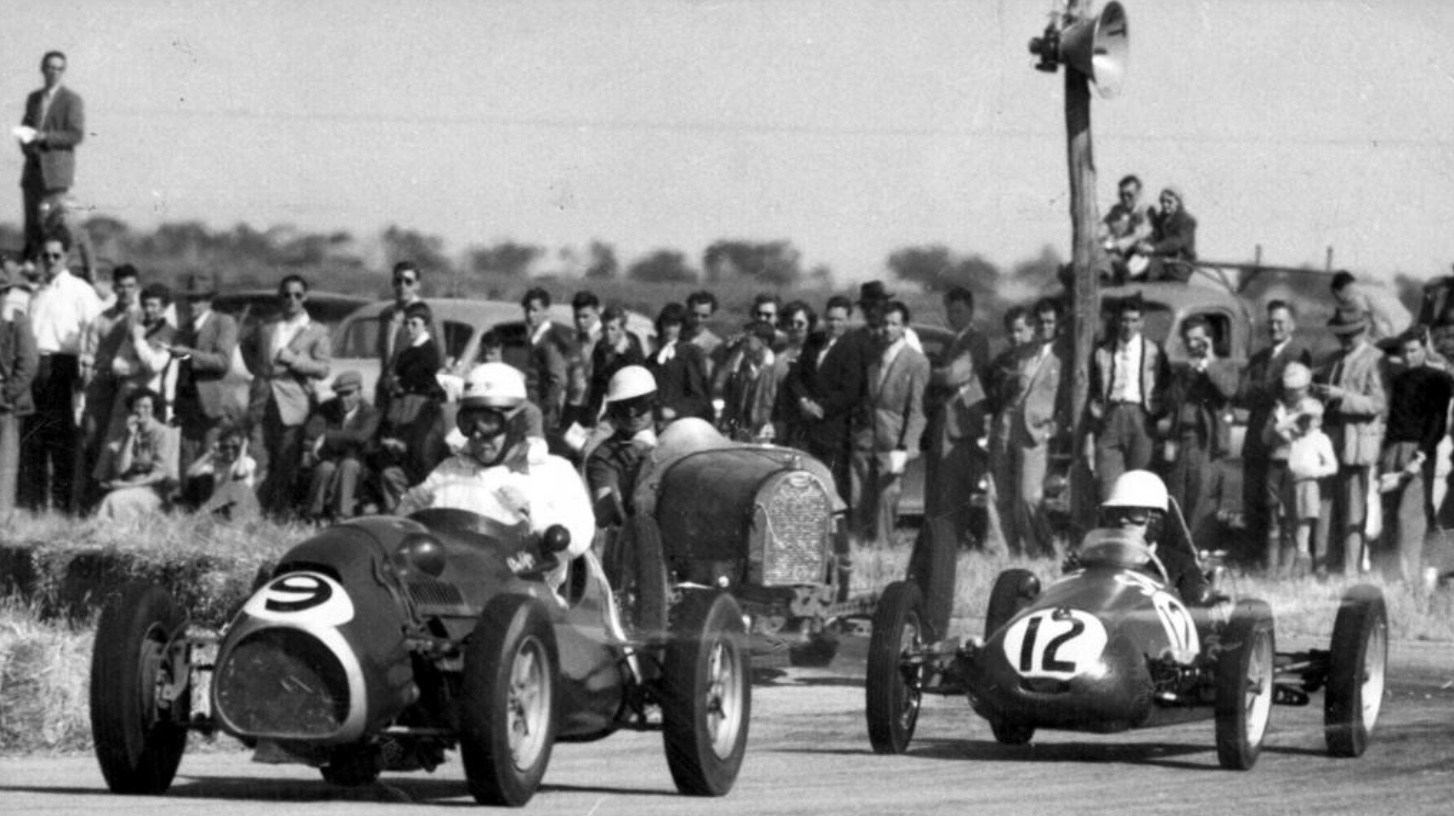
In a Battle of Melbourne Motor Dealers, Stan Jones struggles to keep Maybach 3 in front of Reg Hunt’s Maser A6GCM during the first lap of the 1955 Australian Grand Prix at Port Wakefield, South Australia, October 10…

The two cars were arguably Australia’s fastest special and production racing car at the time. Mind you the ‘special’ descriptor belies the tool-room quality of the Maybach series of cars in terms of both design and execution by Charlie Dean and his team at Repco Research in Melbourne. The Maserati A6GCM/250 and 250F family are members of one the greatest series of production racing cars ever built. Not that either car won this particular contest!

Jack Brabham on the way to victory, Cooper T40 Bristol (Adelaide GP)
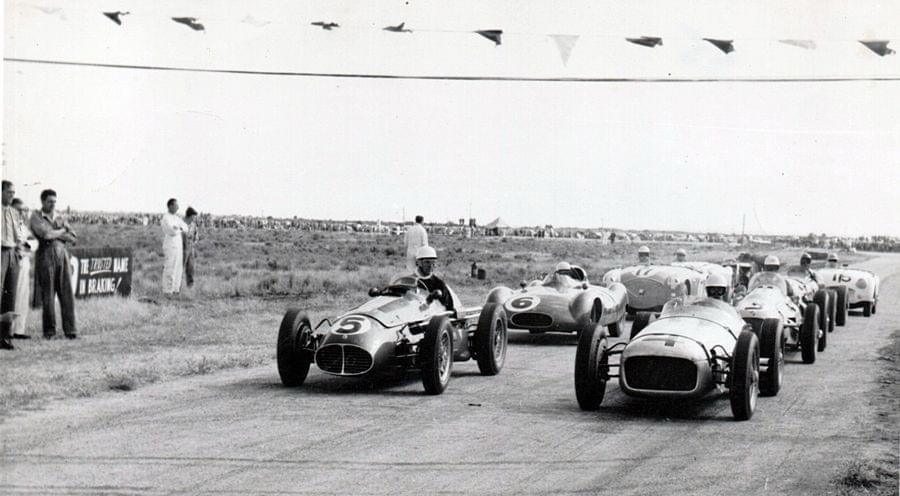
Hunt, Maserati A6GCM/250 and Jones’ Maybach 3 on the front row with Brabham and Whiteford’s Talbot-Lago T26C on the second row (Cummins Collection)

Jack Brabham returned home from his first season in Europe replete with a self-built Cooper T40 Bristol, winning the Port Wakefield race in the 2-litre, 150bhp, 1100lb, mid-engined car. Was it the first time a modern-era post-war mid-engined car won a national Grand Epreuve?

Brabham had luck that weekend in South Australia in a car which later became notorious for its unreliability. He won the race after the retirement of, or problems encountered by some of the event’s heavy-metal including Jones works-Repco 3.8-litre Maybach, Hunt’s Maser 250F engined Maserati A6GCM – A6GCM/250 to some – and another Melbourne motor-trader, Doug Whiteford’s 4.5-litre Talbot-Lago T26C.

image
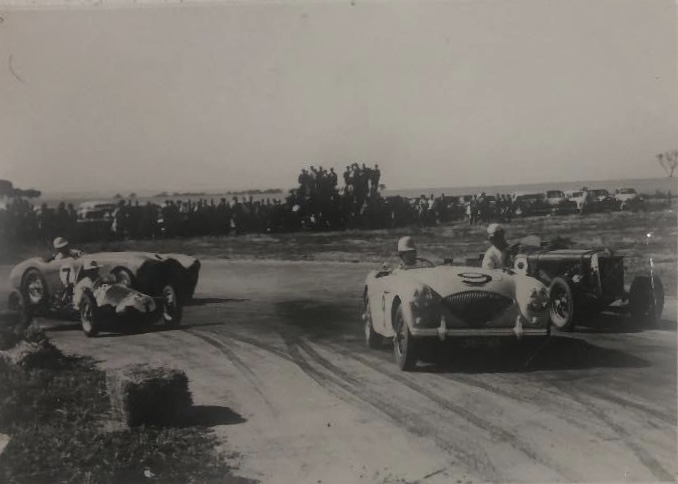
Clem Smith’s Austin Healey 100, DNF suspension being rounded up by the first and second placed cars of Brabham and Hunt: Cooper T40 Bristol and Maser A6GCM 2.5 (unattributed)
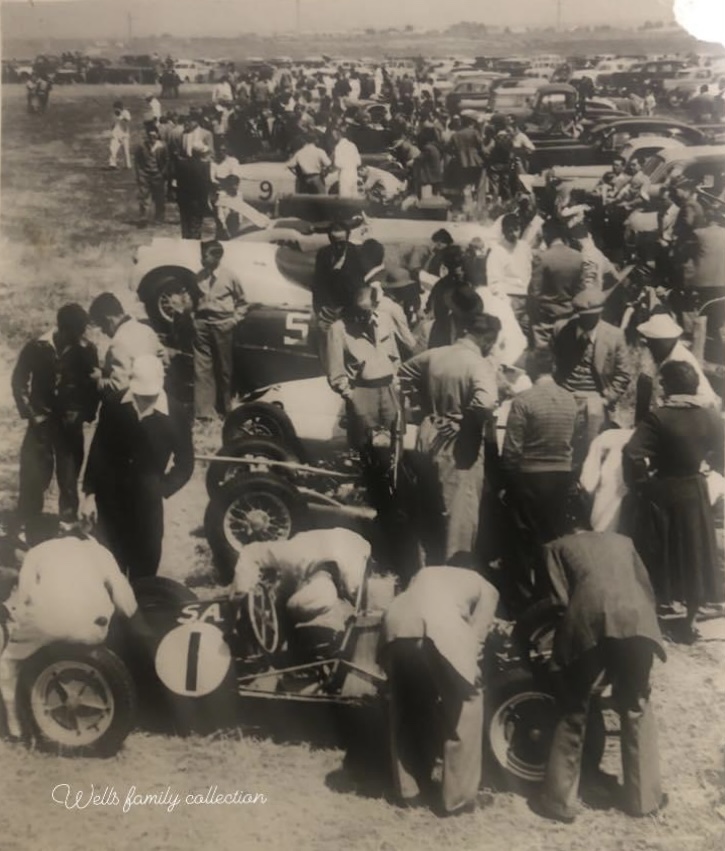
Doug Whiteford’s (second) Talbot Lago T26C, note the three whopper SUs, on the grid in front of Greg McEwin’s Austin Healey 100. And below, in the centre with his crew before the off (JA Denniston)
(JA Denniston)
Hunt and the Maser were the form combination at the time. Reg took the lead from Jones on lap one and led the race convincingly until the failure of a finger type cam follower forced the Maser onto five-cylinders, Brabham was soon past and into a lead he held for the races duration. Jones had clutch dramas, with Whiteford third, behind Hunt, in a car which raced too late after it’s initial arrival in Australia – devoid of some of the trick bits Doug paid for – shifty furriners! See here: https://primotipo.com/2022/05/04/doug-whiteford-talbot-lago-t26c-take-3/

The 80 lap, 104 mile event was the twentieth AGP and is noteworthy as the first on a purpose built circuit. Port Wakefield is 100km north of Adelaide in flattish, coastal, saltbush country. Previous AGPs were held on closed roads or airfields. ‘Wakefield, 1.3 miles in length, was used from 1953 to 1961, when Mallala, built on a disused Royal Australian Air Force airfield, became the main South Australian circuit.

(JA Denniston)

Not especially clear, but an interesting panorama with Hunts A^GCM in the foreground and a ‘cine-camera’ atop the pits. Makes you wonder if some footage is still kicking around somewhere.

(unattributed)
Stan Coffey, Cooper T20 Bristol from Murray Trenberth, Vincent Spl and John Cummins, Bugatti T37 Holden in one of the qualifying heats. Stan again below, this time having passed the spinning Cummins Bugatti in one of the qualifying heats. Cummo did not take the start in the GP.

(unattributed)
(N Tasca Collection)

Etcetera…

(E Gobell)

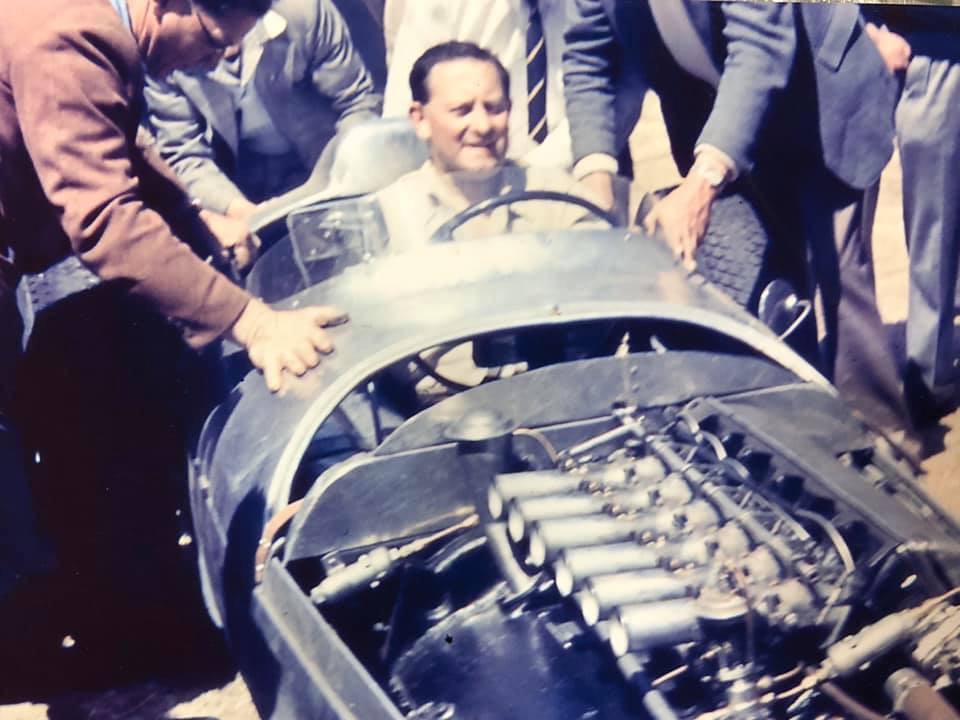
Charlie Dean beaming with pride aboard his latest creation, or rather the Repco Research team’s latest. Maybach 3 with its fuel injection system dominant atop the heavy, cast iron Maybach SOHC, two-valve 3.8-litre straight six laid-over at 65 degrees.

Greg Smith notes that the fuel injection system clearly shows the fuel rail and injectors, and that the throttle-bodies are actually single-choke 36DO2 units which were later (after the engine blew at Gnoo Blas with Stan at the wheel in early 1956) used on the Norman Wilson built Laydown Holden Special. See here: https://primotipo.com/2024/01/08/stan-jones-won-the-1954-nz-gp-70-years-ago-today/

(E Gobell)

Reg Hunt’s Maserati A6GCM above and below. This model is a 2-litre F2 car of the 1952-53 Grand Prix formula fitted with a 250F 2.5-litre SOHC, two-valve, triple Weber fed straight-six. About 240bhp at this early stage of the engine’s development. Hunt raced the car for little more than a year before progressing to a 250F in 1956, his final season in an oh-too-short elite level career. See here: https://primotipo.com/2017/12/12/hunts-gp-maser-a6gcm-2038/

(E Gobell)
(JA Denniston)

Melbourne businessmen/racers/Light Car Club of Australia supremos Bill (left) and Jim Leech admire the brand new Austin Healey 100S, chassis #3905 perhaps, in the Port Wakefield paddock. Stephen Dalton advises that this car, the first 100S in Australia was driven from Sydney to the meeting by motor dealer and 1949 AGP winner, John Crouch.

(JA Denniston)

Bill Craig’s Alta Holden – 1952 chassis F2/5 ex-Peter Whitehead – (above and below), with its distinctive alloy wheels, and perhaps, BP’s Tom Stevens the onlooker. Ken Devine advises the car was later owned and driven by Murray Trenberth, Jack Ayres and David Rockford in Western Australia before being sold overseas.

(JA Denniston)

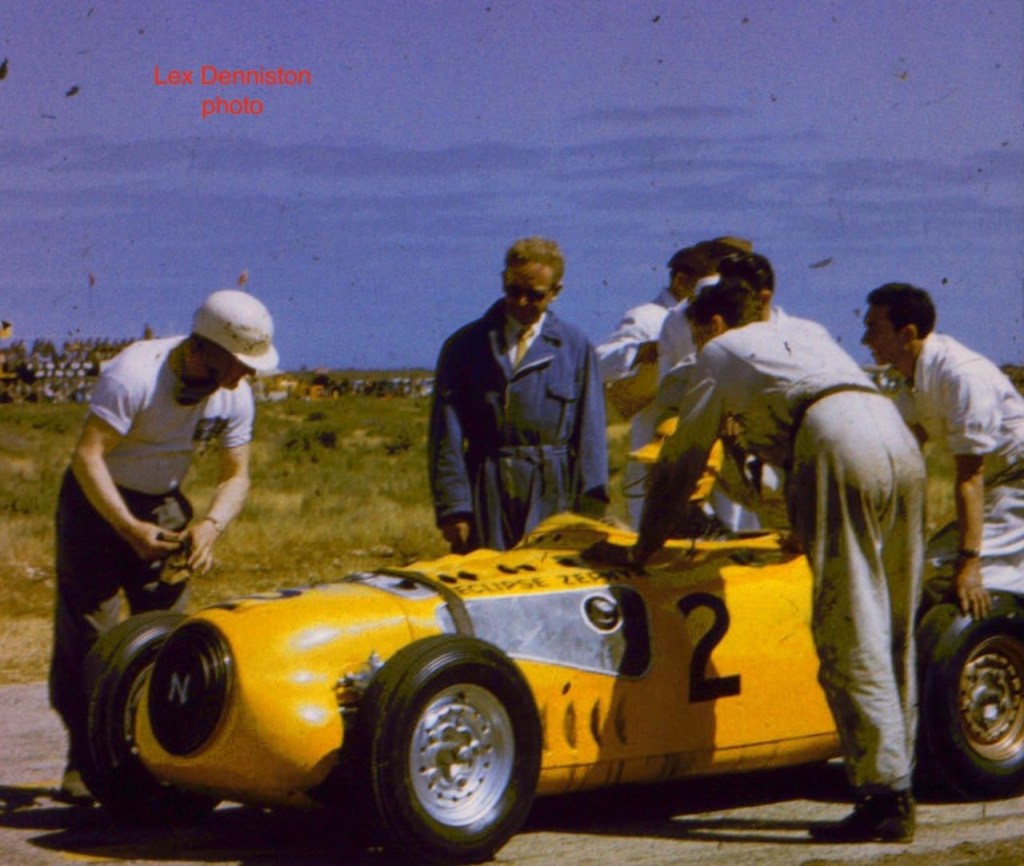
Two shots of the famous Eldred Norman built Zephyr Spl s/c. Tony Johns, “The starting grid photo shows the Zephyr alongside #8 Tom Hawkes’ Cooper T23 Bristol, probably a preliminary race.”

Credits…

State Library of Victoria, Reg Fulford Collection, Graham Howard and others ‘The 50 Year History of The Australian Grand Prix’, JA Denniston via Tony Johns, Edward Gobbel, Cummins Collection via Paul Cummins

Tailpiece…

port w

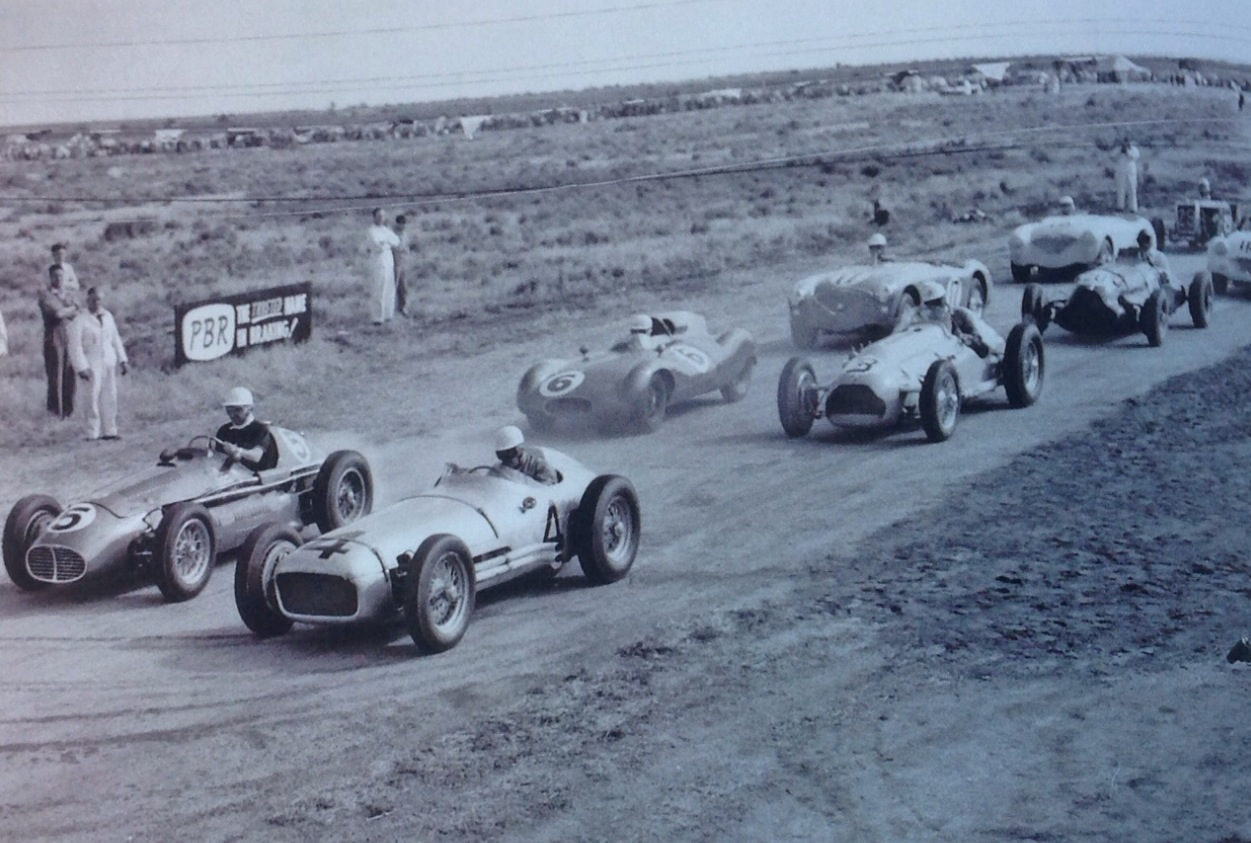
The ’55 AGP third qualifying, 20 lap heat is underway. As a cursory glance of the mix of competitors shows, the race is a Formula Libre event.

On the second row is Brabham’s streamlined, central-single seater Cooper T40 Bristol and thrice AGP winner Doug Whiteford’s Talbot-Lago T26C. It’s rather a neat contrast of post and pre-war technology. On the next row is the Austin Healey 100 of Greg McEwin and Bill Wilcox’ Ford V8 Spl, South Aussies both.

Desolate flat, saltbush country clear.

Finito

brabham art

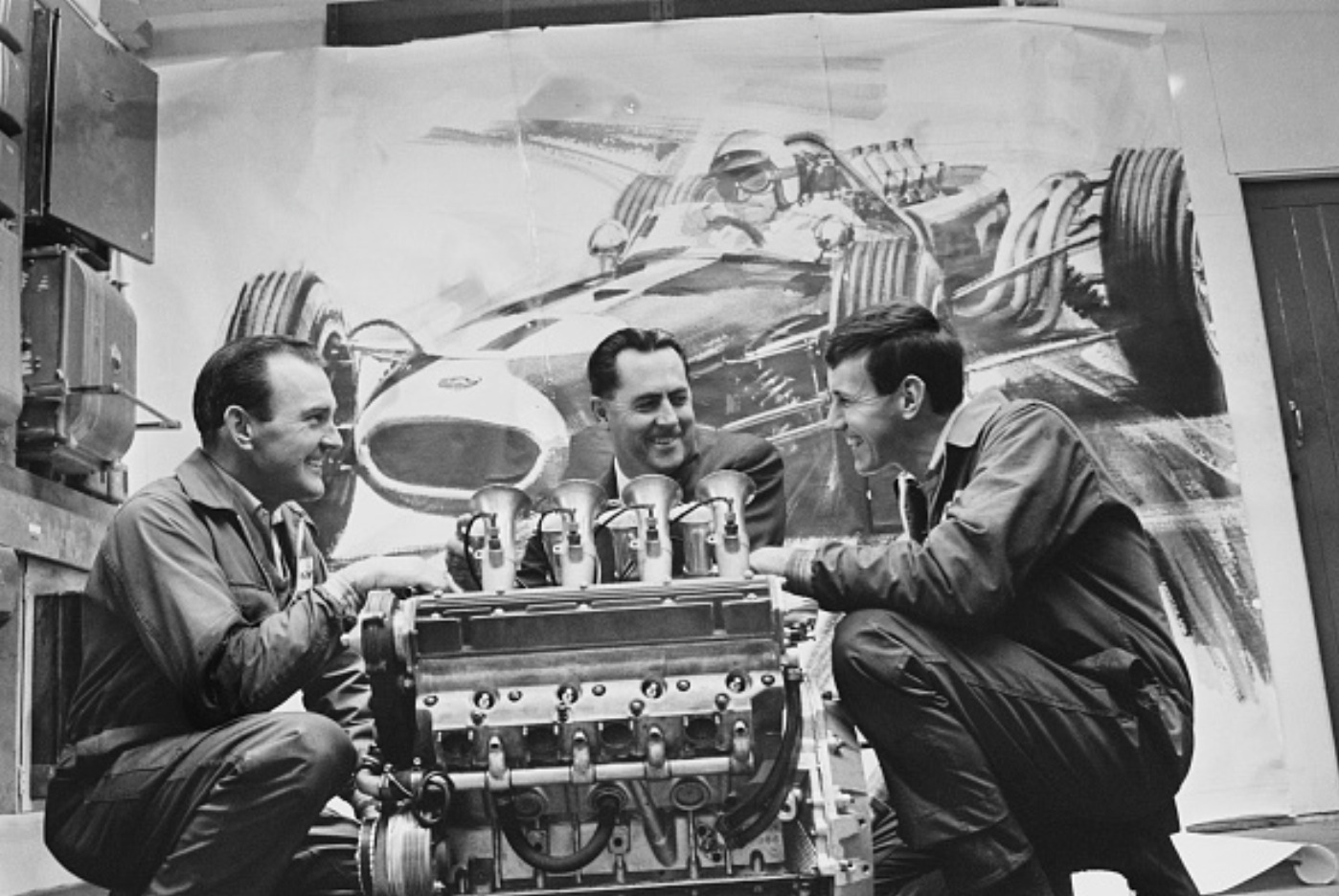
Jack Brabham, long time ‘Brabham Racing Organisation’ Chief Mechanic Roy Billington (left) and another fella, ‘twould be nice to know who, on 25 April 1967…

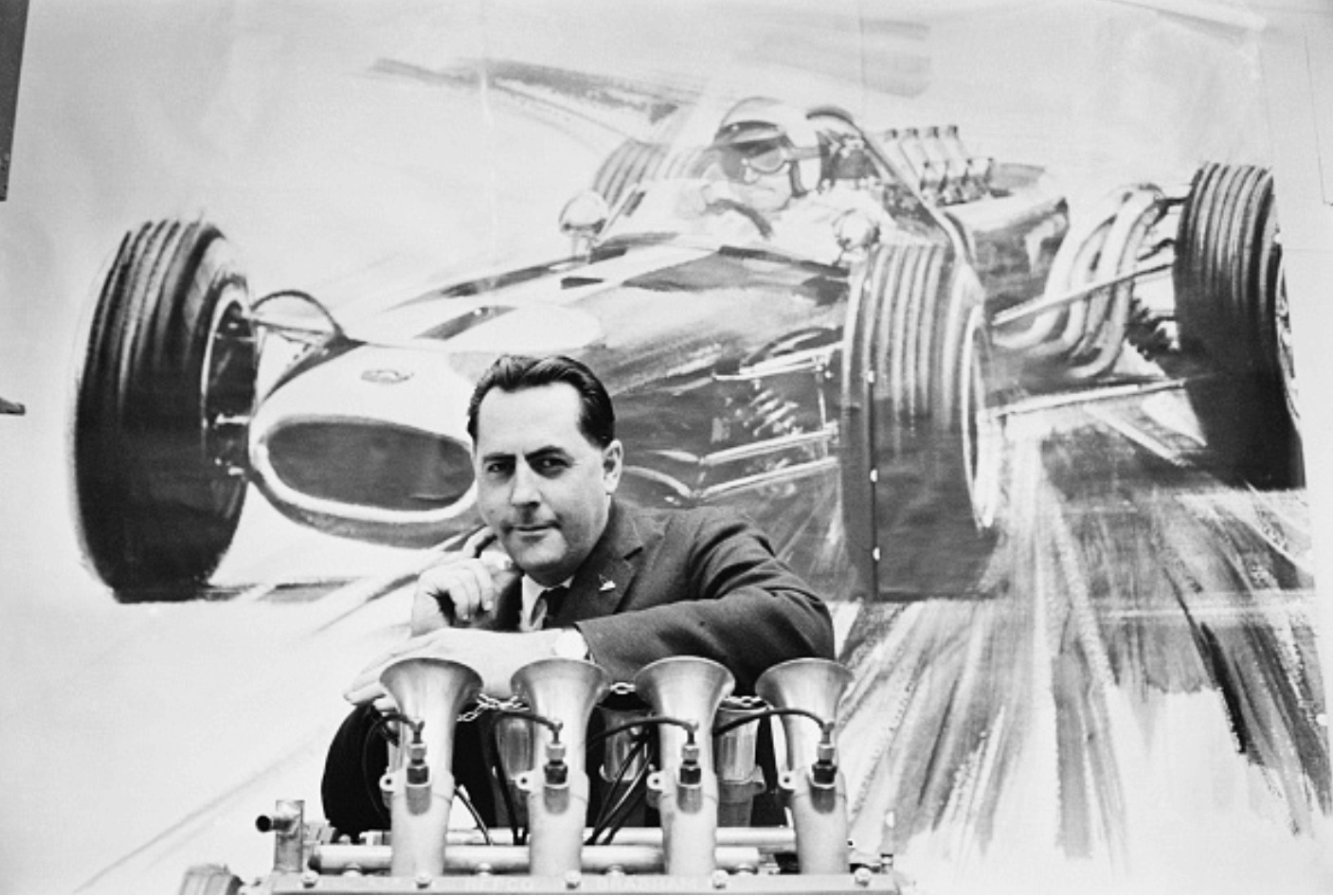
‘Co-stars’ in this studio shoot, which seems to be one of a series taken that year, is the Brabham BT19 pictured in the background and the Repco Brabham ‘RB620’ 3 litre V8 which is the engine/chassis combination with which Jack won the 1966 F1 Drivers and Constructors titles.

I have written comprehensively about both this engine;

‘RB620’ V8: Building The 1966 World F1 Champion Engine…by Rodway Wolfe and Mark Bisset

and the 1966 F1 Championship Year;

Winning the 1966 World F1 Championships: Brabham BT19 Repco…

I love the shots!…

Credit…

Len Trievnor

Tailpiece: Jack’s ‘Dr Evil’ pose?…

blackie

image

(Heritage Images)

I’m constantly in awe of the talents of the photographers whose work is displayed in this ‘masterpiece’ of mine…

Take a careful look at the composition and execution of this shot of Phil Hill’s Dino at Monaco in 1959-the use of light, the way the shadows of the palm tree and building architecture frame the shot of the snub-Monaco nosed Ferrari 246 and the expression on the American drivers face. The shadow of the photographer gives a sense of involvement.

image

(Klemantaski)

Things were pretty tough for the front engined brigade by 1959 of course.

Jack’s first Cooper title was bagged that year. In the process of trying to keep up, Enzo’s brigade created quite the most beautiful cars in these later Dino’s. The snub nosed car not so much but checkout Tony Brooks slinky, curvaceous chassis above during the BARC 200 at Aintree on 19 April ’59. Jean Behra took the win that day in a sister car, the Scuderia may have been lulled into a sense of false security by this non-championship event result.

The 1959 Dinos had more voluptuous bodywork by Medardo Fantuzzi, clothing big-tube frames with coil-sprung de Dion rear ends rather than the transverse-leaf setup used earlier. Dunlop disc brakes and tyres were used with Armstong telescopic shocks replacing the ‘unreliable’ lever-arm Houdailles- Doug Nye wrote that some Ferrari team members blamed the Houdailles as the cause of Peter Collins fatal 1958 German GP accident.

image

Brabham on the way to his first GP win at Monaco in 1959, Cooper T51 Climax (Cahier)

It was very much a Cooper T51 Climax year.

They won three of the five non-championship events (Moss took 2, Brabham 1) with Ferrari and BRM taking one apiece (Behra and Flockhart). Ignoring the Indy 500 which was part of the world championship back then, there were eight GP events. Cooper won five (Brabham-Monaco, British and Moss-Portugal and Italy two races each for the Aussie and the Brit and McLaren-US 1 win). Ferrari won two (Brooks-French, German) and BRM won one, the break-through first win for the Bourne marque and Jo Bonnier aboard a P25 at Zandvoort.

image

(unattributed)

Its front is a little ‘fugly’, the looks only a mother could love

‘Snub nosed’ Dino, Hill rounding the Gasworks Hairpin, Quay in the background. Oooh, la, la from the rear tho. All things Italian look great from the back!? Hill hustling his Dino, thru the Mirabeau right hander below.

image

(LAT)

Have a look at Phil’s car below in August on the hugely picturesque and dangerous Monsanto road course during the Portuguese GP.

DNF when Lotus 16 mounted Hill G spun in his path taking out both cars. Moss won in a T51 Cooper Climax from Masten Gregory similarly mounted, Gurney the best placed Ferrari in 3rd.

I guess by definition these Dino’s are the ultimate expression of the front engined GP car given Enzo persevered at least a year longer than he should have.

image

(LAT)

Credits…

Heritage Images, Klemantaski Collection, LAT, Cahier Archive, Ferrari Dino article by Doug Nye in Motorsport November 2007

Etcetera- Technical Specifications…

Two rare photographs of Dinos in the semi-nude.

The first, above, is a 156 F2 in the Nürburgring pits in August 1957, both are by Bernard Cahier. The second is of the Taffy Von Trips (DNF) car during the 1960 Belgian Grand Prix weekend at Spa.

Vittorio Jano’s new 65 degree 1.5 litre V6 gave about 180 bhp @ 9000 rpm on the Maranello test-bed, it burst into life about five months after Dino Ferrari’s untimely death due to renal failure on 30 June 1956.

The cars chassis was a scaled down variant of the Lancia Ferrari 801, its tubular frame comprised of two large diameter bottom tubes braced by a welded on superstructure of thinner tubes- not a true spaceframe in a definitional sense.

The engine was angled across the frame, as you can see, this allowed the prop-shaft to run past the drivers seat to the left. The front suspension, clearly shown, is by wishbones and coil springs with the rear suspension by de Dion tube and transverse leaf spring. Drum brakes and Houdaille lever arm shocks were fitted with Scaglietti providing the sexy aluminium body.

The 1957 German GP was a famous victory for Fangio’s Maserati 250F from the Hawthorn, Collins and Musso Lancia Ferrari 801’s. The Dino, if the photo is captioned correctly, was perhaps in the transporter. Whilst entered in the F2 section, the race results show Maurice Trintignant as a ‘no-show’, Denis Jenkinson’s race report also says the car did not arrive so perhaps the date on the caption is wrong and the shot is of a 1958 246.

The first F2 Ferrari Dino, chassis #’0011′ made its race debut at the Naples GP on 28 April 1957. Enlarged engines of 1983 cc, 2195 cc were built over the ensuing months and- then the 2417 cc variant was raced by Peter Collins during the non-championship 27 October Moroccan GP- the Dino 246 was born!

Stricken by flu, Peter spun off, the 85mm bore, 71mm stroke, 2417 cc engine at that stage gave 270 bhp @ 8300 rpm burning 130 octane AvGas, the 1958 mandated fuel.

The 1960 Dino 246/60 (above) were lightened with engines angled across the frame the opposite way to 1959, with the transaxle turned around to match- providing the drivers with the challenge of a reversed gearchange gate.

They also featured pannier fuel tanks without separate covering body panelling (look closely above) smaller fuel tanks and all-independent coil-spring and wishbone suspension.

At Spa Phil Hill used the Ferrari four-cam power advantage but was still overwhelmed by a Cooper Climax 1-3 finish. Jack Brabham led home Bruce McLaren in T53’s whilst Olivier Gendebien was third in an earlier T51.

Tailpiece: And what a tail. I’m cheating really, this is the butt of Phil’s ’58 Dino, this pictorial article is mainly about the 1959 cars…

image

’58 Moroccan GP; Moss won in a Vanwall VW57 from Mike Hawthorn and Phil, both Dino mounted, Mike won the ’58 World Title at this race (LAT)

The photo is another masterpiece of composition and high-speed shutter work during the Moroccan GP at Ain-Diab, Casablanca Morocco on 19 October 1958.

Check out the different tail treatment from the later cars earlier in the article and ‘three piece’ fabrication of the Ferrari’s rear tail section comprising from driver back- the fuel tank, then oil tank and finally small curvaceous endplate, Italian panel bashing at its best.

Finito…

Max Stephens powers his 2 litre Cooper T40 Bristol up the Domain Hillclimb, Hobart, Tasmania probably late 1959…

Its not just a T40, it’s THE T40, Jack Brabham’s 1955 Australian Grand Prix winning car- Jack took a somewhat lucky win when the more powerful cars of Stan Jones and Reg Hunt fell by the wayside or were mortally wounded.

Colour isn’t so common in Australian motor racing photography in the period- partially due to its cost and that professionals mainly shot in monochrome given good ole black and white in magazines prevailed. This is a fantastic colour photograph from Lindsay Ross’ oldracephotos.com.au archive, I’m not sure who the ‘snapper is in this particular case but his/her composition took my eye.

The 1959 Australian Hillclimb Championship was held at the Queens Domain on Saturday 14 November 1959, in fact the weekend was a ‘double-banger’ with competitors over from the mainland able to compete at the Baskerville circuit on the Sunday. Perhaps this photo is of Max during the championship meeting, i’m intrigued to know.

The journalist Rob Saward, writing on The Nostalgia Forum had this to say about T40 ‘CB/1/55’ and Stephens…

‘The gearbox was always this cars weakness…It was the usual Citroen based (ERSA modified) box Cooper were using in the early Bobtails and F2 cars, which worked ok with the FWA or FWB Climax, but 2 litres of Bristol power meant it had to be treated very gingerly. Longford was always hard on transmissions, even more so before the railway crossing was rebuilt prior to the 1960 meeting’.

‘Max Stephens never really had the chance to demonstrate his true potential in the car- he was a gifted motorcycle racer, Tasmania’s best in the 1950’s and there is no reason why he could not be good in a car also. I don’t know whether it was his (Max Stephens Motors in Moonah, a car sales, later accessories and motorcycles) business that stopped him getting more involved in car racing or whether money was the issue…he died a few years ago’.

‘The car was sold in about 1962/3 to Alan Robertson of Hobart who converted it from central seat to sportscar format and raced a few times before Bristol engine problems intervened…the car was purchased by Frank Cengia, who restored it in the original Brabham 1955 colours, but in the 1990’s it was unfortunately sold overseas…’when Pat Burke who owned the car fell upon hard times’.

Cooper T40 ‘CB/1/55’ whilst in Stephen’s ownership at Longford in 1959 or 1960. It is the car that Jack built, literally, days before his championship F1 debut at Aintree in the 1955 British GP. The car was constructed on the T39 Bobtail sports jig, with modifications. Note the curved Cooper spaceframe chassis, Bristol 2 litre engine sitting tall in the chassis, alloy wheels…such a clever car (oldracephotos.com)

Talented engineer Geoff Smedley added that ‘the car was prepared (in Tasmania) by the late Eric O’Heaney, one of the old school motorcycle mechanics who gave Max a lot of success in his bike days…Eric himself was an avid bike racer until a serious accident…In my mind Eric was an earlier version of the great Phil Irving, both with the same demeanour in their thinking and dedication to the development of the sport…’

Scott Stephens describes his father Max‘…as a respected car and motorcycle racer. He was the only Australian, whilst riding a Manx Norton 500, who successfully passed Geoff Duke for the race lead whilst Geoff held the mantle of current World Champion, this was achieved during the Australian Grand Prix held at Longford…Observed motorcycle trials was his last competitive stance. He was the Kawasaki and Maserati distributor in Tasmania…In his Hobart store he was the approved reseller of Norton, BSA, Velocette, Triumph, Laverda, Maico, Cotton, AJS, CZ, Montesa, Bultaco, Ossa, Hodaka, Italjet and Suzuki’ makes down the decades. Scott himself was a successful professional racer who rode for Kawasaki Australia, Matich Pirelli Racing and Suzuki quips that Max ‘Loved and was amazed by anything driven by fuel!

Tailpiece: Stephens and T40 on the warm-down lap, Longford…

(P Geard)

Bibliography/Credits…

The Nostalgia Forum- contributions by Rob Saward and Geoff Smedley, scottstephens.com.au, oldracephotos.com.au, Paul Geard Collection

Finito…


image

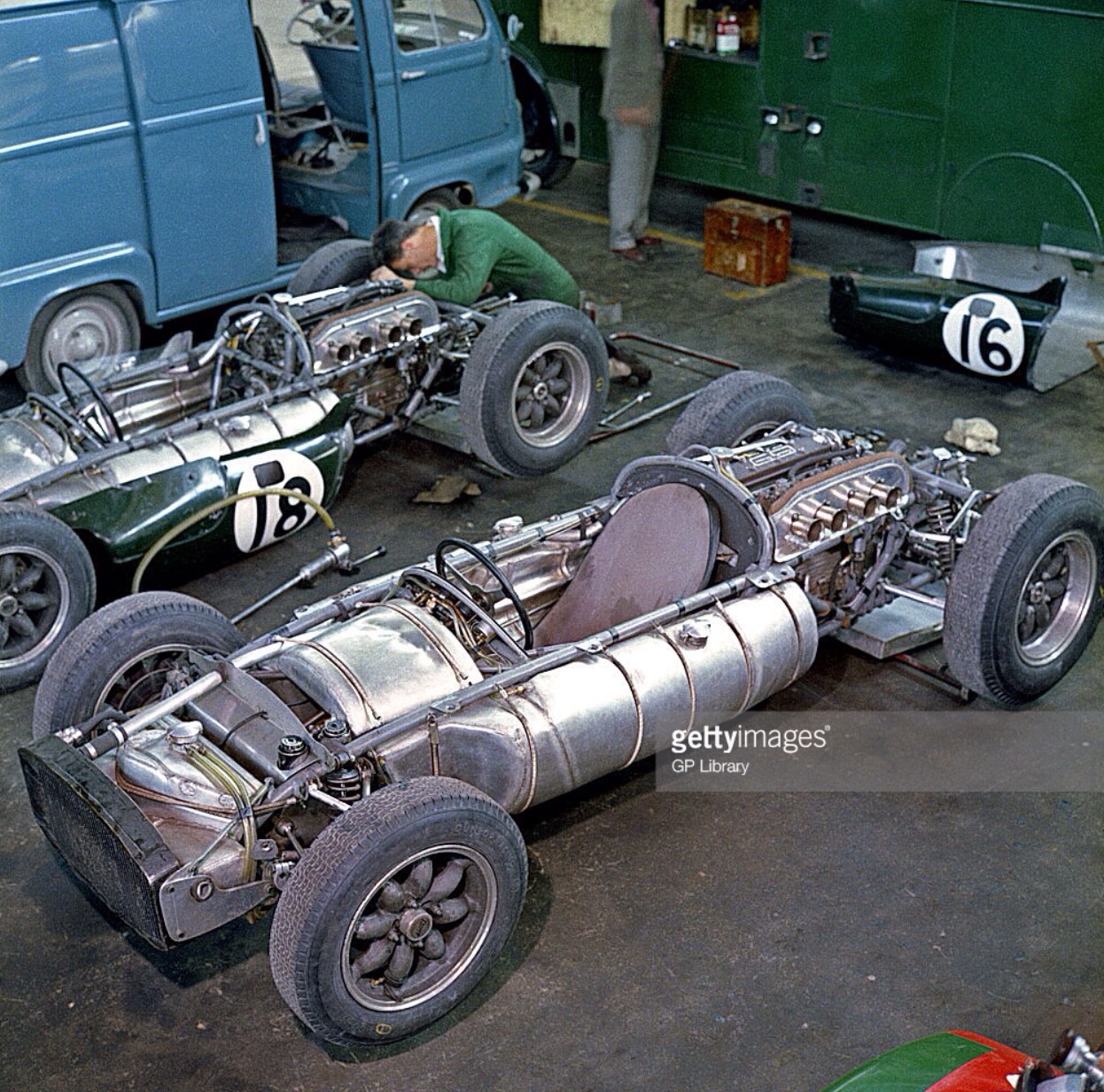
Mike Barney prepares Jack Brabham and Bruce McLaren’s Cooper T53 Climax’, French GP Reims, 3 July 1960…

That racing drivers shouldn’t have too much imagination is shown by this shot!

#16 is Brabham’s winning chassis, #18 McLaren’s third placed car. Olivier Gendebien was second and Henry Taylor fourth in T51’s making it a Cooper 1-4!

Yer ‘fancy-schmancy’ high tech relatively, I say it again, relatively safe 2017 carbon fibre GP machine is another world away, 55 years or so to be precise. Mind you, one would hope we would progress.

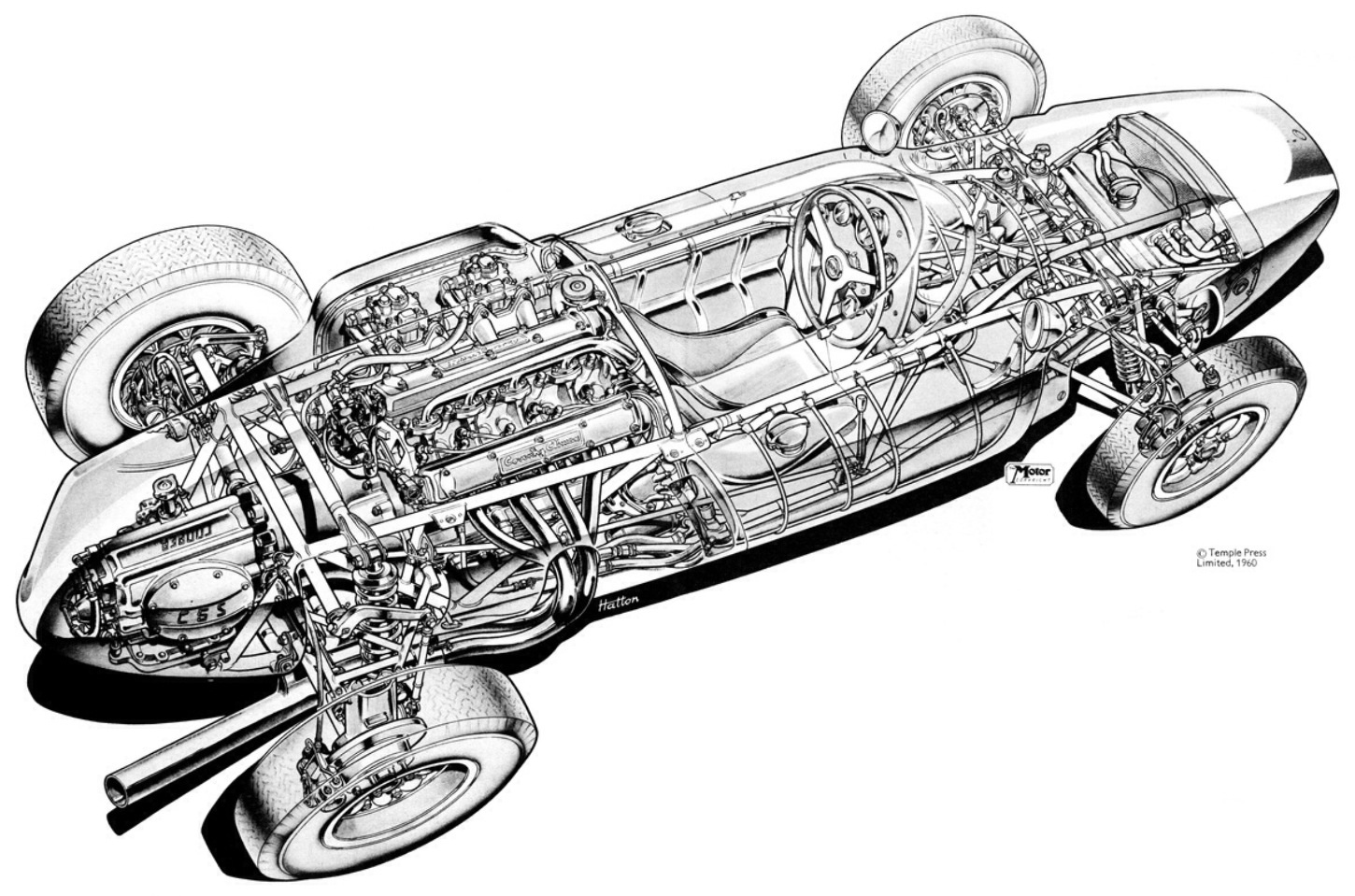
Owen Maddock’s curvy spaceframe chassis is typical of the day, the spaceframe anyway if not the imperfect in an engineering sense bent tubes! At the front the water radiator and oil tank are the ‘deformable structures’ ahead of the drivers ankles and lower legs. The fuel tanks are neatly and very practically ‘bungee’ strapped to the chassis and prone to leakage as the ‘ally tanks chafe on the steel chassis tubes. The ‘deformable side structures’ are the tanks, no bag bladders in those days so the risk of fire was great, prevalent and occasionally fatal.

The 2.5 litre Coventry Climax FPF powered T53 ‘Lowline’ was the 1960 successor to the race-winning and built in vast numbers 1958/9 T51. That car in both F2 and F1 spec has to be one of the greatest customer racing cars ever? T53 was the design work of Jack, John Cooper and Maddock.  The Lotus 18, Chapmans first mid-engined car was the quickest bolide of 1960. Moss took wins in Rob Walker’s car at Monaco and in the season ending US GP at Riverside but it was not the most reliable, something Jack was happy to capitalise upon.

McLaren won the Argentinian GP at the seasons outset, then Jack had an amazing mid-season run winning the Dutch GP on 6 June and the Portuguese GP on 14 August. In between Zandvoort and Oporto he won the Belgian, French and British GP’s thereby setting up his and Cooper’s second world titles on the trot.

Its good to look at these cars in the ‘nuddy’ every now and again to remind oneself of just how close to the elements and how brave the drivers of yore were. Yep, the piloti are no more exposed than they had been in the past but the cornering speeds of a 1960 2.5 litre Cooper or Lotus were a good deal quicker than a 1954 2.5 litre Maser 250F, the road circuits in particular just as hazardous…

Cooper T53 Climax cutaway by Brian Hatton

Credits…

GP Library, Brian Hatton


repco

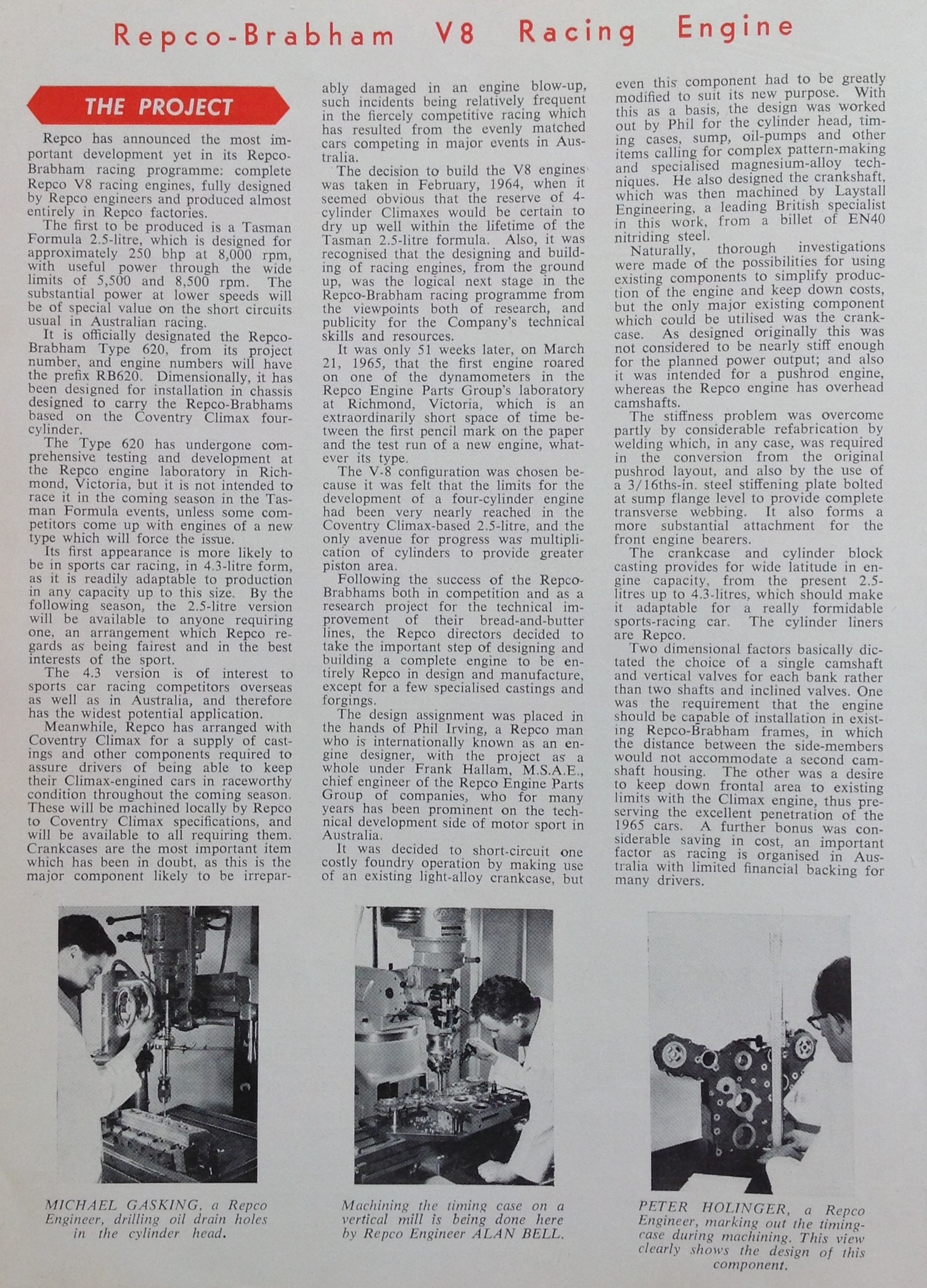
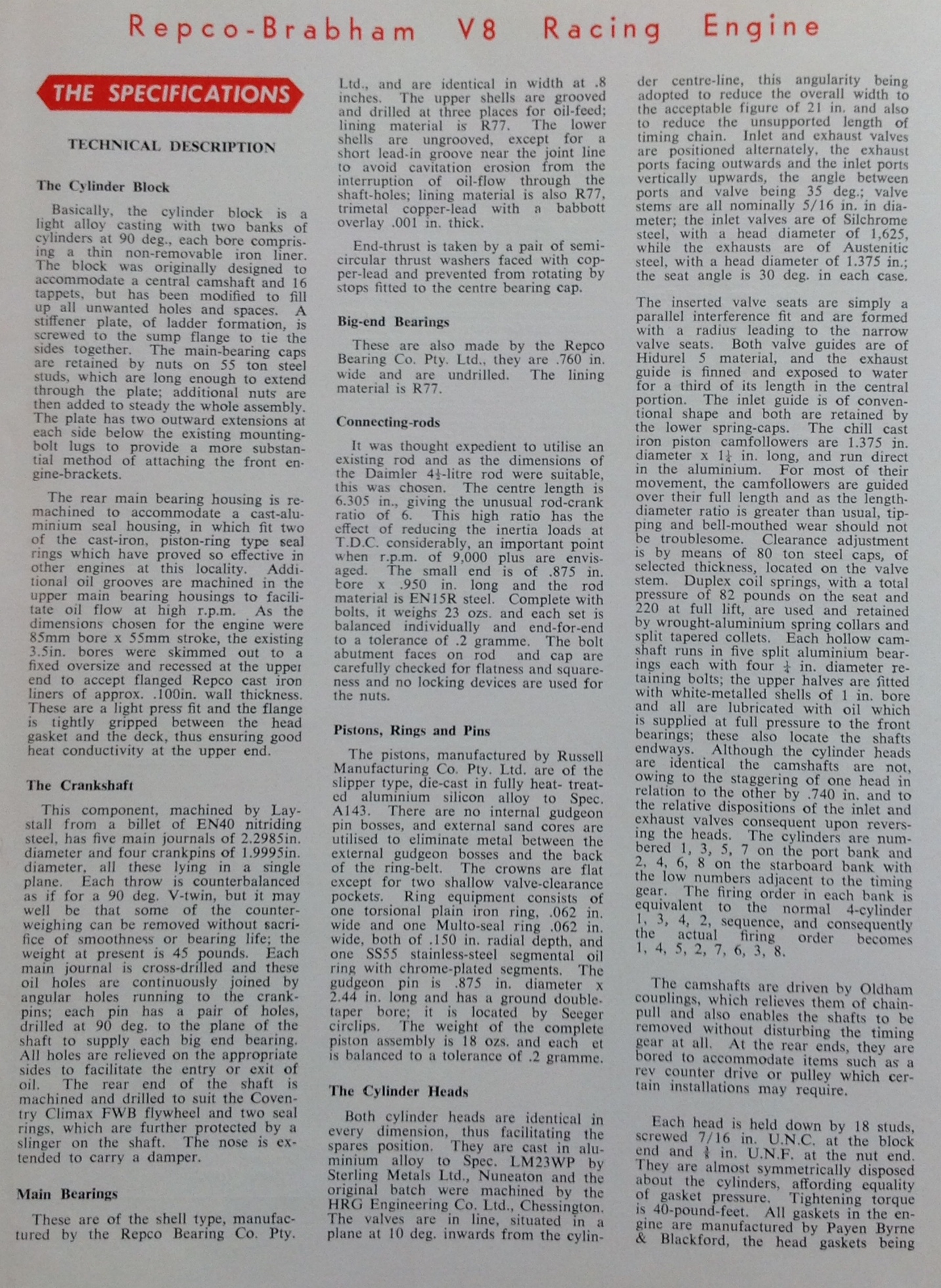
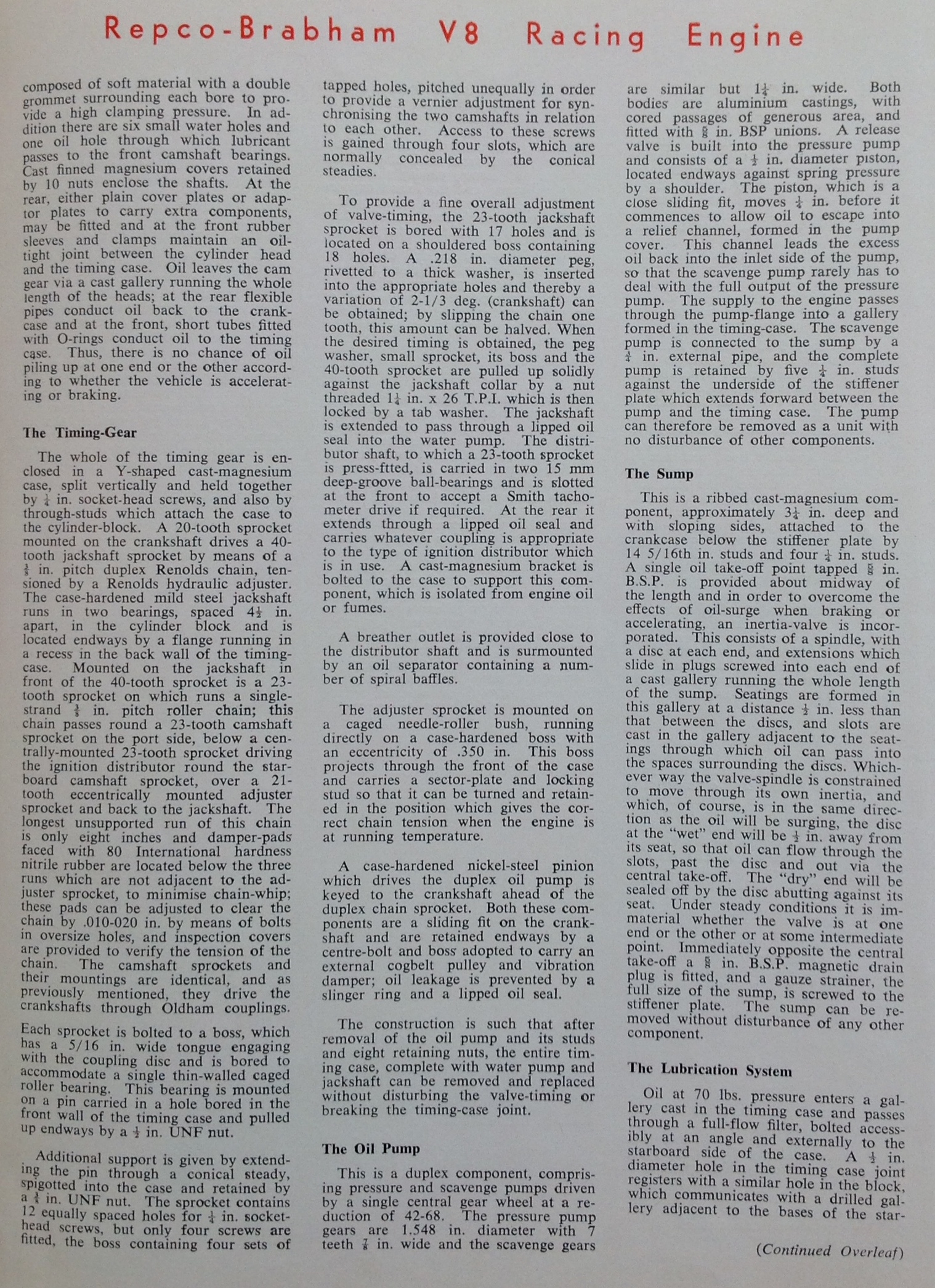
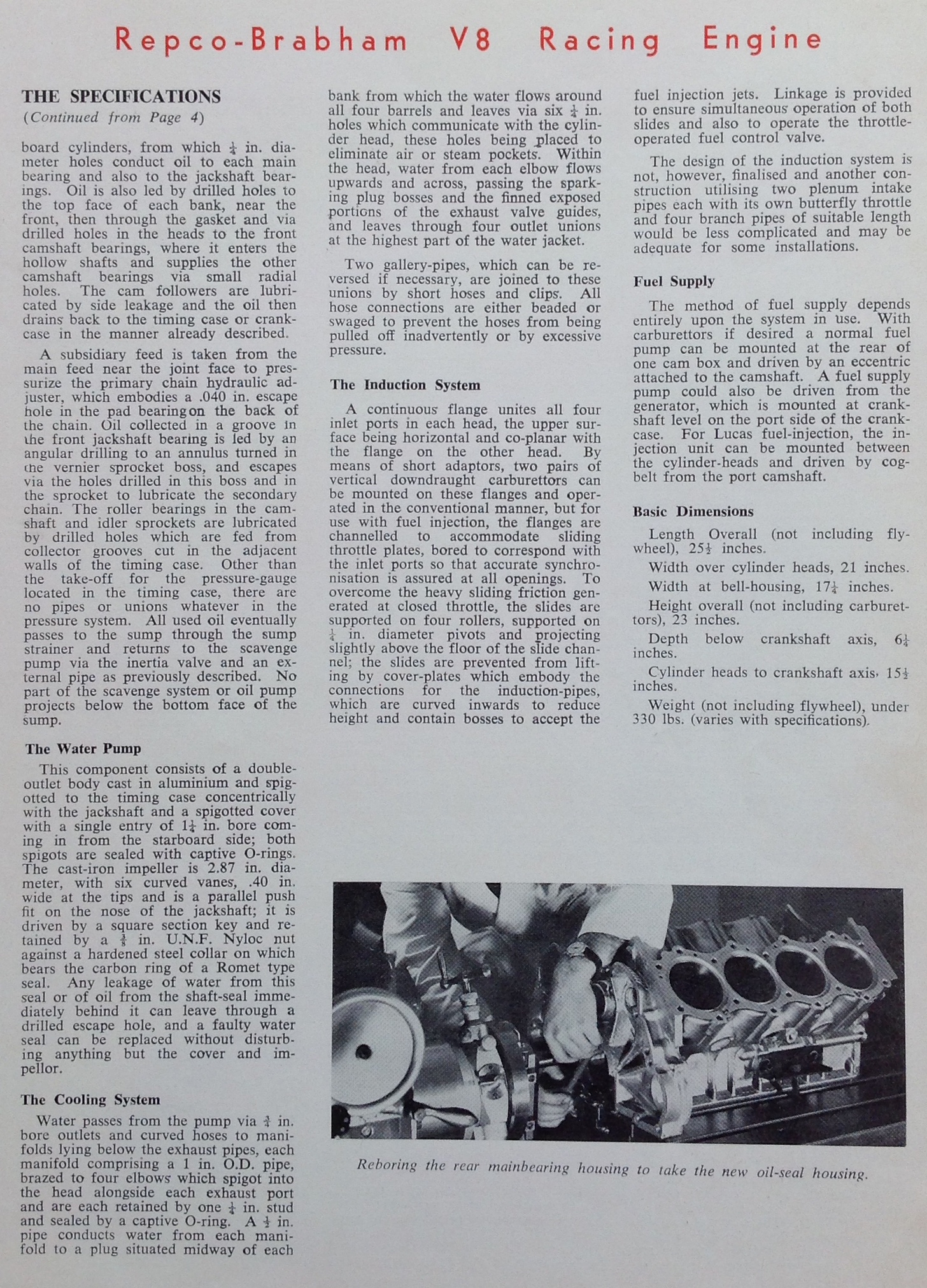
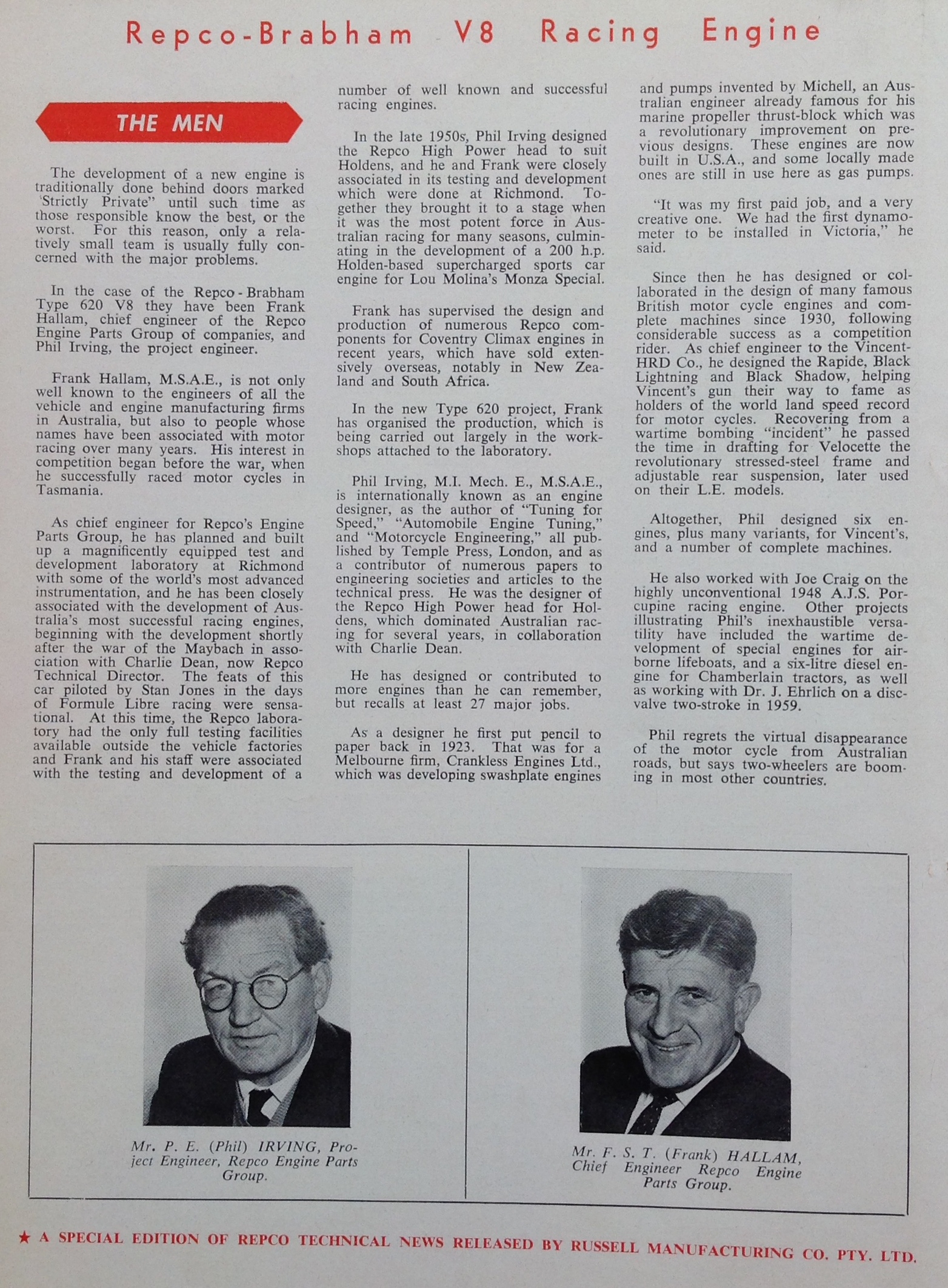
The Story of the Repco-Brabham V8 Racing Engine as conveyed in Repco Technical News Volume 12 No 2, November 1965…

This gem is from Michael Gasking’s Collection and is reproduced in all of its glory, this is the 1966 Tasman/F1 engine later more commonly referred to as ‘RB620’, its internal Repco Parts Co project code was ‘620’. It will be difficult to read on your ‘phone, a bit easier on a larger device!

We have covered this engine already in primotipo, click on the links at the end of the article for these stories. Just a couple of ‘editorial comments’ or observations.

repco-1

RB620 and F1…

No mention is made of the engines F1 application so late in the piece, the new 3 litre F1 began on 1 January 1966. Brabham and Repco were playing their cards, understandably, close to their chest. Remember the RB620 V8 first ran in a car at 3 litres not 2.5, at Goodwood before racing in the non-championship South African GP, at Kyalami on 1 January 1966.

Melbourne motoring journalist Chris de Fraga, well known and respected by generations of Victorian enthusiasts is credited with first reporting Repco’s F1 plans in the Melbourne ‘Age’ in early October 1965, a report denied by Repco at the time. This document dated November 1965 was presumably circulated in that month or the following one.

repco-2

repco-3

repco-4

Jack’s Lovechild…

Brabham’s parentage of the project is ignored in this largely technical treatise of the engine, Jack’s involvement not ‘front and centre’ in this public document given the need for F1 confidentiality.

repco-5

‘The Men’…

The duo credited with the engine in the brochure are Chief Engineer of the Repco Parts Group, Frank Hallam and Project Engineer Phil Irving, the only guy missing, as stated above is Brabham. Its worth musing for a bit about the roles these three men played in the championship winning RB620.

In simple terms Jack was the engines conceptual designer- he pitched the Repco board a simple engine using the F85 Olds block as a base whose completed dimensions were to fit the existing BT19 chassis. Phil designed it, inclusive of its drawings. Jack provided both conceptual design and practical feedback to Phil on regular visits to Irving who was based near Brabhams early in 1964 as he progressed the engines design. All of the ‘RB620’ drawings were done by Phil and signed by him according to ex-Repco engineer and Repco Historian, Nigel Tait who has seen and reviewed them all in the process of archiving them with RMIT University, Melbourne, in recent years. Hallam was Repco Brabham Engines Pty. Ltd. General Manager and Chief Engineer. His role was primarily a management one although he had engineering oversight, his direct design and engineering input into RB620 something Hallam has sought to grab a greater share of down the decades.

After Irving’s death, Hallam in his book ‘Mr Repco Brabham’ comprehensively dumps all over Irving and seeks to take more credit than he is due for the ‘RB620’ engine inclusive of positioning Irving as its ‘draftsman’ – ‘draftsman casual’ in the employee list in his books Appendix. In fact all of the ‘Drawing Office Personnel’ listed are described as ‘draftsman’ despite several being degree qualified engineers. Hallam, on the other hand, formally qualified as a motor mechanic, lists himself as General Manager/Chief Engineer. The positioning he inaccurately seeks to convey is clear. In that context its interesting to see Phil’s title as ‘Project Engineer’ in this Repco publication of the day.

The very well known F1 engine designer and manufacturer John Judd joined the Repco Brabham Engines Maidstone design team at Jack Brabham’s behest in 1966. He pretty much unwittingly walked into a storm in terms of the final breakdown in the progressively declining working relationship between Hallam and Irving. Judds arrival at Maidstone was unannounced by Frank to Phil, the design leader at the time, thereby lighting the fuse for a final confrontation which was becoming increasingly inevitable.

Judd got the ‘rounds of the kitchen’ from Phil when he joined RBE according to both Phil’s autobiography and Frank’s book but Judd has this to say about Irving’s contribution to ‘RB620’ in a recent ‘Vintage Racecar’ magazine interview;

‘When Jack returned (to the UK) from the (1966) Tasman  series, he asked if I could go to Melbourne almost immediately, and work with Repco designing parts toward the next year’s engine. That lasted for about four months and I was back again for six months in 1967 working on the 1968 4-cam engine.’

‘The original 1966 engine had been designed almost 100% by Phil Irving of Velocette and HRD fame with input from Jack and Ron Tauranac, but Phil didn’t fit in well with the Repco corporate structure and fell out with his boss Frank Hallam. My insertion into an already fragile situation led to Phil leaving after I had been there two months or so, and to his replacement by Norm Wilson. Looking back at Jack’s 1966 World Championship winning engine, I believe it was largely the product of one man, Phil Irving, to an extent that is and will remain unique.’

Don’t get me wrong, Hallam played a vastly important role in marshalling Repco corporate resources to assemble the men and modern machines to build World Championship winning engines in 1966 and 1967. He was also a wonderful foil between the demanding requirements of the Repco Board and the daily dramas in Maidstone of building and servicing racing V8 engines so far from Brabham Racing Organisation’s Guildford base. But his contribution is more management than engineering detail of RB620 when objectively looked at in the context of all the published evidence and the views of those there at the time.

The antipathy between Irving and Hallam was and is well known, few Repco people want to go ‘on record’ about the topic, which is both understandable and frustrating at the same time. They, rightfully, recognise the contributions of both men. Irving’s book is respectful of Hallam, Hallam’s of Irving not so and was published well after Phil’s death- the shit-canning of Irving is grubby and un-Australian really. If you are going to ‘have a crack’ do so when the other dude can defend himself. Hallam’s book was contracted by him from Simon Pinder, the author. It is not objective as such (neither is Irving’s autobiography of course) but does add much to fill in the RBE story, the long interview with ’67 RB740 designer Norman Wilson is gold for example,  but the books quality varies from gold to ‘merde’ depending upon the chapter. One needs quite a lot of Repco knowledge to pick the chapters to treasure and those to treat with rather more circumspection.

Nigel Tait told me that Jack Brabham was very angry with a fair bit of the contents of the book- it would have been a good idea for the great man to have read its contents before writing the publications foreword! I will explore the relationship between Irving and Hallam, and Hallam’s claims, in detail, soon. In short, this Repco corporate piece puffs up Hallam’s racing background and downplays Irving’s, ‘twould be interesting to know who ‘signed off’ the content of this document before it’s publication.

Enjoy ‘The Story of The Repco-Brabham V8 Racing Engine’, its sensational. Wish I had it when Rodway Wolfe and I tackled the articles linked below 2 years ago!, having said that we have included a good bit of granular stuff not included in this official publication, so read together are not a bad crack at the ‘RB620’ subject…

Etcetera: Repco RB620 articles…

On the engines design and build

‘RB620’ V8: Building The 1966 World F1 Champion Engine…by Rodway Wolfe and Mark Bisset

On the successful 1966 F1 season

Winning the 1966 World F1 Championships: Brabham BT19 Repco…

Bibliography…

Repco, ‘Vintage Racecar’ magazine, ‘Mr Repco Brabham’ Simon Pinder

Credits…

Michael Gasking Collection

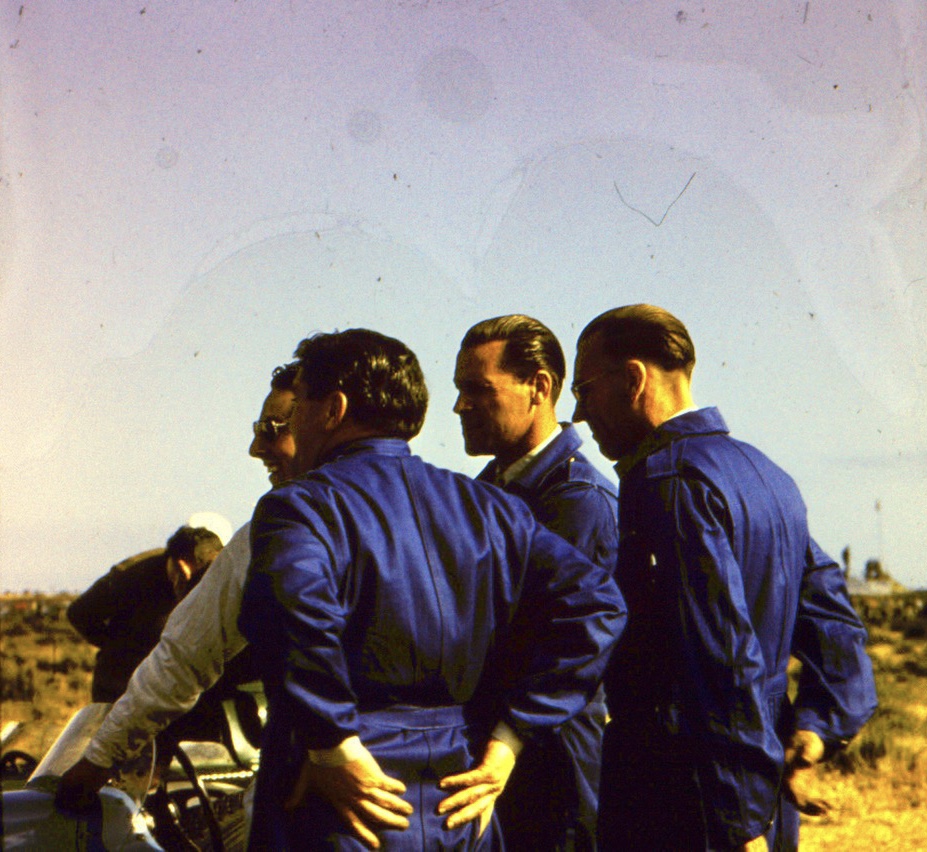
Tailpiece: Repco Brabham Boys, Longford, March 1966…

Phil Irving, with collar and tie chats to Brabham whilst Frank Hallam at right susses the Brabham BT19’s suspension. Not sure what Roy Billington is up to. Note the long inlet trumpets of the Tasman 2.5 RBE620 V8. Its the engines 3rd race, South African GP then Sandown Tasman the week before Longford. Jack was 3rd with overheating and low fuel, Jackie Stewart won in a BRM P261 from Graham Hill’s sister BRM. Its 6 or 7 March 1966. BT19 was Jack’s F1 championship winning 1966 car, still in Oz owned by Repco (oldracephotos.com/Harold Ellis)


image

(oldracephotos.com/Ellis)

The ‘Longford Trophy’ race start in Tasmania, 5 March 1960 with Jack Brabham and Bib Stillwell in Cooper T51 Climaxes on the front row…

Jack is on the far left, in yellow is Austin Miller’s Cooper T51 Climax then Bib’s red Cooper and far right in red, Arnold Glass’ 4th placed Maser 250F, the beach umbrella atop the starters stand is a nice Oz summer touch, meanwhile the man in the white cap surveys it all and snaps away. Glorious!

I wrote an article about this event a while back, Lindsay Ross recently published the evocative photo above of  a wonderful summers day of a time and place so long ago, too good not to feature.

Jack Brabham, Cooper T51 Climax, Longford Trophy 1960…

Brabham won the 17 lap race from Alec Mildren’s Cooper T51 Maserati, Alec and his car were to be Australia’s Gold Star champions that year, and Stillwell 3rd.

image

Brabham with Stillwell alongside, then Aussie Miller in yellow beside the Glass Maser. Almost ready for the off (John Ellacott)

Here is publican, crop-duster pilot and racer Austin Miller’s immaculate Cooper T51, 2.2 litre Climax powered, in the Longford paddock amongst the sportscars, he retired on lap 3. How sweet it is. This car, chassis ‘F2-20-59’, driven by the intrepid Austin, later set an Australian Land Speed Record, which then Chevy 283cid V8 powered makes it Australia’s first ‘F5000’, and is a fascinating story for another time…

image

(John Ellacott)

Credit…

oldracephotos.com/Ellis, John Ellacott, oldracingcars.com

image

Jack Brabham willingly takes his go-faster pill from the lovely Goodyear fräulein…

It’s just before the 1966 German Grand Prix, Jack won the race in his Brabham BT19 Repco on 7 August from John Surtees and Jochen Rindt aboard Cooper T81 Masers.

Jack was right in the middle of the mid-season purple patch which gave him the title; from 3 July to 7 August he won the French, British, Dutch and German GP’s on the trot.

Goodyear were a very important part of Brabham Repco’s win that year. Jack was in F1 with them from their start in F1, 1965, and was still winning races with them in 1971.

Brabham’s last race win was aboard a Goodyear RR12 shod Bowin P4X Formula Ford ‘Race of Champions’ victory at Calder, Australia…

image

Bob Jane was always a clever promoter, the champion racer/entrepreneur and Calder circuit owner decided upon a ‘Race of Champions’ amongst the Australian aces of the day to get a few more bums on seats at his 15 August 1971, cold and chilly winter meeting. Look at the crowd!

The just retired, for a while anyway, Jack Brabham was happy to accept the invitation to compete. It just so happened his Ford Dealership in Sydney sponsored Bob Beasley in a Bowin P4 in that years ‘TAA Driver to Europe Series’, the national Formula Ford championship.

The field included Kevin Bartlett, Alan Hamilton, Allan Moffat. Pictured here is Bib Stillwell in the car in which Larry Perkins won the 1971 Driver to Europe title, then Jack and Frank Matich in Elfin 600, Bowin P4X and Aztec FF respectively.

Whether or not Jack did a few laps in the Bowin at Warwick Farm in Sydney before the car was popped onto the trailer for Melbourne is unclear, ditto Bib, the owner of the Perkins Elfin 600! It was a fun race but their were plenty of guys keen to win, Jack prevailed in the short scrap, Goodyear shod of course…

Credits…

ullstein Bild, Classic FF FB page

Ps: ‘Drink it Freddy!’…

Was the catchy slogan or tagline of a popular sweet drink called ‘Quik’, the notion being that the additive made cows milk more drinkable at a time such milk was a good thing. I think it still is, but who knows? Anyway, the line was stuck in the back of my head, which is full of useless shite and popped out when i saw Jack and his Goodyear friend…

Pps: Love the neato Repco Brabham sticker on the cockpit screen of Jack’s car!


image


Tony Rudd and one of the BRM crew either sorting a problem or firing up Harry Schell’s P25 so the Bourne engineering chief can get back to his hotel, Monaco 1959…

image

Behra’s Ferrari Dino 246 you can just see on the left then Moss and Brabham, both Cooper T51, #48 Phil Hill Fazz Dino, #22 McLaren and #32 Trintignant Coopers T51. #16 and #18 Schell and Bonnier in BRM P25’s outside Brooks Dino. #20 Flockhart P25 BRM and behind him Graham Hill’s Lotus 16 Climax (unattributed)

In a sign of the times Jack Brabham won the race from Tony Brook’s front engined Ferrari Dino 246, Jack and third placed Maurice Trintignant in mid-engined Cooper T51 Climaxes. Jack of course took the first of his drivers titles that year and Cooper the constructors.

image

Jack on his own on the Monaco quayside in 1959, on his way to his first championship GP win, Cooper T51 Climax. His last the 1970 South African GP at Kyalami (Cahier)

It wasn’t a great weekend for the BRM boys; all three cars retired, Ron Flockhart, Jo Bonnier and Harry with a spin, brake’s and an accident and a split fuel tank the causes respectively.

mon butt

Stunning shot of Tony Brooks’ Dino chasing Harry Schell’s BRM into casino Square, Monaco 1959 (Heritage)

brm cutaway

BRM P25; spaceframe chassis, 2491cc DOHC, 2 valve, Weber fed 4 cylinder engine developing circa 275bhp@8000rpm, 4 speed ‘box. Suspension; upper and lower wishbones and coil spring/dampers and De Dion and coil spring/dampers at the rear. Front disc brakes, single disc on the transmission at the rear (C La Tourette)

The team broke through for its well deserved first win in 1959, Bonnier took the next race, the Dutch GP on 31 May, beating Jack and Masten Gregory in Cooper T51’s.

mon babes

BRM babes; hard for the mechanics to focus surrounded by this lot. The photo has done the rounds but i’ve never read the identity of said poppets if anyone can advise, BRM P25, Monaco 1959 (unattributed)

Credits…

Klemantaski Collection, Cahier Archive, Heritage Images, C La Tourette

Tailpiece: Harry Schell’s BRM P25 clips the inside of the kerb on entry to a corner in his pursuit of Cliff Allison’s Ferrari Dino 246 at Zandvoort in 1959, JoBo’s P25 took a famous win, Harry DNF, Allison 9th…

image


frank gardner

(John Ellacott)

Frank Gardner beside his Jaguar D Type ‘XKD 520’ at Mount Druitt on 23 May 1958, looking fairly relaxed, photographer John Ellacott recalls FG achieved a 14.57 standing quarter mile in the big, powerful car…

Its right at the end of Mount Druitt’s decade long life as a race circuit in Sydney’s western suburbs. FG took FTD in one of the sprint events after the circuit was ‘mortally wounded’ by circuit owner Belf Jones after a spat with its operator the ‘Australian Racing Drivers Club’ in 1958.

mt druitt 1

(TR0003)

These wonderful Mount Druitt, 1955 Sydney, New South Wales colour shots (the one above and below) were posted on ‘the Nostalgia Forum’ which, for those of you who haven’t discovered it is something you should do, but be warned you will be lost in interesting motor racing ‘threads’ for years…

http://forums.autosport.com/forum/10-the-nostalgia-forum/

Ace researcher/historian and primotipo contributor Stephen Dalton dates the shots as probably the 4 September 1955 meeting with the Healeys’ driven by #93 C Kennedy and #98 K Bennett. In the background Stephen thinks the #53 tail is an important Australian MG Spl, the ex/Dick Cobden/David McKay/Curly Brydon car.

The red car surrounded by mechanics is perhaps the ex Jack Saywell Alfa Romeo P3 then Alvis powered and driven by Gordon Greig. The covered #4 single seater is Stan Coffey’s Cooper Bristol ‘Dowidat Spl’ and #14 Jack Robinson’s Jaguar Special.

mt druitt 2

(TR0003)

All ‘The Fun of The Fair’ or ‘Mount Druitt Motor Racing’ as the case may be…

This article was published in the Sydney Morning Herald on 14 August 1954, it captures the atmosphere of the place and the day and ignorance of the public of motor racing;

THIRTY thousand picnicking spectators in 8,000 cars make a phenomenon in Australian sport and entertainment at Sydney’s monthly motor races at Mt. Druitt.

Cars park two to four deep the whole length of the two and a quarter miles racing track. Spectators drive between races from one vantage point to another over ‘horror stretches’ in the seemingly endless acres of paddocks around the track.

Vendors sell hot water, hot dogs, all the usual provendor of picnics. Children play rounders or football between races.

By the standards of Britain’s famous Brooklands, the informality is extreme for the spectators, but it is typically Australian; sunshine, open air, gum trees.

The Australian Racing Drivers’ Club, however, applies the strictest international rules of competition to its 12 or 14 race program.

Officials on motor cycles patrol the boundary fences. White uniformed officials with international motor racing flags signal the drivers safely through the races-a blue flag waved – ‘a competitor is trying to overtake you’; a yellow flag waved ‘great danger, be prepared to stop’; yellow, with vertical red stripes-‘take care, oil has been spilt on the track.’

A public address system links the whole of the two and a quarter miles of track with the finishing line.

A truck tows breakdowns off the course, often two at a time, ignominiously, like a defeated bull dragged from the ring.

At the end of the day 8,000 cars crowd the Great Western Highway in a colossal traffic jam, in which the ‘hot rodders,’ after a few imitative accelerations, lose their ardour for speed on frustrating miles of bumper-to bumper driving.

What attracts this crowd to a venue nearly 40 miles from the city is the excitement of speeds up to 140 miles an hour and skid turns on hairpin and right-angle bends. The straight of the bitumen track is a wartime airstrip.

The club conducts events for racing, sports, and stock cars and has 60 to 70 competitors at a meeting.

Most of the competitors are owner-drivers-fanatical seekers of perfection in the assembling and tuning of motors. They acquire a car, according to their means and choice. If it is a stock model they remachine and reassemble parts of the motor, and fit new parts, two carburettors, and a ‘blower’ (a supercharger), which gives the ultimate ‘kick.’

In all types of cars running and maintenance costs are high. A set of tyres is good for only 500 racing miles. A car may run half a mile and burn the top out of a piston. An owner may spend £250 on a new cylinder head and find it does not fit satisfactorily.

brabham

Jack Brabham in the Cooper ‘Redex Spl’ Bristol referred to in the text. On the outside is Bill Hudson, Hudson Spl at Mount Druitt in 1955. Jack was later to say he should have taken this highly self developed car to the UK rather than purchase the Cooper Alta he bought in the UK…still it didn’t hold him back in the end! (unattributed)

THE glamour driver of the moment is a 26-year-old motor engineer, Jack Brabham, with his British £4,000 six cylinder Cooper (frame)-Bristol (motor).

He is a former Australian midget car champion, whom some club officials put in ‘world class.’

In the lingo of the fans, he ‘lashes the loud pedal-(accelerator) down to the boards’ and scorns the ‘anchors’ (brakes).

His driving is, indeed, a spectacle as he relentlessly mows down a field, flashes past car after car, and changes gears at 85 to 90 miles an hour.

But the fans are watching a £7,000 Italian Ferrari, with a 12-cylinder two litre engine having a power output of 250 b.h.p. and a top speed around 150 m.p.h. Owner Dick Cobden, a fine driver, has had the car only a few months and is still familiarising himself with its tuning and driving.

The Ferrari is a Grand Prix car, which famous English driver, Peter Whitehead, drove in the Lady Wigram trophy at Christchurch, New Zealand, early this year’.

cobden

Dick Cobden’s ex-Whitehead Ferrari 125 at Mount Druitt, date uncertain. (G & L Liebrand Collection)

Circuit Map…

druitt circuit

(unattributed)

Mount Druitt Aerodrome, 45 Km west of Sydney was built for the Royal Australian Air Force during World War 2. The facility comprised 2 hangars, workshops and a runway 1,524 metres long and 48 metres wide, perfect as the basis of a racetrack postwar.

The first race meeting was held on October 4 1948 on a short track based on the runway established by the Australian Sporting Car Club.

In 1952 Belf Jones built a full circuit, 2.25 miles long using some adjoining land owned by a Mr McMahon, a Sydney businessman. The circuits’ first meeting was on 30 November 1952 organised by the Australian Racing Drivers Club, the main event, a 50 Mile Handicap won by future Australian champion, David McKay’s MG Spl. (one of the cars obscured in the first photo above).

Over the following 5 years over 25 meetings were run with crowd attendances often over 15,000, given the circuits proximity to Sydney. Mt Druitt’s last meeting was on 10 November 1957.

Commercial agreement for the circuits future use could not be reached between the ARDC and Jones, who did irreparable damage to the circuit; Jones cut a trench around the circuit with a digger!

gardner 2

Another shot of Frank Gardner’s D Type at Mount Druitt on 23 May 1958. (John Ellacott)

The last hurrah for the venue was a number of sprint meetings run in 1958. Victories resulted for Gardner’s D Type Jag, Arnold Glass’ HWM Jaguar and Len Lukey’s Cooper Bristol.

The ‘NSW Speedway Act’ in 1959 and consequent required investment in the facility to meet new safety standards was the final death-knell for this fondly remembered circuit.

The parts of the track added in 1952 remain but the airstrip section is long gone, the area is now known as the Whalan Reserve, it comprises the Mount Druitt industrial estate and Madong Avenue Primary School.

druitt circuit 2

Current google earth aerial shot of the circuit area. (speedwayandroadracehistory.com)

Bibliography…

The Nostalgia Forum Mount Druitt thread, particularly the contributions of Stephen Dalton and ‘wirra’. Sydney Morning Herald 14 August 1954, speedwayandroadracehistory.com

Photos…

John Ellacott, TR0003, G & L Liebrand Collection

Finito…