Vern Schuppan had plenty of excitement towards the end of his victorious run at Le Mans in 1983. With two hours to go he sped down the Mulsanne in Porsche 956 #003) – shared with Al Holbert and Hurley Haywood – when the left-hand door flew off.
He kept circulating while a replacement door was readied, but the engine began to overheat as air was no longer being forced into the radiator on that side by the duct built into the door.
(T Walker)
After four laps a non-opening door was fitted. After rejoining, the car was ordered to return to the pits to have an operational door fitted on safety grounds. This meant the second-placed Bell/Ickx (005) above was able to make up its three-lap deficit with the cars on the same lap as the final circuit began.
Holbert’s overheated engine was now smoking, and Bell was closing rapidly – having been twelve seconds quicker in practice – but despite gaining on the lead car, the order remained the same at the finish.
(T Walker)
As usual, I found these photos by accident, researching something else, and up popped the ‘Porsche Pictures Past’ website porschepicturespast.com, which is fantastic, do have a look.
(T Walker)
That’s the 934 shared by John Goss (#9306700153) with car owner, Belgian ‘Jean Beurlys’ (Jean Blaton) and Nick Faure in 1976.
They started 27th and were still running at the finish but were too far behind the winner (181 laps completed) to be classified.
The story goes that the car was delivered to Blaton just before the race in Belgian racing yellow, but a last-minute sponsorship deal with Citizen Australia and Harley Davidson resulted in the car being hurriedly repainted into the colour scheme seen here, apparently with aerosol cans!
#69 was a Swiss entry for Claude Haldi/Christian Vetsch, DNF engine on lap 219 of 350, while car #17 was the Joest 908/3 (#008) driven by Ernst Kraus/Gunter Steckkonig; the 1970 Targa Florio-winning chassis was seventh on its Le Mans debut from grid 23.
(T Walker)
Tim Schenken shared this Georg Loos-GELO Racing 934 (#9306700175) with Toine Hezemans (driving) in 1976; they looked set for a GT category win until a transmission problem intervened.
After this setback, they were 16th outright and second in class after starting 15th. Tim competed at Le Mans five times, this was his sole finish.
Tim first raced for Gelo in 1974 and did full seasons in Georg Loos Porsches in 1975-76 with his best results as follows: 1975 – first in the Euro GT round in a 911 Carrera, and in the ETCC round at Zandvoort and 200 Km Jarama, while his wins in a fearsome Porsche 917/10 in the Zandvoort, Nurburgring Supersprint and Hockenheim Interserie round puts him am an elite group of drivers who won a race in these challengine cars.
And in 1976 aboard 934s, first in the DRM Hockemheim Preis der Nationen and the DRM Nurburgring Supersprint, while he shared the victory in the Monza 6-Hours with Toine Hezemans and Klaus Ludwig.
(T Walker)
The marshal pauses as the Charles Ivey Porsche 956 (#110) races past during 1984.
Crewed by Chris Craft/Alain de Cadanet and Allan Grice, the ex-John Fitzpatrick Racing machine had a DNF engine only two hours from the end when in 13th place.
Gricey returned to Le Mans in a works-Nissan R88C, finishing 14th, sharing with Win Percy and Mike Wilds.
(fotoracing.co.uk)
Larry Perkins had a crack at Le Mans in a Charles Ivey-entered car too. His 911 Carrera RSR (#9114609064) was having its second of two attempts at Le Mans in 1978.
After retirement the year before, it finished 14th from grid 47 in the hands of Perkins/John Rulon-Miller/Gordon Spice and was second in its class. Above, the winning Alpine-Renault A442B of Didier Pironi and Jean-Pierre Jaussaud prepares to pass the Porsche again, eventually finishing 91 laps ahead.
(T Walker)
There was no shortage of Australian drivers in the 1984 race including the Peter Brock/Larry Perkins Team Australia (John Fitzpatrick Racing) 956 #102.
The car was running 28th from Q18 when Larry ran off the road in a ‘he zigged when I zagged’ high speed passing move, ended its race after 145 laps.
(T Walker)
And yes, I know some other Australians also raced Porsches at Le Mans.
This is the very last time a racing car appeared in Repco colours. John Goss had just purchased and not yet repainted the Matich A53 Repco-Holden #A53-007 sold by FM on his retirement from the sport. So it’s still in its Repco livery.
I mean Real Repco, when it was a manufacturer of global significance rather than a High Street retailer.
‘Having his very first outing in a Formula 5000 race car (in the first round of the 1974 Gold Star at Oran Park on the August 4 weekend) touring car star John Goss took a sixth and a fourth in the two heats, bringing the Laurie O’Neill owned, Max McLeod sponsored Matich A53 home fourth on aggregate’ John Smailes wrote in Auto Action (#91 August 9, 1974).
‘Of the newcomers (Jon Davison and Phil Moore being the other two) John Goss was the most impressive and performed well beyond expectations in a car in which he had only done 25 laps before Saturday’s official practice began.’
By raceday Gossy had removed the Repco signage. Dunnit look great almost entirely denuded of ads? (Auto Action)
‘Goss finished the day ecstatic with both his own performance, the car, and the experience of F5000 racing. “The drivers are beautiful”, he said. “They agree they have been passed once you pull alongside.” ‘He said he was very pleased with the car and “the engineering genius of Frank Matich” and happy that he had completed the first round of the series without a single lose.’
“My only problem is adapting back to the (Falcon Hardtop) sports sedan after the open wheeler. It feels like a block of flats,” Goss said.’
Repco’s withdrawal from racing as an engine manufacturer…
Was a very big deal, Repco had made pistons, rings and bearings for racing cars way back in the 1930s. Its involvement was ongoing subsequently.
The Melbourne, April 26, 1974 announcement and related article above reads as follows, ‘Repco today announced that the company is to discontinue the manufacture of racing engines, including the Formula 5000 Holden and Leyland based units.’
‘Frank Matich, Repco’s number one representative for the past eight years is still under contract for the balance of this year while John Walker and John McCormack have engines on lease, and these deals will run out under the terms of the lease.’
‘The situation regarding servicing of the present units has not yet been finalised as all parties which it will affect have not yet been contacted and the Board of Directors will not make a decision until this has been done.’
‘Whilst Repco believe that they have benefitted richly in terms of development and pass-on advancement for general consumption products, they are well aware of the financial reward for the vast sums of money they have outlaid to become one of the most respected engine building companies in the world.’
‘The firm will now concentrate more of its energies on direct development of its domestic products, such as changeover engines.’
‘In terms of the racing fraternity they want to withdraw without hurting anyone, as they realise that there are people who have done so much for their advancement and worldwide reputation.’
‘Reactions to the news amongst users of Repco power units were surprisingly bland. John McCormack said,”I don’t think it will affect our operation.”
“We’ll continue to use Repco engines as spares are available as are drawings. Besides, many parts were made outside anyway and these can be supplied as before.
‘Replacement cylinder heads might be a problem, but it would be just a matter of matching existing units, although there would be a lot more work involved in getting them up to scratch.”
‘Ansett Team Elfin team manager, John Lanyon reiterated McCormack’s remarks, adding, “Of course we are disappointed, but we don’t believe Repco is about to leave everybody high and dry.”
John Walker, Lola T332 Repco-Holden during a fateful 1975 Tasman Cup finale at Sandown. He had a hand on the cup but a big crash on lap 1 wrecked his chances, with Warwick Brown the survivor and championship winner from the other contender, Graeme Lawrence. Lola T332 Chevs both (R Davies)John McCormack’s gutless Elfin MR6 Repco-Leyland leads John Goss, Matich A53 Repco-Holden during the August 1974 Oran Park Gold Star round
‘Asked about the future of the Leyland P76 project. Lanyon stated that he was “not too sure, but I think they will probably continue with it at present.”
‘Another long time user and associate of Repco Engines, is ex Australian Champion, Frank Matich. When we spoke to him in Sydney Frank showed very little concern at the company’s withdrawal.’
“It doesn’t affect any of my plans as I have sufficient engines and equipment at present. I can understand Repco’s reasoning however, with the increasingly high costs the industry has been facing. Repco’s policy has been one of support for all users of their engines, and over the past few years that has not been cheap.”
‘Long time Repco designer, and expert on racing engines, Phil Irving said he was not at all surprised about the news.’
“I think the company is faced with a big metalworker award very soon now and that is bound to cut deep into available funds. The general board of Repco has never really looked favorably on racing involvement, and it was mainly Charlie Dean who kept things going there.”
‘Mr. Dean retired from Repco some time ago. Unfortunately, Malcolm Preston, the Manager of Repco Engine Developments at the Maidstone plant was on leave when the news broke, and was therefore unavailable for comment.’
‘For our part, we feel that there are few grounds for real criticism of Repco for their withdrawal. Alone the company has acted as a mainstay of certain categories of racing over the years, during large amounts of money into the sport for little tangible reward.’
‘Publicity value, however, has been enormous, and we feel the lack of this in its racing connotation in the future, may have possibly deleterious effect, but only time will tell.’
‘Meanwhile we feel that existing users of Repco engines need have little fear with regard to parts in the immediate future.’
‘The last time Repco withdrew from the sport after building the old ohc 2.5 litre engines, parts continued to be available. Indeed, many parts for these units are still obtainable from the company.’
Repco-Holden users didn’t really suffer, albeit development of the engines stopped of course when Repco withdrew. Having said that, John Walker was only a car-crash from winning the 1975 Tasman Cup in his Lola T332 Repco-Holden. That car was fitted with a trick flat-plane crank engine built by Repco’s Don Halpin for the final Sandown round, Repco were still lurking!
Then John McCormack won the Gold Star aboard a Repco-Holden powered Elfin MR6 in 1975 and John Goss won the 1976 Australian Grand Prix at Sandown in a Matich A53 Repco-Holden #A51/53-005 after a great hustle with Vern Schuppan’s works-Elfin MR6 Chev.
That was pretty much it in terms of elite level F5000 success but the engines powered sports cars and sports sedans to many wins long after that. The Repco-Holden F5000 V8 story is here: https://primotipo.com/2018/05/03/repco-holden-f5000-v8/
Auto Action #88 Friday June 28, 1974
Repco-Leyland F5000 program…
Repco’s ‘partnership’ with Leyland Australia and Elfin Sports Cars to build the worlds lightest and best handling F5000 car – the Elfin MR6 – was conceptually brilliant but was doomed to failure because Repco’s development muscle wasn’t applied to an engine which fired its first shot in anger at Oran Park on January 30, 1974.
The all-aluminium 4.4-litre Leyland P76 V8 was as structurally weak as the cast-iron 5-litre Holden 308 was brutally strong. McCormack was in more-shit-than-a-Werribee Duck during 1974 being shy of 100bhp or so and reliability to go with it. It was only when the team said ‘enough!’ that they cranked Repco-Holden units into the back of the car that its performance turned around.
Johnny Mac doubled his bets though, he bought an F1 McLaren M23 into which he fitted Leyland V8s further developed together with Phil Irving and Comalco.
The press launch of the Elfin MR6 Repco-Leyland at Oran Park with John McCormack at the wheel on January 30, 1974. He wasn’t happy as it interrupted his Tasman Cup campaign…
Yes, it does look like Jackie’s 1973 Tyrell 005 Ford DFV F1 car. With a reliable 450bhp the MR6 would have been a jet, I’m sure Repco would have licked the development challenges, but time wasn’t on their side.
Repco’s sponsorship of the Oz Maxi-Taxi Championship is duly noted.
In Australia at least, there has never been anything quite like the sphincter-puckering blend of excitement and fear as a 10,000bhp grid of 20 5-litre, fuel injected, thundering V8 missiles are launched by their intrepid pilots.
Many thanks to Michael Strudwick for his photographic artistry.
Warwick Brown, Racing Team VDS Lola T430 Chev gets the jump from pole here at the Surfers Paradise, Rothmans International Series round in February 1977. Quite where Peter Gethin and Vern Schuppan – second and third on the grid – are out of shot I’m intrigued to know. John Leffler is in the white Lola T400 Chev with the partially obscured Alfredo Costanzo’s red Lola T332 Chev behind him. The white helmeted dude behind Brown is Alan Jones aboard Kevin Bartlett’s T332. The Jones boy had crashed and written-off his newish Sid Taylor-Teddy Yip Lola T332C in practice so the pair did a lease-deal to allow AJ to race KB’s car. The blue machine to the right of Jones and back is John Goss’ Matich A51/A53 Repco-Holden.
Alan Jones blasts down Surfers main straight in Kevin Bartlett’s Lola T332 Chev HU22, fifth place (M Strudwick)Goss’ fourth placed Matich A51/A53 Repco Holden. #005 is one of the two A51s FM took to the US in 1973, and later updated by Goss and Grant O’Neill to A53 side-radiator – and the rest – specifications. This is Goss’ ’76 AGP winning chassis (M Strudwick)Duulling T332s; great Kiwi Graeme Lawrence HU28 in blue, tenth place, and great Italian/Australian Alfie Costanzo’s ex-Bob Evans HU36 in red, DNF engine. Lola perves will note the 332C factory engine cover come air intake on Alf’s car compared with the very neat one produced by Graeme and his crew in NZ – always distinctive on this car (M Strudwick)
Brown won the race from pole, Peter Gethin’s VDS Chevron B37 Chev was second – the budget required to maintain adequate spares for two different makes within the one team doesn’t bare thinking about – then Leffler, Goss and Jones.
It was a great Rothmans International Series, the three big international Aussies at the time were Jones, Brown and Vern Schuppan, who raced a works Elfin MR8C Chev. The strongest locals were Goss, reigning Australian GP winner, the Lolas of Bartlett, Leffler, Costanzo and Max Stewart, plus John McCormack’s fast but brittle ex-F1 McLaren M23 Leyland.
Brown won two races, Surfers and the AGP at Oran Park, the opening round on February 6. Jones – on the front row alongside poleman Brown – jumped the start at Oran Park by a fortnight, so was pinged a one-minute penalty which he could not make up, so the AGP went to Brown, from Gethin, Goss, Jones and Schuppan.
Karma ruled in that WB got the AGP win he should have had in 1974 at Oran Park, and Jones got his at Calder in 1980. That day he disappeared into the distance in the Formula Libre event aboard one of his works Williams FW07 Fords.
John McCormack tips his one-of-a-kind ex-F1 McLaren M23 #2 Repco-Irving-McCormack Leyland into the harry-flatters-in-top big-balls right hander under Dunlop Bridge Last man standing in an open-face helmet at this level. The integration of the Leyland P76 aluminium V8 into the space usually occupied by a Cosworth DFV was superbly done, without butchery to the chassis. No matter what they did to that motor, new heads and all, it was always a Hail Mary jobbie by the mechanics as they waved J-Mac onto the circuit. He was 12th and last at Surfers. Still, he won the 1977 Gold Star with it (M Strudwick)The business end of Max Stewart’s Lola T400 Chev, HU3. DNF dropped valve. MS probably won more races than anyone else on the planet in a T400, including the 1975 AGP – at Surfers – in HU2. Max got better and better as he aged, but died in this car at Calder a month later, March 16. The saddest day I’ve ever had at a race track (M Strudwick)John Leffler in the gorgeous Grace Bros (chain of NSW department stores) liveried Lola T400 Chev HU15, third place. Won the 1976 Gold Star in it (M Strudwick)
Surfers was the second round, the circus then travelled 1,750km south to Sandown Park in Melbourne’s southern suburbs from the Gold Coast. During that week Sid Taylor brought a replacement T332 to Australia for Jones, who put it third on the grid behind Gethin and Schuppan. Brown shoved the nose of his Lola under the Dandenong Road fence during the warm-up lap, so the man in grid-slot four couldn’t take the start.
Jones jumped Gethin and Schuppan at the drop of the flag – remember those? – but one-by-one, in turn, each of Alan, Peter and Vern retired with overheating, fuel pressure and engine failure respectively. Max Stewart took a popular win from Costanzo, Garrie Cooper in the Elfin chief’s MR8C Chev, Dave Powell in the very first Matich A50 Repco-Holden and McCormack’s McLaren, seven laps adrift.
Off to Adelaide for the final round on February 27, Jones finally won the round he had been threatening to do from the off. He was awesome to watch in these cars, thrilling.
Other than those who had last seen him compete at Sandown in the 3-Hour Production Touring Car race in 1968 (second in a Holden Monaro GTS327 shared with Clive Millis), it was the first time Australian fans had the chance to see him in action. He had been paying his dues in the UK and Europe climbing the greasy-pole in the interim. As a kid, Jones was a silver-spoon-special but by the time he embarked on his racing career, father Stan’s money was long- gone. Jones did it the hard way.
Jones was on pole at Adelaide International, from Brown’s repaired Lola T430 by a half-second, and won the hot race from Brown, Goss, Gethin and Stewart.
Brown won the 1977 Rothmans International Series with 24 points from his team-mate Peter Gethin’s 15, and Alan Jones, third on 14 points.
Peter Gethin in the VDS Chevron B37 Chev #37-76-01, second place. Some of you may have seen it raced by Gethin and Pilette in the US, some by Gethin in Australia and some by Bruce Allison in Australia and in the UK in the 1977 UK Group 8 Championship. Bruce did so well that year he won the premier Grovewood Award (M Strudwick)The one-off Jaime Gard built Gardos OR2 Repco Holden was built for Perth entrepreneur Don O’Sullivan. Here, Chev powered, it’s being fettled for Adelaide driver Chris Milton (M Strudwick)Garrie Cooper, Elfin MR8C Chev #8761. Pretty much the equal of the best F5000s, the three MR8s were raced with success by Vern Schuppan, John Bowe, Larry Perkins and James Hunt (M Strudwick)
Formula 5000 was at a crossroads when it was shot in the head at the end of 1976 by the Americans. They wanted Can-Am type crowds, so they ditched F5000-Formula Lola and created…central-seat sportcar-Formula Lola. The Lola T332 had been the star of the show since 1974, and the T332 decked out in a less attractive frock remained the star of the show – as the T332CS/T333CS – into the late 1970’s.
Those other countries who had F5000 as a premier/key category therefore had decisions to make, car constructors would react accordingly and change their focus as the biggest market changed direction.
In our neck of the Tasman-woods the Kiwis jumped with Formula Atlantic as their national premier class, while Australia stuck with F5000 for waaaay too long. New Zealand got the very best of Formula Atlantic chassis diversity and young thruster drivers from the US and Europe, by the time Australia really committed to Formula Atlantic/Pacific, the chassis interest was gone, it had become Formula RT4 (Ralt).
Tasmanian racer David Powell aboard the very first F5000 Matich, A50 #001 Repco Holden. FM’s 1971 AGP and 1972 Gold Star winner (M Strudwick)American racer Ed Polley’s Polley EP1 #76-13, Lola T332 copy. Polley had a background in big bore sports cars and sprint cars before graduating to F5000 in the US (M Strudwick)Goss, A51/A53. Relatively light car, the flat plane crank Repco’s gave 520bhp without loss of their legendary flat-fat torque curve. Repco Engine Developments exited Australian motor racing in July 1974 so development of this engine, and then new Repco Leyland V8, stopped then. Phil Irving/John McCormack later evolution of the Leyland unit duly noted (M Strudwick)
Credits…
Michael Strudwick, oldracingcars.com
Tailpiece…
(M Strudwick)
Warwick Brown’s VDS Lola T430 Chev #HU2 in the Surfers Paradise pitlane.
VDS bought two new T430s for the 1976 US F5000 Championship. Brown raced this car twice in the US, then throughout the ’77 Rothmans before HU1 and HU2 were acquired by Australian Porsche importer/racer/team owner – and thoroughly great bloke – Alan Hamilton at the end of the series.
‘Hammo’ raced HU2 for the balance of 1977 and into 1978 – Derek Bell’s drive at Oran Park in the ’78 Rothmans round duly noted – until nearly killing himself in it in a high speed accident at Sandown’s Causeway during the ’78 AGP. While Hamilton survived, HU2 was broken in two.
HU1 (below) was then built up by the Porsche Cars Australia crew led by Jim Hardman, and raced by Alf Costanzo to many race wins, and one Gold Star for Hamilton (1980) in a long relationship which also achieved much success with a McLaren M26 Chev and several Tiga Formula Pacific chassis.
The Hamilton/Costanzo T430 HU1 being tended to at Calder circa 1979-80 (M Strudwick)
Lola returned to the brew which started their F5000 run of success when they married an F2 T240 chassis with a 5-litre Chev V8 and Hewland DG300 transaxle to create the T300 raced by Frank Gardner in later 1971. Gardner, then Lola’s development driver/engineer and works driver, and Lola’s Bob Marston concepted the T242 prototype, and T300 production models.
The 1976 T430 – nicknamed The Flying Bracket by VDS mechanics – was a blend of T360 Formula Atlantic chassis, 520bhp’ish 5-litre Chev and DG300.
The Americans were very attached to their T332s, even moreso after the initial lack of speed of Lola’s 1975 variable rate suspension T400, so they stuck with, or bought new T332/T332Cs rather than the T430, only three of which were sold – to VDS and Carl Haas. Lola’s T400 update kit worked, the two VDS cars were quick in Europe, as were Max Stewart’s and John Leffler’s in Australia, but the Americans weren’t convinced.
All three T430s are extant in New Zealand, where HU2 was reconstructed around its chassis plate which for many years was on the pinboard in Hamiltons’ Church Street Richmond office!
This shot at Baskerville, Tasmania on 4 December 1966 gave me a chuckle…
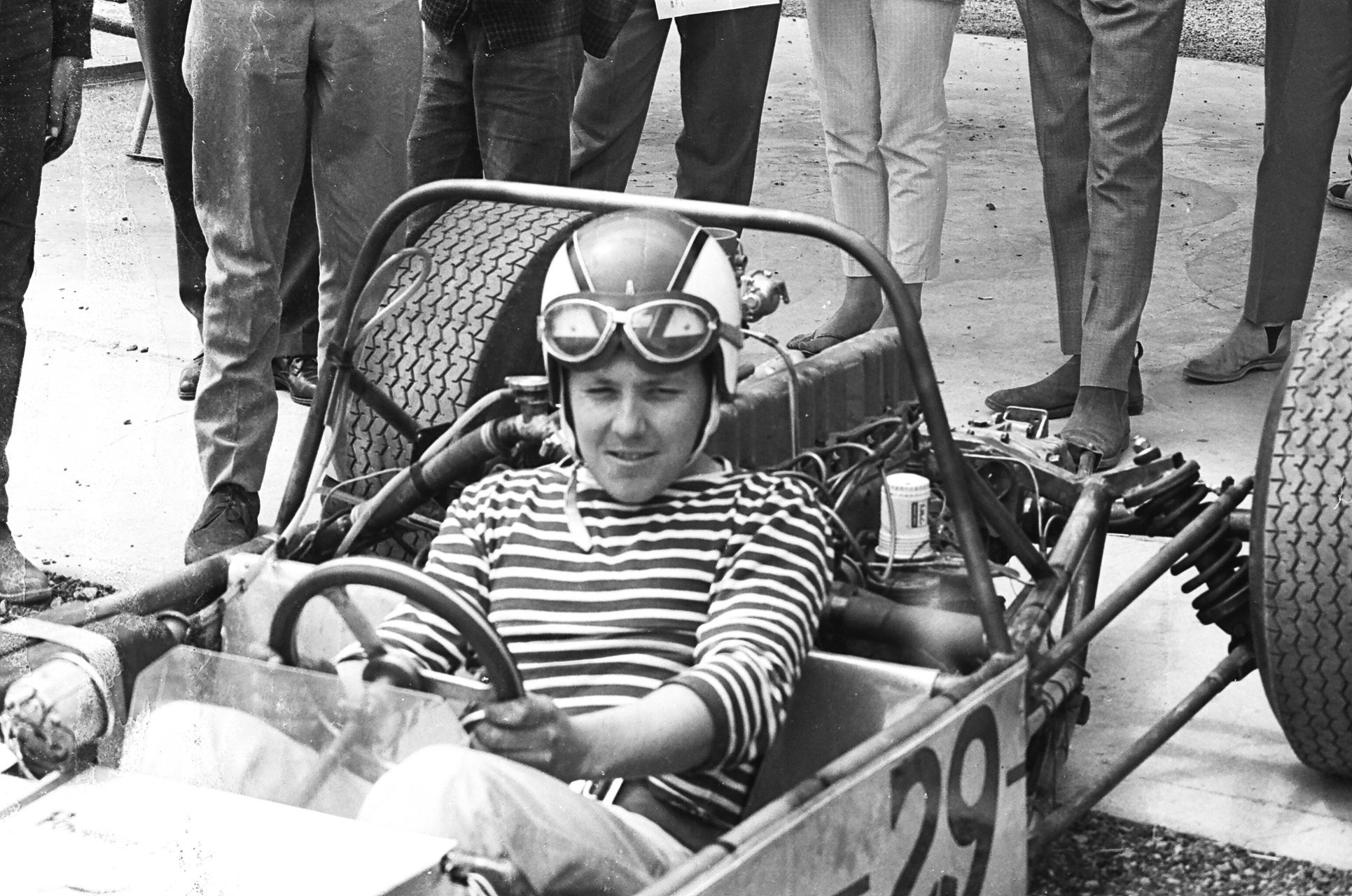
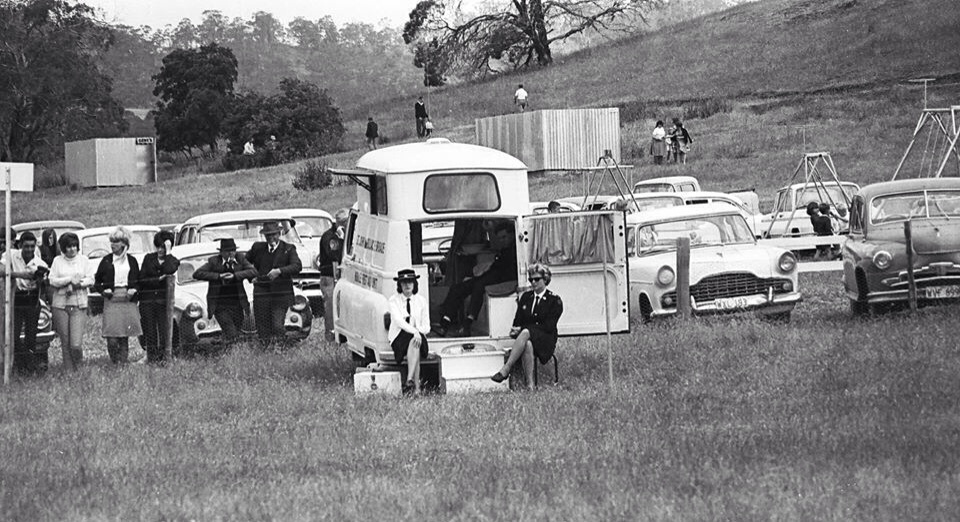
The race bike and it’s ‘Gunter-Wagen’ tow car frames John Goss’ brand new Tornado Ford, still without its rather attractive self built bodywork in the scrutineering bay.
One wag questioned whether the Beetle was towing the Suzuki or whether the 50cc two-stroke was pushing Wolfsburg’s finest.
What a youngster! At 24 years of age Goss has constructed a very clever sports racer which became a competitive car and as fast as all but the big-buck cars at the very front of the fields- those raced by Matich, Allen, Jane, Hamilton and co.
(R Dalwood)
Look closely, the photo above shows the Tornado Ford’s initial VW front end which evolved to a more sophisticated wishbone set-up in the years to come.
(R Dalwood)
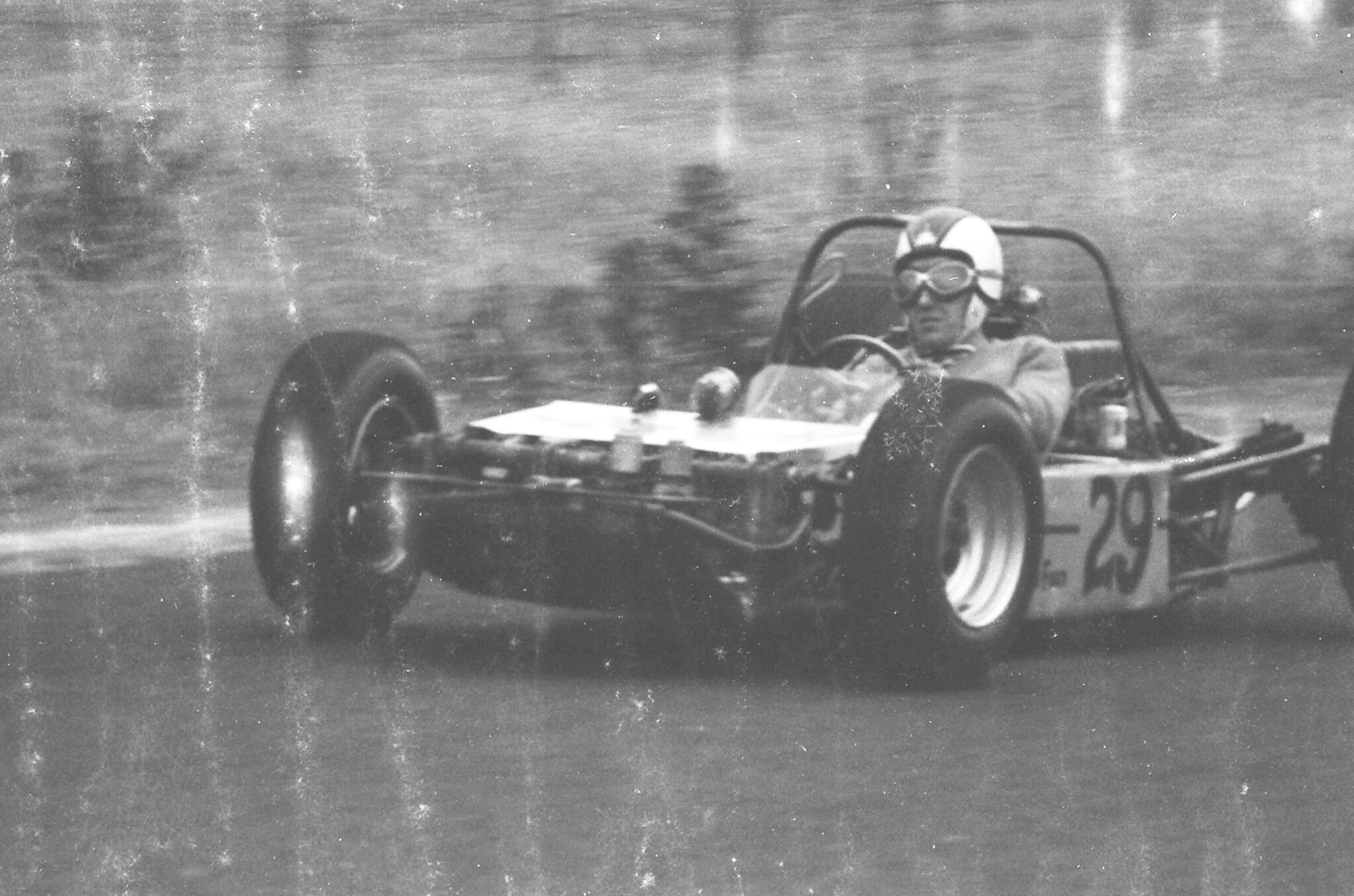
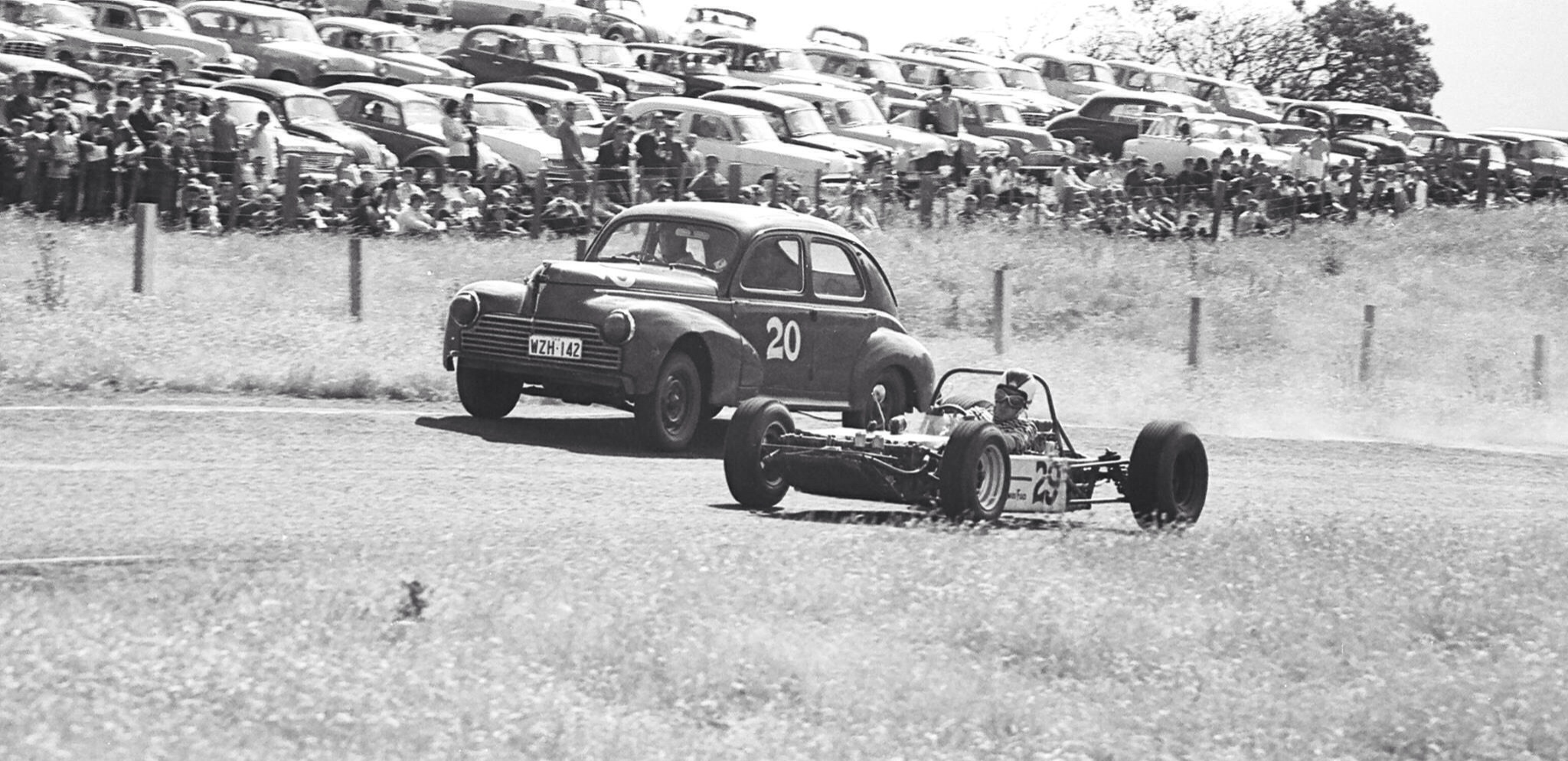
Gossy going around the inside of Allan Robertson’s Peugeot 203 that December weekend. One of the reasons I love these photos is because of the relaxed nature of a race meeting at a venue I’ve not been to.
Wonderful aren’t they?
(R Dalwood)
The crowd below are looking at the new Tornado Ford- it is the same group of people clustered around the car shown in the opening photograph but from a different angle.
(R Dalwood)
It would be interesting to know the intrepid pilot’s impressions of his handiwork after the first weekend of competition. I’m betting the little racer felt like a precise jet compared with the Customline and FJ Holden which preceded it- a mighty fine driver of Big Cars did John Goss become.
(R Dalwood)
Credits…
Historic Racing Car Club of Tasmania- Reg Dalwood Collection
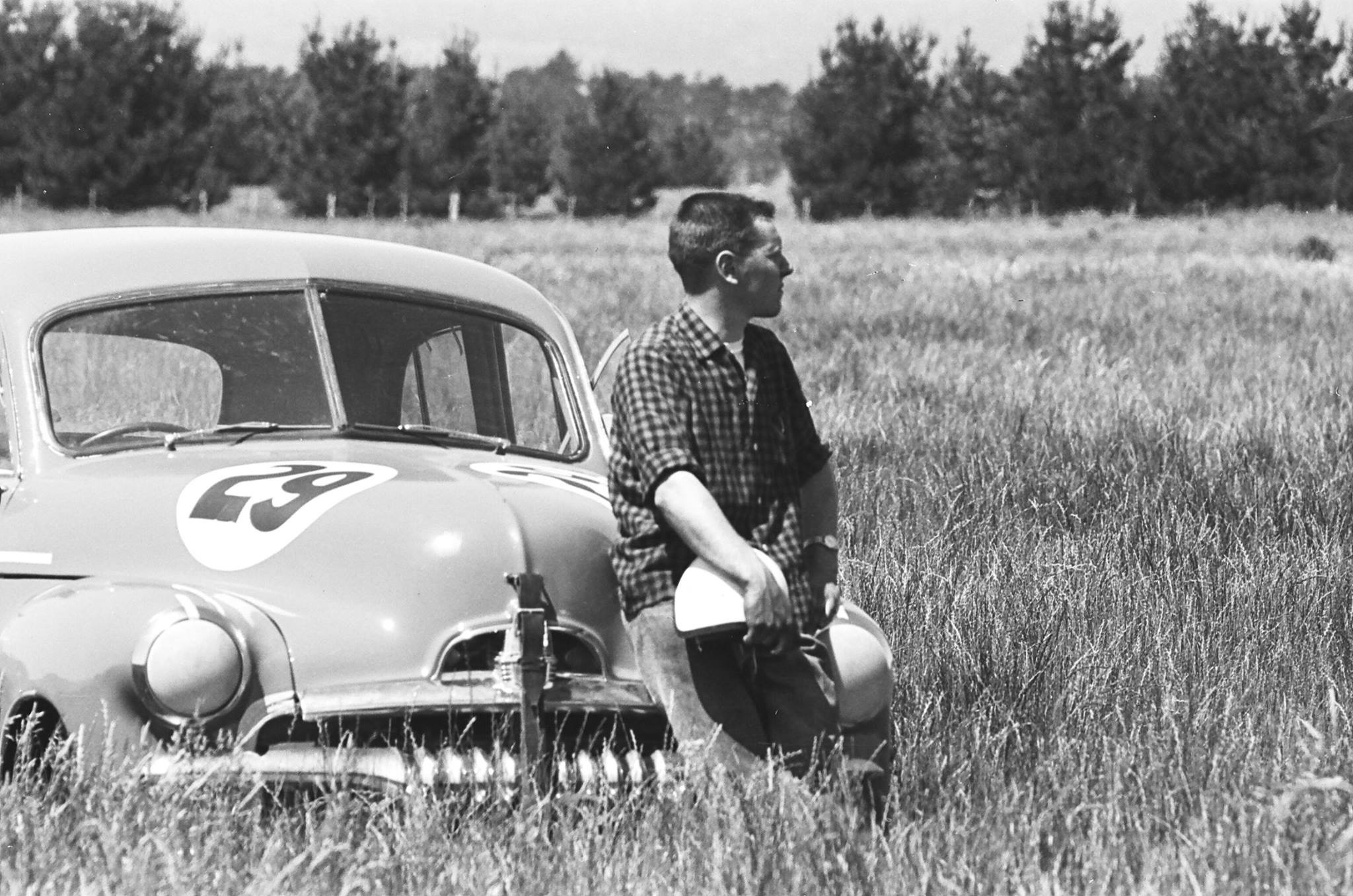
A very young John Goss and Holden FJ lost in his thoughts in a Symmons Plains paddock circa 1965/6…
Is he dreaming of his first Bathurst or AGP win or maybe Formula 1? Perhaps its a more prosaic and immediate musing- ‘Why doesn’t John Youl harvest the hay in this paddock so I can get my friggin’ car out!’
The photograph below is a few years later, 1973 to be precise.
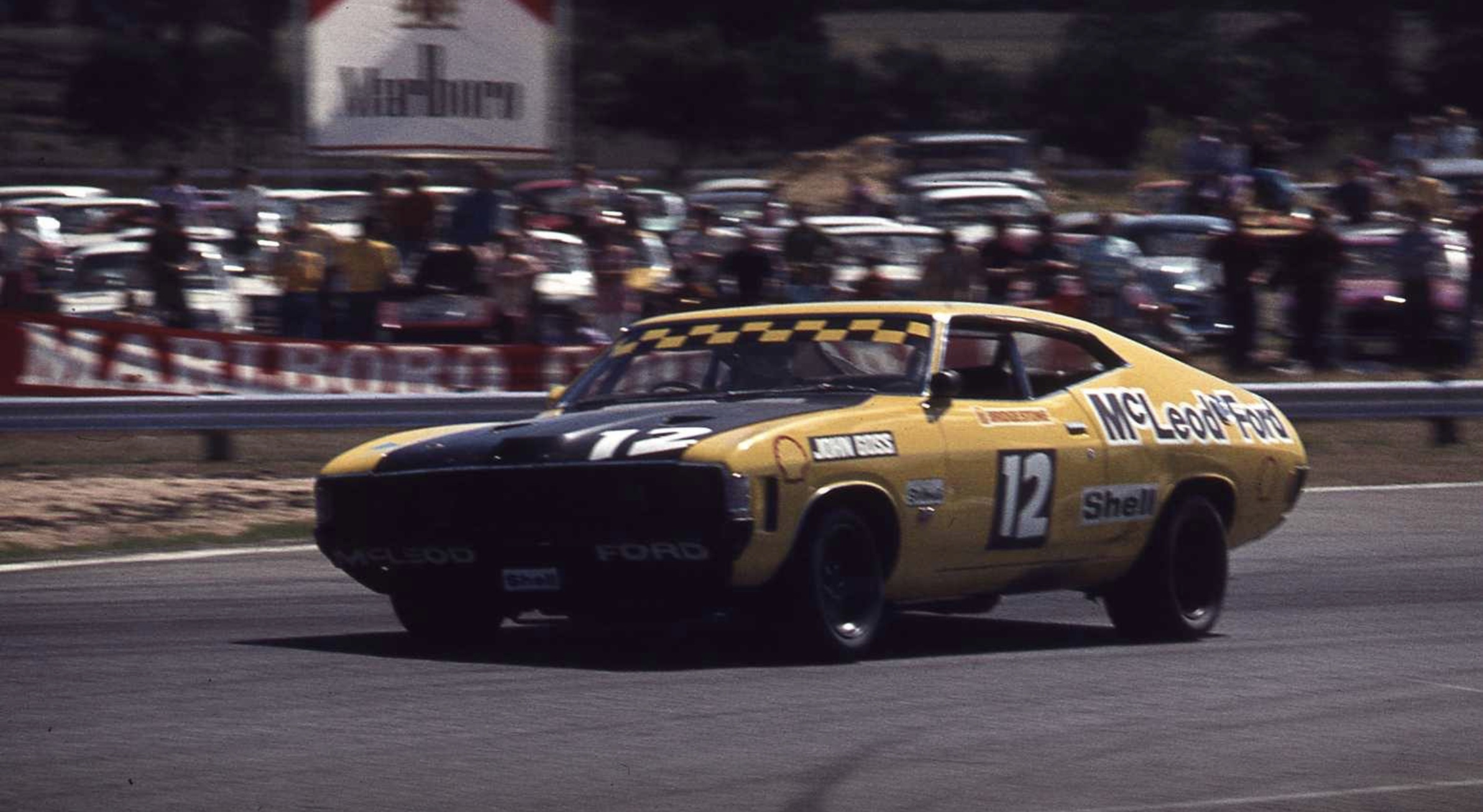
It shows Gossy in full-flight aboard his Ford Falcon GT351 Group C car at Old Pit Corner during the 5 March Symmons Australian Touring Car Championship round won by Allan Moffat in a Ford Falcon GTHO Ph 3 from Peter Brock’s Holden Torana GTR-XU1- John was third and blazing a trail in the early development of these cars. What an awesome thing it looked the first time I saw it during the January Sandown Tasman round a month or so earlier.
Both the Fords and new L34 V8 Toranas had problems early on without dry-sumps didn’t they?- the regs precluded them and more wheel/tyres on the Group C machines created greater grip than the Group E Series Production cars of the years before and therefore oil-surge problems. There were plenty of popped engines until the respective camps sorted the problem.
Touring Car and Sportscar tustle at Longford in 1965…
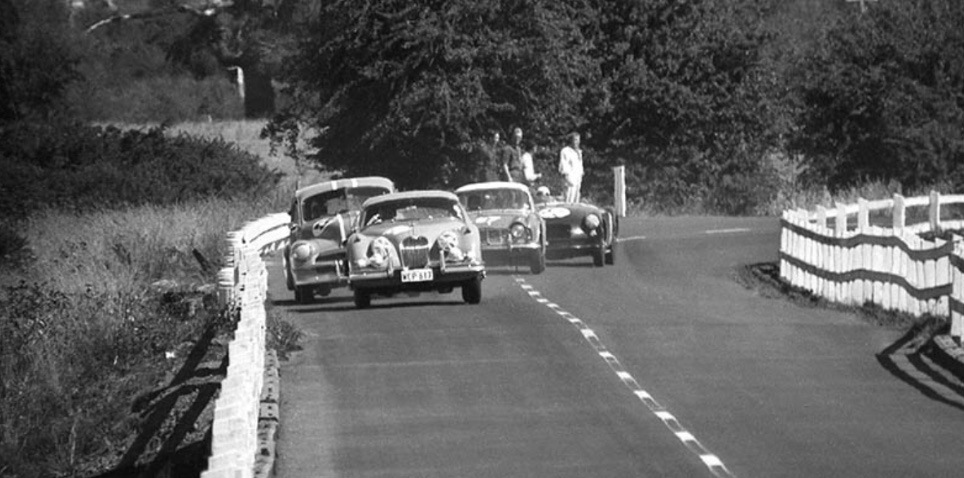
Don Gorringe, John Goss, Bob Curran and Greg Ellis blast over the River Esk- they have just completed the fast left-hander onto Long Bridge.
These blokes are all Tasmanian’s- I think it’s probably one of the locals only races, Gossy learned his trade pretty well down south- the only fella to win the Australian GP and Bathurst 1000 race double of course.
Goss is in an Appendix J Holden FJ, in front Gorringe is aboard a Jaguar XK150- which is clearly the successful businessman’s ‘daily driver’ given the rego plate affixed to the front bumper. Bob Curran’s Triumph TR4 was a machine he raced through to 1970 at least and the last car is Ellis’ MGA, it too appears as though he raced it for quite a bit.
Do any of these cars still exist? Who won the race?
Love this David Keep photo, it’s very much a ‘feel the noise’ shot…
Kevin Loy’s Matich A51 ‘005’ Repco F5000 departing Oran Park in Vice-Regal style, 2 February 1975…
No standing on ceremony here, although its a you-beaut ANF1 car- the Formula 5000 machine is travelling in no more comfort than my Formula Vee and considerably less so than my old Lola T342 Formula Ford. And its off to Surfers Paradise, 850 kilometres away in the hands of Ian Douglass to whom it has just been sold.
I’ll bet Frank Matich, Derek Kneller and the boys looked after the thing much more nicely in the US- this chassis was new for the US L&M Series tour Team Matich undertook during 1973. It was FM’s primary weapon, A51 ‘006’ went along for the ride as the spare. Here is a story about Matich and his F5000 cars;
Matich A51 ‘005’ in the Mid Ohio paddock 1973 (T Capps)
Lella Lombardi in A51 ‘005’ during the 1974 AGP- car was overseen by Matich himself. Lella pushed Max Stewart, the winner very hard before oil pump failure ended a great run (HAGP)
In many ways this little baby would be ‘the’ F5000 Matich to own. It toured the US, was raced by Lella Lombardi at Sandown and Oran Park in 1974, and, sold to John Goss to keep A53 ‘007’ company, won the 1976 Sandown Park Australian Grand Prix modified to A53 spec.
Another shot of Lombardi, this time at Sandown Park’s Dandenong Road corner in 1974 (B Keys)
Later still French sportscar ace Henri Pescarolo raced it at Calder in 1977, so too did Jim Richards in its ‘period dotage’ in 1979.
A very nice jigger indeed, here looking a bit forlorn on an open trailer behind an XA Ford Falcon Wagon rent-a-rocket.
Still, the serious money should be spent on the car not the trailer…
Goss wins the 1976 AGP aboard his Matich A51/53 ‘005’ from Vern Schuppan’s Elfin MR8C Chev, Sandown Park (HAGP)
Credits…
Neil Stratton, oldracingcars.com, Terry Capps, Derek Kneller, ‘History of The AGP’ G Howard and ors, Bruce Keys
Tailpiece: A51 ‘005’ fitted with Repco V8 flat-plane ‘Shaker’ crank in the Watkins Glen pitlane 1973…
John Goss, Tornado Ford, Ross Ambrose, Rennmax Climax and Alan Hamilton, Porsche 906 during the 1967 Tasmanian Sportscar Championship at Symmons Plains on 12 March…
It could only be Australia with that backdrop? Love Don Elliott’s transporter providing the spectator vantage point, devoid of Ford Mustang it makes a mighty fine mini-grandstand. Jaguar Mk1, stark eucalypt tree and the topography of the northern Tasmanian midlands circuit.
The cars are well known too, albeit Hamilton is about to lap the other two cars. Oh, and the drivers are prominent too, Goss and Hamilton Australian Champions- in Ambrose’ case perhaps he is known as much as the father of touring car ace Marcos Ambrose and ‘co-father’ with Ralph Firman of Van Diemen racing cars. No prizes for guessing who suggested the name of that great marque.
I’ve written articles about the John Goss built Tornado, Hamilton’s 906 and tangentially about Ross Ambrose’s car which started life as the Bob Britton built – he of Rennmax fame- Mildren Maserati sportscar driven by Ralph Sach, Frank Gardner and Kevin Bartlett. It then morphed into the ‘Rennmax Climax’. When sold by Alec Mildren to Ross Ambrose he fitted a Coventry Climax 2.2 litre four cylinder FPF engine in place of the Maserati Birdcage T61 motor which blew big-time whilst driven by Frank Gardner in the 1965 Australian Tourist Trophy at Lakeside, the chassis was re-named by Ross with Alecs consent.
This article was inspired by David Keep’s opening shot, it was only when I sought Rob Barthlomaeus’ help with a race report that he pointed out this was a tragic meeting as one of the contestants, Melbourne’s Wally Mitchell later died as a result of a collision in this event.
Many of the Symmons competitors contested support events during the Longford Tasman round a week before with the fields depleted by the likes of Noel Hurd’s Elfin 400 Ford due to an accident seven days earlier- Hamilton’s 906 made its debut race at Longford and was race favourite with the non-appearance of the powerful Elfin.
Alan was having a good day in the office with a Symmons preliminary win from Glynn Scott’s Lotus 23B Ford and Wally Mitchell’s RM1 Chev. The grid for the 30 lap, 45 mile championship race was derived from the lap times achieved during the earlier event.
Tas sportscar c’ship grid- L>R Mitchell RM1 Chev, Scott Lotus 23B Ford and Hamilton, Porsche 906 (oldracephotos/DKeep)
Hamilton started from pole with Scott and Mitchell alongside with Alan Ling Lotus 23B Ford and Bob Holden in a Morris Cooper Lwt on row two.
Scott led initially from Hamilton with Mitchell’s circa 350 bhp Chev V8 engined, spaceframe chassis car- built by he and St Kilda, Melbourne engineer/constructor Bill Reynolds, Bill’s cars were named Wren (R-Reynolds M-Mitchell) comprised a mixture of ex-Lex Davison Estate Brabham BT4/Cooper T62 and Wren components- passed by almost the entire field.
After 5 laps Hamilton had a sixty yard lead over Scott and had already lapped tailenders Mawdesley, Lotus Super 7 and Truscott’s Honda.
By lap 7 Hamilton led from Scott, Ling (who later lost 3rd gear) and Bob Wright’s Tasma Climax FPF 2 litre and was continuing to lap the slower cars.
An arcane but interesting sidebar to Bill Reynolds/Wren enthusiasts, and there are quite a few of us in the Australian Formula Ford ranks given the number of FF Wrens Bill constructed, is that the Tasma Climax was initially built by Reynolds as the ANF1/Tasman Formula Wren Climax single-seater. It too was fitted with an ex-Davison Estate 2.5 FPF but was only raced several times as such by Brendan Tapp and Wright before Wright widened the chassis and created the Tasma sports-racer, there is a story about both the RM1 and Wren Climax but that is for another time.
Goss spun Tornado at The Hairpin allowing Bob Holden and Kerry Cox’ Jaguar Spl through, the order at this point of the 30 lap journey was Hamilton, Scott, plugging along and hopeful in second, Ling unable to do much with third gear absent without leave, Holden, Cox, Goss, Mitchell, still with a misfiring motor and then the rest.
Wally Mitchell’s car finally chimed onto eight-cylinders and proceeded to make up lost ground over the slower cars hand over fist, he was up to third by lap 15 having passed Ling.
Mitchell’s RM1 Chev in front of Hamilton’s 906, a lap ahead, one lap before Mitchell’s tragic accident. He wore a seat belt, a big tick in 1967 as they were not mandated but it seems his fireproofs were sub-optimal and no balaclava, again, not mandated or universally used at the time (oldracephotos/DKeep)
Tragically at half distance, on that lap, Mitchell lost control of the probably not fully sorted RM1- it was originally fitted with a lightweight aluminium Coventry Climax FPF engine where the 5 litre cast iron Chev by then rested- over Bessant Hump, he went onto the grass, slammed into the fence tail first at TNT Corner, then bounced back onto the track. The car’s two fuel tanks ruptured with both the car and unfortunate driver engulfed in flames. The badly burned Mitchell released his seat belt eventually and jumped clear but not before suffering burns to eighty percent of his body.
Whilst poor Wally was attended to ‘The race was restarted at lap 16 as…the gutted RM1 still cast a pall of smoke over the pits’. In the final laps Ambrose passed Ling and Hamilton had a rod let go in the 906 on lap 26, the car expired at the Hairpin giving the win to Scott from Ling’s similar Lotus 23B Ford and Ambrose in the Rennmax Climax.
The sad aftermath of the accident is that the popular East Burwood based Wally died of his burns and related complications of pneumonia on 18 April in a Melbourne hospital.
Mitchell and the RM1 Chev at Symmons 12 March 1967. Nice looking car, I wonder what Wally and Bill took the fibreglass body flop off? Or was it bespoke? (E French)
oldracephotos.com.au- David Keep, Ellis French, Rob Bartholomaeus Collection- Racing Car News & Australian Auto Sportsman April 1967 issues, The Nostalgia Forum- Wally Mitchell thread
Tailpiece: Start of the ’67 Tassie Championship from the rear of the grid…
(oldracephotos/DKeep)
That’s Gossy to the right and the Peter Truscott Honda whilst up front it’s Hamilton’s white 906 sandwiched by two Lotus 23 Fords and then the Ambrose Rennmax and Mitchell RM1.
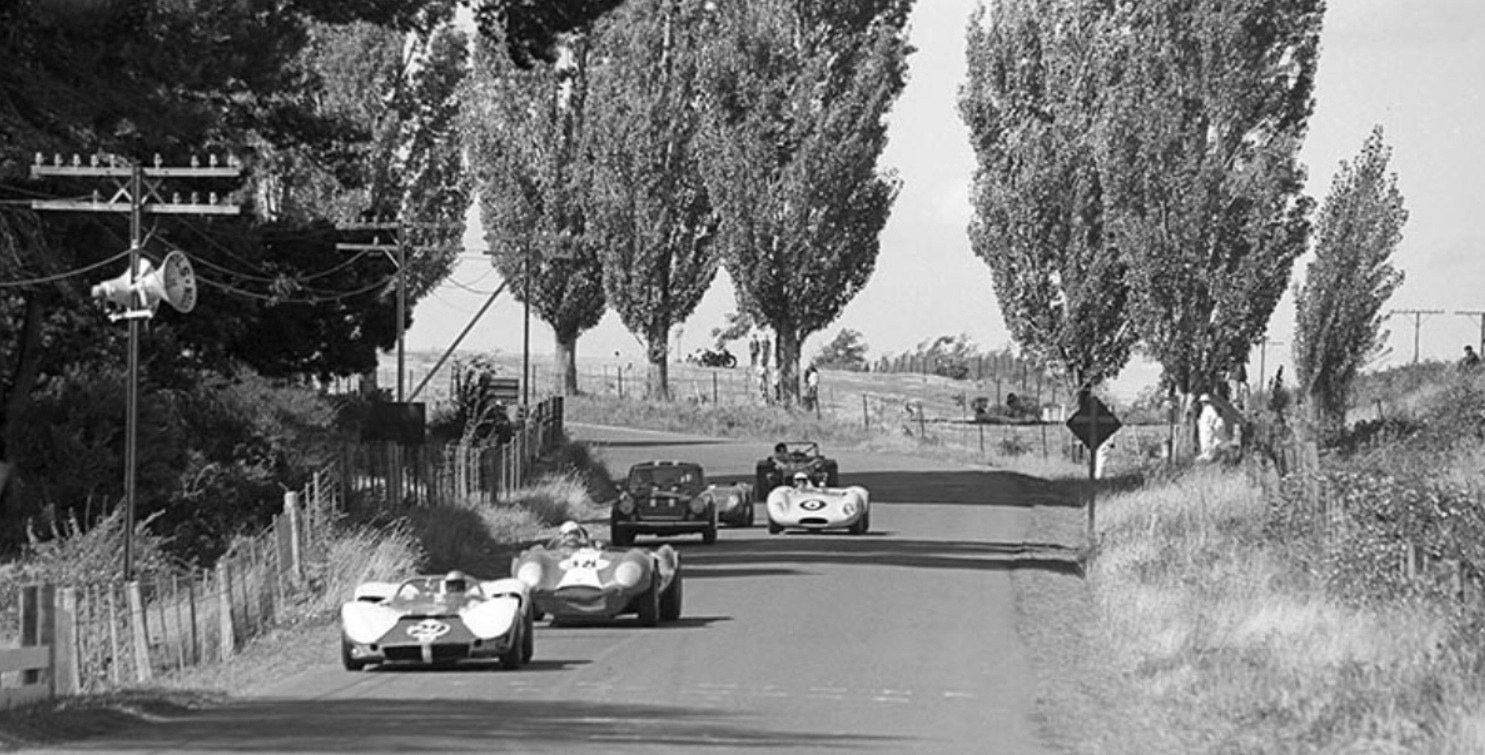
John Goss’ Tornado Ford leads a gaggle of sportscars on the drop between the Water Tower and The Viaduct, Longford, Saturday 2 March 1968…
I wrote this piece a while back and now seems a good time to post it given one of Tasmania’s finest, Gossy himself was awarded an Order of Australia for services to motor sports in last weekend-and-a-bit’s Queens Birthday Honours announcements. Off the back of that achievement Terry Sullivan started a The Nostalgia Forum thread which now contains some marvellous Goss photos, many from Lindsay Ross’ oldracephotos.com.au archive which have never seen the light of day before- check TNF out;
Back to Longford- it’s the Saturday race day, the Monday Labour Day holiday was Tasman Cup day, that year the feature race was won by Piers Courage’ McLaren M4A FVA F2 car in a notoriously wet, perilous day of motor-racing. Sadly it was the last in Longford’s relatively short but very sweet period as a road racing track. Click here for my article on the 1968 Longford Tasman;
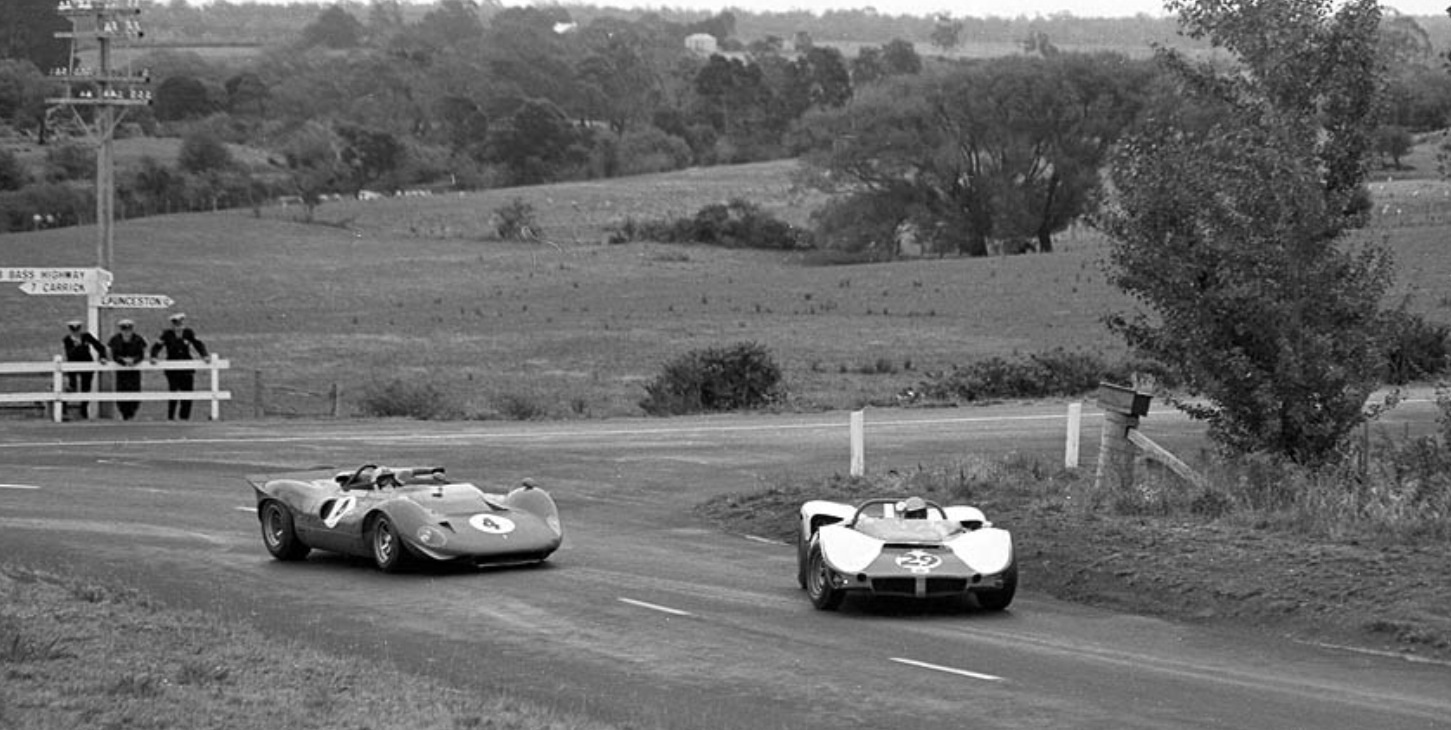
Goss, future Bathurst and Australian Grand Prix winner is leading Kerry Cox’s Paramount Jaguar, three-times Australian Grand Prix winner Doug Whiteford’s works Datsun Fairlady, Bert Howard’s Lola Mk1 Climax, the partially obscured Lotus 23 Ford of Alan Ling and then Peter Mawdesley in a Lotus Super 7. Out front out of shot is the ex-works Scuderia Veloce Ferrari P4/350 Can Am driven by Chris Amon from Ian Cook’s Bob Jane Racing Elfin 400 Repco, Peter Macrow in the Argo Chev, Lionel Ayers MRC Ford and Glynn Scott’s Lotus 23 Ford. The opening shot shown is the second group of cars.
I wrote an article a while back about John Goss including a bit on the Tornado, click on the link to read it;
The following shot is of Gossy losing Tornado on his turn-in to The Viaduct, I wonder if its the same lap! I think not, the track looks wet, which makes it the Monday. Amon’s Ferrari was pushed off the grid with a flat battery- he started the 10 lapper with 2 laps down and finished third- and did 178 mph in the wet conditions on The Flying Mile. Peter Macrow won in Tony Osborne’s Argo Chev from Glynn Scott’s Lotus 23 Ford.
(oldracephotos/DKeep)
Credits…
David Keep/oldracephotos.com, Lindsay Ross Collection, Rob Bartholomaeus
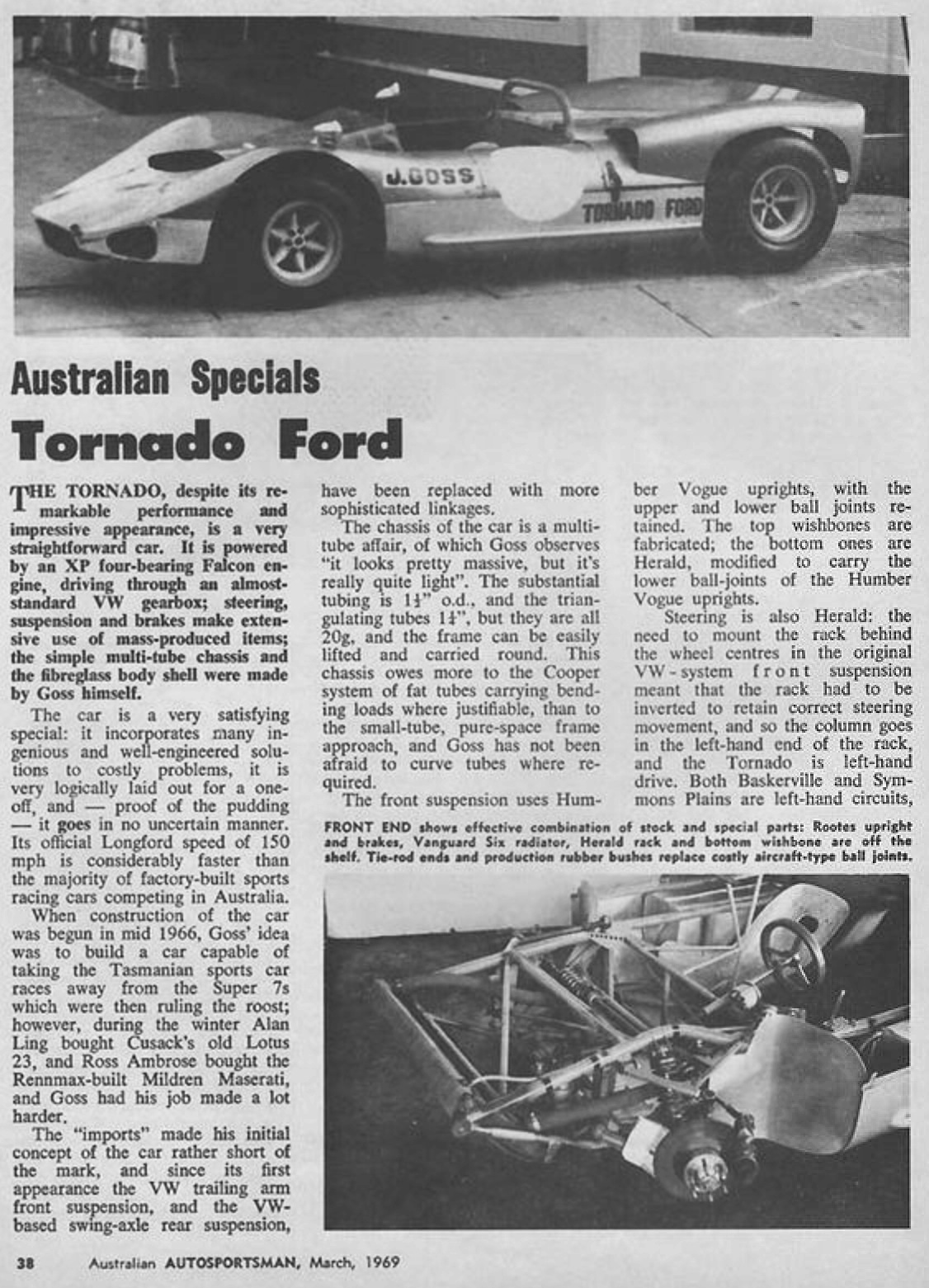
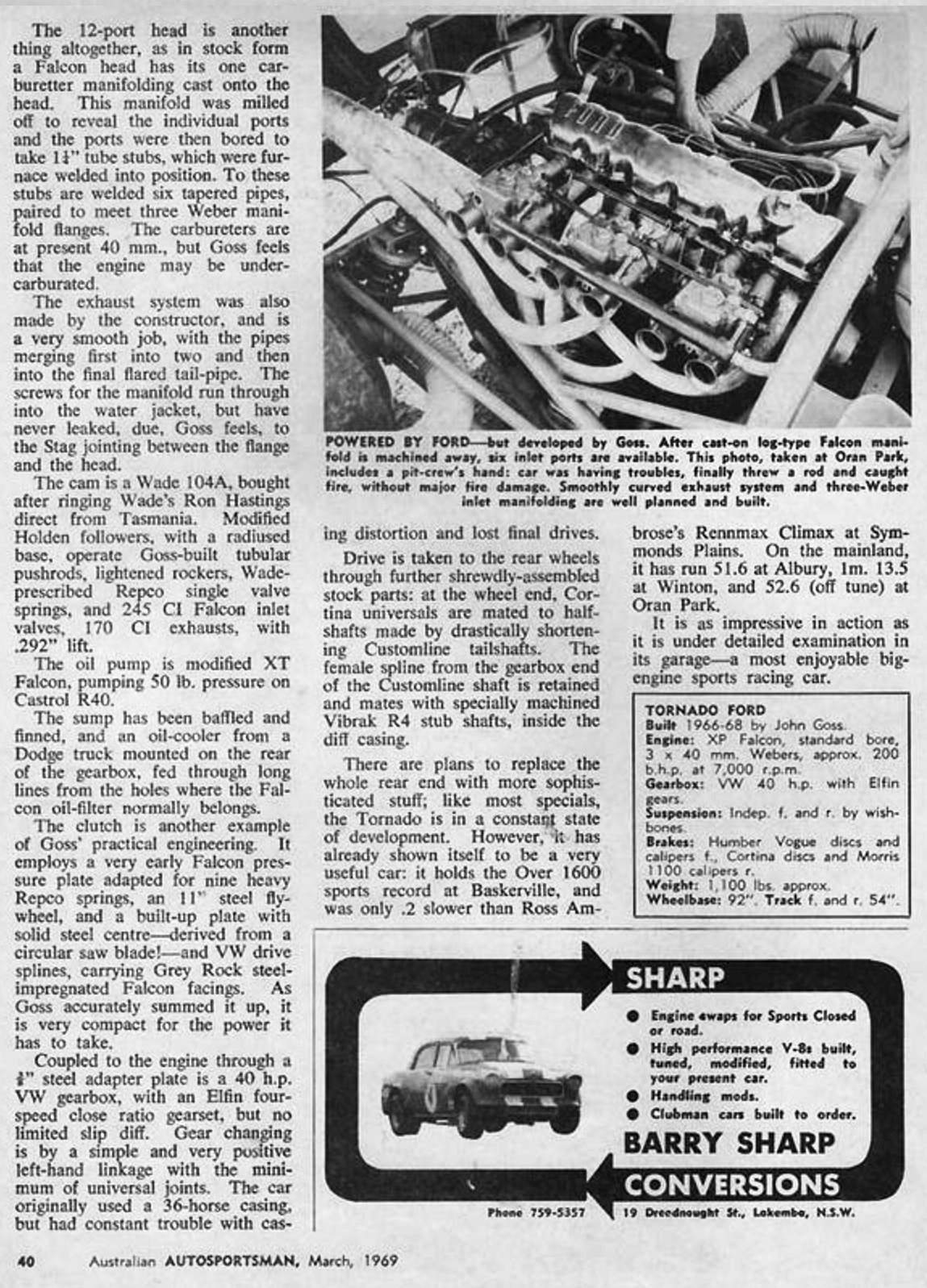
Etcetera: Autosportsman article on the Tornado Ford, courtesy Lindsay Ross’ Collection…
Tailpiece: Amon’s 480bhp Ferrari P4/Can-Am 350 monstering Gossy’s 200bhp Tornado Ford out of Newry, Longford 1968…
(oldracephotos/DKeep)
During the dry Sports Car Scratch race on the Saturday Chris won from Ian Cook in Bob Jane’s Elfin 400 Repco V8 and Peter Macrow in the Argo Chev.
Amon, awfully comfortable in the P4/CanAm 350- in addition to his Ferrari F1 commitments he raced the cars in both the 1967 endurance races and some Can Am rounds, set an all-time Longford lap record of 2:16.2 undercutting Jim Clark’s Lotus 49 Ford DFW time of 2:13.0 earlier in the day. Mighty quick. Mind you, that summer Frank Matich beat Chris’ Ferrari in the Matich SR3 Repco in the other Australian Tasman round sportscar support events. But FM did not cross Bass Straight to do Longford- sad! Those battles on that circuit would really have been something to see!
Peter Brock in his Birrana 272 Ford at Winton in 1973…
Brocky was very hot property in 1973 having seized the public spotlight with the last solo Bathurst win aboard his Holden Dealer Team Torana GTR XU1 in October 1972. Every young bloke in Australia wanted to emulate him, and many women wanted to shag him, including Miss Australia as it transpired!
Purists were delighted when he bought 272-002, Tony Alcock’s first monocoque Birrana to contest the Australian F2 Championship, but sadly he didn’t race the car for long, soon returning to the touring car ranks.
Tony Alcock’s first Birrana, the F71 Formula Ford was built in Sydney and initially raced by one of Brock’s touring car sparring partners, John Goss. Then Tony returned to his Adelaide home town and started to build Birrana’s in numbers in partnership with Malcolm Ramsay, in 1972 building two F72 Formula Fords and 272-002. Their first ANF2 car was raced by Ramsay, dual Australian F2 champion Henk Woelders and Gold Star champion Leo Geoghegan before being sold to Brock.
PB raced it at Hume Weir, Winton and Oran Park to get his hand in prior to the start of the 1973 F2 Championship which commenced at Hume Weir in June.
Brock was second to that years champion Leo Geoghegan at Oran Park on 5 August and then sixth at Amaroo on 19 August, in a Birrana 273, chassis 273-008. He updated to the best car of the season, Geoghegan galloping to the title with wins in every round but one. Its not clear exactly how many meetings Brock did in the two cars but he certainly raced the 272 at Hume Weir, Winton, Calder and Oran Park and raced the 273 at Oran Park and Amaroo Park.
Running the Lotus Ford twin-cam engine was said to be a commercial barrier to the continuation of Brock’s F2 program given his Holden Dealer Team contract, but perhaps the reality of running his own car again with the assistance of his dad was just all too hard compared with being a works driver with all of its benefits. It was such a shame, Brock’s sublime skills deserved to be deployed in racing cars as well as the tourers of all sorts in which he excelled.
Brock’s talent was clear from the start aboard his Holden engined Austin A30, his aptitude very quickly accepted once others drove that car, none of those who raced it or track-tested it could work out how he did the times he did: not Ross Bond, Peter Wherrett or Rob Luck.
The little rocket was a mix of lightweight Austin stripped shell, highly modified Holden 179 6-cylinder ‘red motor’ giving circa 200bhp using triple two-inch SU carbs, Holden three, and later four speed ‘box, rear axle assembly wheel to wheel with a Holden front end and Triumph Herald steering rack with disc front brakes and drum rears.
During the early-mid seventies glory F5000 years it always seemed to me the union between Holden and Repco would see him aboard a big, powerful single-seater car at some point, but the closest that ever came to fruition was the Repco Holden F5000 V8 engined Torana sports-sedan The Beast, which was not exactly what I had in mind at all. Still, what was in that for Holden or Repco I guess? Holden sold sedans not racing cars, so they hardly needed PB racing one of those dangerous things and Repco’s works F5000 driver was Frank Matich. A guest drive in a Matich would have been nice all the same…
Steps in the right direction were his international drives at Le Mans in 1976 aboard a Bill Patterson supported BMW 3.5 CSL Group 5 machine paired with Aussie International Brian Muir. Now that would have been a career to emulate in terms of a mix of sedans and sportscars based in the UK?
Spa in a works Vauxhall Firenza Magnum 2300 paired with Gerry Marshall yielded an amazing second outright in the 24 Hour classic in 1977.
Brock’s status as one of the best Touring Car Drivers of them all was confirmed by MotorSport in 2005 who rated him the greatest in an article contributed to by an array of global commentators of the top-20 of all time.
The Bob Jane supported attempt on the 1984 24 Hours of Le Mans, with Brock partnered by Larry Perkins in a customer Porsche 956 captured all of our imaginations and to me was exactly where that pair belonged and deserved to be. Sadly the warm-up Silverstone 1000 Km and Le Mans was as far as it went. At Le Mans they retired after an LP mistake during the night.
If only Brock had raced the 1974 Australian F2 Championship in a good car amidst one of the best grids of any single-seater championship in Australia ever- with success his career direction may have encompassed racing cars as well as tourers, rallycross and rallies.
Not half versatile was he?
Etcetera…
It’s interesting to get Brocky’s initial impressions of driving the Birrana, here recorded in his Auto Action column published in the March 16, 1973.










 primotipo...