Diana Dors displays her undoubted goodies and hangs on bloody tight during the classic car parade lap before the 1967 Sebring 12 Hours…
The actress’ movie career needed a publicity boost, this ride on ‘the bonnet’ of a Ford GT40 Mk2B deemed a good idea at the time, one wonders at the risks involved. The gorgeous 38/24/36 bombshell would have made a hell of a mess of a nice car had she parted company with it…
Mercedes Benz returned to Grand Prix racing with a vengeance at Reims in 1954, here Fangio leads Karl Kling in the W196 Streamliners…
Mercedes had a habit of re-entering racing in the French Grand Prix every twenty odd years, when doing so bringing new standards of engineering excellence with them.
In 1914 the four cylinder, SOHC 4483cc engined Mercedes 18/100 of Sailer, Lautenschlager, Salzer, Pilette, and Wagner crushed the opposition at Lyon just before The Great War. The course was 37.6 Km long, 20 laps of it took the winner Christian Lautenschlager 7hr 8 min!
Three of the 1914 French GP winning Mercedes team cars at Unterturkheim post event. L>R #28 Lautenschlager first, #39 Salzer third, #40 Wagner second. (unattributed)
In 1934 Auto Union and Mercedes came to Monthlery with cars which would largely sweep the board until war again intervened.
Although on that day an Alfa Romeo triumphed – Louis Chiron won in a Scuderia Ferrari Alfa P3 from Achille Varzi similarly mounted – the three 2.9-litre supercharged straight-eight Mercedes W25s of Rudi Caracciola, Manfred von Brauchitsch and Luigi Fagioli retiring with a variety of maladies.
1934 French GP, Montlhery. Rudy Caracciola Mercedes W25 DNF, from Avhille Varzi Alfa P3/Tipo B, second (unattributed)
And so it was that Mercedes returned to racing after a break of fifteen years at Reims on the weekend of July 4th 1954 – 40 years after Lyon and 20 after Monthlery – with the W 196 R, as the car is designated internally…
JM Fangio, Mercedes Benz W196, Reims victor 1954 (Jesse Alexander Archive)(Mercedes Benz)
The W196R was a triumph of complex engineering, the 2.5-litre straight eight cylinder car had a swag of new features.
Direct injection (Bosch) of fuel into the M196R’s cylinders (76×68.8mm) for more precise ignition of the incoming fuel charge was the first of many, the engine lay on its side 53 degrees from the horizontal to the right to allow a lower bonnet line and the driveshaft to pass beside the driver rather than have him sitting on it. Desmodromic, or mechanical operation of the valves allowed higher rpm than the valve springs of the day could handle.
Downstairs, in traditional Mercedes fashion, there were/are two blocks of four cylinders with welded on cooling water jackets. The Hirth type crankshaft was supported by 10 roller-bearings, with central power take-off. Mercedes quoted 256bhp @ 8260rpm with maximum potential revs 9500. The transaxle is 5-speed and mounted behind the rear axle.
M196R 2.5-litre straight-eight (Mercedes Benz)W196R chassis, inboard brake drums and 5-speed transaxle. Rear suspension is swing axle, tubular dampers and longitudinally mounted torsion bars, hidden in this shot (Mercedes Benz)
The chassis is a multi-tubular spaceframe with upper and lower wishbones, telescopic shocks and torsion bars. At the rear there is a single-joint swing axle, longitudinal torsion bars and again telescopic shock absorbers. Inboard drum brakes front and rear (350/275mm in diameter) to lower unsprung weight and a streamlined all enveloping body helped the car to be quicker thru the air. Steering was worm and sector, wheel/tyres 6-inch and 7-inch wide and 10-inch diameter
The very experienced pre-war engineering team of Dr Fritz Nallinger and Rudy Uhlenhaut were in control of the conception, design, development and testing of the new car.
Reims 1954 paddock shot. #18 Fangio and #22 Hans Hermann Mercedes W196 Streamliners being prepared for the race. Open bodies were used from Nurburgring 1954 onwards, Streamliner body about 60 pounds heavier than the ‘Nurburg’ slipper/open wheeler bodies (unattributed)
The purpose of this article is not to write in detail about a car which has had everything written about it, rather the words are a support to the wonderful painting and cutaways originally published in that splendid annual, Automobile Year, in this case in the 1955 edition.
(Automobile Year)
In his Automobile Year technical review of the 1954 season noted journalist/Le Mans Winner/GP driver Paul Frereexplains in great detail the technical advances of the car, but also makes clear that in his view all of the Benz victories that season were scored by Fangio, in that the car’s speed was in large part a factor of Fangio’s dominance as a driver rather than it being a function of the cars outright pace; JMF and Alberto Ascari were the standout drivers at the time.
The W196 won four of five 1954 races entered, impressive with a new car, Frere also makes it clear that the development potential of the car was obvious, that point subsequently reinforced in their 1955 season!
French GP Start; #18 Fangio, #20 Kling Benz W196, #10 Alberto Ascari Maser 250F #2 Gonzalez Ferrari 553, #12 Marimon Maser 250F, #46 Prince Bira Maser 250F, #22 Hans Hermann Benz W196, #6 Hawthorn Ferrari 553, #4 Maurice Trintignant Ferrari 625, #34 Robert Manzon Ferrari 625, #14 Luigi Villoresi Maser 250F (unattributed)
At Reims Fangio was on pole with his young German teammate Karl Kling alongside and Alberto Ascari in a factory Maserati 250F.
Alberto and Onofre Marimon were ‘loaned’ to Maserati by Gianni Lancia given his new D50 GP car was still not raceworthy and the drivers were otherwise unemployed for the weekend.
Ascari’s race was over on lap 1 due to either gearbox or engine failure depending upon the report you read, this left Fangio and Kling to run away with the race. Hawthorn and Marimon scrapped for third before the Argentinian stopped for a plug change and dropped to the back of the field.
Fangio left, and Kling Mercedes W196 well clear of Ascari’s Maser 250F shortly after the start (unattributed)
Pre-war Thai driver Prince Bira drove a great race in a customer 250F dropping from third to fourth having run out of fuel and losing time switching to his auxiliary tank, so Robert Manzon was third in a Ferrari 625.
Hans Herrman in the other W196 took fastest lap early in the race before over-revving the engine and leaving its telltale at 9100rpm!
So, a dominant Mercedes start to a run which sadly only lasted until the end of the 1955 season before their modern era return and the dominance of 2014/5…
Front row prior to the Reims start. Fangio and Kling taking a sideways glance, and Ascari’s new but somehow antiquated looking 250F in the company of the Mercedes Streamliners whilst Hawthorn fiddles with his goggles on row three.
(Mercedes Benz)
M 196 R – Mercedes Benz when publishing the car and engine type use the spacing shown, albeit short-form will do me – engine being dyno tested Unterkükheim in 1954. From the left, Engineers Karlheinz Göschel and Heinz Lemm, Werner Wolf and Eckstein.
(Automobile Year)
Fangio’s car being ministered to between sessions. What stands out is the quality of the Streamliner’s build and finish and the enormous inboard brake drums both front and rear – JMF’s seat has been removed allowing a peek at the rear units.
The straight-eight Type 32 Gordini was the last Grand Prix car fitted with an engine of this layout, but the W196 was the last successful one. The compact nature of Vittorio Jano’s 2.5-litre V8 engined 1954-55 Lancia D50 was a reminder of the advantages of engines in Vee formation and was highly influential as such.
(Mercedes Benz)(Automobile Year)
Nice cross section of the W196 cylinder head showing the operation of its desmodromic valve gear.
(Mercedes Benz)
Another detail front end shot sans radiator; the hollow bars either side of the drums are the ends of the torsion bars, note also the short upper suspension links.
Tailpiece…
(unattributed)
Majestic and atmospheric Reims as JMF takes his position on the grid.
Credits…
Max Staub, Automobile Year, Jesse Alexander Archive, Getty Images-Maurice Jarnoux, Mercedes Benz Archive
Jackie Oliver’s Shadow DN6 Chev on its way to 2nd place, Road America, 27 July 1975. (Richard Dening Jr)
Exactly 12 months later Oliver goes one better in the Dodge engined DN6B, winning the Road America race on July 25 1976. (Richard Dening Jr)
Jackie Oliver takes an historic win in his Shadow DN6B Dodge at Road America on 25 July 1976…
Chev engines won every championship F5000 race in the US from Riverside on 25 April 1971 when Frank Matich took a Repco Holden win in his McLaren M10B through until Oliver’s long overdue Shadow victory, the Lola T332 Chevs of Al Unser and Vern Schuppan were second and third.
Whilst the Dodge was more powerful than a Chev it was also heavier making the packaging of the car and its big cast iron V8 a challenge for designer Tony Southgate.
The Lola T332 was their 1974 production F5000 but was continually developed, the subsequent Lola T400 and T430 not quicker cars, a good 332 was as quick as an F1 car on the common circuits upon which both categories raced in North America. ‘Twas a remarkably good, very fast racing car the Shadow was competing against driven by the likes of Brian Redman, Mario Andretti, Alan Jones, Al Unser and others…
Shadow DN6 Chev. Car based on Tony Southgate’s very quick DN5 1975 F1 contender. Aluminium monocoque chassis. Front suspension lower wishbone and top rocker actuating inboard mounted coil spring/damper. Rear single top link, lower twin parallel links, two radius rods and coil spring/dampers. Adjustable roll bars front and rear. 5 litre cast iron OHV Chev here, Dodge V8 from the Road Atlanta round in August 1975 , Hewlands TL200 gearbox, developed as an endurance racing tranny used rather than the F5000 standard, the ‘brittle’ DG300. Road America July 1975. (Richard Dening Jr)
5 litre cast iron, mechanical fuel injected, OHV Chev V8 engine developed circa 530bhp@7800rpm. Rocker covers removed here for Road America July 1975 prep, one rocker missing. Magneto, its yellow ignition leads and fuel metering unit all visible. (Richard Dening Jr)
The Shadow DN6 was based on Tony Southgate’s very competitive DN5 F1 design and was first raced in 1975 powered by the ubiquitous Chev V8. Oliver took 4th place in the championship won by Redman’s T332, the car raced well at both Watkins Glen and Road America.
Gordon Kirby in his 1975 season review in Automobile Year said; ‘Almost immediately the Shadow proved to be competitive and in the last part of the season (the last 4 races) it became even more of a threat when after a long development program the team switched to Dodge engines, based on the same powerplant used in NASCAR by Richard Petty’. (in 1975 the Grand National Stockers were compelled by a carburetion ruling to use 355 cubic inch or 5.8 litre engines). The Dodge developed some 30 bhp more than the Chevys’ but was much heavier. The Shadows were not completely tuned and set up and did not win a single race. The whole of the 9 races were taken by the Lola Chevrolets.’
Jean-Pierre Jarier lines up on the Watkins Glen grid with Brian Redman 13 July 1975. Shadow DN6 Chev and Lola T332 Chev. JPJ DNF with a broken oil line, Brian was 1st, Oliver in the other Shadow also DNF with a blown Chevy. (Gary Gudinkas)
F1 drivers Jean Pierre Jarier, Tom Pryce and Jody Scheckter each raced a second car in three rounds at Watkins Glen, Long Beach and Riverside respectively.
All three qualified in the top 5 but retired with mechanical maladies.
Business end of the Shadow DN6 Chev. Engine magneto and fuel metering unit, Hewland TL200 gearbox to which the wing is mounted, neat duct for inboard disc and additional oil cooler all visible. Road America July 1975. (Richard Dening Jr)
1976 Season…
The following Shadow press release written by Rob Buller prior to the Mosport round, the second of the 1976 season, reproduced on the My Formula 5000 website outlines changes to the car and program over the 1975/6Winter.
‘Development work on the DN6 5000 car has continued over the winter under the direction of Chief Mechanic Ed Stone and Engine builder Lee Muir.
Stone joined the 5000 effort late in 1975 and immediately set about making chassis and suspension changes.’Basically the 1975 season progressed with little development, there wasn’t much time.’ Stone said in a recent telephone interview, ‘I was asked to make some suspension changes and the car was more competitive at the last 1975 race at Riverside with Jody Scheckter driving.
Oliver in the Road America pitlane, July 1976. Shadow DN6B Dodge. (Richard Dening Jr)
‘But the heart of the Shadow development is the new Chrysler power-plant, a joint venture between Shadow and Chrysler’s Plymouth Division.The engine starts life as a 340 cu. in. stock block that is down-stroked to 305 cu. inches. It is fitted with the same injection system that is used on Richard Petty’s NASCAR Dodge.
Chrysler, which is heavily involved in NASCAR and Drag Racing, is new to F5000 racing, a class that has been dominated by the rugged Chevrolet 5 litre engine. As a part of their new kit-car package now under development, Chrysler has contracted with Shadow to do the engine development and sorting.
They supply the engine components to Shadow engine expert Lee Muir, who then hand builds and dyno tests each engine. Chrysler also helps with technical information and advice to Muir, who came to Shadow from McLaren’s engine department.
Race debut of the Dodge engined Shadow DN6 chassis ‘2A’ at Road Atlanta 31 August 1975. Oliver 4 th, race won by Al Unser’s Lola T332 Chev. Specs; Dodge 340cid V8 taken back to 305cid by reducing the engines stroke. 5 litre cast iron, OHV, mechanical fuel injected V8. Bore/stroke 4.04 inches/2.96 inches, power circa 550bhp@7800rpm. Hewland TL200 ‘box. (unattributed)
‘The first outing in 1976 for the Shadow Dodge DN6 was at Pocono, Pennsylvania for the Series opener. Although they weren’t quite ready for the Pocono race, they were very encouraged with the results. Oliver was lying third in his qualifying heat when a connecting rod developed terminal stretch. As they only had one dyno’d engine a spare practice unit was installed for the feature. However, a fuel pump seal split on the grid and it took 5 laps to change. By the time he joined the fray Oliver was hopelessly behind but by charging hard he was able to run with the leaders.
With that encouraging performance Stone and Muir returned to Phoenix Racing headquarters in Chicago and started preparation of the Shadow for the Mosport race. Further chassis mods have been made utilizing new springs, roll bars and revised suspension settings. To help weight distribution, the water rads have been moved forward a la McLaren Indy car. Muir will have three completely dyno’d engines ready for Mosport’.
‘Sponsorship for the F5000 effort is a problem for Shadow. Since the departure of UOP, Nichols has been unable to get the full 5000 program underwritten. Various sponsors are now supporting the Formula One effort on a per race basis while only Goodyear, Valvoline and, of course, Chrysler are behind the 5000 effort. Thus Shadow must watch their budget closely and this, the team feels, will restrict the amount of development they can attempt. Nonetheless the 5000 effort has Don Nichols full support and he won’t field cars unless he can be competitive. And with the driver, new engine and chassis changes he plans to be competitive’.
Oliver lead at Mosport but was held up by a backmarker, Alan Jones snaffling the win, inevitably in a Lola T332 Chev.
Three weeks later he lead at Watkins Glen but a cracked sump ended his race, the Shadow finally won at Road America, Elkhart lake, Wisconsin. It was a good win as Ollie had to overcome diff and flat tyre problems in his heat which meant he started 14th on the grid of the final.
Oliver on the way to victory, Road America July 1976. Shadow DN6B Dodge. Behind is Al Unser’s 2nd placed Lola T332 Chev. (Richard Dening Jr)
After 16 laps he was 3rd, within 3 laps he was past the Lolas of Al Unser and Brian Redman and took a strong win for the team.
Oliver took 2nd place at Mid Ohio on 8 August 1976, Shadow DN6B Dodge. 1976 champ Brian Redman won in a Lola T332C Chev. (Richard Dening Jr)
Two second places at Mid Ohio and Watkins Glen secured third place in the championship again won by Redman’s Haas/Hall Lola T332.
With the demise of F5000 in the US at the end of 1976 and its evolution into 5 litre central seat Can Am from 1977 the Shadow’s raced on into 1977 and 1978 but without success, Lola’s T332/T333 the dominant cars in the early years of the class.
Jack Oliver ready to go Road America 1975. CanAm Champ for Shadow in 1974. (Richard Dening Jr)
Road America pitlane on a beautiful July 1975, Wisconsin day. Redmans Lola T332 at front. (Richard Dening Jr)
Etcetera…
Comparison of the specs of the F1 Shadow DN5/7 and F5000 DN6 from the 1975 Long Beach GP race program. (Fred Bernius)
Tailpiece…
Jackie Oliver Fan Club President? Road America July 1975. (Richard Dening Jr)
Photo and other Credits…Richard Dening Jr, Gary Gudinkas, Fred Bernius, My Formula 5000 website, http://www.myf5000.com/index.html, Peter Brennan and Glenn Snyder for research assistance
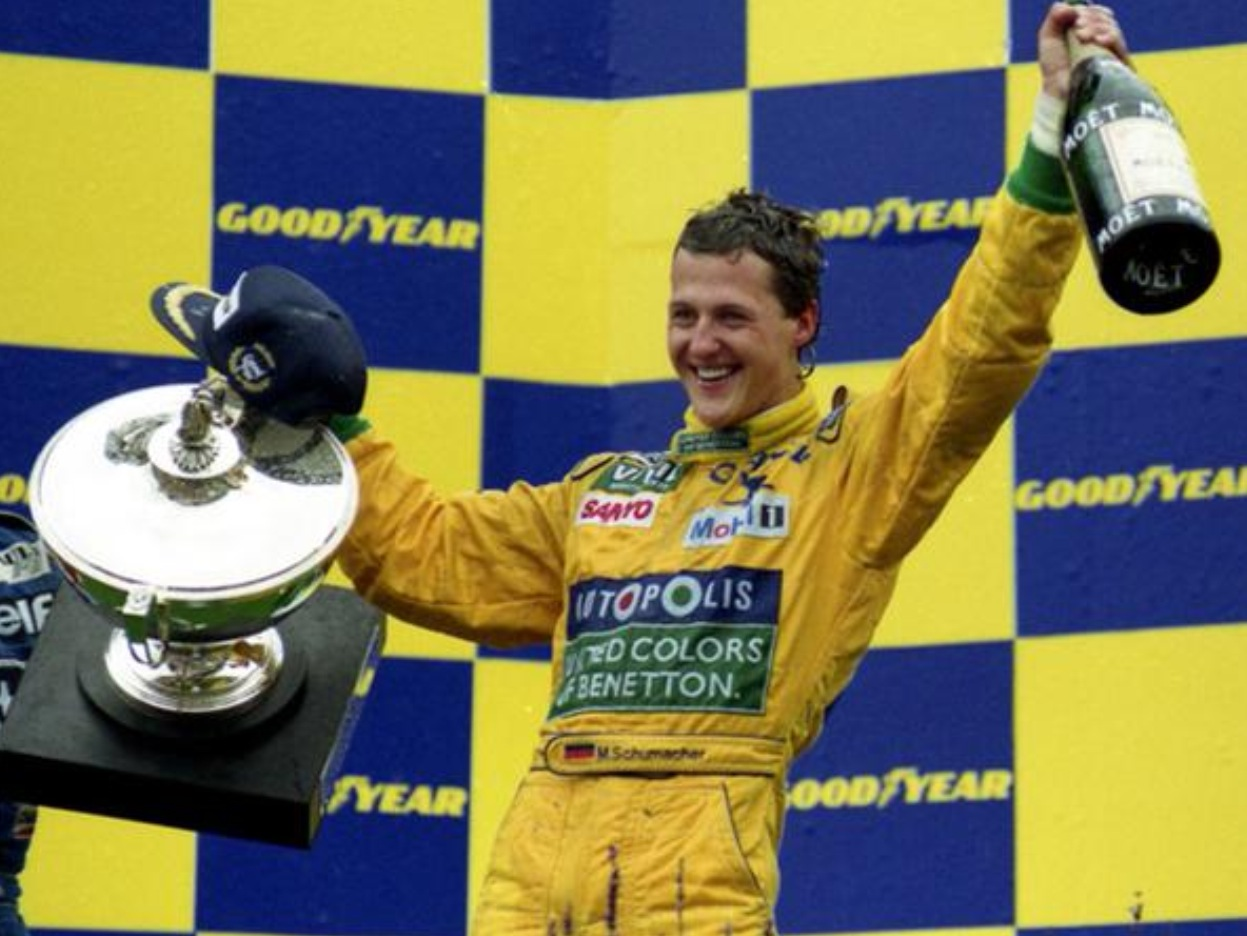
Michael Schumacher’s Benetton Ford just in front of Nigel Mansell’s Williams Renault. He took his first GP win having made his Championship debut at Spa with Jordan 12 months before…
Schumacher’s 1991 Belgian Grand Prix debut was in a Jordan 191 Ford. His Sauber Mercedes sportscar performances didn’t make it clear that ‘The Next Superstar’ had arrived but he qualified 8th and ran 4th retiring his car with clutch dramas, his brief drive was enough to convince Flavio Briatore to sign him up on the spot.
Roberto Moreno lost his Benetton seat to the German, swapping across to Jordan, Schumacher took a 5th and two 6th placings by seasons end.
1992 would be a tough year for all but Williams.
‘Active suspension’ experiments which started at Lotus with Colin Chapman tasking his engineers to explore it as far back as 1981 with the Esprit road car and in F1 from 1987 met an ‘apex’ with the Williams FW14B/15C Renault’s in 1992/3.
Nigel Mansell, Williams FW14B Renault, the dominant car of 1992, here at Spa. (unattributed)
The Patrick Head/Adrian Newey designed cars were powered by a 3.5 litre Renault V10 considered to have around 760bhp, 30bhp more than the Honda V12 by seasons end.
But the key to the cars dominance; Nigel Mansell became the first driver to achieve 9 wins, and the title that year, was the cars carbon fibre chassis which incorporated active suspension. The advance of computer technology finally allowed the exploitation of suspension actuators to deploy the system effectively.
The Williams 6 speed gearbox incorporated traction control and was of the semi-automatic type pioneered by the Ferrari 640 in 1989. The car also incorporated anti-lock braking for a time. The promise shown later in 1991 was now converted into stunning, consistent race winning pace.
Benetton B192 Ford…
(Terry Collins)
The Benetton B192 was a conventional, well engineered, ‘chuckable’ chassis developed by Ross Brawn and Rory Byrne.
The chassis was carbon fibre, suspension by wishbones front and rear with coil spring/dampers actuated by pushrods. The gearbox was Benetton’s own transverse design 6 speed manual.
The Ford Cosworth HB 75 degree 3.5 litre V8 developed around 700bhp @ 130000rpm, well short of the Honda and Renault’s output but the car was consistently fast and ‘best of the rest’ after the dominant Williams and the McLaren with which Senna took 3 wins.
Jean Alesi, Ferrari F92A and Schumacher collide after an attempted Schumi pass on lap 12 of the 1992 Monaco GP. Jean’s car was damaged taking him out of the race, MS 4th in the race won by Senna’s McLaren. (unattributed)
Schumacher’s 1992 Season..
MS Benetton B192 Ford, Spa 1992. (unattributed)
Schumacher was 3rd in the drivers championship in a season of speed and consistency; he took 2nds in Spain, Canada and Australia and four 3rds, his breakthrough first win was at Spa, exactly 12 months after his GP debut.
THE classic Spa shot, MS La Source hairpin 1992. (unattributed)
In a race of changing fortunes and variable conditions good or lucky pit work put him on dry tyres at the right time; Mansell and Patrese in the other Williams chased him down but both had cracked exhausts which took the edge of their engines performance. Schumi took the win from Mansell, Patrese, his Benetton teammate Martin Brundle, Senna’s McLaren MP4/7A Honda and Mika Hakkinen’s Lotus 107 Ford.
Remember the skid plate sparks!? L>R; Hakkinens 6th placed Lotus 107 Ford, Schumacher and Alesi’s Ferrari F92AT, he spun on lap 7 so its early in the race. (unattributed)
The Schumacher/Benetton/Ford combination took the drivers (but not the manufacturers) title in a season of tragedy and controversy in 1994, the 1992 B192 was an important stepping stone in that evolution…
Spa 1992 victory dais; the first of 91 GP wins. (unattributed)
I was trawling the internet, as I do, looking for photos which inspire the articles I write, one of the reasons why this blog is so nuttily diverse is to do with that approach.
I found this shot, unattributed as most of them are, but identified as ‘Monaco 1966’ which it most definitely is not!
Its one of those the more you look, the more you see shots; the steam train, four nurses sitting together, the working port, none of your fancy-schmancy big yachts of today and of course the car itself!
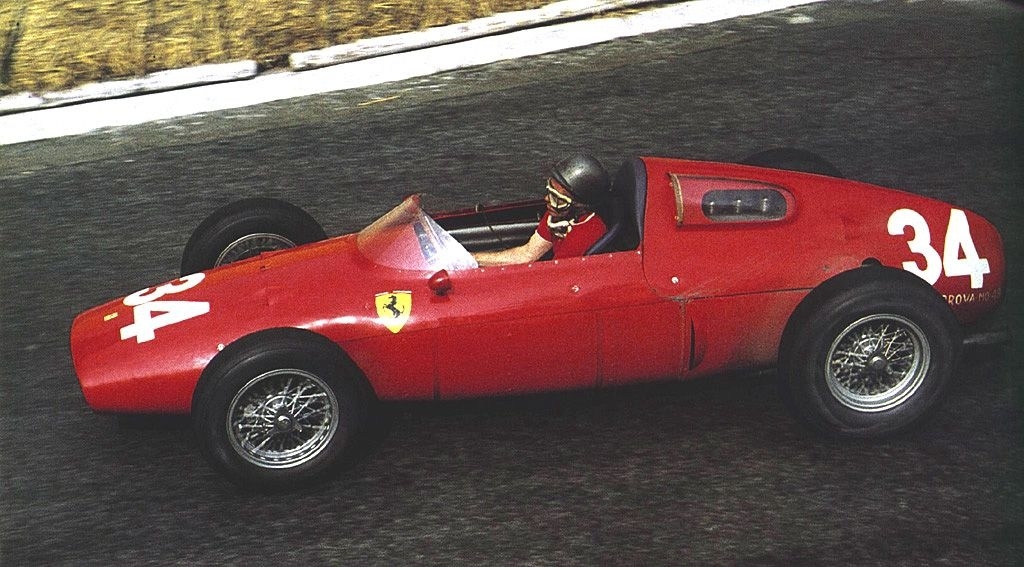
That’s the tricky bit. It’s not sharp in focus but I thought it might, just might be, Luigi Musso’s #34 Ferrari Dino 246 in the 1958 race.
GP debutant Richie Ginther on his way to fifth place in the Ferrari Dino 246P 0008′, Monaco 1960 (unattributed)
After I posted this shot, reader Grant Perkins did some research and confirmed the photo as Richie Ginther at Monaco in 1960 in the Ferrari Dino 246P…
Stirling Moss won the race in Rob Walker’s Lotus 18 Climax – Colin Chapman’s first championship win as a manufacturer – from Bruce McLaren’s Cooper T53 Climax and Phil Hill’s Ferrari Dino 246.
The shot is historically significant. Ginther made his GP debut that weekend and his mount, the Ferrari 246P, the Scuderia’s first mid-engined racing car, competed for the first time.
Monaco that year is also significant for the long awaited, but far too late appearance of Lance Reventlow’s Scarabs. These superbly engineered, but heavy, unwieldy front-engined cars entered GP racing just as Ferrari, the last team by then racing a front-engined car experimented with its mid-engined replacement. A tangent too far for this article, but see here; Better Late than Never… | primotipo….
Monaco 1960. #46 Chuck Daigh and #48 Lance Reventlow Scarabs. #34 Ginther’s Ferrari 246P (Dave Friedman Collection)
Ferrari built the 246P in secret. It was tested at Modena by Hill, Ginther and factory tester Martino Severi on 22 May. The design was perceived by its drivers to have too much weight at the rear causing excessive nose lift under acceleration.
Despite Stirling Moss’ Cooper win in the 1958 Argentine GP Grand Prix, and Jack Brabham’s Cooper win in the 1959 World Championship – firsts mid-engined cars – Carlo Chiti had to fight hard to build a mid-engined Ferrari prototype.
The Scuderia’s conservatism was proven time and again over the years. They were not often innovators or early adopters. Examples include the change from drum to disc brakes, wire wheels to alloys, carburettors to fuel injection, ladder frame to spaceframe chassis, spaceframe chassis to monocoques and so on.
Fortunately 246-0008 showed enough promise to race at Monaco on 29 May. By the end of the year the chassis had morphed from a prototype 2.5-litre F1 car into a 1960 1.5-litre F2 156. It then morphed into an an F1 156 with the GP rule change from 2.5 to 1.5-litre engines with effect 1 January 1961.
0008 became Giancarlo Baghetti’s race chassis for 1961, part of the amazing start to his F1 career. The Italian famously won his first three GPs; Syracuse, Naples and finally the French GP. In so doing Giancarlo became the only man to ever win his first championship GP.
So, 0008 won the first of many GPs the 156 design took in 1961 on the way to dual world titles; the drivers for Phil Hill, and manufacturers for Ferrari in 1961.
There wasn’t a happy ending for the chassis though. Giancarlo spun out of the wet British GP at Aintree a week after his Reims win doing enough damage to 0008 that it was scrapped. Mind you, Ferrari famously destroyed all of the 156s at the end of 1962 when the cars were as uncompetitive as they had been fast the year before.
From mid-engined 2.5-litre F1 prototype at Monaco on May 6 1960 to 1.5-litre F1 winner at Syracusa on 25 April 1961, 0008’s story is a short but historically significant, interesting one.
Enzo Ferrari and the Ferrari 246P designer, Carlo Chiti, watch Martino Severi testing their first mid-engined car 246-0008 at Modena May 1960 (unattributed)
Phil Hill testing the Ferrari 246P at Modena 1960, the suburb oh-so-close to the circuit! Compare the body of 0008 here with its Italian GP spec the same year (unattributed)
1960 Monaco Grand Prix…
Ginther qualified the new car ninth, between the front engined Dinos of Von Trips eighth, and Phil Hill 10th. In the race Hill was third, Richie sixth with Von Trips eighth but not running at the finish.
29 year old Richie Ginther makes his GP debut at Monaco 1960. Ferrari 246P (Dave Friedman Collection)
Ginther’s new prototype mid-engined Ferrari Dino 246P-0008 #34 beside the conventional front-engined, third placed Dino 246 of Phil Hill at Monaco in 1960. The difference in size is not that great at this stage. Some sources say Ferrari acquired a Cooper to understand that car’s packaging and suspension geometry tricks (unattributed)
Ferrari 246P in the Zandvoort pitlane 1960 (unattributed)
The team then took the 246P to Zandvoort for the following Dutch GP, however, the engine, which had not been rebuilt was burning and blowing so much oil that it was unraced.
Ginther therefore ran a conventional front-engined Dino as did his teammates. They were comprehensively blown off by large numbers of Lotuses and Coopers. Ginther’s 12th was the quickest Ferrari qualifier, with Von Trips fifth, Ginther sixth, while Phil Hill retired with engine failure on lap 13.
The race was won by Jack Brabham’s Cooper T53 Climax on the way to his second title on the trot.
Cars being marshalled before the start of the Dutch GP on June 6, 1960. #3 Ginthers Ferrari Dino 246, #5 Alan Stacey, Lotus 18 Climax DNF, #12 Bruce McLaren Cooper T53 Climax DNF, #9 Tony Brooks’ Cooper T51 Climax DNF, #6 Jim Clark Lotus 18 Climax DNF (unattributed)
Ferrari Dino 246P technical specifications…
While 0008 car didn’t race at Zandvoort, photographer George Phillips took some rare shots of a Ferrari too little has been written about, the car practiced with the number 3T.
(George Phillips)
246P’s front suspension by upper and lower wishbones, coil spring/Koni dampers and roll bar. Dunlop disc brakes.
(George Phillips)
Chassis Tipo 543, of welded tubular steel was described as Cooper in style if not in the quality of the welding! Borrani wire wheels were 15-inches diameter, Dunlop tyres 5.25/6.5 inches wide front/rear. The wheelbase was 2300mm and track 1200mm front and rear. Fuel capacity 150-litres, while the car’s weight, wet was 452kg.
(George Phillips)
Engine Tipo 171 was derived from the Tipo 134 65-degree, all alloy, DOHC, two valve V6. Bore/stroke 85 X 71mm, capacity 2,417cc. three Weber 42 DCN carburettors with twin plugs fired by Marelli magneto. Dry sumped, the unit developed a claimed 265bhp @ 8,300rpm.
(George Phillips)
246-0008’s rear suspension comprised upper and lower wishbones, coil spring/Koni dampers and roll bar. The Tipo 543 transaxle had five speed and reverse and an LSD. Note also the clutch location at the back of the ‘box, you can just see the top of the inboard brake rotor beside the chassis member.
Development of the 246P and its evolution into the 156…
Ferrari decided to abandon further development of the 246P as a 2.5-litre GP car. They focused their attention on the front-engined Dinos for the balance of the season, and the future 1.5 Litre GP car for the new Formula 1.
The basis of the new 1.5-litre F1 engine was the Vittorio Jano designed 1.5-litre Dino V6 already used in Ferrari’s front engined F2 cars which first raced in 1957. Von Trips won the 1960 F2 season opening Syracuse GP in March aboard one of these cars ahead of two Coopers.
Taffy von Trips Dino 156 winning the Syracuse GP, 19 March 1960. He won from the Cooper Climaxes of Trintignant and Gendebien (George Phillips)
Chiti progressively modified the engine, initially retaining the 65-degree angle but then changed it to 120 degrees.
The wide Vee angle has/had the benefit of a very low centre of gravity and rear bodywork which was as much a styling signature of the 1961 156 as its Sharknose. Definitive-spec 1961 156s raced with the 120 degree engine, but the 65 degree was also used; 0008 was always fitted with the 65-degree spec unit.
Taffy von Trips at Solitude in 0008 in 1960. The 246P/156 left front wheel is off the deck in a victorious run over the Porsches (unattributed)
The test bed for the new engine was the 246P 0008
After the car was fitted with a revised bodywork and 1.5-litre V6, it was tested at Modena and then entered at the Tenth Solitude F2 GP, Germany on 24 July. There, Taffy von Trips belted the Porsche 718/2s, a great F2 car, on their home ground, the aristocrat lead home Hans Hermann, Jo Bonnier, Graham Hill and Dan Gurney, all aboard factory Porsches.
Further testing and development of 0008 followed. With many of the British teams punting on the Intercontinental Formula for 1961, Ferrari were developing a formidable weapon for the new 1.5 F1, the implementation of which was confirmed, much to the Brits chagrin, as they wouldn’t have competititive engines until 1962.
At the Italian Grand Prix at Monza in September, Ferrari raced 0008 in what was getting close to the 156’s definitive 1961 specification.
0008 in 1.5 litre F2 form was raced by Taffy Von Trips to fifth place fitted with an auxiliary fuel tank among the 2.5-litre GP cars.
At the Italian GP in September 1960 Ferrari ran Taffy von Trips in 246P/156 0008. Both this and the shot below show how much more svelte the car became compared its May Monaco spec. It was not as small as the best of the British cars mind you, but in 1961 the Brits were hamstrung by lack of suitable, competitive engines (Archie Smith)
Von Trips had the 1.5-litre F2 class to himself outrunning Hermann’s Porsche 718/2 by a full lap. Phil Hill won the race, it was the final GP victory for a front-engined car but it was somewhat of a hollow one.
The sneaky Italians decided race on the combined Monza road course and banking to maximise the chances of the old-tech Ferraris winning. Power was Ferrari’s only advantage over the four cylinder Coventry Climax FPF and BRM engined cars. The Brits then told the organisers to jam-it on safety grounds with most boycotting the event.
Von Trips 246P/156 0008 in the 1960 Monza paddock. Note how much different the rear bodywork is compared with its 246P Monaco spec (Archie Smith)
Phil Hill’s winning Ferrari Dino 246/60 0007 #20 is pushed onto the 1960 Monza grid ahead of Von Trips’ Ferrari Dino 246P – or by then – 156 0008 (Archie Smith)
Von Trips ready for the off, Monza 1960, Ferrari Dino 156 (Archie Smith)
VI Gran Premio di Modena F2 1960…
0008’s final 1960 race was Ferrari’s home event at Modena on 2 October.
In the same way that Ferrari beat the Porsche’s at Solitude in July, so it was that Jo Bonnier’s Porsche beat Richie Ginther in the front-engined 156 from Taffy von Trips in the new 156 suffering from fading brakes.
Hans Hermann was fourth and Edgar Barth fifth, both also driving 718/2 Porsches.
1960 Modena F2 GP. Jo Bonnier’s Porsche 718/2 leads #26 Ginther’s front engined Ferrari Dino 156 from Von Trips’ mid engined 246P/156 (unattributed)
Von Trips Ferrari 246P/156 F2, #10 Edgar Barth Porsche 718/2, #28 Hans Hermann Porsche 718/2. Modena GP 1960 grid (unattributed)
Taffy von Trips, Ferrari Dino 246P/156 0008 F2, Modena GP 1960 (unattributed)
The brilliant, portly Tuscan engineer and 246P/156 designer, Carlo Chiti explains to Von Trips how to get the best from his car. Italian GP, Monza 1960 (Archie Smith)
1961 Beckons…
All of this development work on the new-fangled mid-engined concept was very successful, the 156 was the dominant GP car of 1961.
It took the Constructors Championship for Ferrari and Drivers title for Phil Hill. Let’s not forget the role 246P/156 0008 and Chiti’s development skills and prodigious work output made in that remarkable transition from the back to the front of the grid in less than 12 months.
Cutaway drawing of the Ferrari 156 F2 car 0008 in 1960 trim. Spaceframe chassis, double wishbone and coil spring/damper suspension front and rear. Tipo 188 1.5-litre 65 degree, DOHC, two valve, dual triple -choked Weber carbed V6 giving circa 180bhp in 1960 spec. Five speed gearbox, Dunlop disc brakes (James Allington)
Etcetera…
(Archie Smith)
More detail, Von Trips Dino 246P/156 Monza 1960.
(Archie Smith)
Ferrari Dino 246P/156 butt shot at Monza, Italian GP 1960. The fairing of the chassis by Fantuzzi’s gorgeous bodywork provided both visual splendour and aero advantage.
(Archie Smith)
Willy Mairesse’ 2.5-litre GP Ferrari Dino 246 tows Von Trips’ 1.5-litre F2 156 to a good time in the little car, Monza banking, Italian GP 1960.
(Archie Smith)
The boss at Monza sussing his new car and the opposition. Enzo Ferrari 1960. The car is Barth’s factory Porsche 718/2 F2.
Etcetera, first 246 test…
Here are a series of photos from Getty Archives of the first test day at Modena in May 1960.
Mr Ferrari is present as is Carlo Chiti, the driver in all of these shots is factory test driver Martino Severi. The car is unpainted, perhaps Ginther was not present on day one.
Ferrari, Severi, Chiti (Getty)
(Getty)
The 246SP lines are clear in this shot, in short front-engined styling on a mid-engined car! Ferrari with his back to the camera looks on with a tad more paternal interest than usual.
(Getty)
(Getty)
Fantuzzi’s hand formed aluminium panels of the prototype clear as are Borrani knock-ons and Dunlop disc brakes.
The boss looks on and contemplates this big change in the design of his cars, the Scuderia got the hang of it quickly enough! (Getty)
The boss looks on and contemplates the new design of his cars, certainly as big a change in direction as the famous marque ever made. They got the hang of it quickly enough too!
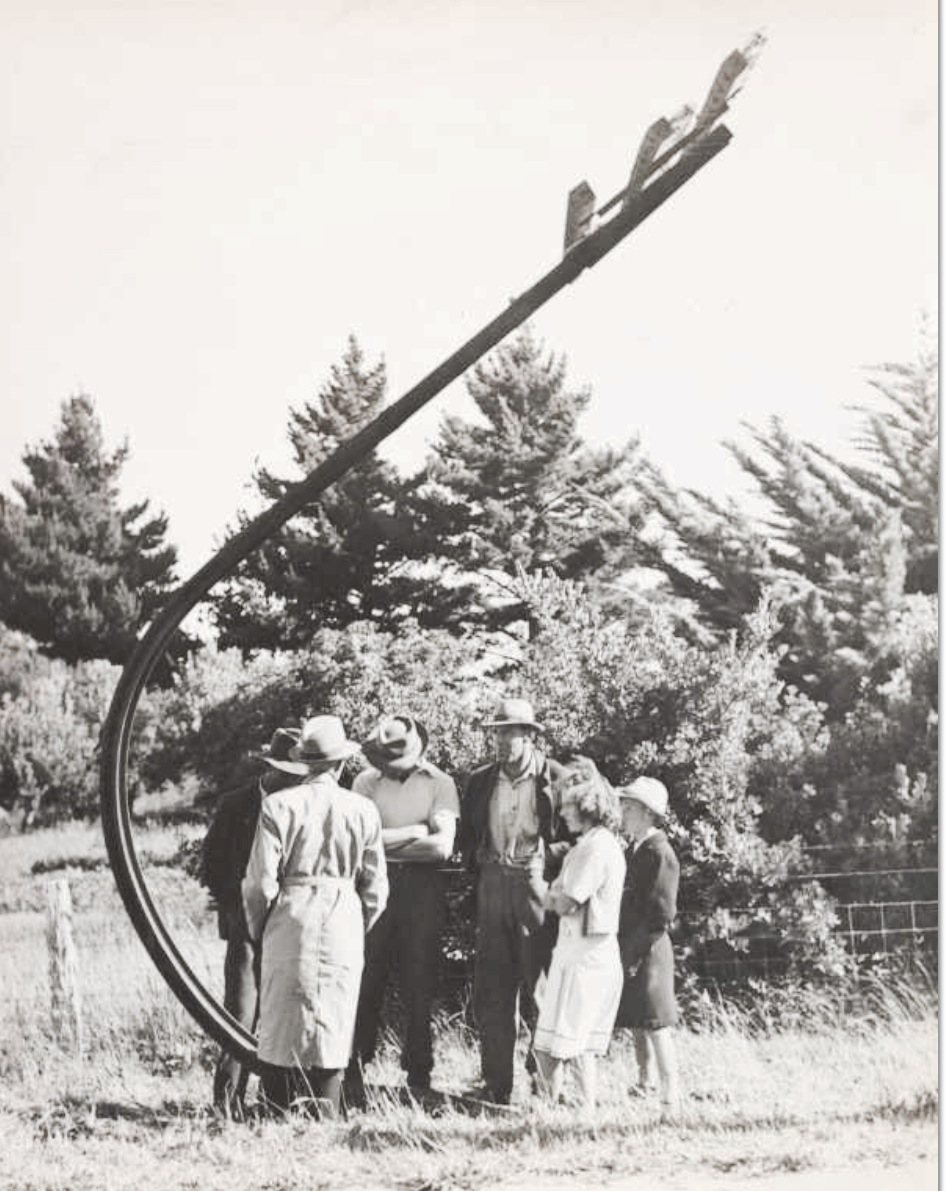
At the daunting Barossa Valley Lobethal road circuit in January, 1948, Lex Davison, having borrowed the ‘Missus new MG TC had his first major crash. He went for the ‘wrong side’ to pass Gavin Sandford-Morgan’s MG and ran off the road, destroying this innocent ‘Stobie Pole’, the TC but fortunately not himself…
This is the story of Davisons MG TC Spl chassis #TC.0825 and more briefly the importance of MG as a marque to motor racing in Australia until the dawn of the sixties.
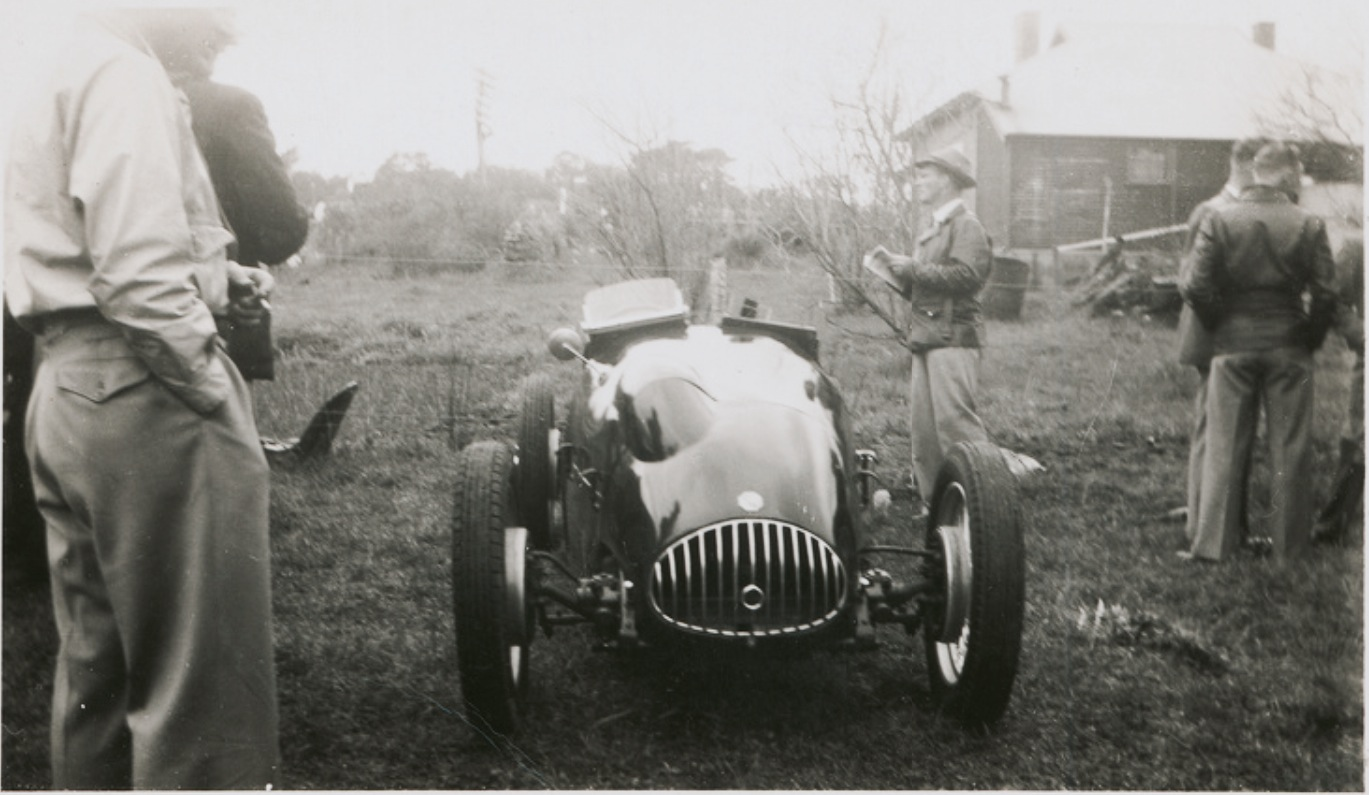
Woodside 1949.Here the car is in its early supercharged form, suspension standard but for ‘Telecontrol’ shocks, finned brake drums and air scoops. (State Library of South Australia)
Diana Davison/Gaze recounts the story in Graham Howard’s biography of Lex…‘While he waited for the Alfa (Alfa Romeo P3/Tipo B Monoposto) to arrive, Lex entered the TC for the New Year’s meeting on the formidable 8.65 mile Lobethal public road circuit. He drove it over from Melbourne accompanied by Peter Ward and Lyndon Duckett in an old 6cylinder Vauxhall.
During practice they went off the road, slewed down the sloping grass verge, somersaulted, then hit a Stobie pole so hard the steel pole was bent into the shape of a question mark. The violence of the accident bent the MG’s chassis and tore off the driver’s door, the bonnet and the outer scuttle panelling. The alloy seat was bent, the rim of the steering wheel was broken away from the spokes, a front wheel smashed and its tyre gone. Lex had a chipped bone on one knee.
Naturally, I was dreadfully upset at losing the MG, as I had never owned a car before, but it had gradually disappeared from my hands. We had both driven it at Rob Roy, where Lex had coached me from the passenger’s seat, then Lex raced it at Nar Nar Goon grass track and I had competed at the final Killara Park Sprints – dashing back to the house between runs to check on baby Anthony, who usually travelled in the car in a wooden cradle fitted behind the seats.
I was just grateful that Lex wasn’t too badly injured’.
Chris Davison, Diana’s son recently recalled ‘ The story goes that mum was getting tired of being left out, so Lex bought her the MG to ensure she was part of the team. Motor racing then bacame a real family affair. Smart move Lex!! When my daughter Claire drove at RobRoy for the first time she took this photo to remind her of the family history at Rob Roy’.
Diana Davison in the MG Spl at Rob Roy, year unknown. (Davison Family Collection)
The TC reappeared as a bare chassis for Rob Roy and Nar Nar Goon at the end of 1948, with Lex and Reg Nutt driving. DD; ‘By the following March the Head Brothers had created a narrow 2-seat shell with shapely cycle guards. It had nice upholstery and was painted red, and I think they christened it ‘Mum’s Racer,’ and they fitted it out with a small leather pocket for my compact and lipstick’.
‘Several times the car lowered the ladies’ record at Rob Roy, including once with the supercharger fitted, and that record stood for some time. Lex raced it widely and Bib Stillwell contested events at Woodside in 1949. Our last entry for the car was with Ian Mountain driving at the Grand Prix at Albert Park in 1953.’
Here Diana Davison at Rob Roy in 1946, in what appears to be an Austin 7 Spl. Happy to take advice on the car. DD an immensely talented, popular and respected member of the Australian racing community for all of her life. ‘Australia’s First Lady of Motor Racing’. (George Thomas)
MG and Motor Racing in Australia…
I have written about Lex Davison’s cars on primotipo before, he was a winner of the Australian Grand Prix four times, winner of the inaugural Australian Drivers Championship, the ‘Gold Star’ in 1957 and was the father and grandfather of two generations of champion racers. His premature death in 1965 meant he never saw the achievements of his scions.
MG is surely the most significant marque in Australian Motor Racing before 1960?
The cars won the Australian Grand Prix four times; Les Murphy’s P Type at Phillip Island in 1935 and the famous 1937 race at Victor Harbour actually held in December 1936. Alan Tomlinson’s legendary, clever and brave drive at Lobethal 1939 in his supercharged TA Spl and Bill Murray, TC Spl at Bathurst in 1947. MG were always contenders in the AGP as the race was run to Formula Libre rules and handicapped until the early fifties, so whilst not usually the quickest entries, the handicaps gave everyone a chance.
Mind you, in the right circumstances the cars were outright contenders, Frank Kleinig’s ‘Kleinig Hudson’ which used an MG Magna chassis started from scratch in the 1949 AGP at Leyburn, Queensland. In that race he was advantaged by the withdrawal of a swag of Victorian topliners who didn’t enter in a political protest, but the Kleinig Hudson was always an outright contender, albeit an unreliable one driven as it was by a mechanically talented if not entirely sympathetic driver.
In fact the last MG placing in an AGP, well into the mid-engined era appears to be Noel Barnes 10th place in his TC Spl in the 1960 event at Lowood, Queensland, the race won by Alec Mildren’s Cooper T51 Maserati. Three TC’s started the race, all from the back of the grid.
AGP wins is not the real contribution MG made though, that was more around ‘mass’ participation. The cars were affordable, accessible and ‘tunable’, a way to view them is the Formula Vee or Formula Ford of the period. The cars gave so many drivers a start, whether it was local hillclimbs and sprints, circuit racing or the elite levels of the sport, such as they were in Australia between the wars and through to 1960.
Lex Davison in the MG TC Spl Fishermans Bend 1949. (VHRR P Read)
Rebuild and Specifications of ‘TC.0825’…
Back to Lex’ Spl. Davison gave the car to Reg Nut in Melbourne to rebuild the chassis which was largely standard but fitted with brake torque cables from the frame to the tops of the king pins, aluminium cooling fins on the brake drums and air scoops to the backing plates.
The 3 main bearing, cast iron, 4 cylinder, pushrod OHV, ubiquitous ‘XPAG’ engine was fitted with domed pistons giving a compression ratio of 12:1. The ports were opened, ports and combustion chambers polished. Valves were from a Jaguar, bigger than the biggest in the MG ‘catalogues’, cam followers and valve gear modified, lightened and polished as were the crank and rods.
Capacity was standard, wider bearings used by widening the crankshaft journals, a bigger 2 1/4 gallon sump was fitted and an aluminium oil cooler fitted underneath the radiator.
Bigger 1 1/2 inch SU carbs fed the thirsty little engine, spark was provided by a Lucas NV4 magneto, albeit the wiring for a coil and distributor setup was retained to allow changeover if required.
Head Brothers in Murrumbeena, a Southern Melbourne suburb, built an attractive sports car body with road equipment, the front and rear guards easily removed depending on the nature of the competition event.
Heads used a strong but light framework from square section seamless tubing, then covered it with pre-formed panels of light aluminium sheet, attached by wrapping their edges over the tube frame. The grille was hand made by light tubing, the one piece bonnet retained by leather straps.
The fuel tank Lex ‘knocked off’ from his newly acquired Cooper, the 10 gallon aluminium tank lives inside the MG’s low tail, it’s quick-action cap exposed outside the body.
The car was beautifully finished and trimmed. Instruments comprised Smiths tach, oil pressure and oil and water temperature gauges.
16 inch wheels were used, 5 inches wide at the front and 5.5 or 6 inches wide at the rear, shocks were ‘Telecontrols’. Gear ratios and ‘box were standard but a lower 4.875 rear axle ratio was used as the ‘best compromise’ for events contested.
Picture of the very neat, fast for its time, road/track sports racer. Here in unsupercharged form. Head Bros of Melbourne built the body, lights and guards easily removable front and rear. (AMS)
Davison TC Spl Competition Record…
The car contested it’s first Rob Roy Hillclimb in 1948, driven by Reg Nut, Lex then ran it at Nar-Nar-Goon in both events the car was successful.
It next raced, after the Heads’ body was fitted and a supercharger at Fishermans Bend in 1949. It raced at Woodside, SA later in the year before the supercharger was removed ‘as it’s bonnet hump was thought unsightly’. (Makes no sense to me as a reason to remove it but ’tis what the contemporary reports say).
The car then raced successfully throughout 1950 in unblown form and in 1951 the MG returned to South Australia, racing at both the Gawler Airstrip and Woodside road circuit. Diana Davison also raced the car very competitively in hillclimbs, retaining her Ladies Record at Rob Roy.
Lex’ racing focus was primarily his Alfa Romeo P3/Tipo B Monoposto, the 2.9 litre car arrived in Australia in early 1948, the MG wasn’t being used much, it’s last race when owned by the Davisons’ the 1953 Australian Grand Prix meeting when it was raced for them by Ian Mountain.
The car rapidly passed through the hands of several owners, it was rolled without causing much damage in 1960 at Phillip Island. Historic Events started in the sixties, the car used then by John Fitzpatrick and others. It was bought by Reg Bowran in 1970, but has appeared only occasionally since.
Simple cockpit layout, array of Smiths instruments. (AMS)
The Davison TC had a major accident early in its life which resulted in it’s rebirth as a competition car but by the standards of Australian MG Specials this car, touted by the Davisons’ in the early Fifties as ‘the fastest unblown TC in Australia’ (David McKay would have contested this claim, his ex-Brydon ‘TC.3306’ the other contender for that title at the time, but the cars never decided the contest) has had a remarkably easy and little raced life!
More importantly it typifies the type of MG Spl which provided the backbone of Australian Motor Racing for decades…
Butt shot, scan of an old magazine so a bit scratchy. (AMS)
Etcetera…
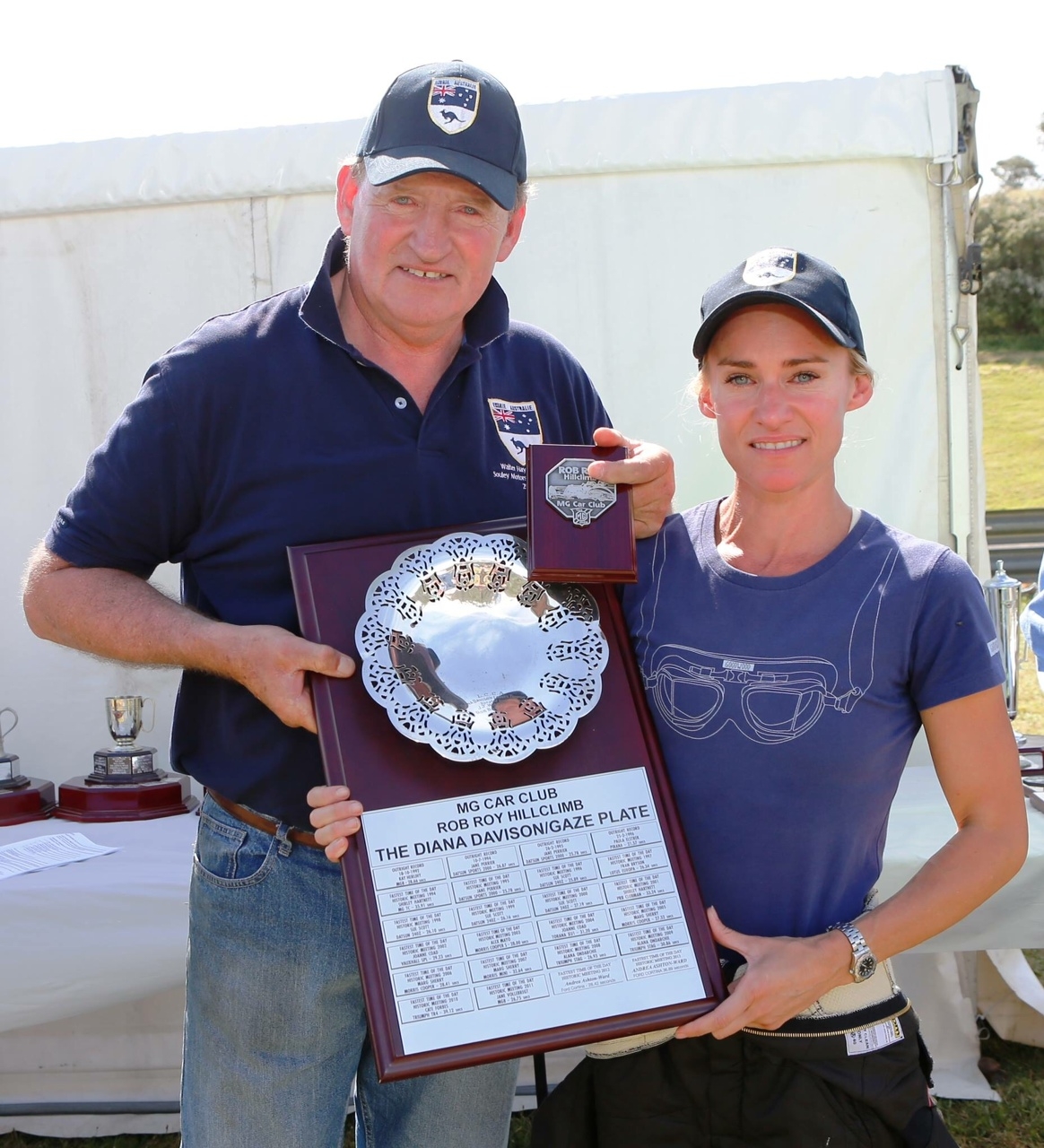
In a nice bit of Davison Family and Rob Roy symmetry Diana Davison’s granddaughter Claire, here pictured with father Chris Davison, won the ‘Diana Davison Gaze Trophy’ for Ladies FTD at Rob Roy in 2014. Car a Reynard Formula Ford. (Davison Family Collection)
Bibliography…
Australian Motor Sports Magazine April 1952 (AMS), ‘Historic Racing Cars in Australia’ John Blanden, ‘Lex Davison Larger Than Life’ Graham Howard, Chris Davison
Photo Credits…
State Library of South Australia, Davison Family Collection
Rauno Aaltonen and Henry Liddon head for victory in the Monte snow and ice, Mini Cooper S, January 14-20th 1967…
They won the alpine classic from the Ove Andersson/John Davenport Lancia Fulvia and Vic Elford/David Stone Porsche 911S.
By 1967 the Mini Cooper S was long established as a race and rally winner; in the Monte the cars won in 1964, 1965 and 1966, the cars driven by Paddy Hopkirk/Henry Liddon, Timo Makinen/Paul Easter and in ’66 Makinen, Aaltonen and Hopkirk dominated the event.
They finished in that order only to have French officialdom throw them out, and Roger Clark’s 4th placed Lotus Cortina, advancing Finnish Citroen driver Pauli Toivonen to a hollow win.
The cars ‘were excluded for having iodine vapour, single filament bulbs in their standard headlamps instead of double-filament dipping bulbs’, this was a bit of French bullshit which allowed a Citroen win…
The Mini’s advantage was rammed home in 1967 when Rauno Aaltonen and Henry Liddon won the event one last time, the age of the Mini was coming to an end, the ‘rally reign’ of the Ford Escort Twin-Cam/RS1600 and other more powerful specialised cars was about to begin…
The works Morris Cooper S #144 Timo Makinen/Paul Easter 41st and #178 Simo Lampinen/M Wood Plane is the Douglas DC4 based ATL-98 Carvair. (unattributed)
Rauno Aaltonen was born on January 7, 1938 his teenaged ‘need for speed’ initially satisfied competing in speedboats and later motor bikes on speedways, motocross and in road racing becoming the first Finn to win a TT event in 1956 at Hedemora, Sweden.
He started rallying at 18 after deciding that ‘bikes were a bit too hazardous after several racing accidents’ competing in both Mercedes Benz 170S sedan and Saab 93B, a ‘real rally car’.
He competed in the World Rally Championship throughout the 1970s and was a factory driver for BMC, Ford, Lancia, BMW and Datsun over the decades. Prior to the WRC’s formation he won the European Rally Championship championship in 1965 and the Finnish Rally Championship in 1961 and 1965.
He was victorious in the following events; the ’61 Warsaw Rally and Rally of 1000 Lakes both in Mercedes 220SE, the 1964 Liege-Sofia-Liege in a Healey 3000 Britains’ RAC, the Polish, Munich-Vienna-Budapest and Czechoslovakian Rallies, all in 1965 in Minis. He won the 1966 Tulip, Vltava and Czechoslavakian Rallies, the Monte as described here in 1967 and Australia’s Southern Cross Rally in 1977 in a Datsun Violet 710.
In circuit racing he contested the Spa 24 Hour in a BMW in 1958, the ’65 Sebring 12 Hour, Targa Florio and Le Mans 24 Hours in factory Austin Healey Sprites, also doing some of these enduro’s for BMC in 1966-68.
In 1966 he partnered Bob Holden to a Bathurst 500 win in a Cooper S at Mount Panorama and in a nice bit of symmetry also raced the event in 1991 in a Toyota Corolla with Holden.
Mini; unitary construction, 1275cc pushrod OHV engine fed by 2 SU carbs. 4 speed box, slippery diff, disc front and drum rear brakes. (Jiro Yamada)
Aaltonen related his 1967 Monte win to Sympatico.caAutos…
In 1962, Aaltonen crashed his Mini at Monte Carlo: ‘I was stuck in the burning car. I could see pastel colors, you know, and I was hearing classical music. Then I could hear my co-driver calling me to climb out, but the seatbelts were already melted, so I had to wiggle out.’
‘We run the col de Turini twice, both directions. It’s very difficult: cliffs, rocks, narrow roads…”
‘We arrived at the beginning of the last stage leading by 12 seconds. Vic Elford was second in a Porsche 911, but he was in front of the road, starting ahead. We listened to that six-cylinder, the feeling of power! He disappeared down the road.
‘It was our turn. The man with the flag counts down from 10, but he stops at four. There’s an accident on the hill, the ambulance rushes up. Then a snowstorm starts. You could see the snowflakes floating down. In theory, it could be beautiful. For us, it was hell. The spikes in our tires don’t work in the snow and we couldn’t see the road – everything was white.’
The winning Cooper S of Aaltonen/Liddon. (unattributed)
Today, the marshals cancel special stages for less serious incidents. Back then, the show just went on and the countdown resumed.
‘First gear. Wheelspin. 8,000 rpm, hardly moving. Second gear. Wheelspin. We couldn’t get any grip. Henry Liddon, my co-driver from Bristol, England, has a dry sense of humor. He says when we get to the top of the hill, ‘two and a half minutes down’. No way – but in rally, you never give up.’
What Aaltonen, and Liddon for that matter, didn’t know is that this joke would become reality in the most spectacular way.
‘We drove back down the mountain really fast: third gear, 140 km/h. The spikes were working better now. Suddenly, under the snow there was a patch of ice. We started sliding, rocks on the inside of the turn, cliffs on the outside. I saw that there are these concrete blocks that would be safe to hit: they would stop the car from going over.’
Any sane man would have done the same. Going down a cliff at the Col de Turini is something you simply don’t want to do even if they paid you a million dollars.
Aaltonen wasn’t paid that much, but he made an almost suicidal decision: ‘You never give up. So I aimed between the concrete blocks. I knew it wasn’t a sheer drop, maybe 45 degrees and with trees.’
Ah, no problem there, then…
Battery of lights legal in 1967… (unattributed)
‘We were flying in the air. It looked like we were in a fairytale. These boulders looked like giants.’
Amazingly, the Mini and its crew survived the drop: ‘We landed on soft snow between trees and huge boulders. This was purely good luck, as one cannot steer the car while airborn. Had we already left the road, there was no point in stopping as the Mini would instantly sink deep.’
He admits that they had no idea where they were going.
‘Once we had found a road and noticed it was the special stage, we understood how lucky we had been. Nobody could purposely find that kind of route between the trees and boulders – yet, in fact, it shortened the route.’
The accident worked to Aaltonen’s advantage: ‘We won by five seconds. It was a huge shortcut. That was not skill, it was good luck’, he concedes. ‘I told my co-driver to shut-up his mouth and don’t tell anything.’ It’s something Aaltonen revealed only after 20 years.
Their was perhaps some Karma in all of this given the bureaucratic nonsense the year before…
Aaltonen and Henry Liddon still in the car at the Monte’s end. (unattributed)
Hero’s welcome for the victors back in the UK. (unattributed)
Credits…
Team Dan Rally archive, aaltonenmotorsport.com, sympatico.ca Autos
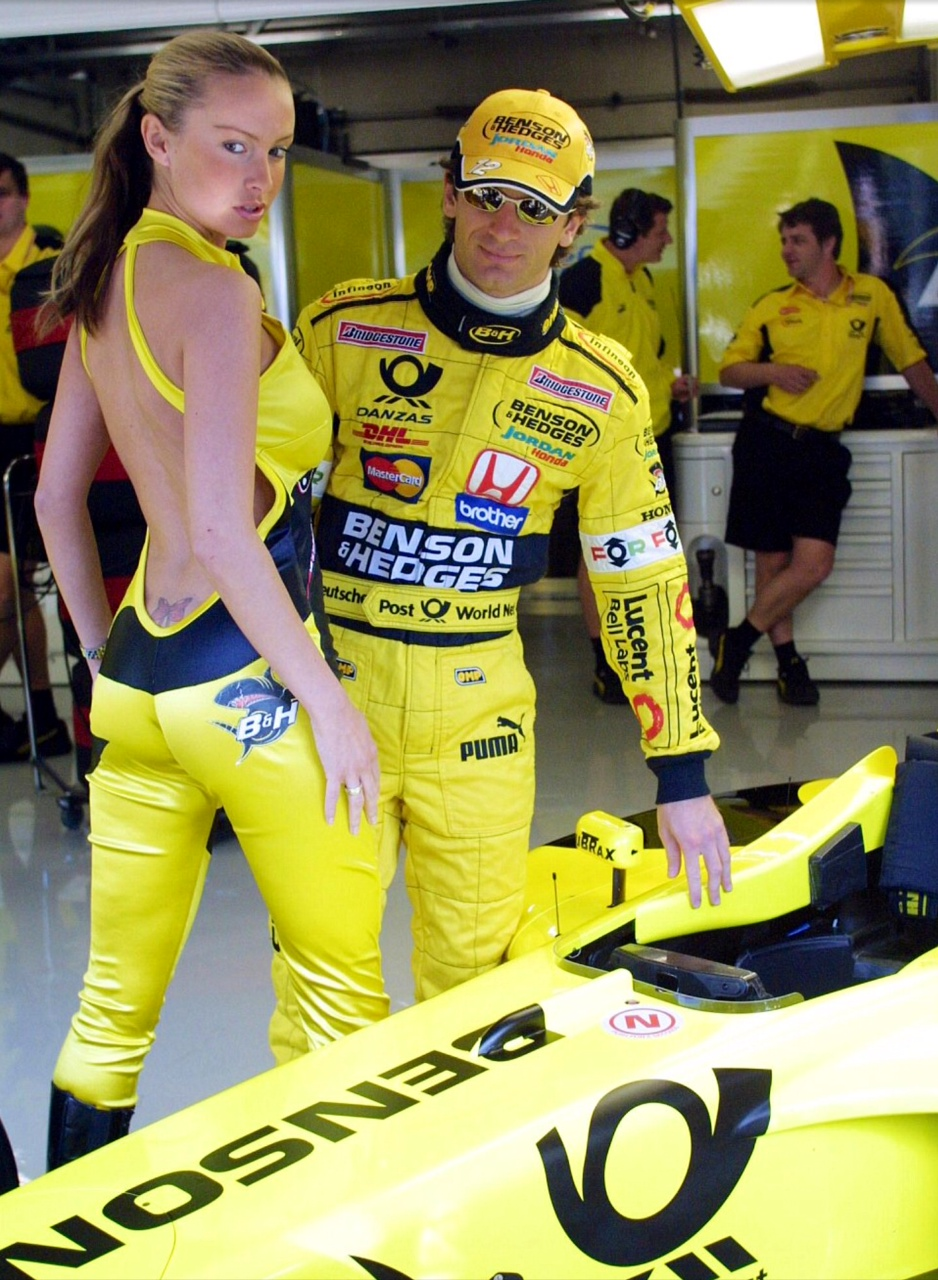
Jarno Trulli doing his best to focus on matters at hand during the Austrian Grand Prix weekend of 2001…
He qualified his Jordan EJ11 Honda very well in 5th, but a lapse of judgement on Sunday, he passed a red light whilst leaving the pitlane resulted in his disqualification, seems understandable in all the circumstances.
I struggle a bit with ‘the age of adornment’ one of my sons has a ‘sleeve’ which is suboptimal as a parent but i must confess to finding little to complain about in the discretely placed butterfly in this particular case!
Eddie Jordan really added a lot of ‘fizz’ to F1 in so many ways did he not!?
1967 was one of the most intensely interesting years of Sportscar Racing; the last year of the ‘unlimited cars’ saw the 4 litre Ferrari P4 and 7 litre Ford GT40 Mk4/2B’s and Chaparral 2F at it tooth and nail in a battle for dominance before new rules came into force rendering the cars obsolete at the stroke of the rule-makers pen…
I’ve written a couple of long articles about the Ferrari and Chaparral which also cover that seasons racing in some detail, click here to read them;
This article is largely pictorial using as it’s base the phenomenal work of American Dave Friedman.
He was a still photographer on movie sets after serving in World War 2. His passion was motor racing though, he was soon engaged by Ford and others to document their racing history. The photos I have chosen are from an archive of nearly 900 of this race alone!
The race was famously won by Fords ‘All American Boys’ Dan Gurney and AJ Foyt, the latter adapting rather well to road racing given his oval background on both dirt and bitumen.
The images are all monochrome and all the more evocative for it!
Race Entries…
Ford won the 1966 Le Mans classic taking the first three placings after the failings of 1964 and 1965. In 1964 the GT40 was simply too new and lacked the necessary development, in 1965 cracked brake discs from unforeseen levels of heat were the problem which eliminated most of the 7 litre Mk2’s.
For 1967 FoMoCo entered four new, fabulous 7 litre Mk4’s, two prepared by Holman & Moody and two by Shelby-American. They also fielded Mk2’s designated Mk2B’s, these beasts also powered by the same 530bhp V8’s as the Mk4.
Business end and cockpit of the Hulme/Ruby Ford Mk4 chassis ‘J8’. Aluminium honeycomb chassis, Ford 7 litre OHV cast iron V8 fed by 2 4 barrel Holley carbs. Circa 530bhp. Suspension; single top link, inverted lower wishbone, 2 radius rods, coil spring/damper unit, cast magnesium upright, adjustable roll bar. Ford Kar Kraft T44 4 speed transaxle.
Ferrari entered 4 litre cars; 3 new P4’s and a P3/4, these cars powered by the latest 450bhp 36 valve, fuel injected V12.
Two Chaparral 2F’s were entered, despite 7 litres of Chev V8 they were lighter than the P4’s.
The P4 weighed in at circa 2200lb, the 2F 1980lb, the Mark4 2200lb and the Mk2B, without the benefit of the lighter honeycomb construction of its newer sibling, was about 2500lb.
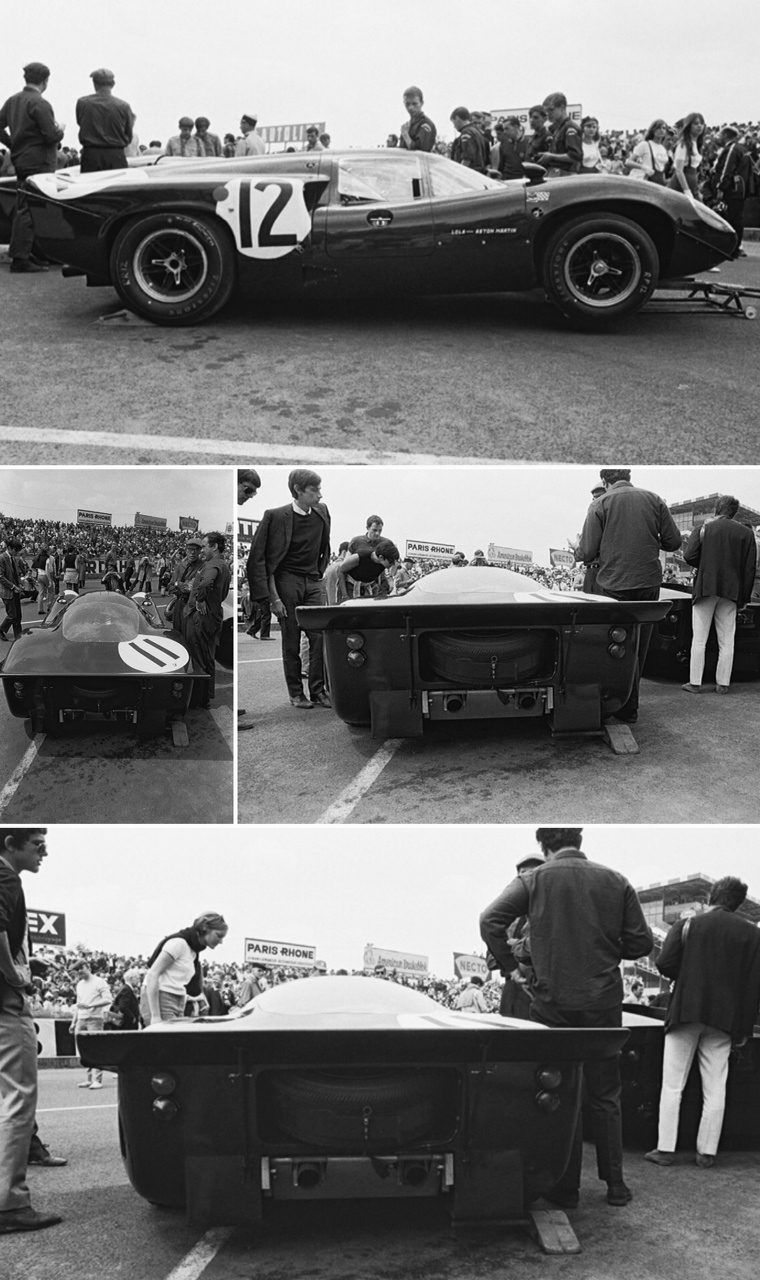
The 2 Lola T70 Aston Martin’s tipped the scales at 2320lb, the Aston 5 litre V8’s fuel injected since the April pre-race Le Mans trials at which they had been very fast.
Lola T70 Mk3 Aston Martins’ a big disappointment. #11 John Surtees/David Hobbs car engine shat itself on lap 3 with piston failure , #12 Chris Irwin/Peter de Clerk lasted till lap 25 also withdrawing with engine failure.
In the 2 litre class the Porsches’, always outright contenders such was their speed and reliability, would do battle with the Matra BRM’s. Ferrari chose not to race their Dino’s focusing on the ‘main game’ and Alfa withdrew their T33’s as not being not sufficiently ready for the rigours of la Sarthe.
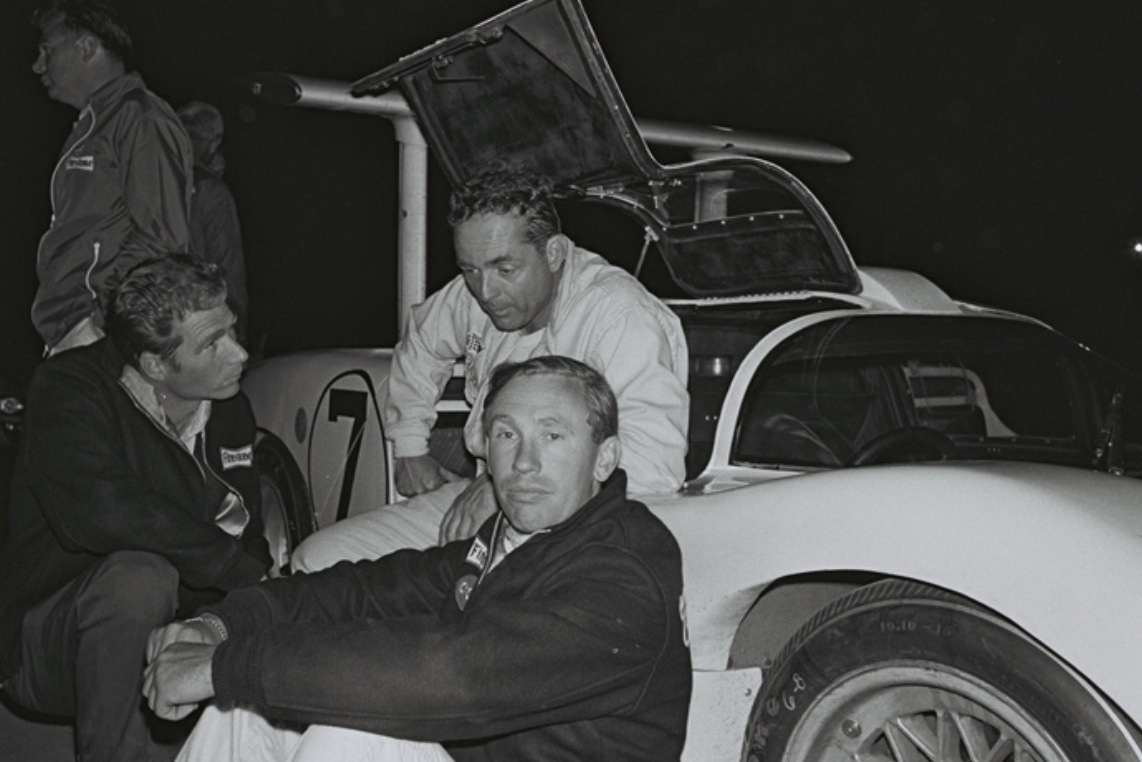
Jochen Rindt with the lovely Nina Lincoln, Finnish fashion model and daughter of racer Curt Lincoln, he married her in ’67. Jochen raced Porsche 907 #40, (above) he and Masten Gregory famously won the race in a Ferrari 250LM when the factory Ford GT40 Mk2’s and Ferrari P2’s failed in 1965. The other Porsche #41 is the 5th placed, 2 litre class winning 907 of Jo Siffert/Hans Hermann.
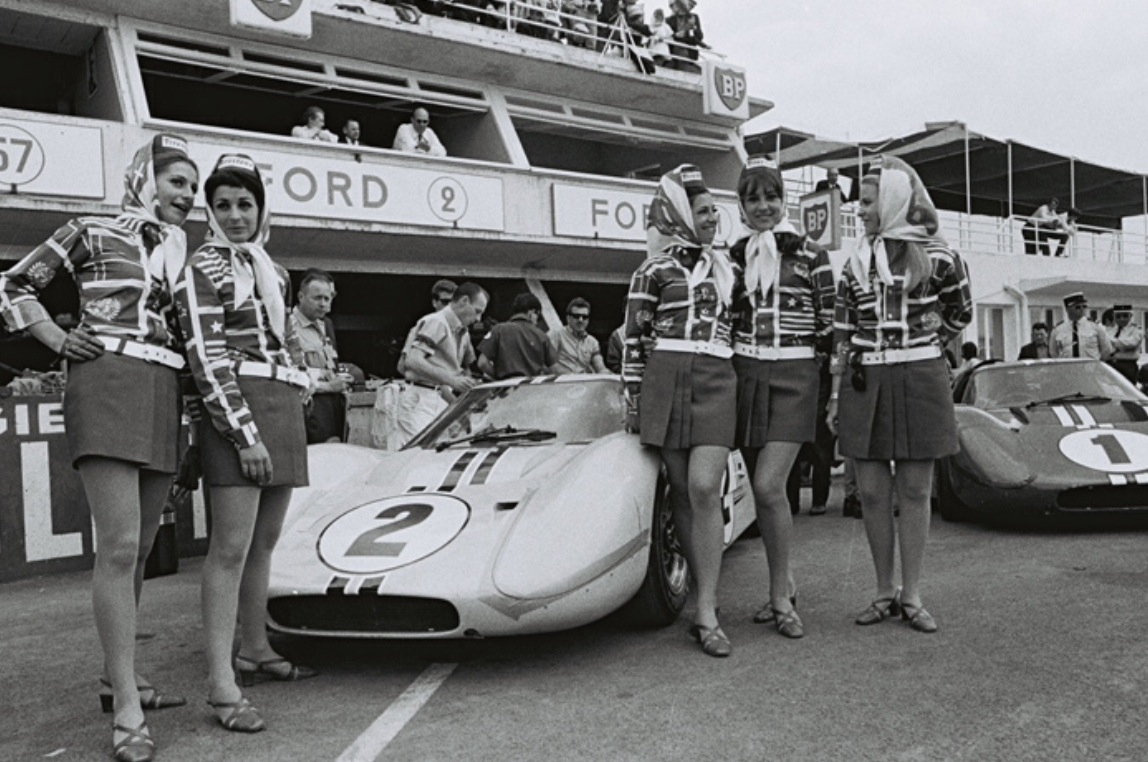
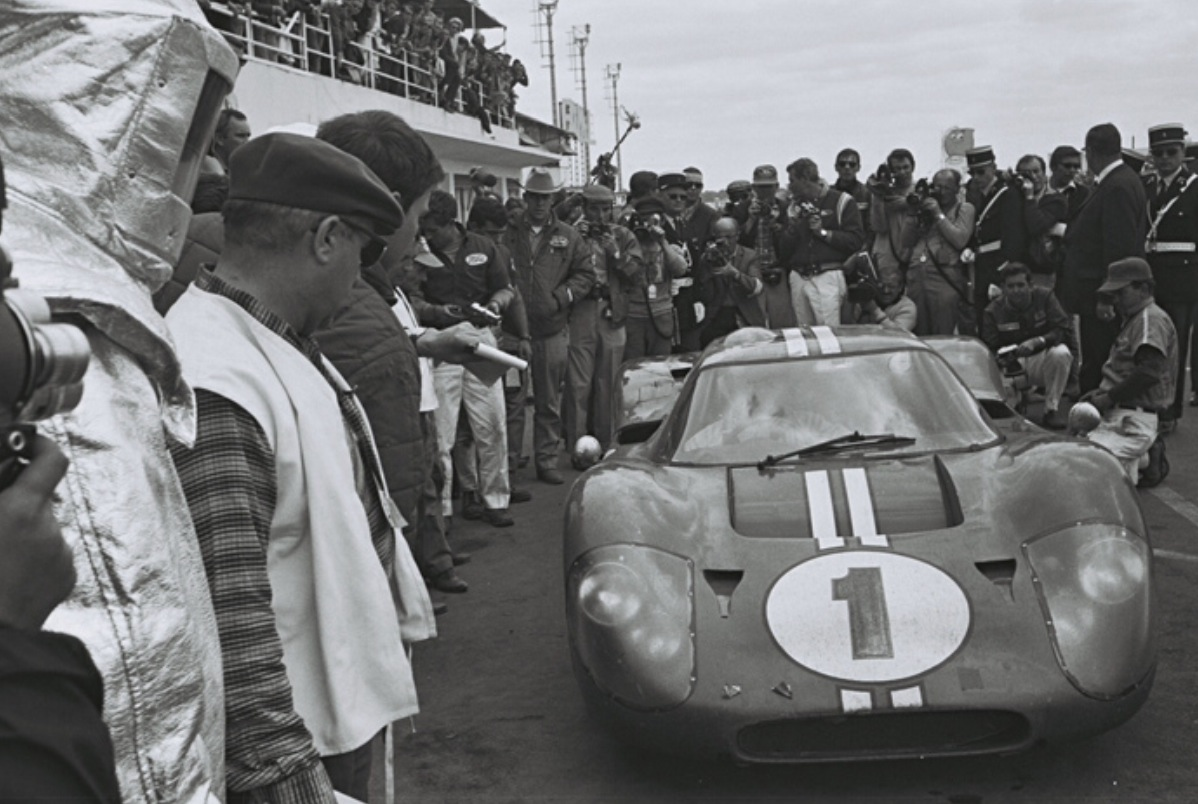
#2 McLaren/Mark Donohue 4th and #1 Gurney/Foyt 1st Ford Mk4’s with friends before the start.
Ford had windscreen troubles in practice but this was remedied with a fresh batch of correctly tempered screens which arrived pre-race.
As if to assert Ford’s authority Bruce McLaren took a Mk4 out and lapped at 3.24.4, an average of 147.316 mph and topped 215mph on the Mulsanne, in the dark. It gave him pole, McLaren was Ford’s victor in 1966 in a GT40 Mk2 he drove with fellow Kiwi Chris Amon.
Bruce McLaren jumps out of his Ford Mk4 ‘J6’ during practice. Bruce the pole sitter in this car.
Fords times gave them five of the six top slots. Frank Gardner and Roger McCluskey qualified their Holman & Moody Mk2B 6th, here is FG before the off, the race not quite so successful, his co-driver became part of an accident not of his making…
The Race…
Dan Gurney is the bolter at the start in #1, #2 McLaren Mk4, #7 Chap Spence putting on his full harness, alongside him #3 Andretti and #4 Hulme both in Mk4’s doing the same.
A second or so later; Spence, Andretti and Hulme still ‘belting up’ whilst #62 Mike Salmon DNF fire and #11 Surtees Lola Aston, #23 Attwood Ferrari P3 and #21 Scarfiotti Ferrari P4 come thru.
Love this start shot as it gives a sense of the depth of the field but also the speed differentials for which Le Mans is infamous; #42 Robert Buchet/Herbert Linge 14th Porsche 911S 2 litre, #48 Roger Delageneste/Jacques Cheinisse 10thAlpine A210 Renault 1.6 litre, #60 Andre Wicky/Philippe Farjon DNF Porsche 911S and the rest…Mike Spence just away in the winged Chap 2F at far left.
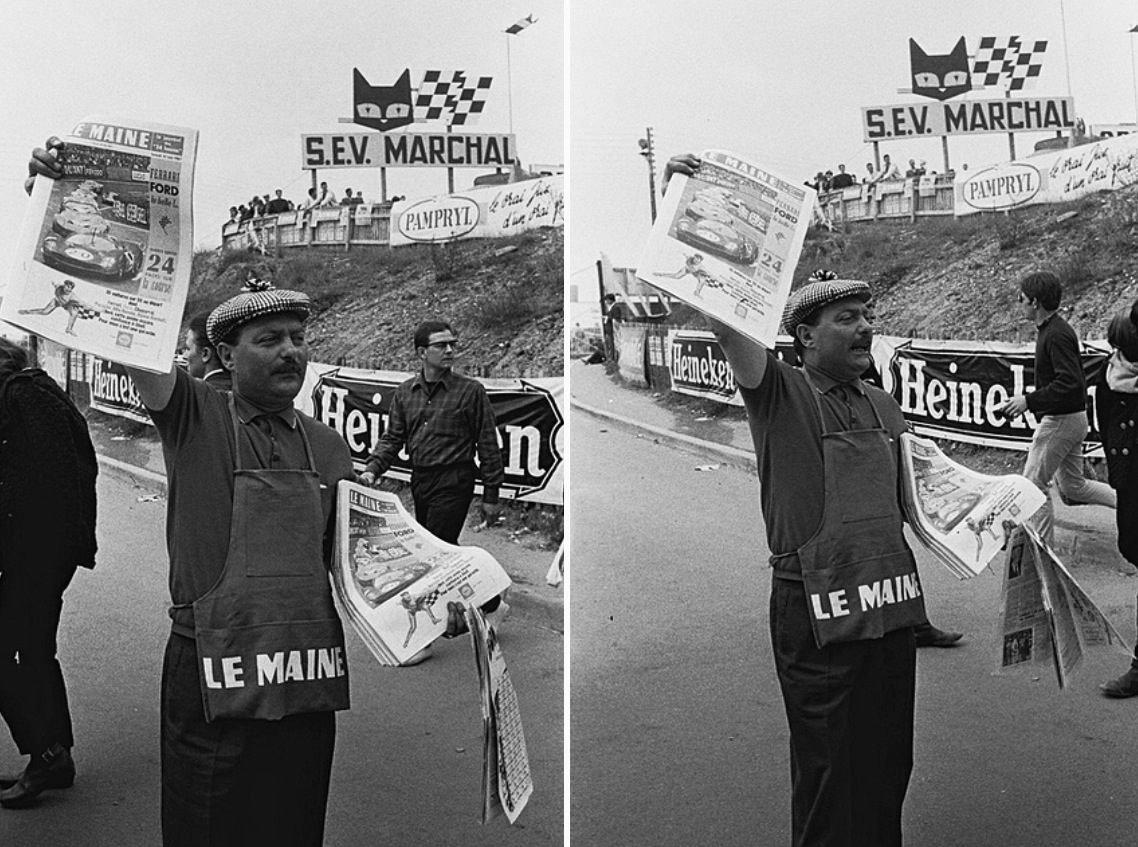
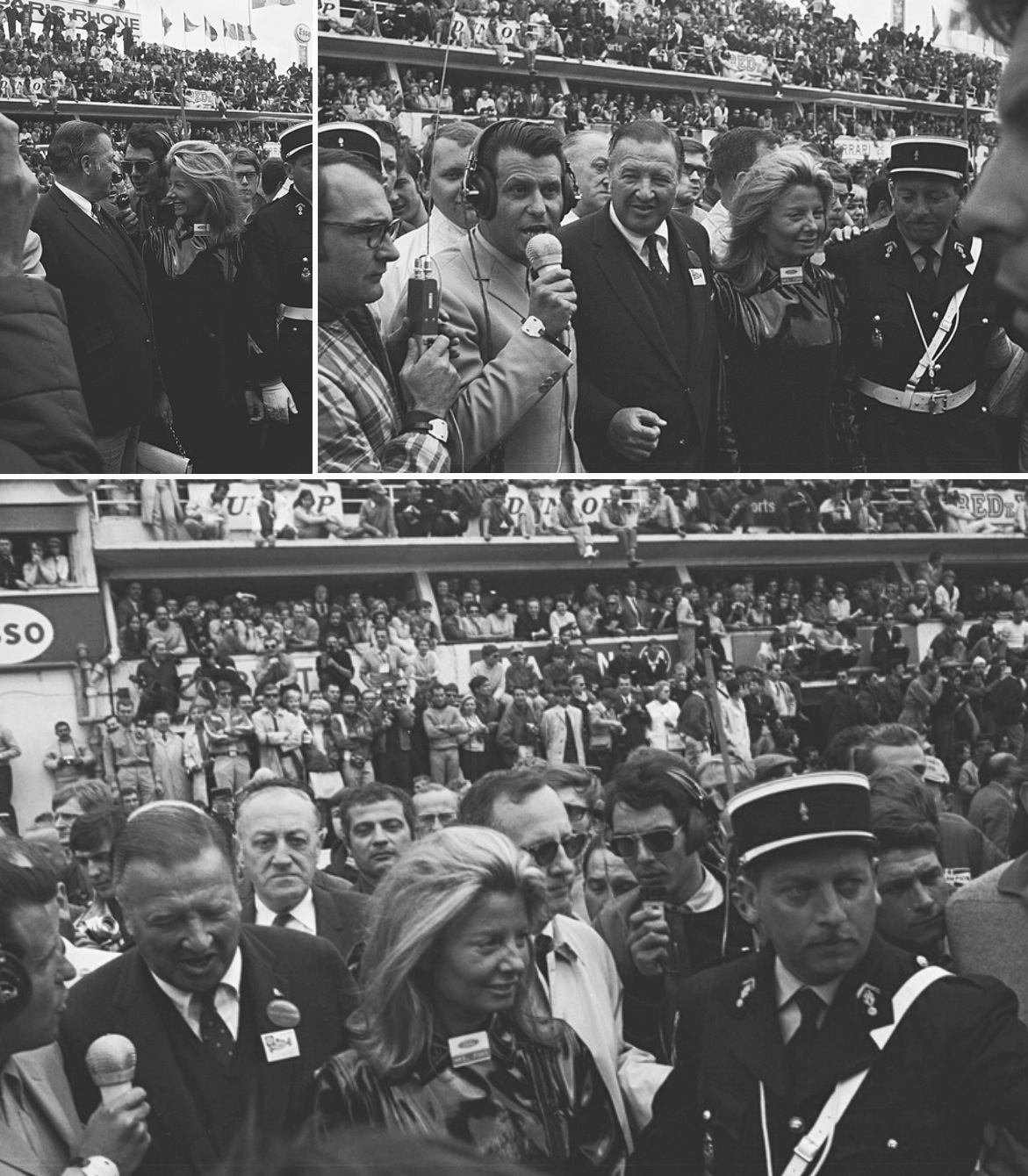
300,000 people attended the race on 10 June in overcast, warm weather, Henry Ford 2 and wife arriving by ‘chopper shortly before the race…
After the traditional start Pedro Rodriguez led initially in the NART Ferrari but was quickly passed by the Paul Hawkins Mk2B, who led at the end of the first hour by which time both Lola’s were out; Surtees with engine trouble after 3 laps, Chris Irwin on lap 25 later with fuel pump problems.
#21 Scarfiotti in the 2nd placed Ferrari P4 from the #4 Hulme Ford Mk4 during the early laps. Below is the Surtees Lola also during the first 3 laps…
After the first pitstop the Chaparral 2F took the lead, the Fords getting about an hour out of a fuel tank, the Fazz’ and Chaparral about 15 minutes longer.
The Hill/Spence Chap 2F circulating fast at this point doing 3 min 29 sec laps…
After the second refuelling the Gurney/Foyt Mk4 lead from the Hill/Spence Chaparral followed by the Andretti/Bianchi and McLaren/Donohue Ford Mk4’s.
Oopsie; Ricardo Rodriguez (no relation) in the ‘kitty litter’ on Lap 30, the NART Ferrari 365P2 retired at this point. Car shared with Chuck Parsons. In the background in the lower photo is the works Austin Healey Sprite of Clive Baker/Andrew Hedges which finished 15th, first British car home.
The ill-fated Andretti/Bianchi Mk4 ahead of Chris Amon/Nino Vaccarella Ferrari P4 DNF puncture/fire and Denny Hulme/Lloyd Ruby Mk4 DNF accident, in The Esses in the first quarter of the race.
‘British Racing and Sports Car Club’ fireman in the latest gear.
After 4 hours the Gurney car was still ahead.
This time from the Andretti Ford. Three Fords led from the Chaparral, with Ferrari further back, the leading Ferrari’s were driven by Amon/Vaccarella P4 and Rodriguez/Baghetti, P3/412P.
The #8 Bruce Jennings/Bob Johnston Chaparral 2F in the pits for its final pitstop on lap 91, car out with battery and starter failure.
2 P4’s, the white car the NART P Rodriguez/Baghetti P4/412P entry chasing the Jennings/Johnston Chaparral 2F and a 911S about to be ‘swallowed’ by all 3.
After 6 hours the 2nd #8 Chaparral failed to restart after a pitstop.
Hill pitted at about the same time in the #7 Chap with the transmission, the cars weak link checked leading to speculation about its health. The stop lasted 9 minutes, the car rejoined in 7th place.
Rindt (below) retired his Porsche 907, having over-revved its 2 litre flat 8.
The #7 Chaparral 2F Chev of Spence and 5th placed Porsche 907 ‘Langheck’ of Siffert/Hans Hermann with Jo at the wheel. Car also the 2 litre winner.
At 2 am it was still 1-3 for Ford but the pattern of the race changed hugely after Andretti took over his car from Bianchi, it was fitted with fresh brake pads.
As he approached The Esses and braked one disc grabbed, pinging the car instantly between the unforgiving earth banks until finishing in the middle of the track with bits of ‘Big Henry’ scattered all over the place.
Roger McCluskey arrived in the Mk2B he shared with Frank Gardner, braked, spun and hit the banks wrecking another factory Ford. Schlesser then added to the party arriving in the Ford France Mk2B he shared with Guy Ligier and spun in avoiding his teammates- three Fords were out on the spot!
The winning Mk4 of Gurney/Foyt ahead of #57 Ronnie Bucknum/Paul Hawkins Mk2B DNF and #14 Mirage M1 Ford of David Piper/Richard Thompson,DNF .
Dead Ferrari’s atop the transporter in the middle of the race, both with piston failure; #22 Jean Guichet/Herbie Muller Ferrari P3/412P #25 Pedro Rodriguez/Giancarlo Baghetti Ferrari P3/412P
AJ Foyt aboard the winning Ford Mk4 chassis ‘J5’.
At half distance the Gurney/Foyt Mk4 had a huge lead
But there were three Ferrari’s and a Chaparral between Gurney and the next Ford.
At dawn it was Gurney/Foyt 7 laps ahead of the Parkes/Scarfiotti Ferrari, the Hill/Spence Chaparral then Ferrari-Ford-Ferrari, it was anybody’s race at this point.
At 5.30am Hill’s Chaparral pitted for investigation of an oil leak; and stayed for 3 hours whilst the mechanics heroically removed the transmission and fitted a new oil seal but the car was finally retired with an oil-less transmission.
Chaparral council of war in the middle of the night. Jim Hall , Phil Hill and Mike Spence curse the cars auto gearbox, its weakness that year. The one bright spot for the fastest, most innovative and stunning sports/prototype of 1967 was its season ending Brands Hatch 6 Hour victory in July.
With 6 hours to go the Gurney/Foyt Ford only lead by 5 laps!
But it was one Ford from three Ferrari’s with the Italian cars being driven very hard, Mike Parkes said ‘I have never driven a car so hard for so long’ of his Ferrari P4 after the race.
What am i going to tell The Commendatore!? Franco Lini, Ferrari Team Manager ponders the teams prospects late in the race. It was an honorable defeat, to say the least, against the onslaught of the then second largest motor manufacturer in the world.
With less than 2 hours to go the Ferrari’s were lapping 10 seconds a lap quicker than the leading Ford, with 90 minutes to go both cars stopped for fuel for the last time, Ferrari’s only hope a Ford failure but it was not to be…
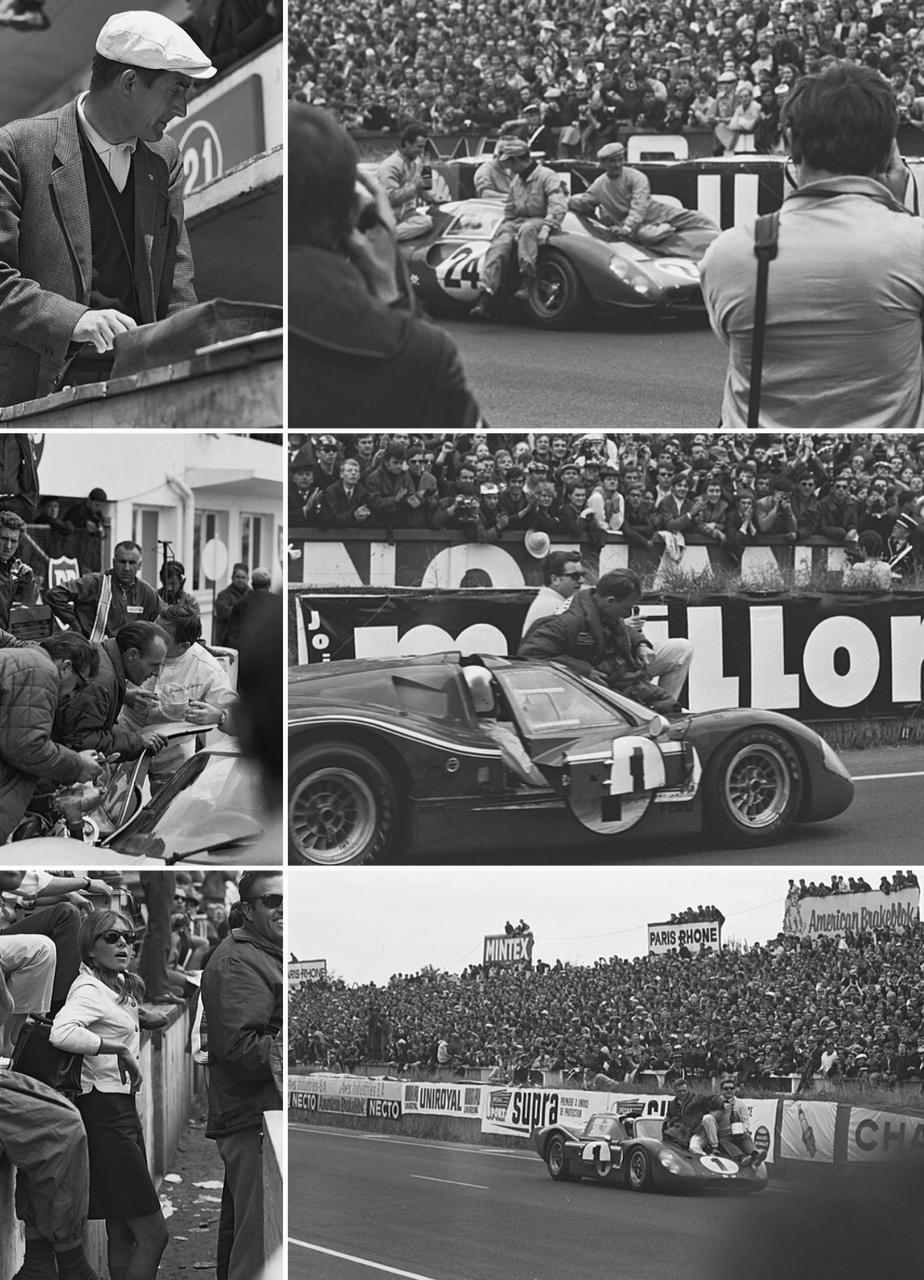
Car #24 the 3rd place Willy Mairesse/Jean Blaton Ferrari P4 and winning #1 Mk4, ‘victory lap’. Small shots; Franco Lini, Bruce McLaren Mk4 pit, ‘pit popsie’.
It was the first ‘All American’ win ever; car and drivers. Ford were both first outright and won ‘The Index of Thermal Efficiency’, which seems somewhat of a contradiction in terms for a car powered by a 7 litre cast iron, OHV V8!…
The first six placings were;
1st. Gurney/Foyt Ford Mk4 388 laps
2nd. Scarfiotti/Parkes Ferrari P4 384 laps
3rd. Mairesse/Blaton Ferrari P4 377 laps
4th. McLaren/Donohue Ford Mk4 359 laps
5th. Siffert/Hermann Porsche 907 358 laps 2 litre winner
6th. Stommelen/Neerpasch Porsche 910 351 laps
Winners are Grinners…
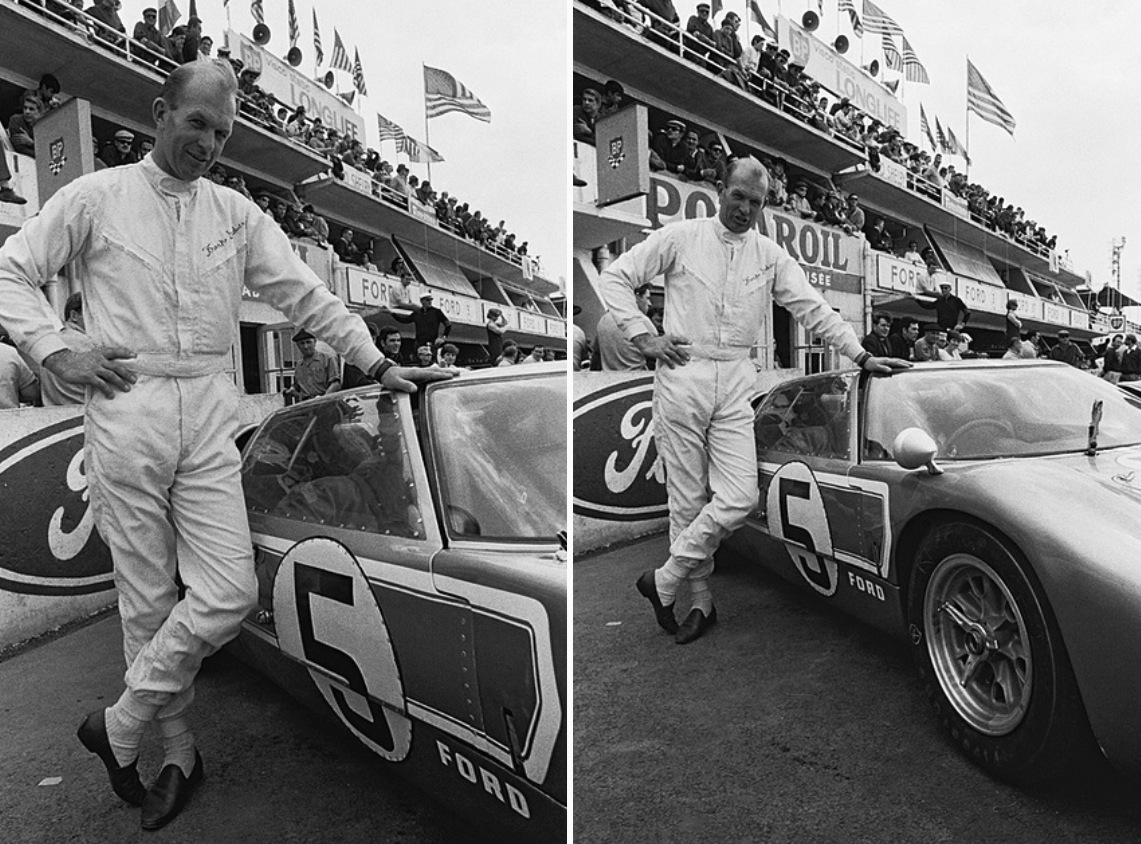
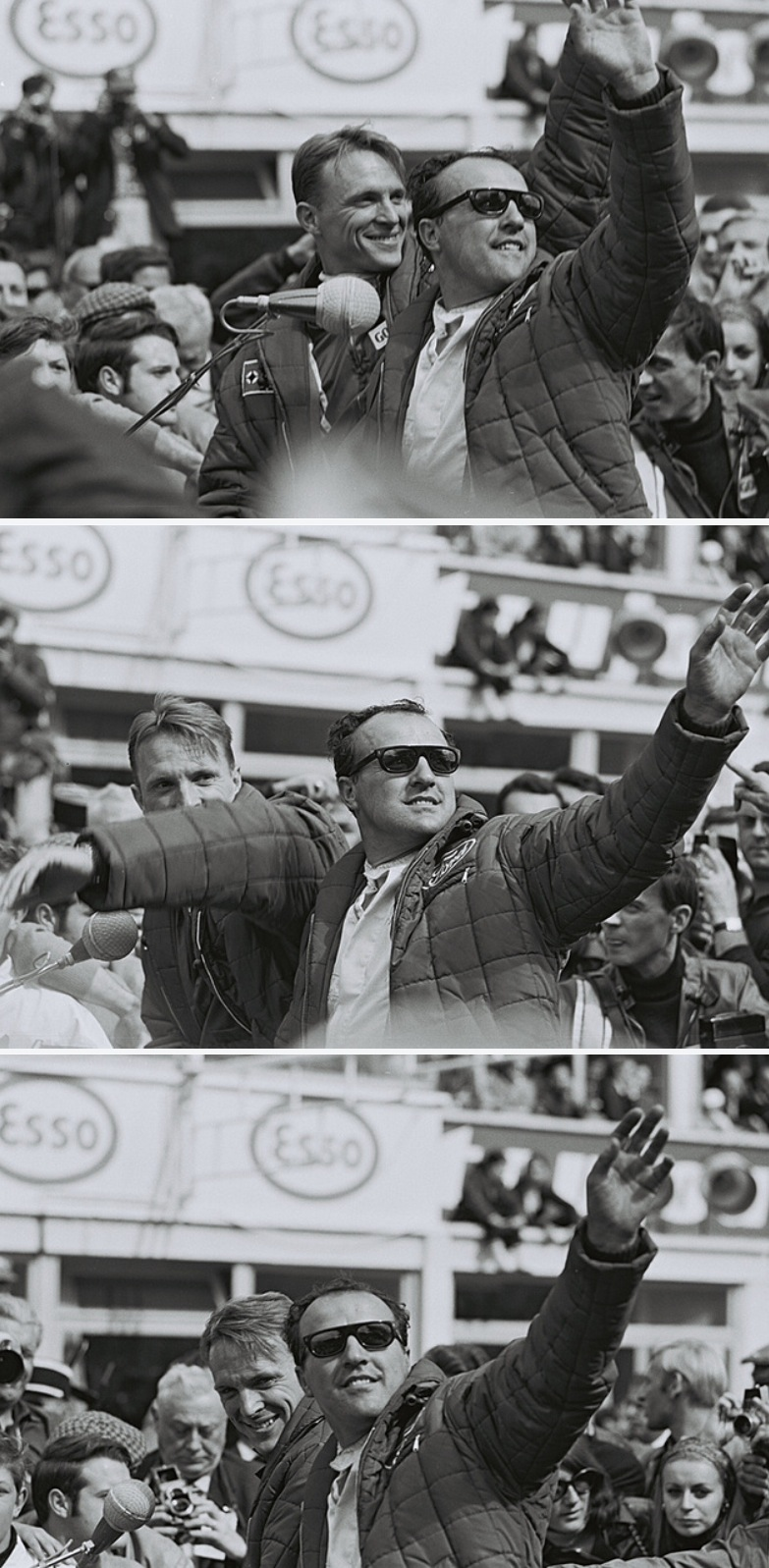
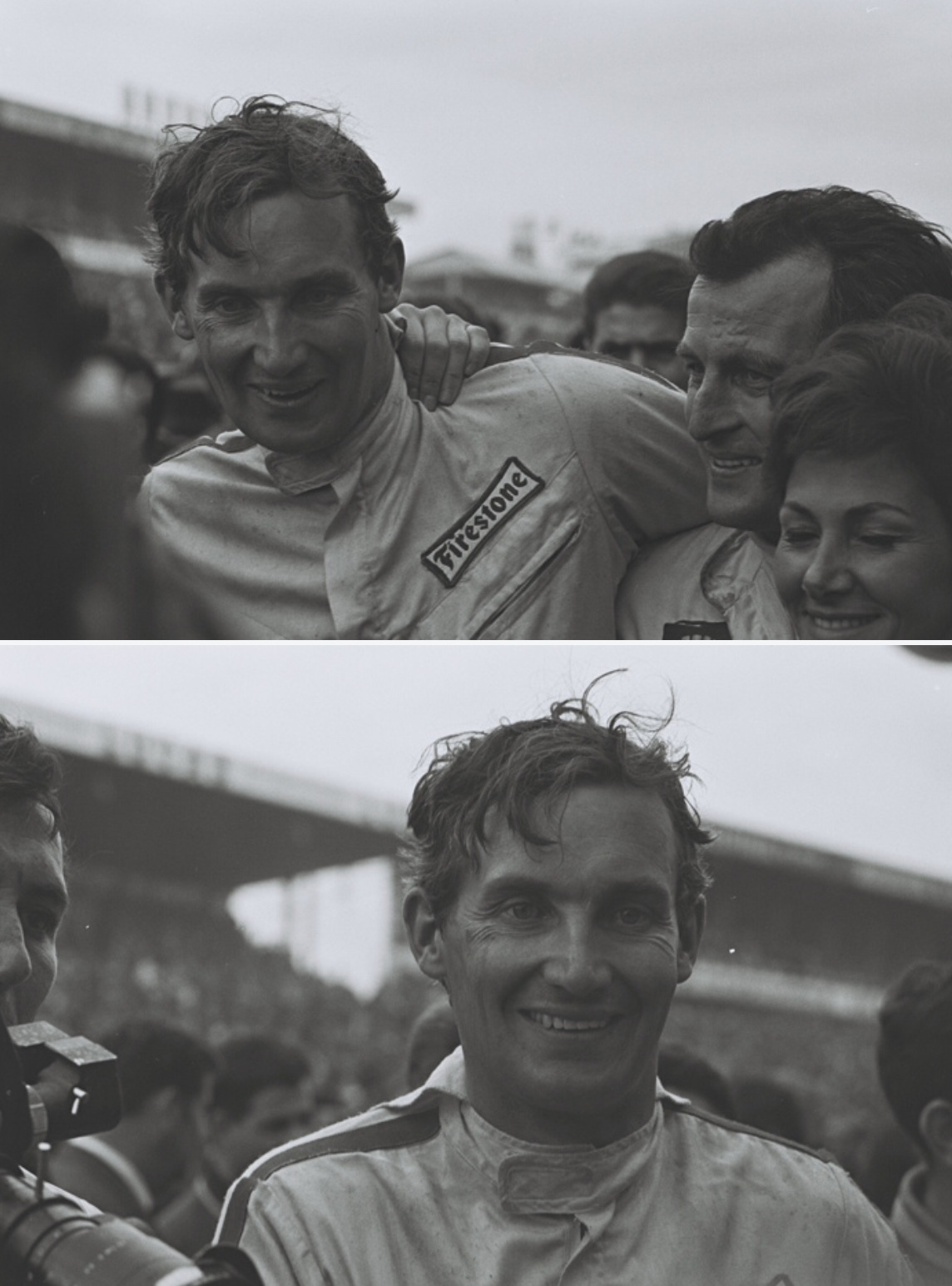
The winning Ford covered a record distance and was pushed hard all the way- Dan Gurney at left and AJ Foyt, right, below.
Mike Parkes (L) and Ludovico Scarfiotti looking suitably tired after fantastic drives in pursuit of the Ford Juggernaut!
Henry Ford 2 and his wife Maria look well pleased with the results of their teams work.
Its interesting to reflect on how different automotive/motor racing history may have been had Enzo Ferrari not withdrawn from the final stage of negotiations for the ‘Boys from Dearborn’ to buy his Maranello outfit in July 1963.
Whatever the case, motor racing had a friend in Henry Ford 2. Without his patronage and support of racing to build Ford’s global brand we would not have had many of Ford’s programs which enriched racing during his tenure of either direct or indirect control of FoMoCo.
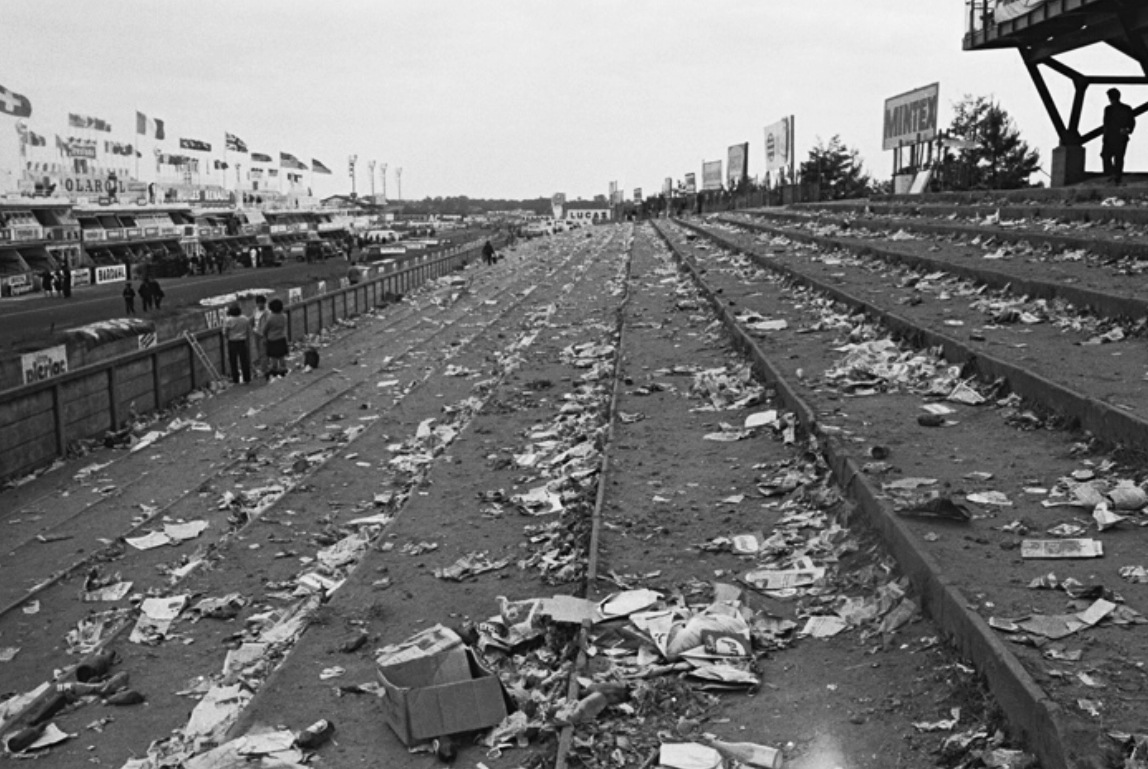
Tailpiece; The Morning After the Night Before…
Photo Credits…
The amazing Dave Friedman Archive, Rainer Schlegelmilch
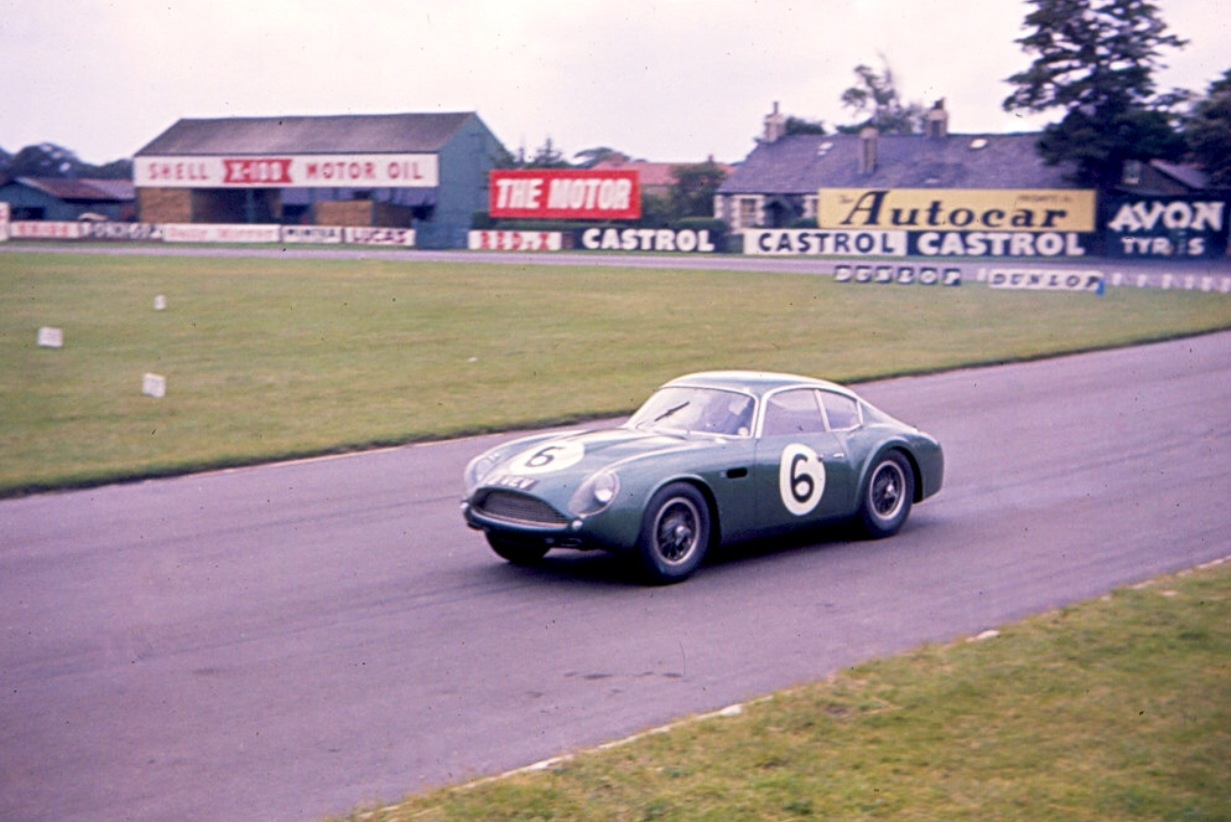
Lex Davison aboard 2 VEV at Aintree in July 1961. He won the 51 mile GT race after a battle with Jack Sears’ Jaguar E-Type. He took the lead on the last lap, perhaps recording the car’s only race win in-period.
2 VEV chassis #0183/R was registered to John Ogier’s Essex Wire Racing Team on 19 May 1961. One of 19 Aston Martin DB4GT Zagato’s, this most famous car was raced by Aussies Lex Davison and Bib Stillwell at Le Mans in 1961 alongside 1 VEV, driven by Jack Fairman and Bernard Consten.
The cars had factory support but the race was a disaster. Both failed to finish due to head studs which had been insufficiently tightened/torqued, they ran as high as 15th and 17th behind the open Aston DBR1s before withdrawal from the 24-Hour classic.
Le Mans 1961 start;#1 Dewez/Kerguen DB4Z , #2 Fairman/Consten DB4Z, #3 Davison/Stillwell DB4Z, #4 Salvadori/Maggs Aston DBR1, #5 Clark/Flockhart Aston DBR1 all DNF. The race was won by the Gendebien/Phil Hill Ferrari 250TR (unattributed)
Davison had only 25 laps under his belt when the head gasket failed at Le Mans (MotorSport)
Davison and Stillwell, Australian multiple champions both, had immaculate Aston Martin connections, having raced Grand Prix Aston DBR4s in Australia, see here; Lex’ Aston Martin DBR4/250’s… | primotipo…
Indeed, Lex came within feet of winning the 1960 Australian GP at Lowood, Queensland. He was pipped on the line by Alec Mildren’s Cooper T51 Maserati after a thrilling, race long dice.
It was the closest any of these wonderful but outdated cars came to Grand Prix win. Lex also contested a few 1962 Intercontinental Formula races in the UK aboard a DBR4.
Lex Davison contesting an Intercontinental Formula race at Brands Hatch in his bruised Aston DBR4/250 #4 in 1961. The car was then 3-litre DBR1 powered (unattributed)
Back to the GT Zagato, Lex won at Aintree in July after the battle with Jack Sears’ Jag E-Type. Motor magazine reported that Davison “looked like the prosperous middle aged businessman that he is, rather than a dashing man about town”. In fact he was a champion middle-aged racing driver, a four time winner of the Australian Grand Prix no less!
Jim Clark contested the 1961 RAC Tourist Trophy in it at Goodwood in August, but the SWB Ferrari 250s were too quick, Salvadori and Clark took third and fourth respectively in VEV1 and 2.
2 VEV was loaned to Equipe National Belge to race in the 1962 GP of Spa for GT cars. Lucien Bianchi led the race before losing the car and totalling it. In five weeks the it was rebuilt by the factory around a new chassis to DP209 ultimate lightweight specifications The machine emerged with a lower, flatter roofline, longer nose and tail, and wider rear wheel arches than a standard DB4Z.
Oh-so-famous shot of Jim Clark in Aston DB4GT Zagato 2 VEV, 1962 Goodwood RAC TT (unattributed)
Clark raced the car again in the 1962 Tourist Trophy at Goodwood that August. Having just pitted, and on coolish tyres, he lost control as the car settled after traversing the 120mph Madgwick Hump, he spun into the path of John Surtees’ leading Ferrari 250 GTO, taking then both out of the race. More works surgery to 2 VEV was required. The car raced again in Clark’s hands in the Paris 1000km, but failed while in co-driver Sir John Whitmore’s hands.
Surtees Ferrari 250 GTO and Clark’s Aston DB4 Zagato at Goodwood ’62. Clark spun taking Surtees out on lap 62 of 100. The race was won by Innes Ireland’s UDT-Laystall Ferrari 250 GTO (unattributed)
The car then ran in minor events in John Ogier’s ownership until 1964, racing on into the late 1960s and historic racing after that. 2 VEV was damaged in a road accident in 1993 and was restored/rebuilt to its 1962 specifications, the poor old darlin’ had by that point, ‘more hits than Elvis’ as the saying goes…
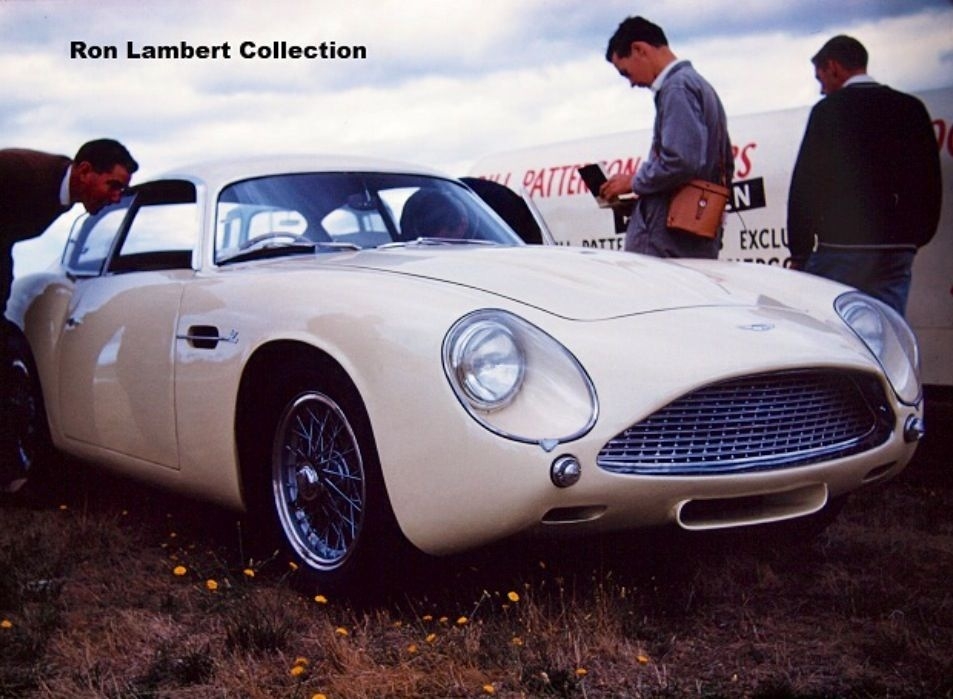
1962 Goodwood RAC TT start; Clark is the bolter in his DB4Z. #15 is the winning Ireland 250 GTO, #6 Surtees’ ill fated GTO, #5 Mike Parkes GTO, #8 David Piper GTO, #25 Trevor Taylor/Gil Baird Lotus Elite (unattributed) Australia’s only DB4Z, #DB4GT/0186/R, the fourteenth built, was owned by Sydney’s Laurie O’Neill. Here it’s pictured in the Longford paddock in March 1962. It was raced in a support event by thrice AGP winner Doug Whiteford (Ron Lambert Collection)
The DB4GT Zagato…
The Aston Martin DB4GT Zagato was introduced to the world at the London Motor Show in October 1960.
It was effectively a DB4 GT improved by Carrozzeria Zagato, Ercole Spada is the designer credited with the work. Smaller, more aerodynamic and about 100 pounds lighter than the DB4 GT, the Zagato’s twin-cam, two-valve, 45DCOE Weber fed 3670cc engine produced 314bhp @ 6,000rpm, 12 more than the DB4 GT giving it a top speed of 154mph.
Initially the factory planned 25 cars, but demand wasn’t strong enough so only 19 were completed, albeit 23 chassis numbers had been allocated. Four modern Sanction 2 Coupes were built on DB4 rolling chassis completed by Richard Williams (RSW) to the order of Aston Martin using the unused chassis numbers from 1987-91.
Ex-Zagato employee Mario Galbiatti (with Zagato’s approval) built the bodies using Williams’ own dismantled Zagato as a template. Completed and launched in July 1991, in 1993 Williams completed two more Aston Martin Lagonda approved Sanction 3 cars using left over Sanction 2 bits. Not to forget AML’s own 19 April 2019 Continuation Series DB4GTZs…
The first competition outing of a DB4 GT Zagato was during Goodwood’s 1961 Easter meeting. Driven by Stirling Moss, it finished third behind an Aston Martin DB4 GT and the winning Ferrari 250 GT.
1960 London Motor Show launch for the DB4GT Zagato.
Etcetera…
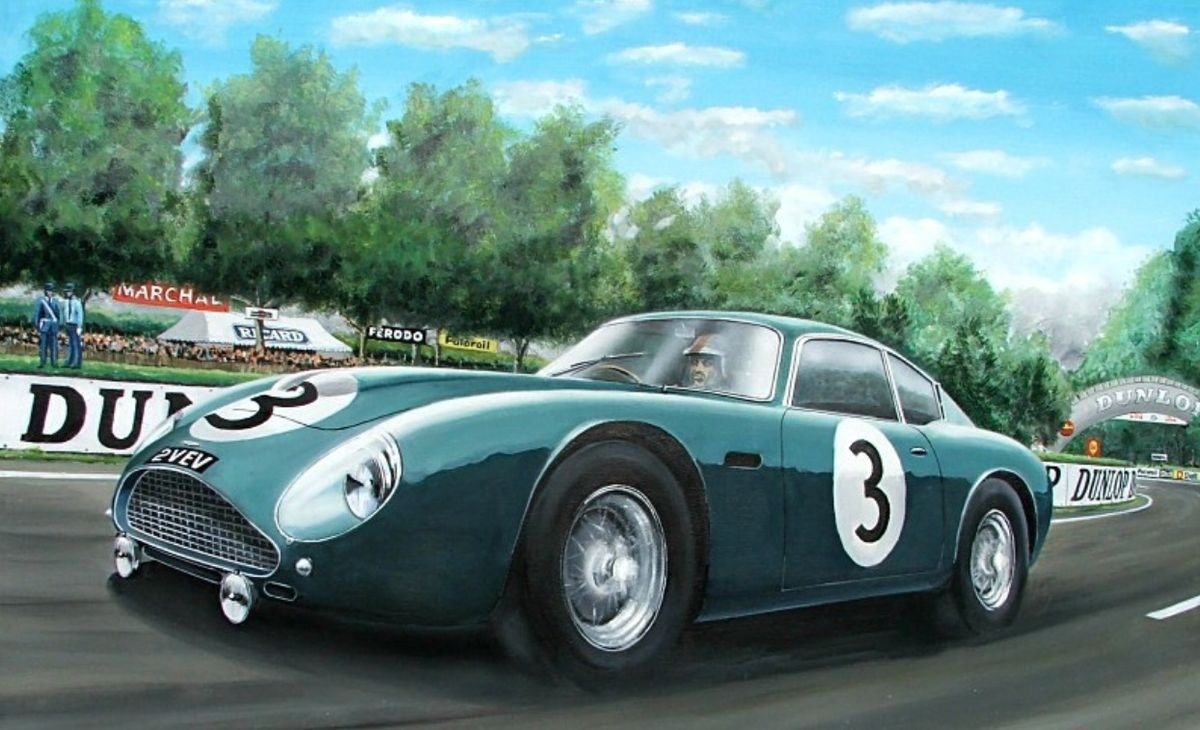
John Ogier’s two Aston DB4 Zagatos in the Le Mans paddock, 1961. #3 Davison/Stillwell, #2 Fairman/Consten (unattributed) Painting of the Davison/Stillwell DB4Z, Le Mans 1961 (Bernard Reeves)
Credits…
Ron Bert Collection, Bernard Reeves, Jim McKeown Collection
Tailpiece…
(J McKeown)
Doug Whiteford in Laurie O’Neill’s Zagato with Jim McKeown, Jewitt Holden and George Spanos, Elfin Streamliner Ford on the front row of the grid. Longford GT race in 1962 won by Whiteford from McKeown.

























 primotipo...