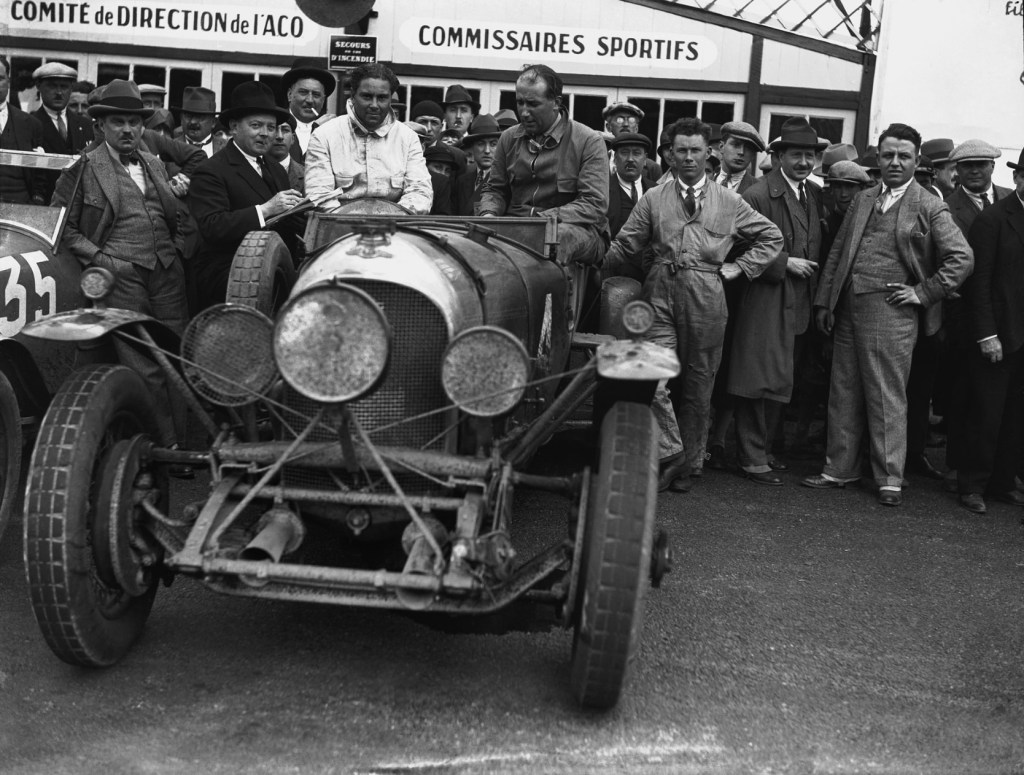
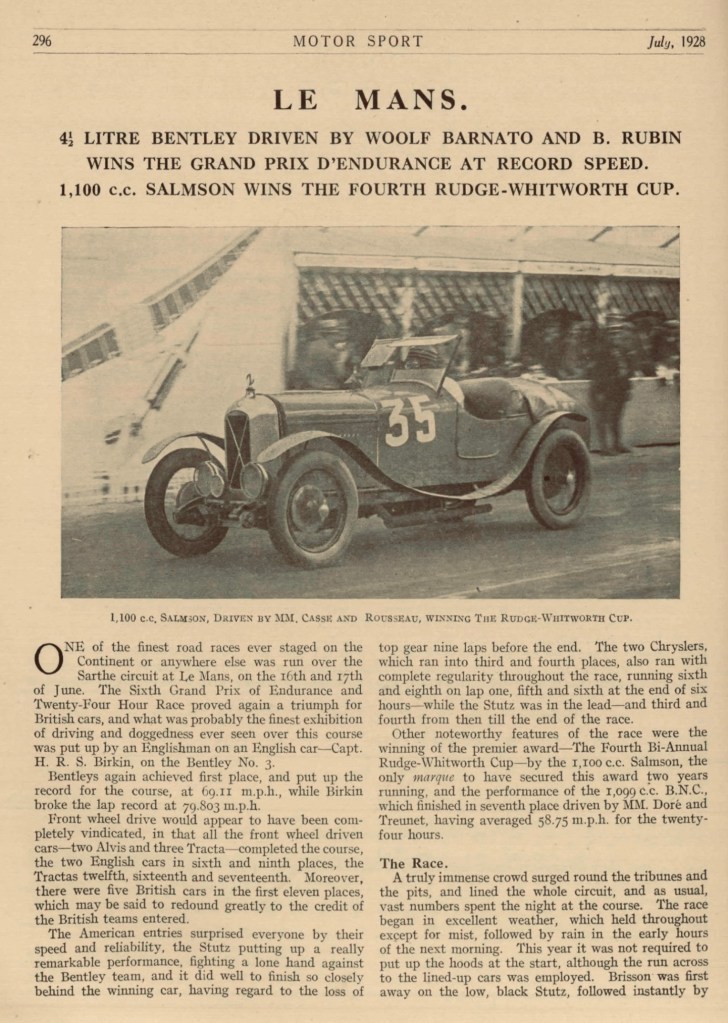
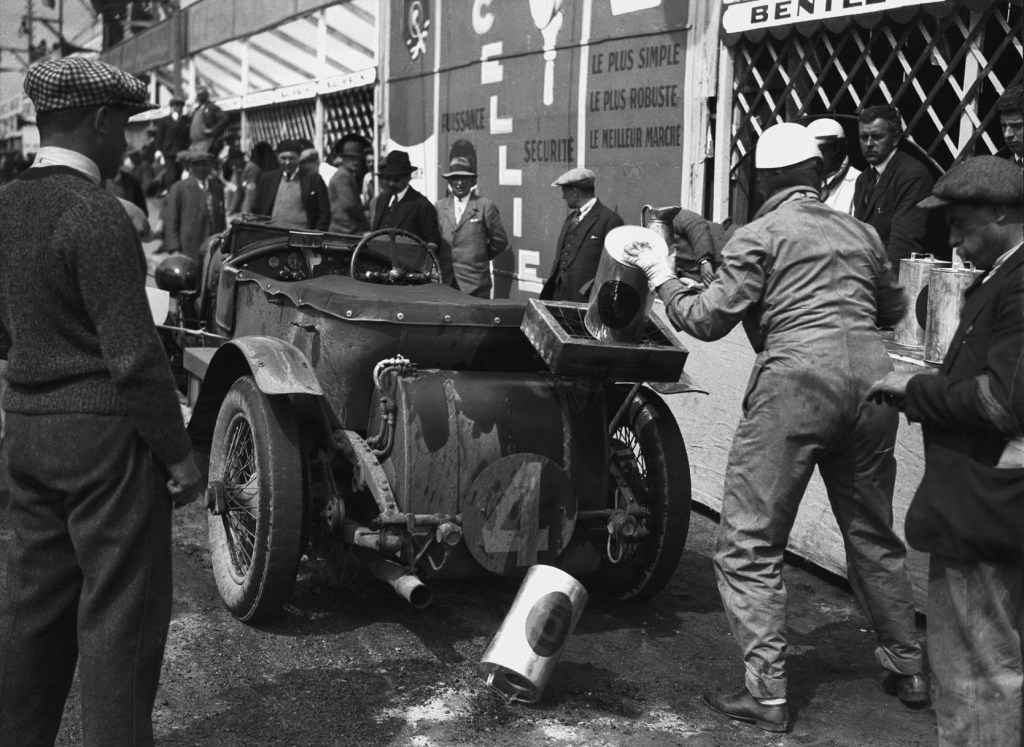
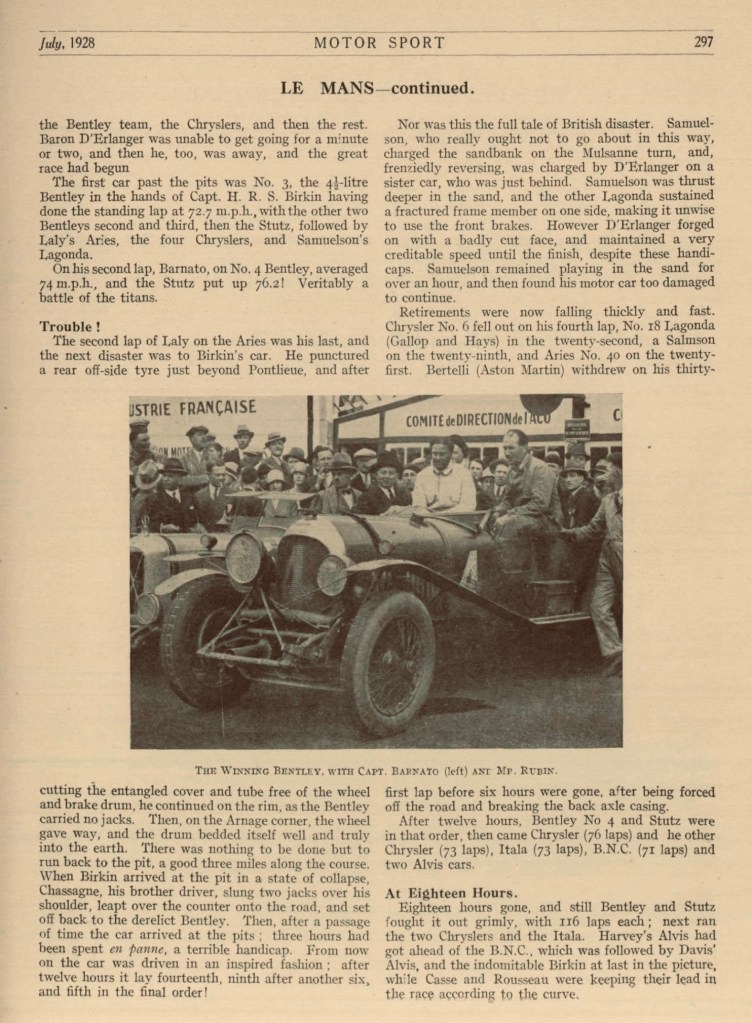
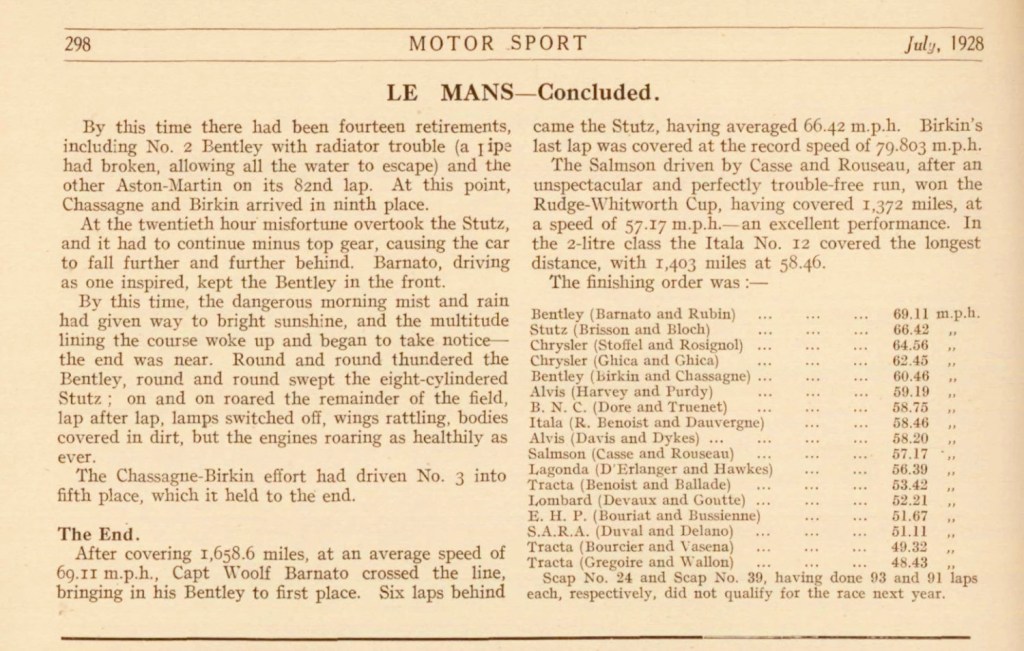
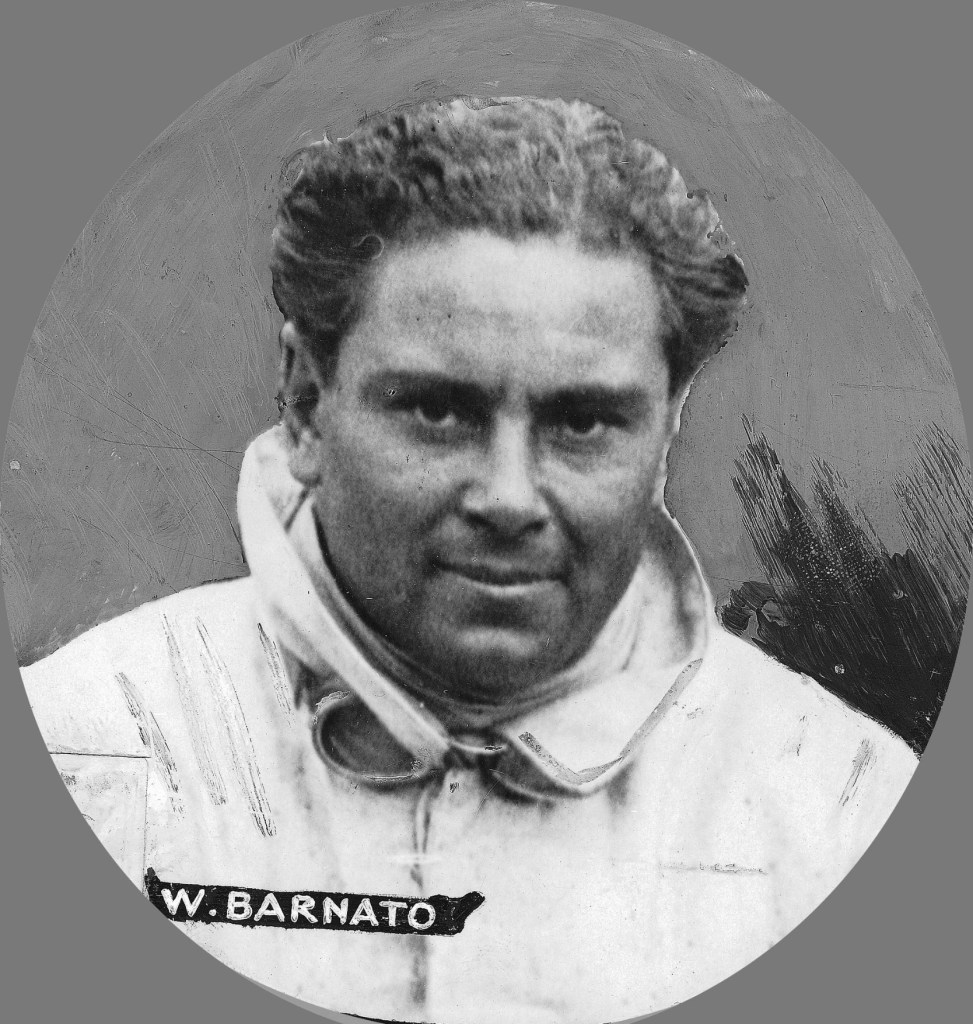
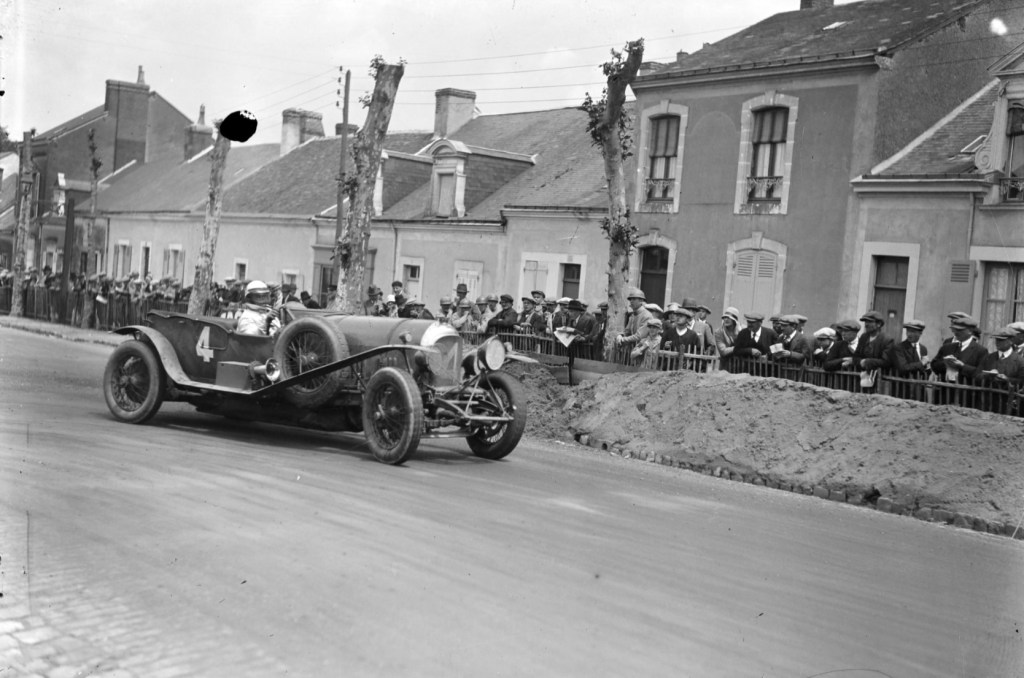
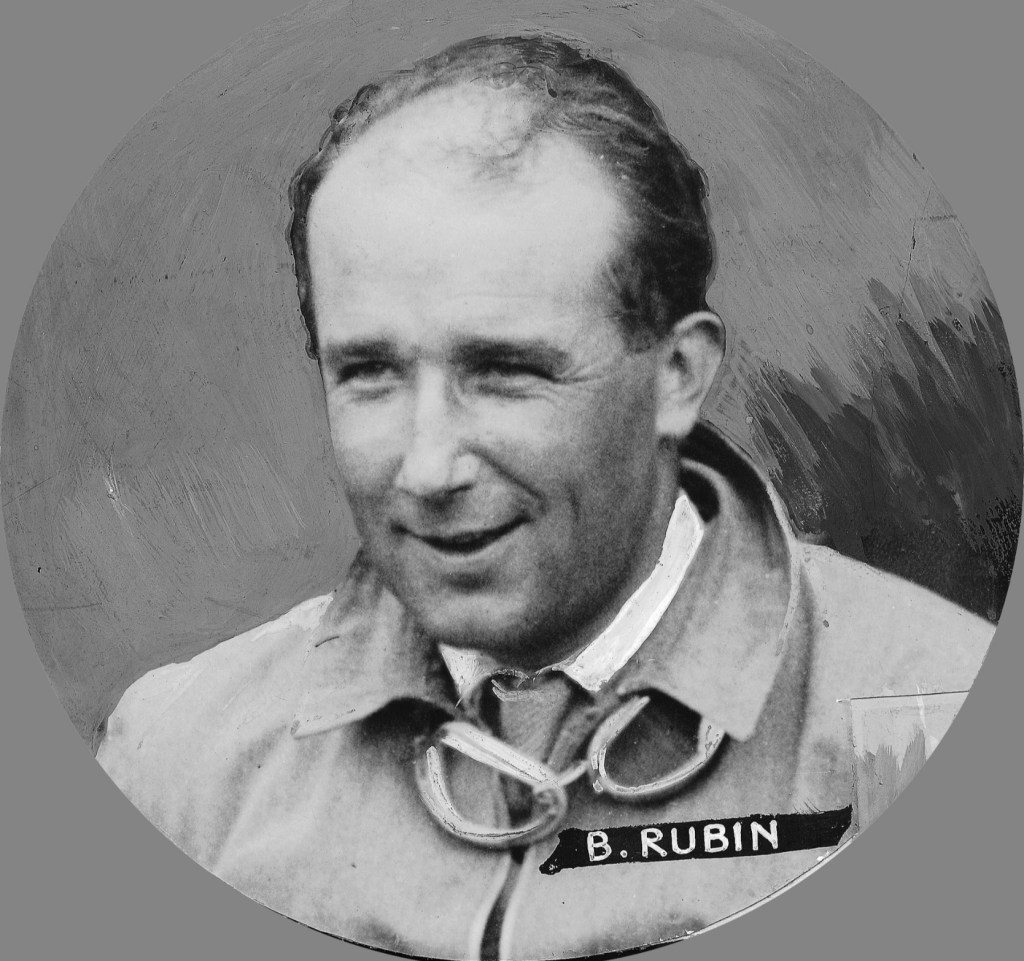
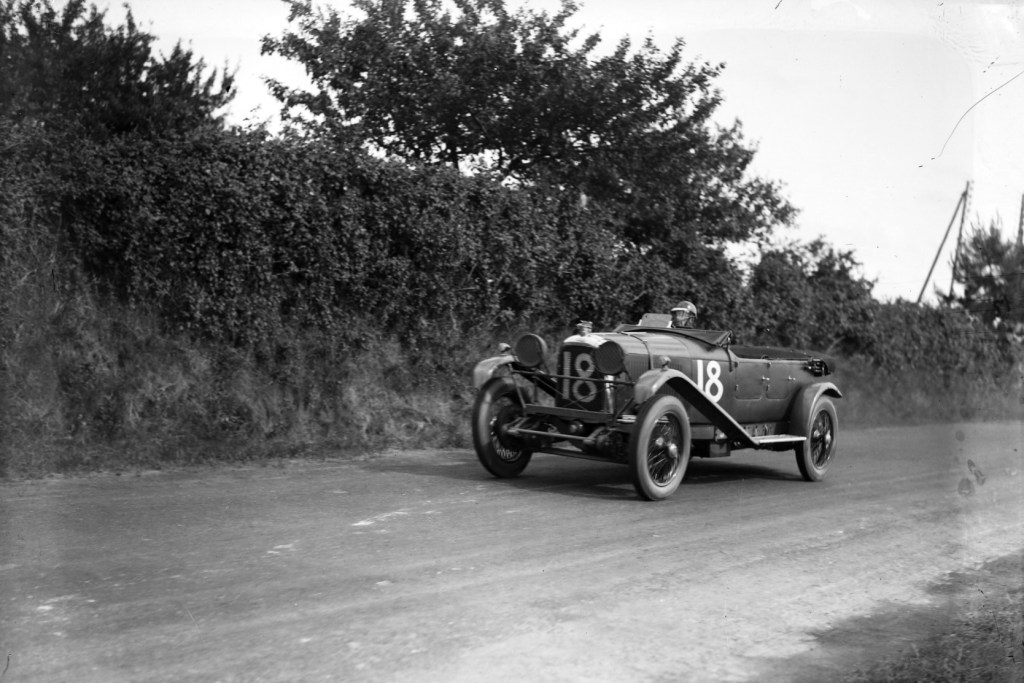
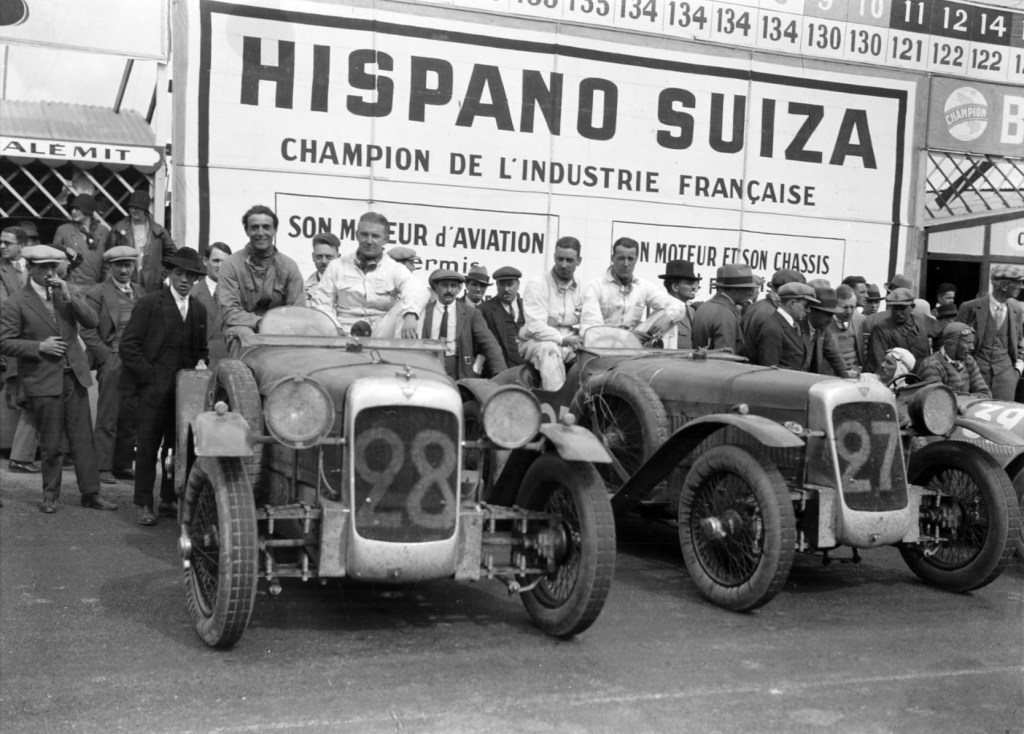
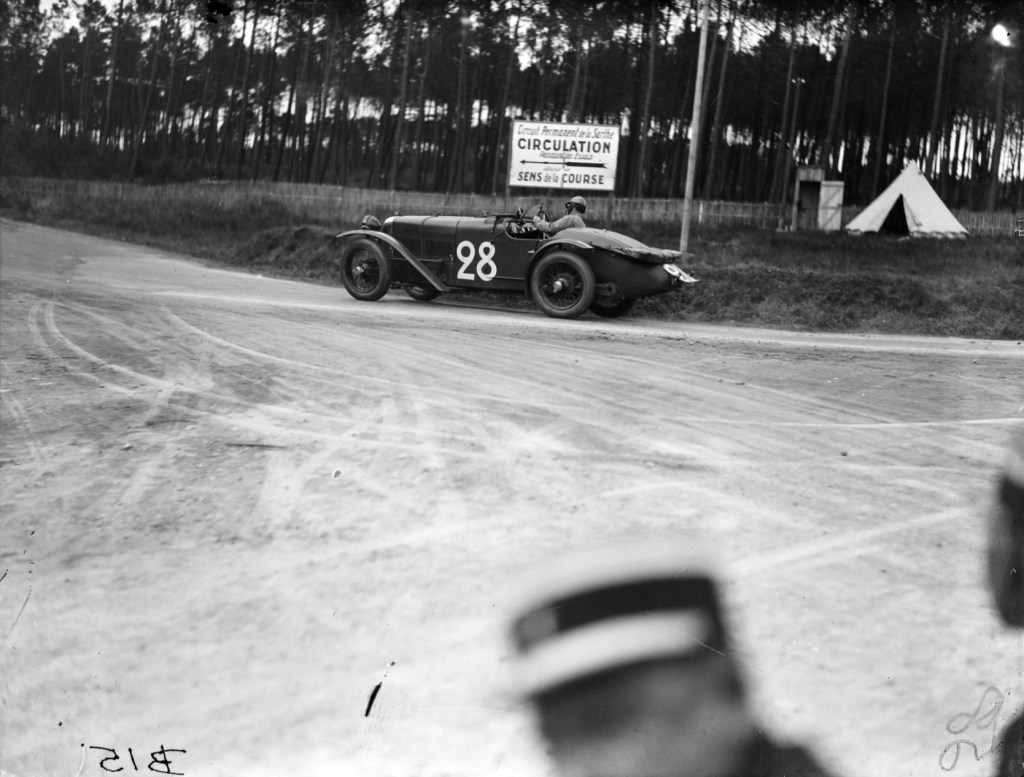
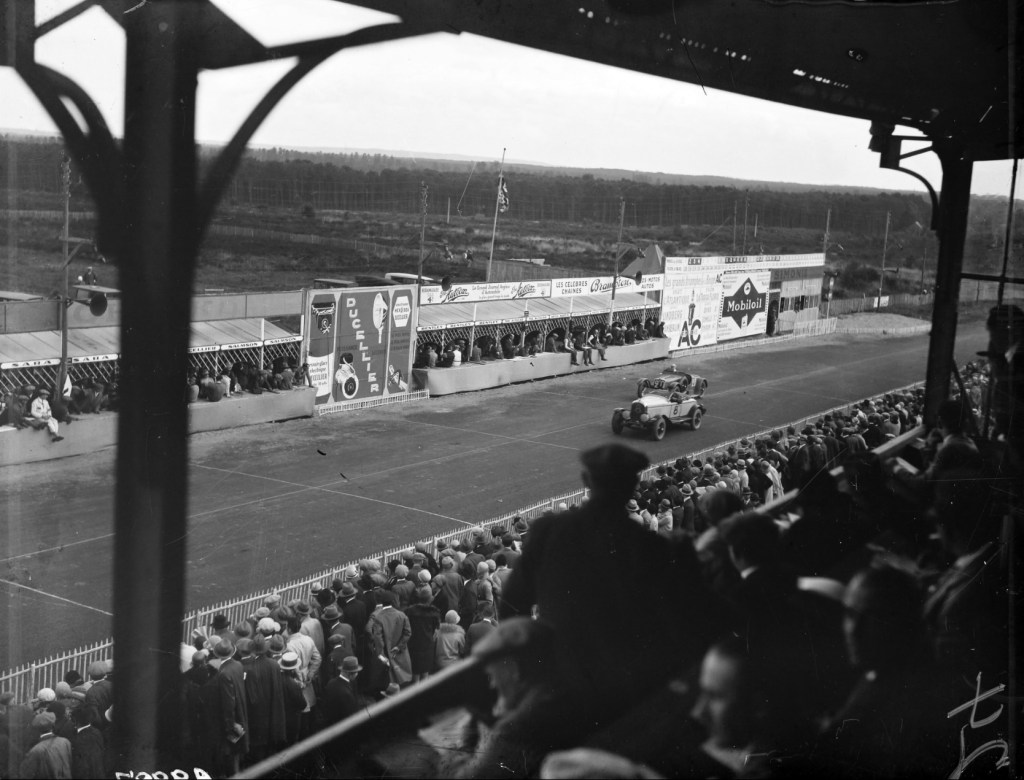
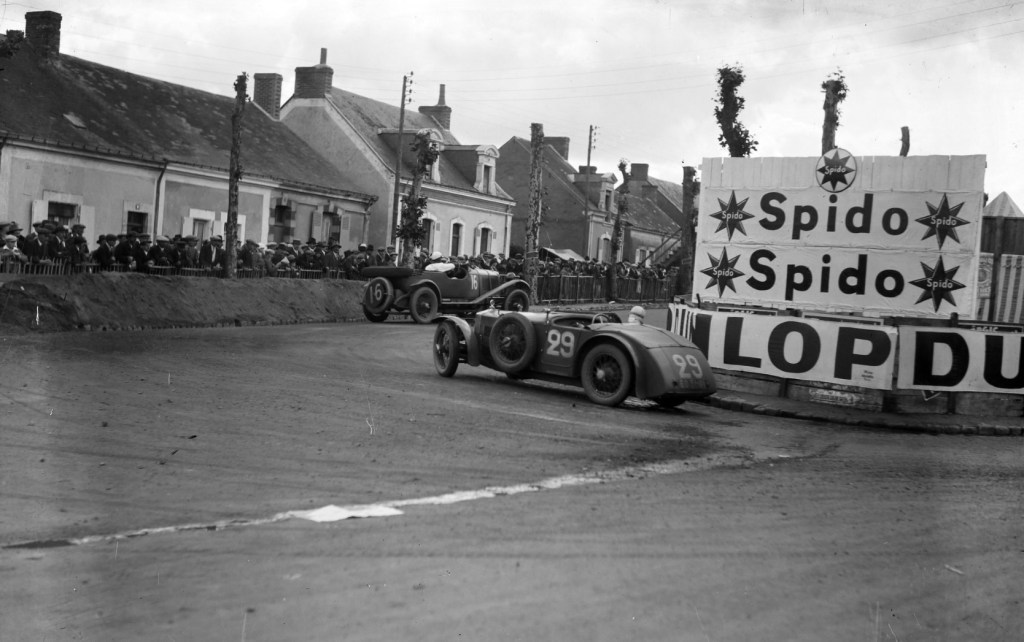
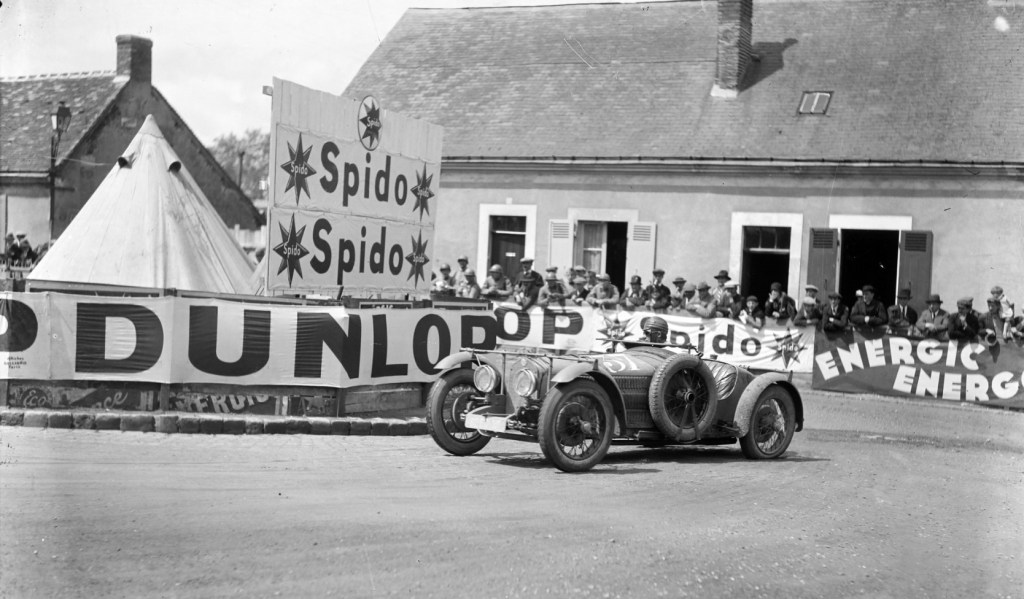
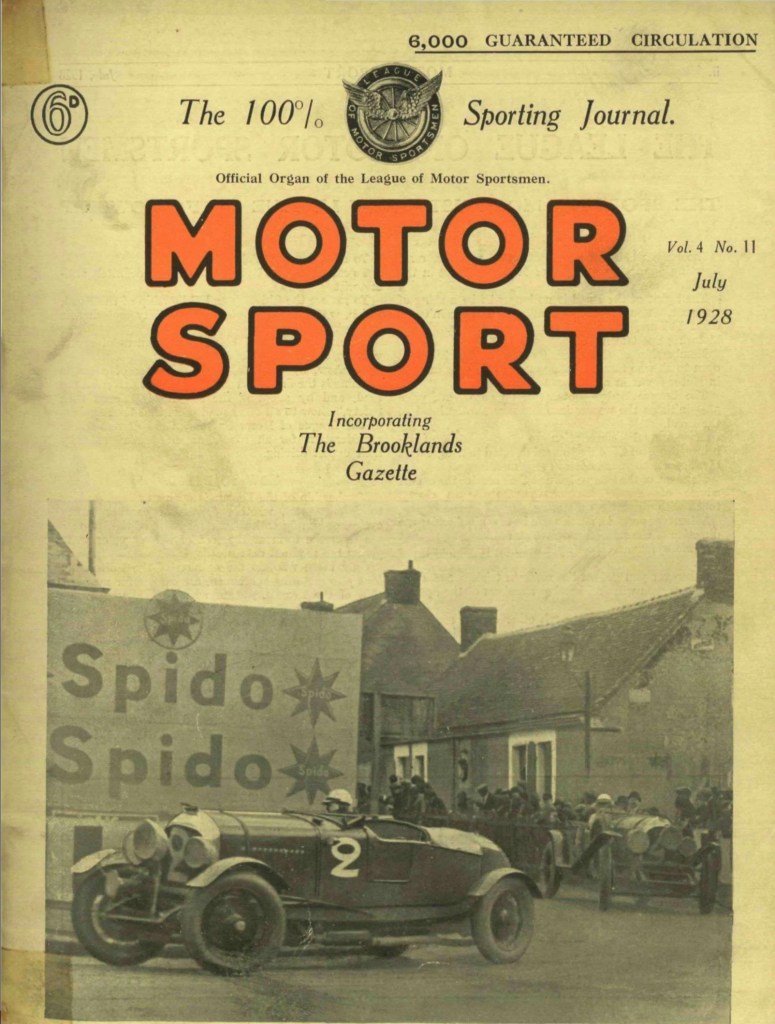
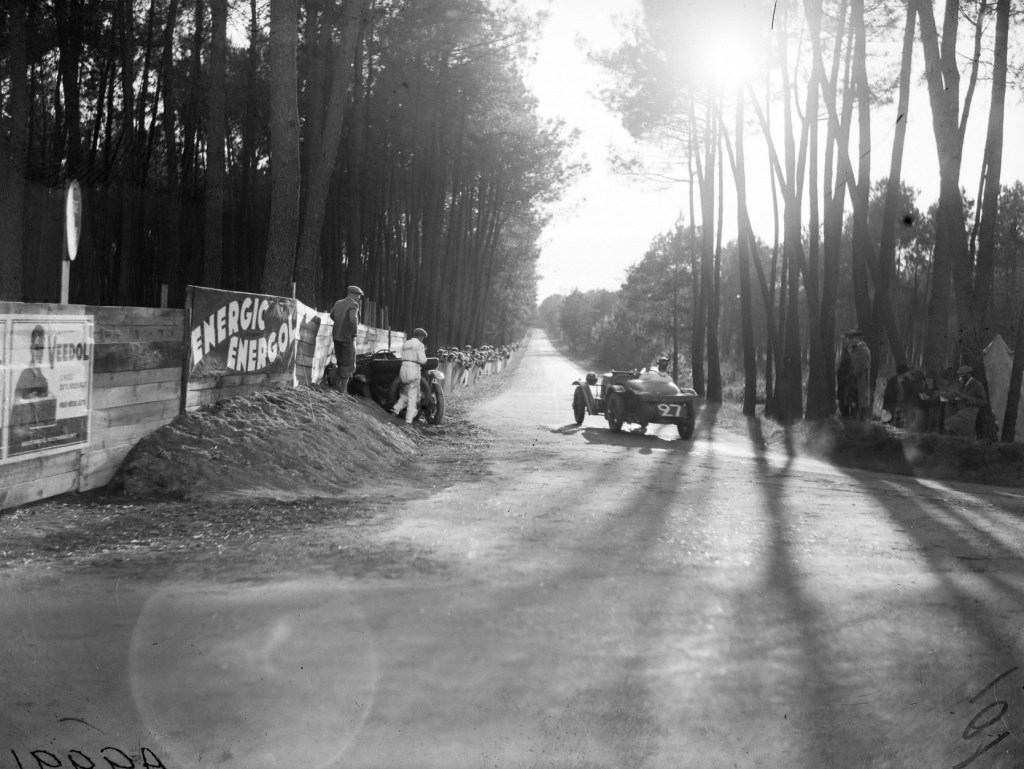
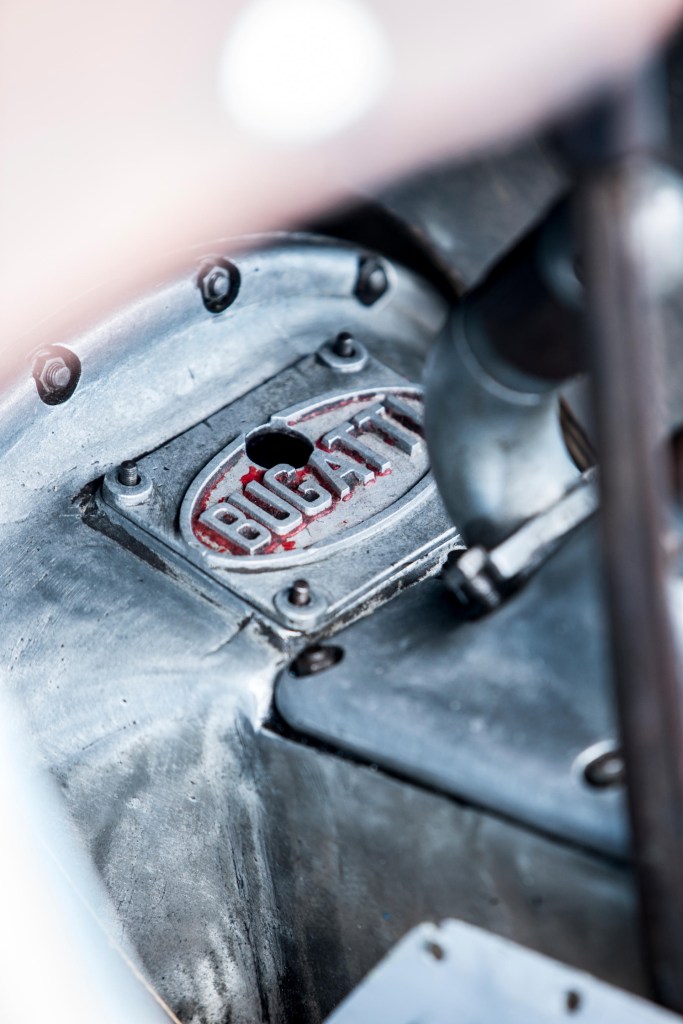
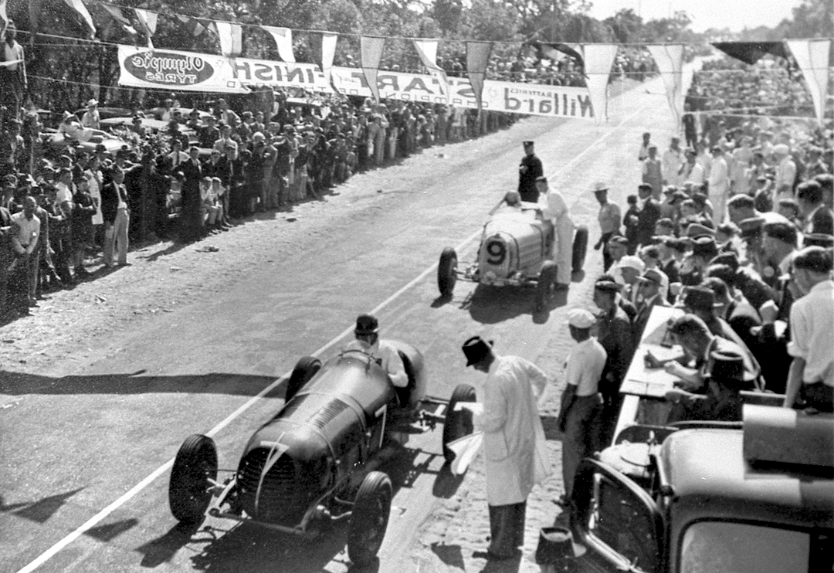
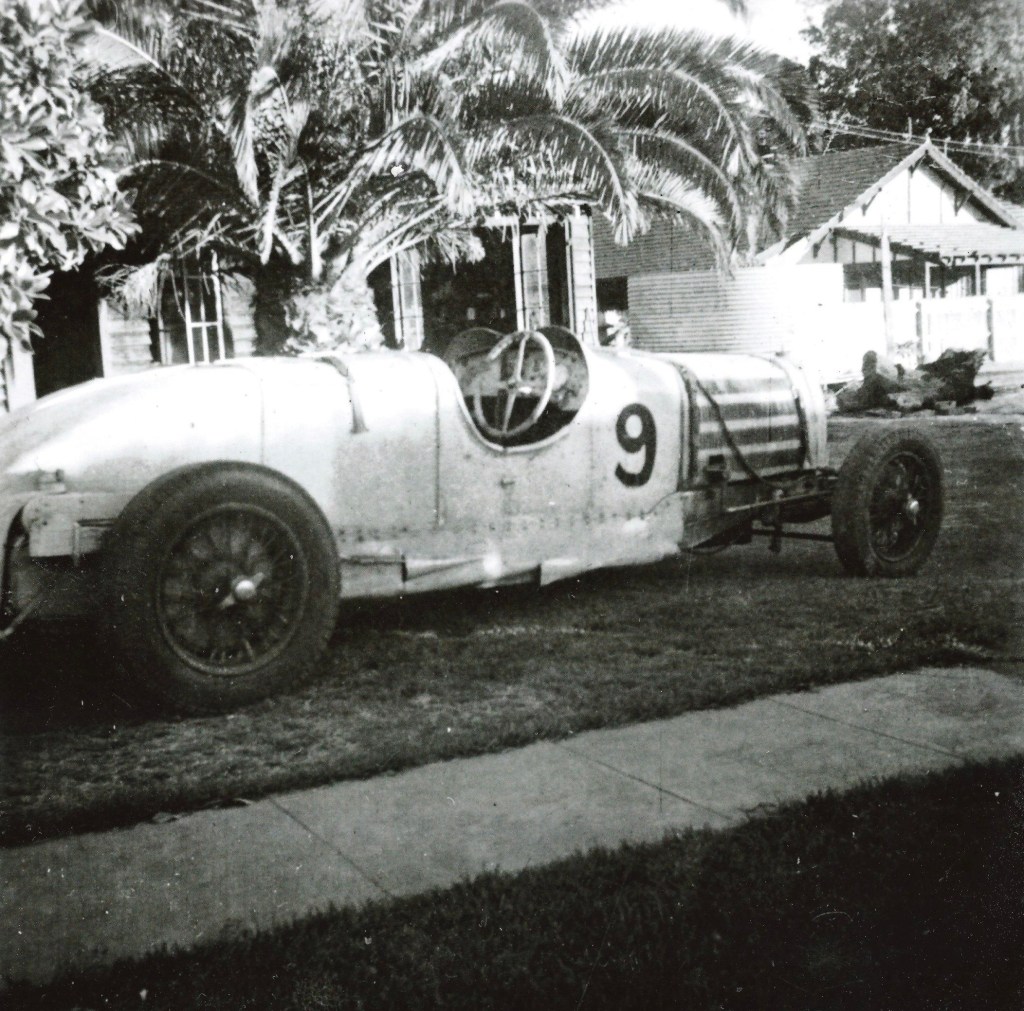
Woolf Barnato and Bernard Rubin on their winning Bentley Motors Ltd entered Bentley 4½-Litre at Le Mans, June 17, 1928. The duo completed 155 laps, 2669 km.
Second was the Robert Bloch/Éduard Brisson Stutz DV16 Black Hawk ‘Bearcat’ 5.2-litre straight-eight, with the André Rossignol/Henri Stoffel Chrysler 72 Six 4.1-litre third, having completed 154 and 144 laps respectively.
It was Bentley’s third victory in the race: Frank Clement and John Duff won aboard a 3-litre Sport in 1924 – the second time the event was held – and Dudley Benjafield and Sammy Davis, 3-litre Speed in 1927. The marque won again in 1929, Barnato/Birkin 6½-Litre Speed Six, 1930, Barnato/Kidston 6½-Litre Speed Six and most recently the Capello/Kristensen/Smith Speed Eight in 2003.
(LAT)
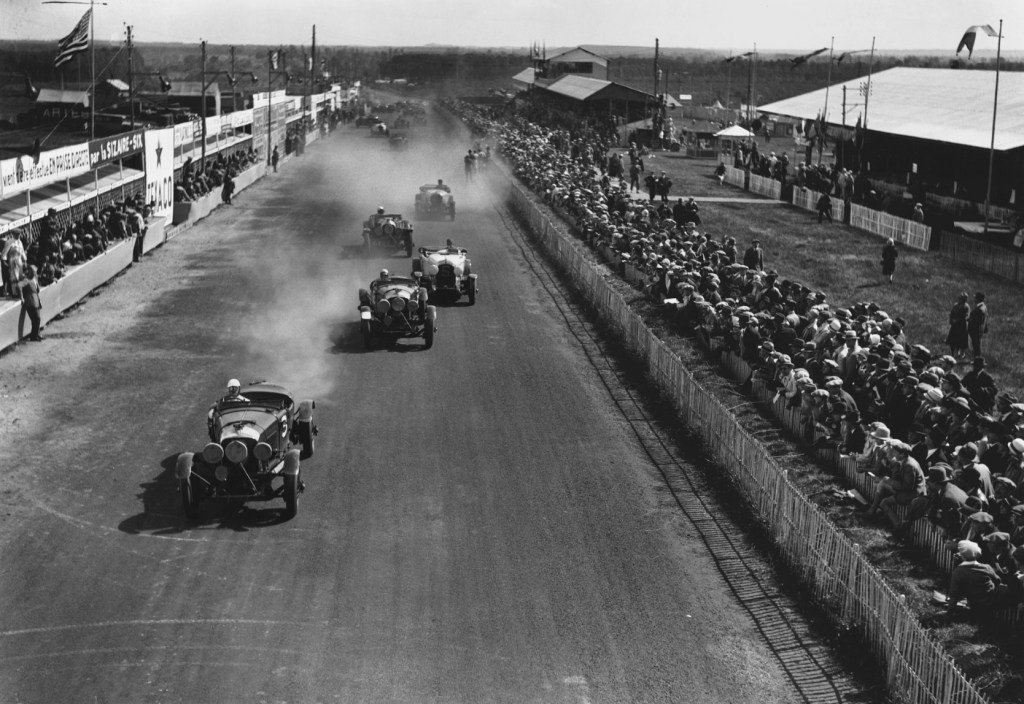
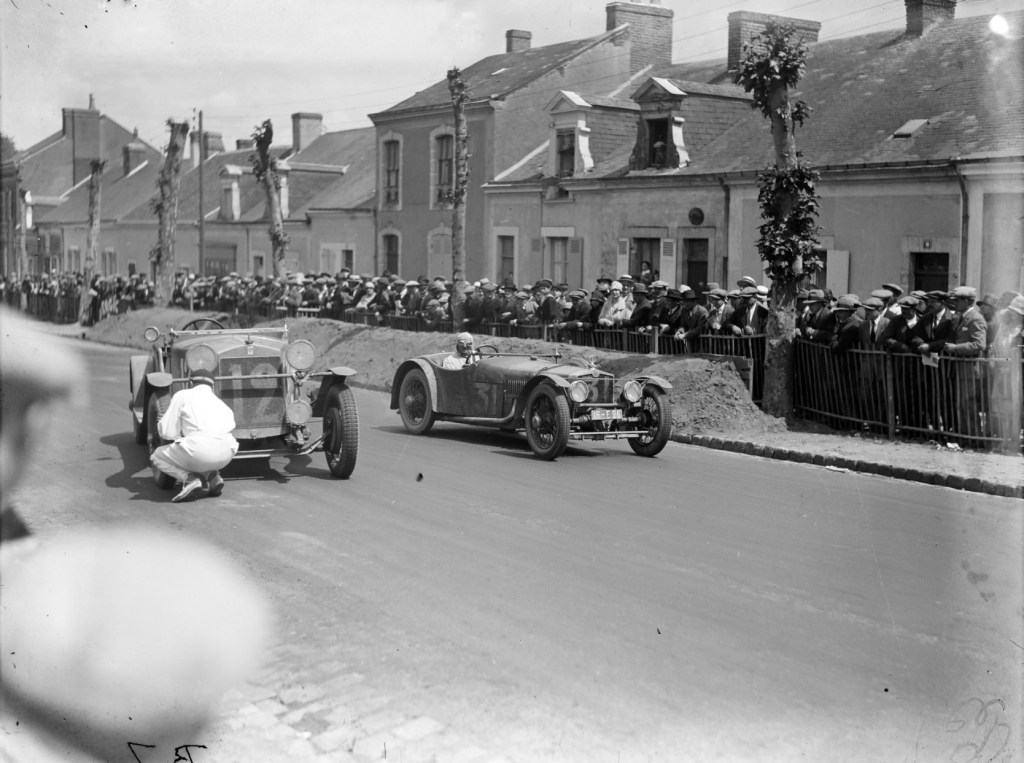
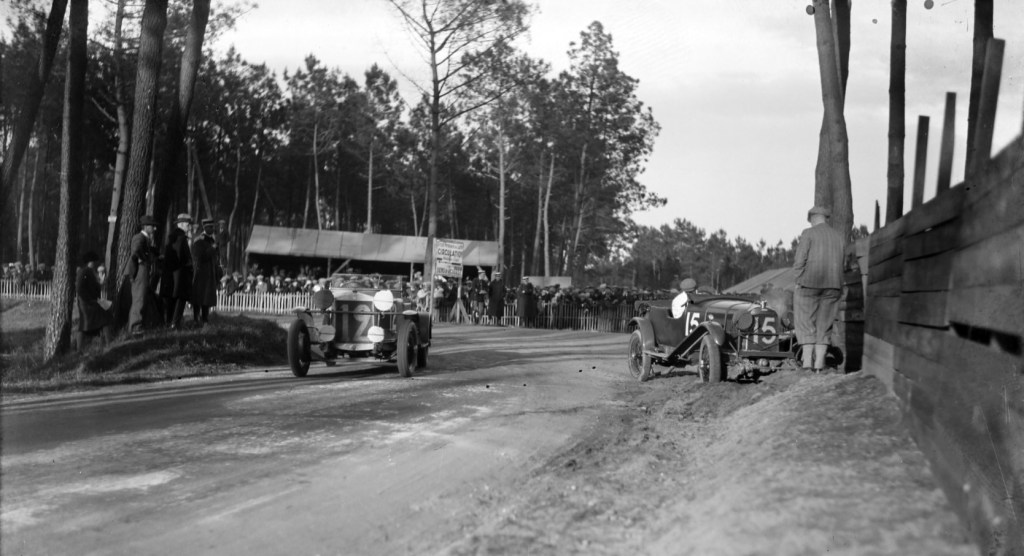
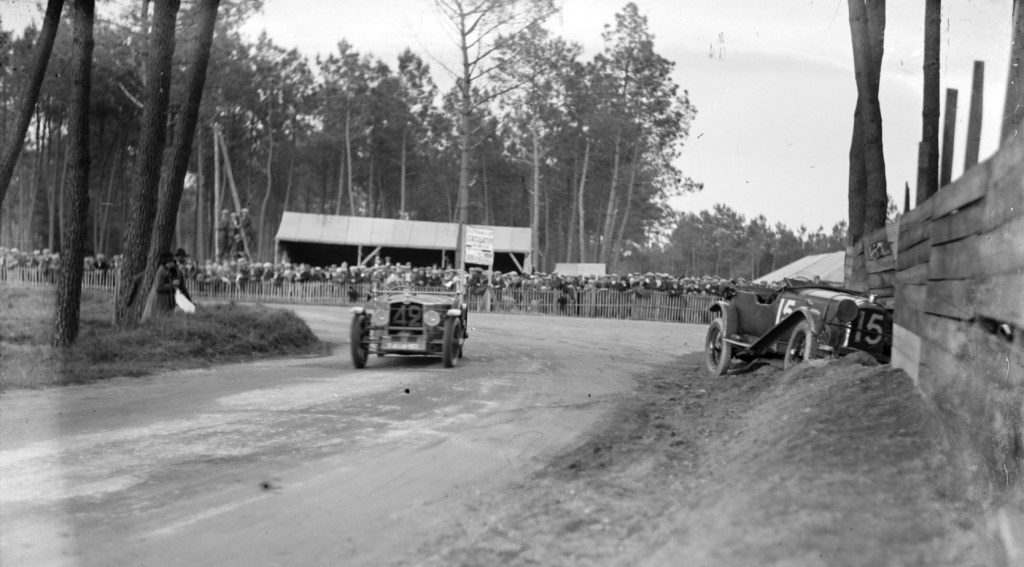
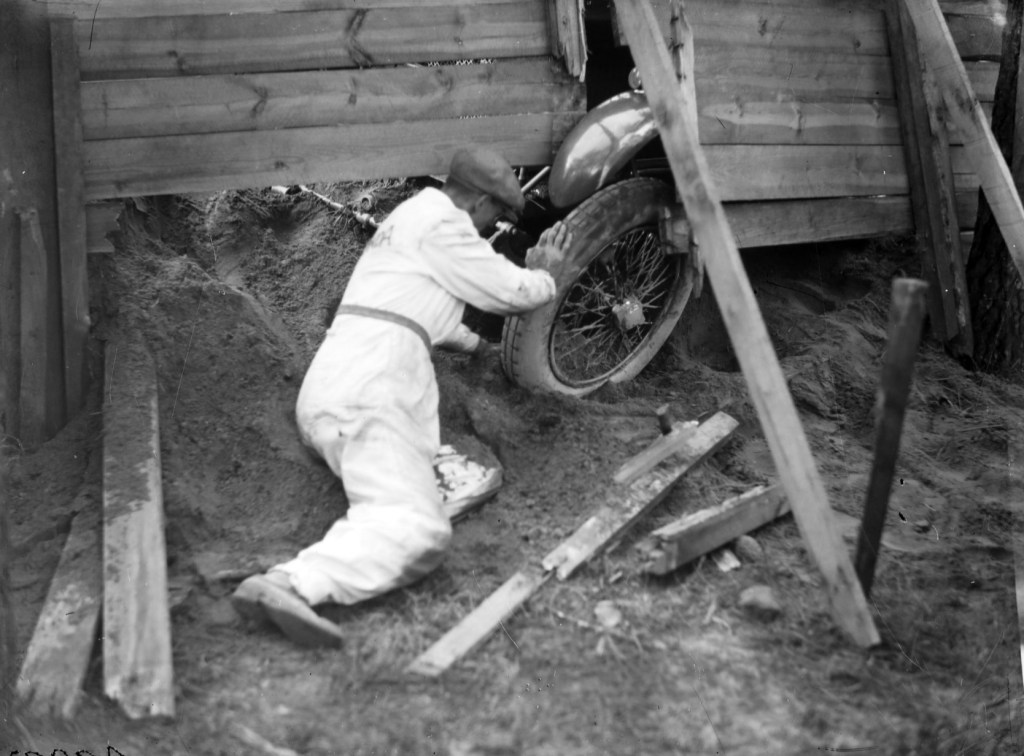
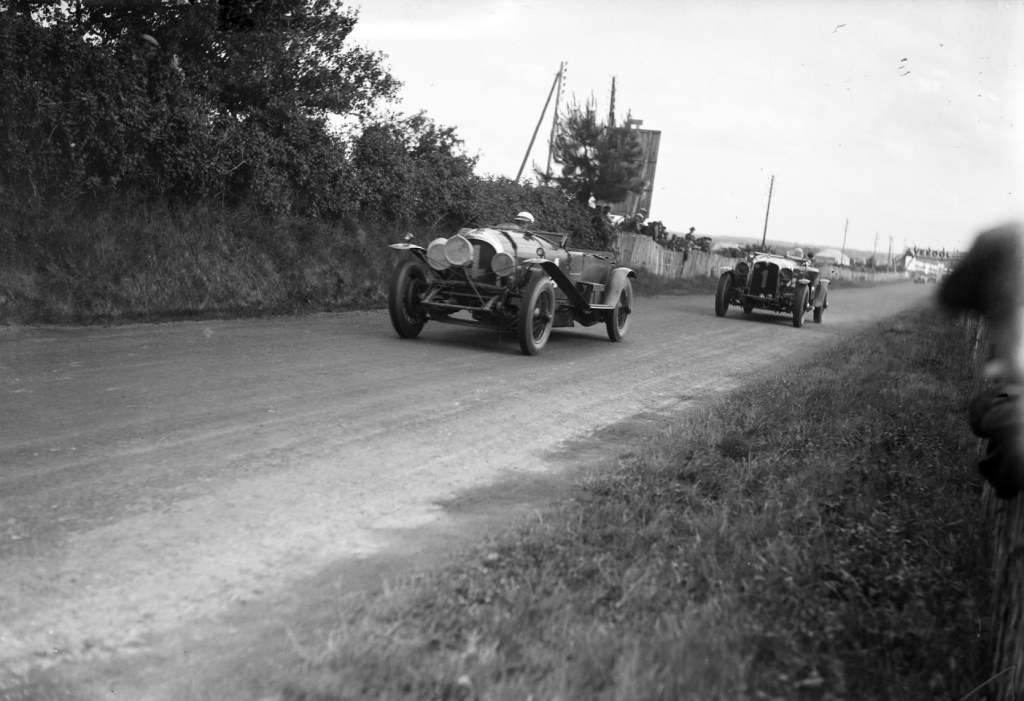
Tim Birkin/Jean Chassagne Bentley 4½-Litre in front of the other team car driven by the Frank Clement/Dudley Benjafield then the Louis Chiron/Cyril de Vere Chrysler Six Series 72. The Birkin car finished fifth, the other pair were DNFs: the Clement machine with radiator hose/oil issues, and Chiron/De Vere were disqualified after a bump-start.
Barnato/Rubin (unattributed)Pitstop for the winning car (LAT)(LAT)(LAT)
Bentley 4½-Litre chassis ST3001…
The winning Barnato/Rubin machine, chassis ST3001 (above) was the first Bentley 4½-Litre off the Cricklewood production line. Completed in June 1927 with Vanden Plas Le Mans-type body, it was delivered to Barnato for use as a Bentley Motors team car.
Barnato gave ST3001 the nickname Old Mother Gun. YH 3196 debuted at Le Mans in 1927. Driven by Frank Clement and Leslie Callingham the car set a lap record on its second lap with the convertible hood still up. ST3001 retired from the race after 35 laps while leading, having become enmeshed in the infamous White House Crash that eliminated seven cars, including the Bentley team. There was a second 24-hour race held at the Circuit de la Sarthe on August 15-16 that year, the Grand Prix de Paris. Frank Clement and George Duller led from the off and won it by over 80 miles.
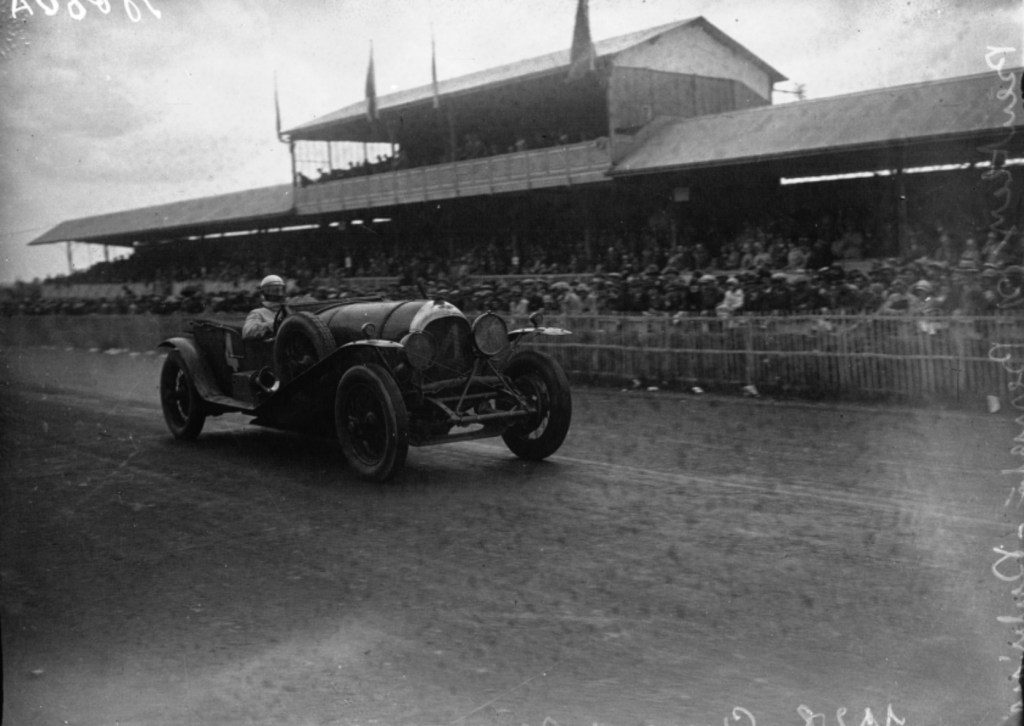
In 1928 the car won despite the challenges. Frank Clement’s car was forced out when the chassis frame cracked, disconnecting a water hose and emptying the radiator. All seemed lost again when the frame of Old Mother Gun, leading at the time, also cracked with about 15 miles to go. Despite having to ease, Barnato hung on with the other 4½-Litre of Birkin/Chassagne fifth after losing a lot of time during a wheel change.
ST3001’s chassis was then replaced with a new heavy-pattern chassis frame. OMGs second chassis was later used to rebuild the 4½-Litre MF3157.
In 1929, Old Mother Gun raced again Le Mans, as the only 4½-Litre entered, alongside Bentley’s two 6½-Litre Speed Six’. Victory went to the Speed Six Old Number One with Old Mother Gun second raced by Jack Dunfee and Glen Kidston.
(LAT)
The rest of the field…
(LAT)
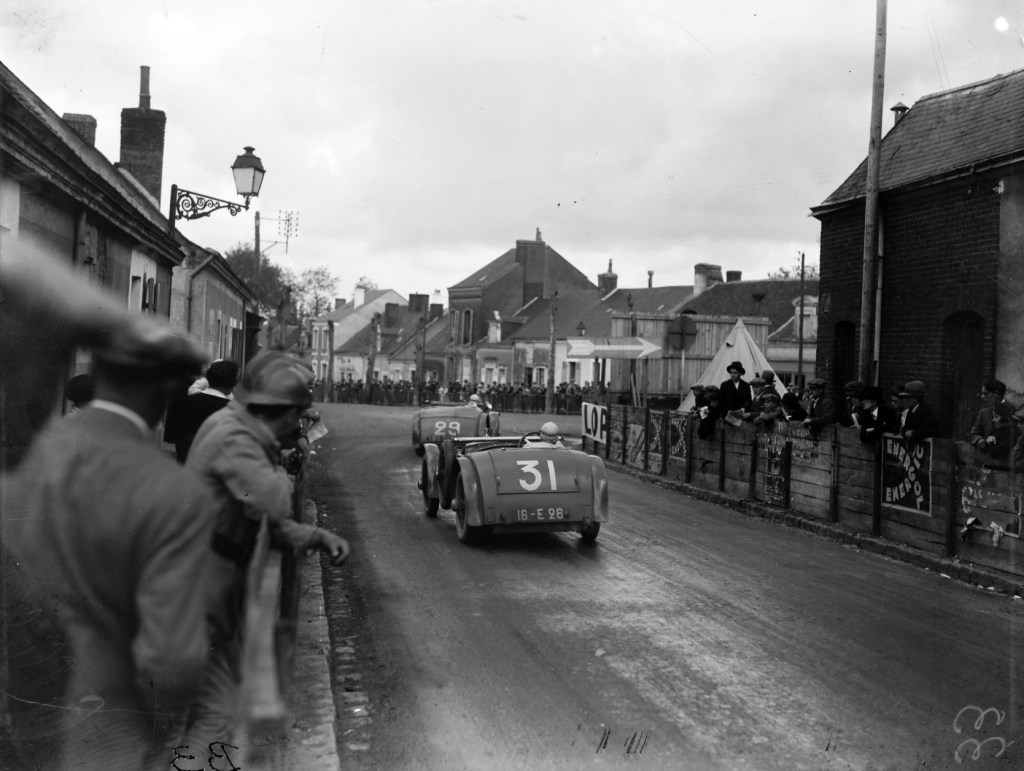
The Maurice Benoist/Louis Balart Tracta FWD leads the similar car of Roger Bourcier/Hector Vasena, while below, the Bourcier/Vasena machine passes the stranded – but ultimately eighth placed and first in class – Robert Benoist/Christian d’Auvergne Itala 65S 2-litre.
(LAT)(LAT)
The Clive Gallop/EJ Hayes FW Metcalfe entered Lagonda OH 2L Speed, DNF accident.
(LAT)
The Sammy Davis/Bill Urquhart-Dykes (ninth) and Maurice Harvey/Harold Purdy (sixth) Alvis TA FWDs and to the right, the Lucien Lemesle/Henry Godard S.C.A.P – Sociéte de Construction Automobile Parisienne – (DNF) in the pitlane before the off, and below, Davis at speed.
(LAT)(LAT)
Action for the grandstand crowd, the Émile Maret/Gonzaque Lécureul S.A.R.A SP7 (DNF) battles with the Goffredo Zehender/Jérôme Ledour, Chrysler Six 72 DNF radiator.
(LAT)
The Maurice Benoist/Louis Balart Tracta-SCAP (12th) chases the (11th) Baron André d’Erlanger/Douglas Hawkes Lagonda OH 2L Speed.
(LAT)
The Robert Benoist/Christian d’Auvergne Itala 65S passes the crashed Sir Francis Samuelson/Frank King Lagonda, Samuelson was experiencing gearbox problems at the time he crashed.
As the MotorSport report reads, our Knight’s frenzied reversing efforts resulted in his teammate, D’Erlanger, in another FE Metcalfe entered Lagonda, colliding with him and pushing him further into the sand and through a fence. The shot below shows him in this situation, as the Gregoire/Vallon Tracta passes.
(LAT)(LAT)
The shot above shows Samuelson attempting the difficult task of releasing the left-front guard/wheel from the voracious clutches of the fence and sandbank. A task in which he was unsuccessful.
(LAT)
Front of the field action from the winning Barnato/Rubin Bentley 4½-Litre and second placed Édouard Brisson/Robert Bloch Stutz DV16 Black Hawk ‘Bearcat’.
(LAT)
Journo’s enjoying a Gauloise – with a Pernod closeby no doubt – as they interview a driver atop the pit counter.
(LAT)
Gorgeous Lombard AL3 of Lucien Desvaux/Pierre Gouette, they finished 13th outright and third in the 1100cc class.
(LAT)
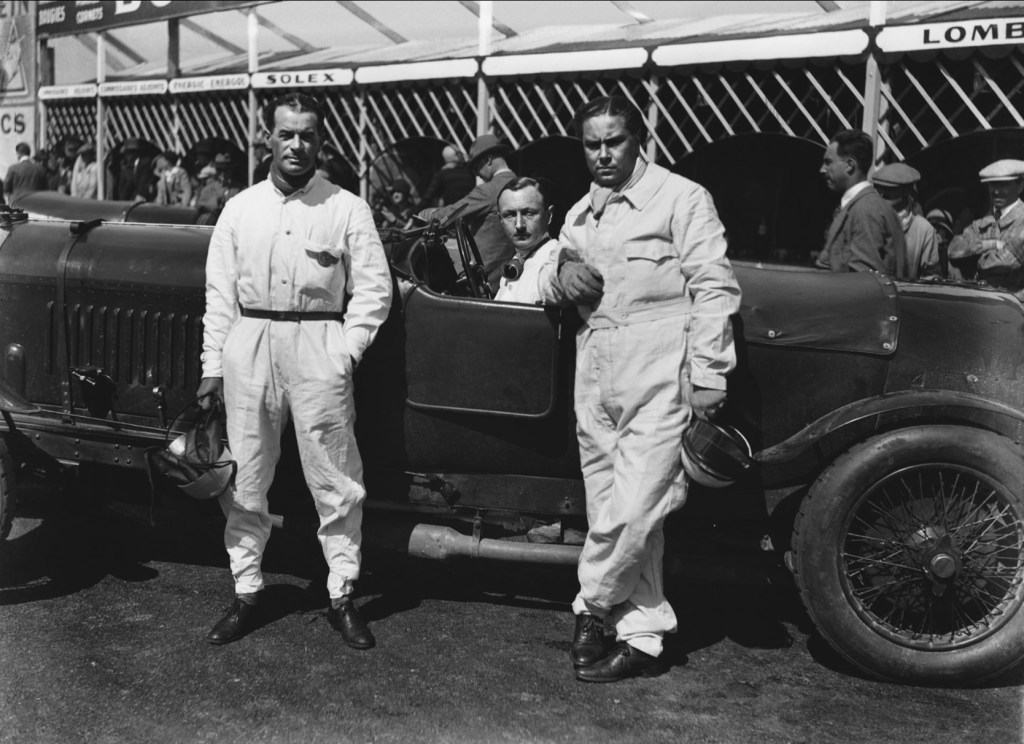
Winners are grinners, sort of. Not really at all actually. Bentley Boys Frank Clement, Tim Birkin and Woolf Barnato.
Credits…
LAT Photographic, MotorSport, MotorSport Images, F2-Index, Wikipedia
Tailpiece…
(LAT)
Incredibly evocative, romantic shot of Francis Samuelson trying to extricate his Lagonda from the ‘merde’ while the Maurice Harvey/Harold Purdy Alvis TA FWD passes (sixth)…and the shadows grow ever longer. Marvellous.
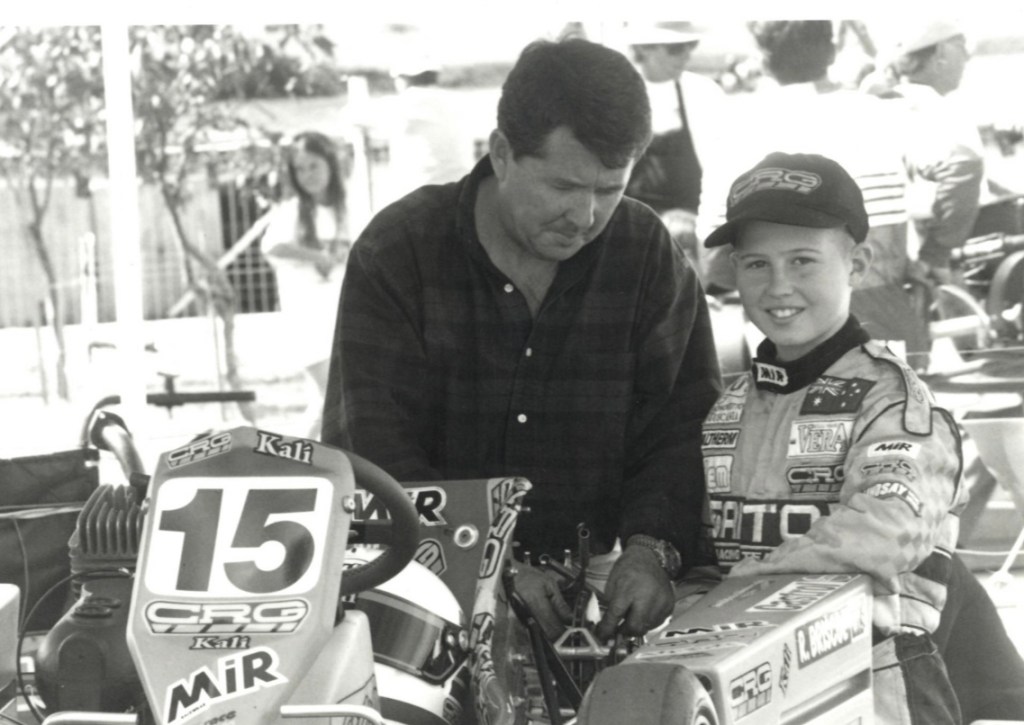
Ryan Briscoe is one of those Australian internationals I tend to forget about as he raced so little in Australia. His formative Karting years were here and then – Oscar Piastri like – most of his secondary education was in Europe from the age of 15 as he and his family successfully chased The Dream.
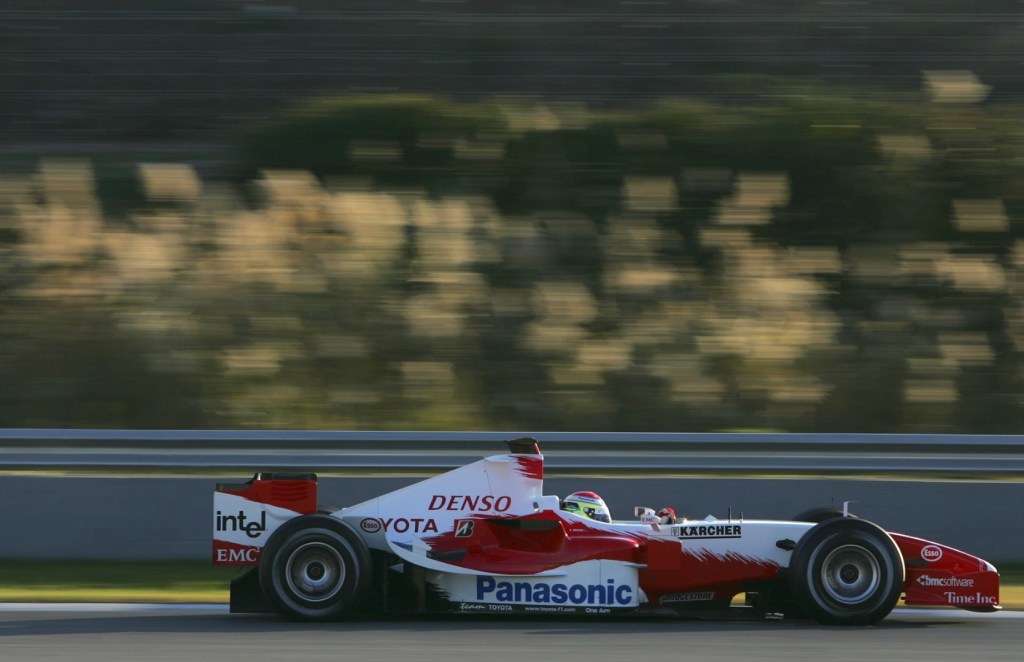
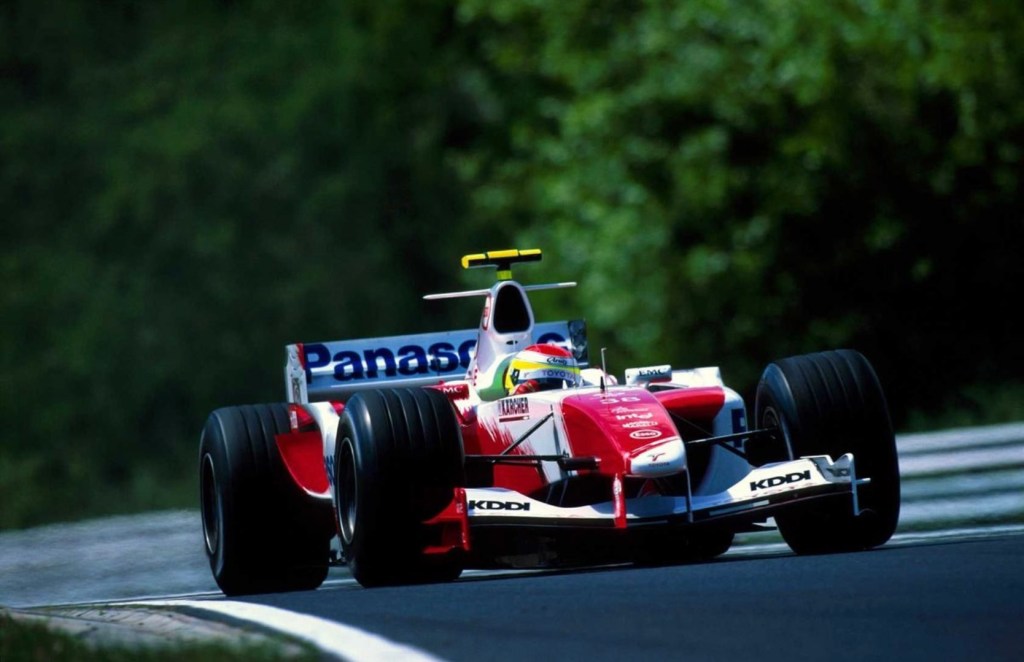
Briscoe, born in Sydney on 24/9/1981, is shown above testing the Toyota TF106 Grand Prix car at Jerez in December 2005. He was in on the ground floor of Toyota’s F1 program – from 2002-2004 – but never quite cracked it for a race seat so he was switched to Indycars in 2005, initially racing a Toyota powered Panoz for Chip Ganassi.
With Dad, Geoff circa 1992 (R Briscoe Collection)Spa 2004 (MotorSport)
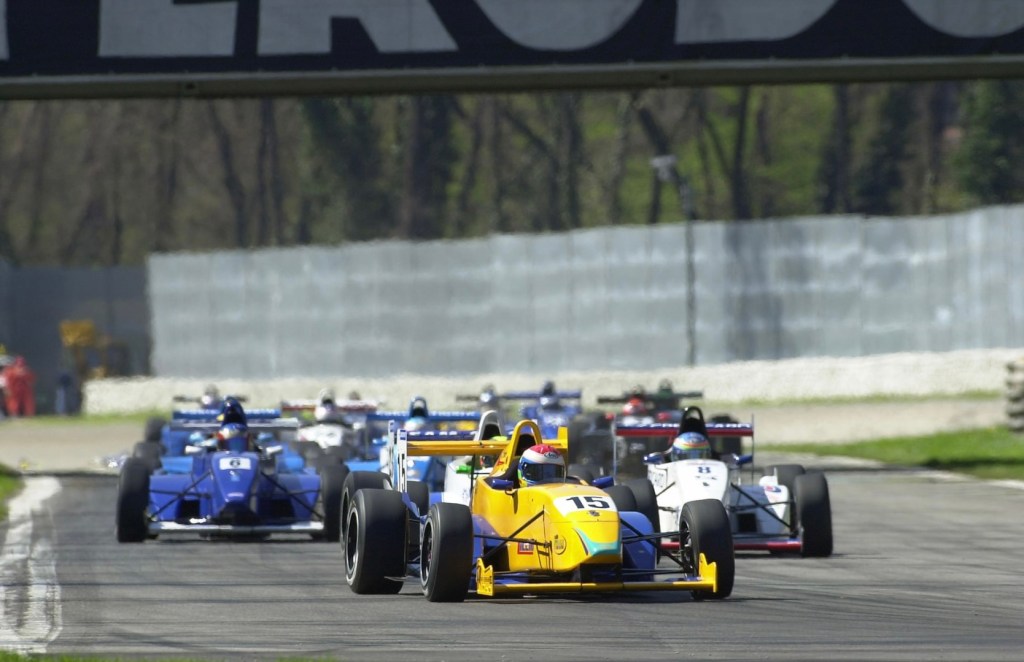
During the climb, he won Australian , American and Italian Karting titles in 1994, 1998 and 1999 respectively.He switched to cars, Formula Renault in 2000, winning the Italian F Renault Championship in 2001.
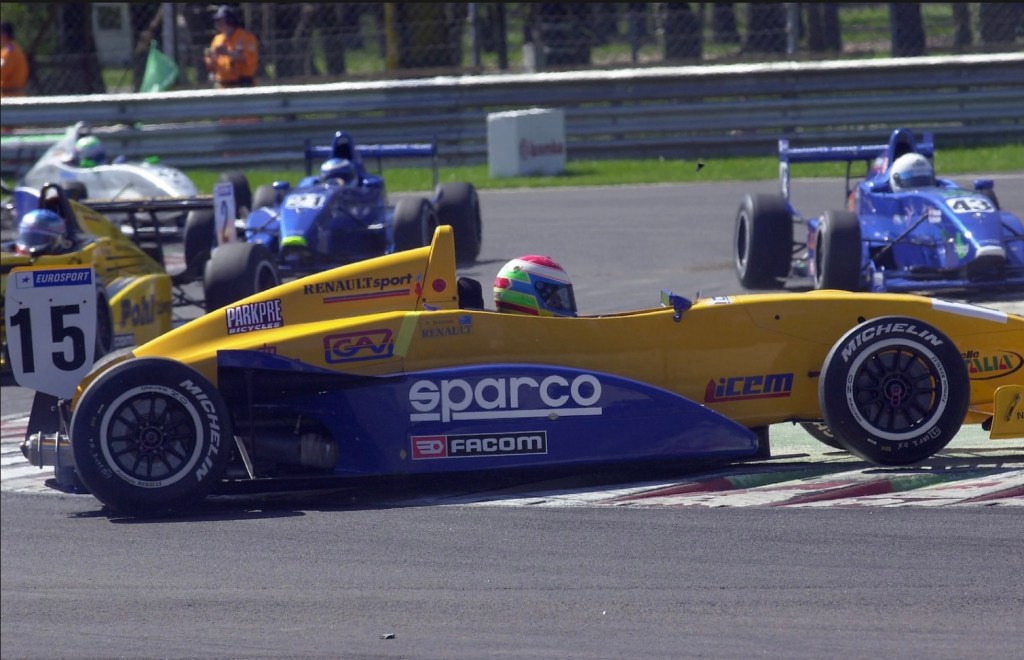
Ahead of the F Renault pack at Monza on April Fools Day 2001 from pole, but DNF as below! Tatuus Renault 2-litre (LAT)(LAT)
During this most meteoric of rises Ryan also did some F3 in 2001, the shot below is at Zandvoort during the Marlboro Masters event on August 5, 2001. Car is Team Prema Dallara F300 Opel, DNF in the race won by Taka Sato, but third overall.
(LAT)(MotorSport)
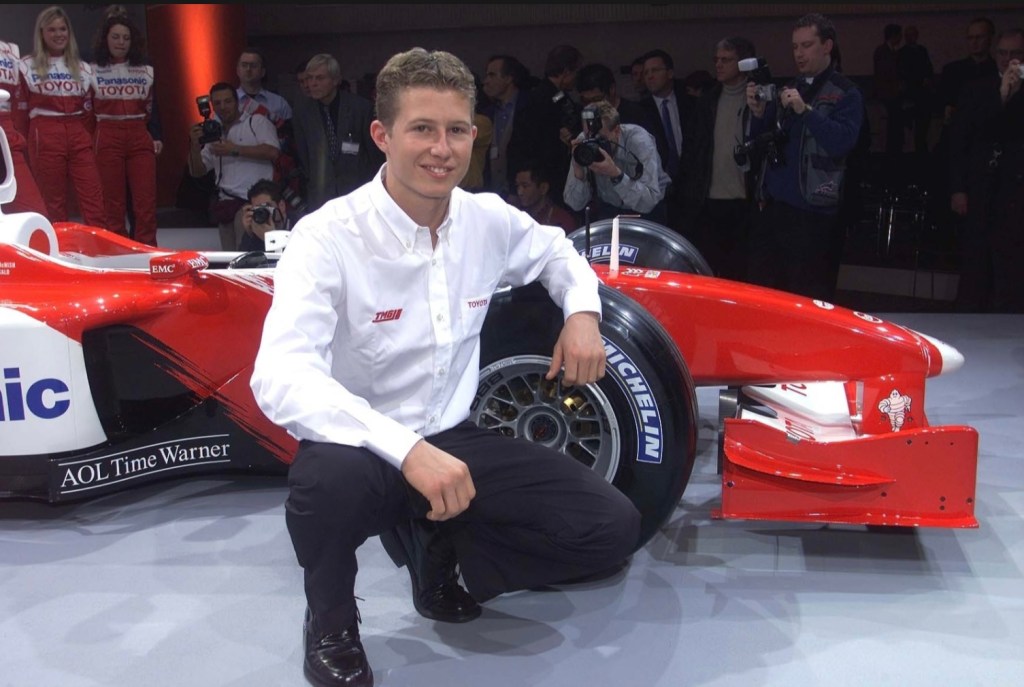
By the end of that year, aged 20, he was front and centre of Toyota’s F1 program as their test driver. Here he is at the launch of the Gustav Brunner designed Panasonic Toyota Racing TF102 V10 in Cologne, where the team was based, on December 17, 2001. The race drivers in 2002 – at the start of a rather grim eight year F1 sojourn for Toyota – were Mika Salo and Allan McNish.
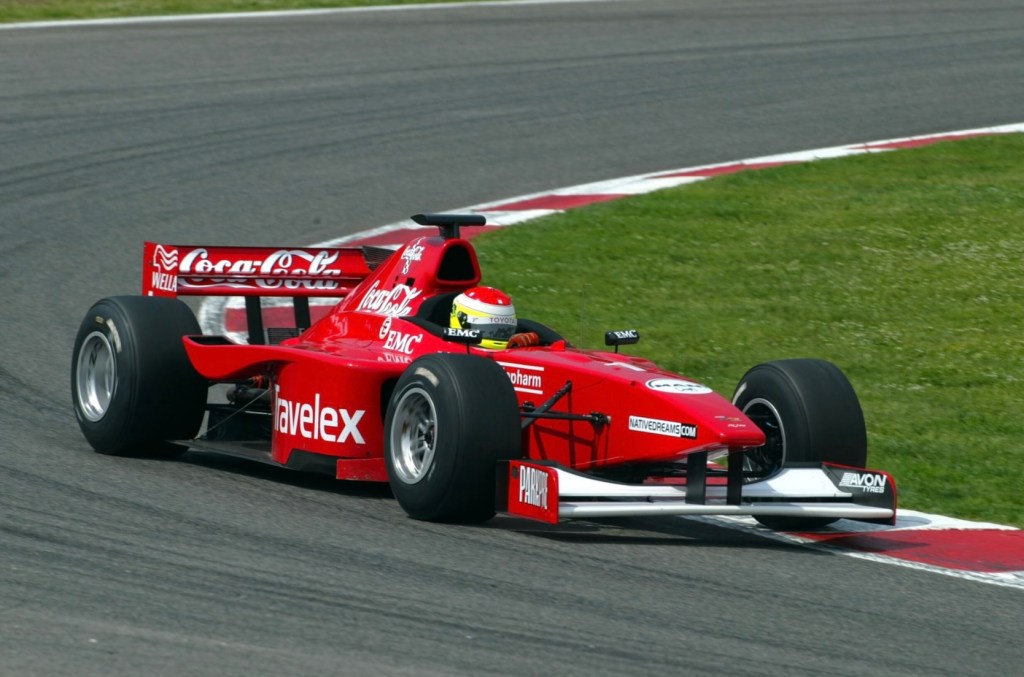
Amongst his testing duties he raced initially in F3000, not going very well in the Nordic run car, and F3 later in 2002, and in 2003, winning the Euroseries that year. He progressed to being Toyota’s third driver, testing on the Friday of each grand prix, in 2004.
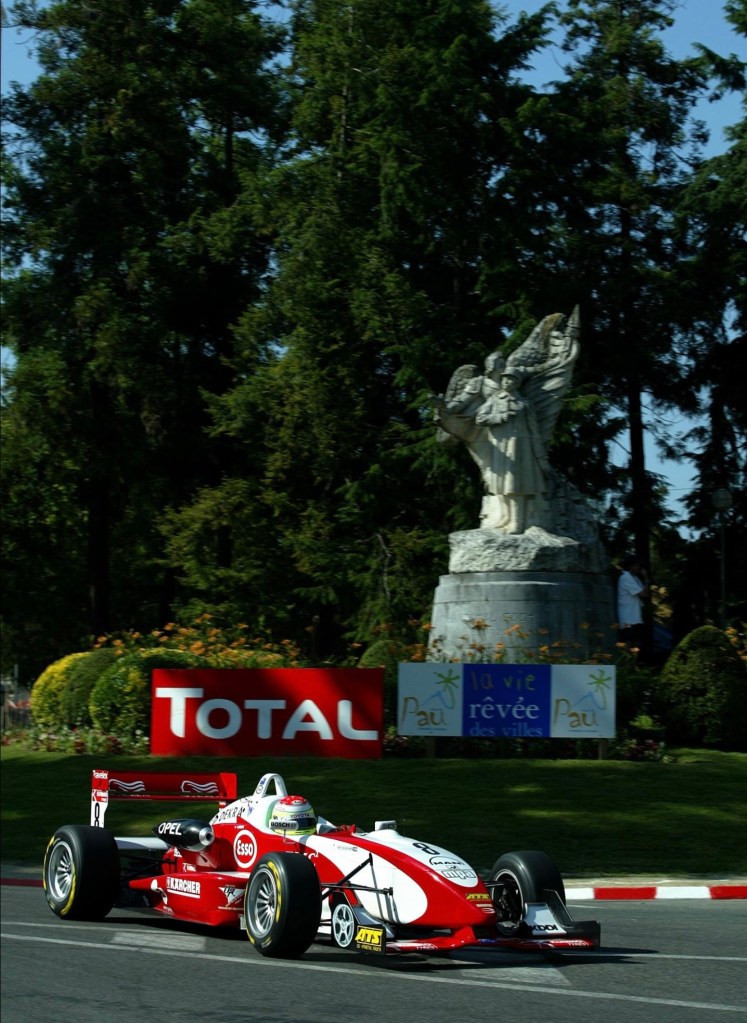
Lola TB02/50 Zytec-Judd KV circa 450bhp V8, Formula 3000 Barcelona April 2002 (MotorSport)During the Pau GP weekend in June 2003, Dallara F303 Opel. Briscoe won a race, and Fabio Carbone the other (Glenn Dunbar/LAT)
Briscoe won eight of the 20 races in the F3 Euroseries in his Prema Powerteam Dallara F303 Opel to take the title from Christian Klien. Other hotshots in the field that year included Niko Rosberg and Robert Kubica.
Briscoe, during practice, Toyota TF104 3-litre V10, Hungary 2004 (unattributed)
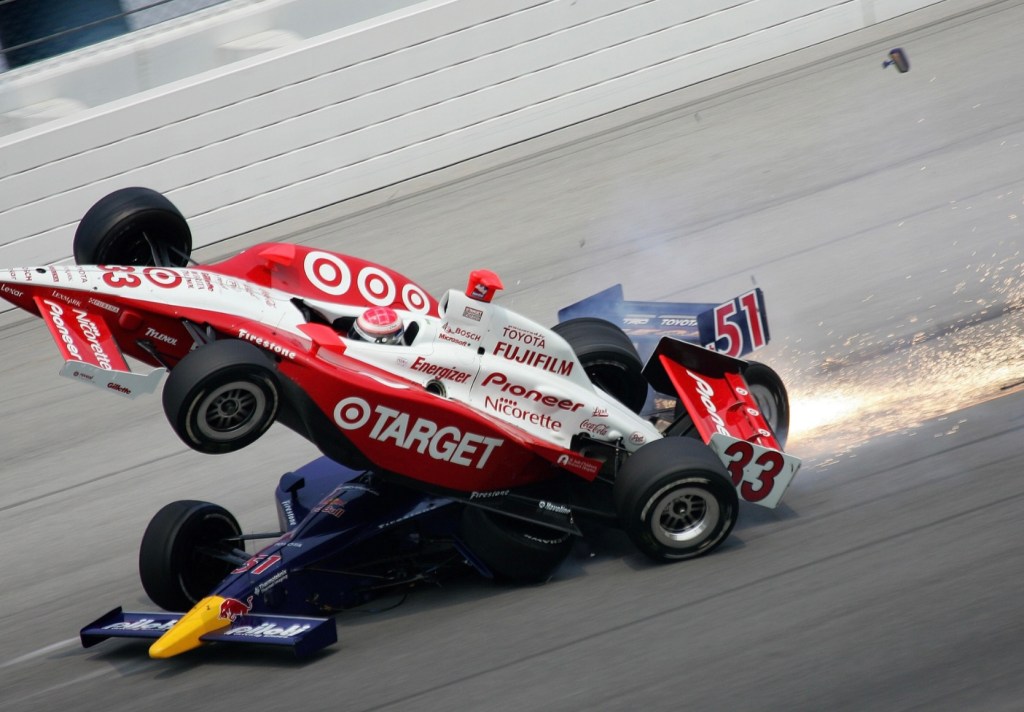
Ryan moved to Indycars (I’m using that word as a generic descriptor of the genre) with Chip Ganassi in 2005, showing extraordinary pace for a rookie; two poles and regular top-half qualifying on unfamiliar ovals. Tenth at Indy on debut was stunning, equally so was seven crashes in his 15 starts, the last of which was a massive accident after his Panoz GF09C Toyota climbed atop Alex Barron’s Dallara at Chicagoland Speedway in September that landed him in hospital and rehabilitation for four months.
Zandvoort A1 GP Cup October 2006 – the first meeting of the 2006-7 season – third in the main race won by Nico Hulkenberg. Lola A1GP Zytec 3.4 V6 circa 520bhp (MotorSport)
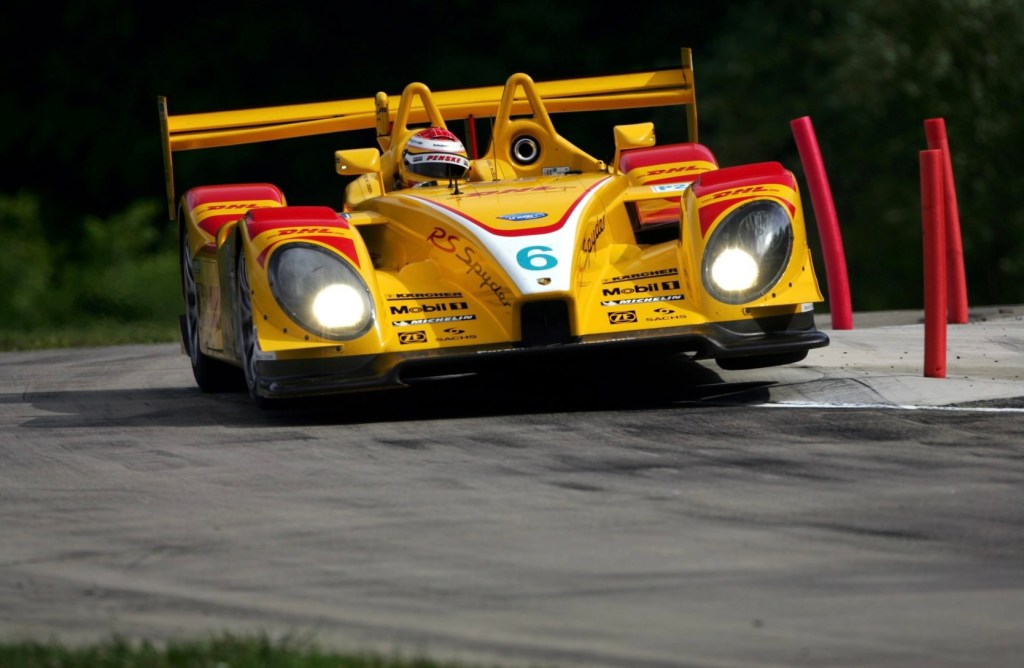
In 2006 he did a mixed programme of Indycar, V8 Supercars and A1 Grand Prix, but it was a full season in the American Le Mans Series for Penske Racing driving a Porsche RS Spyder in 2007 that pushed his career forward with Penske. He won three rounds sharing with Sascha Maassen.
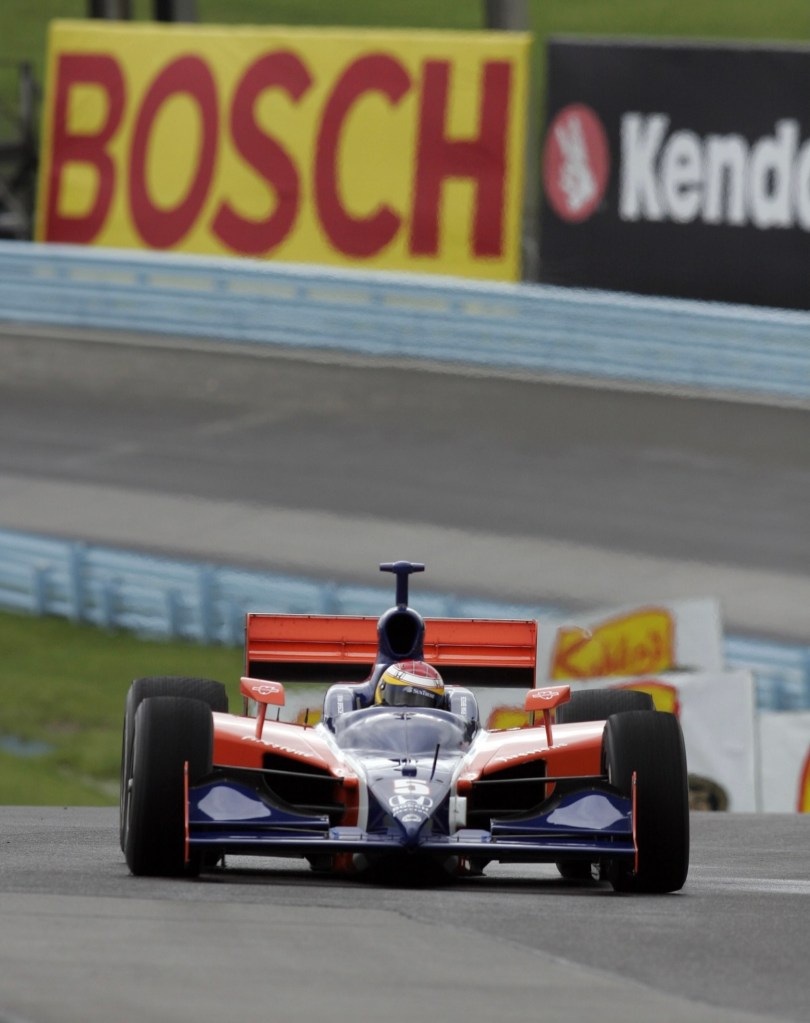
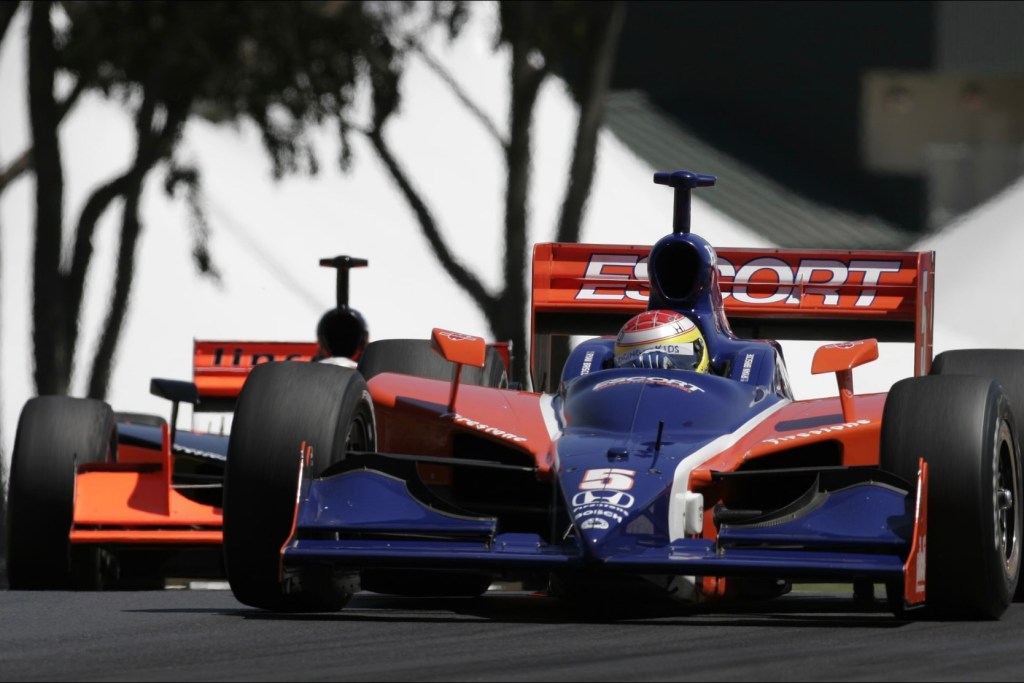
Ryan at Watkins Glen in June 2006. I rather like the shot of the Dallara IR03 Chev aero elements doing their thing (Dan Streck/LAT)Briscoe in front of Vitor Meira at Sonoma Raceway, California in August 2006. Racing for Dreyer & Reinhold Racing in a Dallara IR03 Chev V8. 16th in the Indy GP of Sonoma won by Marco Andretti (Dan Streck/LAT)Briscoe, American Le Mans Series, Northeast Grand Prix, Lime Rock July 2007, Penske Porsche RS Spyder. Ryan won the LMP2 class, and was third outright, sharing the car with Sascha Maasen (Sutton Images)
This sportscar success, together with some strong performance in limited Indycar outings – Q5 and fifth in the Indy 500 for Luczo-Dragon Racing, led to a full-time Indycar drive with Penske from 2008-2012.
In a strong Indycar career he won eight races, had 28 podiums and finished third in the title in 2009 (three wins), and fifth in 2008 and 2010 as his bests. In 2009 he led the championship going into the penultimate round but hit the wall exiting the pitlane at Motegi, then, in a three-way battle for the title finished second behind Dario Franchitti in the final round, who became champion.
(MotorSport)
Aviating at Surfers Paradise on the way to winning the Indy 300 in October 2008, Team Penske Dallara IR-04/05 Honda 3.5 V8. Scott Dixon was second, 5/10ths behind and Ryan Hunter-Reay a further nine seconds adrift.
And below doing the same thing at the same place in a V8 Supercar in October 2011, sharing the Holden Racing Team Holden Commodore VE in the Gold Coast 600 with Garth Tander. The pair were 11th in the first race, 23rd and last in the second. The winner overall was the Triple Eight VE Commodore crewed by Jamie Whincup and Sebastien Bourdais. Ryan’s best V8 Supercar result was at this event in 2013 when he shared a VF Commodore with Russell Ingall to third place.
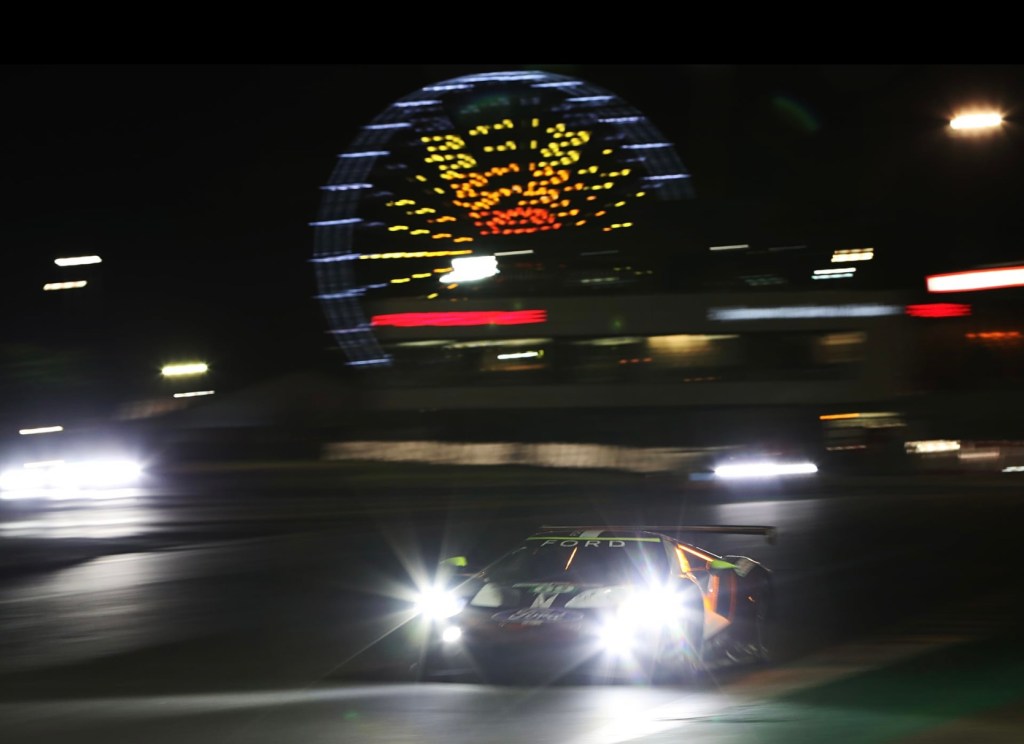
(Mark Horsborough/LAT)The Briscoe, Richard Westbrook, Scott Dixon, Chip Ganassi Ford GT at Le Mans in 2018. Q37 and 39th outright in the 3.5-litre turbo-V6 powered car – and shot below (MotorSport)(MotorSport)
“Ryan has driven more sportscars that I’ve had Sunday roasts,” would perhaps be the observation Australia’s greatest all-rounder, the late Frank Gardner would have made.
Briscoe’s best sportscar results are victory in the Daytona 24 Hours in 2020 (Cadillac Dpi-VR), and Petit Le Mans the same year.
He was runner-up in the 2016 (Ford GT), 2018 (Ford GT) and 2020 (Cadillac DPi-VR) IMSA Sportscar Championship GTLM class. He was third in the 2007 American Le Mans Series, winning the LMP2 class (Porsche RS Spyder),
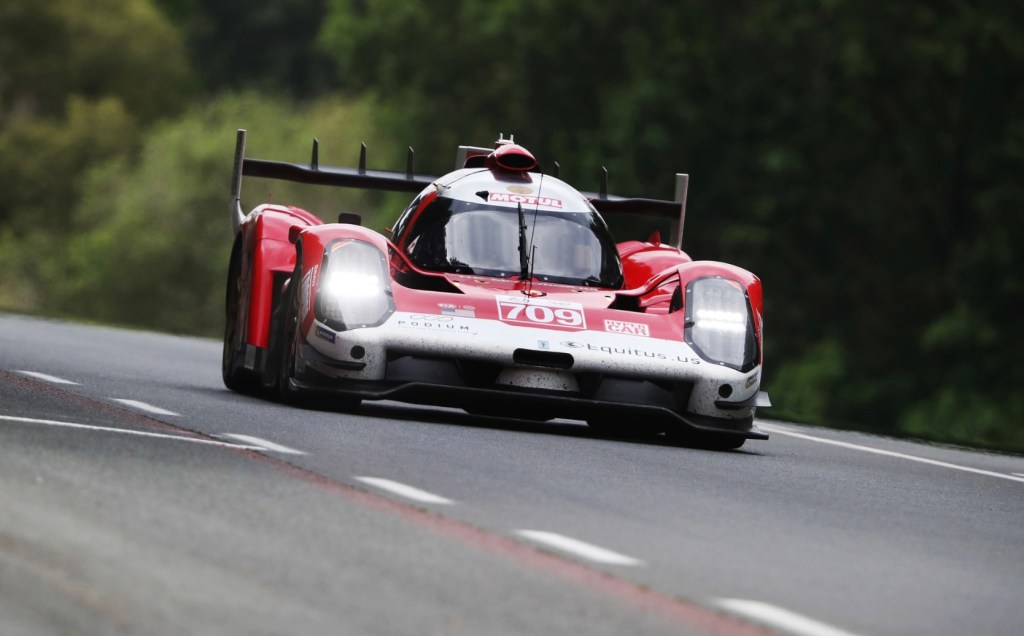
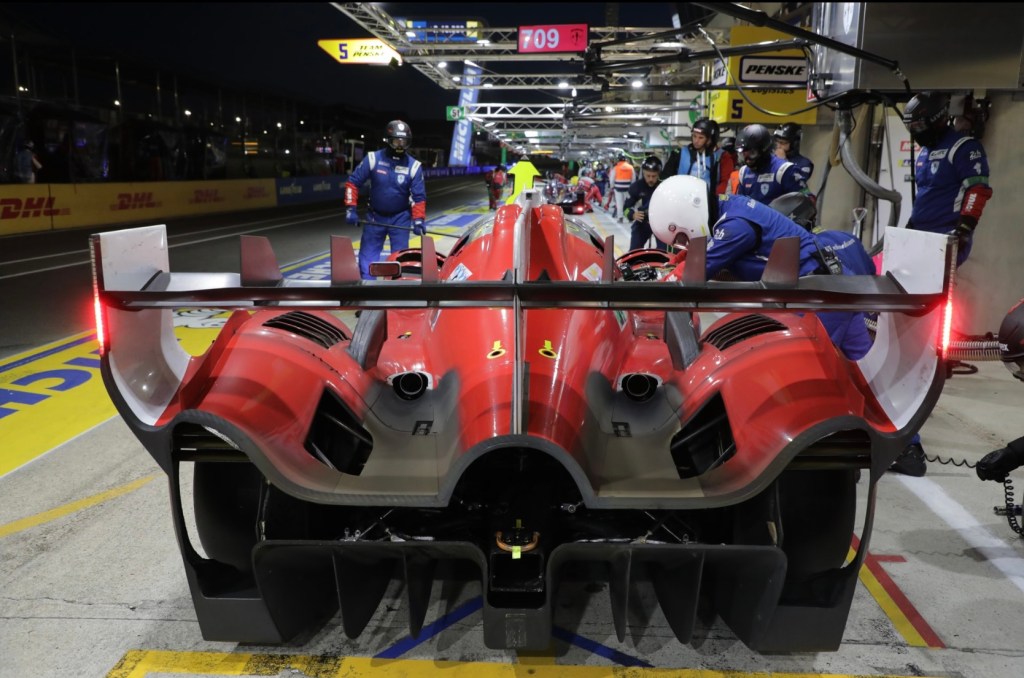
His best results at Le Mans were fifth in 2021 sharing a Glickenhaus 007 LMH with Romain Dumas and Richard Westbrook, and third in 2022 in the same make/model, this time sharing with Westbrook and Franck Mailleux.
At Daytona he won outright in 2020 (as above) and was first in class in 2015 and 2018 racing a Cadillac DPi VR, Chev Corvette C7.R, and Ford GT respectively – with co-drivers of course. At Sebring he won his class in 2013 and 2015 aboard a HPD ARX-O3b and Chev Corvette C7.R.
Briscoe/Richard Westbrook/Franck Mailleux Glickenhaus SCG007 LMH, fifth. Le Mans 2021 (MotorSport)Richard Westbrook, Franck Mailed, Ryan Briscoe and James Glickenhaus, Le Mans 2021 (MotorSport)Power by Pipo Moteurs 3.5-litre twin-turbo 500Kw V8, Xtrac 7-speed sequential manual (MotorSport)
Ryan married Nicole Manske in 2009, they have two children, and in 2018 he became a naturalised American.
Etcetera…
(MotorSport)
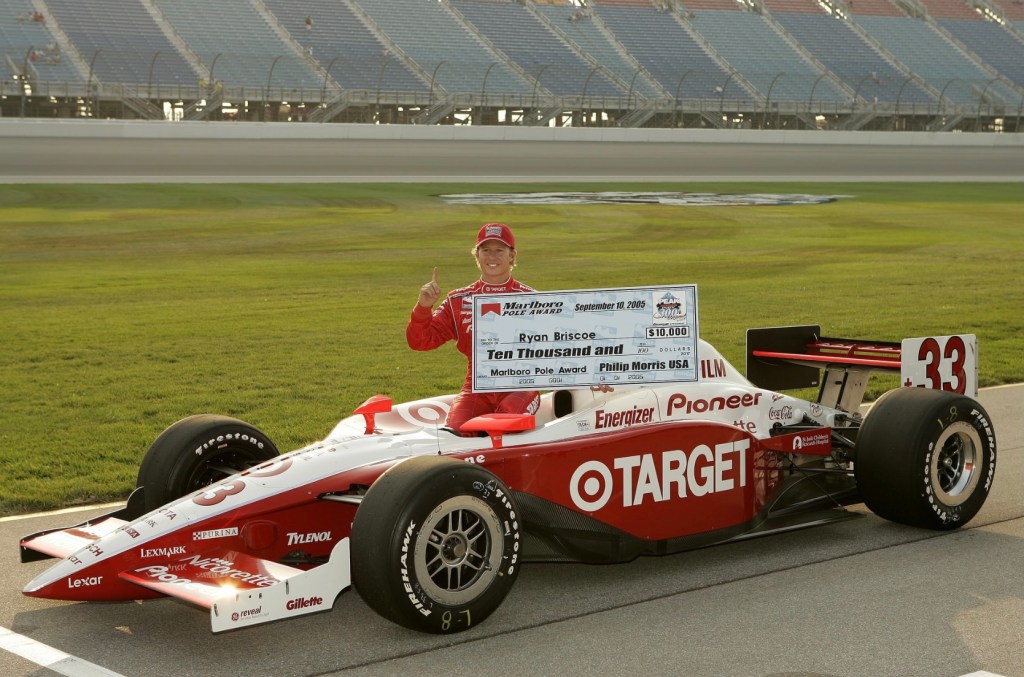
Here to zero at the Chicagoland Speedway, Joliet, Illinois on the Indy 300 September 10-11 weekend in 2005.
Here with the Gregory-Peck for pole, a handy $10k. It was Ryan’s second Indycar pole, he started from pole at Sonoma, the previous round but crashed out on the first lap. The car is a Chip Ganassi run Panoz GF09C Toyota.
Shortly after this happy scene the car failed post-practice scrutineering, so Ryan lined up last on the grid, perhaps sowing the seeds of the crash which followed.
(MotorSport)
‘Roger that, we have lift-off Houston.’
On lap 20 Briscoe’s Panoz GF09C Toyota ran into 15th placed Alex Barron’s Dallara Toyota (Q18) as he sought to go under him on his way up the field towards turn 3 of the 1.5-mile oval – look at the proximity of his right-rear to Barron’s head/roll bar area – and the staggering physics of a collision at 215mph were unleashed.
(MotorSport)
Briscoe hit the fence with the bottom of his Panoz first, it split in two as it ripped through a fence post, leaving a big hole. With a half-tank or so of fuel there was a spectacular explosion as the car split, with the cockpit safety cell spinning down the track narrowly avoiding other cars. Car 2 is Thomas Enge, #55 is Kosuke Matsuura.
(MotorSport)
After several anxious minutes Ryan was removed from the wreck – the monocoque had done its job well – and gave a reassuring wave as he was placed into the ambulance with injuries later diagnosed as two broken collarbones, a bruised lung, fractured right foot and contusions to his arms, legs and back.
Briscoe was hospitalised for nine days then had extensive rehab in the US and Italy before returning to the cockpit in a Riley Mk9 Pontiac 5-litre V8 in the Daytona 24-Hours on the January 28-29, 2006 weekend – four months after his Big One.
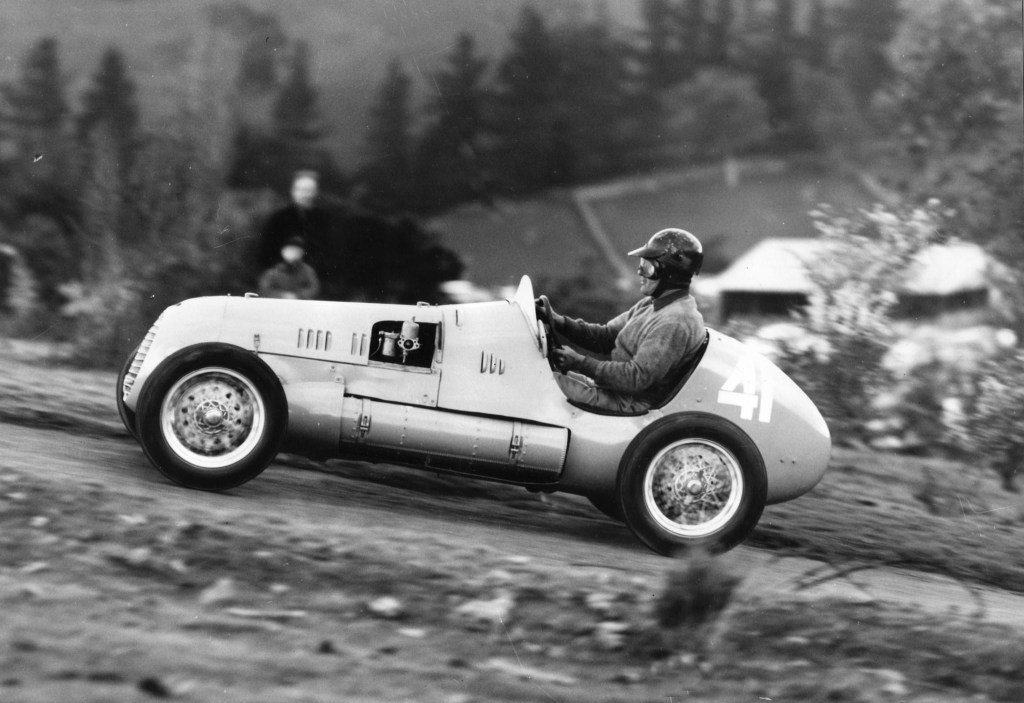
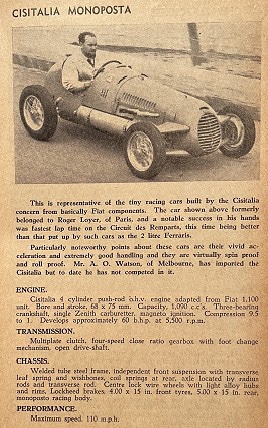
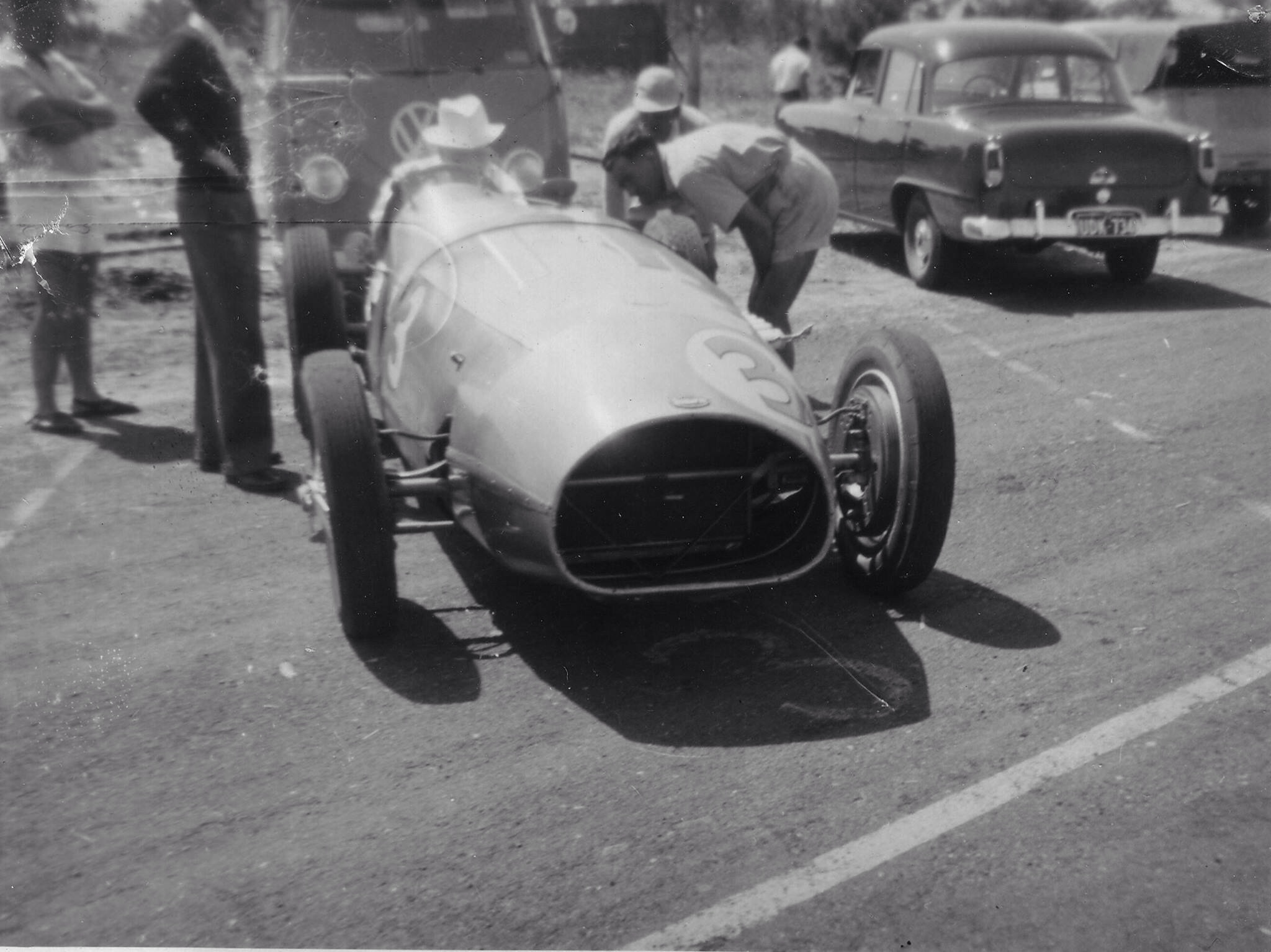
Reg Nutt aboard the Leech Brothers owned Cisitalia D46 Fiat at Rob Roy hillclimb in Melbourne’s glorious Christmas Hills on May 4, 1958. He ran second in his class that day behind multiple Australian Hillclimb Championship winner, Bruce Walton, Walton J.A.P with a time of 28.30 seconds.
Nutt was a riding mechanic in the first decade of Australian Grands Prix at Phillip Island in the 1920s and 1930s and then a racer of note in his own right, including AGPs. “Reg told me that he had raced 27 cars and never owned any of them,” recalled Bob King. What a lucky man.
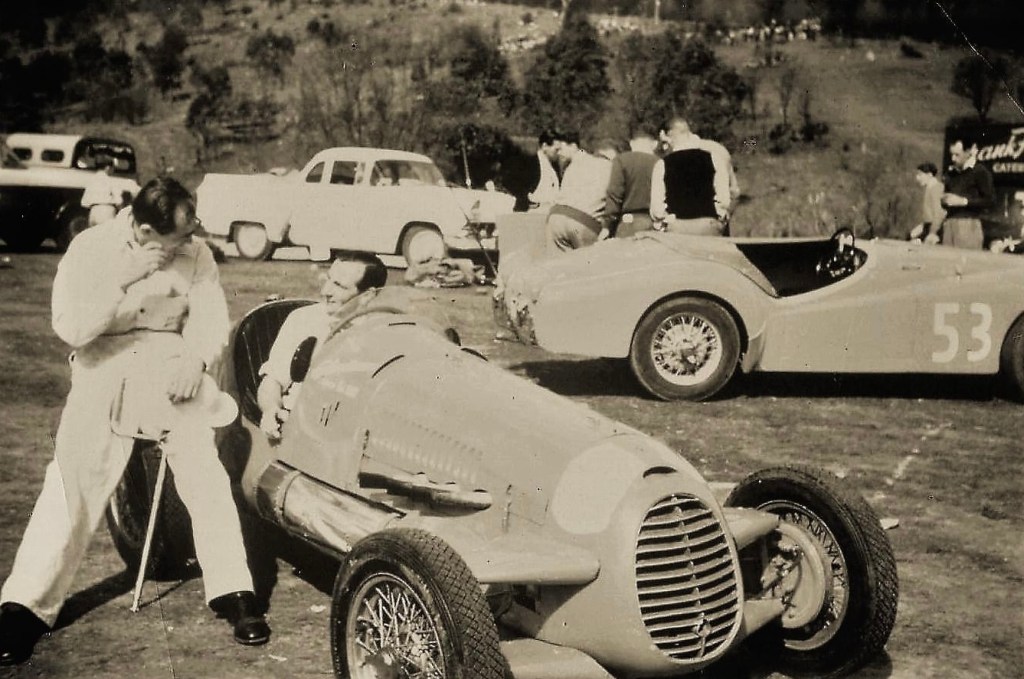
Nutt in the Rob Roy paddock on November 5, 1947 when the car was owned by Fred Gibbs’ Sabina Motors (Davey-Milne Family Collection)Harry Firth in the D46 at Rob Roy in 1958. Later Oz 1960s and 1970s touring car star driver/engineer/team manager (L Sims Collection)
The car – chassis D461.1 according to John Blanden, and #0020 “the 20th of approximately 30 D46s built” according to a dealer in more recent times – was built in 1947 and sold to Frenchman, Roger Loyer (5/8/1907-24/3/1988) of the Ecurie de Paris. See here for a full-profile of Roger; https://gprejects.com/centrale/profiles/drivers/profile-roger-loyer
Loyer was a two time French national motorbike champion who switched from two wheels to four postwar aboard an old Delage D6. He then bought the Cisitalia – two D46s in fact, the other Ecurie de Paris car was driven by ‘the mysteriously self-styled Robert’ – which was prepared in his Ecurie de Paris garage located in the swish 17th Arondissement.
His D46 debut was at the Circuit des Remparts, Angouleme on June 15, 1947 and netted a heat victory, and third in the final sharing the car with Raymond Sommer. In the Coupe des Petites Cylindrees at Reims he was ninth, much better was third in the Coupe de Paris at the Bois de Boulogne in central Paris. Another strong fourth in a field of depth in the 330km GP du Comminges followed at St Gaudens in August, the three cars in front were Talbot Lagos. Late in the month Roger was third in a field of 12 Cisitalia D46s on the Circuit del Montenegro in Italy. A DNF late in the season at Lyon wasn’t representative of qualifying pace, fourth again at the Prix de Leman at Lausanne in October was followed by a season ending DNF with rear axle failure at the GP du Salon, Montlhery.
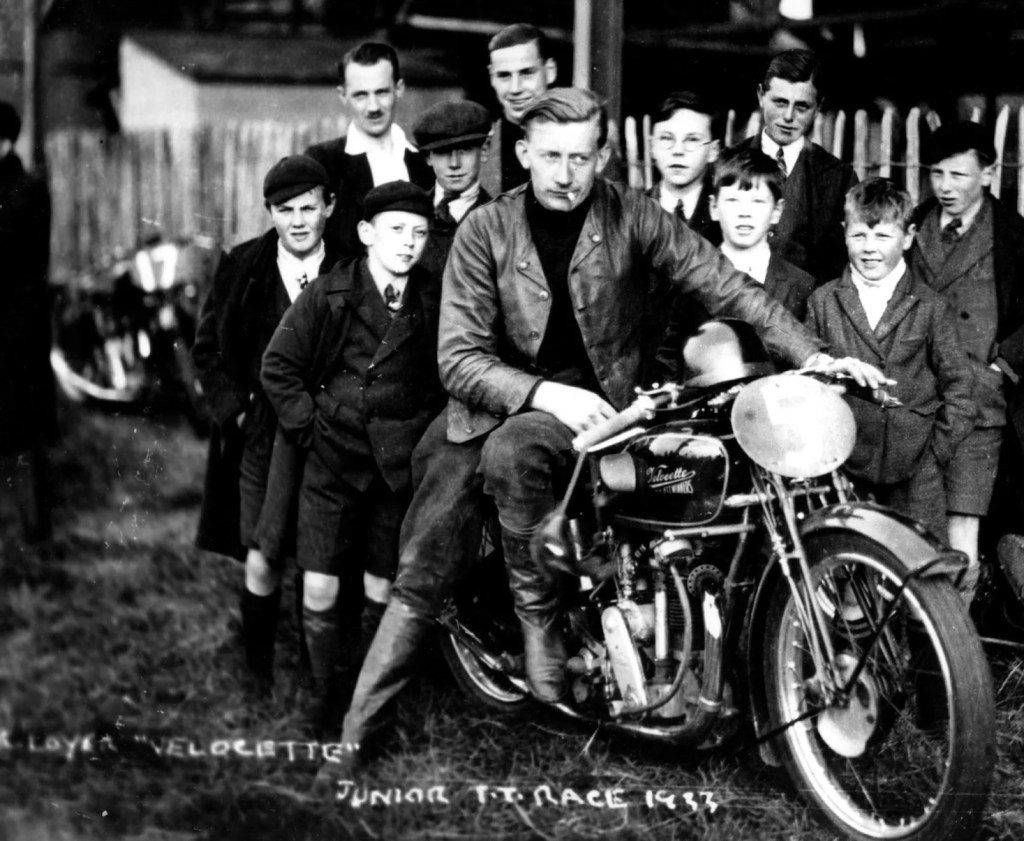
Roger Loyer and Velocette at the Isle of Man in 1933 (unattributed)GP des Remparts, Angouleme in 1949. Maurice Trintignant, Simca Gordini T11 in front won sharing with Jean Thepenier. Bruno Sterzi, Ferrari 166 #26, with Roger Loyer at right D46 Fiat DNF, and Harry Schell, D46 Fiat behind Trintignant (unattributed)Roger Loyer with his Cisitalia D46 Fiat at Lyon in September 1947 (Jannaud)
In a limited 1948 season – when the D46 was still very competitive in F2 events – Loyer raced at Pau in March, then Geneva in May for a DNF, then shared a car to third in the Circuit des Remparts with Robert in July. 1949 was worse in an even more limited campaign. DNQ at the Circuit du Lac in June and a crash at the Circuit des Remparts in July despite finishing second and setting fastest lap in the second heat. Robert and Roger shared a drive to sixth in the Circuit de Lac in a Simca, then contested the Grand Prix of the Nurburgring, where Roger was again a DNF.
Alan Watson was the buyer, but he didn’t use it much, notably giving it a run at Longford in March 1955. The car passed through several owners hands, albeit who were owners and who were drivers is lost a bit in the mists of time; the roll call includes Tony Osborne, John Doherty, Harry Firth, Syd Fisher, Ian Wells, Ray Gibbs and Ian Wells.
Lou Burke sold it to the Leech Brothers in 1964 and they used it for decades in Eastern Seaboard Australian historic events. The car was painted red circa 1980 when the pretty-Italian formed the bloke-magnet for the Lombard Insurance stand at motor shows. The car left Australia for the ‘States in 1987 and has pinged around the auction scene, some of the sales-prose Arthur Daley would be proud of.
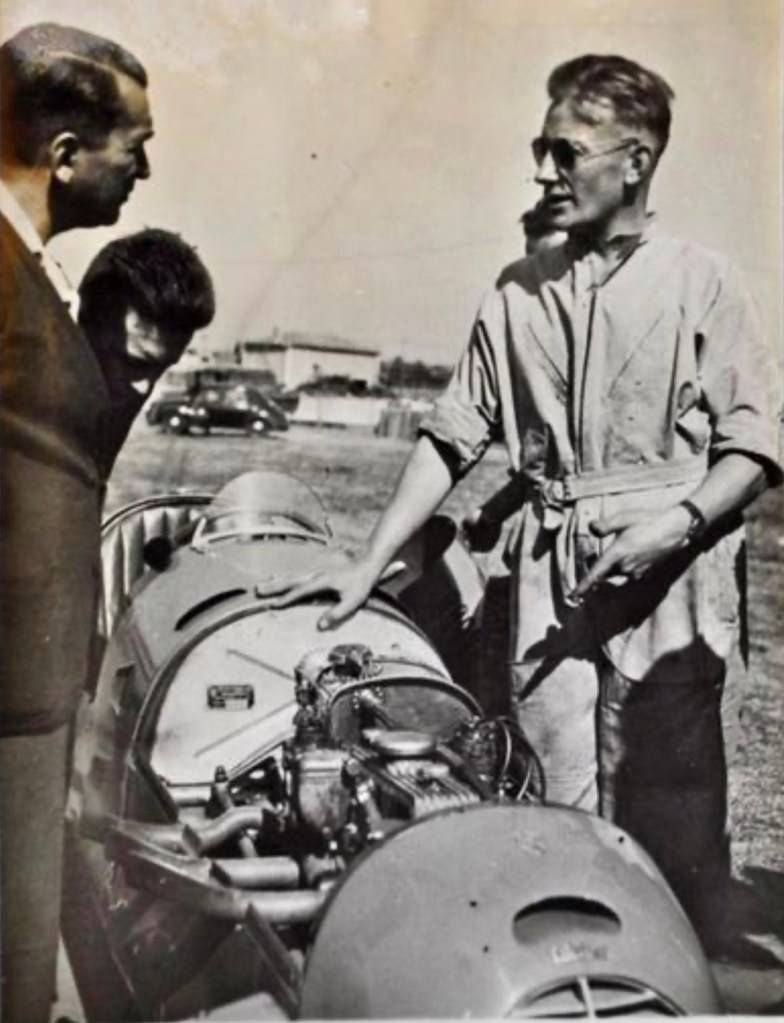
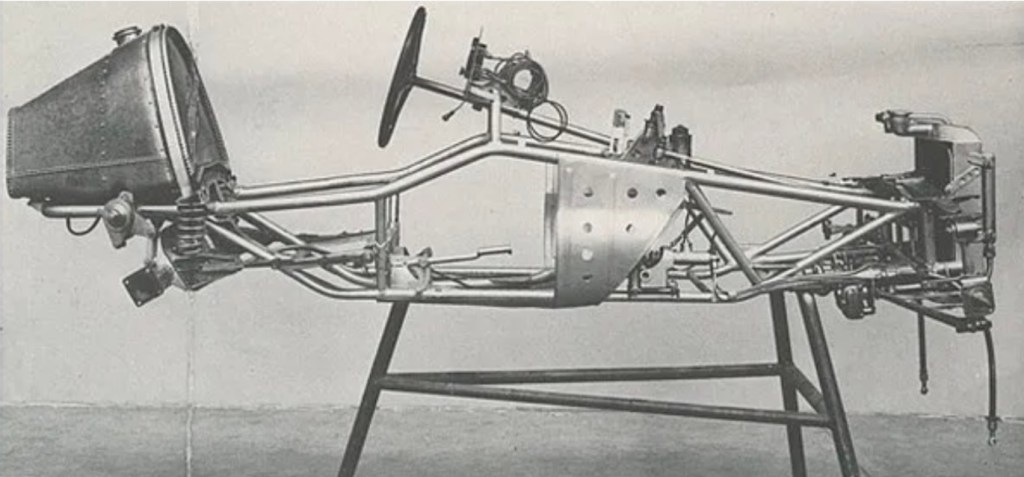
The lack of straight tube-runs would have offended Colin Chapman (but not Owen Maddock), however, the Cisitalia D46 spaceframe – here in definitive production form – was simple, light and stiff for its day. So elegant in its simplicity (unattributed)
Design and Production…
While the Piero Dusio founded (1943) and funded – Compagnia Industriale Sportiva Italia or Cisitalia – Dante Giacosa 1946 spaceframe design is rightly lauded as one of the world’s first, certainly of one built in volume, Australian historians point to the Chamberlain Brothers’ Chamberlain Indian/Eight of 1929 as a stunning much earlier expression of multi-tubular spaceframe brilliance. See here; https://primotipo.com/2015/07/24/chamberlain-8-by-john-medley-and-mark-bisset/
In 1944 Dusio, via an interlocutory contacted and contracted Giacosa (to the end of 1945), a Fiat engineer to design ‘the outline and technical hypothesis of a racing car using Foot 500 and 1100 components.’
Giacosa’s small team comprised draftsman Edoardo Grosso, and from August 1945, Giovanni Savonuzzi, Dante’s replacement. ‘The project number 201 in keeping with those used by Giacosa at Fiat. While the car was later called D46, this remained the basis of the subsequent numbering of Cisitalias: 202, 204, 303, 505, 808 etc.’
‘Giacosa’s project 201 (first version with low sides and straight tube-runs) had a tubular spaceframe, the first time (it wasn’t) this revolutionary construction system was used’ (Cisitalia)(D Giacosa)
Overcoat clad Giacosa susses one of his early D46s. He later remarked, “When I came to build the chassis it was in my mind to make it of tubing. That’ll appeal to Dusio, I thought, since he builds Beltrame bicycles in his workshop.” It’s also thought that the tubular cockpits of the Rosatelli designed aircraft Giacosa worked on during the war was also influential.
Whatever the case, the ‘framework chassis’ adopted was light and stiff and provided a platform to ‘which the mechanical parts could be easily mounted in a low position…using existing equipment and staff already specialised in this kind of procedure. The molybdenum chrome plated steel (remember how scarce high quality material was in this immediate post-war period) used came from leftover Aeritalia stock ‘used by Rosatelli in the construction of CR and BR aeroplanes during and after the war.’
‘An interesting system was chosen for the gear change using three semi-automatic gears. The rear axle with its upside-down differential was another novelty’ (Cisitalia)‘The design envisaged two ways of lowering the drive: using a crown wheel and pinion or turning the differential upside down and using driving gear. The second solution was adopted’ (Cisitalia)
To better exploit the chassis further lateral thinking was applied to other key components. The rear axle and diff was turned upside down, with a small aluminium crankcase developed for the Fiat engine allowing a bevel gear pair to take the drive from front to back passing under the differential towards the driveshaft turned from a steel billet -the gear pair offered a range of ratios to driver choice. This lowered the engine by 12cm.
Front suspension was lifted straight from the Fiat 500. ‘Hydraulic shock absorbers were fitted on the prolongation of the lower triangle’ (wishbone), but turned upside down compared to original Fiat fitment. An upper transverse leaf spring performed compliance and locational duties.
Equally brilliant was the Grosso drafted three-speed, semi-automatic mechanical gearbox ‘intended to save time for the drivers during races’, later in the D46’s life (1948) four-speed conventional Fiat ‘boxes were used.
Short tests of the prototype took place on a short circuit backing onto the railway at the rear of the factory in Corso Peschiera in February 1946: Adolfo Macchieraldo, Carlo Dusio, Giacosa and Savonuzzi all had a steer. More importantly the vastly experienced engineer/racer Piero Taruffi drove the disc-wheeled, sketchy bodied prototype a short while later, and was appointed the official test driver. Evolution of the then car progressed quickly.
Rear axle with short coil springs and lever action friction shocks. Frame member and diff also in shot (Cisitalia)A Giacosa sketch which shows the differences in the original solid rear suspension location medium and quarter elliptic setup adopted – as per text. Also shown is the clever diff/driveshaft arrangement (Cisitalia)
Initial problems included rear end judder rectified by replacing the two rigid lateral suspension arms with two quarter elliptic springs ‘five to the axle, rotating freely on two pinions integral with the chassis, offering only resistance to torsional stress like an anti-roll bar, leaving the real springing to two short coil springs. The axle was connected to the chassis via a hinged triangle mounted to the diff and a spring at the point of chassis attachment which allowed suspension adjustment.’
The chassis cracked in the central area so was strengthened, in part by enlarging the body side and inserting a welded shaped metal panel of greater size. Note the differences clear in side views of the frame of the prototype and production cars, it evolved from Colin Chapman straight tube-runs to Owen Maddock wonky-ones! and worked as well as Owen’s!
‘From the first model with a small tubular lattice-work frame, the D46 moved swiftly to the definitive version with a modified chassis and a sophisticated semi-automatic gearbox’ (Cisitalia)
By September 1946 seven D46 Fiat 508B/1100cc powered 62bhp @ 5500rpm, 370kg Voiturettes had been built. ‘The line of the car was fascinating and aggressive at first sight, offering pleasing solutions such as the double fairing on the front suspension which gave it something of the air of a biplane. The nose was perfect oval which incorporated a small upper air intake which fed the carburettor via a duct, brining a certain amount of overpressure when racing.’
The steering wheel could be tipped to allow easier access for the portly. The six-piece, beautiful, quick-fitting Itallumag body was made by Turin’s Rocco Motto, the riveted 45 litre duralumin fuel tank by De Gregori, another local.
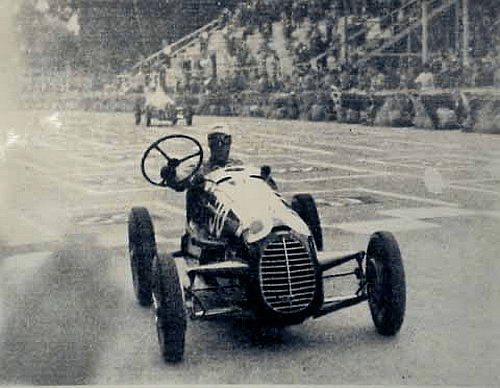
The initial batch of seven cars were raced in the Coppa Brezzi at Valentino Park, Turin on September 3. Piero Dusio won from Franco Cortese and Louis Chiron, poor Tazio Nuvolari had the steering wheel come away in his hands when it broke away from its hinge, below.
(Wikipedia)‘The definitive version of the little 1100cc D46 with fairings on the front wheels and the curious system of the tip-up steering wheel’ (Cisitalia)(Cisitalia)
‘Selection of first gear or reverse was carried out by means of a lever set on the side of the steering column, while to change from first to second or from second to third or back down again the clutch pedal had to fully depressed. To change from second or third to first or neutral, the clutch pedal had to be fully depressed again, but after having moved the hand lever to the desired position. To use the clutch without changing gear, the pedal had to be depressed about halfway, when a hardening was encountered beyond which the gear shift was operated.’ Yeah right, buggered if that makes sense to me despite driving a couple of cars with pre-selector ‘boxes recently…
(Cisitalia)
Towards the end of 1947 Rudolf Hruska and Carlo Abarth joined Cisitalia as Technical General Manager and Racing Manager respectively. The D46 was modified and shown at the October 1947 Milan Motor Show (above).
The nose was still oval but more horizontal, the fairings deleted, sides extended to house two lateral fuel tanks. ‘The overall line of the car was influenced by the design of its big sister, the supercharged 1500cc Grand Prix car taking shape on the firm’s drawing boards.’
In addition, the semi-automatic gearbox was dropped in favour of a standard Fiat 1100 4-speeder, the rear suspension modified by fitment of twin torque arms on each side, and telescopic hydraulic shock absorbers adopted all-round.
Etcetera…
(Sud Ouest)
Cisitalia D46s at the Circuit des Remparts, Angouleme in 1949. #2 is Loyer, #28 is Guy Michelot and future, fast GP driver Harry Schell is on the move in the family Ecurie Bleue #20 machine.
(unattributed)
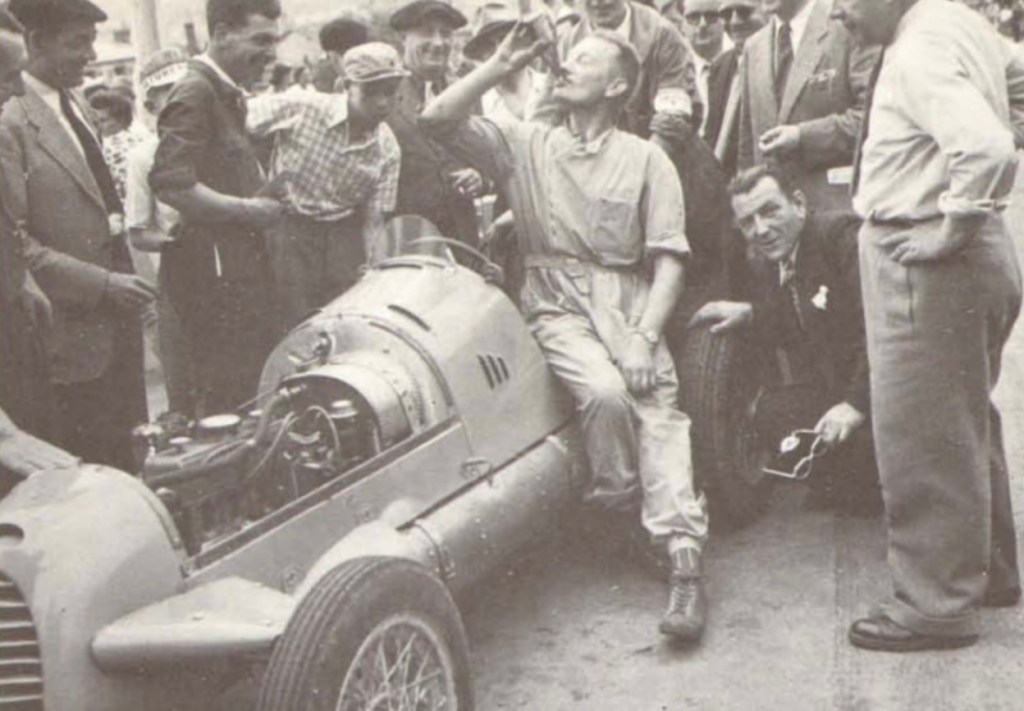
Roger Loyer having a gargle alongside ‘our’ D46, perhaps, Ecurie de Paris raced two, after a strong showing, place unknown. Fosters Lager stubby perhaps…
(M Wells Collection)
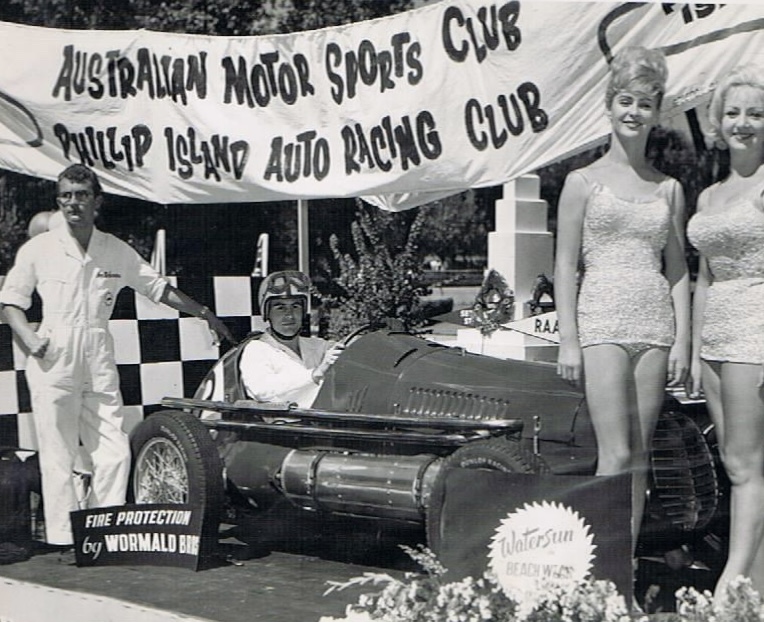
Who said tits don’t sell, it’s always worked with me? A couple of delightful lasses resplendent in much less than acceptable attire these days, during Melbourne’s March Moomba festival in the early 1960s.
(R Jackson)
Looking quite the beauty queen at Sandown in the 1970s above, and below in the old pits at the same venue in June 1963; so distinctive from every angle, form and function…
(A Tracey)(G Shepherd)
Not Tazio’s tiller but the altogether more flash one of ‘our’ D46 at Calder when owned by the Leech boys circa 1966.
(M Wells Collection)
Ian Wells with elbows out at Calder in the early 1960s. The car in strife behind is the “Platypus MG”, Greg Smith tells us. “By this time it was fitted with a big Healey-four, later to be reconfigured by Lou Molina as Vulgarilla (famous Oz MG Special raced by Molina, an equally legendary racer/hotelier/raconteur) and still sports the same alloy tail, maybe Murray Nankervis at the wheel.”
(A Tracey)
Jim Leech taking on the challenging Mount Tarrengower hill, in Victoria’s Goldfields region, 1964. The Brothers Leech had a small but very select collection of old cars they used extensively.
(Australian Motor Racing No 2 1952 – S Murray Collection)
WTF…
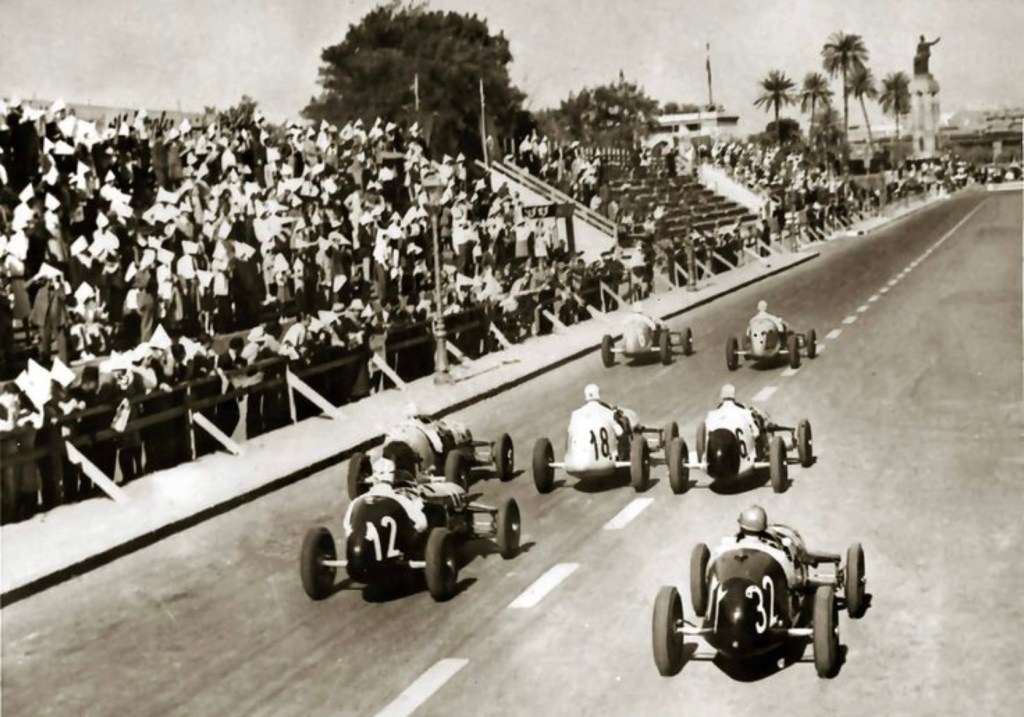
The Sehab Alma Bey Trophy was an invitation race for Cisitalia D46s held on the 1.48km Circuit El Guezireh – The Pyramid Circuit around the Guezireh Park – Cairo on March 9, 1947.
Franco Cortese won the first heat and Piero Taruffi the second, and Cortese the 50 lap final from Alberto Ascari, Taruffi, Piero Dusio and Mario Tadini (below entrant numbers unknown).
(New York Times)
Credits…
Reg Nutt Collection via Leon Sims, Troy Davey Milne, Mark Wells Collection, Graham Shepherd via David Zeunert, Jannaud, Russell Jackson, Ashley Tracey, New York Times, ‘Profile – Roger Loyer’ Jeremy Scott, ‘Historic Racing Cars in Australia’ John Blanden, ‘Cisitalia’ Nino Balestra and Cesare Agostini via Tony Johns, Stuart Murray Collection
Tailpiece…
Rendition by Martin Vins of a famous original photograph of Felice Bonetto – replete with fag – sliding his D46 Fiat at the Circuito di Mantova in 1948.
Bill Dutton’s gorgeous little Alta 1100 Special in the Fishermans Bend paddock during the 29-30 January, 1950 Victorian Tourist Trophy meeting. Love the ‘works’ Alta overalls.
George McKaige attended the meeting and took some marvellous photographs. A prolific enthusiast, driver, restorer and photographer, he and his son Chester published two books of George’s work, called ‘Beyond The Lens’, the shot above is on the cover of Volume 1.
This little known car was conceived when Bill Dutton – of the famous Melbourne car trading family – bought the supercharged, DOHC Alta 1100c engine (number 25S) which had been cast aside when Bill Reynolds bought Alta 21S from probable British MI5 spook, Alan Sinclair. Sinclair raced the car in Australia in 1938, an exhaustive and exhausting account is here; https://primotipo.com/2018/11/08/the-spook-the-baron-and-the-1938-south-australian-gp-lobethal/
Reynolds replaced the troublesome Alta four with a big, fat, lazy, powerful and reliable Ford V8. The Alta engine was surplus to requirements until Dutton saw its potential and built a car around it. The evolution of Alta 21S from four-cylinder sweetie to brawny V8 marauder is covered here; https://primotipo.com/2015/11/27/the-longford-trophy-1958-the-tornados-ted-gray/
Alta 21S as built, an 1100cc sportscar delivered to Scotland’s AJ Cormack on March 19, 1934. Here at Donington Park later that year (G Smith)The svelte Alta 21S 1100cc sports of the previous picture, by the time of the 100 miles January 3, 1938 South Australian GP at Lobethal, had become a dumpy, upright 1100cc single seater. Probable MI5 spook, Alan Sinclair up (N Howard)
Tony Johns tells me that the Dutton family business had all of the mechanical, engineering and body building skills to create the car on their Burnley Street, Richmond site. Stephen Dalton points out that Bill Dutton thanks Jack Dongers and Tom Stevenson for construction and body help respectively in the October 1949 issue of Australian Motor Sports. Do theses chaps ring a bell with any of you?
The 1950-51 Motor Manual Yearbook records that the Alta 25S four was 1096cc in capacity, was of twin-cam, two-valve type and fed by an Alta built Roots type-blower/SU carb giving 130bhp @ 5800rpm with 15lbs of boost. It was mated, via a bespoke bellhousing and metal to metal clutch, to a four-speed gearbox of unspecified make.
The Alta Spl it is a fine example of the body-builder’s art, but who was the gifted chappy? (R Edgerton Collection)
The chassis was made of chrome-moly steel tube, the main members of which were 16 gauge and two inches in diameter. The tubular front axle was specially made and suspended by transverse leaf springs front and rear with Armstrong hydraulic/Hartford friction shocks. The back axle was also specially made and used Ford bevel gears.
Brakes were hydraulic using modified Chev/Ford drums front/rear, wheels were pressed steel, 16 inch x 6 inch in size, with the whole lot clad ‘in a single-seat aluminium panelled racing body with a long tail, similar to a Grand Prix Alta.’
Ted Gray aboard Alta 21S Ford V8 (aka the Male Special / Ford V8 Special) at Penrith Speedway, west of Sydney in 1940 according to John Medley. Racer Ken Wylie is in the goggles at right, perhaps Jim McMahon left. I’ve still to get to the bottom of Pinocchio’s presence on the scuttle. Just look at all those names on Byron Gunther’s image…Ted Gray clears Hell Corner for the run up the mountain, Bathurst October 1950, the left front is just clear of terra firma (J Blanden Collection)
Bill Dutton engaged Wangaratta’s Ted Gray to drive his new car. Ted initially showed speed on pre-War speedways and in two very impressive appearances in the Male Special midget against Peter Whitehead’s ERA R10B at Rob Roy and Aspendale in 1938. Gray’s Alta credentials became impeccable when his patron, Melbourne car dealer, Alan Male bought Alta 21S Ford with which Gray took 24 wins from 26 starts pre-War according to John Blanden.
After the conflict, Ted re-commenced racing in another famous old-Oz racer, the ex-JAS Jones Alfa Romeo 6C1750 Zagato into which, you guessed it, Ted fitted a Ford V8. Blanden records that the Alta Special’s first race as being at the Fishermans Bend October 29-30, 1949 meeting where a broken cam-follower ended proceedings early in the day. ‘In the late 1940s, early 1950s, the car was a regular competitor, however the engine problems continued. The little car was third in the F1 Scratch Race at Woodside in October 1951,’ a better performance.
(T Johns Collection)(T Johns Collection)
In the 1950s ‘the car simply disappeared’, one theory is that it sat on a service station roof in St Kilda (an adjacent suburb to AGP venue Albert Park) as a drawcard for punters after the servo owner refused to pay an exorbitant Alta engine repair bill from a Sydney business. Then Melbourne pilot/enthusiast/engineer Graeme Lowe responded to a VSCC Newsletter ad for an engine in 1967. His £10 purchase of 1100 #25S was the catalyst of a very long, thorough reconstruction/restoration of Alta 21S which was completed and then made its public debut in Betty Lowe’s hands in 1999.
In recent times 21S was acquired by Fiona Murdoch, the shot below was taken at Gladysdale, Victoria on March 4, 2023 during a drive – one I won’t forget in a big hurry – and photo session for a feature article just published in issue 07 of quarterly Australian classic car magazine, Benzina. If you can’t find it in a newsagent, a decent example of which is as rare as rocking horse shit in Australia these days, email the publisher, Jack Quinn; jack@benzinamagazine.com
(M Bisset)
Credits…
George and Chester McKaige, Ron Edgerton Collection, ‘Historic Racing Cars in Australia’ John Blanden, 1950-51 Motor Manual Year Book, Graham Smith Collection, David Woodhouse, Norman Howard, Byron Gunther
Etcetera…
(T Johns Collection)
The other pages of the 29-30 October, 1949 Fishermans Bend (correct spelling of the place according to our Government and lack of apostrophe by the way) programme sent by Tony Johns.
I always find these documents of wonderment as I don’t have a collection of them. This was fundamentally a local meeting but there are a swag of interstaters too, its interesting to see the Top Guns, Future Top Guns and Notables in the mix. Mine are – in no particular order – Ted Gray, Reg Hunt, Otto Stone, Lex & Diana Davison, Ken Tubman and Dick Cobden (NSW interlopers), Stan Jones, Gib Barrett, Rupert Steele, Tony Gaze, Jim Leech, Charlie Dean, Eldred Norman (Adelaide Hills), Doug Whiteford, Tom Hawkes, Ron Edgerton, Jim Gullan, Lou Molina, Murray Carter, Hedley Thompson, Arnold or Arthur Terdich, Peter Manton, Bill Patterson, Derek Jolly and no doubt others who just don’t ring-the-bells for me.
(T Johns Collection)
What jumps off the pages too is the importance of Australian Specials, and MGs in particular, which provided the lifeblood and bulk of Australian motor racing grids for decades. Depending on the year MG provided both outright contenders and the ‘Formula Vee’ in unmodified form, and ‘Formula Ford’ in modified form entry-level classes of the day.
Lamberto Leoni at the Formula 2 Grand Prix de Nogaro (ninth), aboard his Scuderia Everest Ralt RT1 Ferrari 206 in 1977.
Ferrari entered into an arrangement with Giancarlo Martini and Giancarlo Minardi’s Scuderia Everest – originally Scuderia del Passadore and from 1975 Scuderia Everest, after obtaining sponsorship from the Italian rubber products manufacturer Everest Gomma – and another ex-racer, Pino Trivellato’s Trivellato Racing to provide 2-litre Dino V6 engines to be fitted to Ralt/Chevron chassis run by each team to bring-on young Italian drivers through Formula 2. The program ran for two years, 1977-78 with only modest success.
Enzo Ferrari, Giancarlo Minardi, Roberto Farnetti keeping an eye on Lamberto Leoni at Fiorano in 1975, March 752 BMW (F Minardi)
Martini drove March BMWs for the team, during this 1975-76 period Minardi developed a strong relationship with Scuderia Ferrari team manager – and decades later Ferrari CEO – Luca di Montezemolo. Via this connection Everest tested their cars at Fiorano, and at the end of 1975 Minardi secured a deal with Enzo Ferrari to run a Ferrari 312T F1 car to race in the Race of Champions at Brands Hatch and the BRDC International Trophy at Silverstone, way back when in the days of non-championship F1 races.
Giancarlo Martini, Ferrari 312T, International Trophy, Silverstone 1976 (unattributed)
The deal was reminiscent of the arrangement whereby a Ferrari 156 was raced by Giancarlo Baghetti under the Federazione Italiana Scuderie Automobilistiche (FISA) banner in 1961. Maurizio Flammini was offered the Everest 312T drive but knocked back the opportunity so Martini got the gig. With very limited practice at Fiorano he was Q13 and DNF prang at Brands, and Q10 and 10th in the rain at Silverstone. Giancarlo Minardi would of course return to F1 a decade later.
The Scuderia Everest Ferrari connections were immaculate and led to the agreement to run Dino engined Ralts in 1977. Everest ran Lamberto Leoni and Gianfranco Brancatelli in RT1 Ferraris, while to broaden their coverage, Pino Trivellato, the Chevron agent in Italy, planned to run Riccardo Patrese in a Chevron B40 Ferrari.
Just the view of the Prancing Horse on the steering wheel must have been good for an extra couple of tenths! Chevron B42-78-07 Ferrari, the ex-De Angelis 1978 chassis (Legends Automotive)
Ferrari F2 206 V6 engine and lineage…
The Ferrari Dino V6 family(ies) of engines were incredibly versatile, fitted as they were to single seaters and sportscars and winning World F1 Championships in 1958 (drivers) and 1961 (drivers and manufacturers). They were built in capacities of between 1.5 and 2.4-litres, with two, three and four valves per cylinder, fed by carburettors and fuel injection, not to forget the turbo-charged and experimental radial valve variants. In mid-life 2.4-litre Ferrari 246T open-wheelers – a derivative of the Ferrari 166 F2 car – won the 1969 and 1970 Tasman Cups for Chris Amon and Graeme Lawrence. Who could forget the 206/246 Dino roadies and the similarly powered Lancia Stratos, competition variants of which were winning rallies into the 1980s.
The challenge of building an engine to match the competitor set, the modern as tomorrow 300bhp Hart 420R and BMW M12/7 fours, and Renault-Gordini CH1B V6, was given to long-time Ferrari mechanic, ex-F1 chief mechanic Giulio Borsari. He was handed an all-alloy 65-degree 24-valve Dino V6 with the four camshafts driven by chains! The bore/stroke of the new Ferrari 206 was 86mmx57mm. This was achieved with a visit to the parts-bin and mating the short stroke of the 1965 Dino 166P (sportscar) with the “86mm bore of the unlamented Dino 166 1.6-litre F2 engine,” wrote Doug Nye in ‘Dino:The Little Ferrari’.
The compression ratio was 12:1, 10mm Champion plugs were used and titanium conrods. While dry-dumped, the long engine was also very tall as the pressure and scavenge pumps occupied a lot of space, while the sump itself was deeper than what had become modern practice. Ferrari claimed 300bhp @ 10,500rpm for the 120kg engine “which was outdated before it had begun to race.” Nye wrote.
The immediate concern of the Ralt/Chevron proprietor/designers Ron Tauranac and Derek Bennett was the engine installation challenges, particularly its height. Tauranac and his lads in Snelgar Road, Woking simply took the handling penalty implicit and mounted the motor as low as they could into an RT1.
Derek Bennett and Paul Owens up in Bolton thought “stuff that” and designed a 1 1/2 inch lower sump, “so that the gearbox would come down to the right level and the driveshafts could be put on at a sensible angle” wrote David Gordon in ‘Chevron:The Derek Bennett Story’. They had the sump cast and along with a new oil pump, fitted the modified engine to a B40 and headed to Fiorano to test it shortly before the first Euro F2 round at Silverstone in late February/March.
Paul Owens and Derek Bennett ponder the installation challenges of the tall Ferrari 206 V6 into a Chevron B40 chassis (Autosprint)Lamberto Leoni, Chevron B40 Ferrari, Estoril 1977 (MotorSport)
The Ferrari folk were delighted with the look of the Chevron but flipped when they saw the modifications to their engine. The Mona Lisa had been desecrated, Chevron/Trivellato were forbidden to race the car and Paul Owens copped a major pull-thru in a meeting with Mauro Forghieri and Piero Lardi Ferrari.
Ferrari then tested the modified engine, which performed well on the dyno under static conditions but lost power when rotated through 45-degrees, a technique used to simulate cornering loads, the pumps were not scavenging properly.
Another slanging match ensued in a subsequent meeting when Paul Owens and Dave Wilson, who spoke Italian, met again with Ferrari. The Chevron boys asserted strongly that the car wouldn’t handle properly – which was pretty much proved by the poor performance of the Ferrari engined RT1s compared with Hart and BMW powered Ralts throughout the season – while the Ferrari people wouldn’t agree to lower the engine.
“After much shouting and thumping on the table, the meeting broke up acrimoniously, with Paul declaring that Chevron were no longer interested in pursuing the project because it would be detrimental to their reputation. Although that was exactly what Paul and Derek believed, it still felt extremely strange to be telling Ferrari that running their engine could be bad for Chevron.” Gordon wrote.
The stalemate was broken when Pino Trivellato negotiated a process whereby B40s would be tested back to back at Fiorano, one fitted with the Ferrari engine in its original form and one BMW M12/7 powered. The Ferrari engined car was the slower.
Leoni awaits a ready mount at Fiorano in early 1977, Ralt RT1 Ferrari (F Minardi) Brancatelli overhead shows the cohesive look of the RT1 Ferrari (unattributed)206 Dino V6 installation – which appears to be at least a semi-stressed member – in an RT1 (G Gamand)
While all this was going on the European F2 Championship was well underway. Rene Arnoux won the Silverstone season-opener on March 6 in his works Martini Mk22 Renault Gordini V6. Then Brian Henton won in a Boxer PR2 Hart at Thruxton, with Lamberto Leoni’s RT1 Ferrari a DNF oil pressure. Leoni failed to qualify in the following Hockenheim round where Jochen Mass’ March 722P BMW prevailed. Mass won again at the Eifelrennen at the Nurburgring in May with both RT1 Ferrari’s DNAs.
In the first ‘home race’ for the Ralts at Vallelunga, Brancatelli had his first RT1 start and finished 13th while Leoni was outted with clutch failure. Bruno Giacomelli’s works March 772P BMW won. The Pau GP was similarly disastrous, Leoni DNQ and Brancatelli DNF with oil pump failure, somewhat ironic given the Chevron-Ferrari chitty-chats taking place at the same time! Arnoux won from Didier Pironi in a Martini Renault 1-2. To make matters worse, Riccardo Patrese was one of the season smash hits aboard a Trivellato B40 BMW. Pino did a deal to get Patrese works BMW engines when the Ferrari dramas appeared impassable…
Both RT1 Ferraris finished at Mugello on June 19, in seventh/eighth Leoni/Brancatelli, while up front the top-four were Giacomelli/Patrese/Alberto Colombo/Alessandro Pesenti-Rossi. Italian drivers seemed to be doing quite well without Ferrari’s help thank you very much.
Leoni, Trivellato Chevron B40 Ferrari, Mediterranean GP, Enna Pergusa, July 1977. Eighth in the race won by Keke Rosberg’s Opert Chevron B40 Hart 420R (MotorSport – E Colombo)
Eddie Cheever’s Ron Dennis-Project Four Ralt RT1 BMW won at Rouen from Patrese’s Chevron B40 BMW – there was nothing wrong with both chassis if a decent engine sat in the back – while Brancatelli’s RT1 Ferrari was an encouraging fourth but Leoni again was a DNQ. While the Chevron-Ferrari soap-opera continued Leoni was ninth at Nogaro in his Everest RT1 Ferrari on July 3 with Brancatelli a DNF with suspension damage, Arnoux again won.
At Enna – the Gran Premio del Mediterraneo – Gianfranco Trombetti guest-drove an RT1 Ferrari to sixth, which was frustrating for Leoni, but he was eighth in a Trivellato Chevron B40 Ferrari which finally made its race debut!
Up front Keke Rosberg, off the back of a career enhancing win at the start of the year in the competitive New Zealand Formula Pacific Championship aboard a Fred Opert Chevron, won in an Opert B40 Hart. Brancatelli was unclassified in the other Everest RT1.
Leoni’s placing was just reward as he had taken over the testing duties of the Trivellato B40 Ferrari after Patrese signed with BMW. After even more angst Ferrari “made a sump the same height as the original one we made, almost a copy of it,” said Paul Owens. “From then on we started to make progress.”
The F2 cirus then moved on to Misano for the Adriatic GP where Leoni took a sensational win (above) in the B40 Ferrari! In an ominous start to the weekend, 19 year old Elio De Angelis outqualified Lamberto in practice aboard an Everest RT1 Ferrari in his first F2 race. He earned the drive after bagging second place in the Monaco F3 GP (Chevron B38) and then a win at the F3 Monza Lottery race aboard an RT1.
Leoni was second in the first heat, then won the second and the round overall. It was a much needed victory for all concerned, Ferrari were delighted and it also proved Chevron’s stance had been correct all along. De Angelis was eighth in his F2 debut (shots below) and Brancatelli unclassified in the other RT1 Ferrari (chassis numbers RT1-65 and RT1-66 by the way).
(unattributed)
Then it was off to Estoril where the Martini V6s did a Pironi/Arnoux 1-2 with Leoni the best of the Ferraris, he was ninth in the B40 Chevron, while De Angelis was out with suspension damage on lap two, with Brancatelli a DNQ.
For the final Euro F2 round Giancarlo Minardi pursuaded Pino Trivellato to lend him Leoni’s B40 Ferrari for Elio de Angelis to drive at Donington on October 29. That all came to nothing when the car jumped out of gear and hit a concrete retaining wall. Repaired overnight, the car wasn’t as quick as the day before, with Elio finishing tenth. Up front, Bruno Giacomelli indicated his intent by winning in the new – very fast – March 782 BMW.
Reno Arnoux won the championship for Martin Renault with his team mate Didier Pironi third, while Eddie Cheever was second in a Ralt RT1 BMW. Leoni was the best placed of the Ferrari powered drivers with nine points in 11th place.
Elio De Angelis, Chevron B40 Ferrari at Donington in 1977De Angelis during the GP di Roma at Vallelunga in June 1978. Eighth in the Martini/Everest Chevron B42 Ferrari, race won by Derek Daly’s Chevron B42 Hart 420R (unattributed)
Chevron B42 Ferrari Dino 206, 1978…
The Minardi/Everest Ralt Ferrari deal ended at the end of the year but Trivellato continued the Chevron Ferrari program with De Angelis as driver into 1978. Scuderia Everest also ran a Chevron B42 Ferrari for Beppe Gabbiani.
Bruno Giacomelli dominated the season in the superb March 782 BMW – an all new March F2 design, the first in years – and the Chevron B42, a best-seller with 21 chassis built, took its share of wins as well despite the tragic loss of founder and guiding light Derek Bennett after injuries sustained in a hang-glider accident claimed him on March 22.
Elio only had five races with the Ferrari 206 V6 engined B42, for two DNFs and three placings – none better than tenth – then gave up the unequal struggle and fitted a Hart 420R. Gabbiani ran in 11 of the 12 rounds for three DNQs, three DNFs with his best in the other rounds a fifth at Vallelunga – elbowing Rosberg off the track in the process – and seventh at Thruxton. The Argentinian, Miguel Angel Guerra ran one of the cars in the last five events for a best of seventh at Donington.
Bepe Gabbiani, Chevron B42 Ferrari, Nogaro 1978 (A Simmonel)The business end of the ex-De Angelis Chevron B42-78-07 Ferrari Dino V6 in modern times (Legends Automotive)Guerra, Chevron B42 Ferrari, Nogaro 1978 (A Simmonel)
Giacomelli won the championship in fine style on 78 points from Marc Surer in another works March 782 BMW with Derek daly third in a Chevron B42 Hart. The Ferrari engined Chevron B42 drivers were 14th and 20th – De Angelis and Gabbiani.
After such an appalling season of reliability and results, Ferrari canned the project. And that seemed to be the end of it, but Giancarlo Minardi and Ferrari were drawn to each other…
Guerra, Minardi 281 Ferrari 206, Misano pits 1981 (F Minardi)
Minardi 281 Ferrari Dino 206, 1981-82 …
On his inexorable rise to the top echelon of motor racing Minardi was after an unfair advantage to take his F2 team above the BMW M12/7 ruck, his mind turned to the Ferrari Dino 206 which had caused him so much pain a few years before. Surely with a little development it could be a winner…
Before too long, Minardi had done a deal with Enzo Ferrari and a truckload of engines, parts, patterns, drawings and much, much more were on their way to to Minardi HQ in Faenza. The project to squeeze more power from the old-gal was given to chief mechanic, Bertoni Tonino di Piangipane together with engineers Giacomo Caliri and Luigi Marmiroli. They managed to extract 325bhp from it, a little more than the BMW.
Miguel Angel Guerra, Minardi 281 Ferrari, Misano 1981 (MotorSport)
Miguel Ángel Guerra debuted the Minardi 281 Ferrari during the 1981 GP dell’Adriatico, Misano, finishing 13th. In 1982 Paolo Barilla practiced the 281B Ferrari, but raced a 281B BMW at Thruxton in April, then raced the Ferrari engined car at the next round on the Nurburgring to 15th.
At Mugello Sigi Stohr had engine failure after 2 laps…and that really was it for the incredibly long-lived Ferrari Dino V6, a shortage of funds made it untenable to fight the good fight against the thoroughly modern Honda V6 fitted to Ralt and Spirit chassis.
Of course those with a keen interest in Minardi – and who didn’t love the little guys that always punched above their weight – know the ‘Bromance’ between Minardi and Ferrari still wasn’t over.
Pierluigi Martini aboard the Minardi M191 Ferrari at Monaco in 1991 (MotorSport)
Giancarlo Minardi negotiated the use of the Ferrari Tipo 037 3.5-litre 65-degree V12 – shown below during the 1991 US GP weekend – for the M191 F1 car designed by Aldo Costa and raced with some success by Pierluigi Martini – Giancarlo’s nephew – Gianni Morbidelli and Roberto Moreno throughout 1991. Pierluigi’s pair of fourths in San Marino and Portugal were the best results of the season.
Leoni aboard his RT1 Ferrari at Thruxton during the B.A.R.C. 200 in April 1977, DNF with falling oil pressure after only nine laps, the popular winner was Brian Henton in a Boxer PR2 Hart 420R.
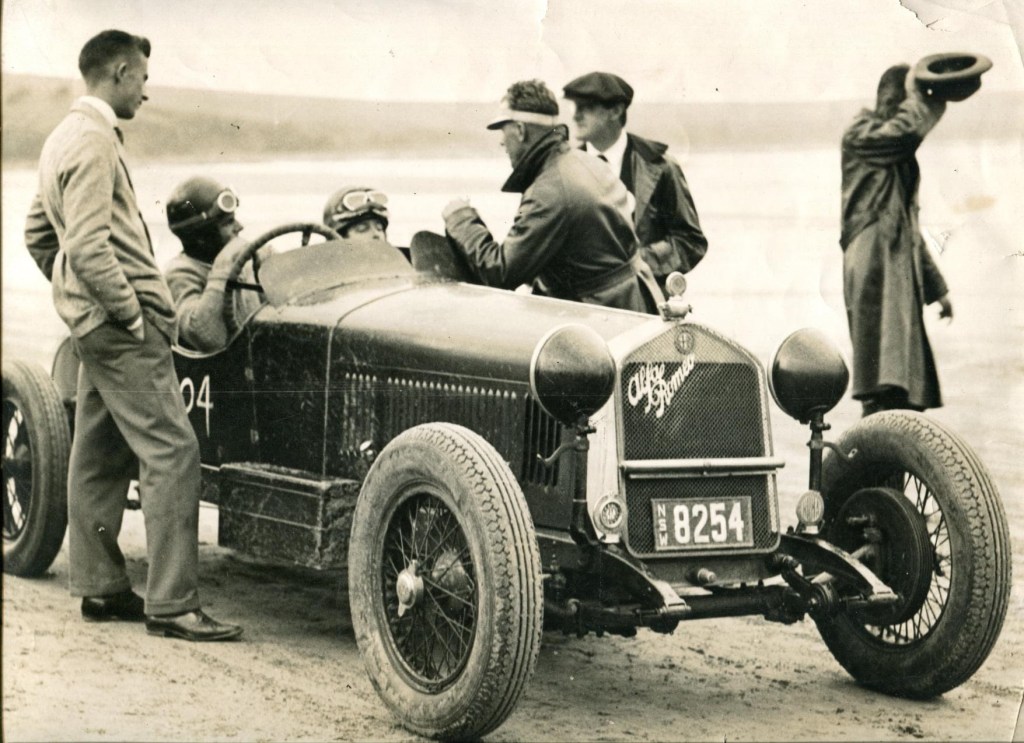
Percy Hunter and Vida Jones – aka Mrs JAS Jones – aboard her Alfa Romeo 6C 1750 SS Zagato on the beach at Gerringong, New South Wales south coast in 1930. Click here for a long feature on this oh-so-famous Oz racing car; https://primotipo.com/2018/02/15/mrs-jas-jones-alfa-6c-1750-ss-zagato/
(Keith Anderson Photography)
Only in Australia…
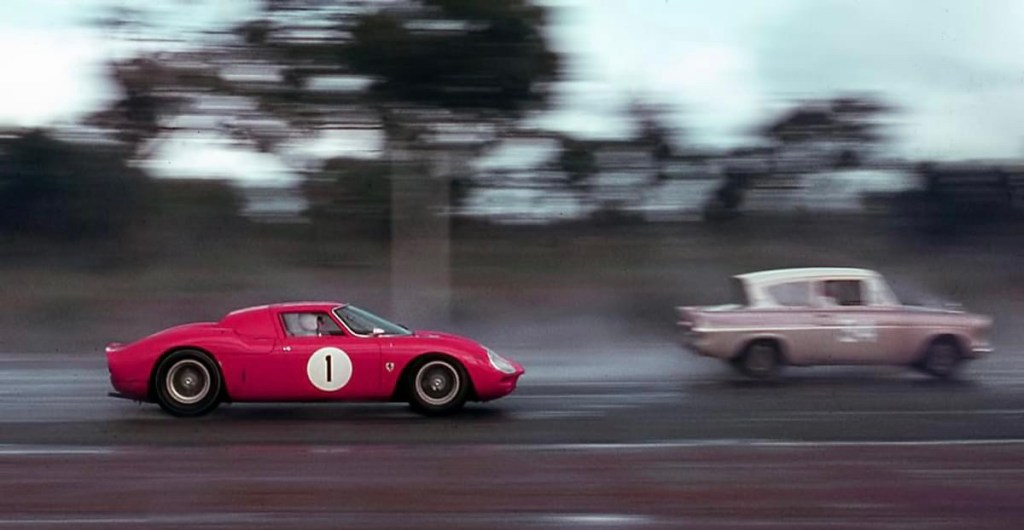
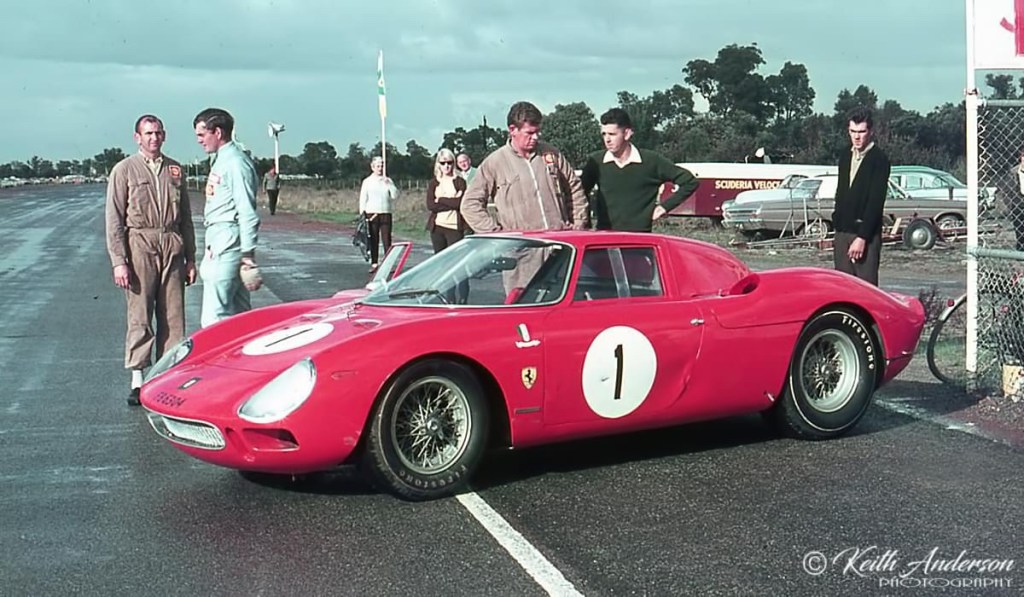
And no, the little Angle-box isn’t blowing off Enzo’s finest, the Andy Buchanan Ferrari 250LM at Caversham during practice for the 1966 6-Hour race.
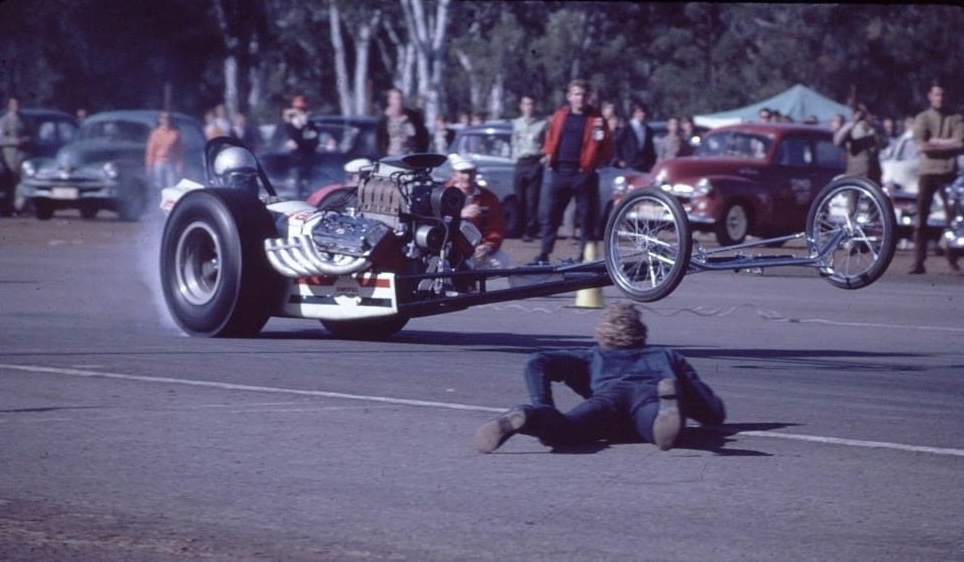
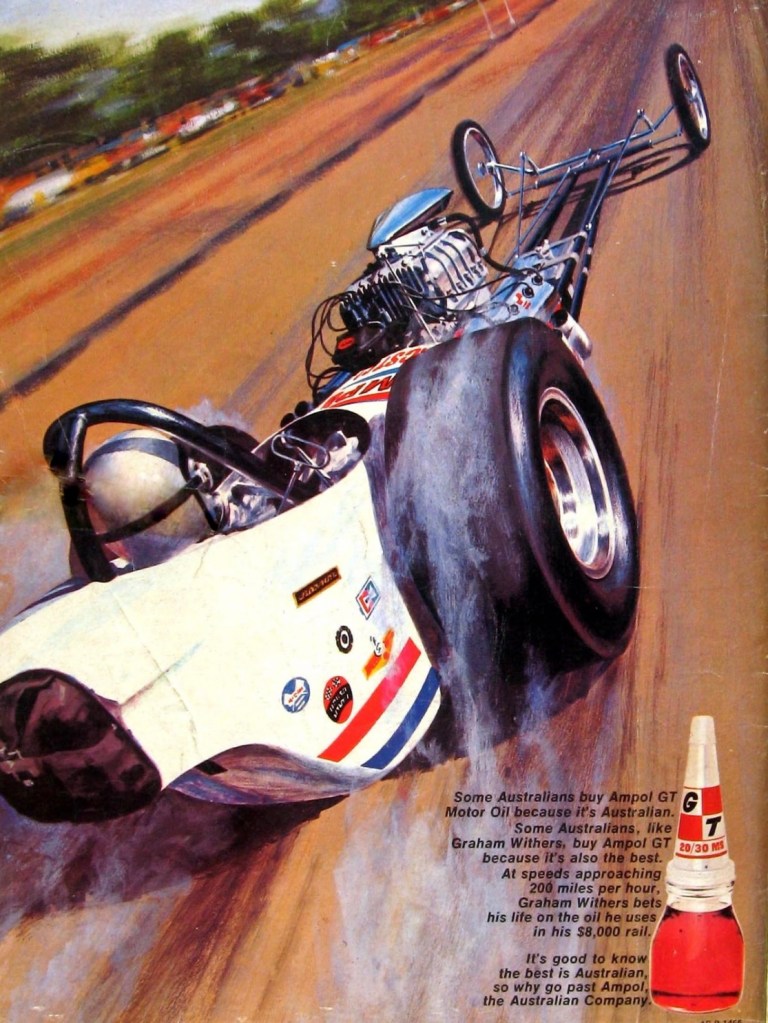
Graham Withers ‘slingshot’ Ampol GT sponsored dragster/rail at Castlereagh in 1968.
Whether the dude with the death-wish is a crew member sussing just how much air Mr Withers is taking on launch, or perhaps been ingesting tablets of a type not dispensed by suburban pharmacists is an interesting question. Do let me know if you can put all of our minds to rest. Manufacturer of the machine folks?
(B Williamson Collection)
Ron Hodgson’s Lotus 11 GT has to be Fugly Car Cup contender.
Here in the Warwick Farm paddock circa 1962. The story of how some lovely sportscars were re-purposed is told in this article about Murray Carter here; Forever Young… | primotipo…
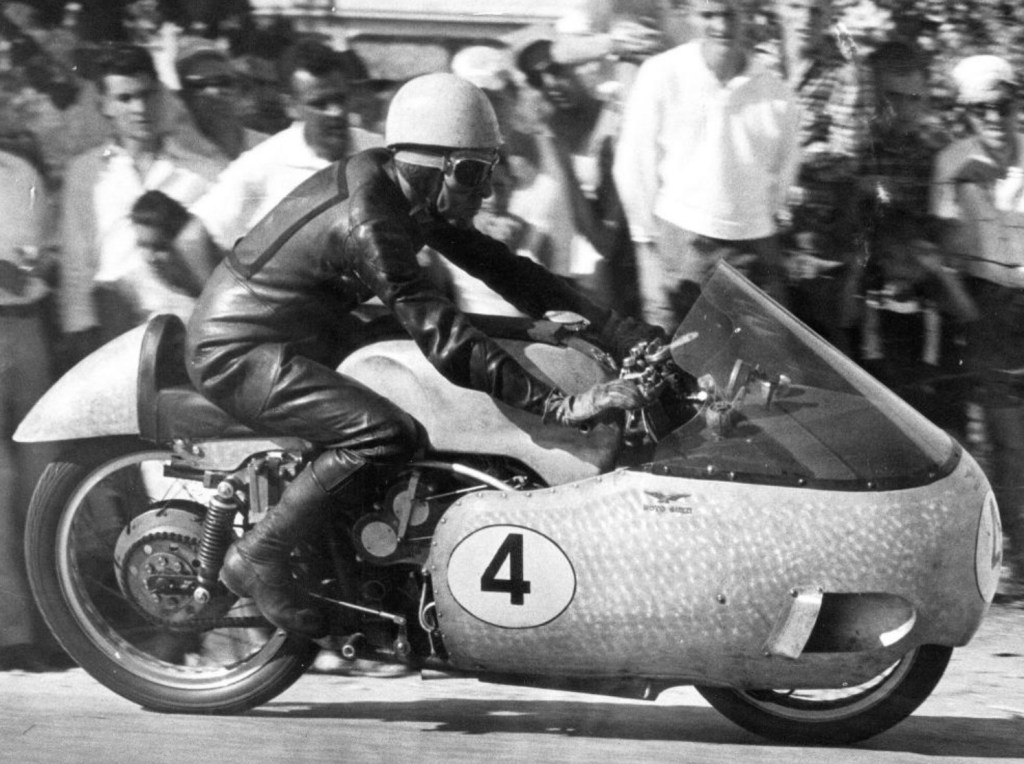
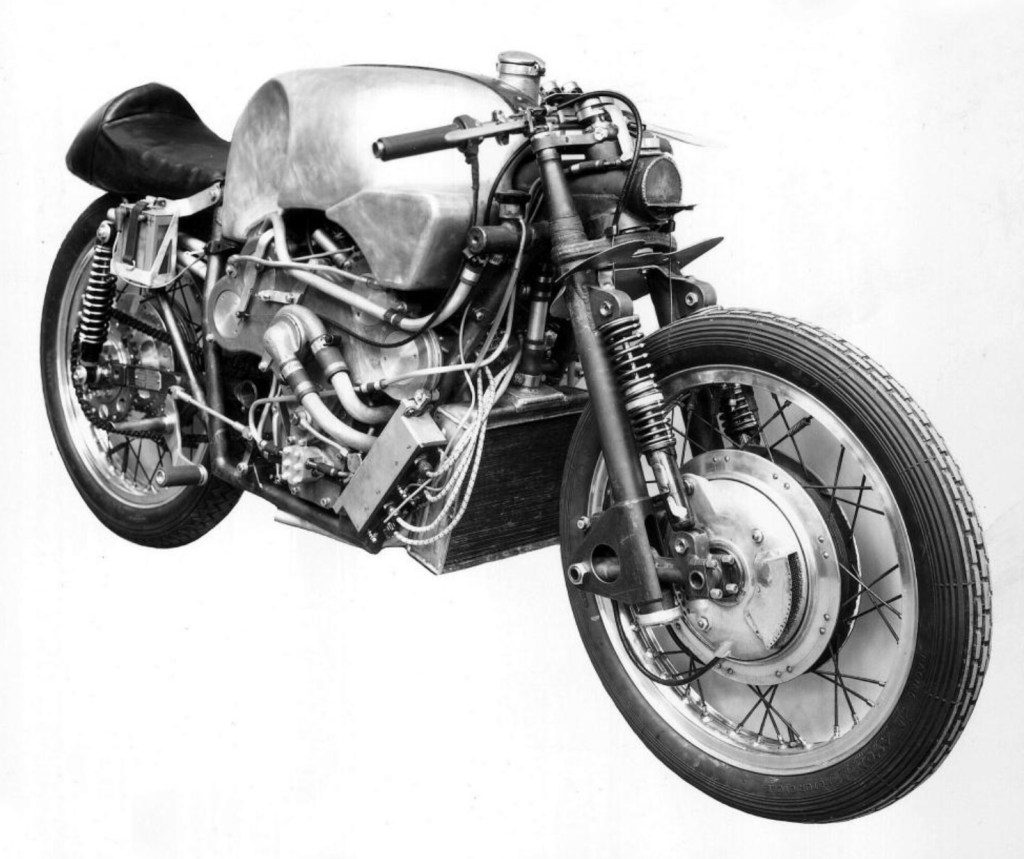
Ken Kavanagh aboard the awesome Moto Guzzi 500 V8 GP machine during the 1956 Senigallia Grand Prix.
This wild machine made its race debut at the Belgian GP in June 1955, read about Kavanagh’s time with Moto Guzzi in this feature; Moto Guzzi… | primotipo…
(Moto Guzzi)(MotorSport)
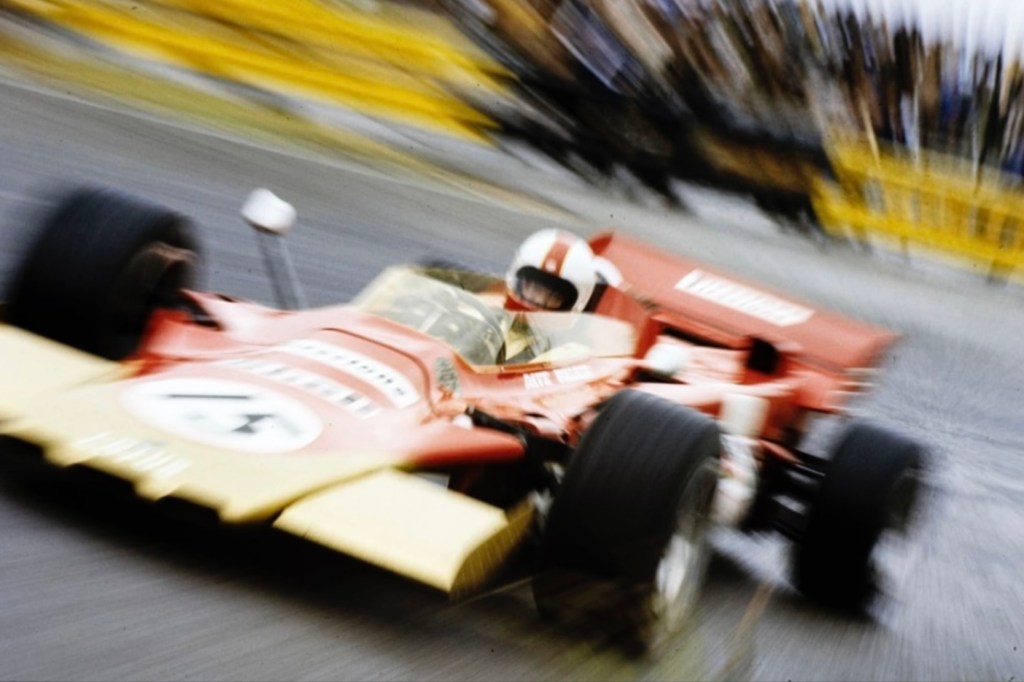
Dave Walker and Tim Schenken during the 1971 Dutch Grand Prix weekend at Zandvoort.
Walker started the Lotus 56B Pratt & Whitney 4-WD from grid 22 and was looking good for a while in the very soggy conditions but like so much of the grid, missed his braking point – in a car in which he hadn’t done a huge number of laps – and ran off the track after completing only five laps. Quickie on DW here; https://primotipo.com/2022/01/05/walkin-on-water/
Tim Schenken’s Brabham BT33 Ford was a more competitive mount. In its second year – Brabham won the South African GP in one in 1970, and should have won two or three more – it was still competitive in the young Melburnian’s hands, third place at the Osterreichring was his best result of the year.
At Zandvoort he started from grid 19 but DNF with suspension failure in the race won by Regenmeister Jacky Ickx’ Ferrari 312B2. Short piece on Tim here; https://primotipo.com/2019/01/02/tim-schenken/
(MotorSport)(Reg Hunt Collection)
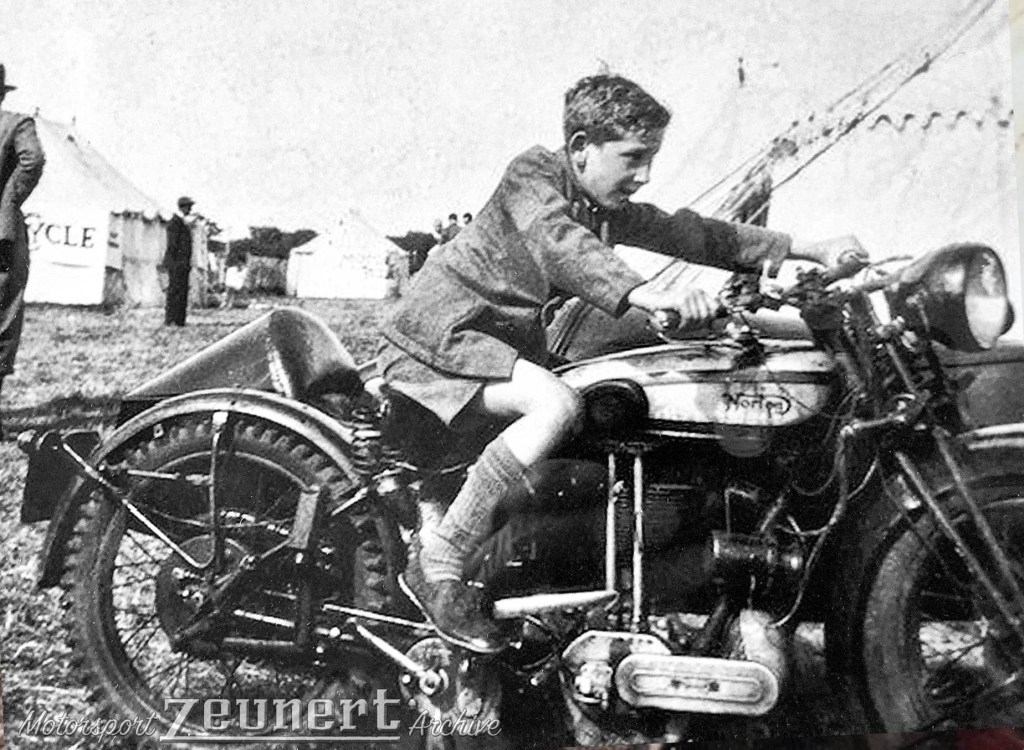
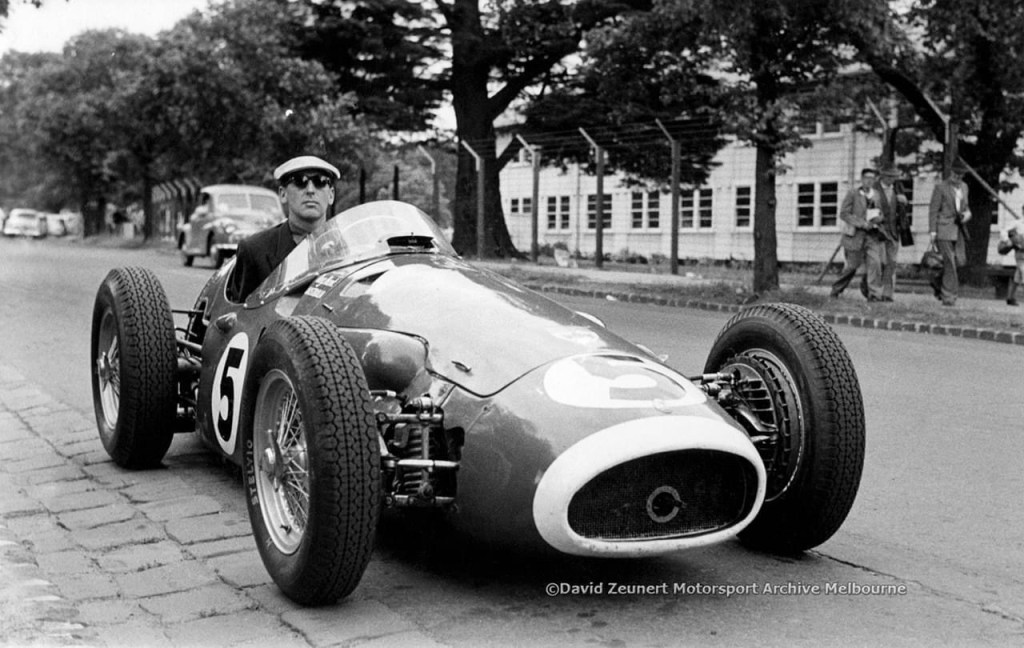
Reg Hunt dreaming about future conquests on one of his parents Nortons, aged nine, in the early 1930s in the UK, and living the dream at Albert Park in 1956 aboard his Maserati 250F below.
He and his A6GCM and 250F were Australia’s fastest combinations in 1955-56, then he retired early to focus on his family and motor dealerships, amassing a fortune. See more about Reg here; https://primotipo.com/2017/12/12/hunts-gp-maser-a6gcm-2038/
(Reg Hunt Collection)(P Miller)
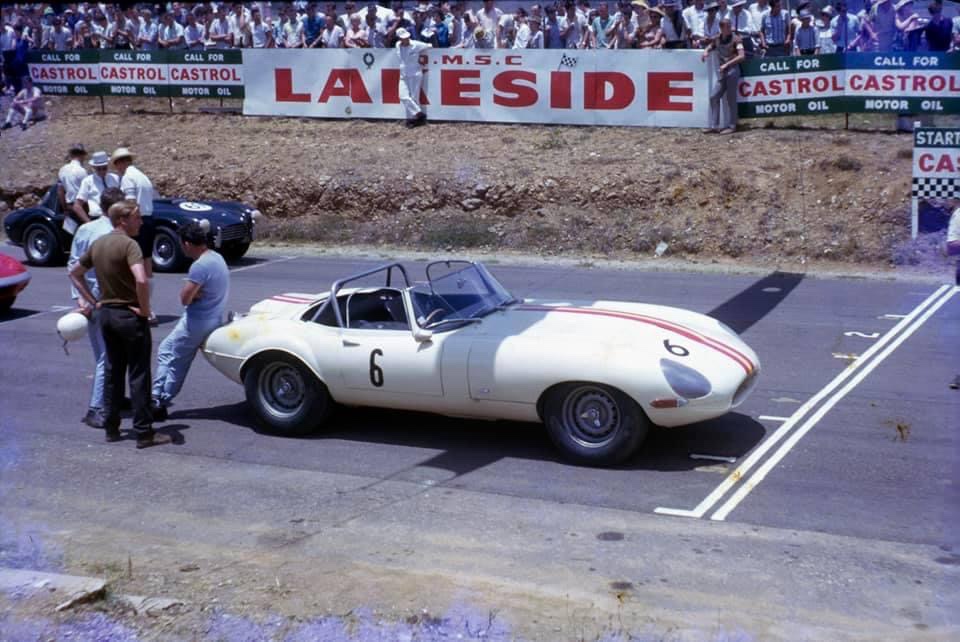
Bob Jane relaxes on his Jaguar E-Type Lwt during the Australian Tourist Trophy meeting at Lakeside over the November 14, 1965 weekend.
This is a heat or support race, Bob was fourth in the ATT, while Ron Thorp – it’s his AC Cobra you can see – didn’t start. Pete Geoghegan won from Greg Cusack and Spencer Martin: Lotus 23B Ford, Lotus 23 Ford and Ferrari 250LM.
The dude in the brown shirt is longtime Bob Jane Racing chief mechanic/team manger John Sawyer, no idea who the driver is, the tiny splash of red is Bill Gates’ Lotus Elan. Jane usually raced this darlin’ of a Jag with its factory hardtop but wasn’t averse to running topless on hot days. Click here for a feature on the car; Perk and Pert… | primotipo…
Piers Courage on the hop during the Warwick Farm 100 Tasman Cup round in January 1968.
Giving away a bit of horsepower at old-Sandown, a power track. Piers pitches his McLaren into Peters Corner with the Richard Attwood BRM P126 V12 , and, I think, Kevin Bartlett’s Brabham BT11A Climax behind. This fabulous race had an amazing dice between Jim Clark’s Lotus 49 Ford DFW and Chris Amon’s Ferrari 246T, resolved by a smidge in favour of the Scot. It was his last race, and series win.
(D Simpson)
This is the Queensland Touring Car Championship meeting at Surfers Paradise in August 1969, a round of the Australian Touring Car Championship. Dick Johnson’s EH Holden in front of Alan Hamilton’s Porsche 911
Norm Beechey’s Holden Monaro GTS327 won – taking the first ever ATCC win for a Holden – with Hamilton second and Jim McKeown third in a Lotus Cortina Mk2.
Dick Simpson recalled a funny moment related to his photo. “A couple of laps after that shot, as the EH was entering Lucas Corner, there was an almighty bang, a massive cloud of blue smoke and black engine oil and a number of red bits of metal pouring out of the engine right on the apex of the corner. The noise stopped and the EH silently trundled on around Repco Hill and disappeared.”
“We had a flag post right beside us and had been chatting with one of the flaggies who was most impressed that we were keen enough, or stupid enough to drive all night from Wollongong. So he said he had to go and clean up the mess and would we like a couple of souvenirs? He brought up a couple of bits of steel, one looked like a huge main-bearing cap and plonked them on top of the fencepost to cool off. About an hour later a young kid who looked a lot like the EH driver came along and demanded his bits back. So we had a quick chat with a young DJ!”
Alan Jones was stunningly quick in Sid Taylor/Teddy Yip Lola T332 Chevs during Australia’s 1977 Rothmans International F5000 Series.
While Warwick Brown won it in his Racing Team VDS Lola T430 Chev, Jones was the series-ace, let down by mechanical dramas and a mistake or two of his own; a jumped start at Oran Park and writing off a car in practice at Surfers Paradise.
(R Steffanoni)
Here at Sandown he grabbed the lead from the start but retired with overheating. He won the fourth, final round at Adelaide International at the start of a year in which he won his first F1 Grand Prix aboard a Shadow DN8 Ford at the Osterreichring (below).
(LAT)(I Smith)
Amazing Ian Smith pan of Allan Moffat in his legendary Trans-Am Mustang at Oran Park during the final round of the Australian Touring Car Championship on August 8, 1972.
Steve Snuggs tells us that he was wearing an oxygen mask in protest to CAMS not allowing him to remove the car’s carpets which smouldered from the hot exhausts and gave off fumes.
Incredibly rare colour shot of Pedro Rodriguez’ works-BRM P261 2.1-litre V8 during the 1968 Longford Trophy.
He is on the rise having exited the Newry right-hander in second or third gear – that line of poplars and road is still there – before an open left-kink then onto The Flying Mile.
Pedro nicked second-place from Frank Gardner’s Brabham BT23D Alfa in the final lap but fell well short of Piers Courage McLaren M4A Ford FVA F2 car in demanding wet conditions. More about BRM in the Antipodes here; https://primotipo.com/2020/02/22/1966-australian-grand-prix-lakeside/
(I Smith)
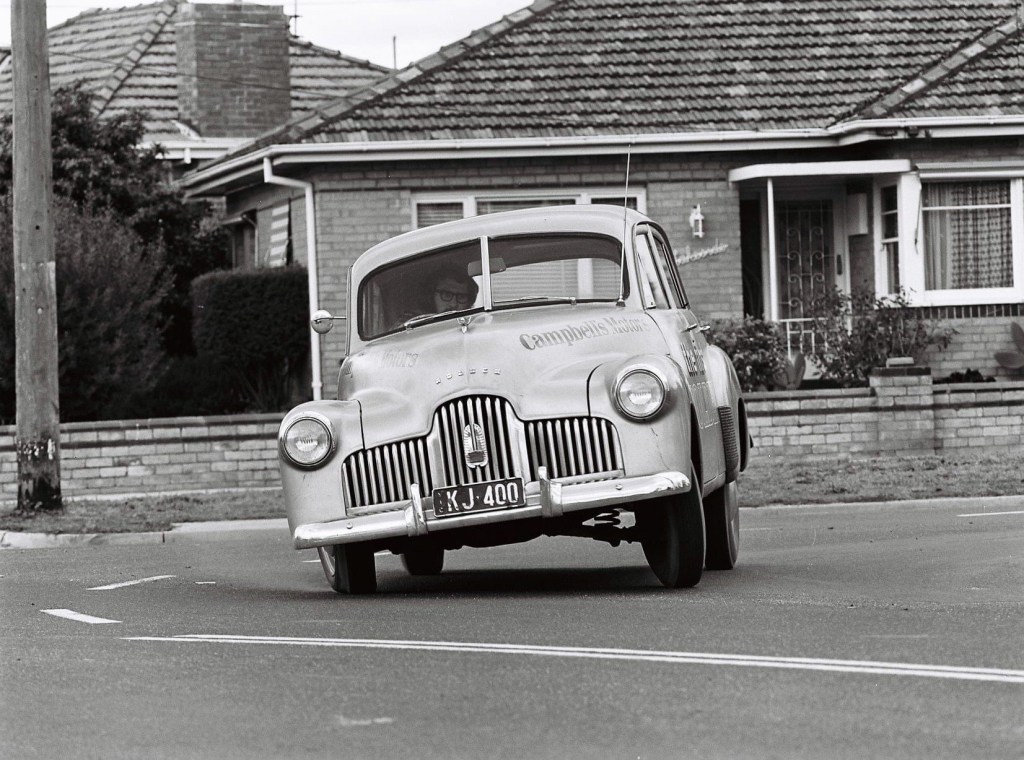
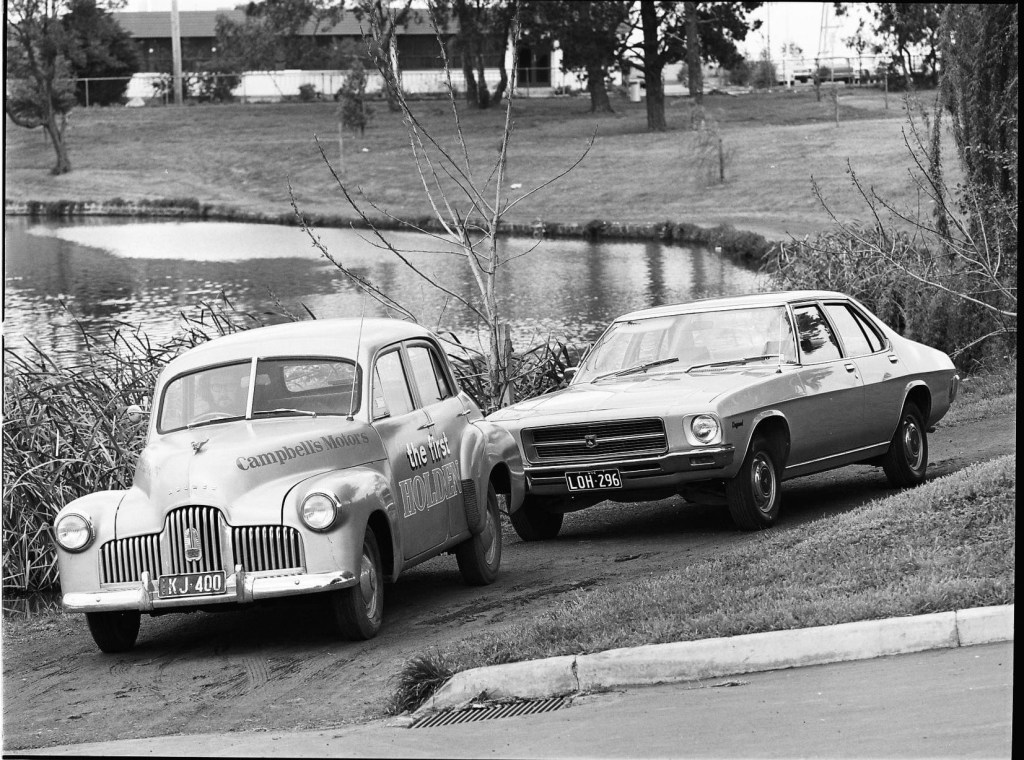
The great Ian Smith is sharing his back-catalogue of photographs in great dollops via Facebook. I enjoyed this series of shots taken in Reservoir, suburban Melbourne during a compare and contrast Wheels road-test between the then new Holden Kingswood HQ, and the original 1948 Holden 48-215 circa 1972.
(I Smith)
The reason for the strange location is probably because Campbells Motors Holden were in High Street, Preston and they didn’t want their luvverly old-Humpy being taken too far from ‘home’. See here for a piece on the 48-215; https://primotipo.com/2018/12/06/general-motors-holden-formative/ The locale is Edwards Park Lake, Reservoir.
(I Smith)(Mitsubishi)
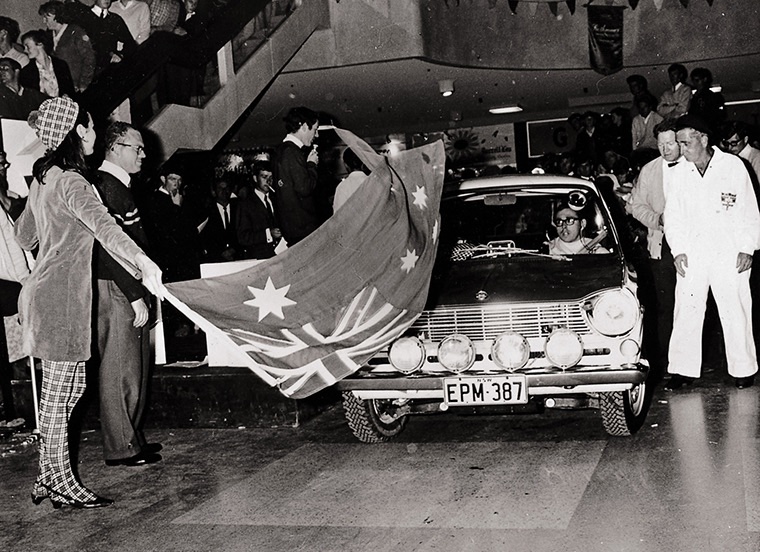
The giant-killing Colin Bond/Brian Hope, fourth place overall Mitsubishi Colt 1000F at the end of the 1967 Southern Cross Rally at Port Macquarie.
Michael Gasking Collection, Keith Anderson Photography, Bob Williamson Collection, oldracephotos.com-Dick Simpson, Moto Guzzi, Reg Hunt Collection via David Zeunert, Peter Jones, Peter Miller, Rod Steffanoni, Bill Forsyth, Ian Smith, IC Walker Collection via Russell Garth
Tailpiece…
(oldracephotos.com/DSimpson)
Dick Simpson’s artistry catches Niel Allen on the hop in Garrie Cooper’s first monocoque sportscar, the Elfin ME5 Chev on the entry to Homestead corner at Warwick Farm in 1969. It was a twitchy beast of a thing with its short-wheelbase, arguably, only Niel got the best out of it in the short time he owned it before buying a McLaren M10B Chev F5000.
The Japanese zaibatsu (conglomerates) were exhorted by their government to build and export cars post-war after the San Francisco Peace Treaty. The Mitsubishi Corporation was happy to oblige their political masters.
The enormous transnational had a dalliance with automobiles in the early twentieth century, but they got serious with the Mitsubishi 500 – a design which drew on their wartime aircraft manufacture – which was mass-produced with the vision of becoming a ‘national car’ in 1959.
(Tetsuaki Makita)
The lure of competition was great so the company contested the 1962 Macau Grand Prix to showcase their engineering capabilities, the little cars finished 1-2-3-4 in a support race, taking the under 750cc class.
Mitsubishi raised the bar when they developed a 90bhp competition variant (cam, carbs, head/valve modifications) of the 1-litre R28 engine which was fitted into the first of a number of Brabham/Brabham copy chassis, the first car was called the 1966 Colt F3A.
In the 1960s the Japanese Grand Prix was held for Group 7 sportscars, some of which were built by local giants such as Prince/Nissan and Toyota. At the same Mount Fuji circuit meetings there were support events for other categories, including single-seaters – the blue riband of these was the J.A.F. (Japan Auto Federation) Japanese GPs – it was on these races that Mitsubishi focussed.
In later decades Mitsubishi’s competition history was celebrated with a series of calendars and posters which stimulated this article.
Ken Yamamoto’s painting depicts the Osamu Mochizuki-Osamu Masuko one-two battle aboard 1.6-litre pushrod R46 circa-160bhp engined Colt F2As in the 1967 JAF Japanese GP
The company led in domestic single-seater racing, while Honda took on the world in F1. Drivers such as Osamu Mochizuki, Tetsu Ikuzawa – the very first of the Japanese internationals who competed in F3 and F2 in Europe – Osamu Masuko, Kuniomi Nagamatsu and others competed against European and Australasian drivers, proving their ability at international level.
Single-seater engine developments spilled over into a rally program which commenced in Japan in 1965, but kicked up a couple of gears when Mitsubishi decided to enter Australia’s Southern Cross Rally off the back of a gruelling testing program to ensure the suitability of the Colt 800 (first launched in November 1965) for the country’s tough roads and vast climatic extremes.
Australian rally-driver, Doug Stewart – later appointed a Director of Ralliart along with Andrew Cowan – conducted the ‘destruction testing’ of two cars in the outback/alps and was so impressed he convinced Mitsubishi to rally the Colts in the Australian Rally Championship (from 1968) competition. Colin Bond, later Australian Rally/Touring Car Champion, also drove and helped prepare the cars.
Colt 1000F depicted during the October 1967 Southern Cross Rally. Colin Bond/Brian Hope fourth placed car (Akira Yokoyama)
Mitsubishi’s website records that, “Mitsubishi Heavy Industries’ Automotive Division considered his (Stewart’s) advice and concluded that rally participation would effectively promote road car sales and raise brand awareness.”
“They decided to contest the 1967 Southern Cross Rally with two Colt 1000Fs, pitting themselves against vehicles with much larger engines using high reliability and durability as their main assets. Colin Bond was fourth outright, also winning the small engine capacity class, while Stewart finished third in class. The foundations for what is referred to as ‘Mitsubishi Motors in Rallying’ were laid at that time.”
“1985 calendar illustration starting with the Mitsubishi 500 in 1962, Colt 1000, Colt F2, Colt F2000 – the 1971 Japanese GP winner – the Starion” (Dennis Brown)
Mitsubishi’s R39 1.6-litre (from 1968) and R39B 2-litre (1971) twin-cam, four-valve, fuel injected race engines won the 1971 Japanese Grand Prix in Colt F2000 chassis when Kuniomi Nagamatsu triumphed over Osamu Masuko in a great Colt F2D (F2000) 1-2 in an international field of depth.
Just as it seemed the company was poised as a possible engine supplier in the new 2-litre European F2 Championship which commenced in 1972, the company turned 180-degrees away from single-seaters into touring car racing and the forests and deserts where its competition focus has largely remained. From a cost-effective brand-building perspective with production-car spinoffs, it was doubtless the right call.
(Akira Yokoyama)
Mitsubishi’s first international rally win was in the 1972 Southern Cross Rally, the winning crew of the Colt Galant was Andrew Cowan and navigator John Bryson. The company won three more of the Oz internationals and two Safari Rallies between 1973-77. Their first Safari win was taken by a privately entered Colt driven by Joginder Singh. Lancer Turbo and Lancer Evolutions programmes followed.
It’s a bummer not to be able to read the detail of these posters found on-line, but I thought them worth sharing all the same.
Credits…
mit-cardesign-t.com – Dennis Brown, Tetsuaki Makita, Ken Yamamoto, Akira Yokoyama, rally-japan.jp
Another page from the 1985 calendar (Dennis Brown)
In the process of researching this story the only technician I have uncovered as involved in the race and rally programs is a man named Iwao Kimata, “a former Nissan rally driver, who was hired to help Mitsubishi learn about rally racing step by step” according to rally-japan.jp.
If any Japanese readers now the names of the key engineers/technicians/mechanics involved in Mitsubishi’s mid-1960s race and rally programmes, please get in touch with me on mark@bisset.com.au. I am keen to record such folks names and if possible communicate with them.
Frank Gardner leads at the start of the Levin International, round two of the 1968 Tasman Series, won by Jim Clark’s works Lotus 49 Ford DFW, on January 13, 1968.
Clark is second, Chris Amon, Ferrari 246T third, then Pedro Rodriguez, BRM P126 and Piers Courage, McLaren M4A Ford FVA at the rear of the lead-bunch.
We have South African photographer, Brian Spurr to thank for these shots. He didn’t take them, but rather scanned them to preserve the deteriorating images given to him by a lady named Tracy Robb, then made them available through his Facebook page – via good friend, Peter Ellenbogen – for us all to enjoy. Brian has no idea who the snapper was, but clearly the man had a good eye. Many thanks to Tracy, Brian and Peter.
(B Spurr Collection)
Frank Bryan’s Mustang from, perhaps, Robert Stewart’s Cooper S at Cabbage Tree Corner during the same meeting.
(B Spurr Collection)
Graham McRae explores the limits in his Brabham BT2 Lotus-Ford 1.5. He failed to finish the 1968 race but three years later triumphed aboard the McLaren M10B Chev he took to the first of three-on-the-trot Tasman Cup victories from 1971-73. See here for an article about the amazing McRae and his cars, including his formative years; https://primotipo.com/2018/09/06/amons-talon-mcraes-gm2/
(B Spurr Collection)
Contretemps between Vince Anderson’s Brabham BT11A Climax and Bill Stone’s #24 Brabham BT6 Lotus-Ford 1.5 in practice. Stone got his car repaired for the race, finishing sixth in the International.
(B Spurr Collection)
Chris Amon on his way to victory at Levin in front of Bruce McLaren’s brand-new, Len Terry designed BRM P126 and Jim Clark. Amon won the 63 lap race from Courage and Jim Palmer in another M4A McLaren.
(B Spurr Collection)
Jim Clark and the lads push Clark’s Lotus 49 #R2 back into the incredibly picturesque Pukekohe paddock during practice. The New Zealand Grand Prix was traditionally the first Tasman round and was usually held at the Auckland circuit, this is/was the January 6 weekend.
Bruce McLaren, BRM P126-02 (B Spurr Collection )
McLaren drove the BRM in the four Kiwi rounds only with his best results fifth at Wigram and a splendid win at Teretonga, then it was back to Colnbrook to ready the new Ford Cosworth DFV powered McLaren M7 and McLaren M8A Chev for F1 and Can-Am competition respectively.
Bruce’s analytical skills kick-started BRM’s development program for their new car, he was familiar with the Type 101 V12 engine, having raced his M5A with it in the latter part of 1967. See here for an article on these cars; https://primotipo.com/2018/01/25/richard-attwood-brm-p126-longford-1968/
What was the Phil Irving line? “One more tube and you could breed from it!” BRM P126 highlighting the Hewland DG300 gearbox and 2.5-litre variant of their 3-litre F1 Type 101 V12 as first fitted to McLaren’s F1 car in 1967 (B Spurr Collection)
The undoubted stars of the show in 1968-69 were the works Lotus and Ferraris, arguably THE YEAR of Tasman competition in terms of variety was 1968.
Repco Brabham V8 engined Brabhams for Jack (in Australia) and Leo Geoghegan’s Lotus 39, BRM V8s and V12s – the P261 and new P126, the V6 Ferrari 246T and of course the Ford DFW V8 in the back of Jim Clark and Graham Hill’s Lotus 49, the 1.6-litre Ford FVA powered Brabham BT23 raced by Denny Hulme and Piers Courage’s McLaren M4A FVA. Not to forget Frank Gardner’s one-off Alec Mildren owned Brabham BT23D powered by a 2.5-litre variant of Alfa Romeo’s sportscar Tipo 33 V8. Plus the 2.5-litre FPF Climaxes, so long the backbone of the series. We never had it so good! Vive Le difference
(B Spurr Collection)
Piers Courage re-launched his career with his performances in this self-run F2 210bhp McLaren M4A Ford FVA. He drove the wheels off it, stayed on the black-stuff and capped a series of speed and consistency off with a famous win in the teeming rain at Longford in the final 1968 race.
Gardner’s Brabham at left, Amon’s Ferrari at right with Clark in the middle (B Spurr Collection)(B Spurr Collection)(B Spurr Collectionj
Les Jones’ Lotus 20B Ford 1.5 (DNS) and the spare BRM P261 raced that weekend by Pedro Rodriguez at the Shell depot in among the Puke trees.
(B Spurr Collection)
This will cause a state of excitement for Lotus historians. Peter Yock’s white Lotus 25 BRM is chassis R3, the machine used by Jim Clark and Trevor Taylor in 1962-63 before being sold to Reg Parnell racing in 1964 and fitted with BRM P56 V8s. Later, as here, R3 was fitted with a 2-litre BRM P60 V8 and sold to Yock.
This link to Allen Brown’s wonderful oldracingcars.com website tells all about the tortuous Lotus 25/33 chassis by chassis history; https://www.oldracingcars.com/lotus/25/ His records show this old-warrior contested 95! races in the hands of Clark, Taylor, Jack Brabham (Monaco 1963), Peter Arundell, Mike Spence, Pedro Rodriguez, Mike Hailwood, Chris Amon, Richard Atwood, Paul Hawkins, Giancarlo Baghetti, Jonathan Williams, Mike Spence, Rob Slotemaker, Piers Courage, Chis Irwin, Peter Yock and Peter Hughes…
Converted to Lotus 33 spec along the way, R3’s best results were wins at the 1962 US GP and Rand GP, and the ’63 Kanonloppet in all cases driven by Clark. Peter Yock’s ’68 Tasman was grim with DNF’s in all four of the Kiwi rounds he contested.
Better shots of the Lotus BRM engine installation – note the Owen Racing Organisation decal between the two front radius rod mounts. Circuit and date unknown (N Tait)(B Spurr Collection)
Piers Courage and Chris Amon await their MGB ride prior to the off at Pukekohe. Who is the BP driver at right?
(B Spurr Collection)
Clark and Amon above, and the yellow nose of the Mildren Brabham, #2 is Pedro Rodriguez’ BRM P261 Bruce in the other car beyond in the shot below. The Goodyears on Chris’ car are interesting, I thought the Scuderia were contracted to Firestone at the time? Maybe ‘freelancing’ Down South was hunky-dory?
(B Spurr Collection)(B Spurr Collection)
No works Brabham Repco V8 for the ‘68 Tasman for Denny – ’67 World F1 Championship and all – he was off to McLaren for 1968 so had to run a Brabham BT23 Ford FVA F2 to keep the fans at home and in Australian happy.
In fact he used two cars that summer. BT23-5 is shown above on the Pukekohe grid. In a very dodgy accident on lap – the blame for which was attributed to Hulme, albeit it was ‘hushed up’ at the time – Denny took Laurence Brownlie’s Brabham off the road, frustrated with his failure, as he saw it, to get out of the way, injuring him very badly and effectively ending the promising Kiwi’s career.
BT23-5, the Winkelmann Racing chassis with which Jochen Rindt won so many races in 1967, was rooted. Sold to Feo Stanton and Alec Mildren, Bob Britton made a BT23 jig with it then set it aside in his Rennmax Engineering workshop. 50 years later it’s alive and well in Europe.
BT23-2 was then shipped to New Zealand, a works car raced by Brabham and Frank Gardner in 1967. His bests in that was third place at Wigram and fifth at Warwick Farm.
(B Sergent Collection)
Clark contemplating loading-up while the shape of BRM Team Manager, Tim Parnell is to the right, a burger-boy of the nicest kind it seems.
(unattributed)
Parnell, a few moments later is amongst his lads, Bruce with his back to us is about to jump aboard his P126 while Rodriguez – centre shot – is about to board his V8 P261. Pedro was much keener to race this very well-sorted old-tool that summer, rather than the car he should have been focusing on, his V12 mount for the upcoming F1 season!
(B Spurr Collection)
The off, with someone shitting-himself mid-grid. It is not a good feeling…and what a unique Pukekohe view too. Frank Gardner is on the outside of the front row we can see, Brabham BT23D Alfa, with Jim Clark, Chris Amon and Pedro Rodriguez obscured to FG’s right.
(unattributed)
Amon has the jump with Clark right up his clacker. Gardner’s #7 Brabham Alfa is outside, then Pedro’s P261 with Bruce’s V12 on the inside and Denny’s four-cylinder Brabham #3 on the outside.
Amon Pukekohe (B Spurr Collection)
Chris Amon drove a great race to win his national Grand Prix from Frank Gardner, the Aussie was the only other driver to complete the full race distance of 58 laps. Piers Courage was third, Jim Palmer fourth in his McLaren M4A Ford FVA and Australian, Paul Bolton fifth in the Rorstan Racing Brabham BT22 Climax.
Jim Clark had engine failure after 44 laps, while Pedro Rodriguez’ old faithful BRM P261 V8 lasted only 28 laps until clutch failure, while Bruce McLaren’s P126 V12 was hors de combat with clutch failure after completing only 14 laps. More on the race here; https://primotipo.com/2017/07/21/amons-tasman-dino/
(B Spurr Collection)
Winners are grinners! ‘Sir Christopher’ Amon, Pukekohe 1968. Other dudes folks?
Etcetera…
(B Spurr Collection)
I love the look of this Pukekohe paddock, the death sentence has just been made on this place, Denny.
(B Spurr Collection)
David McKay’s – to the right of the car touching his chin – Scuderia Veloce Ferrari 250LM was racing-royalty in this part of the world, competition Ferraris being very thin on the ground. Click here for an article about the car;
Here the machine is sharing the grid with another legendary car, the Lycoming Special – in which Jim Clark did some laps one year – with Jim Boyd at the wheel, the flash of red at right is the Stanton Corvette raced by Geoff Mardon.
The shot below is of the same three cars at Levin the week after Pukekohe at Cabbage Tree corner.
Together with Scuderia Veloce and Frank Matich Racing, Alec Mildren Racing was the only other fully-professional racing outfit in Australia at the time. See here; https://primotipo.com/2020/01/14/alec-mildren-racing/ and here on the BT23D;
Gardner finished equal fourth in the Tasman title chase, with Graham Hill, his best results were second place at Pukekohe, third at Teretonga and Longford, and fourth at Sandown, the AGP.
While the car fell short in international competition, Kevin Bartlett took BT23D over when FG returned to Europe and won the 1968 Australian Drivers Championship, the Gold Star, in it in 1968 before contesting the Australian 1969 Tasman rounds. After a chequered history, BT23D-1 is still with us.
(B Spurr Collection)
Andy Buchanan’s Elfin 400 Chev, looking superb as it did in the day, and now does! A Kiwi mate sent an image of this car very recently, the restoration is now nearly complete albeit the car is not yet running.
(B Spurr Collection)
He’s a bit anally retentive as a sculptor, but let’s give him points for creativity anyway. Those are called long-necks or depth-charges in this part of the world, unlike the little poofhouse things we mainly drink from today.
(B Spurr Collection)
Clark’s 49 R2 alongside Laurence Brownlie’s Brabham BT18/23 Lotus-Ford 1.5. Brownlie’s car – the quickest of the Kiwi 1.5s that year – was destroyed in the terrible accident with Denny Hulme mentioned earlier. More on the ’68 Tasman cars here; https://primotipo.com/2021/03/06/1968-australian-gp-sandown-2/
(B Spurr Collection)
Bruce labours on BRM P126-02, giving us another look at the DG300 Hewland – rather than one of Bourne’s own ‘trannies – and Len Terry’s signature twin-parallel-link lower rear suspension, which soon thereafter became the ‘industry standard’.
Note the local work-boots, typical attire on both sides of The Ditch (Tasman Straight). OH&S, WTF is that?
(B Spurr Collection)
Rod Coppins in Pete Geoghegan’s first Ford Mustang, ain’t she sweet.
BRM P60 V8 in the back of Peter Yock’s Lotus 25/33 (N Tait)
BRM maintenance on a shoestring.
I love this explanation by Warner Collins, one of Peter Yock’s mechanics, about repairs to the BRM V8 to keep his driver in the field. It appeared on the Old New Zealand Motor Racing Facebook page.
“The engined no compression in one front cylinder. BRM were stationed at Croydon Motors, so I went and spoke to Tim Parnell who pointed out boxes of V12 and V8 spares, nothing suited. Of course this was Wednesday/Thursday before Wigram so I told Peter Yock it couldn’t be fixed. He then went and barrelled Tim, who said they had no spares for the obsolete engine.”
“Peter said we had to try, so my brain kicked into gear, we got the car onto its side, got the sump off – there was no way the head was coming off without gaskets, 50,000 gears and no manual – so another thinking session. I managed to get the piston and rod out the bottom, the two-ring piston had a broken compression ring. After all day I managed to find a motorbike sized one, the .20th gap was a bit large but in it went. Getting it back in was a mission, I had to get around the crank and compress the rings without breaking them, and bolted the thing up, even having to make a sump gasket.”
“The BRM guys came over and said, ‘You must be joking!’ They would’ve sent the engine back to BRM. It was ok, not 100%, at least it was on 8-cylinders, well that is my story! I think Peter got tucked up a bit, a Lotus with a cobbled up, well-used V8. Peter wanted me to do the rest of the series, but it was not for me, you can’t run a car like that without spares.”
Peter Yock responded to Warner and Gary Sprague, “Well, you are both right. I probably did get tucked up, but for 3000 pounds it wasn’t overly expensive. After the Timaru meeting we went into Ernie Sprague’s garage and completely reset the ride height and suspension and the following week at Ruapuna we blew the opposition away, different handling car altogether.”
“I don’t know if you guys are aware, but the car ended up in Dawson-Damer’s collection in Sydney, after he was killed at Goodwood it was sold at auction for 1.2million. Mind you, it had to be completely restored to to the Jim Clark winning 25 with Climax engine.”
Credits…
Brian Spurr Collection, Bruce Sergent Collection, Naomi Tait, oldracingcars.com
Tailpiece…
Amon’s Ferrari 246T, Pukekohe (B Spurr Collection)
‘cor, dunnit look utterly lovely! Amon’s long-time mechanic, Bruce Wilson has lovingly, carefully, skilfully built up 246T/68 #004 for his longtime friend. They won two rounds in 1968 – Pukekohe and Levin – but returned the following year and went all the way; two cars for Chris and Derek Bell with logistics taken care of by Scuderia Veloce.
2.4-litre V6 is a three-valver here, the four-valve units mainly used in Australia gave very little away to anything else, Amon missed winning the Australian Grand Prix at Sandown so equipped, by only one-hundredth of a second to Clark’s flying Lotus 49 V8.
As you all know, that ’68 Tasman was Jim’s last championship win.
Chris Amon hustles his March 707 Chev around Riverside, during the weekend in 1970. Isn’t it a big, handsome brute, fast too…
The scale of March’s F1 achievement in 1970 from a standing start is unbelievable, 11 March 701 Ford DFV’s were built and won three F1 races that year. Jackie Stewart took the fiery Spanish Grand Prix and the Race of Champions at Brands Hatch, while Chris Amon won the International Trophy at Silverstone.
In addition, they created the infrastructure and team to build customer Formula Ford, F3 and F2 cars, and this Group 7/Can-Am program, “credited to SCCA Pro Racing Director Jim Kaser’s trip to Europe to drum up more business” wrote Hunter Farnham. In his spare time – sic! – Robin Herd led the design of a car that was immediately competitive in Helmut Kelleners’ hands in the European Interserie, and in the much more competitive Can-Am Challenge, where McLaren remained supreme, later in 1970.
“The detail design was executed by ex-Lola man Martin Slater (a friend of one of the March founders, Graham Coaker) and John Clark, a freelance designer who was involved with most of the early Marches, while further refinements were made during its construction by John Thompson, Roger Silman and Peter Turland.” wrote Mike Lawrence in ‘The History of March’. Well aware of how thin the businesses resources were, Amon enticed his long-time mechanic, Kiwi Bruce Wilson – who had not too long before prepared and spannered the Ferrari 246T in which Chris had won the 1969 Tasman Cup – to Bicester to help complete the cars.
Chris testing 707-01 at Silverstone sans bodywork – Bruce would be proud of him! – in May 1970 (B Wilson Collection)March 707 Chev technical specifications as per text, chassis depicted is Amon’s 707-02 (Bill Bennett)
Herd was partially responsible for the McLaren dominance of course, together with Bruce McLaren he designed and drew the 1967 McLaren M6A Chev, the first of the Papaya-Steamrollers comprising the 1967-71 M6A-M8A-M8B-M8D and M8F, all of which were Chevrolet V8 powered.
As was the case with the 701, Herd designed a simple car – nothing wrong with that, McLaren’s dominance was achieved with utterly conventional superbly designed, built and prepared racing cars – given the time constraints and customer queue. No way could he afford an expensive, time consuming development program with angry customers if an innovative approach turned-turtle.
Robin’s monocoque was fabricated in 20-gauge aluminium alloy with magnesium bulkhead castings at front and rear. It housed 70 gallons of fuel located in four Firestone bladders. In a neat touch, typical of some F1 cars of the day, the tub ended at the aft cockpit bulkhead with the engine and rear suspension/transaxle assembly bolted to a steel frame that attached to the back of the tub. With the fixings undone, the whole rear of the car could be rolled away for necessary maintenance.
707-02 getting pretty close to being ready for Chris first gallop at Silverstone by the look, no belt yet fitted tho. Lots of flat sheet to minimise the compound curvature fabrication challenges. Bruce Wilson second from the right, who are the other fellas folks? (B Wilson Collection)(B Wilson Collection)Ally block, capacity quoted as 494/502ci, Lucas injection, magneto ignition, Mota-Lita steering steering, Hewland LG ‘box (B Wilson Collection)
March purchased 494/502cid/8-litre Chaparral-Chev aluminium, pushrod, fuel injected V8s giving circa 720bhp @ 6500rpm. The ubiquitous Hewland LG600 gearbox transmitted its huge power and torque through roller-spline driveshafts to mag-alloy wheels and 23-inch wide Firestones at the rear.
Front and rear suspension was period typical. Upper and lower wishbones, coil spring-Koni damper units and adjustable roll-bar and mag-alloy uprights at the front. The rear used a single top link, twin parallel lower links, and radius rods, again with an adjustable bar and attaching to big, beefy but light mag-alloy uprights.
Brakes were Girling calipers with 12-inch rotors, steering was of course rack and pinion, the whole lot less fuel weighed a claimed 1460 pounds. The wheelbase, as published, was 96 inches, front track 68, rear track 64, length 156, and width 93 inches.
Pete Lyon’s ran his tape-measure over the cars and found that “the tape across the nose-fins was no wider that 83.5 inches, while the rear wheel arches swelled to only 83.75. That years M8D taped out at 79.5 at the latter point.” Lyon quoted Chris Amon from a Karl Ludvigsen – Motor Trend article as saying the true weight of the 707 was between 1600-1800 pounds. Big cars indeed…
Bruce Wilson and Chris catching up early in-build, 707-01, maybe (B Wilson Collection)(B Wilson Collection)(B Wilson Collection)
Chassis 707-01 was ready for Chris to test at Silverstone in mid-May (above). He was excited by the prospect of racing two 707s, which were part of his retainer agreement with March. Lawrence wrote that Chris viewed this effort as potentially a first step in establishing ‘Amon Racing Team’ to give him a measure of independence, and longer term security after he’d hung up his helmet.
In the end, March retained the cars, “the books would be balanced to suit” wrote Lawrence. Ultimately, Chris was never paid what he was owed by March, not that he was alone, just one of the first…
Chris complained of front end instability when he tested the car, the cockpit was so large that Robin Herd joined him for a few laps, the mechanics joked that “he’d designed the 707 that wide so he could hitch rides in it.”
Kelleners 707-01 was ready in time for the first Interserie round at the Norisring on June 26. He led both heats but was ousted by gearbox problems, a good effort as the brakes were troublesome and the weight distribution still wasn’t quite right. Progress was swift though, he won at Croft in July and at Hockenheim in October. The six round championship was won by Jurgen Neuhaus, Porsche 917K who was also victorious twice but was more consistent throughout the short season. Kelleners was the class of the field, despite the presence of some works-assisted Porsche 917s, with more reliability he would have won the title. Importantly, the lessons learned with the car were built into Amon’s machine which was quick and finished races from the start.
Helmut Kelleners 707-01 during the 1970 Trophy of The Dunes at Zandvoort on September 20 (unattributed)Zandvoort again, the shot chosen to highlight the fabulous mix of cars; Groups 5, 6 and 7, fitted with engines ranging in capacity from 2-8-litres! Gijs Van Lennep, Porsche 917K here leads Kelleners (MotorSport)
After the Italian Grand Prix, Amon took his March 707 to round 8 of the Can-Am at Donnybrooke, McLaren had won almost all of the preceding rounds in the superb, Batmobile M8D Chev. Dan Gurney was victorious at Mosport and St Jovite until sponsor-clashes brought his McLaren F1 and Can-Am drive to an end. Denny Hulme then won at Watkins Glen, Edmonton and Mid Ohio until Peter Gethin took the Road America round in the car vacated by Gurney.
The odd-ball victory of the season was Tony Dean’s in the wet at Road Atlanta in mid-September when his nimble, light 3-litre Porsche 908 Spyder beat all of the 6-7 litre machines
When Amon appeared at Donnybrooke during the September 27 weekend he was immediately on the pace despite a lower front suspension arm pulling away from the chassis in practice.
Amon arrived in Minnesota early enough to do some mid-week practice, “but twice its practice was cut short with suspension failures,” Pete Lyons in ‘Can-Am’ wrote. The ‘Boeing’ was third on the grid, with ‘patches’ fitted to each side to rectify the suspension problem, behind Peter Revson’s Carl Haas-works Lola T220 Chev and the Hulme M8D; Chris matched Denny’s qualifying time, not bad…
In the race he ran second for a while, then, despite fuel pick up problems while running third – one tank wasn’t emptying into the other – Chris was classified fifth, having pulled off to the side of the track, behind Hulme, Gethin, Revson and Jim Adams’ Ferrari 512P.
(B Wilson Collection)Amon negotiates Laguna Seca’s corkscrew (unattributed)(B Wilson Collection)
Then it was off to Laguna Seca for another promising run on October 18. This time Q5 and fourth, coping with spongy brakes on the challenging track behind Hulme, Jackie Oliver’s Autocoast TI22 Mk2 Chev – who engaged in a long thriller of a dice with Denny – and Revson’s Lola. Clearly 707 had plenty of promise and pace despite missing the bulk of the races and the ongoing development which is a part of that process.
It was more of the same in the final round at Riverside, Q5 and fourth for Chris, third until fuel woes re-emerged and he had to pit for a splash and dash. This time the finishing order was Hulme, Oliver and Pedro Rodriguez in the BRM P154, the Bourne marque also having a crack that season but not making as much impact as March’s much shorter campaign.
At the end of 1970 both cars were returned to Bicester. 707-01 was modified by the removal of the hammerhead nose, and the front mounted radiators were moved to the chassis’ side. Dubbed the 717, Kelleners struggled with reliability in 1971 and sold the car at the season’s end to Austrian racer, Stefan Sklenar who race it sporadically without much luck.
Chris’ 707-02 was rebuilt and demonstrated occasionally. Despite the very promising start, March didn’t return to the Can-Am Challenge but rather focused mainly on volume production of single-seater categories where they were globally successful. In the later 1970s 707-03, a spare chassis, was built up and fitted with 707 bodywork, the cars live on.
Etcetera…
(unattributed)
Helmut Kelleners looking for a bit of love from his crew in the Croft pitlane, a successful July weekend for the team in that short 25 lap race. He won aboard 707-01 from Jurgen Neuhaus, Porsche 917K and John Lepp, Spectre GP6 Ford.
The photographs in this section are a mix from Bruce Wilson’s collection including some March works shots from in-period press releases, and the Getty Images’ archive. They are mixed up to get a nice visual mish-mash of monochrome and colour.
(MotorSport)
Plenty to smile about at Riverside, while Karl Ludvigsen’s shot below on the same November 1 weekend is much more moody, the shadows enhance that distinctive hammerhead nose with quite separate wing-section.
It’s such a shame that March didn’t race on with an evolved car in the 1971 Can-Am though it is hard to be critical of the commercial choices made by the March Boys, whilst noting the ever present and well documented ongoing cashflow dramas.
(K Ludvigsen)It’s clear how much influence the F1 701 had on the nose-aero of its big Can-Am March sibling in this low angle shot (B Wilson Collection)Monterey GP pits, Laguna Seca 1970. Bruce Wilson in the red shirt (H Thomas)
The sheer subtlety of Can-Am machines is what makes them so attractive to so many of us…
1970 was the last real Can-Am in the minds of many experts of the class. The Chapparral 2J Chev was such a threat to orthodoxy, it was thown out. Doubtless in accordance with FIA rules. But when Jim Hall said ‘go and get rooted’, or the Texan equivalent thereof, everything good about the unlimited, truly wild class was gone. Those of you who saw them race in-period are so lucky…
(B Wilson Collection)Amon, again 707-02 at Laguna Seca in 1970 (H Thomas)“How’s the F1 car going Bruce?” “Hmm, Ferrari have come good pal!” (B Wilson Collection)
Bruce Wilson and Chris Amon were the best of buddies. Bruce was key to Amon’s success right back to his Maserati 250F days before Reg Parnell popped him on a plane to England in early 1963.
Coopers galore in NZ circa 1961, circuit folks? Chris aboard his Cooper T41 Climax with Bruce’ hand on rear body (B Wilson Collection)
Wilson wrote a lovely book – The Master Mechanic- about his life and times in racing in the Antipodes and Europe, I’m told it’s great, it’s certainly on my list. I don’t believe the publisher has any – it was released almost as he died in 2017 – so go the online route.
(B Wilson Collection)
Credits…
Bruce Wilson Collection, cutaway by Bill Bennett, Karl Ludvigsen, Can-Am review in ‘Automobile Year 18’ by Hunter Farnham, ‘The History of March’ Mike Lawrence, ‘Can-Am’ Pete Lyons, Getty Images-Henry Thomas
Duncan Ord completes a donut out front of a Shell Servo in suburban Perth, date and place unknown…
I laughed at the sight of this oh-so-pedigreed racer being subjected to useage more often applied to ‘Humpy’ Holdens of the day!
This 3.3-litre, DOHC, straight-eight Bugatti T57T #57264 was first raced by Earl Howe in the 1935 Ulster Tourist Trophy later passing into the hands of Pierre Levegh who contested the 1937 GP des Frontieres at Chimay amongst other races. It, perhaps, passed through Jean-Pierre Wimille’s hands before being sold to visiting Perth racer Duncan Ord in the UK. He shipped it home, first racing it at Pingelly, Western Australia in January 1939, where it remained a pillar of the local scene into the dawn of the swinging-sixties.
Among sports-racing Bugattis, the Type 57 is one of the most illustrious. Chassis 57264 is a Type 57 Tourist Trophy Torpedo, originally designated chassis 57222, this was later changed by the factory. The car is unusual in that despite a racing history of over thirty years it retains its original chassis largely intact, and original crankcase, gear-box and front and rear axles as well as other less critical components.
Detailed research by foremost French Bugatti authority Pierre Yves Laugier has confirmed this machines history, “The first mention of the car is in the August 1935 list of bodywork at the Bugatti factory which contains the entry ‘2 Voitures Course 24 Heures, moteurs 223 et 224’. While no chassis serial numbers were recorded for these two cars, on August 29 that year – in the factory’s list of cars sold – the chassis serial number 57222 Torpedo Tourist Trophy with motor number 224 is mentioned. Francis, Earl Howe, drove Bugatti Type 57 TT, engine 224, to finish third in the Ulster TT race, at Ards, Ulster (as below) on September 7, 1935.”
(MotorSport Images)Earl Howe beside his trusty steed at Ards before the off (MotorSport Images)
In its report of the race MotorSport said, “The Bugattis driven by Lord Howe and the Hon. Brian Lewis were models of light construction with their duralumin shell bodies, and weighed only 26 cwt, with driver, fuel and water. Georges de Ram shock absorbers were used and the engines were said to develop over 160hp at 5,500rpm, which sounds rather fantastic. At any rate the compression ratio was well over 8 to 1 thanks to the efficient shape of the twin (sic) combustion chambers. Lord Howe’s car did close on 120mph while Lewis’s car was somewhat slower….”.
During the first practice day Francis, Earl Howe, had in fact made fastest lap time in 10 minutes 16 seconds which was some six seconds faster than his RAC handicap time. During the race Brian Lewis – the younger man and a faster driver than Howe – led the race, before his Bugatti developed clutch slip due to an oil leak from the gearbox. This left Howe leading, only to make an immediate refuelling stop. He subsequently fought his way back onto the leader board, MotorSport commenting “Howe had been making splendid progress on the Bugatti, and on the 33rd lap caught the two Aston Martins to secure third place…” – behind winner Freddie Dixon’s fleet Riley and Eddie Hall’s very special 3.6-litre Bentley.
By January 1936, the car was listed for sale with dealer Dominique Lamberjack back in Paris at 60,0000 Francs. The car was also referred to in period as chassis serial 57264/moteur 224 Torpedo TT as the factory had re-allocated serial 57222 to a new Competition Torpedo with its gondola shaped Type 57S chassis.
57264 was possibly entered at Le Mans in 1936 but the event was cancelled due to the political unrest throughout France. On June 11, 1936 the car was co-driven by Yves Giraud-Cabantous and Bugatti company salesman Roger Labric in the Spa 24-Hours. Labric, a friend of Bugatti, managed the marque’s showroom on the Avenue Montaigne, Paris. Unfortunately he overshot at the Stavelot Hairpin and burst the car’s radiator. When repaired it was offered for sale at the Avenue Montaigne showroom.
The car pictured in France during Pierre Levegh’s ownership (Bonhams Collection)
It found a buyer on April 8, 1937 in talented French gentleman/sportsman – talented cyclist, skier, ice hockey and tennis player – owner/driver Pierre Bouillin. Born in Paris on December 22, 1905, he was the son of an antiques dealer and had become the director of a brush factory in Trie Châ-teau in the Oise region. The Type 57 was his first Bugatti.
Bouillin idolized his uncle – Alfred Velghe – a pre-war pioneer racing driver. Bouillin shuffled the letters of that surname to adopt the anagram nom de guerre ‘Levegh’ for his racing exploits.
Pierre became obsessed with winning Le Mans and in 1952 came close – over-revving his Talbot-Lago and blowing the engine after 23 hours of a solo drive – while well-established in a probably uncatchable lead. His misfortune gifted the race to the works Mercedes-Benz 300SL Gullwings which finished first and second.
When Mercedes returned to Le Mans with a team of 300SLRs in 1955 they invited 49 year old Levegh to drive for them. It was aboard an SLR that he became innocently involved in the terrible collision which claimed the lives of over 80 spectators, in addition to the luckless Bouillin himself.
57264 perhaps at Miramas, Marseilles with Levegh in June 1937 (Bonhams Collection)
In happier times during 1937 he paid 32,500 Francs in instalments to purchase 57264 for his competition debut. On May 15, 1937, he raced the T57 in the Grand Prix des Frontieres at Chimay, Belgium finishing third, running sans mudguards. On June 6 he contested the Marseilles 3-Hours, finishing eighth, then on September 19 at Montlhery, Levegh entered the the Autumn Cup sports car race, the machine by then fitted with larger Delahaye-style mudguards, but failed to finish.
Pierre then advertised the car for sale in the L’Auto March 15,1938 issue, describing it as a “Type 57, unique car, capable of 190km/h. Write to owner at 54 Avenue de Choisy”.The car was spotted at Brooklands during that period and clocked at 192km/h. It had already been modified with the addition of a 40-gallon riveted aluminium fuel tank behind the driver’s seat, different doors, an additional oil cooler ahead of the radiator and further modified mudguards. It also featured cable-adjustable Repesseau shock absorbers.’
Contemporary references are confusing but it’s possible Levegh sold it to French Ace Jean-Pierre Wimille who used it as his roadie before passing it on to an unknown purchaser, who shipped it to Brooklands, but died before he could compete there. It then passed to London based sports car specialist J.H. Bartlett who advertised it in the May 1938 issue of Speed, “Bugatti special 3.3-litre 120 m.p.h. competition 2 seater, fitted late series 57S engine, special electron body, special streamlined wings, spare tanks, etc…£450.” It was acquired by visiting Australian racer Duncan Ord.
Ord, Pingelly Speed Classic, on the cars race debut in Australia, January 30, 1939 (J Krajancich Collection)
Another Pingelly shot, year unknown, note the oil cooler up-front (K Devine Collection)
On arrival in Australia the car was unloaded from the ship at Fremantle where it created considerable local interest as a contemporary machine described in the press as a “1934 Le Mans model two-seater fitted with long range 60 gallon fuel tanks and had been refurbished at Molsheim before being clocked at 120 mph at Brooklands.”
Ord entered the Great Southern Speed Classic at Pingelly on 30 January, no doubt the step up in performance of the Bugatti compared to the P-Type MG he started racing in 1936 was deeply impressive. Ord’s handling of the car was noted as being particularly good but he was slowed by clutch troubles and a spin on the last lap which dropped him to fourth.
Interestingly this handicap race was won by the supercharged MG TA Spl driven by the very young Alan Tomlinson. On 2 January 1939, three weeks before, ‘The Three Kids from Perth’ (Tomlinson, Minder- Bill Smallwood, Manager- Clem Dwyer both of these latter fellows no slouches as drivers themselves) won a famous Australian Grand Prix victory on the daunting Lobethal which confounds historians to this day. Confounds in the sense that the sustained speed of the little MG beat some serious heavy-metal including the Jano Alfas of Alf Barrett, Jack Saywell and John Crouch, the Delahaye 135CS of John Snow and others on a track regarded as Australia’s greatest ever motor racing challenge.
The racing fraternity in Western Australia had a great relationship with the authorities which was reflected in a vast number of Round The Houses racing on closed public roads of small towns they secured over many decades, the first of which was at Albany in 1936.
The venues were away from Perth, to its south east was Pingelly 150km away, and Cannington 10km. Narrogin was-is 200km to the north east, Goomalling 130 km and Dowerin 160km. Byford Hillclimb was 45km south of Perth whereas Albany was a very long tow, 420km south to the edge of the continent’s coast. Busselton is 225km ‘down south’ as the Perthies say, too, on a magic stretch of coast. Bunbury was and is an important port on the west coast, it too is south of Perth, 175km from the state capital. This is by no means a complete list, I’ve just covered the towns in which the Bugatti raced.
Duncan Ord pressing on, place and date unknown (J Krajancich Collection)Ord again at Pingelly, uncertain of the year – he raced there from 1939-41 carrying #9 on each occasion – at the Review Street corner (K Devine Collection)
Pre-War the West Australians did more racing miles than racers in any other state on tar or bitumen. On the odd occasion they competed on the east coast – a cut-lunch and a camel ride away – given the transport network and roads of the day, the best of them could be prodigiously fast, Alan Tomlinson being the prime example.
As the war clouds gathered in Europe Ord raced the car in the June Dowerin winter meeting, finishing second in the open championship to Jack Nelson’s Ballot Ford V8 Spl. A fortnight later he was at Cannington for the Quarter Mile Trials where the Bug did a 17.2 second standing quarter and a flying quarter mile pass at 94.73 mph. He was second in each event again to Nelson’s Ballot which achieved 16.5/104.64 mph.
Whilst Australia was at war in 1940, Ord competed three times for a second place to Bob Lee’s Riley in the (handicap) Great Southern Speed Classic at Pingelly, and second in the Albany Tourist Trophy. Of his performances Bob King reported in his ‘Bugattis of Australasia’ that Ord “thrilled many thousands of spectators at Albany and Pingelly by the skilful and dashing manner in which he was handling the big, blue Bugatti. Ord demonstrated at Albany this year when he broke the course record that he had mastered the car.”
Ord, Patriotic Grand Prix, Applecross 1940. What was that about Motor Racing is Dangerous bit on the entry-ticket?! (P Partridge Collection)Jack Nelson, White Mouse Ford 10 Spl from Duncan Ord, Bugatti T57, Applecross 1940 (K Devine Collection)
Let’s not forget the Patriotic Grand Prix, a four event race meeting held through the then outer suburban streets of Applecross 8km from Perth’s CBD to raise money for various charities which looked after returned serviceman and their families.
Between 20,000 and 40,000 spectators turned up, appropriately on Armistice Day, November 11, and paid a shilling to enter with a program a further sixpence. The feature event was a handicap for racing cars and won by Harley Hammond’s Marquette Spl with the big Bug setting a lap record but retiring with engine trouble. “Oddly one race was held for cars fitted with gas producers, perhaps as a sop to those who felt motor racing was wasteful during a war,” Bob King wrote.
While in his ownership Ord fitted hydraulic brakes and moved the radiator forward to lower the bodywork, perhaps improving cooling, exactly when these changes were made is unclear.
Ord was first in the January 1941 Great Southern Speed Classic 5 lap scratch race at Pingelly before laying the car up for the balance of the war years. This carnival was literally the last race meeting in Australia until the conflict ended.
Victory shot at Pingelly in 1940. Duncan Ord, third at left, Bob Lee (Riley Brooklands) the winner in the middle and second placed Bill Smallwood (MG TA) at right (K Devine Collection)Duncan Ord – with goggles around his neck in the middle of the group of three – lines the T57T for a standing-quarter competition behind the very neat MG TA Spl of Norm Kestrel, at Nicholson Road, Forrestdale in 1946 (MG Specials – Aust – Pre-War and T Type Collection)
The Bunbury Flying 50 in November 1946 was Duncan’s first competitive post-war run, perhaps the big beast was unhappy about being disturbed after such a long slumber as it failed to finish. In January 1947 the WA Speed Championships were run on the RAAF Airfield at Caversham – a venue close to Perth which remained the home of motor racing in WA until the late-sixties – when Wanneroo Park was built. Ord was second in the 50 Mile Handicap,
He returned twelve months later and shared the car with prospective purchaser, South Australian Durrie Turner, who had placed a deposit on it pending a race in it. Fuel feed problems prevented Turner taking the start in his event with Ord then winning a 6 mile scratch.In the Airforce Trophy 25 lapper, Turner broke the lap record, but pitted with an overheating engine. Ord took over but on the following lap left the road, travelling through the boonies at great speed, before coming to rest too badly damaged to continue. The corner was subsequently known as ‘Bugatti Corner’!, to add to Ord’s woes Turner didn’t proceed the purchase.
AD ‘Durrie’ Turner is flagged away in the 25 lap Air Force Trophy handicap, Caversham on 13 March, 1948 (T Walker Collection)
Six years elapsed before the car reappeared at the Great Southern Flying 50 at Narrogin in March 1954 when it was driven by MG and Morgan driver and photographer David Van Dal to eighth, and last place last in a 3 lap scratch. He didn’t race in the feature won by Sid Taylor’s TS Special so perhaps had dramas in the earlier race. I’m not sure who owned the car by this stage, it’s said David Van Dal, but Phil Hind raced the Bug to twelfth in a preliminary and a DNF in the June 1954 Goomalling Classic.
In October Hind contested the Byford Hillclimb on the south-eastern Perth fringe but was unplaced. In this period Van Dal raced the BRM Morgan. It’s said at some time that Phil Hind bought the car, and in an effort to keep it competitive modified the chassis by shortening it 2 feet 6 inches between the rear kick-up and the cockpit. In addition, the original body was discarded and replaced by a contemporary style slender monoposto racing version, coil-springs were fitted at the front.
The T57 returned to Byford hill in October 1956 this time raced by R Annear to equal fourth place, or was it V Smith racing the car?
(K Devine Collection)T57T, Busselton in ‘monoposto’ form 1957, David Van Dal up (B King Collection)
By 1957 the Bugatti was back in David Van Dal’s hands, running in the Busselton Derby at the towns airstrip in January 1957, prior to the ’57 Australian Grand Prix held at Caversham in March. He was fourth in a 5 lap racing car scratch but failed to finish the Busselton Derby.
In a full field of the best cars of the day at Caversham for the AGP – Lex Davison’s Ferrari 500/625, Stan Jones Maserati 250F, Len Lukey’s and Tom Hawkes’ Cooper T23 Bristols, Jack Brabham’s Cooper T41 Climax and many others – the monoposto Bugatti was an also-ran but that was hardly the point, Van Dal was out there competing.
He shared the drive on an excruciatingly hot Perth summers day with John Cummins, a Sydney racer/mechanic/raconteur and fellow Bugatti driver, Cummins usually raced a Bugatti T37A Holden. The pair didn’t finish the race won in somewhat controversial circumstances by Davison who shared his car with fellow Melbourne driver/Holden Dealer Bill Patterson, whereas burly, rough and tough Stan Jones raced solo, and in the minds of some, won in disputes over lap counts. It was not the first time this occurred at elite level, nor the last!
Again, the ownership of the car isn’t clear throughout this period with Don Hall racing it in the state championships at Caversham in September, he was unplaced in the 7 lap scratch. David Van Dal raced a Morgan at the state championship meeting. Is it the case that David owned it from 1954 with others also having a race during this continuing period of ownership?
The Type 57T again in monoposto form, circa 1956 (K Devine Collection)(K Devine Collection)
In 1958 Van Dal sold it to Jim Krajancich, a Perth motor engineer. He had spotted 57264 advertised for £600 in Australian Motor Sport and offered Van Dal £400 payable in instalments. Van Dal had already been offered £400 by Melbourne-based Bugatti Type 51 owner Peter Menere, but since this would cost him a good deal more in transport he accepted Jim’s offer.
Krajancich then entered the car in the WA State Championships at Caversham in September 1958. He was sixth in both the first and second heats and DNF the third heat, a 10 lap race. N Rossiter won all three events in the TS Special with John Cummins second in the BRM Morgan raced previously by Van Dal.
The old beast’s final race before a very long hibernation was the Christmas Cup meeting at Caversham on November 22, 1958. In an ignominious end to such a long period of racing in Europe and Australia Jim was unplaced in the 5 lap scratch and the 15 lap Chrismas Cup, no doubt the machine needed a major ‘pull through’!
Jim decided to rebuild it in Maserati 300S style, but time passed and upon marriage in 1962, Bugatti T57T 57264 was mothballed as he bought it.
(Bonhams)(Bonhams)(Bonhams)
Bonhams picks up the story “Restoration work to original 1935 form finally commenced in 1973 and the work continued until 2010, Krajancich completing almost all the work himself. This included re-lengthening the chassis using works T57 drawings and painstakingly re-making the body and road equipment from archive photos. The brakes were re-converted to mechanical operation, the original radiator was acquired from Van Dal while the car’s original starter motor, dynamo and radiator shutters were reacquired from Ord. The radiator shell came via Wolf Zeuner and had come from Australia, it is in fact believed to be the car’s original. Original Type 57 rear springs came from Barry Swann in Malaysia, replacement original cylinder block and crankshaft were also sourced from Malaysia (the cars originals included with sale of the car), the spring hangers came from Zeuner, while the rear torque arm is old stock Molsheim spares.“
“Original pedal pads were obtained from Henry Posner, and when Gavin Sandford-Morgan re-bodied the sister 57627 he sold numerous original parts to Krajancich including the fuel tank, cast aluminium dashboard brackets and bonnet catches. The Repesseau adjustable friction shock absorbers now fitted at the rear were the fronts when the car arrived in Australia in 1938, the vendor having fitted original de Ram dampers on the front (sold to Krajancich by Bob King who obtained the ‘very heavy!’ units ex-Lex Davison’s Alfa Romeo P3 from Diana Davison) as fitted for the 1935 TT.”
(Bonhams)(Bonhams)(Bonhams)
The only replica mechanical parts used in 57264’s rebuild are the rear-brake back plates, the brake cross shafts and the dashboard instruments while original parts being sold with the car but not used in the rebuild include gearbox internals, crankshaft, cylinder block, steering wheel, steering drag link, oil pump, Stromberg carburettor – two SUs are mounted presently on the original manifold – while in addition there is a spare radiator ex-Sandford-Morgan.”
Bugatti authority Pierre Yves Laugier has personally inspected the car, “From this we can confirm correct number stampings identify the engine crankcase, gearbox, chassis, front and back axles as being original to this car.”
(Bonhams)(Bonhams)
Credits…
‘Bugattis in Australasia’ Bob King, MotorSport Images, Bonhams sale description/car history, Terry Walker Collection, Jim Krajancich Collection, Ken Devine Collection, Peter Partridge Collection, Tony Johns Collection
Etcetera…
(K Devine Collection)
Fantastic sharp shot of Duncan Ord at Pingelly in 1940.
(unattributed)
Huge crowd awaits the start of the Patriotic Grand Prix at Applecross in 1940. Clem Dwyer’s very successful Plymouth Special in front of Duncan’s T57T.
(J Krajancich Collection)
No address or date for this shot but it’s still in Duncan Ord’s ownership, given the presence of #9, but looking decidedly tatty.
(T Johns Collection)
Really interesting contemporary newspaper article, especially on Duncan Ord’s pre-Bugatti racing phase and where the T57T sat in the contemporary WA racing pantheon.
(J Krajancich Collection)
Applecross ladies in their finery dodging the noisy, smelly racing cars…
Tailpiece…
One look at this magnificent Bugatti after it had been tampered with – I’ve got no issue with racers trying to remain competitive mind you – made me think of Queen’s Fat Bottomed Girls…
57264 very late in its competitive life at Caversham in ‘comfy monoposto or tight bi-posto’ form. Ken Devine tells me the driver is Don Hall, the meeting is the 1957 WA Championship. “The car in this form was also driven by Peter Nichol of motorcycle scramble fame.”