Archive for the ‘Features’ Category

modena chis and plane

image

Chris Amon is not a driver one readily associates with the very successful 1970 Ferrari 312B and even then only in a ‘lost opportunity’ kind of way…

As he drove from his digs in Maranello the 20km to the Modena circuit Ferrari used for testing each time in mid 1969 he did so with an increasingly heavy heart.

Chris had motor racings dream job, Ferrari’s ‘number one’ driver and the considerable resources of the famed Scuderia at his disposal. He tested and raced F2 and Tasman Dino’s, Sports Prototypes, big Can-Am Group 7 cars and of course GP cars. The company car was not to be sneezed at. Ferrari’s drivers were only marginally less popular than the Pope, he loved living in Italy, enjoyed the food, people, the vibe in Maranello and testing the cars, Mauro Forghieri rated him one of the teams greatest test drivers and of course his racing of them.

But in his terms, as one of the five best drivers in the world at the time, he was not achieving the grand prix winning success he deserved, so many times he had led races in 1968 and early in 1969 only to have the car fail beneath him. And now, a car he thought looked fabulous and was testing well had an engine which consistently ‘grenaded’ behind him at Modena in the most spectacular fashion.

What should he do? Stay with Ferrari in the belief the engineering problem would be solved or move to another team with a Ford Cosworth powered car was the decision which tortured him…

image

Amon, Monaco 1967 in the awful race in which his teammate Lorenzo Bandini died the most gruesome, fiery death. Denny Hulme’s Brabham BT20 Repco won from Hill’s Lotus 33 BRM and Amon  (unattributed)


image

The partnership between Amon and Mauro Forghieri was a fruitful one based on great mutual respect, which is not to say they always agreed! Here with 312 at Zandvoort in 1967. How young does he look?! Ferrari team-leader at 24 by the end of 1967 (unattributed)

He joined Ferrari in 1967 as one of four drivers- Lorenzo Bandini, Mike Parkes, Ludovico Scarfiotti and himself. The ‘pudgy’, heavy 312 of 1966 evolved into the 1967 car, quite the sexiest looking of any GP car. After the end of the sports car season it became a very fast one fitted with a lightweight block and F2 derived gearbox- and from Monza with four-valve heads the car flew. Amon believed the 390bhp claimed for it and described the (’67 and ’68) chassis as ‘an absolute dream to drive’. Chris should have won at Watkins Glen in front of the two Lotus 49s but the engine blew 12 laps from the end. In Mexico Chris qualified well in second but pitted for fuel.

A road accident early in the 1967 season put him out for a while, his speed had been demonstrated in all types of car, his place in the team was cemented despite an awful season for Ferrari- the tragic death of Bandini at Monaco and the effective end of Mike Parkes’ career in a huge, high speed Belgian GP, Spa shunt.

modena amon color

Amon with Ferrari 312 in the Monza pits, Italian GP 1967. Q4 and 7th in the race won by John Surtees Honda RA300 (Schlegelmilch)

For 1968 his teammate was Belgian ‘Wunderkind’ Jacky Ickx.

One of the ‘crosses Ferrari F1 drivers sometimes bore’ was Enzo Ferrari’s obsession with sports car racing, particularly Le Mans. Whilst the team had better resources than most, the impact of the sports car program on F1 was great or little depending upon the competitiveness of said GP cars at the time! In mid-season, the focus was on the Sports Cars, after that F1 was re-prioritised.

In 1968 Ferrari ‘spat the dummy’ at  CSI rule changes (ending unlimited cars and changing to 5 litre Sports Cars and 3 litre Prototypes) not building a car for the season with a consequent focus on F1 and development of a car which could have won both ’68 world titles.

image

1968 Spanish Grand Prix. Ferrari 312/68 Q1 and led until fuel pump failure on lap 58. Hills Lotus 49 Ford won (unattributed)

The 48 valve V12 was developed to give circa 410bhp at a time the Ford Cosworth DFV gave much the same, albeit the Fazz lacked the mid-range punch of the DFV, Amon quipped that ‘there was nothing at home below 9800rpm’. The engine also had high water and oil temperatures with consequent power loss. The Ferraris went to the grid carrying 8-10 gallons more ‘juice’ than the Cosworth cars, a weight penalty of 55-70 pounds, despite all of that the 312/68 was a very competitive, if unreliable beast.

image

In amongst the damp North Sea dunes at Zandvoort in 1968. Dutch GP Q1 and 6th, the race won by Stewart’s Matra MS10 Ford  (Schlegelmilch)


image

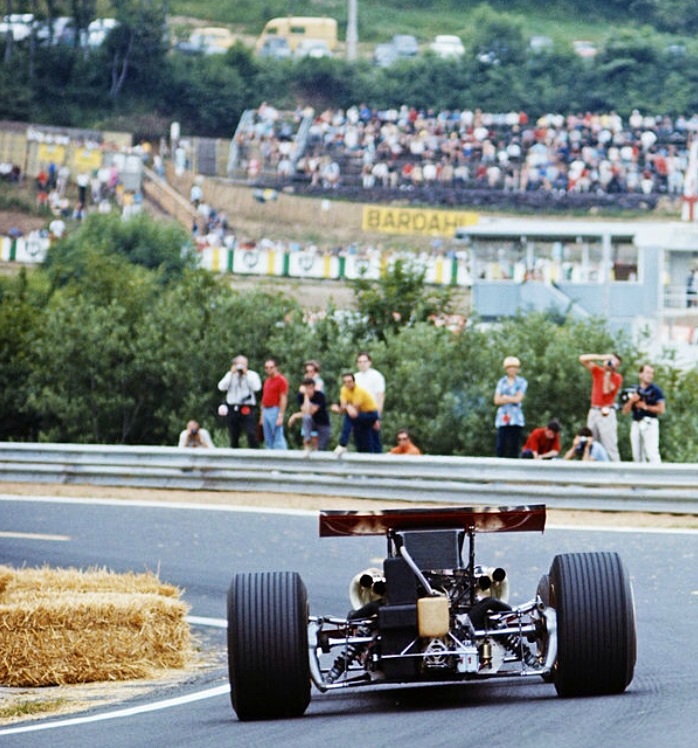
French GP, Rouen 1968. Q5 and 10th in the race won by teammate Ickx, the ‘rainmaster’ who started the damp race on full wets and drove away in the early laps when, again, a driver, Jo Schlesser, died in another fiery accident in the Honda RA302. These accidents accelerated changes to circuit and car safety, not that they were the last horrible fiery deaths in the period. Amazing Rainer Schlegelmilch shot of Rouen and the butt of Amons 312; look at the hay bales, tyre distortion and the presence of wings which grew thru ’68 (Schlegelmilch)

In 1968 the grid was ‘awash’ with Ford Cosworth DFV’s- Lotus, McLaren and Ken Tyrrell’s Matra’s were fitted with them. Colin Chapman waived his exclusivity agreement to the engines upon Ford’s Walter Hayes request that he do so ‘for the good of GP racing’ such was Hayes’ fear of Lotus dominance. Not that Ford’s position was diminished by more DFV powered cars on the grid than less!

amon oulton

Amon in the Oulton Park Gold Cup 17 August 1968. I had this shot on my bedroom wall for years as a scho0l kid! Wings are growing…Amon 2nd to Stewart’s Matra MS10 Ford (unattributed)

For Ferrari, BRM, Weslake and Honda the impact of the Ford engine was great. The DFV was built on modern, tape controlled equipment bought for the purpose which meant the quality of the product was consistent, parts made would fit all engines. Prior to that some GP engines were to an extent hand fettled and bits needed to be modified to fit each engine, which was effectively bespoke. Cosworth’s quality control and the pressure on them to rebuild the engines in a timely consistent way for all took a while to get sorted, but the writing was well and truly on the wall, the Ford engine a considerable F1 weapon of course right into the eighties and beyond in F3000 guise.

None of this was lost on Amon of course, the competitiveness of his compatriot Bruce McLaren’s cars in 1968 was something he observed and discussed with both Bruce and Denny Hulme.

image

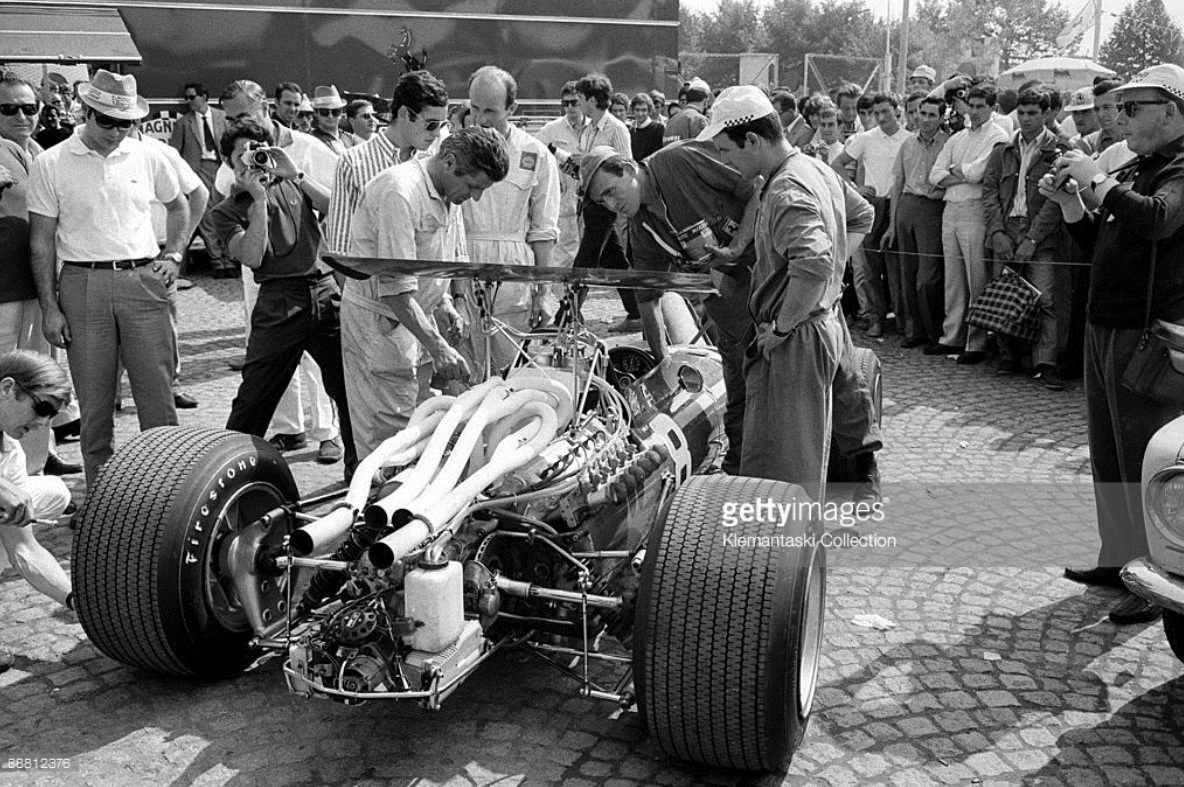
Italian GP, Monza 9 August 1968. Giulio Borsari makes some adjustments to Ickx’ 312. Forghieri devised this ‘movable aerodynamic device’ operated by oil pressure. The wing went to hi-angle mode in 1/2/3rd gears but feathered for low drag with the throttle open in 4/5th gears. It returned to download position in those gears when the brakes were applied. An override switch was fitted which Chris liked and Ickx had removed (Klemantaski)


image

Amon putting the movable wing to good effect at Monza in 1968. Q3 and DNF after an accident, Hulme won in a McLaren M7A Ford  (unattributed)

But Chris was ‘on fire’ in 1968. Ferrari were on the front row nine times, eight to Amon and took four poles, three to Amon, but unreliability robbed them, and Chris of three probable wins. Ickx took the only race win at Reims during the tragic French GP in which Jo Schlesser died in the Honda RA302.

At Monza Chris led until an oil leak onto a rear tyre caused an almighty accident which destroyed the car. He dominated in Canada despite clutchless gear changes from lap 12 but of course the gearbox broke under the strain, the clutch should not have failed.

image

Chris on the way to a 1969 Australian GP victory at Lakeside, Queensland on 2 February. He won the Tasman Series beating the Team Lotus Rindt/Hill duo and others. Left front of the Dino 246T off the deck thru the very fast kink opposite the pits (Rod MacKenzie)

1969 started well, Chris tested his 246 Dino Tasman cars thoroughly at Modena before shipping the cars home to New Zealand.

He convincingly won the Tasman Cup in 300bhp, 24 valve cars he helped develop and a team he put together. He collaborated with David McKay’s Sydney based Scuderia Veloce who provided on ground back-up for the mix of speed and reliability needed for this championship of intensity- eight races in eight weeks.

He beat the factory Lotus 49s of Hill and new-signing and probable ‘fastest guy on the planet’ Jochen Rindt taking four wins including the NZ GP at Pukekohe and AGP at Lakeside. The series of depth also included Derek Bell (in the other Dino), Frank Gardner (Mildren Alfa T33 V8) and Piers Courage (Brabham BT24 Ford DFW).

Back at Maranello the finishing touches were being made to the 312P, Ferrari were back in endurance racing that year, and the latest evolution of the 312 GP car.

Strategically the future for Ferrari was bright despite the financial difficulties the team were in early in the year.

Discussions underway with Fiat were consummated in June, Enzo Ferrari had effective control of the racing department for his lifetime whilst Fiat took over the development of the road cars, and a considerable amount of cash changed hands.

The injection of working capital allowed Ferrari to build the 25 512S Sports Cars required for homologation into Group 5 for 1970 and to develop Ferrari’s first ‘clean sheet’ 3 litre F1 car, the flat-12 312B.

Ferrari authorised Forghieri to start this program early in the year well before the Fiat deal was done, the Fiorano test facility, opened in 1972 is another example of the sort of investment which would not have been possible without Fiat’s investment.

amon monaco

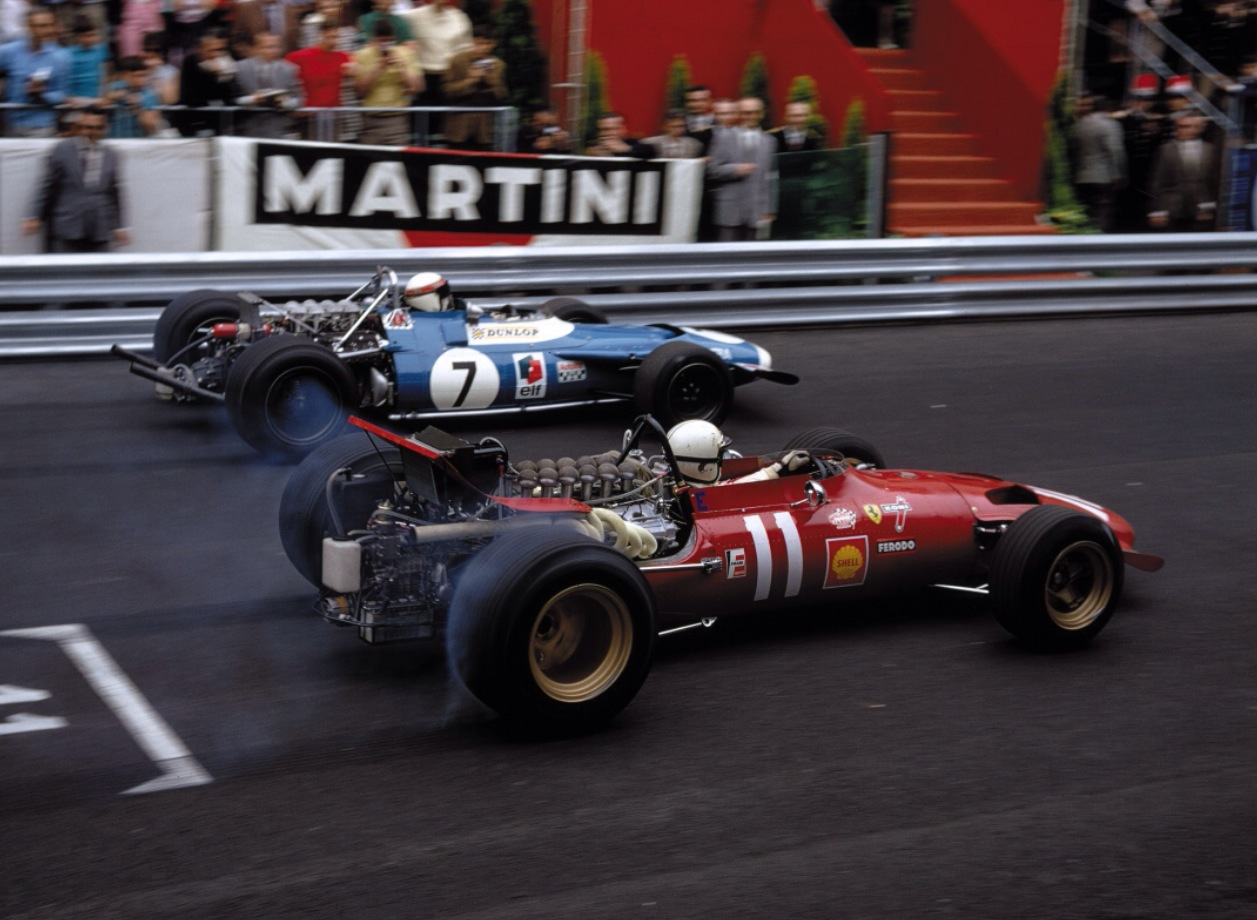
Monaco 1969 Amon beside Jackie Stewart’s Matra MS80 Ford which won the title that year . Q2 anf a failed diff. Note the lack of wings, banned overnight by the CSI. Hill won in a Lotus 49 Ford (Yves Debraine)

From Amon’s perspective then, he was potentially in the right place.

He was esconced in one of the sports greatest teams, he had won the Tasman, Ferrari was in the process of doing a deal with a partner with deep pockets, a new car was underway for 1970 but 1969 could be a challenge with an evolution of the ’68 cars and more Cosworth powered cars on GP grids! It was critical to Chris the 312B tested well.

Whilst Mauro Forghieri worked on the design of the 312B Ing Stefano Jacoponi was responsible to do what he could with the obsolescent V12. The chassis was much the same although the cars appearance was different with a flatter nose and evolution of wings, partially at the whim of the (CSI) rulemakers who banned, rightly, high-wings during the Monaco GP weekend.

The V12 was changed with heads which reversed the porting, returning the exhausts to outside the Vee lowering the cars centre of gravity and reducing turbulence around the rear wing. Inlets were in the Vee, more radical cams were developed and disastrous efforts made to reduce frictional losses and release power by reducing main bearing area…

amon spain

Amon, Q2 DNF engine, Spanish GP, Montjuic Park, Barcelona 1969. Stewart won in a Matra MS80 Ford. Look at that oil cooler trying to do just that (unattributed)


image

Forghieri with the 312/69 in the Silverstone, British GP paddock. V12 cooling issues clear by the ‘orrible oil cooler/duct incorporated into the rear wing. Amon Q5 and DNF lap 45 with gearbox failure. Stewart’s Matra won after a titanic battle with Rindt’s Lotus. 3 Ferrari’s were entered #32 the spare (unattributed)

Early in the season Ferrari entered only one car for Amon. He was second on the Spanish GP grid and inherited the lead after the two Lotus 49’s crashed with wing failure, with a lead of over 30 seconds the engine seized. At Monaco he was second when the diff failed and at Silverstone, joined by Pedro Rodriguez both retired with ‘box and engine failures.

To add to these frustrations and be in no doubt elite sport is as much mental as physical, his erstwhile teammate Ickx- Amon had been demonstrably the quicker of the two in 1968 was winning races in Brabham’s year old spaceframe chassis BT26. That car was now as consistently fast and reliable with a DFV in 1969 as it was consistently fast and unreliable with a Repco ‘RB860 Series’ V8 in 1968. Amon’s disappointment with his situation was immense, he was a race-winner in a reliable Ferrari or another car.

Such were their problems Ferrari withdrew from the German GP on 3 August, Ickx won there, to prepare the new 312B for Monza, it simply was not worth racing the fast but unreliable 312/69.

Amon had great hopes for Mauro Forghieri’s new for 1970 car, the ‘clean-sheet, Flat-12 engined 312B…

modena amon mirrors

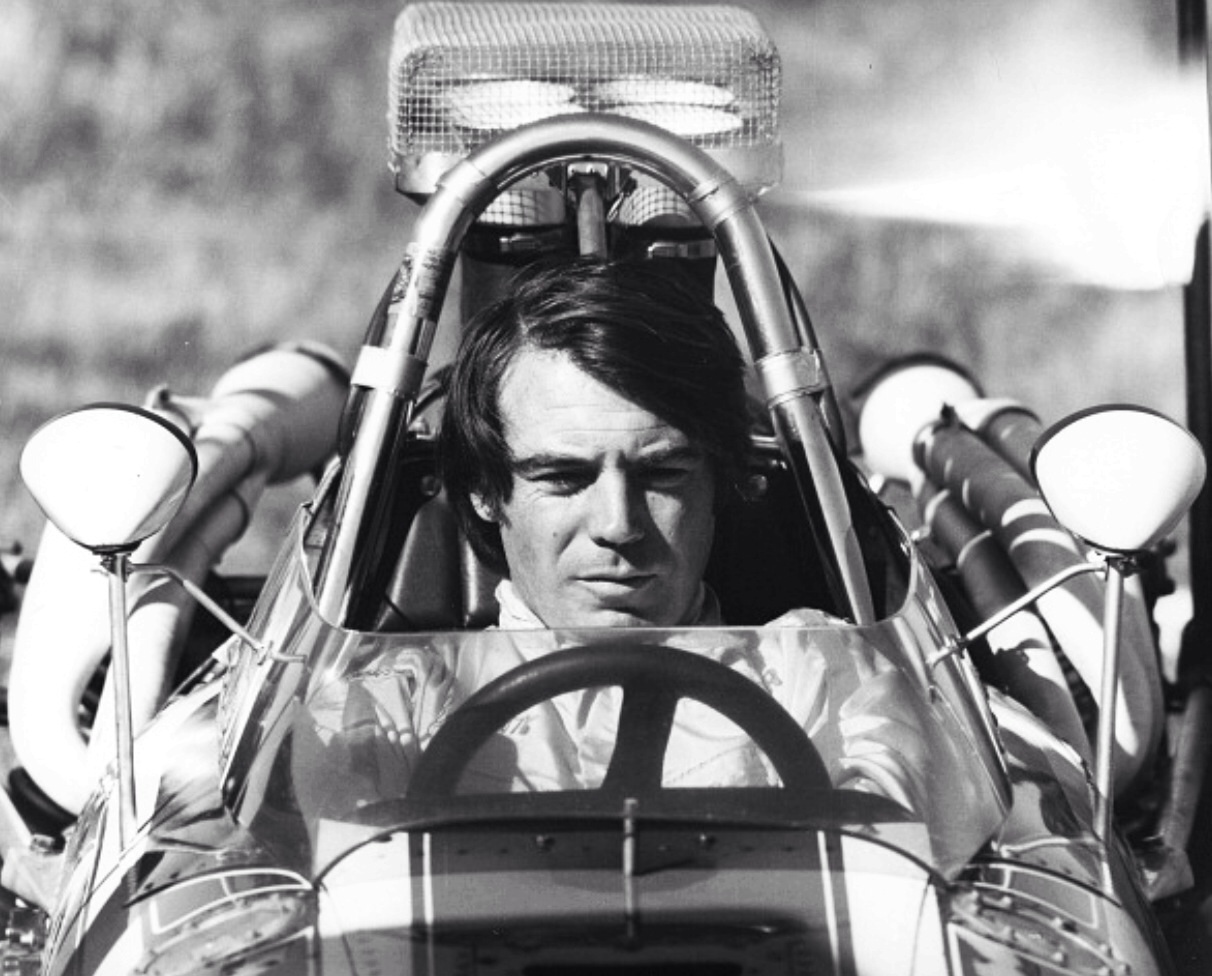
Amon readies himself for the off, Modena, exact date unknown (GP Library)

Mauro Forghieri’s Ferrari 312B was one of the most beautifully integrated Ferrari’s ever built, whilst much is made of the engine the success of the car was about far more. Doug Nye; ‘The 312B…was quite the best integrated 3 litre F1 package yet created. It would remain the best packaged of all Ferrari’s until the Postlethwaite 156 appeared in 1985’ he said writing in 1986. I always thought the 312T/T2 were pretty handy bits of integrated kit, but the point is, the car was a beautifully designed and executed car!

The talented Modenese born engineer saw at close hand as an at thecircuit race-engineer the success of the Lotus 49 and its imitators, the engine beautifully integrated with the chassis and the powerful, torquey, compact, relatively frugal and reliable nature of the Cosworth DFV itself. The engines basic dimensions and valve angles gave instruction to a whole generation of engine designers.

The suspension of the competition were all period conventional; wishbones/wishbones or rocker/wishbones at the front and single top-link, lower wishbones and radius rods for fore and aft location. The 312B followed that course.

Aerodynamics were still a black art but the CSI’s mandated lower wings meant airflow to the critical rear wing needed thought as the wing could no longer be mounted high in ‘clean air’. Remember, at the time traction was important, the cars had a wonderful surplus of power over grip.In the end that problem solved as much by tyre alchemy as wings let alone the 1969 4WD blind-alley of which Ferrari was not a part.

A 12 cylinder engine was a ‘Ferrari given’. Forghieri’s challenge was to unlock sufficient power to combat the DFV despite the inherent packaging issues of the longer engine and frictional losses and other bottom end shortcomings which were such problems in the existing V12.

image

Ferrari 312B 1970 showing the chassis structure and rear ‘boom or beam’ to which the engine attaches (Nye)

Forghieri’s chassis was another of Ferrari’s ‘aero constructions’. They were not monocoques in the British sense but rather a tubular internal frame stiffened by riveted on ‘ally panels. Not a problem, Ron Tauranac’s old-fashioned spaceframe BT26’s were race winning GP cars in 1969 until effectively outlawed by the ‘bag tank’ rules of 1970.

The clever bit, ‘praps learning from the DFV’s simple chassis mounts mandated by Lotus designer Colin Chapman to Cosworth’s Keith Duckworth was the use of a ‘beam’ aft of the usual drivers bulkhead to which the engine mounted. This provided a very stiff structure but also very good, better than all other cars in 1970, airflow to the rear wing. It promised more downforce and therefore grip for less angle, drag, than the other cars.

image

Note the rivets on the rear beam which is part of the cars chassis to which the engine attaches, it also biolts to the bulkhead behind the driver. Low nature of engine and good airflow onto the wing. Oil cooler ducts also in shot (GP Library)


image

Ferrari factory drawing of the Flat-12 312B engine showing its deep base chamber, roller bearing mains, narrow included valve angle, induction tracts above the heads, exhausts below and extensive cross-bolting of the split crankcase castings (Nye)

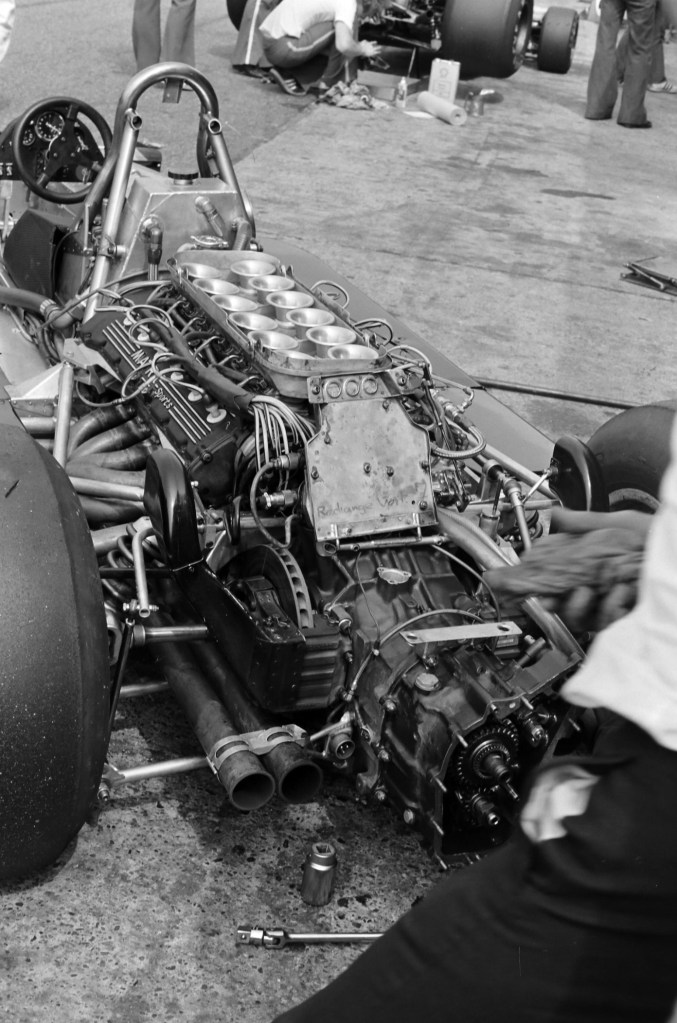
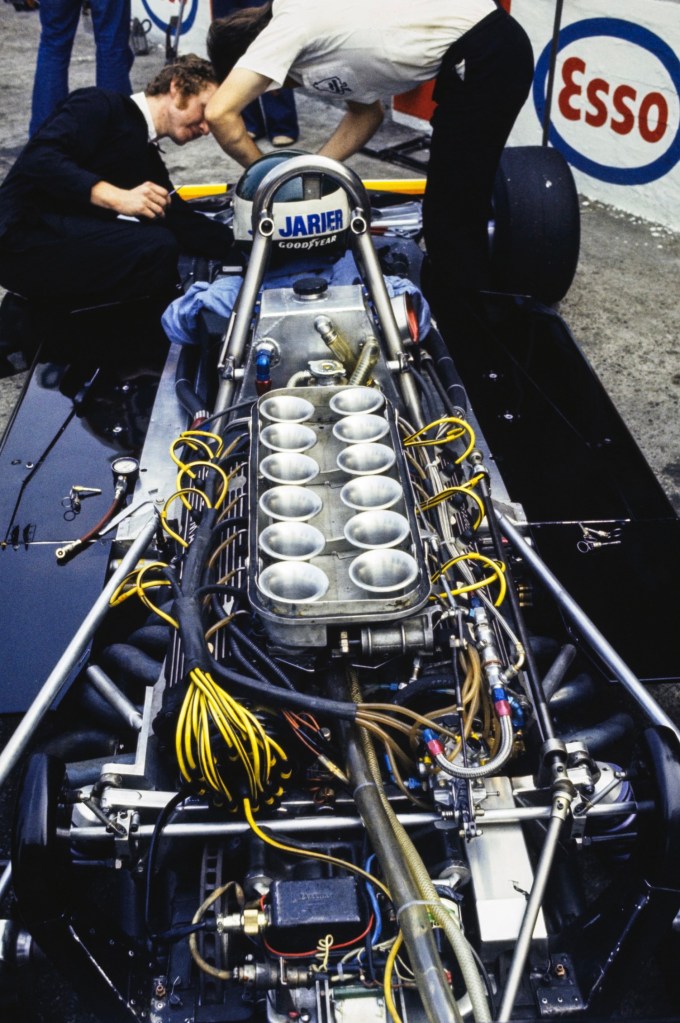
Engineers Forghieri, Rocchi and Bussi’s 3 litre Flat-12 engine was conceived in that horizontally opposed configuration to get the cars centre of gravity low and get the engine out of the airstream to the wing. The need for lower frictional losses was met by the use of just 4, the old V12 had 7, main bearings. The design used  2 plain bearings in its centre and ball bearing races at each end.

Bore and stroke were 78.5mm x 51.5mm, vastly oversquare, for a capacity of 2991cc. Four overhead camshafts and 4 valves per cylinder were used, the heads evolved from ’69 V12 practice. Lucas fuel injection was carried over onto the new engine. The cams were driven by gears  from the crank’s nose.

Doug Nye; ‘The light alloy block was cast in 2 parts and united on a crankshaft centreline bolted flange…Light alloy cylinder liners were used, cooled by water circulation at their upper ends, by oil circulation down below. The crankshaft was machined from a steel forging, each of its six crankpins carrying two con-rods. The crankshaft nose gear drove alternator, ignition distributor and and fuel metering unit via gears and pinions. The crank tail drove the valvegear train. A tiny flywheel assembly incorporated a rubber vibration damper. Forged titanium con-rods were used…and Mahle forged aluminium pistons…a single oil pressure pump was driven off the rear of the RH cylinder timing gear fed the oil filter mounted behind the fuel metering unit.’

image

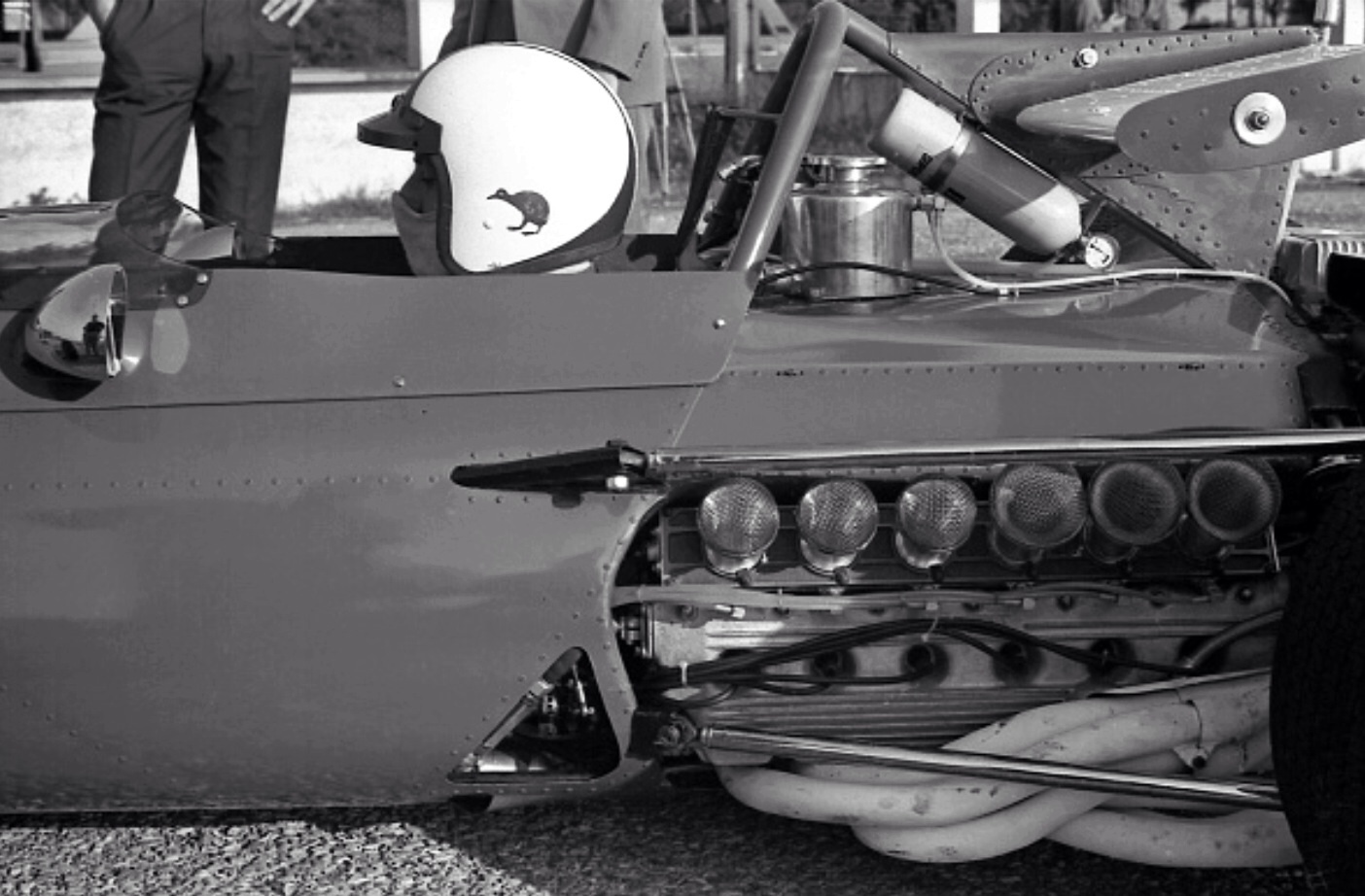
Side on flat-12 engine detail, DOHC, 4 valve, Lucas injected, single plug, how low do they take the CofG with this approach?! See rad header tank and extinguished bomb, the latter messy in terms of flow to the wing and exposed! Check out the very clever roll bar brace; it triangulates and stiffens the rear beam structure as well as providing a neat, faired mount for the wing itself (GP Library)


image

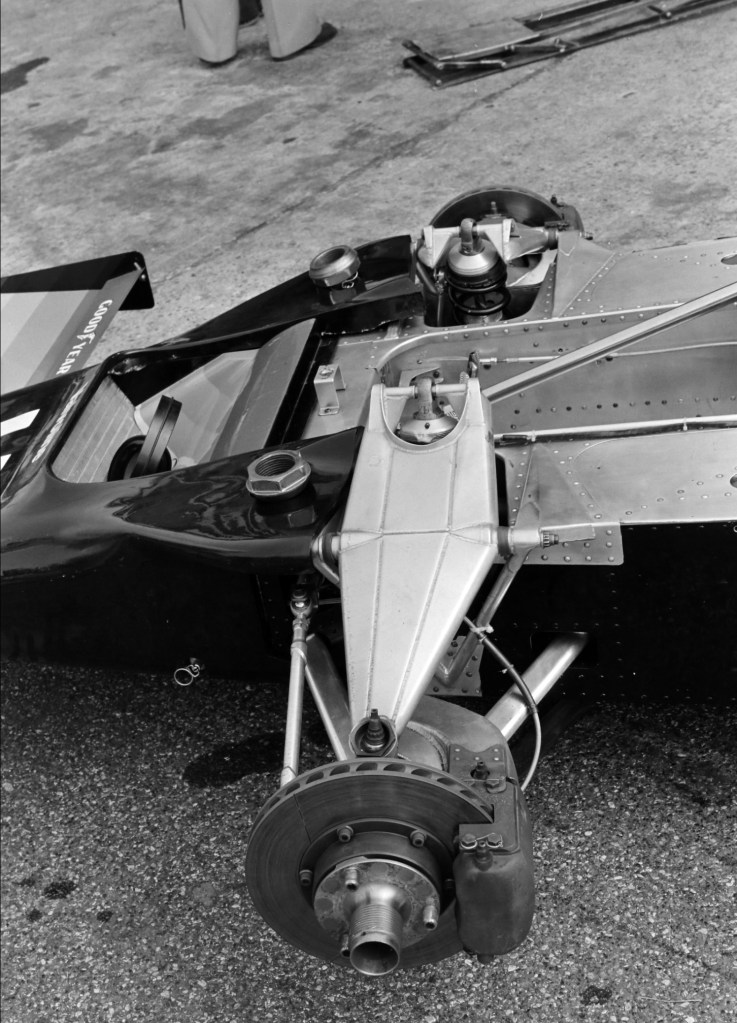
312B front end detail. Suspension top rocker actuating coil springs and Koni shocks and lower wide based wishbone. Note ally ducting behind rad to exhuast hot air via ducts in the fibre-glass nose (GP Library)


image

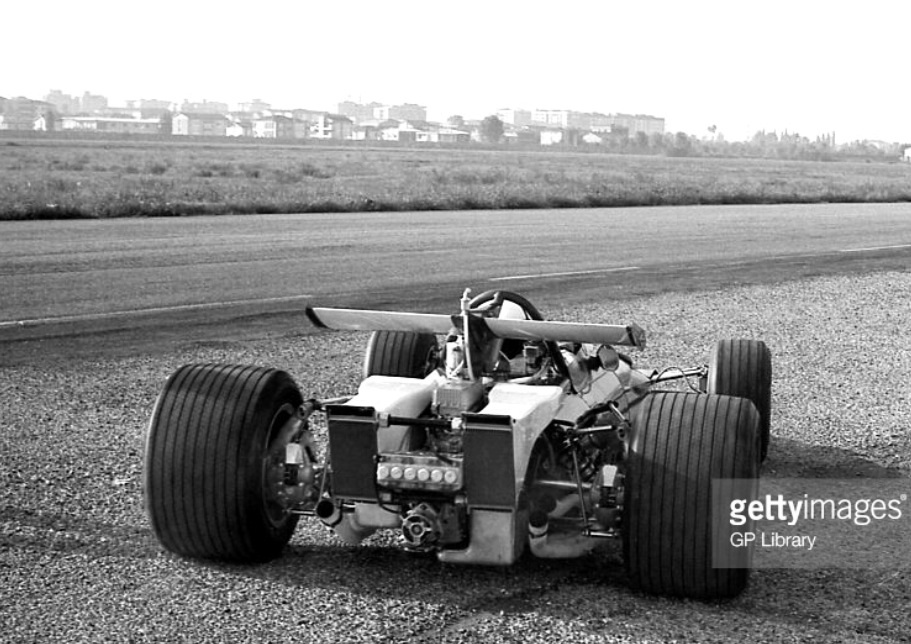
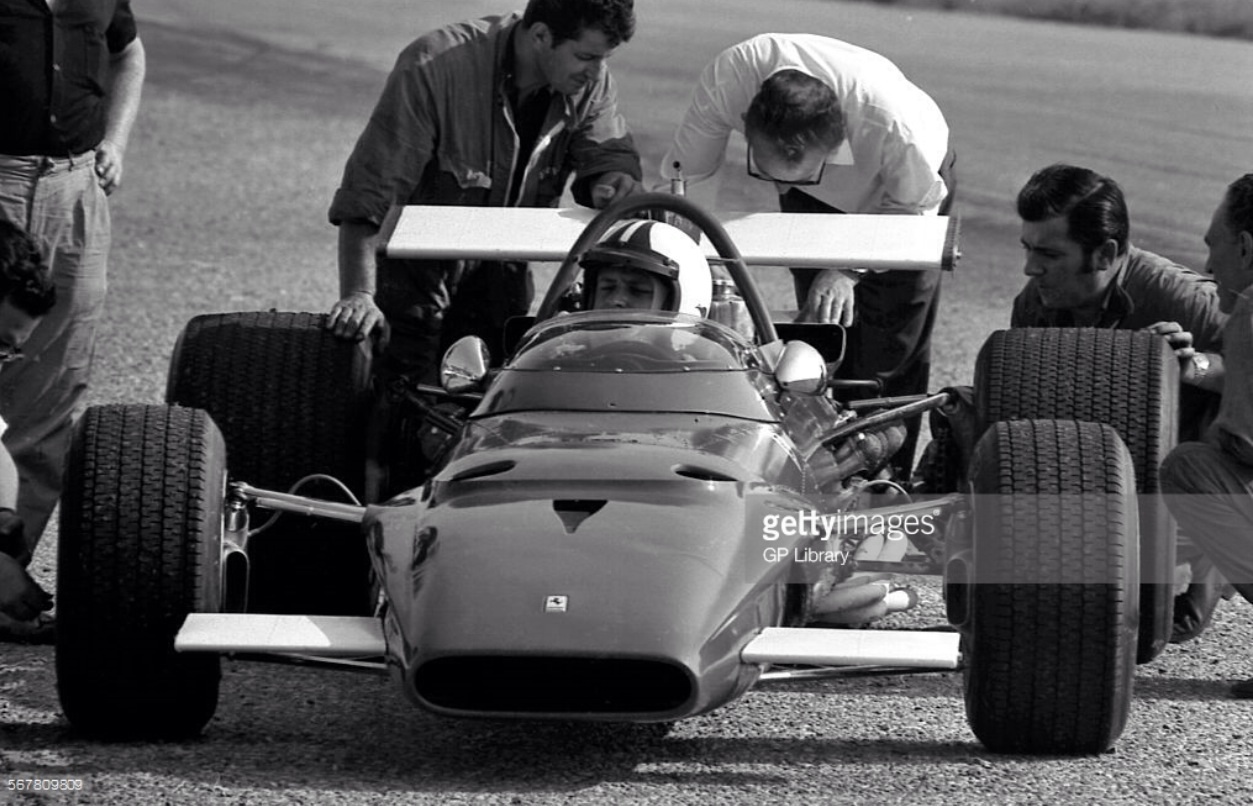
Butt shot of the 312B as it heads out onto Modena Autodrome with Amon saying a few silent ‘Hail Marys’ as to engine life no doubt! Ducting to oil coolers, rear mounted battery and outboard brake discs/suspension all clear (GP Library)

Amon watched the jewel of a car evolve at Maranello, it was with a great deal of optimism that he approached his early tests at Modena.

Right from the start he and Forghieri were happy with the chassis, the sort of balance they achieved with the earlier V12’s was still present. The car was lighter, was good under brakes had good traction and top speed for as long as the new, powerful engine lasted…

With Chris in the car the 312B had a series of monumental, catastrophic engine failures due to piston, crankshaft and lubrication problems. Amon; ‘I could feel that it was tremendously strong and powerful during those early tests, but it kept flying apart, i thought hell i can’t stand any more of this…’

After one of these sessions in August Chris said ‘enough’ and decided to leave the team.

Its ironic that Amon made the decision to leave due to the early failures of an engine which became a paragon of powerful reliability for a decade winning 3 drivers, 4 manufacturers and 1 sportscar championship for the Scuderia. Its performance was only compromised by its low/bulky architecture, a strength but an impediment in the ‘wing car ‘ era when the engine took space needed for ground-effect tunnels.

The engines bottom end failings were resolved by building a tilting dyno-bed at Maranello  to reproduce oil surge in corners. The crank torsional issues were sorted by the addition of a Pirelli cushion coupling between the crank and flywheel. In this form the 1970 spec engine developed 460bhp from 11500-11700 rpm rising to 510bhp@12000 rpm in 1979/80.

But for Chris it was all too much, he could see another season of Ferrari DNF’s caused by the repeated engine failures which had cost him victory or good placings on so many occasions. He saw his immediate future best served by driving a Ford Cosworth DFV powered car, the dominant engine of the time, so off to the nascent March concern he went.

He hadn’t burned his Ferrari bridges though, he was invited to be a member of the teams 512S sportscar squad in 1970…but Enzo Ferrari did say to the Kiwi that he, Ferrari, would win a race before Chris did!

image

Ickx, having made a smart move to Brabham in 1969 came back to Maranello for 1970 as ‘numero uno’ and was unlucky in some ways, in a season of great cars, not to win the title in the 312B!

The 312B came on strong, all issues solved in the second half of the season, the car won in Austria, Mexico and Canada for Ickx and at Monza for Regazzoni. Had the car started the season as well as it finished, noting Rindt’s death at Monza took out the seasons fastest combination, Ickx would have won the title. Mind you, there are plenty of new cars down the years that if they had reliability from the start of the season would have taken the title.

image

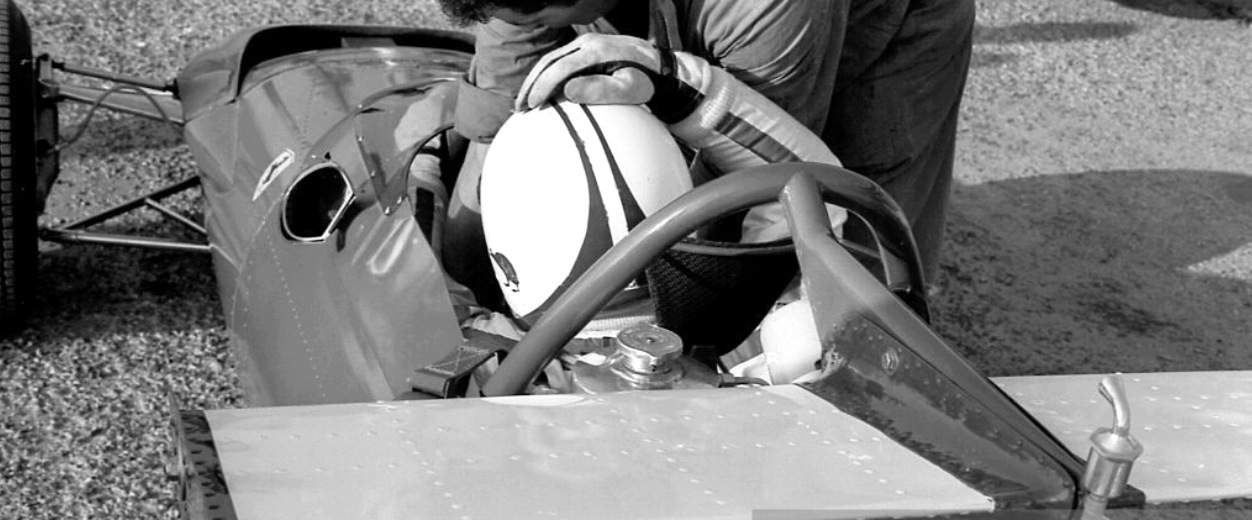
This group of shots (the one above and those at Modena below, all are undated sadly) are included for the sake of completeness; they are all of the same session. They show the beauty of this incredibly good, important for Ferrari car.

The photos convey a certain sense of calm as well, despite the problems which were apparent with the engine from the start. Apart from Chris of course, i am sure he felt far from calm trying to best assess his short and longer term options!

Driving careers are fickle things; he felt he had to seize the moment having in his mind stayed at Ferrari a season too long. Hindsight is brilliant of course, in fact he stayed a season too little, his testing skills may well have meant the car started the season better prepared than it did. Ickx wasn’t a noted test driver and new-boys to F1 Regazzoni and Giunti weren’t in a position to make the contribution Chris could and had made since 1967…

modena wing

Another view of the roll bar/wing mount covered earlier (GP Library)


modena forg

Forghieri with the pad, sans rear wing in this shot (GP Library)


image

Who is the belle of the ball!? Lotus 72 was ‘the radical’ of 1970: side rads, rear weight distbn, torsion bar suspension but all the other race winners that year were ‘conventional’ front rad cars; 312B, BRM P153, Brabham BT33, March 701. Best aero direction not clear at this point in GP history nor would it be until the Lotus 78 started the ‘wing car’ trend (GP Library)


image

Chris Amon, Modena June/July 1969. He lost many races due to bad luck, the decision to leave Ferrari tho wasn’t so much bad luck as a judgement call which time proved was the wrong one. Wonderful hindsight i know (GP Library)


image

(GP Library)


modena chris 1

Amon lost in his thoughts, Modena 1969 (GP Library)

Amon Post Ferrari…

This article is not about Amon’s career, rather Ferrari elements of it. What follows is not a full summary of the balance of his wonderful career.

For Chris 1970 was frustrating!

The March 701 was not the best car of the season but both he and Jackie Stewart in Ken Tyrrell’s car ‘made it sing’. Stewart took a Spanish GP win and Chris the BRDC International Trophy at Silverstone, an F1 win but not the GP win he sought.

He came close to that in a titanic battle with Pedro Rodriguez’ BRM P153 at Spa in a test of the brave, bold, skilful and precise, just coming second.

He proved as quick as anyone in 1970, again. His record head to head in the 10 Championship GP’s he and Stewart raced the 701, the Scot in a Dunlop rather than Firestone shod car was 8/2 in Stewart’s favour. In all but 2 occasions Chris was only 1 or 2 grid slots behind Stewart who was arguably the best driver in the world at the time if not its fastest. Until his death most would argue that was Jochen Rindt. There is little doubt the Tyrrell 701 was a better prepared car than Amon’s March works car. The point to take here is that Amon was ‘right thereabouts’ with the best driver in the world at the time.

amon march

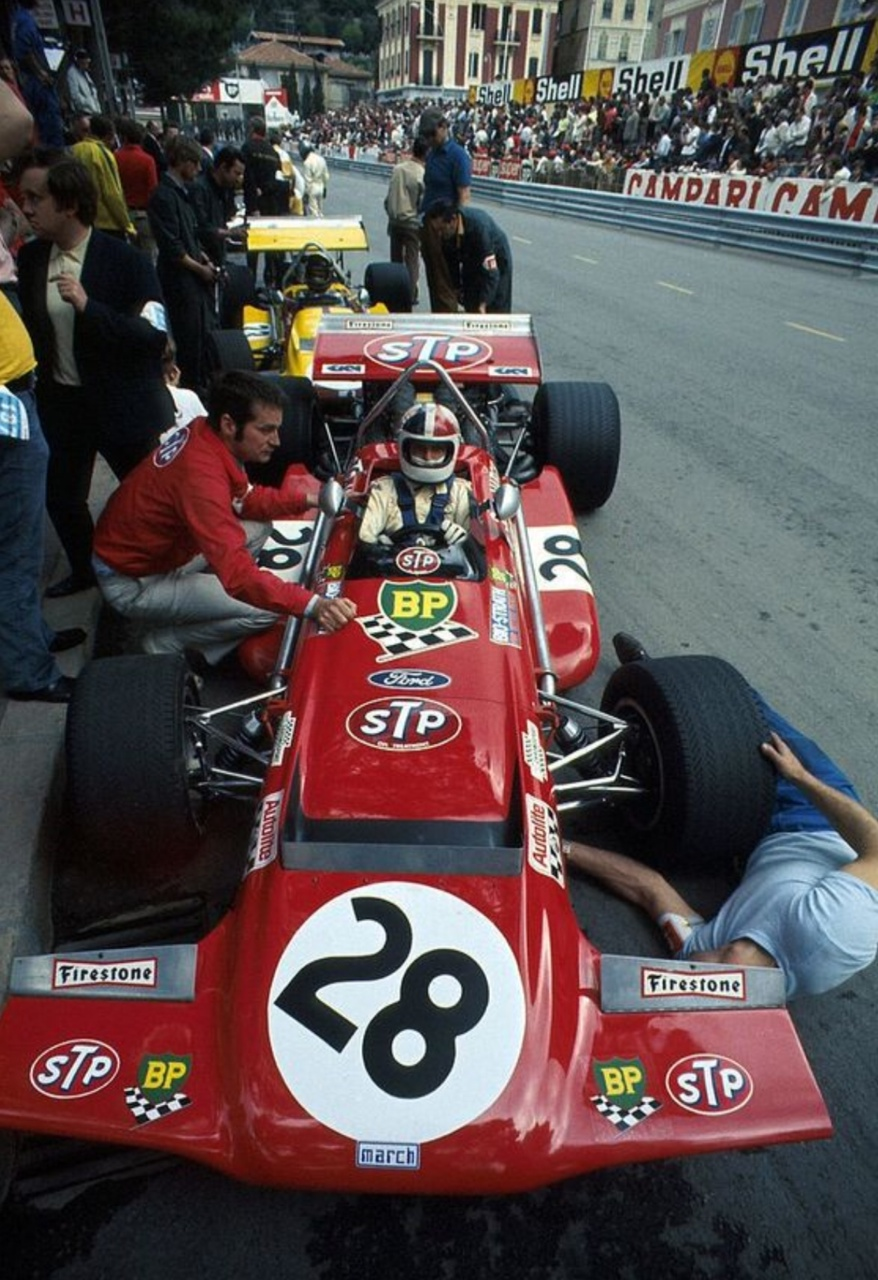
Amons March 701 being tended by the cars designer Robin Herd at Monaco 1970, Q2, DNF suspension failure,Ronnie Peterson’s customer, Colin Crabbe owned yellow March 701 behind. Rindt won in a Lotus 49C Ford (unattributed)

If the departure from Ferrari was not strategically the right one for all the reasons outlined earlier in the article, the departure to the new March outfit was a ‘leap of faith’ largely i suspect in designer Robin Herd which provided a competitive Cosworth powered car if not the quickest one. Amon knew Herd from their March days, Robin designed the first McLaren F1 car, the M2B and the ’67 CanAm Championship winning M6A Chev.

March were a company whose very successful raison d’etre was the construction and sale of production racing cars, its works teams secondary considerations. Its not hard in that context to work out what Max Mosley and Robin Herd’s prime focus was in 1970; to win in FF, F3 and F2 to flog cars for the coming year. Chris signed relatively early for March, before he knew they were selling 701′ s to ‘every man and his dog’ including the 1969 world champion for 1970. In 1970 Amon, Siffert, Stewart, Servoz-Gavin, Cevert, Peterson, Andretti and others raced 701’s. Works drivers Amon and Siffert didn’t have the cars to themselves.

Brabham, McLaren and BRM would have been better places to be in 1970 than March. Not that BRM was an attractive option in 1969.

Chris joined Matra who made him an offer he couldn’t refuse, back to a V12 for 1971 and 1972, taking a Non-Championship GP win in Argentina in 1971 and again lead races more than once only to experience car failures or punctures.

image

1971 Argentinian GP placegetters; Henri Pescarolo March 701 Ford, Amon 1st where he belongs! Matra Ms120 and Carlos Reutemann McLaren M7C Ford Ford (GP Library)

During 1972 Matra were mainly a single-car entry for Amon its focus increasingly on Endurance Racing success.

amon matra

German GP 1972. Amon Matra MS120D Q8/15. Ickx won in a Ferrari 312B2 (unattributed)

Tecno in 1973 was a disaster but Chris raced a third Tyrrell in Canada (Q11 2 slots behind Stewart in the unfamiliar car and 10th in the race) and the US (Q12 at the time the team withdrew from the race) for Tyrrell but not converting that into a 1974 drive after the death of Francois Cevert and retirement of Jackie Stewart at Watkins Glen.

His own Amon F1 car was also a disaster in 1974, a project commenced after a return to March in ’74 ‘evaporated’ over the Christmas New Year period seemingly after a failure in communication between Max Mosley and Chris. An engine development business with ex-BRM engineer Aubrey Woods also cost the Kiwi a lot of money. Looking at Chris’ career and some of the decisions suggests he needed a decent business manager, or a better one if he had one!

amon watkins chassis fit

In Tyrrell 005 in the Kendall Centre, Watkins Glen. Note the inboard front brakes of Derek Gardner’s design. Tragic weekend with teammate Francois Cevert’s high speed, fatal practice crash in an 006 chassis. Both remaining cars withdrawn and Jackie Stewart didn’t get the chance to race in his last, planned GP (Mike Glynn)


amon watkins

Amon in Tyrrell 005 Ford, Watkins Glen, USGP practice, 6 October 1973 (unattributed)

In 1975 he raced  the Talon MR1 Chev F5000 (nee McRae GM2) in the Tasman Series and in the US showing he had lost none of his skill despite a car not as good as the ubiquitous, highly developed Lola T332’s.

image001

Amon enters the Sandown paddock, Saturday 22 February 1975. 5th in the race, Talon MR1 Chev, car behind is John McCormack’s 2nd placed Elfin MR6 Repco. John Goss won in a Matich A53 Repco (M Bisset)

The only time i saw Chris race was in the final round of the ’75 Tasman at Sandown in February, he did the full series in one of Jack McCormack’s Talons, not the ‘fastest tool in the shed’ but Chris made the car sizzle despite junk engines which failed 3 times. He took a win at Teretonga, the final Kiwi round and was quick everywhere whilst the car stayed together.

I was a starstruck teenager who didn’t stray too far from his pit the whole weekend. On circuit what was impressive was his speed which was deceptive. He drove the car in a very ‘neutral’ fashion through the slow/medium corners where so many others were ‘tail out’. Across the top of ‘Marlboro Country’ a fast entry quicker corner his carrying speed and control was a joy to watch as was his precision under brakes into ‘Dandy Road’. I still recall the toe/heel too; on the brakes late and a change down late as well, a short/few revs blip at the throttle, easy on the DG300 box. A pro.

image002

‘Auto Actions’ Paul Harrington gets the gen from Amon, Sandown Tasman ’75 practice Saturday, looks like its tough going! McRae GM2/Talon MR1 clones lovely cars (M Bisset)

Late in 1975 he had some drives of Mo Nunn’s Ensign GP cars, he and Nunn developed these pretty, effective cars into machines which shaded many of the big budget teams in 1976.

He was 10th on the Spanish GP grid, finishing 5th, 8th on the Zolder grid but lost a wheel and flipped the car emerging unscathed in the race. At Monaco he was Q12 and 13th. At Anderstorp he was a terrific 3rd on the grid but crashed out of 4th on lap 39 when the cars suspension failed.

amon sweden 1

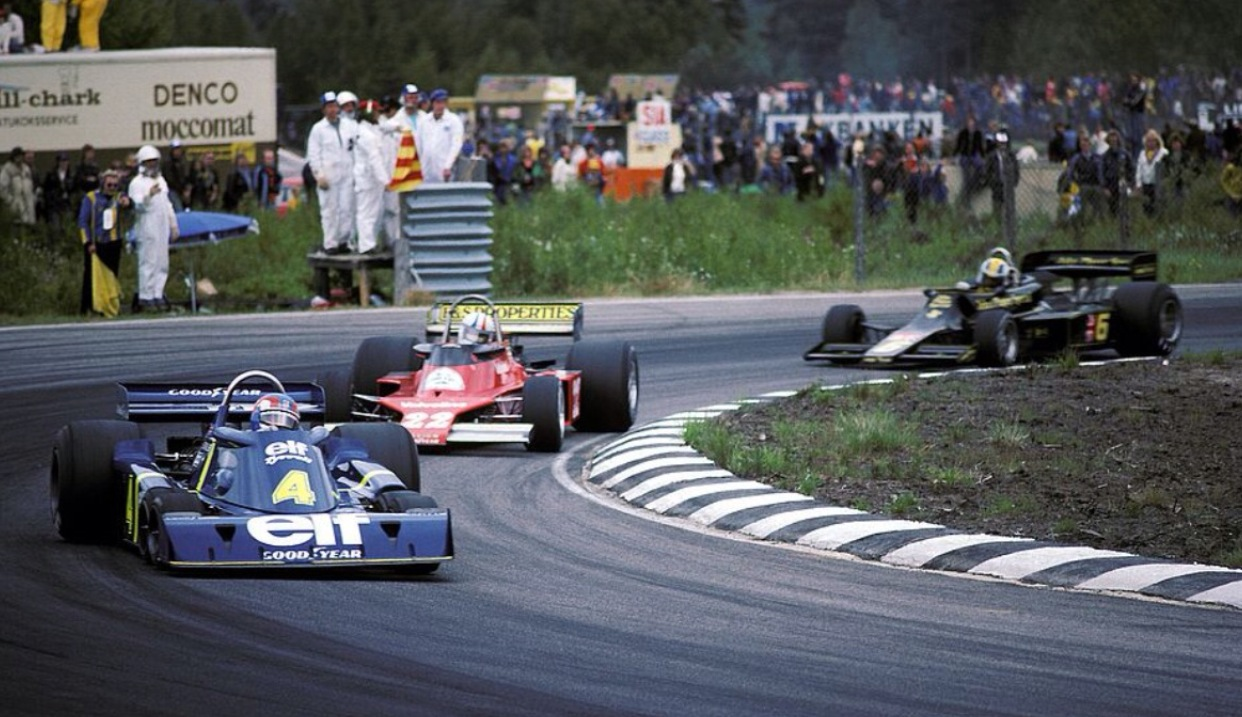
Swedish GP, Anderstorp 1976; Amon Ensign N176 Ford in between Patrick Depailler’s Tyrrell P34 Ford and Gunnar Nilsson’s Lotus 76 Ford. Scheckter won in the other P34, Amon an amazing Q3 and accident caused by suspension failure (unattributed)

Chris missed the French GP injured after Sweden, Patrick Neve qualified the car 26th, perhaps more indicative of the machines pace without an ‘ace’ at the wheel…

At Silverstone for the British GP, Chris qualified 6th, this time a water leak the cause of a DNF.

The problems of a low budget team in terms of design and preparation were clear, Chris decided he had ‘had enough’ of GP racing in this way and elected not to take the re-start of the German GP after Niki Lauda’s accident. The risk of something breaking on that circuit in that car was simply too great.

1976 showed he had lost none of his sublime, deceptively fast skill, speed and testing ability. He was still only 33 despite having his first Championship GP drive in 1963.

image

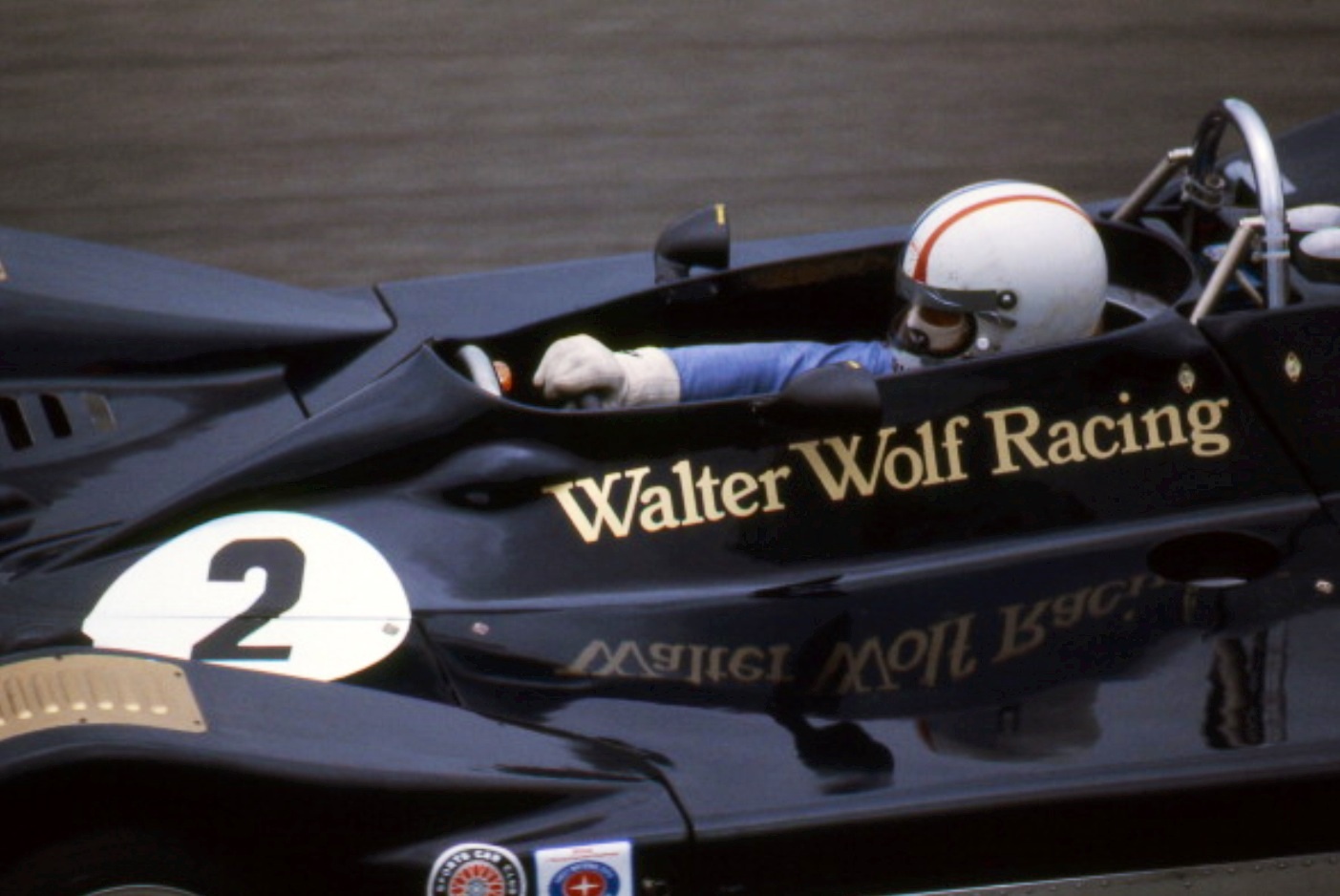
Amon’s last pro drive. Mont Tremblant CanAm 12 June 1977 in Walter Wolf’s Wolf Dallara WD1 Chev, grid 2 and DNF. Race won by Klauser’s Schkee Chev (Bob Harmeyer)

Amon’s last race was in Walter Wolf’s single-seat Can Am car in 1977 before saying ‘enough’, recommending Gilles Villeneuve for the ride before returning to his native New Zealand and farming at Bulls in the ‘Land of The Long White Clouds’ North Island. He sold the property some years ago but is not too far from the local racing scene and maintains a long-standing commercial relationship with Toyota.

Chris Amon had a career most of us can only dream about, life is all about the decisions we take, perhaps the decision to leave Ferrari in 1969 was the worst he ever made but in the same circumstances i suspect many of us would have made the same call.

To me though he should be remembered for what he achieved rather than what he didn’t: wins at Le Mans, Daytona 24 Hours, Monza 1000Km, a Tasman Championship, NZ (2) and Australian GP wins against some of the best drivers in the world, two non-championship F1 races and many individual race wins and the respect and fear of his peers. From 1967 to 1972 he was in the top 10 drivers in the world, for some of those years top 5.

Bot wow, Amon in a 312B in 1970, if only…

Etcetera…

image


image

Ferrari 312B cutaway (unattributed)


image

Bleeding the brakes with Dave Ramsay, F5000 Talon MR1A Chev during the Long Beach GP weekend in September 1975. Amon 4th, race won by Brian Redman’s Lola T332 Chev (D Ramsay)

Bibliography…

Automobile Year 16, 17 and 18, Doug Nye ‘History of The GP Car 1965-85’, GP Encyclopaedia, MotorSport March ’84 Amon article by Alan Henry

oldracingcars.com is one of my standard, always reference sources- checkout Allen Brown’s piece on the cars and each chassis built here; https://www.oldracingcars.com/ferrari/312b/

Photo Credits…

Getty Images, Rainer Schlegelmilch, Mike Glynn, Klemantaski Collection, GP Library, Rod MacKenzie, D Ramsay, Bob Harmeyer, Yves Debraine

Tailpiece: ‘This thing is a Jet if only they could keep it together for more than 10 laps?!’ …

modena tailpiece

Finito…

image
(The Enthusiast Network)

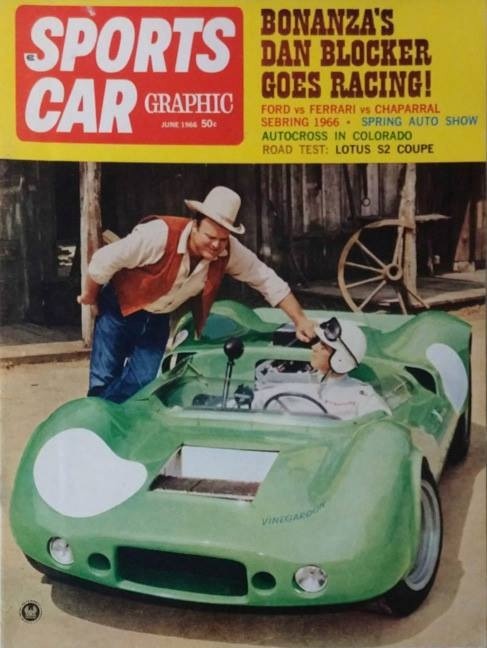
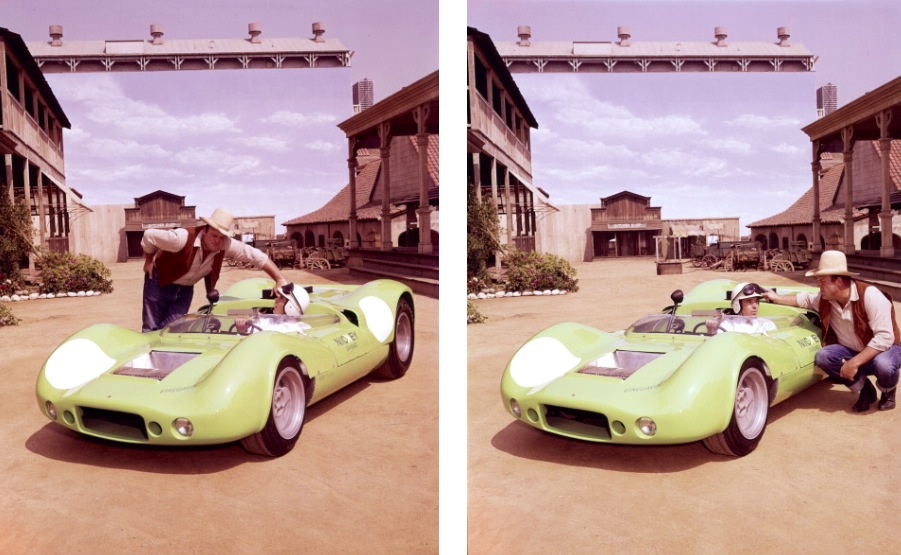
Hoss Cartwright checks out his new Can-Am Genie Mk10B Traco-Olds with driver John Cannon…

As a 1960s Aussie kid i grew up on a diet of fantastic American TV, our own tele/movie industry wasn’t what it is today. I have wonderful memories of ‘Flipper’, ‘Gilligans Island’, ‘The Jetsons’, Freddy Flintstone, ‘The Munsters’, ‘The Addams Family’, ‘McHales Navy’, ‘Batman’, ‘Hogans Heroes’, ‘Get Smart’ of course and ‘Bonanza’, all of which explains how i turned out i guess!

‘Bonanza’ was a Western the whole family sat down to watch. Dan Blocker, the Genie’s owner played Hoss Cartwright in the popular show which ran from 1959-73, shite thats a long time! This publicity shot was taken on 3 February 1966 on ‘The Western Street’ set, Paramount Studios, Los Angeles.

image
(The Enthusiast Network)

Genie Mk10B Traco Olds…

Blocker, a motor racing enthusiast acquired the car from Ray Huffaker its constructor. Nickey Chevrolet provided some sponsorship with British born Canadian ex-RAF pilot, John Cannon engaged as driver.

Cannon contested the 1965 and 1966 USRRC seasons, he finished second in the 1965 Nassau Tourist Trophy and won the USRRC race at Stardust Raceway, Las Vegas in April 1965.

In 1966 John won the first USRRC round at Stardust on 24 April and retired at Riverside, Laguna and Bridghampton in May. After another retirement due to an accident at Watkins Glen in June, Cannon left the team and bought a McLaren-Elva Mk2 finishing second at Kent on 31 July.

image
Times Grand Prix, Riverside 31 October 1965: John Cannon’s Genie Mk10B Olds eighth ahead of Chris Amon in the Ford GT40-X1 5th. Hap Sharp’s Chaparral 2A Chev won from Jim Clark’s Lotus 40 Ford and Bruce McLaren’s McLaren Elva Mk2 Olds. It was a great performance from Cannon in a car not as quick as many, the field also included McCluskey, Pabst, Follmer, Dick Thompson, Revson, Parsons, Titus, Hobbs, Bondurant, Ginther, Hill, Gurney, Grant and Hansgen! Quite a field (The Enthusiast Network)
image
The Genie at Bridghampton in 1966 (Frederic Strauss)

In the first, 1966, Can Am series, stunt driver Bob Harris took over the Genie, fifteenth at St Jovite and elevnth at Stardust his best results, the series was won by John Surtees works-Lola T70 Chev.

The Genie passed through various hands but is still extant and is run in historic racing by Tom Stephani, son of Jack Stephani who co-owned Nicky Chevrolet, the Genie’s sponsor when Cannon raced it.

image
Genie Mk10 as raced by Bob Harris in the ’66 CanAm (Larry Fulhorst)

Paul Stephani, Tom’s son picks up the story; ‘My grandfather owned Nickey Chevrolet in Chicago (with his brother Ed and sister Jean). Jack was a big racing enthusiast and used Nickey as an excuse to go racing’.

‘It doesn’t stop there as Michael Cannon (son of John cannon) married a close friend of our family and has driven the Vinegaroon to the car show from Road America to Elkhart Lake a few years back. Michael is the head engineer on Conor Daly’s IndyCar entry this year. Here’s how the Blocker/Nickey/Cannon combination went their separate ways after the ’66 CanAm round at Watkins Glen! : https://www.youtube.com/watch?v=cxClHhH4xto

Tom Stephani recalls how Dan Blocker and his father Jack Stephani came to create a race team together; ‘Basically, my Dad met Blocker at the West Coast races in the fall of 1965. Dad saw a natural connection between the two. Both loved racing, Nickey had a fairly substantial racing team and budget, and Blocker could provide a promotional opportunity for Nickey Chevrolet. ‘Bonanza’ was sponsored by Chevrolet so the tie-in really worked well. His personal appearance at the Nickey Dealership in February 1966 drew at least 5,000 people. Shut the whole place down for a couple of days!’

Joe Huffaker started building racing specials and Formula Junior’s. He switched to sportscars as the greater market opportunity became clear. The first Genie Mk4 was a ‘G Modified’ car powered by a BMC 1100cc engine.

image
Jack Stephani co-owner of Nickey Chevrolet in the glasses behind the toolbox, Dan Blocker and John Cannon at the USRRC Bridghampton round in May 1966 (The Enthusiast Network)
genie1
The Genie M10B as it is today owned by Tom Stephani, the son of original Nickey Chev/Genie sponsor Jack Stephani (Paul Stephani)

Technical Specifications…

The Genie Mk10 was an improvement on or evolution of his Mk8, his first big-banger USRRC series car.

It comprised (see below) a multi-tubular spaceframe chassis which accommodated a range of American V8s and utilised the ‘usual’ 1960s suspension mix of wishbones and coil spring/dampers at the front and inverted wishbone, single top link, coil spring/dampers and radius rods at the rear. Brakes were Dunlop calipers with outboard discs all round, the whole lot clad in a curvy fibreglass body.

The Blocker Mk10B was powered by a Traco-Olds 300cid/5-litre engine fed by four 48IDA Weber carbs, the transaxle was a BMCD Huffaker unit.

The team’s Chief Mechanic was ex-F1 UDT/BRP guy John Harris who extensively modified the car during the winter of 1965/6, the car was christened the ‘Vinegaroon’ from then. 

The Genie Mk10 retailed at around US$9500 winning a few races, but was soon left behind by Chaparral, McLaren-Elva and Lola.

(R Wright)
image
(The Enthusiast Network)

John Cannon…

Of Canadian nationality, but born in London on 21 June 1933, John Cannon initially raced a $750 Morgan at St Eugene in 1959. A Canadian newspaper report dates his emigration to Canada from the UK as 1957 so i am not sure that some earlier races in the US attributed to him in some sources are correct.

In any event he progressed racing an Elva Courier in 1959, 1960 and into 1961. He also raced a Jag  D Type and the Dailu Mk1, results in that car brought him to the attention of NART who teamed him with NASCAR star ‘Fireball Roberts’ in a Ferrari 250 GTO in the 1963 Daytona 3 Hour (fifteenth) and Jo Bonnier at the Sebring 12 Hour (thirteenth).

image
Jim Parkinson/Jack Flaherty MGB DNF follows the NART Ferrari GTO of Bonnier/Cannon 13th at Sebring in 1963 (Bill Stowe)
image
John Cannon circa 1970 (mclaren.com)

In later 1963/4 Cannon raced a great variety of cars, proving his versatility including the Dailu Mk2/3, Lola Mk1, Comstock EXP, Fiat Abarth, Chev Corvette and Elvas Mk 3/7- for John Mecom he raced the teams Lotus 19, Scarab Mk4/5 and Lola T70.

He progressed through to the Blocker drive and then became a McLaren Can-Am customer and ‘foot soldier’ as the McLaren website puts it! Mind you, whilst they claim him as ‘their own’ he raced many cars other than McLarens after 1965! Whilst never a member of the works team John’s achievements both as a privateer and driving for independent teams earned him a worthy place in McLaren’s Top 50 drivers ranking- listed as thirty-eighth.

He took a superbly opportunistic victory in the rain-soaked Laguna Seca Can-Am round in 1968 that pushed his career along. Driving an aged M1B Olds, Cannon kept his cool when others were slip-sliding in all directions and finished ahead of Denny Hulme’s works M8A at the chequered flag.

image
Press launch with John Cannon left beside Jack Saunders in the Mecom Lola T70 before Sebring in 1965. DNF (Lola Heritage)
image
Cannon aboard his F5000 Eagle Mk5 Chev in 1969, Michael Cannon quipped ‘this shot is early in the season as they added an extension to the roll-hoop before the first round at Riverside’. JC won the Riverside and Mosport rounds, finishing the series 5th, Tony Adamowicz won it in another Eagle (Racing One)

In 1969 and 1970 he moved into single seaters as well as Can-Am, he raced a Can-Am McLaren M6B in 1968 and Ford G7 in 1969, contesting the prestigious L&M Continental F5000 series, winning it in 1970 driving a McLaren M10B Chev for  St Louis trucking magnate Carl Hogan’s ‘Hogan-Starr’ operation.

Cannon used this success as a springboard to establish his racing reputation in Europe, raising funds to lease a semi-works March 712M in the European F2 championship in which Ronnie Peterson, Carlos Reutemann and Francois Cevert  were leading lights. In this company Cannon performed very respectably, well enough to be invited to drive as a member of the five-car BRM squad in the 1971 US GP at Watkins Glen- he finished fourteenth in a P153.

image
John Cannon in the first production McLaren M10B Chev ‘400-01’ the car in which he won the 1970 US Championship, when this shot was taken, and the 1971 Tasman Championship (oldracingcars.com)

An interesting insight into this part (1970-1) of John Cannon’s career was provided by his son John M Cannon on ‘The Nostalgia Forum’ in 2007, he wrote/posted;

‘After the 1970 F5000 season, my dad went down to do the Tasman Series. He already had an agreement with Carl Hogan to do the 1971 US series and wanted to stay sharp by racing the winter series. At Sandown, he crashed the McLaren M10B beyond repair and was offered Chris Amon’s Granatelli Lotus Cosworth F1 for the last round at Surfer’s. (in fact he raced a Granatelli F5000 Lotus 70 Ford at Surfers to seventh place but probably had a steer of an F1 March 701 raced mainly by Chris Amon during the series in practice somewhere, that car was powered by the ‘Tasman’ Ford Cosworth DFV variant, the 2.5 litre ‘DFW’ engine) Well this car was a total revelation for him – he loved the nimble handling of the F1 car and decided then and there that he would do everything possible to pursue a ride in F1.’

image
John Cannon’s March 701 DFV in the 1971 Questor GP, Ontario Motor Speedway 28 March 1971. This was a combined F5000/F1 race won by Mario Andretti’s Ferrari 312B, Cannon DNF on lap 29 (MotorSport)

‘He was able to run an STP backed March F1 car at the Questor GP and this only whetted his appetite further. He broke off his agreement with Hogan (who was one of the nicest and fairest people you’d ever have wanted to meet by all accounts), grabbed every dollar he had and headed off to Europe to do F2. At the age of 38, he was a rookie in what was probably the most fiercely competitive series in the world!

The early season stuff went fairly well as was able to buy what he called a ‘stonking great (Ford FVA F2) motor’ from Jackie Stewart. However, once that motor blew and money began to get tight, things got tougher. He effectively ran out of money late in the season and I don’t know that he even finished the series.’

image
John Cannon cruisin’ his year old BRM P153 thru the Watkins Glen paddock, US GP 3 October 1971, the race was won by Francois Cevert’s Tyrrell 002 Ford from Jo Sifferts BRM P160 and Ronnie Peterson’s March 711 Ford (Chris Kennedy)

‘That autumn, (1971) he did the USGP in the fifth BRM. It was a bit of an old nail and the ‘qualifying engine’ was 500 rpm down from his practice motor… Anyway, he did finish the race and the team kept in touch, offering him a ride for 1972. He wouldn’t get paid but he would get a share the prize money. Now my dad had been earning his living as a driver for many years and thought this to be a ridiculous offer-if he wasn’t paid, he wasn’t going to do it. That was the last time F1 came calling…’

image
Cannons P153 running very soft roll bars! ahead of Siffert’s second placed BRM P160 Watkins Glen 1971, BRM entered 5 cars. Cannon Q24, finished 14th. Amongst the other ‘guest/one off drivers’ Posey Surtees Q17 and Revson Tyrrell Q19 were quicker but so were their cars. Cannon was faster than regulars such as De Adamich. It would have been interesting to see how he would have fared with a regular BRM drive in 1972 but BRM was a ‘bear pit’ in the sense of running too many cars for too many drivers all fairly poorly! Beltoise’ P160 ’72 Monaco win duly noted. (Norm MacLeod)

In a varied and long career Cannon also contested 15 USAC events between 1968 and 1974, his best result a second at Mont Tremblant in 1968. He had two cracks at Indy in 1970/4, failing to make the cut on both occasions.

image
Riverside Can-Am 28 October 1973: Bob Nagel’s #17 Lola T260 Chev fourth with Cannon’s #96 McLaren M20 Chev Turbo DNF up his chuff and boxed in by #64 Bob Peckham’s McLaren M8C Chev sixth. #11 Steve Durst McLaren M8F Chev eighth, #34 Tom Dutton’s McLaren M8R Chev seventh. Race won by Mark Donohue’s Porsche 917/30 Turbo (Schlegelmilch)
image
Cannon in his McLaren M10B Chev during the Warwick Farm 100 14 Feb 1971 Tasman round. Cannon was seventh on this technically challenging circuit, where locals always have an advantage! Gardner won in his Lola T192 Chev (Lynton Hemer)

John Cannon was a popular, fast Tasman Cup competitor…

He contested the ’71 Tasman in NZ and Australia and the Rothmans F5000 International Series in Australia (The Kiwis went F Atlantic/Pacific from ’76) in 1976 and 1978. His 1978 Rothmans appearances were essentially his last races.

He raced his Hogan-Starr US Championship winning McLaren M10B Chev in 1970 his best results two fifths at Levin and the Pukekohe NZGP rounds. He retired at Wigram, Teretonga and didn’t start the Sandown round as noted above. At Warwick Farm he was seventh and in the Lotus 70 Ford, seventh again at Surfers Paradise.

image
Getting settled into Carl Hogan’s McLaren M10B before the off at Levin, NZ 1971. That oil cooler? duct would have cost a few RPM (Ian Peak Collection/The Roaring Season)

The Tasman was very strong in its early F5000 years, perhaps more so than the US Champion expected! In well developed McLaren M10B’s were Graham McRae, Frank Matich, Niel Allen and Teddy Pilette. Frank Gardner raced his works Lola T192, other top-drivers somewhat hamstrung by poor/under-powered equipment included Graeme Lawrence Ferrari Dino 246T, Kevin Bartlett Mildren Chev, Max Stewart Mildren Waggott. Chris Amon, at the peak of his career- the STP March 701 DFW and Lotus 70 Ford were inferior amongst such tough competition. Graham McRae won the first of his Tasman Cups in 1971.

image
John Cannon’s one-off March F2 722 based F5000, the March 725 Olds at Silverstone in 1972 (oldracingcars.com)

March were led into F5000 by John Cannon, notes Allen Brown on his definitive race history website oldracingcars.com.

‘Cannon won the 1970 F5000 US series before becoming a March customer in F2 in 1971. For 1972, Cannon ordered a new 722 F2 tub to be fitted with a Race Engine Services Oldsmobile V8 for F5000. The car was called the ‘725’.

Brown; ‘Cannon missed the first four rounds of the UK championship but then took a surprise pole in his debut at Nivelles, Belgium the fifth round, some 1.3s ahead of McRae’s Leda/McRae. He was pushed back to fifth on the grid at Silverstone but qualified second at Mondello Park in 30 April, where he finished fifth. He then took the car to North America for the lucrative L&M championship where he took pole position at Watkins Glen in June but was let down by reliability problems.

He returned to the UK in time for the race at Silverstone in early August where he finished second. He had time to rush back to the US for the Riverside race at the end of September before returning again to England for the last few races of the season’. The 725 never appears to have raced again but Cannons attraction to the marque was well established!

image
Cannon’s March 73A/751 Chev in the Sandown Park pitlane during Saturday practice, 1976. I watched the final laps of the race from the pit counter here, hoping with each lap that the ‘falling off’ airbox wouldn’t ruin a great run/dice and cause a black flag, fortunately it didn’t and John scored a very popular win! (Stupix)

Cannon returned to Australia in 1976 with the car he had been racing in the US which was a blend of March 73A F5000 and March 751 F1 components.

In the US the car’s best results were a fourth and eighth at Riverside in 1975 and 1976 respectively. It was a great looking car and fast amongst the highly developed local Lola T332/400’s, Elfin MR8′ s and Matich’s.

The series that year had depth, contestants included David Purley, Vern Schuppan, Kiwis Graeme Lawrence and Ken Smith and Australians John Goss, Kevin Bartlett, Bruce Allison, John Leffler, Max Stewart and John McCormack. Schuppan’s Theodore Racing Lola T332 won the series.

image
Cannon’s March sets off after David Purley’s Lola T330 Chev at Adelaide International in Feb 1976. Not a soul to be seen, Friday practice i suspect. Ken Smith’s Lola T330 won, Cannon 13th 16 laps down with dramas, Purley crashed on lap 28 (Kym)
can sandown start
Sandown Rothmans start 1976; L>R Bruce Allison’s black Lola T332 Chev, JC March, John Walker orange Lola T332 Repco and John Leffler white Lola T400 Chev on the inside fence (unattributed)
can book
‘Great Australian Motor Racing Pictures’ with a Canadian on the cover, go figure! JC leading on the Rothmans ’76 first lap into Dandenong Rd corner. Following are Allison, Leffler, John Goss in the blue Matich A51/3 Repco and John Walker (Bryan Hanrahan)

He took a fantastic Sandown win by less than a half a second from Vern Schuppan’s Theodore Racing Lola T332 Chev, I can clearly remember the car’s airbox coming loose and hoping the ‘underdog’ wouldn’t be black-flagged in the last couple of exciting laps! In NSW he retired from the Oran Park round with electrical problems and was well back, thirteenth in Adelaide. At the end of the Rothmans he shipped the March to the UK and did several early rounds of the ’76 Shellsport F5000/F1/Libre Series without much success.

image
Cannon, Sandown, 1978, March 73A/751 Chev. An attractive car, relatively narrow track compared with the Lola’s, quick in a straight line. Pretty circuits ‘double life’ for horse racing clear in the background grass and fencing (Robert Davies)

In 1978 he returned to Australia with the same March to again contest the ‘Rothmans’, like so many of the F5000’s by that stage the March was getting a tad long in the tooth.

1978 contestants included Warwick Brown, Keith Holland, Derek Bell, Alfredo Costanzo, John Walker, Kevin Bartlett, Vern Schuppan, John Goss, Graham McRae and John McCormack. Brown took the series in his new VDS Racing Lola T333/332C.

Cannon had a good run at Sandown again, 3rd in the race won by Warwick Brown’s Lola T333/332C Chev but had mechanical dramas elsewhere. Driveshaft flange/circlip problems in Adelaide and Surfers respectively and falling oil pressure in his Chevy engine at the final Oran Park round.

can sandown paddock
JC cruises thru the Sandown paddock in 1978 (Chris Parker)
image
Sandown Rothmans 1978: Cannon’s March 73A/751 Chev 3rd turning into ‘Shell’ or turn 1, ahead of John Goss’ Matich A51 Repco sixth. Race won by Brown’s Lola T333/332C (Anthony Loxley Collection)

John Cannon, then 45 ended his racing career and focussed on  his businesss life which included an LA Ferrari distributorship. His son Michael followed in his racing footsteps has been one of the most respected race engineers in Indycar racing for over fifteen years.

Ever the ‘thrillseeker’, John very sadly died as a result of injuries sustained when he crashed an ultralite ‘plane in New Mexico on 18 October 1999.

Etcetera…

image
(Sports Car Graphic June 1966 cover courtesy of Thomas Voehringer)
image
Cannon’s Eagle Mk5 Chev in 1969, note the lip addition to the roll bat compared to the earlier shot (Eric Haga via Michael Cannon)
image
(unattributed)

Shit that thing is fast! John Cannon is thinkin’!? of Matich’s M10B Repco L>R Aussie driver Don O’Sullivan, Cannon and Frank Matich during the 1971 Tasman, not sure where. JC probably thought his car would be quicker than it was in the ’71 Tasman but McRae’s M10B developed in Europe and Matich’s Repco engined M10B/C were mighty quick conveyances not to mention the Frank Gardner, Niel Allen and Teddy Pilette driven bolides…

(Simon Stubbs)

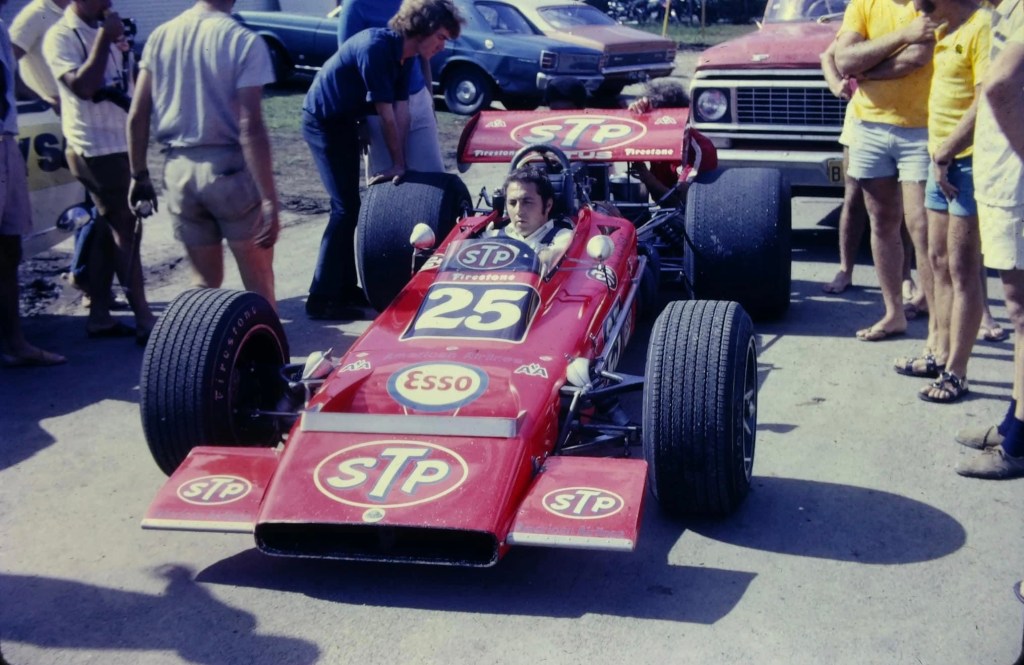
Cannon crashed his McLaren M10B at Sandown in the second last 1971 Tasman round. He did a deal to run the STP owned Lotus 70 Ford raced by David Oxton and Chris Amon throughout that series at Surfers Paradise, the final race, finishing a distant seventh in the unloved car (#70-02). Here he is getting the cockpit comfy during practice.

image
image

Photo Credits…

The Enthusiast Network, Rainer Schlegelmilch, Lynton Hemer, Robert Davies, Stupix, Kym, Ian Peak Collection/The Roaring Season, MotorSport, Bill Stowe, Norn MacLeod, Randy Wright, Anthony Loxley, Paul Stephani, Larry Fulhorst, Frederic Strauss, Racing One, Eric Haga, Chris Parker, Simon Stubbs

Bibliography…

‘Montreal Gazette’ 3/4/63, Daniel Vaughan, Don Capps, mclaren.com, Allen Brown and his  oldracingcars.com, Sports Car Graphic cover courtesy Thomas Voehringer. Special thanks for Paul and Tom Stephani’s recollections and photos

Tailpiece…

image
(The Enthusiast Network)

C’mon John just let me do a lap of the set, the horses will be ok and we will be done before anybody gets wind of it?!…

Finito…

39 esses

(Vintage Racecar)

Leo Geoghegan slices his venerable Lotus 39 Repco into the Warwick Farm Esses, Tasman Series, 15 February 1970…

Terrific shot, the focus is on the driver, the rest of the car blurred giving the impression of speed, something Geoghegan had in abundance.

Leo ‘made his name’ in this car, he was a front-runner from the time he bought it off Team Lotus at the end of the ’66 Tasman Series; Jim Clark was third in it, until the time it was put aside to make way for his Lotus 59 Waggott later in 1970.

geoghegan agp 1963

Faster! Deep in thought on chassis changes with his very hot mechanic, AGP practice 10 February 1963. Lotus 20 FJ 1.5 Ford 9th just behind Frank Matich in the quickest of the 1.5’s. Winner Brabham in a BT4 Climax 2.7 (David Mist)

Geoghegan had a long background in Lotus single-seaters after he graduated from sedans and sportscars in the team his father, Tom founded. Starting with an 18FJ in 1961 he progressed through 20, 20B, 22, 27 and then a 32, which, when fitted with a 1.5 Ford Lotus Twin cam engine gave him two 2nd placings in 1965 Gold Star events. He stepped up to the ‘big time’ with the Tasman Lotus 39.

32 wf

Leo G on his way to 8th in the little Lotus 32 Ford/Lotus 1.5, ‘Warwick Farm 100’ Tasman Series, 14 February 1965 (Bruce Wells/The Roaring Season)

The ‘old girl’ Lotus 39 was frustrating in many ways, its unreliability, like other Repco Tasman users, was notorious, but it gave him the critical 6 points at Symmons Plains in March 1970 before he switched to his new Lotus 59 Waggott. This won him the Gold Star he coveted and deserved…by 6 points from Max Stewart’s similarly powered Mildren. Max’s Gold Star turn would come for the first time in 1971.

39 bathurst

Easter Bathurst Meeting, 15 March 1970, thru ‘The Dipper’. Lotus 39 Repco (Jeff Nield/autopics.com.au)

Lotus 39 ‘R12’….

The Lotus 25/33 series of cars are amongst motor racing’s most famous, the Lotus 25 the first ‘modern monocoque’, Jim Clark took the 1963 and 1965 World Championships’ in Loti’ 25 and 33 respectively.

The 39 is one of this series of cars and like Jack Brabham’s 1966 championship winning BT19 chassis was built for the stillborn Coventry Climax FWMW Flat-16 engine.

image

Coventry Climax FWMW 1.5 litre Flat-16 engine of 1964/5 (unattributed)

The story of this amazing engine is an article in itself; in a nutshell CC’s Wally Hassan and Peter Windsor-Smith were convinced the best route to more power was higher revs (than their FWMV V8) a ‘multi’ was chosen partially due to Harry Mundy’s exposure to the BRM Type 15 supercharged V16 in the dawn of the fifties. Design commenced in 1963, the prototype was on the test bench in 1964.

Torsional problems of the crank were major issues, the engine also failed to deliver more power than the 4 valve versions of the FWMV, which themselves took a bit of development to better the FWMV 2 valve outputs. Then the 1.5 litre GP formula ended and Jaguar took over Coventry Climax; that combination of factors ended CC’s pivotal role as a successful supplier of racing engines for better than a decade.

39 longford

Graham Hill’s BRM P261 leads Clark’s Lotus 39 Climax and Jack Brabham’s Brabham BT19 Repco off Long Bridge, THAT post in front of GH’s LF wheel marks the apex…Wonderful Longford 1966 (autopics.com.au)

Colin Chapman needed a mount for Jim Clark to defend his Tasman title, he won it in 1965 with a Lotus 32B Climax, the unused 39 sitting in the corner of the Team Lotus workshop was ideal.

He tasked designer Maurice Phillippe to modify the engine bay of the car to accept a Coventry Climax 2.5 litre FPF engine. The 39 was different from its siblings in that the ‘D-shaped’ side pontoons of the chassis were ‘chopped off’ at the bulkhead aft of the drivers seat and a tubular steel subframe substituted to carry the CC Flat-16. Changes were made to the frame to accommodate the FPF.

Big thirsty Weber 58DCO carbs fed 2.5 Climax FPF. The frame to support the engine can be seen as can the rear of the Hewland transaxle (I MacNeill)

The 39 side pods also had a more pronounced belly than the 25/33 to ensure sufficient fuel could be carried, having lost capacity by hacking the ‘rear horns’ off the tub on each side. The suspension of ‘R12’ was pure Lotus 33 and was period typical; top rockers actuating inboard coil spring/damper units and lower wishbones and at the rear inverted lower wishbones, single top link and two radius rods for fore and aft location. Adjustable roll bars front and rear as well of course. Steering by rack and pinion and outboard disc brakes on all wheels.

Chapman bought two Climax engines from Bruce McLaren who didn’t contest the Tasman in ’66, he was too busy building cars for his F1 and CanAm programs having just left Coopers.

The 39 was soon on its way to the Antipodes for its race debut in the NZGP at Pukekohe on January 8 1966.

39 jim

AGP, Lakeside 20 February 1966. Clark 3rd behind Hill’s BRM P261 and Frank Gardner’s Brabham BT11A Climax (autopics)

By 1966 the Tasman game had largely moved beyond the old FPF. Brabham debuted his Repco Brabham RB620 V8 engine and BRM modified its F1 P56/60 V8 engines to 1930cc, Jackie Stewart took the title in a P261 with 4 wins from Hill’s 2 with Clark and Attwood (BRM) 1 win apiece.

Clark had a tough start to his 1966 Tasman campaign partially because Colin Chapman switched his Lotus tyre contract from Dunlop to Firestone not long before the Tasman commenced. The tyres had been developed by Bruce McLaren, he had used them for over a year and they were competitive but the 39 had to be adapted to them.

In addition Clark had a run of misfortunes which also reduced testing time; an abortive race at Pukekohe (gearbox) no practice at either Wigram (oil leak and engine replacement/accident when Gardner’s Brabham brakes failed) or Levin (snapped radius rod in practice/2nd). At Teretonga the cars speed was shown with a heat win from Stewart. He was moving away from Jackie in the final only to go out with a spin on dropped oil on lap 3.

In Australia he took a win at Warwick Farm, always a happy hunting ground for Clark. Graham Hill won the AGP at Lakeside from Gardner and Clark. He was 2nd to Stewart’s speedy BRM at Sandown and was 7th at Longford, he had carburetion problems in practice and a plug lead came off in the race requiring a stop and dropping him to the back of the field. Stewart was again the victor, with Jim finishing third in the series behind the BRM duo.

Clark had an amazing 1965 season winning the Tasman Series, Indy 500 and the World Drivers Championship, his start to 1966 was not quite so good, a portent of a tougher year!

39 longford

Superb Clark portrait by Lindsay Ross. Lotus 39 Climax, Longford 1966. He was 7th after a troubled run, Stewart’s BRM taking the win. Note the cars ‘aero screen’ and truncated monocoque which ends at the drivers bulkhead (oldracephotos)

Geoghegans’ were the Australian Lotus importer so a deal was done to buy the car…

John Sheppard is a legendary mechanic/engineer/car builder and team manager with some of Australia’s greatest cars in his CV; the Geoghegan’s cars, Bob Jane’s Repco Torana, Laurie O’Neills Pete Geoghegan driven Holden Monaro and the Holden Dealer Team amongst an extensive and ongoing career of car construction and team management. Early in his career he was appointed as chief mechanic to the Geoghegans.  Tom took a liking to his work preparing the Youl brothers Cooper, the Tasmanian team were using the Geoghegan’s Sydney workshop at the time. John’s first event with the team was preparing Leo’s car for the Australian Formula Junior Championship at Warwick Farm in September 1963, which he won in his Lotus 22 Ford. He shares some of his recollections about his time with the Geoghegan’s throughout this article.

image

John Sheppard in the 39 Repco cockpit circa 1967, hat is the Mickey Mouse Club! (John Sheppard)


Equipe Geoghegan during the Gold Star meeting at Lakeside in July 1966. Total sponsorship, rare colour shot of this livery. Note the addition of lower side panels to the 39 by Sheppo. Leo also raced a Lotus 32 Ford 1.5 and no doubt took some flops off that machine which was fitted ex-works with such panels (P Cross)

Essentially 1966 was a learning year for Leo in the big cars in the domestic Gold Star Championship. His limited campaign excluded the Mallala and Sandown rounds, 2nd to Spencer Martins Brabham BT11A at Surfers Paradise his best result. A duff wheel bearing was the cause of a DNF at Lakeside, he didn’t start both the Symmons Plains and Warwick Farm rounds with Coventry Climax engine problems.

Sheppard recalls; ‘The Lotus 39 was a great car although the engine problems we had were a function of very tired engines, the blocks were cracked so it was a problem keeping them running in that first year. When we took over the car they had a strange set-up to deal with the vibrations of the big Climax-four, they put rubber o-rings between the cylinder head and inlet manifold letting them flop around, and i mean flop around so Jim had problems with throttle control. We easily fixed this with a more conventional set-up of putting the o-rings between the inlet manifold and carbs’.

‘We didn’t have problems with the Firestones but i recall Leo, having fiddled around with set-ups based on tyre temps and the like at an early tyre test embarrassing the Firestone guys a bit when his ‘seat of the pants’ set-up changes gave immediate results. Leo was quick in the car straight away, i asked Bob Jane to get his driver (Spencer Martin) to stop baulking mine at Warwick Farm and Bob of course telling me to piss-orf…’

Fifth in the Australian Grand Prix ’67 Tasman Round at Warwick Farm and 2nd the following weekend behind Clarks Lotus 33 Climax FWMV 2 litre V8 at Sandown was indicative of speed and better Coventry Climax reliability.

39 cover

Geoghegan’s Lotus 39 sharing the AMR 1968 cover with Chris Amon’s Ferrari Dino 246T. 39 here with ‘740 Series’ Repco V8 and quite the prettiest thing with its carefully, thoughtfully aerodynamic rear bodywork developed for it by John Sheppard. Knock on wheels, Castrol color scheme just gorgeous with the speed if not always reliability to match

In 1967 Sheppard and his team did a beautiful job converting the car to a 2.5 litre Repco ‘640 Series’, ‘exhaust between the Vee’ spec engine in April. They created quite the most beautiful sixties single seater. OK, maybe Gurney’s Eagle T1G gives it a run for its money! The FPF developed around 235bhp, the ‘640’ 275bhp@8500rpm.

Sheppard; ‘It was an easy decision to go with the Repco, our Climaxes were old and tired and Repco were keen to do business with everyone. It wasn’t the biggest saga to adapt the Repco V8, we made new chassis tubes to accommodate the wider engine and used the original Hewland HD5 gearbox. The suspension geometry wasn’t touched, in fact it wasn’t the whole time i worked on the car (to the end of 1968) which shows the bloke who designed and built it knew what he was about. As tyres evolved we still got the results by simply getting the best from the tyres making set-up changes based around getting tyre temps even across the tread. Basic but important stuff.’

‘The chassis and bodywork, we made a nice rear cowling or engine cover, was done by Alan Standfield who worked out of his fathers ‘Supreme Mousetraps’ factory out near Mascot. (near Sydney Airport) It was all a bit bizarre but he did good work in grotty conditions with loads of noisy machines making springs and sawdust from the ‘trap bases all over the place!’

Leo took his first Gold Star round win at Sandown in September, Sheppo recalls; ‘Early in the Repco piece i said to Frank Hallam (GM Repco) ‘you should be nicer to us because we will win the first Gold Star race for you, he turned and walked away. I had great delight in walking up to him and telling him ‘I told you so’ when we took that Sandown win which was Repco’s first Gold Star win too’

The Climax FPF engined Brabham BT11A’s were superbly driven by Spencer Martin and Kevin Bartlett and just had the legs and reliability to pip the more powerful Repco engined cars of Greg Cusack, Geoghegan and John Harvey that year. Martin took the title.

39 tow rope

On the end of a tow rope as was the case all too often. Here its a Coventry Climax engine failure; the FPF popped back into the car after early 1967 Repco frustrations for the final WF Gold Star round, DNF with overheating (Peter Windsor)

Leo was so miffed by the lack of reliability of the Repco that his team popped the Climax back into the car for the final Gold Star round, the Hordern Trophy’ at Warwick Farm, not finishing that race either, the Climax overheated.

Sheppard; ‘We didn’t have a good run with the Repco’s early in the piece. The 640 Series Repco, the Olds block engine chucked its oil out of the crankcase, the scavenging arrangements were poor, the stiffener plate was ‘out in the breeze’, oil sat on that and got thrown around. Leo said the engine was hard to drive as there was little power below 6500-7000rpm. The 700 Series blocks were better but in many ways by then the opposition had caught up with the Cosworth and Ferrari Dino engines competing in the Tasman. The engine was a clever design though, you could take the heads off without disturbing the timing chest and vice-versa, i give Repco ten out of ten for the way they went about things.’

For the 1968 Tasman Series all local Repco clients engines were updated to the latest specifications with 700 Series blocks.

39 and brm

Leo’s 39 chases Richard Attwood’s BRM P126 at Surfers Paradise 1968. Great butt shot of both cars and a contrast of the beautifully faired Lotus and messy, bulky BRM V12. Neat packaging of the 1967 World Championship winning ‘740 Series’ V8 clear (here in 2.5 not 3 litre form). ‘Between the Vee’ exhausts easy for the chassis designer, no complex plumbing issues of pipes and tubes or an ‘ally tub. Trumpets for Lucas fuel injection and Bosch distributor cap clear also between the Vee. Car uses the same Hewland HD5 gearbox as it did with the Cov Climax FPF engine. Diaphragm to which ‘everything’ attached also clear at the very back of the chassis. Suspension at rear period typical; single upper link, inverted lower wishbone, 2 radius rods forwards for location and coil spring/damper unit with an adjustable roll-bar (Brian McInerney)

Into 1968 the Tasman Series got even tougher as the International Teams brought 2.5 litre variants of their current GP machines; the Lotus 49 DFW and the BRM P126 V12. The Mildren Team acquired a one-off Brabham BT23D powered by a 2.5 litre version of Alfa Romeo’s Tipo 33 sports car engine and Ferrari brought 2 2.4 litre Dino V6’s, the 246T.

Geoghegan, as in the prior year did only the Australian rounds; his 4th at Surfers on the same lap as the new Lotus 49’s in his 3 year old car his best result.

39 surfers 68

Who is the Belle of the Ball? Geoghegan’s Lotus 39 Repco DNF beside Brabhams Brabham BT23E Repco 7th , Rodriguez BRM P126 6th in a P261 with Clarks Lotus 49 1st. Warwick Farm practice, Tasman 1968 (The Tasman Cup)

He lost an oil line at Warwick Farm, finished 7th at Sandown, both events won by Jim Clark’s dominant Lotus 49 and elected not to start the final, very wet Logford round given the lack of a suitable tyre for the treacherous circuit.

39 and 49 surfers

Hill, Gardner, Geoghegan and further back Kevin Bartlett squabble over 2nd place on lap 2 of the Surfers ’68 Tasman round, Clark is up the road. Lotus 49 DFW, Brabham BT23D Alfa, Lotus 39 Repco and Brabham BT11A Climax (Rod MacKenzie)

Kevin Bartlett was the class of the Gold Star fields in 1968 winning the title by 10 points in the Brabham Frank Gardner drove in the Tasman. Geoghegan’s old Lotus was still fast; he took pole at Sandown and Mallala and won the race but otherwise the car lacked the consistency and speed to win the title.

39 catalina

Geoghegan Catalina Park, Blue Mountains, NSW 1968 (Paul Hobson)

Chris Amon took the 1969 Tasman in his superbly driven and prepared Ferrari Dino 246T from Jochen Rindt, Lotus 49 DFW Piers Courage, Brabham BT24 DFW and Derek Bell’s Dino 246T.

Geoghegan, still driving the ‘old lady’ contested the full series; 5th at Pukekohe in the series opening NZGP behind the four drivers above, 4th at Levin, he missed the final NZ, Teretonga round.

39 puke

Leo’s Lotus 39 Repco ‘730 Series’ NZGP paddock, Pukekohe 4 January 1969. 5th in the race won by Amon’s Ferrari Dino 246T (Habu/The Roaring Season)

Straight to Queensland he was a splendid 3rd in the AGP at Lakeside behind Amon and Bell. He was 5th in his home, Warwick Farm race and had fuel tank problems in the final Sandown round.

39 lakeside

Lakeside in the AGP; 4/5 year old car 3rd at Lakeside behind the Ferrari 246T’s of Amon and Bell (Rod MacKenzie)

Seventh in the series, the highest placed local was a superb result for a small team running a 4 year old car against GP Teams running their latest car.

leo

Leo running wings at the Warwick Farm Tasman round on 9 February 1969. Sydney the teams home base. With very low angle of attack mind you. He chose not to run them at the fast Tasman final round at Sandown the following week. He was 5th in the ‘pissin wet race won by Jochen Rindt’s Lotus 49B Ford DFW, therefore this dry day is practice (Dick Simpson)


39 sndoawn 2

Sandown Tasman practice, 15 February 1969. Running head of Alfie Costanzo’s McLaren M4A FVA. Leo DNS with a fuel tank leak, Alf DNF engine (Rod MacKenzie Collection)

For the 1969 Gold Star Series the 39 was more competitive than in ’68 being  fitted with the latest Repco’730 Series’, crossflow head V8 used in the Tasman, this gave 290bhp@8600rpm. The car was now running wings and whilst less aesthetically pleasing than its earlier form was fast.

39 symmons

Symmons Plains Gold Star 3 March 1969. Leo was 2nd to Kevin Bartlett’s Mildren Alfa (right)  (Ellis French)

Interesting shots at Symmons Plains, Tasmania 3 March 1969 above and below. Both the 39 and Kevin Bartlett’s Mildren Alfa ‘Yellow Submarine’ sporting the hi-wings de-rigeur for the previous 12 months and soon to be outlawed over the Monaco GP weekend a month or so hence. My two favourite ‘Australian’ open-wheelers of the 1960’s albeit not in their most aesthtically pleasing form. Bartlett won the round with Leo second.

Repco ‘730 Series’ Repco V8, notice the steel ‘A-Frame’ to brace the wing supports referred to in the text and wider rear wheels but same sized fronts compared with earlier shots. Tyre widths increased dramatically from cars build in 1965 to 1970.

Locating stays for the 39 rear wing beefier than most, the failure of these in a whole swag of cars, notably the two Lotus 49’s of Rindt and Hill during the 1969 at Montjuich Park, Spanish GP the catalyst for the CSI to mandate changes to wings.

39 symmons 2

Symmons Plains Gold Star 1969, Geoghegan’s Lotus 39 Repco, KB’s Mildren ‘Yellow Submarine’ Alfa behind (Ellis French)


39 bathurst 1969

Bathurst Gold Star round 7 April 1969; Max Stewart Mildren Waggott, Niel Allen McLaren M4A Ford FVA and Geoghegan’s Lotus 39 Repco on pole. Brabham won in his BT31 Repco from the back of the grid with the front row all DNF. An accident took out Stewart and Allen, Leo had a gearbox problem (Wayne McKay)

Kevin Bartlett took the Gold Star championship again using the Mildren ‘Yellow Submarine’, initially Alfa Romeo V8 engined and later in the year in Waggott TC4 valve form. This engine developed by Sydney engineer Merv Waggott is a story in itself, it won Gold Stars for Bartlett, Geoghegan and Stewart in 1969-71 beating 2.5’s and in 1971 F5000’s to the title.

Leo was 2nd with 20 points to Kevins 33 and had reliability but perhaps not the ultimate speed, seconds at Symmons Plains and Mallala Gold Star season highlights for the old beast.

The 39’s day finally arrived 4.5 years after it was built; Geoghegan won the 1969 JAF Japanese Grand Prix in the Lotus from Roly Levis Brabham BT23C FVA and Sohei Kato’s Mitsubishi Colt F2-C 1.6. I covered this great win in an article about Leo last year, click here for the link; https://primotipo.com/2015/03/02/leo-geoghegan-australian-driving-champion-rip/

39 jaf

By 1970 F5000 was adopted as the new Tasman Formula albeit 2.5 litre Tasman cars were also eligible, the smaller cars gave the big V8’s ‘plenty of curry’ in that first year with Graeme Lawrence winning in Chris Amon’s victorious 1969 Ferrari 246T ‘008’. Bartlett took the Warwick Farm round in the 2 litre Mildren ‘Yellow Sub’, another small-car win..

39 sandown paddock

Tractable these Repco’s! Chugging thru the 1970 Sandown paddock. Nice shot showing the 33 style tub, fuel filler in front of dash bulkhead and late ’69-70 wing (Jeff Scriven Collection)


39 sandown

Same day as above with Leo in the red hat alongside his mount. Hard to see but front suspension is top rocker, lower wishbone and inboard spring/damper actuated by rocker (Jeff Scriven Collection)

Geoghegan raced the Australian rounds only for 7th at Surfers and Warwick Farm, he was DNF at the Sandown final round.

Into the domestic 1970 season Leo raced the car in the first Gold Star round at Symmons Plains, here below he shares the front row of the grid with John Harvey’s red Brabham BT23E Repco and Kevin Bartlett’s Mildren Waggott ‘Yellow Submarine’. KB’s absence racing in the US for much of the year took out a tough adversary in 1970.

39 symmons 2

Gold Star round 1 1970. Symmons Plains 2 March 1970. John Harvey won in his #2 Brabham BT23E Repco from Leo obscured this side and Bartlett’s #5 Mildren Waggott (autopics.com)

The last significant meeting in which the 39 raced was the March Easter Bathurst meeting in which Niel Allen’s McLaren M10B Chev F5000 car set a lap record which stood for decades. ‘Outright’ open-wheelers have not raced at Mount Panorama given the speeds of the cars and inherently dan gerous nature of the circuit as it was then. And still is, despite huge improvements in circuit safety.

39 bathurst 1970

Easter Bathurst 1970, contrast this shot with the hi-wings from the year before above. John Harvey’s #4 Bob Jane Brabham BT23E Repco ‘830 Series’ Repco V8, Leo’s 39 Repco ‘730 Series’ V8 and Niel Allen’s obscured McLaren M10 B Chev F5000 (Rod MacKenzie Collection)


59 wf

Leo in the new Lotus 59 Waggott, Warwick Farm’s Pit Straight 1971 (oldracephotos/Schell)

Whilst the 1970 Tasman series was run to F5000 the Gold Star Series in an interesting piece of CAMS (Confederation of Australian Motorsport) decision making driven by politics was run to the 2.5 Tasman Formula.

From Leo’s perspective the path was clear; the circa 275bhp 2 litre Waggott engine was powerful, light, reliable and better still would bolt straight into the back of the Dave Baldwin designed F3/F2 Lotus 59. As the Lotus importer, the core of the Geoghegan’s business road cars of course, his preference was a Lotus which could win the title, his F5000 options were a domestic season away.

59 op

The Geoghegan’s cars; Leo’s and Pete’s Touring cars were always beautifully presented, giving the sponsors great exposure. Here the 59 Waggott, in Castrol colors. As beautifully integrated a package as the 39 Repco in its ‘740 Series’ Repco days. Oran Park Gold Star round, 27 June 1970 (Lynton Hemer)

The 59 already had a successful season of racing in Europe with Emerson Fittipaldi taking the 1969 British F3 title and Jochen Rindt and Graham Hill winners in European F2 events; 4 rounds for Jochen and 1 for Graham. In essence the engine and chassis were a proven package.

And so it proved to be; Leo took wins at Warwick Farm and Mallala and seconds at Oran Park and Symmons Plains when the ‘old lady’ 39 held together and scored 6 valuable points…

leo oran park

Leo G during tyhe driver parade before the 27 June Oran Park 1970 Gold Star round won by Max Stewart (Lynton Hemer)

Leo Geoghegan’s Later Open-Wheeler Career…

This article was to have been a ‘quickie’ around the few shots at the start  but as usual i have  ‘rabbited on’.

The article isn’t intended to be a Leo G whole of career one, the focus was the Lotus 39. Leo raced the Lotus 59 Waggott on into 1971, that chassis is still in Australia, i will write about it separately.

Geoghegan was a factory driver for Chrysler, as covered in the other article link provided earlier, he developed and raced Valiant Pacers and Chargers for the Tonsley Park, Adelaide based company in the incredibly popular Series Production (showroom stock essentially) races which proliferated, like a disease, in Australia in the late 1960’s, the growth of ‘Taxi Racing’ in Oz remains undiminished and omnipotent.

274

Leo at Oran Park, ‘works’ Grace Bros sponsored Birrana 274 Hart Ford 1974. Jewels of things, fast ones. Aluminium monocoque chassis, Hart Ford 416B injected, often ‘ally blocked, Twin-Cam circa 205bhp, Hewland FT200 5 speed ‘box (oldracephotos.com/Peter Schell)

But Leo was a ‘died in the wool open-wheeler man’ and accepted a works drive with Adelaide’s nascent Birrana Engineering; Malcolm Ramsay and engineer Tony Alcock built some fabulous cars in three short years which turned upside down the local single-seater market, the jewel like cars winning the Australian F2 Championship from 1973-1976.

Leo took two of the titles in 1973 and 1974, finally retiring from single-seaters at the end of 1974. He went out with a bang though. The 1974 AF2 Championship was one of the most closely contested and competitive openwheeler championships in Australia ever. ‘Van Heusen’ shirts tipped in good sponsorship and established F5000 aces and young thrusters made for some sensational racing. But wily Leo, at 38 still very fast took the title by 4 points from Aussie International Bob Muir in another Birrana.

Birrana Cars is a story for another time.

John Sheppard on Leo as a driver; ‘He was incredibly fast, as good as anyone he competed against capable of just not keeping up with but beating world champions. Leo in a way kept to himself, Pete was more ‘one of the boys’ so Leo and i didn’t discuss his career aspirations but he got a lot of satisfaction from racing with the drivers that he did; world class drivers. He was very precise, Pete would throw around what he was given, Leo used the same bit of road lap after lap, very consistent, precise and fast’.

R12 in Modern Times…

Leo focussed on the 59 but gave Formula Vee ace Bernie Haehnle a test of the 39 in the wet, at Amaroo Park in May 1970. With predictable results, poor Bernie took the left-rear corner off the car. The difference from a 40bhp Rennmax FV to 280bhp Tasman car in the wet would have been marked!

39 after Bernie Haehnle’s Amaroo Park 1970 shunt (D Simpson)


39 wf 1970

Leo G, 1970 Gold Star champion in his old car later in the year at Warwick Farm. 22 November. Lotus 39 Repco (Dick Simpson/oldracephotos.com)

The car was tidied up visually, Leo gave it a run at Warwick Farm late in the year in its original color scheme but still running a Repco engine, it was then offered for sale. The Repco engines on loan were returned to Melbourne and those owned by the Geoghegans sold. Australia’s sports-racing car fields were the beneficiaries of a surplus of ‘cheap’ 2.5 litre Repco V8’s; two Elfin 360’s and  two Rennmax’s  specifically.

39 winton

Darryl Pearsall’s Lotus 39 Ford Twin-Cam ‘R12’ in the Winton, Victoria paddock in 1973/4 (oldracephotos.com)

The long racing life of R12 continued on for a year or so as an AF2 car, Darryl Pearsall the new owner. F2 then was a 1.6 litre, 2 valve class effectively mandating the Lotus/Ford Twin Cam. The car was fitted with a Twin-Cam and when sold was purchased by John Dawson-Damer for his superb collection of Lotus’s in 1976.

The car was restored to its original Coventry Climax FPF engined form and fortunately when sold after JDD’s death and realisation of some of his collection remained in Australia, fitting given the cars Australian history. It lives in Tasmania loved to bits by a lifelong Jim Clark fan, Chas Kelly.

39 restored

Lotus 39 Climax ‘R12’ at the Longford Revival Meeting in April 2011. Restored but not over-restored, a balance we tend to get right in this country! (Ellis French)

Etcetera…

Clark Lotus 39.

39 longford 3

Longford front row 1966. #1 Clark’s Lotus 39 Climax and the two BRM P261’s of Hill #2 and Stewart beside the fence (Ellis French)


clark wf 1966

Clark and mechanics looking typically relaxed during the Tasman. Here at Warwick Farm with R12. February 1966 (unattributed)

Click on this link for a lovely story related to the photo above about the ’66 Tasman.

https://open.abc.net.au/explore/45668

image

Geoghegan 39.

geoghegan portait

Leo G portrait circa 1963. Colors on helmet ‘Team Total’, the French oil company a strong supporter of motor racing in Australia at the time. Lotus 22 or 27 (Ray Berghouse)


lotus 39 sandown

Sandown Park paddock, Tasman ’67. Leo finished 2nd to Clark’s Lotus 33 Climax FWMV 2 litre V8 in ‘The Sandown Cup’. Nice shot shows the car in its Coventry Climax FPF engined/Castrol Racing colors. This is 26 February 1967, the Repco V8 was installed that April (Mike Feisst/The Roaring Season)


image

This is a nice shot of the 39 of the Repco 740 Series V8 installation, Surfers Tasman round in February 1968. Cooper S is that of top touring car driver John French (Rod MacKenzie)


39 sandown paddockl

These days the crowds are all over the ‘Taxis’, in the days of yore the focus was where it should be, on fast open-wheelers! Sandown paddock, am guessing Tasman Meeting 1969 (Jeff Morrall)


39 wf

Leo’s Lotus dips under brakes for Creek Corner at the end of Hume Straight in 1970 (Lynton Hemer)


39 repco engine

Lotus 39 business end in its Repco ‘740 Series’ 2.5 V8 days. 275bhp@8500rpm, the engine weighed 345lbs/157Kg. Gearbox Hewland HD5. Note Repco logo on LH cam cover, Smiths tacho drive on the RH cam cover. Lucas fuel injection, Bosch distributor between the Vee. 1967/8 (John Stanley)


image

Bibliography…

Thanks very much to John Sheppard for his time and recollections

Graham Howard and Ors ‘History of The Australian GP’, oldracingcars.com

Photo Credits…

Vintage Racecar, oldracephotos.com, Peter Schell, Dick Simpson, Bruce Wells, Habu, Mike Feisst/The Roaring Season, Lynton Hemer, Rod MacKenzie, Ellis French, John Stanley, Paul Hobson, Wayne McKay, Jeff Scriven Collection, Ray Berghouse, David Mist, John Sheppard, Brian McInerney, Jeff Nield/autopics.com.au, Tony Loxley ‘Tasman Cup’, Peter Windsor, Ian MacNeill, Paul Cross

Tailpiece: Leo takes Miss Queensland for a squirt around Lakeside in the family Lotus 23 Ford. Brother ‘Pete’ raced this car, not certain of the date, but 1965’ish…

39 babe


image

The ‘Stackpipe’ 1.5-litre P56 BRM V8 nestled in one of Graham Hill’s BRM P57/578 chassis’ during his and BRM’s victorious 1962 season…

This series of engines was immensely successful being competitive throughout the 1961-5 1.5-litre F1 and was a bit stiff not to have won the title on multiple occasions. Later in its life it became, in 1.9 and 2.1-litre capacities an effective Tasman Series weapon. It was victorious at 2.1 litres against new 3-litre F1 cars too, winning the 1966 Monaco GP Jackie for Stewart that May. Surely it’s one of GP racing’s great engines?

This is the first in an occasional series of articles focussing on engines, mind you, as usual it’s longer than intended. As is the case with most of my stuff the article is a function of a great photo (above) inspiring the piece rather than me thinking strategically about the relative merits of one engine to another in a particular era, and has grown a bit like Topsy over time!

image
Graham Hill’s P56 engined Stackpipe BRM P57/578 on its way to victory at Zandvoort, Dutch GP 1962, the engine’s first championship GP win (B Cahier)

Background…

BRM commenced the new 1.5-litre F1 in 1961 by using a Coventry Climax FPF Mark 2 engine, it’s ‘Project 56’ 1.5-litre V8 started late and was running behind schedule.

The teams long serving but ‘too dilettante’ technical director Peter Berthon was ‘shunted sideways’, seconded to work at the Harry Weslake Research consultancy in Rye, 280km away leaving Tony Rudd, his assistant, in charge.

By the time this 1960 Dutch GP change was effected, Berthon, with the assistance of consultant engineer Charles Amherst Villiers, an old school friend of BRM founder Raymond Mays and a long term associate of Berthon’s too, was already laying down the conceptual design and detailing of P56. The Shell oil companies research boffins also contributed their knowledge via a project they were completing at the time on ‘combustion in high speed transport engines’.

image
The great Tony Rudd in glasses overseeing Graham Hill’s P56 engined BRM P57 (DNF) with Cyril Atkins beside him. Dutch GP, Zandvoort 1963. It’s Jack Brabham in the helmet about to board his BT7 Climax DNF. I wonder if the chap closest to camera is Keith Duckworth? The back of that BRM is all-breathers, engine and gearbox isn’t it? Clark won the race in his Lotus 25 Climax (GP Library)

A core conceptual design foundation was efficiency at extremely high rpm by the standards of the time, and, for the first time BRM was to offer the engine for customer sale in addition to its works-role. There was money to be made, as Coventry Climax had proved in recent years by flogging engines to those with the readies. On Sir Alfred Owen’s insistence BRM were to contest that customer market.

In keeping with the BRM charter of using British suppliers if at all possible, Lucas’ new fuel injection system was chosen. Several design features of the old V16 were used including its timing gear, camshaft drives and similar con-rods, higher inertia loads of heavier pistons (than the V16) involved different big-end bolt arrangements though.

The engine was/is a 90 degree V8 with a bore and stroke of 68.1 x 50.88mm for a capacity of 1498cc, it’s heads and block cast in LM8 aluminium alloy. The sump was magnesium and the crank machined from nitrided EN40U alloy steel and ran in five Vandervell, 2.5 inch wide plain metal bearings. The cams, water pump and distributor for the transistorised ignition system were driven by gears off the crank’s nose.

image
P56 engine cross section showing gear train, ‘inverted cup tappets, which allowed cooling oil to reach valve springs. Exhaust valve guides in contact with water’. 90 degree V8, two valves per cylinder. First series cross-flow head engine shown (grandprixengines.co.uk)

Two ring die-cast pistons and forged con-rods were used initially but forged pistons with a different profile were experimented with later in the successful search for more power. Results justified Berthon’s original concept of minimising rotating and reciprocating mass with a very over-square bore/stroke ratio by the standards of the day to facilitate high rpm.

Up top the four cams ran in five roller bearings operating two inclined valves per cylinder via inverted tappets. Valve sizes were 1.5625 inch inlet, set at 45 degrees from the bore axis, and 1.20 inch exhaust, set at 30 degrees. Double valve springs were used and proved effective even at 11,000rpm, the valve-gear was designed for a maximum of 13,000rpm.

The new Lucas fuel injection system was of the port type, throttle slides were used after early butterfly throttles were tried and rejected. The compression ratio using mandated 100-octane fuel was 11.5:1. The fuel injected works engines claimed 10bhp more than the Weber carbed customer units in the first year. The metering unit was driven by a toothed rubber belt.

image
P56 V8 again 1962 first series cross-flow, two valve heads. two plane crank (grandprixengines.co.uk)

Lucas also provided the transistorised ignition system made necessary by 11,000 rpm. A conventional coil setup produced around 400 sparks per second, and a magneto 500 whereas the BRM needed 733 sparks per second at 11,000 rpm, a task the Lucas transistors achieved. Ignition timing was controlled by pole pieces mounted on the back of the flywheel in conjunction with a magnetic pick-up on the engine backplate. Current was provided by an alternator driven from the right-side inlet cam.

image
P56 in Trevor Taylor’s BRP Mk2 BRM, Belgian GP, Spa 1964. seventh in the race won by Clark’s Lotus 25 Climax (R Schlegelmilch)

The prototype P56 engine #5601 was assembled at Bourne in June 1961, without starter motor it weighed 251 pounds. On 12 July in the Folkingham Aerodrome test house it first burst into life.

A second engine was built and run at Monza, in practice only, in 1961. That engine, 5602, produced over 184bhp. During 1962 maximum power was 193bhp@10,250rpm, the engines dyno curves showed 110@6,000, 150@7,500, 173@9,000 and 190bhp@9,750rpm.

At Monza in 1962, Hills victorious P578’s P56 engine achieved 10.6 MPG. Graham Hill’s 1962 season is briefly covered in this article, click here for the link; https://primotipo.com/2014/10/12/graham-hill-brm-p57-german-gp-1962/

Initially the engines were fitted with separate individual megaphone exhausts raking back at near to vertical on each side but they fatigued during a race and progressively broke. A low level system made its debut at Spa in 1962 but by then the Stackpipe BRM label had stuck!

A cross-over exhaust and flat plane crankshaft liberated a bit more power as did new Shell low viscosity oils, by February 1963 the works engines gave 200bhp from 9,750-10,500rpm. Four valve heads were tried for 1964 but ‘flopped fearfully’. Reversed port two valve heads and between-the-Vee-exhausts at the Italian GP provided 208bhp @10,750rpm.

Eventually, by filling combustion chambers with weld and re-machining, trial and error stuff engine 5618 produced 220bhp@11,750rpm. This engine was used by Hill at the 1965 BRDC Trophy and became his regular engine thereafter, ‘maxxing’ at 222bhp.

For the sake of completeness the P56 engine family also includes the P60 used in various capacities for 2-litre sportscar, endurance, Tasman and hillclimbing competition as follows;
1965/6 1880cc, 1966 1916cc, 1966-7 1998cc and 1966-8 2070cc.

image
Jackie Stewart heads for the BRM P56 engine’s last championship GP win in his P261, 22 May 1966 in Monaco. He won from Lorenzo Bandini’s Ferrari Dino 246 and teammate Graham Hill’s P261. The BRM P261 was an exquisite, successful, long lived car. It was slippery and quick partially due to its power but also the small, beautifully packaged engine, its between-the-Vee-exhausts and compact ancillaries allowing the rear cowling which helped it slip thru the air (R Schlegelmilch)

Race Record…

The P56 and its big P60 brother was a remarkably long-lived engine at International level, let alone its national level wins.

The engines first International win was in the rear of Graham Hill’s BRM P57 in the 1962 Brussells GP on 1 April, its first Championship GP win the Dutch on 20 May 1962, its last Jackie Stewart’s 1966 Monaco GP victory in 1966 amongst the new 3-litre GP cars. Jackie Stewart also scored the engine’s last International win in taking the Australian GP at Warwick Farm on 19 February 1967 in his BRM P261.

image
This is the butt of Jackie Stewart’s BRM P261 #2614 pictured in the Warwick Farm paddock on 19 February 1967, the engine’s last International win. JYS won the AGP from Clark’s Lotus 33 Climax FWMV V8 and Frank Gardner’s Brabham BT16 Climax FPF. P60 engine now at 2070cc, the weak link of the car by then was the transmission which was struggling with power and torque for which it was not originally designed in 1.5 litre GP spec (M Feisst)
Pedro Rodriguez in the Longford pitlane in 1968, P261’s final race as a works entry (D Cooper)

The engine’s final entry as a works engine was in the back of Pedro Rodriguez’ P261 at the Longford Tasman round in March 1968, he was second to Piers Courage’ McLaren M4A Ford FVA.

During that period the engine won the 1962 Drivers and Constructors titles with Hill. Hill/BRM were second in both the drivers and constructors titles in ’63 to Clark/Lotus, in ’64 to Surtees/Ferrari and in ’65 again to Clark/Lotus. The BRM P261 won the 1966 Tasman Championship for Jackie Stewart in a dominant display, BRM won seven of the eight rounds.

For the sake of completeness the wins for the engine. Note that i have not included heat wins in Non-Championship events, only Finals are as below. What comes through strongly is just how much Hill.G’s career was intertwined with this engine and how smart it was to sell them to all-comers.

1962;

Championship; Dutch, German and Italian GPs, all Hill in BRM P57 chassis

Non-Championship; GP Brussells, Glover Trophy Goodwood, Intl Trophy Silverstone all Hill BRM P57, Crystal Palace Trophy Innes Ireland Lotus 24 BRM, Kanonloppet Karlskoga Masten Gregory Lotus 24 BRM

image
Piers Courage, BRM P261, Teretonga International, the most southerly race circuit in the world perhaps. NZ Tasman 28 January 1967. Piers DNF engine in the race won by Clark’s Lotus 33 Climax, teammate Richard Attwood was second in the other BRM (I Peak)

1963;

Championship; South African, Monaco and US GPs all Hill BRM P57

Non-Championship; Int Trophy and Aintree 200 both Hill BRM P57, Glover Trophy Ireland Lotus 24 BRM, GP Siracuse Siffert Lotus 24 BRM

1964;

Championship; Monaco and US GPs both Hill in BRM P261

Non-Championship; Daily Mirror Trophy Ireland BRP BRM, GP Mediterraneo Enna Siffert Brabham BT11 BRM, Rand GP Natal Hill Brabham BT11 BRM

1965;

Championship; Monaco and US GPs Hill, Italian GP Stewart all BRM P261

Non-Championship; Int Trophy Stewart BRM P261, GP Mediterraneo Siffert Brabham BT11 BRM

1966;

Championship; Monaco GP Stewart BRM P261

Tasman; Pukekohe NZGP and Lakeside AGP Hill and Wigram, Teretonga, Sandown and Longford rounds, Stewart all in BRM P261

1967;

Tasman: Pukekohe NZGP and Warwick Farm AGP both Stewart in BRM P261

image
(E French)

Relaxed scene at Longford on the 5 March 1967 Tasman weekend. That’s JYS on the wheel of P261 2614, Clark’s Lotus 33 Climax is alongside. #9 is Spencer Martin’s Brabham BT11A Climax with his car owner Bob Jane the stocky little dude in the drivers suit beside Stewart. The nose of Chris Irwin’s P261 2616 is also clear. On raceday Jack Brabham’s BT23A Repco won the South Pacific Trophy from Clark and Irwin.

Etcetera…

image
(History of The AGP)

BRM P60 power at the Lakeside, Australian Grand Prix Tasman round on 20 February 1966. JYS and Graham lead in BRM P261s, Clark in Lotus 39 Climax, Gardner’s yellow nosed Brabham BT11A Climax, Jim Palmer’s Lotus 32B Climax, Spencer Martin’s red Brabham BT11A, Leo Geoghegan’s white Lotus 32 Ford 1.5 and the rest. Hill won from Gardner and Clark

hill 33
(Getty)

Graham Hill’s BRM P60 engined Lotus 33 at the 29 April 1967, BRDC Intl Trophy Silverstone. That’s Damon practicing in the cockpit! DNF but fastest lap, the race was won by Mike Parkes’ 3-litre Ferrari 312. Graham had just left BRM for Lotus for the ’67 season but not the P56/60 engine which gave him so much success! Lotus’ engine of choice for ’66 was the BRM H16 but Chapman used the V8s as a stopgap with the H16 running late. Chapman’s Lotus 33s comprised a 2-litre Climax engined chassis for Clark and 2070cc P60 BRM engined one for Graham

(J Saltinstall)

Bibliography…

The bibles on all things BRM are Doug Nye’s three books, hopefully Vol 4 is not too far away! This article is a précis of Nye’s article on the P56 engine in his seminal, sensational ‘History of the Grand Prix Car 1945-65’

Photo Credits…

Rainer Schlegelmilch, The GP Library, Cahier Archive, Ellis French, Mike Feisst Collection & Ian Peak Collection/The Roaring Season, G Howard and Ors ‘History of The Australian GP’, grandprixengines.co.uk, Dennis Cooper Collection, John Saltinstall Collection

Tailpiece: Top Fuel Dragster…

image
(R Schlegelmilch)

Trevor Taylor’s BRP Mk2 BRM and its P56 V8 at Spa in 1964. Taylor was seventh, the race was won by Clark’s Lotus 25 Climax. It’s interesting that the stackpipe exhausts were still being used by BRP this late when the low level exhausts were producing more power, budgets and all that no doubt…

Finito...

image

Stirling Moss cruises his works Maserati 300S chassis #3059 through the Albert Park paddock prior to winning the Australian Tourist Trophy on 25 November 1956, he repeated the dose in a 250F in the following weekends Australian Grand Prix…

One of the wonderful things about this internet thingy is the number of unseen photos of our sport which pop up from time to time giving people like me something to write about. And so it is that Sharaz Jek recently posted photos his father took as a paying-punter at the Australian Grand Prix carnival at Albert Park held during the Olympic Games.

It would have been more considerate had he posted them six months ago when i first wrote about the two Maser sportscars brought to Australia as part of a five car team by Officine Maserati!. But hey, it gives me a chance to write about the ATT specifically, click here to read the earlier article, i won’t repeat the background or destiny of the two 300S’ which stayed in Oz post event;

Bob Jane: Maserati 300S: Albert Park 1958…

image

Melbourne in 1956…

I wasn’t born in 1956 but its fair to say i was more than a twinkle in my parents eyes, so i didn’t attend the mid-fifties Albert Park meetings which older enthusiasts speak so fondly about. Running around the lake last weekend i reflected on how little Albert Park had changed but also how much Melbourne had, the skyline of the city a short 2 Km away.

In 1956 Melbourne’s population was circa 1.5 million people, now it’s 4.7 million, the war ended only a decade before and with it successive Australian Governments established an aggressive migration program which provided, and continues to provide us with the wonderful, peaceful mix of people and their cultures which makes this such a special country and city in which to live. Disgraceful offshore detention centres notwithstanding!

The ’56 Olympic Games, held from 22 November to 8 December was an important part of opening our society to other cultures and equally allowed us to showcase our country, city and capabilities to the world.

The same can be said about the 1956 Albert Park International race meetings and their impact on Australian motor-racing; Barry Green in his wonderful book ‘Albert Park: Glory Days’ said; ‘The weekend was the proverbial moment which changed the face of motor racing in this country. Here for the first time we had a current works sports car and F1 team and other leading international drivers in ex-factory cars; their presence prompting the best of the locals to upgrade their machinery, spend even more and charge harder. A world class field deserved a world class venue and world class crowd. And in the picturesque Albert Park and thousands of international visitors filling Melbourne to overflowing for the first Olympic Games to be held south of the equator, it had just that’.

image

So, to put you in the zone of the times before reading this piece I have added some photos of Melbourne in 1956 to give you the ‘feel of the joint’ and flavour of the times six decades ago, the racing stuff is after that if you wish to cut to the chase…

image
image
image
image
image
The ‘Eyetalians’ brought their weird steaming coffee making machines with ’em post-war, the local coffee obsession was underway, school below is Melbourne High in South Yarra
image
image
TV was introduced to Australia in the lead up to the games, here some locals are sussing the weird new contraption in the window of ‘Myers’ department store in Bourke Street
image
‘Sultry beauty Gunhild Larking, 20, Sweden’s entry for the high jump pensively awaiting her turn to compete’ is the caption. A post sporting career in modelling or TV awaits d’yer reckon!?
image
image
image
image

The first weekend of the two week AGP carnival comprised four events, the feature the Australian Tourist Trophy for Sports Cars was held on 25 November…

A convoy of Maserati mechanics drove the 250F and 300S, the 5km from Australian International and 250F driver Reg Hunt’s Elsternwick Holden Dealership, where the cars were maintained each day to Albert Park, on the Nepean Highway and St Kilda Road. Not too much of a problem then but guaranteed to boil a Maserati 300S sans radiator fan these days!

al behra
Behra and Moss @ Albert Park in 1956, the first and only time, sadly, Behra raced here but Moss was an annual, usually victorious visitor to Oz till the end of his career in the Masers, then Rob Walker entered Coopers and Loti (Graham Hoinville)

Most of the drivers stayed close by in the ‘Espy’, the Esplanade Hotel in St Kilda, it’s still there if you want a ‘bevvy’ during the AGP carnival and is well known to Australians as the home of the ‘RocKwiz’ music quiz show.

Fitzroy Street St Kilda felt exotic and buzzed with thousands of visitors from all over the world eager to explore the local delights of the bayside suburbs restaurants and bars. They were full of people including recent European migrants eager to get a touch of home for a few hours at least. The Espy and Tolarno’s were ‘chockers’ and no doubt the proprietors of the areas ‘red light’ precinct did good trade.

image
Guerino Bertocchi, Maserati chief mechanic and factory test driver and his helper start the 5 Km journey from Albert Park to Reg Hunt’s Elsternwick Holden dealership where the team were based (Arnold Terdich)
image
Maserati’s as far as the eye can see! Masers brought 5 cars to Oz, 3 250F’s (one unraced spare which at one stage looked as tho it may have been raced by Brabham but ’twas not to be) and 2 300S, Reg Hunt Motors, Nepean Highway, Elsternwick (Eileen Richards)

In ’57 the factory 300S’ were campaigned by Moss, Behra and Piero Taruffi taking wins at Silverstone, Nassau, the Nurburgring, Rouen and Buenos Aires; the works allocated # 3055 to Behra and # 3059, the ‘featured car’ here to Moss. Stirling was in sparkling form having won the Venezuelan Grand Prix in Caracas a fortnight before arriving in Melbourne, Behra also contested the race.

There was a strong entry for the ATT of around 36 cars; Peter Whitehead returned to Australia hoping to repeat the success of his 1938 tour which culminated in an ERA Bathurst Australian Grand Prix win for him.

His entry in the ATT was a Ferrari Monza, similar cars were entered by Brit Peter Wharton and local motor dealer Stan Coffey. The Whitehead and Wharton Ferrari’s were garaged at AP Hollins in Malvern where Lex Davison’s mechanic/engineer Alan Ashton, well familiar with 4 cylinder Ferrari’s (Davison raced the ex-Ascari Tipo 500/625) could keep a close eye on them.

Lex, already the winner of one of his four AGP’s in 1954, entered his HWM Jaguar, his Ferrari was raced in the AGP won by Moss’ 250F the following weekend.

al coffey
Stan Coffey’s Ferrari 750 Monza, of earlier vintage than those of Wharton and Whitehead but still quick if tricky to drive (John Blanden)

Jaguar D Types were entered for Kew motor dealer and later multiple Australian Gold Star champion Bib Stillwell and Queensland’s Bill Pitt driving the Mrs Anderson owned car.

Jack Brabham returned from Europe where he was establishing a strong reputation to drive a Cooper T39 ‘Bobtail’ Climax with future Gold Star Champion Bill Patterson, another Melbourne, Ringwood, Ford dealer in a similar car.

al brabham
Jack refuels the Cooper T39 in the Albert Park paddock. ‘COR’ is Commonwealth Oil Refineries soon to be BP (John Blanden)

Veteran Tom Sulman raced his ‘Kangaroo Stable’ Aston Martin DB3S, the quicker entries rounded out by Austin Healey 100S’ for multiple AGP winner Doug Whiteford and Ron Phillips.

image
Moss positions his Maser on the front row of the ATT grid, Behra started on pole. Such a sexy shape . Properties on Canterbury Road near the Mills Street corner in the distance (Sharaz Jek)
al start
Behra’s 300S gets the jump at the start, thats Whitehead’s Monza at left, Moss 300S slightly behind, the Jag is Stillwell’s D at left and the little car on the far right Brabham’s Cooper T39 (John Blanden)

A fantastic crowd of 150,000 people gathered to watch the days racing which was marred by the critical injury and subsequent death of Peter Catlin in the first race of the day after he lost control of his Bugatti at Melford corner.

This dominated the tabloids coverage of the race but ‘The Argus’ noted Moss’ lap record of 1:55.8 ‘set in a sportscar, the record previously held by a racing car’ and ‘one of the finest exhibitions of race driving seen in Melbourne’.

To the surprise of many Behra put his car on pole and lead from the start of the 100 mile race with Patterson flipping his Cooper at Melford Corner without too much damage to him or the car on the first lap.

al behra
Behra hard on the brakes in pursuit of Moss. Maser 300S (Philip Skelton)

Behra lead the other 35 competitors at the end of lap 1 from Moss, Stillwell’s D Type, the  two Monza’s of Wharton and Whitehead, Brabham’s Cooper T39, Bill Pitt’s D type and Paul England’s beautifully designed Ausca. The car was built by England in his spare time at Repco, was powered by the first Holden/Repco Hi-Power cylinder head engine.

al pitt
Pitt’s Jag D chasing Jim Leech’s MM Holden Spl with the Ron Phillips Austin Healey 100S behind (unattributed)

On lap 2 Moss gave his French teammate a blast on his Masers ‘Fiamms’ at Jaguar Corner to let him through, and an even bigger one when he did so, team orders not new in motor racing! At the front Wharton and Brabham slipped past Stillwell with Bill Pitt getting progressively quicker in his XKD and closer to the shapely tail of Whitehead’s Monza.

al brab coop
Brabham wringing the little Cooper T39’s Climax engine hard! (John Blanden)

Moss had a lead of 20 seconds from Behra, Stillwell spun giving Pitt ‘a sniff’ at him as Moss set fastest lap on the 27th tour, passing lots of slower traffic in the process.

By the race’s end only Jean Behra was on the same lap as Moss, the Brit took the flag from Behra, Wharton, Pitt a great 4th and first local home, Stillwell, Whitehead, Lex Davison’s HWM Jaguar and Kiwi Ross Jenson in an Austin Healey 100S and the rest.

al moss color
Moss exits Jaguar corner in his 300S complete with accumulated hay from bales disturbed by other errant competitors during the race’ 100 miles, in the cars inlet (Graham Hoinville)
image
‘Motori Porno’ innit!? Plug change, 12 of them for Moss’ twin plug #3059. Twin distributors, big Weber 45DCO3 carbs of the 2992cc circa 280 bhp 6 cylinder, DOHC 2 valve engine all clear (Sharaz Jek)

Other ATT Meeting Photos…

al scene 1
Albert Park vista #20 the Phillips Austin Healey 100S (unattributed)
al start 2
Another start shot, row 3 this time with the 2 D Types of Stillwell and Bill Pitt (right) in shot, thats Sulman’s Aston DB3S on the far right (unattributed)
al phillips
Phillip’s 8th placed pretty Austin Healey 100S, great run for the Melburnian in a model very popular in Oz, sadly most have now left our shores (unattributed)
al monza
Stan Coffey’s Ferrari 750 Monza behind its Holden FE towcar (Sharaz Jek)
al moss passing
Moss passing and thanking with a wave MG T driver Newman for his track etiquette (Arnold Terdich)
al wharton
Ken Wharton’s races his Ferrari 750 Monza to 3rd place. Southern Command Army buildings in the background. He raced this car in NZ that summer and sadly died in it at Ardmore on 12 January 1957 (John Blanden)
al still
Bib Stillwell’s ‘XKD520’, the seventh D Type Jag built appropriately going thru Jag Corner. An important step in the later Australian Champs rise thru the ranks, he raced it in ’56 to early ’57 , then progressed to Hunt’s 250F (autopics.com)
al vista
Another paddock vista which again has ‘COR’ Commonwealth Oil Refineries in shot, clearly the firms PR function was working well! the Phillips Healey 100S and a Porsche Speedster in shot (unattributed)

Etcetera…

image
Fifties circuit conceptually similar to but not identical to the contemporary one, direction of racing opposite to the present (Barry Green)

Bibliography…

Barry Green ‘Albert Park: Glory Years’

Photo Credits…

Sharaz Jek especially for the shots which inspired the article, Getty Images for all of the Melbourne ‘atmo’ 1956 shots, Arnold Terdich, Eileen Richards, John Blanden, Philip Skelton, Graham Hoinville, autopics.com

Tailpiece: She is MY daughter Stirl don’t even think about it!…

image
(Sharaz Jek)

Finito…

monza 2

Jean Pierre Jarier nips a front brake during qualifying for the 1975 Italian Grand Prix, pushing his Shadow DN7 Matra ever so hard…

One of the revelations of the early 1975 GP season was the speed of the new Shadow DN5 Ford, an evolution of the 1973/4 DN1 and DN3 designs penned by Tony Southgate. Frenchie Jean Pierre Jarier rocked the socks off the established aces setting a time eight-tenths/second clear of the rest of the season opening Argentinian GP grid.

There were mutterings of Shadow getting development Cosworth engines but the truth was an aero tweak which is indicative of the importance of aerodynamics over the coming years.

Tony Southgate, ‘ I spent half my life doing aero at Imperial College and DN5 was the first to use the new rolling road wind tunnel, as far as i know, the first in the world. What we discovered was a massive split, front to back, in downforce. People always thought they had about 30-40% on the front. In fact it was no more than 20. And only we knew.’

Southgate moved the driver forward 2.5 inches within  a longer wheelbase (with removable spacer between engine and gearbox), developed deeper nose fins and placed the front springs and dampers inboard.

‘The car was an aero jump. We matched downforce to its static weight distribution-about 35/65% front/rear – and the spacer allowed us to tune the chassis to different circuits; we would find 1.25 seconds at Silverstone just by removing it. Immediately it was clear that our car had more downforce than the others and was very well balanced. In its short chassis specification Jarier was taking the fast bend after the pits at Interlagos, Brazil without lifting…’

shadow paul ricard
Shadow hierachy at an early 1975 season Paul Ricard DN5 Ford test. L>R Chief Mechanic Phil Kerr, Tom Pryce, JP Jarier, Team Manager Alan Rees, Tony Southgate and El Capitano Don Nichols (unattributed)
pjpj argentina
JPJ Shadow DN5 Ford, Argentina 1975. Pole and DNS with CWP failure on the warm up lap (unattributed)

Despite being on pole in Argentina, raceday was a disaster with a crown wheel and pinion failing on the warm-up lap. ‘I had been pursuaded to use Hewland’s latest TL200 gearbox instead of the FGA400, I think we and Copersucar did so. It was meant to be more reliable, with helical gears 20% stronger and more bearings in the pinion shaft, improper heat treatment was blamed for the failure’.

In Brazil Jarier was running away with the race from pole when the metering arm of the Lucas injection unit seized. In fact JPJ’s season was a mix of spins and mechanical failures, teammate Tom Pryce getting the better results with a win in the non-championship Race of Champions at Brands Hatch and third in the Austrian GP after qualifying on pole for the British GP before retiring from the lead.

Southgate; ‘Our budget was tight and there was little development left of the car. It wasn’t good on fast circuits where we had to unbolt downforce so we weren’t swamped on the straights. Plus better funded teams cottoned onto what we were doing and were ringing Imperial College to ask if they could use its wind tunnel.’

‘Shadow’s Grand Prix results for 1975 were very disappointing, especially in view of the competitiveness of the DN5. Our finishing record was simply poor. The cars either broke down or crashed. Jarier only finished two Grands Prix for the year. Pryce’s statistics were better, but he still only finished six GP’s…I often think that, if the DN5 had been prepared and raced by one of the top teams it would have won the Championship.’ said Southgate in his autobiography.

pryce brands
Tom Pryce on his way to winning the Race of Champions at Brands Hatch on 16 March 1975 from pole, the Welshman’s only F1 win sadly. He won from John Watson’s Surtees TS16 Ford and Ronnie Peterson’s Lotus 72E Ford. The field included Ickx, Scheckter, Emerson Fittipaldi, Mass, Donohue and others, it was a great win for both him and the DN5 in a classy field (Autosport)

The Ford Cosworth DFV and alternative engines…

The diligence of team owner, Don Nichols’ designer had given the team the ‘unfair advantage’ of which Mark Donohue spoke so eloquently, with a car whose origins dated back to Shadow’s first year in GP racing in 1973. Whilst Southgate pursued this aero approach Nichols eventually concluded discussions with Matra to use its glorious V12 in a modified DN5 chassis christened the DN7.

The Ford Cosworth DFV 3 litre V8 was the dominant engine of the 3-litre formula, by the end of 1974 it had taken drivers titles in 1968/9 and 1970-4 but Ferrari’s speed in 1974 gave pause for many team managers – Cosworth users – to find an alternative which allowed them to leap clear of the garagiste pack as Enzo Ferrari christened the British Cosworth/Hewland hordes! The DFV was a tough proposition to beat given its blend of power, packaging, weight, economy, reliability, price and Cosworth’s servicing backup.

Shadow DN7 Matra. Type 73 3-litre V12 – circa 500bhp – engine installation at Monza in September1975. Note single plugs and distributor driven off the rear of the inlet camshaft, also exhausts and neat brackets to which the top radius rod at the front and shock/spring mount attaches at the rear – the main bracket runs the length of the cylinder head. You can just see the roll bar behind the spring, radiator header tank also clear (MotorSport)

The obvious alternatives were the Matra V12 and Alfa Romeo Flat-12, both 3-litre endurance engines, and the venerable BRM V12. The latter was easily ruled out as being way past its prime, the BRM P207 was a sad joke in 1974/5 for all concerned. The Matra and Alfa were successful endurance engines. In the event BC Eccclestone, then Brabham’s owner, did a deal to use Alfa engines from 1976 whilst Nichols pursued the Matra option.

While the French V12 last appeared in GP racing in Matra MS120s driven by Chris Amon in 1972, the engine had been continually developed as an endurance unit. Given Matra’s Le Mans wins from 1972-74 and a whole swag of other endurance events; so it was not too difficult to adapt Matra’s learnings to a sprint-spec of the engine, from whence it originated in any event way back in 1968.

silverstone
Silverstone Shadow DN7 Matra first test, July 1975 (unattributed)

Evolving the DN5 Ford into the DN7 Matra…

Whilst commercial negotiations dragged on between Nichols and Matra, Southgate and his team focussed on keeping the DN5 competitive while concepting the DN7, which was essentially a DN5 adapted to fit the longer, heavier, thirstier but more powerful V12.

Major differences were increased fuel tankage and a longer wheelbase, otherwise the key elements of both cars – chassis, body, aero and inboard front suspension by rockers, conventional outboard rear suspension and Hewland TL200 gearbox were the same. This gearbox was developed by Hewland for endurance purposes and was used by Matra in their MS670 sports cars.

Three body-off shots in the Monza paddock 1975. Exquisite standard of fabrication clear (MotorSport)
(MotorSport)
Hewland TL200 ratio change (MotorSport)

Tony Southgate spoke of the challenges of adapting the Matra engine to the DN5 in his autobiography.

‘In view of my V12 experience with Eagle and BRM the powers that be most likely thought I was a bit of a V12 expert and that I might be able to resurrect the old Matra engine and get it to the front of the grid. Fitting the Matra engine was not that straightforward and of course the V12 engine required a lot more fuel cell capacity. The engine ran at 12000rpm, about 30% more than the DFV, so extra tanks were fitted into the sides of the car alongside the existing seat tank.’

‘Due to the extra engine RPM and horsepower the cooling system needed to be increased in size, so I fitted larger side pods and set the water radiators further forwards to maintain the weight distribution of the Cosworth engined DN5. The V12 was longer than the DFV, of course, so the wheelbase was increased a little’.

‘The end result was a longer, heavier but more powerful DN5 which we called the DN7. I thought that it would do about the same lap times as the DN5 and that proved to be the case’.

Matra MS73 V12 ultimately successful in Matra sports prototypes and Grands Prix winner in Ligier chassis. Famously aurally erotic, circa 500bhp @ 11600rpm when a good Cosworth DFV gave circa 470bhp. Note Lucas injection trumpets, inboard rear discs and duct, engine electronics behind radiator header tank (MotorSport)

When finally completed the car was tested by ‘Jumper’ at Silverstone in July and made its race debut in practice for the Austrian GP on 17 August.

Tom Pryce drove his usual Ford engined DN5 and offered a direct comparison, both drivers being more or less equivalently FAST. The car was heavier than the DN5, it wasn’t bespoke, but still provided the team and of course Matra a sense of competitiveness of the package.

The Austrian GP was a horrible weekend, Mark Donohue crashed his Penske March 751 in practice as a result of a Goodyear tyre failure, dying in a Graz hospital several days later of brain injuries sustained in the high speed crash. Half points were awarded to finishers of the rain shortened race won by Vittorio Brambilla’s works March 751 Ford, that teams first, long overdue win.

Denis Jenkinson in MotorSport had this to say about the re-appearance of Matra in GP racing; ‘Another welcome return was made by the Matra V12 engine, this time in the back of a UOP Shadow DN7, but somehow it seems to have lost that car-splitting scream that it used to have in the days of Beltoise and Pescarolo in the blue cars from Velizy. Perhaps the Ferrari and Cosworth engines have caught it up on the decibel scale, for they certainly have on bhp output. None-the-less it was nice to see and hear a Matra V12 in Grand Prix racing again’.

‘Particularly pleasing was to see the enthusiasm with which JPJ was tackling the job of driving the DN7. It was not a half-hearted attempt, with one eye cocked over the Cosworth powered DN5 standing in the paddock, or a dickering between the two cars. As far as Jarier was concerned there was only one car for him and that was the DN7. With that approach in the cockpit the Shadow Matra V12 project could get somewhere. It certainly started well by being ahead on the grid of Pryce in the Shadow Cosworth V8, even if it was only 0.2 sec ahead’

Jarier qualified the DN7 13th, one grid slot in front of Pryce, Tom had a great race finishing third while the Matras fuel injection system malfunctioned causing JP’s retirement on lap 10. It was an ok start for a car with limited testing, the Shadow boys prepared the same mix of cars for the Italian GP held on 7 September.

Jarier, DN7 Matra, Monza 1975. GP cars of the era don’t look better than this (LAT)
italian grand prix
1975 Italian Grand Prix, just look at the variety of aero approaches in this shot let alone mechanical specification, Oh for the days before F1 was a ‘control formula’?! Regazzoni’s winning Ferrari 312T Flat-12 from Jarier’s Shadow DN7 Matra V12, Carlos Pace’s Brabham BT44B Ford V8 and Ronnie Peterson’s similarly powered Lotus 72E (unattributed)
(MotorSport)

In between the Osterreichring and Monza the non-championship Swiss Grand Prix was held at Dijon, France, there being no circuits in Switzerland, with Jarier putting his Shadow on pole. He led the first 23 laps until retirement with gearbox trouble; but he was back in his Ford engined DN5 while the DN7, the team only built one chassis – #DN7/1A – was readied for Monza. Clay Regazzoni won the event in his Ferrari 312T and then doubled up also driving to victory at Monza.

The Shadows qualified in Italy exactly as they had at the Osterreichring, the results similar as well; ‘Jumpers’ Matra failed, this time with fuel pump failure and Pryce was sixth after a good mid race battle with James Hunts Hesketh. Niki Lauda won his first drivers championship, his third place in his Ferrari 312T assuring him of the championship.

shadow us
Shadow DN5 Ford in the nuddy, Kendall Centre, Watkins Glen US GP 1975. Pryce DN5, 16th in the race, non-classified with Jarier’s similar car DNF. Car getting a fresh Ford DFV. Rear suspension/’box assy at the rear, with the Cossie about to be unbolted, aluminium monocoque and quality of build and finish clear. Note cast alloy instrument bulkhead (unattributed)

At the season ending Watkins Glen race both Shadows were very fast; Q4 for Jarier and Q7 for Pryce but both were in DN5s, the Matra experiment was, sadly for the sport, over.

‘Jean-Pierre Jarier was fighting hard with the Shadow V12 during the first session, a revised fuel system and some titanium exhausts from the sports car endowed it with appreciably improved performance at the top end of its rev band. Alas, Jarier’s enthusiasm would be channeled into the Cosworth powered DN5 after it was calculated that the engine would consume fuel at the rate of 4mpg under racing conditions, and the French engined car was sadly pushed away for the remainder of the weeekend’ (therefore the car would not hold sufficient fuel to complete the race without a stop) said Denis Jenkinson in his MotorSport race report.

It may be that that was the case, or simply that Don Nichols had learned that Matra engines would be used exclusively by the new Ligier team for 1976 and simply put the car to one side to focus on the quicker DN5 Cosworths.

Lauda won the race, both Shadows well down the field despite qualifying times which showed just how quick a package the car was on a circuit which was a great test of a car’s medium to high speed handling characteristics.

shadow watkins
JPJ in the DN7 during the first practice session at Watkins Glen, the last time #DN7/1A turned a wheel before its restoration by Grant Beath in recent times. Car was for 35 years part of Don Nichols collection fitted with a dummy, blown V12 (unattributed)

Both Nichols and Ligier wanted exclusivity in terms of engine supply, from a France Inc perspective the choice of the well connected former rugby international’s team made more sense than the American owned British based concern; French car, team and driver.

From Matra’s viewpoint it makes more sense to me, given the aerospace conglomerates immense resources, to supply two teams in 1976 especially given Shadow’s speed, if not reliability in 1975.

Ligier were an unknown 1976 quantity, Shadow were. Both Shadow drivers had shown prodigious speed in 1974-75, one was French and Southgate did a neat job integrating the Matra V12 into an existing chassis designed for a different engine. His bespoke 1976 Matra chassis would have been lighter overall and designed around the engine architecture rather than an adaptation of what he had based on the Ford Cosworth.

Ligier were to be a one car entry in 1976 so Matra very much had all their eggs in one basket. Ligier’s JS5 1976 car was a horrible looking, bulky thing, mind you it delivered the goods in a a way Shadow did not that year. Jacques Laffitte was eighth in the drivers championship, Pryce 12th and poor Jarier didn’t score a point in the lightly updated 1976 Shadow DN5Bs and new DN8. Matra finally achieved a GP win when Laffitte won the 1977 Swedish Grand Prix in his Ligier JS7, the whole paddock were delighted for him, Ligier and Matra.

Don Nichols retained ownership of Shadow, but his company, United Oil Products, was no longer the team’s major sponsor and the slippery slope of progressive loss in competitiveness began, whilst noting Alan Jones’ lucky 1977 DN8 Ford, Austrian GP win.

If only Nichols had jagged the Matra deal or the Velizy concern supplied both teams he may have stayed more involved and we would have had the chance of seeing Tony Southgate designed, bespoke, Matra engined cars driven by two of the fastest chargers around at the time. It’s an interesting ‘mighta been’ I reckon?!…

Jarier, DN7 Matra, Monza (MotorSport)

Shadow DN7 Matra Technical Specifications…

Chassis; aluminium monocoque using the Matra MS73 V12 as a fully stressed member. Front suspension by lower wishbone and top rocker actuating inboard mounted coil spring/damper units. Rear suspension twin parallel lower links, single top link, coil spring/damper units and twin radius rods. Adjustable roll bars front and rear. Wheelbase 2667mm, front and rear tracks 1473/1549mm. Weight 612Kg.

Front and rear disc brakes, inboard at the rear. Rack and pinion steering. Wheel sizes front/rear 9.2/20 13 inch in diameter, 16.2/26/13 inches.

Engine; Matra MS73 3-litre, DOHC, four valve, Lucas fuel injected, all aluminium 60 degree V12. 2993cc, bore/stroke 79.7/50mm, circa 500bhp @ 11600rpm. Gearbox; Hewland TL200 five speed transaxle

(MotorSport)

Etcetera…

(MotorSport)

More shots at Monza in 1975, probably too much of a good thing…

(MotorSport)
(MotorSport)
(MotorSport)
(MotorSport)
(MotorSport)
(MotorSport)
jarier
JPJ sitting on his March 731 Ford during 1973. He did a year of F1 and F2 for the team comprehensively lifting the Euro F2 title in a March 732 BMW (unattributed)

Tony Southgate on ‘Jumper’ Jarier in ‘MotorSport’…

‘He had such fantastic car control and speed but just didn’t have the commitment. I’m sure he could have been World Champion if only he could have been bothered. Jean-Pierre got bored very easily and in practice or testing he would adapt himself to the car and do the same times after you had made adjustments. He was a typical French driver in that he was more interested in going out of an evening, eating a good meal and chasing the ladies. It soon became clear that he wouldn’t go on to the next level’.

ligier on circuit
Jean-Pierre Beltoise testing the brand new Ligier JS5 Matra at Paul Ricard in December 1975 (unattributed)

1976 Ligier JS5 Matra…

The Ligier JS5 Matra was a sinfully ugly car, it had the looks only a mother could love but its ‘fugliness’ was only skin deep!

Gerard Ducarouge and his team had the aero spot on, the enormous airbox which led to the car’s nickname The Flying Teapot chanelled air beautifully over the car and smoothed it onto the rear wing. Eighth in the drivers title for Laffitte and sixth for Ligier in the constructors race in a one car team entry was an exceptional first year performance.

The pictures are of the JS5’s first test at Paul Ricard in December 1975 with Jean Pierre Beltoise up. JPB had been announced as the driver, perhaps via sponsor Gitanes, but Guy Ligier was not convinced and organised a driver test over two days. Jacques Lafitte the quicker of the two in a car which had been tweaked by JPB who tested on the first day.

There was disquiet in France in some quarters over the choice of Laffitte, JPB at the time was France’s only contemporary GP winner, but Ligier’s choice was sound. Jacques in Frank Williams’ Ford engined Williams FW04 and Martini Mk16 Euro F2 crown ahead of the March BMW hordes in 1975 made it fairly clear that he was the better choice. JPB, fine driver that he was, ‘ultimate speed’ had been shown over the years to be not in the Ace category whereas Jacques’ potential, relative novice that he was, was pretty clear. It was an astute choice if not an entirely popular one.

ligier pits
JPB smiles for the cameras and gets himself comfy in JS5, designer Ducarouge, what a talented chappy! looks at JPB’s feet. Paul Ricard December 1975 (unattributed)

Bibliography…

MotorSport January 2015, Denis Jenkinsons MotorSport Austrian and US GP reports 1975, GP Encyclopaedia, Tony Southgate ‘From Drawing Board to Chequered Flag’

Photo Credits…

MotorSport Images, LAT, Car Blueprints, Alejandro Saldutto

Tailpiece…

(MotorSport)

‘So waddya think of the engine Jean-Pierre? is perhaps the question Jacques Lafitte is asking JPJ on their way back to the Monza paddock’? He knew full well of course as an ex-Matra sportscar driver…

Finito…

gonzalez silverstone

(Louis Klemantaski)

Froilan Gonzalez plays with the limits of adhesion of his victorious Ferrari 375 V12 at around 140mph. Copse Corner, Silverstone, 14 July 1951…

The dominant force in Grand Prix racing in the immediate post-war period was Alfa Romeo, the pre-war ‘Alfetta’ voiturettes progressively modified to remain winners; they had not been beaten since 1946.

Ferrari had achieved success at Le Mans, the Mille Miglia and the Targa Florio and now took an alternative Grand Prix design path to Alfa and BRM for the 1951 season in building cars powered by a normally aspirated 4.5 litre V12 rather than the supercharged straight 8/V16 route of his rivals. Instructive had been the reliability and speed of the Talbot-Lagos despite the cars relative lack of sophistication given the French machines road-car origins.

gonz

Gonzalez, Silverstone 1951, Ferrari 375, the burly Argentinian master of this car. Note exhaust system of the V12 and twin radius rods locating rear axles (unattributed)

Ferrari’s Type 375’s were first entered at the Pescara Grand Prix on 15 August 1950, but were not ready. The cars made their championship debut at Monza on 3 September 1950 with entries for Alberto Ascari and Dorino Serafini. Ascari qualified 2nd and was dicing with the lead group of Fangio and Farina both 158 mounted, before retiring on lap 21 with engine overheating.

Click here for an article on the Type 375 i wrote a while back;

VI Gran Premio del Valentino, April 1952: Ferrari 375…

In order to test the cars over a full GP distance,375’s for Ascari and Serafini were entered for the GP do Penya Rhin, at Pedralbes, Barcelona on 29 October. The cars finished 1/2, no Alfa’s were entered but the cars completed a GP distance without problems. With further development over the winter the 375’s were ready for 1951.

british alfa pit

Alfa Romeo pit British GP, Silverstone 1951 (unattributed)

By 1951 the supercharged Alfa’s, designated ‘159’ developed around 410bhp from their supercharged 1.5-litre engines, while Ferrari had been working on a twin-plug version of the 4.5-litre V12. It wasn’t as powerful as the Alfa but it was more efficient, less fuel meant less pit stops.

Alfa ignored most of the early season non-championship races. In their absence Ferrari 375’s won at Siracuse and Pau on 11 and 26 March, Gigi Villoresi the winning driver on both occasions. Ascari won the San Remo GP on 22 April.

The Alfa’s finally appeared for the ‘BRDC International Trophy’ race at Silverstone on May 5, but the works Ferari 375’s did not. Fangio and Farina each won a heat for Alfa with the final held in torrential rain led by Reg Parnell’s Ferrari 125/375 when the race was ended after 16 minutes on lap 6.

alfa 159 engine

Engine and brake detail of the Alfa Romeo 159, Silverstone 1951. 1.5 litre two-stage supercharged straight-8 (unattributed)

The first 1951 Championship GP was at Berne for the Swiss Grand Prix. Ascari was suffering from a burn to the arm received during a Formula 2 race at Genoa the weekend before and Villoresi slid off the road in wet conditions. Progress was indicative of Taruffi’s Ferrari second place splitting the Alfas of Fangio and Farina, first and third.

At Spa, a jammed wheel at a pit stop cost Fangio his second successive win, Farina took Belgian GP win for Alfa Romeo from Ascari and Villoresi in Ferrari 375’s.

The French Grand Prix was a furious battle between Ascari and Fangio, both of whom changed cars with Fangio taking the win for Alfa. Ascari’s 375 had gearbox failure and Froilan Gonzalez, who had led the race briefly and pitted to refuel, was asked to hand his car over. Fangio took over Luigi Fagioli’s Alfa, JM’s car failed on the first lap of the race. This was Gonzalez’ first race for Ferrari. Just before the French Grand Prix, Enzo Ferrari had approached him to replace the unwell Piero Taruffi. The Fagioli/Fangio car won the race from the 375 of Gonzalez/Ascari.

gonzalez french

Gonzalez in his first Ferrari drive, he lead the French GP at Reims before offering his 375 to Alberto Ascari, the pair finished 2nd to the Fangio/Fagioli Alfa 159 (unattributed)

Froilan recalled the French GP in Gonzalez ‘The Pampas Bull’; ‘The dream was to be very brief. I was utterly determined to make my mark at Reims in the Grand Prix de France and after a tough battle I managed to lead the race. But when I stopped at the pits to refuel (Ferrari Team Manager) Ugolini told me to hand over my jewel to Alberto Ascari who had walked back to the Ferrari pits after his own car had broken down’.

‘Recalling it now I suppose it was understandable. Ascari was more experienced in the Grand Prix arena than I, and since he was now available, it was obviously more sensible to let him take over. But at the time I was mystified and wounded. I assumed I had in some way failed one of Ferrari’s mysterious tests. Yet nobody would tell me where I had failed’.

‘I was just as puzzled when Enzo Ferrari sent for me. Puzzled and timid, for Ferrari was a powerful experienced man of the world while I had only recently arrived in Europe I had no idea how to address the ‘sacred monster’ of the motoring world when I was led into his office. I managed to say ‘Good morning’ in Spanish and then stood there speechless, wondering why I was there and what to do next. Don Enzo, realizing my embarrassment, helped me out by smiling and shaking my hand. And to my utter amazement he – the greatest figure in world motor racing – actually congratulated me for what I had done at Reims. I was even more astounded when he suddenly asked me: ‘Would you like to sign a contract to drive for the Ferrari team?’ I can feel even now the almost painful thumping of my heart. This just isn’t true, I told myself.’

british ascari

Ascari cruising the Silverstone pitlane, Ferrari 375 during practice DNF lap 56 with ‘box failure (Getty Images)

Alfa Romeo brought 159’s to Silverstone for Fangio, Farina, Consalvo Sanesi and Felice Bonetto. Ferrari brought three Type 375s for Ascari, Villoresi and Gonzalez with Peter Whitehead in Tony Vandervell’s  ‘Thinwall Special’ Ferrari…

Talbot returned with three T26C 4.5-litre, straight-6 cylinder cars. Maserati relied on ageing 4CLTs for David Murray and John James, while Philip Fotheringham-Parker raced an older 4CL. ERA had Bob Gerard and Brian Shawe-Taylor and Joe Kelly was in his Alta.

british ferrari drivers

Scuderia Ferrari drivers Silverstone 1951; Gigi Villoresi left, Alberto Ascari and Froilan Gonzalez, all remarkably ‘well-nourished’ by driver standards of today! And older of course (Getty Images)

BRM turned up on the morning of the race having missed practice. Reg Parnell and Peter Walker started from the rear of the grid as a consequence.

british walker

Peter Walker’s BRM Type 15, 7th being given a shove during practice (unattributed)

John Bolster of Autosport commented about Gonzalez’ speed and technique; ‘Thursday found me walking round the circuit, trying to work out how on earth these boys get round the corners the way they do. My stopwatch was busy in my hand, and I had a conversion table, so it was with immense excitement that I observed that Froilan Gonzalez had lapped at 99mph. His next tour looked even faster and, yes, the magic 100mph had been topped at last!’

‘The interesting thing is that he brakes later than anybody else, actually enters the corner faster, and gets through in an immensely long drift. He has none of the ease in the cockpit that Farina exhibits, and certainly does not follow the same path every time. Unlike all the other drivers, he changes down without gunning his motor, and yet there is no clash of gears and the box stands up to the treatment. John Wyer and I listened to this for lap after lap at Woodcote, and were fair amazed. A phenomenon, this Froilan!’ Bolster observed.

gonzalez portrait

Froilan Gonzalez Ferrari 375, Silverstone 1951, lovely portrait of the Argentinian Champion (unattributed)

Gonzalez lapped Silverstone in 1 minute 43.4 seconds and was on pole, a second quicker than Fangio’s Alfa. On Friday the track was damp and those times prevailed. Froilan’s time was set without the latest the latest twin-plug V12 fitted to Ascari’s car.

Gonzalez; ‘Ferrari had the gift of instilling confidence in its drivers. Although I was still very inexperienced I arrived at Silverstone for the 1951 British Grand Prix feeling that I really belonged in the Scuderia Ferrari, feeling eager also to pit my car’s power against the almost unbeatable Alfa Romeos – and my own skill against the world’s greatest racing drivers. Silverstone was the meeting place for international statesmen, industrialists, and millionaires, all looking for excitement’.
british program

Silverstone was the first time an Alfa Romeo had not been on pole position since the world championship began the year before…

Around 50,000 spectators arrived at the Northhamptonshire circuit on the Saturday, eager to see a great contest between Alfa, Ferrari and BRM.

start

Start of the GP with Gonzalez, left on pole Fangio and Ascari #11 on the outside. Ferrari 375, Alfa 159, Ferrari 375 (unattributed)

Felice Bonetto made the best start from seventh, the front row delayed with excessive wheelspin,  and lead at the end of lap 1 but Gonzalez took over with Fangio chasing.

Gonzalez; ‘As we passed the pits for the first time I noticed that both the Alfa and Ferrari team managers were signaling the same instructions, which were in effect that we should drive our own race. The alarming start meant that team tactics must be abandoned. ‘Go for the lead’ came the urgent message and soon as I saw that I went flat-out. By the next lap I was leading’.

british bonetto

Felice Bonetto Alfa being chased by #12 Gonzalez Ferrari and #1 Farina Alfa 159 with #11 Ascari Ferrari just in shot (unattributed)

‘I could not hear them but I had the feeling that the British crowd had forgotten their usual restraint. They were jumping and waving and, it seemed to me, yelling like mad. ‘Pepito. You are ahead of the Field Marshals,’ I thought, and kept my foot hard down on the accelerator pedal. Then suddenly my rear-view mirror showed a red car, growing bigger and bigger. A signal from my pit as I shot past told me it was Fangio’s Alfa Romeo. ‘Pepito. Don’t do anything foolish. Don’t panic. Even Fangio will have to do a re-fuel.’
Within 15 laps, Fangio was five seconds ahead of Gonzalez. the duo were 44 seconds ahead of third-Farina who was scrapping with Ascari from Bonetto and Villoresi. It was Alfa Romeo, Ferrari, Alfa Romeo, Ferrari, Alfa Romeo, Ferrari. The fuel stops would settle the issue.

british gonz color

Nice color panned shot of Gonzalez on the way to victory. Shows the big, butch lines of the Ferrari to good effect, the delicacy of touch required to drift the thing at 140mph readily apparent, and appreciated!  (unattributed)

Gonzalez hit the straw-bales at Becketts but gradually closed on Fangio to retake the lead on lap 39. At the end of lap 48, Fangio pitted and Gonzalez came in 13 laps later. Ascari had retired with gearbox trouble and Gonzalez climbed from his car and offered it to his team-mate.  Ascari refused and urged Gonzalez to continue. The stop took 23 seconds, Fangio’s 49  seconds, JM had his rear wheels changed and his fuel tank filled. The gap between the leaders was then 1 minute 19.2 seconds.

british pitstop

Pitsop for the thirsty Parnell BRM Type 15 ; passing is the Farina Alfa being closely watched by Alberto Ascari, astride the white line, retired from the race. The balding Raymond Mays looks away from the BRM , to Mays right beside ‘the copper’ is journalist and racer John Bolster (unattributed)

‘When Fangio caught me in the 10th lap I let him overtake, placing myself directly on his tail. We traveled in tandem, our two cars seeming to be roped together. Even when he increased speed we remained like this, driving like men pursued by the Devil himself. There was a moment of danger around the 25th lap when I took Becketts Corner too fast and hit the straw bales. But this made me keener than ever and I set off again after Fangio. I began to close on him, having been perhaps 5 or 6 seconds behind him with both of us averaging about 97 mph until, on the 39th lap, I eventually took him. Towards the end of the race I was more than a minute ahead of him’.

british gonz fangio

Gonzalez leads Fangio during their great Silverstone race (unattributed)

‘Motorsports’ August 1951 issue described the events as follows: ‘Try as Fangio could and did, it was over. Gonzalez came round, crash hat and visor in his left hand, waving them to the crowd.

‘Ferrari with the unblown 4.5-litre had at last broken the might of the two-stage supercharged 159 Alfa Romeo, as they have been threatening to do since Monza last year. Froilan Gonzalez had driven impeccably and is now in the front rank.

‘Fangio drove like the master he is, but couldn’t catch the Ferrari, nor could his longer pit-stop explain the 51 second gap and he was the meat in the Ferrari sandwich. And how these Argentinians drive!’

british win

Froilan Gonzalez takes the Silverstone chequered flag to record an historic personal and team win, Ferrari 375 (unattributed)

Villoresi was third after Farina retired at Abbey Curve, with smoke billowing from the engine compartment but the failure reported as ‘clutch’. Bonetto was a further lap behind the Ferrari in fourth.

british farina

Farina’s Alfa 159 hors ‘d combat on lap 75 with a failed clutch (unattributed)

Reg Parnell was 5th in the BRM with Walker 7th. The BRM drivers completed the race burned by their exhausts and dazed by fuel vapours. In the hurry to complete the cars for the race, the exhausts hadn’t been properly insulated and the drivers were ‘cooked’.

brm

The BRM Type 15′ s get away at the start; Walker left 7th and Reg Parnell #6 5th (unattributed)

‘It was very confusing’ said Gonzalez aftewards, ‘But very exciting. Everyone was shouting and talking; the mechanics saying over and over again that the Alfa Romeos had been beaten. Then I was taken to meet the Queen and given a laurel wreath. Of course, I understood little of what was said but it was a very nice feeling to have all those people congratulating me.

‘On the winners podium I was embraced warmly by Fangio. That meant a lot to me. Then they played the Argentine National Anthem. I had never experienced anything like this before. When I saw my country’s flag being hoisted, it was just too much for me and I cried. That moment will live with me for ever.’

british wife

Gonzalez being congratulated by his wife and crew after the historic win, the enormity of it all still to set in (unattributed)

Enzo Ferrari’s dogged determination to win Grands Prix with his own cars was achieved against Alfa Romeo, for whom for many years he lead their pre-War racing programs. It was the first time the Alfas had been beaten since the first post-war French Grand Prix in 1946.

At the end of the season, Alfa Romeo applied for a significant increase in their government grant, the company still within the control of the agency which took it over after its insolvency pre-war. It was refused and the team withdrew from Grand Prix racing, a return finally made with the provision of engines in 1970 and more wholistically as a team in 1979.

In his Richard Williams biography, Enzo Ferrari said of his first Ferrari GP victory: ‘I cried for joy. But my tears of enthusiasm were mixed with those of sorrow because I thought, today I have killed my mother’…

Etcetera…

alfa paddock

Alfa’s in the Silverstone paddock; #3 Consalvo Sanesi 6th, #1 Farina DNF (unattributed)

start 1

Front row makes a poor start; #12 Gonzalez, Farina  better away and Ascari #11 on the right with Fangio’s Alfa almost beside Ascari and Felice Bonetto, Alfa coming up quickly behind Fangio (unattributed)

ascari farina

Alberto Ascari from Giuseppe Farina Ferrari 375 and Alfa 159, Silverstone 1951, both DNF (unattributed)

pitstop

Gonzalez supervises his Ferrai pitstop whilst Ascari, right, looks on having sportingly declined to take the car offered to him by Froilan allowing him to take the well deserved win (unattributed)

Bibliography…

f1fanatic.co.uk, grandprixhistory.org, Team Dan, silhouet.com, J Perez Loizeau and Ors ‘Jose Froilan Gonzalez:The Pampas Bull’

Photo Credits…

Louis Klementaski, Getty Images, Michael Turner art

Tailpiece…

britsi art

Painting depicts Gonzalez’ pursuit of Fangio with a blue Talbot-Lago T26 ahead (Michael Turner)


bib

Bib Stillwell’s new fangled Cooper T43 Climax leads Stan Jones olde world Maserati 250F off Long Bridge towards Newry Corner, Longford 3 March 1958…

Ted Gray’s Lou Abraham’s owned Australian Special, ‘Tornado 2 Chev’ took the win in the Longford Trophy. There was life in front engined cars yet, Jones took the 1959 Australian Grand Prix at Longford in his fabulous Maserati, albeit assisted by the absence of 2.5 litre Climax engined Coopers, that would change soon enough. Stillwell was still learning his craft, his time at the top came in the sixties with four Australian championships on the trot from 1962 to 1965.

As usual photos stimulated the article, this time a great series of shots Lindsay Ross of oldracephotos.com posted on ‘The Nostalgia Forum’. The fact that Tornado won this and other races makes the car one of the great Australian Specials, up there with the Charlie Dean/Stan Jones/Repco Maybach and the crazy-innovative Chamberlain brothers built Chamberlain 8.

I didn’t so much see the Tornado as hear it for the first time. I was at Sandown in the 1970’s and heard what i thought was an F5000 on circuit, in fact it was Tornado, small block, injected Chev V8 powered. I made a bee-line for the car in the paddock and marvelled at the smarts behind its construction and the ‘balls of steel’ of the fella who raced it in period.

Other tangents in this article are the Tornado’s pilot, Ted Gray about whom little has been written, the 1958 Gold Star series and AGP which he deserved to, should the planets have been better aligned, won!

stns car fettled

(Walkem Collection)

Otto Stone, leaning over the Maser’s engine and John Sawyer fettle Stan Jones’ 250F in the Longford paddock. Jones’ performances in the car improved once Stone started preparing it. By 1958 they understood the Italian stallion’s nuances and Stan’s driving was a little more of a ‘percentage game’ than a ‘win or bust’ approach, dividends were Gold Star victory in 1958 and an AGP win in 1959.

glass

Arnold Glass in his ex-works/Reg Parnell Ferrari 555 Super Squalo. He was 3rd ahead of Doug Whiteford and Len Lukey. The bucolic pleasures and ever-present dangers of Longford readily apparent (oldracephotos.com)

The entry for the third round of the Australian Drivers ‘Gold Star’ Championship race was one of great depth for the day, and reflected competitor interest in Longford, allocated a round of the championship for the first time that year.

Arnold Glass had raced his Super Squalo since November 1957, having bought the car off John McMillan who raced it for a short time after it was sold to him by Reg Parnell. It was an ex-works 1955 555 Super Squalo, I wrote about it a while back, click here to read the article; https://primotipo.com/2015/08/25/arnold-glass-ferrari-555-super-squalo-bathurst-1958/

Coopers were starting to arrive in Australia in numbers, the transition from front engined Grand Prix cars and Australian Specials to ‘reasonably priced’ mid-engined cars, the first of which were Coopers was underway.

Jack Brabham won the first mid-engined AGP victory with his Cooper T40 Bristol at Port Wakefield in 1955, but that was a lucky win and flattered to deceive, at the time anyway. By March 1958 Stirling Moss had won Cooper’s first World Championship GP in Argentina, by the end of the year the ‘paradigm shift’ was pretty clear, despite the lack of a 2.5 litre Coventry Climax engine.

miller and patterson

Austin Millers Cooper T41Climax FWB 1.5 Climax ahead of Bill Patterson’s Cooper T39 Climax (oldracephotos.com)


doug and arnold

Whiteford, Maserati 300S #4 and Glass, Ferrari 555 Super Squalo in the Longford form-up area (Walkem Collection)

Doug Whiteford’s ex-works Maser 300S was an outright contender in Formula Libre championship events in Australia when he first bought it after the 1956 Olympic GP meeting, won by Stirling Moss in a 250F, at Albert Park. Despite Doug’s artistry behind the wheel, he was still one of the countries best drivers, the Maser was finding the going tough with so many fast single-seaters around by 1958.

Arnold Glass was not of the same calibre or experience as Whiteford but drove the Ferrari well and shone in 1959 when he acquired the ex-Hunt/Stillwell 250F, which was a more forgiving and faster car.

Lou Abraham’s Melbourne built Tornado Chev was one of the greatest of Australian Specials of the 1950’s. The big V8 engined, ladder frame chassis car, capably driven by Ted Gray was easily capable of taking the Gold Star and the AGP at Bathurst in 1958 with more luck and reliability. It was to be a mixed but successful Tasmanian weekend for the team.

Bib Stillwell, Cooper T43 Climax, Bill Patterson, Cooper Bobtail, Bruce Walton in Norman Hamilton’s Porsche RS550 Spyder, Doug Whiteford, Maserati 300S and Ted Gray’s Tornado Chev (A Lamont)


tornado

Ted Gray in the victorious, big, blue, booming Tornado 2 Chev, bellowing its way thru the beautiful Tasmanian countryside. Longford 1958 (oldracephotos)

The 1958 Longford Trophy…

The thrill of seeing some fast cars from the mainland attracted circa 40,000 raceday spectators despite the possibility of rain.

Ted Gray was in bed with flu, so Geelong’s Tom Hawkes did a few laps in the Tornado. Things got worse for the team in early practice on raceday when the gearbox failed. With the aid of  Hawkes and a Ford truck gearbox from a wreckers yard, Lou Abrahams and his crew replaced the unit in time to record a nominal practice time at the rear of a sports car race. Alec Mildren damaged his Cooper in a preliminary race so only six cars faced the starter for the 54 mile Longford Trophy race, if the race lacked quantity of starters it certainly had quality.

Bib Stillwell’s new Cooper Climax got the jump from Stan Jones’ Maser 250F, Gray’s Tornado, Arnold Glass’ Ferrari, Len Lukey’s Cooper Bristol and Doug Whiteford’s Maserati.

jones 2

Stan Jones, Maserati 250F, Longford 1958. Shot taken in practice, car bearing the scars of an attack on the local real estate or another car by Stanley (oldracephotos.com)

With 3 laps completed Stillwell held a small lead from fellow Melbourne motor trader Jones, the rest were within 250 metres of each other. Stillwell retired with pinion trouble, Jones simultaneously lost the 250F’s third gear, Tornado took the lead on lap 4 from Jones, Glass, Whiteford then Lukey.

Gray extended his lead over Jones but was being progressively splattered with oil from the errant ‘box, he pressed on when the taste! of the oil made him aware the problem was the gearbox not the engine. Gray had also lost first and second gears but the torque of the big Chev V8 was still an effective combination relative to Jones who was short third gear, the Maser DOHC six-cylinder engine less able to ‘plug the torque gaps’ than the Chevy.

Jones tried to chase Gray down, but the Tornado took the win several seconds from Stan, the big, wonderful Chev engined special clocked 147.5 mph over the measured mile. Glass was third, 8 seconds behind Jones then Whiteford and Lukey, less than 30 seconds separated the five cars after 54 miles.

Stan Jones won the Gold Star in 1958 with wins at Fishermans Bend and Phillip Island in Victoria and seconds at Orange, NSW, Longford and Lowood, the Queensland airfield circuit.

tornado AMS PW

Ted Gray in Tornado 2 Ford ahead of Stan Jones Maser 250F, Port Wakefield, South Australia  (Stephen Dalton Collection)

Lou Abraham’s Melbourne built Tornado’s were two of the great Australian Specials of the 1950’s...

The Tornado was no ‘flash in the pan’, it was built by a couple of wily racers and their team who knew their way around racing cars and V8’s. There were two cars, three really, the short life of Tornado 1 led to Tornado 2 but before both was a highly modified Alta V8.

Wangaratta, Victorian driver Ted Gray first came to prominence well before the war, when, as a young motor apprentice he contested the events won by Peter Whitehead’s ERA at Aspendale Speedway in Melbourne on  October 1 1938. Whilst Whitehead won the day and took the lap record, Gray nearly matched him in his motor cycle engined midget.

He almost did it again two months later coming close to Whitehead’s ERA times at Rob Roy hillclimb in outer Melbourne, again driving the Alan Male owned midget. Alan Male’s career commenced as a salesman for the Fisher Norton agency in Melbourne, shortly thereafter he started a used car business which provided the cashflow to pursue his passion and the means to promote his business.

gray

Ted Gray on the left and Colin Best on the last lap of a Speedcar event at Aspendale Speedway, Melbourne in 1939. Details of chassis’ and engines unknown  (vintagespeedway.com)

Gray also contested the January 30 1939 Rob Roy meeting when Frank Kleinig became the first driver to break 30 seconds in the Kleinig Hudson, perhaps the most famous and longest lived of all Australian Specials.

As War loomed Gray contested one of the last pre-war Australian motor races at Wirlinga, Albury, on June 17 1940. ‘The Male Special’ was the ex Alan Sinclair Alta 1100 fitted with a Ford V8, Alf Barrett was the scratch man, but Gray was not giving the exotic GP Alfa Romeo Monza too much. Barrett won the 6 lap preliminary with Gray in second, both failed in the 25 and 75 Mile Events.

There was the occasional event during the war years., in his book Jim Gullan recalls a three heat match race to raise money for charity between Gray in the Male Spl/Alta V8 and Jim’s Ballot Ford V8 at Aspendale Speedway. Ted won the first heat, Gullan the second and Ted by half a wheel the third ‘…we were lapping the dirt track at 80mph in one long sideways drift, it was exciting!’ Gullan recalled.

Gray set FTD at an early postwar Greensborough Hillclimb. He contested the 100 Mile NSW Grand Prix at Bathurst in 1946 in the ex-Mrs Jones (Alfa 6C 1750SS) Alfa Ford V8, Gray second to Kleinig in the over 1500cc handicap and fourth in the 100 Miler, Alf Najar’s MG TB Spl was the victor.

Gray received a lot of publicity when he recorded a 73mph average in the Alfa V8 from Wangaratta to Melbourne to win a bet in 1946! These days there is a dual lane freeway from Albury to Melbourne but that was not the case post war, Ted would have been flying to do that time! No doubt he was well familiar with the Hume Highway, his home and motor dealership business were in Wang but at least one account records him having an engineering shop in Little Bourke Street, Melbourne, now vibrant as the city’s ‘Chinatown’.

gray alta

Ted Gray in the Alta Ford V8, Fishermans Bend March 1954. 4th in the Victorian Trophy . This car still exists, restored by Graham Lowe to its original form in the mid ’80’s (SLV)


gray 2

Another shot of the Abrahams/Gray #8 Alta V8 at the ‘Victoria Trophy’ meeting at Fishermans Bend, Melbourne on 22 March 1954. #3 is Lex Davison’s HWM Jag, winner of that years AGP at Southport, Queensland, and Jack Brabham in a Cooper Bristol (SLV)

Around 1948 Gray re-acquired the Male Spl/Alta V8 he raced pre-war and fitted a Ford Mercury side-valve V8, to which was installed a local OHV conversion made by Lou Abrahams.

The car first ran in this form at Fishermans Bend in October 1952 and was competitive enough to place fourth in the 1954 Victoria Trophy at FB. The capacity of the chassis to handle the engines power had been reached, so Gray and Abrahams decided to build a new car ‘The Tornado’ was the name Lou also used on his boats.

Gray was obviously a talented, fast driver with mechanical sympathy, he often drove cars owned by others throughout his career. The engine out of the Alta 1100 referred to above was built into a special by speedway racer Bill Reynolds in Melbourne. He constructed a neat ladder frame chassis and transverse spring suspension front and rear car. It passed into Bill Dutton’s hands, Gray raced it for him from late 1949, more often than not the Alta engine problematic.

ted gray bathurst

Gray in the Alta 1100 Spl at Bathurst in 1950, LF tyre off the deck (Historic Racing Cars in Aust)


lou abrahams

Lou Abrahams towards the end of his life, he died in February 2014 at 88. Cruising Yacht Club, Rushcutters Bay, Sydney. He won Sydney-Hobart twice in 1983 and 1989, sailed it 44 (times, 43 consecutively, a record. He also sailed 7 ‘Fastnets, the biennial classic off Britain and Ireland  (unattributed)


fishos start

Flavour of the era. Love this Fishermans Bend shot; ‘Victoria Trophy’ meeting February 1958 with the front engined cars of Gray, Tornado 2 Chev and Jones Maserati 250F up the front. Policeman and his horse oblivious to the cacophony, note the ‘safety’ fence. Industrial heartland of western Melbourne in the background (Geoff Green)

Lou Abrahams, a wealthy but unassuming man started racing dinghy yachts in his teens but transferred his sporting inclinations to cars and speed-boats, before later returning to yachts, his first Sydney/Hobart victory came in 1983.

In the fifties his ‘Louisco’ plastics and packaging business provided the cashflow for expensive mechanical pursuits. Ian Mayberry whose father and uncle worked on Tornado, recalls that Lou’s father owned the George Hotel in Fitzroy Street, St Kilda. Abrahams also had a screenprinting, fabrics and plastics business named Colortex Fabrics in Murrumbeena which he later sold to Nylex Ltd, becoming a board member of that public company in the process.

Gray built the Tornado 1 chassis from formed box sections of sheet steel, the structure had boxed side and cross members and specially made cross-members front and rear to which the suspension was attached.

Ian Mayberry doesn’t recall how Lou, Ted and his uncle, Bill Mayberry met, but the three of them were the teams core. Lou basically did the engines and between Ted and Bill they built the chassis and body and maintained the car.

Some of the bodywork was built at the panel business owned by Ian’s father Jack, who painted it and Bill, located at 248 East Boundary Road, East Bentleigh, a southern Melbourne suburb. Ted Gray’s workshop Ian believes at that stage, was in Coburg or Carlton, both inner northern Melbourne suburbs. The workshop looked after retail customers but was also where the car was built and maintained.

Independent suspension was used front and rear, the front comprised a transverse leaf spring low down with upper control arms and shockers from a Peugeot, at the rear a transverse leaf spring was again used on top of Holden lower control arms.

tornado front end

Tornado 1 front suspension detail; Peugeot upper control arms and shocks, transverse leaf spring at the bottom. Brakes Chev drums with Mustang aircraft internals ‘They worked very well at Orange’ said AMS, but perhaps not so well at Bathurst later in the year! (AMS)


tornado rear sus 2

Tornado 1 rear end; suspension by top transverse leaf spring and Holden wishbone below, diff a quick change Halibrand with Ford V8 crownwheel, brake drums Chev with P51 Mustang fighter mechanisms, note rear and 2 side fuel tanks, also crossply road tyres upon which the car is being raced, the car chewed its tyres, races lost as a consequence! (AMS)

Lancia stub axles were grafted onto the Peugeot steering knuckles to take advantage of the centre lock wire wheels, steering was Peugeot rack and pinion. Fabricated hubs were used at the back with Lancia splined hubs and wheels with Monroe Wylie telescopic shocks. The bridge type structure at the back housed a Halibrand quick change final drive brought back from the States by Lou with various engine goodies. Dodge universals were used on the rear drive shafts.

Brake drums were Chev 11.5 diameter and 2 inches wide, the operating mechanism was from a Mustang fighter aircraft and had ‘one cylinder operating a one piece self energising single shoe to each wheel. Ted figured they stopped five tons or so of P51 Mustang, so they should stop the Tornado…’

tornado engine

Tornado Ford Mercury based engine. Block cast iron, heads bespoke aluminium designed by Lou Abrahams. Shot of OHV gear and central ‘plugs, pump for Hilborn-Travers fuel injection at the engines front (AMS)

The engine was Abrahams responsibility and was unique as the first in Australia to use fuel-injection.

The Ford Mercury V8 was bored and stroked to over 5 litres, the most innovative element it’s locally cast aluminium, OHV heads designed by Abrahams to replace the side-valve originals. They featured hemispherical combustion chambers with valves 1 7/8 inches inlet and 1 5/8 inches exhaust in size, inclined at an included angle of around 90 degrees operated by rockers from standard cam followers. ‘Plugs were centrally placed, the whole lot topped by attractive aluminium rocker covers which could be seen, seductively, through the bonnet sides.

Each exhaust port had its own pipe, the inlet ports had a cast light alloy stub incorporating an air butterfly and spray nozzle from the Hilborn Travers fuel injection system. A Scintilla magneto provided the spark with the water pump and clutch standard. Drive was via a standard Mercury gearbox with a close ratio gearset imported from the US.

tornado engine

Engine of Tornado 1 Ford on its Gnoo Blas debut at Orange, NSW in January 1955. Ford Mercury side-valve block with bespoke aluminium heads designed by Lou Abrahams in Melbourne . ‘Louab’ fuel injection Hilborn-Travers based. Nice lookin’ thing innit?  (oldracephotos.com/Devine)


Ted Gray and Tornado 1 Ford at Gnoo Blas, January 1955 (K Devine)

The frames to take the body were of round steel and ‘are part of the chassis’ ; one in front supported the radiator, there was another at the firewall and ‘another which carries the kitchen type Laminex instrument panel’ (!) and one behind the seat.

Pedals were pendant, the brake master cylinders mounted into a beefy ‘top hat section arch’ under the scuttle. Instruments comprised tach, oil and fuel pressure, oil and water temperature and a push-pull switch for the magneto. Fuel was carried in three tanks, one in the tail and one either side of the driver.

tornado orange debut

Tornado 1 Ford on its debut at Gnoo Blas, Orange, January 1955 ‘…first outing last month showed that it will be a very impressive car in the very near future’ Note engine exposed thru bonnet (AMS)

When completed Tornado 1 Ford made its debut, painted white with red highlights, at Gnoo Blas, Orange in January 1955 where its potential was clear despite various teething problems. Back in Victoria in February, the car retired from the 50 Mile Victoria Trophy held at Fishermans Bend with grabbing brakes, prophetic as things turned out, Lex Davison took the win in his HWM Jaguar. At Albert Park for the Argus Trophy in March, the big V8 placed third in a heat and fifth in the final, Doug Whiteford was the winner in his Talbot Lagp T26C.

Off to Bathurst in October for the NSW Road racing Championship and disaster.

Gray, running fourth in the ‘Group A’ race ‘was running neck and neck with Robinson’s Jaguar Spl…Down the straight for the last time and the white Tornado either locked a brake or touched Robinson’s rear wheel, sliding horribly out of control for over 150 yards before hitting a bank and a tree on the left, bits spraying down the road. Miraculously, a very lucky Ted Gray survived, receiving multiple fractures and severe shock but Tornado was a write-off. Rebuilt, its great days were yet to come’ said John Medley in his ‘Bathurst Bible’.

tornado bathurst

John Medley; ‘ Until seeing Garrie Cooper’s 1978 AGP accident (in an Elfin MR8 Chev F5000 at Sandown) i hadn’t seen one worse. In the overcast from up on Griffin’s Mount, all one could see was white bits flung down the road, rolling and bounding. Ted Gray wore white overalls and helmet. That he actually stepped out before collapsing is incredible’ (Bernard Coward photo in ‘Bathurst: Cradle of Australian Motor Racing’ by John Medley)

The two partners decided not to rebuild the rooted car but rather use what they could in Tornado 2, Abrahams incorporating all they had learned from the previous cars completed the reconstruction of the car with Bill Mayberry and other artisans whilst Gray was in hospital, recovery took six months.

Tornado 2 had a ladder frame steel chassis with three inch wide side members and incorporated most of the suspension and steering parts from Tornado 1 including the Peugeot steering, Lancia stub axle and Holden suspension components, the Halibrand diff, Ford engine and ‘box were also transferred from the old to the new. The P51 Mustang braking system was removed and replaced by a conventional drums all round setup built by Patons Brakes in Melbourne, eventually a Repco subsidiary.

Gray’s involuntary racing vacation was around six months, Abrahams and his team did an amazing job building the replacement so fast, the blue painted fibre glass bodied car made its debut in the hands of multiple Australian Hillclimb Champion, Bruce Walton at Albert Park in March 1956.

Walton performed well, despite teething problems, an appearance at the Geelong Sprints resulted in a standing quarter mile of 15.1 seconds. The car was continuously modified throughout 1956 to get it running fast and reliably, the ‘high maintenance’ constantly cracking fibreglass body was replaced by an aluminium one late in the year.

Gray contested the 1956 AGP meeting at Albert Park won by Moss’s works Maserati 250F, but the beast only lasted 15 laps before retirement. Its future competitiveness was underlined at the opening Phillip Island meeting in December 1956 with two wins on the very fast open circuit suited to the cars power and strong handling.

Tornado 2’s 1957 season commenced at Fishermans Bend in February, a tyre failed whilst holding second place. At Albert Park for the Victoria Trophy meeting on March 24, he was third behind Davison and Jones in Ferrari 500/625 and Maserati 250F, a good result but retirement followed in the championship race, a Gold Star round that year, the first year for the prestigious annual award for Australia’s Champion driver.

gray albert park

On the Albert Park grid alongside Bob Jane’s Maserati 300S. Here Tornado 2 with low cut body sides and Ford engined (autopics.com/Peter D’Abbs)


tornado chev engine

Tornado 2 with Chev engine, bespoke rocker covers as with the Ford engine. Hilborn-Travers injection incorporated in specification, Vertex magneto clear. Circa 380 bhp claimed (Merv Bunyan Collection)

The car failed to score any Gold Star points and later in the year a Chev Corvette 283 cid V8 engine replaced the faithful Ford/Abrahams V8. Despite the ongoing development of the Ford Mercury based engine with its trick Abrahams head, the lighter, over-square, OHV in standard form small block Chev was the way to go with plenty of parts to improve the engines performance readily available in the US. The engine was sourced using contacts of Abrahams and Jack Mayberry at Holden.

With Commonwealth Oil Refineries (soon to be BP) sponsored Australian Speed Records scheduled at Coonabarabran in central NSW on 28 September, the small team had only a week to adapt the Chev to the Ford ‘box, fit the fuel injection system and fettle the thing into running order.

The car was unloaded from its trailer on the long 620 mile tow from Melbourne to Coonabararan, over 200 miles was covered to run the engine in and refine its tune on public roads! BP had chosen cars and drivers to attempt the various records which were held on a four mile stretch of road linking Coonabarabran with Coonamble via Baradine. The sealed aggregate surface was good and allowed high speeds but it was only 18 feet wide and had a pronounced crown.

Runoff to the sides was limited by white posts, to the east by trees, and to the west by a railway line and a string of telegraph poles. Additional hazards were small dirt tracks to give farm access and a dirt road near the railway line both of which provided plenty of dust…a bend at each end of the 4 miles limited run-in and braking and slowing down. Such attempts were best held in the cool of the morning for optimum engine performance but media needs meant they were held later in the day when the wind was gusting, so no motorcycle attempts were made.

Timing crew at Coonabarabran (C Sparks)

The Tornado was fitted with a 3:1 final drive ratio and 19 inch wheels with 5.25 inch wide tyres, Ted was aiming for over 160mph but magneto dramas limited revs to 5,300rpm. The team lowered the ratio to 2.8:1 to reduce revs, achieving 157.53mph on the Sunday to take the outright record from Davison’s Ferrari 500/625, the very same chassis ‘005’ with which Alberto Ascari won his 1952/3 world championships, which was quicker the day before. Tornado 2 created a sensation at 157.5 mph, the big, spectacular blue car thundering and bellowing across the plains on the long, flat public roads.

Straight to Bathurst from Coonabarabran for the NSW Road Racing Championships on October 6, two years after the demise of Tornado 1. The cars aluminium fuel tank split, the fuel leak the cause of its retirement, this metal fatigue was overcome by sheathing the ‘ally tank in 1/2 inch thick fibreglass. A week later at Fishermans Bend was more successful, Gray taking a strong win.

tornado

Tornado Chev in the Bathurst paddock, AGP meeting 1958. Its derivative of the best GP cars of its day but has a beauty all of its own. Bill Mayberry built the Tornado bodies (Kevin Drage)

Whilst of ‘plebian origin’ in comparison to its main competitors for the 1958 Australian Drivers Championship, Davison’s and Arnold Glass Ferrari 500/625 and 555 Super Squalo, Stan Jones and Doug Whiteford’s 250F and 300S Maserati’s and the Mildren, Lukey, Miller, Hawkes Coopers of front and mid-engined inclination, Tornado 2 was much more than the sum of its parts and had consistently shown championship winning speed if not reliability.

Perhaps one of the great injustices of ‘motor racing’s world of mighta beens’ is Tornado 2s failure to win the Gold Star in 1958 just when it needed to as the mid engined tide came in. It was not until 1971 that an Australian built car won the AGP and Gold Star, that honour going to Frank Matich aboard his Matich A50 Repco at Warwick Farm in late 1971.

The 1958 Gold Star comprised nine meetings held in Victoria, New South Wales, Tasmania, South Australia and Queensland, a big program of travel in the days when the continent was the same size as now without today’s road  network!

gnoo blas

Tornado 2 at rest, Gnoo Blas, 1958 (Ian McKay Collection)

South Pacific Trophy, Gnoo Blas, Orange NSW 27 January.

Gray chased Brabham’s Cooper in second, set the first 100mph lap of the circuit and retired with a misfire, Brabham won the race from Jones Maser and then set-off for his European season.

tornado fishos

Handsome beastie that it is! Tornado 2 Chev in the Fisherman’s Bend paddock February 1958. Spectators cars Jag Mk7 ? and Holden FB (Geoff Green)

Victoria Trophy, Fishermans Bend, Melbourne, Victoria 23 February.

‘The Carnival of Motor Racing’ was a combined car and motorcycle meeting, Jones won a close race from pole. Gray qualified and ran second until he had throttle linkage problems, he returned to the race but later retired, Jones won from Glass’ Ferrari and Whiteford’s Lago.

fishos first lap

First lap at Fishermans Bend, the flat industrial landscape clear in this shot. The big front engined cars of Glass and Jones with Gray obscured on the outside lead the pack (Geoff Green)

Longford Trophy, Tasmania 3 March.

Covered at this articles’ outset, a win for Gray’s Tornado after practice dramas.

fishos 3

Tornado 2 Chev, Fishermans Bend, February 1958. Good front suspension shot showing the Peugeot top wishbone/shock and transverse lower leaf spring (Geoff Green)

South Australian Trophy Race, Port Wakefield, South Australia 5 April.

Jones led the race until his radiator was blocked by straw from a haybale he attacked, Lukey’s Cooper Bristol won from Austin Miller’s Cooper. Gray didn’t enter.

tornado lowood

Gray kept the lead at Lowwod on 15 June for most of the race but slowed towards the end when the ‘breaker strips’ on his rear tyres started to show, allowing Mildren to take the lead (AMS)

Queensland Road Racing Championship, Lowood, Queensland 15 June.

Jones led until problems with the Masers rear end caused its retirement. Gray led Mildren’s Cooper until Tornado’s tyres started to shred towards the races end, Gray’s easing gave Mildren the win from the Tornado and Lukey’s Cooper Bristol.

The Tornado turned the tables on Mildrens Cooper the following day at Gnoo Blas, Orange when Gray won the ‘Canoblas Trophy’ a 55 mile race with the Cooper second, the event contested by 17 cars. Tornado was timed at 153mph and Mildren’s 2 litre Cooper T43 Climax at 145mph.

The dedication of competitors at the time was absolute, it was an 825 mile all night drive from Lowood to Orange. ‘The Canberra Times’ reported ‘The Queensland Grand Prix finished at 4.30pm…each in private cars towing the racing cars, they left Lowood at 5.30pm and travelling in company most of the way arrived at Orange at about 8am. ‘They then prepared their cars, practiced…started a 4 lap scratch race at noon and the Canoblas Trophy at 2.30pm…’

It wasn’t too far for Alec to then drive back to Canberra, where his business was, but Ted had a 325mile drive from Orange to Wangaratta to be at work on Tuesday, before towing Tornado back to Lowood again in late August, 875 miles, or a bit like driving from London to Rome without the autoroutes.

Lowood Trophy Race, Queensland 31 August.

Jones led from Gray and eventually took him on the oil soaked track but this time the Tornado had diff problems . Mildren’s Cooper passed Jones, taking the win from Victorians Jones and Lukey.

vrrc 1

Finish of the VRRC Race at Fishermans Bend, October 1958. Gray won in the ‘red nosed’ Tornado, yellow car Austin Miller’s Cooper T41 Climax and Ern Seeliger’s blue Maybach 4 Chev (David Van Dal)

Victorian Road Racing Championships, Fishermans Bend 18 October.

The championship was not part of the Gold Star in 1958 and a week before the AGP at Bathurst, so it was perhaps a risky event to contest, but it was an excellent one for the team, Gray won the race from Len Lukey’s Cooper Bristol with Austin Miller’s Cooper T41 Climax third.

vrrc 2

41 year old Ted Gray getting the trophy and plaudits of the crowd. VRRC champ, Fishermans Bend 1958. Bill Mayberry in moustache and stocky Lou Abrahams in red  (Kevin Drage)


agp grid

(David Van Dal)

Bathurst, 23 October 1958. A preliminary race i suspect as the grid is not as for the AGP itself #12 Davison Ferrari 500/625, white nosed Ferrari Super Squalo of Kiwi Tom Clark with Tornado on the outside of row 1. Row 2 L>R Mildren’s Cooper T43 Climax, Merv Neil Cooper T45 Climax and Curley Brydon’s Ferrari Chev, the Jones Maser is obscured by Neil’s Cooper against the fence on row 3. Red clad Tornado crew looking on.

Gray was on pole from Jones, Davison returning to racing in his unsold Ferrari 500/625, Neil’s Cooper T45 and Lukey’s Cooper Bristol. Jones led Davison from the start, Ted’s strategy was to start with a light fuel load build a lead and stop later in the race for fuel. He soon passed Jones and Davo, the three cars ran spectacularly nose to tail for the next 12 laps.

bathurst nose to tail

Jones 250F leads Tornado across the top of Mount Panorama during their great dice (Alan Stewart Collection)

On lap 19 he made his stop but only had a lead of 10-12 seconds, then his stop was cocked up, taking another 25 seconds before setting off in chase. On the first lap out he achieved the fastest standing lap of Mount Panorama ever, he was too fast though, boofing the fence at Skyline, damaging Tornado’s steering and suspension, the car retired two laps later.

He had led for 20 of 24 laps and set the fastest ever speed of 155.17mph recorded on Conrod Straight. Jones led Davo for another 2 laps, until breasting the first hump on Conrod the 250F dropped a valve after 7 laps of clutchless gear changes. Davison eased his pace, over 2 minutes ahead of Ern Seeliger in Maybach 4 Chev and Tom Hawke’s Cooper T23 Repco Holden. It was one of the greatest AGPs ever.

tornado melbourne

The new and old; Brabham’s Cooper T45 Climax 2 litre leads Ted’s Tornado and Jones Maser 250F on lap lap 2 of the ’58 Melbourne GP at Albert Park. Moss’ winning Cooper T45 is further up the road  (AMS)

Melbourne Grand Prix, Albert Park, Victoria 23 November.

Moss and Brabham disappeared into the distance in their 2 litre Cooper Climaxes, Gray retired whilst fastest local, Jones also withdrew with falling oil pressure, Whiteford, Stillwell Maser 250F and Len Lukey took the remaining Gold Star points.

Philip Island Trophy Race, Victoria 26 December.

Jones won the race and Gold Star in his GP Maser from pole, Mildren and Roxburgh were 2nd and 3rd in Cooper Climaxes. Gray didn’t enter and Stan Jones won the Gold Star he deserved.

Tornado was barely raced in 1959 which was a pity as Jones Maser 250F won the AGP at Longford early in the year and Gray finished second to Stillwell’s Cooper at Bathurst in pouring rain for the NSW Road Racing Championship in October, Mildren’s Cooper was third, there was life in the front engined cars still.

Perhaps with more reliability in 1959, after all the learnings of the hard year in 1958 the wonderful, big blue V8 could have prevailed but as the great Frank Gardner said ‘IF Yer Auntie Had Balls She’d be Yer Uncle’. Ifs, buts and maybe’s mean nothing in sport, but the speculation is fun!

Lou and Ted raced the car in the 1960 New Zealand Grand Prix at Ardmore on January 9. An interesting idea but they were on a hiding to nothing with the plethora of Coopers racing in Australasia by then, Brabham won from McLaren and Bib Stillwell all in Coopers. Tornado retired after 5 laps with magneto dramas.

bz gp

First lap of the 1960 NZGP, Ardmore, College Corner; #47 Bruce McLarens Cooper T45, #7 Moss Cooper T51 #4 Brabham Cooper T51 #18 David Piper Lotus 16 Climax, Gray in Tornado is at the rear of this shot on the outside of a Cooper, light colored band on the nose. 14 of the cars which started were front-engined so Ted was far from alone and with an engine not the largest in this F Libre race (sergent.com)


Symmons Plains March 1961. Mel McEwin in Tornado from Lex Sternberg Whiteford Climax and Bob Wright, Mercury V8 Spl (HRCCT)

Upon its return to Australia Tornado was sold to South Aussie, Mel McEwin who contested both the 1960 and 1961 Australian Grands’ Prix in it but the car was by now, like all other front-engined cars, being blown off by 2.5 Litre FPF engined Coopers. The 2495cc variant of the FPF engine was now fairly common in ‘The Colonies’, scarcity in this part of the world gave the front engined cars a slightly longer front line racing life than would otherwise have been the case.

In 1965/6 the car passed to ex-Cooper racer John McDonald as a ‘fun car’ after his frontline career finished, but he had a massive accident in it at Calder ‘breaking the car in half’. In the early seventies the car was restored by McDonald in Canberra making its historic racing debut at Hume Weir, Albury on Boxing Day 1976.

The big, bellowing, blue Tornado has been an occasional starlet at historic events for decades, sold to Frank Moore, it has been a part of his collection of Australian Specials/Cars since 1999.

tornado cover

After this articles publication David Rapley, Australian racer, historian, author and restorer got in touch with his insights on Tornado, a car he fettles in Melbourne for its Queensland owner Frank Moore…

‘I was delighted to read your work on ‘The Tornado’ as Teddy Tornado is a great friend of mine having spent a lot of time with me in recent years. My comments/contribution is only of a very minor technical nature but I felt your work so good that I wanted to add it.

When Frank gave the me the car with a broken con-rod from an outing at the Melbourne GP it was in a very bad state. After inspection we concluded that the whole car had to be dismantled, crack tested and properly reassembled. Frank insisted that nothing should be repainted or anything done to modernise it-a welcome attitude after the over restored cars we mainly see these days at historic meetings’.

‘The front suspension was a mess with badly cracked stub axles and pivot/king pins and steering arms. (I use these parts still for show and tell to ‘try’ and educate old car people in the danger of not crack testing-sadly largely a waste of time!) These were originals covered in weld, the stubs themselves being I believe Itala not Lancia.

The brakes on the car-front are single leading shoe with two wheel cylinders per side of Aero origin I believe War Hawk but could well be Mustang and clearly date back to Tornado 1. The drums are locally made and may be Patons only contribution as the rear brakes are A90 Austin or Healey. I have not found any period photo’s to date when they were fitted but looking at how they were mounted I would guess from the first building of Tornado 2′.

‘It is obvious that the rear transmission support box and lower wishbones were used straight from the earlier car but with a top wishbone added, the transverse spring only providing now suspension’.

‘We went to great lengths to find a 1958 correct block and Corvette heads but sadly this engine was sabotaged at a subsequent Melbourne GP by someone pouring steel shot down the inlet trumpets of the Hilborn injection in the supposedly secure display tent. The current engine has a correct block but they are getting very difficult to find’.

‘An interesting aside-after the car was wrecked at Calder the front suspension was sold off to a Hot Rodder; Richard Bendell was horrified, bought it back and gave it to McDonald to repair the car.

Pleased to report Teddy still has all his original aluminum body now much battered and cracked and as much as possibly all of its bitz and bobbs’.

tornado agp

Ellis French’s wonderful atmospheric shot of Ted Gray gridding Tornado 2 up for the 1959 AGP at Longford. DNF on lap 4 with a run main bearing, #5 is Len Lukey’s Cooper T45 Climax 2 litre 2nd . Lukey took the Gold Star title that year, at 12 rounds the longest ever (Ellis French)

Where Does Ted Gray and Tornado Fit in The Pantheon of Australian Motor Racing?…

There is not a lot published about Ted Gray. He was born in Wangaratta 140 miles from Melbourne its rich grazing country, well known to Aussie racers, Wang is close to Winton Raceway.

Born in 1917 he was apprenticed as a motor mechanic and commenced his racing career on Speedway’s the most popular and common branch of the sport in the 1930s. He finished second in the 1938/9 Victorian Speedcar Championship to George Beavis in a match race at Olympic Park, Melbourne.

He continued race on speedway’s into the late 1940’s whilst also road racing and had a massive accident at Maribyrnong Speedway in Melbourne’s west in December 1947. In a classic ‘interlocked wheels speedway prang’ Gray was thrown from his somersaulting car sustaining spinal injuries and extensive lacerations, recovering in the Royal Melbourne Hospital. So his 1955 Tornado 1 Bathurst crash was not his first ‘Big One’. Clearly he was one tough nut as his speed after the Bathurst prang, he had a six month ‘holiday’ after it remember, was if anything faster after the prang than before it. These country boys are hard men.

In terms of his business, he was a partner in the local Ford Dealership in Wang. He also had workshops in Melbourne’s CBD and later Carlton or Coburg. It was in the latter that Ian recalls another bad accident in the early sixties when Gray’s legs were broken in a workshop accident in which he was pinned to a wall by an errant car.

The Australian Motor Sports Review Annual in 1958/9 rated a quartet of drivers ‘representing the ultimate performances in the 14 years since the war, Doug Whiteford and Lex Davison both triple AGP winners at the time (Davo later won a fourth) Len Lukey 1959 Gold star winner and Ted Gray.

Of Gray the review had this to say;

‘Ted Gray has been driving Lou Abraham’s Tornado since the car first raced. Winner of the Longford Trophy in 1958 and numerous other races his main claim to distinction is as Australia’s fastest recorded driver. In the Tornado at Coonabarabran, NSW in 1957, Gray recorded a new ‘Class C’ Australian record of 157.53mph, the fastest yet achieved in Australia.’

Quite how Stan Jones was overlooked in the quartet is beyond me. I wasn’t there at the time but Stan had won a lot of races including the NZ GP in 1954 by 1958, personally I would have popped him in front of Gray and Lukey.

None of which is to take anything from Ted Gray who was a vastly experienced and very fast driver. Further, he was one of that engineer/driver breed who had the skill to design, build, race, interpret the beasts needs and modify their steed further to make it competitive. Maybe Larry Perkins was the last Australian of Gray’s ilk? I’m not sure when Ted Gray died and am interested to hear from anyone who can add more to his story.

That the small, clever, experienced and adequately funded team from Melbourne took on the best of European Grand Prix cars at the time was a great achievement. Its just a shame they don’t have the 1958 AGP and Gold Star to reflect Tornado’s speed…

tornado crew

The Tornado 2 Chev crew in 1958, circuit unknown. L>R Ted Gray, Lou Abrahams and Bill Mayberry in red (AMS Annual 1958/9)

Bibliography…

Special thanks to Ian Mayberry for his recollections and David Rapley for his comments on the car in modern times.

John Blanden ‘Historic Racing Cars in Australia’, Stephen Dalton Collection, Australian Motor Sports July 1956, The Canberra Times 18 June 1958, John Medley ‘Bathurst: Cradle of Australian Motor Racing’ and ‘John Snow: Classic Motor Racer’, Australian Motor Sports 1958 and 1959 annuals, Graham Howard Ed ‘The History of The AGP’, Stephen Dalton Collection, James Gullan ‘As Long as It Has Wheels’

Photo Credits…

oldracephotos.com stunning archive, thanks to Lindsay Ross, Walkem Collection, vintagespeedway.com, Ian McKay Collection, Kevin Drage, Geoff Green, David Van Dal, Alan Stewart Collection, sergent.com, Ken Devine Collection, Historic Racing Car Club of Tasmania, Craig Sparks

Tailpiece: One of the greatest ever AGP’s, Bathurst October 1958. Jones 250F, Gray Tornado and Davison Fazz 500/625 at it ‘hammer and tongs’ on a circuit to test the skillful and the brave…

stan bathurst

(AMS Annual)

Finito…

stew m10b

Jackie Stewart tests AJ Foyt’s Mclaren M10B Chev F5000 during Questor GP qualifying, perhaps the only time the Scot drove an F5000 car?…

The Questor Grand Prix was an intensely interesting experiment, a shame the Ontario circuit didn’t repeat it in subsequent years.

The event took place in March 1971 at the newly completed Ontario Motor Speedway. Promoted as the ‘Battle of Two-Worlds’, the USA and its Formula A/5000 cars against the best of European F1.

In 1971 there were only 11 championship F1 events so it was relatively easy for the teams to fit the event in, it gave them an extra race test without championship points at stake early in the season, and the prize money was $US278K or in 2015 $ terms, $M1.6, so it was well worth the effort!

questor tickets

For the Ontario Speedway promoters it was an ideal way to promote their new venue, the owners had aspirations of having a second US GP there, running of an event successfully provided the essential credentials to advance that goal. The event was well promoted with over 65000 punters rocking up on raceday.

The course itself comprised the start/finish straight, the first banked corner of the oval layout and a twisty infield section.

questor promo

The Grid…

The American entry included Peter Revson’s Surtees TS8 Chev, Mark Donohue Lola T192 Chev, George Follmer Lotus 70B Ford, AJ Foyt in a McLaren M10B Chev, Bob Bondurant’s Lola T192 Chev and Al and Bobby Unser, both in Lola T190/2 Chevs, Swede Savage was Eagle Mk5 Plymouth mounted and Tony Adamowicz raced a Lola T192 Chev.

donohue

Mark Donohue’s Lola T192 Chev 14th, Derek Bell March 701 Ford 15th.

lola

Tony Adamowicz’ Lola T192 Chev 17th, Graham Hill.

3 litre GP entrants included Ferrari with 2 1970 spec 312B’s (Mario Andretti and Jackie Ickx), Lotus (Emerson Fittipaldi and Reine Wisell in 72 Ford’s), BRM (Jo Siffert and Pedro Rodriquez P160, Howden Ganley P153 V12), Brabham (Graham Hill BT34 Ford ‘Lobster Claw’ and Tim Schenken BT33), Matra (Chris Amon MS120B V12), March (711 for Ronnie Peterson), Tyrrell (Jackie Stewart in 001), McLaren (M19A’s for Denny Hulme and Peter Gethin), and two privateer March 701’s entered by Frank Williams (Henri Pescarolo and Derek Bell).

seppi

Siffert in his ‘brand spankers’ BRM P160, Reine Wisell and friend, McLaren’s Hulme & Gethin.

denny

Attractive young maiden and Hulme poring over the innards of his McLaren M19A.

We may never see such a star studded battle ever again.  All the heavy hitters from each side of the Atlantic were there.  A race fans dream which some saw as a repeat of Monza’s ‘Race of Two Worlds’ held in 1957 and 1958.

denny 2

Denny Hulme, McLaren M19A Ford 3rd and Ronnie Peterson, March 711 Ford 13th.

jys

L>R top to bottom. Hill in his Brabham, #29 Ron Grable Lola T190/2 Chev #8 Denny Hulme McLaren M19A Ford, #28 Stewart McLaren M10 B Chev, Peterson March 711 Ford, Howden Ganley BRM P153.

Racing…

stew grid

Stewart, Tyrrell 001 Ford, Siffert BRM P160 and Ickx Ferrari 312B on the grid. (unattributed)

The race was run in two 100-mile heats because the F5000’s didn’t have the fuel capacity for a 200 mile race, a GP’s normal duration.

Mario Andretti, having just taken his first GP win in the season opener at Kyalami, South Africa, had an accident in qualifying on Friday and missed most of the session.  He also had an Indy race on Saturday at the Phoenix Oval. He started in 12th place, standing on his Friday time.

With AJ Foyt racing at Phoenix Jackie Stewart did some laps in his McLaren M10B doing a time good enough for 11th on the grid. Foyt was uncomfortable with the Scots setup and reverted to his own.

Jackie Stewart was on pole in his Tyrrell from Amon, Ickx, Hulme, Rodriguez and Hill with Donohue’s Lola the best of the F5000’s, then Siffert, Fittipaldi and Follmer’s Lotus 70.

hill

Hill, Brabham BT34 Ford 26th, Siffert.

ickx

Hill and Ickx, Ferrari 312B 11th.

amon

L>R top to bottom. Fittipaldi, Andretti, Amon Matra MS120B 4th from Ickx Ferrari and Hulme’s McLaren M19A..

In the first heat Andretti worked his way to the front, caught and passed Jackie Stewart under braking for the first turn and won pulling away, much to the delight of the American crowd.

Initially Ickx used his Ferrari’s power to take the lead from Stewart, Amon, Hulme, Hill and Siffert . Spins for Siffert and Hulme dropped them back, while Stewart battled to get past Ickx, outbraking him and moving ahead. There was a high attrition rate, Foyt retired early with handling issues and Follmer with an oil fire in his Lotus, Hill was the first F1 car to drop out as he felt his Cosworth engine tighten, Savage crashed his Eagle heavily into a concrete wall off the infield section of the course suffering severe leg and head injuries. Their were other Chevrolet failures amongst the Formula A contenders, both the F1 and 5 litre cars engines were suffering as a consequence of the long straight and therefore long period at maximum revs.

hulme

Hulme on row 2 McLaren M19A, Ickx Ferrari 312B behind, nose in shot is the Brabham BT33 of Tim Schenken. (The Cahier Archive)

wisell

Reine Wisell, Lotus 72 Ford, ret’d.

Andretti was moving up, Donohue, defended strongly in his Lotus before Andretti passed him for third, which became second when Amon pitted with a puncture.

Together with three laps remaining, Andretti moved ahead to the delight of the crowd, taking the win from Stewart, Donohue was forced to pit from third with fuel injection dramas allowed Siffert into 3rd with his BRM.

Retirements included both Marchs; Pescarolo with a cracked chassis member and Peterson going off after a shock absorber failure, both Lotus 72s retired, Fittipaldi with an injection issue.

andretti

Mark Donohue’s FA Lola T192 Chev 14th ahead of Andetti’s Ferrari 312B 1st. (unattributed)

In the 2nd heat outside front row starter Jackie Stewart got the jump on Andretti and led.  Andretti stalked Stewart for a handful of laps then repeated his first turn, first heat overtaking manouevre on Stewart to take the lead and the win.

Twenty-two cars gridded for heat two 45-minutes after the first. Foyt was persuaded to venture out in his McLaren Chevy and Peterson rejoinined after repairs but only once a large part of the race had been run.

Andretti was on pole but lost out to Stewart on the opening lap. Behind, Siffert led Ickx, Hulme, Amon and Donohue, that order changed when Ickx tried to dive past Siffert at the end of one of the short straights, Ickx spun and took Siffert with him.  Whilst Seppi continued Ickx pitted with a puncture.

stew

Stewart, Tyrrell 001 Ford 2nd.

Luckless Donohue pitted from third with injection dramas after a fine run, easily the quickest of the Formula A’s in his Penske Lola T192, Amon took over third in his Matra.

At the front, Andretti was closing in again on Stewart, the Tyrrell suffering a broken rear anti-roll bar which was causing issues on the banking, Stewart elected to yield as Andretti made his move.

The tough nature of the circuit again took its toll. Even Andretti was impacted, his Ferrari not revving cleanly and puffing smoke. He held on to win though with Stewart second from Amon. Rodriguez benefited from Siffert slowing after losing a suspension bolt to take fourth ahead of Hulme, Schenken and Ron Grable the first FA car home in seventh.

cannon

John Cannon in an STP sponsored March 701 Ford 12th. (unattributed)

andretti

Andretti’s victorious Ferrari 312B in essentially 1970 spec. (The Cahier Archive)

In terms of overall results the complex points structure meant that a car with a high finish in one race could outscore a car that had finished both, gave Andretti the win he deserved, Stewart was second from Hulme, Amon and Grable heading the US-runners in seventh.

The race was popular with the crowd, the American racers felt their cars had been uncompetitive and the European’s, other than those who had extensive sportscar experience of Daytona, were not fond of the banking!

The Questor Group, builder/owners of the circuit encountered financial problems shortly after the event so it was not repeated, leaving it a ‘great might have been’.

Certainly as F5000’s became more sophisticated into the 1970’s, the Lola T330/2 famously as quick as many F1 cars at Mosport and Watkins Glen, circuits upon which they both raced, would have made such an event much closer, perhaps, than the Questor GP was in 1971?

Overall Results: 1 Andretti; 2 Stewart; 3 Hulme; 4 Amon; 5 Schenken; 6 Siffert; 7 Grable; 8 Gethin; 9 Ganley; 10 Rodriguez. Fastest Lap: Rodriguez, 1m42.777s (111.49mph).

winners

L>R top to bottom. Hill/Schenken/Peterson and friend, happy winner Andretti, Jo Siffert

Etcetera…

ickx

Ickx doing a few laps in Andretti’s chassis during practice, Ferrari 312B. (unattributed)

gethin

L>R top to bottom. #7 Gethin McLaren M19A Ford 8th, #14 Siffert BRM P160 6th, #2 Fittipaldi Lotus 72 Ford 21st, John Cannon March 701 Ford 12th.

tim

Tim Schenken Brabham BT33 Ford, 5th.

YouTube Footage…

Etecetera…

swede savage

Dan Gurney’s protege Swede Savage deserved a more competitive car than the ’69 Eagle Mk5 Plymouth, the oldest car in the race. He crashed heavily and didn’t return to racing for 6 months after severe leg injuries and a ‘bruise to his brain stem’. (unattributed)

al

Al Unser in his ‘Kastner Brophy Racing’ Lola T192 Chev, #38 behind in the colour shot is brother Bobby’s similar ‘Charlie Hayes Racing’ T192. (unattributed)

ontario

Ontario lap 1 Questor GP vista (unattributed)

ickx

Andretti’s Ferrari 312B, lines of that 1970/71 series of Ferrari’s about as good as it gets?, #18 Henri Pescarolo’s Frank Williams March 711 Ford (unattributed)

entry

1971 Questor GP entry (unattributed)

jys

Reine Wisell top left and Jackie Stewart, Foyt F5000 McLaren M10B mounted, engineeer familiarising JYS with the dash and rev limits ‘7500 not 10500 pleeease Jackie…’

Bibliography…

The Nostalgia Forum, oldracingcars.com, HistoricRacingNews.com

Photo Credits…

Getty Images-all images by Getty unless otherwise stated, The Cahier Archive

stew laguna

Jackie Stewart and his ‘Cowcatcher Winged’ Lola T260 Chev, Laguna Seca 1971 (Pete Biro)

It was always going to be tough to beat the dominant McLaren team, but the combination of World Champion Jackie Stewart and Lola, who had a strong Can-Am track record looked a good combination to give them a run for their money in 1971…

team meeting

JYS convening a team engineering and set-up meeting in the Road America paddock, August 1971. Bob Marston in red shirt, JYS and in the green hat George Woodward (Jim Buell)

Part 1: Lola and the Can-Am Challenge…

john and bruce

John Surtees, Lola T70 Mk2 Chev leads Bruce McLaren’s McLaren M1B Chev at St Jovite, Mont Tremblant, 11 September 1966, they finished in this order. (unattributed)

The Can-Am morphed out of a series of professional level sports car races which had taken place for over a decade, in 1965 this comprised four events, three were won by the Chaparral 2 and one by a Lola T70.

surteees monterey

John Surtees, Lola T70 Mk2 Chev at The Corkscrew, Laguna Seca, 1966 (Dave Friedman Collection)

The first Can-Am series held in 1966 was won by John Surtees in a quasi-works Lola T70; ‘Big John’ won three races, Dan Gurney and Mark Donohue one apiece in Lola T70s, with Phil Hill taking a solitary win aboard a Chaparral 2E.

While Colin Chapman designed the first modern-monocoque single-seater, the Lotus 25, which made its debut at Zandvoort in 1962, it was Eric Broadley who first applied the new construction technique to a sports-racer with his 1963 Lola Mk6 Ford.

lola mk 6

Augie Pabst’s John Mecom owned Lola Mk6 Ford, Road America 500 1964 DNF (unattributed)

Chapman was convinced the backbone chassis which worked so well in his Elan road car would migrate to sports-racing success but the Lotus 30/40 chassis were as floppy as a centenarians todger with results reflecting same; even Jim Clark could not make those cars sing.

So impressed were Ford with Eric’s Mk6 he was famously contracted to lead the design team of its GT40, a car with a steel tub.

monterey vista

Monterey Grand Prix, Laguna Seca, 16 October 1966. Phil Hill won in a Chaparral 2E Chev. Bottom left is Dan Gurney with his Ford powered Lola T70 (Dave Friedman Collection)

surtees

#7 John Surtees Lola T70 Mk2 Chev 12th and #30 Dan Gurney Lola T70 Ford DNF, Laguna Seca, October 1966 (Dave Friedman Collection)

The aluminium tubbed T70 was one of his first designs after his Ford sabbatical, that design process was useful in terms of evolving the car Eric thought Ford should have built in the first place!

In all its variants the T70 remained a competitive tool in both Group 7 (Can-Am) and Group 5 World Sports Car Championship events into the dawn of the 1970s. Teddy Pilette qualified his Team VDS Mk3B 19th at Le Mans in 1971, not bad for an old car with a pushrod OHV V8 against the might of the 5-litre, 12 cylinder Porsche 917 and Ferrari 512!

In endurance racing the T70 was really only held back by a suitable engine, the 12/24 hour longevity or lack thereof of the Chev engines usually chosen to power it. The small block Chev didn’t have the benefit of factory investment in its development in the same way Ford’s Le Mans winning small block Windsor V8 did.

sebring

Roger Penske’s Donohue/Parsons Daytona winning Lola T70 Mk#B Chev at Sebring in 1969. Here DNF driven by Ronnie Bucknum and Mark Donohue (unattributed)

interview

Top Guns interviewed for the TV, Las Vegas 1966: McLaren, Parnelli Jones and Surtees (Dave Friedman Collection)

start

Stardust Grand Prix 13 November 1966, Las Vegas 1966 start. #7 Surtees Lola T70 Mk2 Chev first, #65/66 Phil Hill seventh, Jim Hall DNF both Chaparral 2E Chev, #5 Chris Amon McLaren M1B Chev DNF (Dave Friedman Collection)

surtess 2

Surtees from Jim Hall’s Chap 2E Chev early in the race. Vegas 1966 (Dave Friedman Collection)

gals

Las Vegas 1966 (Dave Friedman Collection)

surtees and hall

Surtees from Jim Hall’s Chaparral 2E Chev, first and DNF. Las Vegas 1966 (Dave Friedman Collection)

surtees 3

Surtees, Lola T70 Mk2 Chev, Las Vegas 1966 (Dave Friedman Collection)

surtees happy

Happy Chappy. Surtees after his race and Can-Am series win, Las Vegas, November 1966 (Dave Friedman Collection)

Things would get tougher for Lola, Chaparral and the rest of the grid for the 1967 Can-Am.

surtees bridge

Surtees Lola T70 Mk3B Chev in the Bridghampton pitlane, September 1967, fourth (Dave Friedman Collection)

Jim Hall made it tough for himself  in ’66/7 by chasing championships in both Europe and the US, Chaparral sought titles in both the World Sportscar Championship and the Can-Am. They were always a threat with their unique blend of factory Chev engines, stunning chassis and aerodynamic innovation and quasi General Motors support.

Click here for an article on his 2F and it’s 1967 endurance campaign; https://primotipo.com/2014/06/26/67-spa-1000km-chaparral-2f/

But Bruce McLaren was the dark horse challenger.

McLaren had been racing in US sportscar events since his Cooper days, he became more serious with the acquisition of Roger Penske’s Cooper/Zerex Special, click here for an article on that car;

Roger Penske’s Zerex Special…

The Zerex became a test-bed for his own cars, the M1 which he raced in the UK and US until 1966. These light spaceframe cars handled well but the aluminium Oldsmobile V8s deployed – which provided weight and balance advantages – were limited by their power. The blocks maxxed-out at about 4.5-litres so the cars gave away plenty of mumbo to those running 6-litre engines.

McLaren and Chris Amon ran Chevs in their factory M1Bs in 1966 so Bruce had clarity about the bigger engine and its packaging needs, the Kiwi had a clear fix on what was needed to win in the Can-Am. He couldn’t match Jim Hall’s innovation but perhaps he could with a mix of sound design, engineering and good aerodynamics.

In essence this was the design brief McLaren gave to Robin Herd, the 6-litre monocoque McLaren M6 was the result. The M6 started the Bruce and Denny Show with five wins and Bruce deservedly taking the championship.

las vegas

Class of ’67 at Las Vegas, 12 November. Jim Hall’s Chaparral 2G Chev from #4 McLaren’s McLaren M6A Chev, #21 Parnelli Jones’ Lola T70 Ford…all DNF, the race won by Surtees Lola T70 Mk3B (unattributed)

The dominance of the McLaren was a function of several elements. The design and execution of simple well engineered cars. Shaking them down thoroughly in England meant they were race-ready when the short season began. The team comprised three cars and world class drivers every year. They had a US base in Livonia, Detroit and their own engine program, its 6-litre Chevs were built by George Bartz and tuned and assembled in-house under Gary Knutsen’s supervision. Finally the team had adequate sponsorship to do things properly.

The 1968 McLaren M8 was a clean sheet design built from the learnings of the M6; the M8B, M8D and M8F works cars of 1969/70/71 were all evolutions of the M8A with sufficient change to stay ahead of the pack.

The dominance of McLaren was enhanced by ex-works cars passing into the hands of the best privateer drivers at the end of each season and customer cars available to whoever wanted one. Last years works-car became this year’s customer car, such bolides were built by Trojan Industries so the works team didn’t have to worry about pesky customers! By the end of 1968 at least, Lola’s dominance of grid numbers was over.

Such was the challenge Lola, Chaparral, John Surtees, Dan Gurney and the other best team owners faced.

Eric Broadley updated the T70 into the Mk3B for 1967, Surtees and Donohue were third and fourth in the Championship with John taking a win at Las Vegas at the seasons end.

bridge start

Bridghampton September 1967 start; the McLaren M6As of McLaren and Hulme are in front of this group headed by #7 Surtees and #52 Revson both in Lola T70 Mk3B Chevs, #11 Motchenbacher’s T70 Chev, Jim Halls winged Chaparral 2G Chev clear. Hulme won (Dave Friedman Collection)

lola ts

John Surtees much developed Lola T160/TS Chev at Bridghampton, September 1968, DNF having qualified 10th (unattributed)

The T160, Lola’s 1968 car was in essence a development of the T70. Surtees only raced in several rounds of the championship, Sam Posey was the best placed Lola T160 driver, finishing ninth in the drivers championship.

la times 1

Surtees in his modified Lola T160/TS Chev. LA Times GP, Riverside, 27 October 1968. DNF water pump in the race won by McLaren’s M8A Chev (Dave Friedman Collection)

For Surtees it was time to do his own thing, his first customer car was the Surtees TS5 F5000 car for 1969. In the Can-Am he jumped out of the fat and into the flames, Jim Hall’s 1969 Chaparral 2H was not his best car. Surtees got a taste of the M8 McLaren when Hall realised he had built a clunker and bought an M12 customer McLaren for John to drive whilst the team sorted the 2H, Surtees revelled in the car on the few occasions he raced it!

la times 2

Surtees T160 at Riverside from the rear. Top left Surtees in the pits, right Mark Donohue talking with his crew (Dave Friedman Collection)

Commercially for Broadley the appointment of Carl Haas as the Lola importer in 1967 was an astute move and provided the base for both firms success for decades with Haas having the required attributes above to take on the papaya McLarens.

chuck

Chuck Parsons in Carl Haas ‘factory’ Lola T163 Chev at Laguna Seca in 1969. 3rd in the race won by Bruce’s McLaren M8B Chev (T Ferrari)

In 1969 Chuck Parsons proved the Lola T163 was not too bad a car, he finished third in the points chase, while the Chaparral was not a threat, and Porsche first appeared with the 917PA, the Can-Am variant of its dominant in 1970 and 1971, 917 endurance racer.

chap 2 j

Painting depicting Vic Elford’s Chaparral 2J Chev leading Peter Revson’s Lola T220/2 during 1970 (unattributed)

1970 was one of the great years of the Can-Am. The sound, conservative engineering of the McLaren M8D was juxtaposed by Jim Hall’s outrageous Chaparral 2J Chev, one of the most stunning, original, innovative, epic racing cars ever built. The two stroke engines which created the vacuum for its ground effects were its weak link and the cause of too many retirements but the car was stunningly fast while it lasted in Jackie Stewart’s and Vic Elford’s hands.

The Establishment had it banned at the end of the season of course; ‘movable aerodynamic devices were illegal’ but the Can-Am lost its soul and it’s ‘unlimited nature’ in making that decision, Hall told the organisers to go jam it and with it the Can-Am lost its biggest draw if not its most successful team.

revson

Peter Revson destroyed his Lola T220 Chev after a 180mph tyre blowout at Road Atlanta in 1970. He raced a new 10 inch longer wheelbase car, 98 inches, the T222 for the rest of the season. Here at Watkins Glen he was third (Automobile Year)

Haas convinced Broadley to design a new Lola for 1970 and signed Peter Revson, just peaking as a world class driver, to get the best from it.

The gorgeous, swoopy T220 had a very short 88 inch wheelbase which made it difficult to drive, a tyre failure at 180mph at Road Atlanta destroyed it, but fortunately not Revson. It was a blessing in disguise as the replacement T222 had an additional 10 inches added to its wheelbase which made it a much more competitive car.

t220

Revson’s T220 at Road Atlanta and destroyed that weekend. ‘Fence’ an addition from original body spec (Jim Hayes)

Having said that the T220 was fast if unreliable. Revvie qualified it second at Road America, third at Mid Ohio and fourth at Watkins Glen and Mosport, his best finish was second to Hulme at Mid Ohio.

With the longer wheelbase T222 he immediately banged the car on pole at Donnybrooke, finishing third behind the two McLarens and qualified third at both Laguna Seca and the final Riverside round for a third and DNF respectively.

So, by the end of the year the Lola car/driver combination was close to the McLarens, Hulme took the 1970 title with Revson sixth. He was off to McLaren for 1971, all Lola/Haas had to do was build a better car and hire a driver of the required calibre.

Part 2: The Lola T260…
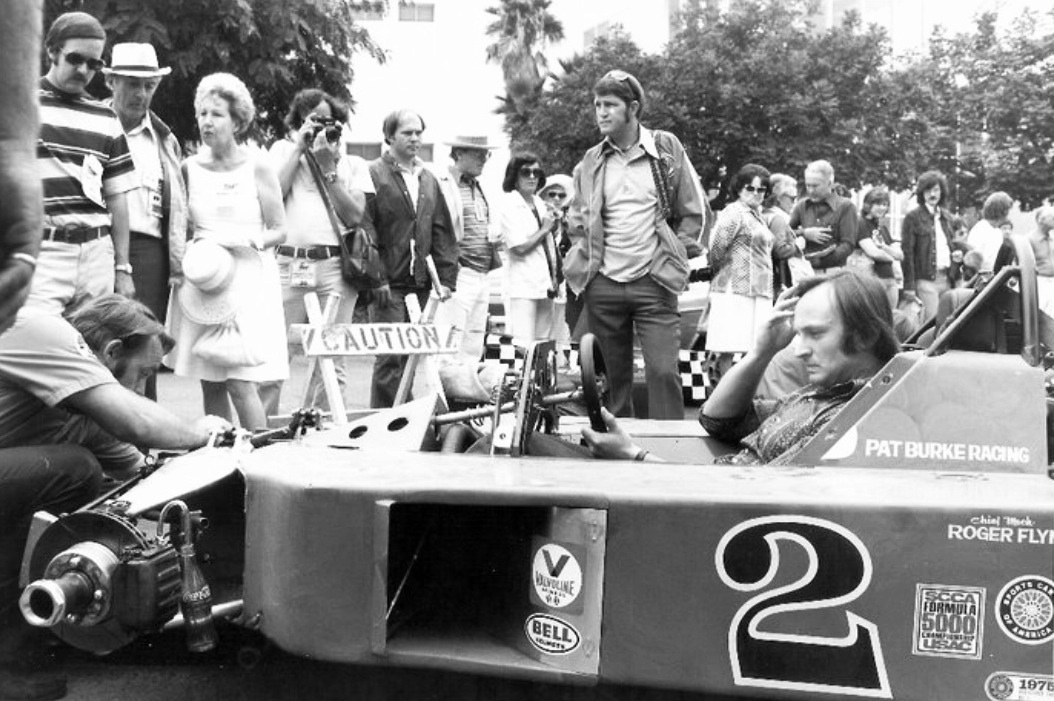
t260 cutaway

Lola T260 Chev cutaway (Tom Strongman)

Having had a taste of the Can-Am in 1970 and earlier years Jackie Stewart was keen to return. TThe professionalism of the Carl Haas team and Lola, a marque familiar to him having raced a T90 successfully at Indy together with Graham Hill in 1966, had appeal. He could fit the series into his 1971 F1 program with Tyrrell, or so he thought. Click here for an article on the Lola T90 and the 1966 Indy 500;

Graham Hill’s ‘American Red Ball Spl’ Lola T90 Ford: Indy Winner 1966…

Lola’s mount for Stewart was designated the T260 which was designed by Bob Marston with Eric Broadley’s guidance.

Lola Heritage; ‘The chassis was a…Lola full monocoque in L72 and NS4 light alloys bonded and riveted together with the fuel bags in either side of the tub with a total capacity of 60 gallons. The oil tank was contained in the rear of the left-hand fuel section. The rear of the monocoque extended to the back of the engine which was sandwiched between two bulkheads, a bell-housing supported the gearbox and absorbed suspension loads.

Cooling was via two brass-finned Serck radiators mounted behind the driver’s shoulder level and fed by two large NACA ducts on the top of the bodywork, the radiators vented through large louvres in the rear bodywork. Two oil coolers were mounted behind the water radiators and used the same ducts, an additional transmission cooler lay flat over the gearbox.

The bodywork was evolved following extensive tests in the Specialised Mouldings wind tunnel and featured a short, bluff nosecone with gauze-covered holes on the top to equalise pressure. At the base of the nose were two air ducts to feed air to the front discs, at the rear two ram pipes on the top of the rear body section collected the cooling air for the rear discs’.

Pete Lyons described the cars aerodynamic approach ‘The T260…was built to an aerodynamic theory already embodied in a few small-bore sports cars of the day. The intent was a shape that would bullet through the air on the straights and also remain stable as the car’s pitch attitude, ride height and positioning behind other cars changed everywhere else. In particular…a more conventional downforce-producing wedge nose, such as McLaren’s…could abruptly change from downforce to lift under certain conditions…’

t 260 aero

CAD sketch showing the T260 aero treatment. (unattributed)

‘The front suspension on the T260 comprised unequal length wishbones, the upper ones were triangulated to form bell-cranks that operated Bilstein dampers and coil springs which lay almost horizontally across the front of the tub. The unusual spring-medium location freed space for the front brakes to be mounted inboard. Eric Broadley’s intention was to reduce the unsprung weight of the front wheels by moving the brakes inboard from their conventional hub location. This would have permitted the lighter wheel assemblies to ride better over the often bumpy Can-Am circuits. Jackie Stewart was adamantly opposed to inboard brakes after the death of his close friend Jochen Rindt due to the failure of an inboard-brake driveshaft on his GP Lotus 72 at Monza in September 1970. Conventional outboard brake mountings were used on the finalized T260 instead.’

A tangent is the fact that later JYS was comfortable enough with Engineer Derek Gardner’s approach to inboard front brakes, his 1973 Championship winning Tyrrell 005/006 being so equipped.

front

T260, Stewart up, Road America. Shot included to show the unusual location, for the time, of the spring/shocks referred to in the text. Graviner fire extinguished ‘bomb clear in shot. Chassis aluminium full monocoque (Jim Buell)

Rack and pinion steering was ahead of the front suspension.

Lola Heritage; ‘At the rear there was a short top link and a long radius arm attaching to the front engine bulkhead, a lower member extended rearwards to a cross-member bolted to the rear face of the gearbox. The springs and dampers fixed to the lower member and transmitted their load to tubular outriggers on the gearbox bell-housing.

Lola-made centre-lock, peg-drive magnesium wheels were fitted, their diameter 15 inches with 10.5 inch front and 17 inch wide rear Goodyears. The battery was mounted in the nose and a Graviner onboard fire extinguisher was fitted behind the dashboard’.

Two cars were built for Haas, chassis HU1 was Stewart’s race chassis, HU2 was an unused spare  in 1971.

The engine was a 496 cu in (8.1-litres) V8 Chevrolet tuned by George Foltz, it produced circa 700 bhp and 618 lb/ft of torque, Lucas fuel injection was fitted with a Scintilla Vertex magneto and a Hewland LG600 four-speed gearbox transmitted the power.

engine

Aluminium block 8-litre engine of the T260 at Mosport. June 1971 (Jerry Bendl Collection/The Roaring Season)

lola t260

(Werner Buhrer)

gardenr back

Frank Gardner testing the Lola T260 at Silverstone in May, note how far forward the rear wing is in relation to shots taken later in 1971 (LAT)

When completed the car was tested by Lola racer/tester/development engineer Frank Gardner at Silverstone in May, FG was also turning his mind and skills into getting more speed from Lola’s F5000 T190/2; no doubt the F5000 was a kiddy-car compared to its 8-litre big brother!

Stewart drove the car in a rain soaked run at Silverstone prior to the cars shipping to Canada for the season opening Can-Am round at Mosport, Canada.

gardner side

Gardner in T260 HU1 at Silverstone, the shortness of the car and different to anything else in the Can-Am aero-treatment, clear in this shot (unattributed)

stewart sikverstone

Ropey shot of Stewart sheltering from the Silverstone weather during his brief drive of the T260 prior to shipment to North America, June 1971 (Sutton Images)

Other 1971 Can-Am Contenders…

hulme and stewart

Denny Hume and Jackie Stewart at Mid Ohio 1971. Stewart in his T260 office (Ron Laymon)

road mclaren

Denny Hulme, McLaren M8F Chev, Road America, August 1971. DNF engine. Engine 494cid Reynolds aluminium block Chev, circa 740bhp @ 6400rpm (Jim Buell)

In reality the likely outright contenders in 1971 were the factory McLaren M8Fs, Stewart’s T260 and Jackie Oliver’s Shadow Mk2 Chev, designed by Peter Bryant.

road shadow

Jackie Oliver’s Shadow Mk2 Chev, Road America 1971, 12th in the race (Jim Buell)

Jo Siffert’s Porsche 917/10 was gathering valuable data for a serious tilt in 1972. In exceptional circumstances (the wet) it was a contender as were a number of the best privateers in either ex-works or carefully developed M8’s: Lothar Motschenbacher, Vic Elford and Tony Adamowicz the most likely.

road pors

Siffert’s Porsche 917/10, Road America 1971. Spaceframe chassis, 5-litre flat 12 (Jim Buell)

road revvie

Peter Revson, Jackie Oliver in the helmet and front suspension detail of a McLaren M8F in the Road America paddock, August 1971 (Jim Buell)

The detailed specification of the McLaren M8F I wrote about a while back; click on this link to read the short article; https://primotipo.com/2015/03/08/peter-revson-mclaren-m8f-chev-1971/

watkins grid

1971 Mid Ohio rolling grid. #5 Hulme, #7 Revson, #1 Stewart, #2 Jo Siffert,Porsche 917/10, #51 Dave Causey Lola T222 Chev, #54 Tony Adamowicz, McLaren M8B Chev, #88 Hiroshi Kazato, Lola T222 (Ron Laymon)

Part 3: Racing: 1971 Can-Am Round by Round…

mosport 1

Mosport 1971 vibe, looks fantastic! (Jerry Bendl Collection/The Roaring Season)

Round 1: Mosport, Ontario Canada 13 June 1971
Stewart grabbed pole position from the works McLaren M8Fs of Hulme and Revson then led the race from Hulme, an oil leak from the LG600 Hewland ‘box resulted in its seizure on lap 18.

Hulme won from Revson and Lothar Motschenbacher in one the 1970 ex-works McLaren M8Ds.

mosport 2

Pan of Stewart at Mosport shows the cars original aero treatment before ongoing modifications and experiments. Rear wing far forward and nose devoid of appendages (Jerry Bendl Collection/The Roaring Season)

Rounds 2 and 3: St Jovite, Quebec Canada 27 June and Road Atlanta, Georgia, 11 July
Stewart put the T260 on the front row next to pole sitter Hulme’s McLaren M8F at St Jovite. Denny led from the start but Stewart sat in second until lap 52 when Hulme, tiring from a stomach bug, had to slow due to exhaustion. Stewart won from Denny and Peter.

st jovite

Stewart a race winner at St Jovite, here beside Hulme with Revson just behind (Lola Heritage)

Stewart recalled in an interview with Gordon Kirby, ‘St Jovite was a good win because with that car, that track was hard work! The other race where we did quite well was at Road Atlanta. We led the race then had a puncture and a whole series of other problems but still turned the fastest lap of the race, quicker than Hulme’s pole time’.  Revson won from Hulme and Motschenbacher.

road atlanta

Stewart had great pace at Road Atlanta, wonderful high speed shot of the short, squat, original T260 (unattributed)

watkins glen

Stewart ahead of Revson, Mario Cabral Porsche 917K and Hulme in the distance, Watkins Glen, 1971 (unattributed)

Round 4: Watkins Glen, New York, 25 July
The T260’s speed was not in doubt, it was back on pole again with Hulme and Revson right behind. Stewart got the drop putting the T260 into the lead from Revson, the Lola and McLaren diced until Stewart pitted with another puncture, losing a lap while the wheel was changed.

Stewart returned to the race and began to fly, setting the fastest lap but on the 56th lap he retired the car after detecting vibrations which proved to be a failing transmission. Revson won from Hulme and Siffert’s factory Porsche 917/10.

stew watkins

JYS at Watkins Glen, site of the US GP in upstate New York, it was a circuit he knew well (LAT)

jackie

Stewart loaded up and all ready to go in the Mid Ohio pitlane (Terry Capps)

Round 5: Mid Ohio, 22 August
Stewart, famously a successful campaigner for better circuit safety, was unhappy with the track; its surface was excessively bumpy and the presence of trees and telegraph poles surrounding the course meant mistakes would be punished severely.

Much overnight work was carried out to remove some of the trees and poles, and add straw bales where possible, but after looking at the result Stewart declared he would ‘run but he wouldn’t race’. Stewart’s position could be appreciated after the bumpy track caused three rear suspension failures to the T260 during qualifying.

front f

Bucolic Mid Ohio paddock. Team busy this meeting, several suspension failures over the bumpy circuit. Standard-aero at this point (Terry Capps)

Stewart qualified third and was second behind Revson at the end of lap one but the McLaren drew away as Stewart drove well within himself. On lap 72 Revson’s driveshaft universal joint failed (the same problem sidelined Hulme) and Stewart took the lead and race win from Siffert’s Porsche and Tony Adamowicz’ 1969 ex-works McLaren M8B Chev.

back

Mid Ohio paddock, this time a butt shot. Neat brackets to support beefy exhausts and lights, black ducts are cooling for inboard discs located beside the Hewland ‘box. Note also ducts/louvres on the rear of the bodywork to exhaust hot air (Terry Capps)

From this point on, the continual development of the McLarens told while the Lola effort didn’t improve enough. McLaren were a well drilled team and both drivers were  experienced campaigners with whatever changes needing to be made could be done quickly in their Detroit workshop or back at Colnbrook.

While the T260 was effectively a works effort run by the marques US importer, Lola were at their core a manufacturer of customer racing cars with many customers, not a race team with only one focus.

stew m10b

Included in JYS program for 1971 was the Questor Grand Prix at Ontario Speedway in March. He was second in his Tyrrell to Mario Andretti’s Ferrari 312B…but here Jackie is putting in a few laps in AJ Foyt’s McLaren M10B Chev in his only F5000 drive?? (Getty Images)

Jackie Stewart on driving the T260 and stresses of two major campaigns, F1 with Tyrrell and the Can-Am Lola in 1971…

Stewart related to Gordon Kirby and Adam Cooper in separate MotorSport magazine interview’s; ‘There were no wind tunnels in those days and Eric (Broadley) would suddenly arrive and under his arm was a new front wing. There was one we called ‘the cowcatcher’. It was hung out front of the car and what it was doing I just don’t know’

‘The car was very short wheelbase and very difficult to drive. In comparison to the McLarens, (Stewart was approached to drive for them in 1972 and actually signed to do so but withdrew when the extent of his health problems were clear) the car was just a monster to drive and we were just trying to keep up’.

‘I tested the McLaren and it was just like a passenger car compared to the incredibly nervous, pointy, short wheelbase Lola where you were a millisecond from an accident all the time.’

Stewart said the Lola T260 was the most physically demanding car he raced in his career ‘On the very fast circuits like Riverside it was awfully tricky because you never knew where you were going’. In order to make up for its shortcomings ‘I sweated more. It was just a difficult car to drive. There are some cars which are easy to drive and others not and that was one of the ones that was not’.

In a contest for the worst car he ever drove; ‘The Lola T260 Can-Am car would probably make that one…the H16 BRM runs it a close second’.

The main problem was dire understeer in addition to ultimate twitchiness at speed. The Lola’s blunt nose was dotted with mesh covered holes through which the underbody air could pass. In theory this helped provide some downforce. In its initial guise the shape of the front didn’t seem to have any obvious way of providing grip. Broadley deliberately opted not to have a fashionable chisel nose. But the lack of downforce at the front was borne out by the position of the giant rear , which was usually far forward, just behind the injection trumpets  in an attempt to achieve some sort of balance.

A combination of racing around the world in two series and lots of promotional work gave Stewart mononucleosis. ‘I was flying back and forth from Europe to do F1, I won the world championship that year and two Can-Am races, but I also got mononucleosis (glandular fever), a really debilitating disease that took your energy away. You couldn’t sleep and yet you were overly tired. So it was a tough year, a really exhausting year’.

stew montjuic

Stewart racing his Tyrrell 001 Ford to victory in the Spanish GP, Montjuic Park, Barcelona on 18 April. He took six wins in 1971 and his second drivers title (unattributed)

It’s interesting to reflect on Jackie’s comments on the differences between the two cars. In fact both the T260, which retained the same wheelbase as the T222, and the M8F had 98 inch wheelbases.

The front/rear track of the Lola was 58 inches, of the M8F 60/57.75 inches, while the overall length of the Lola was 139 inches compared with the much longer M8F’s 167 inches. The aero treatment was radically different of course, a lack of downforce something the team chased progressively throughout the season.

road america

Stewart in the T260 at Road America and trying a different aero configuration comprising; a new profile ‘clip’ on the lower nose at the cars front and McLarenesque wing and integrated mounts, wing now much further back than the original (Jim Buell)

Round 6: Road America, Elkhart Lake, Wisconsin, 29 August
Stewart was third fastest in qualifying but his engine, also used at Mid-Ohio, was tired.

A new Chev was fitted for the race but high temperatures during warm-up were hoped to be vapour lock in the cooling system.

road am 1

Stewart ready to rock at Road America and a close-up of the configuration pictured above (Jim Buell)

Stewart ran second early on but after 10 laps the engine was smoking so Jackie parked it. Later examination showed a dropped cylinder liner was responsible for the high engine temperatures.

Revson won from Siffert and Vic Elford’s McLaren M8E Chev.

stew road am

Stewart T260 Road America, note that in this shot he is running the original nose and rear wing setup (Carl Knopp)

Round 7: Donnybrooke, Minnesota
The T260 had revised rear suspension but the McLarens were continually being developed as well, Stewart’s third fastest time was two seconds adrift of the factory M8Fs.

Stewart got away well and led for two laps until Revson found a way past, Hulme was unable to pass Jackie as the McLaren was losing grip in the Lola’s slipstream. The positions remained until lap 22 when Stewart felt something amiss and pitted, nothing could be found, he resumed in 10th a lap and a half down.

The Scot raced the T260 back to fourth but another puncture saw Stewart back in the pits, the T260 finished sixth, two laps down. Revson again won from Hulme and Gregg Young’s McLaren M8D/E Chev in third.

edmonton

Stewart about to load up on the wet Edmonton grid, September 1971. #11 is Motchenbacher’s McLaren M8D . See another variation of the T260 nose, the front ‘clip on’ less bluff than the original and more ‘scooped’. Rear wing mounted back (Jerry Bendl Collection/The Roaring Season)

Round 8: Edmonton, Alberta Canada, 26 September
The T260 featured a revised nose shape designed to give more downforce while the rear wing was moved back to balance the new nose.

Stewart qualified third again and had a great start on the wet track and led. The T260 was handling well in the rain, the Scot extended his lead over Jackie Oliver’s Shadow and Hulme’s McLaren. Stewart was still leading at half distance but a trip onto the grass when lapping Motschenbacher’s M8D lost the Lola’s handling balance.

Gradually Hulme closed the gap and he suddenly found himself in the lead with 13 laps remaining, the deteriorating handling caught Stewart out and he spun. The T260 resumed in second but with it’s competitiveness lost Stewart settled for a safe second. Jackie Oliver finally got the Shadow Mk2 into the points in third place.

cow catcher

Stewart runs the cow-catcher set up at Laguna Seca, in search of downforce or what! Far forward wing and much larger rear wing to balance things up (Tony Ferrari)

Round 9: Laguna Seca, California, 17 October
At Laguna Seca the T260 had lost its high downforce nose from Edmonton and now featured a huge, front cow-catcher wing projecting out in front of the nosecone.

Stewart managed fourth on the grid behind the McLarens and David Hobbs in the Ti22 Chev.

Stewart soon passed Hobbs – David raced the Carl Haas factory Lola T310 in 1972 – and after 10 laps passed Hulme who had some broken valve springs.

Revson seemed secure 25 seconds ahead of Stewart but a collision with a backmarker required a pit stop to secure a loose door. Stewart was now nine seconds behind. Revson started to pull away again but with 20 laps to go Revvies engine lost power, he nursed it over the remaining laps but with two to go the M8F was puffing blue smoke.

He drove the last two laps cautiously to win and but Stewart took the chequered flag as Revson had been shown a black flag, Revson claimed he hadn’t seen it.

The Carl Haas team protested Revson, the results were pending for some hours, but eventually Revson got the win but received a $250 fine. Hulme was third.

corkscrew

Stewart ahead of David Hobbs Ti22 Chev, Jackie Oliver Shadow Mk2 Chev, another unidentified car with Jo Siffert Porsche 917/10 at rear. Corkscrew, Laguna (Hal Amarantes)

riverside

riverside 2

Stewart at Riverside, again with the cow-catcher aero setup. Side on profile shot gives an idea of just how far forward the front wing was and how big the rear one was! Lola T260 Chev (MP Hewitt)

Round 10: Riverside, California, 31 October
The series’ final round was at Riverside on October 30, only 3 1/2 short months since its commencement in mid-June.

Stewart again qualified third, the T260 now had bigger sideplates on its rear wing.

Hulme took the lead at the start but Stewart got up to second as Revson, looking for points to clinch the Championship, didn’t make it difficult. Unable to challenge Hulme, Stewart was running happily in second until a piston failed in the big aluminium Chevy on lap 27.

Hulme won from Revson and Howden Ganley in the BRM P167 Chev.

The end of the 1971 Can-Am Championship resulted in Peter Revson as champion with five wins to Hulme’s three, Stewart finished an honourable third to the two McLarens…

As Lola Heritage puts it ‘He had been their only consistent competitor over the ten rounds and there was a certain ‘what may have been’ feeling over the whole series, if only reliability had been better and punctures had been less’.

In addition to that it’s a shame the car hadn’t been finished earlier and tested extensively at Goodwood and Silverstone prior to crossing the Atlantic, but it wasn’t and the dominant McLaren’s reaped the rewards.

t310 front

David Hobbs in the Watkins Glen pits 1972, Lola T310 Chev (unattributed)

For 1972 Lola again contested the championship with a new car, the T310, McLaren built a new car, the M20 Chev to take on the pride of Stuttgart, but the mighty turbo-charged Porsche 917/10 was battle ready in the hands of the Penske Team and Mark Donohue in a way the 1971 Lola/Carl Haas/Stewart combination were not…

t 310 watkins

David Hobbs Lola T310 Chev fourth ahead of Jackie Oliver’s Shadow Mk3 Chev DNF and the dominant Porsche 917/10 turbo of George Follmer fourth. Hulme won this round in an M20 McLaren. Watkins Glen 1972 (unattributed)

Etcetera…

dimensions

Bibliography…

Lola Heritage, MotorSport October 2000 article by Adam Cooper and December 2013 article by Gordon Kirby, Automobile Year 19, ‘Can-Am’ Pete Lyons

Photo Credits…

Lola Heritage, Ron Laymon, Getty Images, LAT, Jerry Bendl Collection/The Roaring Season, Automobile Year, Jim Hayes, Tom Strongman cutaway drawing, Carl Knopp, Jim Buell, Terry Capps, Hal Amarantes, Tony Ferrari, MP Hewitt

Tailpiece…

Turn in Biiitch!

bitch

Stewart Lola T260, Road America 1971 (Jim Buell)

Finito…