Archive for the ‘Features’ Category

taffy

(Archie Smith)

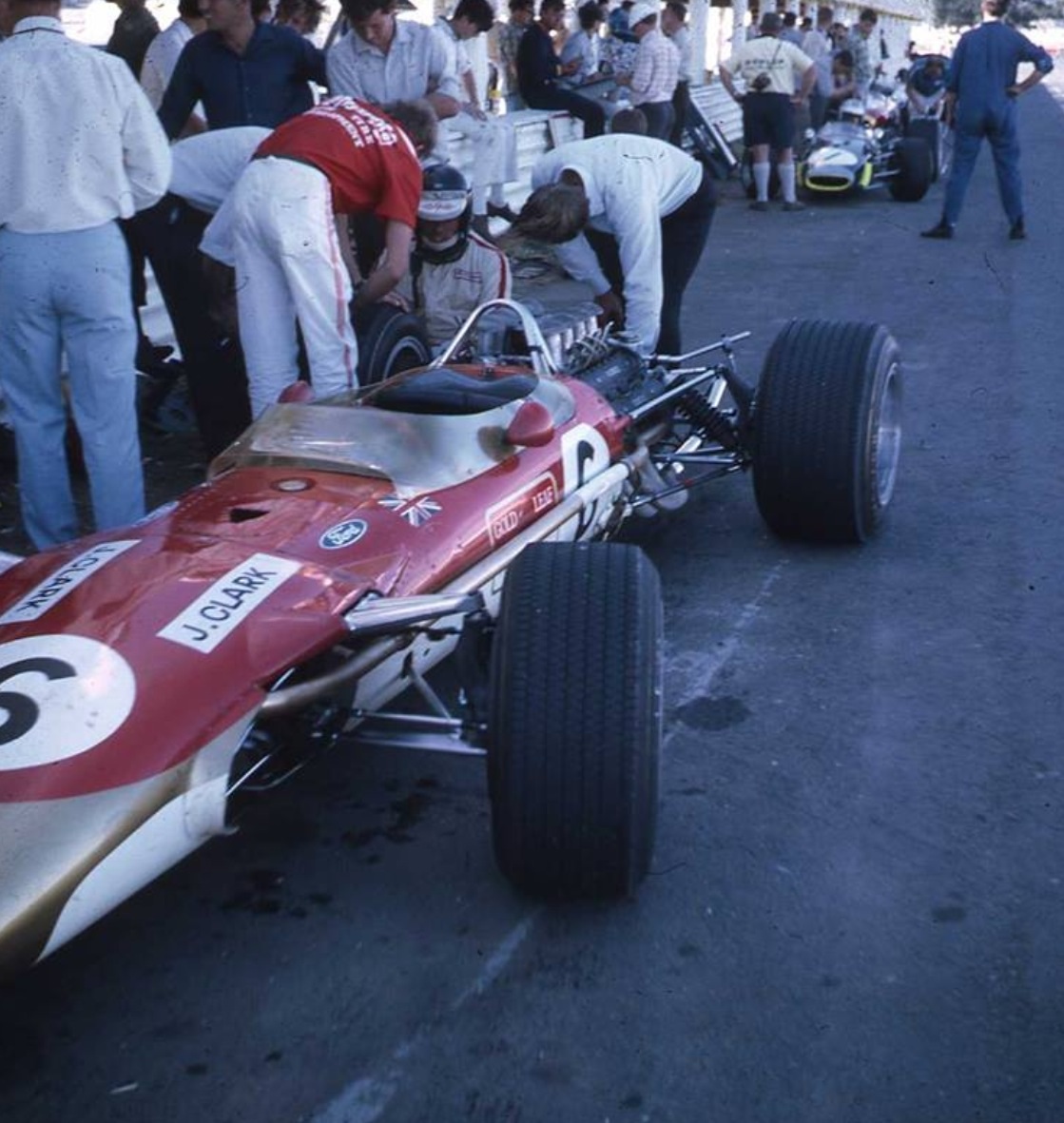
Taffy von Trips settles himself into his F2 Ferrari Dino 156 #0008 on the grid of the 1960 Italian Grand Prix, Monza, September 6…

The cars designer, Carlo Chiti looks on. Click on the link below to my article, I’ve converted a 100 word quickie on a Monaco vista in 1960 into a feature on a significant Ferrari thanks to a tangent introduced by reader Grant Perkins for reasons which are clear in the text; https://primotipo.com/2015/10/04/monaco-panorama-1958/

This car, Ferrari Dino 246P/156 0008, is the Scuderia’s first mid-engined car.

severi

(unattributed)

Ferrari factory test driver Martino Severi drives the brand new, mid-engined 246P 0008 on 22 May 1960 at Modena. Ginther and Hill also drove it that day, it’s a week before its Monaco GP debut. It’s not as gorgeous as it became in Fantuzzi bodied 1961 156 form, but luvverly all the same

Dino 246P 0008’s evolution from 2.5-litre mid-engined GP prototype in Ginther’s hands at Monaco 1960 to 1.5-litre Dino 156 Syracuse 1961 GP winner for Giancarlo Baghetti within 12 months is an interesting story.

richie

(unattributed)

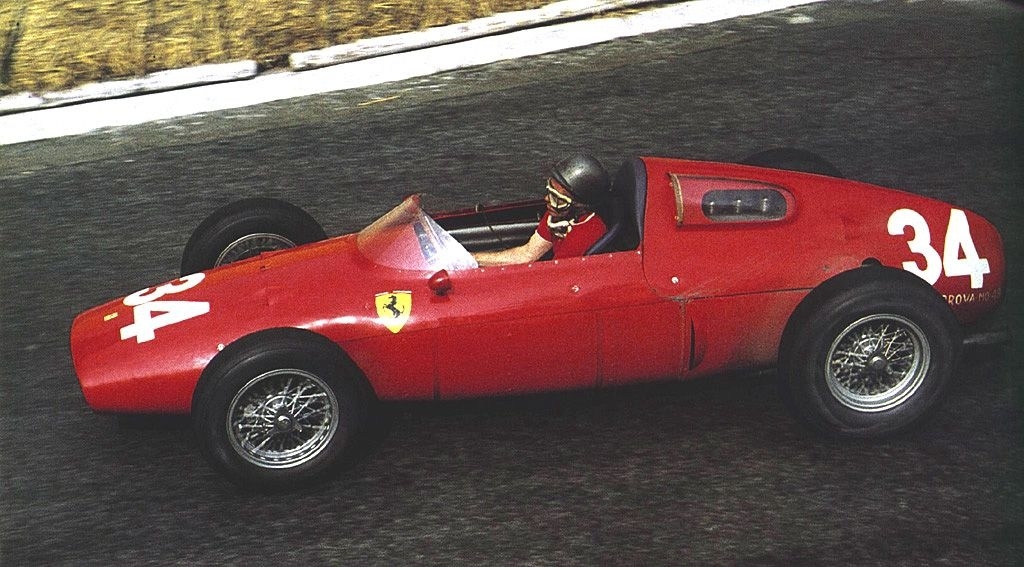
Richie Ginther at Monaco 1960 for his, and Ferrari Dino 246P 0008’s GP debut.

Photo Credits…

Archie Smith

Finito…

clark

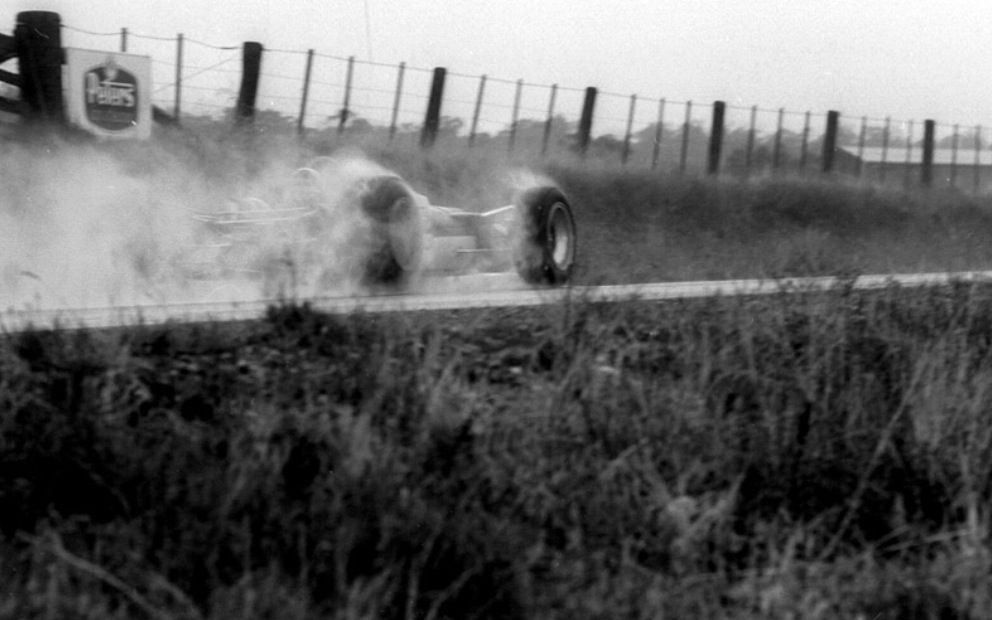
Rod MacKenzie’s moody, foreboding, evocative image of Jim Clark’s Lotus 49 at Longford in 1968 is one of my favourites…

Clark is exiting Newry Corner on the run towards the ‘Flying Mile’. He started from pole, winning 100 bottles of champagne in the process and finished second in the Saturday preliminary race in beautiful weather but the clouds opened on Monday morning for the Tasman Championship event, ‘The South Pacific Trophy’.

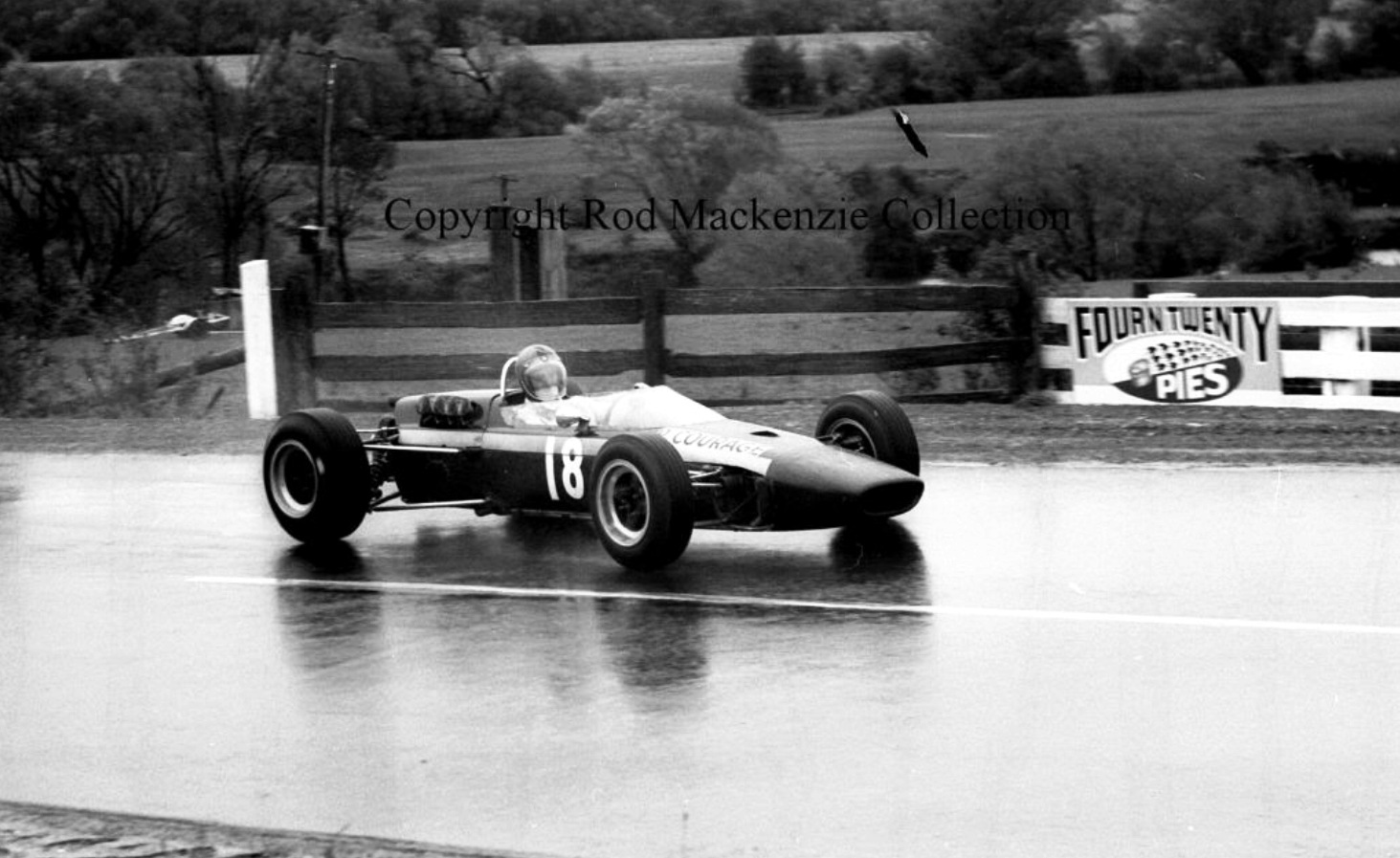
Star of the show was Piers Courage who drove a gutsy, skilful race in the most challenging, treacherous conditions to win the event in his little F2 McLaren M4A FVA ahead of the big Tasman 2.5’s of his close competitors. Pier’s car was self run, his performances in it that summer reignited his career.

courage

Piers Courage in his McLaren M4A F2 car, Newry Corner, Longford 1968. Power was not all on this fast circuit in such wet conditions, but the plucky Brit was giving away at least 130bhp to his 2.5 litre V8 powered opponents (R MacKenzie)

Pedro Rodriguez and Frank Gardner were second and third in BRM P261 2.1 V8 and Brabham BT23D Alfa 2.5 V8 respectively. Clark was fifth in his Ford Cosworth DFW engined Lotus 49, the 2.5 litre variant of the epochal 3 litre DFV GP engine.

Jim Clark chewing the fat with BRM’s Tim Parnell- all the fun of the fair, Longford 1968, Clark’s Lotus 49 Ford DFW ready for action (oldracephotos/Harrisson)


Clark and the boys with Denny Hulme’s Brabham BT23 FVA behind (HRCCT)

Lets go back to the start of the meeting, marvellous from the Tasmanian’s perspective as the series went down to the wire, Chris Amon was still a potential series victor with only six points between he and Jim Clark with Piers Courage’s third place within Graham Hill’s grasp depending upon how he fared.

Chris Amon blew the sealing rings in the Ferrari’s little V6 keeping his crew busy for the evening whilst Pedro Rodriguez popped an engine too- the BRM mechanics therefore readied the P261 V8 for the race rather than the P126 V12 the Mexican raced in the Saturday preliminary. Piers Courage tapped the nose of his pristine McLaren M4A when the flaggies got so enamoured of the cars they forgot to signal oil on the track! All was well at Gold Leaf Team Lotus.

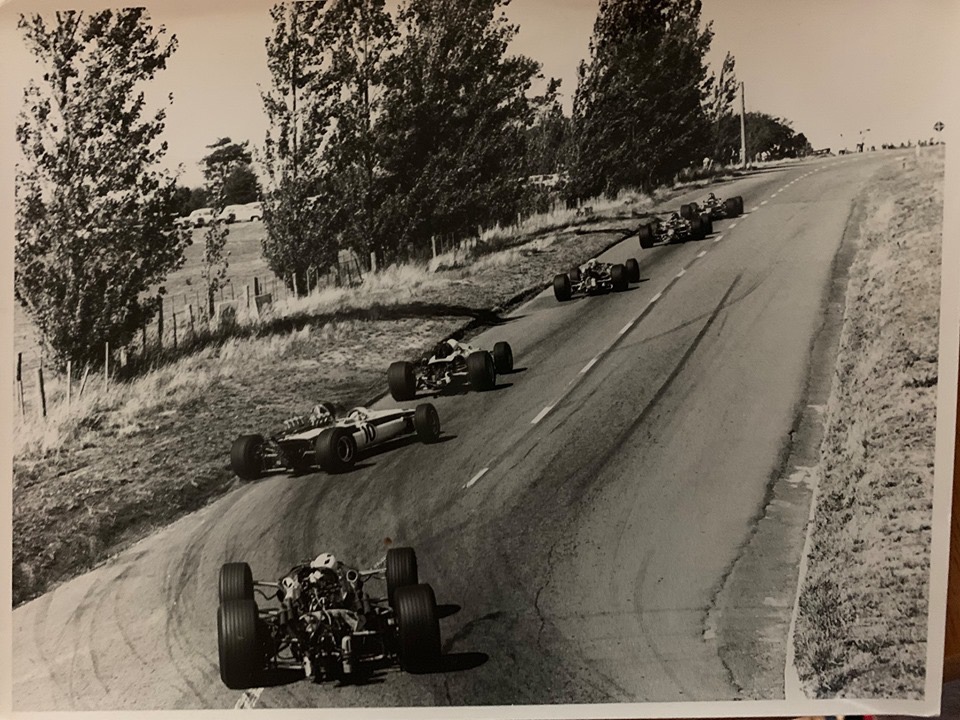
Lap 1 of the preliminary on Saturday, Geoff Smedley’s amazing colour shot- Clark from Hill, Amon, Gardner and one of the BRM’s- Lotus 49 by two, Ferrari 246T, Brabham BT23D Alfa and BRM P261 0r P126 (G Smedley)

Practice times didn’t mean too much as the teams were focused on race setup for the twelve lap Saturday preliminary race ‘The Examiner Racing Car Scratch’ which also counted for grid positions. In the second session of practice Clark did a 2:12.8, Hill 2:13.6 and Amon 2:13.8. Clark was under Jack Brabham’s record set on the way to his win the year before in his BT23A Repco, Jim won 100 bottles of champagne for pole as stated earlier.

In the preliminary on Saturday the grid formed up with Clark on pole. Hill comfortably won the event run in fine, dry weather from Clark and Amon. Both Lotuses were timed on the Flying Mile at 172 mph but Amon’s 182 mph in David McKay’s ex-works Ferrari P4/Can Am 350 sportscar rather put the single-seaters in the shade! Lets not digress about that car now, follow the link at the end of this article for a long piece about the P4 which Chris raced in the sportscar support events in each of the Australian Tasman rounds.

Hill G leads the pack off Long Bridge on lap 1 of the Saturday preliminary. Hill, Clark, Amon, Gardner, Leo Geoghegan Lotus 39 Repco, a BRM and perhaps Kevin Bartlett Brabham BT11A Climax (R MacKenzie)


Exit from Newry, lap 1 of the preliminary- Hill, Clark, Amon, Gardner, Geoghegan’s Lotus flirting with the tracks edge, and Attwood. Great shot shows how the circuit rises at this point into the right hand kink up the road (S Geoghegan)

Only a couple of supporting races had been run on the Monday raceday when light rain started to fall at about 10am, this soon became heavy. As the rain got harder and the clouds more threatening it was obvious that it was not likely to abate before the 2.15 pm race start time

The track was almost under water at some points where hay bales had broken up and straw was blocking the drains. Efforts by track officials soon had most of the drainage system under control.

A large crowd was of course present on the Labour Day long-weekend. Crews brought the cars out onto the circuit in front of the pit counter and stood together under umbrellas as the drivers went into a huddle with the promoters of the meeting and the CAMS stewards to determine if the race should go on.

Leo Geoghegan and Lotus 39 Repco return to the Longford pits after some exploratory laps. DNS with unsuitable tyres. Its the Courage McLaren by the pit counter (oldracephotos)

Sergent.com report that first it was decided that the cars should do a couple of exploratory laps then report their findings.

Geoghegan, Amon, Clark, Hill, Attwood, Gardner, Bartlett and others went out and after looking like motor boats ploughing through the water delivered their thoughts to the meeting. The conditions were so bad various drivers with unsuitable tyres elected not to start having driven some ‘sighting laps’.

Kevin Bartlett recounted his experience in the Alec Mildren Racing Brabham BT11A Climax; ‘I did two exploratory laps and the old BT11 couldn’t find traction anywhere. I had an absolutely terrifying 4th gear 720 degree spin across the short Kings Bridge, the one after the Viaduct, missing all the obstacles at the tracks edge. After exiting Pub and in a straight line i did a 360 degree loop. She nearly escaped me over the rail line on the way to Long Bridge. Out of Newry and up the hill to the straight slithering along with no touch felt between me and the bitumen, so i suppose I thought at that moment to do another lap at a very reduced speed then pit’.

Packed car park: Amon’s Dino, the BRM’s of Attwood and Rodriguez, Pedro’s P261 fully covered, the two Lotus 49’s, Piers McLaren, then Leo G’s Lotus 39 and John Harvey’s Brabham BT11A (oldracephotos)

long

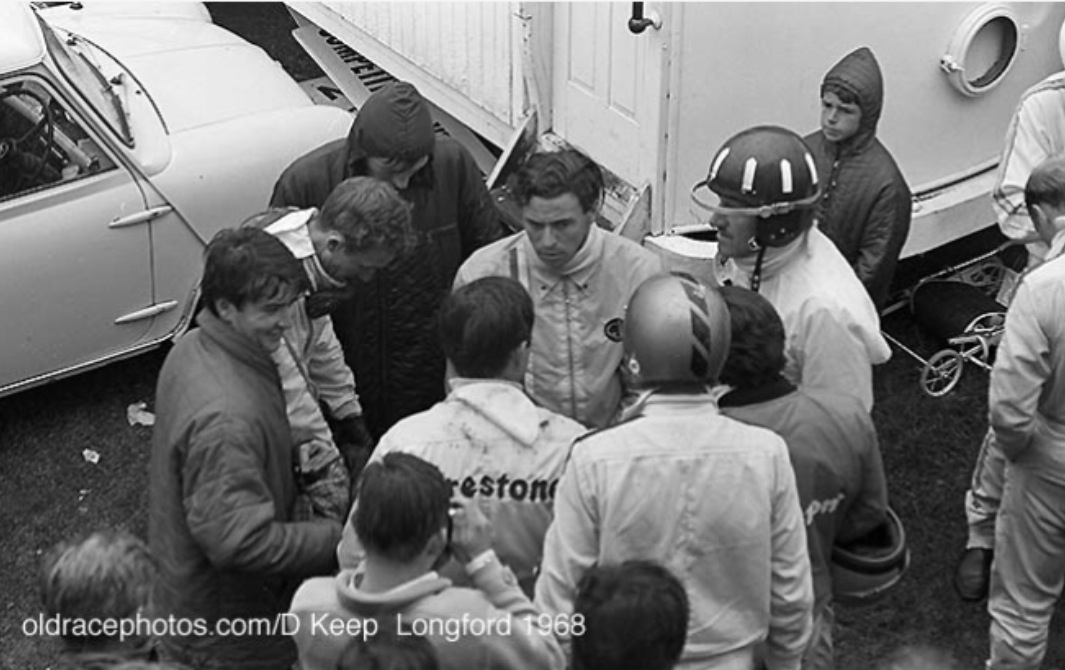
‘What are we going to do boys?!’ Drivers considering their options before the race, the pouring rain exacerbated by drains beside the track which couldn’t cope with the deluge; Clark facing us, Hill’s distinctive helmet clear. Courage with his back to us in helmet, Gardner’s lanky frame partly in shot to the right. Amon in the ‘Firestone’ suit, Harvey? at left with head down (oldracephotos)

‘Once back in the tent Alec, Frank (Gardner) Denny (Hulme Brabham BT23 FVA F2) and i had a talk about the tyres that Denny and i had and after trying to come up with a better tread pattern, such as the ones fitted to Franks car (Brabham BT23D Alfa) but with no result. It was agreed that Denny and i shouldn’t risk a start. I was happy with the call and Leo (Geoghegan Lotus 39 Repco) followed suit. Most of the top guys had the latest Firestone, Dunlop or Goodyear wets but none were available to suit the BT11’s. I consoled myself with the fact that if the new world champion (Hulme) didn’t like the risk i certainly shouldn’t!’

Longford, wonderful circuit that it was, provides no runoff area for a driver to go in the wet (or dry!) should a driver lose control or suffer a bad attack of aquaplaning, and this was the main point in contention.

The ill fated Brabham BT23A Repco ‘740’ of Greg Cusack on Friday or Saturday (oldracephotos)

Greg Cusack in David McKay’s Scuderia Veloce Brabham BT23A Repco (Brabham’s victorious Longford mount from 1967) had left the road that morning. He lost the car on the greasy road as he went over the hump/bump on the approach to The Viaduct. The car left the road, hit a bank, somersaulted and crashed into a ditch, he was then pinned under the it before being quickly released by officials.

The 37 year old Canberra motor dealer, who had intended Longford to be his last race meeting, was taken to Launceston Hospital with chipped bones to both knees, stretched ligaments and a fractured left wrist. He was lucky it was not a good deal worse. Bib Stillwell organised for one of his planes to fly Cusack and his wife home to Canberra on the Tuesday where he was admitted to hospital.

Whilst Cusack lay in hospital the other drivers were trying to explain the difficulties of Longford which were exacerbated hugely in the wet. ‘Motoring News’ reports at length about the cordial discussions between the drivers and officialdom and all of the competing issues of safety, providing a show and running a race to determine the winner of the Tasman Cup.

The Stewards finally ruled that the race should go ahead but be shortened to 15 laps of the 4.5 mile circuit, (128 miles to 68 miles) and put the starting time back to 4pm hoping the rain would ease and the situation be safer as a consequence. At 4.15pm the sodden cars and their game, uncomplaining drivers were facing the soggiest start ever seen at Longford, one of the most challenging road circuits in the world.

Front row- Amon Ferrari 246T and the two Lotus 49 DFW’s of Hill and Clark, that’s Frank Gardner’s Brabham BT23D Alfa nose (oldracephotos)


Soggy start: L>R Amon Ferrari Dino 246T, Hill Lotus 49 and unsighted to the right Clark. Then Rodriguez BRM P261 #11 and alongside Gardner in the light coloured Brabham BT23D, #12 behind him Attwood BRM P126 and alongside him the winner Courage McLaren M4A. L>R in the back row John Harvey’s Brabham BT11A, John McCormack Brabham BT4 and Mel McEwin Lotus 32B (oldracephotos)

Clark’s Lotus 49 got away well, somehow finding traction with the wide Firestones, and he was followed into the right-hander before The Viaduct by Amon and Hill. The drivers took the opening laps cautiously under race conditions and each car was leaving a gap to the other so they could see through the flying spray.

At the end of lap one the order was Clark, Rodriguez BRM P261 V8 on Dunlops, Gardner Brabham BT23D Alfa on Goodyears, Courage Mclaren M4A Ford FVA using new narrow-section 970s, Hill Lotus 49 Ford DFW on Firestones, Attwood BRM P126 V12 on Dunlop, Amon Ferrari 246T back in seventh owing to a run down the escape road at Newry Corner, then John Harvey Brabham BT11A Repco John McCormack Brabham BT4 Coventry Climax FPF and Mel McEwin Lotus 32B Coventry Climax FPF, this car the ex-Clark/Palmer 1965 Tasman Championship winning chassis.

Richard Attwood, a very good 4th in the big BRM P126 V12 on Pit Straight. BRM was testing, by way of eight Tasman race weekends in a row, this new F1 design in 2.5 litre capacity in advance of the ’68 GP season (oldracephotos/DKeep)

‘Attwood found he had more traction on Dunlops than Hill had with the wide Firestones and he slipped under the Lotus for fifth place on lap 2. Both Attwood and Rodriguez had hand-cut drainage grooves in their tyres. A lap later Courage really got his foot in it to take Gardner on lap 3. He then jumped past both Rodriguez and Clark on the next lap while Gardner followed him through and waited for another lap behind Clark before taking the plunge and heading for second. Amon had taken Hill and now, on lap 5, the order was Courage 9.6 secs ahead of Gardner, Clark, Rodriguez, Attwood, Amon, Hill and Harvey. McEwin and McCormack were already in danger of being lapped by the flying Courage.

Hill from Gardner, not sure who and one of the BRM’s, Long Bridge (R MacKenzie)

Courage, driving like a young Stirling Moss in the blinding rain, somehow gained another 9.5 secs on lap 6, putting him 16 secs ahead of second man Gardner in the Brabham-Alfa. Rodriguez had pulled past Clark and on the next lap Attwood whizzed past Clark to take fourth. On lap 9 Courage was 32 secs ahead of Gardner and having a ball out on his own, right foot hard in it. Gardner was 3.5 secs ahead of Rodriguez who was followed by Attwood, Clark, Amon, Hill and Harvey losing a lot of ground’.

Pedro raced the little 2.1 litre BRM P261 V8 having raced the new P126 V12 in the preliminary and had engine failure. 2nd a minute behind Courage just sneaking past Gardner in the final stages (oldracephotos/DKeep)

‘Rodriguez started to close up on Gardner in the closing laps, but nothing could touch Courage. This was his day, it was he who had the best gear on his car and he was darned sure he was going to make it a race to remember. He had pulled 45.5 secs on Gardner by lap 12 while Rodriguez had got within 2.5 secs of Gardner. Hill challenged Amon on the same lap and finally squeezed past in a daring effort on the greasy track to make the Lotus-Fords fifth and sixth’.

Frank Gardner on the exit of Newry, Alec Mildren’s Brabham BT23D Alfa Tipo 33 2.5 V8. 3rd a minute behind Courage (R MacKenzie)

‘As Courage screamed down the straight heading for the flag he was over 55 secs ahead of Gardner and he came past the pits jubilantly waving his hand. Gardner by this time, heading for the braking area at Mountford, had Rodriguez looking right at the Alfa V8 pipes. There seemed no way that Rodriguez could slip past, but suddenly a gap appeared as Gardner went a shade wide on Mountford and Rodriguez poured on the power into the short straight and took the flag about 25 yards ahead of the Alec Mildren car. Attwood finished his race fourth after a very steady drive, followed by Clark, Hill and Amon’.

John Harvey coming off Long Bridge in Bob Janes Brabham BT11A Repco ‘740’ V8. This is the car in which Spencer Martin won the ’66/7 Australian Gold Star. Converted to Repco power just prior to the Tasman (R MacKenzie)

Hill, Lotus 49 DFW, 5th on the Flying Mile (R MacKenzie)

‘Courage had the rubber, just the right amount of power for the job and the ability to keep the car straight on a very dicey and greasy circuit. He finished the Tasman Cup Series in a wonderful third place behind Clark and Chris Amon. Then came Hill and Gardner 17, McLaren 11, Rodriguez and Hulme 8, Jim Palmer 7, Attwood 4, Roly Levis and Leo Geoghegan 3, Paul Bolton, Red Dawson and Kevin Bartlett 2, Graeme Lawrence and Ross Stone 1 each’.

Like a duck to water- Courage, right tyres, set up, enough power, precision and bravery. McLaren M4A FVA F2 machine (R MacKenzie)

It was very much the end of an era, the last Longford, the speed of the cars and advancing track safety rules caught up with the place and an inability of the club/government to make the requisite investment. Most importantly Jim Clark, a very popular visitor to Australasia since the early sixties and twice winner of the series in 1965 and 1968 died at Hockenheim in an F2 Lotus 48 in April.

Lotus returned in 1969 but it was not quite the same without the magic and personality of the great Scot.

photo (15)

A very happy but cold and soggy Piers Courage, with wife Sally after his Longford ’68 win. It was a might fine drive which is still remembered by those fortunate enough to see it. (oldracephotos)

Etcetera…

Practice and Saturday Preliminary

Richard Attwood, BRM P126, The Viaduct (oldracephotos/Keep)


Lap 1 bunch behind the lead group- Gardner Brabham BT23D, Geoghegan Lotus 39, Attwood BRM P126, Bartlett Brabham BT11A, Rodriguez BRM P126 into The Viaduct (oldracephotos)


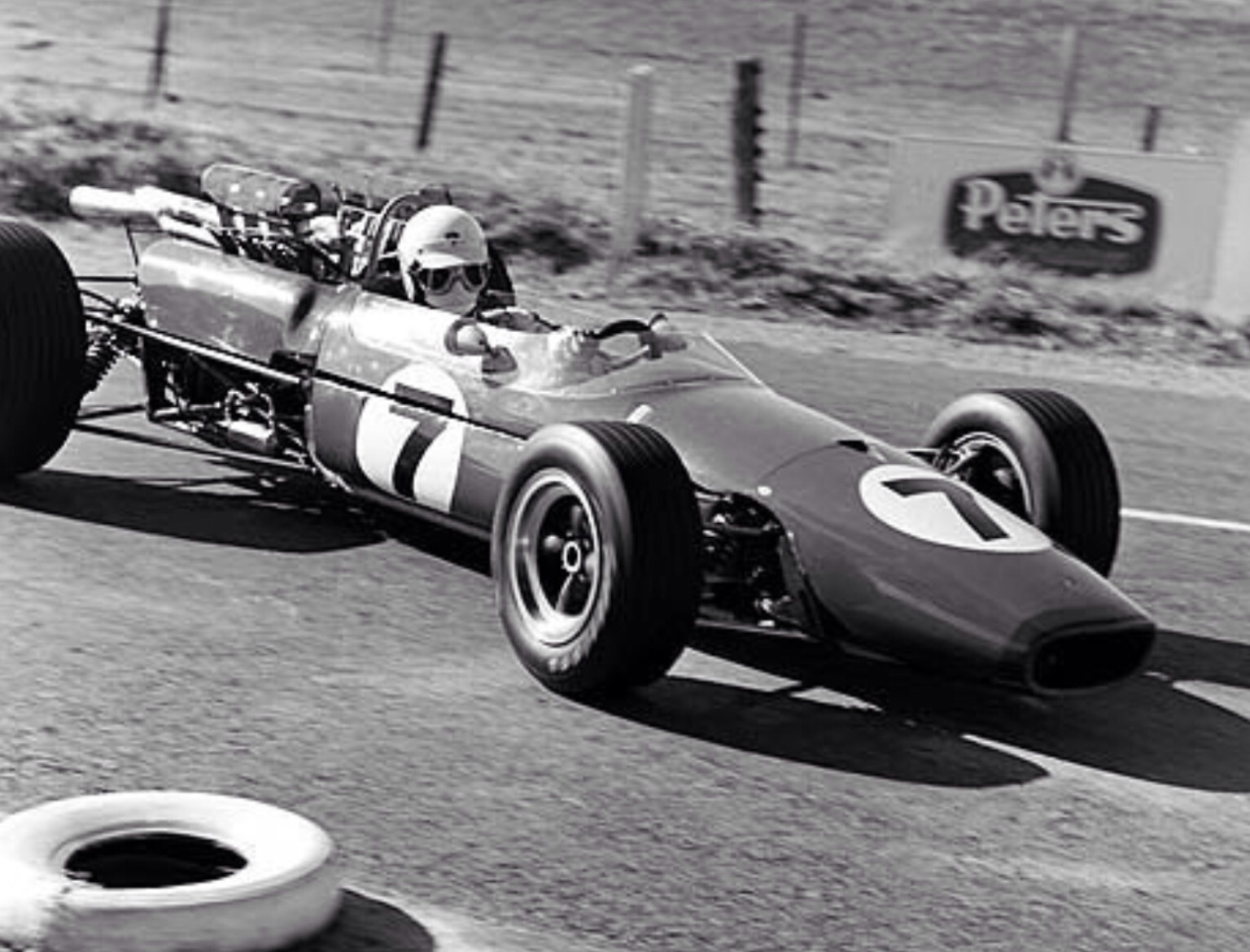
Leo Geoghegan, Lotus 39 Repco 740. Leo frightened the internationals in his ‘old bus’ more than once that summer- Clark’s ’66 Tasman mount Coventry Climax FPF engined. Non starter on Monday tho (R MacKenzie)


Chris Amon, Ferrari 246T. Chris learned a lot from his ’68 tour, and applied those learnings well in 1969 winning the title in an updated, four valve, winged  Dino (oldracephotos


Pedro Rodriguez, BRM P126. The V12 engine in this car failed during the race so Pedro raced the ‘backup’ P261 V8 in the championship event- cars which had become wonderful Tasman machines from 1966-8. Winner in ’66 in Stewart’s hands (oldracephotos/Keep)


Graham Hill, Lotus 49 Ford DFW. Perhaps not the best of Tasmans- 2nd at Surfers and Warwick Farm his best results (R MacKenzie)


Pedro Rodriguez, BRM P261 V8 during practice (oldracephotos/Keep)


Pedro Rodriguez, BRM P126, The Viaduct (oldracephotos/Keep)


Richard Attwood, BRM P126. Drove the Oz rounds in the car vacated by McLaren- 4th at Longford deserved, DNF’s @ Surfers and Sandown, overall the P126’s were not blessed with great reliability in the ’68 Tasman (R MacKenzie)

Photo and Other Credits…

Roderick MacKenzie Collection;  http://www.racephotoaustralia.com/

oldracephotos.com;  http://www.oldracephotos.com/content/home/

The Nostalgia Forum/Ellis French/Rod MacKenzie and Kevin Bartlett.  Sergent.com race report. Geoff Smedley. ‘Canberra Times’ 6 March 1968

Ellis French Collection/Archive

Scuderia Veloce Ferrari P4/Can Am 350…

Ferrari P4/Can Am 350 #0858…

Tailpiece: Practice- Rodriguez BRM P261 from Courage McLaren M4A Ford FVA and Kevin Bartlett Brabham BT11A Climax FPF. Variety is the spice, braking into The Viaduct…

(oldracephotos/DKeep)

Finito…

pete
(D Simpson)

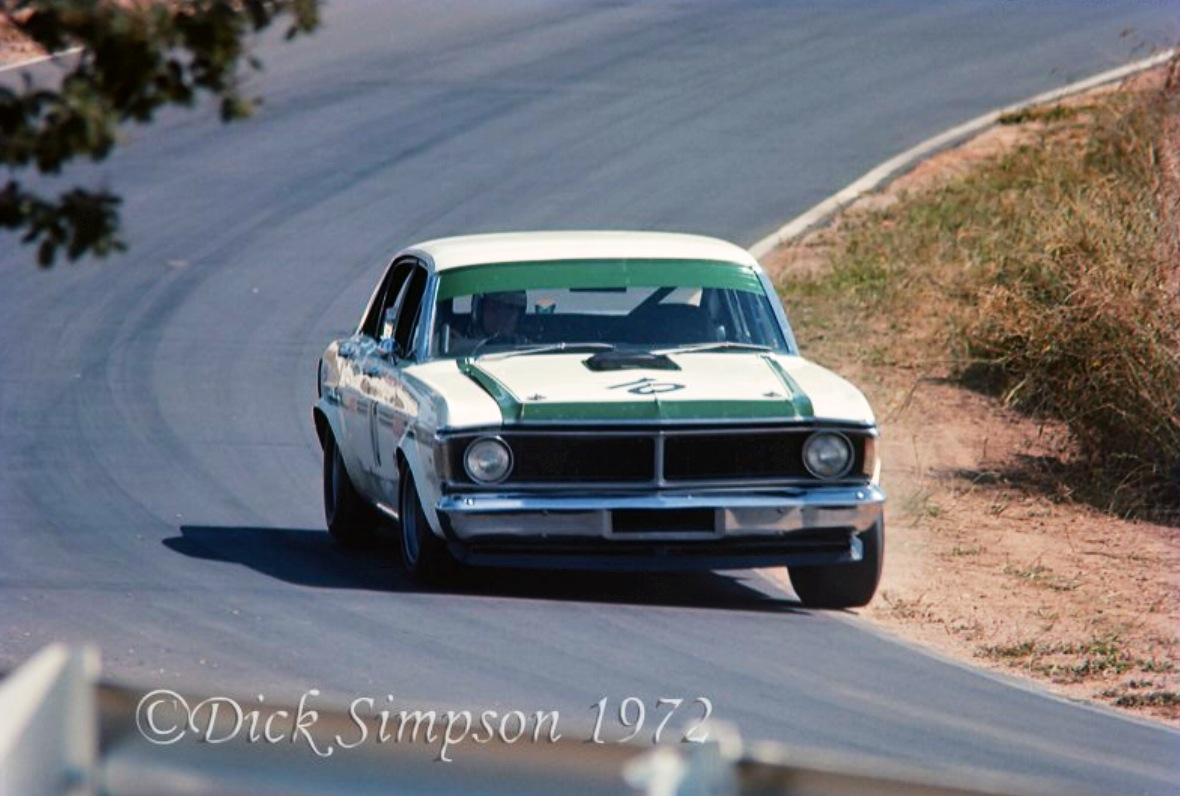
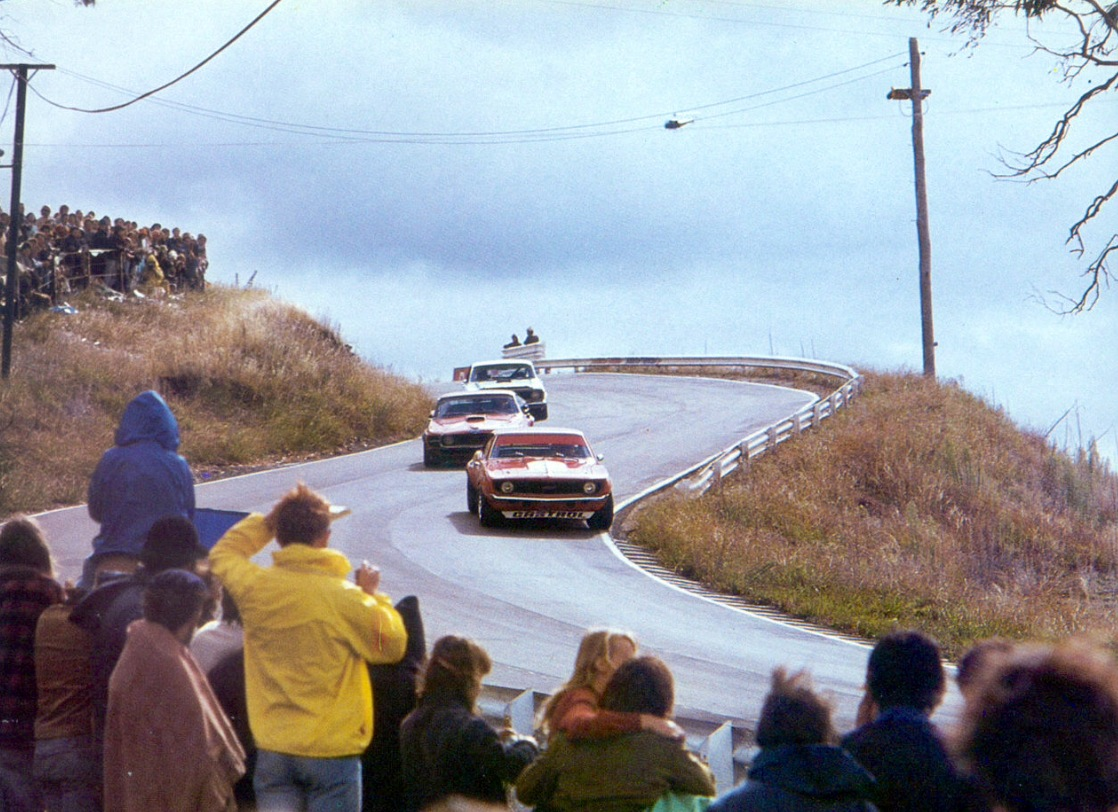
Pete Geoghegan blasts his Ford ‘Super Falcon’ GTHO across the top of Mount Panorama with the millimetre precision and finesse for which he was famous, harnessing all 600 plus horses of his demanding 351cid steed on this oh-so-demanding and unforgiving of road circuits…

The 1972 Australian Touring Car Championship was one of the greatest contests ever, the Bathurst round one of the best races in a series full of close events in its 60 year history.

The late, respected motoring journalist Mike Kable wrote ‘The third round at Bathurst’s Mount Panorama on Easter Monday won by five times former champion Ian Geoghegan by six tenths of a second from Allan Moffat was the finest touring car race I have seen in 25 years of watching Australian motor racing which started as a small boy when I lived just a few more paddocks away from the famous old mountain circuit’.

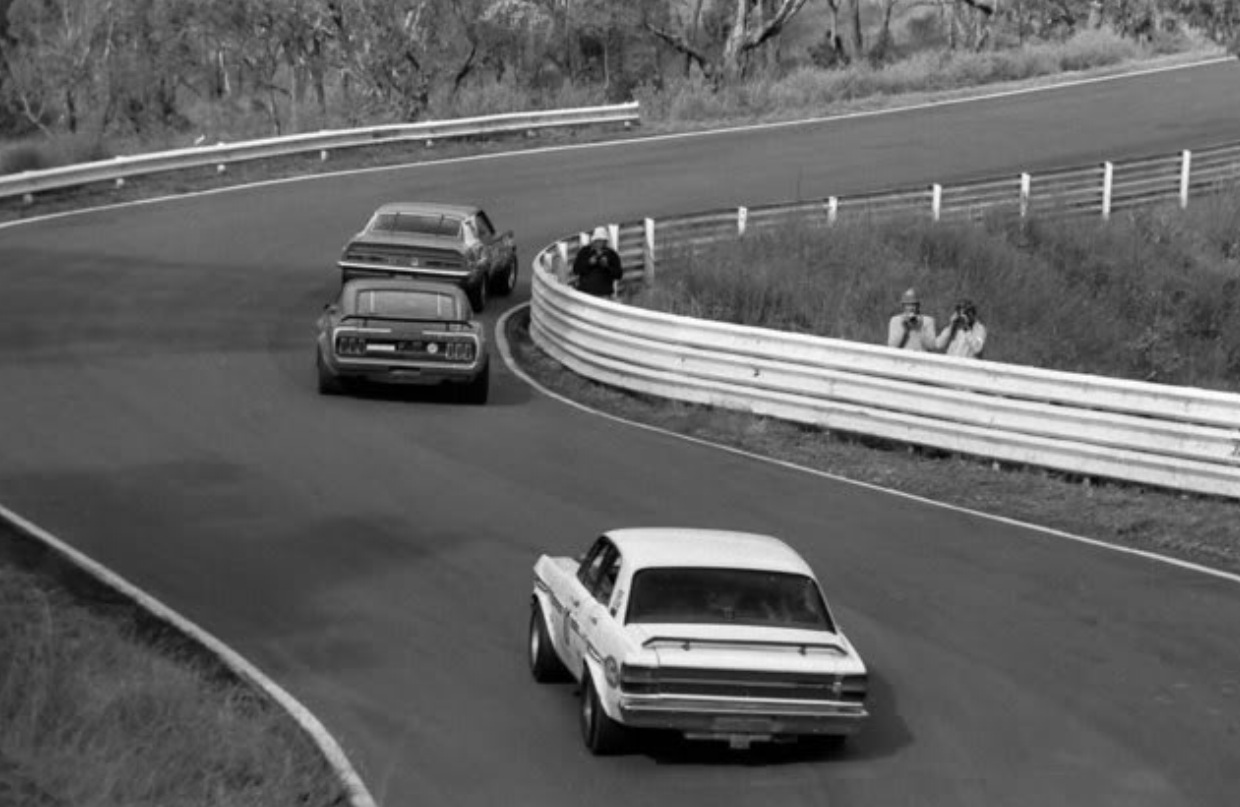
‘It was an absolute spellbinder, the sort of race you dream about with Geoghegan in his Falcon and Moffat in his Mustang fighting a slipstreaming and braking duel right around the spectacular track and tearing side by side down the 1 1/2 mile long Conrod Straight at more than 160mph and becoming airborne over the humps’.

The race ended in controversy as Pete’s Super Falcon was losing oil from its catch-tank, Moffat copping so much Castrol on his windscreen he dropped back for a bit to try and clear it with his wipers. Towards the end of the race he undid his shoulder harness to see out the drivers window, during all this he took seven seconds from from Geoghegan’s previous record set in his evergreen Mustang.

Moffat protested, after 90 minutes of deliberation the steward determined that the results stood on the basis that it could not be confirmed that the oil spill cost Moffat the race. Further, Moffat’s speed late in the race didn’t tend to support the Canadians argument!

In fact Moffat lost the championship after intense competition and biffo at a number of meetings resulted in Bob Jane, his Melbourne arch rival, protesting being shoved aside by Moffat during the Warwick Farm round of the championship.

Sadly, the protest was heard on the virtual eve of the title decider at Oran Park, Moffat’s exclusion from the results at Warwick Farm gave the series win to Jane, the plucky, tough entrepreneur took the title again in the Chev Camaro in which he won in 1971. The car was powered by a cast iron 350cid engine in ’72 rather than the ZL-1 427cid Can-Am aluminium block Chev used in 1971.

031 Bob Jane
Bob Janes Chev Camaro ZL-1, 350cid cast iron powered in 1972, thru Hell Corner during the ATCC race, Easter 1972. BJ Racing’s cars always superbly prepared and presented (D Simpson)

What made the late 1960s-1970s ATCCs magic and still spoken about in reverential terms by those who were there were cars such as Jane’s…

Moffat’s Mustang was a factory Trans-Am racer, he first ran it in 1969, despite many race wins, he never took the ATCC. He achieved that for the first time in a Ford Falcon GTHO Phase 3 Group C car when the regs changed from 1973. In Mike Kable’s view at the time ‘There’s not much doubt about who is Australia’s finest all round tin-top driver. If he proved it once he proved it a dozen times in both his venerable Trans-Am Mustang and works Phase 3 Falcon GTHO’.

In 1972 Moffat tried both the 351cid V8 (at Calder he raced it and at Surfers used it in qualifying) and Boss 302 engines but the Cleveland 351 engine was never reliable and much heavier than the ‘small-block’ Boss which buggered the cars balance. It was with the 302 fitted that he gave Geoghegan so much curry at Bathurst, Pete’s factory built Super Falcon, Moffat was built one as well of course in 1970, 351 equipped and seldom reliable.

Norm Beechey was back for one final crack at the championship in the gorgeous Holden Monaro HG 350 V8 in which he won in 1970 and had been continually developed by Norm and Claude Morton in their Brunswick, Melbourne base.

norm
Norm Beechey, two wheels off the deck, Murrays Corner, Bathurst 1970. He won the title, and the Bathurst round that year in this fabulous, injected 350 Chev V8 engined Holden (unattributed)
kingswood
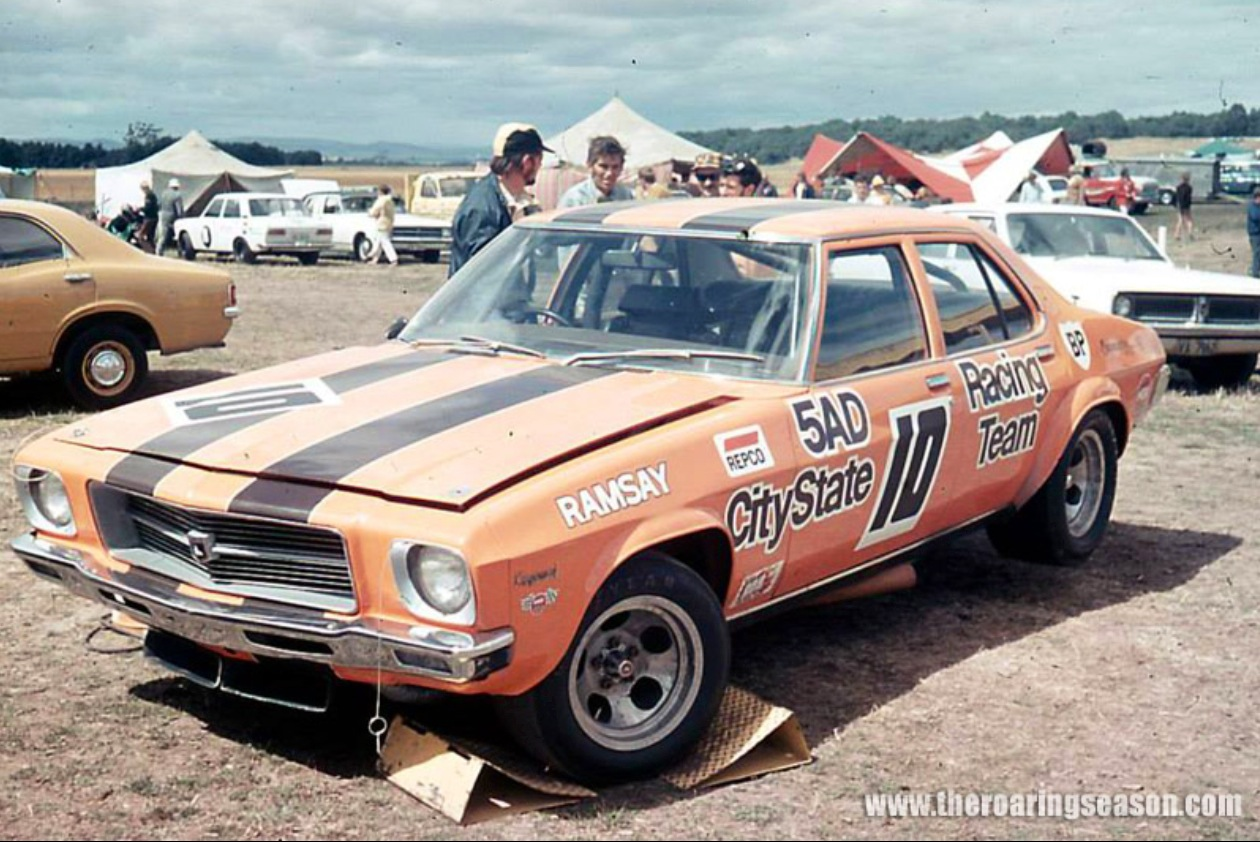
Malcolm Ramsay’s Holden Kingswood Repco V8, 1972, not sure which paddock this is. 1971/3 HQ Holden Kingswood a great contemporary bit of sedan styling, i saw this car at its race debut at the ’72 Sandown Tasman meeting. Look, sound and speed impressive! (Perry Drury/The Roaring Season)

Later Birrana co-proprietor and single seater driver Malcolm Ramsay ran an HQ Holden Kingswood powered by a Repco Holden F5000 engine, the big orange, ROH ‘Dragmag’ wheeled thing looked and sounded sensational.

The ‘Kingsy bristled with the clever engineering ideas of Ramsay and Tony Alcock, the Birrana designer: fabricated front wishbone suspension, carefully evolved rear suspension with better location of the standard live axle/coil spring setup, removable front guards to ease access to the injected Repco lump and much more. It deserved another season of development but unlike many of the cars pictured in this article which became Sports Sedans after the Australian Touring Car Championship rules changed from 1973, the Kingswood was dismantled and components sold as the Birrana boys focusssed on their main game, which was building winning ANF2 and F3 cars, a story for another time.

Big Pete’s Super Falcon was fully rebuilt by Bowin’s John Joyce after the Adelaide International round of the championship. The openwheeler specialist rebuilt it around a new shell, both lightening it and giving it the rigidity lacking in the original. The front and rear suspension geometry was modified. Note that some reports say the car was re-shelled, but the Bowin drawings don’t suggest this. In addition, Geoghegan claimed 608bhp for the engine by seasons end. For those interested in the work Joyce and his team performed, click on this link; http://www.bowincars.org/mediawiki-1.6.12/index.php?title=Car_Drawings#Bowin_P7

stillwell
Mike Stillwell, son of former multiple Australian Gold Star Champion Bib Stillwell at Bathurst in his Ford Escort BDA (D Simpson)

Apart from the front runners there were other cars to salivate over. Mike Stillwell’s Ford Escort BDA was a jewel of a thing, at one stage class wins made it a possibility that he would win the title. Clive Green’s ex-Geoghegan Mustang was great to look at and well driven by the Balwyn, Melbourne car dealer when he appeared.

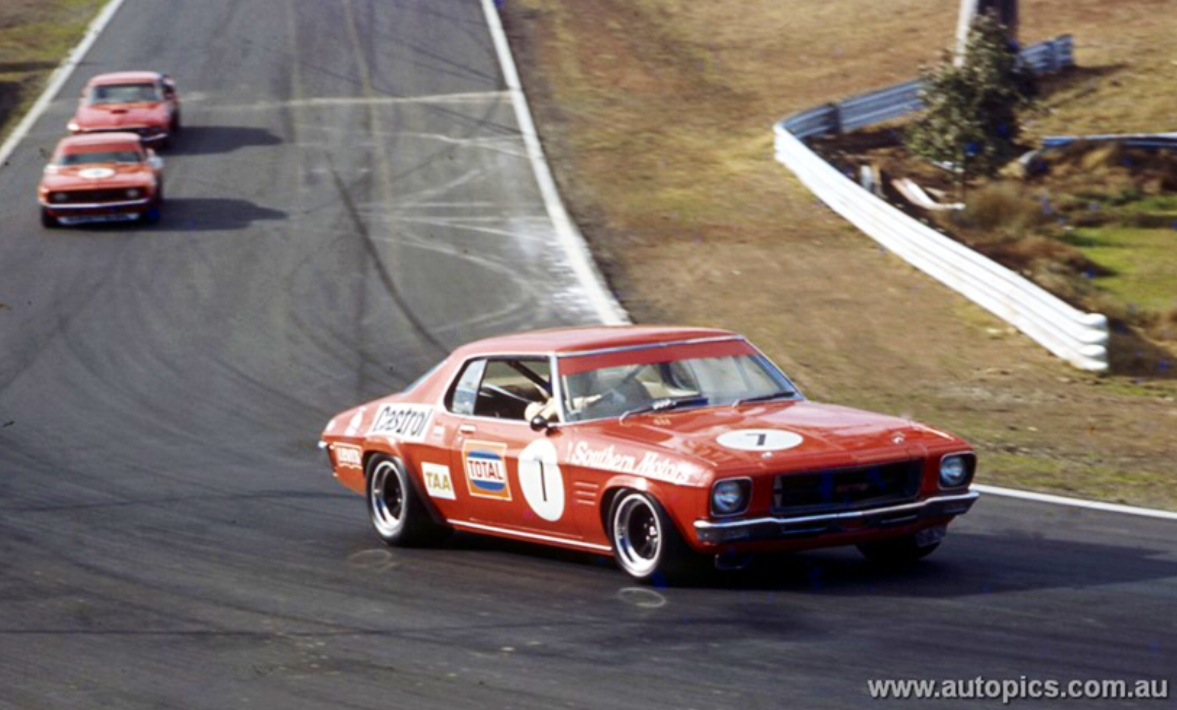
Towards the end of the season Bob Jane’s John Sheppard built Holden Monaro HQ Chev 350 V8 appeared, John Harvey drove it in the final ATCC round at Oran Park, like all of Sheppo’s cars it looked too good to race and had the performance to match.

Harvey was second on the grid and ran in second until brake dramas slowed him. This car had a very long, successful life as a Sports Sedan after it’s short one as an Improved Tourer ATCC contender.

harvey
John Harvey makes the series debut for Bob Jane’s Holden Monaro HQ 350 Chev, here ahead of the always scrapping Jane and Moffat. Oran Park ATCC round 1972 (autopics.com)
grid
Front 2 rows of the grid before this great Bathurst ’72 ATCC race; Moffat on pole, Mustang TransAm from Geoghegan, Ford Falcon GTHO, then Jane’s partially obscured Camaro and Norm Beechey’s yellow Holden Monaro HG350 (Bob Jane Racing Heritage)

Back to That Race at Bathurst…

From pole, Moffat, three seconds faster than Pete in practice, was slow away, Bob Jane was first to the top of the mountain from the second row, he held the lead until passed by Moffat on the first run down Conrod, losing a further place to Pete as the cars went up Mountain Straight the second time.

The crowd roared as Sydney’s ‘Goody Pete’ chased Melbourne ‘Baddy Moffat’, the Falcon passed the TransAm on lap 4, the torque of the 351 carrying the Falcon past the Mustang up the mountain, only to lose the lead on Conrod.

Pete from Bob- off row 2, then Moffat and Beechey towards Hell Corner for the first time (oldracephotos.com)
ray
First lap drop into The Dipper, Ray Bell’s shot captures both the cars and excitement of the crowd atop the mountain. Jane from Moffat and Geoghegan (R Bell)

And ‘So it went on for lap after lap, the two cars passing and re passing each other, circulating at record speeds and literally running nose to tail in their gladiatorial battle. The last lap was almost unbearably exciting and Geoghegan scrambled across the finish line a bare cars length ahead of Moffat after a frantic side by side dash along the whole of Conrod Straight’.

lap 1
From the rear down thru The Dipper for the first time its Jane from Moffat and Geoghegan but Moffat blasts the 302 Boss Mustang past Janes 350 Chev on Conrod, piston failure for Bob not far away (L Hemer)
pete and al
Geoghegan ahead of Moffat…(L Hemer)

Dick Simpson, the photographer of most of this articles shots recalls the closing laps ‘I was standing on the corner post of what was the Australian Racing Drivers Club (Bathurst promoting club) members/competitors camping area, these days its the middle of pit exit lane’.

‘Pete suckered him through the race by braking earlier and earlier at the end of Conrod Straight as the race went on as if the big Falcon had brake problems. I think Marvin was happy that he could get him whenever he wanted, but on the last lap Pete stayed over on the right (on the outside of the track) leaving the gap for the dive under brakes but he didn’t brake! I think he went way deeper than even Moffatt had been going. I don’t know if he was saving the brakes for the last lap or just setting Moff up’.

‘I do know that when he went past me he had a massive grin and tapped the side of his head!’

pete
Geoghegan in the view of some Australia’s greatest ever Touring Car driver (D Simpson)
gibson
Ford factory driver Fred Gibson was 4th in his own, as against his factory, GTHO Phase 3 Series Production car, just ahead of John Goss’ similar car (D Simpson)

John Goss and Fred Gibson were third and fourth in their Series Production (less modified) Falcon GTHO Phase 3’s after a race long duel with Doug Chivas’ Series Prod Valiant Charger RT and Stillwell’s 2-litre Escort. Jane was forced out with piston failure and Beechey with a shagged gearbox, always a weak link in these big, powerful cars.

1972, a season to remember, and wow, to have been there at Easter Bathurst to see ‘Marvin The Marvel’ and ‘Big Pete’ woulda been really something!…

moffat 2
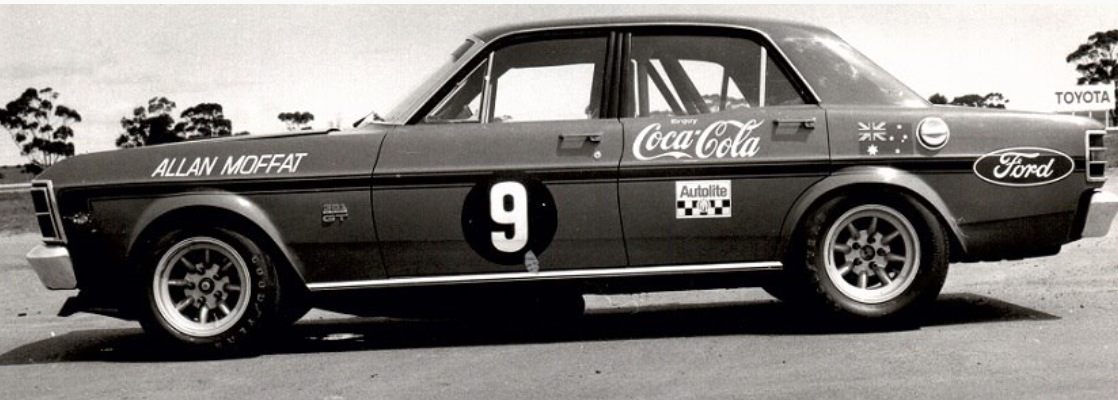
Alan Moffats ‘Super Falcon’ Ford Falcon XW GTHO Phase 2. Calder 1970 (Bob Jane Collection)

The Ford Australia 1970-71 GTHO ‘Super Falcons’…

Ford were pretty much on top of the global motorsport world in the late sixties; their Cosworth DFV 3 litre V8 was at the start of building its reputation as the most successful GP engine ever, they won Le Mans with the venerable Mk1 GT40 in 1968 and 1969 (in fact from ’66 to ’69 in Mk1, 2B and Mk4 GT40’s), their DOHC Indy Ford V8 was still winning its share.

The Escort was at the start of a run which made it one of Rallying’s greatest, in TransAm the Mustang was a winner and in Australia local ‘Pony Cars’ powered by a succession of V8’s progessively increasing in capacity were winning many of the very popular Series Production events for essentially Showroom Stock cars.

‘Win on Sunday, Sell on Monday’ was the adage, the advertising tagline of the day was ‘Going Ford Is The Going Thing’!

So, wins at Bathurst and in the Australian Touring Car Championship were important in the local sales race. All Big Three subsidiaries of the American automotive transnationals (Ford, GM-Holden, Chrysler-Valiant) were manufacturing cars locally and up to their armpits in racing whatever company policy said!

Whilst Ford had a winning presence in the local ATCC, the Mustangs of Moffat, Geoghegan and others were not cars sold locally and therefore the promotional value of said wins was limited.

Norm Beecehey ran competitively with two Holden Monaros winning the title in his fabulous yellow HG Monaro 350 in 1970. Holden were getting a benefit Ford wanted, that is winning in cars the public could buy road variants of. All they needed to do was build the right car.

donk
Injected Ford Cleveland 5.7-litre/351 cid, OHV, fuel injected, circa 600bhp V8 in one of the factory Super Falcons (I Smith)
Al Turner and David McKay circa 1970 (I Smith)

Popular American ‘Big Al’ Turner was El Presidente of Ford Australia at the time and a racing enthusiast. He decided to build two Super Falcons, modified versions of the then current 1969-70 Ford Falcon GTHO Phase 2, a four door sedan powered by a Windsor/Cleveland 351 cid or 5.7-litre, four barrel Holley carbed engine.

These Falcon GTHOs were successful Series Production racers already taking outright Bathurst 500 wins in Moffat’s hands in 1970-71.

The cars were built at Fords race workshop, Lot 6 Mahoneys Road, not far from the Ford factory at Broadmeadows, an outer Northern Melbourne suburb.

Howard Marsden managed the team, the cars were built by John Whynne, the engines by Ian Stockings and Bill Santuccione. Cars were built for Geoghegan and Moffat, the shells were extensively lightened, although the regulations did require the cars to be fully trimmed. The engines were highly modified including fitment of fuel injection.

falcon 2
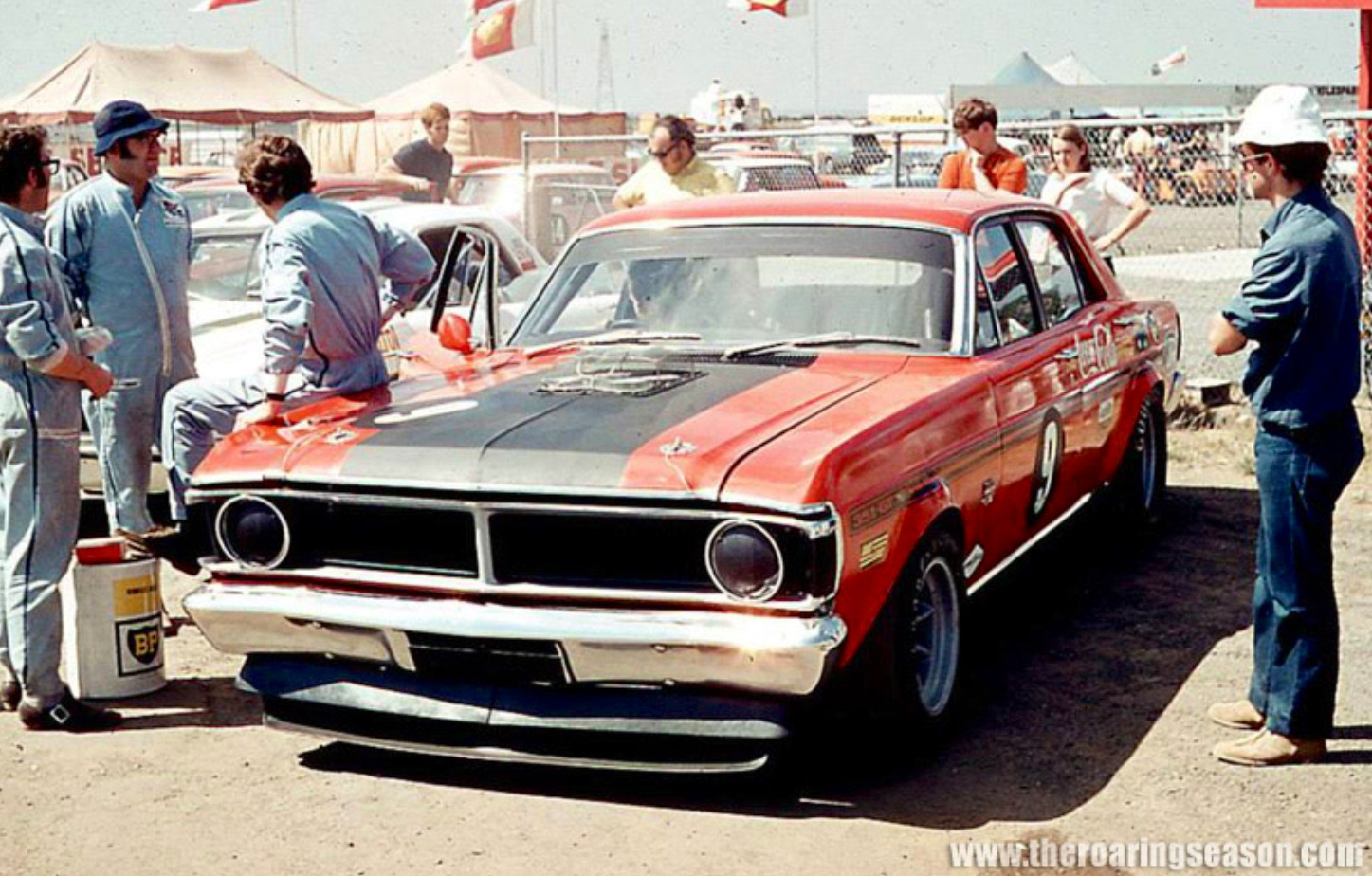
Moffat’s Super Falcon at Calder, March 1971 ATCC round. Flared guards to cover the big Minilites, additional lip below the standard GTHO’s spoiler all clear. White car behind is Geoghegan’s Ford Mustang (Perry Drury Collection/The Roaring Season)

Moffat raced his Falcon at the final 1970 ATCC round at Symmons Plains, Tasmania, the car took pole before the engine blew. The cars reappeared in 1971 trimmed as XY models but the problems continued.

Steve Holmes summarised the 1970-71 racing of the two Super Falcons in a The Roaring Season article he wrote’…the Moffat Super Falcon started out as an XW and made its one and only appearance in XW guise at the final round of the 1970 Australian Touring Car Championship,(at Symmons Plains, Tasmania) where Moffat drove it briefly in practice before the motor expired. It was, however, very fast in a straight line!’

‘For 1971, neither Super Falcon appeared at the opening round as development continued, but Moffat’s made an appearance at Calder Park, Victoria Round 2. Once again, this car suffered engine dramas in practice and Moffat opted to qualify and race his Mustang. Kevin Bartlett practiced the Mustang and was set to race it had Moff run the Falcon. Both Super Falcons were at Sandown, Victoria for Round 3, where both drivers also brought along their Mustangs. In the end, they both chose to race their Mustangs, after putting in faster times in practice’.

This shot and the one below are of Kevin Bartlett practising Moffat’s Trans-Am at Calder whilst Allan focused on the Falcon. It would have been very interesting to see KB race this car – I wonder what his impressions were? (D Simpson)
(D Simpson)

‘Again, at Surfers Paradise, both drivers raced their Mustangs. Indeed, Geoghegan didn’t even bother hauling the Falcon up to Queensland. Moffat was again faster in his Mustang. His Super Falcon, however, did race, in the hands of local John French, who fought race-long with Geoghegan’s Mustang for third, before eventually settling for fourth place. Moffat tested his Super Falcon at Mallala, but instead raced the Mustang, while again Geoghegan only brought his Mustang. At Lakeside, Queensland both Super Falcons appeared, but again, both drivers decided to race their Mustangs, which were faster. Once again, John French was drafted in, this time to race the Geoghegan Falcon, and finished fifth.

‘Neither Super Falcon went to the final race at Oran Park, NSW as both Moffat and Geoghegan were in the hunt to win the championship in their Mustangs.’

moffat
Moffat in his Super Falcon, ATCC Calder round 21 March 1971. Aussie fans will pick the XY trim lights and striping as against the XW trim spec the car was built with; mechanically identical of course. Moffat practiced the Falcon but raced his Mustang which DNF. Beechey’s Monaro won the round (R Davies)

In 1971 Pete’s Mustang was already past its useby date, his talents kept it in front longer than it deserved so he stuck with the Falcon as a Mustang replacement whereas Moffat, a professional racing driver, (Pete had a share in the families Sydney car dealership as well as his racing income) stuck with his ’69 Boss Trans-Am which was still very competitive, its long life extended into 1975.

What both cars needed was a concentrated period of development by the factory with the full support of the drivers. Moffat’s Mustang was his, he raced to win, to live, he could win more money with the Mustang so his decision was an easy one. Ford provided some support for the Mustang, but his paid Ford drive was for the Series Production events in the HO’s. It kinda makes you wonder why Ford didn’t get someone like Fred Gibson to do development work on the Super Falcons, he was well equipped for the role, a factory driver and didn’t have the distraction of the ATCC campaign which was critical to both Moffat and Geoghegan.

The Falcons were never were going to succeed with the drivers juggling two cars, Super Falcons and Mustangs as both Allan and Pete did at several meetings.

Moffat’s Falcon was eventually scrapped, although the 351 engine he flirted with in the Mustang was the injected engine from the car. Unwanted bits went to Pete for his car, the body of Moffat’s was believed dumped.

Geoghegan’s car has been superbly restored and is part of the Bowden family collection. Click here for a link to a tremendous article on the Geoghegan car’s race history and its restoration by them;

http://www.bowdensown.com.au/collection/ian-pete-geoghegans-super-falcon

super falcon
Ford factory promotional shot of the Moffat ‘Super Falcon’ 1970 (FoMoCo)

Articles on competing cars…

Moffat’s Mustang Boss TransAm; http://www.bowdensown.com.au/collection/allan-moffats-1969-ta-mustang ,Beecheys Holden Monaro GTS 350; http://www.bowdensown.com.au/collection/norm-beecheys-ht-gts-monaro, Jane’s Chev Camaro ZL-1; http://www.tradeuniquecars.com.au/feature-cars/1109/bob-jane-camaro-zl-1-review/

Etcetera: Moffat and Geoghegan…

moff and geoghegan
Moffat ahead of Geoghegan at Bay Park, NZ , December 1972 (Terry Marshall/The Roaring Season)
moff lakeside
Moffat and Geoghegan, again in 1972, this time at Lakeside, Queensland. ‘Hungry’ corner (unattributed)

Tailpiece: The Pete Geoghegan the fans knew and loved…

pete
(Terry Marshall/The Roaring Season)

Pete at Bay Park in New Zealand, December 1972.

Bibliography…

Australian Motor Racing Annual 1973, article by Mike Kable on the 1972 ATCC, article by Steve Holmes in ‘The Roaring Season’ http://www.theroaringseason.com/showthread.php?1828-Photos-The-Perry-Drury-Collection, ‘Fast Thats Past’ TNF article by Ray Bell on the Ramsay Holden Kingswood Repco

Photo Credits…

Dick Simpson, autopics.com, Bob Jane Racing Heritage, lyntonh, Ian Smith, Ray Bell, Perry Drury Collection/Terry Marshall The Roaring Season, Robert Davies, FoMoCo

Finito…

oliver pan

Jackie Oliver’s Shadow DN6 Chev on its way to 2nd place, Road America, 27 July 1975. (Richard Dening Jr)

ollie 2

Exactly 12 months later Oliver goes one better in the Dodge engined DN6B, winning the Road America race on July 25 1976. (Richard Dening Jr)

Jackie Oliver takes an historic win in his Shadow DN6B Dodge at Road America on 25 July 1976…

Chev engines won every championship F5000 race in the US from Riverside on 25 April 1971 when Frank Matich took a Repco Holden win in his McLaren M10B through until Oliver’s long overdue Shadow victory, the Lola T332 Chevs of Al Unser and Vern Schuppan were second and third.

Whilst the Dodge was more powerful than a Chev it was also heavier making the packaging of the car and its big cast iron V8 a challenge for designer Tony Southgate.

The Lola T332 was their 1974 production F5000 but was continually developed, the subsequent Lola T400 and T430 not quicker cars, a good 332 was as quick as an F1 car on the common circuits upon which both categories raced in North America. ‘Twas a remarkably good, very fast racing car the Shadow was competing against driven by the likes of Brian Redman, Mario Andretti, Alan Jones, Al Unser and others…

shadow nude

Shadow DN6 Chev. Car based on Tony Southgate’s very quick DN5 1975 F1 contender. Aluminium monocoque chassis. Front suspension lower wishbone and top rocker actuating inboard mounted coil spring/damper. Rear single top link, lower twin parallel links, two radius rods and coil spring/dampers. Adjustable roll bars front and rear. 5 litre cast iron OHV Chev here, Dodge V8 from the Road Atlanta round in August 1975 , Hewlands TL200 gearbox, developed as an endurance racing tranny used rather than the F5000 standard, the ‘brittle’ DG300. Road America July 1975. (Richard Dening Jr)

dodge engine

5 litre cast iron, mechanical fuel injected, OHV Chev V8 engine developed circa 530bhp@7800rpm. Rocker covers removed here for Road America July 1975 prep, one rocker missing. Magneto, its yellow ignition leads and fuel metering unit all visible. (Richard Dening Jr)

The Shadow DN6 was based on Tony Southgate’s very competitive DN5 F1 design and was first raced in 1975 powered by the ubiquitous Chev V8. Oliver took 4th place in the championship won by Redman’s T332, the car raced well at both Watkins Glen and Road America.

Gordon Kirby in his 1975 season review in Automobile Year said; ‘Almost immediately the Shadow proved to be competitive and in the last part of the season (the last 4 races) it became even more of a threat when after a long development program the team switched to Dodge engines, based on the same powerplant used in NASCAR by Richard Petty’. (in 1975 the Grand National Stockers were compelled by a carburetion ruling to use 355 cubic inch or 5.8 litre engines). The Dodge developed some 30 bhp more than the Chevys’ but was much heavier. The Shadows were not completely tuned and set up and did not win a single race. The whole of the 9 races were taken by the Lola Chevrolets.’

jpj

Jean-Pierre Jarier lines up on the Watkins Glen grid with Brian Redman 13 July 1975. Shadow DN6 Chev and Lola T332 Chev. JPJ DNF with a broken oil line, Brian was 1st, Oliver in the other Shadow also DNF with a blown Chevy. (Gary Gudinkas)

F1 drivers Jean Pierre Jarier, Tom Pryce and Jody Scheckter each raced a second car in three rounds at Watkins Glen, Long Beach and Riverside respectively.

All three qualified in the top 5 but retired with mechanical maladies.

shadow mechanic

Business end of the Shadow DN6 Chev. Engine magneto and fuel metering unit, Hewland TL200 gearbox to which the wing is mounted, neat duct for inboard disc and additional oil cooler all visible. Road America July 1975. (Richard Dening Jr)

1976 Season…

The following Shadow press release written by Rob Buller prior to the Mosport round, the second of the 1976 season, reproduced on the My Formula 5000 website outlines changes to the car and program over the 1975/6Winter.

Development work on the DN6 5000 car has continued over the winter under the direction of Chief Mechanic Ed Stone and Engine builder Lee Muir.

Stone joined the 5000 effort late in 1975 and immediately set about making chassis and suspension changes.’Basically the 1975 season progressed with little development, there wasn’t much time.’ Stone said in a recent telephone interview, ‘I was asked to make some suspension changes and the car was more competitive at the last 1975 race at Riverside with Jody Scheckter driving.

ollie 3

Oliver in the Road America pitlane, July 1976. Shadow DN6B Dodge. (Richard Dening Jr)

‘But the heart of the Shadow development is the new Chrysler power-plant, a joint venture between Shadow and Chrysler’s Plymouth Division. The engine starts life as a 340 cu. in. stock block that is down-stroked to 305 cu. inches. It is fitted with the same injection system that is used on Richard Petty’s NASCAR Dodge.

Chrysler, which is heavily involved in NASCAR and Drag Racing, is new to F5000 racing, a class that has been dominated by the rugged Chevrolet 5 litre engine. As a part of their new kit-car package now under development, Chrysler has contracted with Shadow to do the engine development and sorting.

They supply the engine components to Shadow engine expert Lee Muir, who then hand builds and dyno tests each engine. Chrysler also helps with technical information and advice to Muir, who came to Shadow from McLaren’s engine department.

dodge

Race debut of the Dodge engined Shadow DN6 chassis ‘2A’ at Road Atlanta 31 August 1975. Oliver 4 th, race won by Al Unser’s Lola T332 Chev. Specs; Dodge 340cid V8 taken back to 305cid by reducing the engines stroke. 5 litre cast iron, OHV, mechanical fuel injected V8. Bore/stroke 4.04 inches/2.96 inches, power circa 550bhp@7800rpm. Hewland TL200 ‘box. (unattributed)

‘The first outing in 1976 for the Shadow Dodge DN6 was at Pocono, Pennsylvania for the Series opener. Although they weren’t quite ready for the Pocono race, they were very encouraged with the results. Oliver was lying third in his qualifying heat when a connecting rod developed terminal stretch. As they only had one dyno’d engine a spare practice unit was installed for the feature. However, a fuel pump seal split on the grid and  it took 5 laps to change. By the time he joined the fray Oliver was hopelessly behind but by charging hard he was able to run with the leaders.

With that encouraging performance Stone and Muir returned to Phoenix Racing headquarters in Chicago and started preparation of the Shadow for the Mosport race. Further chassis mods have been made utilizing new springs, roll bars and revised suspension settings. To help weight distribution, the water rads have been moved forward a la McLaren Indy car. Muir will have three completely dyno’d engines ready for Mosport’.

don

‘Sponsorship for the F5000 effort is a problem for Shadow. Since the departure of UOP, Nichols has been unable to get the full 5000 program underwritten. Various sponsors are now supporting the Formula One effort on a per race basis while only Goodyear, Valvoline and, of course, Chrysler are behind the 5000 effort. Thus Shadow must watch their budget closely and this, the team feels, will restrict the amount of development they can attempt. Nonetheless the 5000 effort has Don Nichols full support and he won’t field cars unless he can be competitive. And with the driver, new engine and chassis changes he plans to be competitive’.

Oliver lead at Mosport but was held up by a backmarker, Alan Jones snaffling the win, inevitably in a Lola T332 Chev.

Three weeks later he lead at Watkins Glen but a cracked sump ended his race, the Shadow finally won at Road America, Elkhart lake, Wisconsin. It was a good win as Ollie had to overcome diff and flat tyre problems in his heat which meant he started 14th on the grid of the final.

ollie 1

Oliver on the way to victory, Road America July 1976. Shadow DN6B Dodge. Behind is Al Unser’s 2nd placed Lola T332 Chev. (Richard Dening Jr)

After 16 laps he was 3rd, within 3 laps he was past the Lolas of Al Unser and Brian Redman and took a strong win for the team.

ollie mid ohio

Oliver took 2nd place at Mid Ohio on 8 August 1976, Shadow DN6B Dodge. 1976 champ Brian Redman won in a Lola T332C Chev. (Richard Dening Jr)

Two second places at Mid Ohio and Watkins Glen secured third place in the championship again won by Redman’s Haas/Hall Lola T332.

With the demise of F5000 in the US at the end of 1976 and its evolution into 5 litre central seat Can Am from 1977 the Shadow’s raced on into 1977 and 1978 but without success, Lola’s T332/T333 the dominant cars in the early years of the class.

oliver and helmet

Jack Oliver ready to go Road America 1975. CanAm Champ for Shadow in 1974. (Richard Dening Jr)

road am vista

Road America pitlane on a beautiful July 1975, Wisconsin day. Redmans Lola T332 at front. (Richard Dening Jr)

Etcetera…

comparo

Comparison of the specs of the F1 Shadow DN5/7 and F5000 DN6 from the 1975 Long Beach GP race program. (Fred Bernius)

Tailpiece…

popsie

Jackie Oliver Fan Club President? Road America July 1975. (Richard Dening Jr)

Photo and other Credits…Richard Dening Jr, Gary Gudinkas, Fred Bernius, My Formula 5000 website,   http://www.myf5000.com/index.html, Peter Brennan and Glenn Snyder for research assistance

Other F5000 Articles…

Elfin MR8 Chev & James Hunt.

James Hunt: ‘Rose City 10000’, Winton Raceway, Australia,1978: Elfin MR8 Chev…

Frank Matich and his F5000 cars.

Frank Matich: Matich F5000 Cars etcetera…

Finito…

monaco 1958

Quite a stunning 1960 Monaco vista…

I was trawling the internet, as I do, looking for photos which inspire the articles I write, one of the reasons why this blog is so nuttily diverse is to do with that approach.

I found this shot, unattributed as most of them are, but identified as ‘Monaco 1966’ which it most definitely is not!

Its one of those the more you look, the more you see shots; the steam train, four nurses sitting together, the working port, none of your fancy-schmancy big yachts of today and of course the car itself!

That’s the tricky bit. It’s not sharp in focus but I thought it might, just might be, Luigi Musso’s #34 Ferrari Dino 246 in the 1958 race.

richie

GP debutant Richie Ginther on his way to fifth place in the Ferrari Dino 246P 0008′, Monaco 1960 (unattributed)

After I posted this shot, reader Grant Perkins did some research and confirmed the photo as Richie Ginther at Monaco in 1960 in the Ferrari Dino 246P…

Stirling Moss won the race in Rob Walker’s Lotus 18 Climax – Colin Chapman’s first championship win as a manufacturer – from Bruce McLaren’s Cooper T53 Climax and Phil Hill’s Ferrari Dino 246.

The shot is historically significant. Ginther made his GP debut that weekend and his mount, the Ferrari 246P, the Scuderia’s first mid-engined racing car, competed for the first time.

Monaco that year is also significant for the long awaited, but far too late appearance of Lance Reventlow’s Scarabs. These superbly engineered, but heavy, unwieldy front-engined cars entered GP racing just as Ferrari, the last team by then racing a front-engined car experimented with its mid-engined replacement. A tangent too far for this article, but see here; Better Late than Never… | primotipo….

scarab

Monaco 1960. #46 Chuck Daigh and #48 Lance Reventlow Scarabs. #34 Ginther’s Ferrari 246P (Dave Friedman Collection)

Ferrari built the 246P in secret. It was tested at Modena by Hill, Ginther and factory tester Martino Severi on 22 May. The design was perceived by its drivers to have too much weight at the rear causing excessive nose lift under acceleration.

Despite Stirling Moss’ Cooper win in the 1958 Argentine GP Grand Prix, and Jack Brabham’s Cooper win in the 1959 World Championship – firsts mid-engined cars – Carlo Chiti had to fight hard to build a mid-engined Ferrari prototype.

The Scuderia’s conservatism was proven time and again over the years. They were not often innovators or early adopters. Examples include the change from drum to disc brakes, wire wheels to alloys, carburettors to fuel injection, ladder frame to spaceframe chassis, spaceframe chassis to monocoques and so on.

Fortunately 246-0008 showed enough promise to race at Monaco on 29 May. By the end of the year the chassis had morphed from a prototype 2.5-litre F1 car into a 1960 1.5-litre F2 156. It then morphed into an an F1 156 with the GP rule change from 2.5 to 1.5-litre engines with effect 1 January 1961.

0008 became Giancarlo Baghetti’s race chassis for 1961, part of the amazing start to his F1 career. The Italian famously won his first three GPs; Syracuse, Naples and finally the French GP. In so doing Giancarlo became the only man to ever win his first championship GP.

So, 0008 won the first of many GPs the 156 design took in 1961 on the way to dual world titles; the drivers for Phil Hill, and manufacturers for Ferrari in 1961.

There wasn’t a happy ending for the chassis though. Giancarlo spun out of the wet British GP at Aintree a week after his Reims win doing enough damage to 0008 that it was scrapped. Mind you, Ferrari famously destroyed all of the 156s at the end of 1962 when the cars were as uncompetitive as they had been fast the year before.

From mid-engined 2.5-litre F1 prototype at Monaco on May 6 1960 to 1.5-litre F1 winner at Syracusa on 25 April 1961, 0008’s story is a short but historically significant, interesting one.

ginther

Enzo Ferrari and the Ferrari 246P designer, Carlo Chiti, watch Martino Severi testing their first mid-engined car 246-0008 at Modena May 1960 (unattributed)

modena

Phil Hill testing the Ferrari 246P at Modena 1960, the suburb oh-so-close to the circuit! Compare the body of 0008 here with its Italian GP spec the same year (unattributed)

1960 Monaco Grand Prix…

Ginther qualified the new car ninth, between the front engined Dinos of Von Trips eighth, and Phil Hill 10th. In the race Hill was third, Richie sixth with Von Trips eighth but not running at the finish.

ginther monaco

29 year old Richie Ginther makes his GP debut at Monaco 1960. Ferrari 246P (Dave Friedman Collection)

monaco

Ginther’s new prototype mid-engined Ferrari Dino 246P-0008 #34 beside the conventional front-engined, third placed Dino 246 of Phil Hill at Monaco in 1960. The difference in size is not that great at this stage. Some sources say Ferrari acquired a Cooper to understand that car’s packaging and suspension geometry tricks (unattributed)

fazz zand

Ferrari 246P in the Zandvoort pitlane 1960 (unattributed)

The team then took the 246P to Zandvoort for the following Dutch GP, however, the engine, which had not been rebuilt was burning and blowing so much oil that it was unraced.

Ginther therefore ran a conventional front-engined Dino as did his teammates. They were comprehensively blown off by large numbers of Lotuses and Coopers. Ginther’s 12th was the quickest Ferrari qualifier, with Von Trips fifth, Ginther sixth, while Phil Hill retired with engine failure on lap 13.

The race was won by Jack Brabham’s Cooper T53 Climax on the way to his second title on the trot.

zandvoort

Cars being marshalled before the start of the Dutch GP on June 6, 1960. #3  Ginthers Ferrari Dino 246, #5 Alan Stacey, Lotus 18 Climax DNF, #12 Bruce McLaren Cooper T53 Climax DNF, #9 Tony Brooks’ Cooper T51 Climax DNF, #6 Jim Clark Lotus 18 Climax DNF (unattributed)

Ferrari Dino 246P technical specifications…

While 0008 car didn’t race at Zandvoort, photographer George Phillips took some rare shots of a Ferrari too little has been written about, the car practiced with the number 3T.

front

(George Phillips)

246P’s front suspension by upper and lower wishbones, coil spring/Koni dampers and roll bar. Dunlop disc brakes.

side

(George Phillips)

Chassis Tipo 543, of welded tubular steel was described as Cooper in style if not in the quality of the welding! Borrani wire wheels were 15-inches diameter, Dunlop tyres 5.25/6.5 inches wide front/rear. The wheelbase was 2300mm and track 1200mm front and rear. Fuel capacity 150-litres, while the car’s weight, wet was 452kg.

engine

(George Phillips)

Engine Tipo 171 was derived from the Tipo 134 65-degree, all alloy, DOHC, two valve V6. Bore/stroke 85 X 71mm, capacity 2,417cc. three Weber 42 DCN carburettors with twin plugs fired by Marelli magneto. Dry sumped, the unit developed a claimed 265bhp @ 8,300rpm.

rear sus

(George Phillips)

246-0008’s rear suspension comprised upper and lower wishbones, coil spring/Koni dampers and roll bar. The Tipo 543 transaxle had five speed and reverse and an LSD. Note also the clutch location at the back of the ‘box, you can just see the top of the inboard brake rotor beside the chassis member.

Development of the 246P and its evolution into the 156…

Ferrari decided to abandon further development of the 246P as a 2.5-litre GP car. They focused their attention on the front-engined Dinos for the balance of the season, and the future 1.5 Litre GP car for the new Formula 1.

The basis of the new 1.5-litre F1 engine was the Vittorio Jano designed 1.5-litre Dino V6 already used in Ferrari’s front engined F2 cars which first raced in 1957. Von Trips won the 1960 F2 season opening Syracuse GP in March aboard one of these cars ahead of two Coopers.

syracuse

Taffy von Trips Dino 156 winning the Syracuse GP, 19 March 1960. He won from the Cooper Climaxes of Trintignant and Gendebien (George Phillips)

Chiti progressively modified the engine, initially retaining the 65-degree angle but then changed it to 120 degrees.

The wide Vee angle has/had the benefit of a very low centre of gravity and rear bodywork which was as much a styling signature of the 1961 156 as its Sharknose. Definitive-spec 1961 156s raced with the 120 degree engine, but the 65 degree was also used; 0008 was always fitted with the 65-degree spec unit.

solitude

Taffy von Trips at Solitude in 0008 in 1960. The 246P/156 left front wheel is off the deck in a victorious run over the Porsches (unattributed)

The test bed for the new engine was the 246P 0008

After the car was fitted with a revised bodywork and 1.5-litre V6, it was tested at Modena and then entered at the Tenth Solitude F2 GP, Germany on 24 July. There, Taffy von Trips belted the Porsche 718/2s, a great F2 car, on their home ground, the aristocrat lead home Hans Hermann, Jo Bonnier, Graham Hill and Dan Gurney, all aboard factory Porsches.

Further testing and development of 0008 followed. With many of the British teams punting on the Intercontinental Formula for 1961, Ferrari were developing a formidable weapon for the new 1.5 F1, the implementation of which was confirmed, much to the Brits chagrin, as they wouldn’t have competititive engines until 1962.

At the Italian Grand Prix at Monza in September, Ferrari raced 0008 in what was getting close to the 156’s definitive 1961 specification.

0008 in 1.5 litre F2 form was raced by Taffy Von Trips to fifth place fitted with an auxiliary fuel tank among the 2.5-litre GP cars.

taffy front

At the Italian GP in September 1960 Ferrari ran Taffy von Trips in 246P/156 0008. Both this and the shot below show how much more svelte the car became compared its May Monaco spec. It was not as small as the best of the British cars mind you, but in 1961 the Brits were hamstrung by lack of suitable, competitive engines (Archie Smith)

Von Trips had the 1.5-litre F2 class to himself outrunning Hermann’s Porsche 718/2 by a full lap. Phil Hill won the race, it was the final GP victory for a front-engined car but it was somewhat of a hollow one.

The sneaky Italians decided race on the combined Monza road course and banking to maximise the chances of the old-tech Ferraris winning. Power was Ferrari’s only advantage over the four cylinder Coventry Climax FPF and BRM engined cars. The Brits then told the organisers to jam-it on safety grounds with most boycotting the event.

taffy rear

Von Trips 246P/156 0008 in the 1960 Monza paddock. Note how much different the rear bodywork is compared with its 246P Monaco spec (Archie Smith)

grid

Phil Hill’s winning Ferrari Dino 246/60 0007 #20 is pushed onto the 1960 Monza grid ahead of Von Trips’ Ferrari Dino 246P – or by then – 156 0008 (Archie Smith)

von trips

Von Trips ready for the off, Monza 1960, Ferrari Dino 156 (Archie Smith)

VI Gran Premio di Modena F2 1960…

0008’s final 1960 race was Ferrari’s home event at Modena on 2 October.

In the same way that Ferrari beat the Porsche’s at Solitude in July, so it was that Jo Bonnier’s Porsche beat Richie Ginther in the front-engined 156 from Taffy von Trips in the new 156 suffering from fading brakes.

Hans Hermann was fourth and Edgar Barth fifth, both also driving 718/2 Porsches.

bonnier

1960 Modena F2 GP. Jo Bonnier’s Porsche 718/2 leads #26 Ginther’s front engined Ferrari Dino 156 from Von Trips’ mid engined 246P/156 (unattributed)

trips

Von Trips Ferrari 246P/156 F2, #10 Edgar Barth Porsche 718/2, #28 Hans Hermann Porsche 718/2. Modena GP 1960 grid (unattributed)

trips 2

Taffy von Trips, Ferrari Dino 246P/156 0008 F2, Modena GP 1960 (unattributed)

carlo

The brilliant, portly Tuscan engineer and 246P/156 designer, Carlo Chiti explains to Von Trips how to get the best from his car. Italian GP, Monza 1960 (Archie Smith)

1961 Beckons…

All of this development work on the new-fangled mid-engined concept was very successful, the 156 was the dominant GP car of 1961.

It took the Constructors Championship for Ferrari and Drivers title for Phil Hill. Let’s not forget the role 246P/156 0008 and Chiti’s development skills and prodigious work output made in that remarkable transition from the back to the front of the grid in less than 12 months.

ferrari 156 cutaway

Cutaway drawing of the Ferrari 156 F2 car 0008 in 1960 trim. Spaceframe chassis, double wishbone and coil spring/damper suspension front and rear. Tipo 188 1.5-litre 65 degree, DOHC, two valve, dual triple -choked Weber carbed V6 giving circa 180bhp in 1960 spec. Five speed gearbox, Dunlop disc brakes (James Allington)

Etcetera…

front 2

(Archie Smith)

More detail, Von Trips Dino 246P/156 Monza 1960.

butt shot

(Archie Smith)

Ferrari Dino 246P/156 butt shot at Monza, Italian GP 1960. The fairing of the chassis by Fantuzzi’s gorgeous bodywork provided both visual splendour and aero advantage.

monza

(Archie Smith)

Willy Mairesse’ 2.5-litre GP Ferrari Dino 246 tows Von Trips’ 1.5-litre F2 156 to a good time in the little car, Monza banking, Italian GP 1960.

ferrari

(Archie Smith)

The boss at Monza sussing his new car and the opposition. Enzo Ferrari 1960. The car is Barth’s factory Porsche 718/2 F2.

Etcetera, first 246 test…

Here are a series of photos from Getty Archives of the first test day at Modena in May 1960.

Mr Ferrari is present as is Carlo Chiti, the driver in all of these shots is factory test driver Martino Severi. The car is unpainted, perhaps Ginther was not present on day one.

enzo 1

Ferrari, Severi, Chiti (Getty)

enzo 2

(Getty)

The 246SP lines are clear in this shot, in short front-engined styling on a mid-engined car! Ferrari with his back to the camera looks on with a tad more paternal interest than usual.

enzo 3

(Getty)

enzo 4

(Getty)

Fantuzzi’s hand formed aluminium panels of the prototype clear as are Borrani knock-ons and Dunlop disc brakes.

enzo 5

The boss looks on and contemplates this big change in the design of his cars, the Scuderia got the hang of it quickly enough! (Getty)

The boss looks on and contemplates the new design of his cars, certainly as big a change in direction as the famous marque ever made. They got the hang of it quickly enough too!

Check out this brief article i wrote about the Ferrari 156 a while back… https://primotipo.com/2014/12/21/ferrari-156-duet-ricardo-and-phil-spa-1962/

Also see this article on Giancarlo Baghetti which covers the 1961 record of both him and 156 0008 in 1961…https://primotipo.com/2015/05/08/giancarlo-baghetti-lotus-49-ford-italian-grand-prix-1967/

Some great Monaco 1960 Race Footage…

Photo Credits…

George Phillips, Dave Friedman Collection, Archie Smith, Getty Images

Bibliography…

F1 Technical, F2 Register, 8W.forix.com, James Allington cutaway drawing, barchetta.cc, ‘History of the GP Car 1965-85’ Doug Nye

Tailpiece…

train

(Dave Friedman Collection)

Let’s leave Monaco by train, just as we arrived…

Finito…
crowd

1967 was one of the most intensely interesting years of Sportscar Racing; the last year of the ‘unlimited cars’ saw the 4 litre Ferrari P4 and 7 litre Ford GT40 Mk4/2B’s and Chaparral 2F at it tooth and nail in a battle for dominance before new rules came into force rendering the cars obsolete at the stroke of the rule-makers pen…

I’ve written a couple of long articles about the Ferrari and Chaparral which also cover that seasons racing in some detail, click here to read them;

Chaparral 2F;  https://primotipo.com/2014/06/26/67-spa-1000km-chaparral-2f/

Ferrari P4;  https://primotipo.com/2015/04/02/ferrari-p4canam-350-0858/

coppers

This article is largely pictorial using as it’s base the phenomenal work of American Dave Friedman.

He was a still photographer on movie sets after serving in World War 2. His passion was motor racing though, he was soon engaged by Ford and others to document their racing history. The photos I have chosen are from an archive of nearly 900 of this race alone!

The race was famously won by Fords ‘All American Boys’ Dan Gurney and AJ Foyt, the latter adapting rather well to road racing given his oval background on both dirt and bitumen.

The images are all monochrome and all the more evocative for it!

paper

Race Entries…

Ford won the 1966 Le Mans classic taking the first three placings after the failings of 1964 and 1965. In 1964 the GT40 was simply too new and lacked the necessary development, in 1965 cracked brake discs from unforeseen levels of heat were the problem which eliminated most of the 7 litre Mk2’s.

For 1967 FoMoCo entered four new, fabulous 7 litre Mk4’s, two prepared by Holman & Moody and two by Shelby-American. They also fielded Mk2’s designated Mk2B’s, these beasts also powered by the same 530bhp V8’s as the Mk4.

ford interior

Business end and cockpit of the Hulme/Ruby Ford Mk4 chassis ‘J8’. Aluminium honeycomb chassis, Ford 7 litre OHV cast iron V8 fed by 2 4 barrel Holley carbs. Circa 530bhp. Suspension; single top link, inverted lower wishbone, 2 radius rods, coil spring/damper unit, cast magnesium upright, adjustable roll bar. Ford Kar Kraft T44 4 speed transaxle.

Ferrari entered 4 litre cars; 3 new P4’s and a P3/4, these cars powered by the latest 450bhp 36 valve, fuel injected V12.

Two Chaparral 2F’s were entered, despite 7 litres of Chev V8 they were lighter than the P4’s.

The P4 weighed in at circa 2200lb, the 2F 1980lb, the Mark4 2200lb and the Mk2B, without the benefit of the lighter honeycomb construction of its newer sibling, was about 2500lb.

The 2 Lola T70 Aston Martin’s tipped the scales at 2320lb, the Aston 5 litre V8’s fuel injected since the April pre-race Le Mans trials at which they had been very fast.

lola

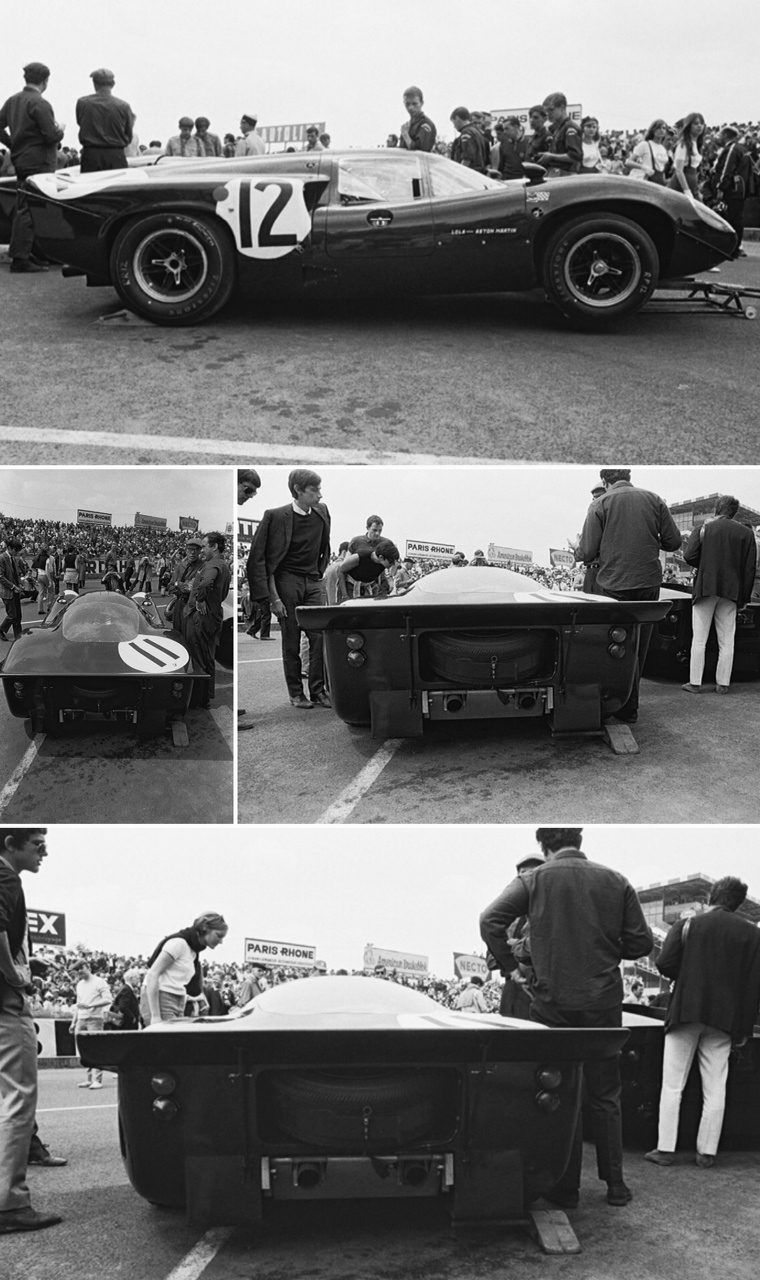
Lola T70 Mk3 Aston Martins’ a big disappointment. #11 John Surtees/David Hobbs car engine shat itself on lap 3 with piston failure , #12 Chris Irwin/Peter de Clerk lasted till lap 25 also withdrawing with engine failure.

In the 2 litre class the Porsches’, always outright contenders such was their speed and reliability, would do battle with the Matra BRM’s. Ferrari chose not to race their Dino’s focusing on the ‘main game’ and Alfa withdrew their T33’s as not being not sufficiently ready for the rigours of la Sarthe.

jochen and nina

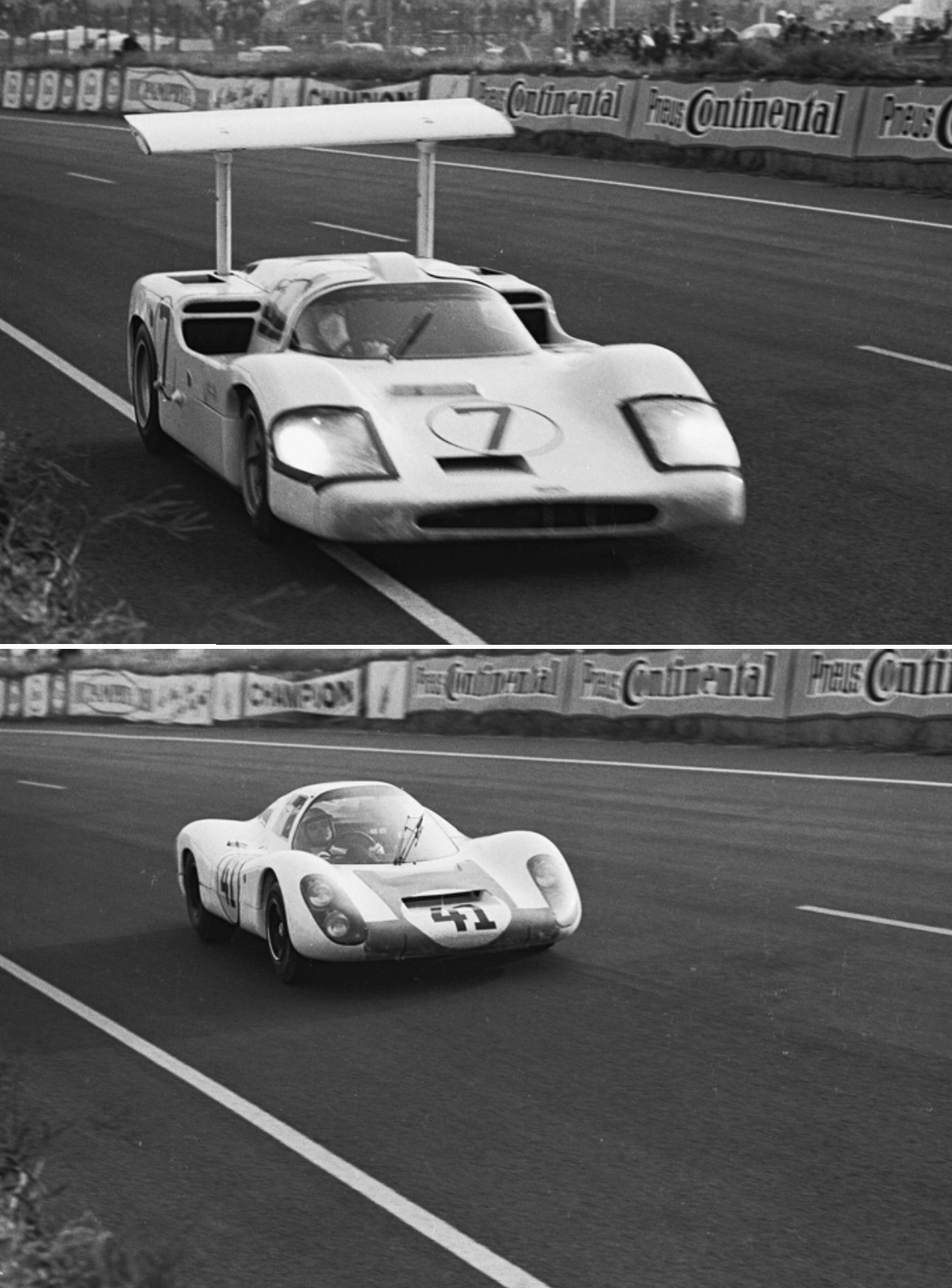
Jochen Rindt with the lovely Nina Lincoln, Finnish fashion model and daughter of racer Curt Lincoln, he married her in ’67. Jochen raced Porsche 907 #40, (above) he and Masten Gregory famously won the race in a Ferrari 250LM when the factory Ford GT40 Mk2’s and Ferrari P2’s failed in 1965. The other Porsche #41 is the 5th placed, 2 litre class winning 907 of Jo Siffert/Hans Hermann.


ford and babes

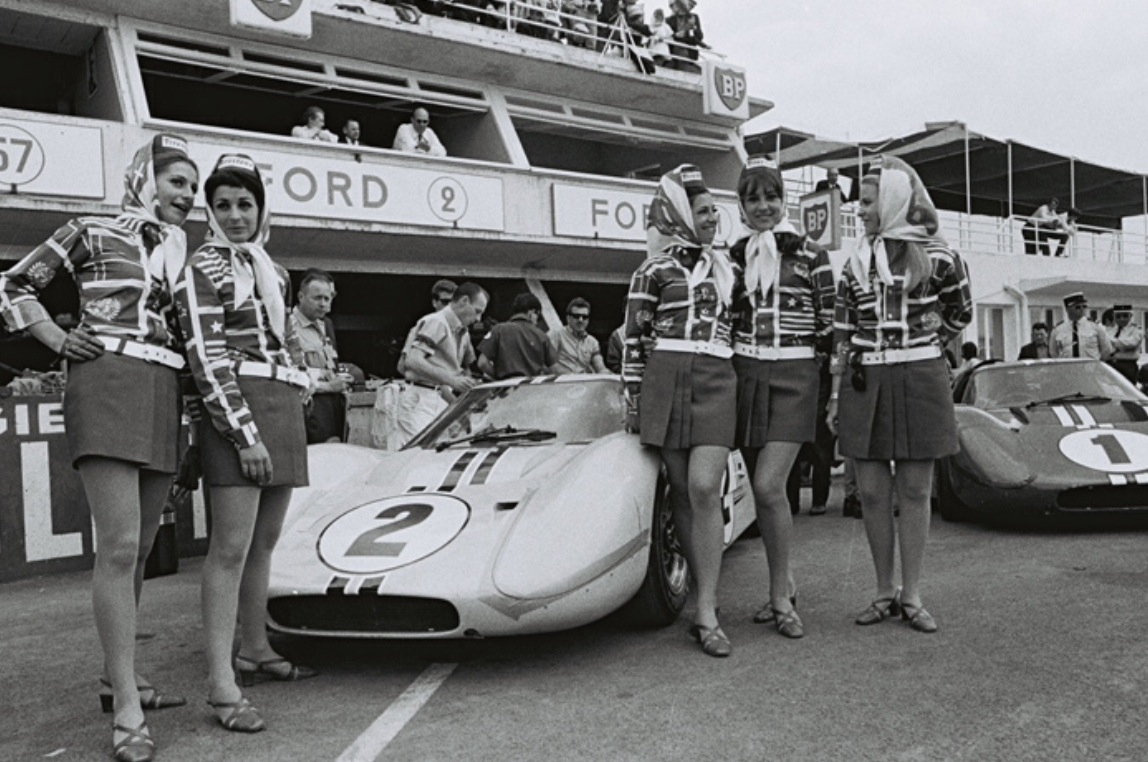
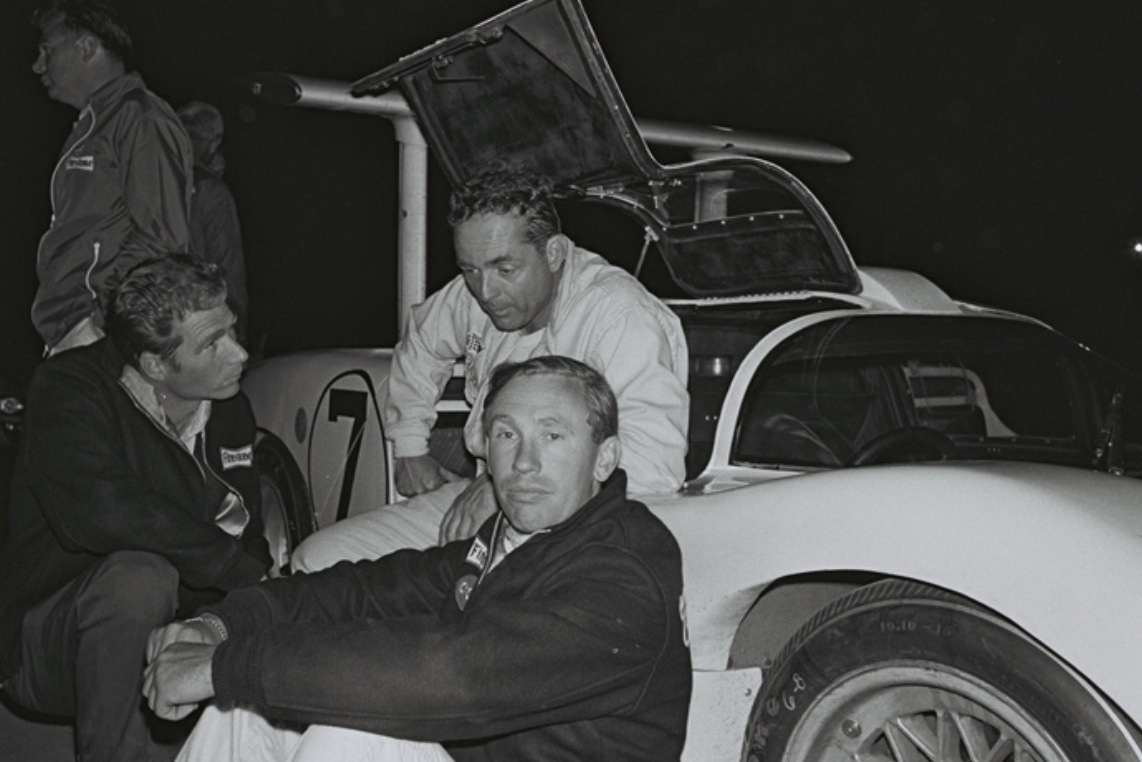
#2 McLaren/Mark Donohue 4th and #1 Gurney/Foyt 1st Ford Mk4’s with friends before the start.

Ford had windscreen troubles in practice but this was remedied with a fresh batch of correctly tempered screens which arrived pre-race.

As if to assert Ford’s authority Bruce McLaren took a Mk4 out and lapped at 3.24.4, an average of 147.316 mph and topped 215mph on the Mulsanne, in the dark. It gave him pole, McLaren was Ford’s victor in 1966 in a GT40 Mk2 he drove with fellow Kiwi Chris Amon.

mc laren

Bruce McLaren jumps out of his Ford Mk4 ‘J6’ during practice. Bruce the pole sitter in this car.

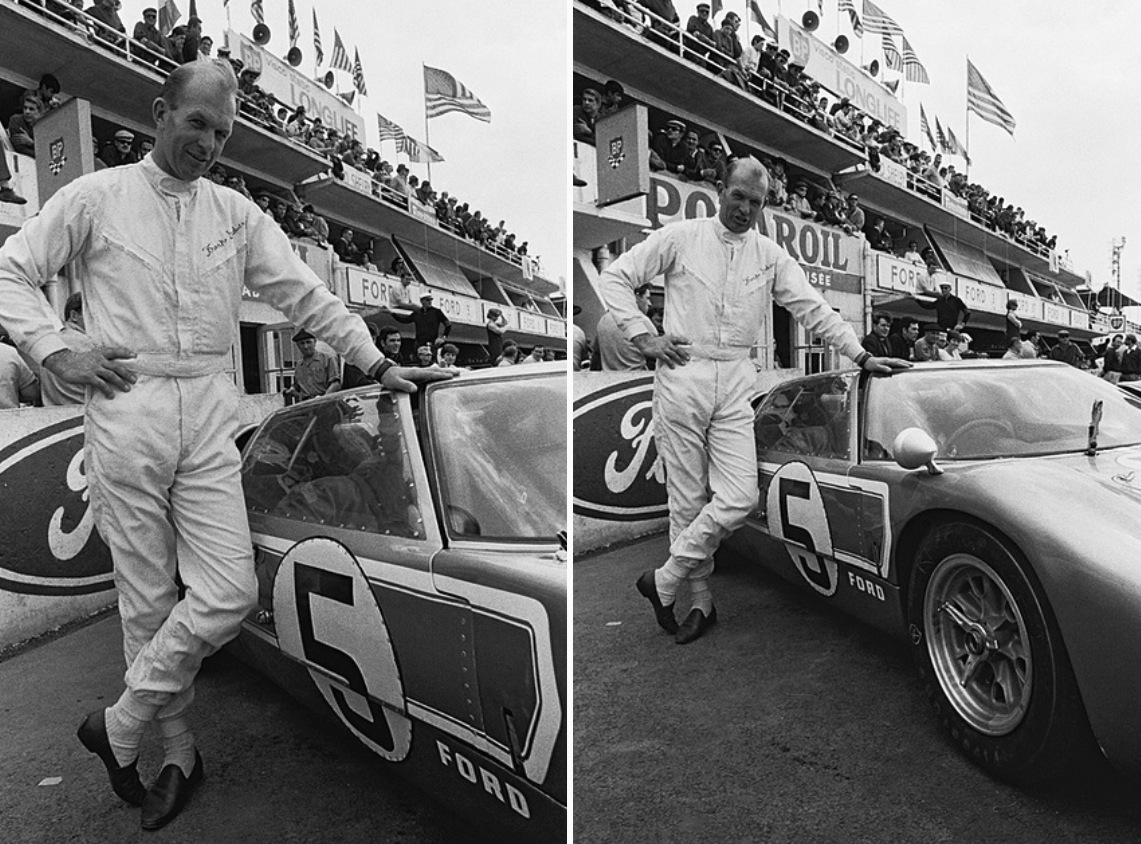
Fords times gave them five of the six top slots. Frank Gardner and Roger McCluskey qualified their Holman & Moody Mk2B 6th, here is FG before the off, the race not quite so successful, his co-driver became part of an accident not of his making…

frank gardner

The Race…

race start

Dan Gurney is the bolter at the start in #1, #2 McLaren Mk4, #7 Chap Spence putting on his full harness, alongside him #3 Andretti and #4 Hulme both in Mk4’s doing the same.


start 2

A second or so later; Spence, Andretti and Hulme still ‘belting up’ whilst #62 Mike Salmon DNF fire and #11 Surtees Lola Aston, #23 Attwood Ferrari P3 and #21 Scarfiotti Ferrari P4 come thru.


start 3

Love this start shot as it gives a sense of the depth of the field but also the speed differentials for which Le Mans is infamous; #42 Robert Buchet/Herbert Linge 14th Porsche 911S 2 litre, #48 Roger Delageneste/Jacques Cheinisse 10thAlpine A210 Renault 1.6 litre, #60 Andre Wicky/Philippe Farjon DNF Porsche 911S and the rest…Mike Spence just away in the winged Chap 2F at far left.

300,000 people attended the race on 10 June in overcast, warm weather, Henry Ford 2 and wife arriving by ‘chopper shortly before the race…

After the traditional start Pedro Rodriguez led initially in the NART Ferrari but was quickly passed by the Paul Hawkins Mk2B, who led at the end of the first hour by which time both Lola’s were out; Surtees with engine trouble after 3 laps, Chris Irwin on lap 25 later with fuel pump problems.

early laps

#21 Scarfiotti in the 2nd placed Ferrari P4 from the #4 Hulme Ford Mk4 during the early laps. Below is the Surtees Lola also during the first 3 laps…

After the first pitstop the Chaparral 2F took the lead, the Fords getting about an hour out of a fuel tank, the Fazz’ and Chaparral about 15 minutes longer.

chap pitstop

The Hill/Spence Chap 2F circulating fast at this point doing 3 min 29 sec laps…

After the second refuelling the Gurney/Foyt Mk4 lead from the Hill/Spence Chaparral followed by the Andretti/Bianchi and McLaren/Donohue Ford Mk4’s.

rodriguez

Oopsie; Ricardo Rodriguez (no relation) in the ‘kitty litter’ on Lap 30, the NART Ferrari 365P2 retired at this point. Car shared with Chuck Parsons. In the background in the lower photo is the works Austin Healey Sprite of Clive Baker/Andrew Hedges which finished 15th, first British car home.


andretti

The ill-fated Andretti/Bianchi Mk4 ahead of Chris Amon/Nino Vaccarella Ferrari P4 DNF puncture/fire and Denny Hulme/Lloyd Ruby Mk4 DNF accident, in The Esses in the first quarter of the race.


fireman

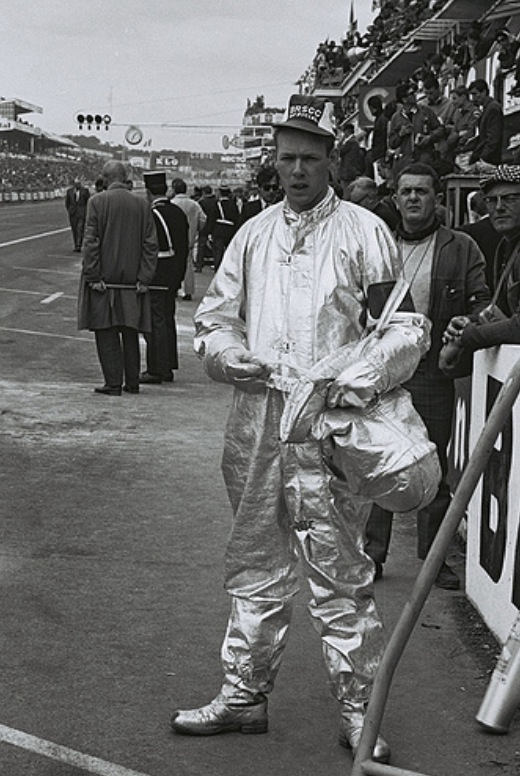
‘British Racing and Sports Car Club’ fireman in the latest gear.

After 4 hours the Gurney car was still ahead.

This time from the Andretti Ford. Three Fords led from the Chaparral, with Ferrari further back, the leading Ferrari’s were driven by Amon/Vaccarella P4 and Rodriguez/Baghetti, P3/412P.

chap 8

The #8 Bruce Jennings/Bob Johnston Chaparral 2F in the pits for its final pitstop on lap 91, car out with battery and starter failure.


butt shot

2 P4’s, the white car the NART P Rodriguez/Baghetti P4/412P entry chasing the Jennings/Johnston Chaparral 2F and a 911S about to be ‘swallowed’ by all 3.

After 6 hours the 2nd #8 Chaparral failed to restart after a pitstop.

Hill pitted at about the same time in the #7 Chap with the transmission, the cars weak link checked leading to speculation about its health. The stop lasted 9 minutes, the car rejoined in 7th place.

Rindt (below) retired his Porsche 907, having over-revved its 2 litre flat 8.

rindt 2

jo

The #7 Chaparral 2F Chev of Spence and 5th placed Porsche 907 ‘Langheck’ of Siffert/Hans Hermann with Jo at the wheel. Car also the 2 litre winner.

At 2 am it was still 1-3  for Ford but the pattern of the race changed hugely after Andretti took over his car from Bianchi, it was fitted with fresh brake pads.

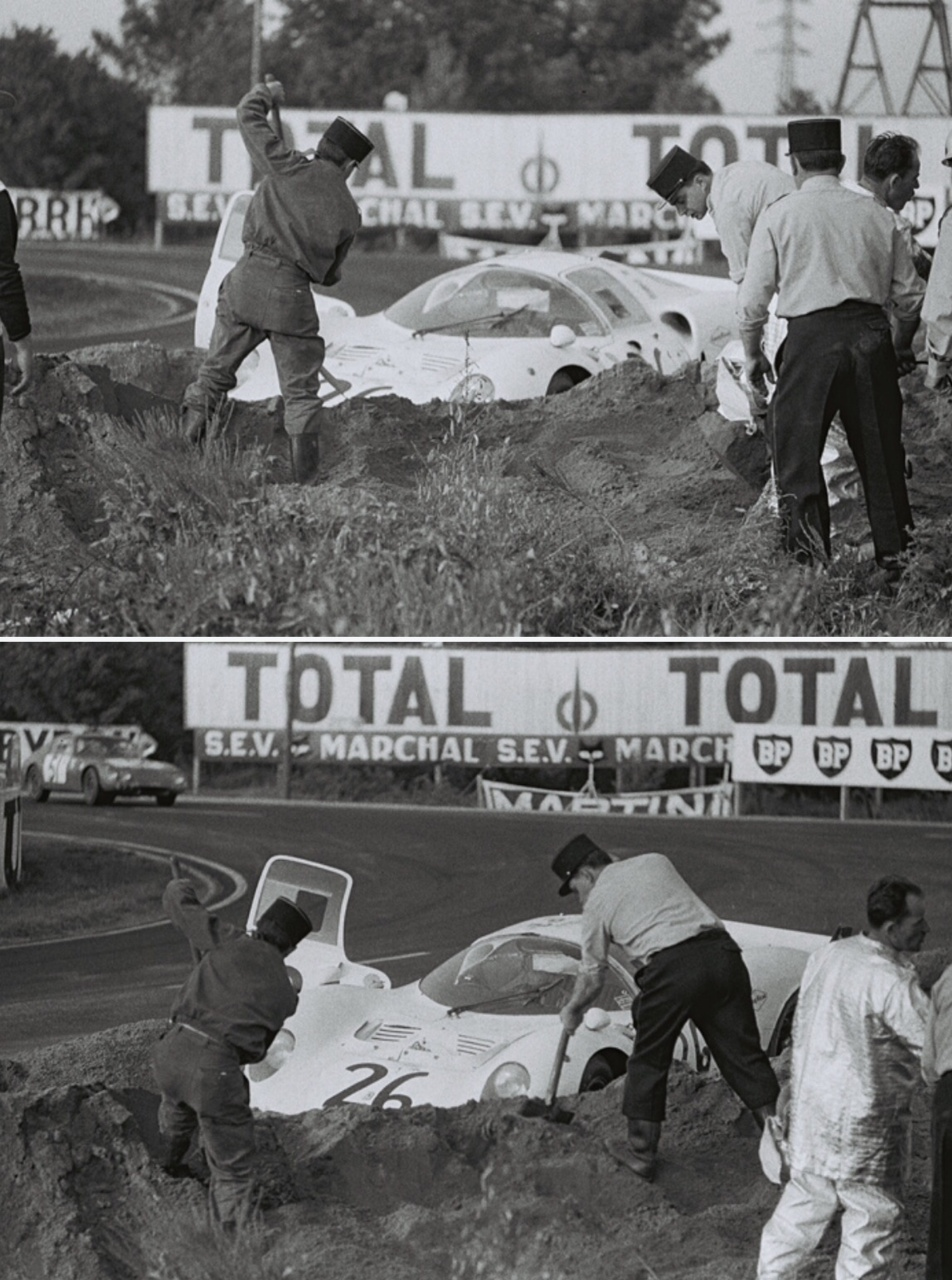
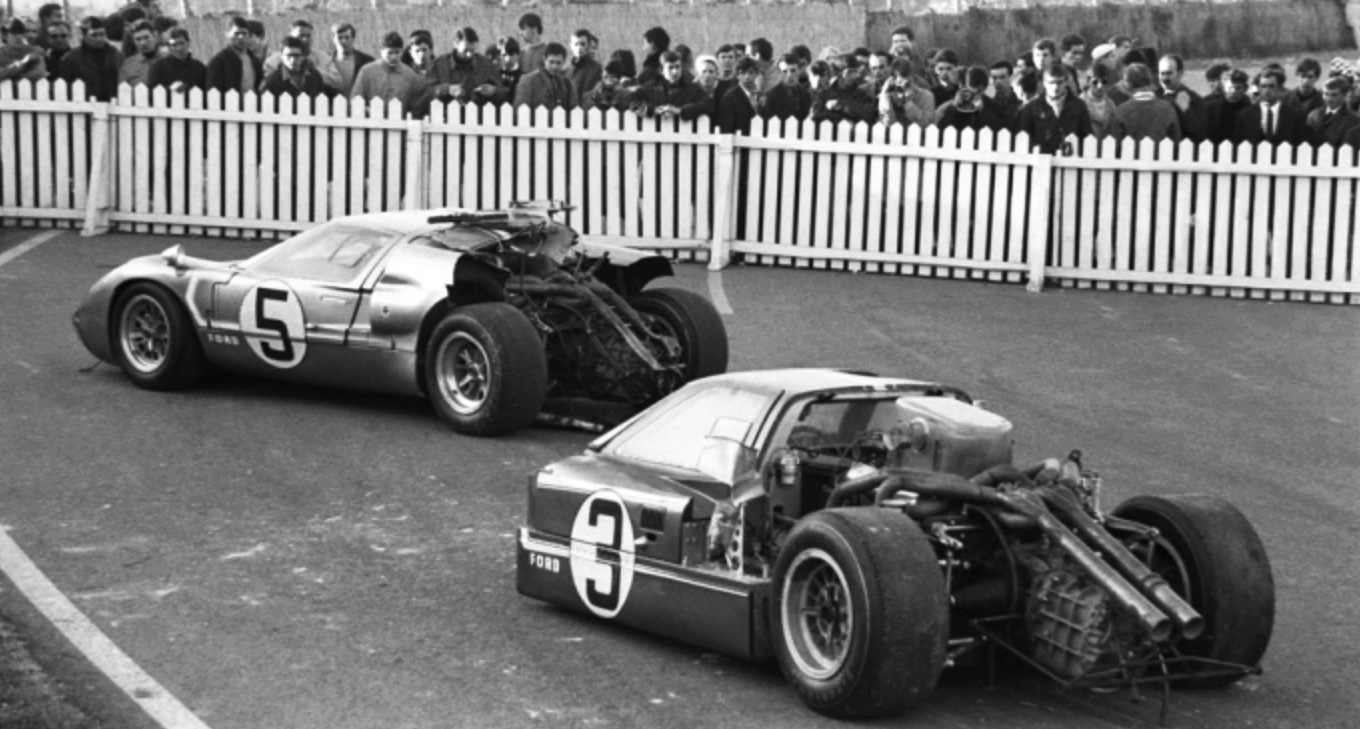
As he approached The Esses and braked one disc grabbed, pinging the car instantly between the unforgiving earth banks until finishing in the middle of the track with bits of ‘Big Henry’ scattered all over the place.

Roger McCluskey arrived in the Mk2B he shared with Frank Gardner, braked, spun and hit the banks wrecking another factory Ford. Schlesser then added to the party arriving in the Ford France Mk2B  he shared with Guy Ligier and spun in avoiding his teammates- three Fords were out on the spot!

rooted fords

Rooted Fords #3 Andretti Mk4 and #5 McCluskey Mk2B. (Rainer Schlegelmilch)


foyt 2

The winning Mk4 of Gurney/Foyt ahead of #57 Ronnie Bucknum/Paul Hawkins Mk2B DNF and #14 Mirage M1 Ford of David Piper/Richard Thompson,DNF .


ferrari dead

Dead Ferrari’s atop the transporter in the middle of the race, both with piston failure; #22 Jean Guichet/Herbie Muller Ferrari P3/412P #25 Pedro Rodriguez/Giancarlo Baghetti Ferrari P3/412P


foyt 3

AJ Foyt aboard the winning Ford Mk4 chassis ‘J5’.

At half distance the Gurney/Foyt Mk4 had a huge lead

But there were three Ferrari’s and a Chaparral between Gurney and the next Ford.

At dawn it was Gurney/Foyt 7 laps ahead of the Parkes/Scarfiotti Ferrari, the Hill/Spence Chaparral then Ferrari-Ford-Ferrari, it was anybody’s race at this point.

At 5.30am Hill’s Chaparral pitted for investigation of an oil leak; and stayed for 3 hours whilst the mechanics heroically removed the transmission and fitted a new oil seal but the car was finally retired with an oil-less transmission.

spence

Chaparral council of war in the middle of the night. Jim Hall , Phil Hill and Mike Spence curse the cars auto gearbox, its weakness that year. The one bright spot for the fastest, most innovative and stunning sports/prototype of 1967 was its season ending Brands Hatch 6 Hour victory in July.

With 6 hours to go the Gurney/Foyt Ford only lead by 5 laps!

But it was one Ford from three Ferrari’s with the Italian cars being driven very hard, Mike Parkes said ‘I have never driven a car so hard for so long’ of his Ferrari P4 after the race.

lini

What am i going to tell The Commendatore!? Franco Lini, Ferrari Team Manager ponders the teams prospects late in the race. It was an honorable defeat, to say the least, against the onslaught of the then second largest motor manufacturer in the world.

With less than 2 hours to go the Ferrari’s were lapping 10 seconds a lap quicker than the leading Ford, with 90 minutes to go both cars stopped for fuel for the last time, Ferrari’s only hope a Ford failure but it was not to be…

finish

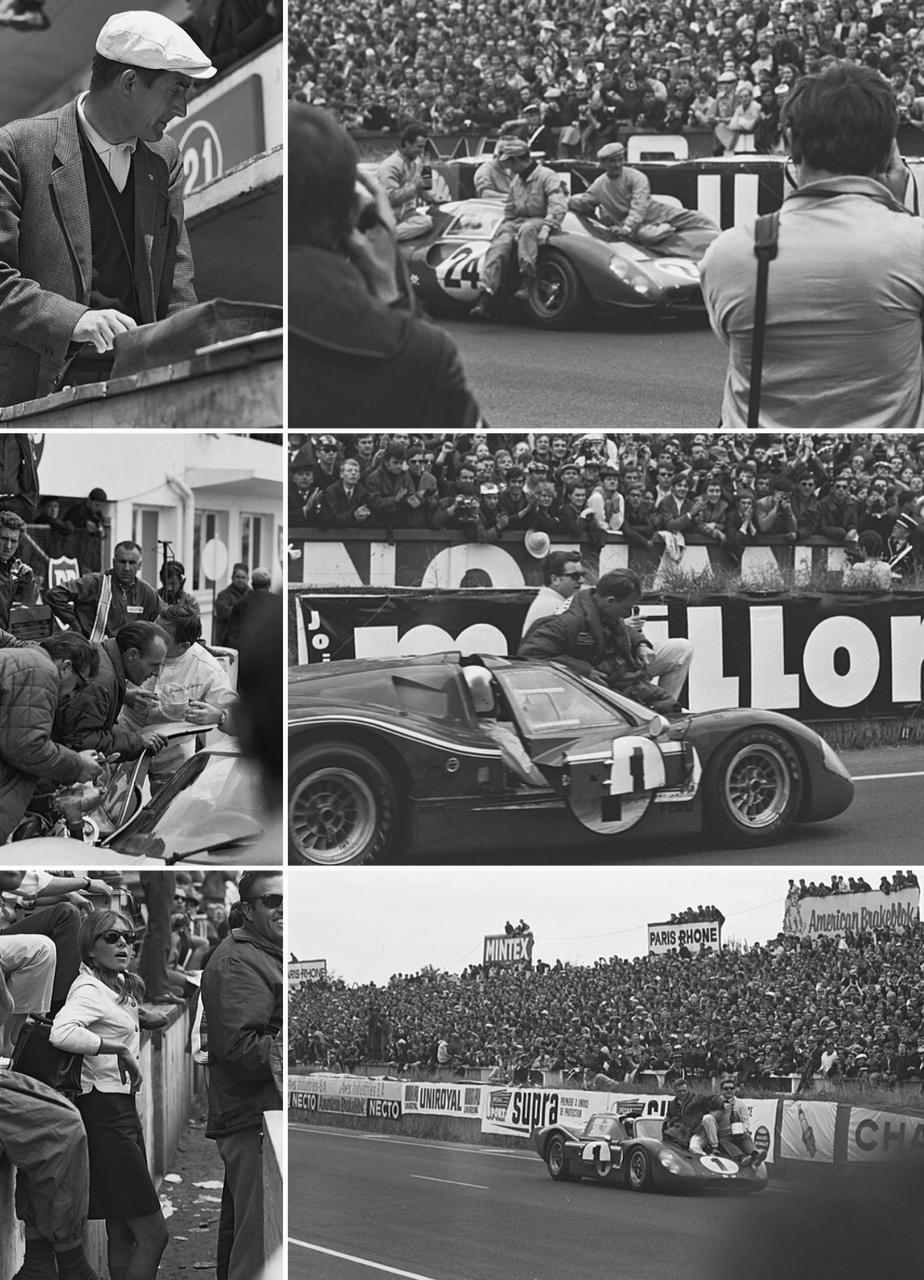
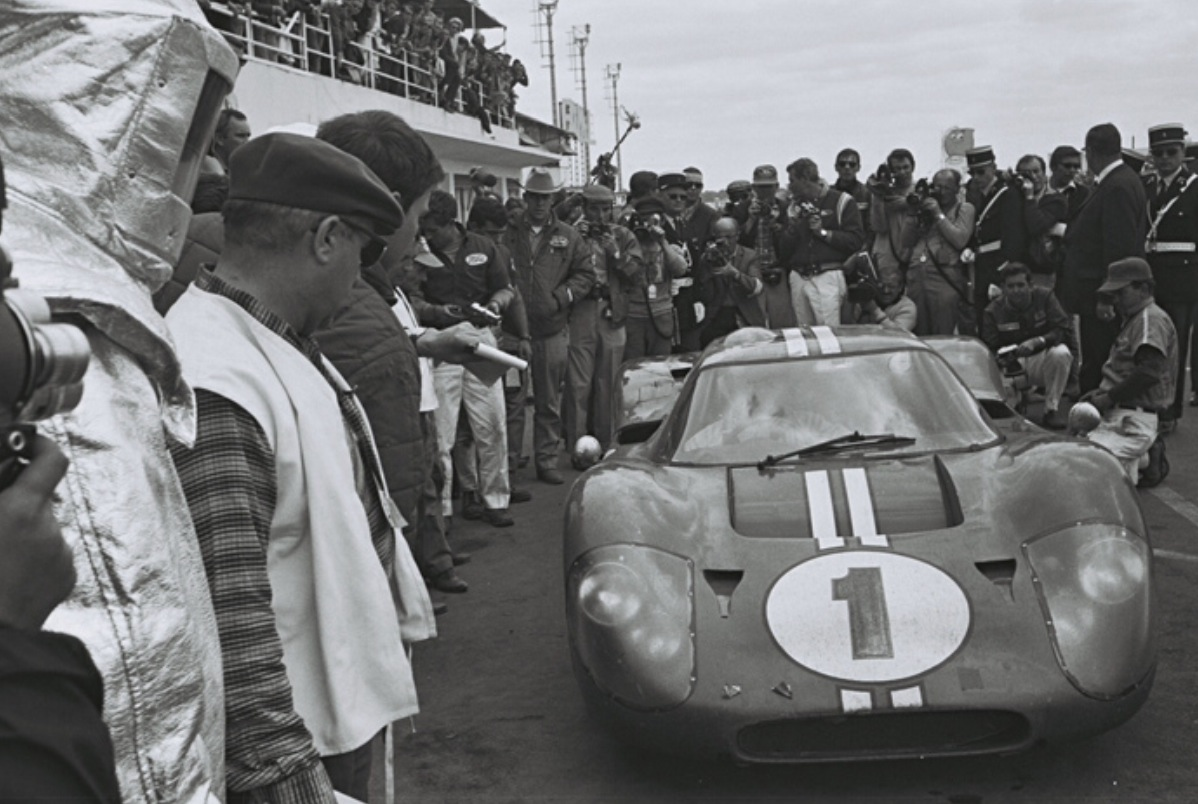
Car #24 the 3rd place Willy Mairesse/Jean Blaton Ferrari P4 and winning #1 Mk4, ‘victory lap’. Small shots; Franco Lini, Bruce McLaren Mk4 pit, ‘pit popsie’.

It was the first ‘All American’ win ever; car and drivers. Ford were both first outright and won ‘The Index of Thermal Efficiency’, which seems somewhat of a contradiction in terms for a car powered by a 7 litre cast iron, OHV V8!…

The first six placings were;

1st. Gurney/Foyt Ford Mk4 388 laps

2nd. Scarfiotti/Parkes Ferrari P4 384 laps

3rd. Mairesse/Blaton Ferrari P4 377 laps

4th. McLaren/Donohue Ford Mk4 359 laps

5th. Siffert/Hermann Porsche 907 358 laps 2 litre winner

6th. Stommelen/Neerpasch Porsche 910 351 laps

winner

Winners are Grinners…

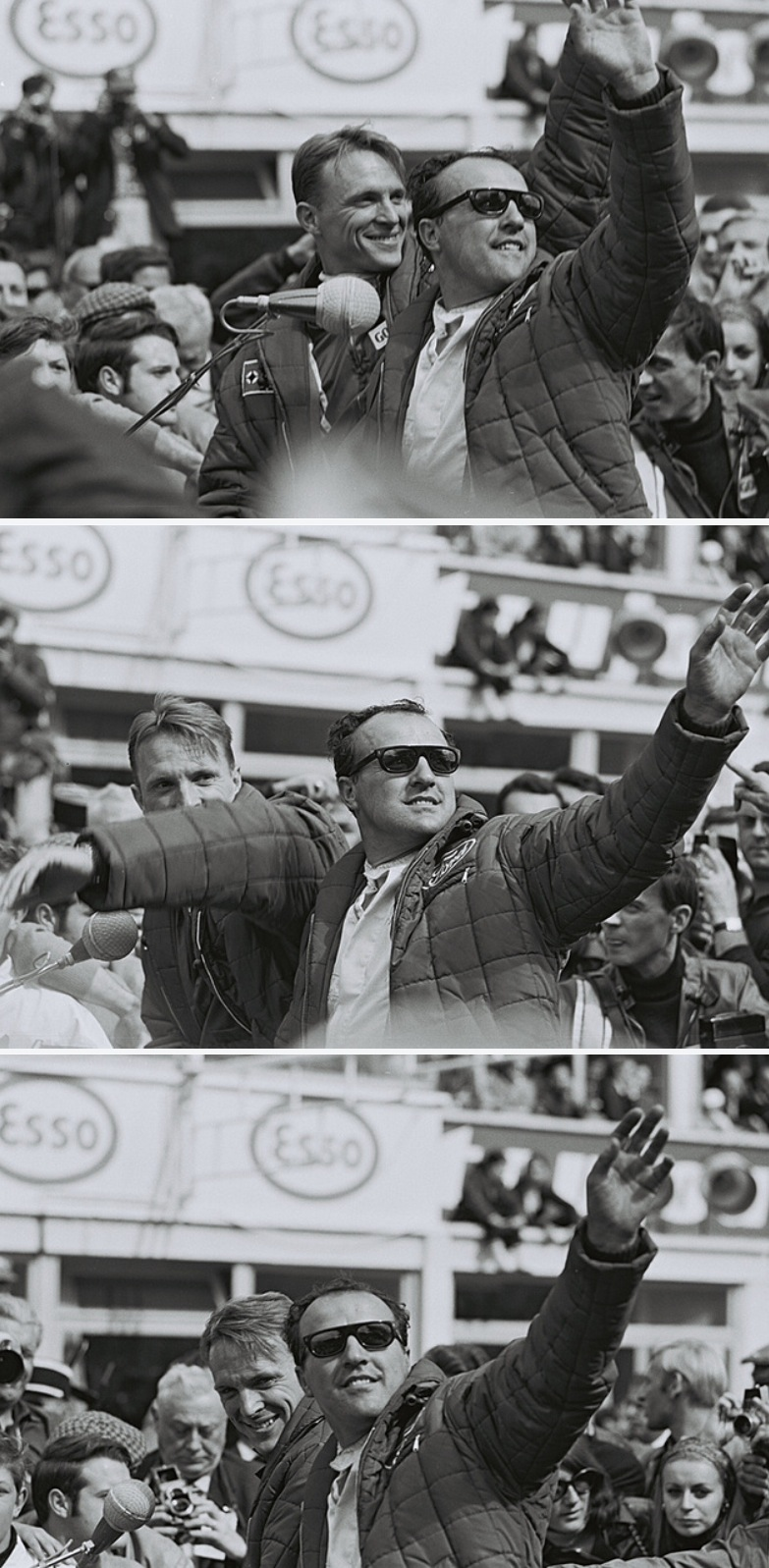
The winning Ford covered a record distance and was pushed hard all the way- Dan Gurney at left and AJ Foyt, right, below.

dan

Mike Parkes (L) and Ludovico Scarfiotti looking suitably tired after fantastic drives in pursuit of the Ford Juggernaut!

parkes

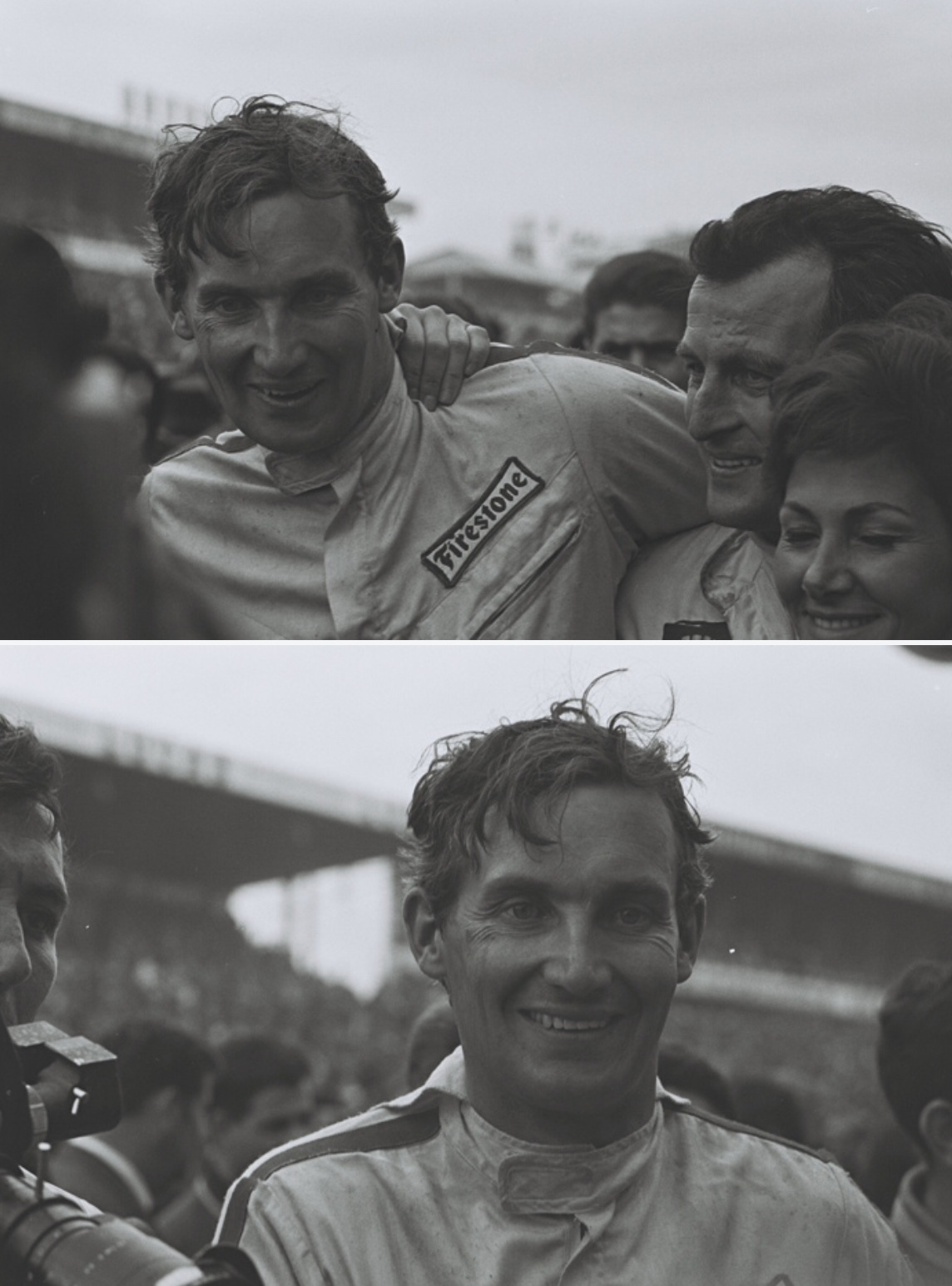
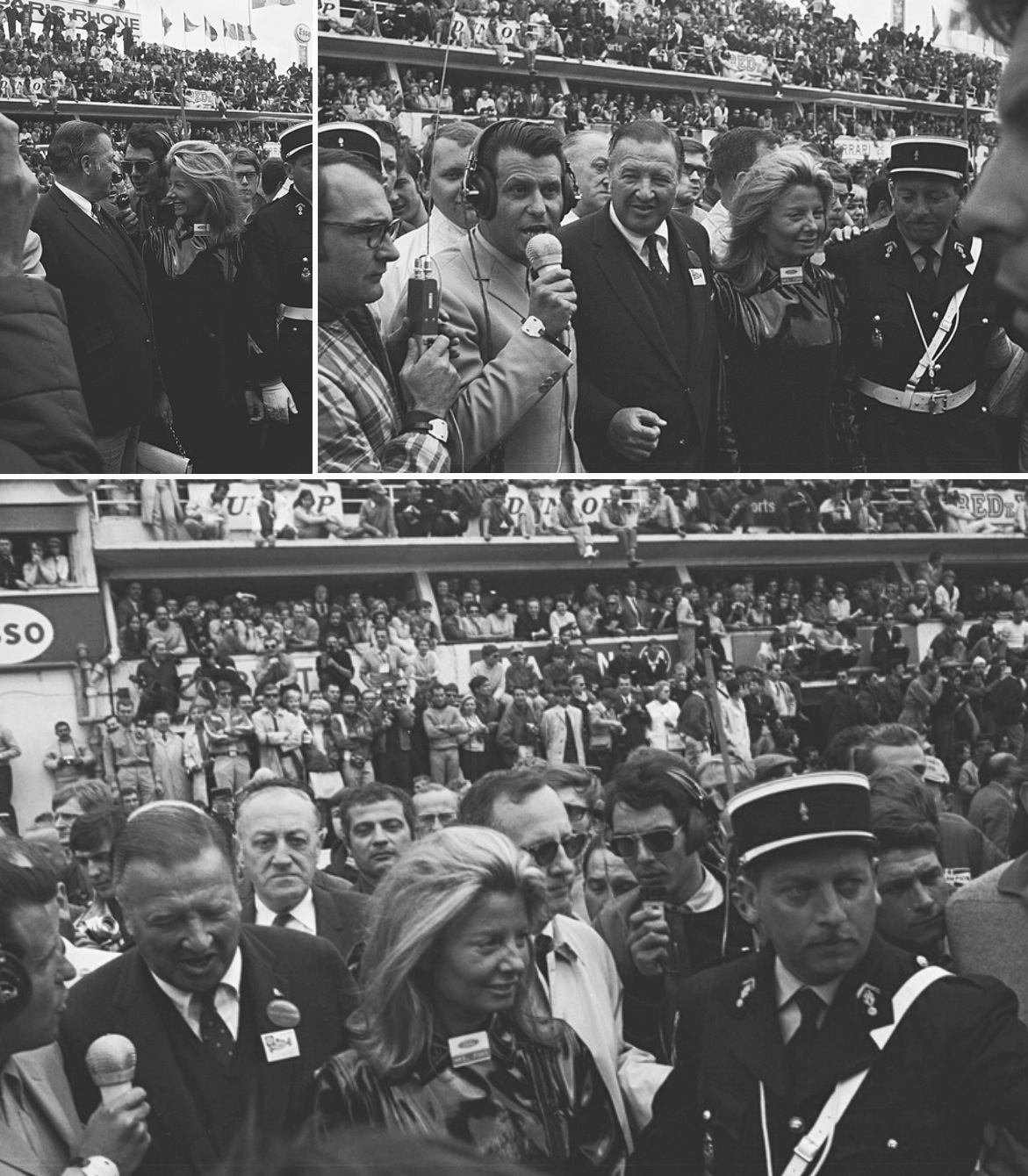
Henry Ford 2 and his wife Maria look well pleased with the results of their teams work.

Its interesting to reflect on how different automotive/motor racing history may have been had Enzo Ferrari not withdrawn from the final stage of negotiations for the ‘Boys from Dearborn’ to buy his Maranello outfit in July 1963.

Whatever the case, motor racing had a friend in Henry Ford 2. Without his patronage and support of racing to build Ford’s global brand we would not have had many of Ford’s programs which enriched racing during his tenure of either direct or indirect control of FoMoCo.

mr ford

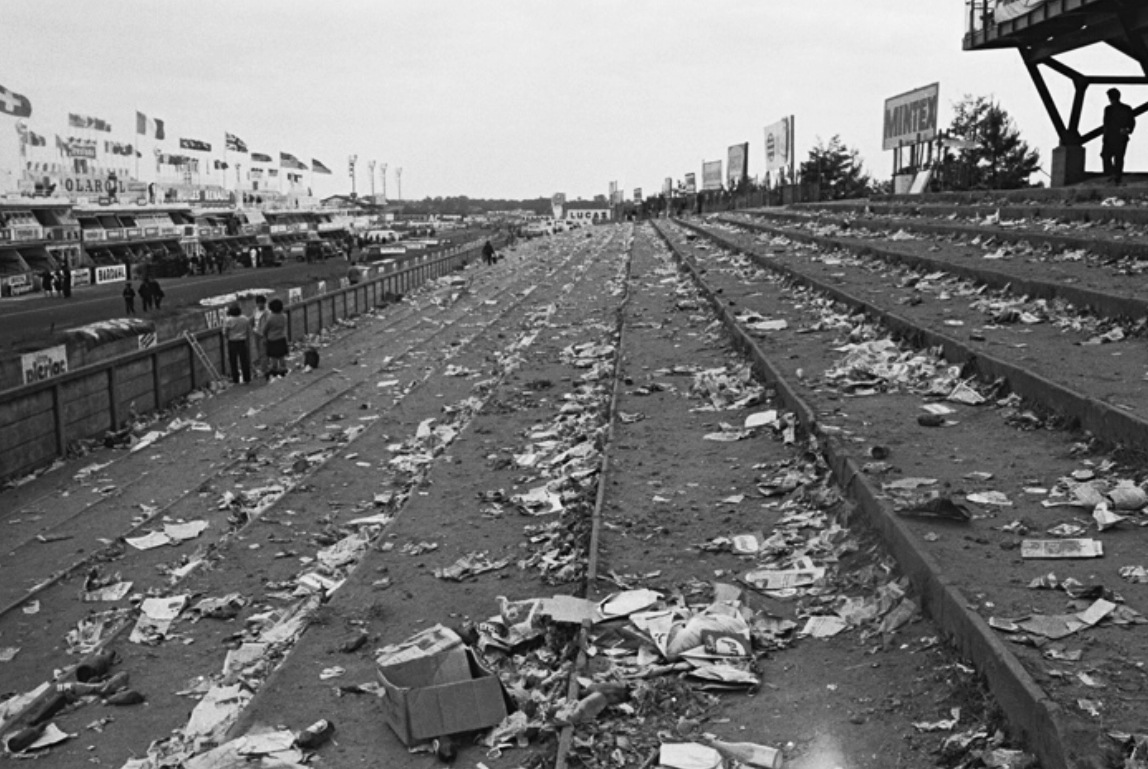
Tailpiece; The Morning After the Night Before…

rubbish

Photo Credits…

The amazing Dave Friedman Archive, Rainer Schlegelmilch

Bibliography…

Team Dan WSC Archive, Automobile Year 15

Finito…

matich 1

Frank Matich, Matich A50 Repco ‘#001/2’ , Shell Corner, Sandown, ‘Victoria Trophy’ April 1972. (Rennie Ellis)

Frank Matich on his way to victory during the first round of the Australian ‘Gold Star’ Series in 1972, Matich A50 Repco ‘001/2’…

The car made its stunningly successful debut at the 1971 AGP the previous November. Matich won the race in a brand new untested car, the first monocoque and first single seater his team built.

In the broader historic context it was the first time an Australian built car had won an AGP since Warwick Pratley’s George Reed Special Ford V8 victory at Narrogin, WA in 1951.

wigram

FM reclined in his ‘comfy’ monocoque chair, A50 ‘001/2’. He is talking to Carroll Smith who was to be his crew chief in the upcoming 1973 trip to contest the US L&M F5000 Championship. Here at Wigram, NZ, Tasman Series 1973. (Shane Lee)

Introduction…

This is a bit of a nutty long article.

I tripped over some photos of the 1972 ‘Victoria Trophy’ at Sandown, shots not in the immense F5000 Facebook Groups photo archives, so i thought i would whack a ‘quickie article’ together to show my F5000 FB mates there are still shots to be found.

Then i started thinking about why Matich didn’t win more Gold Stars, he only won in ’72. That led to research on his early ’60’s single seater campaigns which segued into his mid-late sixties sportscar specialism when he wasn’t eligible for the Gold Star, a single seater championship. And finally back to single seaters again in the F5000 period.

Then one needs to look at the Tasman Series as you can’t look at just the domestic Gold Star series in isolation…

Then there are the Matich cars he built and drove which are a key part of the story…and i kept on writing of course.

So! This rather long, eclectic mess comprises;

.The ’72 Victoria Trophy where i started

.A bit about FM’s 1964/5 2.5 litre Brabham single-seater Tasman formula years

.A fleeting summary of his ’66-’69 Sportscar phase, not a lot though as his Matich SR3 and SR4 campaigns deserve more detail, its a story for another time

.Then the substance of FM’s Matich F5000 cars and their racing campaigns with Matich.

In terms of the Matich F5000 detail i have drawn heavily on conversations and a manuscript provided by Derek Kneller, (DK) an Englishman who was a Team Matich engineer/mechanic for the whole of its F5000 period. He literally shipped FM’s first McLaren M10A to Oz and followed it in August 1969 and returned to the UK in 1974 after FM retired and the cars were sold.

The very articulate Derek was in Australia recently for FM’s funeral and recorded a very interesting interview with ‘Pitlane’, there is a link to it towards the end of this article, its well worth watching.

Many thanks Derek! If Australians have seen some of Derek’s material before its because it was included in Aaron Lewis’ excellent article on the Matich F5000 cars published in ‘Australian Musclecar Magazine’ some years ago. Much of the material has not been published before however.

Here we go, its long, so grab a beer, if you get lost come back here to see where you are!…

puke grid

Successful partnership. Frank Matich and Chief Mechanic, Derek Kneller on the right prior to the start of the NZ GP, Pukekohe 1973. Matich A50 Repco ‘001/2’. (Derek Kneller Collection)

1972 Gold Star and Tasman Series…

Max Stewart took the 1971 Gold Star in his 2 Litre Mildren Waggott, his blend of speed and reliability ‘knocked off’ the F5000’s in the class’ first year as Australia’s National Formula 1 (ANF1).

Even Max saw the writing on the wall, he sold his faithful Mildren and replaced it with a Repco Holden powered Elfin MR5.

The ’72 Series comprised established stars; Matich, Bartlett and Stewart, coming men Muir, Walker, McCormack and Brown and some solid ‘journeymen’.

The ‘form’ drivers were Matich and Bartlett but Muir made a great F5000 debut in the just completed Tasman Series.

FM’s Tasman was disappointing having won the AGP upon the A50’s debut in November 1971. He expected to be more competitive in the Tasman only to watch his Kiwi Driver/Constructor rival Graham McRae win the series in his McLaren based Leda LT27/McRae GM1. McRae won 4 rounds and scored points in 5 of the 8 rounds.

matich overhead

Nice overhead shot by Terry Marshall taken from Wigram’s control tower during the ’72 ‘Lady Wigram Trophy’. FM A50 ‘001/2’ DNF engine. Frank Gardner won the race in his Lola T300. (Terry Marshall)

The Matich team continued to develop their new car, A50 ‘001/2’ throughout the Tasman series as DK recalls ‘…There were some problems in the team during the Tasman. I was homesick and returned to the UK after the ’71 AGP. Whilst Peter Mabey is a top bloke and a great Chief Mechanic most of the rest of the team were not pulling their weight in NZ, doing the all-nighters or whatever was required. So the load fell on Maybey’.

‘Peter had been with FM for 4 years including the build and racing of the SR3 in the ‘States, in fact i was to replace him as Chief Mechanic, but he stayed on once it was clear we were to build a single-seater, something he had not done before. None of that was a drama, we worked well together’.

‘The upshot of the workload and pressure was that Peter left the team after Levin, he had just had enough, as had his wife of the pressures of racing.

FM did the Christchurch and Invercargill rounds with the mechanics.’

‘I had planned and organised with Frank when he was in the UK in late 1971 on Goodyear business, i was working for Surtees, to come back to Oz in the middle of the year. After Peter left Frank rang me and asked that i come back straight away. I arrived in Sydney the Monday after Surfers, Joan (Matich) picked me up from the airport, i went straight to Brookvale and started work on Frank’s joblist for the car. It was at this time the car was given the A50 ‘002’ moniker but it was ‘001’ the same tub; the bodywork was painted in STP colors and the roll bar chrome plated, it appeared different which was a bit of gamesmanship and kept the sponsors happy but it was, and still is the same tub which Bryan Sala now owns. This caused lots of historic grief in later years.’

‘The rear suspension geometry was altered with a lighter rear subframe and raced at Surfers Paradise, where the car was more competitive. The rear suspension geometry was altered again after Surfers (rear roll centre raised) and Frank won the next race at Warwick Farm. The same chassis was used for the rest of the Tasman series, for the successful 1972 Gold Star series and the 1973 Tasman, at its end the car was put on chassis stands at the Brookvale factory’.

Matich won, as Kneller notes at Warwick Farm, his backyard and the circuit at which he primarily honed his cars setup and picked up points in 4 of the 8 Tasman rounds, despite the in team dramas.

bartlett

‘C’mon Bob, i will belt them all with one of these’; John Harvey saying to Bob Jane? (in the race suit). ‘Piss-orf Harves, we’ve already got that friggin’ Bowin thing and touring cars are the go anyway!’ or words to that effect!? Bob Jane Racing team owner Bob Jane and driver Harvey checking out KB’s ‘brand spankers’ Lola T300 in the Sandown ‘Victoria Trophy’ dummy grid. (Stupix)

Bartlett also scored 4 times in the Tasman and won at Teretonga. The win was impressive, scored in the McLaren M10B previously owned by Niel Allen. 1972 was that chassis’ third Tasman Series. The reliable old beast was replaced by a brand new Lola T300 for the Gold Star Series KB having watched his friend and mentor, Frank Gardner’s progress in the car concepted by FG as a replacement for Lola’s ageing T190/2 series.

Gardner was Lola’s development driver/engineer. The prototype T300 ‘T242’ made its debut at Thruxton on 1 August 1972. By the end of the season the T300 was the fastest thing in Europe. FG took wins at Hockenheim and Oulton Park in September. In addition he won the 1971 British F5000 Championship with points accumulated in both his T192 and T300.

Mind you, the very fast, Leda LT27/McRae GM1 didn’t break cover until after the end of the British F5000 Championship and was THE CAR in 1972, McRae won the Tasman and US F5000 Championships, both with GM at the wheel.

In Australia Lola T300’s were bought by Bartlett, Bob Muir and F2 driver Gary Campbell stepped up into Gardner’s ’72 Tasman entry.

Ansett Team Elfin were represented by both driver/constructor Garrie Cooper, and John McCormack, the latter became more and more competitive with each 5 litre drive.

cooper

Elfin owner/designer/constructor/racer, the late, great Garrie Cooper in the Sandown pitlane. ‘Victoria Trophy’ 1972. Elfin MR5 Repco. The ‘Tyrrell nose’ were added to the 2 ‘works cars’ during the ’72 Tasman Series, see the pic below of John Walker’s car to show the original spec nose. (Stupix)

The Elfin MR5 Repco’s made their debut in late 1971 and were developed over the 1972 Tasman Series, new Elfins were also bought by Max Stewart and John Walker. By the seasons end Walker acquired a Matich with which to contest the ’73 US Series, the Matich had the safety fuel tanks of the spec required for the L&M Series. And was a faster car.

walker

John Walker in his Elfin MR5 Repco, Victoria Trophy 1972. (Jay Bondini)

Warwick Brown’s mentor, businessman Pat Burke bought Alan Hamilton’s low mileage ex-Allen spare M10B and made a big impact. Warwick would be a force in F5000/CanAm through to the end of his driving career in both Australasia and the USA.

matich pit

Matich prepares for practice, this is the gravel form up area. Victoria Trophy 1972. Matich A50 Repco ‘001/2’.(Stupix)

‘Victoria Trophy’ 16 April 1972…

Matich set pole on 61.5 secs nearly 1 second quicker than McRae’s Tasman pole time only 2 months before. Bob Muir was next on 61.9 and was quick with a new Chev, then came Bartlett, McCormack, Campbell, Max Stewart, Warwick Brown and John Walker. Further back were the ANF2 cars.

A crowd of 20000 in beautiful sunshine were in attendance to see 8 F5000’s and 9 F2’s.

Matich got the jump at the start and was never headed, behind him were Muir, Bartlett, McCormack , Brown, Stewart and Walker.

Stewart slipped past WB but almost immediately dropped a valve in his Repco Holden V8, Walker moved forward then Brown pitted having slowed.

bartlett and mc cormack

Kevin Bartlett leads John Mc Cormack into Shell Corner, during their great dice, Sandown. Lola T300 Chev and Elfin MR5 Repco. (Rennie Ellis)

10 laps down Matich lead Muir by 7 seconds who was well clear of KB who was being challenged by the Elfin duo of McCormack and Cooper.

Campbell clobbered the fence at ‘Torana’ corner, Walker was through to 6th, the race came alive with Mac challenging Bartlett on lap 20.

The pair were at it for 6 laps, nose to tail before the Lola yielded to the Elfin MR5, then KB’s engine lost its edge and he retired with ignition failure.

muir

Bob Muir rolls his immaculate, concourse, positively gorgeous and fast Lola T300 Chev  into ‘Dandy Road’ during his great Victoria Trophy drive. (Jay Bondini)

Muir was driving a great race, now Mac set after him, he had maintained a good pace despite being short of water, eventually the Lola started to smoke badly but Bob was able to keep clear of the Tasmanian to maintain 2nd spot.

Behind Mac were Cooper, Walker, Brown and Malcolm Ramsay in the little Birrana 272 Hart Ford F2 car. This was the prototype of a series of cars which dominated the small bore class in Oz for the next few years.

birrana

Malcolm Ramsay’s Birrana 272 ‘002’ Ford. ‘Victoria Trophy’ Sandown 1972. It was in this chassis Oz touring car star Peter Brock made his single-seater debut in a low key campaign, largely with the assistance of his father, amongst his Holden touring car commitments in 1973. (unattributed)

‘Australian Motor Racing Annual’ noted Matich’s great win and McCormack’s strong drive in 3rd having been ill for most of the week prior.

millis elfin 600 r ellis

Victorian motor trader/racer Clive Millis Elfin 600B Ford F2, ‘Victoria Trophy’ 1972. (Rennie Ellis)

For Matich it was the start of a dominant 1972 Gold Star campaign; he won the series from Kevin Bartlett with wins at Sandown, Oran Park, Surfers’ and Warwick Farm. KB won at Adelaide International and McCormack the Symmons Plains round in his native state of Tasmania.

Frank Matich and the Gold Star…

Arguably FM was Australia’s greatest resident racing driver of the sixties and seventies, certainly he was one of them, despite that he collected only one Gold Star. Why?

FM cut his racing teeth in sportscars in the mid-fifties, quickly progressing through Healeys’ to the Leaton Motors Jaguar C and D Types and Lotus 15 Climax 2.5. Then two Lotus 19’s. He first raced open-wheeler Elfins taking points in the 1963 Gold Star in an Elfin 1.5 Ford, the title won by Bib Stillwell.

fm brab first run

First run in the just arrived Brabham BT7A Climax, Warwick Farm. Its race debut was in the ‘Hordern Trophy’ at Warwick Rarm in December 1963. Bruce Richardson by front wheel. (John Ellacott)

He became serious about his open-wheeler program in 1964, buying the latest ‘Intercontinental’ Brabham, the BT7A. He very quickly got to grips with the 2.7/2.5 litre Coventry Climax FPF engined car. Stillwell maintained his earlier model BT4 for ’64 but again won the championship, Matich took one win.

There was little doubt that FM was the quickest local, a driver who had not yet peaked, whilst Bib, having served a long apprenticeship, was atop the mountain, drove well, was well funded via his car dealerships and had well prepared cars driven with more mechanical sympathy than Matich.

FM lacked reliability which was perhaps, if you believe what was written at the time, a function of being hard on his equipment, his cars equally well prepared, but perhaps not quite as well financed as Stillwell’s.

Matich was equal 4th in the Gold Star in 1964 his speed absolutely confirmed in the 1965 Tasman Series, where his year old, well developed car gave nothing away to any of the Internationals or the latest BT11A Brabham’s driven by Graham Hill, Stillwell or Jack himself.

longford

In the best of company, and avoiding the 2.25pm train  from Launceston to Hobart…AGP Longford Tasman 1965. Graham Hill Brabham BT11A Climax from Matich in his year old BT7A Climax. (History of the AGP)

tasman 65

‘Frank led from pole in the 1965 ‘Warwick Farm 100’ but Hill and Clark went by on lap 1 is photographer, John Ellacott’s caption. Matich, light blue Brabham BT7A Climax, Hill in the red Brabham BT11 A Climax and Clark in Lotus 32B Climax. (John Ellacott)

He contested the 1965 Gold Star in the BT7A, his best results two 2nds, the title won again by Stillwell, who, having won 4 on the trot retired from racing.

matich longford

Matich on pole in his Elfin 400/Traco Olds, Spencer Martin in the Scuderia Veloce Ferrari 250LM at the start of the 1966 Australian Tourist Trophy, Longford, March. FM won. (Richard Blanden)

Matich refocused on sports cars, he saw greater commercial opportunities as they grew in stature and importance globally.

The Elfin 400 Olds was the first ‘sporty’ in 1966, then followed his self built ‘400 clone’ Matich SR3 Repco which swept all before it in Australia in 1967/68 and in which FM contested the 1967 Can Am series. Click here for my the article about Frank’s Elfin 400;

Elfin 400/Traco Olds: Frank Matich, Niel Allen and Garrie Cooper…

longford sports cars

Early on in the Australian Tourist Trophy at the Longford 1964 Tasman meeting. Frank Gardner Lotus 23B Ford, Bib Stillwell’s #6 Cooper Monaco Climax, Matich’ victorious blue Lotus 19B Climax and Bob Jane’s Lwt Jag E type. Matich won from Stillwell and Greg Cusack’s Elfin Mallala Ford. (oldracephotos.com/Pat Ellis)

Whereas in 1964/5 he continued to race his Lotus 19B as well as the single-seater Brabham, from 1966 to 1969 FM raced sports cars to the exclusion of openwheelers. Sadly.

So Spencer Martin, Kevin Bartlett, Leo Geoghegan, John Harvey and other Australian top liners in single-seaters didn’t have FM ‘in their sandpit’ from 1966 till later in 1969.

sr3 wf

Matich at Warwick Farm in the Repco 4.4 litre ‘620 Series’ V8 powered Matich SR3 in 1968. He raced SR3’s in the Can Am series in 1967, then back in Oz in 1968 whilst the SR4 was being built. (Dick Simpson)

His Matich SR4 powered by Repco’s quad-cam 5 litre ‘760 Series’ V8 was intended as his 1968 Can Am weapon but was finished late and didn’t contest the title won by the McLaren M8A Chevs of McLaren and Hulme.

No way was the SR4, powerful as it was, going to take that title, but it would have been interesting to see how the beautiful handling, spaceframe chassis SR4 would have gone in the ’68 Can Am all the same.

matcih sr4

Frank in the SR4 Repco, Warwick Farm 1969. The formidable, oh-so-fast and dominant Matich. Pretty much destroyed sportscar racing in Australia for a few years such was the cars speed! Car acquired by Repco at years end and became a museum piece whilst still the fastest car in Australia regardless of class. (oldracephotos.com/Dick Simpson)

Instead he raced it in Australia in 1969 and ‘blew the rest of the field off the planet’ taking the national title in a display of absolute engineering and driving dominance. The Repco engine behaved, the valve gear resonance dramas which destroyed Jack and Jochen Rindt’s 1968 F1 season not apparent in the ‘760 Series’ 5 Litre variant of the engine which revved lower than its ‘860 Series’ 3 litre little brother.

can am 1967

FM portrait during his 1967 Can Am campaign. Top shot, so often he is lost in his thoughts, racedays are business days after all! Here in happy mode and the going was tough Stateside! (Dave Friedman)

matich lakeside

FM dicing with Jim Clark at Lakeside’s Kink 1965. Matich rated this race the greatest he had against the greatest driver he raced against. Dice spoiled by a misfire in the Brabham’s engine. Brabham BT7A and Lotus 32B both 2.5 Coventry Climax FPF powered. (unattributed)

Where Does Matich Fit in The Pantheon of Australian Motor Racing Greats?…

One racing’s endless pub topics of debate is ‘whom is better than whom’ both globally and in our particular countries of origin. I’ve always enjoyed these debates secure in the knowledge its pretty much impossible to compare drivers across eras even if a ‘pure statistical’ approach of races entered/won is taken.

Of more interest and perhaps accuracy are the opinions of  ‘expert observers’ of the sport at a particular time commenting on drivers and cars with all relevant factors which should be considered at the time in the context of the time.

‘Australian Motor Racing Annual’, 1968 edition, which did annual driver reviews, had this to say about FM;

‘After being out of the country for 4 months campaigning in the Can Am series (in 1967) Matich came back to take…a comfortable win for his 4th Australian Tourist Trophy. He capped that by taking the outright lap record at  Surfers Paradise and Warwick Farm on the heels of the Tasman cars (defeating Chris Amon in sports car races in a Ferrari P4/Can Am 350 in his Matich SR3 Repco) and clocking the fastest time of the day at Sandown. His now quite confirmed maturity has emphasised his professional approach to the sport and there is no doubt now that he is among the worlds top 6 drivers…’

The other two ‘5 star’ drivers that year were Leo Geoghegan and Kevin Bartlett.

Of Geoghegan the review said ‘Now into the young veteran class but still the most polished GP driver in the country..’

Of KB the review said ‘This extraordinarily fast driver young driver with bags of natural ability…did not have a good season. Nevertheless he established himself as a real tiger in GP racing in this country and there is no doubt in equal machinery only Matich could match him for pace…’

The analysis suits me as FM and KB are my two greatest Australian resident drivers of the 1960 to, say, 1975 period.

Who did i consider in the mix? Lex Davison, Stan Jones, Bib Stillwell, Spencer Martin (boy it would have been good to see him peak, he retired before he did in my opinion), Leo Geoghegan, John Harvey, Max Stewart, John McCormack, John Walker and John Goss.

Outside this mix are Jack and Geoff Brabham, Gardner, Schenken, Walker, Jones, Perkins, Warwick Brown and Bruce Allison who ‘took the hard road’ and left the country to seek success, fame and fortune.

‘Top 6 drivers in the world’ is a big call in relation to FM. Or not?

I am speculating, we all have our own list in early 1968 when the magazine was published before Jim Clark’s death. But a Top 6 drivers in ‘The World Best’ then maybe includes; Clark, Hill, Brabham, Stewart, Gurney and Hulme. Top 6 ‘The Worlds Fastest’ maybe includes; Clark, Stewart, Gurney, Rindt, Amon and Rodriguez.

Whichever way you cut it FM was ‘up there’, famously the only member of the Grand Prix Drivers Association who never raced in an F1 World Championship GP.

And someone who had opportunities to race GP cars in Europe but for family and business reasons chose to race Internationally from his Australian base.

drivers

The company you keep; pre 1964 AGP drivers briefing shot Sandown. L>R; Tony Shelley, Mel McEwin, Denny Hulme, FM, Jack Brabham, Bib Stillwell, Bruce McLaren, Tim Mayer, Doug Whiteford behind the radio commentator, Frank Gardner and Tony Osborne behind FG holding the helmet. (History of The AGP)

But Times They Were A Changin’…

F5000 was being mooted as Australia’s next ANF1, the 2.5 Litre Tasman Formula waning. If ever a single seater class were tailor made for Matich it was this, and so it was that Matich imported the first F5000 to Australia, his McLaren M10A Chev arrived in Sydney in August 1969. FM’s move was a big one as he imported the car before the decision by CAMS had been made, politically it was smart as it added to the pressure to go the F5000 route.

It’s an arcane point but perhaps the first competition outing of an ‘F5000 car’ in Australia was Jim Abbott’s Hillclimb of his ex-Gardner/Bartlett Brabham BT23D Traco Olds at Lakeland Hillclimb on Melbourne’s eastern outskirts on 31 May 1969?

abbott

Melbourne ‘Age’ June 4 1969.

Matich and his McLaren M10A in 1969, certainly Australia’s first ‘real F5000’…

DK recalls; ‘Frank’s first F5000 was a McLaren M10A (# 300-10), coloured pale yellow it arrived in Australia at the beginning of August 1969. I crated the chassis at Frank Williams workshop before leaving for Australia, I arrived on 11 August’.

‘The engine was a Traco Chev on carbs Frank shipped from the ‘States. The chassis arrived at Frank’s Castle Cove workshop on 13 August. Peter Mabey and I assembled it, i made and mounted the rear wing. The car had an LG600 Hewland gearbox. It was first tested at Warwick Farm the Friday before it’s first race, Frank finished 3rd to the Mildren twins, Bartlett and Max Stewart’.

matich 2

Kris Matich watching dad carefully prepare himself in his new McLaren M10A Chev ‘300-10’, first race for an F5000 in Australia, Warwick Farm September 7 1969. Decals on wings are ‘Rothmans Team Matich’. (Derek Kneller)

matich m10a wf

Matich practising the M10A Chev before its first WF meeting, Saturday 6 September 1969. Decals on cars side are Repco, Bell and Firestone. (lyntonh)

Click here for YouTube footage of that race at Warwick Farm;

‘The week after the race we stripped the car down and painted the chassis two-tone blue, royal blue at the top, light blue at the bottom. The nose was reshaped to accommodate a lightweight aluminium radiator. The car’s next race was at Calder in outer Melbourne, we tested it a couple of times at Amaroo Park before changing the engine spec to fuel injection and the gearbox to the smaller, lighter Hewland DG300 before the 1970 Tasman Series in which Frank competed together with the 2.5 litre Tasman cars’.

‘The car we took to the Tasman was essentially an M10B in all but name. I built M10A’s at McLaren and built the first M10B, Peter Gethin’s car at McLaren, not Trojan before coming to Australia, so knew exactly what changes to make. Not sure why FM didn’t buy an M10B, but maybe he wasn’t aware of the updated car at the time he placed his order.’

matich pukekohe

Matich on his way to victory, NZ GP Pukekohe 1970. Flag to flag win fron pole. McLaren M10A Chev. (Garry Simkin Collection/ The Roaring Season)

1970 was a transition year in Australia, whilst that summers Tasman Series was for both Tasman 2.5 and F5000 cars the Gold Star series was for Tasman 2.5 cars only albeit the Australian GP that November was for both categories. Go figure? The choice of our next ANF1 between 2 Litres (Euro F2 became 2 litres in 1972) and F5000 was fraught and so was the transition to F5000 once CAMS made that choice.

With more luck Matich could have taken the 1970 Tasman, he started in NZ with a bang; 3rd in the first round at Levin, he won the NZ GP at Pukekohe and on Wigram’s airfield circuit the following weekend. The team missed the Teretonga round to give them time to rebuild their only Chev engine which had done nearly 1000 miles, before the three Australian races. These were as bad as the Kiwi ones were good! FM was 4th at Surfers, broke an upright at his home track, Warwick Farm and then had a throttle cable break at Sandown’s final round.

Graeme Lawrence won the title, the Kiwi drove the Ferrari Dino 246 Tasman car which won in Amon’s hands in 1969.

matich surfers

‘Feel The Earth Move’; 5 litres of fuel injected Traco Chev blasting along Surfers main straight, FM about to tip the beast flat out in 5th into Surfers daunting right hander under Dunlop Bridge. McLaren M10A  8 Feb 1970. To all intents and purposes car is to M10B spec as per the text. 4th, race won by McRae’s similar car. (Dick Simpson)

Matich sat out the 1970 Gold Star Series, his F5000 McLaren ineligible but he was working hard with Repco to develop an F5000 variant of Holden’s then new ‘308’ V8…

This engine, designed by Phil Irving, also the designer of Repco’s ‘620 Series’ V8 which won Brabham’s 1966 World Titles, promptly won the 1970 AGP, having made its debut in Matich’s new McLaren M10B (#400-10) on 12 July at Warwick Farm.

matich 1

Historic debut for FM’s very successful and tubbed at least 3 times! McLaren M10B Repco ‘400-10’ and the new Repco Holden F5000 engine. Warwick Farm 12 July 1970. (oldracingcars.com)

Matich won the AGP from pole also taking fastest lap, close to a perfect weekend. Niel Allen’s M10B Chev was 2nd and Graeme Lawrence’ Ferrari Dino 246T 3rd.

DK; ‘The Repco engines were bloody good, extremely good, the engineering precision was excellent. Everything was made by Repco, the rockers were forged steel, it had articulated rockers to resist the bending motion which breaks them, it had cast magnesium rather than aluminium manifolds. It was just a beautifully engineered and built engine. We had about 460bhp at the start, that rose to about 480-490 by Tasman ’73 and the flat plane crank engines gave about 520bhp when they came on stream in the ‘States in early ’73. Other drivers didn’t believe the power we had such was the strength of the engines, they had strong torque characteristics. The problems with Repco were around fiddly things. For example, we were forever changing head gaskets in the field, gaskets lifed to 4 hours had 3 hours use on the dyno when an engine was delivered, meaning a change in the workshop or at a meeting. Checking of valve clearances with limited time before a session or race and then having them leak, that kind of thing.’

‘We always had a Repco engineer, often Ken Symes to look after the engines at race meetings. The engines were great, Repco’s ability to solve problems was excellent but some of their procedures were a bit nutty! Despite wanting dyno-sheets and they produced them of course, we were never given them but the engines had plenty of power and torque.’

matich m10b 1970 agp

Matich in Warwick Farms Esses during his victorious 1970 AGP drive. 22 November 1970. McLaren M10B Repco ‘400-10’. (Rory McDonald)

surfers 71

Happy in victory of the ‘Surfers Paradise 100’; FM, team and Mc Laren M10B Repco. Surfers Tasman round Feb 1971. (unattributed)

The new Matich McLaren M10B Repco looked a good bet for the 1971 Tasman Series but Graham McRae had a very potent M10B of his own which was continually modified by McRae in a successful UK F5000 campaign in 1970.

The Series was dominated by these 2 drivers and Niel Allen who showed his mettle with 2 wins in his M10B. He took the NZ GP at Pukekohe and the Teretonga round with his well developed chassis and powerful Chev, both courtesy of Peter Molloy his race engineer.

McRae took wins at Levin, Wigram and Sandown and the title by 4 points from Matich. Frank had great reliability from his new Repco, if not quite as much ultimate grunt. He won at Surfers, was second at Pukekohe, Wigram and Teretonga and took third at Sandown, he was only out of the points in two rounds.

matich laguna seca 1971

Frank Matich on his way to 2nd at Laguna Seca, second round of the US L&M Series in May 1971, David Hobbs in another M10B won the race. Here Matich is lapping # 57 Monte Sheldon Eagle Mk5 Chev and # 86 Gregg Paterson McLaren M10A Chev. (Derek Kneller)

Matich took his McLaren, razor sharp after it’s 1971 Tasman campaign to the US L&M F5000 championship, taking in the first two rounds at Riverside on 25 April and Laguna Seca on 2 May.

DK;’ We had gradually modified the car quite a lot including fitting 13 inch front wheels to make use of tyres of the type developed in F1, before we went to the US we increased the cars wheelbase by making changes to the front suspension, the car was very quick there’

He won and finished second in this ‘hit and run campaign’ before heading home to Australia, much to the relief of the series regulars!

DK;’ We took the whole equipe to California, we shipped the car by air and the truck and trailer by sea. We based ourselves at Carroll Shelby’s workshop in LA, it was there we met Carroll Smith who team managed our campaign in the US in 1973. We only had 1 Repco engine though, it was relatively early in the Repco program remember. The engine had done the 2 US meetings and plenty of testing. That and the fact that FM had commitments to sponsors back in Australia meant we had to come home’.

hordern trophy

Dale Harvey’s lovely portrait of FM in the newly rebuilt McLaren Repco, now designated M10C in deference to its various Matich mods. ‘Hordern Trophy’ Warwick Farm 5 Sept 1971. DNF in the race won by KB’s M10B Chev. Car has a new tub, built up by the Matich team around the cars bulkheads as part of the ‘education process’ in gaining monocoque experience, the new A50 being built at the same time this car was being rebuilt after its June accident at Oran Park with an errant Lotus 7. (Dale Harvey)

In a busy year Matich contested some rounds of the 1971 Gold Star series. He missed the first round at Lakeside, not yet back from the US, Bartlett took the win in his M10B. He crashed the car before the Oran Park meeting on the Thursday, a Lotus 7 inadvertently getting in his way and doing enough damage for the car to be retubbed.

He bounced back to win at Surfers in August in the newly rebuilt car now dubbed M10C in deference to its various Matich mods and chassis repair in Australia.

He retired at Warwick Farm and at Sandown with jammed throttle slides, Bartlett again winning. He didn’t contest the Symmons Plains and Mallala rounds.

Max Stewart took the title with one win but a mix of speed and reliability gave him a 1 point victory for the title over Bartlett, who won twice.

agp win

FM on the last victorious lap of the 1971 AGP at Warwick Farm, upon the Matich A50 Repco ‘001/2’ debut. WF Esses, car looking beautifully balanced. (lyntonh)

Design and Construction of the Matich A50 Repco…

Matich’s McLaren M10B/C was raced in both Australasia and the US, the car an amalgam of his teams ideas and feedback via a development program with Trojan Industries in the UK, the makers of customer McLaren cars.

Matich had learned all he needed to know about ‘what makes an F5000 tick in 1969 and 1970’ ‘We’d developed the McLaren as far as it would go. It was time to move on to something else’, Matich told John Smailes in an interview for ‘The Australian Motor Racing Annual’ in 1971.

In terms of the cars design principles FM’…wanted as durable and maintainable a car as possible with inbuilt strength far greater than many F5000’s being built today’.

Economy of maintenance was important, the Matich ‘triangulated monocoque’ ‘built on the same principles as a space frame-with the same comparative ease of repair and maintenance’.

DK;’ FM, Peter Mabey and designer/draftsman Henry Nehrbecki (HN) and i had endless discussions about what we wanted in the car, its design attributes. We didn’t really consider a side radiator car then. FM liked weight over the front wheels, the radiators up front helped that. He also knew what the tyres needed from his Goodyear testing contract. We went along with what we knew in terms of loadings, feel etc. The tub was neater and easier to make than the M10B, all the fuel was in the side pods, not as we sometimes had to do with the McLaren use the scuttle tanks.’

Frank’s team had the capacity to build their own cars. The very successful SR3 and SR4 spaceframe sportscars were built by Matich and a group of subcontractors in Sydney and in Melbourne for the castings.

DK; ‘Whilst the team had built spaceframes none of them had built a monocoque before. Perhaps Henry had some of that experience in the UK, i’m not sure. When FM bent the M10B at Oran Park we decided to repair the tub at Brookvale to give us some monocoque experience. We unpicked the bent tub down to its bulkheads and used it as an exercise to see how they were made. We leased an industrial riveting unit to be able to use the same type of aircraft rivets as i was familiar with at Mclarens’

The first drawings of the ‘A50’ were commenced by HN and FM in November 1970 a year before its victorious debut in the 1971 Australian Grand Prix. ‘A’ was for Formula A or 5000, ’50’ the number of years at the time the projects prime sponsor, Repco had manufactured automotive components in Australia.

matich front

Brand new A50 about to roll onto the trailer for the trip to Warwick Farm, this is the Brookvale workshop where the car was built, November 1971. Of note is the cars shape and front radiator design, the ‘trend setting’ Lotus 72 chisel nose/side rad F1 car appeared in early 1970. Still plenty of front rad competitive cars in F1 at this time mind you. Note also the wide based wishbone front suspension, magnesium CAC built uprights, shocks are alloy bodied Koni’s. (Derek Kneller)

The car comprised ‘…three sections-a detachable front, central monocoque tub and detachable rear holding the engine. Eight bolts hold the rear (A frame) section in place, six bolts secure the front. In the event of an accident or undue flexing it’s a simple matter to bolt on a replacement section’, Matich said.

DK;’ We didn’t have the necessary folders to work with sheet aluminium so John Joyce at Bowins (Bowin Racing Cars in Brookvale) did some of that work and built the unique to A50 ‘001’ front and rear bulkheads which were Tig welded. Peter and i built up the tub and HN made most of the suspension components in nickel bronze. I wanted them Tig’d and grumbled about that, the first suspension and spares were nickel bronze welded’.

The clever part of the cars design was this ‘modular concept’.

During the F5000 program the team built 6 monocoques; 3 at the Brookvale workshop behind the Brookvale Mall shopping centre 17 Km from Sydney, the other 3 were built in a batch by the Commonwealth Aircraft Corporation (CAC) at Fishermans Bend, 6 Km from Melbourne in early 1973.

The cars remained competitive throughout the formula by the team ‘playing with’ weight distribution, track/wheelbases and aerodynamics (later cars were side-rad/chisel noses) by the use of different front and rear fabricated sheet steel detachable sections, bellhousings and of course bodywork and wings. All the while using the same tub design from 1971 to 1974. Noting the A53 won the Australian Grand Prix in John Goss’ hands in 1976 and was still competitive beyond that…that their was nothing wrong with the tubs or the underlying design philosophy is clear.

25 gallons of fuel in total, is carried in the tubs side pontoons, the fuel contained in locally made puncture proof foam cells. DK;’ Frank wanted as much of the car as possible made in Australia, he was a real patriot in that way. We could have had the fuel cells made by Goodyear free via our tyre contract but instead had them made by a Dunlop subsidiary about an hour from Melbourne. It also gave us better control of the product’.

Instruments comprised Smiths mechanical tach, oil pressure and water temperature gauges. The gear change for the ubiquitous Hewland DG300 ‘box was on the right and the steering wheel was a ‘half moon’, round at the top and flattened at the bottom, sensibly, to ease access and egress into the car.

paddock rear

Matich A50 ‘001/2’ and McLaren M10C Repco ‘400-10’ in the 1971 WF AGP pit. The Rothmans/Repco machines were raced by Matich with touring car star; although he had quite a bit of single seater background in his past, Colin Bond. See cockpit details referred to in text. Of note the front location points of the radius rods to the rear of the tub, front top wishbone and aluminium sheet monocoque itself, each side pontoon contained 12.5 gallons of Avgas. Valve clearances being checked, RHS rocker cover sitting between the injection trumpets. (Derek Kneller)

The challenges of building cars at the time are interesting, FM ‘…The A50 was an extremely difficult car to build or to build accurately, we went through three draftsmen before we got the car completed’. You can never build a good car from the drawing board. You can build a pretty one-but not one which is functional. You can’t draw in three dimensions, at least not successfully. It’s very much a matter of trial. You build a tub, see if you like it and if you don’t you throw it away. It’s far more expensive but you get a better car in the long run’.

The days of CADCAM were still a long way off in 1971!

wheel alignment

The new A50 coming together in the teams Brookvale workshop and about to be wheel aligned for the first time. Sans wings obviously. Car alongside is the teams McLaren M10C Repco, recently repaired and to be driven by Colin Bond in the 1971 AGP. (Shane Lee)

The cars wheels were cast by the CAC in Melbourne; the rears in both 13 and 15 inch diameters and widths of between 15 and 17 inches. The fronts were 13 inches in diameter with widths of between 10 to 11.5 inches.

Front suspension was identical in layout to the SR4; FM ‘unequal length wishbones with the bottom arms reaching forward to the bottom of the radiator and the top arms swinging backwards to the chassis bulkhead’.

The rear suspension used, typically for the day, a single top link, twin parallel links at the bottom, twin radius rods for fore and aft location and coil spring damper units. Shocks were Koni double adjustable alloys and adjustable sway bars were fitted front and rear.

Steering was by Matich rack and pinion, again cast by CAC in Melbourne.

The cars engine was the Repco Holden F5000 unit, designed by Phil Irving, based on Holden’s then new production ‘308’ V8, the engine a story in itself. Matich was Repco’s factory driver, the engines also available for sale or lease to customers, and gave ‘460-470 horsepower at 7200 revs’ at the time.

rear paddiock

Rear suspension detail shot in the 1971 Warwick Farm AGP paddock. Of note is the wing design, ‘banana wings’ still a year or so away. Oil reservoir is beside the Hewland DG300 gearbox. Suspension; single upper link, two lower parallel links clear as are coil spring inside which are Koni shocks. 2 Radius rods provide fore and aft location. ‘Butch’ splined driveshafts and big exhausts, Repco engine giving circa 460-470 bhp @ this stage of its development. (Derek Kneller)

matich trailer

Hi-ho, hi-ho its orf to the ‘farm we go. Peter Mabey rolls A50 ‘001/2’ onto the elaborate! Matich Team trailer enroute to a 1971 AGP victory. (Derek Kneller)

1971 Australian Grand Prix, Warwick Farm…

DK;’ The A50 was finished on the Thursday before WF. We did 25 laps bedding in brakes, tyres and the engine and FM simply ran away with the race’.

Graham Howard’s ‘History of The Australian Grand Prix’; ‘If the pundits thought that Frank Matich’s efforts in getting a brand new car to run faultlessly (and fastest) in practice was a remarkable effort, they-along with everyone else at Warwick Farm-were stunned with what he and his A50 did in the race. And that was to lead flag to flag, have no-one seriously challenge him, set the fastest lap, slow by up to two seconds a lap in the later stages and still beat his nearest rival home by a fraction of a second less than 1 minute, or 2/3’s of a lap’.

Bartlett and Alan Hamilton were 2nd and 3rd in their M10B Chev’s. Gardner’s Lola T300 didn’t contest the race after a jammed throttle and ensuing prang in practice damaged the car. John Surtees competed in his own TS8 Chev in a field of depth comprising both F5000 and 2 litre cars which were always quick on the tight, technical, testing WF layout.

The Thursday of the AGP 1971 weekend- posed for the press perhaps (D Kneller)

agp

FM on the way to an historic 1971 AGP victory upon the debut of A50 ‘001/2’. Warwick Farm. (History of The AGP)

Youtube footage of 1971 AGP…

The 1972 Tasman Series I covered in brief earlier in this article. Ditto the 1972 Gold Star. Therefore the A50’s performance in those Championships we have already covered way back at the start of this epic….

tasman 73

The top cars of the 1973 Tasman series here shot at Sandown ‘on the fast gallop’ towards ‘The Causeway’. Matich in A50 Repco, McCormack’s continually developed Elfin MR5 Repco, McRae’s new GM1 Chev and Max Stewart’s new Lola T330 Chev. The only missing car  from ‘The Class of ’73’  is a Chevron B24 Chev. (Robert Davies)

Equally good bets for the 1973 Tasman Series were Matich and McRae, the former fresh from his ’72 Gold Star win and continually developed A50 chassis.

McRae took victory in the ultra competitive 1972 US F5000 ‘L&M Championship’ and was armed with a new GM1, an update of the prior years Leda LT27.

And so it proved that McRae took his third Tasman title on the trot, Graham finished with 40 points, John McCormack 2nd on 29 points in the ageing but fast Elfin MR5 Repco with Matich, the ‘factory Repco’ driver 3rd on 27 points in his A50.

matich puke

FM’s A50 leads Graham McRae’s GM1 on his outside, John McCormack Elfin MR5 and Max Stewart’s Lola T330 into the chicane ‘rumble strip’ on lap one of the 1973 NZGP at Pukekohe. He is in tight as GM has made a lunge on the outside. FM is about to hit the the strip and damage the steering arm, out of the race. (Derek Kneller Collection)

The ’73 Tasman was the most open for years and demonstrated the depth of F5000 fields and plethora of competitive chassis; Allan Rollinson won in a customer McRae at Teretonga, Steve Thompson in a Firestone shod Chevron B24 at a very wet Warwick Farm. Wins for Matich at Surfers Paradise, McRae at Levin, Wigram and Sandown and McCormacks two Elfin MR5 wins at Pukekohe and Adelaide, the first and last races of the series showed no one chassis was dominant.

Max Stewart made a strong debut for the very first Lola T330. ‘HU1’ was Frank Gradner’s prototype, was works entered and supervised by FM during the series. Max was quick, it was a Lola T330 and Jody Scheckter onslaught Matich would encounter in the US in 1973.

wigram 2

Derek Kneller and John Anderson fuel the A50 at Wigram 1973. Ken Symes of Repco. Good shot of the ‘blown diffuser’! and related bracketry to locate it. (Derek Kneller)

DK; ‘At Pukekohe FM was on pole and lead but then had an accident. He put a wheel onto the makeshift chicane, and bent the steering arm, it was a race we should have won. At Levin we were 2nd. At Wigram 4th with an engine misfire. At Teretonga we started on wets, the weather improved, we changed to dry tyres then it rained and FM spun. At Surfers we won from flag to flag. At Warwick Farm Steve Thomson’s Firestone wets won the day, FM was 2nd. At Sandown the car was 4th with a puncture and in Adelaide he retired with fuel pump failure’.

a 51 mid ohio

Matich A51 ‘005’ in the Mid Ohio paddock 1973. FM 13th, in chassis ‘006’ in the race won by Jody Scheckter, John Walker 11th in his A50 ‘004’. Notice the dual rear wing setup, inspection holes in side of monocoque, long swept back top front suspension link (compared with the later A52/3). Above the airbox on the other side of the paddock is Walker’s A50 complete with dual rear wing setup. (Terry Capps)

Frank Matich ignored the domestic Gold Star Series in 1973 to mount an onslaught on the US L&M F5000 Championship in two new cars, Matich A51 Repco’s…

The new cars incorporated all of the teams knowledge racing the A50, FM’s role as a tester for Goodyear racing tyres, for whom he was the Australian distributor and the market intelligence gained in the ’73 Tasman Series.

He knew the relative strengths of the Chevron B24/8, Lola T330 and McRae GM1, his primary competitors stateside that year. The challenge was to build a car to beat them and ship it to California before the first round on 23 April at Riverside.

Kneller recalls the build of the A51’s;

‘In later 1972/early 1973 the Commonweath Aircraft Corporation (CAC) in Melbourne built 3 new chassis’ using drawings supplied by Matich. The CAC had spare capacity as the Vietnam War was over, they did a lot of aircraft maintenance work during the conflict. We knew them well from the castings they had made for us back to the SR3 days. After the ’72 Tasman the A50 was in Melbourne for the motor show. We then took the car to CAC at Fishermans Bend for them to look at, they quoted a price about a third of what it would cost us inhouse so we had them make the tubs for us’.

‘The first arrived in November ’72. We started to build up a new car for the ’73 Tasman, FM even got a logbook for ‘005’ from CAMS but the project ran late mainly due to fuel cell delays so we used A50 ‘001/2′ again in the ’73 Tasman, which still had done maybe 15 meetings. No car was faster in Australia at the time’.

‘The tubs were basically identical to the A50 chassis (all 3 of which were built at the Matich, Brookvale, Sydney workshop) apart from a different riveting system; the skins were dimpled with a countersunk hole and countersunk rivets used to give a stronger joint and also a flush finish’.

‘These chassis were also lighter and torsionally stiffer than the previous ‘Brookvale’ monocoques, and came with a grey anodised finish to the inside skins’. Two of the three new tubs were built into A51’s, leaving one spare.

a51's in build

A51’s in build early 1973 in Matich ‘shop Military Road, Cremorne, Sydney. You can feel the intensity just looking at this shot, there is so much going on! Cars from front to back; A51 ‘006’, A51 ‘005’ and the much raced A50 ‘001/2’, still in its post Tasman ’73 ‘warpaint’. Note CAC built A51 tubs, inspection hatches open awaiting fuel cells. Note also rear ‘A frames’ to support 5 litre ‘flat plane crank’ Repco Holden 520bhp V8. Hewland DG300 ‘box. (Derek Kneller)

Derek continues’ A51 Repco ‘005’ was built in early 1973 in the Matich Racing Cremorne workshop in Military Road. It had a chrome roll hoop, the radius of the bend was smaller than the A50, (making the car easy to pick in relation to an A50 to the trained eye).

There were changes to the front and rear suspension geometry and a redesigned rear lower suspension mounting frame compared to the A50.

The radiators were the same light weight aluminium GM rads previously used on the A50. Onboard fire extinguishers were fitted.

All suspension components were finished black by a chemical process in house, there was a slightly different shape nose with a larger radiator inlet at the front. The car also had a lower rear wing mounted behind the gearbox approx 150mm off the ground with the exhaust blowing over its top surface.’

‘A new brand of wheel was used in the USA, these ‘Mel Mag’s’ were English and were delivered to the Riverside first round of the series, they were lighter than the Matich cast magnesium wheels as used on the A50.’ The Matich wheels and uprights were cast by CAC in Melbourne. ‘A51 ‘006’  was built alongside ‘005’, it had a black roll hoop and was of identical spec to ‘005.’

‘Both chassis’ were taken to the USA. ‘005’ was shaken down for a few laps at Warwick Farm before going to the US, ‘006 was not. ‘005’ was used in the first 2 races but after Laguna we raced ‘006’ as well.’

‘We were the only team in the series that had a spare car. Both cars were prepared for FM’s use at all 5 races. Frank set up and practiced both cars at all meetings, Vern Schuppan drove chassis ‘006’ in practice at Watkins Glen’.

riverside pits

Riverside ’73 pits. ‘Both cars stripped of their crown wheel and pinion assy’s so a ‘high tech treatment’ could be applied by an aerospace company in LA, the cars back together by the next day’. (Derek Kneller)

riverside 3

Riverside ’73 garage again. John Anderson behind the rear wheel of ‘006’ Derek on the front of ‘005’. (Derek Kneller)

riverside

The 2 brand spanking new A51’s ready to roll in the Riverside pitlane. ‘006’ closest has never run, ‘005’ did a few laps of Warwick Farm before leaving Oz. (Derek Kneller)

Gordon Kirby made the following observations about the Australian onslaught in his ‘Autosport’ Riverside race report; ‘Frank Matich’s capacious Early Racing Enterprises transporter contained two completed, brand new Matich Repco A51’s and like Brian Redman went equally well with each car…The A51’s have a couple of extra inches in the wheelbase as well as an engine which is half an inch lower than in the A50. With Carroll Smith directing the Penfolds Wine sponsored team, there was a lot of experimentation going on throughout the week. The cars went from brand new to fully race worthy in an incredibly short space of time; so much that Matich didn’t select which of the equally competitive cars to race until Sunday morning’.

riverside 2

A51 ‘005’ behind the Riverside pit wall 1973. (Derek Kneller)

In fact Matich’s ability to choose between 2 cars of which to race, FM wanting to compete in each of the 2 heats with different cars, and then make his chassis choice for the final, lead to ‘The Matich Rule’ to disallow just what FM proposed!

The A51’s were fast, but the ‘game changing’ Lola T330 (and it’s 1974 T332 successor) was the greatest F5000 car ever. Full stop.

Coupled with the speed of the Lola’s and the individual genius of Jody Scheckter in Ron Tauranac’s Trojan T101, Team Matich ran into engine problems, the Repco Holden engined cars oil systems not scavenging properly on the fast, long radius turns not encountered in Australasia.

watkins glen

Matich A51’s ‘006’ and ‘005’ in the Watkins Glen pitlane. A Chevron B24 behind. ‘On ‘006’ the lower rear wing was removed and an extra oil coller added to try to sort the engine problems’. DK in yellow t-shirt. (Derek Kneller)

watkins garage

Pre race prep in the Watkins Glen garages, lower rear wing being removed from ‘006’ in front. Flat plane crank engine fitted.(Derek Kneller)

watkins from above

‘006’ at Watkins Glen from above sans lower rear wing. June 1973. (Derek Kneller)

watkins glen pitlane

A51 ‘006’ and ‘005’ in the Watkins Glen pitlane. (Derek Kneller)

Derek Kneller well recalls long nights coping with the dramas in the US;

‘The cars did not perform as expected we had a handling problem on the latest spec Goodyear’s and the bumpy nature of the US circuits. The tyres weren’t identical to those we tested before going to the US. FM wasn’t the only driver testing the F5000 tyres, the final production tyres we were presented were different, so we were playing catch-up. The cars were still as fast as any at Riverside’.

‘The biggest problem was engine related; the higher cornering speeds of the US circuits threw up a scavenge problem in the Repco engines, this seemed to get worse as the season went on and at Watkins Glen the crankshaft bearings were damaged in both cars during practice and both were withdrawn from the race.’

‘We never actually blew an engine, the bearing wear was detected in routine checks by dropping the oil pans off the engines at the end of each day. It was important we didn’t blow engines given Repco’s push into the US at the time. Frank could feel the loss of power through the corners and then a surge of power ‘like a handbrake being released’ FM said as the car came off some corners. He compensated to save the engines by using less rpm’s, 7000 rather than 8000 which of course reflected in the lap times. To save the engines we also did less testing.’

‘At the start of the season the A51 was as competitive as the T330 but its development accelerated with so many drivers and teams running and experimenting with the T330’s’.

‘Straight after the race weekend at Watkins Glen chassis ‘006’ was flown back to Sydney with me so that the handling and engine problems could be sorted. Chassis ‘005’ was left in the States with the rest of the team.’

‘On returning to Sydney the engine problem was overcome, an additional scavenge pump was added to scavenge oil from above the camshaft. Oil was being retained in the valley above the camshaft in the longer fast corners causing oil starvation in the oil tank, leading to bearing failure.’

After the engine problem was sorted it was decided to redesign the chassis to overcome the handling deficiencies, hence the A52 design’.

‘The best A51 result was 5th at Michigan although Frank ran in the first 3 at the Riverside first round until he had gear shift problems’.

Brian Redman opened the T330’s account at the season opening Riverside round, Matich was 17th. The team entered the Michigan, Mid Ohio and Watkins Glen rounds, in the latter the cars did not start as Kneller related. Jody Scheckter took the series driving the Trojan T101, he also drove a T330 in two rounds. The Trojan was good but Jody was better, he made his GP debut in a Mclaren M23 later in 1973.

That year Aussies John Walker, Matich A50, Bob Muir, Kevin Bartlett and Max Stewart all Lola T330 mounted contested some L&M rounds. Their results and experiences would be an interesting story in itself, perhaps one Kevin Bartlett would be prepared to relate in a later article. Its a tangent too far for this already long piece.

matich a52 wf

Matich A52 Repco ‘006’ on test at Warwick Farm in September 1973. First Matich F5000 with side rads and chisel nose. Repco ‘flat plane’ crank 520bhp engine. Melmag wheels. The thing that struck me about this car when i saw it race at Surfers in 1973 was just how small a car it was. It had the same wheelbase as a T330 but it was beautifully packaged. (Derek Kneller)

The Short Life of Matich A52 Repco ‘006’, late 1973…

As DK relates above apart from the engine dramas, there were improvements to the chassis needed to remain competitive, the game had quickly moved on from the early Tasman months of 1973 as the US teams developed their cars from the production spec delivered by their English makers.

DK; ‘The A52 was built using the A51 ‘006’ chassis and rear end but with a longer engine/gearbox adaptor (bellhousing) giving a 2inch longer (50mm) wheelbase than the A51, this was in line with the Lola T330′.

‘The radiators were moved to the sides of the chassis along with modifications to the engine water pump so that each radiator cooled the opposite side cylinder head and were shrouded with aluminum ductings’.

‘The oil tank was repositioned behind the lefthand radiator (from beside the cars gearbox, outside its wheelbase) and the battery moved from the front of the car to above the bellhousing’.

At the front of the chassis the steering rack was moved from the chassis itself to a heavily redesigned front subframe. The top pick up point for the shock absorber/spring assembly was raised approx 1 1/4 inch (30mm) along with a redesigned lower wishbone and new front uprights. These mods gave an increase in front suspension movement’.

‘To complete the design a chisel shaped nose made from fibre glass was added, the complete car was about 10 Kg lighter than the A51’.

‘The A52 was tested extensively by Frank at Warwick Farm during late July/early August 1973 with a hope of returning to the US series, but a problem with the sponsors in the US prevented this happening’.

Matich in A52 ‘006’ from Bruce Allison’s Bowin P6 Ford Hart ANF2 car during the Glynn Scott Memorial Trophy Gold Star round at Surfers Paradise in September 1973. DNF and 4th with Bruce soon an F5000 star (D Kneller)

‘The A52’s only race was the Gold Star race, the ‘Glynn Scott Memorial Trophy’ at Surfers Paradise on 2 Sepember 1973 when fitted with a flat plane crank Repco F5000 engine. This gave over 520hp and sounded like a Cosworth DFV on steroids! (The two-plane Repco engine gave circa 495bhp@7000rpm)

FM led the race setting fastest lap before retiring with battery failure, the high frequency vibration from the engine shook the internals of the Varley battery apart.’

‘The car was comprehensively destroyed in a test session at Warwick Farm in late September whilst driven by Bob Muir. The chassis was beyond repair, both outer and inner skins were damaged. The photos show damage from the car hitting the water-sprinkler system at Warwick Farm, 50mm diameter steel pipes at great speed’.

‘Frank was not happy as he had just left the circuit after a successful session and had let Bob have a drive to get another drivers opinion of the car, Bob had been driving a Lola T330 Chev in the US’.

a52 tub rear

The rooted A52 ‘006’ back at the Matich workshop. (Derek Kneller)

a 52 tub side

Another angle, tub clearly beyond economic repair. This tub at some stage was sent back to CAC in Melbourne, having sat at the back of the Matich workshop in Cremorne until 1977/8, but was never seen again. (Derek Kneller)

The death of the A52 was a bummer to say the least. Muir was happy to have had the prang in the strong Matich tub not a T330! Clearly the team were heading in the right direction with a car that was as fast or faster than the the best in Australia at the time; both Bartlett and Stewart were racing their T330 Chevs at Surfers on the day FM was running away with the ‘Glynn Scott Memorial Trophy’ and both were razor sharp having, like Matich, been racing in the US L&M.

The A52 was undeniably fast, but the team now needed to build another car and again had the chance to make further changes from the A52 to a 1974 Tasman Championship contender, the series commencement only a few short months away at Levin, NZ on January 5 1974.

matich oran park

Frank Matich testing his brand new car in considerable pain, at Oran Park on 1 February 1974. Matich A53 Repco ‘007’. Compact dimensions, beautiful contemporary lines, side rads and oil tank behind LH side radiator duct clear to see. (unattributed)

The 1974 Tasman Series Competition and Frank’s contender, the Matich A53 Repco ‘007’…

John Mc Cormack won the first of his Gold Star’s in 1973 with fast, consistent performances in his evergreen, cleverly developed Elfin MR5 Repco. Garrie Cooper had built a new car, the Repco Leyland powered MR6, a superb, small car styled in the mould of the Tyrrell 006. The aluminium block V8 was around 100 pounds lighter than the Holden but, as was later to be revealed the weight reduction was offset by the inherent deficiencies of the engine itself. The MR6 would find success in 1975, but Repco Holden engined. In the meantime Mac’s old Elfin was a race winner in NZ in 1974.

Bartlett, Walker and Stewart returned with their Lola T330’s. Unfortunately KB’s campaign was cut short by a Pukekohe shunt which broke his ankle, leg and hip. KB’s return to racing and his win at Bathurst with John Goss the following October was as heroic as Warwick Brown’s return to racing in the first production Lola T332 ‘HU27’ that summer of ’74.

Warwick was hobbling around the Surfers paddock at the Gold Star meeting in September ’73, no way did i think he would be back in harness in January given his physical state then. But he was and won the final Tasman round in Adelaide. Former Kiwi Tasman champ Graeme Lawrence was back in another new T332 having run a 2 Litre Surtees in 1973, and himself survived an horrific accident in his then new Lola T300 in 1972.

Lawrence, Bartlett and Brown were all foundation members of the ‘Lola Limpers Club’ and fortunately all are well and truly still with us!

Graham McRae was back in the GM2, a superb ‘McLarenesque’ chisel nosed, side radiator car, which convincingly won the 1973 AGP at Sandown on 4 November. FM didn’t contest the ’73 AGP as Bob Muir had destroyed his mount, the A52.

Count Rudi van der Straten was back again with Teddy Pilette and Peter Gethin in Chevron B24’s, both cars were converted to the latest B28 spec during the Tasman.

Perhaps the Series was slightly ‘skinnier’ in terms of international representation than 1973 but there was still a formidable field of top class drivers in the best F5000’s of the day.

Again Derek Kneller provides his firsthand account of building the Matich A53…

‘The car was built using the final CAC tub and was a refinement of the A52.

Both the front and rear suspension geometry was changed having longer wishbones to smooth out roll and bump conditions. The front subframe was redesigned to accomodate an improved steering rack mount and another inch was added to the bellhousing to give a longer wheelbase.

front suspension detail

Matich A53 ‘007’ front suspension and subframe detail, Oran Park Feb 1974. Suspension upper and lower wishbones, coil spring/Koni dampers, adjustable roll bar. Cast magnesium uprights, Melmag wheels. Lockheed calipers grabbing Repco discs. Front subframe referred to in the text clear, note the front lower forward wishbone mount to the frame. Quality of fabrication and build of all these cars superb. (Dale Harvey)

New radiators to improve engine cooling along with new, longer radiator ducts were fitted.

The car was fitted with Repcos’ latest flat plane crank engine. (giving circa 520bhp and the big, solid midrange torque which always differentiated the Repco Holden engines characteristics from the Chevs)

o park rear

Oran Park, practice before the Tasman round. Lots of people in attendance for the cars first public run. Derek Kneller by the RF Goodyear. Fuel vaporisation on this test covered in text. Rear suspension; single upper link, twin parallel lower links, twin radius rods and coil spring/Koni dampers, adjustable sway bar. You can just see the top of the inboard mounted disc. Hewland DG300 ‘box. Matich A53 Repco ‘007’. (Dale Harvey)

The fuel system was redesigned, the mechanical fuel pump was moved from its original position behind the distributor drive to a position similar to a Cosworth DFV, low down on the front of the engine driven by a narrow toothed belt from the front of the crankshaft.

The A53 weighed 1361lbs (618 kilos) with oil, water and 1 gallon of fuel.

It was a superb looking racing car, as good as any F1/F5000 in the world at that time, a testament to Frank Matich’s engineering prowess and all built in Australia.’

herald

The 1974 Tasman Series and Frank Matich’ Retirement…

DK; ‘Frank had been thinking about retirement during the last couple of months of 1973 whilst his wife, Joan was ill, he had placed ads in Racing Car News to sell all of the cars. The A53 was extensively tested by Frank in the run up to the 1974 Tasman series, but was not raced in New Zealand due to Joan’s illness. FM sent me to Pukekohe to check out the opposition’.

The Kiwi Tasman rounds were won by John Walker, he took the season opener at Levin in his Lola T330 Repco, Gethin then won at Pukekohe in the VDS Chevron. McCormack’s Elfin MR5 Repco won the NZ GP at on the Wigram airfield circuit and Max Stewart won at Teretonga in his Lola T330 Chev. The series was wide open when the cars arrived in Sydney for the fifth round at Western Sydney’s Oran Park circuit. Warwick Farm, very sadly ran its last Tasman meeting the year before and had ceased to be used for motor racing.

The A53’s race debut was the first Australian Tasman round at Oran Park on 3 February.

Kneller…’Early in the week before the race Frank had an accident with a small Honda generator on his boat, burning his left hand and his chest. He was electrocuted and was lucky not to have been killed, only the generator stalling prevented that. He practiced the car at Oran Park on the Friday but decided not to race as he was having trouble effectively driving the car and concentrating, although his times would have put him towards the front of the grid’.

oran park on circuit

Matich tests his brand new car in considerable pain at Oran Park. Matich A53 Repco ‘007’. He was quick despite the pain he was in from a boating accident. (Dale Harvey)

‘Bob Muir was offered the drive, his times in free practice were very competitive. During official practice the engine suffered from fuel vaporisation. During pit stops the mechanical fuel pump was absorbing heat from the circuit tarmac causing a vapour lock in the fuel system. There was also an oil pump problem, Bob qualified at the back of the grid 5.5 seconds slower than his best time on Friday’.

oran park front

Another Oran Park test shot this time the front of the luvverly new Matich. Matich in towelling hat with Kneller behind RR wheel. (Dale Harvey)

‘The engine was changed overnight and a heat shield added around the fuel pump. Bob’s times in the Sunday morning warm up were on the pace of the front runners (low 40seconds). He started the race well and was up to eighth by lap 6 but retired around lap 70 with fuel pressure problems again’.

The following week Frank had recovered enough to race at Surfers Paradise although he was still suffering from the burns to his hands. In a strong, gritty performance, he qualified and finished third behind the two Chevron B24/28’s of Pilette and Gethin.

matich sandown

Matich cruising thru the Sandown paddock in his tractable Repco engined device, February 1974. He is wearing the latest ‘small window’ Bell ‘Star’ helmet, he was Australian distributor for Bell as well as Goodyear race tyres. Matich A53 ‘007’. (oldracephotos.com/Hammond)

‘For the third round at Sandown a new flat plane crank Repco engine was installed. Frank qualified second to Gethin and led the race for 15 laps. He was leading by over 6 seconds when the water pump pulley worked loose and the engine overheated. Frank pitted and retired to save the engine’.

‘The last ’74 Tasman race was at Adelaide International Raceway. A fresh flat plane engine was installed and in practice Frank was behind Max Stewart (FM 49.8 to MS 49.7). Frank ran second for the first 10 laps before spinning on some oil and falling back to seventh, he drove back up to second by lap 51 but a misfire set in when he was only 2.5 seconds off the lead, he then spun again while lapping a slower car, eventually finishing fourth’.

matich adelaide

Start of the Adelaide International Tasman round. Matich on the outside of John Walkers T330, Stewart’s T33o behind FM, a VDS Chevron on the far outside and Brown’s T332 behind that car. (lyntonh)

‘That was Frank Matich’s last race in his own make of car. About 2 weeks after the end of the Tasman he called me to his house and told me that he was going to retire from racing and was going to close down Matich Racing. He said since the boat accident he had been suffering from bad headaches and lack of concentration and thats why he spun both in practice and the race in Adelaide. Along with other matters he thought it was time to retire from racing’.

‘The A53 with the latest Repco engines were as competitive as any other F5000 car at the time and we had not scratched the surface with its development. We had the car and enough spares to race the A53 in any series in the world, these spares were made in December ’73/January ’74 so i don’t think FM had made up his mind to retire until after the ’74 Tasman ended. Repco was not the main cause, their announcement to withdraw was not made until April, long after the discussion FM and i had’.

repco withdrawai

Melbourne newspaper announcement of Repco’s April 1974 withdrawal from racing. (Derek Kneller Collection)

‘All the cars were put up for sale in the May 1974 edition of the ‘Racing Car News’, the A50 ‘001/2’ Gold Star/Australian GP winning car was advertised as a rolling chassis for $A3950. The A51 ‘005’ rolling chassis $5950 and the A53 ‘007’ rolling chassis $9750.

cranky

Matich the racer; he has the ‘faraway eyes’ on, pondering setup changes to get more speed from A50 ‘001/2’, McRae is setting the pace and their is a need to find more speed. Wigram, NZ 1973. (Shane Lee)

Conclusion…

When Frank Matich retired he was 39 years old and still at the peak of his powers as both a racer and constructor of racing cars. He was without doubt and objectively showed he was as quick as the world best in the sixties when he raced against them in equivalent cars.

His sportscars were the fastest in Australia and his F5000’s as fast if not in some years faster than the worlds best.

In that context he retired too early, Derek Kneller says the A54 was being concepted when FM retired.

Personally i like my heroes to retire at their peak rather than the back ‘of the curve’. If FM had not peaked he was perhaps close to it.

The family business was motor racing, FM’s wife Joan was very much involved from start to finish. Always very much a family man as well as ‘obsessively focussed’ as ‘successful racers’ are in any field of life, it was time to give his family of six the time now they needed and deserved, whilst continuing the businesses involved in motor racing if not the actual building and racing of the cars themselves.

FM was never far from the scene and Matich cars remained successful particularly in John Goss’ hands, he won the 1976 AGP at Sandown in A51/3 ‘005’ against much younger cars.

No longer with us, Frank Matich died on 11 May 2015. FM was a man of immense achievement, not without his faults mind you, and a great Australian.

I hope i have conveyed some of that.

frank and joan

Somehow this seems an appropriate photo to end this article. Very much a devoted couple, Joan and Frank Matich, car the McLaren M10B, here promoting their sponsors and the family business in Australian ‘Womans Day’ magazine in 1970. (Derek Kneller Collection: Australian ‘Womans Day’ 1970)

Etcetera…

‘Pitlane’ Interviews with Derek Kneller.

More Photos.

winners are grinners

‘Winners are Grinners’, FM in 1972. (unattributed)

matich team shot

Matich A50 ‘003’, March 1972 before export to the US and the team which built it L>R; Jim Hunter mech, Scott McNaughton mech, Charlie Munro machinist, Henry Nehrbechi designer, Arcadia mech/fabricator, Bob Riley manager/mech, Derek Kneller chief mech, John Bug machinist. Missing is Bob Kube machinist. (Derek Kneller)

matich et al

‘Council of War’ during the 1971 Tasman. L>R; Don O’Sullivan, John Cannon, FM and an unidentified fella. Car is Mclaren M10B Repco. (unattributed)

photo (4)

FM in his Brookvale workshop with A50 ‘001/2’. Nice detail of cars cockpit, dash full of Smith’s instruments and distinctive ‘half’ steering wheel. (Derek Kneller Collection)

repco poster

Bibliography…

Australian Motor Racing Annual 1973, Manuscript from Derek Kneller, The Nostalgia Forum, John Smailes article in ‘Australian Motor Racing Annual 1972’, Graham Howard ‘History of The Australian Grand Prix’, oldracingcars.com

Photo Credits…

Graham Howard ‘History of The Australian Grand Prix’, Rennie Ellis, Stupix, Robert Davies, Jay Bondini, lyntonh, Derek Kneller Collection, Dale Harvey, Dick Simpson, oldracephotos.com, Facebook F5000 Group photo archives, Derek Kneller Collection, Shane Lee, Terry Marshall, John Ellacott, Wirra

Tailpiece…

goodyeras

FM atop both his tool of trade and ‘trading stock’. Both distributor and tester of Firestone and later Goodyear race tyres in Australia. Circa 1968. (wirra)

Other F5000 Articles…

Shadow DN6B Dodge.

Shadow DN6B Dodge: Road America F5000 1976…

Elfin MR8 Chev and James Hunt.

James Hunt: ‘Rose City 10000’, Winton Raceway, Australia,1978: Elfin MR8 Chev…

Finito…
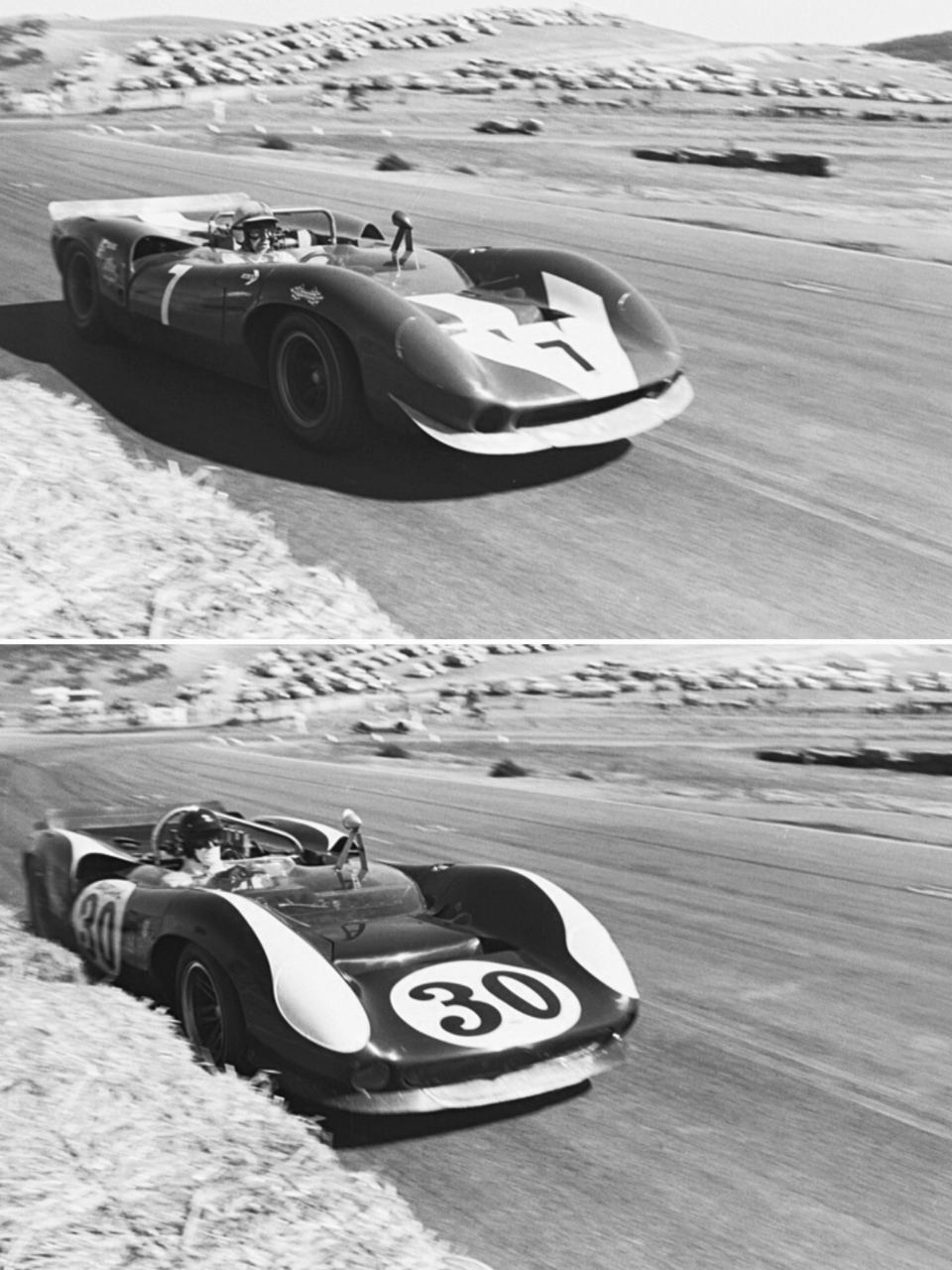
paper

THE BIGGEST CROWD ever to attend an Australian road race saw the Centenary Grand Prix won by Les Murphy (Victoria) over the Victor Harbor Port Elliot circuit this afternoon.

From the Special Staff of Adelaide’s ‘The Mail’ Writers at the Course…as they saw the race in the beautiful, descriptive language of the day, Saturday 26 December 1936.

victor
‘Aerial view of Victor Harbour and Port Elliott for the South Australian Centenary Road Race’. Victor is in the lower right corner, Port Elliott is the smaller hamlet, the headland sticking out, above it. Using the diagram/map of the circuit below,taking the coast and the 2 settlements as reference points, you can see the roads used during the race. (State Library of SA)


victor circuit

Event Background…

It was the first AGP held outside Victoria and has been known over time as the 1937 AGP despite being held on Saturday 26 December 1936 and named then as the ‘South Australian Centenary Grand Prix’. It seems this ‘corruption of history’ as historian John Medley called it, commenced in the 1950’s, whence it originated nobody seems to know.

The Sporting Car Club of South Australia was formed in 1934 and played an active part in the celebration of 100 Years of European settlement of South Australia, the piece de resistance of the organising committee of the South Australian Centenary Committee was SA’s first real road race held 50 miles from Adelaide on the Fleurieu Peninsula, only a few miles from the mouth of the mighty Murray River on public roads between Port Elliott and Victor Harbor, then as now a summer playground. The event was run over 32 laps, 240 miles in total.

The race attracted the best cars and drivers from all around Australia, the limit men of the handicap race drove MG K3’s and Bugatti Types 37 and 43 and over 50000 paying customers came to an event then a long way from Adelaide.

paddock
Victor paddock. #1 is the Fagan MG K3, #2 the Peters Bugatti T37. (Norman Howard)

‘VICTOR HARBOR, Saturday 26 December 1936. ‘The Mails’ contemporary report of the event…

Before the biggest crowd ever seen at an Australian road race, the South Australian centenary Grand Prix and sidecar tourist trophy races on the Port Elliot-Victor Harbor racing circuit filled the quiet country air with a thunder of power. Les Murphy, winner of the ‘Victorian Centenary 300′ in 1934, the Australian Grand Prix at Cowes, (Vic) in 1935, and one of the best known motor speed men in Australia, ran away with the Grand Prix after 250 miles of supremely consistent driving, while opponents in faster cars failed when the final test of endurance was applied. He averaged 68 1/2 miles an hour to win the first prize of £200 and a £50 gold cup.

image
Formally dressed crowd cruise the Victor paddock (SLSA)

The first of the long stream of cars, charabancs, motor cycles, and bicycles which conveyed the invading army of 45,000 to 50,000 spectators to the course left Adelaide at dawn, (Victor Harbor is 85 Km from Adelaide) and long before the start of the sidecar tourist trophy, vantage points on each of the five corners of the circuit were taken up. The crowd seethed with excitement from the moment when the 12 riders in the opening race roared away in a massed start to the fall of the checkered flag until the winner of the Grand Prix flashed past the finishing line. Paling into comparative insignificance when seen against the sustained thrill of the motor event, the motor cycles prepared the onlookers for the motor racing spectacle...There were no serious accidents, but many narrow escapes in the Grand Prix kept the crowd on its toes throughout the day. At several points the efforts of police and race officials were unavailing when the spectators broke through the barriers to watch the cars flash past.’

victor 2
This State Library of SA shot does not record the competitors but shows the dirt/gravel road and the flat, scrubby terrain between Victor Harbor and Port Elliott. Popular summer playgrounds not far from Adelaide then as now. (RP Nicholas/State Library of SA)

‘Narrow Escapes’

‘A thousand people at the Grandstand Bend had their hearts in their mouths when the Bugatti of Hylton Dale (Vic) went into the corner too fast, skidded wildly round with screaming tyres, and regained its course with the driver fighting for control. Nearly an hour elapsed between the starting times of the limit men, E. M. Winter (SA) and R. S. Uffindel (SA) and the virtual scratch men Lyster Jackson (Vic), Jim Fagan (NSW). T. Peters and Lord Waleran. To make up this leeway the fast men attained speeds of more than 100 m.p.h. on the straights and made unbelievable speeds on corners.’

‘The demand for speed sapped the strength of the motors in the fastest cars, however, and it was a middle marker who took the honors of the day. Each of the virtual scratch men struck trouble while the excitement was at fever pitch, but Peters had established the lap record of 81 miles an hour before he dropped out of the running.’

There were plenty of thrills but no serious mishaps at the most difficult of corners. Hell Bend. Many drivers had narrow escapes, but only one, Jack Phillips, came to grief there. Taking the turn at too great a speed, he ran into an embankment and badly buckled the rear off wheel of his car.’

image
Harry Beith calls into the pits after crashing thru a fence at Seaview Bend, Terraplane Spl, he finished 9th (SLSA)

‘The crowd became out of hand at Hell Bend, and it was fortunate that the drivers showed such skill in regaining control of their skidding machines. Nearing the end of his race A. Barrett almost turned round just past the corner, but he managed to switch his car away from the crowd. The thousands of spectators at the bend spent an exciting afternoon. All eyes turned towards the Chilton Straight, when roaring engines warned of the approach of cars. As they quickly neared the bend the crowd was on tip-toes. Engines were throttled down, and the cars skidded and screamed round the corner, sweeping across the road, and sending up clouds of dust from the base of the embankment. Then engines roared again, and with a deafening noise the machines disappeared. Often spectators scampered for safety as the cars skidded out of control.’

Jack McDonald, Amilcar Grand Sport (R Fewster)

Determined efforts were made by the police to keep the corners clear, but soon the crowds took charge, and they swarmed everywhere, even over the grounds of a private residence. Nangawooka Hairpin, which was expected to provide many thrills, was surprisingly uneventful. The crowd at the corner was raised to heights of expectancy several times as the snarl of hard applied brakes and screaming tyres told of the drivers’ fight to get their cars round the corners safely. But apart from the unfortunate skid by G. C. Martin’s AC, which put him out of the race when in a handy position, and two or three cars which took the escape road, the bend was singularly free from incident.

lea wright
Bob Lea-Wright’s Terraplane Spl takes Nangawooka Hairpin. Victor Harbor 1936. (State Library of SA)

The day of speed was remarkable for the precision and orderliness with which the arrangements for the drivers’ safety and the convenience and comfort of spectators were carried out. 

The huge crowd was handled well by the large contingent of police and special constables who were on duty at the course. With the cars careering into corners to the very limit of safe speed, and often just a little more, the highlights of the day were seen by those who had secured corner positions.

Martin had bad lack when he skidded at the Nangawooka Hairpin, while challenging Murphy for the lead in the concluding laps. He was driving with the throttle flat on the floor, but on this corner he skidded and straddled the sandbag safety bank. Immediately dozens of spectators prepared to go to his help, but officials called them back, warning them that Martin would be disqualified if he received any help.

After several attempts to free his car, Martin gave up and two men helped him away. The spectators cheered sympathetically as he left. 

Crowd at Victor Biggest in History.

Although in peak times the estimated floating population of Victor Harbor was about 40,000, never in the history of the town has there been such a crowd as there was tonight. Motor cars were parked everywhere, even down side lanes and blind alleys. Nevertheless, no accidents were reported to the police. Streets were gay tonight and many of the buildings had colored lights.’

victor race coverage

Race Report…’The Mail’ then published a full account of the race in its Sports Section…

How Murphy Won Grand Prix: Brilliant Victory In 250-Mile Race.VICTORIANS FILL FIRST THREE PLACES VICTOR HARBOR. Saturday.

Driving a perfectly judged race, Les Murphy, of Victoria, sped to brilliant victory in the 250-mile Centenary Grand Prix car race this afternoon. He finished about a third of a lap ahead of Tim Joshua, another Victorian. Lea-Wright (Victoria) was third and A. E. Poole (SA) fourth.

START OF GRAND PRIX.

Uffindell (Austin) and Winter (Vauxhall) were first away off the limit mark in the Grand Prix. McDonald (Amilcar), who crashed in the practice trials this week, was a last-minute starter. It had been thought that the damage to his car would not be repaired in time. He went off 8 min. later. The next away were Gullan (Hornet Special), Anderson (Morris), and Tim Joshua (MG). Then followed at intervals Summers (MG), Moulden (Sunbeam), Dutton (MG), Barrett (Lombard), and Dale (Bugatti). The machines away were by this time well warmed, and the lap speeds began to soar. The next batch away comprised Poole (Oldsmobile), Lea-Wright (Terraplane), Beith (Terraplane). Anderson pulled into the pits with water streaming from his radiator and Barrett followed with his Lombard to change a wheel.

At this time 13 competitors were still at the pits waiting to get away on their handicaps. One by one the machines roared down the Brick Kiln Straight until the back markers ; Fagan (MG Magnette), Jackson (MG Magnette), Snow (MG Magnette) and Peters (Bugatti) were on their way. Churning the dirt from the calcium chloride treated track, Peters scattered it all over the spectators as this batch of expert drivers thundered down the straight Peters had a slight advantage.

barrett
Practice or parade lap prior to the race. L>R Lyster Jackson MG K3, winner Les Murphy MG P Type #29 and Alf Barrett Lombard #22. (Alan Griffin Collection)

CARBURETTOR TROUBLE.

Uffindell had covered eight laps, while the scratch men had completed only two laps of the circuit. There had been no retirements up to this stage. Winter howled his Vauxhall round the course at a good average speed. At 1.28 Dale drove bis Bugatti into the pit with carburettor trouble. The defect was remedied in three minutes. Trouble began frequently. McDonald had to pull up opposite the grandstand to adjust his goggles. It only took him a minute, and the car bounded off again. Minor mechanical troubles stalked abroad, and the men at the pits worked feverishly to correct them without serious loss of time.

The pace was now on, but with so many laps ahead for the competitors, spectators were unable to anticipate the winner. After several rounds Fagan (MG Magnette) lapped the circuit at 78 mph, while Burrows went round with his Terraplane in 6 min. 15 sec., which was equal to 74 mph Jackson, driving a MG Magnette, went round in the same time. Hylton Dale, driving a Bugatti, tore round the grandstand bend and went wide. His throttle jamming, he swung round and ricochetted into the pit with a side sweep. Diagnosed, his trouble was described as ‘plug.’

Les Burrows, in his flaming Terraplane, had to pull in because of plug trouble. Barney Dentry in his Riley, who has completed many thousands of miles in his little car, also pulled in for a mechanical adjustment. G. C. Smith (NSW) retired. He said that he had been under the impression that the track was smooth, but it was very rough in his opinion. Anderson (Morris Special) had to pull in several times for water. The last time he came into the pit the water belched from the radiator high into the air as the mechanics lifted the radiator cap. Abbott was making good progress in his supercharged Austin. He came into the pit with a loose distributor which was adjusted in three minutes. Gullan (Hornet Special) lost three minutes while he stopped to adjust his helmet.

murphy
Les Murphy on his way to victory, here on West Straight heading to Hell Bend. MG P Type. Additional fuel tank gave him a range of 300 miles per tanks.(Norman Howard)

DRIVERS WITHDRAW.

Halfway through the race Joshua was in a strong position. He was driving his MG K3 brilliantly. The Victorian driver Murphy was in second position, but Martin was giving a real fireworks display, lapping at 71 mph He was gradually overhauling Murphy. The South Australian representative, Uffindell, was still maintaining a good speed, and was not far behind, while Phillips, at the wheel of his Ford, was going at 74 mph. There had been no serious accidents up to this stage. Abbott experienced plug trouble, and a few minutes later Barrett and then Lord Waleran came into the pit with similar trouble. Mclntyre retired with his Hudson at 3.05 p.m., and Smith withdrew his Hudson a minute later. Frank Kleinig, who was driving Mclntyre’s entry, was forced to retire because of a broken radiator. Kleinig was one of the most popular and most spectacular drivers during practices.

Lord Waleran, who had relieved J. Snow at the wheel of the K3 Magnette, took Hell Bend too wide in the seventeenth lap. Handling his car skilfully, he headed his car down the Escape road, and a few minutes later joined in the fray again.   With eight laps to go Murphy had taken the lead with Martin, lapping at 73 miles an hour second and Tim Joshua third. Phillips, driving his Ford, crashed into the embankment at Hell Bend through attempting to take the turn too fast, the off rear wheel was bent almost underneath the car. Neither Phillips nor his passenger was hurt. At 3.45 20 cars were left in the race. Shortly before 4 o’clock Murphy (Vic) was leading by six minutes.

poole
Nangawooka hairpin. A Poole Oldsmobile. (State Library of SA)

PETERS’ FAST LAP.

Martin set out to catch Murphy with six laps to go and he was reducing the gap at the rate of several miles an hour. There was now only four and a half minutes’ difference between the two speedmen. With an hour’s racing remaining the fastest lap record was put up by Peters, who covered the circuit at 81 mph. Then the whole aspect of the race changed.

Martin broadsided, and saddled the sandbags at Hairpin Bend. There he tried to shift his car without success. Martin made desperate efforts but the rear was protruding across the track, to the danger of other competitors. Driving a perfectly judged race, Murphy, the Victorian driver, who was on a 40 minute handicap, maintained the lead and finished about a third of a lap ahead of Tim Joshua, another Victorian, who was driving A. Barrett’s M.G. Lea-Wright (Terraplane) was third, and A. E. Poole (SA) was fourth.

The winner’s time was 3 hr. 39 min. 6 sec. Poole’s actual time was 3 hr. 37 min. 59 sec., and he thus wins the £25 presented by ‘The News’ and ‘The Mail’ for the fastest time for any South Australian competitor. Dentry was fifth and then followed Cranston, Uffindell, Summers, Beith and Dutton. Others to finish were Terdich and Martin. The following competitors retired; Fagan, Peters, Kleinig, Smith, Burrows, Phillips, Dale, Barrett, Gullan, Winter. Fastest time was set up by Cranston of Western Australia, who covered the distance in 3 hr. 20 min. 17 sec. T. Joshua’s time was 3 hr. 56 min. 10 sec., and Lea-Wright’s 3 hr. 26 min. 40 sec. Fastest lap was secured by T. Peters (NSW Bugatti), who went round in 5 min. 47 sec., equal to 81 miles an hour.

olympic ad
‘Win on Sunday, Sell on Monday’ adage started a long time ago! ‘The Mail’ ad the day after the GP.

Circuit Aerial Photographs…

The State Library of SA (attribution of shots in all cases below) have a series of aerial photographs taken during the meeting, unfortunately not during the racing! They are reproduced below in the sequence, by image number published, which may or may not be corners in their order of a lap, there are no captions to assist the historian. I have included fthen for the sake of completeness.

They clearly show the loose nature of the gravel, the dust the drivers and spectators had to contend with as a consequence, the flattish nature of the area and the open, fast corners.

victor
‘Aerial view of Victor Harbor and Port Elliott for the South Australian Centenary race’ is the caption on this series of shots. (State Library of SA)


victor circuit

vic 1
(State Library of SA)


vic 2
Perhaps; the fast LH kink after exiting ‘Nangawooka Hairpin’. The cars heading from top to bottom of this shot. (State Library of SA)


vic 3
Perhaps; The cars race from top left to right, along ‘Brick Kiln Straight’ then the RH tight corner ‘Sea View Corner’, then the RH kink towards the bottom of the photo is the fast RH taking the cars into Port Elliott.(State Library of SA)


vic 4
Port Elliott. The cars raced clockwise, so from left to right. Into the right hander at top left, then the right hand kink depicted in the previous photo,(the point of the track closest to the water)  then another right hander and down ‘Chilton Straight’, thru the town and back towards Victor. (State Library of SA)


vic 5
Perhaps; ‘Hell Bend’, the RH tight corner at the end of ‘Chilton Straight’ which then heads in the direction of the L/R series of corners towards ‘Nangawooka Hairpin’. (State Library of SA)


vic 6
Perhaps; the L/R combination which leads to ‘Nangawooka Hairpin’. Looked at from top to bottom.(State Library of SA)

Etcetera: Motorcycle Events…

image
R Badger, Ariel Square Four winning the Sidecar TT. There were 12 competitors in a massed start, he gave a ‘brilliant exhibition’ to win the 56 mile race from Bill Barker, Levis and A Griffiths Morgan 3 Wheeler. Average speed 71 mph (SLSA)


image
A Griffiths and passenger aboard their 3rd placed Morgan 3 Wheeler during the Sidecar TT (SLSA)


image
Irish Champion Stanley Woods with some competitors and a fan during the Victor weekend. By then he had 4 successive Irish TT’s and the 1935 Junior and Senior IOM TT’s to his credit- and much more. Woods won the Junior TT on a Velocette by a half a lap in 58 minutes. He led the Senior TT, also Velocette but was slowed by clutch problems after a fuel stop, a South Aussie by the name of Foster won on a Norton (SLSA)

Bibliography…

‘The Mail’ 26 December 1936, John Medleys chapter on ‘The 1937 Australian Grand Prix’ aka ‘1936 South Australian Centenary Grand Prix’ on 26 December 1936 in Graham Howard’s ‘History of The Australian Grand Prix’

Photo Credits…

State Library of South Australia, ‘History of the AGP’ as above, Norman Howard, RP Nicholas, Russell Garth, Richard Fewster

Tailpieces: The paddock…

(R Garth)


(R Garth)

Finito…

glass

(Heinz Federbusch)


Arnold Glass eases his Ferrari 555 Super Squalo into Mount Panorama’s tricky Esses as he starts the plunge down the mountain, Easter 1958…

Glass raced this car with success from November 1957- here he is contesting the Formula Libre ‘Bathurst 100′ on 7 April 1958, the race was won by Doug Whiteford’s equally exotic Maserati 300S. Glass drove a great race ahead of the vastly more experienced, multiple AGP winning Whiteford. The Fazz’ engine blew within sight of the finishing line but the Sydneysider was able to roll over the line in front of third placed Bill Pitt’s Jaguar D Type.

The engine was sent to Maranello for repair, but there were no 3.4 litre Monza spares available so a 2.5 litre 1956 GP engine was sent back to Sydney that November, factory information about the car and specifications of both engines are included at the end of this article.

Glass became disenchanted with the car, it needed the 3.4 litre Monza engine to be competitive at the pointy end of the field and replaced it with the ex-Hunt/Stillwell Maserati 250F when Bib bought his first Cooper- Arnold had plenty of success with the forgiving, fast Maserati in 1959 and 1960.

glass albert park

The Glass Super Squalo being pushed thru the leafy surrounds of Albert Park during the Melbourne GP/Victorian Tourist Trophy meetings in November 1958. First meeting with the cars new 2.5 litre engine. (Kevin Drage)

The Ferrari was brought to Australia by Reg Parnell…

He and Peter Whitehead ran identical cars in the New Zealand International races that summer after racing their ex-works 1955 chassis’ in the Formula Libre 1956 Australian ‘Olympic’ Grand Prix at Albert Park- Stirling Moss won in a Maserati 250F whilst Whitehead was third and Parnell sixth.

The car was later sold to John McMillan, who rolled it at Mount Druitt, damaging it badly, before being repaired by local artisans including racers Tom Sulman and Jack Myers it was then sold to Glass.

I remember seeing the racer at Gilltraps Motor Museum, Kirra, on Queenslands Gold Coast on a family holiday in 1973- ‘twas sensational to look at the first fabulous ‘front engined red Grand Prix car’ i had seen and it is therefore forever etched in my memory!

Gilltraps added it to their collection as a static exhibit in 1963 at the end of the cars ‘front line’ career which was in the hands of Arthur Griffiths and speedway star Des Kelly.

Chassis #’555/2’, re-numbered ‘FL9002’ when rebuilt by the factory as an F Libre machine, was restored by Noel Tuckey and a team of enthusiasts in 1975/6 and then competed at various Australian historic events before sale to Ian Cummins and then the car was Hoovered up by US dealer in the 1980’s- these days it is part of Bernie Ecclestone’s collection.

glass fazz

The Squalo at Gilltrap’s in the early ’70’s, a star amongst the other exhibits! (Sharaz Jek)


Des Kelly eases his magnificent machine forward onto the Lowood grid in 1961, Super Squalo still looks the goods despite its obsolescence as a front line Gold Star tool by then, the Cooper takeover was complete. Meeting date and result folks?(unattributed)

Ferrari had ruled the roost in Grand Prix racing in 1952, 1953, its Aurelio Lampredi designed 2 litre, four cylinder Tipo 500 had won two World Championships on the trot for Alberto Ascari.

They raced into the new F1 of 1954 with 2.5 litre versions of the 500, named 625- as well as a new design, the 553. It was fitted with a 2.5 litre engine which owed few parts to the 2 litre unit and a new chassis which whilst still comprised of two main longitudinal members was reinforced with welded on superstructure framework- certainly not a ‘spaceframe’ in a definitional sense but structurally better than what went before.

Suspension was similar to the 500/625 in having independent front suspension by wishbones and a transverse leaf spring and a de Dion rear axle similarly suspended. With its fuel low and centralised the car was squat, broad and low giving rise to its ‘Squalo’ or ‘Shark’ nick-name- three 553s were built.

In 1954 the 625 was the better performing car of the two designs despite Ascari first racing the Ferrari 500 at Modena in late 1951- he won. Doug Nye wrote that Ferrari built six, or maybe seven 500’s for their own use and ‘at least five cars either as new or from spare and cannibalised parts for sale to private entrants.’ All of these cars but one was converted from a 2 litre ‘500’ to a 2.5 litre ‘625’ for F1 use that year and beyond.

Ferrari 555 Super Squalo cutaway (G Cavara)


Paul Frere in the Ferrari 555 Super Squalo ‘555-2’ he raced at Monaco in 1955, Piero Taruffi started the car, Frere took over during the race- Nino Farina behind his #42 625 (Klemantaski)

Ferrari designed and built the 555 ‘Super Squalo’ for 1955 to address the shortcomings of the 553 starting with the chassis, which was of similar construction to the 553 but had larger diameter base tubes than its older brother.

The suspension was modified along the lines of changes made to the 553 chassis in which Mike Hawthorn was victorious at the Barcelona, Spanish Grand Prix in late 1954- the weekend Vittorio Jano’s Lancia D50 first raced and piled further competitive pressures upon Scuderia Ferrari who were already hard-pushed by the Maserati 250F and- from the French Grand Prix, Mercedes Benz W196. Front suspension used coil springs and revised geometry was deployed at both front, and to the rear de Dion. The three 553s were converted to this specification inclusive of bodywork changes, in addition to the four new 555s built.

The 625s were also developed along similar 555 lines- double wishbone and coil spring front suspension and de Dion suspension amended with the transverse leaf spring moved from above the differential unit, from its original site below it.

Maurice Trintignant won the 1955 Monaco GP in one of these cars to give the 625 its greatest success. Note that the two 500/625 cars acquired by Peter Whitehead and Tony Gaze (later acquired and raced with great success by Lex Davison in Australia) to race in Australasia and South Africa in 1955 were ‘original form 1954 works cars’ which had ‘Tipo 750 Monza 3 litre sportscar engines installed for Formula Libre racing.’

The fundamental problem of the 555 Super Squalo design from the start was excessive understeer- the best result of the year, on a high speed circuit which suited them was in the Belgian Grand Prix at Spa where they were quick and finished 3-4-6- Farina from Trintignant and Frere. Regarded as a ‘fast circuit car’ the machines were not used again until Monza.

Note that the formal handover of the Lancia D50 ‘assets’ from the in desperately financially troubled Lancia to the desperately in need of a competitive car and haven’t got the budget to do so Ferrari, occurred on 26 July 1955, ‘saving Ferrari’s bacon’ and totally changing the Scuderia’s  developmental priorities away from the four cylinder cars to Jano’s V8 gems.

The Super Squalo’s were returned to Maranello and ‘lay in store there, while the totally obsolescent 553s had apparently long since been broken up…’Nye wrote.

The cars acquired by Parnell and Whitehead, chassis ‘555-2’ and ‘555-1’ were ‘presumably the least altered 555s, having their frames extended by four inches and 3.5 litre Tipo 860 Monza engines installed for Tasman racing…’

John Blanden records the Scuderia Ferrari 1955 race record of ‘555-2’ as sixth in the Monaco Grand Prix, the car shared by Piero Taruffi and Paul Frere with the balance of its outings with Maurice Trintignant at the wheel- Bordeaux GP DNF engine, Belgian- Spa sixth, Dutch- Zandvoort DNF gearbox and finally the Italian GP at Monza where he was eighth.

Arnold Glass in ‘555-2’ at Lowood circa 1958. Compare the bodywork of the car with its big, tall 860 Monza engine and the much shallower nose of the chassis in original F1 specs (B Thomas)

Arnold Glass is an immensely interesting character…

From a humble background, trained originally as a fitter and turner he made his first small fortune trading and repairing motor cycles. He was a racer and later an immensely successful businessman via his Sydney ‘Capitol Motors’ Datsun empire.

The following obituary was written by Malcolm Brown and published in the Sydney Morning Herald in January 2009- Glass was born on 11 December 1926 and died on 16 January 2009.

‘As a boy, Arnold Glass was directed by his father, a music teacher, to play the violin. But Arnold’s eye was firmly fixed on Popular Mechanics, a magazine for rev-heads, which he read from cover to cover, dreaming of owning a motorcycle.

Arnold’s father relented and bought him How To Be A Motor Mechanic. The boy who would become a dynamo in the Australian motor industry, a multimillionaire, sportsman and playboy, had his course in life set.

Arnold Glass, who has died at 82, was born in Newcastle and grew up in Marrickville. He left school at 14 to earn money for his family, which included three brothers and a sister. He became an apprentice mechanic and, at 16, left home and bought an old Douglas motorcycle for £3/15/-.

glass mt druitt

Glass racing the 555 Super Squalo at Mount Druitt, Sydney on 10 November 1957. Bulbous rather than beautiful? Stunning regardless, if not the most successful of GP Ferrari’s. The Lancia D50 saved Ferrari’s bacon when ‘gifted’ to them in the deal brokered later in 1955. (John Ellacott)


Not working quite so hard in a display in a bank chamber, date and place unknown (B Thomas)

While working in engineering plants, Glass studied at technical college to become a fitter and turner. He worked on Avro Anson aircraft engines at Butler Air Transport and saved to buy motor cycles, which he restored and sold. In 1946, at 19, he went into partnership with Julian St John to run a motorcycle business. Operating out of a tin shed in Marrickville, they scoured back alleys seeking to buy motorcyles.

In 1947, Glass acquired a Tiger Moth, learnt to fly and developed an absorbing interest in war-vintage piston-driven aircraft.

In 1949, he and St John bought an old Chinese grocery shop in Campbell Street, opposite the Capitol Theatre, and converted it into a motorcycle shop, naming their business after the theatre. Used motorcycle and car salesmen depended on newspaper advertisements to find out what cars were for sale and would pounce on the first editions at 3am. But Glass paid a young Herald employee £2 a time to throw a copy from a toilet window at midnight.

The arrangement was risky. The businessmen had a setback when they bought a stolen motorbike. Yet Glass wasn’t one to recoil from risk. In partnership with Bill Duffy, he bought an unfancied racehorse called Johnny Zero, which won consistently, earning the owners £30,000.

He bought used cars in Singapore and aircraft in England, selling them to rural customers in Australia. In 1951, he and St John converted a pet shop in Campbell Street into a car yard. The next year he bought out St John and, in 1953, bought land for another car yard in the Haymarket, selling Chryslers, Simcas, Renaults and Porsches-by then he was selling 1000 vehicles a year.

Glass tried punting but stopped when he was losing heavily. “I found something that could beat me,” he recalled. He married a model, Norma Geneave, in 1955, acquired a car yard at Lidcombe in 1957 and won the Bathurst 100 motor race. A daughter named Amanda was born in 1958.

In 1961, he bought a car yard at Artarmon and made the critical decision to invest in Japanese cars, then rarely seen in Australia. Moving into William Street, he took over a Datsun franchise, soon the cars captured the public’s imagination his wealth assured.

He bought a home in Cremorne, in so-called ‘Millionaires’ Row’, with its own wharf, but his marriage failed in 1963. ‘I’m not a family man’, he said later. ‘I didn’t have a lot of time or patience for a family type life. I put so much into my business, none was left over.’

Maserati 250F circa 1959/60 at Lowood, Queensland (B Thomas)


Glass contesting the 1962 Australian Grand Prix in a BRM P48 Buick V8, 5th in the race won by McLaren’s Cooper T62 Climax (K Devine)

Glass raced many different cars, including Ferraris and Jaguars. He raced boats in Australia and the United States and competed successfully in marathon waterski events. He flew aircraft, buying a Mustang and British-made Vampires and travelled to Czechoslovakia and Poland to fly MiG-21s. His restless energy took him spear-fishing with the Prime Minister Harold Holt.

In 1961, Glass slammed his BRM P48 into a tree at 100 kmh at Mallala, after which he required plastic surgery. Bouncing back, he bought a seven-hectare site on Parramatta Road, Auburn, and turned it into the biggest car dealership in NSW, as the distributor for Nissan and BMW.

He established his own finance and insurance company, dealt in aircraft and boats and ventured into show business. Transporting himself in his Lear jet, he stalked and killed buffalo and lions in South Africa, crocodiles in Zimbabwe and bears in Alaska. His powerboat racing wins included the 1975 Sydney-Newcastle BP Ocean Classic.

By 1976, Capitol Motors was selling 23,000 Datsuns a year. In 1977, Australian National Industries bought the company for $28.43 million. With his 49 per cent shareholding, Glass took away $13.87 million while joining the ANI board as deputy chairman.

He spent much of his time in Monaco, although he returned in 1983 to sack three ANI executives. He had demonstrated his toughness years earlier by sacking car salesmen who failed to reach quotas. Retiring to Monaco in 1984, he returned from time to time to see his daughter and her family. He died in Sydney.

Arnold Glass is survived by his partner of 37 years, Jennifer Hole, his daughter, Amanda Sorensen, and grandchildren Ryan, Tegan and Kirsty’.

Arnold, his face showing the signs of a practice accident, with Graham Hill prior to the start of the 1965 NZ GP at Pukekohe. Hill won in the Scuderia Veloce Brabham BT11A Climax whilst Glass retired after 3 laps in his Cooper T55 Climax with mechanical dramas (CAN)

Etcetera…

glass and 250f

(John Ellacott)

I love this portrait of Glass by John Ellacott, looking every inch the successful man he was- its taken at Symmons Plains, Tasmania in March 1960.

The car is the Maserati 250F referred to above, chassis #2516, the ex-works Moss/Behra/Hunt/Stillwell car which Arnold raced very competitively from 1959 to 1961- the car with which he achieved most success i think.

I wrote an article about this Maser a while back, click here to read it; https://primotipo.com/2014/07/19/reg-hunt-australian-ace-of-the-1950s/

Arnold testing the Maserati 250F at Symmons Plains in March 1960 with Mick Watt’s MG Holden Spl in the foreground (J Barnes)

Gilltraps..

Gilltrap catalogue

(Stephen Dalton Collection)

From the Gilltraps catalogue of display cars circa 1967, the Ferrari Super Squalo is at bottom, at the top is ‘Genevieve’, the Darracq which starred in the 1953 British film of the same name.


(D Zeunert)

A bit of gold dust from Melbourne enthusiast/historian David Zeunert’s files.

‘A newspaper advertising clipping from my files of the Gilltrap Ferrari Super Squalo dated August 1986. Oh they were the  days, I have an extensive newspaper advertising collection of all of the cars that interested me. I used to comb the Age Motoring Ad section and clip out the ones I dreamed of owning one day. Its great to scan them 40 years later.’

I see Reg Purnell raced the car, the ad does nothing to provide me clarity about whether its ‘Gilltraps’ or ‘Giltraps’ either- there are all variations on the internet.

Ferrari works material on ‘FL9002’..

(R Croston)

Enthusiast, Richard Croston has a copy of this information on the general specifications of ‘FL9002’ and the detailed specifications of both the 3.5 litre engine the car was fitted with when raced by Parnell and the 2.5 litre unit the factory fitted when sent back to Italy by Arnold Glass.

Dated 10 November 1958, the document is from the time Glass owned the car and appears to be a letter and information in response to a request from Arnold.

You can piece it together yourselves but the gist of it seems to be they cannot be clear about providing more information about the car whereas in modern times the parentage of the car is quite clear.

The 3.5 litre engine ‘Tipo 129’ four cylinder, DOHC, two valve engine had a bore and stroke of 102x105mm and developed 281bhp @ 6000rpm, the gearbox was mounted at the rear and had four speeds.

(R Croston)

The 2.5 litre ‘Tipo 106’ four cylinder, DOHC, two valve engine was oversquare, having a bore and stroke of 100×79.5mm for a capacity of 2498cc and a rev limit of 7000rpm- no power output is quoted but other sources quote 260bhp. Carbs are two Weber 52DCOA/3.

(R Croston)


(R Croston)

Credits/References…

Heinz Federbusch and John Ellacott photos, John Blanden ‘Historic Racing Cars in Australia’, ‘History of The Grand Prix Car’ Doug Nye, Kevin Drage, Stephen Dalton Collection, Sharaz Jek, Ken Devine Collection, Obituary by Malcolm Brown- Sydney Morning Herald, Quentin Miles, Classic Auto News, Brier Thomas, Louis Klemantaski, Richard Croston Collection, David Zeunert Collection

Tailpiece: Glass, Maserati 250F, Bathurst circa 1960…

(Q Miles)

Finito…
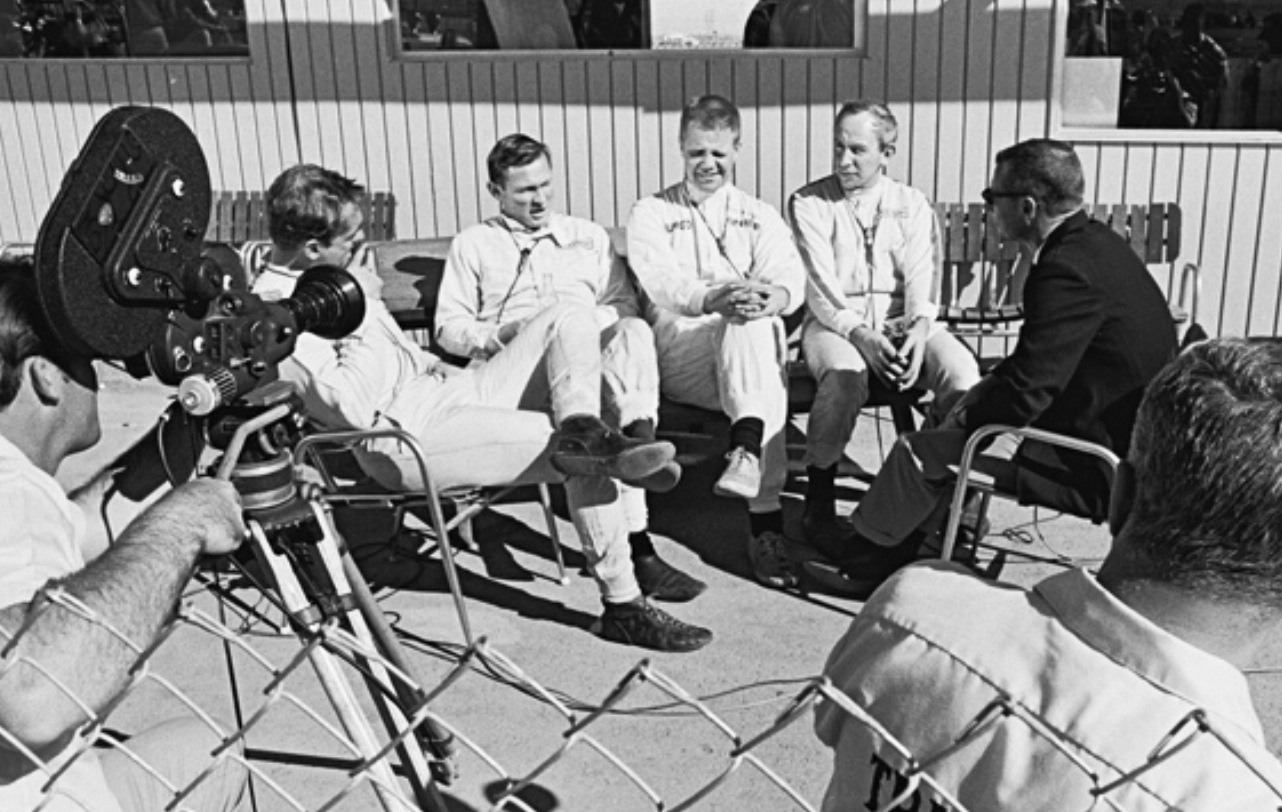
AH AMS Mar 66 a

Alan Hamilton aboard the first of many serious Porsches he raced in Australia down the decades, the ex-works 904/8 ‘Kanguruh’ chassis # 906-007 at Calder in January 1966…

Norman Hamilton famously negotiated a franchise for Porsche in Australia, having been ’rounded up’ by one of the earliest 356s on a drive through the Swiss Alps. The business quickly prospered from its Melbourne base. This article is about the 906s raced by Norman’s son Alan from the mid-sixties to early-seventies and his career during that period.

He raced three such cars; 904/8 chassis # ‘906-007’ and two 906 Spyders; one during 1967 and another in 1971-72, the latter cars used chassis supplied by Porsche, but neither had a chassis number, giving more than one historian a headache or two…

Alan Hamilton was born on 29 July 1942. After attending Camberwell High School in Melbourne’s leafy eastern suburbs, he joined the family firm, which was to expand hugely over the ensuing decades under his leadership. A competition licence quickly succeeded his road licence at 18, initial competition exploits were in a VW contesting trials and gymkhanas. A 1958 Porsche 356 Super followed; he competed in this standard car at country meetings and hillclimbs. A 1959 Convertible followed, which was also successful.

In early 1965 Hamilton headed for Europe including a stint working in the Porsche factory, the 904/8 Bergspyder was purchased during that trip and shipped to Australia for the 1966 season, clearly a step up in performance for the young driver…

longford 1
Majestic shot of a fabulous road racing circuit, ‘Long Bridge’ Longford Tasman Meeting 1967. Bob Jane leads Noel Hurd in Elfin 400 Repco and Elfin 400 Ford respectively. Hamiltons 2 litre Porsche 906 outgunned at this point by the 4.4 and 5 litre Elfins. (oldracephotos.com/Harrisson)

Porsche 906…

The  906 was produced for the 1966 World Championship of Makes. It was designed for the FIA’s Group 4 regulations, whilst modified variants of the car, using larger engines and/or cut-down Spyder bodywork, were entered in Group 6, the  Sports Prototype category.

The 906 became the last street-legal pure racer built by Porsche. It replaced the successful ladder frame chassis 904 and was the first substantial product of Technical Director Ferdinand Piech’s new team at Zuffenhausen. The Porsche 904 had additional structural rigidity from its bonded-on fibreglass bodywork, while the new 906 featured a modern multi-tubular spaceframe chassis, with an unstressed fibreglass body.

The initial batch of 50 Porsche 906/Carrera 6 Coupes offered light weight, circa 1,300 lb (580 kg), a saving of around 250 lb (113 kg) compared to the similarly-engined 904/6.

The Porsche 901/20 6-cylinder lightweight racing engine was standard equipment, offering circa 220bhp on Weber carburettors. A handful of factory-entered works cars were powered either by fuel-injected versions of the 6-cylinder engine, or the flat-8 derived from Porsche’s F1 program, both engines air-cooled of course.

906 chassis
Porsche 906 Coupe Cutaway; multi-tubular space frame chassis, front suspension; wishbones and coil spring/dampers, rear; inverted lower wishbone, single top link, radius rods and coil spring/dampers. Adjustable bars front and rear. Rack and pinion steering. Six cylinder SOHC two-valve engine on carbs, 220bhp, five-speed Porsche’box with synchros, steel wheels, disc brakes. (Inomoto)

The 906 shape was developed in the wind tunnel, with a top speed of 170mph at Le Mans, amazing for a 2-litre car.

The cars made their international race debut in the 1966 Daytona 24 Hours, sixth overall and beating the Ferrari Dino 206 in the 2-litre class was the car driven by Hans Herrmann/Herbert Linge. At Sebring, Herrmann won the class again in a Carrera 6, this time co-driving with Gerhard Mitter and Joe Buzzetta, and finished fourth overall.

The Monza 1,000kms was dominated by 906s in the 2-litre class, this time with Herrmann/Mitter in a works entry leading home the customer car of Charles Vogele/Jo Siffert, these two cars placing fourth and fifth overall behind the victorious Ferrari 330P3 and a pair of Ford GT40s.

At the Targa Florio the 906 won outright, there Willy Mairesse and Herbert Muller co-drove the Swiss Ecurie Filipinetti car.

The 1966 Le Mans works, prototype Porsche 906LE Coupes finished in fourth-seventh places behind the leading trio of 7-litre factory Ford GT Mark IIs, outlasting all of the V12-engined sports-prototype Ferrari P3/4s, while the 2-litre Sports class was again dominated by a standard 906.

The Austrian 500kms event at Zeltweg saw Gerhard Mitter/Hans Herrmann and Jo Siffert (driving solo) finishing one-two.

In 1967 the 906 continued to be campaigned by prominent private entrants and drivers, while the factory team moved on to race larger-engined 907s on the relentless climb to development of the outright contender which finally won Le Mans for Porsche in 1970, the immortal 917.

miyy
The Colin Davis/ Porsche 904/8 ‘906-007’ on the way to 2nd place during Targa 1965. The radical cutaway of the body at the front to reduce overhangs on narrow hillclimbs clear in this shot. (Martha)
bonnier
Jo Bonnier inserts himself into 904/8 # 906-007 during practice; both he and Graham Hill tried the car but elected to race a 904/8 Coupe #174, you can just see the nose of the car, with Hill at the wheel beside the Carabinieri. Car # 94 behind Bonnier is the #94 Pucci/Klass 904GTS. Porsche bought seven cars to the event, all but two T-Cars started. (Martha)

The Porsche 904/8…

The 904-based Bergspyders played an important test role in the evolution of the 904 to 906. The first appearance of these cars was at the Targa Florio on May 9, 1965.

All 904s came from the factory with 2-litre engines; four, six and eight cylinders. Generally the fours had 904 chassis numbers and the six-cylinder cars 906 chassis numbers. There was no rule though: the first prototype chassis 904-001 had a six-cylinder engine, the eight-cylinder coupes had 904 chassis numbers, whilst the eight-cylinder Spyders had 906 chassis numbers. Easy really!

Porsche built five 904/8 cars for factory use: chassis 906-003, 004, 007, 008, and 009. To be clear, whilst the chassis had the 906 descriptor, the cars used 904 ladder-frames, not the 906 spaceframe chassis.

All 904/8s had 2-litre flat-8 engines; the Type 771 1962cc engine, which was derived from the 1962 804 F1 car and produced circa 225bhp fed by Weber carbs.

The cars were made in two body variants. Chassis 003, 004, and 009 had the normal Spyder look of a Porsche of the period; the other two cars, 007 and ‘008, were more visually challenging, that is, ugly! The overhangs were shortened a lot for hillclimbing purposes.

Bergspyder, as a name, was a misnomer as the cars were raced as well as ‘climbed, they were nicknamed ‘Kanguruh’ (kangaroo) because of the nature of the cars roadholding, the lightweight cars with their firm suspension jumped about on poor roads.

front
A couple of fabulous stationary shots of 904/8 ‘906-007’ at Targa 1965. #72 is the Alfa TZ1 of Panepinto/Parla DNF. (Martha)
back
And back…by far the better angle! (Martha)
targa 2
The Porsche team arrive at Targa, May 1965. Cars are 904GTS Coupes and the Spyder, 904/8 906-007 chassis driven by Davis/Mitter. (PorscheAG)

Hamiltons 904/8 car chassis 906-007 was first raced at Targa 1965,

It finished second in the hands of Cliff Davis/Gerhard Mitter behind the winning Ferrari P2 of local lad Nino Vaccarella and Lorenzo Bandini. Gerhard Mitter then used the car to win the 1965 Rossfeld Hillclimb, a 6 km course near Berchtesgaden on 13 June. Next placed Herbie Muller was five seconds adrift in a standard Porsche 904GTS.

targa 3
Carabinieri taking an interest in the second placed 904/8. # 94 is the works 904GTS of Pucci/Klass fifth, #106 is the Lancia Flaminia of Raimondo/Lo Jacono, which finished but was unclassified. Privateers the lifeblood of Targa! (Martha)
rossfeld
Mitter on the startline of Rossfeld, Germany 1965. Win for 904/8 ‘906-007’. (unattributed)

Further success followed at the Norisring, near Nurnberg, where Mitter raced 906-007 to victory on July 4, 1965, leading home two Elva BMWs. The car was then unraced, the last appearance of a 904/8 was in August, in factory hands, Porsche thereafter focusing on production of the new 906.

Alan Hamilton spotted the car in a corner of the racing department…

norisring
Car #2 Mitter at the Norisring, victorious in the 904/8 again. Car #3 is a Lotus 23 driven by Anton Fischhaber, #5 Chris Williams’ Lotus BMW. (unattributed)

Porsche 904/8 906-007 in Australia…

Interviewed by Journalist Barry Lake, Hamilton said the 904/8 ‘originally had a 2-litre 8-cylinder engine, but I bought it with a new 906 (6-cylinder) engine I had asked them to install. I imported that at the end of 1965 and raced it through 1966.’

The car was first raced in Australia at Calder, Victoria on 16 January 1966, which is probably when the Autosportsman cover shot used at the start of this article was taken. The car then raced at the Sandown round of the Tasman Series, contesting the sports car events.

Taken across Bass Strait on the Princess of Tasmania with the rest of the Tasman Circus to contest the Australian Tourist Trophy at Longford, Hamilton was second in the race won by the much more powerful Elfin 400 Traco Olds V8 of Frank Matich.

longford
Alan Hamilton in his Porsche 904 906-007 in one of its earliest appearances in Australia, at the 1966 Australian Tourist Trophy, Longford in March 1966. Alongside is Spencer Martin’s Ferrari 250LM and on the far side Frank Matich, in the victorious Elfin 400/Traco Olds. Hamilton was second, Martin third. (Ellis French)
hamo surfers
Alan Hamilton navigating Surfers Paradise traffic during the 1966 12 Hour. Porsche 904 906-007. Car #5, the ex-Moss/Stillwell Cooper Monaco Olds of Osborne/Carter/Gibbs. (David Blanch)

The 904 quickly became one of the fastest sportscars in the country, fourth in the 1966 Surfers Paradise 12 Hour with a 2-litre car was a top result. Alan shared the 904 with Melbourne driver Brian ‘Brique’ Reed. Jackie Stewart and Andy Buchanan won in the Scuderia Veloce Ferrari 250LM- I wrote an article about this Ferrari a while back, click here to read it; https://primotipo.com/2014/07/03/pete-geoghegan-ferrari-250lm-6321-bathurst-easter-68/

The Hamilton 904 combination were also first in the 1966 Australian Hillclimb Championship at Collingrove, South Australia, the Victorian Sports Car Championship at Sandown and the South Australian Sports Car Championship at the Mallala ex-airfield circuit.

Towards the end of 1966 the Porsche workshop in St Kilda, Melbourne started to transfer the mechanicals of the Kanguruh 904/8 906-007 to a new 906 chassis.

Alan Hamilton, ‘Later (that is after the 904/8 was in Australia) I imported a new 906 chassis and body and put the mechanicals of the Targa car in that’.

‘Then Jim Abbot bought the Targa car (chassis 904/8 906-007) and fitted a ZF gearbox and 289 Ford V8 engine. His estate or perhaps Jim himself shortly before he died, sold the car to Murray Bingham in this form and it became the Bingham Cobra.’

904 6
Longford March 1966, second in the Australian Tourist Trophy. 904 ‘906-007’. (oldracephotos.com/King)
tempy
Alan Hamilton ‘fairly hooting through here, scary to watch’ in the view of the photographer. Templestowe Hillclimb, outer Melbourne 1966. 904 906-007. (onelung)
hamo templestowe
Another shot of Hamilton in the 904 at Templestowe Hillclimb, 11 September 1966, he broke the climb record on the day. (Stephen Dalton Collection)

Hamilton; ‘Years later, Pat Burke bought the car and sent it to Germany where it was restored to its original 904/8 Targa Florio specification. After Pat Burke fell on hard times it was auctioned at Monte Carlo. I think a man in Sydney bought it, but I have no idea who has it now.’

Lets go back a step to the acquisition of the chassis and related parts by Jim Abbott.

Abbott was a driver, owner of Lakeland Hillclimb in outer Melbourne, publisher of motor racing monthly Autosportsman magazine and promoter of an annual Motor Racing Show in Melbourne.

In 1966, 1980 World Champion Alan Jones, was trying to establish a foothold on the motor racing ladder in the UK, wheeling and dealing in cars and campers to provide the money to do so. He acquired an ex-works Sunbeam Tiger and, knowing Abbott had an interest in such cars, sold it to him. The car was raced and ‘climbed’ by Jim and engineer Paul England before Abbott decided it would make a nicer road car than a racer. He swapped the Shelby-modded 289cid V8 for a standard engine and looked around for a chassis into which to plonk his nice, powerful Ford Windsor small-block V8.

Various Coopers were considered before a deal was done with Hamilton to acquire the Kanguruh 904/8 906-007.

A suitable ex-Cooper Maserati F1 ZF 5DS 25 transaxle was also acquired. The engine and box (the latter requiring some modification in terms of clutch componentry by Eddie Thomas) was ‘dropped’ into the Porsche chassis at Hamilton’s St Kilda workshop.

A little cutting and shutting of the chassis crossmember was needed to fit the V8. A sub-frame was added around the engine to maintain chassis stiffness, but in essence, the swap was relatively simple.  Stiffer springs and shocks were fitted as the Ford cast iron lump was around 200lbs heavier than the svelte, alloy Porsche Flat 6. Driveshafts were suitably strengthened by Paul England Engineering.

The original rear bodywork was used but at the front, much bashed and repaired a local specialist fashioned a nose much more attractive than the original, the screen, a concoction of a speedboat parts, met at each end with aluminium panels was not quite so pretty.

abbott lakeland
Jim Abbott in 904 ‘906-007’ now called a ‘Porsche Cobra’ in deference to the 289cid Ford engine installed. This shot is probably at Lakeland in outer Melbourne, a venue owned by Abbott. Front of the much bashed and repaired body re-worked. (Autosportsman)
butt shot
Fairly scratchy shot shows the ZF 5DS 25 beefy gearbox if not the engine. Chassis other than minor mods to fit the engine, as built by Porsche. Front and rear suspension sold with the car by Hamilton to Abbott also standard. (Autosportsman)

Abbott’s objective was not to build an outright car but rather a very fast sports car which could be ‘raced, sprinted and climbed’. The completed machine made is debut at the Light Car Club of Australia’s annual members meeting at Sandown on Melbourne Cup Day in November 1967. ‘Red Handed’ won the ‘Cup at Flemington that day! More importantly, Abbott set a sub-13-second standing quarter mile at Sandown, also primarily a horse racing venue.

The car was quickly under the times set by the class record holder, a Cooper Jaguar at Templestowe Hillclimb and was running fourth in the Winton Trophy at the picturesque Benalla country Victorian circuit when the car lost its water. Initial troubles centred around the cooling system, which were solved by fully rebuilding it.

AH Abbott PC Templestowe
Jim Abbott, ‘Porsche Cobra’ 904/8 906-007, Lakeland Hillclimb 1967. These are scratchy shots but included for the sake of completeness. Abbott looks huge in the cars cockpit. The screen is from a boat. (Autosportsman)
AH Abbott PC lakeland
Jim Abbott, Porsche Cobra 904/8 906-007, Lakeland Hillclimb 1967, 2 years before victorious at the much more grand, Rossfeld, Germany hillclimb. (Autosportsman)
Tom Sulman in the Porsche Cobra at Huntley Hillclimb, NSW on 1 June 1969 (T Arts)

Abbott did not campaign the car for long before his untimely death, it was then sold to New South Wales veteran driver, Tom Sulman who raced it in 1969.

Murray Bingham then bought 904/8 906-007 and used it very successfully for over 10 years. The old chassis won the Australian Hillclimb Championship again in 1972, a three-round Series that year. (Hamilton won the 1966 title in it at Collingrove).

bingham
Murray Bingham in 904/8 906-007, then known as the ‘Bingham Chev’ in, probably, 1972 at Collingrove, Angaston, SA. Check out the downforce being sought front and rear. (John Lemm)

A ‘Manx’ body replaced the original, and the Ford Cobra engine was updated with an ex-Gary Campbell, Alan Smith-built Chev F5000 engine out of a Lola T300. Bingham won the 1973 NSW Hillclimb Championship in Chev-engined form, the 1971-72 NSW titles Ford Cobra-engined.

The much raced car finally passed into the hands of Pat Burke who restored it before it was sold upon the demise of his business empire in the 1980s as described by Alan Hamilton earlier in the article.

I am uncertain of the cars current owner.

bingham
Murray Bingham in 904/8 906-007 in its hillclimbing years, King Edward Park, Newcastle, NSW. Car known as ‘Bingham Cobra’ and ‘Bingham Chev’ when fitted with Ford 289 and Chev F5000 engines respectively. ‘Manx’ body (unattributed)
AH Autosportsman June 67
Australian Autosportsman June 1967 cover depicts the Alan Hamilton Porsche 906 Spyder at Longford in 1967. (Stephen Dalton Collection)

Hamilton’s first Porsche 906 Spyder…

Hamilton’s new 906 chassis came with bodywork, suspension and brakes.

904/8 906-007 donated its engine and gearbox and some other components, as the narrative and photos show, the 904/8 906-007 car was still as built by Porsche, less the engine and box. Alan is a big, tall bloke so he elected to build the 906 up as a Spyder rather than a standard 906 Coupe in order to ease access and egress and more easily see out of the car.

At this point we have two cars: the 904/8 chassis car 906-007, now called ‘Porsche Cobra’ and fitted with a Ford engine and ZF gearbox and a 906 which was not issued a chassis number by Porsche, but which over the years assumed the 906-007 tag, which was built up as a Spyder, but which when restored in Germany in 2003-09, was rebuilt as a Coupe. This car now has a chassis 906-007 plate, at what point the plate was affixed is conjecture.

Both cars have elements of the original 904/8 906-007…

906 2
Another majestic Longford shot. Hamilton Porsche 906 Spyder 1967. (oldracephotos.com/King)

Back in 1966, none of these problems for future historians mattered to Hamilton; he had a new state-of-the-art 906 to contest Australian events.

As the recent article I wrote on the Frank Matich Elfin 400/Traco Olds makes clear, the light six-cylinder-engined Porsche was up against it with several very potent, light, well-driven V8-powered cars in the hands of Frank Matich, Niel Allen and Bob Jane in 1967. (Matich SR3 Repco, Elfin 400 Chev and Elfin 400 Repco, respectively).

The Porsche Team completed the build of the 906, and the original 904 chassis 906-007 was put out the back of their St Kilda workshop until acquired by Jim Abbott later in 1967.

The 906 Spyder made its debut in the sports car events at Sandown’s Tasman round in late February 1967. Hamilton took three class wins and a class lap record.

To Longford, the following weekend, the car was third outright. The following week, still in Tasmania, Hamilton raced the car at Symmons Plains, where he won his first race and was leading the Tasmanian Sports Car Championship when a conrod let go. Hamilton noted in his Autosportsman column that the engine had ‘done 14 months racing, 92 hours, so we are more than happy with its overall performance’, Porsche’s reliability is legendary.

In April, Hamilton contested the Victorian Sportscar Championship, winning his heat and finishing second outright and first in class; he also bagged the class lap record.

wf pit front
The Hamilton 906 in the Warwick farm paddock, May 1967. Note the ‘chin wing’ and pretty front of the car. (WOT)
hamo wf
Sensational Bruce Wells shot of Hamilton contesting the RAC Trophy at Warwick Farm in May 1967, here in the Esses. Sans the wings in the paddock shot. Porsche 906 Spyder. (Bruce Wells/The Roaring Season)
wf pit rear
Warwick Farm 906 butt shot, May 1967. (WOT)

On 14 May, Hamilton contested the RAC Trophy at Warwick Farm where he finished third behind two powerful V8s. The dominant Matich SR3 of Frank Matich was getting in some valuable mileage before leaving to contest the Can-Am Series in this car, and Bob Jane’s Elfin 400, which, like the SR3, was powered by Repco’s new 620 Series SOHC, two-valve, 4.4-litre V8.

A week after the RAC Trophy, Hamilton contested the Australian Tourist Trophy at Surfers Paradise. This was a relatively easy tow from Sydney to Queensland’s Gold Coast and gave Hamilton valuable testing time at Surfers to fettle the car to suit the circuit for the international 12 Hour event in September.

Matich won again in his SR3 Repco, but Alan was second in the 906 and his 12 Hour co-driver Glyn Scott third in his Lotus 23B Ford. The other two outright sportscar contenders of that year, Niel Allen and Bob Jane’s Elfin 400s did not make the trip North.

Success followed in Victorian events at Calder and at Hume Weir on the Queens Birthday weekend,  before taking the long haul back to Surfers Paradise for the 12 Hour event on the 3 September weekend .

hume weir
Alan Hamilton awaits the rest of the grid at Hume Weir in 1967. Great little circuit built in a quarry created when land fill was excavated to create the Hume Weir Dam. Porsche 906 Spyder. Top shot shows the lines of this car superbly. (unattributed)
hamo and spencer
Hume Weir, Queens Birthday weekend 1967. AH on pole in his 906, #6 is ‘Gold Star’ reigning national champion, Spencer Martin having his first drive of Bob Jane’s Elfin 400 Repco  and the nose of Bevan Gibson’s Lotus 15 Climax FPF. (The Nostalgia Forum)

Hamilton’s co-driver at Surfers was Queenslands’ Glyn Scott, the duo finished third outright and first in class. The race was won again by the SV Ferrari 250LM, that year driven by the Australian duo, Bill Brown and Greg Cusack, Paul Hawkins and Jackie Epstein were second in Epstein’s Lola T70 Mk3 Chev.

surfers start
Alan Hamilton was very fast out of the blocks at the start of the ’67 Surfers 12 Hour in the #9 906. #1 is the second placed Lola T70 Mk3 Chev, with Paul Hawkins at the wheel, the winning Ferrari 250LM is alongside Hawkins. The Lotus Elan is probably the McArthur brothers’ car, the Datsun 1600 #29 the ‘works’ 1600 of Tapsall/Woelders DNF, and the Volvo P1800S driven by Keran/Bond/Winkless 10th. (unattributed)
hamo
Hamilton corners the 906 at ‘Lukeys’ during the Surfers 12 Hour. (Peter Baldwin)
hammo
Hamilton on the Collingrove Hillclimb startline in April 1967. He set a track record of 35.60 seconds in the 906 at this meeting. (John Lemm)

Another long tow to Mallala, South Australia, was rewarded with victory in the South Australian TT.

John Blanden noted the versatility of the car and driver, the 906 contested hillclimbs, still pretty important and sometimes televised, the car taking FTD at Templestowe in Melbourne’s outer east and second in the Australian Hillclimb Championship at Bathurst in November behind Greg Cusack’s Tasman 2.5-litre Repco powered Brabham BT23.

A successful year was capped with a win at Lakeland Hillclimb in the Dandenong Ranges, outer Melbourne in December.

Alan had a win at Lakeland Hillclimb close to home in December 1967 (G Fry)
surfers
The Roxburgh/Whiteford Datsun 1600 ahead of the Cusack/Brown Ferrari 250LM and Hamilton/Scott Porsche 906 Spyder. Surfers 12 Hour 1967.(Ray Bell)

The 906 was advertised for sale in the November 1967 issue of Racing Car News, the car, according to John Blanden, having reached its Customs Duty limits. This taxation concession allowed Tasman Series competitors, for example, to avoid import duty by ‘exporting’ the cars each year to New Zealand. If exceeded, that is, the car stayed in Australia for longer than twelve months, the ‘fiscal fiend’, the taxman, had to be paid.

The car was sold to Richard Wong in Singapore and passed through many hands, including Macau businessman/racer/team owner Teddy Yip. As mentioned earlier in this article, Hamilton’s first 906 was ultimately restored as a Coupe, having been only raced by Hamilton as a Spyder…

Alan Hamilton, Porsche 906, Symmons Plains 1967 (HRCCT)

European Trip in 1968…

Hamilton spent most of 1968 overseas, much of it working at Porsche; he did manage to fit in the Nurburgring 1000Km, racing a 911S to 28th place with co-driver/car owner Hans-Dieter Blatzheim. The race was won by a factory Porsche 908 driven by Jo Siffert and Vic Elford.

Planning an all out assault on the 1969 Australian Touring Car Championship, Hamilton ordered a trick 911T/R, the car arrived early enough to compete in the 1968 ATCC, the last run to a one race format. Pete Geoghegan won the title again in his Mustang, Hamilton in the giant killing 2-litre 911 lost second place on the last lap due to a puncture, Darrell King’s Morris Cooper S just beat him to the Warwick Farm chequered flag.

Porsche still had some spare 906 chassis lying around the factory, one was offered to Alan, who was happy to oblige, he still had plenty of bits from the earlier cars so he could easily build up another car for competition back in Oz. This 906, just like the previous chassis he raced in ’67 did not have a chassis number.

hammo wf
Hamilton has his 911T/R in a beautifully balanced four-wheel drift during his run to third place in the one race Australian Touring Car Championship at Warwick Farm in September 1968. A flat tyre cost him second on the last lap. Pete Geoghegan won the title in his Ford Mustang. This car left Oz many years ago.(autopics.com.au)
hamo 911
Alan Hamilton exiting Clubhouse Corner at Mallala on 16 June 1969 during the ‘South Australian Touring Car Championship’, round 3 of the ATCC in 1969. AH was second behind Pete Geoghegan, the first of four second places he achieved that year. The 2-litre 911T/R did not quite have the Mumbo to knock off the big Mustang. (Dick Simpson)

In the 1969 ATCC he came very close to taking the title with consistent second places, ultimately the championship was won by Pete Geoghegan by one point, in his Mustang, the fifth win in the event for the beefy, supremely talented Sydneysider. The battle went down to the wire in the final round at Symmons Plains.

In the middle of his ATCC campaign, Hamilton was recruited by ‘Big Al’ Turner to drive a factory Ford Falcon XW GTHO Phase 1 in the Bathurst 500 together with 500 debutant Allan Moffat that October.

Moffat was in good form having won the preceding Sandown 500 in his big Falcon. Still a young driver, Turner was keen to exploit Hamilton’s speed, smoothness and mechanical sympathy. It was the start of a relationship between the drivers which would be mutually beneficial over the next decade.

1969 was the famous Bathurst when tyres imported by Turner failed spectacularly. Moffat was called into the pits for a precautionary check after the tyres on the Brothers Geoghegan and Gibson/Seton cars failed. The Moffat/Hamilton duo were easier on the Goodyears than their teammates; the pitstop was unnecessary and probably the cause of the pre-race favourite Falcons losing the victory. The Holden Dealer Team Holden Monaro HG GTS 350 of Colin Bond and Tony Roberts won the race.

hammo gtho
Moffat/Hamilton Ford Falcon GTHO, Bathurst 1969. (autopics)

In 1970, Alan didn’t contest the ATCC, but the second Hamilton 906 was assembled. The car had a standard 906 front clip, but, like the earlier 904/8 906-007 and 906 was a Spyder, the rear deck was modified locally with pronounced spoilers to provide some downforce. No wing though.

Minilite wheels replaced the factory steel wheels of the earlier cars. The machine was ready for the 1971 Australian Sportscar Championship, powered by a 2.4-litre twin-plug engine assembled locally from Alan’s cache of trick, Porsche bits.

hammo
Hamilton in his second 906 at Warwick Farm on 2 May 1971. The standard 906 front, Minilite wheels and modified rear deck are all clear. Like his earlier 906 this chassis was not allocated a number by the factory. (lyntonh)

Hamilton’s second 906 Spyder…

1971 was to be a big year of racing for Hamilton. In amongst the rapid growth of Porsche Cars Australia, a strong economy and global growth in the Porsche brand reflected in strong sales in Australia, Hamilton took the big step up to Australia’s premier single-seater class, F5000.

He purchased Niel Allen’s spare McLaren M10B Chev (#400-19) upon Allen’s retirement from the sport. (Ignoring Allen’s short flirtation with a Lola T300 12 months later). Kevin Bartlett bought Niel’s other M10B (#400-02), all these years later Hamilton owns both McLarens, they are being historic raced by Alf Costanzo. In the seventies and eighties Alfie was Hamilton’s driver in a swag of F5000 and F Pacific cars in which the little Italian born Aussie was prodigiously fast. A tangent too far for this long article!

hamilton mac op
AH in his McLaren M10 B Chev, F5000, Oran Park June 1971. (lyntonh)

Hamilton missed the 1971 Tasman Rounds, but both he and Bartlett had their cars ready for a full Gold Star campaign. Despite being a novice in these big, brutal, challenging cars Hamilton was immediately competitive, taking third places at Oran Park, Surfers Paradise and Mallala.

He was fourth at Lakeside, finishing the Series equal second with Bartlett in his M10B. Winner of the series was the speedy and consistent Max Stewart in his Mildren Waggott 2-litre in a final Championship victory for this superb Australian four-cylinder DOHC four-valve engine. Stewart progressed to an Elfin MR5 Repco at the end of the Series and was consistently competitive in the big cars for the rest of his career.

The Porsche Cars Australia transporter did plenty of miles from its St Kilda base in 1971 in pursuit of two national championships and the vast distances across the big Australian continent that entails.

hamo wf mac
Alan Hamilton cornering his McLaren 911 style at Warwick Farm 1971, date unknown. Car is chassis ‘400-19’, Niel Allen’s spare built up by Peter Molloy and sold, together with his race chassis ‘400-02’ to Alan Hamilton and Keven Bartlett respectively. Full monocoque aluminium chassis, 500bhp fuel injected 5-litre Chev engine, Hewland DG300 gearbox…much more powerful than a Porsche 906! (unattributed)
surtees
In the best of company during the 1971 AGP at Warwick Farm. John Surtees from Hamilton, Colin Bond and Graeme Lawrence. Surtees TS8 Chev, McLaren M10B Chev, McLaren M10C Repco and Brabham BT30 Ford. (lyntonh)
hammo
Side on view of Hamilton’s 906 in 1971, here at the RAC Trophy meeting at Warwick Farm, Northern Crossing in May 1971. (lyntonh
hammo rear
Butt shot of the car, same day as above, the neat upswept tail providing downforce but also not too much drag given the little 2.4-litre flat-6 propelling it all…(lyntonh)

In 1971 Hamiltons 2.4-litre twin-plug Porsche 906 was as out-powered as the earlier cars were in 1966-67.

The fastest combination in the field was John Harvey in Bob Jane’s McLaren M6B Repco, a 5-litre SOHC 740 Series V8 producing around 460bhp@7500rpm. Best results for the 906 were thirds at Phillip Island in January and Warwick Farm in May.

Whilst outgunned on the track, the nimble 906 was just the thing at Hillclimbs. Hamilton had a passion for these events and at Easter took fastest time of the day on 10 April, a track record and the Australian Title, his second win, the first in the 904/8 also at Collingrove in 1966. The Angaston Hills were alive to the sound of flat 6 music…

hammo collingrive
Alan Hamilton launches his Porsche 906 off the line at Collingrove, Angaston in South Australia’s Barossa Valley. Easter 1971. Hammo set a track record of 33 seconds dead at this meeting. (fredeuce)

At the end of the year, Hamilton sold the McLaren to Pat Burke (later the restorer of the 904/8 906-007) for his driver Warwick Brown, with the M10B an important stepping stone for the talented driver on his climb towards the top of the class in both Australasia and the US.

This M10B chassis was then used as the donor car for Bryan Thomson’s ‘Volksrolet’ VW Fastback Sports Sedan project, before being restored, around the original tub, which had never been destroyed, many years later, by Alan Hamilton as mentioned above.

hamilton lola 79
A lap or so from disaster, Dandenong Road corner. AGP Sandown 1978. AH was running a comfortable second in his Lola T430 Chev, behind race winner Graham McRae McRae GM3 Chev, when he lost the car across the Causeway section of the old circuit, at high speed, hitting Dunlop Bridge and hurting himself very badly. Fortunately, he survived, but the car was carved in half, destroyed. In the last 5 years, it has been reconstructed by the ‘NZ F5000 Industry’ around the car’s remains, which comprised ‘half its vinyl Lola nose badge’…(G Howard ‘History of The AGP’)

Hamilton returned to F5000 in 1978, that campaign ended in near tragedy at Sandown when he crashed his ex-Team VDS Warwick Brown Lola T430 Chev at the high speed Dunlop Bridge, the car was destroyed, carved in half, Alan was lucky to survive, and became a diabetic as a consequence and has been unable to hold a full licence since.

Not that it stopped him winning two Australian Hillclimb Championships in 1981 at Ararat and 1989 at Gippsland Park, both in Victoria, in Porsche Spl and Lola T8750 Buick respectively. He was lucky to survive the Sandown accident and was a significant patron to other drivers, notably Costanzo post-prang.

In 1972 Hamilton continued to campaign the 906, John Harvey won the title again in the Bob Jane McLaren M6B Repco with Hamilton second in the title, 20 points adrift of Harvey with seconds at Phillip Island, Adelaide International, Warwick Farm and Surfers Paradise.

The championship had a bit of a renaissance that year with some new cars appearing, notably the Elfin 360s of Phil Moore and Henry Michell, also the Rennmax of Doug Macarthur, all of which were powered by ex-Tasman Series 2.5 litre V8 Repco engines now surplus to requirements with F5000 as the new ANF1.

hammo sports sedan
Victory lap, Sports Sedan race at Oran Park May 1972. Alan Hamilton #9, Jim MkKeown in 911’s, Pat Peck in a Holden Torana GTR XU1 and Bill Brown #7 in another 911. (lyntonh)

Alan also raced a Porsche 911S sports sedan during this period, but the 906 racing days were over. The car was rebuilt as a Coupe in the 1980s by the Porsche workshop in Melbourne. It appeared occasionally, notably at a couple of Adelaide Grand Prix historic demonstrations. The car was finally sold by Hamilton in 1990 via auction to a Japanese owner.

Hamilton raced on in a variety of cars and became a very generous team owner after his own front line racing days ceased post accident, he is still active in the historic scene and lives on a property at Red Hill on Melbourne, Victoria’s Mornington Peninsula.

porker
Hamiltons second 906, originally raced as a Spyder in 1971-72 now restored and rebodied as a Coupe and pictured here at Sandown in 1985. Restoration done in the Melbourne/Dandenong Porsche Cars Australia workshops. (Historic Racing Cars in Australia)

 Etcetera…

AH Autosportsman Apr 67 BP ad
Australian Autosportsman April 1967

904/8 906-007

pits
Refuelling 904/8 of Davis/ Mitter, Targa 1965. (Bernard Cahier)
engine
Type 771 flat-8, 2 valve, DOHC, Weber carbed engine a development of Porsche’s 61/2′ F1 program. Circa 225bhp. (unattributed)
suspension
904/8 rear suspension and engine. Upper and lower wishbones, coil spring/dampers, radius rods. Disc brake, fuel tank all clear to see. 904 chassis of ladder frame type. (unattributed)

Bibliography…

‘Historic racing Cars in Australia’ John Blanden, The Nostalgia Forum, Australian Autosportsman Magazine March 1966 and April 1967. Stephen Dalton for his research and access to his archive/collection

Photo Credits…

oldracephotos.com, ‘onelung’, Bernard Cahier, lyntonh, G Howard ‘History of The AGP’, autopics.com, Dick Simpson, Bruce Wells, The Roaring Season, freduece, Ray Bell, David Blanch, Ellis French, John Lemm, Peter Baldwin, Jean Charles Martha, Yoshihiro Inomoto, Gavin Fry, Tony Arts, Historic Racing Car Club of Tasmania

Finito...