Archive for the ‘Fotos’ Category

(oldracephotos.com.au/D Keep)

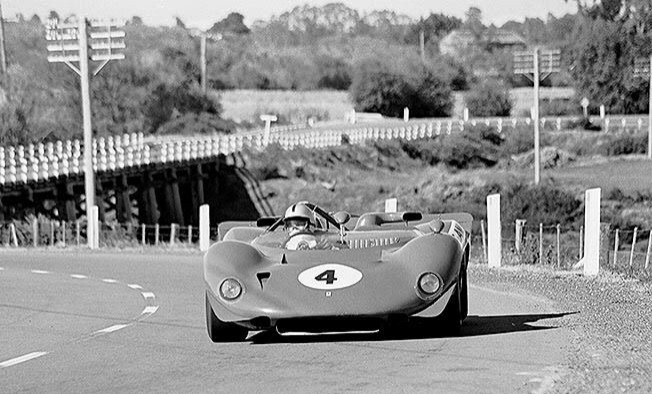
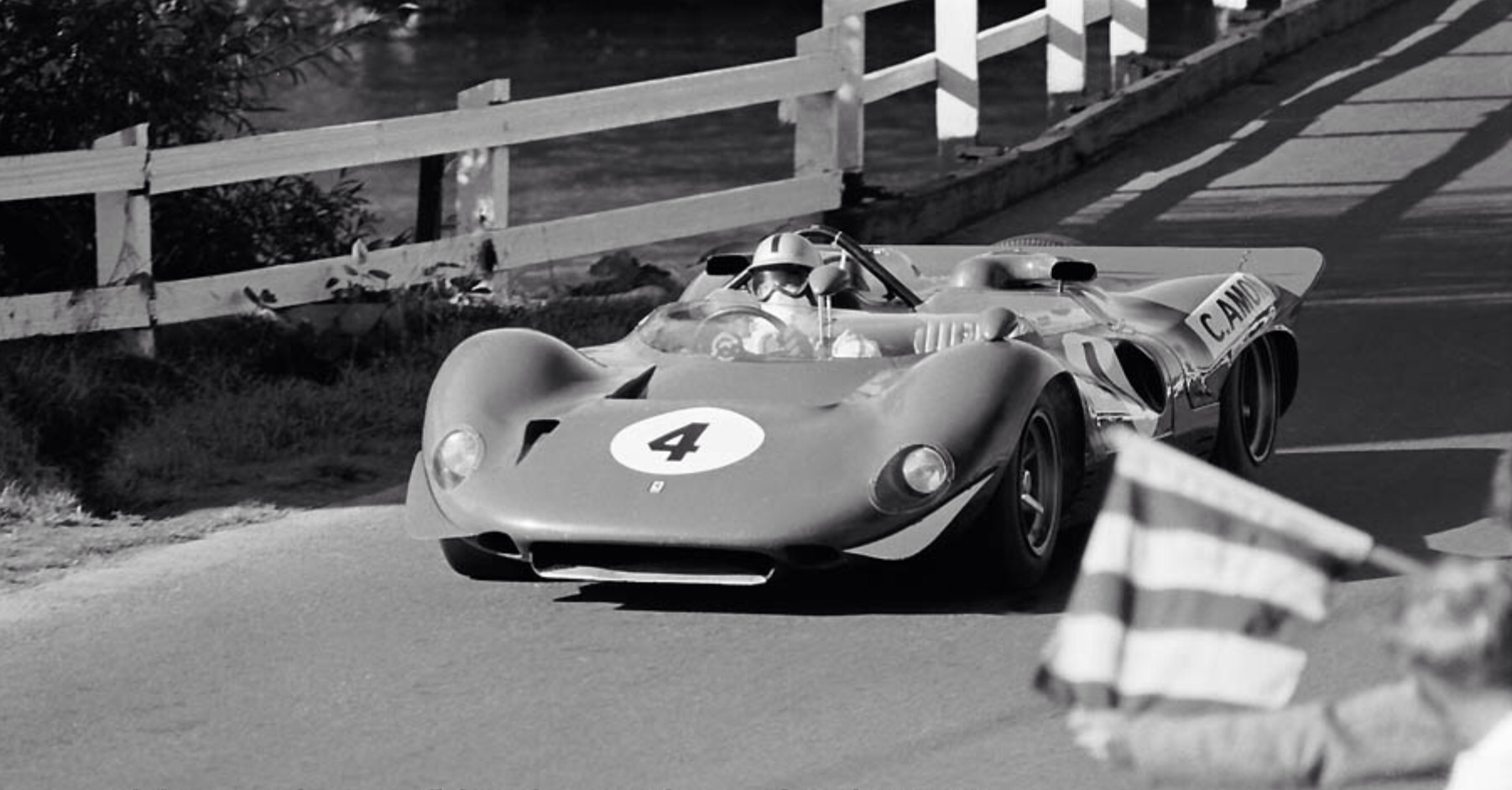
Bill Brown’s Ferrari 350 Can-Am on the exit of the very quick left-hander off Long Bridge- just about to change direction, Longford during the February 1968 Tasman meeting…

The ex-works car was owned by David McKay’s Scuderia Veloce and raced for him by Chris Amon in the sportscar events which supported each of the Australian Tasman rounds- and being beaten by Frank Matich in his Matich SR3 Repco V8 4.4 litre. Both cars had raced in some 1967 Can-Am Series races so Chris had a bit of an idea what he may have been up against when he arrived in Australia.

Sydney’s Bill Brown was to drive the car after Chris returned to Europe and also raced the car at Longford- a daunting place, to say the least, to become acquainted with one of the fastest sportscars on the planet at the time!

I wrote a long feature about the P4 Ferrari, and this particular car, chassis ‘0858’, a while back, click here to read it; https://primotipo.com/2015/04/02/ferrari-p4canam-350-0858/

(Rod MacKenzie)

For Chris the car was a bit of a distraction really, he was after the Tasman Cup aboard his works-owned but Chris Amon run Ferrari Dino 246T. He wasn’t successful in 1968, Jim Clark won the championship in his Lotus 49 Ford DFW but Chris made amends in 1969, winning the title against strong opposition including the Team Lotus duo of reigning F1 world champ Graham Hill and Jochen Rindt.

The shot below is of Bill setting off from the Longford pits in this oh-so-sexy machine, forever in the memories of those lucky enough to be at Longford ’68, or anywhere this car raced in its too short time in Australia that year.

(oldracephotos.com.au/D Keep)

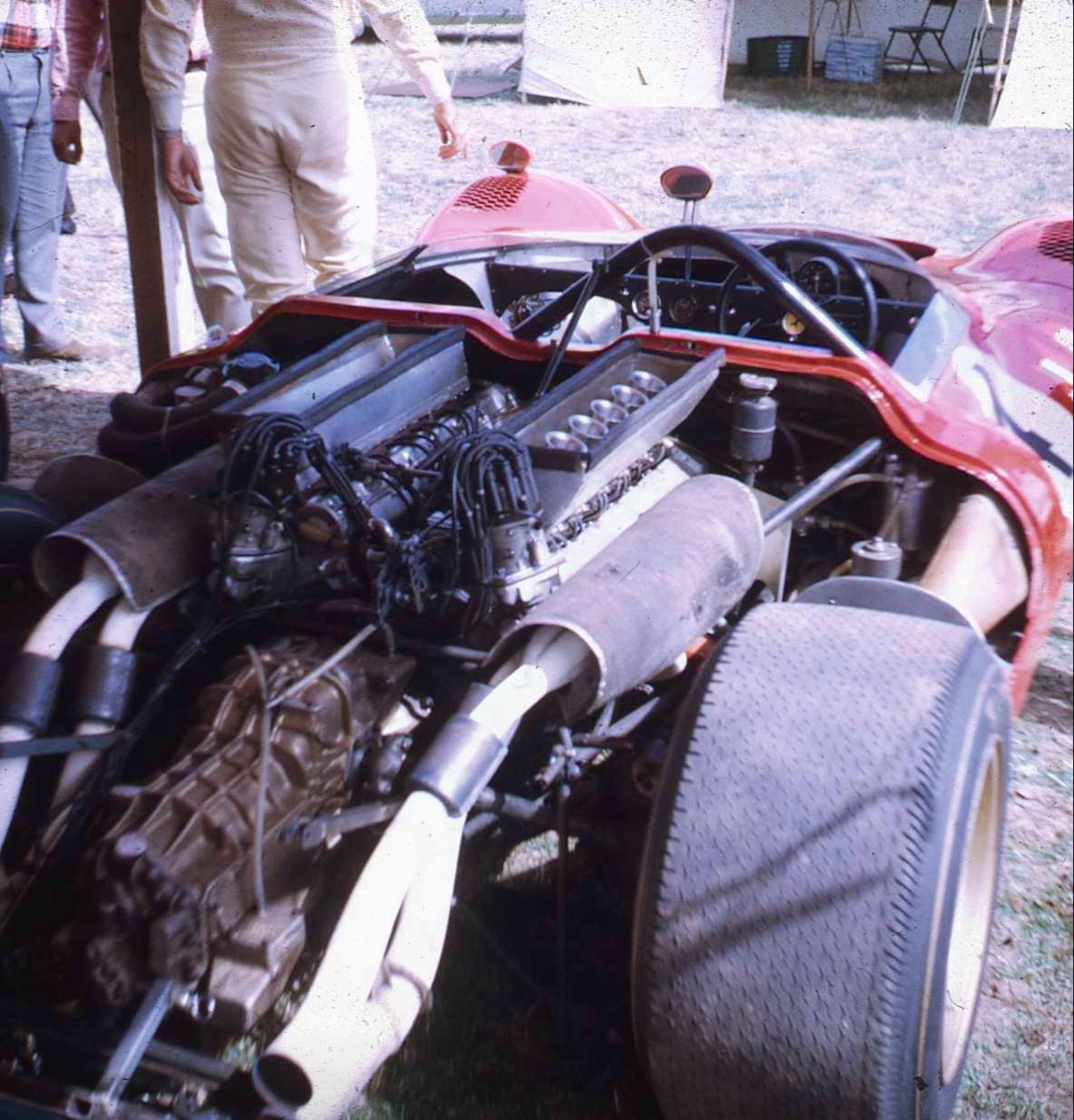
Tailpiece: Can-Am 350 business end, Longford 1968…

(Dennis Cooper)

What an impressive beast it is!

The V12 three-valve engine grew from 3967 cc and 450 bhp @ 8000 rpm in P4 endurance spec to 4176 cc and circa 480 bhp @ 8500 rpm in sprint Can-Am trim. Fuel injection is Lucas- two distributors are providing spark to two plugs per cylinder. The transaxle is a Ferrari built 5 speeder and chassis the Scuderia’s ‘Aero’ semi-monocoque with the engine having a stiffer crankcase than the P3’s to allow it to be used as a semi-stressed structural member.

Photo Credits…

David Keep/oldracephotos.com, Historic Racing Car Club of Tasmania, Rod MacKenzie, Dennis Cooper

Superb shot shows Bill coming off Kings Bridge with oil flag on display (oldracephotos.com.au/Harrisson)

Finito…


(Schlegelmilch)


Jo Siffert and JW Automotive’s John Horsman with Jo’s Porsche 917K during the Brands Hatch 1000 km meeting on the 4 April 1971 weekend…

This is a bit of a signature Rainer Schlegelmilch shot- framed through the engine cover of another team car in the Brands pitlane- that of Pedro Rodriguez and Jackie Oliver to be precise.

It was always going to be tricky winning in the 917 at Brands- and so it was that more nimble 3 litre prototypes finished in front of the Siffert/Derek Bell machine.

Stommelen Alfa T33/3, Ickx #51 Ferrari 312PB, Pedro in the #7 JW 917 and the rest, gotta be the warm up lap (unattributed)


Future sportscar ace Henri Pescarolo in the winning Alfa T33/3- his first Le Mans win was in 1972 aboard a Matra with Hill G (unattributed)

Andrea De Adamich and Henri Pescarolo won the race in an Alfa T33/3 V8 from the flat-12 engined Ferrari 312PB of Jacky Ickx and Clay Regazzoni.

The Alfas were pretty pacey that weekend, Rolf Stommelen popped the T33/3 he shared with Toine Hezemans on grid 2 in addition to the efforts of the winning car.

Ickx was on pole in the 312PB which had a limited campaign in 1971 as a dress rehearsal for the great pace the evolved 312PB had in 1972 when the cars won pretty much everything except Le Mans. They entered but did not appear such was the lack of confidence in the F1 derived engines ability to last 24 hours.

Regga aboard the 312PB whilst Ickx looks on from the rear.

I always thought it a huge shame that Scuderia Ferrari didn’t race the 512M as a factory entry in 1971- it would have been great to see the 5 litre cars with both ‘factory teams’ going at it for the final year of the championship under those Group 5 rules.

Ferrari certainly spent 1971 wisely developing their 312PB for 1972 however, dominant as they were in the first year of the 3 litre prototype formula.

Rodriguez, Stommelen and Siffert (unattributed)

Carlo Chiti and his merry band at Autodelta built a really nice bit of kit in the 1971 iteration of their long running series of Tipo 33 sportscars.

With an aluminium monocoque chassis, double wishbone/coil spring dampers at the front and single upper link, inverted lower wishbone/coil spring damper and twin radius rods at the rear the chunky looking design was an expression of sportscar orthodoxy of the time.

The 90 degree all aluminium 2998cc, quad cam, 4 valve, Lucas injected V8 gave around 420 bhp @ 9400- and with a decent roster of drivers the car won Targa (Vaccarella/Hezemans), Brands and the season ending Watkins Glen 6 Hour (De Adamich/Pescarolo) in a very good year in which the 5 litre monsters again took the bulk of the wins, and Porsche the manufacturers championship for the second year on the trot.

De Adamich, Alfa T33/3, Brands 1971 (unattributed)

Credits…

Rainer Schlegelmilch

Tailpiece: Derek Bell, Porsche 917K from the winning car in Henri Pescarolo’s hands- Alfa T33/3…

Finito…

Lionel Ayers looking focussed and pensive before the off, MRC Mk2 Olds, Lakeside circa 1969…

Love these two John Stanley shots. Many Australian enthusiasts remember this car, both in its original 1968 Traco Oldsmobile engined guise as here and later when fitted with a 5 litre Repco 740 Series V8 a year later.

Whilst Queensland based, Lionel travelled a lot throughout The Great Brown Land finishing second in the four round 1971 Australian Sportscar Championship with this Bob Britton/Rennmax Racing Cars built, spaceframe chassis machine.

MRC is ‘Motor Racing Components’ see the sticker aft of the Webers- it was the pharmacist’s own company which prepared his cars. Why Mk2?- the Mk1 was the Rennmax built Lotus 23 clone which preceded this V8 engined beastie. Both cars still exist, the MRC Mk2 in Repco engined form is owned by Ian Ross and races in ‘historics’ regularly.

I wrote about Lionel in this article, click here to read it; https://primotipo.com/2017/12/21/sportscar-stalwarts/

Photo Credit…

John Stanley Motor Sport Images

Tailpiece: Ayers, MRC Mk2 Olds, Lakeside 1969…

Finito…

(P Maslen)

It’s probably not actually, Jack would be hitting it more vigorously and the marshals wouldn’t be so relaxed, quite aggressive little critters tigers…

What is he up to though?

I’ve read the race reports, Jack did clip Homestead Corner during the race he finished- the 1967 Australian Grand Prix, so perhaps this is a perfunctory wheel alignment before being towed away.

Keen eyed Aussie enthusiasts will note David McKay’s presence behind Brabham, if he has the look of ‘an old chook at a christening’ about him it’s because he has done a deal to buy BT23A-1 Repco from Jack at the end of the series and is keen to see the champ has not shop-soiled the merchandise.

(P Maslen)

Jack was fourth in the race behind Stewart, Clark and Gardner in BRM P261, Lotus 33 Climax and Brabham BT16 Coventry Climax respectively.

It wasn’t a happy Tasman for the Repco boys- with a full-works effort of two cars a plethora of problems meant Jack and Denny took only one win between them- at Longford for Jack.

Still the GeePee season was in front of them, which would be an altogether different kettle of fish!

Life Magazine – The Big Wheels of Car Racing : Brabham and Hulme – 30 October 1967…

Credits…

Peter Maslen

Tailpiece: Doting David looks upon his new car, delivery only another week hence after Sandown…

(P Maslen)


Finito…

(P Greenfield)

Niel Allen blasts 5 litres of fuel-injected Chevy off the line at Bathurst, Easter 1970- McLaren M10B Chev F5000…

Peter Greenfield has beautifully captured Niel at the start of the historic three lap ‘Captain Cook Trophy’ in which Allen set a lap record at Bathurst with a time of 2:9.7 seconds which stood for 32 years until it was taken by John Bowe in a Ford V8 AU Supercar with 2:8.3873 to take provisional pole in 2002. Brad Jones did a race lap of 2:9.5705 in the same AU Falcon.

Whilst the track changed in the interim period as to a much better surface it was slowed by the high speed ‘The Chase’ on Conrod. Not to mention the fact that the last Easter Meeting with outright open-wheelers took place in 1973- the track had simply become too dangerous for cars of that performance envelope as it then was.

The feature event on the program that Easter 1970 weekend was the second round of the Australian Touring Car Championship which was won by Norm Beechey’s Holden Monaro GTS350, click here to read about that race;

Variety Is The Spice…

(Rod MacKenzie)

Start of the lap record race, above, with an obscured Niel Allen over against the Pit Counter. On this side is John Harvey, Brabham BT23E Repco and in white, Leo Geoghegan, Lotus 39 Repco- there was life in the old dog though, in beating Harves in the racing car 13 lapper Leo did a 2:12.1, the fastest ever time by a Tasman 2.5 car at Bathurst.

This meeting must have been just about the last race for each of those cars before John and Leo jumped into the Bob Britton built Jane Repco V8 and Lotus 59B Waggott respectively for the balance of their 1970 Gold Star campaigns- a title won by Geoghegan.

(J Bondini Collection)

The shadows are getting longer- Niel squints in the afternoon sun as he guides his 5 litre missile around Hell Corner for the blast up Mountain Straight- McLaren M10B in the pantheon of Formula 5000 cars one of the greats.

Niel Allen collects one of his trophies for the weekend from Chris Davison (C Williams)

Allen did a qualifying lap of 2:11.2 with a trick flat-plane crank Chev engine fitted to one of the fastest F5000’s on the planet at the time. The 1970 NZ GP winner flew around the treacherous for ultra fast single-seaters, circuit to do his amazing time- 171.7 miles per hour down Conrod in the process, a much narrower strip of bitumen than it is now.

The current Bathurst lap records are held by McLarens.

Shane van Gisbergen did a 2:1.5670 in his McLaren 650S GT3 during the February 2016 Bathurst 12 Hour endurance race. Jenson Button did a 1:48.88 in his F1 McLaren MP4-23 Mercedes in the pre-event Vodaphone publicity session he did with Craig Lowndes and his V8 Supercar prior to the 2011 AGP at Albert Park- I do like the symmetry of ‘another’ McLaren single-seater holding the ‘lap record’ even though the time was not set in a race.

I wish.

(zimbio.com)

Credits…

Peter Greenfield, motorsport.com, Road & Track, Wikipedia, Rod MacKenzie, ‘Bathurst: Cradle of Australian Motor Racing’ John Medley, Craig Williams

Tailpiece: Shane Van Gisbergen, McLaren 650S 2016…

(Road and Track)

Finito…

Racing Abstract Art…

Posted: November 25, 2018 in Fotos, Obscurities
Tags:

Still life of Indian juggling clubs, Bell helmet and a bowling pin…

The image was featured in a ‘Design for Sport’ exhibition at the Museum of Modern Art, New York in February 1962.

Quite what the connection between the items in this ‘installation’ as we call it in the art world is, I am ferked if I know! All creative interpretations welcome.

My partner is into art, in fact she has an art business ‘on the side’ including a website of which I am the star, read the only, writer despite knowing five-eighths of four-fifths of bugger all about the subject. Nothing a little bit of research can’t fix mind you. Click here for one of my masterpieces on the Venice Biennale; http://www.moha.com.au/australian-pavilion-venice-biennale-who-gets-go/

We spend a lot of time in galleries of all types, the things we do for love I guess. I enjoy looking at art even though most of the time I have absolutely no idea what it is I am looking at.

Just like this still life really…

Credit…

Mark Kauffman

Hector Jenkins, Fronty Ford, Penrith Speedway, New South Wales, practice in December 1927/January 1928…

Ronald Taylor took these wonderful, evocative photographs of a much more relaxed time and place, getting on for a century ago. Above is quite possibly Peter White testing the Fronty before winning the Unlimited Scratch Race on 2 January 1928.

The car above is the Alert Special, whilst it had an Alvis radiator it was a modified Ford. It appears more of a road-racer in specification than a dirt-track machine but the racers of the day often used the same car to do road trials, dirt events and race on the concrete saucer at Maroubra. The times of specialisation are still a way off in Australia.

Jenkins, Fronty Ford

Penrith is 60 Km west of Sydney, a long way then but now a soda, depending upon traffic traversing the Western Motorway to the Blue Mountains and beyond, I wrote an article about the place a while back which provides plenty of background; https://primotipo.com/2017/06/08/penriths-world-championship-race-1930/

David Manson has researched the photographs in this piece and wrote that ‘Bridget Wynne (photo further below in the article) claimed to be an experienced racing driver in England but she never drove in or raced in this country as far as can be established’ despite that he suspects it may be her at the wheel. I am intrigued to learn more about this lady.

Alert Special and Flint driven by T Poole- or is it being tested before the meeting by Peter White who was ‘timed to cover laps at a speed of about 70 mph’ the SMH reported on 22 December 1927

It’s all happening above- capped mechanics fuelling the cars and plenty of envious onlookers, amidst the Friday practice perhaps?

T Poole contested the Unlimited Car Scratch Race run over 3 miles on 2 January 1928 in the Flint and won by Peter White’s Fronty Ford, his average speed 67 mph.

The Thomas Special, Fronty Ford and the Flint ran at Penrith Speedway at a meeting which was split between 26 December 1927 and 2 January 1928- New Years Day was on a Sunday which partially explains the odd dates.

Thomas, Thomas Ford Special

Hector Jenkins was the New South Wales agent for Frontenac hotting-up parts for Fords, operating out of the Saunders Chambers premises at 247 Elizabeth Street, Sydney, he and his family used to camp at the Penrith  Speedway for race meetings. There are hints in the photos that not much racing was going on, so maybe they were taken on practice days before the Christmas/New Year meeting.

And we have ‘lift off’ below- a practice race start for Ms Wynne.

Miss Wynne aboard the Alert Special

Etcetera…

(mfca.com)

Here is the Hector Jenkins team/family campsite, come workshop at Penrith with banner proclaiming the Australian Track Record and Dirt Track Championship of NSW held by Fronty Fords. Hector is second from the right.

Peter White’s personal Fronty Ford had the Maroubra record at 101.3 mph whilst Hector’s DO Fronty had the dirt track record at Penrith. The cars above are the R, DO and SR Fronty.

Credits…

Ronald Vernon Taylor- all but one photo, David Manson, mfca.com, various newspaper articles via Trove

Tailpiece: Yep! He is the guy we have to beat: The Jenkins Fronty Ford crew watching the action…


Finito…

(D McPhedran)

Jack Brabham’s Cooper T53 Climax during the Warwick Farm 100 on 29 January 1961…

Jack didn’t figure in the race with fuel dramas, it was won by Stirling Moss’ Rob Walker Lotus 18 Climax from Innes Ireland’s similar works machine and Bib Stillwell’s Cooper T51 Climax.

Moss, Lotus 18 Climax with body panels removed to better ventilate the cockpit (Getty)

Moss, Gurney and Hill are on the front row, the latter two fellas in BRM P48’s. Ireland and Brabham, to the right, are on row two. Row three comprises Ron Flockhart, Austin Miller and Bib Stillwell in T51’s, with row four again T51’s in the hands of Bill Patterson and Alec Mildren.

Moss and Warwick Farm supremo Geoff Sykes before the off, car to the right is Austin Miller’s Cooper T51 Climax.

Crazy men in long strides, long sleeved shirts and ties on a scorcher of a Sydney day.

(R Donaldson-SLNSW)
(WFFB)

Moss, Gurney and Hill on the front row, Lotus 18 and two BRM P48s, then Innes Ireland, works Lotus 18 Climax and Jack Brabham, Cooper T53 Climax and then Austin Miller and David McKay in Cooper T51s. #9 in the shot below is Bill Patterson in another T51.

Fourth to and fifth places were bagged by Miller and Flockhart with the rest of the starters, nine cars, failing to finish the 45 laps in a race of attrition run in scorching, humid, Sydney heat.

Etcetera…

(R Donaldson-SLNSW)

Note the left-hand shift of the 5-speed Colotti transaxle, it wasn’t the first time Moss shed body panels in the heat, but perhaps it was the last.

(R Donaldson-SLNSW)

Graham Hill qualified his BRM P48 third behind Moss and his teammate, Dan Gurney but was out after 10 laps with a fuel tank problem.

The BRM’s best result of that Australasian Tour was Gurney’s win – the only international win for the P48 – in the Victorian Trophy on the Ballarat airfield circuit a fortnight later. Moss and Brabham were absent by then mind you…

Tailpiece…

The worlds best credentialed driver coach! Stirling Moss shows Innes Ireland the fast way around Warwick Farm, here crossing the causeway. The car is Tom Sulman’s Aston Martin DB3S, a machine rather familiar Moss as an ex-works Aston pilot.

Credits…

Don McPhedran, Getty Images, oldracingcars.com, Australian Motor Heritage Foundation via Brian Caldersmith, Bob Donaldson via the State Library of New South Wales

Finito…

It’s a Bull’s Life…

Posted: November 15, 2018 in F1, Fotos
Tags:

image

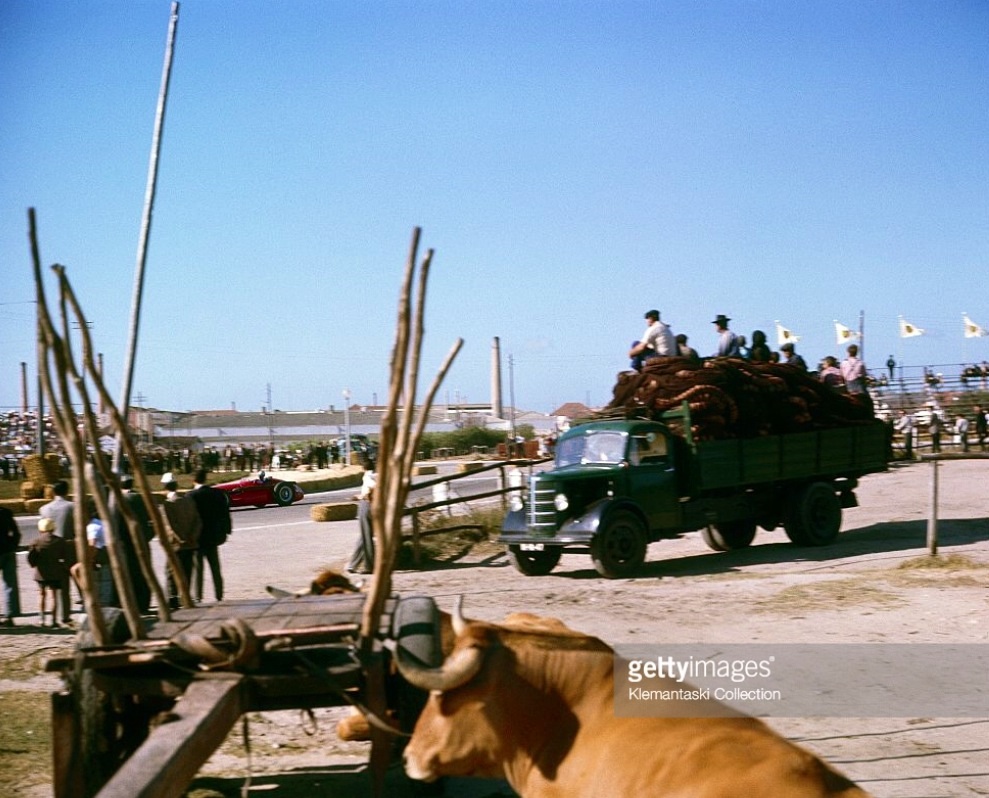
Will I for a gallop along the track? Nah, I’ll hang here it’s more peaceful…

Maserati 250F going past but can’t figure whose, the number on the tail appears to have a 3-prefix but no such car was entered. Any ideas? Moss won the race from Mike Hawthorn and Phil Hill- Vanwall VW57 from Ferrari Dino 246 times two.

I wrote an article about this 1958 Moroccan GP meeting a while back, click here to read it;

Vanwall Cars and the 1958 Moroccan Grand Prix…

Credits…

Klemantaski Collection

Bernie Haehnle aboard his Rennmax Mk1 Formula Vee on the front row of the grid at Warwick Farm in 1971…

Nice find of a batch of interesting photos- this one of Bernie on the front of the grid, where he typically resided, and the other two which triggered this article are Australian Department of Immigration ‘success stories of migrants in sport’ of whom Bernie was one- he hails from Stuttgart, Germany.

(DIA)


(DIA)


At the time of the article ( I wonder where it was published?) he had his own automotive business in Lane Cove, Sydney. Haehnle progressed from FV- these Bob Britton built Rennmax Mk1’s were the ‘ducks-guts’ to have, especially in New South Wales, to Formula Ford, racing a Bowin P6F with much elan. As was the case for top open-wheeler racers he usually saddled up in a Series Production car for the annual enduros at Bathurst, Sandown and Surfers. I wonder what he is up to these days?

Bernie, Rennmax Mk1 in the Warwick Farm Esses, November 1971 (L Hemer)

Credits…

Industrial Photography, Department of Immigration Australia, Lynton Hemer, Pictorial History of Racing Cars

What a great way for a young driver to have his profile lifted. As a sponsored driver, these Shell ads were placed in the mainstream motoring magazines of the day, not just niche ones like ‘Australian Hot Rod’.

(Pic History of Racing Cars)

Tailpiece: Just a smidge more, five more minutes…

Bernie was clearly determined and clever!

His disagreement with local real estate occurred at XL (Griffins) Bend during the running of the 1969 Bathurst 500 classic when he ran out of road heading up the mountain.

With his trusty fence post, leverage, push-and-shove and the fall of the land Bernie was able to get the little GH Whitehead entered Mazda R100 back onto its wheels and into the fray after an hour of toil. He drove down the mountain and through a farm before rejoining the blacktop.

It is one of those feats of never-say-die which has gone down in Bathurst folklore- and garnered far more TV coverage than a mid-field class car could have ever dreamed of!

Co-driver Peter Wherrett shared the car with him, the pair retired on lap 31 with PW not getting a drive but watching the drama unfold on the telly in the pits. The car was driveable, a tad second hand, but without a windscreen officialdom stepped in.

(autopics.com.au)

In an historic sidebar it was the first time a rotary engined car raced at the Mountain- in fact it was one of the R100’s first race appearances anywhere in the world.

Whilst the 982cc, twin-rotor, 100bhp cars were very quick in a straight line thanks to a combination of power and light weight.

Haehnle, R100 early in the race (autopics.com.au)

With only 805 kg to cart along, the little coupe did the standing quarter in sub 18 seconds with a top whack of 175 km/h. It wasn’t as flash through the corners though- the R100 was very narrow and tall relative to its length, resulting in lots of body roll and fearful roll oversteer at high speed caused by toe-out on the outside rear wheels due to deflection in the leaf springs. Ask Bernie.

Three R100’s started at Mount Panorama, the quickest of the two remaining finished fifth (Garry Cooke/Geoff Spence) in Class C behind the winning Cooper S, two Fiat 125s and a lone Valiant Pacer. The second R100 was seventh- the Mazdas finished two laps behind the winning Coopers with their superior handling, fuel economy and long track record of motor racing success.

What was impressive was that two standard, off the production line examples of Mazda’s new mass-produced rotary survived 500 miles flat-knacker on one of the world’s most challenging circuits without a drama. Mazda became an important force in Australian touring car racing over the ensuing decade, all of which started with the R100 and test-pilots like Bernie!

Finito…